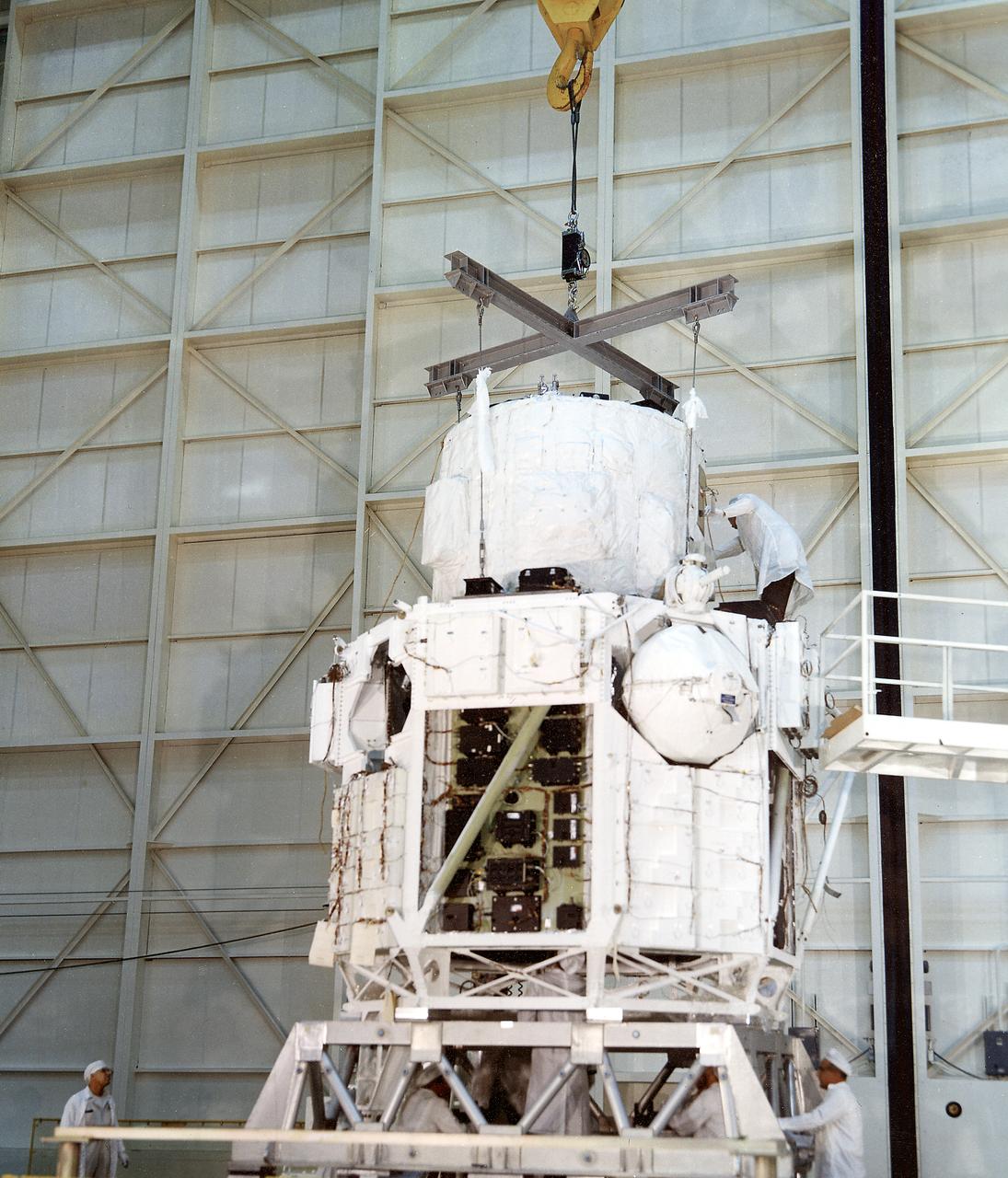
The Apollo Telescope Mount (ATM) was designed and developed by the Marshall Space Flight Center and served as the primary scientific instrument unit aboard Skylab (1973-1979). The ATM consisted of eight scientific instruments as well as a number of smaller experiments. In this image, the ATM canister, housing the solar instruments, is mated to the thermal rack that provided thermal stability.

Advanced Colloids Experiment, Thermal 5-2, ACE T5-2 International Space Station, ISS, Fluids Integrated Rack, FIR Operations in the Telescience Support Center, TSC
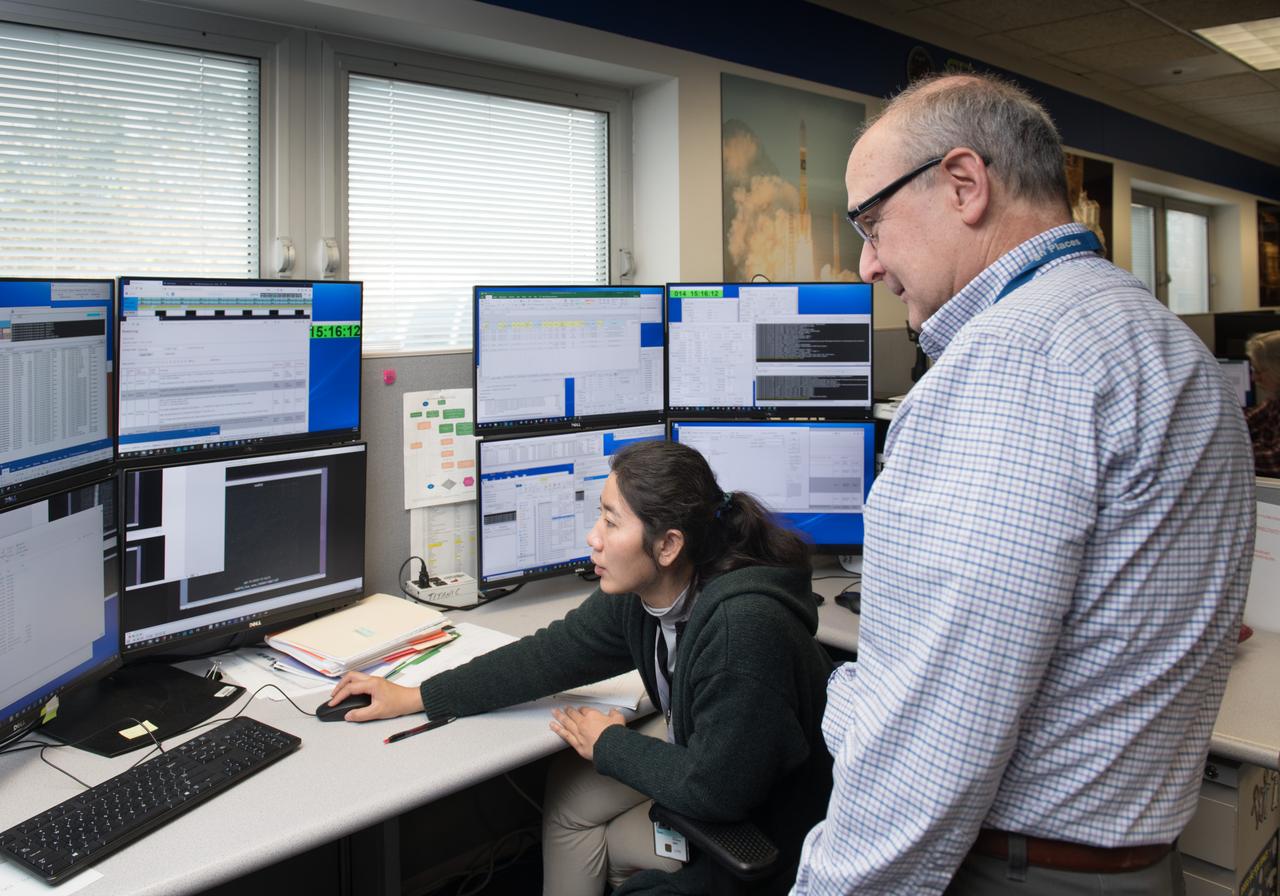
Advanced Colloids Experiment, Thermal 5-2, ACE T5-2 International Space Station, ISS, Fluids Integrated Rack, FIR Operations in the Telescience Support Center, TSC
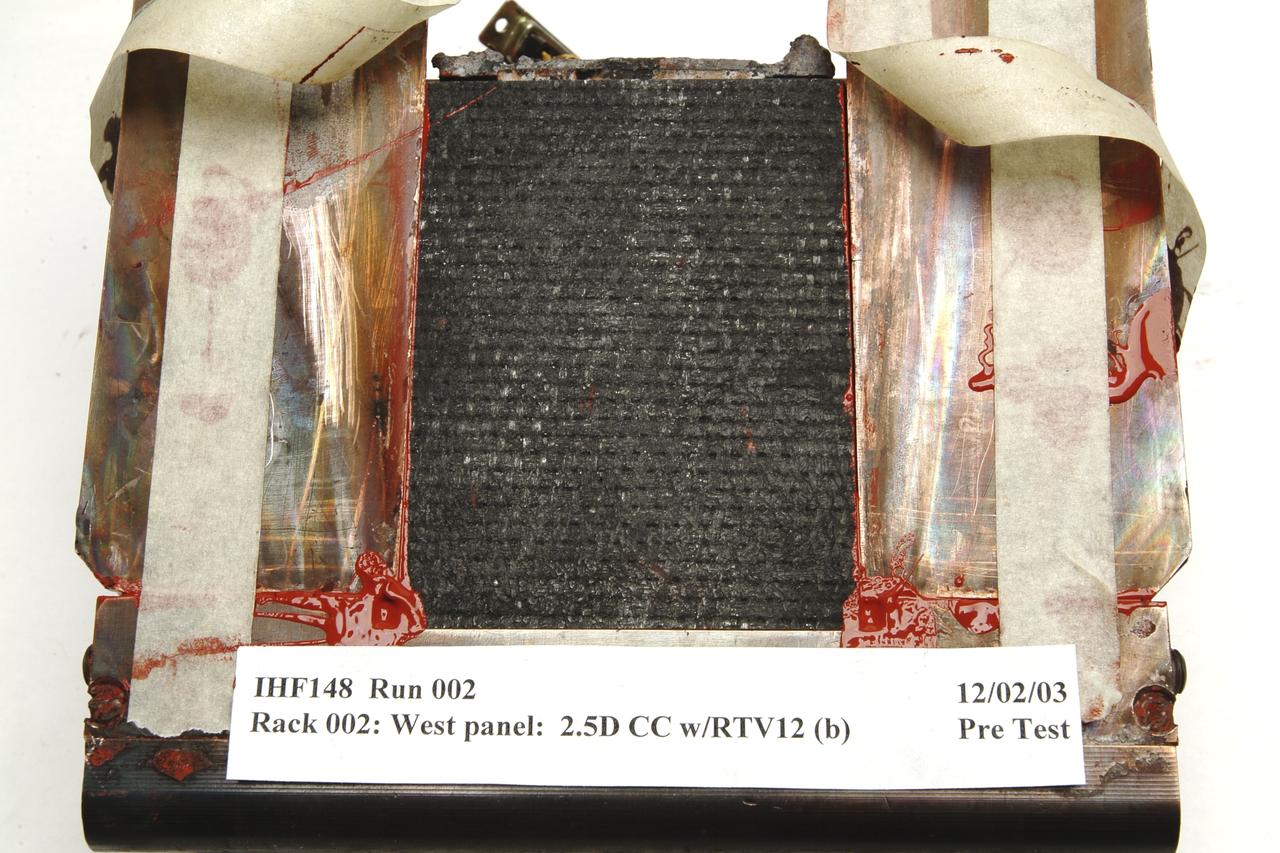
NEXT GENERATION THERMAL PROTECTION MATERIALS TESTING IN INTERACTIVE HEATING FACILITY; IHF-148 Run 002: Rack 002 West Panel: 2.5D CC W/RTVIC (b) 12/2/03 pre- test
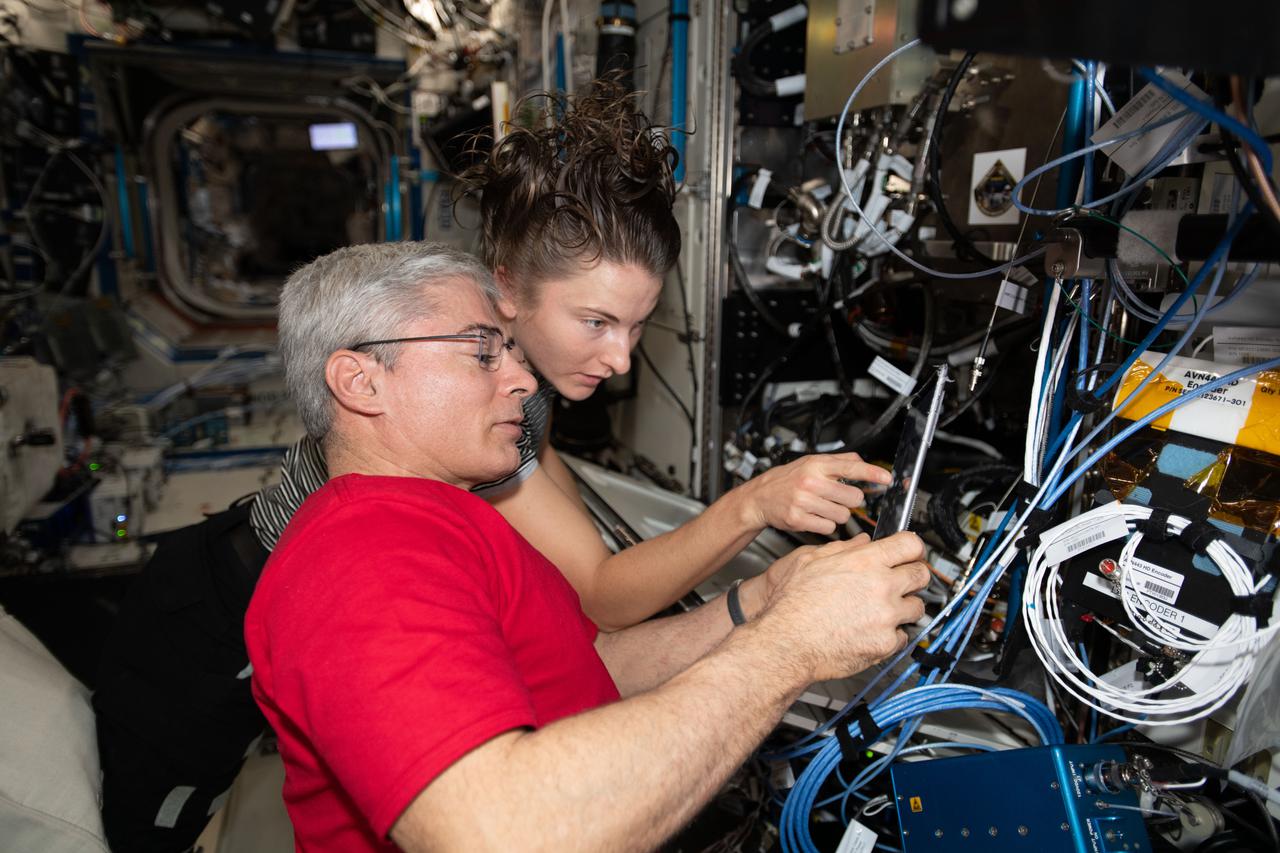
iss066e088377 (Dec. 9, 2021) --- NASA astronauts Mark Vande Hei and Kayla Barron set up the Fluids Integrated Rack for a space physics study that may improve thermal systems for Earth and other planetary environments.
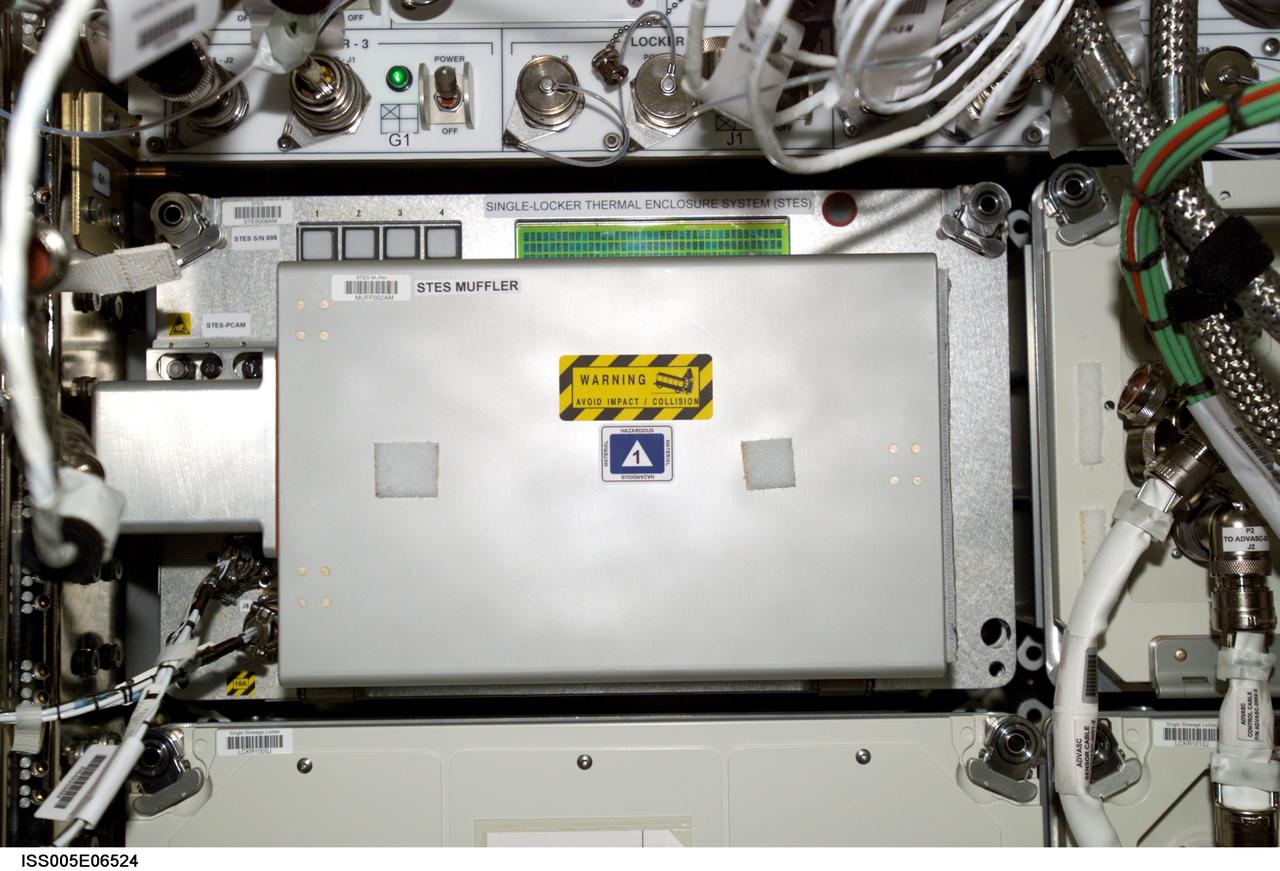
iss005e06524 (7/2/2002) --- View of the Single-Locker Thermal Enclosure System (STES), located on the Expedite the Processing of Experiments to the Space Station (EXPRESS) Rack 4 in the Destiny / U.S. Laboratory.
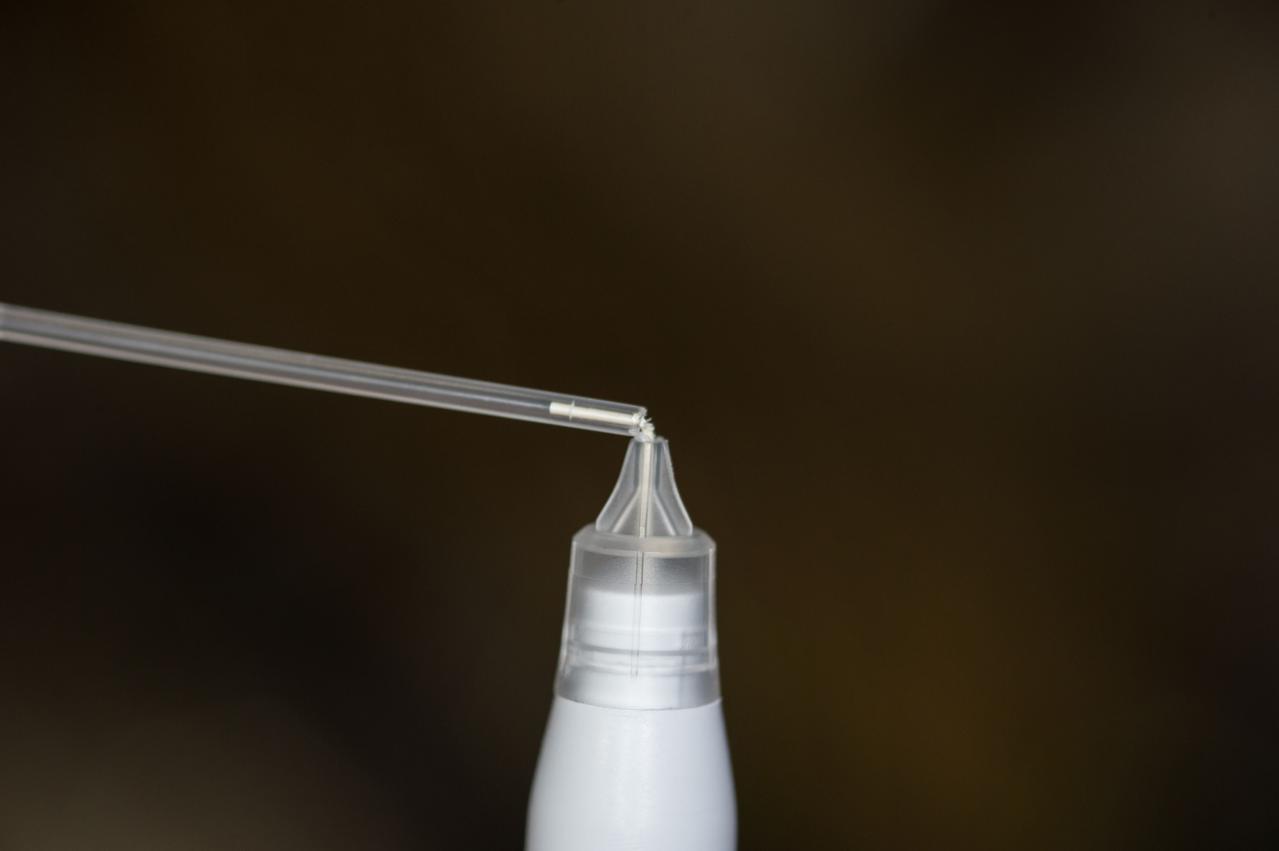
iss051e041912 (5/13/2017) --- Photo documentation of a broken pipette that was to be used to dispense water droplets into the Electrowetting Drawer of ExPRESS (Expedite the Processing of Experiments to Space Station) Rack 8 for the Passive Thermal Flight Experiment. The Advanced Passive Thermal eXperiment (APTx) tests three advanced thermal management technologies. It demonstrates the in-space performance of each, an important step toward improving these technologies for use on future space exploration missions.
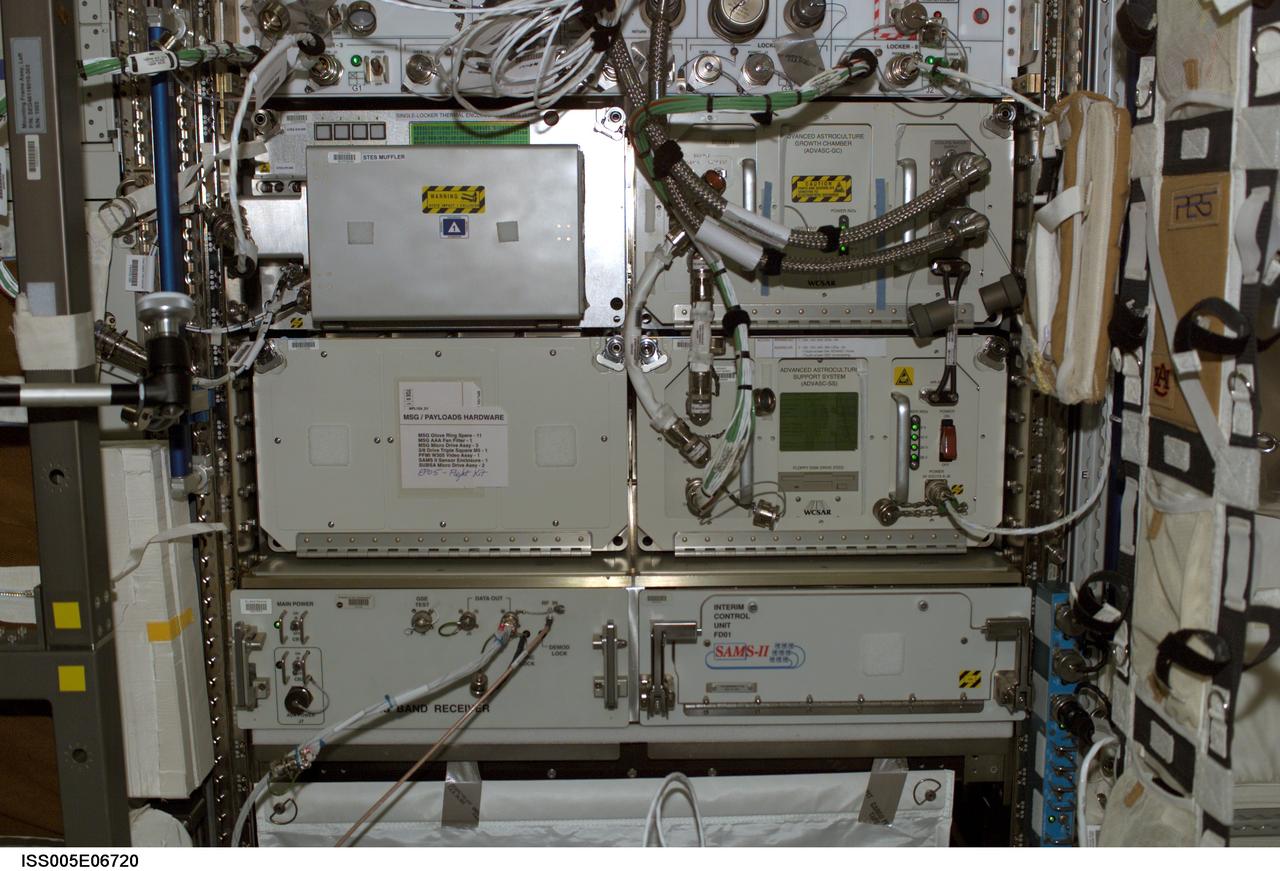
iss005e06720 (7/4/2002) --- Front view of Express Rack 4 in the U.S. Laboratory / Destiny taken during Expedition Five. Visible in the rack are the following items: Single-Locker Thermal Enclosure System (STES) Muffler, Advanced Astroculture Growth Chamber (ADVASC-GC), Advanced Astroculture Support System (ADVASC-SS). And Space Acceleration and Measurement System (SAMS) II.
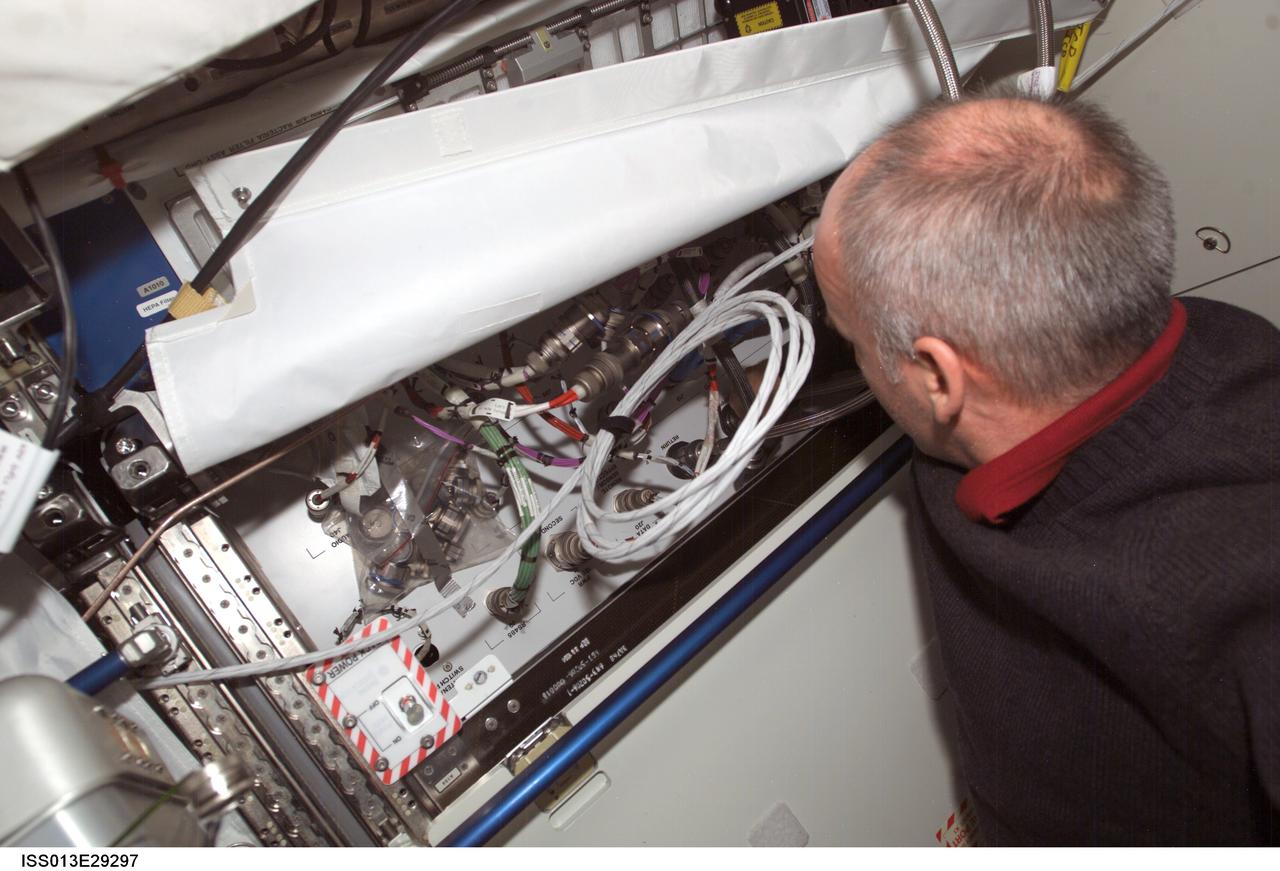
ISS013-E-29297 (1 June 2006) --- Astronaut Jeffrey N. Williams, Expedition 13 NASA space station science officer and flight engineer, performs in-flight maintenance on a Thermal Control System (TCS) line on an open rack in the Destiny laboratory of the International Space Station.
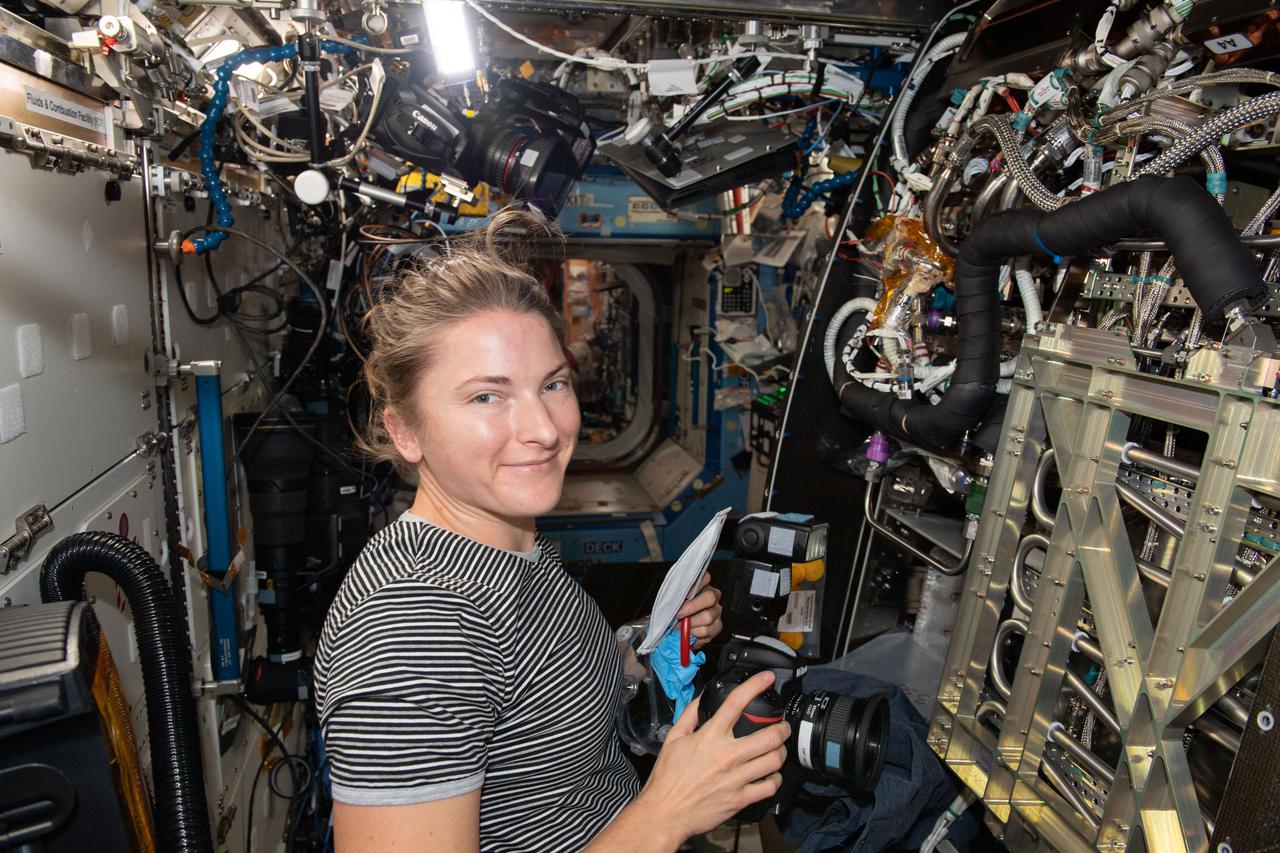
iss066e086562 (Dec. 4, 2021) --- NASA astronaut and Expedition 66 Flight Engineer Kayla Barron is pictured inspecting and photographing components inside the Materials Science Research Rack that enables the observation of chemical and thermal properties of materials free from the effects of gravity.

KENNEDY SPACE CENTER, FLA. - In the Space Station Processing Facility, a worker stands by as the Rack Insertion Device slowly moves the Human Research Facility-2 (HRF-2) science rack into the Multi-Purpose Logistics Module Raffaello for flight on Space Shuttle Discovery’s Return to Flight mission, STS-114. The HRF-2 will deliver additional biomedical instrumentation and research capability to the International Space Station. HRF-1, installed on the U.S. Lab since May 2001, contains an ultrasound unit and gas analyzer. Both racks provide structural, power, thermal, command and data handling, and communication and tracking interfaces between the HRF biomedical instrumentation and the U.S. Laboratory, Destiny. NASA Kennedy Space Center and their prime contractor responsible for ISS element processing, The Boeing Company, prepared the rack for installation. The HRF Project is managed by NASA Johnson Space Center and implemented through contract with Lockheed Martin, Houston, Texas.
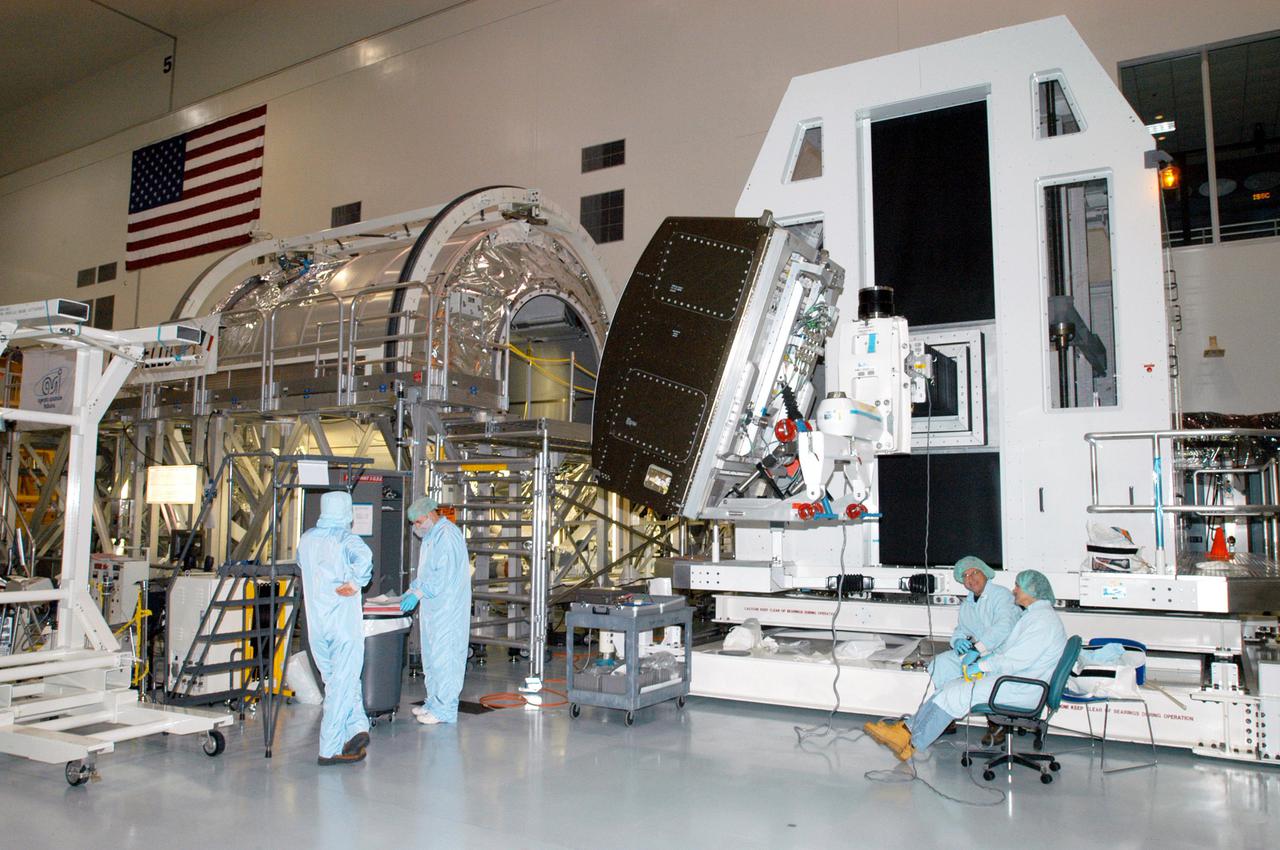
KENNEDY SPACE CENTER, FLA. - In the Space Station Processing Facility, workers prepare to attach the Human Research Facility-2 (HRF-2) science rack onto the Rack Insertion Device. HRF-2 will be installed into the Multi-Purpose Logistics Module Raffaello (at left) for flight on Space Shuttle Discovery’s Return to Flight mission, STS-114. The HRF-2 will deliver additional biomedical instrumentation and research capability to the International Space Station. HRF-1, installed on the U.S. Lab since May 2001, contains an ultrasound unit and gas analyzer. Both racks provide structural, power, thermal, command and data handling, and communication and tracking interfaces between the HRF biomedical instrumentation and the U.S. Laboratory, Destiny. NASA Kennedy Space Center and their prime contractor responsible for ISS element processing, The Boeing Company, prepared the rack for installation. The HRF Project is managed by NASA Johnson Space Center and implemented through contract with Lockheed Martin, Houston, Texas.
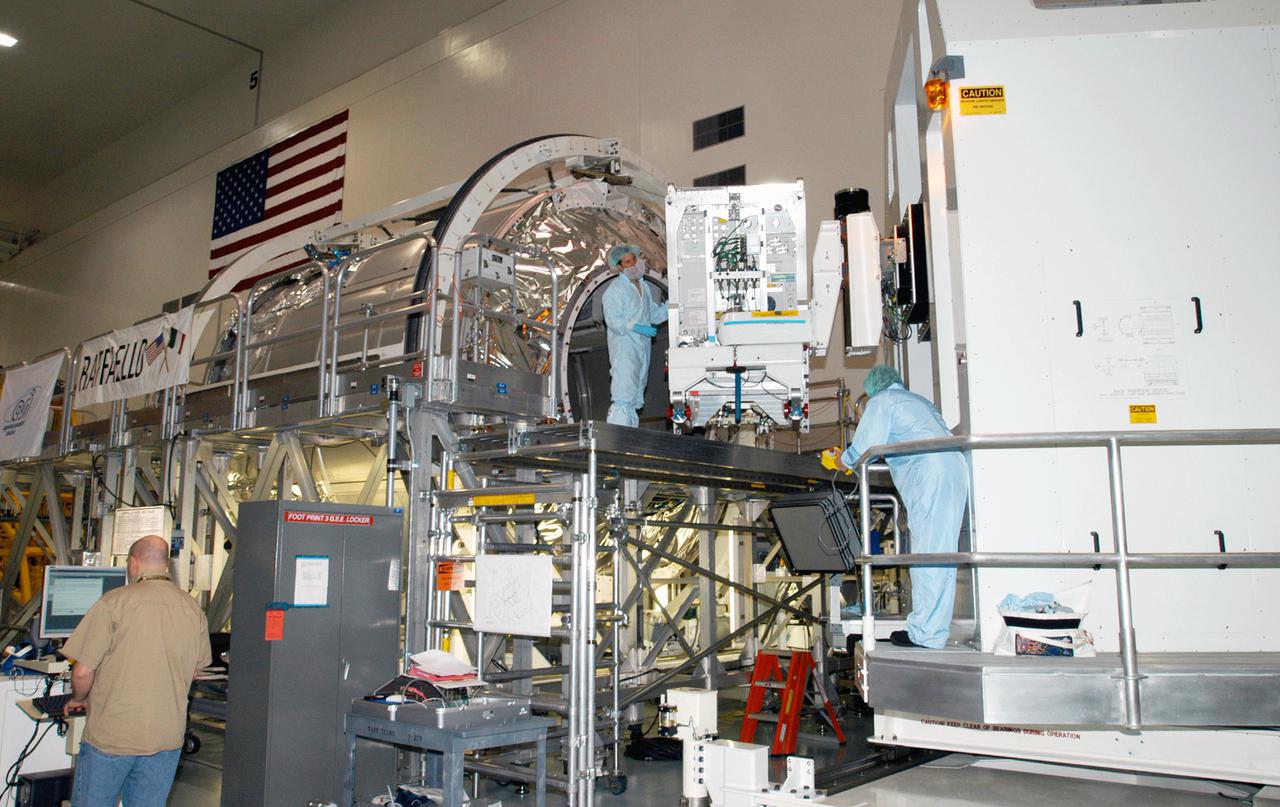
KENNEDY SPACE CENTER, FLA. - In the Space Station Processing Facility, the Rack Insertion Device moves the Human Research Facility-2 (HRF-2) science rack toward the Multi-Purpose Logistics Module Raffaello (at left) for flight on Space Shuttle Discovery’s Return to Flight mission, STS-114. The HRF-2 will deliver additional biomedical instrumentation and research capability to the International Space Station. HRF-1, installed on the U.S. Lab since May 2001, contains an ultrasound unit and gas analyzer. Both racks provide structural, power, thermal, command and data handling, and communication and tracking interfaces between the HRF biomedical instrumentation and the U.S. Laboratory, Destiny. NASA Kennedy Space Center and their prime contractor responsible for ISS element processing, The Boeing Company, prepared the rack for installation. The HRF Project is managed by NASA Johnson Space Center and implemented through contract with Lockheed Martin, Houston, Texas.
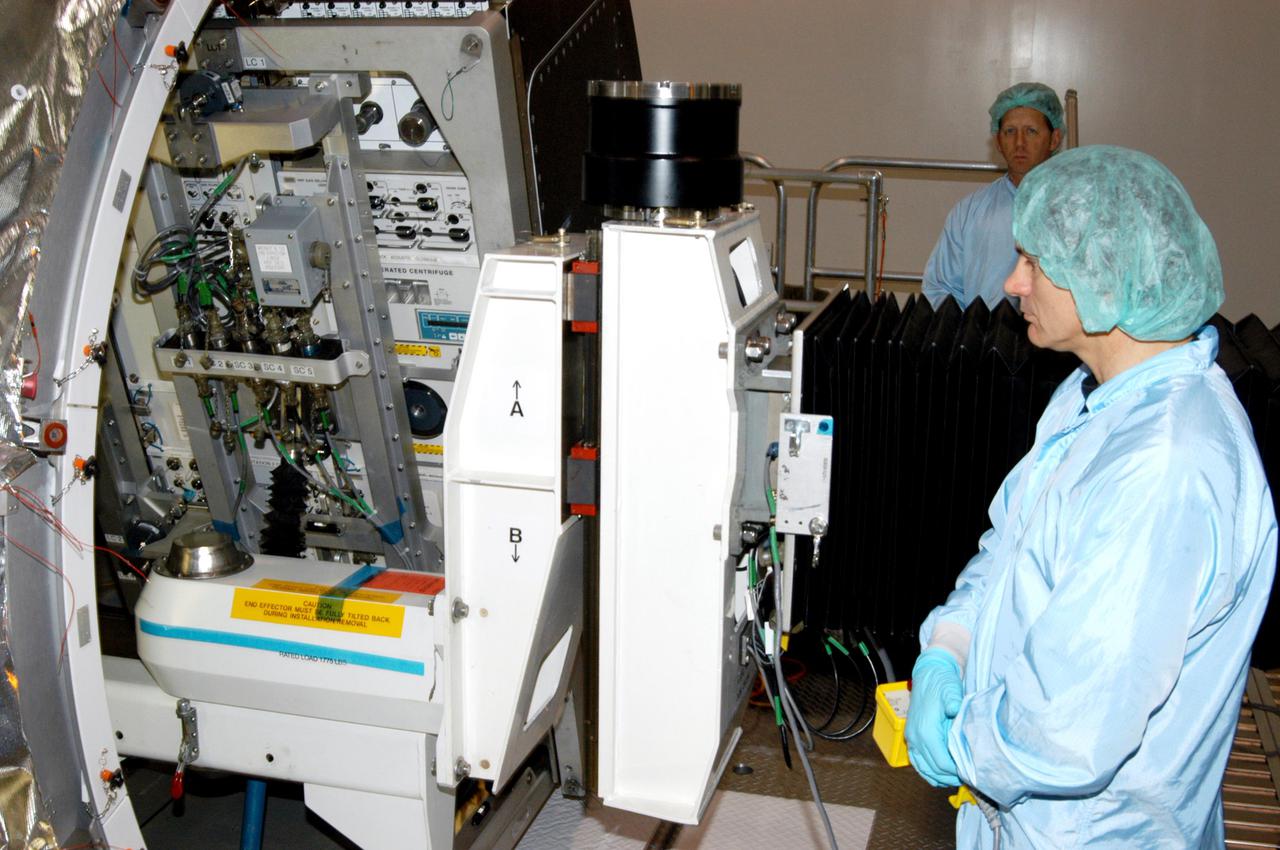
KENNEDY SPACE CENTER, FLA. - In the Space Station Processing Facility, a worker watches as the Rack Insertion Device slowly moves the Human Research Facility-2 (HRF-2) science rack into the Multi-Purpose Logistics Module Raffaello for flight on Space Shuttle Discovery’s Return to Flight mission, STS-114. The HRF-2 will deliver additional biomedical instrumentation and research capability to the International Space Station. HRF-1, installed on the U.S. Lab since May 2001, contains an ultrasound unit and gas analyzer. Both racks provide structural, power, thermal, command and data handling, and communication and tracking interfaces between the HRF biomedical instrumentation and the U.S. Laboratory, Destiny. NASA Kennedy Space Center and their prime contractor responsible for ISS element processing, The Boeing Company, prepared the rack for installation. The HRF Project is managed by NASA Johnson Space Center and implemented through contract with Lockheed Martin, Houston, Texas.
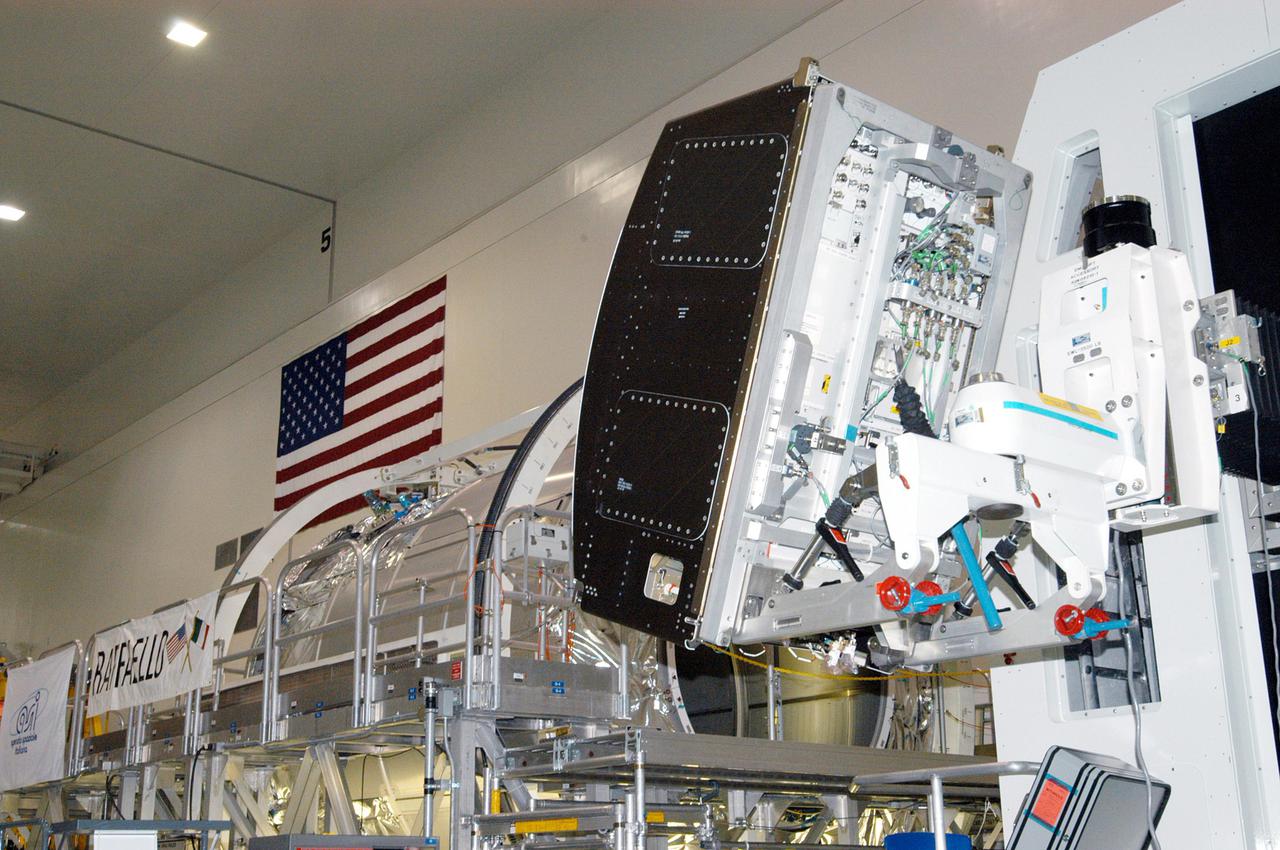
KENNEDY SPACE CENTER, FLA. - In the Space Station Processing Facility, the Human Research Facility-2 (HRF-2) science rack is attached to the Rack Insertion Device that will install it into the Multi-Purpose Logistics Module Raffaello (at left) for flight on Space Shuttle Discovery’s Return to Flight mission, STS-114. The HRF-2 will deliver additional biomedical instrumentation and research capability to the International Space Station. HRF-1, installed on the U.S. Lab since May 2001, contains an ultrasound unit and gas analyzer. Both racks provide structural, power, thermal, command and data handling, and communication and tracking interfaces between the HRF biomedical instrumentation and the U.S. Laboratory, Destiny. NASA Kennedy Space Center and their prime contractor responsible for ISS element processing, The Boeing Company, prepared the rack for installation. The HRF Project is managed by NASA Johnson Space Center and implemented through contract with Lockheed Martin, Houston, Texas.
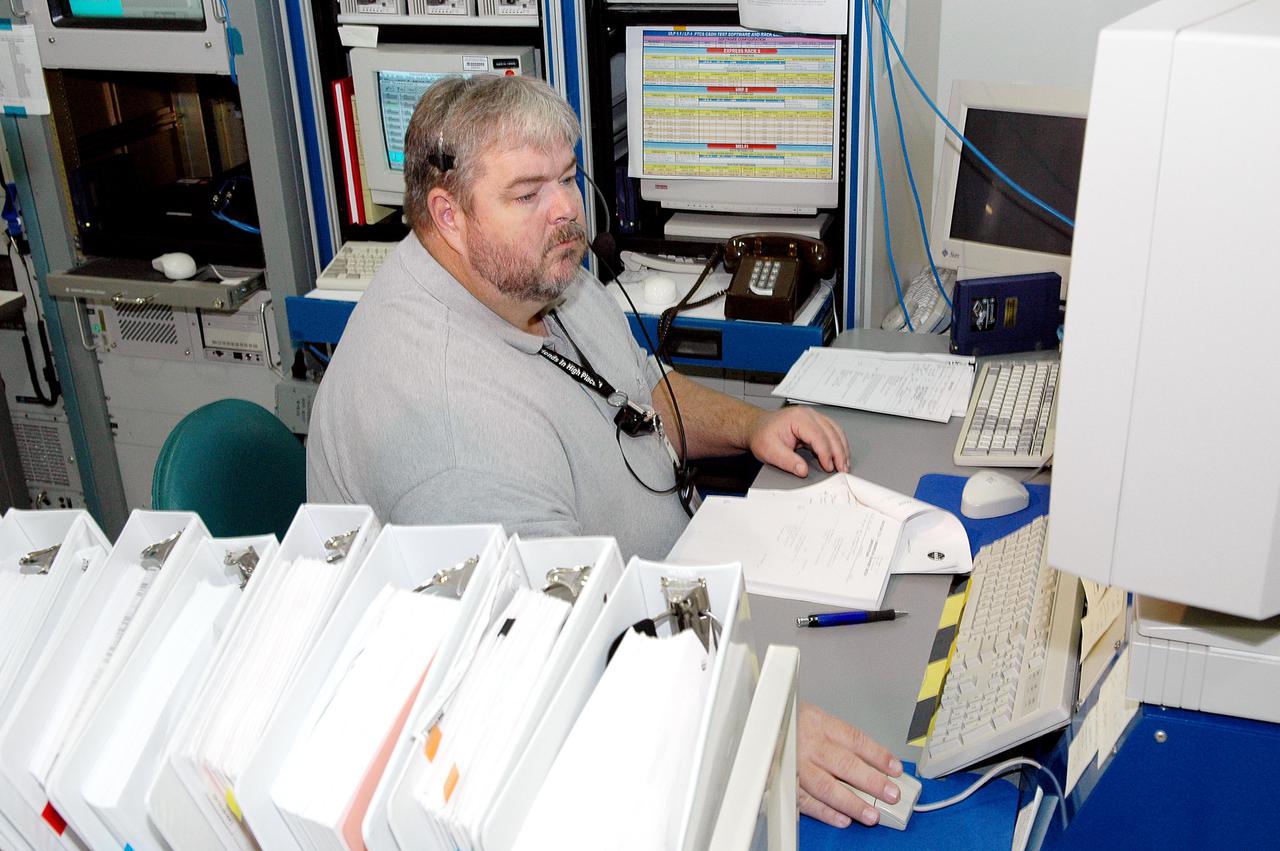
KENNEDY SPACE CENTER, FLA. - Joe Mounts, with Boeing, monitors the Payload Test and Checkout System for the Human Research Facility (HRF) Rack -2 payload. The HRF-2 is scheduled to fly on Return to Flight Space Shuttle mission STS-114. The HRF-2 will deliver additional biomedical instrumentation and research capability to the International Space Station. HRF Rack 1 contains an ultrasound unit and gas analyzer system and has been operational in the U.S. Lab since May 2001. HRF-2 will also be installed in the U. S. Lab and will provide structural, power, thermal, command and data handling, and communication and tracking interfaces between the HRF biomedical instrumentation and the U. S. Lab.
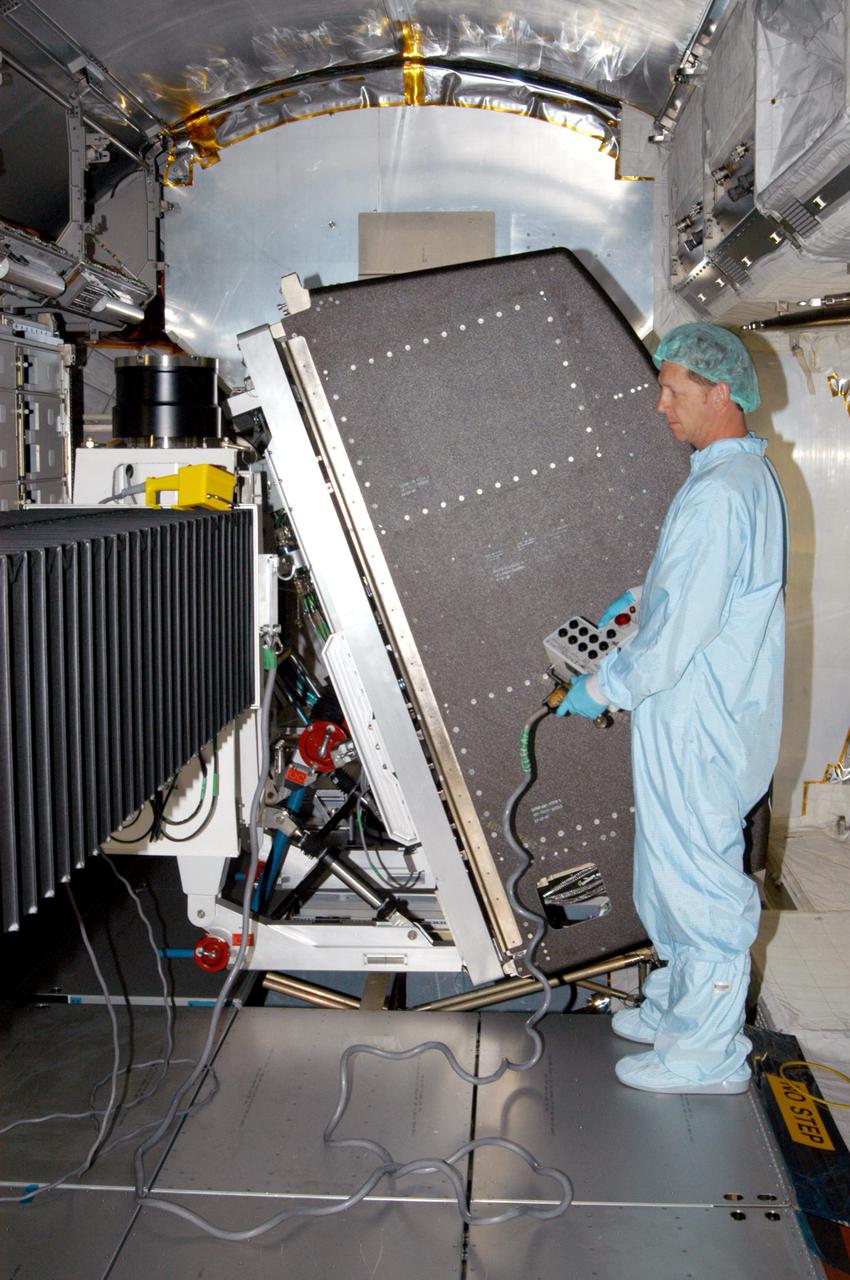
KENNEDY SPACE CENTER, FLA. - In the Space Station Processing Facility, a worker inside the Multi-Purpose Logistics Module Raffaello is ready for installation of the Human Research Facility-2 (HRF-2) science rack. Raffaello will fly on Space Shuttle Discovery’s Return to Flight mission, STS-114. The HRF-2 will deliver additional biomedical instrumentation and research capability to the International Space Station. HRF-1, installed on the U.S. Lab since May 2001, contains an ultrasound unit and gas analyzer. Both racks provide structural, power, thermal, command and data handling, and communication and tracking interfaces between the HRF biomedical instrumentation and the U.S. Laboratory, Destiny. NASA Kennedy Space Center and their prime contractor responsible for ISS element processing, The Boeing Company, prepared the rack for installation. The HRF Project is managed by NASA Johnson Space Center and implemented through contract with Lockheed Martin, Houston, Texas.
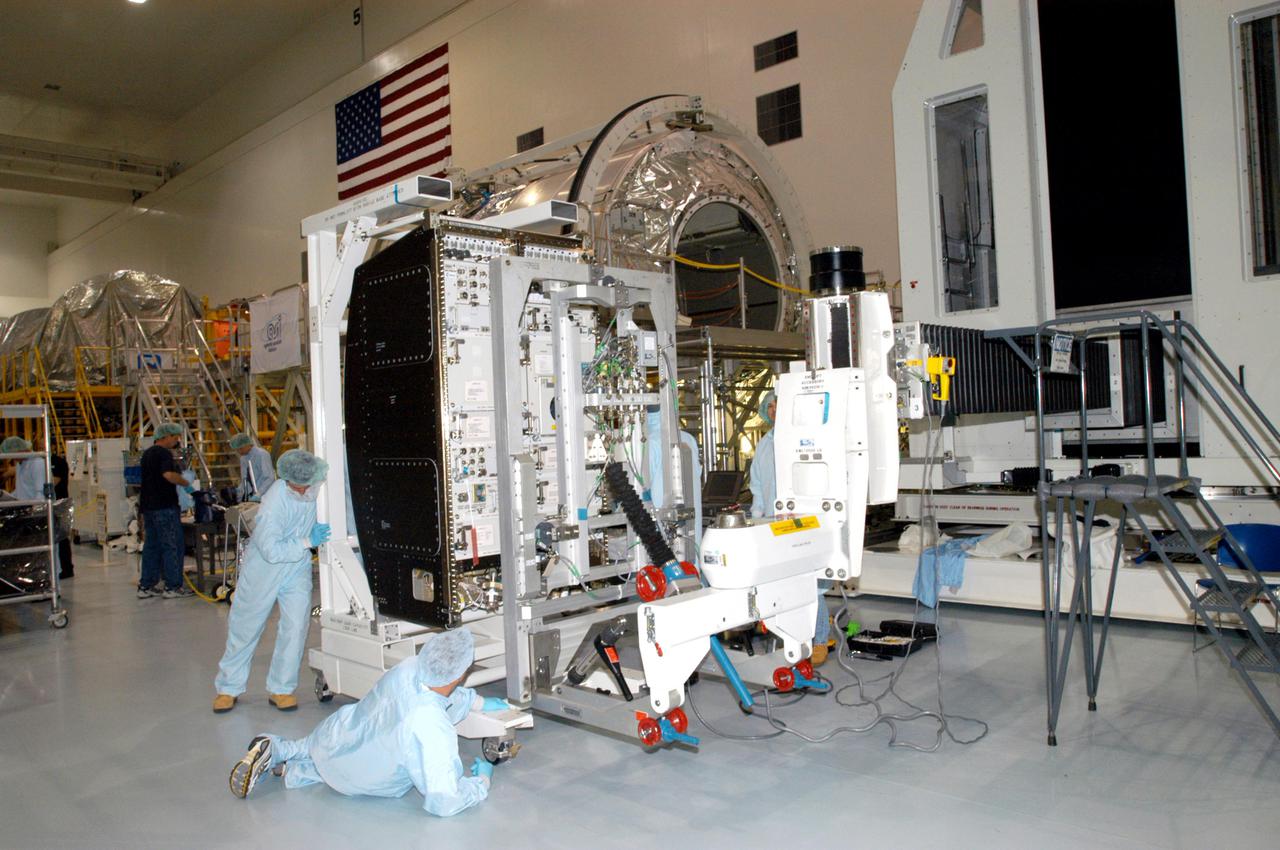
KENNEDY SPACE CENTER, FLA. - In the Space Station Processing Facility, workers prepare the Human Research Facility-2 (HRF-2) science rack for installation into the Multi-Purpose Logistics Module Raffaello for flight on Space Shuttle Discovery’s Return to Flight mission, STS-114. The HRF-2 will deliver additional biomedical instrumentation and research capability to the International Space Station. HRF-1, installed on the U.S. Lab since May 2001, contains an ultrasound unit and gas analyzer. Both racks provide structural, power, thermal, command and data handling, and communication and tracking interfaces between the HRF biomedical instrumentation and the U.S. Laboratory, Destiny. NASA Kennedy Space Center and their prime contractor responsible for ISS element processing, The Boeing Company, prepared the rack for installation. The HRF Project is managed by NASA Johnson Space Center and implemented through contract with Lockheed Martin, Houston, Texas.
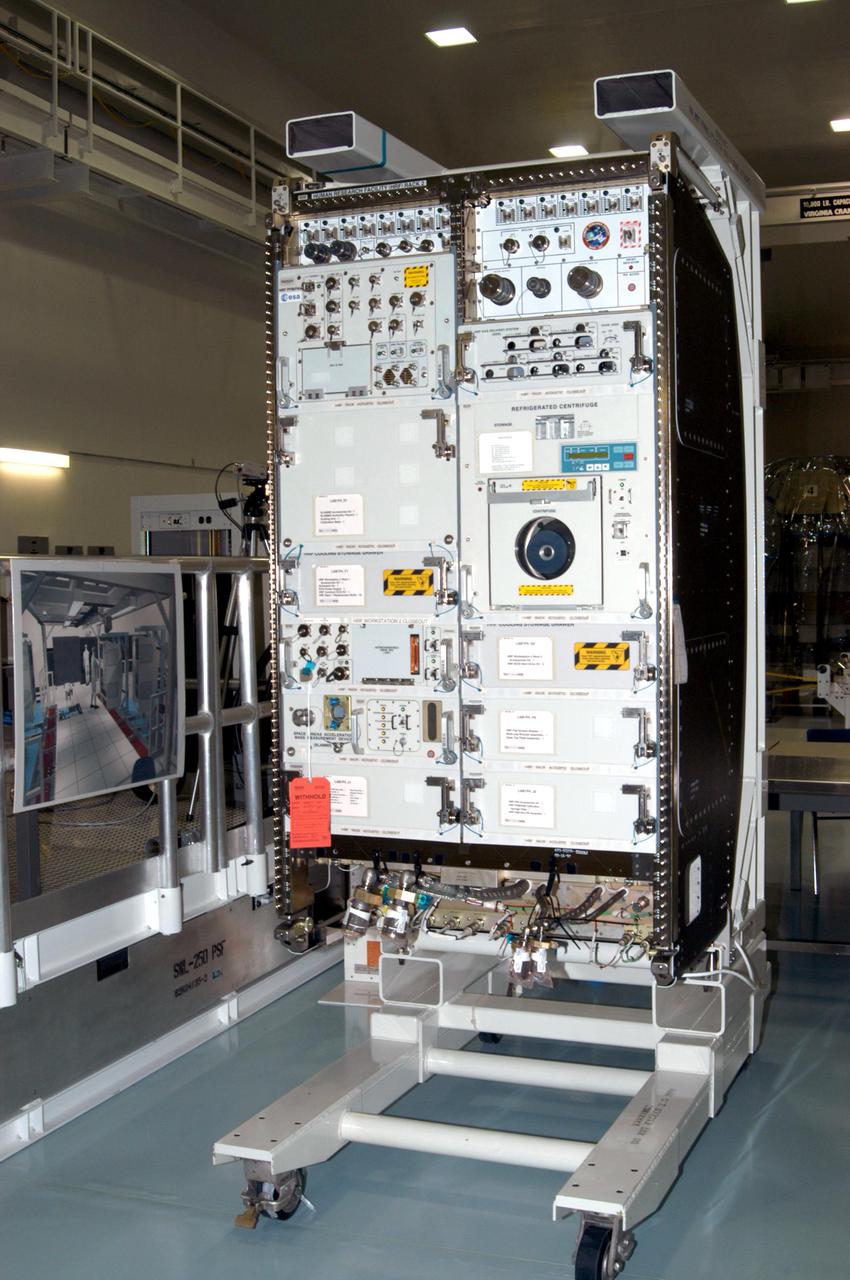
KENNEDY SPACE CENTER, FLA. - In the Space Station Processing Facility, the Human Research Facility-2 (HRF-2) science rack sits on a stand waiting to be installed into the Multi-Purpose Logistics Module Raffaello for flight on Space Shuttle Discovery’s Return to Flight mission, STS-114. The HRF-2 will deliver additional biomedical instrumentation and research capability to the International Space Station. HRF-1, installed on the U.S. Lab since May 2001, contains an ultrasound unit and gas analyzer. Both racks provide structural, power, thermal, command and data handling, and communication and tracking interfaces between the HRF biomedical instrumentation and the U.S. Laboratory, Destiny. NASA Kennedy Space Center and their prime contractor responsible for ISS element processing, The Boeing Company, prepared the rack for installation. The HRF Project is managed by NASA Johnson Space Center and implemented through contract with Lockheed Martin, Houston, Texas.
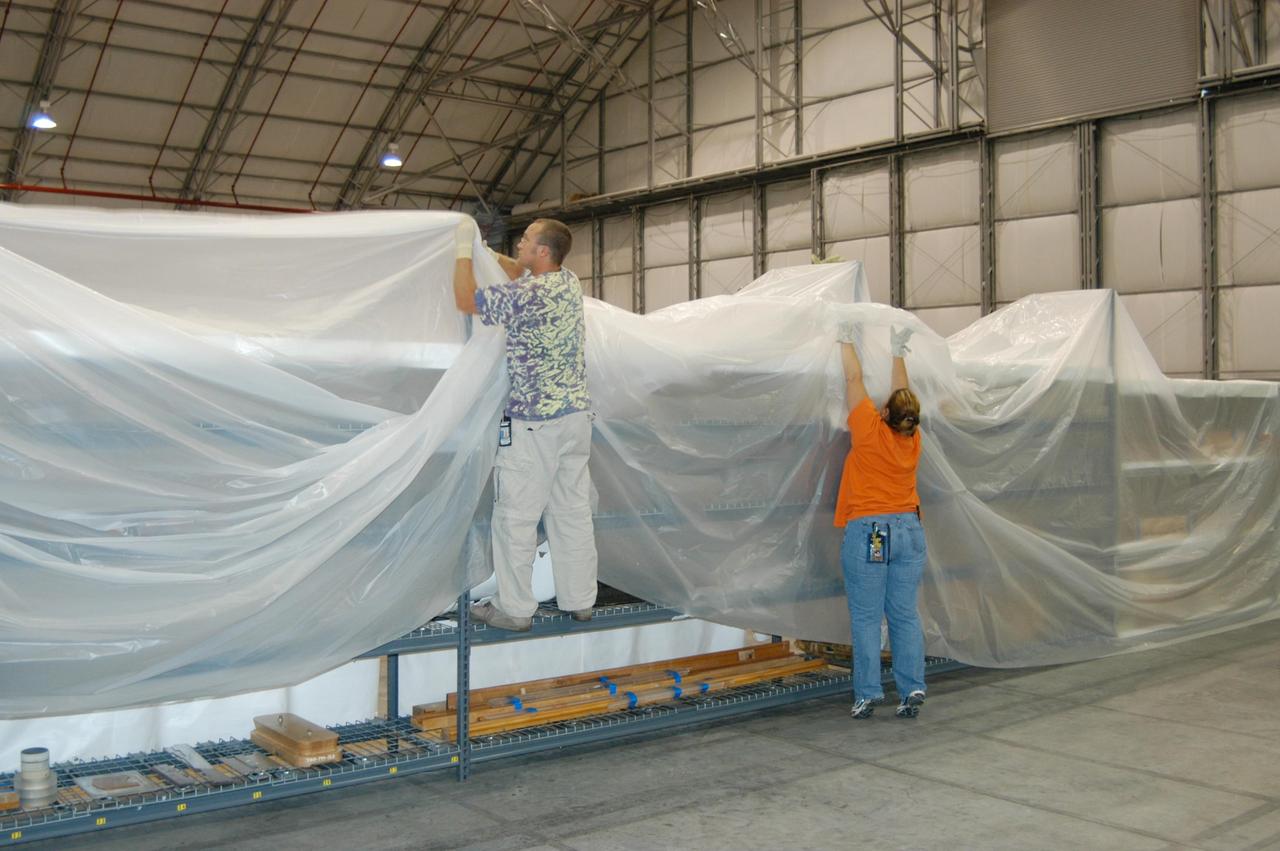
KENNEDY SPACE CENTER, FLA. - In the Reusable Launch Vehicle (RLV) Hangar, workers secure stretch sheets of plastic over racks of equipment in preparation for the arrival of Hurricane Jeanne, expected to impact Central Florida Sunday. This is the fourth hurricane in 45 days to make landfall somewhere in the state. The Thermal Protection System (TPS) Facility suffered extensive damage from Hurricane Frances, causing the relocation of equipment to the RLV.
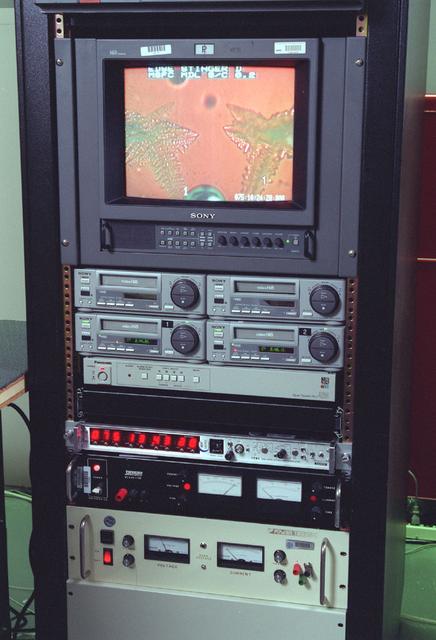
The Equiaxed Dendritic Solidification Experiment (EDSE) is a material sciences investigation under the Formation of Microstructures/pattern formation discipline. The objective is to study the microstructural evolution of and thermal interactions between several equiaxed crystals growing dendritically in a supercooled melt of a pure and transparent substance under diffusion controlled conditions. Video and power rack for the EDSE in the Microgravity Development Lab (MDL).
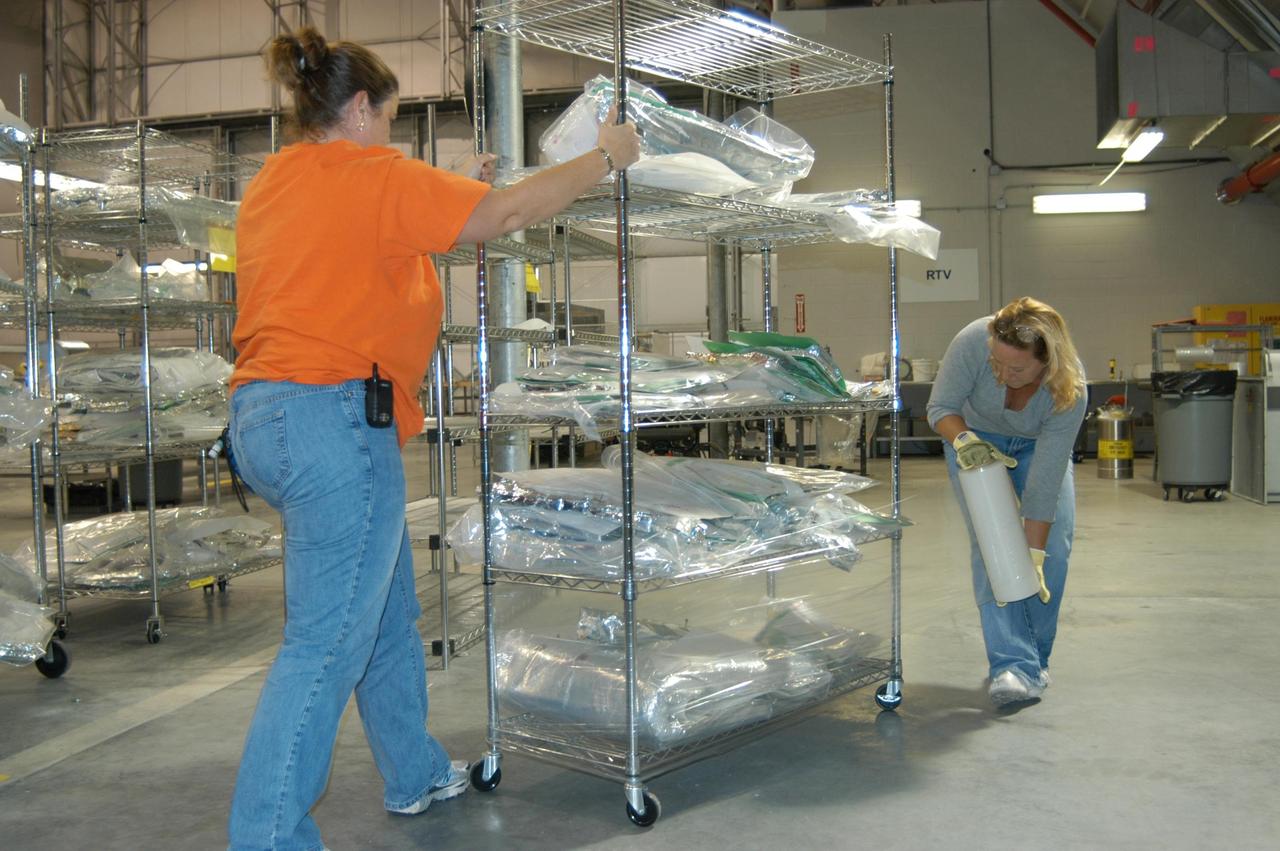
KENNEDY SPACE CENTER, FLA. - In the Reusable Launch Vehicle (RLV) Hangar, workers begin wrapping racks of equipment in preparation for the arrival of Hurricane Jeanne, expected to impact Central Florida Sunday. This is the fourth hurricane in 45 days to make landfall somewhere in the state. The Thermal Protection System (TPS) Facility suffered extensive damage from Hurricane Frances, causing the relocation of equipment to the RLV.
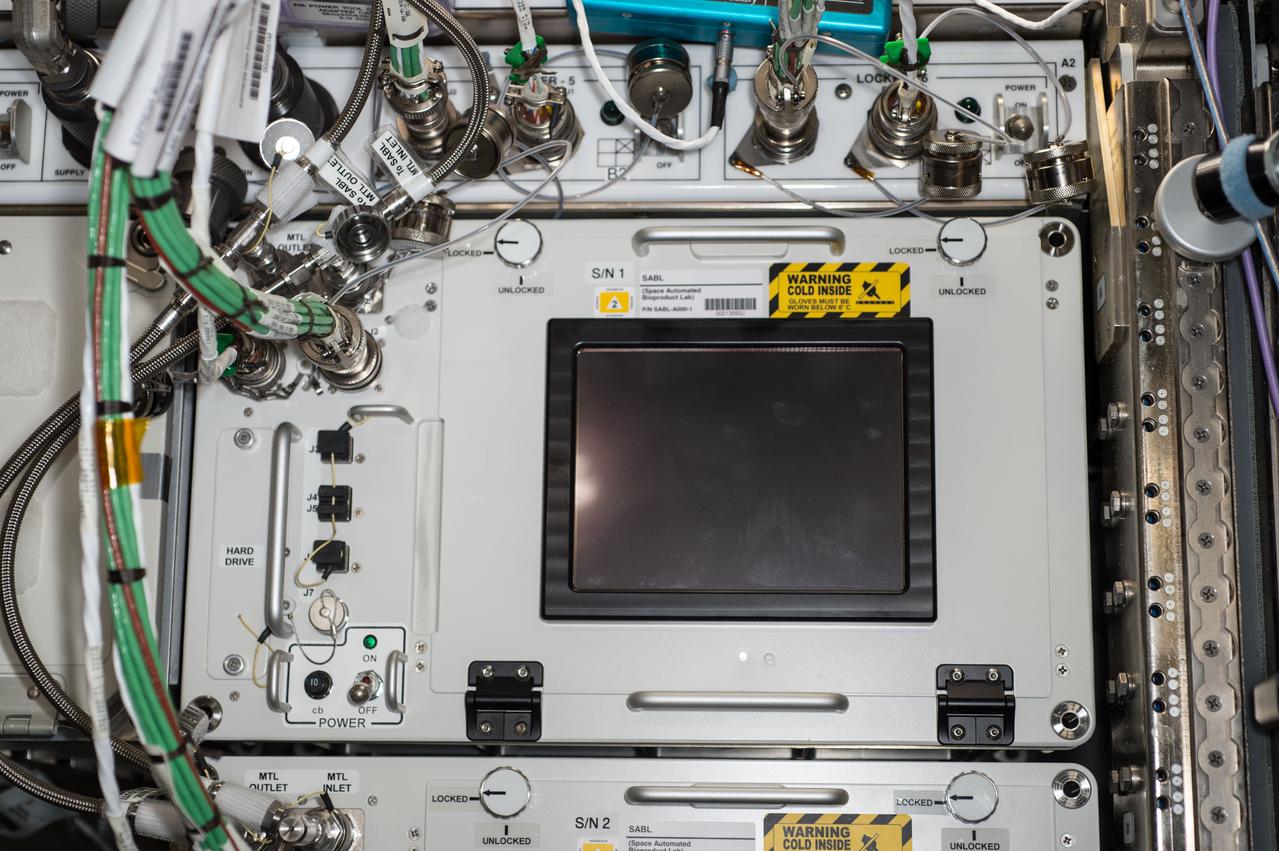
iss046e046607 (2/23/2016) --- A view of the newly installed Space Automated Bioproduct Laboratory (SABL) power, data, and thermal connections in the rack located in the U.S Lab. SABL is an upgrade to the long standing ISS incubator, Commercial Generic Bioprocessing Apparatus (CGBA). The Space Automated Bioproduct Laboratory (SABL) supports a wide variety of experiments in the life, physical and material sciences with a focus on supporting research of biological systems and processes.

KENNEDY SPACE CENTER, FLA. - In the Reusable Launch Vehicle (RLV) Hangar, workers stretch sheets of plastic over racks of equipment in preparation for the arrival of Hurricane Jeanne, expected to impact Central Florida Sunday. This is the fourth hurricane in 45 days to make landfall somewhere in the state. The Thermal Protection System (TPS) Facility suffered extensive damage from Hurricane Frances, causing the relocation of equipment to the RLV.
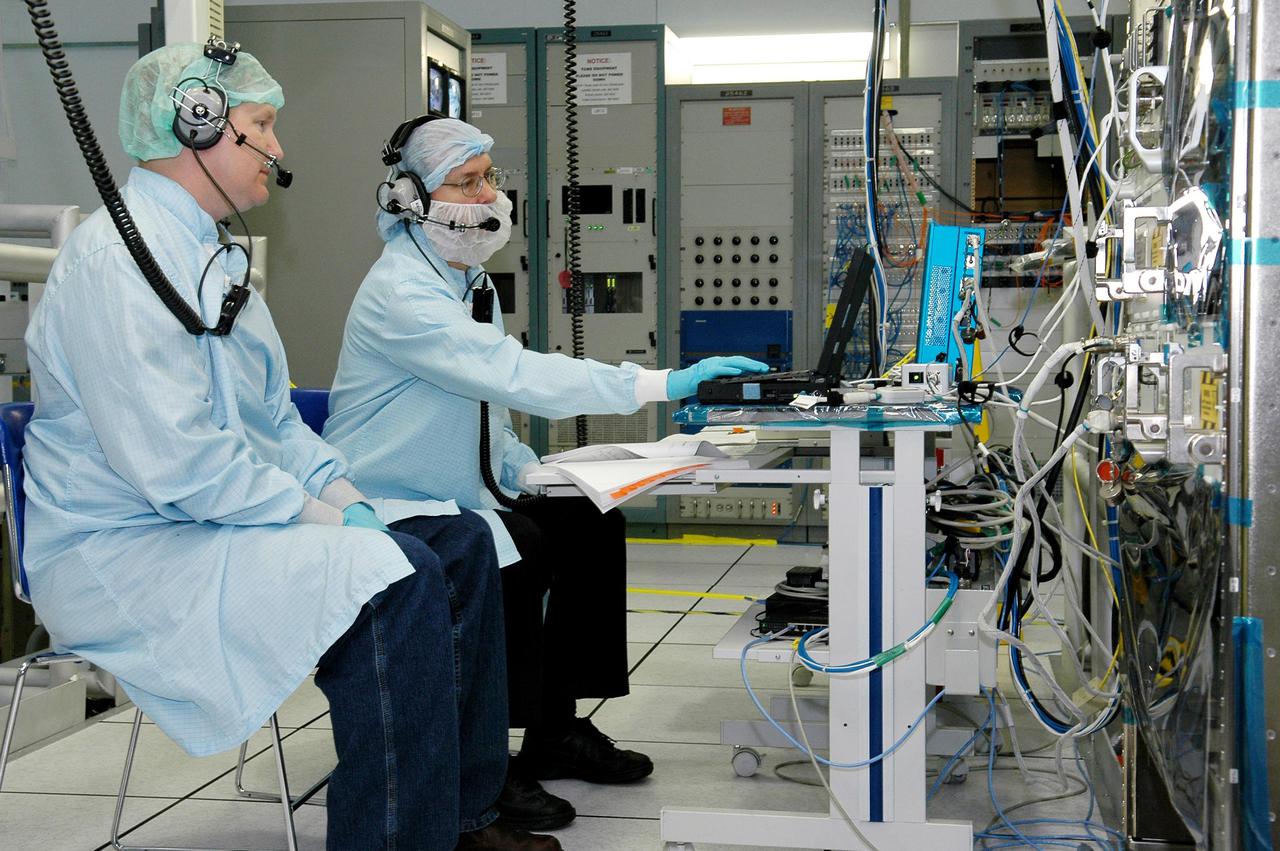
KENNEDY SPACE CENTER, FLA. - - In the Space Station Processing Facility, Gaschen Geissen and Elton Witt, with Lockheed Martin, monitor the Payload Test and Checkout System for the Human Research Facility (HRF) Rack -2 payload. The HRF-2 is scheduled to fly on Return to Flight Space Shuttle mission STS-114. The HRF-2 will deliver additional biomedical instrumentation and research capability to the International Space Station. HRF Rack 1 contains an ultrasound unit and gas analyzer system and has been operational in the U.S. Lab since May 2001. HRF-2 will also be installed in the U. S. Lab and will provide structural, power, thermal, command and data handling, and communication and tracking interfaces between the HRF biomedical instrumentation and the U. S. Lab.
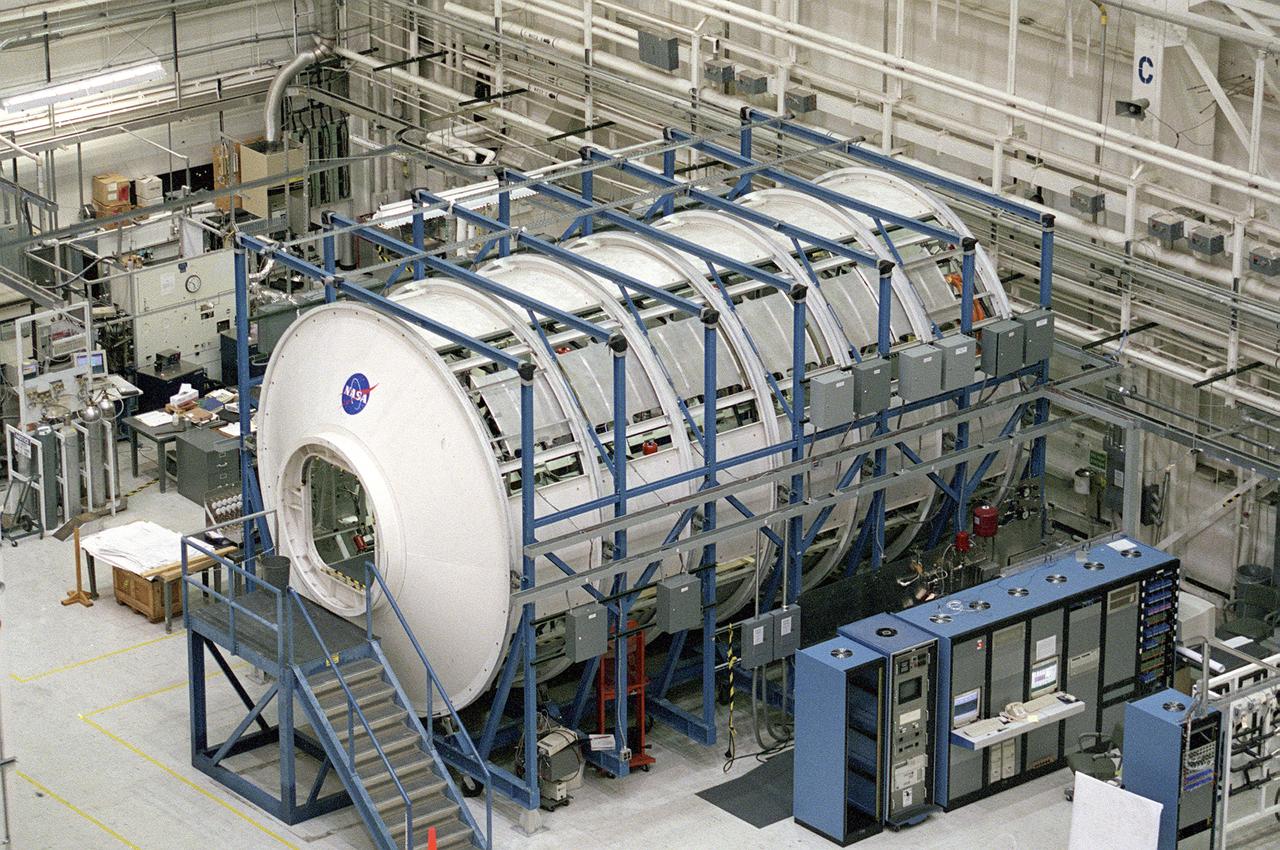
The Marshall Space Flight Center (MSFC) is responsible for designing and building the life support systems that will provide the crew of the International Space Station (ISS) a comfortable environment in which to live and work. Scientists and engineers at the MSFC are working together to provide the ISS with systems that are safe, efficient and cost-effective. These compact and powerful systems are collectively called the Environmental Control and Life Support Systems, or simply, ECLSS. This is an exterior view of the U.S. Laboratory Module Simulator containing the ECLSS Internal Thermal Control System (ITCS) testing facility at MSFC. At the bottom right is the data acquisition and control computers (in the blue equipment racks) that monitor the testing in the facility. The ITCS simulator facility duplicates the function, operation, and troubleshooting problems of the ITCS. The main function of the ITCS is to control the temperature of equipment and hardware installed in a typical ISS Payload Rack.
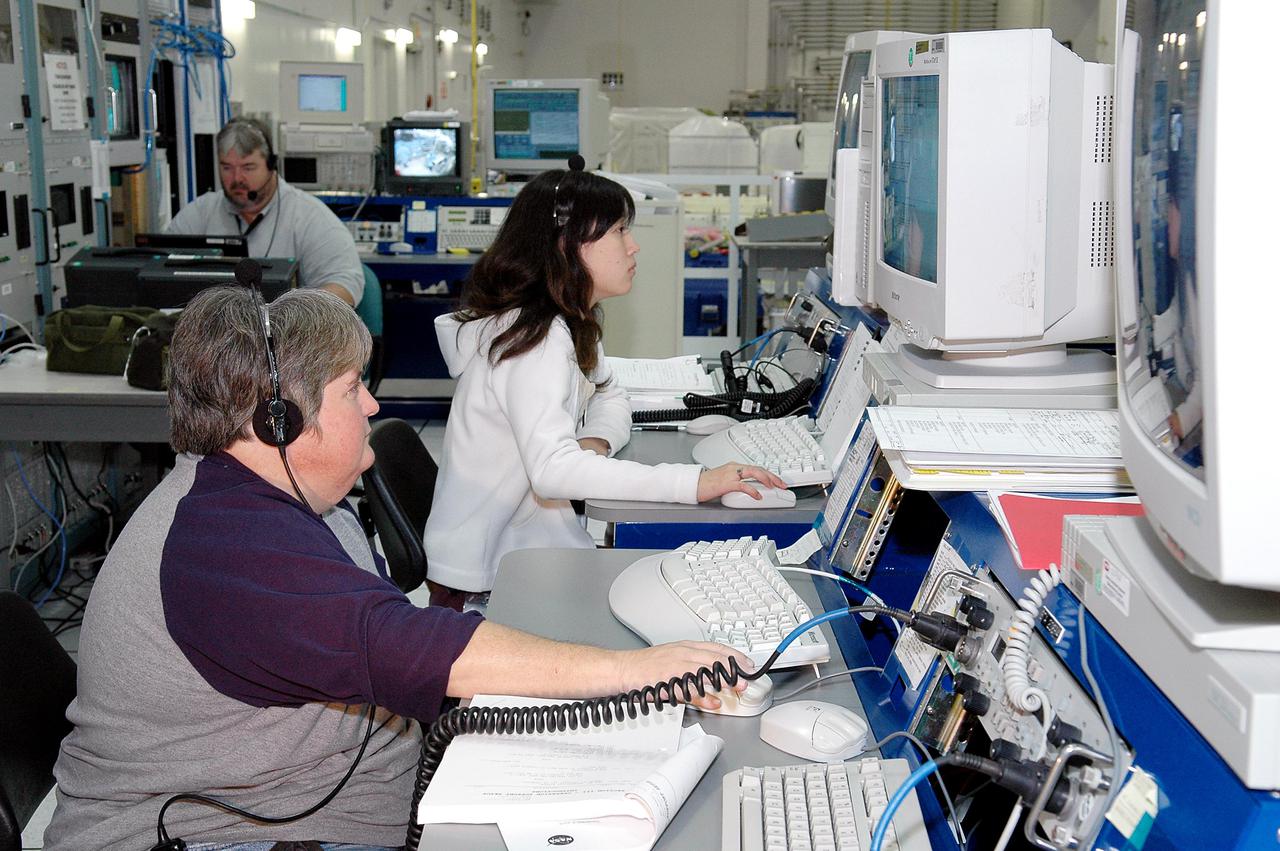
KENNEDY SPACE CENTER, FLA. - Nancy Lowry (left) and Mikiko Ujihara, with Boeing, monitor the Payload Test and Checkout System for the Human Research Facility (HRF) Rack -2 payload. The HRF-2 is scheduled to fly on Return to Flight Space Shuttle mission STS-114. The HRF-2 will deliver additional biomedical instrumentation and research capability to the International Space Station. HRF Rack 1 contains an ultrasound unit and gas analyzer system and has been operational in the U.S. Lab since May 2001. HRF-2 will also be installed in the U. S. Lab and will provide structural, power, thermal, command and data handling, and communication and tracking interfaces between the HRF biomedical instrumentation and the U. S. Lab.
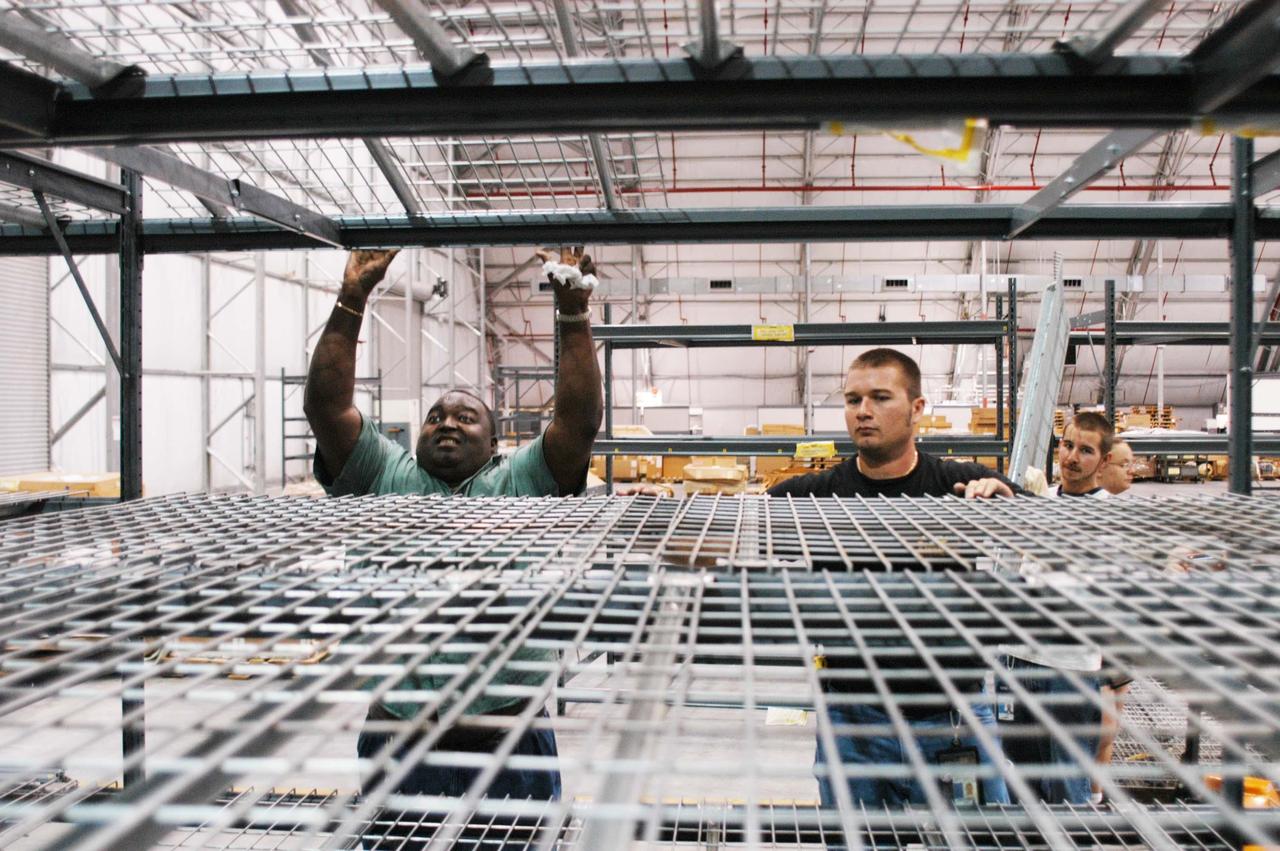
KENNEDY SPACE CENTER, FLA. - In the RLV hangar at KSC, United Space Alliance workers Matt Carter (left) and Mike Sherman set up racks to hold equipment removed from the hurricane-ravaged Thermal Protection System Facility (TPSF). The facility, which creates the TPS tiles, blankets and all the internal thermal control systems for the Space Shuttles, is almost totally unserviceable at this time after losing approximately 35 percent of its roof due to Hurricane Frances, which blew across Central Florida Sept. 4-5. The maximum wind at the surface from Hurricane Frances was 94 mph from the northeast at 6:40 a.m. on Sunday, September 5. It was recorded at a weather tower located on the east shore of the Mosquito Lagoon near the Cape Canaveral National Seashore. The highest sustained wind at KSC was 68 mph.
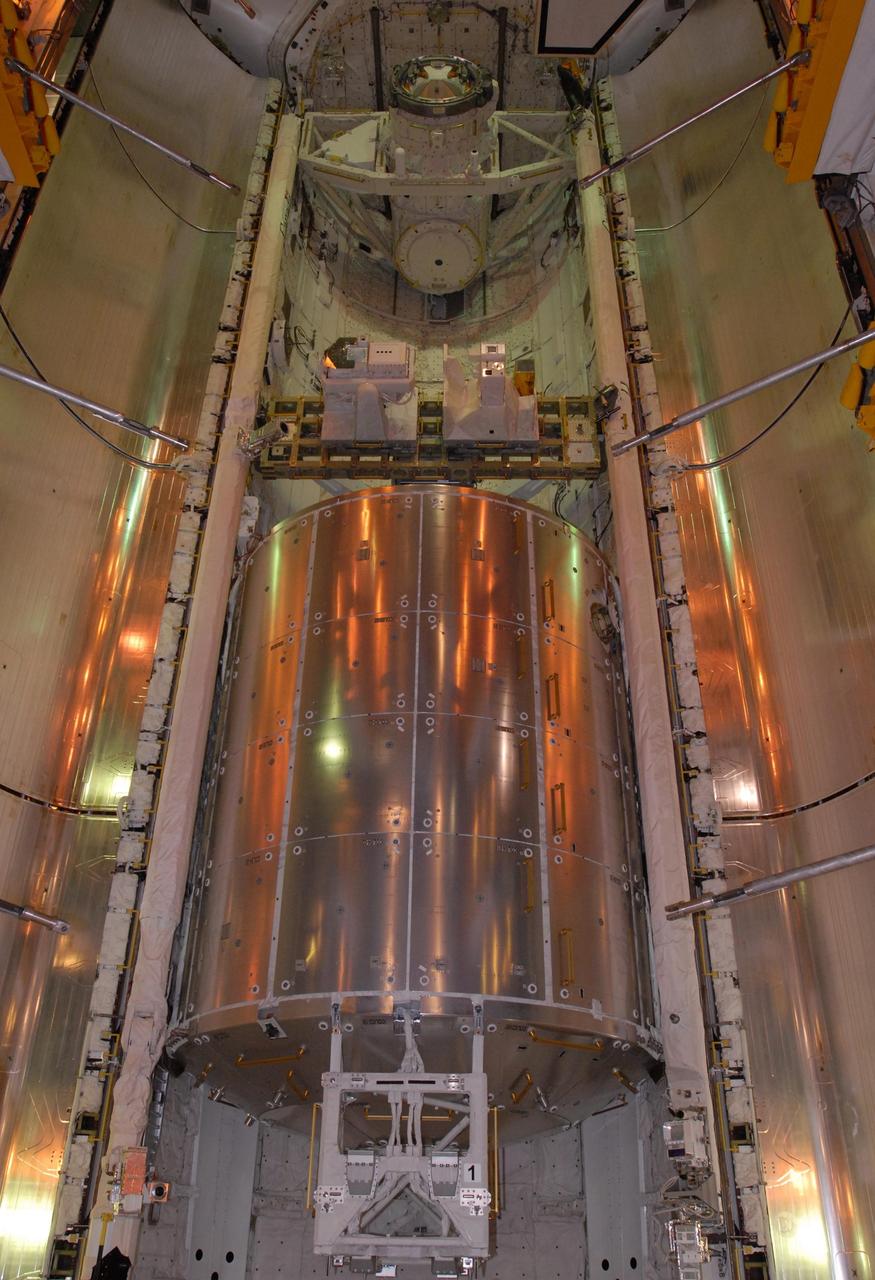
KENNEDY SPACE CENTER, FLA. -- On Launch Pad 39A, space shuttle Atlantis' payload bay doors are closing. Seen here are the Columbus Laboratory (below), the integrated cargo carrier - lite (middle) and the orbital docking system (above). Atlantis is being secured for launch on Dec. 6 on mission STS-122 to the International Space Station. The Columbus laboratory module, built by the European Space Agency, is approximately 23 feet long and 15 feet wide, allowing it to hold 10 large racks of experiments. The carrier holds three elements: a nitrogen tank assembly that is part of the external active thermal control system on the International Space Station, the European Technology Exposure Facility composed of nine science instruments and an autonomous temperature measurement unit, and the SOLAR payload designed for sun observation. Photo credit: NASA/George Shelton
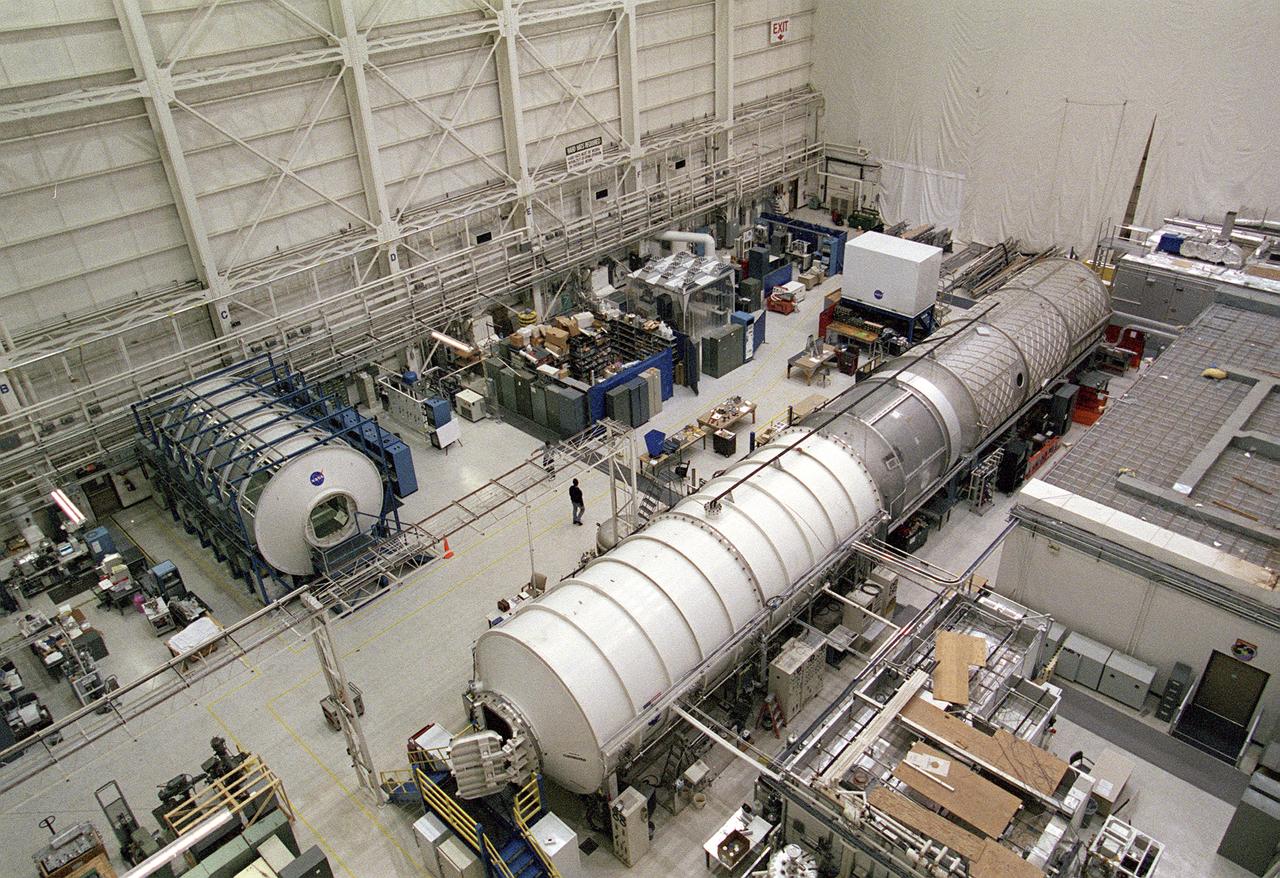
The Marshall Space Flight Center (MSFC) is responsible for designing and building the life support systems that will provide the crew of the International Space Station (ISS) a comfortable environment in which to live and work. Scientists and engineers at the MSFC are working together to provide the ISS with systems that are safe, efficient, and cost-effective. These compact and powerful systems are collectively called the Environmental Control and Life Support Systems, or simply, ECLSS. This is a view of the ECLSS and the Internal Thermal Control System (ITCS) Test Facility in building 4755, MSFC. In the foreground is the 3-module ECLSS simulator comprised of the U.S. Laboratory Module Simulator, Node 1 Simulator, and Node 3/Habitation Module Simulator. At center left is the ITCS Simulator. The main function of the ITCS is to control the temperature of equipment and hardware installed in a typical ISS Payload Rack.

KENNEDY SPACE CENTER, FLA. -- On Launch Pad 39A, space shuttle Atlantis' payload bay doors are ready for closing. Seen here is the integrated cargo carrier - lite. Atlantis is being secured for launch on Dec. 6 on mission STS-122 to the International Space Station. The Columbus laboratory module, built by the European Space Agency, is approximately 23 feet long and 15 feet wide, allowing it to hold 10 large racks of experiments. The carrier holds three elements: a nitrogen tank assembly that is part of the external active thermal control system on the International Space Station, the European Technology Exposure Facility composed of nine science instruments and an autonomous temperature measurement unit, and the SOLAR payload designed for sun observation. Photo credit: NASA/George Shelton
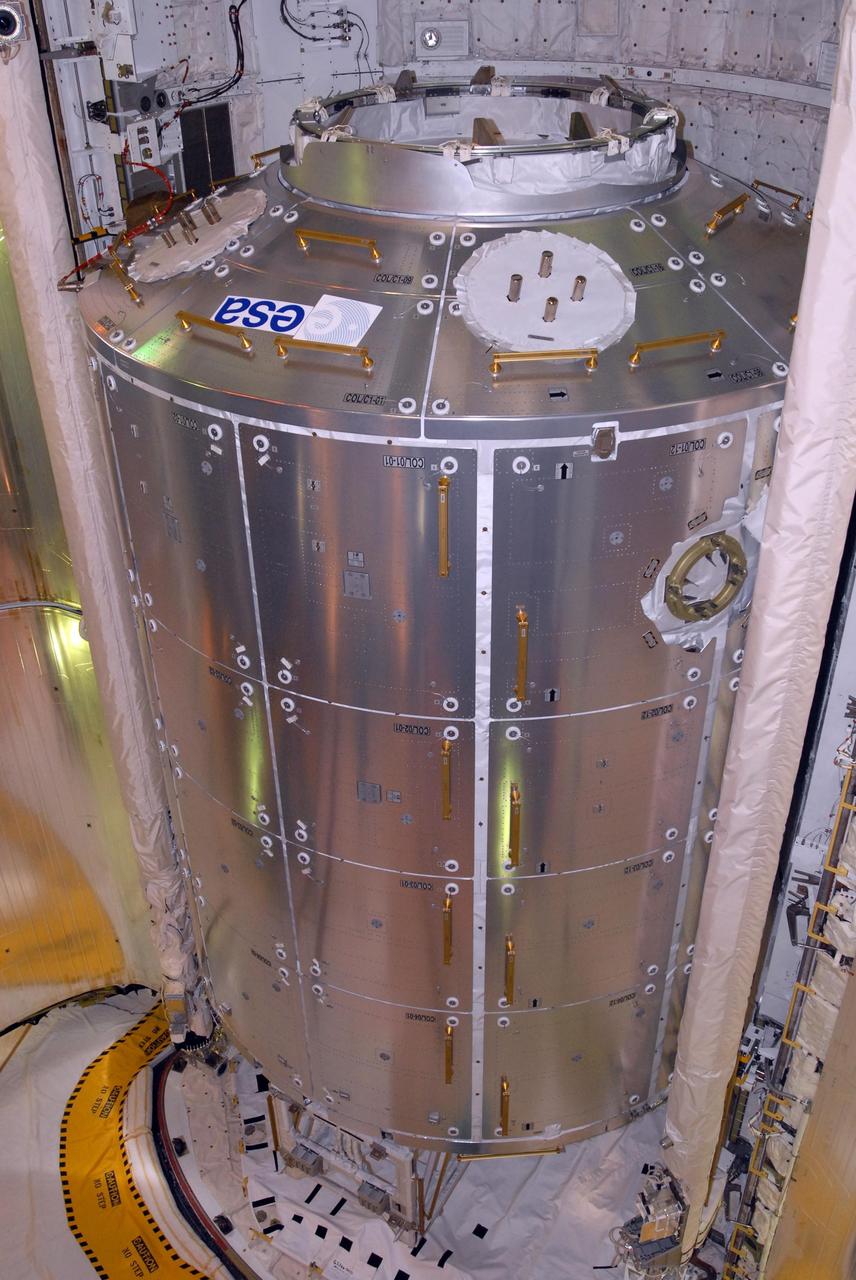
KENNEDY SPACE CENTER, FLA. -- On Launch Pad 39A, space shuttle Atlantis' payload bay doors are ready for closing. Seen here is the Columbus Laboratory. Atlantis is being secured for launch on Dec. 6 on mission STS-122 to the International Space Station. The Columbus laboratory module, built by the European Space Agency, is approximately 23 feet long and 15 feet wide, allowing it to hold 10 large racks of experiments. The carrier holds three elements: a nitrogen tank assembly that is part of the external active thermal control system on the International Space Station, the European Technology Exposure Facility composed of nine science instruments and an autonomous temperature measurement unit, and the SOLAR payload designed for sun observation. Photo credit: NASA/George Shelton
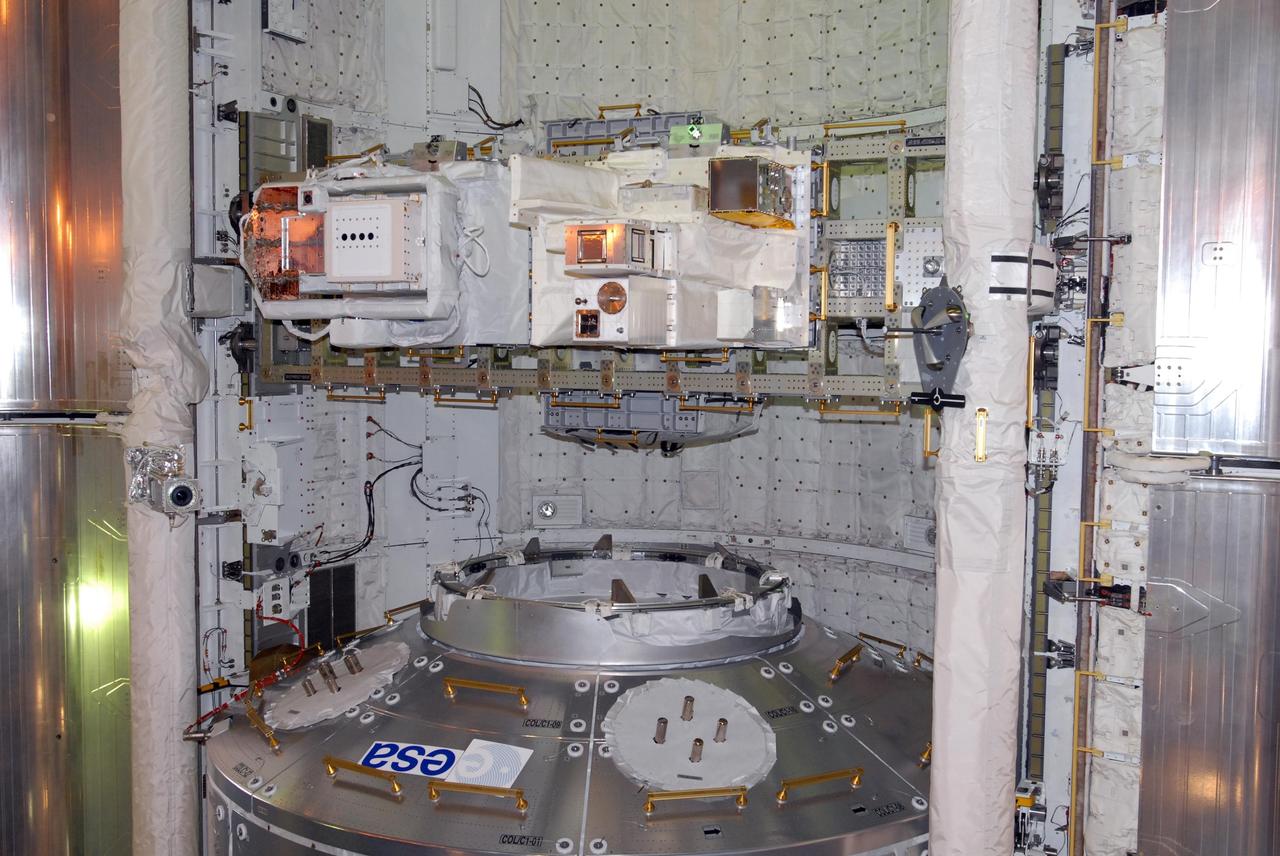
KENNEDY SPACE CENTER, FLA. -- On Launch Pad 39A, space shuttle Atlantis' payload bay doors are ready for closing. Seen here are the Columbus Laboratory (below) and the integrated cargo carrier - lite (above). Atlantis is being secured for launch on Dec. 6 on mission STS-122 to the International Space Station. The Columbus laboratory module, built by the European Space Agency, is approximately 23 feet long and 15 feet wide, allowing it to hold 10 large racks of experiments. The carrier holds three elements: a nitrogen tank assembly that is part of the external active thermal control system on the International Space Station, the European Technology Exposure Facility composed of nine science instruments and an autonomous temperature measurement unit, and the SOLAR payload designed for sun observation. Photo credit: NASA/George Shelton
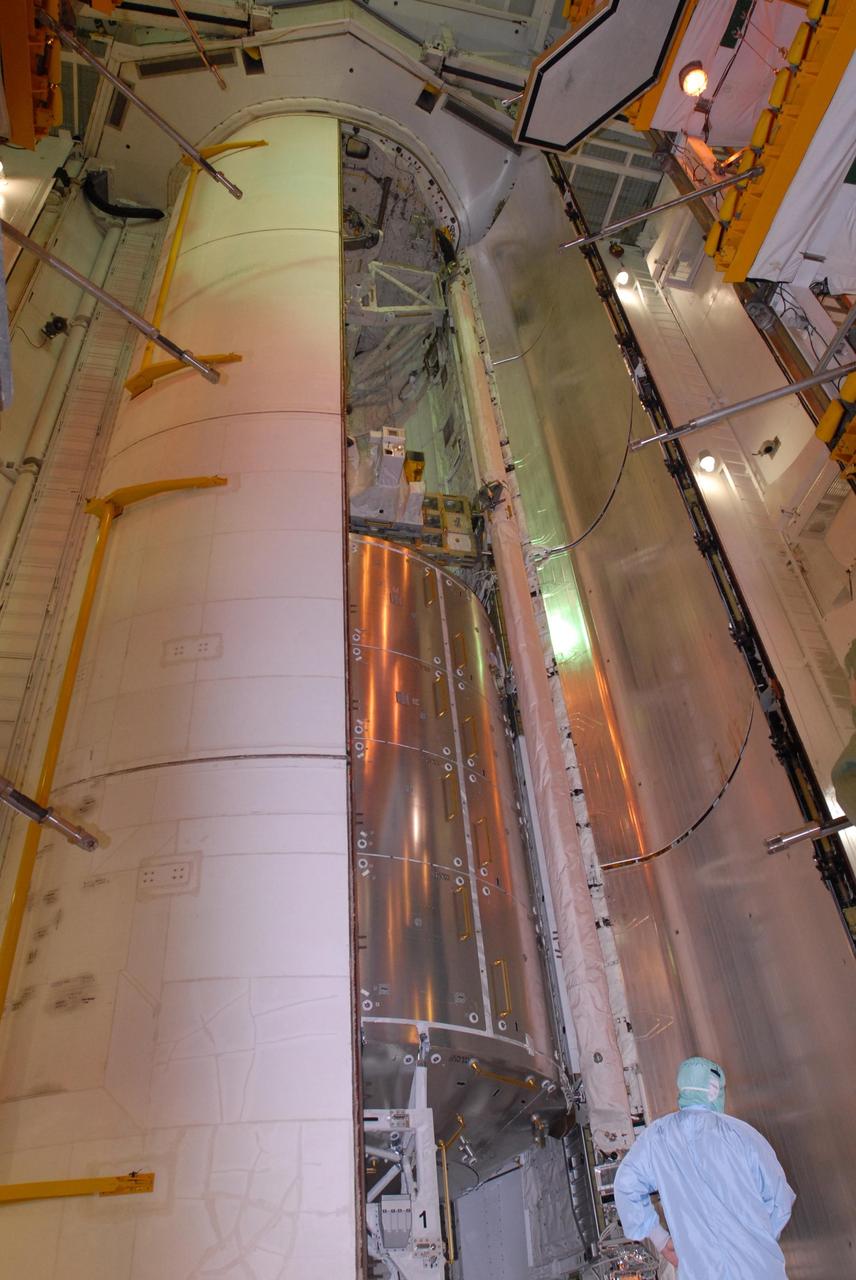
KENNEDY SPACE CENTER, FLA. -- On Launch Pad 39A, one of space shuttle Atlantis' payload bay doors is nearly closed. Inside can still be seen the Columbus Laboratory (below), the integrated cargo carrier - lite (middle) and the orbital docking system (above). Atlantis is being secured for launch on Dec. 6 on mission STS-122 to the International Space Station. The Columbus laboratory module, built by the European Space Agency, is approximately 23 feet long and 15 feet wide, allowing it to hold 10 large racks of experiments. The carrier holds three elements: a nitrogen tank assembly that is part of the external active thermal control system on the International Space Station, the European Technology Exposure Facility composed of nine science instruments and an autonomous temperature measurement unit, and the SOLAR payload designed for sun observation. Photo credit: NASA/George Shelton
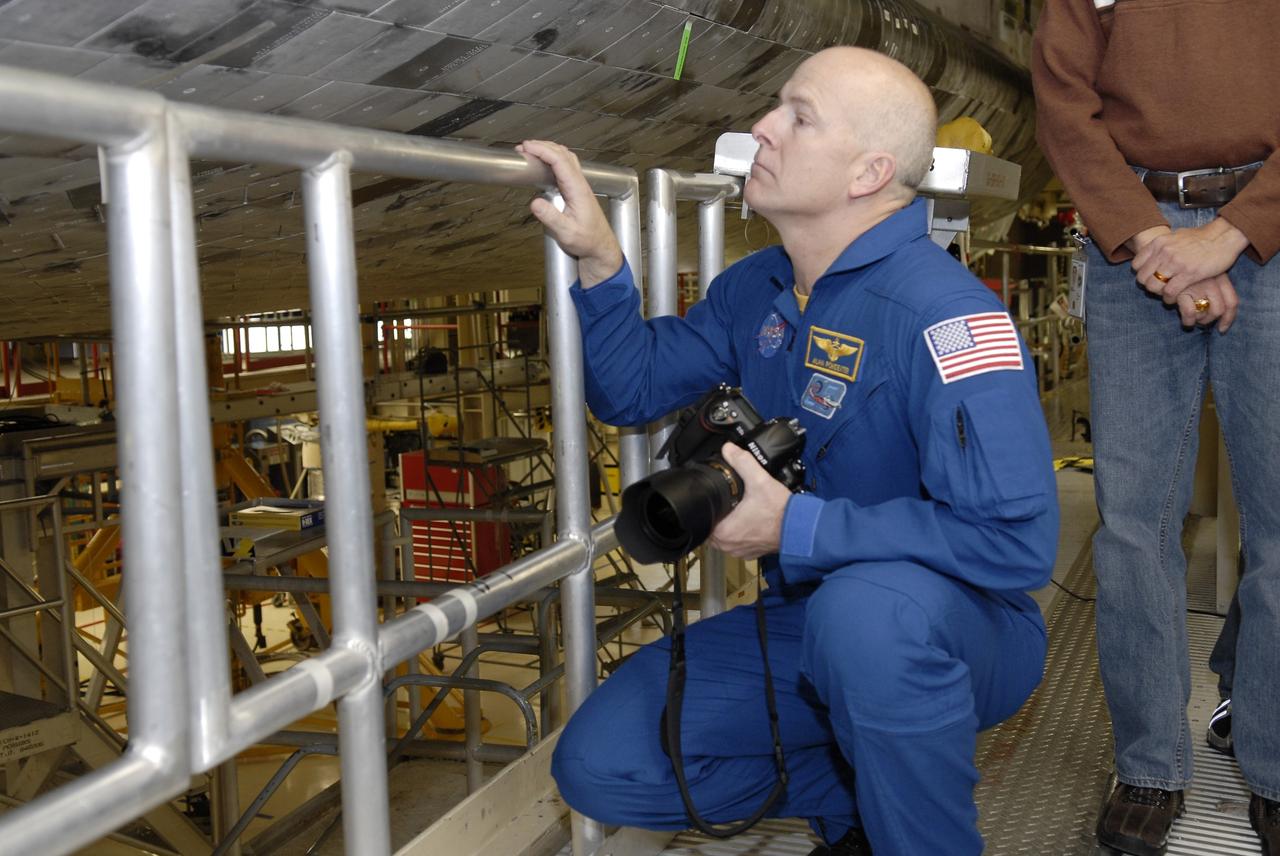
CAPE CANAVERAL, Fla. - In Orbiter Processing Facility 3 at NASA's Kennedy Space Center in Florida, members of space shuttle Discovery's STS-131 crew participate in training activities during the Crew Equipment Interface Test, or CEIT, for their mission. Here, Commander Alan Poindexter gets a close look at the thermal protection system tile beneath Discovery. The CEIT provides the crew with hands-on training and observation of shuttle and flight hardware. The seven-member crew will deliver the multi-purpose logistics module Leonardo, filled with resupply stowage platforms and racks to be transferred to locations around the International Space Station. Three spacewalks will include work to attach a spare ammonia tank assembly to the station's exterior and return a European experiment from outside the station's Columbus module. Discovery's launch is targeted for March 18. For information on the STS-131 mission and crew, visit http://www.nasa.gov/mission_pages/shuttle/shuttlemissions/sts131/index.html. Photo credit: NASA/Kim Shiflett
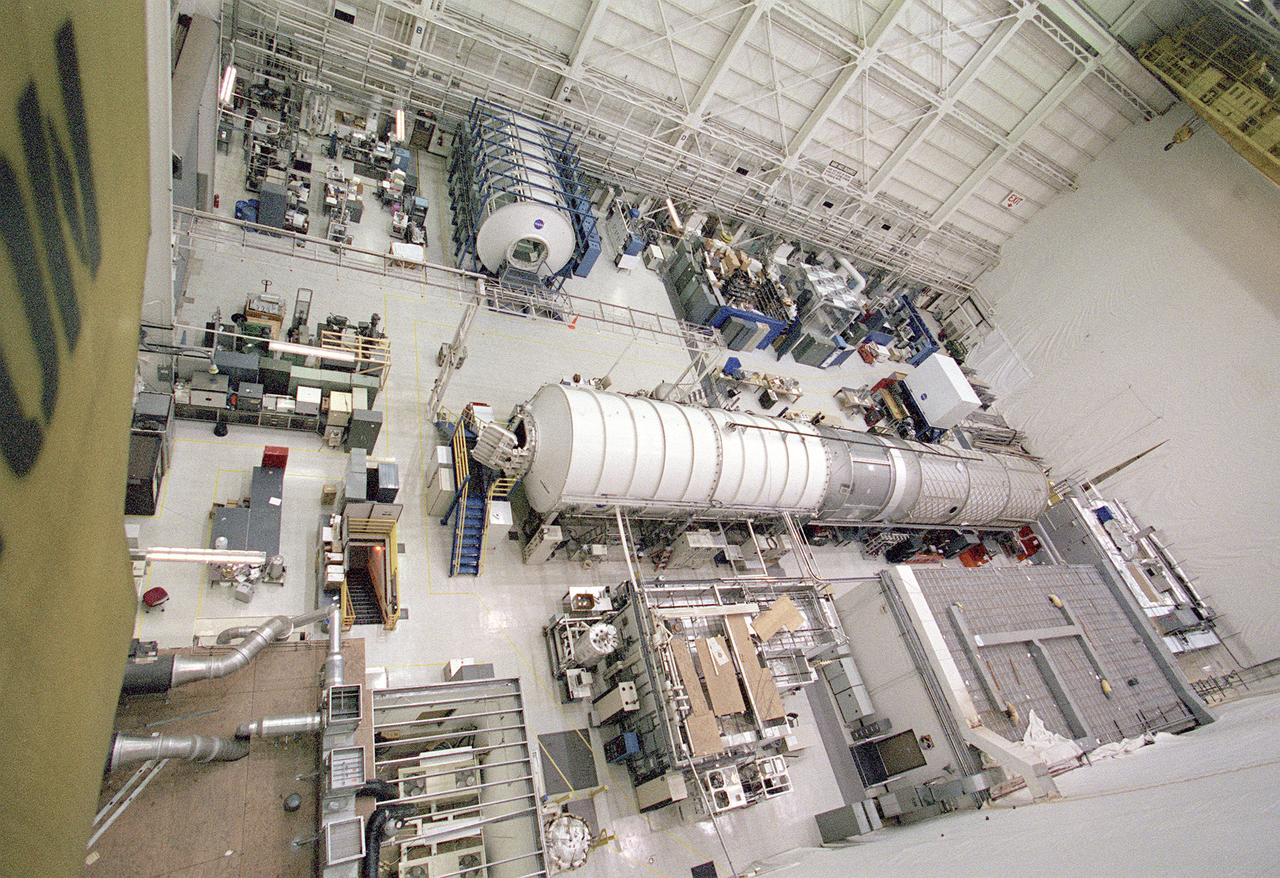
The Marshall Space Flight Center (MSFC) is responsible for designing and building the life support systems that will provide the crew of the International Space Station (ISS) a comfortable environment in which to live and work. Scientists and engineers at the MSFC are working together to provide the ISS with systems that are safe, efficient, and cost-effective. These compact and powerful systems are collectively called the Environmental Control and Life Support Systems, or simply, ECLSS. This is a view of the ECLSS and the Internal Thermal Control System (ITCS) Test Facility in building 4755, MSFC. In the foreground is the 3-module ECLSS simulator comprised of the U.S. Laboratory Module Simulator, Node 1 Simulator, and Node 3/Habitation Module Simulator. On the left is the ITCS Simulator. The main function of the ITCS is to control the temperature of equipment and hardware installed in a typical ISS Payload Rack.
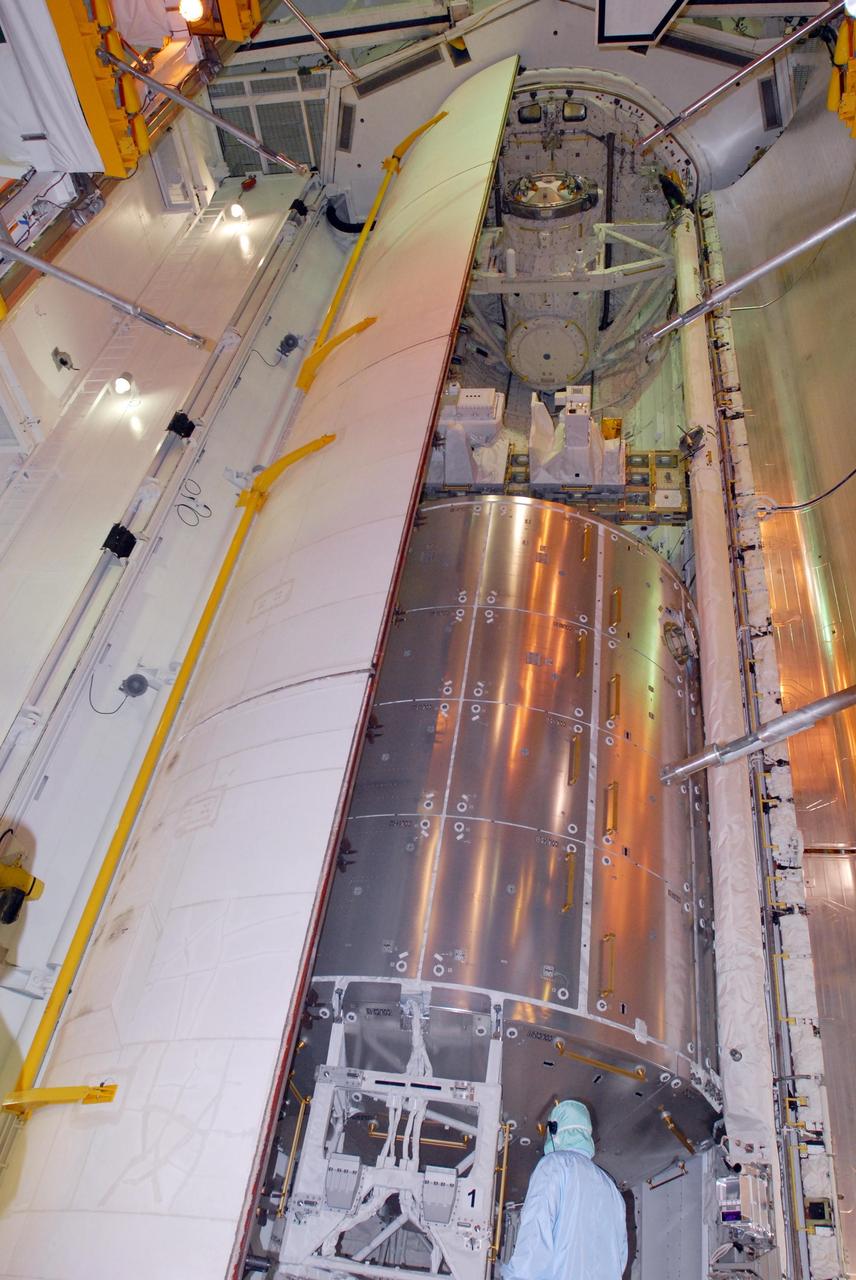
KENNEDY SPACE CENTER, FLA. -- On Launch Pad 39A, space shuttle Atlantis' payload bay doors are closing. Seen here are the Columbus Laboratory (below), the integrated cargo carrier - lite (middle) and the orbital docking system (above). Atlantis is being secured for launch on Dec. 6 on mission STS-122 to the International Space Station. The Columbus laboratory module, built by the European Space Agency, is approximately 23 feet long and 15 feet wide, allowing it to hold 10 large racks of experiments. The carrier holds three elements: a nitrogen tank assembly that is part of the external active thermal control system on the International Space Station, the European Technology Exposure Facility composed of nine science instruments and an autonomous temperature measurement unit, and the SOLAR payload designed for sun observation. Photo credit: NASA/George Shelton

KENNEDY SPACE CENTER, FLA. -- On Launch Pad 39A, workers check the progress of the closing of the payload bay doors on space shuttle Atlantis. Seen here are the Columbus Laboratory (below) and the integrated cargo carrier - lite (above). Atlantis is being secured for launch on Dec. 6 on mission STS-122 to the International Space Station. The Columbus laboratory module, built by the European Space Agency, is approximately 23 feet long and 15 feet wide, allowing it to hold 10 large racks of experiments. The carrier holds three elements: a nitrogen tank assembly that is part of the external active thermal control system on the International Space Station, the European Technology Exposure Facility composed of nine science instruments and an autonomous temperature measurement unit, and the SOLAR payload designed for sun observation. Photo credit: NASA/George Shelton
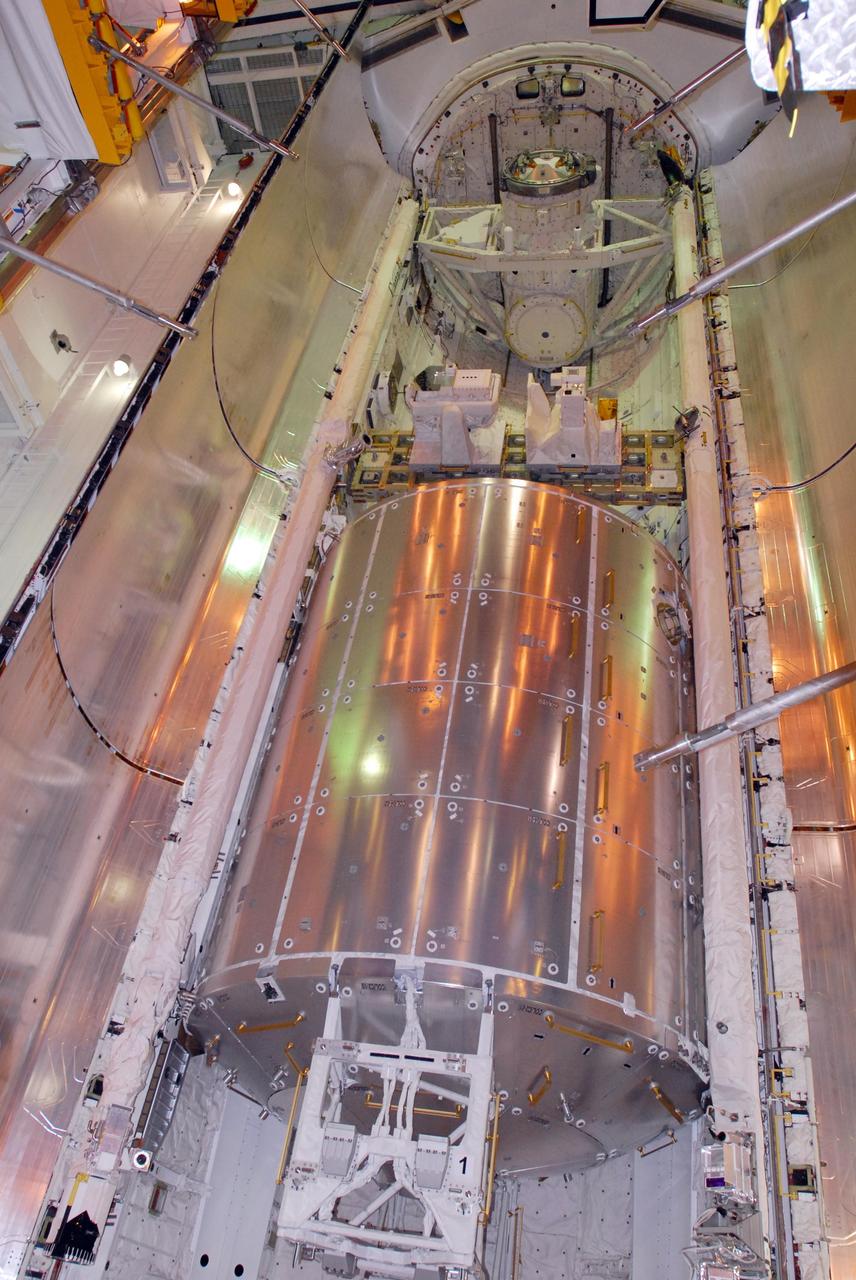
KENNEDY SPACE CENTER, FLA. -- On Launch Pad 39A, space shuttle Atlantis' payload bay doors are closing. Seen here are the Columbus Laboratory (below), the integrated cargo carrier - lite (middle) and the orbital docking system (above). Atlantis is being secured for launch on Dec. 6 on mission STS-122 to the International Space Station. The Columbus laboratory module, built by the European Space Agency, is approximately 23 feet long and 15 feet wide, allowing it to hold 10 large racks of experiments. The carrier holds three elements: a nitrogen tank assembly that is part of the external active thermal control system on the International Space Station, the European Technology Exposure Facility composed of nine science instruments and an autonomous temperature measurement unit, and the SOLAR payload designed for sun observation. Photo credit: NASA/George Shelton
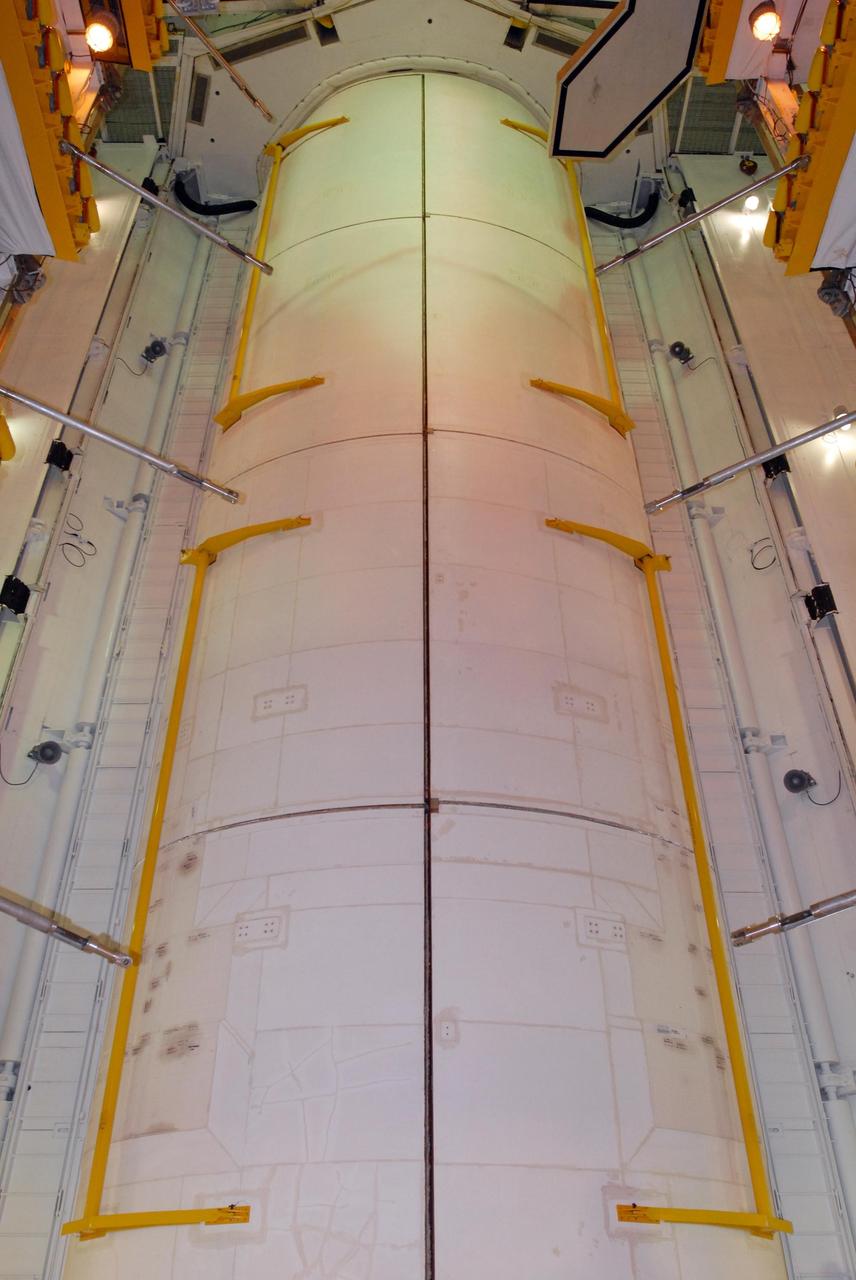
KENNEDY SPACE CENTER, FLA. -- On Launch Pad 39A, space shuttle Atlantis' payload bay doors are closed for launch. Inside are the Columbus Laboratory, the integrated cargo carrier - lite and the orbital docking system. Atlantis is being secured for launch on Dec. 6 on mission STS-122 to the International Space Station. The Columbus laboratory module, built by the European Space Agency, is approximately 23 feet long and 15 feet wide, allowing it to hold 10 large racks of experiments. The carrier holds three elements: a nitrogen tank assembly that is part of the external active thermal control system on the International Space Station, the European Technology Exposure Facility composed of nine science instruments and an autonomous temperature measurement unit, and the SOLAR payload designed for sun observation. Photo credit: NASA/George Shelton
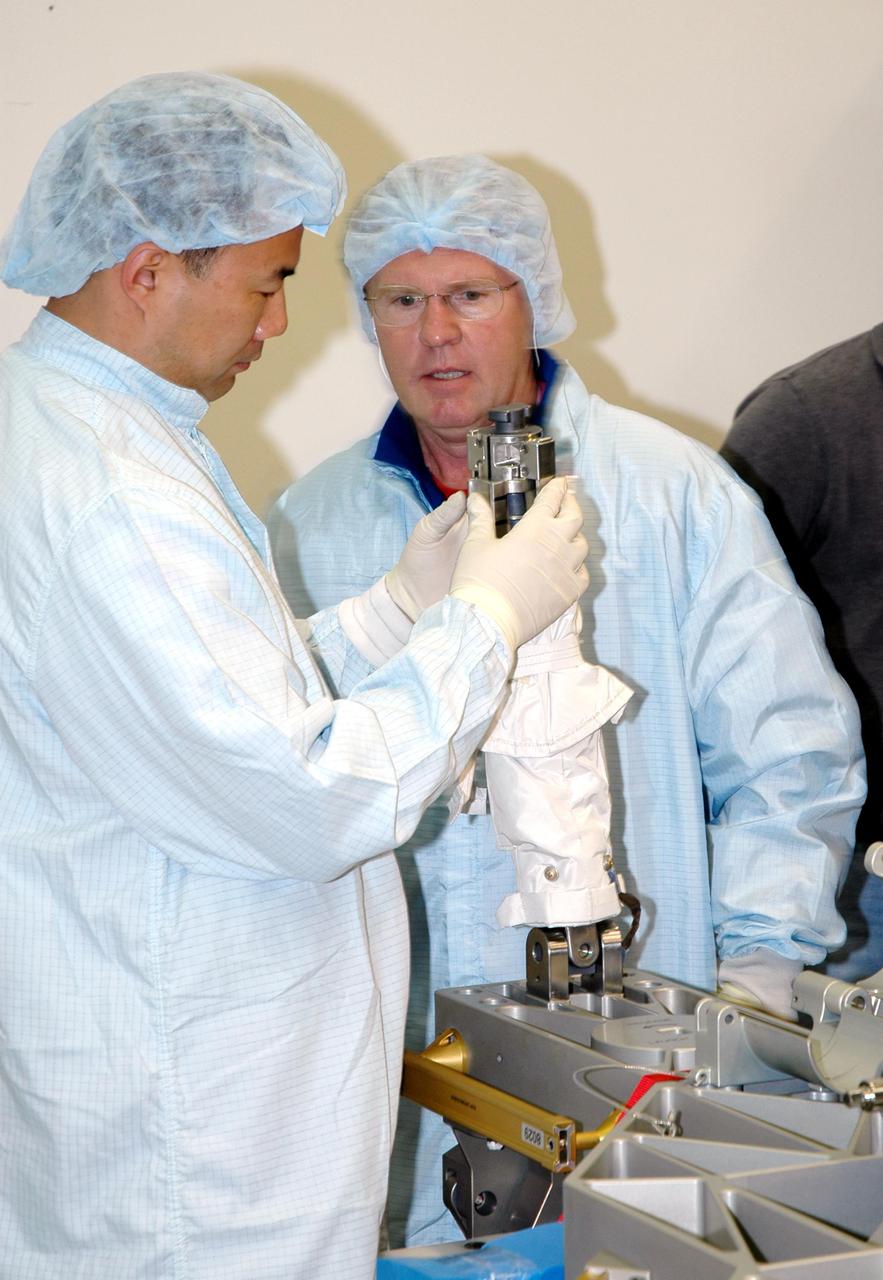
KENNEDY SPACE CENTER, FLA. - During Crew Equipment Interface Test (CEIT) at SPACEHAB in Cape Canaveral, Fla., STS-114 Mission Specialists Soichi Noguchi (left) and Andrew Thomas (right) check out a component on the External Stowage Platform-2 (ESP2). Noguchi is with the Japanese Aerospace Exploration Agency. As payload on Space Shuttle Discovery’s Return to Flight mission, the ESP2 will carry replacement parts, known as orbital replacement units (ORU) to the International Space Station. The platform will be deployed and attached to the Station’s airlock and will be used as a permanent spare parts facility. The launch window for STS-114 is May 15 to June 3, 2005. Earlier, during CEIT in the Space Station Processing Facility, the crew also inspected the resupply stowage racks installed in the Italian-built Multi-Purpose Logistics Module Raffaello and performed tool and equipment interface checks with the Thermal Protection System (TPS) repair sample box, and the Control Moment Gyroscope (CMG) in preparation for the mission’s three scheduled spacewalks. The seven-member crew will fly to the Space Station primarily to evaluate procedures for flight safety, including Shuttle inspection and repair techniques.
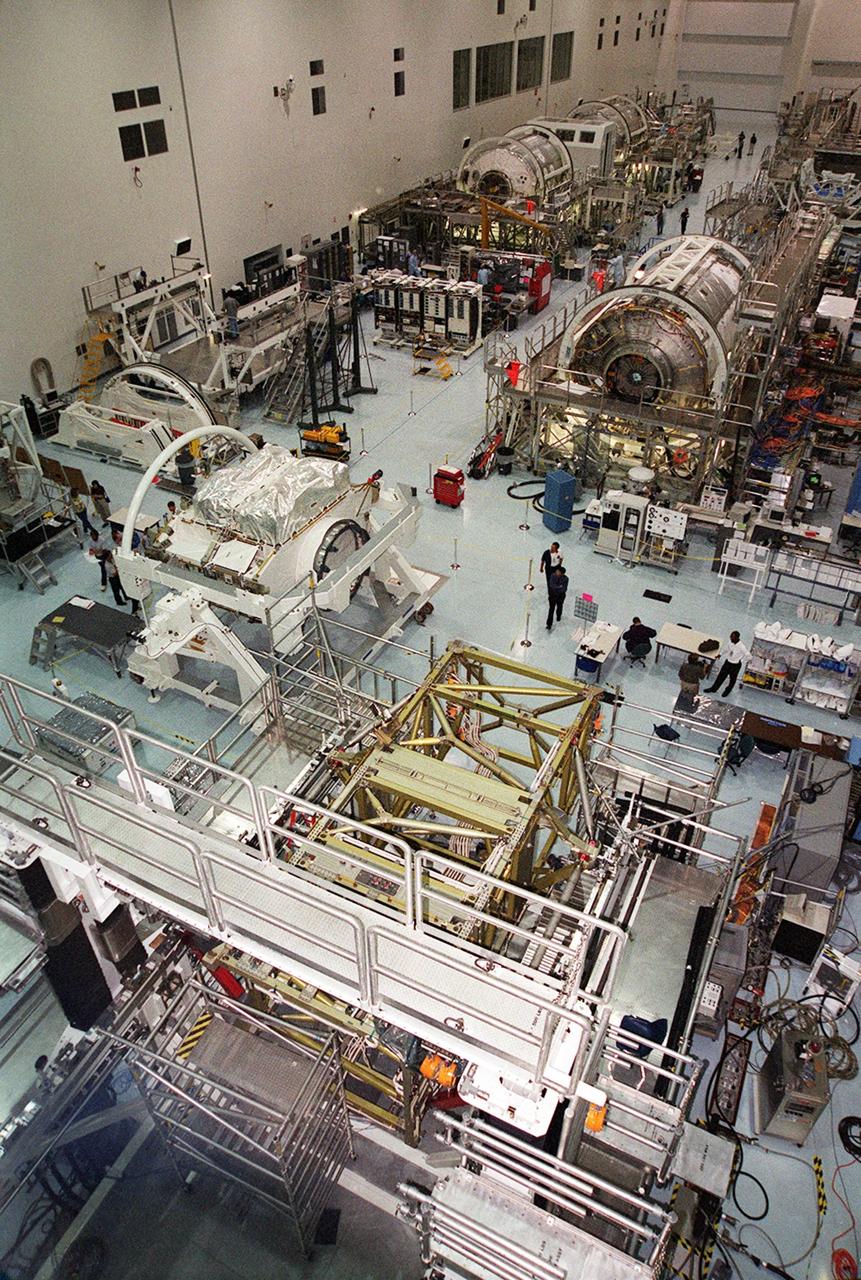
A wide-angle view of the floor of the Space Station Processing Facility. The floor is filled with racks and hardware for processing and testing the various components of the International Space Station (ISS). At center left is the Zenith-1 (Z-1) Truss, the cornerstone truss of the Space Station. The Z-1 Truss was officially turned over to NASA from The Boeing Co. on July 31. It is scheduled to fly in Space Shuttle Discovery's payload pay on STS-92 targeted for launch Oct. 5, 2000. The Z-1 is considered a cornerstone truss because it carries critical components of the Station's attitude, communications, thermal and power control systems as well as four control moment gyros, high and low gain antenna systems, and two plasma contactor units used to disperse electrical charge build-ups. The Z-1 truss and a Pressurized Mating Adapter (PMA-3), also flying to the Station on the same mission, will be the first major U.S. elements flown to the ISS aboard the Shuttle since the launch of the Unity element in December 1998. The large module in the upper right hand corner of the floor is the U.S. Lab, Destiny. Expected to be a major feature in future research, Destiny will provide facilities for biotechnology, fluid physics, combustion, and life sciences research. It is scheduled to be launched on mission STS-98 (no date determined yet for launch)

KENNEDY SPACE CENTER, FLA. -- The inside of Atlantis' payload bay can be seen from inside the payload changeout room. The changeout room is the enclosed, environmentally controlled portion of the rotating service structure that supports cargo delivery to the pad and subsequent vertical installation into the orbiter payload bay. At the top of the photo is the orbital docking system. At bottom is the integrated cargo carrier - lite, holding three elements: a nitrogen tank assembly that is part of the external active thermal control system on the International Space Station, the European technology Exposure Facility composed of nine science instruments and an autonomous temperature measurement unit, and the SOLAR payload designed for sun observation. The Columbus Laboratory module will be installed in between. The lab module, built by the European Space Agency, also known as ESA, is approximately 23 feet long and 15 feet wide, allowing it to hold 10 large racks of experiments. Columbus is ESA's largest single contribution to the space station. Columbus will fly to the International Space Station on mission STS-122. The launch is targeted for Dec. 6. Photo credit: NASA/Kim Shiflett

CAPE CANAVERAL, Fla. - In Orbiter Processing Facility 3 at NASA's Kennedy Space Center in Florida, members of space shuttle Discovery's STS-131 crew participate in training activities during the Crew Equipment Interface Test, or CEIT, for their mission. Here, from left in the blue flight suits, Mission Specialists Naoko Yamazaki of the Japan Aerospace Exploration Agency and Dorothy Metcalf-Lindenburger, and Commander Alan Poindexter get a close look at the reinforced carbon carbon panels on Discovery's wing leading edge, part of the shuttle's thermal protection system. The CEIT provides the crew with hands-on training and observation of shuttle and flight hardware. The seven-member crew will deliver the multi-purpose logistics module Leonardo, filled with resupply stowage platforms and racks to be transferred to locations around the International Space Station. Three spacewalks will include work to attach a spare ammonia tank assembly to the station's exterior and return a European experiment from outside the station's Columbus module. Discovery's launch is targeted for March 18. For information on the STS-131 mission and crew, visit http://www.nasa.gov/mission_pages/shuttle/shuttlemissions/sts131/index.html. Photo credit: NASA/Kim Shiflett
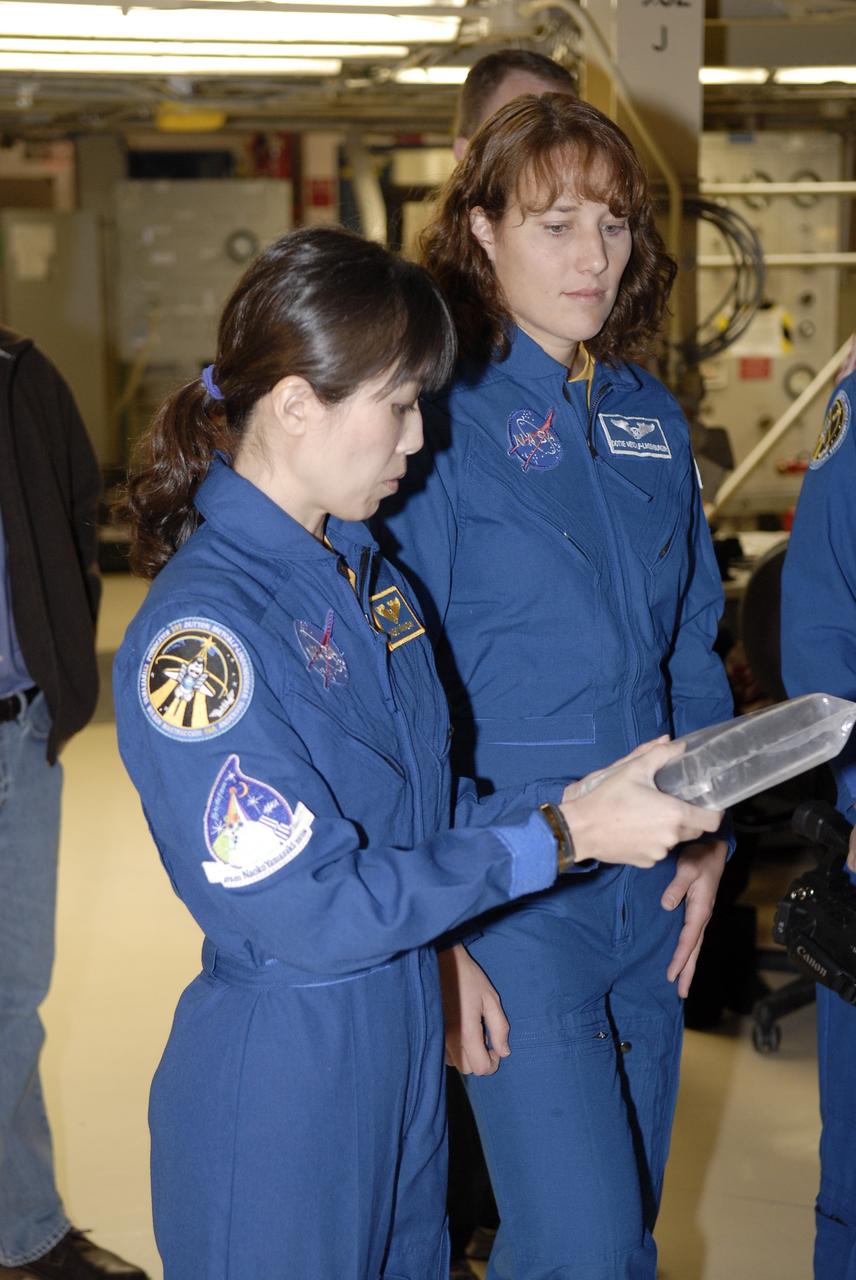
CAPE CANAVERAL, Fla. - In Orbiter Processing Facility 3 at NASA's Kennedy Space Center in Florida, members of space shuttle Discovery's STS-131 crew participate in training activities during the Crew Equipment Interface Test, or CEIT, for their mission. Here, Mission Specialists Naoko Yamazaki of the Japan Aerospace Exploration Agency and Dorothy Metcalf-Lindenburger examine a thermal protection system tile. The CEIT provides the crew with hands-on training and observation of shuttle and flight hardware. The seven-member crew will deliver the multi-purpose logistics module Leonardo, filled with resupply stowage platforms and racks to be transferred to locations around the International Space Station. Three spacewalks will include work to attach a spare ammonia tank assembly to the station's exterior and return a European experiment from outside the station's Columbus module. Discovery's launch is targeted for March 18. For information on the STS-131 mission and crew, visit http://www.nasa.gov/mission_pages/shuttle/shuttlemissions/sts131/index.html. Photo credit: NASA/Kim Shiflett
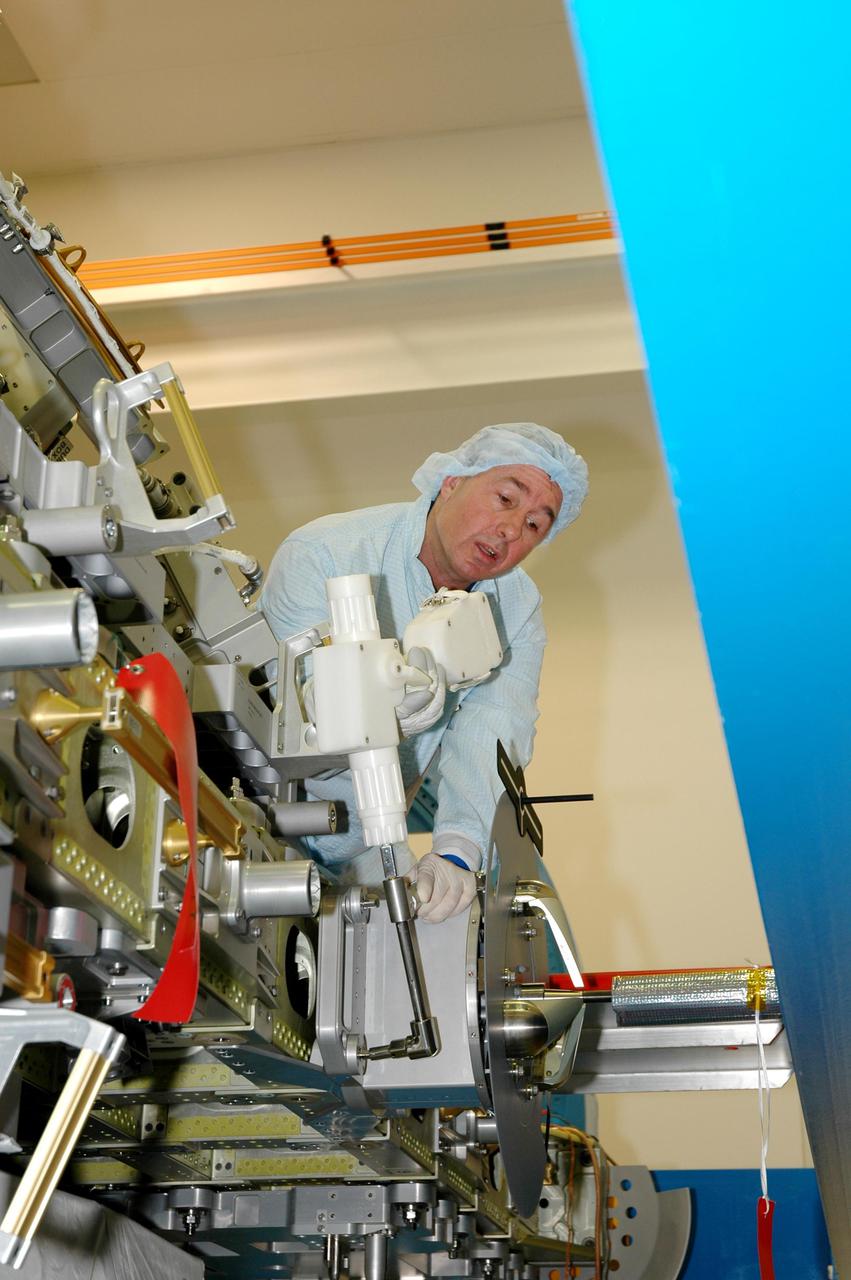
KENNEDY SPACE CENTER, FLA. - During Crew Equipment Interface Test (CEIT) at SPACEHAB in Cape Canaveral, Fla., STS-114 Mission Specialist Stephen Robinson inspects External Stowage Platform-2 (ESP2). As payload on Space Shuttle Discovery’s Return to Flight mission, the ESP2 will carry replacement parts, known as orbital replacement units (ORU) to the International Space Station. The platform will be deployed and attached to the Station’s airlock and will be used as a permanent spare parts facility. The launch window for STS-114 is May 15 to June 3, 2005. During CEIT in the Space Station Processing Facility, the crew also inspected the resupply stowage racks installed in the Italian-built Multi-Purpose Logistics Module Raffaello and performed tool and equipment interface checks with the Thermal Protection System (TPS) repair sample box, and the Control Moment Gyroscope (CMG) in preparation for the mission’s three scheduled spacewalks. The seven-member crew will fly to the Space Station primarily to evaluate procedures for flight safety, including Shuttle inspection and repair techniques.
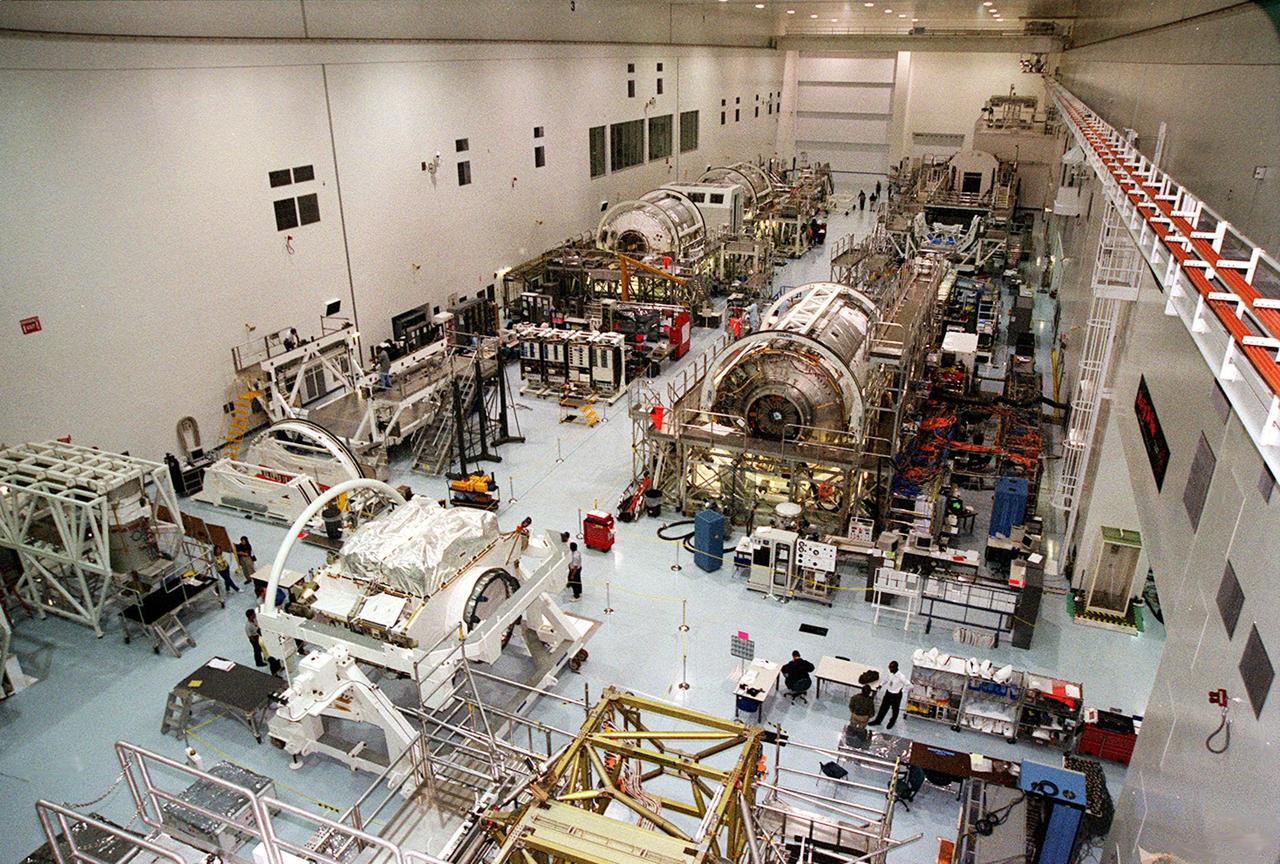
A wide-angle view of the floor of the Space Station Processing Facility. The floor is filled with racks and hardware for processing and testing the various components of the International Space Station (ISS). At the bottom left is the Zenith-1 (Z-1) Truss, the cornerstone truss of the Space Station. The Z-1 Truss was officially turned over to NASA from The Boeing Co. on July 31. The truss is scheduled to fly in Space Shuttle Discovery's payload pay on STS-92 targeted for launch Oct. 5, 2000. The Z-1 is considered a cornerstone truss because it carries critical components of the Station's attitude, communications, thermal and power control systems as well as four control moment gyros, high and low gain antenna systems, and two plasma contactor units used to disperse electrical charge build-ups. The Z-1 truss and a Pressurized Mating Adapter (PMA-3), also flying to the Station on the same mission, will be the first major U.S. elements flown to the ISS aboard the Shuttle since the launch of the Unity element in December 1998. The large module in the center of the floor is the U.S. Lab, Destiny. Expected to be a major feature in future research, Destiny will provide facilities for biotechnology, fluid physics, combustion, and life sciences research. It is scheduled to be launched on mission STS-98 (no date determined yet for launch)
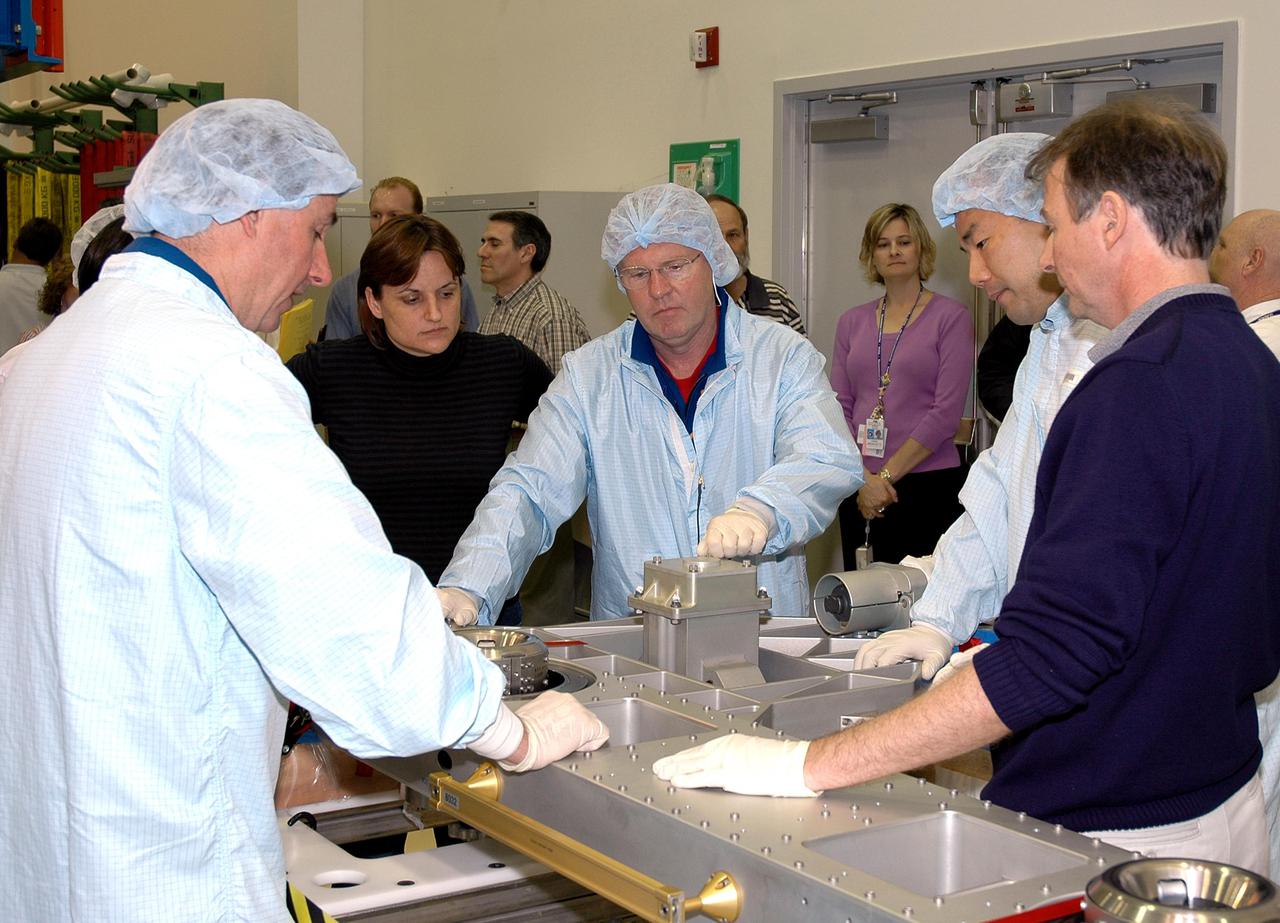
KENNEDY SPACE CENTER, FLA. - During Crew Equipment Interface Test (CEIT) at SPACEHAB in Cape Canaveral, Fla., STS-114 Mission Specialists Stephen Robinson, Soichi Noguchi and Andrew Thomas check out the External Stowage Platform-2 (ESP2). Noguchi is with the Japanese Aerospace Exploration Agency. As payload on Space Shuttle Discovery’s Return to Flight mission, the ESP2 will carry replacement parts, known as orbital replacement units (ORU) to the International Space Station. The platform will be deployed and attached to the Station’s airlock and will be used as a permanent spare parts facility. The launch window for STS-114 is May 15 to June 3, 2005. Earlier, during CEIT in the Space Station Processing Facility, the crew also inspected the resupply stowage racks installed in the Italian-built Multi-Purpose Logistics Module Raffaello and performed tool and equipment interface checks with the Thermal Protection System (TPS) repair sample box, and the Control Moment Gyroscope (CMG) in preparation for the mission’s three scheduled spacewalks. The seven-member crew will fly to the Space Station primarily to evaluate procedures for flight safety, including Shuttle inspection and repair techniques.
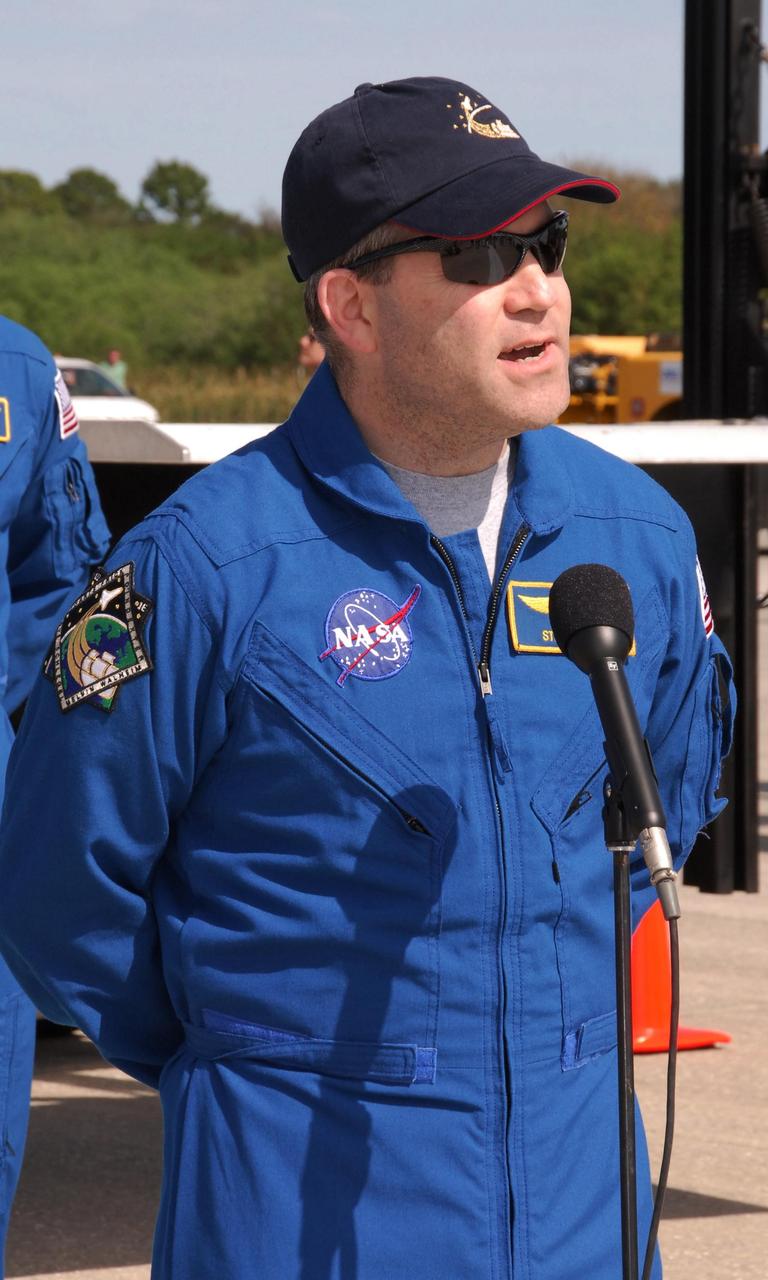
KENNEDY SPACE CENTER, FLA. -- After exiting the crew transport vehicle on the Shuttle Landing Facility at NASA's Kennedy Space Center, STS-122 Commander Steve Frick and Pilot Alan Poindexter begin their examination of the thermal protection system on space shuttle Atlantis. After a round trip of nearly 5.3 million miles, space shuttle Atlantis and crew returned to Earth with a landing at 9:07 a.m. EST. The shuttle landed on orbit 202 to complete the 13-day STS-122 mission. Main gear touchdown was 9:07:10 a.m. Nose gear touchdown was 9:07:20 a.m. Wheel stop was at 9:08:08 a.m. Mission elapsed time was 12 days, 18 hours, 21 minutes and 44 seconds. During the mission, Atlantis' crew installed the new Columbus laboratory, leaving a larger space station and one with increased science capabilities. The Columbus Research Module adds nearly 1,000 cubic feet of habitable volume and affords room for 10 experiment racks, each an independent science lab. Photo credit: NASA/Jack Pfaller
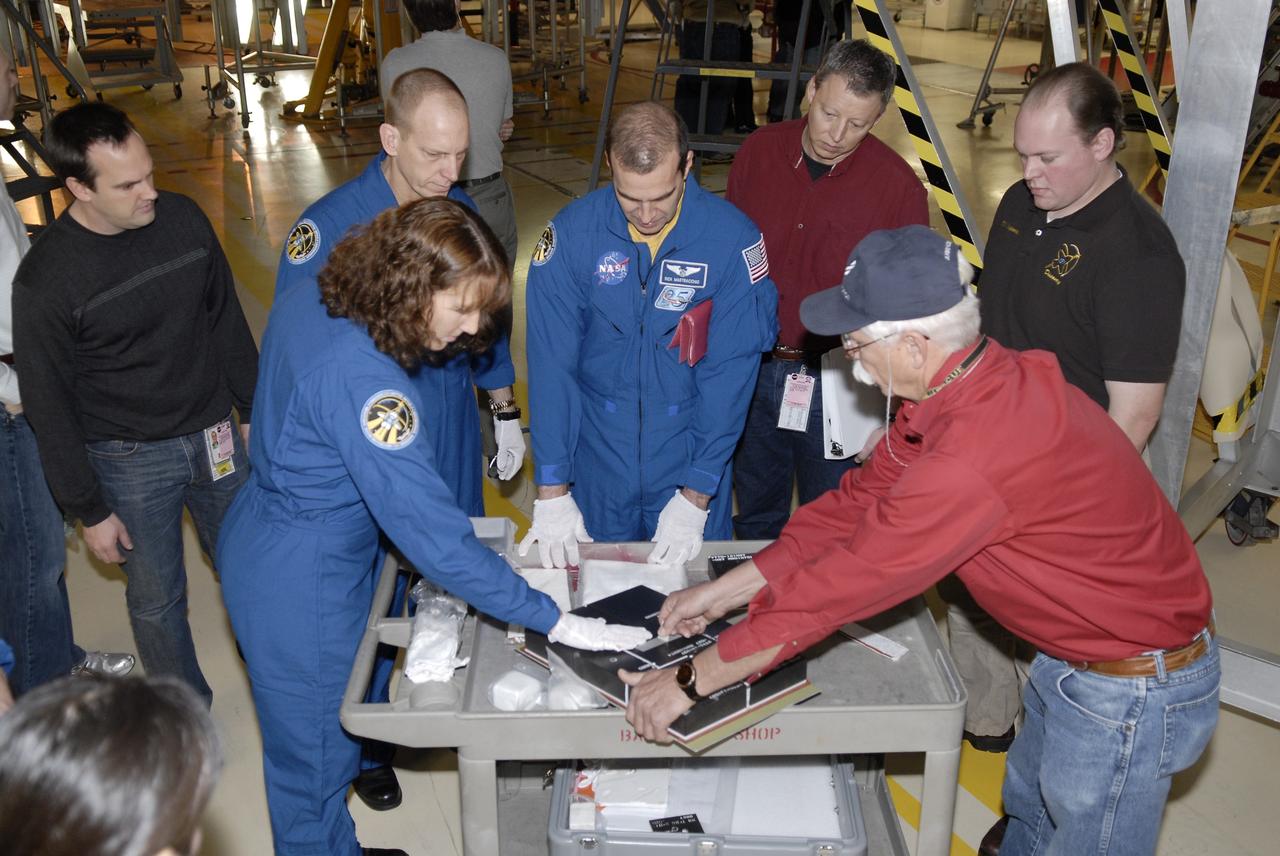
CAPE CANAVERAL, Fla. - In Orbiter Processing Facility 3 at NASA's Kennedy Space Center in Florida, members of space shuttle Discovery's STS-131 crew participate in training activities during the Crew Equipment Interface Test, or CEIT, for their mission. Here, from left in the blue flight suits, Mission Specialist Dorothy Metcalf-Lindenburger is instructed on the repair of the shuttle's thermal protection system tile as Mission Specialists Clay Anderson and Rick Mastracchio look on. The CEIT provides the crew with hands-on training and observation of shuttle and flight hardware. The seven-member crew will deliver the multi-purpose logistics module Leonardo, filled with resupply stowage platforms and racks to be transferred to locations around the International Space Station. Three spacewalks will include work to attach a spare ammonia tank assembly to the station's exterior and return a European experiment from outside the station's Columbus module. Discovery's launch is targeted for March 18. For information on the STS-131 mission and crew, visit http://www.nasa.gov/mission_pages/shuttle/shuttlemissions/sts131/index.html. Photo credit: NASA/Kim Shiflett
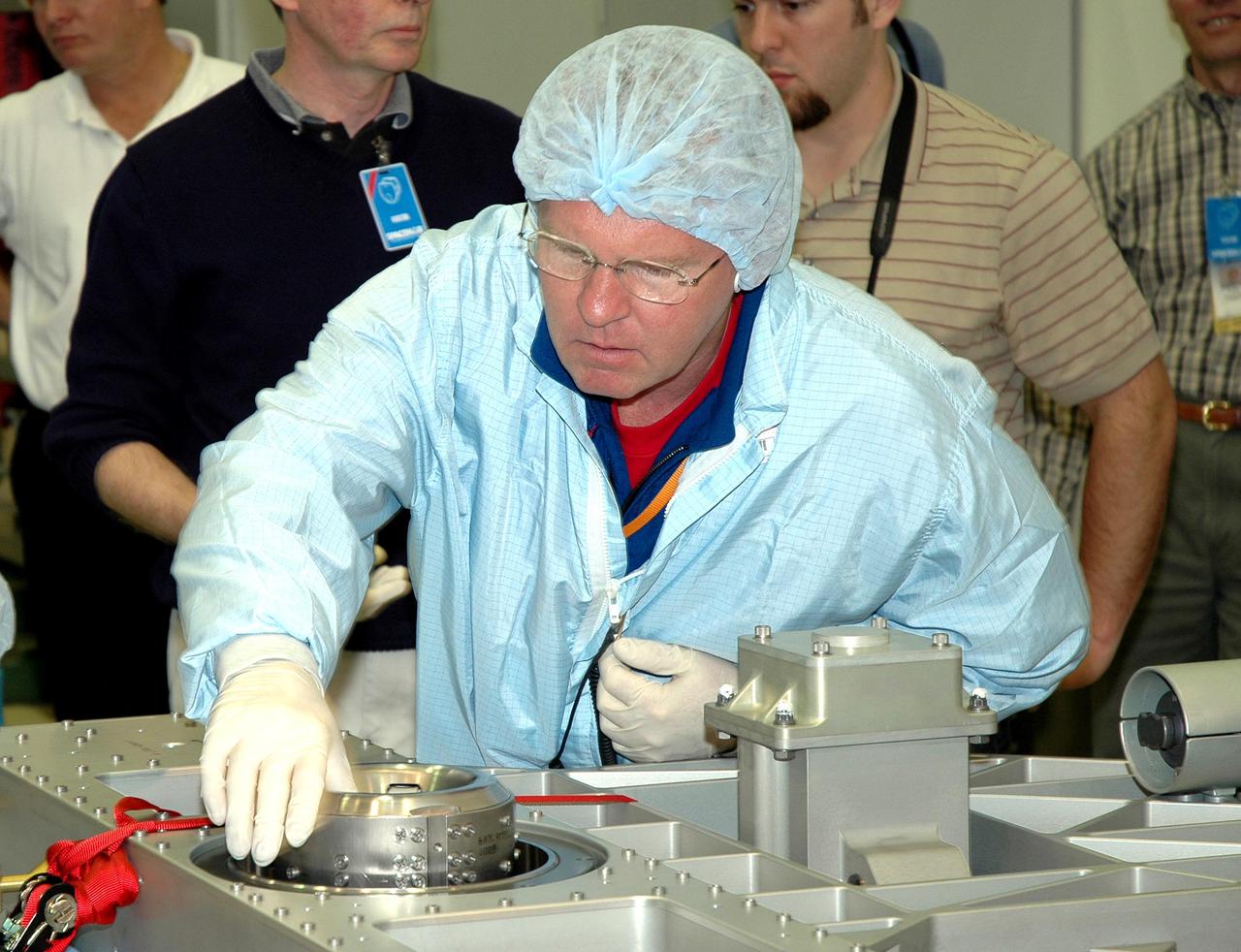
KENNEDY SPACE CENTER, FLA. - During Crew Equipment Interface Test (CEIT) at SPACEHAB in Cape Canaveral, Fla., STS-114 Mission Specialist Andrew Thomas checks out components on the External Stowage Platform-2 (ESP2). As payload on Space Shuttle Discovery’s Return to Flight mission, the ESP2 will carry replacement parts, known as orbital replacement units (ORU) to the International Space Station. The platform will be deployed and attached to the Station’s airlock and will be used as a permanent spare parts facility. The launch window for STS-114 is May 15 to June 3, 2005. Earlier, during CEIT in the Space Station Processing Facility, the crew also inspected the resupply stowage racks installed in the Italian-built Multi-Purpose Logistics Module Raffaello and performed tool and equipment interface checks with the Thermal Protection System (TPS) repair sample box, and the Control Moment Gyroscope (CMG) in preparation for the mission’s three scheduled spacewalks. The seven-member crew will fly to the Space Station primarily to evaluate procedures for flight safety, including Shuttle inspection and repair techniques.
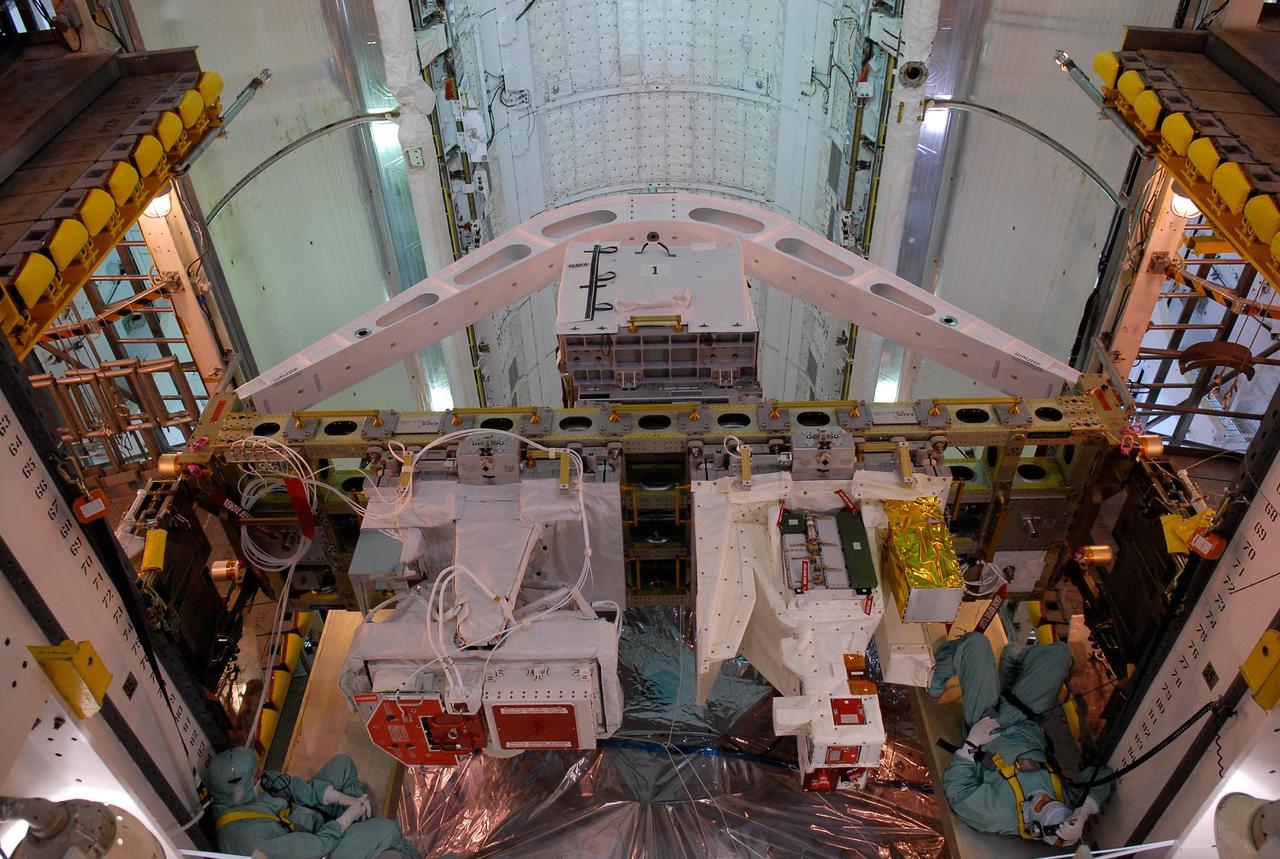
KENNEDY SPACE CENTER, FLA. -- The integrated cargo carrier - lite is being transferred to space shuttle Atlantis' payload bay from the payload changeout room on Launch Pad 39A. The changeout room is the enclosed, environmentally controlled portion of the rotating service structure that supports cargo delivery to the pad and subsequent vertical installation into the orbiter payload bay. The carrier holds three elements: a nitrogen tank assembly that is part of the external active thermal control system on the International Space Station, the European technology Exposure Facility composed of nine science instruments and an autonomous temperature measurement unit, and the SOLAR payload designed for sun observation. Also to be transferred is the Columbus Laboratory module. The lab module, built by the European Space Agency, also known as ESA, is approximately 23 feet long and 15 feet wide, allowing it to hold 10 large racks of experiments. Columbus is ESA's largest single contribution to the space station. Columbus will fly to the International Space Station on mission STS-122. The launch is targeted for Dec. 6. Photo credit: NASA/Kim Shiflett
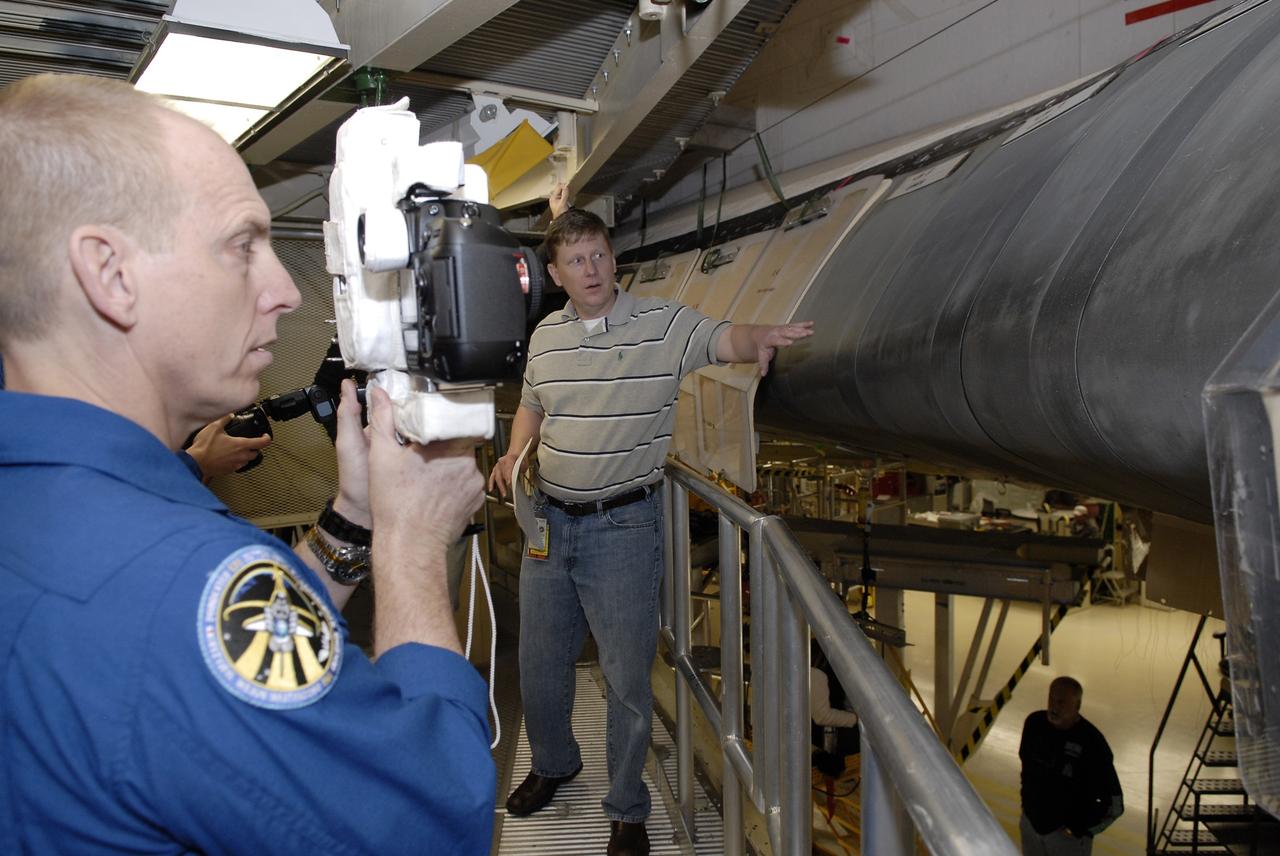
CAPE CANAVERAL, Fla. - In Orbiter Processing Facility 3 at NASA's Kennedy Space Center in Florida, members of space shuttle Discovery's STS-131 crew participate in training activities during the Crew Equipment Interface Test, or CEIT, for their mission. Here, Mission Specialist Clay Anderson is given the opportunity to operate one of the cameras that will be used to photograph the reinforced carbon carbon panels during his mission. The panels are part of the shuttle's thermal protection system. The CEIT provides the crew with hands-on training and observation of shuttle and flight hardware. The seven-member crew will deliver the multi-purpose logistics module Leonardo, filled with resupply stowage platforms and racks to be transferred to locations around the International Space Station. Three spacewalks will include work to attach a spare ammonia tank assembly to the station's exterior and return a European experiment from outside the station's Columbus module. Discovery's launch is targeted for March 18. For information on the STS-131 mission and crew, visit http://www.nasa.gov/mission_pages/shuttle/shuttlemissions/sts131/index.html. Photo credit: NASA/Kim Shiflett
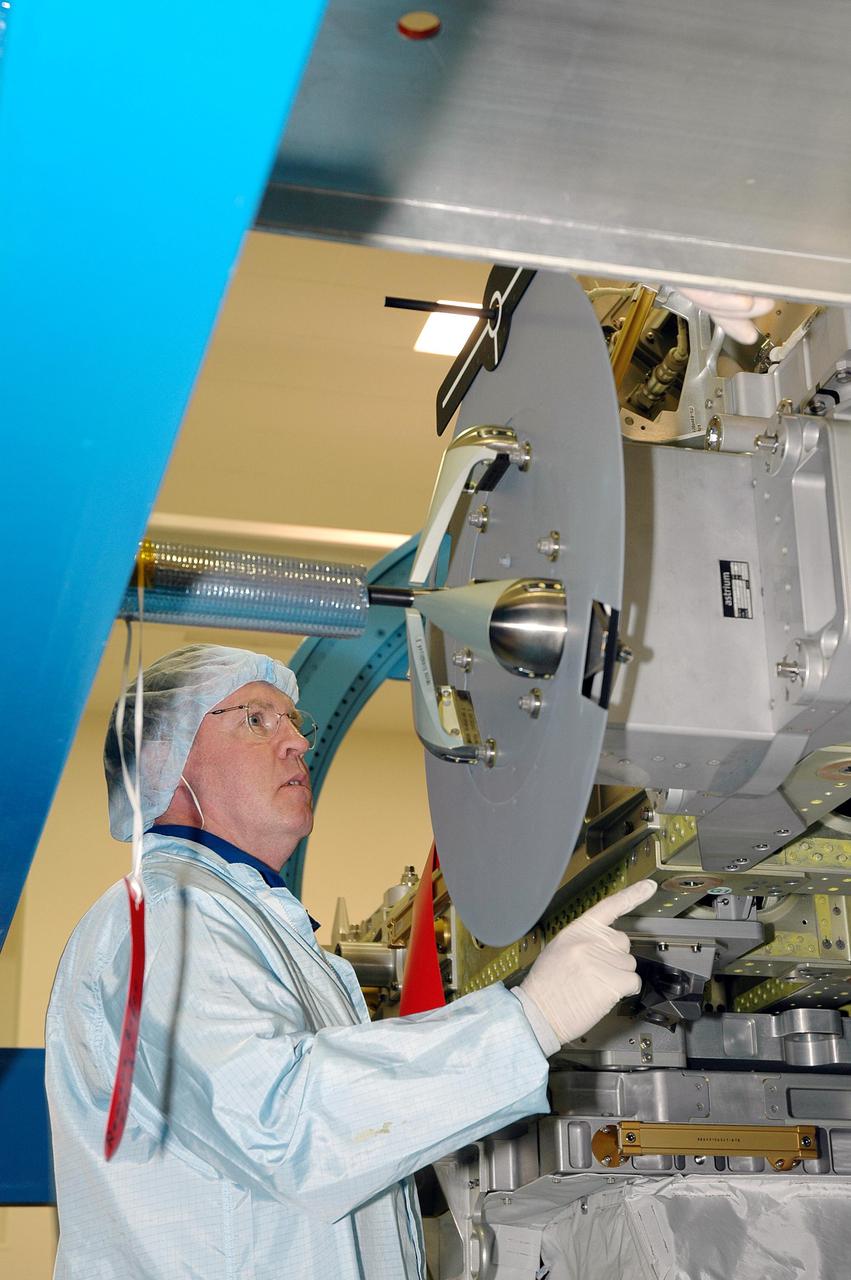
KENNEDY SPACE CENTER, FLA. - During Crew Equipment Interface Test (CEIT) at SPACEHAB in Cape Canaveral, Fla., STS-114 Mission Specialist Andrew Thomas inspects External Stowage Platform-2 (ESP2). As payload on Space Shuttle Discovery’s Return to Flight mission, the ESP2 will carry replacement parts, known as orbital replacement units (ORU) to the International Space Station. The platform will be deployed and attached to the Station’s airlock and will be used as a permanent spare parts facility. The launch window for STS-114 is May 15 to June 3, 2005. Earlier, during CEIT in the Space Station Processing Facility, the crew also inspected the resupply stowage racks installed in the Italian-built Multi-Purpose Logistics Module Raffaello and performed tool and equipment interface checks with the Thermal Protection System (TPS) repair sample box, and the Control Moment Gyroscope (CMG) in preparation for the mission’s three scheduled spacewalks. The seven-member crew will fly to the Space Station primarily to evaluate procedures for flight safety, including Shuttle inspection and repair techniques.
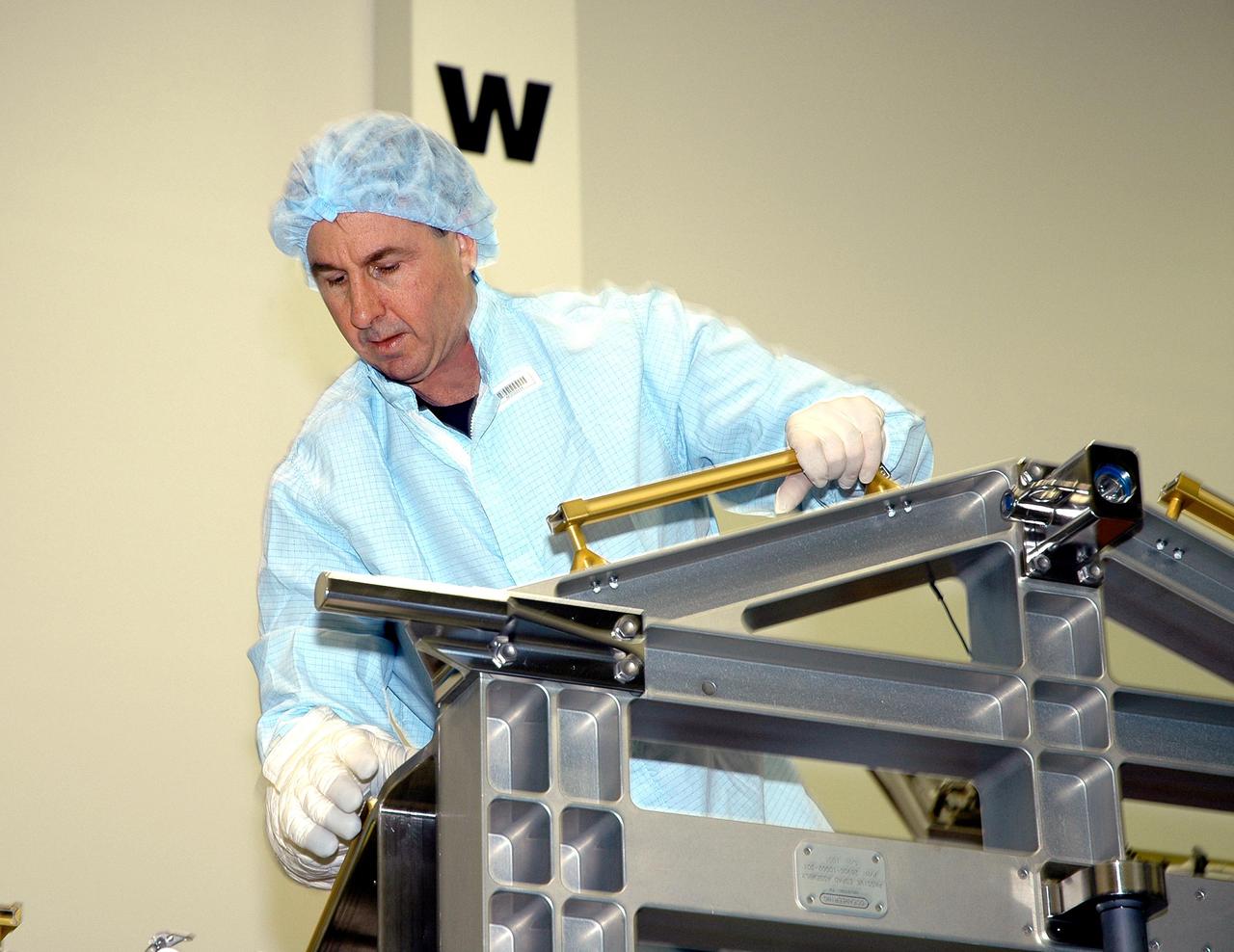
KENNEDY SPACE CENTER, FLA. - During Crew Equipment Interface Test (CEIT) at SPACEHAB in Cape Canaveral, Fla., STS-114 Mission Specialist Stephen Robinson inspects External Stowage Platform-2 (ESP2). As payload on Space Shuttle Discovery’s Return to Flight mission, the ESP2 will carry replacement parts, known as orbital replacement units (ORU) to the International Space Station. The platform will be deployed and attached to the Station’s airlock and will be used as a permanent spare parts facility. The launch window for STS-114 is May 15 to June 3, 2005. During CEIT in the Space Station Processing Facility, the crew also inspected the resupply stowage racks installed in the Italian-built Multi-Purpose Logistics Module Raffaello and performed tool and equipment interface checks with the Thermal Protection System (TPS) repair sample box, and the Control Moment Gyroscope (CMG) in preparation for the mission’s three scheduled spacewalks. The seven-member crew will fly to the Space Station primarily to evaluate procedures for flight safety, including Shuttle inspection and repair techniques.
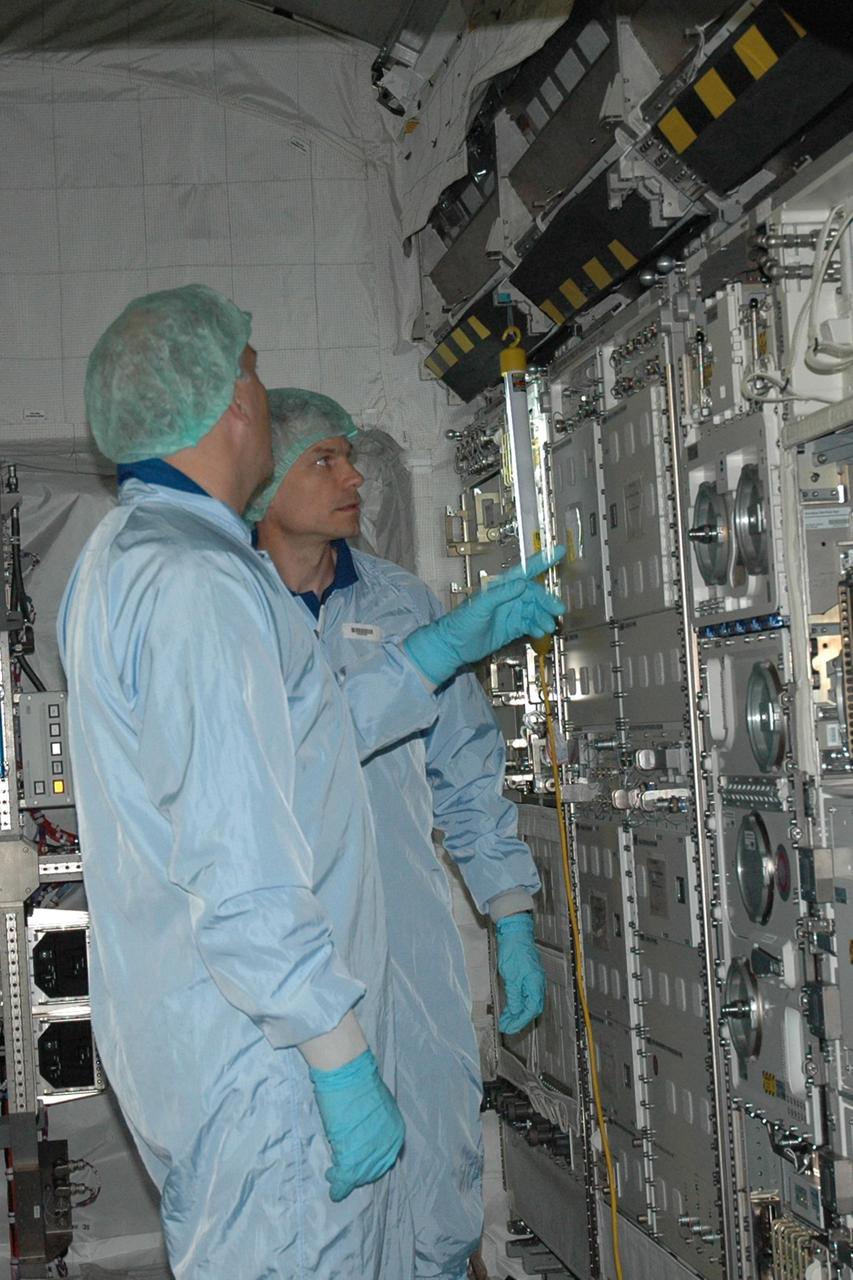
KENNEDY SPACE CENTER, FLA. -- STS-122 Mission Specialist Stanley Love looks at the experiment racks inside the Columbus Research Laboratory in the Space Station Processing Facility. He and other crew members are at Kennedy to take part in a crew equipment interface test, which helps familiarize them with equipment and payloads for the mission. Among the activities standard to a CEIT are harness training, inspection of the thermal protection system and camera operation for planned extravehicular activities, or EVAs. The crew comprises Commander Stephen Frick, Pilot Alan Poindexter, and Mission Specialists Rex Walheim, Stanley Love, Leland Melvin and Hans Schlegel, who represents the European Space Agency. The Columbus Lab is Europe’s largest contribution to the construction of the International Space Station. It will support scientific and technological research in a microgravity environment. Columbus, a program of ESA, is a multifunctional, pressurized laboratory that will be permanently attached to Node 2 of the space station to carry out experiments in materials science, fluid physics and biosciences, as well as to perform a number of technological applications. STS-122 is targeted for launch in December. Photo credit: NASA/Jim Grossmann
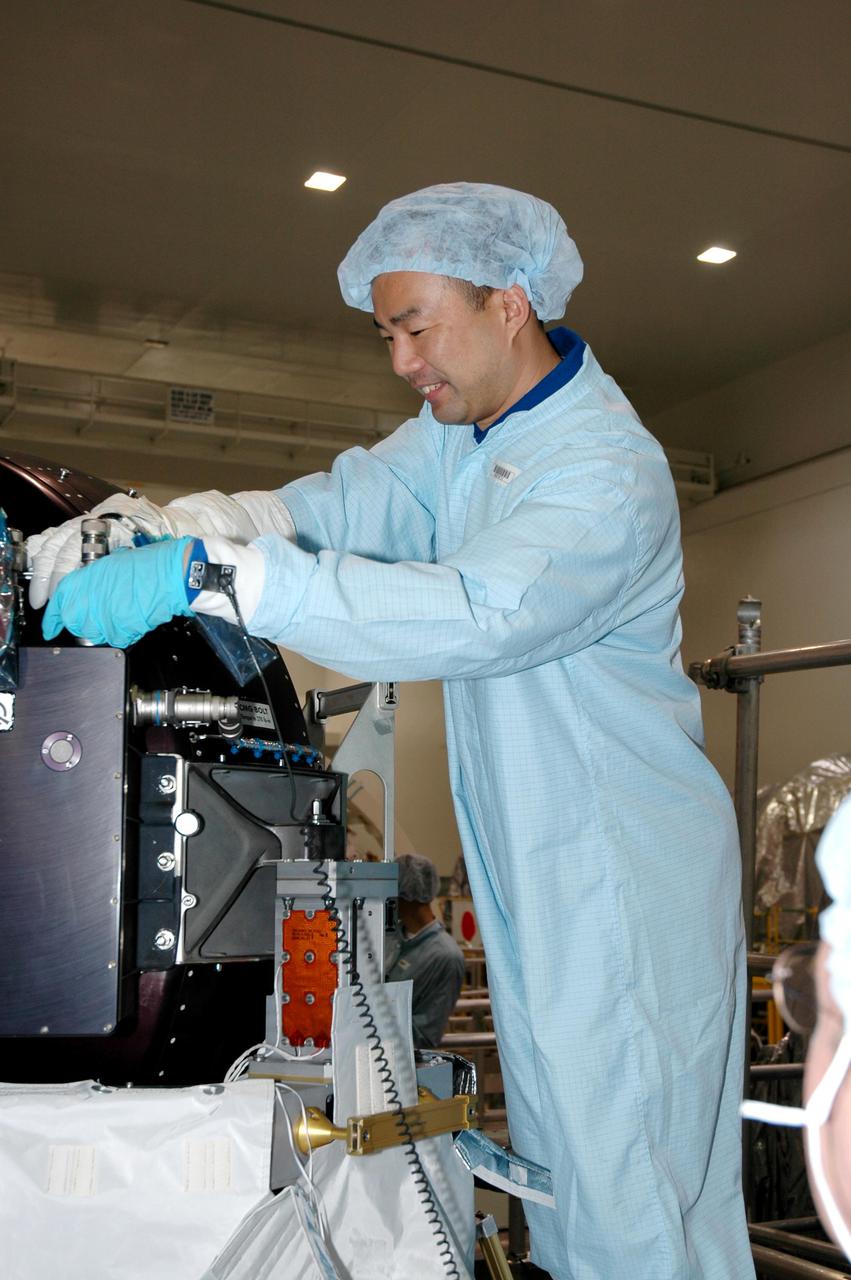
KENNEDY SPACE CENTER, FLA. - Members of the Space Shuttle Discovery’s Return to Flight STS-114 crew are conducting a payload Crew Equipment Interface Test (CEIT) in the Space Station Processing Facility at NASA’s Kennedy Space Center, Fla. Seen here is Mission Specialist Soichi Noguchi, who is with the Japanese Aerospace Exploration Agency. The launch window for STS-114 is May 15 to June 3, 2005. During CEIT, the crew is inspecting the resupply stowage racks installed in the Italian-built Multi-Purpose Logistics Module Raffaello and performing tool and equipment interface checks with the Thermal Protection System (TPS) repair sample box, the Control Moment Gyroscope (CMG) and the External Stowage Platform-2 in preparation for the mission’s three scheduled spacewalks. The seven-member crew will fly to the International Space Station primarily to evaluate procedures for flight safety, including Shuttle inspection and repair techniques. The TPS repair sample box contains tile samples for the Detailed Test Objective (DTO) that will enable the crew to test new on-orbit TPS repair techniques. The CMG installed on the Lightweight Multi-Purpose Experiment Support Structure Carrier (LMC) is a replacement for an inoperable CMG on the International Space Station. The CMGs provide altitude control for the outpost keeping it properly oriented toward the Sun without use of rocket fuel. The ESP2 will carry replacement parts, known as orbital replacement units (ORU) to the Station. The platform will be deployed and attached to the Station’s airlock and will be used as a permanent spare parts facility.
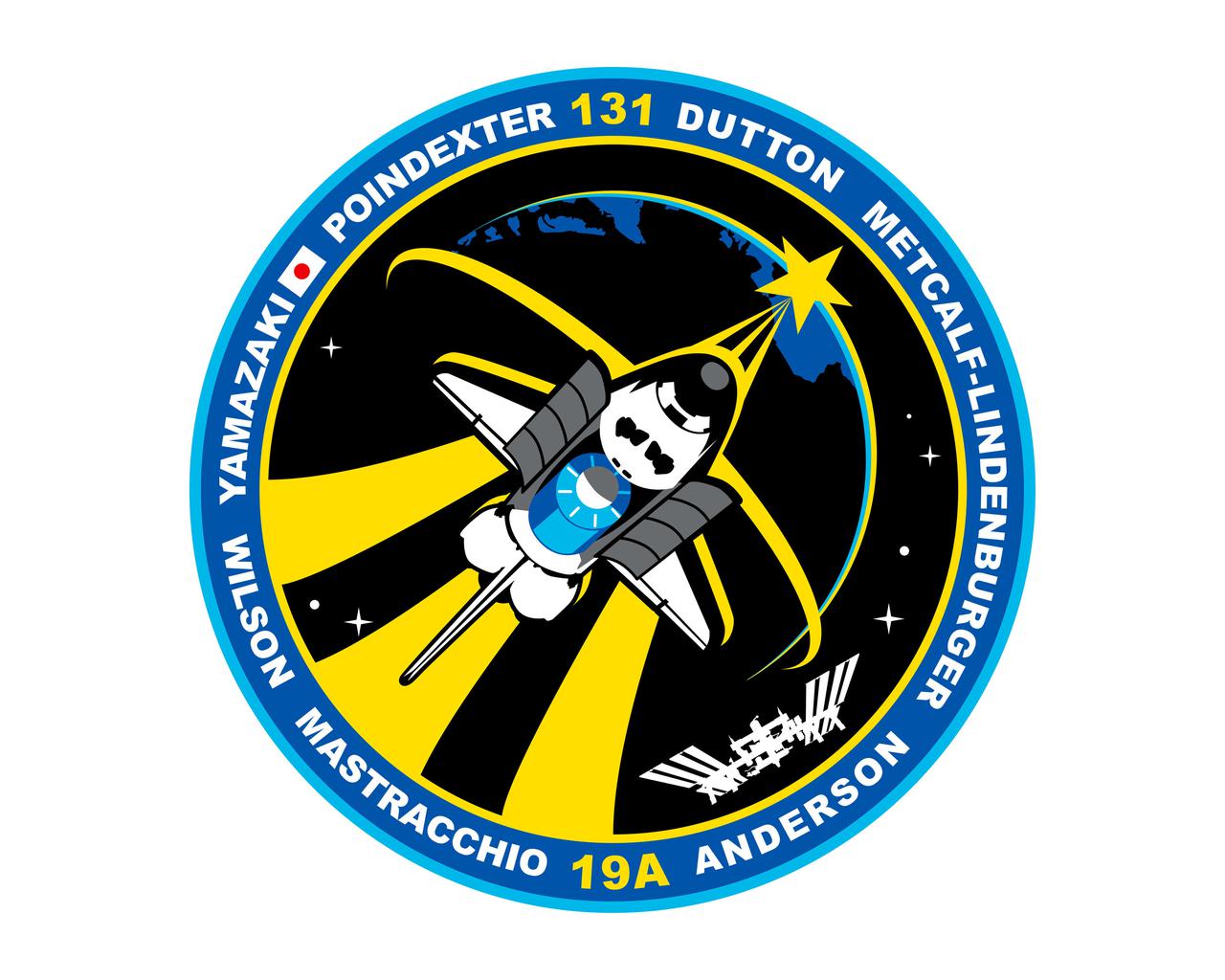
JOHNSON SPACE CENTER, Houston - STS131-S-001 - The STS-131_19A crew patch highlights the Space Shuttle in the Rendezvous Pitch Maneuver (RPM). This maneuver is heavily photographed by the International Space Station (ISS) astronauts, and the photos are analyzed back on earth to clear the Space Shuttle's thermal protection system for re-entry. The RPM illustrates the teamwork and safety process behind each Space Shuttle launch. In the Space Shuttle's cargo bay is the Multi-Purpose Logistics Module (MPLM), Leonardo, which is carrying several science racks, the last of the four crew quarters, and supplies for the ISS. Out of view and directly behind the MPLM, is the Ammonia Tank Assembly (ATA) that will be used to replace the current ATA. This will take place during three Extra Vehicular Activities (EVAs). The 51.6° Space Shuttle orbit is illustrated by the three gold bars of the astronaut symbol, and its elliptical wreath contains the orbit of the ISS. The star atop the astronaut symbol is the dawning sun, which is spreading its early light across the Earth. The background star field contains seven stars, one for each crewmember; they are proud to represent the United States and Japan during this mission. The NASA insignia design for shuttle flights is reserved for use by the astronauts and for other official use as the NASA Administrator may authorize. Public availability has been approved only in the form of illustrations by the various news media. When and if there is any change in this policy, which we do not anticipate, it will be publicly announced.
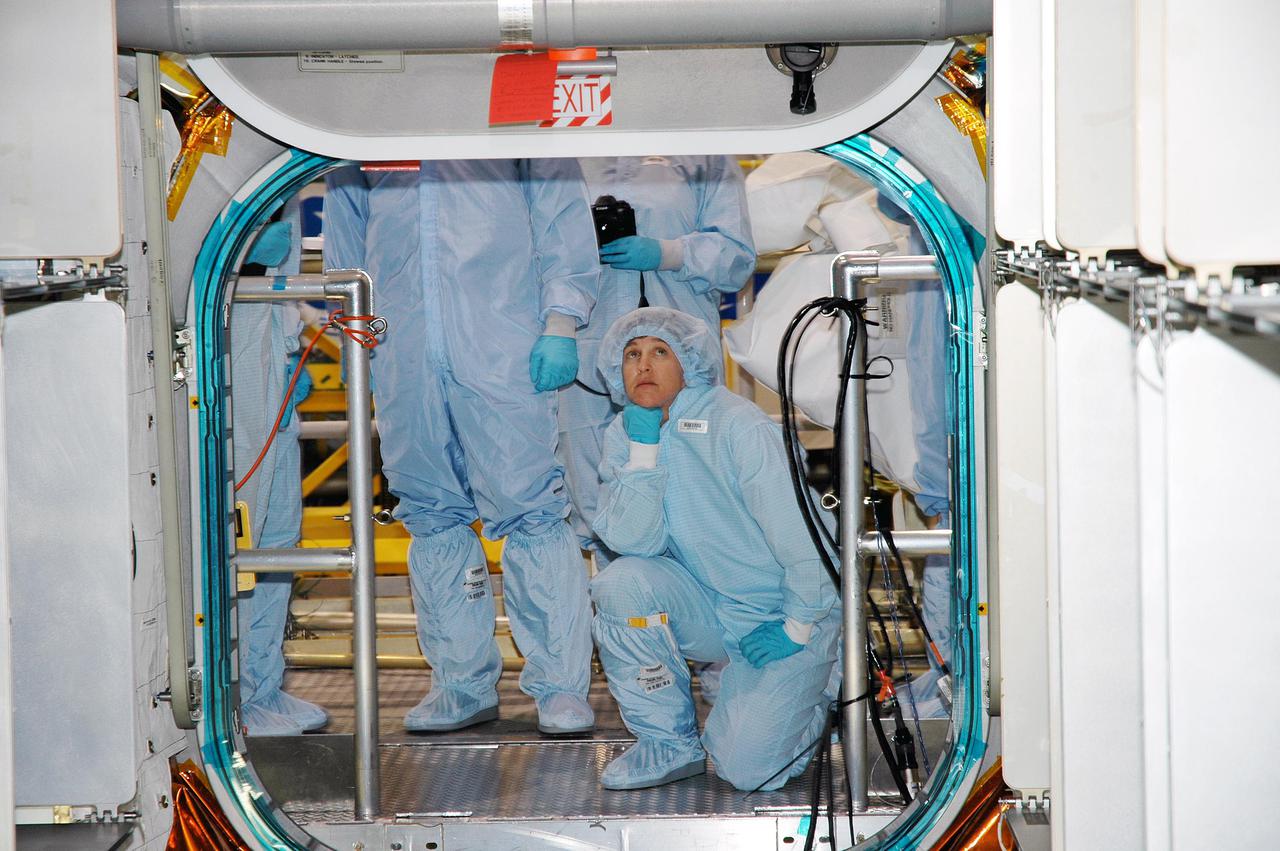
KENNEDY SPACE CENTER, FLA. - Members of the Space Shuttle Discovery’s Return to Flight STS-114 crew are conducting a payload Crew Equipment Interface Test (CEIT) in the Space Station Processing Facility at NASA’s Kennedy Space Center, Fla. Seen here in the Multi-Purpose Logistics Module Raffaello is Mission Specialist Wendy Lawrence. The launch window for STS-114 is May 15 to June 3, 2005. During CEIT, the crew is inspecting the resupply stowage racks installed in the Italian-built Multi-Purpose Logistics Module Raffaello and performing tool and equipment interface checks with the Thermal Protection System (TPS) repair sample box, the Control Moment Gyroscope (CMG) and the External Stowage Platform-2 in preparation for the mission’s three scheduled spacewalks. The seven-member crew will fly to the International Space Station primarily to evaluate procedures for flight safety, including Shuttle inspection and repair techniques. The TPS repair sample box contains tile samples for the Detailed Test Objective (DTO) that will enable the crew to test new on-orbit TPS repair techniques. The CMG installed on the Lightweight Multi-Purpose Experiment Support Structure Carrier (LMC) is a replacement for an inoperable CMG on the International Space Station. The CMGs provide altitude control for the outpost keeping it properly oriented toward the Sun without use of rocket fuel. The ESP2 will carry replacement parts, known as orbital replacement units (ORU) to the Station. The platform will be deployed and attached to the Station’s airlock and will be used as a permanent spare parts facility.
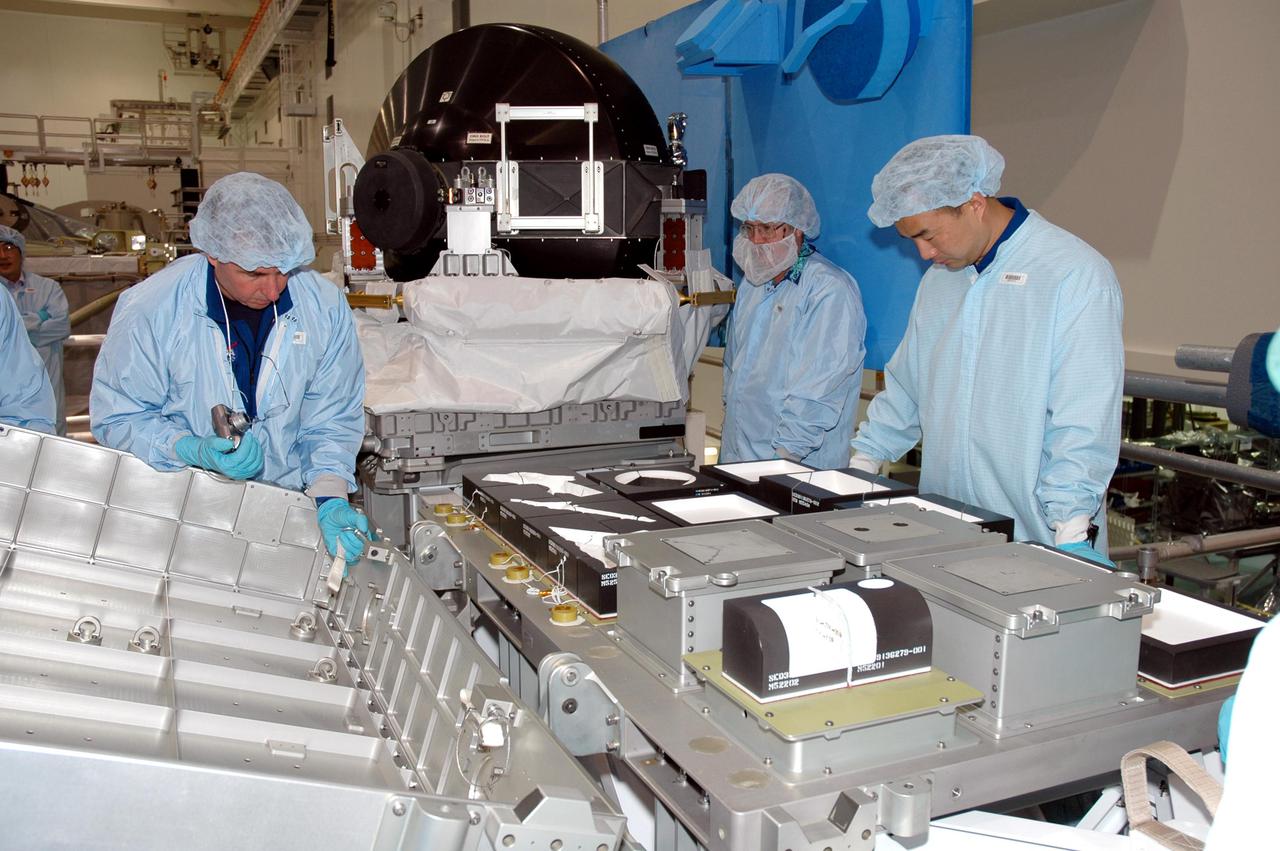
KENNEDY SPACE CENTER, FLA. - Members of the Space Shuttle Discovery’s Return to Flight STS-114 crew are conducting a payload Crew Equipment Interface Test (CEIT) in the Space Station Processing Facility at NASA’s Kennedy Space Center, Fla. Seen here looking at tile samples are Mission Specialists Stephen Robinson (left) and Soichi Noguchi (right), who is with the Japanese Aerospace Exploration Agency. The launch window for STS-114 is May 15 to June 3, 2005. During CEIT, the crew is inspecting the resupply stowage racks installed in the Italian-built Multi-Purpose Logistics Module Raffaello and performing tool and equipment interface checks with the Thermal Protection System (TPS) repair sample box, the Control Moment Gyroscope (CMG) and the External Stowage Platform-2 in preparation for the mission’s three scheduled spacewalks. The seven-member crew will fly to the International Space Station primarily to evaluate procedures for flight safety, including Shuttle inspection and repair techniques. The TPS repair sample box contains tile samples for the Detailed Test Objective (DTO) that will enable the crew to test new on-orbit TPS repair techniques. The CMG installed on the Lightweight Multi-Purpose Experiment Support Structure Carrier (LMC) is a replacement for an inoperable CMG on the International Space Station. The CMGs provide altitude control for the outpost keeping it properly oriented toward the Sun without use of rocket fuel. The ESP2 will carry replacement parts, known as orbital replacement units (ORU) to the Station. The platform will be deployed and attached to the Station’s airlock and will be used as a permanent spare parts facility.
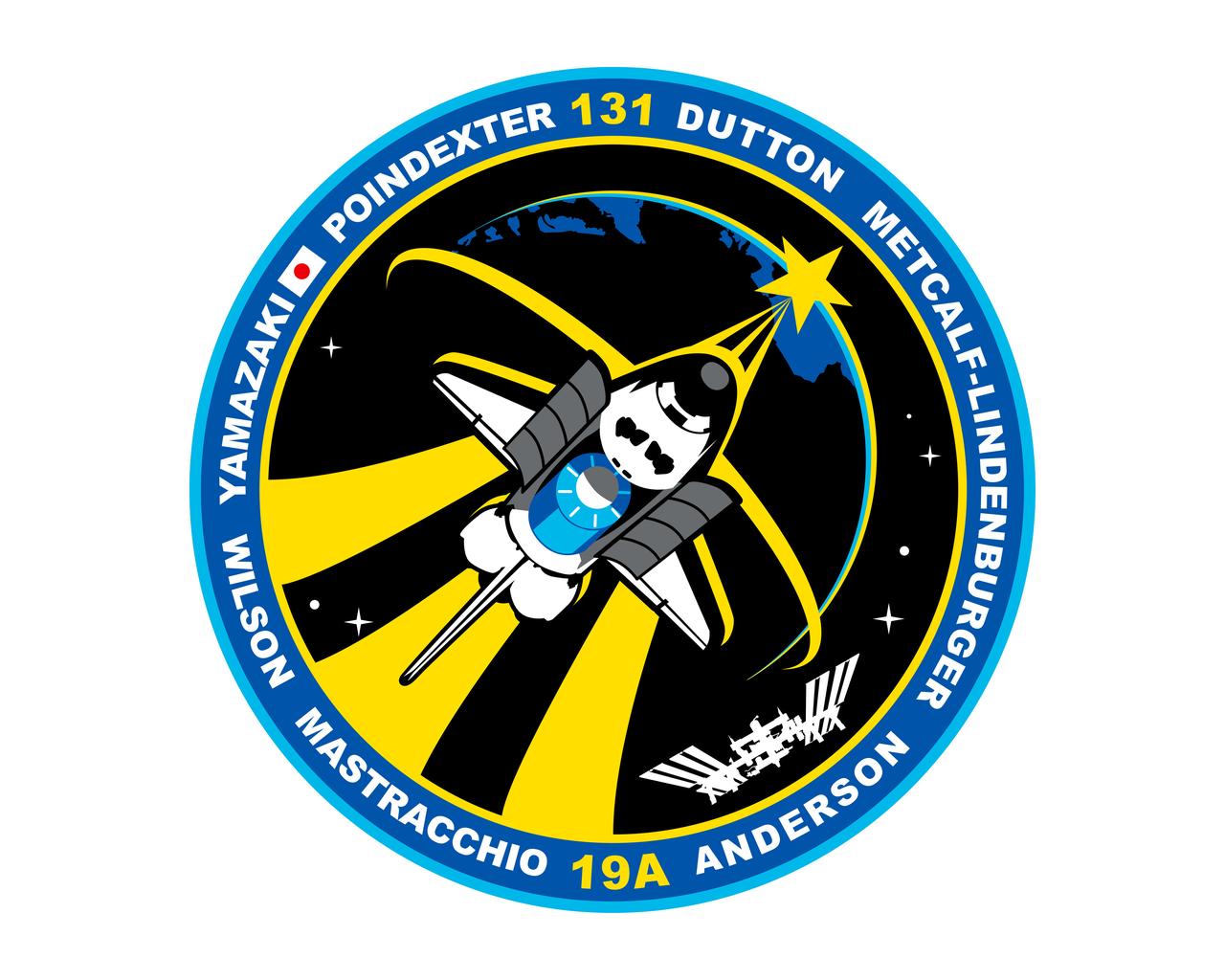
STS131-S-001 (September 2009) --- The STS-131/19A crew patch highlights the space shuttle in the Rendezvous Pitch Maneuver (RPM). This maneuver is heavily photographed by the International Space Station (ISS) crew members, and the photos are analyzed back on Earth to clear the space shuttle?s thermal protection system for re-entry. The RPM illustrates the teamwork and safety process behind each space shuttle launch. In the space shuttle?s cargo bay is the Multi-Purpose Logistics Module (MPLM), Leonardo, which is carrying several science racks, the last of the four crew quarters, and supplies for the ISS. Out of view and directly behind the MPLM, is the Ammonia Tank Assembly (ATA) that will be used to replace the current ATA. This will take place during three extravehicular activities (EVA). The 51.6? space shuttle orbit is illustrated by the three gold bars of the astronaut symbol, and its elliptical wreath contains the orbit of the ISS. The star atop the astronaut symbol is the dawning sun, which is spreading its early light across Earth. The background starfield contains seven stars, one for each crew member; they are proud to represent the United States and Japan during this mission. The NASA insignia design for space shuttle flights is reserved for use by the astronauts and for other official use as the NASA Administrator may authorize. Public availability has been approved only in the forms of illustrations by the various news media. When and if there is any change in this policy, which is not anticipated, the change will be publicly announced. Photo credit: NASA
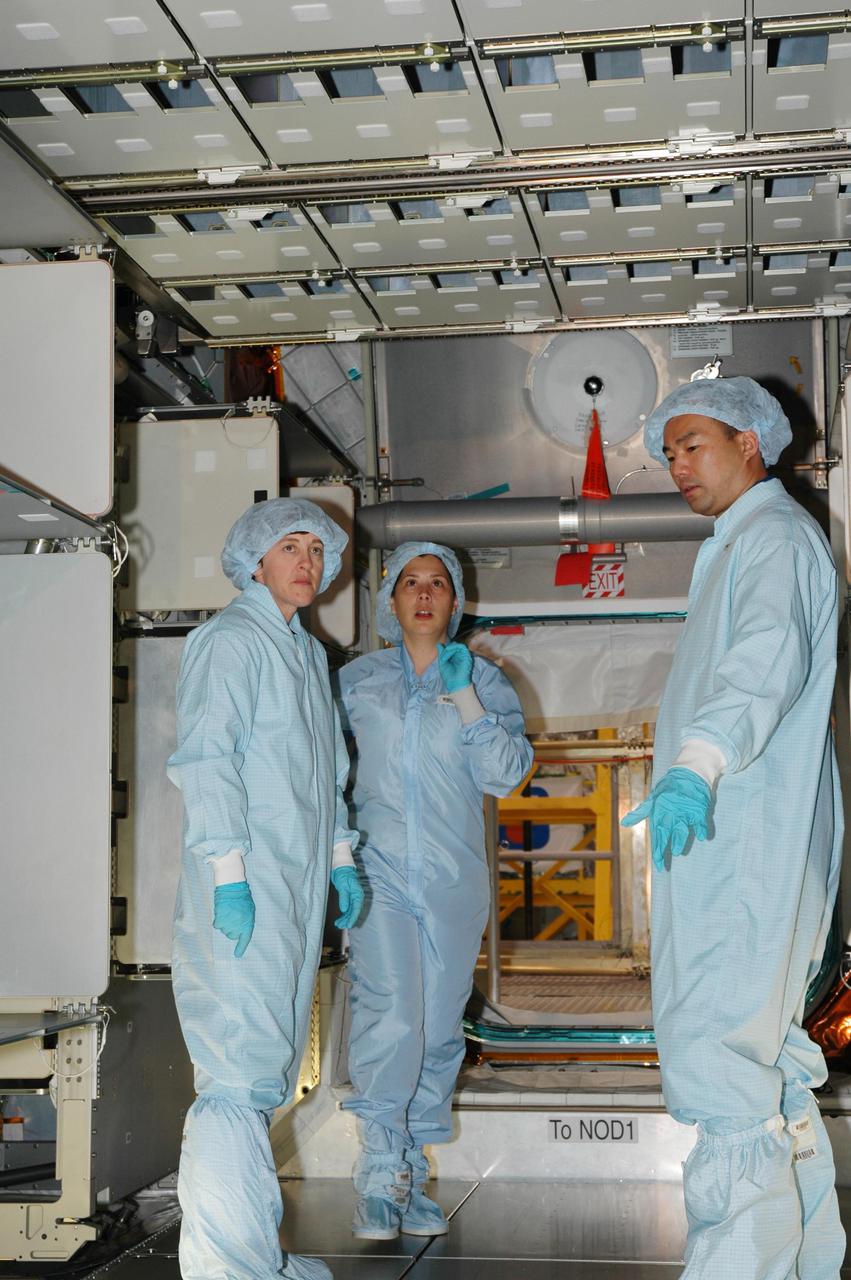
KENNEDY SPACE CENTER, FLA. - Members of the Space Shuttle Discovery’s Return to Flight STS-114 crew are conducting a payload Crew Equipment Interface Test (CEIT) in the Space Station Processing Facility at NASA’s Kennedy Space Center, Fla. Seen here inside the Multi-Purpose Logistics Module Raffaello are Mission Specialists Wendy Lawrence (left) and Soichi Noguchi (right), who is with the Japanese Aerospace Exploration Agency. The launch window for STS-114 is May 15 to June 3, 2005. During CEIT, the crew is inspecting the resupply stowage racks installed in the Italian-built Multi-Purpose Logistics Module Raffaello and performing tool and equipment interface checks with the Thermal Protection System (TPS) repair sample box, the Control Moment Gyroscope (CMG) and the External Stowage Platform-2 in preparation for the mission’s three scheduled spacewalks. The seven-member crew will fly to the International Space Station primarily to evaluate procedures for flight safety, including Shuttle inspection and repair techniques. The TPS repair sample box contains tile samples for the Detailed Test Objective (DTO) that will enable the crew to test new on-orbit TPS repair techniques. The CMG installed on the Lightweight Multi-Purpose Experiment Support Structure Carrier (LMC) is a replacement for an inoperable CMG on the International Space Station. The CMGs provide altitude control for the outpost keeping it properly oriented toward the Sun without use of rocket fuel. The ESP2 will carry replacement parts, known as orbital replacement units (ORU) to the Station. The platform will be deployed and attached to the Station’s airlock and will be used as a permanent spare parts facility.
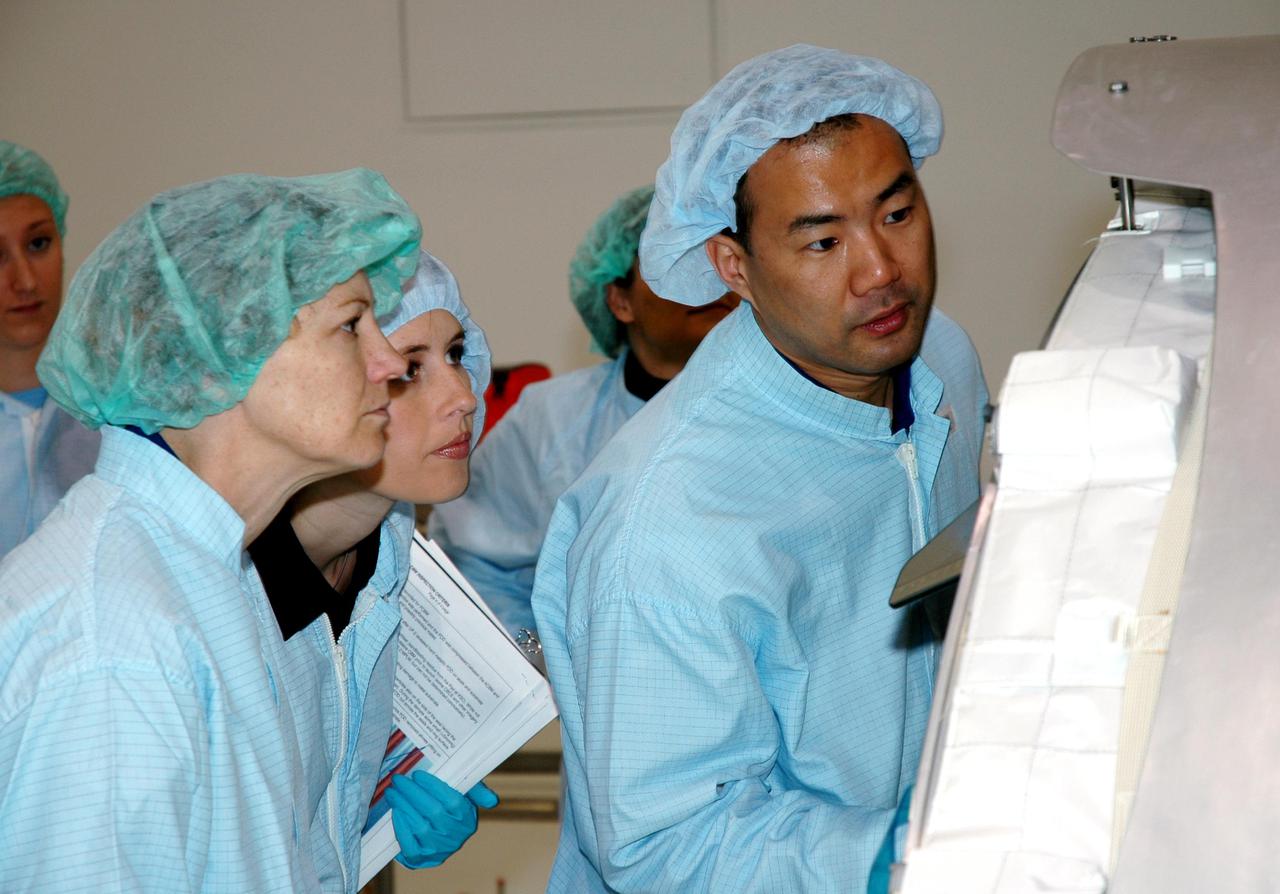
KENNEDY SPACE CENTER, FLA. - Members of the Space Shuttle Discovery’s Return to Flight STS-114 crew are conducting a payload Crew Equipment Interface Test (CEIT) in the Space Station Processing Facility at NASA’s Kennedy Space Center, Fla. Seen here are Commander Eileen Collins (left) and Mission Specialist Soichi Noguchi (right), who is with the Japanese Aerospace Exploration Agency. The launch window for STS-114 is May 15 to June 3, 2005. During CEIT, the crew is inspecting the resupply stowage racks installed in the Italian-built Multi-Purpose Logistics Module Raffaello and performing tool and equipment interface checks with the Thermal Protection System (TPS) repair sample box, the Control Moment Gyroscope (CMG) and the External Stowage Platform-2 in preparation for the mission’s three scheduled spacewalks. The seven-member crew will fly to the International Space Station primarily to evaluate procedures for flight safety, including Shuttle inspection and repair techniques. The TPS repair sample box contains tile samples for the Detailed Test Objective (DTO) that will enable the crew to test new on-orbit TPS repair techniques. The CMG installed on the Lightweight Multi-Purpose Experiment Support Structure Carrier (LMC) is a replacement for an inoperable CMG on the International Space Station. The CMGs provide altitude control for the outpost keeping it properly oriented toward the Sun without use of rocket fuel. The ESP2 will carry replacement parts, known as orbital replacement units (ORU) to the Station. The platform will be deployed and attached to the Station’s airlock and will be used as a permanent spare parts facility.
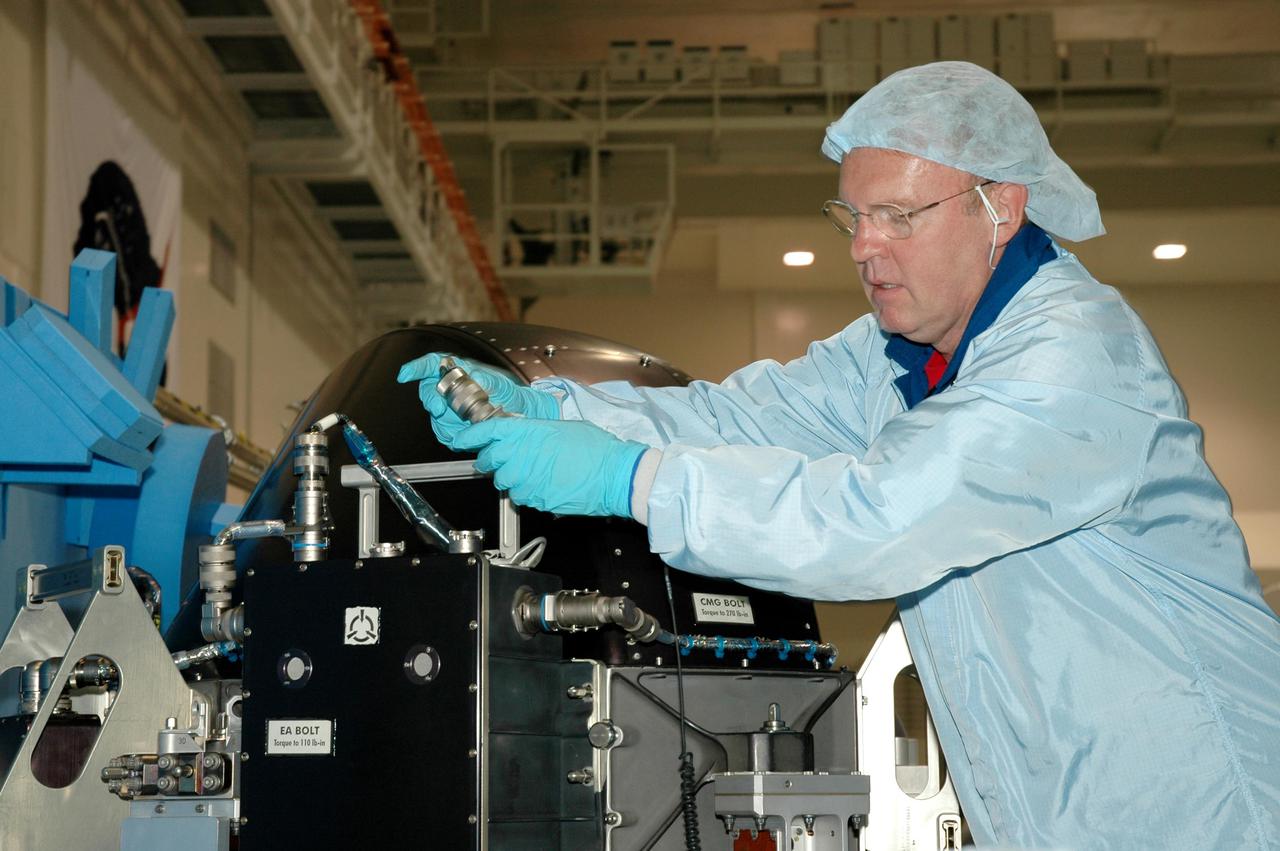
KENNEDY SPACE CENTER, FLA. - Members of the Space Shuttle Discovery’s Return to Flight STS-114 crew are conducting a payload Crew Equipment Interface Test (CEIT) in the Space Station Processing Facility at NASA’s Kennedy Space Center, Fla. Seen here is Mission Specialist Andrew Thomas, looking at the Control Moment Gyroscope, part of the mission payload. The launch window for STS-114 is May 15 to June 3, 2005. During CEIT, the crew is inspecting the resupply stowage racks installed in the Italian-built Multi-Purpose Logistics Module Raffaello and performing tool and equipment interface checks with the Thermal Protection System (TPS) repair sample box, the Control Moment Gyroscope (CMG) and the External Stowage Platform-2 in preparation for the mission’s three scheduled spacewalks. The seven-member crew will fly to the International Space Station primarily to evaluate procedures for flight safety, including Shuttle inspection and repair techniques. The TPS repair sample box contains tile samples for the Detailed Test Objective (DTO) that will enable the crew to test new on-orbit TPS repair techniques. The CMG installed on the Lightweight Multi-Purpose Experiment Support Structure Carrier (LMC) is a replacement for an inoperable CMG on the International Space Station. The CMGs provide altitude control for the outpost keeping it properly oriented toward the Sun without use of rocket fuel. The ESP2 will carry replacement parts, known as orbital replacement units (ORU) to the Station. The platform will be deployed and attached to the Station’s airlock and will be used as a permanent spare parts facility.
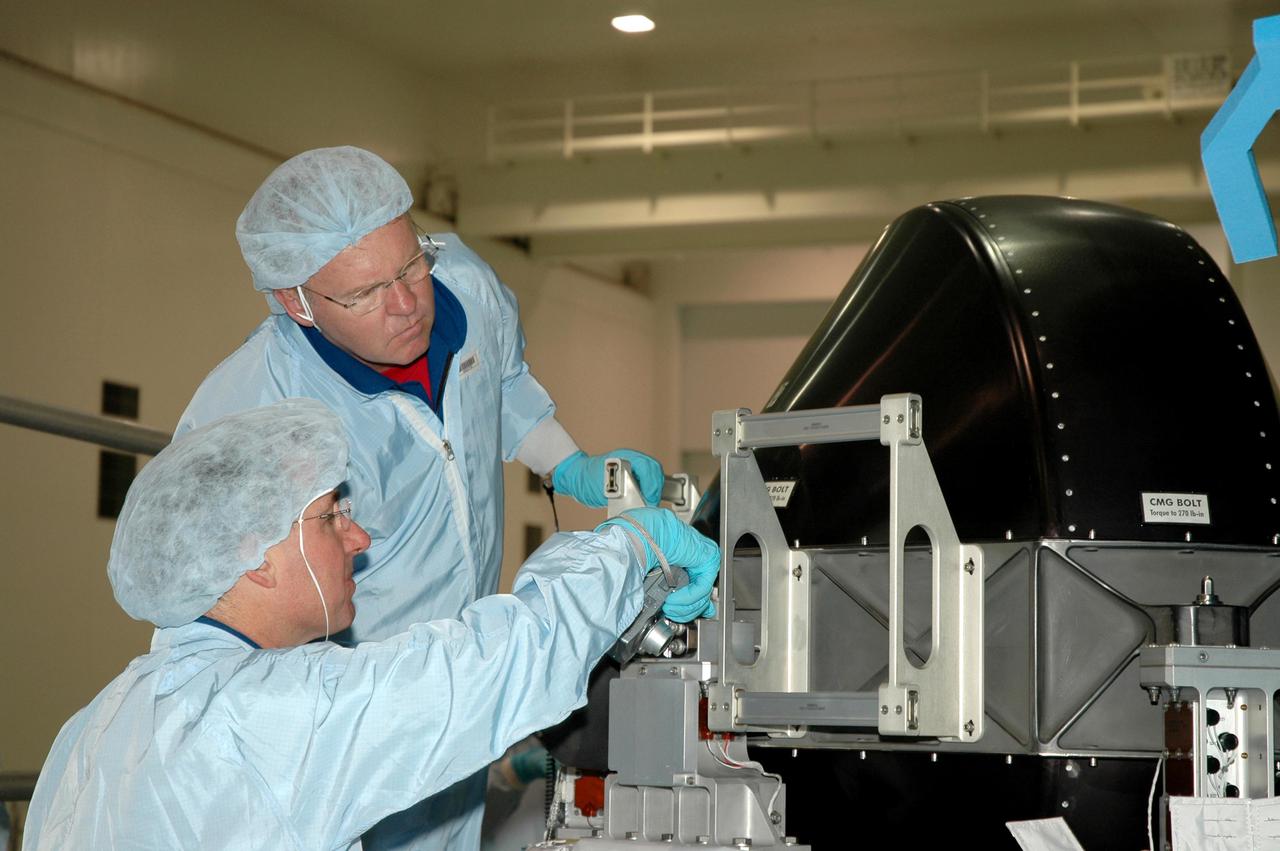
KENNEDY SPACE CENTER, FLA. - Members of the Space Shuttle Discovery’s Return to Flight STS-114 crew are conducting a payload Crew Equipment Interface Test (CEIT) in the Space Station Processing Facility at NASA’s Kennedy Space Center, Fla. Seen here are Mission Specialists Stephen Robinson (left) and Andrew Thomas. The launch window for STS-114 is May 15 to June 3, 2005. During CEIT, the crew is inspecting the resupply stowage racks installed in the Italian-built Multi-Purpose Logistics Module Raffaello and performing tool and equipment interface checks with the Thermal Protection System (TPS) repair sample box, the Control Moment Gyroscope (CMG) and the External Stowage Platform-2 in preparation for the mission’s three scheduled spacewalks. The seven-member crew will fly to the International Space Station primarily to evaluate procedures for flight safety, including Shuttle inspection and repair techniques. The TPS repair sample box contains tile samples for the Detailed Test Objective (DTO) that will enable the crew to test new on-orbit TPS repair techniques. The CMG installed on the Lightweight Multi-Purpose Experiment Support Structure Carrier (LMC) is a replacement for an inoperable CMG on the International Space Station. The CMGs provide altitude control for the outpost keeping it properly oriented toward the Sun without use of rocket fuel. The ESP2 will carry replacement parts, known as orbital replacement units (ORU) to the Station. The platform will be deployed and attached to the Station’s airlock and will be used as a permanent spare parts facility.