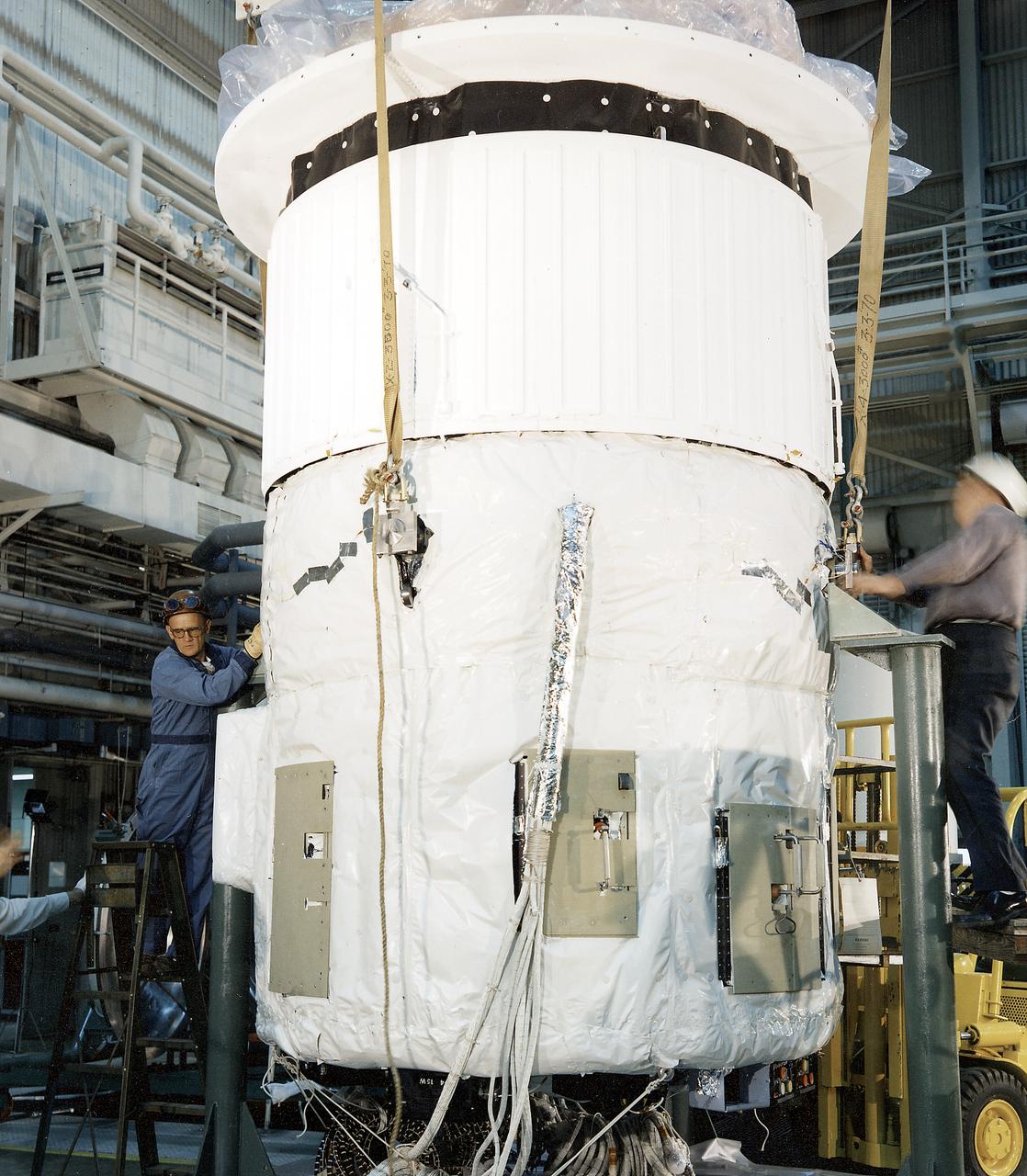
The Apollo Telescope Mount (ATM) was designed and developed by the Marshall Space Flight Center (MSFC) and served as the primary scientific instrument unit aboard Skylab (1973-1979). The ATM consisted of eight scientific instruments as well as a number of smaller experiments. This image is of the ATM thermal unit being tested in MSFC's building 4619. The thermal unit consisted of an active fluid-cooling system of water and methanol that was circulated to radiators on the outside of the canister. The thermal unit provided temperature stability to the ultrahigh resolution optical instruments that were part of the ATM.
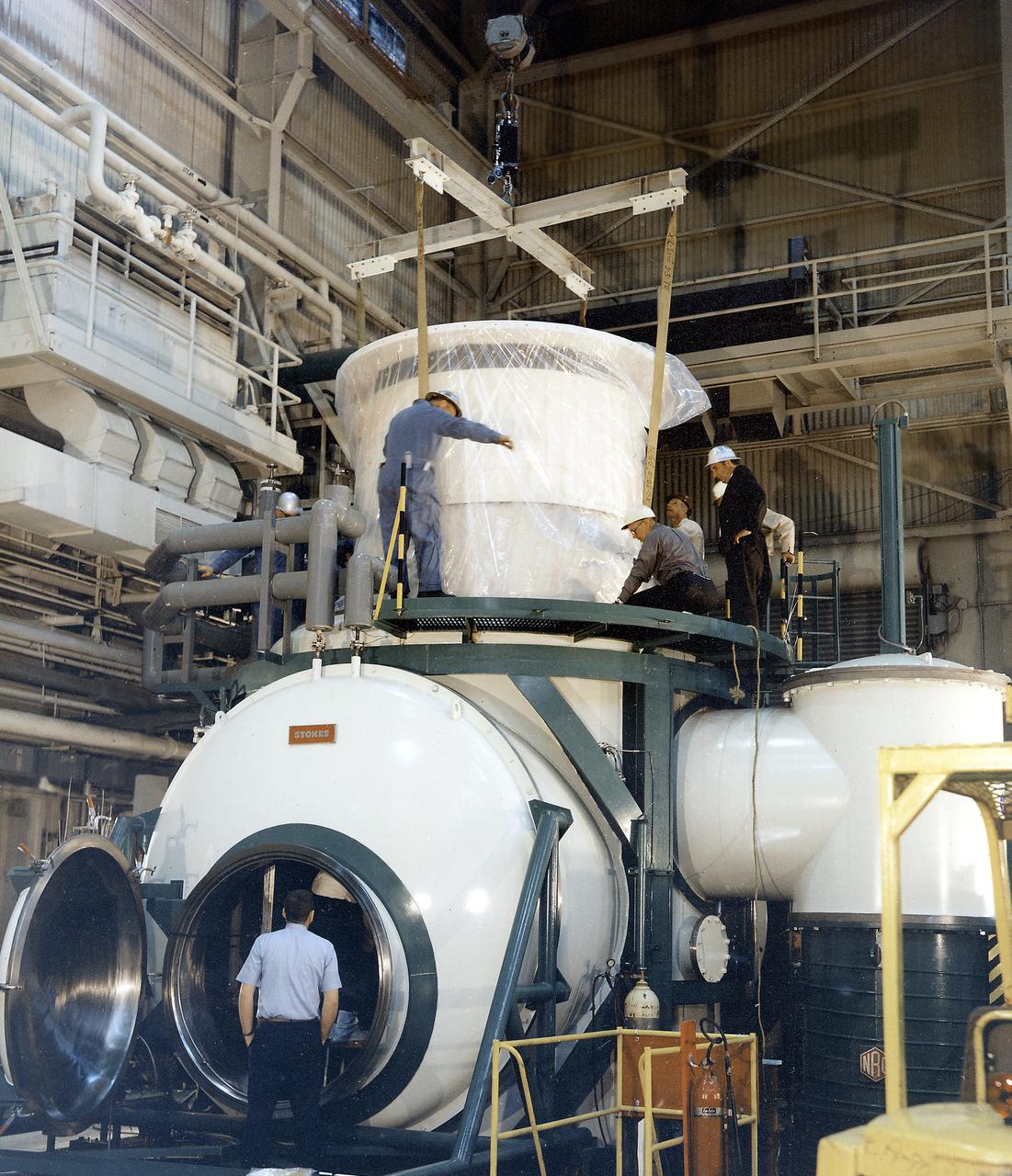
The Apollo Telescope Mount (ATM) was designed and developed by the Marshall Space Flight Center (MSFC) and served as the primary scientific instrument unit aboard Skylab (1973-1979). The ATM consisted of eight scientific instruments as well as a number of smaller experiments. In this image, the thermal unit, that controlled the temperature stability of the ATM, is being installed into a vacuum chamber.
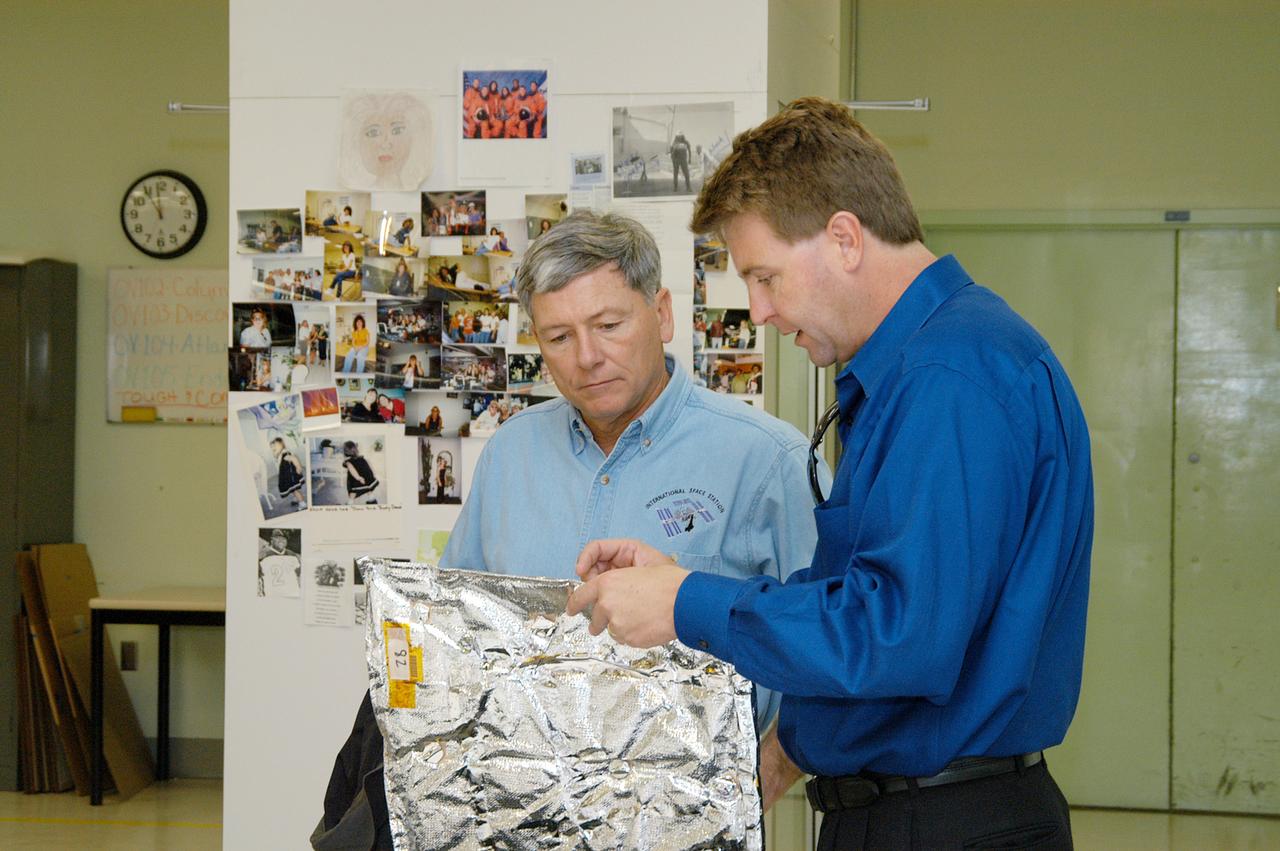
KENNEDY SPACE CENTER, FLA. -- United Space Alliance (USA) Manager of the Thermal Protection System (TPS) Facility Martin Wilson (right) briefs NASA Deputy Associate Administrator for Space Station and Shuttle Programs Michael Kostelnik (left) on the properties of a thermal blanket used in the Shuttle's TPS. NASA and USA Space Shuttle program management are participating in a leadership workday. The day is intended to provide management with an in-depth, hands-on look at Shuttle processing activities at KSC.

KENNEDY SPACE CENTER, FLA. -- United Space Alliance (USA) technicians demonstrate the construction of a thermal blanket used in the Shuttle's thermal protection system for USA Vice President and Space Shuttle Program Manager Howard DeCastro (second from left) and NASA Deputy Associate Administrator for Space Station and Shuttle Programs Michael Kostelnik (right). NASA and USA Space Shuttle program management are participating in a leadership workday. The day is intended to provide management with an in-depth, hands-on look at Shuttle processing activities at KSC.
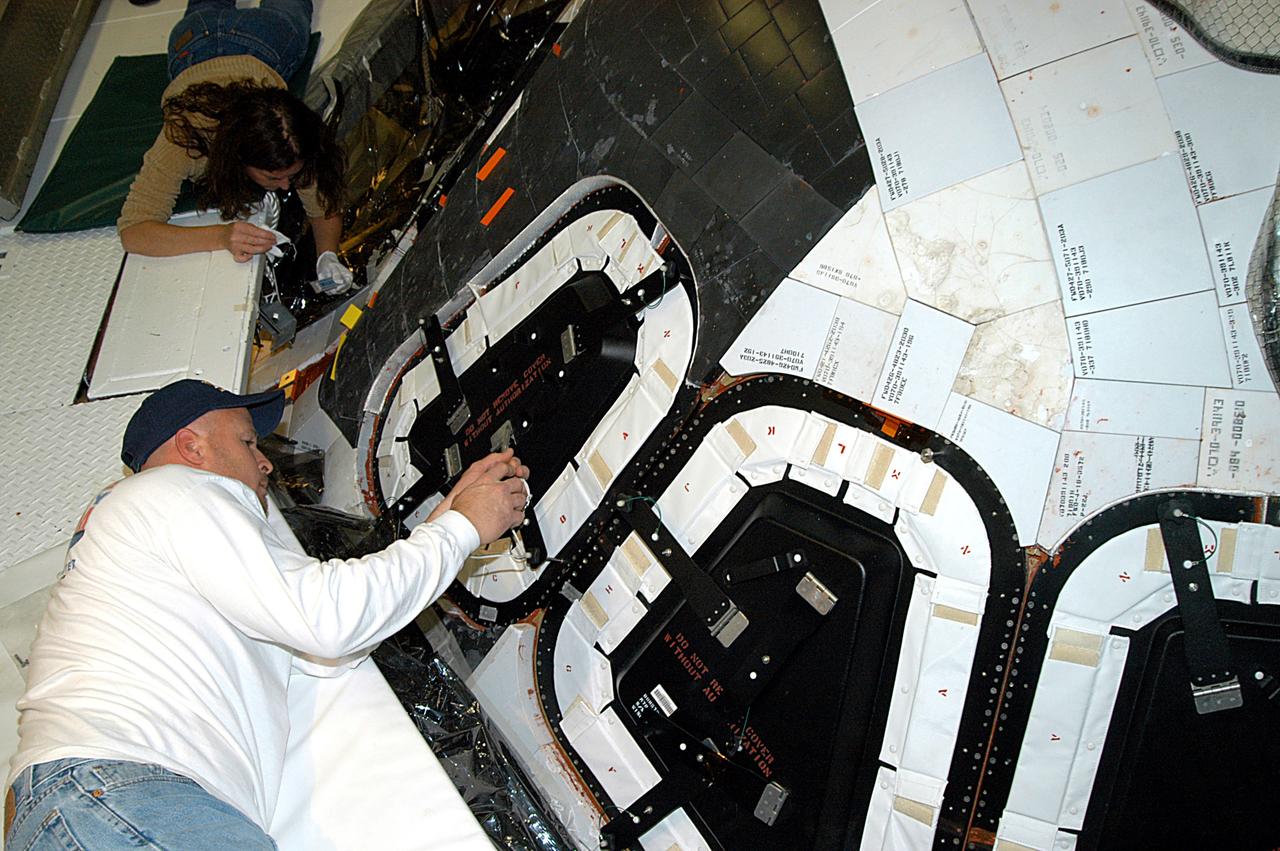
KENNEDY SPACE CENTER, FLA. -- Les Hanks (foreground) and Darlene Beville (background), with United Space Alliance, prepare a window on Atlantis for removal. The windows are being removed to inspect them for contaminants in the thermal seal. Atlantis has been undergoing routine maintenance in the Orbiter Processing Facility for Return to Flight, on mission STS-114.
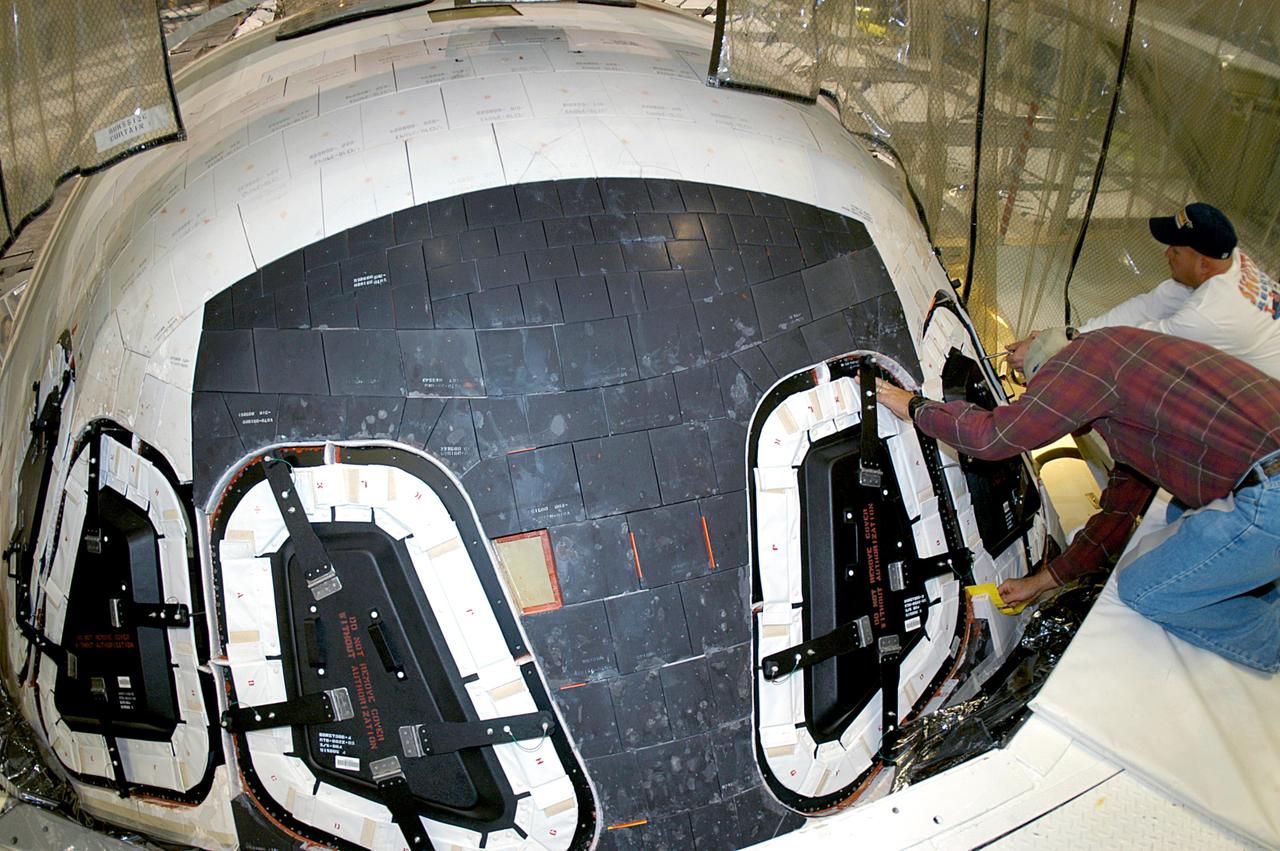
KENNEDY SPACE CENTER, FLA. -- At right, Mike Young and Les Hanks, with United Space Alliance, prepare a window on Atlantis for removal. The windows are being removed to inspect them for contaminants in the thermal seal. Atlantis has been undergoing routine maintenance in the Orbiter Processing Facility for Return to Flight, on mission STS-114.
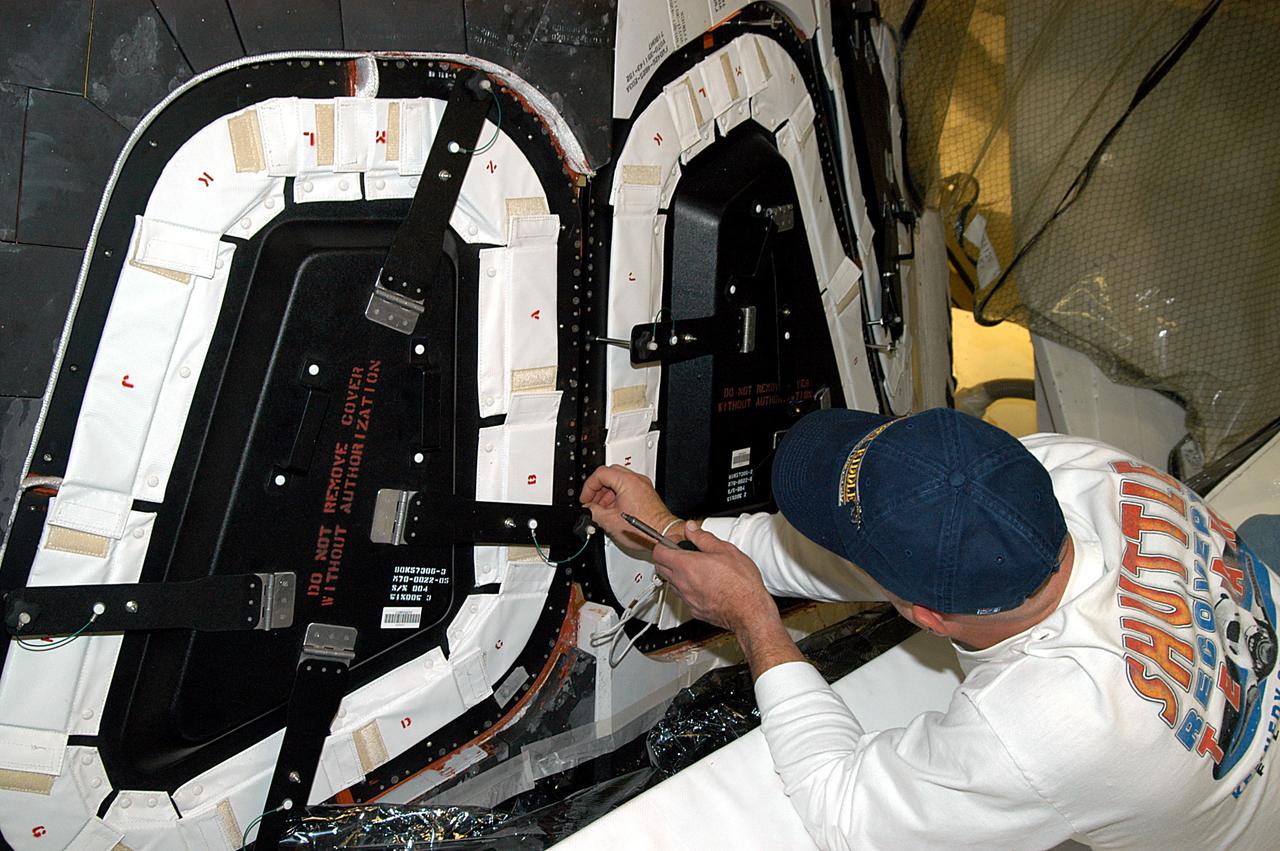
KENNEDY SPACE CENTER, FLA. -- Les Hanks, with United Space Alliance, prepares a window on Atlantis for removal. The windows are being removed to inspect them for contaminants in the thermal seal. Atlantis has been undergoing routine maintenance in the Orbiter Processing Facility for Return to Flight, on mission STS-114.
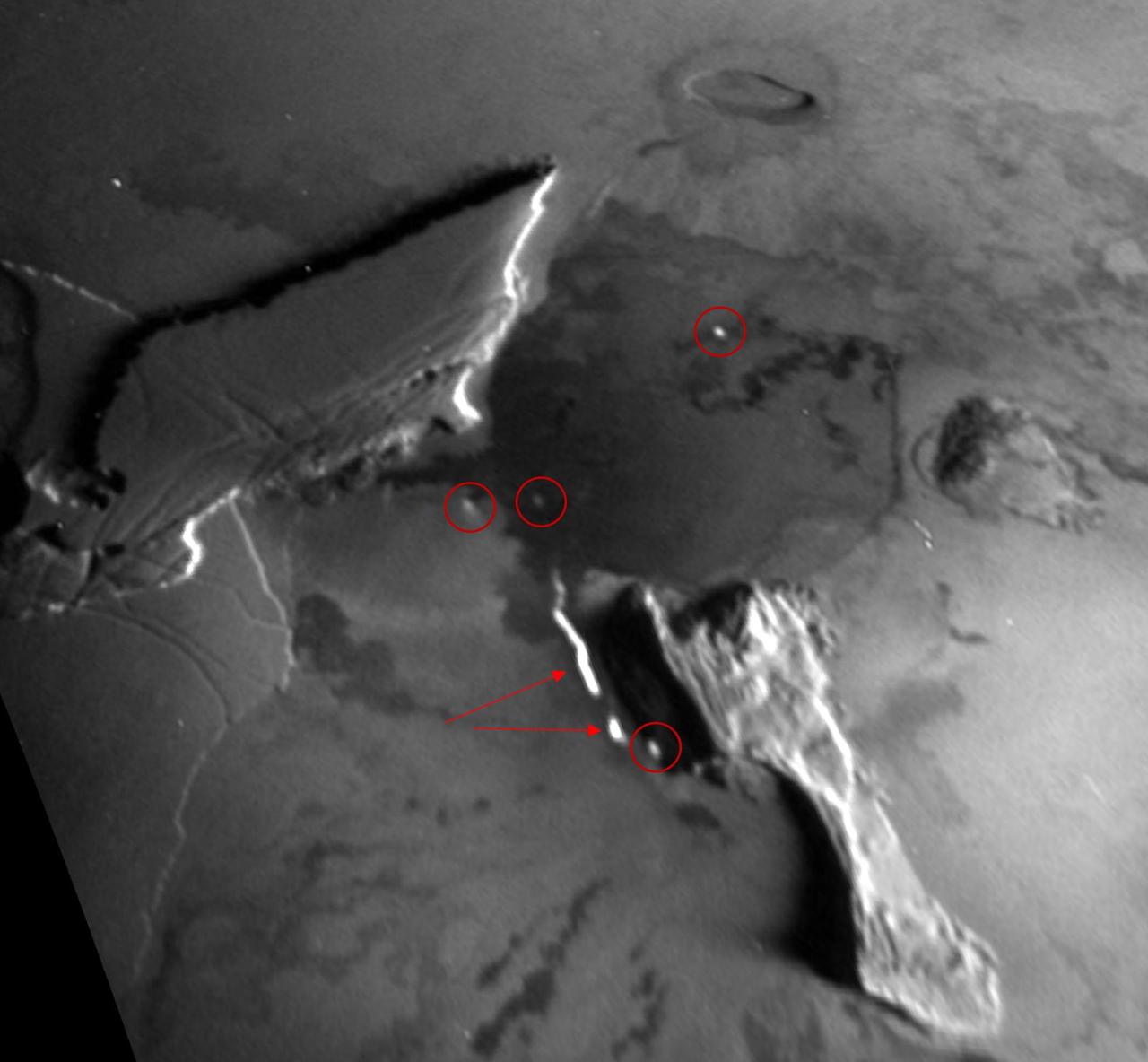
Red circles and arrows point to glowing thermal emission from active lava breakouts observed by the Stellar Reference Unit (SRU) on NASA's Juno spacecraft on Dec. 30, 2023, in the Zal Montes-Patera complex on Io. https://photojournal.jpl.nasa.gov/catalog/PIA26521
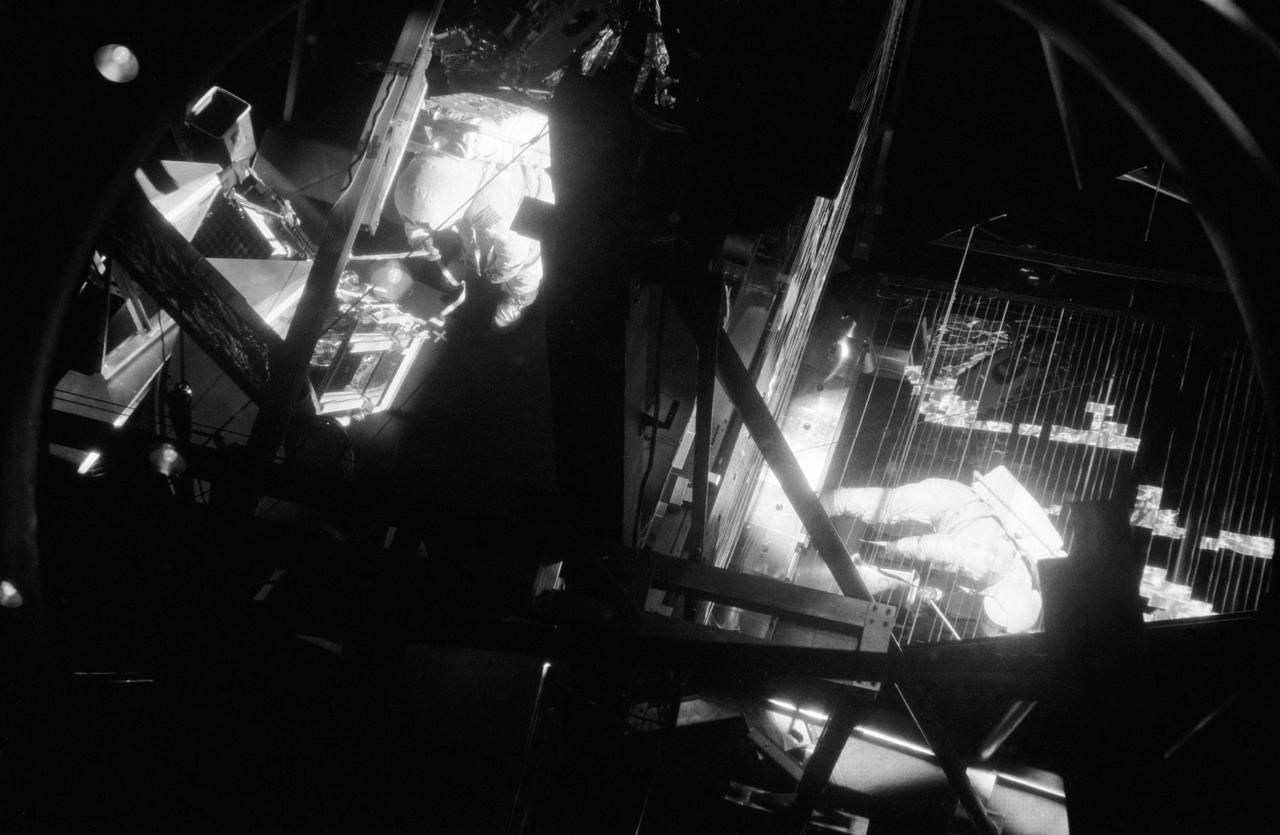
Astronaut Neil A. Armstrong, commander of the Apollo 11 lunar landing mission, is photographed during thermovacuum training in Chamber B of the Space Environment Simulation Laboratory, Building 32, Manned Spacecraft Center. He is wearing an Extravehicular Mobility Unit. The training simulated lunar surface vacuum and thermal conditions during astronaut operations outside the Lunar Module on the moon's surface. The mirror was used to reflect solar light.
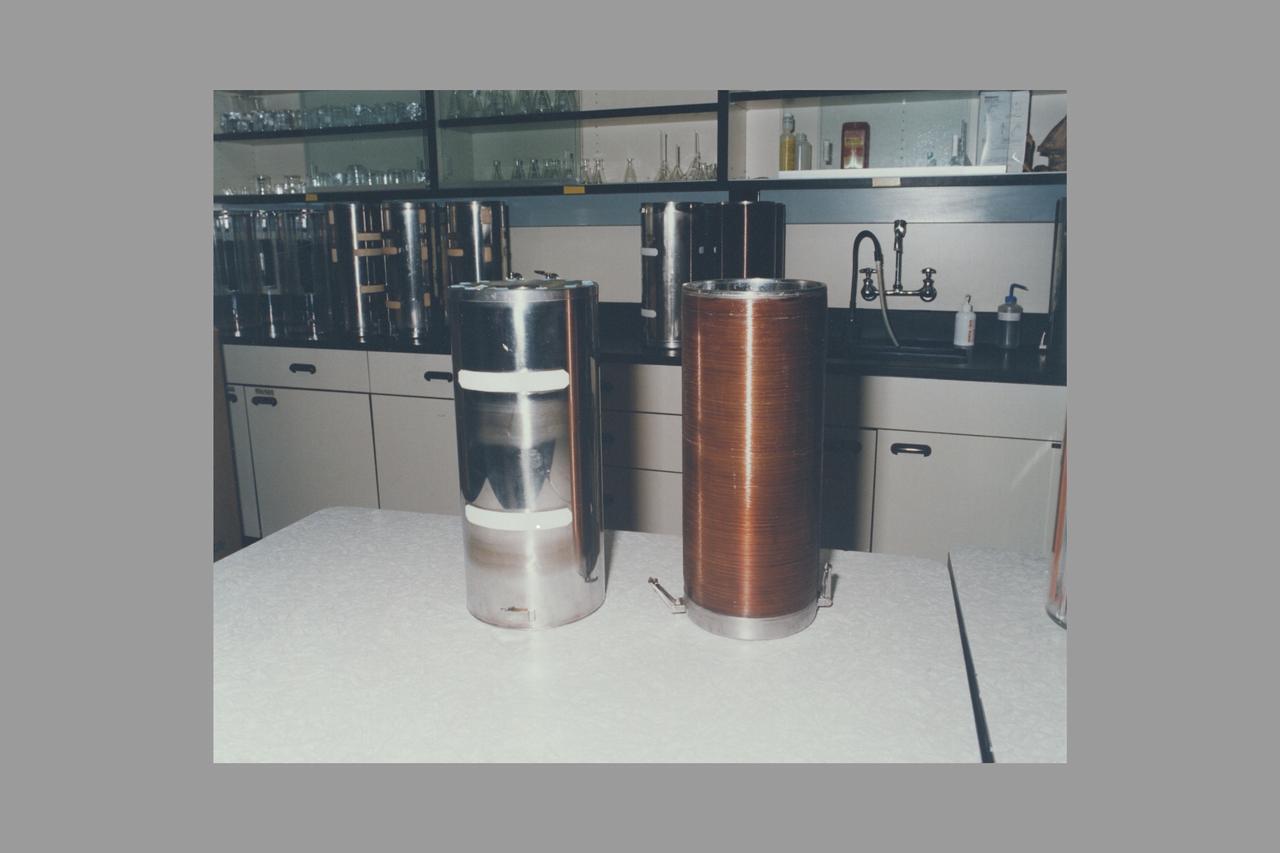
European Space Agency's Biorack passive thermal conditioning unit (PTCU)
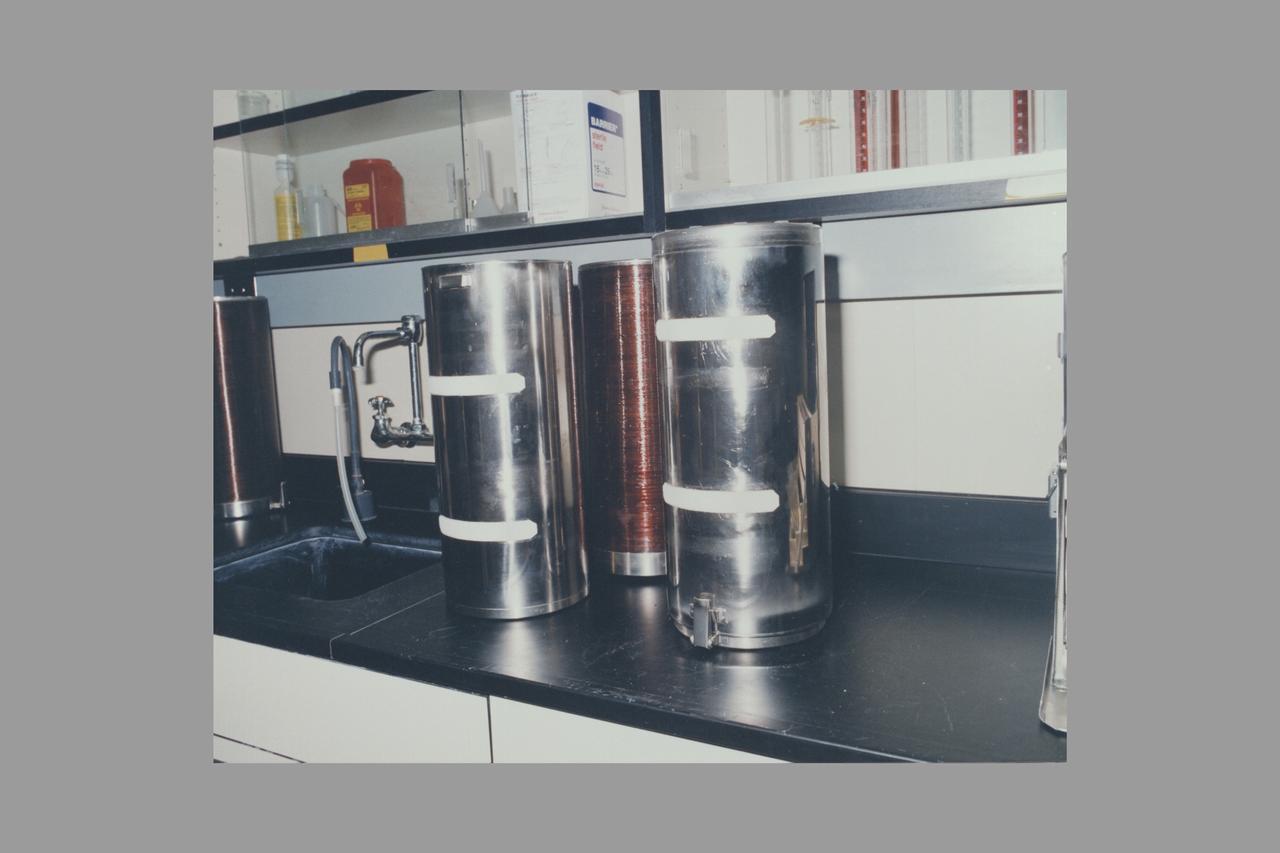
European Space Agency's Biorack passive thermal conditioning unit (PTCU)
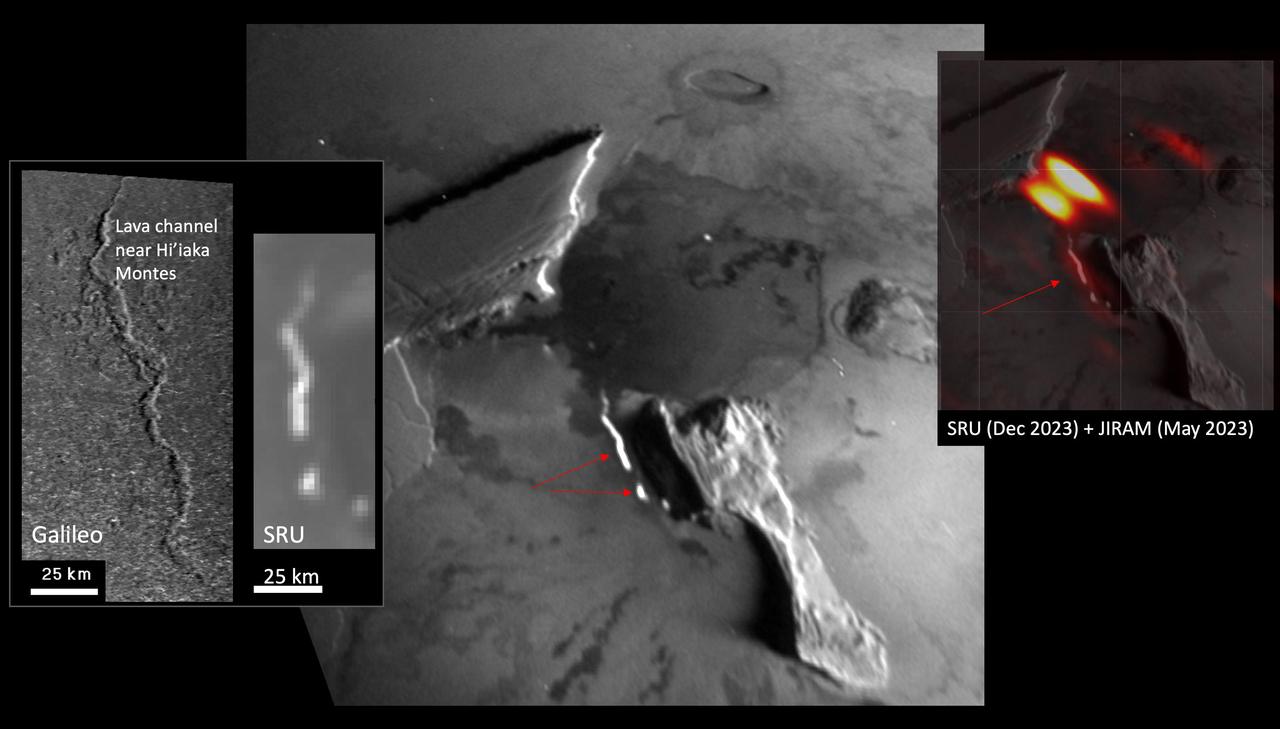
The Stellar Reference Unit (SRU) on NASA's Juno spacecraft made this first-of-a-kind observation on Dec. 30, 2023, of an elongated, 40-mile-long (65-kilometer-long), curvy thermal emission feature and a shorter linear emission segment to the west of South Zal Mons. The resolution is 0.6 miles (1 kilometer) per pixel. The feature is suspected to be an active lava channel, given the similarity of its morphology to that of the two previously identified lava channels on Io. The shape of the Ionian lava channel near Hi'iaka Montes is compared to the SRU emission feature in the left panel. Juno's infrared camera, JIRAM, observed a long thermal emission "hot spot" at lower resolution (19 miles, or 30 kilometers, per pixel) in May 2023 at the same location (JIRAM infrared data is overlaid on the SRU image in the right panel, illustrating the overlap). https://photojournal.jpl.nasa.gov/catalog/PIA26523
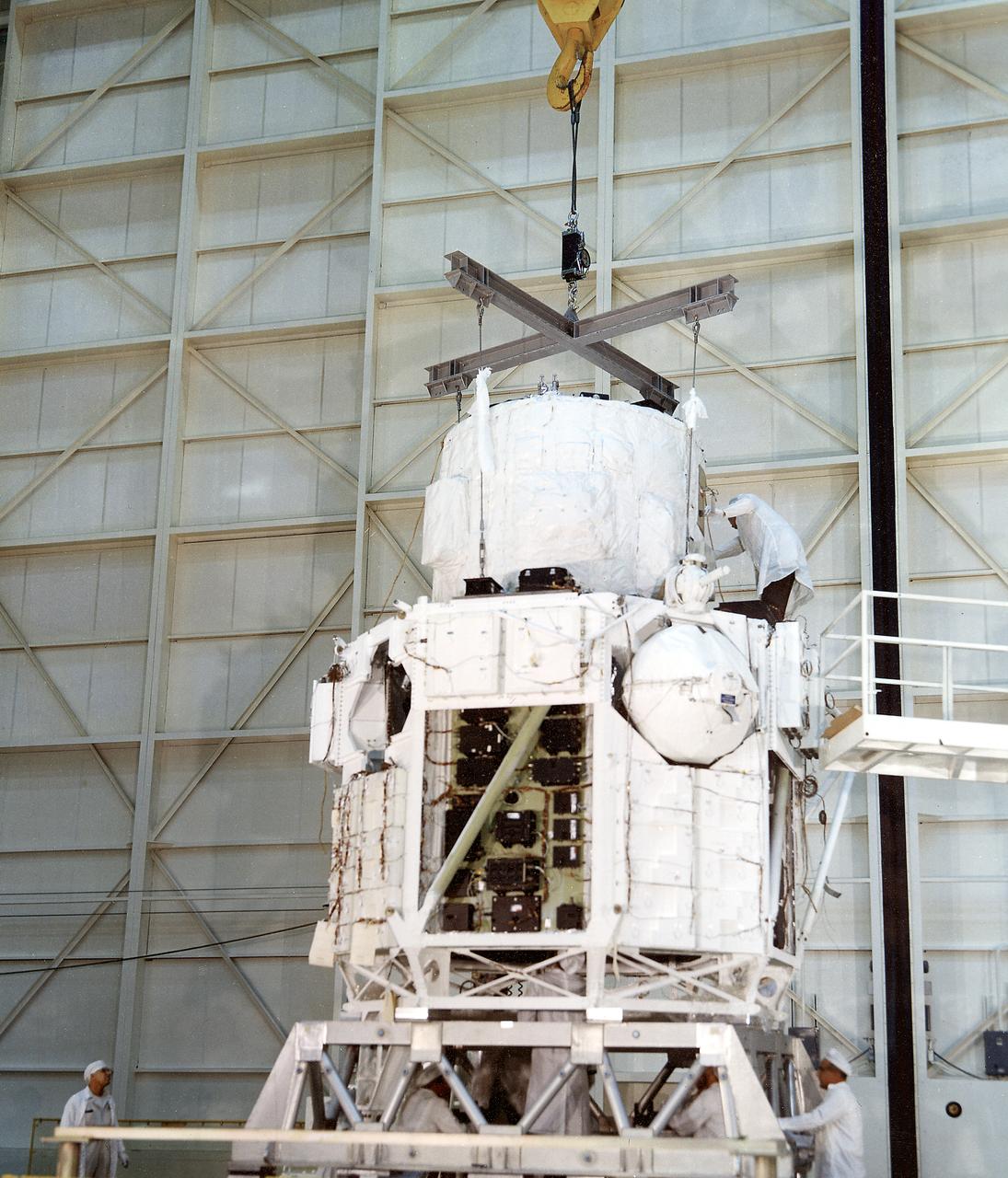
The Apollo Telescope Mount (ATM) was designed and developed by the Marshall Space Flight Center and served as the primary scientific instrument unit aboard Skylab (1973-1979). The ATM consisted of eight scientific instruments as well as a number of smaller experiments. In this image, the ATM canister, housing the solar instruments, is mated to the thermal rack that provided thermal stability.
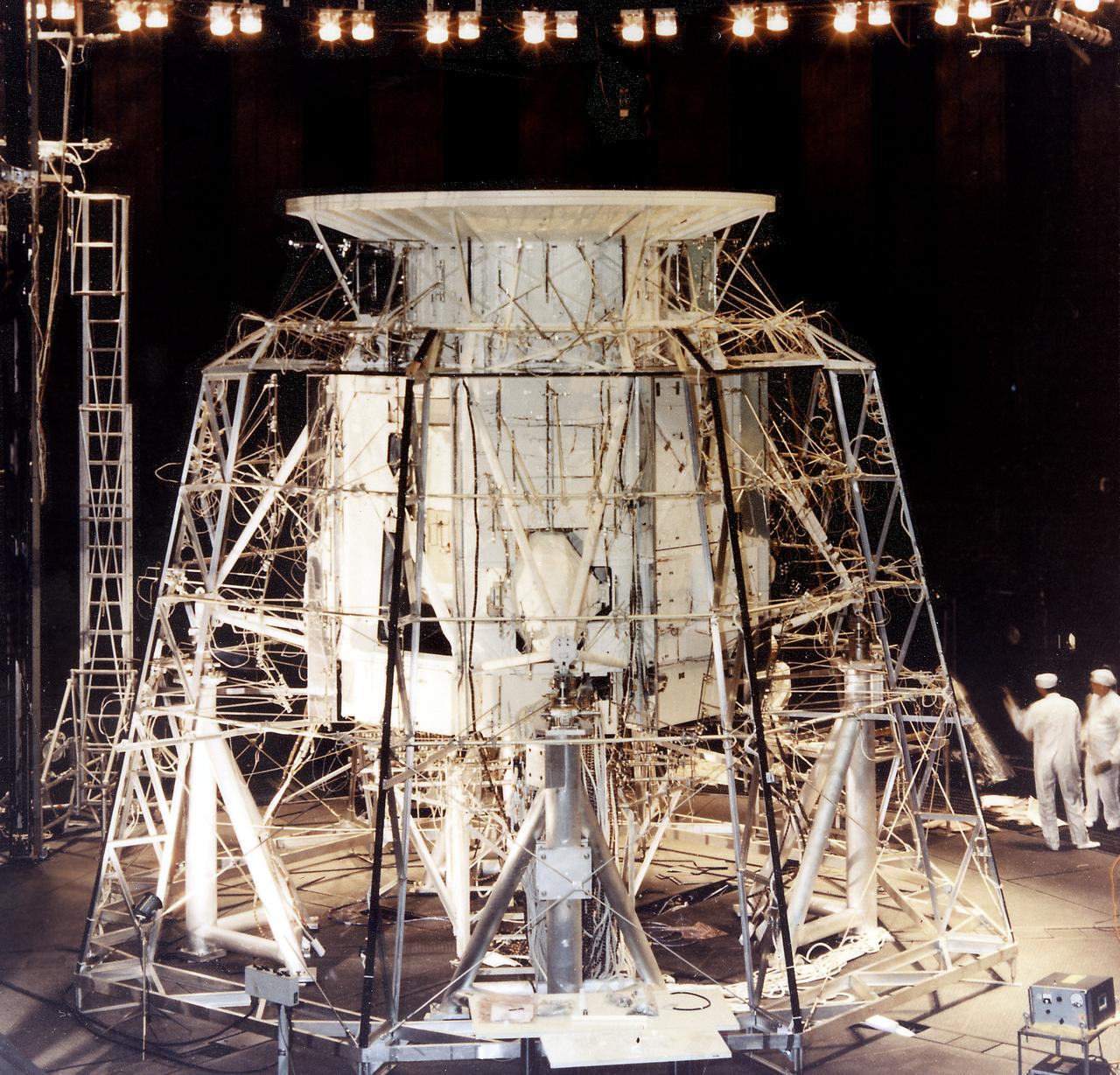
The Apollo Telescope Mount (ATM), designed and developed by the Marshall Space Flight Center, was one of four major components comprising the Skylab (1973-1979). The ATM housed the first manned scientific telescope in space. This photograph is of the ATM thermal systems unit undergoing testing in the Space Environment Simulation Laboratory of the Manned Spacecraft Center (MSC). The ATM thermal systems unit was used to control the temperatures of space instrument's subsystems during a mission. The MSC was renamed the Johnson Space Center (JSC) in early 1973.
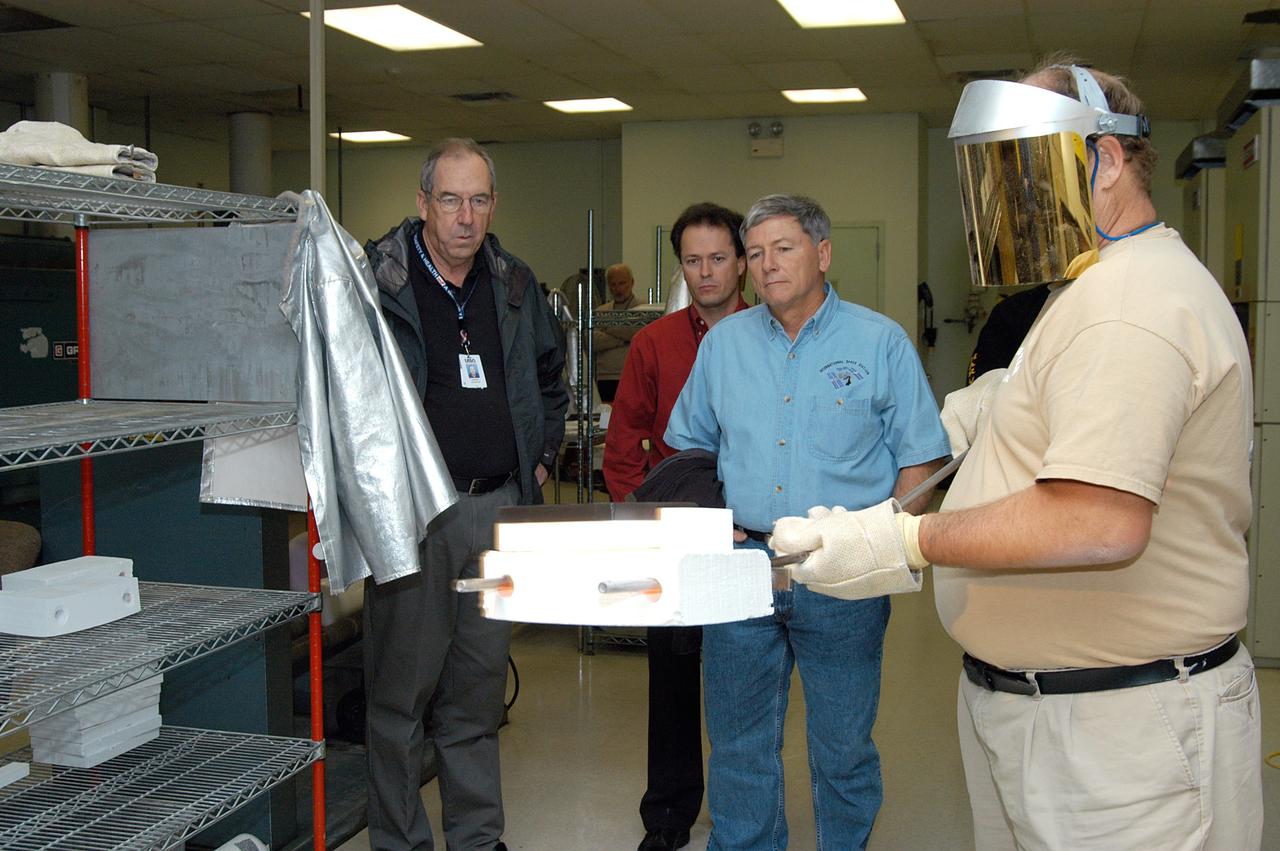
KENNEDY SPACE CENTER, FLA. -- United Space Alliance (USA) Vice President and Space Shuttle Program Manager Howard DeCastro (left) and NASA Deputy Associate Administrator for Space Station and Shuttle Programs Michael Kostelnik (third from left) watch as a USA technician (right) creates a tile for use in the Shuttle's Thermal Protection System (TPS). NASA and USA Space Shuttle program management are participating in a leadership workday. The day is intended to provide management with an in-depth, hands-on look at Shuttle processing activities at KSC.
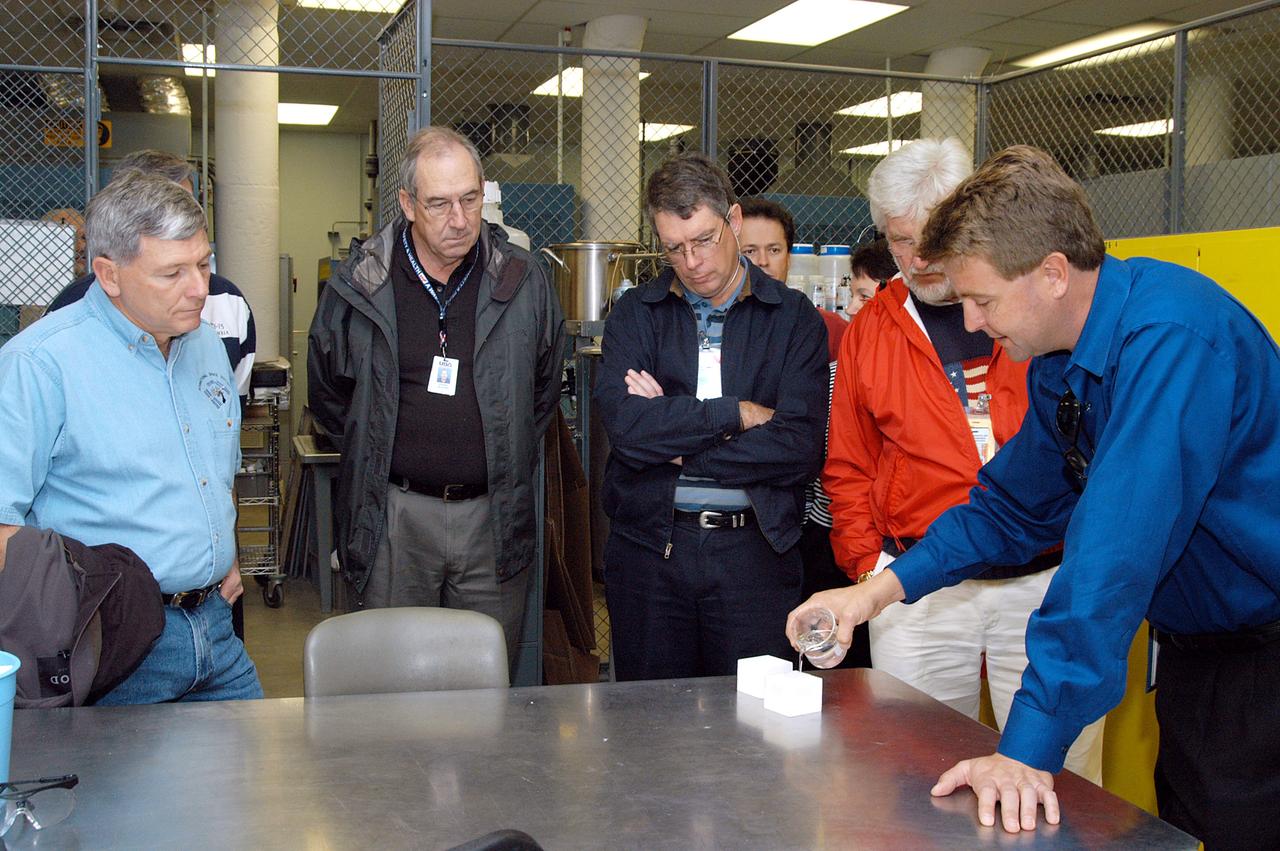
KENNEDY SPACE CENTER, FLA. -- From left, NASA Deputy Associate Administrator for Space Station and Shuttle Programs Michael Kostelnik and United Space Alliance (USA) Vice President and Space Shuttle Program Manager Howard DeCastro are briefed on the properties of the tile used in the Shuttle's Thermal Protection System (TPS) by USA Manager of the TPS Facility Martin Wilson (right). NASA and USA Space Shuttle program management are participating in a leadership workday. The day is intended to provide management with an in-depth, hands-on look at Shuttle processing activities at KSC.
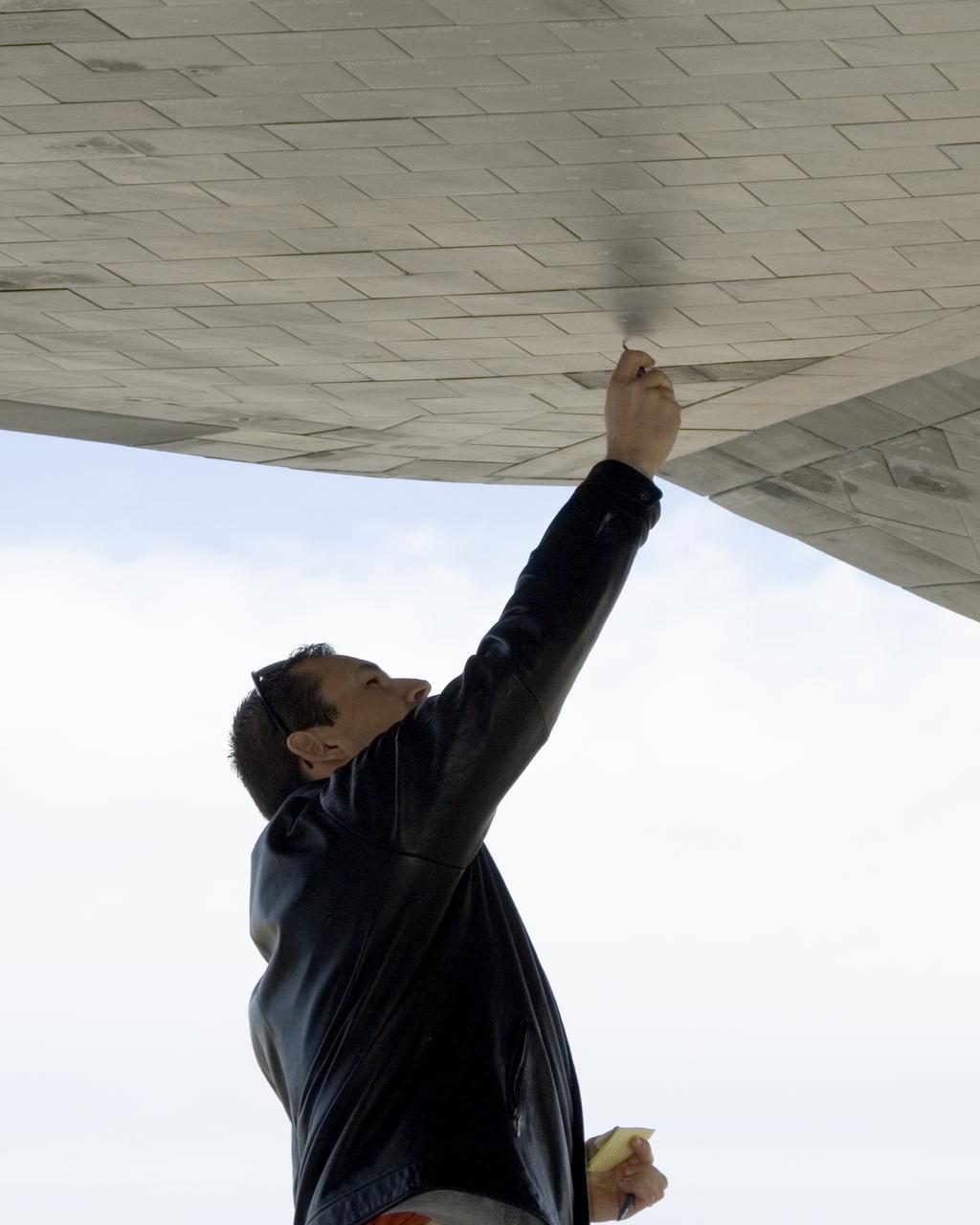
A United Space Alliance technician carefully checks the thermal tiles on the underside of Space Shuttle Endeavour for nicks and dings following its landing at Edwards Air Force Base to conclude mission STS-126.
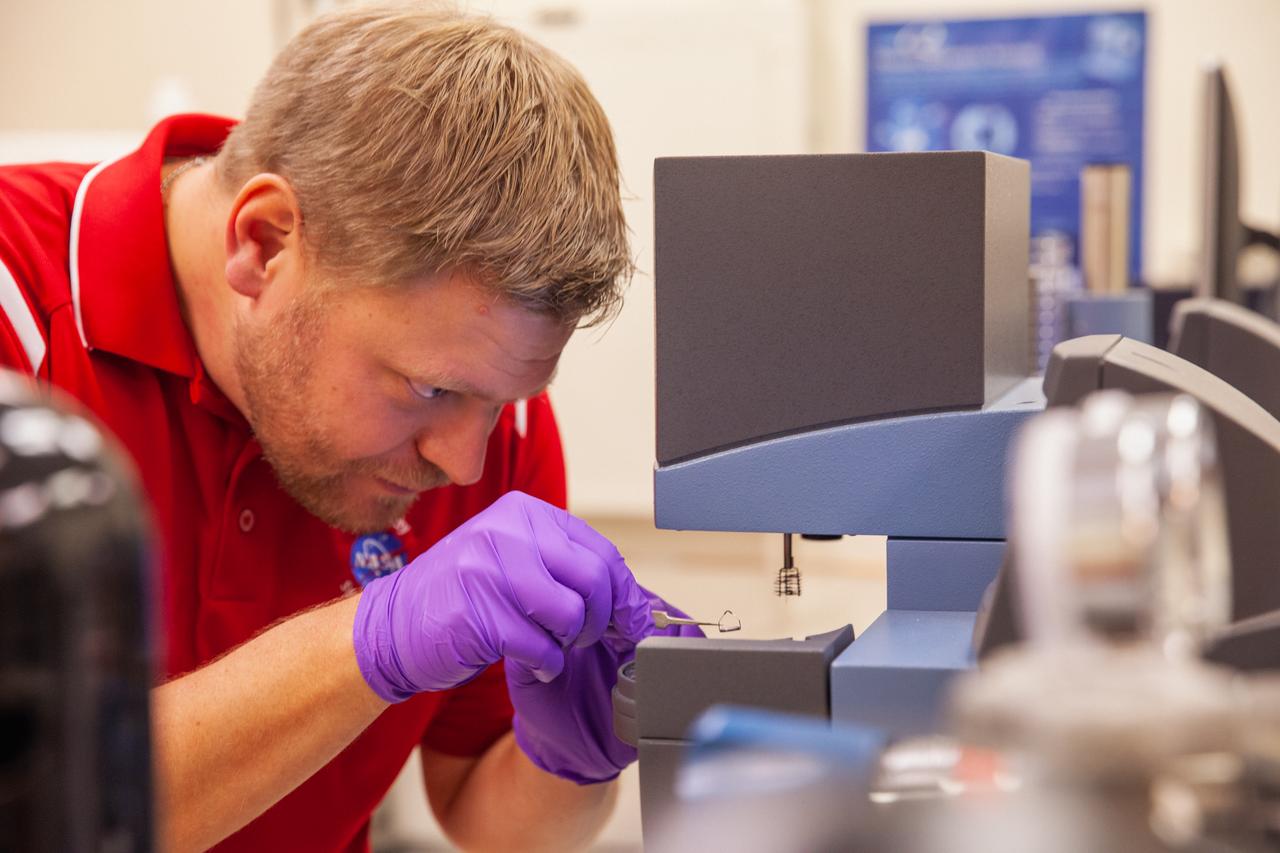
Jerry Buhrow, an engineer in the Materials Analysis Lab, places a sample on a thermal testing unit inside a lab at NASA Kennedy Space Center’s Neil Armstrong Operations and Checkout Building on Oct. 6, 2020.
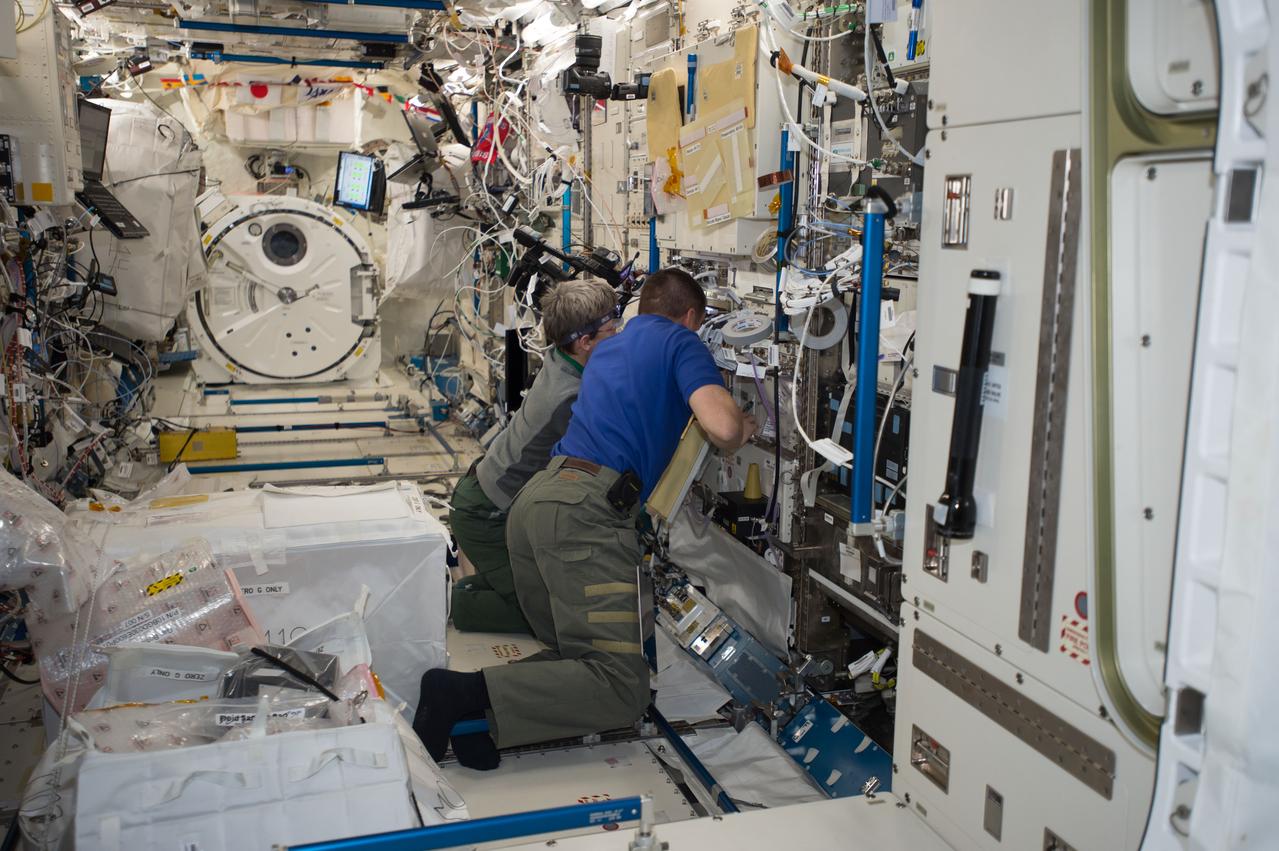
iss051e050849 (5/26/2017) --- NASA astronaut Peggy Whitson and Jack Fischer work to install a Gas Supply Hose Assembly and Gas Bottle Unit Air in the Electrostatic Levitation Furnace (ELF) in the Kibo Japanese Experiment Pressurized Module (JPM) aboard the International Space Station (ISS) in supprt of the Passive Thermal Flight Experiment.The Advanced Passive Thermal eXperiment (APTx) tests three advanced thermal management technologies. It demonstrates the in-space performance of each, an important step toward improving these technologies for use on future space exploration missions.
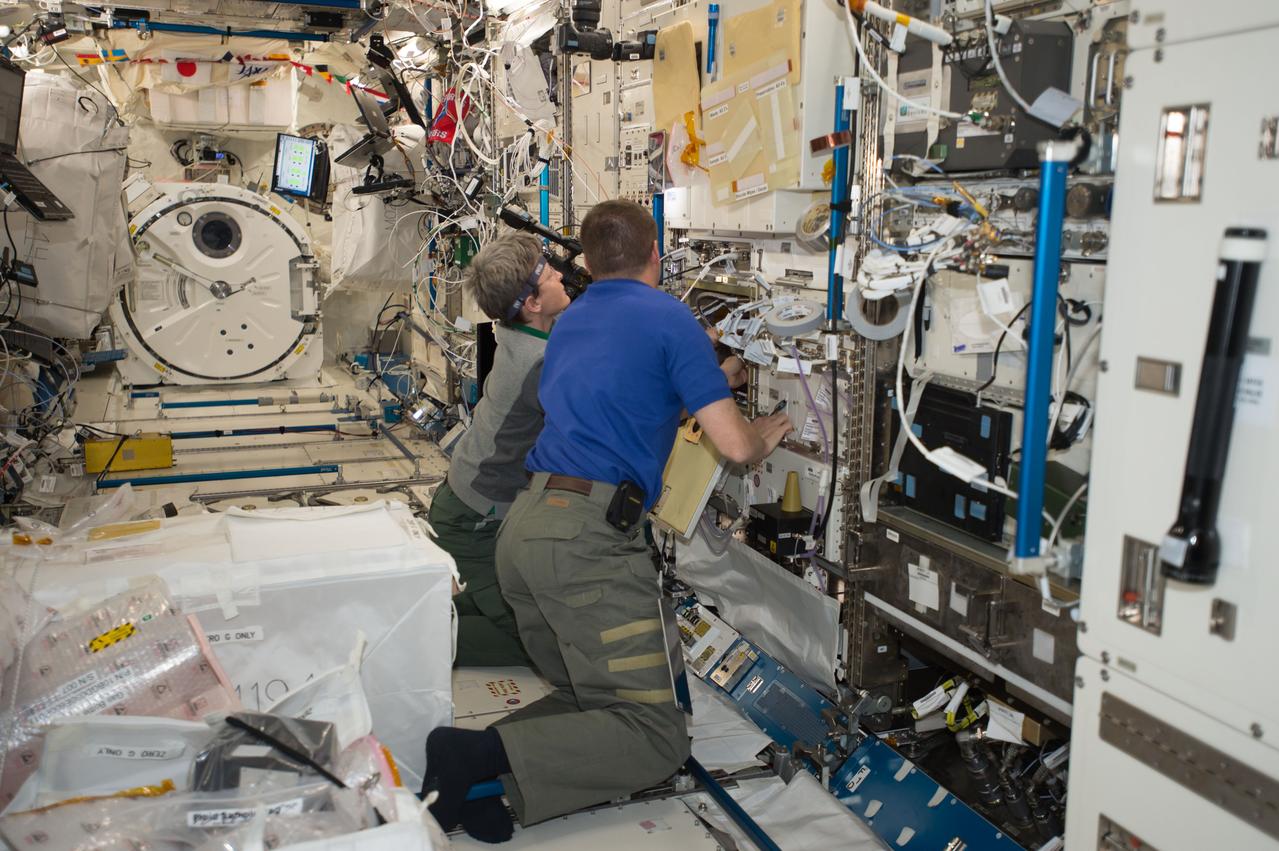
iss051e050850 (5/26/2017) --- NASA astronaut Peggy Whitson and Jack Fischer work to install a Gas Supply Hose Assembly and Gas Bottle Unit Air in the Electrostatic Levitation Furnace (ELF) in the Kibo Japanese Experiment Pressurized Module (JPM) aboard the International Space Station (ISS) in supprt of the Passive Thermal Flight Experiment.The Advanced Passive Thermal eXperiment (APTx) tests three advanced thermal management technologies. It demonstrates the in-space performance of each, an important step toward improving these technologies for use on future space exploration missions.
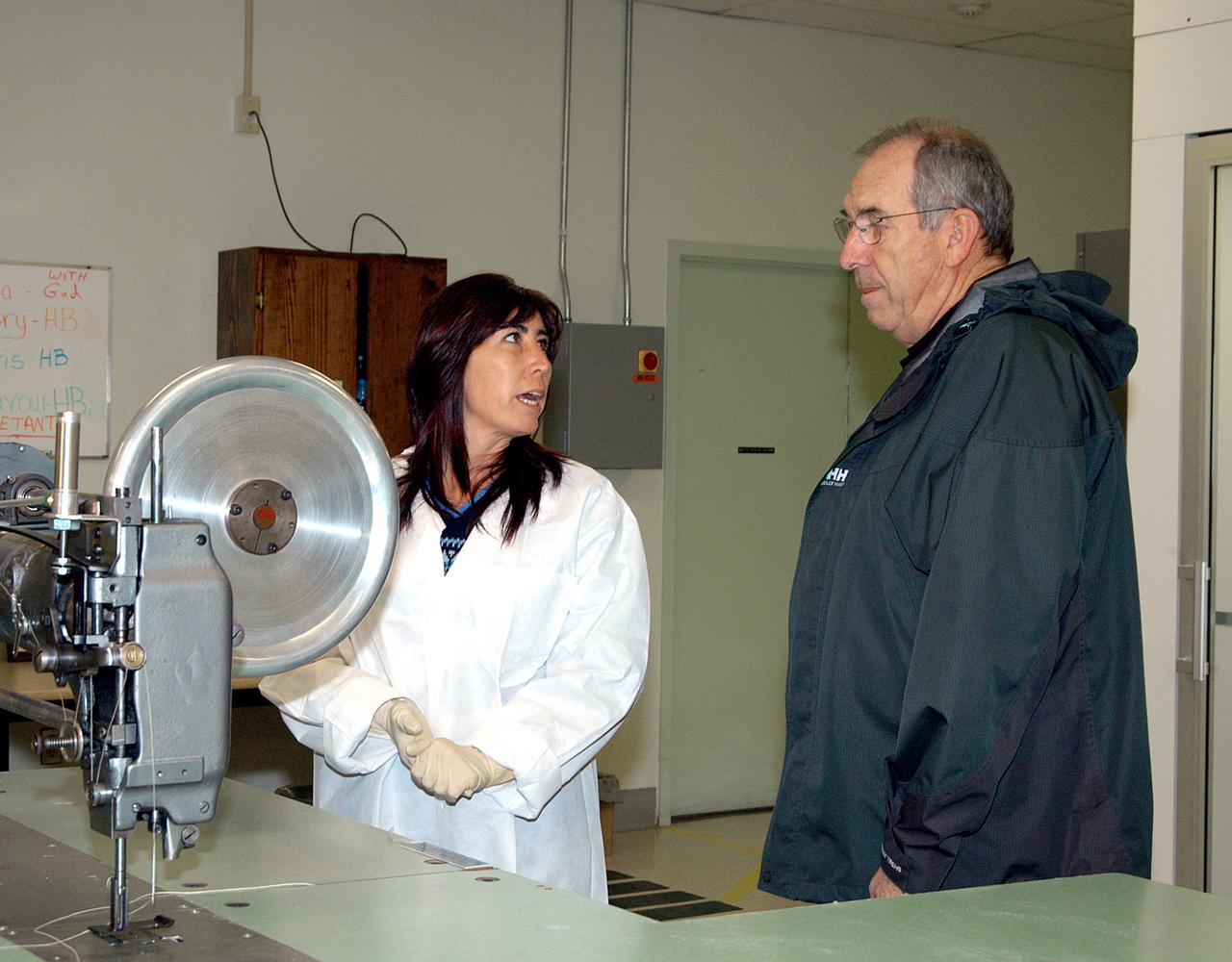
KENNEDY SPACE CENTER, FLA. -- A United Space Alliance (USA) technician (left) discusses the construction of a thermal blanket used in the Shuttle's thermal protection system with USA Vice President and Space Shuttle Program Manager Howard DeCastro (right). NASA and USA Space Shuttle program management are participating in a leadership workday. The day is intended to provide management with an in-depth, hands-on look at Shuttle processing activities at KSC.
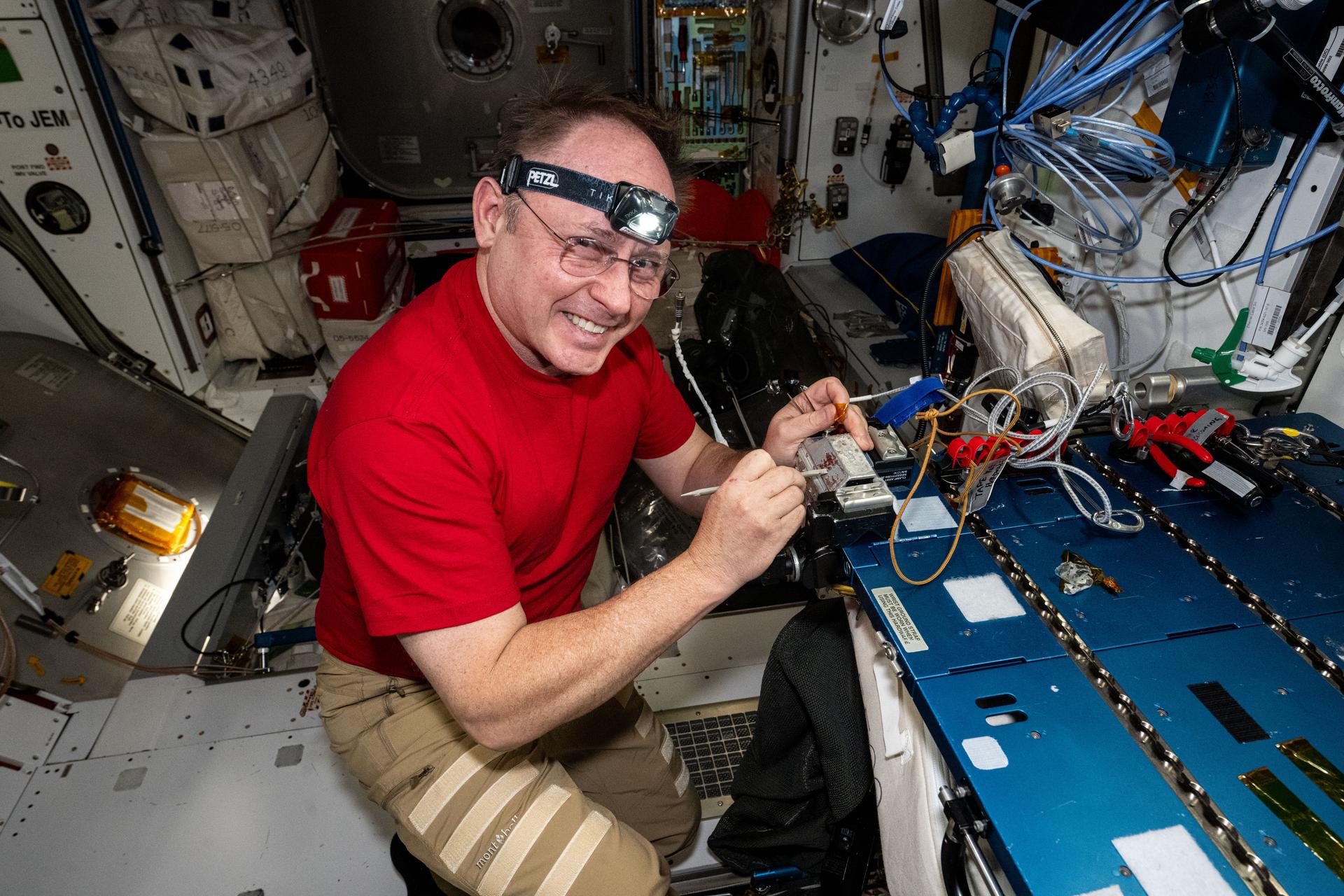
iss073e0510683 (Aug. 18, 2025) --- NASA astronaut and Expedition 73 Flight Engineer Mike Fincke replaces thermal tape on a High Definition Extravehicular Mobility Unit Camera, or HECA. The spacesuit helmet-mounted camera streams real-time, high-definition video of spacewalk activities to mission controllers on the ground, while the thermal tape shields the HECA from the harsh environment of space.
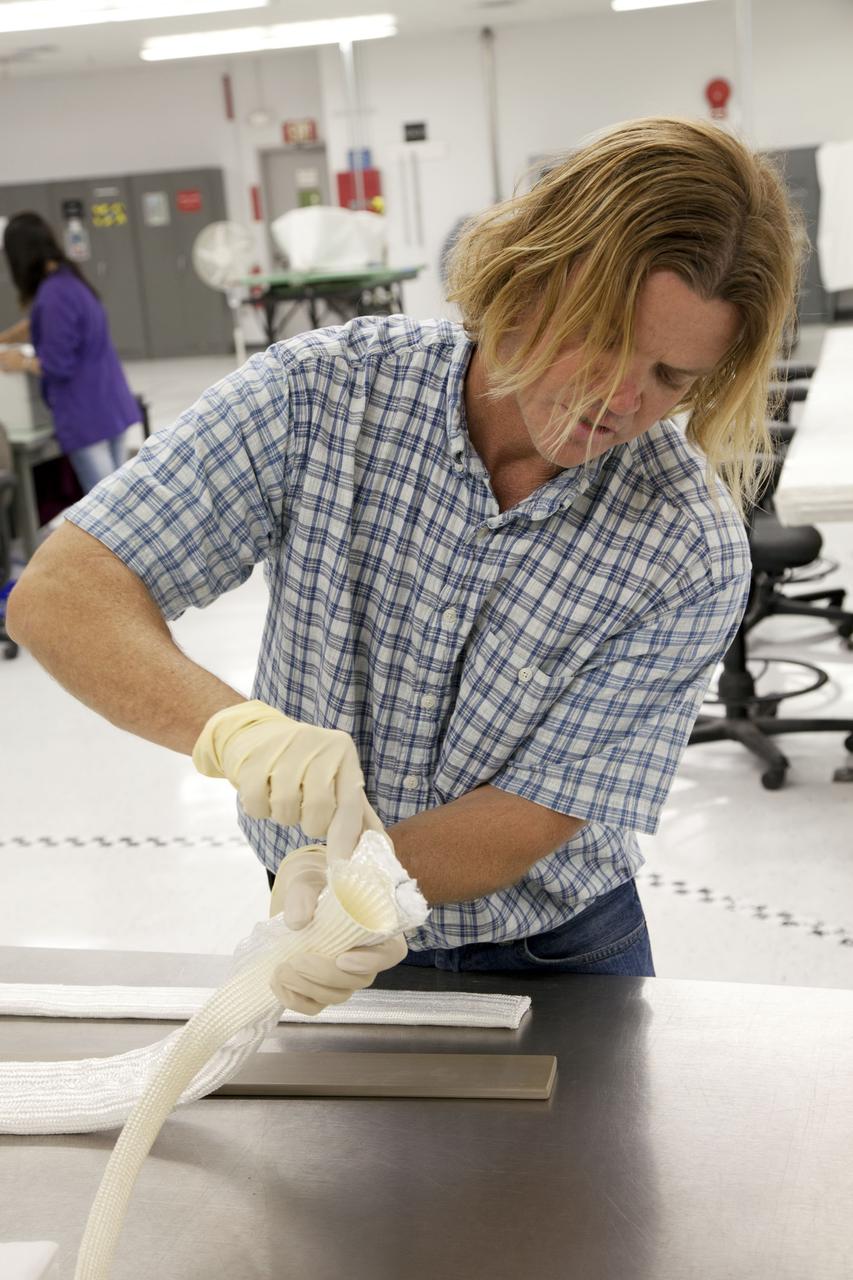
CAPE CANAVERAL, Fla. -- -- Tim Wright, a United Space Alliance engineering manager at NASA's Kennedy Space Center in Florida, explains the properties of the thermal barriers that will be installed to the backshell of the Orion Multi-Purpose Crew Vehicle's Exploration Flight Test EFT-1 capsule. The work to manufacture and inspect the tiles is taking place in Kennedy's Thermal Protection System Facility. EFT-1 will be used during Orion's first test flight in space. For more information, visit www.nasa.gov/orion. Photo credit: Frankie Martin
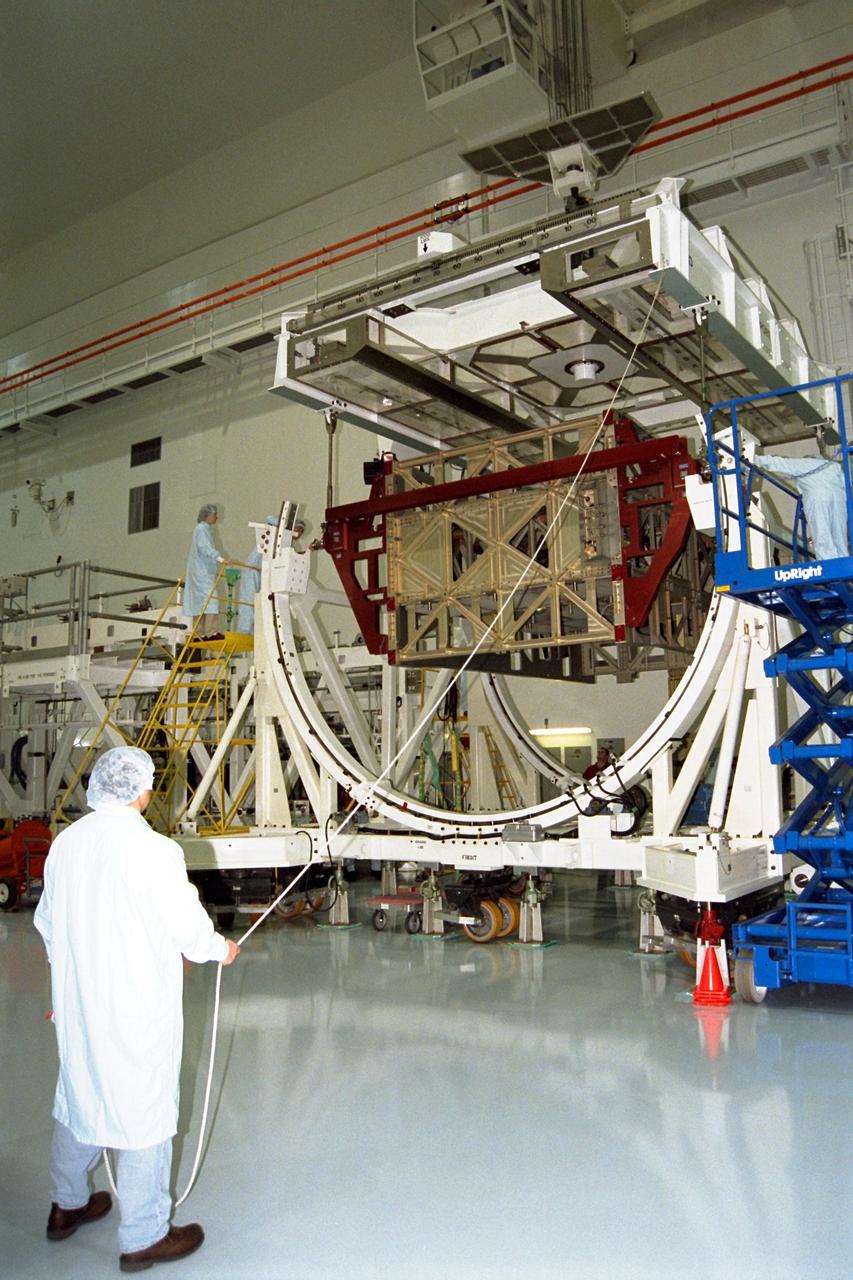
The Photovoltaic Module 1 Integrated Equipment Assembly (IEA) is lowered into its workstand at Kennedy Space Center’s Space Station Processing Facility (SSPF), where it will be processed for flight on STS-97, scheduled for launch in April 1999. The IEA is one of four integral units designed to generate, distribute, and store power for the International Space Station. It will carry solar arrays, power storage batteries, power control units, and a thermal control system. The 16-foot-long, 16,850-pound unit is now undergoing preflight preparations in the SSPF
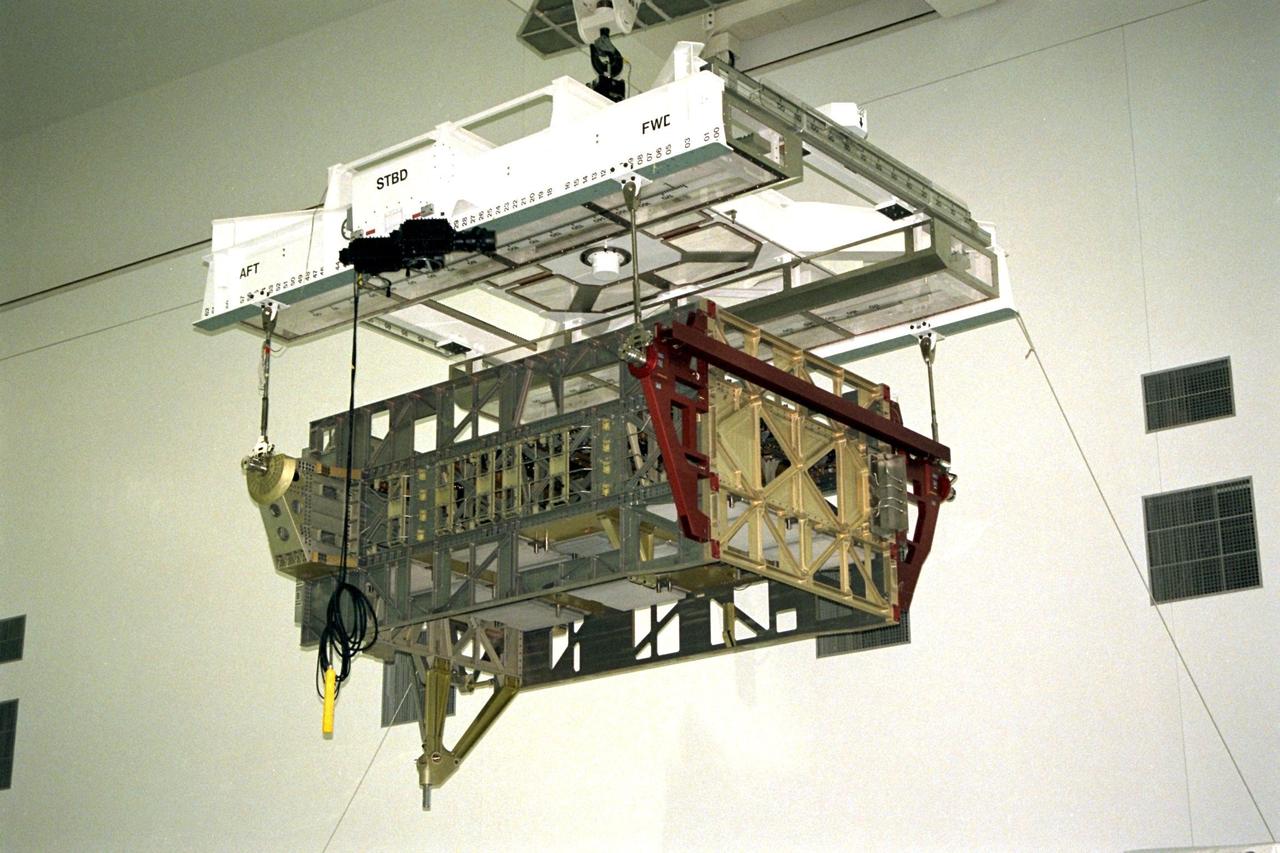
The Photovoltaic Module 1 Integrated Equipment Assembly (IEA) is moved through Kennedy Space Center’s Space Station Processing Facility (SSPF) toward the workstand where it will be processed for flight on STS-97, scheduled for launch in April 1999. The IEA is one of four integral units designed to generate, distribute, and store power for the International Space Station. It will carry solar arrays, power storage batteries, power control units, and a thermal control system. The 16-foot-long, 16,850-pound unit is now undergoing preflight preparations in the SSPF
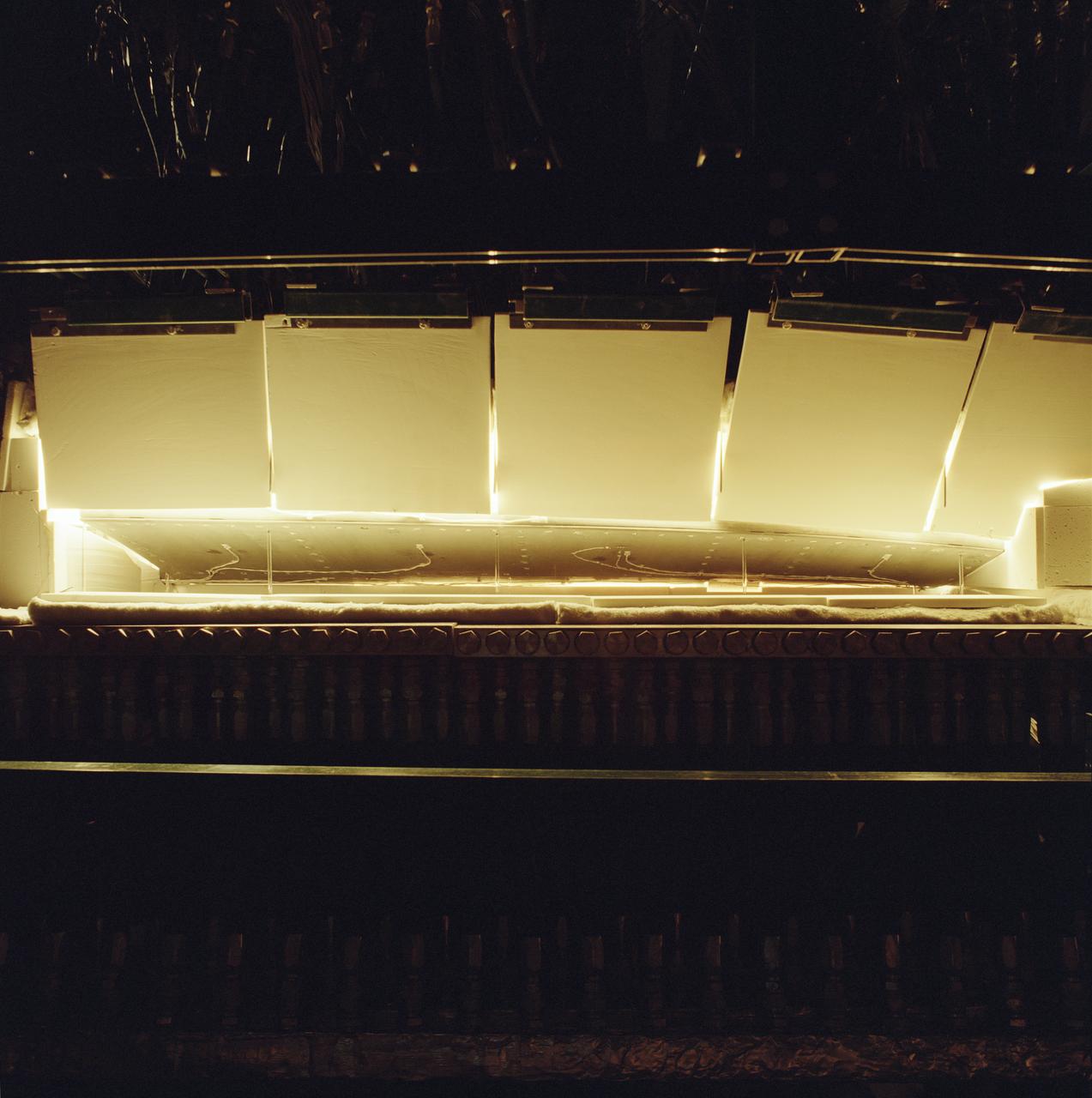
The X-37 advanced technology demonstrator flaperon unit was one of the first ever thermal and mechanical qualification tests of a carbon-carbon control surface designed for space flight. The test also featured extensive use of high-temperature fiber optic strain sensors. Peak temperatures reached 2,500 degrees Fahrenheit.
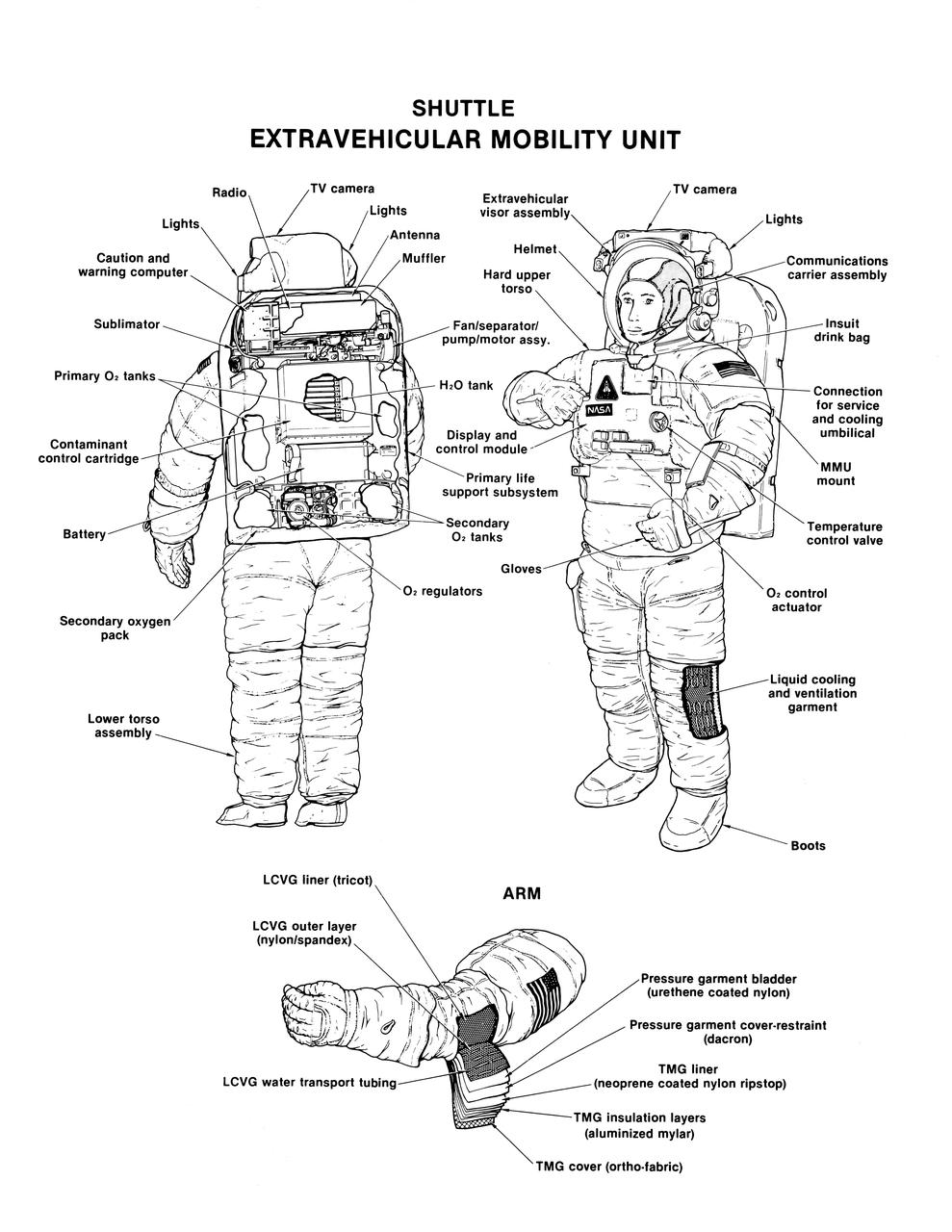
Labeled cutaway line drawing of the Shuttle extravehicular mobility unit (EMU) identifies its various components and equipment. The portable life support system (PLSS) and protective layers of fabric (thermal micrometeoroid garment (TMG)) incorporated in this extravehicular activity (EVA) space suit are shown.
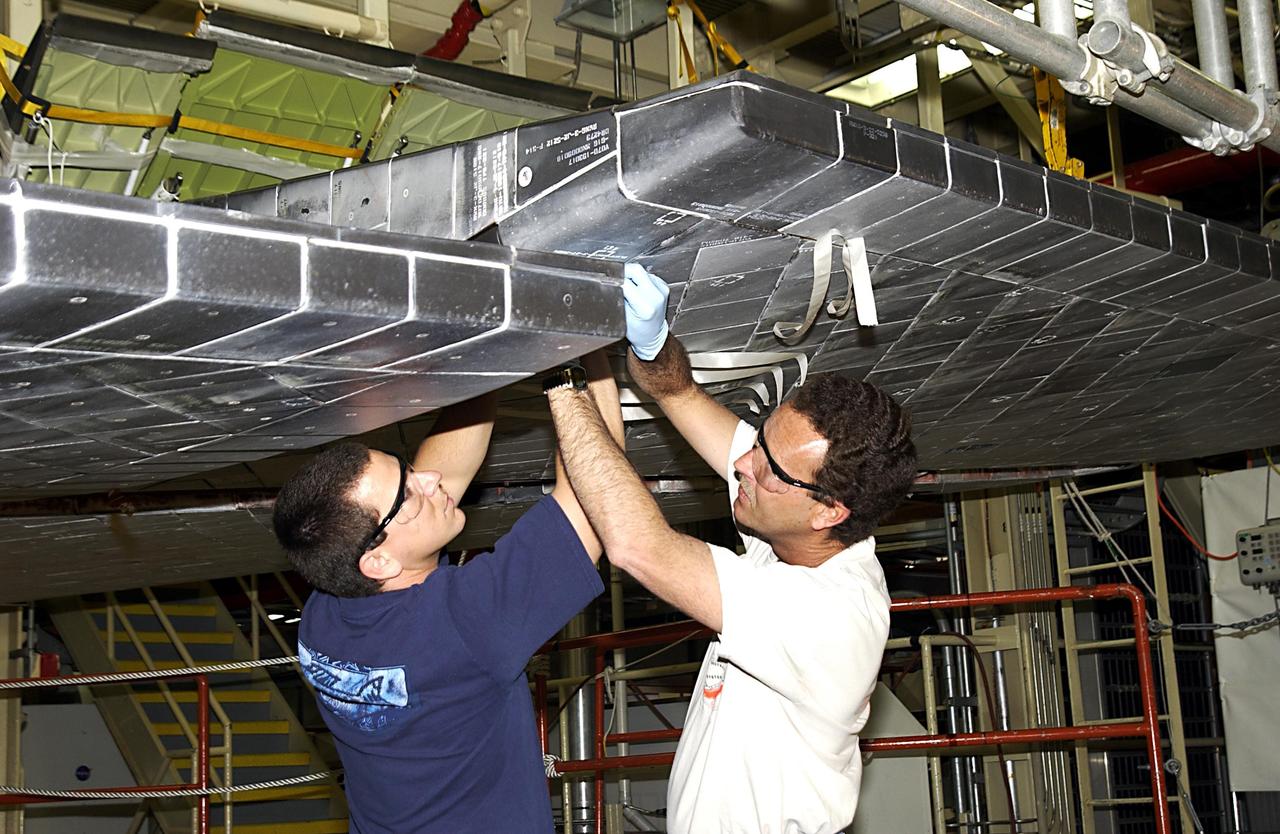
KENNEDY SPACE CENTER, FLA. -- United Space Alliance (USA) technicians install thermal protection system tiles on Space Shuttle Discovery. Discovery is undergoing its Orbiter Major Modification Period, a regularly scheduled structural inspection and modification downtime, which began in September 2002. .
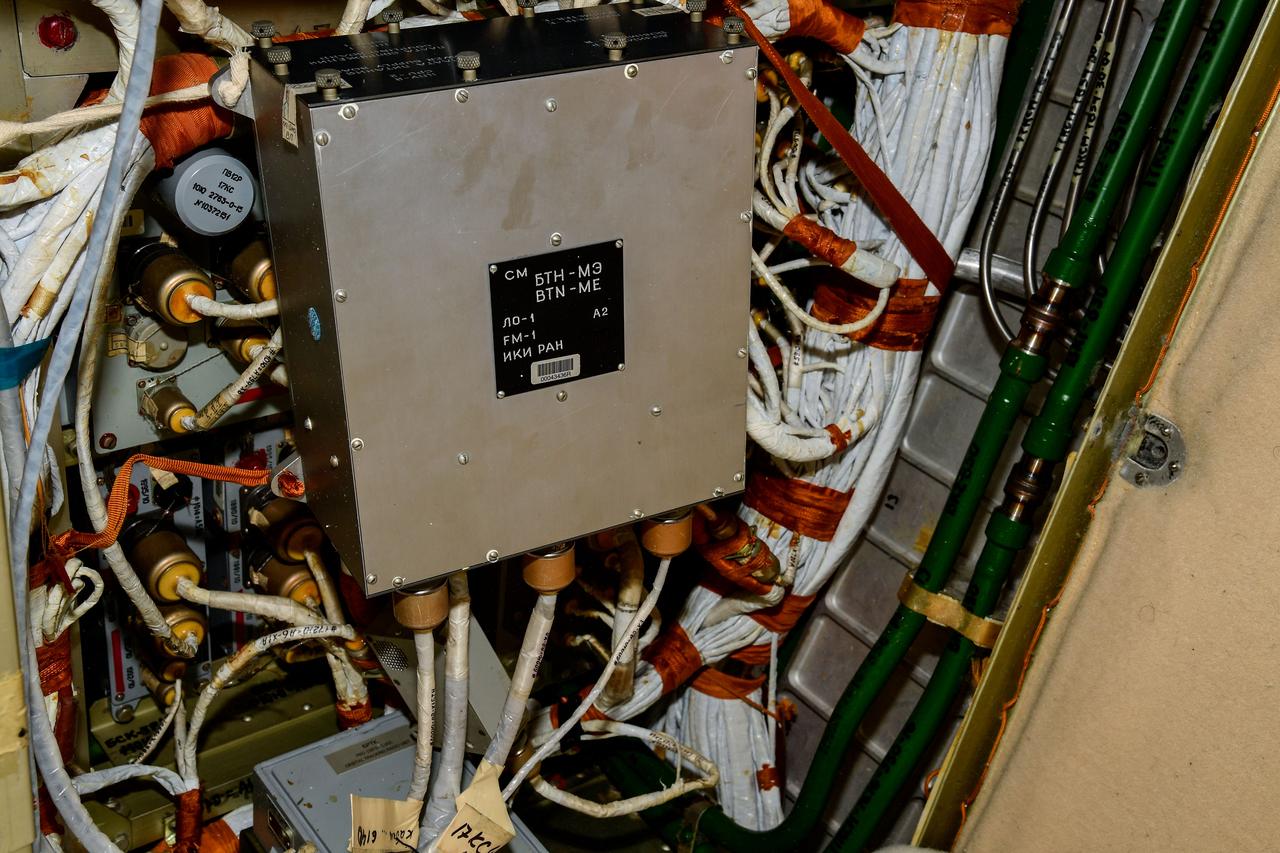
iss067e190005 (7/20/2023) --- A view of BTN-ME Unit in the Zvezda Service Module (SM) aboard the International space Station (ISS). The Study of the Fluxes of Fast and Thermal Neutrons, focuses on the spatial and temporal distribution of neutron fluxes and spectra in near-Earth space, including during solar flares.
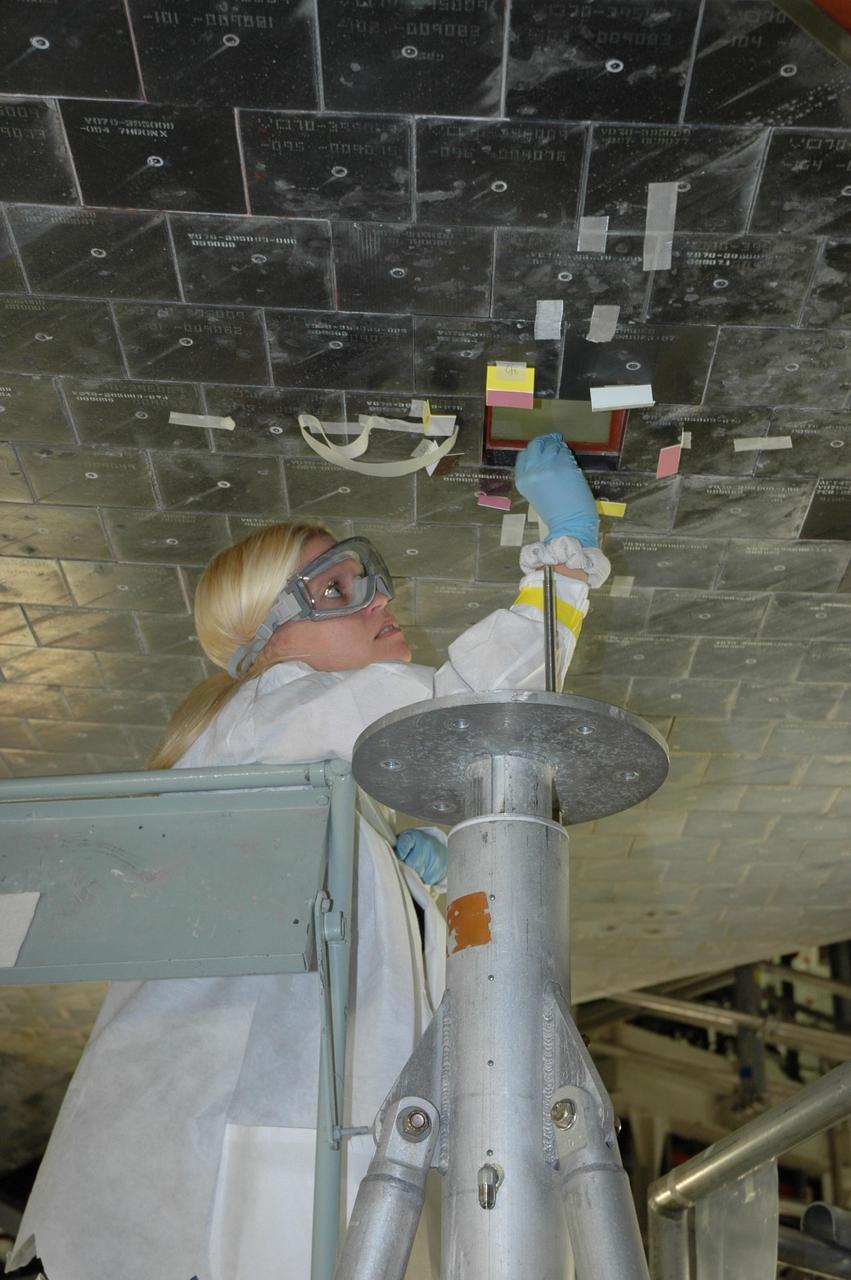
KENNEDY SPACE CENTER, FLA. -- In the Orbiter Processing Facility, a United Space Alliance technician prepares the surface of Atlantis for installation of a thermal protection system tile. Space shuttle Atlantis is targeted for launch on mission STS-122 on Dec. 6. Photo credit: NASA/Jack Pfaller
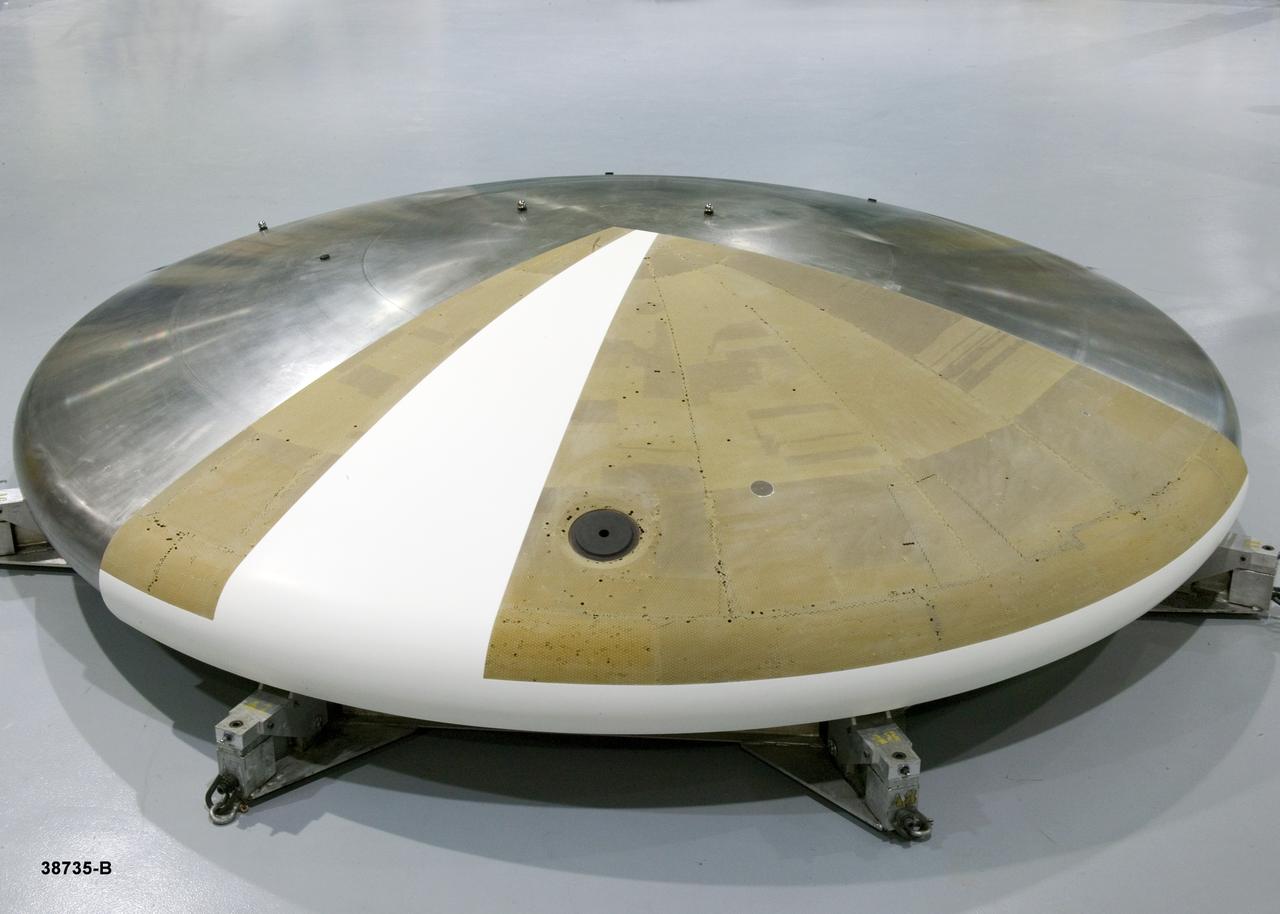
Pictured is the first Avcoat manufacturing demonstration unit for the Orion crew exploration vehicle. Approimately 30 percent of the full five-meter heat shield shows Avcoat thermal protection materail attached (at various stages of completion) to a surrogate Orion heat shield carrier structure. Work being done at Textron.
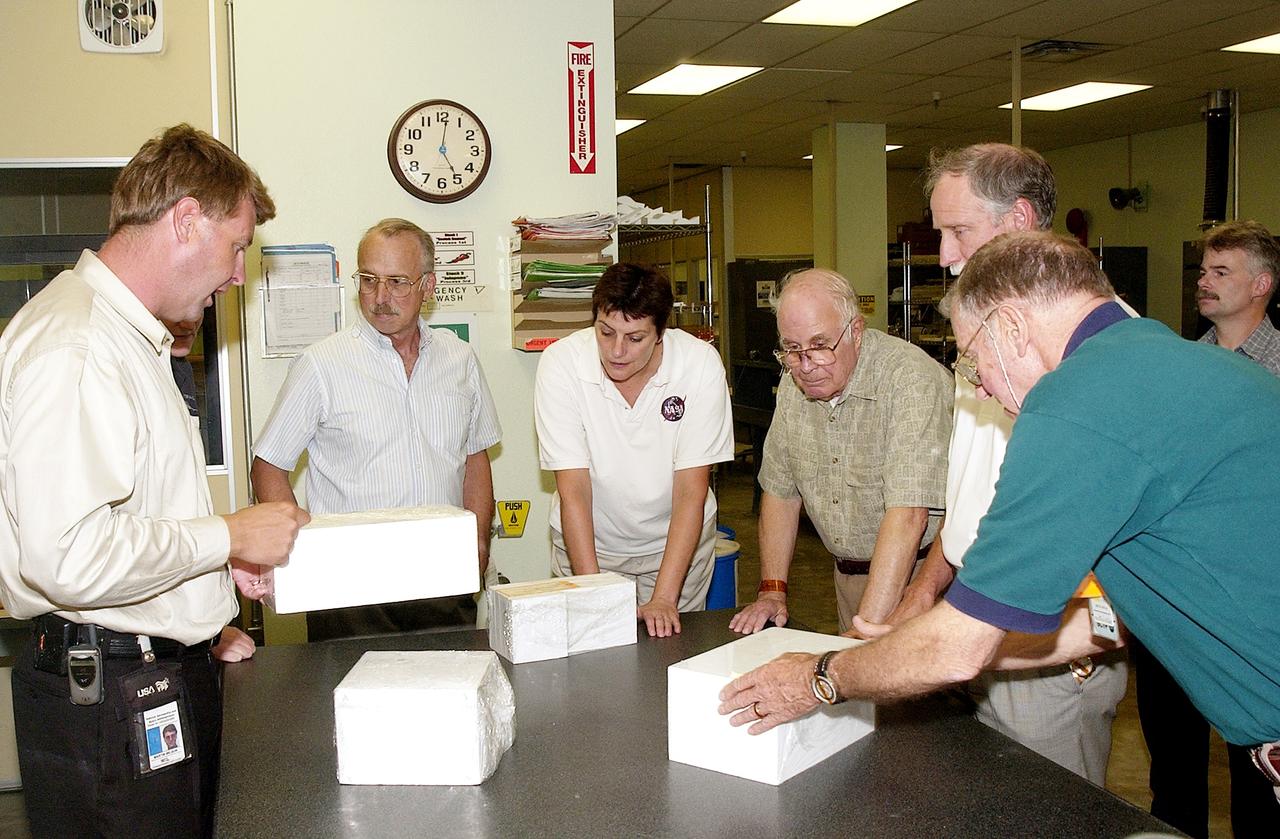
KENNEDY SPACE CENTER, FLA. - On a tour of the Tile Shop, members of the Stafford-Covey Return to Flight Task Group (SCTG) learn about PU-tiles, part of an orbiter’s Thermal Protection System. At left is Martin Wilson, with United Space Alliance. Others (left to right) around the table are James Adamson, Dr. Kathryn Clark, William Wegner, Richard Covey and Joe Engle. Covey, former Space Shuttle commander, is co-chair of the SCTG, along with Thomas P. Stafford, Apollo commander. Chartered by NASA Administrator Sean O’Keefe, the task group will perform an independent assessment of NASA’s implementation of the final recommendations by the Columbia Accident Investigation Board.
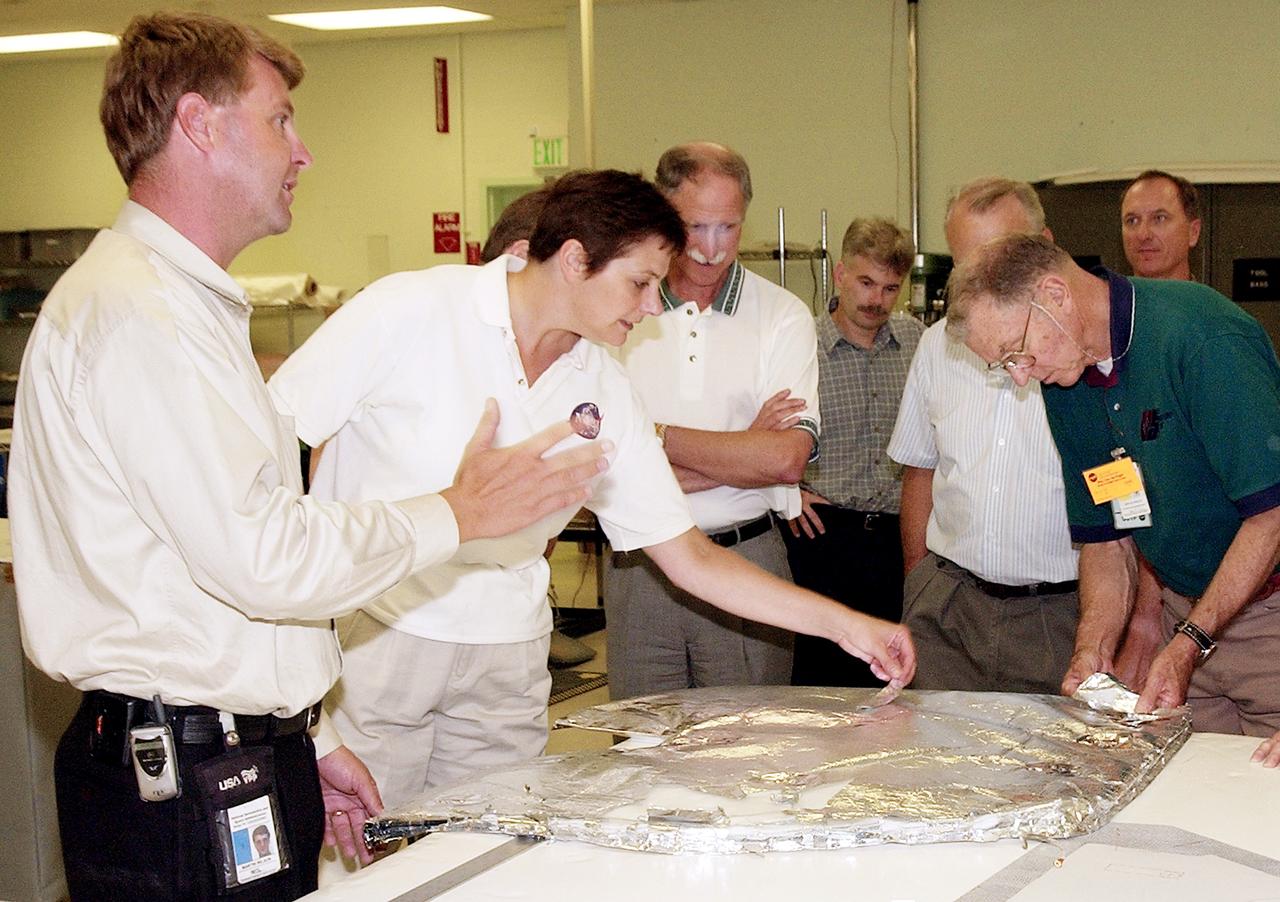
KENNEDY SPACE CENTER, FLA. - Martin Wilson, with United Space Alliance, describes an orbiter’s Thermal Protection System for members of the Stafford-Covey Return to Flight Task Group (SCTG). Handling some of the blanket insulation are Dr. Kathryn Clark and Joe Engle. Third from left is Richard Covey, former Space Shuttle commander, who is co-chair of the SCTG, along with Thomas P. Stafford, Apollo commander. Chartered by NASA Administrator Sean O’Keefe, the task group will perform an independent assessment of NASA’s implementation of the final recommendations by the Columbia Accident Investigation Board.

KENNEDY SPACE CENTER, FLA. -- From left, United Space Alliance (USA) Deputy Space Shuttle Program Manager of Operations Loren Shriver, USA Associate Program Manager of Ground Operations Andy Allen, NASA Deputy Associate Administrator for Space Station and Shuttle Programs Michael Kostelnik, and USA Vice President and Space Shuttle Program Manager Howard DeCastro examine a tile used in the Shuttle's Thermal Protection System (TPS) in KSC's TPS Facility. NASA and USA Space Shuttle program management are participating in a leadership workday. The day is intended to provide management with an in-depth, hands-on look at Shuttle processing activities at KSC.
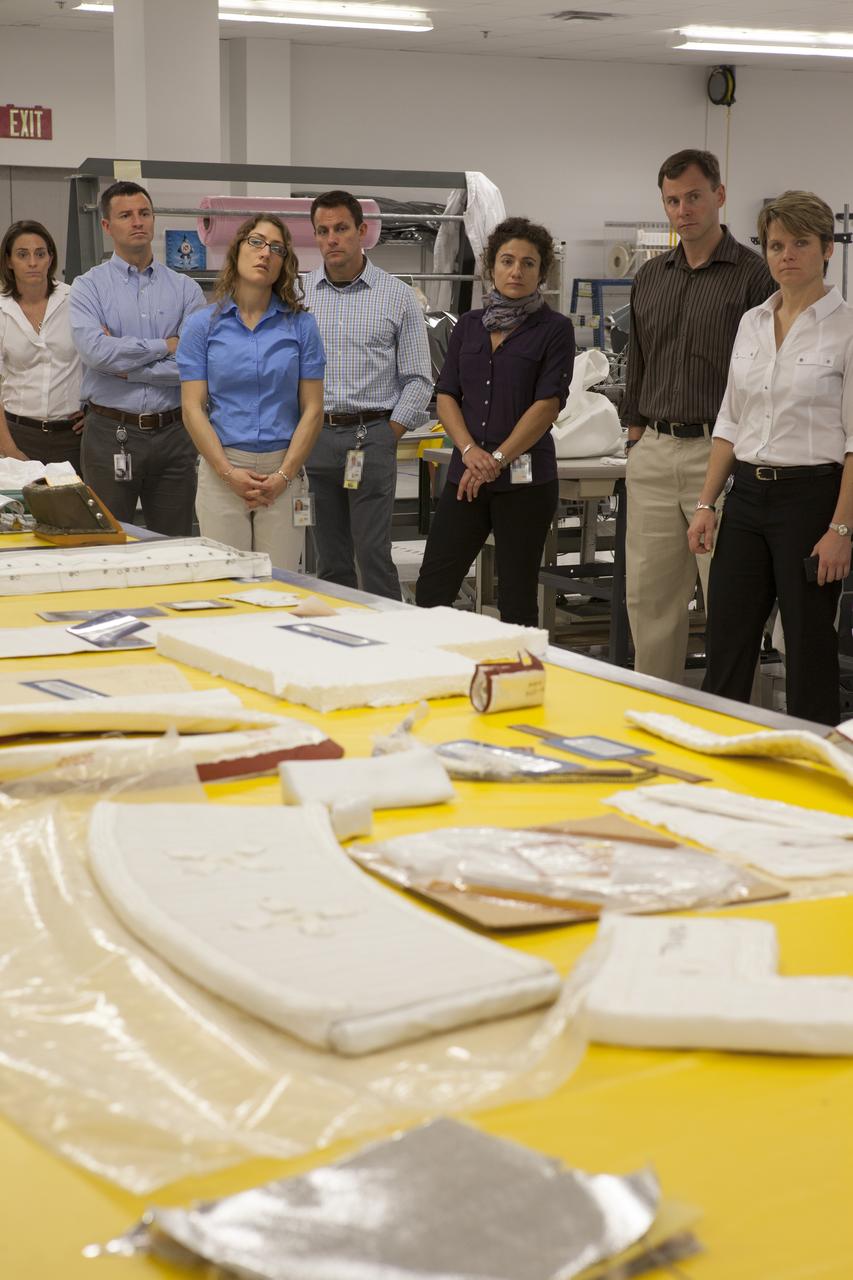
CAPE CANAVERAL, Fla. -- In the Thermal Protection System Facility NASA's Kennedy Space Center in Florida, agency astronaut candidates are briefed on thermal blankets being manufactured for agency spacecraft. Looking at sample thermal blankets are, from the left, Nicole Mann, Andrew Morgan, Christina Hammock, Josh Cassada, Jessica Meir, Tyler ‘Nick’ Hague, and Anne McClain. Plans call for the Lockheed Martin-built Orion to launch atop a United Launch Alliance Delta IV Heavy rocket from Cape Canaveral Air Force Station on Exploration Flight Test EFT-1 later this year. The astronaut class of 2013 was selected by NASA after an extensive year-and-a-half search. The new group will help the agency push the boundaries of exploration and travel to new destinations in the solar system. To learn more about the astronaut class of 2013, visit: http://www.nasa.gov/astronauts/2013astroclass.html Photo credit: NASA/Kim Shiflett
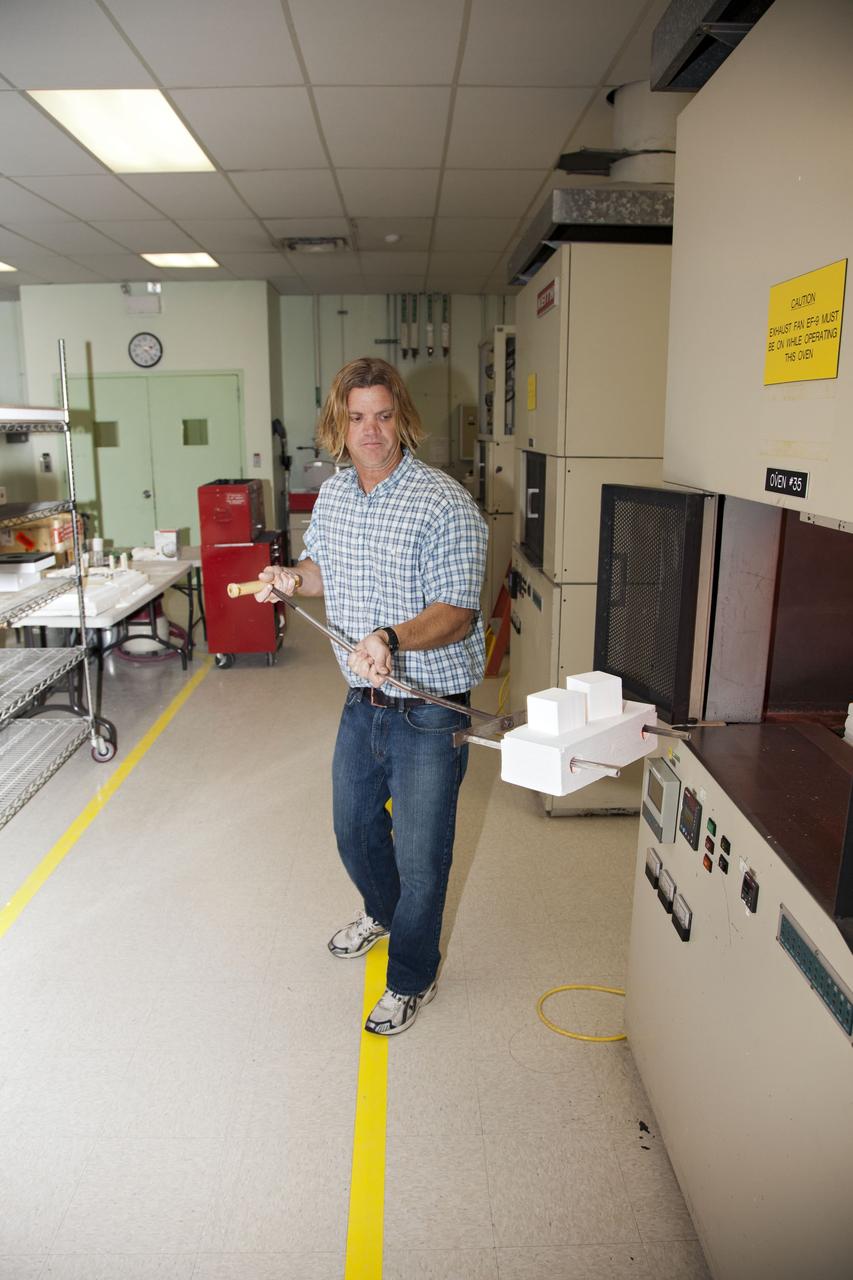
CAPE CANAVERAL, Fla. -- Tim Wright, a United Space Alliance engineering manager at NASA's Kennedy Space Center in Florida, removes the heat shield tiles that will be installed to the backshell of the Orion Multi-Purpose Crew Vehicle's Exploration Flight Test EFT-1 capsule from a Keith thermal automation oven. Inside, the tiles were baked at 2,200 degrees F to cure their ceramic coating. The work to manufacture and inspect the tiles is taking place in Kennedy's Thermal Protection System Facility. EFT-1 will be used during Orion's first test flight in space. For more information, visit www.nasa.gov/orion. Photo credit: Frankie Martin
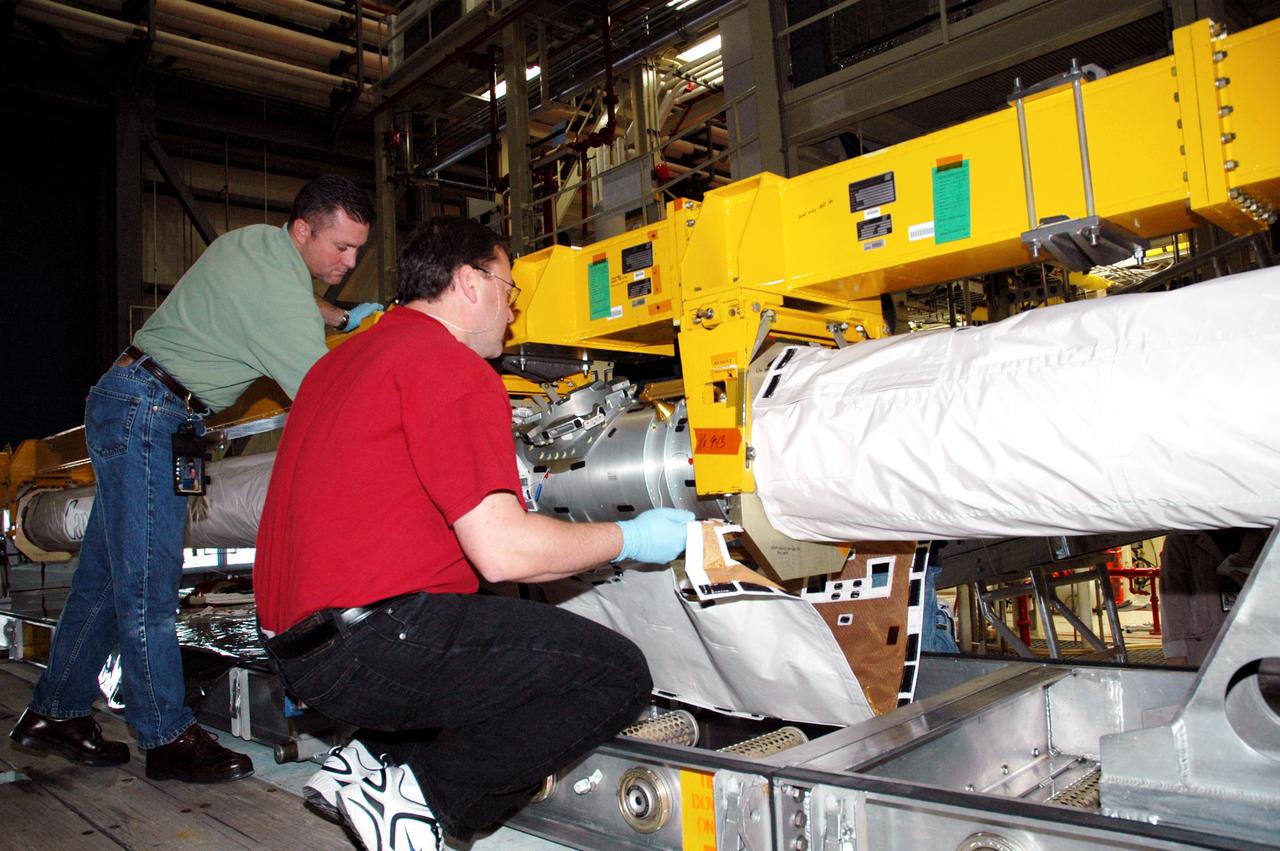
KENNEDY SPACE CENTER, FLA. - In the back transfer aisle of the Orbiter Processing Facility bay 3, Todd Dugan (right), a technician with United Space Alliance, lifts a Thermal Protection System (TPS) blanket onto an area of the Orbiter Boom Sensor System (OBSS). The installation will conclude TPS closeout prior to installation of the boom in the orbiter Discovery. The OBSS is one of the new safety measures for Return to Flight, equipping the Shuttle with cameras and laser systems to inspect the Shuttle’s Thermal Protection System while in space. Discovery is designated as the Return to Flight vehicle for mission STS-114, with a launch window of May 12 to June 3, 2005.
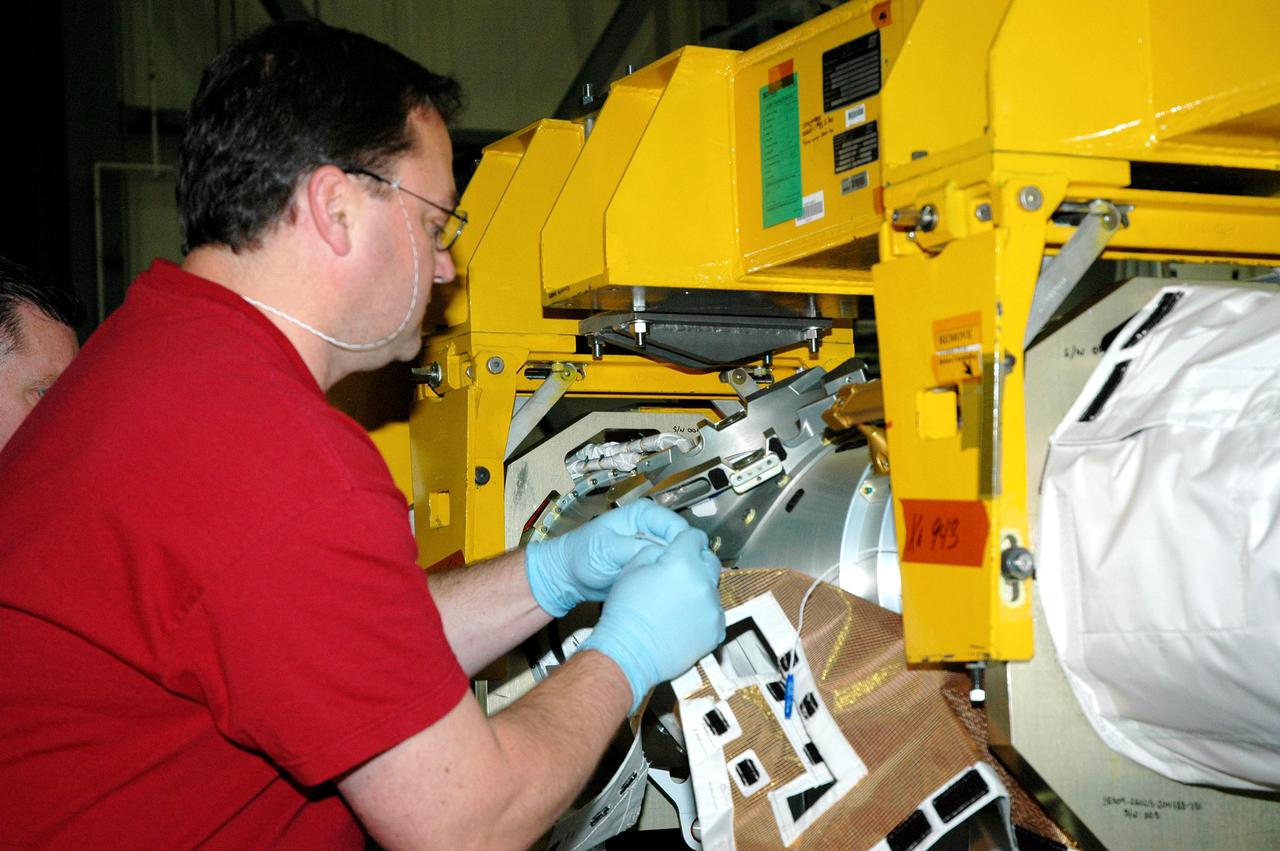
KENNEDY SPACE CENTER, FLA. - In the back transfer aisle of the Orbiter Processing Facility bay 3, Todd Dugan, a technician with United Space Alliance, begins attaching the Thermal Protection System (TPS) blanket to the Orbiter Boom Sensor System (OBSS). The installation of the insulation concludes TPS closeout prior to installation of the boom in the orbiter Discovery. The OBSS is one of the new safety measures for Return to Flight, equipping the Shuttle with cameras and laser systems to inspect the Shuttle’s Thermal Protection System while in space. Discovery is designated as the Return to Flight vehicle for mission STS-114, with a launch window of May 12 to June 3, 2005.
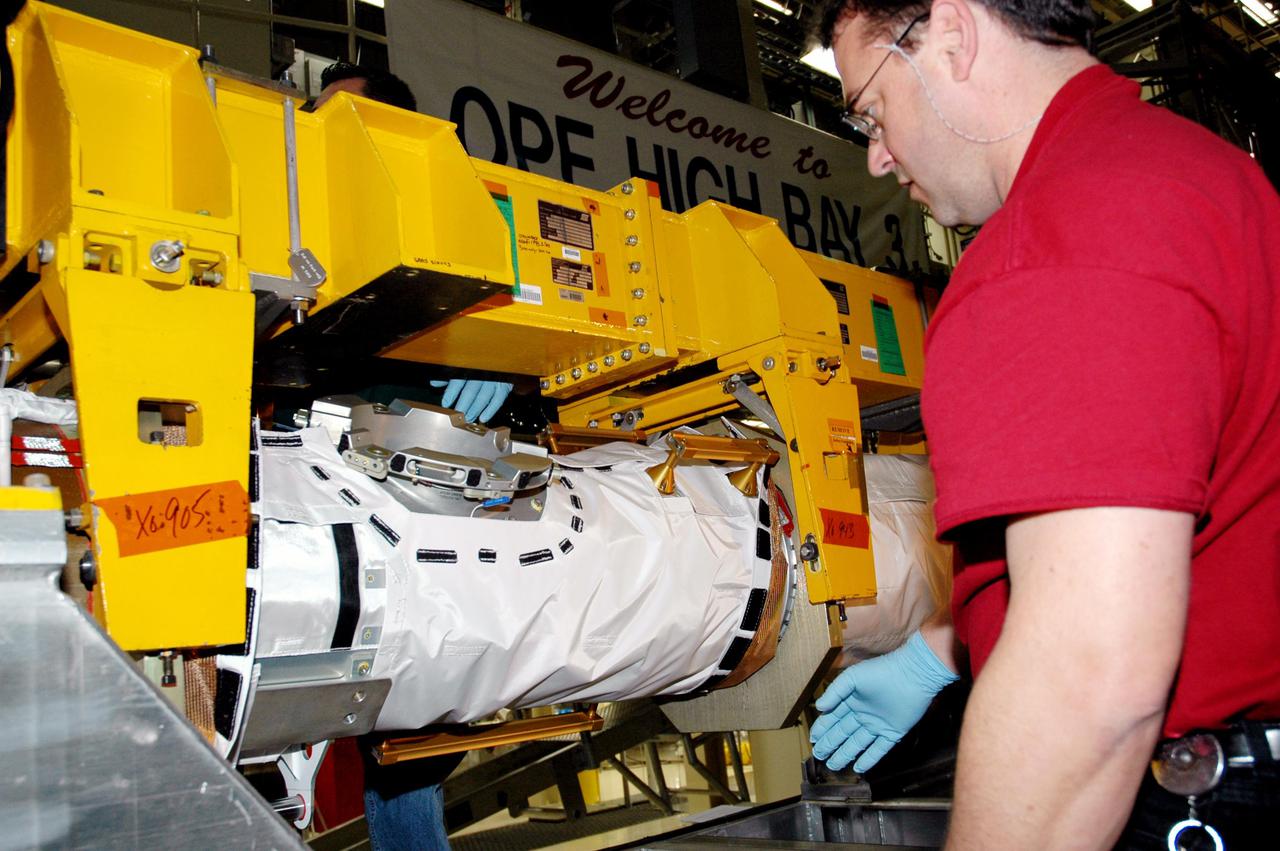
KENNEDY SPACE CENTER, FLA. - In the back transfer aisle of the Orbiter Processing Facility bay 3, Todd Dugan, a technician with United Space Alliance, checks out the Thermal Protection System (TPS) blanket wrapped around the Orbiter Boom Sensor System (OBSS). The installation of the insulation concludes TPS closeout prior to installation of the boom in the orbiter Discovery. The OBSS is one of the new safety measures for Return to Flight, equipping the Shuttle with cameras and laser systems to inspect the Shuttle’s Thermal Protection System while in space. Discovery is designated as the Return to Flight vehicle for mission STS-114, with a launch window of May 12 to June 3, 2005.
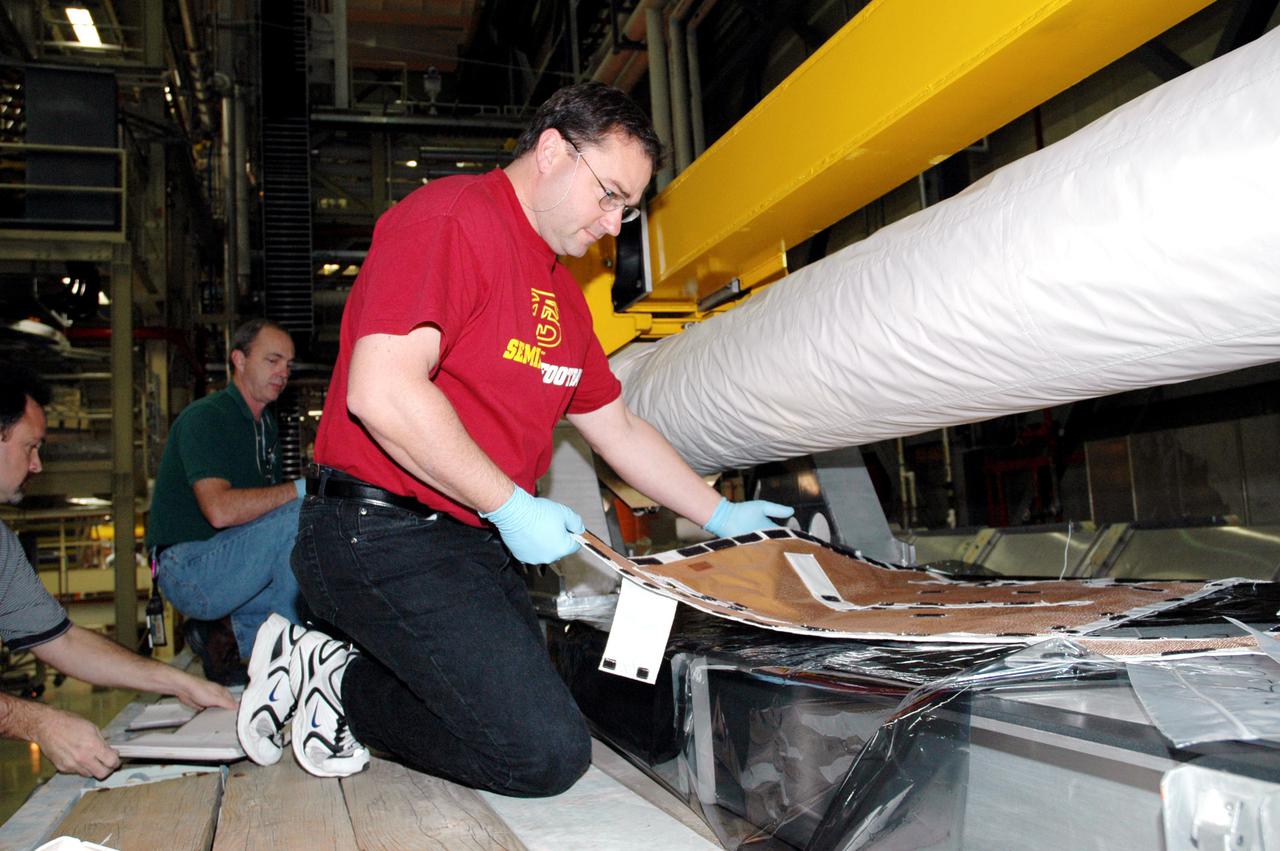
KENNEDY SPACE CENTER, FLA. - In the back transfer aisle of the Orbiter Processing Facility bay 3, Todd Dugan, a technician with United Space Alliance, prepares the Thermal Protection System (TPS) blanket to be installed around the Orbiter Boom Sensor System (OBSS). The installation concludes TPS closeout prior to installation of the boom in the orbiter Discovery. The OBSS is one of the new safety measures for Return to Flight, equipping the Shuttle with cameras and laser systems to inspect the Shuttle’s Thermal Protection System while in space. Discovery is designated as the Return to Flight vehicle for mission STS-114, with a launch window of May 12 to June 3, 2005.
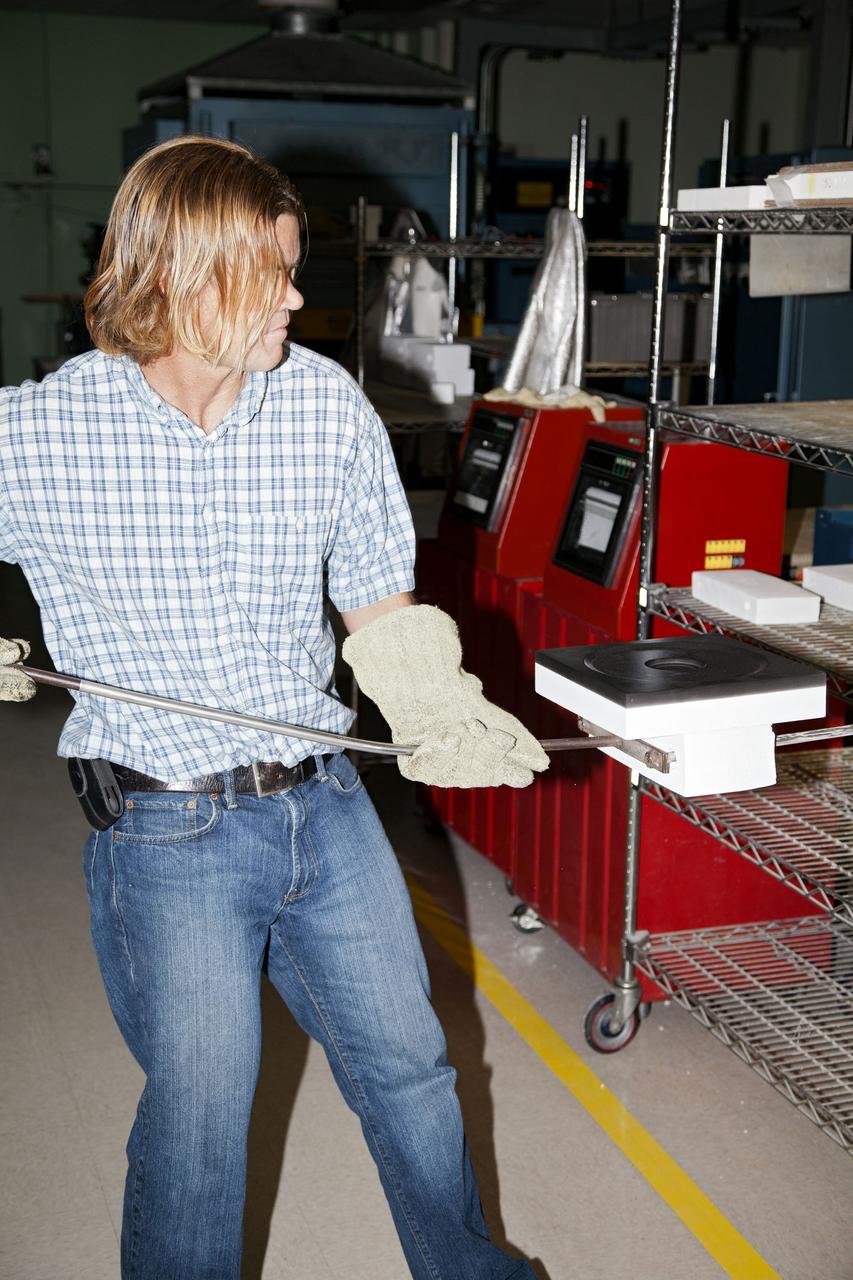
CAPE CANAVERAL, Fla. -- Tim Wright, a United Space Alliance engineering manager at NASA's Kennedy Space Center in Florida, removes the heat shield tiles that will be installed to the backshell of the Orion Multi-Purpose Crew Vehicle's Exploration Flight Test EFT-1 capsule from a Keith thermal automation oven. Inside, the tiles were baked at 2,200 degrees F to cure their ceramic coating. The work to manufacture and inspect the tiles is taking place in Kennedy's Thermal Protection System Facility. EFT-1 will be used during Orion's first test flight in space. For more information, visit www.nasa.gov/orion. Photo credit: Frankie Martin
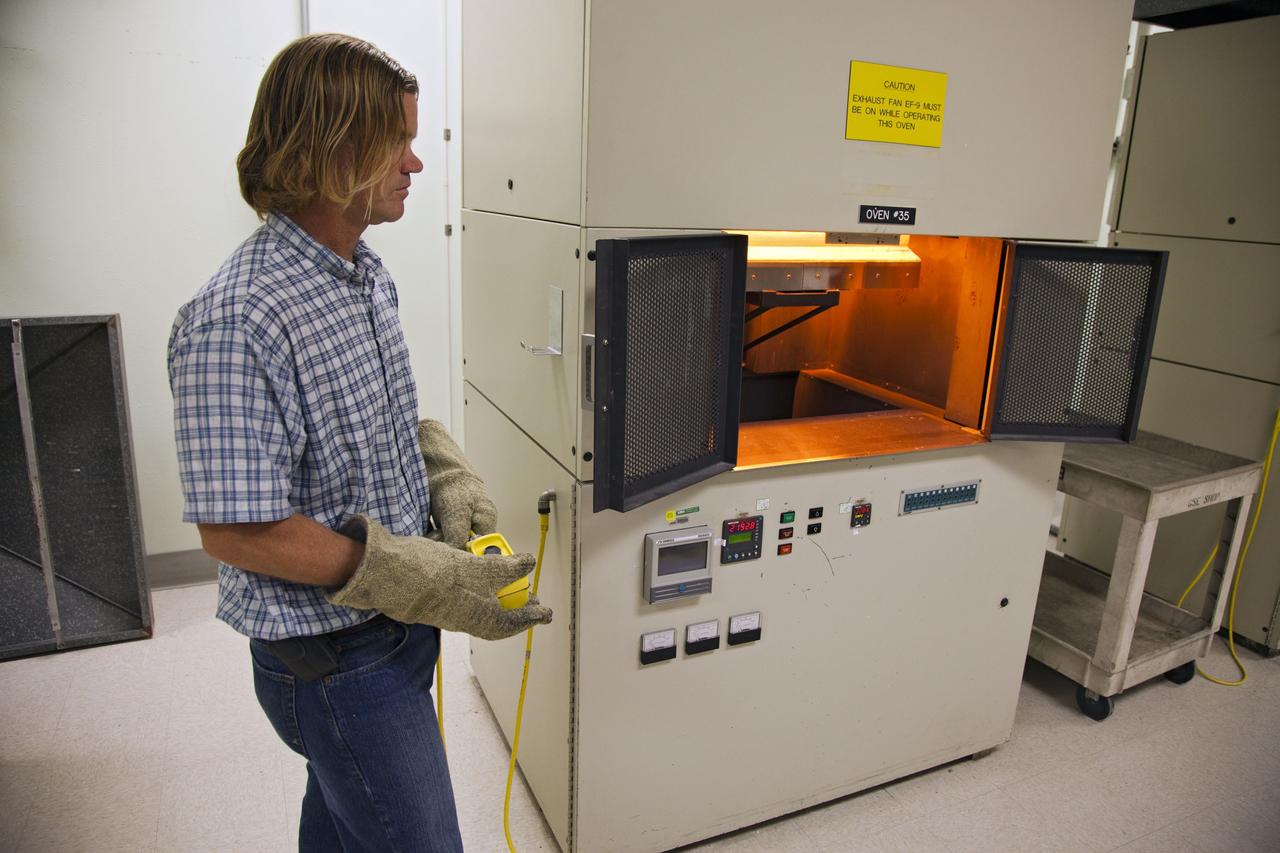
CAPE CANAVERAL, Fla. -- Tim Wright, a United Space Alliance engineering manager at NASA's Kennedy Space Center in Florida, put the heat shield tiles that will be installed to the backshell of the Orion Multi-Purpose Crew Vehicle's Exploration Flight Test EFT-1 capsule in a Keith thermal automation oven. The tiles will be baked at 2,200 degrees F to cure their ceramic coating. The work to manufacture and inspect the tiles is taking place in Kennedy's Thermal Protection System Facility. EFT-1 will be used during Orion's first test flight in space. For more information, visit www.nasa.gov/orion. Photo credit: Frankie Martin
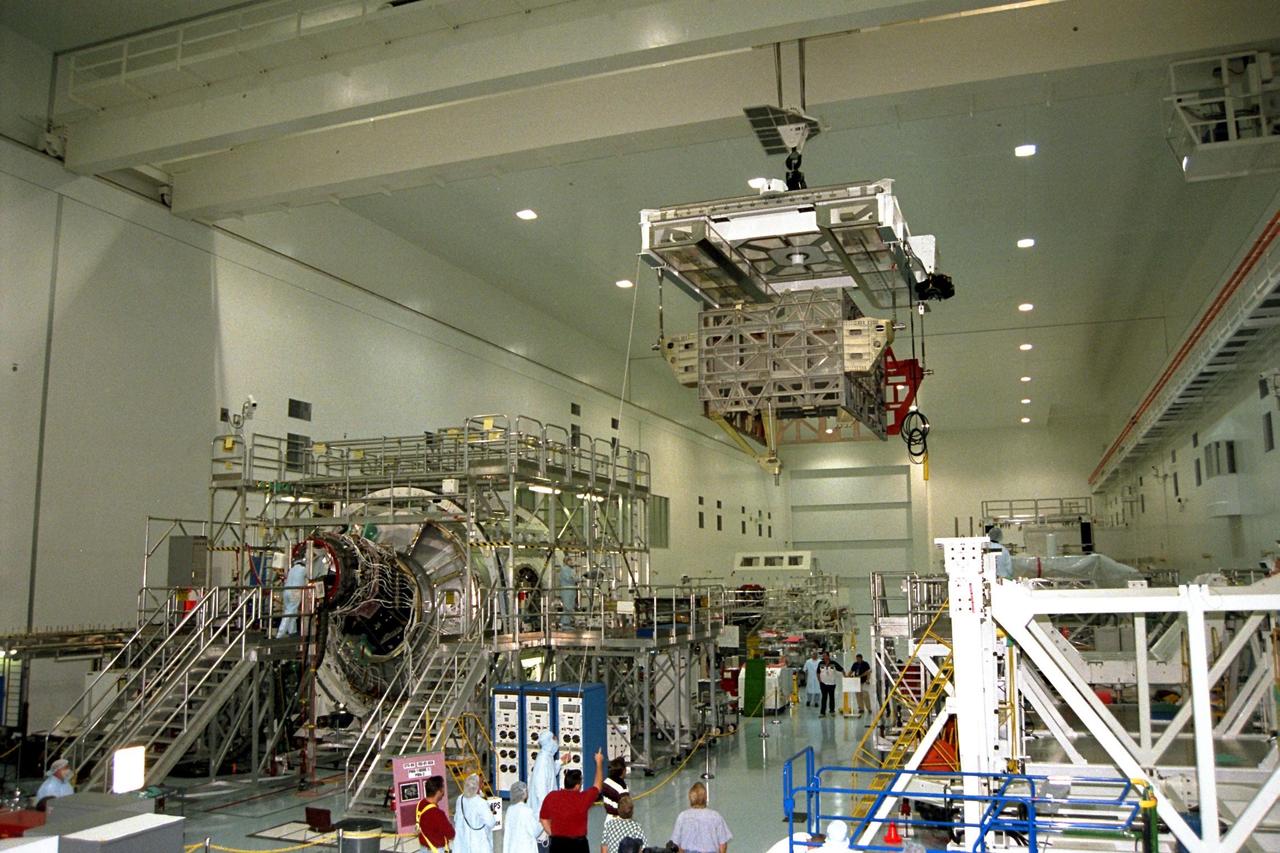
The Photovoltaic Module 1 Integrated Equipment Assembly (IEA) is moved past Node 1, seen at left, of the International Space Station (ISS) in Kennedy Space Center’s Space Station Processing Facility (SSPF). The IEA will be processed at the SSPF for flight on STS-97, scheduled for launch in April 1999. The IEA is one of four integral units designed to generate, distribute, and store power for the ISS. It will carry solar arrays, power storage batteries, power control units, and a thermal control system. The 16-foot-long, 16,850-pound unit is now undergoing preflight preparations in the SSPF
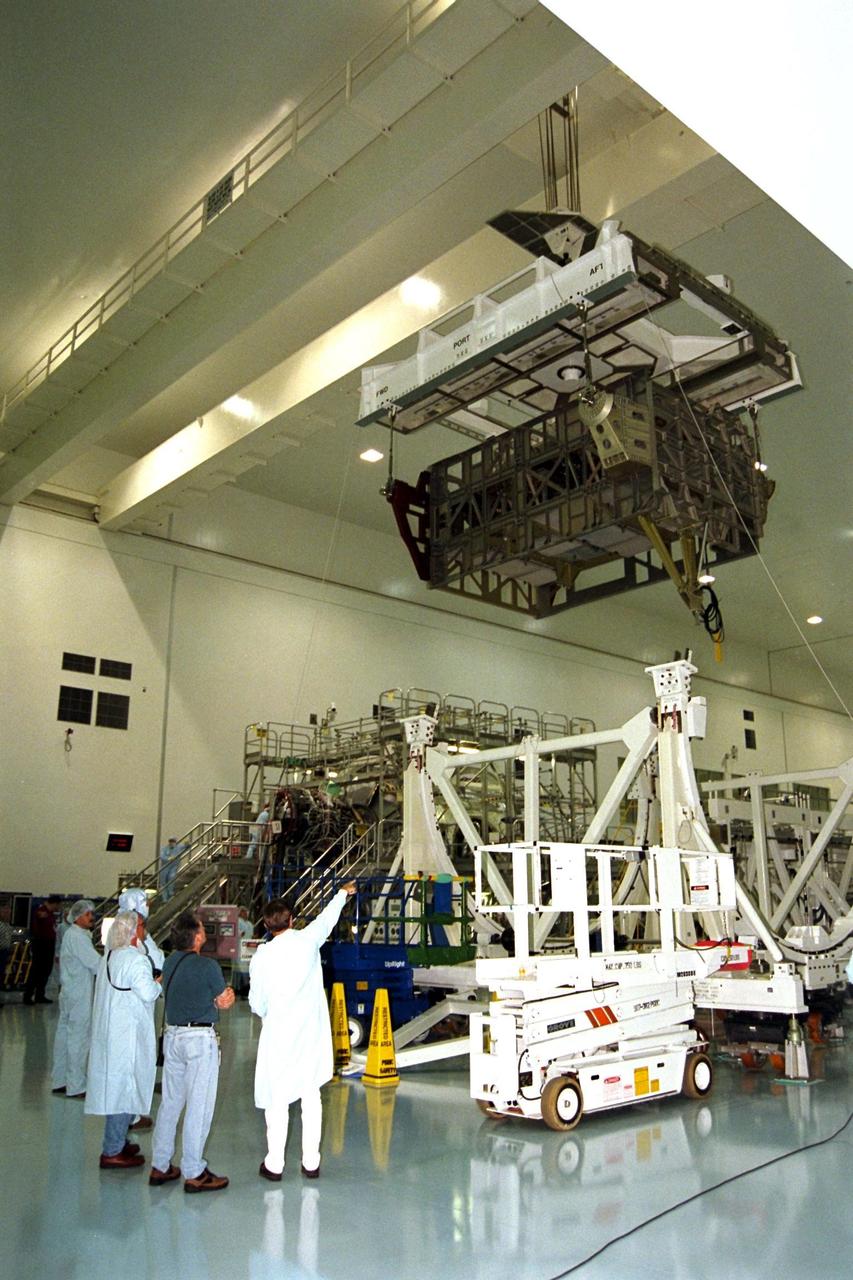
Workers in Kennedy Space Center’s Space Station Processing Facility (SSPF) observe the Photovoltaic Module 1 Integrated Equipment Assembly (IEA) as it moves past them on its way to its workstand, where it will be processed for flight on STS-97, scheduled for launch in April 1999. The IEA is one of four integral units designed to generate, distribute, and store power for the International Space Station. It will carry solar arrays, power storage batteries, power control units, and a thermal control system. The 16-foot-long, 16,850-pound unit is now undergoing preflight preparations in the SSPF

The towns of Santa Claus, Ga., (top) and Santa Claus, Ind. (bottom), are shown in these two images from the Advanced Spaceborne Thermal Emission and Reflection Radiometer (ASTER) instrument on NASA's Terra satellite. They are the only two Santa Claus towns in the United States with post offices and zip codes, although there are 11 towns with this name in the United States. Santa Claus, Ga. is located in Toombs County, and has a population of 237. Santa Claus, Ind. is located in Spencer County, and has a population of 2,041. Its name was accepted by the United States Postal Service in 1856. The images were acquired on July 3, 2000 (top) and June 16, 2001 (bottom), respectively. http://photojournal.jpl.nasa.gov/catalog/PIA03891
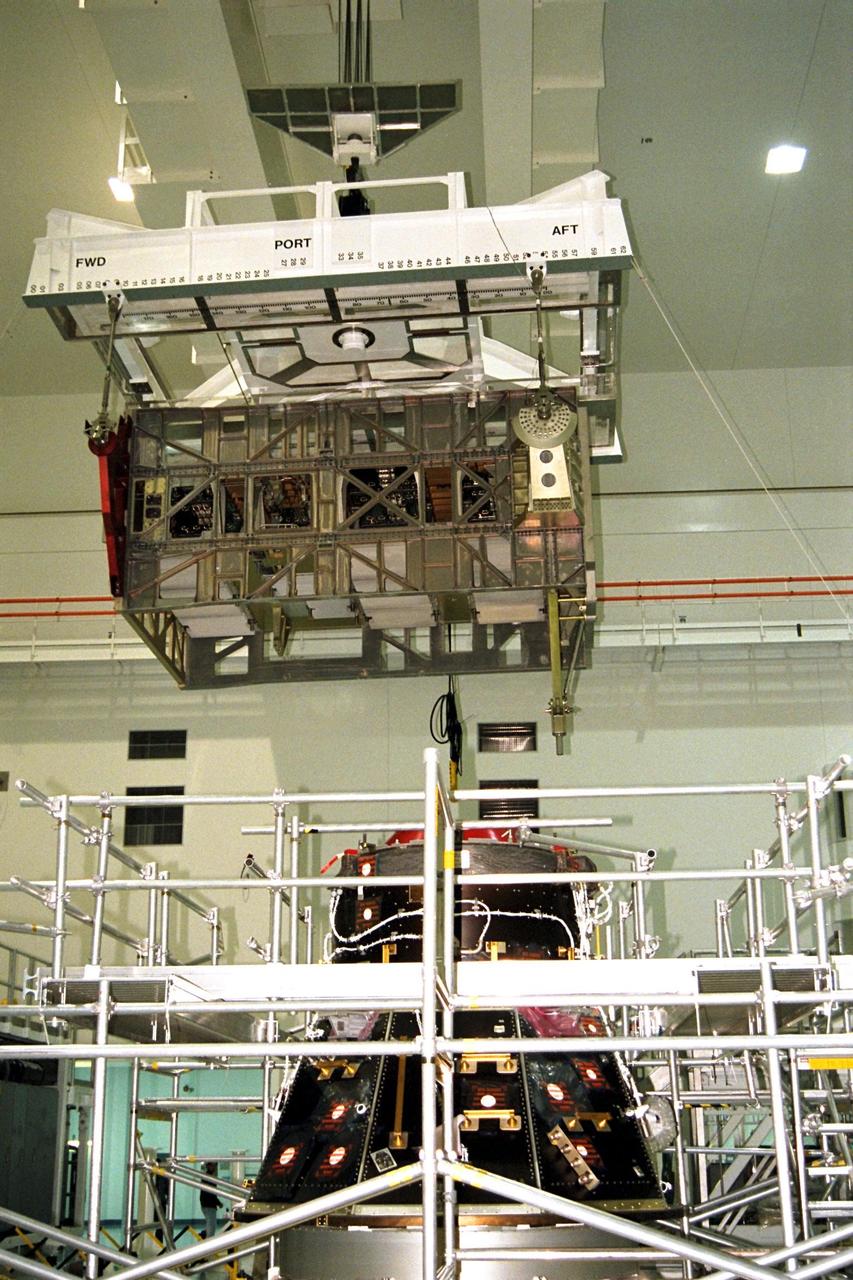
The Photovoltaic Module 1 Integrated Equipment Assembly (IEA) is moved past a Pressurized Mating Adapter in Kennedy Space Center’s Space Station Processing Facility (SSPF) toward the workstand where it will be processed for flight on STS-97, scheduled for launch in April 1999. The IEA is one of four integral units designed to generate, distribute, and store power for the International Space Station. It will carry solar arrays, power storage batteries, power control units, and a thermal control system. The 16-foot-long, 16,850-pound unit is now undergoing preflight preparations in the SSPF
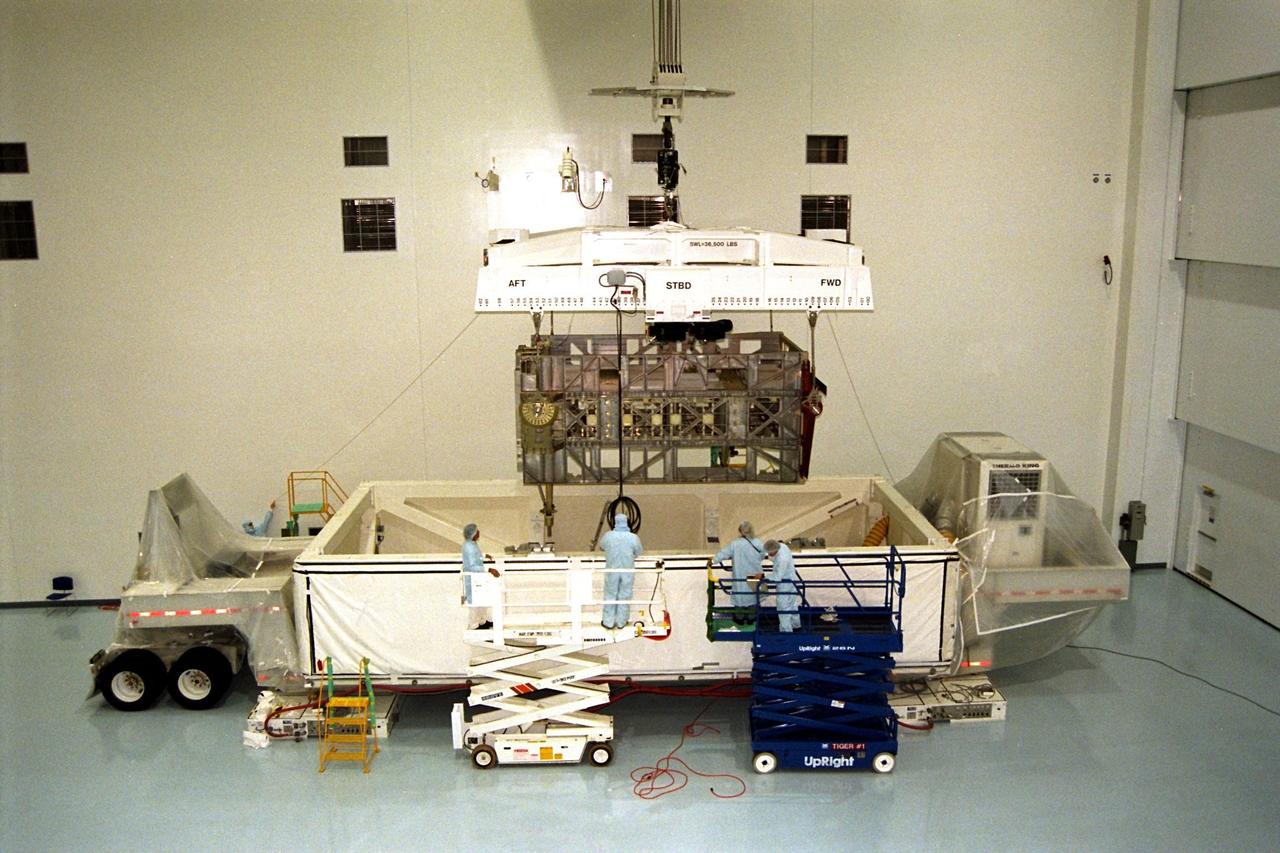
The Photovoltaic Module 1 Integrated Equipment Assembly (IEA) is lifted from its container in Kennedy Space Center’s Space Station Processing Facility (SSPF) before it is moved into its workstand, where it will be processed for flight on STS-97, scheduled for launch in April 1999. The IEA is one of four integral units designed to generate, distribute, and store power for the International Space Station. It will carry solar arrays, power storage batteries, power control units, and a thermal control system. The 16-foot-long, 16,850-pound unit is now undergoing preflight preparations in the SSPF
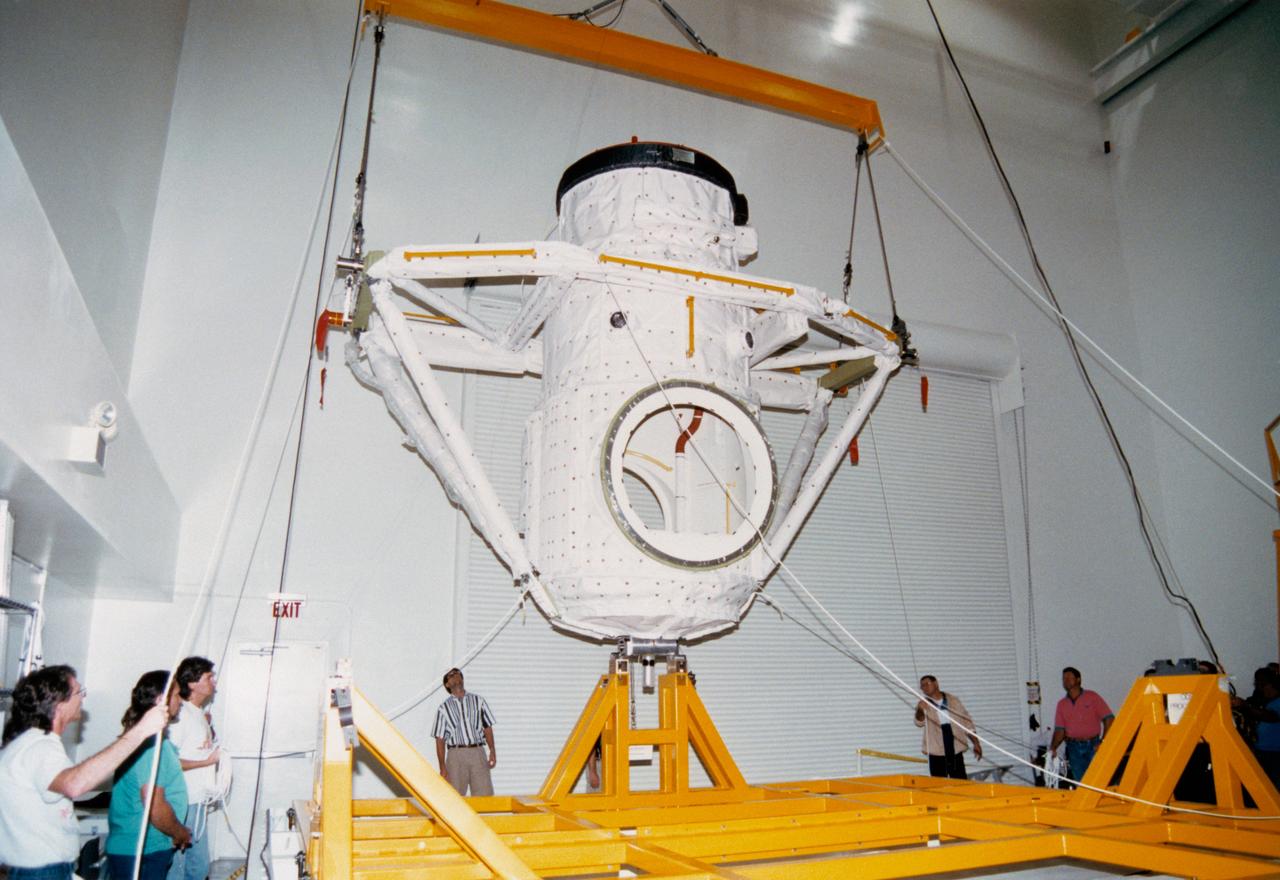
S94-47810 (2 Dec. 1994) --- Lockheed Space Operations Company workers in the Extended Duration Orbiter (EDO) Facility, located inside the Vehicle Assembly Building (VAB), carefully hoist the Orbiter Docking System (ODS) from its shipping container into a test stand. The ODS was shipped in a horizontal position to the Kennedy Space Center (KSC) from contractor Rockwell Aerospace's Downey plant. Once the ODS is upright, work can continue to prepare the hardware for the first docking of the United States Space Shuttle and Russian Space Station MIR in 1995. The ODS contains both United States-made and Russian-made hardware. The black band is Russian-made thermal insulation protecting part of the docking mechanism, also Russian-made, called the Androgynous Peripheral Docking System (APDS). A red protective cap covers the APDS itself. Other elements of the ODS, most of it protected by white United States-made thermal insulation, were developed by Rockwell, which also integrated and checked out the assembled Russian-United States system.
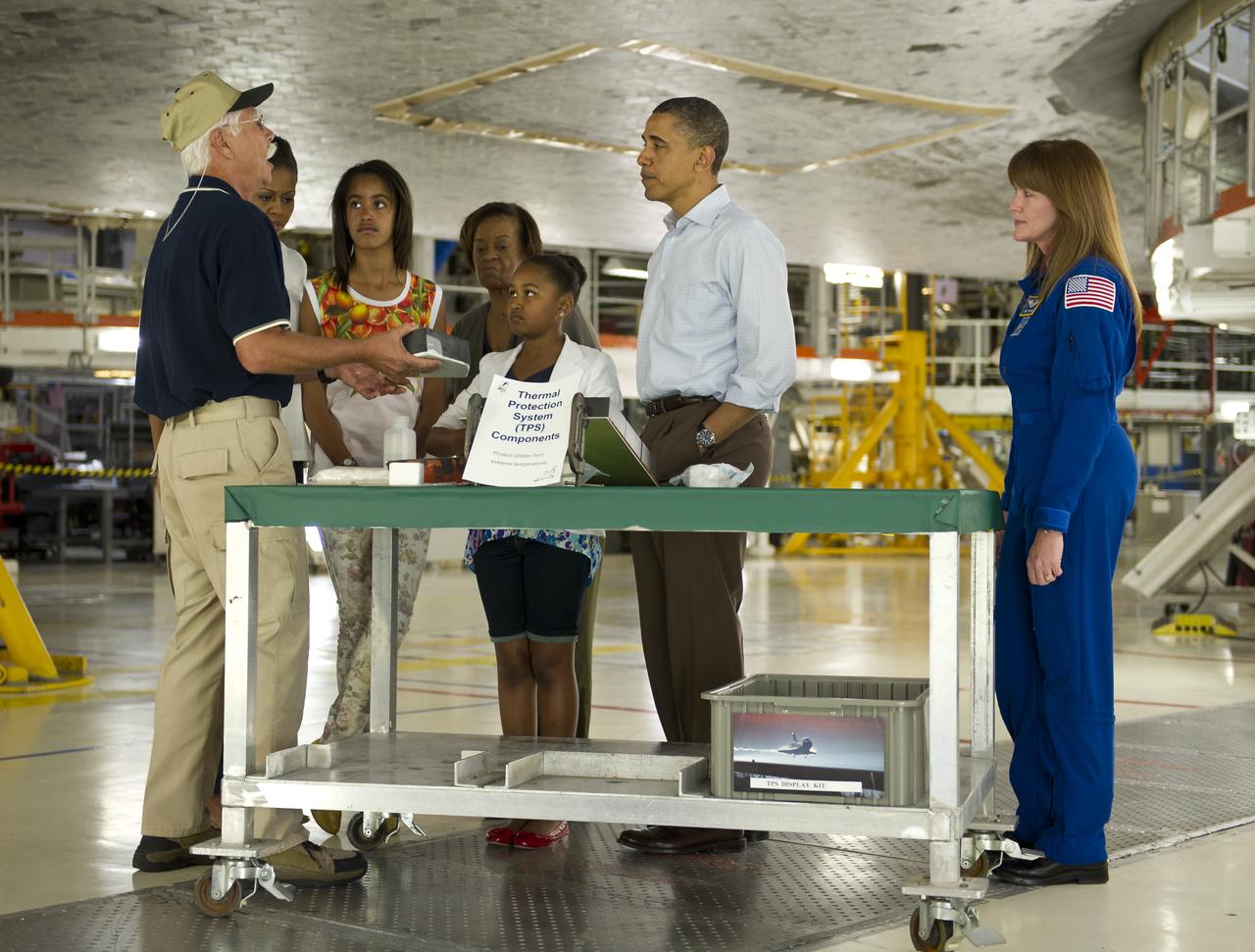
Terry White, United Space Alliance project lead for thermal protection systems, left, shows President Barack Obama and his family, from left, First Lady Michelle Obama, Malia, Marian Robinson and Sasha, how tiles work on the space shuttle during their visit to the Orbital Processing Facility at the NASA Kennedy Space Center in Cape Canaveral, Fla., Friday, April 29, 2011. Looking on is Director of Flight Crew Operations for the Johnson Space Center and Astronaut, Janet Kavandi. Photo Credit: (NASA/Bill Ingalls)
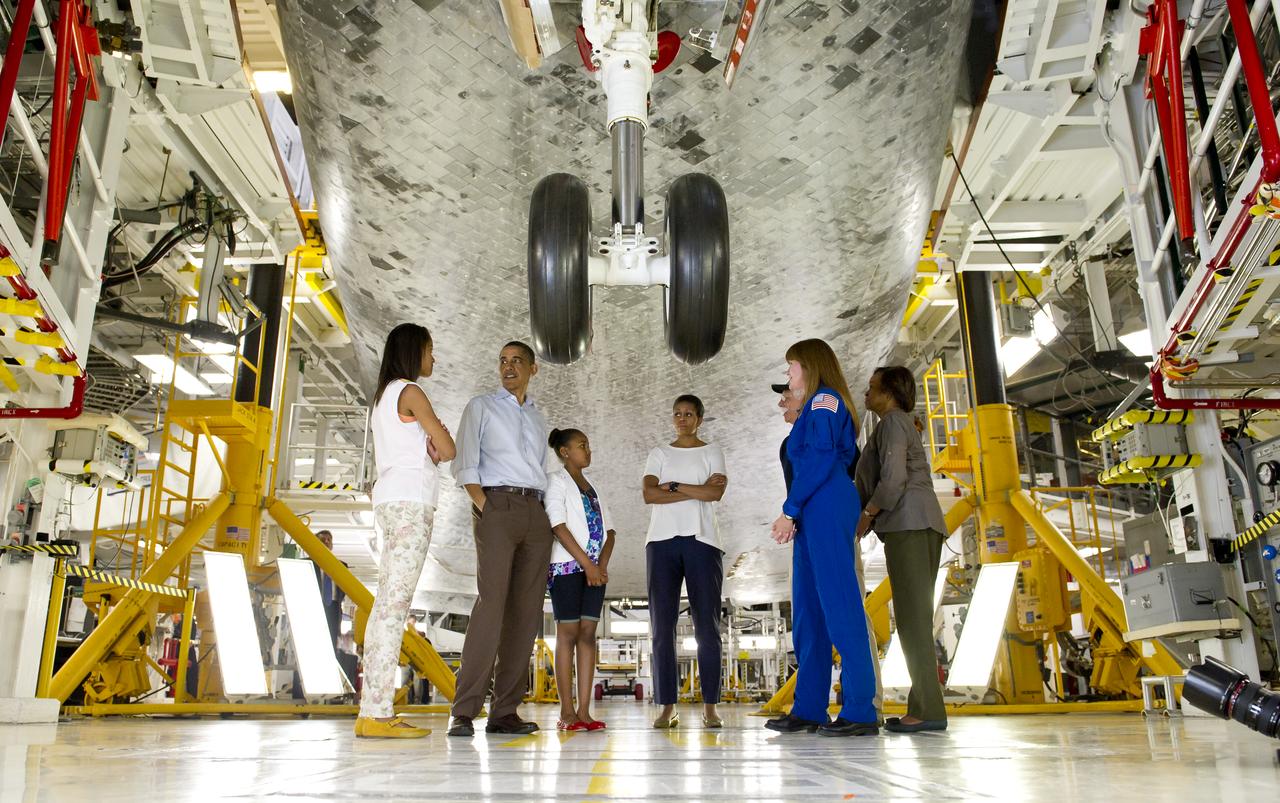
President Barack Obama, First Lady Michelle Obama, daughters Malia, left, Sasha, Marian Robinson, Astronaut Janet Kavandi and United Space Alliance project lead for thermal protection systems Terry White, walk under the landing gear of the space shuttle Atlantis as they visit Kennedy Space Center in Cape Canaveral, Fla., Friday, April 29, 2011. Photo Credit: (NASA/Bill Ingalls)
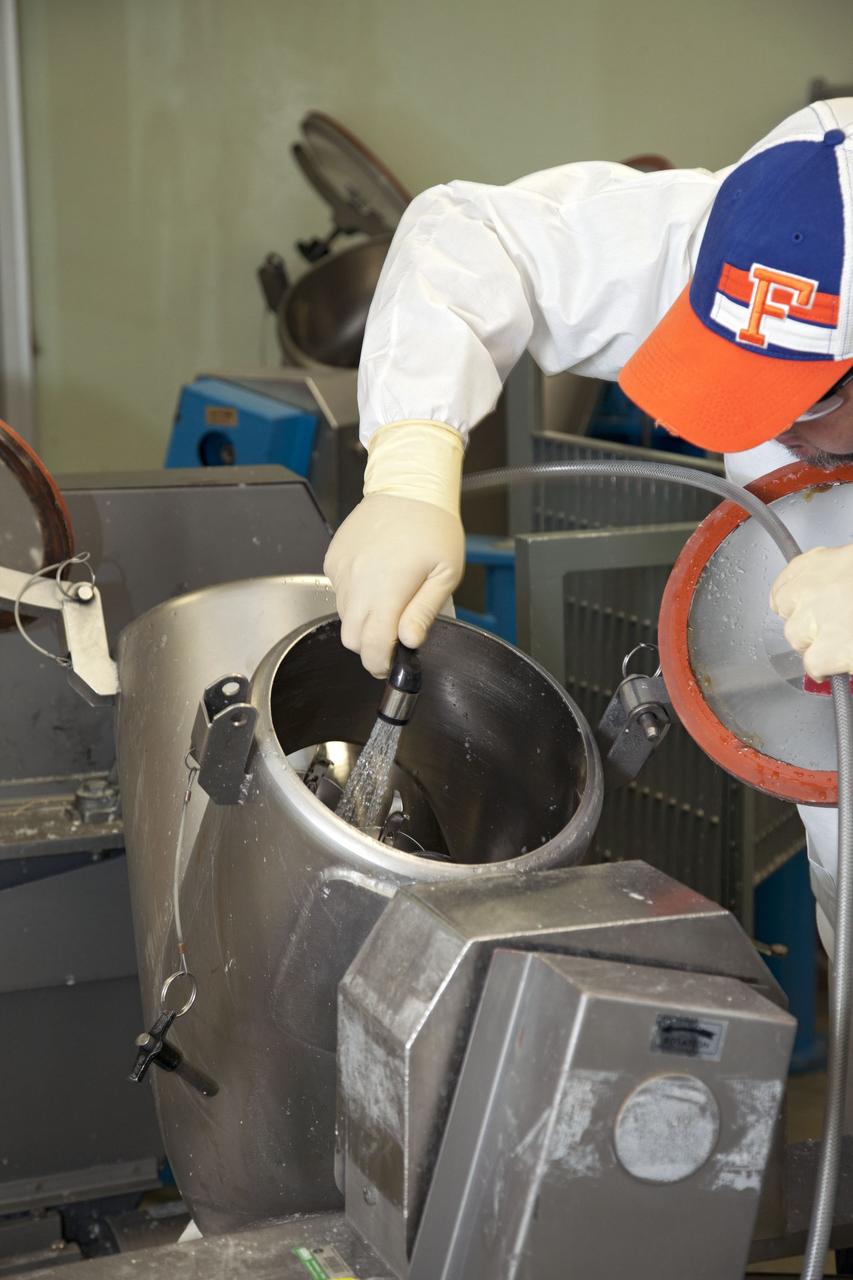
CAPE CANAVERAL, Fla. -- Chris Keeling, a United Space Alliance technician at NASA's Kennedy Space Center in Florida, manufactures the heat shield tiles that will be installed to the backshell of the Orion Multi-Purpose Crew Vehicle's Exploration Flight Test EFT-1 capsule. The work to manufacture and inspect the tiles is taking place in Kennedy's Thermal Protection System Facility. EFT-1 will be used during Orion's first test flight in space. For more information, visit www.nasa.gov/orion. Photo credit: Frankie Martin
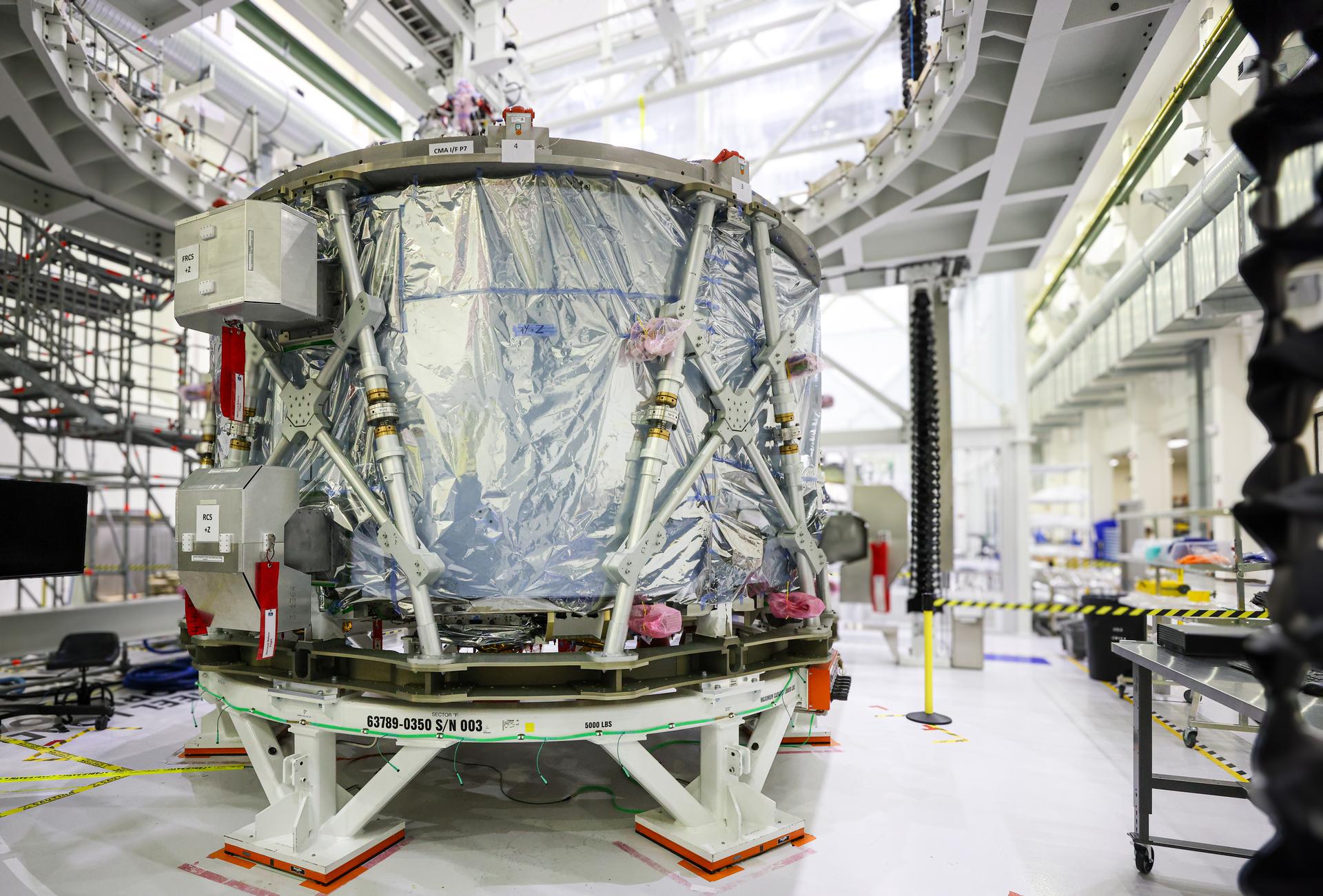
The transport carrier containing the European Service Module for NASA’s Artemis IV mission arrives at the Neil A. Armstrong Operations and Checkout Building at NASA’s Kennedy Space Center in Florida on Saturday, Dec. 20, 2025. The European Service Module, which is assembled by Airbus in Bremen, Germany, from parts made in 10 European countries and the United States, acts as the driving force behind Orion for deep space exploration, providing essential propulsion, thermal control, and electrical power.
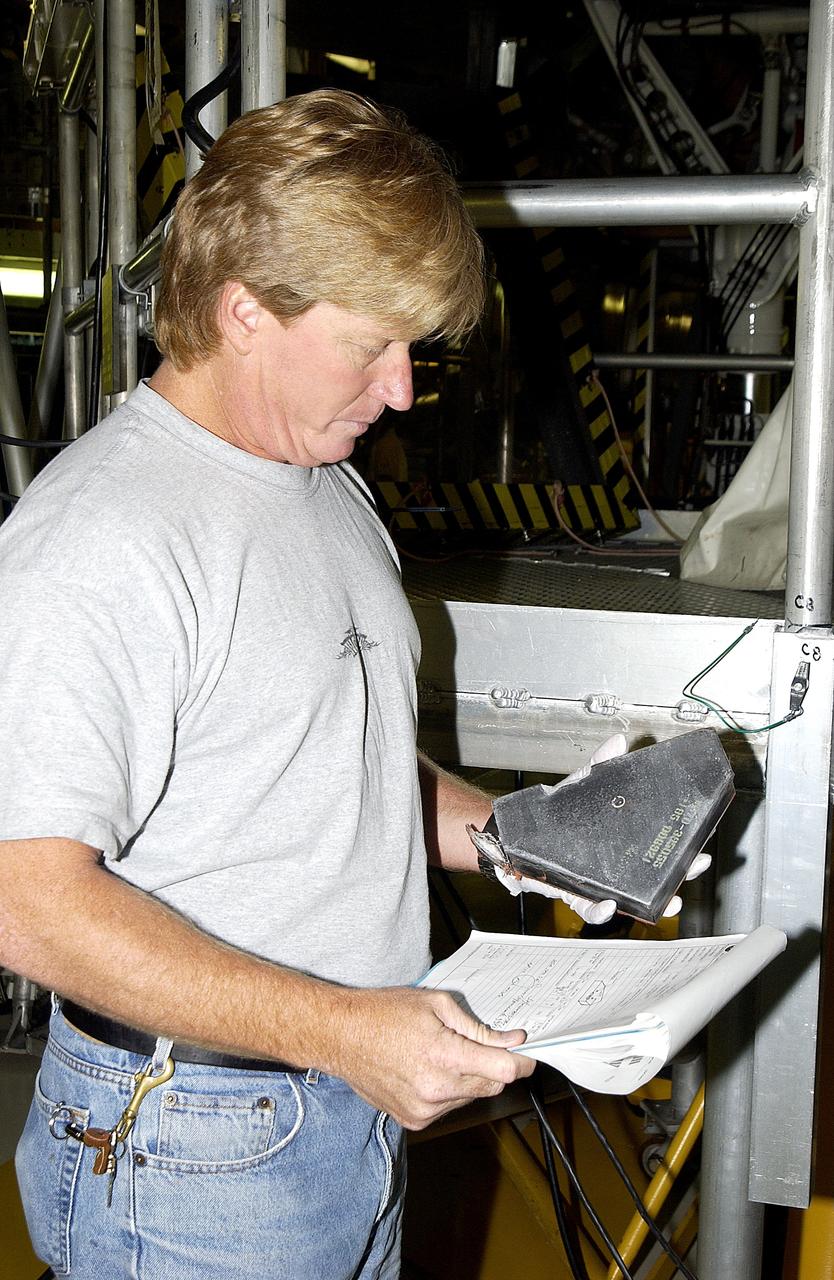
KENNEDY SPACE CENTER, FLA. - In the Orbiter Processing Facility, Ryan Levann, with United Space Alliance, checks data on the tile removed from the thermal barrier around the umbilical areas, the external tank attach points, on the underside of Atlantis. The umbilical areas are closed off after ET separation by a door, seen here. The exposed area of each closed door is covered with reusable surface insulation.
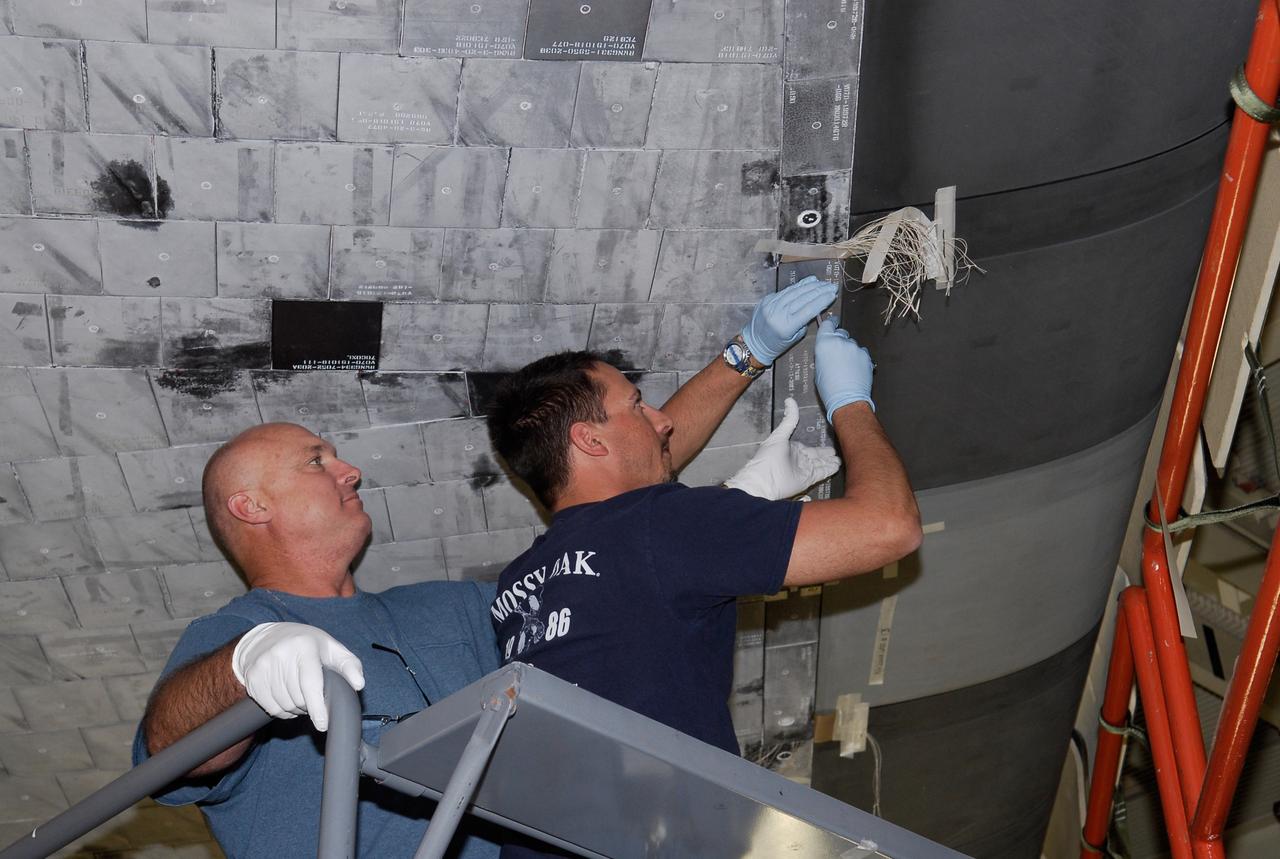
CAPE CANAVERAL, Fla. --- In the Orbiter Processing Facility at NASA's Kennedy Space Center, United Space Alliance technicians work on the thermal protection system tiles on space shuttle Discovery. The launch of Discovery on the STS-124 mission is targeted for April 24. On the mission, Discovery will transport the Kibo Japanese Experiment Module - Pressurized Module and the Japanese Remote Manipulator System to the International Space Station. Photo credit: NASA/Kim Shiflett
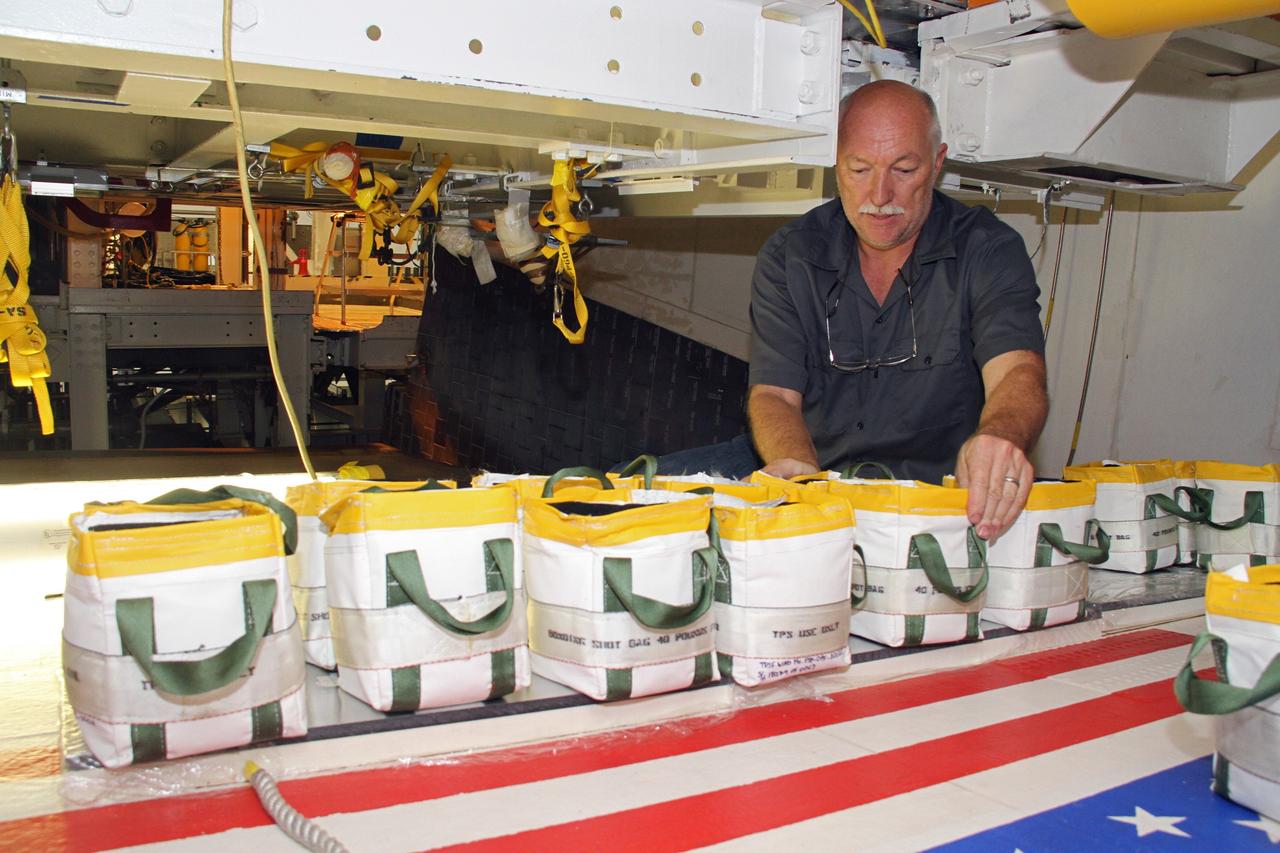
CAPE CANAVERAL, Fla. – Mike Williams, a thermal protection system technician with United Space Alliance, arranges weights atop a freshly installed section of tile on the right wing of space shuttle Endeavour at NASA's Kennedy Space Center in Florida. The weights will hold the section in place while the adhesive hardens beneath. Ongoing transition and retirement activities are preparing the spacecraft for public display at the California Science Center in Los Angeles. Endeavour flew 25 missions during its 19-year career. Photo credit: NASA/Cory Huston

Ahead of launch as part of NASA’s Commercial Lunar Payload Services (CLPS) initiative, Astrobotic’s Peregrine lunar lander is encapsulated in the payload fairing, or nose cone, of United Launch Alliance’s Vulcan rocket on Nov. 21, 2023, at Astrotech Space Operations Facility near the agency’s Kennedy Space Center in Florida. Launch of Astrobotic’s Peregrine Mission One will carry NASA and commercial payloads to the Moon in early 2024 to study the lunar exosphere, thermal properties, and hydrogen abundance of the lunar regolith, magnetic fields, and the radiation environment of the lunar surface.
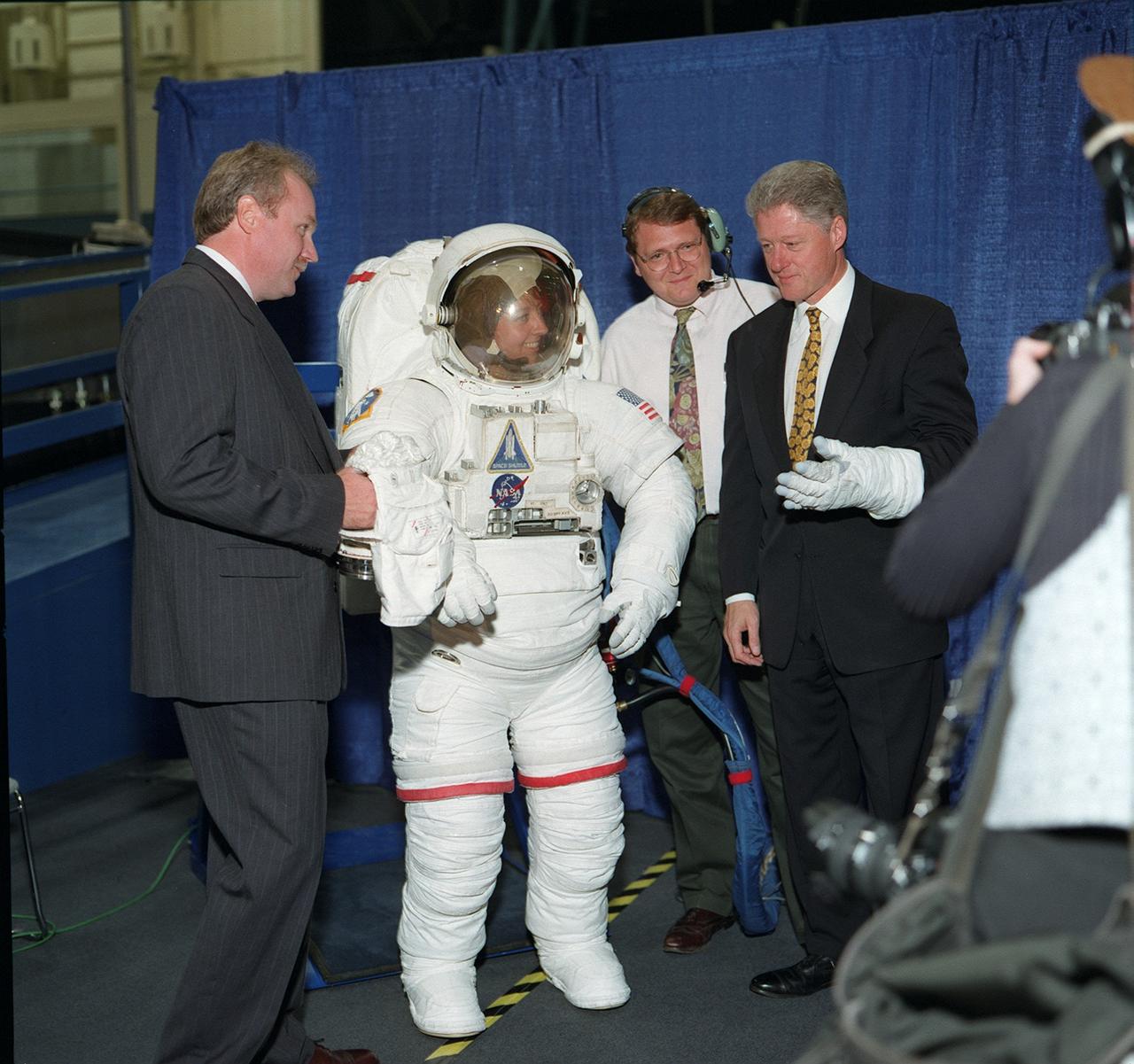
S98-05013 (14 April 1998) --- President Bill Clinton tries on a glove from the Space Shuttle extravehicular mobility unit (EMU) space suit during an April 14 visit to the Johnson Space Center (JSC). In the suit is Amy Ross, a JSC engineer. Others pictured are William E. (Bill) Spenny (left) of the EVA and Spacesuit Systems Branch in the Crew and Thermal Systems Division, Engineering Directorate; and Stephen N. Anderson (second right) of ILC. Photo Credit: NASA or the National Aeronautics and Space Administration
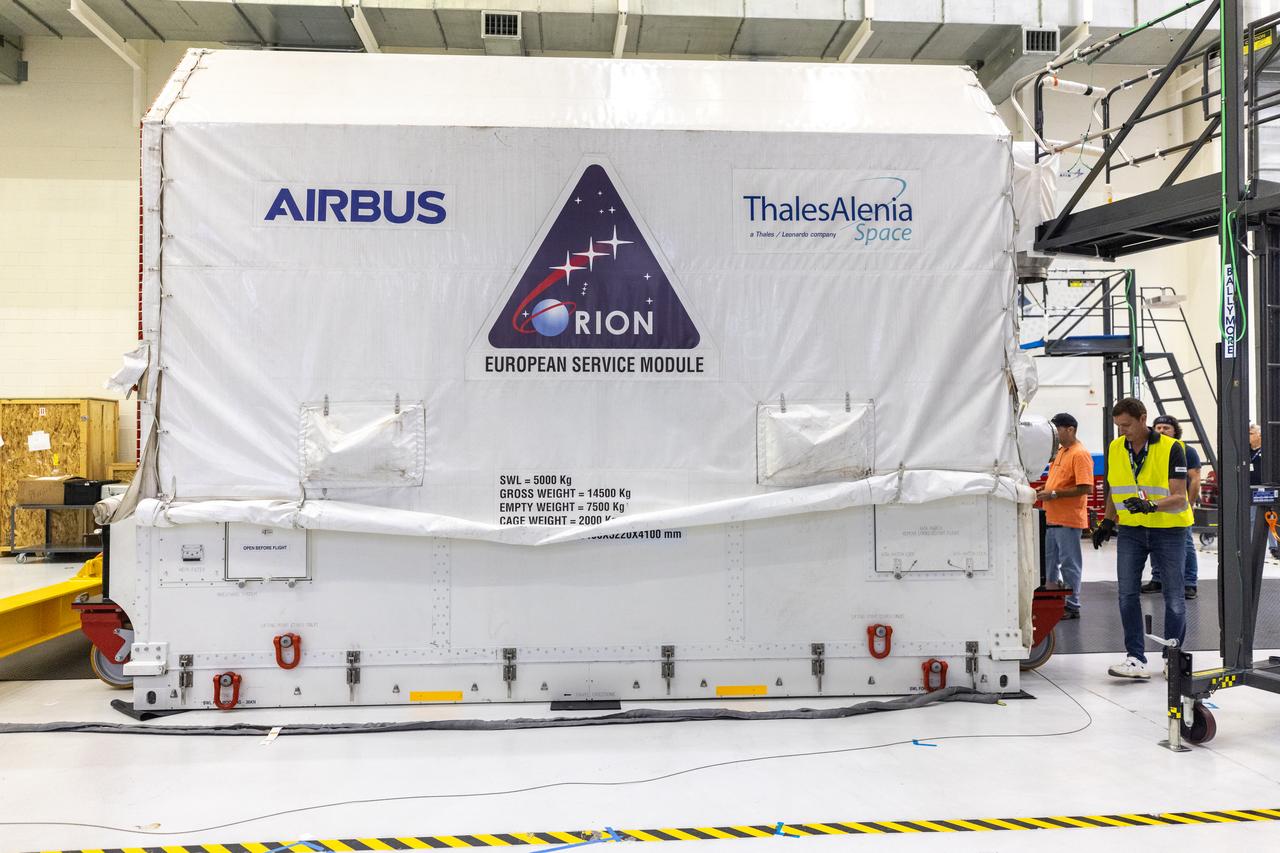
The transport carrier containing the European Service Module for NASA’s Artemis III mission arrives at the Neil A. Armstrong Operations and Checkout Building at NASA’s Kennedy Space Center in Florida on Tuesday, Sept. 3, 2024. The European Service Module, which is assembled by Airbus in Bremen, Germany, from parts made in 10 European countries and the United States, acts as the driving force behind Orion for deep space exploration, providing essential propulsion, thermal control, and electrical power.
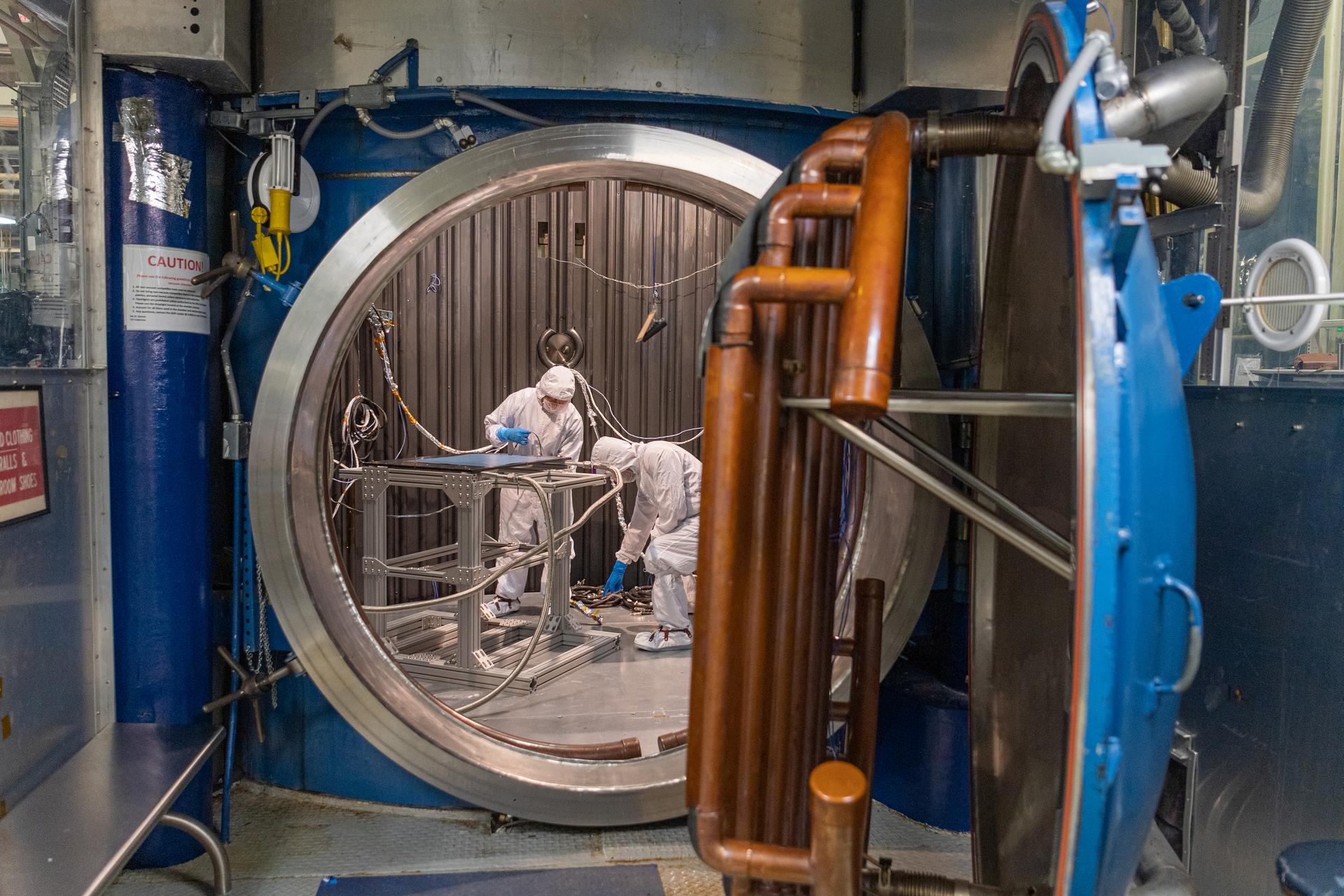
Members of the OSAM-1 power supply unit (PSU) team make preparations inside a thermal vacuum chamber for the PSU electronics box to be lowered in at Goddard Space Flight Center, Greenbelt Md., Mar 16, 2023. This photo has been reviewed by OSAM1 project management and the Export Control Office and is released for public view. NASA/Mike Guinto
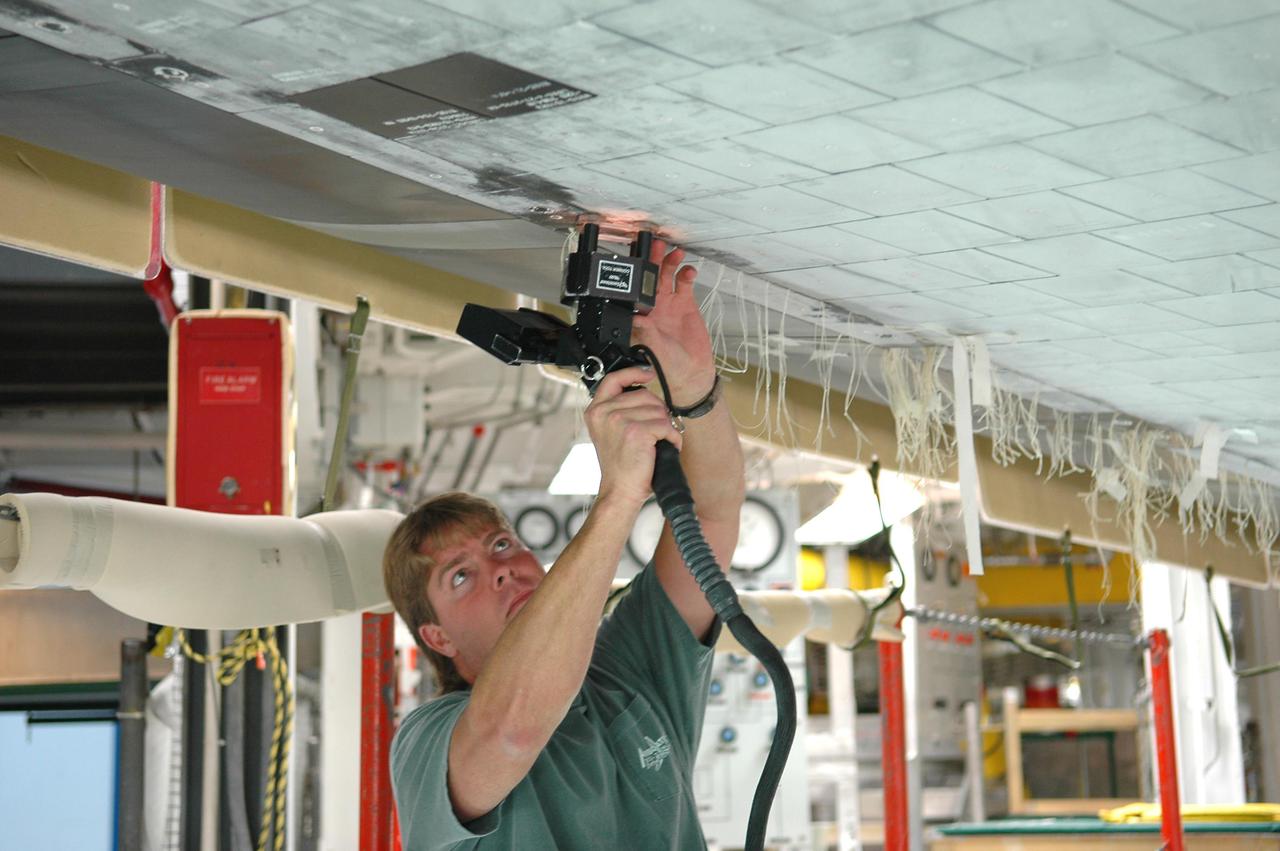
KENNEDY SPACE CENTER, FLA. - In Orbiter Processing Facility bay 1 at NASA’s Kennedy Space Center, United Space Alliance technician Greg Goforth uses a laser tool to take step and gap measurements on Thermal Protection System tiles on the underside of orbiter Atlantis. Other processing continues on Atlantis for its mission, designated STS-121, to the International Space Station. The launch planning window is Sept. 9 - 24.
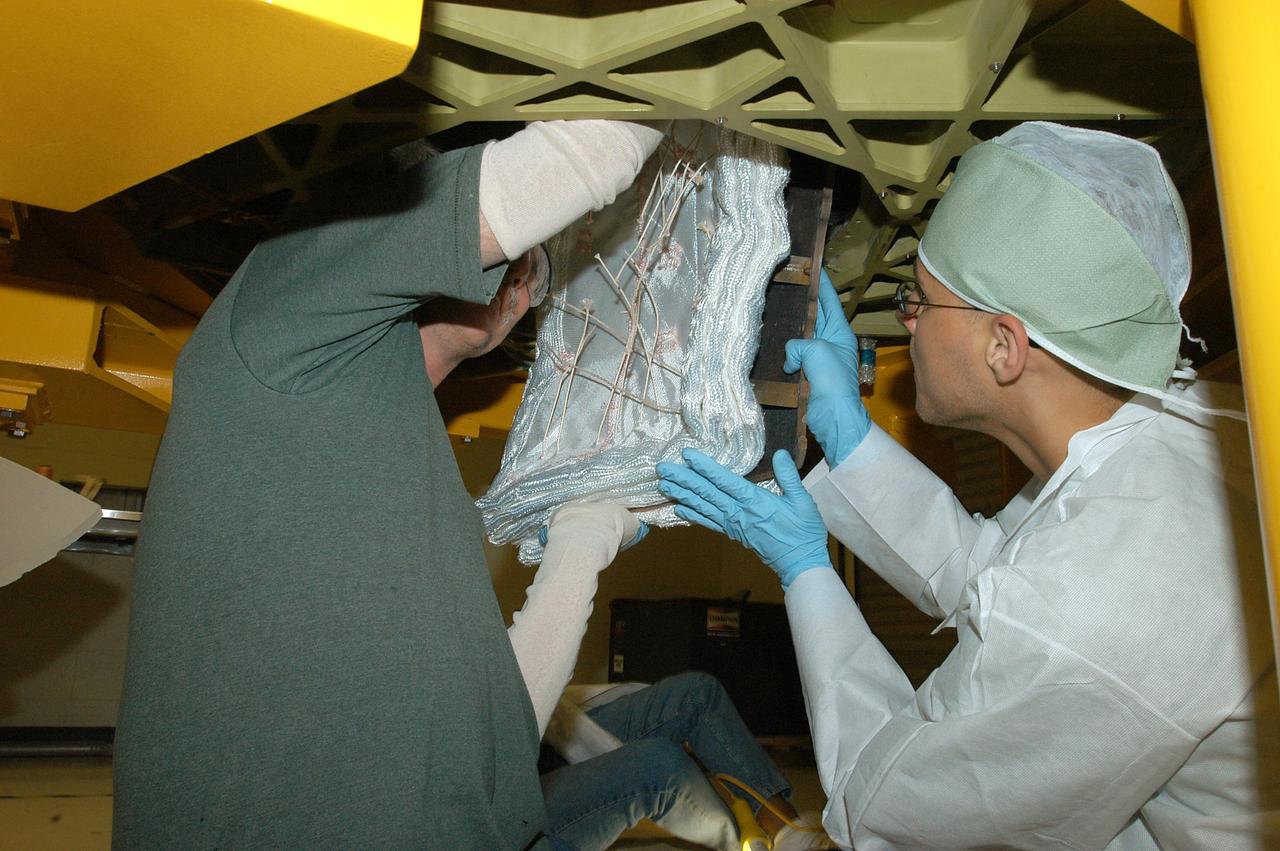
KENNEDY SPACE CENTER, FLA. -- United Space Alliance (USA) technicians Mike Williams (left) and R. Justin Hopmann (right) lift the thermal blanket insulation into Discovery’s nose cap, which is under a protective cover and seated above them on a work stand. The work is being done in a low bay area outside the Orbiter Processing Facility. Discovery is the orbiter named as the vehicle for Return to Flight with mission STS-114.
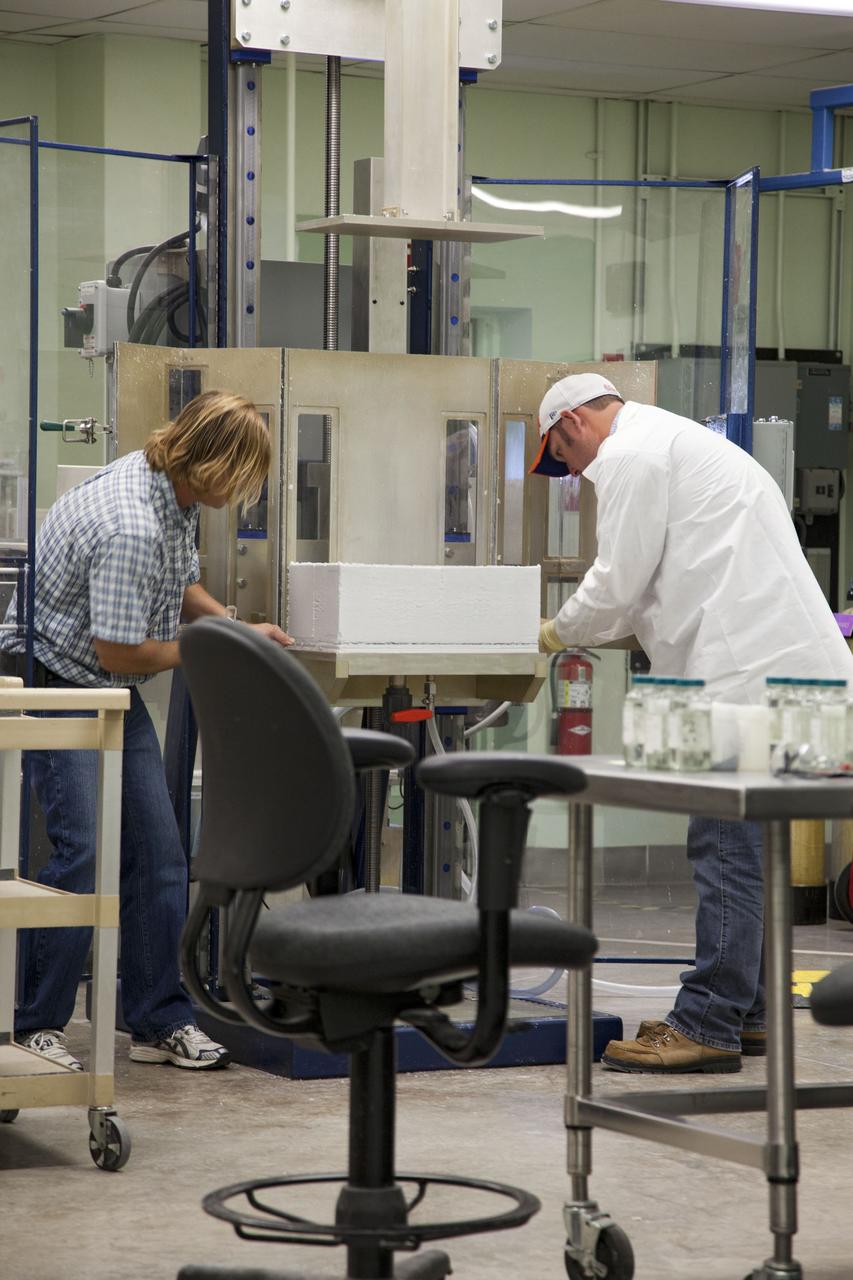
CAPE CANAVERAL, Fla. -- United Space Alliance workers, Tim Wright, left, and Chris Keeling, manufacture the heat shield tiles that will be installed to the backshell of the Orion Multi-Purpose Crew Vehicle's Exploration Flight Test EFT-1 capsule. The work to manufacture and inspect the tiles is taking place in the Thermal Protection System Facility at NASA's Kennedy Space Center in Florida. EFT-1 will be used during Orion's first test flight in space. For more information, visit www.nasa.gov/orion. Photo credit: Frankie Martin
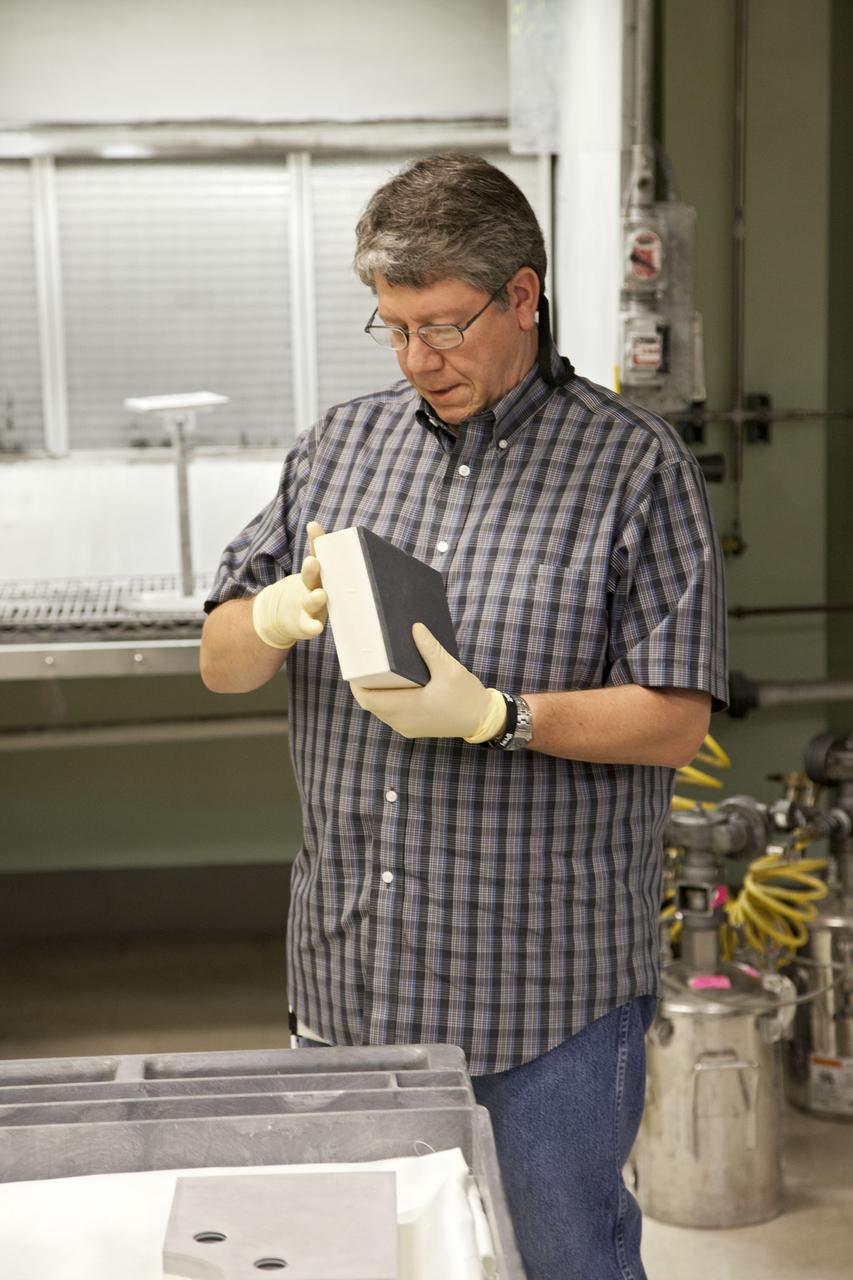
CAPE CANAVERAL, Fla. -- Frank Pelkey, a United Space Alliance technician at NASA's Kennedy Space Center in Florida, inspects a heat shield tile that will be installed to the backshell of the Orion Multi-Purpose Crew Vehicle's Exploration Flight Test EFT-1 capsule. The work to manufacture and inspect the tiles is taking place in Kennedy's Thermal Protection System Facility. EFT-1 will be used during Orion's first test flight in space. For more information, visit www.nasa.gov/orion. Photo credit: Frankie Martin
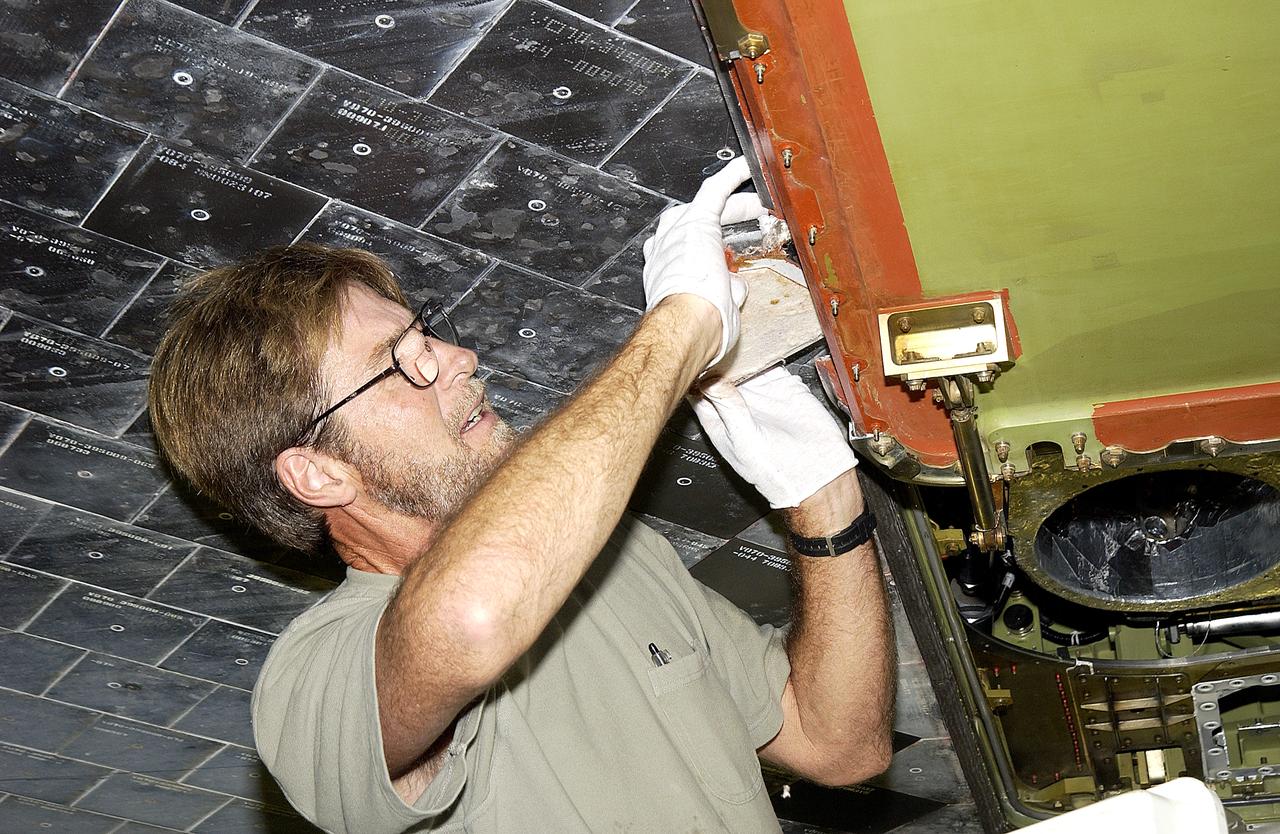
In the Orbiter Processing Facility, Harrell Watts, with United Space Alliance, removes a tile from the thermal barrier around the umbilical areas, the external tank attach points, on the underside of Atlantis. The umbilical areas are closed off after ET separation by a door, seen here. The exposed area of each closed door is covered with reusable surface insulation.
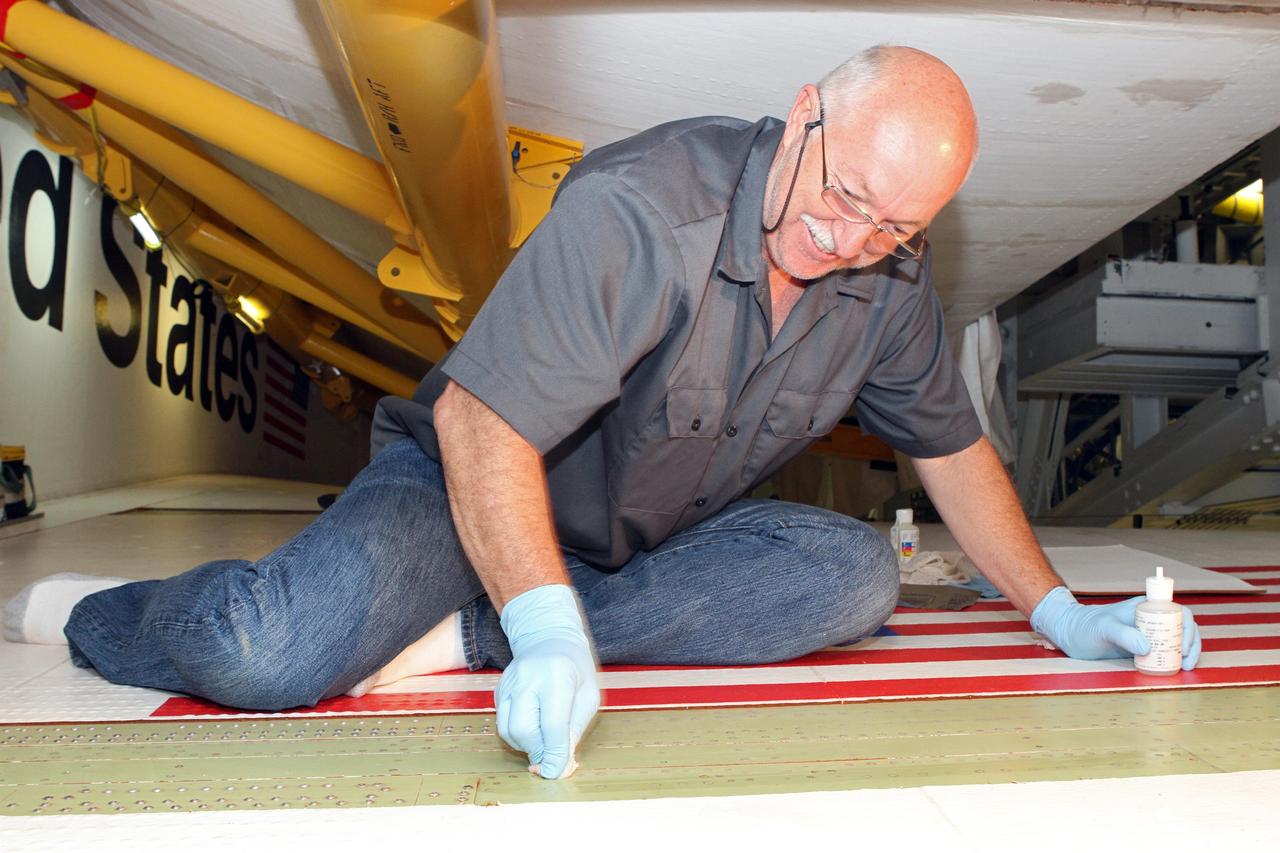
CAPE CANAVERAL, Fla. – Inside Orbiter Processing Facility-2 at NASA's Kennedy Space Center in Florida, Mike Williams, a thermal protection system technician with United Space Alliance, crouches on space shuttle Endeavour's right wing as he prepares the wing surface for tile bonding. Ongoing transition and retirement activities are preparing the spacecraft for public display at the California Science Center in Los Angeles. Endeavour flew 25 missions during its 19-year career. Photo credit: NASA/Cory Huston
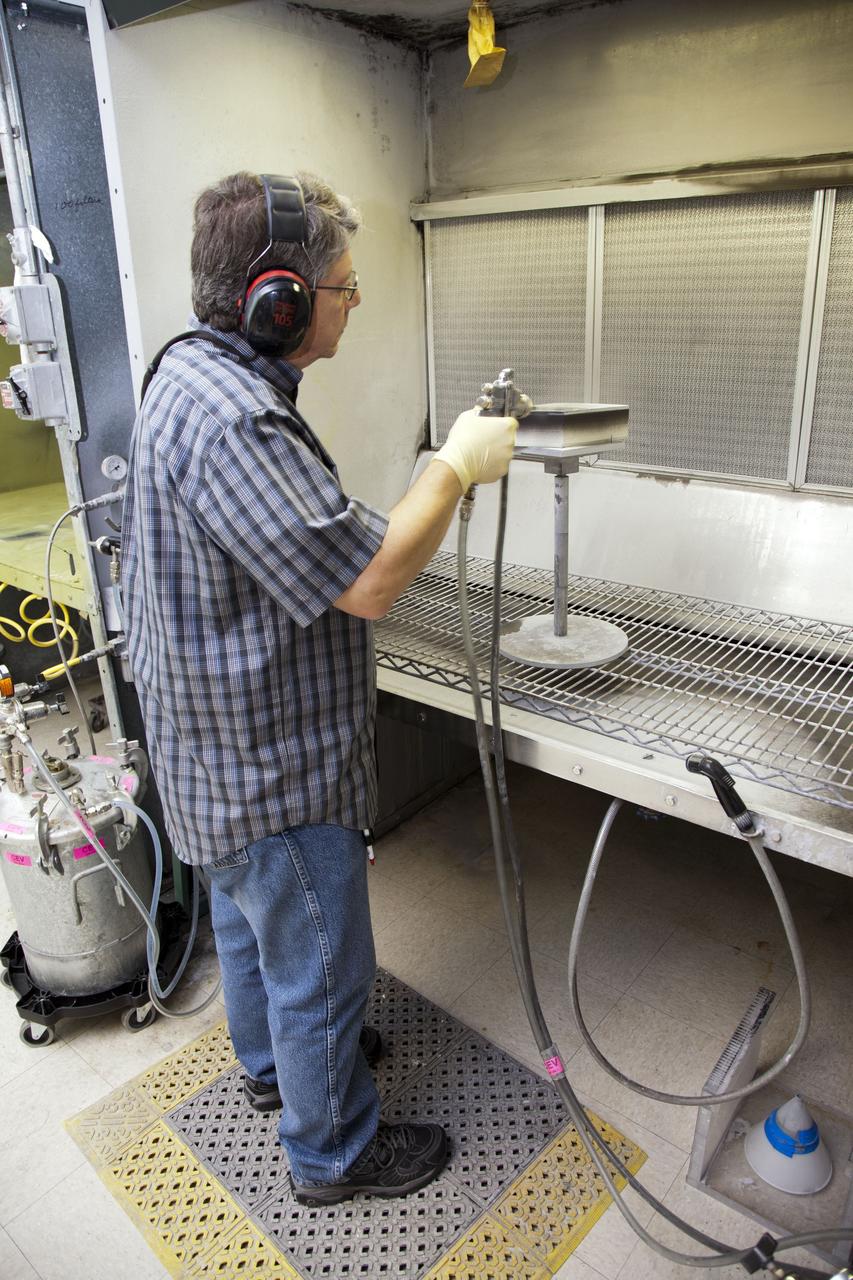
CAPE CANAVERAL, Fla. -- Frank Pelkey, a United Space Alliance technician at NASA's Kennedy Space Center in Florida, inspects a heat shield tile that will be installed to the backshell of the Orion Multi-Purpose Crew Vehicle's Exploration Flight Test EFT-1 capsule. The work to manufacture and inspect the tiles is taking place in Kennedy's Thermal Protection System Facility. EFT-1 will be used during Orion's first test flight in space. For more information, visit www.nasa.gov/orion. Photo credit: Frankie Martin
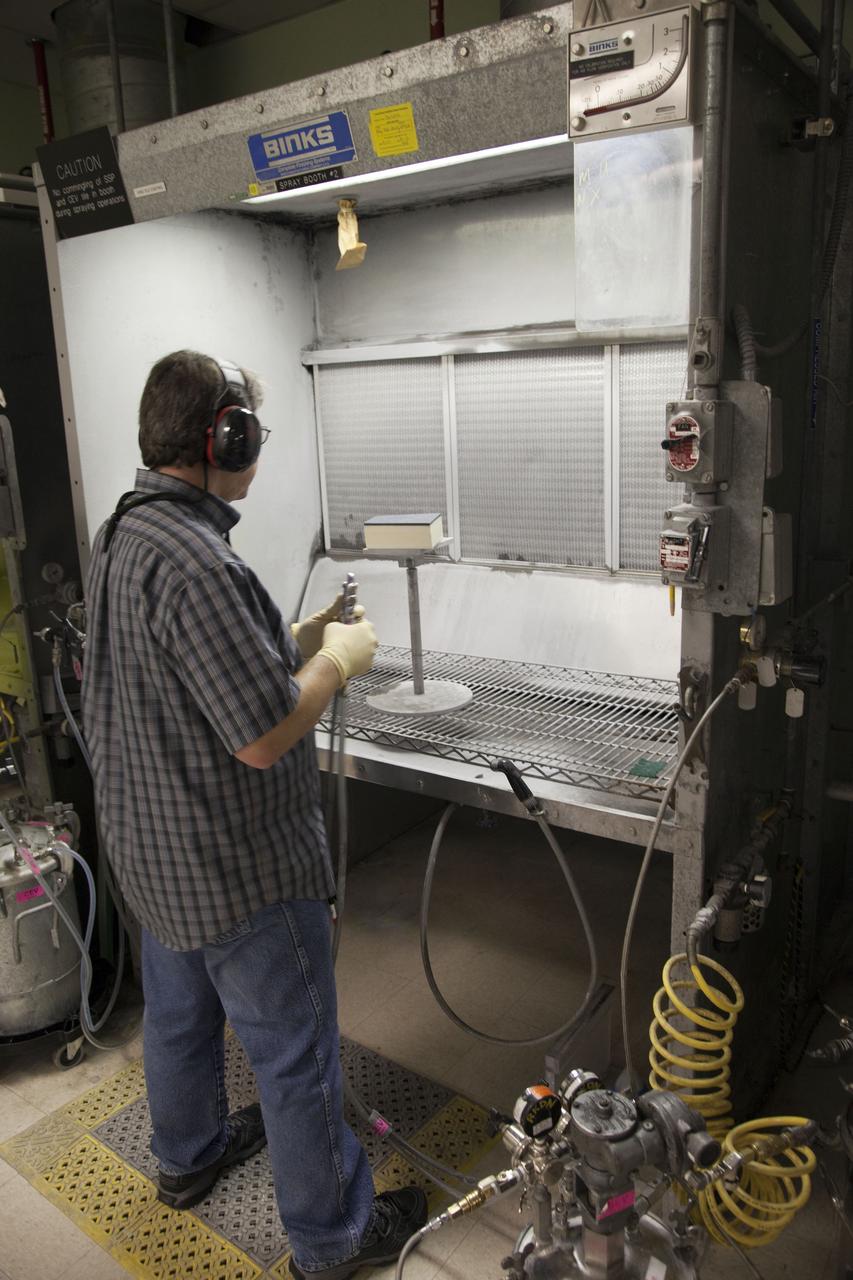
CAPE CANAVERAL, Fla. -- Frank Pelkey, a United Space Alliance technician at NASA's Kennedy Space Center in Florida, inspects a heat shield tile that will be installed to the backshell of the Orion Multi-Purpose Crew Vehicle's Exploration Flight Test EFT-1 capsule. The work to manufacture and inspect the tiles is taking place in Kennedy's Thermal Protection System Facility. EFT-1 will be used during Orion's first test flight in space. For more information, visit www.nasa.gov/orion. Photo credit: Frankie Martin
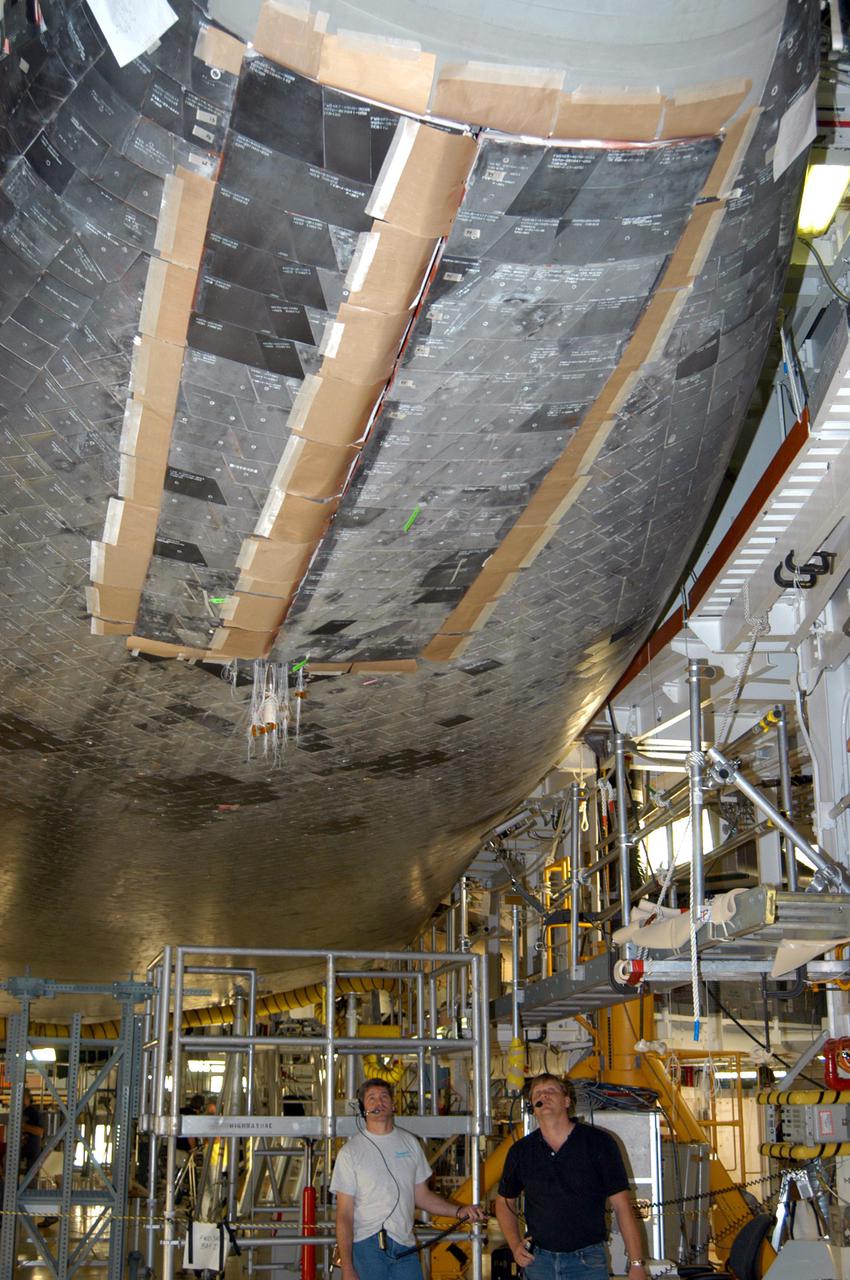
KENNEDY SPACE CENTER, FLA. - In the Orbiter Processing Facility at NASA’s Kennedy Space Center, the nose landing gear on Space Shuttle Atlantis is retracted under the supervision of United Space Alliance technicians Terry Williams (left) and Ron Delaney. Compression measurements are being taken of the newly installed nose landing gear thermal barrier seal with the gear in position in its wheel well and the landing gear doors closed. Atlantis is being processed for launch on the second Return to Flight mission, STS-121, which is scheduled to fly in July.
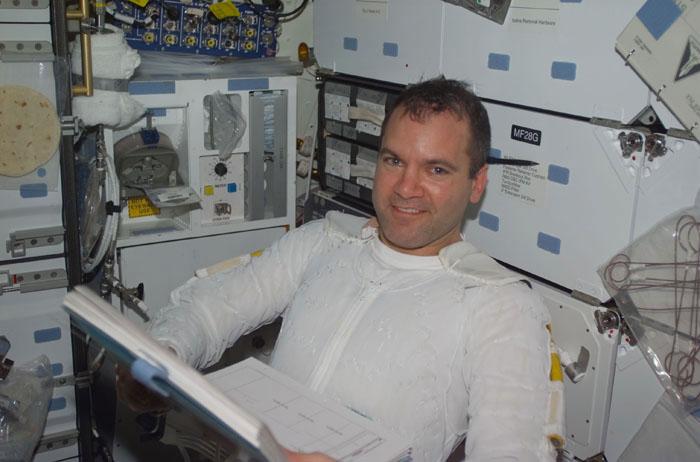
STS102-E-5207 (13 March 2001) --- Astronaut Paul W. Richards, following the second STS-102 space walk, still wears the thermal undergarment for his extravehicular mobility unit (EMU) space suit, as he looks over flight data near the galley on Discovery's mid deck. The photograph was taken with a digital still camera.
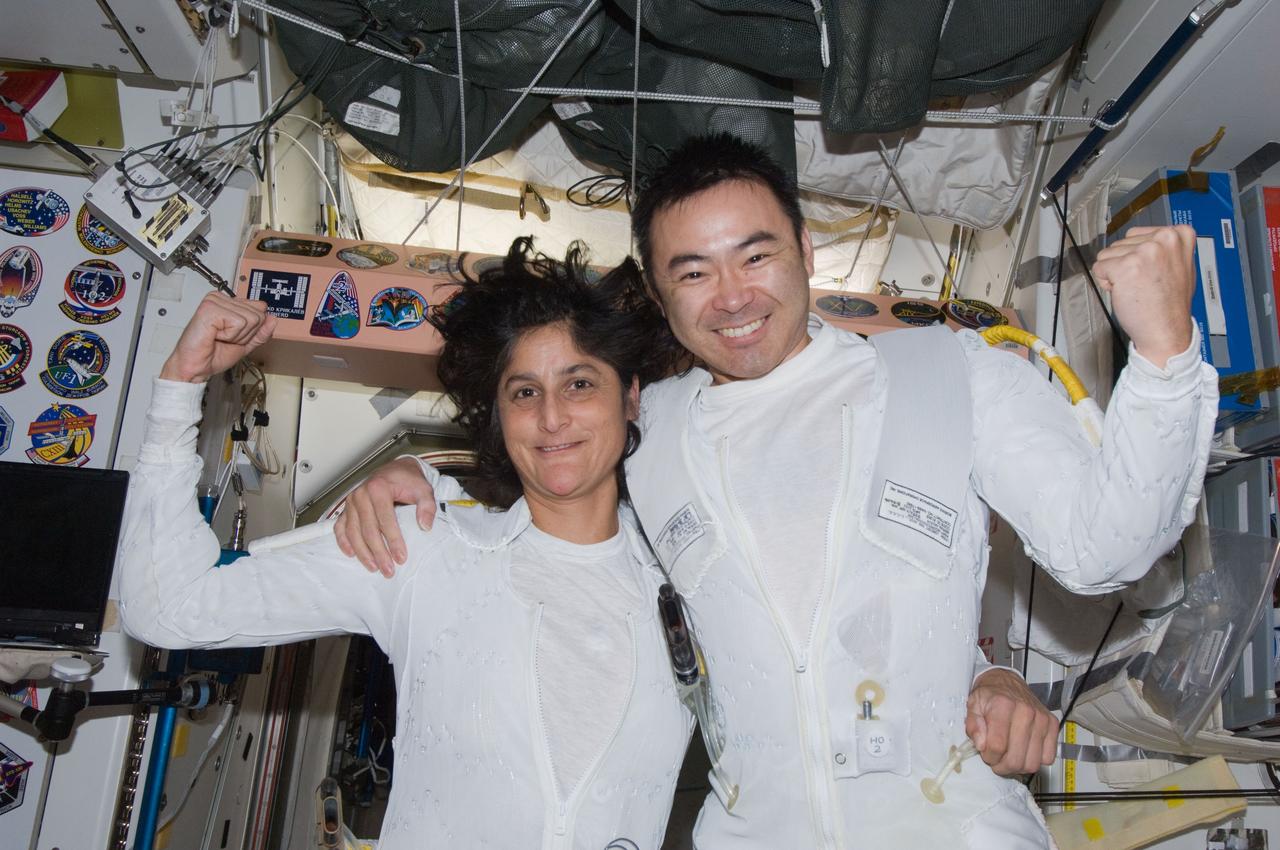
ISS032-E-025361 (5 Sept. 2012) --- Having doffed the outer layer of their Extravehicular Mobility Unit (EMU) spacesuits, Expedition 32 Flight Engineers Sunita Williams of NASA and Akihiko Hoshide of the Japan Aerospace Exploration Agency (JAXA) flex their muscles, celebrating success on their just-completed spacewalk, the second extravehicular activity for them in less than a week. They are still sporting their EMU thermal underwear in the Unity Node 1.
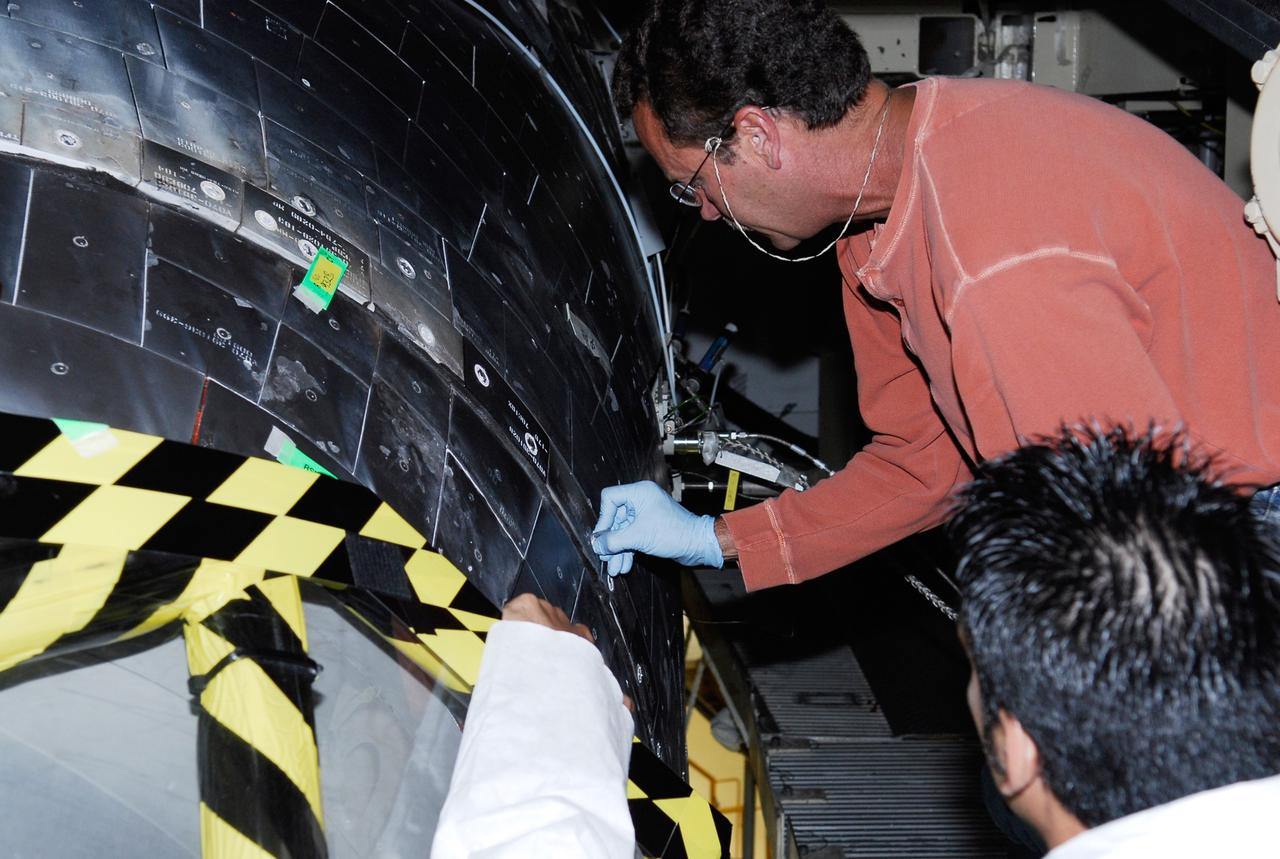
CAPE CANAVERAL, Fla. --- In the Orbiter Processing Facility at NASA's Kennedy Space Center, United Space Alliance technicians work on the thermal protection system tiles on space shuttle Discovery. The launch of Discovery on its STS-124 mission is targeted for April 24. On the mission, Discovery will transport the Kibo Japanese Experiment Module - Pressurized Module and the Japanese Remote Manipulator System to the International Space Station. Photo credit: NASA/Kim Shiflett
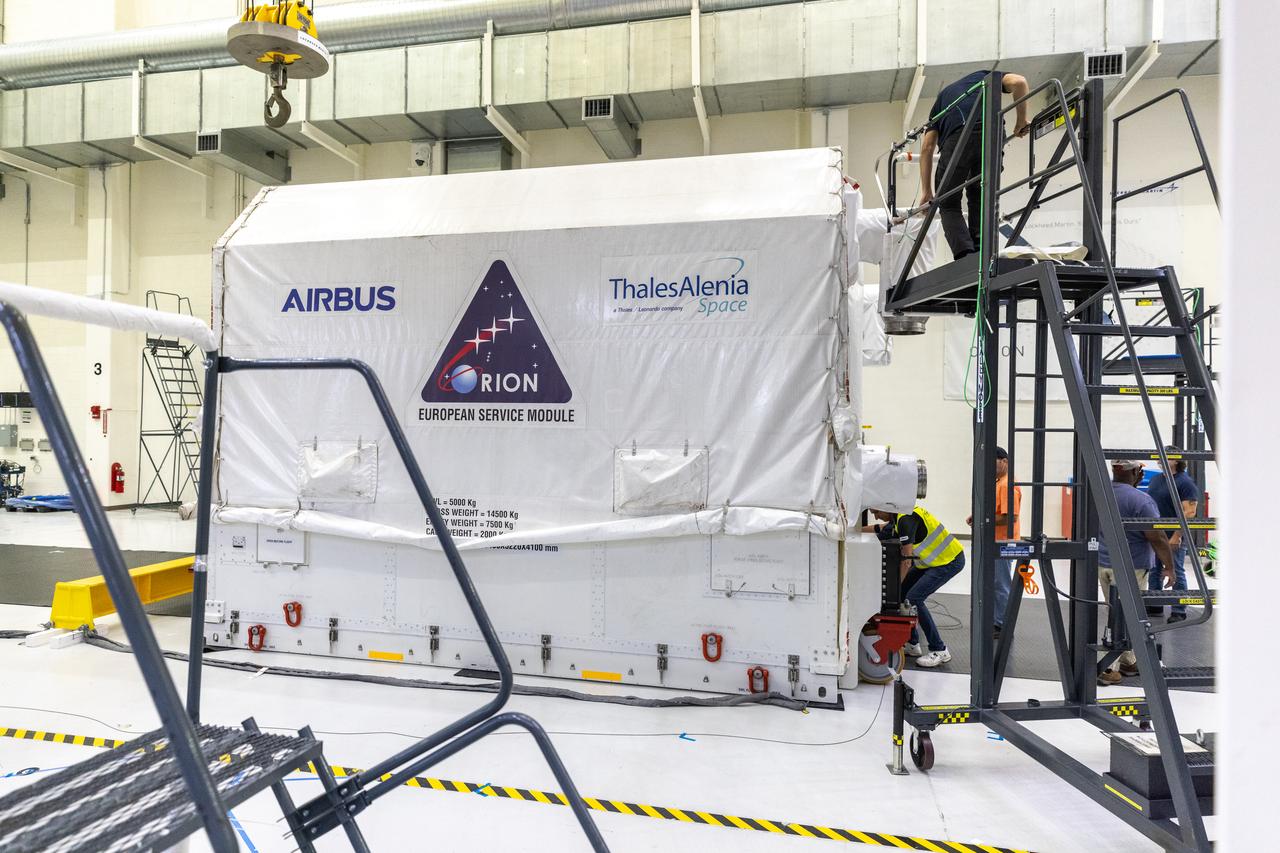
The transport carrier containing the European Service Module for NASA’s Artemis III mission arrives at the Neil A. Armstrong Operations and Checkout Building at NASA’s Kennedy Space Center in Florida on Tuesday, Sept. 3, 2024. The European Service Module, which is assembled by Airbus in Bremen, Germany, from parts made in 10 European countries and the United States, acts as the driving force behind Orion for deep space exploration, providing essential propulsion, thermal control, and electrical power.

KENNEDY SPACE CENTER, FLA. -- United Space Alliance (USA) technician Mike Williams (left) checks a portion of the thermal blanket insulation to be installed in Discovery’s nose cap. Looking from underneath is R. Justin Hopmann, with USA. In the background is Pearl Richardson, also with USA, next to the work stand holding the nose cap, which is under a protective cover. The work is being done in a low bay area outside the Orbiter Processing Facility. Discovery is the orbiter named as the vehicle for Return to Flight with mission STS-114.
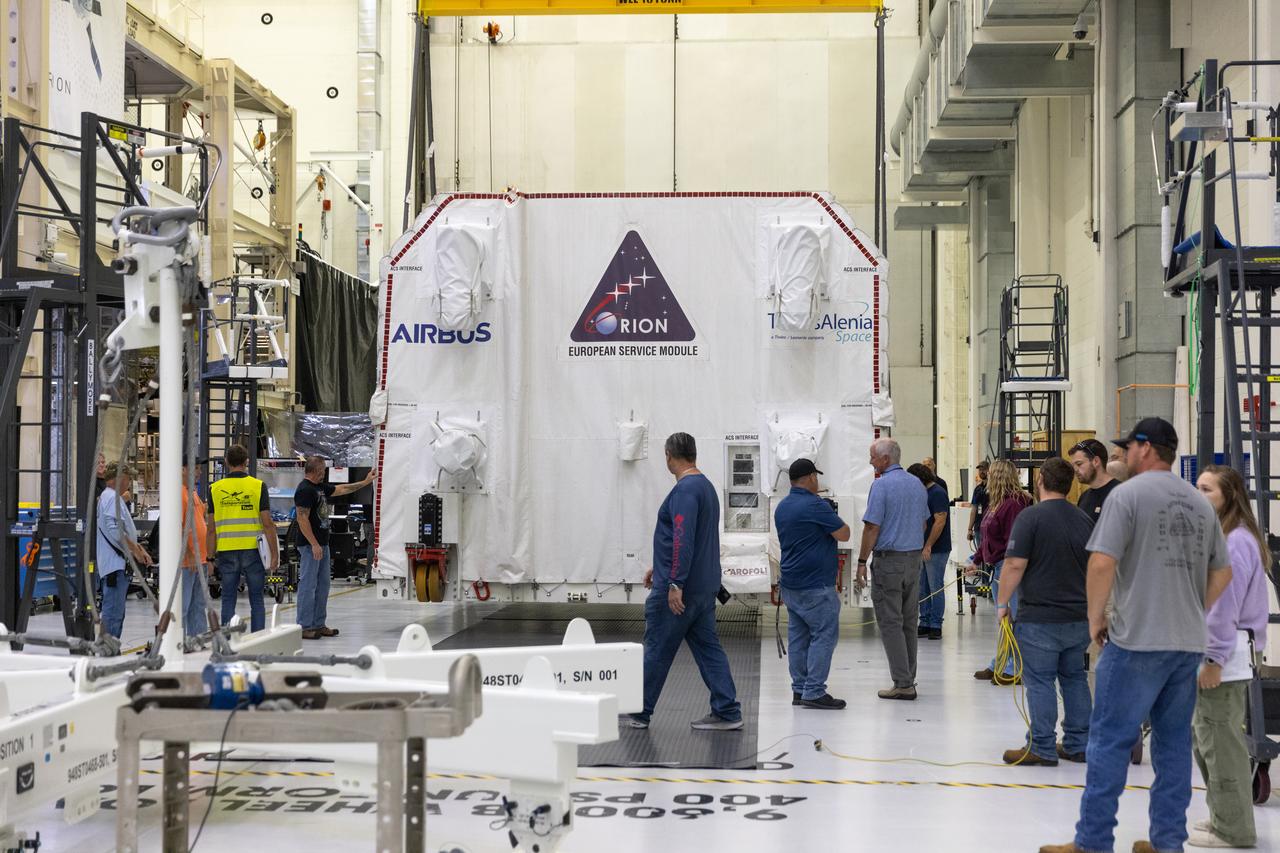
The transport carrier containing the European Service Module for NASA’s Artemis III mission arrives at the Neil A. Armstrong Operations and Checkout Building at NASA’s Kennedy Space Center in Florida on Tuesday, Sept. 3, 2024. The European Service Module, which is assembled by Airbus in Bremen, Germany, from parts made in 10 European countries and the United States, acts as the driving force behind Orion for deep space exploration, providing essential propulsion, thermal control, and electrical power.
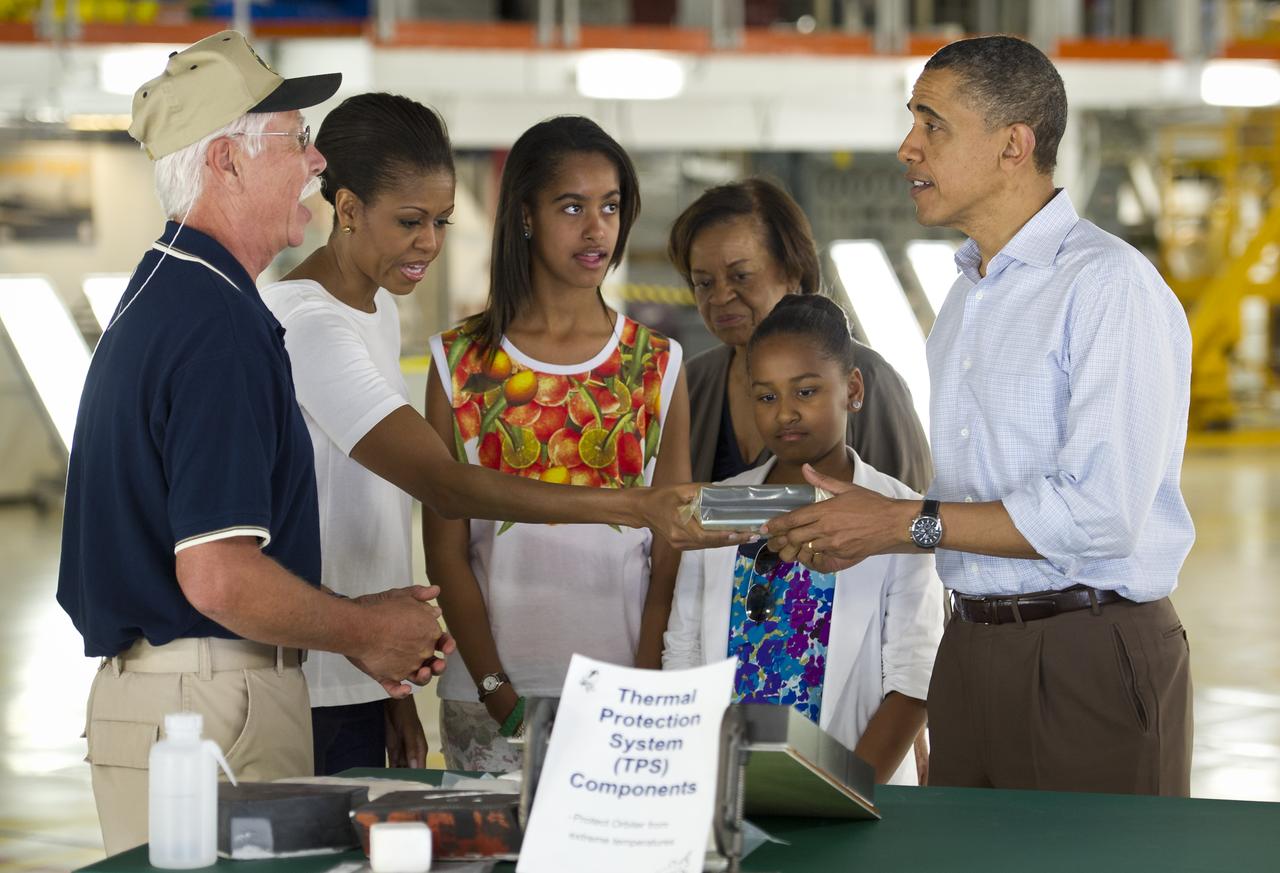
Terry White, United Space Alliance project lead for thermal protection systems, left, shows President Barack Obama and his family, from left, First Lady Michelle Obama, Malia, Marian Robinson and Sasha, how tiles work on the space shuttle during their visit to the Orbital Processing Facility at the NASA Kennedy Space Center in Cape Canaveral, Fla., Friday, April 29, 2011. Photo Credit: (NASA/Bill Ingalls)
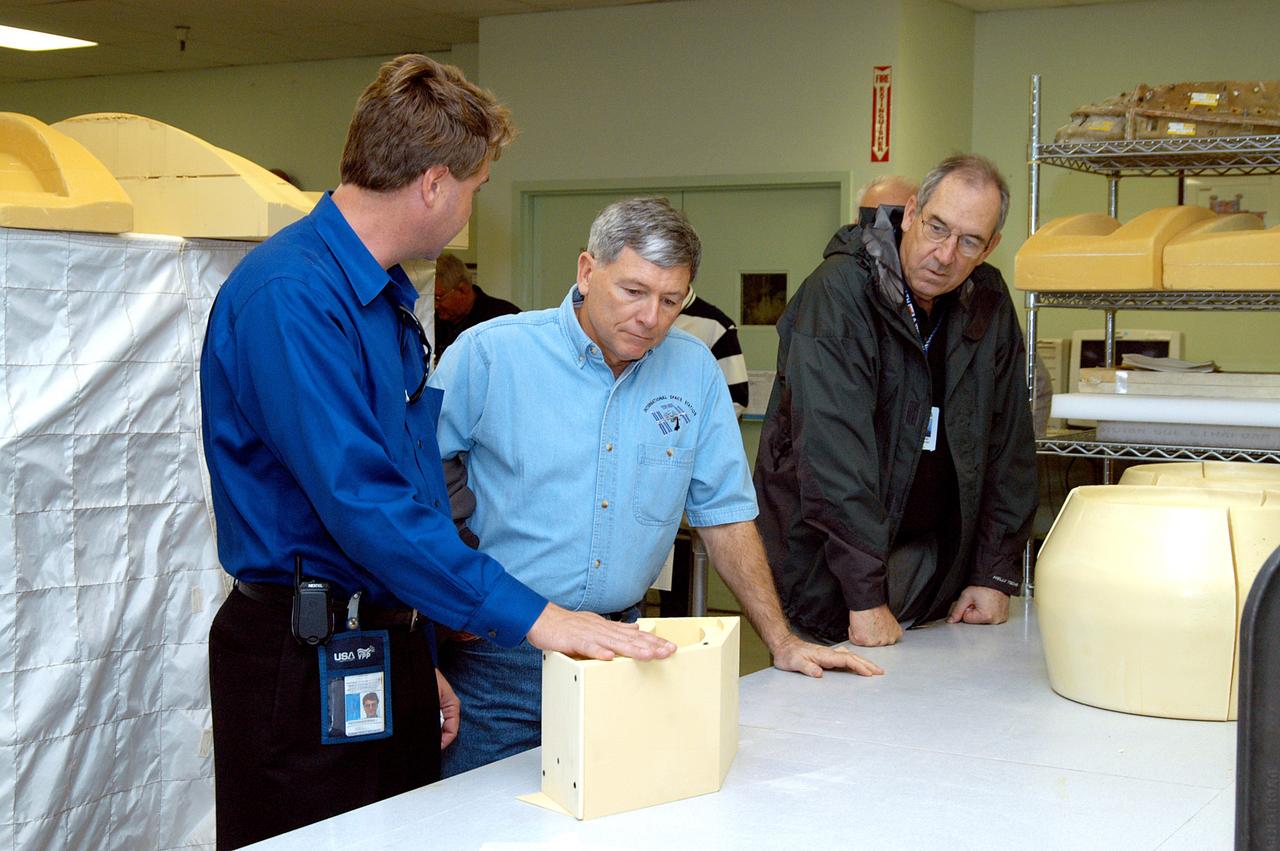
KENNEDY SPACE CENTER, FLA. -- From left, United Space Alliance (USA) Manager of the Thermal Protection System (TPS) Facility Martin Wilson briefs NASA Deputy Associate Administrator for Space Station and Shuttle Programs Michael Kostelnik and USA Vice President and Space Shuttle Program Manager Howard DeCastro on aspects of creating the tile used in the Shuttle's TPS. NASA and USA Space Shuttle program management are participating in a leadership workday. The day is intended to provide management with an in-depth, hands-on look at Shuttle processing activities at KSC.
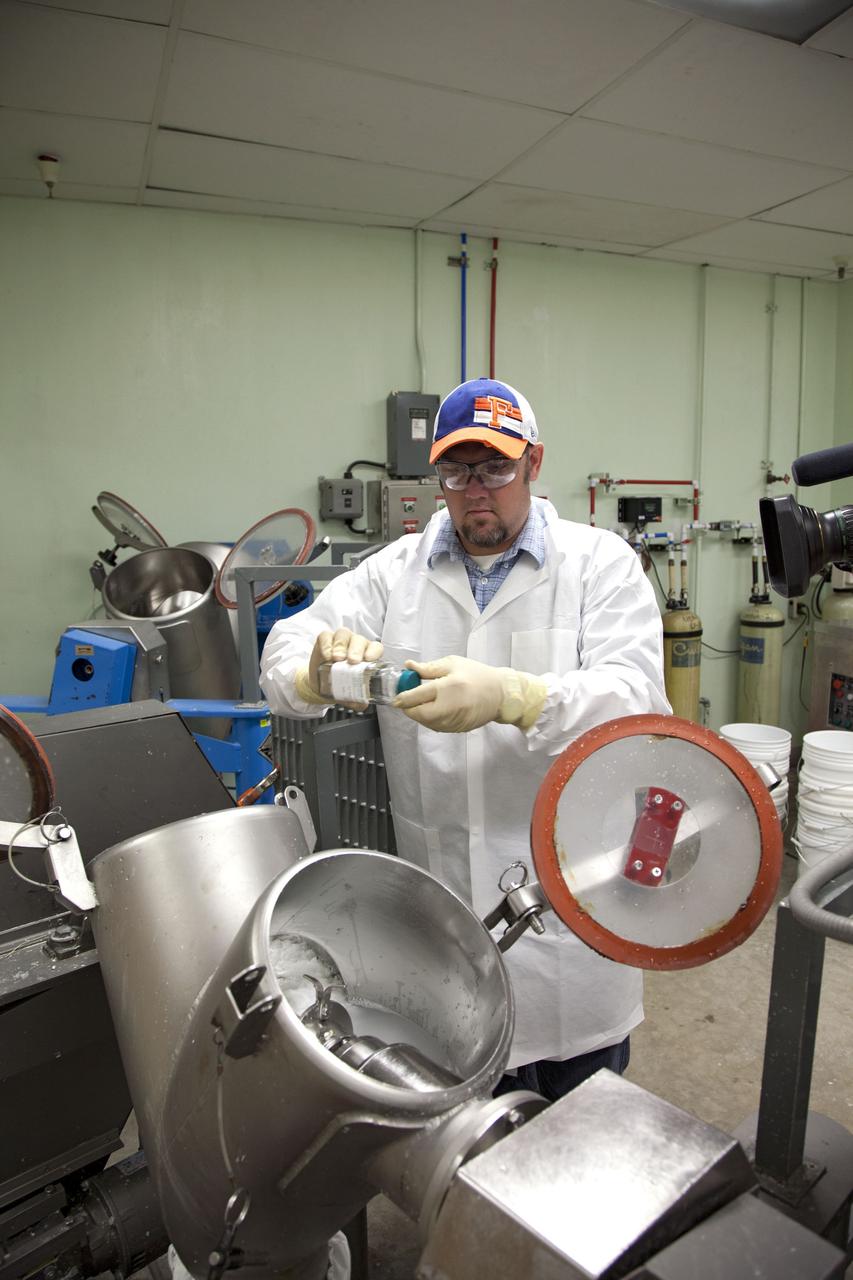
CAPE CANAVERAL, Fla. -- Chris Keeling, a United Space Alliance technician at NASA's Kennedy Space Center in Florida, manufactures the heat shield tiles that will be installed to the backshell of the Orion Multi-Purpose Crew Vehicle's Exploration Flight Test EFT-1 capsule. The work to manufacture and inspect the tiles is taking place in Kennedy's Thermal Protection System Facility. EFT-1 will be used during Orion's first test flight in space. For more information, visit www.nasa.gov/orion. Photo credit: Frankie Martin
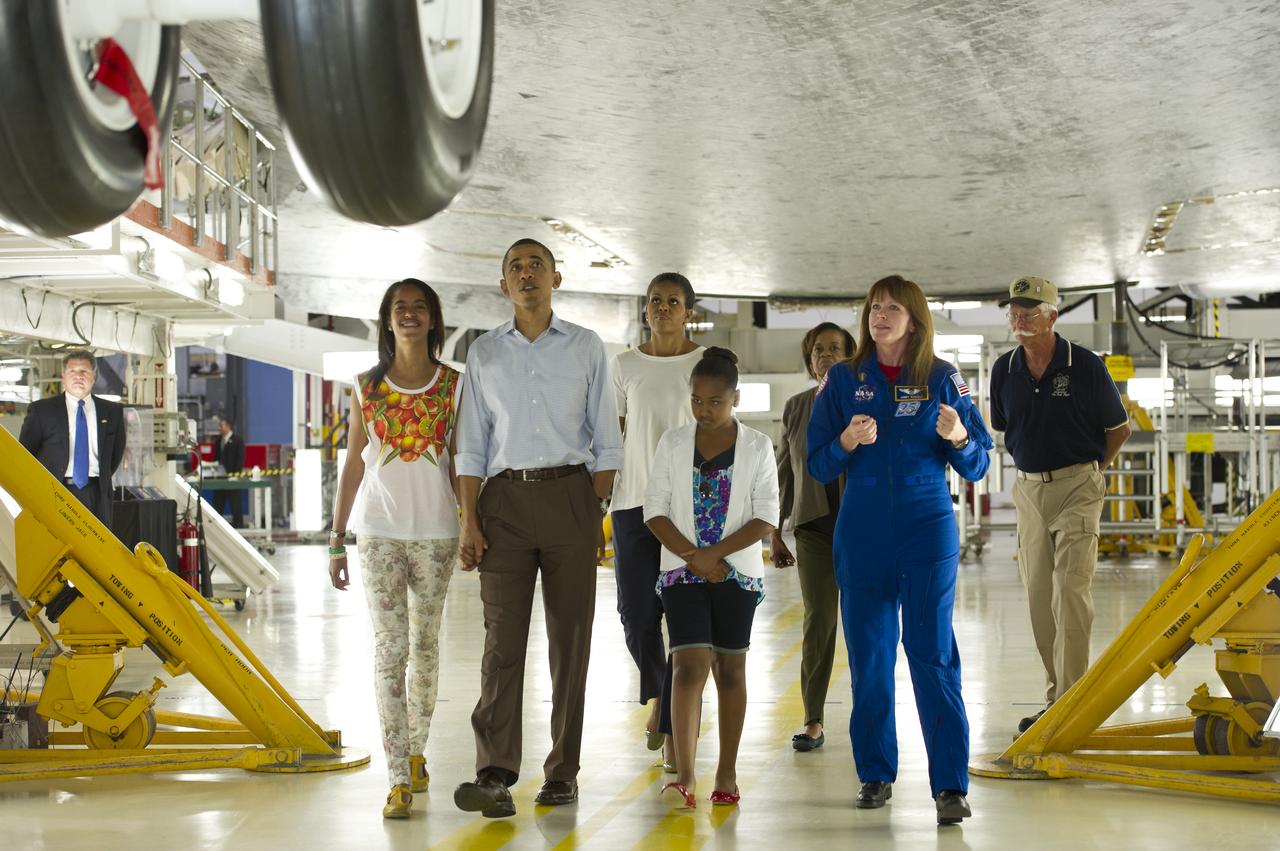
President Barack Obama holds hands with his daughter Malia as they walk under the space shuttle Atlantis with First Lady Michelle Obama, Sasha, and Marian Robinson during a tour they received of the NASA Orbital Processing Facility given by Astronaut, Janet Kavandi, and United Space Alliance project lead for thermal protection systems Terry White, right, at the NASA Kennedy Space Center in Cape Canaveral, Fla., Friday, April 29, 2011. Photo Credit: (NASA/Bill Ingalls)
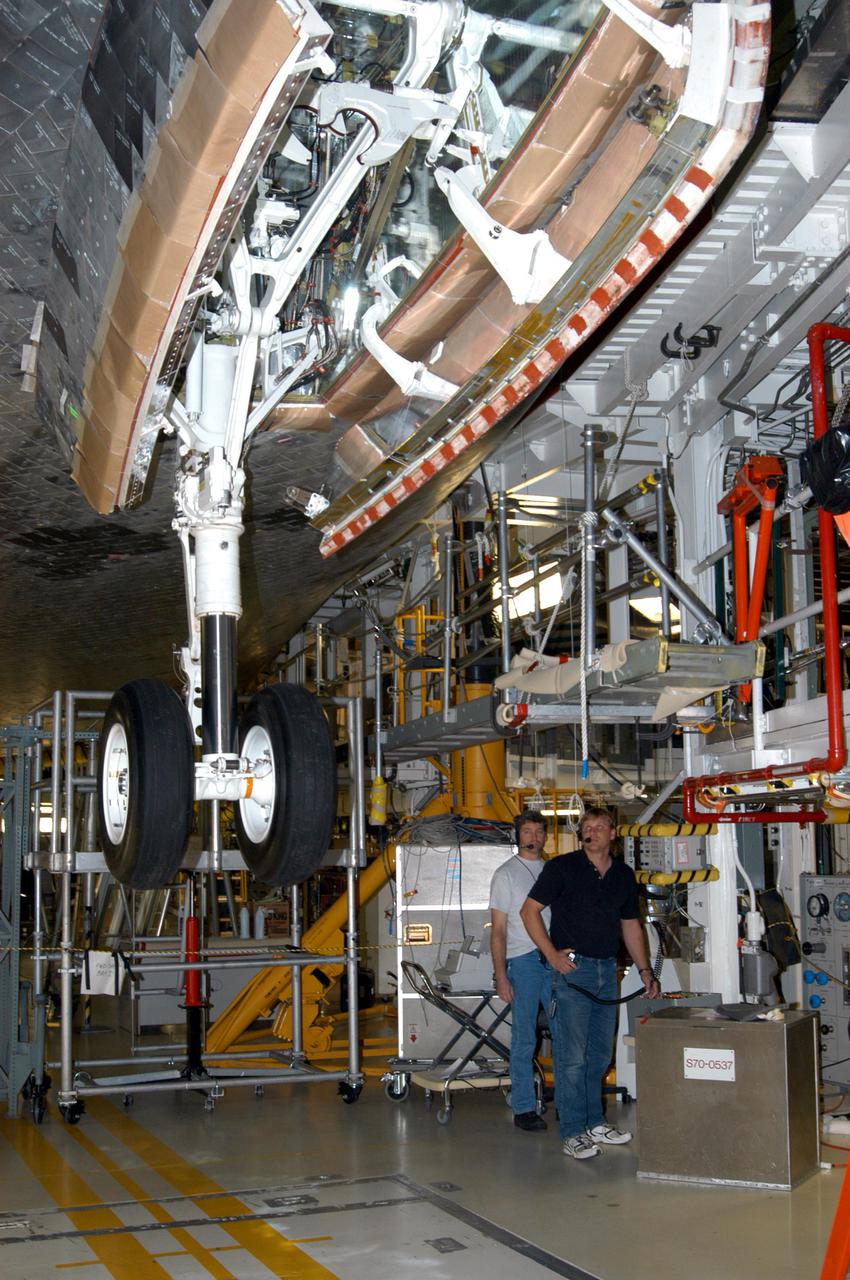
KENNEDY SPACE CENTER, FLA. - In the Orbiter Processing Facility at NASA’s Kennedy Space Center, United Space Alliance technicians Terry Williams (left) and Ron Delaney retract the nose landing gear on Space Shuttle Atlantis. Compression measurements will be taken of the newly installed nose landing gear thermal barrier seal with the gear in position in its wheel well and the landing gear doors closed. Atlantis is being processed for launch on the second Return to Flight mission, STS-121, which is scheduled to fly in July.

The transport carrier containing the European Service Module for NASA’s Artemis III mission arrives at the Neil A. Armstrong Operations and Checkout Building at NASA’s Kennedy Space Center in Florida on Tuesday, Sept. 3, 2024. The European Service Module, which is assembled by Airbus in Bremen, Germany, from parts made in 10 European countries and the United States, acts as the driving force behind Orion for deep space exploration, providing essential propulsion, thermal control, and electrical power.
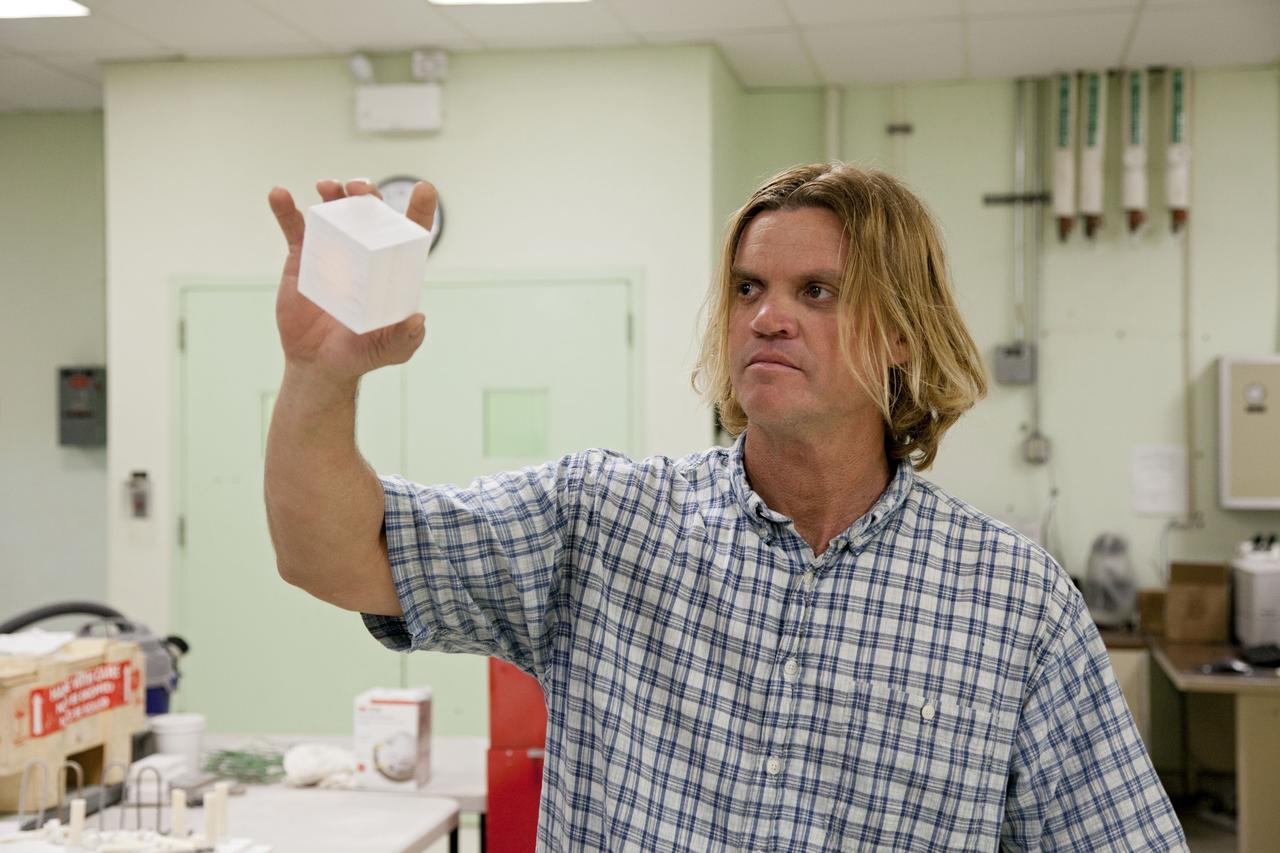
CAPE CANAVERAL, Fla. -- Tim Wright, a United Space Alliance engineering manager at NASA's Kennedy Space Center in Florida, explains the properties of the heat shield tiles that will be installed to the backshell of the Orion Multi-Purpose Crew Vehicle's Exploration Flight Test EFT-1 capsule. The work to manufacture and inspect the tiles is taking place in Kennedy's Thermal Protection System Facility. EFT-1 will be used during Orion's first test flight in space. For more information, visit www.nasa.gov/orion. Photo credit: Frankie Martin

In the Orbiter Processing Facility, Harrell Watts (left), with United Space Alliance, removes a tile from the thermal barrier around the umbilical areas, the external tank attach points, on the underside of Atlantis. The umbilical areas are closed off after ET separation by a door, seen here. The exposed area of each closed door is covered with reusable surface insulation.
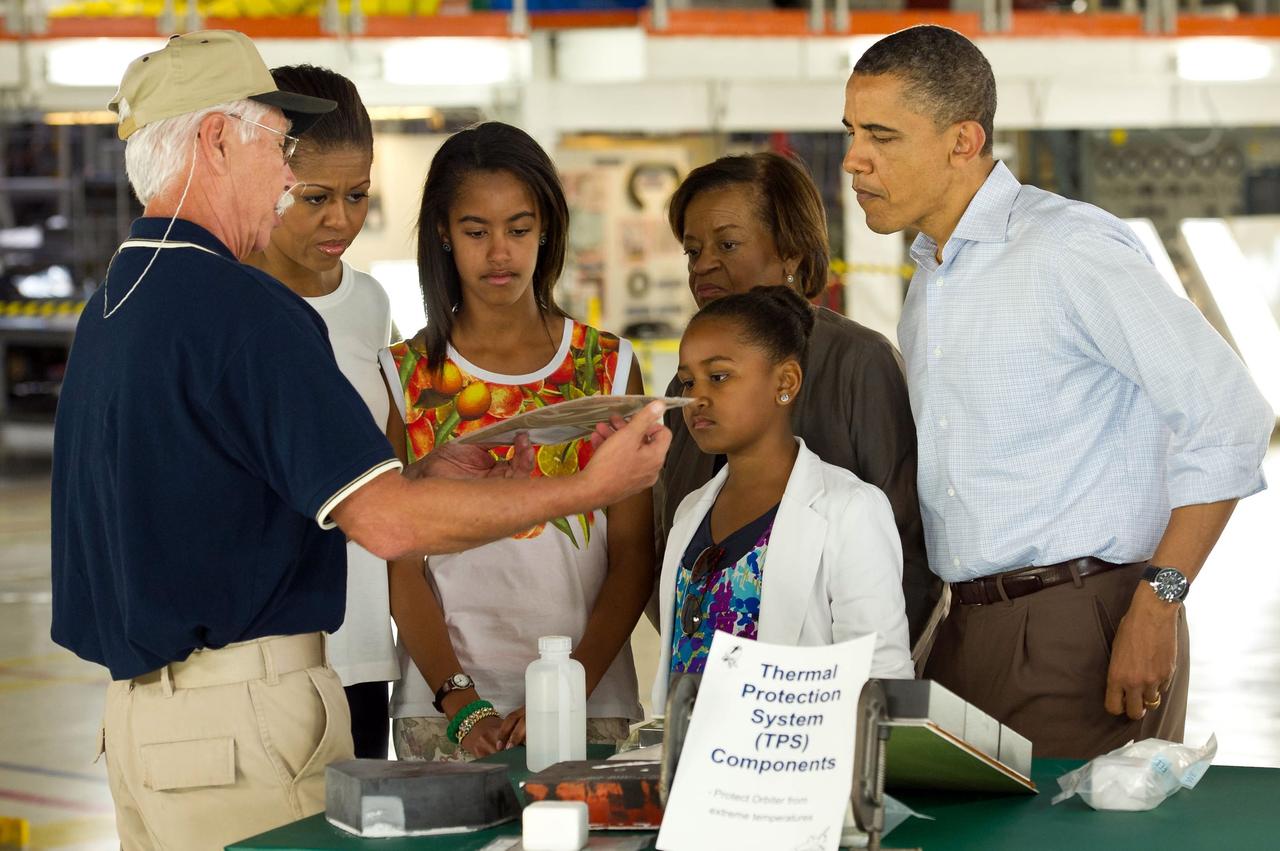
CAPE CANAVERAL, Fla. – (201104290015HQ) Terry White, United Space Alliance project lead for thermal protection systems, left, shows President Barack Obama and his family, from left, First Lady Michelle Obama, Malia, Marian Robinson and Sasha, how tiles work on the space shuttle during their visit to the Orbital Processing Facility at the NASA Kennedy Space Center in Florida.
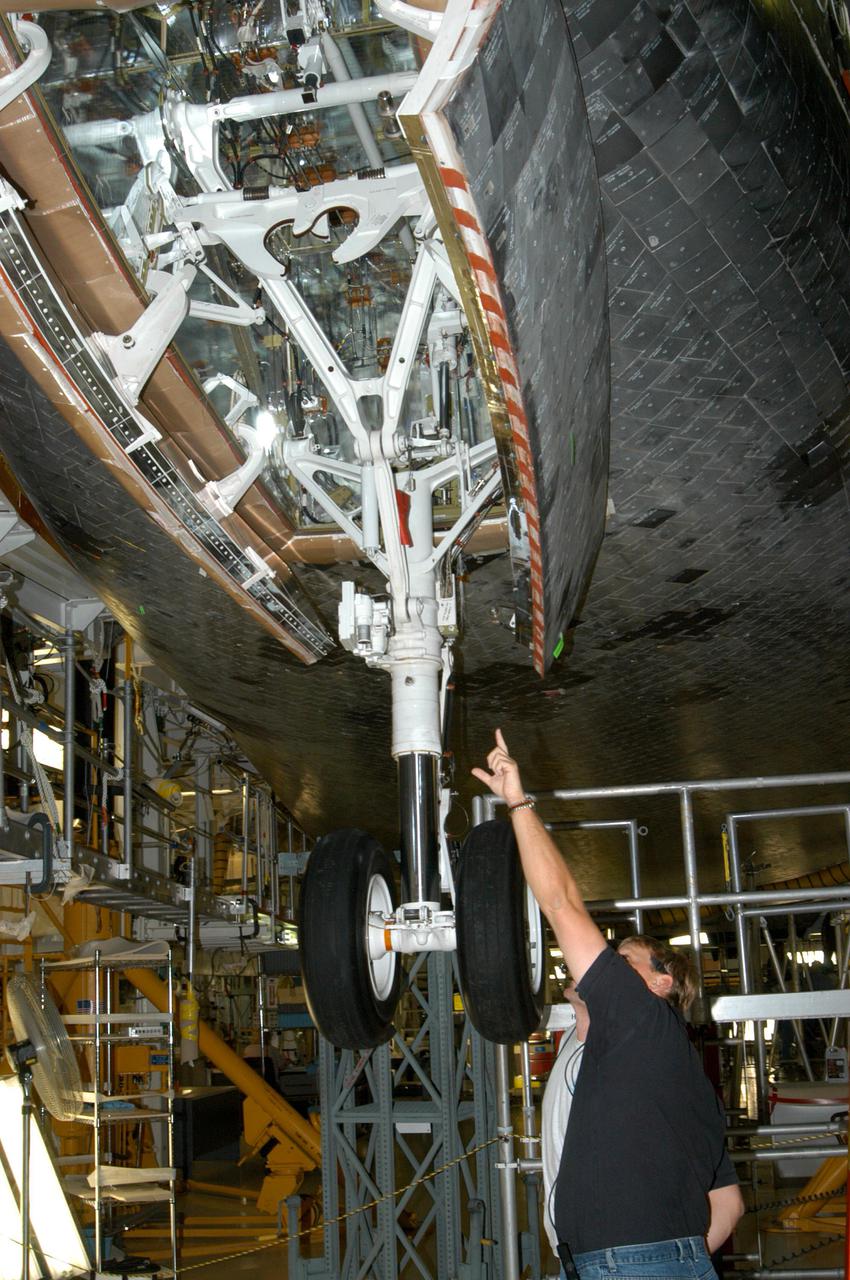
KENNEDY SPACE CENTER, FLA. - In the Orbiter Processing Facility at NASA’s Kennedy Space Center, United Space Alliance technicians Terry Williams (left) and Ron Delaney examine Space Shuttle Atlantis before retracting the nose landing gear. Compression measurements will be taken of the newly installed nose landing gear thermal barrier seal with the gear in position in its wheel well and the landing gear doors closed. Atlantis is being processed for launch on the second Return to Flight mission, STS-121, which is scheduled to fly in July.
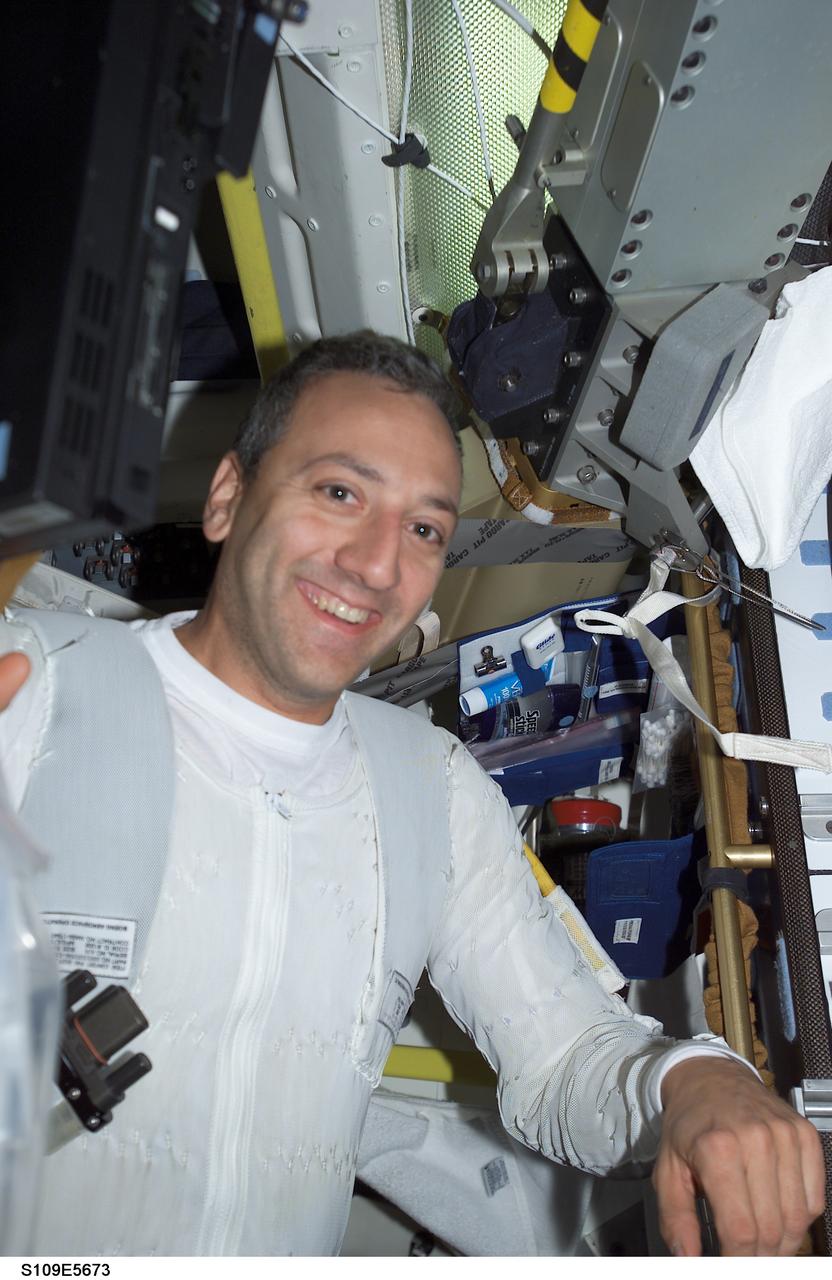
STS109-E-5673 (7 March 2002) --- Astronaut Michael J. Massimino, mission specialist, is about to put on his extravehicular mobility unit's (EMU) outer suit over its thermal under garment. Astronauts Massimino and James H. Newman were about to embark on the STS-109 mission's fourth space walk to perform work on the Hubble Space Telescope (HST). The image was recorded with a digital still camera.
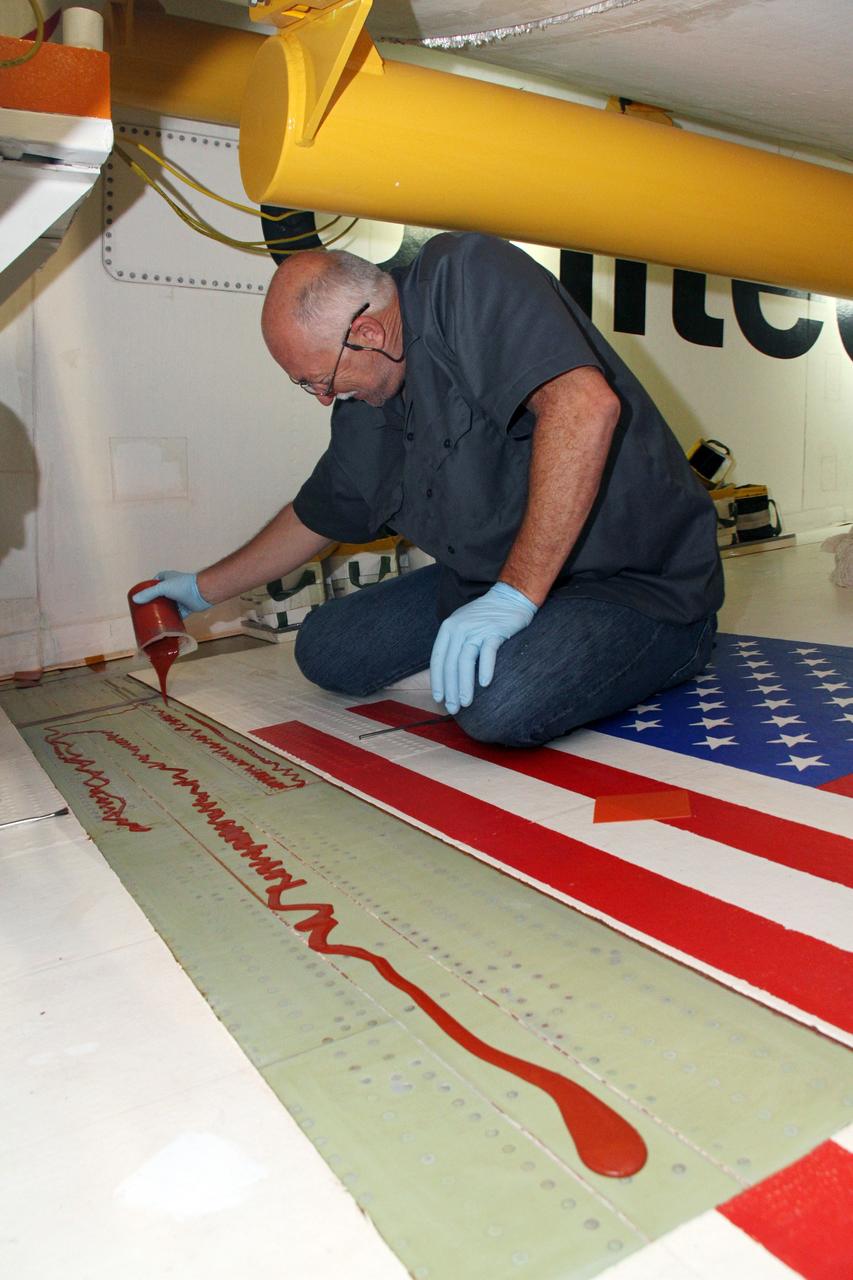
CAPE CANAVERAL, Fla. – Inside Orbiter Processing Facility-2 at NASA's Kennedy Space Center in Florida, Mike Williams, a thermal protection system technician with United Space Alliance, applies adhesive to the right wing of space shuttle Endeavour in preparation for tile bonding. Ongoing transition and retirement activities are preparing the spacecraft for public display at the California Science Center in Los Angeles. Endeavour flew 25 missions during its 19-year career. Photo credit: NASA/Cory Huston
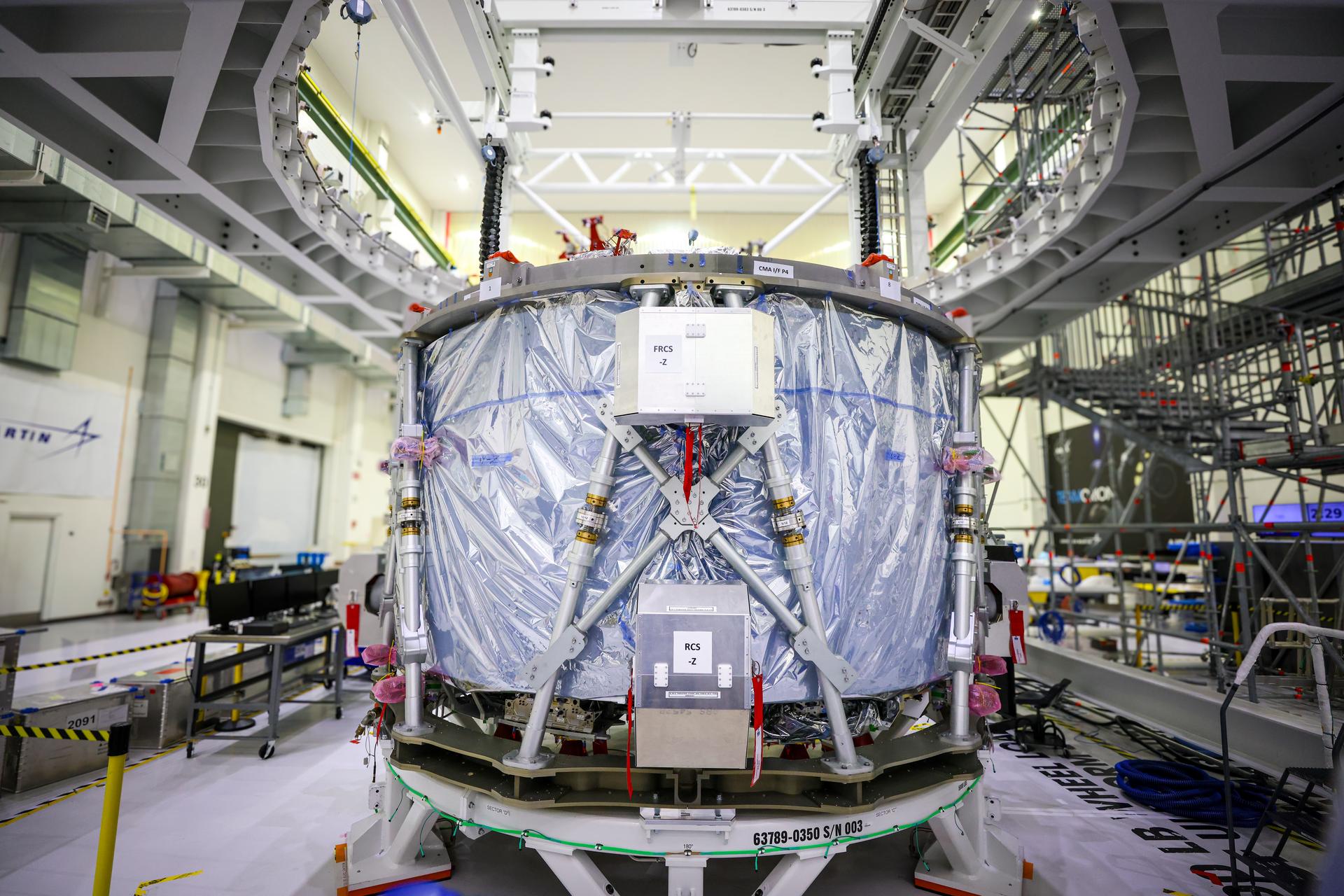
The transport carrier containing the European Service Module for NASA’s Artemis IV mission arrives at the Neil A. Armstrong Operations and Checkout Building at NASA’s Kennedy Space Center in Florida on Saturday, Dec. 20, 2025. The European Service Module, which is assembled by Airbus in Bremen, Germany, from parts made in 10 European countries and the United States, acts as the driving force behind Orion for deep space exploration, providing essential propulsion, thermal control, and electrical power.

Ahead of launch as part of NASA’s Commercial Lunar Payload Services (CLPS) initiative, Astrobotic’s Peregrine lunar lander is encapsulated in the payload fairing, or nose cone, of United Launch Alliance’s Vulcan rocket on Nov. 21, 2023, at Astrotech Space Operations Facility near the agency’s Kennedy Space Center in Florida. Launch of Astrobotic’s Peregrine Mission One will carry NASA and commercial payloads to the Moon in early 2024 to study the lunar exosphere, thermal properties, and hydrogen abundance of the lunar regolith, magnetic fields, and the radiation environment of the lunar surface.
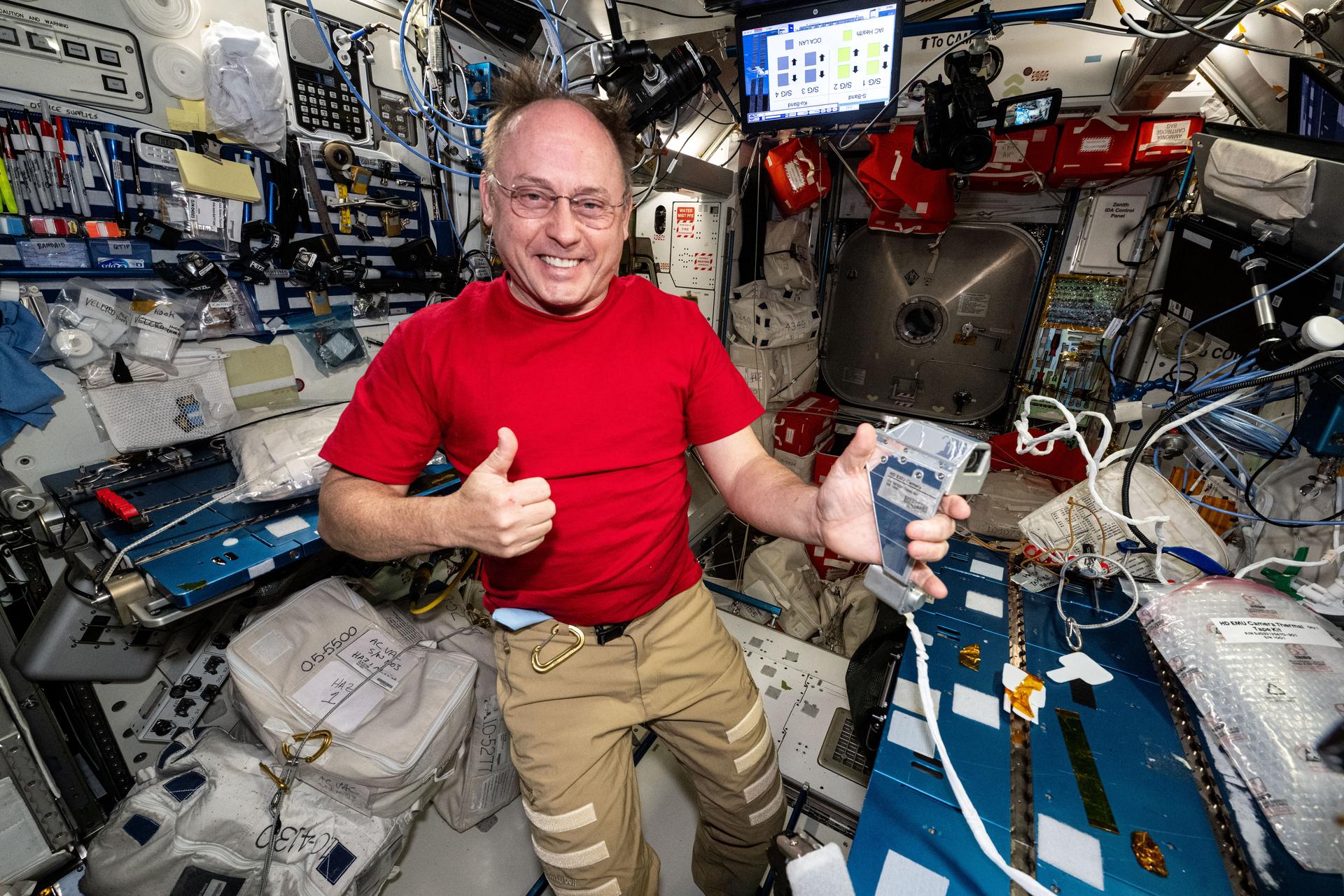
iss073e0510684 (Aug. 18, 2025) --- NASA astronaut and Expedition 73 Flight Engineer Mike Fincke gives a “thumbs up” while holding a High Definition Extravehicular Mobility Unit Camera, or HECA. The spacesuit helmet-mounted camera streams real-time, high-definition video of spacewalk activities to mission controllers on the ground. Earlier, Fincke replaced the thermal tape that shields the HECA from the harsh environment of space.
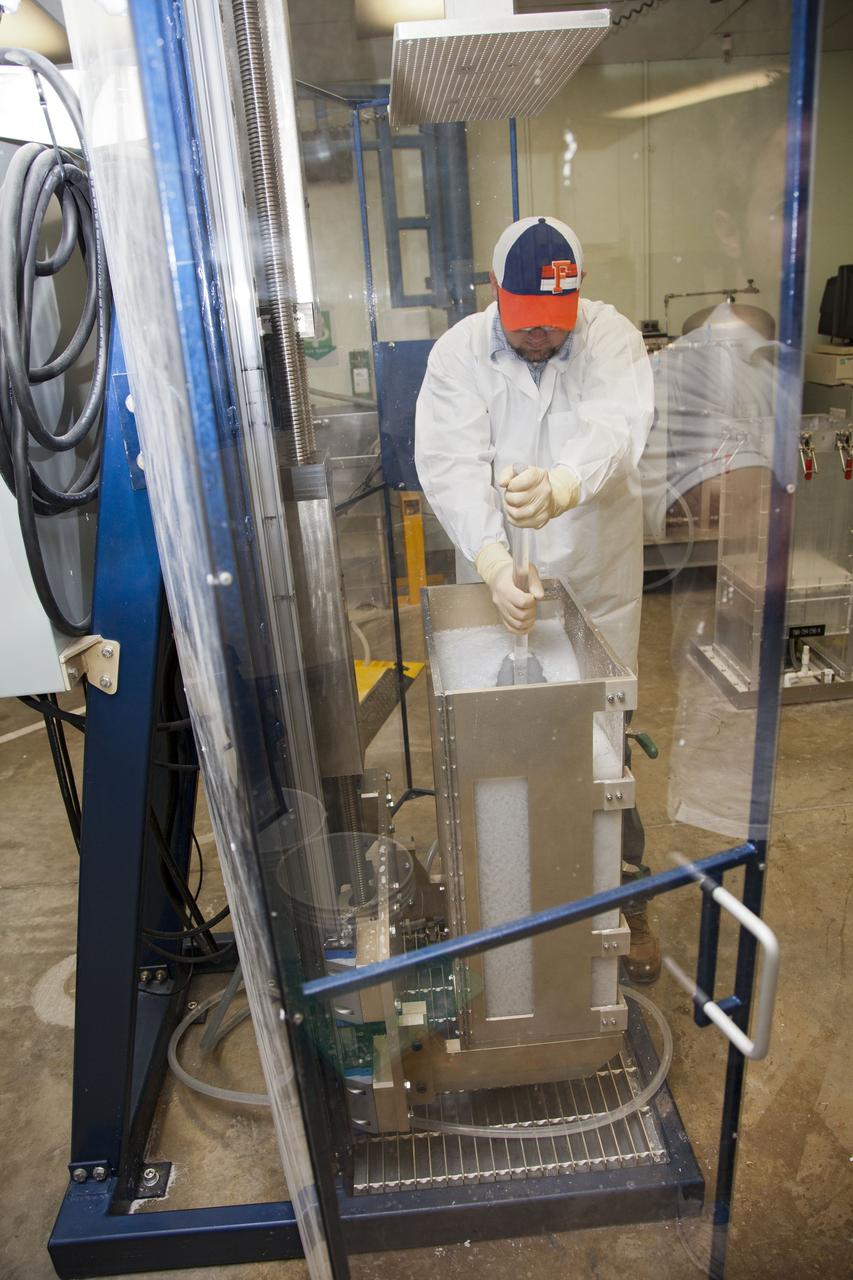
CAPE CANAVERAL, Fla. -- Chris Keeling, a United Space Alliance technician at NASA's Kennedy Space Center in Florida, manufactures the heat shield tiles that will be installed to the backshell of the Orion Multi-Purpose Crew Vehicle's Exploration Flight Test EFT-1 capsule. The work to manufacture and inspect the tiles is taking place in Kennedy's Thermal Protection System Facility. EFT-1 will be used during Orion's first test flight in space. For more information, visit www.nasa.gov/orion. Photo credit: Frankie Martin
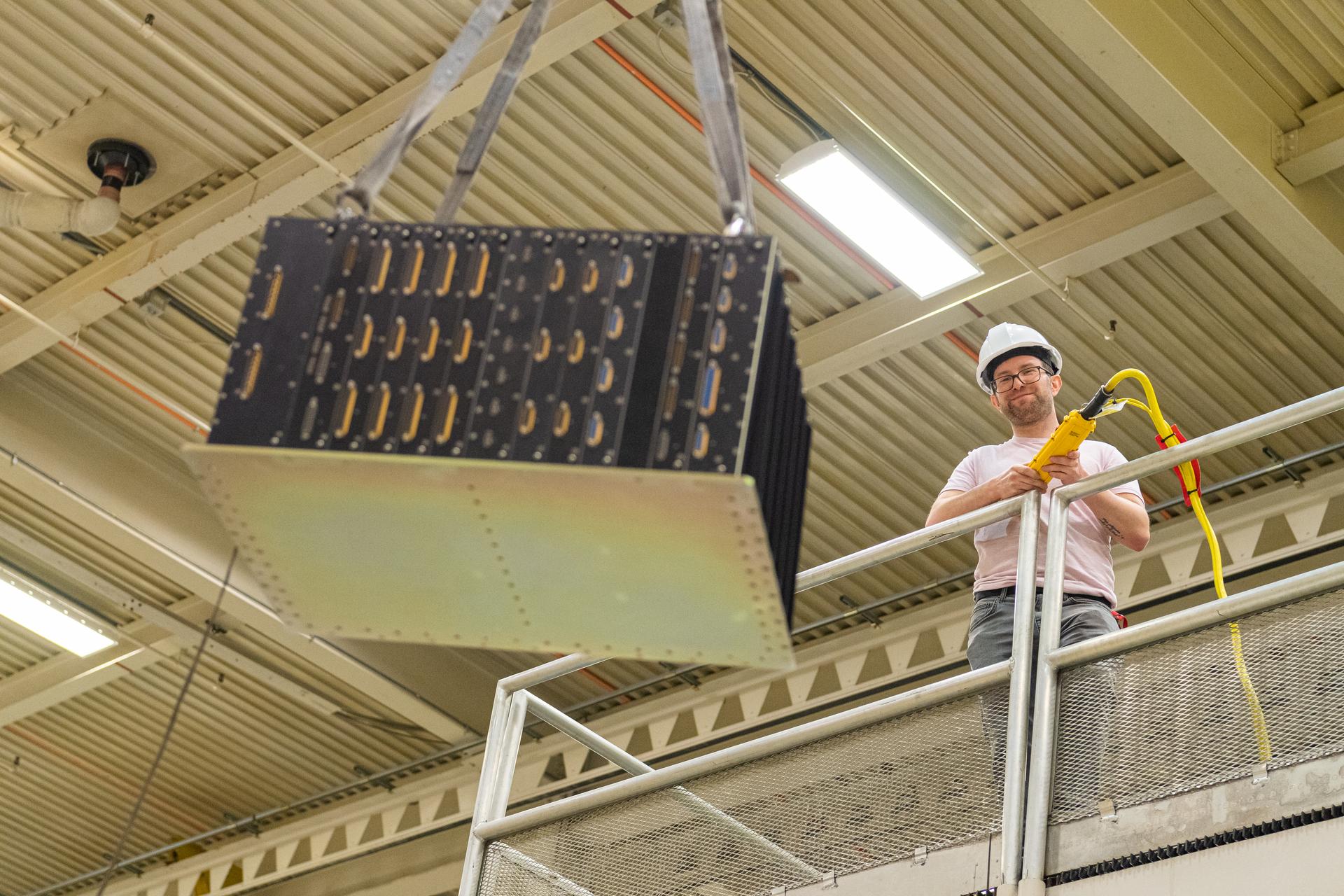
Mechanical engineering and integration technician Seth Alton crane lifts the OSAM-1 power supply unit into the thermal vacuum chamber at Goddard Space Flight Center, Greenbelt Md., April 12, 2023. This photo has been reviewed by OSAM1 project management and the Export Control Office and is released for public view. NASA/Mike Guinto

CAPE CANAVERAL, Fla. -- Chris Keeling, a United Space Alliance technician at NASA's Kennedy Space Center in Florida, manufactures the heat shield tiles that will be installed to the backshell of the Orion Multi-Purpose Crew Vehicle's Exploration Flight Test EFT-1 capsule. The work to manufacture and inspect the tiles is taking place in Kennedy's Thermal Protection System Facility. EFT-1 will be used during Orion's first test flight in space. For more information, visit www.nasa.gov/orion. Photo credit: Frankie Martin
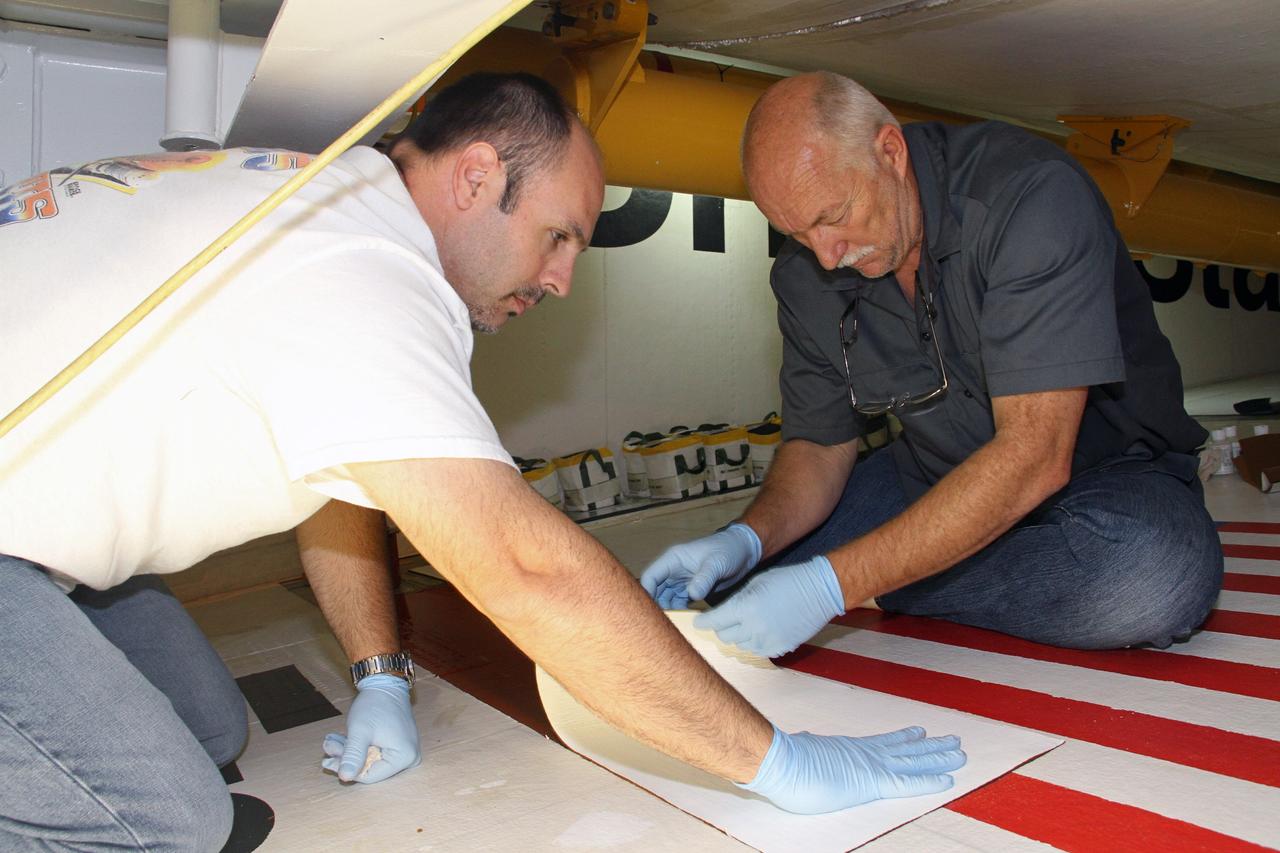
CAPE CANAVERAL, Fla. – Jeremy Schwarz, left, quality assurance technician, and Mike Williams, right, a thermal protection system technician, both with United Space Alliance, affix a section of tile to the right wing of space shuttle Endeavour at NASA's Kennedy Space Center in Florida. Ongoing transition and retirement activities are preparing the spacecraft for public display at the California Science Center in Los Angeles. Endeavour flew 25 missions during its 19-year career. Photo credit: NASA/Cory Huston
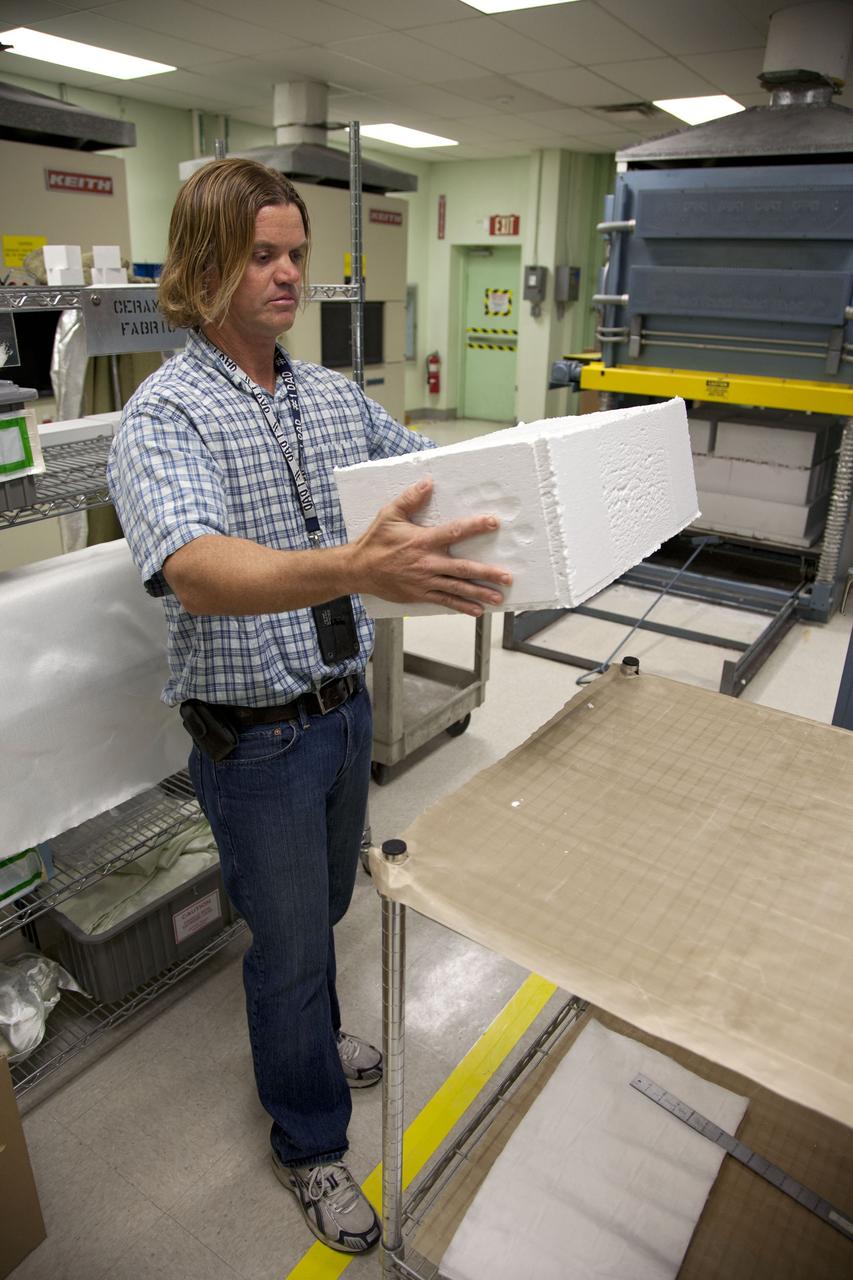
Tim Wright, a United Space Alliance engineering manager at NASA's Kennedy Space Center in Florida, unpacks the heat shield tiles that will be installed to the backshell of the Orion Multi-Purpose Crew Vehicle's Exploration Flight Test EFT-1 capsule. The tiles are being manufactured and inspected in Kennedy's Thermal Protection System Facility. The tiles will be baked at 2,200 degrees F to cure their ceramic coating. EFT-1 will be used during Orion's first test flight in space. For more information, visit www.nasa.gov/orion. Photo credit: Frankie Martin
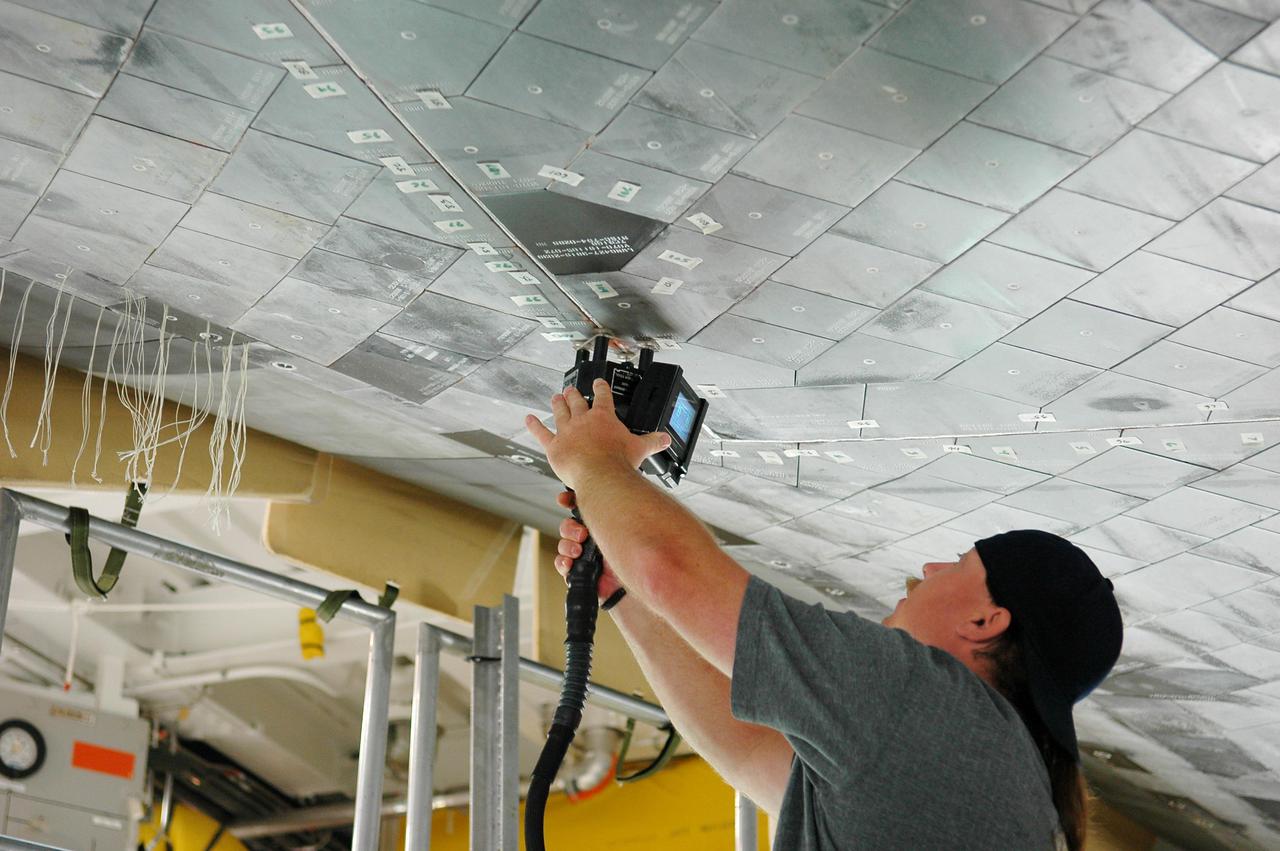
KENNEDY SPACE CENTER, FLA. - In Orbiter Processing Facility bay 1 at NASA’s Kennedy Space Center, United Space Alliance technician Butch Lato uses a laser tool to take step and gap measurements on Thermal Protection System tiles on the underside of orbiter Atlantis. Other processing continues on Atlantis for its mission, designated STS-121, to the International Space Station. The launch planning window is Sept. 9 - 24.
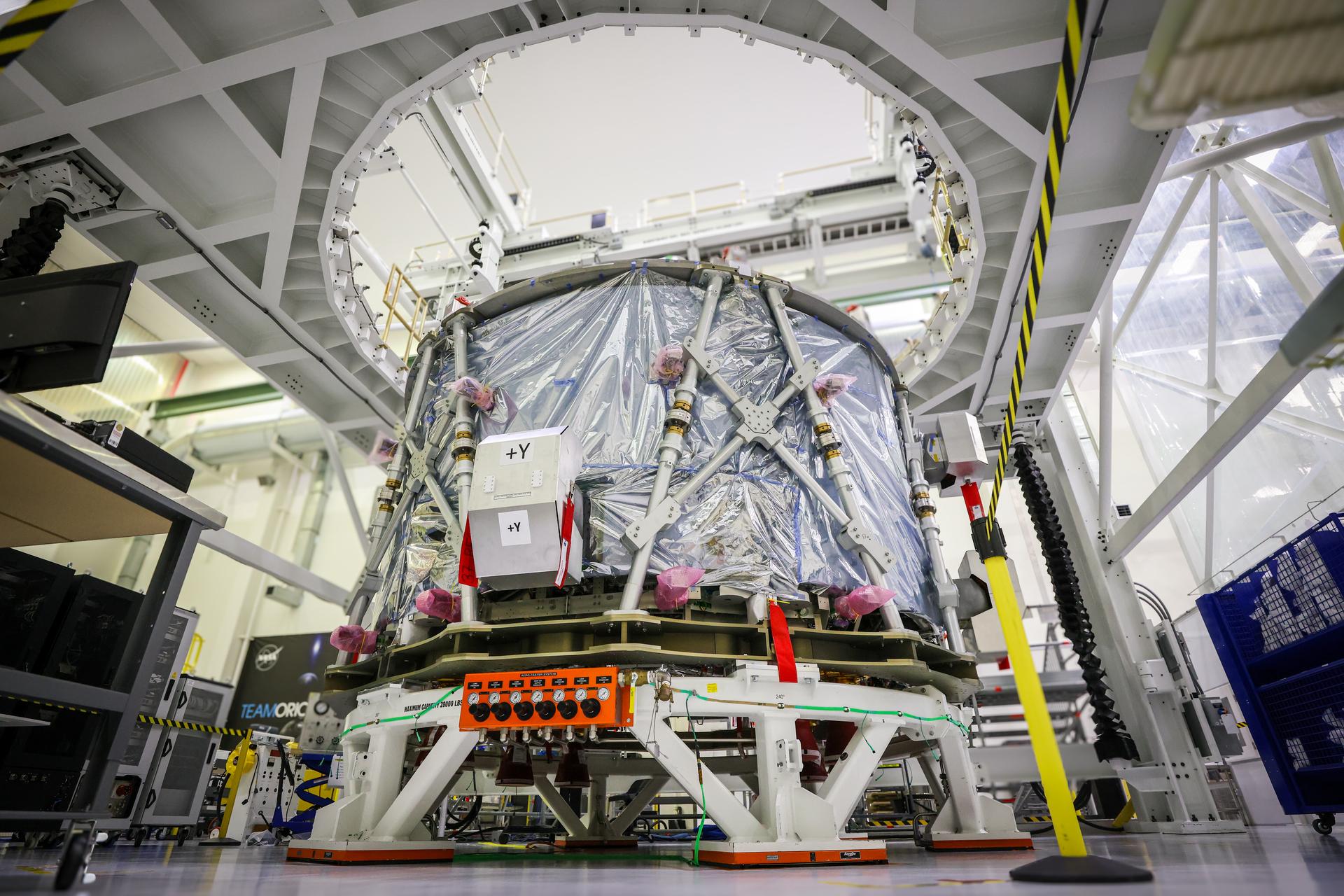
The transport carrier containing the European Service Module for NASA’s Artemis IV mission arrives at the Neil A. Armstrong Operations and Checkout Building at NASA’s Kennedy Space Center in Florida on Saturday, Dec. 20, 2025. The European Service Module, which is assembled by Airbus in Bremen, Germany, from parts made in 10 European countries and the United States, acts as the driving force behind Orion for deep space exploration, providing essential propulsion, thermal control, and electrical power.
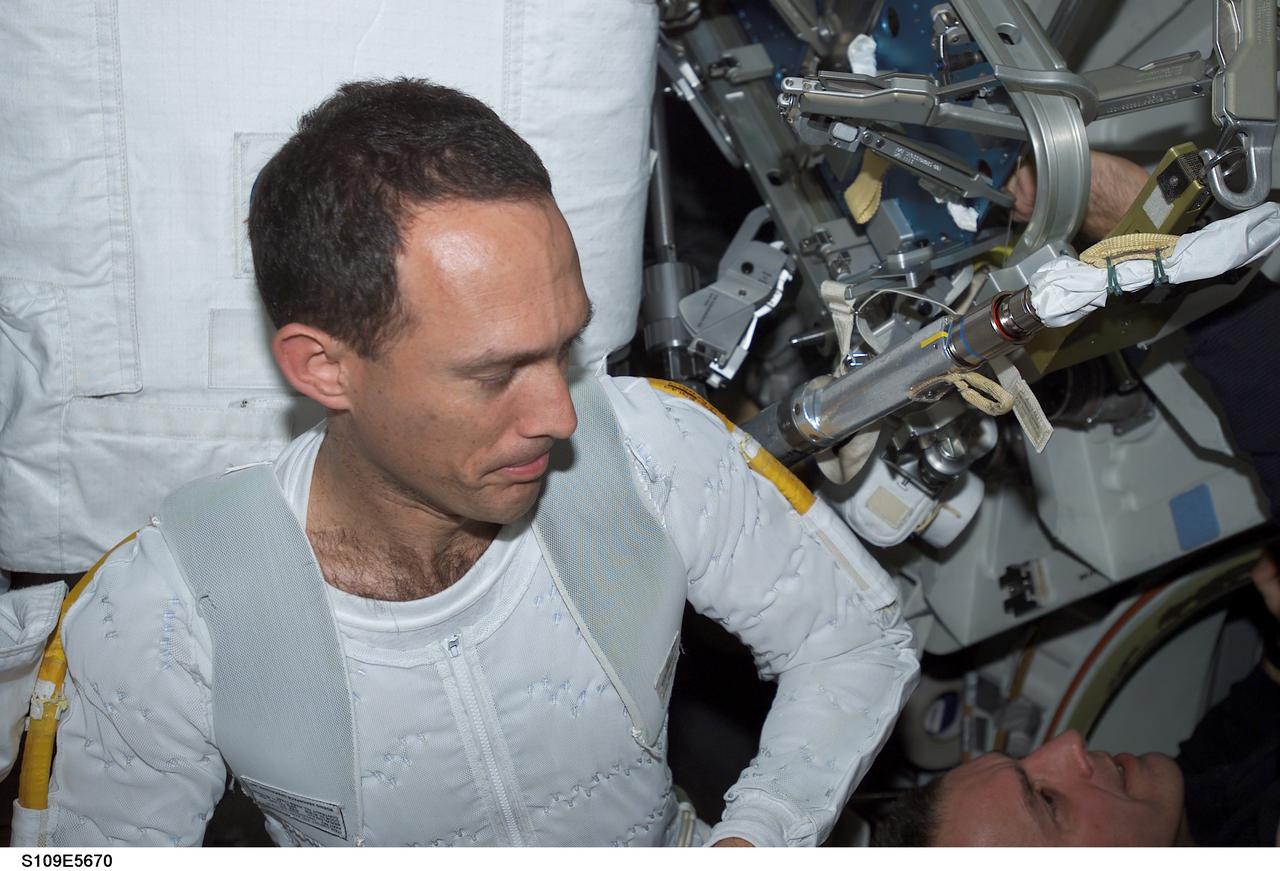
STS109-E-5670 (7 March 2002) --- Astronaut James H. Newman, mission specialist, is about to put on his extravehicular mobility unit's (EMU) outer suit over its thermal under garment. Astronauts Newman and Michael J. Massimino were about to embark on the STS-109 mission's fourth space walk. The image was recorded with a digital still camera.
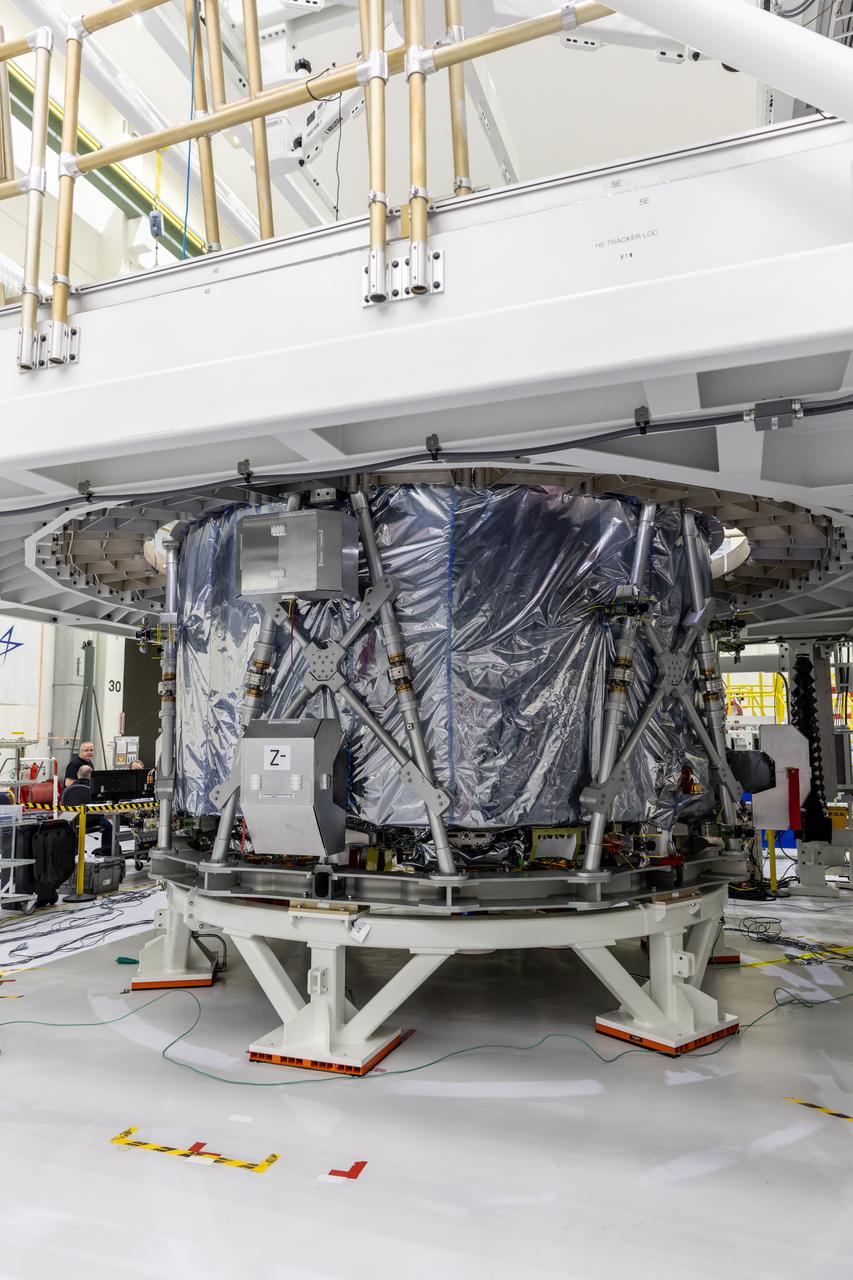
The transport carrier containing the European Service Module for NASA’s Artemis III mission arrives at the Neil A. Armstrong Operations and Checkout Building at NASA’s Kennedy Space Center in Florida on Tuesday, Sept. 3, 2024. The European Service Module, which is assembled by Airbus in Bremen, Germany, from parts made in 10 European countries and the United States, acts as the driving force behind Orion for deep space exploration, providing essential propulsion, thermal control, and electrical power.
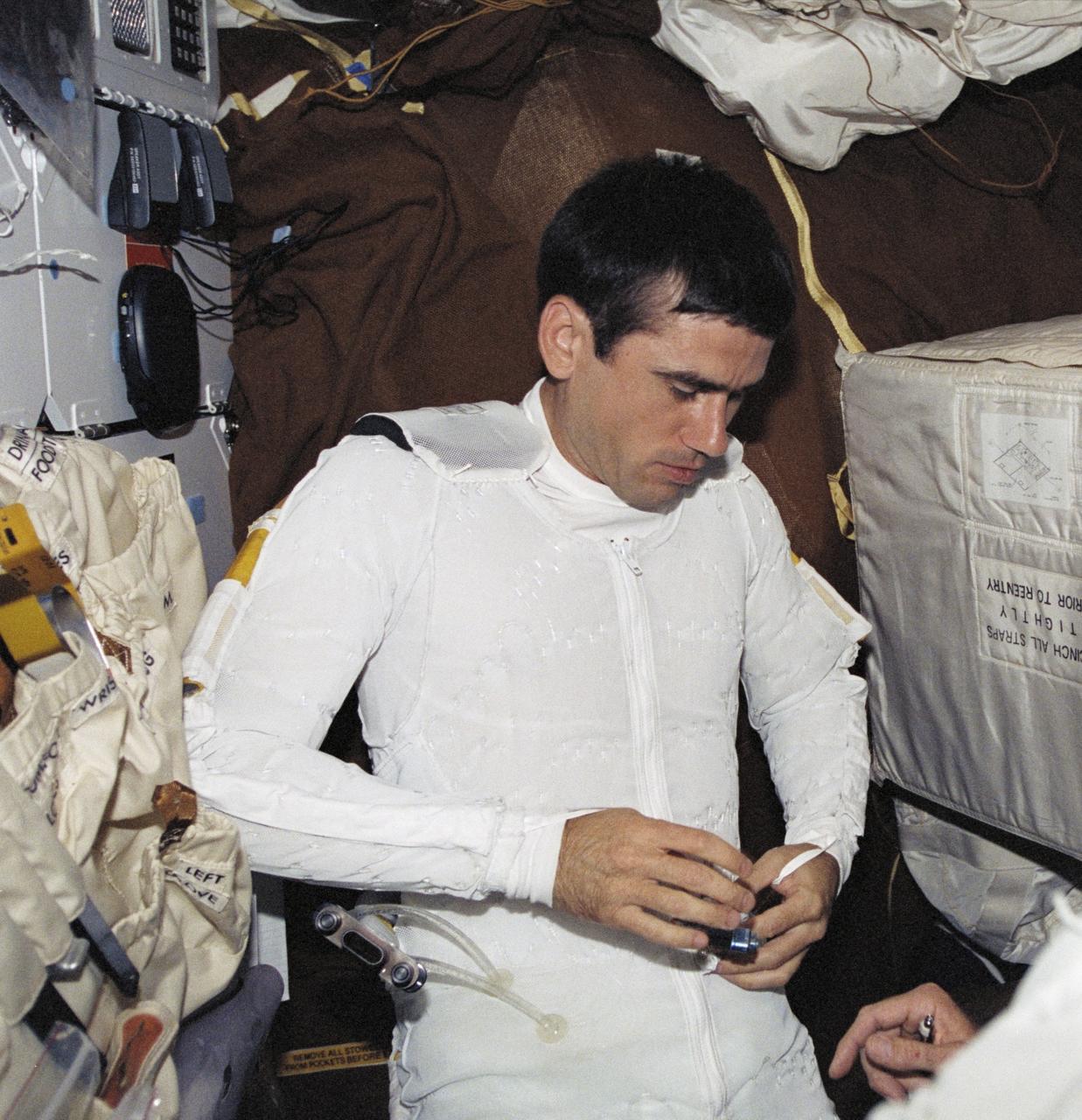
JSC2000-E-23502 (11 September 2000) --- Cosmonaut Yuri I. Malenchenko, STS-106 mission specialist, completes donning his thermal underwear prior to putting on the outer garment called the extravehicular mobility unit (EMU). Malenchenko, representing the Russian Aviation and Space Agency, was about to spend a period in excess of six hours outside Atlantis along with astronaut Edward T. Lu (out of frame at right).
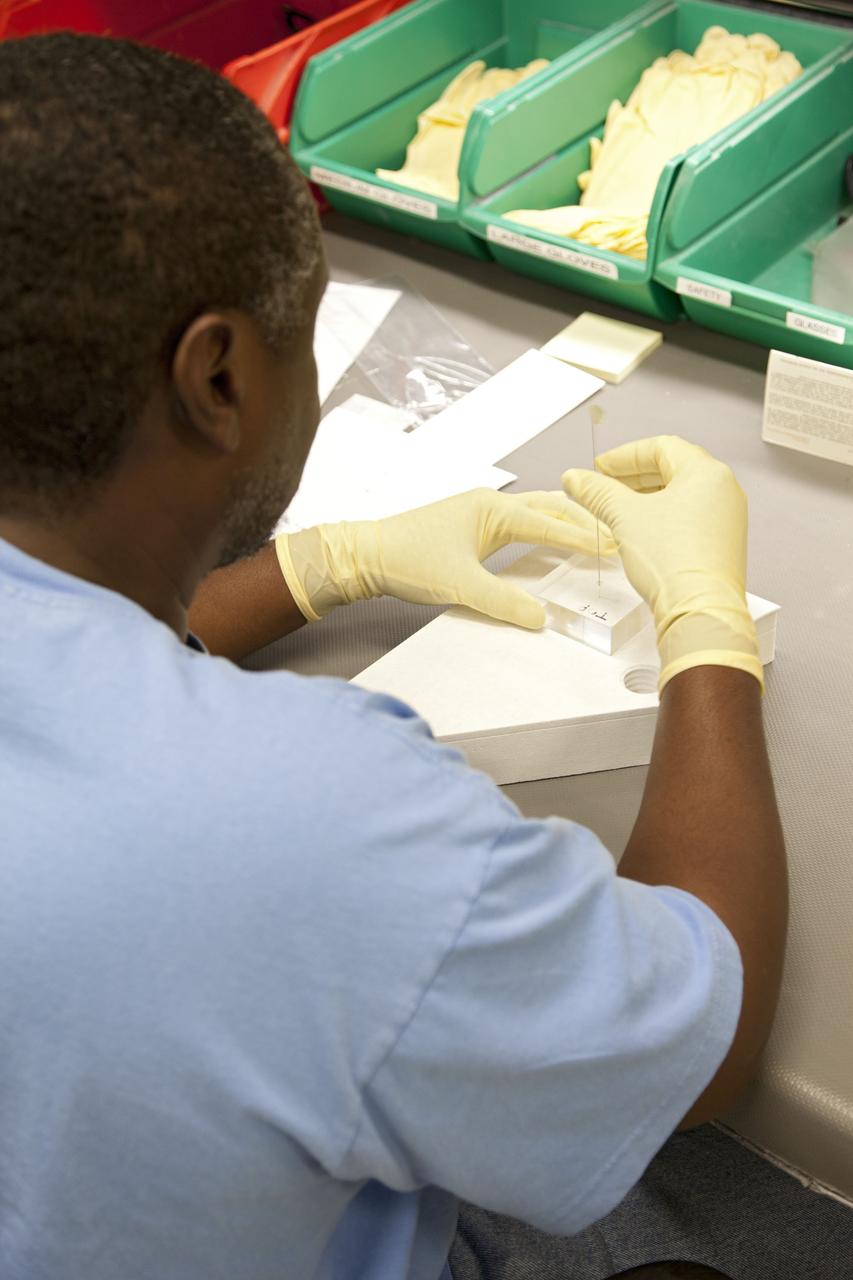
CAPE CANAVERAL, Fla. -- Damon Petty, a United Space Alliance technician at NASA's Kennedy Space Center in Florida, inspects a heat shield tile that will be installed to the backshell of the Orion Multi-Purpose Crew Vehicle's Exploration Flight Test EFT-1 capsule. The work to manufacture and inspect the tiles is taking place in Kennedy's Thermal Protection System Facility. EFT-1 will be used during Orion's first test flight in space. For more information, visit www.nasa.gov/orion. Photo credit: Frankie Martin