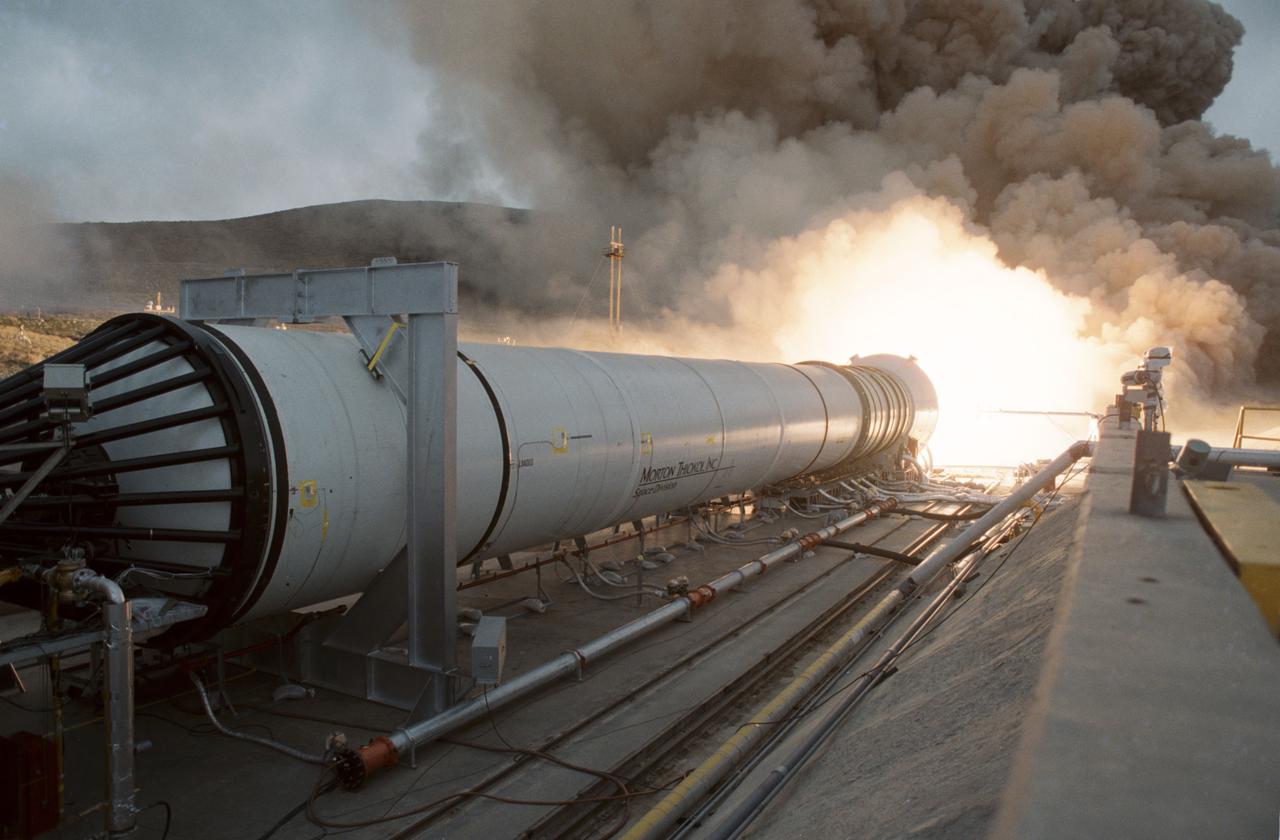
Solid Rocket Qualification Motor Firing at the Morton Thiokol facility at Brigham City, Utah on 20 April 1988.
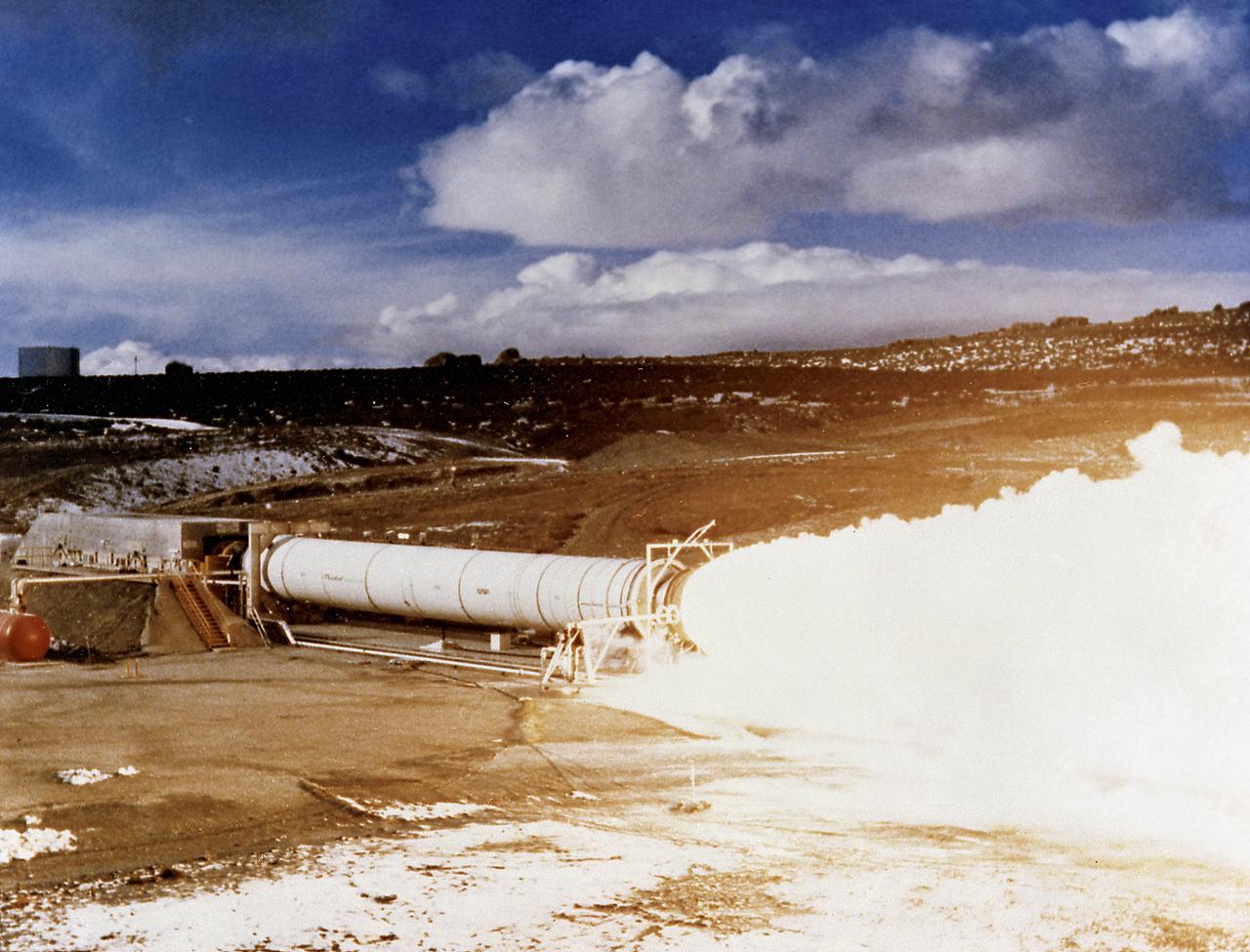
Pictured is an early testing of the Solid Rocket Motor (SRM) at the Thiokol facility in Utah. The SRMs later became known as Solid Rocket Boosters (SRBs) as they were more frequently used on the Space Shuttles.
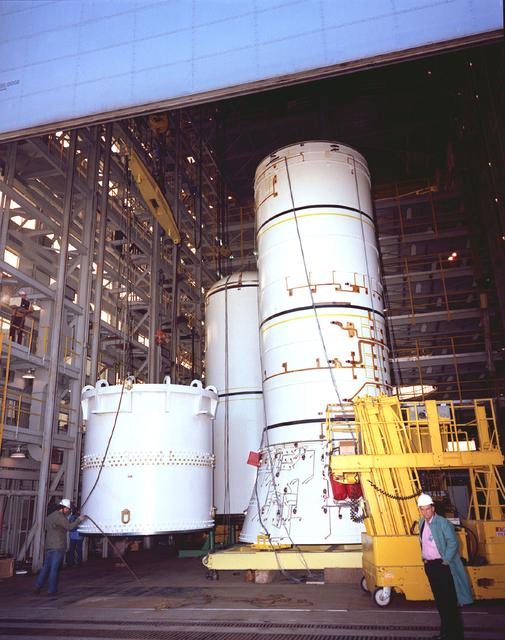
This photograph shows Solid Rocket Booster segments undergoing stacking operations in Marshall Space Flight Center's Building 4707. The Solid Rocket Boosters were designed in-house at the Marshall Center with the Thiokol Corporation as the prime contractor.
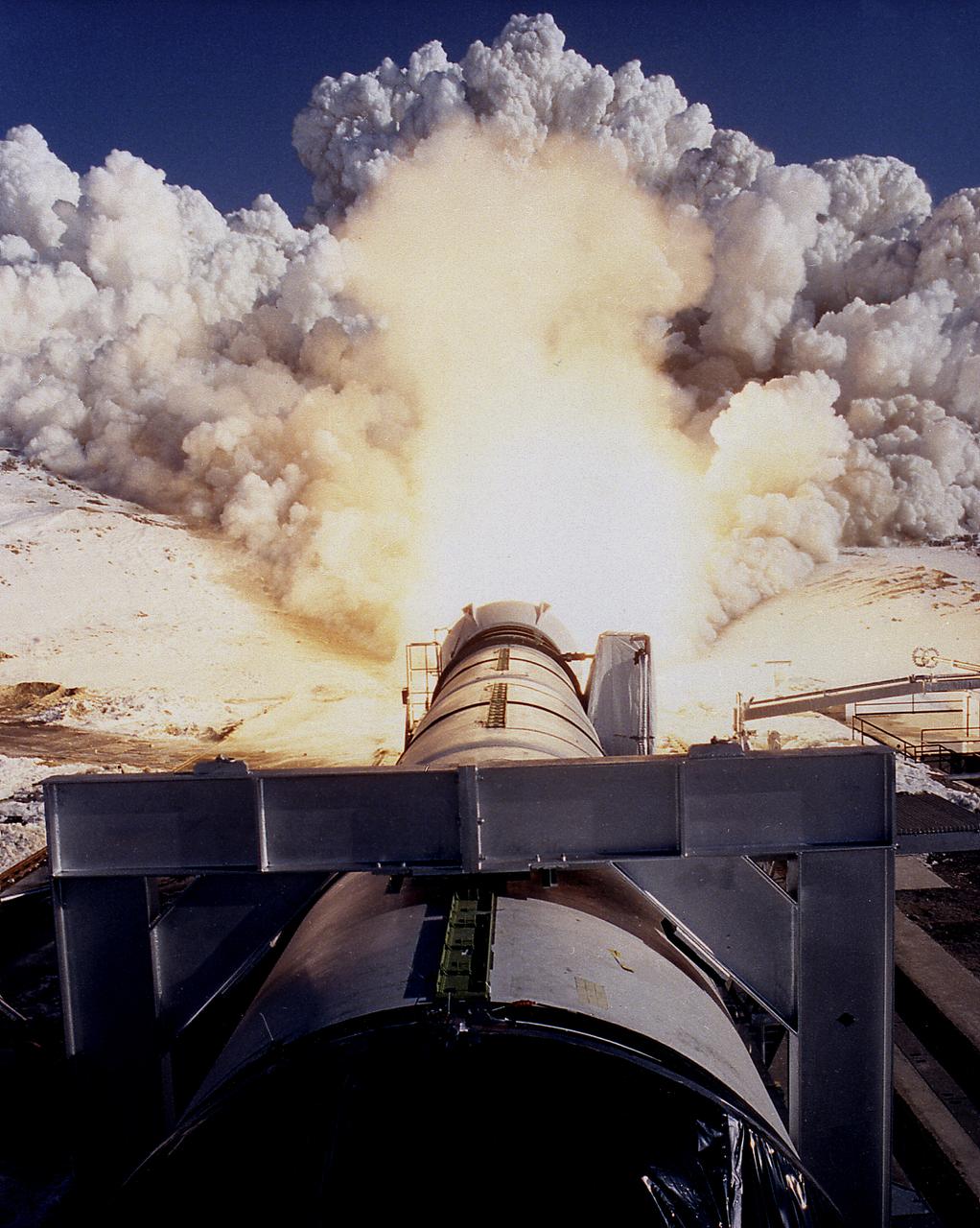
This photograph shows a static firing test of the Solid Rocket Qualification Motor-8 (QM-8) at the Morton Thiokol Test Site in Wasatch, Utah. The twin solid rocket boosters provide the majority of thrust for the first two minutes of flight, about 5.8 million pounds, augmenting the Shuttle's main propulsion system during liftoff. The major design drivers for the solid rocket motors (SRM's) were high thrust and reuse. The desired thrust was achieved by using state-of-the-art solid propellant and by using a long cylindrical motor with a specific core design that allows the propellant to burn in a carefully controlled marner. Under the direction of the Marshall Space Flight Center, the SRM's are provided by the Morton Thiokol Corporation.
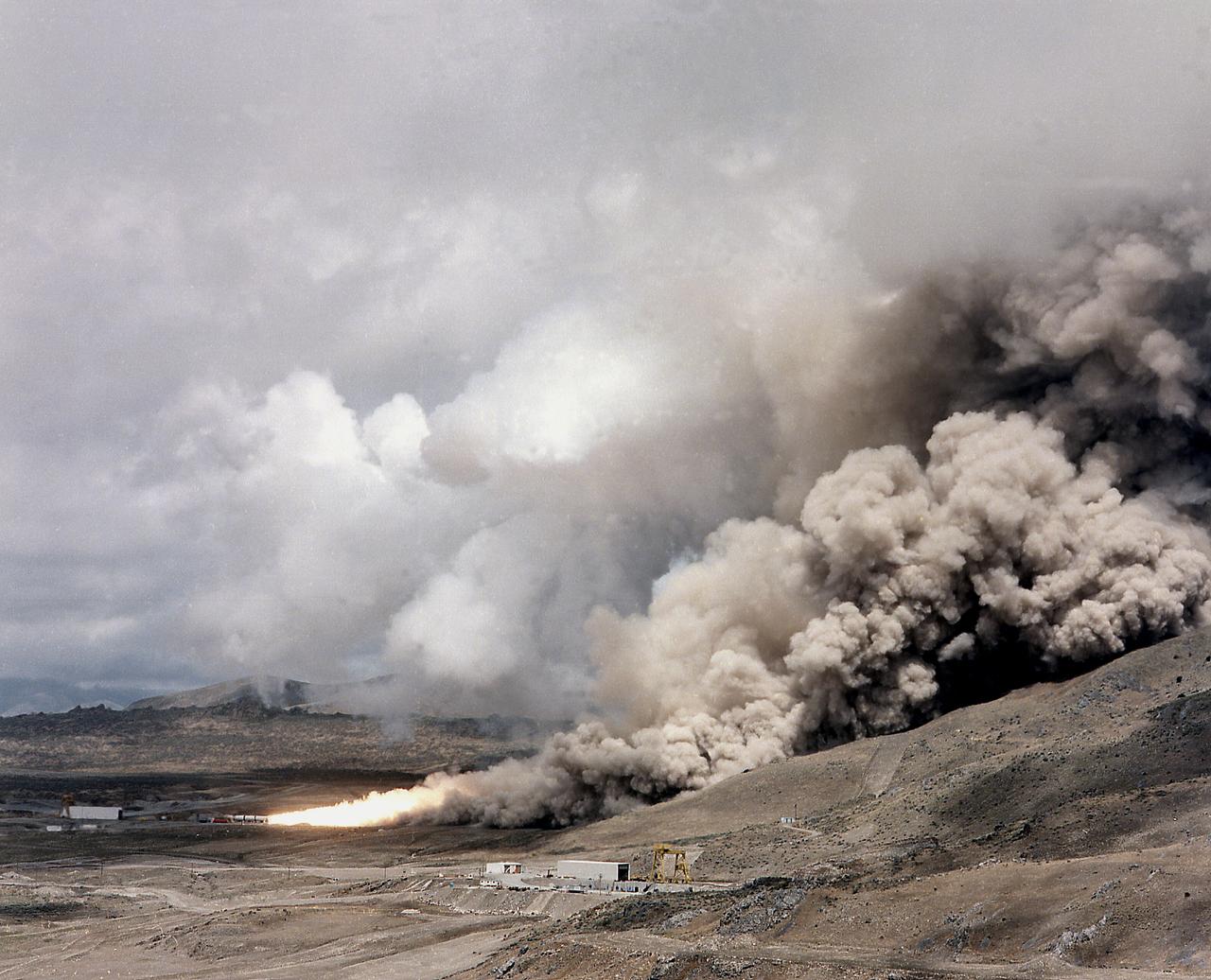
This photograph is a long shot view of a full scale solid rocket motor (SRM) for the solid rocket booster (SRB) being test fired at Morton Thiokol's Wasatch Operations in Utah. The twin boosters provide the majority of thrust for the first two minutes of flight, about 5.8 million pounds, augmenting the Shuttle's main propulsion system during liftoff. The major design drivers for the SRM's were high thrust and reuse. The desired thrust was achieved by using state-of-the-art solid propellant and by using a long cylindrical motor with a specific core design that allows the propellant to burn in a carefully controlled marner. Under the direction of the Marshall Space Flight Center, the SRM's are provided by the Morton Thiokol Corporation.
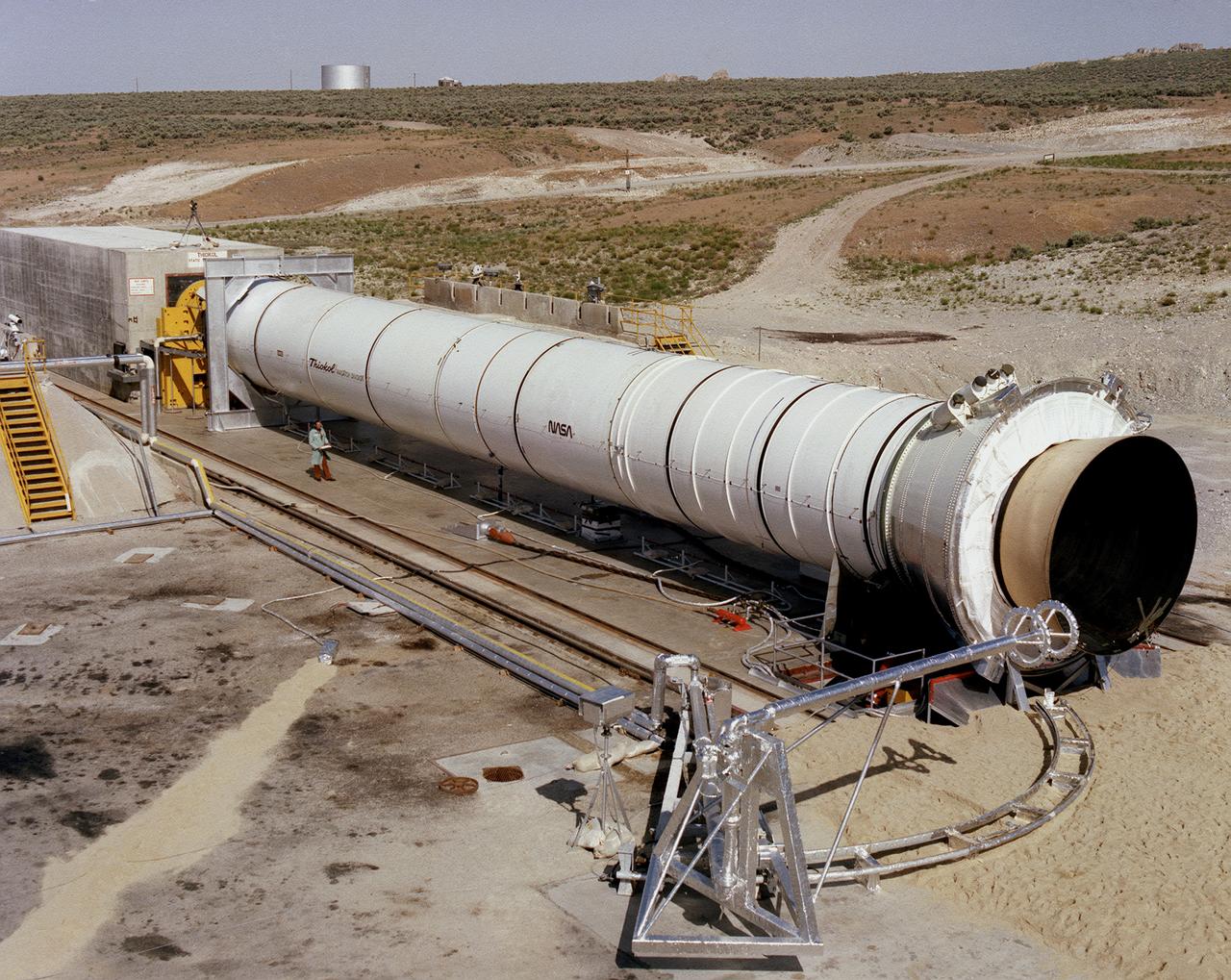
This is a photograph of the solid rocket booster's (SRB's) Qualification Motor-1 (QM-1) being prepared for a static firing in a test stand at the Morton Thiokol Test Site in Wasatch, Utah, showing the aft end of the booster. The twin boosters provide the majority of thrust for the first two minutes of flight, about 5.8 million pounds, augmenting the Shuttle's main propulsion system during liftoff. The major design drivers for the solid rocket motors (SRM's) were high thrust and reuse. The desired thrust was achieved by using state-of-the-art solid propellant and by using a long cylindrical motor with a specific core design that allows the propellant to burn in a carefully controlled marner. Under the direction of the Marshall Space Flight Center, the SRM's are provided by the Morton Thiokol Corporation.
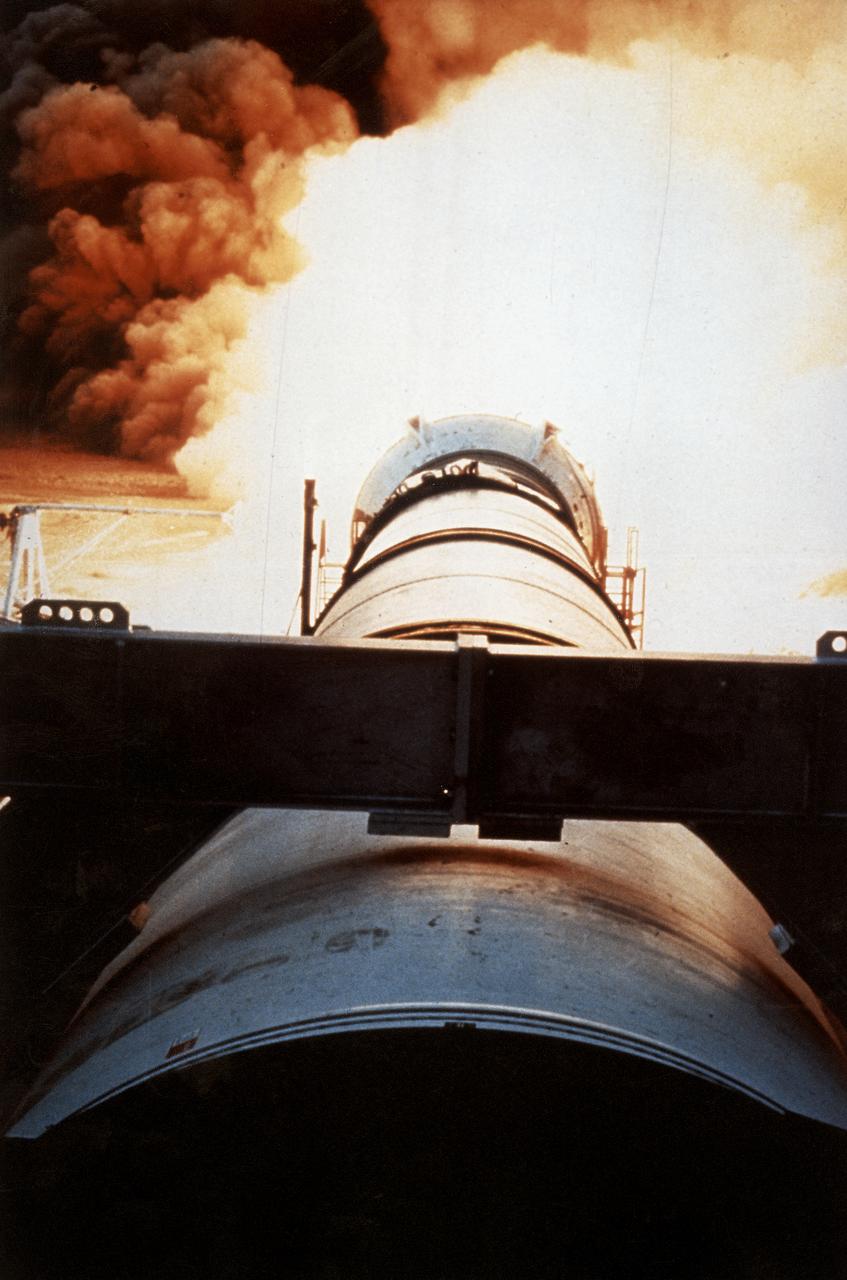
One of the key tests in the effort to return the Space Shuttle to flight following the Challenger accident was testing the development Motor-8 (DM-8). The 126-foot long, 1.2-million-pound motor, designated DM-8, underwent a full-duration horizontal test firing for two minutes at the Thiokol test facility in Utah. It was fitted with more than 500 instruments to measure such things as acceleration, pressure, deflection thrust, strain, temperature, and electrical properties.
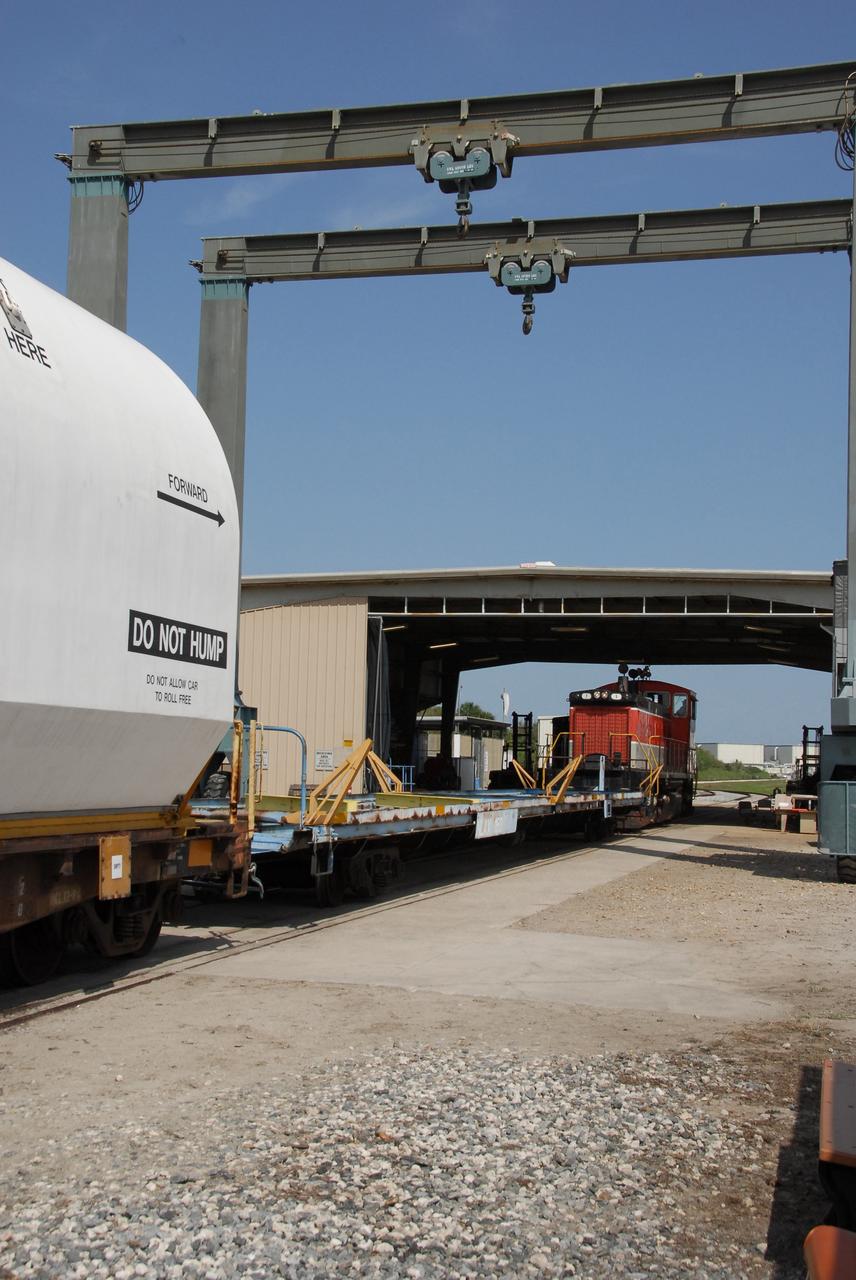
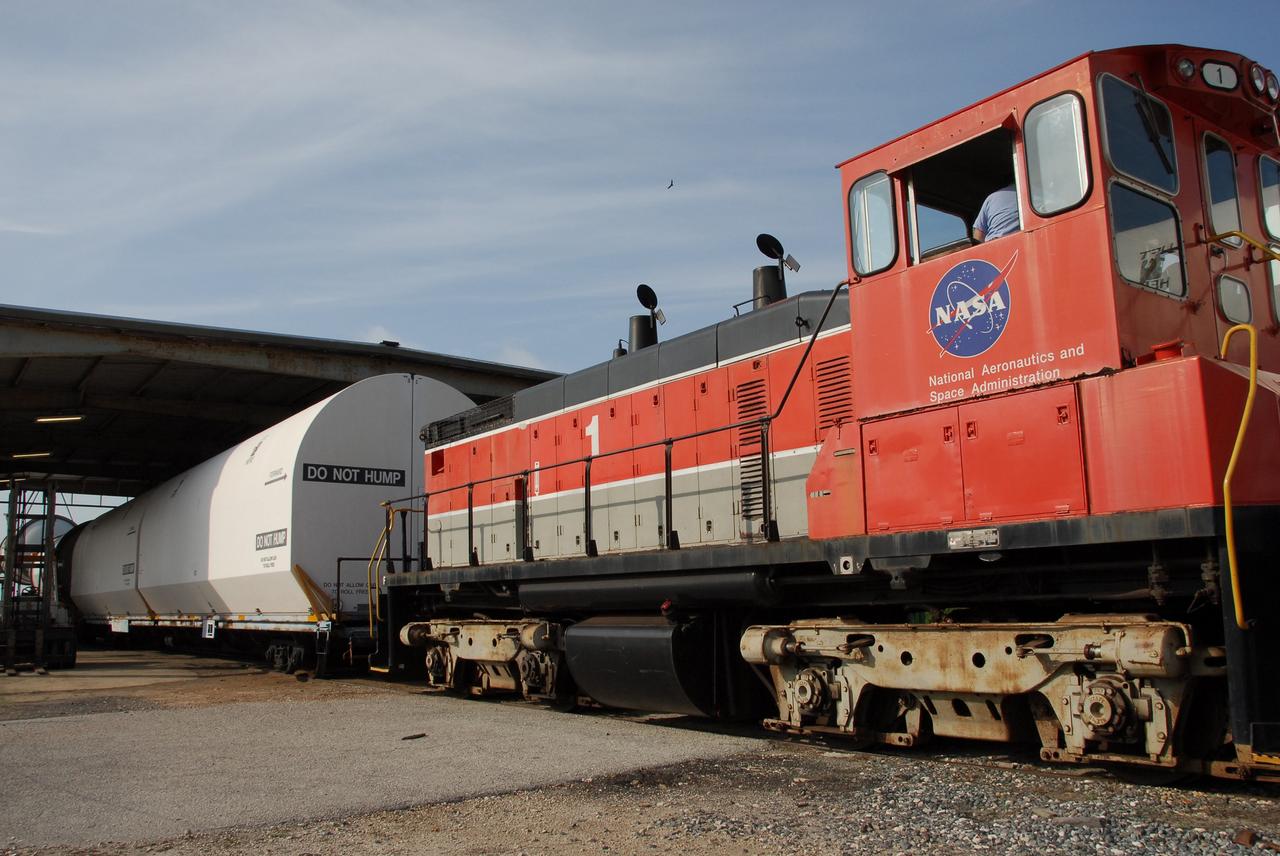
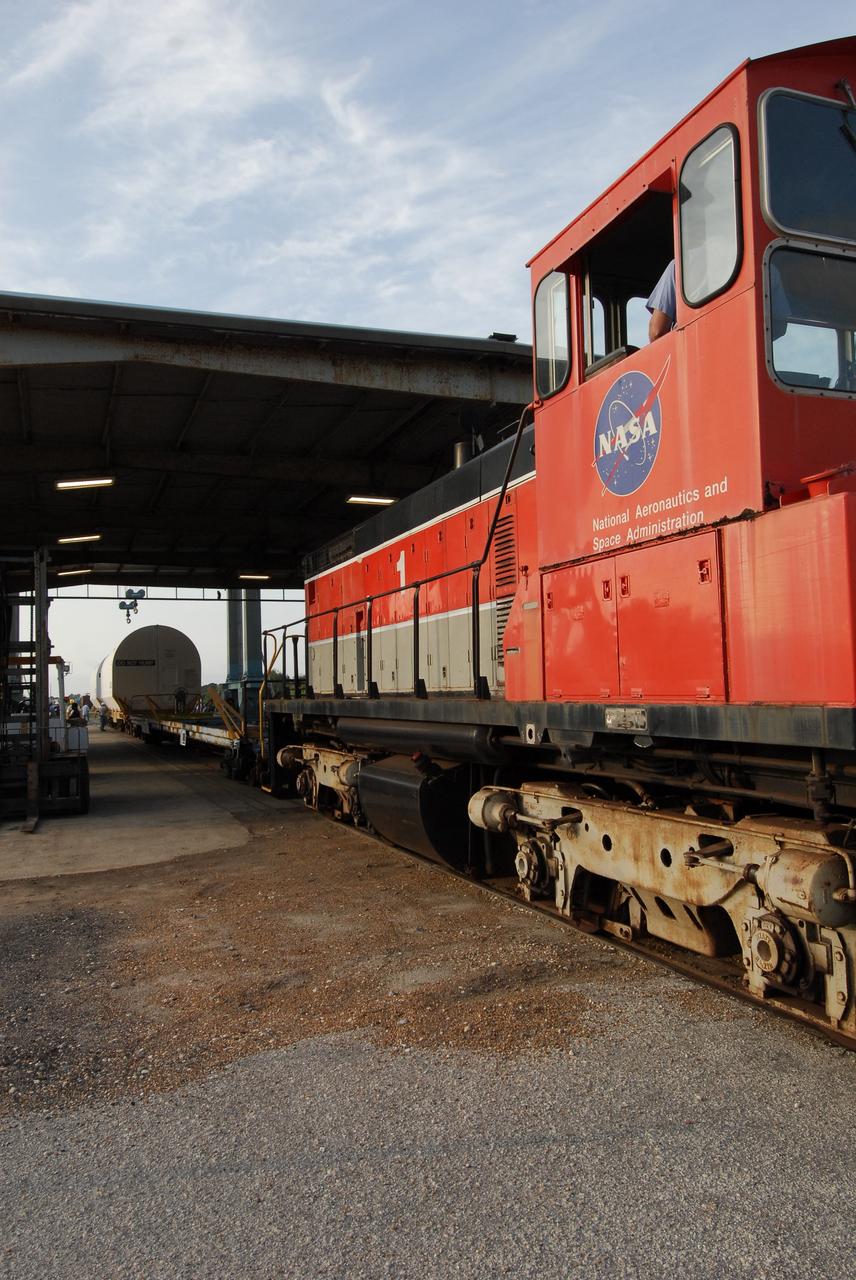
KENNEDY SPACE CENTER, FLA. -- At NASA's Kennedy Space Center, the NASA Railroad train hauling the solid rocket booster segments from the STS-122 mission begins rolling on the long journey to Utah. After a mission, the spent boosters are recovered, cleaned, disassembled, refurbished and reused after each launch. After hydrolasing the interior of each segment, they are placed on flatbed trucks. The individual booster segments are transferred to a railhead located at the railroad yard. The covered segments will be moved to Titusville for interchange with Florida East Coast Railway to begin the trip back to the Thiokol plant in Wa¬satch, Utah. Photo credit: NASA/Jack Pfaller
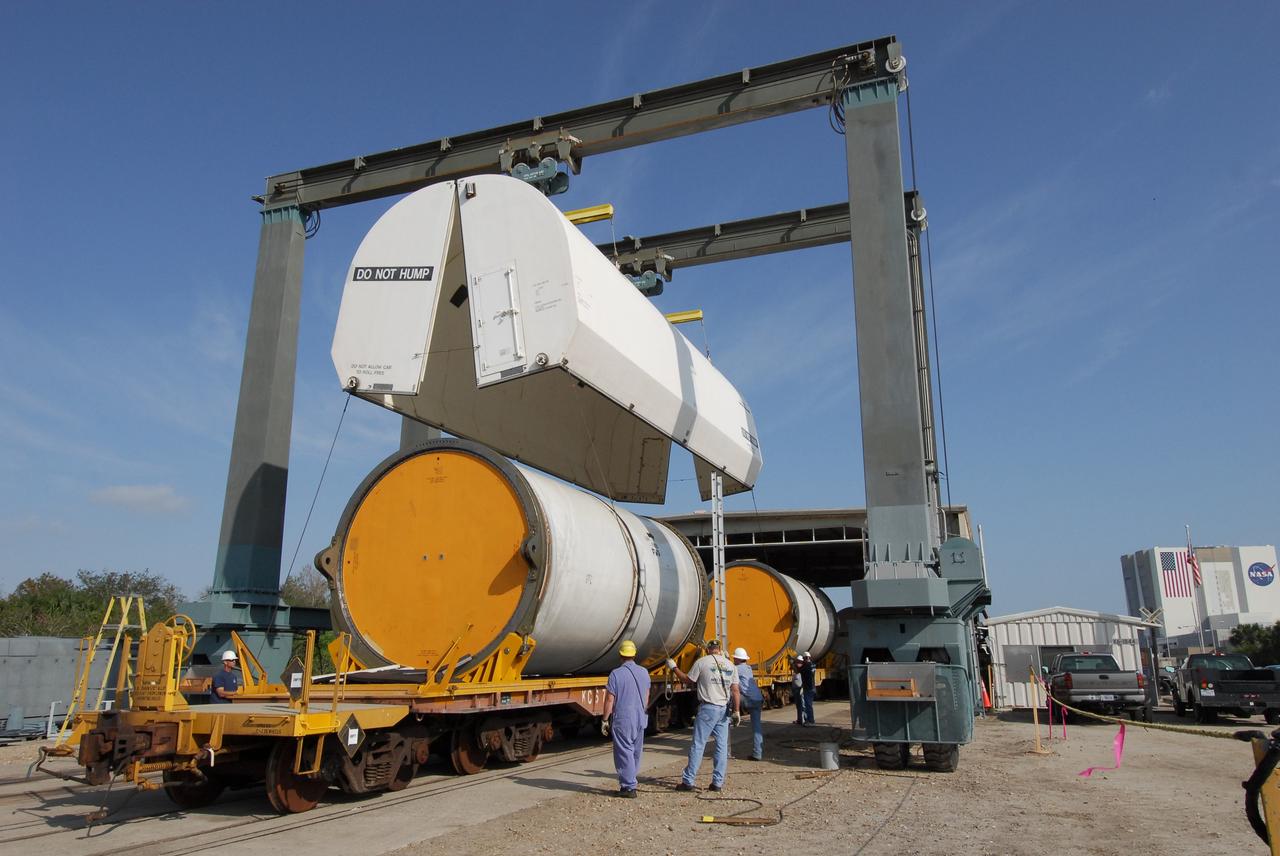
KENNEDY SPACE CENTER, FLA. -- At the NASA Railroad yard at NASA's Kennedy Space Center, workers lower a transportation cover over a solid rocket booster segment from the STS-122 mission. Loaded on the railroad cars, the segments will be transported to Utah. After a mission, the spent boosters are recovered, cleaned, disassembled, refurbished and reused after each launch. After hydrolasing the interior of each segment, they are placed on flatbed trucks. The individual booster segments are transferred to a railhead located at the railroad yard. The covered segments will be moved to Titusville for interchange with Florida East Coast Railway to begin the trip back to the Thiokol plant in Wa¬satch, Utah. Photo credit: NASA/Jack Pfaller
KENNEDY SPACE CENTER, FLA. -- At the Railroad yard at NASA's Kennedy Space Center, solid rocket booster segments from the STS-122 mission are being loaded onto railroad cars and covered for transportation to Utah. After a mission, the spent boosters are recovered, cleaned, disassembled, refurbished and reused after each launch. After hydrolasing the interior of each segment, they are placed on flatbed trucks. The individual booster segments are transferred to a railhead located at the railroad yard. The covered segments will be moved to Titusville for interchange with Florida East Coast Railway to begin the trip back to the Thiokol plant in Wa¬satch, Utah. Photo credit: NASA/Jack Pfaller
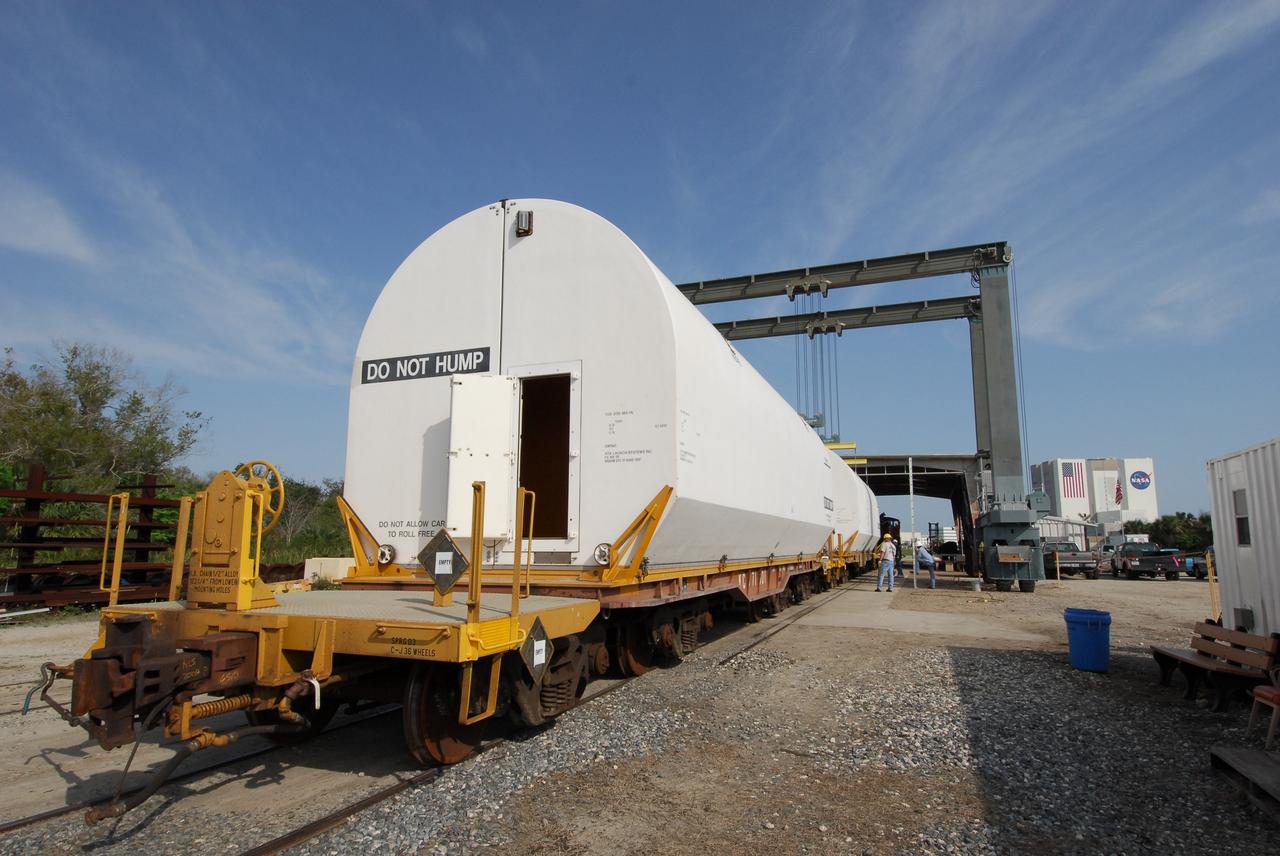
KENNEDY SPACE CENTER, FLA. -- At the NASA Railroad yard at NASA's Kennedy Space Center, all the solid rocket booster segments from the STS-122 mission are covered and secure on the train for transportation to Utah. After a mission, the spent boosters are recovered, cleaned, disassembled, refurbished and reused after each launch. After hydrolasing the interior of each segment, they are placed on flatbed trucks. The individual booster segments are transferred to a railhead located at the railroad yard. The covered segments will be moved to Titusville for interchange with Florida East Coast Railway to begin the trip back to the Thiokol plant in Wa¬satch, Utah. Photo credit: NASA/Jack Pfaller
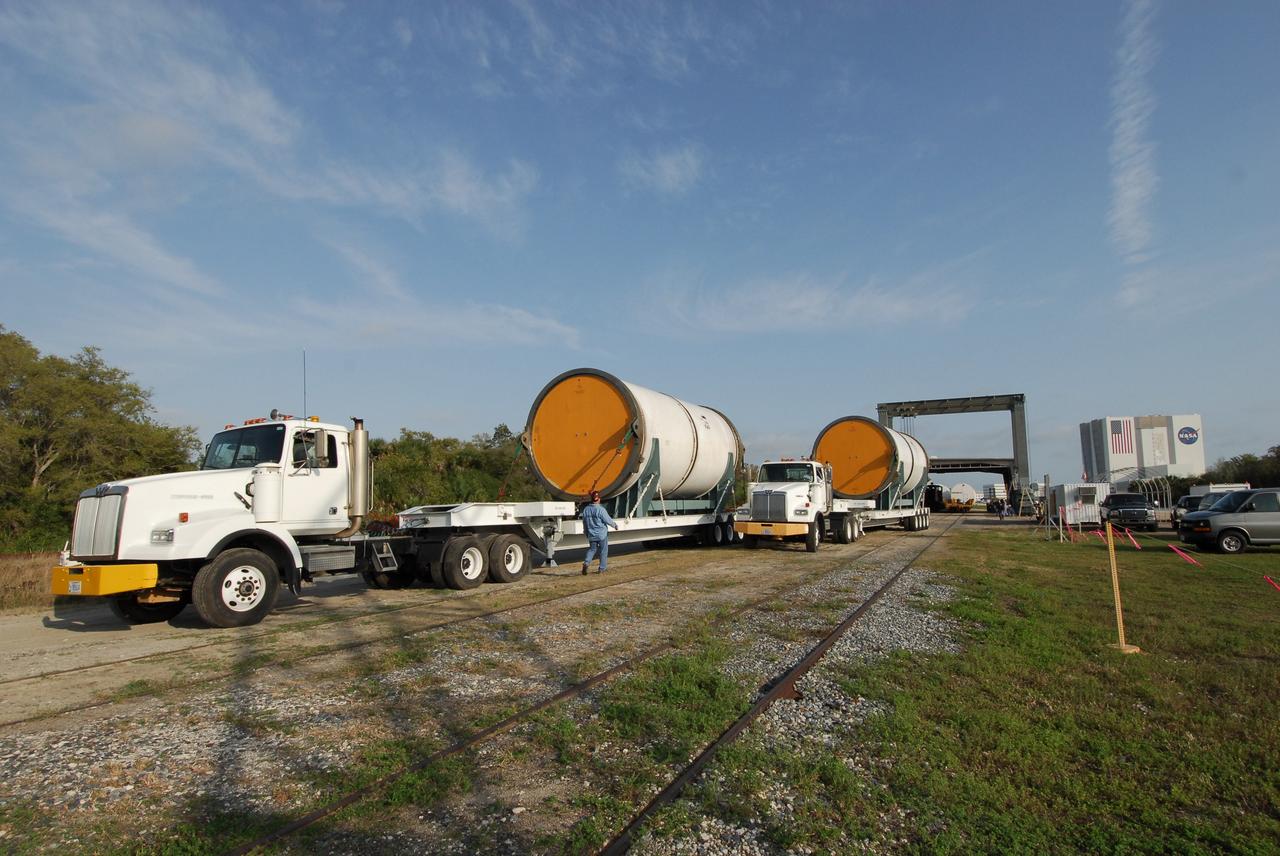
KENNEDY SPACE CENTER, FLA. -- Spent segments of the solid rocket boosters from the STS-122 mission arrive at the Railroad yard at NASA's Kennedy Space Center. The segments will be loaded onto the railroad cars for transportation to Utah. After a mission, the spent boosters are recovered, cleaned, disassembled, refurbished and reused after each launch. After hydrolasing the interior of each segment, they are placed on flatbed trucks. The individual booster segments are transferred to a railhead located at the railroad yard. The covered segments will be moved to Titusville for interchange with Florida East Coast Railway to begin the trip back to the Thiokol plant in Wa¬satch, Utah. Photo credit: NASA/Jack Pfaller
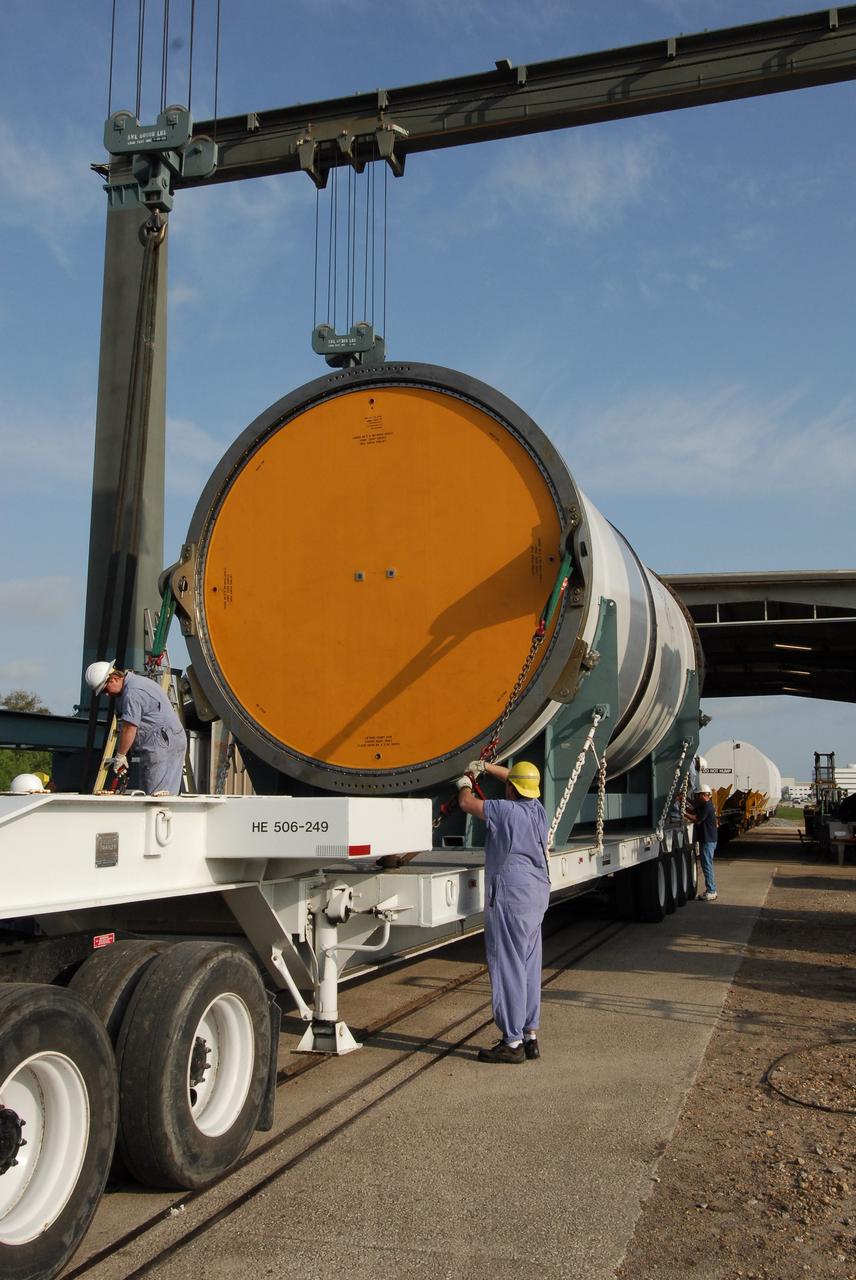
KENNEDY SPACE CENTER, FLA. -- Workers at the Railroad yard at NASA's Kennedy Space Center prepare one of the segments of a solid rocket booster from the STS-122 mission to be moved onto a railroad car for transportation to Utah. After a mission, the spent boosters are recovered, cleaned, disassembled, refurbished and reused after each launch. After hydrolasing the interior of each segment, they are placed on flatbed trucks. The individual booster segments are transferred to a railhead located at the railroad yard. The covered segments will be moved to Titusville for interchange with Florida East Coast Railway to begin the trip back to the Thiokol plant in Wa¬satch, Utah. Photo credit: NASA/Jack Pfaller
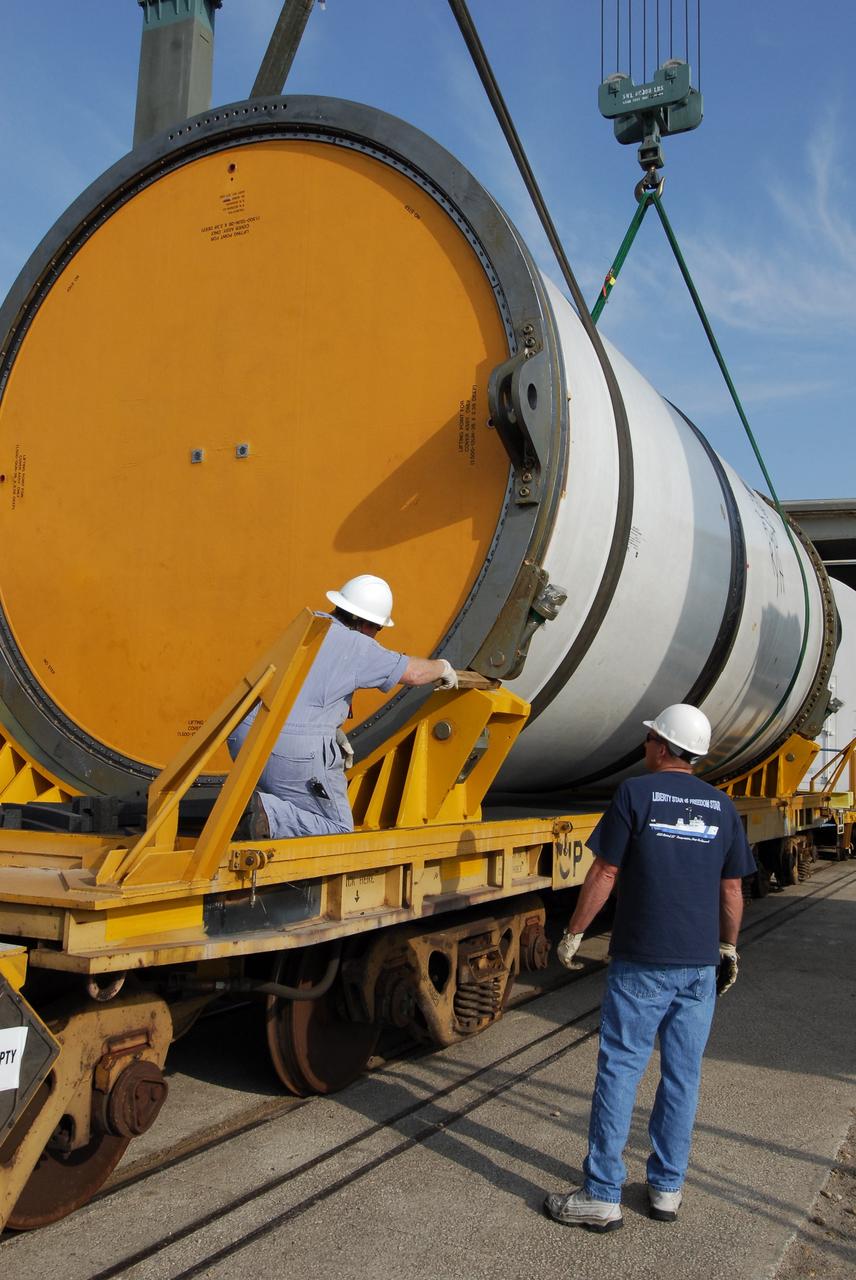
KENNEDY SPACE CENTER, FLA. -- At the Railroad yard at NASA's Kennedy Space Center, a solid rocket booster segment from the STS-122 mission is lowered onto a railroad car for transportation to Utah. After a mission, the spent boosters are recovered, cleaned, disassembled, refurbished and reused after each launch. After hydrolasing the interior of each segment, they are placed on flatbed trucks. The individual booster segments are transferred to a railhead located at the railroad yard. The covered segments will be moved to Titusville for interchange with Florida East Coast Railway to begin the trip back to the Thiokol plant in Wa¬satch, Utah. Photo credit: NASA/Jack Pfaller
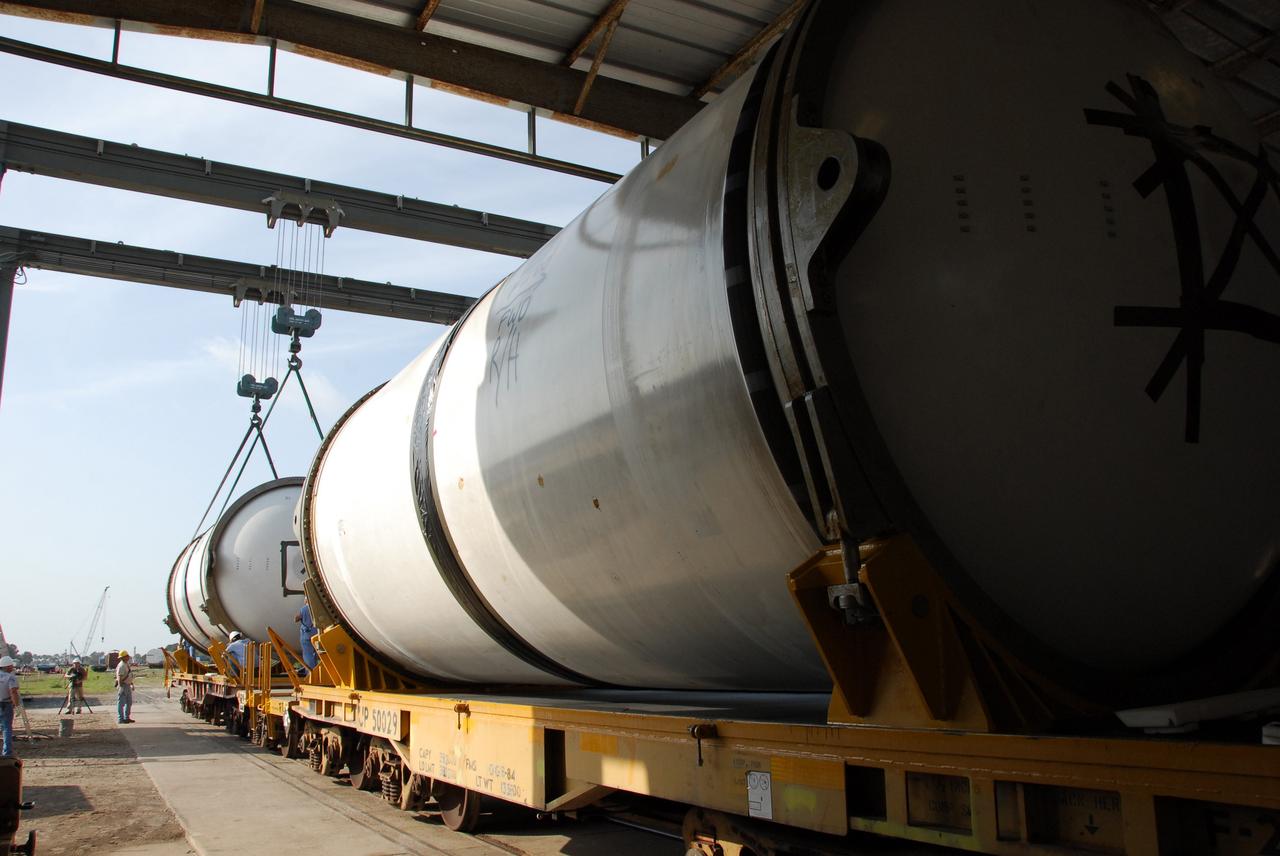
KENNEDY SPACE CENTER, FLA. -- At the Railroad yard at NASA's Kennedy Space Center, solid rocket booster segments from the STS-122 mission are being loaded onto railroad cars and covered for transportation to Utah. After a mission, the spent boosters are recovered, cleaned, disassembled, refurbished and reused after each launch. After hydrolasing the interior of each segment, they are placed on flatbed trucks. The individual booster segments are transferred to a railhead located at the railroad yard. The covered segments will be moved to Titusville for interchange with Florida East Coast Railway to begin the trip back to the Thiokol plant in Wa¬satch, Utah. Photo credit: NASA/Jack Pfaller
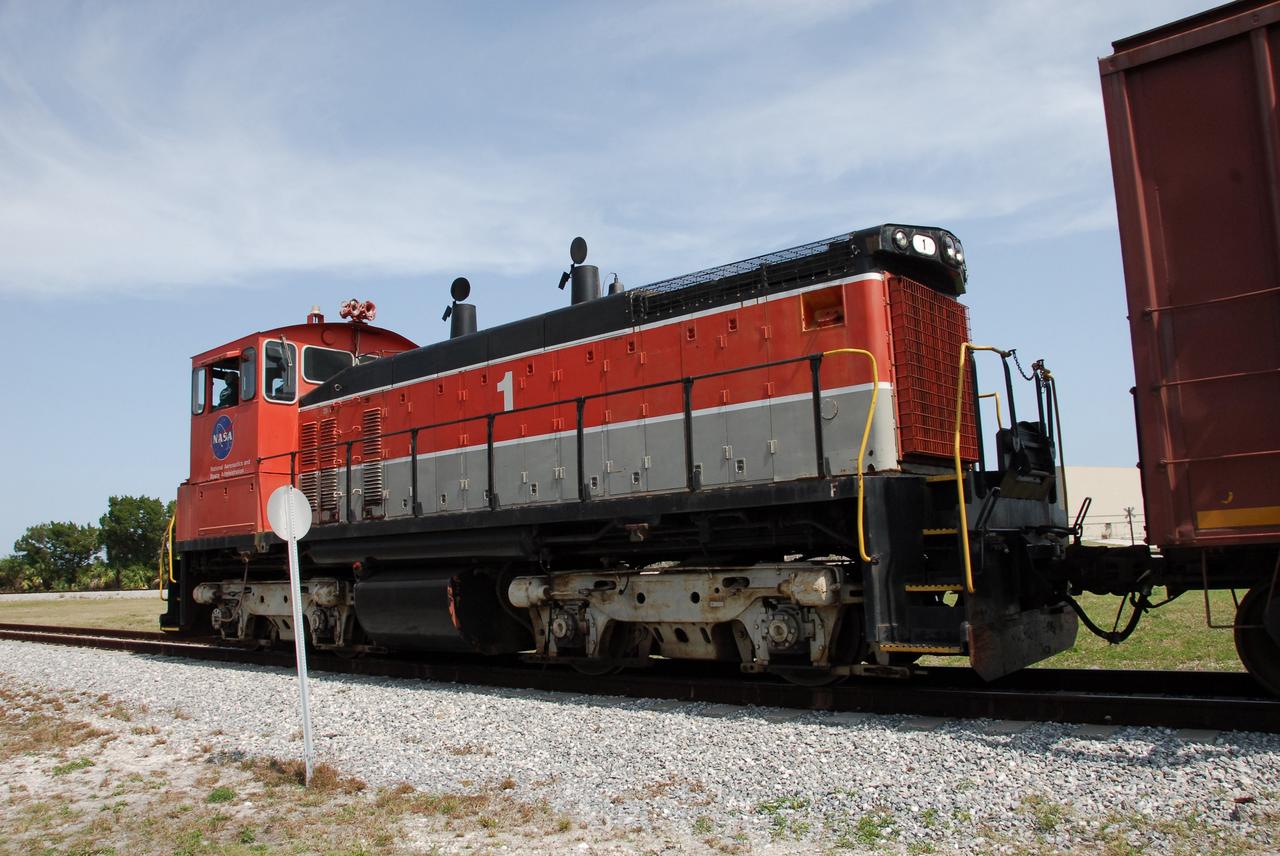
KENNEDY SPACE CENTER, FLA. -- The NASA Railroad train moves along the track through NASA Kennedy Space Center's Launch Complex 39 Area. The train is hauling the solid rocket booster segments from the STS-122 mission. After a mission, the spent boosters are recovered, cleaned, disassembled, refurbished and reused after each launch. After hydrolasing the interior of each segment, they are placed on flatbed trucks. The individual booster segments are transferred to a railhead located at the railroad yard. The covered segments will be moved to Titusville for interchange with Florida East Coast Railway to begin the trip back to the Thiokol plant in Wa¬satch, Utah. Photo credit: NASA/Jack Pfaller
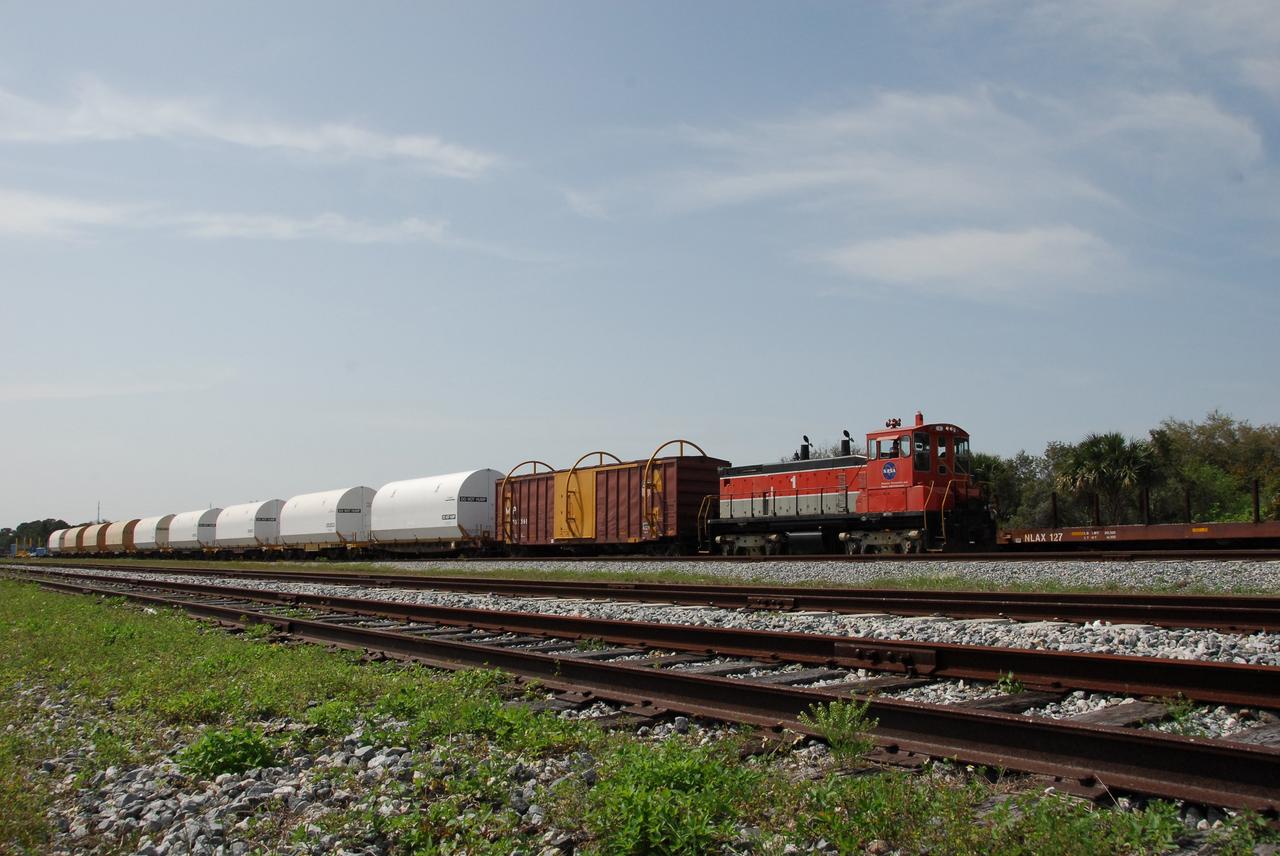
KENNEDY SPACE CENTER, FLA. -- The NASA Railroad train moves along the track through NASA's Kennedy Space Center. The train is hauling the solid rocket booster segments from the STS-122 mission. After a mission, the spent boosters are recovered, cleaned, disassembled, refurbished and reused after each launch. After hydrolasing the interior of each segment, they are placed on flatbed trucks. The individual booster segments are transferred to a railhead located at the railroad yard. The covered segments will be moved to Titusville for interchange with Florida East Coast Railway to begin the trip back to the Thiokol plant in Wa¬satch, Utah. Photo credit: NASA/Jack Pfaller
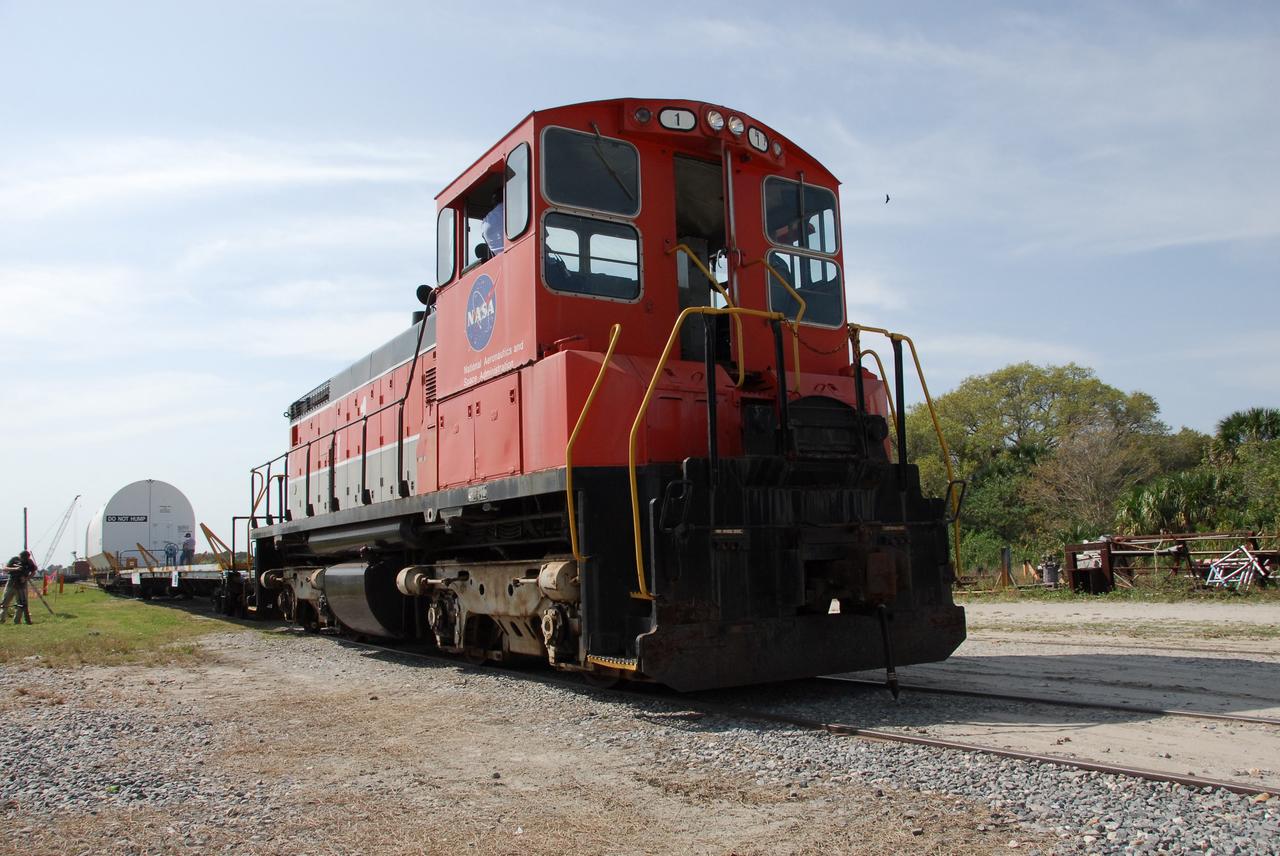
KENNEDY SPACE CENTER, FLA. -- The NASA Railroad train moves along the track away from NASA Kennedy Space Center's railroad yard. The train is hauling the solid rocket booster segments from the STS-122 mission. After a mission, the spent boosters are recovered, cleaned, disassembled, refurbished and reused after each launch. After hydrolasing the interior of each segment, they are placed on flatbed trucks. The individual booster segments are transferred to a railhead located at the railroad yard. The covered segments will be moved to Titusville for interchange with Florida East Coast Railway to begin the trip back to the Thiokol plant in Wa¬satch, Utah. Photo credit: NASA/Jack Pfaller
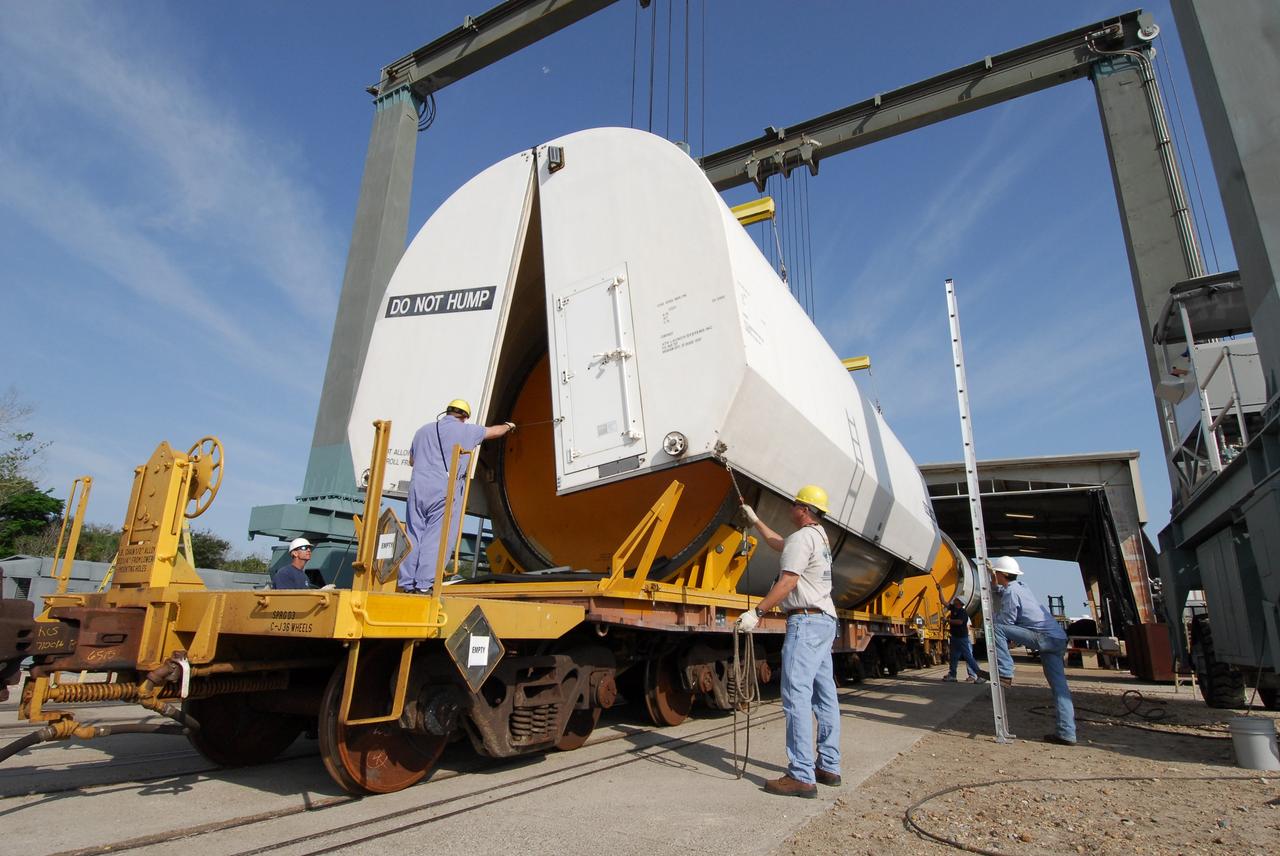
KENNEDY SPACE CENTER, FLA. -- At the NASA Railroad yard at NASA's Kennedy Space Center, workers lower a transportation cover over a solid rocket booster segment from the STS-122 mission. Loaded on the railroad cars, the segments will be transported to Utah. After a mission, the spent boosters are recovered, cleaned, disassembled, refurbished and reused after each launch. After hydrolasing the interior of each segment, they are placed on flatbed trucks. The individual booster segments are transferred to a railhead located at the railroad yard. The covered segments will be moved to Titusville for interchange with Florida East Coast Railway to begin the trip back to the Thiokol plant in Wa¬satch, Utah. Photo credit: NASA/Jack Pfaller
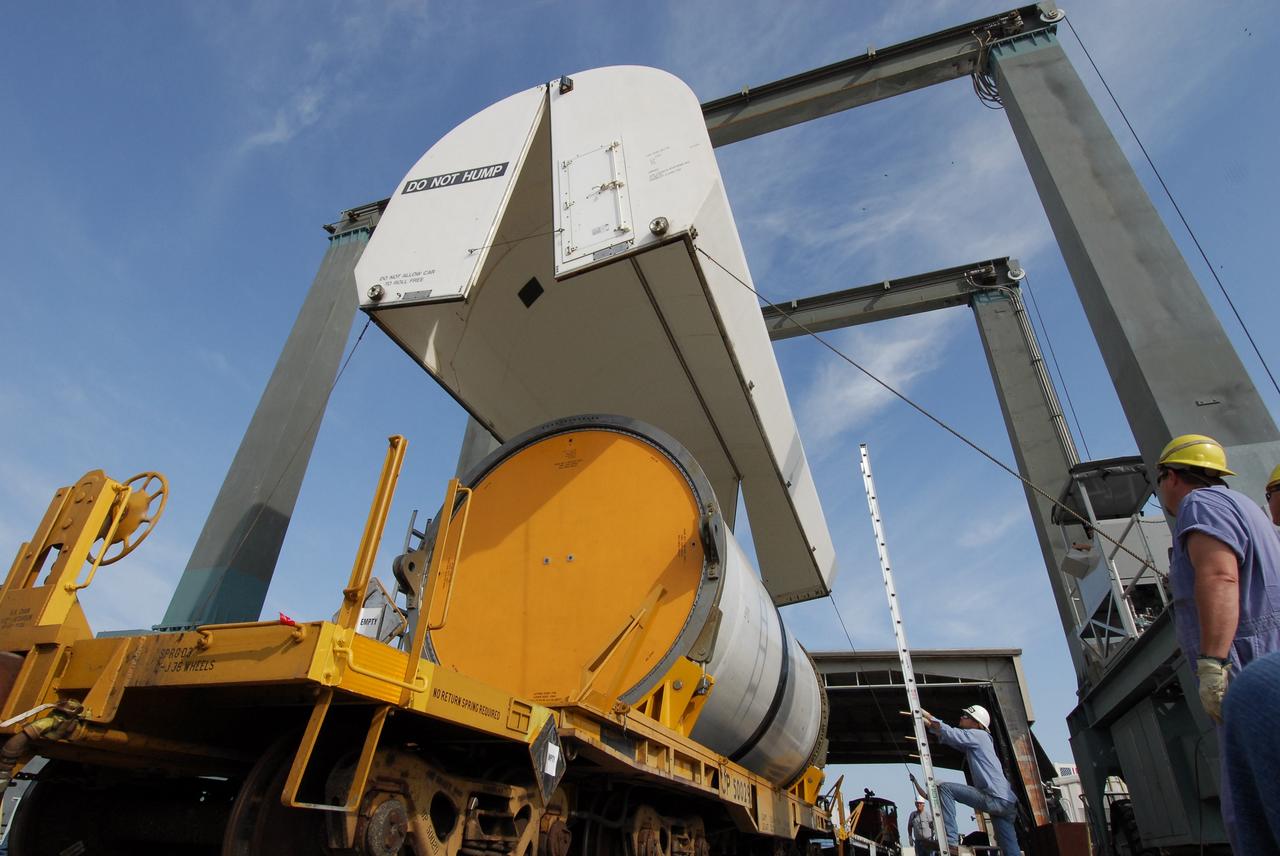
KENNEDY SPACE CENTER, FLA. -- At the NASA Railroad yard at NASA's Kennedy Space Center, workers lower a transportation cover over another solid rocket booster segment from the STS-122 mission. Loaded on the railroad cars, the segments will be transported to Utah. After a mission, the spent boosters are recovered, cleaned, disassembled, refurbished and reused after each launch. After hydrolasing the interior of each segment, they are placed on flatbed trucks. The individual booster segments are transferred to a railhead located at the railroad yard. The covered segments will be moved to Titusville for interchange with Florida East Coast Railway to begin the trip back to the Thiokol plant in Wa¬satch, Utah. Photo credit: NASA/Jack Pfaller
KENNEDY SPACE CENTER, FLA. -- A segment of a solid rocket booster from the STS-122 mission is loaded on the NASA Railroad at NASA's Kennedy Space Center. After a mission, the spent boosters are recovered, cleaned, disassembled, refurbished and reused after each launch. After hydrolasing the interior of each segment, they are placed on flatbed trucks. The individual booster segments are transferred to a railhead located at the railroad yard. The covered segments will be moved to Titusville for interchange with Florida East Coast Railway to begin the trip back to the Thiokol plant in Wa¬satch, Utah. Photo credit: NASA/Jack Pfaller
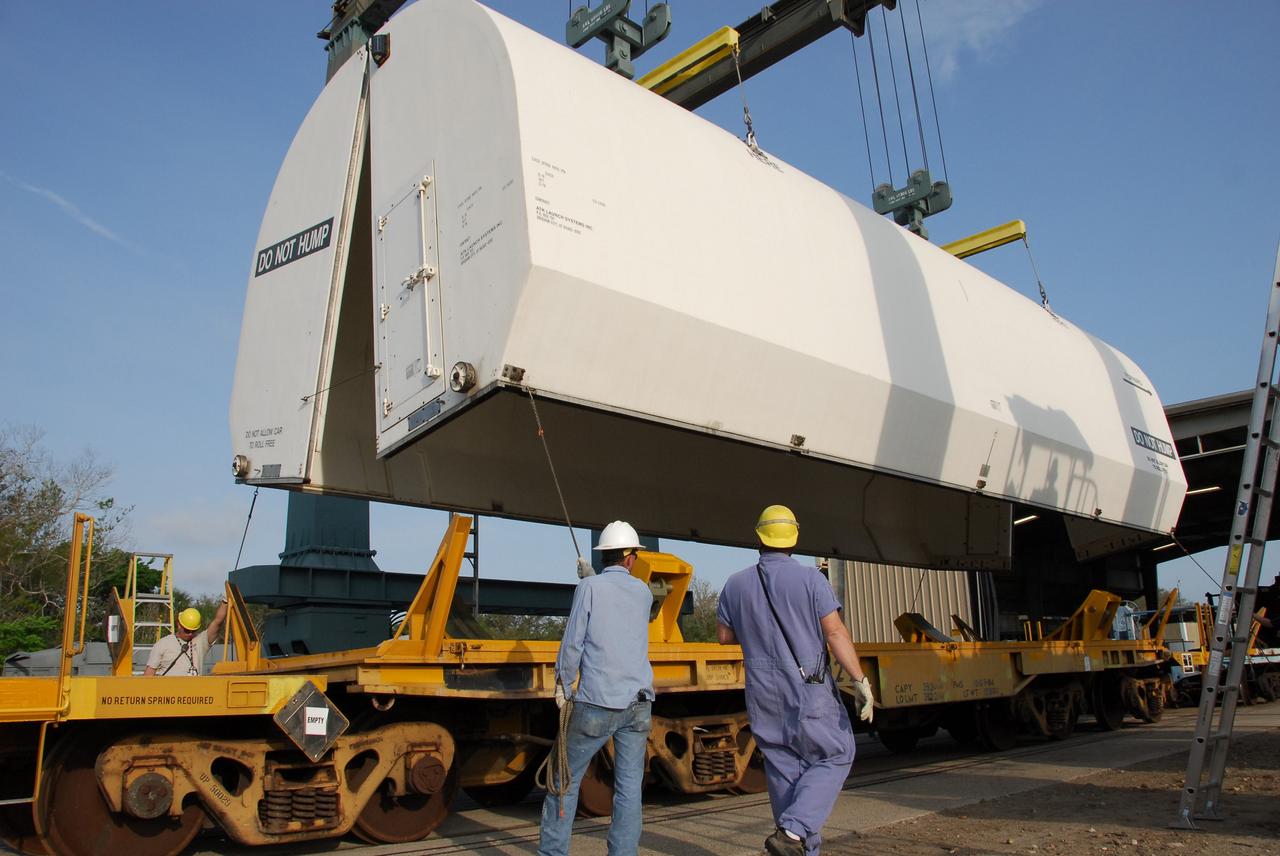
KENNEDY SPACE CENTER, FLA. -- Workers at the Railroad yard at NASA's Kennedy Space Center lift the transportation cover that will be used on solid rocket booster segments being transported to Utah. After a mission, the spent boosters are recovered, cleaned, disassembled, refurbished and reused after each launch. After hydrolasing the interior of each segment, they are placed on flatbed trucks. The individual booster segments are transferred to a railhead located at the railroad yard. The covered segments will be moved to Titusville for interchange with Florida East Coast Railway to begin the trip back to the Thiokol plant in Wa¬satch, Utah. Photo credit: NASA/Jack Pfaller
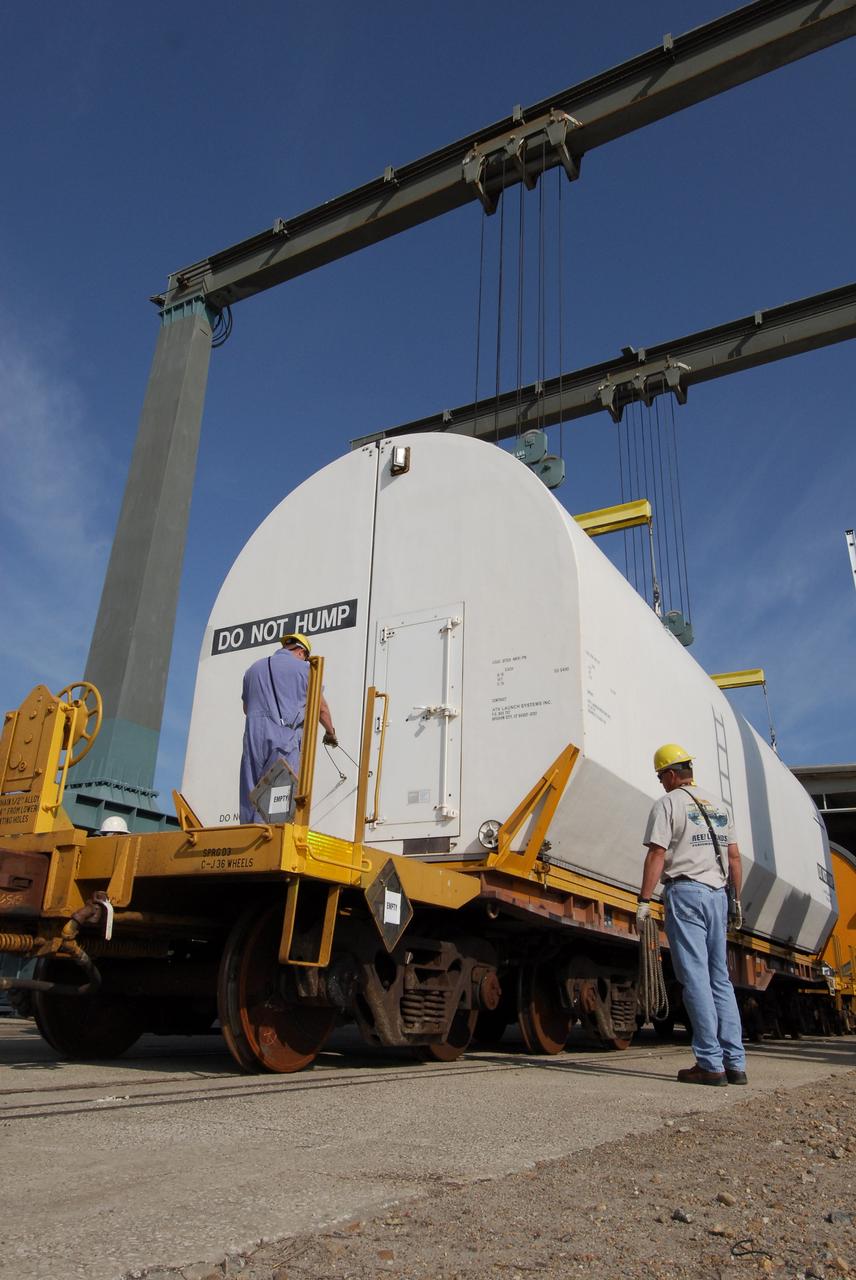
KENNEDY SPACE CENTER, FLA. -- At the NASA Railroad yard at NASA's Kennedy Space Center, a worker secures a transportation cover over a solid rocket booster segment from the STS-122 mission. Loaded on the railroad cars, the segments will be transported to Utah. After a mission, the spent boosters are recovered, cleaned, disassembled, refurbished and reused after each launch. After hydrolasing the interior of each segment, they are placed on flatbed trucks. The individual booster segments are transferred to a railhead located at the railroad yard. The covered segments will be moved to Titusville for interchange with Florida East Coast Railway to begin the trip back to the Thiokol plant in Wa¬satch, Utah. Photo credit: NASA/Jack Pfaller
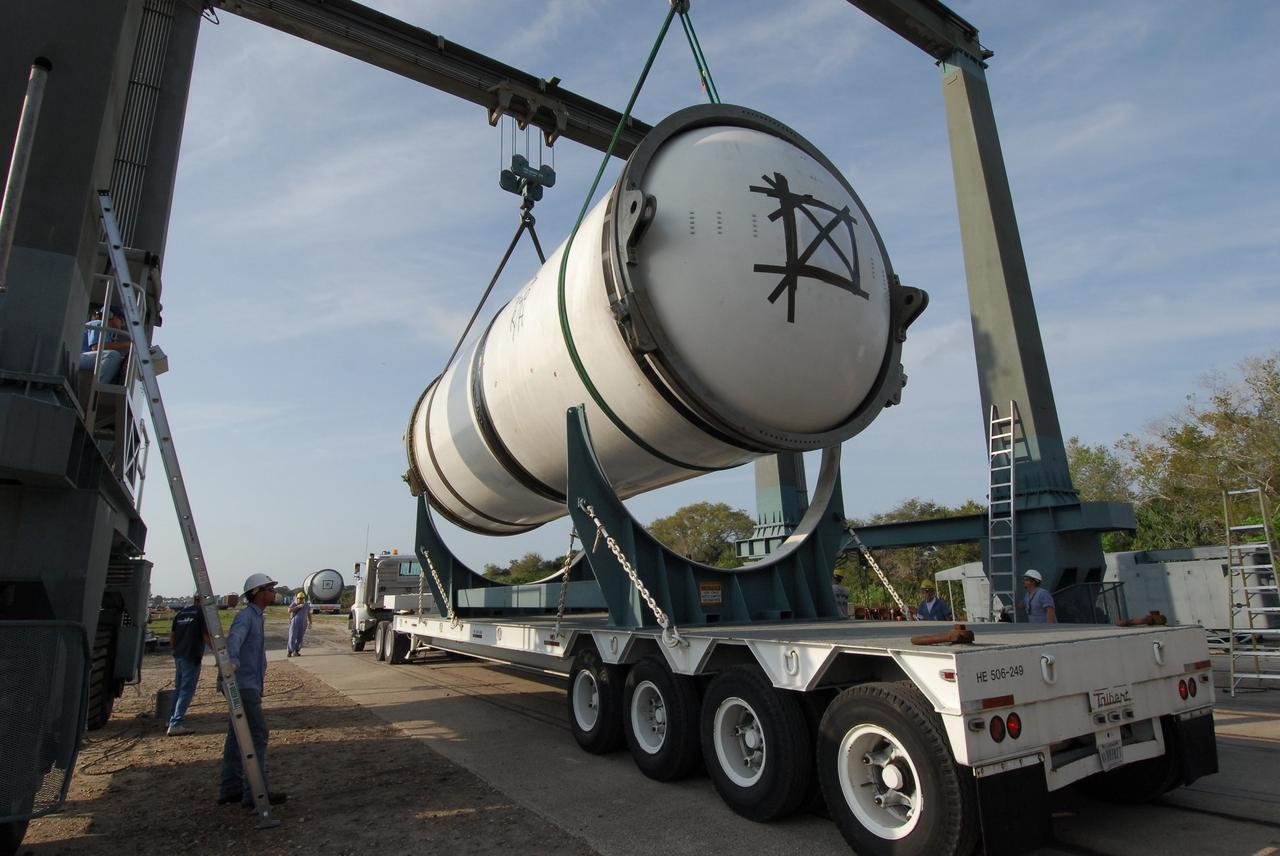
KENNEDY SPACE CENTER, FLA. -- At the Railroad yard at NASA's Kennedy Space Center, one of the spent segments of a solid rocket booster from the STS-122 mission is lifted off the flatbed truck. The segment will be placed onto a railroad car for transportation to Utah. After a mission, the spent boosters are recovered, cleaned, disassembled, refurbished and reused after each launch. After hydrolasing the interior of each segment, they are placed on flatbed trucks. The individual booster segments are transferred to a railhead located at the railroad yard. The covered segments will be moved to Titusville for interchange with Florida East Coast Railway to begin the trip back to the Thiokol plant in Wa¬satch, Utah. Photo credit: NASA/Jack Pfaller
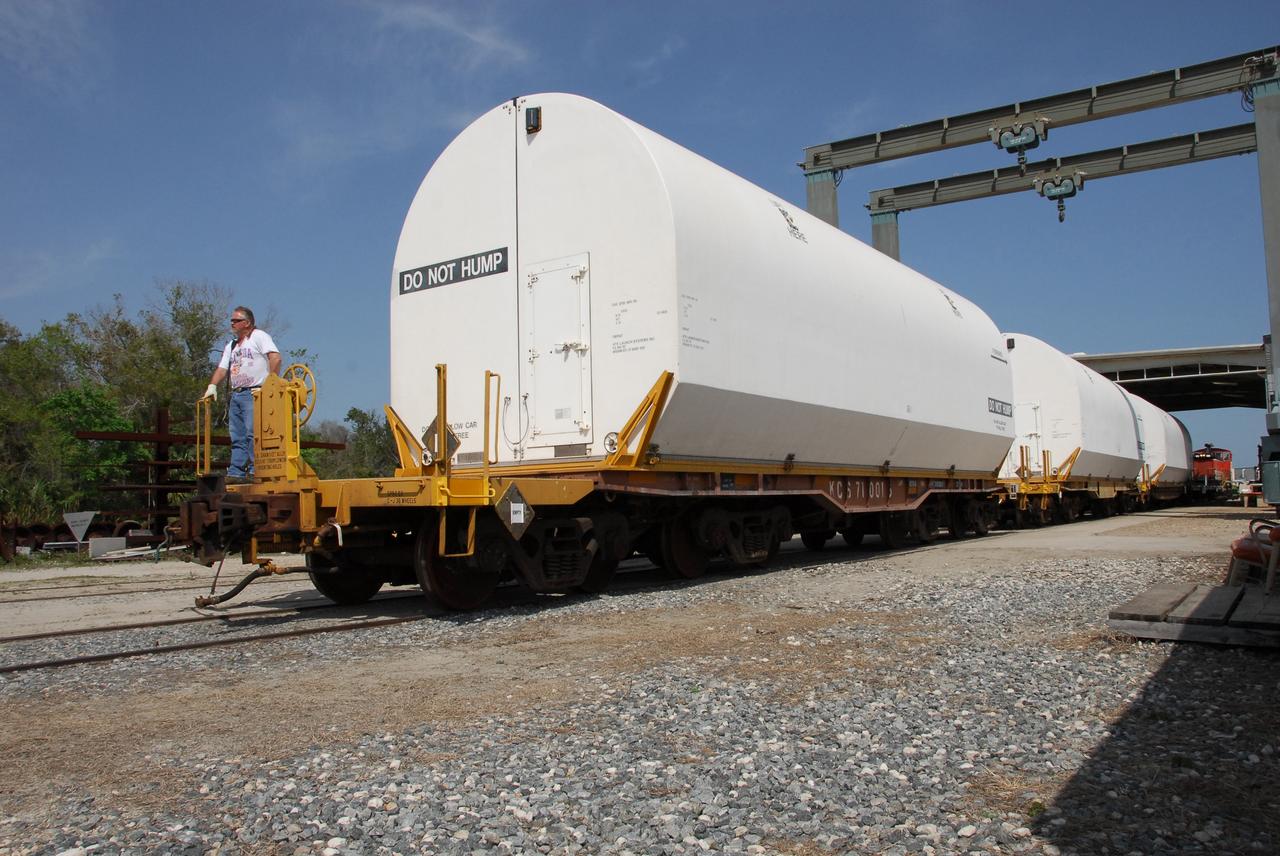
KENNEDY SPACE CENTER, FLA. -- At the NASA Railroad yard at NASA's Kennedy Space Center, all the solid rocket booster segments from the STS-122 mission are covered and secure on the train for transportation to Utah. After a mission, the spent boosters are recovered, cleaned, disassembled, refurbished and reused after each launch. After hydrolasing the interior of each segment, they are placed on flatbed trucks. The individual booster segments are transferred to a railhead located at the railroad yard. The covered segments will be moved to Titusville for interchange with Florida East Coast Railway to begin the trip back to the Thiokol plant in Wa¬satch, Utah. Photo credit: NASA/Jack Pfaller
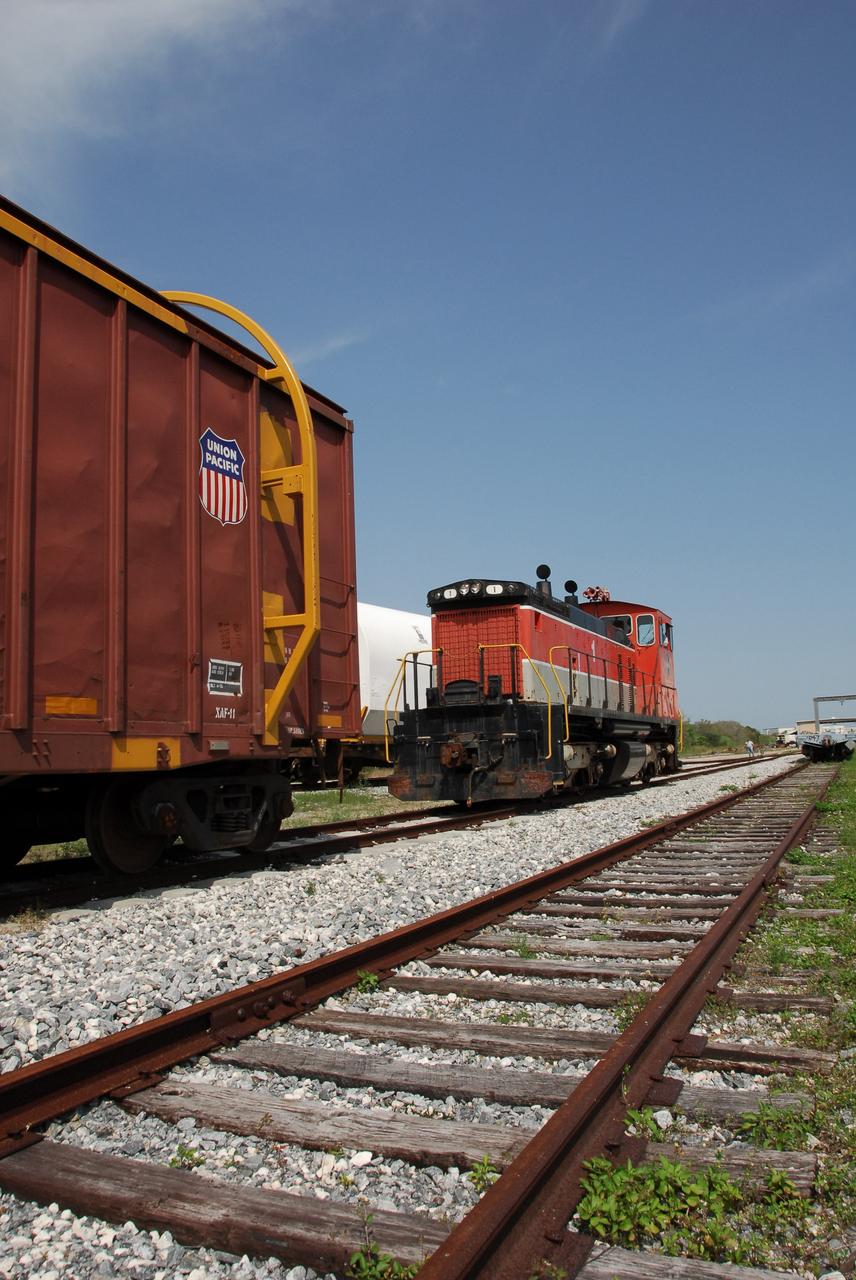
KENNEDY SPACE CENTER, FLA. -- The NASA Railroad train moves along the track in NASA Kennedy Space Center's railroad yard. The train is hauling the solid rocket booster segments from the STS-122 mission. After a mission, the spent boosters are recovered, cleaned, disassembled, refurbished and reused after each launch. After hydrolasing the interior of each segment, they are placed on flatbed trucks. The individual booster segments are transferred to a railhead located at the railroad yard. The covered segments will be moved to Titusville for interchange with Florida East Coast Railway to begin the trip back to the Thiokol plant in Wa¬satch, Utah. Photo credit: NASA/Jack Pfaller
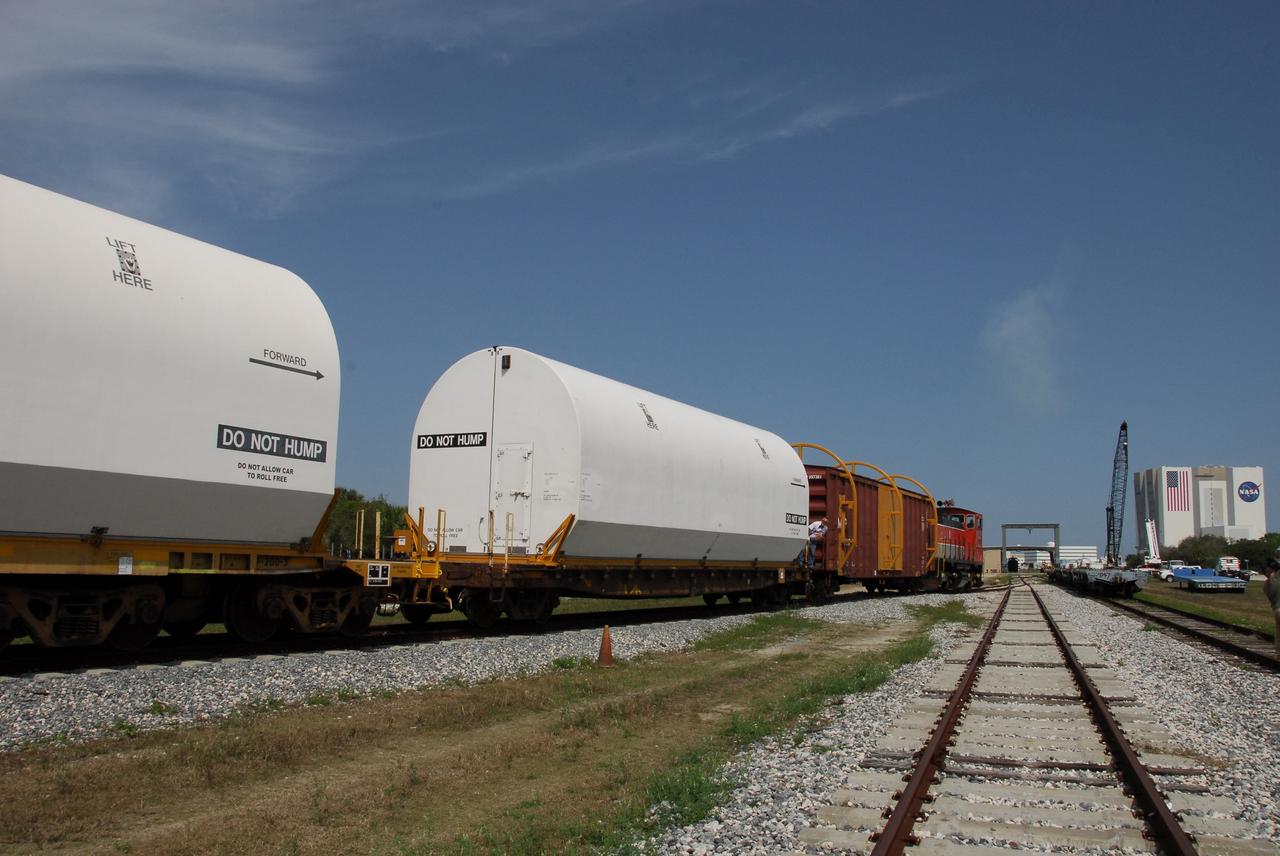
KENNEDY SPACE CENTER, FLA. -- The NASA Railroad train moves along the track through NASA's Kennedy Space Center. In the distance, at right, is the Vehicle Assembly Building. The train is hauling the solid rocket booster segments from the STS-122 mission. After a mission, the spent boosters are recovered, cleaned, disassembled, refurbished and reused after each launch. After hydrolasing the interior of each segment, they are placed on flatbed trucks. The individual booster segments are transferred to a railhead located at the railroad yard. The covered segments will be moved to Titusville for interchange with Florida East Coast Railway to begin the trip back to the Thiokol plant in Wa¬satch, Utah. Photo credit: NASA/Jack Pfaller
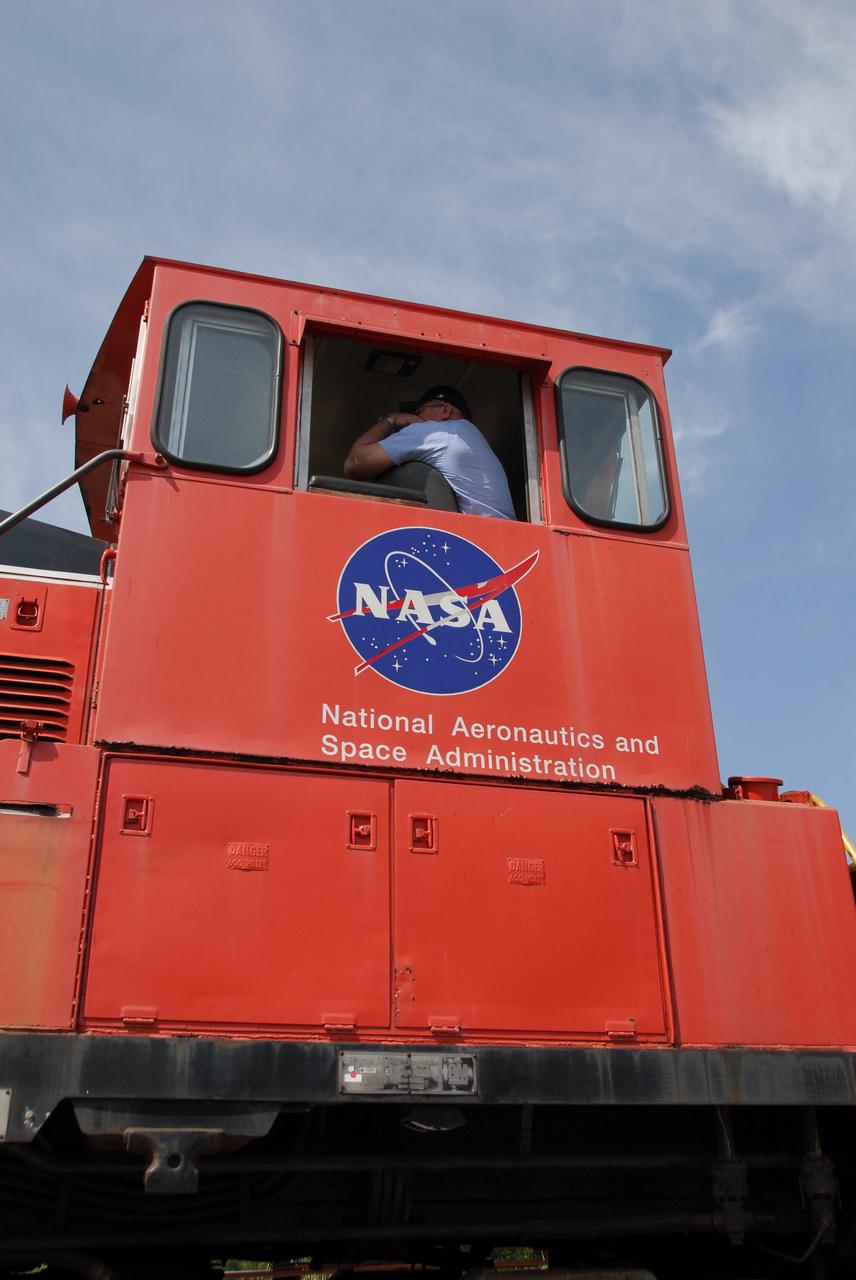
KENNEDY SPACE CENTER, FLA. -- The driver of the NASA Railroad train keeps his eye on the track ahead as the train moves through NASA Kennedy Space Center's Launch Complex 39 Area. The train is hauling the solid rocket booster segments from the STS-122 mission. After a mission, the spent boosters are recovered, cleaned, disassembled, refurbished and reused after each launch. After hydrolasing the interior of each segment, they are placed on flatbed trucks. The individual booster segments are transferred to a railhead located at the railroad yard. The covered segments will be moved to Titusville for interchange with Florida East Coast Railway to begin the trip back to the Thiokol plant in Wa¬satch, Utah. Photo credit: NASA/Jack Pfaller
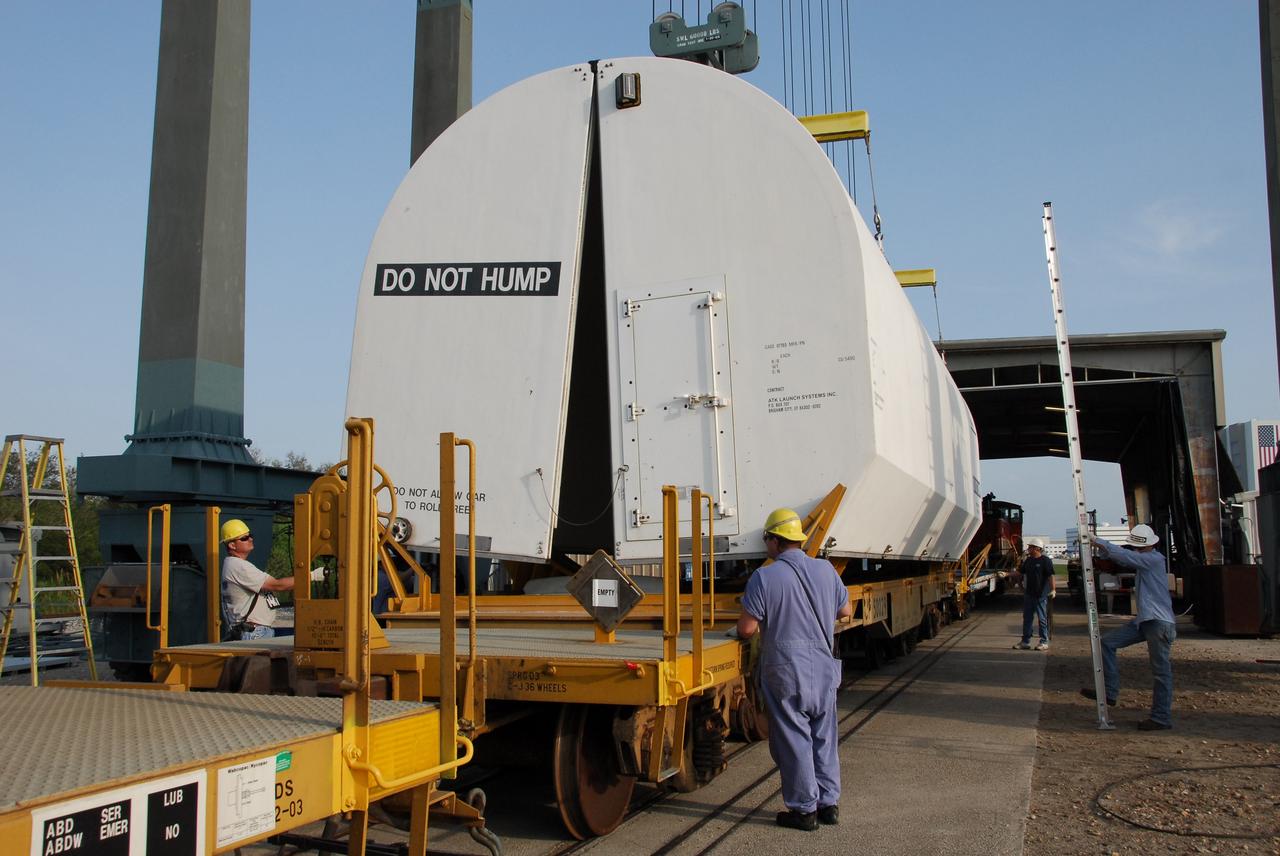
KENNEDY SPACE CENTER, FLA. -- Workers at the Railroad yard at NASA's Kennedy Space Center stand ready to secure the transportation cover over the solid rocket booster segment that is being transported to Utah. The spent segments are part of the booster used to launch space shuttle Atlantis on the STS-122 mission in February. After a mission, the spent boosters are recovered, cleaned, disassembled, refurbished and reused after each launch. After hydrolasing the interior of each segment, they are placed on flatbed trucks. The individual booster segments are transferred to a railhead located at the railroad yard. The covered segments will be moved to Titusville for interchange with Florida East Coast Railway to begin the trip back to the Thiokol plant in Wa¬satch, Utah. Photo credit: NASA/Jack Pfaller
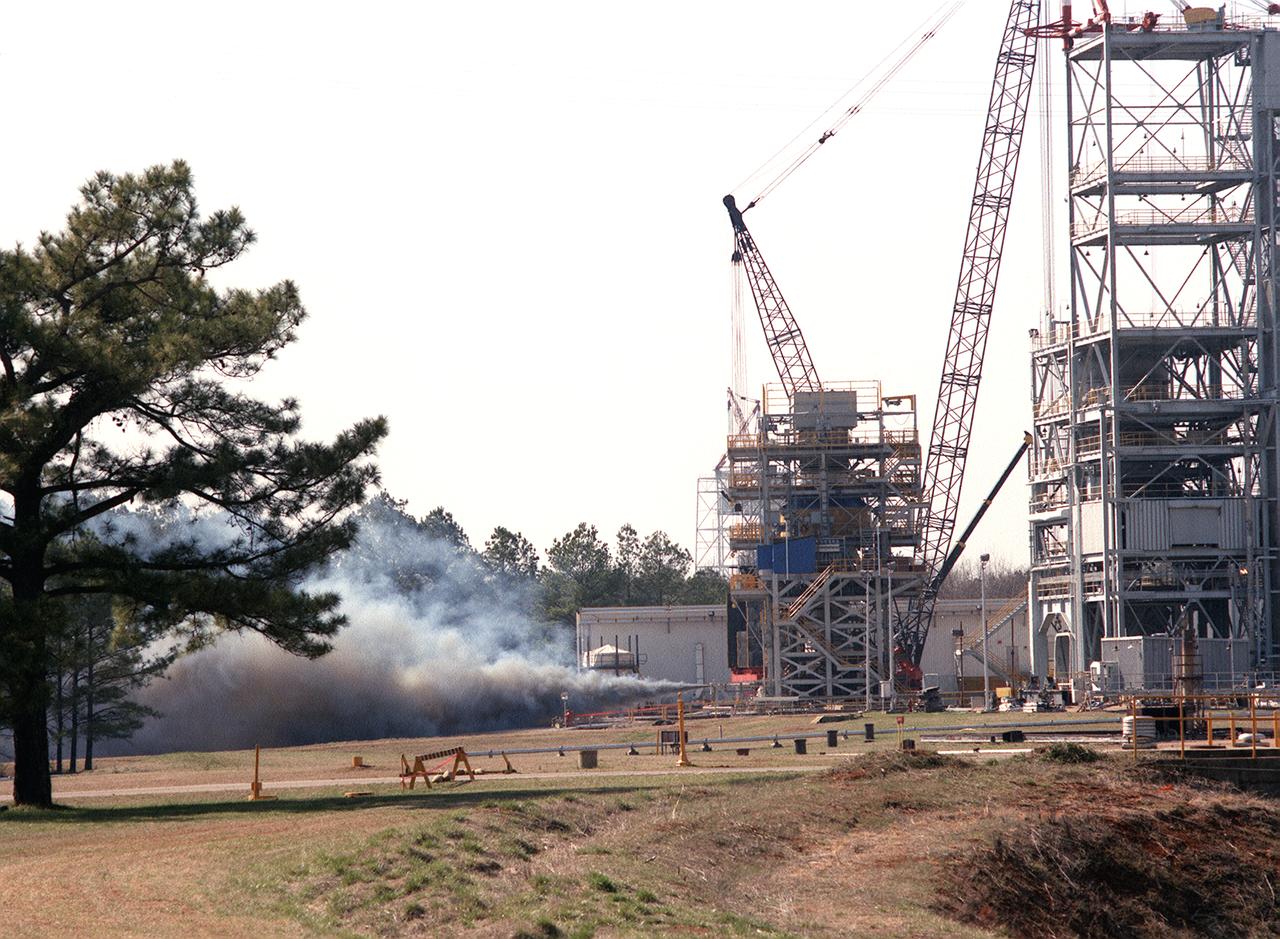
The Marshall Space Flight Center (MSFC) successfully test fired the third in a series of Transient Pressure Test Articles (TPTA) in its east test area. The test article was a short-stack solid rocket motor 52-feet long and 12-feet in diameter. The TPTA tests were designed to evaluate the effects of temperature, pressure and external loads encountered by the SRM, primarily during ignition transients. Instrumentation on the motor recorded approximately 1,000 charnels of data to verify the structural performance, thermal response, sealing capability of the redesign field, and case-to-nozzle joints. The TPTA test stand, 14-feet wide by 26-feet long by 33-feet high, was built in 1987. The TPTA series was a joint effort among Morton Thiokol, Inc., United Space Boosters, Inc., Wyle Laboratories, and MSFC. Wyle Laboratories conducted the tests for the MSFC, which manages the redesigned SRM program for NASA.
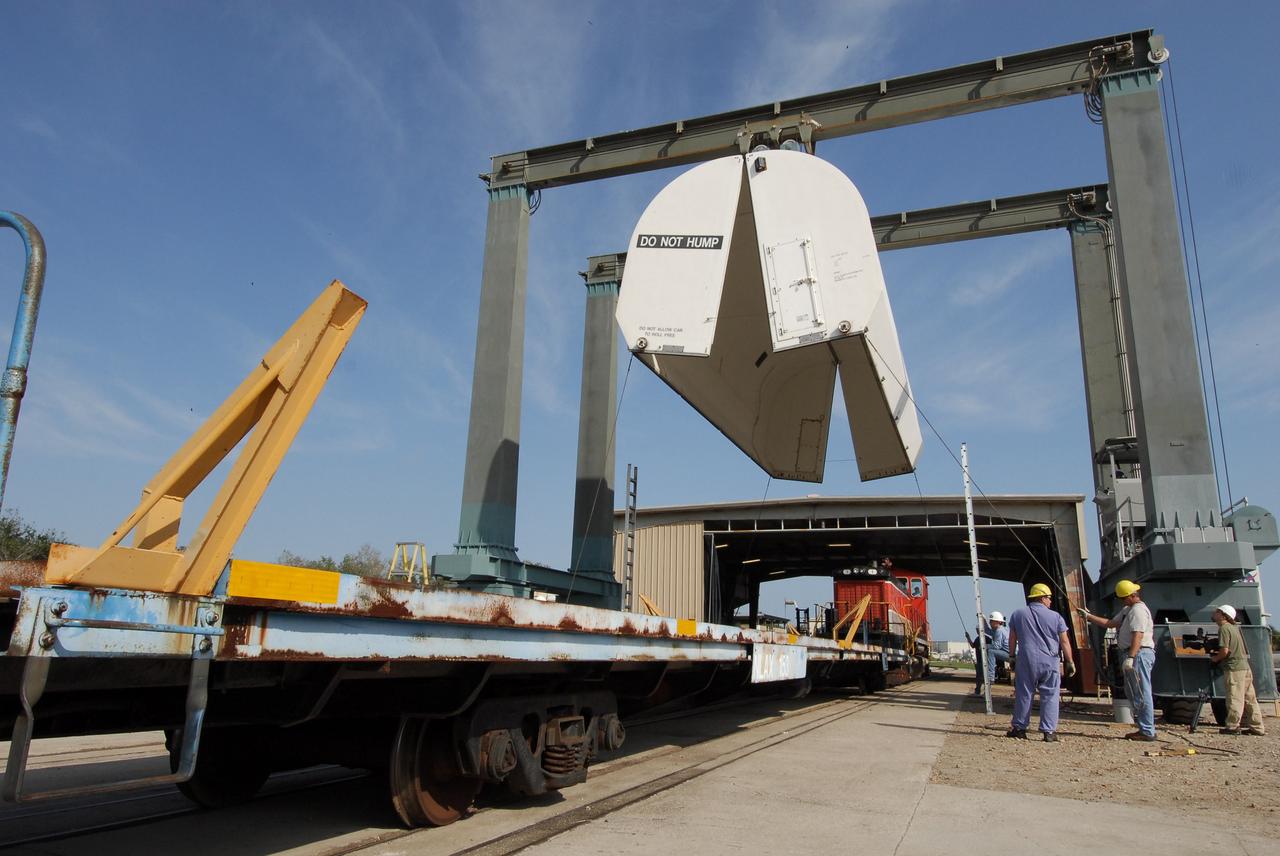
KENNEDY SPACE CENTER, FLA. -- At the NASA Railroad yard at NASA's Kennedy Space Center, a transportation cover is suspended above the railroad, waiting to be placed over another solid rocket booster segment from the STS-122 mission. Loaded on the railroad cars, the segments will be transported to Utah. After a mission, the spent boosters are recovered, cleaned, disassembled, refurbished and reused after each launch. After hydrolasing the interior of each segment, they are placed on flatbed trucks. The individual booster segments are transferred to a railhead located at the railroad yard. The covered segments will be moved to Titusville for interchange with Florida East Coast Railway to begin the trip back to the Thiokol plant in Wa¬satch, Utah. Photo credit: NASA/Jack Pfaller
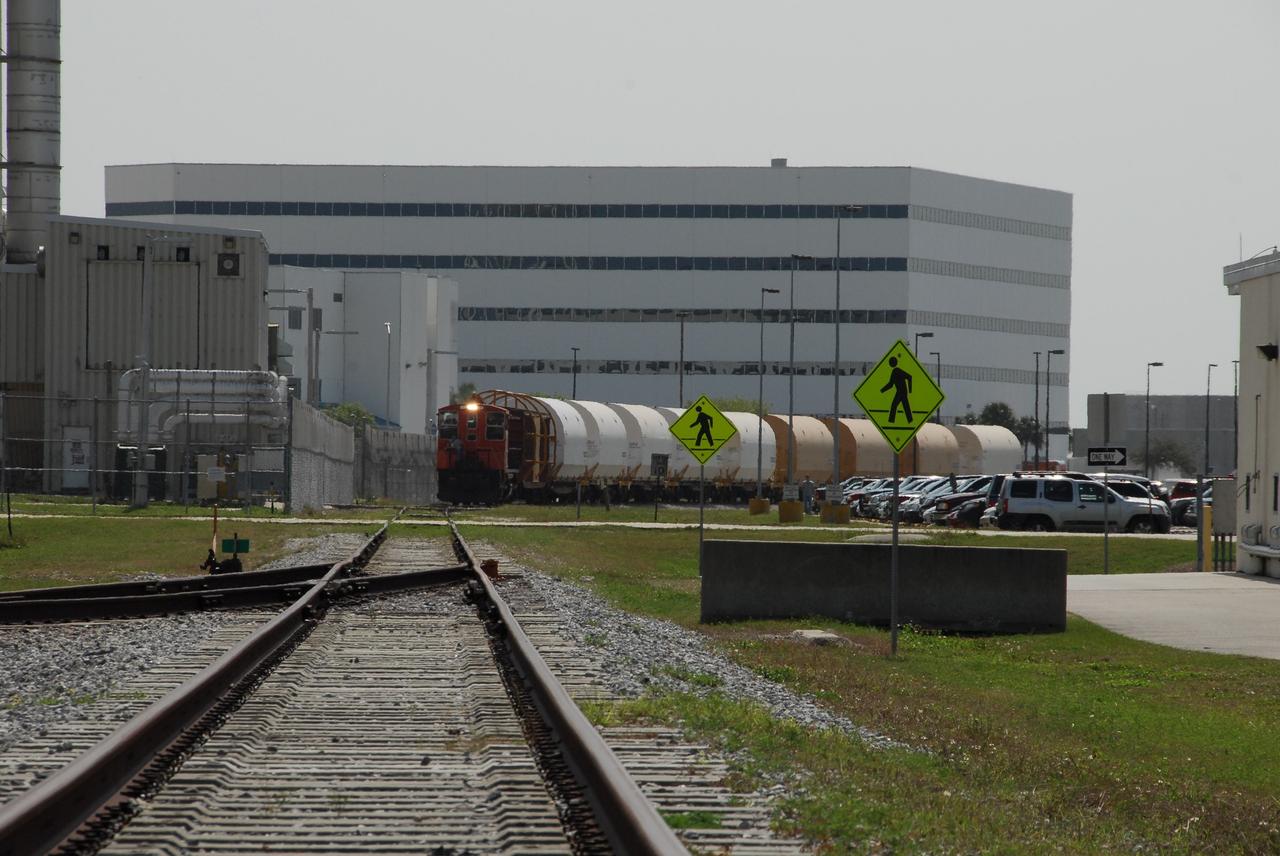
KENNEDY SPACE CENTER, FLA. -- The NASA Railroad train moves along the track through NASA's Kennedy Space Center. Behind it is the Operations and Support Building I in the Launch Complex 39 Area. The train is hauling the solid rocket booster segments from the STS-122 mission. After a mission, the spent boosters are recovered, cleaned, disassembled, refurbished and reused after each launch. After hydrolasing the interior of each segment, they are placed on flatbed trucks. The individual booster segments are transferred to a railhead located at the railroad yard. The covered segments will be moved to Titusville for interchange with Florida East Coast Railway to begin the trip back to the Thiokol plant in Wa¬satch, Utah. Photo credit: NASA/Jack Pfaller
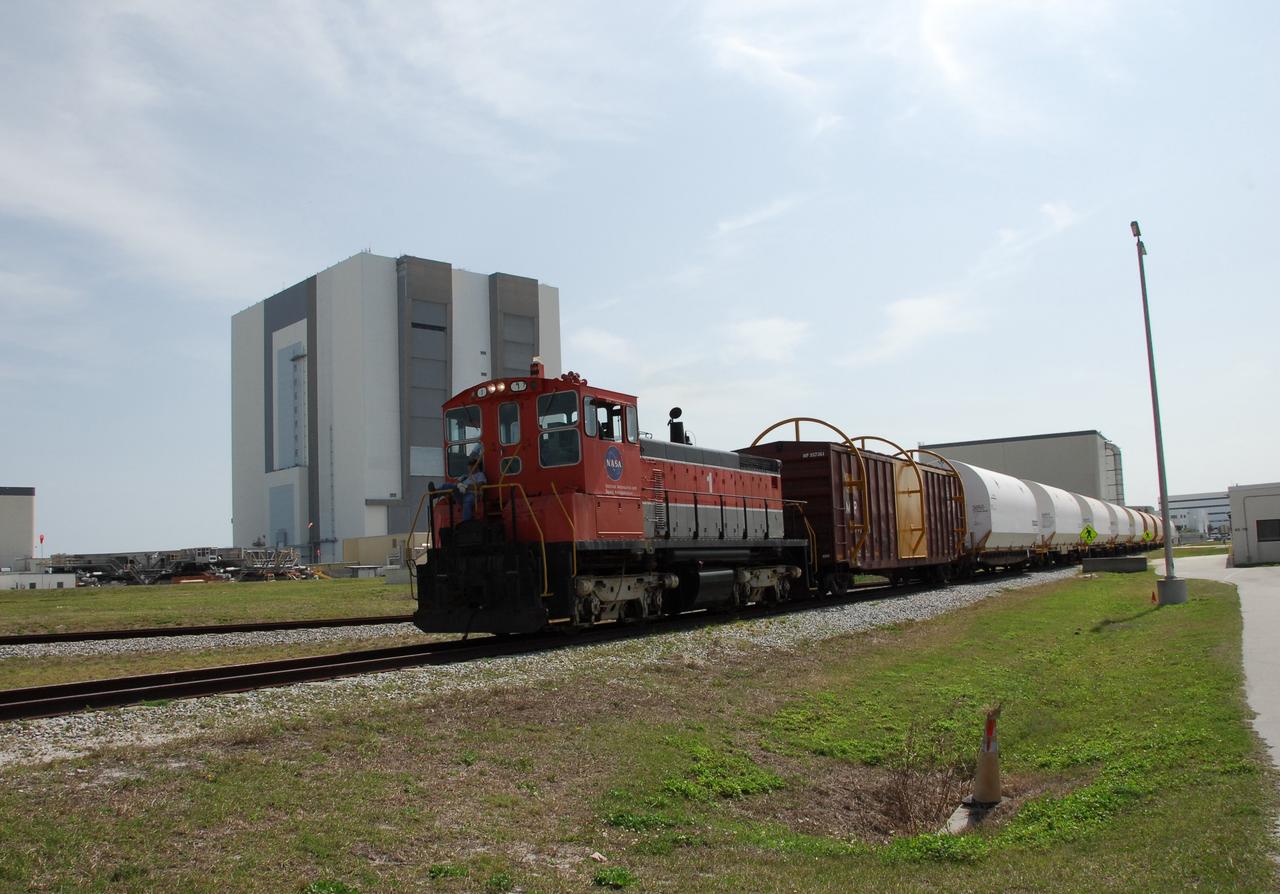
KENNEDY SPACE CENTER, FLA. -- The NASA Railroad train moves along the track through NASA Kennedy Space Center's Launch Complex 39 Area. Behind the locomotive car is the Vehicle Assembly Building. The train is hauling the solid rocket booster segments from the STS-122 mission. After a mission, the spent boosters are recovered, cleaned, disassembled, refurbished and reused after each launch. After hydrolasing the interior of each segment, they are placed on flatbed trucks. The individual booster segments are transferred to a railhead located at the railroad yard. The covered segments will be moved to Titusville for interchange with Florida East Coast Railway to begin the trip back to the Thiokol plant in Wa¬satch, Utah. Photo credit: NASA/Jack Pfaller
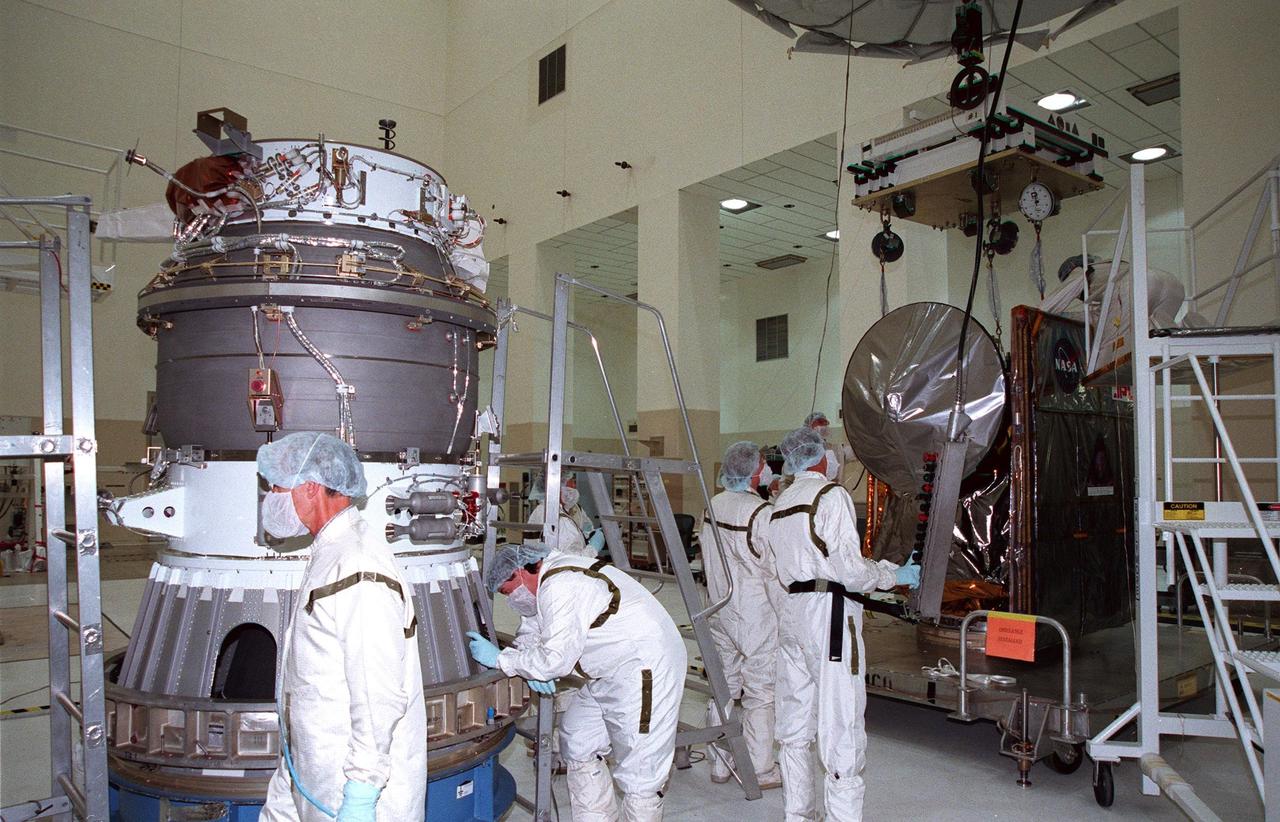
KENNEDY SPACE CENTER, FLA. -- In the Spacecraft Assembly and Encapsulation Facility -2 (SAEF-2), the third stage of the Boeing Delta II launch vehicle (left) waits for mating with the Mars Climate Orbiter (right). The third stage is a solid-propellant Thiokol Star 48B booster, the same final stage used in the 1996 launch of Mars Global Surveyor. Targeted for launch on Dec. 10, 1998, the orbiter is heading for Mars where it will primarily support its companion Mars Polar Lander spacecraft, which is planned for launch on Jan. 3, 1999. The orbiter's instruments will monitor the Martian atmosphere and image the planet's surface on a daily basis for 687 Earth days. It will observe the appearance and movement of atmospheric dust and water vapor, as well as characterize seasonal changes on the surface. The detailed images of the surface features will provide important clues to the planet's early climate history and give scientists more information about possible liquid water reserves beneath the surface
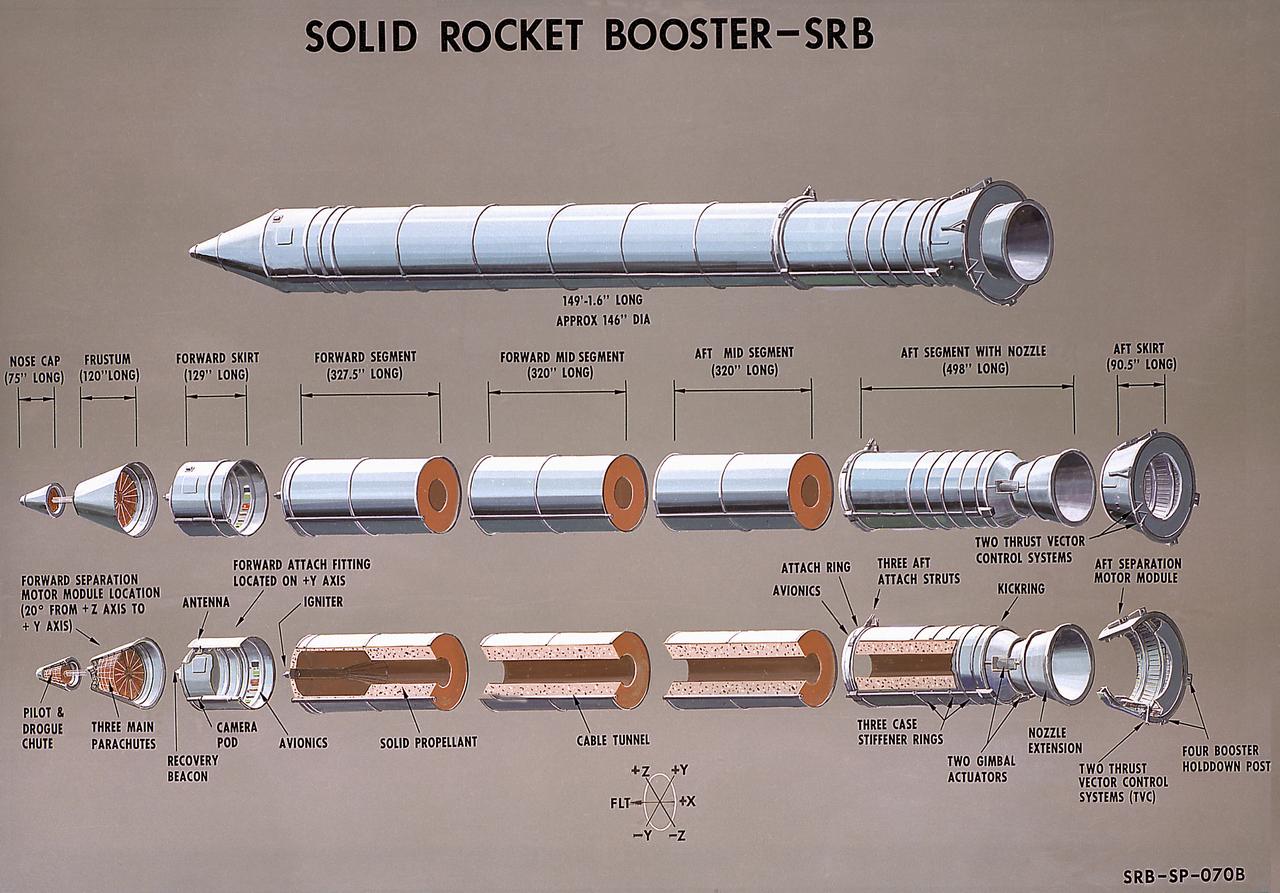
This illustration is a cutaway of the solid rocket booster (SRB) sections with callouts. The Shuttle's two SRB's are the largest solids ever built and the first designed for refurbishment and reuse. Standing nearly 150-feet high, the twin boosters provide the majority of thrust for the first two minutes of flight, about 5.8 million pounds, augmenting the Shuttle's main propulsion system during liftoff. The major design drivers for the solid rocket motors (SRM's) were high thrust and reuse. The desired thrust was achieved by using state-of-the-art solid propellant and by using a long cylindrical motor with a specific core design that allows the propellant to burn in a carefully controlled marner. At burnout, the boosters separate from the external tank and drop by parachute to the ocean for recovery and subsequent refurbishment. The boosters are designed to survive water impact at almost 60 miles per hour, maintain flotation with minimal damage, and preclude corrosion of the hardware exposed to the harsh seawater environment. Under the project management of the Marshall Space Flight Center, the SRB's are assembled and refurbished by the United Space Boosters. The SRM's are provided by the Morton Thiokol Corporation.
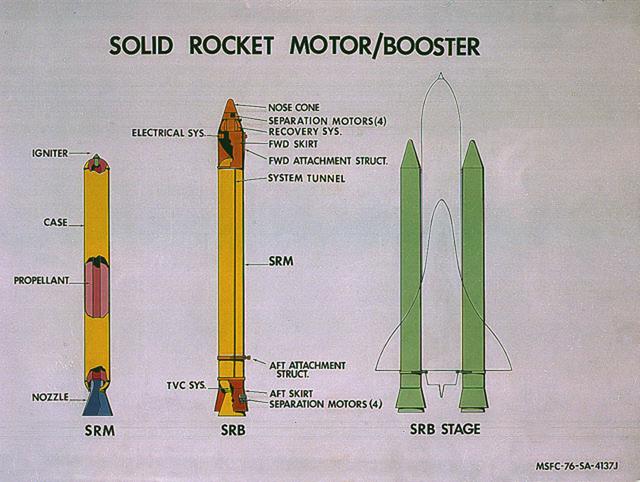
This image illustrates the solid rocket motor (SRM)/solid rocket booster (SRB) configuration. The Shuttle's two SRB's are the largest solids ever built and the first designed for refurbishment and reuse. Standing nearly 150-feet high, the twin boosters provide the majority of thrust for the first two minutes of flight, about 5.8 million pounds, augmenting the Shuttle's main propulsion system during liftoff. The major design drivers for the SRM's were high thrust and reuse. The desired thrust was achieved by using state-of-the-art solid propellant and by using a long cylindrical motor with a specific core design that allows the propellant to burn in a carefully controlled marner. At burnout, the boosters separate from the external tank and drop by parachute to the ocean for recovery and subsequent refurbishment. The boosters are designed to survive water impact at almost 60 miles per hour, maintain flotation with minimal damage, and preclude corrosion of the hardware exposed to the harsh seawater environment. Under the project management of the Marshall Space Flight Center, the SRB's are assembled and refurbished by the United Space Boosters. The SRM's are provided by the Morton Thiokol Corporation.
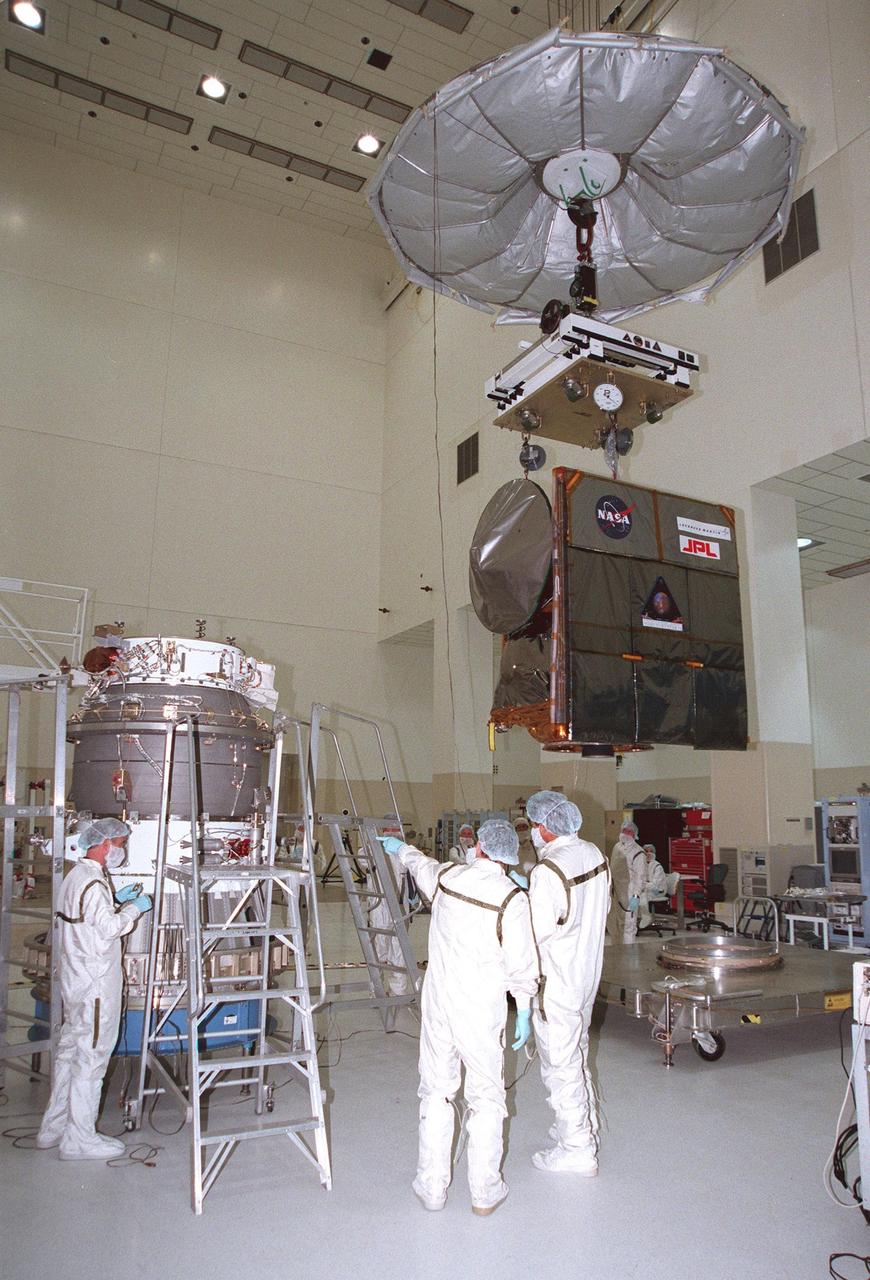
KENNEDY SPACE CENTER, FLA. -- In the Spacecraft Assembly and Encapsulation Facility -2 (SAEF-2), the Mars Climate Orbiter (right) is lifted to move it for mating to the third stage of the Boeing Delta II launch vehicle waiting at left. The third stage is a solid-propellant Thiokol Star 48B booster, the same final stage used in the 1996 launch of Mars Global Surveyor. Targeted for launch on Dec. 10, 1998, the orbiter is heading for Mars where it will primarily support its companion Mars Polar Lander spacecraft, which is planned for launch on Jan. 3, 1999. The orbiter's instruments will monitor the Martian atmosphere and image the planet's surface on a daily basis for 687 Earth days. It will observe the appearance and movement of atmospheric dust and water vapor, as well as characterize seasonal changes on the surface. The detailed images of the surface features will provide important clues to the planet's early climate history and give scientists more information about possible liquid water reserves beneath the surface. <BR>; <BR>; <BR> <BR> <BR> <CENTER
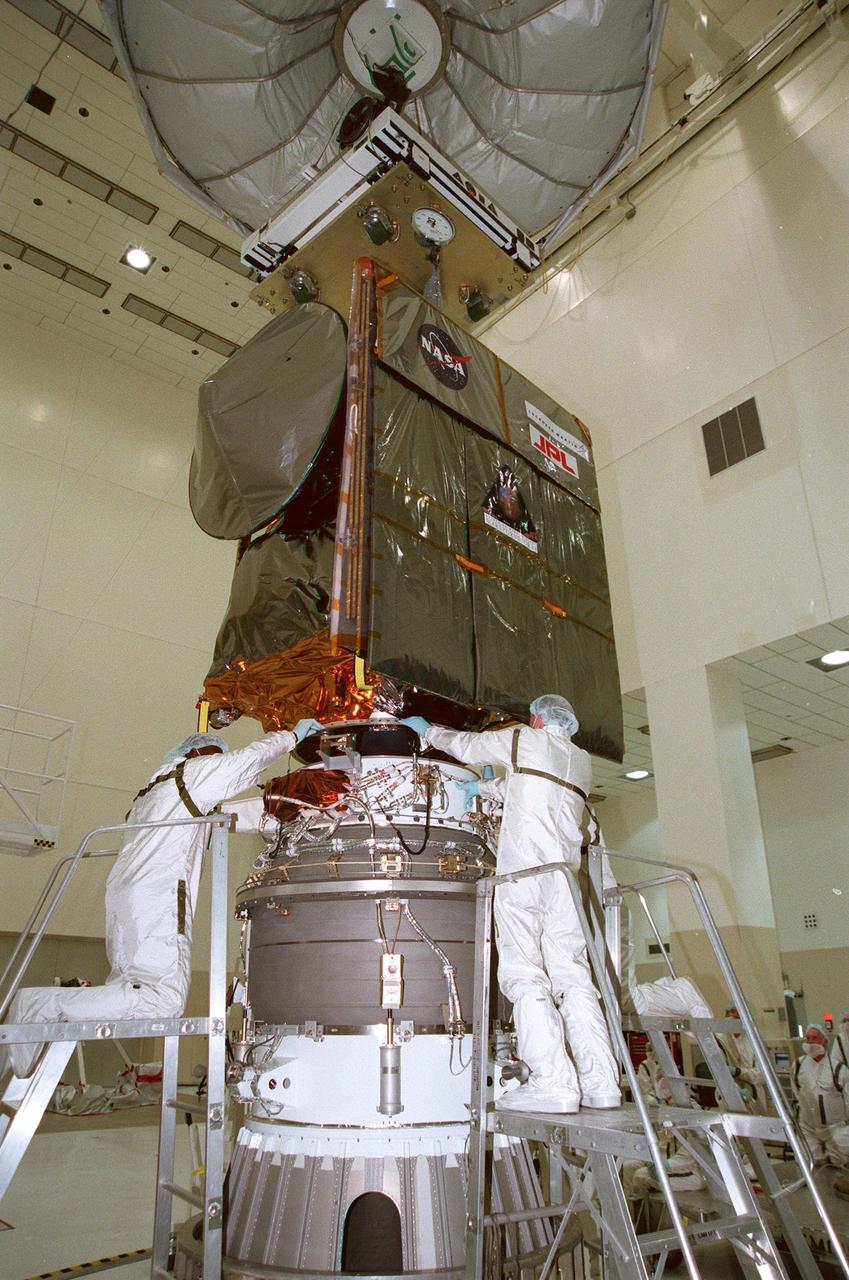
KENNEDY SPACE CENTER, FLA. -- In the Spacecraft Assembly and Encapsulation Facility -2 (SAEF-2), workers check on the fitting between the Mars Climate Orbiter (above) and the third stage of the Boeing Delta II launch vehicle (below). The third stage is a solid-propellant Thiokol Star 48B booster, the same final stage used in the 1996 launch of Mars Global Surveyor. Targeted for launch on Dec. 10, 1998, the orbiter is heading for Mars where it will primarily support its companion Mars Polar Lander spacecraft, which is planned for launch on Jan. 3, 1999. The orbiter's instruments will monitor the Martian atmosphere and image the planet's surface on a daily basis for 687 Earth days. It will observe the appearance and movement of atmospheric dust and water vapor, as well as characterize seasonal changes on the surface. The detailed images of the surface features will provide important clues to the planet's early climate history and give scientists more information about possible liquid water reserves beneath the surface
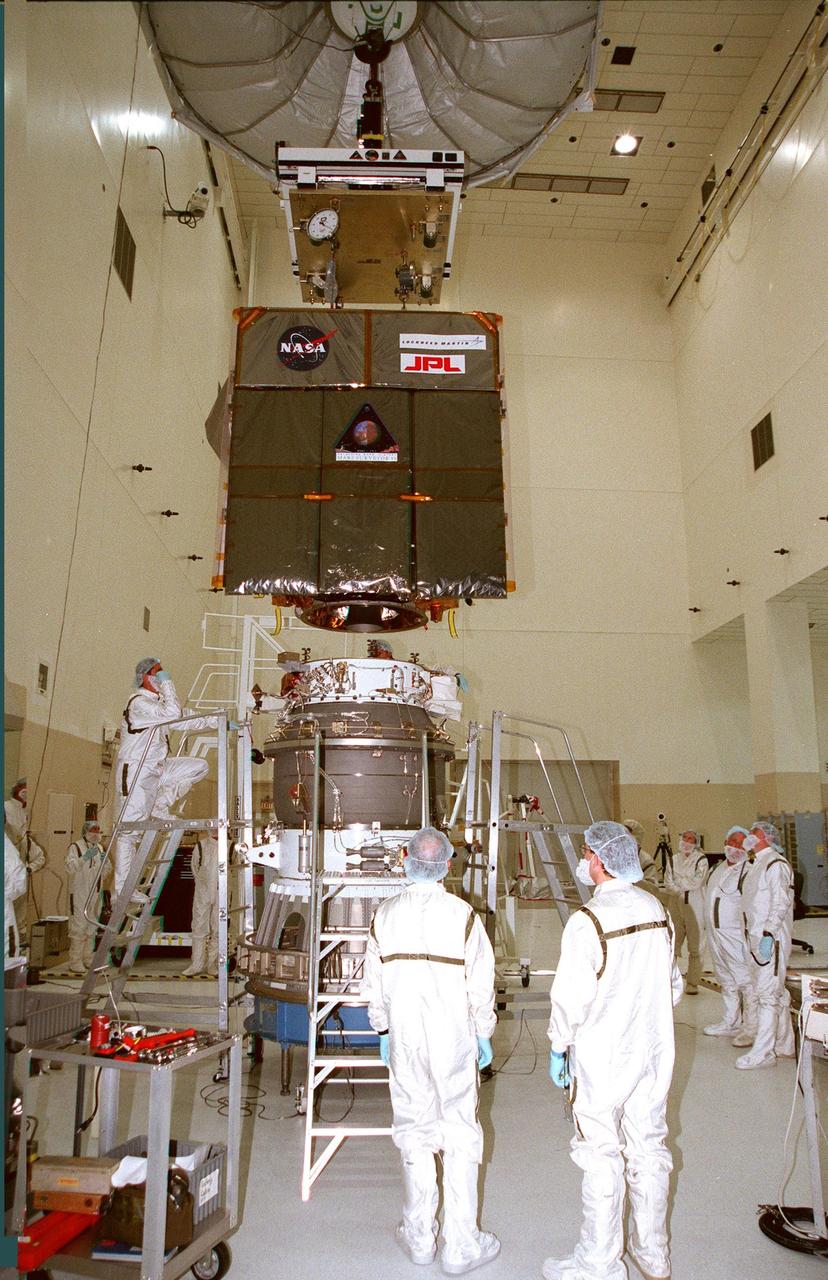
KENNEDY SPACE CENTER, FLA. -- In the Spacecraft Assembly and Encapsulation Facility -2 (SAEF-2), the Mars Climate Orbiter (top) is lowered toward the third stage of the Boeing Delta II launch vehicle below it, to which it will be attached. The third stage is a solid-propellant Thiokol Star 48B booster, the same final stage used in the 1996 launch of Mars Global Surveyor. Targeted for launch on Dec. 10, 1998, the orbiter is heading for Mars where it will primarily support its companion Mars Polar Lander spacecraft, which is planned for launch on Jan. 3, 1999. The orbiter's instruments will monitor the Martian atmosphere and image the planet's surface on a daily basis for 687 Earth days. It will observe the appearance and movement of atmospheric dust and water vapor, as well as characterize seasonal changes on the surface. The detailed images of the surface features will provide important clues to the planet's early climate history and give scientists more information about possible liquid water reserves beneath the surface
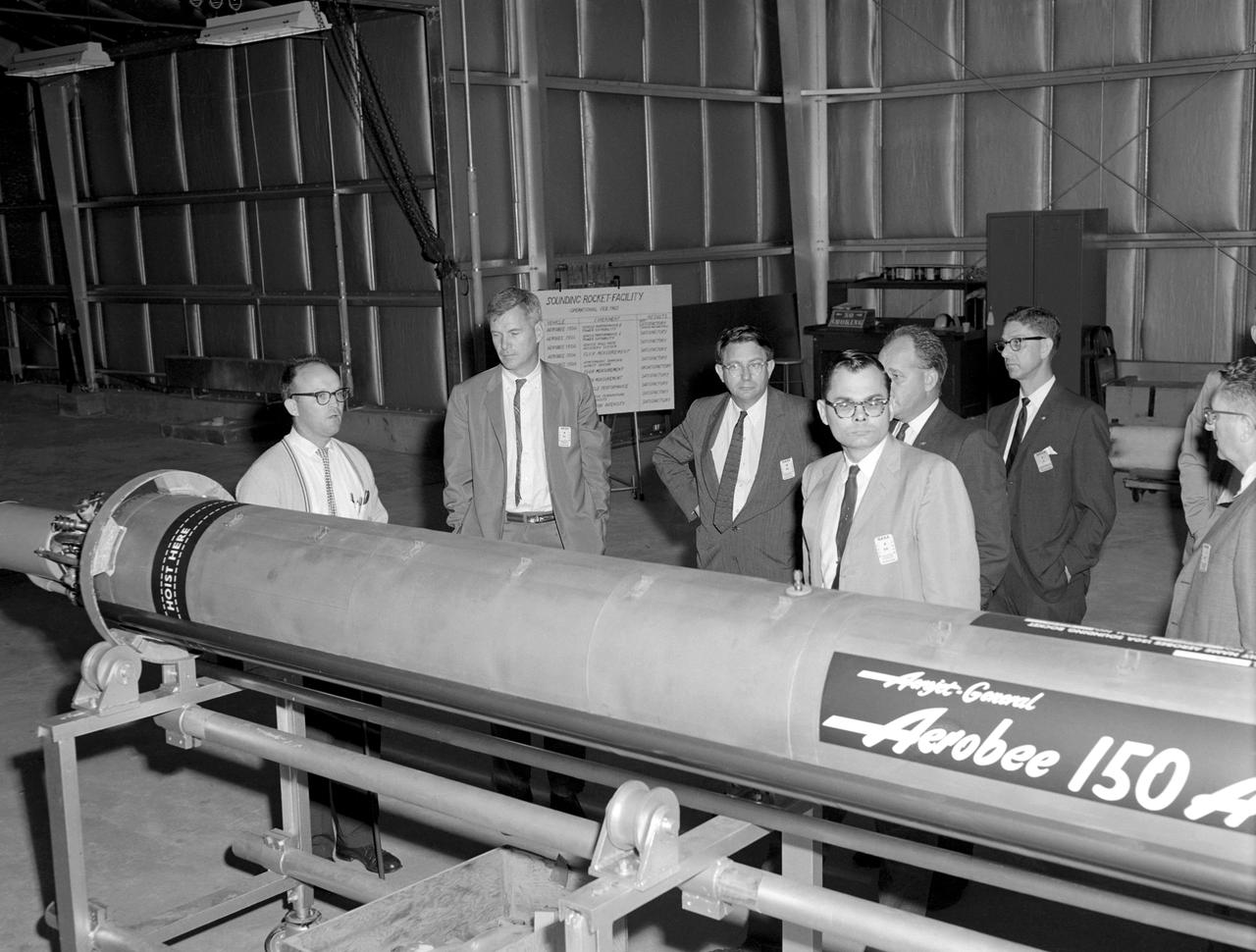
Photographed on 09/22/1960. -- An examination of the Aerojet-General "Aerobee 150A" propulsion system in February 1960. James Hansen described this as follows: "As for the technical definition of the rocket...the Langley engineers tried to keep developmental costs and time to a minimum by selecting components from off-the-shelf hardware. the majority of Scout's components were to come from an inventory of solid-fuel rockets produced for the military, although everyone involved understood that some improved motors would also have to be developed under contract. By early 1959, after intensive technical analysis and reviews, Langley settled on a design and finalized the selection of the major contractors. The rocket's 40-inch-diameter first stage was to be a new "Algol" motor, a combination of the Jupiter Senior and the navy Polaris produced by the Aerojet General Corporation, Sacramento, California. The 31-inch-diameter second stage, "Castor," was derived from the army's Sergeant and was to be manufactured by the Redstone Division of the Thiokol company in Huntsville, Alabama. the motor for the 30-inch-diameter third stage, "Antares," evolved under NASA contract from the ABL X248 design into a new version called the X254 (and subsequently into the X259); it was built under contract to NASA by ABL, a U.S. Navy Bureau of Ordnance facility operated by the Hercules Powder Company, Cumberland, Maryland. the final upper-stage propulsion unit, "Altair," which was 25.7 inches in diameter (34 inches at the heat shield), amounted to an improved edition of the X248 that was also manufactured by ABL." -- Published in James R. Hansen, Spaceflight Revolution: NASA Langley Research Center From Sputnik to Apollo, NASA SP-4308, pp.200-201.
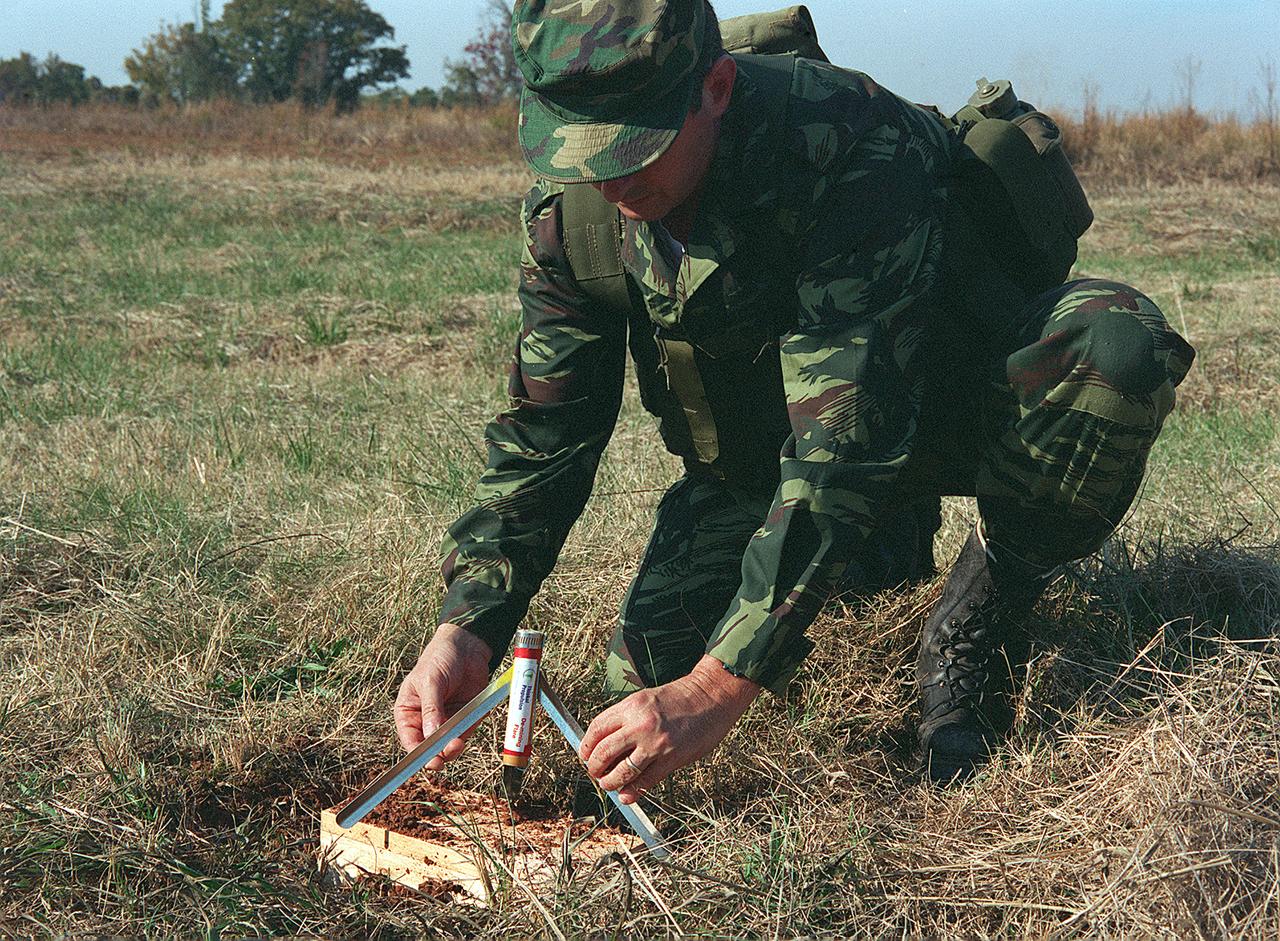
The same rocket fuel that helps power the Space Shuttle as it thunders into orbit will now be taking on a new role, with the potential to benefit millions of people worldwide. Leftover rocket fuel from NASA is being used to make a flare that destroys land mines where they were buried, without using explosives. The flare is safe to handle and easy to use. People working to deactivate the mines simply place the flare next to the uncovered land mine and ignite it from a safe distance using a battery-triggered electric match. The flare burns a hole in the land mine's case and ignites its explosive contents. The explosive burns away, disabling the mine and rendering it harmless. Using leftover rocket fuel to help destroy land mines incurs no additional costs to taxpayers. To ensure enough propellant is available for each Shuttle mission, NASA allows for a small percentage of extra propellant in each batch. Once mixed, surplus fuel solidifies and carnot be saved for use in another launch. In its solid form, it is an ideal ingredient for the new flare. The flare was developed by Thiokol Propulsion in Brigham City, Utah, the NASA contractor that designs and builds rocket motors for the Solid Rocket Booster Space Shuttle. An estimated 80 million or more active land mines are scattered around the world in at least 70 countries, and kill or maim 26,000 people a year. Worldwide, there is one casualty every 22 minutes

This illustration is an orbiter cutaway view with callouts. The orbiter is both the brains and heart of the Space Transportation System (STS). About the same size and weight as a DC-9 aircraft, the orbiter contains the pressurized crew compartment (which can normally carry up to seven crew members), the huge cargo bay, and the three main engines mounted on its aft end. There are three levels to the crew cabin. Uppermost is the flight deck where the commander and the pilot control the mission. The middeck is where the gallery, toilet, sleep stations, and storage and experiment lockers are found for the basic needs of weightless daily living. Also located in the middeck is the airlock hatch into the cargo bay and space beyond. It is through this hatch and airlock that astronauts go to don their spacesuits and marned maneuvering units in preparation for extravehicular activities, more popularly known as spacewalks. The Space Shuttle's cargo bay is adaptable to hundreds of tasks. Large enough to accommodate a tour bus (60 x 15 feet or 18.3 x 4.6 meters), the cargo bay carries satellites, spacecraft, and spacelab scientific laboratories to and from Earth orbit. It is also a work station for astronauts to repair satellites, a foundation from which to erect space structures, and a hold for retrieved satellites to be returned to Earth. Thermal tile insulation and blankets (also known as the thermal protection system or TPS) cover the underbelly, bottom of the wings, and other heat-bearing surfaces of the orbiter to protect it during its fiery reentry into the Earth's atmosphere. The Shuttle's 24,000 individual tiles are made primarily of pure-sand silicate fibers, mixed with a ceramic binder. The solid rocket boosters (SRB's) are designed as an in-house Marshall Space Flight Center project, with United Space Boosters as the assembly and refurbishment contractor. The solid rocket motor (SRM) is provided by the Morton Thiokol Corporation.

A scaled-down 24-inch version of the Space Shuttle's Reusable Solid Rocket Motor was successfully fired for 21 seconds at a Marshall Space Flight Center (MSFC) Test Stand. The motor was tested to ensure a replacement material called Lycocel would meet the criteria set by the Shuttle's Solid Motor Project Office. The current material is a heat-resistant, rayon-based, carbon-cloth phenolic used as an insulating material for the motor's nozzle. Lycocel, a brand name for Tencel, is a cousin to rayon and is an exceptionally strong fiber made of wood pulp produced by a special "solvent-spirning" process using a nontoxic solvent. It will also be impregnated with a phenolic resin. This new material is expected to perform better under the high temperatures experienced during launch. The next step will be to test the material on a 48-inch solid rocket motor. The test, which replicates launch conditions, is part of Shuttle's ongoing verification of components, materials, and manufacturing processes required by MSFC, which oversees the Reusable Solid Rocket Motor project. Manufactured by the ATK Thiokol Propulsion Division in Promontory, California, the Reusable Solid Rocket Motor measures 126 feet (38.4 meters) long and 12 feet (3.6 meters) in diameter. It is the largest solid rocket motor ever flown and the first designed for reuse. During its two-minute burn at liftoff, each motor generates an average thrust of 2.6 million pounds (1.2 million kilograms).
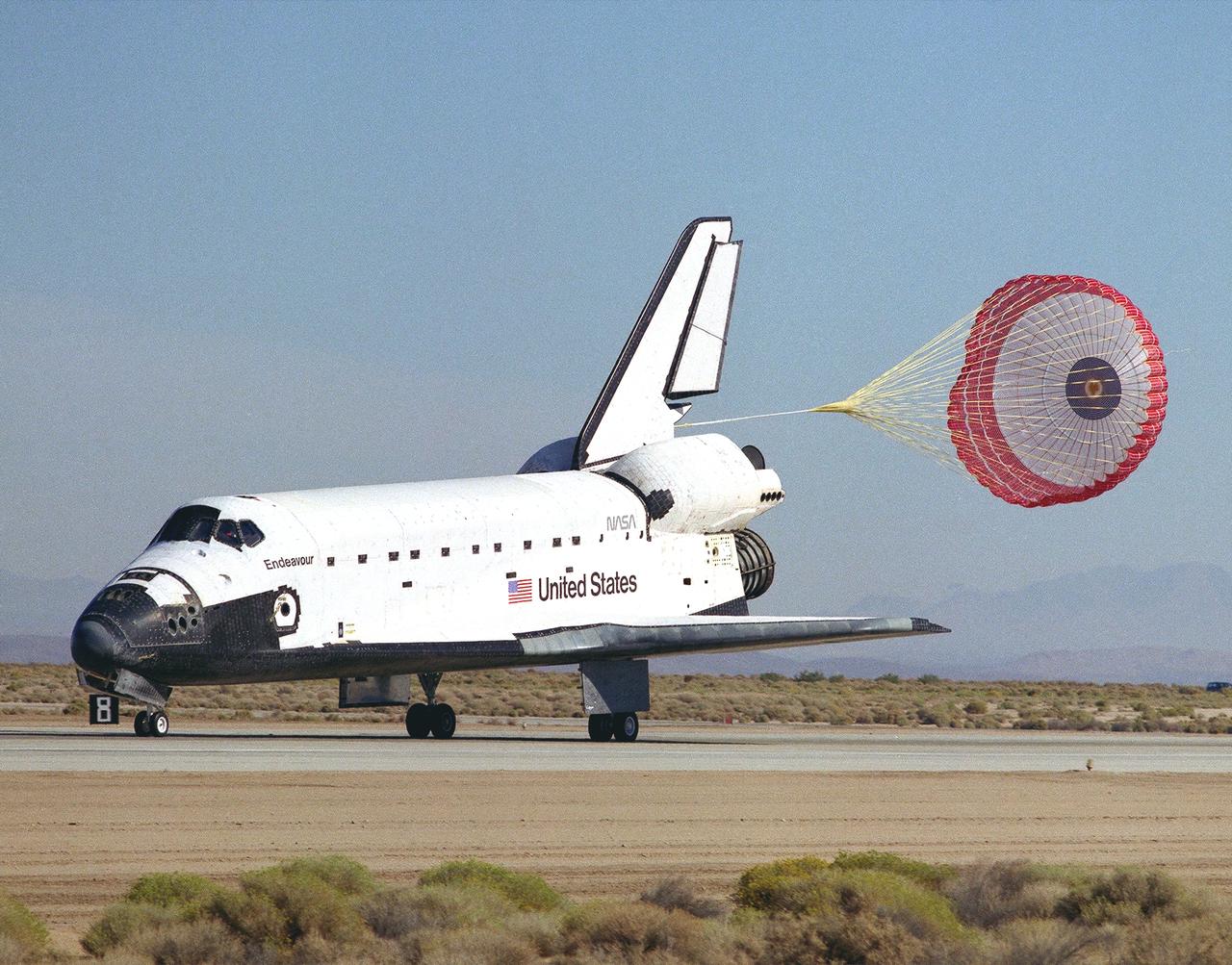
A drag chute slows the shuttle Endeavour after landing on runway 22 at Edwards, California, to complete the highly successful STS-68 mission dedicated to radar imaging of the earth's surface as part of NASA's Mission To Planet Earth program. The landing was at 10:02 a.m. (PDT) 11 October 1994, after waiving off from the Kennedy Space Center, Florida, earlier that morning due to adverse weather at Kennedy. The Endeavour crew was originally scheduled to land at Kennedy the morning of 10 October, but mission planners decided early in the flight to extend the mission by one day. Mission commander was Michael A. Baker and the pilot was Terrence W. Wilcutt. The four mission specialists were Thomas D. Jones, payload; Steven L. Smith; Daniel W. Bursch; and Peter J.K. Wisoff.

The space shuttle Atlantis atop NASA's 747 Shuttle Carrier Aircraft (SCA) during takeoff for a return ferry flight to the Kennedy Space Center from Edwards, California. The STS-66 mission was dedicated to the third flight of the Atmospheric Laboratory for Applications and Science-3 (ATLAS-3), part of NASA's Mission to Planet Earth program. The astronauts also deployed and retrieved a free-flying satellite designed to study the middle and lower thermospheres and perform a series of experiments covering life sciences research and microgravity processing. The landing was at 7:34 a.m. (PST) 14 November 1994, after being waved off from the Kennedy Space Center, Florida, due to adverse weather.
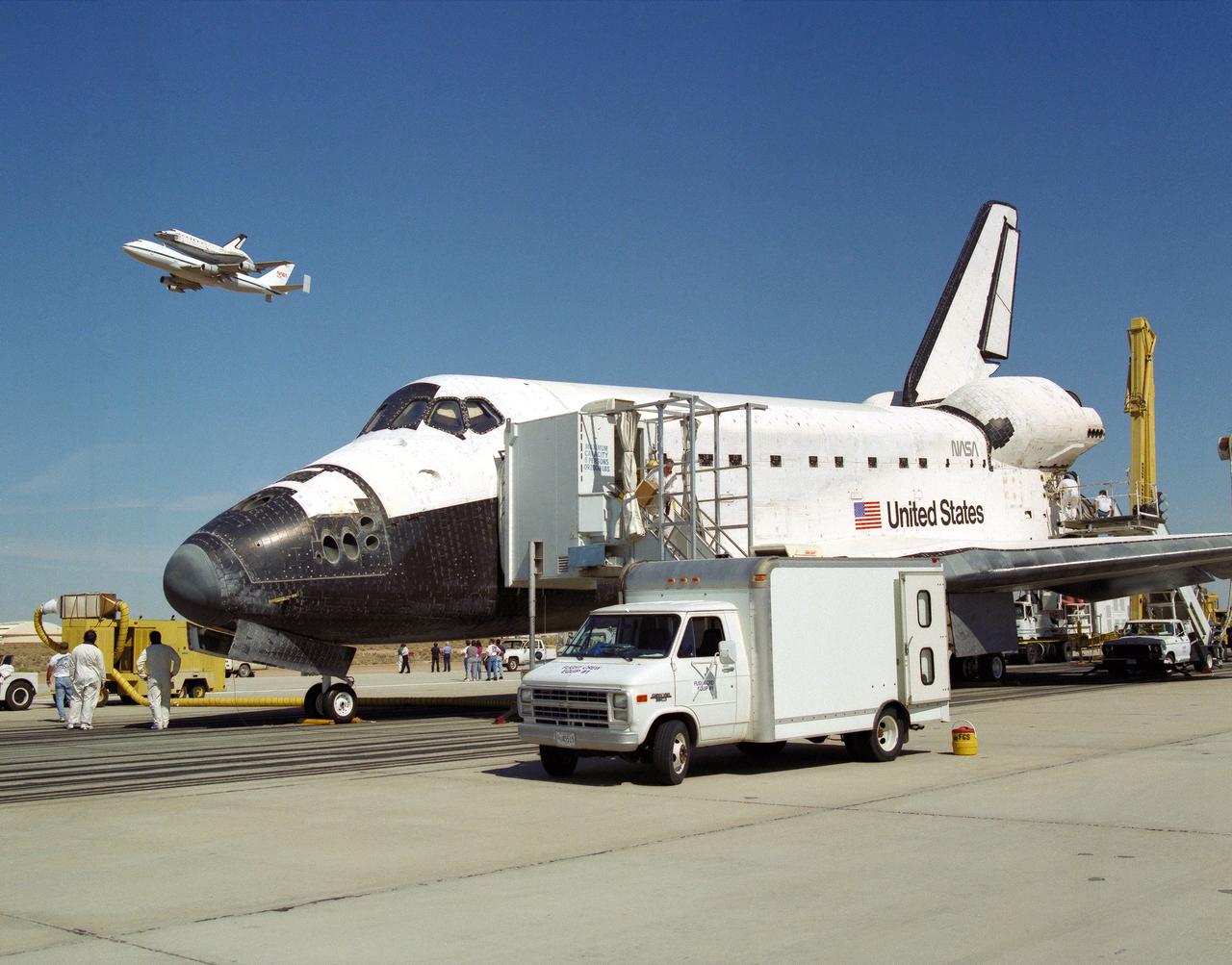
The space shuttle Endeavour receives a high-flying salute from its sister shuttle, Columbia, atop NASA's Shuttle Carrier Aircraft, shortly after Endeavor’s landing 11 October 1994, at Edwards, California, to complete mission STS-68. Columbia was being ferried from the Kennedy Space Center, Florida, to Air Force Plant 42, Palmdale, California, where it will undergo six months of inspections, modifications, and systems upgrades. The STS-68 11-day mission was devoted to radar imaging of Earth's geological features with the Space Radar Laboratory. The orbiter is surrounded by equipment and personnel that make up the ground support convoy that services the space vehicles as soon as they land.

The Space Shuttle Enterprise, the nation's prototype space shuttle orbiter, before departing NASA's Dryden Flight Research Center, Edwards, California, at 11:00 a.m., 16 May 1983, on the first leg of its trek to the Paris Air Show at Le Bourget Airport, Paris, France. Seen here atop the huge 747 Shuttle Carrier Aircraft (SCA), the first stop for the Enterprise was Peterson AFB, Colorado Springs, Colorado. Piloting the 747 on the Europe trip were Joe Algranti, Johnson Space Center Chief Pilot, Astronaut Dick Scobee, and NASA Dryden Chief Pilot Tom McMurtry. Flight engineers for that portion of the flight were Dryden's Ray Young and Johnson Space Center's Skip Guidry. The Enterprise, named after the spacecraft of Star Trek fame, was originally carried and launched by the 747 during the Approach and Landing Tests (ALT) at Dryden Flight Research Center.

The Space Shuttle Endeavour, atop NASA's 747 Shuttle Carrier Aircraft (SCA), taking off for the Kennedy Space Center shortly after its landing on 11 October 1994, at Edwards, California, to complete mission STS-68. Endeavour was being ferried from the Kennedy Space Center, Florida, to Air Force Plant 42, Palmdale, California, where it will undergo six months of inspections, modifications, and systems upgrades. The STS-68 11-day mission was devoted to radar imaging of Earth's geological features with the Space Radar Laboratory.
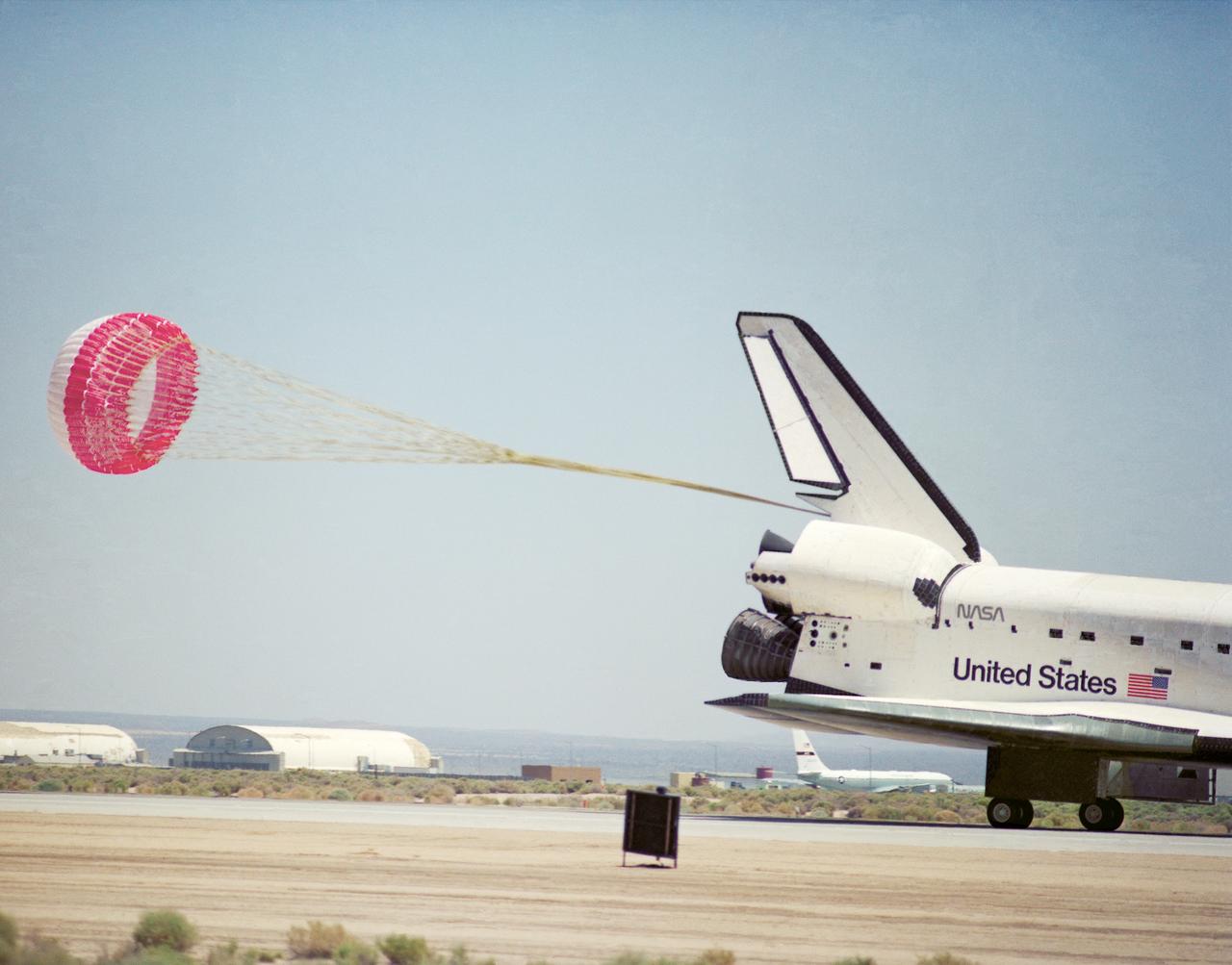
The Space Shuttle Endeavour concludes mission STS-49 at NASA's Ames-Dryden Flight Research Facility (later redesignated Dryden Flight Research Center), Edwards, California, with a 1:57 p.m. (PDT) landing 16 May on Edward's concrete runway 22. The planned 7-day mission, which began with a launch from Kennedy Space Center, Florida, at 4:41 p.m. (PFT), 7 May, was extended two days to allow extra time to rescue the Intelsat VI satellite and complete Space Station assembly techniques originally planned. After a perfect rendezvous in orbit and numerous attempts to grab the satellite, space walking astronauts Pierre Thuot, Rick Hieb and Tom Akers successfully rescued it by hand on the third space walk with the support of mission specialists Kathy Thornton and Bruce Melnick. The three astronauts, on a record space walk, took hold of the satellite and directed it to the shuttle where a booster motor was attached to launch it to its proper orbit. Commander Dan Brandenstein and Pilot Kevin Chilton brought Endeavours's record setting maiden voyage to a perfect landing at Edwards AFB with the first deployment of a drag chute on a shuttle mission.
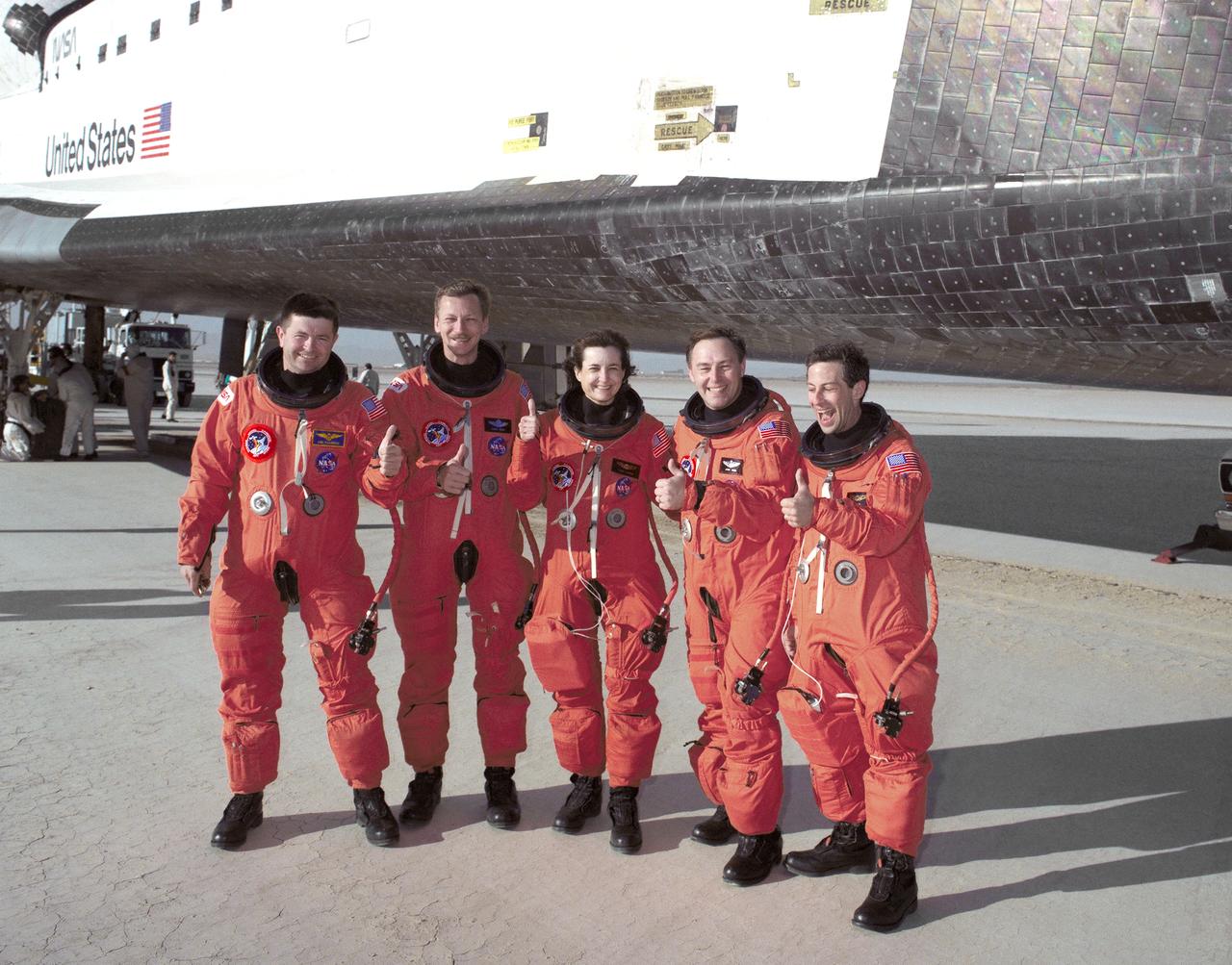
The crew of the Space Shuttle Atlantis gives the "all's well" thumb's-up sign after leaving the 100-ton orbiter following their landing at 6:55 a.m. (PDT), 11 April 1991, at NASA's Ames Dryden Flight Research Facility (later redesignated Dryden Flight Research Center), Edwards, California, to conclude mission STS-37. They are, from left, Kenneth D. Cameron, pilot; Steven R. Nagel, mission commander; and mission specialists Linda M. Godwin, Jerry L. Ross, and Jay Apt. During the mission,which began with launch April 5 at Kennedy Space Center, Florida, the crew deployed the Gamma Ray Observatory. Ross and Jay also carried out two spacewalks, one to deploy an antenna on the Gamma Ray Observatory and the other to test equipment and mobility techniques for the construction of the future Space Station. The planned five-day mission was extended one day because of high winds at Edwards.
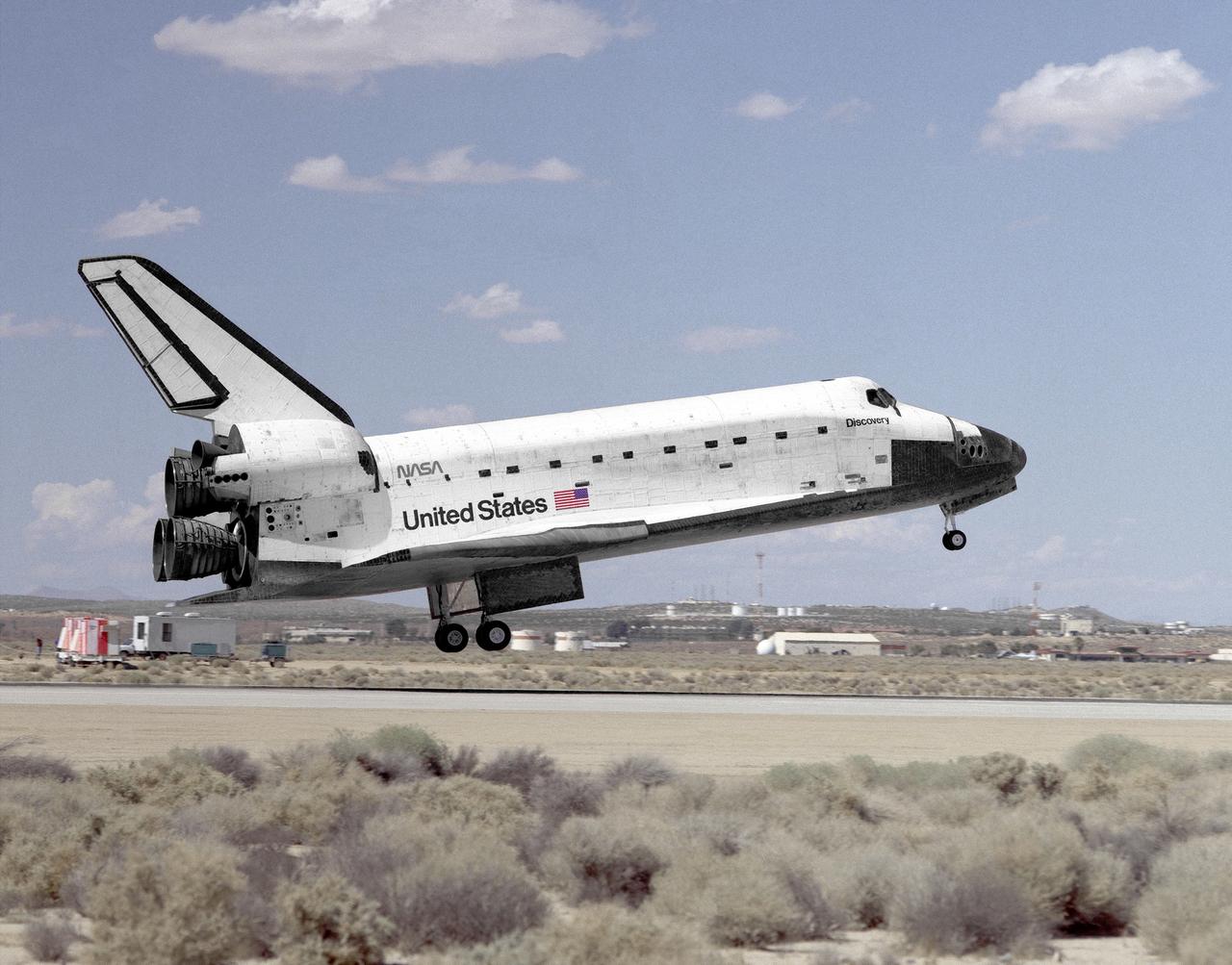
The Space Shuttle Discovery settles to the main runway at Edwards, California, at 2:13 p.m. (PDT) 20 September 1994, to conclude mission STS-64. The spacecraft, with a crew of six, was launched into a 57-degree high inclination orbit from the Kennedy Space Center, Florida, at 3:23 p.m. (PDT), 9 September 1994. The mission featured the study of clouds and the atmosphere with a laser beaming system called Lidar In-Space Technology Experiment (LITE), and the first untethered space walk in over ten years. A Spartan satellite was also deployed and later retrieved in the study of the sun's corona and the solar wind. The mission was scheduled to end Sunday, 18 September, but was extended one day to continue science work. Bad weather at the Kennedy Space Center on September 19, forced a one-day delay to September 20, with a weather divert that day to Edwards. Mission commander was Richard Richards, the pilot Blaine Hammond, while mission specialists were Jerry Linenger, Susan Helms, Carl Meade, and Mark Lee.
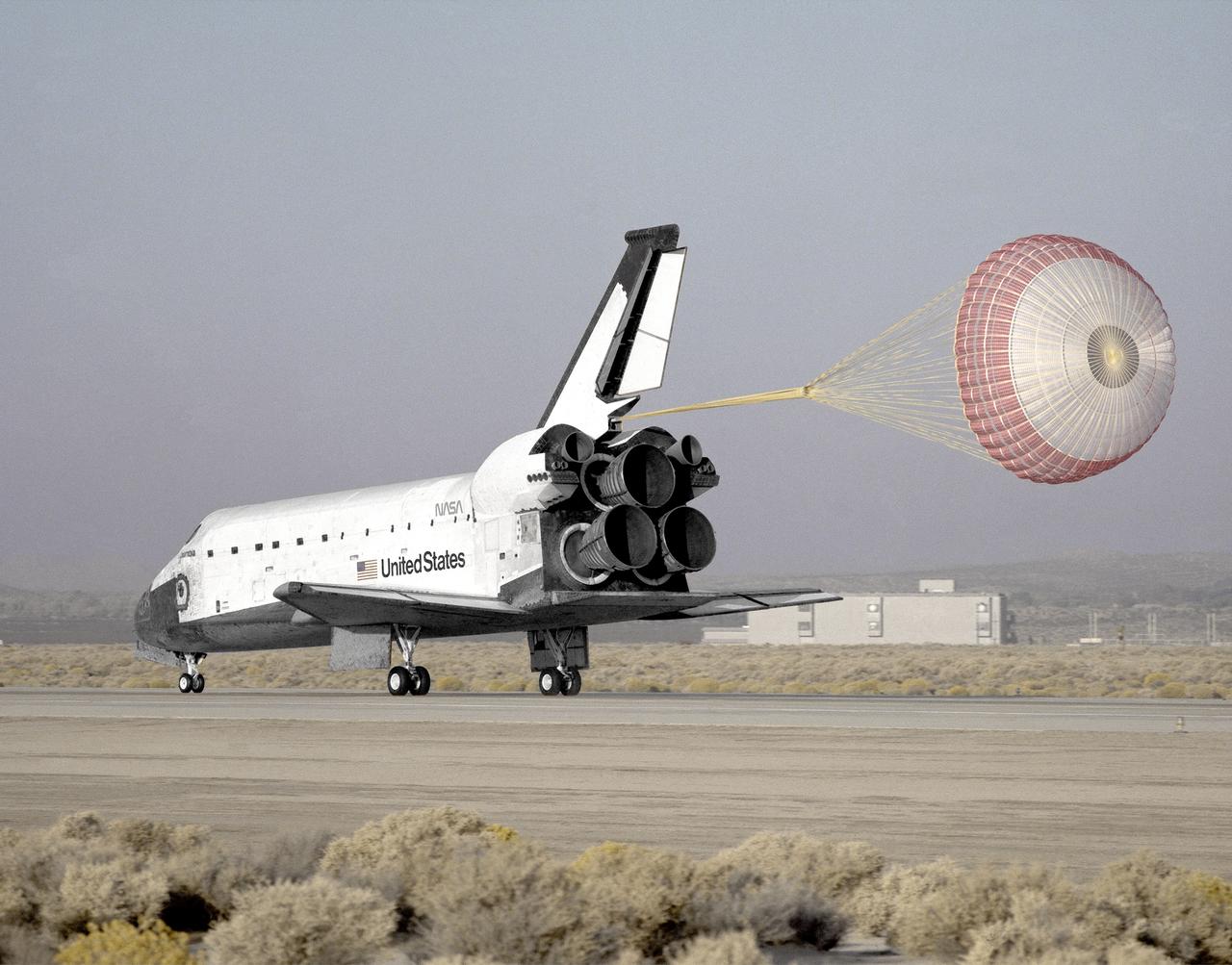
A drag chute slows the space shuttle Columbia as it rolls to a perfect landing concluding NASA's longest mission at that time, STS-58, at the Ames-Dryden Flight Research Facility (later redesignated the Dryden Flight Research Center), Edwards, California, with a 8:06 a.m. (PST) touchdown 1 November 1993 on Edward's concrete runway 22. The planned 14 day mission, which began with a launch from Kennedy Space Center, Florida, at 7:53 a.m. (PDT), October 18, was the second spacelab flight dedicated to life sciences research. Seven Columbia crewmembers performed a series of experiments to gain more knowledge on how the human body adapts to the weightless environment of space. Crewmembers on this flight included: John Blaha, commander; Rick Searfoss, pilot; payload commander Rhea Seddon; mission specialists Bill MacArthur, David Wolf, and Shannon Lucid; and payload specialist Martin Fettman.
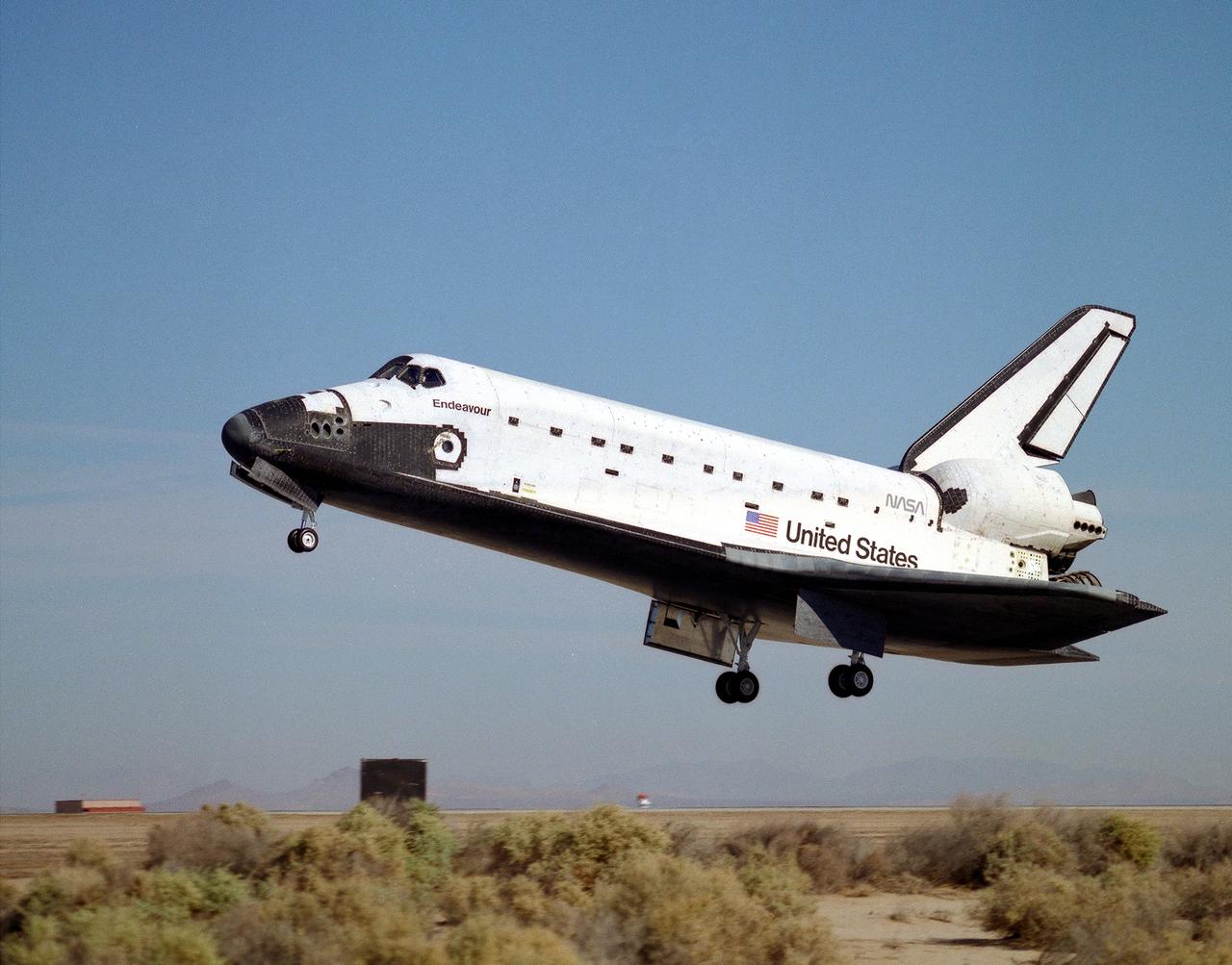
The space shuttle Endeavour glides to a landing on runway 22 at Edwards, California, to complete the highly successful STS-68 mission dedicated to radar imaging of the earth's surface as part of NASA's Mission To Planet Earth program. The landing was at 10:02 a.m. (PDT) 11 October 1994, after waiving off from the Kennedy Space Center, Florida, earlier that morning due to adverse weather at Kennedy. The Endeavour crew was originally scheduled to land at Kennedy the morning of October 10, but mission planners decided early in the flight to extend the mission by one day. Mission commander was Michael A. Baker, making his third flight, and the pilot was Terrence W. Wilcutt, on his first mission.
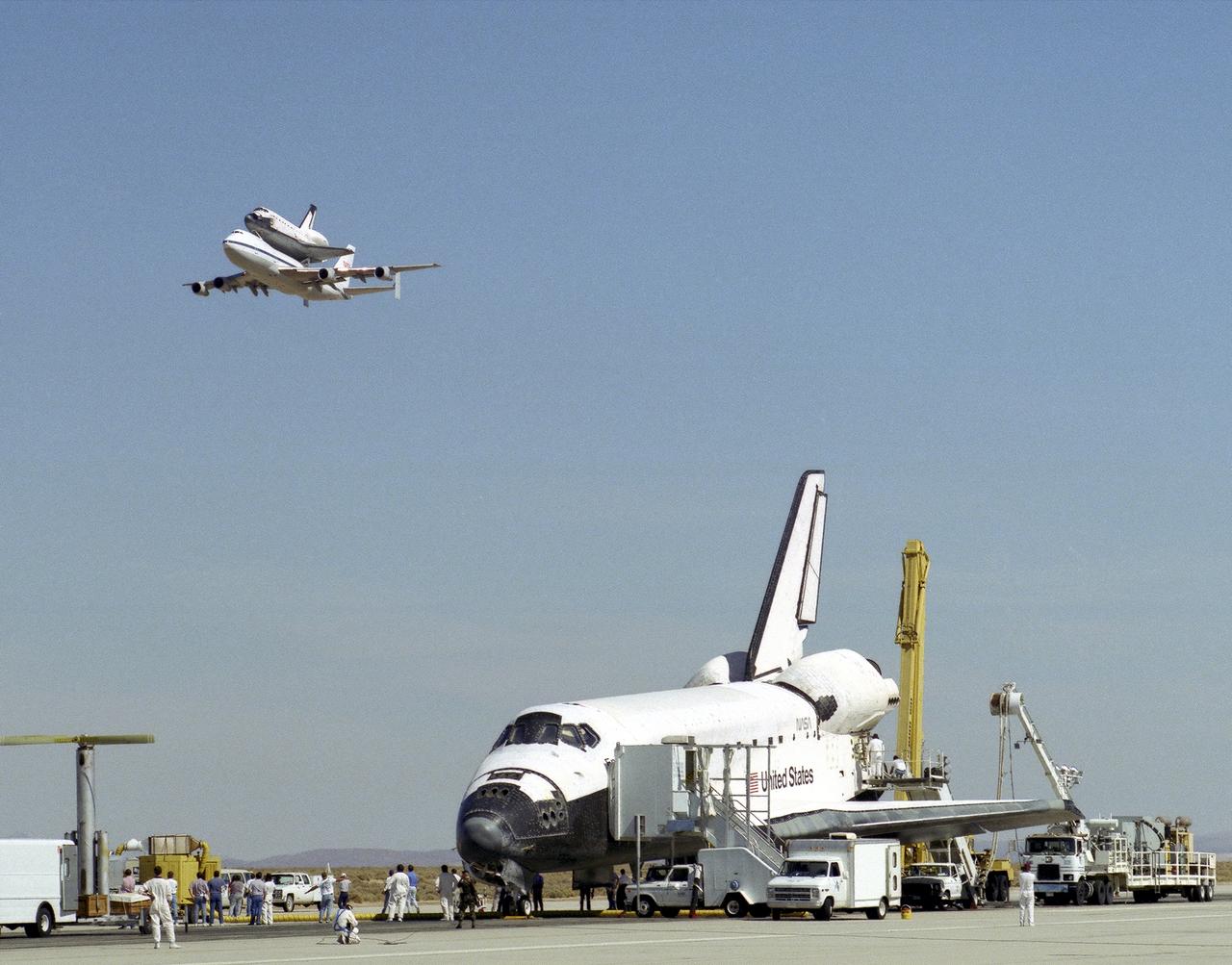
The space shuttle Endeavour receives a high-flying salute from its sister shuttle, Columbia, atop NASA's Shuttle Carrier Aircraft, shortly after Endeavor’s landing 11 October 1994, at Edwards, California, to complete mission STS-68. Columbia was being ferried from the Kennedy Space Center, Florida, to Air Force Plant 42, Palmdale, California, where it will undergo six months of inspections, modifications, and systems upgrades. The STS-68 11-day mission was devoted to radar imaging of Earth's geological features with the Space Radar Laboratory. The orbiter is surrounded by equipment and personnel that make up the ground support convoy that services the space vehicles as soon as they land.
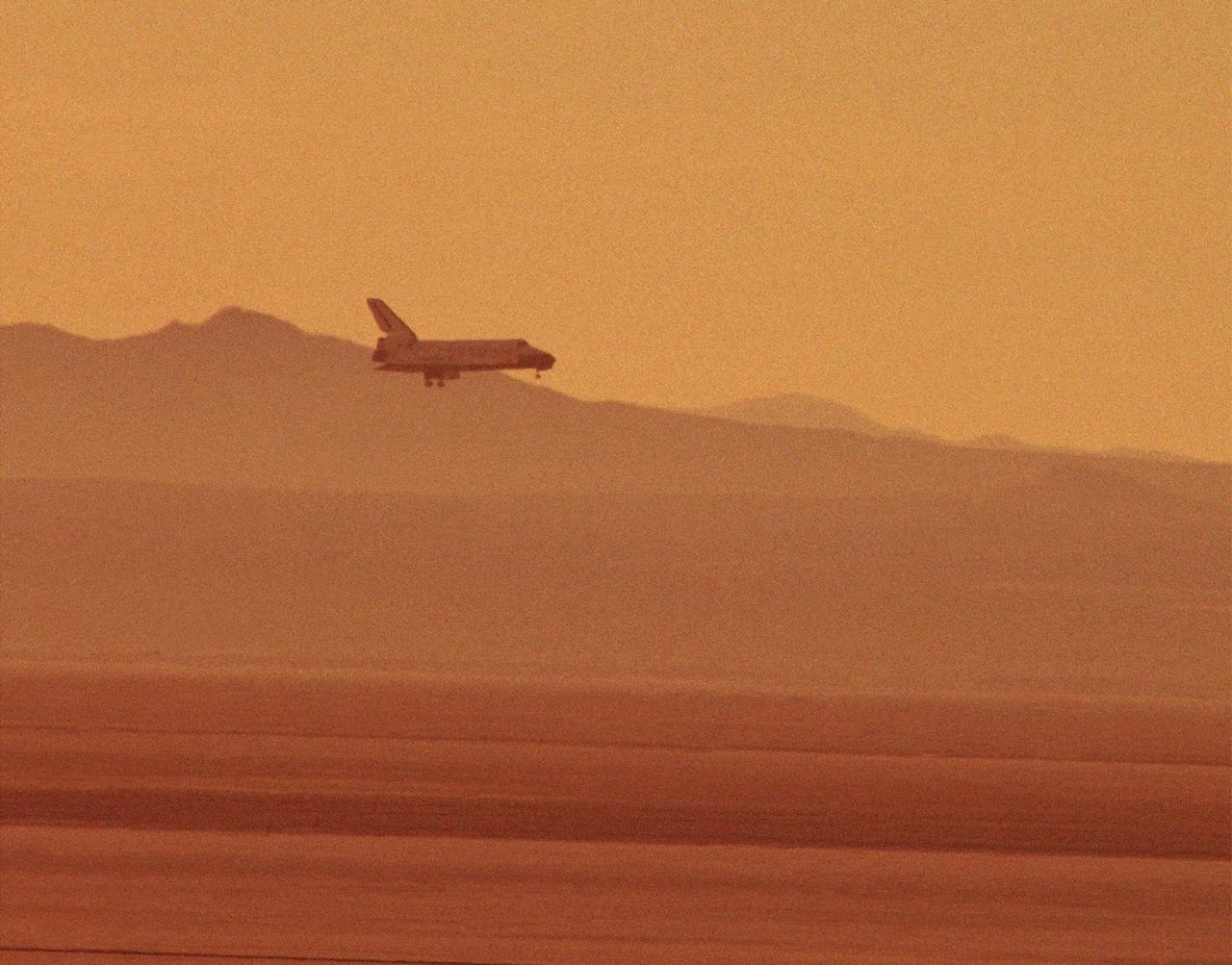
The STS-29 Space Shuttle Discovery mission approaches for a landing at NASA's then Ames-Dryden Flight Research Facility, Edwards AFB, California, early Saturday morning, 18 March 1989. Touchdown was at 6:35:49 a.m. PST and wheel stop was at 6:36:40 a.m. on runway 22. Controllers chose the concrete runway for the landing in order to make tests of braking and nosewheel steering. The STS-29 mission was very successful, completing the launch a Tracking and Data Relay communications satellite, as well as a range of scientific experiments. Discovery's five man crew was led by Commander Michael L. Coats, and included pilot John E. Blaha and mission specialists James P. Bagian, Robert C. Springer, and James F. Buchli.

The Space Shuttle Discovery, mated to NASA's 747 Shuttle Carrier Aircraft (SCA), takes to the air for its ferry flight back to the Kennedy Space Center in Florida. The spacecraft, with a crew of six, was launched into a 57-degree high inclination orbit from the Kennedy Space Center, Florida, at 3:23 p.m., 9 September 1994. The mission featured the study of clouds and the atmosphere with a laser beaming system called Lidar In-Space Technology Experiment (LITE), and the first untethered space walk in ten years. A Spartan satellite was also deployed and later retrieved in the study of the sun's corona and solar wind. The mission was scheduled to end Sunday, 18 September, but was extended one day to continue science work. Bad weather at the Kennedy Space Center on 19 September, forced a one-day delay to September 20, with a weather divert that day to Edwards. Mission commander was Richard Richards, the pilot Blaine Hammond, while mission specialists were Jerry Linenger, Susan Helms, Carl Meade, and Mark Lee.
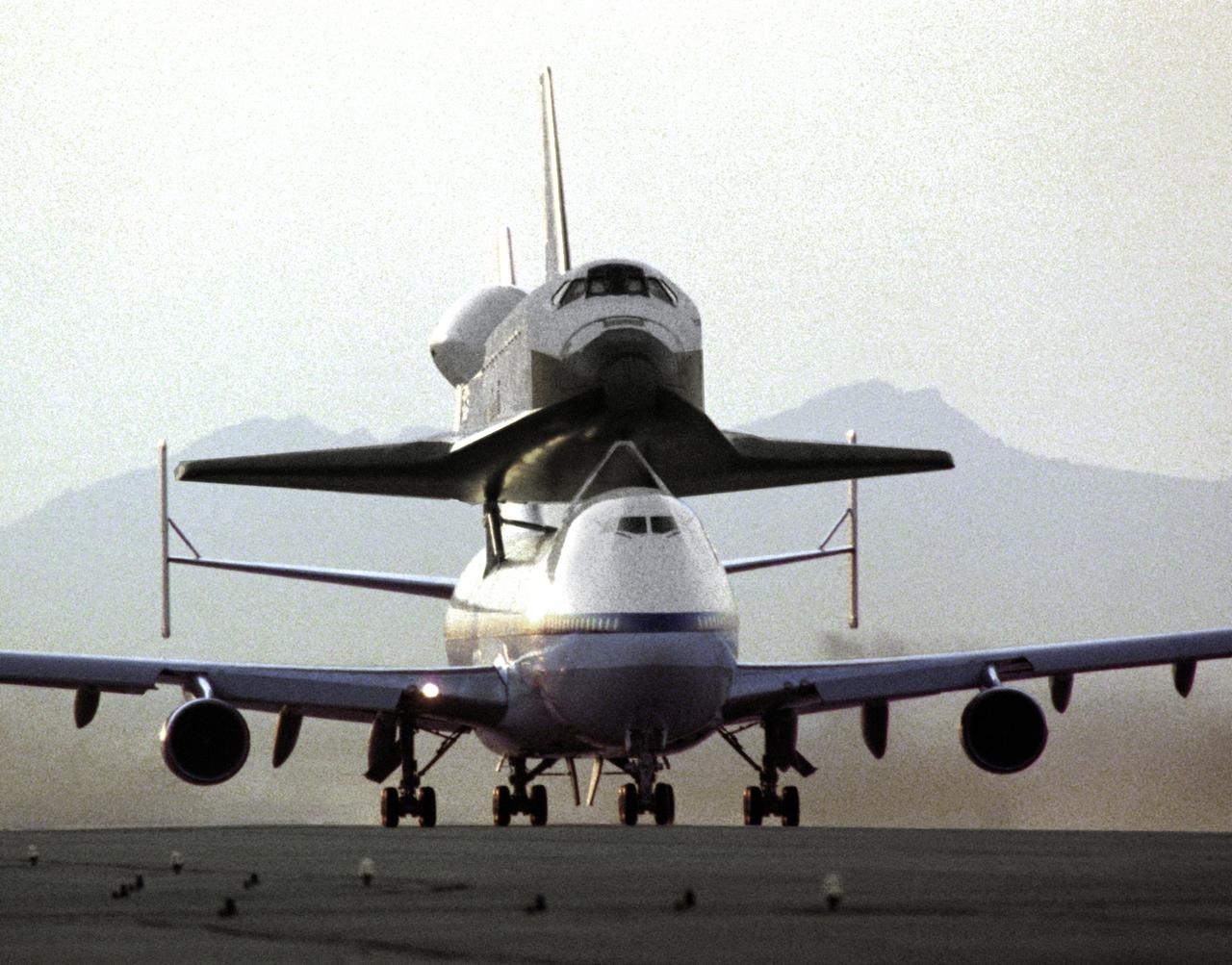
NASA's 747 Shuttle Carrier Aircraft No. 911, with the space shuttle orbiter Endeavour securely mounted atop its fuselage, taxies to the runway to begin the ferry flight from Rockwell's Plant 42 at Palmdale, California, where the orbiter was built, to the Kennedy Space Center, Florida. At Kennedy, the space vehicle was processed and launched on orbital mission STS-49, which landed at NASA's Ames-Dryden Flight Research Facility (later redesignated Dryden Flight Research Center), Edwards, California, 16 May 1992. NASA 911, the second modified 747 that went into service in November 1990, has special support struts atop the fuselage and internal strengthening to accommodate the added weight of the orbiters.

The space shuttle Atlantis lands with its drag chute deployed on runway 22 at Edwards, California, to complete the STS-66 mission dedicated to the third flight of the Atmospheric Laboratory for Applications and Science-3 (ATLAS-3), part of NASA's Mission to Planet Earth program. The astronauts also deployed and retrieved a free-flying satellite designed to study the middle and lower thermospheres and perform a series of experiments covering life sciences research and microgravity processing. The landing was at 7:34 a.m. (PST) 14 November 1994, after being waved off from the Kennedy Space Center, Florida, due to adverse weather.
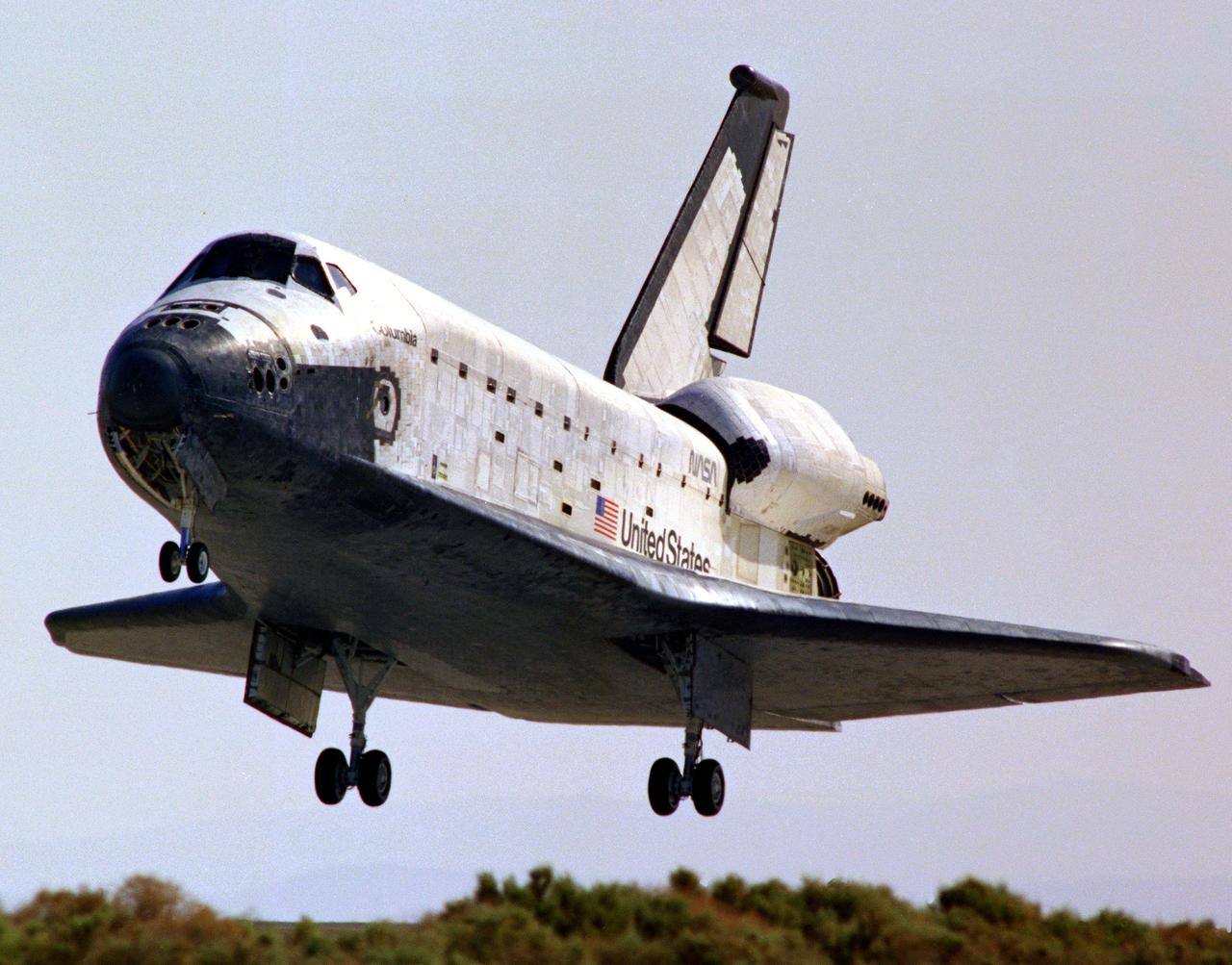
Space Shuttle Columbia nears its touchdown on Runway 22 at Edwards, California, at 8:39 a.m., 14 June 1991, as the STS-40 life sciences mission comes to an end at NASA's Ames-Dryden Flight Research Facility (later redesignated Dryden Flight Research Center) after nine days of orbital flight. Aboard Columbia during the extended mission were Bryan D. O'Connor, mission commander; Sidney M. Gutierrez, pilot; mission specialists James P. Bagian, Tamara E. Jernigan, and Margaret Rhea Seddon; and payload specialists Francis Andrew Gaffney and Millie Hughes-Fulford. STS-40 was the first space shuttle mission dedicated to life sciences research to explore how the body reacts to a weightless environment and how it readjusts to gravity on return to earth. Columbia was launched on the STS-40 mission 5 June 1991, from Kennedy Space Center in Florida.
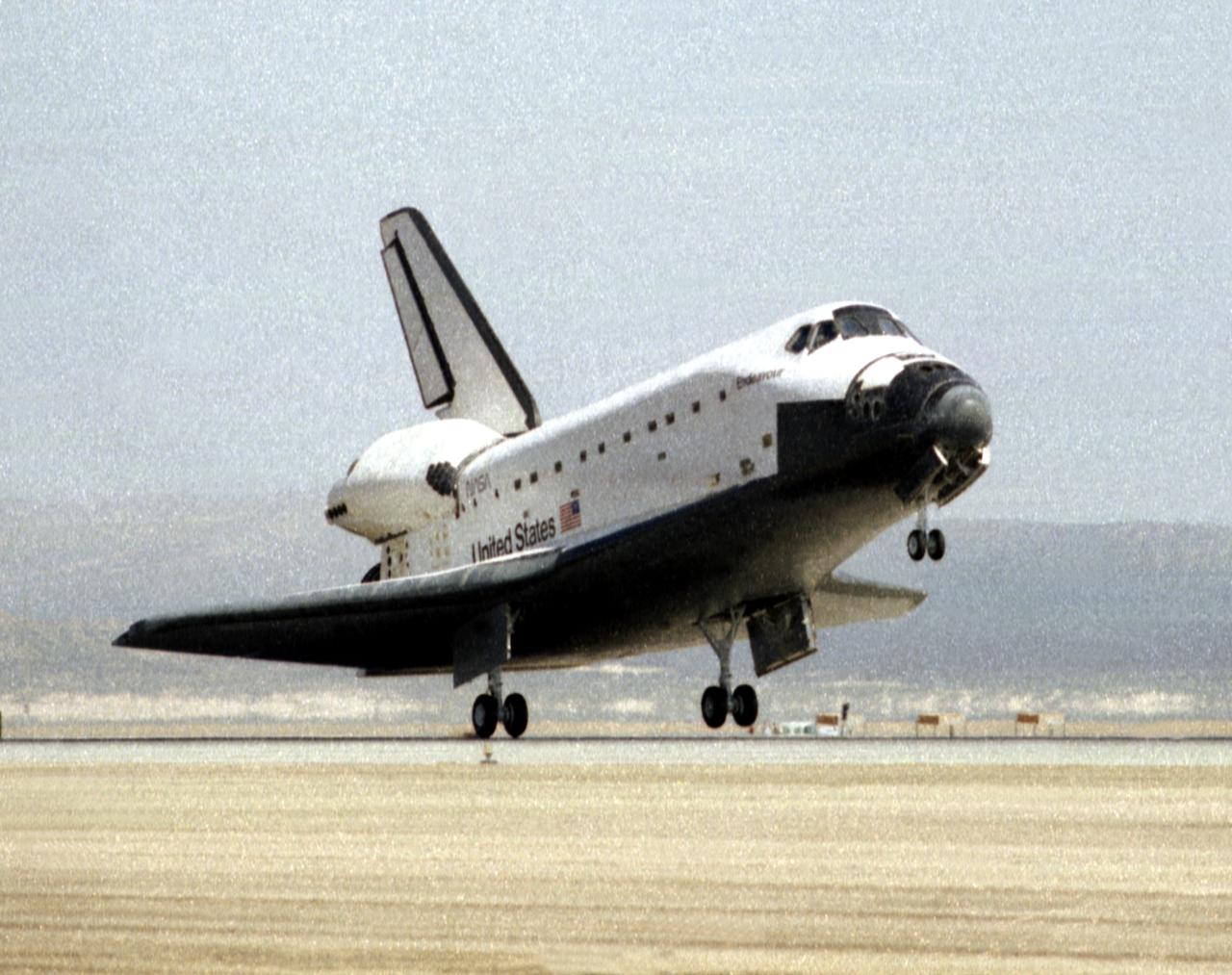
The space shuttle Endeavour slips to a smooth landing on runway 22 at Edwards, California, to complete the highly successful record-setting STS-67 mission. The landing was at 1:46 p.m. (PST) 18 March 1995, after waiving off from the Kennedy Space Center, Florida, earlier that morning due to adverse weather. Launched into space at 10:38 a.m. (PST) 1 March 1995, the Endeavour crew conducted NASA's longest shuttle flight to date and carried unique ultraviolet telescopes (ASTRO-2) which captured views of the universe impossible to obtain from the ground. Mission Commander was Steve Oswald making his third flight and the Pilot was Bill Gregory on his first mission. Mission Specialist 1 was John Grunsfeld making his first flight and Specialist 2 was Wendy Lawrence on her first flight. Tamara Jernigan served as Specialist 3 on her third flight and the two payload specialists were Samuel Durrance and Ronald Parise, both on their second flight.

The Space Shuttle Enterprise, the nation's prototype space shuttle orbiter, departed NASA's Dryden Flight Research Center, Edwards, California, at 11:00 a.m., 16 May 1983, on the first leg of its trek to the Paris Air Show at Le Bourget Airport, Paris, France. Carried by the huge 747 Shuttle Carrier Aircraft (SCA), the first stop for the Enterprise was Peterson AFB, Colorado Springs, Colorado. Piloting the 747 on the Europe trip were Joe Algranti, Johnson Space Center Chief Pilot, Astronaut Dick Scobee, and NASA Dryden Chief Pilot Tom McMurtry. Flight engineers for that portion of the flight were Dryden's Ray Young and Johnson Space Center's Skip Guidry. The Enterprise, named after the spacecraft of Star Trek fame, was originally carried and launched by the 747 during the Approach and Landing Tests (ALT) at Dryden Flight Research Center.
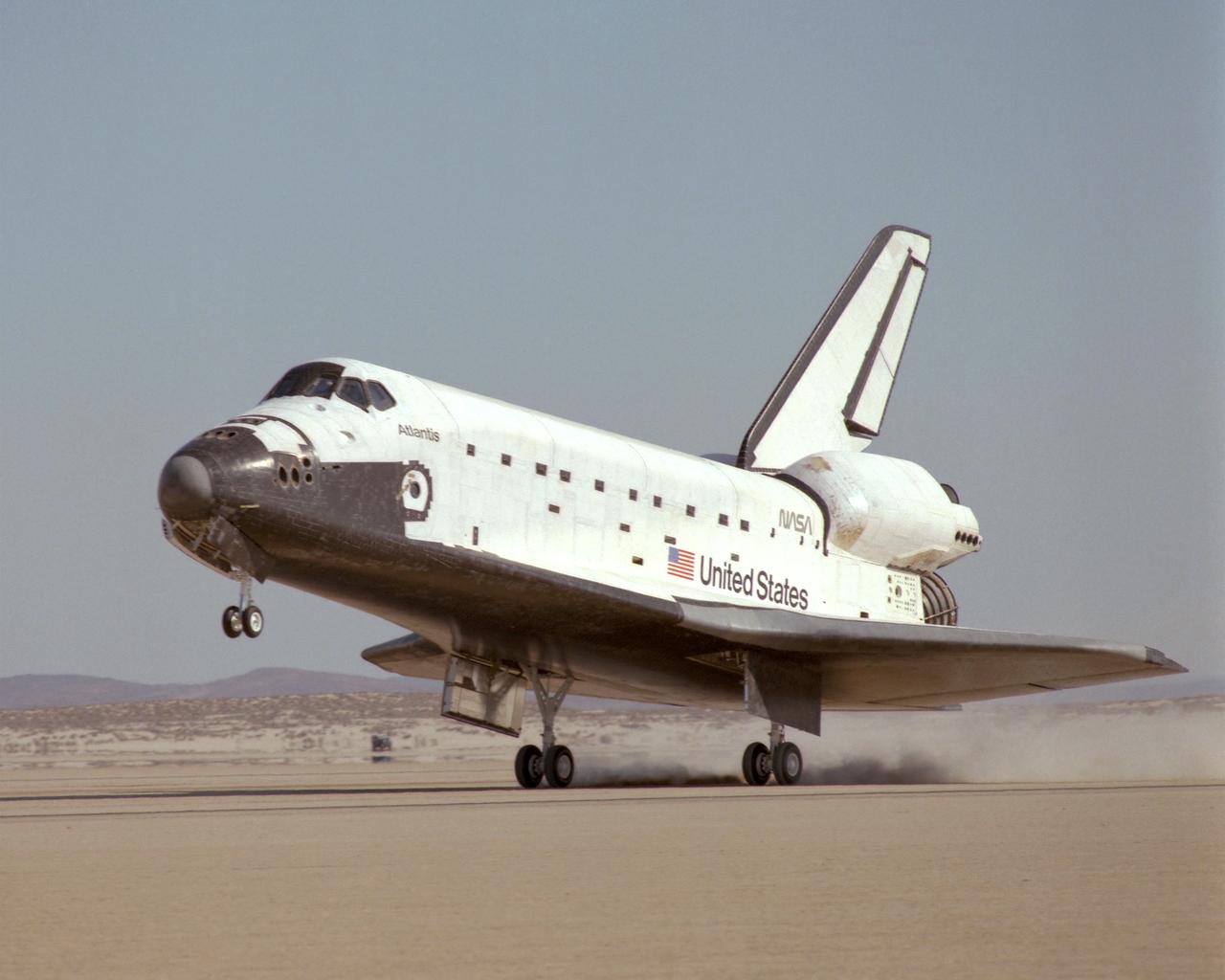
NASA's Space Shuttle Atlantis touched down on the lakebed runway at Edwards Air Force Base in California's Mojave Desert Tuesday, 3 December 1985 at 1:33:49 p.m. Pacific Standard Time, concluding the STS 61-B international mission. The eight-day mission successfully deployed three communications satellites including the Mexican Morelos B, the Australian Aussat 2 and an RCA Satcom K-2 satellite. In addition, two spacewalks were performed to experiment with construction of structures in space. Crew of the 61-B mission included Commander Brewster H. Shaw, Jr.; Pilot Bryan D. O'Connor; Mission Specialists Mary L. Cleave, Sherwood C. Spring and Jerry L. Ross; and Payload Specialists Rudolfo Neri Vela of Mexico and Charles Walker of McDonnell Douglas Astronautics Co.
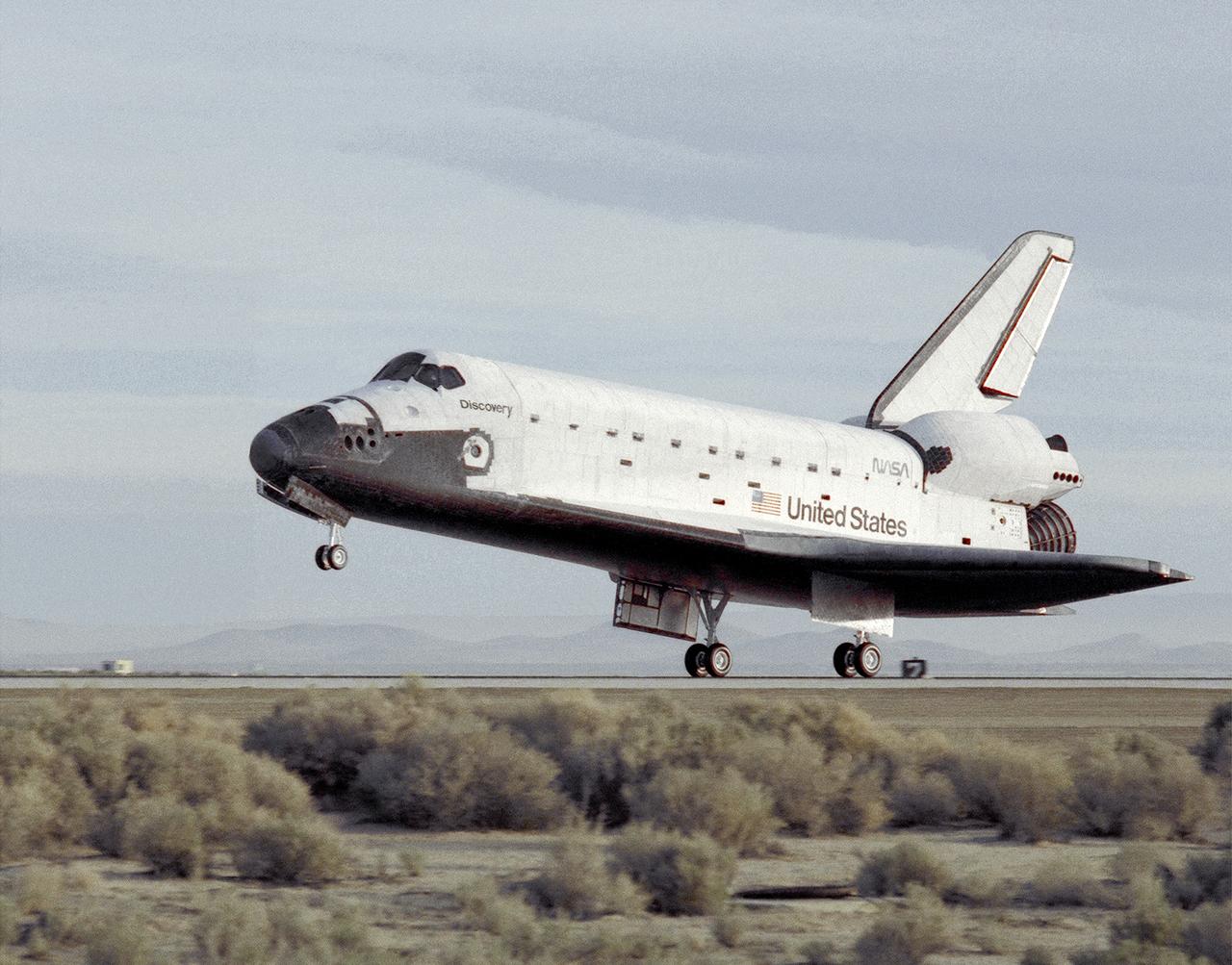
The STS-29 Space Shuttle Discovery mission lands at NASA's then Ames-Dryden Flight Research Facility, Edwards AFB, California, early Saturday morning, 18 March 1989. Touchdown was at 6:35:49 a.m. PST and wheel stop was at 6:36:40 a.m. on runway 22. Controllers chose the concrete runway for the landing in order to make tests of braking and nosewheel steering. The STS-29 mission was very successful, completing the launch of a Tracking and Data Relay communications satellite, as well as a range of scientific experiments. Discovery's five-man crew was led by Commander Michael L. Coats, and included pilot John E. Blaha and mission specialists James P. Bagian, Robert C. Springer, and James F. Buchli.
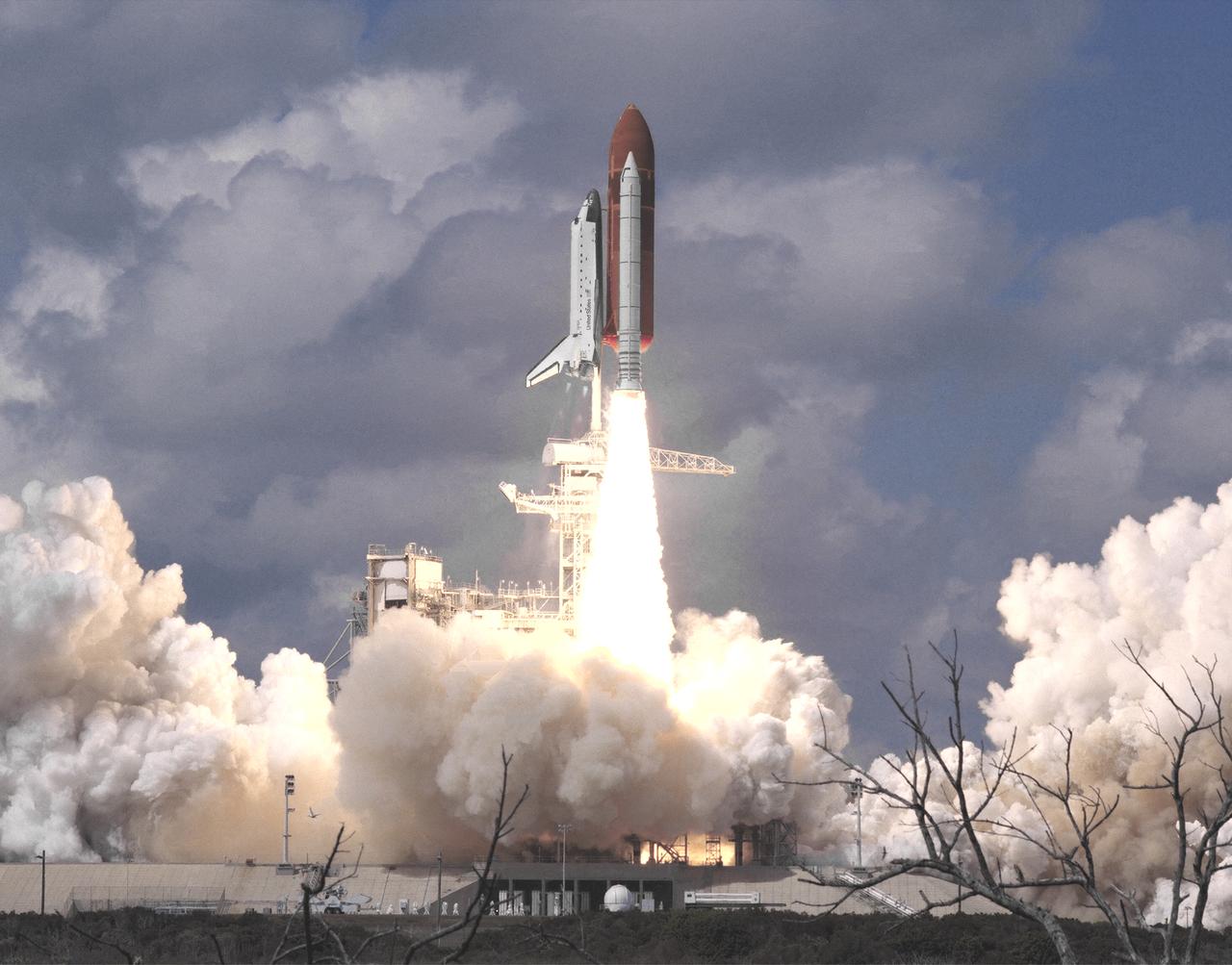
The Space Shuttle Discovery takes off from Launch Pad 39B at the Kennedy Space Center, Florida, to being Mission STS-26 on 29 September 1988,11:37:00 a.m. EDT. The 26th shuttle mission lasted four days, one hour, zero minutes, and 11 seconds. Discovery landed 3 October 1988, 9:37:11 a.m. PDT, on Runway 17 at Edwards Air Force Base, California. Its primary payload, NASA Tracking and Data Relay Satellite-3 (TDRS-3) attached to an Inertial Upper Stage (IUS), became the second TDRS deployed. After deployment, IUS propelled the satellite to a geosynchronous orbit. The crew consisted of Frederick H. Hauck, Commander; Richard O. Covey, Pilot; John M. Lounge, Mission Specialist 1; George D. Nelson, Mission Specialist 2; and David C. Hilmers, Mission Specialist 3.
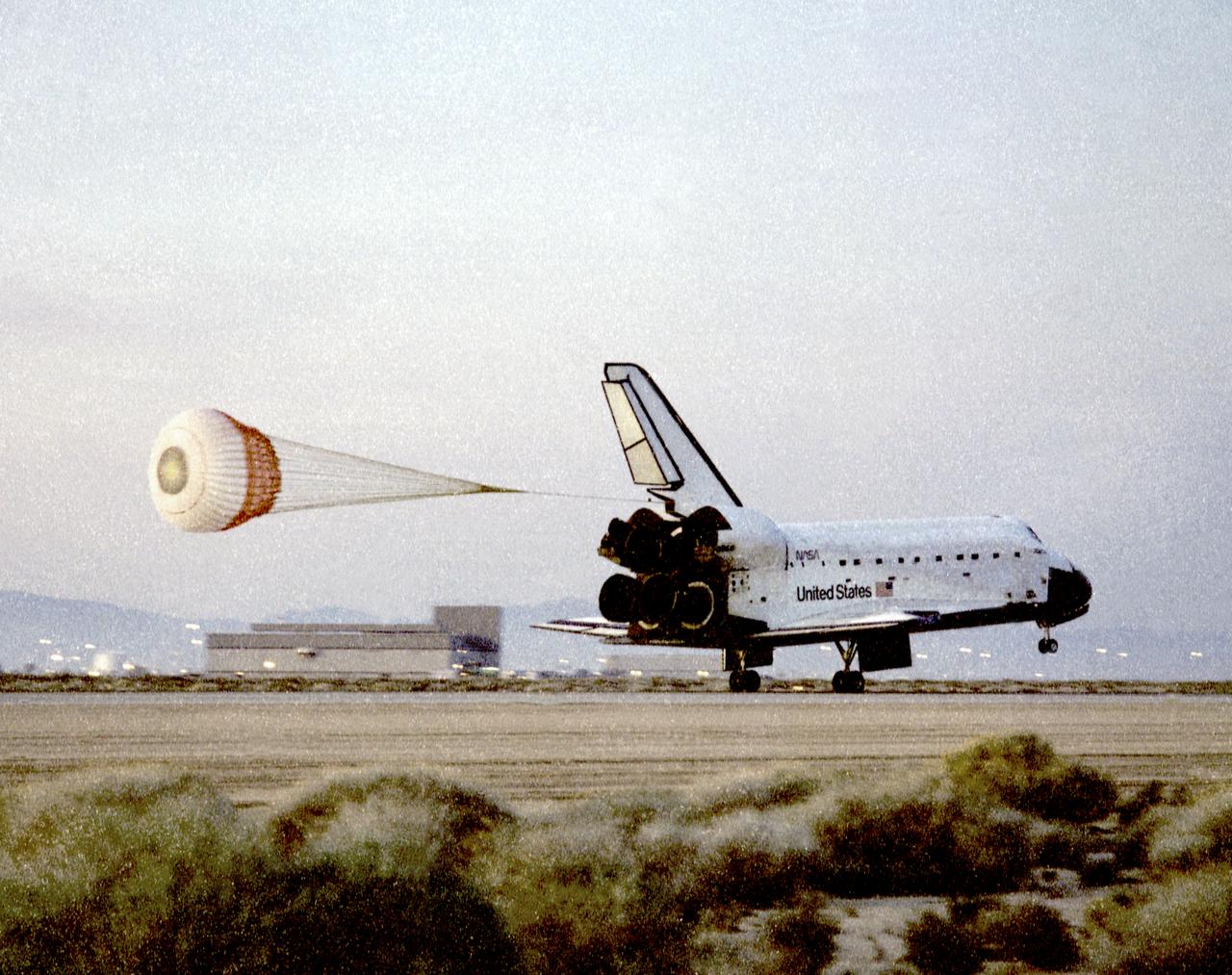
The space shuttle Atlantis touches down on the runway at Edwards, California, at approximately 5:29 a.m. Pacific Standard Time after completing the highly successful STS-76 mission to deliver Astronaut Shannon Lucid to the Russian Space Station Mir. She was the first American woman to serve as a Mir station researcher. Atlantis was originally scheduled to land at Kennedy Space Center, Florida, but bad weather there both 30 and 31 March necessitated a landing at the backup site at Edwards. This photo shows the drag chute deployed to help the shuttle roll to a stop. Mission commander for STS-76 was Kevin P. Chilton, and Richard A. Searfoss was the pilot. Ronald M. Sega was payload commander and mission specialist-1. Mission specialists were Richard Clifford, Linda Godwin and Shannon Lucid. The mission also featured a spacewalk while Atlantis was docked to Mir and experiments aboard the SPACEHAB module.
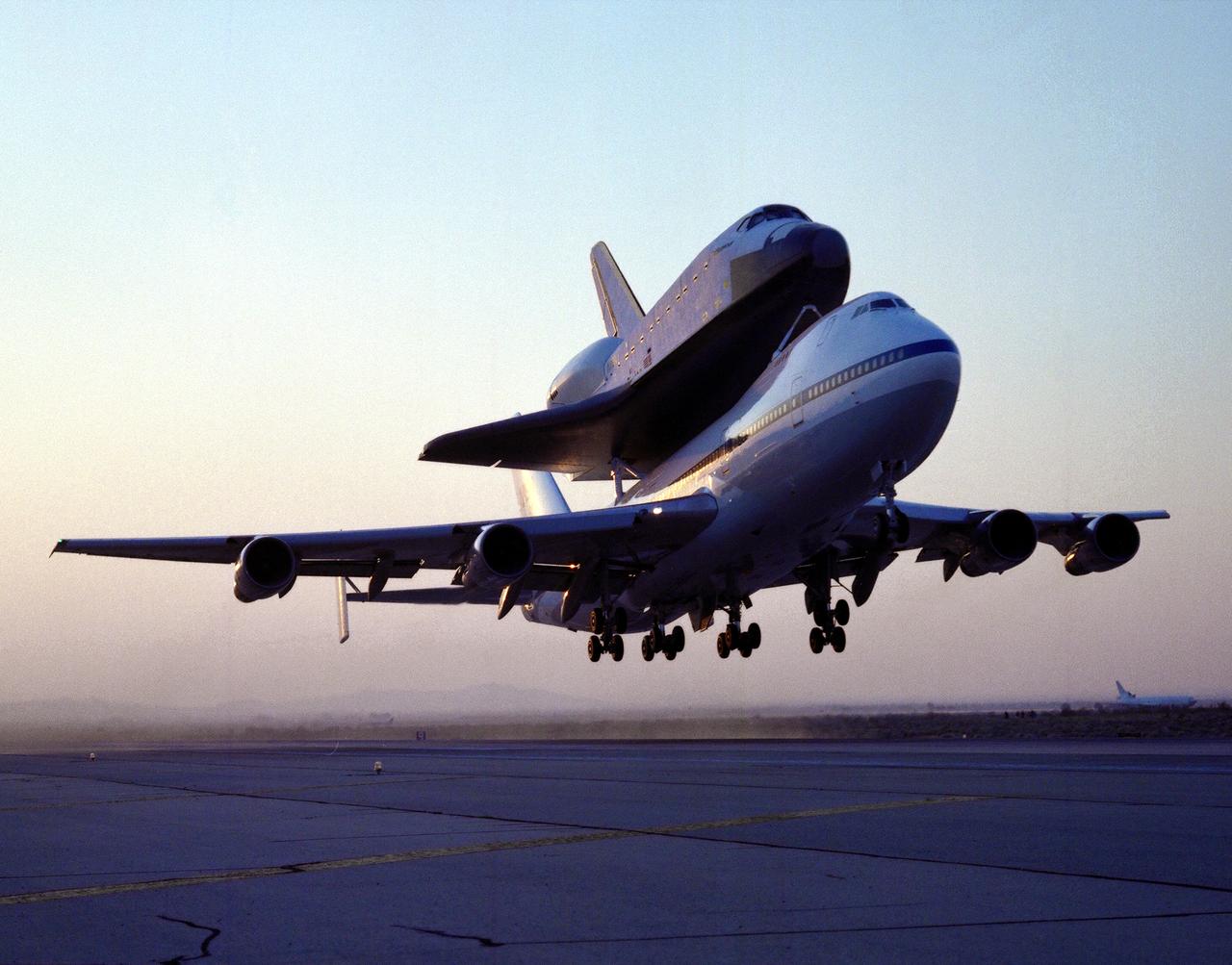
NASA's 747 Shuttle Carrier Aircraft No. 911, with the space shuttle orbiter Endeavour securely mounted atop its fuselage, begins the ferry flight from Rockwell's Plant 42 at Palmdale, California, where the orbiter was built, to the Kennedy Space Center, Florida. At Kennedy, the space vehicle was processed and launched on orbital mission STS-49, which landed at NASA's Ames-Dryden Flight Research Facility (later redesignated Dryden Flight Research Center), Edwards, California, 16 May 1992. NASA 911, the second modified 747 that went into service in November 1990, has special support struts atop the fuselage and internal strengthening to accommodate the added weight of the orbiters.
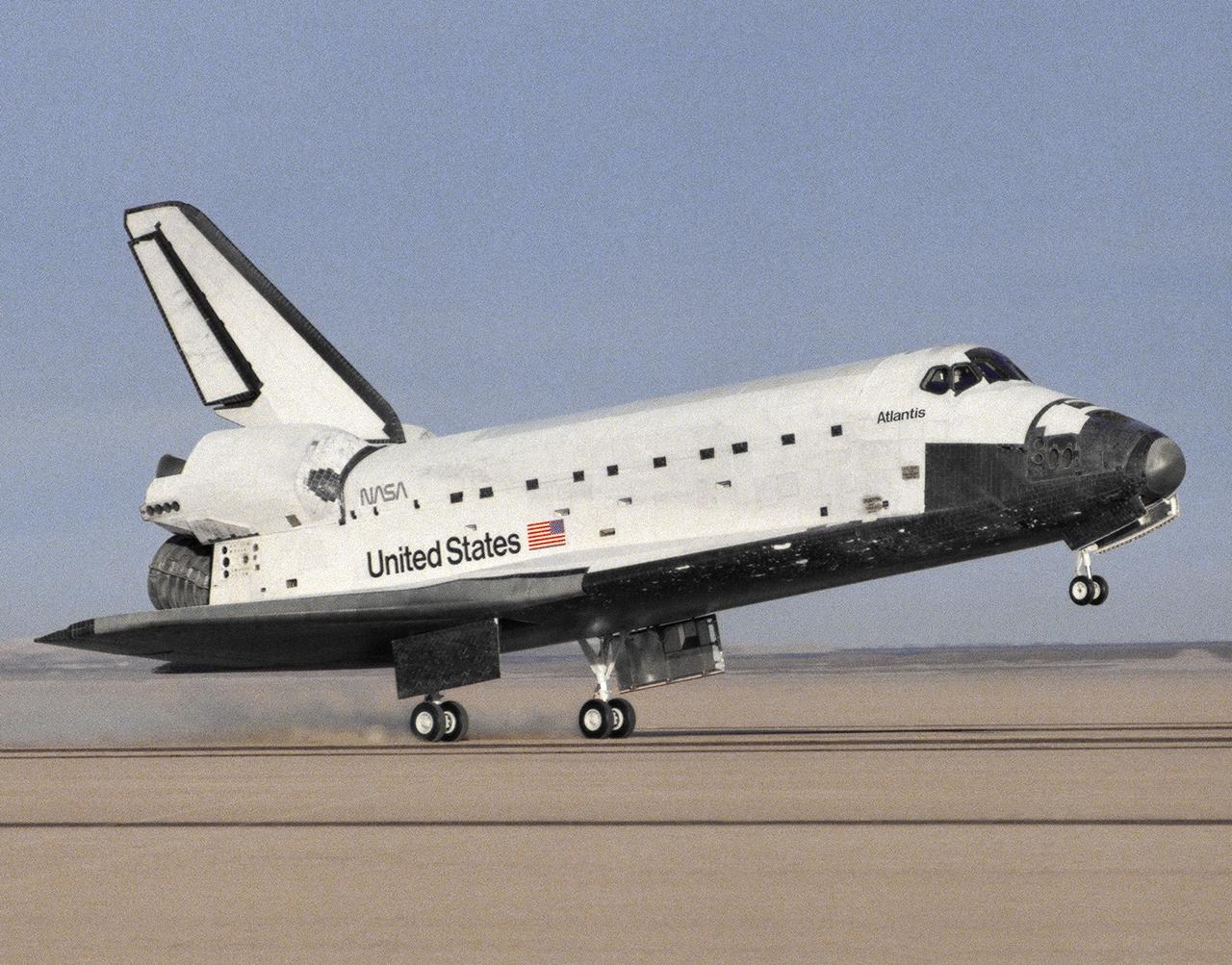
The Space Shuttle Atlantis touches down at 3:35 p.m. PST on 6 December 1988 at NASA's then Ames-Dryden Flight Research Facility at the conclusion of the STS-27 Department of Defense mission. Landing took place on runway 17 of the Rogers Dry Lake, concluding the 4-day, 9-hour, 6-minute mission. The five-man crew was led by Commander Robert L. Gibson and included Pilot Guy S. Gardner; Mission Specialists Jerry L. Ross, William M. Sheperd, and Richard M. Mullane. Atlantis was launched on December 2 from NASA's Kennedy Space Center.
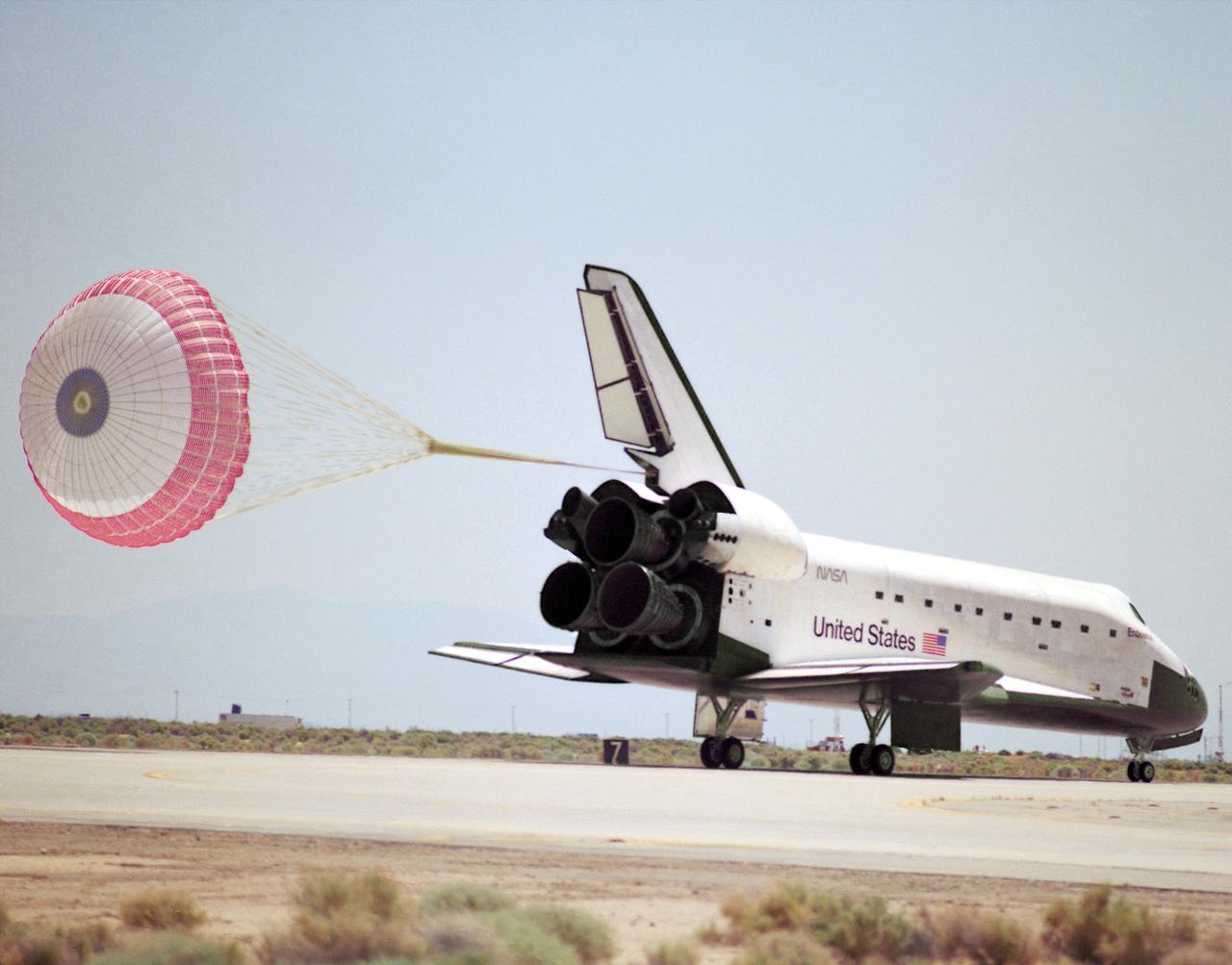
The Space Shuttle Endeavour concludes mission STS-49 at NASA's Ames-Dryden Flight Research Facility (later redesignated Dryden Flight Research Center), Edwards, California, with a 1:57 p.m. (PDT) landing May 16 on Edward's concrete runway 22. The planned 7-day mission, which began with a launch from Kennedy Space Center, Florida, at 4:41 p.m. (PFT), 7 May, was extended two days to allow extra time to rescue the Intelsat VI satellite and complete Space Station assembly techniques originally planned. After a perfect rendezvous in orbit and numerous attempts to grab the satellite, space walking astronauts Pierre Thuot, Rick Hieb and Tom Akers successfully rescued it by hand on the third space walk with the support of mission specialists Kathy Thornton and Bruce Melnick. The three astronauts, on a record space walk, took hold of the satellite and directed it to the shuttle where a booster motor was attached to launch it to its proper orbit. Commander Dan Brandenstein and Pilot Kevin Chilton brought Endeavours's record setting maiden voyage to a perfect landing at Edwards with the first deployment of a drag chute on a shuttle mission.
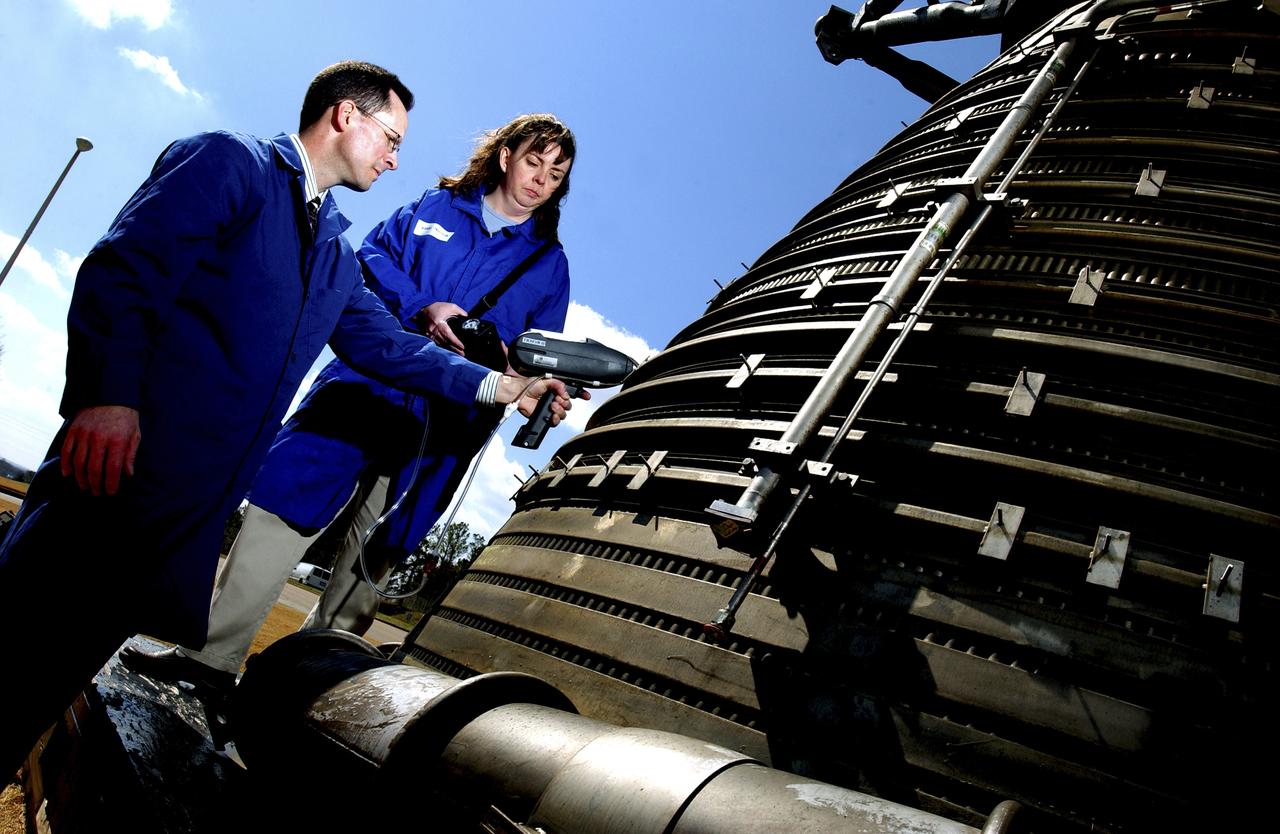
Teamed with KeyMaster Technologies, Kennewick, Washington, the Marshall Space Flight Center engineers have developed a portable vacuum analyzer that performs on-the-spot chemical analyses under field conditions— a task previously only possible in a chemical laboratory. The new capability is important not only to the aerospace industry, but holds potential for broad applications in any industry that depends on materials analysis, such as the automotive and pharmaceutical industries. Weighing in at a mere 4 pounds, the newly developed handheld vacuum X-ray fluorescent analyzer can identify and characterize a wide range of elements, and is capable of detecting chemical elements with low atomic numbers, such as sodium, aluminum and silicon. It is the only handheld product on the market with that capability. Aluminum alloy verification is of particular interest to NASA because vast amounts of high-strength aluminum alloys are used in the Space Shuttle propulsion system such as the External Tank, Main Engine, and Solid Rocket Boosters. This capability promises to be a boom to the aerospace community because of unique requirements, for instance, the need to analyze Space Shuttle propulsion systems on the launch pad. Those systems provide the awe-inspiring rocket power that propels the Space Shuttle from Earth into orbit in mere minutes. The scanner development also marks a major improvement in the quality assurance field, because screws, nuts, bolts, fasteners, and other items can now be evaluated upon receipt and rejected if found to be substandard. The same holds true for aluminum weld rods. The ability to validate the integrity of raw materials and partially finished products before adding value to them in the manufacturing process will be of benefit not only to businesses, but also to the consumer, who will have access to a higher value product at a cheaper price. Three vacuum X-ray scanners are already being used in the Space Shuttle Program. The External Tank Project Office is using one for aluminum alloy analysis, while a Marshall contractor is evaluating alloys with another unit purchased for the Space Shuttle Main Engine Office. The Reusable Solid Rocket Motor Project Office has obtained a scanner that is being used to test hardware and analyze materials. In this photograph, Richard Booth, Marshall Engineering Directorate, and Wanda Hudson, ATK Thiokol, use an enhanced vacuum X-ray fluorescent scanner to analyze materials in an F-1 engine, which was used to boost the Saturn V rocket from Earth’s orbit that carried astronauts to the moon in the 1960s.
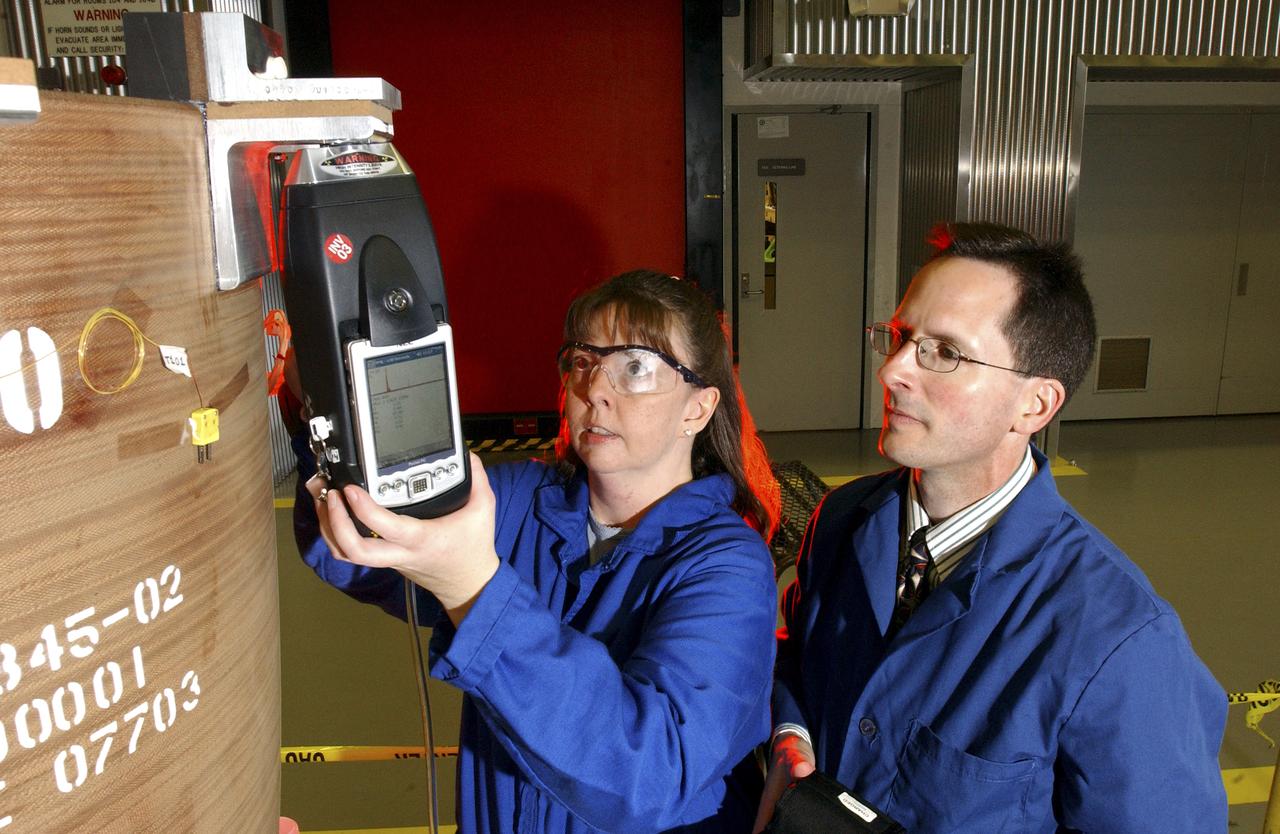
Teamed with KeyMaster Technologies, Kennewick, Washington, the Marshall Space Flight Center engineers have developed a portable vacuum analyzer that performs on-the-spot chemical analyses under field conditions— a task previously only possible in a chemical laboratory. The new capability is important not only to the aerospace industry, but holds potential for broad applications in any industry that depends on materials analysis, such as the automotive and pharmaceutical industries. Weighing in at a mere 4 pounds, the newly developed handheld vacuum X-ray fluorescent analyzer can identify and characterize a wide range of elements, and is capable of detecting chemical elements with low atomic numbers, such as sodium, aluminum and silicon. It is the only handheld product on the market with that capability. Aluminum alloy verification is of particular interest to NASA because vast amounts of high-strength aluminum alloys are used in the Space Shuttle propulsion system such as the External Tank, Main Engine, and Solid Rocket Boosters. This capability promises to be a boom to the aerospace community because of unique requirements, for instance, the need to analyze Space Shuttle propulsion systems on the launch pad. Those systems provide the awe-inspiring rocket power that propels the Space Shuttle from Earth into orbit in mere minutes. The scanner development also marks a major improvement in the quality assurance field, because screws, nuts, bolts, fasteners, and other items can now be evaluated upon receipt and rejected if found to be substandard. The same holds true for aluminum weld rods. The ability to validate the integrity of raw materials and partially finished products before adding value to them in the manufacturing process will be of benefit not only to businesses, but also to the consumer, who will have access to a higher value product at a cheaper price. Three vacuum X-ray scanners are already being used in the Space Shuttle Program. The External Tank Project Office is using one for aluminum alloy analysis, while a Marshall contractor is evaluating alloys with another unit purchased for the Space Shuttle Main Engine Office. The Reusable Solid Rocket Motor Project Office has obtained a scanner that is being used to test hardware and analyze materials. In this photograph, Wanda Hudson, left, ATK Thiokol, and Richard Booth, Marshall Engineering Directorate, use an enhanced vacuum X-ray fluorescent scanner to evaluate Reusable Solid Rocket Motor hardware.
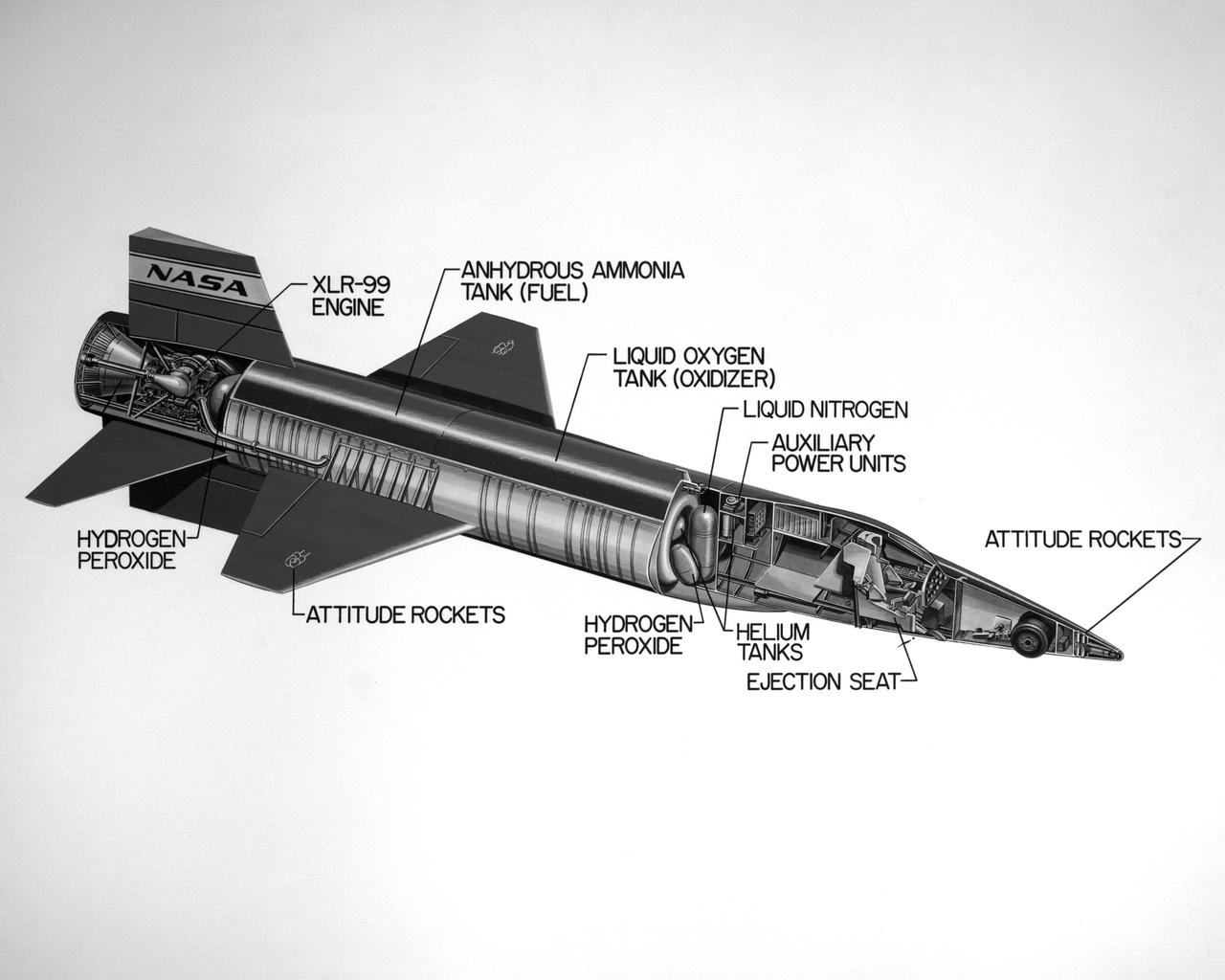
Cutaway drawing of the North American X-15.
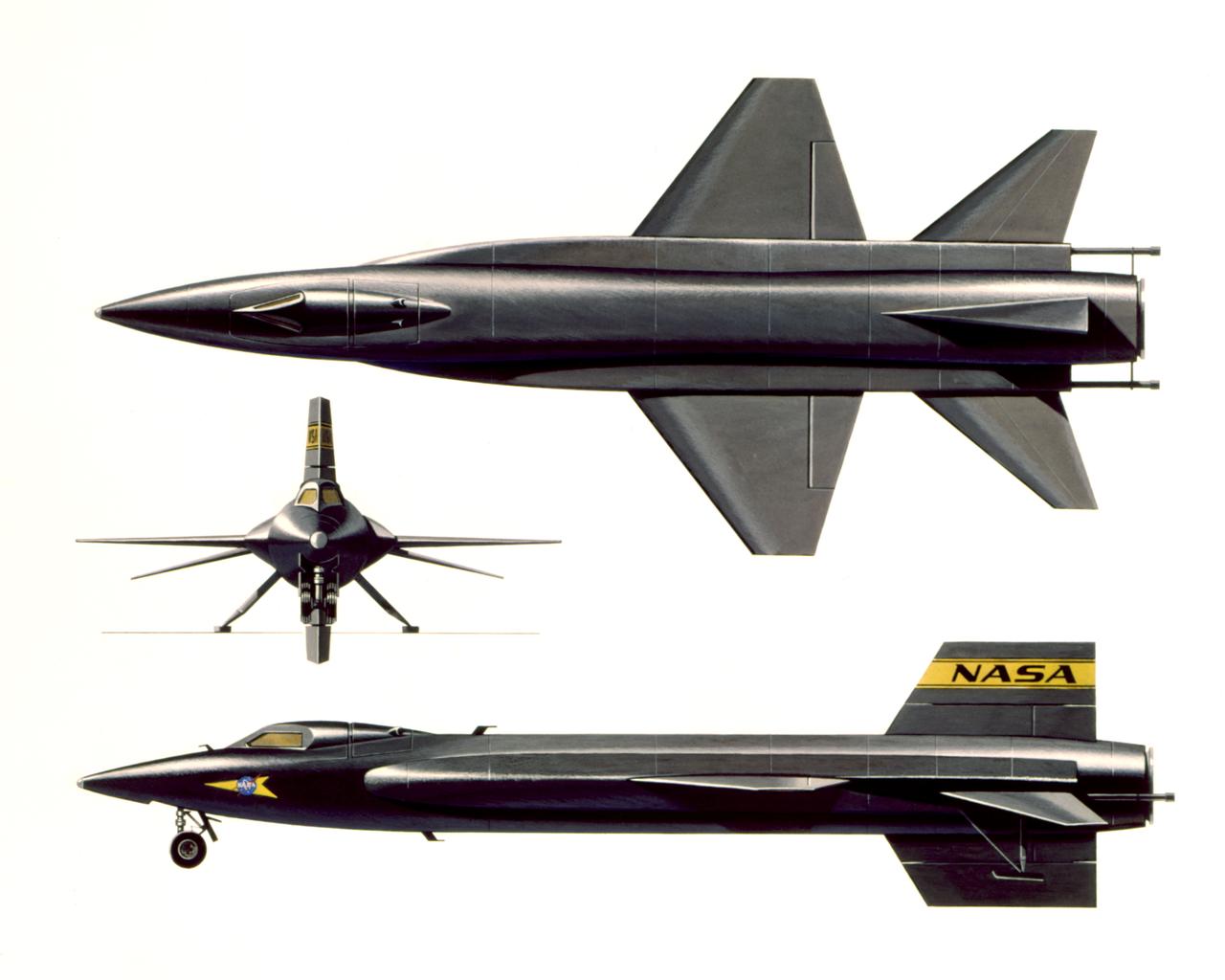
Three view art of the North American X-15.

Southwestern US, with Las Vegas, NV in foreground, taken by X-15 Hycon HR-236 Camera during flt. 2-39-70 on June 27, 1965.
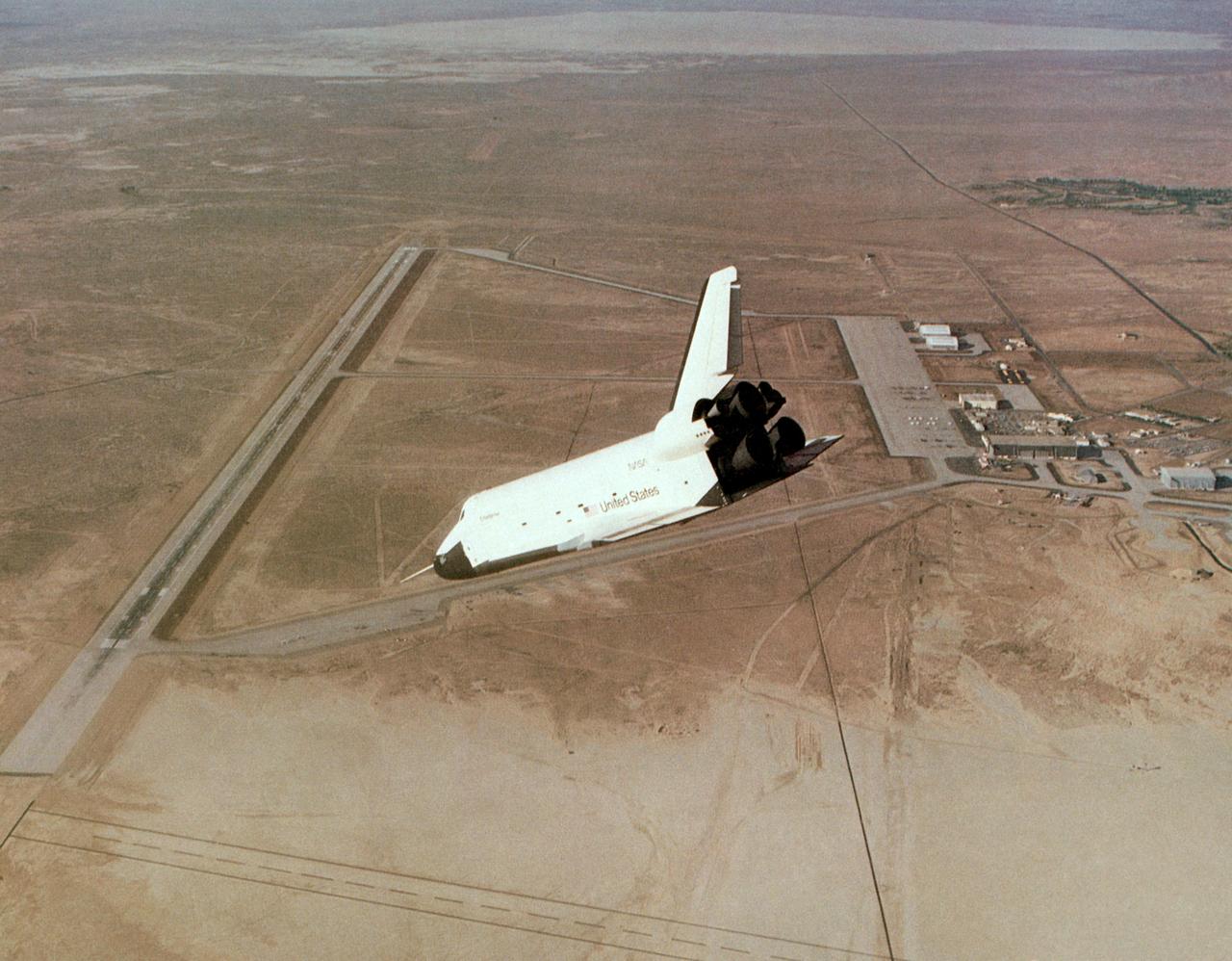
Enterprise - First Tailcone Off Free Flight
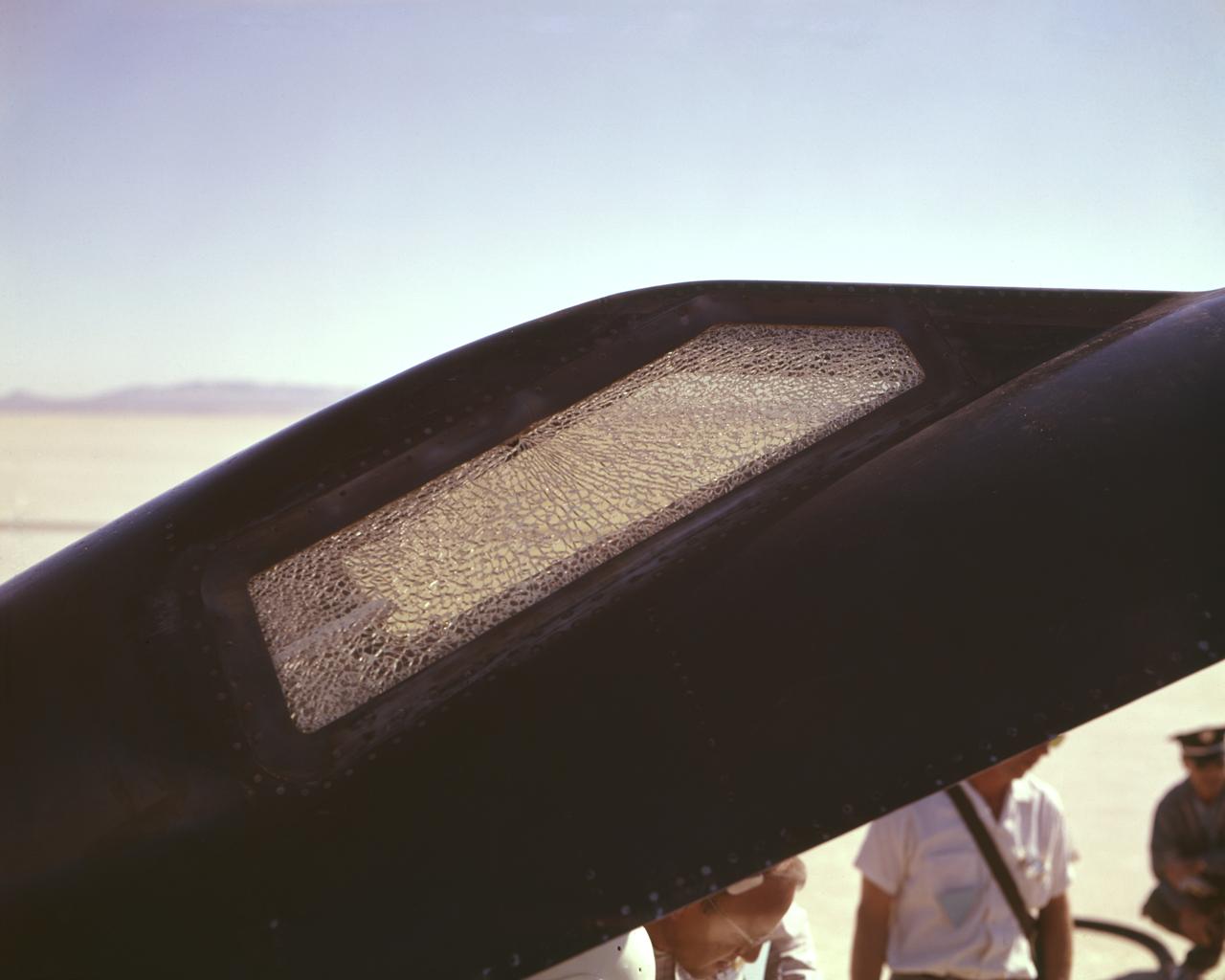
Cracked canopy glass on right side of X-15 #2 after flt. 2-21-37 on Nov. 9 1961. Robert White-pilot. First flight to mach 6.
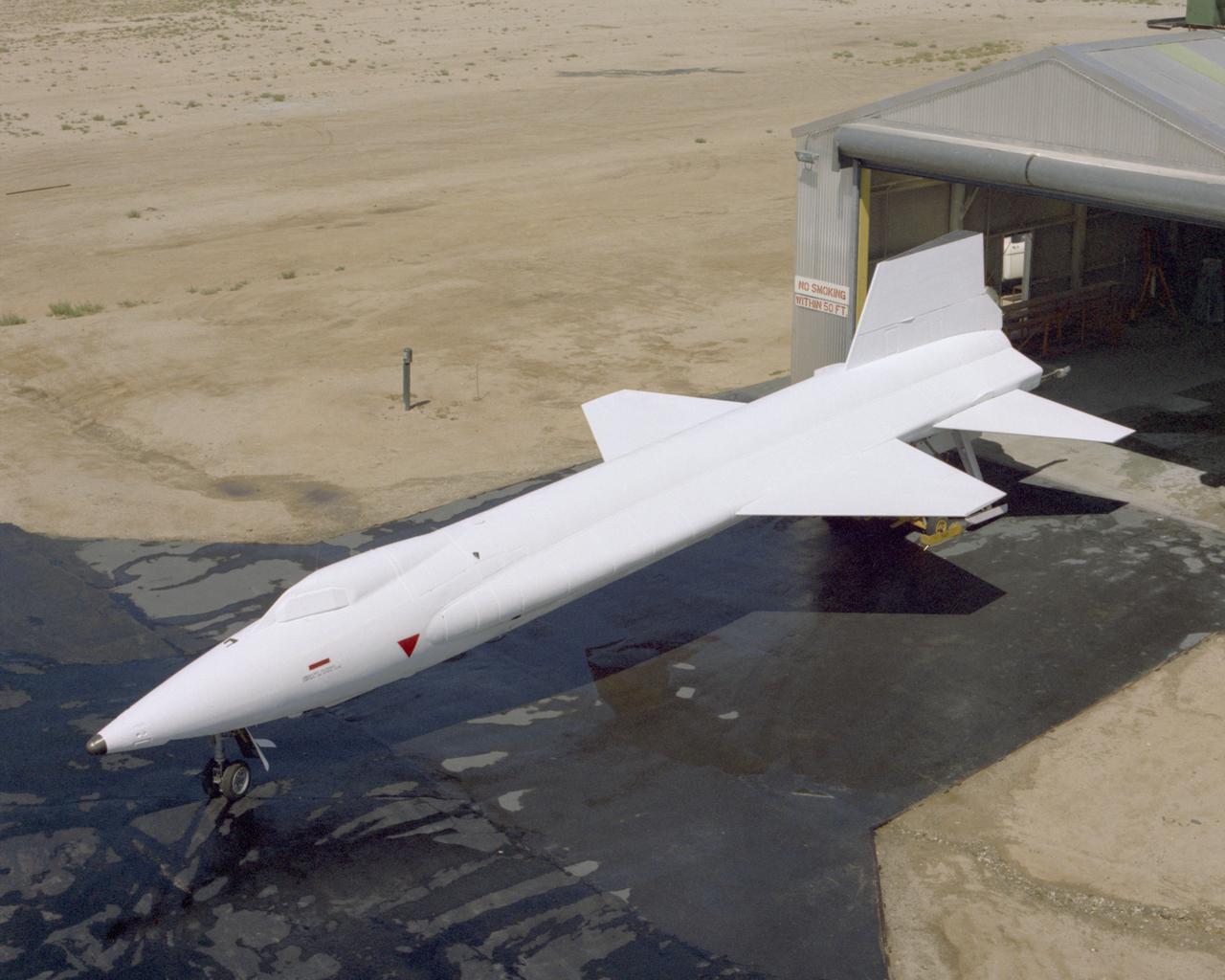
X-15A-2 is rolled out of the paint shop after having the full scale ablative applied. In June 1967, the X-15A-2 rocket-powered research aircraft received a full-scale ablative coating to protect the craft from the high temperatures associated with hypersonic flight (above Mach 5). This pink eraser-like substance, applied to the X-15A-2 aircraft (56-6671), was then covered with a white sealant coat before flight. This coating would help the #2 aircraft reach the record speed of 4,520 mph (Mach 6.7).
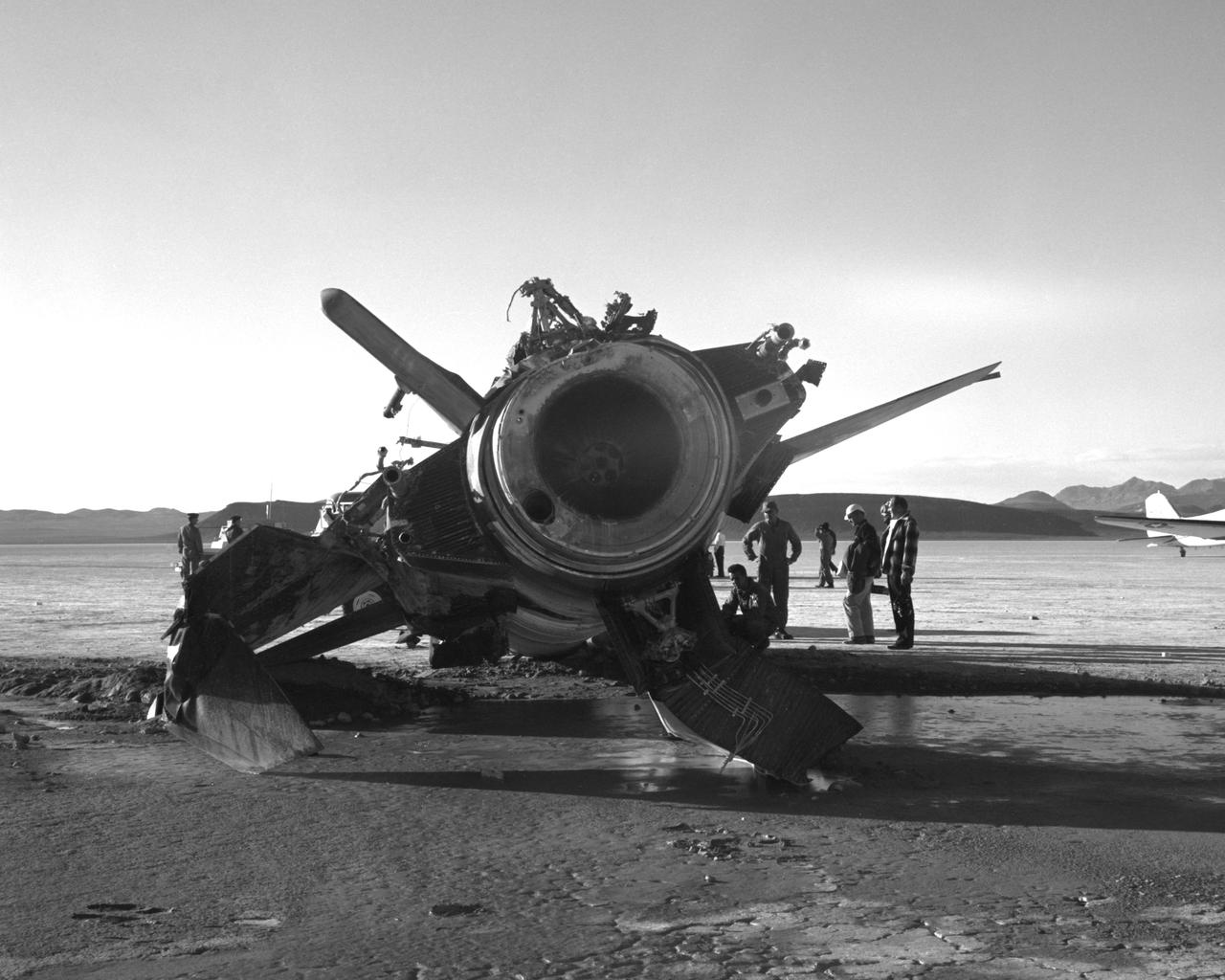
NASA research pilot Jack McKay was injured in a crash landing of the X-15 #2 on November 9, 1962. Following the launch from the B-52 to begin flight 2-31-52, he started the X-15's rocket engine, only to discover that it produced just 30 percent of its maximum thrust. He had to make a high-speed emergency landing on Mud Lake, NV, without flaps but with a significant amount of fuel still in the aircraft. As the X-15 slid across the lakebed, the left skid collapsed; the aircraft turned sideways and flipped onto its back. McKay suffered back injuries but was eventually able to resume X-15 pilot duties, making 22 more flights. The X-15 was sent back to North American Aviation and rebuilt into the X-15A-2.
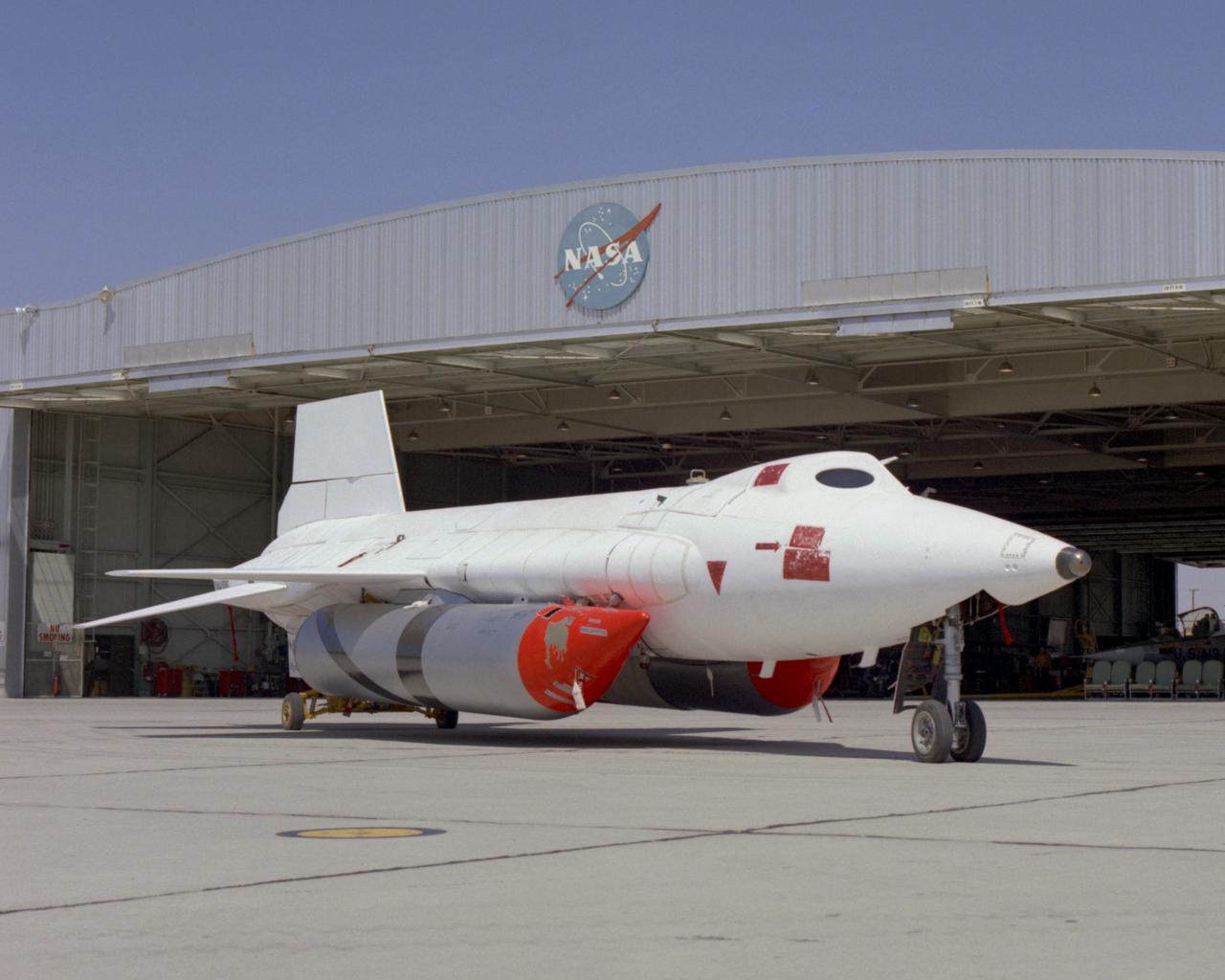
X-15A-2 with full scale ablative and external tanks installed parked in front of hangar. In June 1967, the X-15A-2 rocket-powered research aircraft received a full-scale ablative coating to protect the craft from the high temperatures associated with hypersonic flight (above Mach 5). This pink eraser-like substance, applied to the X-15A-2 aircraft (56-6671), was then covered with a white sealant coat before flight. This coating would help the #2 aircraft reach the record speed of 4,520 mph (Mach 6.7).
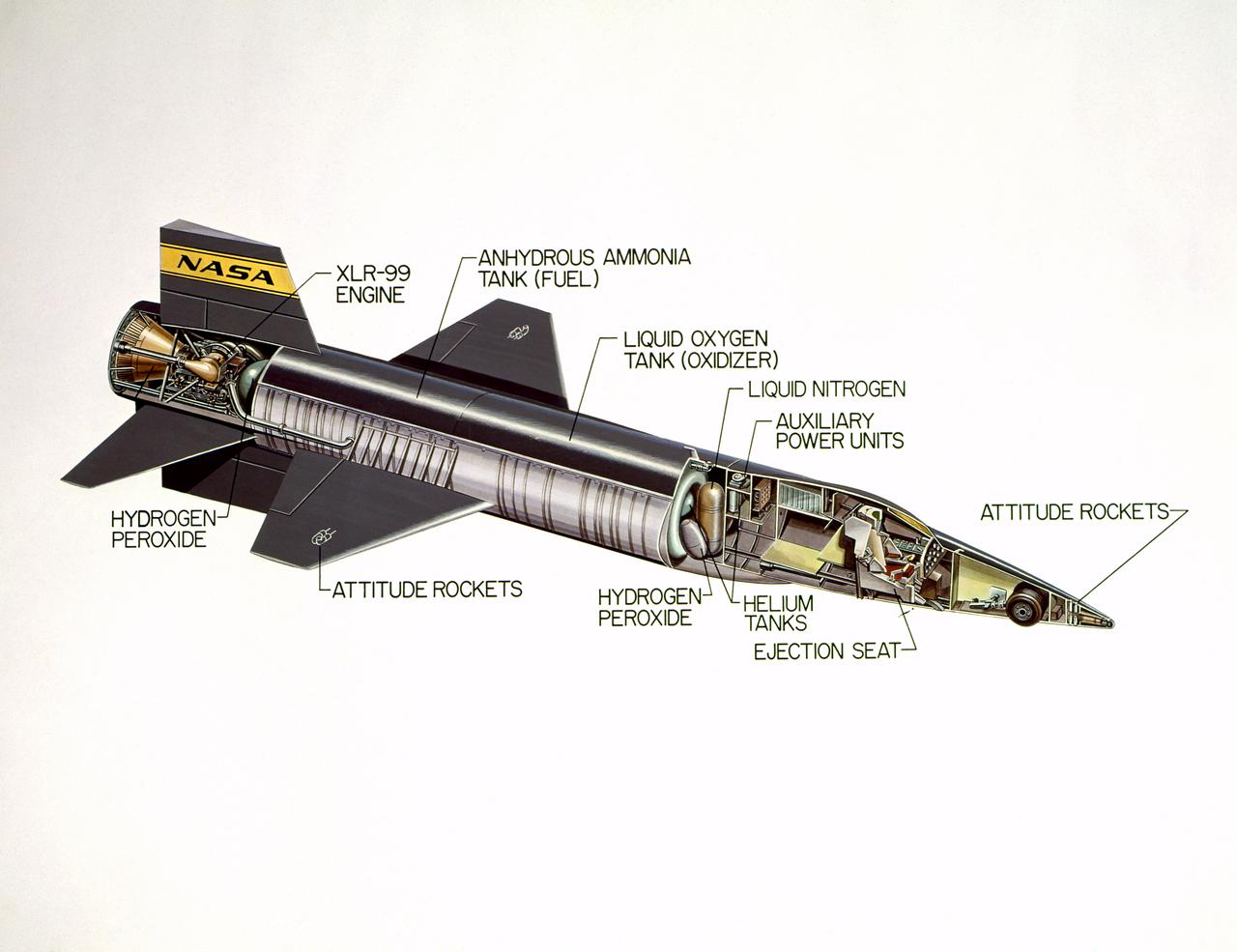
Cutaway drawing of the North American X-15.
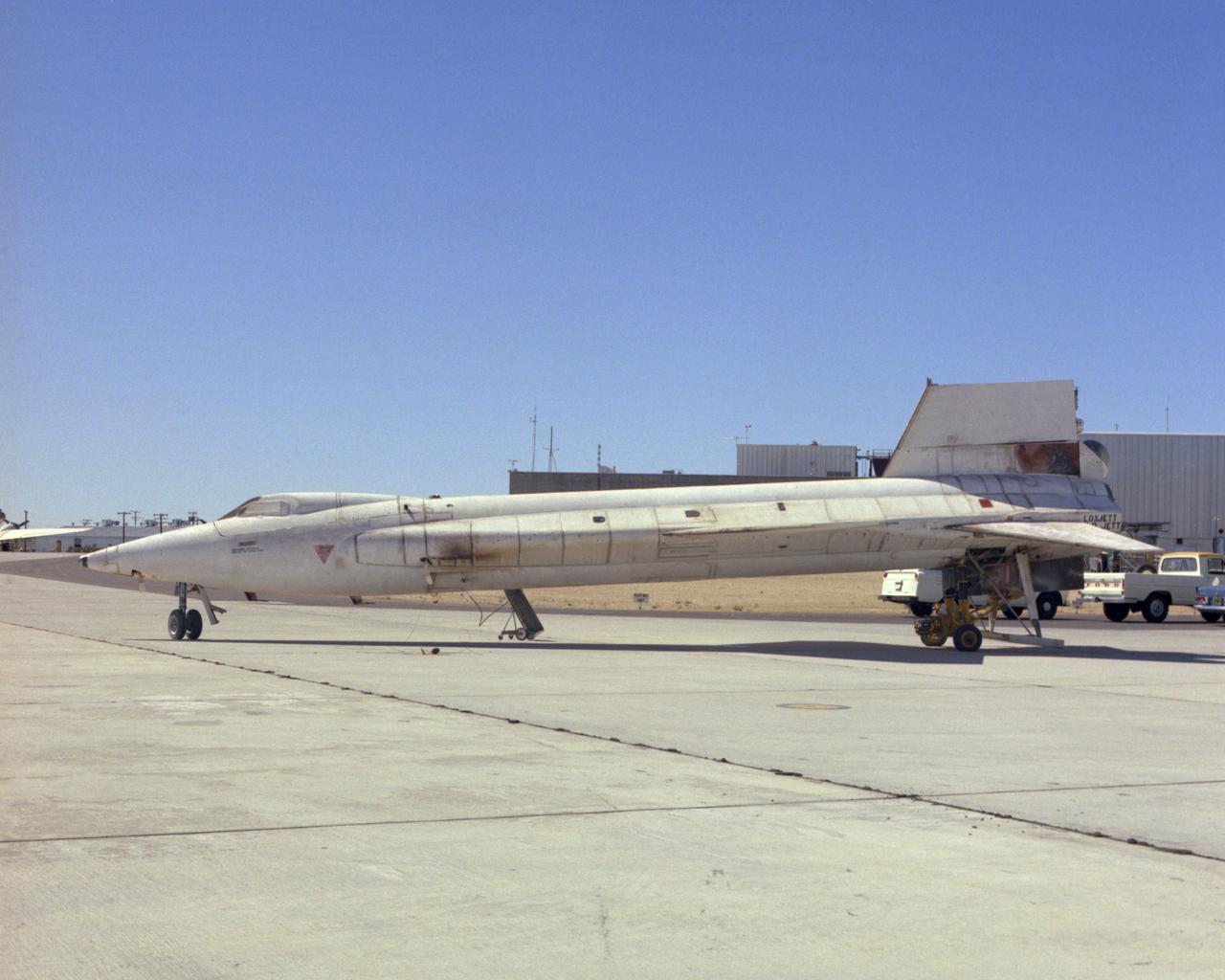
X-15A-2 post flight photo showing heat damage from Mach 6.7 flight on 3 Oct 67. Flt. 2-53-97; pilot-Pete Knight.