The Thurston Island calving front off of western Antarctica as seen from the window of NASA's DC-8 on Nov. 5, 2014.  Image Credit: NASA/Jim Yungel  NASA’s Operation IceBridge collected some rare images on a flight out of Punta Arenas, Chile on Nov. 5, 2014, on a science flight over western Antarctica dubbed Ferrigno-Alison-Abbott 01.  The crew snapped a few shots of a calving front of the Antarctic ice sheet. This particular flight plan was designed to collect data on changes in ice elevation along the coast near the Ferrigno and Alison ice streams, on the Abbot Ice Shelf, and grounded ice along the Eights Coast.
Thurston Island
Snow is blown off of the Thurston Island calving front off of western Antarctica as seen on the IceBridge flight on Nov. 5, 2014.  Image Credit: NASA/Jim Yungel  NASA’s Operation IceBridge collected some rare images on a flight out of Punta Arenas, Chile on Nov. 5, 2014, on a science flight over western Antarctica dubbed Ferrigno-Alison-Abbott 01.  The crew snapped a few shots of a calving front of the Antarctic ice sheet. This particular flight plan was designed to collect data on changes in ice elevation along the coast near the Ferrigno and Alison ice streams, on the Abbot Ice Shelf, and grounded ice along the Eights Coast.
Thurston Island
A sea of icebergs float near the Thurston Island calving front off of western Antarctica as seen on the IceBridge flight on Nov. 5, 2014.  Image Credit: NASA/Jim Yungel  NASA’s Operation IceBridge collected some rare images on a flight out of Punta Arenas, Chile on Nov. 5, 2014, on a science flight over western Antarctica dubbed Ferrigno-Alison-Abbott 01.  The crew snapped a few shots of a calving front of the Antarctic ice sheet. This particular flight plan was designed to collect data on changes in ice elevation along the coast near the Ferrigno and Alison ice streams, on the Abbot Ice Shelf, and grounded ice along the Eights Coast.
Thurston Island Calving
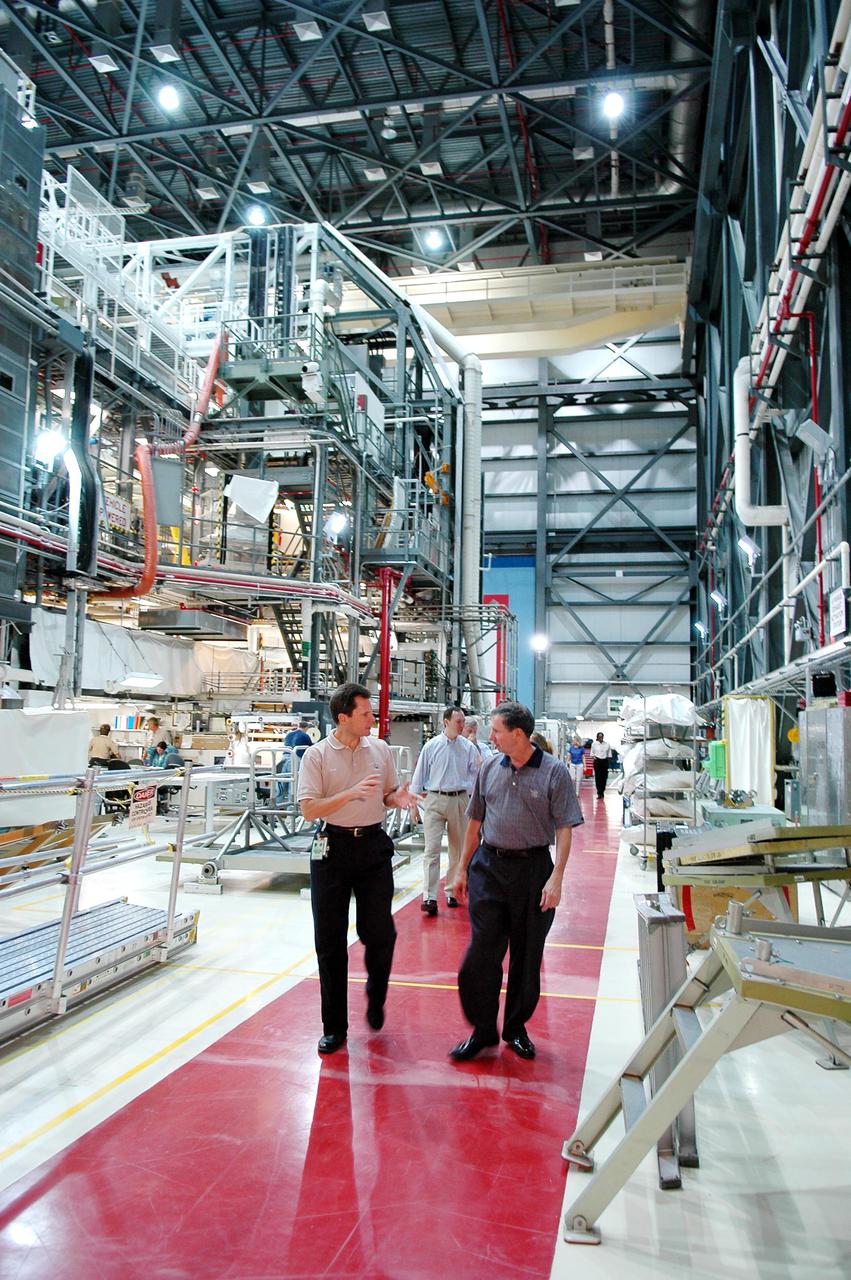
KENNEDY SPACE CENTER, FLA.  -  Michael Griffin (right), administrator of the National Aeronautics and Space Administration (NASA), tours Orbiter Processing Facility bay 1 with Space Shuttle Atlantis vehicle manager Scott Thurston. Space Shuttle Atlantis is being processed for the second Return to Flight mission, STS-121, in the facility. This is Griffin's first official visit to Kennedy Space Center. Griffin is the 11th administrator of NASA, a role he assumed on April 14, 2005. Griffin was nominated to the position in March while serving as the Space Department head at Johns Hopkins University's Applied Physics Laboratory in Baltimore. A registered professional engineer in Maryland and California, Griffin served as chief engineer at NASA earlier in his career.  He holds numerous scientific and technical degrees including a Ph.D. in Aerospace Engineering from the University of Maryland.
KSC-05pd-1039
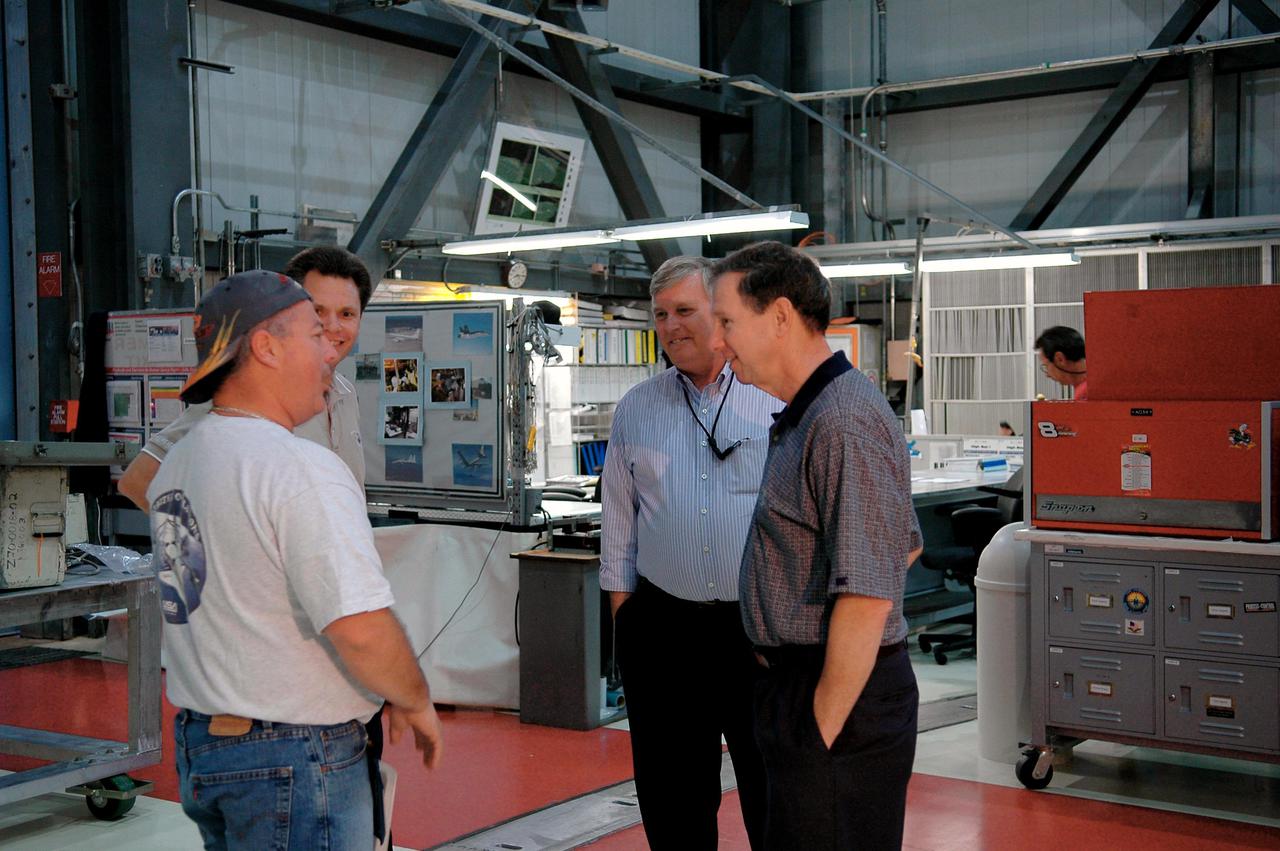
KENNEDY SPACE CENTER, FLA.  -  Michael Griffin, administrator of the National Aeronautics and Space Administration (NASA), talks to United Space Alliance advanced systems technician Richard Van Wart during a tour of Orbiter Processing Facility bay 1.  From left are Van Wart, Space Shuttle Atlantis vehicle manager Scott Thurston, Center Director James Kennedy, and Griffin. Space Shuttle Atlantis is being processed for the second Return to Flight mission, STS-121, in the facility. This is Griffin's first official visit to Kennedy Space Center. Griffin is the 11th administrator of NASA, a role he assumed on April 14, 2005. Griffin was nominated to the position in March while serving as the Space Department head at Johns Hopkins University's Applied Physics Laboratory in Baltimore. A registered professional engineer in Maryland and California, Griffin served as chief engineer at NASA earlier in his career.  He holds numerous scientific and technical degrees including a Ph.D. in Aerospace Engineering from the University of Maryland.
KSC-05pd-1037
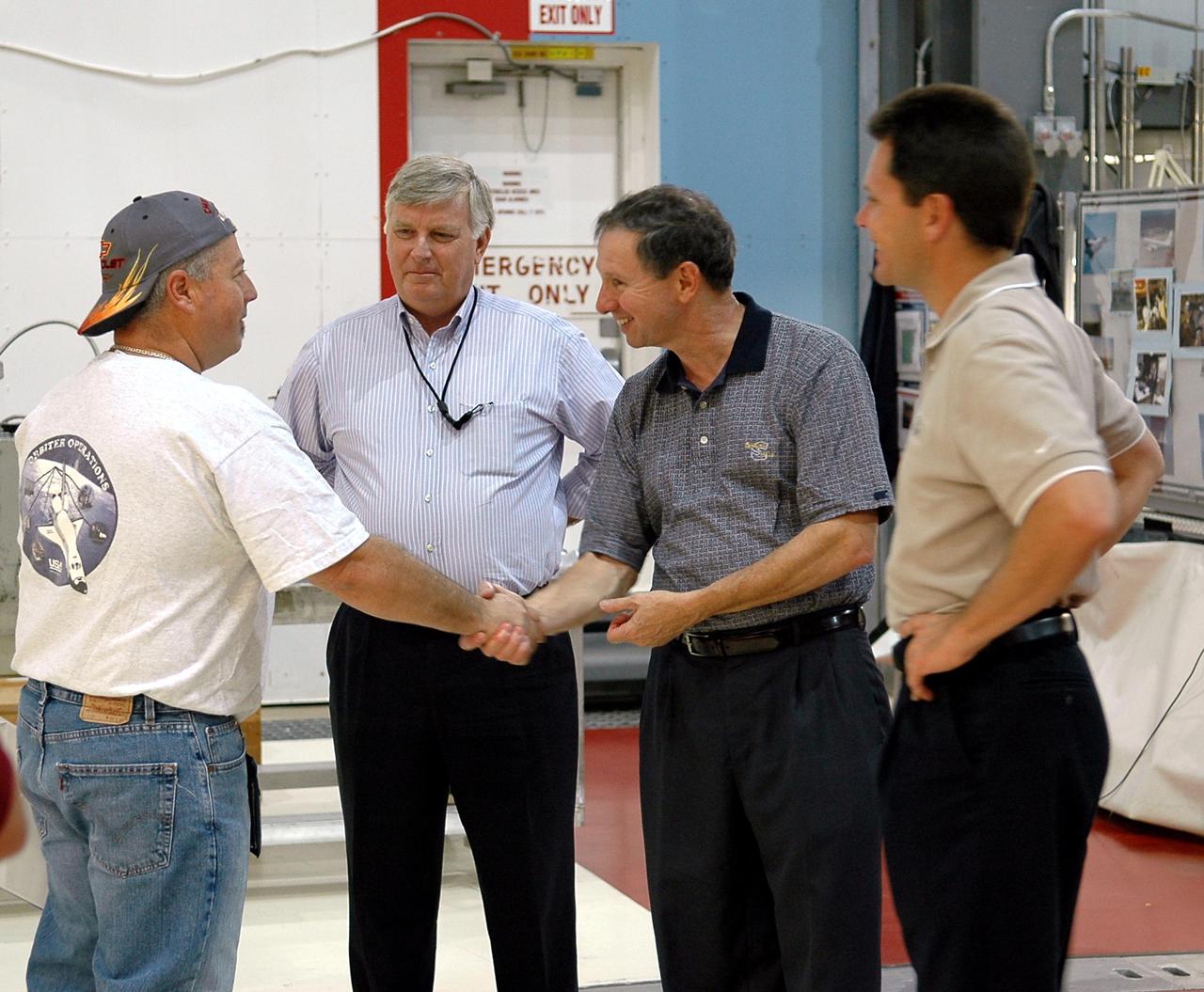
KENNEDY SPACE CENTER, FLA.  -  Michael Griffin, administrator of the National Aeronautics and Space Administration (NASA), shakes hands with United Space Alliance advanced systems technician Richard Van Wart during a tour of Orbiter Processing Facility bay 1.  From left are Van Wart, Center Director James Kennedy, Griffin and Space Shuttle Atlantis vehicle manager Scott Thurston. Space Shuttle Atlantis is being processed for the second Return to Flight mission, STS-121, in the facility. This is Griffin's first official visit to Kennedy Space Center. Griffin is the 11th administrator of NASA, a role he assumed on April 14, 2005. Griffin was nominated to the position in March while serving as the Space Department head at Johns Hopkins University's Applied Physics Laboratory in Baltimore. A registered professional engineer in Maryland and California, Griffin served as chief engineer at NASA earlier in his career.  He holds numerous scientific and technical degrees including a Ph.D. in Aerospace Engineering from the University of Maryland.
KSC-05pd-1038
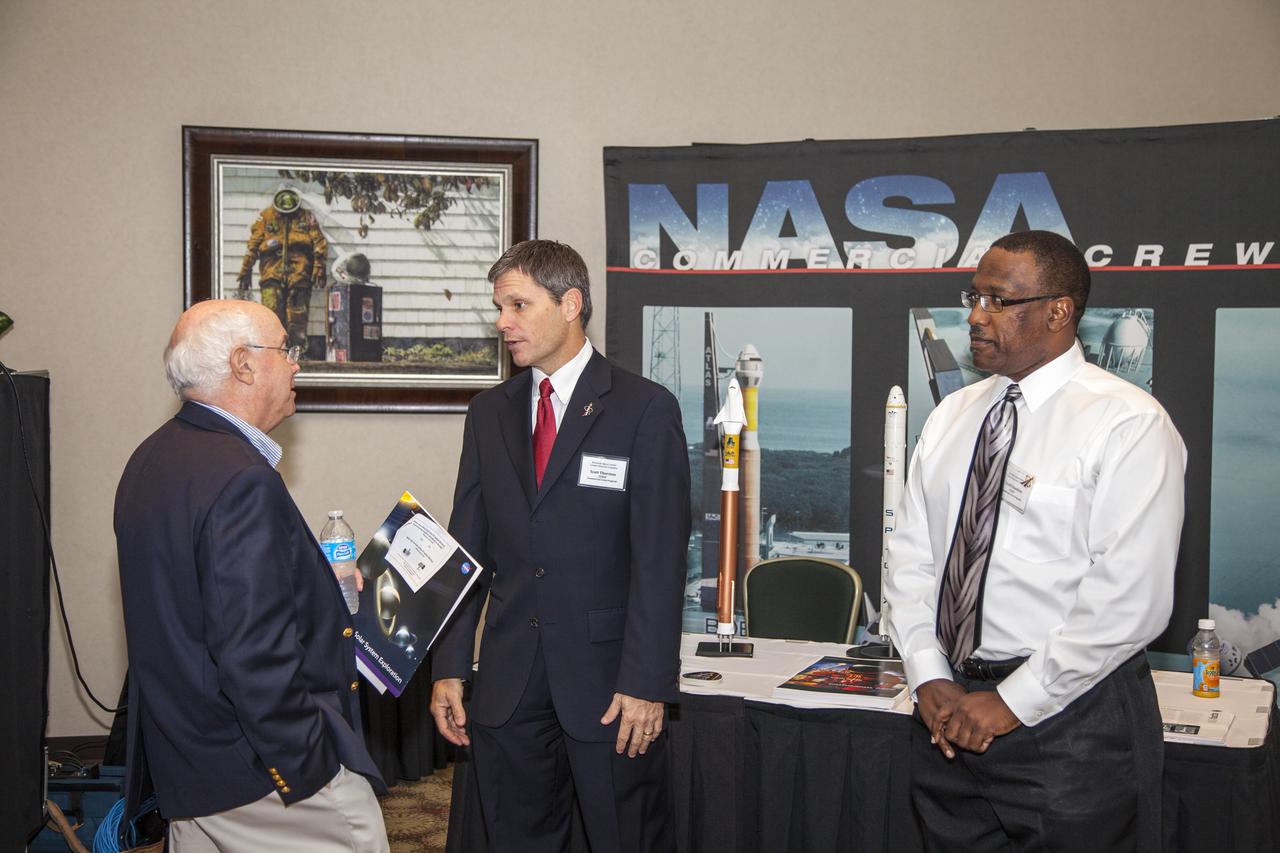
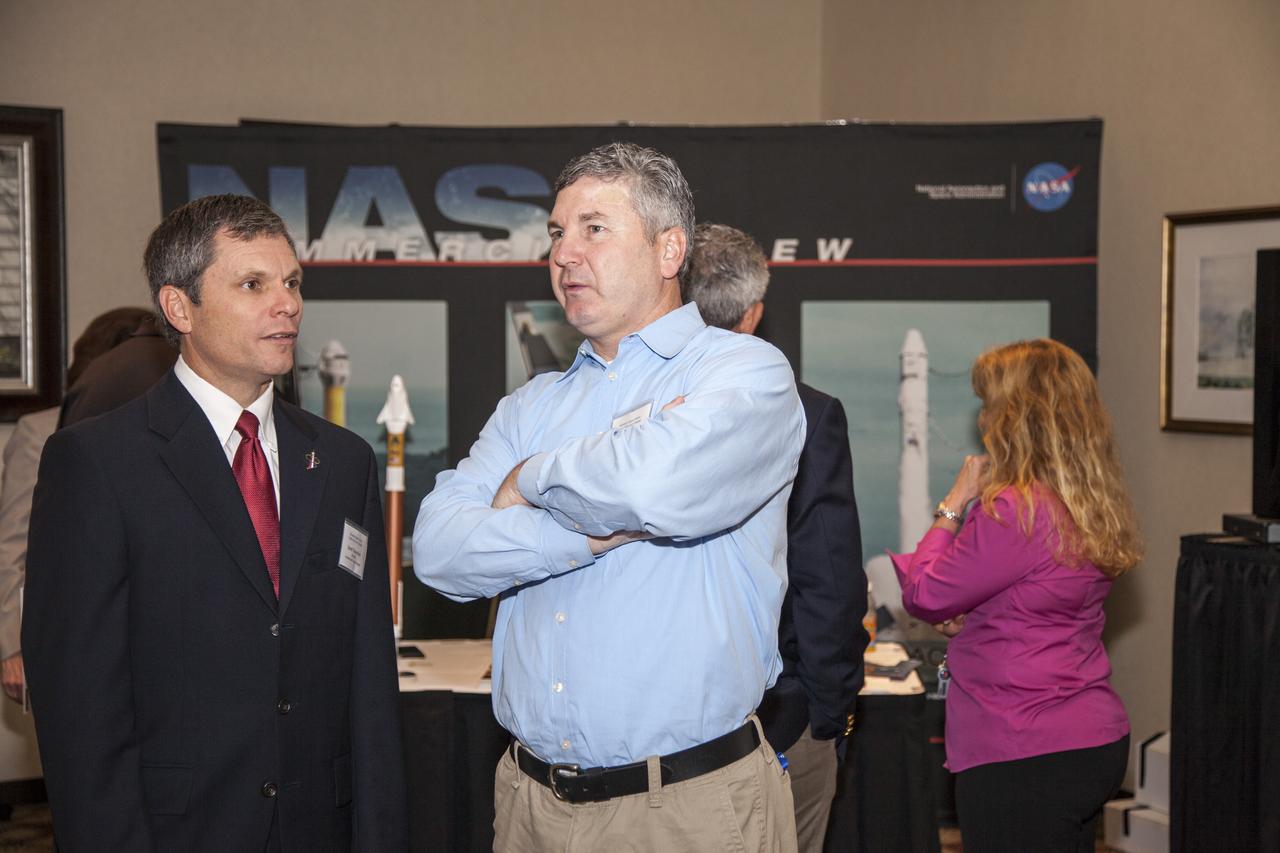
CAPE CANAVERAL, Fla. - Community leaders, business executives, educators, and state and local government leaders were updated on NASA Kennedy Space Center programs and accomplishments during Center Director Bob Cabana’s Center Director Update at the Debus Center at the Kennedy Space Center Visitor Complex in Florida. From left, Scott Thurston, Kennedy deputy of the spacecraft office of the Commercial Crew Program, talks with Scott Colloredo, director of the Center Planning and Development Directorate. Attendees talked with Cabana and other senior Kennedy managers and visited displays featuring updates on Kennedy programs and projects, including International Space Station, Commercial Crew, Ground System Development and Operations, Launch Services, Center Planning and Development, Technology, KSC Swamp Works and NASA Education. The morning concluded with a tour of the new Space Shuttle Atlantis exhibit at the visitor complex. For more information, visit http://www.nasa.gov/kennedy. Photo credit: NASA/Daniel Casper
Kennedy Space Center Director Update
CAPE CANAVERAL, Fla. - Community leaders, business executives, educators, and state and local government leaders were updated on NASA Kennedy Space Center programs and accomplishments during Center Director Bob Cabana’s Center Director Update at the Debus Center at the Kennedy Space Center Visitor Complex in Florida. An attendee talks with Scott Thurston, Kennedy deputy of the spacecraft office at the Commercial Crew Program display. Attendees talked with Cabana and other senior Kennedy managers and visited displays featuring updates on Kennedy programs and projects, including International Space Station, Commercial Crew, Ground System Development and Operations, Launch Services, Center Planning and Development, Technology, KSC Swamp Works and NASA Education. The morning concluded with a tour of the new Space Shuttle Atlantis exhibit at the visitor complex. For more information, visit http://www.nasa.gov/kennedy. Photo credit: NASA/Daniel Casper
Kennedy Space Center Director Update
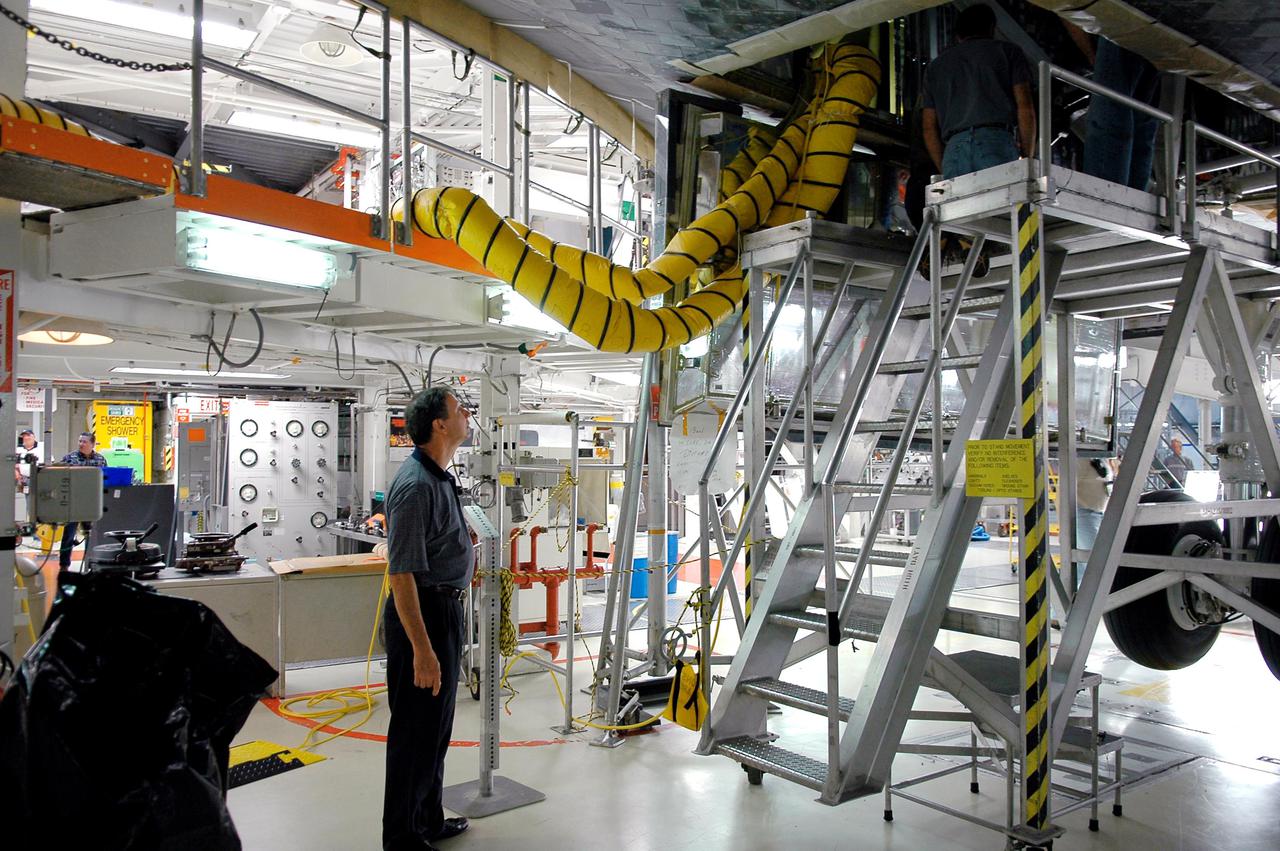
KENNEDY SPACE CENTER, FLA.  -  In Orbiter Processing Facility bay 1, NASA Administrator Michael Griffin observes as technicians prepare Space Shuttle Atlantis for the second Return to Flight mission, STS-121. This is Griffin's first official visit to Kennedy Space Center. Griffin is the 11th administrator of NASA, a role he assumed on April 14, 2005. Griffin was nominated to the position in March while serving as the Space Department head at Johns Hopkins University's Applied Physics Laboratory in Baltimore. A registered professional engineer in Maryland and California, Griffin served as chief engineer at NASA earlier in his career.  He holds numerous scientific and technical degrees including a Ph.D. in Aerospace Engineering from the University of Maryland.
KSC-05pd-1041
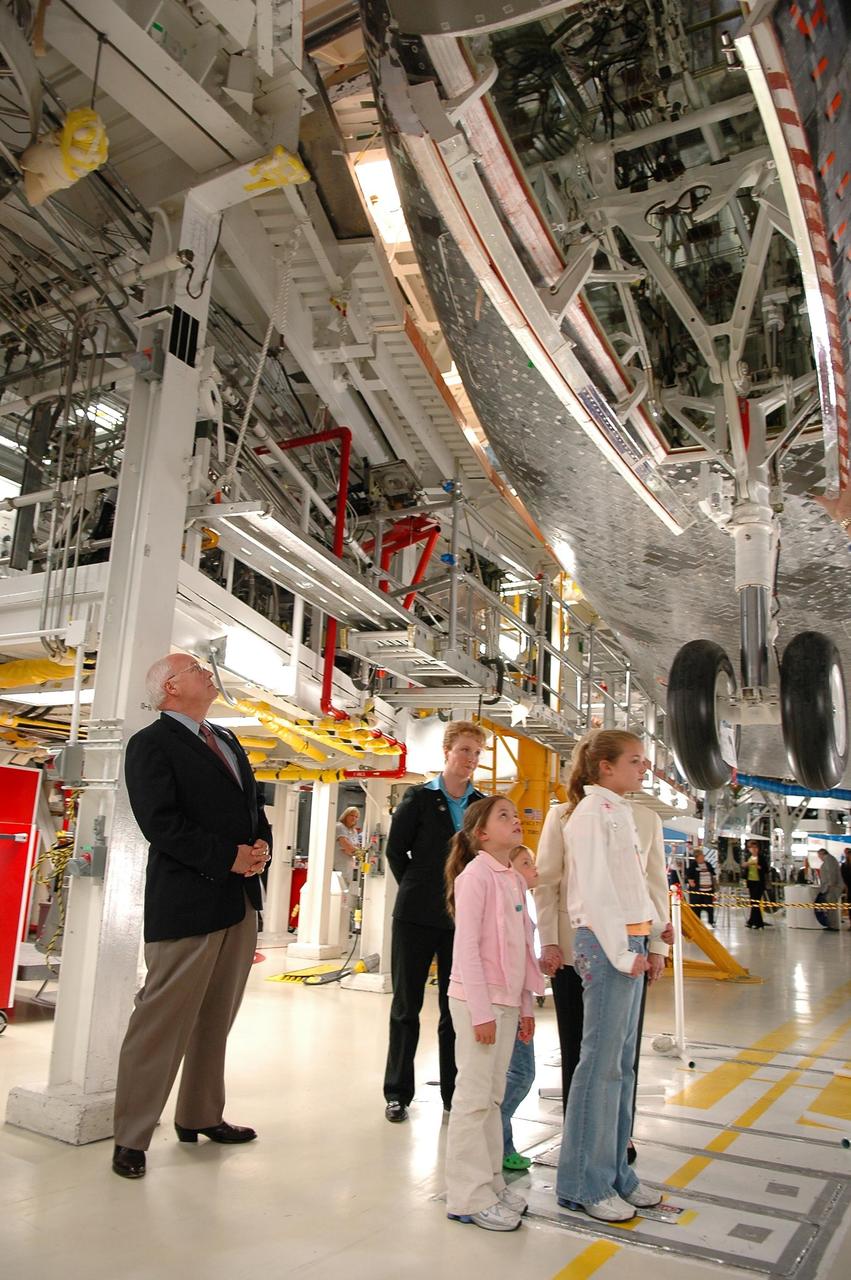
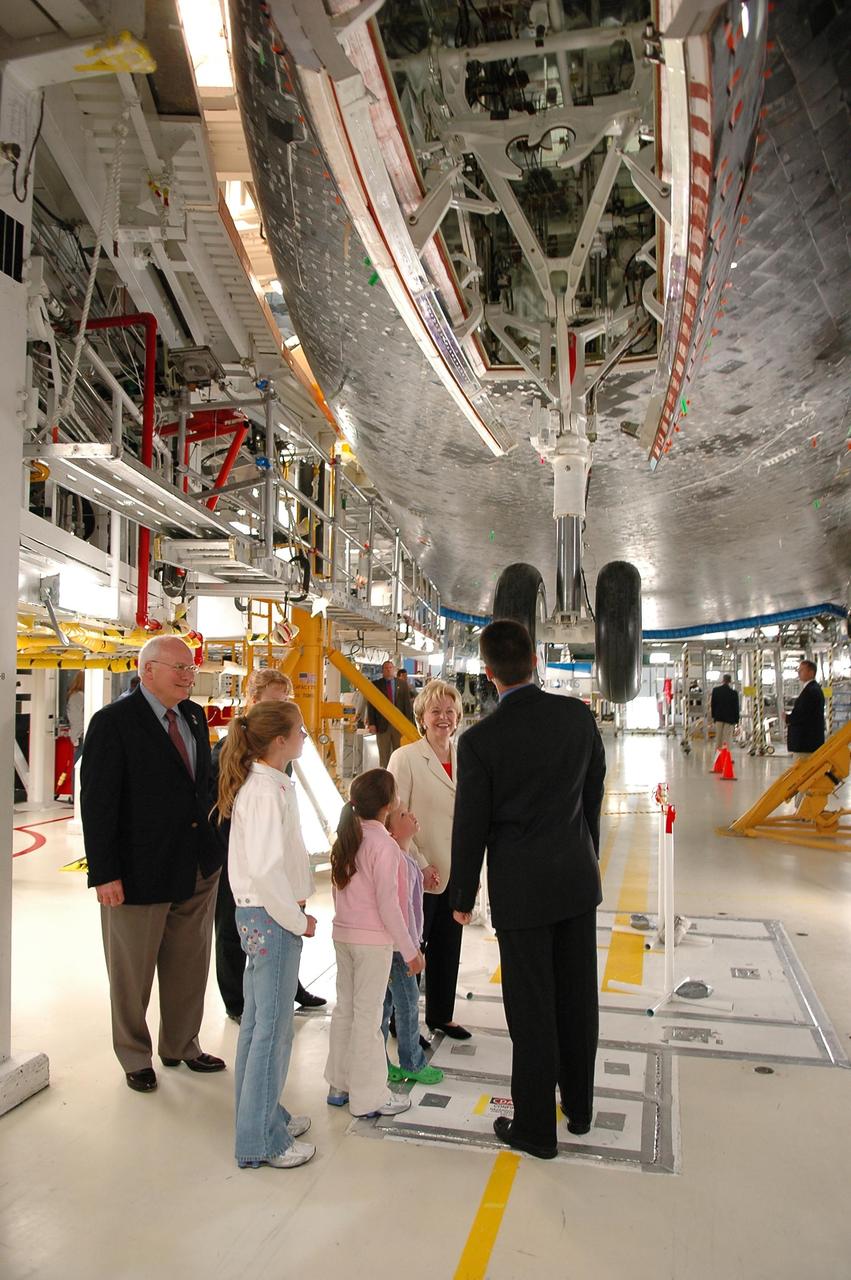
KENNEDY SPACE CENTER, FLA. -  In the Orbiter Processing Facility, Scott Thurston (right), Crew Exploration Vehicle manager in the Shuttle Processing Directorate, gives a personal tour to U.S. Vice President Dick Cheney (far left) and his family.  They are standing underneath the orbiter Atlantis. Thurston previously was the NASA flow director for Atlantis. Cheney flew in to view the launch of Space Shuttle Discovery on mission STS-121.  Photo credit: NASA/Kim Shiflett
KSC-06pd1349
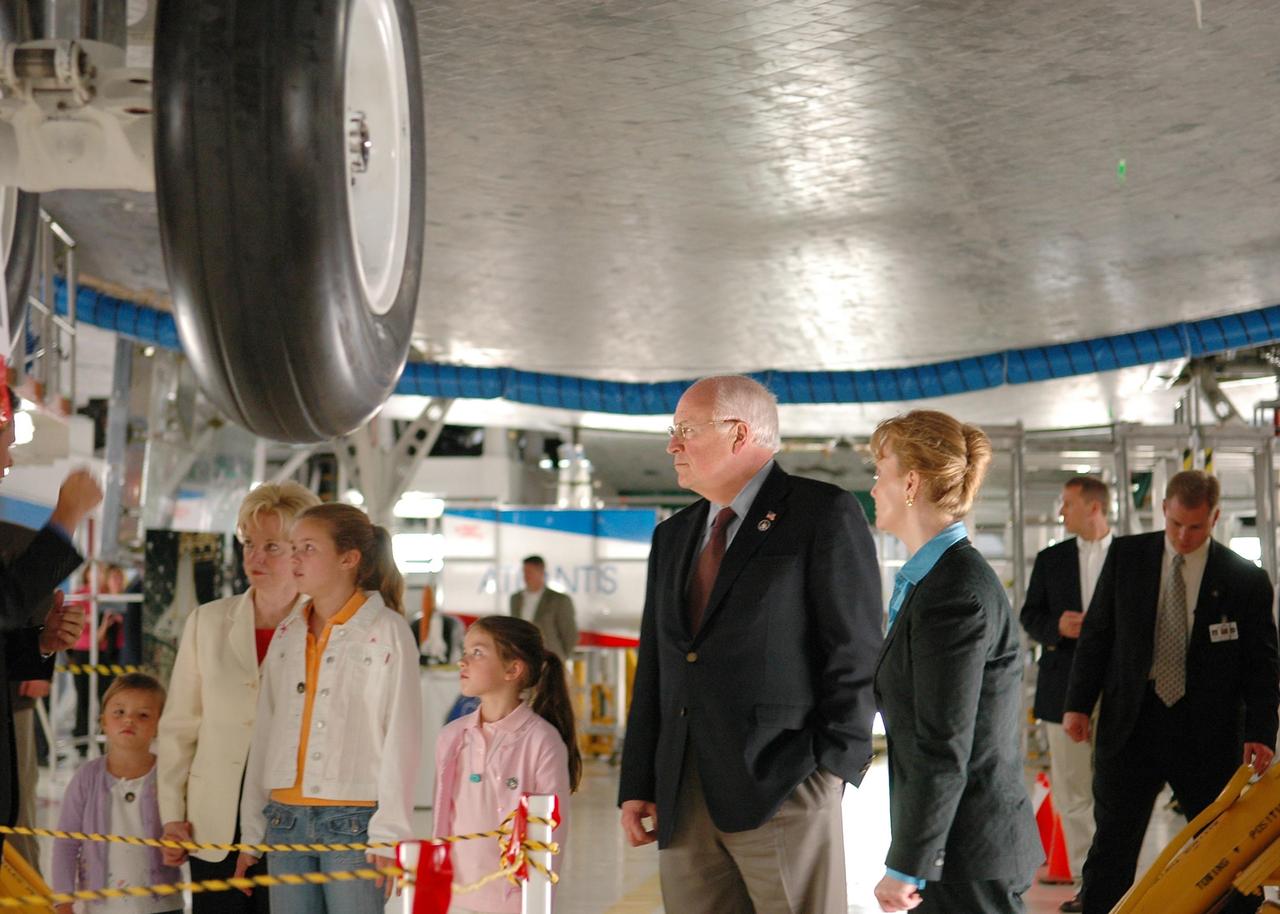
KENNEDY SPACE CENTER, FLA. - In the Orbiter Processing Facility, U.S. Vice President Dick Cheney takes a close look at the orbiter Atlantis while on a personal tour guided by Scott Thurston, Crew Exploration Vehicle manager in the Shuttle Processing Directorate.  Thurston previously was the NASA flow director for Atlantis.  Standing next to Cheney is Shana Dale, NASA deputy administrator.  Cheney flew in to view the launch of Space Shuttle Discovery on mission STS-121.
KSC-06pd1348
KENNEDY SPACE CENTER, FLA. -  In the Orbiter Processing Facility, U.S. Vice President Dick Cheney (far right), with his family, learn about orbiters from Scott Thurston, Crew Exploration Vehicle manager in the Shuttle Processing Directorate.  Thurston previously was the NASA flow director for Atlantis.  Cheney flew in to view the launch of Space Shuttle Discovery on mission STS-121.  Photo credit: NASA/Kim Shiflett
KSC-06pd1344
KENNEDY SPACE CENTER, FLA. -  In the Orbiter Processing Facility, U.S. Vice President Dick Cheney (second from right) and family get a close look at the orbiter Atlantis on a personal tour guided by Scott Thurston, Crew Exploration Vehicle manager in the Shuttle Processing Directorate. Thurston previously was the NASA flow director for Atlantis. To the right of Cheney is Shana Dale, NASA deputy administrator. Cheney flew in to view the launch of Space Shuttle Discovery on mission STS-121. Photo credit: NASA/Kim Shiflett
KSC-06pd1347
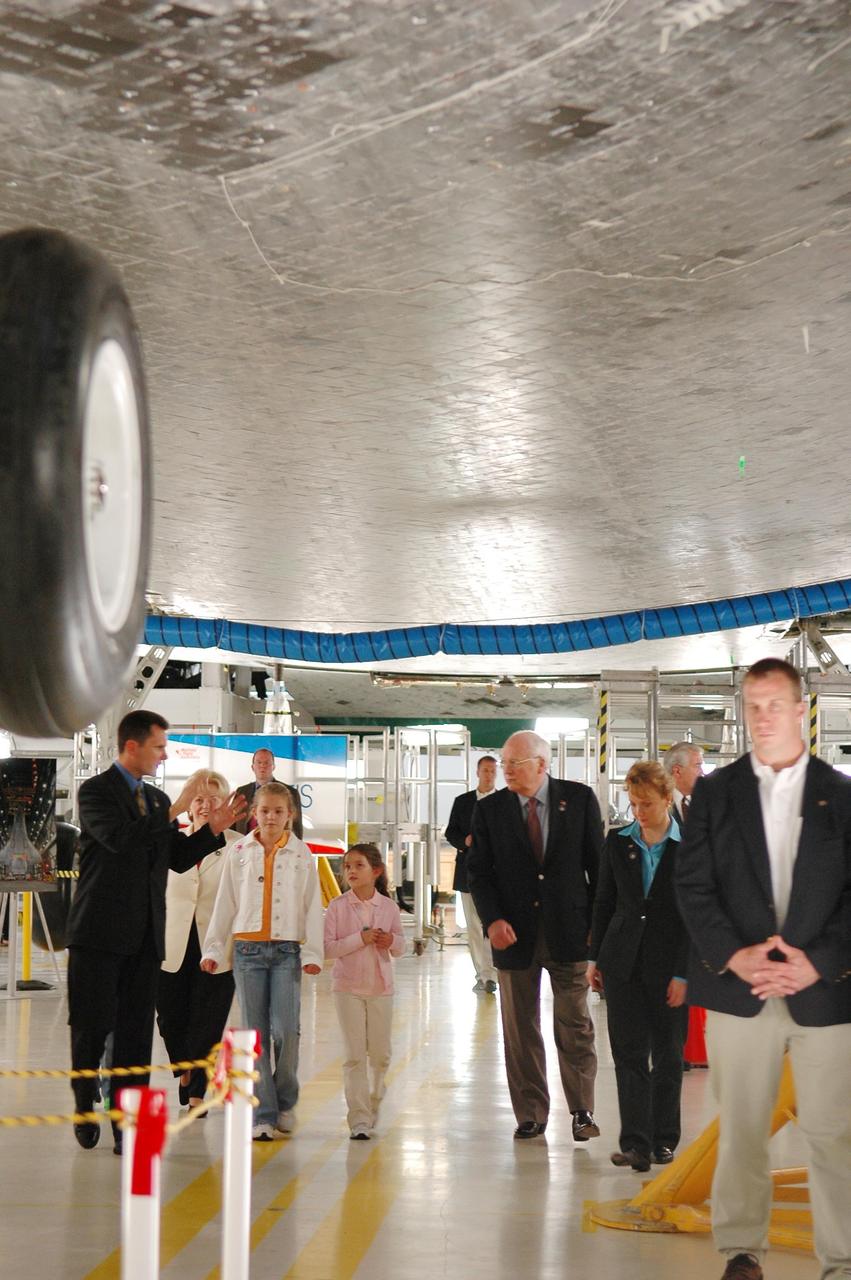
KENNEDY SPACE CENTER, FLA. -  In the Orbiter Processing Facility,Scott Thurston (far left), Crew Exploration Vehicle manager in the Shuttle Processing Directorate,  gives a personal tour to U.S. Vice President Dick Cheney (center) and his family.  They are walking underneath the orbiter Atlantis.  Thurston previously was the NASA flow director for Atlantis.   Walking next to Cheney is Shana Dale, NASA deputy administrator. Cheney flew in to view the launch of Space Shuttle Discovery on mission STS-121.  Photo credit: NASA/Kim Shiflett
KSC-06pd1345
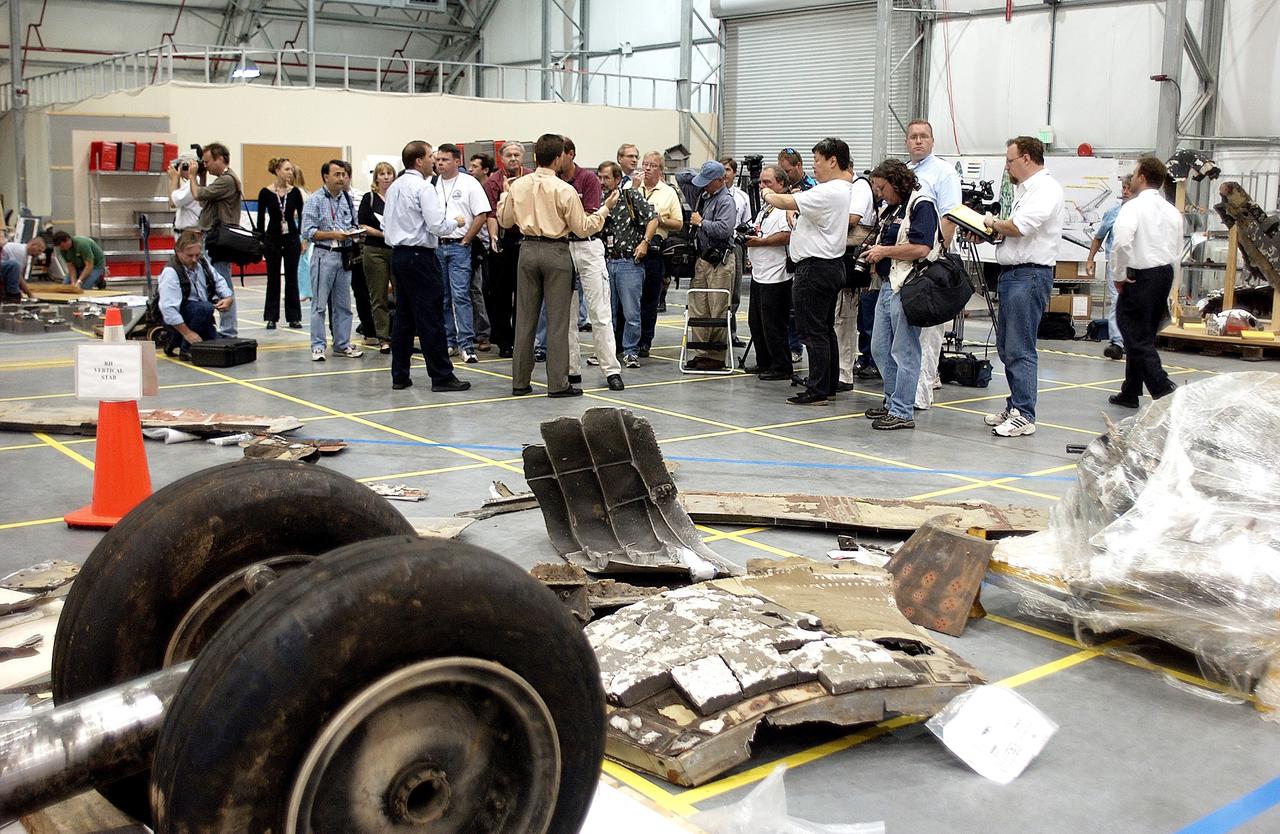
KENNEDY SPACE CENTER, FLA. - The media listen to Scott Thurston, NASA vehicle flow manager, talk about efforts to pack the debris stored in the Columbia Debris Hangar.  More than 83,000  pieces of debris were shipped to KSC during search and recovery efforts in East Texas. That represents about 38 percent of the dry weight of Columbia, equaling almost 85,000 pounds. An area of the Vehicle Assembly Building is being prepared to store the debris permanently.
KENNEDY SPACE CENTER, FLA. - The media listen to Scott Thurston, NASA vehicle flow manager, talk about efforts to pack the debris stored in the Columbia Debris Hangar. More than 83,000 pieces of debris were shipped to KSC during search and recovery efforts in East Texas. That represents about 38 percent of the dry weight of Columbia, equaling almost 85,000 pounds. An area of the Vehicle Assembly Building is being prepared to store the debris permanently.
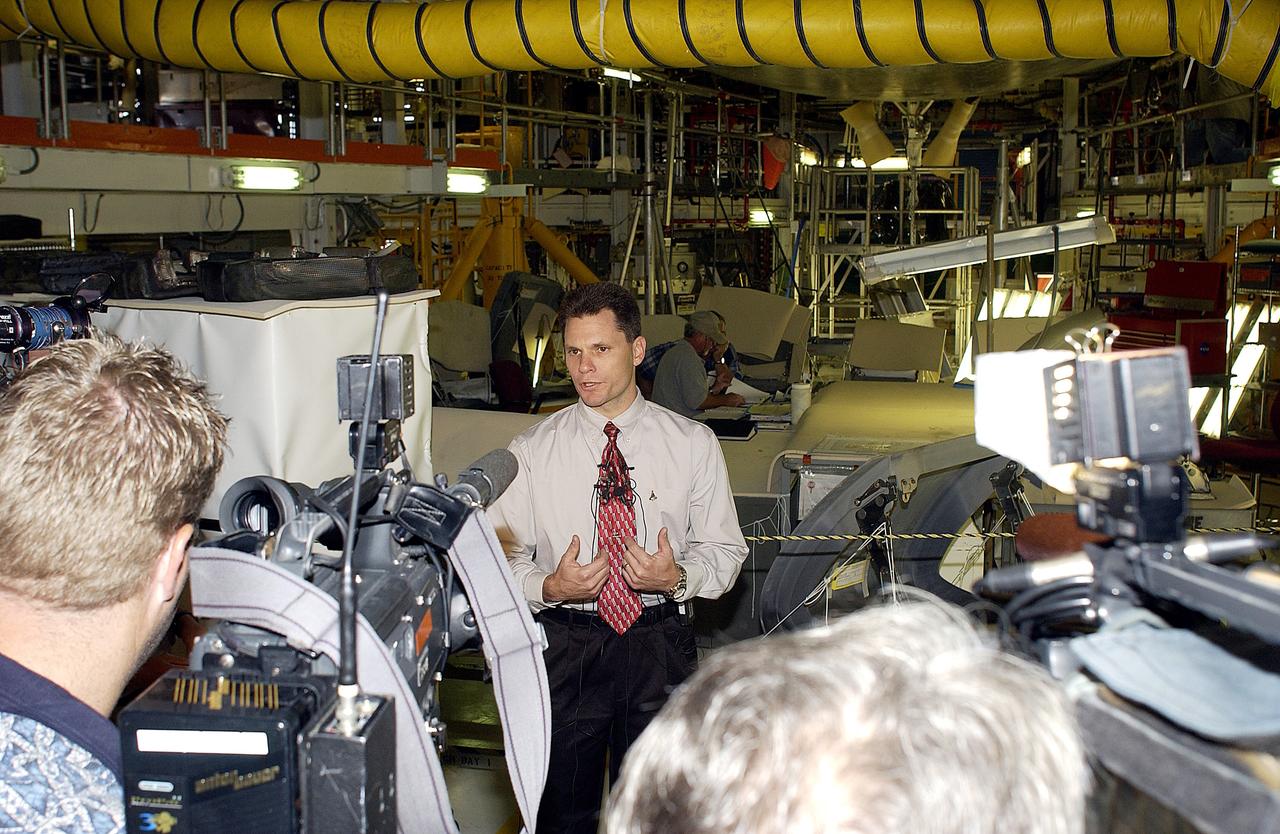
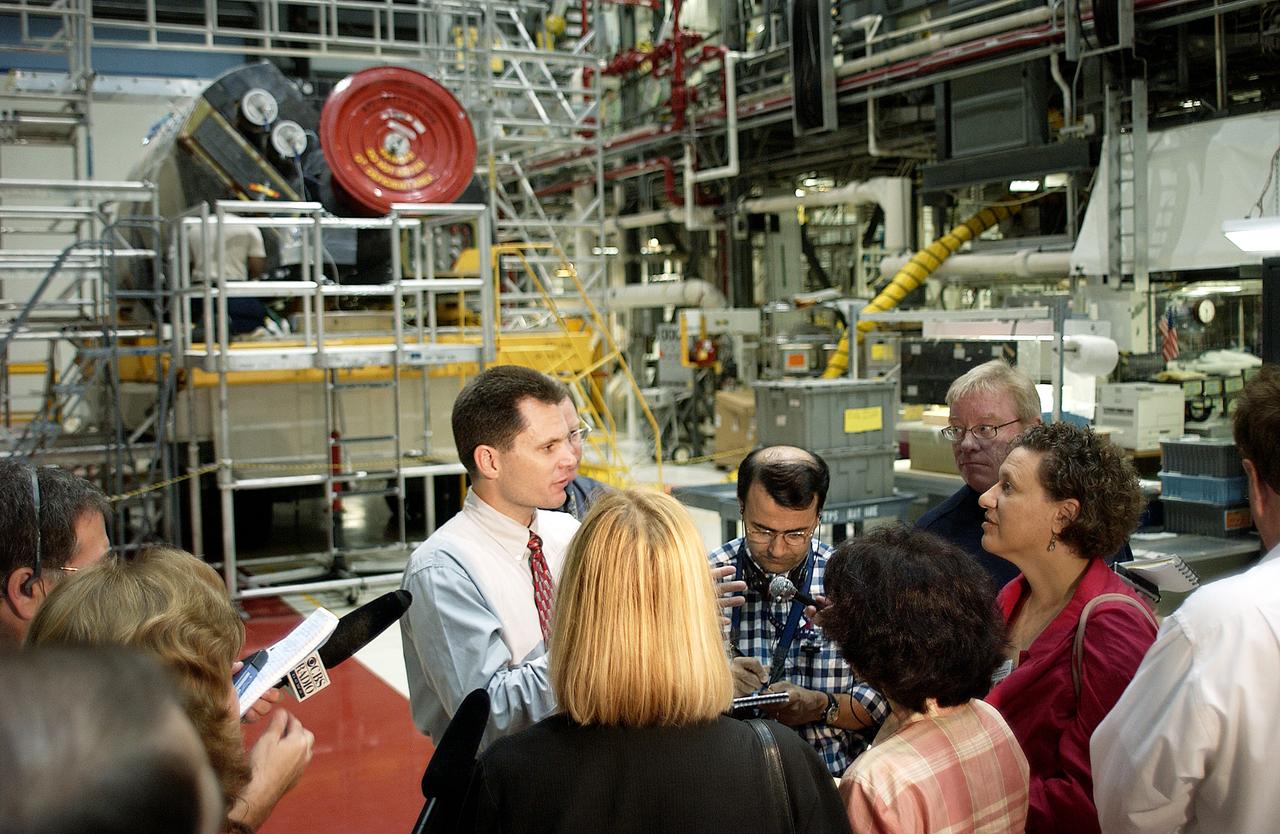
KENNEDY SPACE CENTER, FLA. -  NASA Vehicle Manager Scott Thurston (facing camera) talks to the media in the Orbiter Processing Facility.  The media was invited to see the orbiter Atlantis as it is being prepared for Return to Flight.  Both local and national reporters representing print and TV networks were able to see work in progress on Atlantis, including the reinstallation of the Reinforced Carbon-Carbon panels on the orbiter’s wing leading edge; wiring inspections; and checks of the engines in the Orbital Maneuvering System.
KENNEDY SPACE CENTER, FLA. - NASA Vehicle Manager Scott Thurston (facing camera) talks to the media in the Orbiter Processing Facility. The media was invited to see the orbiter Atlantis as it is being prepared for Return to Flight. Both local and national reporters representing print and TV networks were able to see work in progress on Atlantis, including the reinstallation of the Reinforced Carbon-Carbon panels on the orbiter’s wing leading edge; wiring inspections; and checks of the engines in the Orbital Maneuvering System.
KENNEDY SPACE CENTER, FLA. -  NASA Vehicle Manager Scott Thurston talks to the media in the Orbiter Processing Facility.  The media was invited to see the orbiter Atlantis as it is being prepared for Return to Flight.  Both local and national reporters representing print and TV networks were able to see work in progress on Atlantis, including the reinstallation of the Reinforced Carbon-Carbon panels on the orbiter’s wing leading edge; wiring inspections; and checks of the engines in the Orbital Maneuvering System.
KENNEDY SPACE CENTER, FLA. - NASA Vehicle Manager Scott Thurston talks to the media in the Orbiter Processing Facility. The media was invited to see the orbiter Atlantis as it is being prepared for Return to Flight. Both local and national reporters representing print and TV networks were able to see work in progress on Atlantis, including the reinstallation of the Reinforced Carbon-Carbon panels on the orbiter’s wing leading edge; wiring inspections; and checks of the engines in the Orbital Maneuvering System.
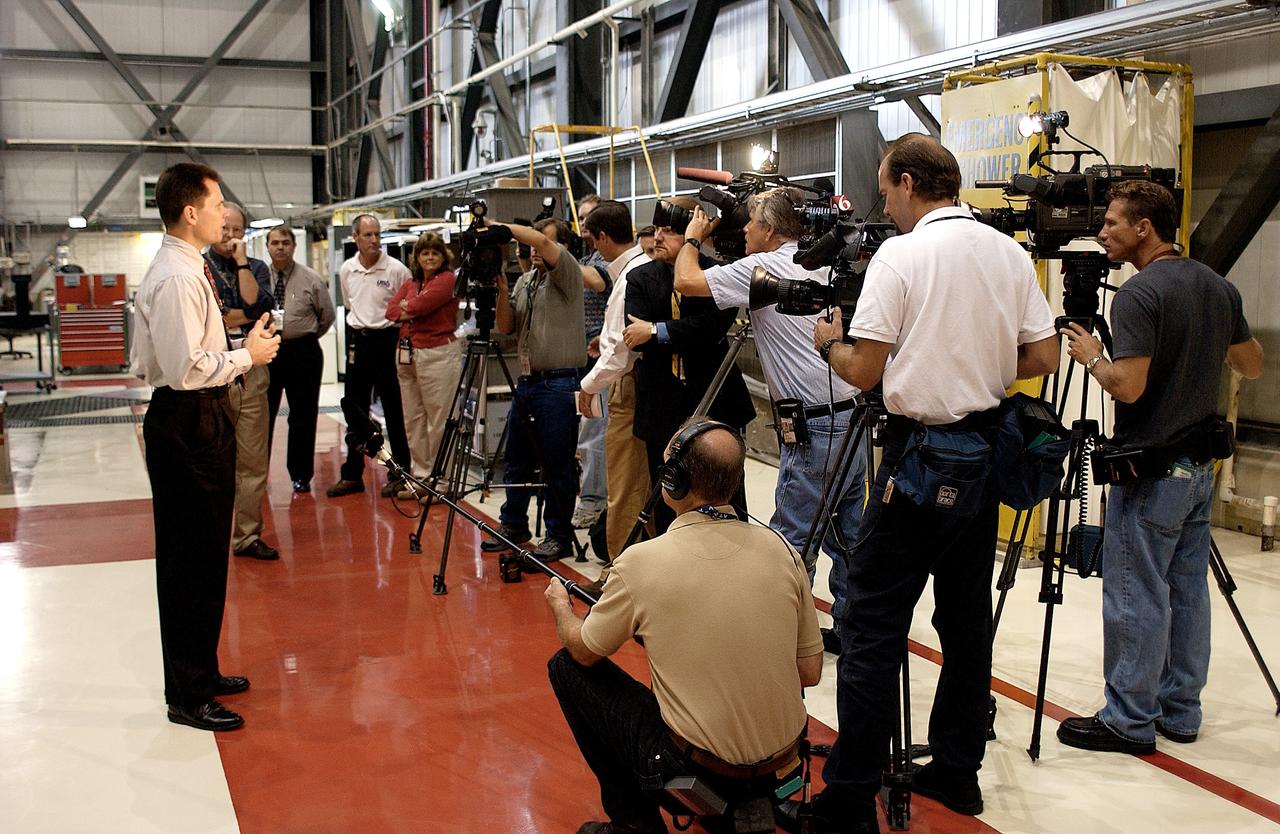
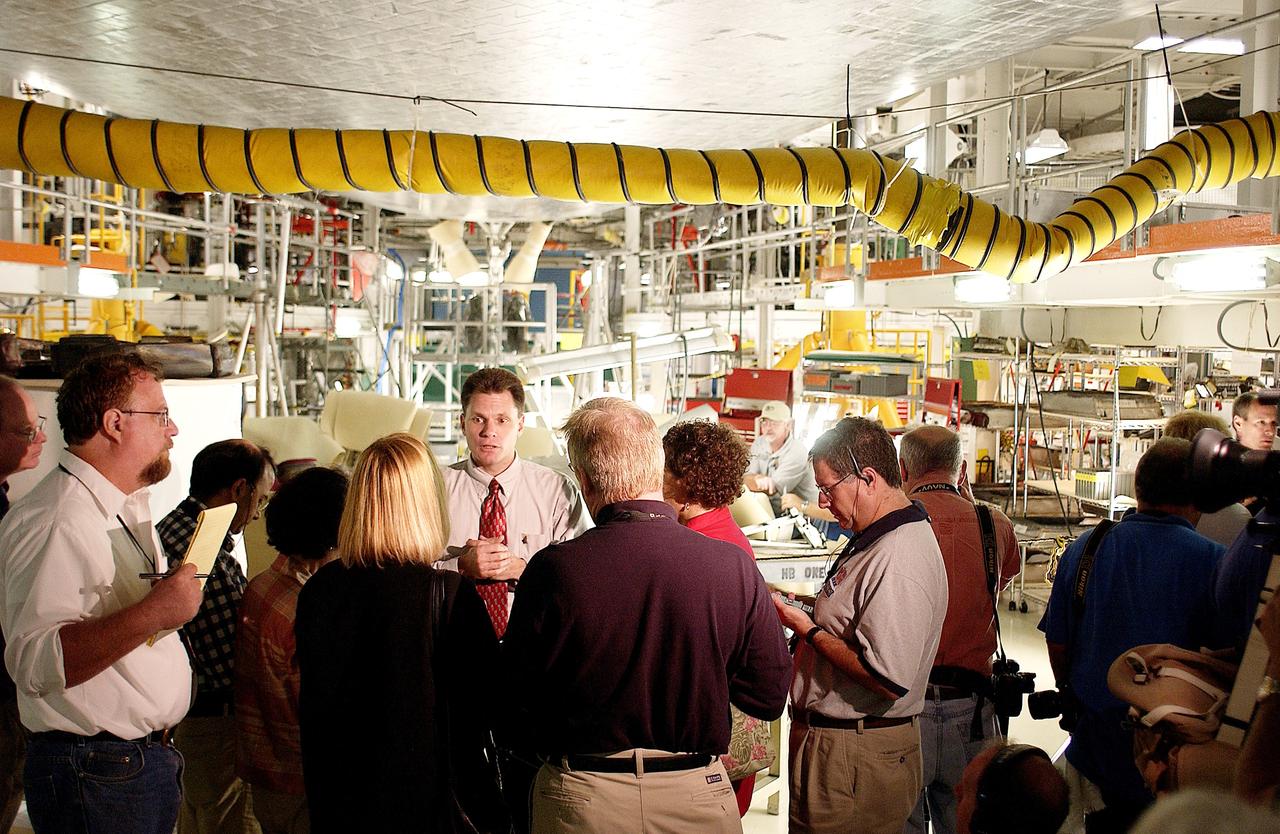
KENNEDY SPACE CENTER, FLA. - NASA Vehicle Manager Scott Thurston (left) talks to a phalanx of media in the Orbiter Processing Facility.  The media was invited to see the orbiter Atlantis as it is being prepared for Return to Flight.  Both local and national reporters representing print and TV networks were able to see work in progress on Atlantis, including the reinstallation of the Reinforced Carbon-Carbon panels on the orbiter’s wing leading edge; wiring inspections; and checks of the engines in the Orbital Maneuvering System.
KENNEDY SPACE CENTER, FLA. - NASA Vehicle Manager Scott Thurston (left) talks to a phalanx of media in the Orbiter Processing Facility. The media was invited to see the orbiter Atlantis as it is being prepared for Return to Flight. Both local and national reporters representing print and TV networks were able to see work in progress on Atlantis, including the reinstallation of the Reinforced Carbon-Carbon panels on the orbiter’s wing leading edge; wiring inspections; and checks of the engines in the Orbital Maneuvering System.
KENNEDY SPACE CENTER, FLA. -  NASA Vehicle Manager Scott Thurston (facing camera) talks to the media in the Orbiter Processing Facility.  The media was invited to see the orbiter Atlantis as it is being prepared for Return to Flight.  Both local and national reporters representing print and TV networks were able to see work in progress on Atlantis, including the reinstallation of the Reinforced Carbon-Carbon panels on the orbiter’s wing leading edge; wiring inspections; and checks of the engines in the Orbital Maneuvering System.
KENNEDY SPACE CENTER, FLA. - NASA Vehicle Manager Scott Thurston (facing camera) talks to the media in the Orbiter Processing Facility. The media was invited to see the orbiter Atlantis as it is being prepared for Return to Flight. Both local and national reporters representing print and TV networks were able to see work in progress on Atlantis, including the reinstallation of the Reinforced Carbon-Carbon panels on the orbiter’s wing leading edge; wiring inspections; and checks of the engines in the Orbital Maneuvering System.
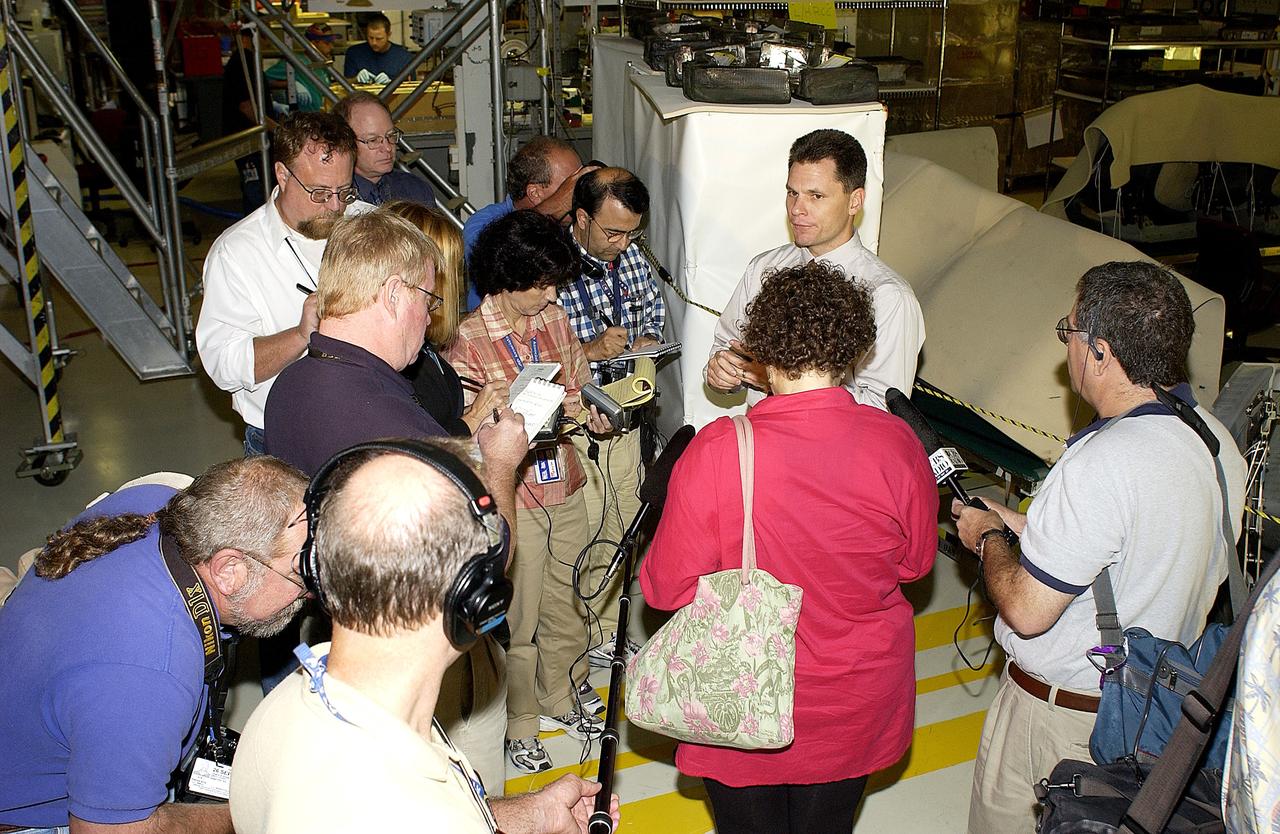
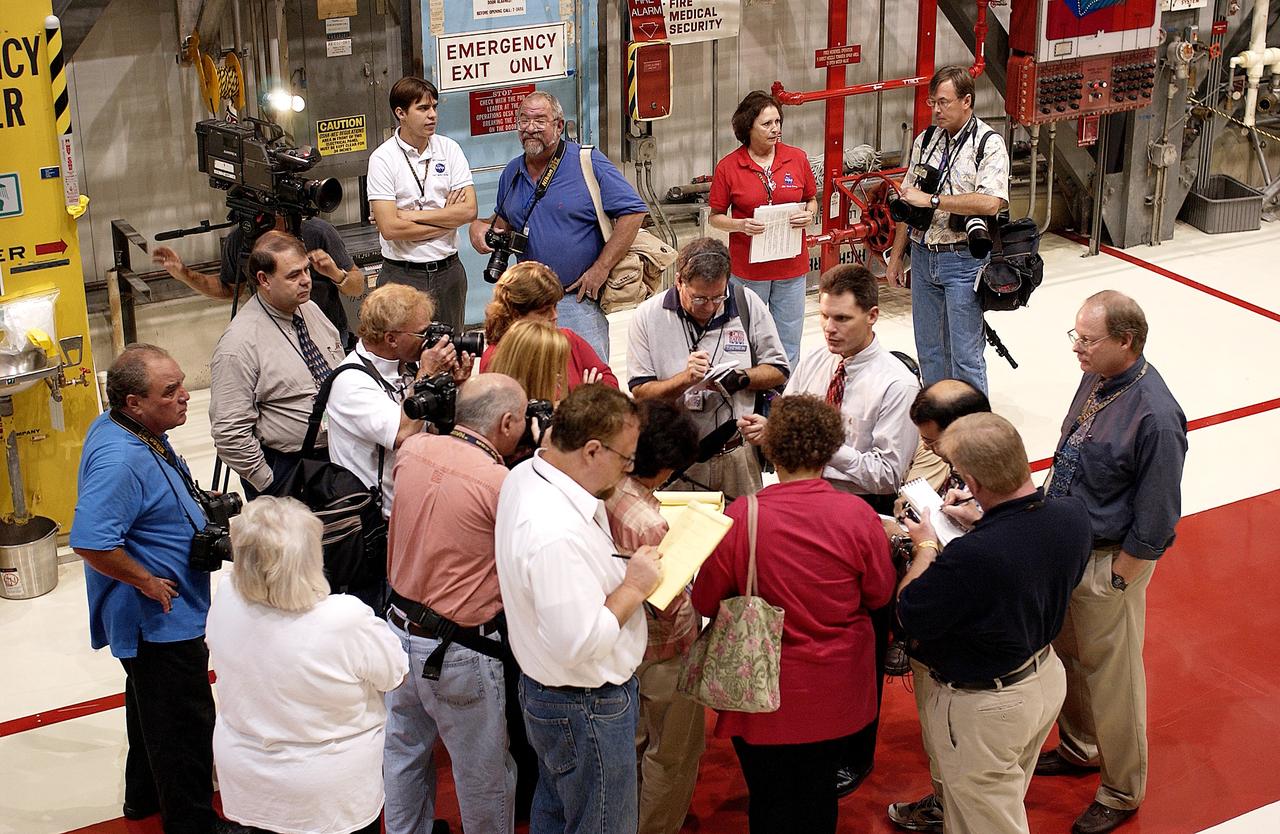
KENNEDY SPACE CENTER, FLA. -   The media gather around NASA Vehicle Manager Scott Thurston (white shirt, right) who talks about some of the work being done on the orbiter Atlantis as it is being prepared for Return to Flight in the Orbiter Processing Facility.   Both local and national reporters representing print and TV networks were able to see work in progress on Atlantis, including the reinstallation of the Reinforced Carbon-Carbon panels on the orbiter’s wing leading edge; wiring inspections; and checks of the engines in the Orbital Maneuvering System.
KENNEDY SPACE CENTER, FLA. - The media gather around NASA Vehicle Manager Scott Thurston (white shirt, right) who talks about some of the work being done on the orbiter Atlantis as it is being prepared for Return to Flight in the Orbiter Processing Facility. Both local and national reporters representing print and TV networks were able to see work in progress on Atlantis, including the reinstallation of the Reinforced Carbon-Carbon panels on the orbiter’s wing leading edge; wiring inspections; and checks of the engines in the Orbital Maneuvering System.
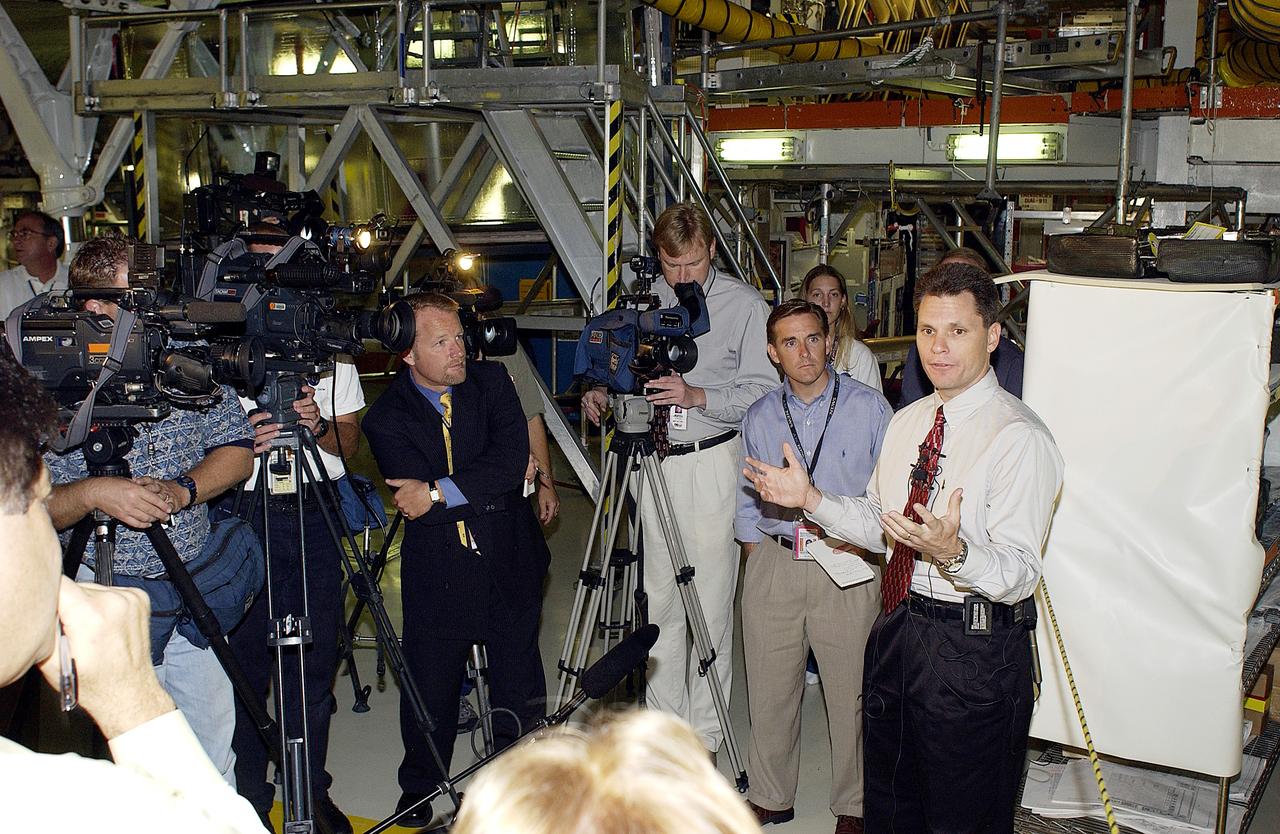
KENNEDY SPACE CENTER, FLA. -   NASA Vehicle Manager Scott Thurston (right)  talks to the media in the Orbiter Processing Facility.  The media was invited to see the orbiter Atlantis as it is being prepared for Return to Flight.  Both local and national reporters representing print and TV networks were able to see work in progress on Atlantis, including the reinstallation of the Reinforced Carbon-Carbon panels on the orbiter’s wing leading edge; wiring inspections; and checks of the engines in the Orbital Maneuvering System.  will be available to discuss the work and answer questions.
KENNEDY SPACE CENTER, FLA. - NASA Vehicle Manager Scott Thurston (right) talks to the media in the Orbiter Processing Facility. The media was invited to see the orbiter Atlantis as it is being prepared for Return to Flight. Both local and national reporters representing print and TV networks were able to see work in progress on Atlantis, including the reinstallation of the Reinforced Carbon-Carbon panels on the orbiter’s wing leading edge; wiring inspections; and checks of the engines in the Orbital Maneuvering System. will be available to discuss the work and answer questions.
KENNEDY SPACE CENTER, FLA. -   NASA Vehicle Manager Scott Thurston (right)  talks to the media in the Orbiter Processing Facility .  The media was invited to see the orbiter Atlantis as it is being prepared for Return to Flight.  Both local and national reporters representing print and TV networks were able to see work in progress on Atlantis, including the reinstallation of the Reinforced Carbon-Carbon panels on the orbiter’s wing leading edge; wiring inspections; and checks of the engines in the Orbital Maneuvering System.
KENNEDY SPACE CENTER, FLA. - NASA Vehicle Manager Scott Thurston (right) talks to the media in the Orbiter Processing Facility . The media was invited to see the orbiter Atlantis as it is being prepared for Return to Flight. Both local and national reporters representing print and TV networks were able to see work in progress on Atlantis, including the reinstallation of the Reinforced Carbon-Carbon panels on the orbiter’s wing leading edge; wiring inspections; and checks of the engines in the Orbital Maneuvering System.
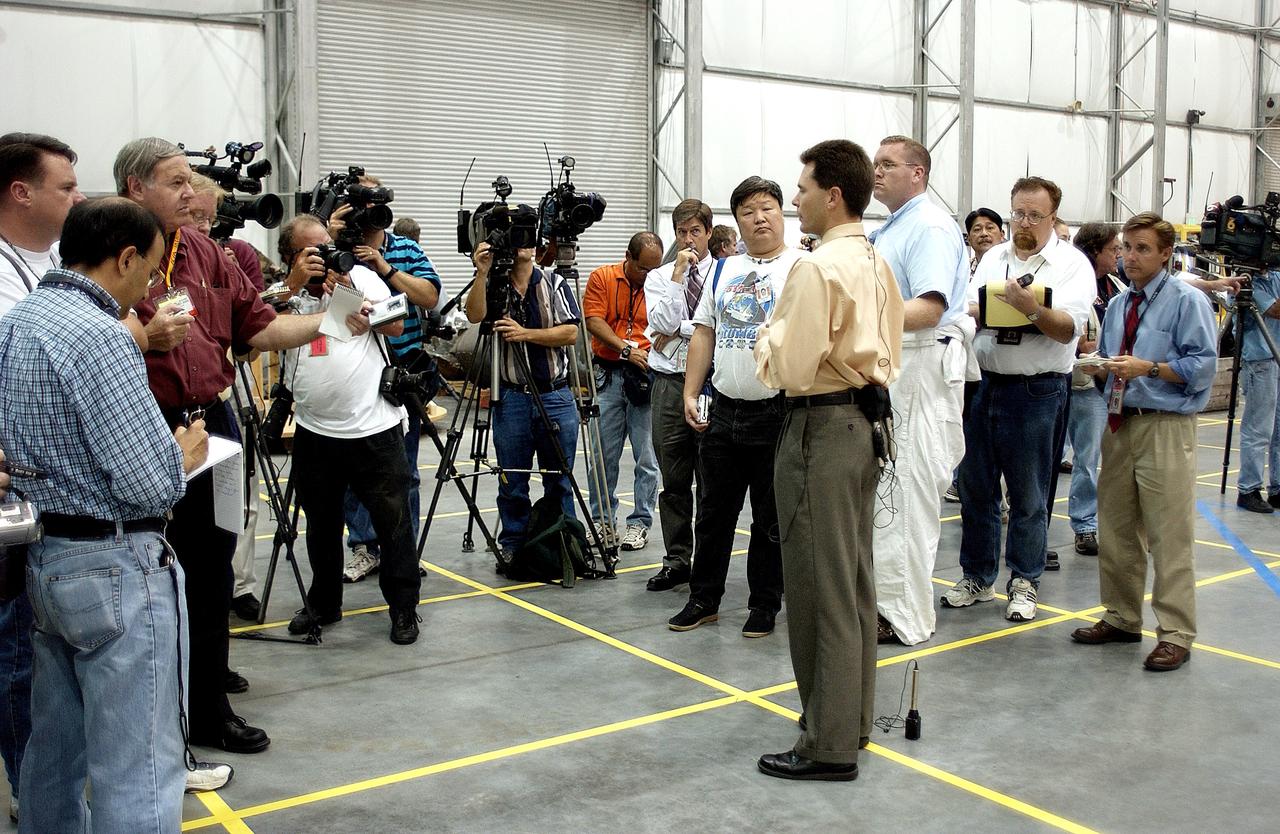
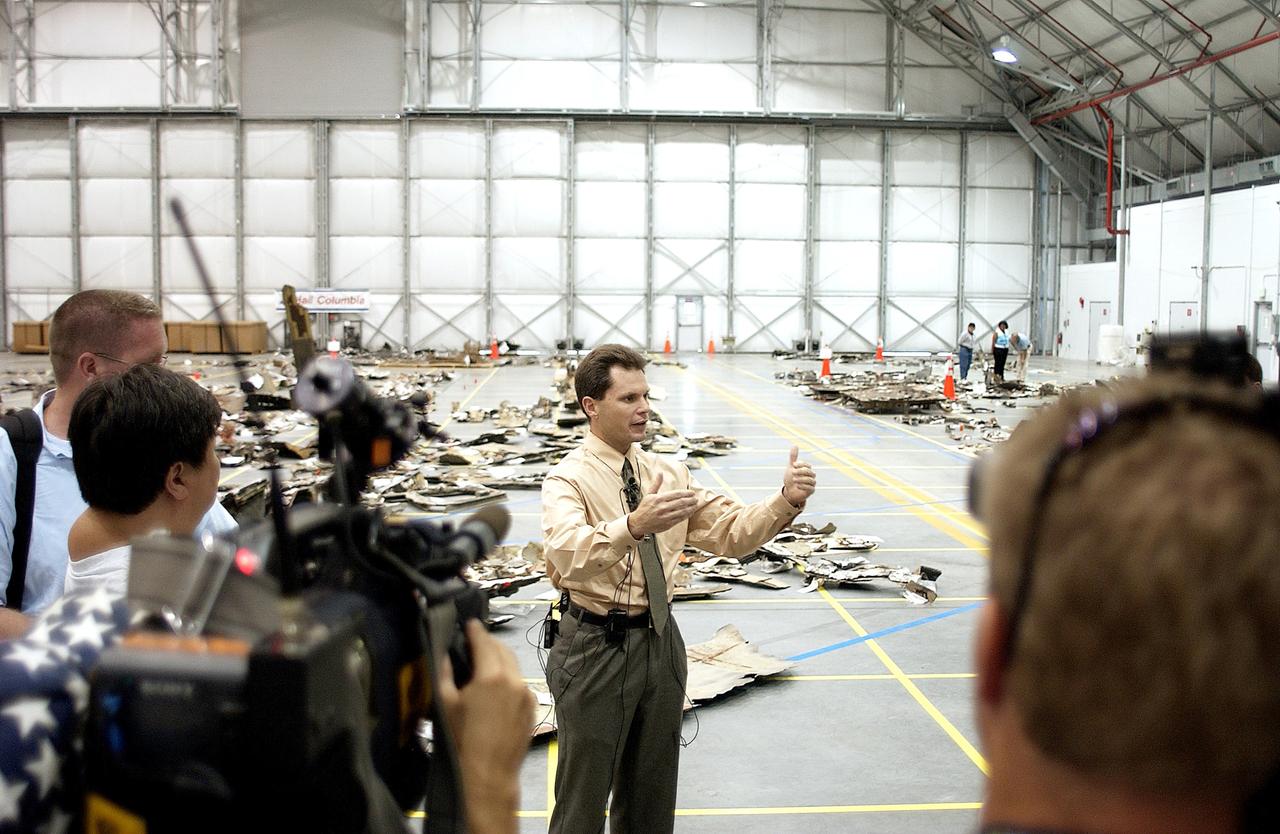
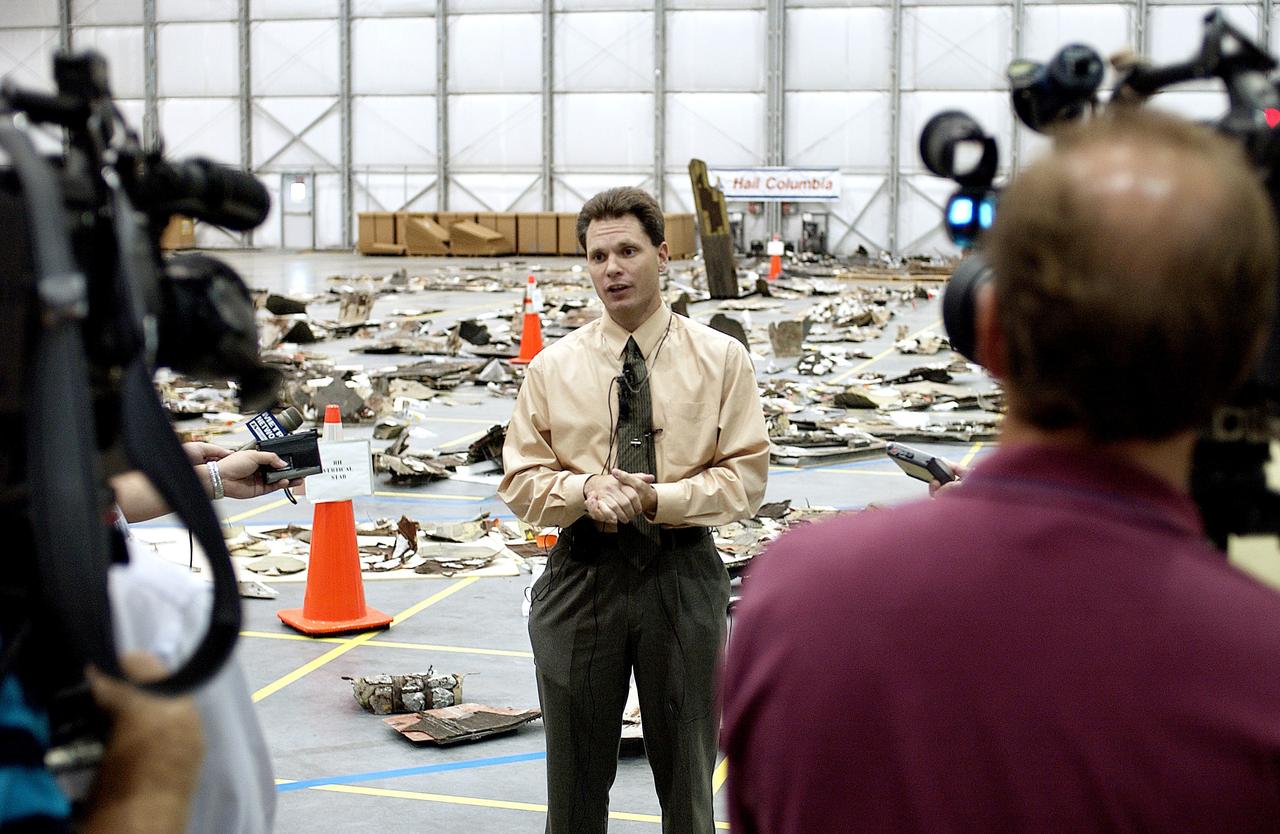
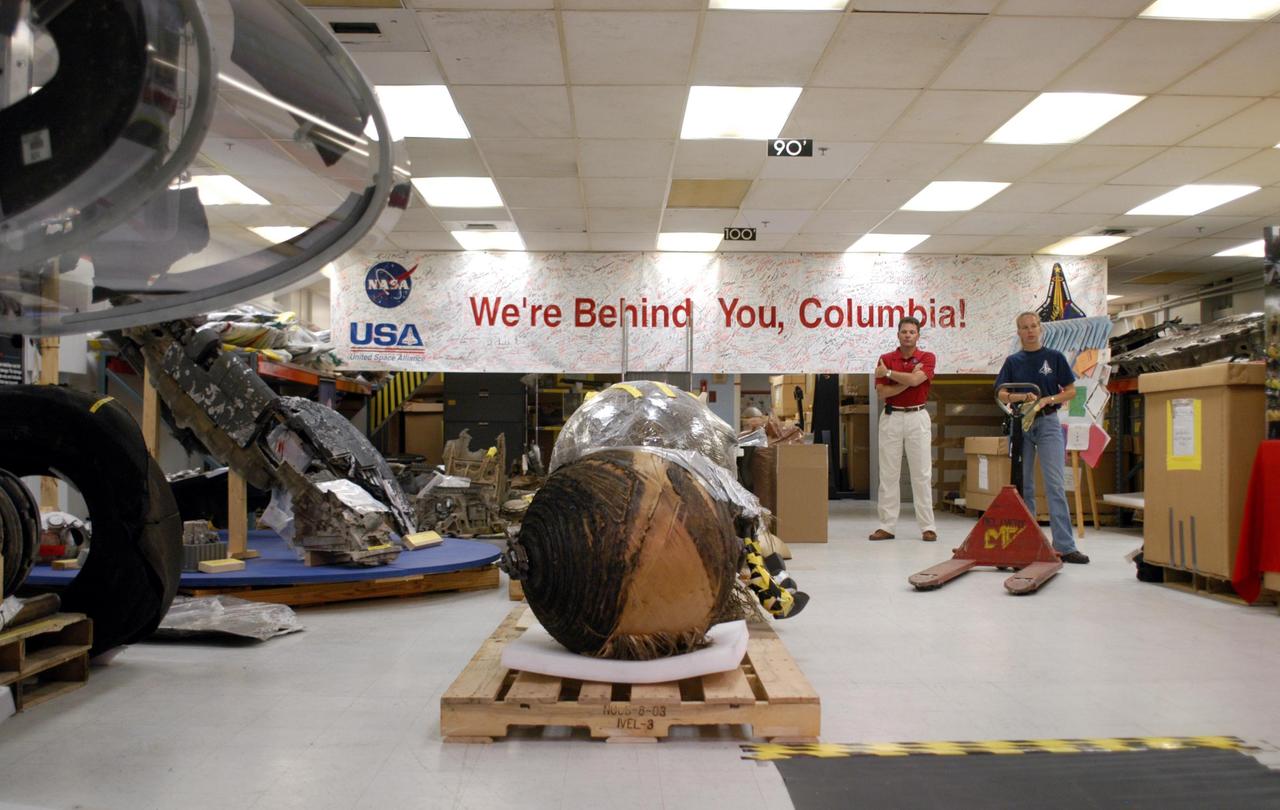
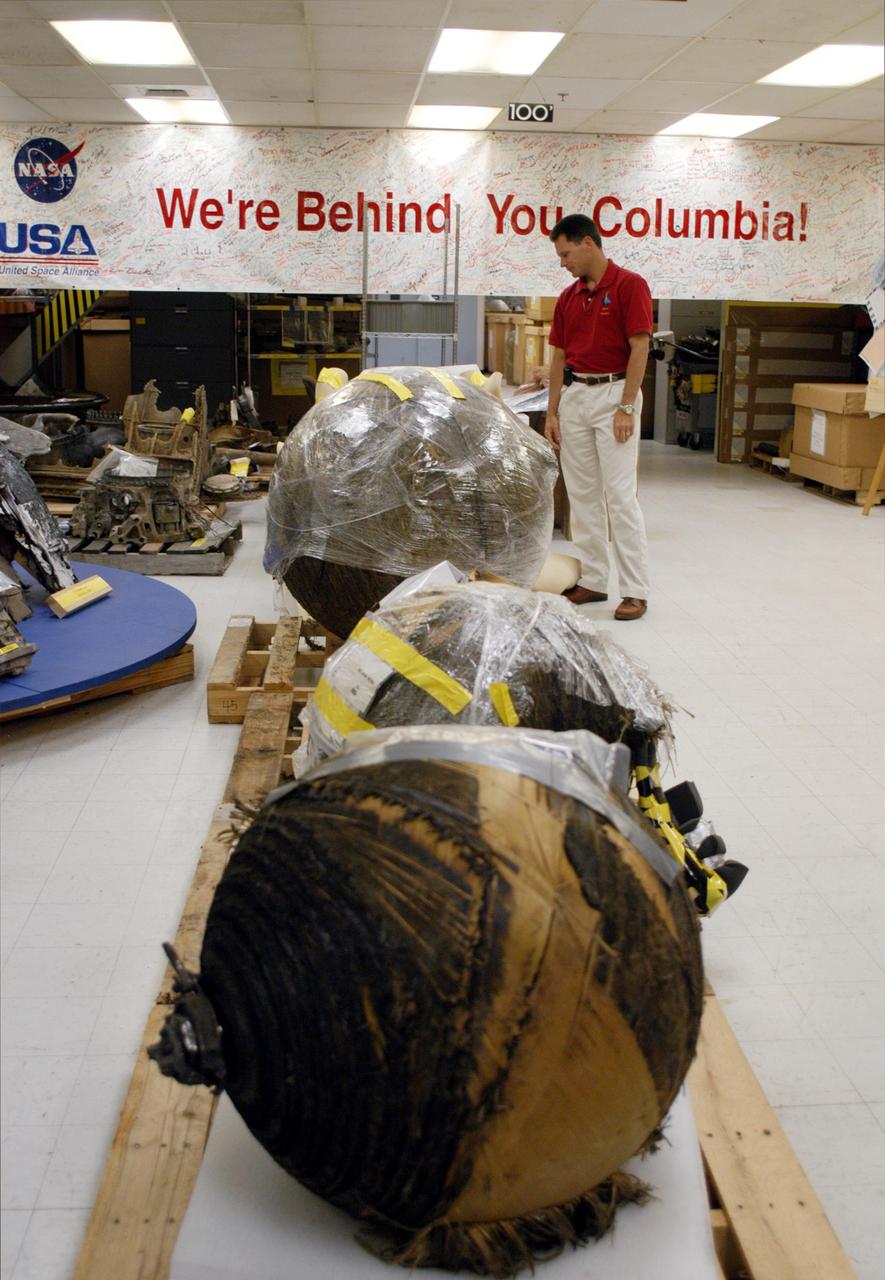
KENNEDY SPACE CENTER, FLA. - In the Columbia Debris Hangar, Scott Thurston, NASA vehicle flow manager, addresses the media about efforts to pack the debris stored in the Columbia Debris Hangar.  More than 83,000  pieces of debris were shipped to KSC during search and recovery efforts in East Texas. That represents about 38 percent of the dry weight of Columbia, equaling almost 85,000 pounds. An area of the Vehicle Assembly Building is being prepared to store the debris permanently.
KENNEDY SPACE CENTER, FLA. - In the Columbia Debris Hangar, Scott Thurston, NASA vehicle flow manager, addresses the media about efforts to pack the debris stored in the Columbia Debris Hangar. More than 83,000 pieces of debris were shipped to KSC during search and recovery efforts in East Texas. That represents about 38 percent of the dry weight of Columbia, equaling almost 85,000 pounds. An area of the Vehicle Assembly Building is being prepared to store the debris permanently.
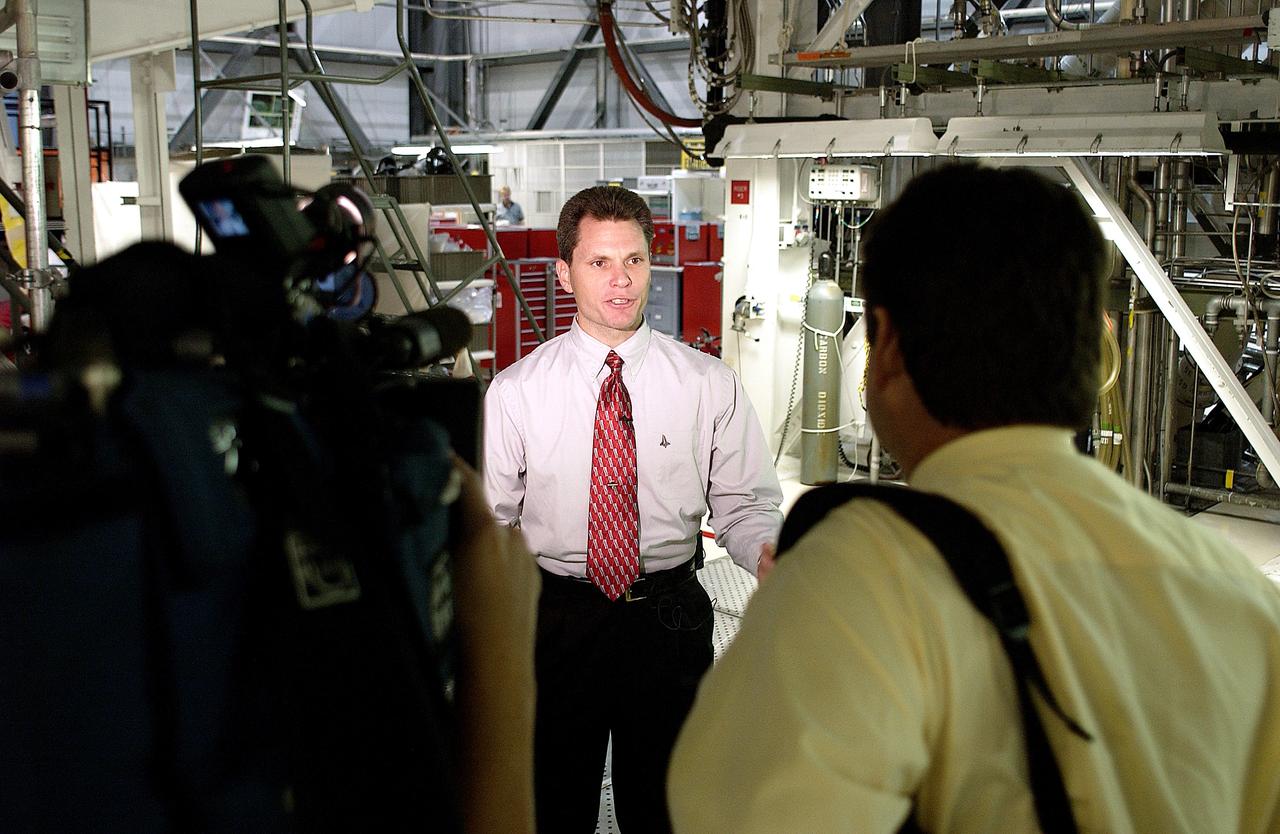
KENNEDY SPACE CENTER, FLA. -   NASA Vehicle Manager Scott Thurston talks to the media in the Orbiter Processing Facility.  The media was invited to see the orbiter Atlantis as it is being prepared for Return to Flight.  Both local and national reporters representing print and TV networks were able to see work in progress on Atlantis, including the reinstallation of the Reinforced Carbon-Carbon panels on the orbiter’s wing leading edge; wiring inspections; and checks of the engines in the Orbital Maneuvering System.
KENNEDY SPACE CENTER, FLA. - NASA Vehicle Manager Scott Thurston talks to the media in the Orbiter Processing Facility. The media was invited to see the orbiter Atlantis as it is being prepared for Return to Flight. Both local and national reporters representing print and TV networks were able to see work in progress on Atlantis, including the reinstallation of the Reinforced Carbon-Carbon panels on the orbiter’s wing leading edge; wiring inspections; and checks of the engines in the Orbital Maneuvering System.
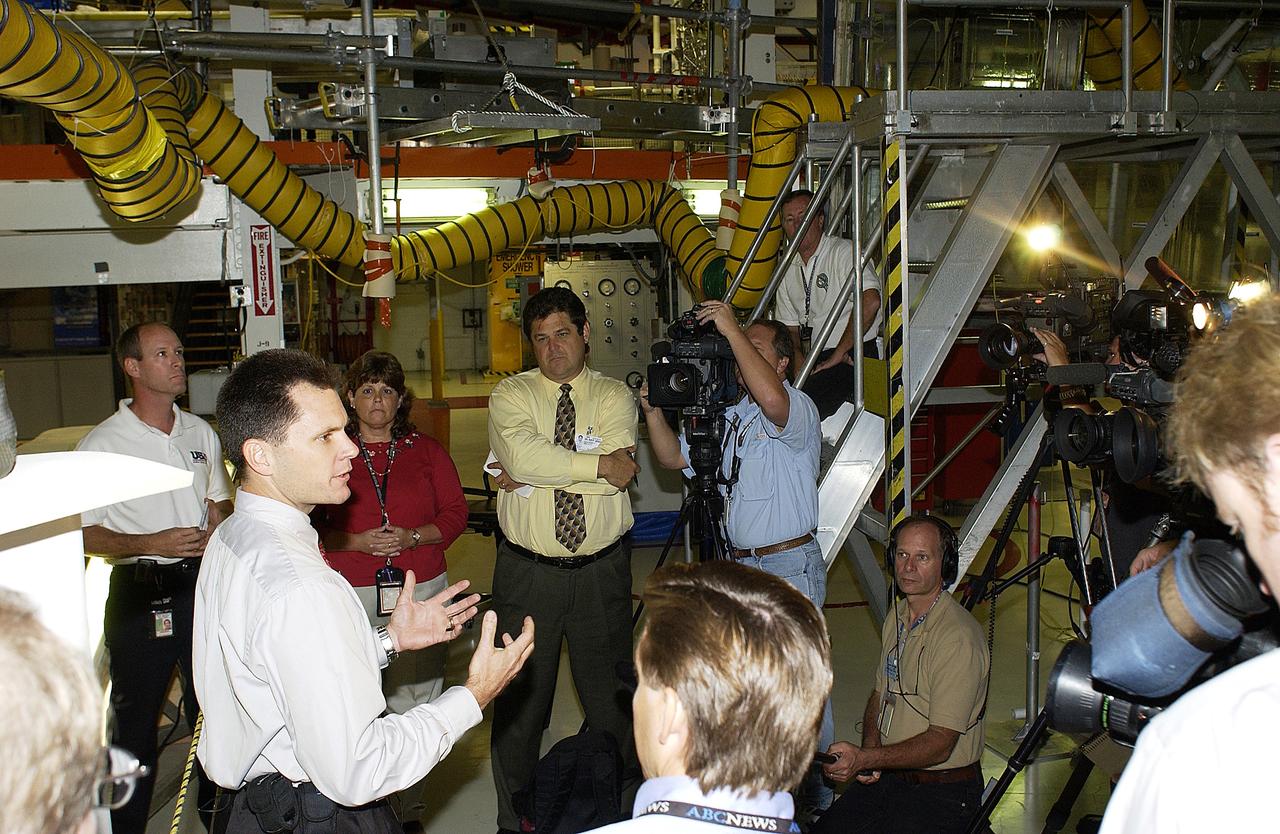
KENNEDY SPACE CENTER, FLA. -   NASA Vehicle Manager Scott Thurston (hands extended) talks to the media in the Orbiter Processing Facility.  The media was invited to see the orbiter Atlantis as it is being prepared for Return to Flight.  Both local and national reporters representing print and TV networks were able to see work in progress on Atlantis, including the reinstallation of the Reinforced Carbon-Carbon panels on the orbiter’s wing leading edge; wiring inspections; and checks of the engines in the Orbital Maneuvering System.
KENNEDY SPACE CENTER, FLA. - NASA Vehicle Manager Scott Thurston (hands extended) talks to the media in the Orbiter Processing Facility. The media was invited to see the orbiter Atlantis as it is being prepared for Return to Flight. Both local and national reporters representing print and TV networks were able to see work in progress on Atlantis, including the reinstallation of the Reinforced Carbon-Carbon panels on the orbiter’s wing leading edge; wiring inspections; and checks of the engines in the Orbital Maneuvering System.
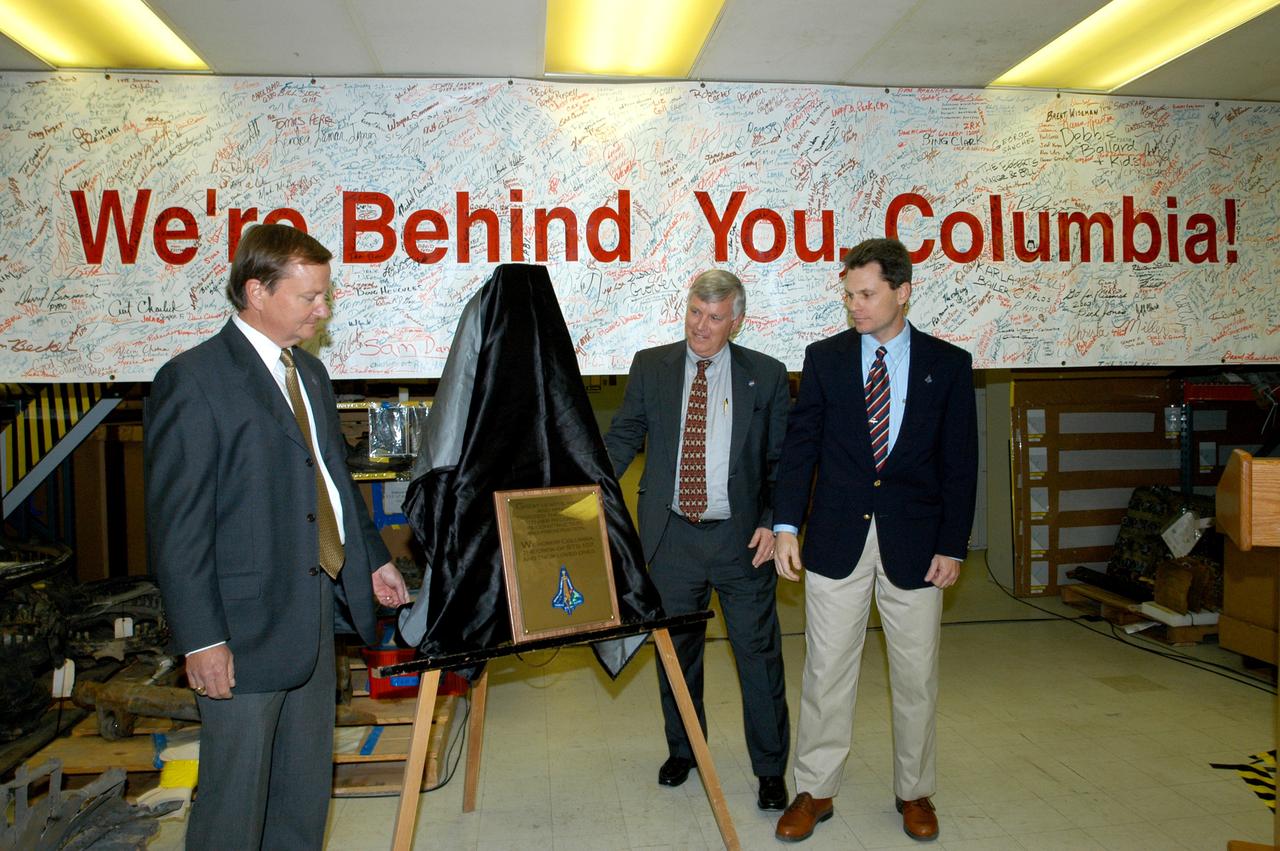
KENNEDY SPACE CENTER, FLA. -  In the Vehicle Assembly Building, Shuttle Launch Director Mike Leinbach, Center Director Jim Kennedy and NASA Vehicle Manager Scott Thurston unveil a plaque honoring “Columbia, the crew of STS-107, and their loved ones.”  The site is the “Columbia room,” a permanent repository of the debris collected in the aftermath of the tragic accident Feb. 1, 2003, that claimed the orbiter and lives of the seven-member crew.  The dedication of the plaque was made in front of the 40-member preservation team.
KENNEDY SPACE CENTER, FLA. - In the Vehicle Assembly Building, Shuttle Launch Director Mike Leinbach, Center Director Jim Kennedy and NASA Vehicle Manager Scott Thurston unveil a plaque honoring “Columbia, the crew of STS-107, and their loved ones.” The site is the “Columbia room,” a permanent repository of the debris collected in the aftermath of the tragic accident Feb. 1, 2003, that claimed the orbiter and lives of the seven-member crew. The dedication of the plaque was made in front of the 40-member preservation team.
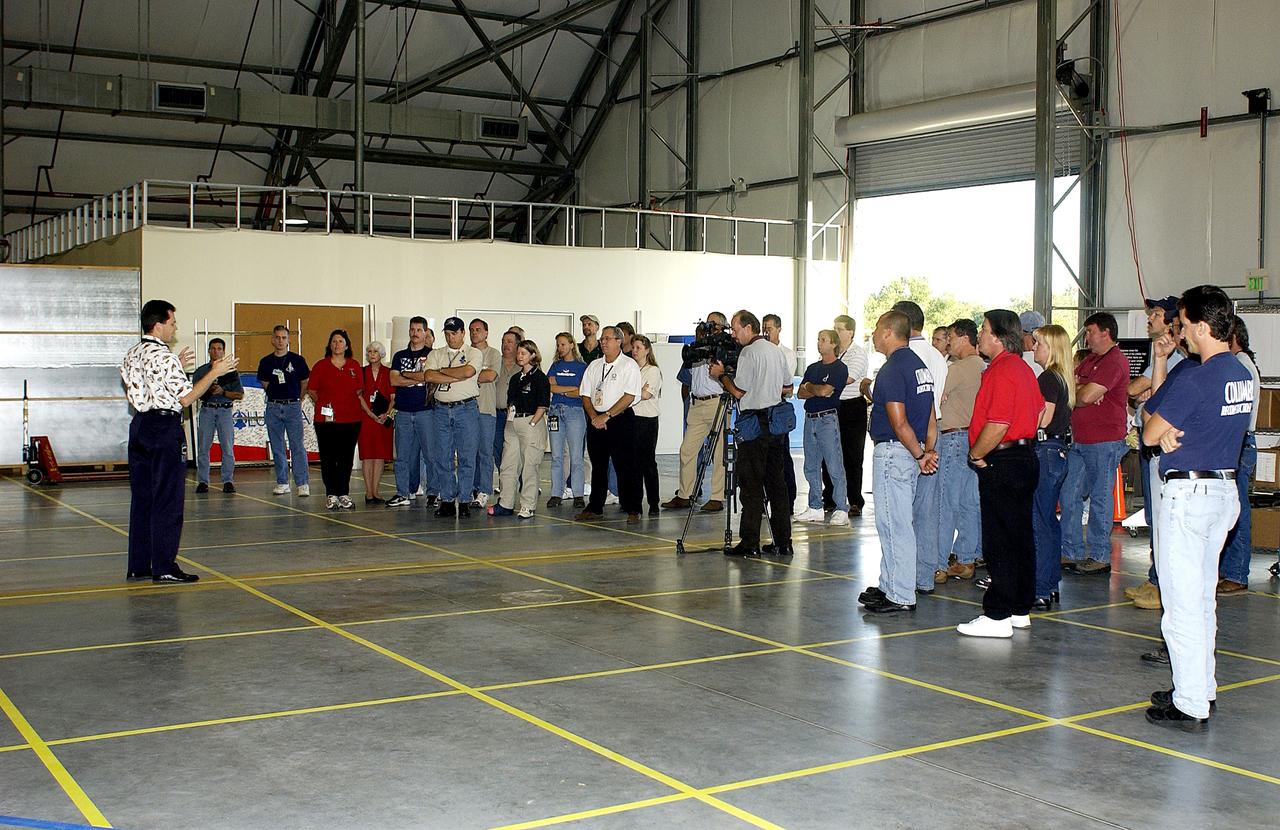
KENNEDY SPACE CENTER, FLA. -  Scott Thurston, NASA vehicle flow manager, speaks to members of the Columbia Reconstruction Team during transfer of debris from the Columbia Debris Hangar to its permanent storage site in the Vehicle Assembly Building.  More than 83,000 pieces of debris were shipped to KSC during search and recovery efforts in East Texas. That represents about 38 percent of the dry weight of Columbia, equaling almost 85,000 pounds.
KENNEDY SPACE CENTER, FLA. - Scott Thurston, NASA vehicle flow manager, speaks to members of the Columbia Reconstruction Team during transfer of debris from the Columbia Debris Hangar to its permanent storage site in the Vehicle Assembly Building. More than 83,000 pieces of debris were shipped to KSC during search and recovery efforts in East Texas. That represents about 38 percent of the dry weight of Columbia, equaling almost 85,000 pounds.
KENNEDY SPACE CENTER, FLA. - In the Columbia Debris Hangar, Scott Thurston, NASA vehicle flow manager, addresses the media about efforts to pack the debris stored in the Columbia Debris Hangar.  More than 83,000  pieces of debris were shipped to KSC during search and recovery efforts in East Texas. That represents about 38 percent of the dry weight of Columbia, equaling almost 85,000 pounds. An area of the Vehicle Assembly Building is being prepared to store the debris permanently.
KENNEDY SPACE CENTER, FLA. - In the Columbia Debris Hangar, Scott Thurston, NASA vehicle flow manager, addresses the media about efforts to pack the debris stored in the Columbia Debris Hangar. More than 83,000 pieces of debris were shipped to KSC during search and recovery efforts in East Texas. That represents about 38 percent of the dry weight of Columbia, equaling almost 85,000 pounds. An area of the Vehicle Assembly Building is being prepared to store the debris permanently.
KENNEDY SPACE CENTER, FLA. - In the Columbia Debris Hangar, Scott Thurston, NASA vehicle flow manager, addresses the media about efforts to pack the debris stored in the Columbia Debris Hangar.  More than 83,000  pieces of debris were shipped to KSC during search and recovery efforts in East Texas. That represents about 38 percent of the dry weight of Columbia, equaling almost 85,000 pounds. An area of the Vehicle Assembly Building is being prepared to store the debris permanently.
KENNEDY SPACE CENTER, FLA. - In the Columbia Debris Hangar, Scott Thurston, NASA vehicle flow manager, addresses the media about efforts to pack the debris stored in the Columbia Debris Hangar. More than 83,000 pieces of debris were shipped to KSC during search and recovery efforts in East Texas. That represents about 38 percent of the dry weight of Columbia, equaling almost 85,000 pounds. An area of the Vehicle Assembly Building is being prepared to store the debris permanently.
KENNEDY SPACE CENTER, FLA. - In the Columbia Debris Hangar, Scott Thurston, NASA vehicle flow manager, addresses the media about efforts to pack the debris stored in the Columbia Debris Hangar.  More than 83,000  pieces of debris were shipped to KSC during search and recovery efforts in East Texas. That represents about 38 percent of the dry weight of Columbia, equaling almost 85,000 pounds. An area of the Vehicle Assembly Building is being prepared to store the debris permanently.
KENNEDY SPACE CENTER, FLA. - In the Columbia Debris Hangar, Scott Thurston, NASA vehicle flow manager, addresses the media about efforts to pack the debris stored in the Columbia Debris Hangar. More than 83,000 pieces of debris were shipped to KSC during search and recovery efforts in East Texas. That represents about 38 percent of the dry weight of Columbia, equaling almost 85,000 pounds. An area of the Vehicle Assembly Building is being prepared to store the debris permanently.
KENNEDY SPACE CENTER, FLA.  - At right, Scott Thurston, NASA vehicle manager for Atlantis, talks about the orbiter, overhead, to author Stephen Covey, at left, and Covey’s executive assistant Julie McAllister, who are touring KSC. Covey also spent time with KSC management discussing his newest book, The 8th Habit.
KSC-05pd-0426
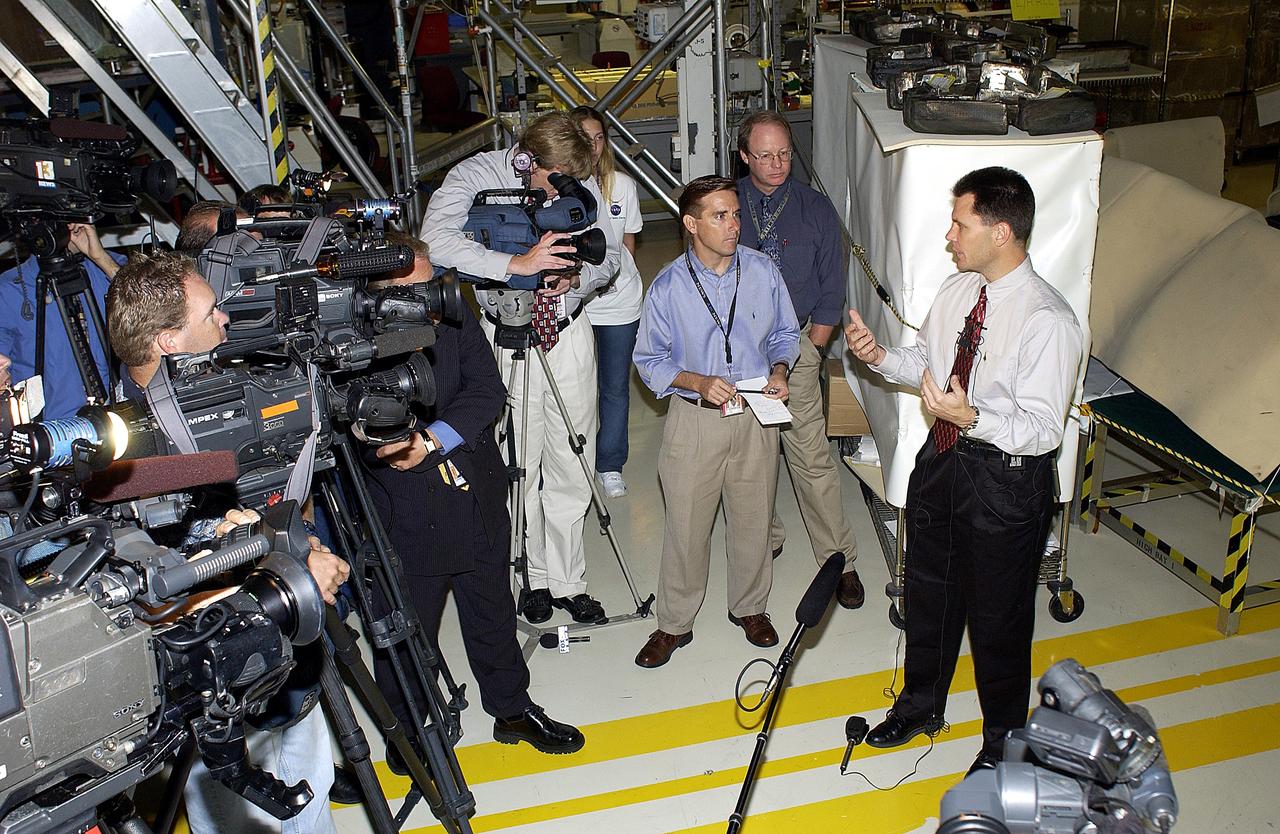
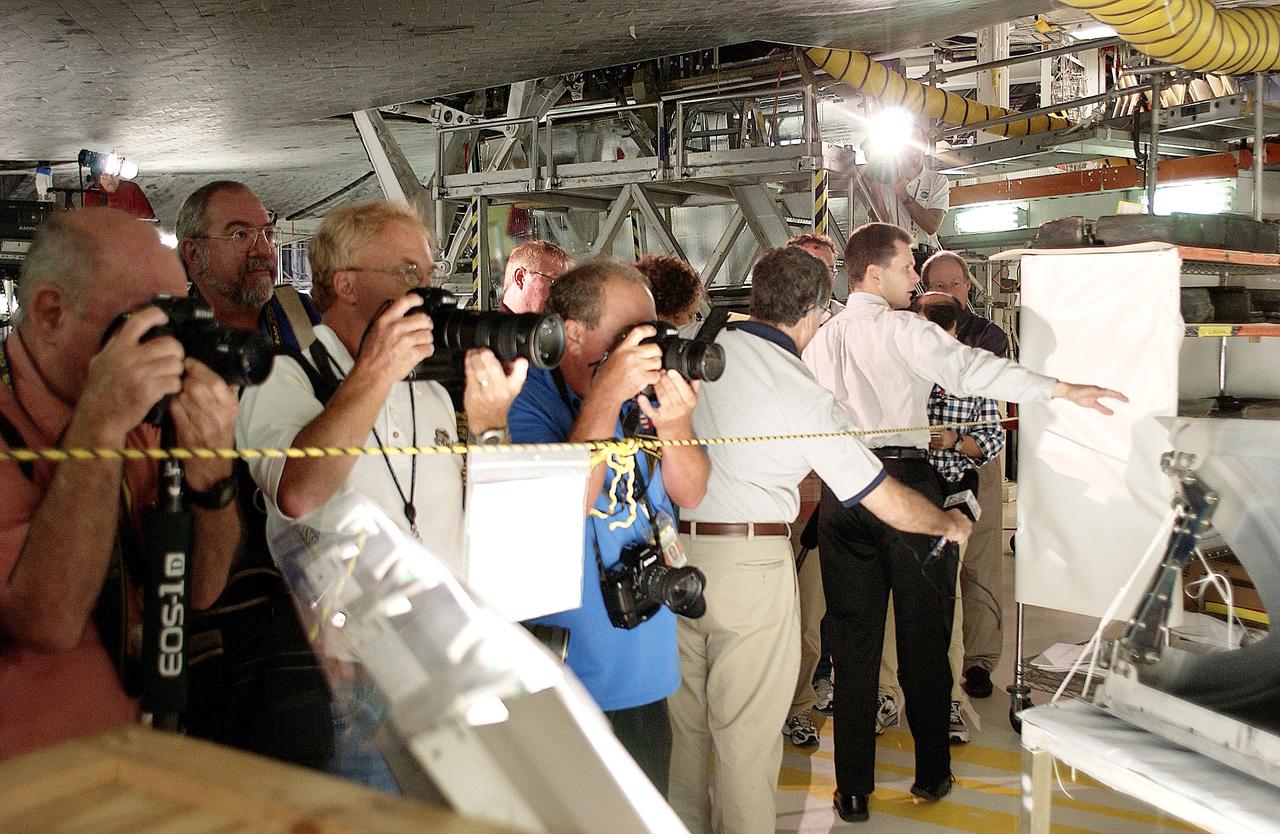
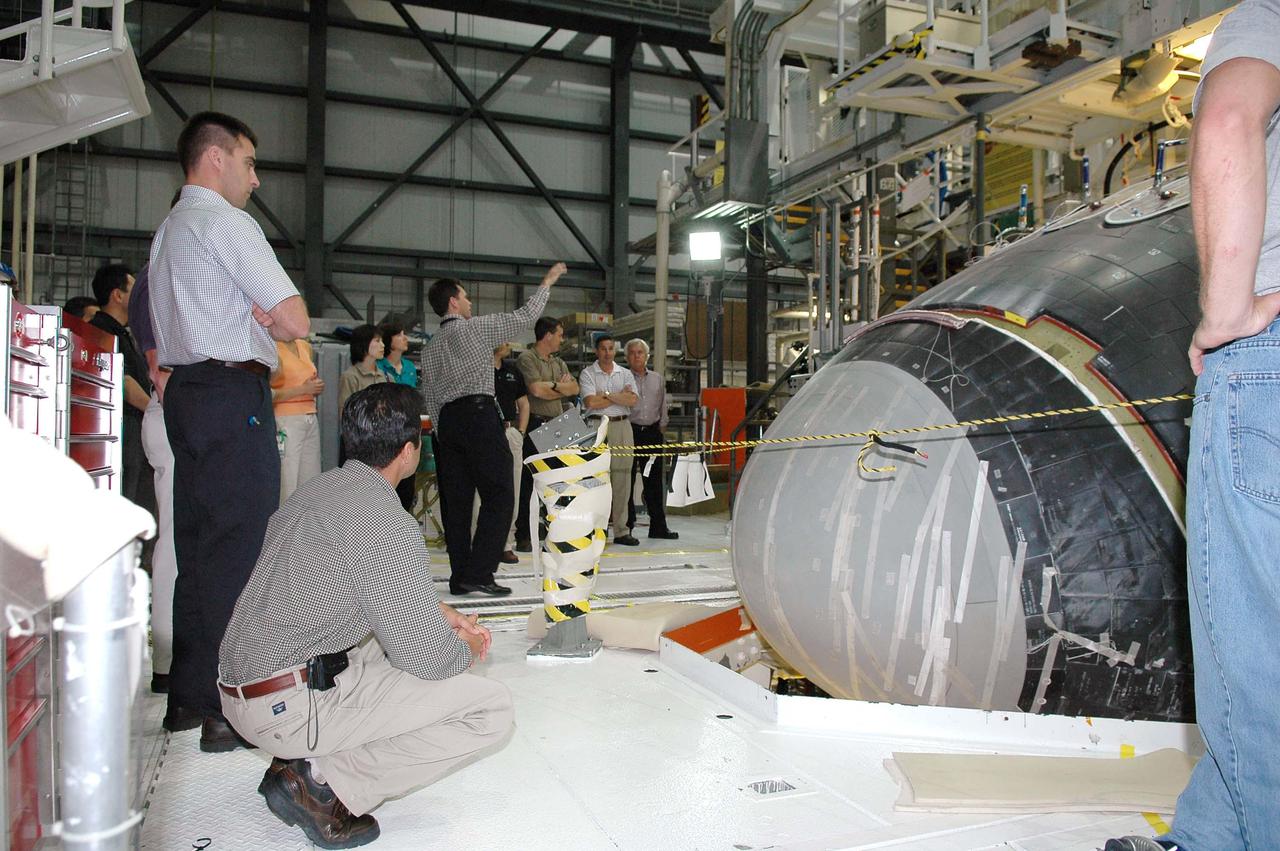
KENNEDY SPACE CENTER, FLA. -  In the Orbiter Processing Facility,  while a few photographers (left) set up for photos, NASA Vehicle Manager Scott Thurston (right, with arm extended) talks about the Reinforced Carbon-Carbon panel at right.   The media was invited to see the orbiter Atlantis as it is being prepared for Return to Flight.  Both local and national reporters representing print and TV networks were able to see work in progress on Atlantis, including the reinstallation of the Reinforced Carbon-Carbon panels on the orbiter’s wing leading edge; wiring inspections; and checks of the engines in the Orbital Maneuvering System.
KENNEDY SPACE CENTER, FLA. - In the Orbiter Processing Facility, while a few photographers (left) set up for photos, NASA Vehicle Manager Scott Thurston (right, with arm extended) talks about the Reinforced Carbon-Carbon panel at right. The media was invited to see the orbiter Atlantis as it is being prepared for Return to Flight. Both local and national reporters representing print and TV networks were able to see work in progress on Atlantis, including the reinstallation of the Reinforced Carbon-Carbon panels on the orbiter’s wing leading edge; wiring inspections; and checks of the engines in the Orbital Maneuvering System.
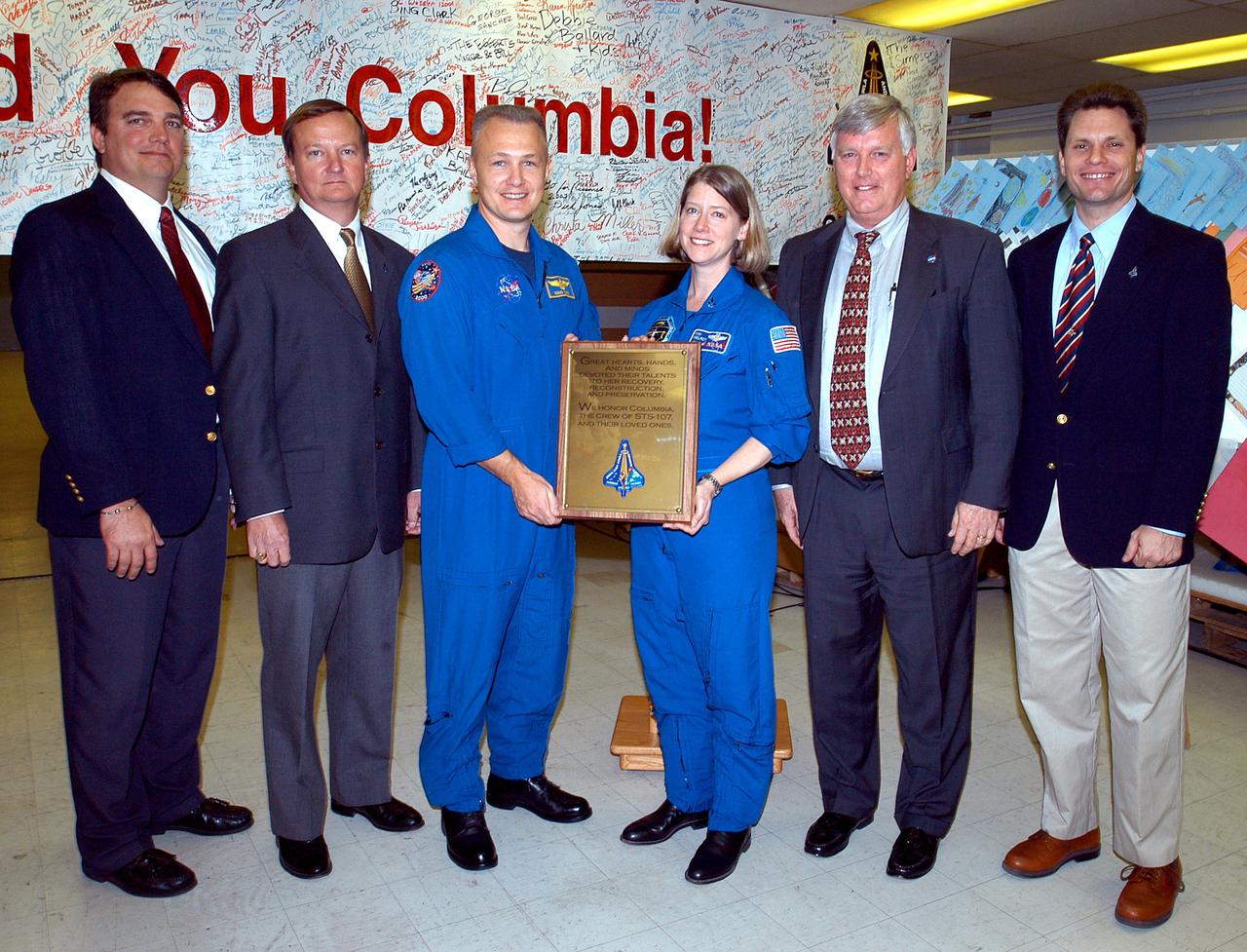
KENNEDY SPACE CENTER, FLA. -  Posing with the plaque dedicated to Columbia Jan. 29, 2004,  are (left to right) United Space Alliance project leader for Columbia reconstruction Jim Comer, Shuttle Launch Director Mike Leinbach, astronauts Douglas Hurley and Pam Melroy, Center Director Jim Kennedy and NASA Vehicle Manager Scott Thurston.  The dedication of the plaque was made in front of the 40-member preservation team in the “Columbia room,” a permanent repository in the Vehicle Assembly Building of the debris collected in the aftermath of the tragic accident Feb. 1, 2003, that claimed the orbiter and lives of the seven-member crew.
KENNEDY SPACE CENTER, FLA. - Posing with the plaque dedicated to Columbia Jan. 29, 2004, are (left to right) United Space Alliance project leader for Columbia reconstruction Jim Comer, Shuttle Launch Director Mike Leinbach, astronauts Douglas Hurley and Pam Melroy, Center Director Jim Kennedy and NASA Vehicle Manager Scott Thurston. The dedication of the plaque was made in front of the 40-member preservation team in the “Columbia room,” a permanent repository in the Vehicle Assembly Building of the debris collected in the aftermath of the tragic accident Feb. 1, 2003, that claimed the orbiter and lives of the seven-member crew.
KENNEDY SPACE CENTER, FLA. -  In the Orbiter Processing Facility, while a few photographers (left) set up for photos of a Reinforced Carbon-Carbon panel at far right, NASA Vehicle Manager Scott Thurston (right) talks to other media.   The media was invited to see the orbiter Atlantis as it is being prepared for Return to Flight.  Both local and national reporters representing print and TV networks were able to see work in progress on Atlantis, including the reinstallation of the Reinforced Carbon-Carbon panels on the orbiter’s wing leading edge; wiring inspections; and checks of the engines in the Orbital Maneuvering System.
KENNEDY SPACE CENTER, FLA. - In the Orbiter Processing Facility, while a few photographers (left) set up for photos of a Reinforced Carbon-Carbon panel at far right, NASA Vehicle Manager Scott Thurston (right) talks to other media. The media was invited to see the orbiter Atlantis as it is being prepared for Return to Flight. Both local and national reporters representing print and TV networks were able to see work in progress on Atlantis, including the reinstallation of the Reinforced Carbon-Carbon panels on the orbiter’s wing leading edge; wiring inspections; and checks of the engines in the Orbital Maneuvering System.
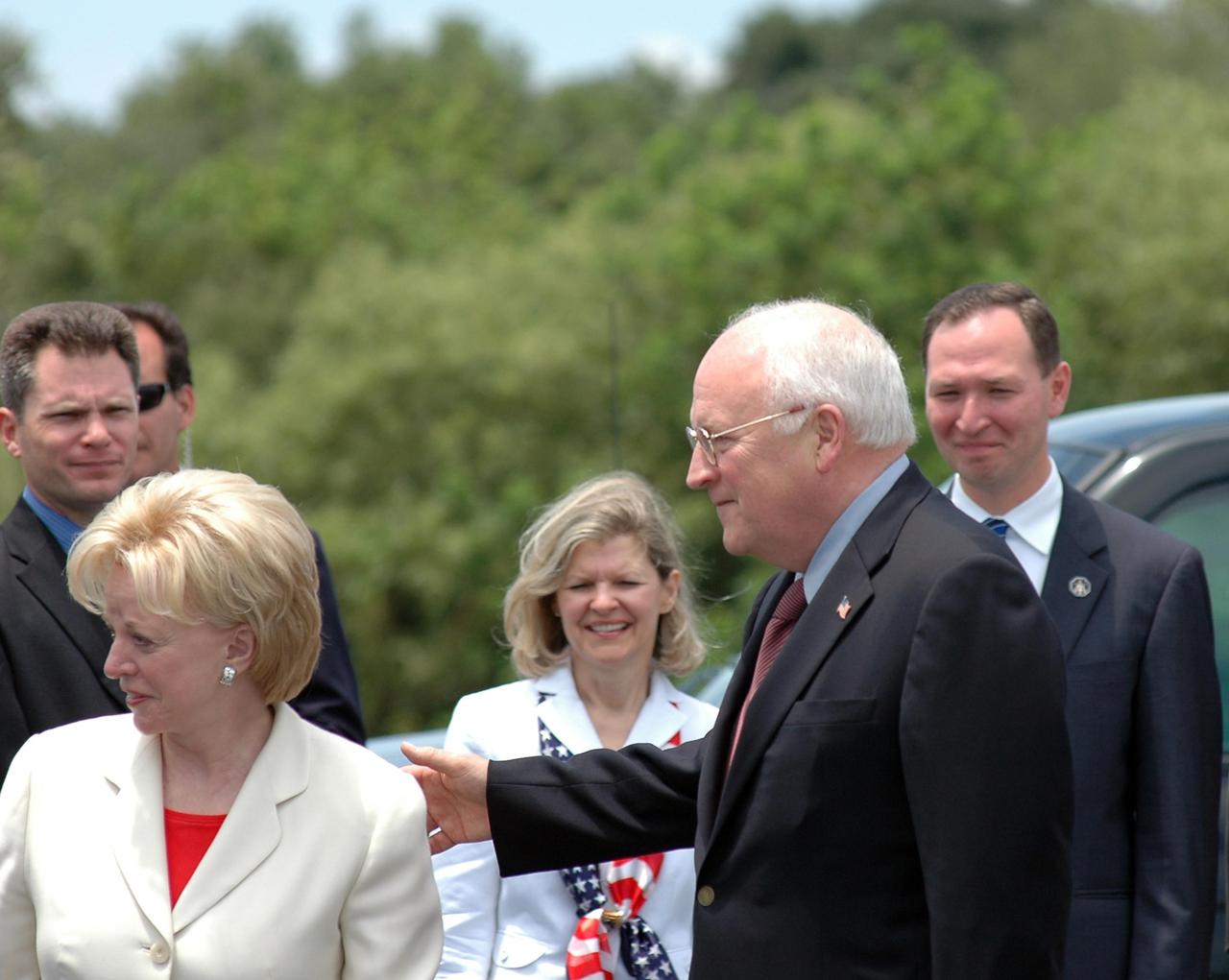
KENNEDY SPACE CENTER, FLA. -   U.S. Vice President Dick Cheney and his wife, Lynne, are greeted at the Skid Strip, Cape Canaveral Air Force Station, in Florida, after their landing.  Behind Mrs. Cheney is NASA Vehicle Manager Scott Thurston.  At center is Pam Adams, with External Relations.  On the far right is J.T. Jezierski, NASA deputy chief of staff and White House liaison.  Cheney and his family flew in to view the launch of Space Shuttle Discovery on mission STS-121.  Photo credit: NASA/Kim Shiflett
KSC-06pd1343
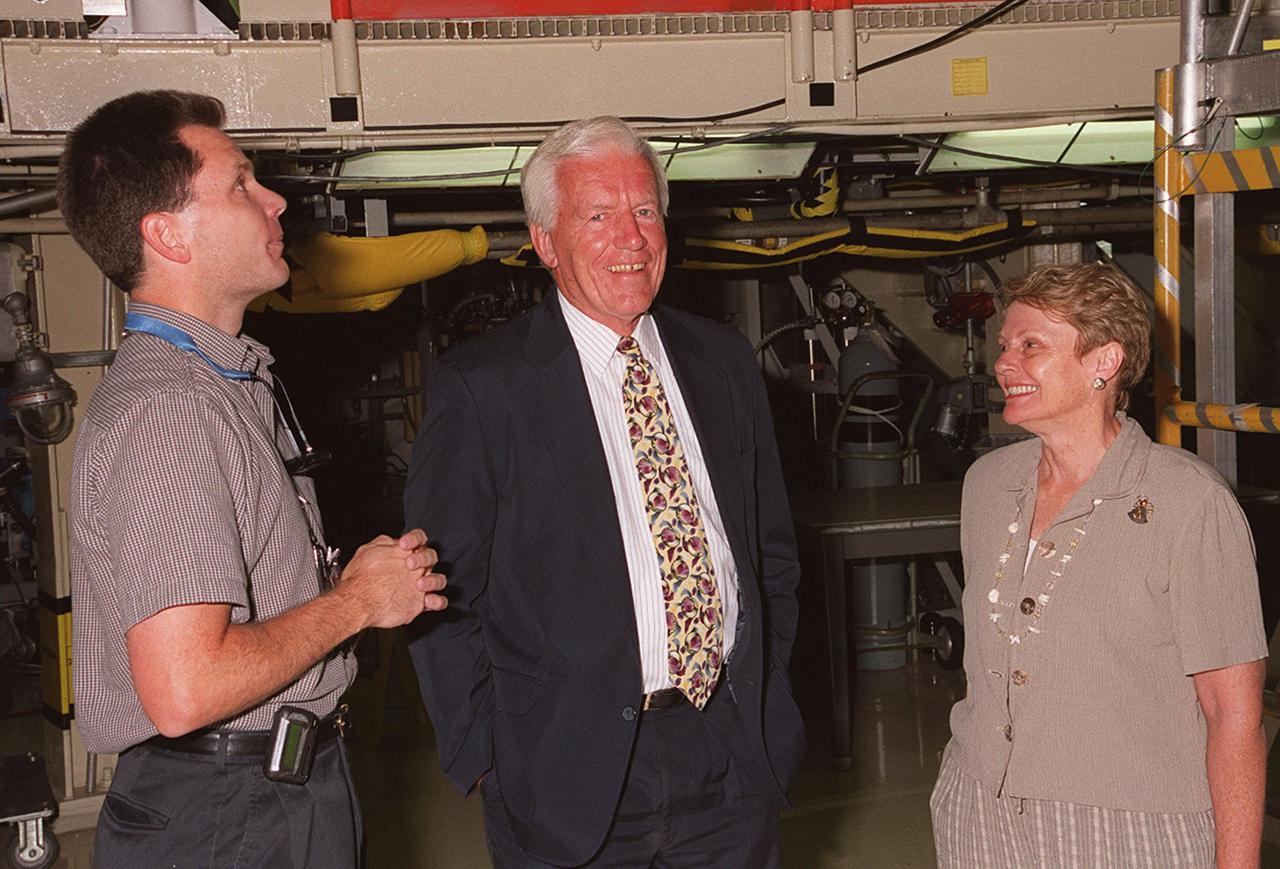
KENNEDY SPACE CENTER, FLA. -- The Undersecretary of the Air Force Dr. Lawrence Delaney (center) and his wife, Angie (right), are escorted around the Orbiter Processing Facility bay 3 by Scott Thurston (left). The orbiter Columbia is currently in bay 3 being prepared for mission STS-109. Targeted for launch in January 2002, STS-109 is a Hubble servicing mission.
ksc-01pp-1408
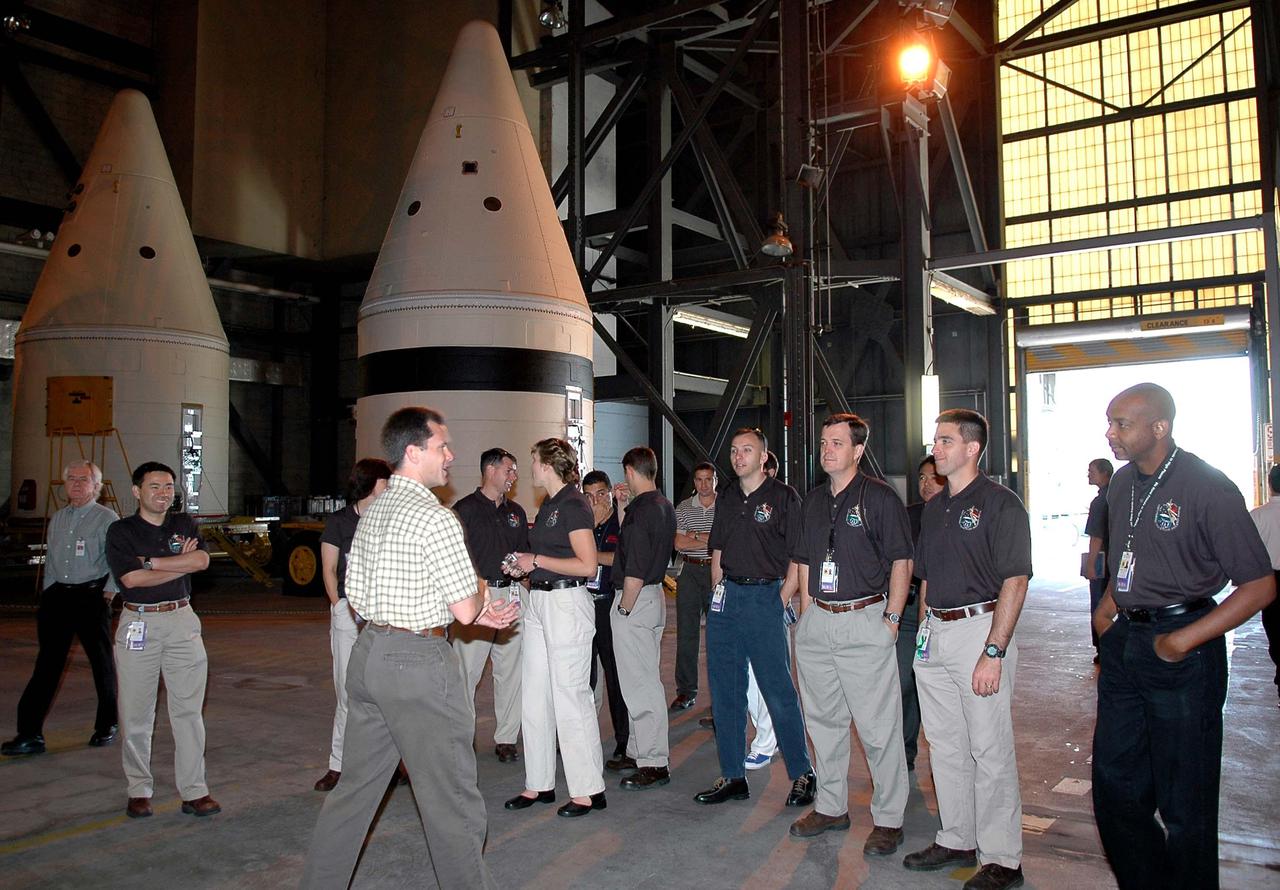
KENNEDY SPACE CENTER, FLA. -  At NASA’s Kennedy Space Center, the 2004 class of astronaut candidates tour the Vehicle Assembly Building.  In front is Scott Thurston, NASA Vehicle manager for Atlantis.  In the background are segments of Solid Rocket Boosters that will be stacked for the orbiter Atlantis for Return to Flight mission STS-121 in July.  The class of 14 candidates includes three candidates from the Japan Aerospace Exploration Agency as well as three educator astronauts, who were school teachers chosen from thousands of applicants.
KSC-05pd-0577
KENNEDY SPACE CENTER, FLA. - In the Columbia Debris Hangar, Scott Thurston, NASA vehicle flow manager, addresses the media about efforts to pack the debris stored in the Columbia Debris Hangar.  More than 83,000  pieces of debris were shipped to KSC during search and recovery efforts in East Texas. That represents about 38 percent of the dry weight of Columbia, equaling almost 85,000 pounds. An area of the Vehicle Assembly Building is being prepared to store the debris permanently.
KSC-03pd2571
The media gather around NASA Vehicle Manager Scott Thurston (white shirt, center) who talks about some of the work being done on the orbiter Atlantis as it is being prepared for Return to Flight in the Orbiter Processing Facility. Both local and national reporters representing print and TV networks were able to see work in progress on Atlantis, including the reinstallation of the Reinforced Carbon-Carbon panels on the orbiter’s wing leading edge; wiring inspections; and checks of the engines in the Orbital Maneuvering System.
Atlantis Prepared for Return to Flight
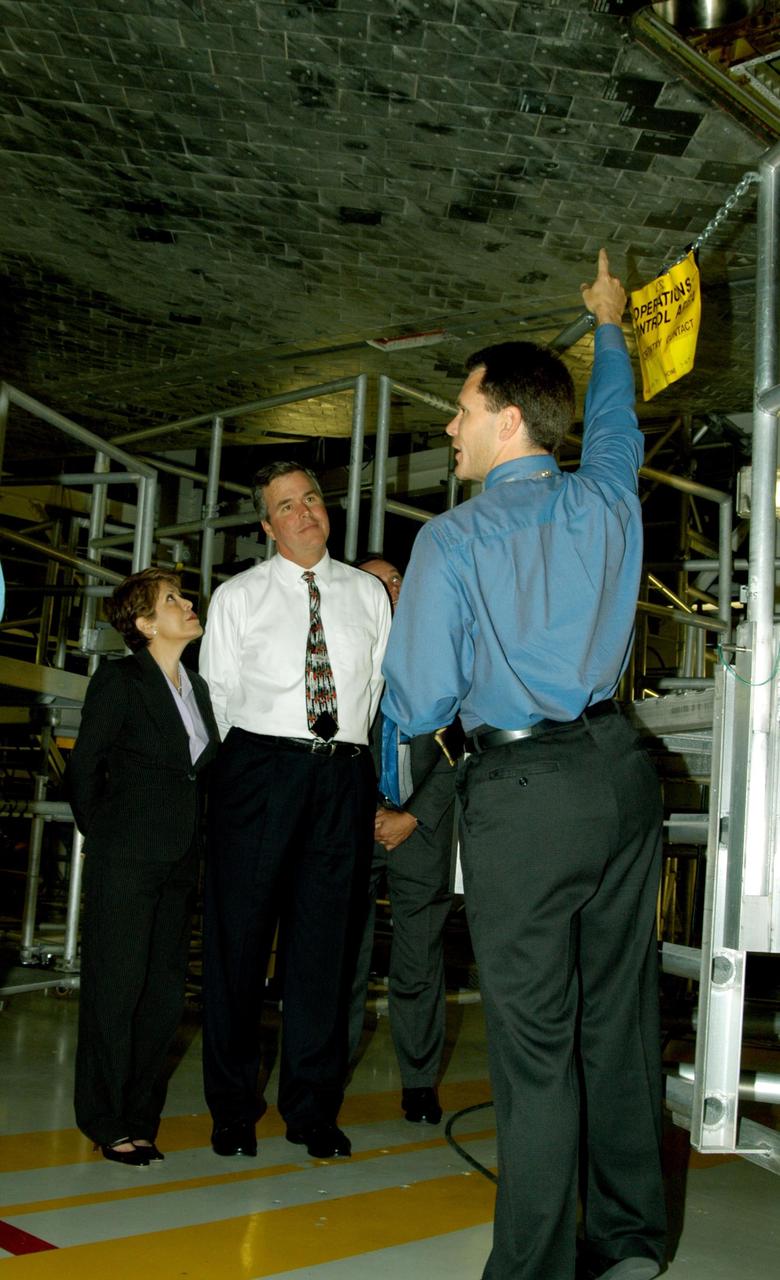
KENNEDY SPACE CENTER, FLA. -- On a tour of the Orbiter Processing Facility, Florida Gov. Jeb Bush (left) listens to NASA Vehicle Manager Scott Thurston talk about the orbiter Atlantis overhead.  At right is Center Director Jim Kennedy.  The tour followed the launching ceremony at the KSC Visitor Complex for the new Florida quarter issued by the U.S. Mint. The ceremony was emceed by Kennedy and included remarks by NASA Administrator Sean O’Keefe, Bush, U.S. Mint Director Henrietta Holsman Fore and Deputy Secretary of the Treasury Samuel W. Bodman.
KSC-04pd0804
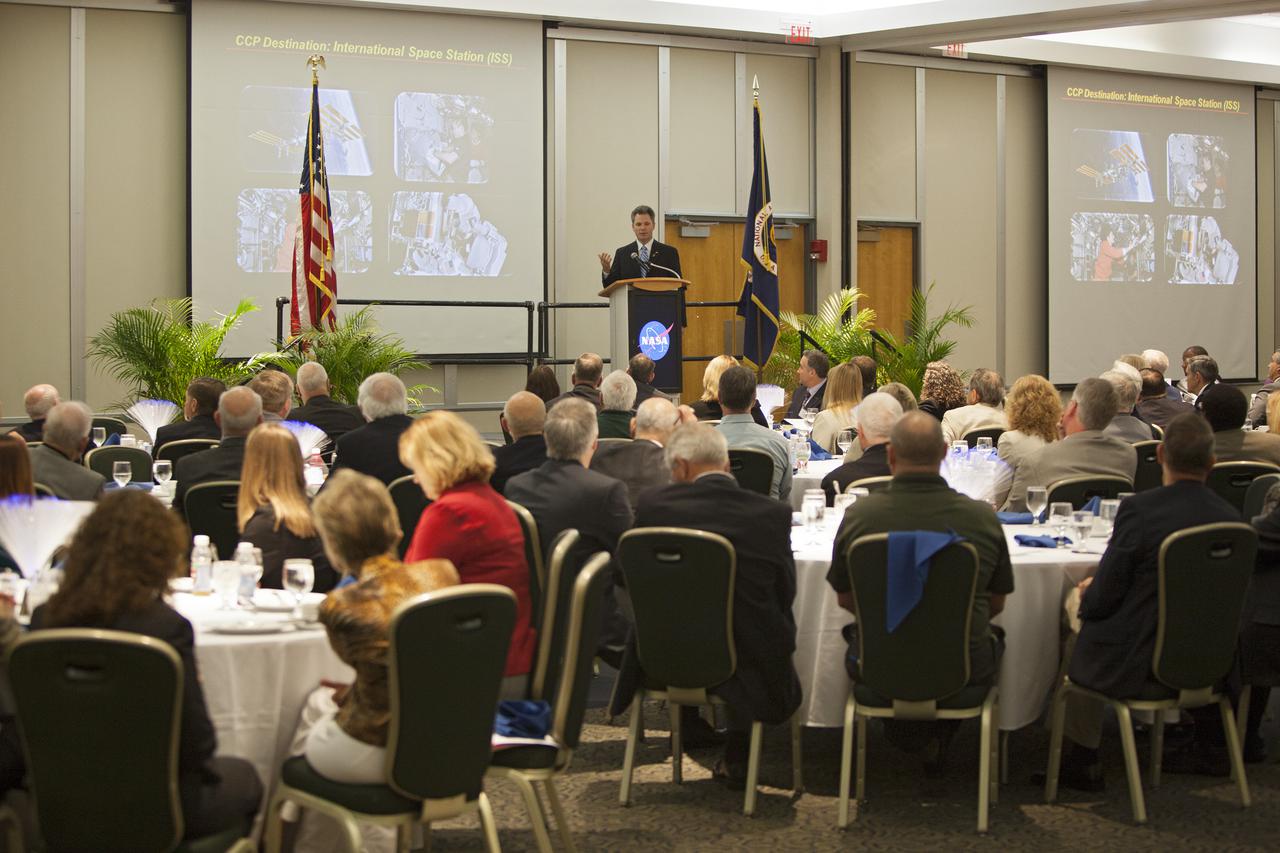
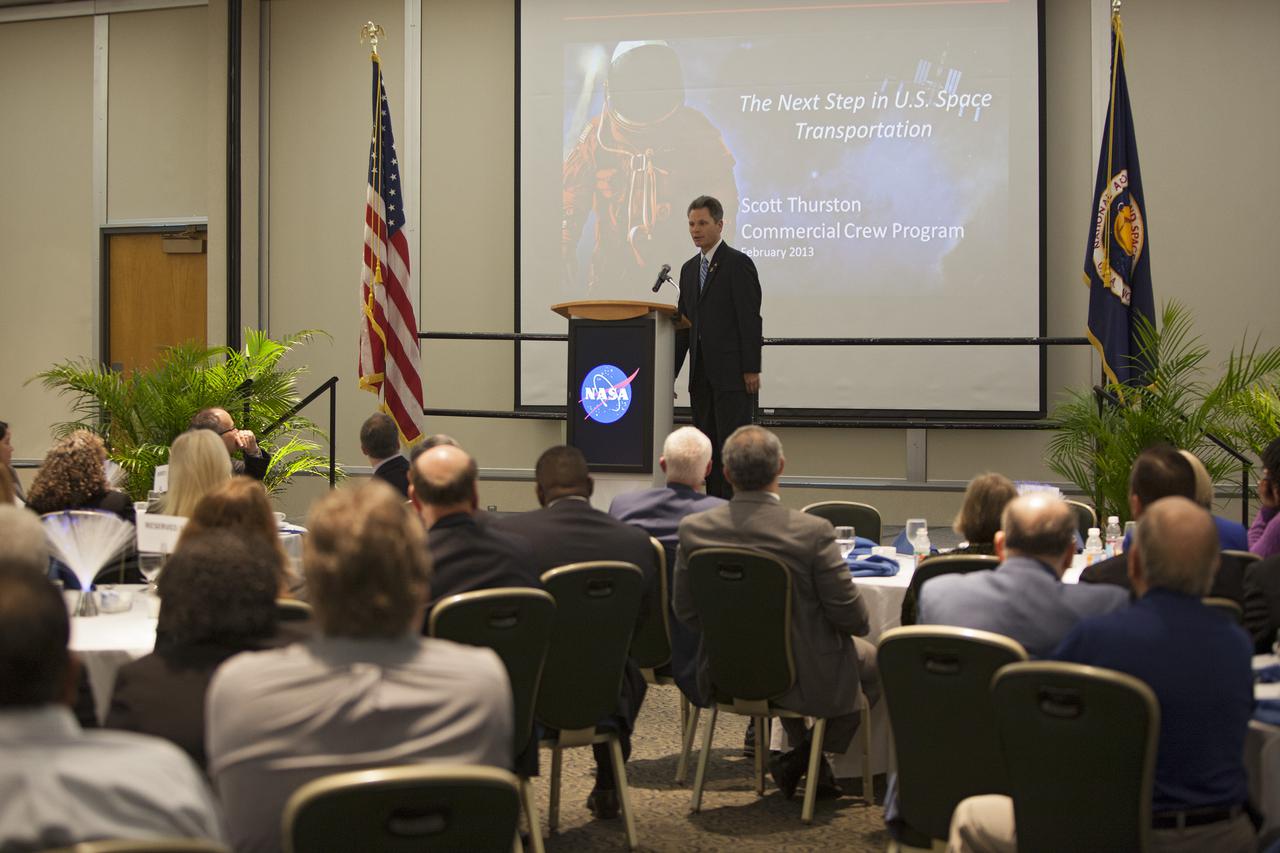
CAPE CANAVERAL, Fla. -- Scott Thurston, manager of the Commercial Crew Program’s Partner Integration Office at the Kennedy Space Center provided an on current and future activities at the Florida spaceport during the annual Community Leaders Briefing. The reports were part of the annual Community Leaders Briefing at the Kurt H. Debus Conference Center at the Kennedy Space Center Visitor Complex attended by local, state and U.S. government representatives, along with individuals from business and industry. Photo credit: NASA_Dimitri Gerondidakis
KSC-2013-1538
CAPE CANAVERAL, Fla. -- Scott Thurston, manager of the Commercial Crew Program’s Partner Integration Office at the Kennedy Space Center provided an on current and future activities at the Florida spaceport during the annual Community Leaders Briefing. The reports were part of the annual Community Leaders Briefing at the Kurt H. Debus Conference Center at the Kennedy Space Center Visitor Complex attended by local, state and U.S. government representatives, along with individuals from business and industry. Photo credit: NASA_Dimitri Gerondidakis
KSC-2013-1539
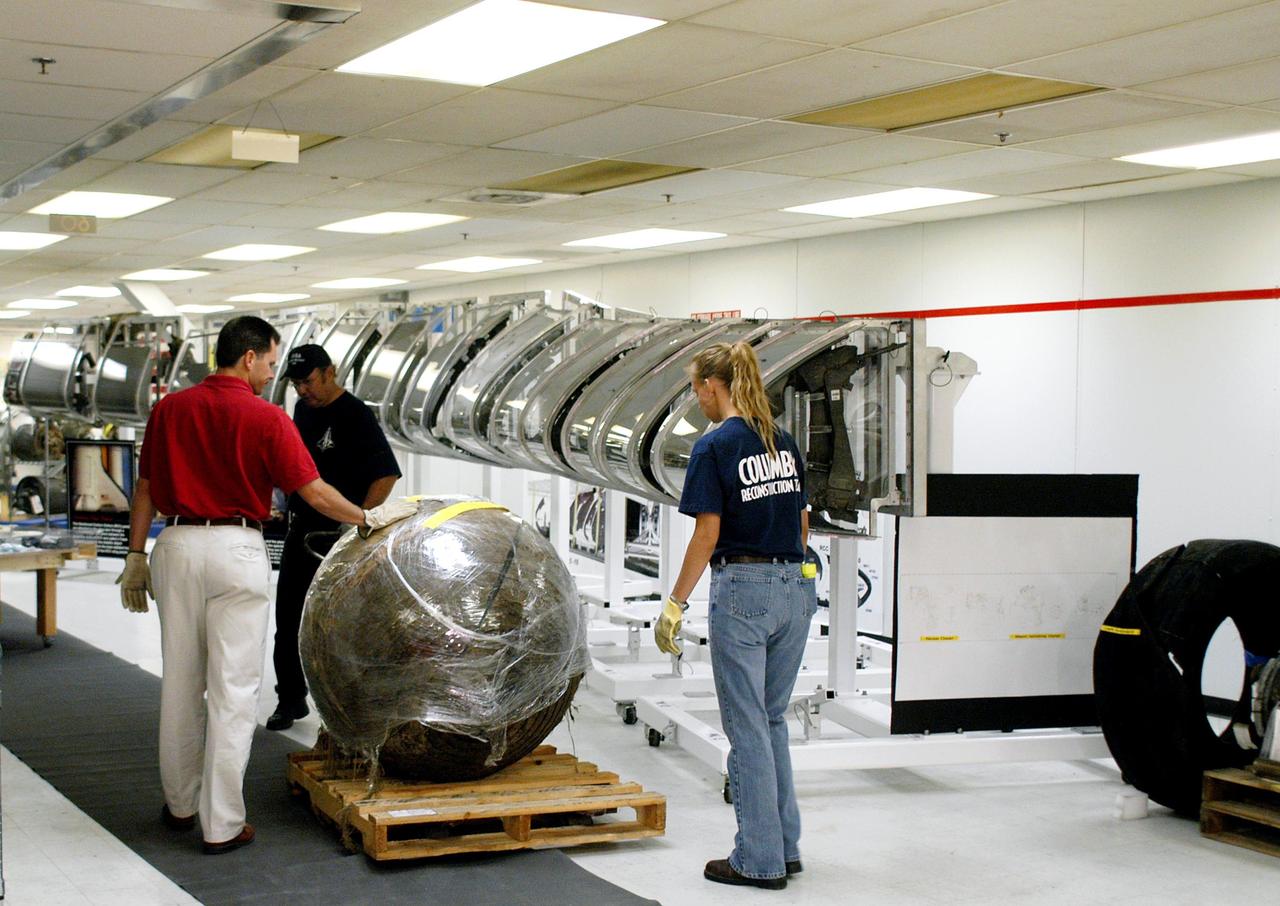
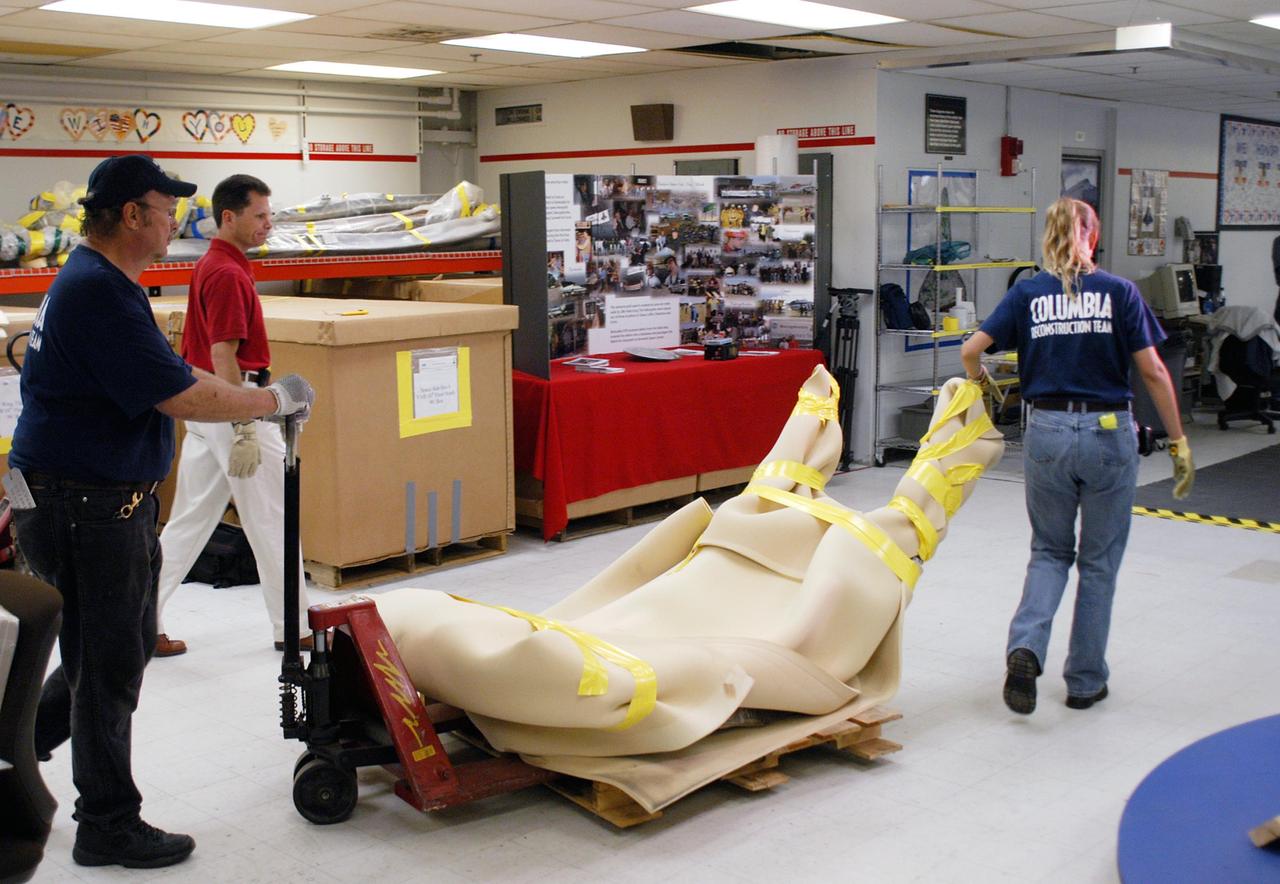
KENNEDY SPACE CENTER, FLA.  -  With NASA’s Scott Thurston (left) alongside, United Space Alliance workers J.C. Harrison (in cap) and Amy Mangiacapra (right) begin moving a piece of Columbia debris being shipped to The Aerospace Corporation in El Segundo, Calif.  Thurston is the Columbia debris coordinator.  The pieces have been released for loan to the non-governmental agency for testing and research.   The Aerospace Corporation requested and will receive graphite/epoxy honeycomb skins from an Orbital Maneuvering System pod, Main Propulsion System Helium tanks, a Reaction Control System Helium tank and a Power Reactant Storage Distribution system tank. The company will use the parts to study re-entry effects on composite materials. NASA notified the Columbia crew’s families about the loan before releasing the items for study.  Researchers believe the testing will show how materials are expected to respond to various heating and loads' environments. The findings will help calibrate tools and models used to predict hazards to people and property from reentering hardware. The Aerospace Corporation will have the debris for one year to perform analyses to estimate maximum temperatures during reentry based upon the geometry and mass of the recovered composite.  Columbia’s debris is stored in the VAB.
KSC-04pd1230
KENNEDY SPACE CENTER, FLA.  -  In the Vehicle Assembly Building (VAB), Scott Thurston (red shirt) stands by while a United Space Alliance worker (blue shirt) gets ready to start moving pieces of Columbia debris, such as the PRSD tank in front, for transfer to a shipping facility and delivery to The Aerospace Corporation in El Segundo, Calif.  Thurston is the Columbia debris coordinator.  The pieces have been released for loan to the non-governmental agency for testing and research.   The Aerospace Corporation requested and will receive graphite/epoxy honeycomb skins from an Orbital Maneuvering System pod, Main Propulsion System Helium tanks, a Reaction Control System Helium tank and a Power Reactant Storage Distribution system tank. The company will use the parts to study re-entry effects on composite materials. NASA notified the Columbia crew’s families about the loan before releasing the items for study.  Researchers believe the testing will show how materials are expected to respond to various heating and loads' environments. The findings will help calibrate tools and models used to predict hazards to people and property from reentering hardware. The Aerospace Corporation will have the debris for one year to perform analyses to estimate maximum temperatures during reentry based upon the geometry and mass of the recovered composite.  Columbia’s debris is stored in the VAB.
KSC-04pd1229
KENNEDY SPACE CENTER, FLA.  -  United Space Alliance technician J.C. Harrison steers while NASA’s Scott Thurston guides a piece of Columbia debris through a gate in the Vehicle Assembly Building, where the debris is stored.  This piece is one of eight being released to The Aerospace Corporation in El Segundo, Calif., for testing and research.  Thurston is the Columbia debris coordinator. The Aerospace Corporation requested and will receive graphite/epoxy honeycomb skins from an Orbital Maneuvering System pod, Main Propulsion System Helium tanks, a Reaction Control System Helium tank and a Power Reactant Storage Distribution system tank. The company will use the parts to study re-entry effects on composite materials. NASA notified the Columbia crew’s families about the loan before releasing the items for study.  Researchers believe the testing will show how materials are expected to respond to various heating and loads' environments. The findings will help calibrate tools and models used to predict hazards to people and property from reentering hardware. The Aerospace Corporation will have the debris for one year to perform analyses to estimate maximum temperatures during reentry based upon the geometry and mass of the recovered composite.
KSC-04pd1231
KENNEDY SPACE CENTER, FLA.  -  In the Vehicle Assembly Building (VAB), Scott Thurston looks at pieces of Columbia debris being prepared for transfer to the shipping facility before their delivery to The Aerospace Corporation in El Segundo, Calif.  Thurston is the Columbia debris coordinator.  The pieces have been released for loan to the non-governmental agency for testing and research.   The Aerospace Corporation requested and will receive graphite/epoxy honeycomb skins from an Orbital Maneuvering System pod, Main Propulsion System Helium tanks, a Reaction Control System Helium tank and a Power Reactant Storage Distribution system tank. The company will use the parts to study re-entry effects on composite materials. NASA notified the Columbia crew’s families about the loan before releasing the items for study.  Researchers believe the testing will show how materials are expected to respond to various heating and loads' environments. The findings will help calibrate tools and models used to predict hazards to people and property from reentering hardware. The Aerospace Corporation will have the debris for one year to perform analyses to estimate maximum temperatures during reentry based upon the geometry and mass of the recovered composite.  Columbia’s debris is stored in the VAB.
KSC-04pd1228
Mountain peaks through the ice cover on Thurston Island off of western Antarctica as seen on the IceBridge flight on Nov. 5, 2014.  Image Credit: NASA/Jim Yungel  NASA’s Operation IceBridge collected some rare images on a flight out of Punta Arenas, Chile on Nov. 5, 2014, on a science flight over western Antarctica dubbed Ferrigno-Alison-Abbott 01.  The crew snapped a few shots of a calving front of the Antarctic ice sheet. This particular flight plan was designed to collect data on changes in ice elevation along the coast near the Ferrigno and Alison ice streams, on the Abbot Ice Shelf, and grounded ice along the Eights Coast.
Mountain Peaks
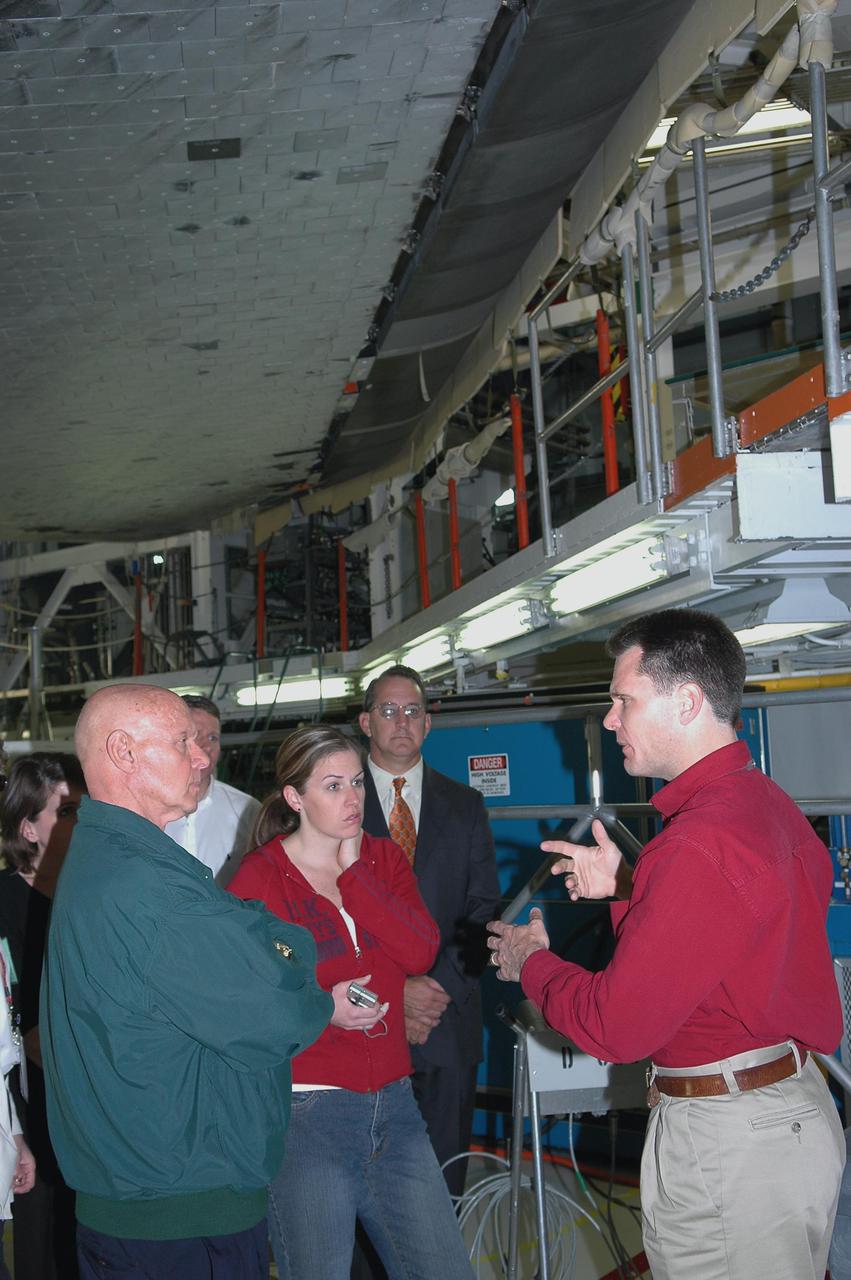
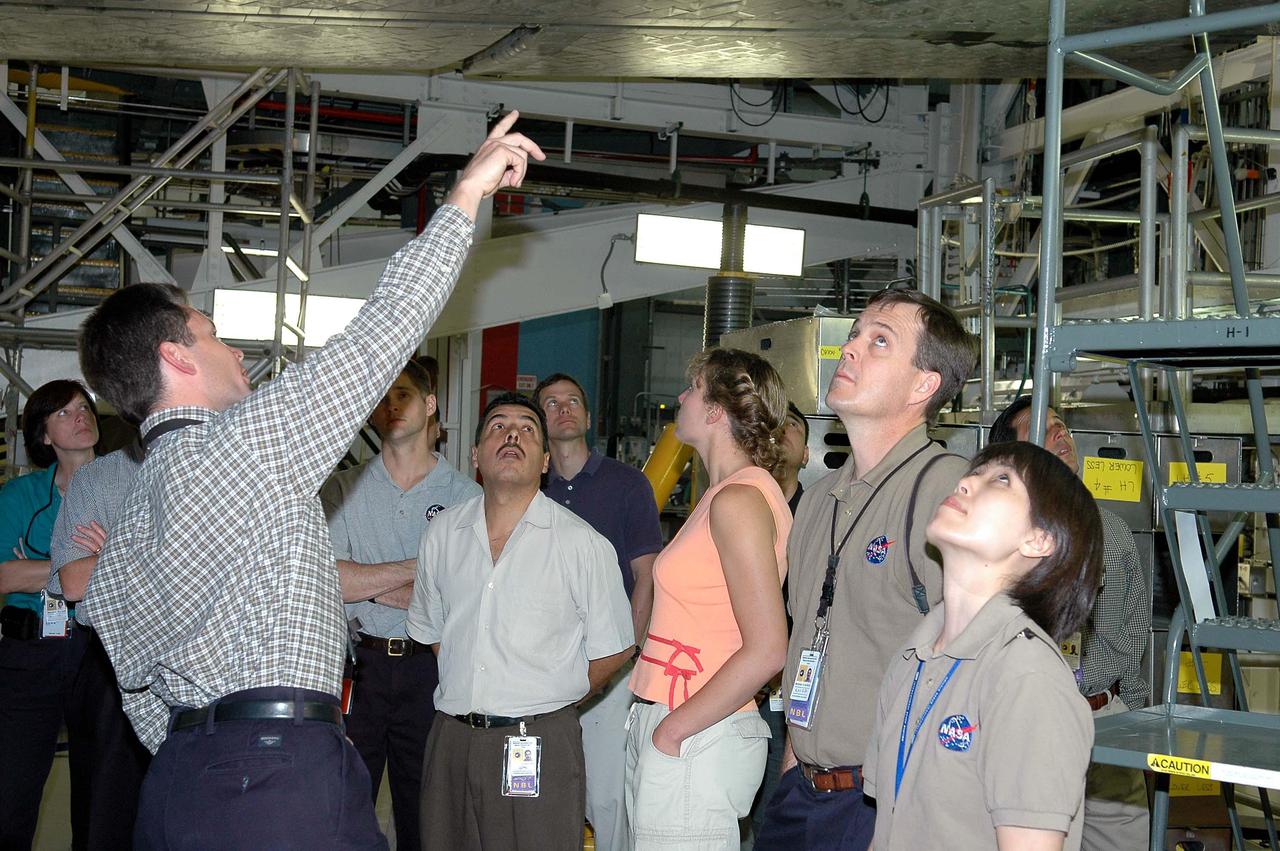
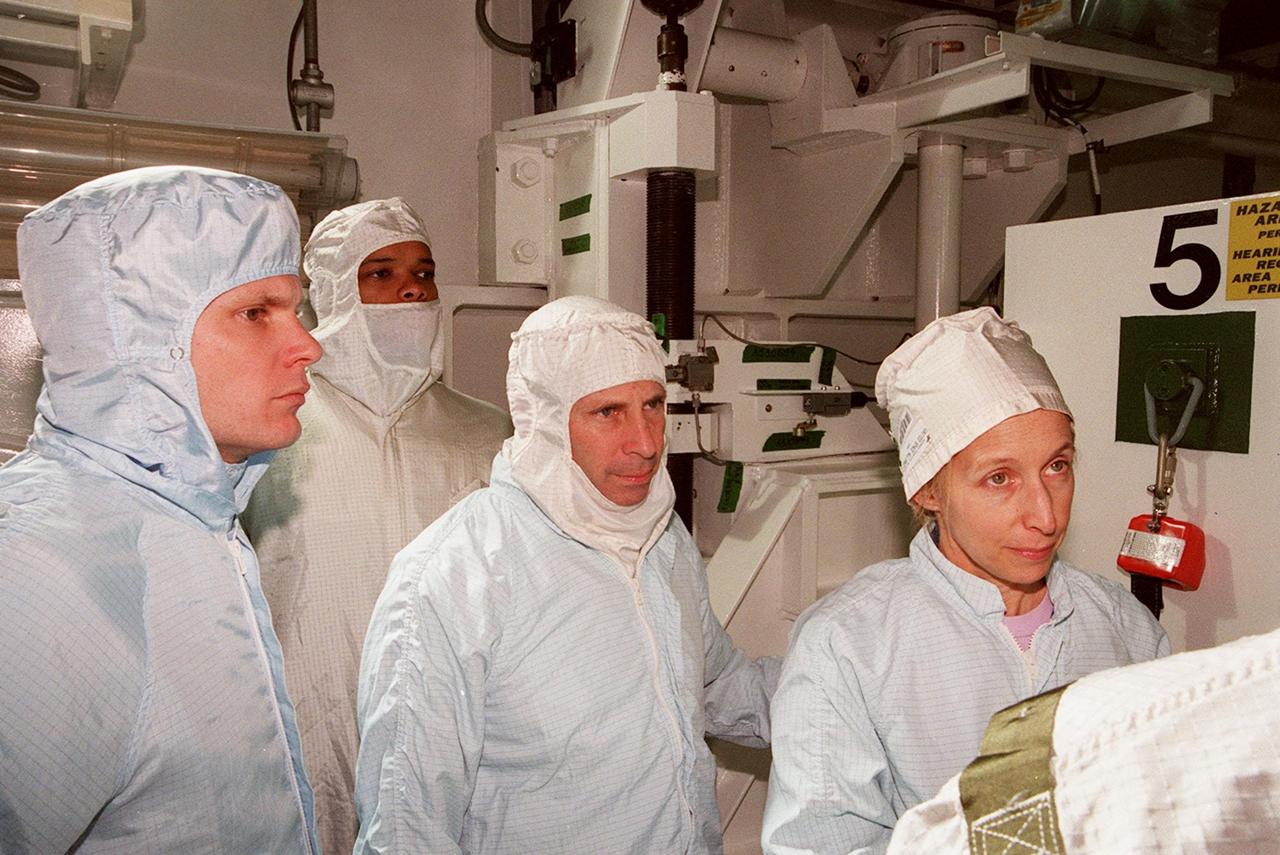
KENNEDY SPACE CENTER, FLA. - At NASA’s Kennedy Space Center, the 2004 class of astronaut candidates tour the Orbiter Processing Facility bay 1 where Atlantis (overhead) is being processed for Return to Flight mission STS-121 in July.  NASA Vehicle Manager for Atlantis, Scott Thurston talks to them about the orbiter.  The astronaut candidates are at KSC to participate in firefighting training and familiarization tours.   The class of 14 candidates includes three candidates from the Japan Aerospace Exploration Agency as well as three educator astronauts, who were school teachers chosen from thousands of applicants.
KSC-05pd-0570
KENNEDY SPACE CENTER, FLA. -- On a tour of the Orbiter Processing Facility, Florida Gov. Jeb Bush (center) and his wife, Columba (left), listen to NASA Vehicle Manager Scott Thurston talk about the orbiter Atlantis overhead.  The tour followed the launching ceremony at the KSC Visitor Complex for the new Florida quarter issued by the U.S. Mint. The ceremony was emceed by Center Director Jim Kennedy and included remarks by NASA Administrator Sean O’Keefe, Bush, U.S. Mint Director Henrietta Holsman Fore and Deputy Secretary of the Treasury Samuel W. Bodman.
KSC-04pd0802
KENNEDY SPACE CENTER, FLA. - At NASA’s Kennedy Space Center, the 2004 class of astronaut candidates get a close look at the nose of Atlantis while touring the Orbiter Processing Facility bay 1.  Atlantis is being processed for Return to Flight mission STS-121 in July.  At center, in the background,  is the  NASA Vehicle Manager for Atlantis, Scott Thurston,  talking about the orbiter.    The astronaut candidates are at KSC to participate in firefighting training and familiarization tours.   The class of 14 candidates includes three candidates from the Japan Aerospace Exploration Agency as well as three educator astronauts, who were school teachers chosen from thousands of applicants.
KSC-05pd-0571
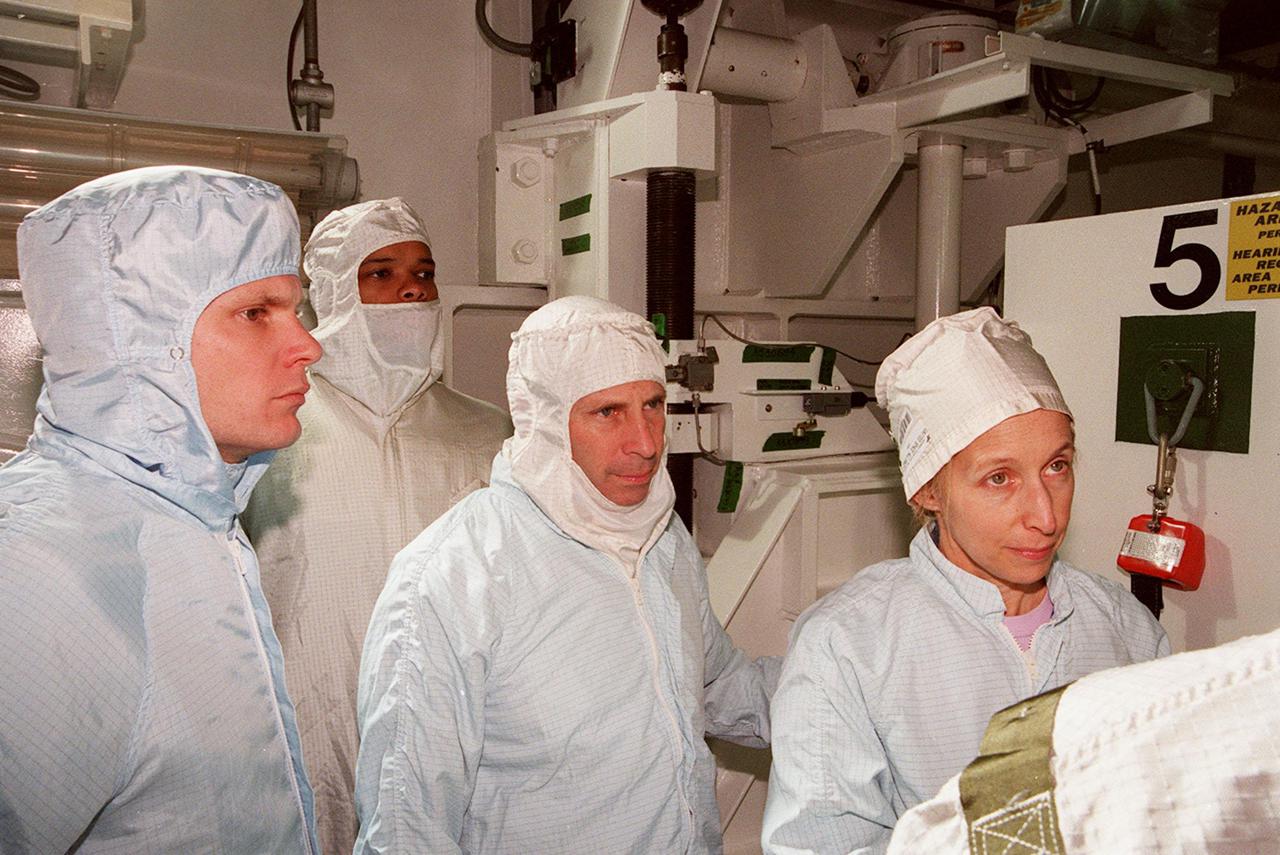
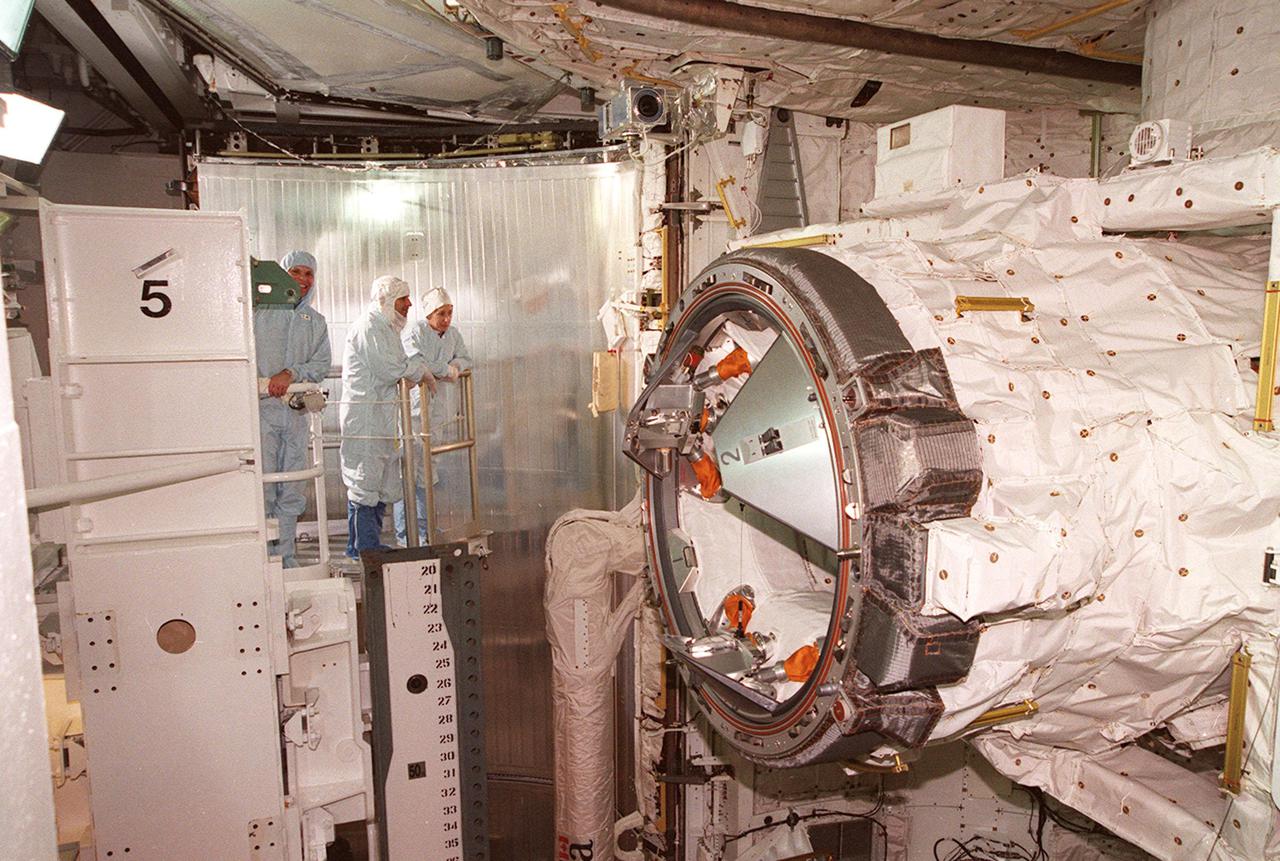
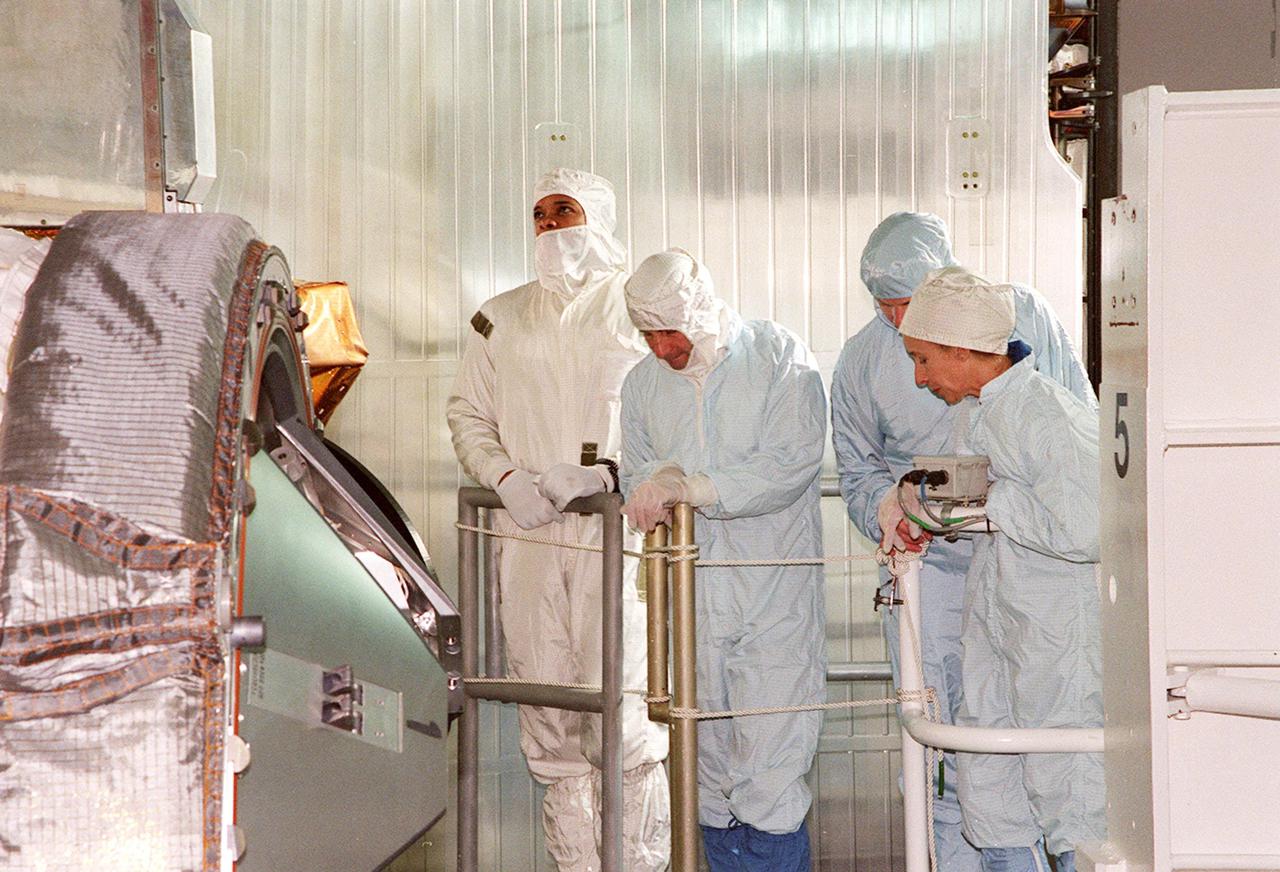
KENNEDY SPACE CENTER, FLA. -- STS-98 Mission Specialist Robert Curbeam (left), Commander Ken Cockrell (center) and Mission Specialist Marsha Ivins (right) look over the U.S. Lab Destiny in the payload bay of the orbiter Atlantis. Behind Ivins is Scott Thurston, of the VITT office. The crew is at KSC for Terminal Countdown Demonstration Test activities, which also include a simulated launch countdown. A key element in the construction of the International Space Station, Destiny is a pressurized module designed to accommodate pressurized payloads. It has a capacity of 24 rack locations. Payload racks will occupy 13 locations especially designed to support experiments. The module already has five system racks installed inside. Launch of STS-98 on its 11-day mission is scheduled for Jan. 19 at 2:11 a.m. EST
KSC01pp0081
KENNEDY SPACE CENTER, FLA. -- STS-98 Mission Specialist Robert Curbeam (left), Commander Ken Cockrell (center) and Mission Specialist Marsha Ivins (right) look over the U.S. Lab Destiny in the payload bay of the orbiter Atlantis. Behind Ivins is Scott Thurston, of the VITT office. The crew is at KSC for Terminal Countdown Demonstration Test activities, which also include a simulated launch countdown. A key element in the construction of the International Space Station, Destiny is a pressurized module designed to accommodate pressurized payloads. It has a capacity of 24 rack locations. Payload racks will occupy 13 locations especially designed to support experiments. The module already has five system racks installed inside. Launch of STS-98 on its 11-day mission is scheduled for Jan. 19 at 2:11 a.m. EST
KSC-01PP-0081
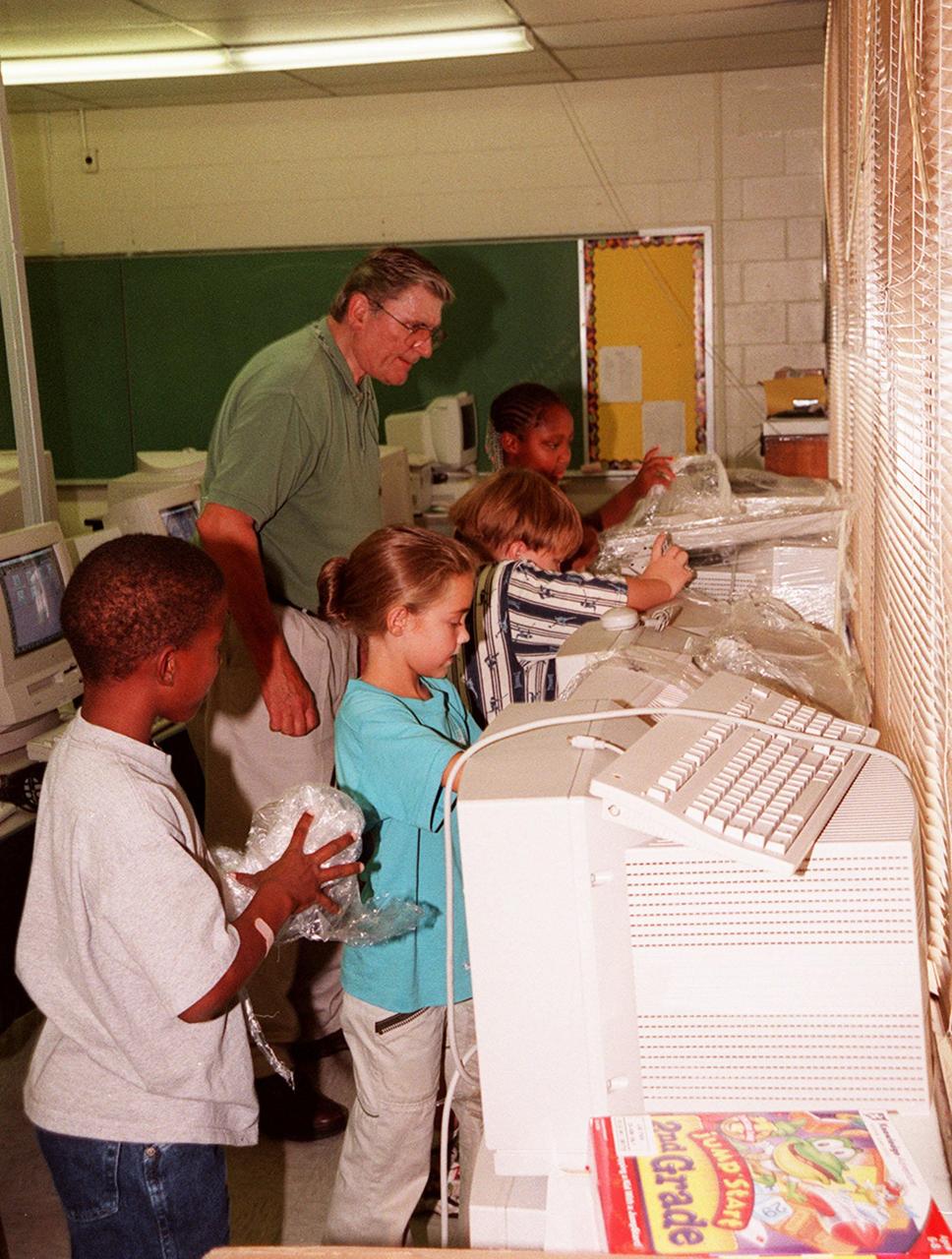
Children at Cambridge Elementary School, Cocoa, Fla., eagerly unwrap computer equipment donated by Kennedy Space Center. Cambridge is one of 13 Brevard County schools receiving 81 excess contractor computers thanks to an innovative educational outreach project spearheaded by the Nasa k-12 Education Services Office at ksc. Behind the children is Jim Thurston, a school volunteer and retired employee of USBI, who shared in the project. The Astronaut Memorial Foundation, a strategic partner in the effort, and several schools in rural Florida and Georgia also received refurbished computers as part of the year-long project. KSC employees put in about 3,300 volunteer hours to transform old, excess computers into upgraded, usable units. A total of $90,000 in upgraded computer equipment is being donated
KSC-99pp1228
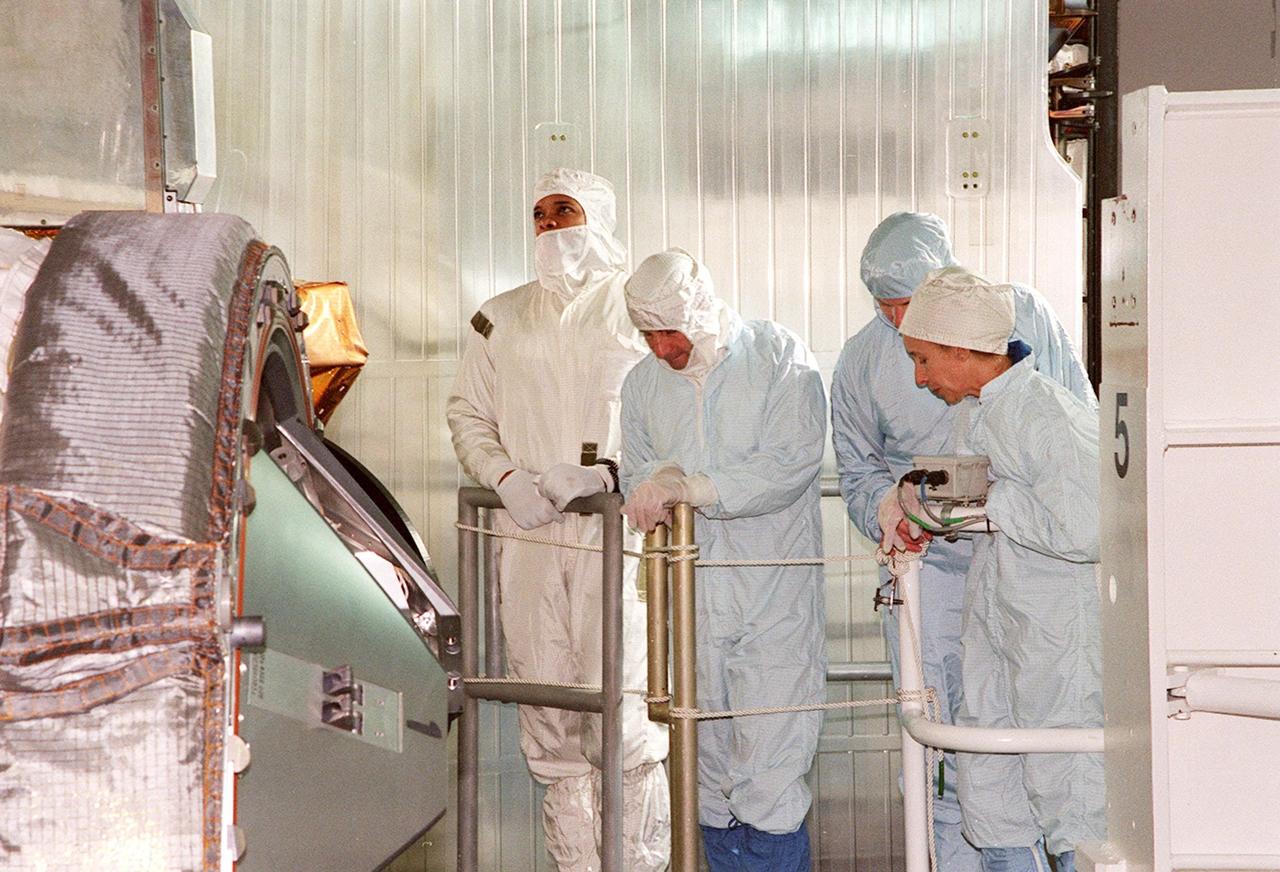
KENNEDY SPACE CENTER, FLA. -- Members of the STS-98 crew, along with Scott Thurston (left), with the VITT office, check out the U.S. Lab Destiny in the payload bay of the orbiter Atlantis. Wearing white caps are Commander Ken Cockrell (center) and Mission Specialist Marsha Ivins (right). The crew is at KSC for Terminal Countdown Demonstration Test activities, which include a simulated launch countdown. Destiny, a key element in the construction of the International Space Station, is a pressurized module designed to accommodate pressurized payloads. It has a capacity of 24 rack locations. Payload racks will occupy 13 locations especially designed to support experiments. The module already has five system racks installed inside. Launch of STS-98 on its 11-day mission is scheduled for Jan. 19 at 2:11 a.m. EST
KSC-01PP-0078
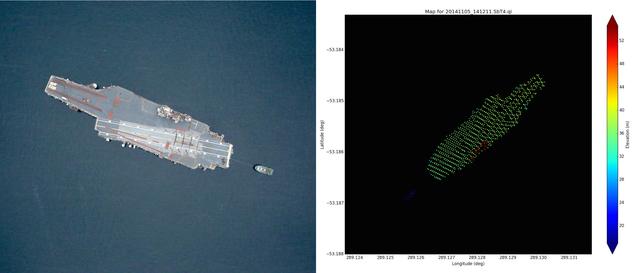
Left: NASA Digital Mapping System image of the USS Constellation taken near Punta Arenas, Chile on Nov. 5, 2014. Credit: NASA/DMS  Right: Airborne Topographic Mapper wide scan lidar elevation data taken over the USS Constellation during Nov. 5, 2014 overflight. The water elevation has been removed and was 17 meters. The Constellation flight deck is about 16m above the water surface and the conning tower is about 33m above the water. Credit: NASA/ATM  Read more: <a href="http://www.nasa.gov/content/goddard/icebridge/news/fall14/uss-constellation-and-thurston-island-nov-5/#.VGOy4khvL2g" rel="nofollow">www.nasa.gov/content/goddard/icebridge/news/fall14/uss-co...</a>
USS Constellation
KENNEDY SPACE CENTER, FLA. -- Members of the STS-98 crew, along with Scott Thurston (left), with the VITT office, check out the U.S. Lab Destiny in the payload bay of the orbiter Atlantis. Wearing white caps are Commander Ken Cockrell (center) and Mission Specialist Marsha Ivins (right). The crew is at KSC for Terminal Countdown Demonstration Test activities, which include a simulated launch countdown. Destiny, a key element in the construction of the International Space Station, is a pressurized module designed to accommodate pressurized payloads. It has a capacity of 24 rack locations. Payload racks will occupy 13 locations especially designed to support experiments. The module already has five system racks installed inside. Launch of STS-98 on its 11-day mission is scheduled for Jan. 19 at 2:11 a.m. EST
KSC01pp0078
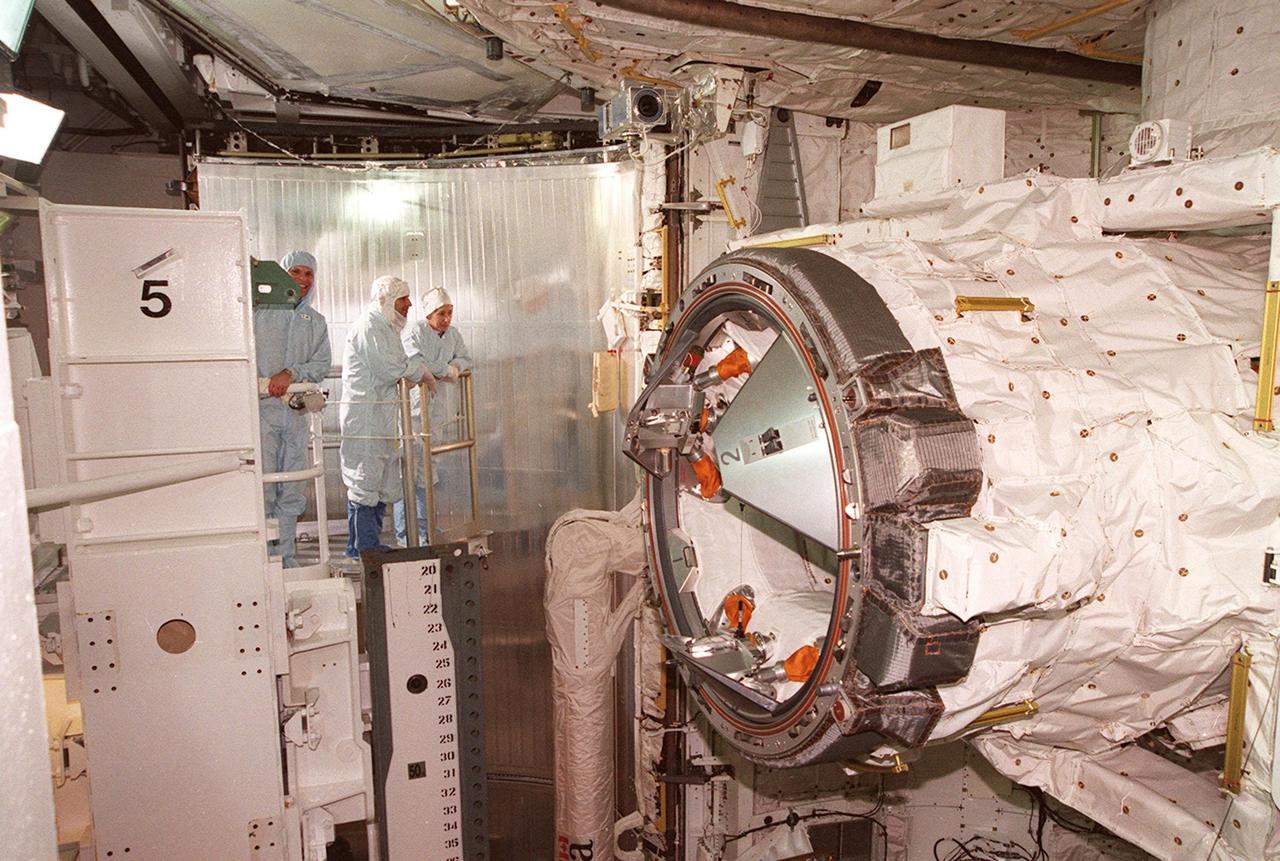
KENNEDY SPACE CENTER, FLA. -- Along with Scott Thurston (left), of the VITT office, members of the STS-98 crew Mission Specialist Robert Curbeam, Commander Ken Cockrell and Mission Specialist Marsha Ivins are in Atlantis’ payload bay to check out their mission payload, the U.S. Lab Destiny. The crew is at KSC for Terminal Countdown Demonstration Test activities, which also include a simulated launch countdown. A key element in the construction of the International Space Station, Destiny is a pressurized module designed to accommodate pressurized payloads. It has a capacity of 24 rack locations. Payload racks will occupy 13 locations especially designed to support experiments. The module already has five system racks installed inside. Launch of STS-98 on its 11-day mission is scheduled for Jan. 19 at 2:11 a.m. EST
KSC-01PP-0080
KENNEDY SPACE CENTER, FLA. -- Along with Scott Thurston (left), of the VITT office, members of the STS-98 crew Mission Specialist Robert Curbeam, Commander Ken Cockrell and Mission Specialist Marsha Ivins are in Atlantis’ payload bay to check out their mission payload, the U.S. Lab Destiny. The crew is at KSC for Terminal Countdown Demonstration Test activities, which also include a simulated launch countdown. A key element in the construction of the International Space Station, Destiny is a pressurized module designed to accommodate pressurized payloads. It has a capacity of 24 rack locations. Payload racks will occupy 13 locations especially designed to support experiments. The module already has five system racks installed inside. Launch of STS-98 on its 11-day mission is scheduled for Jan. 19 at 2:11 a.m. EST
KSC01pp0080
KENNEDY SPACE CENTER, FLA.  -  United Space Alliance workers J.C. Harrison (far left) and Amy Mangiacapra guide a wrapped piece of Columbia debris through the Vehicle Assembly Building, where it is stored.  Alongside is NASA’s Scott Thurston, who is the Columbia debris coordinator.  This piece is one of eight being released to The Aerospace Corporation in El Segundo, Calif., for testing and research.  The Aerospace Corporation requested and will receive graphite/epoxy honeycomb skins from an Orbital Maneuvering System pod, Main Propulsion System Helium tanks, a Reaction Control System Helium tank and a Power Reactant Storage Distribution system tank. The company will use the parts to study re-entry effects on composite materials. NASA notified the Columbia crew’s families about the loan before releasing the items for study.  Researchers believe the testing will show how materials are expected to respond to various heating and loads' environments. The findings will help calibrate tools and models used to predict hazards to people and property from reentering hardware. The Aerospace Corporation will have the debris for one year to perform analyses to estimate maximum temperatures during reentry based upon the geometry and mass of the recovered composite.
KSC-04pd1232
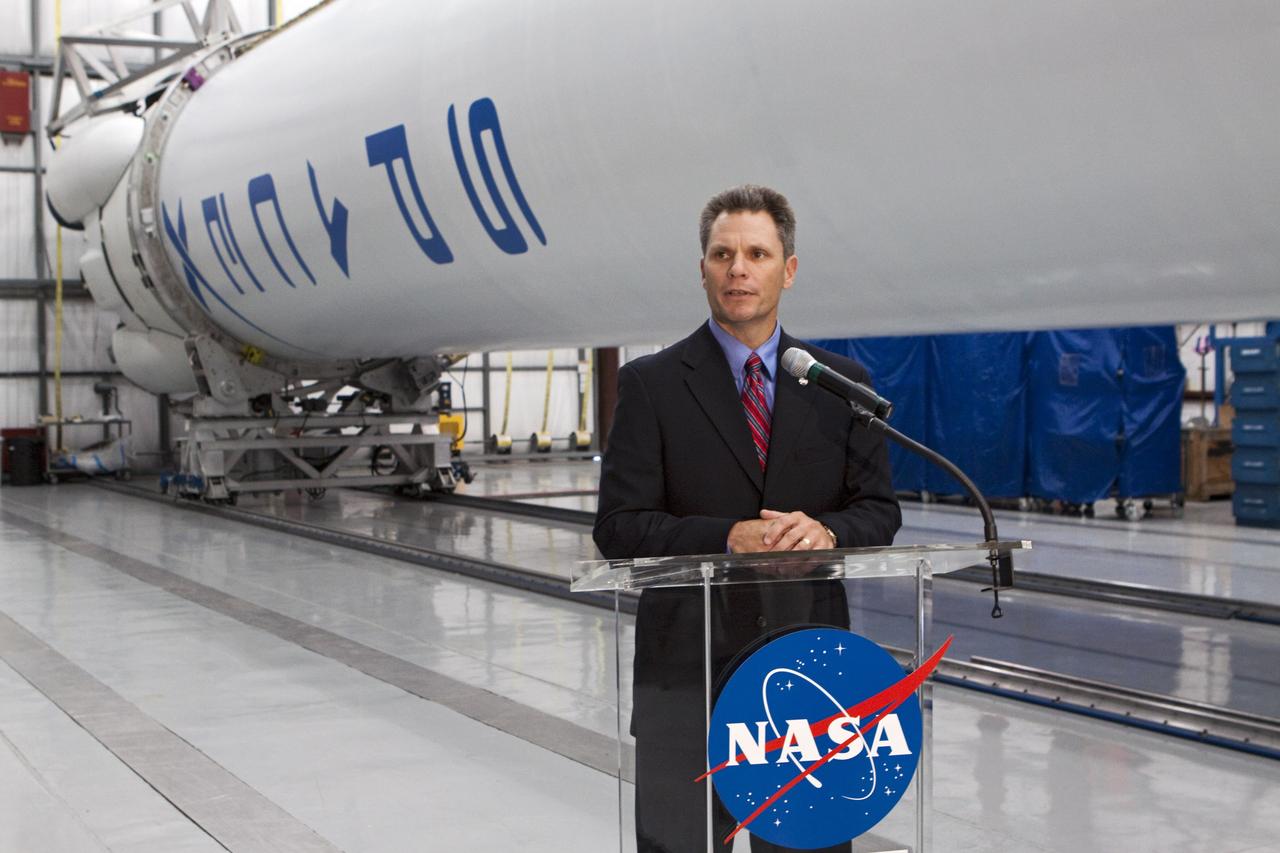
CAPE CANAVERAL, Fla. -- Inside the Space Exploration Technologies, or SpaceX, processing facility near NASA’s Kennedy Space Center in Florida, Scott Thurston, partner integration office manager with the Commercial Crew Program, talks to the media prior to an announcement from NASA Administrator Charles Bolden about new milestones in the nation’s commercial space initiatives.     Bolden announced that SpaceX has completed its Space Act Agreement with NASA for Commercial Orbital Transportation Services. SpaceX is scheduled to launch the first of its 12 contracted cargo flights to the space station from Cape Canaveral this October, under NASA’s Commercial Resupply Services Program. Bolden also announced NASA partner Sierra Nevada Corp. has conducted its first milestone under the agency’s recently announced Commercial Crew Integrated Capability initiative. The milestone, a program implementation plan review, marks an important first step in Sierra Nevada’s efforts to develop a crew transportation system with its Dream Chaser spacecraft. Through NASA’s commercial space initiatives and programs, the agency is providing investments to stimulate the American commercial space industry. Photo credit: NASA/Kim Shiflett
KSC-2012-4583
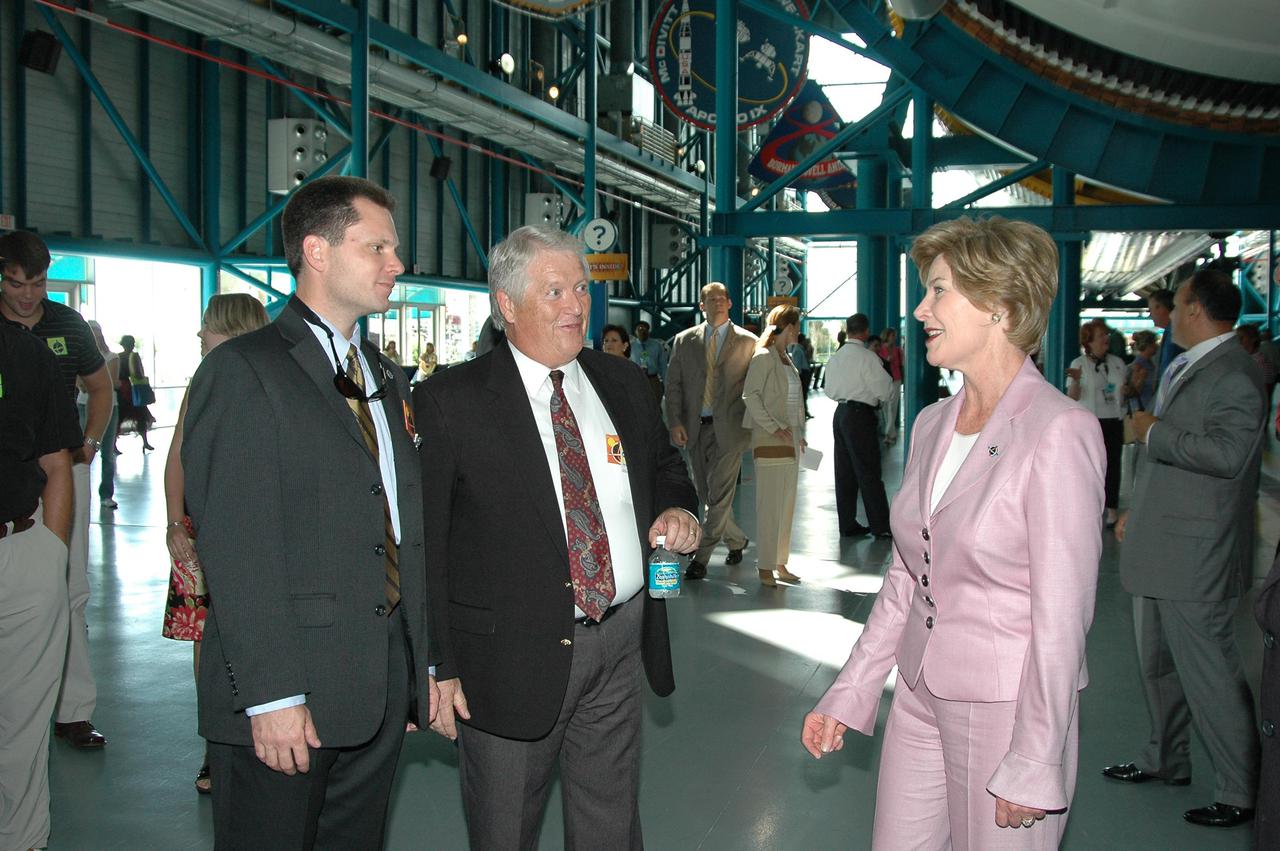
KENNEDY SPACE CENTER, FLA. - At NASA Kennedy Space Center’s Apollo V_Saturn Center, First Lady Laura Bush (right) greets Scott Thurston (far left), NASA vehicle manager, and Tom Overton, vehicle integration manager. They are attending the historic launch of Space Shuttle Discovery on Return to Flight mission STS-114, scheduled to lift off at 10:39 a.m. EDT from Launch Pad 39B with a crew of seven. Mrs. Bush is only the third First Lady to witness a Space Shuttle launch at KSC. On this mission to the International Space Station the crew will perform inspections on-orbit for the first time of all of the Reinforced Carbon-Carbon (RCC) panels on the leading edge of the wings and the Thermal Protection System tiles using the new Canadian-built Orbiter Boom Sensor System and the data from 176 impact and temperature sensors. Mission Specialists will also practice repair techniques on RCC and tile samples during a spacewalk in the payload bay. During two additional spacewalks, the crew will install the External Stowage Platform-2, equipped with spare part assemblies, and a replacement Control Moment Gyroscope contained in the Lightweight Multi-Purpose Experiment Support Structure. The 12-day mission is expected to end with touchdown at the Shuttle Landing Facility on Aug. 7.
KSC-05pd-1747