
A NASA Mars Rover Landing banner is seen on the One Times Square video board as NASA's Perseverance rover continues its descent towards the surface of Mars, Thursday, Feb. 18, 2021 in New York City. A key objective for Perseverance’s mission on Mars is astrobiology, including the search for signs of ancient microbial life. The rover will characterize the planet’s geology and past climate, pave the way for human exploration of the Red Planet, and be the first mission to collect and cache Martian rock and regolith. Photo Credit: (NASA/Emma Howells)

A NASA Mars Rover Landing banner is seen on the One Times Square video board as NASA's Perseverance rover begins its descent towards the surface of Mars, Thursday, Feb. 18, 2021 in New York City. A key objective for Perseverance’s mission on Mars is astrobiology, including the search for signs of ancient microbial life. The rover will characterize the planet’s geology and past climate, pave the way for human exploration of the Red Planet, and be the first mission to collect and cache Martian rock and regolith. Photo Credit: (NASA/Emma Howells)

A NASA Mars Rover Landing banner is seen confirming the mission is complete on the One Times Square video board after NASA's Perseverance rover landed on the surface of Mars, Thursday, Feb. 18, 2021 in New York City. A key objective for Perseverance’s mission on Mars is astrobiology, including the search for signs of ancient microbial life. The rover will characterize the planet’s geology and past climate, pave the way for human exploration of the Red Planet, and be the first mission to collect and cache Martian rock and regolith. Photo Credit: (NASA/Emma Howells)

A NASA Mars Rover Landing banner is seen confirming the mission is complete on the One Times Square video board after NASA's Perseverance rover landed on the surface of Mars, Thursday, Feb. 18, 2021 in New York City. A key objective for Perseverance’s mission on Mars is astrobiology, including the search for signs of ancient microbial life. The rover will characterize the planet’s geology and past climate, pave the way for human exploration of the Red Planet, and be the first mission to collect and cache Martian rock and regolith. Photo Credit: (NASA/Emma Howells)

A NASA Mars Rover Landing banner is seen on the One Times Square video board as NASA's Perseverance rover begins its descent towards the surface of Mars, Thursday, Feb. 18, 2021 in New York City. A key objective for Perseverance’s mission on Mars is astrobiology, including the search for signs of ancient microbial life. The rover will characterize the planet’s geology and past climate, pave the way for human exploration of the Red Planet, and be the first mission to collect and cache Martian rock and regolith. Photo Credit: (NASA/Emma Howells)

A NASA Mars Rover Landing banner is seen on the One Times Square video board as NASA's Perseverance rover begins its descent towards the surface of Mars, Thursday, Feb. 18, 2021 in New York City. A key objective for Perseverance’s mission on Mars is astrobiology, including the search for signs of ancient microbial life. The rover will characterize the planet’s geology and past climate, pave the way for human exploration of the Red Planet, and be the first mission to collect and cache Martian rock and regolith. Photo Credit: (NASA/Emma Howells)

The live NASA TV broadcast from inside the Mission Support Area of NASA's Jet Propulsion Laboratory is seen on the One Times Square video board as NASA's Perseverance rover continues its descent towards the surface of Mars, Thursday, Feb. 18, 2021 in New York City. A key objective for Perseverance’s mission on Mars is astrobiology, including the search for signs of ancient microbial life. The rover will characterize the planet’s geology and past climate, pave the way for human exploration of the Red Planet, and be the first mission to collect and cache Martian rock and regolith. Photo Credit: (NASA/Emma Howells)
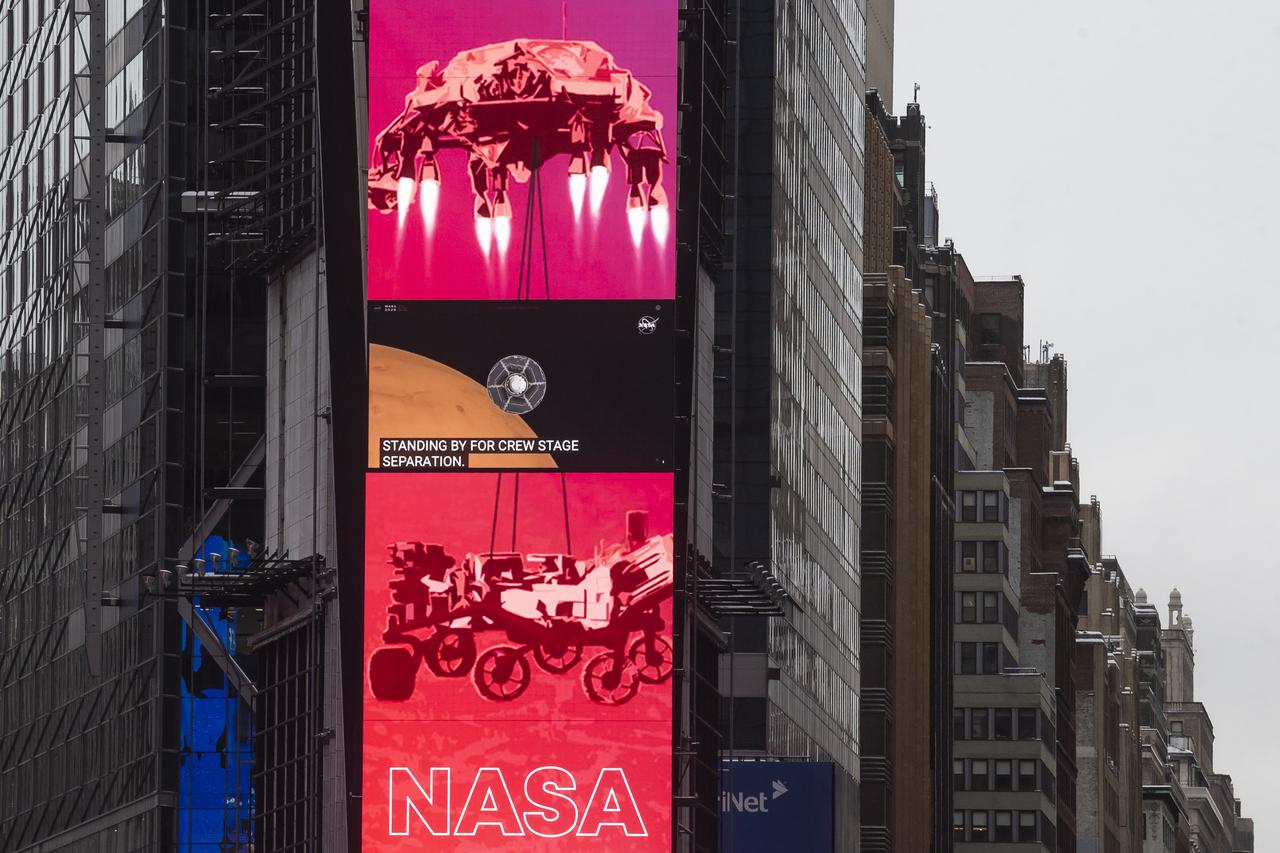
The live NASA TV broadcast from inside the Mission Support Area of NASA's Jet Propulsion Laboratory is seen on the One Times Square video board as NASA's Perseverance rover begins its descent towards the surface of Mars, Thursday, Feb. 18, 2021 in New York City. A key objective for Perseverance’s mission on Mars is astrobiology, including the search for signs of ancient microbial life. The rover will characterize the planet’s geology and past climate, pave the way for human exploration of the Red Planet, and be the first mission to collect and cache Martian rock and regolith. Photo Credit: (NASA/Emma Howells)
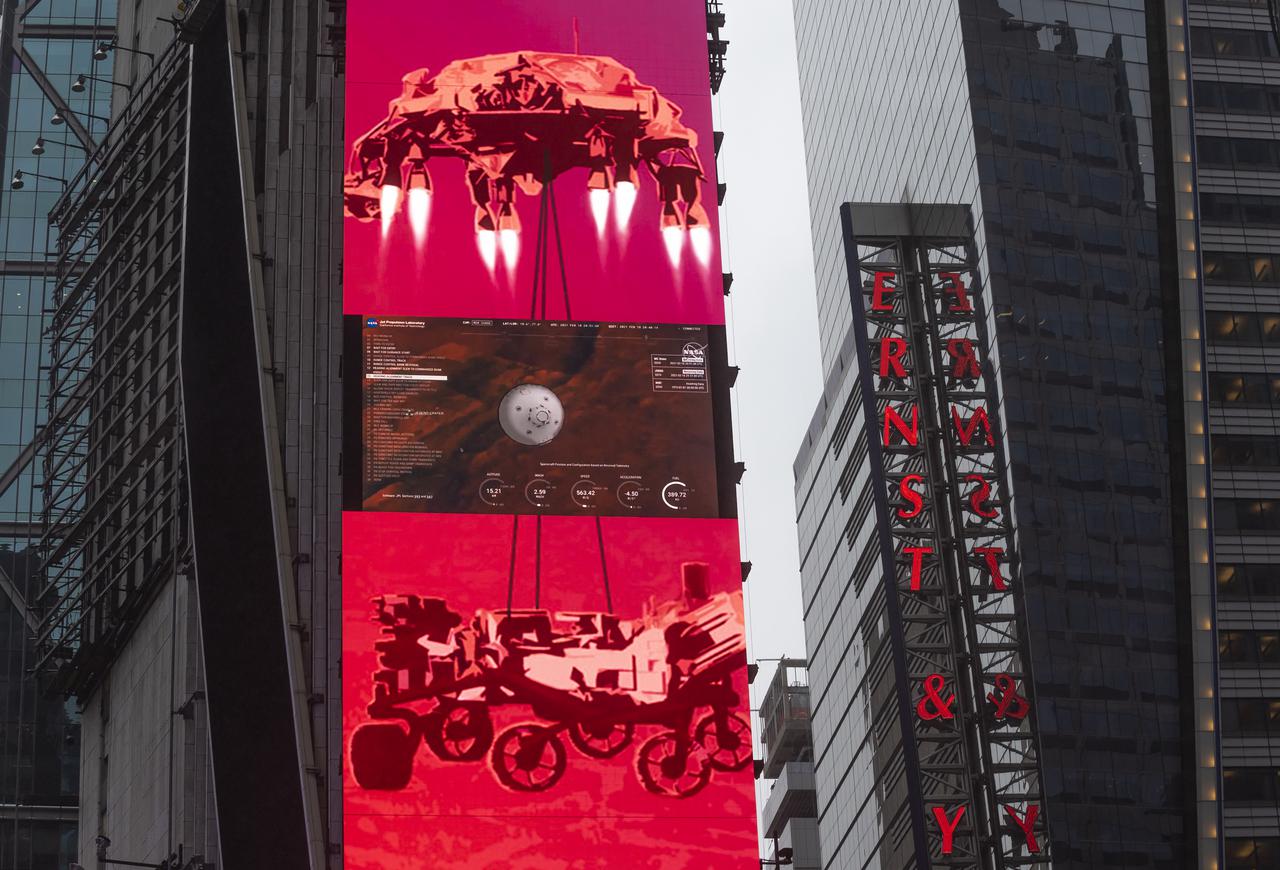
The live NASA TV broadcast from inside the Mission Support Area of NASA's Jet Propulsion Laboratory is seen on the One Times Square video board as NASA's Perseverance rover continues its descent towards the surface of Mars, Thursday, Feb. 18, 2021 in New York City. A key objective for Perseverance’s mission on Mars is astrobiology, including the search for signs of ancient microbial life. The rover will characterize the planet’s geology and past climate, pave the way for human exploration of the Red Planet, and be the first mission to collect and cache Martian rock and regolith. Photo Credit: (NASA/Emma Howells)

The live NASA TV broadcast from inside the Mission Support Area of NASA's Jet Propulsion Laboratory is seen on the One Times Square video board as NASA's Perseverance rover completes its descent towards the surface of Mars, Thursday, Feb. 18, 2021 in New York City. A key objective for Perseverance’s mission on Mars is astrobiology, including the search for signs of ancient microbial life. The rover will characterize the planet’s geology and past climate, pave the way for human exploration of the Red Planet, and be the first mission to collect and cache Martian rock and regolith. Photo Credit: (NASA/Emma Howells)

A large display in New York’s Times Square shows an advertisement for a television appearance of NASA’s Artemis II crewmembers: NASA astronauts Reid Wiseman, commander; left, Victor Glover, pilot; Christina Koch, mission specialist, and CSA (Canadian Space Agency) astronaut Jeremy Hansen, mission specialist, right, Thursday, April 30, 2026. The Artemis II crew is in New York for postflight events. NASA’s Artemis II mission took Wiseman, Glover, Koch, and Hansen on a nearly 10-day journey around the Moon and back to Earth earlier in April 2026. Photo Credit: (NASA/Bill Ingalls)

A large display in New York’s Times Square shows an advertisement for a television appearance of NASA’s Artemis II crewmembers: NASA astronauts Reid Wiseman, commander; left, Victor Glover, pilot; Christina Koch, mission specialist, and CSA (Canadian Space Agency) astronaut Jeremy Hansen, mission specialist, right, Thursday, April 30, 2026. The Artemis II crew is in New York for postflight events. NASA’s Artemis II mission took Wiseman, Glover, Koch, and Hansen on a nearly 10-day journey around the Moon and back to Earth earlier in April 2026. Photo Credit: (NASA/Bill Ingalls)

A NASA Mars Rover Landing banner is seen on the Morgan Stanley video board as NASA's Perseverance rover begins its descent towards the surface of Mars, Thursday, Feb. 18, 2021 in New York City. A key objective for Perseverance’s mission on Mars is astrobiology, including the search for signs of ancient microbial life. The rover will characterize the planet’s geology and past climate, pave the way for human exploration of the Red Planet, and be the first mission to collect and cache Martian rock and regolith. Photo Credit: (NASA/Emma Howells)
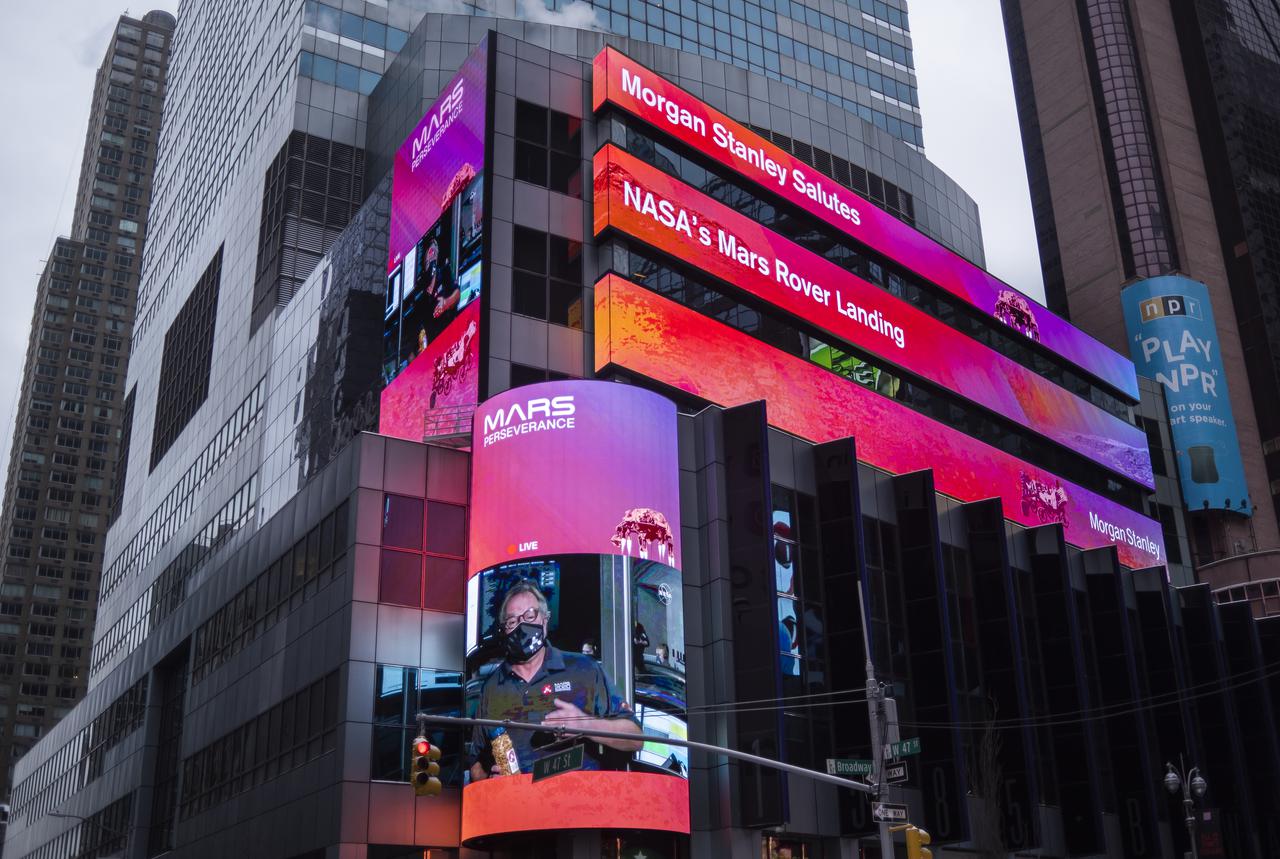
The live NASA TV broadcast from inside the Mission Support Area of NASA's Jet Propulsion Laboratory is seen on the Morgan Stanley video board as NASA's Perseverance rover begins its descent towards the surface of Mars, Thursday, Feb. 18, 2021 in New York City. A key objective for Perseverance’s mission on Mars is astrobiology, including the search for signs of ancient microbial life. The rover will characterize the planet’s geology and past climate, pave the way for human exploration of the Red Planet, and be the first mission to collect and cache Martian rock and regolith. Photo Credit: (NASA/Emma Howells)

The live NASA TV broadcast from inside the Mission Support Area of NASA's Jet Propulsion Laboratory is seen on the Morgan Stanley video board as NASA's Perseverance rover begins its descent towards the surface of Mars, Thursday, Feb. 18, 2021 in New York City. A key objective for Perseverance’s mission on Mars is astrobiology, including the search for signs of ancient microbial life. The rover will characterize the planet’s geology and past climate, pave the way for human exploration of the Red Planet, and be the first mission to collect and cache Martian rock and regolith. Photo Credit: (NASA/Emma Howells)
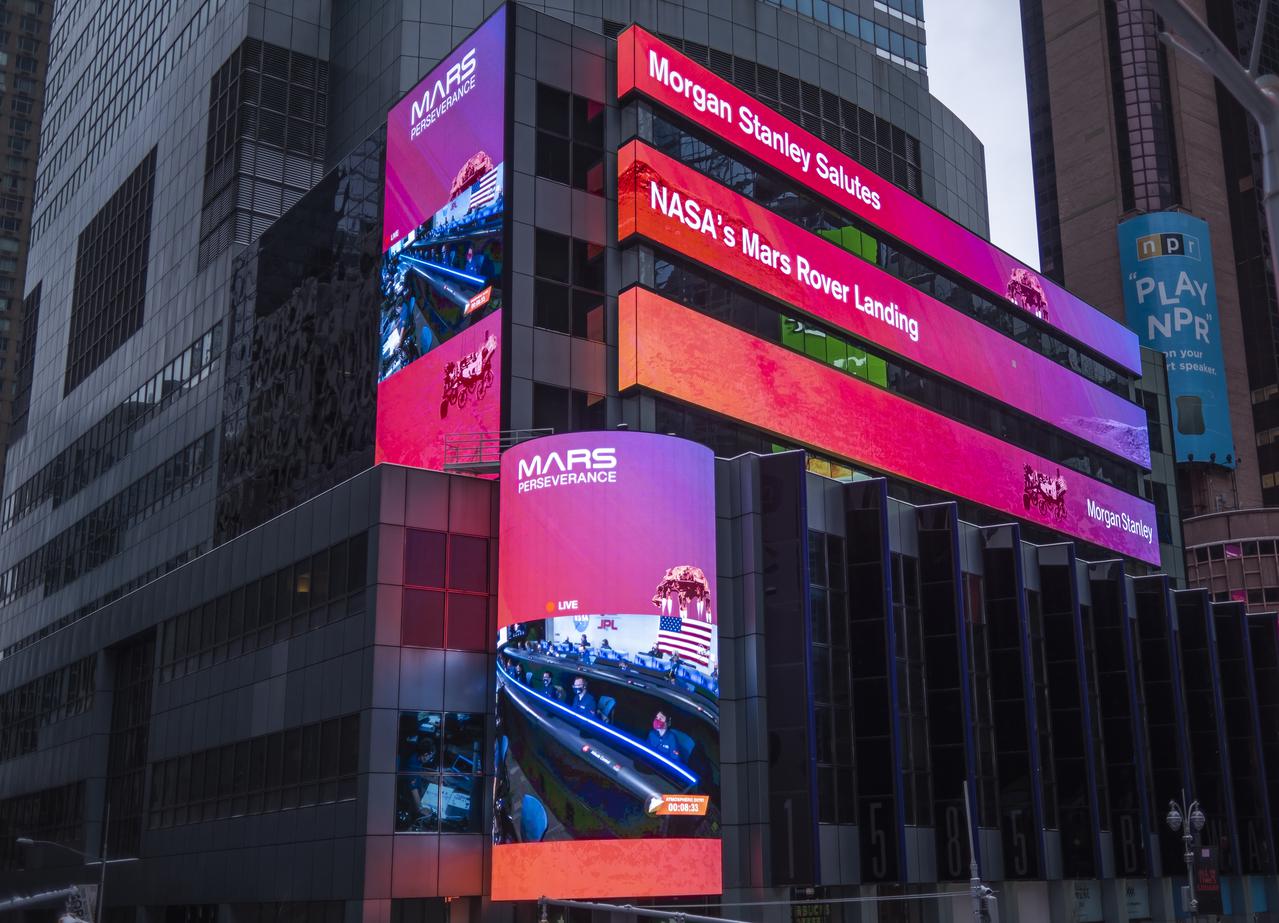
The live NASA TV broadcast from inside the Mission Support Area of NASA's Jet Propulsion Laboratory is seen on the Morgan Stanley video board as NASA's Perseverance rover begins its descent towards the surface of Mars, Thursday, Feb. 18, 2021 in New York City. A key objective for Perseverance’s mission on Mars is astrobiology, including the search for signs of ancient microbial life. The rover will characterize the planet’s geology and past climate, pave the way for human exploration of the Red Planet, and be the first mission to collect and cache Martian rock and regolith. Photo Credit: (NASA/Emma Howells)

A NASA Mars Rover Landing banner is seen on the Morgan Stanley video board as NASA's Perseverance rover completes its descent towards the surface of Mars, Thursday, Feb. 18, 2021 in New York City. A key objective for Perseverance’s mission on Mars is astrobiology, including the search for signs of ancient microbial life. The rover will characterize the planet’s geology and past climate, pave the way for human exploration of the Red Planet, and be the first mission to collect and cache Martian rock and regolith. Photo Credit: (NASA/Emma Howells)
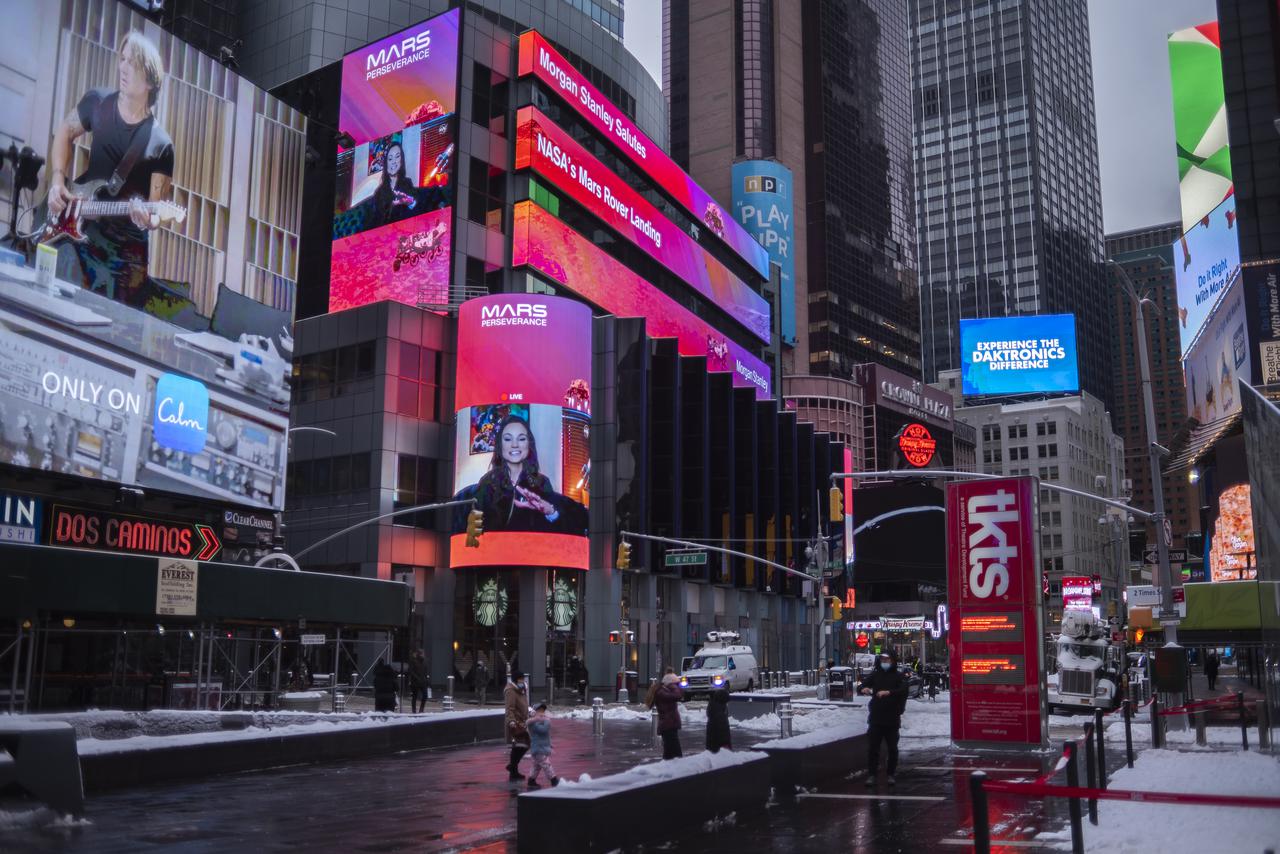
The live NASA TV broadcast from inside the Mission Support Area of NASA's Jet Propulsion Laboratory is seen on the Morgan Stanley video board as NASA's Perseverance rover begins its descent towards the surface of Mars, Thursday, Feb. 18, 2021 in New York City. A key objective for Perseverance’s mission on Mars is astrobiology, including the search for signs of ancient microbial life. The rover will characterize the planet’s geology and past climate, pave the way for human exploration of the Red Planet, and be the first mission to collect and cache Martian rock and regolith. Photo Credit: (NASA/Emma Howells)

The Krispy Kreme Mars doughnut is seen in New York City, as NASA's Perseverance rover begins its descent towards the surface of Mars, Thursday, Feb. 18, 2021. A key objective for Perseverance’s mission on Mars is astrobiology, including the search for signs of ancient microbial life. The rover will characterize the planet’s geology and past climate, pave the way for human exploration of the Red Planet, and be the first mission to collect and cache Martian rock and regolith. Photo Credit: (NASA/Emma Howells)

NASA’s Artemis II crewmembers: NASA astronauts Reid Wiseman, commander, left, and Christina Koch, mission specialist, look at Times Square from the Times Square Skywalk, Thursday, April 30, 2026 in New York, NY. The Artemis II crew was in New York for a number of postflight events. NASA’s Artemis II mission took Wiseman, Victor Glover, Koch, and Jeremy Hansen on a nearly 10-day journey around the Moon and back to Earth earlier in April 2026. Photo Credit: (NASA/Bill Ingalls)
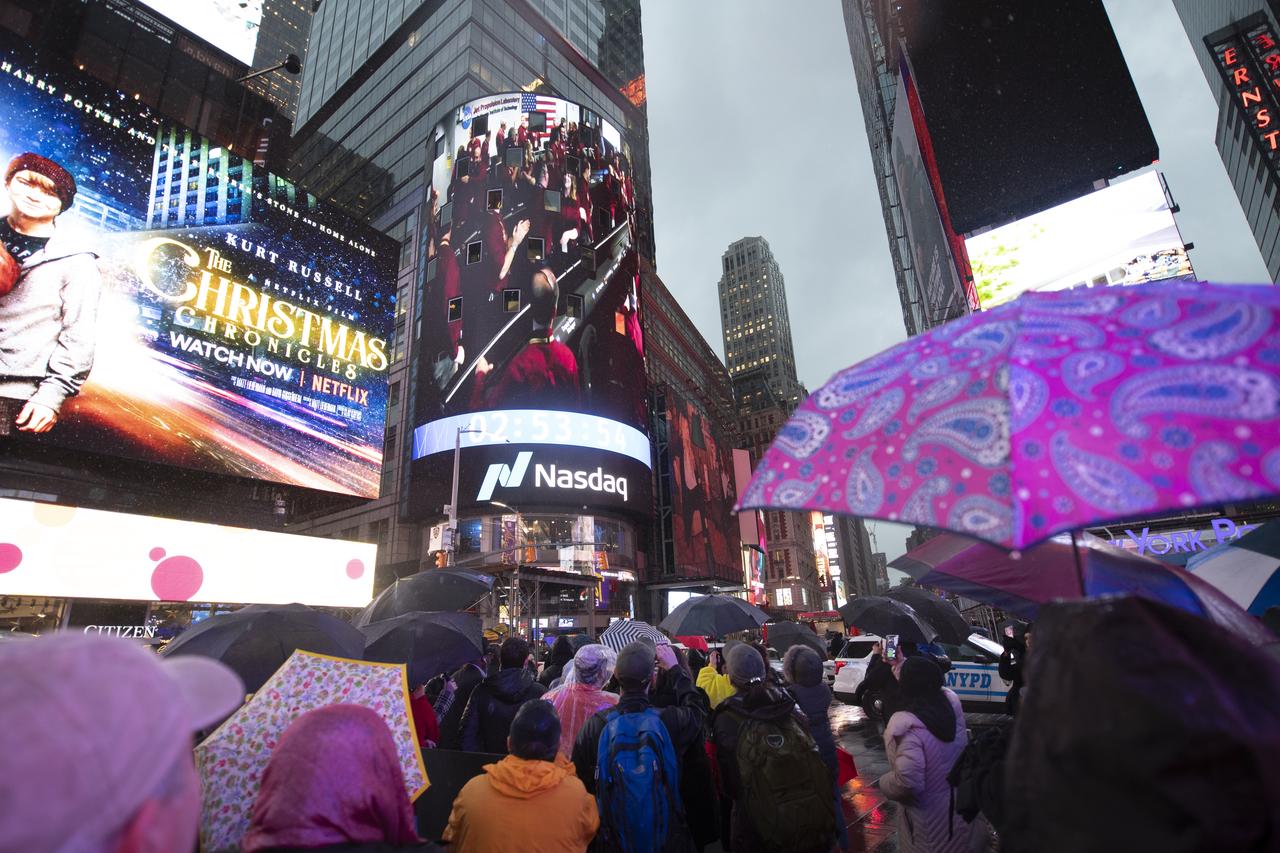
Spectators in Times Square watch the video board of the Nasdaq MarketSite showing the live NASA TV broadcast as NASA InSight team members celebrate inside the Mission Support Area of NASA's Jet Propulsion Laboratory after receiving confirmation the lander successfully touched down on the surface of Mars, Monday, Nov. 26, 2018 in Times Square in New York City. The lander sent a signal affirming a completed landing sequence at approximately 3 p.m. EST (noon PST) after touching down on the western side of a flat, smooth expanse of lava called Elysium Planitila. InSight, short for Interior Exploration using Seismic Investigations, Geodesy and Heat Transport, is a Mars lander designed to study the "inner space" of Mars: its crust, mantle, and core. Photo Credit: (NASA/Joel Kowsky)

NASA’s Artemis II crewmembers: CSA (Canadian Space Agency) astronaut Jeremy Hansen, mission specialist; left, NASA astronauts Reid Wiseman, commander; Christina Koch, mission specialist, and Victor Glover, pilot, right, look at Times Square from the Times Square Skywalk, Thursday, April 30, 2026 in New York, NY. The Artemis II crew was in New York for a number of postflight events. NASA’s Artemis II mission took Wiseman, Glover, Koch, and Hansen on a nearly 10-day journey around the Moon and back to Earth earlier in April 2026. Photo Credit: (NASA/Bill Ingalls)

Video of the Artemis II launch is seen on a large display in New York’s Times Square, Thursday, April 30, 2026. NASA’s Artemis II crewmembers: NASA astronauts Reid Wiseman, commander; Christina Koch, mission specialist, Victor Glover, pilot; and CSA (Canadian Space Agency) astronaut Jeremy Hansen, mission specialist are in New York for a number of postflight events. NASA’s Artemis II mission took Wiseman, Glover, Koch, and Hansen on a nearly 10-day journey around the Moon and back to Earth earlier in April 2026. Photo Credit: (NASA/Bill Ingalls)

The live NASA TV broadcast from inside the Mission Support Area of NASA's Jet Propulsion Laboratory is seen on the video board of the Nasdaq MarketSite as NASA's InSight lander begins its descent towards the surface of Mars, Monday, Nov. 26, 2018 in Times Square in New York City. The lander sent a signal affirming a completed landing sequence at approximately 3 p.m. EST (noon PST) after touching down on the western side of a flat, smooth expanse of lava called Elysium Planitila. InSight, short for Interior Exploration using Seismic Investigations, Geodesy and Heat Transport, is a Mars lander designed to study the "inner space" of Mars: its crust, mantle, and core. Photo Credit: (NASA/Joel Kowsky)

The live NASA TV broadcast from inside the Mission Support Area of NASA's Jet Propulsion Laboratory is seen on the video board of the Nasdaq MarketSite as NASA's InSight lander begins its descent towards the surface of Mars, Monday, Nov. 26, 2018 in Times Square in New York City. The lander sent a signal affirming a completed landing sequence at approximately 3 p.m. EST (noon PST) after touching down on the western side of a flat, smooth expanse of lava called Elysium Planitila. InSight, short for Interior Exploration using Seismic Investigations, Geodesy and Heat Transport, is a Mars lander designed to study the "inner space" of Mars: its crust, mantle, and core. Photo Credit: (NASA/Joel Kowsky)

NASA’s Artemis II crewmembers: CSA (Canadian Space Agency) astronaut Jeremy Hansen, mission specialist; left, NASA astronauts Reid Wiseman, commander; Christina Koch, mission specialist, and Victor Glover, pilot, right, pose for a group photograph at the Times Square Skywalk, Thursday, April 30, 2026 in New York, NY. The Artemis II crew was in New York for a number of postflight events. NASA’s Artemis II mission took Wiseman, Glover, Koch, and Hansen on a nearly 10-day journey around the Moon and back to Earth earlier in April 2026. Photo Credit: (NASA/Bill Ingalls)

NASA’s Artemis II crewmembers: CSA (Canadian Space Agency) astronaut Jeremy Hansen, mission specialist; left, NASA astronauts Reid Wiseman, commander; Christina Koch, mission specialist, and Victor Glover, pilot, right, pose for a group photograph at the Times Square Skywalk, Thursday, April 30, 2026 in New York, NY. The Artemis II crew was in New York for a number of postflight events. NASA’s Artemis II mission took Wiseman, Glover, Koch, and Hansen on a nearly 10-day journey around the Moon and back to Earth earlier in April 2026. Photo Credit: (NASA/Bill Ingalls)

NASA’s Artemis II crewmembers: CSA (Canadian Space Agency) astronaut Jeremy Hansen, mission specialist; left, NASA astronauts Reid Wiseman, commander; Christina Koch, mission specialist, and Victor Glover, pilot, right, pose for a group photograph at the Times Square Skywalk, Thursday, April 30, 2026 in New York, NY. The Artemis II crew was in New York for a number of postflight events. NASA’s Artemis II mission took Wiseman, Glover, Koch, and Hansen on a nearly 10-day journey around the Moon and back to Earth earlier in April 2026. Photo Credit: (NASA/Bill Ingalls)

NASA Administrator Jared Isaacman, left, NASA’s Artemis II crewmembers: CSA (Canadian Space Agency) astronaut Jeremy Hansen, mission specialist; NASA astronauts Reid Wiseman, commander; Christina Koch, mission specialist, and Victor Glover, pilot, right, pose for a group photograph at the Times Square Skywalk, Thursday, April 30, 2026 in New York, NY. The Artemis II crew was in New York for a number of postflight events. NASA’s Artemis II mission took Wiseman, Glover, Koch, and Hansen on a nearly 10-day journey around the Moon and back to Earth earlier in April 2026. Photo Credit: (NASA/Bill Ingalls)

A large display at the Times Square Skywalk shows NASA’s Artemis II crewmembers: CSA (Canadian Space Agency) astronaut Jeremy Hansen, mission specialist; NASA astronauts Victor Glover, pilot; Reid Wiseman, commander; and Christina Koch, mission specialist, right, Thursday, April 30, 2026 in New York, NY. The Artemis II crew was in New York for postflight events. NASA’s Artemis II mission took Wiseman, Glover, Koch, and Hansen on a nearly 10-day journey around the Moon and back to Earth earlier in April 2026. Photo Credit: (NASA/Bill Ingalls)

Video of the Artemis II splashdown is seen on the Nasdaq building in New York’s Times Square, Thursday, April 30, 2026. NASA’s Artemis II crewmembers: NASA astronauts Reid Wiseman, commander; Christina Koch, mission specialist, Victor Glover, pilot; and CSA (Canadian Space Agency) astronaut Jeremy Hansen, mission specialist closed the Nasdaq trading session. NASA’s Artemis II mission took Wiseman, Glover, Koch, and Hansen on a nearly 10-day journey around the Moon and back to Earth earlier in April 2026. Photo Credit: (NASA/Bill Ingalls)

A Mars 2020 message is seen on the video board of the Nasdaq MarketSite after NASA's Perseverance rover landed on the surface of Mars, Thursday, Feb. 18, 2021 in New York City. A key objective for Perseverance’s mission on Mars is astrobiology, including the search for signs of ancient microbial life. The rover will characterize the planet’s geology and past climate, pave the way for human exploration of the Red Planet, and be the first mission to collect and cache Martian rock and regolith. Photo Credit: (NASA/Emma Howells)

A Mars 2020 message is seen on the video board of the Nasdaq MarketSite after NASA's Perseverance rover landed on the surface of Mars, Thursday, Feb. 18, 2021 in New York City. A key objective for Perseverance’s mission on Mars is astrobiology, including the search for signs of ancient microbial life. The rover will characterize the planet’s geology and past climate, pave the way for human exploration of the Red Planet, and be the first mission to collect and cache Martian rock and regolith. Photo Credit: (NASA/Emma Howells)
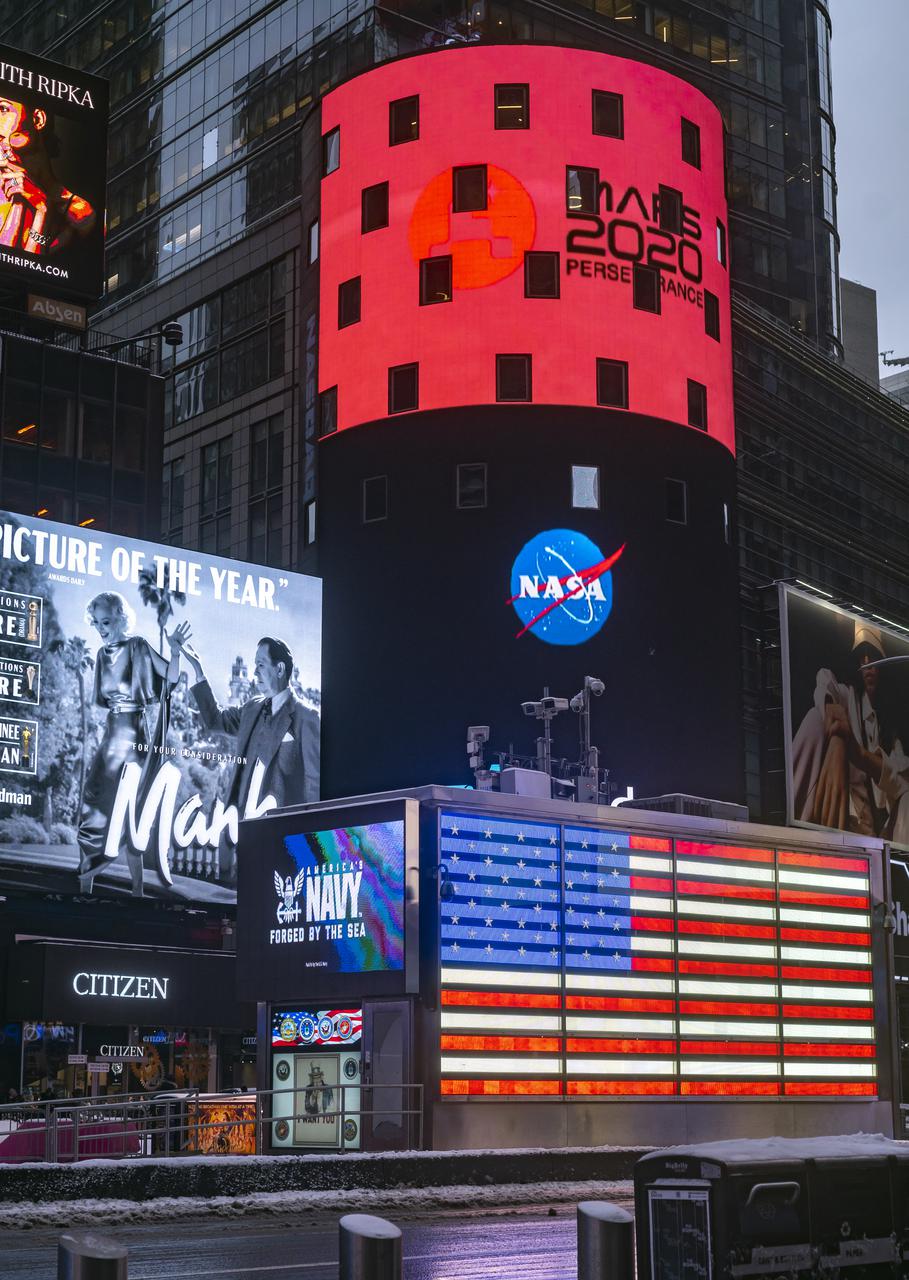
A Mars 2020 message is seen on the video board of the Nasdaq MarketSite after NASA's Perseverance rover landed on the surface of Mars, Thursday, Feb. 18, 2021 in New York City. A key objective for Perseverance’s mission on Mars is astrobiology, including the search for signs of ancient microbial life. The rover will characterize the planet’s geology and past climate, pave the way for human exploration of the Red Planet, and be the first mission to collect and cache Martian rock and regolith. Photo Credit: (NASA/Emma Howells)

NASA’s Artemis II mission specialist Christina Koch is seen on the Nasdaq building in New York’s Times Square soon after ringing the closing bell of the Nasdaq market session, with fellow crewmembers; CSA (Canadian Space Agency) astronaut Jeremy Hansen, mission specialist; and NASA astronauts Reid Wiseman, commander; and Victor Glover, pilot, Thursday, April 30, 2026. NASA’s Artemis II mission took Wiseman, Glover, Koch, and Hansen on a nearly 10-day journey around the Moon and back to Earth earlier in April 2026. Photo Credit: (NASA/Bill Ingalls)

Imagery from NASA’s Artemis II mission is seen on the Nasdaq building in New York’s Times Square after NASA’s Artemis II crewmembers: NASA astronauts Christina Koch, mission specialist; Reid Wiseman, commander; Victor Glover, pilot, mission specialist, and CSA (Canadian Space Agency) astronaut Jeremy Hansen, rang the closing bell Thursday, April 30, 2026. NASA’s Artemis II mission took Wiseman, Glover, Koch, and Hansen on a nearly 10-day journey around the Moon and back to Earth earlier in April 2026. Photo Credit: (NASA/Bill Ingalls)

NASA’s Artemis II mission specialist, CSA (Canadian Space Agency) astronaut Jeremy Hansen, is seen on the Nasdaq building in New York’s Times Square soon after ringing the closing bell of the Nasdaq market session, with fellow crewmembers; NASA astronauts Christina Koch, mission specialist; Reid Wiseman, commander; and Victor Glover, pilot, Thursday, April 30, 2026. NASA’s Artemis II mission took Wiseman, Glover, Koch, and Hansen on a nearly 10-day journey around the Moon and back to Earth earlier in April 2026. Photo Credit: (NASA/Bill Ingalls)

NASA’s Artemis II pilot Victor Glover, poses for a photograph in Times Square, New York, soon after ringing the closing bell of the Nasdaq market session, with fellow crewmembers; CSA (Canadian Space Agency) astronaut Jeremy Hansen, mission specialist; and NASA astronauts Reid Wiseman, commander; Christina Koch, mission specialist, Thursday, April 30, 2026. NASA’s Artemis II mission took Wiseman, Glover, Koch, and Hansen on a nearly 10-day journey around the Moon and back to Earth earlier in April 2026. Photo Credit: (NASA/Bill Ingalls)

NASA’s Artemis II mission specialist, CSA (Canadian Space Agency) astronaut Jeremy Hansen, poses for a photograph in Times Square, New York, soon after ringing the closing bell of the Nasdaq market session, with fellow crewmembers; NASA astronauts Christina Koch, mission specialist; Reid Wiseman, commander; and Victor Glover, pilot, Thursday, April 30, 2026. NASA’s Artemis II mission took Wiseman, Glover, Koch, and Hansen on a nearly 10-day journey around the Moon and back to Earth earlier in April 2026. Photo Credit: (NASA/Bill Ingalls)

Imagery from NASA’s Artemis II mission is seen on the Nasdaq building in New York’s Times Square after NASA’s Artemis II crewmembers: NASA astronauts Christina Koch, mission specialist; Reid Wiseman, commander; Victor Glover, pilot, mission specialist, and CSA (Canadian Space Agency) astronaut Jeremy Hansen, rang the closing bell Thursday, April 30, 2026. NASA’s Artemis II mission took Wiseman, Glover, Koch, and Hansen on a nearly 10-day journey around the Moon and back to Earth earlier in April 2026. Photo Credit: (NASA/Bill Ingalls)

NASA’s Artemis II commander Reid Wiseman, holds ‘Rise’ the zero gravity indicator, up for a photograph in Times Square, New York, after ringing the closing bell of the Nasdaq market session, with fellow crewmembers; CSA (Canadian Space Agency) astronaut Jeremy Hansen, mission specialist; and NASA astronauts Victor Glover, pilot; Christina Koch, mission specialist, Thursday, April 30, 2026. NASA’s Artemis II mission took Wiseman, Glover, Koch, and Hansen on a nearly 10-day journey around the Moon and back to Earth earlier in April 2026. Photo Credit: (NASA/Bill Ingalls)

NASA’s Artemis II pilot Victor Glover, reacts as his fellow crewmembers sing happy birthday to him in Times Square, New York, shortly after ringing the closing bell of the Nasdaq market session, with fellow crewmembers; CSA (Canadian Space Agency) astronaut Jeremy Hansen, mission specialist; and NASA astronauts Reid Wiseman, commander; Christina Koch, mission specialist, Thursday, April 30, 2026. NASA’s Artemis II mission took Wiseman, Glover, Koch, and Hansen on a nearly 10-day journey around the Moon and back to Earth earlier in April 2026. Photo Credit: (NASA/Bill Ingalls)

NASA’s Artemis II commander Reid Wiseman, poses for a photograph, in Times Square, New York, while holding ‘Rise’ the zero gravity indicator, soon after ringing the closing bell of the Nasdaq market session, with fellow crewmembers; CSA (Canadian Space Agency) astronaut Jeremy Hansen, mission specialist; and NASA astronauts Victor Glover, pilot; Christina Koch, mission specialist, Thursday, April 30, 2026. NASA’s Artemis II mission took Wiseman, Glover, Koch, and Hansen on a nearly 10-day journey around the Moon and back to Earth earlier in April 2026. Photo Credit: (NASA/Bill Ingalls)

Imagery from NASA’s Artemis II mission is seen on the Nasdaq building in New York’s Times Square after NASA’s Artemis II crewmembers: NASA astronauts Christina Koch, mission specialist; Reid Wiseman, commander; Victor Glover, pilot, mission specialist, and CSA (Canadian Space Agency) astronaut Jeremy Hansen, rang the closing bell Thursday, April 30, 2026. NASA’s Artemis II mission took Wiseman, Glover, Koch, and Hansen on a nearly 10-day journey around the Moon and back to Earth earlier in April 2026. Photo Credit: (NASA/Bill Ingalls)

NASA’s Artemis II pilot Victor Glover, is seen on the Nasdaq building in New York’s Times Square soon after ringing the closing bell of the Nasdaq market session, with fellow crewmembers; CSA (Canadian Space Agency) astronaut Jeremy Hansen, mission specialist; and NASA astronauts Reid Wiseman, commander; Christina Koch, mission specialist, Thursday, April 30, 2026. NASA’s Artemis II mission took Wiseman, Glover, Koch, and Hansen on a nearly 10-day journey around the Moon and back to Earth earlier in April 2026. Photo Credit: (NASA/Bill Ingalls)

Imagery from NASA’s Artemis II mission is seen on the Nasdaq building in New York’s Times Square after NASA’s Artemis II crewmembers: NASA astronauts Christina Koch, mission specialist; Reid Wiseman, commander; Victor Glover, pilot, mission specialist, and CSA (Canadian Space Agency) astronaut Jeremy Hansen, rang the closing bell Thursday, April 30, 2026. NASA’s Artemis II mission took Wiseman, Glover, Koch, and Hansen on a nearly 10-day journey around the Moon and back to Earth earlier in April 2026. Photo Credit: (NASA/Bill Ingalls)

NASA’s Artemis II pilot Victor Glover, center, reacts while seeing a special recognition of his 50th birthday by the Nasdaq in Times Square, New York, after ringing the closing bell of the Nasdaq market session, with fellow crewmembers; CSA (Canadian Space Agency) astronaut Jeremy Hansen, mission specialist; and NASA astronauts Reid Wiseman, commander; Christina Koch, mission specialist, Thursday, April 30, 2026. NASA’s Artemis II mission took Wiseman, Glover, Koch, and Hansen on a nearly 10-day journey around the Moon and back to Earth earlier in April 2026. Photo Credit: (NASA/Bill Ingalls)

NASA’s Artemis II mission specialist Christina Koch poses for a photograph in Times Square, New York, soon after ringing the closing bell of the Nasdaq market session, with fellow crewmembers; CSA (Canadian Space Agency) astronaut Jeremy Hansen, mission specialist; and NASA astronauts Reid Wiseman, commander; and Victor Glover, pilot, Thursday, April 30, 2026. NASA’s Artemis II mission took Wiseman, Glover, Koch, and Hansen on a nearly 10-day journey around the Moon and back to Earth earlier in April 2026. Photo Credit: (NASA/Bill Ingalls)

NASA’s Artemis II commander Reid Wiseman, is seen on the Nasdaq building in New York’s Times Square soon after ringing the closing bell of the Nasdaq market session with fellow crewmembers; CSA (Canadian Space Agency) astronaut Jeremy Hansen, mission specialist; and NASA astronauts Victor Glover, pilot; Christina Koch, mission specialist, Thursday, April 30, 2026. NASA’s Artemis II mission took Wiseman, Glover, Koch, and Hansen on a nearly 10-day journey around the Moon and back to Earth earlier in April 2026. Photo Credit: (NASA/Bill Ingalls)

Imagery from NASA’s Artemis II mission is seen on the Nasdaq building in New York’s Times Square after NASA’s Artemis II crewmembers: NASA astronauts Christina Koch, mission specialist; Reid Wiseman, commander; Victor Glover, pilot, mission specialist, and CSA (Canadian Space Agency) astronaut Jeremy Hansen, rang the closing bell Thursday, April 30, 2026. NASA’s Artemis II mission took Wiseman, Glover, Koch, and Hansen on a nearly 10-day journey around the Moon and back to Earth earlier in April 2026. Photo Credit: (NASA/Bill Ingalls)

NASA’s Artemis II crewmembers: CSA (Canadian Space Agency) astronaut Jeremy Hansen, mission specialist; left, NASA astronauts Victor Glover, pilot; Christina Koch, mission specialist; and Reid Wiseman, commander, right, watch a replay of them ringing the closing bell of the Nasdaq market session, Thursday, April 30, 2026, in Times Square, New York. NASA’s Artemis II mission took Wiseman, Glover, Koch, and Hansen on a nearly 10-day journey around the Moon and back to Earth earlier in April 2026. Photo Credit: (NASA/Bill Ingalls)

NASA’s Artemis II crewmembers: NASA astronauts Reid Wiseman, commander; left, Christina Koch, mission specialist; Victor Glover, pilot; and CSA (Canadian Space Agency) astronaut Jeremy Hansen, mission specialist, right, watch a replay of them ringing the closing bell of the Nasdaq market session, Thursday, April 30, 2026, in Times Square, New York. NASA’s Artemis II mission took Wiseman, Glover, Koch, and Hansen on a nearly 10-day journey around the Moon and back to Earth earlier in April 2026. Photo Credit: (NASA/Bill Ingalls)

NASA’s Artemis II crewmembers: CSA (Canadian Space Agency) astronaut Jeremy Hansen, mission specialist; left, NASA astronauts Victor Glover, pilot; Christina Koch, mission specialist; and Reid Wiseman, commander, right, pose for a photograph after ringing the closing bell of the Nasdaq market session, Thursday, April 30, 2026, in Times Square, New York. NASA’s Artemis II mission took Wiseman, Glover, Koch, and Hansen on a nearly 10-day journey around the Moon and back to Earth earlier in April 2026. Photo Credit: (NASA/Bill Ingalls)

The Nasdaq MarketSite tower displays a congratulatory message to NASA as the agency announces a five-part plan to open the International Space Station to expanded commercial and marketing activities and private astronaut missions to the station and enable additional commercial destinations in low-Earth orbit, Friday, June 7, 2019 at Nasdaq MarketSite in New York City. NASA will continue to maintain human presence and research in low-Earth orbit, and the long-term goal is to achieve a robust economy from which NASA can purchase services at a lower cost. Photo Credit: (NASA/Bill Ingalls)

NASA announces the agency’s five-part plan to open the International Space Station to expanded commercial and marketing activities and private astronaut missions to the station and enable additional commercial destinations in low-Earth orbit, Friday, June 7, 2019 at the Nasdaq MarketSite in New York City. NASA will continue to maintain human presence and research in low-Earth orbit, and the long-term goal is to achieve a robust economy from which NASA can purchase services at a lower cost. Photo Credit: (NASA/Bill Ingalls)

NASA Chief Financial Officer Jeff DeWit gives remarks during a briefing where NASA announced the agency’s five-part plan to open the International Space Station to expanded commercial and marketing activities and private astronaut missions to the station and enable additional commercial destinations in low-Earth orbit, Friday, June 7, 2019 at the Nasdaq MarketSite in New York City. NASA will continue to maintain human presence and research in low-Earth orbit, and the long-term goal is to achieve a robust economy from which NASA can purchase services at a lower cost. Photo Credit: (NASA/Bill Ingalls)

NASA Associate Administrator for the Human Exploration and Operations Directorate William Gerstenmaier gives remarks during a briefing where NASA announced the agency’s five-part plan to open the International Space Station to expanded commercial and marketing activities and private astronaut missions to the station and enable additional commercial destinations in low-Earth orbit, Friday, June 7, 2019 at the Nasdaq MarketSite in New York City. NASA will continue to maintain human presence and research in low-Earth orbit, and the long-term goal is to achieve a robust economy from which NASA can purchase services at a lower cost. Photo Credit: (NASA/Bill Ingalls)

NASA Public Affairs Officer Stephanie Schierholz moderates a briefing where NASA announced the agency’s five-part plan to open the International Space Station to expanded commercial and marketing activities and private astronaut missions to the station and enable additional commercial destinations in low-Earth orbit, Friday, June 7, 2019 at the Nasdaq MarketSite in New York City. NASA will continue to maintain human presence and research in low-Earth orbit, and the long-term goal is to achieve a robust economy from which NASA can purchase services at a lower cost. Photo Credit: (NASA/Bill Ingalls)

NASA International Space Station Deputy Director Robyn Gatens answers questions during a briefing where NASA announced the agency’s five-part plan to open the International Space Station to expanded commercial and marketing activities and private astronaut missions to the station and enable additional commercial destinations in low-Earth orbit, Friday, June 7, 2019 at the Nasdaq MarketSite in New York City. NASA will continue to maintain human presence and research in low-Earth orbit, and the long-term goal is to achieve a robust economy from which NASA can purchase services at a lower cost. Photo Credit: (NASA/Bill Ingalls)
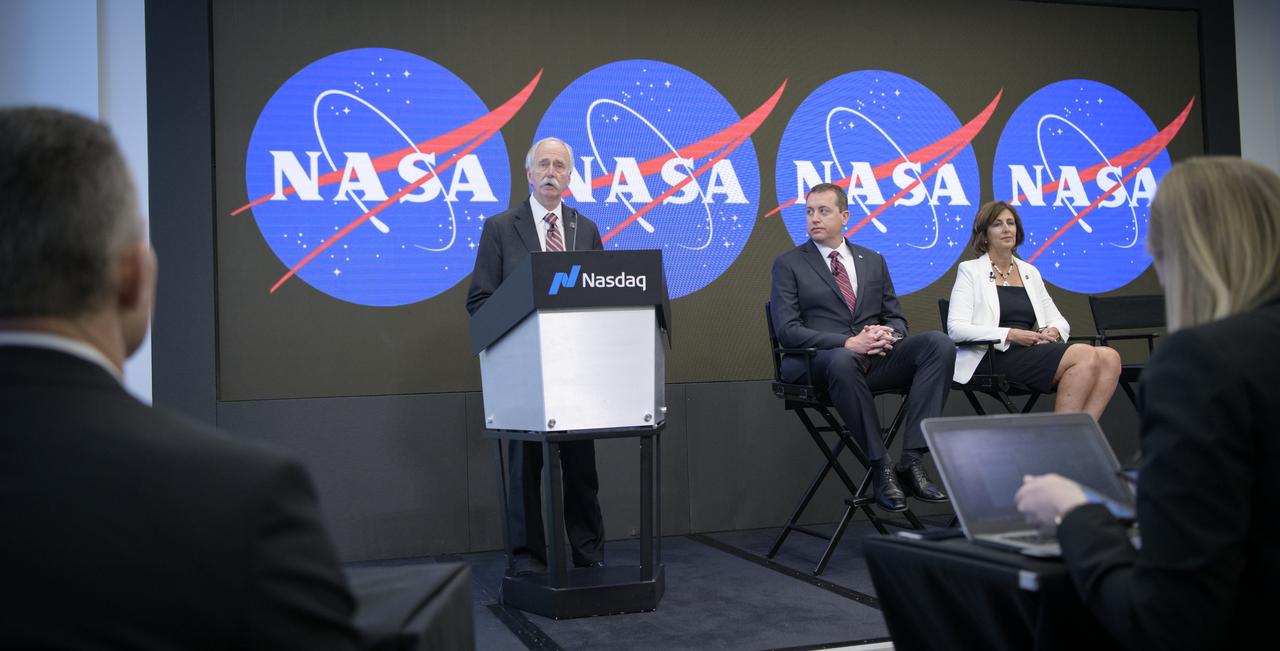
NASA Associate Administrator for the Human Exploration and Operations Directorate William Gerstenmaier, left, NASA Chief Financial Officer Jeff DeWit, center, and NASA International Space Station Deputy Director Robyn Gatens announce the agency’s five-part plan to open the International Space Station to expanded commercial and marketing activities and private astronaut missions to the station and enable additional commercial destinations in low-Earth orbit, Friday, June 7, 2019 at the Nasdaq MarketSite in New York City. NASA will continue to maintain human presence and research in low-Earth orbit, and the long-term goal is to achieve a robust economy from which NASA can purchase services at a lower cost. Photo Credit: (NASA/Bill Ingalls)
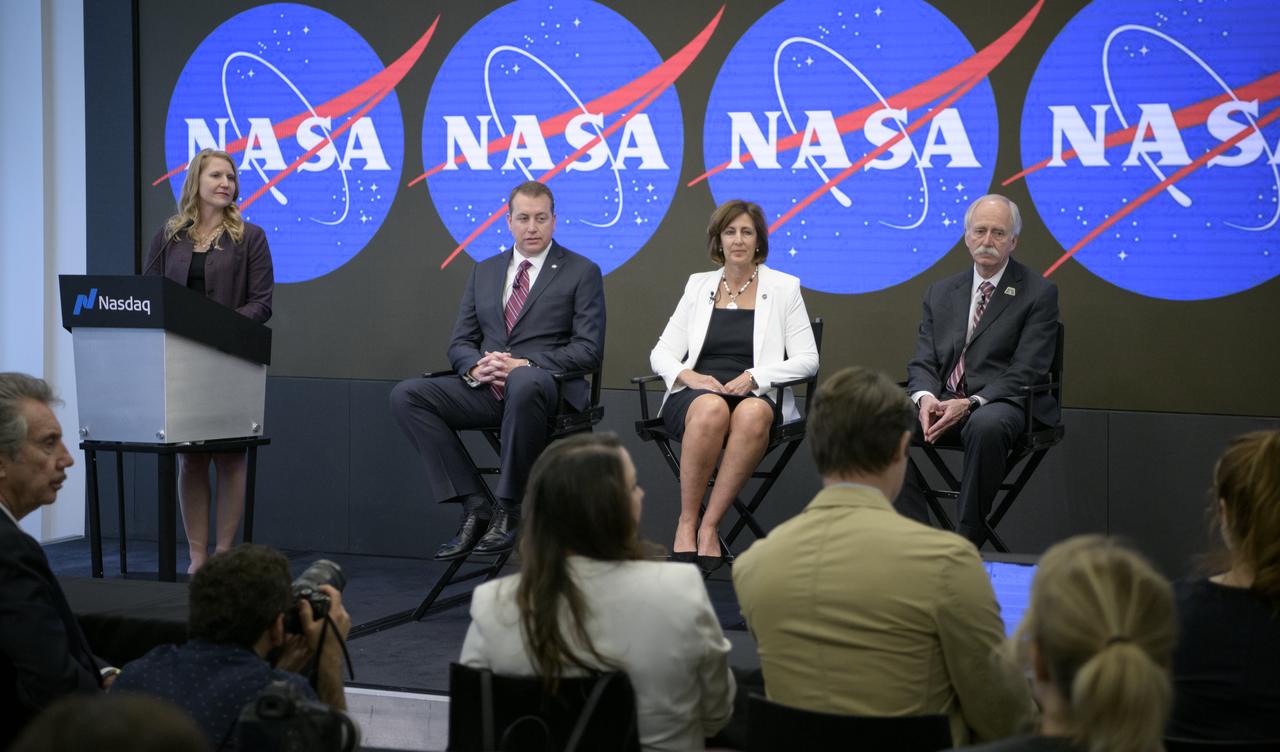
NASA Public Affairs Officer Stephanie Schierholz, standing left, moderates a media briefing with NASA Chief Financial Officer Jeff DeWit, left, NASA International Space Station Deputy Director Robyn Gatens, center, and NASA Associate Administrator for the Human Exploration and Operations Directorate William Gerstenmaier where they announced the agency’s five-part plan to open the International Space Station to expanded commercial and marketing activities and private astronaut missions to the station and enable additional commercial destinations in low-Earth orbit, Friday, June 7, 2019 at the Nasdaq MarketSite in New York City. NASA will continue to maintain human presence and research in low-Earth orbit, and the long-term goal is to achieve a robust economy from which NASA can purchase services at a lower cost. Photo Credit: (NASA/Bill Ingalls)

A Nasdaq moderator, center, talks with NASA Director of Commercial Spaceflight Development Phil McAlister, left, ISS National Lab Vice President and Chief Operating Officer Ken Shields, NASA Advisory Council Regulatory and Policy Committee Chair Mike Gold, and NASA Deputy Chief Financial Officer for Integration Doug Comstock, right, during a live social media event shortly after NASA announced a five-part plan to open the International Space Station to expanded commercial and marketing activities and private astronaut missions to the station and enable additional commercial destinations in low-Earth orbit, Friday, June 7, 2019 at the Nasdaq MarketSite in New York City. NASA will continue to maintain human presence and research in low-Earth orbit, and the long-term goal is to achieve a robust economy from which NASA can purchase services at a lower cost. Photo Credit: (NASA/Bill Ingalls)

A Nasdaq moderator, center, talks with NanoRacks CEO Jeff Manber, left, NASA Manager of the International Space Station Research Office Marybeth Edeen, AlphaSpace Founder and Chairman Stephanie Murphy, and Made in Space Vice President of Advanced Programs and Concepts Justin Kugler, right, during a live social media event shortly after NASA announced a five-part plan to open the International Space Station to expanded commercial and marketing activities and private astronaut missions to the station and enable additional commercial destinations in low-Earth orbit, Friday, June 7, 2019 at the Nasdaq MarketSite in New York City. NASA will continue to maintain human presence and research in low-Earth orbit, and the long-term goal is to achieve a robust economy from which NASA can purchase services at a lower cost. Photo Credit: (NASA/Bill Ingalls)

NASA astronaut Christina Koch onboard the International Space Station gives remarks in a video during a briefing where NASA announced the agency’s five-part plan to open the International Space Station to expanded commercial and marketing activities and private astronaut missions to the station and enable additional commercial destinations in low-Earth orbit, Friday, June 7, 2019 at the Nasdaq MarketSite in New York City. NASA will continue to maintain human presence and research in low-Earth orbit, and the long-term goal is to achieve a robust economy from which NASA can purchase services at a lower cost. Photo Credit: (NASA/Bill Ingalls)

A Nasdaq moderator, center, talks with NASA Director of Commercial Spaceflight Development Phil McAlister, left, ISS National Lab Vice President and Chief Operating Officer Ken Shields, NASA Advisory Council Regulatory and Policy Committee Chair Mike Gold, and NASA Deputy Chief Financial Officer for Integration Doug Comstock, right, during a live social media event shortly after NASA announced a five-part plan to open the International Space Station to expanded commercial and marketing activities and private astronaut missions to the station and enable additional commercial destinations in low-Earth orbit, Friday, June 7, 2019 at the Nasdaq MarketSite in New York City. NASA will continue to maintain human presence and research in low-Earth orbit, and the long-term goal is to achieve a robust economy from which NASA can purchase services at a lower cost. Photo Credit: (NASA/Bill Ingalls)
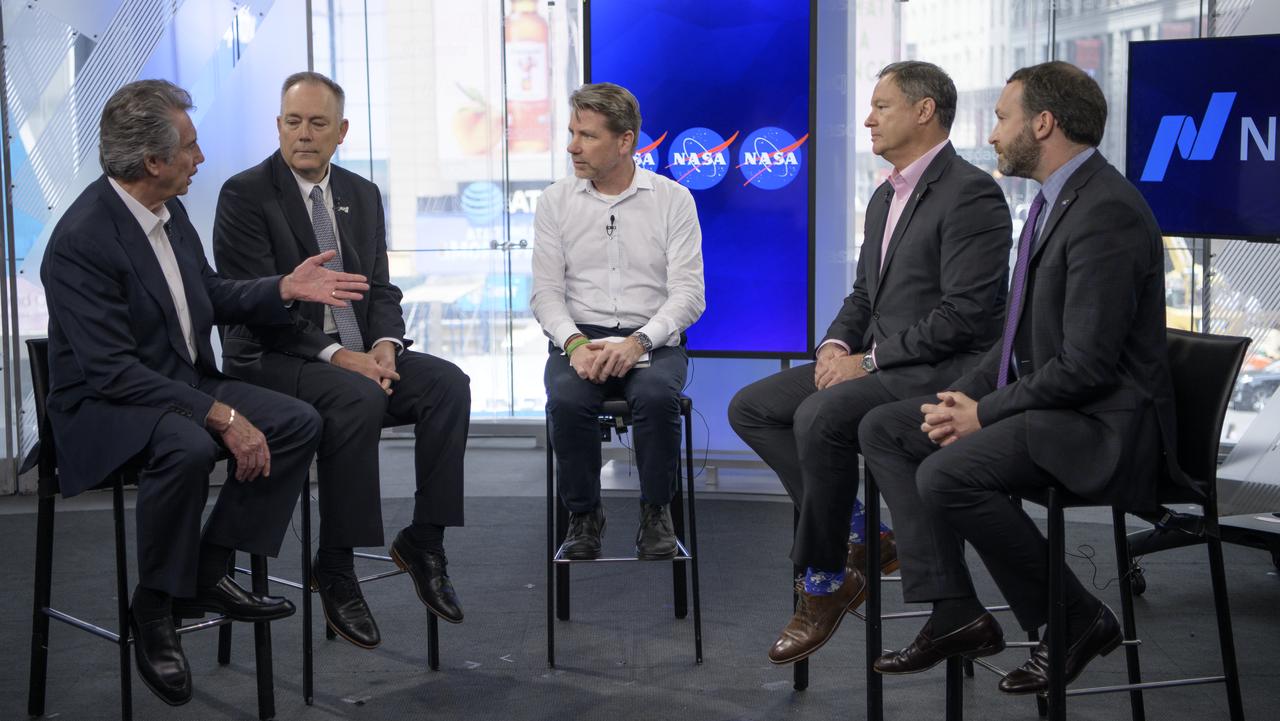
A Nasdaq moderator, center, talks with Bigelow Aerospace, LLC Founder and President Robert Bigelow, left, Boeing Global Sales and Marketing, Space Exploration, Kevin Foley, Axiom Vice President of Business Development Michael Lopez-Alegria, and NASA Senior Economic Advisor Alex MacDonald, right, during a live social media event shortly after NASA announced a five-part plan to open the International Space Station to expanded commercial and marketing activities and private astronaut missions to the station and enable additional commercial destinations in low-Earth orbit, Friday, June 7, 2019 at the Nasdaq MarketSite in New York City. NASA will continue to maintain human presence and research in low-Earth orbit, and the long-term goal is to achieve a robust economy from which NASA can purchase services at a lower cost. Photo Credit: (NASA/Bill Ingalls)
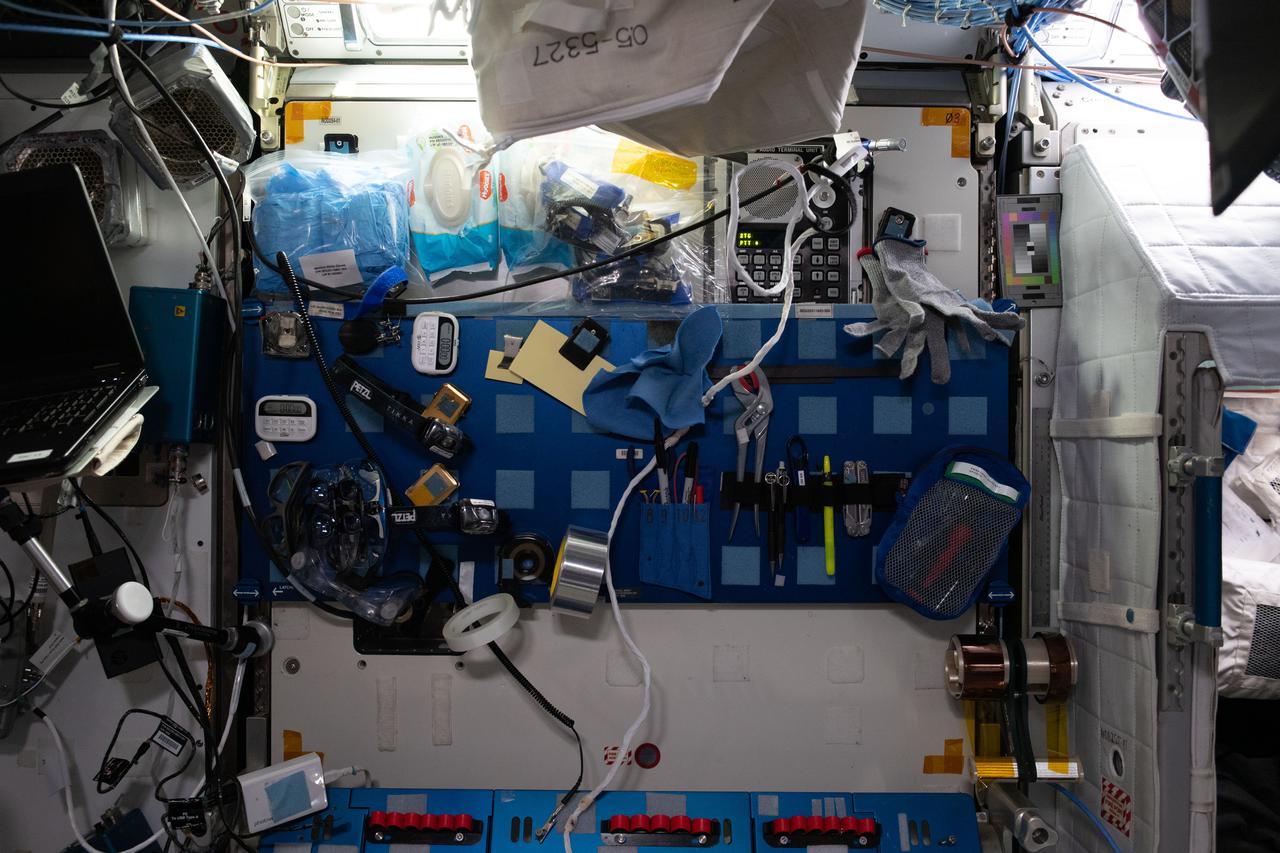
iss066e113865 (Jan. 15, 2022) --- A sample site is denoted for the SQuARE archaeological investigation with pieces of Kapton tape. This investigation studies how astronauts use objects in space over an extended period of time in space. The experiment adapts the standard archaeological technique on Earth called the “shovel test pit” by having crew members mark out square sample sites throughout the orbiting laboratory. Astronauts took picture of these sites at the same time every day, and then at randomly selected times. What we learn could inform design of future space habitats. Credits: International Space Station Archeological Project.
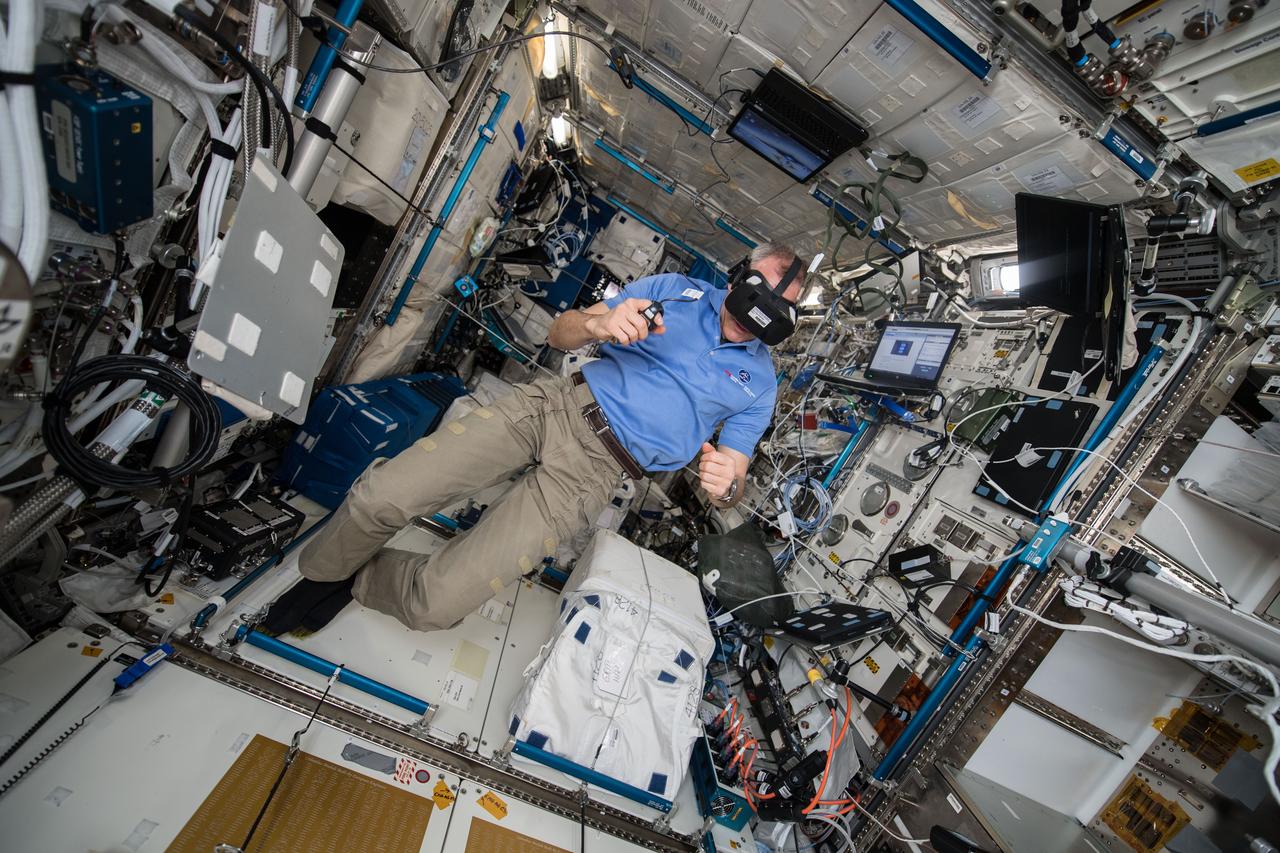
iss058e013795 (2/15/2019) --- Canadian Space Agency (CSA) astronaut David Saint-Jacques is shown onboard the International Space Station (ISS) performing the Time Perception in Microgravity investigation. The goal of the Time Perception in Microgravity experiment is to investigate the perception of time to crew members aboard the International Space Station (ISS). Crewmembers are asked to evaluate or reproduce the display duration of a blue square presented in the center of the head-mounted display. The results are compared with pre- and postflight baselines.
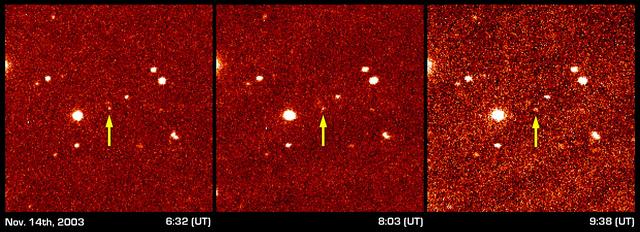
These three panels show the first detection of the faint distant object dubbed "Sedna." Imaged on November 14th from 6:32 to 9:38 Universal Time, Sedna was identified by the slight shift in position noted in these three pictures taken at different times. Subsequent observations at longer time intervals provided the information necessary to deduce the nature of Sedna's 10,500 year orbit around the Sun. The field of view of each frame is 3.4 arcminutes square, and each pixel is 1.0 arcsecond. http://photojournal.jpl.nasa.gov/catalog/PIA05568
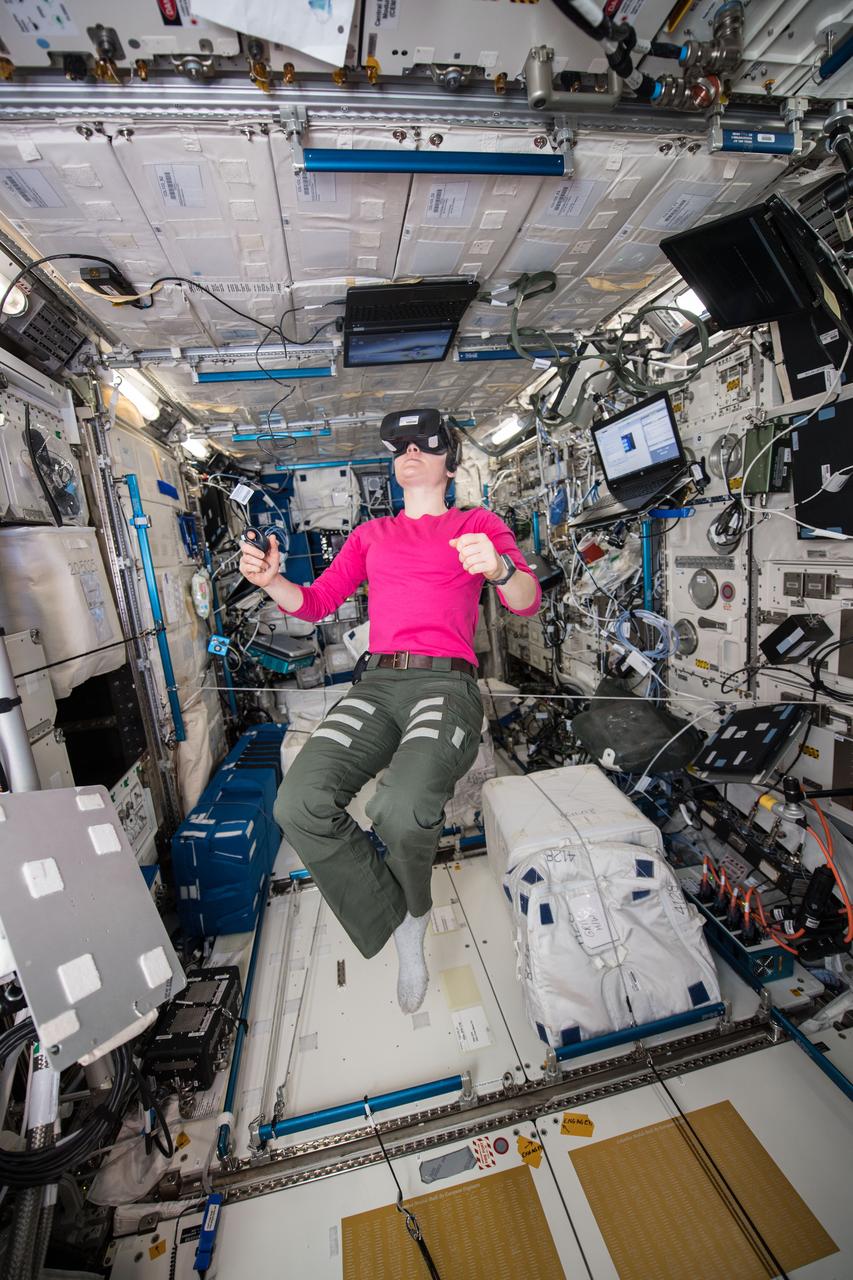
iss058e013797 (2/15/2019) --- NASA astronaut Anne McClain is shown onboard the International Space Station (ISS) performing the Time Perception in Microgravity investigation. The goal of the Time Perception in Microgravity experiment is to investigate the perception of time to crew members aboard the International Space Station (ISS). Crewmembers are asked to evaluate or reproduce the display duration of a blue square presented in the center of the head-mounted display. The results are compared with pre- and postflight baselines.

NASA Deputy Associate Administrator Melanie Saunders and former NASA astronaut Mike Massimino ring the closing bell of the Nasdaq after the NASA's InSight lander successfully touched down on the surface of Mars, Monday, Nov. 26, 2018 at the Nasdaq MarketSite in New York City. The lander sent a signal affirming a completed landing sequence at approximately 3 p.m. EST (noon PST) after touching down on the western side of a flat, smooth expanse of lava called Elysium Planitila. InSight, short for Interior Exploration using Seismic Investigations, Geodesy and Heat Transport, is a Mars lander designed to study the "inner space" of Mars: its crust, mantle, and core. Photo Credit: (NASA/Joel Kowsky)
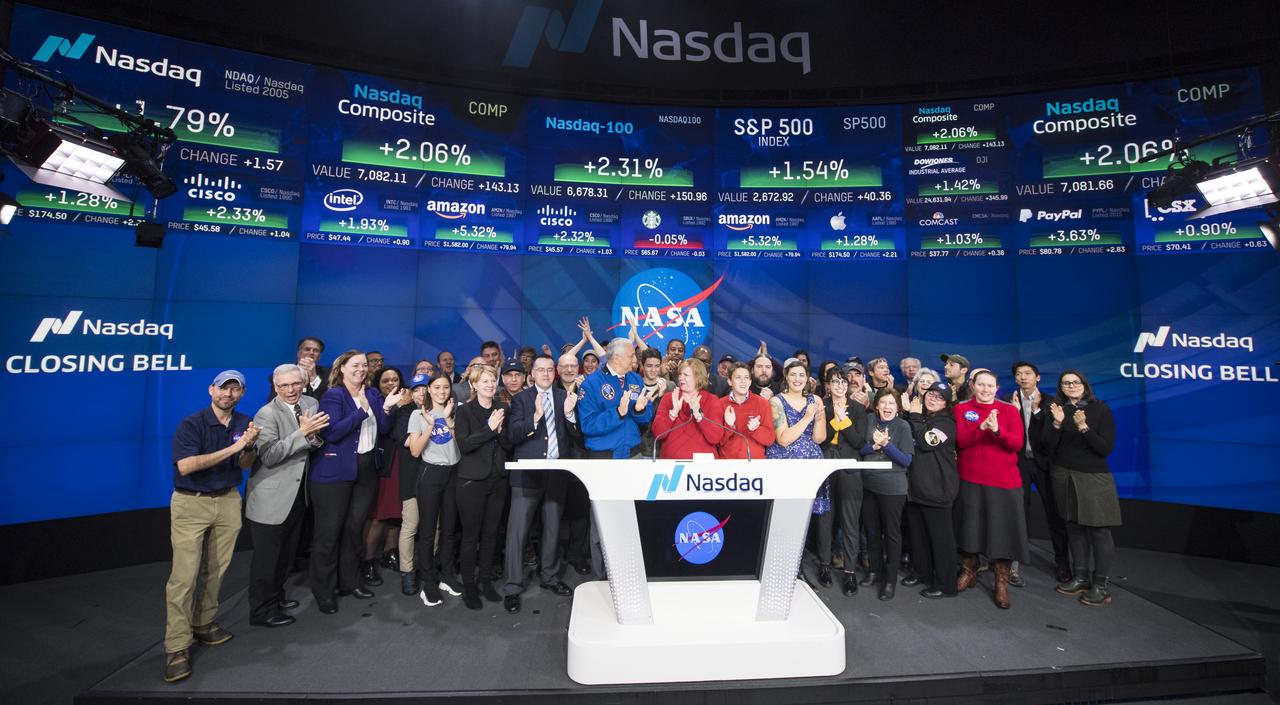
NASA Deputy Associate Administrator Melanie Saunders and former NASA astronaut Mike Massimino ring the closing bell of the Nasdaq after the NASA's InSight lander successfully touched down on the surface of Mars, Monday, Nov. 26, 2018 at the Nasdaq MarketSite in New York City. The lander sent a signal affirming a completed landing sequence at approximately 3 p.m. EST (noon PST) after touching down on the western side of a flat, smooth expanse of lava called Elysium Planitila. InSight, short for Interior Exploration using Seismic Investigations, Geodesy and Heat Transport, is a Mars lander designed to study the "inner space" of Mars: its crust, mantle, and core. Photo Credit: (NASA/Joel Kowsky)

Expedition 36/37 Flight Engineer Karen Nyberg (right) takes a stroll through Red Square in Moscow in front of a grandstand and the Kremlin May 8 with her husband, astronaut Doug Hurley (left) and their son. Red Square was decorated for commemorative activity in honor of Russian Victor Day May 9. Nyberg, Soyuz Commander Fyodor Yurchikhin and Flight Engineer Luca Parmitano of the European Space Agency are preparing for their launch May 29, Kazakh time, in their Soyuz TMA-09M spacecraft from the Baikonur Cosmodrome in Kazakhstan for a six-month mission on the International Space Station. NASA/Stephanie Stoll

Expedition 36/37 Flight Engineer Karen Nyberg (right) takes a stroll through Red Square in Moscow May 8 in front of a grandstand with her husband, astronaut Doug Hurley (left) and their son. Red Square was decorated for commemorative activity in honor of Russian Victor Day May 9. Nyberg, Soyuz Commander Fyodor Yurchikhin and Flight Engineer Luca Parmitano of the European Space Agency are preparing for their launch May 29, Kazakh time, in their Soyuz TMA-09M spacecraft from the Baikonur Cosmodrome in Kazakhstan for a six-month mission on the International Space Station. NASA/Stephanie Stoll
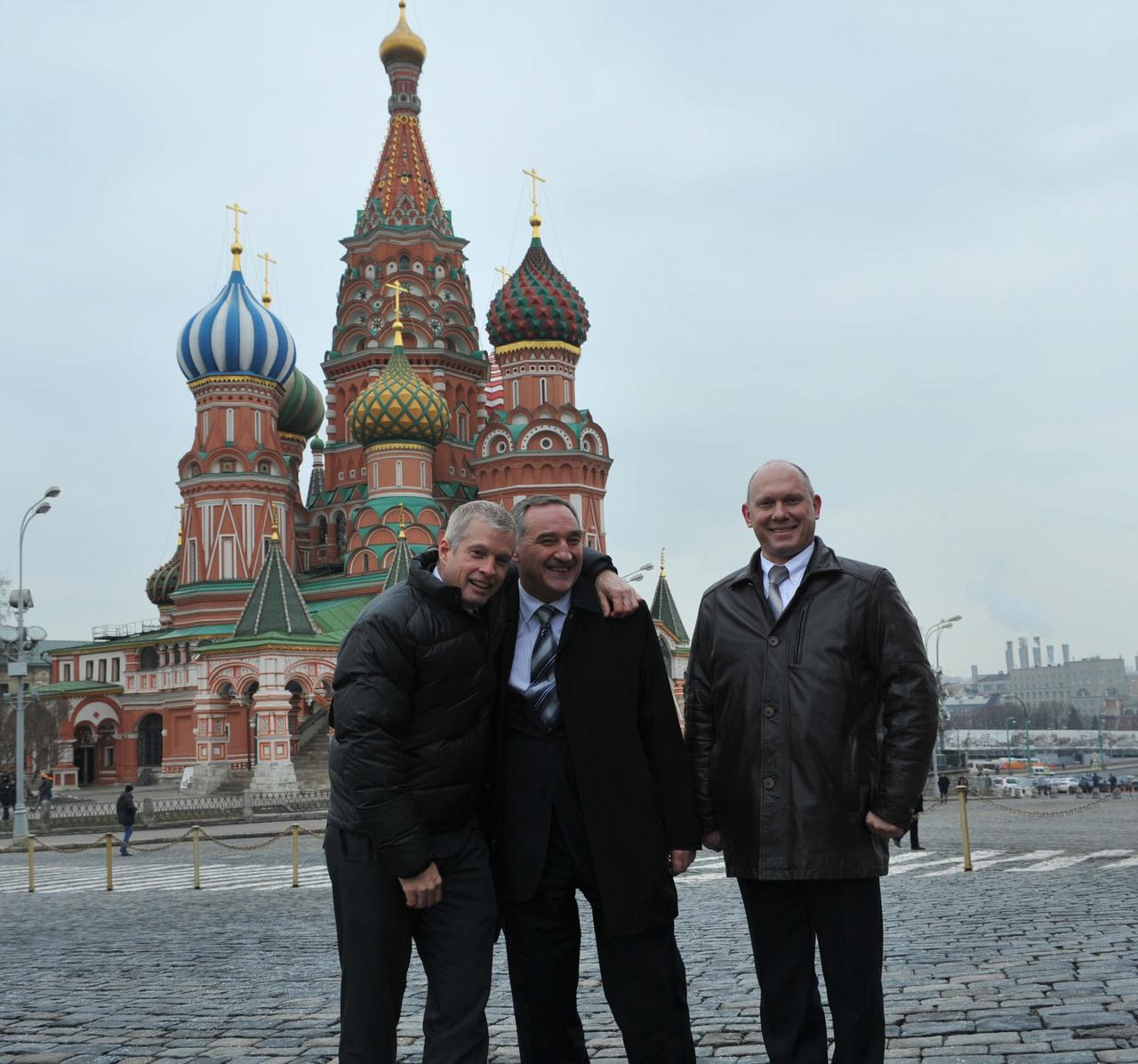
Striking a pose in front of St. Basil’s Cathedral at Red Square in Moscow, Expedition 39/40 crewmembers Steve Swanson of NASA (left), Alexander Skvortsov of Roscosmos (center) and Oleg Artemyev of Roscosmos (right) took time from ceremonial activities March 6 for a photo opportunity. Swanson, Skvortsov and Artemyev are preparing for their launch to the International Space Station from the Baikonur Cosmodrome in Kazakhstan March 26, Kazakh time, in their Soyuz TMA-12M spacecraft for a six-month mission. NASA/Stephanie Stoll
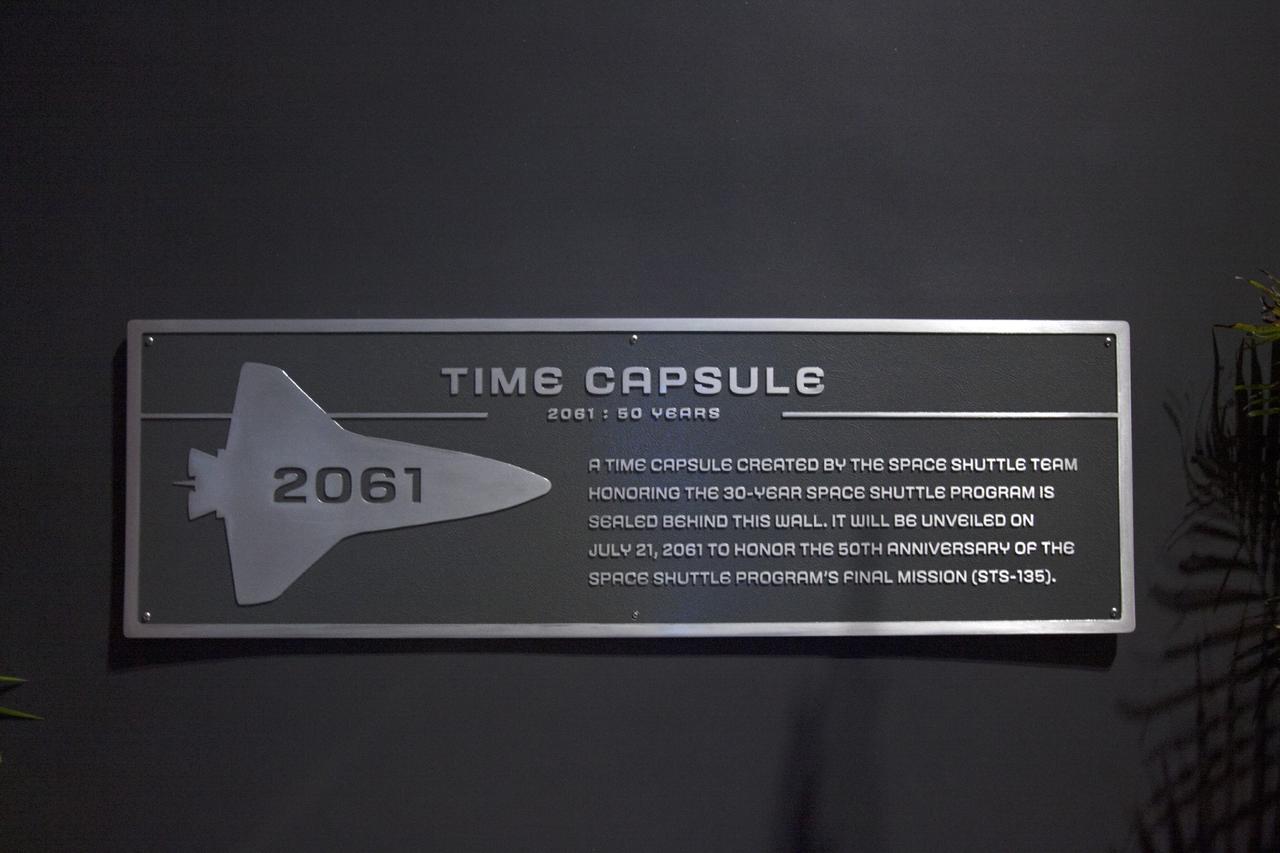
CAPE CANAVERAL, Fla. -- At the Kennedy Space Center Visitor Complex in Florida, a Space Shuttle Program time capsule has been enshrined capsule in a secured vault within the walls of the 90,000-square-foot Space Shuttle Atlantis home. The time capsule, containing artifacts and other memorabilia associated with the history of the program is designated to be opened on the 50th anniversary of the shuttle's final landing, STS-135. The new $100 million "Space Shuttle Atlantis" facility includes interactive exhibits that tell the story of the 30-year Space Shuttle Program and highlight the future of space exploration. Photo credit: NASA/Jim Grossmann
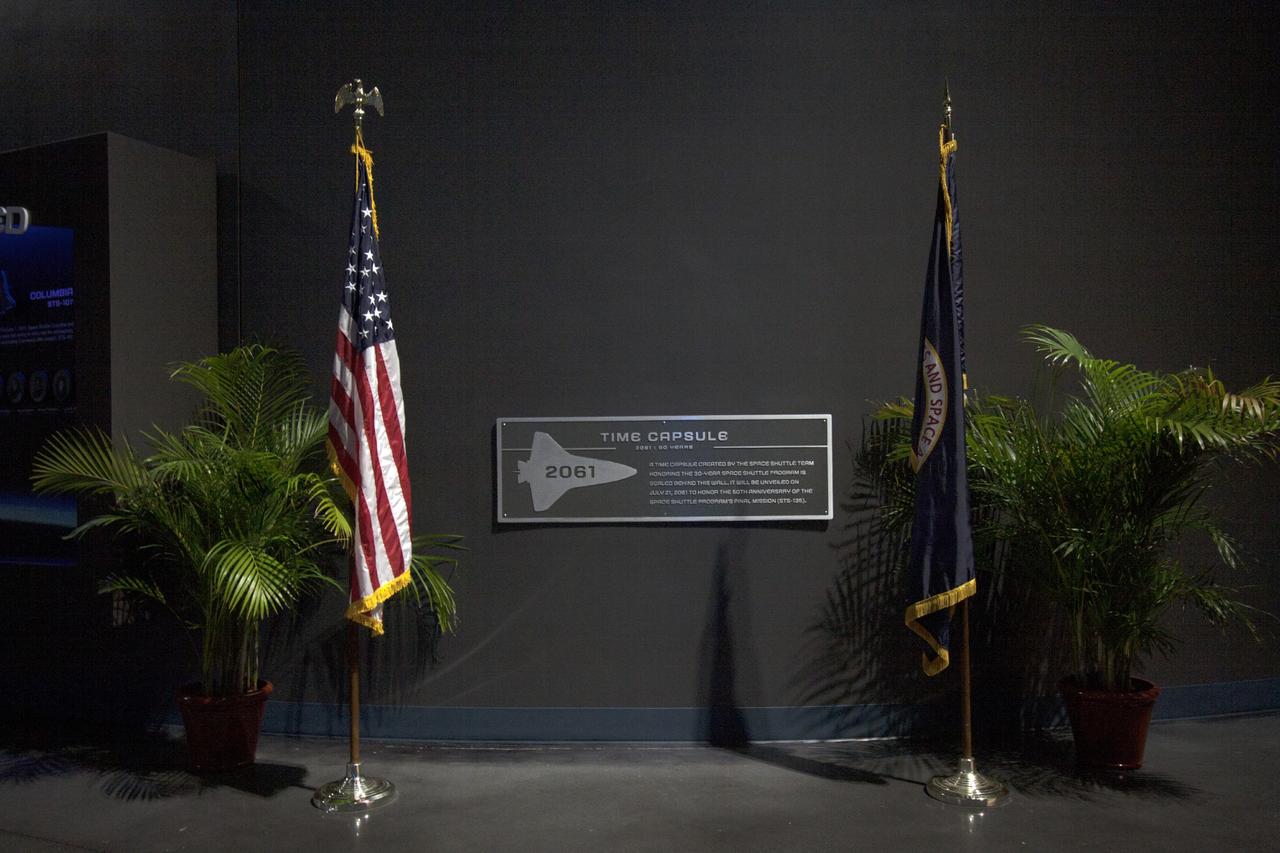
CAPE CANAVERAL, Fla. -- At the Kennedy Space Center Visitor Complex in Florida, a Space Shuttle Program time capsule has been enshrined capsule in a secured vault within the walls of the 90,000-square-foot Space Shuttle Atlantis home. The time capsule, containing artifacts and other memorabilia associated with the history of the program is designated to be opened on the 50th anniversary of the shuttle's final landing, STS-135. The new $100 million "Space Shuttle Atlantis" facility includes interactive exhibits that tell the story of the 30-year Space Shuttle Program and highlight the future of space exploration. Photo credit: NASA/Jim Grossmann
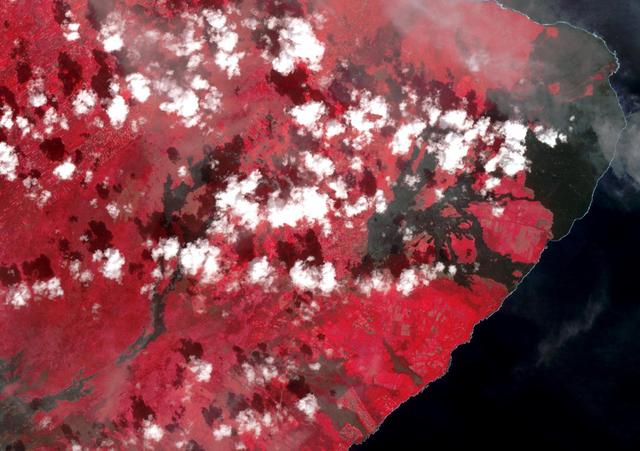
The 2018 Kilauea, Hawaii eruption began in May on Kilauea's East Rift Zone. Lava fountains up to 100 meters high, lava flows, and volcanic gas continued until August. By the time the eruption ended, over 700 houses had been destroyed, and 35 square kilometers of land had been covered by lava flows. About 3.5 square kilometers (875 acres) of new land has been created in the ocean. The before image was acquired by Landsat 8 on September 5, 2013; the ASTER image was acquired November 14, 2018. The images cover an area of 18 by 25.5 kilometers, and are located at 19.5 degrees north, 154.9 degrees west. https://photojournal.jpl.nasa.gov/catalog/PIA22899
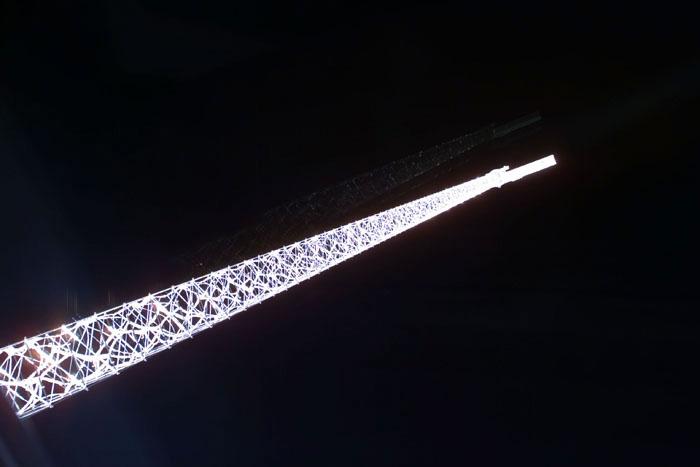
S99-E-5033 (12 February 2000) --- The 200 ft.-long mast supporting the Shuttle Radar Topography Mission juts into space from the Space Shuttle Endeavour (out of frame at left). The giant structure was deployed earlier today and the antennae on it quickly went to work mapping parts of Earth. By the time members of Endeavour's Red Team had reached lunchtime on this first full day in space for the SRTM, the radar antennae in the payload bay and at the end of long mast had mapped about 1.7 million square miles (4.5 million square kilometers) of the Earth's surface, or the equivalent of about half the area of the United States. This photograph was taken with an electronic still camera (ESC) by a crew member inside Endeavour's cabin.

With famed St. Basil’s Cathedral serving as a backdrop, Expedition 36/37 Flight Engineer Karen Nyberg of NASA (left), Soyuz Commander Fyodor Yurchikhin (center) and Flight Engineer Luca Parmitano of the European Space Agency (right) pose for pictures May 8 during a ceremonial tour of Red Square in Moscow. Nyberg, Yurchikhin and Parmitano are preparing for their launch May 29, Kazakh time, in their Soyuz TMA-09M spacecraft from the Baikonur Cosmodrome in Kazakhstan for a six-month mission on the International Space Station. NASA/Stephanie Stoll
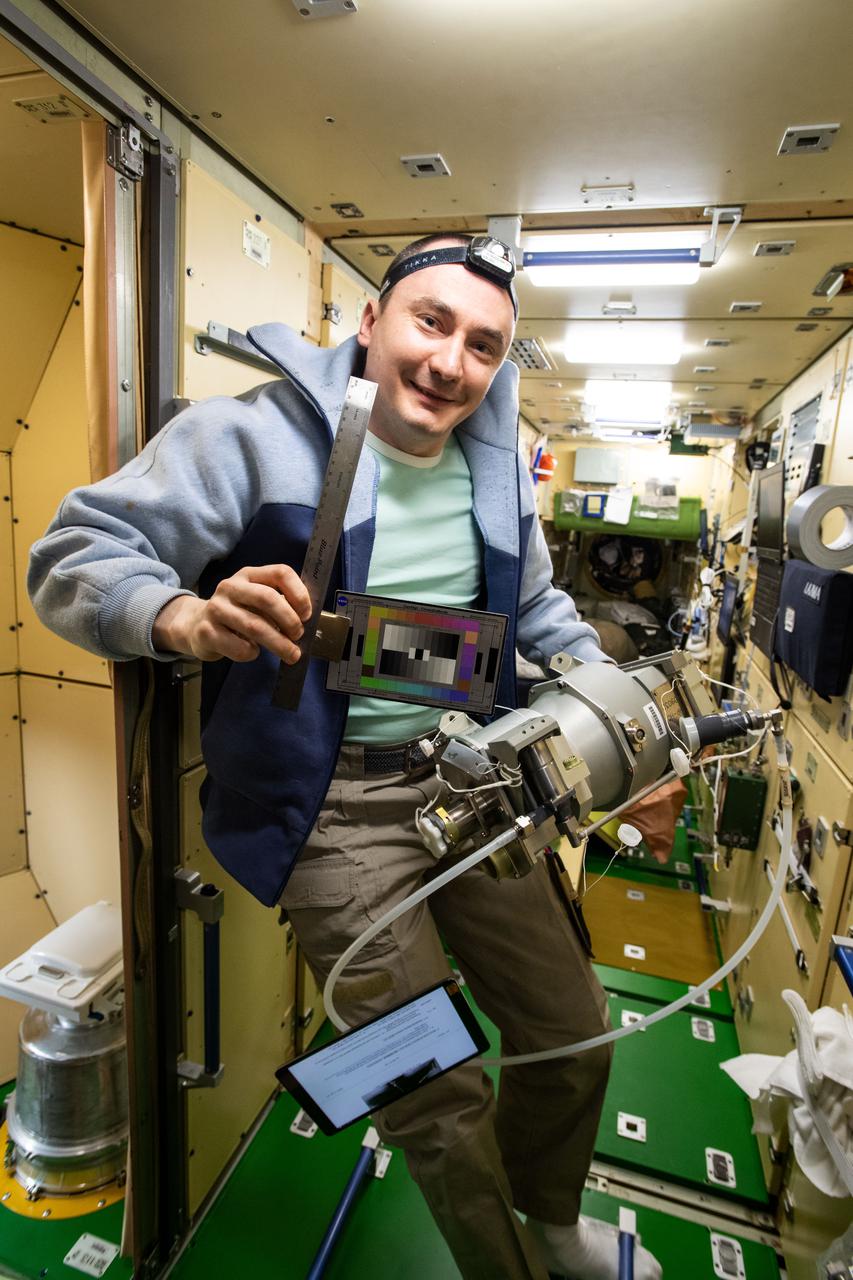
iss066e129780 (Jan. 28, 2022) --- Roscosmos cosmonaut and Expedition 66 Flight Engineer Pyotr Dubrov poses with a ruler and color chart while working inside the Nauka multipurpose laboratory module. The ruler and chart are used for the SQuARES study looking at how crew members use different objects and spaces over time. This investigation may provide information that helps improve the design of future space craft and habitats. At bottom left, is the Nauka module's toilet.
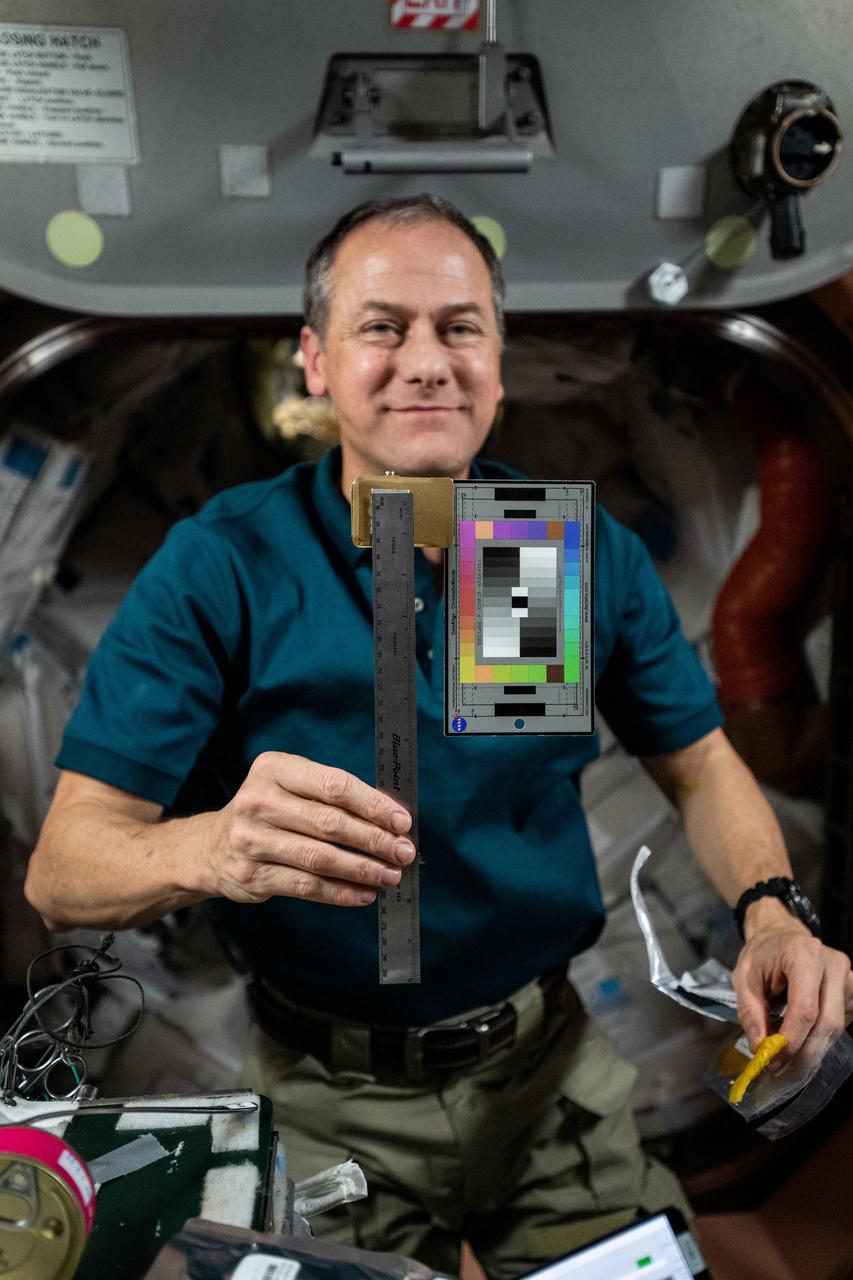
iss066e129769 (Jan. 28, 2022) --- NASA astronaut and Expedition 66 Flight Engineer Thomas Marshburn poses with a ruler and color chart aboard the International Space Station. The ruler and chart are used for the SQuARES study looking at how crew members use different objects and spaces over time. This investigation may provide information that helps improve the design of future space craft and habitats.

At the Kremlin Wall at Red Square in Moscow, Expedition 37/38 Soyuz Commander Oleg Kotov lays flowers Sept. 6 in a traditional ceremony to honor Russian space icons who are interred there. Kotov, Flight Engineer Michael Hopkins of NASA and Flight Engineer Sergey Ryazanskiy are preparing for their launch to the International Space Station from the Baikonur Cosmodrome in Kazakhstan on Sept. 26, Kazakh time, aboard the Soyuz TMA-10M spacecraft. NASA/Stephanie Stoll

1069: At the Kremlin Wall in Moscow’s Red Square, Expedition 40/41 Soyuz Commander Max Suraev of the Russian Federal Space Agency (Roscosmos) lays flowers May 8 at the spot where Yuri Gagarin, the first human to fly in space, is interred. Suraev, Alexander Gerst of the European Space Agency and Reid Wiseman of NASA are preparing for launch May 29, Kazakh time, in the Soyuz TMA-13M spacecraft from the Baikonur Cosmodrome in Kazakhstan for a 5 ½ month mission on the International Space Station. NASA/Stephanie Stoll

Expedition 36/37 Flight Engineer Karen Nyberg (right) takes a stroll through Red Square in Moscow in front of St. Basil’s Cathedral May 8 with her husband, astronaut Doug Hurley (left) and their son, Soyuz Commander Fyodor Yurchikhin and Flight Engineer Luca Parmitano of the European Space Agency are preparing for their launch May 29, Kazakh time, in their Soyuz TMA-09M spacecraft from the Baikonur Cosmodrome in Kazakhstan for a six-month mission on the International Space Station. NASA/Stephanie Stoll

Expedition 36/37 Flight Engineer Luca Parmitano of the European Space Agency takes a stroll through Red Square in Moscow in front of St. Basil’s Cathedral May 8 with his wife, Kathy Dillow, and their daughters. Parmitano, Soyuz Commander Fyodor Yurchikhin and Flight Engineer Karen Nyberg of NASA are preparing for their launch May 29, Kazakh time, in their Soyuz TMA-09M spacecraft from the Baikonur Cosmodrome in Kazakhstan for a six-month mission on the International Space Station. NASA/Stephanie Stoll
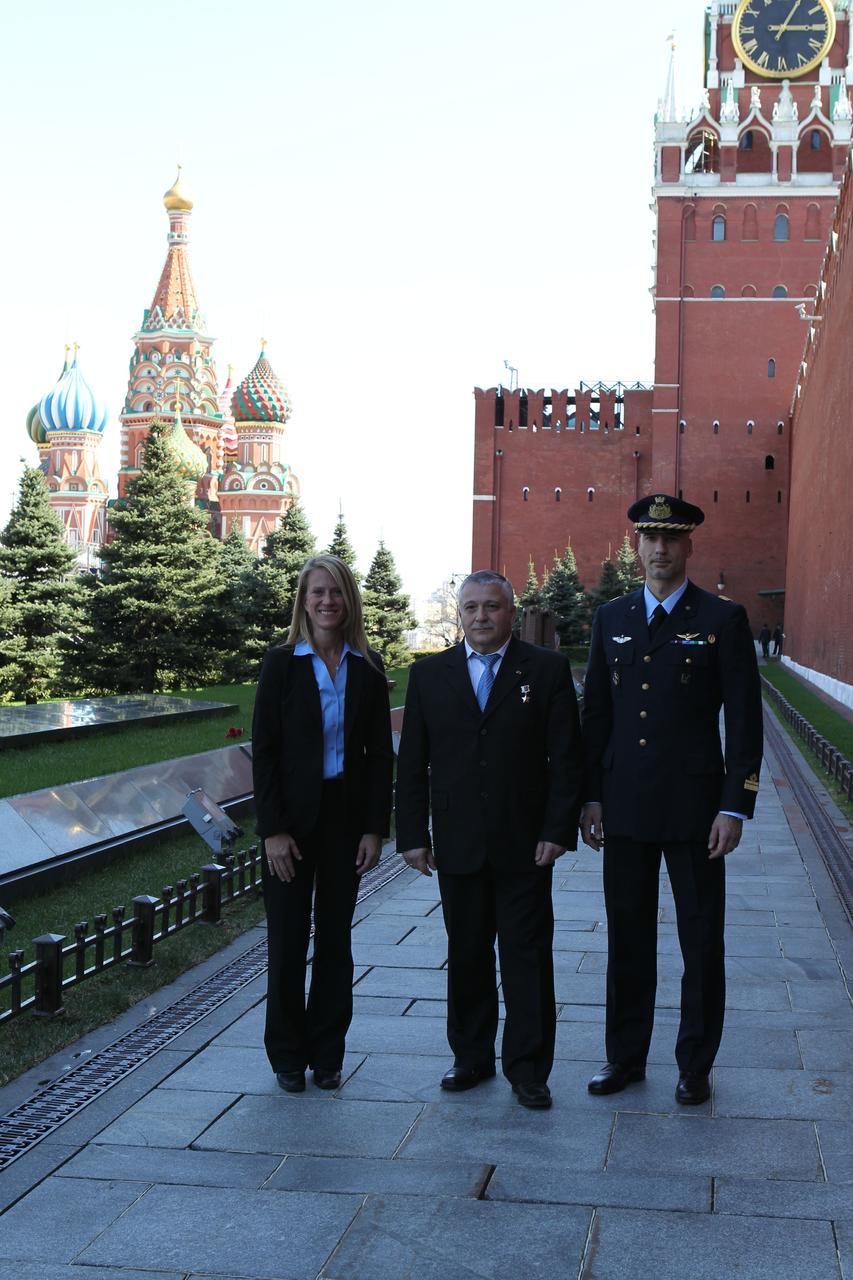
With St. Basil’s Cathedral serving as a backdrop, Expedition 36/37 Flight Engineer Karen Nyberg of NASA (left), Soyuz Commander Fyodor Yurchikhin (center) and Flight Engineer Luca Parmitano of the European Space Agency (right) pose for pictures during a traditional tour of Red Square in Moscow May 8. The three crewmembers are preparing for their launch May 29, Kazakh time, in their Soyuz TMA-09M spacecraft from the Baikonur Cosmodrome in Kazakhstan for a six-month mission on the International Space Station. NASA/Stephanie Stoll
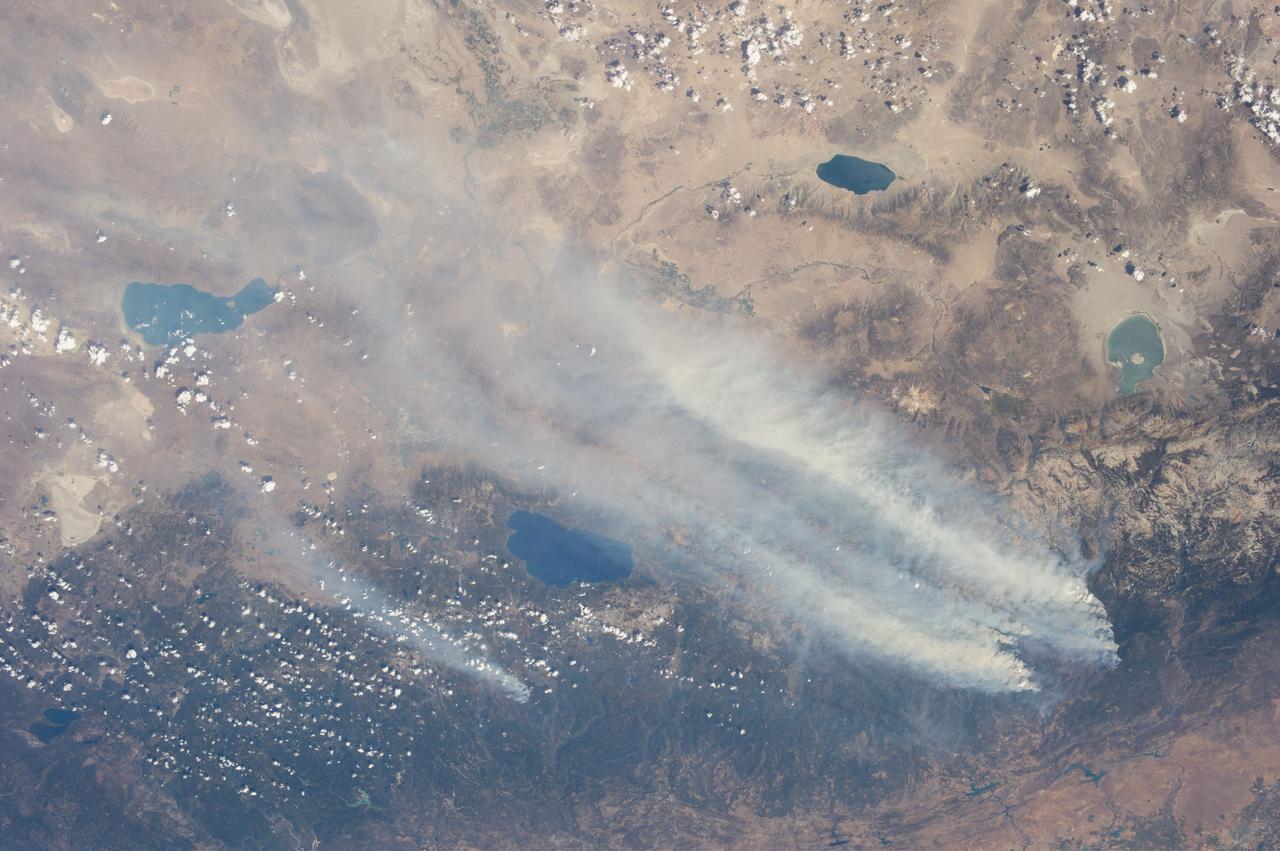
ISS036-E-037185 (26 Aug. 2013) --- One of the Expedition 36 crew members aboard the International Space Station used a 50mm lens to record this view of the massive drought-aided Rim Fire in and around California's Yosemite National Park and the Stanislaus National Forest on Aug. 26. The fire began on Aug. 17 and, at the time of this photo on Aug. 26, it still continues to burn, as some 3,700 firefighters battle it. More than 224 square miles have been affected.

Expedition 36/37 Flight Engineer Karen Nyberg of NASA takes a moment to pay tribute to Russian space icons interred in the Kremlin Wall during a tour of Red Square and the Kremlin in Moscow May 8. Nyberg, Soyuz Commander Fyodor Yurchikhin and Flight Engineer Luca Parmitano of the European Space Agency are preparing for their launch May 29, Kazakh time, in their Soyuz TMA-09M spacecraft from the Baikonur Cosmodrome in Kazakhstan for a six-month mission on the International Space Station. NASA/Stephanie Stoll

During a traditional tour of Red Square in Moscow March 7, Expedition 35-36 Soyuz Commander Pavel Vinogradov laid flowers at the Kremlin Wall where Russian space icons are interred. Vinogradov, NASA Flight Engineer Chris Cassidy and Flight Engineer Alexander Misurkin will launch to the International Space Station March 29, Kazakh time, in their Soyuz TMA-08M spacecraft from the Baikonur Cosmodrome in Kazakhstan. NASA / Stephanie Stoll
jsc2022e083572 (10/20/20220 --- A preflight image of a beating Engineered Heart Tissue (EHT) for the Engineered Heart Tissues-2 investigation. The tissue is fabricated between two posts, one flexible and one rigid. In the flexible post, you can see a square magnet. This magnet enables researchers to measure tissue function using an underlying magnetic sensor, giving real time tissue function data. Image courtesy of Johns Hopkins University.

With St. Basil’s Cathedral in Red Square in Moscow providing a wintry backdrop, Expedition 59 crewmembers Nick Hague of NASA (left), Christina Koch of NASA (center) and Alexey Ovchinin of Roscosmos (right) walk toward the Kremlin Wall Feb. 21 prior to the ceremonial laying of flowers. They will launch March 14, U.S. time, on the Soyuz MS-12 spacecraft from the Baikonur Cosmodrome in Kazakhstan for a six-and-a-half month mission on the International Space Station. Andrey Shelepin/Gagarin Cosmonaut Training Center

With a few snow flurries falling on an otherwise sunny day, Expedition 35-36 Flight Engineer Chris Cassidy of NASA walked through the grounds of the Kremlin in Moscow March 7 during a traditional tour of the Kremlin and Red Square. Cassidy, Soyuz Commander Pavel Vinogradov and Flight Engineer Alexander Misurkin are preparing for launch to the International Space Station March 29, Kazakh time, in their Soyuz TMA-08M spacecraft from the Baikonur Cosmodrome in Kazakhstan. NASA / Stephanie Stoll
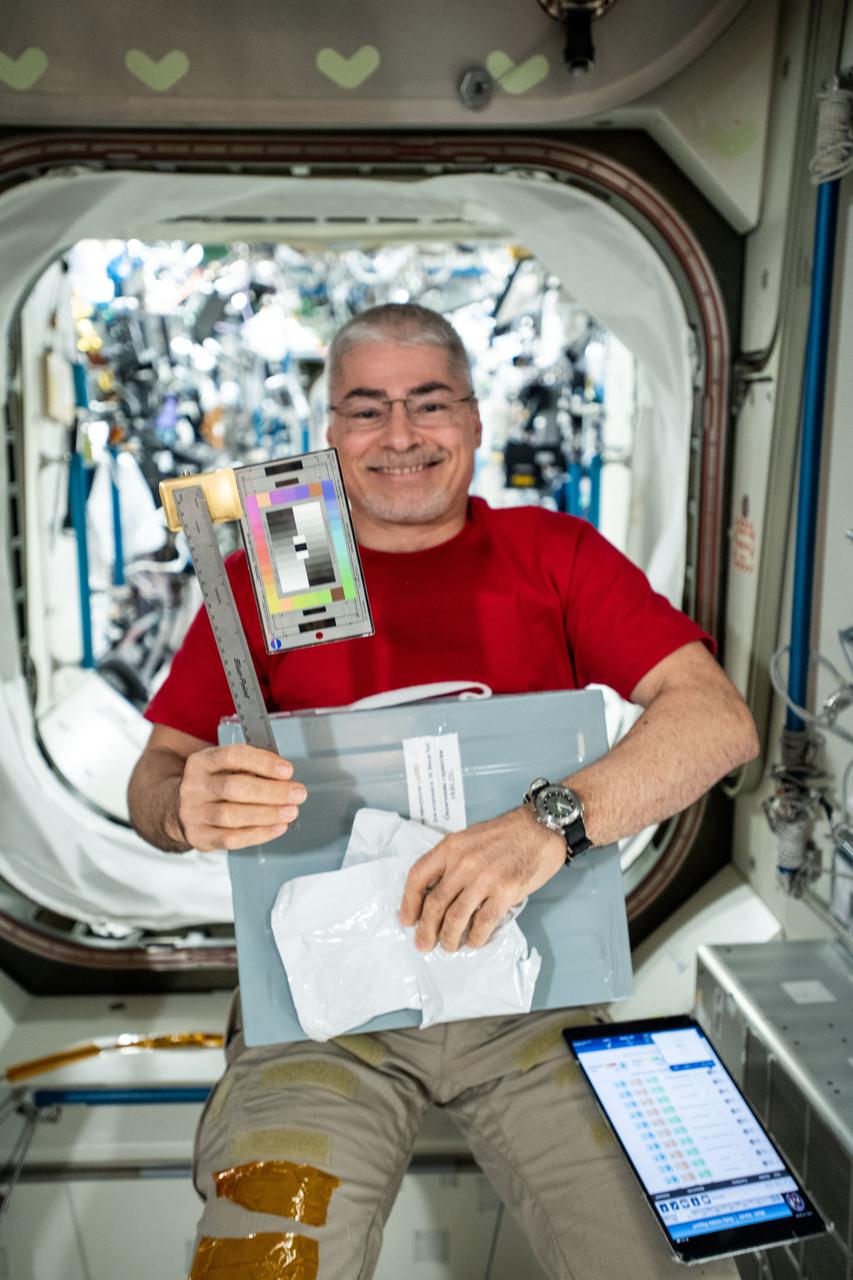
iss066e129772 (Jan. 28, 2022) --- NASA astronaut and Expedition 66 Flight Engineer Mark Vande Hei poses with a ruler and color chart aboard the International Space Station. The ruler and chart are used for the SQuARES study looking at how crew members use different objects and spaces over time. This investigation may provide information that helps improve the design of future space craft and habitats.

With St. Basil’s Cathedral in Red Square in Moscow providing a wintry backdrop, Expedition 59 crewmembers Christina Koch of NASA (left), Alexey Ovchinin of Roscosmos (center) and Nick Hague of NASA (right) pose for pictures Feb. 21 prior to the ceremonial laying of flowers at the Kremlin Wall. They will launch March 14, U.S. time, on the Soyuz MS-12 spacecraft from the Baikonur Cosmodrome in Kazakhstan for a six-and-a-half month mission on the International Space Station. Andrey Shelepin/Gagarin Cosmonaut Training Center

Expedition 39/40 Flight Engineer Steve Swanson of NASA (front, left), Alexander Samokutyaev of Roscosmos (front, center) and Oleg Artemyev (front, right) arrive at Red Square in Moscow by the Kremlin March 6 for the ceremonial laying of flowers at the Kremlin Wall in tribute to Russian space icons who are interred there. Swanson, Skvortsov and Artemyev are preparing for their launch to the International Space Station from the Baikonur Cosmodrome in Kazakhstan March 26, Kazakh time, in their Soyuz TMA-12M spacecraft for a six-month mission. NASA/Stephanie Stoll

At the Kremlin Wall at Red Square in Moscow, Expedition 37/38 Flight Engineer Sergey Ryazanskiy lays flowers Sept. 6 in a traditional ceremony to honor Russian space icons who are interred there. Ryazanskiy, Soyuz Commander Oleg Kotov and Flight Engineer Michael Hopkins of NASA are preparing for their launch to the International Space Station from the Baikonur Cosmodrome in Kazakhstan on Sept. 26, Kazakh time, aboard the Soyuz TMA-10M spacecraft. NASA/Stephanie Stoll

Enjoying a bright but blustery day with his daughter, Expedition 35-36 Flight Engineer Alexander Misurkin (left) strolled through the grounds of the Kremlin in Moscow March 7 with NASA Flight Engineer Chris Cassidy (right). Misurkin, Cassidy and Soyuz Commander Pavel Vinogradov conducted a traditional tour of Red Square and the Kremlin as they prepare for launch to the International Space Station on March 29, Kazakh time, in their Soyuz TMA-08M spacecraft from the Baikonur Cosmodrome in Kazakhstan. NASA / Stephanie Stoll
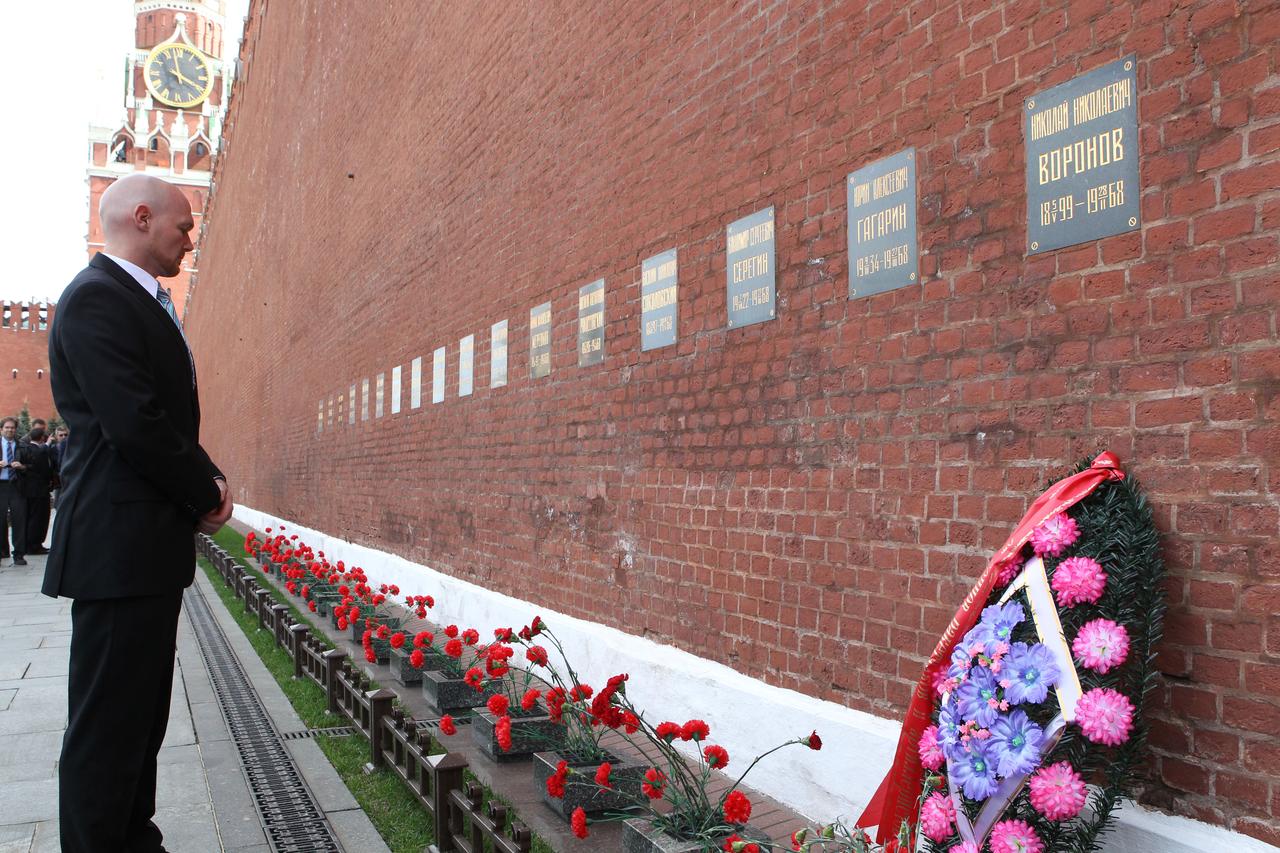
1107: At the Kremlin Wall in Moscow’s Red Square, Expedition 40/41 Flight Engineer Alexander Gerst of the European Space Agency pauses to reflect May 8 after laying flowers at the site where Russian space icons are interred. Gerst, Max Suraev of the Russian Federal Space Agency (Roscosmos) and Reid Wiseman of NASA are preparing for launch May 29, Kazakh time, in the Soyuz TMA-13M spacecraft from the Baikonur Cosmodrome in Kazakhstan for a 5 ½ month mission on the International Space Station. NASA/Stephanie Stoll
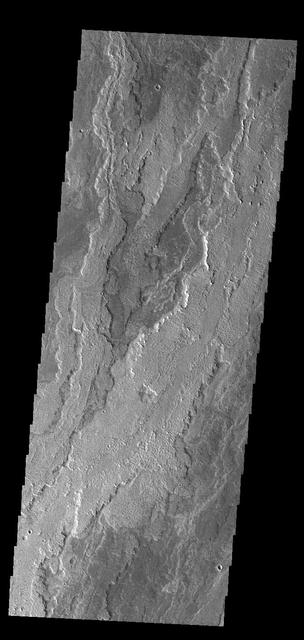
This VIS image shows a small portion of Daedalia Planum. The lava flows in this image originated at Arsia Mons. Individual flows have lengths up to almost 180km (~111 miles). The longest Hawaiian lava flow is only 51km (~31 miles). The area of Daedalia Planum is 2.9 million square km - more than 4 times the size of Texas. Orbit Number: 75431 Latitude: -18.9209 Longitude: 241.546 Instrument: VIS Captured: 2018-12-16 05:39 https://photojournal.jpl.nasa.gov/catalog/PIA23085