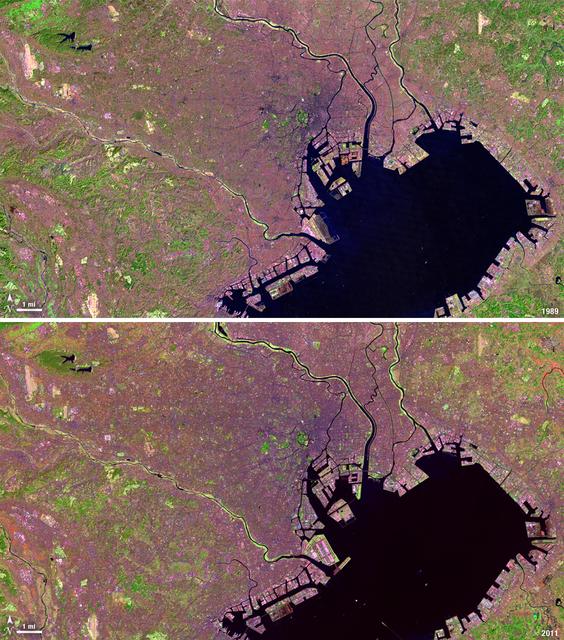
Tokyo is the world’s largest metropolitan region, home to nearly 37 million people. During the past two decades, Tokyo’s population has grown by more than 7 million. The city’s growth has continued despite Japan’s overall stagnating population, mainly due to a continued trend of centralization—citizens moving out of the country and into the city.  Landsat 4 collected this first false-color image of Tokyo on Feb. 2, 1989. The upper half of Tokyo Bay is the large water body visible in a dark blue. In the middle of the image, central Tokyo appears a deep purple just north of the bay. Twenty-two years later, Landsat 5, captured this second image of Tokyo on April 5, 2011. The urban reaches of metropolitan Tokyo have grown in both distance and density, as seen where the green color of vegetation has turned to pink and purple shades of urbanization. A major expansion of Tokyo’s Haneda Airport, can be seen south of the city, on land built out into the bay. The constant circular spot of green in the dense city-center, visible on both images, is the Tokyo Imperial Palace and its gardens. (Landsat 5 TM Bands 7,4,2)  ----  NASA and the U.S. Department of the Interior through the U.S. Geological Survey (USGS) jointly manage Landsat, and the USGS preserves a 40-year archive of Landsat images that is freely available over the Internet. The next Landsat satellite, now known as the Landsat Data Continuity Mission (LDCM) and later to be called Landsat 8, is scheduled for launch in 2013.  In honor of Landsat’s 40th anniversary in July 2012, the USGS released the LandsatLook viewer – a quick, simple way to go forward and backward in time, pulling images of anywhere in the world out of the Landsat archive.  <b><a href="http://www.nasa.gov/audience/formedia/features/MP_Photo_Guidelines.html" rel="nofollow">NASA image use policy.</a></b>  <b><a href="http://www.nasa.gov/centers/goddard/home/index.html" rel="nofollow">NASA Goddard Space Flight Center</a></b> enables NASA’s mission through four scientific endeavors: Earth Science, Heliophysics, Solar System Exploration, and Astrophysics. Goddard plays a leading role in NASA’s accomplishments by contributing compelling scientific knowledge to advance the Agency’s mission.  <b>Follow us on <a href="http://twitter.com/NASA_GoddardPix" rel="nofollow">Twitter</a></b>  <b>Like us on <a href="http://www.facebook.com/pages/Greenbelt-MD/NASA-Goddard/395013845897?ref=tsd" rel="nofollow">Facebook</a></b>  <b>Find us on <a href="http://instagrid.me/nasagoddard/?vm=grid" rel="nofollow">Instagram</a></b>
Landsat View: Tokyo, Japan
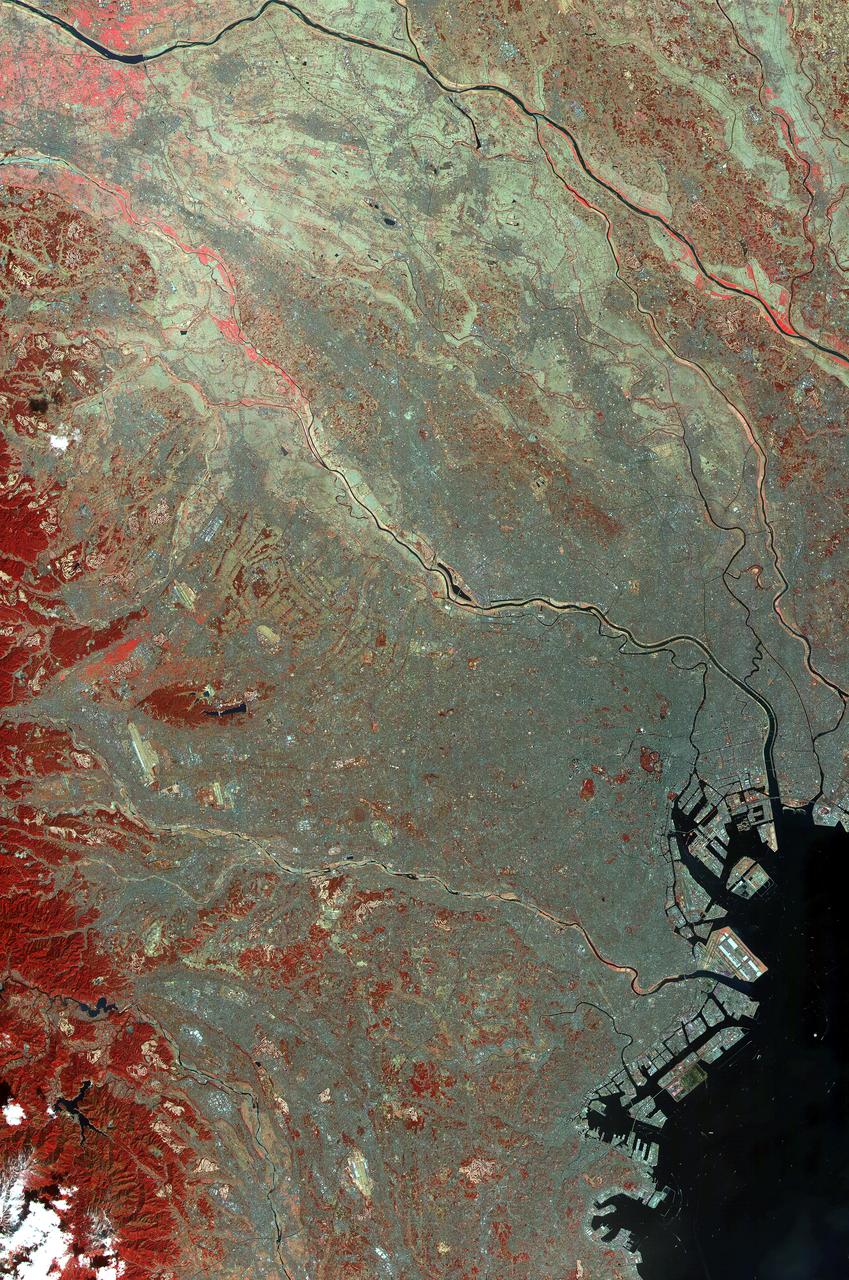
This image of the city of Tokyo was acquired on March 22, 2000 by the Advanced Spaceborne Thermal Emission and Reflection Radiometer (ASTER) on NASA's Terra satellite. With its 14 spectral bands from the visible to the thermal infrared wavelength region, and its high spatial resolution of 15 to 90 meters (about 50 to 300 feet), ASTER will image the Earth for the next 6 years to map and monitor the changing surface of our planet.  This false color infrared image covers an area 60 km wide and 75 km long in three bands of the short wavelength infrared region, with a spatial resolution of 15 m. It shows part of the Tokyo metropolitan area extending south to Yokohama; included are the Ginza District, Haneda airport and the Imperial Palace. To the west, Tokyo is hemmed in by mountains, covered with forests (displayed in red); on the southeast, Tokyo Bay is one of the world's great harbors.  http://photojournal.jpl.nasa.gov/catalog/PIA02607
ASTER Images Tokyo
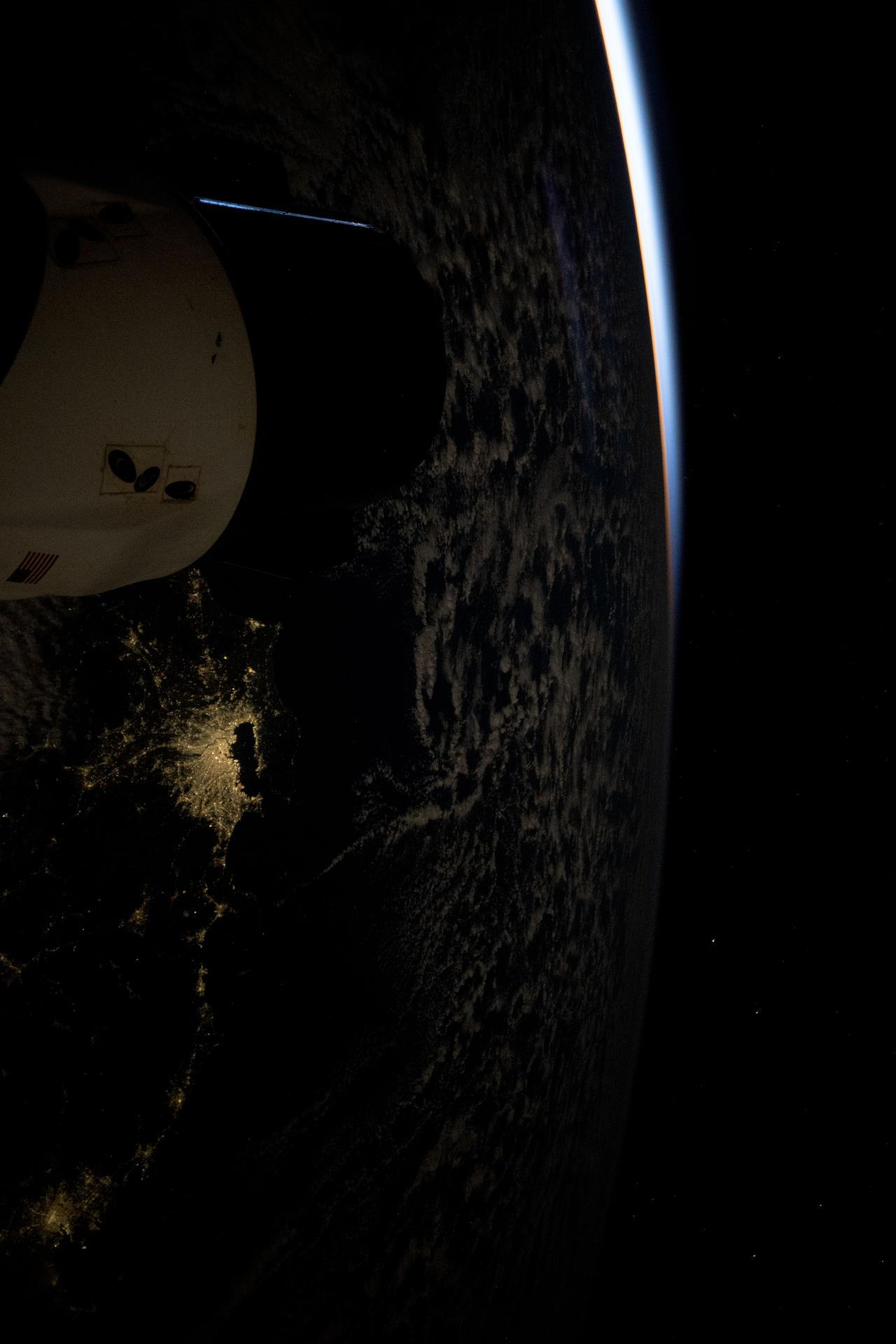
iss074e0170877 (Jan. 3, 2026) --- The Greater Tokyo Area in Japan, one of the most populous metropolitan areas on Earth with about 37 million residents, is pictured at approximately 4:31 a.m. local time from the International Space Station. A partially obscured SpaceX Dragon spacecraft (left) is docked to the Harmony module's forward port as both spacecraft soared 265 miles above Earth into an orbital sunrise.
The Greater Tokyo Area in Japan pictured from the International Space Station
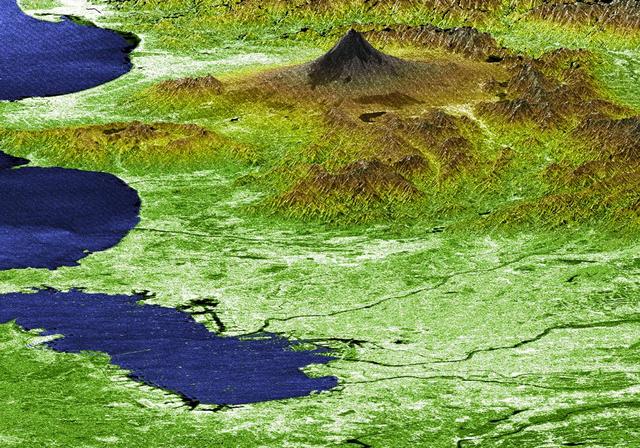
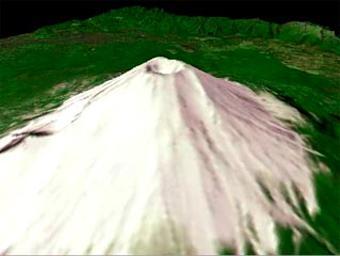
Japan Mt. Fuji presents a beautiful backdrop for the city of Tokyo as seen in this image generated from NASA Shuttle Radar Topography Mission SRTM data on February 21, 2000.
Perspective View with Radar Image Overlaid, Color as Height: Mt. Fuji and Tokyo, Japan
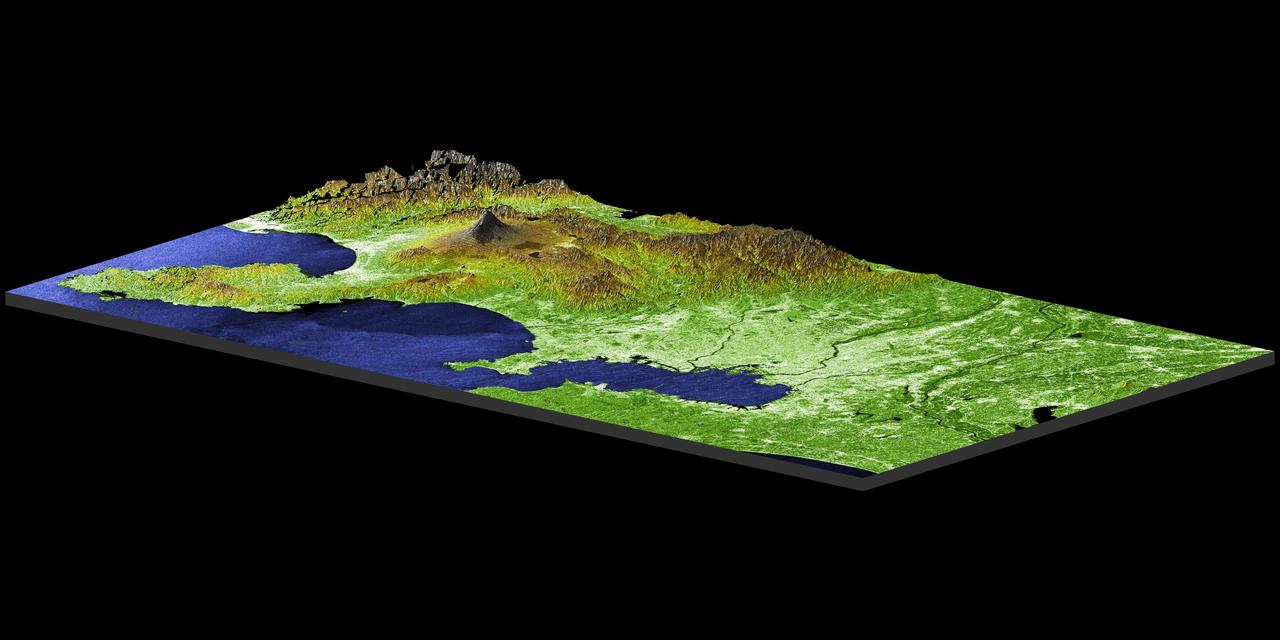
Tokyo, located on the island of Honshu, with Mt. Fuji in the background as seen in this image generated from NASA Shuttle Radar Topography Mission SRTM data on February 21, 2000.
Perspective View with Radar Image Overlaid, Color as Height: Mt. Fuji and Tokyo, Japan
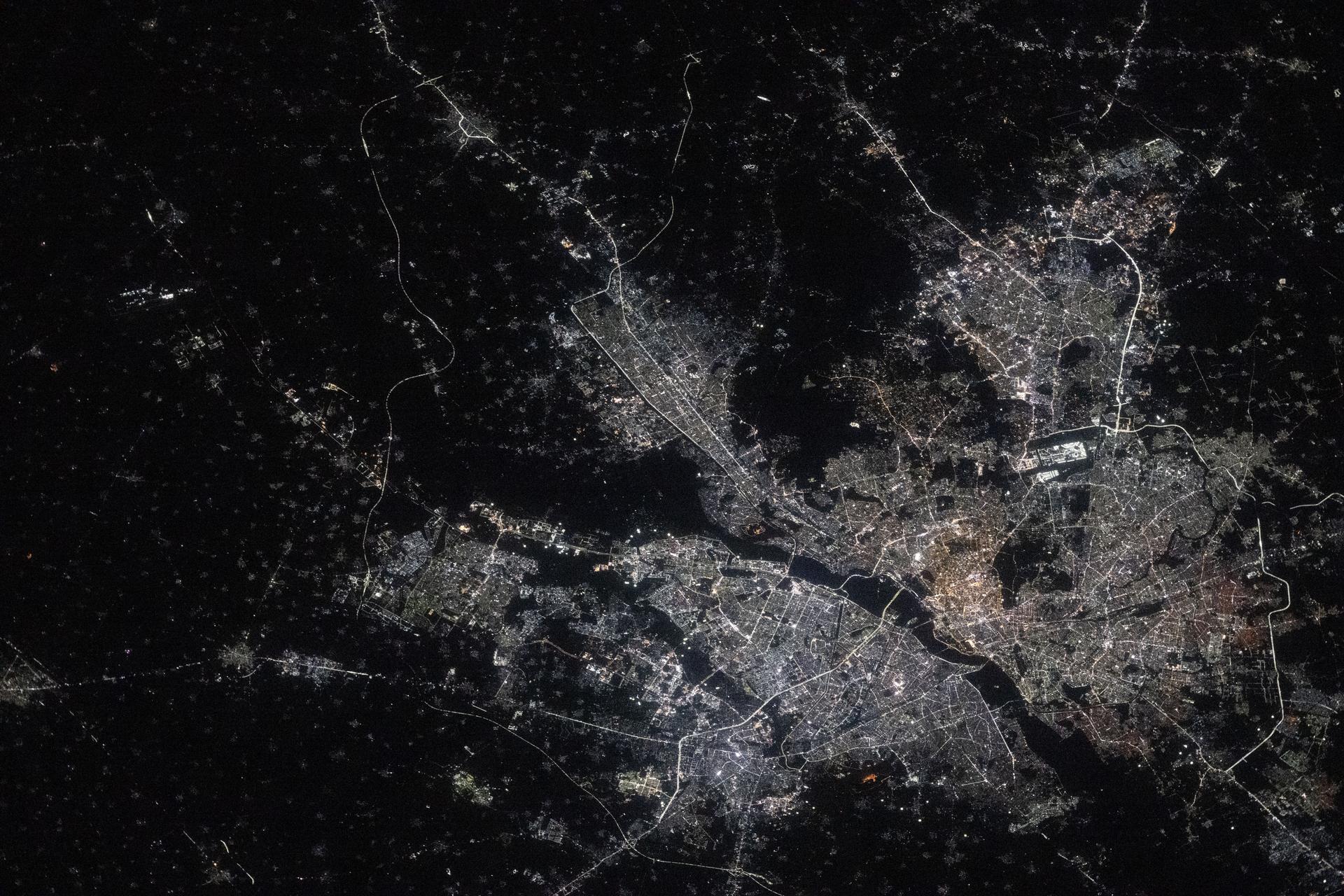
iss073e0548147 (Aug. 26, 2025) --- Tokyo, Japan, and its surrounding suburbs—the world’s most populous metropolitan area with about 39.1 million people—are pictured at approximately 1 a.m. local time from the International Space Station as it orbited 262 miles above. Visible landmarks include Haneda Airport on Tokyo Bay (lower center) and the Imperial Palace (the dark area at center) in the heart of downtown Tokyo. Credit: JAXA (Japan Aerospace Exploration Agency)
Tokyo, Japan, the world’s most populous metropolitan area with about 39.1 million people
iss073e0918643 (Oct. 18, 2025) --- Tokyo, Japan, and its surrounding suburbs along Tokyo Bay light up the night, with stops along major rail lines glittering like pearls. The Greater Tokyo Area—the world’s most populated urban center with over 39 million people—is pictured at approximately 4 a.m. local time from the International Space Station as it orbited 262 miles above the island nation.
Tokyo, Japan, the world’s most populated urban center with over 39 million people
iss073e0842595 (Sept. 15, 2025) --- City lights from Tokyo (center) to Osaka and Hiroshima (top left) illuminate Japan’s urban coastline, while moonlight glints off the Sea of Japan and the Pacific Ocean (lower right). The International Space Station was orbiting 262 miles above South Korea at approximately 1:56 a.m. local time when this photograph was taken.
City lights from Tokyo to Osaka and Hiroshima
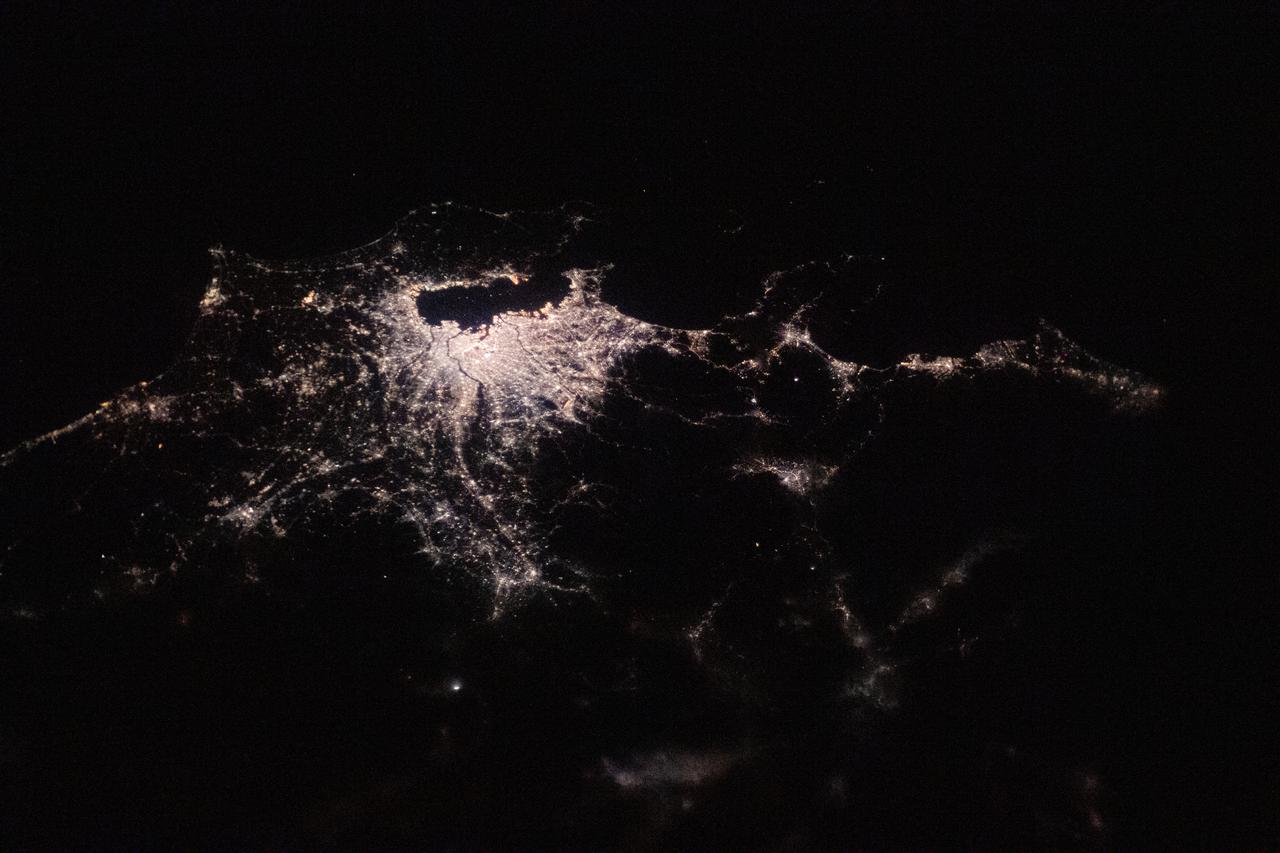
iss072e436230 (Dec. 28, 2024) --- The city lights of Osaka, Nagoya, and Tokyo on the island nation of Japan highlight this photograph taken approximately 12:55 a.m. local time from the International Space Station as it orbited 258 miles above the Sea of Japan.
The city lights of Osaka, Nagoya, and Tokyo on the island nation of Japan
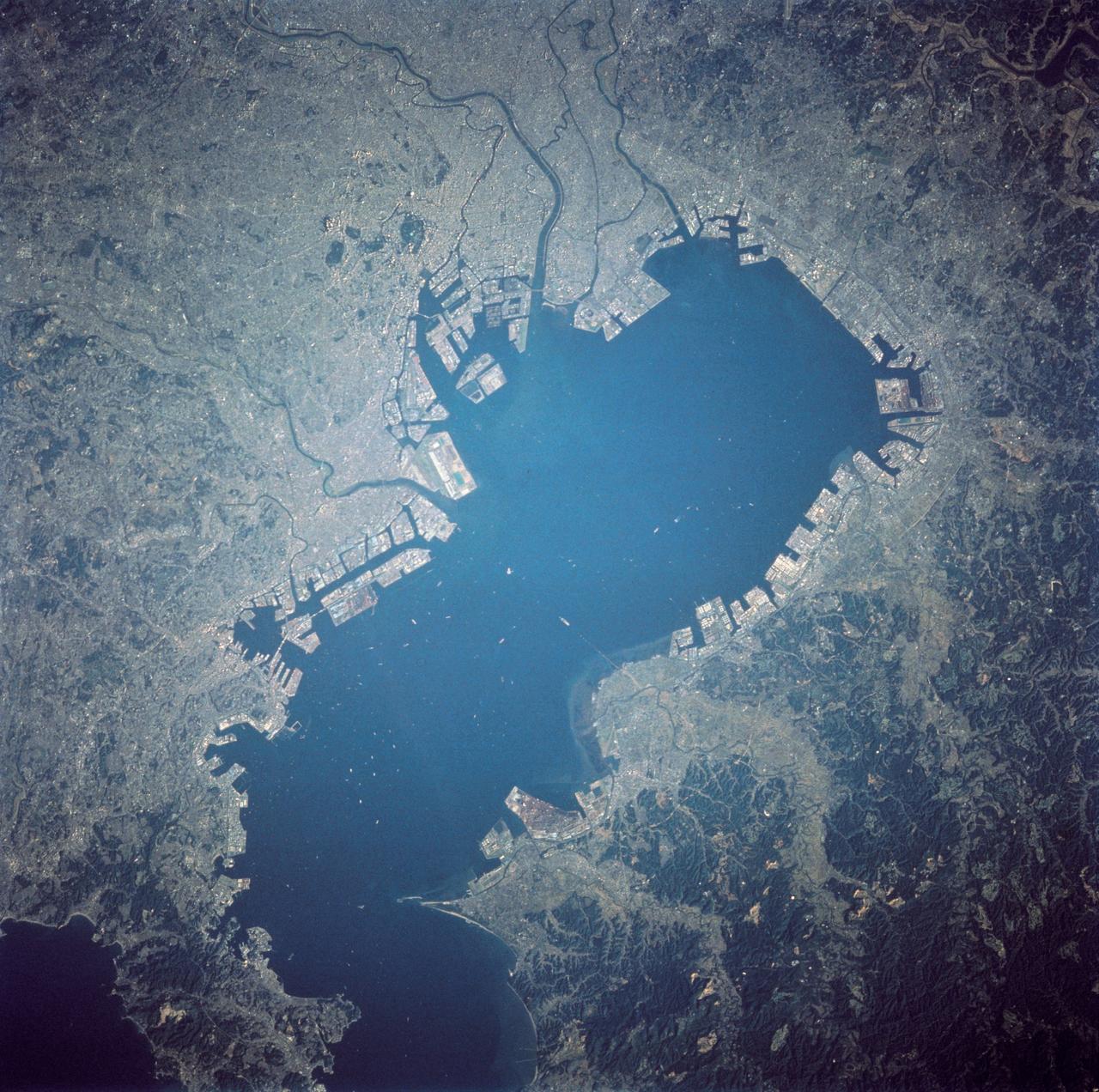
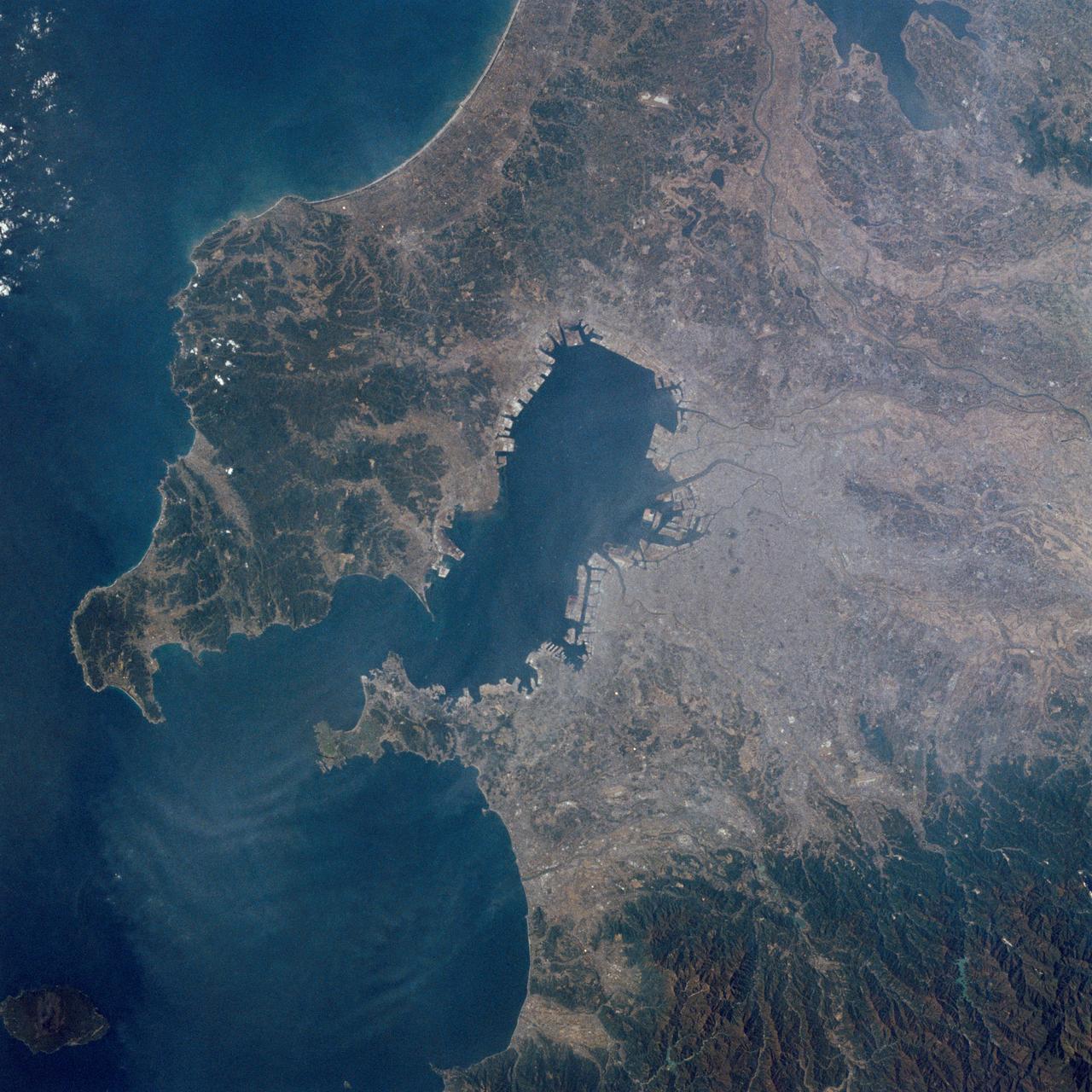
STS058-103-080 (18 Oct-1 Nov 1993) --- Japan's modern megalopolis is seen in this nadir view in great detail. More than 80 vessels can be seen at the anchorage's in Tokyo Bay. The gardens of the Emperor's Palace are seen in this circular area in the upper left quadrant. Even greater detail of this area was captured in the simultaneous color infrared image acquired during this space shuttle mission. (That photo number is STS058-110-085.)
Tokyo, Yokohama and Tokoy Bay as seen from STS-58
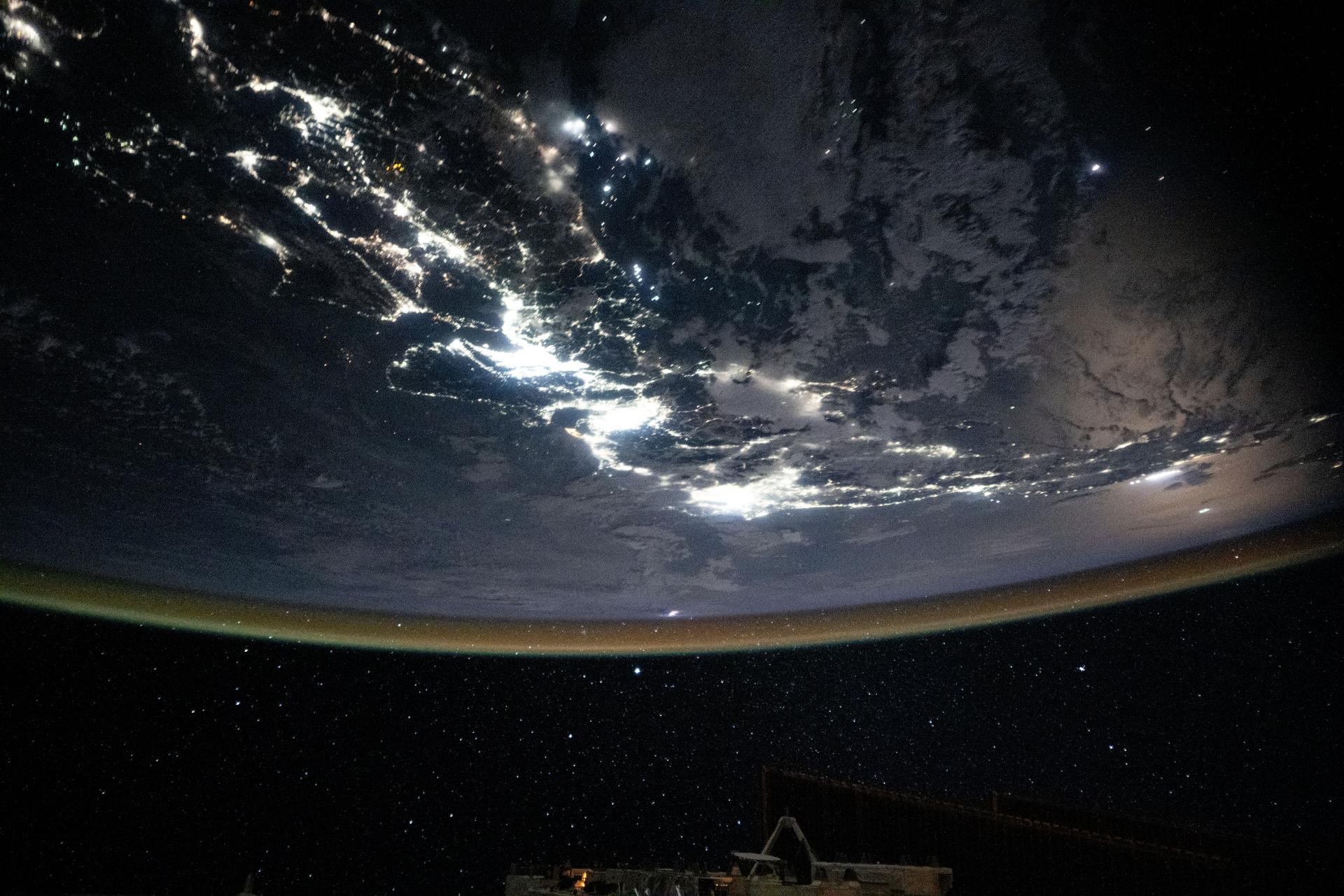
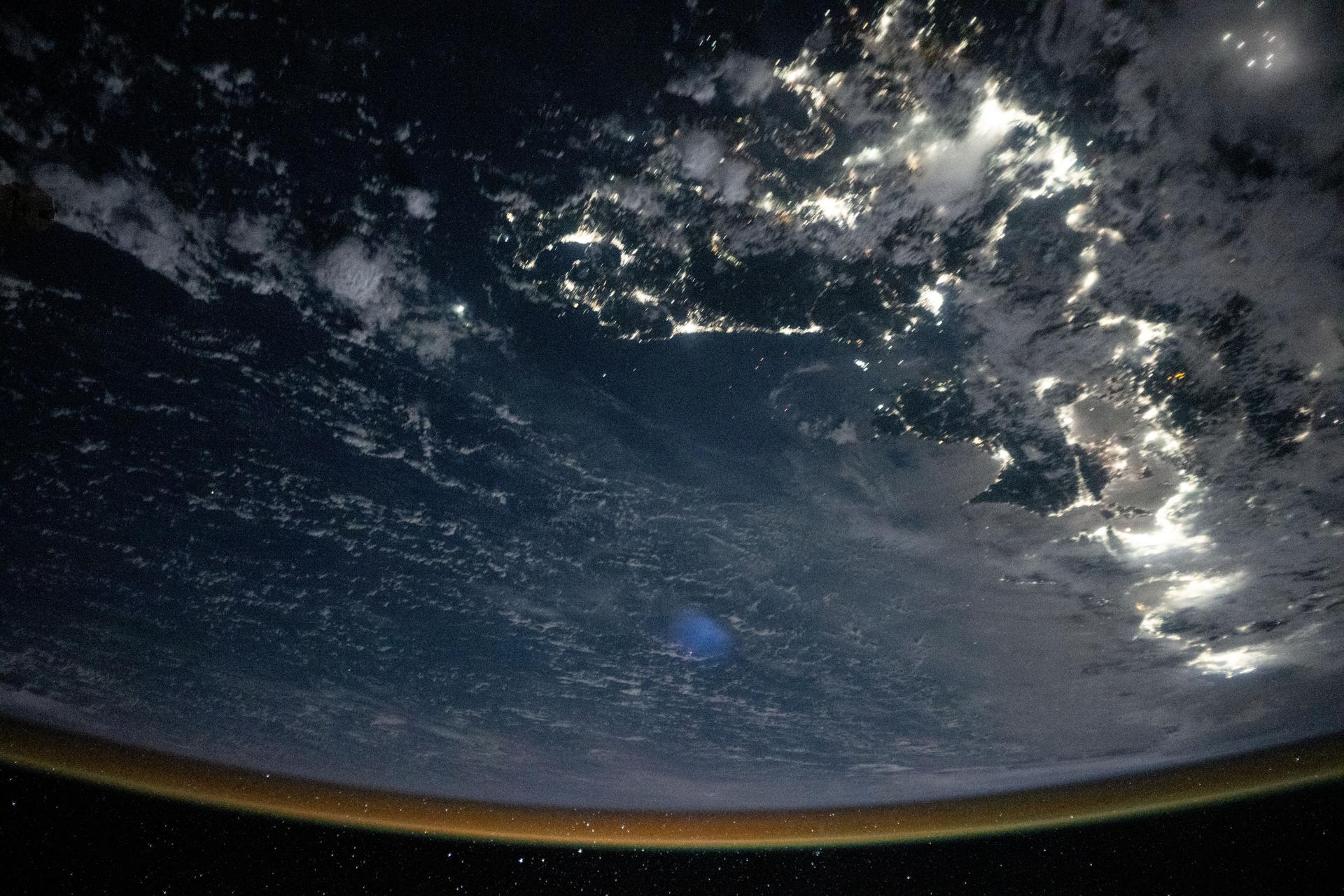
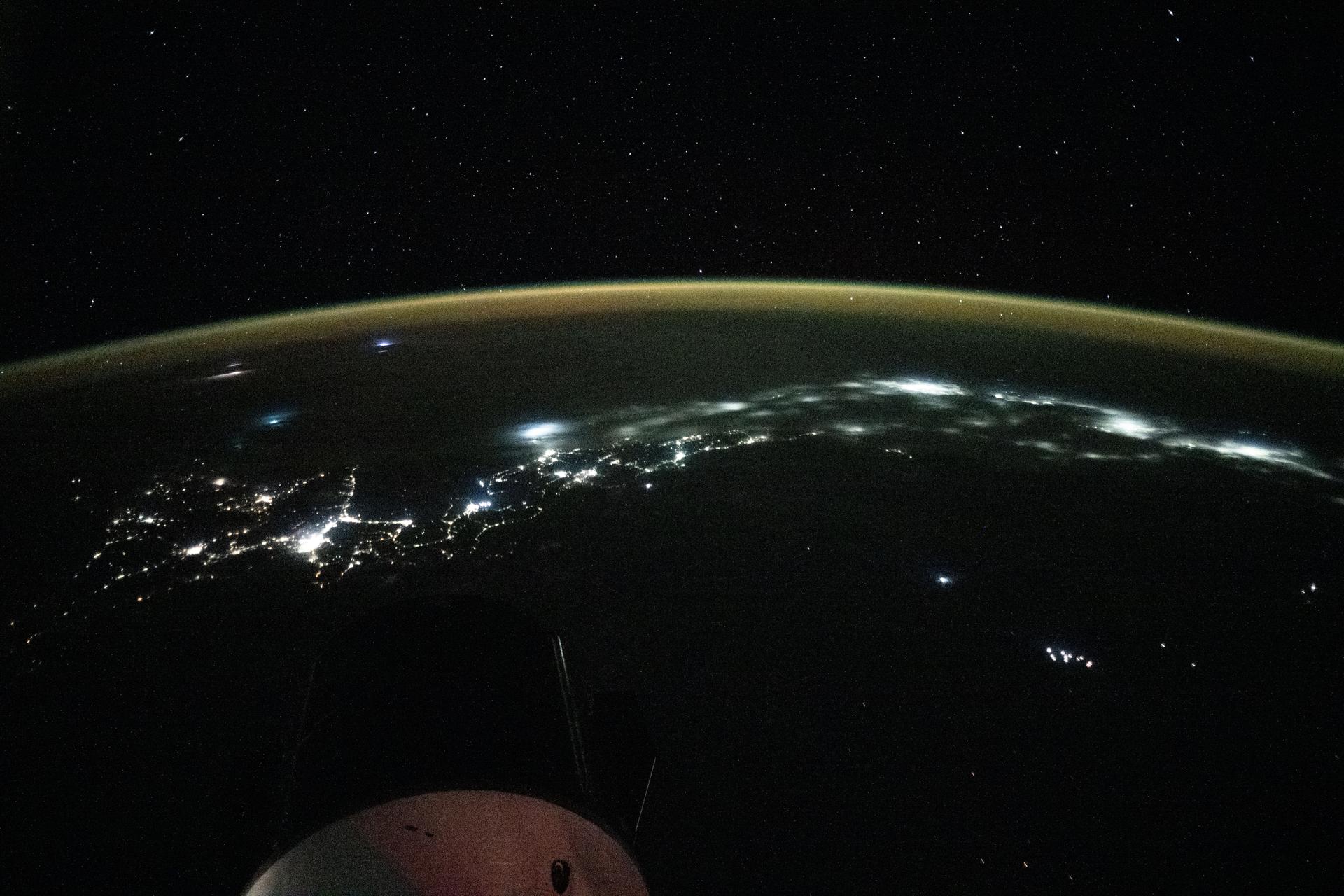
iss073e0824492 (Sept. 14, 2025) --- In this oblique view from the International Space Station, city lights outline southern Japan from Fukuoka (top right) to Tokyo (bottom right) with a red-yellow airglow blanketing Earth's horizon. This natural glow is produced when solar ultraviolet radiation excites oxygen molecules in the upper atmosphere during the day, which then release that energy as visible light at night. The orbital outpost was soaring 261 miles above the East China Sea at approximately 1:45 a.m. local time when this photograph was taken.
City lights outline southern Japan from Fukuoka to Tokyo
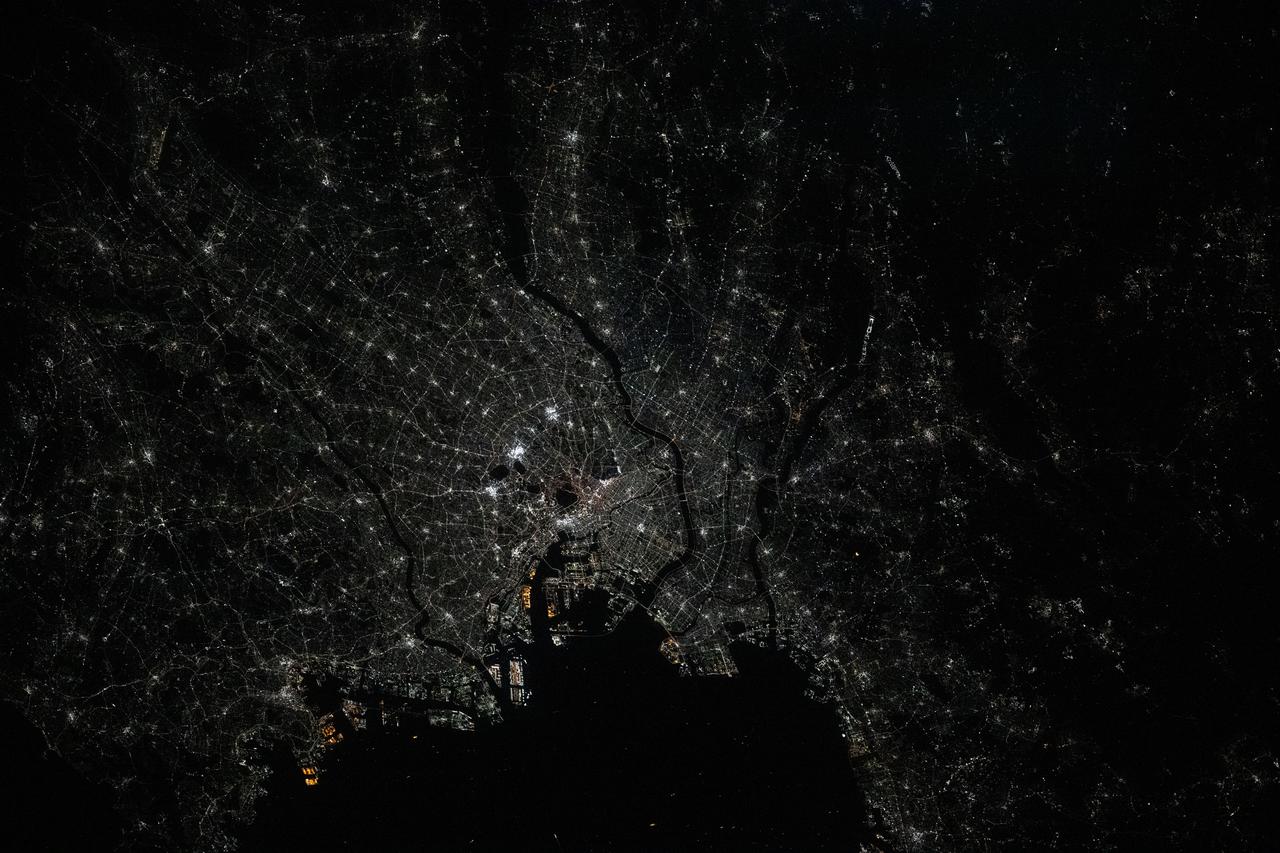
iss064e014965 (Dec. 22, 2020) --- Tokyo, Japan, on Tokyo Bay is pictured from the International Space Station as it orbited 262 miles above the island nation during a night pass.
iss064e014965
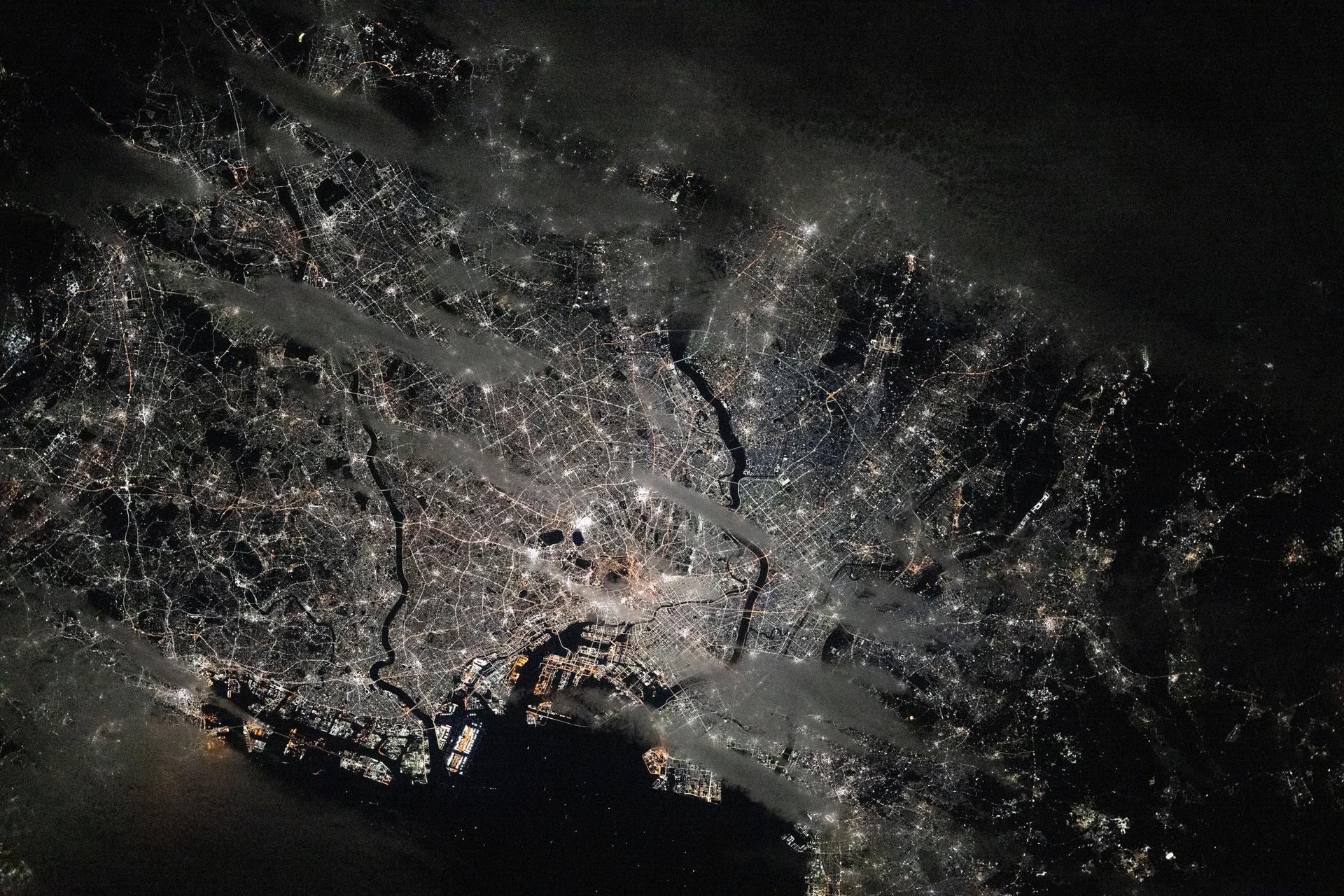
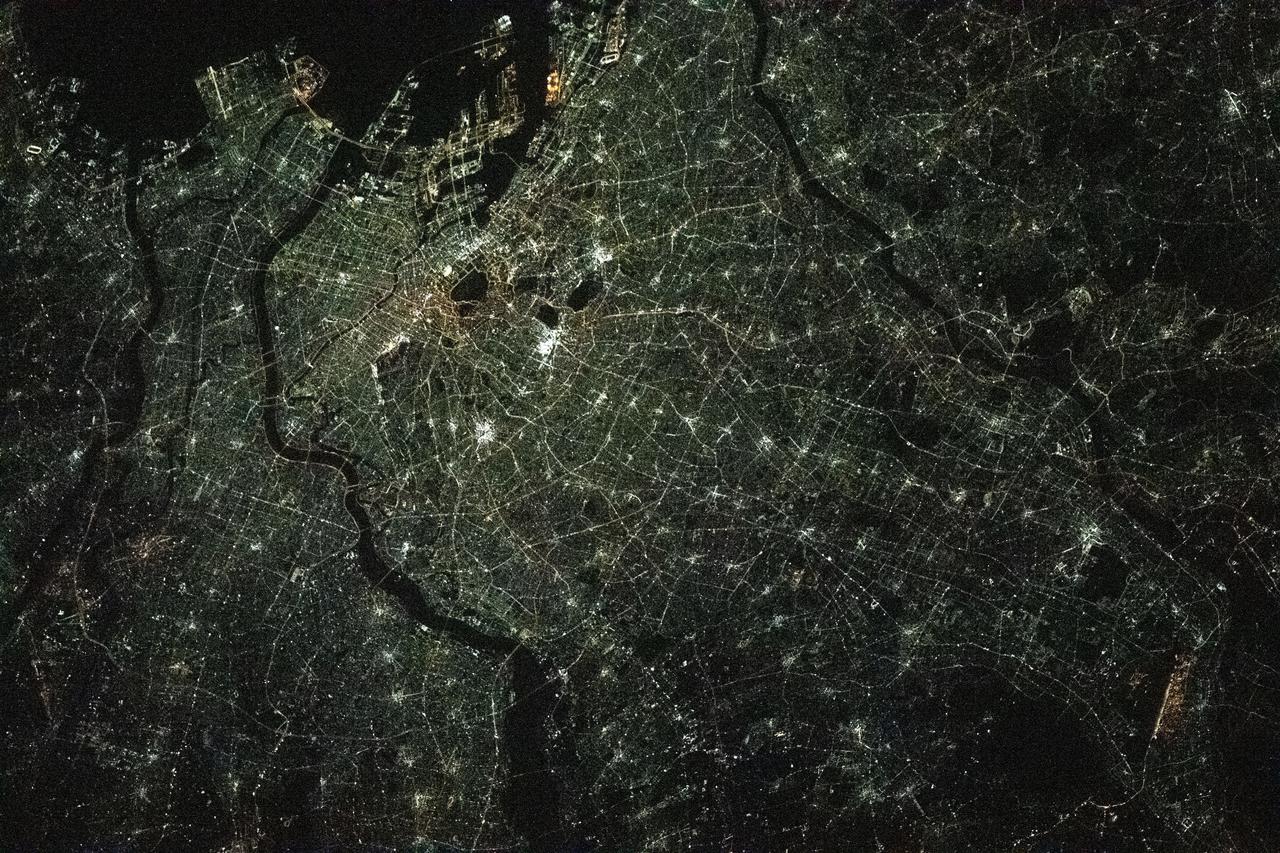
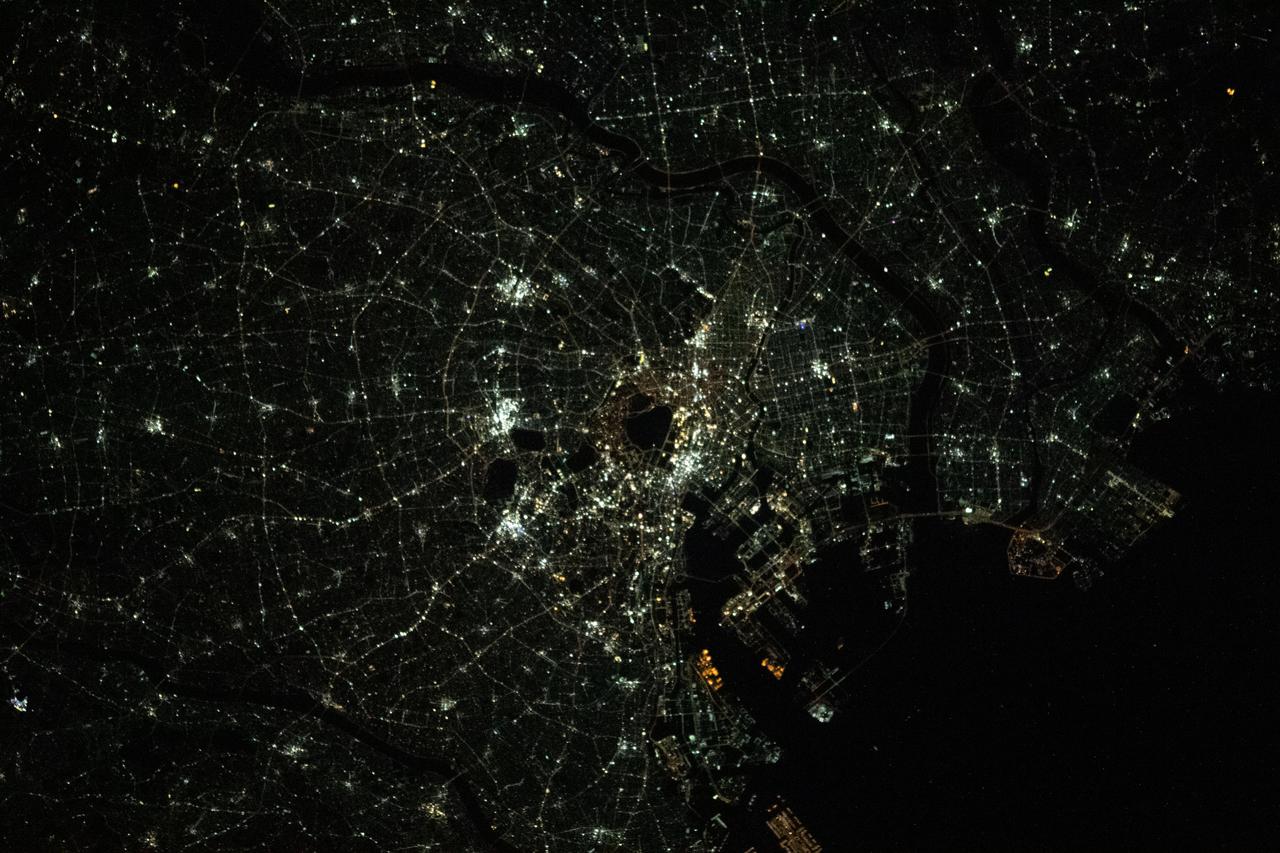
iss064e023814 (Jan. 18, 2021) --- This night time shot of of Tokyo, Yokohama, and the numerous municipalities surrounding Tokyo Bay, was taken from the International Space Station as it orbited 262 miles above the Sea of Japan.
iss064e023814
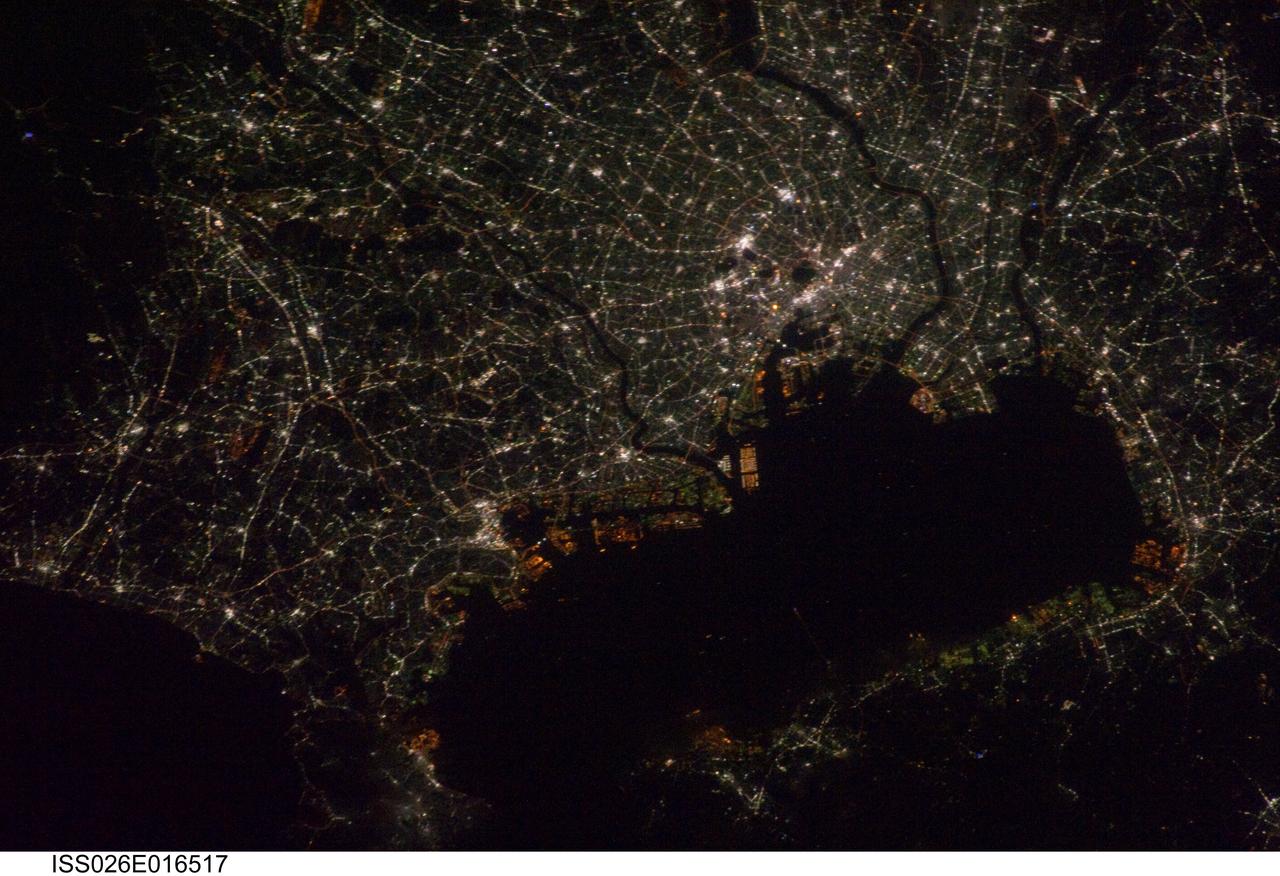
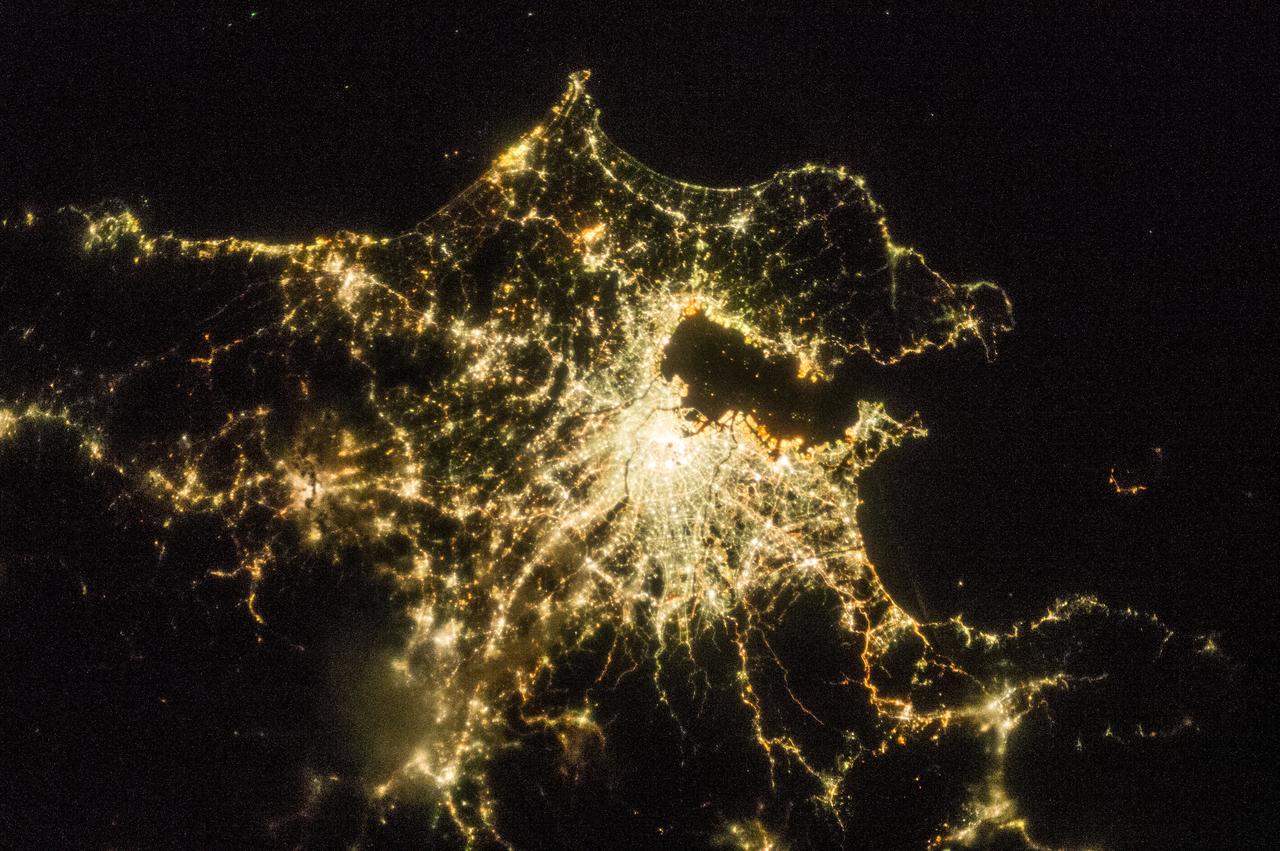
ISS026-E-016517 (9 Jan. 2011) --- From 220 miles above Earth, one of the Expedition 26 crew members aboard the International Space Station exposed this night time picture of the metropolitan area of Tokyo, Japan. The large majority of the heavily lighted, highly populated area is Tokyo proper. Yokohama is to the left, below center, along Tokyo Bay.
Earth Observations taken by Expedition 26 crewmember
iss062e096115 (March 15, 2020) --- The bright lights of Tokyo, Japan, and the surrounding cities of Kawasaki and Yokohama on Tokyo Bay were pictured from the International Space Station during an orbital night pass 260 miles above the island nation.
iss062e096115
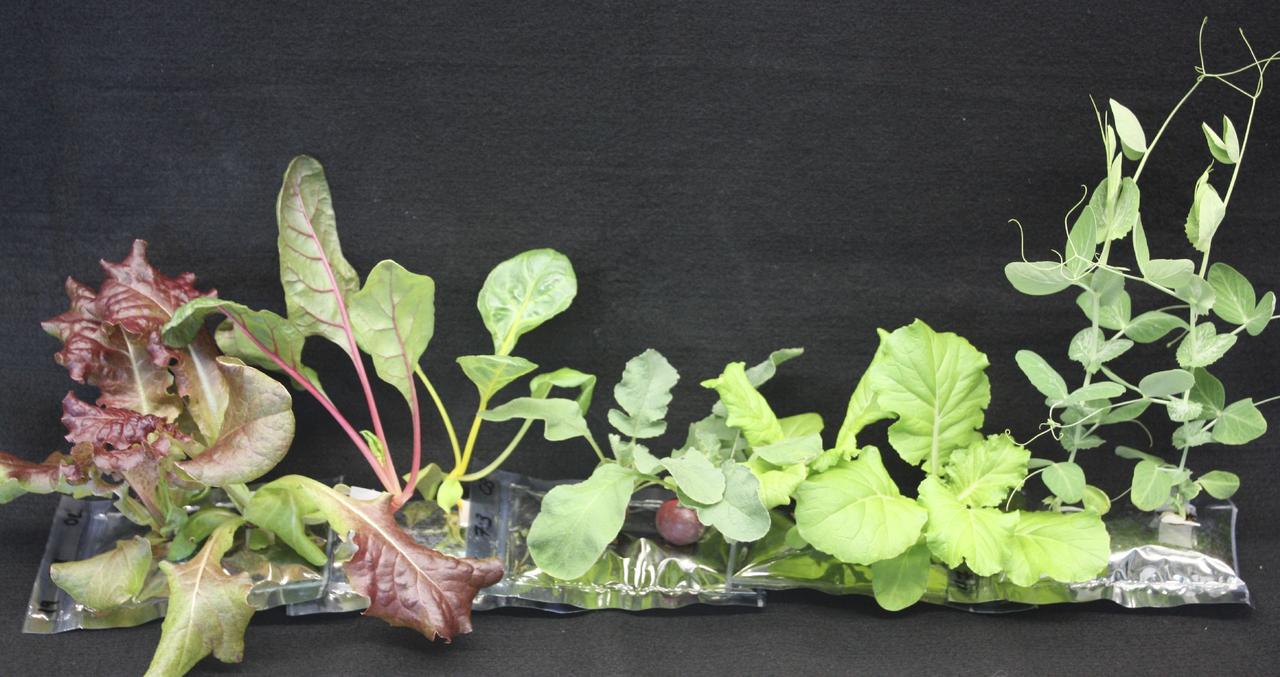
CAPE CANAVERAL, Fla. – Several different types of 21-day-old plants grow in analog VEGGIE pillows include, from right, Outredgeous red romaine lettuce, Bright Lights Swiss chard, Cherry Bomb II radish, Tokyo Bekana Chinese cabbage and Sugar Pod II snow pea.       U.S. astronauts living and working aboard the International Space Station are going to receive a newly developed Vegetable Production System VEGGIE. VEGGIE is set to launch aboard SpaceX's Dragon capsule on NASA's third Commercial Resupply Services mission targeted to launch Dec. 9 from Space Launch Complex 40 at Cape Canaveral Air Force Station in Florida. Photo credit: NASA/Gioia Massa
KSC-2013-3564
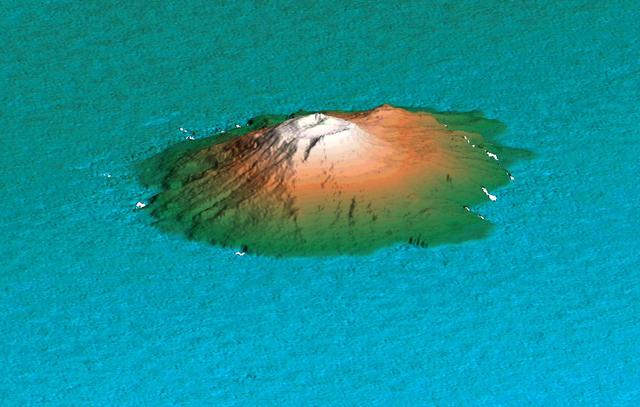
This 3D perspective view shows the Japanese island called Miyake-Jima viewed from the northeast. This island - about 180 kilometers south of Tokyo - is part of the Izu chain of volcanic islands that runs south from the main Japanese island of Honshu.
Perspective View of Shaded Relief with Color as Height, Miyake-Jima, Japan
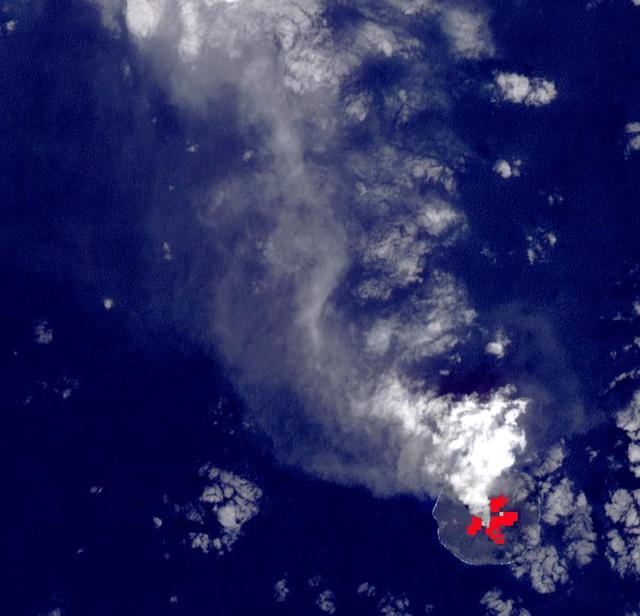
Nishinoshima Volcano is a small volcanic island located about 1000 km south of Tokyo. Recent activity began in December 2019, and has continued. ASTER captured this image of an ash and steam plume emanating from the central crater. Thermal infrared data is superimposed on a visible-infrared color image to highlight the lave flows that have flowed down the volcano's flanks. The image was acquired March 22, 2020, covers an area of 12.6 by 12.3 km, and is located at 27.3 degrees east, 140.8 degrees east.  https://photojournal.jpl.nasa.gov/catalog/PIA23846
Nishinoshima Volcano, Japan
S114-E-5632 (28 July 2005) --- Tokyo Bay area is featured in this image photographed by a STS-114 crewmember onboard the Space Shuttle Discovery.
Earth Observations taken by the STS-114 crew
iss064e038775 (Feb. 27, 2021) --- The night lights of Tokyo, Japan, are pictured from the International Space Station as it orbited 261 miles above the island nation.
iss064e038775
iss064e016283 (Dec. 26, 2020) --- Tokyo, Japan, is pictured from the International Space Station as it orbited 262 miles above the island nation during a night pass.
iss064e016283
Earth observation taken during a night pass by an Expedition 36 crew member on board the International Space Station (ISS). Per Twitter message: Tokyo, Japan.
Earth Observation
iss068e006998 (Oct. 2, 2022) --- Tokyo, Japan, on the coast of the Pacific Ocean, is pictured from the International Space Station as it orbited 260 miles above the island nation.
Earth observation taken by Expedition 68 crew
ISS033-E-021464 (14 Nov. 2012) --- This nighttime photograph, taken by one of the Expedition 33 crew members aboard the International Space Station, features city lights of Tokyo, on the north west side of Tokyo Bay. North is toward the lower right-hand corner of the image. Nadir point of the location on Earth was 33.9 degrees north latitude and 139.5 degrees east longitude.
iss033e021464
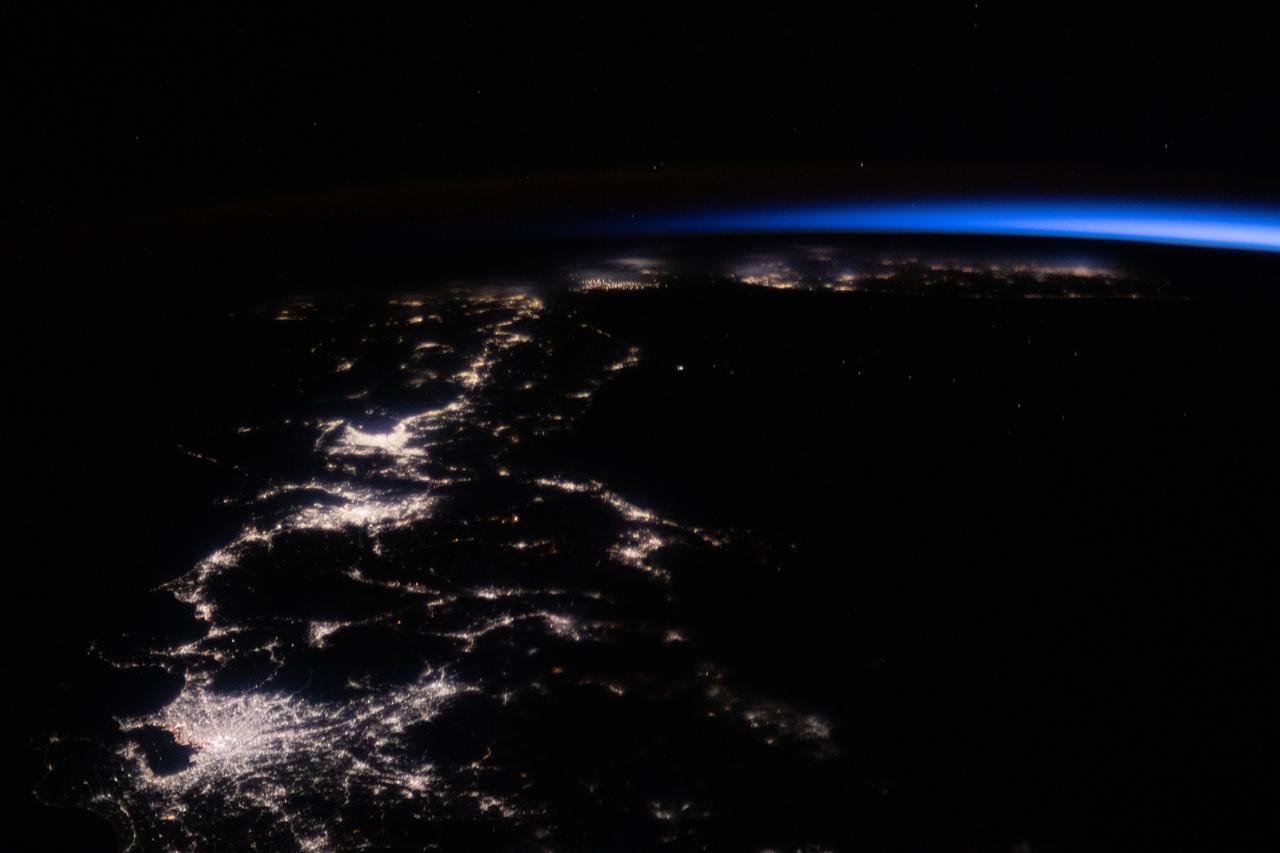
iss062e098243 (March 16, 2020) --- The city lights of Japan, with Tokyo at bottom, seemingly trail off onto into an orbital sunrise as the International Space Station orbited 260 miles above the Pacific Ocean.
iss062e098243
STS002-09-392 (12-14 Nov. 1981) --- Image of Tokyo Bay, Japan taken during the STS-2 mission from the space shuttle Columbia. Photo credit: NASA
Earth observations taken during STS-2 mission
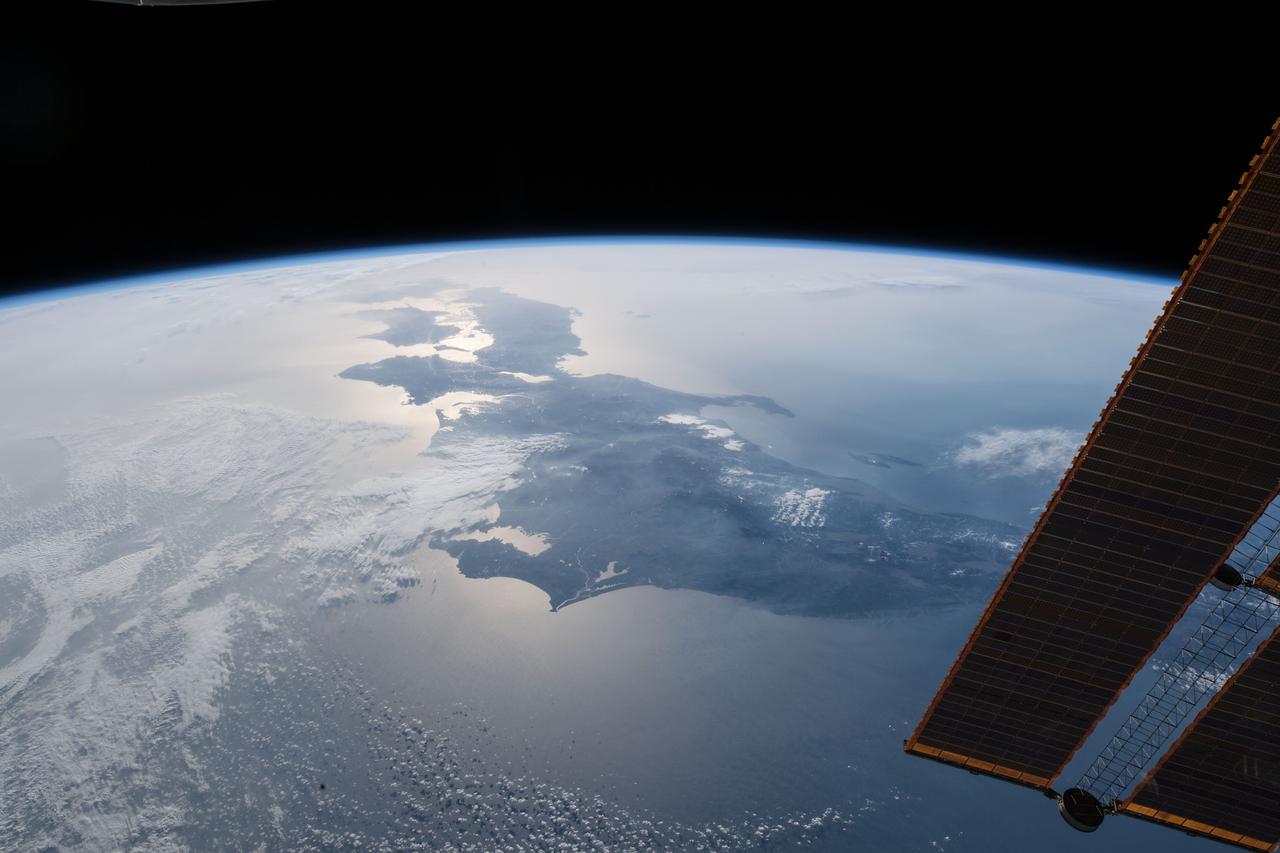
iss055e006515 (March 30, 2018) --- This view of Japan from the International Space Station looks from north to south and encompasses the cities of Tokyo, Nagoya, Osaka, Hiroshima and Fukuoka.
Earth observation taken by the Expedition 55 crew
iss068e021122 (Nov. 8, 2022) --- The night lights of the Japanese cities of Tokyo, Nagoya, and Osaka, are pictured from the International Space Station as it orbited 258 miles above the Sea of Japan.
iss068e021122
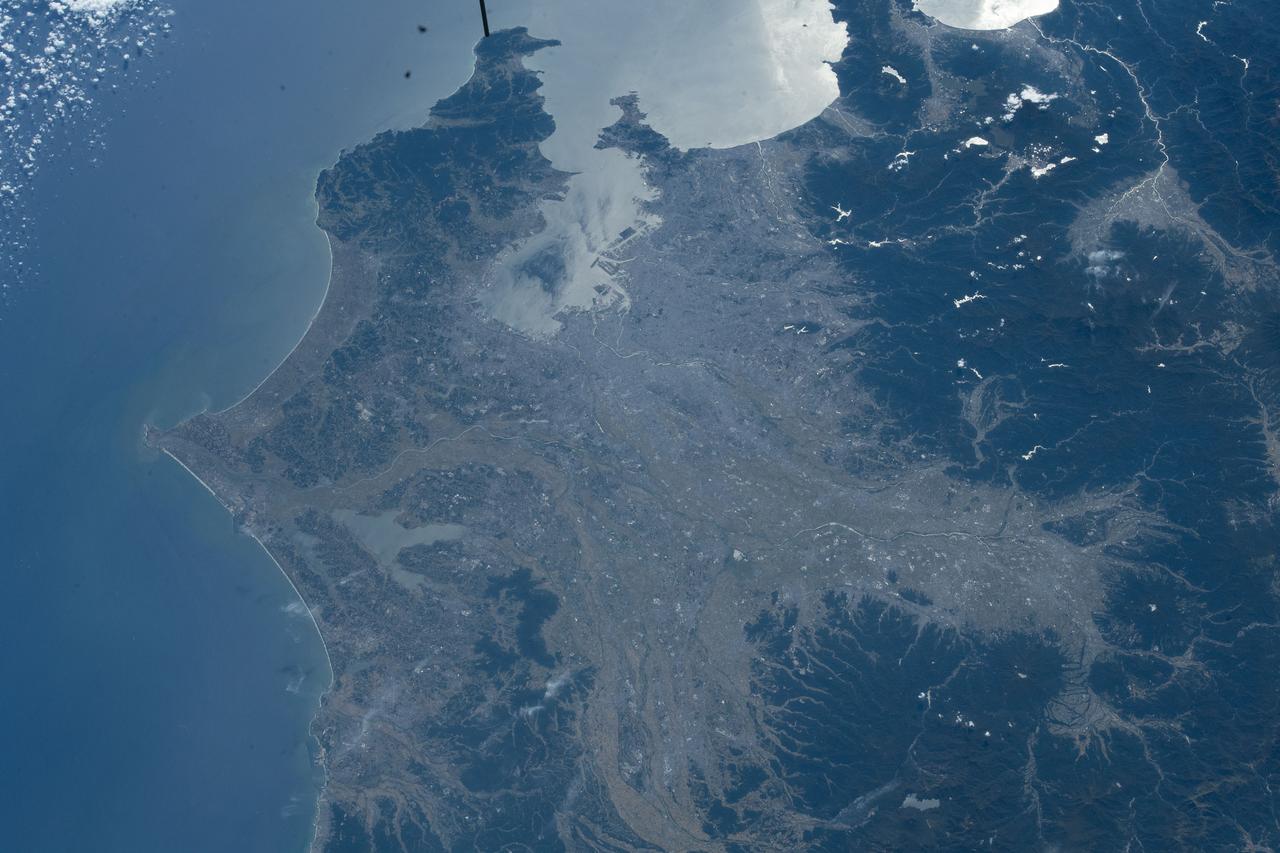
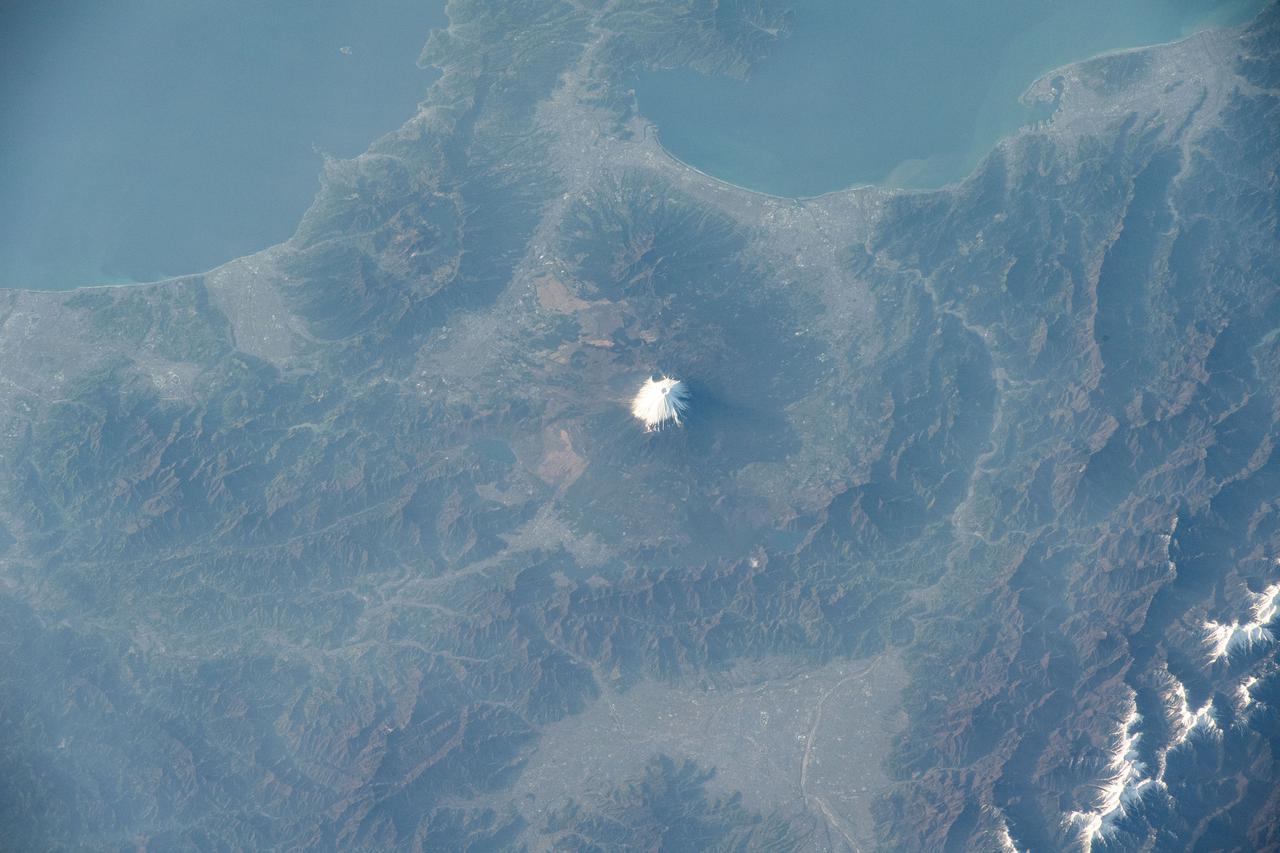
iss065e001158 (April 19, 2021) --- Mount Fuji, north of Suruga Bay and west of Tokyo, is pictured from the International Space Station as it orbited 264 miles above the Sea of Japan.
Earth observation taken by Expedition 65 crew
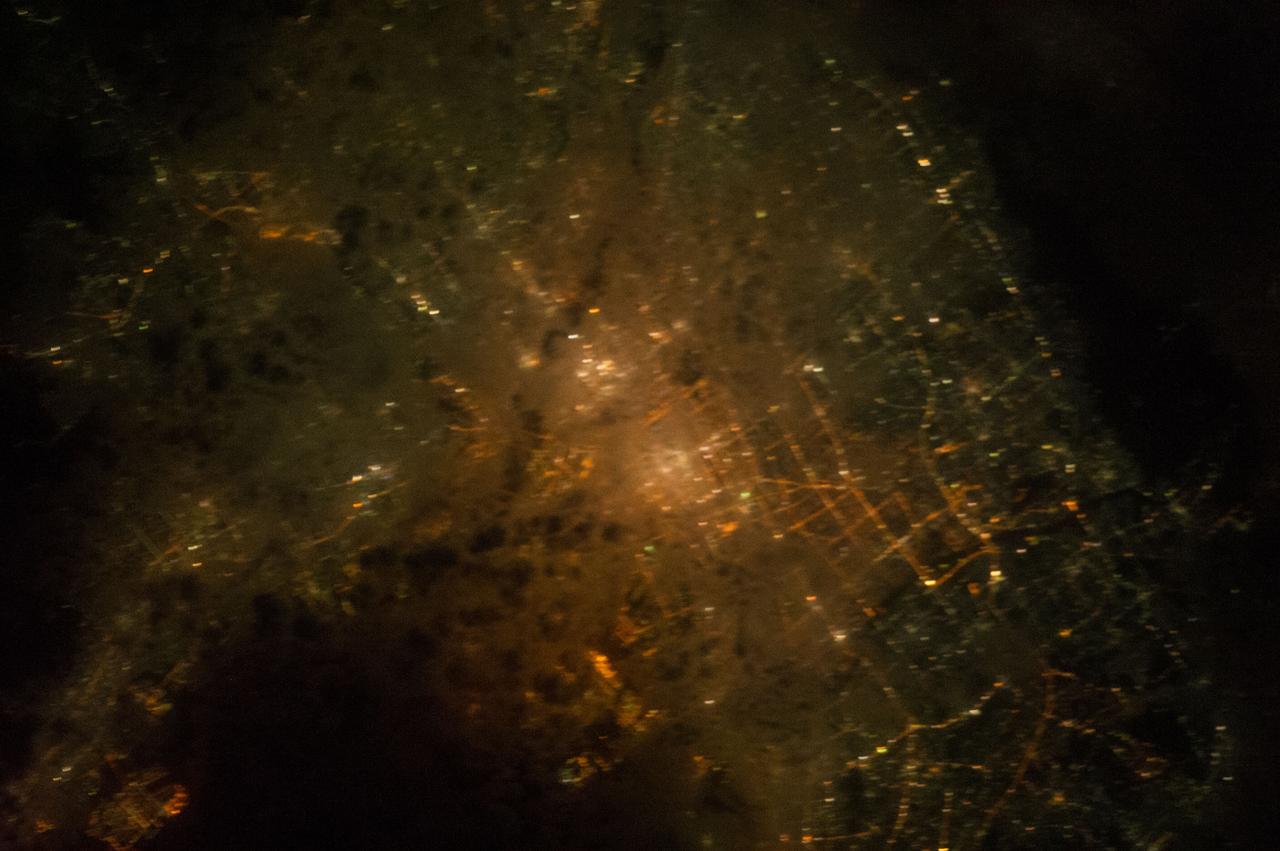
Earth observation taken during night pass by the Expedition 40 crew aboard the International Space Station (ISS).   Folder lists this as: First attempt with 400mm at night, Tokyo.
Earth Observation
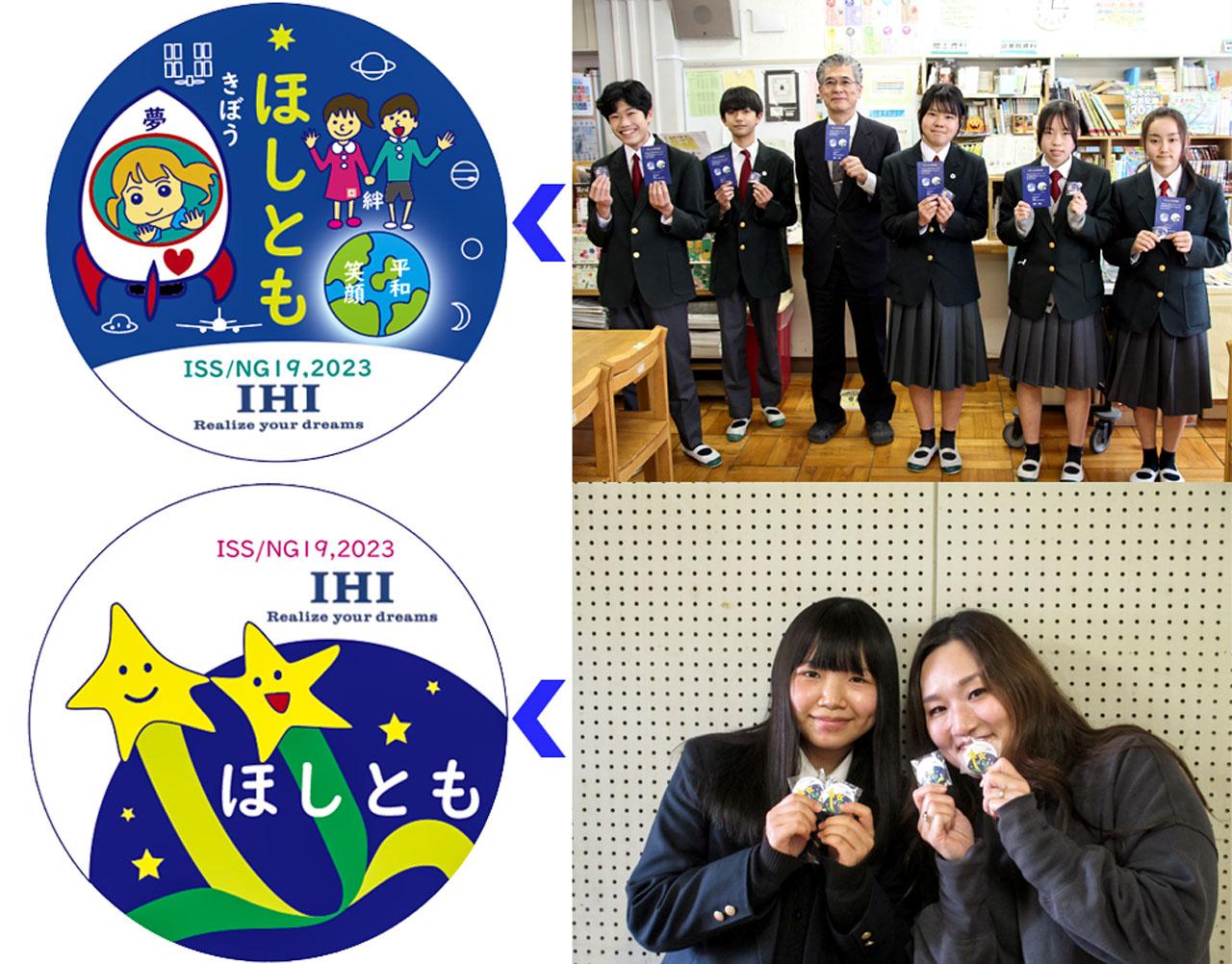
jsc2023e038731 (6/22/2023) --- Two types of Hoshi-Tomo badges were designed by students. “Hoshi” implies star(s), planet(s), or the Earth in Japanese. “Tomo” means friend(s) in Japanese. Top: The Design Team (five students) at Mizuho Junior High School (Japan, Tokyo). Bottom: The Designer (one student) at Mizuho Dai-Ni Junior High School (Japan, Tokyo). I-Space Essay provides students and teachers the online opportunity to create wishes, which are delivered to the International Space Station's Japanese Experimental Module Kibo. Image courtesy of Mizuho Town Education Board and IHI Corporation.
jsc2023e038731
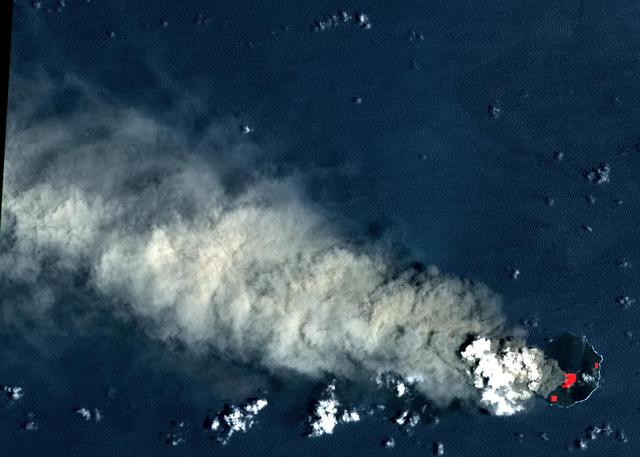
Nishinoshima is a small volcanic island located about 1000 km south of Tokyo, Japan. Eruptive activity began in December 2019, and has continued uninterrupted. ASTER captured this image of an ash and steam plume emanating from the central crater. Thermal infrared data is superposed in red on a visible-infrared color image to highlight the lava in the central crater and lava flows that have flowed down the volcano's flanks. The image was acquired July 28, 2020, covers an area of 15 by 21 km, and is located at 27.3 degrees north, 140.8 degrees east.  https://photojournal.jpl.nasa.gov/catalog/PIA24017
Nishinoshima Volcano, Japan
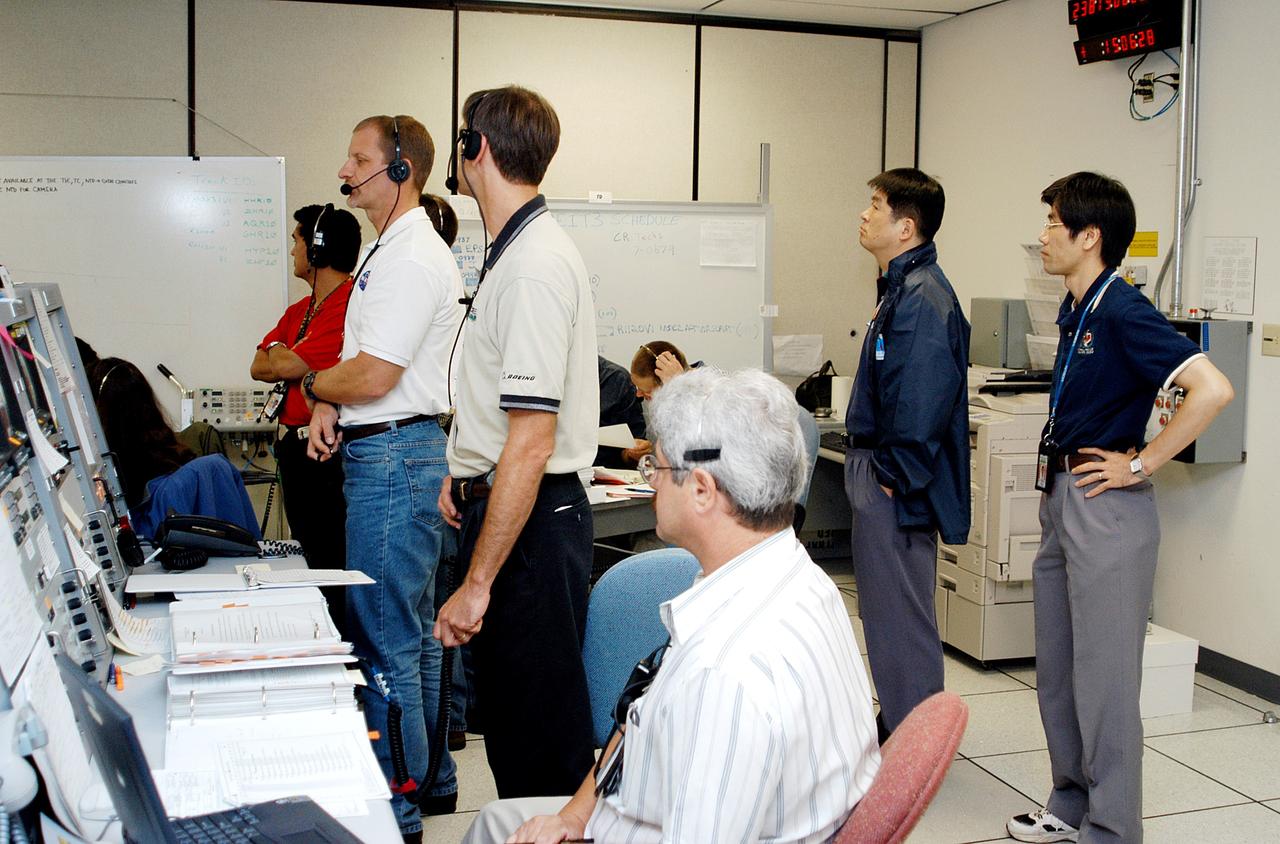
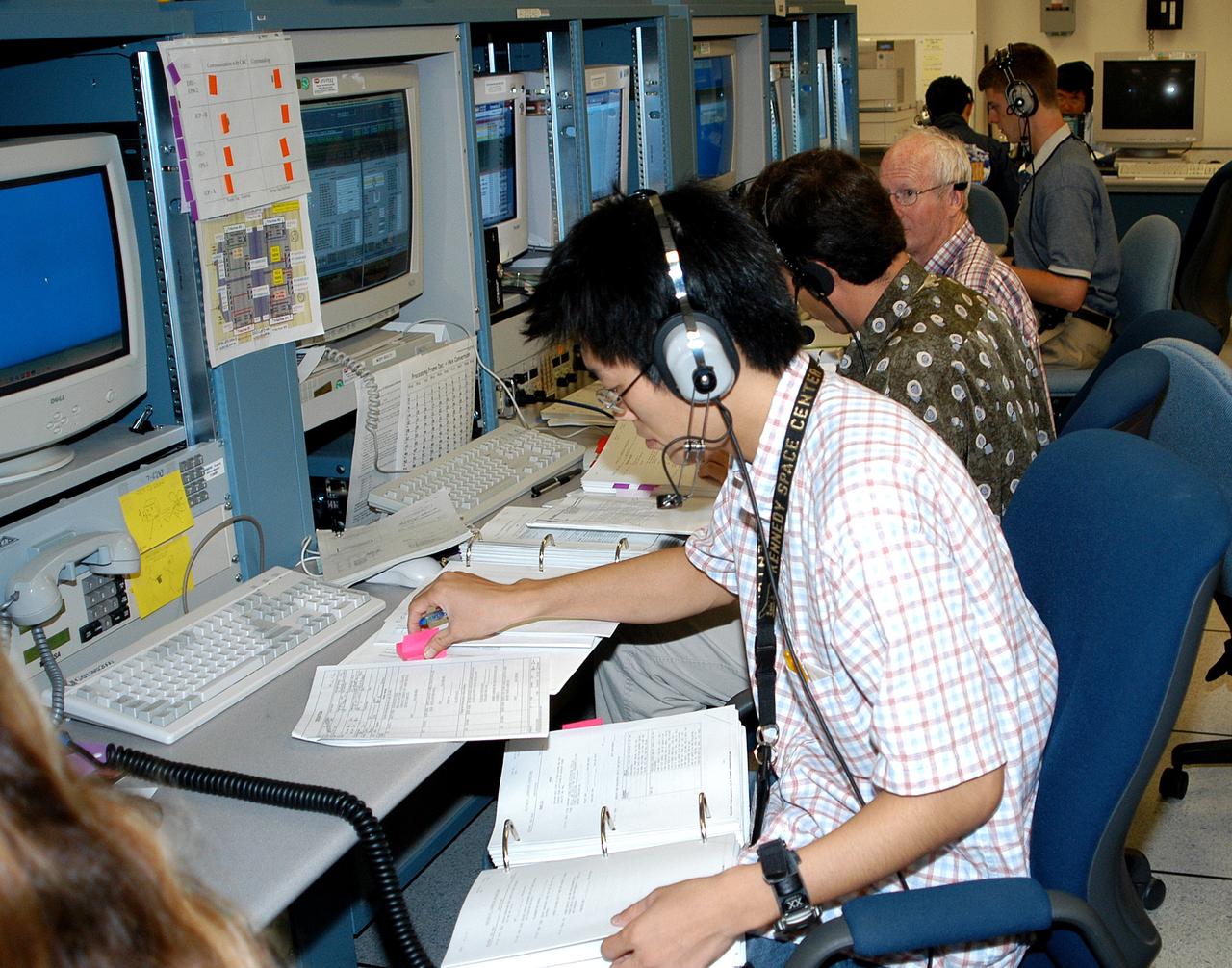
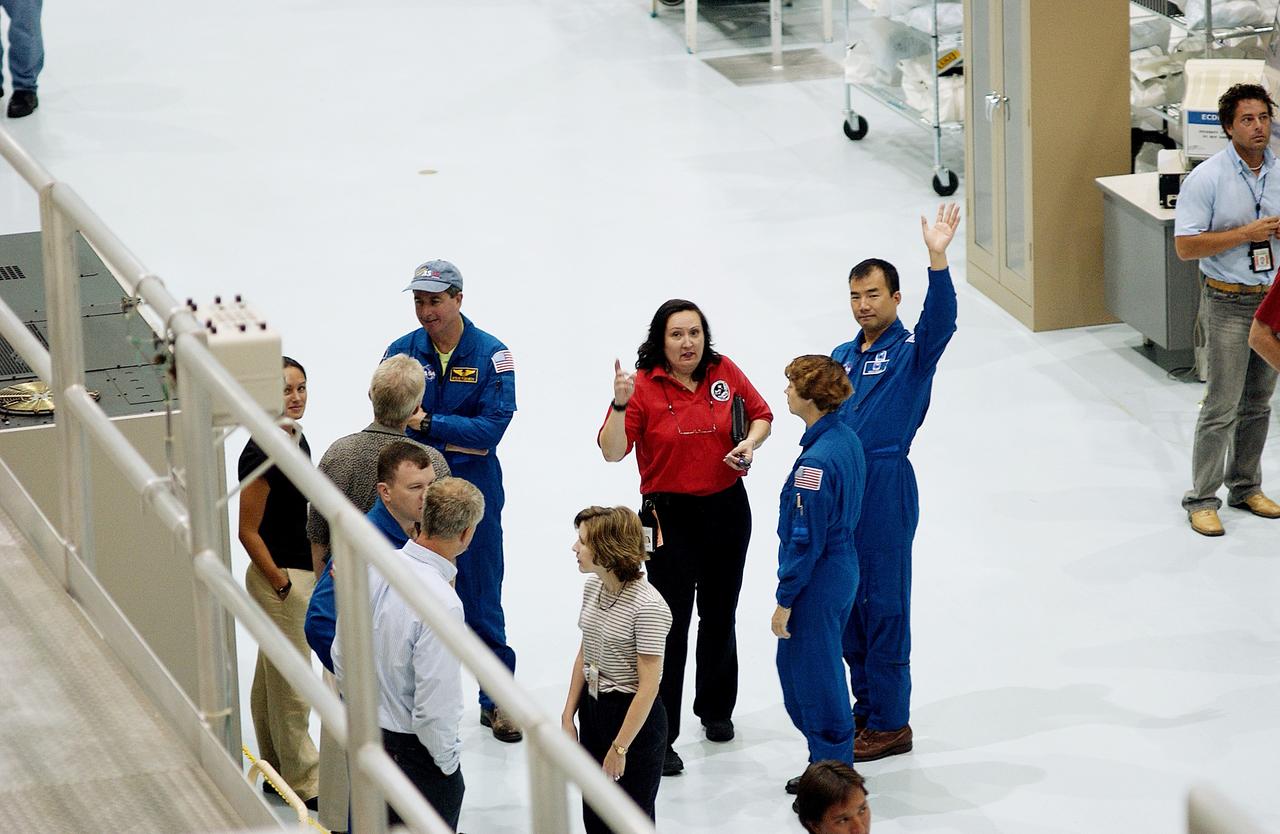
KENNEDY SPACE CENTER, FLA. -  Japanese astronauts and other personnel in the Space Station Processing Facility observe sensors during a Multi-Equipment Interface Test (MEIT) on the Japanese Experiment Module (JEM).  The National Space Development Agency of Japan (NASDA) developed the laboratory at the Tsukuba Space Center near Tokyo. It is the first element, named "Kibo" (Hope), to be delivered to KSC. The JEM is Japan's primary contribution to the Station. It will enhance the unique research capabilities of the orbiting complex by providing an additional environment for astronauts to conduct science experiments.
KENNEDY SPACE CENTER, FLA. - Japanese astronauts and other personnel in the Space Station Processing Facility observe sensors during a Multi-Equipment Interface Test (MEIT) on the Japanese Experiment Module (JEM). The National Space Development Agency of Japan (NASDA) developed the laboratory at the Tsukuba Space Center near Tokyo. It is the first element, named "Kibo" (Hope), to be delivered to KSC. The JEM is Japan's primary contribution to the Station. It will enhance the unique research capabilities of the orbiting complex by providing an additional environment for astronauts to conduct science experiments.
KENNEDY SPACE CENTER, FLA. -  In the Space Station Processing Facility, personnel observe sensors during a Multi-Equipment Interface Test (MEIT) on the Japanese Experiment Module (JEM).  The National Space Development Agency of Japan (NASDA) developed the laboratory at the Tsukuba Space Center near Tokyo. It is the first element, named "Kibo" (Hope), to be delivered to KSC. The JEM is Japan's primary contribution to the Station. It will enhance the unique research capabilities of the orbiting complex by providing an additional environment for astronauts to conduct science experiments.
KENNEDY SPACE CENTER, FLA. - In the Space Station Processing Facility, personnel observe sensors during a Multi-Equipment Interface Test (MEIT) on the Japanese Experiment Module (JEM). The National Space Development Agency of Japan (NASDA) developed the laboratory at the Tsukuba Space Center near Tokyo. It is the first element, named "Kibo" (Hope), to be delivered to KSC. The JEM is Japan's primary contribution to the Station. It will enhance the unique research capabilities of the orbiting complex by providing an additional environment for astronauts to conduct science experiments.
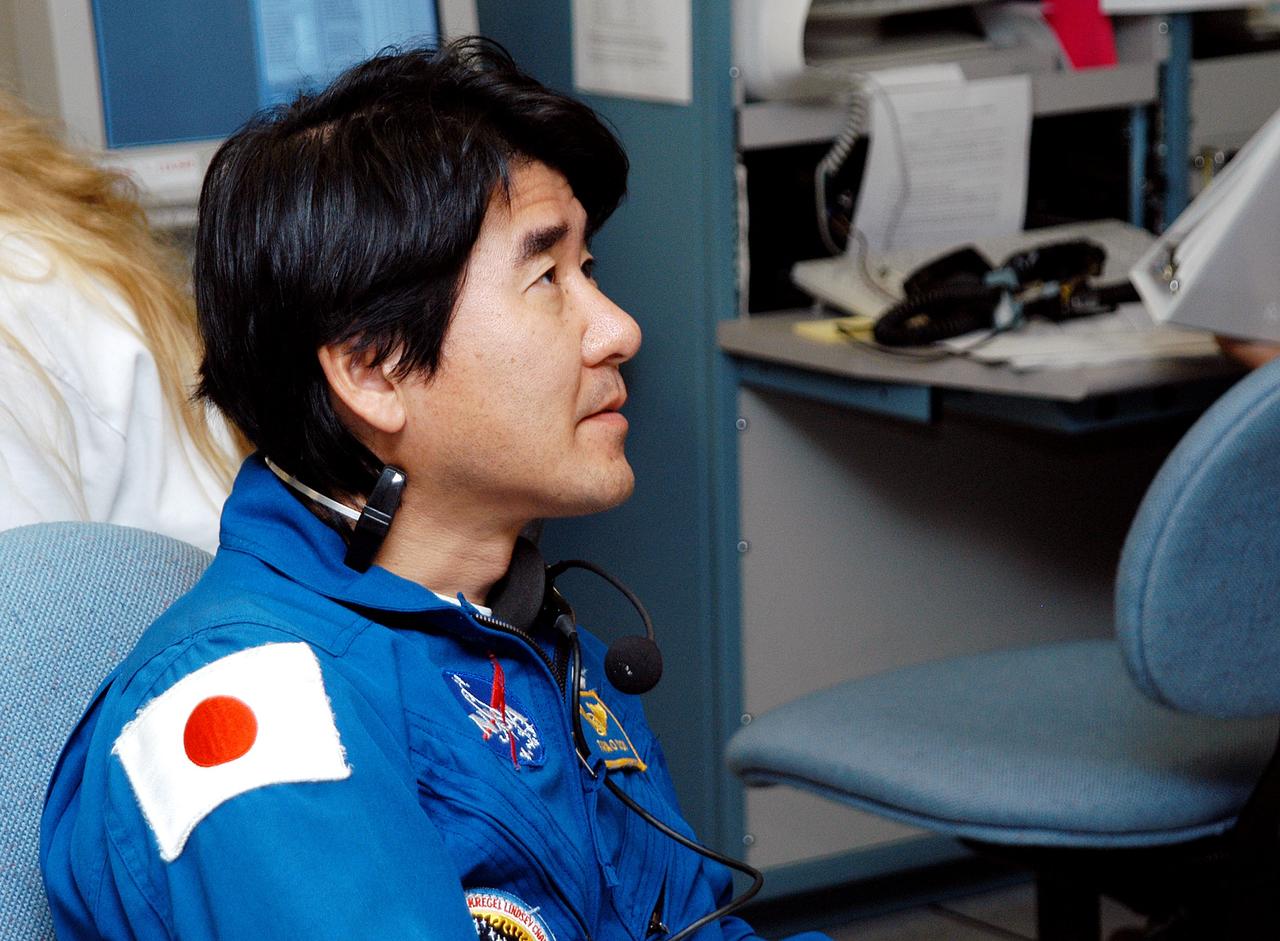
KENNEDY SPACE CENTER, FLA. -  Takao Doi, an astronaut with the National Space Development Agency of Japan (NASDA), watches the sensors  during a Multi-Equipment Interface Test (MEIT) on the Japanese Experiment Module (JEM).  NASDA  developed the laboratory at the Tsukuba Space Center near Tokyo. It is the first element, named "Kibo" (Hope), to be delivered to KSC. The JEM is Japan's primary contribution to the Station. It will enhance the unique research capabilities of the orbiting complex by providing an additional environment for astronauts to conduct science experiments.
KENNEDY SPACE CENTER, FLA. - Takao Doi, an astronaut with the National Space Development Agency of Japan (NASDA), watches the sensors during a Multi-Equipment Interface Test (MEIT) on the Japanese Experiment Module (JEM). NASDA developed the laboratory at the Tsukuba Space Center near Tokyo. It is the first element, named "Kibo" (Hope), to be delivered to KSC. The JEM is Japan's primary contribution to the Station. It will enhance the unique research capabilities of the orbiting complex by providing an additional environment for astronauts to conduct science experiments.
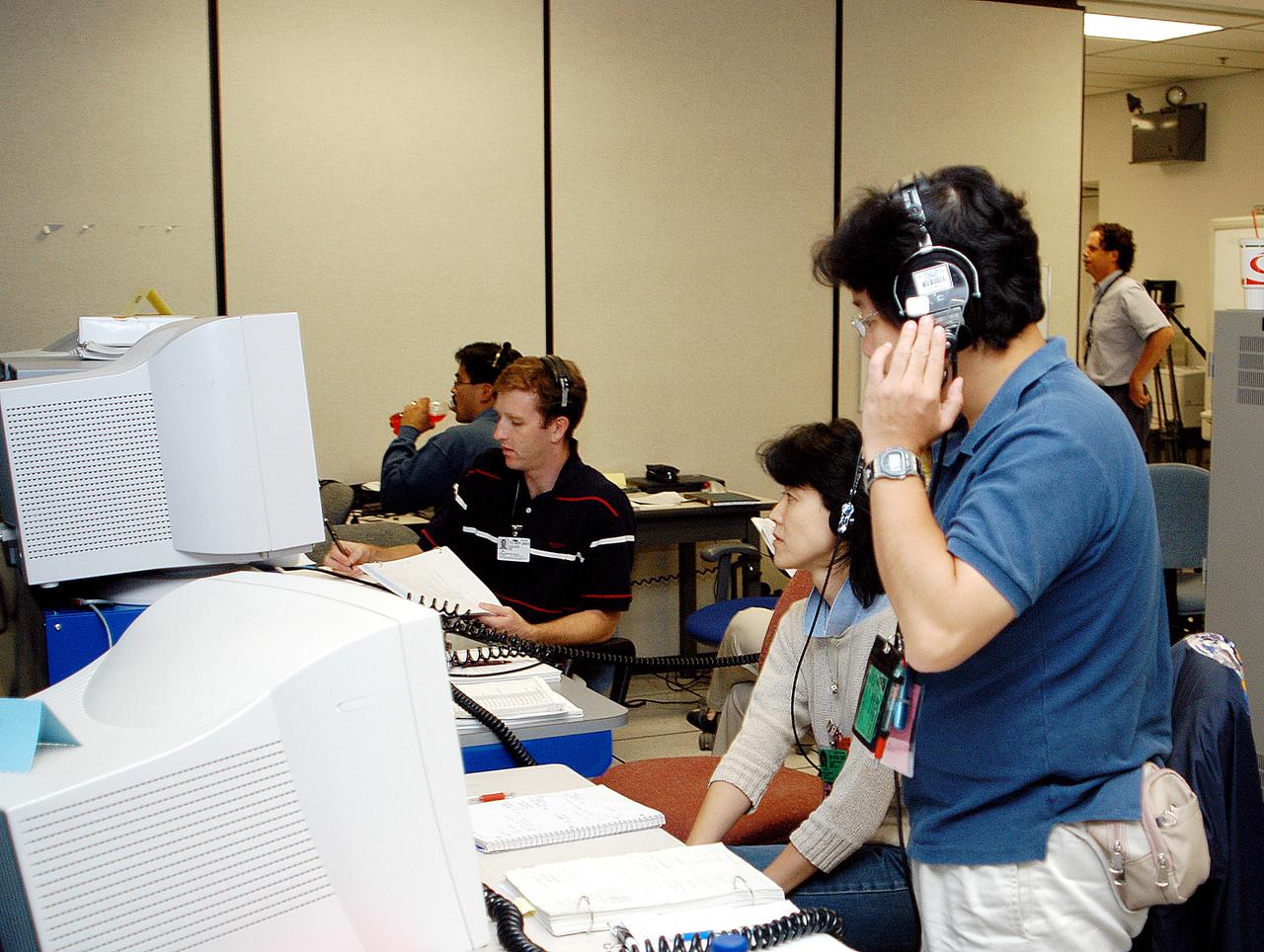
KENNEDY SPACE CENTER, FLA. - In the Space Station Processing Facility, Japanaese astronauts and personnel observe sensors during a Multi-Equipment Interface Test (MEIT) on the Japanese Experiment Module (JEM).  The National Space Development Agency of Japan (NASDA) developed the laboratory at the Tsukuba Space Center near Tokyo. It is the first element, named "Kibo" (Hope), to be delivered to KSC. The JEM is Japan's primary contribution to the Station. It will enhance the unique research capabilities of the orbiting complex by providing an additional environment for astronauts to conduct science experiments.
KENNEDY SPACE CENTER, FLA. - In the Space Station Processing Facility, Japanaese astronauts and personnel observe sensors during a Multi-Equipment Interface Test (MEIT) on the Japanese Experiment Module (JEM). The National Space Development Agency of Japan (NASDA) developed the laboratory at the Tsukuba Space Center near Tokyo. It is the first element, named "Kibo" (Hope), to be delivered to KSC. The JEM is Japan's primary contribution to the Station. It will enhance the unique research capabilities of the orbiting complex by providing an additional environment for astronauts to conduct science experiments.
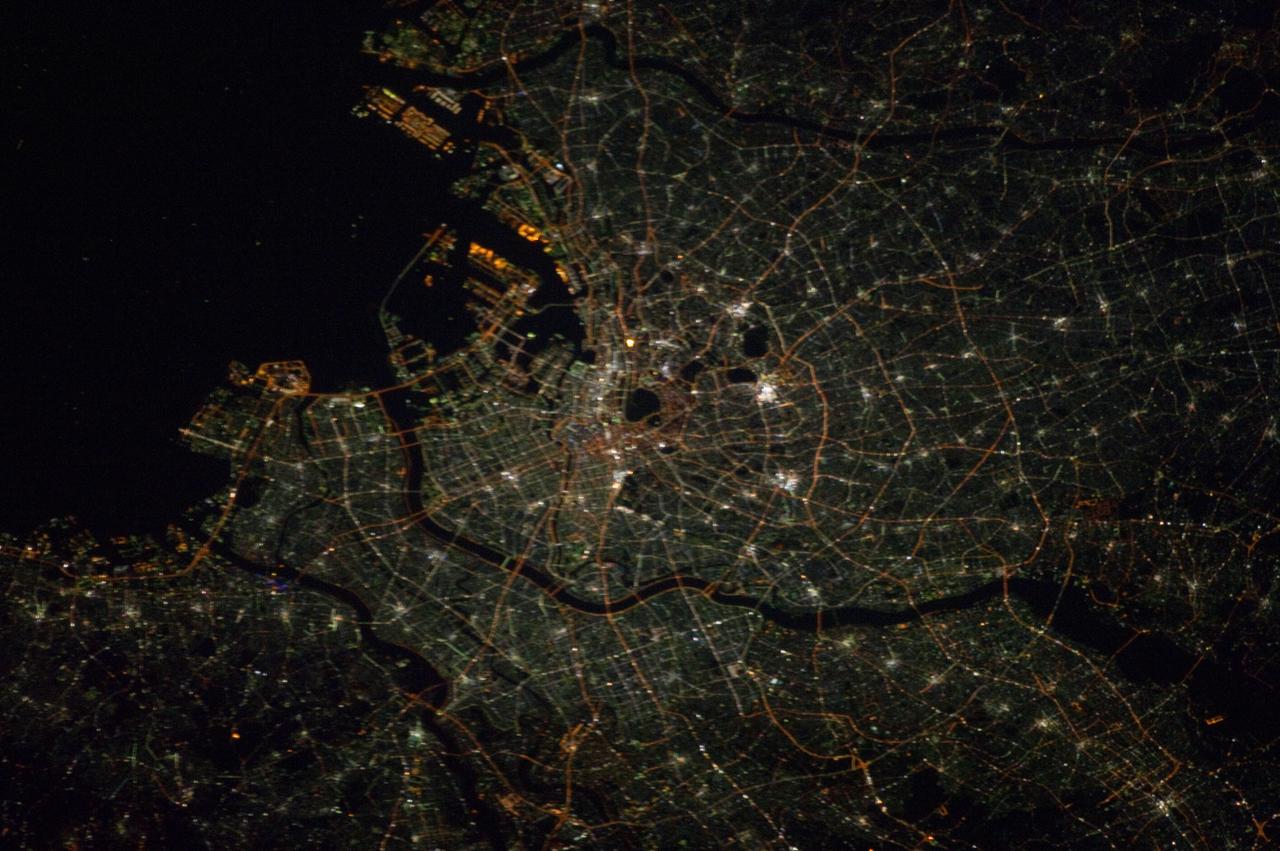
iss064e028418 (Jan. 30, 2021) --- This nighttime photograph of downtown Tokyo, Japan, was taken from the International Space Station as it orbited 264 miles above the east coast of the island nation. The dark area near the center is the Imperial Palace, the main residence of the nation's emperor.
iss064e028418
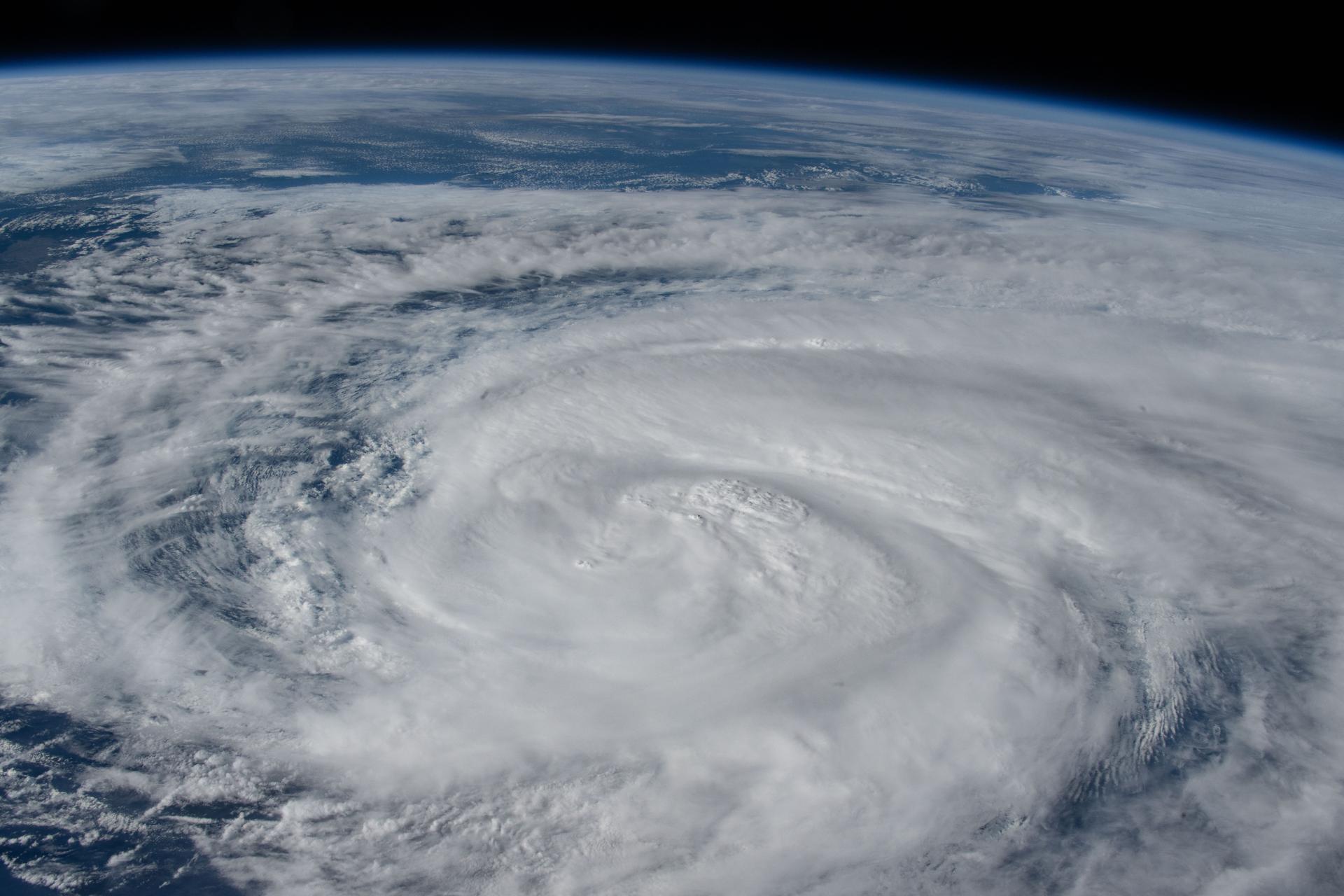
iss073e0880503 (Oct. 13, 2025) --- Severe Tropical Storm Nakri, pictured with maximum sustained winds of 70 miles per hour, is pictured in the Pacific Ocean east of Tokyo, Japan, from the International Space Station as it orbited 260 miles above Earth.
Severe Tropical Storm Nakri is pictured in the Pacific Ocean
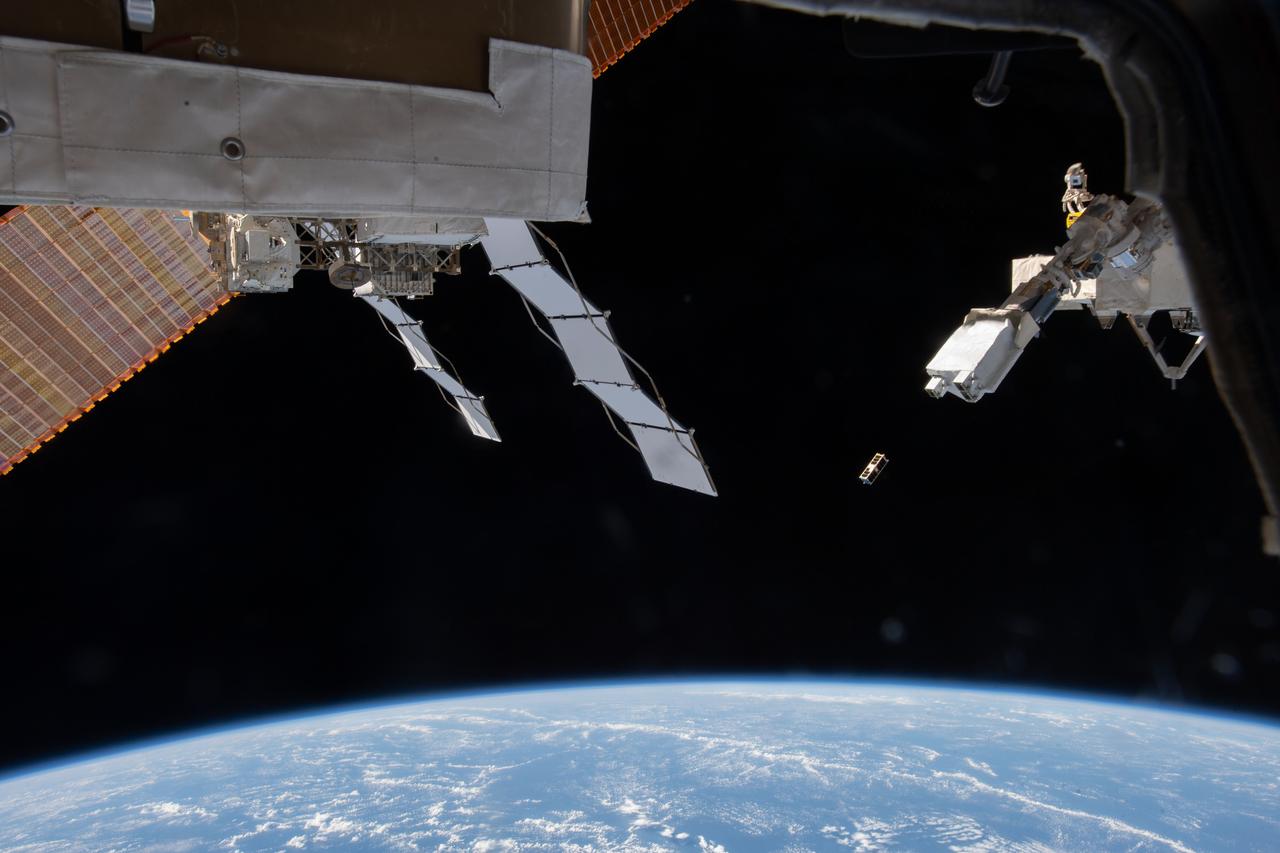
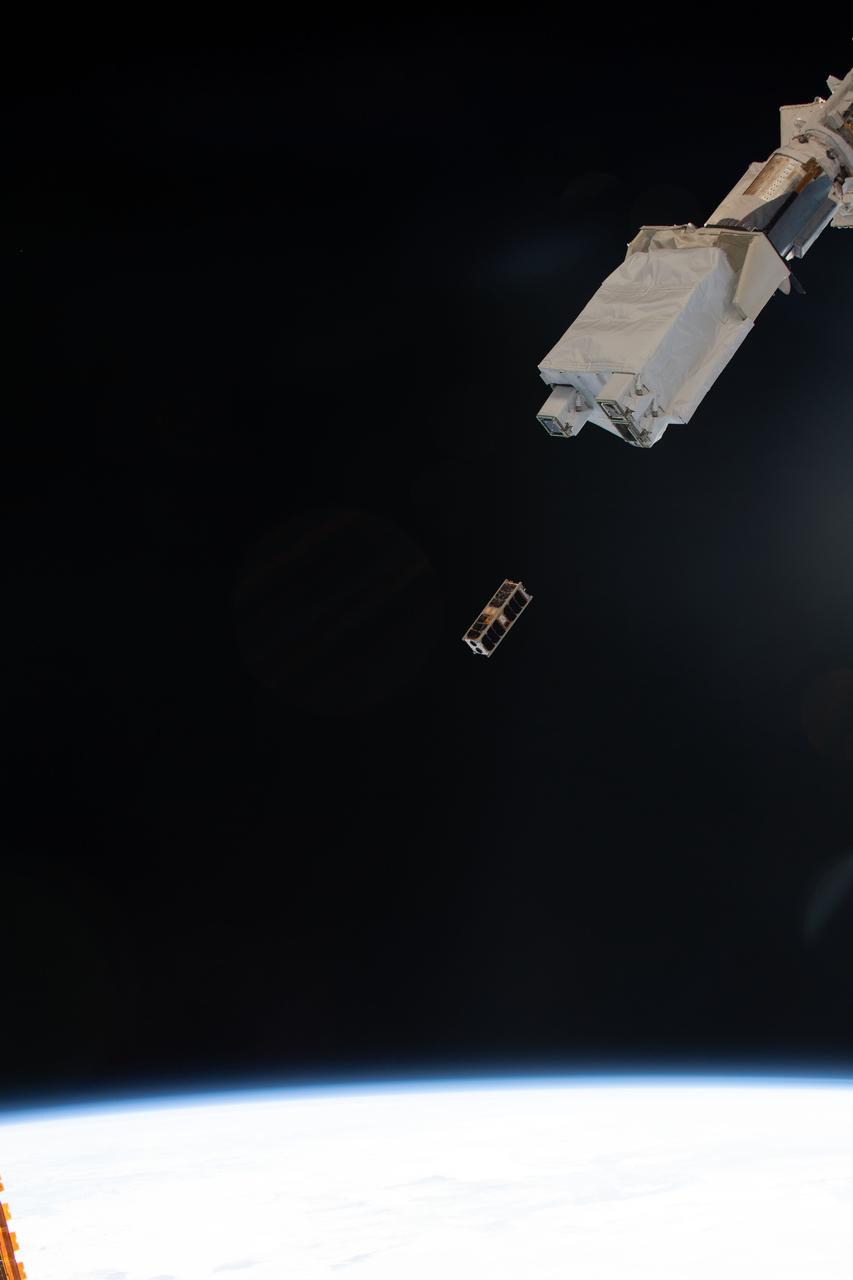
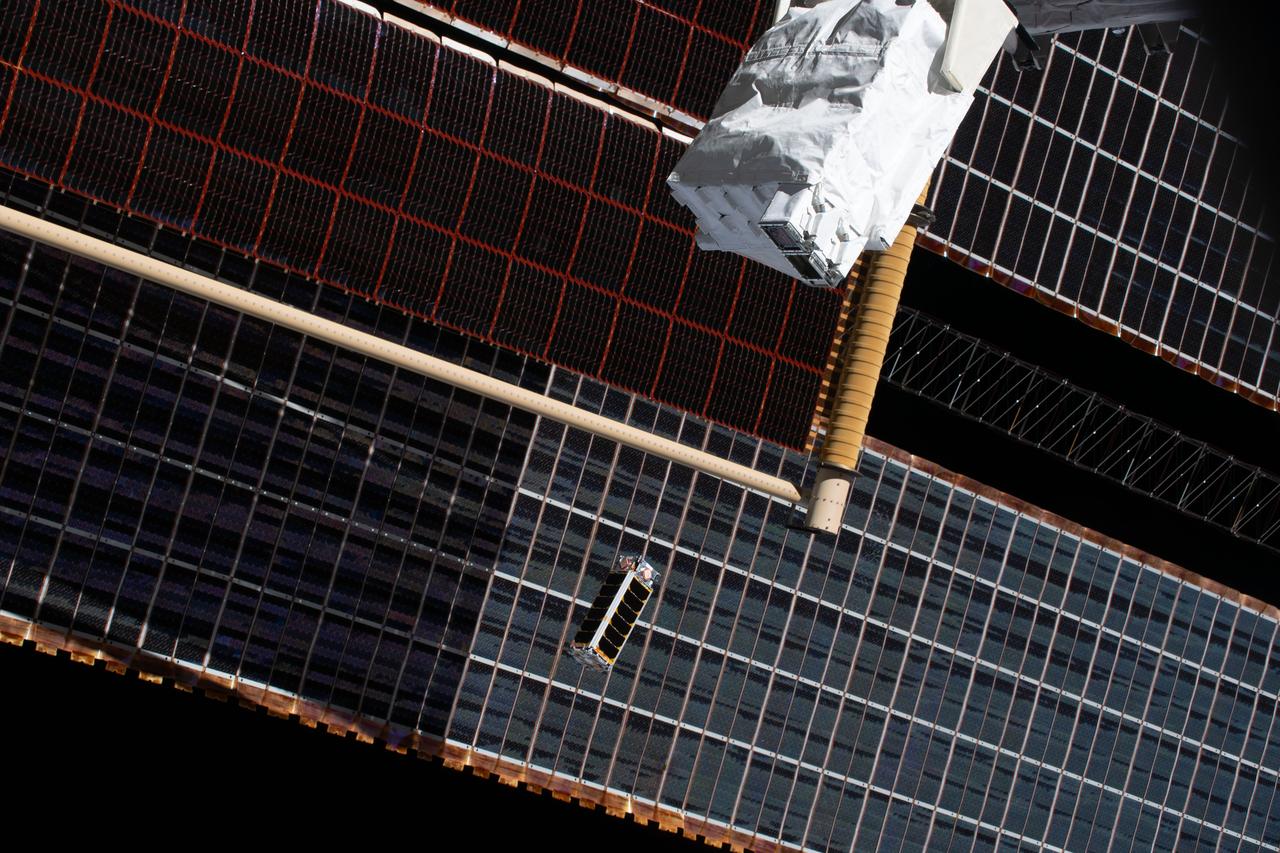
iss061e051961 (11/20/2019) --- An external view of the deployment of the AQT-D CubeSat from the JEM Small Satellite Orbital Deployer aboard the International Space Station (ISS). AQua Thruster-Demonstrator (AQT-D) is a 3U CubeSat demonstration of a water resistojet propulsion system developed by The University of Tokyo.
iss061e051961
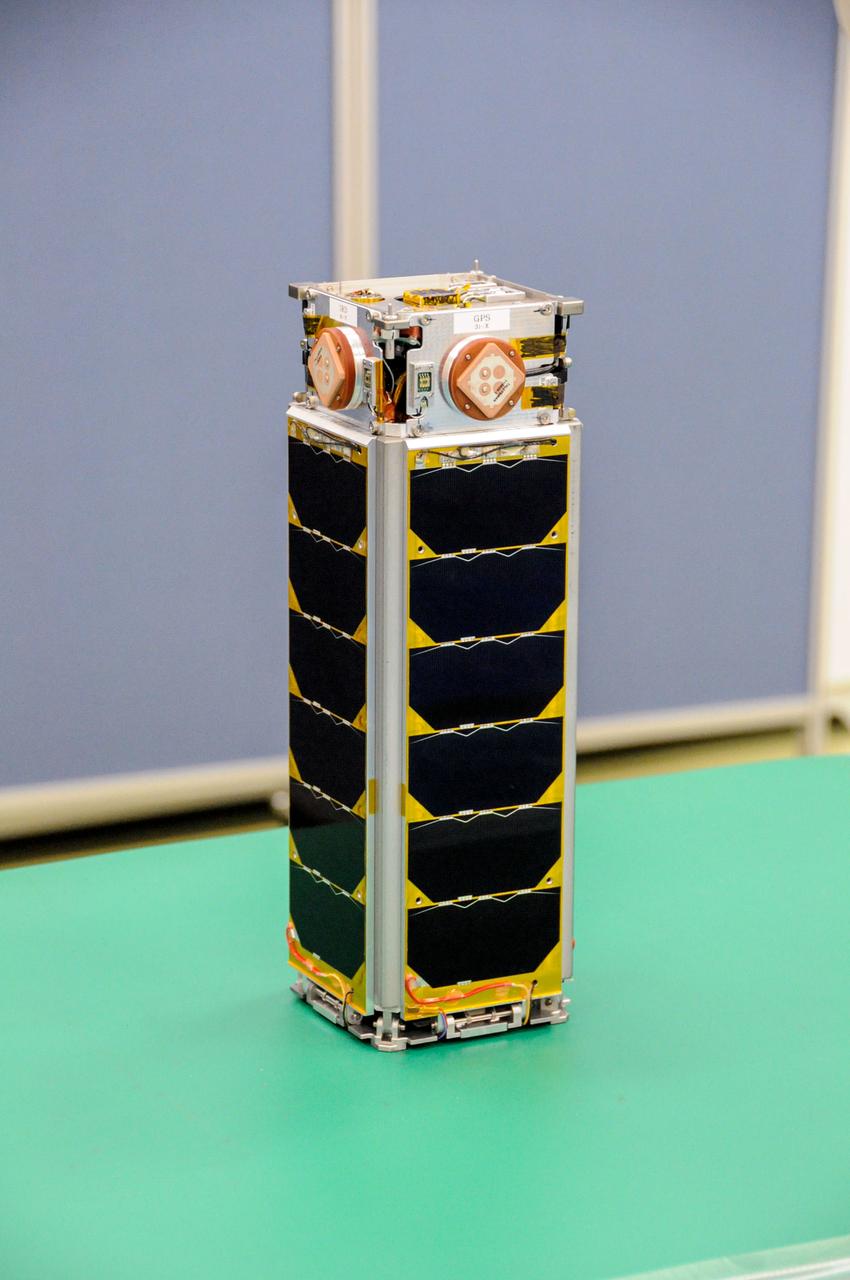
jsc2023e054812 (7/28/2023) --- An Exterior view of the BEAK 3-Unit (3U) Cubesat. BEAK is developed by The University of Tokyo in Kashiwa, Japan and Institute of Space and Astronautical Science in Sagamihara, Japan, and its primary mission is to test novel technologies for use in future nano-sized planetary probes.
jsc2023e054812
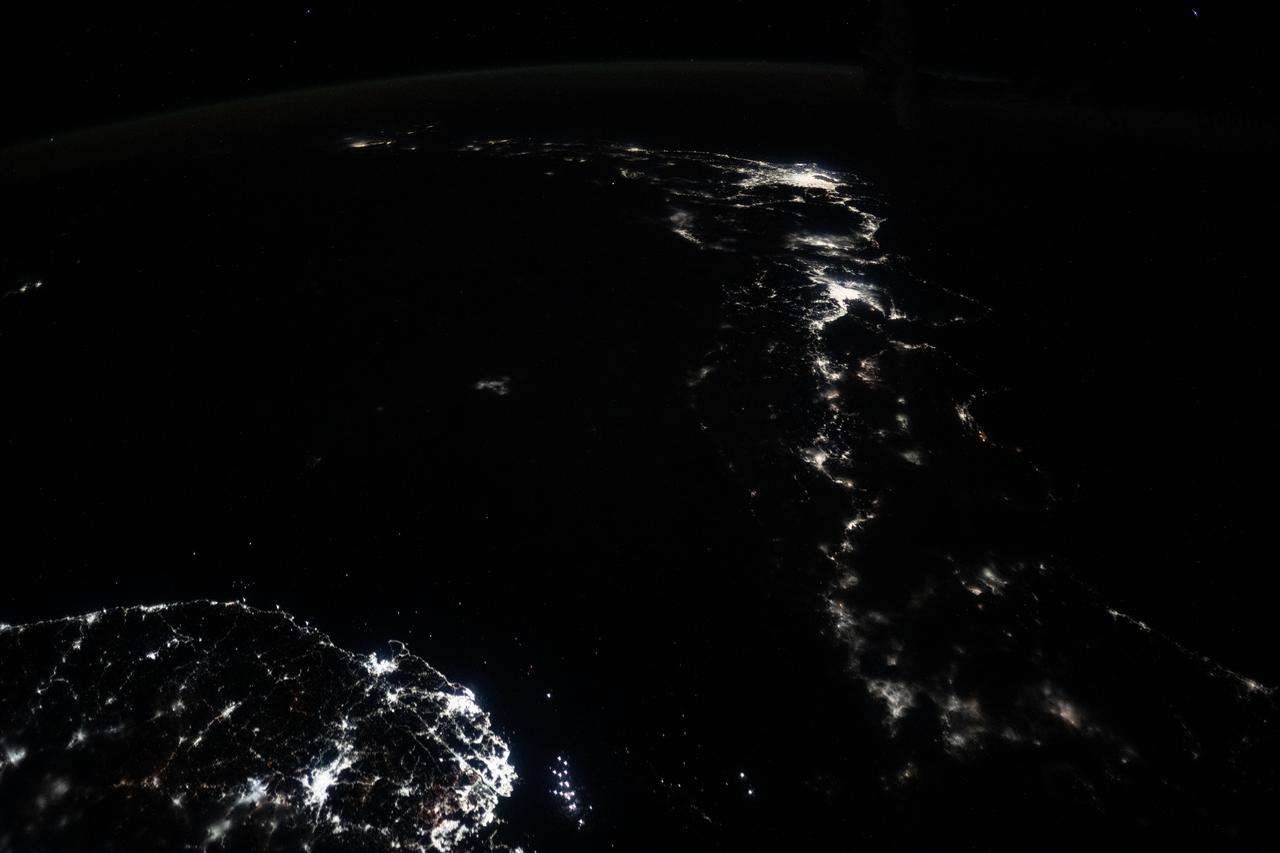
iss072e436132 (Dec. 28, 2024) --- The Korea Strait separates Busan, Korea (bottom left), and Fukuoka, Japan, in this photograph taken approximately 12:55 a.m. local time from the International Space Station as it orbited 258 miles above the Korean coast. Toward the top right, are the city lights of Osaka, Nagoya, and Tokyo.
The Korea Strait separates Busan, Korea, and Fukuoka, Japan
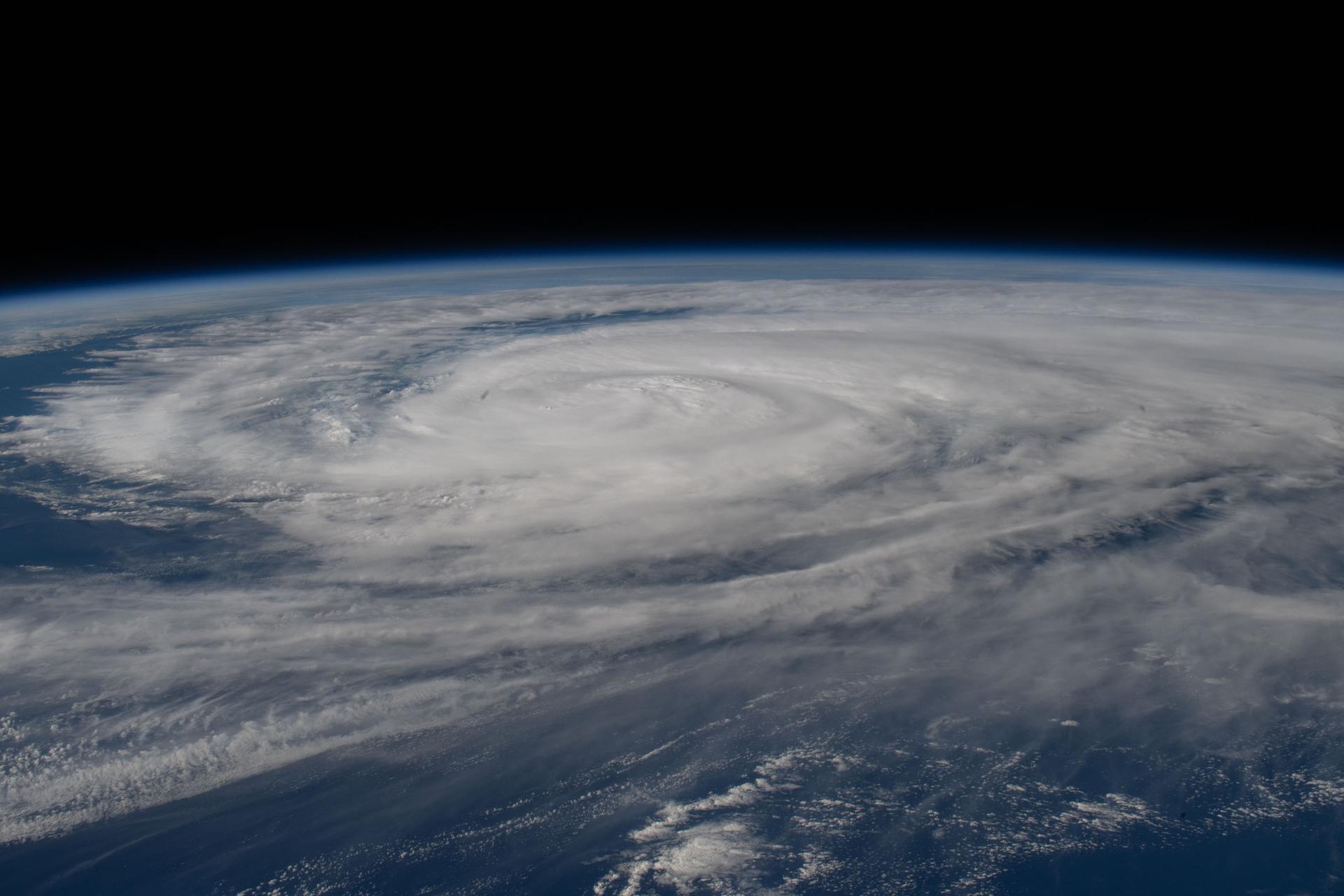
iss073e0880455 (Oct. 13, 2025) --- Severe Tropical Storm Nakri, pictured with maximum sustained winds of 70 miles per hour, is pictured in the Pacific Ocean east of Tokyo, Japan, from the International Space Station as it orbited 260 miles above Earth.
Severe Tropical Storm Nakri is pictured in the Pacific Ocean
The nearly perfectly conical profile of Fuji soars 3,776 meters (12,388 feet) above sea level on southern Honshu, near Tokyo. The highest mountain in Japan, Fuji is the country's most familiar symbol. The summit of this graceful, dormant volcano is broken by a crater 610 meters (2,000 feet) in diameter. The crater is ringed by eight jagged peaks. The five Fuji Lakes lie on the northern slopes of the mountain, all formed in the wake of lava flows. Mirrored in the still waters of Kawaguchi-ko, the most beautiful of the five lakes, is a reflection of Fuji. Part of Fuji-Hakone-Izu National Park, Fuji last erupted for a two-month period starting in November 1707, covering Tokyo, some 100 kilometers (60 miles) away, with a layer of ash. According to legend, Fuji arose from the plain during a single night in 286 BC. Geologically, the mountain is much older than this.  Considered sacred by many, Fuji is surrounded by temples and shrines. Thousands of pilgrims climb the mountain each year as part of their religious practice, hoping to reach the summit by dawn to watch the sunrise. This animated fly-by was created by draping visible and near infrared image data over a digital topography model, created from ASTER's stereo bands. The spatial resolution of both the image and topography is 15 m. The image is centered at 35.3 degrees north latitude, 138.7 degrees east longitude.   http://photojournal.jpl.nasa.gov/catalog/PIA11166
Mt. Fuji, Japan
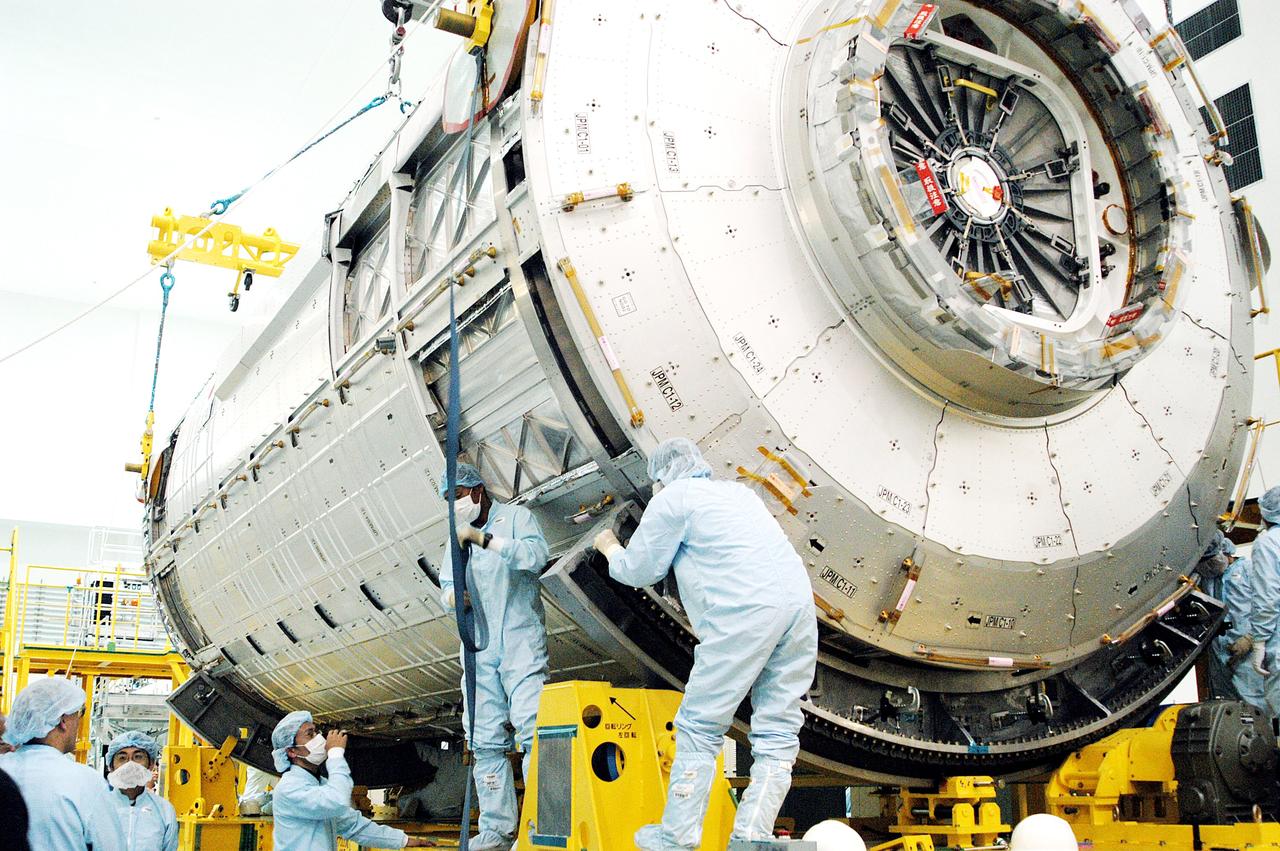
KENNEDY SPACE CENTER, FLA. -    Members of the STS-114 crew take a look at the Japanese Experiment Module (JEM) pressure module in the Space Station Processing Facility.  A research laboratory, the pressurized module is the first element of the JEM, named "Kibo" (Hope), to be delivered to KSC.   The National Space Development Agency of Japan (NASDA) developed the laboratory at the Tsukuba Space Center near Tokyo and is Japan's primary contribution to the Station. The JEM also includes an exposed facility (platform) for space environment experiments, a robotic manipulator system, and two logistics modules. The various JEM components will be  assembled in space over the course of three Shuttle missions.
KENNEDY SPACE CENTER, FLA. - Members of the STS-114 crew take a look at the Japanese Experiment Module (JEM) pressure module in the Space Station Processing Facility. A research laboratory, the pressurized module is the first element of the JEM, named "Kibo" (Hope), to be delivered to KSC. The National Space Development Agency of Japan (NASDA) developed the laboratory at the Tsukuba Space Center near Tokyo and is Japan's primary contribution to the Station. The JEM also includes an exposed facility (platform) for space environment experiments, a robotic manipulator system, and two logistics modules. The various JEM components will be assembled in space over the course of three Shuttle missions.
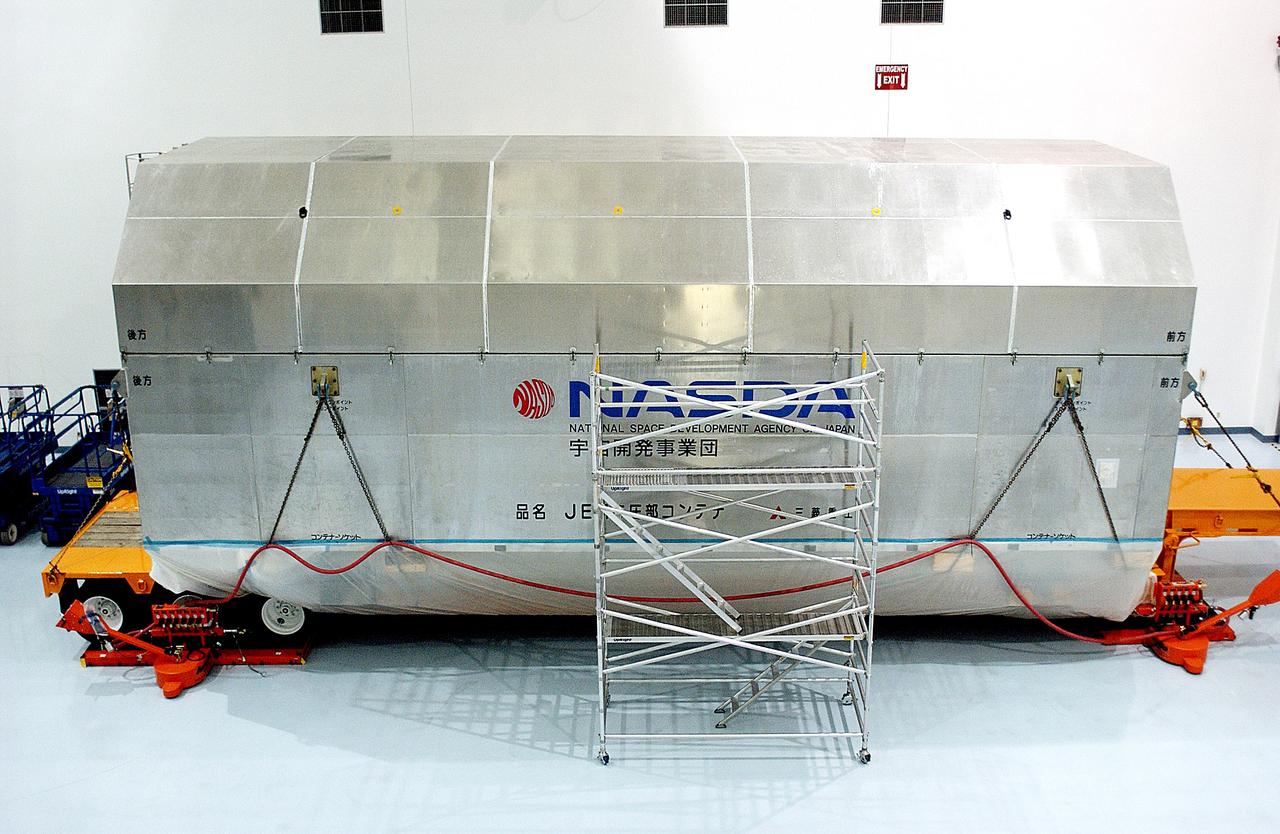
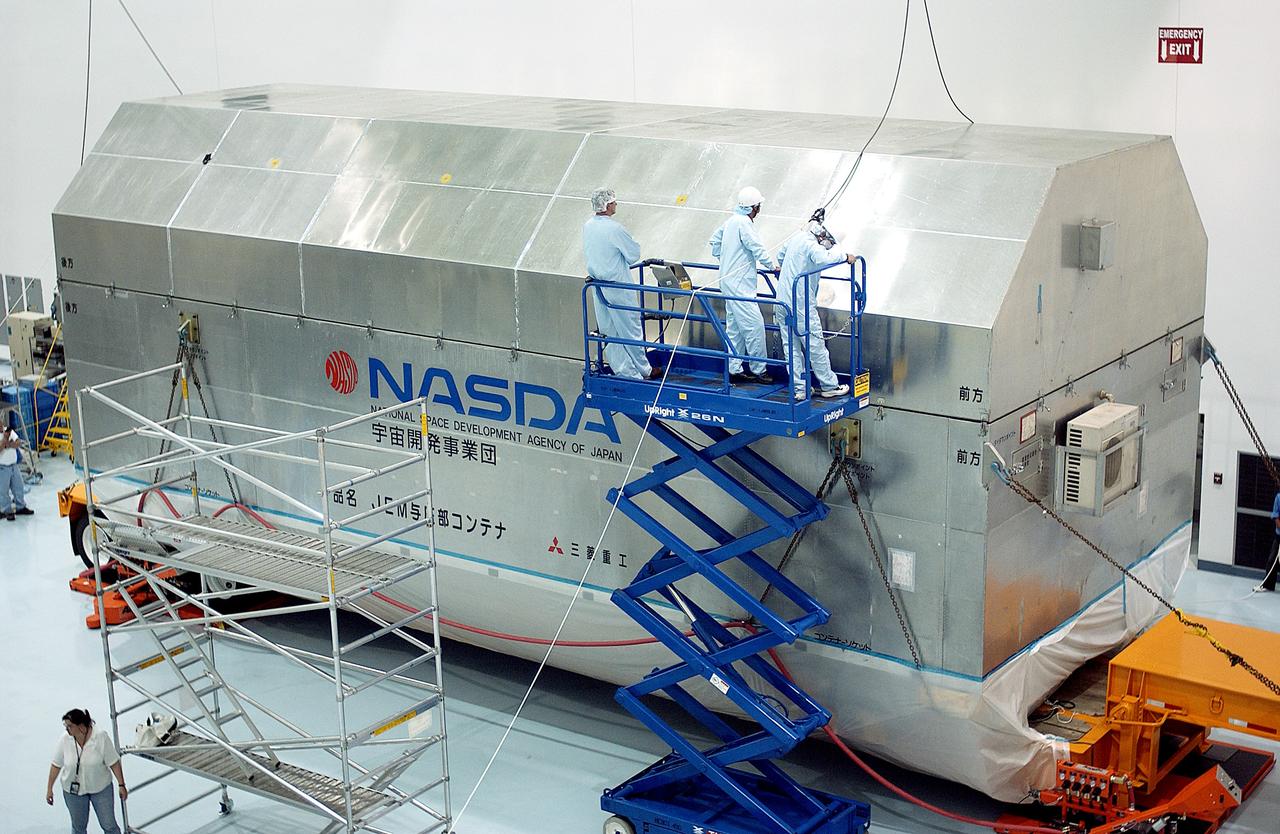
KENNEDY SPACE CENTER, FLA. - The container with the Japanese Experiment Module (JEM)’s pressurized module is inside the Space Station Processing Facility.  The National Space Development Agency of Japan (NASDA) developed the laboratory at the Tsukuba Space Center near Tokyo. The Pressurized Module is the first element of the JEM, named "Kibo" (Hope), to be delivered to KSC. The JEM is Japan's primary contribution to the Station. It will enhance the unique research capabilities of the orbiting complex by providing an additional environment for astronauts to conduct science experiments.  The JEM also includes an exposed facility (platform) for space environment experiments, a robotic manipulator system, and two logistics modules. The various JEM components will be  assembled in space over the course of three Shuttle missions.
KENNEDY SPACE CENTER, FLA. - The container with the Japanese Experiment Module (JEM)’s pressurized module is inside the Space Station Processing Facility. The National Space Development Agency of Japan (NASDA) developed the laboratory at the Tsukuba Space Center near Tokyo. The Pressurized Module is the first element of the JEM, named "Kibo" (Hope), to be delivered to KSC. The JEM is Japan's primary contribution to the Station. It will enhance the unique research capabilities of the orbiting complex by providing an additional environment for astronauts to conduct science experiments. The JEM also includes an exposed facility (platform) for space environment experiments, a robotic manipulator system, and two logistics modules. The various JEM components will be assembled in space over the course of three Shuttle missions.
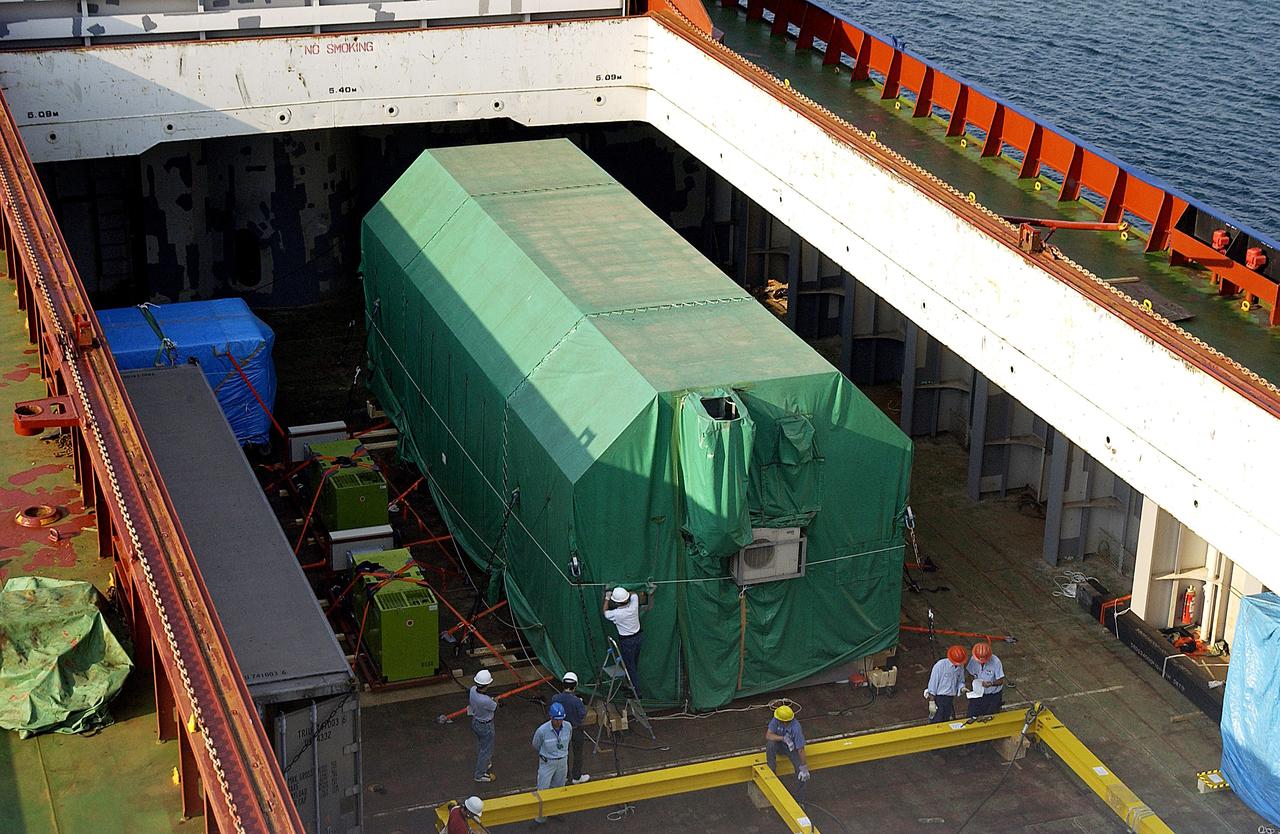
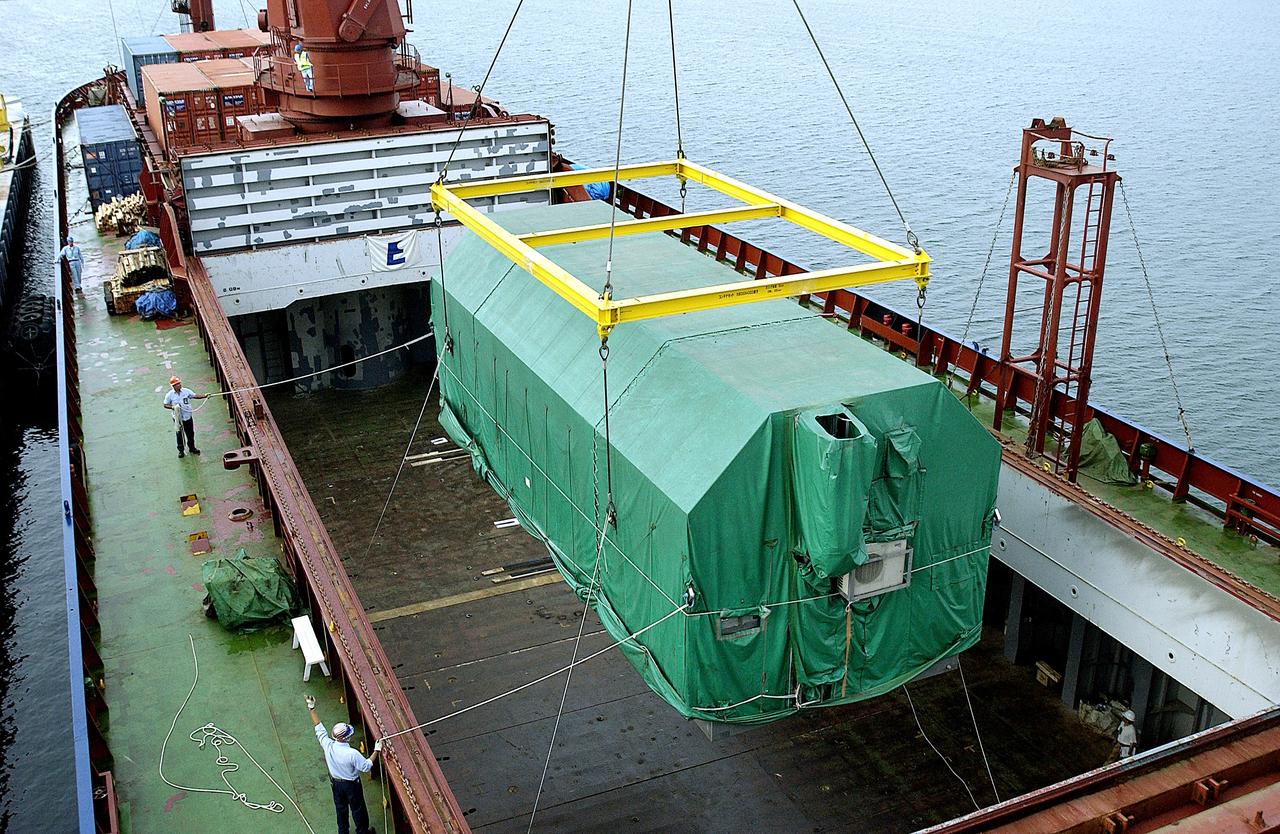
KENNEDY SPACE CENTER, FLA. - The JEM Pressurized Module is seen in the hold of the ship that carried it from Japan.  The National Space Development Agency of Japan (NASDA) built the laboratory at the Tsukuba Space Center near Tokyo.  The Pressurized Module is the first element of the JEM, Japan’s primary contribution to the space station, to be delivered to KSC. It will enhance the unique research capabilities of the orbiting complex by providing an additional shirt-sleeve environment for astronauts to conduct science experiments. The JEM also includes two logistics modules, an exposed pallet for space environment experiments and a robotic manipulator system that are still under construction in Japan. The various JEM components will be assembled in space over the course of three space shuttle missions.
KENNEDY SPACE CENTER, FLA. - The JEM Pressurized Module is seen in the hold of the ship that carried it from Japan. The National Space Development Agency of Japan (NASDA) built the laboratory at the Tsukuba Space Center near Tokyo. The Pressurized Module is the first element of the JEM, Japan’s primary contribution to the space station, to be delivered to KSC. It will enhance the unique research capabilities of the orbiting complex by providing an additional shirt-sleeve environment for astronauts to conduct science experiments. The JEM also includes two logistics modules, an exposed pallet for space environment experiments and a robotic manipulator system that are still under construction in Japan. The various JEM components will be assembled in space over the course of three space shuttle missions.
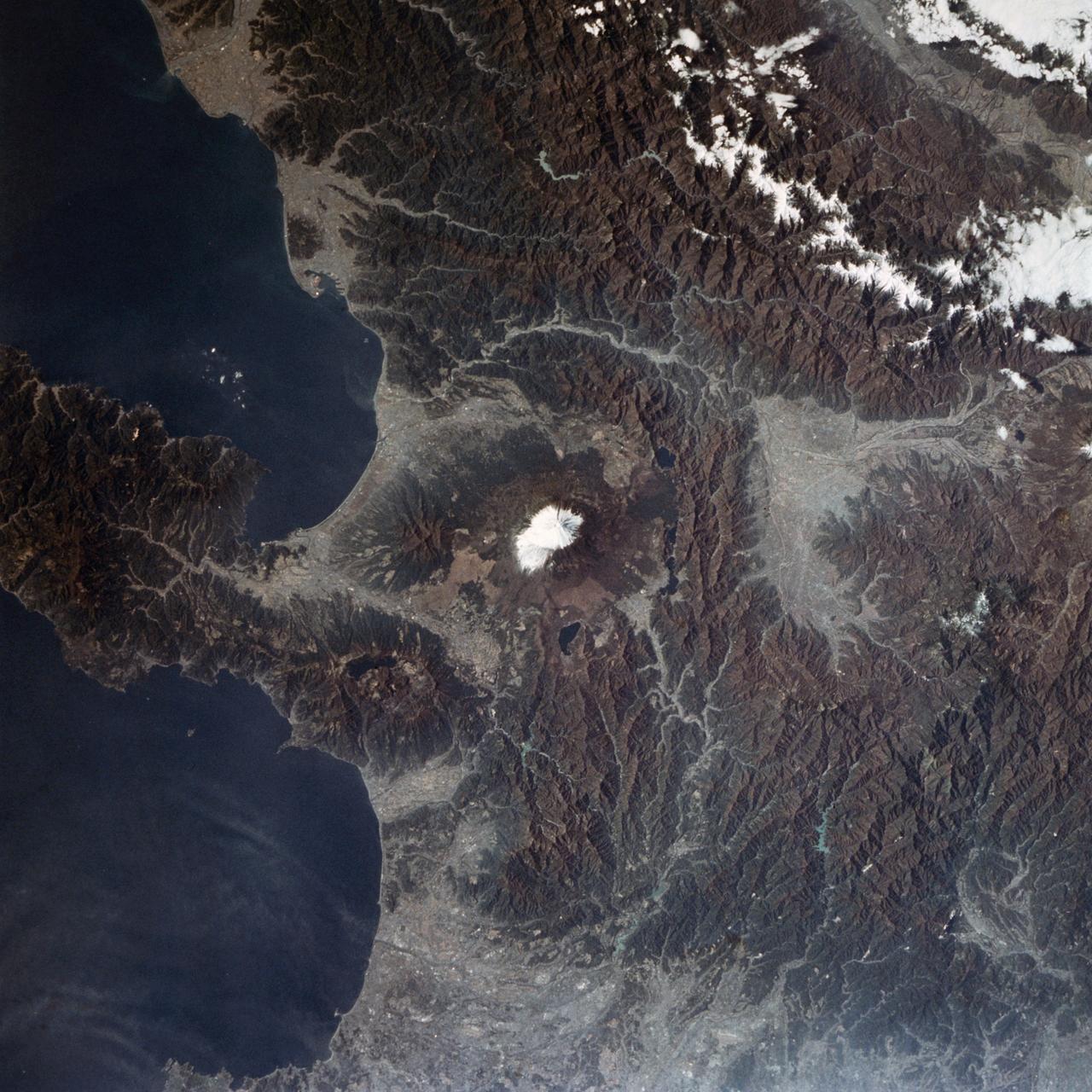
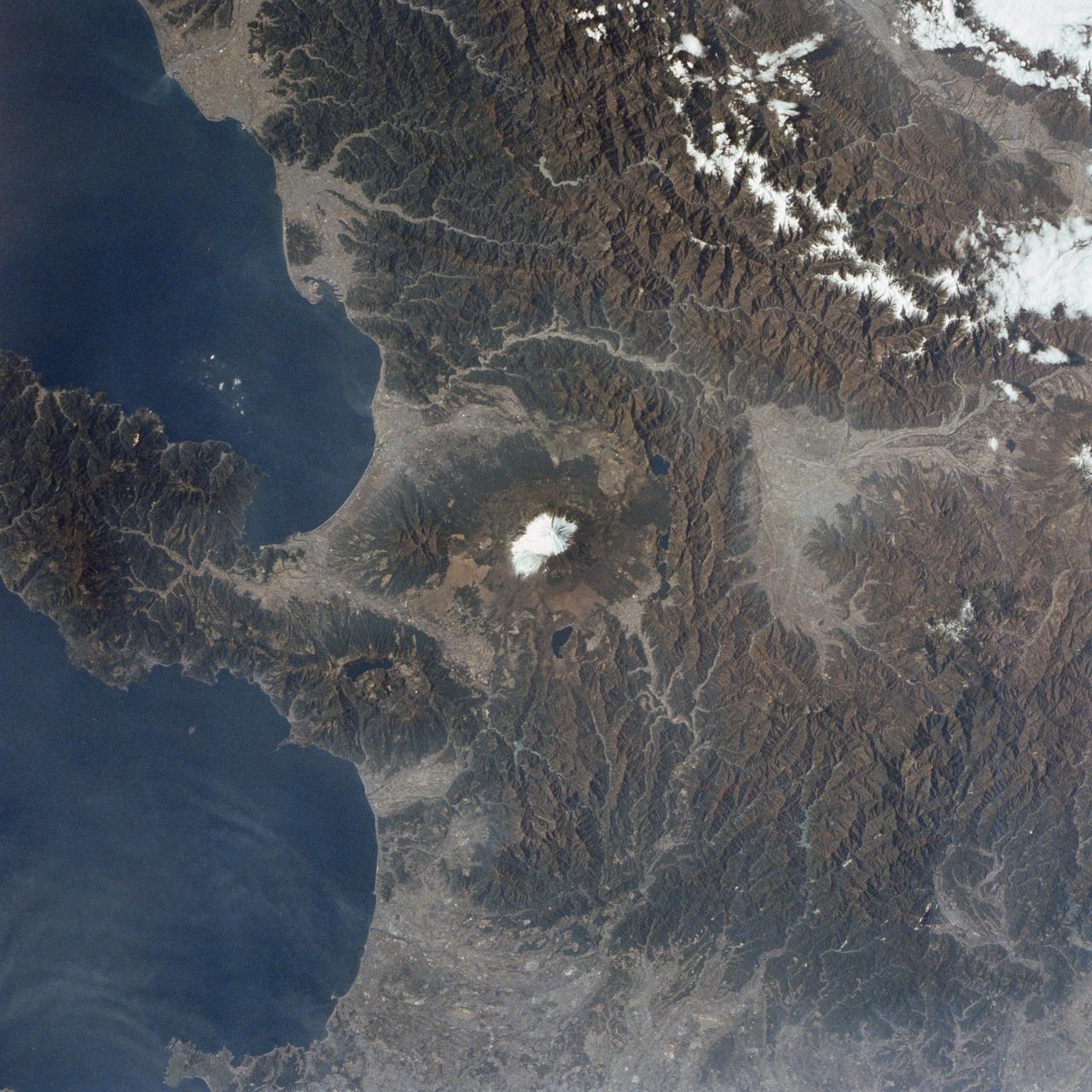
STS002-09-391A (12-14 Nov. 1981) --- Honshu Island, Japan, and its snow-covered Fuji-San or Fuji-Yama volcano are the features of this 70mm frame. The volcano peak is 12,400 feet tall.  The western suburbs of Tokyo are at right edge of the photograph. Isu Peninsula is at the bottom, separating the Suruga and Sagami Bays. Other large cities include Yokohama, Kozu, Shizuoka, Namazu and Odawara. Photo credit: NASA
Earth observations taken during STS-2 mission
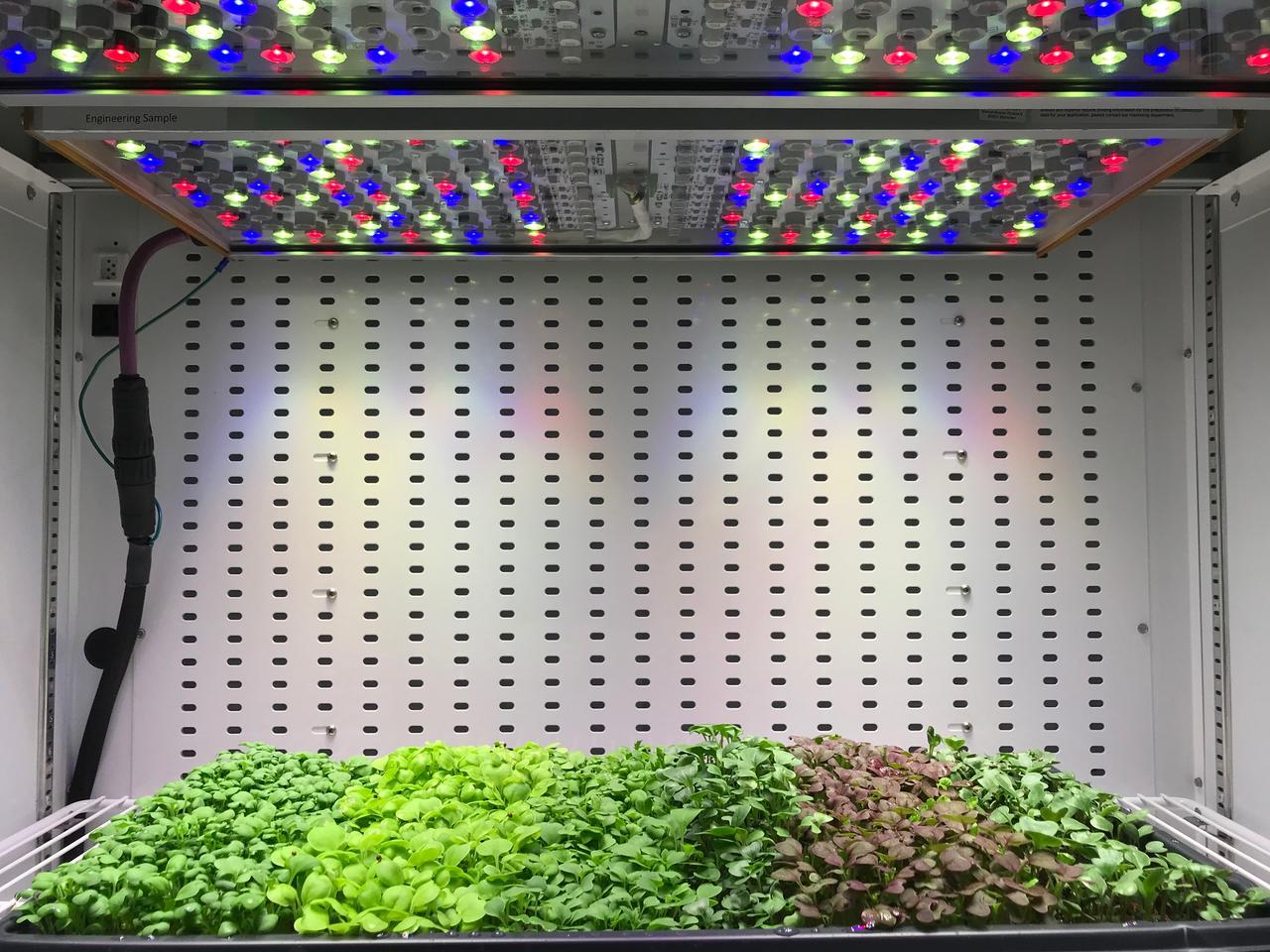
Kennedy Space Center scientists worked with OSRAM to insert a smart horticulture lighting system prototype into a food production system. The Phytofy RL prototype LED provides similar wavelength capability to a plant growth system currently on orbit. Photofy RL provides another avenue for future investigators conducting flight experiments to perform ground tests prior to flight under similar lighting conditions. The Phytofy RLs have been used to successfully grow microgreens of Wasabi, Tokyo Bekana, Mizuna, Broccoli, Garnet Giant, and Cauliflower.
Micogreens Experiment
iss061e052148 (11/20/2019) --- An external view of the deployment of the RWASAT-1 CubeSat from the JEM Small Satellite Orbital Deployer aboard the International Space Station (ISS). RWanda Satellite-1 (RWASAT-1) is the first Rwandan 3-Unit (3U) CubeSat is built under a partnership of the Rwanda Utilities Regulatory Authority (RURA) and Tokyo University, to help develop a space engineering capacity in Rwanda. RWASAT-1 has two cameras for monitoring the status of agriculture, and a receiver for data collection from ground based sensors.
iss061e052148
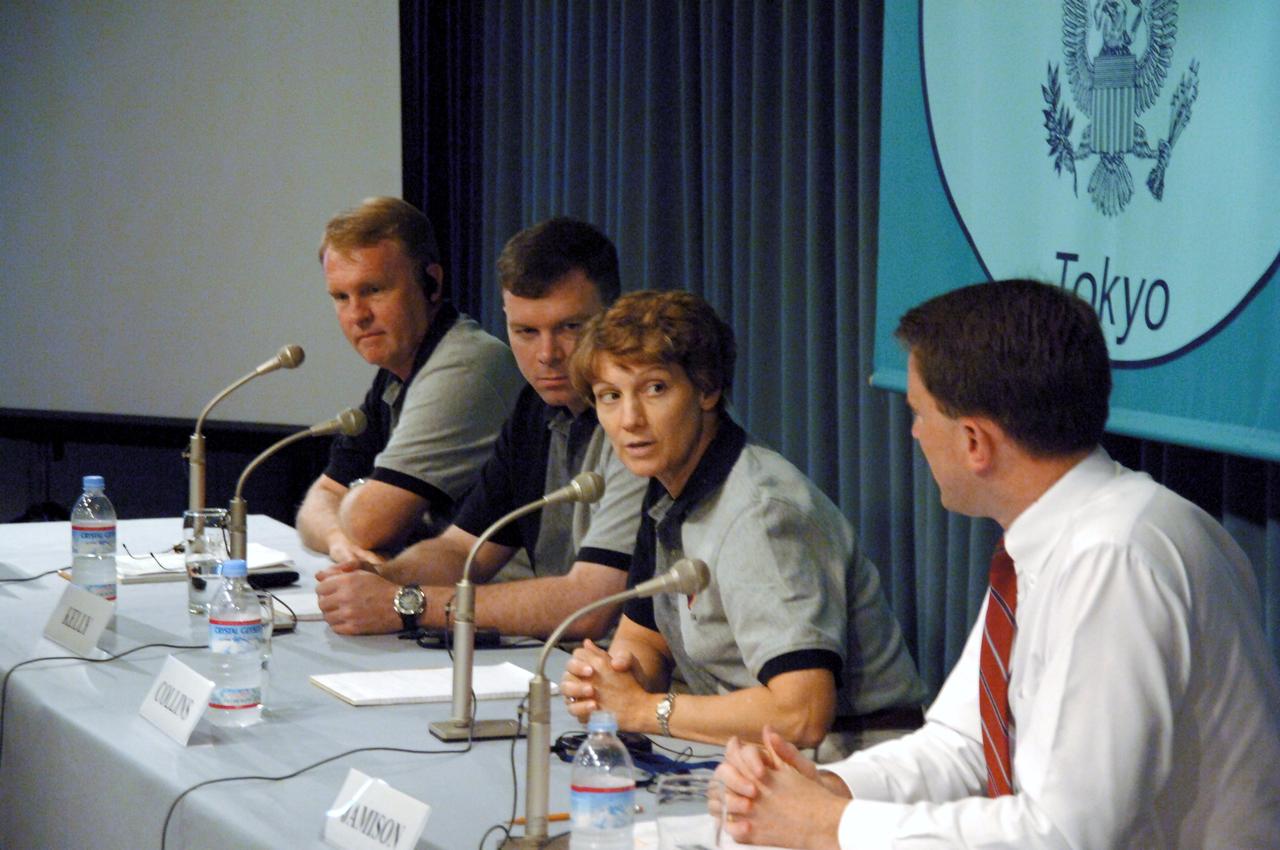
JSC2005-E-40332 (1 October 2005) --- Members of the crew that returned the Space Shuttle to flight earlier this year aboard Discovery, from left, astronauts Andrew S.W. Thomas, Pilot James M. Kelly and Discovery Commander Eileen M. Collins address students at the American Center in Tokyo, Japan, on Oct. 1. The crew visited Japan this week as guests of the Japan Aerospace Exploration Agency (JAXA) and participated in a variety of public events. Photo Credit: Japan Aerospace Exploration Agency
STS-114 Japanese Tour Postflight
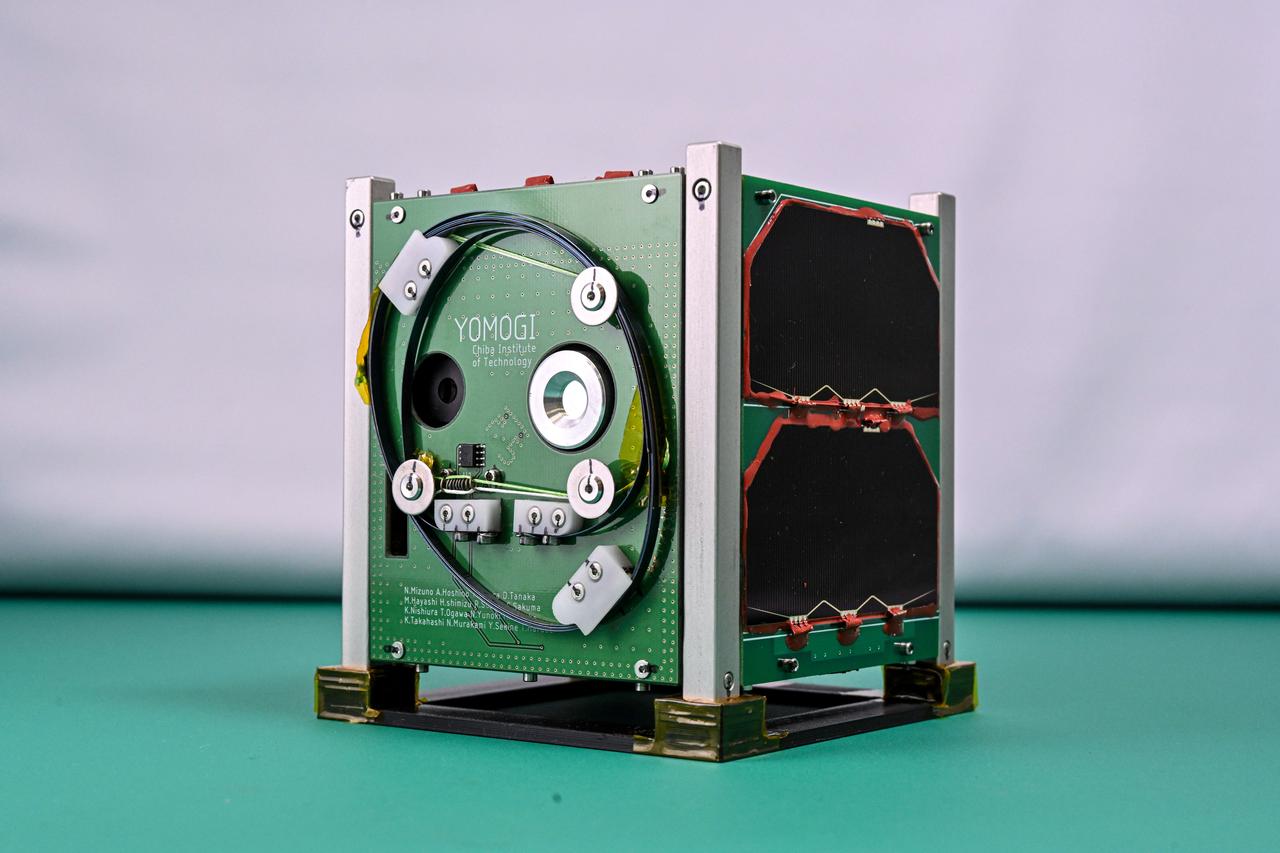
jsc2025e000005 (11/8/2023) --- Shown is the Growing Advanced and Refined space Development ENgineering succession and under the satellite - YOMOGI (GARDENs – YOMOGI) flight unit. YOMOGI is an 1kg 1U CubeSat, developed as part of the GARDENs Project from the Chiba Institute of Technology. The goal of the YOMOGI mission is to send and receive sensor data from ground stations using the APRS (Automatic Packet Reporting System), and to demonstrate observations the capability to make Earth observations of Tokyo Bay and water sources in Uganda. Image courtesy of Chiba Institute of Technology.
GARDENs-YOMOGI
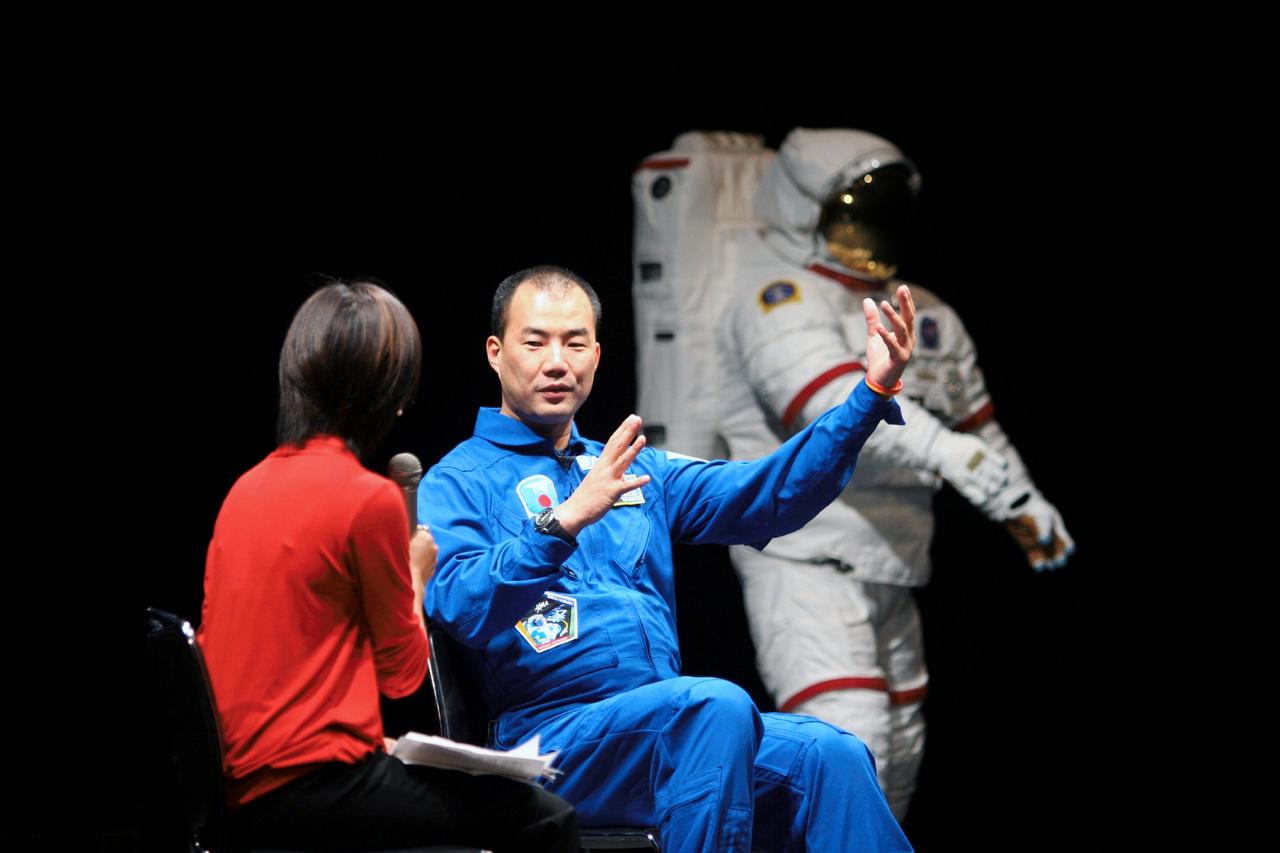
JSC2005-E-40330 (1 October 2005) --- Japanese Aerospace Exploration Agency (JAXA) astronaut Soichi Noguchi discusses his flight on the mission that returned the Space Shuttle to flight earlier this year with members of the public in Tokyo, Japan, on Oct. 1. Noguchi and the rest of the crew of Discovery for STS-114 visited Japan as guests of JAXA and participated in a variety of public events. Photo Credit: Japan Aerospace Exploration Agency
STS-114 Japanese Tour Postflight
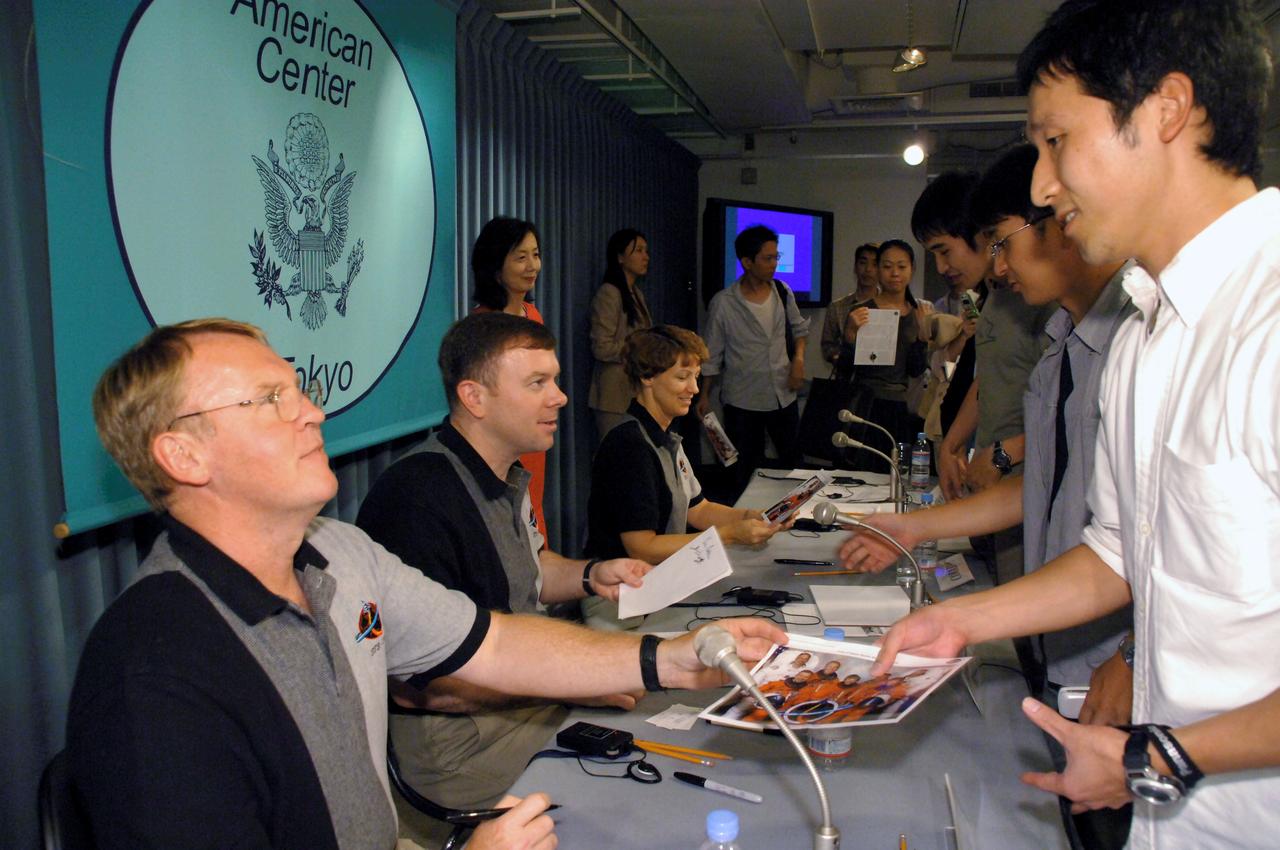
JSC2005-E-40333 (1 October 2005) --- Members of the crew that returned the Space Shuttle to flight earlier this year aboard Discovery, from left, astronauts Andrew S.W. Thomas, Pilot James M. Kelly and Discovery Commander Eileen M. Collins sign photographs for students at the American Center in Tokyo, Japan, on Oct. 1. The crew visited Japan this week as guests of the Japan Aerospace Exploration Agency (JAXA) and participated in a variety of public events.  Photo Credit: Japan Aerospace Exploration Agency
STS-114 Japanese Tour Postflight
iss070e041245 (Dec. 18, 2023) --- The Clark sat-1 CubeSat is deployed from a small satellie deployer in the grips of the Japanese robotic arm attached to the Kibo laboratory module. Clark sat-1, launched to the Interational Space Station aboard the SpaceX Dragon cargo spacecraft, was developed by students at Clark Next High School in Tokyo, Japan, and its primary mission is to transmit voice and imagery data to ground control stations on Earth.
iss070e041245
S68-21590 (September 1968) --- This is a portrait of the Apollo-Saturn 7 crew members. They are, left to right, astronauts Walter M. Schirra Jr., commander; Walter Cunningham, lunar module pilot; and Donn F. Eisele, command module pilot.     EDITOR'S NOTE: Since this photograph was made astronaut Eisele died Dec. 2, 1987 in Tokyo, Japan, of a heart attack.
PORTRAIT - APOLLO 7
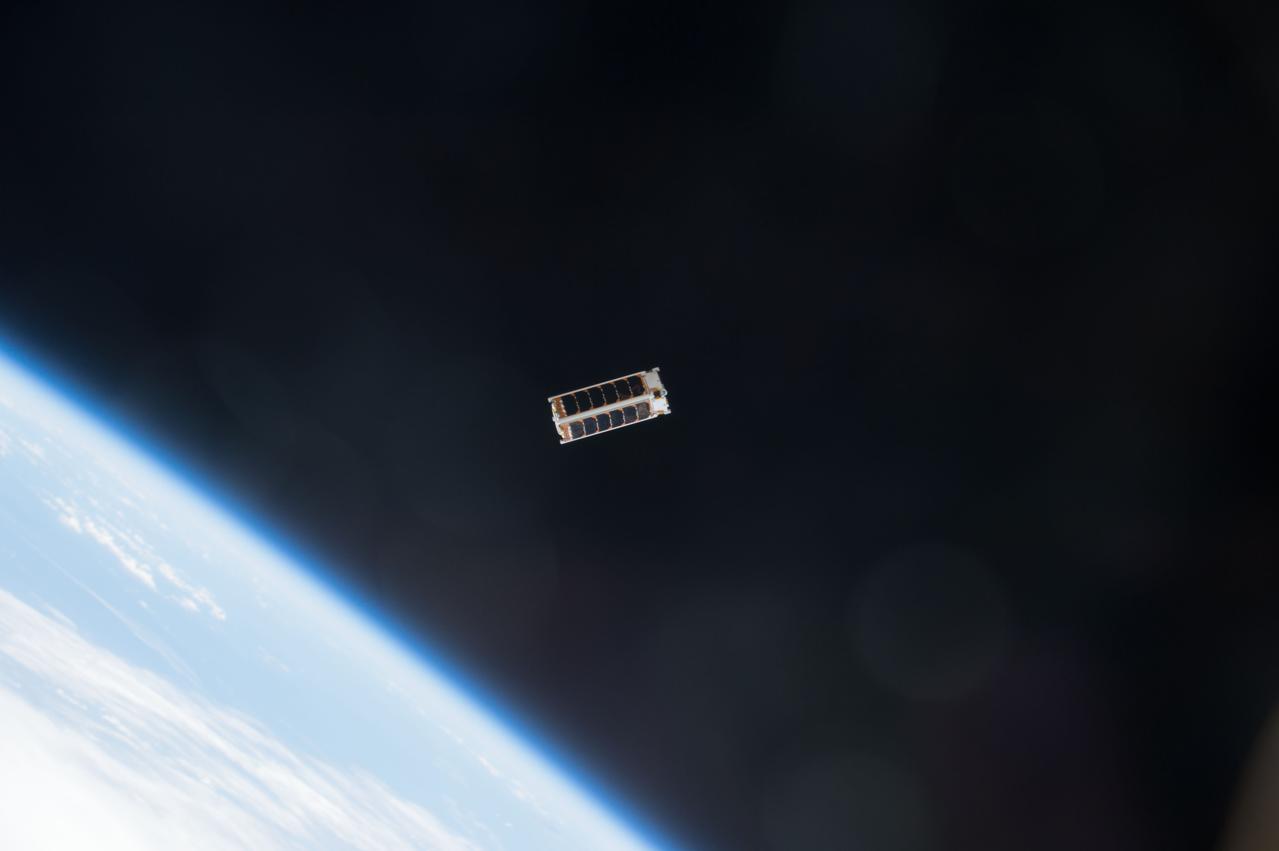
iss050e031340 (1/16/2017) --- Photo documentation of the Japanese-Small Satellite Orbital Deployer-6 (J-SSOD-6) deployment of the ECG Cubesat. The EGG Satellite (re-Entry satellite with Gossamer aeroshell and GPS/Iridium) developed at the University of Tokyo, demonstrates a deployable aeroshell to first act as a drag device and then protect the satellite during the initial stages of re-entry.
J-SSOD-6 Deployment
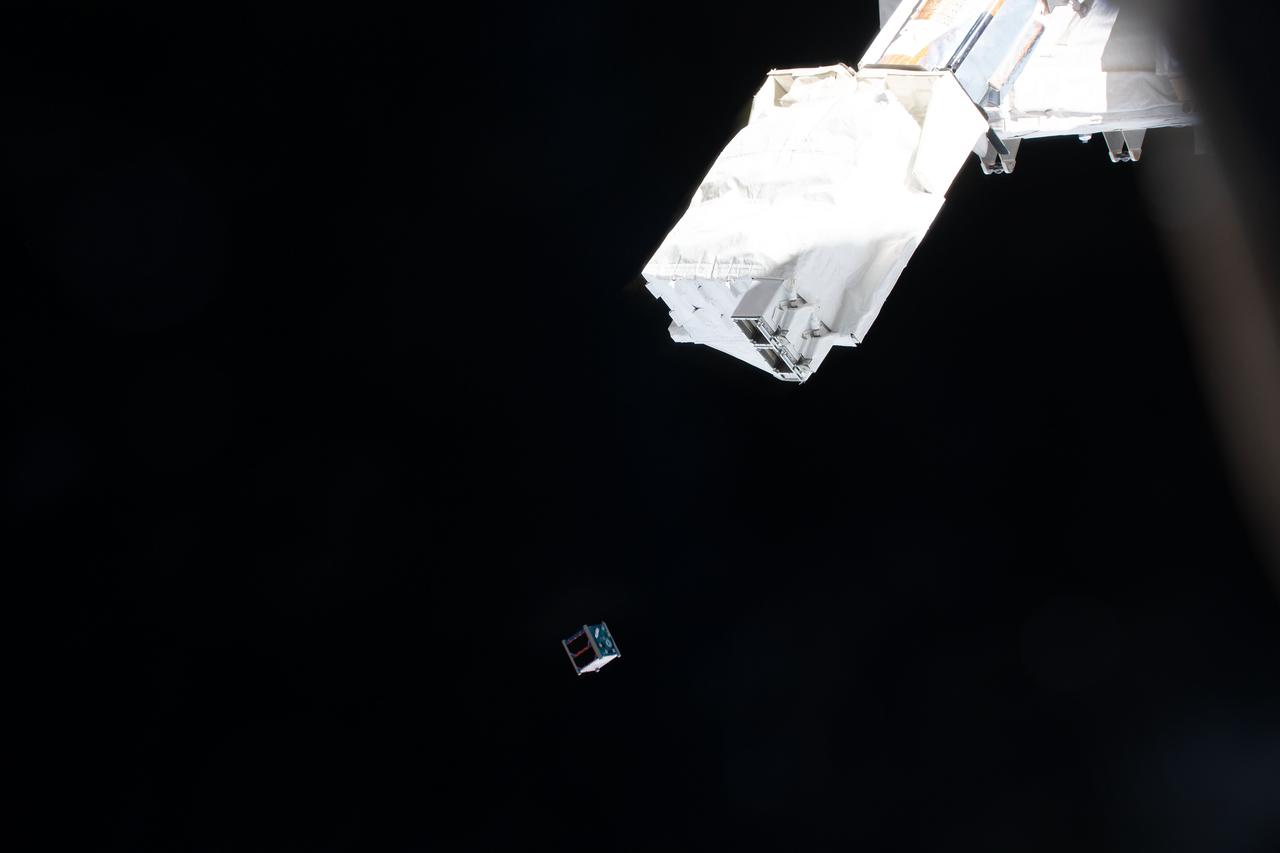
iss070e041037 (Dec. 18, 2023) --- The BEAK CubeSat is deployed from a small satellie deployer in the grips of the Japanese robotic arm attached to the Kibo laboratory module. BEAK, launched to the Interational Space Station aboard the SpaceX Dragon cargo spacecraft, was developed by The University of Tokyo in Kashiwa, Japan, and the Institute of Space and Astronautical Science in Sagamihara, Japan. Its primary mission is to test novel technologies for use in future nano-sized planetary probes.
iss070e041037
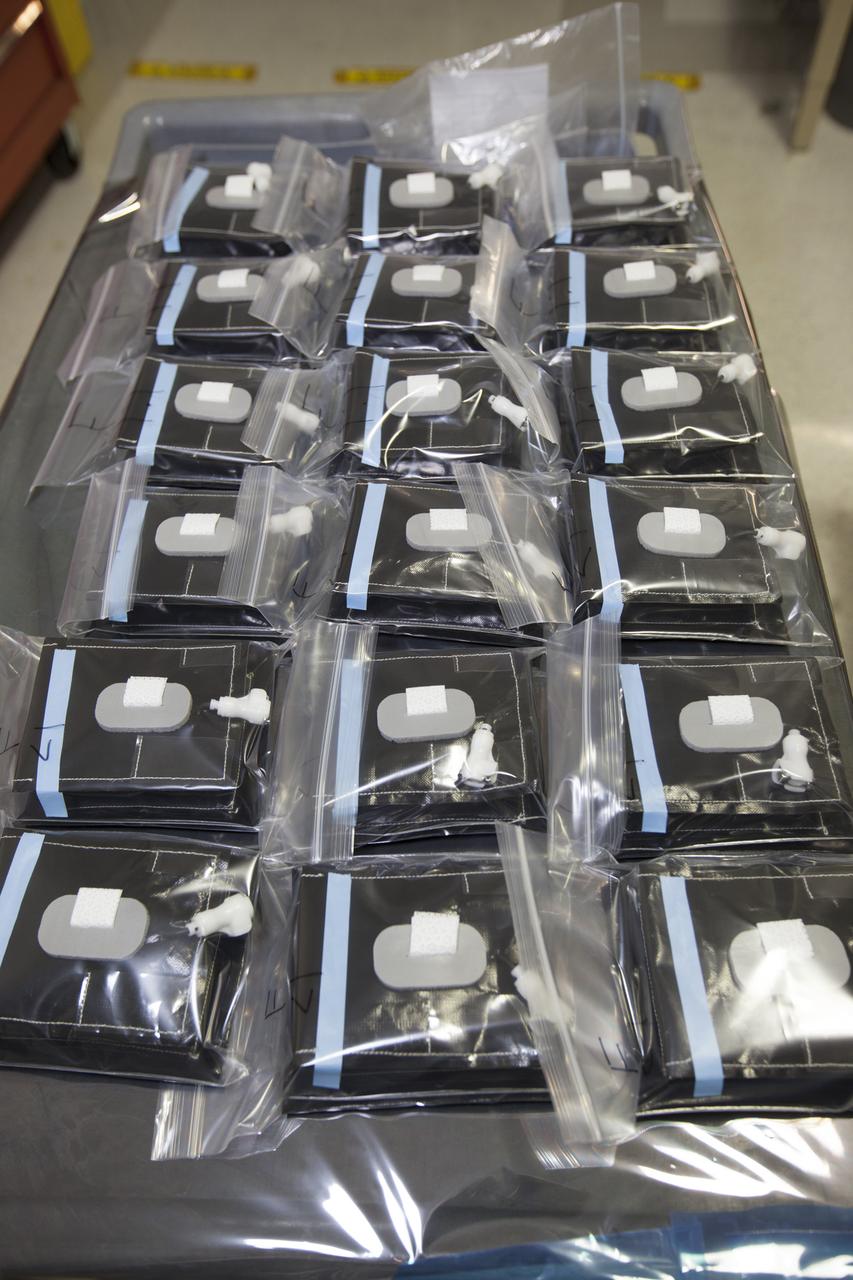
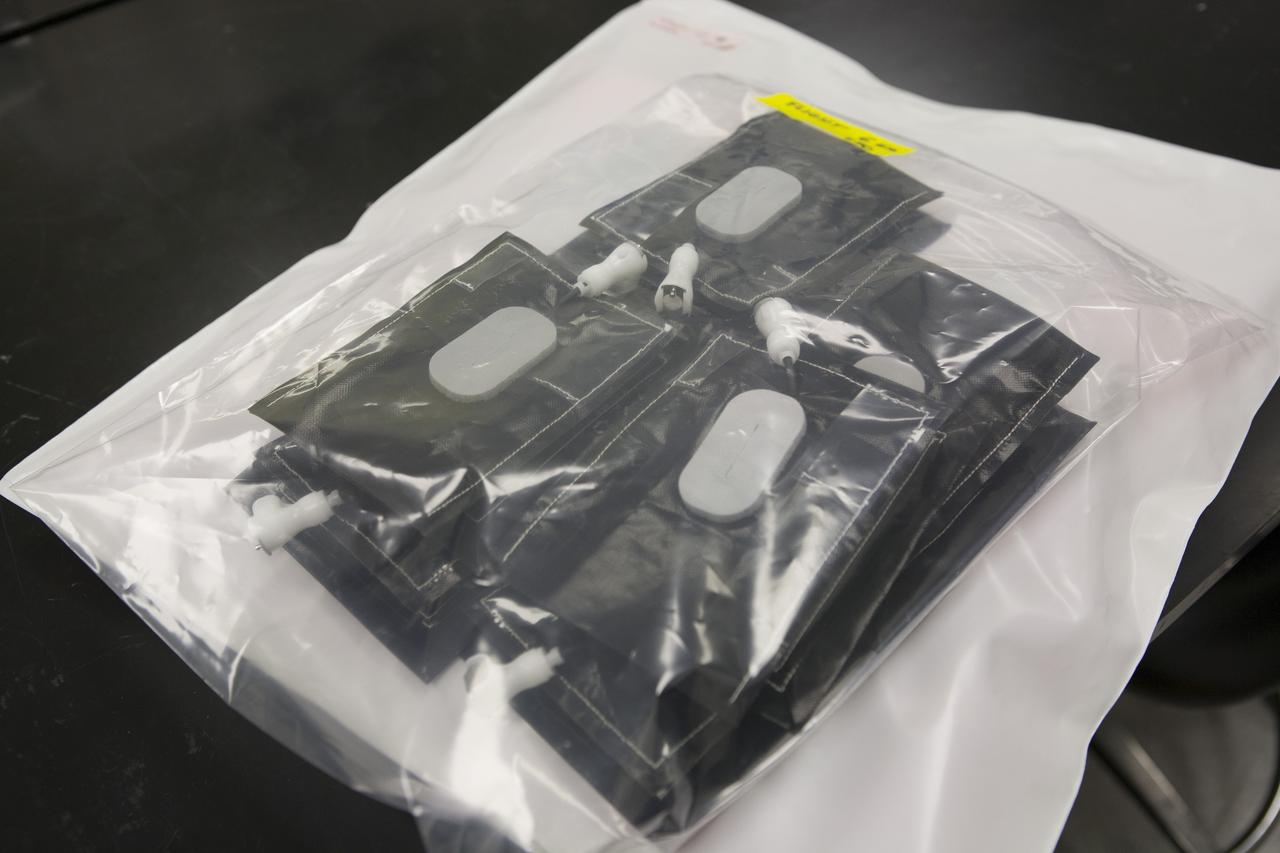
Inside a laboratory in the Space Station Processing Facility at NASA’s Kennedy Space Center in Florida, 18 plant pillows for the Veg-03 experiment have been prepared for delivery to the International Space Station aboard the eighth SpaceX Dragon commercial resupply mission. The Veg-03 plant pillows will contain ‘Tokyo Bekana’ cabbage seeds and lettuce seeds for NASA’s third Veggie plant growth system experiment. The experiment will continue NASA’s deep space plant growth research to benefit the Earth and the agency’s journey to Mars.
Veg-03 Pillows Preparation for Flight
STS002-09-390 (12-14 Nov. 1981) --- Honshu Island, Japan, and its snow-covered Fuji-San or Fuji-Yama volcano are the features of this 70mm frame. The volcano peak is 12,400 feet tall. The western suburbs of Tokyo are at right edge of the photograph. Isu Peninsula is at the bottom, separating the Suruga and Sagami Bay. Other large cities include Yokohama, Kozu, Shizuoka, Namazu and Odawara. Photo credit: NASA
Mt. Fuji, Honshu, Japan
iss073e0763646 (Sept. 21, 2025) --- India’s National Capital Territory of Delhi, home to approximately 34.67 million people, is the second-largest metropolitan area in the world after Tokyo. This nighttime view from the International Space Station, taken at approximately 10:54 p.m. local time, shows the city split by the Yamuna River. The bright rectangular area near the right center marks Indira Gandhi International Airport, one of the busiest aviation hubs in South Asia.
India’s National Capital Territory of Delhi, home to approximately 34.67 million people
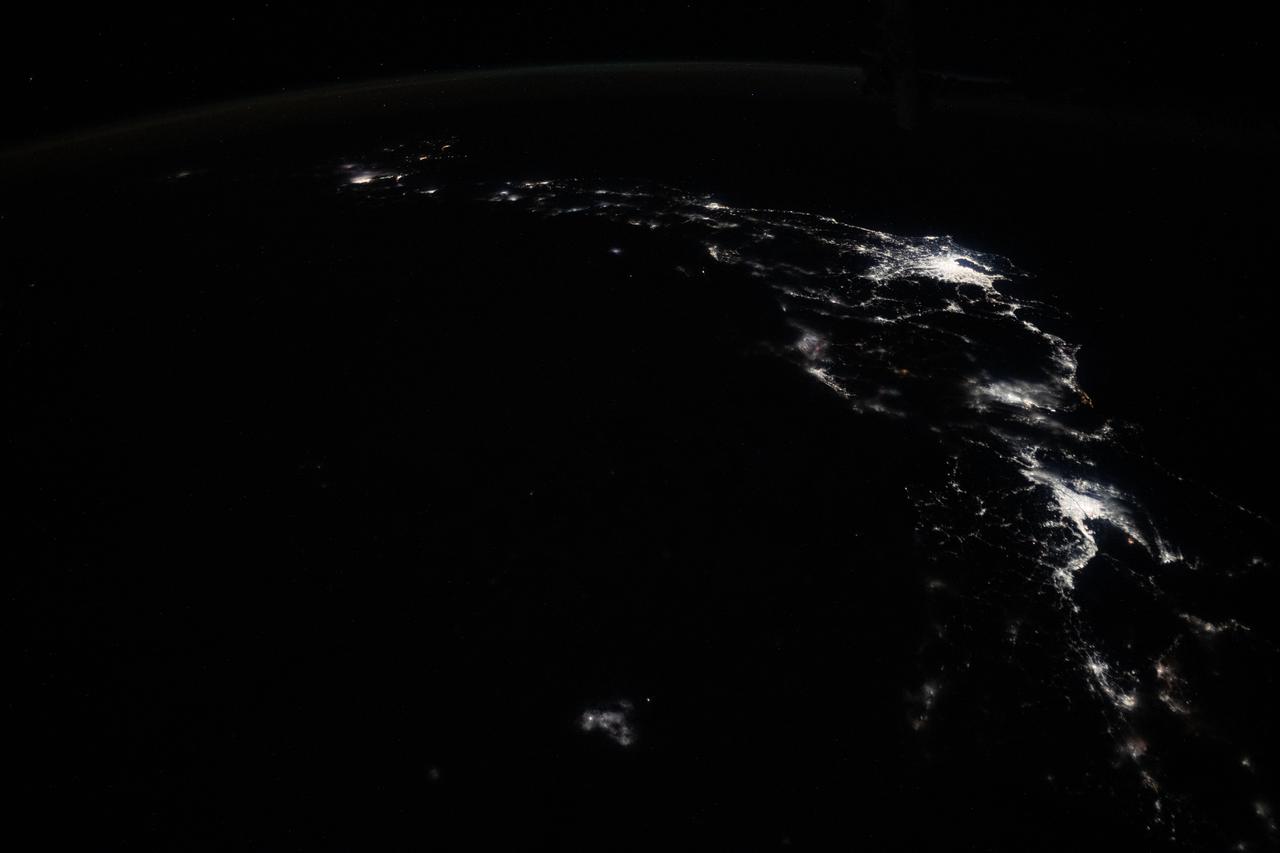
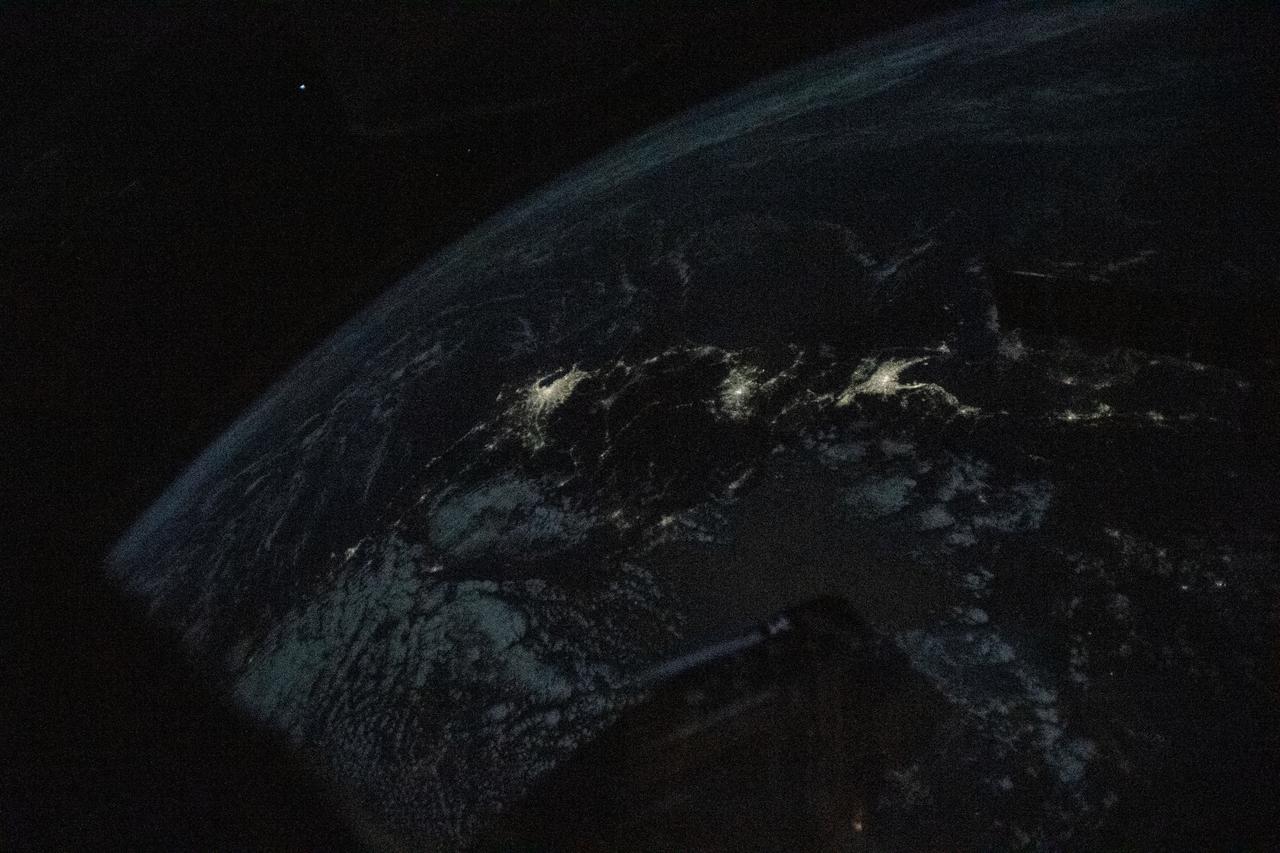
iss073e0703552 (Sept. 18, 2025) --- City lights trace the Japanese coastline underneath a dim yellow-green airglow in this nighttime view across the Sea of Japan, revealing the metropolitan areas (from left to right) of Sapporo, Sendai, Tokyo, and Nagoya. The International Space Station was orbiting 262 miles above Russia’s far eastern coast when this image was captured at approximately 11:29 p.m. local time.
City lights trace the Japanese coastline underneath a dim yellow-green airglow
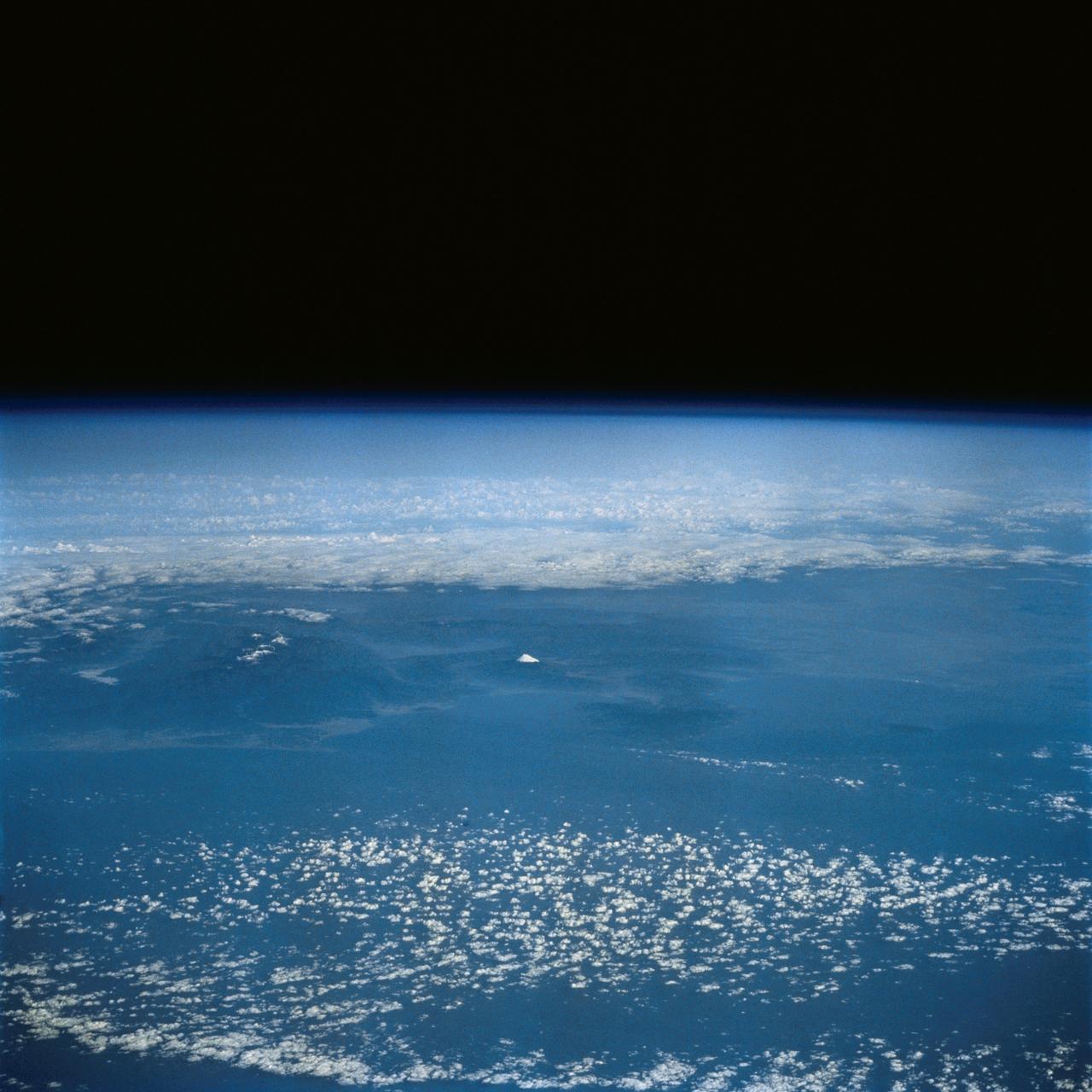
This distant view of Mt. Fuji, on the main home island of Honshu, Japan (34.0N, 139.0E) was taken from about 450 miles to the south. Evan at that great distance, the majestic and inspiring Mt. Fuji is still plainly visible and easily recognized as a world renowned symbol of Japan. The snow capped extinct volcano lies just a few miles south of Tokyo.
Distant Mt. Fuji, Island of Honshu Japan
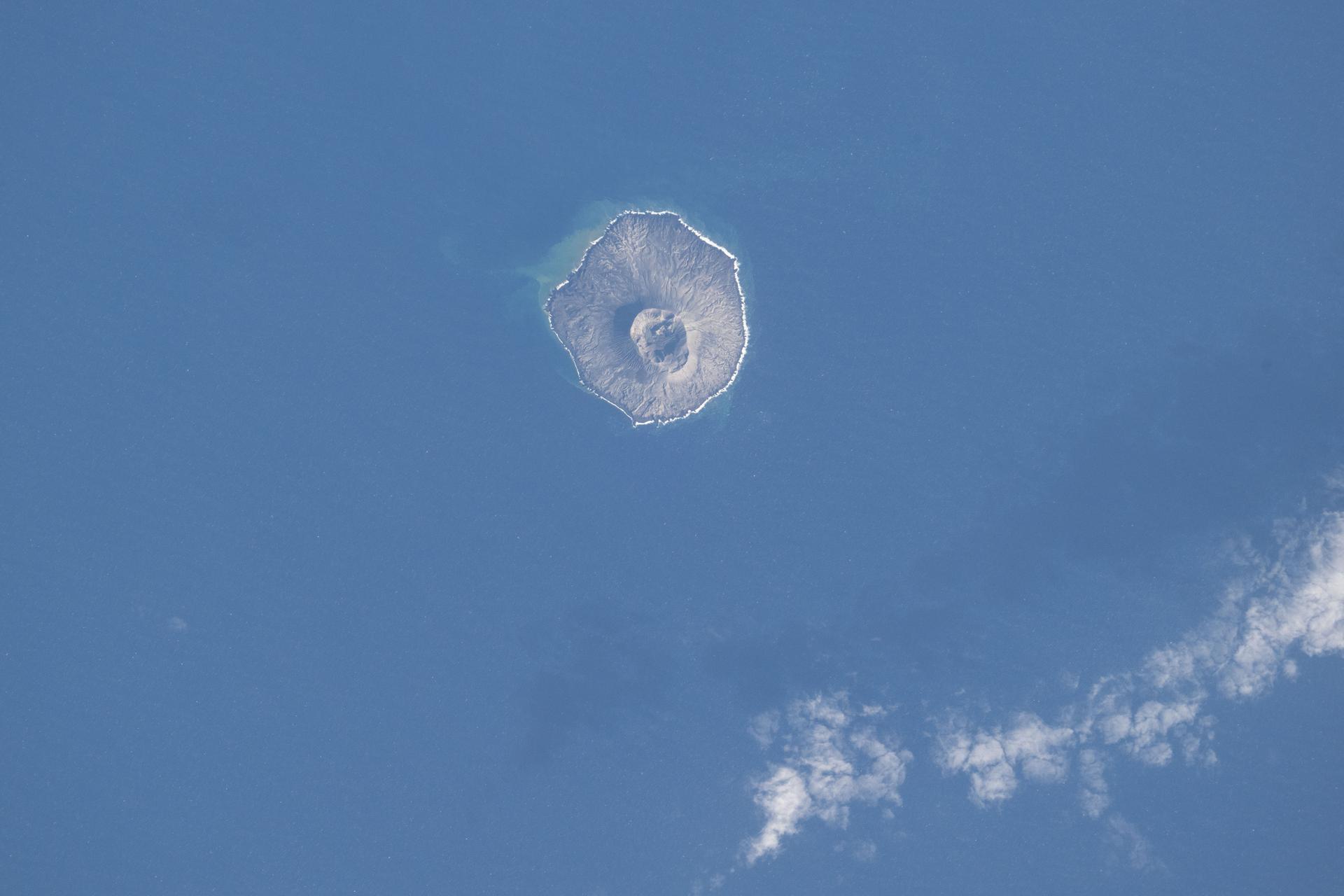
iss074e0014317 (Dec. 25, 2025) --- Nishinoshima Island, part of Japan's Volcano Islands chain and located about 600 miles south of Tokyo in the Pacific Ocean, is being created and expanded by volcanic activity such as magma mixing and periodic eruptions. The International Space Station was orbiting 261 miles above the Earth at the time of this photograph. Credit: JAXA/Kimiya Yui
Nishinoshima Island, part of Japan's Volcano Islands chain
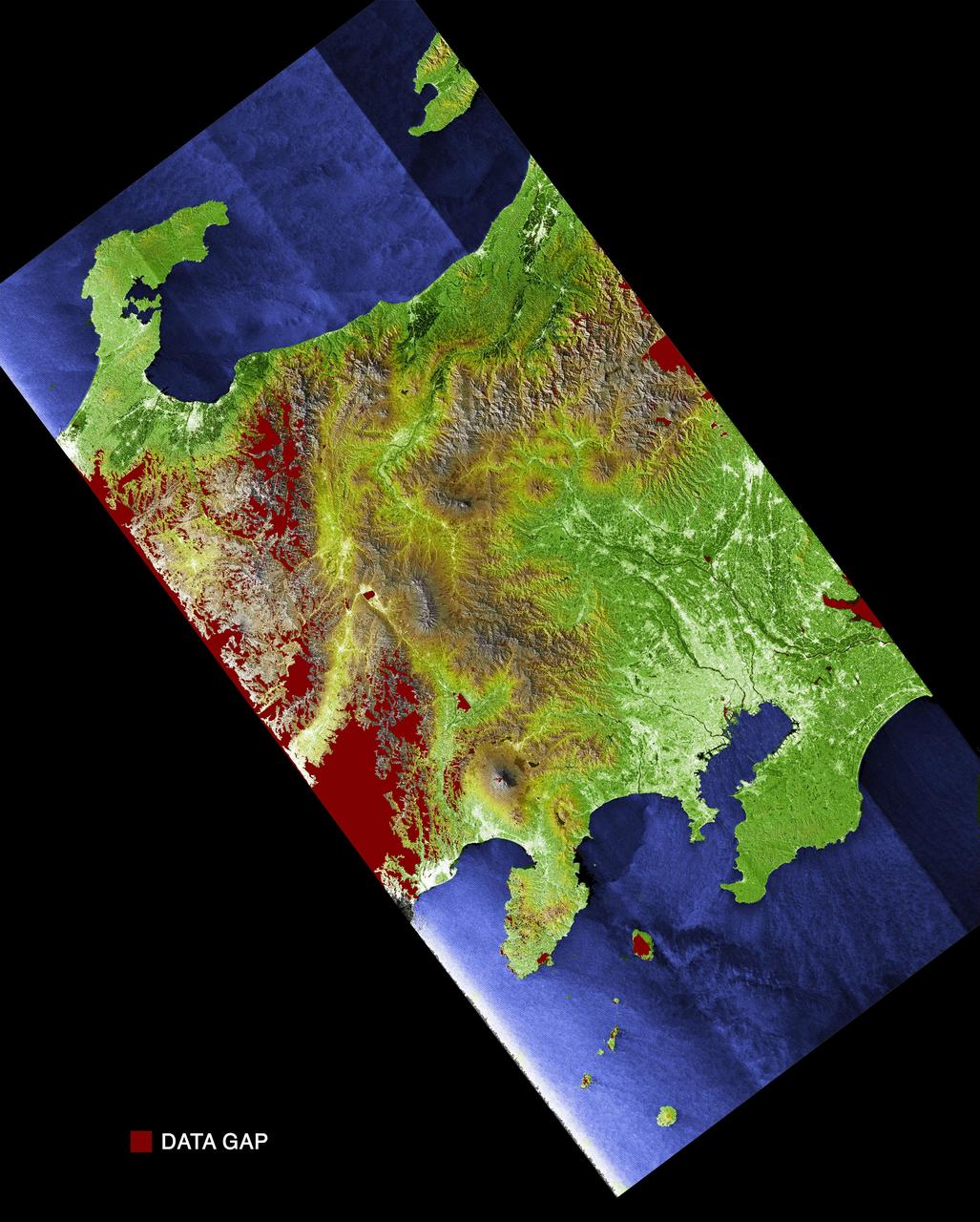
Much of Honshu, Japan largest island, is seen in this image generated from NASA Shuttle Radar Topography Mission SRTM data on February 19, 2000.
Radar Image with Color as Height: Tokyo, Honshu, Japan
Typhoon Hagibis, one of the most destructive storms to hit Japan in decades, made landfall on Saturday, Oct. 12, 2019 southwest of Tokyo with wind speeds equivalent to a Category 3 hurricane. The damage it left in its wake is visible from space.  NASA's Advance Rapid Imaging and Analysis (ARIA) team, in collaboration with the Earth Observatory of Singapore (EOS), used satellite data to create this map showing areas in Japan that are likely damaged as a result of Typhoon Hagibis. The color variation from yellow to red indicates increasingly more significant ground surface change, or damage.  The map was produced using synthetic aperture radar (SAR) data from the Copernicus Sentinel-1 satellites operated by the European Space Agency (ESA). The pre-event images were taken on Oct. 7, 2019, and the post-event image was acquired about 12 hours after the typhoon's landfall. The map covers an area of 155 miles by 220 miles (250 kilometers by 350 kilometers) indicated by the red polygon.  The map was delivered to Sentinel Asia, a consortium that supports disaster management across the Asia-Pacific region using space-based technologies. Maps like this one can be used as guidance to help responders identify damaged areas and to allocate resources accordingly. The map may be less reliable over vegetated or badly flooded areas.  https://photojournal.jpl.nasa.gov/catalog/PIA23424
New ARIA Map Shows Damage from Typhoon Hagibis
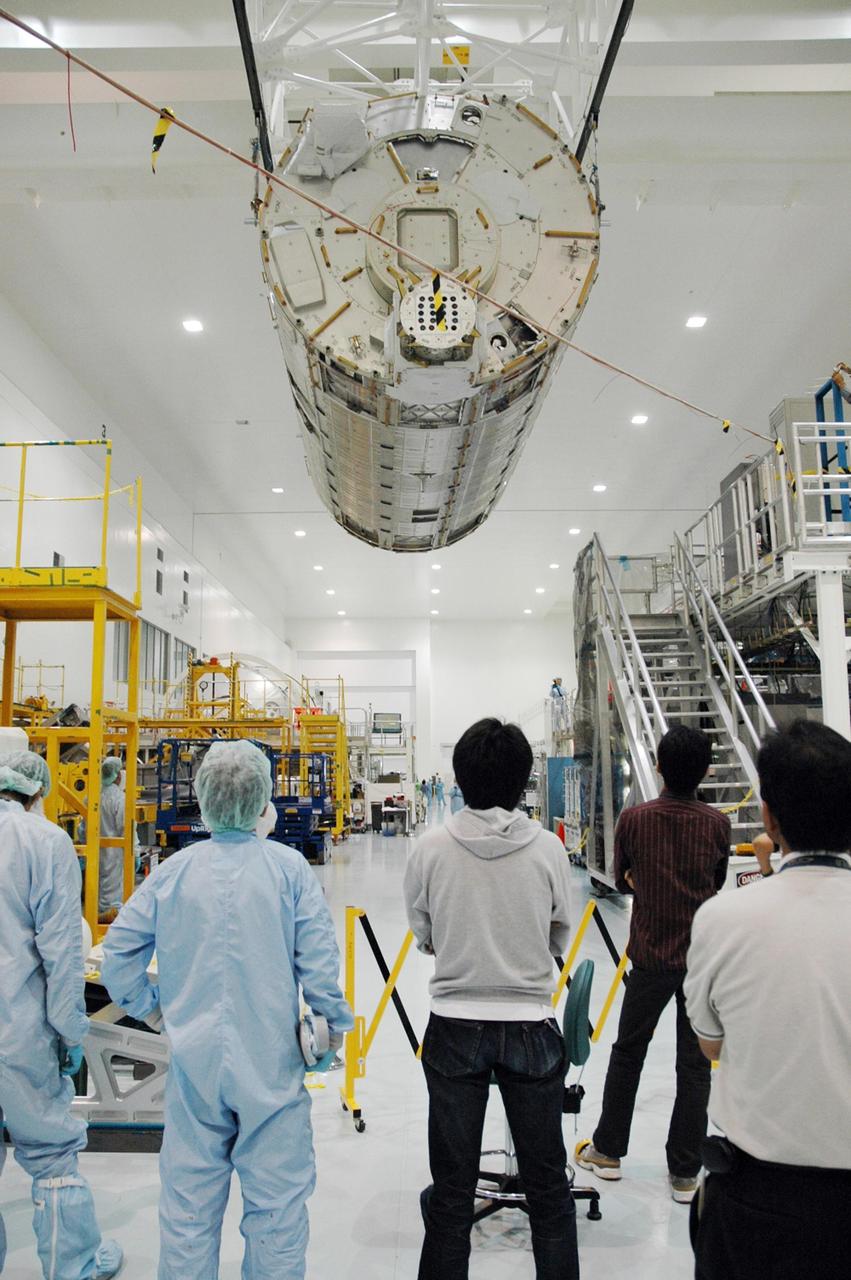
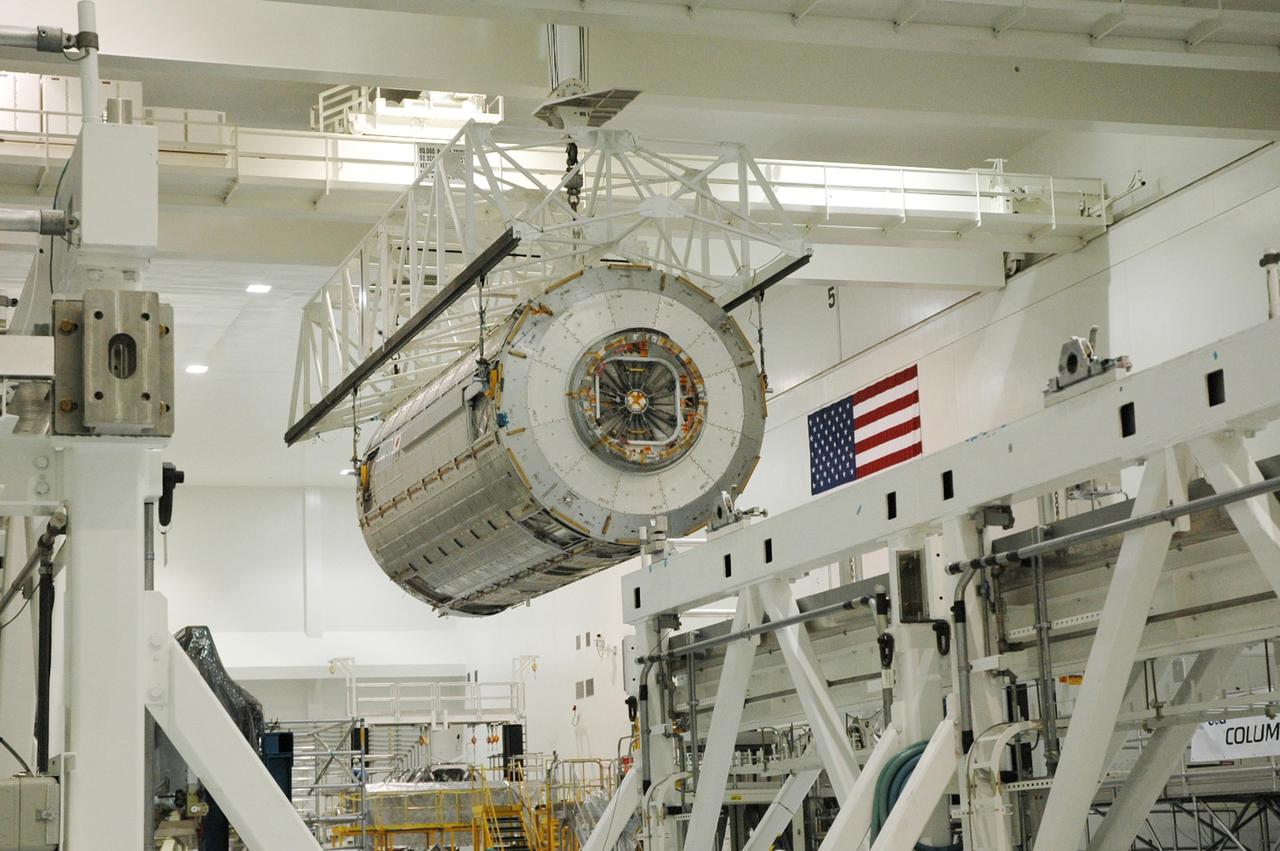
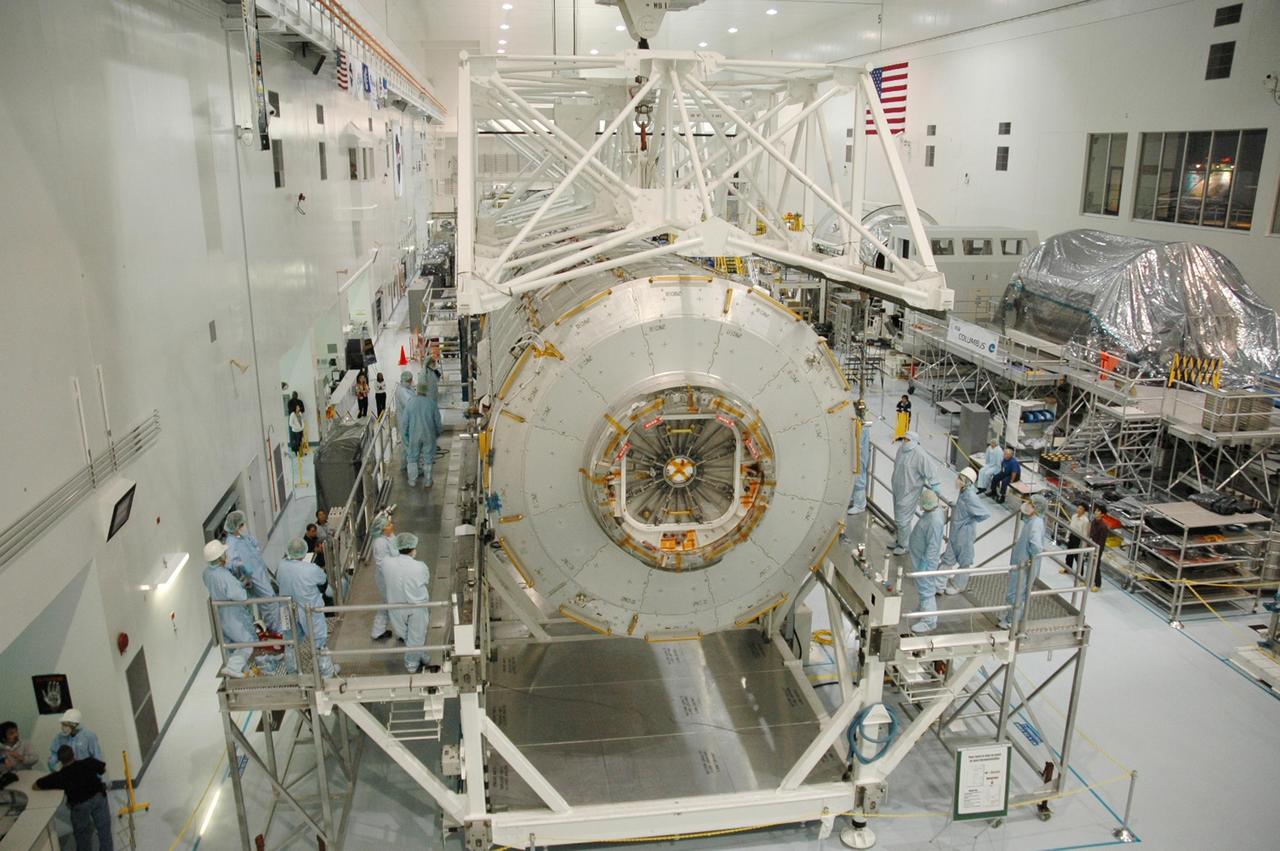
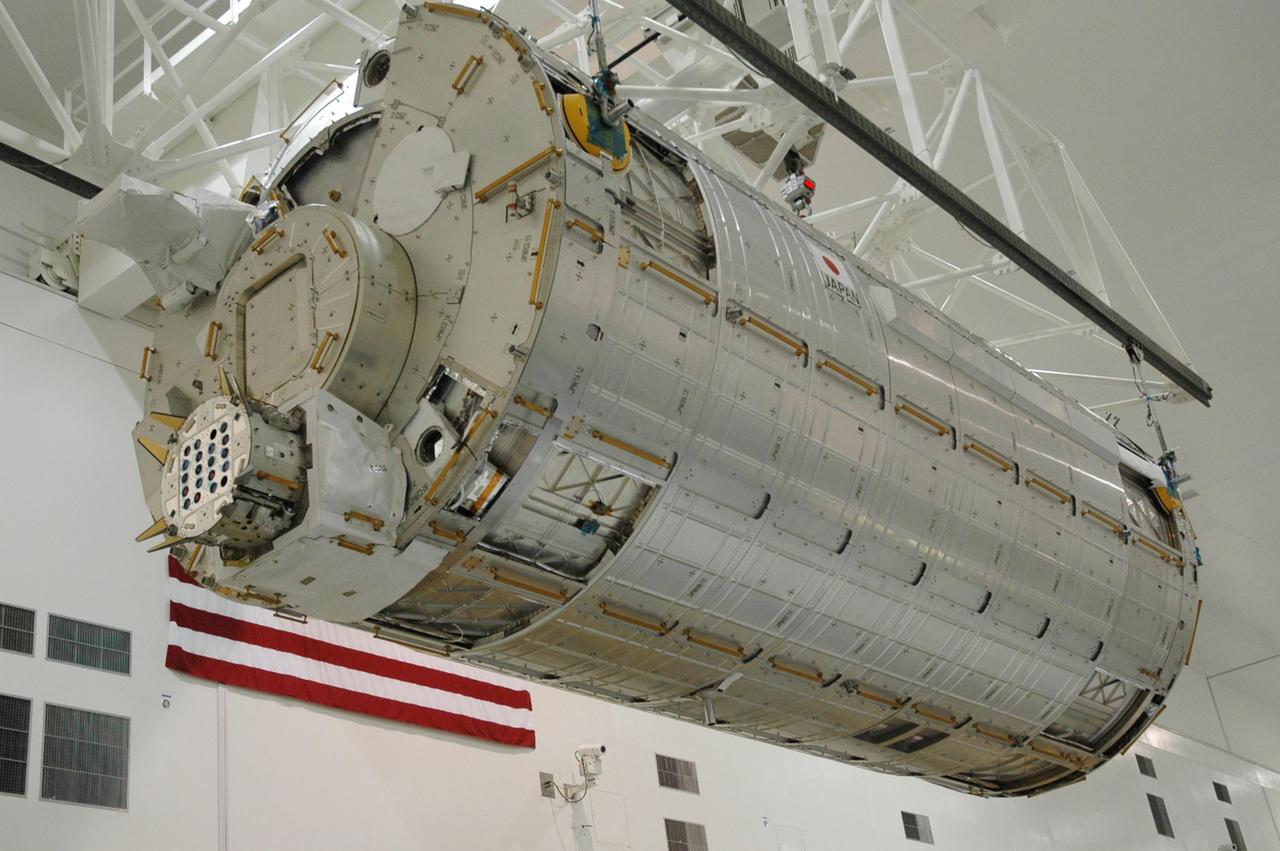
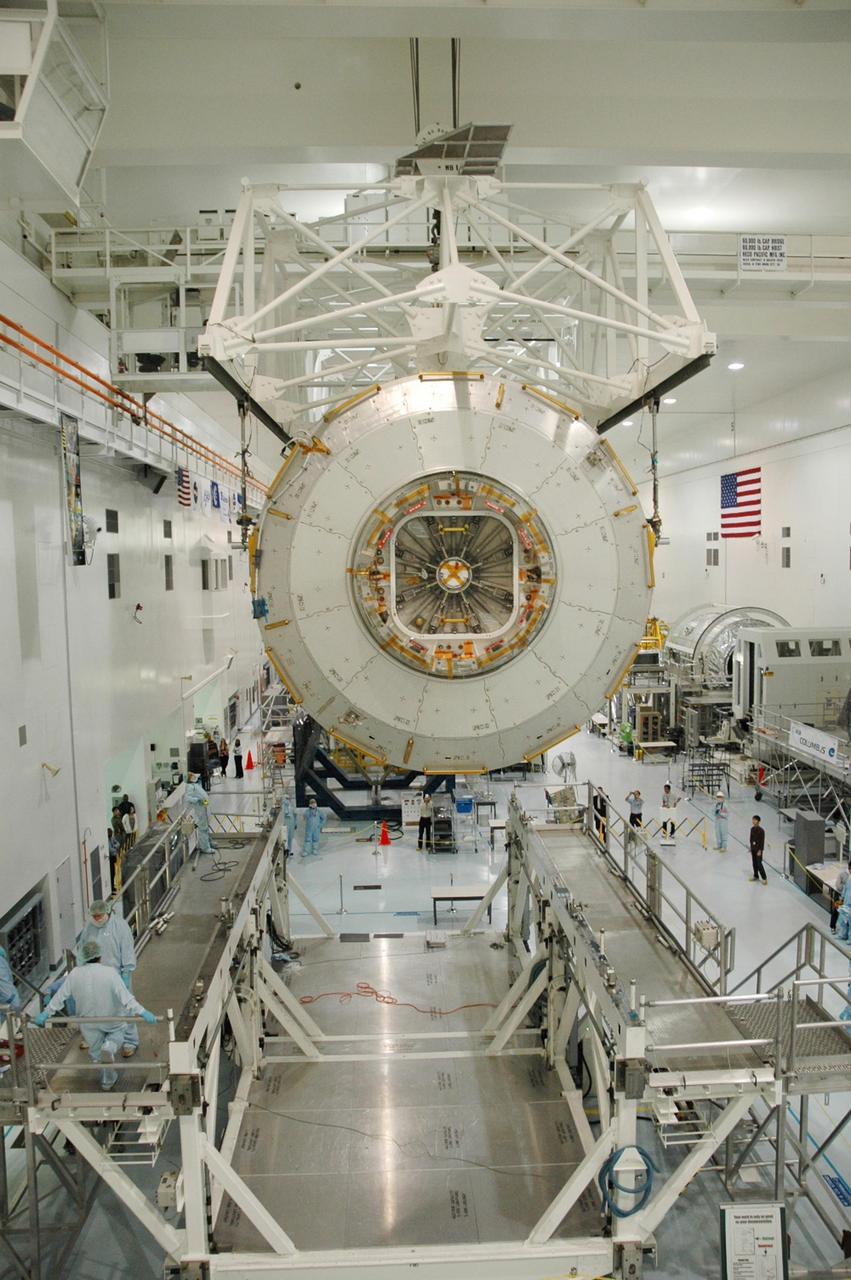
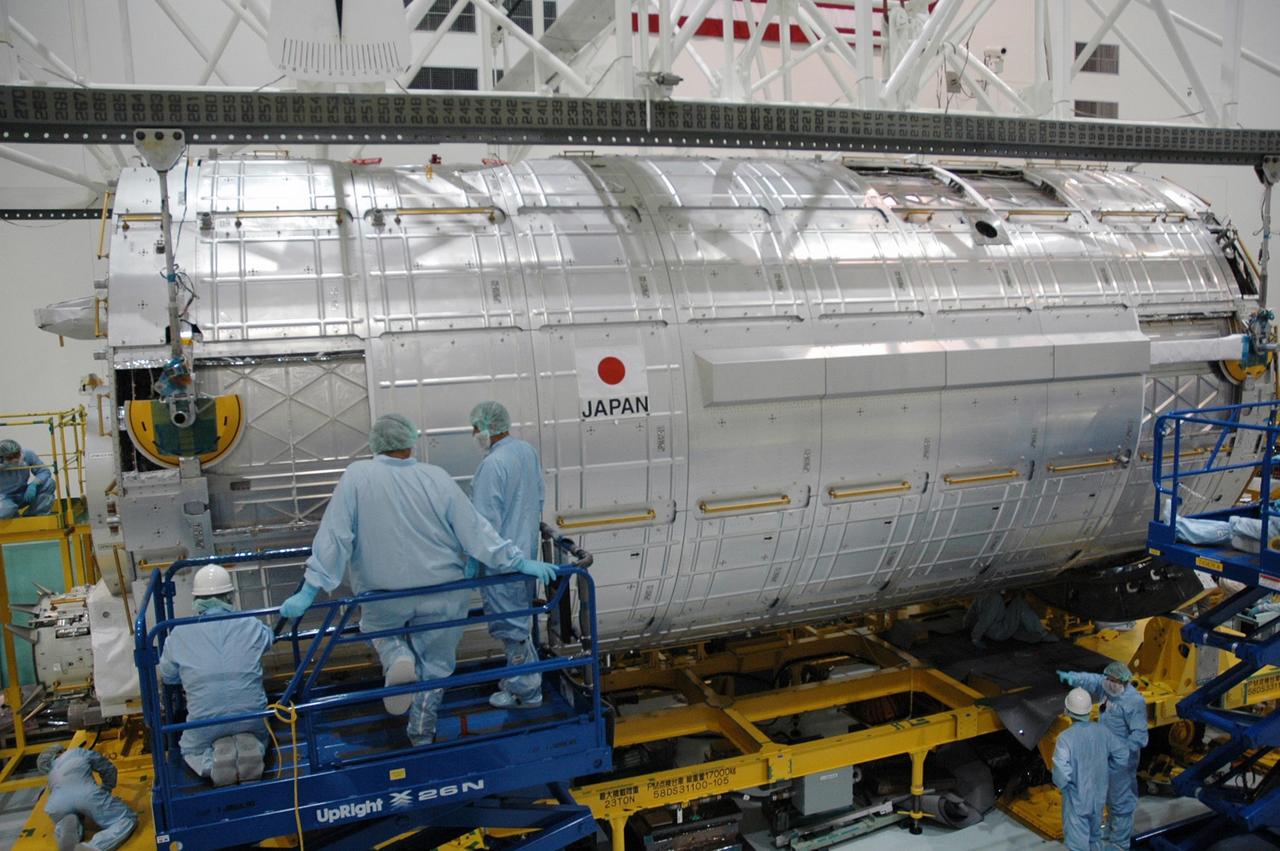
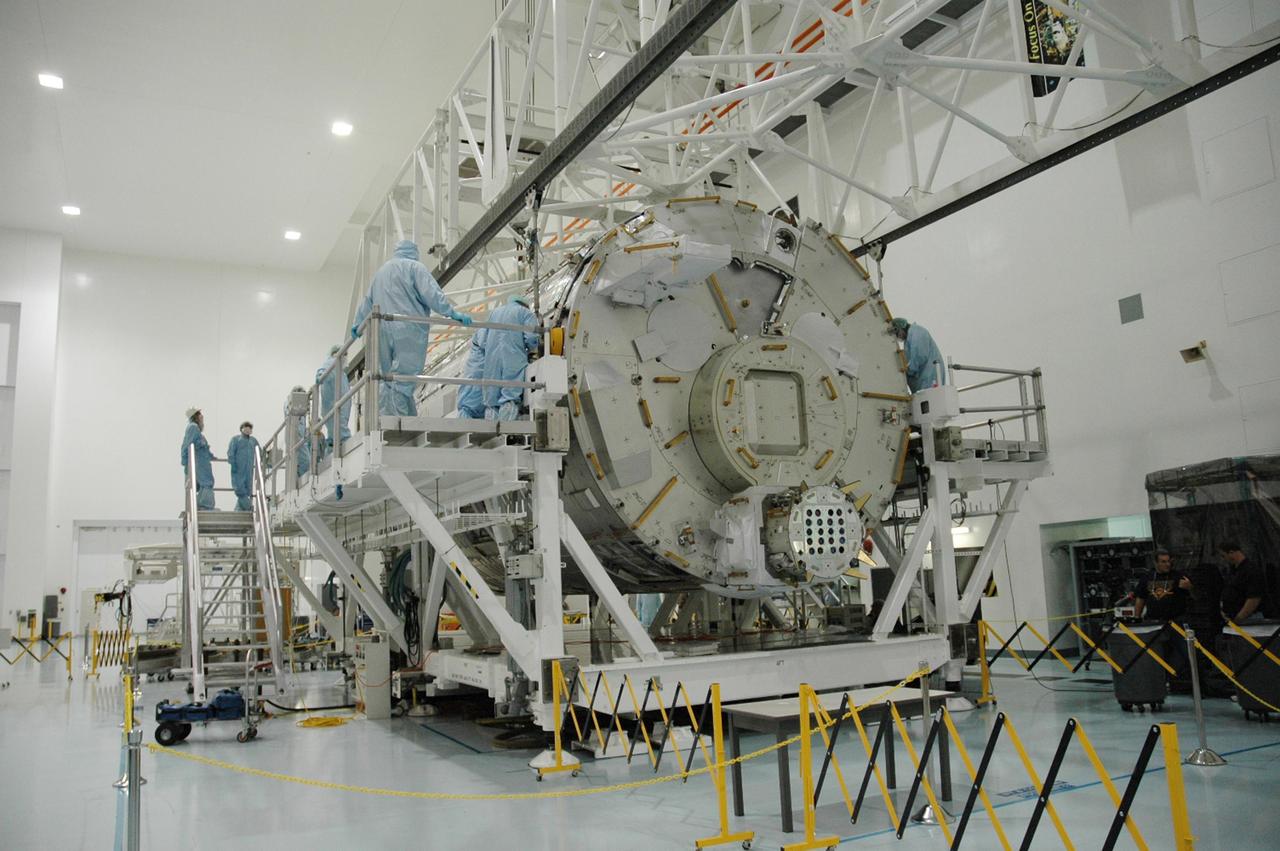
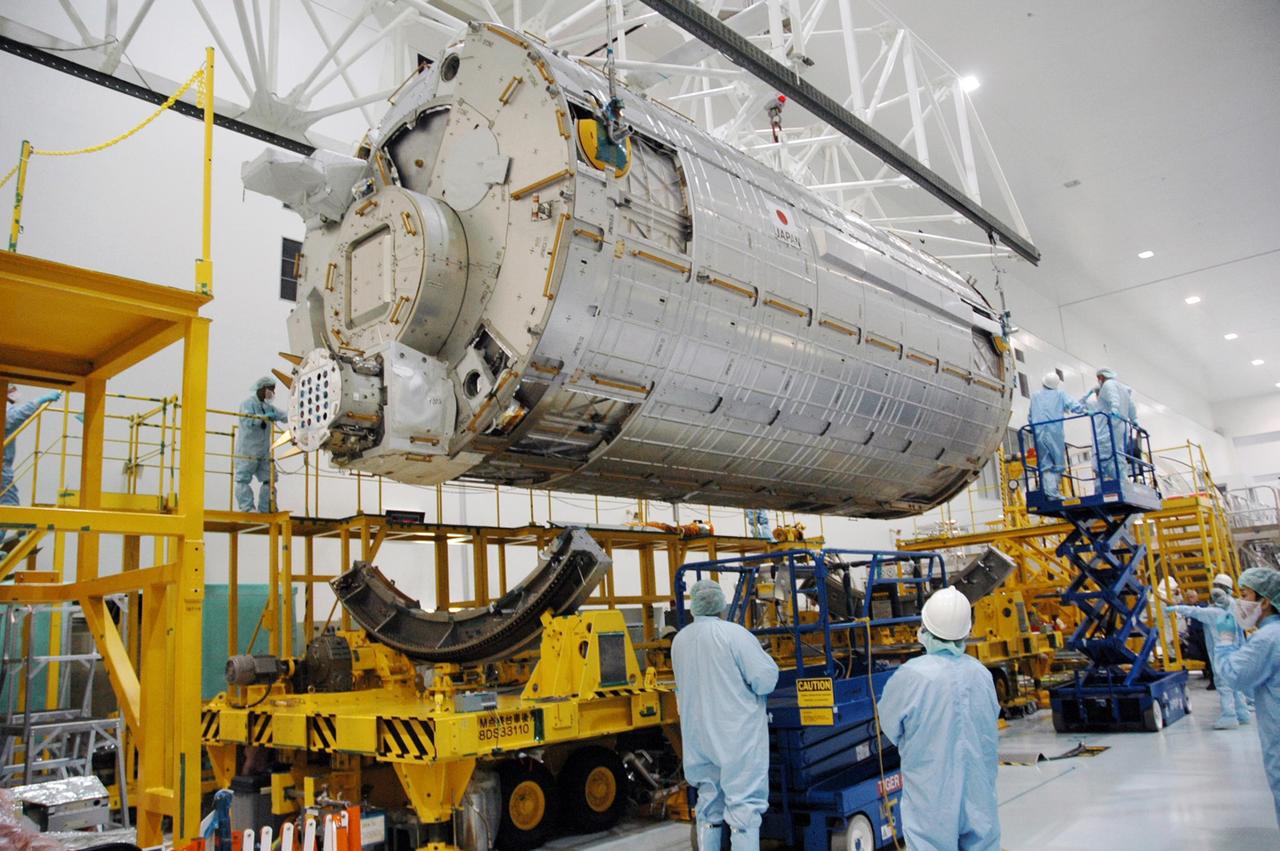
KENNEDY SPACE CENTER, FLA. --   In the Space Station Processing Facility, workers on the floor watch as an overhead crane moves the Japanese Experiment Module (JEM) to a stand for weighing. The Japanese Aerospace Exploration Agency developed the laboratory at the Tsukuba Space Center near Tokyo. It is the first element, named "Kibo" (Hope), to be delivered to KSC. The JEM is Japan's primary contribution to the International Space Station. It will enhance the unique research capabilities of the orbiting complex by providing an additional environment for astronauts to conduct science experiments. The JEM is targeted for mission STS-124, to launch in early 2008.  Photo credit: NASA/Troy Cryder
KSC-06pd2495
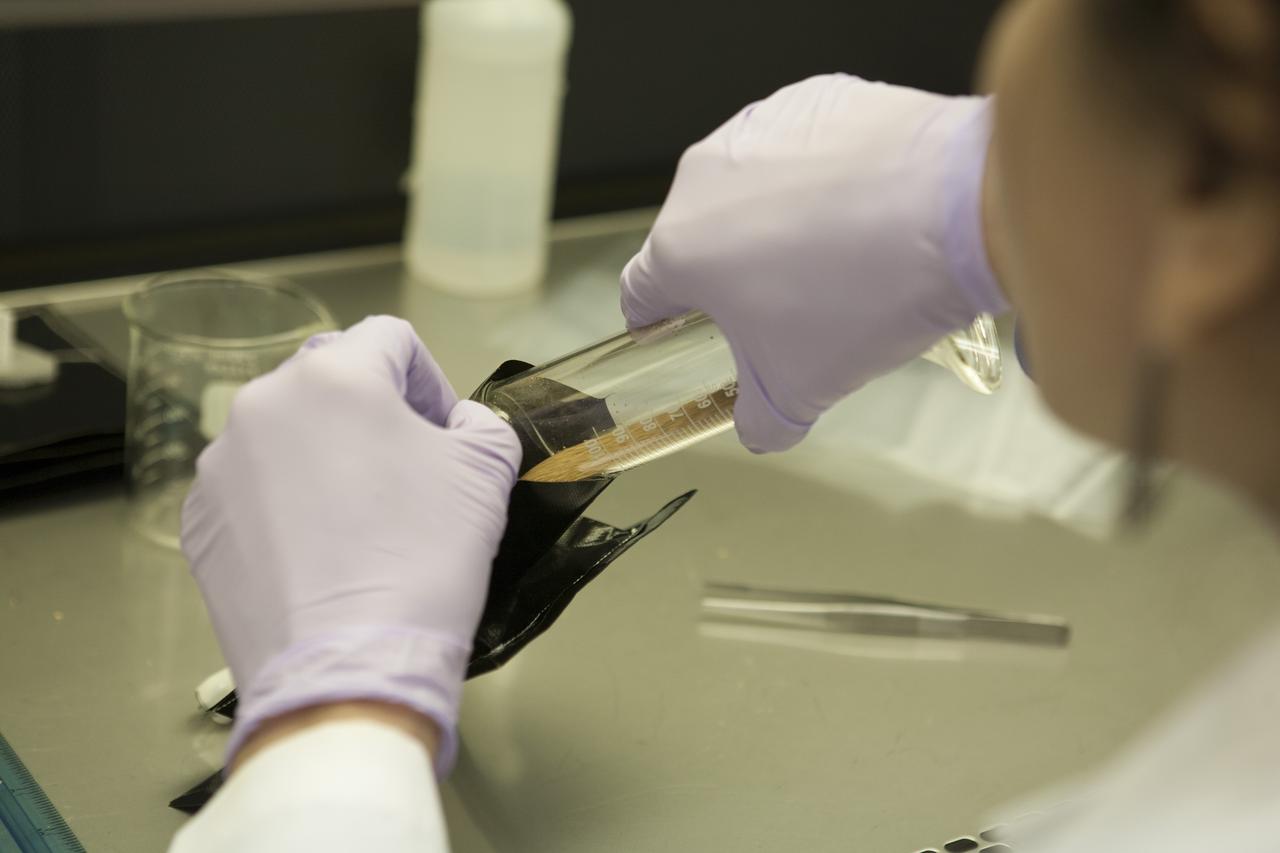
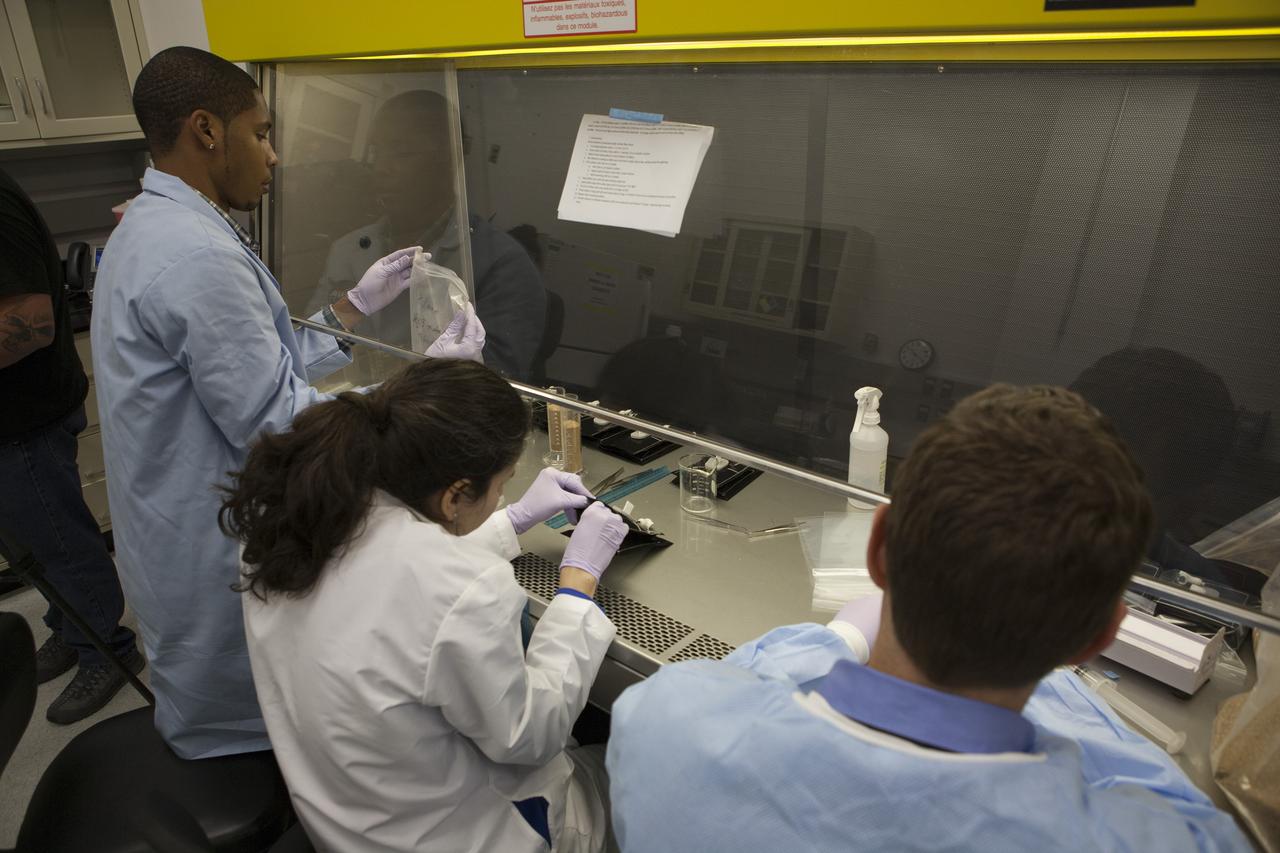
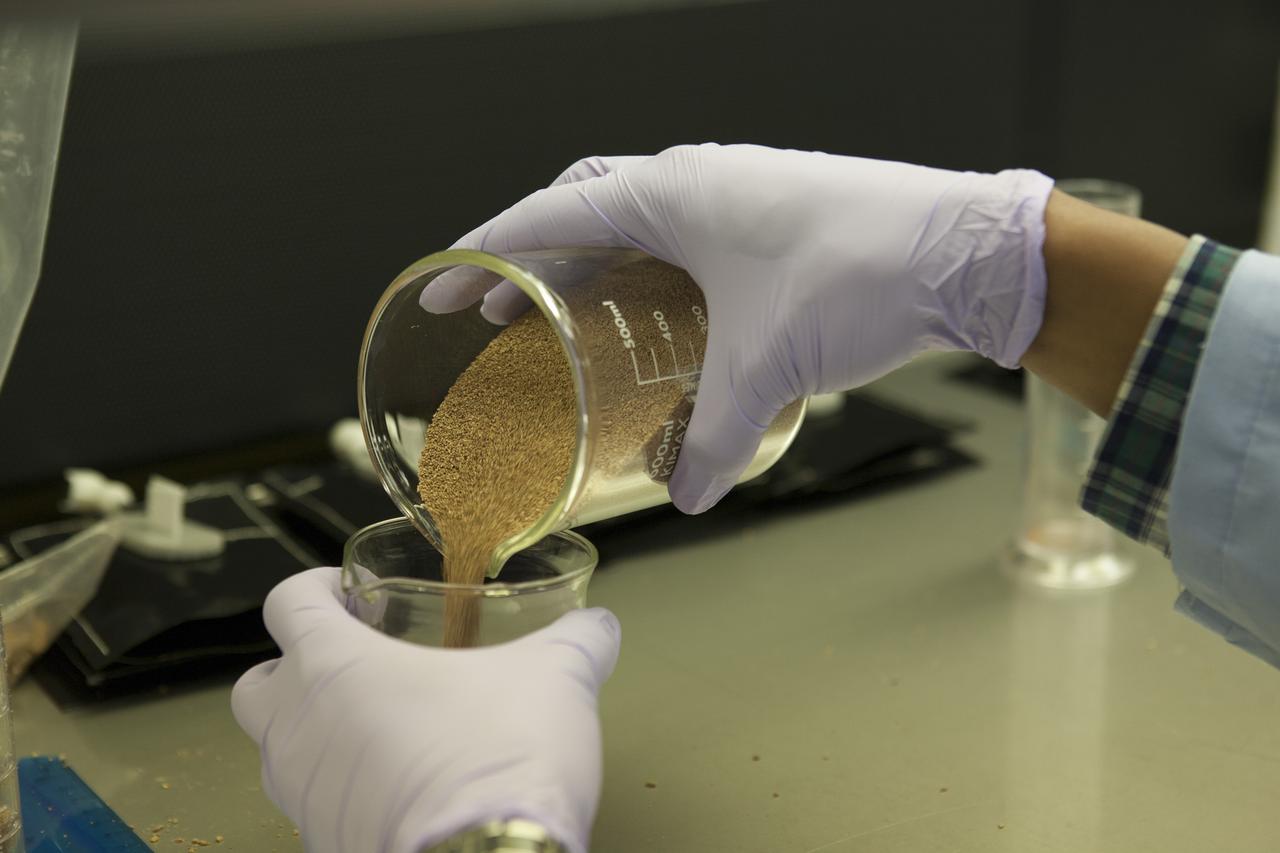
Inside a laboratory in the Space Station Processing Facility at NASA’s Kennedy Space Center in Florida, research scientists prepare the plant pillows for the Veg-03 experiment that will be delivered to the International Space Station aboard the eighth SpaceX Dragon commercial resupply mission. Matt Romeyn, a NASA pathways intern, inserts a measured amount of calcined clay, or space dirt, into one of the plant pillows. The Veg-03 plant pillows will contain ‘Tokyo Bekana’ cabbage seeds and lettuce seeds for NASA’s third Veggie plant growth system experiment. The experiment will continue NASA’s deep space plant growth research to benefit the Earth and the agency’s journey to Mars.
Veg-03 Pillows Preparation for Flight
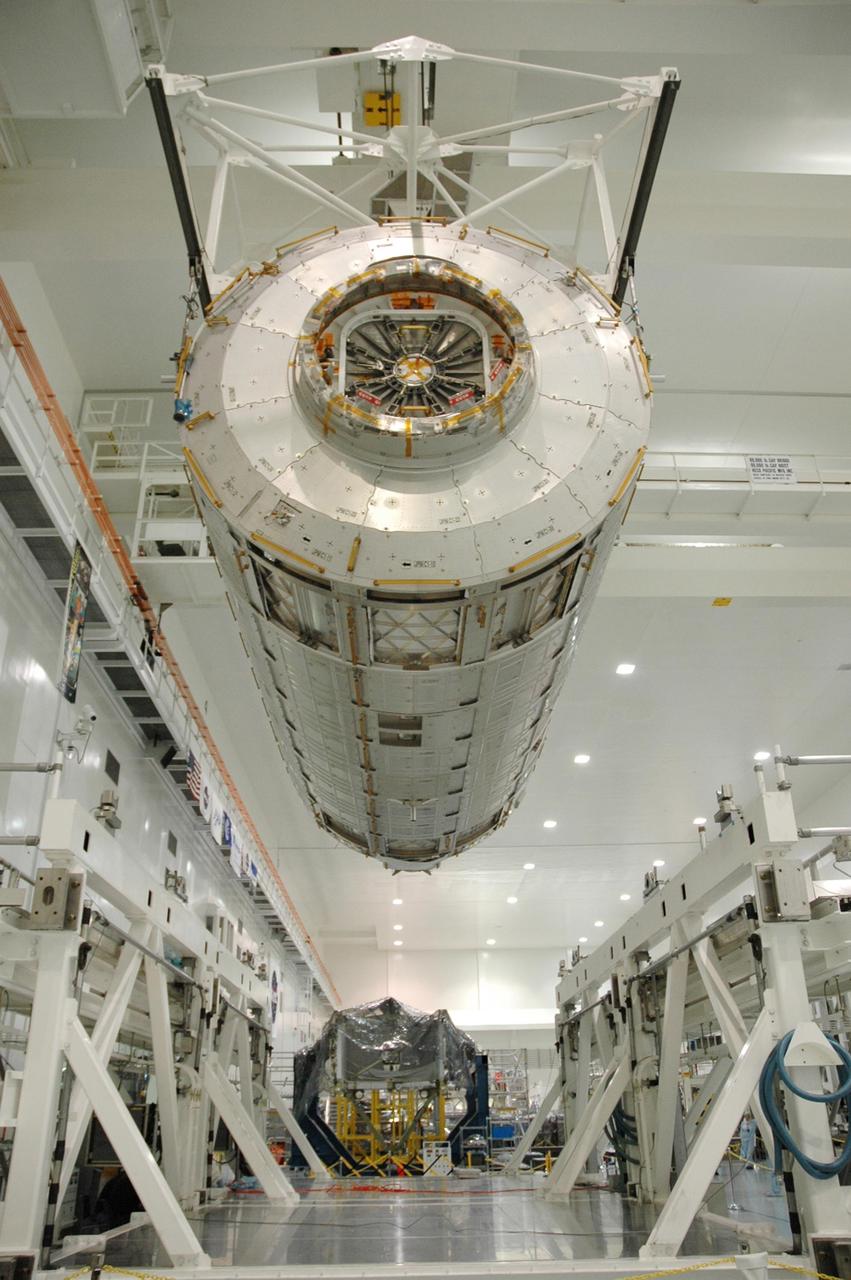
KENNEDY SPACE CENTER, FLA. --  In the Space Station Processing Facility, an overhead crane carries the Japanese Experiment Module (JEM) across the facility.  The module is being moved to another stand where it will be weighed and measured for its center of gravity. The Japanese Aerospace Exploration Agency developed the laboratory at the Tsukuba Space Center near Tokyo. It is the first element, named "Kibo" (Hope), to be delivered to KSC. The JEM is Japan's primary contribution to the International Space Station. It will enhance the unique research capabilities of the orbiting complex by providing an additional environment for astronauts to conduct science experiments. The JEM is targeted for mission STS-124, to launch in early 2008.  Photo credit: NASA/Troy Cryder
KSC-06pd2496
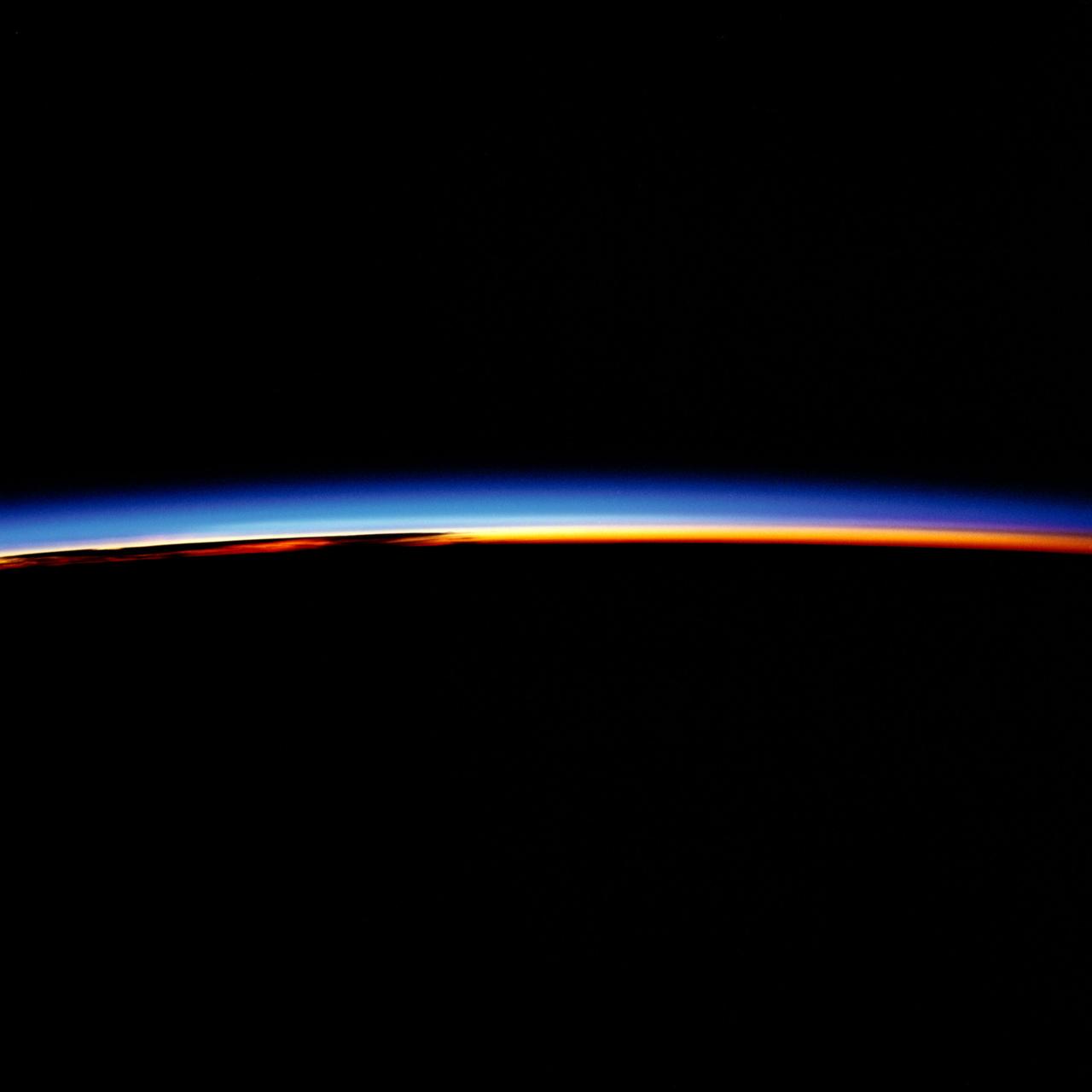
41G-34-036 (5-13 Oct 1984) --- When in space, Space Shuttle astronauts experience 18-dawns to every one on terra firma.  The crew of NASA's STS-41G mission captured these spectacular colors just prior to passing through one of those orbital dawns in October of 1984.  The scene is over the Pacific Ocean, approximately 2,000 miles from Tokyo.  The bands of color represent the various layers of aerosol which surround the planet.  The brilliant red is the atmosphere; the overlap between red and blue is the stratosphere; the blue layer is the ionosphere.  With increased altitude, the electrons and ions are reduced in number, leaving the vast blackness of space.
STS-41G earth observations
Inside a laboratory in the Space Station Processing Facility at NASA’s Kennedy Space Center in Florida, research scientists prepare the plant pillows for the Veg-03 experiment that will be delivered to the International Space Station aboard the eighth SpaceX Dragon commercial resupply mission. From left, are Matt Romeyn, NASA pathways intern; Dr. Gioia Massa, NASA payload scientist for Veggie; and Dr. Mathew Mickens, a post-doctoral researcher. The Veg-03 plant pillows will contain ‘Tokyo Bekana’ cabbage seeds and lettuce seeds for NASA’s third Veggie plant growth system experiment. The experiment will continue NASA’s deep space plant growth research to benefit the Earth and the agency’s journey to Mars.
Veg-03 Pillows Preparation for Flight
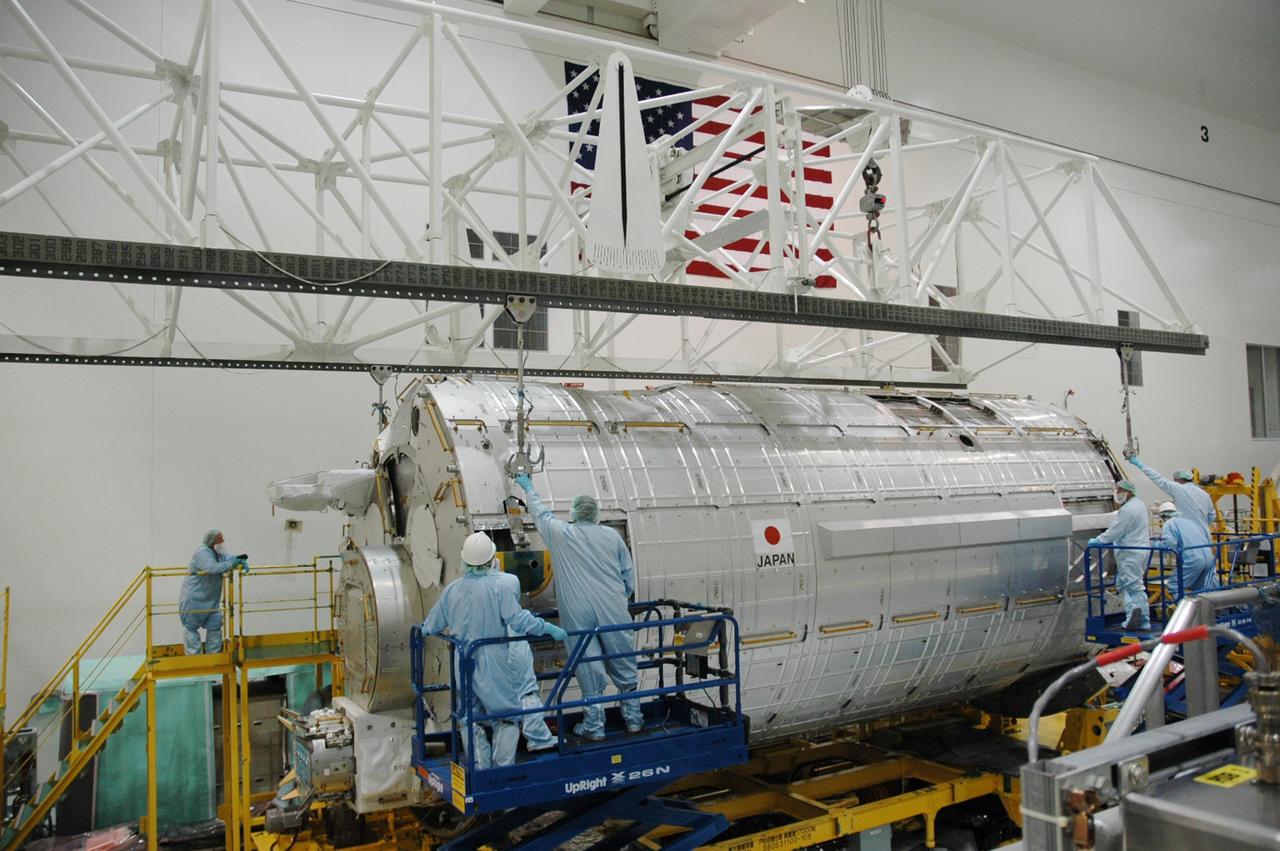
KENNEDY SPACE CENTER, FLA. -- In the Space Station Processing Facility, workers are attaching an overhead crane to the Japanese Experiment Module (JEM) in order to  lift it.  The module is being moved to a stand where it will be weighed and measured for its center of gravity. The Japanese Aerospace Exploration Agency developed the laboratory at the Tsukuba Space Center near Tokyo. It is the first element, named "Kibo" (Hope), to be delivered to KSC. The JEM is Japan's primary contribution to the International Space Station. It will enhance the unique research capabilities of the orbiting complex by providing an additional environment for astronauts to conduct science experiments. The JEM is targeted for mission STS-124, to launch in early 2008.  Photo credit: NASA/Troy Cryder
KSC-06pd2493
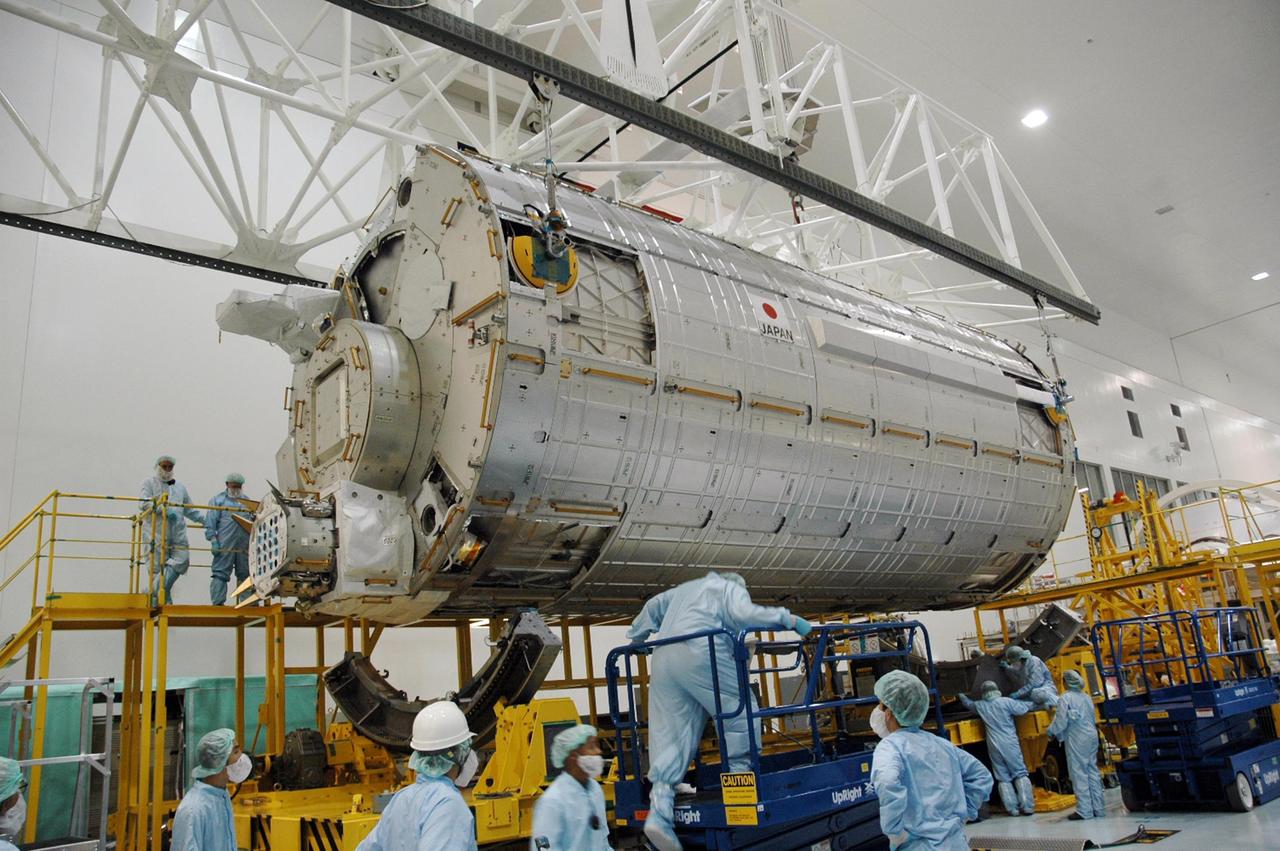
KENNEDY SPACE CENTER, FLA. --   In the Space Station Processing Facility, workers observe as an overhead crane lowers the Japanese Experiment Module (JEM) onto a weighing stand.  The module will also be measured for its center of gravity. The Japanese Aerospace Exploration Agency developed the laboratory at the Tsukuba Space Center near Tokyo. It is the first element, named "Kibo" (Hope), to be delivered to KSC. The JEM is Japan's primary contribution to the International Space Station. It will enhance the unique research capabilities of the orbiting complex by providing an additional environment for astronauts to conduct science experiments. The JEM is targeted for mission STS-124, to launch in early 2008.  Photo credit: NASA/Troy Cryder
KSC-06pd2499
KENNEDY SPACE CENTER, FLA. --  In the Space Station Processing Facility, the Japanese Experiment Module (JEM), after being weighed, makes a return trip to its transporter.  The Japanese Aerospace Exploration Agency developed the laboratory at the Tsukuba Space Center near Tokyo. It is the first element, named "Kibo" (Hope), to be delivered to KSC. The JEM is Japan's primary contribution to the International Space Station. It will enhance the unique research capabilities of the orbiting complex by providing an additional environment for astronauts to conduct science experiments. The JEM is targeted for mission STS-124, to launch in early 2008.  Photo credit: NASA/Troy Cryder
KSC-06pd2502
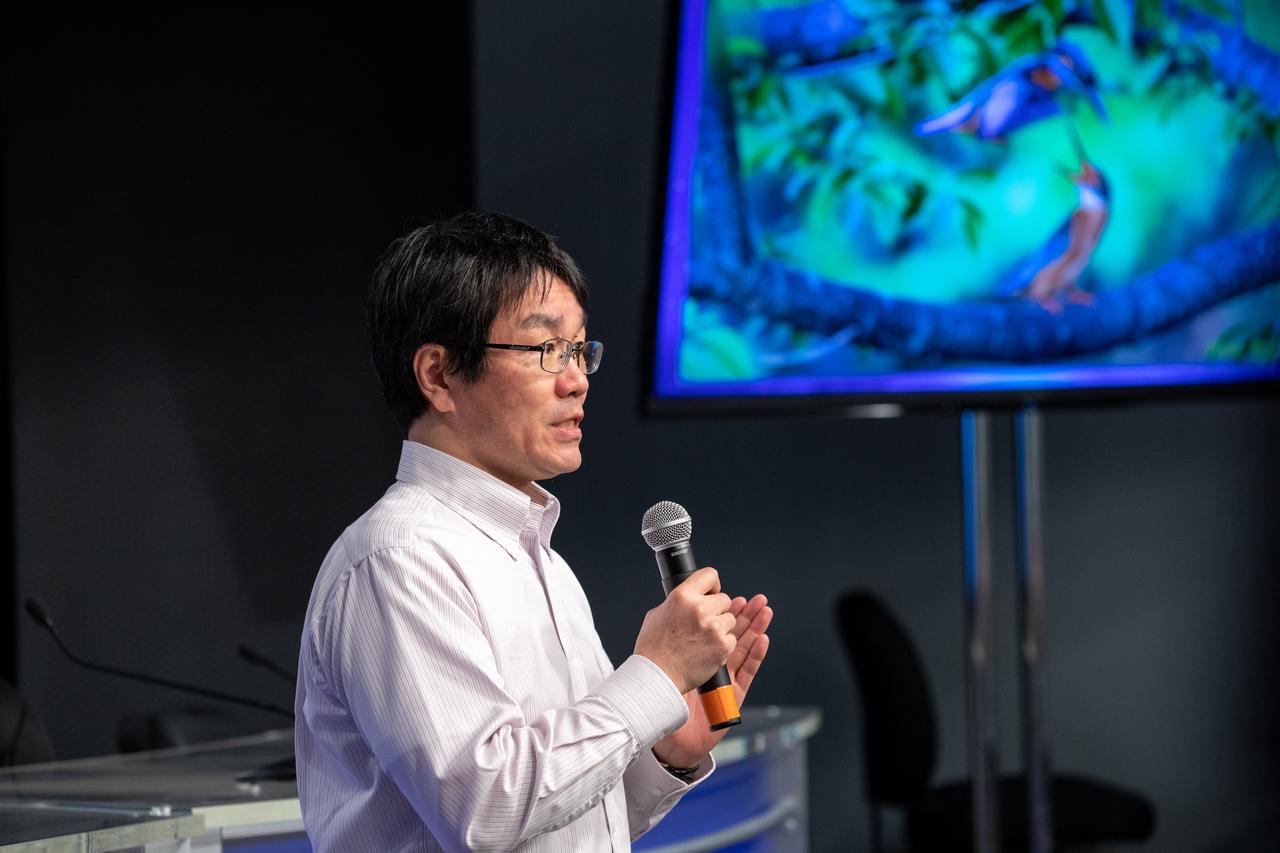
A What’s On Board Briefing for SpaceX’s 19th Commercial Resupply Services (CRS-19) mission for NASA to the International Space Station took place on Dec. 3, 2019, at the agency’s Kennedy Space Center in Florida. Akira Iwasaki, professor at the University of Tokyo and principal investigator for the Hyperspectral Imager Suite (HISUI) developed by the Japanese government, discusses the next-generation, hyperspectral Earth imaging system. The SpaceX Falcon 9 rocket and Dragon cargo module are scheduled to launch on Dec. 4, 2019, from Space Launch Complex 40 on Cape Canaveral Air Force Station in Florida
SpaceX CRS-19 What's On Board Science Briefing
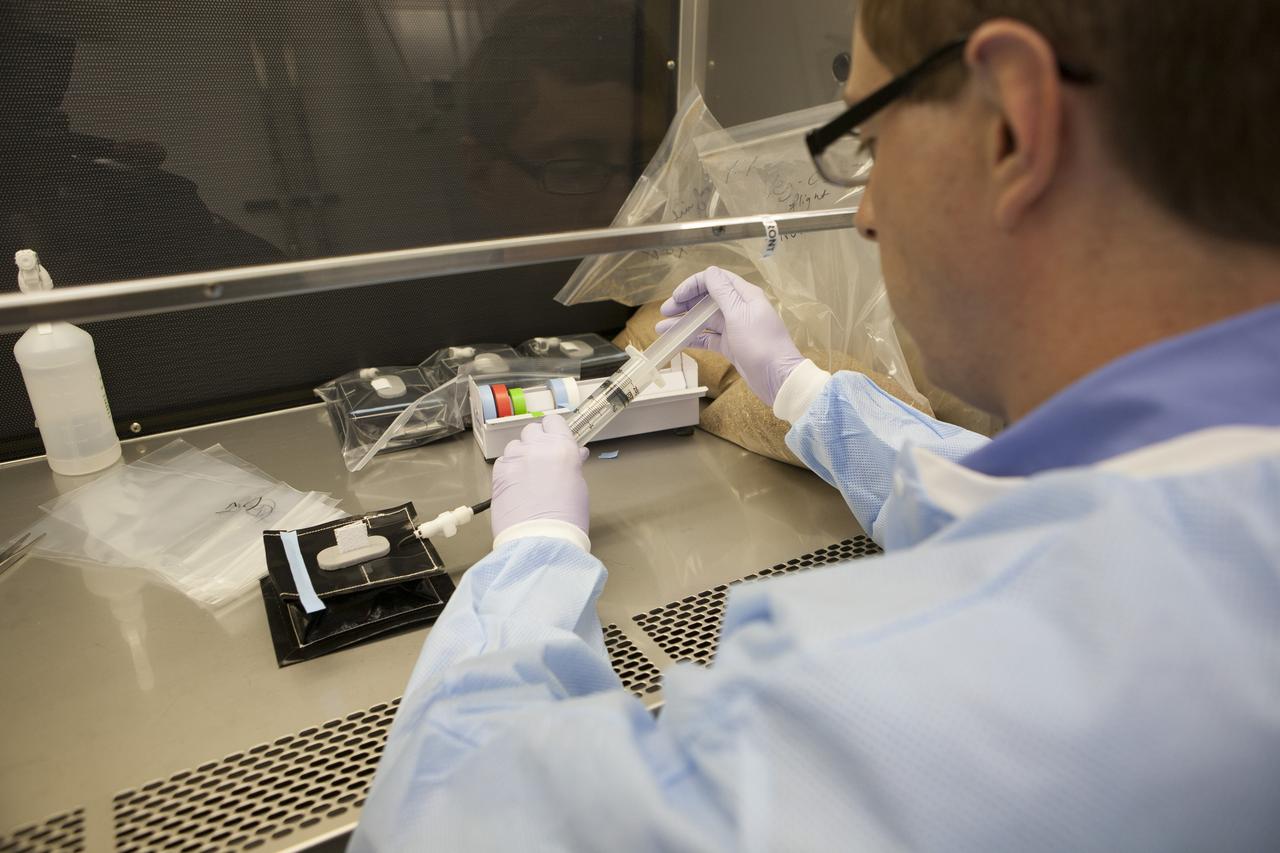
Inside a laboratory in the Space Station Processing Facility at NASA’s Kennedy Space Center in Florida, research scientists prepare the plant pillows for the Veg-03 experiment that will be delivered to the International Space Station aboard the eighth SpaceX Dragon commercial resupply mission. Dr. Mathew Mickens, a post-doctoral researcher, inserts a bonding agent into one of the Veg-03 plant pillows. The Veg-03 plant pillows will contain ‘Tokyo Bekana’ cabbage seeds and lettuce seeds for NASA’s third Veggie plant growth system experiment. The experiment will continue NASA’s deep space plant growth research to benefit the Earth and the agency’s journey to Mars.
Veg-03 Pillows Preparation for Flight
KENNEDY SPACE CENTER, FLA. --  In the Space Station Processing Facility, an overhead crane begins lowering the Japanese Experiment Module (JEM) onto a weighing stand.  The module will also be measured for its center of gravity.  The Japanese Aerospace Exploration Agency developed the laboratory at the Tsukuba Space Center near Tokyo. It is the first element, named "Kibo" (Hope), to be delivered to KSC. The JEM is Japan's primary contribution to the International Space Station. It will enhance the unique research capabilities of the orbiting complex by providing an additional environment for astronauts to conduct science experiments. The JEM is targeted for mission STS-124, to launch in early 2008.  Photo credit: NASA/Troy Cryder
KSC-06pd2498
Inside a laboratory in the Space Station Processing Facility at NASA’s Kennedy Space Center in Florida, plant pillows for the Veg-03 experiment are prepared for delivery to the International Space Station aboard the eighth SpaceX Dragon commercial resupply mission. Dr. Mathew Mickens, a post-doctoral researcher, inserts a bonding agent into one of the Veg-03 plant pillows. The Veg-03 plant pillows will contain ‘Tokyo Bekana’ cabbage seeds and lettuce seeds for NASA’s third Veggie plant growth system experiment. The experiment will continue NASA’s deep space plant growth research to benefit the Earth and the agency’s journey to Mars.
Veg-03 Pillows Preparation for Flight
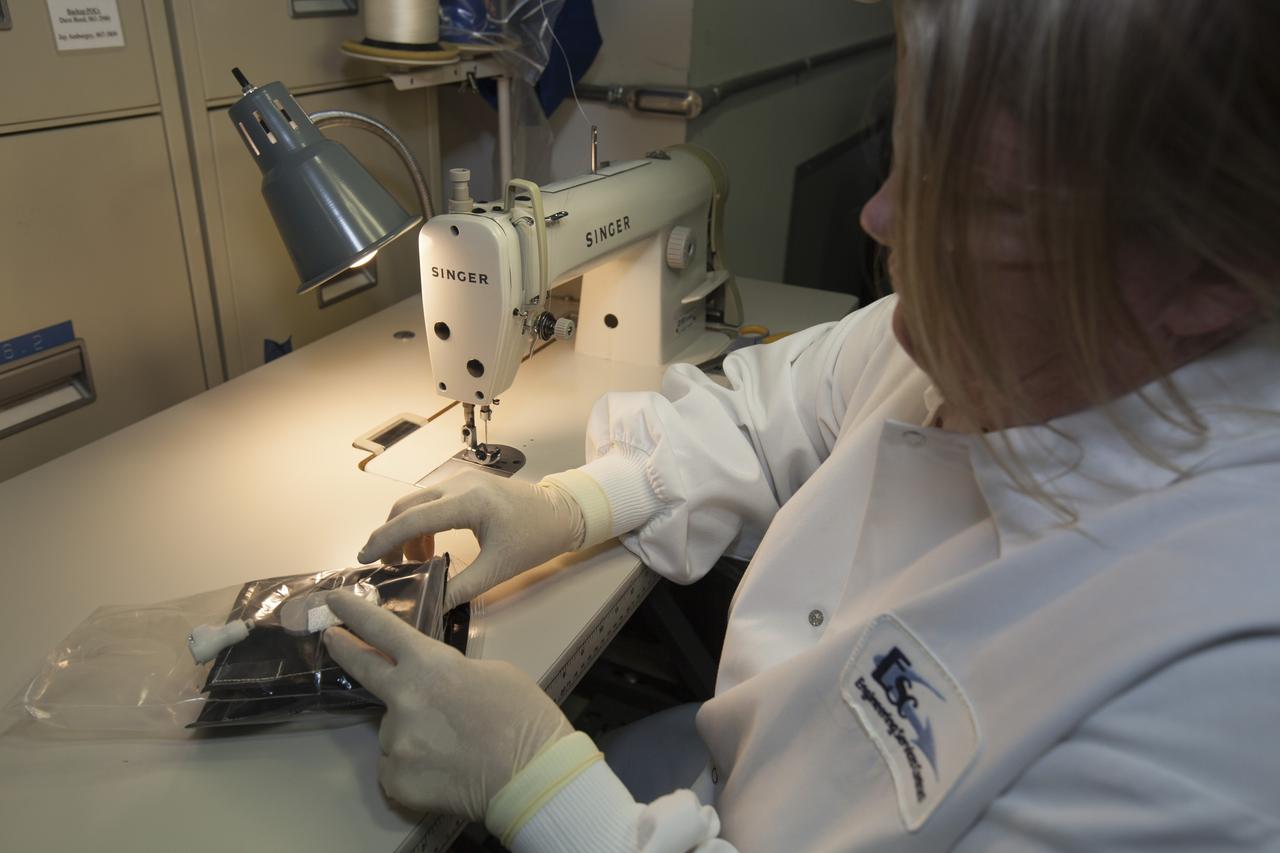
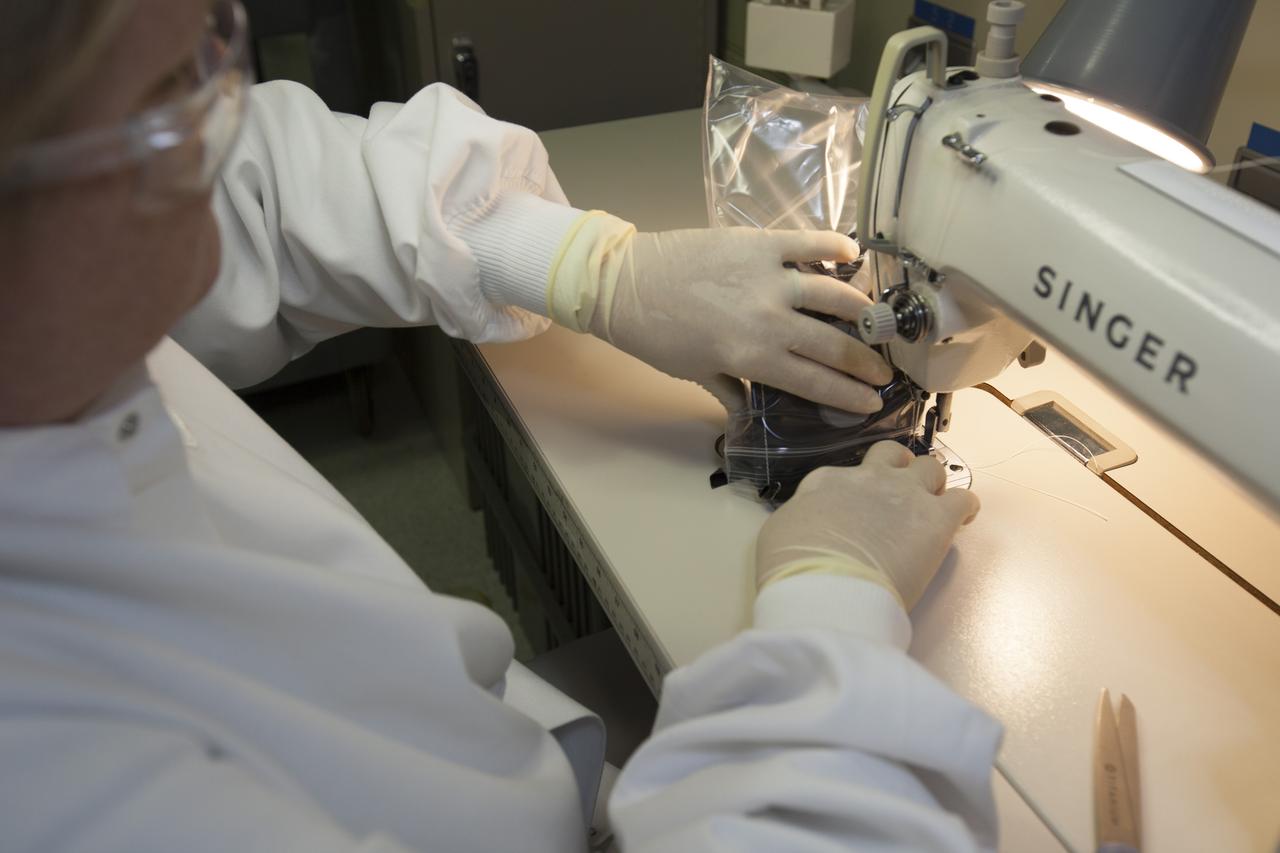
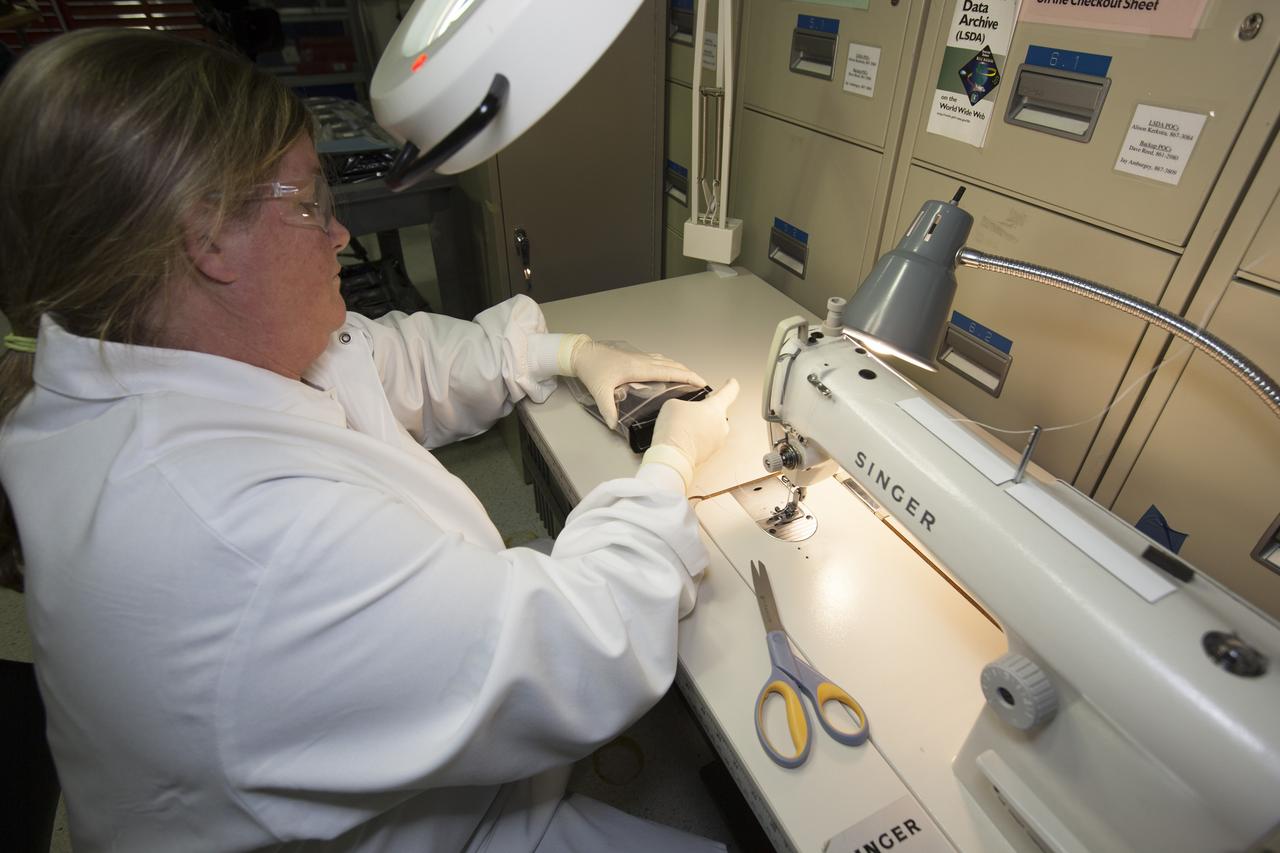
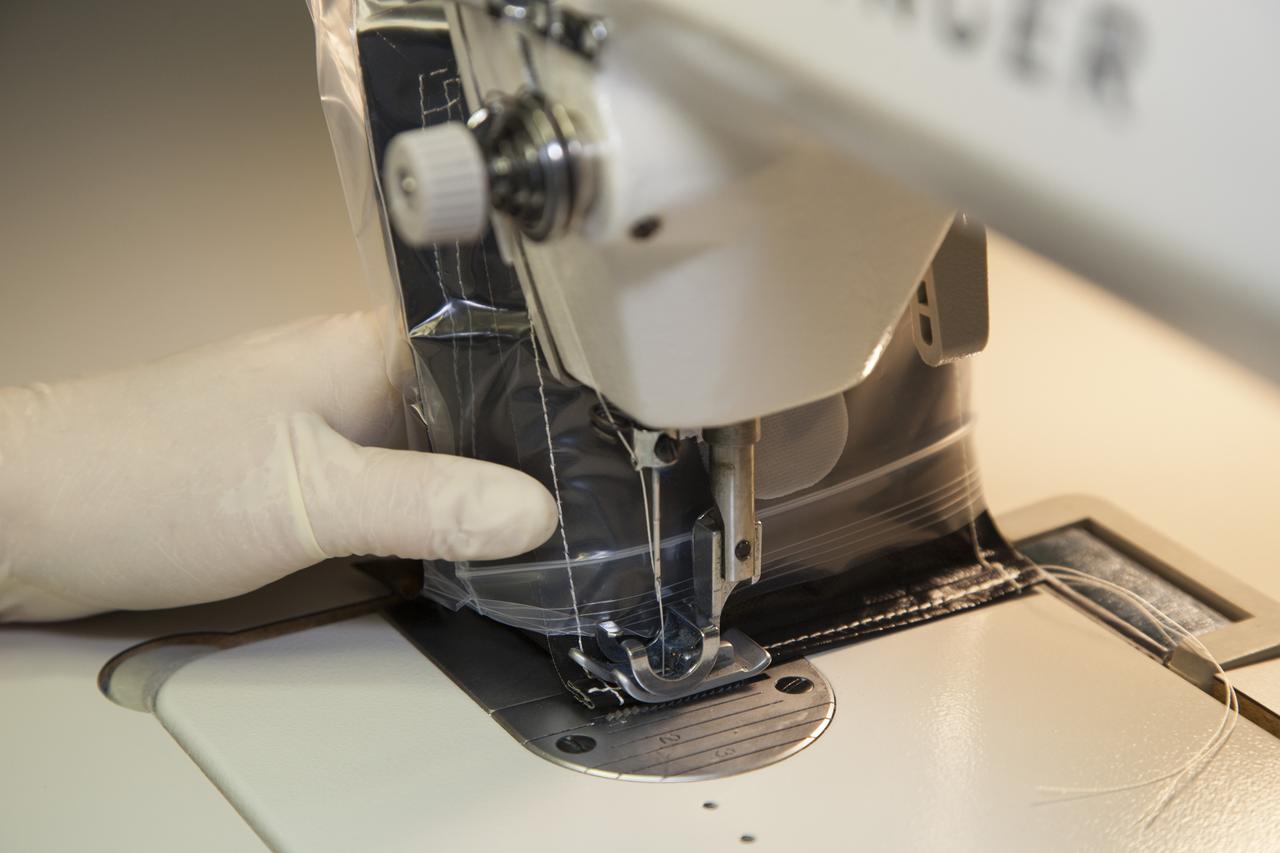
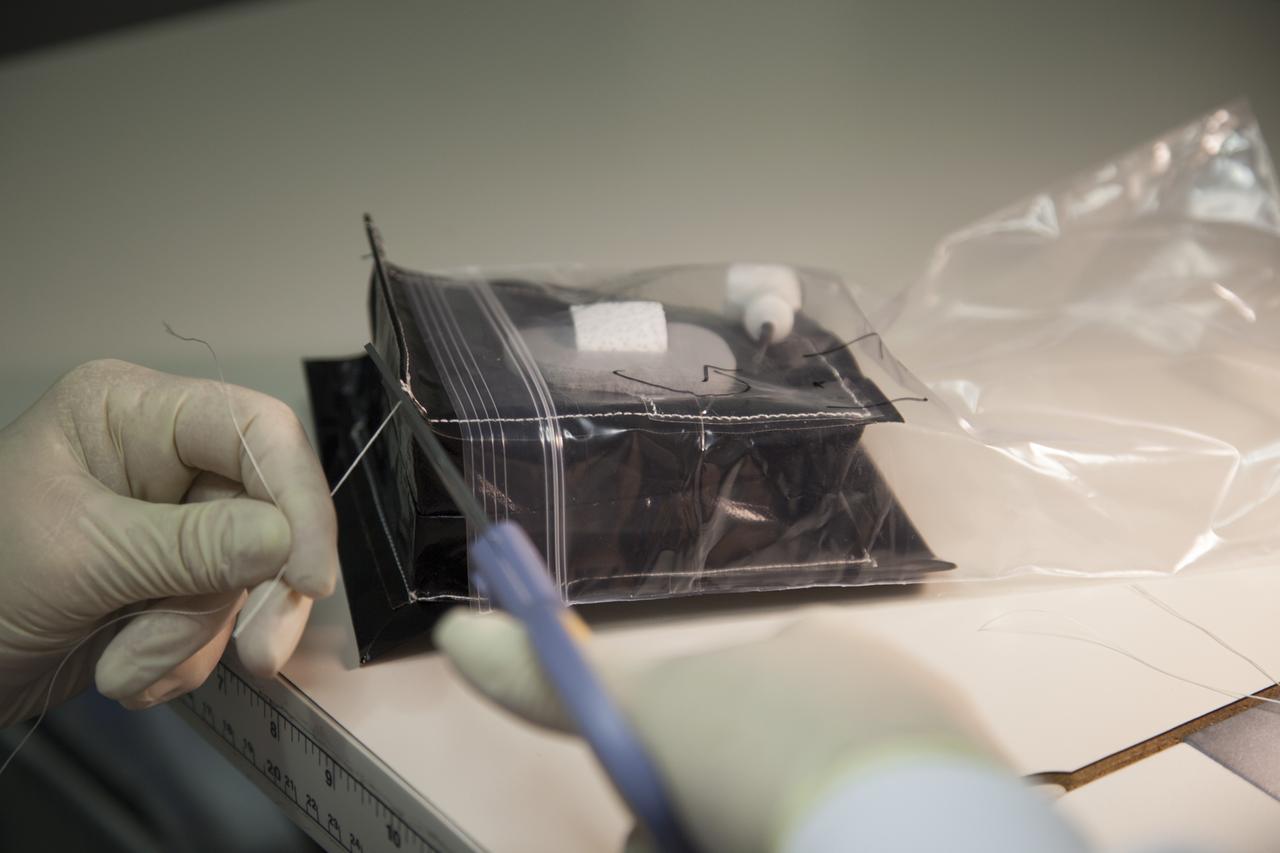
Inside a laboratory in the Space Station Processing Facility at NASA’s Kennedy Space Center in Florida, Michele Koralewicz, a mechanical technician with EASI on the Engineering Services Contract, prepares to sew the end of a bag that contains one of the Veg-03 plant pillows. The Veg-03 experiment will be delivered to the International Space Station aboard the eighth SpaceX Dragon commercial resupply mission. The Veg-03 plant pillows will contain ‘Tokyo Bekana’ cabbage seeds and lettuce seeds for NASA’s third Veggie plant growth system experiment. The experiment will continue NASA’s deep space plant growth research to benefit the Earth and the agency’s journey to Mars.
Veg-03 Pillows Preparation for Flight
Inside a laboratory in the Space Station Processing Facility at NASA’s Kennedy Space Center in Florida, Michele Koralewicz, a mechanical technician with EASI on the Engineering Services Contract, sews up the end of a bag that contains one of the Veg-03 plant pillows. The Veg-03 experiment will be delivered to the International Space Station aboard the eighth SpaceX Dragon commercial resupply mission. The Veg-03 plant pillows will contain ‘Tokyo Bekana’ cabbage seeds and lettuce seeds for NASA’s third Veggie plant growth system experiment. The experiment will continue NASA’s deep space plant growth research to benefit the Earth and the agency’s journey to Mars.
Veg-03 Pillows Preparation for Flight
Inside a laboratory in the Space Station Processing Facility at NASA’s Kennedy Space Center in Florida, Michele Koralewicz, a mechanical technician with EASI on the Engineering Services Contract, sews up the end of a bag that contains one of the Veg-03 plant pillows. The Veg-03 experiment will be delivered to the International Space Station aboard the eighth SpaceX Dragon commercial resupply mission. The Veg-03 plant pillows will contain ‘Tokyo Bekana’ cabbage seeds and lettuce seeds for NASA’s third Veggie plant growth system experiment. The experiment will continue NASA’s deep space plant growth research to benefit the Earth and the agency’s journey to Mars.
Veg-03 Pillows Preparation for Flight
KENNEDY SPACE CENTER, FLA. -- In the Space Station Processing Facility, workers monitor the placement of the Japanese Experiment Module (JEM) onto its transporter.  The JEM was moved from the transporter for weighing and to measure its center of gravity.  The Japanese Aerospace Exploration Agency developed the laboratory at the Tsukuba Space Center near Tokyo. It is the first element, named "Kibo" (Hope), to be delivered to KSC. The JEM is Japan's primary contribution to the International Space Station. It will enhance the unique research capabilities of the orbiting complex by providing an additional environment for astronauts to conduct science experiments. The JEM is targeted for mission STS-124, to launch in early 2008.  Photo credit: NASA/Troy Cryder
KSC-06pd2504
KENNEDY SPACE CENTER, FLA. --  In the Space Station Processing Facility, workers monitor the movement of the Japanese Experiment Module (JEM) as it is lowered onto a weighing stand.  The module will also be measured for its center of gravity. The Japanese Aerospace Exploration Agency developed the laboratory at the Tsukuba Space Center near Tokyo. It is the first element, named "Kibo" (Hope), to be delivered to KSC. The JEM is Japan's primary contribution to the International Space Station. It will enhance the unique research capabilities of the orbiting complex by providing an additional environment for astronauts to conduct science experiments. The JEM is targeted for mission STS-124, to launch in early 2008.  Photo credit: NASA/Troy Cryder
KSC-06pd2500
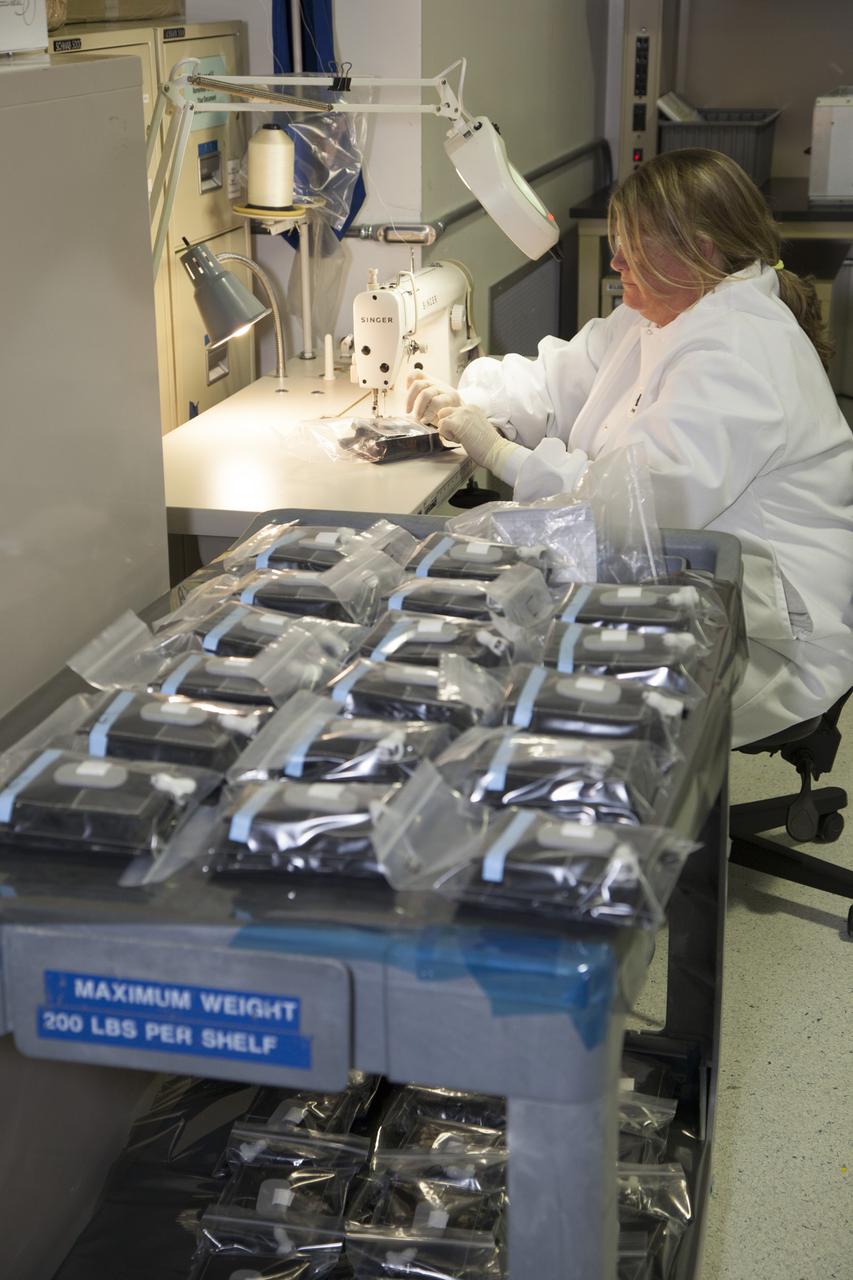
Inside a laboratory in the Space Station Processing Facility at NASA’s Kennedy Space Center in Florida, Michele Koralewicz, a mechanical technician with EASI on the Engineering Services Contract, prepares to sew up the end of a bag that contains one of the Veg-03 plant pillows. In the foreground are all of the other plant pillows that need to be sealed. The Veg-03 experiment will be delivered to the International Space Station aboard the eighth SpaceX Dragon commercial resupply mission. The Veg-03 plant pillows will contain ‘Tokyo Bekana’ cabbage seeds and lettuce seeds for NASA’s third Veggie plant growth system experiment. The experiment will continue NASA’s deep space plant growth research to benefit the Earth and the agency’s journey to Mars.
Veg-03 Pillows Preparation for Flight
KENNEDY SPACE CENTER, FLA. -- In the Space Station Processing Facility, the Japanese Experiment Module (JEM), after being weighed, has been moved back across the facility and is lowered onto its transporter.  The Japanese Aerospace Exploration Agency developed the laboratory at the Tsukuba Space Center near Tokyo. It is the first element, named "Kibo" (Hope), to be delivered to KSC. The JEM is Japan's primary contribution to the International Space Station. It will enhance the unique research capabilities of the orbiting complex by providing an additional environment for astronauts to conduct science experiments. The JEM is targeted for mission STS-124, to launch in early 2008.  Photo credit: NASA/Troy Cryder
KSC-06pd2503
KENNEDY SPACE CENTER, FLA. --   In the Space Station Processing Facility, the Japanese Experiment Module (JEM), after being weighed, is lifted off the scale to be returned to its transporter. The Japanese Aerospace Exploration Agency developed the laboratory at the Tsukuba Space Center near Tokyo. It is the first element, named "Kibo" (Hope), to be delivered to KSC. The JEM is Japan's primary contribution to the International Space Station. It will enhance the unique research capabilities of the orbiting complex by providing an additional environment for astronauts to conduct science experiments. The JEM is targeted for mission STS-124, to launch in early 2008.  Photo credit: NASA/Troy Cryder
KSC-06pd2501
Inside a laboratory in the Space Station Processing Facility at NASA’s Kennedy Space Center in Florida, Michele Koralewicz, a mechanical technician with EASI on the Engineering Services Contract, sews up the end of a bag that contains one of the Veg-03 plant pillows. The Veg-03 experiment will be delivered to the International Space Station aboard the eighth SpaceX Dragon commercial resupply mission. The Veg-03 plant pillows will contain ‘Tokyo Bekana’ cabbage seeds and lettuce seeds for NASA’s third Veggie plant growth system experiment. The experiment will continue NASA’s deep space plant growth research to benefit the Earth and the agency’s journey to Mars.
Veg-03 Pillows Preparation for Flight
KENNEDY SPACE CENTER, FLA. --  In the Space Station Processing Facility, an overhead crane lifts the Japanese Experiment Module (JEM) off of its transporter.  The module is being moved to another stand where it will be weighed and measured for its center of gravity. The Japanese Aerospace Exploration Agency developed the laboratory at the Tsukuba Space Center near Tokyo. It is the first element, named "Kibo" (Hope), to be delivered to KSC. The JEM is Japan's primary contribution to the International Space Station. It will enhance the unique research capabilities of the orbiting complex by providing an additional environment for astronauts to conduct science experiments. The JEM is targeted for mission STS-124, to launch in early 2008.  Photo credit: NASA/Troy Cryder
KSC-06pd2494
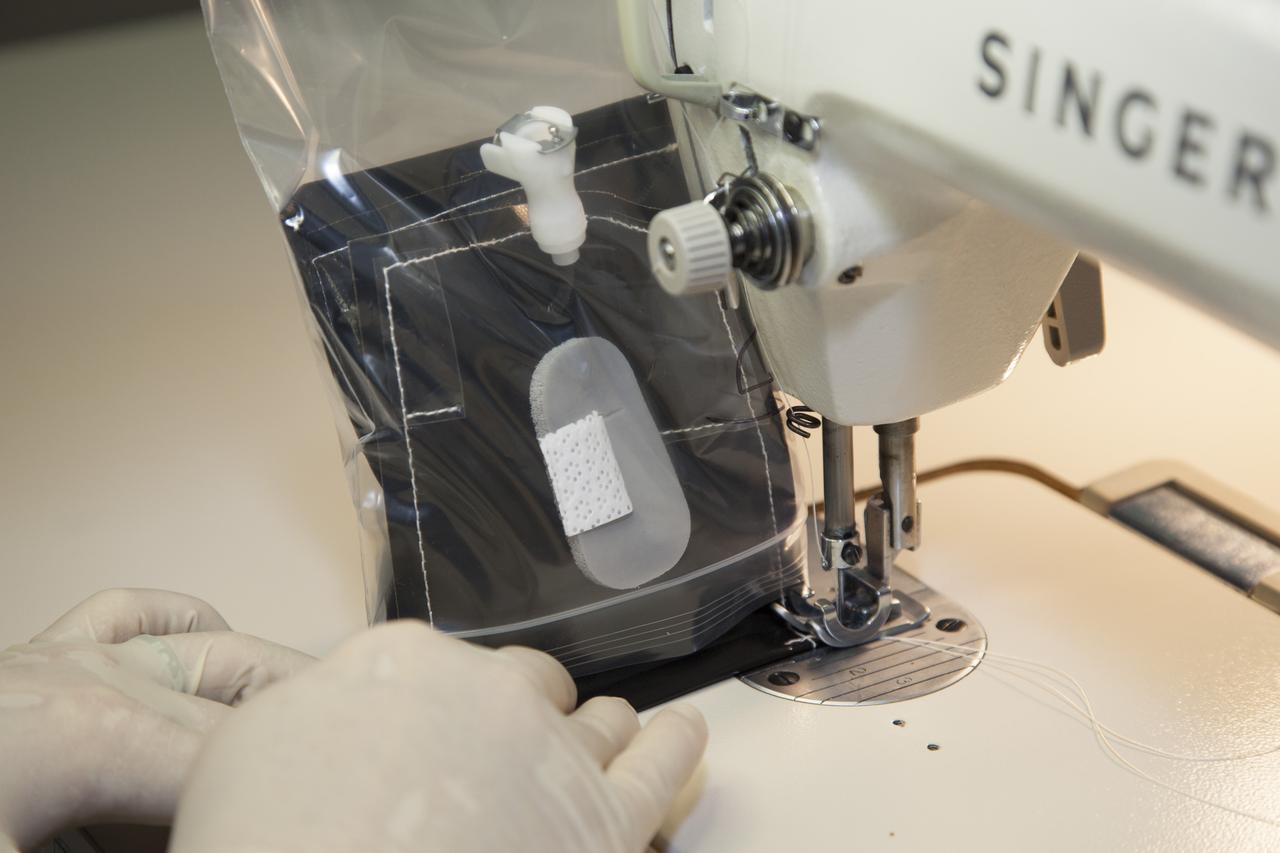
Inside a laboratory in the Space Station Processing Facility at NASA’s Kennedy Space Center in Florida, Michele Koralewicz, a mechanical technician with EASI on the Engineering Services Contract, precisely sews up the end of a bag that contains one of the Veg-03 plant pillows. The Veg-03 experiment will be delivered to the International Space Station aboard the eighth SpaceX Dragon commercial resupply mission. The Veg-03 plant pillows will contain ‘Tokyo Bekana’ cabbage seeds and lettuce seeds for NASA’s third Veggie plant growth system experiment. The experiment will continue NASA’s deep space plant growth research to benefit the Earth and the agency’s journey to Mars.
Veg-03 Pillows Preparation for Flight
Inside a laboratory in the Space Station Processing Facility at NASA’s Kennedy Space Center in Florida, research scientists prepare the plant pillows for the Veg-03 experiment that will be delivered to the International Space Station aboard the eighth SpaceX Dragon commercial resupply mission. Matt Romeyn, a NASA pathways intern, measures out the calcined clay, or space dirt, for one of the plant pillows. The Veg-03 plant pillows will contain ‘Tokyo Bekana’ cabbage seeds and lettuce seeds for NASA’s third Veggie plant growth system experiment. The experiment will continue NASA’s deep space plant growth research to benefit the Earth and the agency’s journey to Mars.
Veg-03 Pillows Preparation for Flight
Inside a laboratory in the Space Station Processing Facility at NASA’s Kennedy Space Center in Florida, Michele Koralewicz, a mechanical technician with EASI on the Engineering Services Contract, sews up the end of a bag that contains one of the Veg-03 plant pillows. The Veg-03 experiment will be delivered to the International Space Station aboard the eighth SpaceX Dragon commercial resupply mission. The Veg-03 plant pillows will contain ‘Tokyo Bekana’ cabbage seeds and lettuce seeds for NASA’s third Veggie plant growth system experiment. The experiment will continue NASA’s deep space plant growth research to benefit the Earth and the agency’s journey to Mars.
Veg-03 Pillows Preparation for Flight
KENNEDY SPACE CENTER, FLA. - At Port Canaveral, the Pressurized Module of the Japanese Experiment Module (JEM) is lifted out of the ship’s cargo hold.  It will be loaded onto the truck bed in the background for transfer to KSC’s Space Station Processing Facility.  The container transport ship carrying JEM departed May 2 from Yokohama Harbor in Japan for the voyage to the United States. The National Space Development Agency of Japan (NASDA) developed the laboratory at the Tsukuba Space Center near Tokyo. The Pressurized Module is the first element of the JEM, named "Kibo" (Hope), to be delivered to KSC. The JEM is Japan's primary contribution to the Station. It will enhance the unique research capabilities of the orbiting complex by providing an additional environment for astronauts to conduct science experiments.  The JEM also includes an exposed facility (platform) for space environment experiments, a robotic manipulator system, and two logistics modules. The various JEM components will be  assembled in space over the course of three Shuttle missions.
KENNEDY SPACE CENTER, FLA. - At Port Canaveral, the Pressurized Module of the Japanese Experiment Module (JEM) is lifted out of the ship’s cargo hold. It will be loaded onto the truck bed in the background for transfer to KSC’s Space Station Processing Facility. The container transport ship carrying JEM departed May 2 from Yokohama Harbor in Japan for the voyage to the United States. The National Space Development Agency of Japan (NASDA) developed the laboratory at the Tsukuba Space Center near Tokyo. The Pressurized Module is the first element of the JEM, named "Kibo" (Hope), to be delivered to KSC. The JEM is Japan's primary contribution to the Station. It will enhance the unique research capabilities of the orbiting complex by providing an additional environment for astronauts to conduct science experiments. The JEM also includes an exposed facility (platform) for space environment experiments, a robotic manipulator system, and two logistics modules. The various JEM components will be assembled in space over the course of three Shuttle missions.
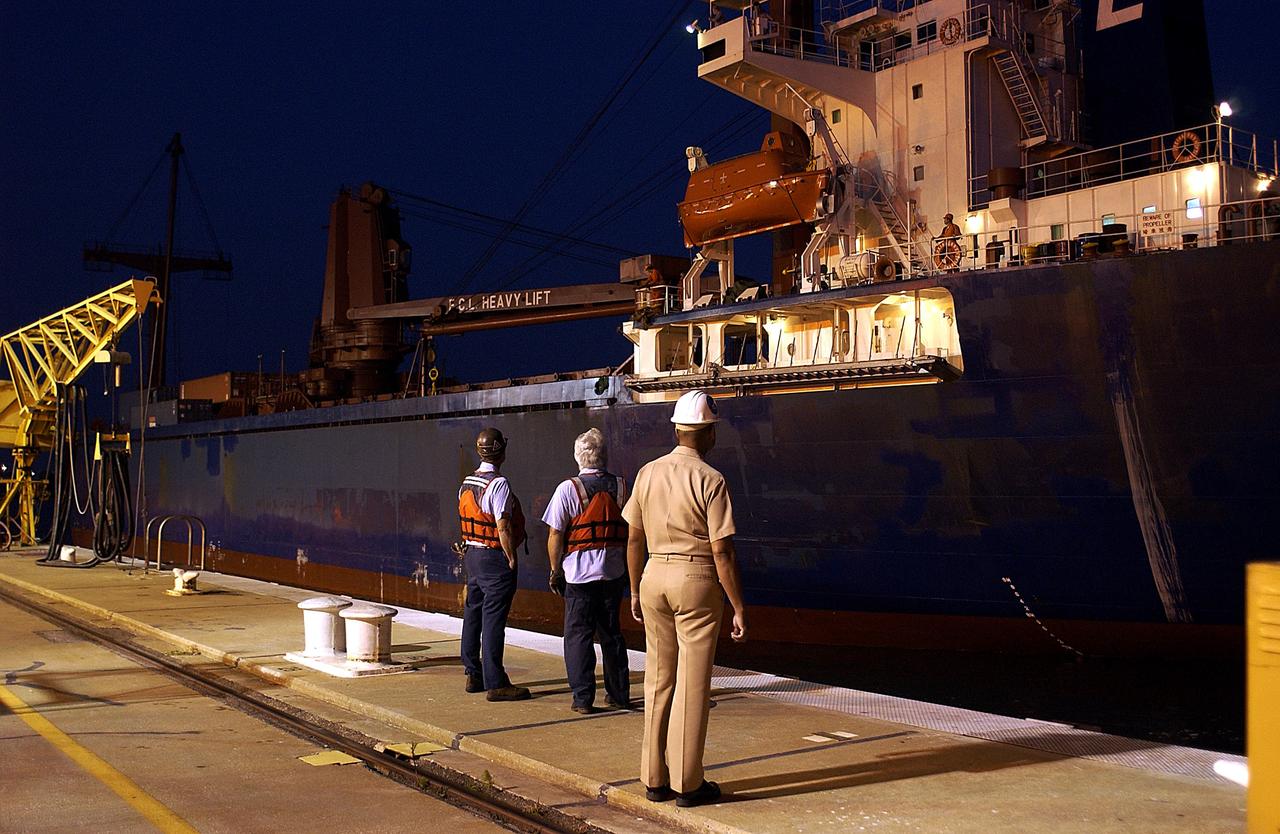
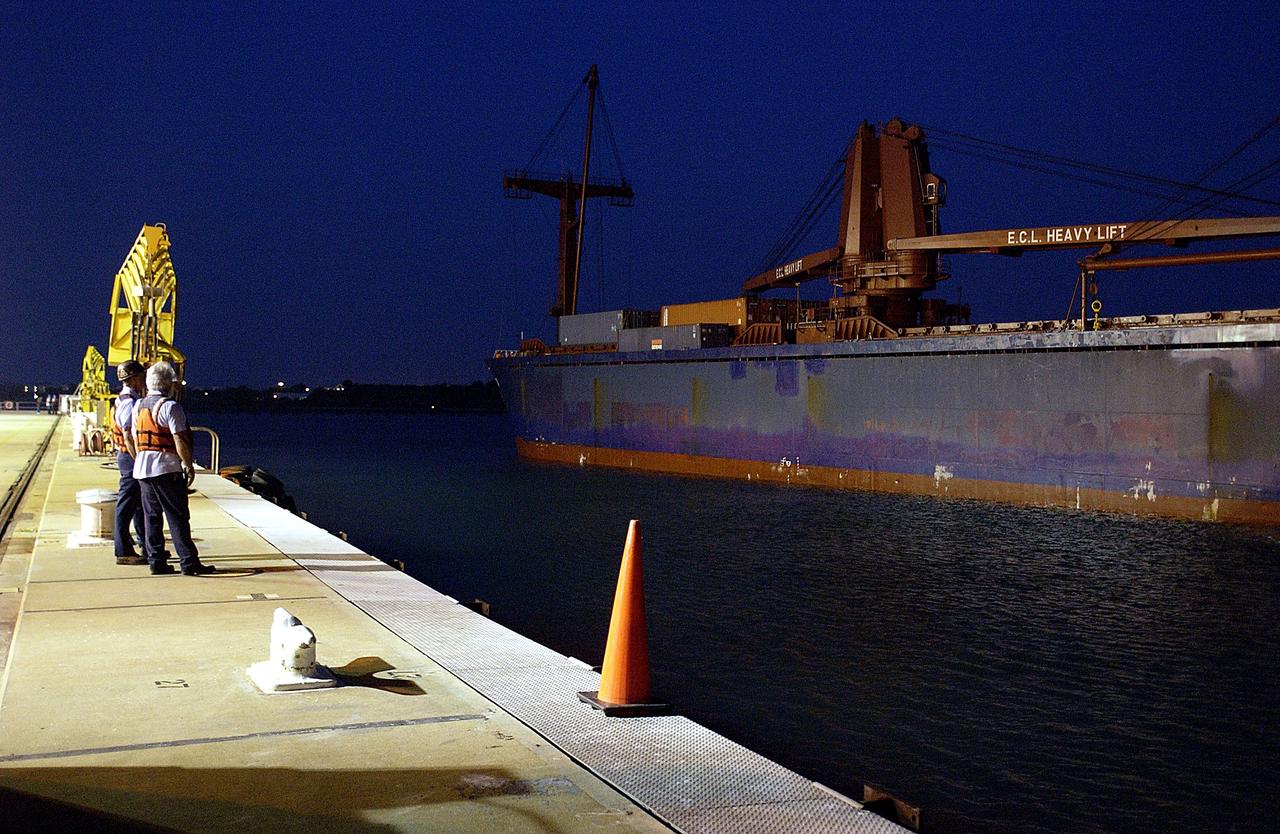
KENNEDY SPACE CENTER, FLA. - The container transport ship carrying the JEM Pressurized Module arrives at Port Canaveral, Fla.  The National Space Development Agency of Japan (NASDA) built the laboratory at the Tsukuba Space Center near Tokyo.  The Pressurized Module is the first element of the JEM, Japan’s primary contribution to the space station, to be delivered to KSC. It will enhance the unique research capabilities of the orbiting complex by providing an additional shirt-sleeve environment for astronauts to conduct science experiments. The JEM also includes two logistics modules, an exposed pallet for space environment experiments and a robotic manipulator system that are still under construction in Japan. The various JEM components will be assembled in space over the course of three space shuttle missions.
KENNEDY SPACE CENTER, FLA. - The container transport ship carrying the JEM Pressurized Module arrives at Port Canaveral, Fla. The National Space Development Agency of Japan (NASDA) built the laboratory at the Tsukuba Space Center near Tokyo. The Pressurized Module is the first element of the JEM, Japan’s primary contribution to the space station, to be delivered to KSC. It will enhance the unique research capabilities of the orbiting complex by providing an additional shirt-sleeve environment for astronauts to conduct science experiments. The JEM also includes two logistics modules, an exposed pallet for space environment experiments and a robotic manipulator system that are still under construction in Japan. The various JEM components will be assembled in space over the course of three space shuttle missions.
KENNEDY SPACE CENTER, FLA. - In the Space Station Processing Facility, workers check the Japanese Experiment Module (JEM) pressure module on its work stand.  A research laboratory, the pressurized module is the first element of the JEM, named "Kibo" (Hope), to be delivered to KSC.   The National Space Development Agency of Japan (NASDA) developed the laboratory at the Tsukuba Space Center near Tokyo and is Japan's primary contribution to the Station. It will enhance the unique research capabilities of the orbiting complex by providing an additional environment for astronauts to conduct science experiments.  The JEM also includes an exposed facility (platform) for space environment experiments, a robotic manipulator system, and two logistics modules. The various JEM components will be  assembled in space over the course of three Shuttle missions.
KENNEDY SPACE CENTER, FLA. - In the Space Station Processing Facility, workers check the Japanese Experiment Module (JEM) pressure module on its work stand. A research laboratory, the pressurized module is the first element of the JEM, named "Kibo" (Hope), to be delivered to KSC. The National Space Development Agency of Japan (NASDA) developed the laboratory at the Tsukuba Space Center near Tokyo and is Japan's primary contribution to the Station. It will enhance the unique research capabilities of the orbiting complex by providing an additional environment for astronauts to conduct science experiments. The JEM also includes an exposed facility (platform) for space environment experiments, a robotic manipulator system, and two logistics modules. The various JEM components will be assembled in space over the course of three Shuttle missions.
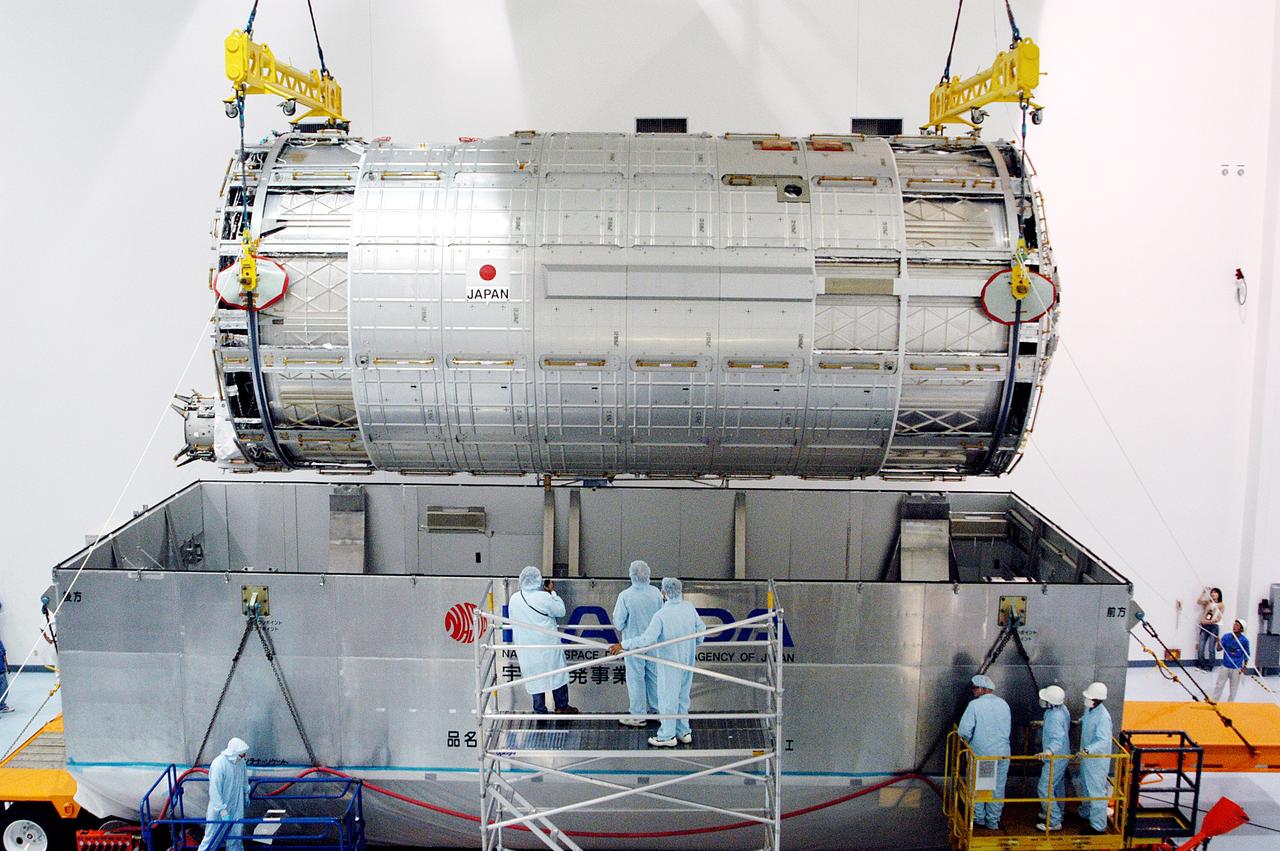
KENNEDY SPACE CENTER, FLA. -  In the Space Station Processing Facility, an overhead crane lifts the Japanese Experiment Module (JEM) pressure module out of the shipping canister to move it to a work stand.  A research laboratory, the pressurized module is the first element of the JEM, named "Kibo" (Hope), to be delivered to KSC.   The National Space Development Agency of Japan (NASDA) developed the laboratory at the Tsukuba Space Center near Tokyo and is Japan's primary contribution to the Station. It will enhance the unique research capabilities of the orbiting complex by providing an additional environment for astronauts to conduct science experiments.  The JEM also includes an exposed facility (platform) for space environment experiments, a robotic manipulator system, and two logistics modules. The various JEM components will be  assembled in space over the course of three Shuttle missions.
KENNEDY SPACE CENTER, FLA. - In the Space Station Processing Facility, an overhead crane lifts the Japanese Experiment Module (JEM) pressure module out of the shipping canister to move it to a work stand. A research laboratory, the pressurized module is the first element of the JEM, named "Kibo" (Hope), to be delivered to KSC. The National Space Development Agency of Japan (NASDA) developed the laboratory at the Tsukuba Space Center near Tokyo and is Japan's primary contribution to the Station. It will enhance the unique research capabilities of the orbiting complex by providing an additional environment for astronauts to conduct science experiments. The JEM also includes an exposed facility (platform) for space environment experiments, a robotic manipulator system, and two logistics modules. The various JEM components will be assembled in space over the course of three Shuttle missions.
KENNEDY SPACE CENTER, FLA. -  The container transport ship carrying the JEM Pressurized Module arrives at Port Canaveral, Fla.  The National Space Development Agency of Japan (NASDA) built the laboratory at the Tsukuba Space Center near Tokyo.  The Pressurized Module is the first element of the JEM, Japan’s primary contribution to the space station, to be delivered to KSC. It will enhance the unique research capabilities of the orbiting complex by providing an additional shirt-sleeve environment for astronauts to conduct science experiments. The JEM also includes two logistics modules, an exposed pallet for space environment experiments and a robotic manipulator system that are still under construction in Japan. The various JEM components will be assembled in space over the course of three space shuttle missions.
KENNEDY SPACE CENTER, FLA. - The container transport ship carrying the JEM Pressurized Module arrives at Port Canaveral, Fla. The National Space Development Agency of Japan (NASDA) built the laboratory at the Tsukuba Space Center near Tokyo. The Pressurized Module is the first element of the JEM, Japan’s primary contribution to the space station, to be delivered to KSC. It will enhance the unique research capabilities of the orbiting complex by providing an additional shirt-sleeve environment for astronauts to conduct science experiments. The JEM also includes two logistics modules, an exposed pallet for space environment experiments and a robotic manipulator system that are still under construction in Japan. The various JEM components will be assembled in space over the course of three space shuttle missions.
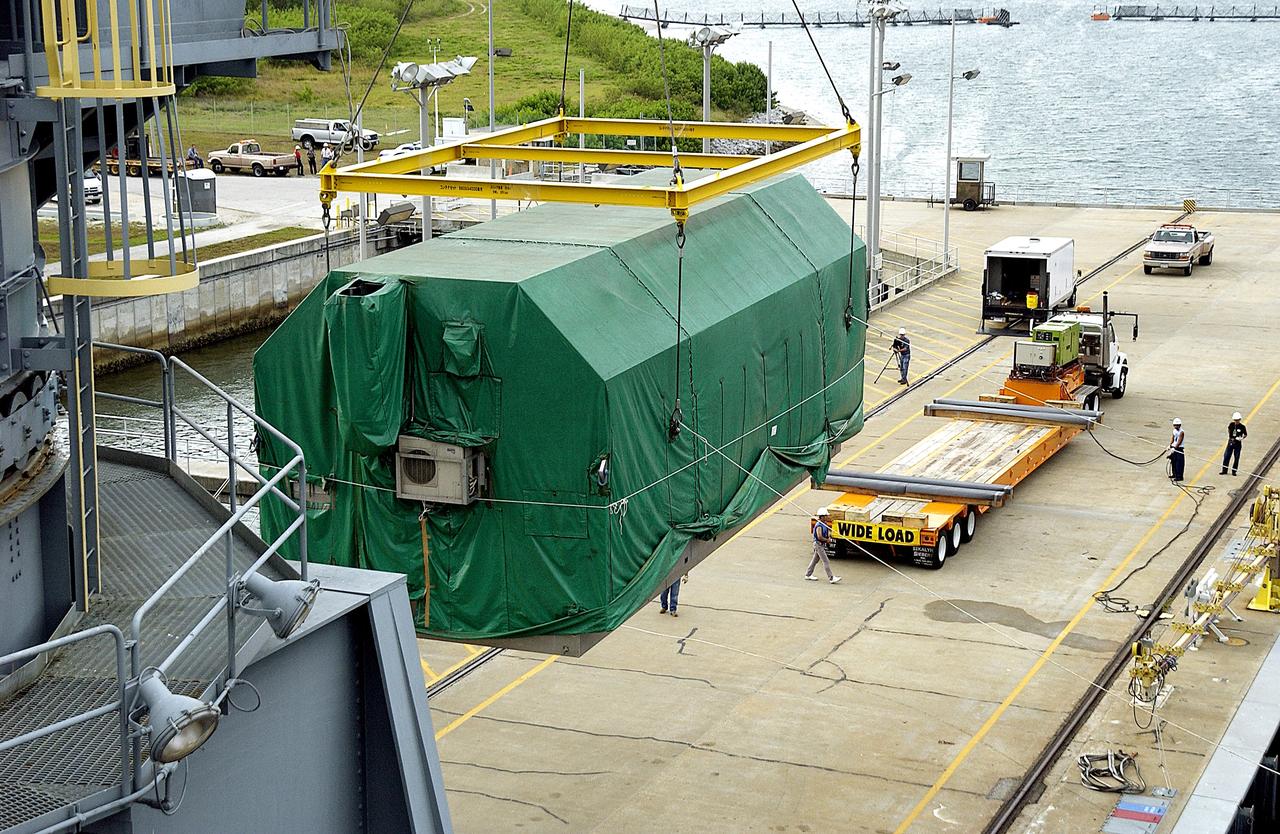
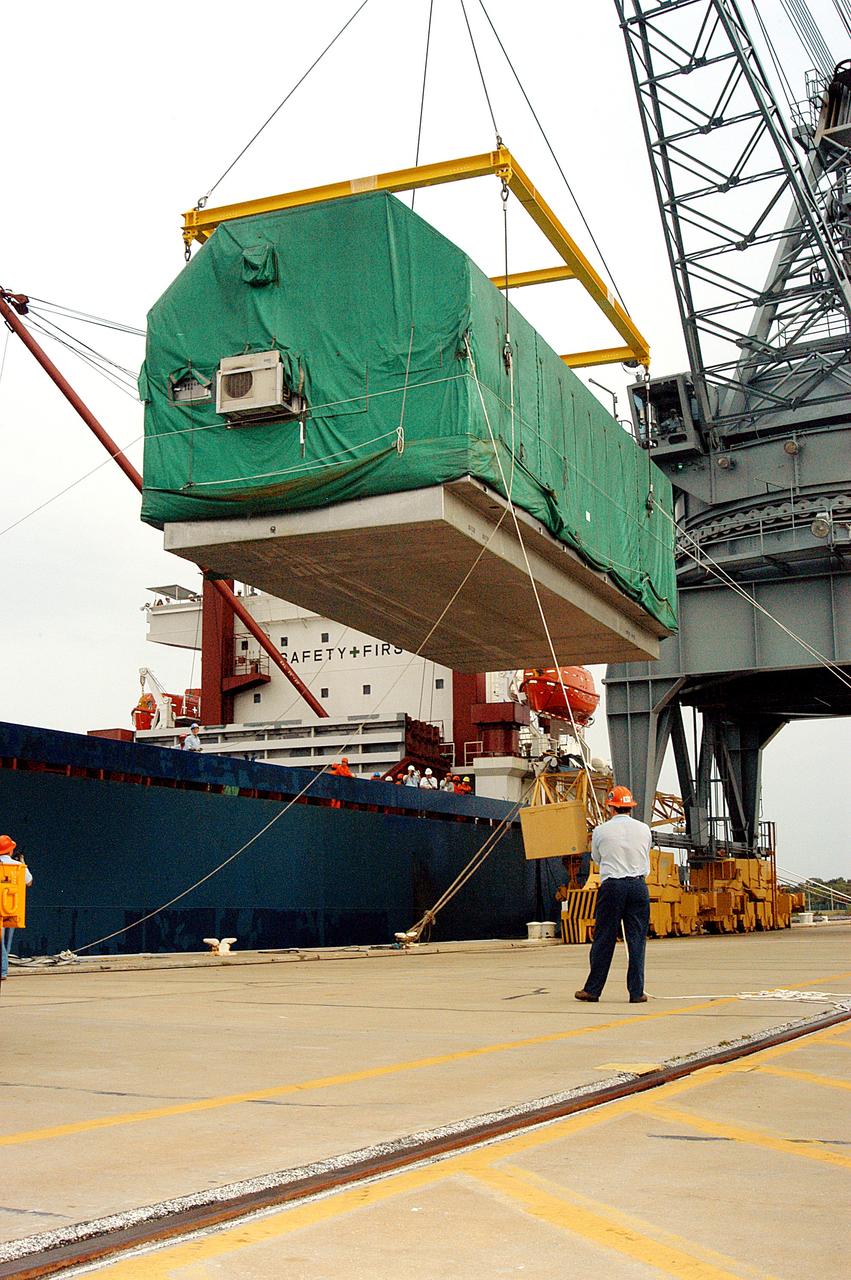
KENNEDY SPACE CENTER, FLA. - At Port Canaveral, the Pressurized Module of the Japanese Experiment Module (JEM) is suspended over the dock, waiting for a truck that will transfer it to KSC’s Space Station Processing Facility. The container transport ship carrying JEM departed May 2 from Yokohama Harbor in Japan for the voyage to the United States. The National Space Development Agency of Japan (NASDA) developed the laboratory at the Tsukuba Space Center near Tokyo.  The Pressurized Module is the first element of the JEM, named "Kibo" (Hope), to be delivered to KSC. The JEM is Japan's primary contribution to the Station. It will enhance the unique research capabilities of the orbiting complex by providing an additional environment for astronauts to conduct science experiments.  The JEM also includes an exposed facility (platform) for space environment experiments, a robotic manipulator system, and two logistics modules. The various JEM components will be  assembled in space over the course of three Shuttle missions.
KENNEDY SPACE CENTER, FLA. - At Port Canaveral, the Pressurized Module of the Japanese Experiment Module (JEM) is suspended over the dock, waiting for a truck that will transfer it to KSC’s Space Station Processing Facility. The container transport ship carrying JEM departed May 2 from Yokohama Harbor in Japan for the voyage to the United States. The National Space Development Agency of Japan (NASDA) developed the laboratory at the Tsukuba Space Center near Tokyo. The Pressurized Module is the first element of the JEM, named "Kibo" (Hope), to be delivered to KSC. The JEM is Japan's primary contribution to the Station. It will enhance the unique research capabilities of the orbiting complex by providing an additional environment for astronauts to conduct science experiments. The JEM also includes an exposed facility (platform) for space environment experiments, a robotic manipulator system, and two logistics modules. The various JEM components will be assembled in space over the course of three Shuttle missions.
KENNEDY SPACE CENTER, FLA. -   Workers in the Space Station Processing Facility prepare to remove the lid of the container with the Japanese Experiment Module (JEM) pressure module inside. A research laboratory, the pressurized module is the first element of the JEM, named "Kibo" (Hope), to be delivered to KSC.   The National Space Development Agency of Japan (NASDA) developed the laboratory at the Tsukuba Space Center near Tokyo and is Japan's primary contribution to the Station. It will enhance the unique research capabilities of the orbiting complex by providing an additional environment for astronauts to conduct science experiments.  The JEM also includes an exposed facility (platform) for space environment experiments, a robotic manipulator system, and two logistics modules. The various JEM components will be  assembled in space over the course of three Shuttle missions.
KENNEDY SPACE CENTER, FLA. - Workers in the Space Station Processing Facility prepare to remove the lid of the container with the Japanese Experiment Module (JEM) pressure module inside. A research laboratory, the pressurized module is the first element of the JEM, named "Kibo" (Hope), to be delivered to KSC. The National Space Development Agency of Japan (NASDA) developed the laboratory at the Tsukuba Space Center near Tokyo and is Japan's primary contribution to the Station. It will enhance the unique research capabilities of the orbiting complex by providing an additional environment for astronauts to conduct science experiments. The JEM also includes an exposed facility (platform) for space environment experiments, a robotic manipulator system, and two logistics modules. The various JEM components will be assembled in space over the course of three Shuttle missions.
KENNEDY SPACE CENTER, FLA. - At Port Canaveral, the Pressurized Module of the Japanese Experiment Module (JEM) is lifted out of the ship’s cargo hold.  The container transport ship carrying JEM departed May 2 from Yokohama Harbor in Japan for the voyage to the United States. The National Space Development Agency of Japan (NASDA) developed the laboratory at the Tsukuba Space Center near Tokyo. The Pressurized Module is the first element of the JEM, named "Kibo" (Hope), to be delivered to KSC. The JEM is Japan's primary contribution to the Station. It will enhance the unique research capabilities of the orbiting complex by providing an additional environment for astronauts to conduct science experiments.  The JEM also includes an exposed facility (platform) for space environment experiments, a robotic manipulator system, and two logistics modules. The various JEM components will be  assembled in space over the course of three Shuttle missions.
KENNEDY SPACE CENTER, FLA. - At Port Canaveral, the Pressurized Module of the Japanese Experiment Module (JEM) is lifted out of the ship’s cargo hold. The container transport ship carrying JEM departed May 2 from Yokohama Harbor in Japan for the voyage to the United States. The National Space Development Agency of Japan (NASDA) developed the laboratory at the Tsukuba Space Center near Tokyo. The Pressurized Module is the first element of the JEM, named "Kibo" (Hope), to be delivered to KSC. The JEM is Japan's primary contribution to the Station. It will enhance the unique research capabilities of the orbiting complex by providing an additional environment for astronauts to conduct science experiments. The JEM also includes an exposed facility (platform) for space environment experiments, a robotic manipulator system, and two logistics modules. The various JEM components will be assembled in space over the course of three Shuttle missions.
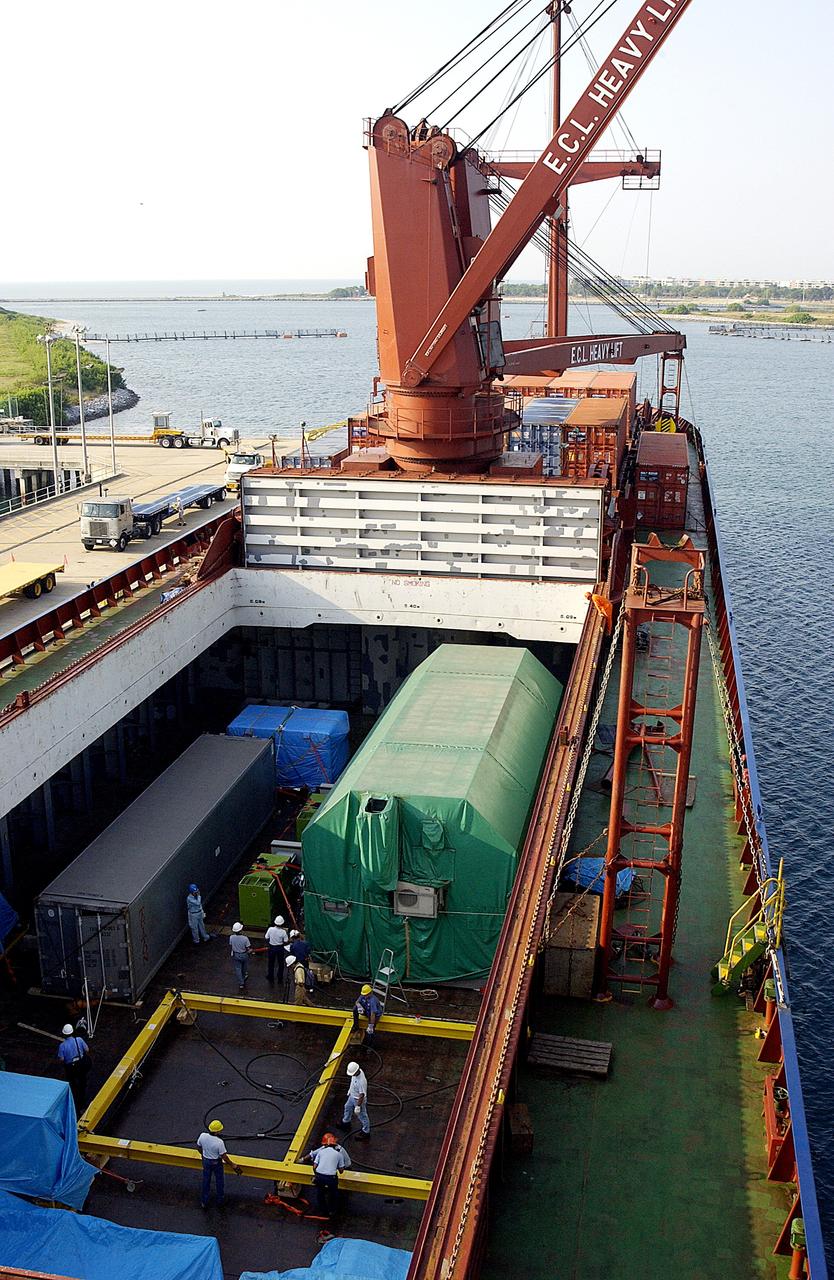
KENNEDY SPACE CENTER, FLA. - The Japanese Experiment Module (JEM) Pressurized Module is ready to be offloaded from the ship that carried it from Japan.  The National Space Development Agency of Japan (NASDA) built the laboratory at the Tsukuba Space Center near Tokyo.  The Pressurized Module is the first element of the JEM, Japan’s primary contribution to the space station, to be delivered to KSC. It will enhance the unique research capabilities of the orbiting complex by providing an additional shirt-sleeve environment for astronauts to conduct science experiments. The JEM also includes two logistics modules, an exposed pallet for space environment experiments and a robotic manipulator system that are still under construction in Japan. The various JEM components will be assembled in space over the course of three space shuttle missions.
KENNEDY SPACE CENTER, FLA. - The Japanese Experiment Module (JEM) Pressurized Module is ready to be offloaded from the ship that carried it from Japan. The National Space Development Agency of Japan (NASDA) built the laboratory at the Tsukuba Space Center near Tokyo. The Pressurized Module is the first element of the JEM, Japan’s primary contribution to the space station, to be delivered to KSC. It will enhance the unique research capabilities of the orbiting complex by providing an additional shirt-sleeve environment for astronauts to conduct science experiments. The JEM also includes two logistics modules, an exposed pallet for space environment experiments and a robotic manipulator system that are still under construction in Japan. The various JEM components will be assembled in space over the course of three space shuttle missions.
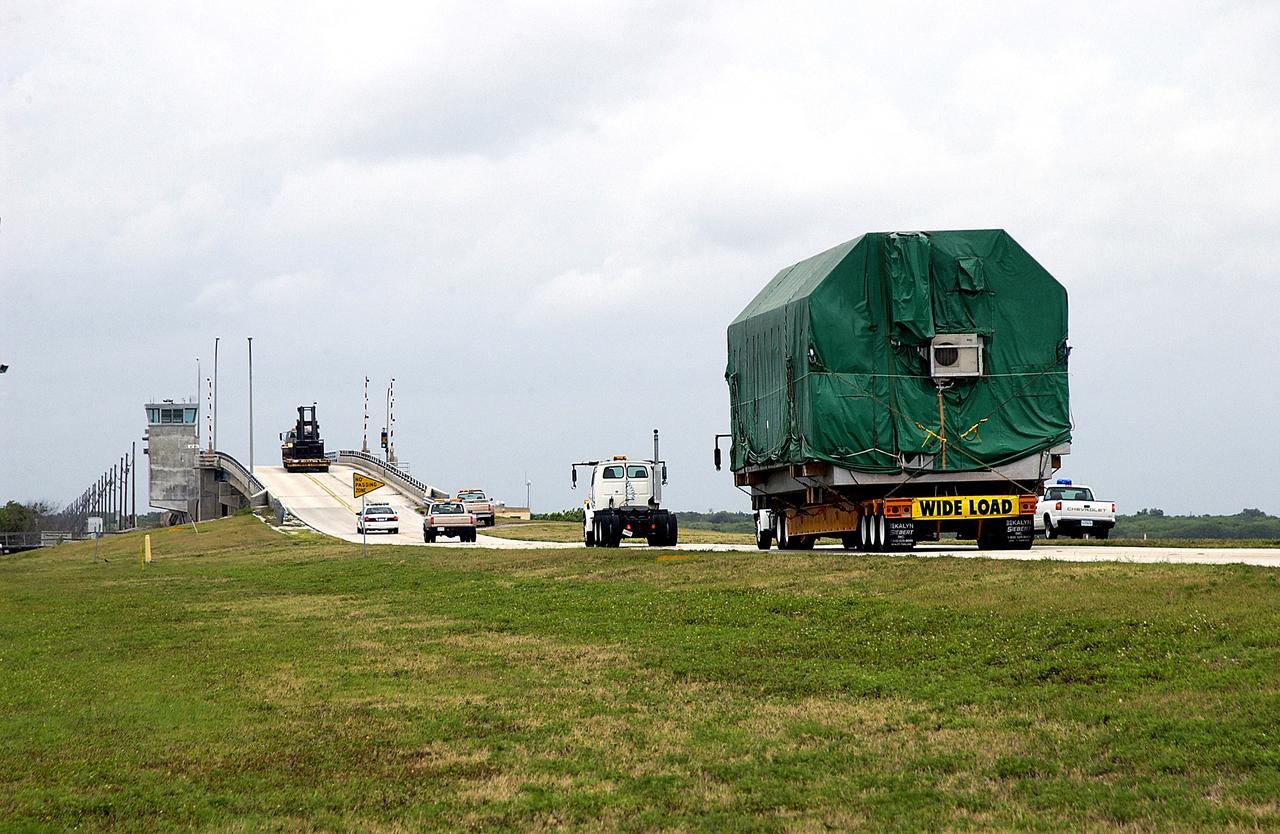
KENNEDY SPACE CENTER, FLA. - A convoy accompanies the truck transporting the Pressurized Module of the Japanese Experiment Module (JEM) to KSC’s Space Station Processing Facility.  The National Space Development Agency of Japan (NASDA) developed the laboratory at the Tsukuba Space Center near Tokyo. The Pressurized Module is the first element of the JEM, named "Kibo" (Hope), to be delivered to KSC.  The JEM is Japan's primary contribution to the Station. It will enhance the unique research capabilities of the orbiting complex by providing an additional environment for astronauts to conduct science experiments.  The JEM also includes an exposed facility (platform) for space environment experiments, a robotic manipulator system, and two logistics modules. The various JEM components will be  assembled in space over the course of three Shuttle missions.
KENNEDY SPACE CENTER, FLA. - A convoy accompanies the truck transporting the Pressurized Module of the Japanese Experiment Module (JEM) to KSC’s Space Station Processing Facility. The National Space Development Agency of Japan (NASDA) developed the laboratory at the Tsukuba Space Center near Tokyo. The Pressurized Module is the first element of the JEM, named "Kibo" (Hope), to be delivered to KSC. The JEM is Japan's primary contribution to the Station. It will enhance the unique research capabilities of the orbiting complex by providing an additional environment for astronauts to conduct science experiments. The JEM also includes an exposed facility (platform) for space environment experiments, a robotic manipulator system, and two logistics modules. The various JEM components will be assembled in space over the course of three Shuttle missions.