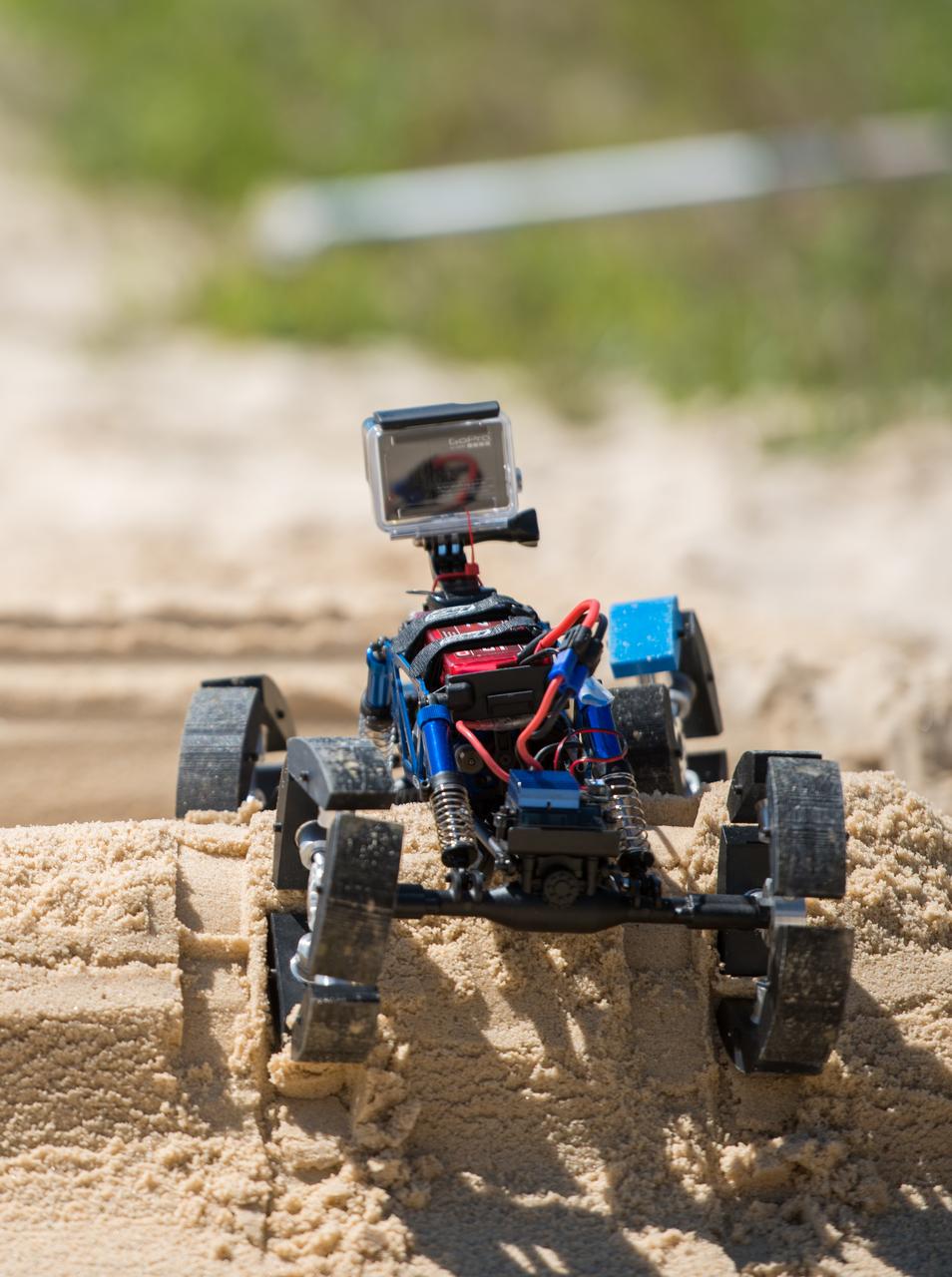
Toledo, Bowser and Scott High School Students, Mars and Moon Wheel, Engineering Design Project, Hardware Test on the Dunes
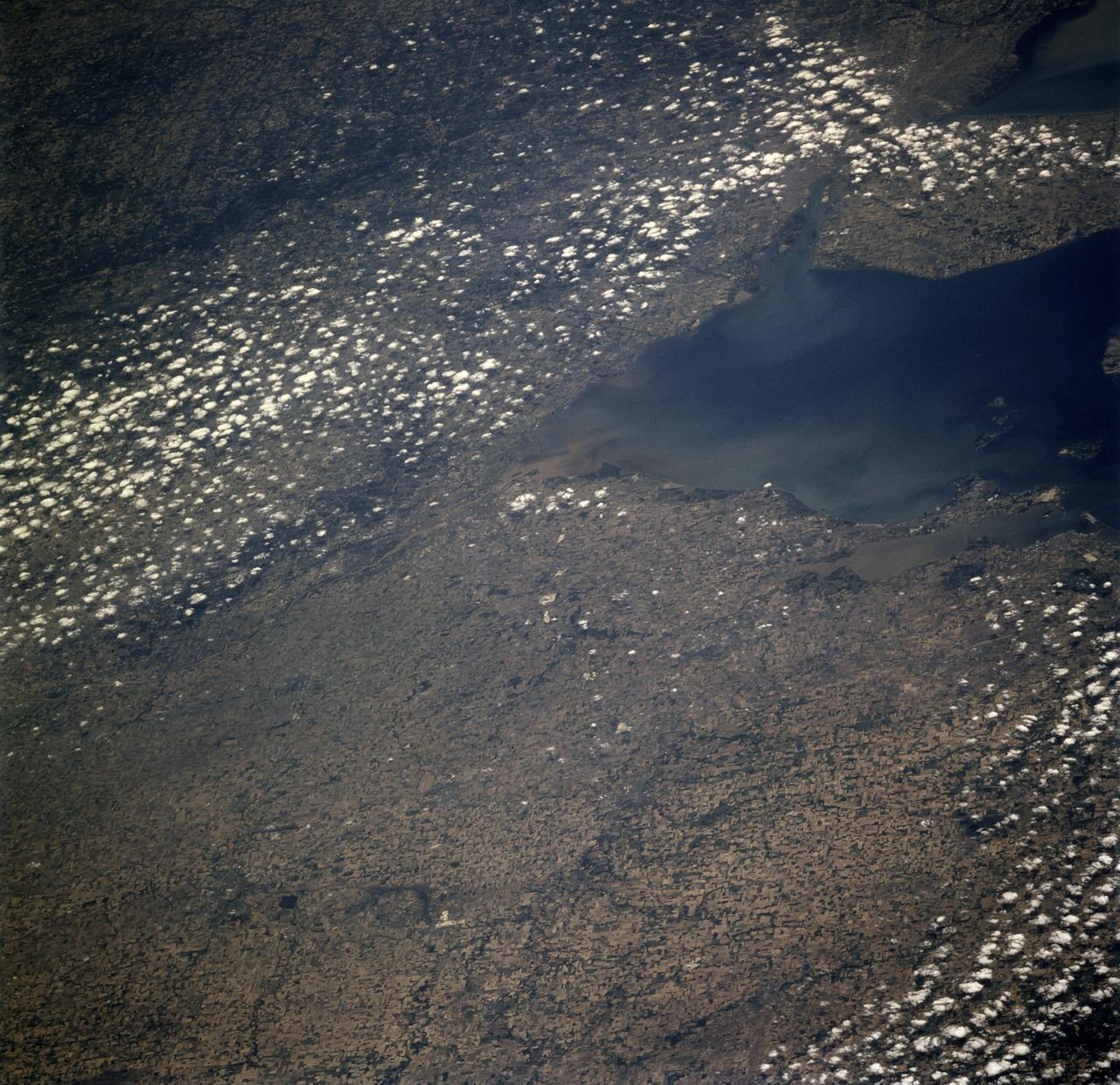
STS078-726-000A (20 June - 7 July 1996) --- Though the Space Shuttle program has been ongoing since 1981, few pictures have been taken from Earth-orbit that show the Toledo area featured in this 70mm frame from the STS-78/LMS-1 mission. The muddy Maumee River flows through Toledo into the west end of Lake Erie. Toledo is the seat (1835) of Lucas county, northwestern Ohio, and is a principal Great Lakes port, being the hub of a metropolitan complex that includes Ottawa Hills, Maumee, Oregon, Sylvania, Perrysburg, and Rossford. Fort Industry (1803-05) was located at the mouth of Swan Creek (now downtown Toledo), where permanent settlement was made after the War of 1812. Two villages, Port Lawrence (1817) and Vistula (1832), were consolidated in 1833 and named for Toledo, Spain. The united community was incorporated as a city in 1837. Its population in 1990 was 332,943. There are many smaller Ohio cities in the photo including Bowling Green, Findlay, Tiffin, Fremont, Fostoria, and Sandusky (right edge).
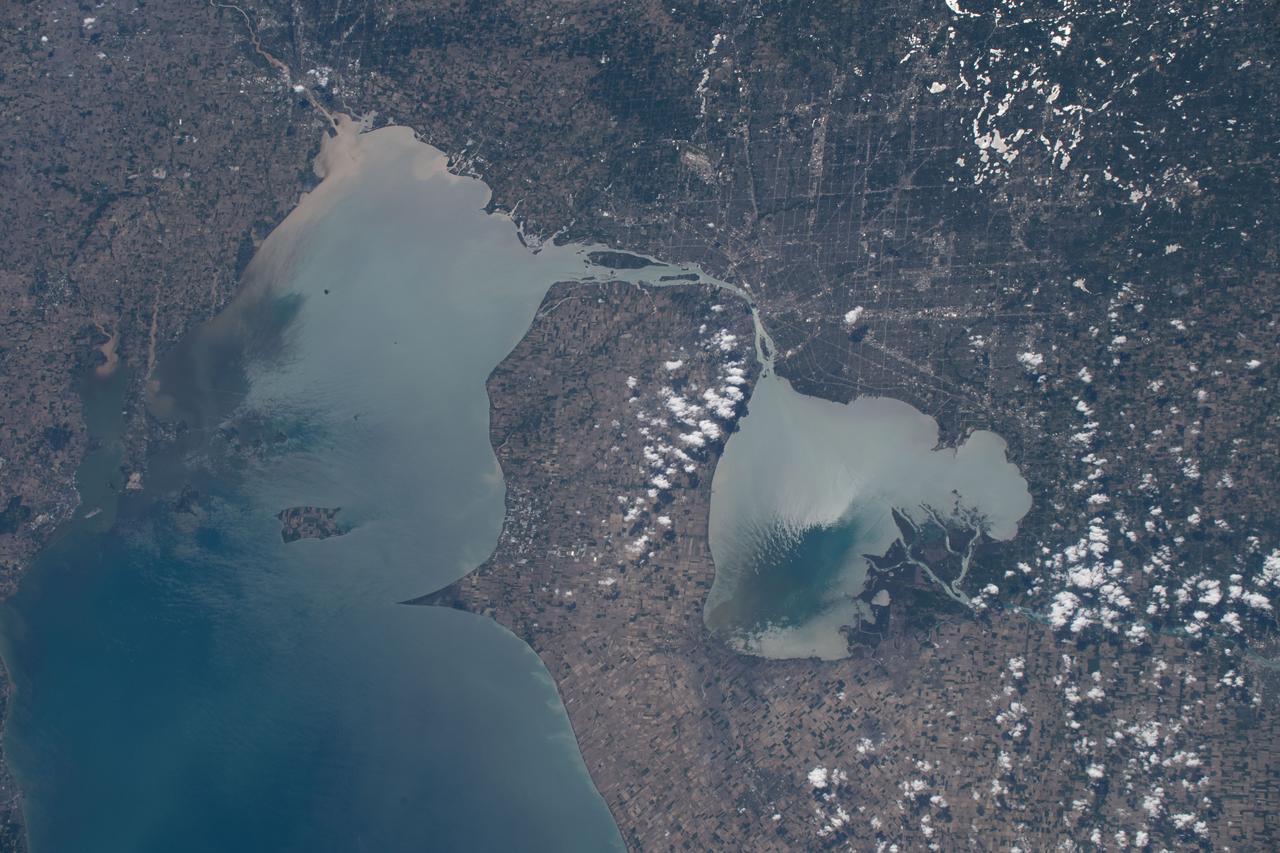
iss059e090279 (June 3, 2019) --- Lakes Erie and St. Clair and the cities of Detroit, Michigan and Toledo, Ohio are pictured as the International Space Station orbited 257 miles over North America.

SL2-05-390 (22 June 1973) --- Greater Detroit (42.0N, 82.5W) is located at the southeastern border of Michigan on the Detroit River across from Windsor, Ontario, Canada and Lake Huron to the north. The river connecting Lake Erie is a channel left over from the Ice Age Glaciers. The land use pattern in this scene is typical of this part of the upper Midwest. The once extensive forests have been cleared for farmland and pasture, but narrow rows of trees still line farm boundaries. Photo credit: NASA
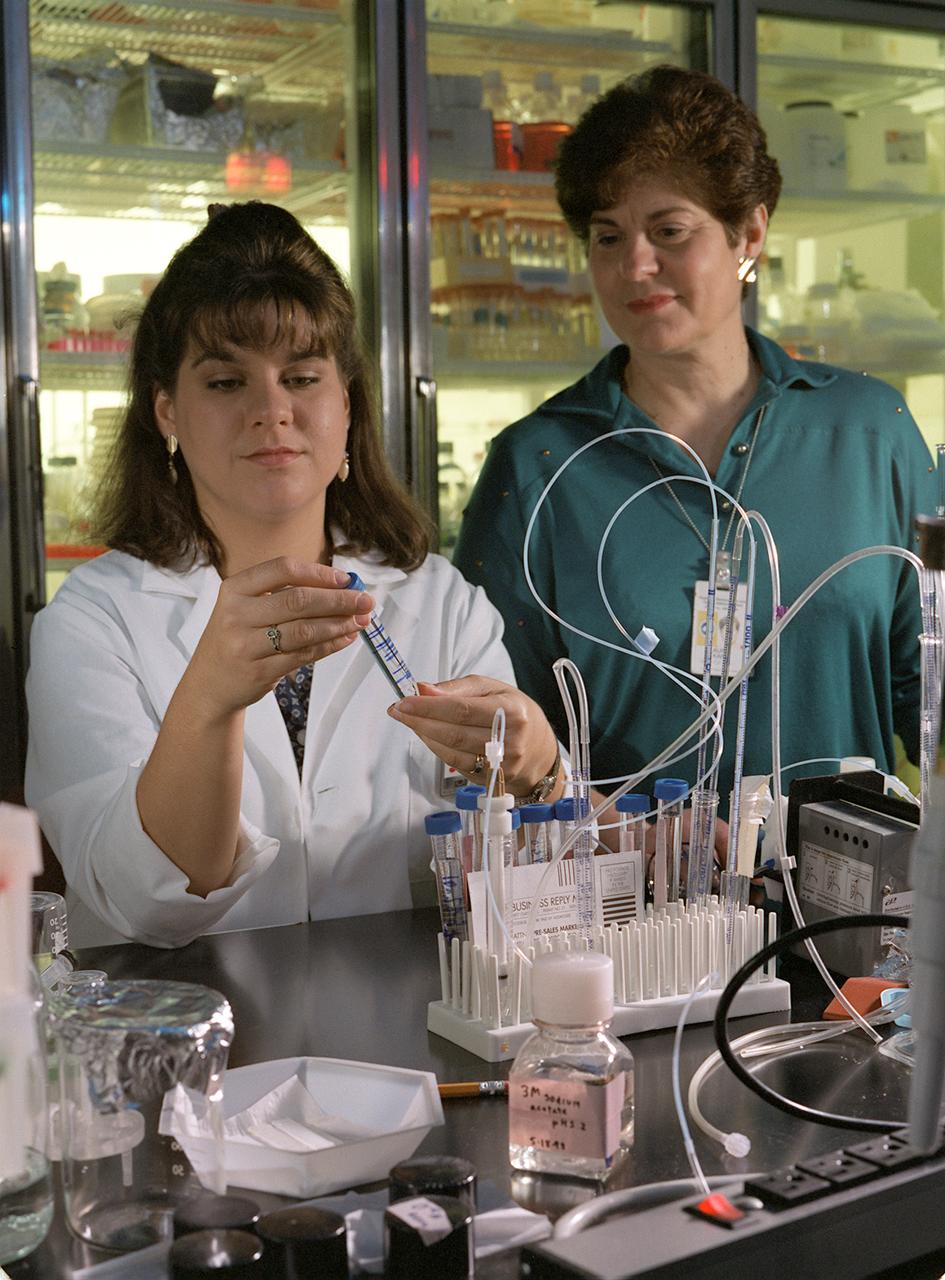
Lisa Crawford, a graduate research assistant from the University of Toledo, works with Laurel Karr of Marshall Space Flight Center (MSFC) in the molecular biology laboratory. They are donducting genetic manipulation of bacteria and yeast for the production of large amount of desired protein. Photo credit: NASA/Marshall Space Flight Center (MSFC)
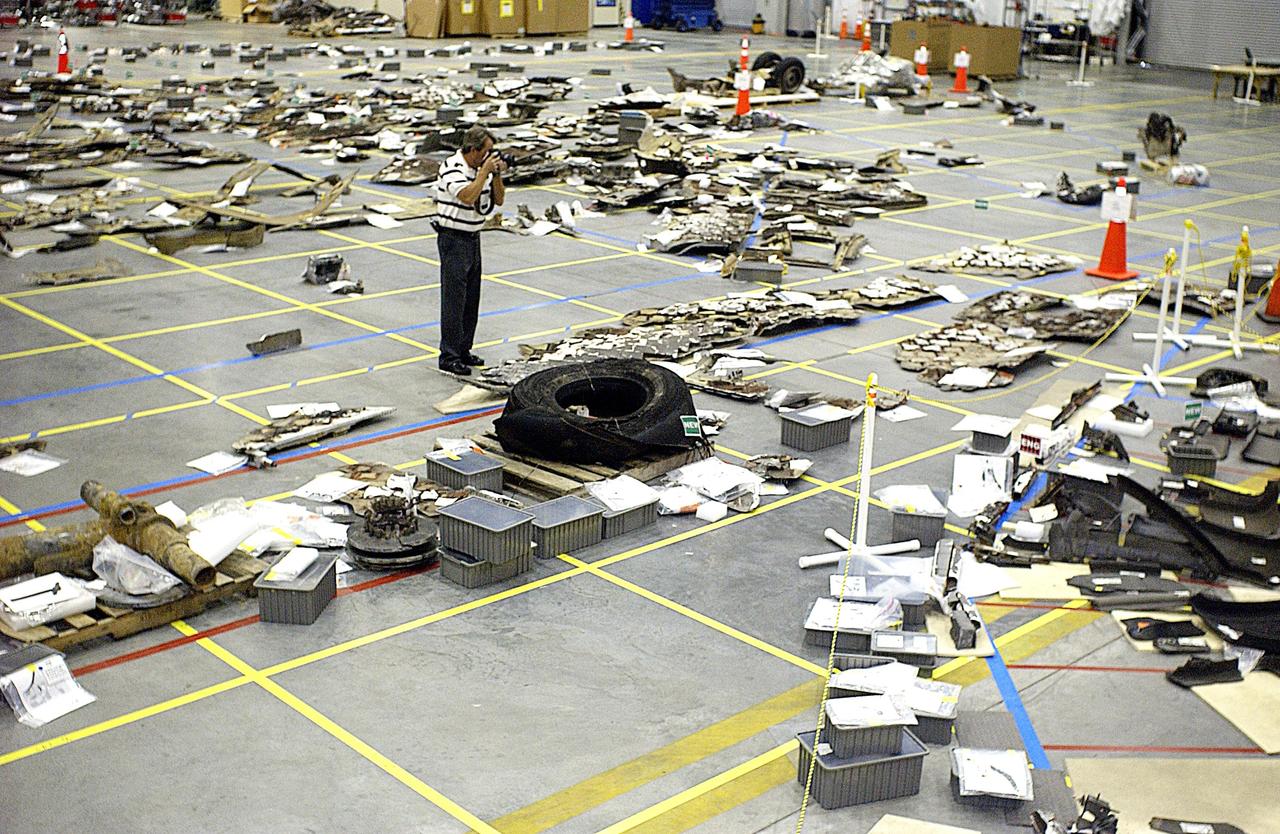
KENNEDY SPACE CENTER, FLA. - Pieces of Columbia debris are photographed by a KSC photographer. More than 70,000 items, weighing 78,000 pounds, about 36 percent of the Shuttle by weight, have been delivered to KSC for use in the mishap investigation. Ground teams have completed 78 percent of their primary search area, and airborne crews finished 80 percent of their assigned area. Search teams have completed 98 percent of the underwater searches in Lake Nacogdoches and Toledo Bend Reservoir.
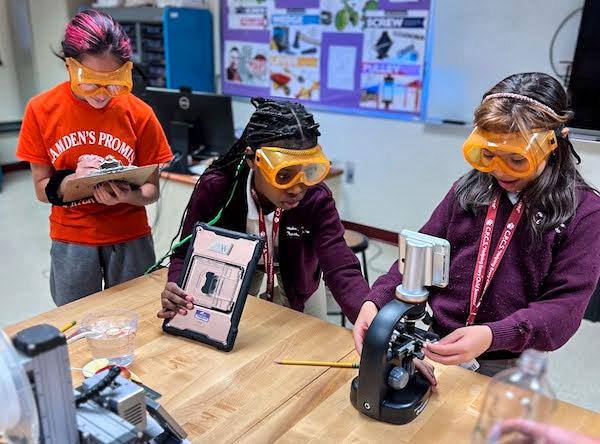
jsc2023e065186 (10/19/2023) --- Student researchers Inari Toledo (left), Sahara Miller (middle), and Siany Lee (right) work on their experiment on how microgravity effects mold growth, which will be included in the Nanoracks-National Center for Earth and Space Science Education-Orbiter-Student Spaceflight Experiments Program Mission 17 to ISS (Nanoracks-NCESSE-Orbiter-SSEP).
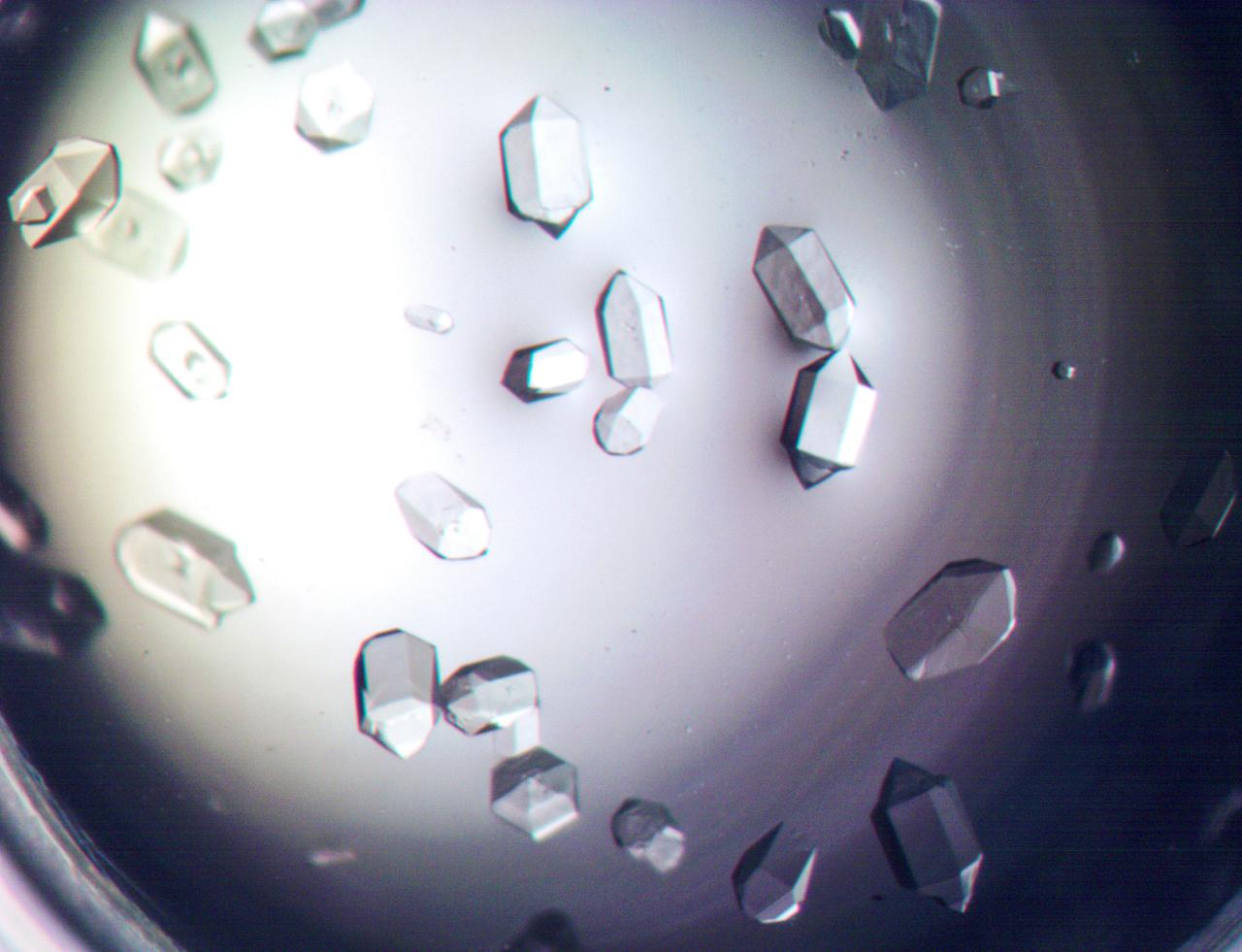
jsc2021e007777 - Aeropyrum pernix Flap Endonuclease-1 (FEN-1) protein crystals are shown grown under Earth gravity conditions. FEN-1 serves as the experimental protein for the Phase II Real-time Protein Crystal Growth on Board the International Space Station (Real-Time Protein Crystal Growth-2) investigation. Image courtesy of University of Toledo.
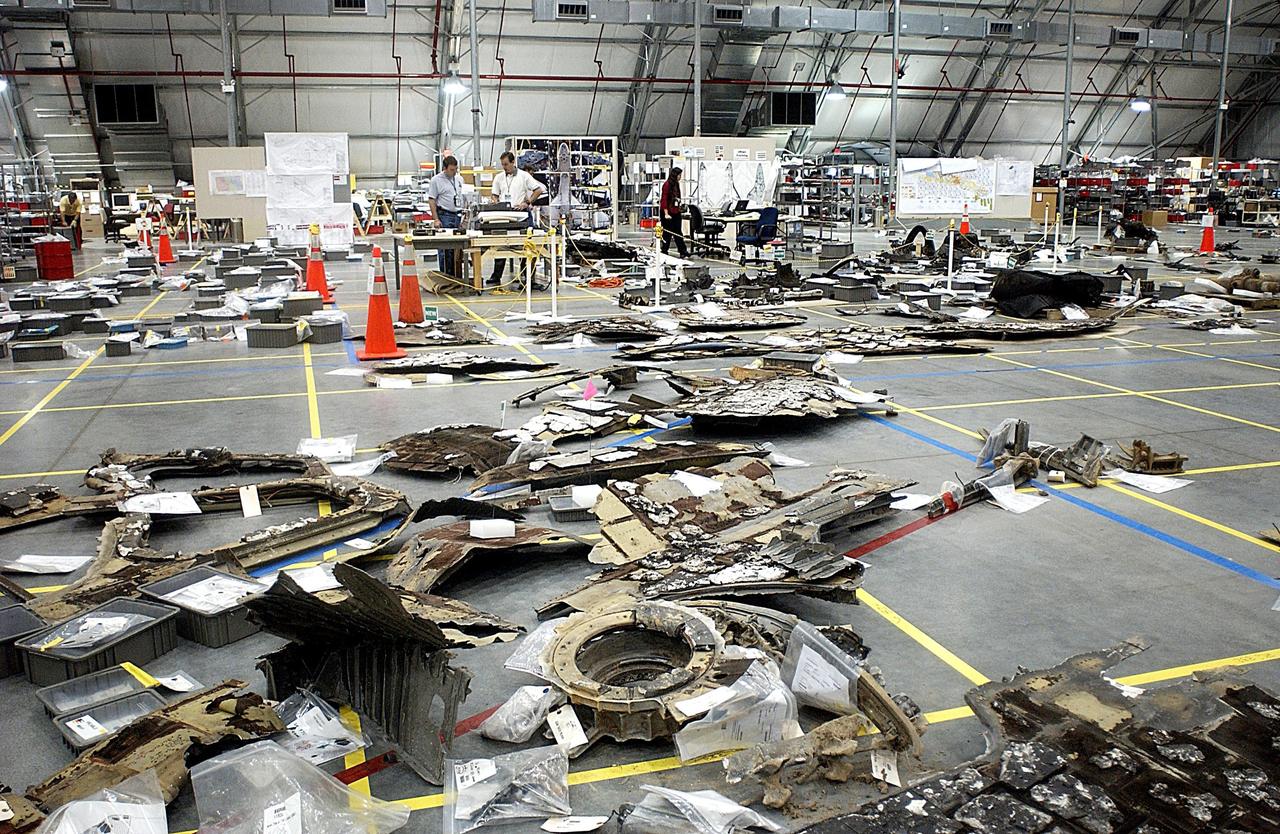
KENNEDY SPACE CENTER, FLA. -- The floor of the KSC RLV Hangar is filled with pieces of Columbia debris gathered by search teams and shipped from Barksdale Air Force Base, Shreveport, La. Ground teams have completed 78 percent of their primary search area, and airborne crews finished 80 percent of their assigned area. More than 70,000 items, weighing 78,000 pounds, about 36 percent of the Shuttle by weight, have been delivered to KSC for use in the mishap investigation. Search teams have completed 98 percent of the underwater searches in Lake Nacogdoches and Toledo Bend Reservoir.
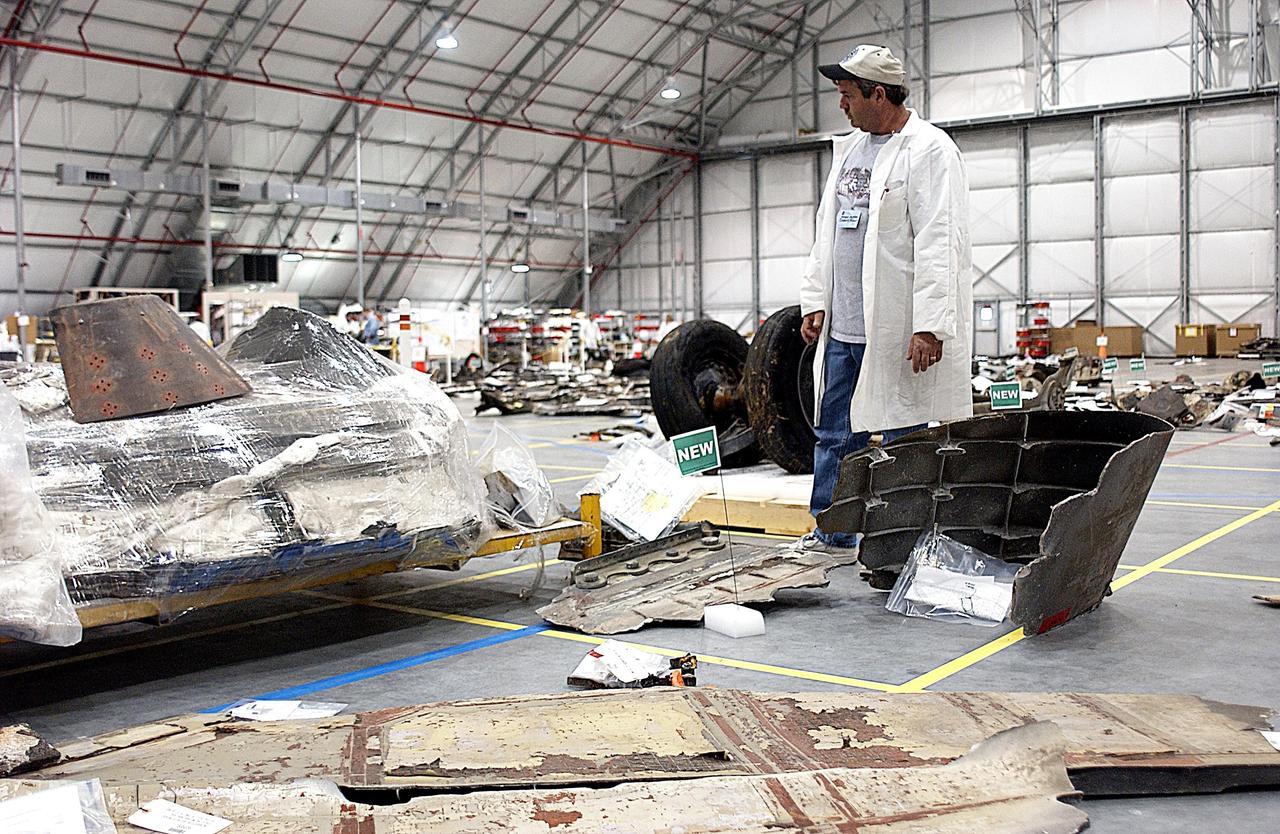
KENNEDY SPACE CENTER, FLA. -- A member of the Columbia Reconstruction Project Team looks over pieces of debris on the floor of the KSC RLV Hangar. Shipped from Barksdale Air Force Base, Shreveport, La., more than 70,000 items, weighing 78,000 pounds, about 36 percent of the Shuttle by weight, have been delivered to KSC for use in the mishap investigation. Ground teams have completed 78 percent of their primary search area, and airborne crews finished 80 percent of their assigned area. Search teams have completed 98 percent of the underwater searches in Lake Nacogdoches and Toledo Bend Reservoir.

KENNEDY SPACE CENTER, FLA. - The floor of the KSC RLV Hangar is filled with pieces of Columbia debris gathered by search teams and shipped from Barksdale Air Force Base, Shreveport, La. Ground teams have completed 78 percent of their primary search area, and airborne crews finished 80 percent of their assigned area. More than 70,000 items, weighing 78,000 pounds, about 36 percent of the Shuttle by weight, have been delivered to KSC for use in the mishap investigation. Search teams have completed 98 percent of the underwater searches in Lake Nacogdoches and Toledo Bend Reservoir.
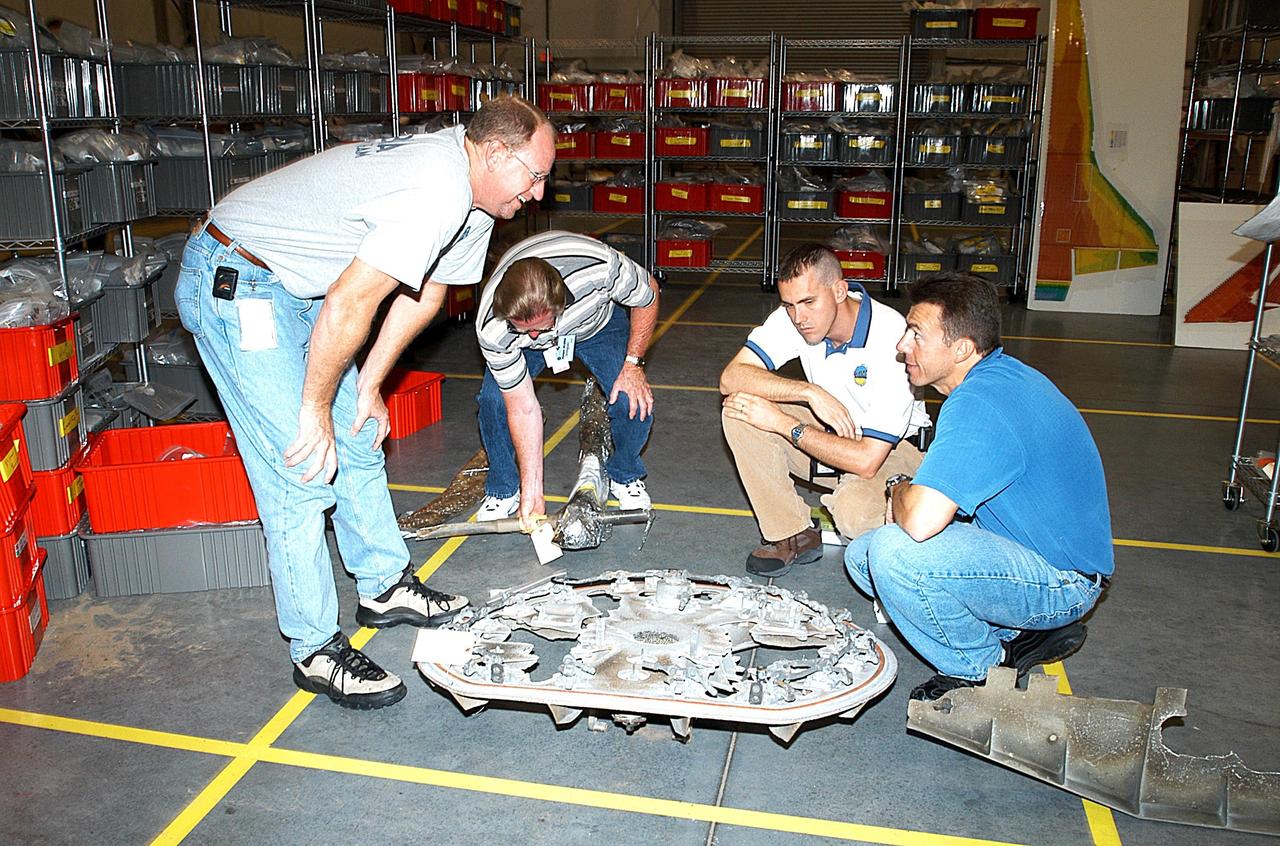
KENNEDY SPACE CENTER, FLA. -- Members of the Columbia Reconstruction Project team examine pieces of Columbia debris delivered to the RLV Hangar. Shipped from Barksdale Air Force Base, Shreveport, La., more than 70,000 items, weighing 78,000 pounds, about 36 percent of the Shuttle by weight, have been delivered to KSC for use in the mishap investigation. Ground teams have completed 78 percent of their primary search area, and airborne crews finished 80 percent of their assigned area. Search teams have completed 98 percent of the underwater searches in Lake Nacogdoches and Toledo Bend Reservoir.
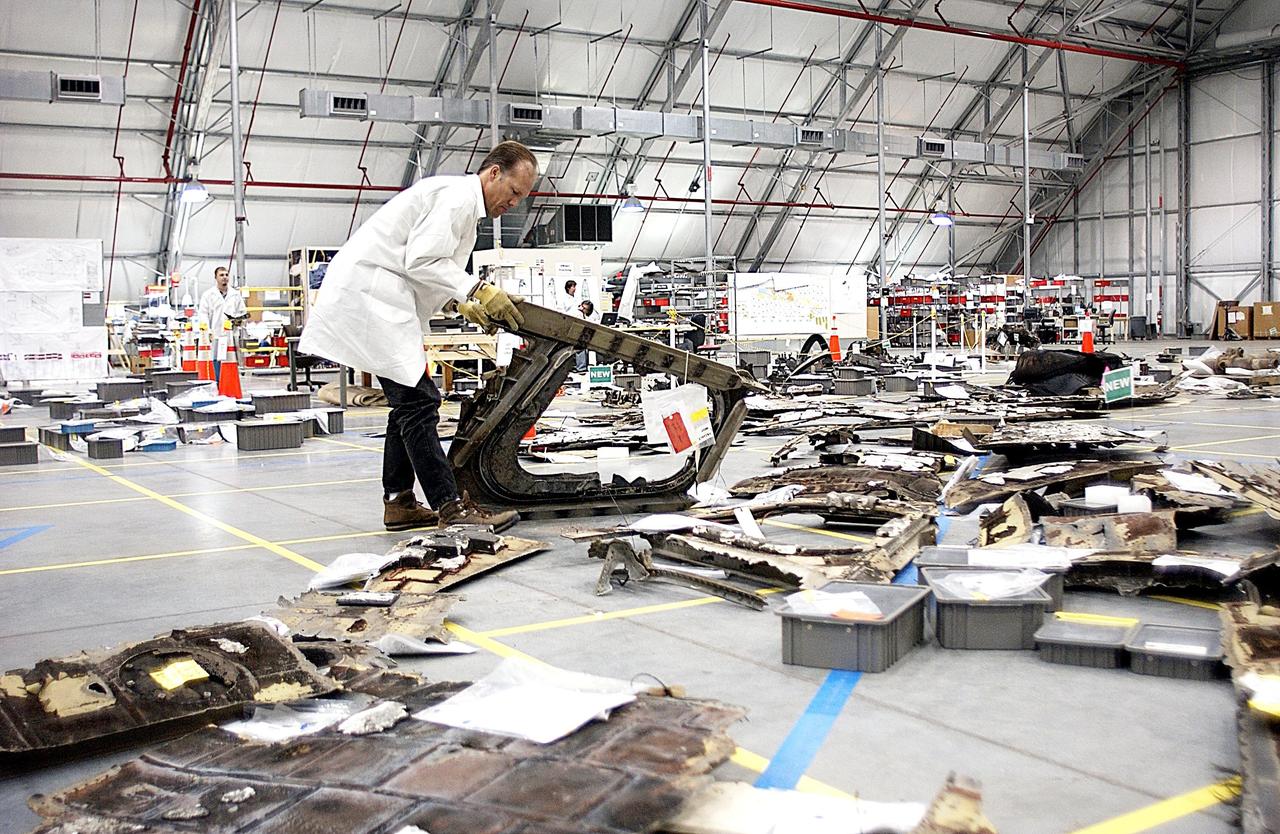
KENNEDY SPACE CENTER, FLA. -- A member of the Columbia Reconstruction Project Team examines a piece of Columbia debris on the floor of the KSC RLV Hangar. Shipped from Barksdale Air Force Base, Shreveport, La., more than 70,000 items, weighing 78,000 pounds, about 36 percent of the Shuttle by weight, have been delivered to KSC for use in the mishap investigation. Ground teams have completed 78 percent of their primary search area, and airborne crews finished 80 percent of their assigned area. Search teams have completed 98 percent of the underwater searches in Lake Nacogdoches and Toledo Bend Reservoir.
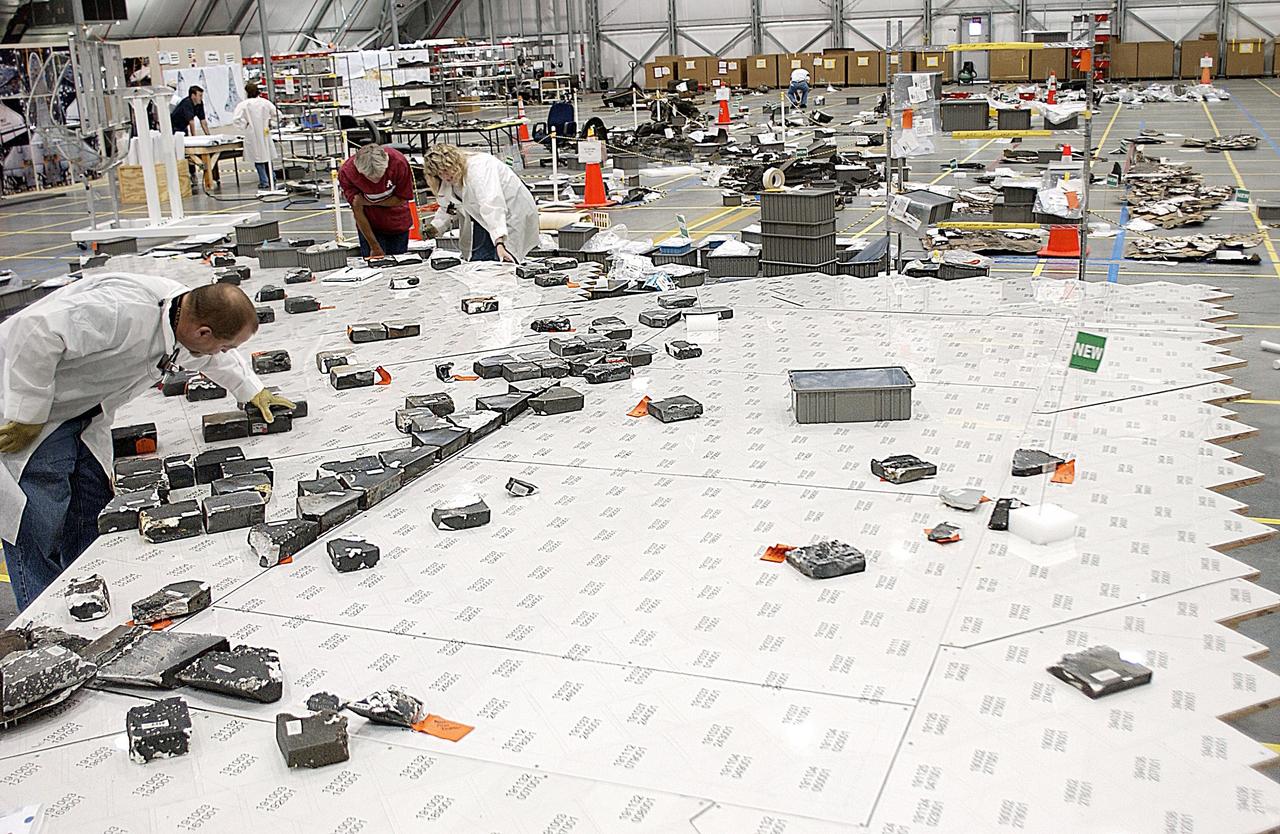
KENNEDY SPACE CENTER, FLA. -- In the RLV Hangar, members of the Columbia Reconstruction Project team place recovered Thermal Protection System (TPS) tile on a tabletop mock-up of the wing of Columbia. Shipped from Barksdale Air Force Base, Shreveport, La., more than 70,000 items, weighing 78,000 pounds, about 36 percent of the Shuttle by weight, have been delivered to KSC for use in the mishap investigation. Ground teams have completed 78 percent of their primary search area, and airborne crews finished 80 percent of their assigned area. Search teams have completed 98 percent of the underwater searches in Lake Nacogdoches and Toledo Bend Reservoir.
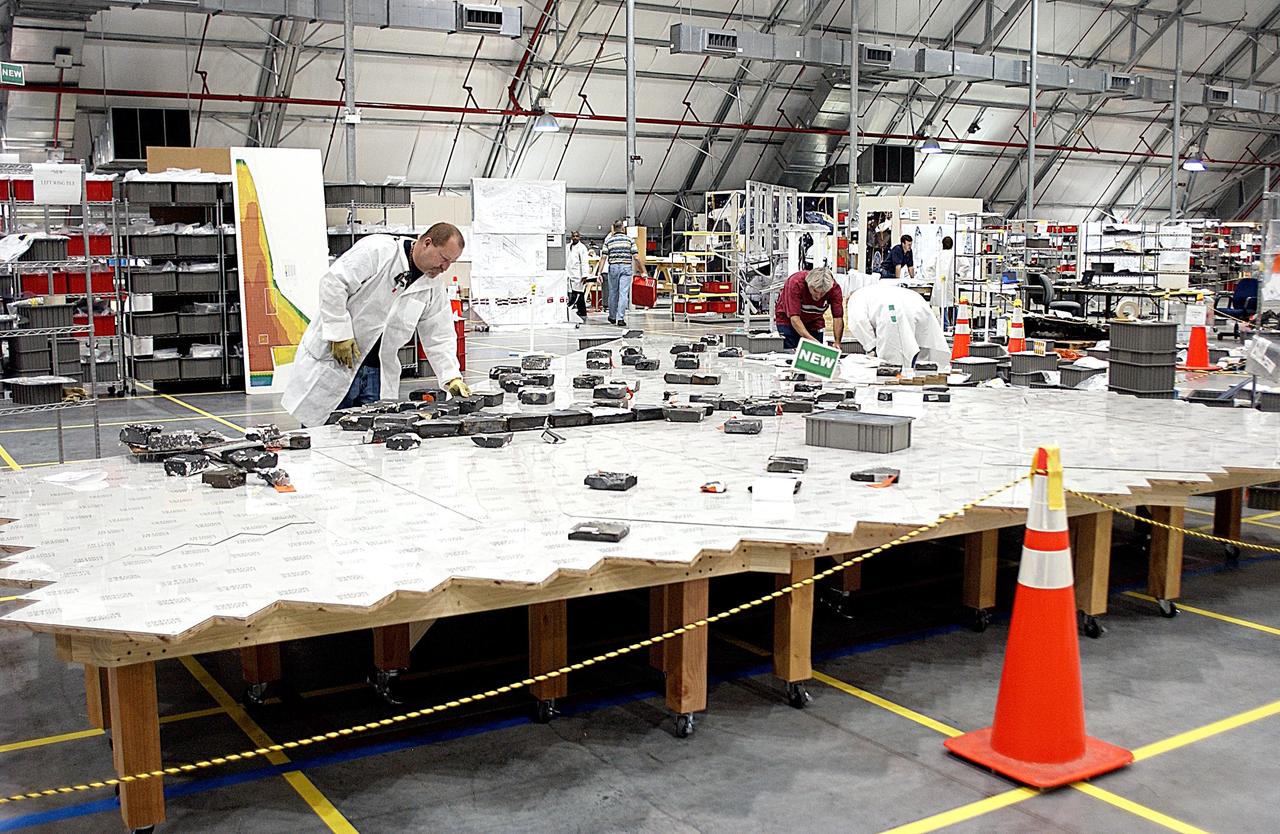
KENNEDY SPACE CENTER, FLA. -- In the RLV Hangar, members of the Columbia Reconstruction Project team place recovered Thermal Protection System (TPS) tile on a tabletop mock-up of the wing of Columbia. Shipped from Barksdale Air Force Base, Shreveport, La., more than 70,000 items, weighing 78,000 pounds, about 36 percent of the Shuttle by weight, have been delivered to KSC for use in the mishap investigation. Ground teams have completed 78 percent of their primary search area, and airborne crews finished 80 percent of their assigned area. Search teams have completed 98 percent of the underwater searches in Lake Nacogdoches and Toledo Bend Reservoir.

KENNEDY SPACE CENTER, FLA. -- In the RLV Hangar, members of the Columbia Reconstruction Project team examine the fixture which will hold the recovered leading edge panels from the left wing of Space Shuttle Columbia. Shipped from Barksdale Air Force Base, Shreveport, La., more than 70,000 items, weighing 78,000 pounds, about 36 percent of the Shuttle by weight, have been delivered to KSC for use in the mishap investigation. Ground teams have completed 78 percent of their primary search area, and airborne crews finished 80 percent of their assigned area. Search teams have completed 98 percent of the underwater searches in Lake Nacogdoches and Toledo Bend Reservoir.
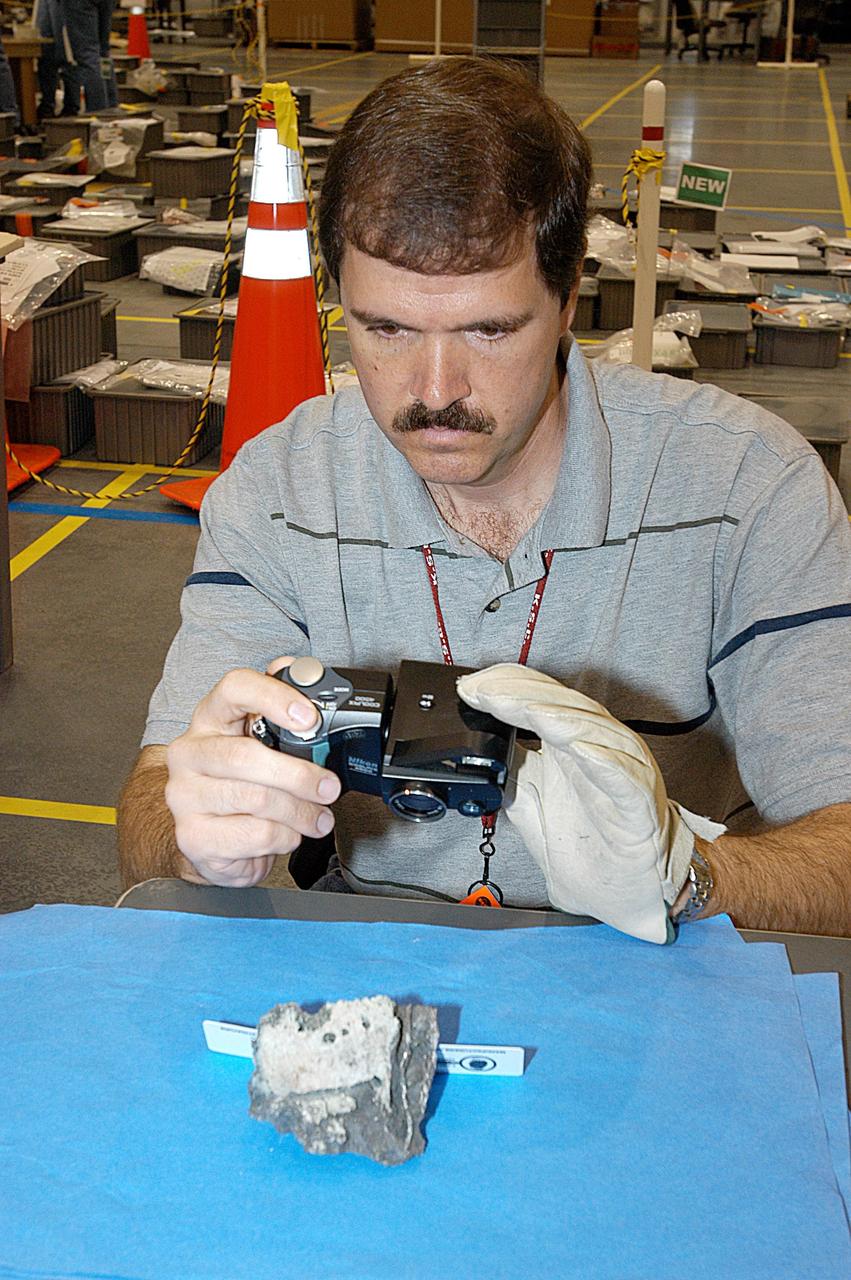
KENNEDY SPACE CENTER, FLA. -- A member of the Columbia Reconstruction Project team photographs a piece of Columbia debris delivered to the RLV Hangar. Shipped from Barksdale Air Force Base, Shreveport, La., more than 70,000 items, weighing 78,000 pounds, about 36 percent of the Shuttle by weight, have been delivered to KSC for use in the mishap investigation. Ground teams have completed 78 percent of their primary search area, and airborne crews finished 80 percent of their assigned area. Search teams have completed 98 percent of the underwater searches in Lake Nacogdoches and Toledo Bend Reservoir.
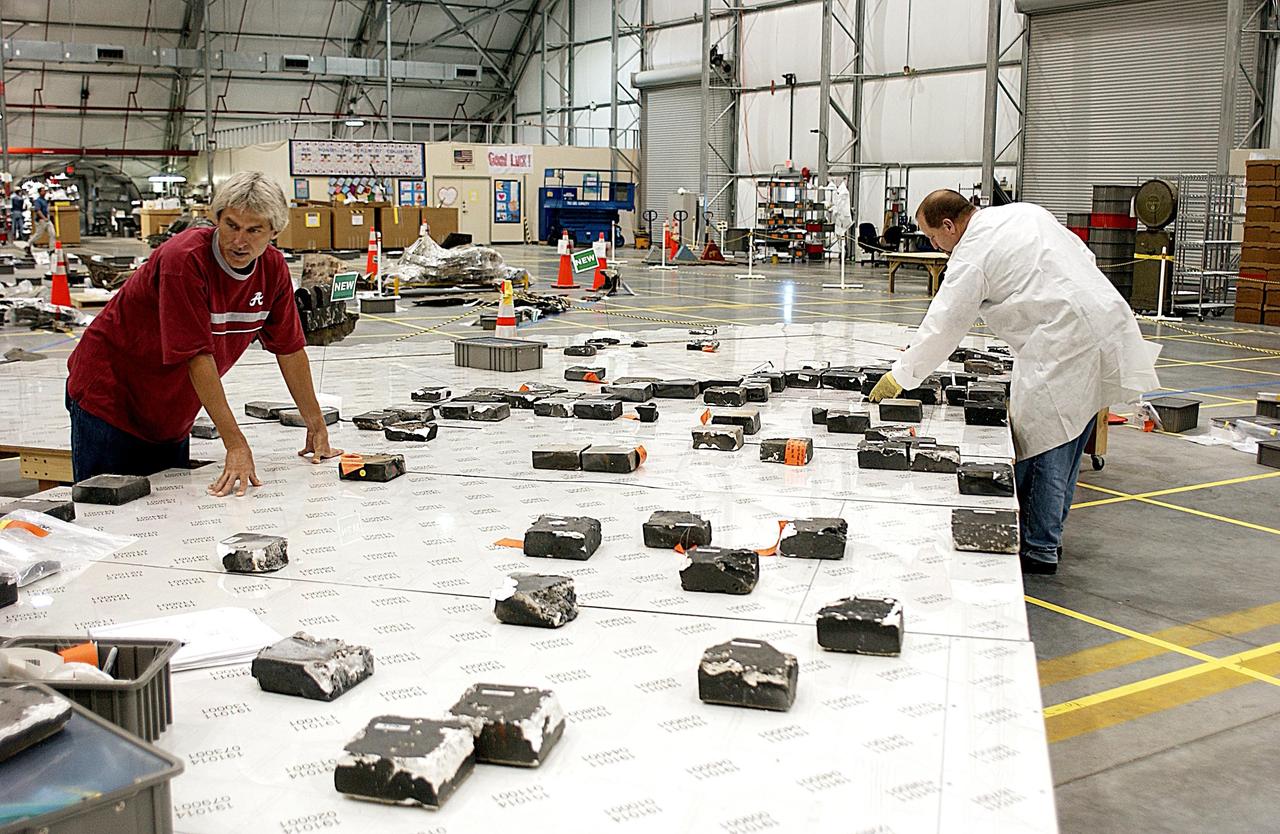
KENNEDY SPACE CENTER, FLA. -- In the RLV Hangar, members of the Columbia Reconstruction Project team place recovered Thermal Protection System (TPS) tile on a tabletop mock-up of the wing of Columbia. Shipped from Barksdale Air Force Base, Shreveport, La., more than 70,000 items, weighing 78,000 pounds, about 36 percent of the Shuttle by weight, have been delivered to KSC for use in the mishap investigation. Ground teams have completed 78 percent of their primary search area, and airborne crews finished 80 percent of their assigned area. Search teams have completed 98 percent of the underwater searches in Lake Nacogdoches and Toledo Bend Reservoir.
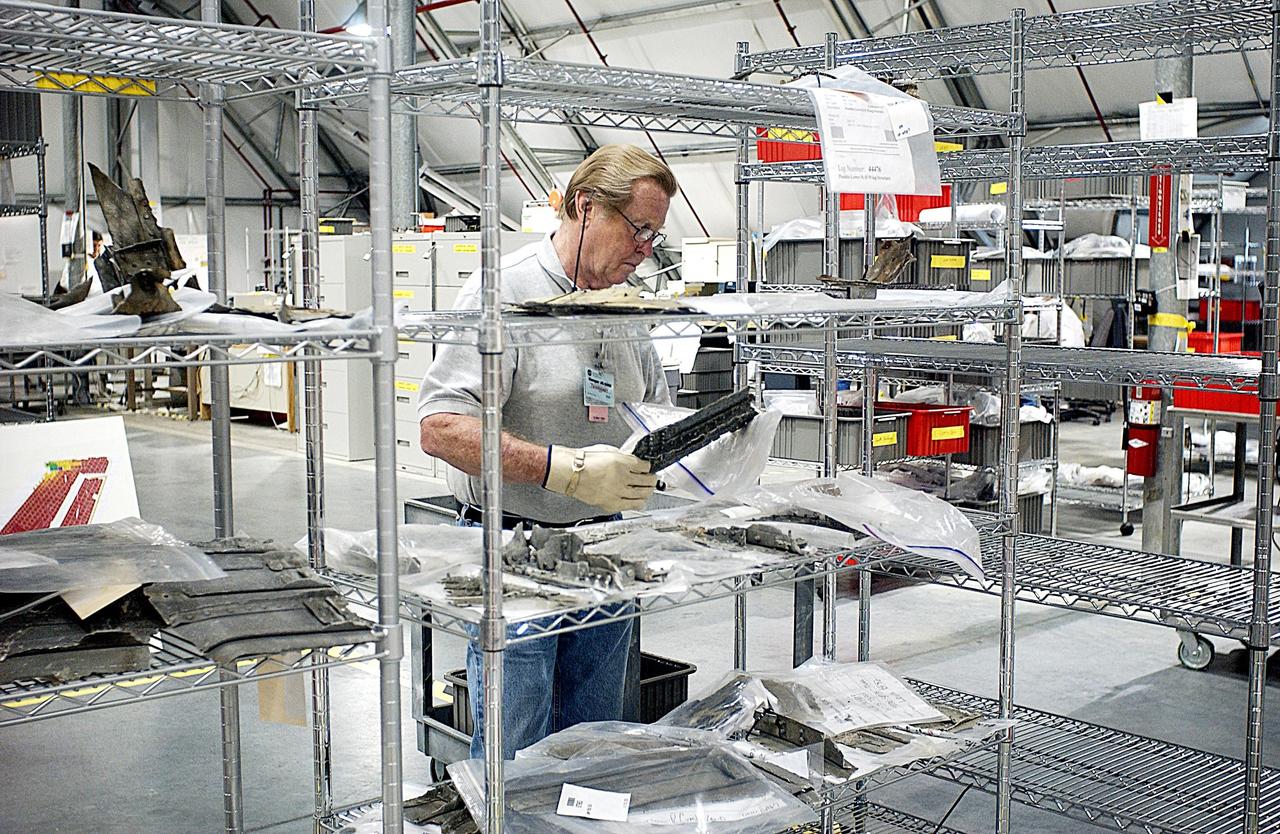
KENNEDY SPACE CENTER, FLA. -- A worker in the KSC RLV Hangar, collection site of the debris from Columbia, examines a recovered piece before bagging it. Shipped from Barksdale Air Force Base, Shreveport, La., more than 70,000 items, weighing 78,000 pounds, about 36 percent of the Shuttle by weight, have been delivered to KSC for use in the mishap investigation. Ground teams have completed 78 percent of their primary search area, and airborne crews finished 80 percent of their assigned area. Search teams have completed 98 percent of the underwater searches in Lake Nacogdoches and Toledo Bend Reservoir.
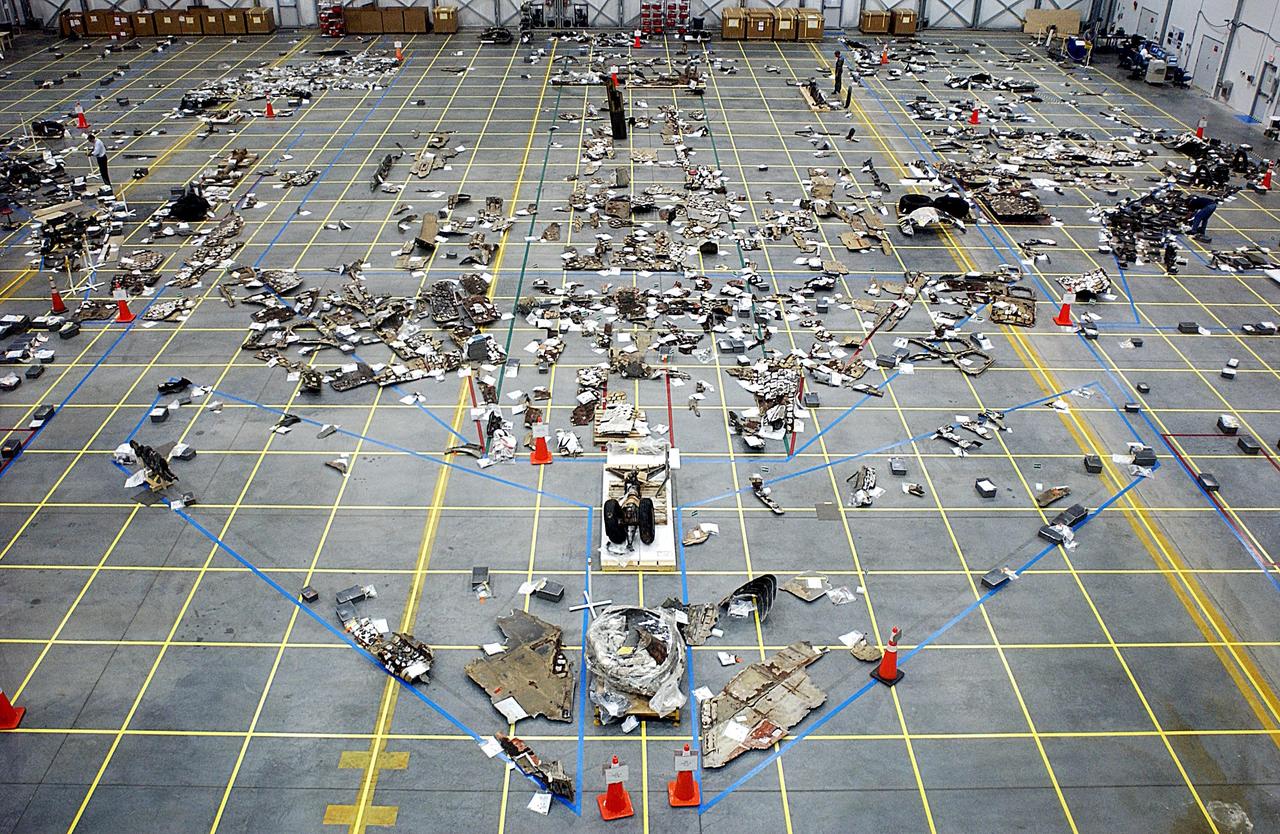
KENNEDY SPACE CENTER, FLA. -- Debris pieces of all sizes lie on the floor of the KSC RLV Hangar. Shipped from Barksdale Air Force Base, Shreveport, La., more than 70,000 items, weighing 78,000 pounds, about 36 percent of the Shuttle by weight, have been delivered to KSC for use in the mishap investigation. Ground teams have completed 78 percent of their primary search area, and airborne crews finished 80 percent of their assigned area. Search teams have completed 98 percent of the underwater searches in Lake Nacogdoches and Toledo Bend Reservoir.
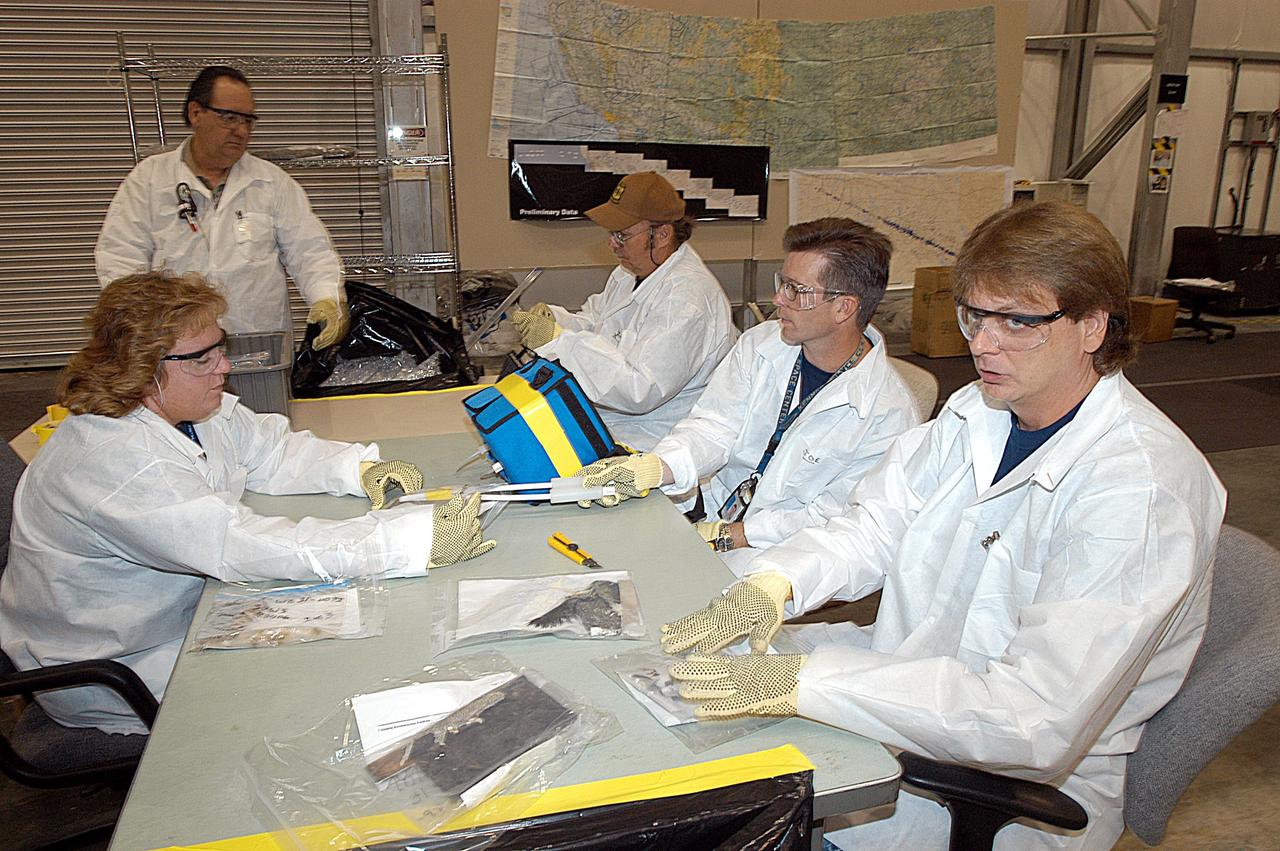
KENNEDY SPACE CENTER, FLA. -- Members of the Columbia Reconstruction Project team continue their work to identify pieces of Columbia debris delivered to the RLV Hangar. Shipped from Barksdale Air Force Base, Shreveport, La., more than 70,000 items, weighing 78,000 pounds, about 36 percent of the Shuttle by weight, have been delivered to KSC for use in the mishap investigation. Ground teams have completed 78 percent of their primary search area, and airborne crews finished 80 percent of their assigned area. Search teams have completed 98 percent of the underwater searches in Lake Nacogdoches and Toledo Bend Reservoir.
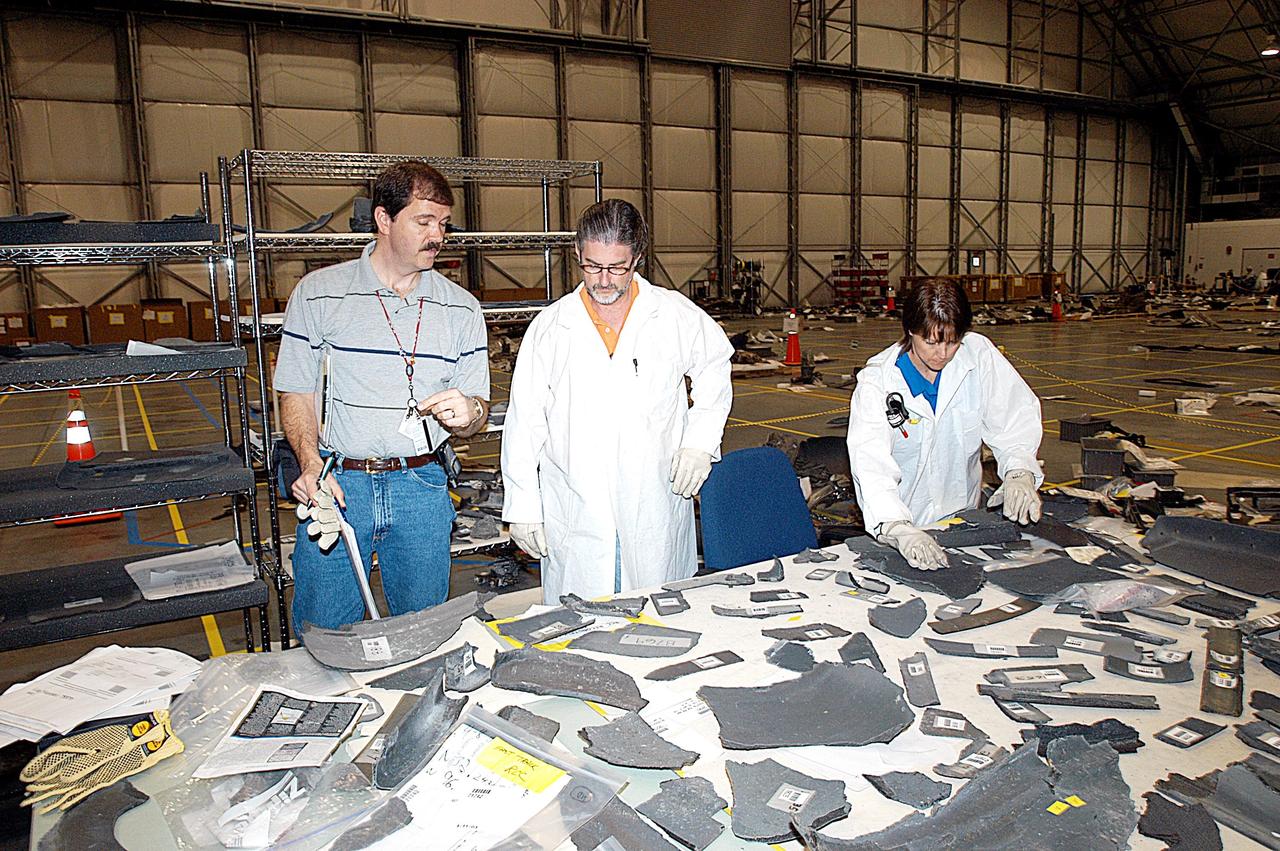
KENNEDY SPACE CENTER, FLA. -- Members of the Columbia Reconstruction Project team work at identifying pieces of Columbia debris delivered to the RLV Hangar. Shipped from Barksdale Air Force Base, Shreveport, La., more than 70,000 items, weighing 78,000 pounds, about 36 percent of the Shuttle by weight, have been delivered to KSC for use in the mishap investigation. Ground teams have completed 78 percent of their primary search area, and airborne crews finished 80 percent of their assigned area. Search teams have completed 98 percent of the underwater searches in Lake Nacogdoches and Toledo Bend Reservoir.

KENNEDY SPACE CENTER, FLA. -- In the RLV Hangar, a fixture is ready for use in the Columbia mishap investigation. It is designed to hold the recovered leading edge panels of the left wing of Space Shuttle Columbia. Shipped from Barksdale Air Force Base, Shreveport, La., more than 70,000 items, weighing 78,000 pounds, about 36 percent of the Shuttle by weight, have been delivered to KSC for use in the mishap investigation. Ground teams have completed 78 percent of their primary search area, and airborne crews finished 80 percent of their assigned area. Search teams have completed 98 percent of the underwater searches in Lake Nacogdoches and Toledo Bend Reservoir.
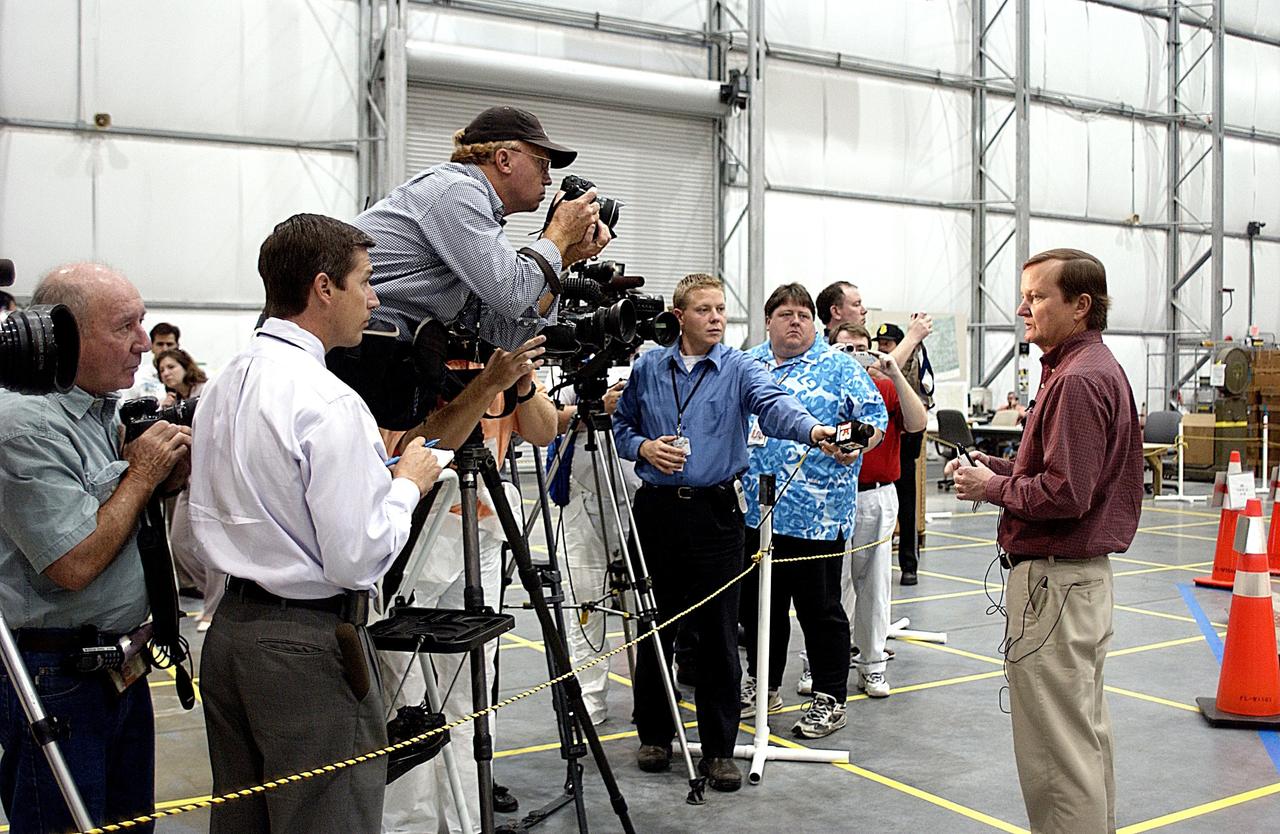
KENNEDY SPACE CENTER, FLA. -- Shuttle Launch Director Mike Leinbach discusses the progress of the Columbia accident investigation with the media in the RLV Hangar. Leinbach is overseeing assessment of the debris as it is delivered to KSC. Shipped from Barksdale Air Force Base, Shreveport, La., more than 70,000 items, weighing 78,000 pounds, about 36 percent of the Shuttle by weight, have been delivered to KSC for use in the mishap investigation. Ground teams have completed 78 percent of their primary search area, and airborne crews finished 80 percent of their assigned area. Search teams have completed 98 percent of the underwater searches in Lake Nacogdoches and Toledo Bend Reservoir.
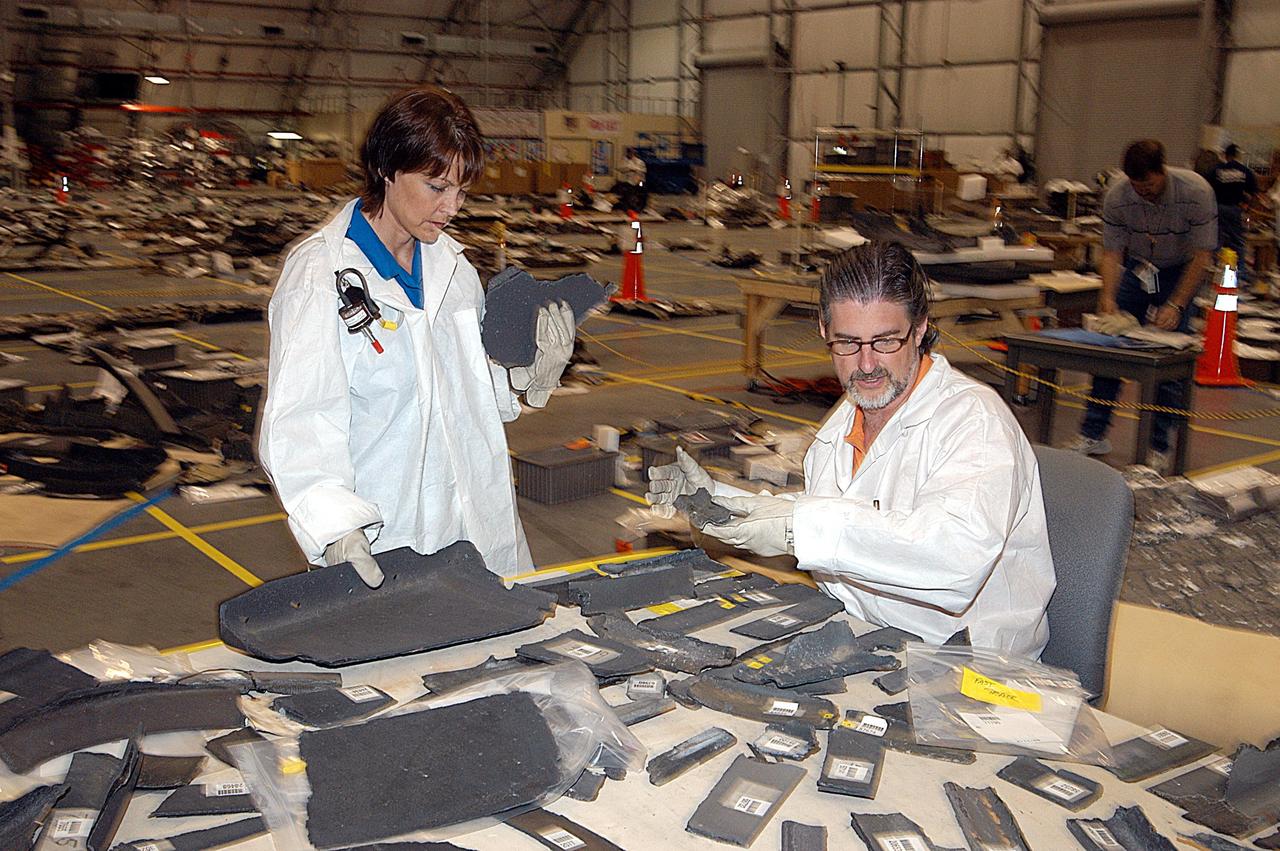
KENNEDY SPACE CENTER, FLA. -- Members of the Columbia Reconstruction Project team continue their work identifying pieces of Columbia debris delivered to the RLV Hangar. Shipped from Barksdale Air Force Base, Shreveport, La., more than 70,000 items, weighing 78,000 pounds, about 36 percent of the Shuttle by weight, have been delivered to KSC for use in the mishap investigation. Ground teams have completed 78 percent of their primary search area, and airborne crews finished 80 percent of their assigned area. Search teams have completed 98 percent of the underwater searches in Lake Nacogdoches and Toledo Bend Reservoir.
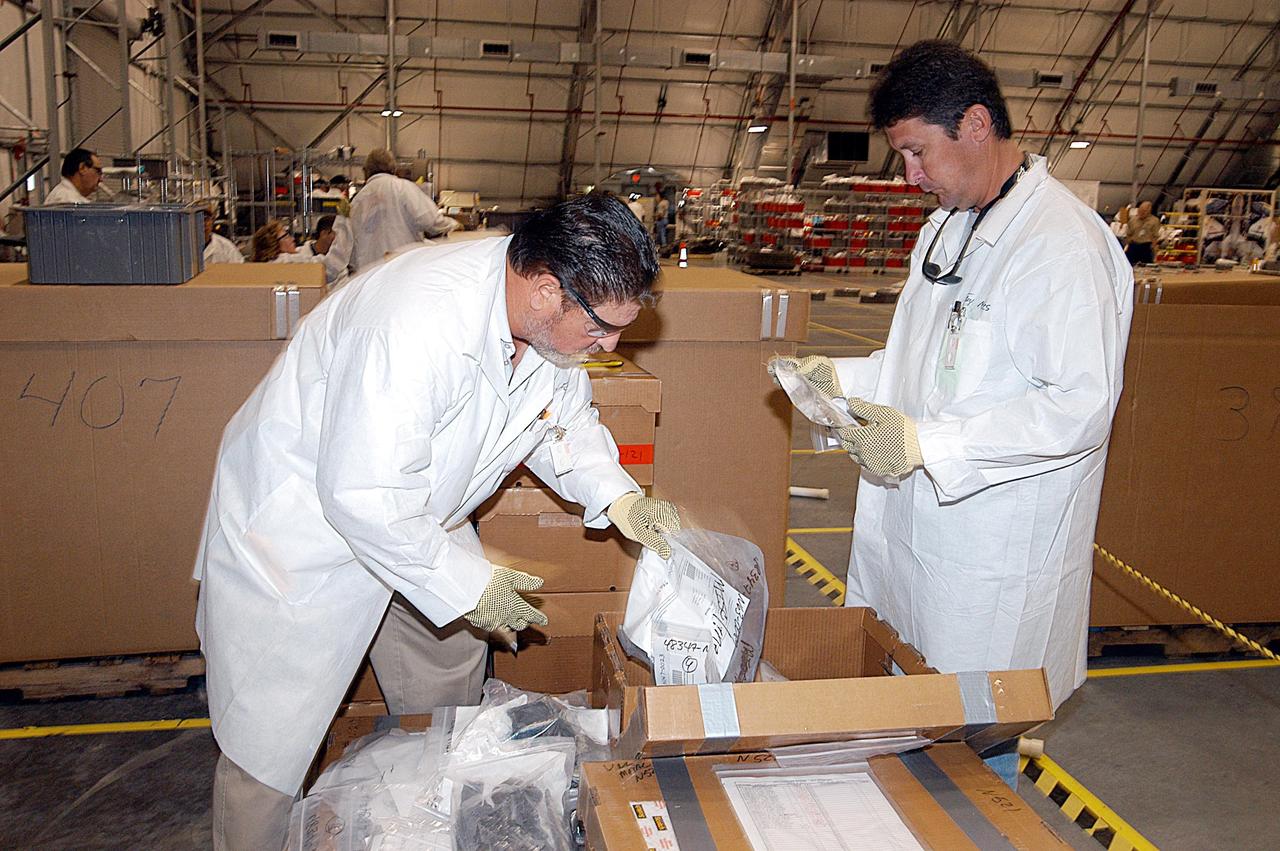
KENNEDY SPACE CENTER, FLA. -- Members of the Columbia Reconstruction Project team unpack pieces of Columbia debris delivered to the RLV Hangar. Shipped from Barksdale Air Force Base, Shreveport, La., more than 70,000 items, weighing 78,000 pounds, about 36 percent of the Shuttle by weight, have been delivered to KSC for use in the mishap investigation. Ground teams have completed 78 percent of their primary search area, and airborne crews finished 80 percent of their assigned area. Search teams have completed 98 percent of the underwater searches in Lake Nacogdoches and Toledo Bend Reservoir.
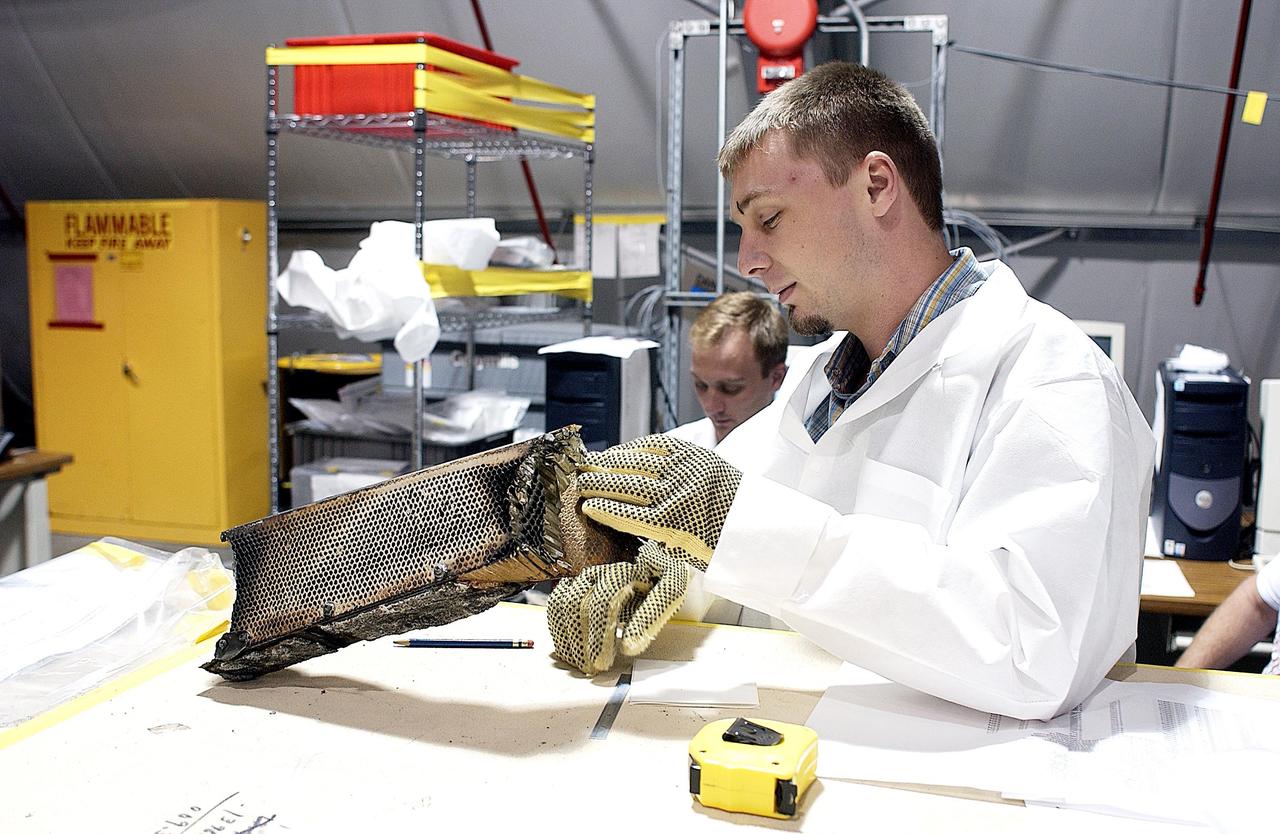
KENNEDY SPACE CENTER, FLA. -- A member of the Columbia Reconstruction Project Team examines a piece of Columbia debris for cataloging in the KSC RLV Hangar. Shipped from Barksdale Air Force Base, Shreveport, La., more than 70,000 items, weighing 78,000 pounds, about 36 percent of the Shuttle by weight, have been delivered to KSC for use in the mishap investigation. Ground teams have completed 78 percent of their primary search area, and airborne crews finished 80 percent of their assigned area. Search teams have completed 98 percent of the underwater searches in Lake Nacogdoches and Toledo Bend Reservoir.

KENNEDY SPACE CENTER, FLA. -- Workers continue to place pieces of Columbia debris on the floor of the KSC RLV Hangar. Shipped from Barksdale Air Force Base, Shreveport, La., more than 70,000 items, weighing 78,000 pounds, about 36 percent of the Shuttle by weight, have been delivered to KSC for use in the mishap investigation. Ground teams have completed 78 percent of their primary search area, and airborne crews finished 80 percent of their assigned area. Search teams have completed 98 percent of the underwater searches in Lake Nacogdoches and Toledo Bend Reservoir.
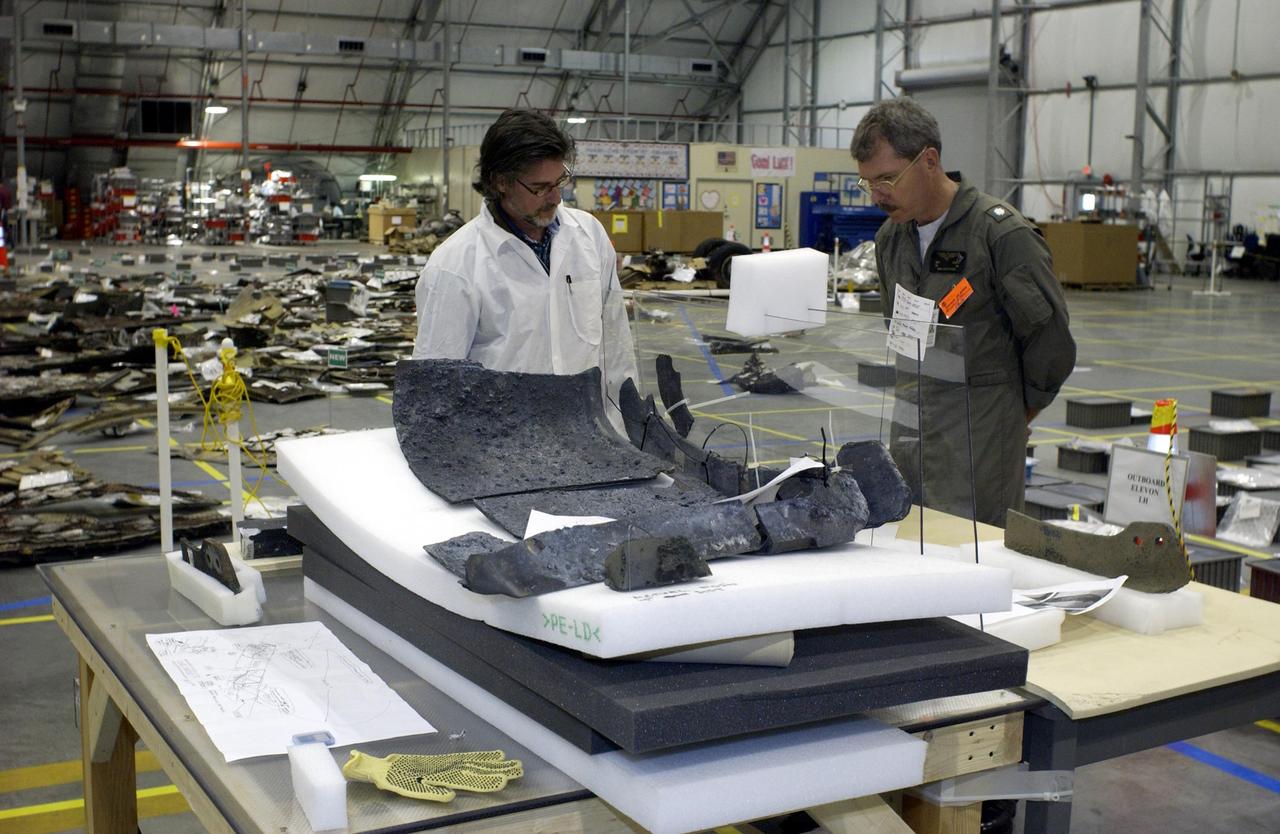
KENNEDY SPACE CENTER, FLA. -- Members of the Columbia Reconstruction Project Team look over pieces of debris in the KSC RLV Hangar. Shipped from Barksdale Air Force Base, Shreveport, La., more than 70,000 items, weighing 78,000 pounds, about 36 percent of the Shuttle by weight, have been delivered to KSC for use in the mishap investigation. Ground teams have completed 78 percent of their primary search area, and airborne crews finished 80 percent of their assigned area. Search teams have completed 98 percent of the underwater searches in Lake Nacogdoches and Toledo Bend Reservoir.
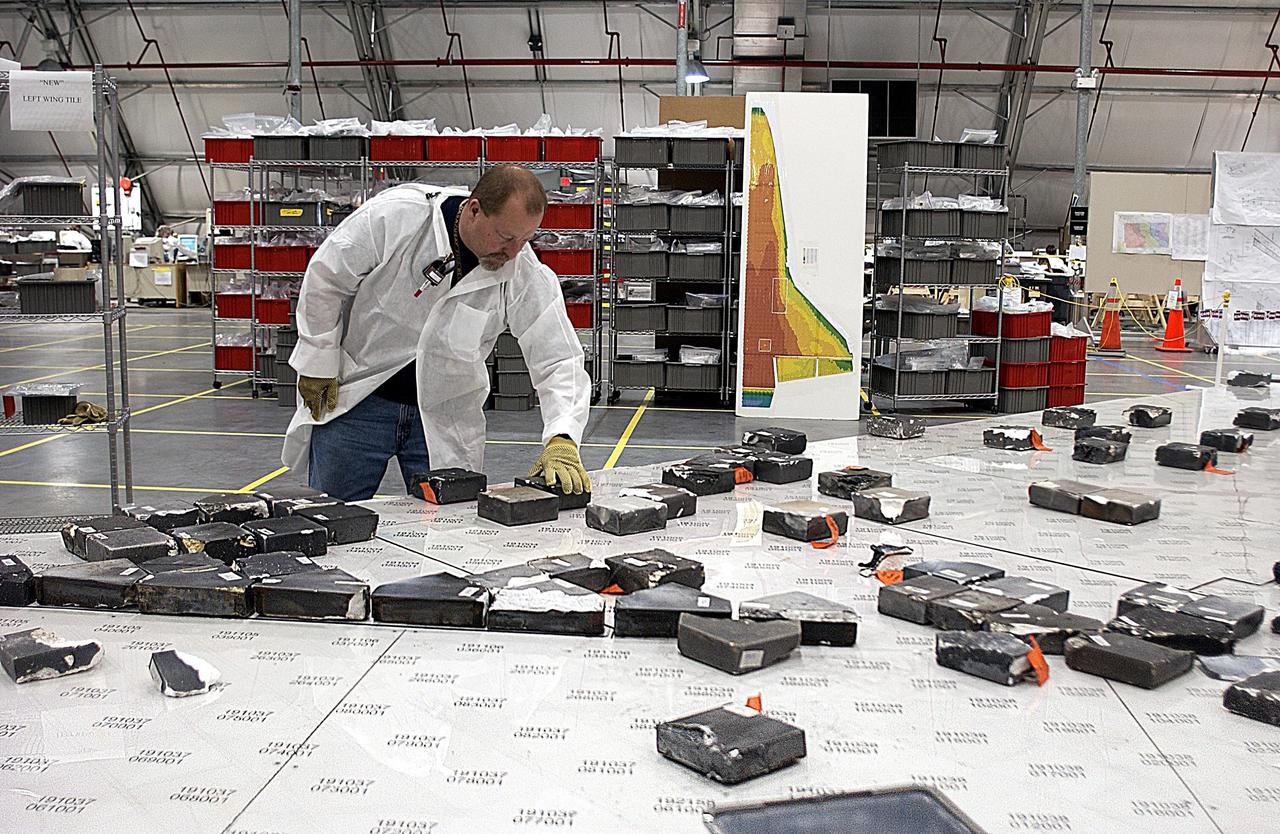
KENNEDY SPACE CENTER, FLA. -- In the RLV Hangar, a member of the Columbia Reconstruction Project team places recovered Thermal Protection System (TPS) tile on a tabletop mock-up of the wing of Columbia. Shipped from Barksdale Air Force Base, Shreveport, La., more than 70,000 items, weighing 78,000 pounds, about 36 percent of the Shuttle by weight, have been delivered to KSC for use in the mishap investigation. Ground teams have completed 78 percent of their primary search area, and airborne crews finished 80 percent of their assigned area. Search teams have completed 98 percent of the underwater searches in Lake Nacogdoches and Toledo Bend Reservoir.
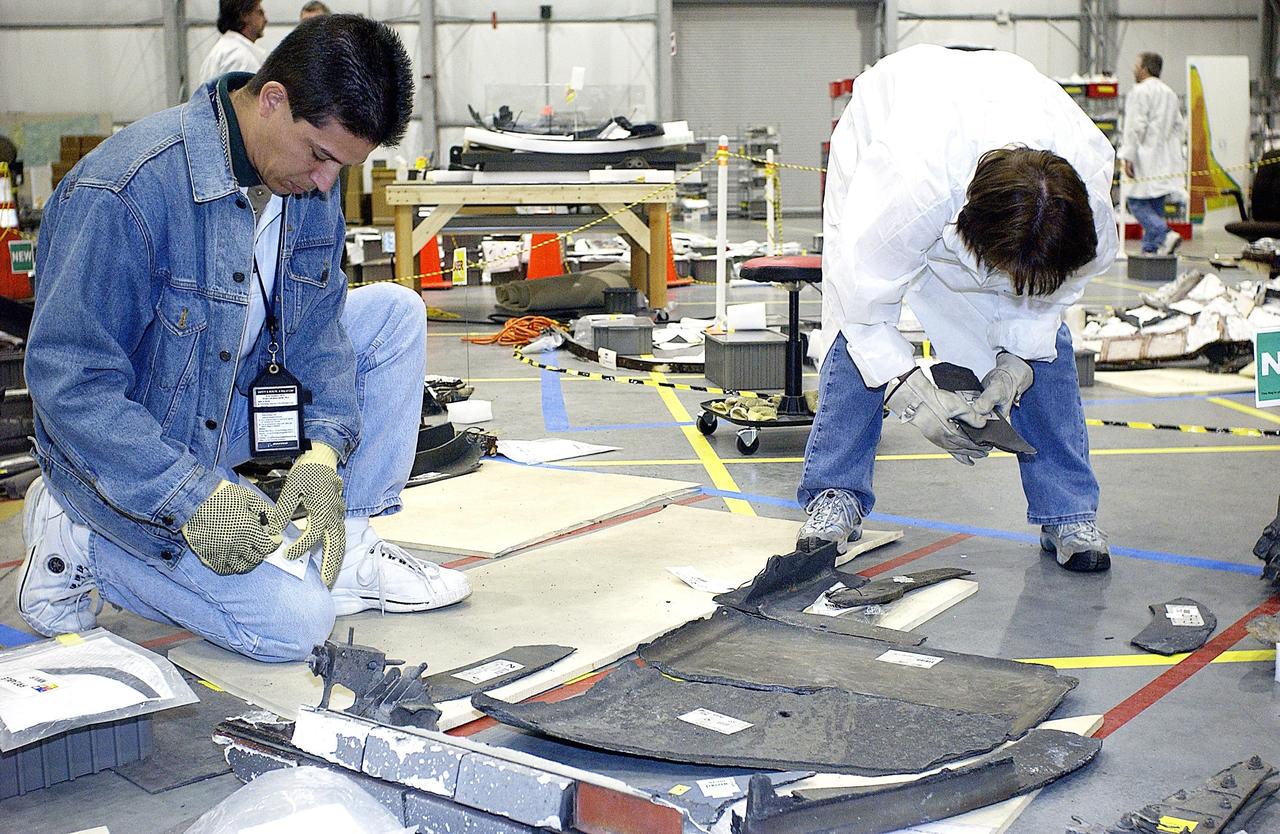
KENNEDY SPACE CENTER, FLA. -- Members of the Columbia Reconstruction Project Team look over pieces of debris on the floor of the KSC RLV Hangar. Shipped from Barksdale Air Force Base, Shreveport, La., more than 70,000 items, weighing 78,000 pounds, about 36 percent of the Shuttle by weight, have been delivered to KSC for use in the mishap investigation. Ground teams have completed 78 percent of their primary search area, and airborne crews finished 80 percent of their assigned area. Search teams have completed 98 percent of the underwater searches in Lake Nacogdoches and Toledo Bend Reservoir.

KENNEDY SPACE CENTER, FLA. -- In the RLV Hangar, a fixture is ready for use in the Columbia mishap investigation. It is designed to hold the recovered leading edge panels of the left wing of Space Shuttle Columbia. Shipped from Barksdale Air Force Base, Shreveport, La., more than 70,000 items, weighing 78,000 pounds, about 36 percent of the Shuttle by weight, have been delivered to KSC for use in the mishap investigation. Ground teams have completed 78 percent of their primary search area, and airborne crews finished 80 percent of their assigned area. Search teams have completed 98 percent of the underwater searches in Lake Nacogdoches and Toledo Bend Reservoir.
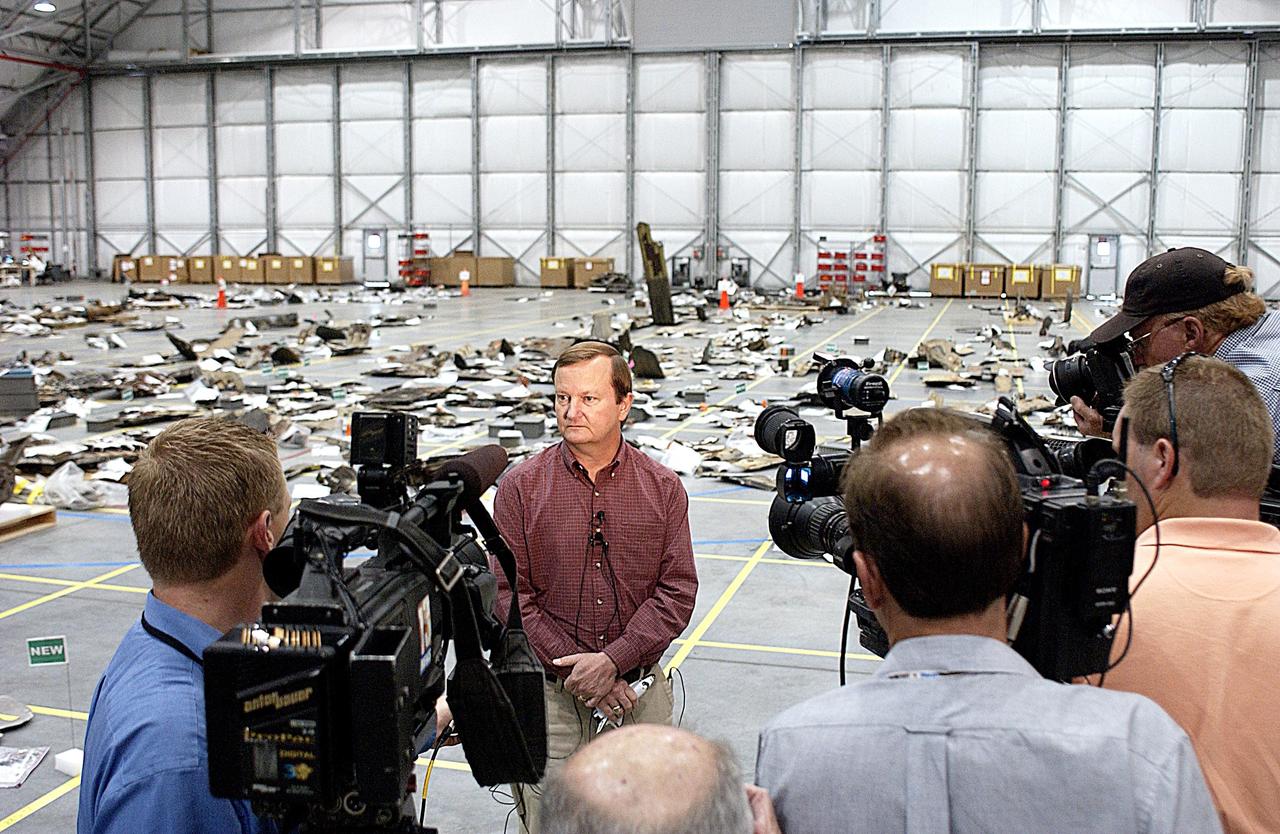
KENNEDY SPACE CENTER, FLA. -- Shuttle Launch Director Mike Leinbach answers reporters' questions in the RLV Hangar. Leinbach is overseeing assessment of the debris, seen in the background, as it is delivered to KSC. The Columbia Reconstruction Project team is identifying pieces and placing them on a grid approximating the shape of the orbiter. Shipped from Barksdale Air Force Base, Shreveport, La., more than 70,000 items, weighing 78,000 pounds, about 36 percent of the Shuttle by weight, have been delivered to KSC for use in the mishap investigation. Ground teams have completed 78 percent of their primary search area, and airborne crews finished 80 percent of their assigned area. Search teams have completed 98 percent of the underwater searches in Lake Nacogdoches and Toledo Bend Reservoir.
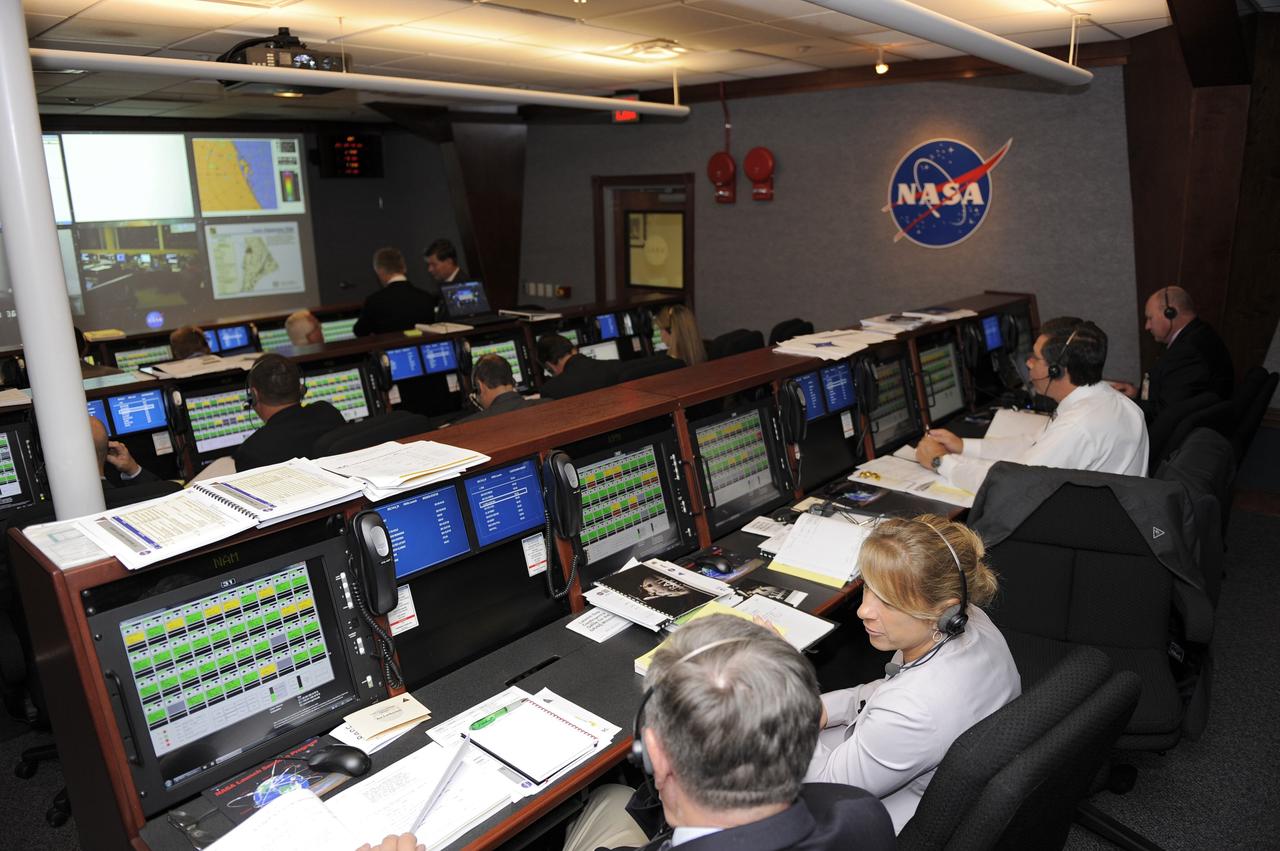
CAPE CANAVERAL, Fla. -- On Cape Canaveral Air Force Station in Florida, members of NASA's Gravity Recovery and Interior Laboratory (GRAIL) launch team monitor GRAIL's launch countdown from the Mission Directors Center in Hangar AE. From left are Joe Lackovich, NASA advisory manager, NASA's Launch Services Program (LSP); Amanda Mitskevich, manager, LSP; and Oscar Toledo, NASA Headquarters senior advisor, LSP. Launch is scheduled for 8:37:06 a.m. EDT Sept. 8 from Space Launch Complex 17B on Cape Canaveral Air Force Station. GRAIL will fly twin spacecraft in tandem around the moon to precisely measure and map variations in the moon's gravitational field. The mission will provide the most accurate global gravity field to date for any planet, including Earth. For more information, visit http://www.nasa.gov/grail. Photo credit: NASA/Kim Shiflett
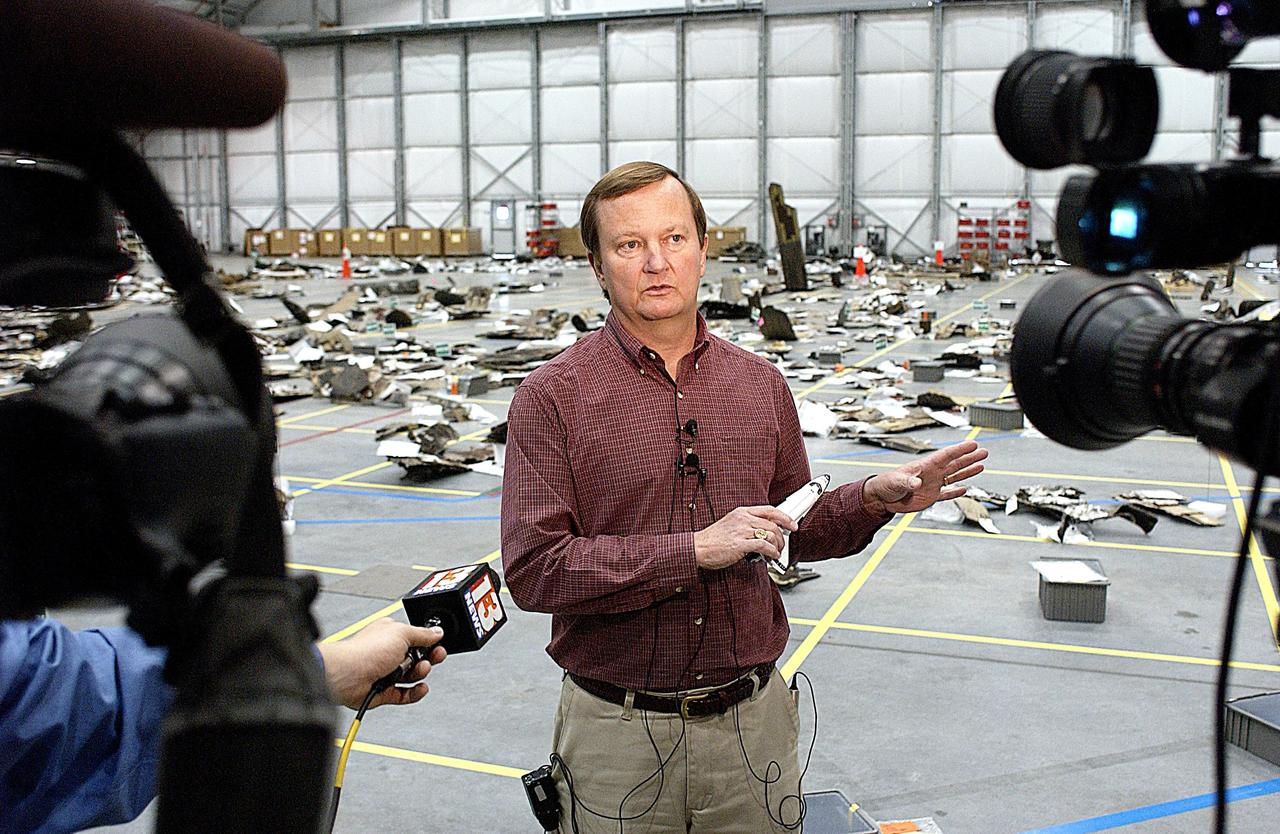
KENNEDY SPACE CENTER, FLA. -- Shuttle Launch Director Mike Leinbach answers reporters' questions in the RLV Hangar. Leinbach is overseeing assessment of the debris, seen in the background, as it is delivered to KSC. The Columbia Reconstruction Project team is identifying pieces and placing them on a grid approximating the shape of the orbiter. Shipped from Barksdale Air Force Base, Shreveport, La., more than 70,000 items, weighing 78,000 pounds, about 36 percent of the Shuttle by weight, have been delivered to KSC for use in the mishap investigation. Ground teams have completed 78 percent of their primary search area, and airborne crews finished 80 percent of their assigned area. Search teams have completed 98 percent of the underwater searches in Lake Nacogdoches and Toledo Bend Reservoir.
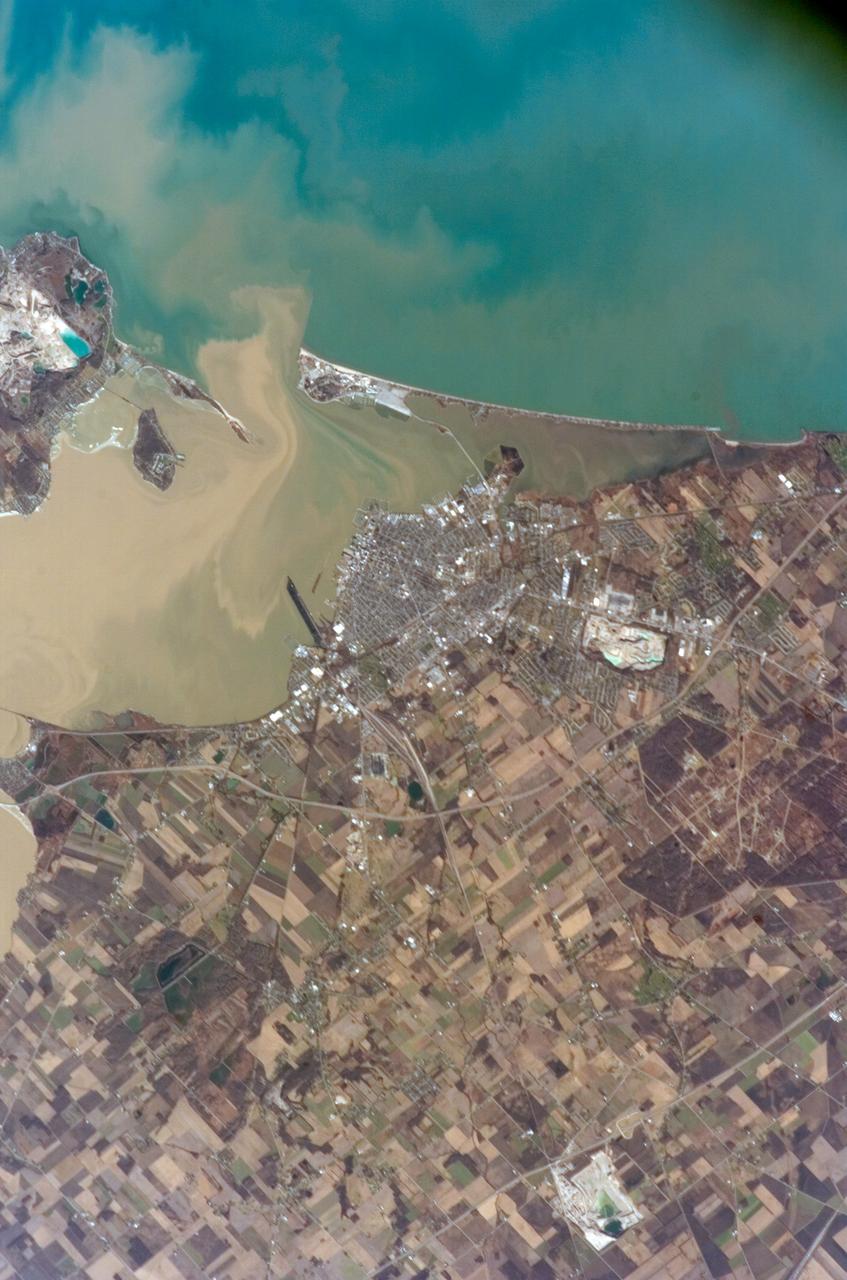
ISS012-E-15050 (12 Jan. 2006) --- Sandusky Bay is featured in this image photographed by an Expedition 12 crew member on the International Space Station. Sandusky Bay appears with brown muddy water (left) in this view. The bay leads out into southern Lake Erie (top). The small city of Sandusky occupies the northeastern shore of the bay (center of the image). Highway 6 can be seen arcing around the south side of the city. Ferries connect Sandusky to Pelee Island (not visible) in the middle of the lake. In earlier days, Sandusky Bay was known as one of the best protected port sites in the Great Lakes. The most striking aspect of this image is the flow lines of the brown water in and out of the mouth of the bay. Slight movement of lake surface water, driven mainly by wind, causes a small ebb and flow of bay water. Sediment-charged water is derived from agricultural fields along the Sandusky River upstream. Mud plumes in Lake Erie originate from prior pulses of muddy water from the bay. According to scientists studying the station photos, it appears that water was flowing into the bay when this image was taken. Sandusky lies midway between Toledo and Cleveland, both about an hour’s drive away.
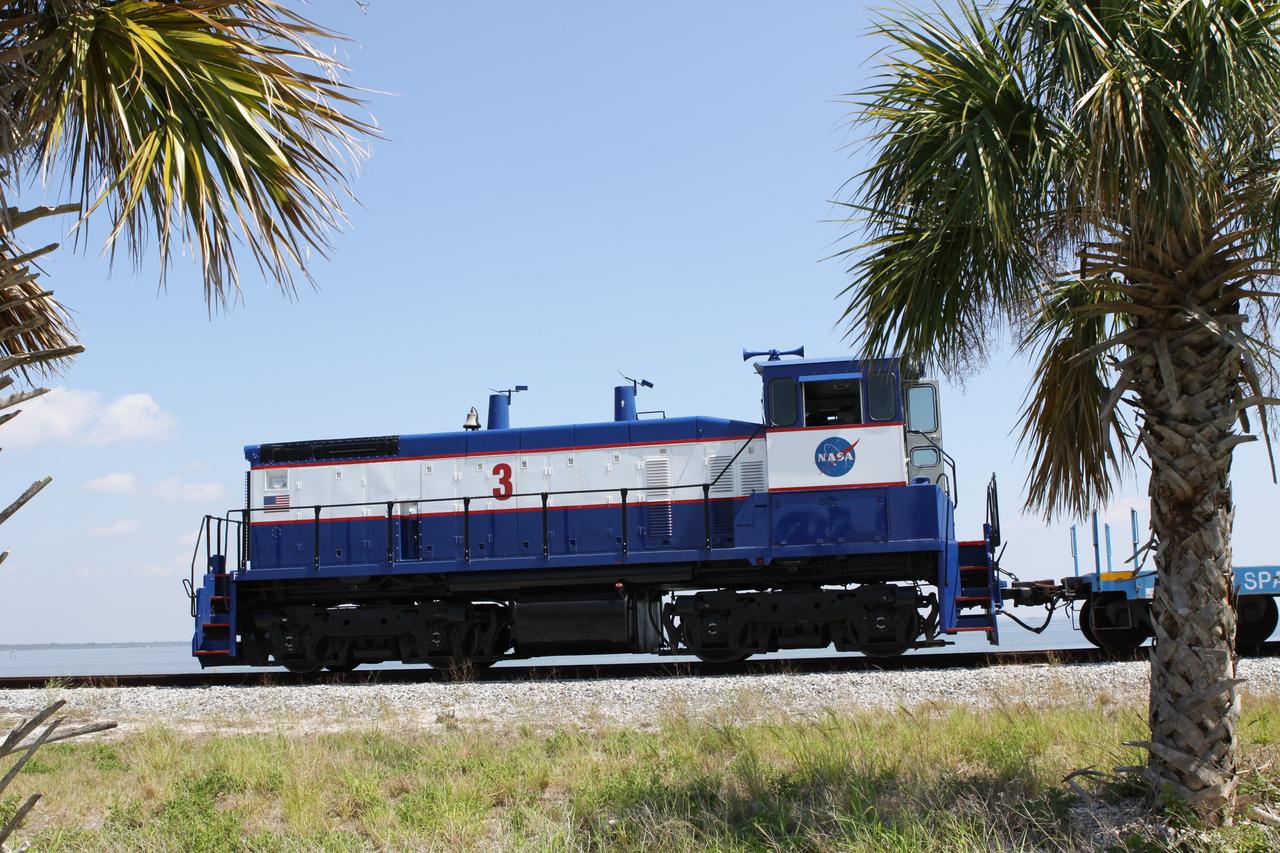
CAPE CANAVERAL, Fla. – NASA Railroad locomotive No. 3 delivers tank cars from NASA’s Kennedy Space Center in Florida to the Florida East Coast Railway interchange in Titusville, Fla. The locomotive is one of three NASA Railroad locomotives built for the Toledo, Peoria and Western, or TP&W, between 1968 and 1970. It is a GM Electromotive Division SW-1500 switcher. The locomotive was acquired by NASA from the TP&W in 1984 and painted in the NASA Railroad paint scheme. The power plant was completely overhauled in 2009. The locomotive will pull the train to the interchange in Titusville, where the train’s helium tank cars, a liquid oxygen tank car, and a liquid hydrogen dewar or tank car will be transferred for delivery to the SpaceX engine test complex outside McGregor, Texas. The railroad cars were needed in support of the Space Shuttle Program but currently are not in use by NASA following the completion of the program in 2011. Originally, the tankers belonged to the U.S. Bureau of Mines. At the peak of the shuttle program, there were approximately 30 cars in the fleet. About half the cars were returned to the bureau as launch activity diminished. Five tank cars are being loaned to SpaceX and repurposed to support their engine tests in Texas. Eight cars previously were shipped to California on loan to support the SpaceX Falcon 9 rocket launches from Space Launch Complex-4 on Vandenberg Air Force Base. SpaceX already has three helium tank cars previously used for the shuttle program at Space Launch Complex-40 on Cape Canaveral Air Force Station in Florida. For more information, visit http://www.nasa.gov/spacex. Photo credit: NASA/Jim Grossmann
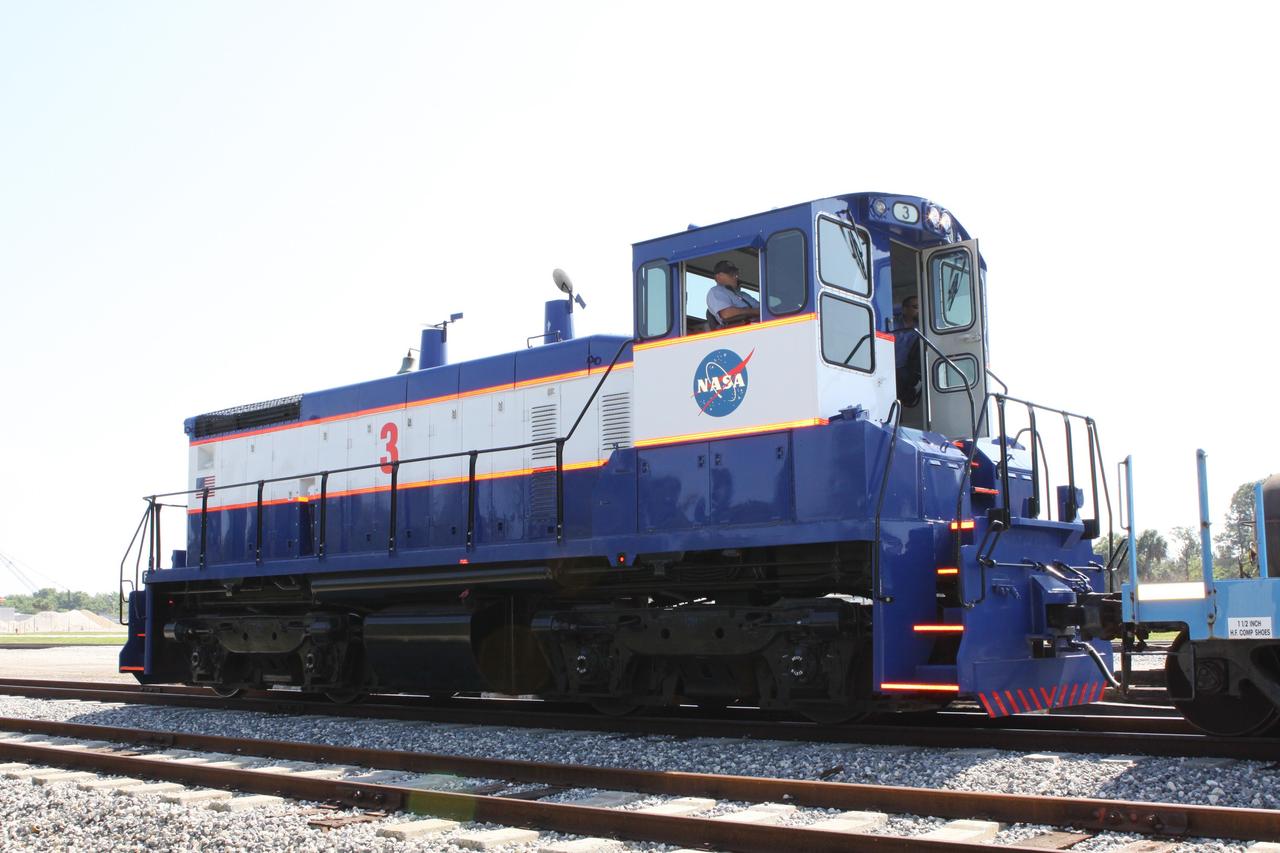
CAPE CANAVERAL, Fla. – NASA Railroad locomotive No. 3 is enlisted to deliver tank cars from NASA’s Kennedy Space Center in Florida to the Florida East Coast Railway interchange in Titusville, Fla. The locomotive is one of three NASA Railroad locomotives built for the Toledo, Peoria and Western, or TP&W, between 1968 and 1970. It is a GM Electromotive Division SW-1500 switcher. The locomotive was acquired by NASA from the TP&W in 1984 and painted in the NASA Railroad paint scheme. The power plant was completely overhauled in 2009. The locomotive will pull the train to the interchange in Titusville, where the train’s helium tank cars, a liquid oxygen tank car, and a liquid hydrogen dewar or tank car will be transferred for delivery to the SpaceX engine test complex outside McGregor, Texas. The railroad cars were needed in support of the Space Shuttle Program but currently are not in use by NASA following the completion of the program in 2011. Originally, the tankers belonged to the U.S. Bureau of Mines. At the peak of the shuttle program, there were approximately 30 cars in the fleet. About half the cars were returned to the bureau as launch activity diminished. Five tank cars are being loaned to SpaceX and repurposed to support their engine tests in Texas. Eight cars previously were shipped to California on loan to support the SpaceX Falcon 9 rocket launches from Space Launch Complex-4 on Vandenberg Air Force Base. SpaceX already has three helium tank cars previously used for the shuttle program at Space Launch Complex-40 on Cape Canaveral Air Force Station in Florida. For more information, visit http://www.nasa.gov/spacex. Photo credit: NASA/Jim Grossmann
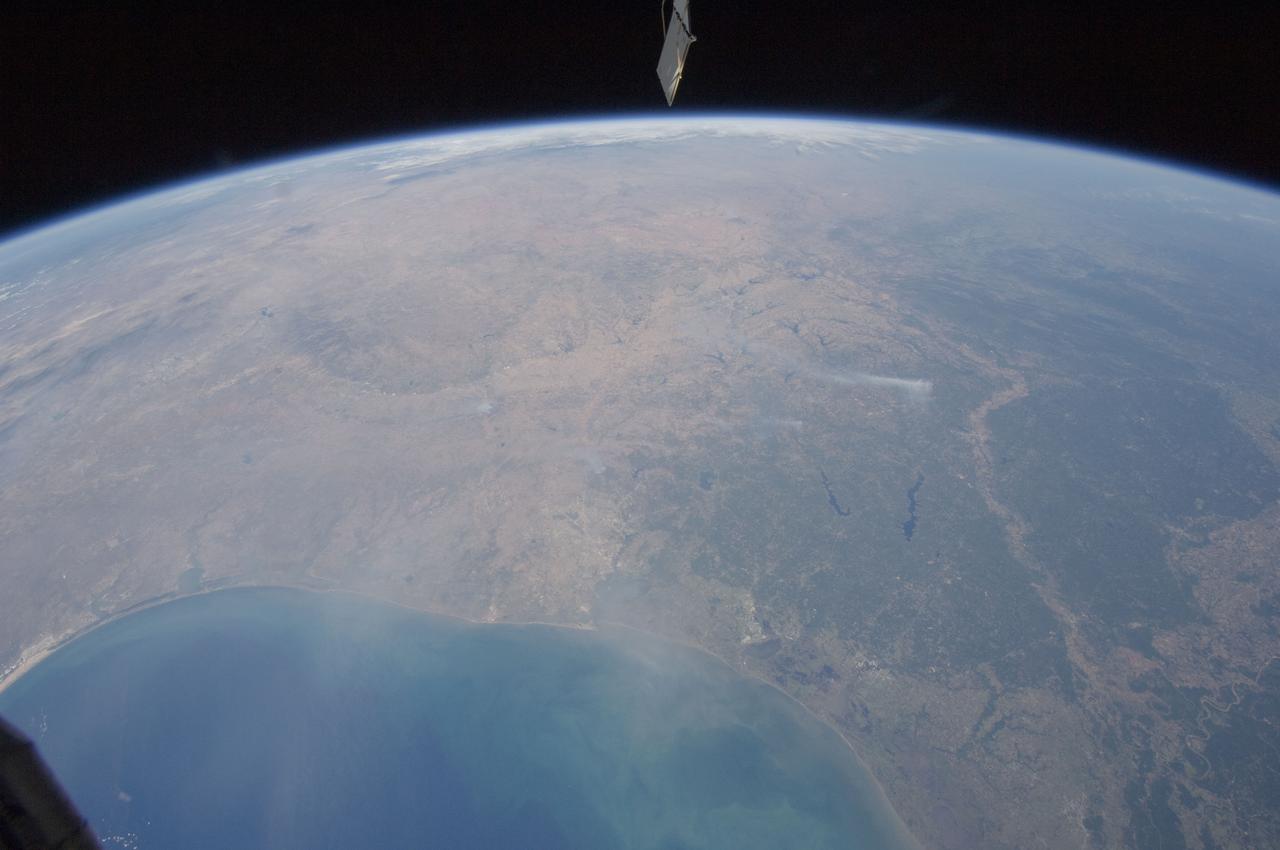
ISS028-E-037978 (6 Sept. 2011) --- Wildfire smoke plumes in Texas are featured in this image photographed by an Expedition 28 crew member on the International Space Station. This panoramic view of east-central Texas highlights numerous smoke plumes caused by wildfires burning across the state. The image was taken using a short focal length lens (12-mm), which captures a wide field of view at the cost of fine feature resolution. Smoke plumes are clearly visible in the image to the east of Austin; to the north of Houston; to the northwest of Lake Sam Rayburn and Toledo Bend Reservoir; and to the west of Shreveport, LA. More diffuse smoke moving offshore into the Gulf of Mexico is visible at bottom. Part of an ISS photovoltaic radiator panel is visible at top center. Record-setting drought conditions have affected much of Texas since early 2011 and have dried out both forest and grassland, providing ample fuel for wildfires. Relatively high winds and low humidity levels have also contributed to the rapid spread and expansion of fires. According to a Texas Forest Service (TXFS) Incident Management Situation Report dated Sept. 7, 2011, TXFS had responded to 172 fires affecting an area of 546.53 square kilometers (135,051 acres) over the preceding seven days. Fires near Bastrop, TX to the east of Austin had destroyed 785 homes as of Sept. 7, 2011.
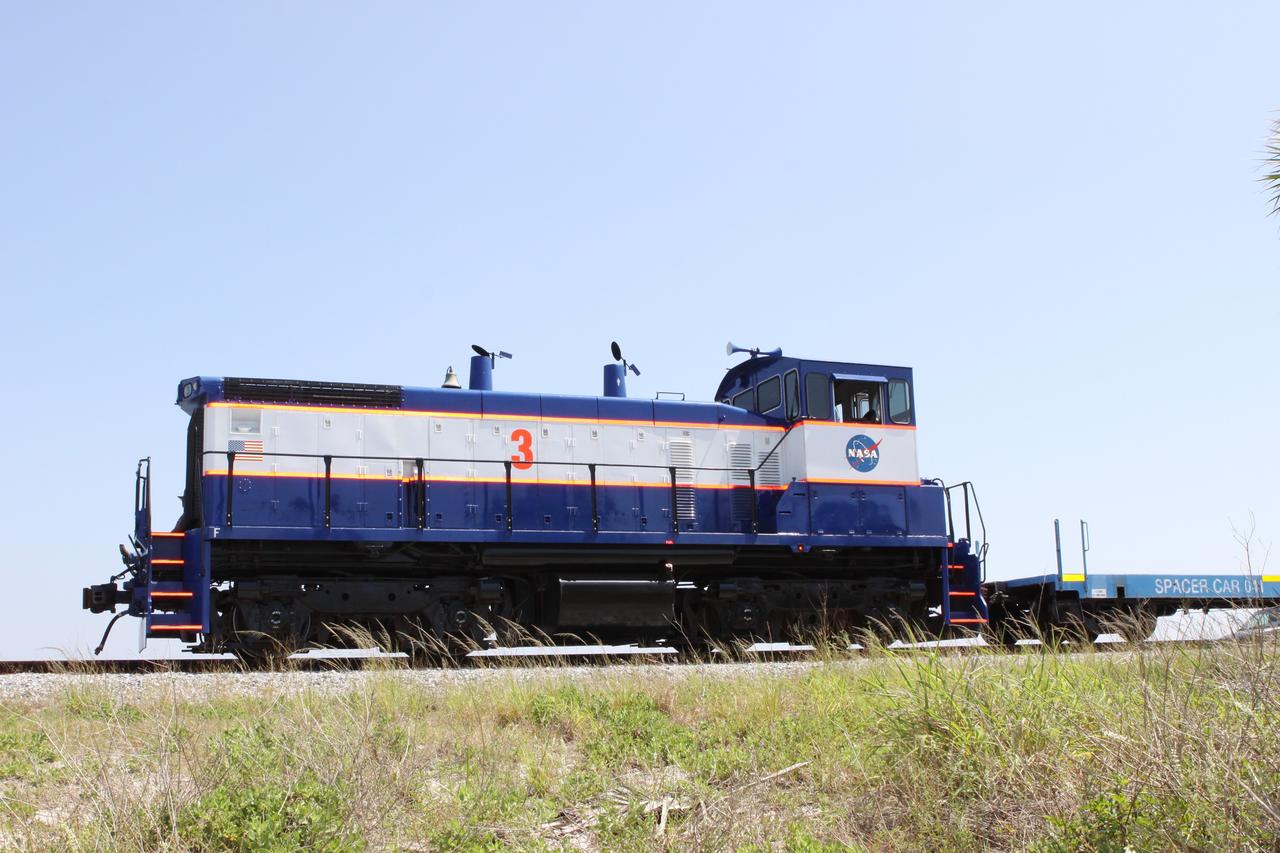
CAPE CANAVERAL, Fla. – NASA Railroad locomotive No. 3 delivers tank cars from NASA’s Kennedy Space Center in Florida to the Florida East Coast Railway interchange in Titusville, Fla. The locomotive is one of three NASA Railroad locomotives built for the Toledo, Peoria and Western, or TP&W, between 1968 and 1970. It is a GM Electromotive Division SW-1500 switcher. The locomotive was acquired by NASA from the TP&W in 1984 and painted in the NASA Railroad paint scheme. The power plant was completely overhauled in 2009. The locomotive will pull the train to the interchange in Titusville, where the train’s helium tank cars, a liquid oxygen tank car, and a liquid hydrogen dewar or tank car will be transferred for delivery to the SpaceX engine test complex outside McGregor, Texas. The railroad cars were needed in support of the Space Shuttle Program but currently are not in use by NASA following the completion of the program in 2011. Originally, the tankers belonged to the U.S. Bureau of Mines. At the peak of the shuttle program, there were approximately 30 cars in the fleet. About half the cars were returned to the bureau as launch activity diminished. Five tank cars are being loaned to SpaceX and repurposed to support their engine tests in Texas. Eight cars previously were shipped to California on loan to support the SpaceX Falcon 9 rocket launches from Space Launch Complex-4 on Vandenberg Air Force Base. SpaceX already has three helium tank cars previously used for the shuttle program at Space Launch Complex-40 on Cape Canaveral Air Force Station in Florida. For more information, visit http://www.nasa.gov/spacex. Photo credit: NASA/Jim Grossmann
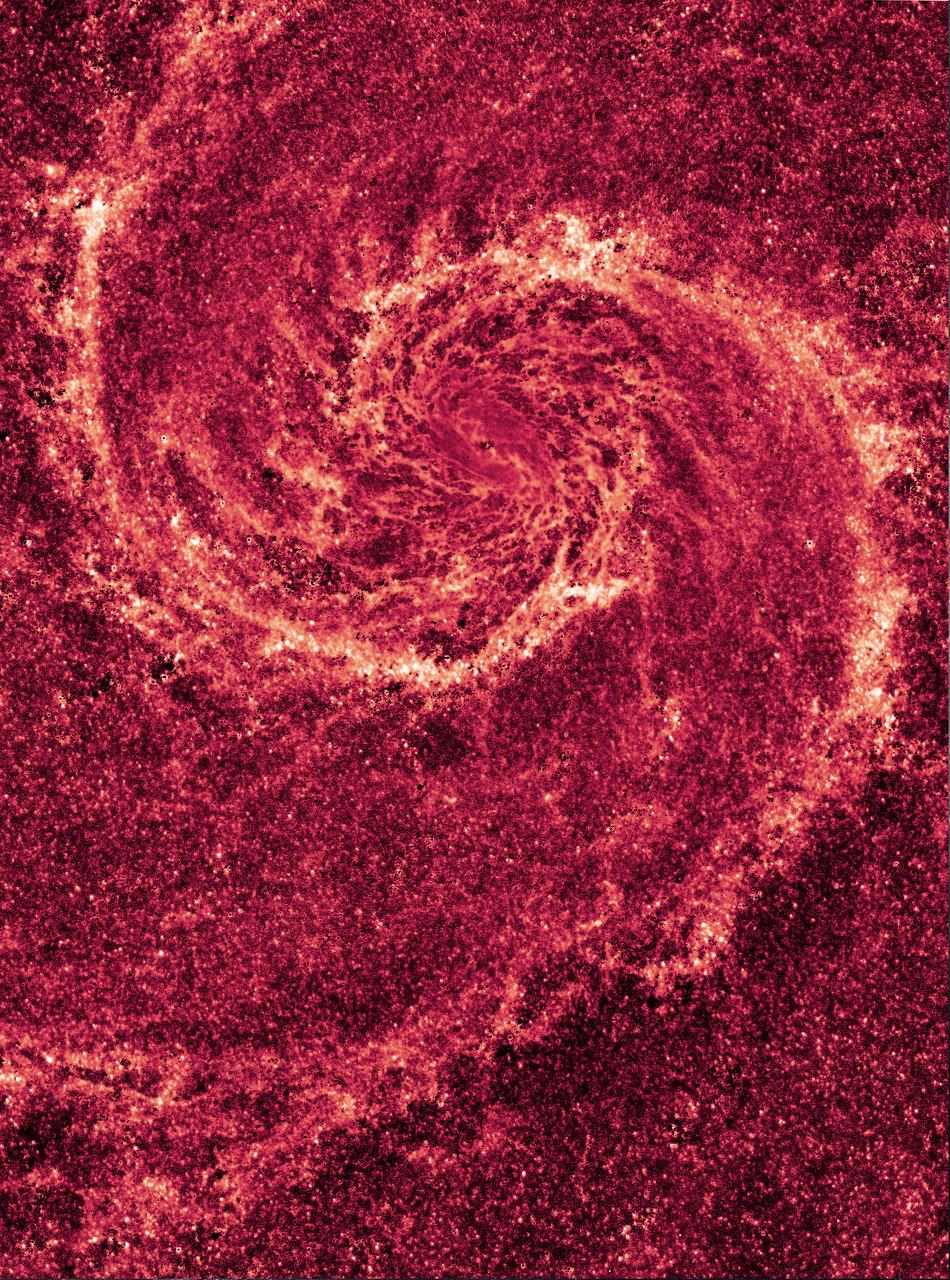
NASA image release January 13, 2011 <b><a href="http://www.flickr.com/photos/gsfc/5352962836">These images</a></b> by NASA's Hubble Space Telescope show off two dramatically different face-on views of the spiral galaxy M51, dubbed the Whirlpool Galaxy. <b><a href="http://www.flickr.com/photos/gsfc/5352955200/">The image here,</a></b> taken in visible light, highlights the attributes of a typical spiral galaxy, including graceful, curving arms, pink star-forming regions, and brilliant blue strands of star clusters. <b>In the image above,</b> most of the starlight has been removed, revealing the Whirlpool's skeletal dust structure, as seen in near-infrared light. This new image is the sharpest view of the dense dust in M51. The narrow lanes of dust revealed by Hubble reflect the galaxy's moniker, the Whirlpool Galaxy, as if they were swirling toward the galaxy's core. To map the galaxy's dust structure, researchers collected the galaxy's starlight by combining images taken in visible and near-infrared light. The visible-light image captured only some of the light; the rest was obscured by dust. The near-infrared view, however, revealed more starlight because near-infrared light penetrates dust. The researchers then subtracted the total amount of starlight from both images to see the galaxy's dust structure. The red color in the near-infrared image traces the dust, which is punctuated by hundreds of tiny clumps of stars, each about 65 light-years wide. These stars have never been seen before. The star clusters cannot be seen in visible light because dense dust enshrouds them. The image reveals details as small as 35 light-years across. Astronomers expected to see large dust clouds, ranging from about 100 light-years to more than 300 light-years wide. Instead, most of the dust is tied up in smooth and diffuse dust lanes. An encounter with another galaxy may have prevented giant clouds from forming. Probing a galaxy's dust structure serves as an important diagnostic tool for astronomers, providing invaluable information on how the gas and dust collapse to form stars. Although Hubble is providing incisive views of the internal structure of galaxies such as M51, the planned James Webb Space Telescope (JWST) is expected to produce even crisper images. Researchers constructed the image by combining visible-light exposures from Jan. 18 to 22, 2005, with the Advanced Camera for Surveys (ACS), and near-infrared light pictures taken in December 2005 with the Near Infrared Camera and Multi-Object Spectrometer (NICMOS). The Hubble Space Telescope is a project of international cooperation between NASA and the European Space Agency. NASA's Goddard Space Flight Center manages the telescope. The Space Telescope Science Institute (STScI) conducts Hubble science operations. STScI is operated for NASA by the Association of Universities for Research in Astronomy, Inc., in Washington, D.C. <b><a href="http://www.nasa.gov/centers/goddard/home/index.html" rel="nofollow">NASA Goddard Space Flight Center</a></b> enables NASA’s mission through four scientific endeavors: Earth Science, Heliophysics, Solar System Exploration, and Astrophysics. Goddard plays a leading role in NASA’s accomplishments by contributing compelling scientific knowledge to advance the Agency’s mission. <b>Follow us on <a href="http://twitter.com/NASA_GoddardPix" rel="nofollow">Twitter</a></b> <b>Join us on <a href="http://www.facebook.com/pages/Greenbelt-MD/NASA-Goddard/395013845897?ref=tsd" rel="nofollow">Facebook</a></b> Credit: NASA, ESA, M. Regan and B. Whitmore (STScI), and R. Chandar (University of Toledo)
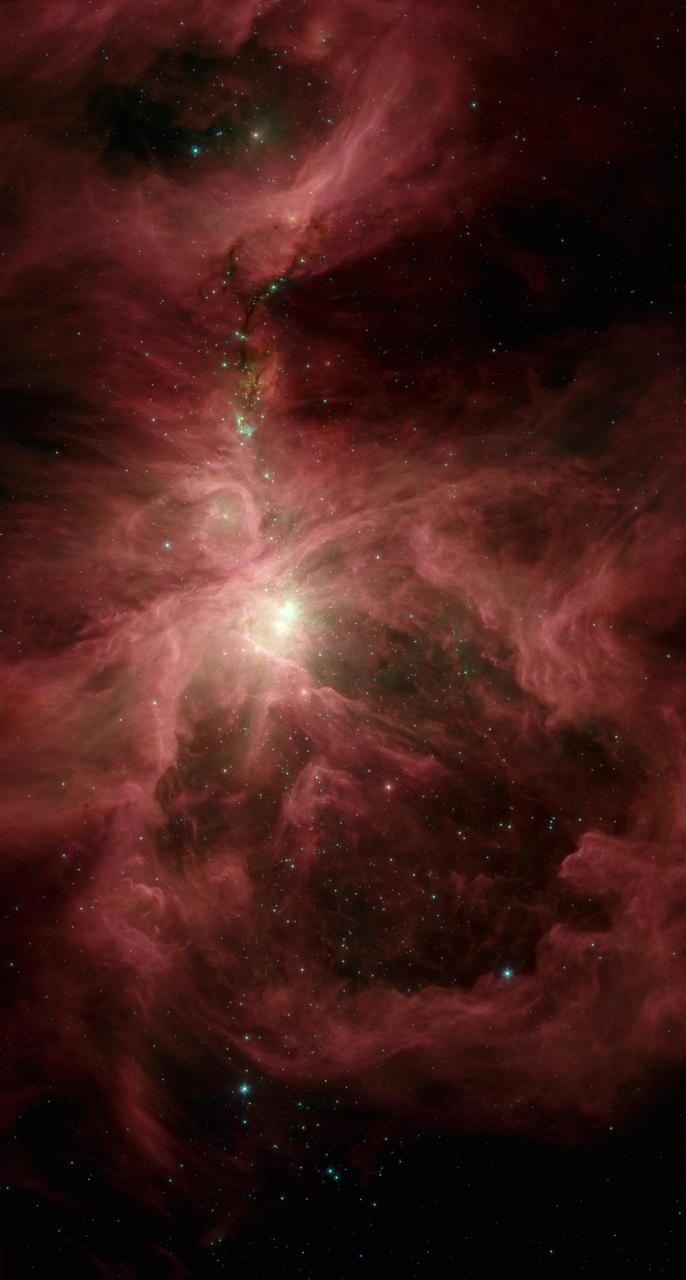
This image from NASA Spitzer Space Telescope shows the Orion nebula, our closest massive star-making factory, 1,450 light-years from Earth. The nebula is close enough to appear to the naked eye as a fuzzy star in the sword of the constellation.
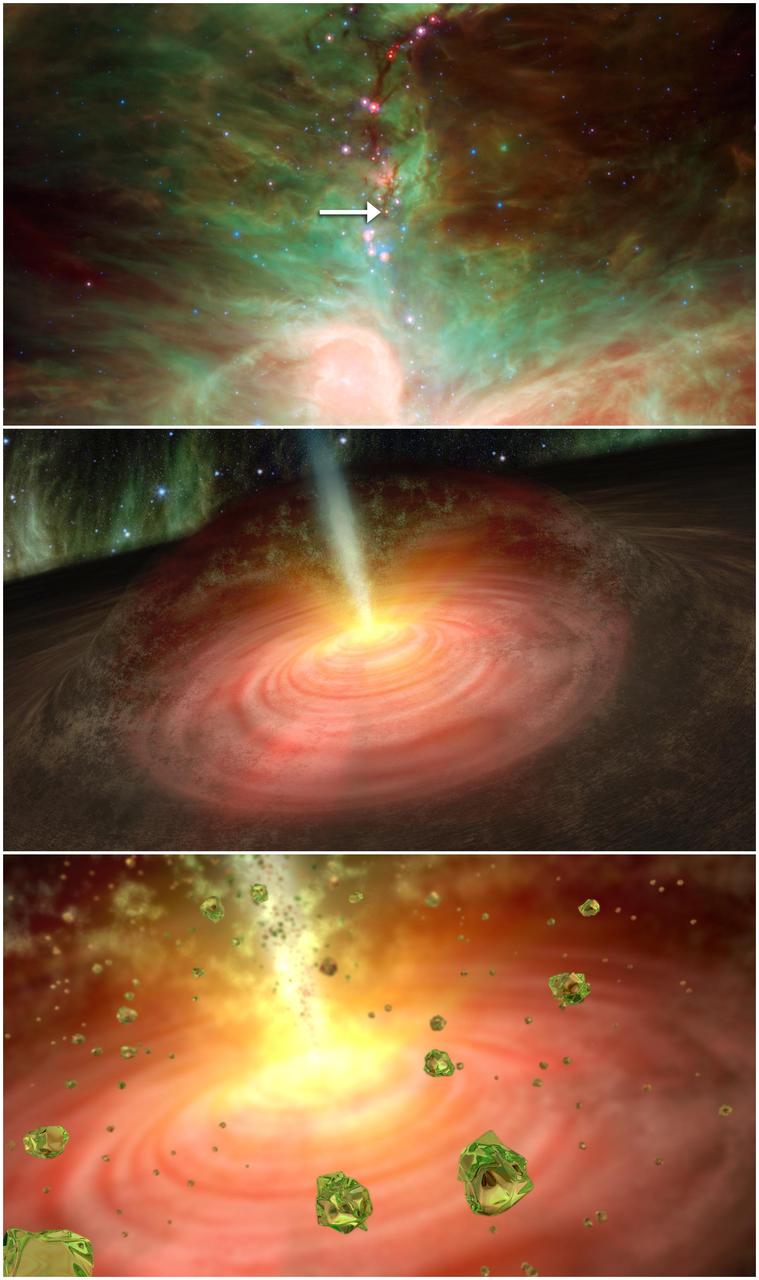
This graphic illustrates a stellar fountain of crystal rain, beginning with a NASA Spitzer picture of the star in question, and ending with an artist concept of what the crystal rain might look like.

Using NASA Spitzer Space Telescope, astronomers have, for the first time, found signatures of silicate crystals around a newly forming protostar in the constellation of Orion.
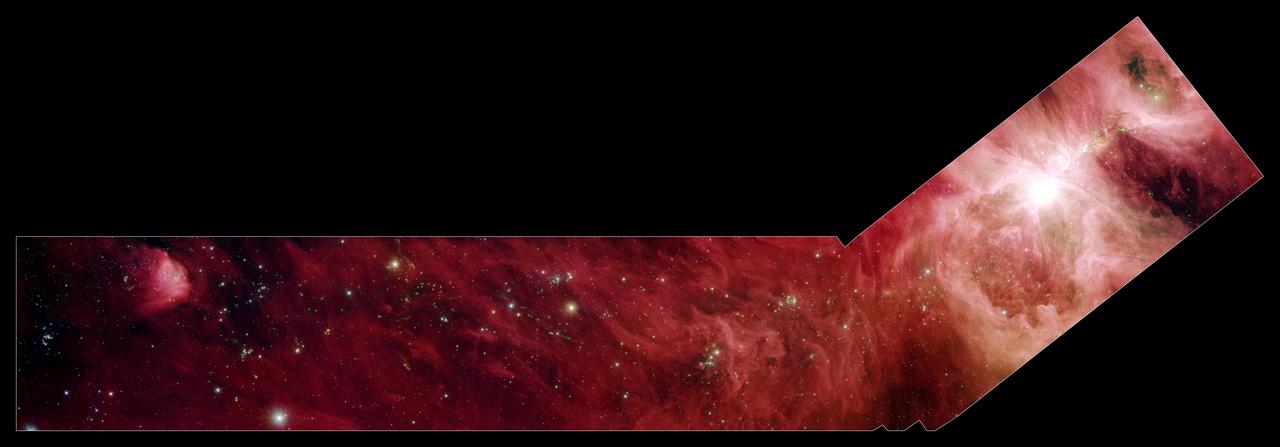
This image composite shows a part of the Orion constellation surveyed by NASA Spitzer Space Telescope. The shape of the main image was designed by astronomers to roughly follow the shape of Orion cloud A, an enormous star-making factory.
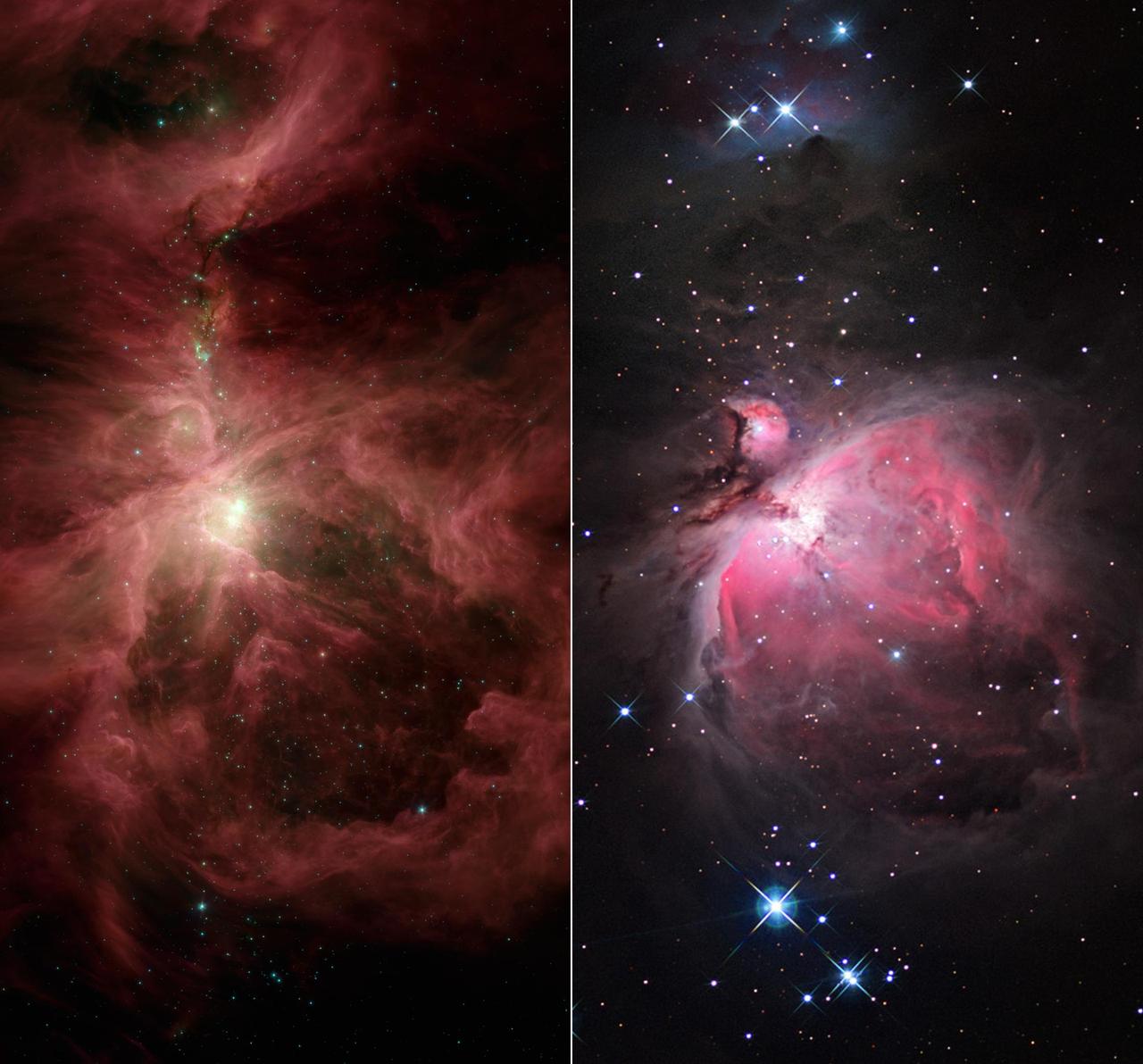
NASA Spitzer Space Telescope and the National Optical Astronomy Observatory compare infrared and visible views of the famous Orion nebula and its surrounding cloud, an industrious star-making region located near the hunter constellation sword.

Infrared images from instruments at Kitt Peak National Observatory left and NASA Spitzer Space Telescope document the outburst of HOPS 383, a young protostar in the Orion star-formation complex.
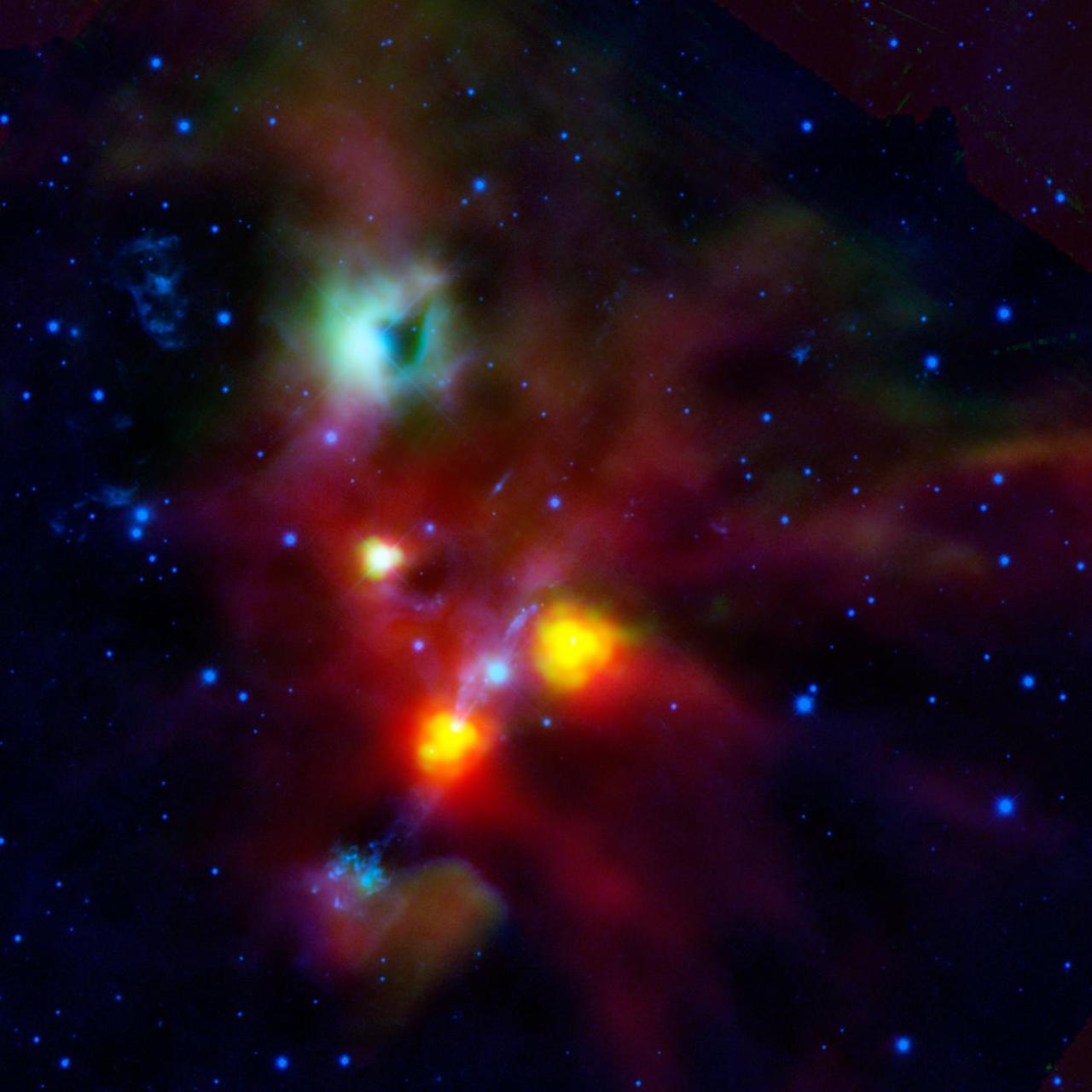
The dark hole seen in the green cloud at the top of this image, captured by ESA Herschel Telescope, was likely carved out by multiple jets and blasts of radiation.

Hubble Captures Best View of Mars Ever Obtained from Earth