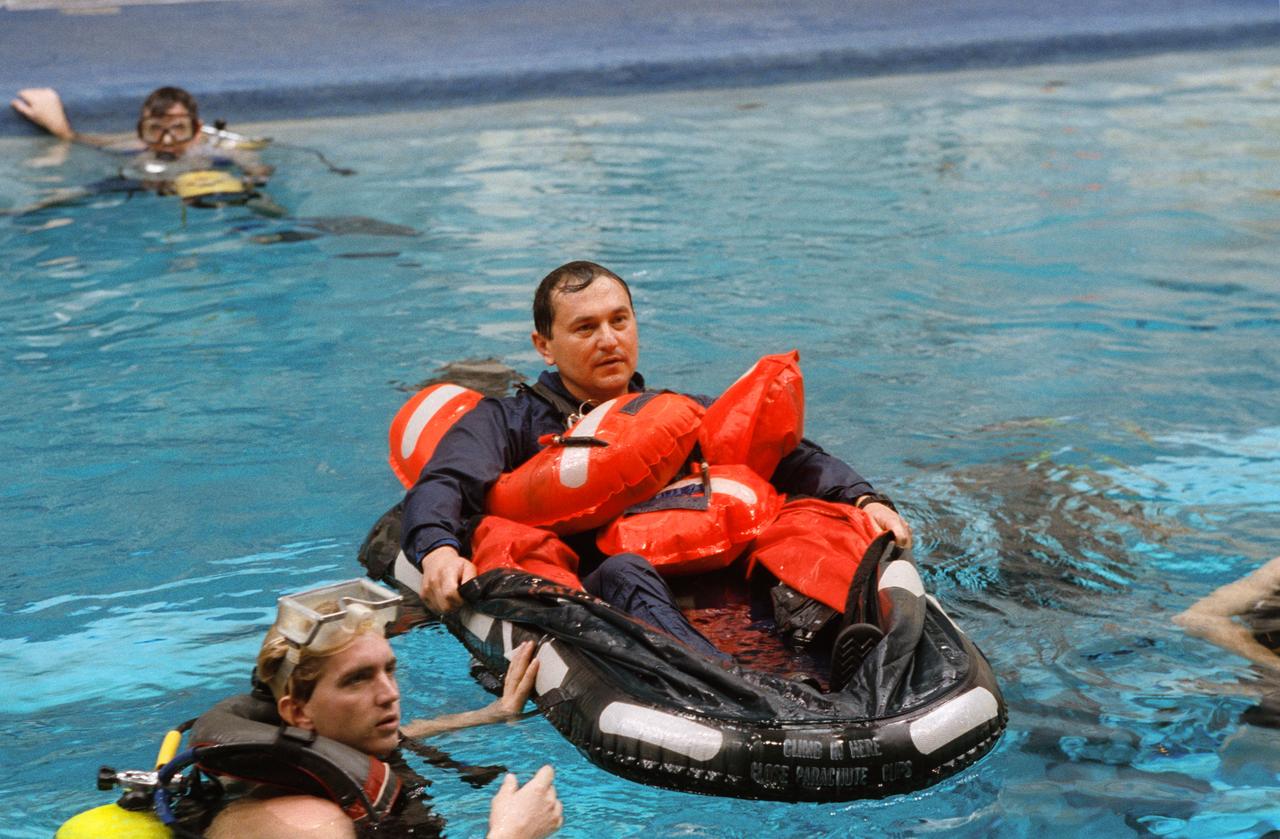
Russian Cosmonaut Vladimir Titov maneuvers a small life raft during bailout training at JSC's Weightless Environment Training Facility (WETF). Two SCUBA-equipped divers assisted Titov in the STS-60 training exercise.
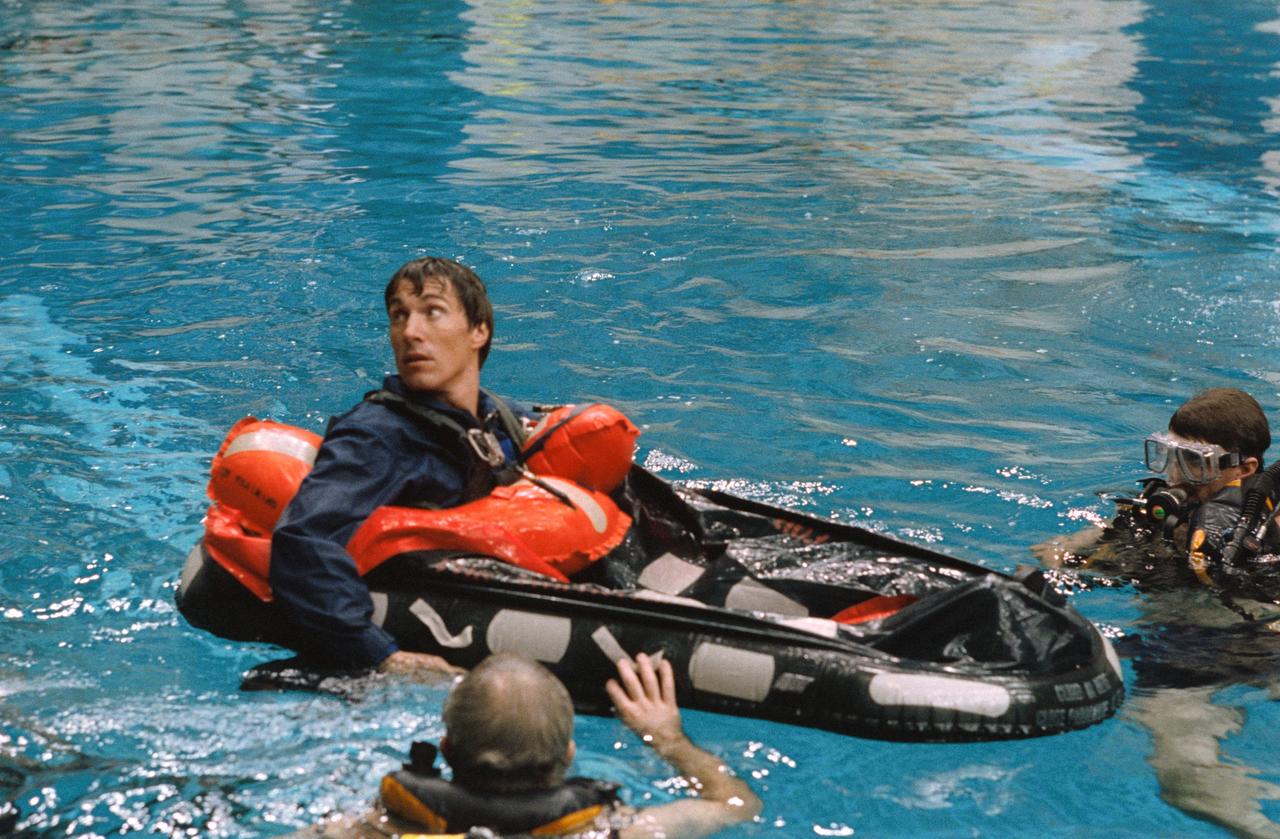
S93-26021 (Feb 1993) --- Russian cosmonaut Sergei Krikalev maneuvers a small life raft during bailout training at the Johnson Space Center's (JSC) Weightless Environment Training Facility (WET-F). Two SCUBA-equipped divers assisted Krikalev in the STS-60 training exercise. Shuttle crew members frequently utilize the 25-ft. deep pool to learn proper procedures to follow in the event of emergency egress from their Space Shuttle via the escape pole system. Krikalev is one of two cosmonauts in training for the STS-60 mission. One of the two will serve as primary payload specialist with the other filling an alternate's role. This pool and the facility in which it is housed are titled the WET-F, because they are also used by astronauts rehearsing both mission-specific and contingency extravehicular activities (EVA).
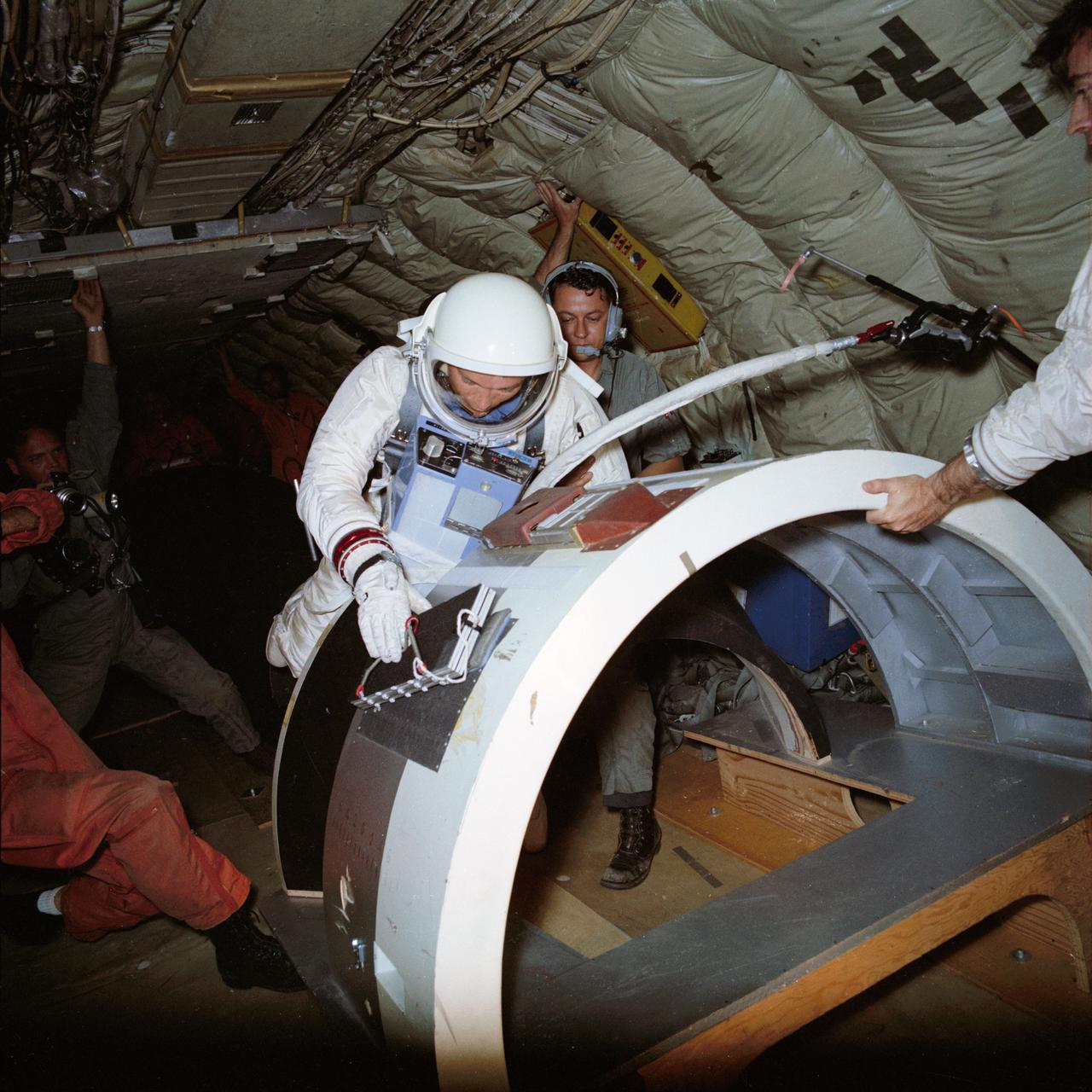
S66-40098 (17 June 1966) --- Astronaut Michael Collins, prime crew pilot of the Gemini-10 spaceflight, undergoes zero-gravity (weightlessness) training aboard an Air Force KC-135 aircraft. He practices with micrometeorite experiment-type equipment. The KC-135 flew a parabolic curve to create the zero-gravity condition. This training is in preparation for Collins' Gemini-10 extravehicular activity. Photo credit: NASA
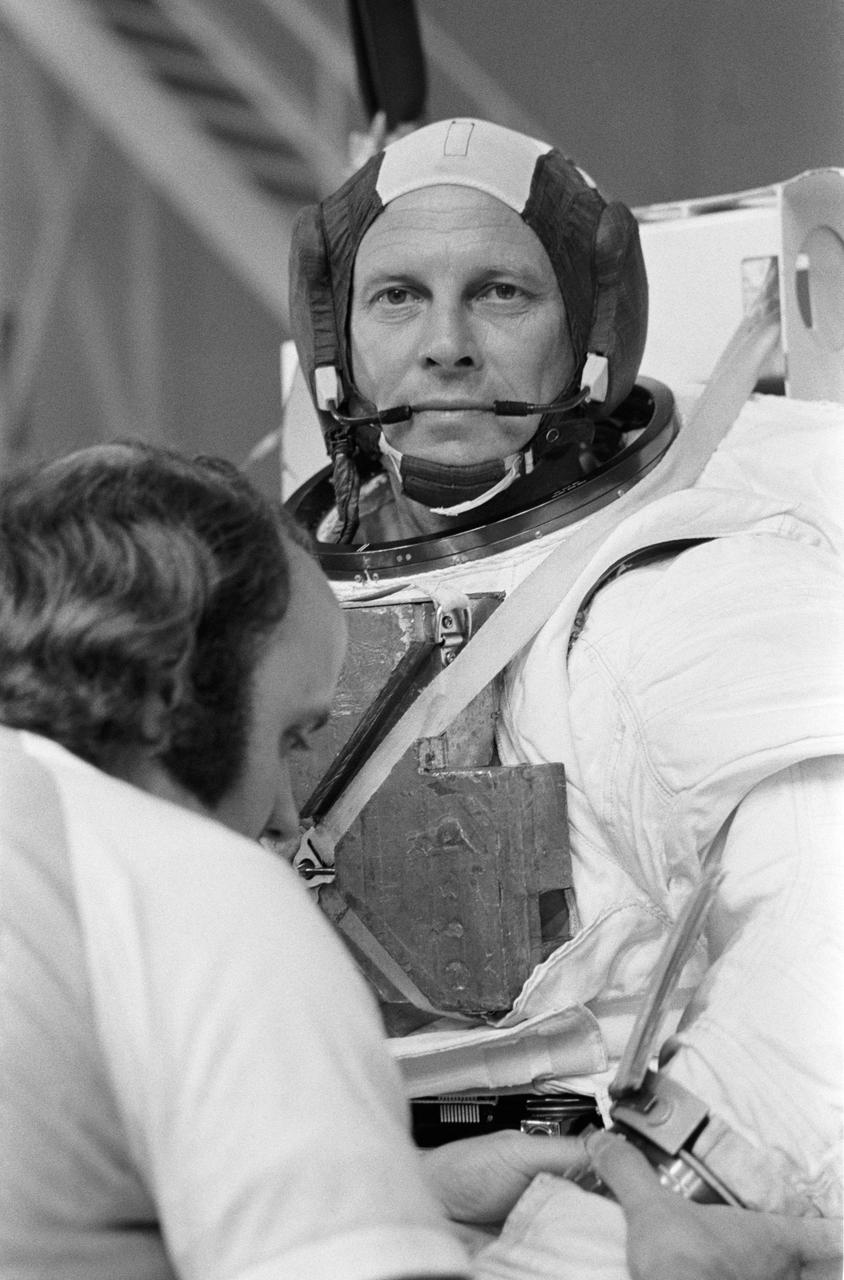
Portrait view of astronaut Jack Lousma in the Extravehicular Mobility Unit (EMU) at bldg 29 Weightless Environment Training Facility (WETF). He is wearing the EMU minus the helmet.
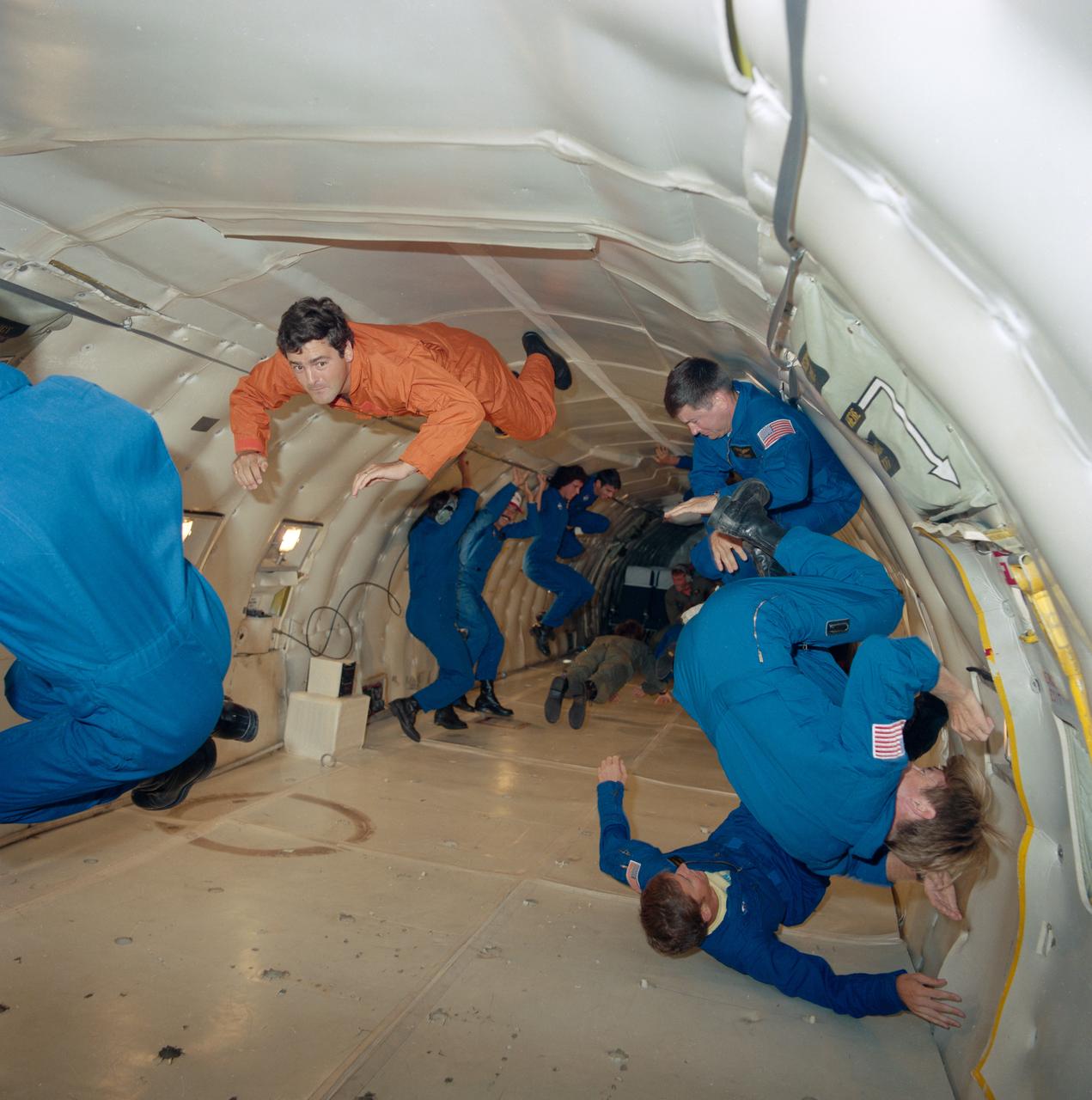
View of astronaut candidates and payload specialists during a training flight on the KC-135. The trainees are experiencing weightlessness in the hold of the aircraft.
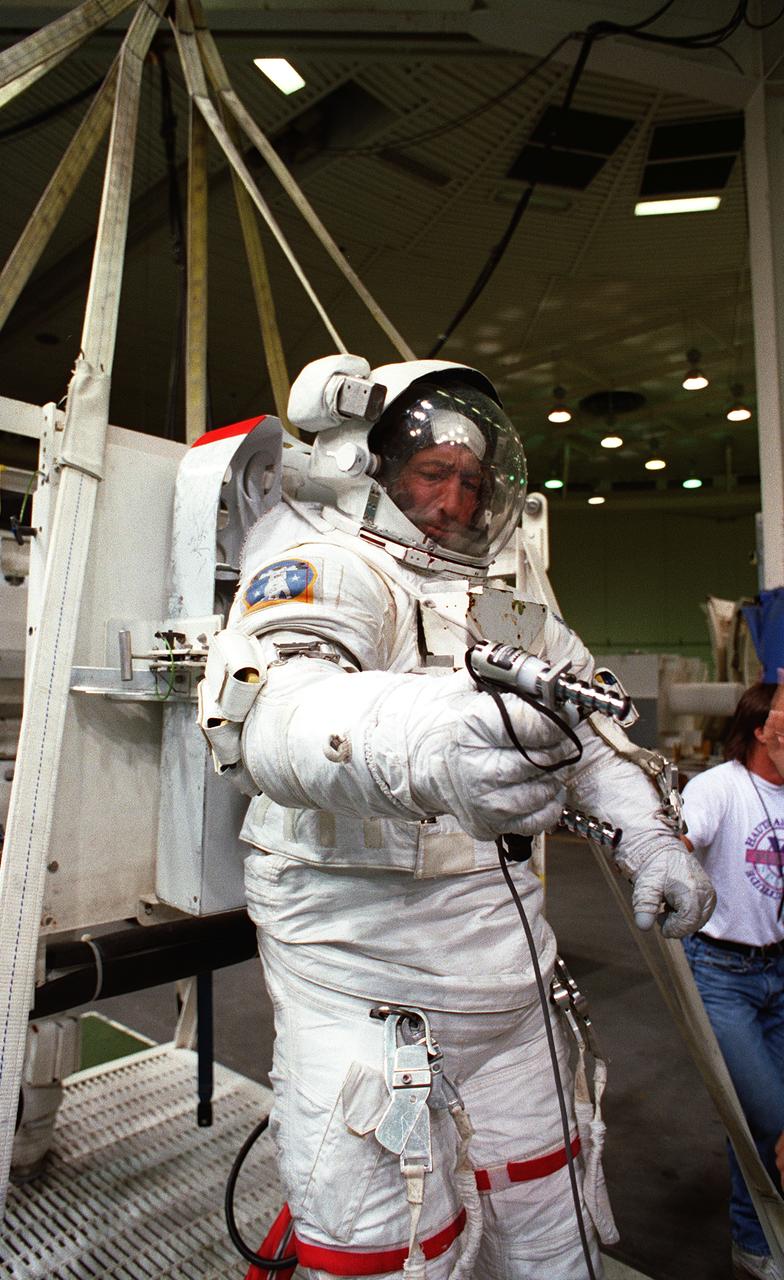
S95-15847 (26 July 1995) --- Wearing a training version of the Extravehicular Mobility Unit (EMU) space suit, astronaut Mario Runco Jr., mission specialist, prepares to participate in an underwater rehearsal of a contingency Extravehicular Activity (EVA). This type of training routinely takes place in the 25-feet deep pool of the Johnson Space Center's (JSC) Weightless Environment Training Center (WET-F). The training prepares at least two crew members on each flight for procedures to follow outside the spacecraft in event of failure of remote methods to perform various chores.
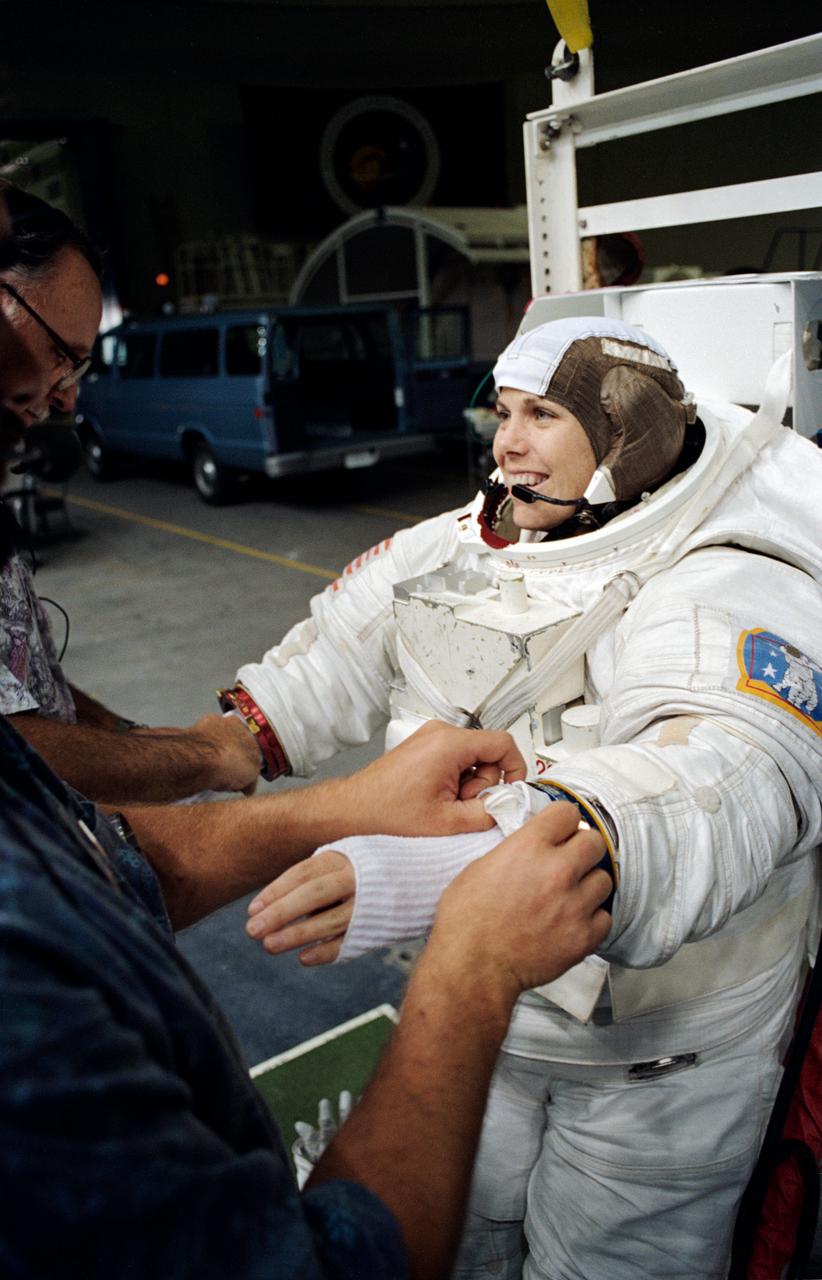
Attired in a training version of the Extravehicular Mobility Unit (EMU), astronaut Mary Ellen Weber gets help with the final touches of suit donning during a training session at JSC's Weightless Environment Training Facility (WETF). Training as a mission specialist for the STS-70 mission, Weber was about to rehearse a contingency space walk.
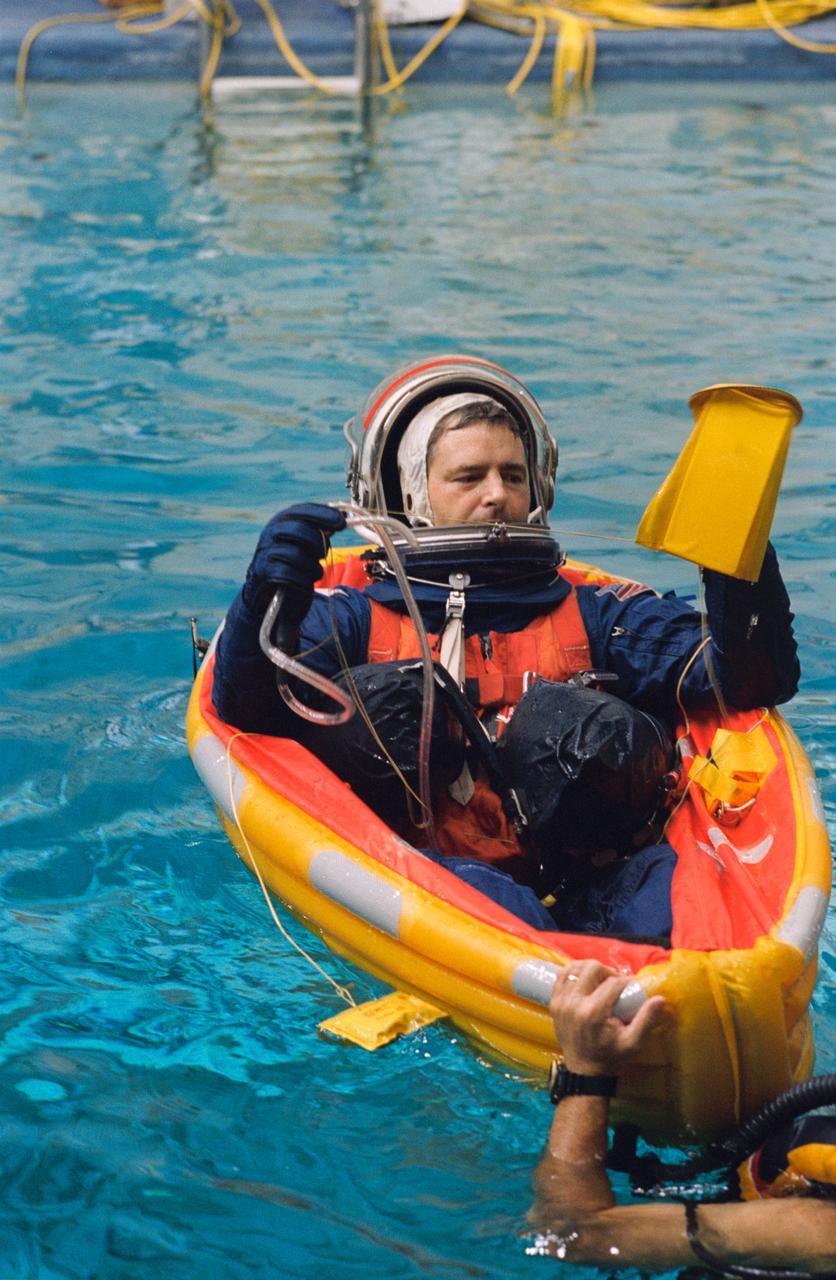
S93-45726 (7 Oct. 1993) --- Canadian astronaut candidate Marc Garneau, later named as a mission specialist for NASA's STS-77 mission, participates in emergency bailout training at the Johnson Space Center (JSC). Garneau was in the 1992 class of Astronaut Candidates (ASCAN). Wearing full parachute gear following a simulated parachute drop, Garneau has deployed a small life raft in a 25-feet deep pool in JSC's Weightless Environment Training Facility (WET-F). This portion of an astronaut's training is to prepare him or her for proper measures to take in the event of bailout over water. Garneau is assisted here by one of several SCUBA-equipped divers in the pool.
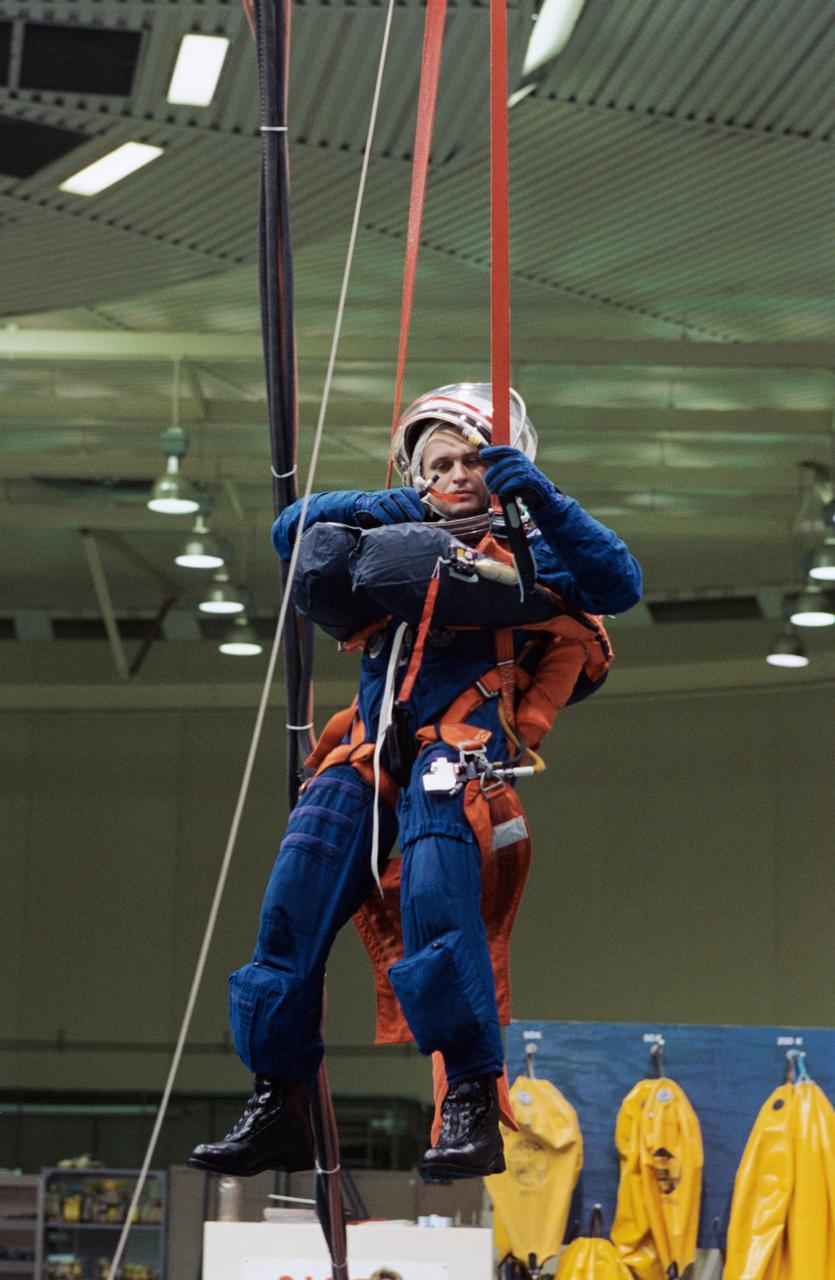
S94-47232 (13 Oct 1994) --- Cosmonaut Yuriy I. Onufriyenko (right), in the United States to participate in training for joint Russia-United States space missions, simulates a parachute drop into water. The training took place in the Johnson Space Center's (JSC) Weightless Environment Training Facility (WET-F) because it contains a 25-feet-deep pool. Onufriyenko, a Mir reserve team member, and a number of other cosmonauts and astronauts participating in the joint program were in Houston, Texas to prepare for upcoming missions which involve crewmembers from the two nations.
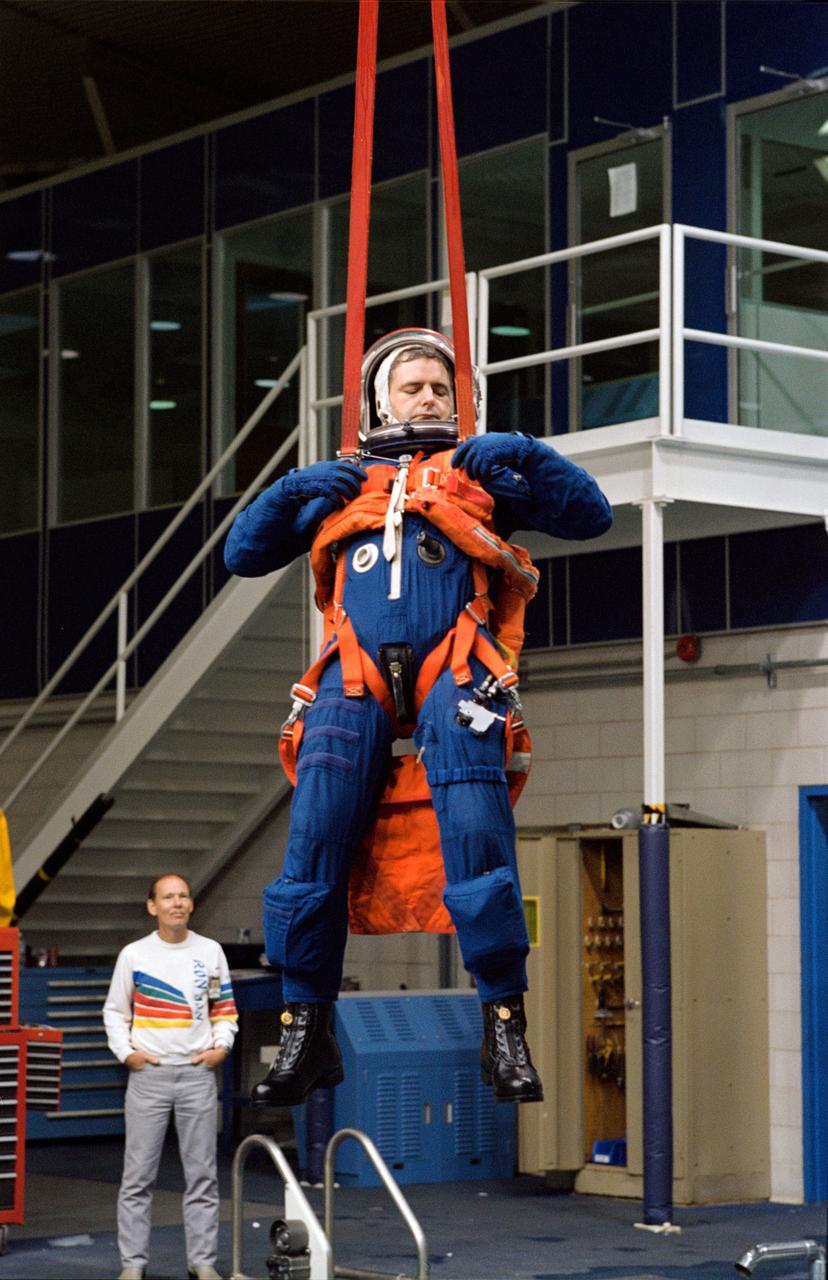
S93-45723 (7 October 1993) --- Canadian astronaut candidate Marc Garneau, later named as a mission specialist for NASA's STS-77 mission-representing the Canadian Space Agency (CSA), participates in emergency bailout training at the Johnson Space Center (JSC). Garneau was in the 1992 class of Astronaut Candidates (ASCAN). Wearing full parachute gear, Garneau is suspended above a 25-feet deep pool in JSC's Weightless Environment Training Facility (WET-F). This portion of an astronaut's training is to prepare them for proper measures to take in the event of bailout over water.
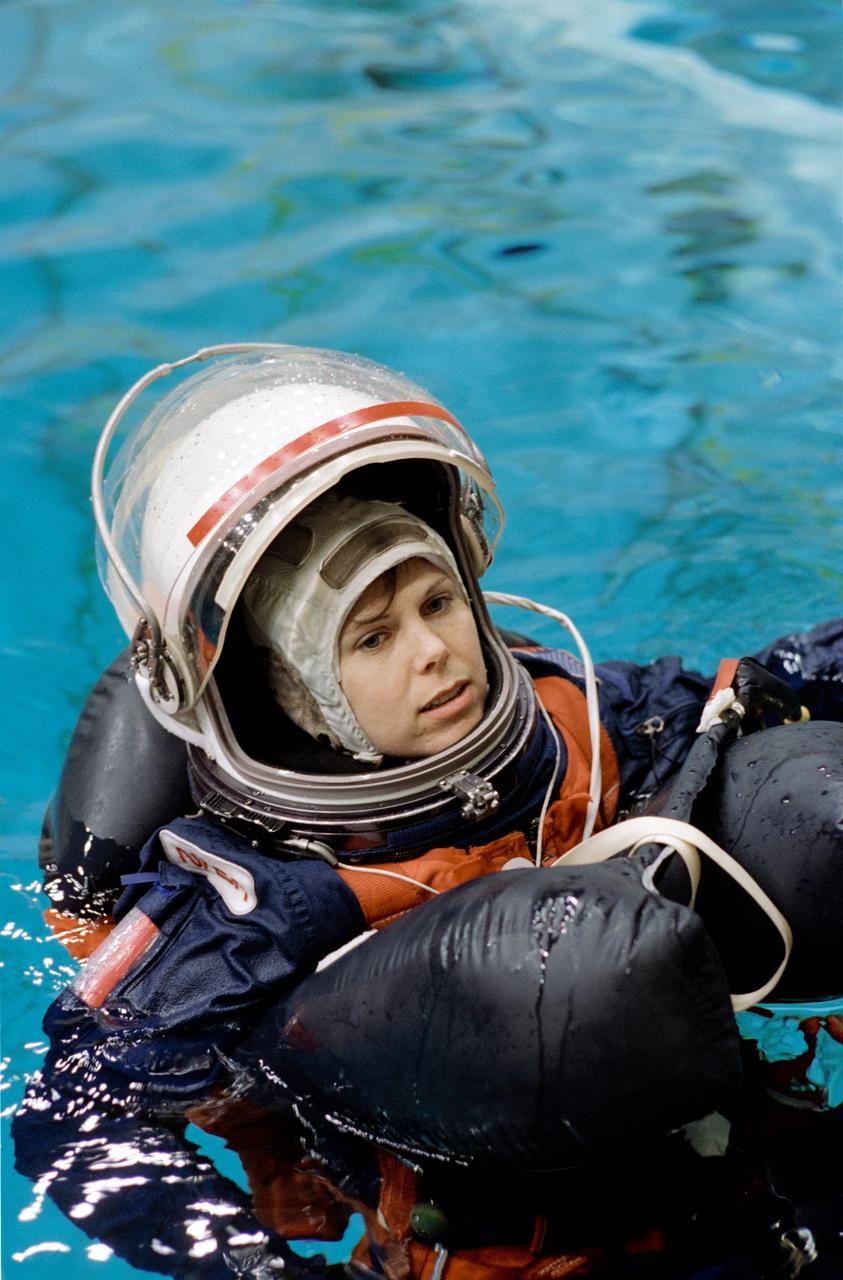
S95-03501 (16 FEB 1995) --- Astronaut Mary Ellen Weber prepares to deploy a life raft during a training session at the Johnson Space Center's (JSC) Weightless Environment Training Facility (WET-F). Training as a mission specialist for the STS-70 mission, Weber was joined by four crew mates in the emergency bailout rehearsal.
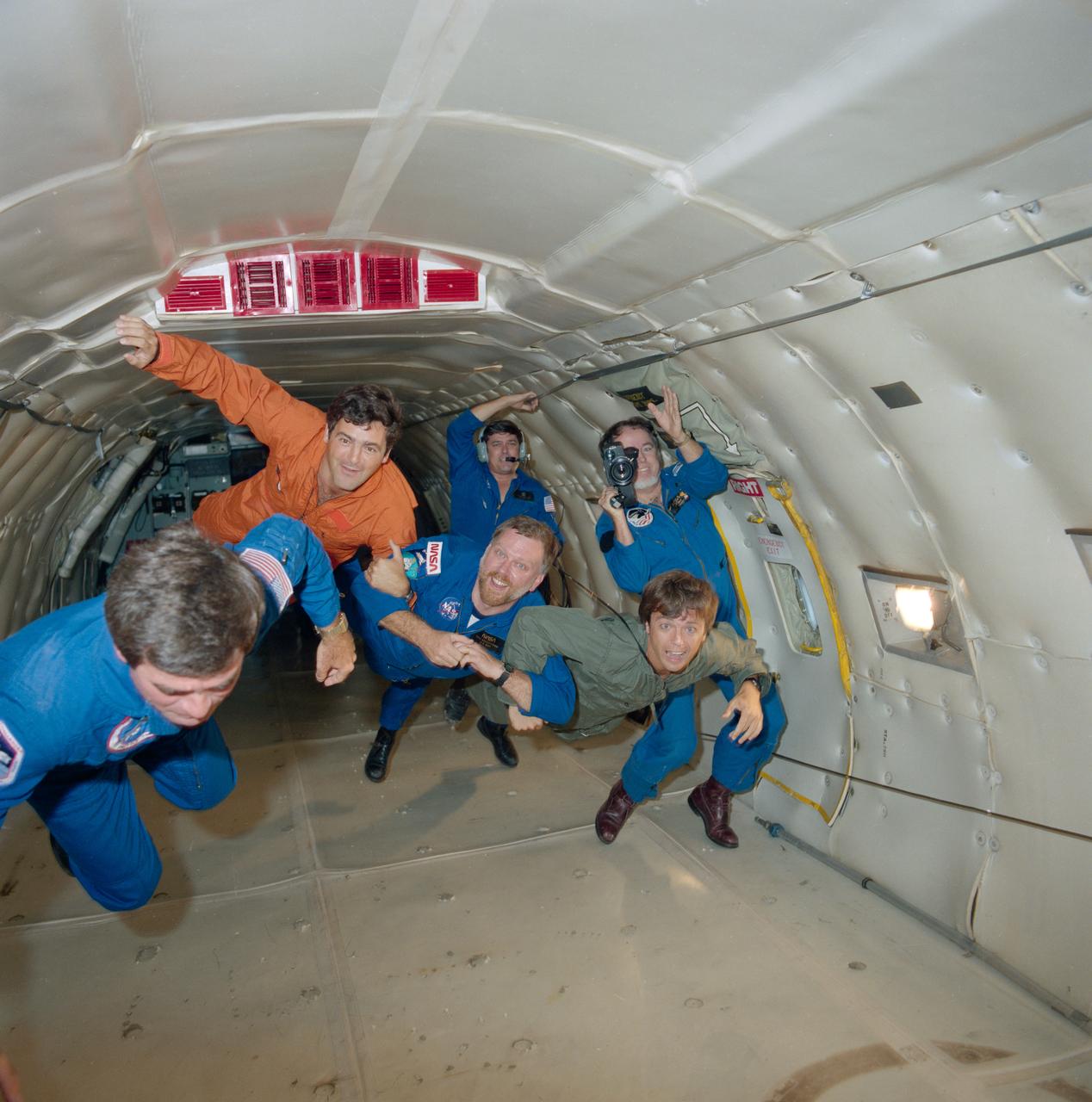
Paul Scully-Power, 41-G payload specialist, links arms with two others as they experience weightlessness in the KC-135 training aircraft. The trio appears to be flying toward the front of the aircraft while others take photos.
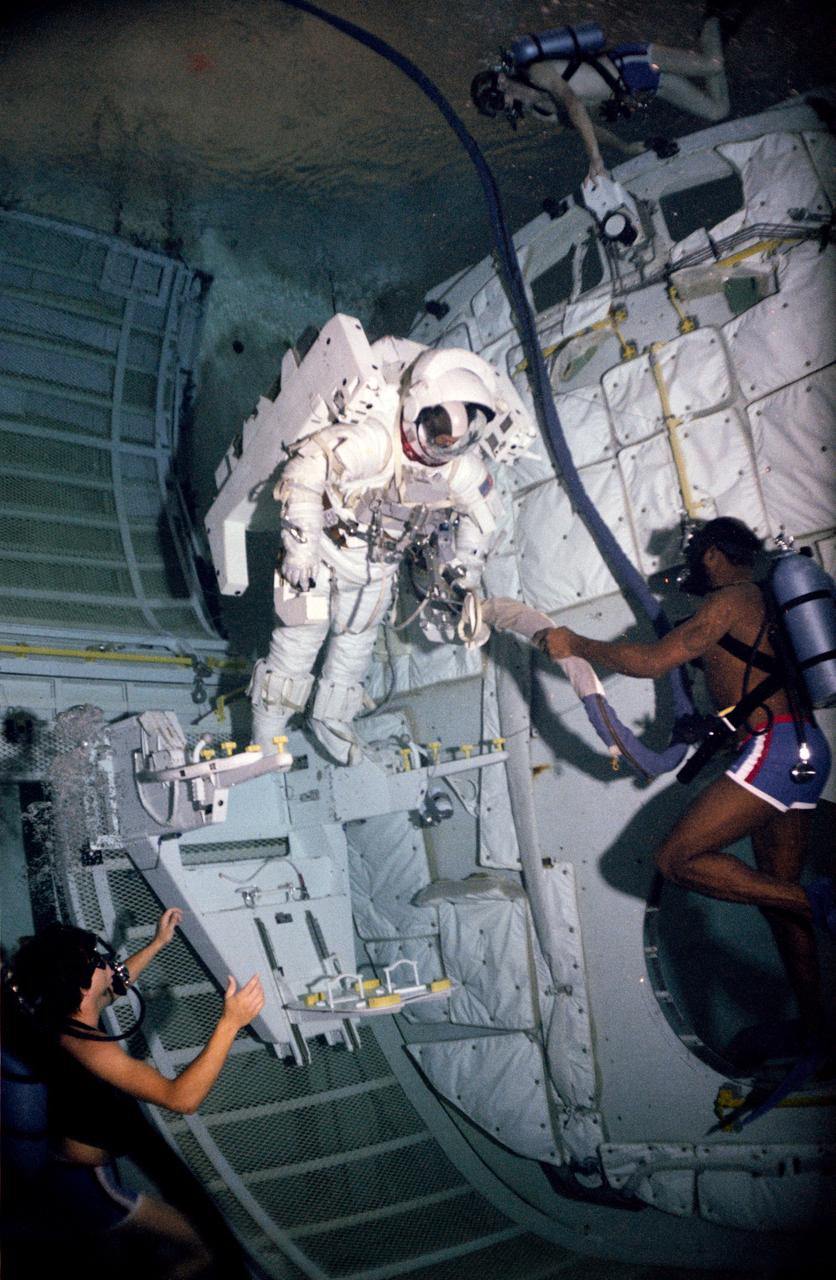
Astronaut Bruce McCandless during an underwater test of the Manned Maneuvering Unit (MMU) Flight Support Station (FSS) donning and doffing in the Bldg 29 Weightless Environment Training Facility (WETF). View is of McCandless wearing the extravehicular mobility unit (EMU), stepping into the MMU.
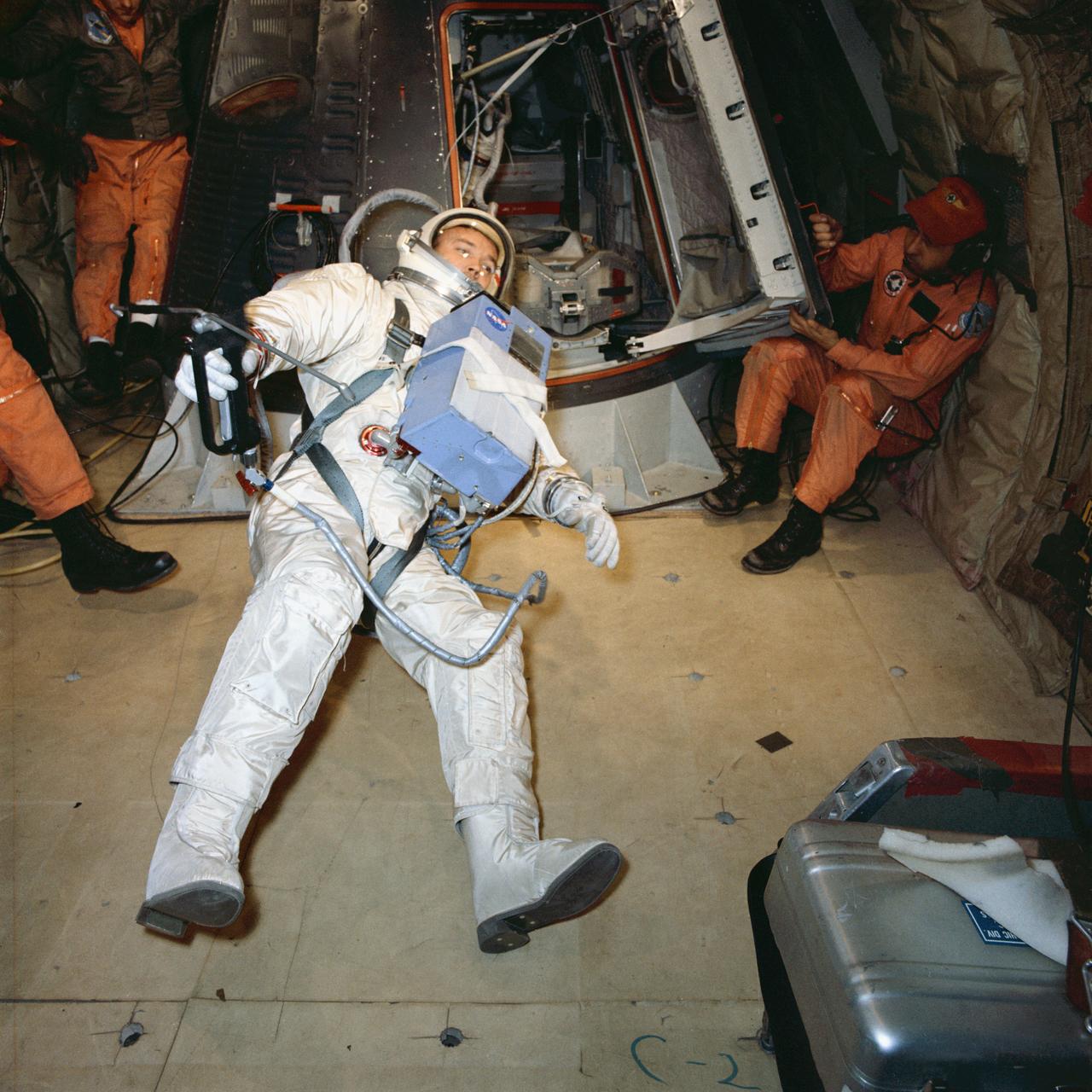
S66-28782 (1 April 1966) --- Astronaut Michael Collins, prime crew pilot of the Gemini-10 spaceflight, experiences a condition of weightlessness during zero-gravity egress training. A KC-135 Air Force plane, flying a parabolic curve, creates a weightless environment as a training exercise in preparation for spaceflight. The Hand-Held Maneuvering Unit in his right hand produces controlled thrust for moving about. Photo credit: NASA
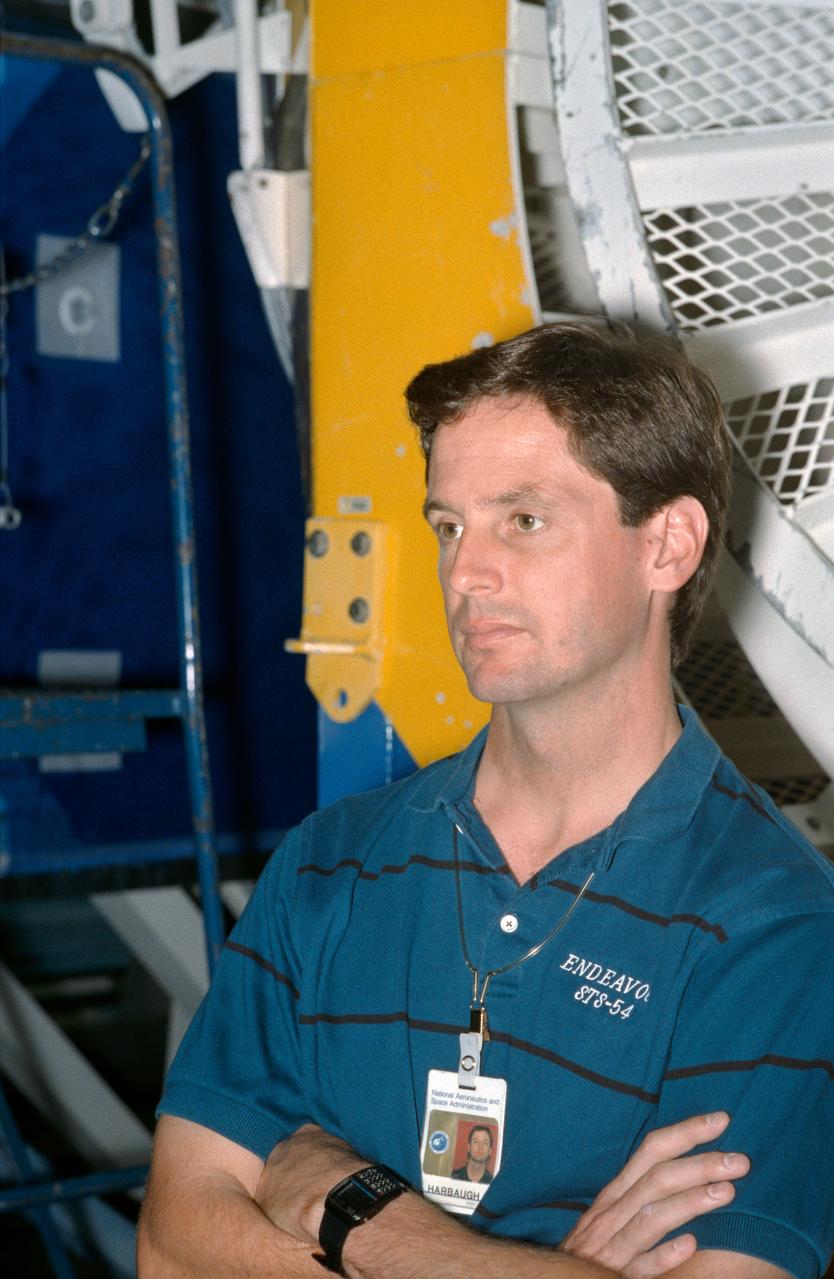
S92-40569 (Aug 1992) --- Gregory J. Harbaugh, one of five astronaut crewmembers assigned to fly aboard the Space Shuttle Endeavour for the STS-54 mission, pauses for a break during training and preparations for the six-day mission. Harbaugh will be joined by John H. Casper, mission Donald R. McMonagle, pilot; along with Mario Runco Jr. and Susan J. Helms, mission specialists. Harbaugh is in the weightless environment training facility (WET-F) at the Johnson Space Center (JSC).
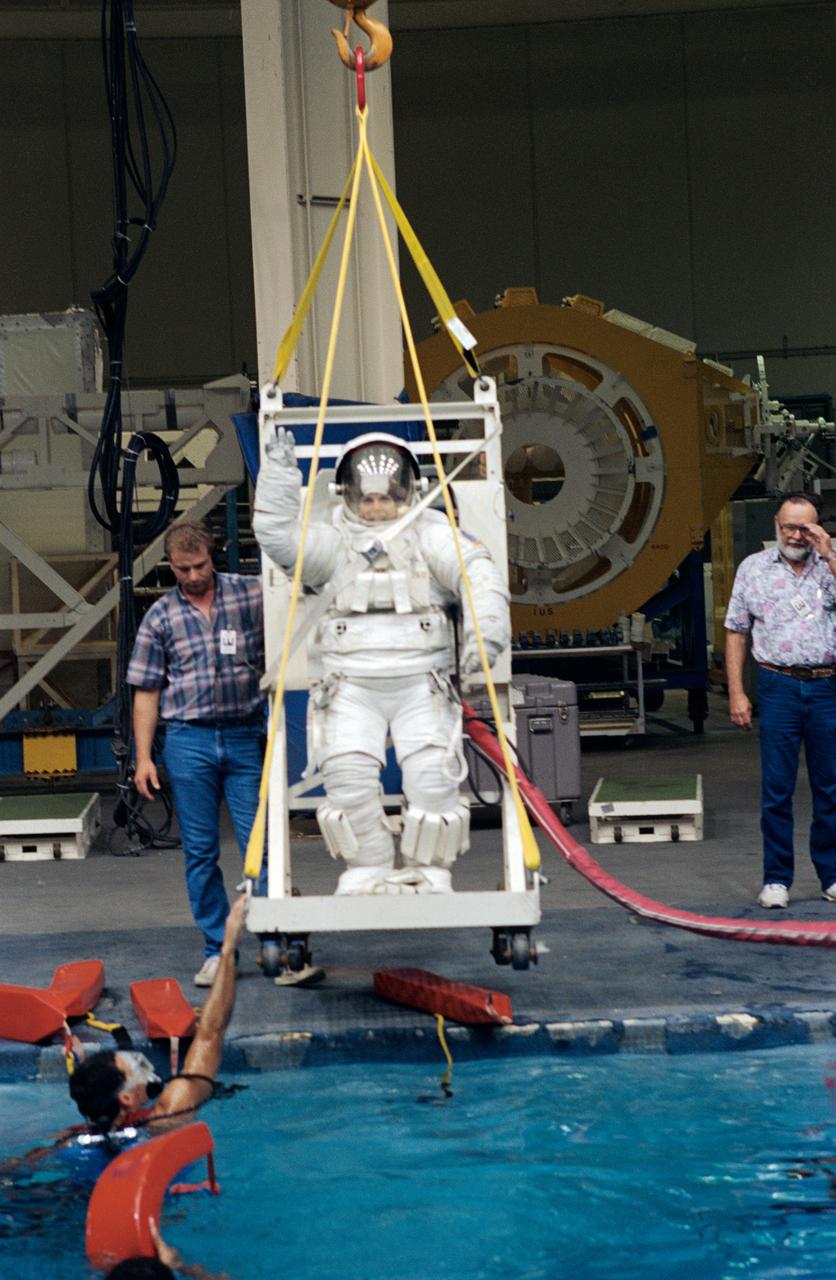
Attired in a training version of the Extravehicular Mobility Unit (EMU), Astronaut Mary Ellen Weber participates in a training session at JSC's Weightless Environment Training Facility (WETF). Training as a mission specialist for the STS-70 mission, Weber was about to rehearse a contingency space walk. One of several SCUBA-equipped divers waits to assist in the rehearsal in the water.
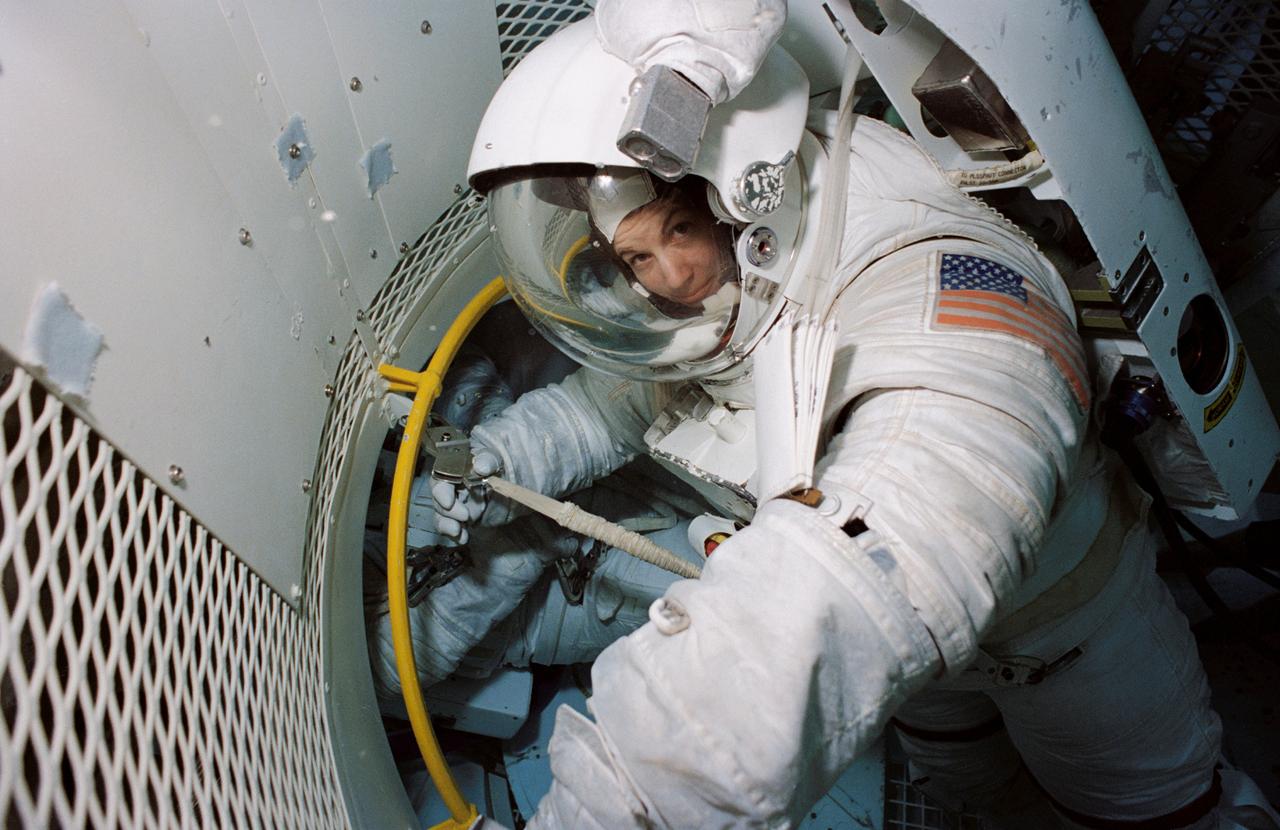
Astronaut and mission specialist Catherine G. Coleman,attired in a high fidelity training version of the Extravehicular Mobility Unit (EMU) space suit, trains for a contingency space walk at the Johnson Space Center’s (JSC) Weightless Environment Training Facility (WET-F). This particular training was in preparation for the STS-73 mission. The STS-73 mission was the second flight of the United States Microgravity Laboratory (USML-2), managed by scientists and engineers from the Marshall Space Flight Center.
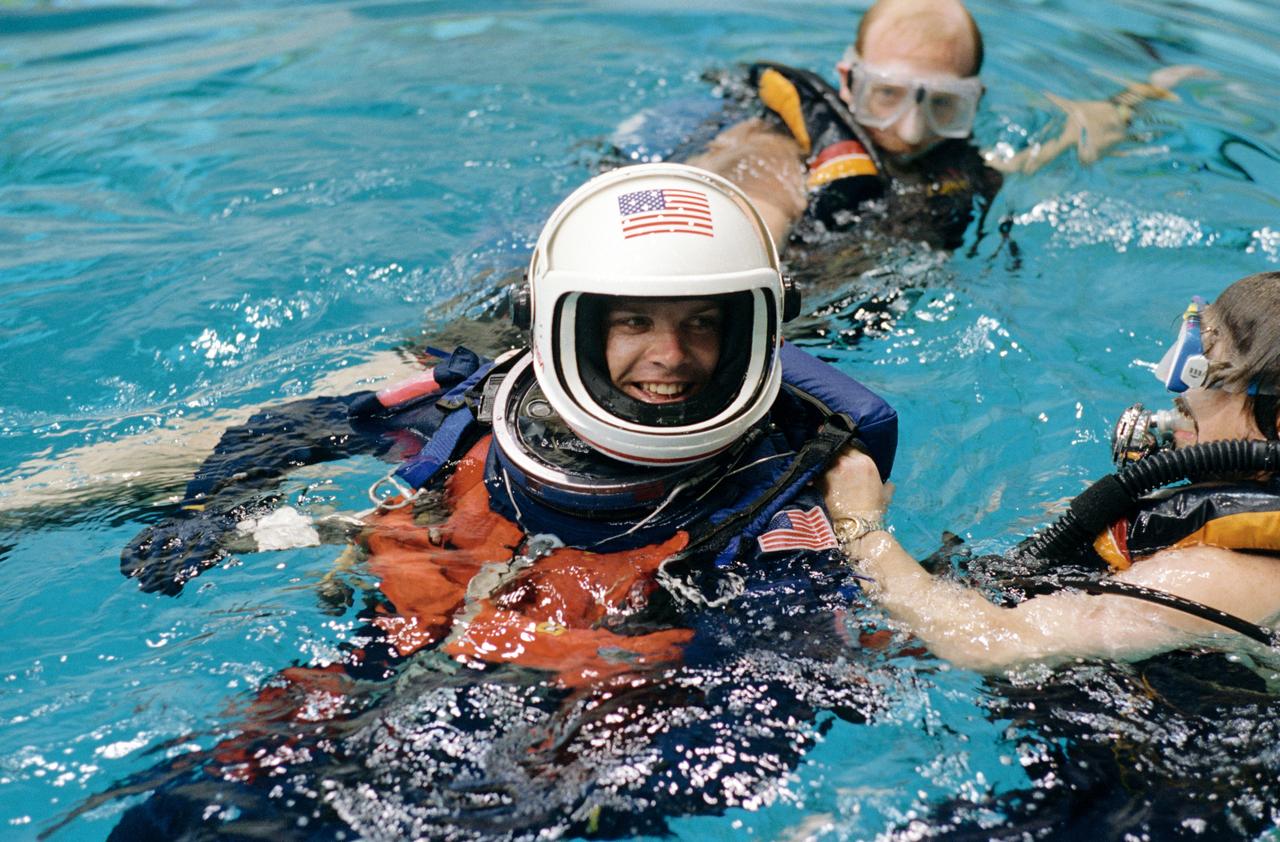
S95-03480 (16 FEB 1995) --- Attired in a training version of the Shuttle launch and entry garment, astronaut Kevin R. Kregel, pilot, gets help from SCUBA-equipped divers during a training session at the Johnson Space Center's (JSC) Weightless Environment Training Facility (WET-F). As part of the emergency bailout phase of their training agenda, the STS-70 crew members made use of this 25-feet deep pool to practice parachute landings in water and subsequent deployment of life rafts.
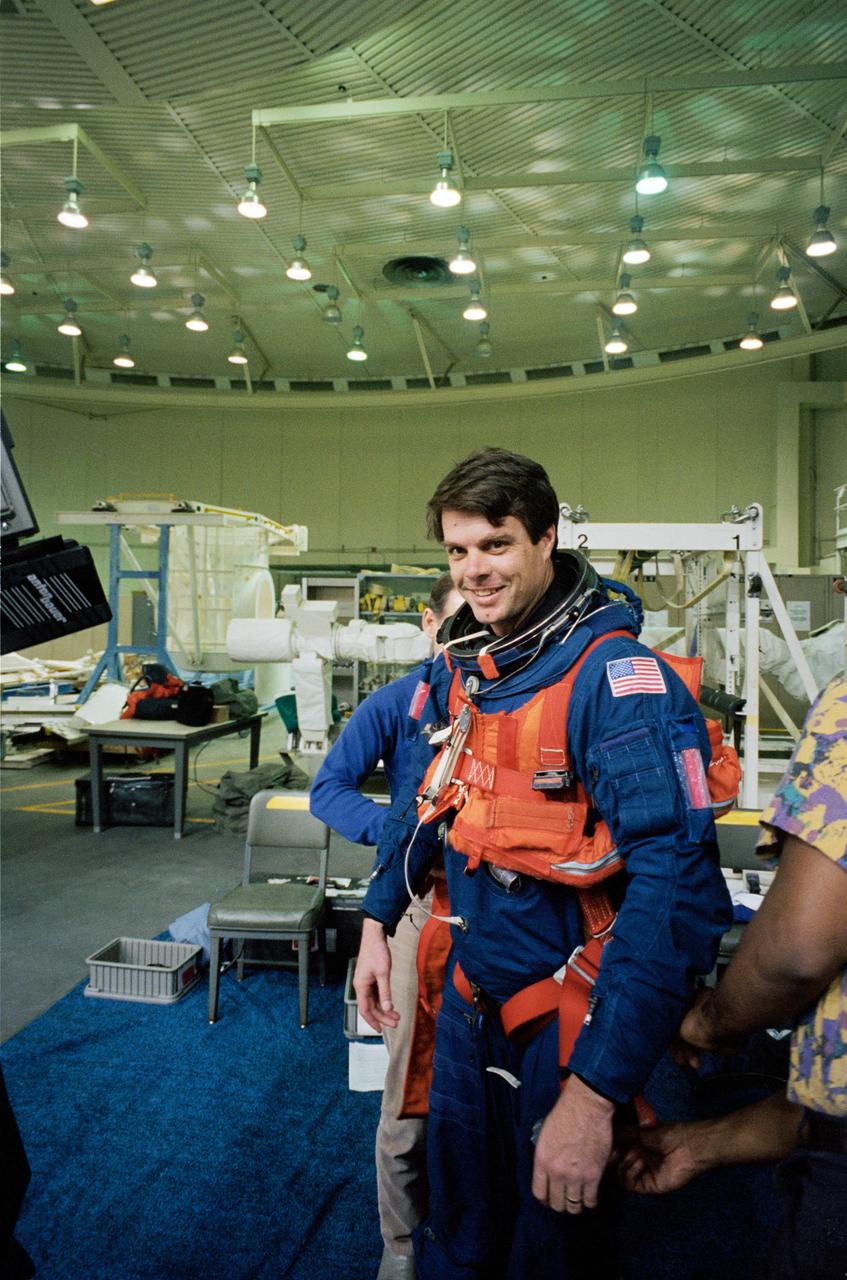
S95-03465 (16 Feb 1995) --- Attired in a training version of the Shuttle launch and entry garment, astronaut Kevin R. Kregel gets help with the final touches of suit donning during a training session at the Johnson Space Center's (JSC) Weightless Environment Training Facility (WET-F). Assigned as pilot for the STS-70 mission, Kregel was about to rehearse emergency bailout. The crew members made use of a nearby 25-feet deep pool to practice parachute landings in water and subsequent deployment of life rafts.
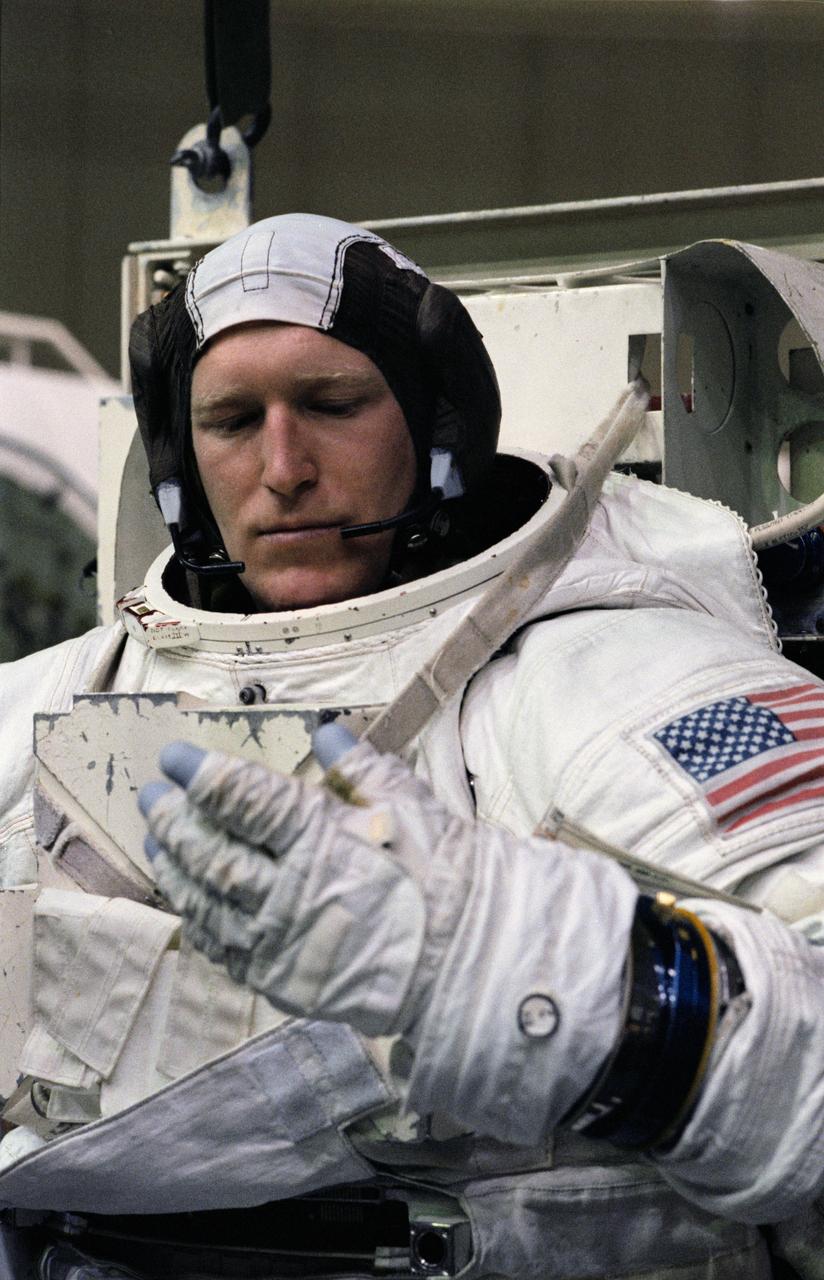
S87-26630 (March 1987) --- Astronaut Charles D. (Sam) Gemar, wearing a training version of the Extravehicular Mobility Unit (EMU) space suit, prepares to be emersed in the 25-ft. deep waters of the Weightless Environment Training Facility (WET-F) at the Johnson Space Center (JSC). Once underwater, Gemar was able to achieve a neutrally buoyant state and to simulate the floating type activities of an astronaut in microgravity. Gemar began training as an astronaut candidate in the summer of 1985.
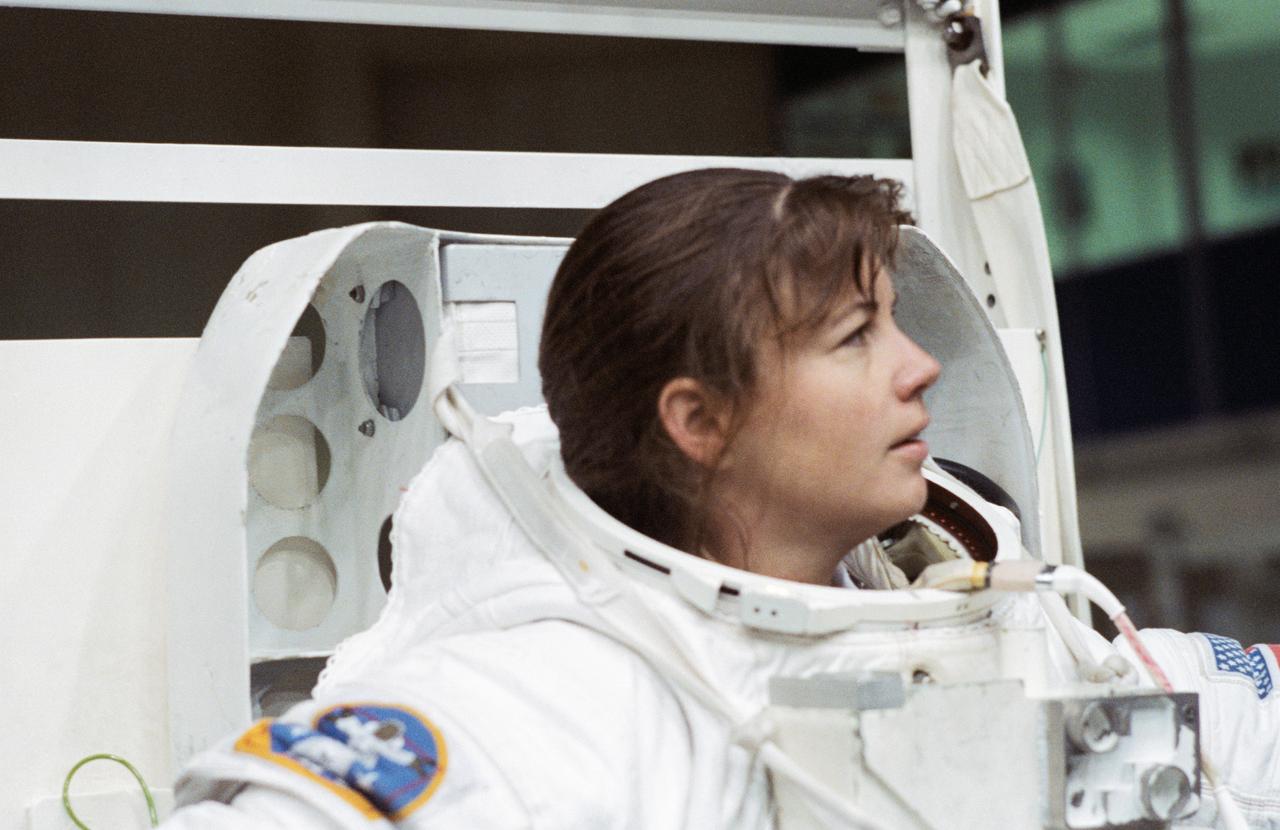
Astronaut and mission specialist Catherine G. Coleman is about to don the helmet portion of a high fidelity training version of the Extravehicular Mobility Unit (EMU) space suit at the Johnson Space Center’s (JSC) Weightless Environment Training Facility (WET-F). This particular training was in preparation for the STS-73 mission. The STS-73 mission was the second flight of the United States Microgravity Laboratory (USML-2), managed by scientists and engineers from the Marshall Space Flight Center.

S66-28770 (1 April 1966) --- Astronaut Michael Collins, prime crew pilot of the Gemini-10 spaceflight, undergoes zero-gravity egress training aboard a KC-135 Air Force plane. The plane, flying a parabolic curve, creates a weightless environment as a training exercise in preparation for spaceflight. Photo credit: NASA
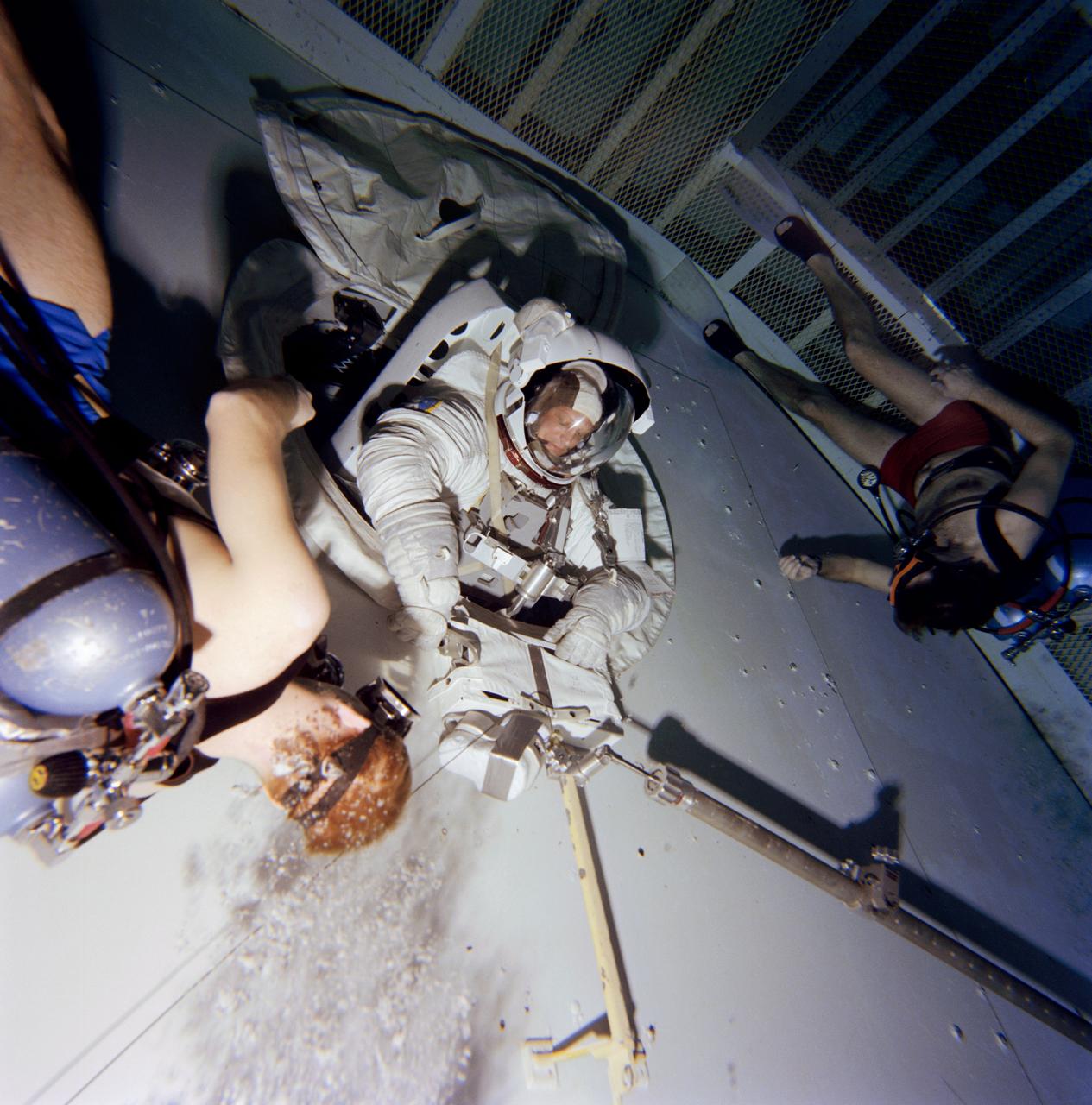
Dr. Norman E. Thagard, mission specialist for STS-7, moves through the hatchway of the mockup of the Space Shuttle orbiter which is part of JSC's weightless environment training facility (WETF). Thagard is wearing an extravehicular mobility unit and is practicing procedures used when performing an extravehicular activity (EVA) during a flight.
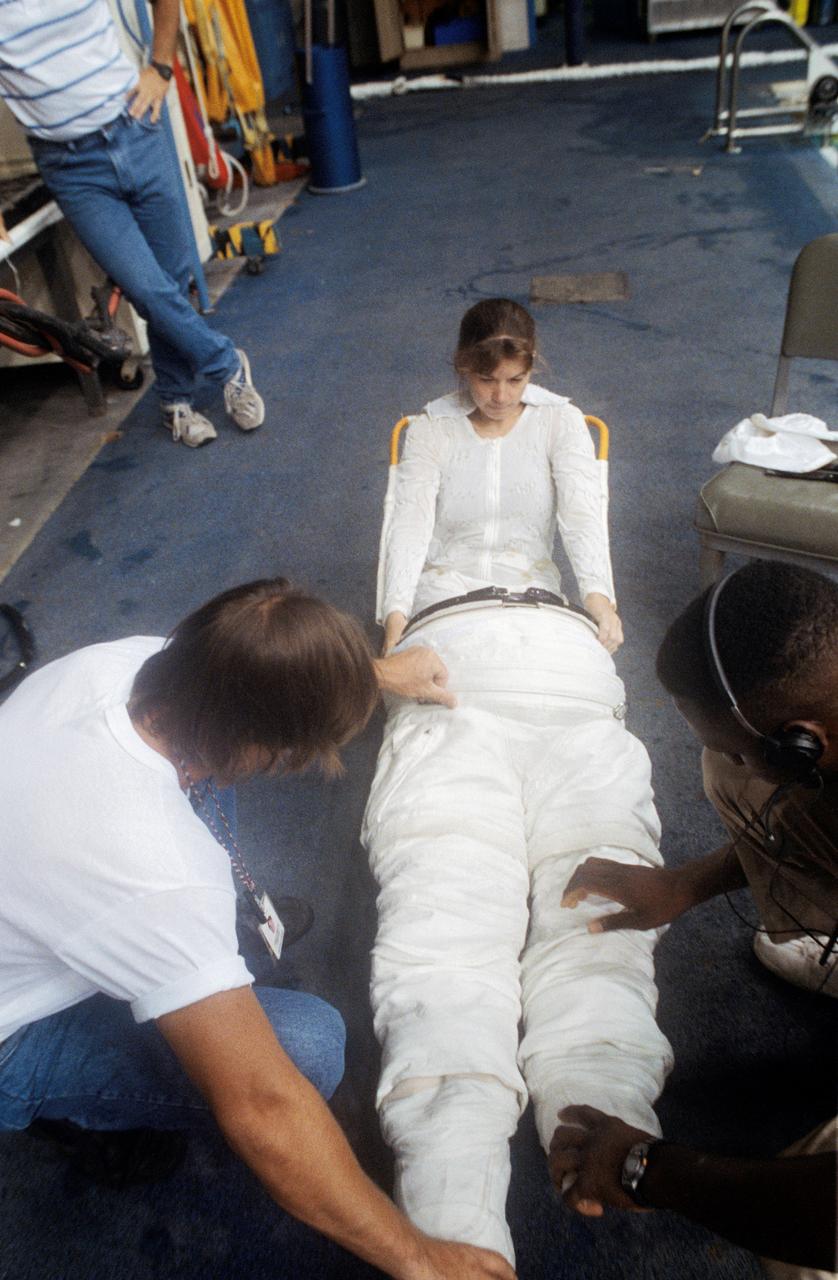
Astronaut and mission specialist for STS-73, Catherine G. Coleman, dons a high fidelity training version of the Extravehicular Mobility Unit (EMU) space suit at the Johnson Space Center’s (JSC) Weightless Environment Training Facility (WET-F) in preparation for the mission. The STS-73 mission was the second flight of the United States Microgravity Laboratory (USML-2), managed by scientists and engineers from the Marshall Space Flight Center.
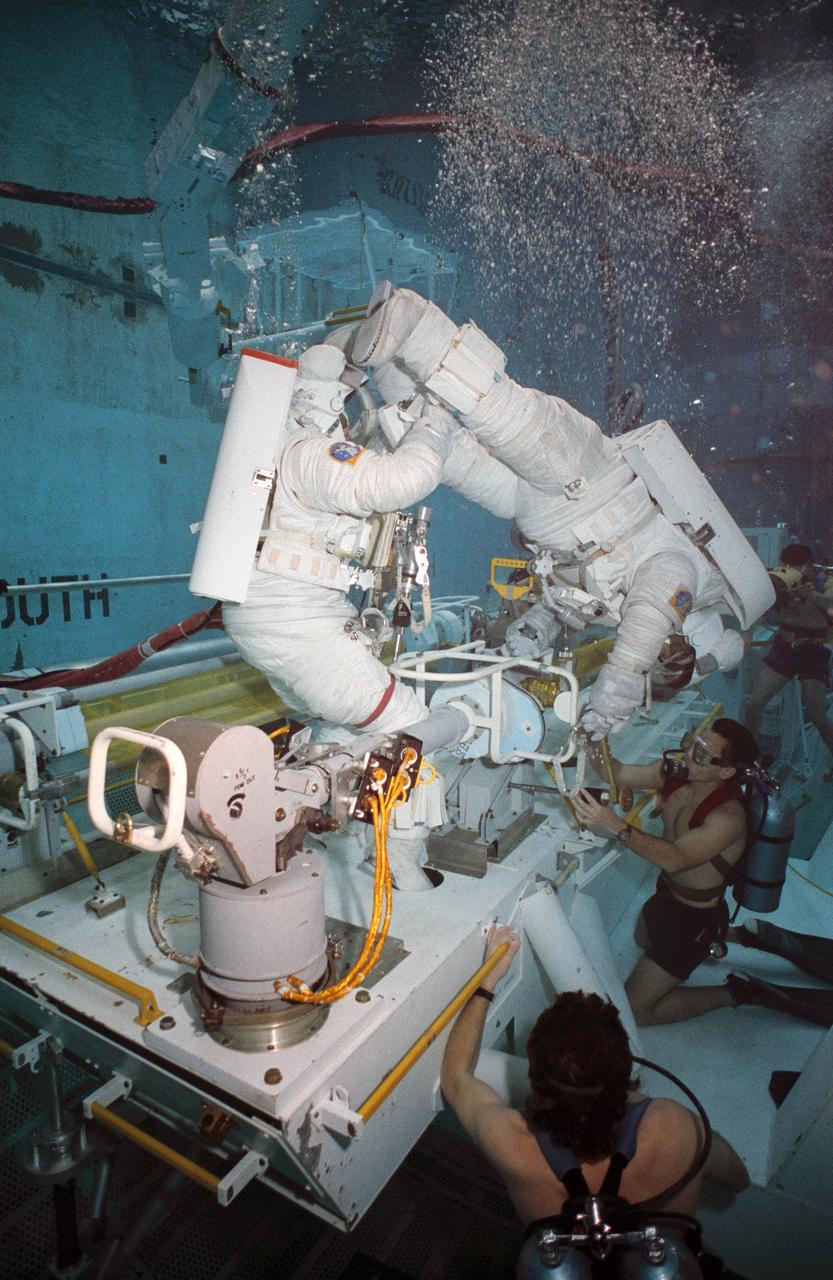
S93-30238 (5 Mar 1993) --- Wearing training versions of Space Shuttle Extravehicular Mobility Units (EMU), astronauts Thomas D. Akers (red stripe) and Kathryn C. Thornton use the spacious pool of the Johnson Space Center's (JSC) Weightless Environment Training Facility (WET-F) to rehearse for the Hubble Space Telescope (HST) repair mission. They are working with a full scale mockup of a solar array fixture.
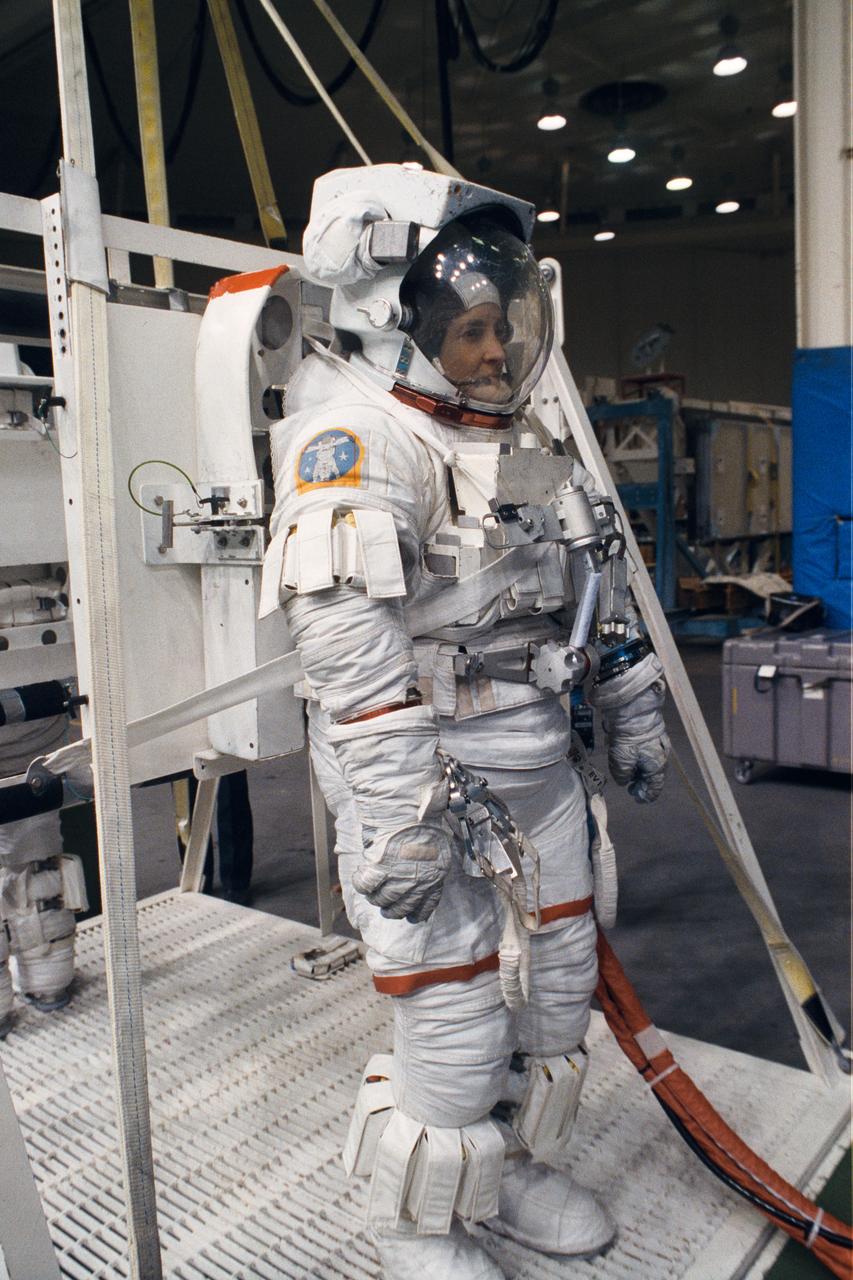
S93-41574 (17 Aug 1993) --- Astronaut Linda M. Godwin, payload commander, prepares to be submerged in a 25-feet deep pool at the Johnson Space Center's (JSC) Weightless Environment Training Facility (WET-F). Astronauts Godwin and Thomas D. Jones (out of frame at left), mission specialist, are using the WET-F to train for contingency space walks for their STS-59 Space Shuttle Endeavour mission next year. No space walks are planned for the flight.
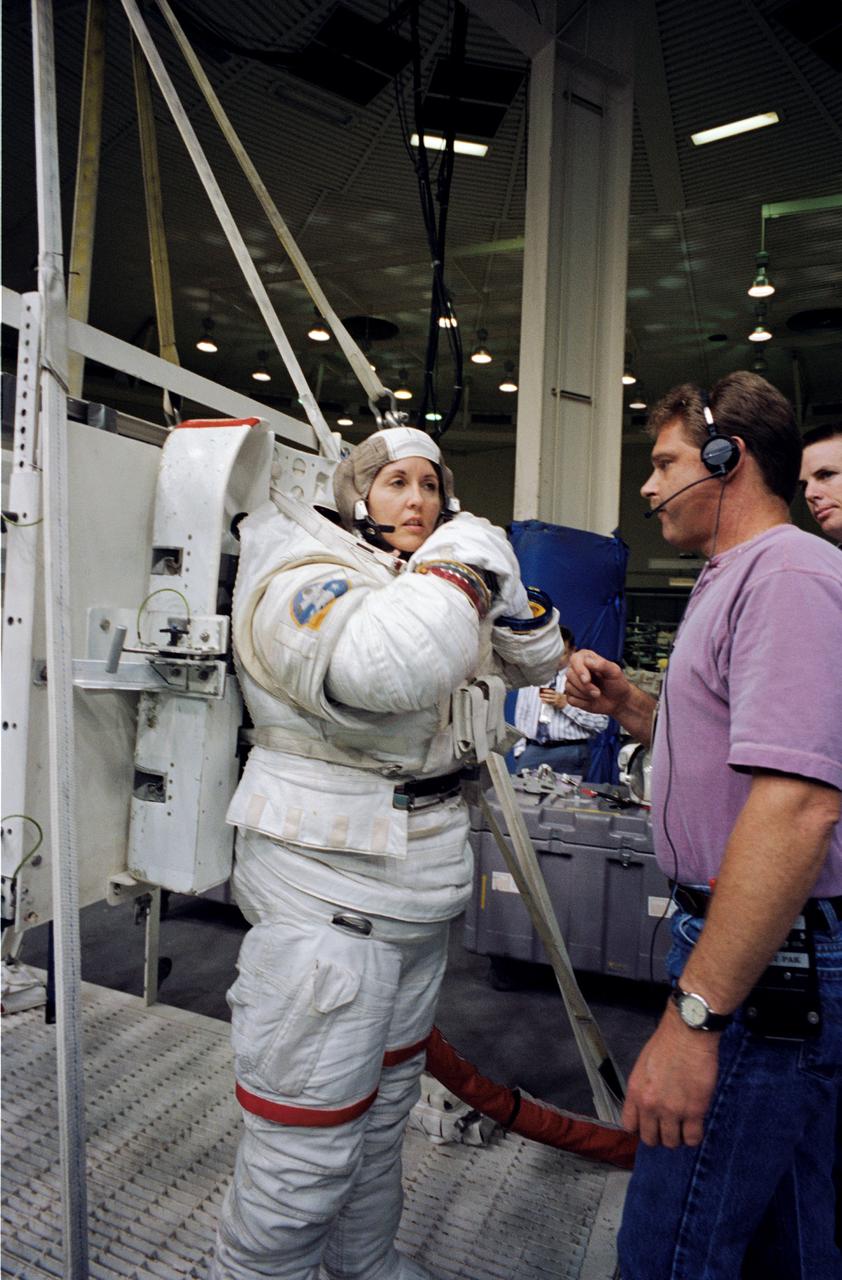
Astronaut Kathryn Thornton, payload commander for the STS-73 mission, attired in a high fidelity training version of the Extravehicular Mobility Unit (EMU) space suit, prepares to go underwater in the Johnson Space Center’s (JSC) Weightless Environment Training Facility (WET-F). The STS-73 mission was the second flight of the United States Microgravity Laboratory (USML-2), managed by scientists and engineers from the Marshall Space Flight Center.
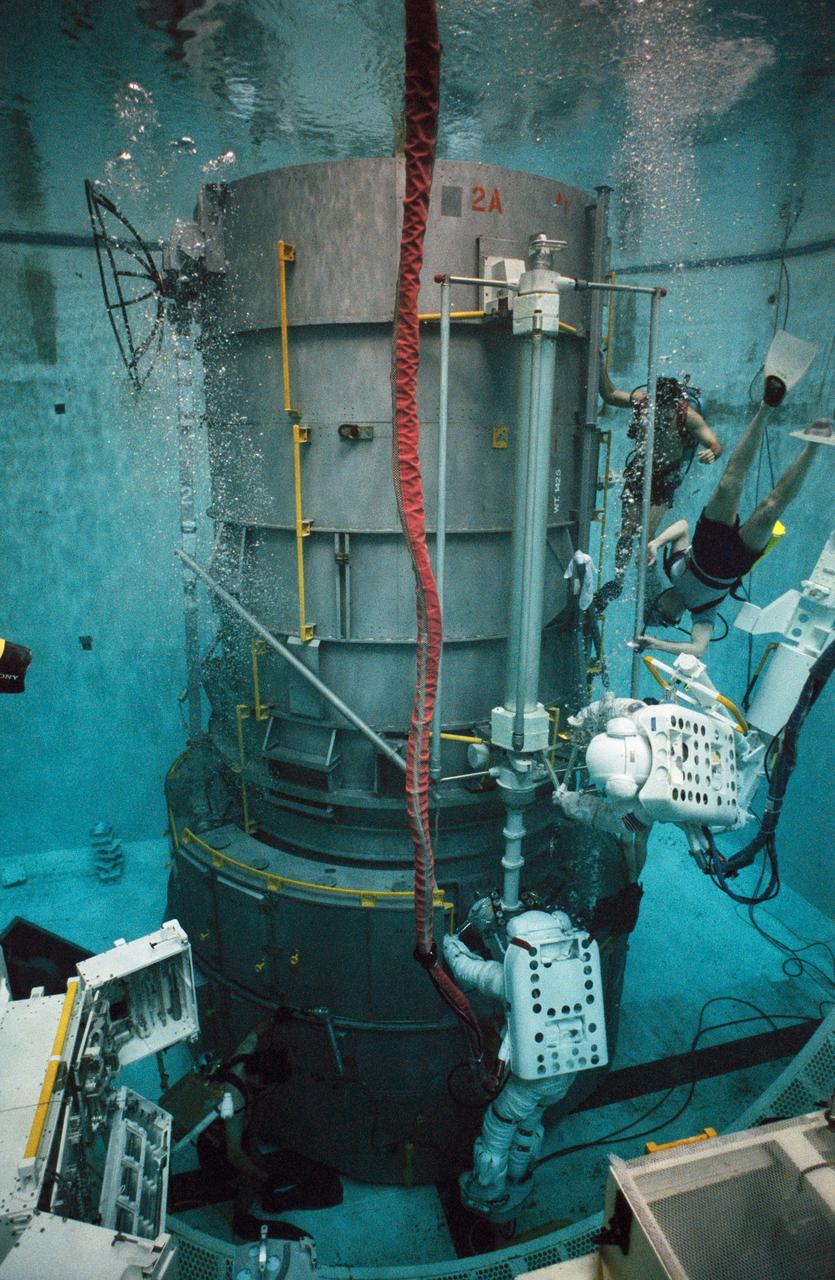
S93-30237 (5 Mar 1993) --- Wearing training versions of Space Shuttle Extravehicular Mobility Units (EMU), astronauts Thomas D. Akers (red stripe) and Kathryn C. Thornton use the spacious pool of the Johnson Space Center's (JSC) Weightless Environment Training Facility (WET-F) to rehearse for the Hubble Space Telescope (HST) servicing mission. They are working with part of a full-scale mockup of HST.
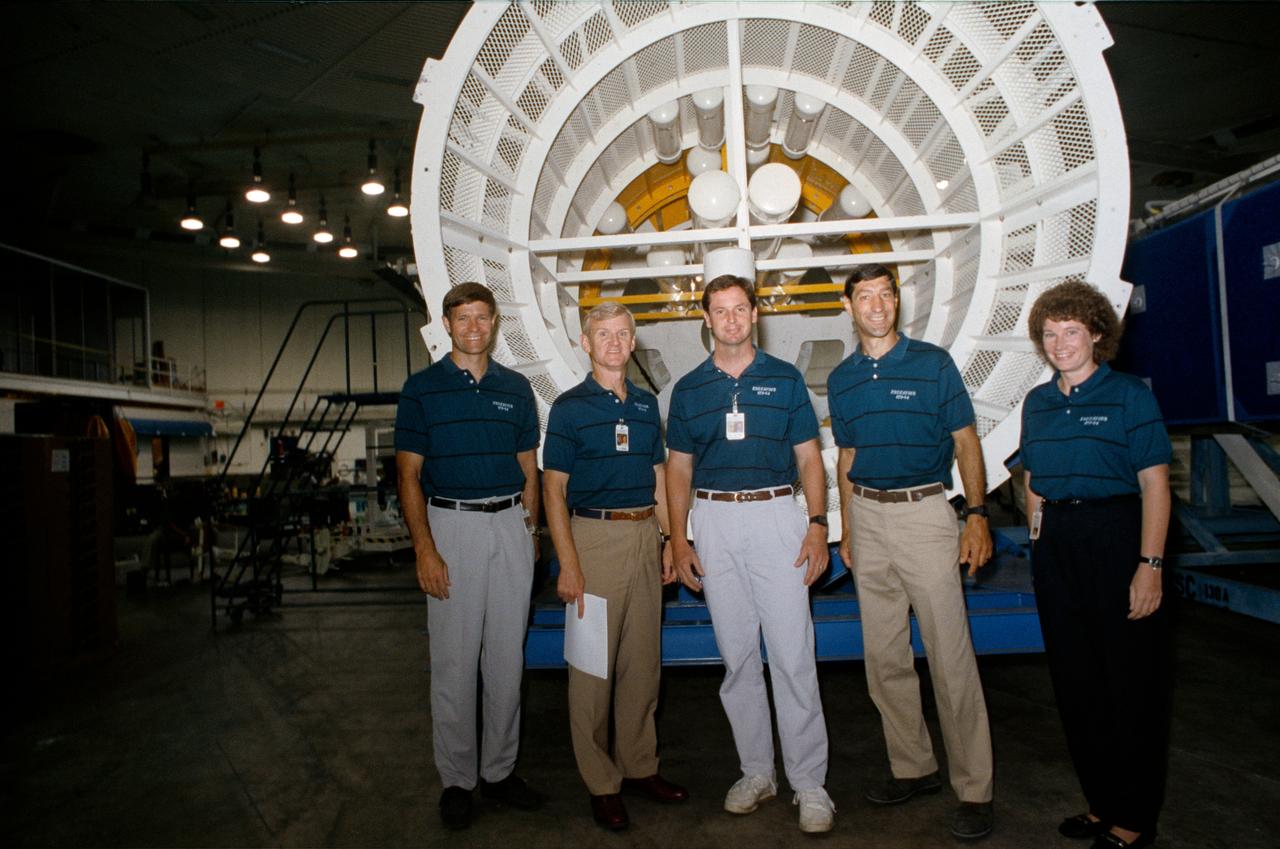
S92-40571 (August 1992) --- The five astronaut crewmembers assigned to fly aboard the Space Shuttle Endeavour for the STS-54 mission, pause for a break during training and preparations for the six-day mission. Left to right are Donald R. McMonagle, pilot; John H. Casper, mission commander; Gregory J. Harbaugh, Mario Runco Jr. and Susan J. Helms, mission specialists. The five are in the weightless environment training facility (WET-F) at the Johnson Space Center (JSC).
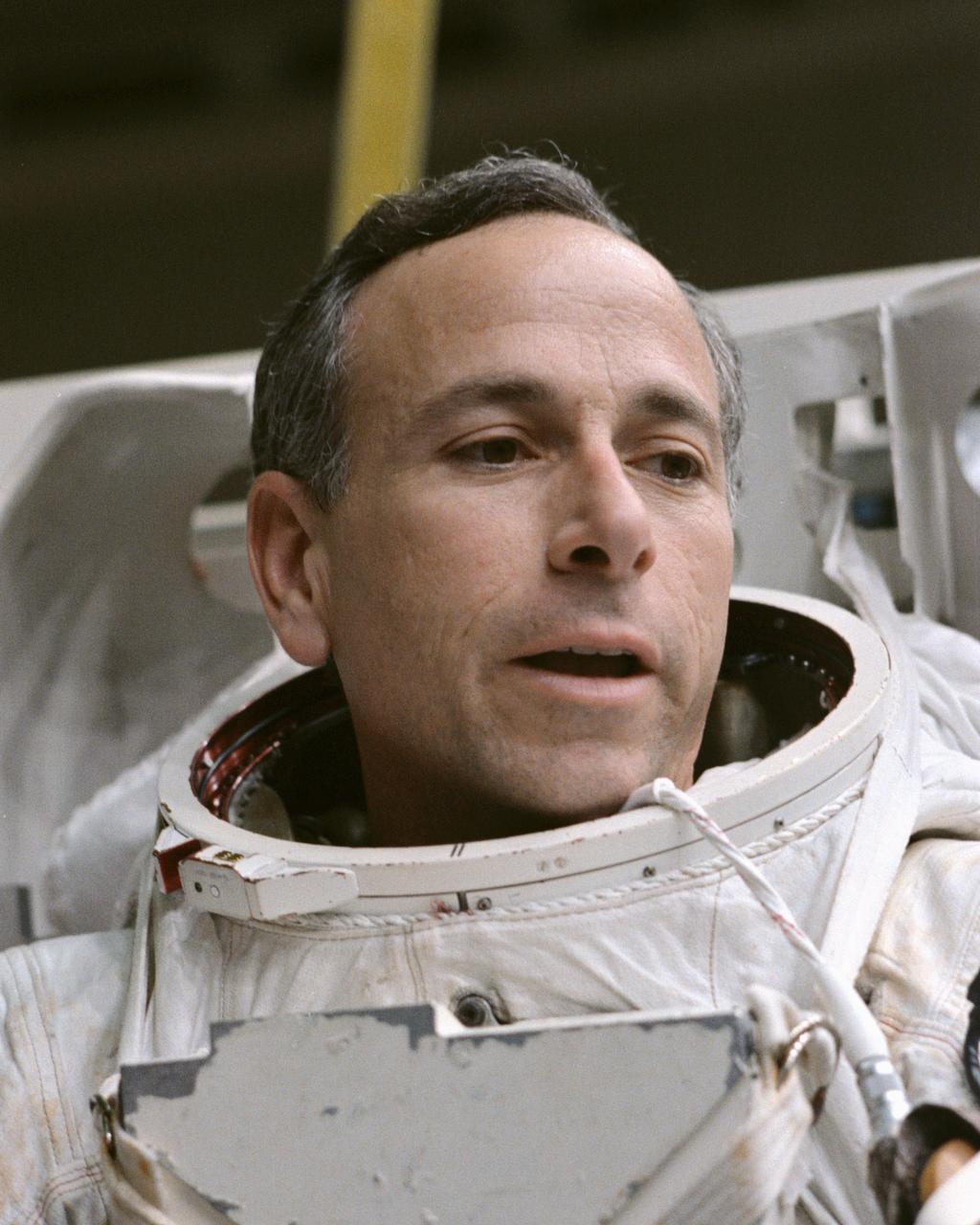
STS-38 Mission Specialist (MS) Carl J. Meade, wearing extravehicular mobility unit (EMU) upper torso, takes a breather from suit donning activities in JSC's Weightless Environment Training Facility (WETF) Bldg 29. Meade is preparing for an underwater extravehicular activity (EVA) simulation. During the training exercise, Meade will rehearse contingency EVA procedures for the STS-38 mission aboard Atlantis, Orbiter Vehicle (OV) 104.
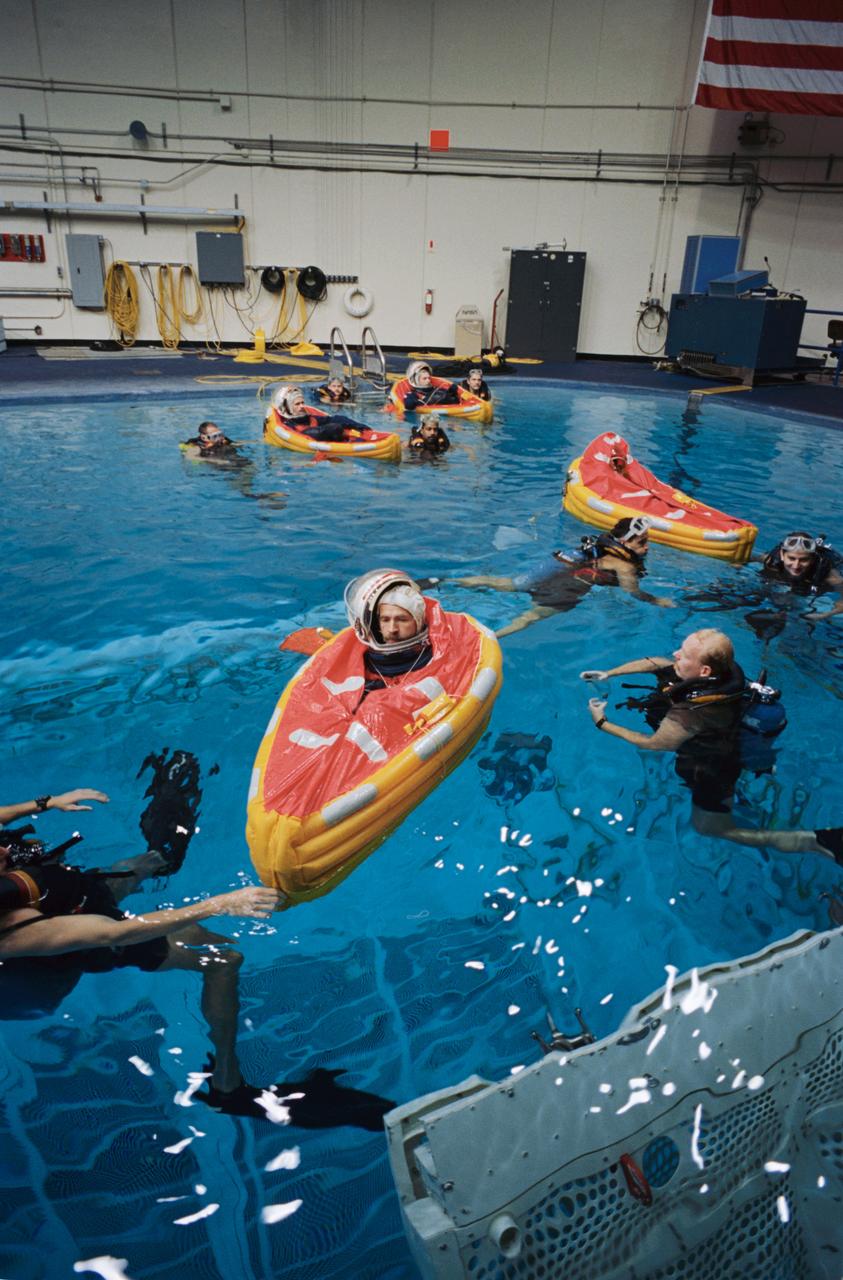
S94-47226 (13 Oct 1994) --- Using small life rafts, several cosmonauts and astronauts participating in joint Russia - United States space missions take part in an emergency bailout training session in the Johnson Space Center's (JSC) Weightless Environment Training Facility's (WET-F) 25-feet-deep pool. In the foreground is cosmonaut Alexsandr F. Poleshchuk, a member of the Mir reserve crew. A number of SCUBA-equipped divers assist the trainees.
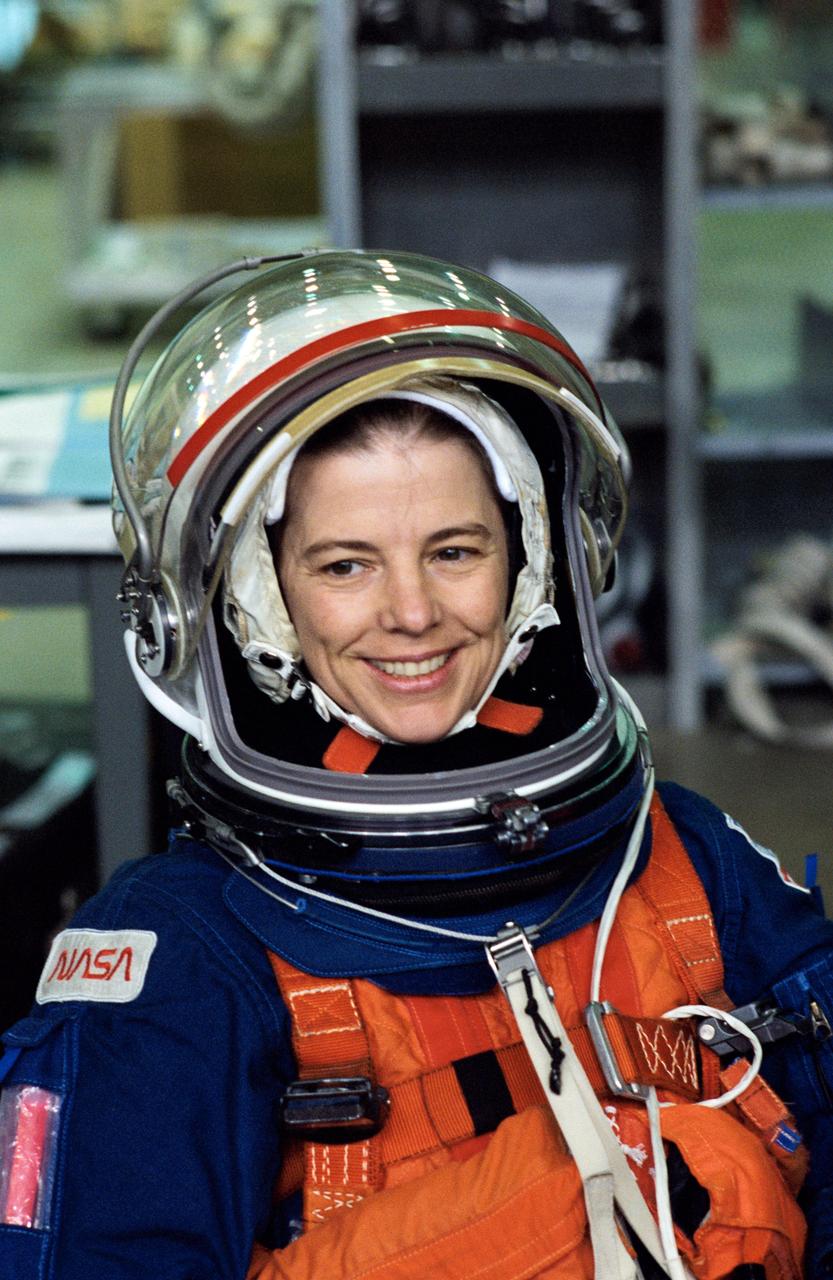
S94-47256 (13 Oct 1994) --- Astronaut Bonnie J. Dunbar, STS-71 mission specialist, smiles as she watches a crew mate (out of frame) make a simulated parachute landing in nearby water. The action came as part of an emergency bailout training session in the Johnson Space Center's (JSC) Weightless Environment Training Facility's (WET-F) 25-feet-deep pool.
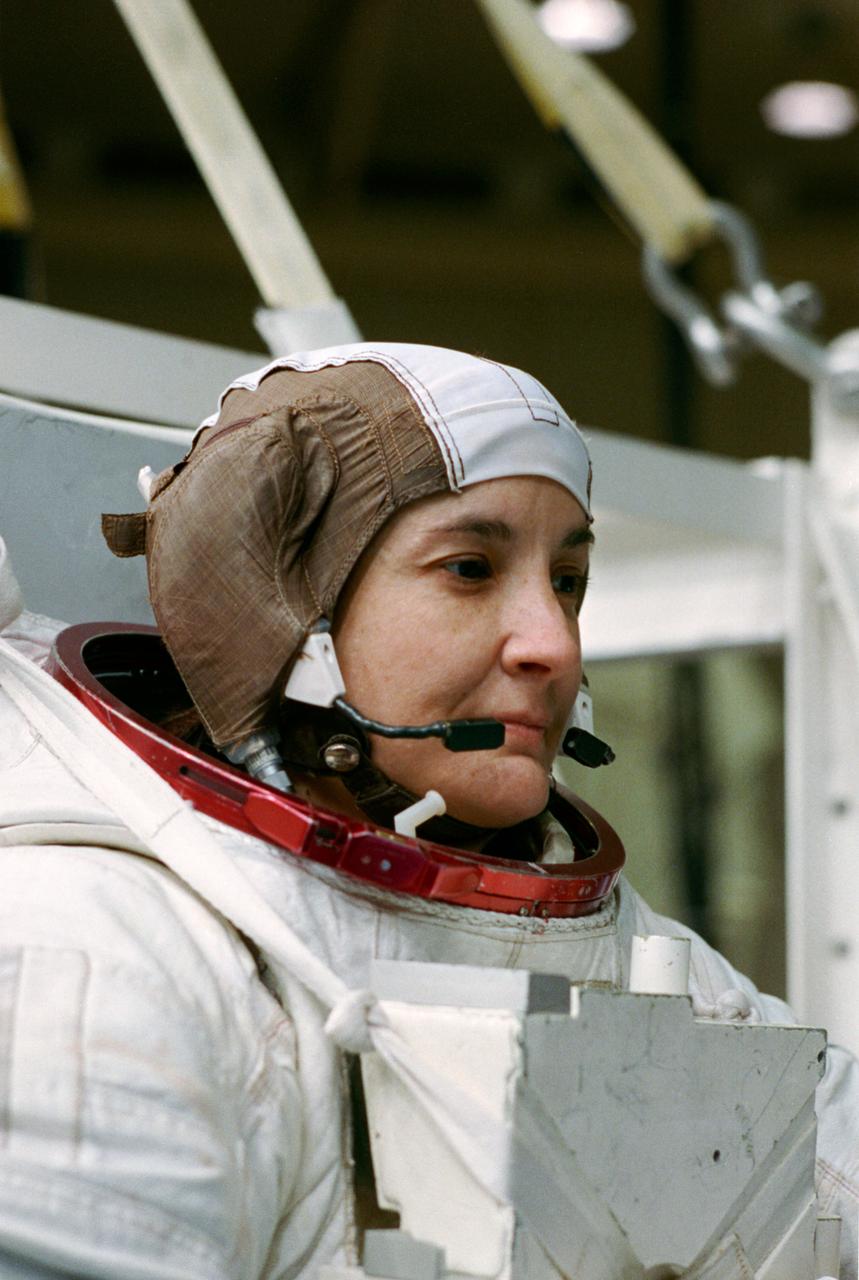
S93-41572 (17 Aug 1993) --- Astronaut Linda M. Godwin, payload commander, prepares to donn her helmet before being submerged in a 25-feet deep pool at the Johnson Space Center's (JSC) Weightless Environment Training Facility (WET-F). Astronauts Godwin and Thomas D. Jones, mission specialist, are using the WET-F to train for contingency space walks for their Space Shuttle Endeavour mission next year. No space walks are planned for the flight.
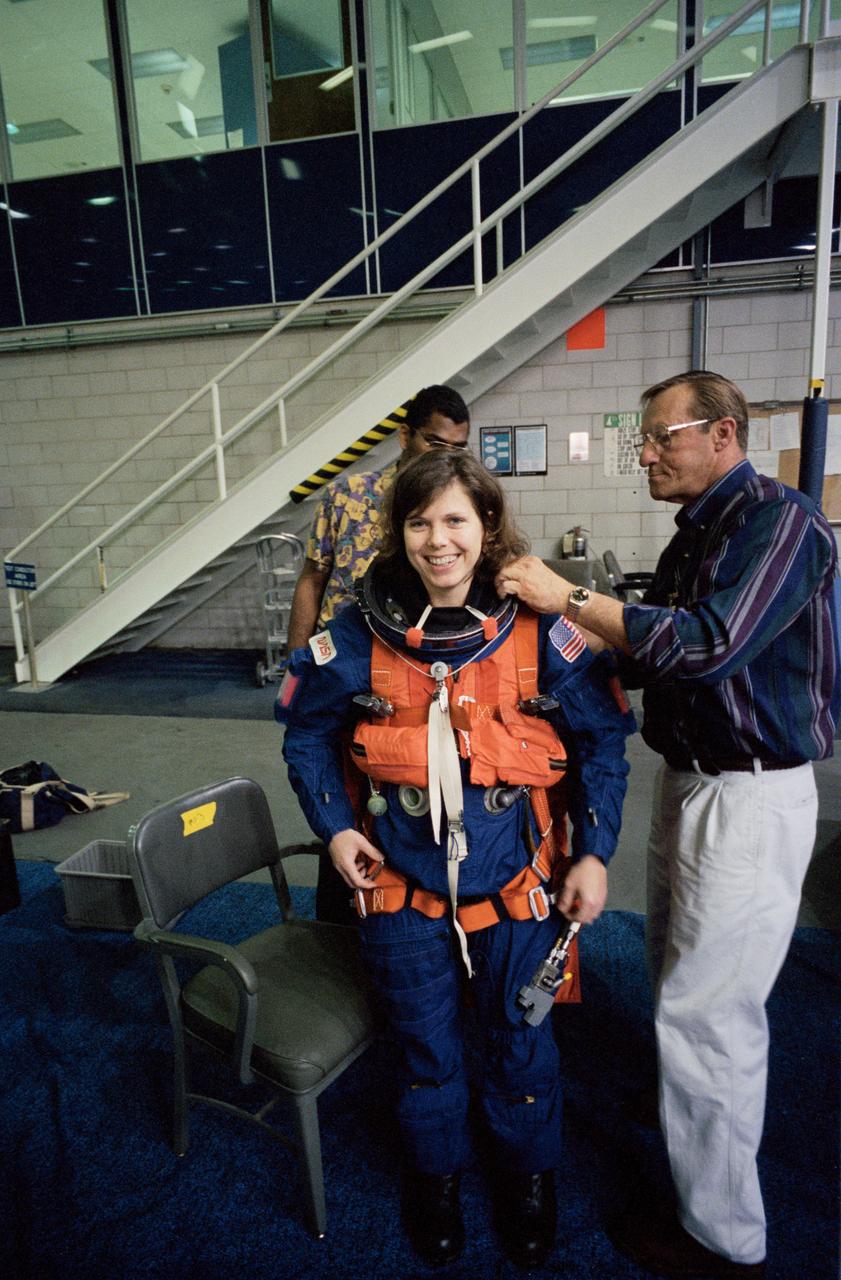
S95-03469 (16 FEB 1995) --- Attired in a training version of the Shuttle launch and entry garment, astronaut Mary Ellen Weber gets help with the final touches of suit donning during a training session at the Johnson Space Center's (JSC) Weightless Environment Training Facility (WET-F). Helping out is Rockwell's William L. Todd (right), while Staffon Isaacs looks on. Training as a mission specialist for the STS-70 mission, Weber was about to rehearse emergency bailout. The crew members made use of a nearby 25-feet deep pool to practice parachute landings in water and subsequent deployment of life rafts.
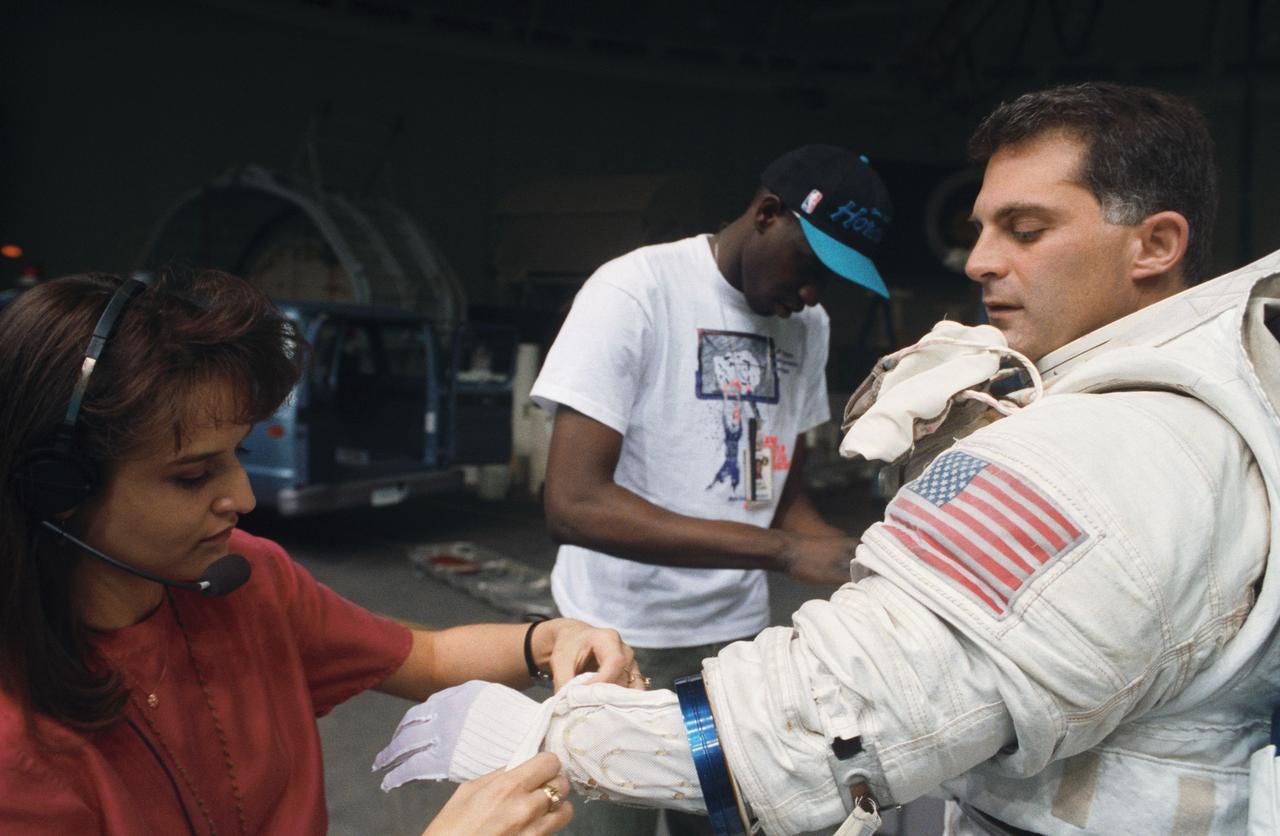
S93-31706 (3 April 1993) --- With the aid of technicians and training staffers astronaut David A. Wolf prepares to participate in training for contingency Extravehicular Activity (EVA) for the STS-58 mission. Sharing a moveable platform with Wolf was astronaut Shannon W. Lucid (out of frame). For simulation purposes, the two mission specialists were about to be submerged to a point of neutral buoyancy in the Johnson Space Center's (JSC) Weightless Environment Training Facility (WET-F). Though the Spacelab Life Sciences (SLS-2) mission does not include a planned EVA, all crews designate members to learn proper procedures to perform outside the spacecraft in the event of failure of remote means to accomplish those tasks.
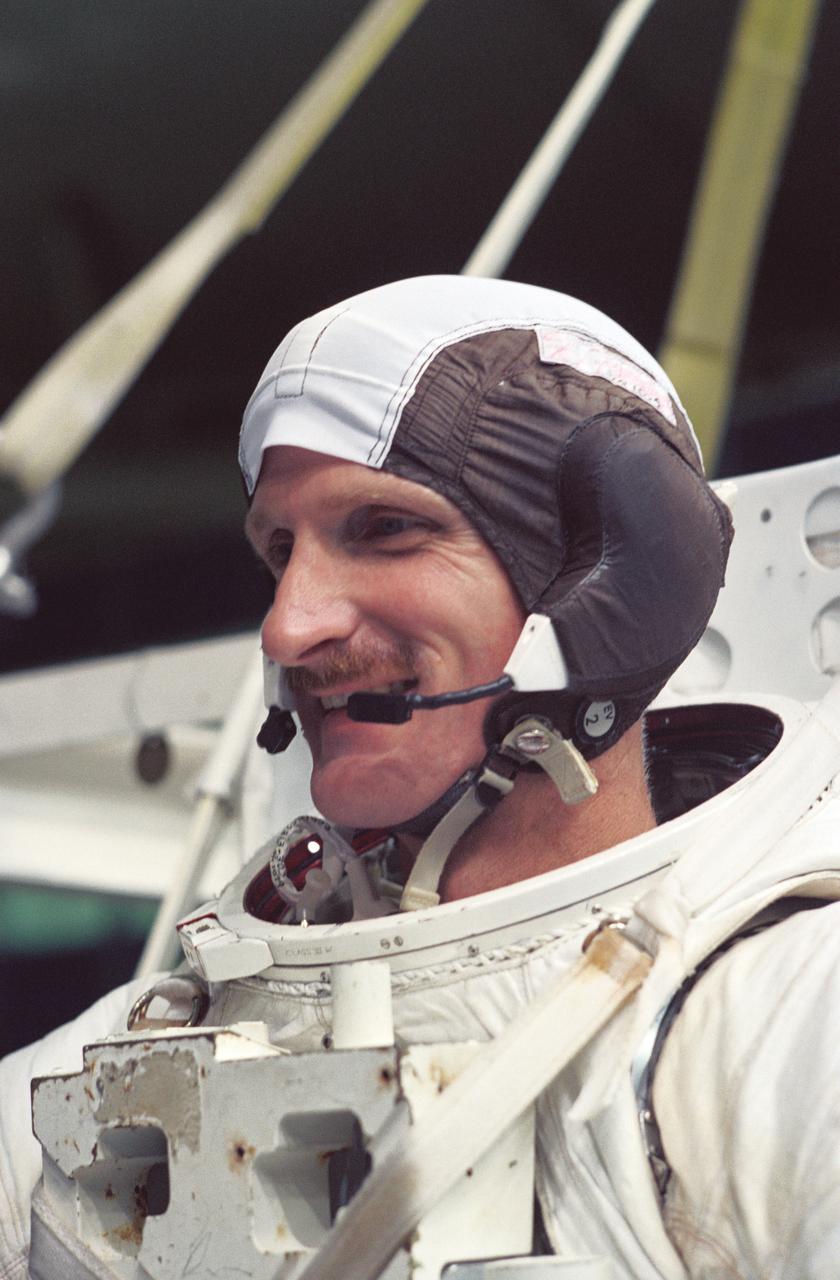
S94-40049 (1 August 1994) --- Attired in a training version of the Extravehicular Mobility Unit (EMU), astronaut Joseph R. Tanner, mission specialist, prepares to be submerged in a 25-feet deep pool at the Johnson Space Center's (JSC) Weightless Environment Training Facility (WET-F). Though no extravehicular activity (EVA) is planned for the mission, at least two astronauts are trained to perform tasks that would require a space walk in the event of failure of remote systems. In November, Tanner will join four other NASA astronauts and a European mission specialist for a week and a half in space aboard the Space Shuttle Atlantis. The flight will support the Atmospheric Laboratory for Applications and Science (ATLAS-3) mission.
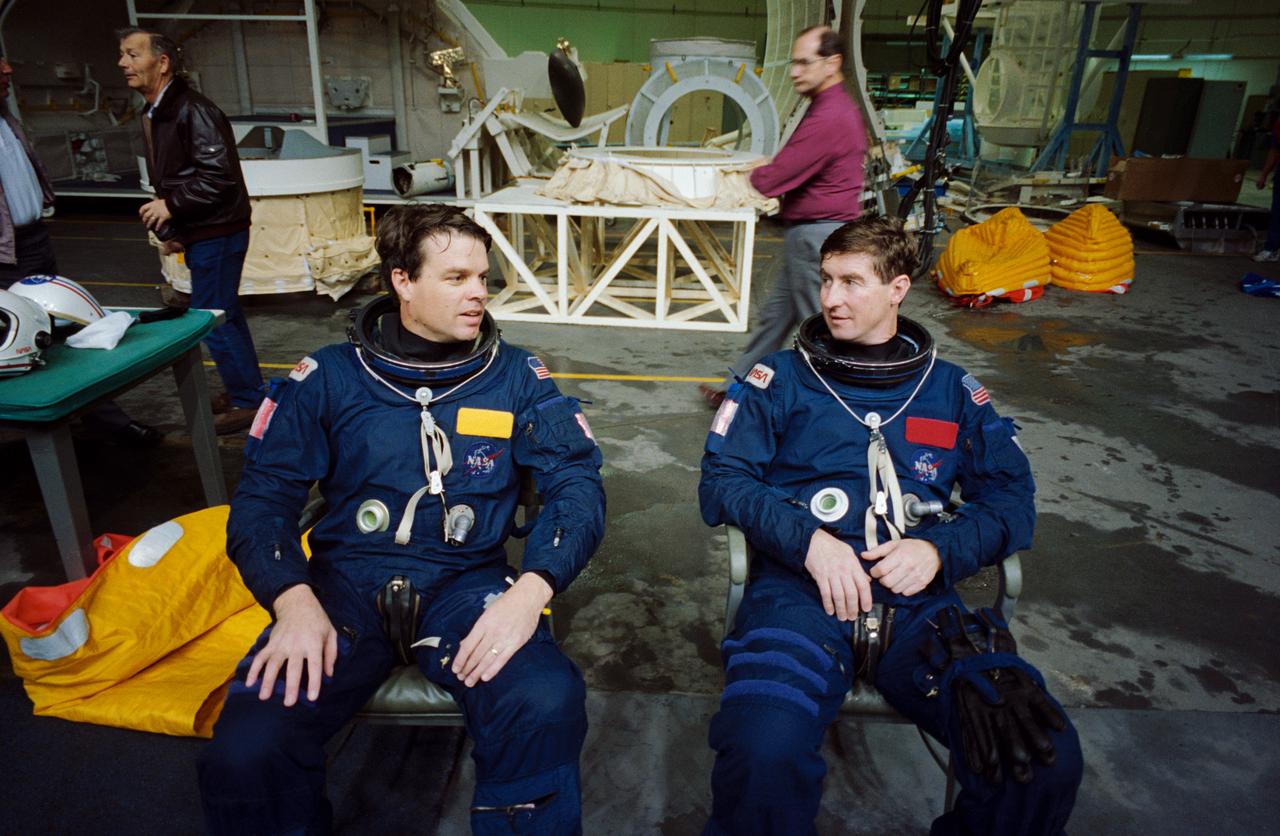
S95-03470 (16 FEB 1995) --- Attired in blue training versions of the orange Shuttle launch and entry garments, astronauts Terence T. (Tom) Henricks, right, and Kevin R. Kregel take a break during a bailout training session at the Johnson Space Center's (JSC) Weightless Environment Training Facility (WET-F). Assigned as commander and pilot, respectively, for the STS-70 mission, the two later joined their crew mates in making use of a nearby 25-feet deep pool to practice parachute landings in water and subsequent deployment of life rafts.
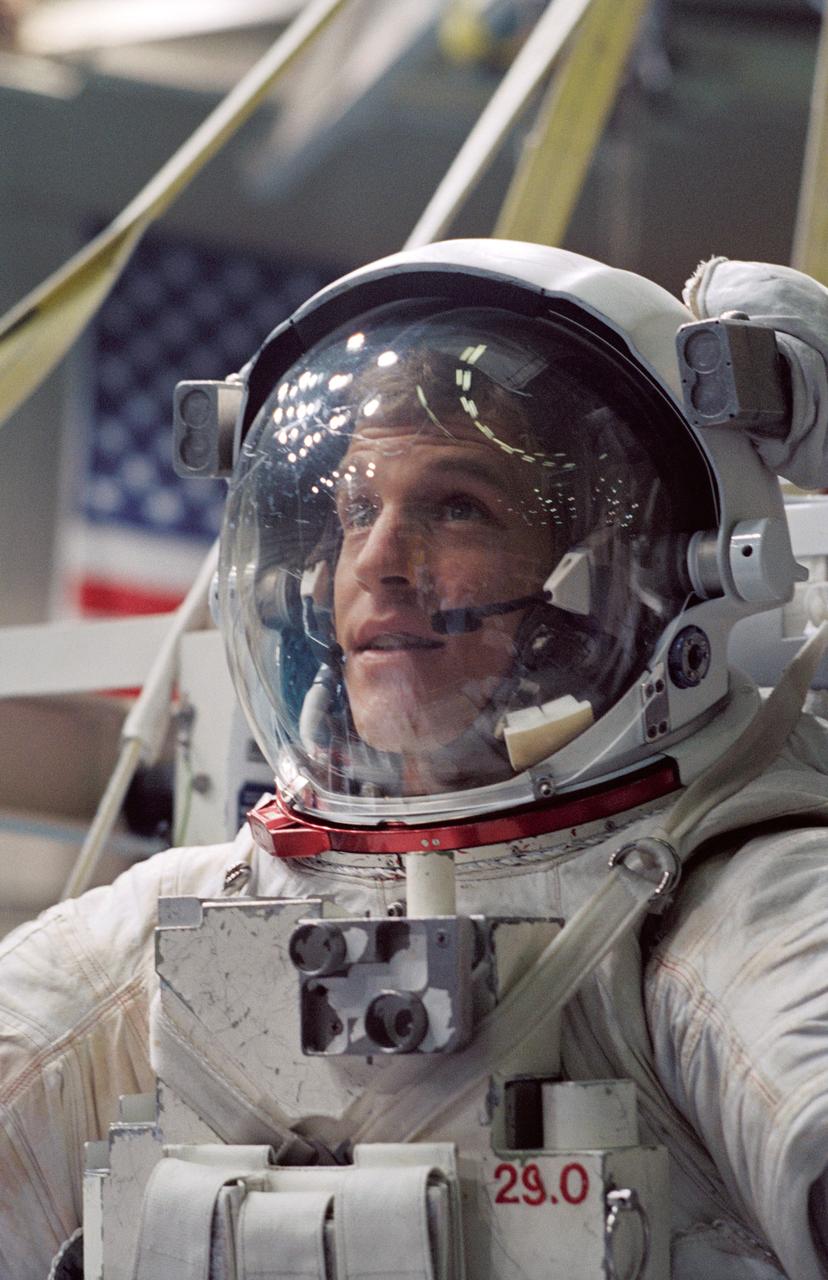
S94-40051 (1 August 1994) --- Attired in a training version of the Extravehicular Mobility Unit (EMU), astronaut Scott E. Parazynski, mission specialist, prepares to be submerged in a 25-feet deep pool at the Johnson Space Center's (JSC) Weightless Environment Training Facility (WET-F). Though no extravehicular activity (EVA) is planned for the mission, at least two astronauts are trained to perform tasks that would require a space walk in the event of failure of remote systems. In November, Parazynski will join four other NASA astronauts and a European mission specialist for a week and a half in space aboard the Space Shuttle Atlantis. The flight will support the Atmospheric Laboratory for Applications and Science (ATLAS-3) mission.
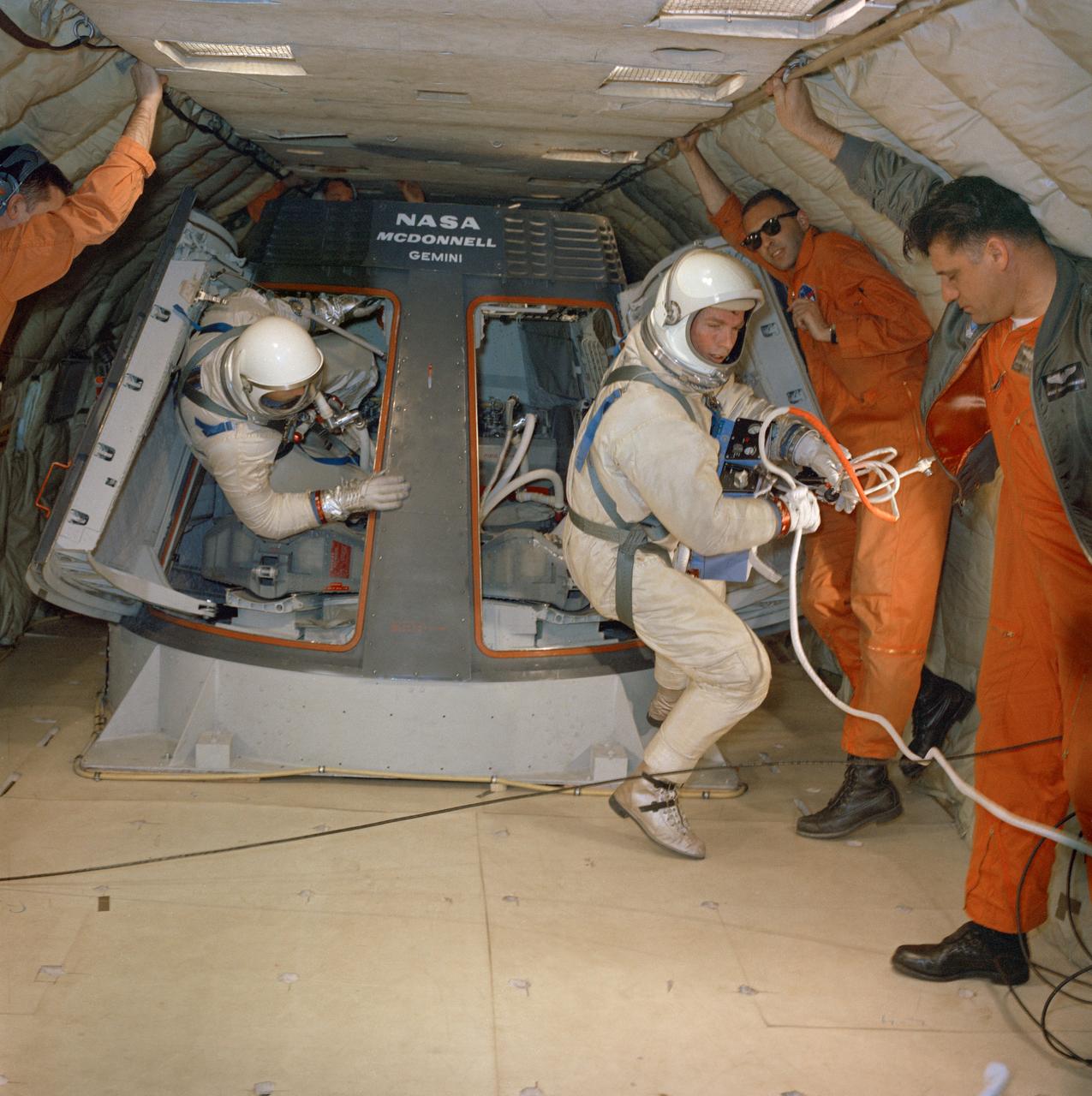
S66-21409 (18 Feb. 1966) --- Astronaut David R. Scott, in full spacesuit, holds maneuvering unit while suspended in a weightless state during extravehicular activity (EVA) training in a C-135 Air Force plane. Photo credit: NASA
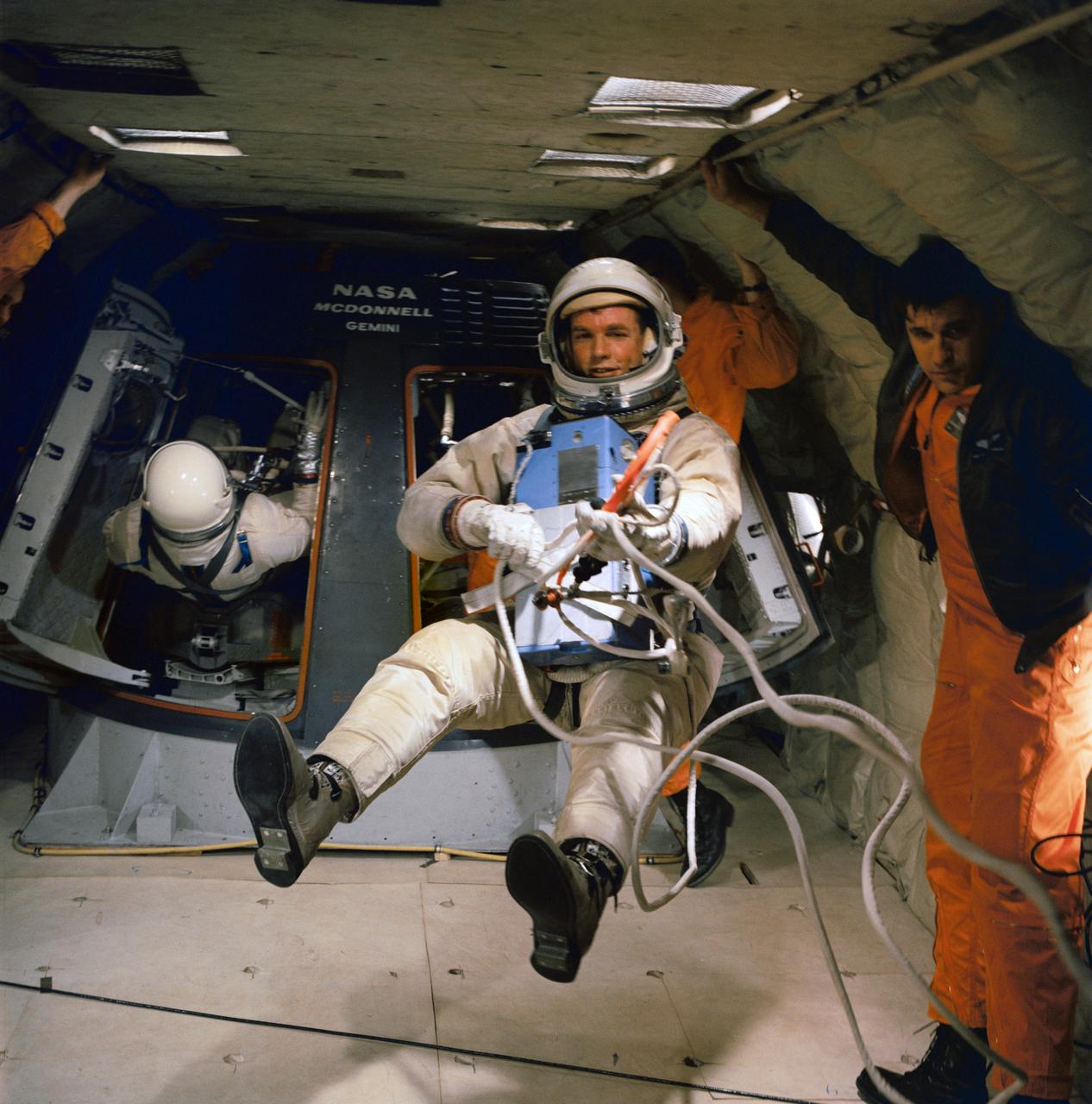
S66-21411 (18 Feb. 1966) --- Astronaut David R. Scott, in full spacesuit, holds maneuvering unit while suspended in a weightless state during extravehicular activity (EVA) training in a C-135 Air Force plane. Photo credit: NASA
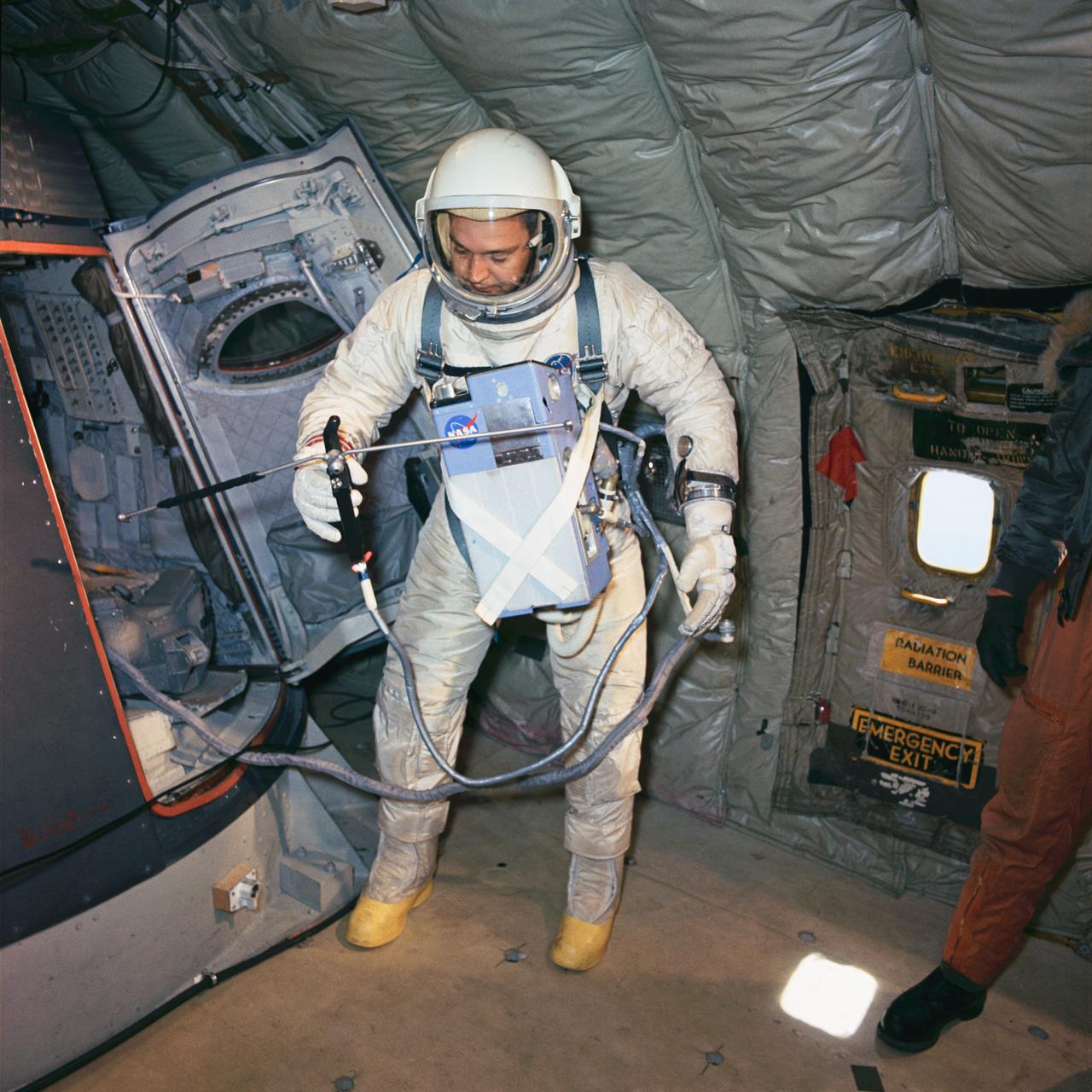
S66-28636 (1 April 1966) --- Astronaut Clifton C. Williams Jr., backup crew pilot of the Gemini-10 spaceflight, undergoes zero-gravity egress training. A KC-135 Air Force plane, flying a parabolic curve, creates a weightless environment as a training exercise in preparation for spaceflight. The Hand-Held Maneuvering Unit in his right hand produces controlled thrust for moving about. Photo credit: NASA
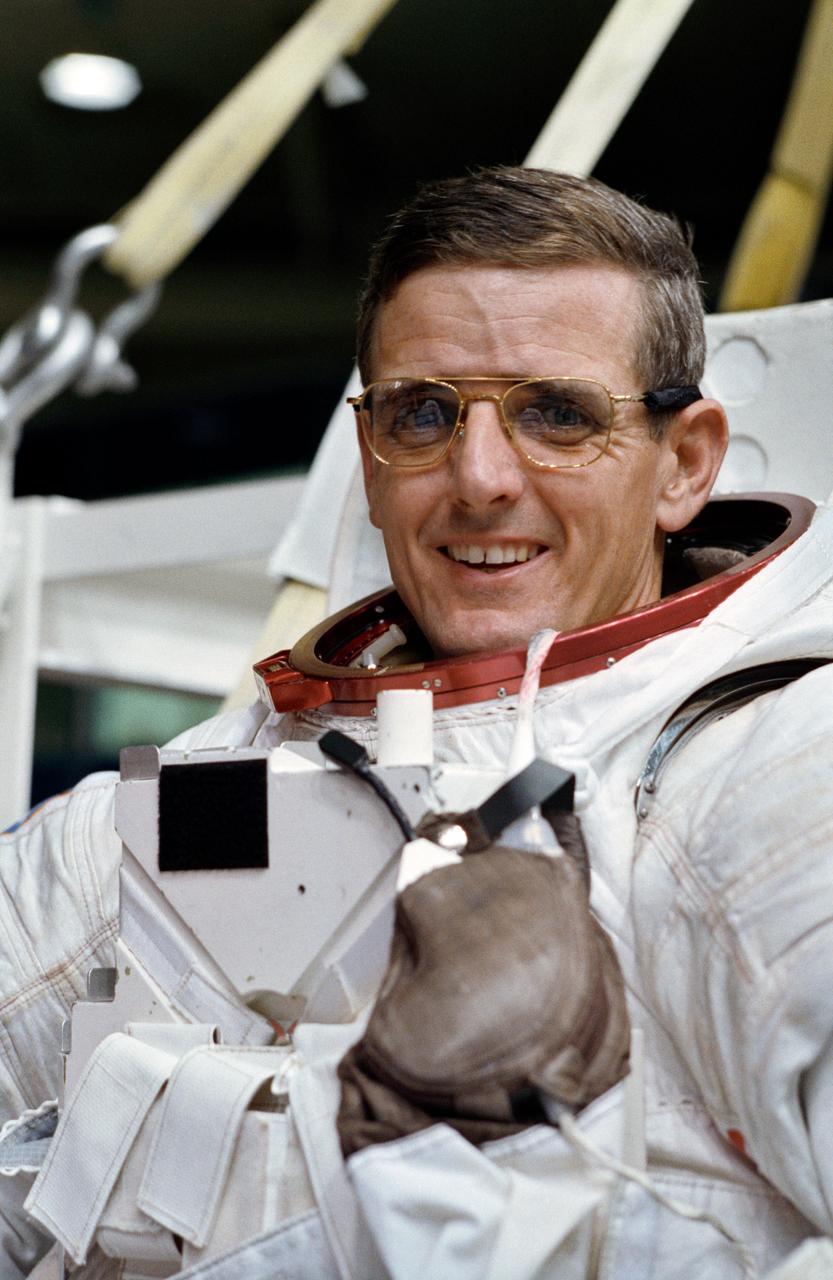
S93-43840 (6 Sept 1993) --- Astronaut William S. McArthur, mission specialist, participates in training for contingency Extravehicular Activity (EVA) for the STS-58 mission. For simulation purposes, McArthur was about to be submerged to a point of neutral buoyancy in the Johnson Space Center's (JSC) Weightless Environment Training Facility (WET-F). Though the Spacelab Life Sciences (SLS-2) mission does not include a planned EVA, all crews designate members to learn proper procedures to perform outside the spacecraft in the event of failure of remote means to accomplish those tasks.
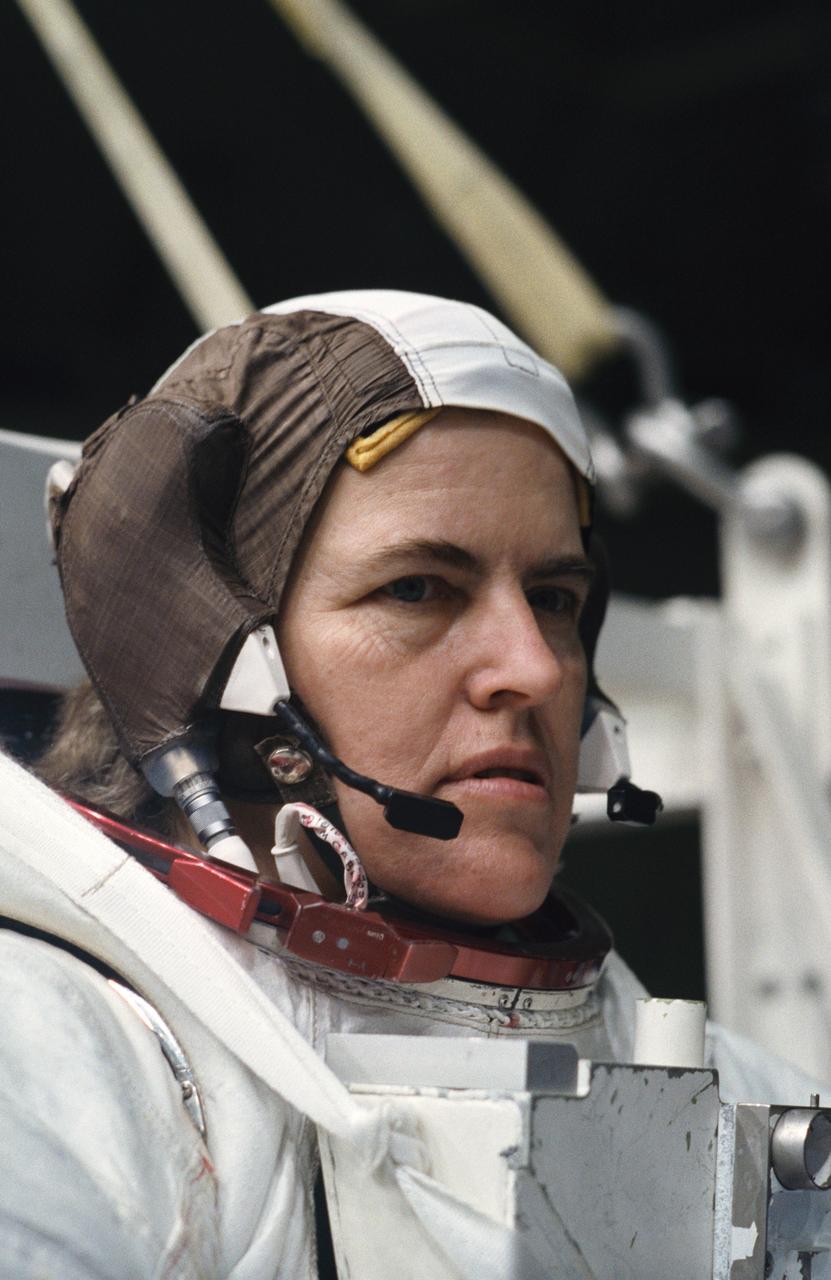
S93-31697 (3 April 1993) --- Astronaut Shannon W. Lucid participates in training for contingency Extravehicular Activity (EVA) for the STS-58 mission. Behind Lucid, sharing a moveable platform with her, is astronaut David A. Wolf (out of frame). For simulation purposes, the two mission specialists were about to be submerged to a point of neutral buoyancy in the Johnson Space Center's (JSC) Weightless Environment Training Facility (WET-F). Though the Spacelab Life Sciences (SLS-2) mission does not include a planned EVA, all crews designate members to learn proper procedures to perform outside the spacecraft in the event of failure of remote means to accomplish those tasks.
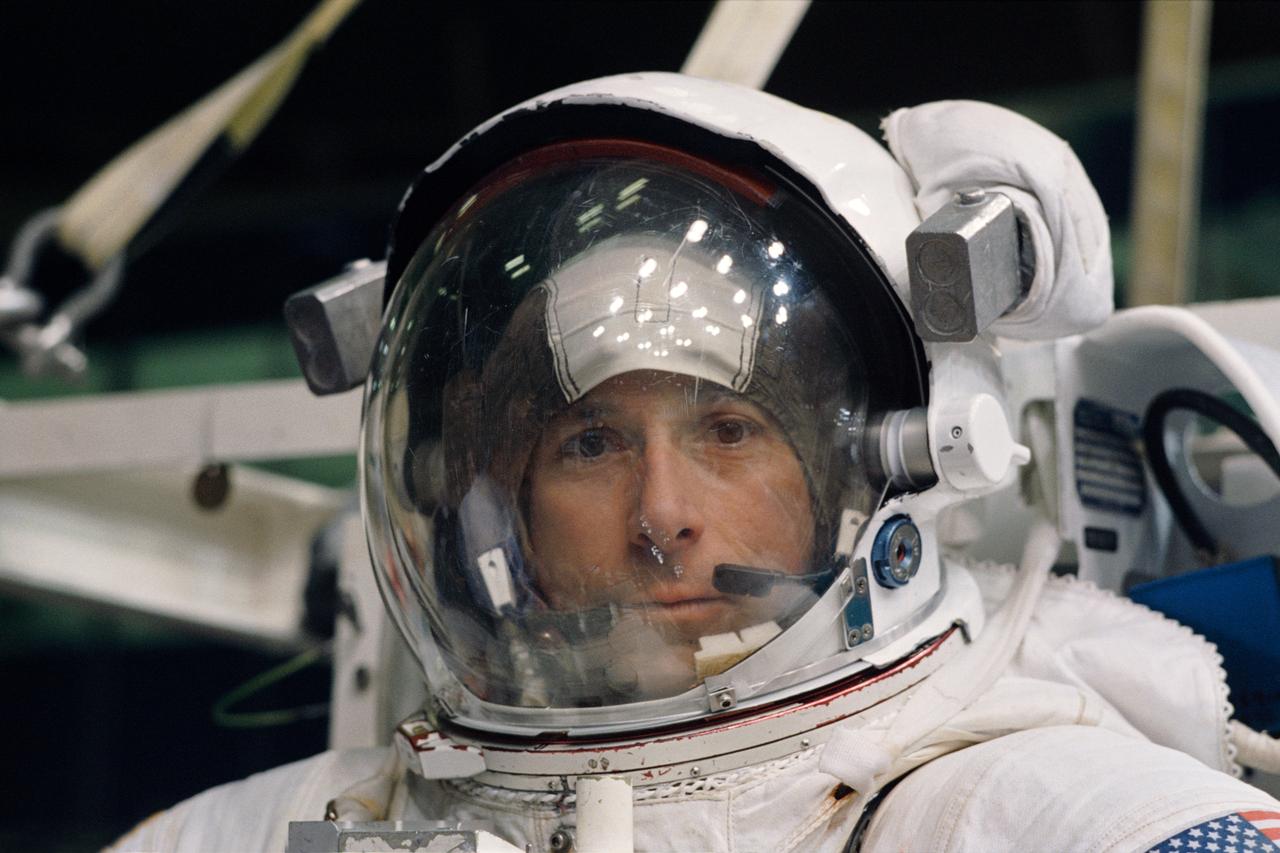
S94-39762 (August 1994) --- Astronaut Carl J. Meade, STS-64 mission specialist, listens to ground monitors prior to a simulation of a spacewalk scheduled for his September mission. Meade, who shared the rehearsal in Johnson Space Center's (JSC) Weightless Environment Training Facility (WET-F) pool with crewmate astronaut Mark C. Lee (out of frame), is equipped with a training version of new extravehicular activity (EVA) hardware called the Simplified Aid for EVA Rescue (SAFER) system. The hardware includes a mobility-aiding back harness and a chest-mounted hand control module. Photo credit: NASA or National Aeronautics and Space Administration
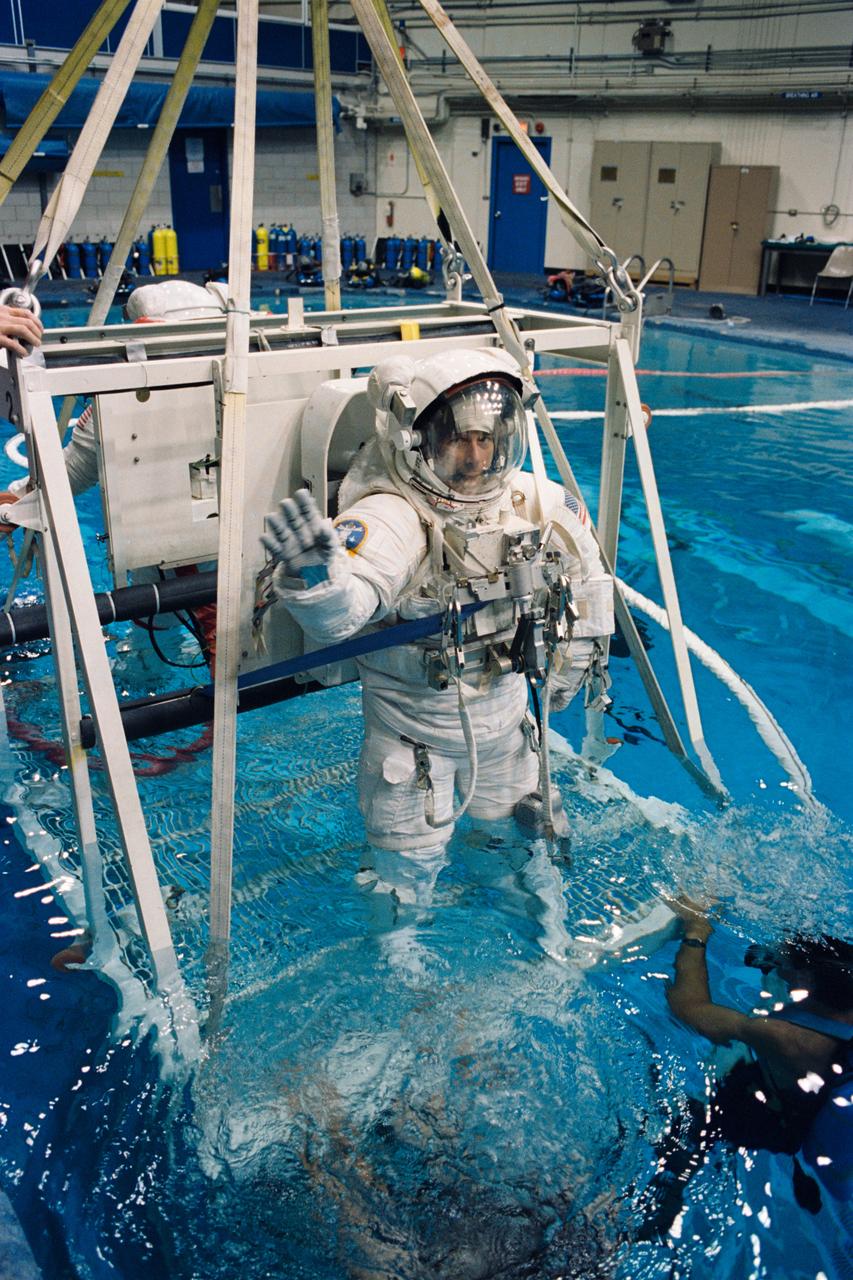
S94-39770 (August 1994) --- Astronaut Carl J. Meade, STS-64 mission specialist, is being submerged prior to an underwater simulation of a spacewalk scheduled for his September mission. Meade, who shared the rehearsal in the Johnson Space Center's (JSC) Weightless Environment Training Facility (WET-F) pool with crewmate astronaut Mark C. Lee (partially visible at left), is equipped with a training version of new extravehicular activity (EVA) hardware called the Simplified Aid for EVA Rescue (SAFER) system. Photo credit: NASA or National Aeronautics and Space Administration
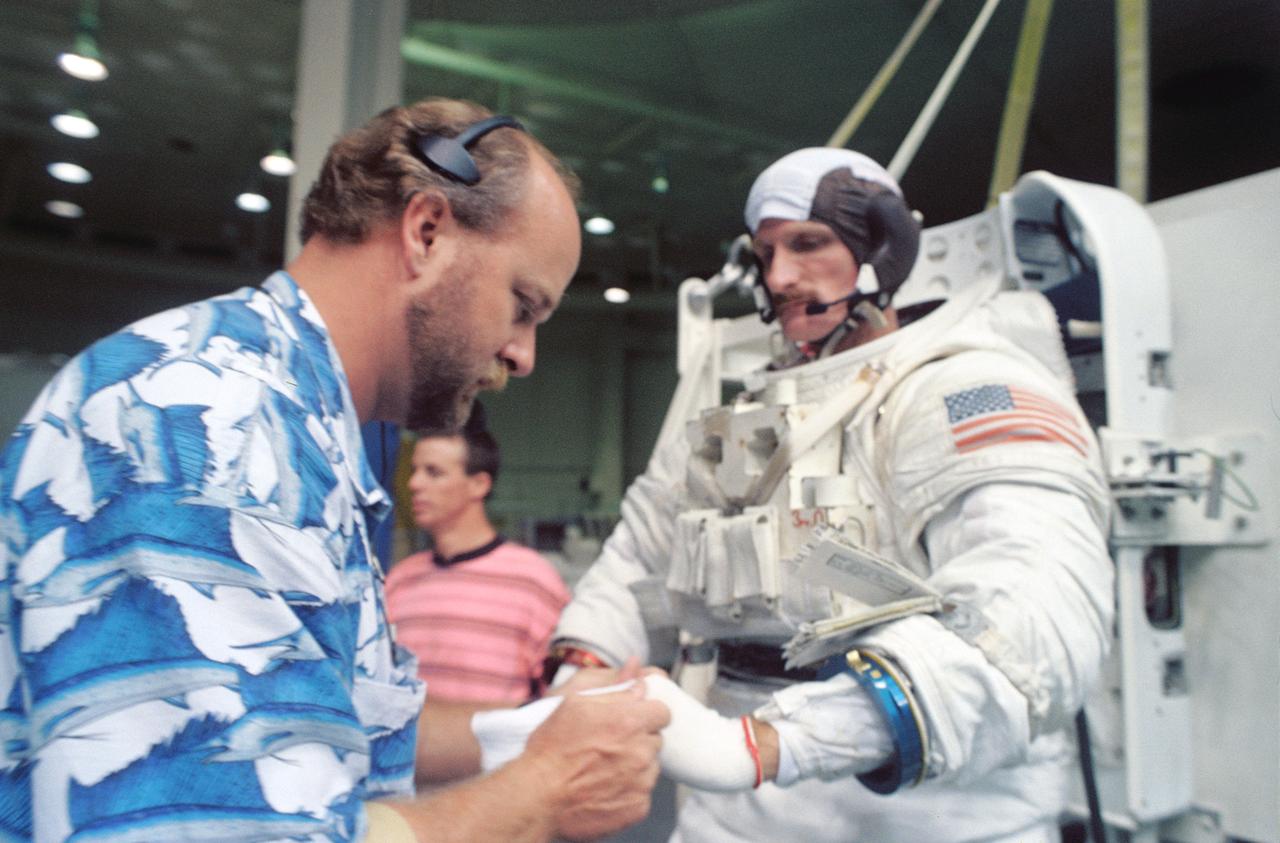
S94-40048 (1 August 1994) --- Astronaut Joseph R. Tanner, mission specialist, is assisted by Boeing suit expert Steve Voyles as he prepares to be submerged in a 25-feet deep pool at the Johnson Space Center's (JSC) Weightless Environment Training Facility (WET-F). Though no extravehicular activity (EVA) is planned for the mission, at least two astronauts are trained to perform tasks that would require a space walk in the event of failure of remote systems. In November, Tanner will join four other NASA astronauts and a European mission specialist for a week and a half in space aboard the Space Shuttle Atlantis. The flight will support the Atmospheric Laboratory for Applications and Science (ATLAS-3) mission.
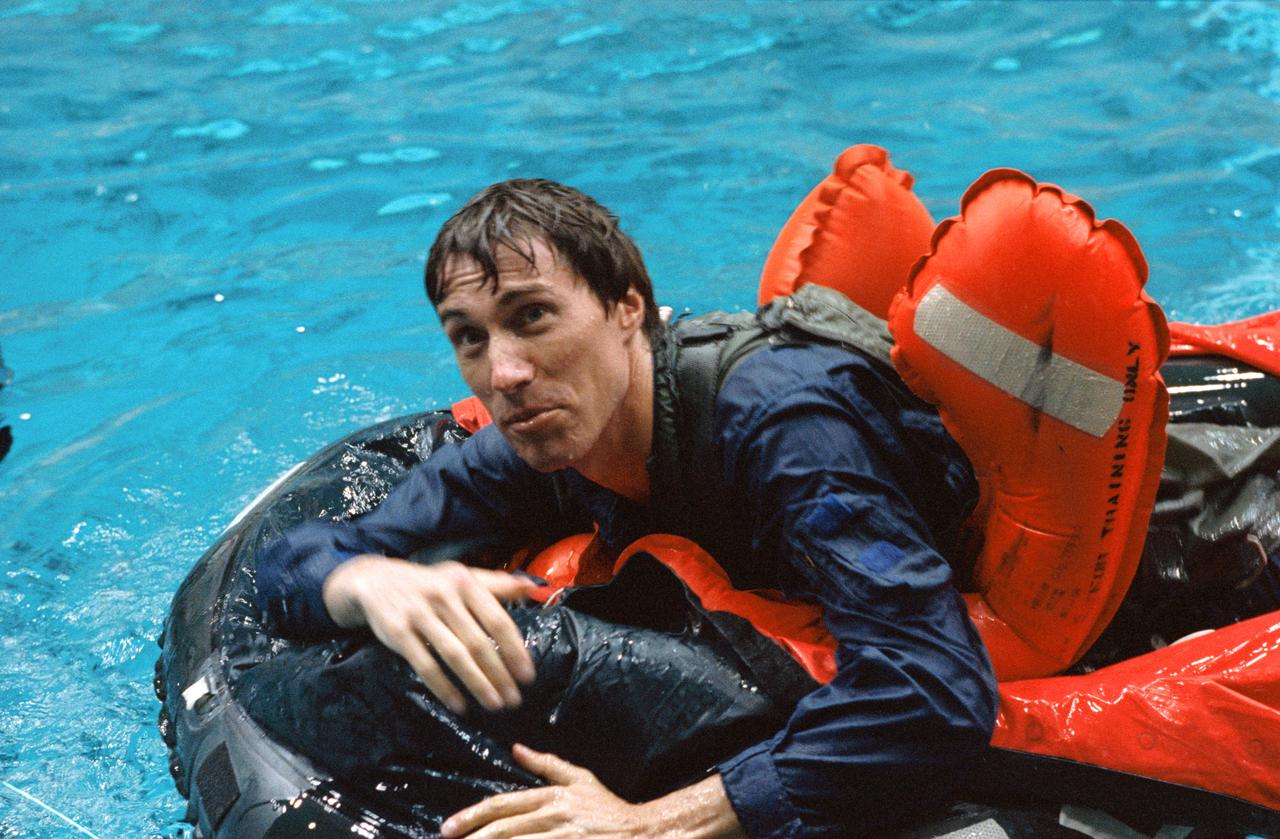
S93-26022 (Feb 1993) --- Russian cosmonaut Sergei Krikalev maneuvers a small life raft during bailout training at the Johnson Space Center's (JSC) Weightless Environment Training Facility (WET-F). Shuttle crew members frequently utilize the 25-ft. deep pool to learn proper procedures to follow in the event of emergency egress from their Space Shuttle via the escape pole system. Krikalev is one of two cosmonauts in training for the STS-60 mission. One of the two will serve as primary payload specialist with the other filling an alternate's role. This pool and the facility in which it is housed are titled the WET-F because they are also used by astronauts rehearsing both mission-specific and contingency extravehicular activities (EVA).
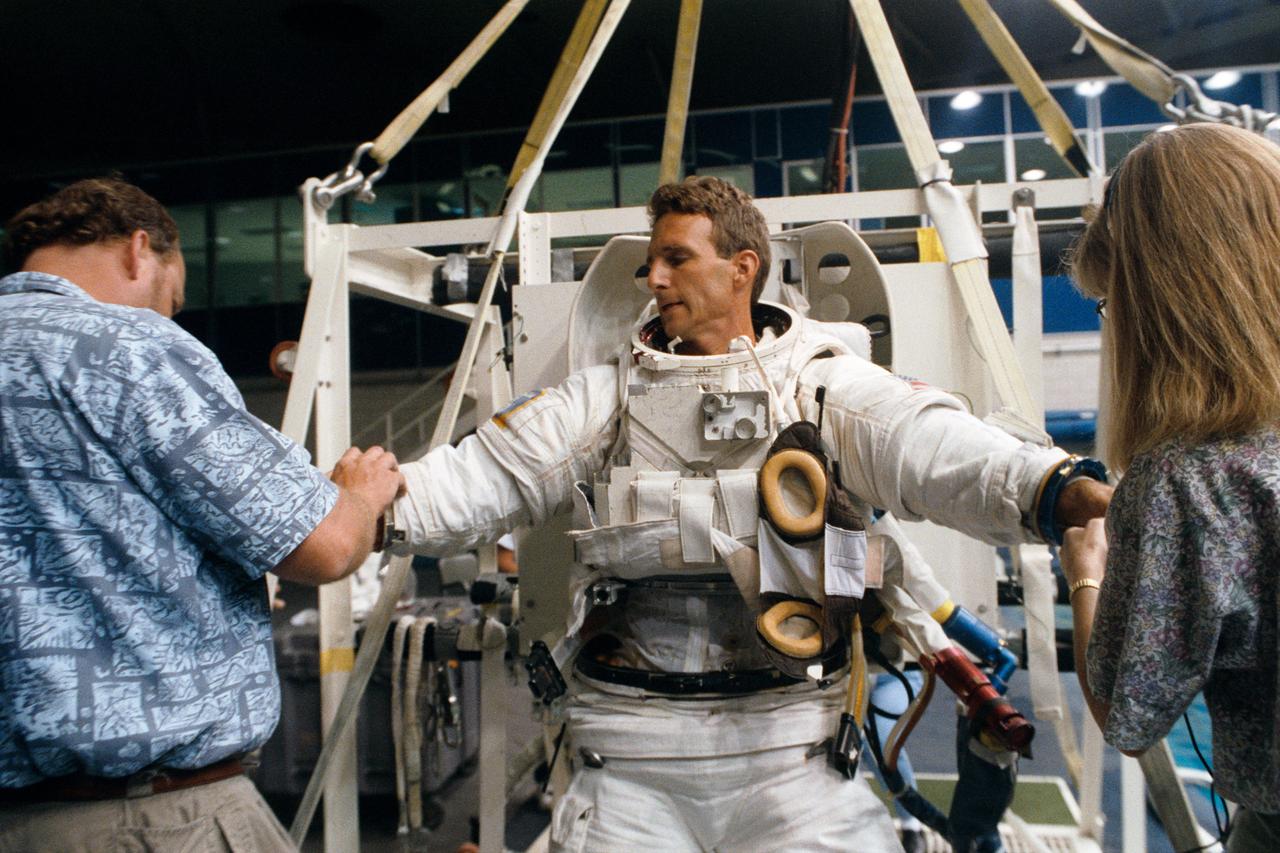
S93-37899 (October 1993) --- Astronaut Jerry M. Linenger, STS-64 mission specialist, is assisted by Steve Voyles and Kari Rueter of Boeing Aerospace prior to participating in a rehearsal for a contingency extravehicular activity (EVA). Minutes later, Linenger was submerged in the 25-feet-deep pool in the Johnson Space Center's (JSC) Weightless Environment Training Facility (WET-F). Photo credit: NASA or National Aeronautics and Space Administration
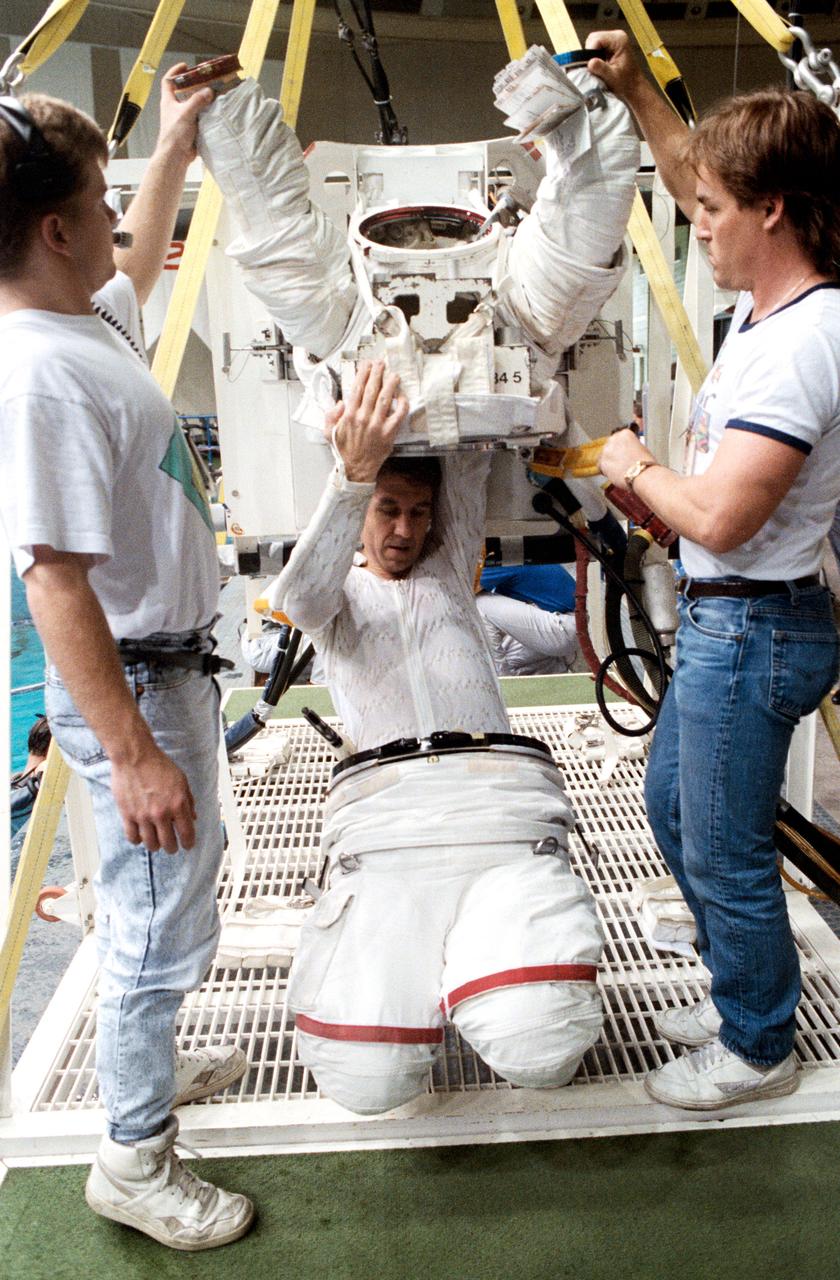
STS-38 Mission Specialist (MS) Robert C. Springer dons extravehicular mobility unit (EMU) upper torso with technicians' assistance in JSC's Weightless Environment Training Facility (WETF) Bldg 29. Positioned on the WETF platform at pool side, Springer is preparing for an underwater extravehicular activity (EVA) simulation. During the training session, Springer will rehearse contingency EVA procedures for the STS-38 mission aboard Atlantis, Orbiter Vehicle (OV) 104.
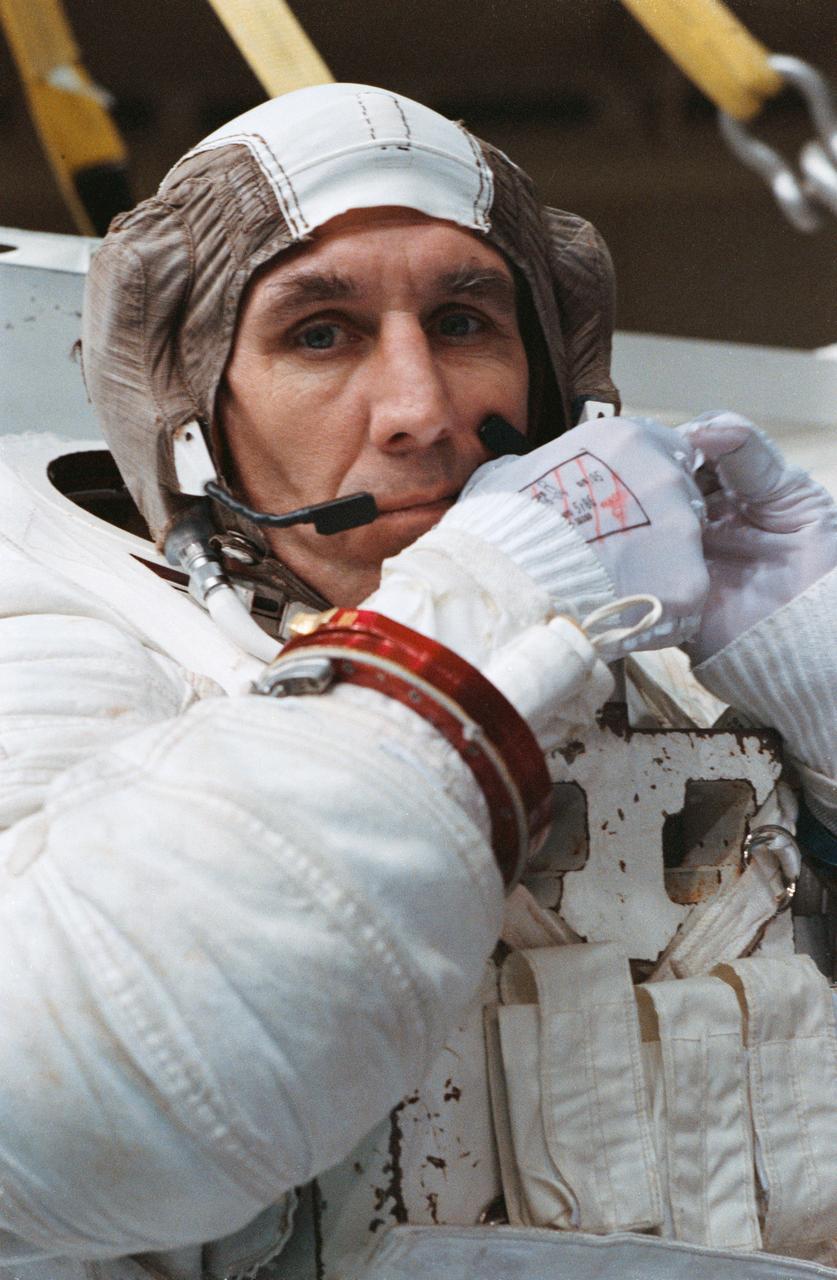
STS-38 Mission Specialist (MS) Robert C. Springer, wearing extravehicular mobility unit (EMU), fastens the strap on his communications carrier assembly (CCA) cap during suit donning in JSC's Weightless Environment Training Facility (WETF) Bldg 29. Positioned on the WETF platform at pool side, Springer is preparing for an underwater extravehicular activity (EVA) simulation. During the training exercise, Springer will rehearse contingency EVA procedures for the STS-38 mission aboard Atlantis, Orbiter Vehicle (OV) 104.
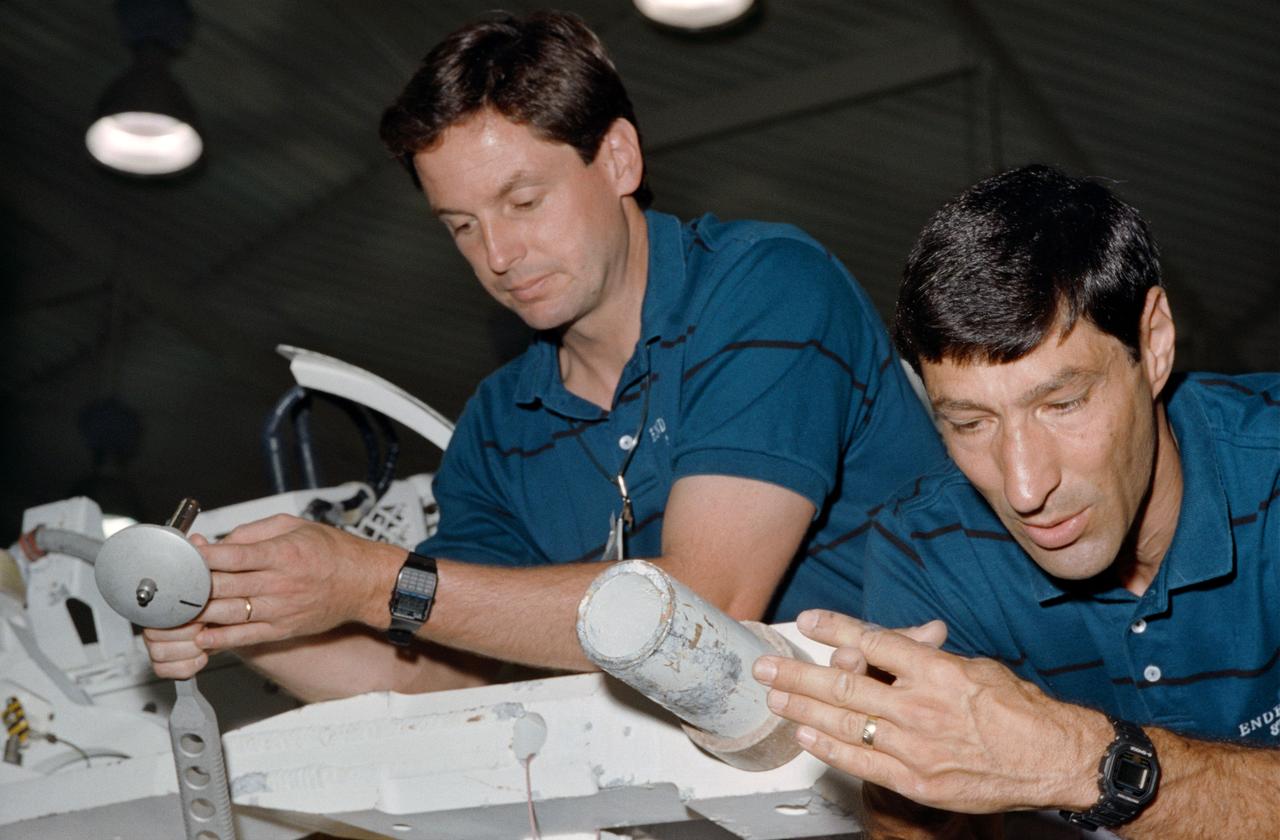
STS-54 Endeavour, Orbiter Vehicle (OV) 105, Mission Specialist 1 (MS1) Mario Runco, Jr (right) and MS2 Gregory J. Harbaugh, holding an ESSEX wrench, examine mockup and tools prior to an underwater simulation in JSC's Weightless Environment Training Facility (WETF) Bldg 29 pool. Runco and Harbaugh discuss the trunnion / payload retention latch assembly (PRLA) configuration.
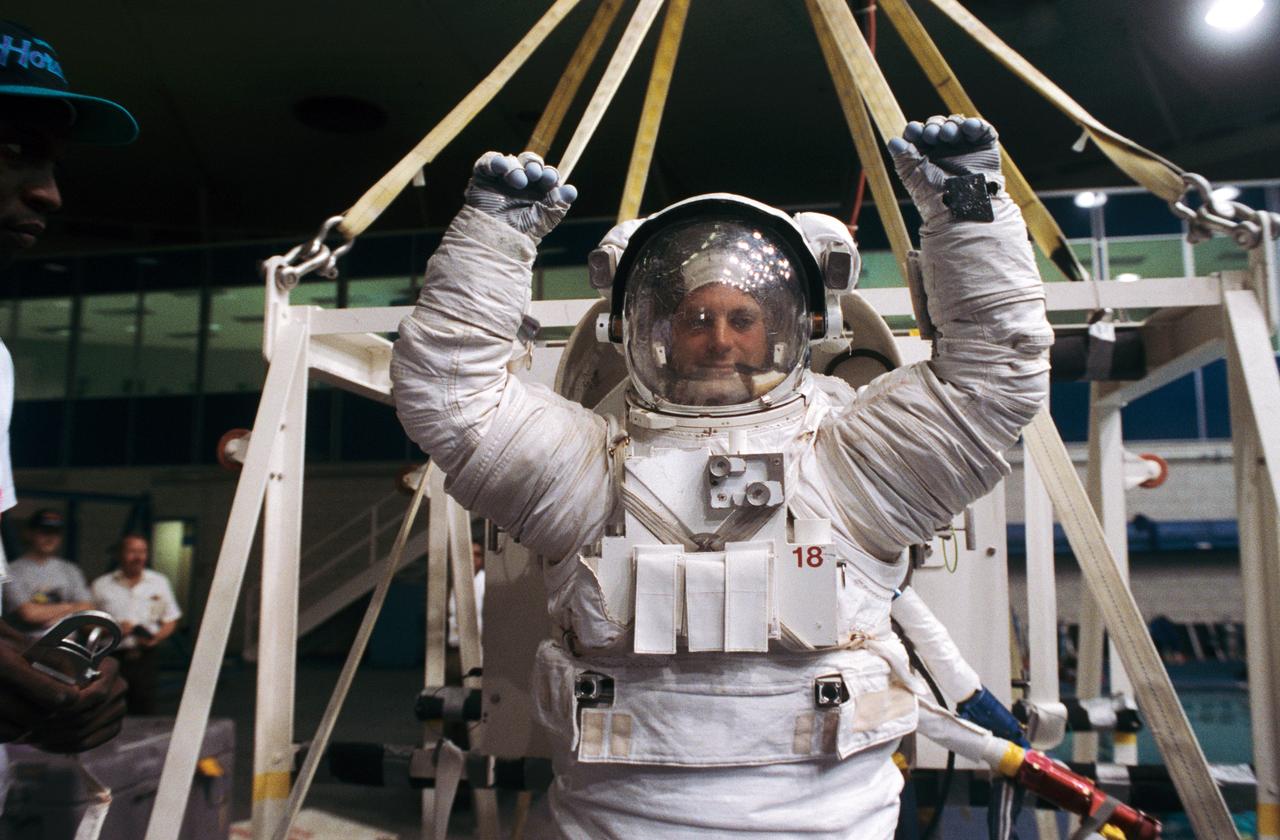
S93-31701 (3 April 1993) --- Displaying the flexibility of his training version of the Shuttle Extravehicular Mobility Unit (EMU) space suit, astronaut David A. Wolf participates in training for contingency Extravehicular Activity (EVA) for the STS-58 mission. Behind Wolf, sharing the platform with him was astronaut Shannon W. Lucid. For simulation purposes, the two mission specialists were about to be submerged to a point of neutral buoyancy in the Johnson Space Center's (JSC) Weightless Environment Training Facility (WET-F). Though the Spacelab Life Sciences (SLS-2) mission does not include a planned EVA, all crews designate members to learn proper procedures to perform outside the spacecraft in the event of failure of remote means to accomplish those tasks.
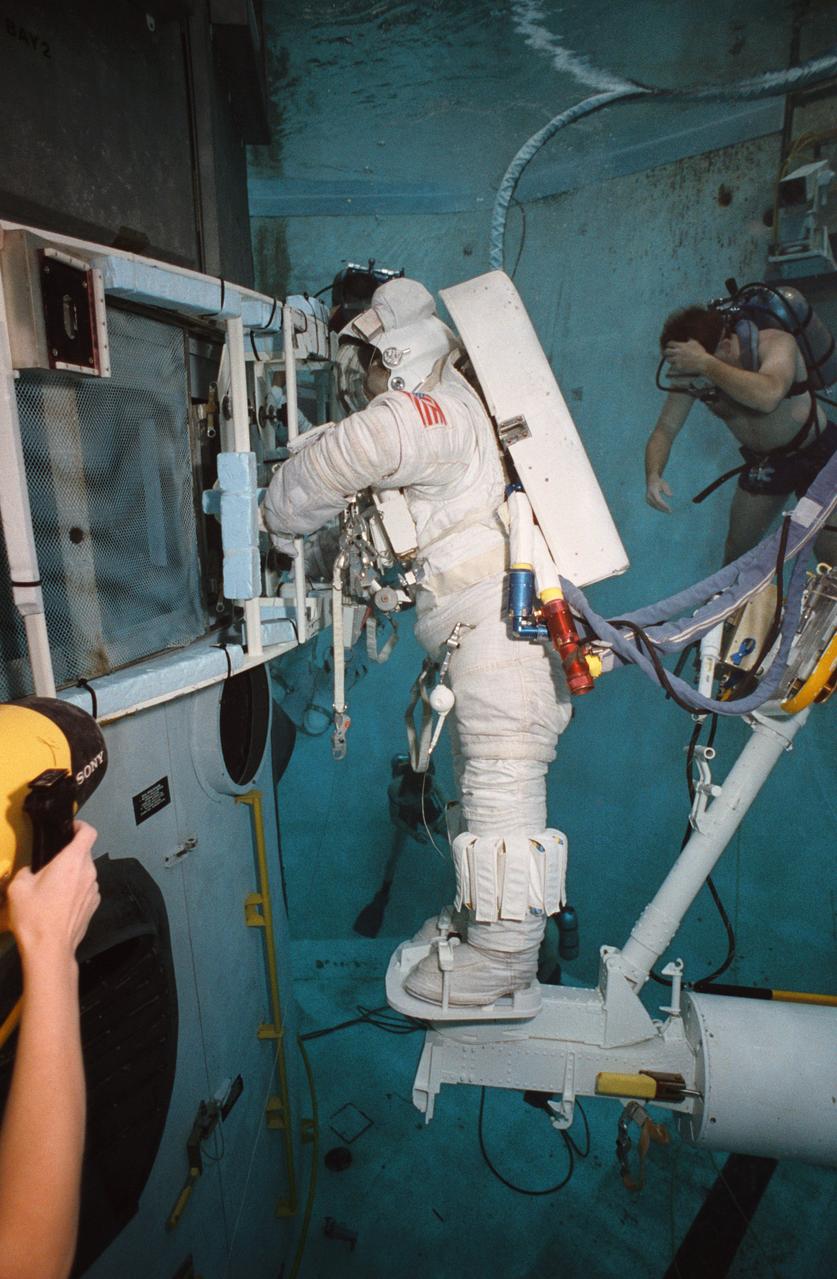
S93-33101 (5 Apr 1993) --- Wearing a training version of Space Shuttle Extravehicular Mobility Unit (EMU), astronaut Kathryn C. Thornton uses the giant pool of the Johnson Space Center's (JSC) Weightless Environment Training Facility (WET-F) to rehearse for the Hubble Space Telescope (HST) repair mission. Standing on a mobile foot restraint connected to the Shuttle's robot arm, Thornton grasps a large structure which attaches to the Wide Field/Planetary Camera (WF/PC). The current WF/PC on the HST will be replaced with WF/PC-2. Out of frame is astronaut Thomas D. Akers, who will join Thornton in STS-61 EVA. A SCUBA-equipped diver can be seen in the background. A number of divers are on hand for all training sessions in the WET-F. A total of five extravehicular activity (EVA) sessions will be conducted during the scheduled December mission of the Endeavour.
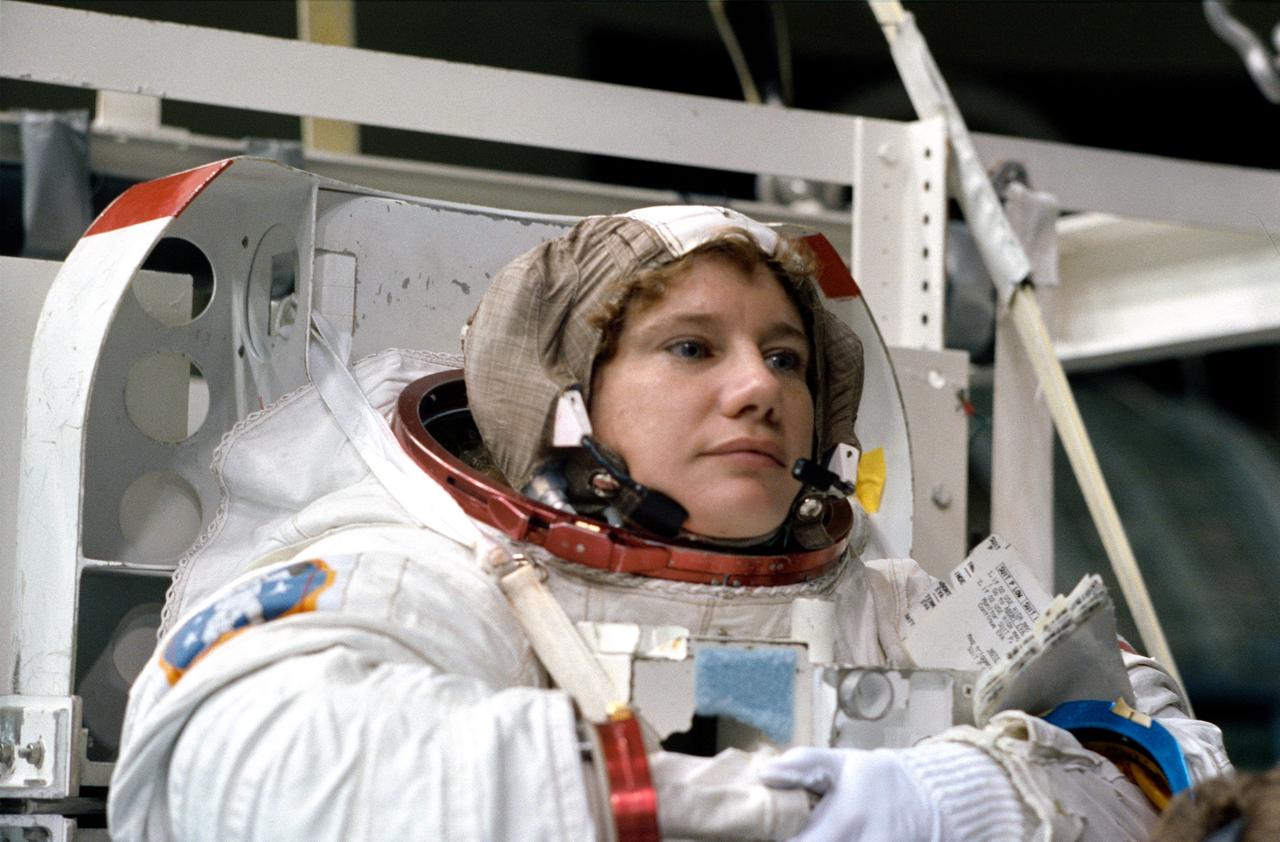
S92-42755 (31 July 1992) --- Astronaut Susan J. Helms, mission specialist assigned to fly aboard the Space Shuttle Endeavour for the STS-54 mission, completes the donning of her spacesuit before a training exercise. Though not assigned to the scheduled extravehicular activity (EVA), Helms is trained in the weightless environment training facility (WET-F). She will aid astronauts Gregory J. Harbaugh and Mario Runco Jr. in their planned EVA, scheduled for January of next year, and serve a backup role. Wearing this high fidelity training version of the extravehicular mobility unit (EMU), Helms was later lowered into the 25-ft. deep WET-F pool. The pressurized suit is weighted so as to allow Helms to achieve neutral buoyancy and simulate the various chores of the spacewalk.
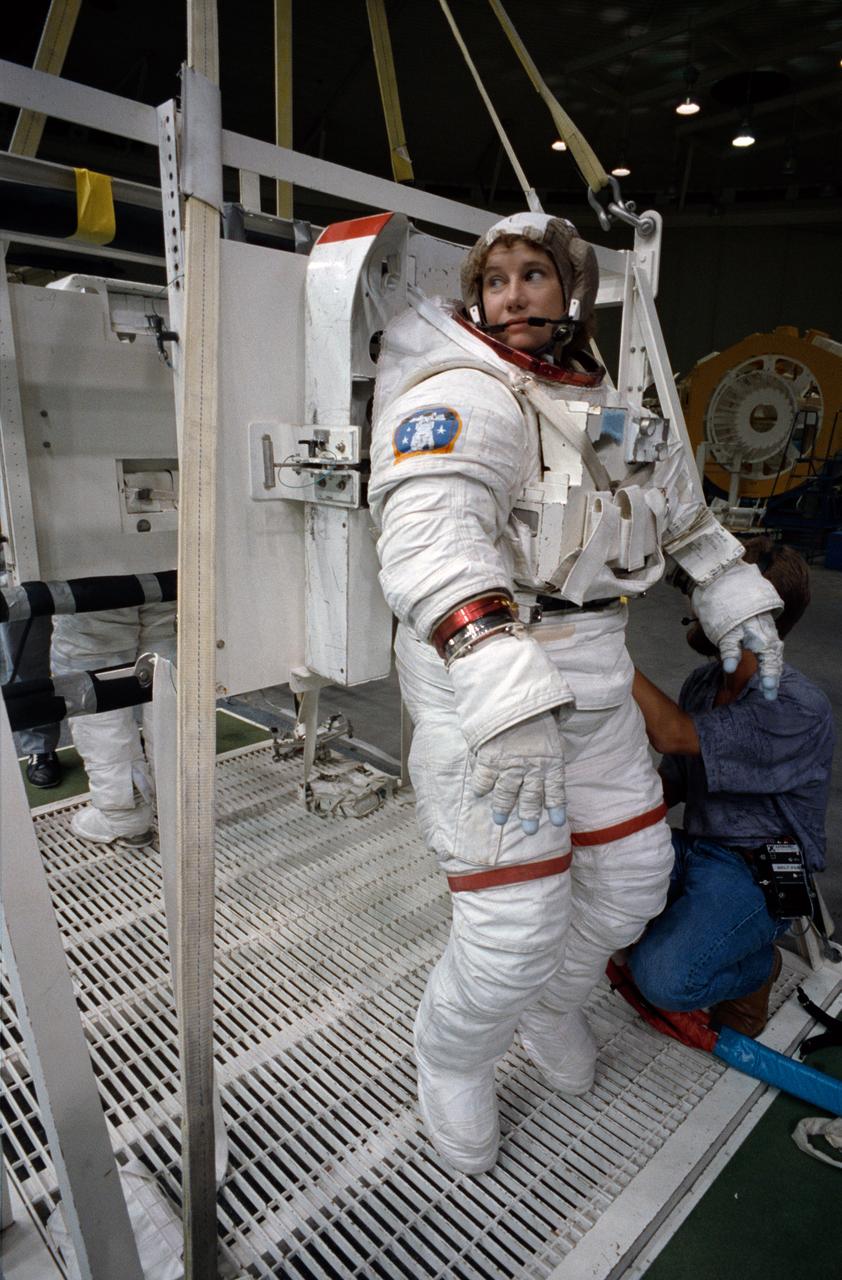
S92-42753 (31 July 1992) --- Astronaut Susan J. Helms, mission specialist assigned to fly aboard the Space Shuttle Endeavour for the STS-54 mission, gets assistance to complete the donning of her spacesuit. Though not assigned to the scheduled extravehicular activity (EVA), Helms is trained in the weightless environment training facility (WET-F). She will aid astronauts Gregory J. Harbaugh and Mario Runco Jr. in their planned EVA, scheduled for January of next year, and serve a backup role. Wearing this high fidelity training version of the extravehicular mobility unit (EMU), Helms was later lowered into the 25-ft. deep WET-F pool. The pressurized suit is weighted so as to allow Helms to achieve neutral buoyancy and simulate the various chores of the spacewalk.
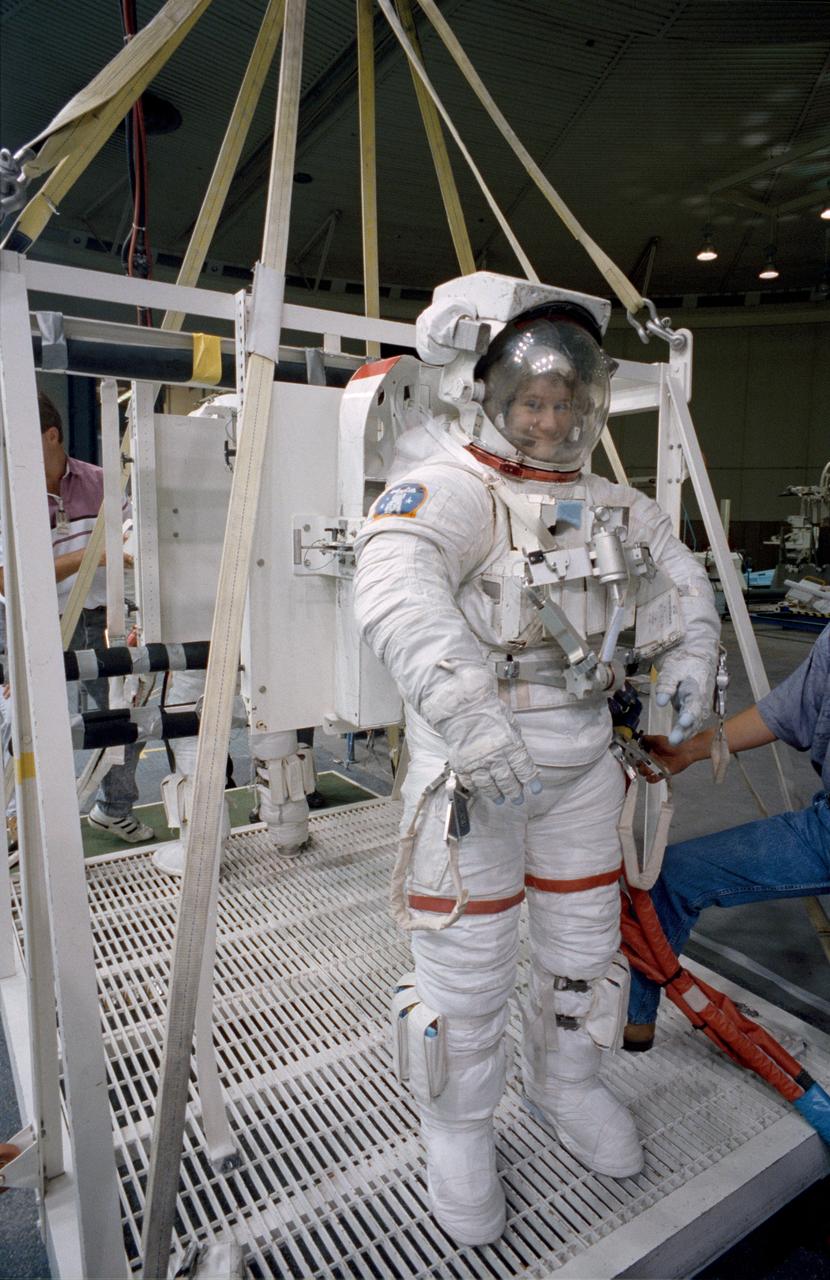
S92-42754 (31 July 1992) --- Astronaut Susan J. Helms, mission specialist assigned to fly aboard the Space Shuttle Endeavour for the STS-54 mission, gets assistance to complete the donning of her spacesuit. Though not assigned to the scheduled extravehicular activity (EVA), Helms is trained in the weightless environment training facility (WET-F). She will aid astronauts Gregory J. Harbaugh and Mario Runco Jr. in their planned EVA, scheduled for January of next year, and serve a backup role. Wearing this high fidelity training version of the extravehicular mobility unit (EMU), Helms was later lowered into the 25-ft. deep WET-F pool. The pressurized suit is weighted so as to allow Helms to achieve neutral buoyancy and simulate the various chores of the spacewalk.

STS-48 Mission Specialist (MS) James F. Buchli, wearing an extravehicular mobility unit (EMU), is watched by SCUBA-equipped divers as the platform he is standing on is lowered into JSC's Weightless Environment Training Facility (WETF) Bldg 29 pool. When completely underwater, Buchli will be released from the platform and will perform contingency extravehicular activity (EVA) operations. This underwater simulation of a spacewalk is part of the training required for Buchli's upcoming mission aboard Discovery, Orbiter Vehicle (OV) 103.
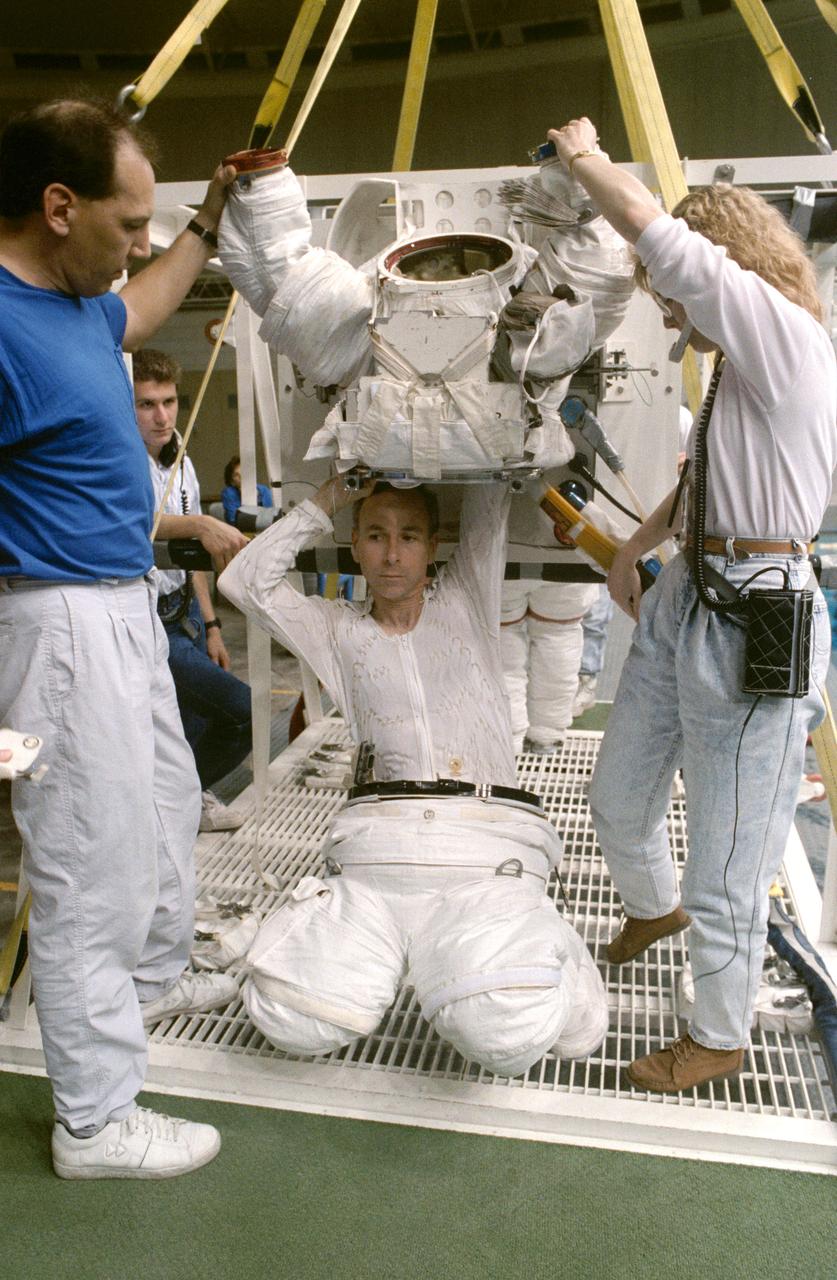
STS-38 Mission Specialist (MS) Carl J. Meade, wearing liquid cooling and ventilation garment (LCVG) and extravehicular mobility unit (EMU) lower torso, crouches under EMU upper torso. Technicians extend the EMU sleeves as Meade reaches into upper torso during suit donning in JSC's Weightless Environment Training Facility (WETF) Bldg 29. Positioned on the WETF platform at pool side, Meade is preparing for an underwater extravehicular activity (EVA) simulation. During the training exercise, Meade will rehearse contingency EVA procedures for the STS-38 mission aboard Atlantis, Orbiter Vehicle (OV) 104.
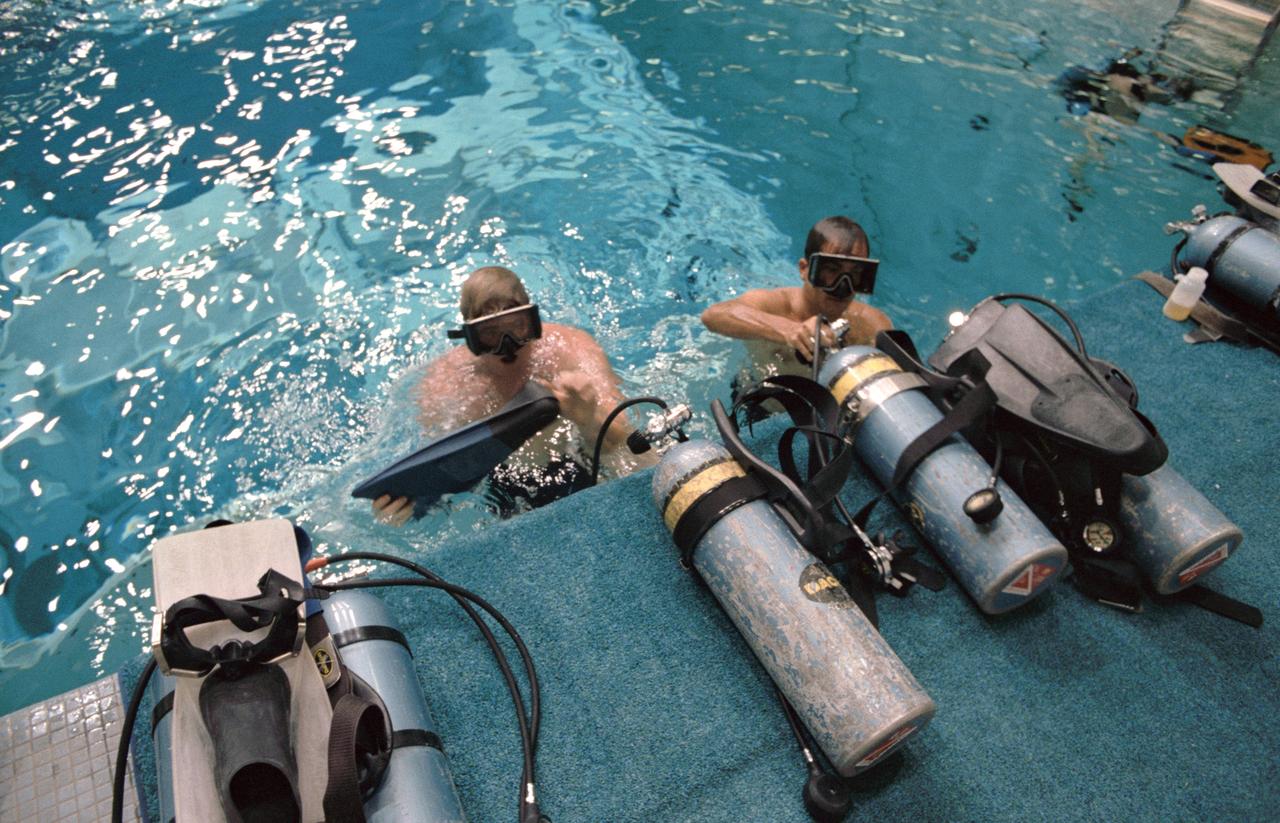
S84-36900 (29 June 1984) ---Astronauts Robert L. Crippen (right) and Jon A. McBride, crew commander and pilot, respectively, for NASA's 41-G Space Shuttle mission, don self contained underwater breathing apparatus (SCUBA) gear prior to their underwater to observe a simulation of an extravehicular activity (EVA) to be performed on their mission. Astronauts Kathryn D. Sullivan and David C. Leestma, two of three mission specialists on the seven-member crew, are scheduled for the EVA. The underwater training took place in the Johnson Space Center's weightless environment training facility (WET-F).
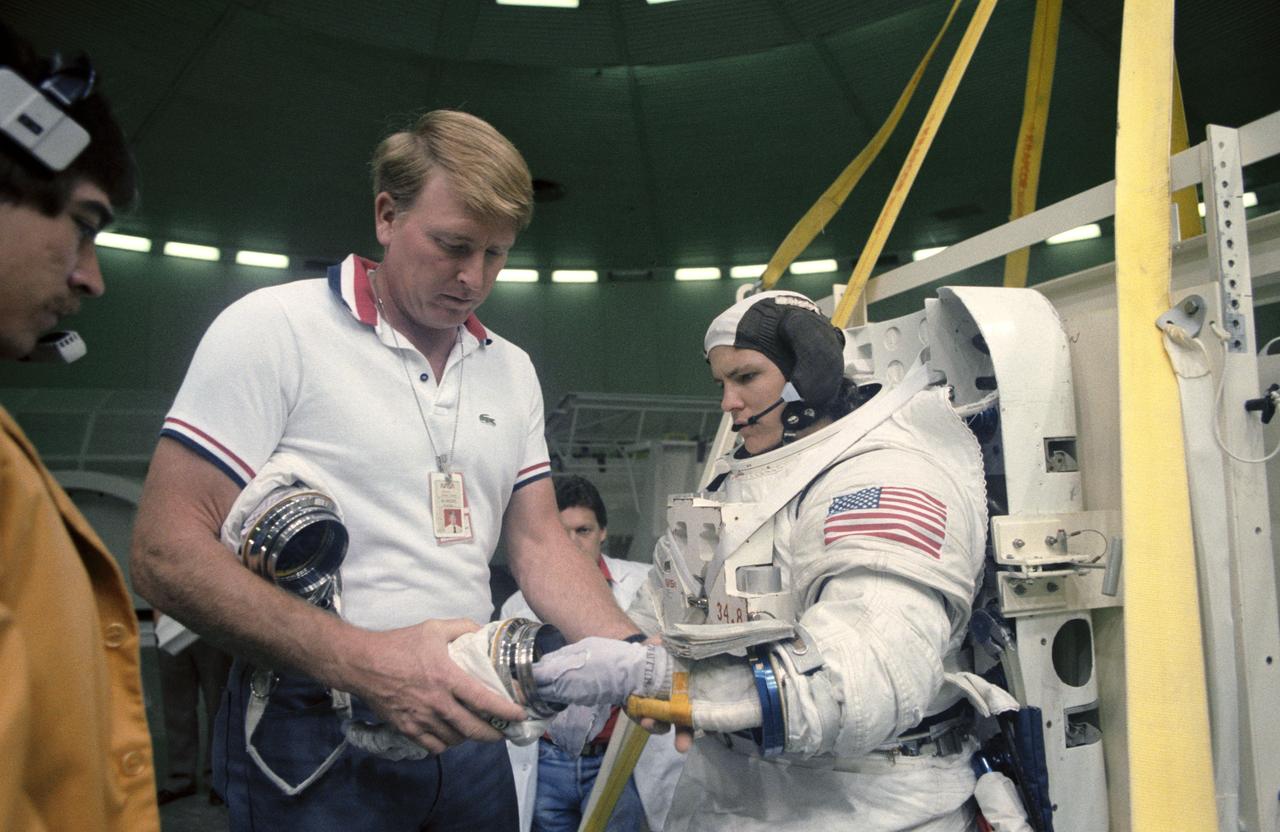
S84-33898 (21 May 1984) --- Astronaut Jon A. McBride, 41-G pilot, assists his crewmate, Astronaut Kathryn D. Sullivan with the glove portion of her extravehicular mobility unit (EMU) prior to Dr. Sullivan's underwater session in the Johnson Space Center's weightless environment training facility (WET-F). Mission specialists Sullivan and David C. Leestma are scheduled for extravehicular activity (EVA) on the Columbia for NASA's 17th scheduled flight.
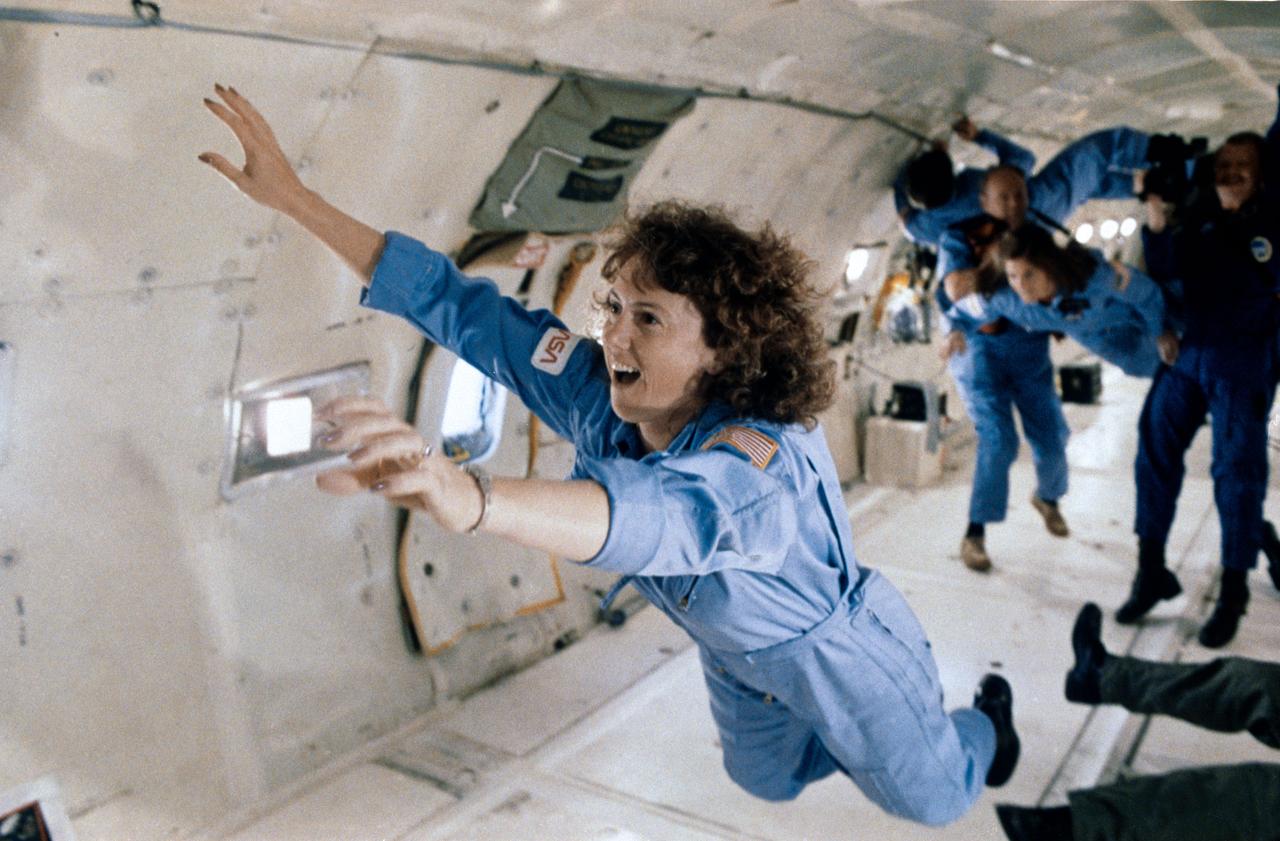
S86-25180 (October 1985) --- Sharon Christa McAuliffe, STS-51L citizen observer/payload specialist, representing the Teacher-in-Space Project, floats forward and upward during a few moments of weightlessness aboard a KC-135 aircraft. The flight is part of her training for the scheduled five-day flight aboard the Challenger in January of next year. Barbara R. Morgan, backup payload specialist for STS-51L, is partially visible in the background. The photo was taken by Keith Meyers of the New York Times. Photo credit: NASA
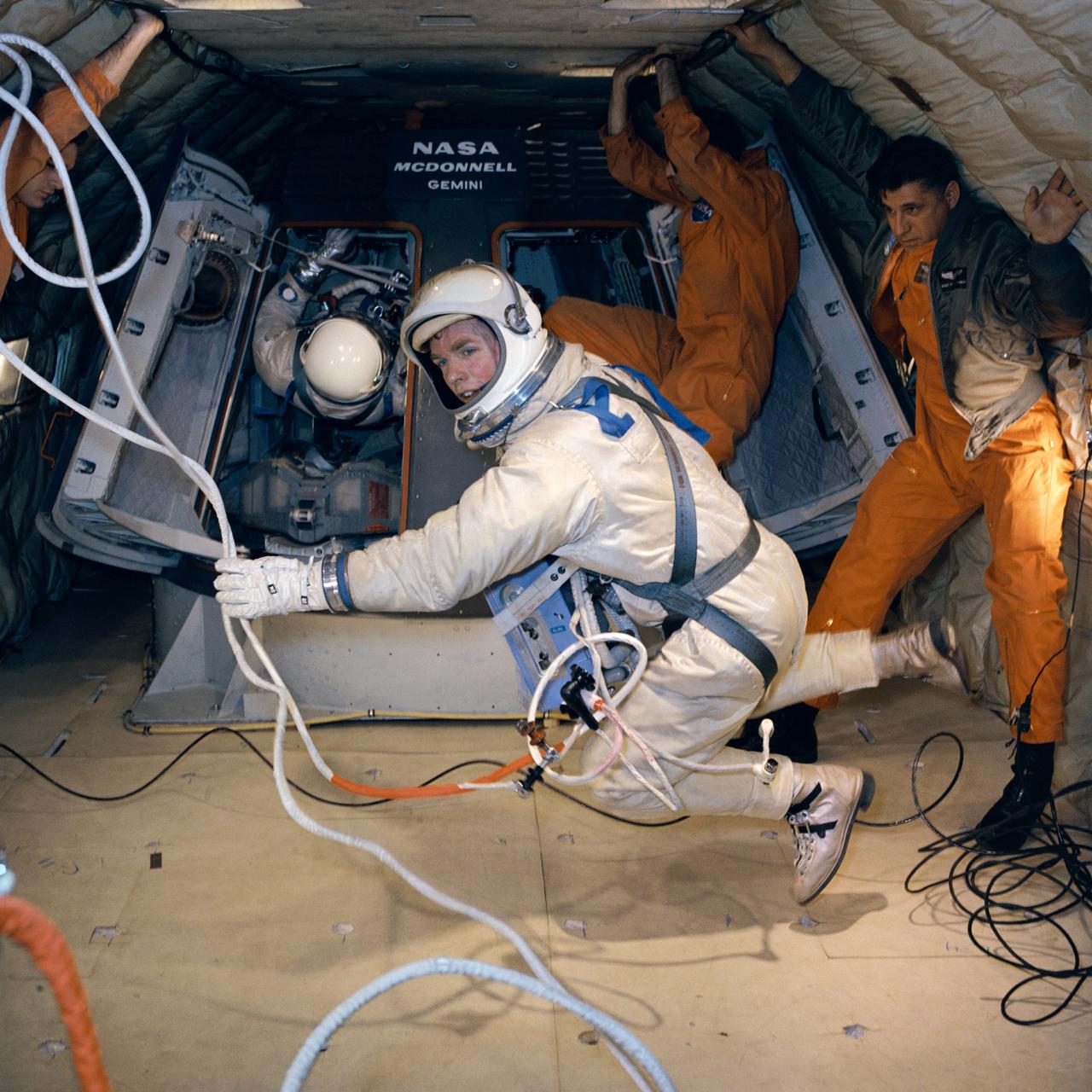
S66-21416 (18 Feb. 1966) --- Astronaut David R. Scott, in full spacesuit, holds maneuvering unit while suspended in a weightless state during extravehicular activity (EVA) training in a C-135 Air Force plane. Photo credit: NASA
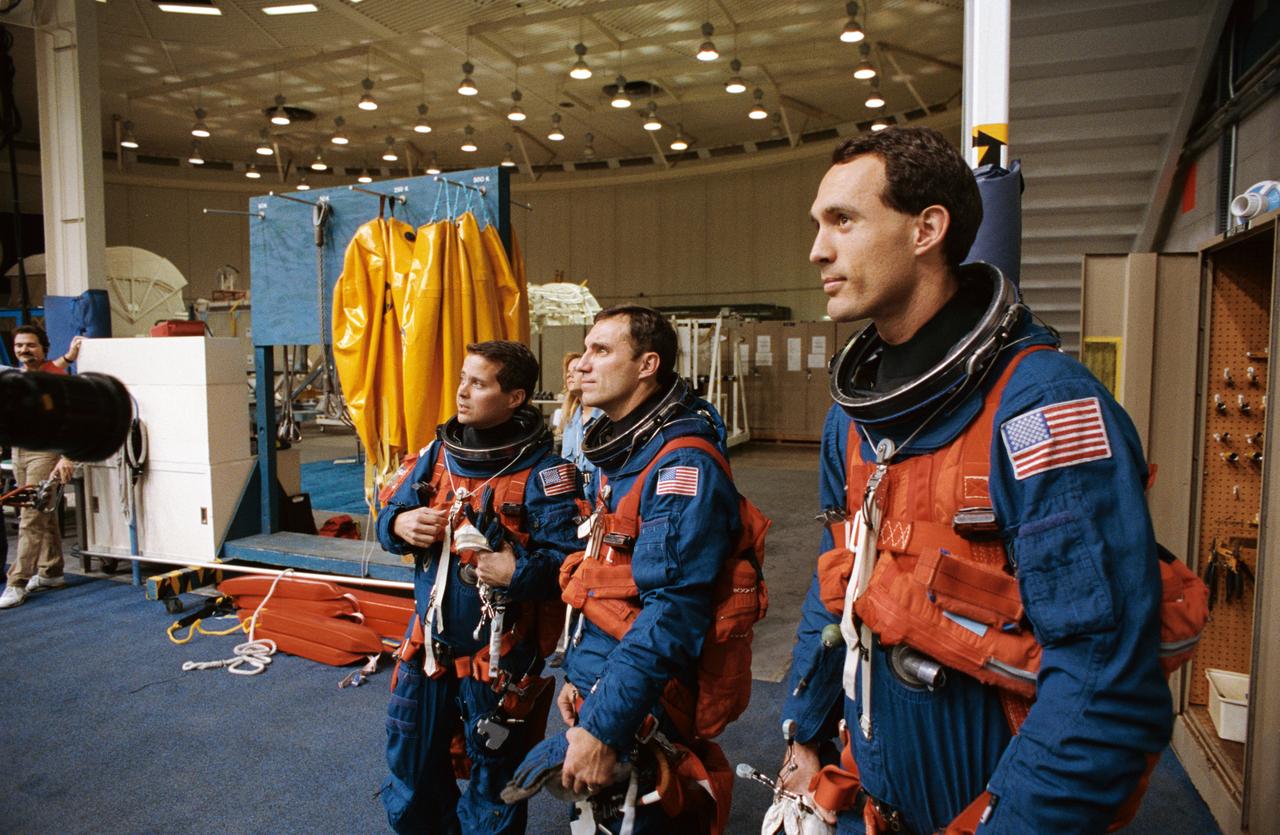
S93-31929 (24 March 1993) --- The three mission specialists for NASA's STS-51 mission watch as a crewmate (out of frame) simulates a parachute jump into water during emergency bailout training exercises at the Johnson Space Center's Weightless Environment Training Facility (WET-F). Left to right are astronauts Daniel W. Bursch, Carl E. Walz and James H. Newman. Out of frame are astronauts Frank L. Culbertson and William F. Readdy, commander and pilot, respectively.
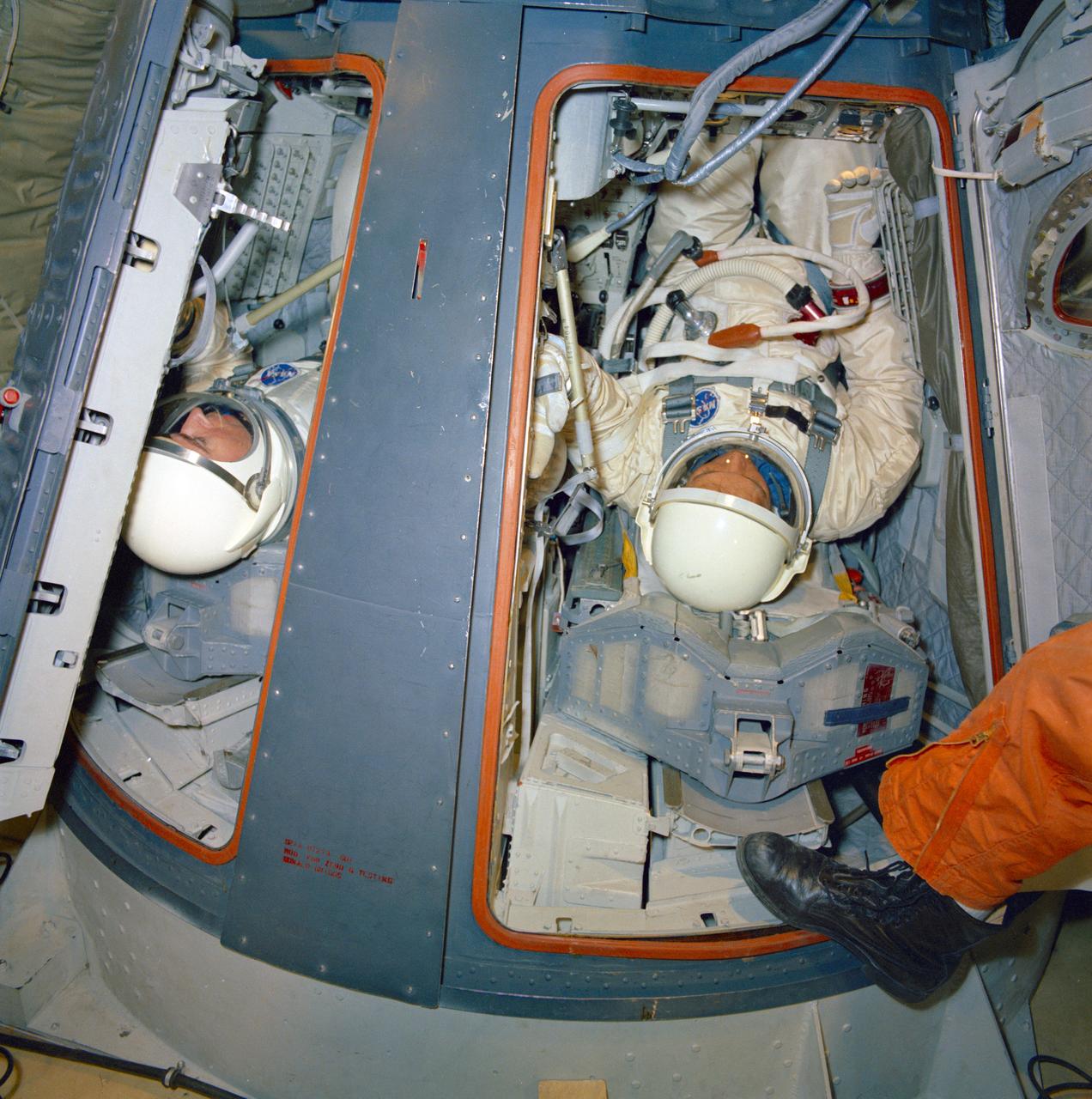
S66-28583 (1 April 1966) --- The Gemini-10 prime crew undergoes zero-gravity egress training aboard a KC-135 Air Force plane. Astronaut John W. Young, command pilot, is on left. On the right is astronaut Michael Collins, pilot. The airplane, flying a parabolic curve, creates a weightless environment as a training exercise in preparation for spaceflight Photo credit: NASA

In preparation of the nation’s first lunar landing mission, Apollo 11 crew members underwent training to practice activities they would be performing during the mission. In this photograph, astronaut Collins (left) and chief astronaut and director of flight crew operations, Donald K. Slayton, walk away from a T-38 jet plane at Patrick Air Force Base. The two had been flying arcs to give Collins more time under weightless conditions. The Apollo 11 mission launched from the Kennedy Space Center (KSC) in Florida via the Marshall Space Flight Center (MSFC) developed Saturn V launch vehicle on July 16, 1969 and safely returned to Earth on July 24, 1969. Aboard the space craft were astronauts Neil A. Armstrong, commander; Michael Collins, Command Module (CM) pilot; and Edwin E. (Buzz) Aldrin Jr., Lunar Module (LM) pilot. The CM, “Columbia”, piloted by Collins, remained in a parking orbit around the Moon while the LM, “Eagle’’, carrying astronauts Armstrong and Aldrin, landed on the Moon. On July 20, 1969, Armstrong was the first human to ever stand on the lunar surface, followed by Aldrin. During 2½ hours of surface exploration, the crew collected 47 pounds of lunar surface material for analysis back on Earth. With the success of Apollo 11, the national objective to land men on the Moon and return them safely to Earth had been accomplished
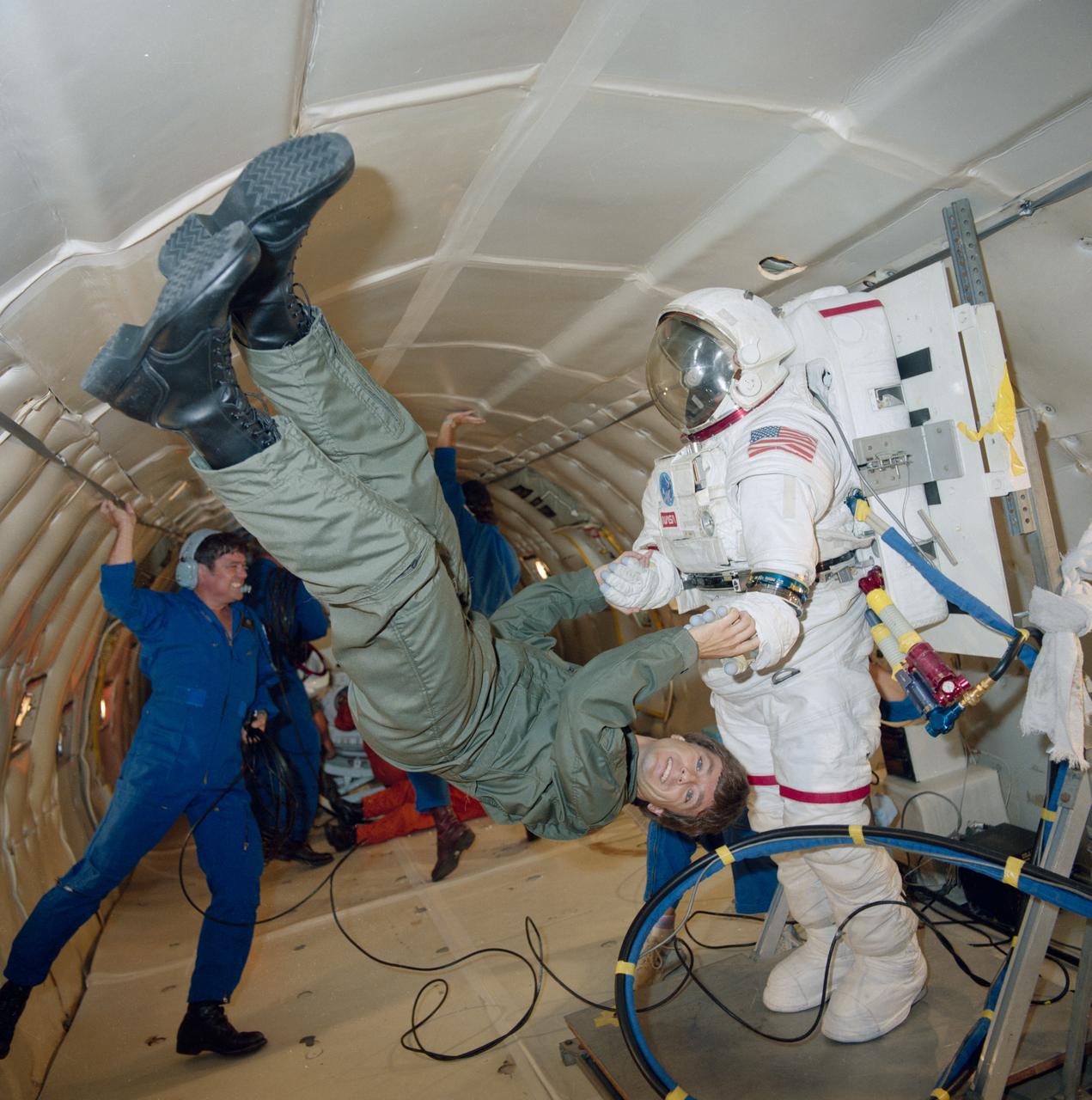
S84-37532 (18 July 1984) --? Robert B. Thirsk, backup payload specialist for 41-G appears to be shaking hands with an unoccupied extravehicular mobility unit (EMU) during a familiarization flight aboard NASA?s KC-135 aircraft. Thirsk, representing Canada?s National Research Council (NRC), serves as backup to Marc Garneau on the seven-member crew for Challenger?s October 1984 flight. This aircraft is used extensively for training and exposing Shuttle crewmembers to weightlessness as well as for evaluation of equipment and experiments scheduled for future flights.
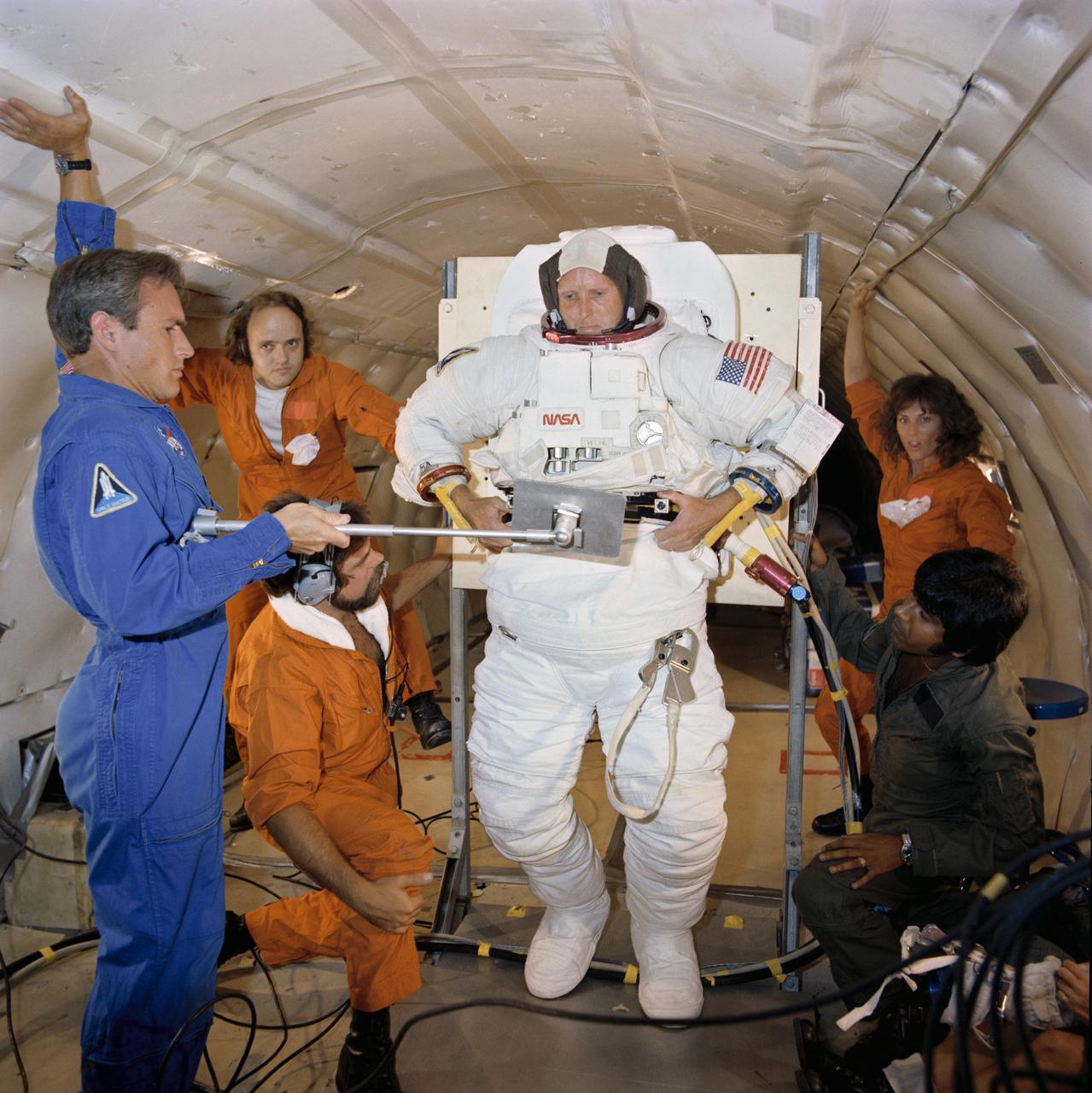
S81-34432 (July 1981) --- Astronaut C. Gordon Fullerton, STS-3 pilot, takes part in a suit donning and doffing exercise aboard a KC-135 "zero-gravity" aircraft. Mission specialist/astronaut William F. Fisher holds a mirror to assist Fullerton with hose and cable linkups to his suit. A special parabolic pattern flown by the KC-135 provides short durations of weightlessness. Fullerton's suit is an Extravehicular Mobility Unit (EMU), used by astronauts when leaving the shirt-sleeve environment of their shuttle orbiter to go outside and perform tasks in the vacuum of space. There are no such EVA plans on STS-3, but the crewmen are trained in this area in the event of a contingency. Photo credit: NASA
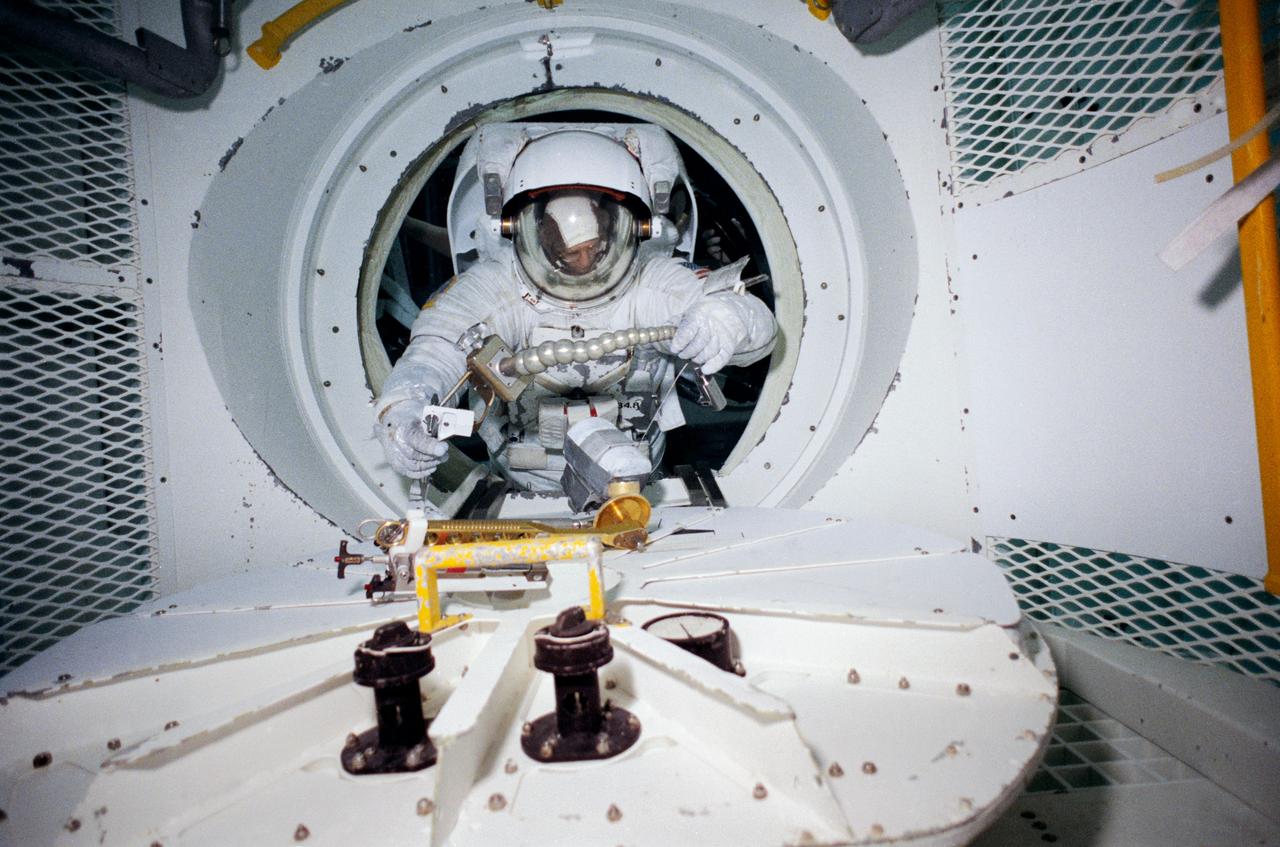
S90-30521 (20 Feb 1990) --- Though no extravehicular activity is planned for STS-31, two crewmembers train for contingencies that would necessitate leaving their shirt sleeve environment of Discovery's cabin and performing chores with their Hubble Space Telescope payload or related hardware. Astronaut Kathryn D. Sullivan, mission specialist, is seen egressing the hatchway of the airlock of a full scale mockup of a Shuttle cabin to interface with an HST mockup in JSC's 25.-ft. deep pool in the weightless environment training facility (WET-F). Two SCUBA-equipped divers who assisted in the training session are also seen. Astronaut Bruce McCandless II, mission specialist, is out of frame.
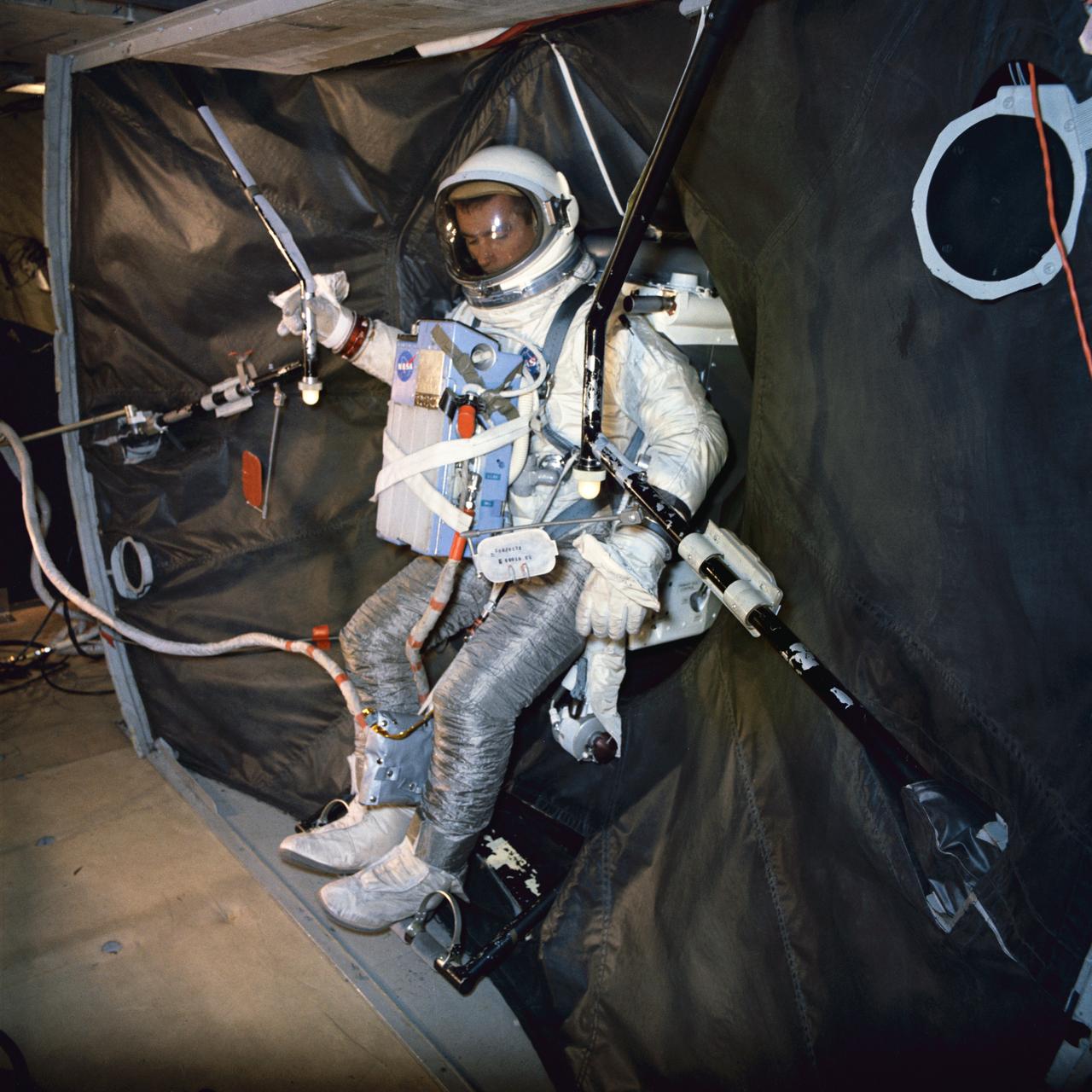
S66-31665 (3 May 1966) --- Astronaut Eugene A. Cernan, pilot of the Gemini-9 spaceflight, participates in extravehicular training under zero-gravity conditions aboard a KC-135 aircraft. Here, he is donning the Astronaut Maneuvering Unit (AMU) backpack after egressing a Gemini mock-up. The AMU backpack is mounted in the adapter equipment section of the mock-up. Cernan wears an extravehicular activity (EVA) life support system chest pack. Cernan will use the AMU during his scheduled EVA on the Gemini-9 mission. The KC-135 flew a parabolic curve to create the weightlessness condition for training purposes. Photo credit: NASA
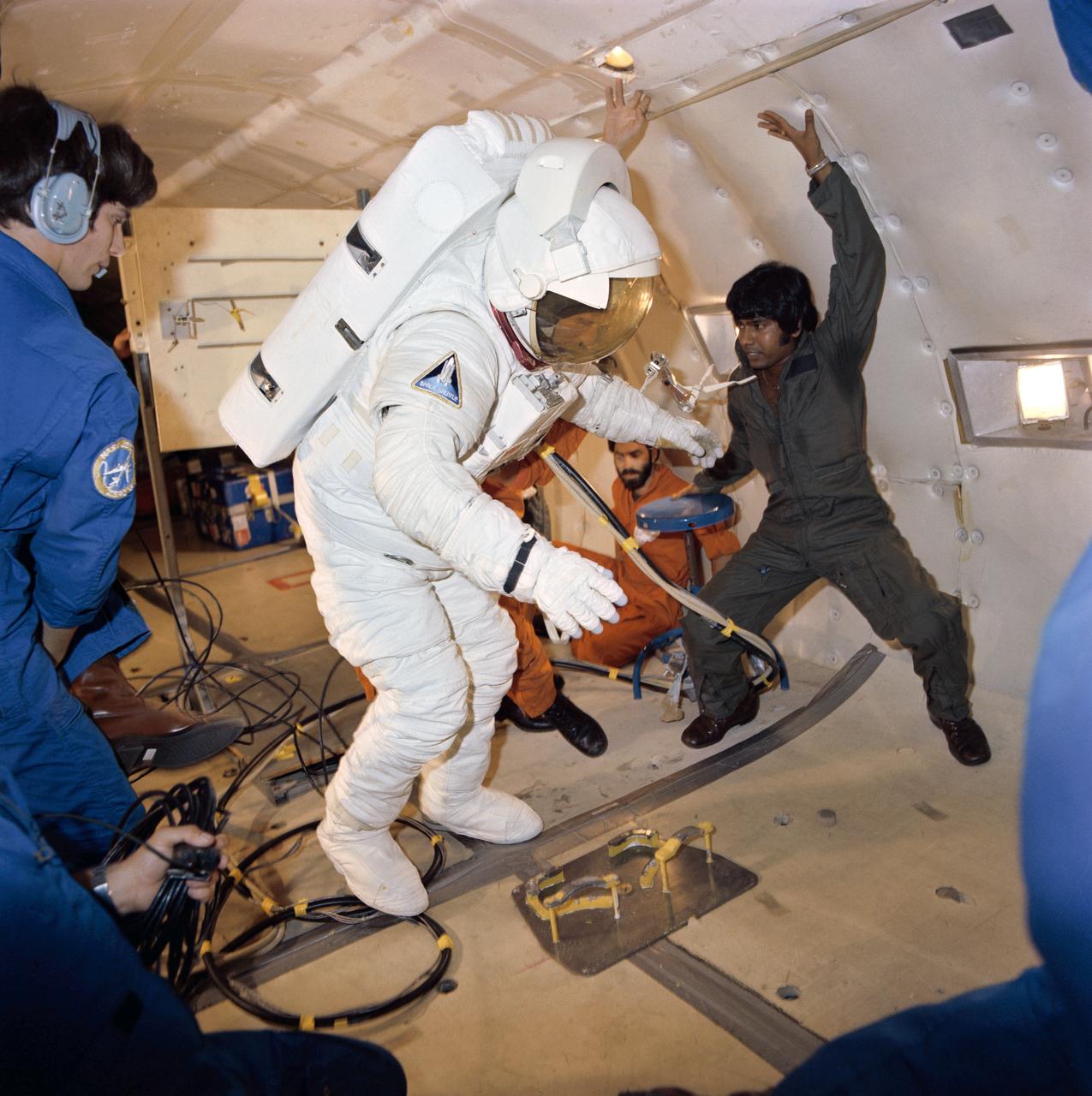
S81-34448 (July 1981) --- Astronaut C. Gordon Fullerton, STS-3 pilot, fully suited, gets a preview of what it might be like in space during a flight aboard NASA's KC-135 "zero-gravity" aircraft. A special parabolic pattern flown the aircraft provides short periods of weightlessness. Fullerton's suit is an Extravehicular Mobility Unit (EMU), used by astronauts when leaving the shirt-sleeve environment of their shuttle orbiter to go outside perform tasks in space. There are no such EVA plans on STS-3, but crew members are trained in this area in the event of the necessity to perform chores in space that for some reason or other can't be done remotely. The astronaut has just donned his suit during a parabola and now takes the opportunity to float around in the absence of gravity. Photo credit: NASA
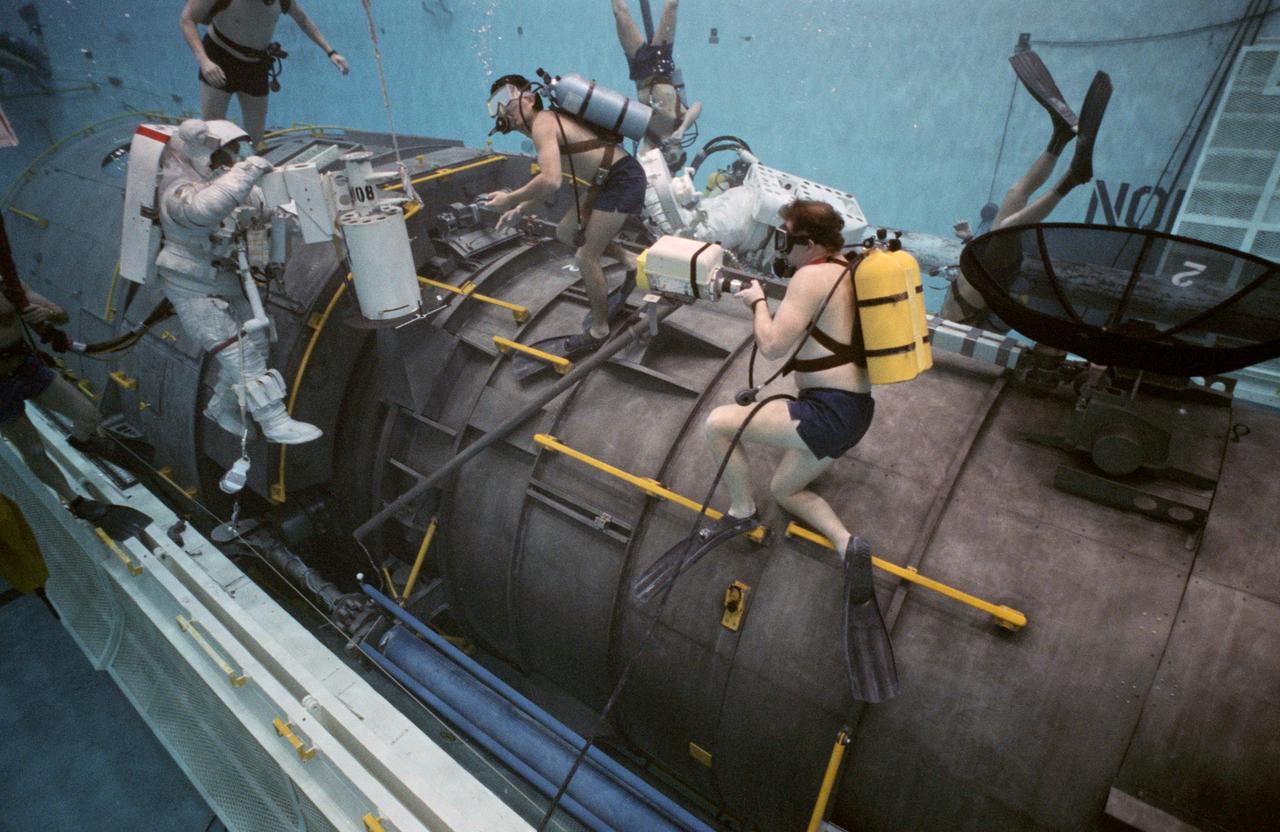
STS-31 Mission Specialist (MS) Bruce McCandless II (left), wearing an extravehicular mobility unit (EMU), maneuvers his way around a mockup of the remote manipulator system (RMS) end effector during an underwater simulation in JSC's Weightless Environment Training Facility (WETF) Bldg 29 pool. The end effector is attached to a grapple fixture on the Hubble Space Telescope (HST) mockup. As McCandless performs contingency extravehicular activity (EVA) procedures, fellow crewmember MS Kathryn D. Sullivan, in EMU, works on the opposite side of the HST mockup, and SCUBA-equipped divers monitor the activity. Though no EVA is planned for STS-31, the two crewmembers train for contingencies that would necessitate leaving the shirt sleeve environment of Discovery's, Orbiter Vehicle (OV) 103's, crew cabin and performing chores with the HST payload or related hardware in the payload bay (PLB).
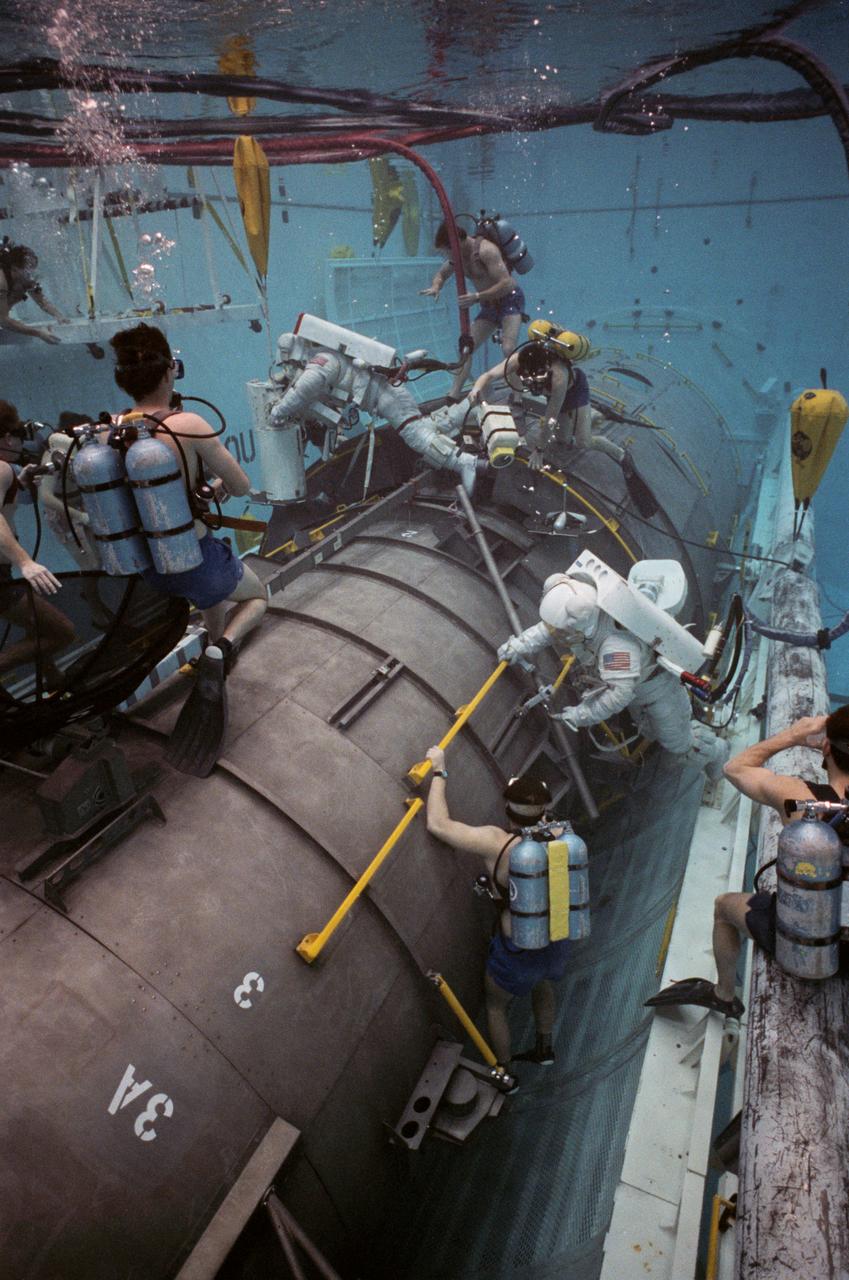
This overall view shows STS-31 Mission Specialist (MS) Bruce McCandless II (left) and MS Kathryn D. Sullivan making a practice space walk in JSC's Weightless Environment Training Facility (WETF) Bldg 29 pool. McCandless works with a mockup of the remote manipulator system (RMS) end effector which is attached to a grapple fixture on the Hubble Space Telescope (HST) mockup. Sullivan manipulates HST hardware on the Support System Module (SSM) forward shell. SCUBA-equipped divers monitor the extravehicular mobility unit (EMU) suited crewmembers during this simulated extravehicular activity (EVA). No EVA is planned for the Hubble Space Telescope (HST) deployment, but the duo has trained for contingencies which might arise during the STS-31 mission aboard Discovery, Orbiter Vehicle (OV) 103. Photo taken by NASA JSC photographer Sheri Dunnette.
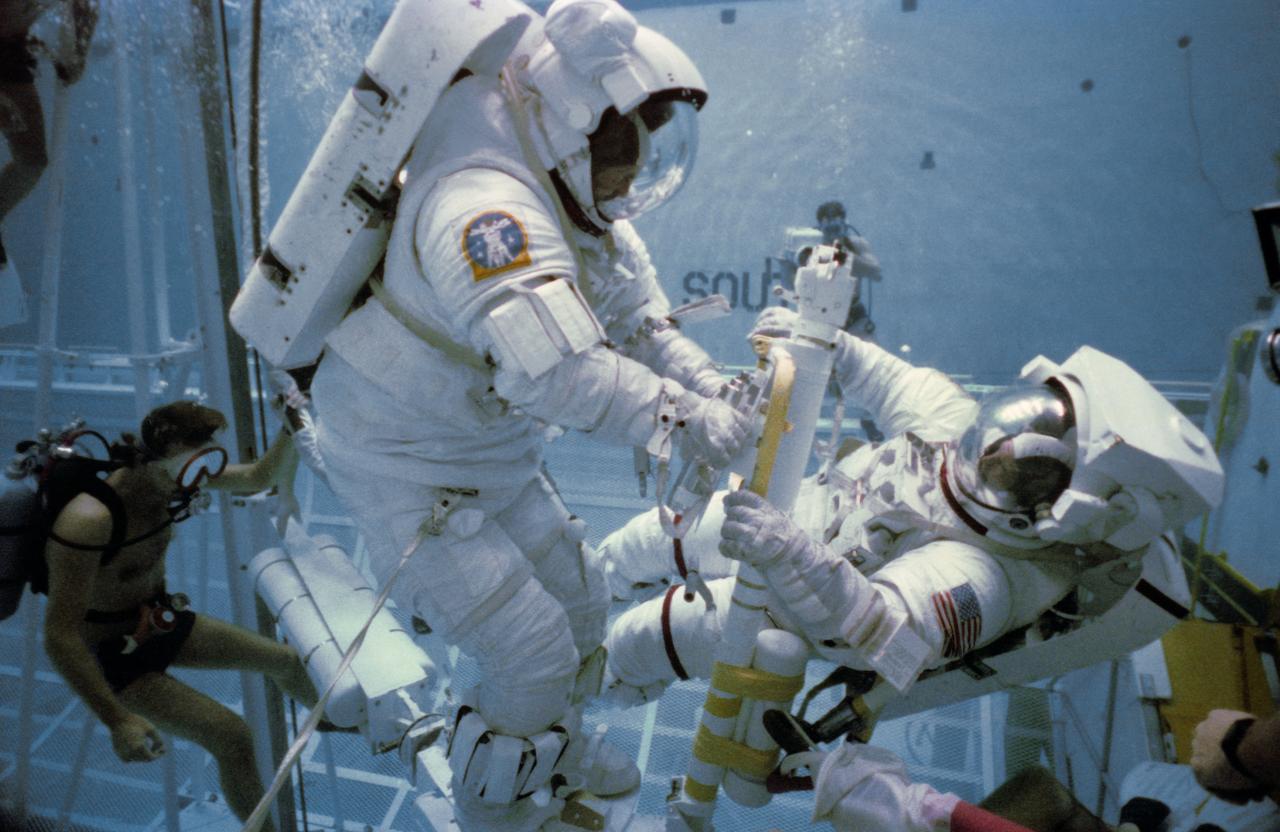
S83-42895 (19 Oct 1983) --- Astronauts George D. Nelson and James D. van Hoften, NASA Flight STS-41C mission specialists, offer an underwater version of a preview of their mission's extravehicular activity (EVA). The April 1984 flight includes as one of its primary objectives a two-person EVA and a visit to the damaged Solar Maximum Satellite (SMS). Van Hoften, left, and Nelson work here with the mobile foot restraint (MFR), which attaches to the remote manipulator system (RMS) arm to form a "cherry-picker" device. Van Hoften is standing on the MFR. The two are making use of the Johnson Space Center's (JSC) weightless environment training facility (WET-F). This photograph was taken by Otis Imboden.
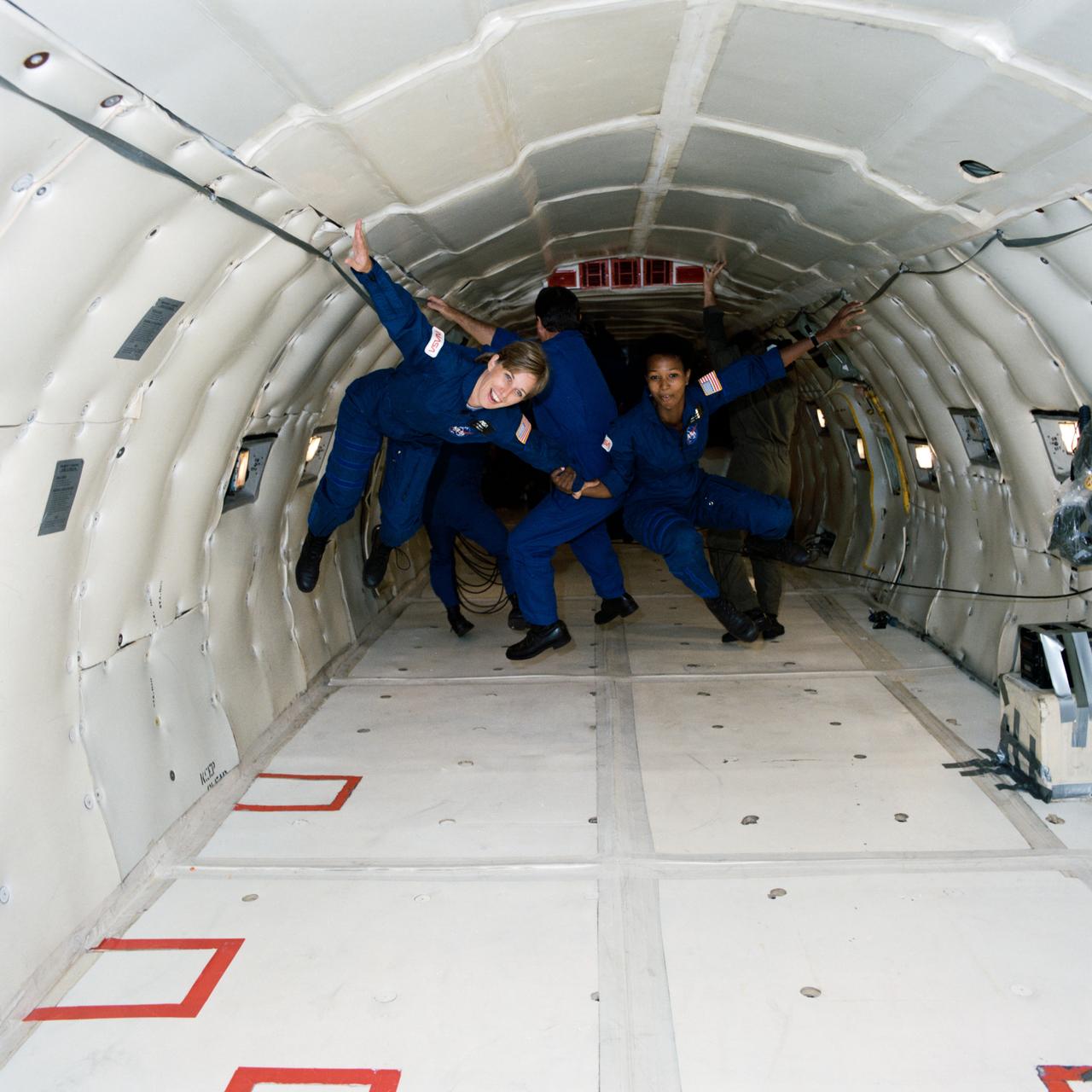
S87-44950 --- Group 12, 1987 Astronaut Class, candidates (ASCANs) N. Jan Davis (left) and Mae C. Jemison freefloat during the seconds of microgravity created aboard the KC-135 NASA 930 aircraft's parabolic flight. Davis and Jemison, two of the recently-named ASCANs, were taking a familiarization flight aboard the KC-135 "zero gravity" aircraft. Photo credit: NASA
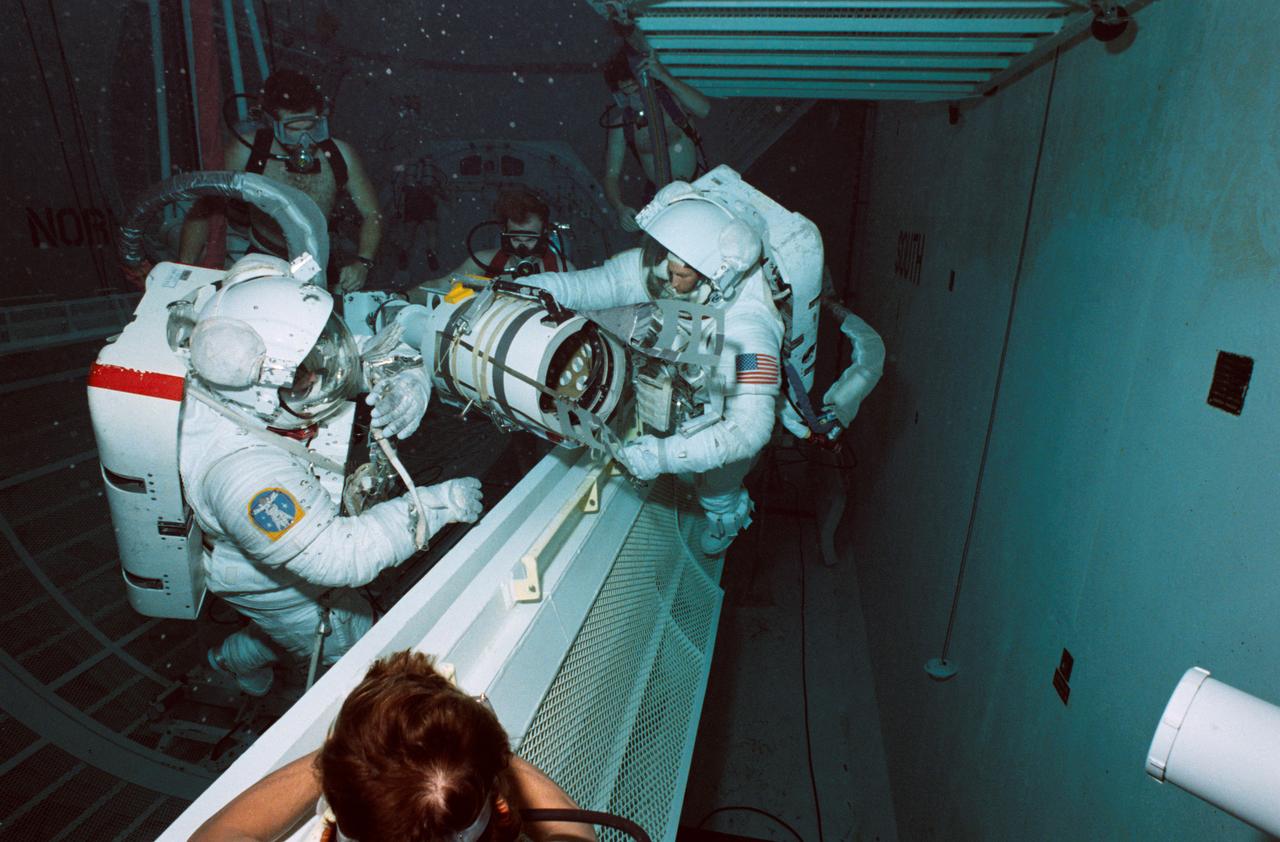
Underwater EVA Simulation of "Flyswatter" attachment in the Weightless Environment Training Facility (WETF), 04/15/1985. JSC, HOUSTON, TX
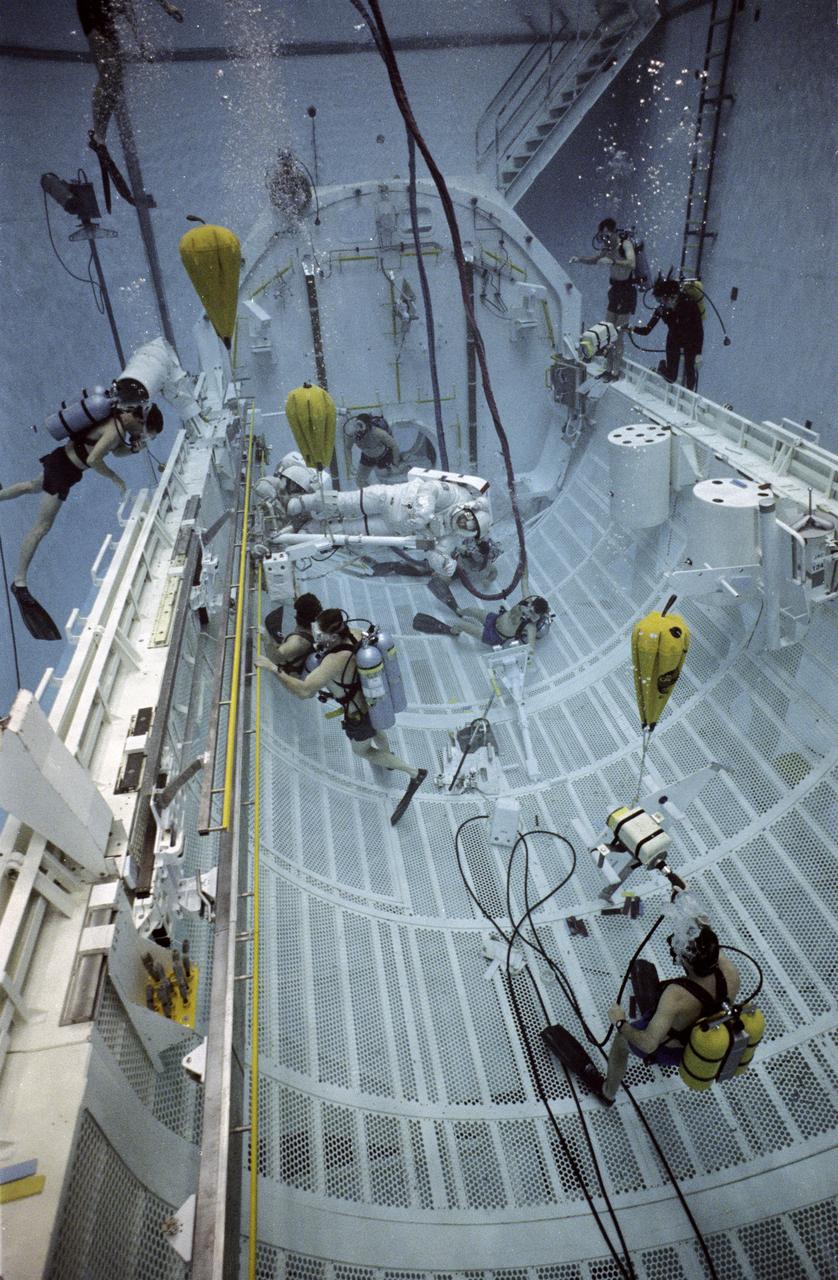
STS-37 Atlantis, Orbiter Vehicle (OV) 104, Mission Specialist (MS) Jerry L. Ross generates electrical power using hand pedals to move crew and equipment translation aid (CETA) cart along a rail during underwater session in JSC's Weightless Environment Training Facility (WETF) Bldg 29. Wearing an extravehicular mobility unit (EMU), Ross operates CETA electrical cart as MS Jerome Apt holds onto the back of the cart. The two crewmembers are practicing a extravehicular activity (EVA) spacewalk they will perform in OV-104's payload bay during STS-37. CETA is a type of railroad hand cart planned as a spacewalker's transportation system along the truss of Space Station Freedom (SSF). SCUBA divers monitor astronauts' underwater activity.
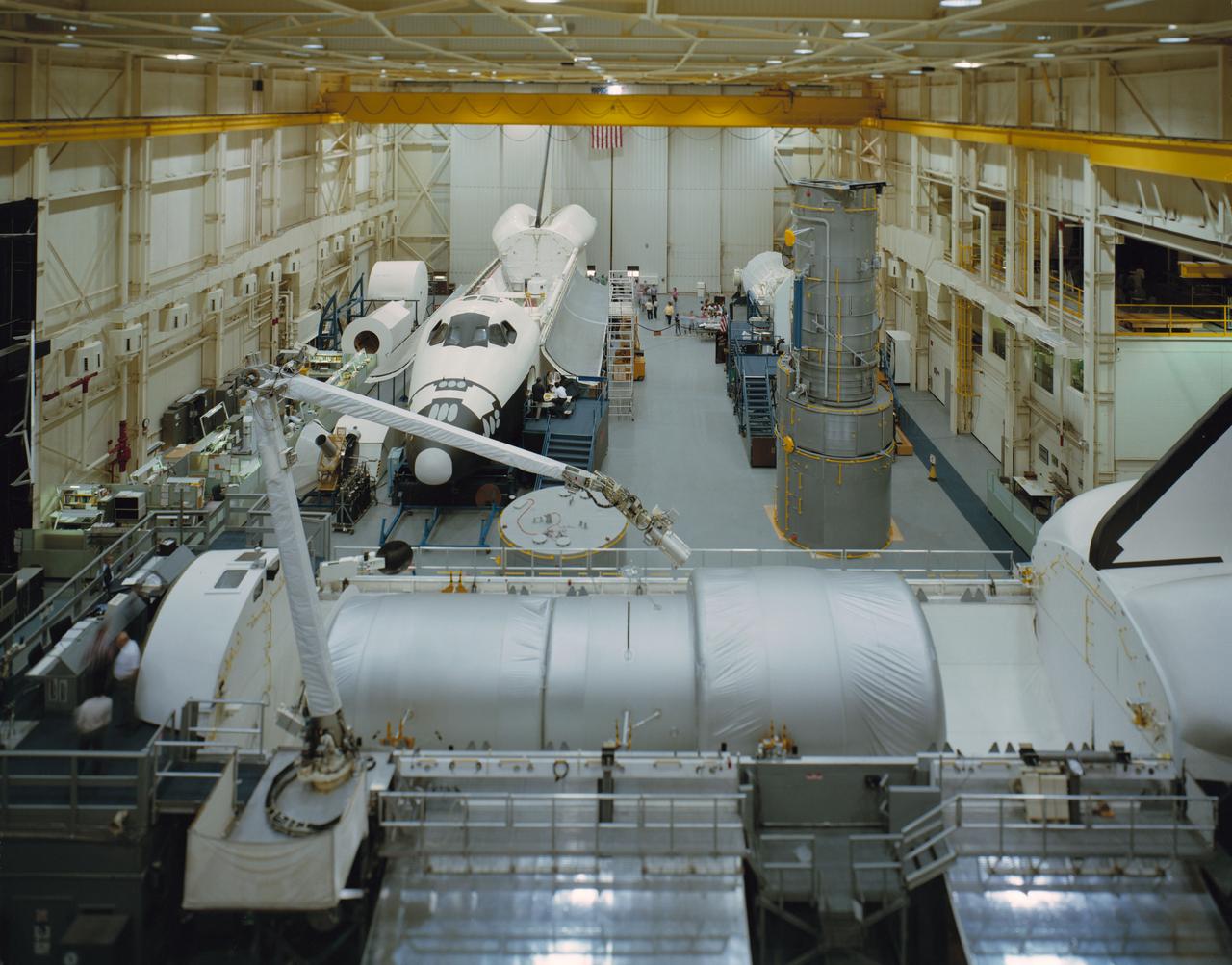
Overall views of the Bldg. 9A Training Facility and closeup views of the Space Telescope Mockup for the Weightless Environment Training Facility (WETF). 1. SHUTTLE - PAYLOADS (TELESCOPE) JSC, HOUSTON, TX Also available in 4x5 CN
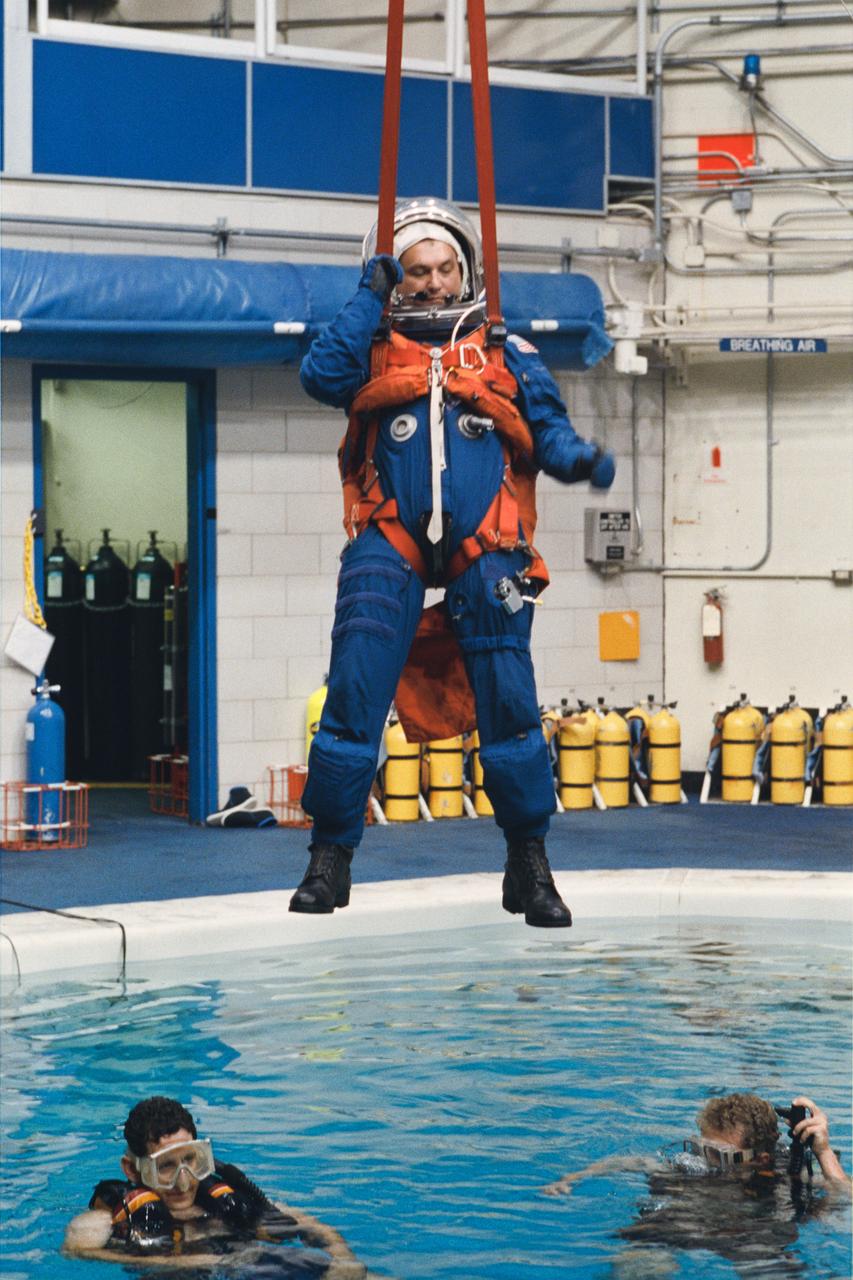
Cosmanaut Vladimir Titov, an alternate mission specialist for STS-60, simulates a parachute glide into water during a bailout training exercise at JSC. This phase of emergency egress training took place in JSC's Weightless Environment Training Facility (WETF).
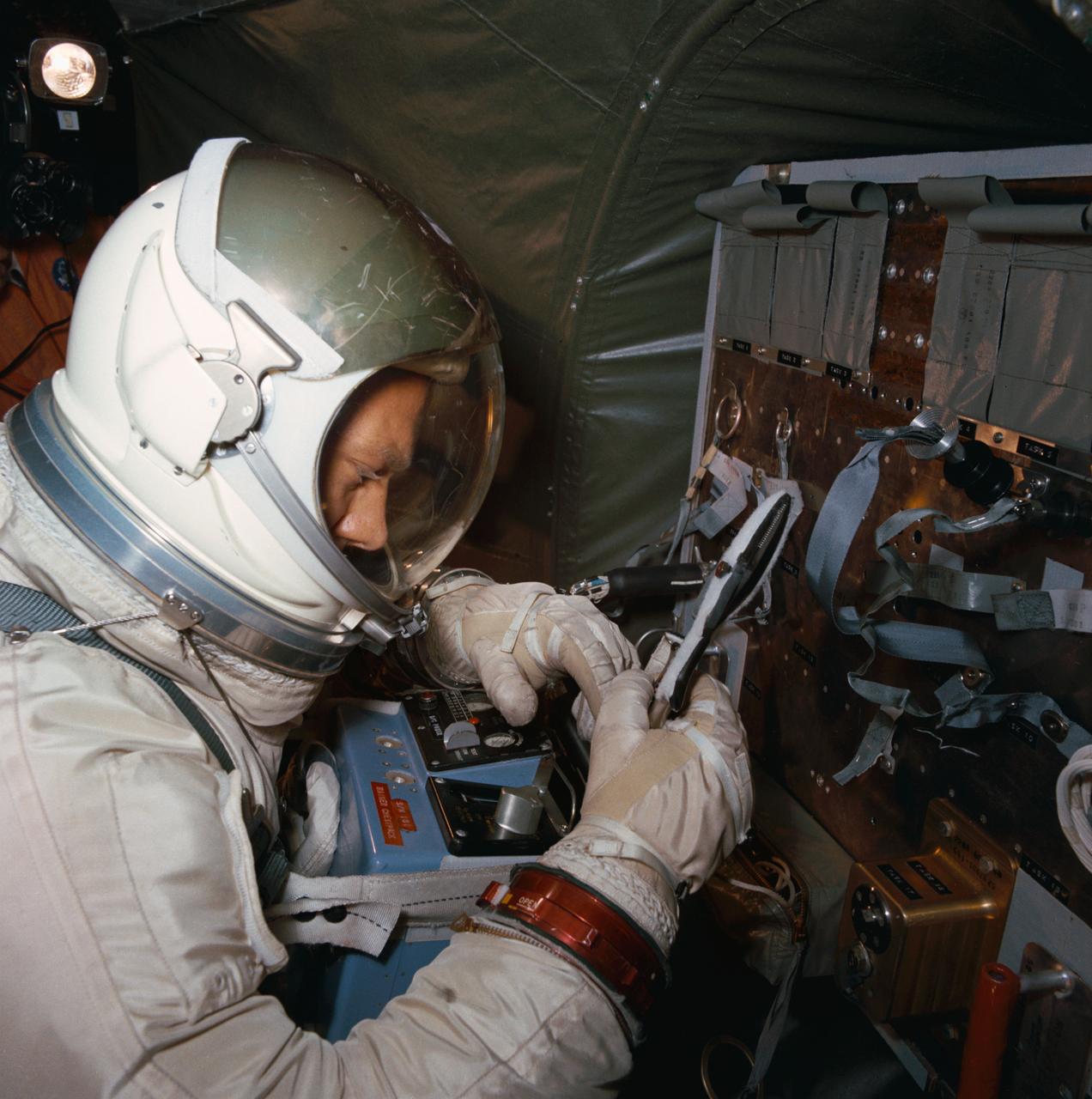
S66-57365 (13 Oct. 1966) --- Astronaut Edwin E. Aldrin Jr., pilot for the Gemini-12 spaceflight, practices work tasks during zero-gravity training. He is standing in a mock-up of the Gemini spacecraft's adapter section onboard an Air Force KC-135 jet aircraft. Photo credit: NASA
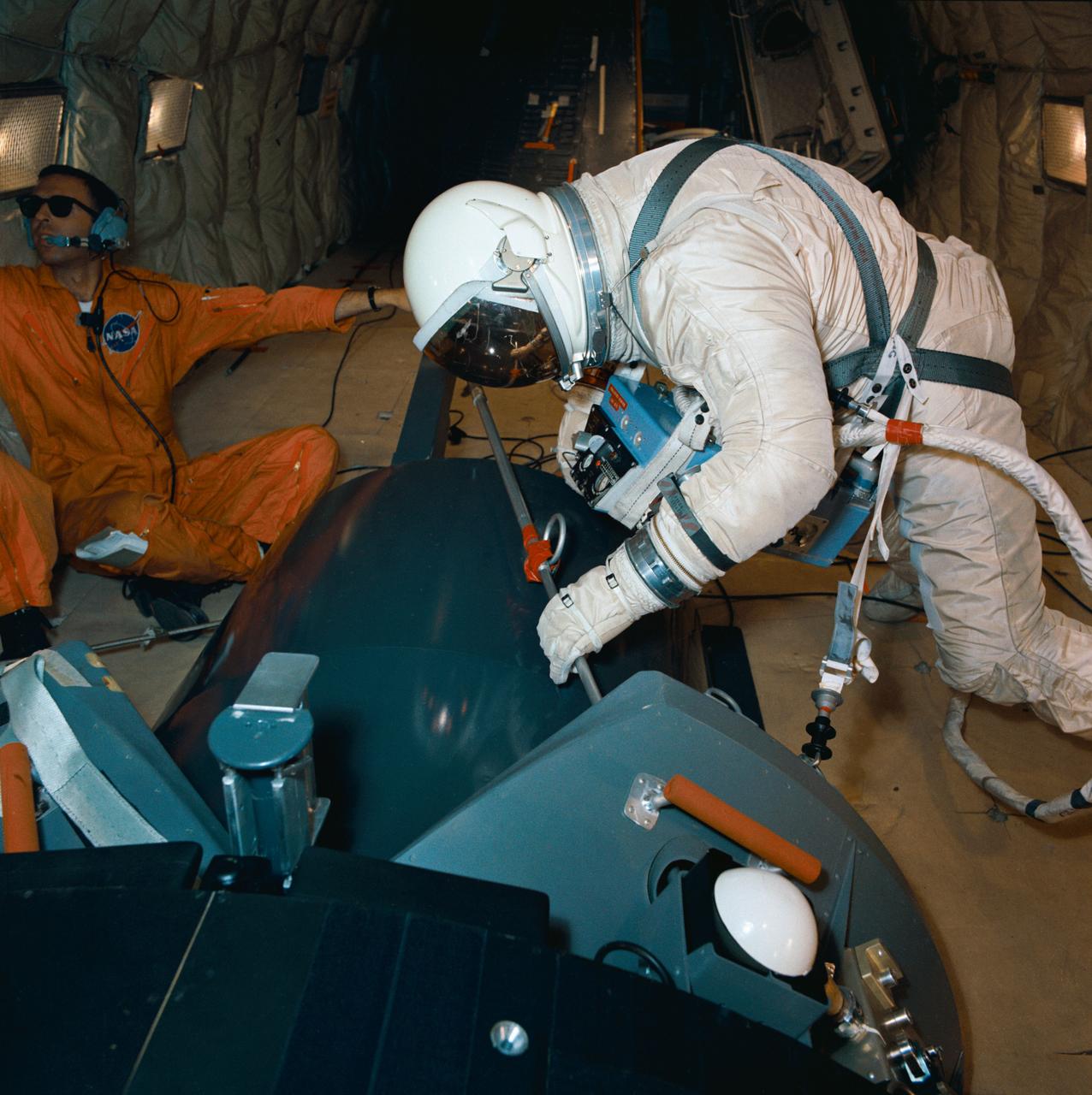
S66-57387 (13 Oct. 1966) --- Astronaut Edwin E. Aldrin Jr., pilot for the Gemini-12 spaceflight, practices work tasks during zero-gravity training. He is secured to a mock-up of the Agena Target Docking Vehicle by special tethers. The training took place onboard an Air Force KC-135 jet aircraft. Photo credit: NASA
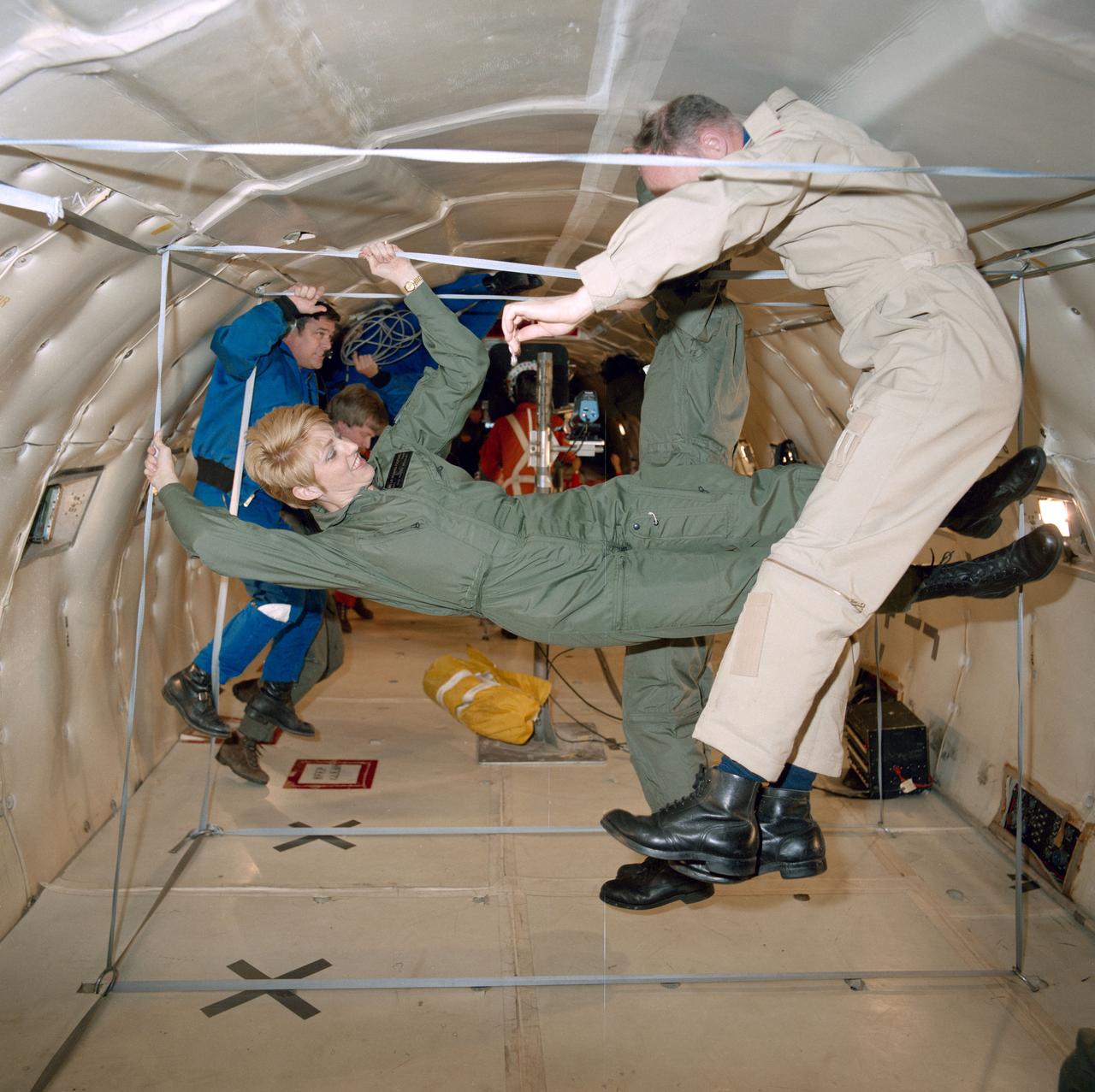
Vestibular Study testing in Zero-G flights on the KC-135. Seen in this view are Roberta Bonder and others experiencing weightlessness.
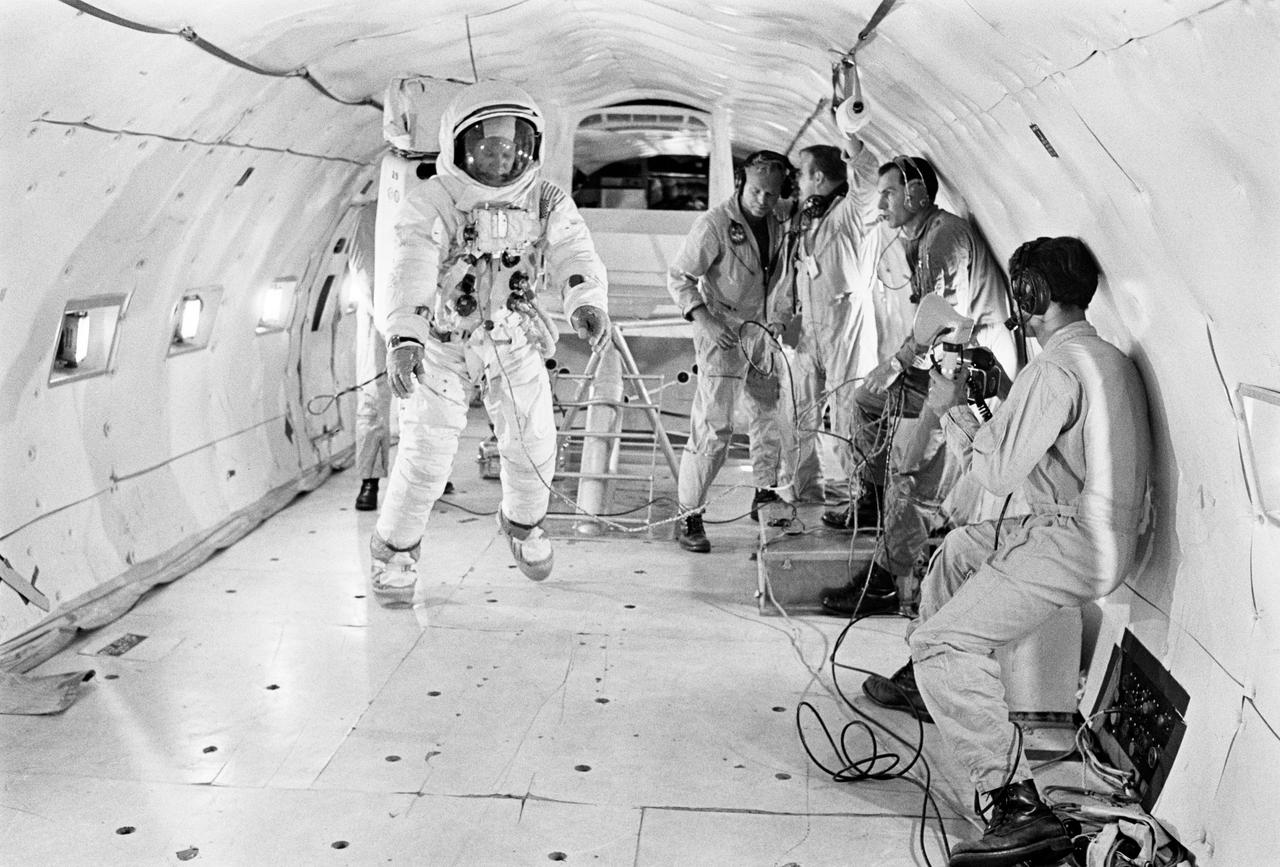
S69-39269 (10 July 1969) --- Astronaut Edwin E. Aldrin Jr., lunar module pilot of the Apollo 11 lunar landing mission, undergoes zero-gravity training aboard a U.S. Air Force KC-135 jet aircraft from nearby Patrick Air Force Base, Florida. Aldrin is wearing an Extravehicular Mobility Unit (EMU), the type of equipment which he will wear on the lunar surface.
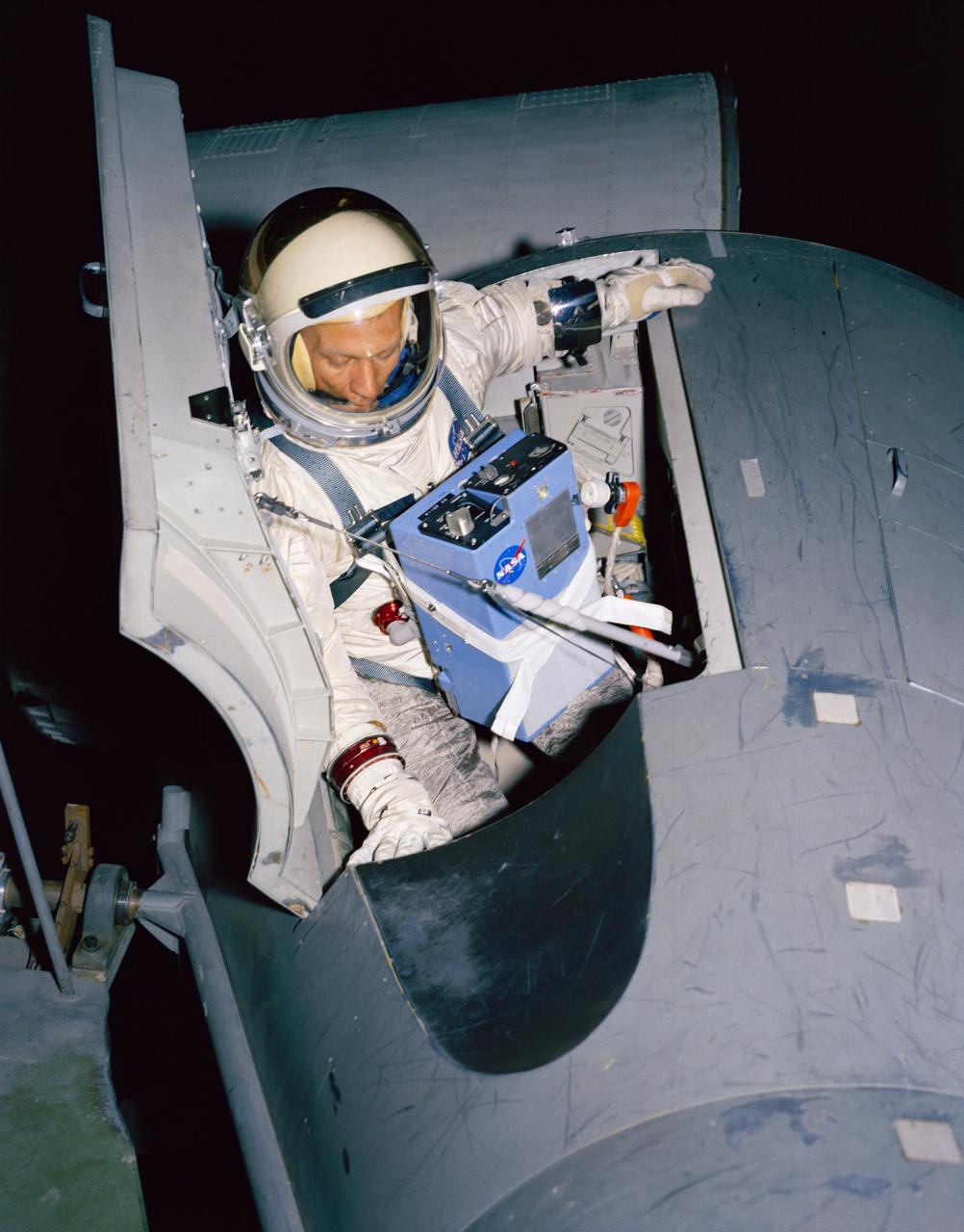
S66-28114 (1 April 1966) --- Astronaut Edwin E. Aldrin Jr., pilot of the Gemini-12 spaceflight, undergoes zero-gravity egress training. A KC-135 Air Force plane, flying a parabolic curve, creates a weightless environment as a training exercise in preparation for spaceflight. Photo credit: NASA
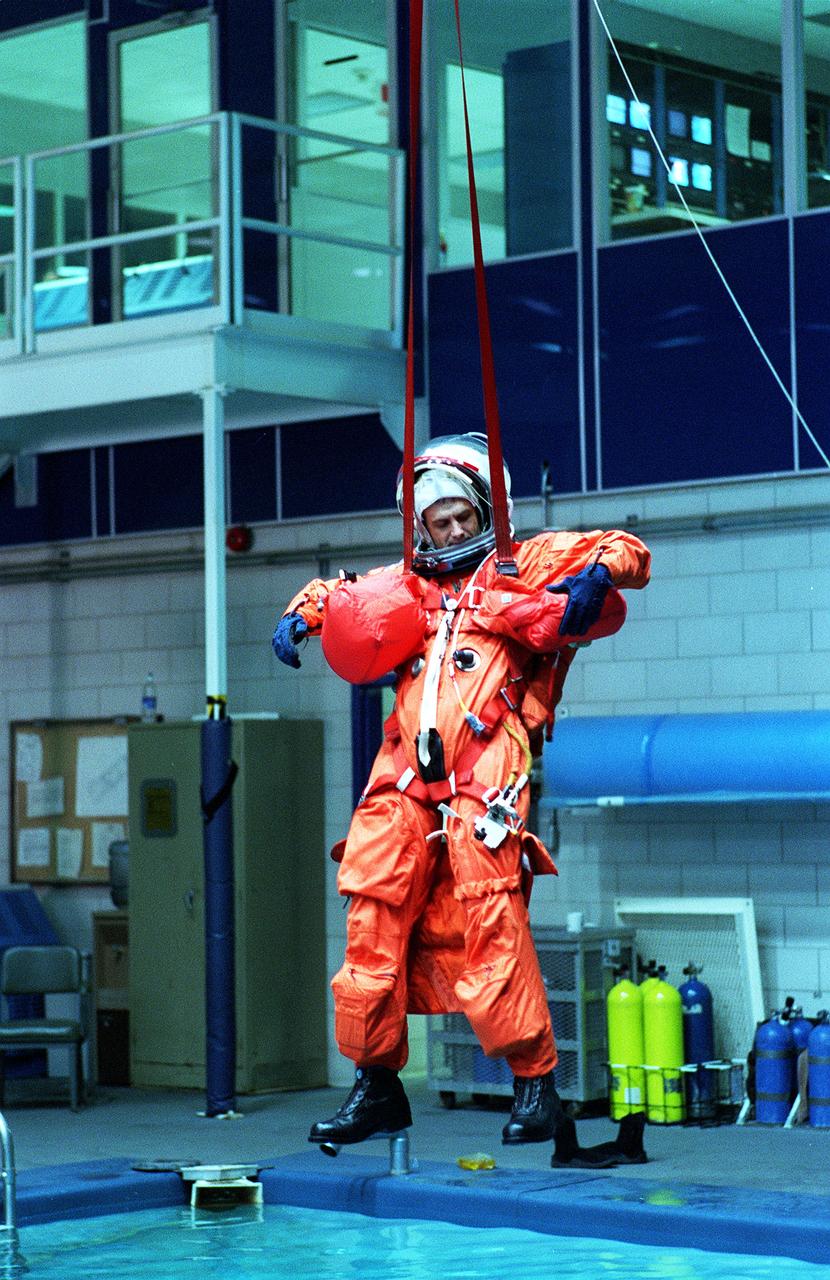
S96-15402 (26 Sept. 1996) --- In the Johnson Space Center's weightless environment training facility, astronaut John M. Grunsfeld, STS-81 mission specialist, prepares to simulate a parachute drop into water. Five STS-81 crewmates, out of frame, joined him for the bailout training exercises.
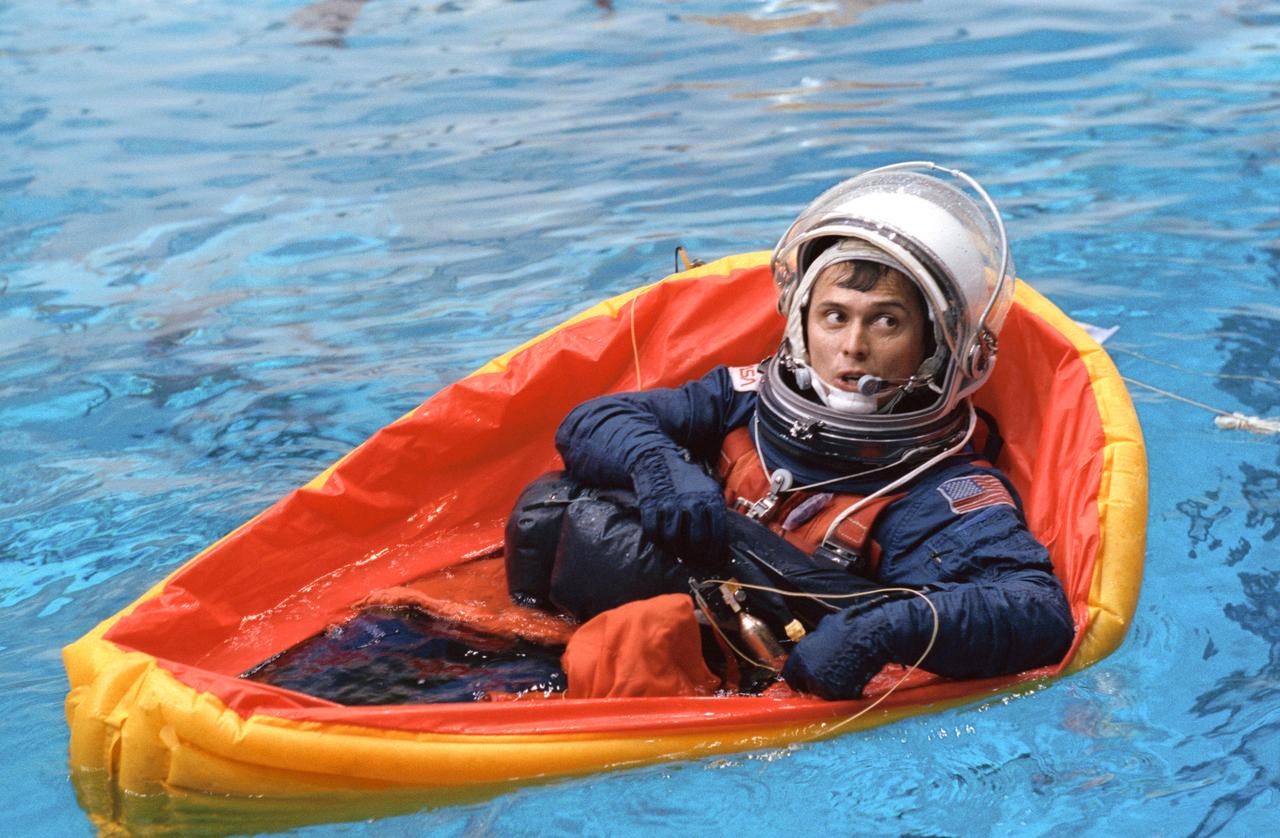
S92-33478 (12 March 1992) --- Astronaut Franklin R. Chang-Diaz, mission specialist, relies on a one-person life raft to get him to "safety" during a STS-46 bailout simulation exercise. The training took place in the Johnson Space Center's weightless environment training facility.
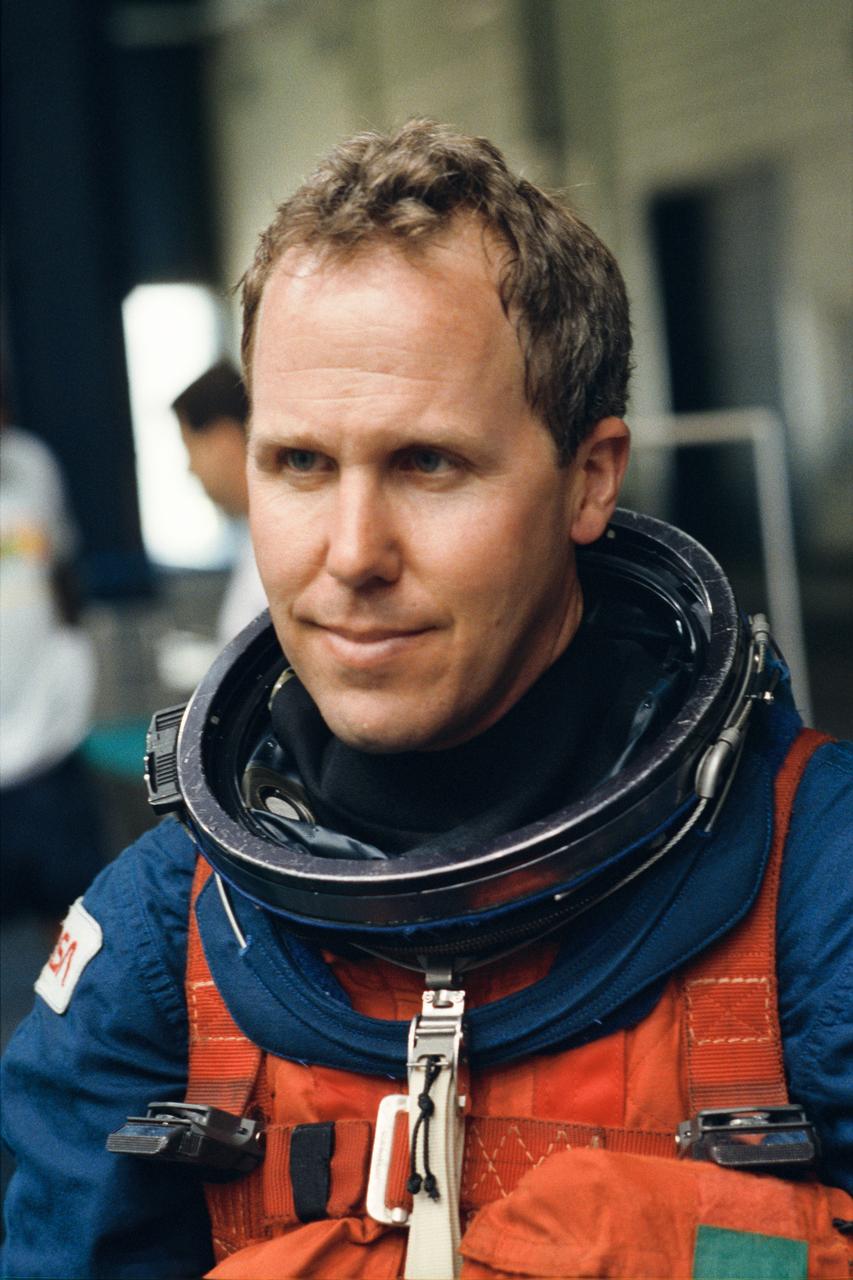
S96-15407 (26 Sept. 1996) --- In the Johnson Space Center's weightless environment training facility, astronaut Peter J.K. (Jeff) Wisoff, STS-81 mission specialist, simulates a parachute drop into water. Five STS-81 crewmates, out of frame, joined him for the bailout training exercises.
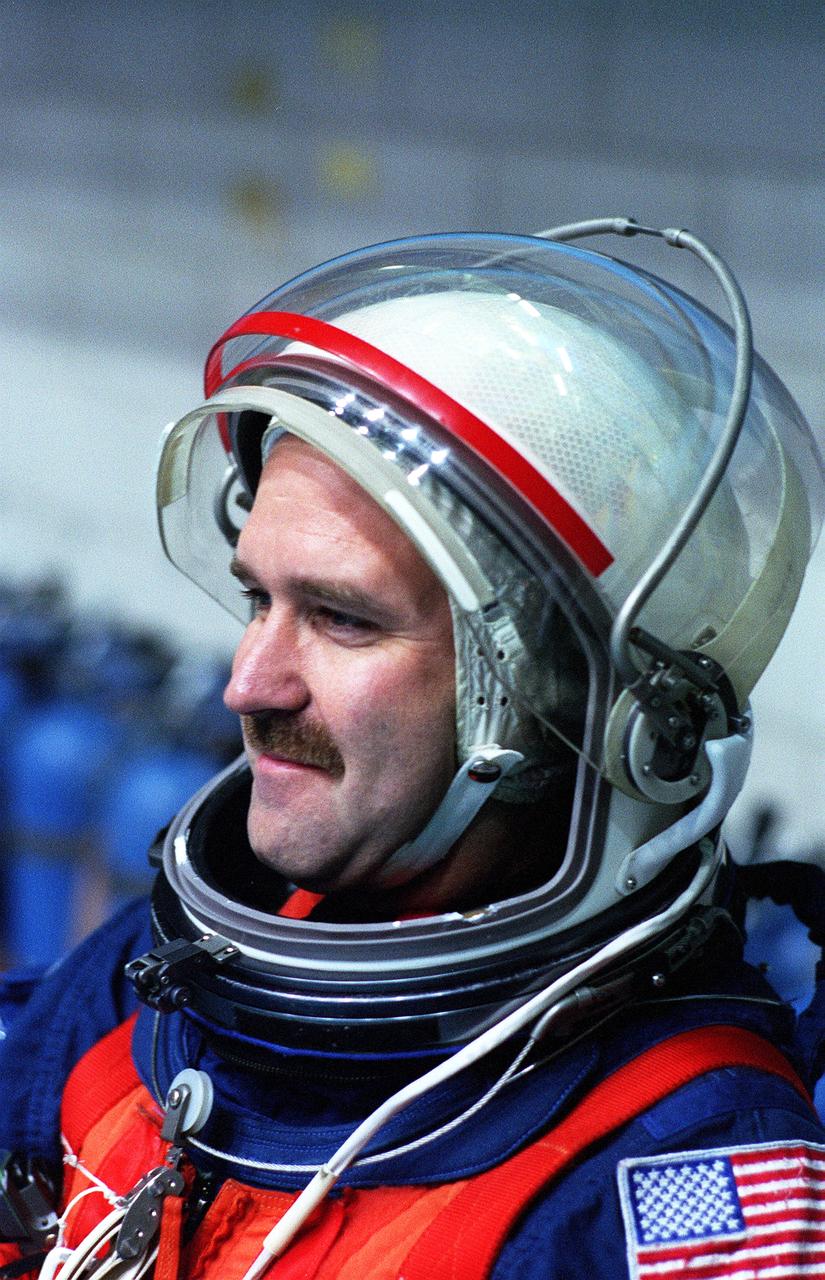
S93-43108 (2 June 1993) --- Astronaut Thomas D. Jones, mission specialist, takes a break during emergency bailout training at the Johnson Space Center's (JSC) Weightless Environment Training Facility (WET-F). Jones and five other NASA astronauts are scheduled to fly aboard the Space Shuttle Endeavour next year.
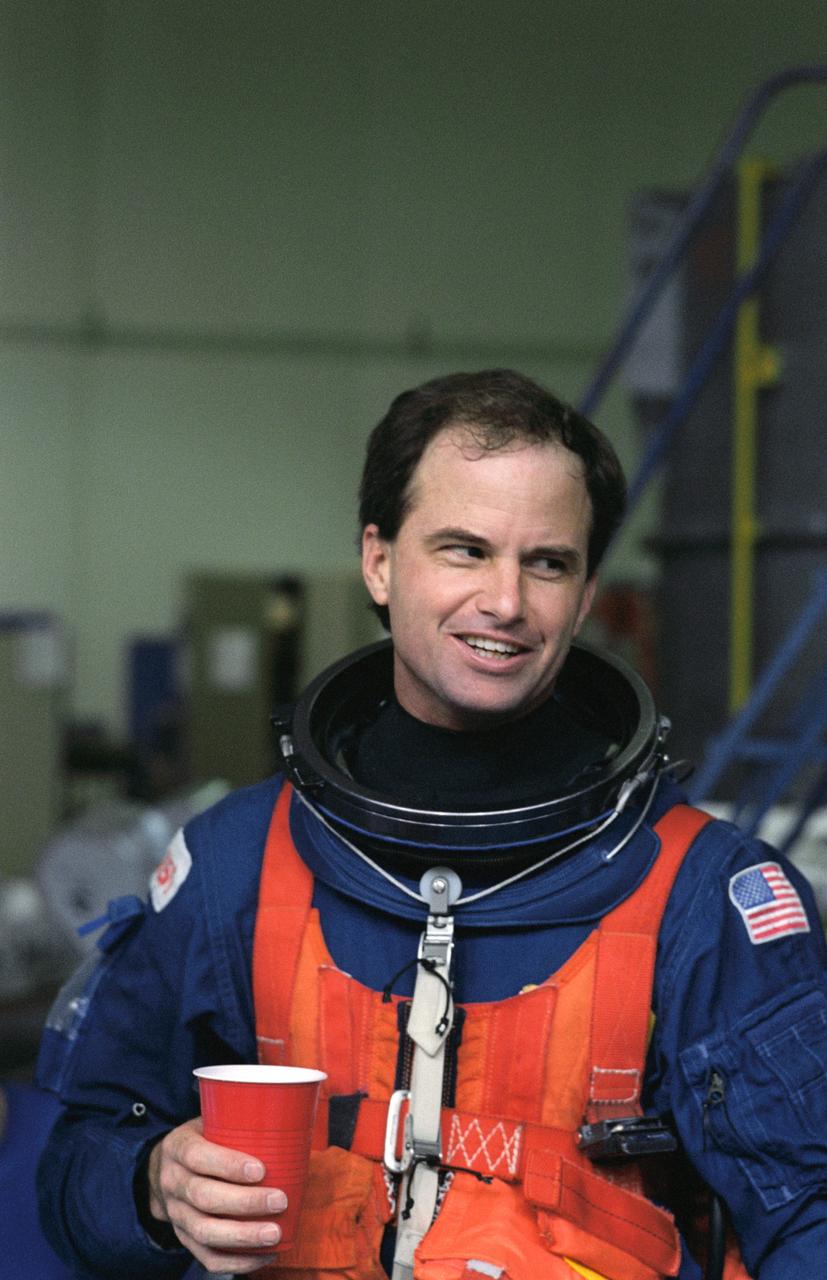
S93-50720 (22 Dec 1993) --- Astronaut Kevin P. Chilton, pilot, takes a break during emergency bailout training at the Johnson Space Center's (JSC) Weightless Environment Training Facility (WET-F). Chilton and five other NASA astronauts are scheduled to fly aboard the Space Shuttle Endeavour next year.
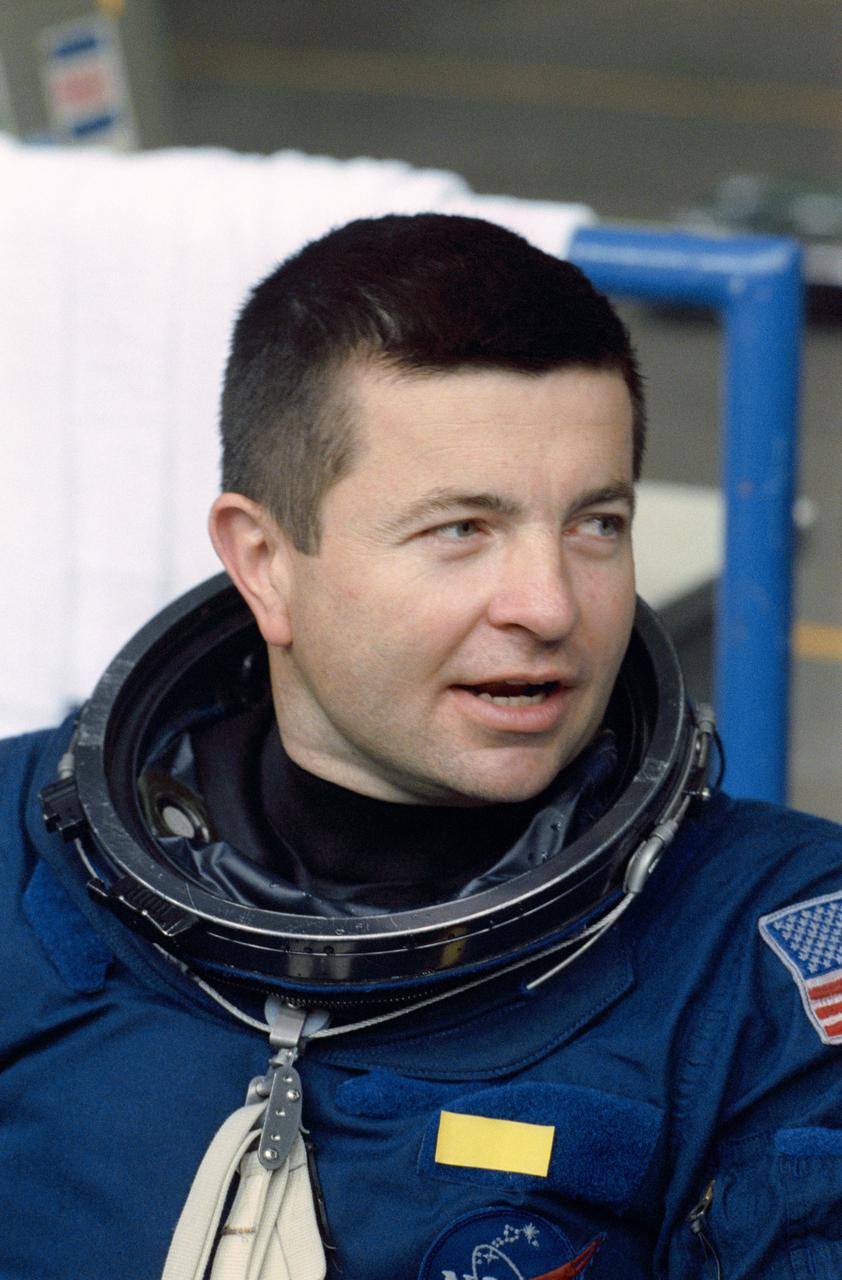
STS-37 Pilot Kenneth D. Cameron, wearing launch and entry suit (LES), discusses simulated emergency egress training on the pool side of JSC's Weightless Environment Training Facility (WETF) Bldg 29. Cameron will be dropped into a simulated ocean, the WETF's 25-ft pool, into which a parachute landing might be made.
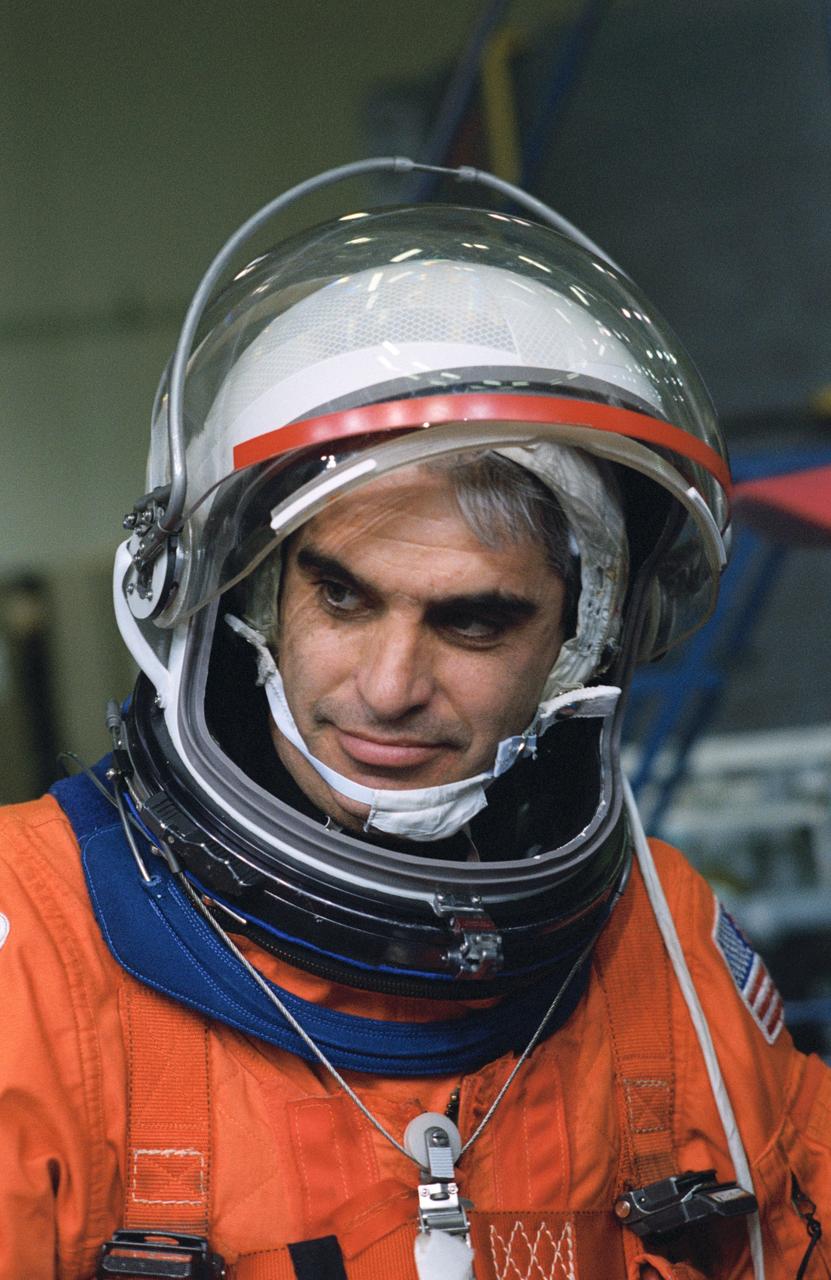
S93-50710 (22 Dec 1993) --- Astronaut Sidney M. Gutierrez, commander, takes a break during emergency bailout training at the Johnson Space Center's (JSC) Weightless Environment Training Facility (WET-F). Gutierrez and five other NASA astronauts are scheduled to fly aboard the Space Shuttle Endeavour next year.
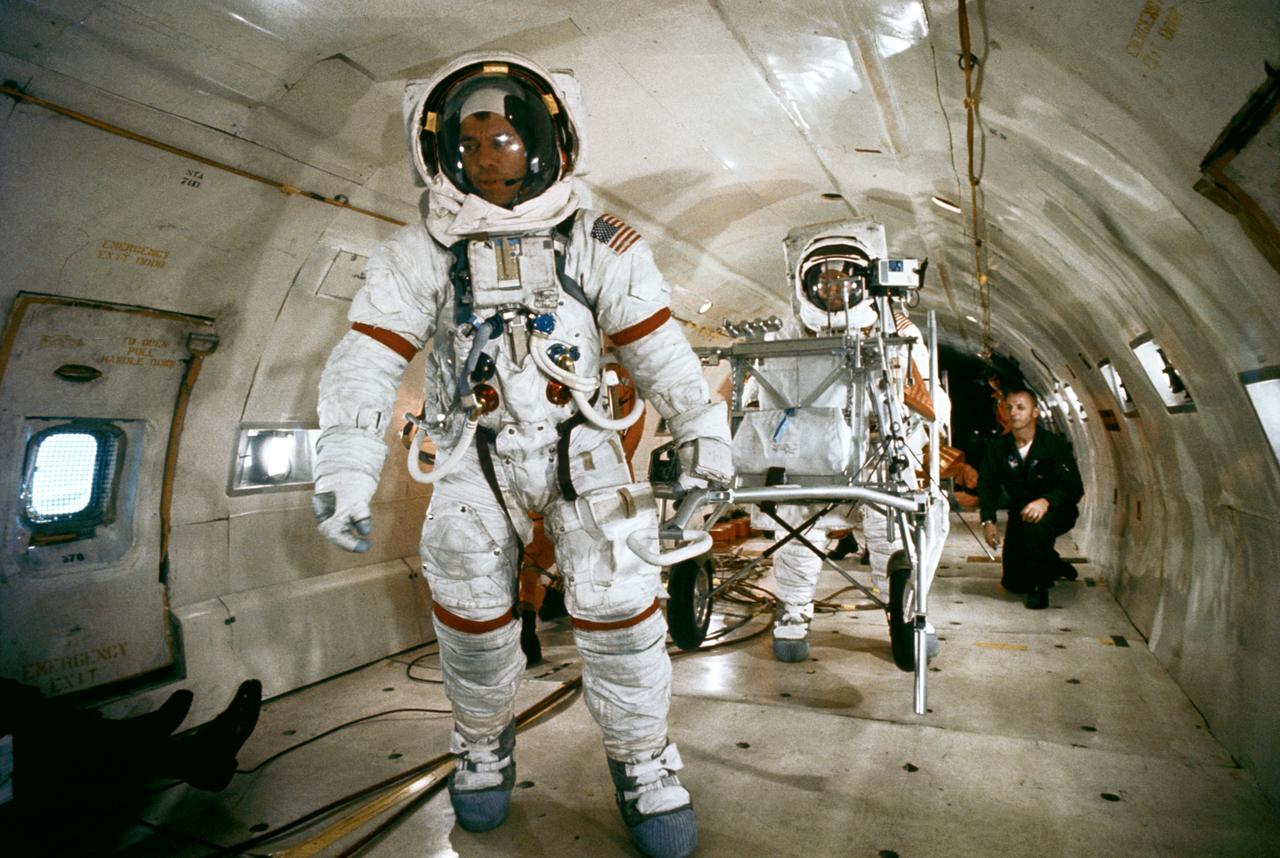
S70-53479 (4 Nov. 1970) -- Astronaut Alan B. Shepard Jr., Apollo 14 commander, pulls the modular equipment transporter (MET) under weightless conditions aboard an Air Force KC-135 out of Patrick Air Force Base. Astronaut Edgar D. Mitchell, Apollo 14 lunar module pilot, is behind the MET. The KC-135 aircraft, flying a parabolic curve, creates a weightless environment providing a training exercise in preparation for the astronauts' extravehicular activities (EVA) on the lunar surface. This training simulates the 1/6 gravity the astronauts will encounter on the moon.
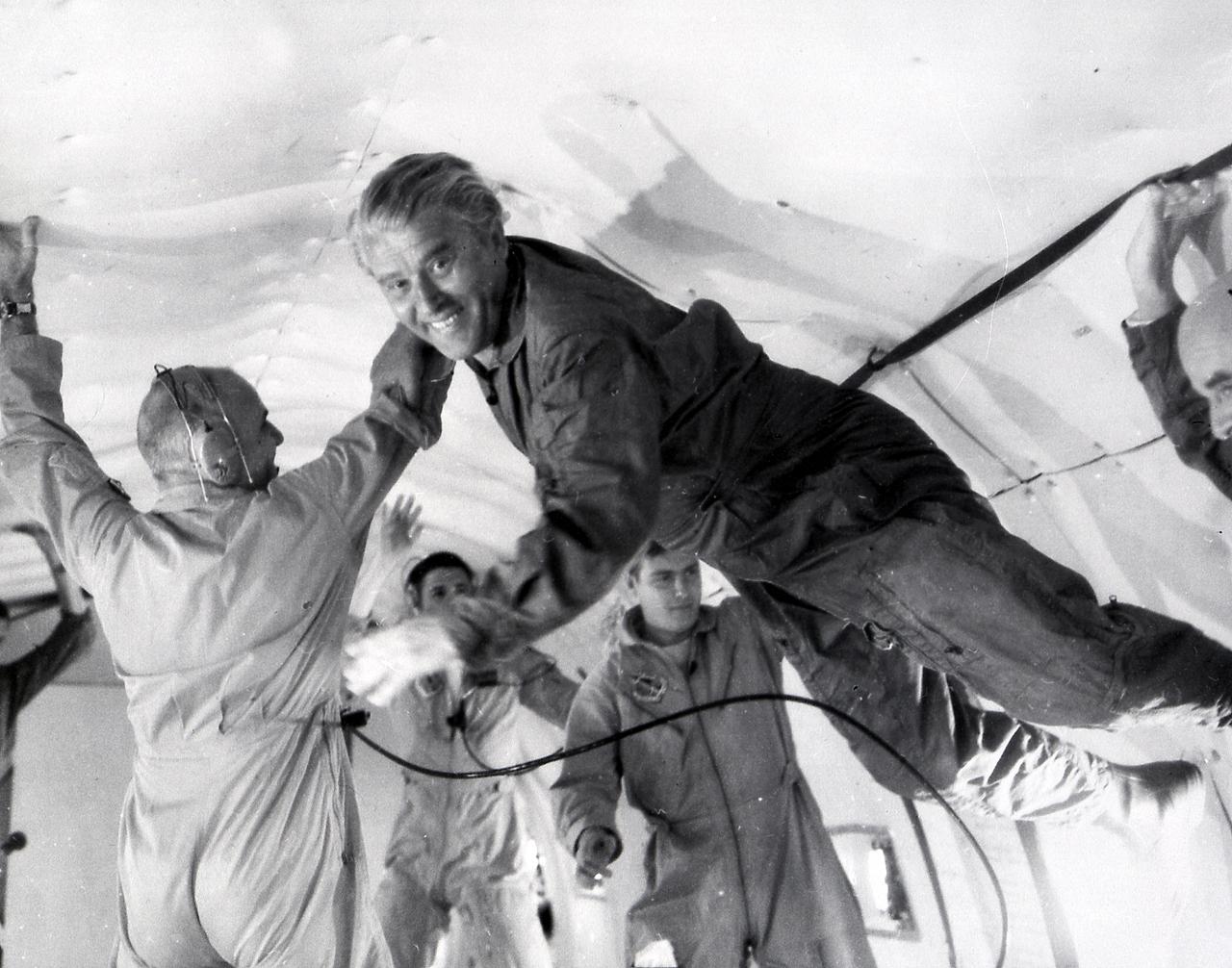
Dr. von Braun inside the KC-135 in flight. The KC-135 provide NASA's Reduced-Gravity Program the unique weightlessness or zero-g environment of space flight for testing and training of human and hardware reactions. The recent version, KC-135A, is a specially modified turbojet transport which flies parabolic arcs to produce weightlessness periods of 20 to 25 seconds and its cargo bay test area is approximately 60 feet long, 10 feet wide, and 7 feet high.

The Reduced-Gravity Program provides the unique weightless or zero-g environment of space flight for testing and training of human and hardware reactions. The reduced-gravity environment is obtained with a specially modified KC-135A turbojet transport which flies parabolic arcs to produce weightless periods of 20 to 25 seconds. KC-135A cargo bay test area is approximately 60 feet long, 10 feet wide, and 7 feet high. The image shows KC-135A in flight.
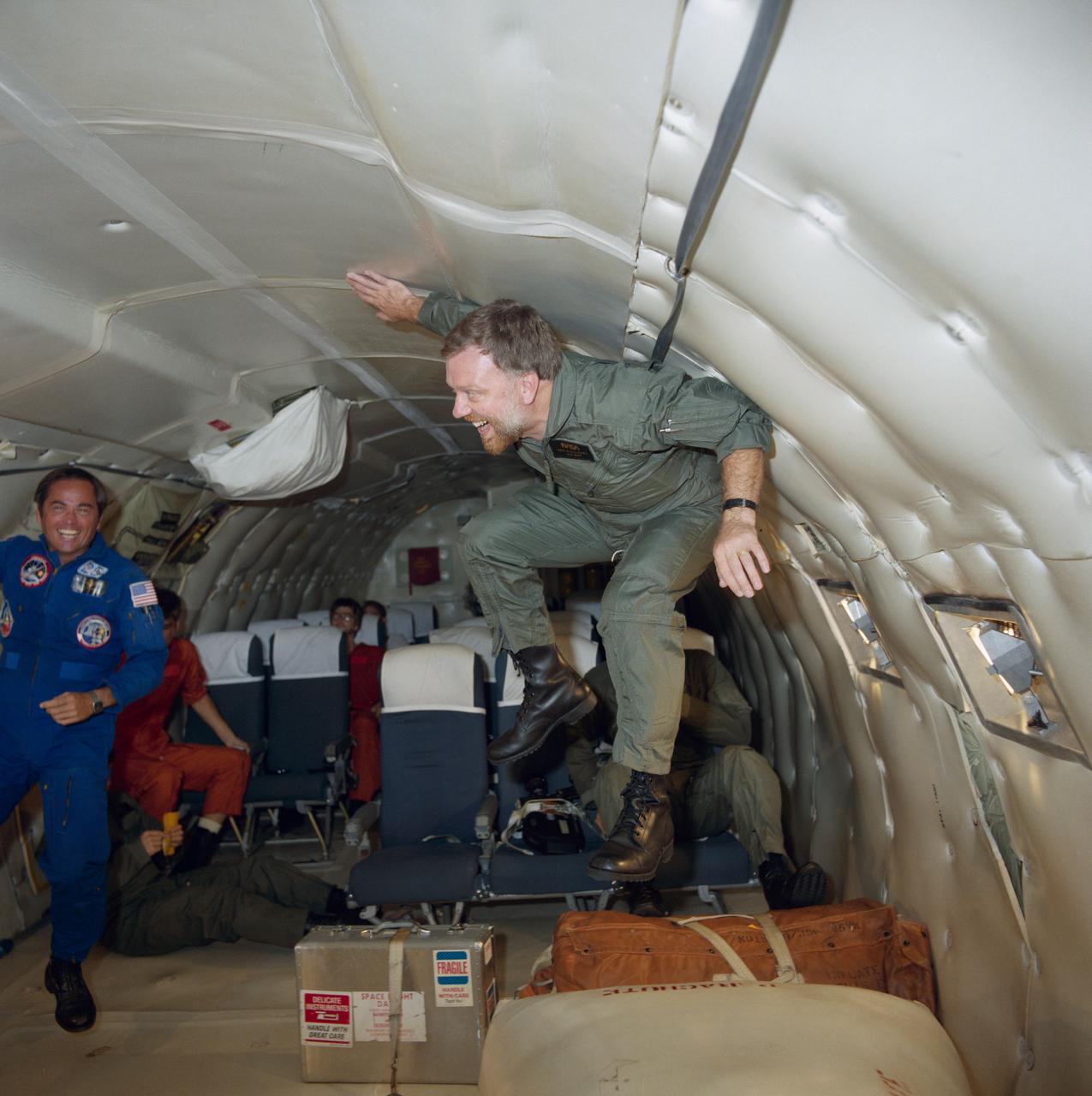
S84-37536 (18 July 1984) --- Astronaut Robert L. Crippen, left, 41-G crew commander watches as one of his fellow crewmembers gets an introduction to weightlessness aboard a KC-135, "zero-gravity" aircraft. Paul D. Scully-Power is the crew member literally floating here in the brief period of micro-gravity. Scully-Power, an oceanographer with the U.S. Navy, and Marc Garneau (partially visible in chair behind the floating Scully-Power)are payload specialists for 41-G. Garneau represents the National Research Council (Canada).
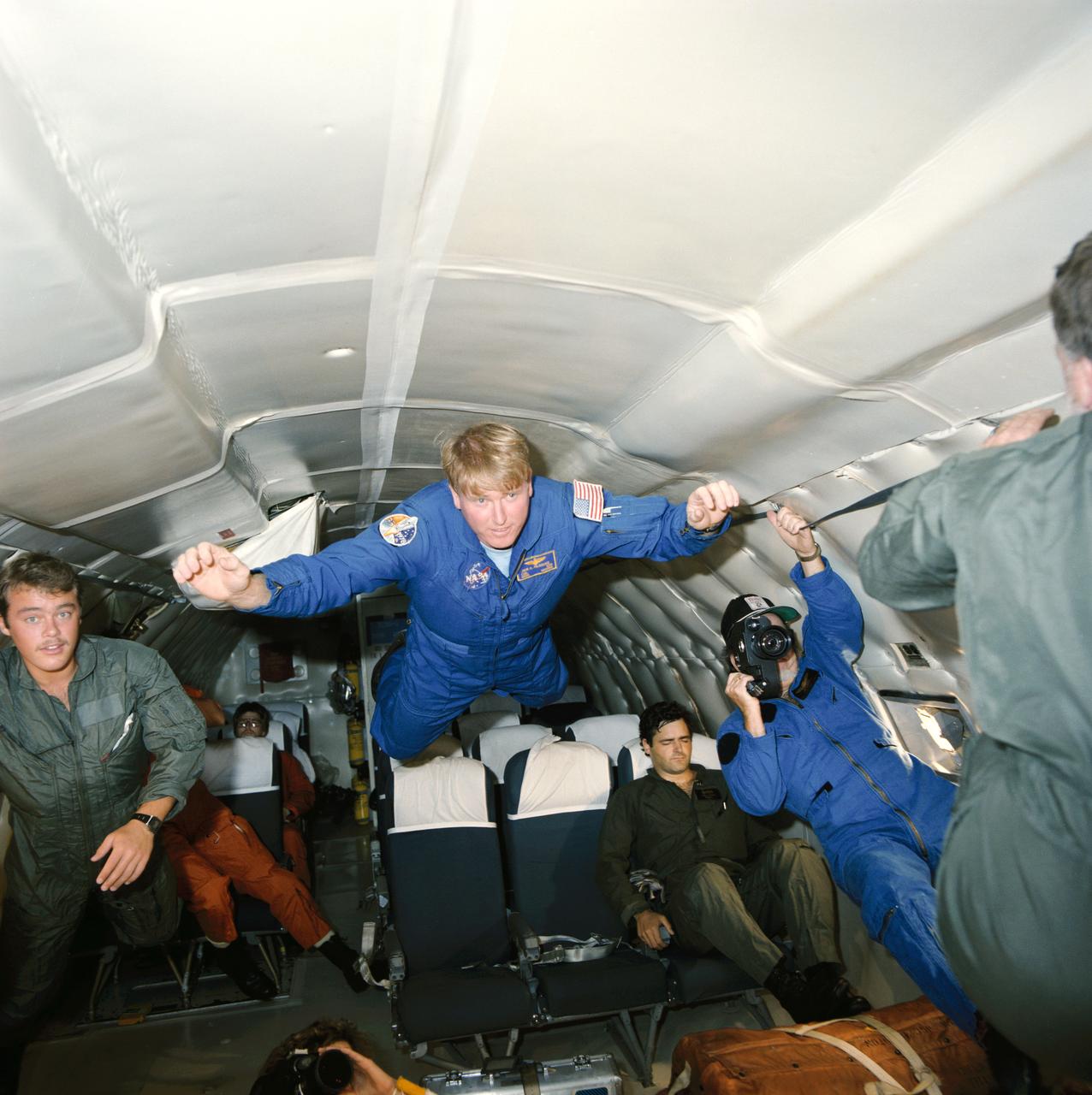
S84-37522 (18 July 1984) --- Astronaut Jon A. McBride, center, floats briefly aboard a NASA KC-135 aircraft during a flight designed as part of the training program for 41-G's seven crewmembers. McBride is pilot for that October 1984 flight. Marc Garneau, one of two payload specialists for the mission, is seated at right. Garneau represents the National Research Council of Canada.
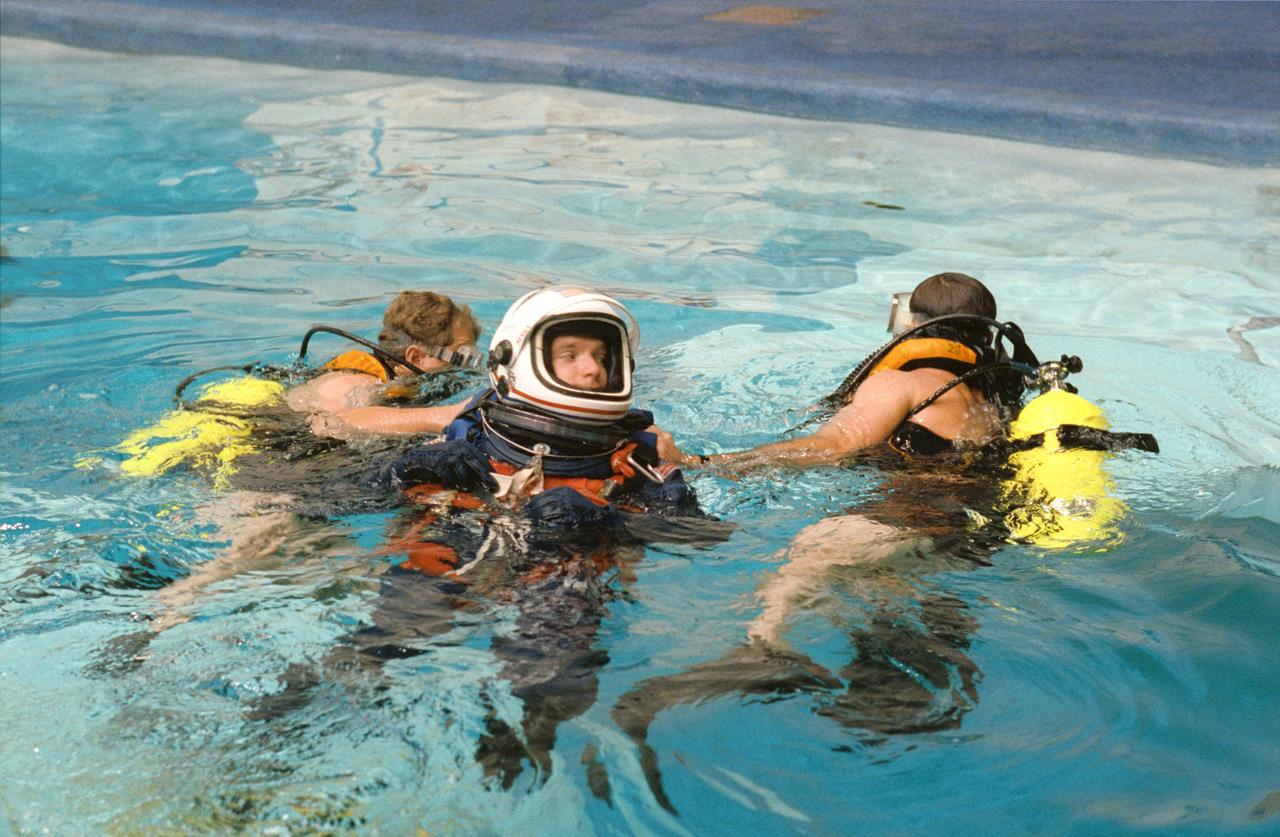
S92-50647 (Dec 1992) --- Assisted by two SCUBA-equipped divers, astronaut Charles J. Precourt, mission specialist for the STS-55/D-2 mission, participates in bailout training at the Johnson Space Center's (JSC) Weightless Environment and Training Facility (WET-F). Precourt is attired in a training version of the partial pressure Shuttle launch and entry garment. All seven prime flight crewmembers and the two backup payload specialists participated in the training session.
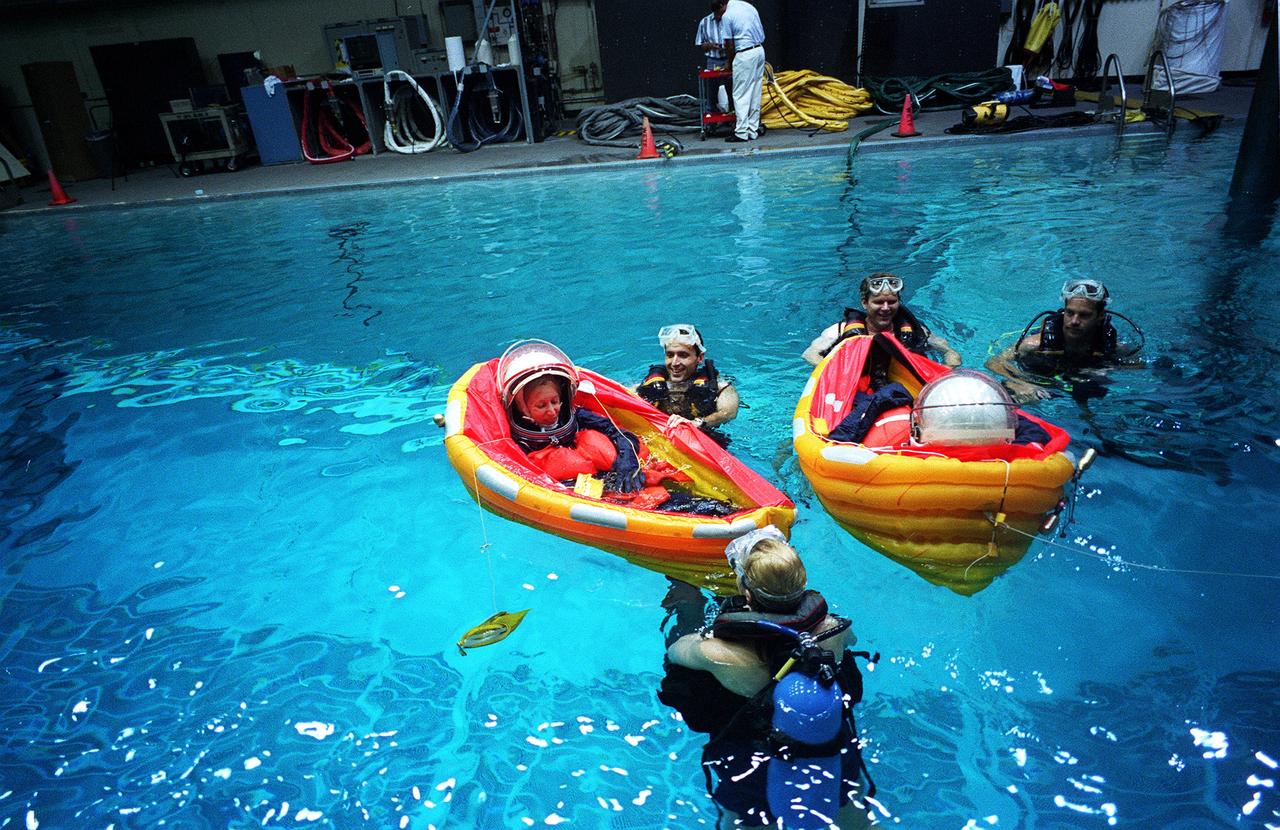
S96-15405 (26 Sept. 1996) --- In the Johnson Space Center's weightless environment training facility, astronaut Marsha S. Ivins, STS-81 mission specialist, bails water from her life raft during water bailout survival training. Astronaut Peter J.K. (Jeff) Wisoff (pictured in right raft) and four other STS-81 crewmates (out of frame) joined Ivins for the bailout training exercises. Several SCUBA-equipped divers assist in the training exercise.
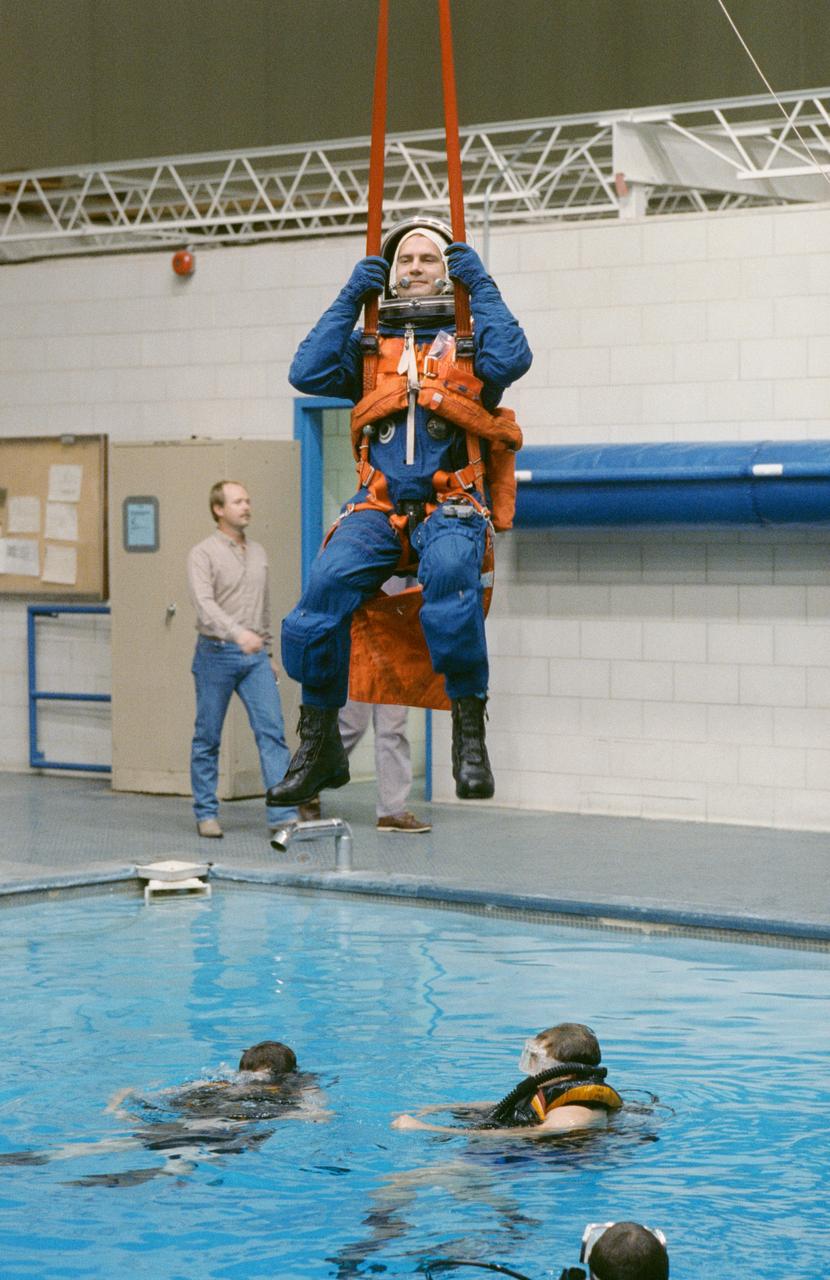
S90-54760 (7 Dec 1990) --- Astronaut Richard J. Hieb, mission specialist, participates in emergency egress training. Hieb and six fellow STS 39 astronauts were in JSC's weightless environment training facility (WET-F). This type training uses the WET-F's 25 ft. deep pool to simulate an ocean parachute landing. A number of SCUBA-equipped divers assist in the training session.
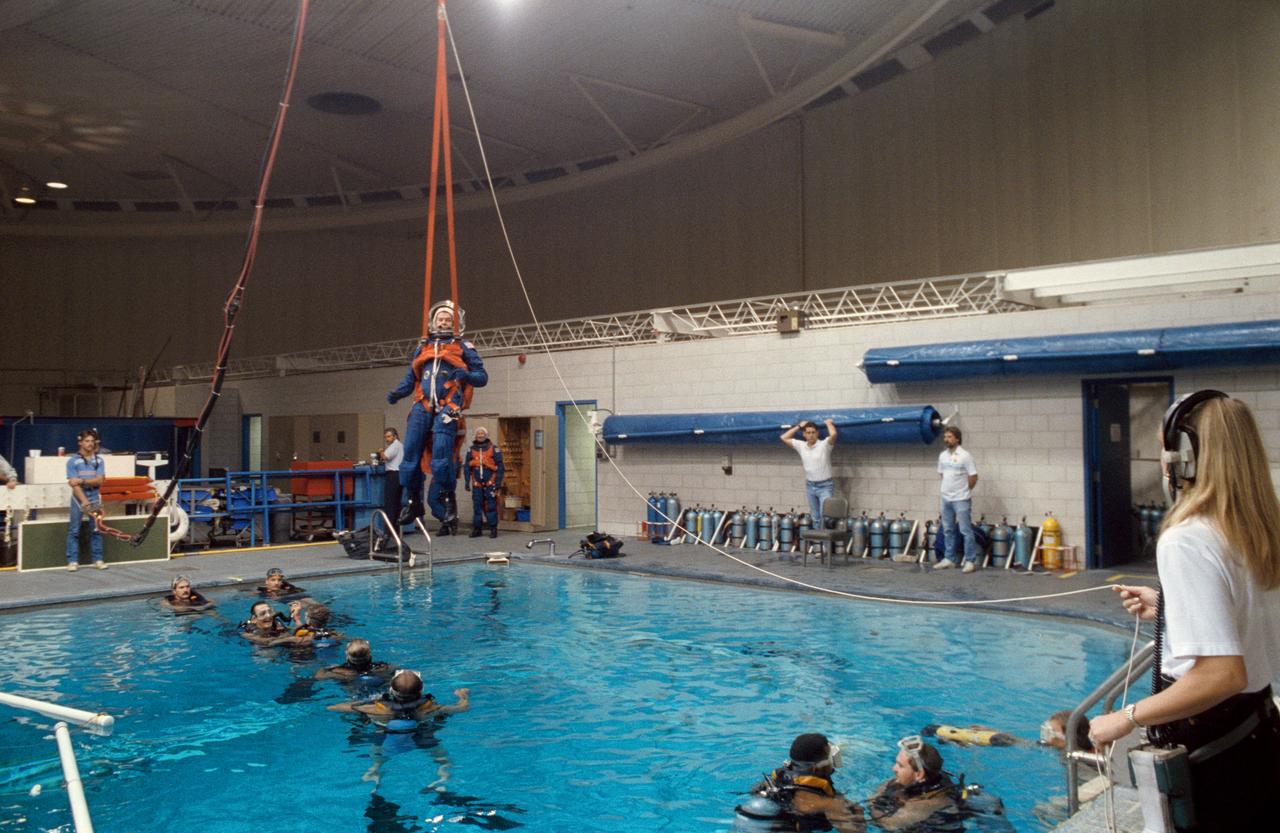
S91-52074 (26 Nov 1991) --- Charles R. (Rick) Chappell, alternate payload specialist, equipped with simulated parachute gear, descends into the water during bail-out training exercises in the Johnson Space Center's weightless environment training facility (WET-F). In this phase of the training program, Shuttle crewmembers learn the proper measures to take in the event of ejection and subsequent parachute landing into a body of water. A number of SCUBA-equipped swimmers who assisted in the training are pictured.
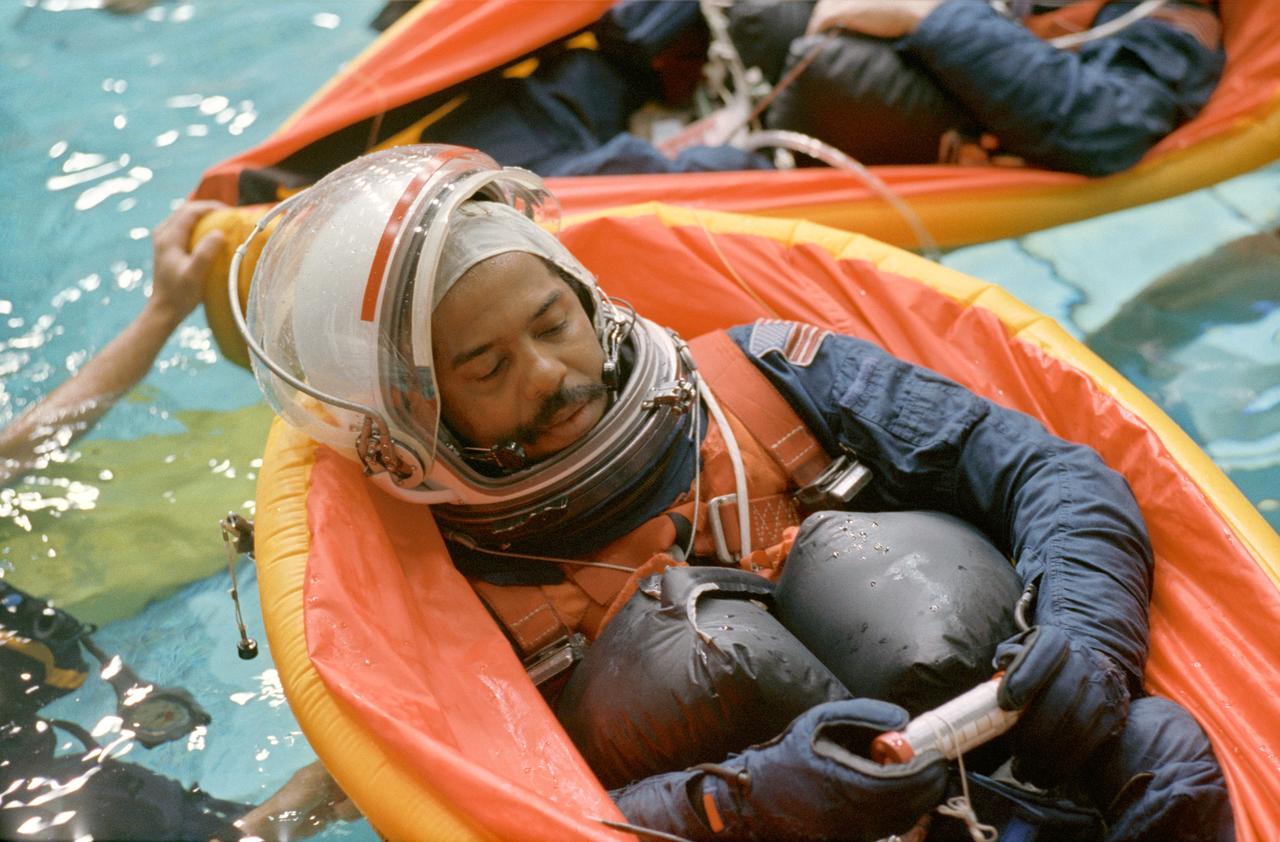
S92-50679 (Dec 1992) --- Using a small life raft, astronaut Bernard A. Harris Jr., mission specialist for the STS-55\D-2 mission, participates in bailout training at the Johnson Space Center's (JSC) Weightless Environment and Training Facility (WET-F). Harris is attired in a training version of the partial pressure Shuttle launch and entry garment. All seven prime flight crew members and the two back-up payload specialists participated in the training session.