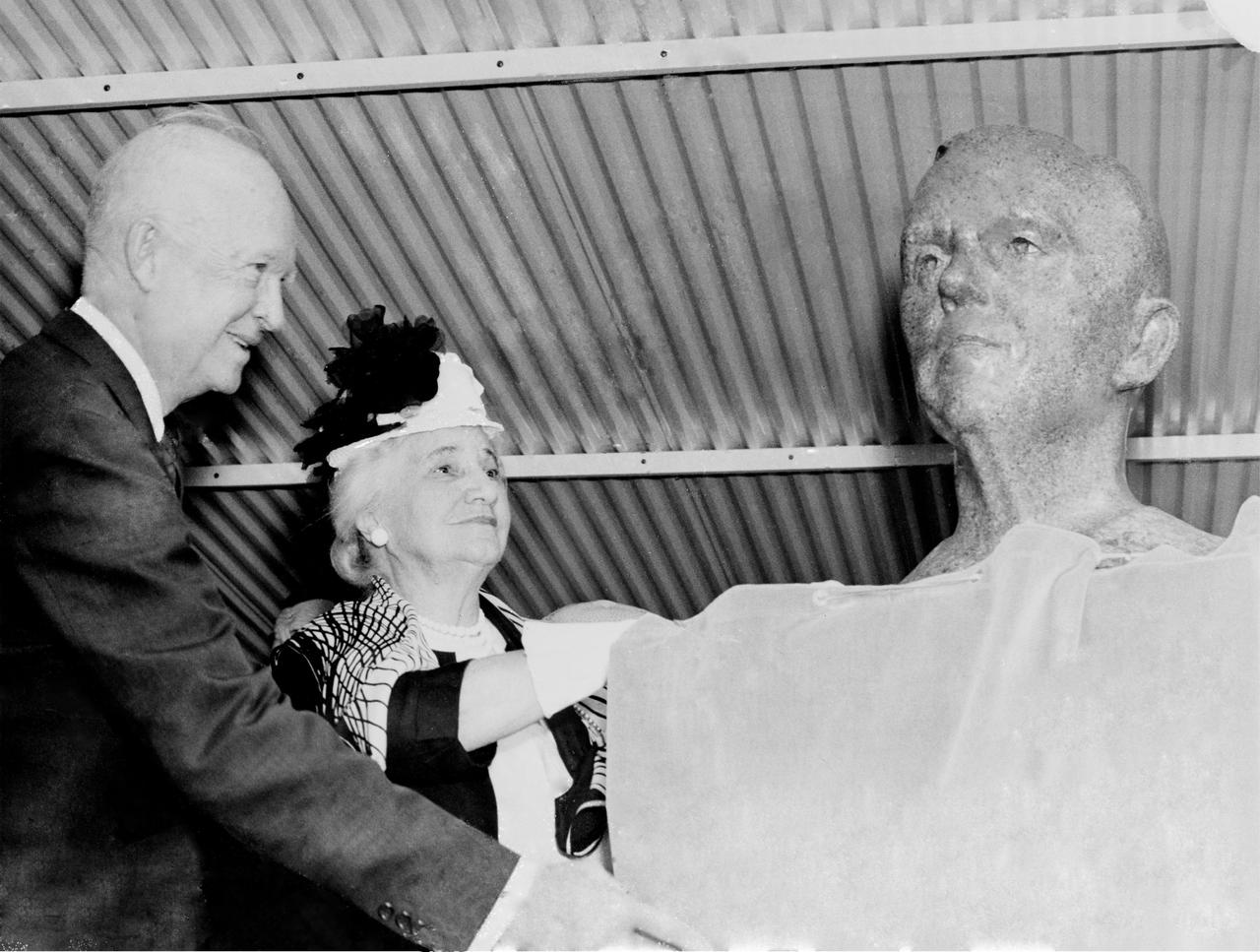
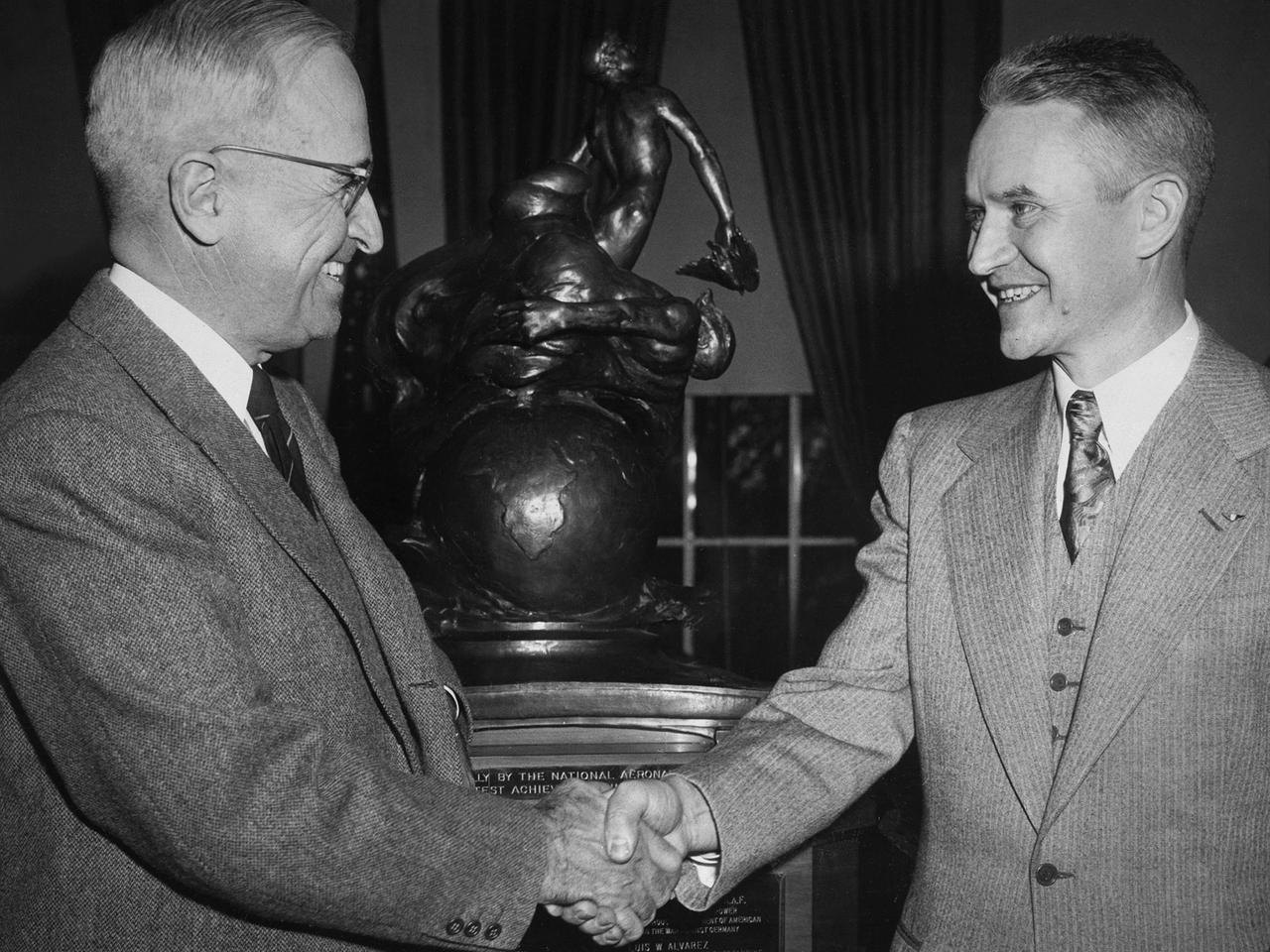
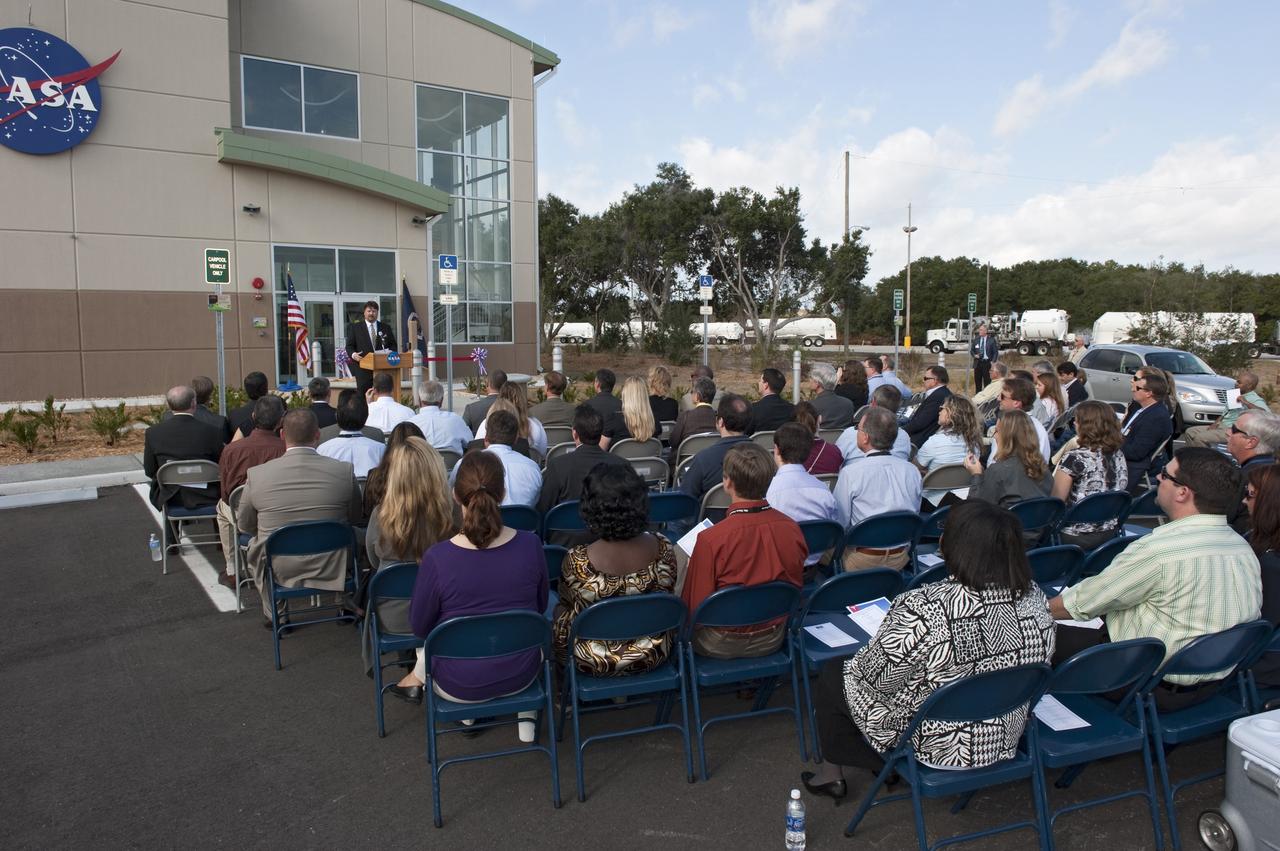
Dr. Wernher von Braun and Maj. Gen. August Schomburg officiate the official transfer of the Army Ballistic Missile Agency (ABMA) to the NASA George C. Marshall Space Flight Center (MSFC) on July 1, 1960. The Official transfer ceremony took place in the front of the ABMA-MSFC joint headquarters, building 4488, Redstone Arsenal, Alabama.
Origin of Marshall Space Flight Center (MSFC)
ISS038-E-068899 (9 March 2014) --- The new commander of the current crew on the International Space Station (Expedition 39) and the Expedition 38/39 flight engineers exchange handshakes inside the Kibo laboratory.  Their celebration may very well be a follow-up gesture following the transfer of command ceremony and a symbolic farewell to the  Expedition 38 crew members (out of frame) who are on the eve of their departure from the orbital outpost. Expedition 39 Commander Koichi Wakata (center) of the Japanese Aerospace Exploration Agency (JAXA) is joined here by Flight Engineers Rick Mastracchio (right) of NASA and cosmonaut Mikhail Tyurin of the Russian Federal Space Agency (Roscosmos).
Expedition 38 Crewmembers during Transfer of Command Ceremony
ISS038-E-068903 (9 March 2014) --- The new commander of the current crew on the International Space Station (Expedition 39) and the Expedition 38/39 flight engineers wave inside the Kibo laboratory.  Their waving may very well be a symbolic farewell to the Expedition 38 crew members (out of frame) who are on the eve of their departure day from the orbital outpost. Expedition 39 Commander Koichi Wakata (center) of the Japanese Aerospace Exploration Agency (JAXA) is joined here by Flight Engineers Rick Mastracchio (right) of NASA and cosmonaut Mikhail Tyurin of the Russian Federal Space Agency (Roscosmos).
Expedition 38 Crewmembers during Transfer of Command Ceremony
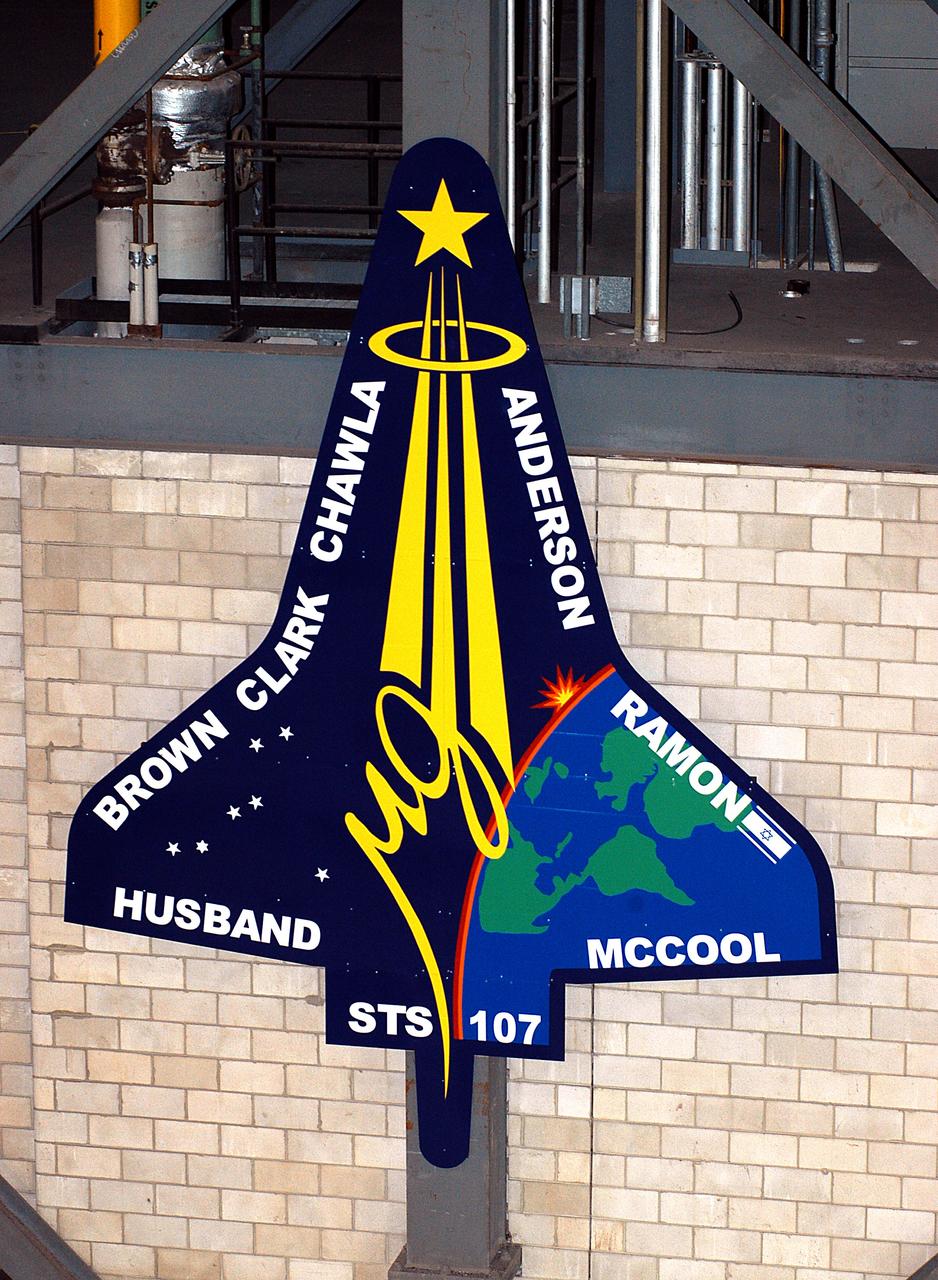
KENNEDY SPACE CENTER, FLA. -  A 20-foot by 15-foot replica of the STS-107 logo has been installed above the “A” on the A tower in the transfer aisle of the Vehicle Assembly Building.  The debris from the orbiter Columbia, lost in a tragic accident on its return to Earth from the STS-107 mission, is permanently stored in the tower.  A dedication ceremony Jan. 29, 2004, unveiled a plaque being installed in the storage area in honor of “Columbia, the crew of STS-107, and their loved ones.”
KENNEDY SPACE CENTER, FLA. - A 20-foot by 15-foot replica of the STS-107 logo has been installed above the “A” on the A tower in the transfer aisle of the Vehicle Assembly Building. The debris from the orbiter Columbia, lost in a tragic accident on its return to Earth from the STS-107 mission, is permanently stored in the tower. A dedication ceremony Jan. 29, 2004, unveiled a plaque being installed in the storage area in honor of “Columbia, the crew of STS-107, and their loved ones.”
KENNEDY SPACE CENTER, FLA. -  Workers install a 20-foot by 15-foot replica of the STS-107 logo above the “A” on the A tower in the transfer aisle of the Vehicle Assembly Building.  The debris from the orbiter Columbia, lost in a tragic accident on its return to Earth from the STS-107 mission, is permanently stored in the tower.  A dedication ceremony Jan. 29, 2004, revealed a plaque being installed in the storage area in honor of “Columbia, the crew of STS-107, and their loved ones.”
KENNEDY SPACE CENTER, FLA. - Workers install a 20-foot by 15-foot replica of the STS-107 logo above the “A” on the A tower in the transfer aisle of the Vehicle Assembly Building. The debris from the orbiter Columbia, lost in a tragic accident on its return to Earth from the STS-107 mission, is permanently stored in the tower. A dedication ceremony Jan. 29, 2004, revealed a plaque being installed in the storage area in honor of “Columbia, the crew of STS-107, and their loved ones.”
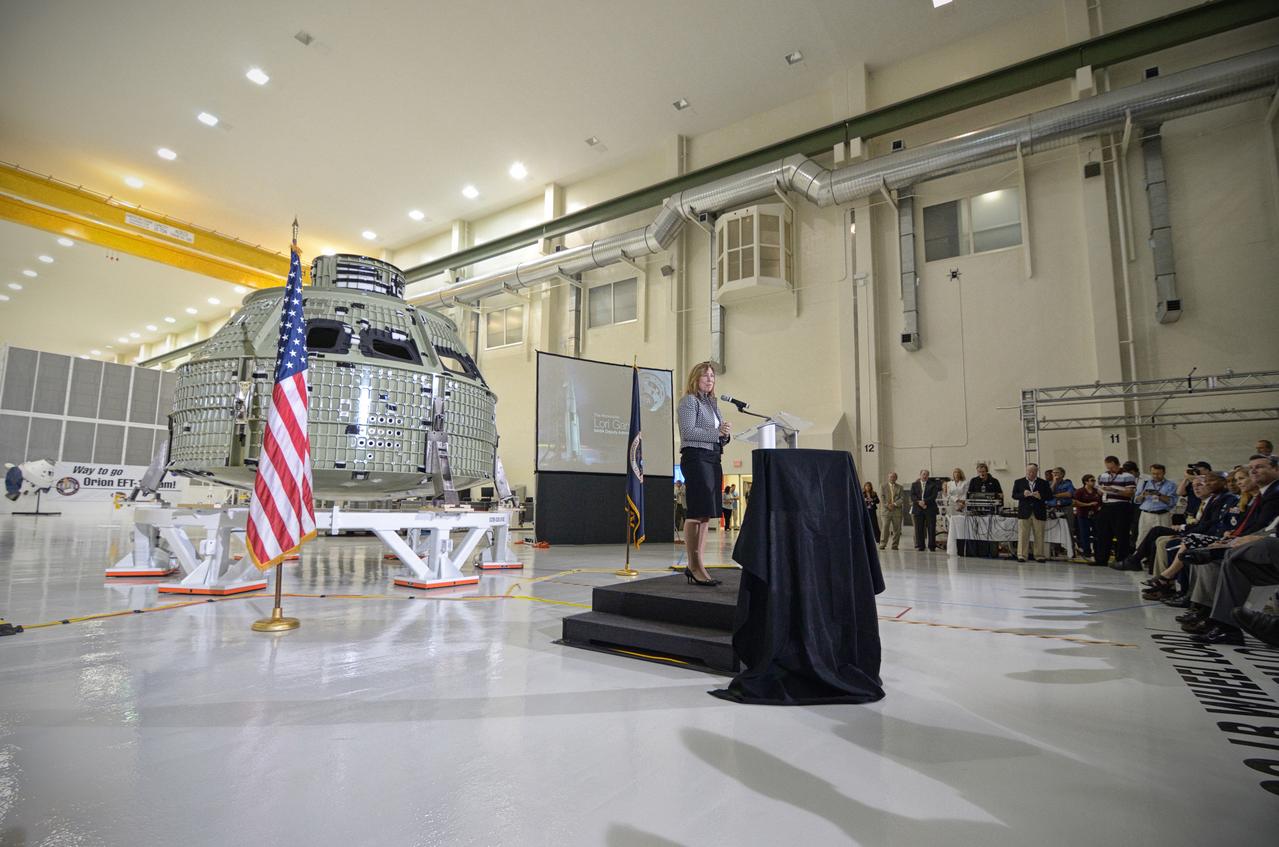
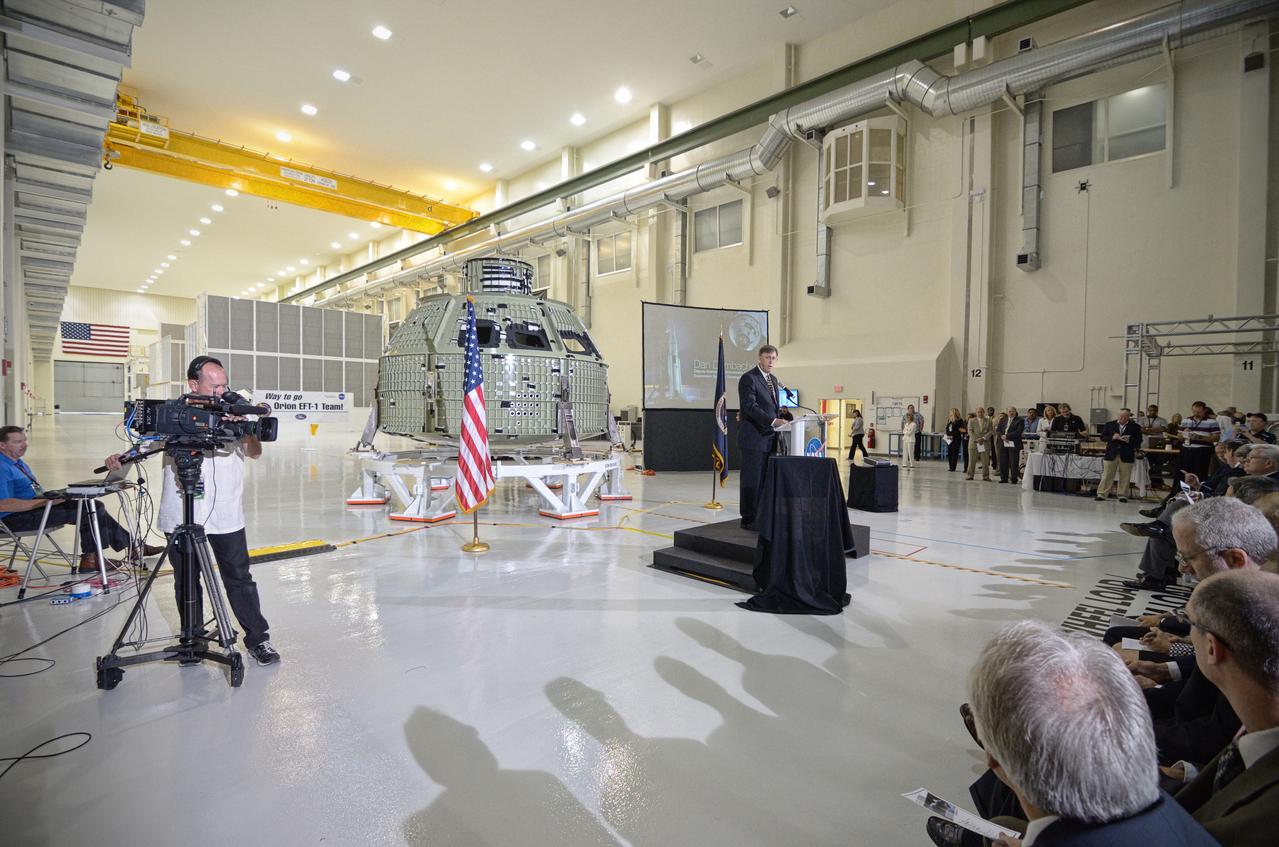
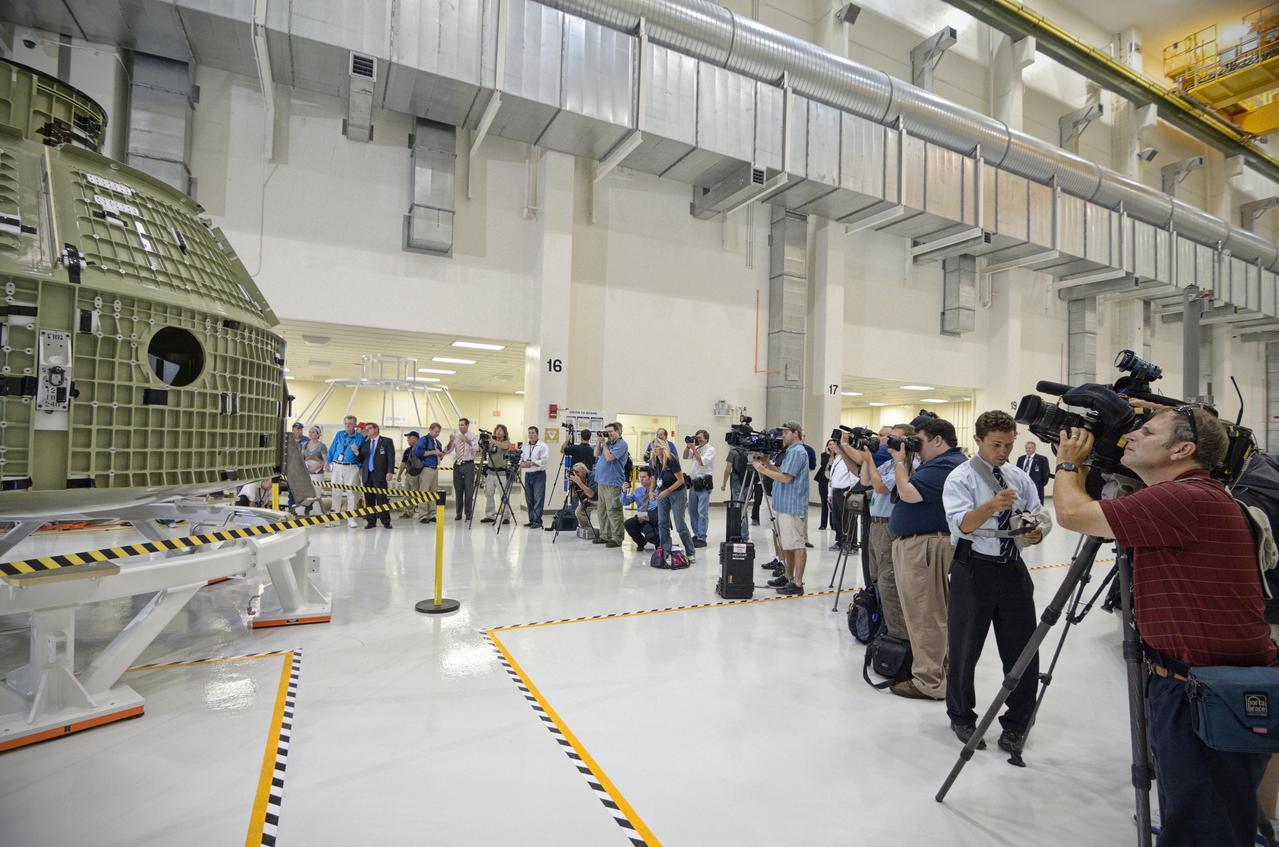
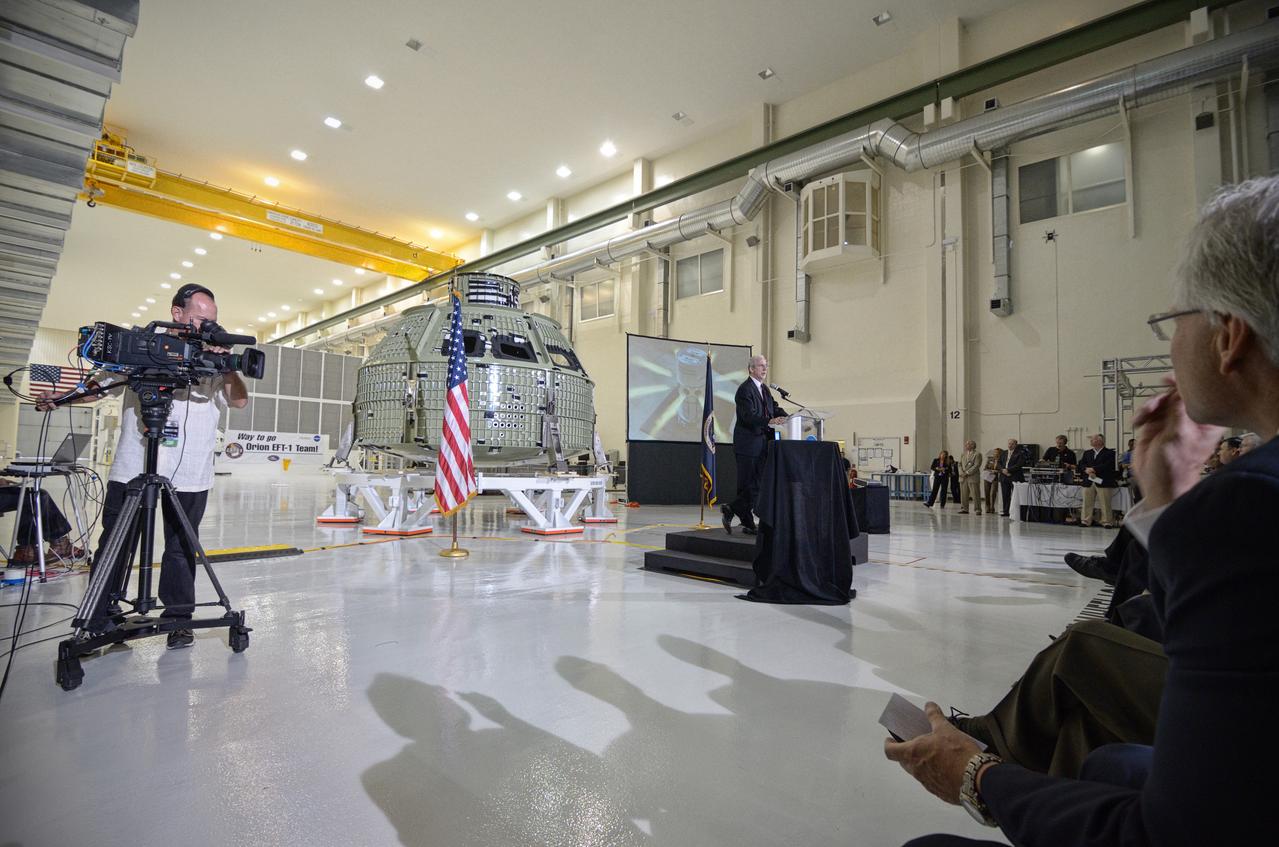
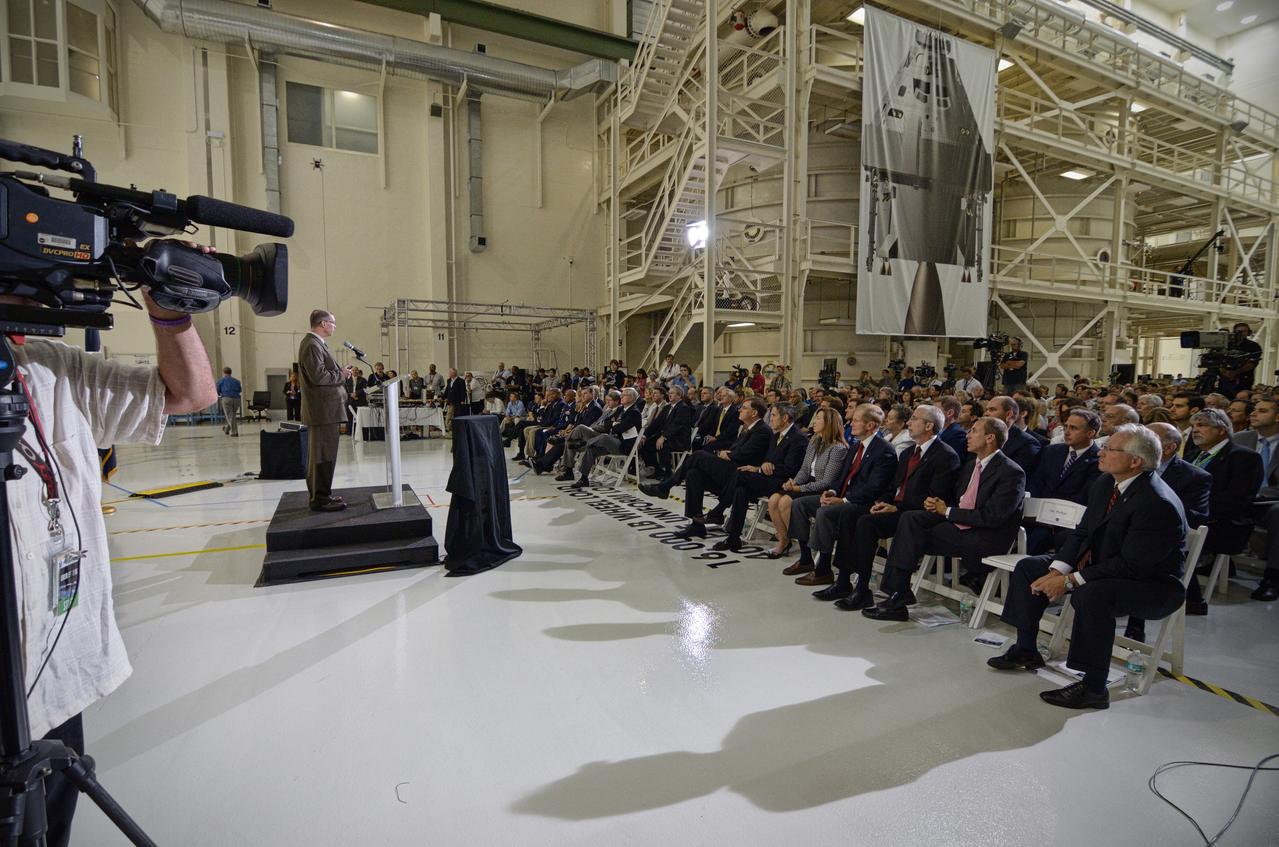
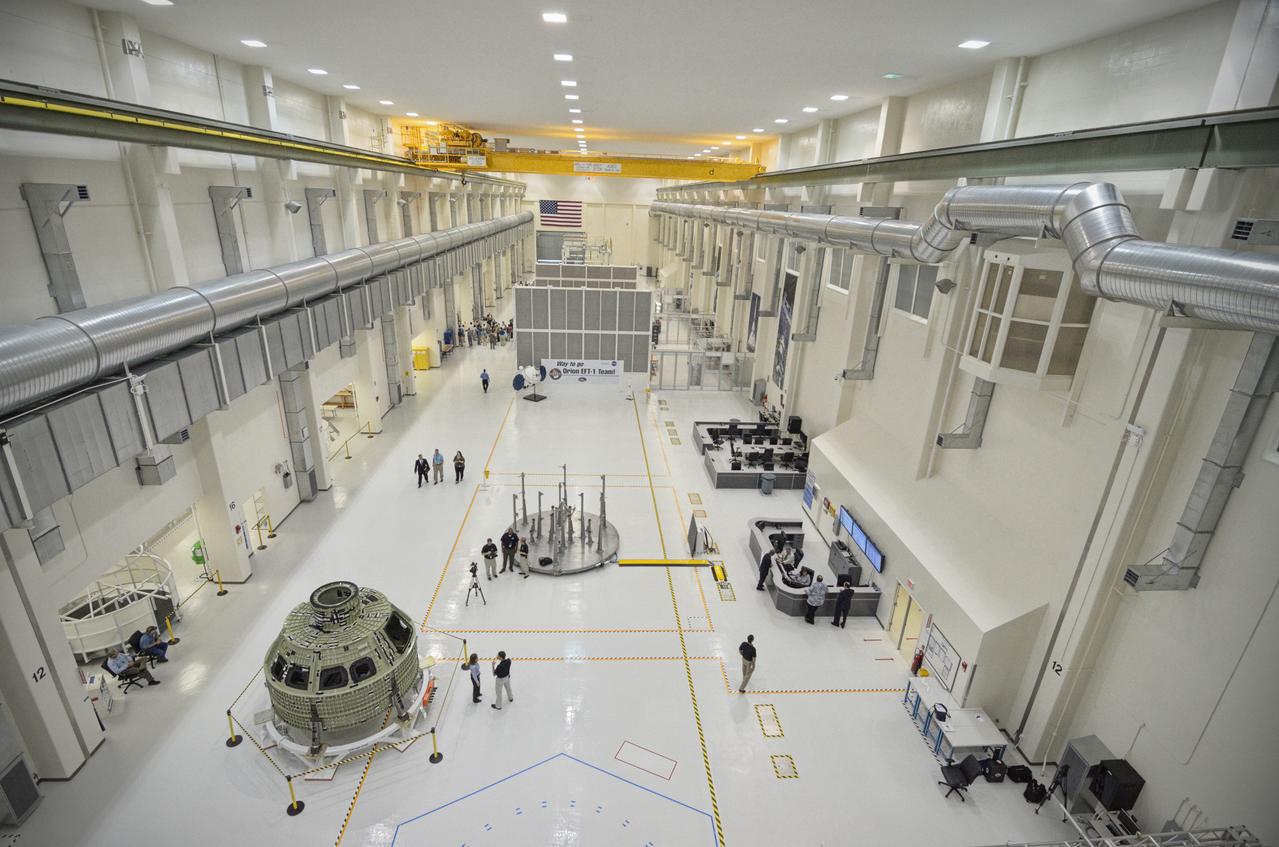
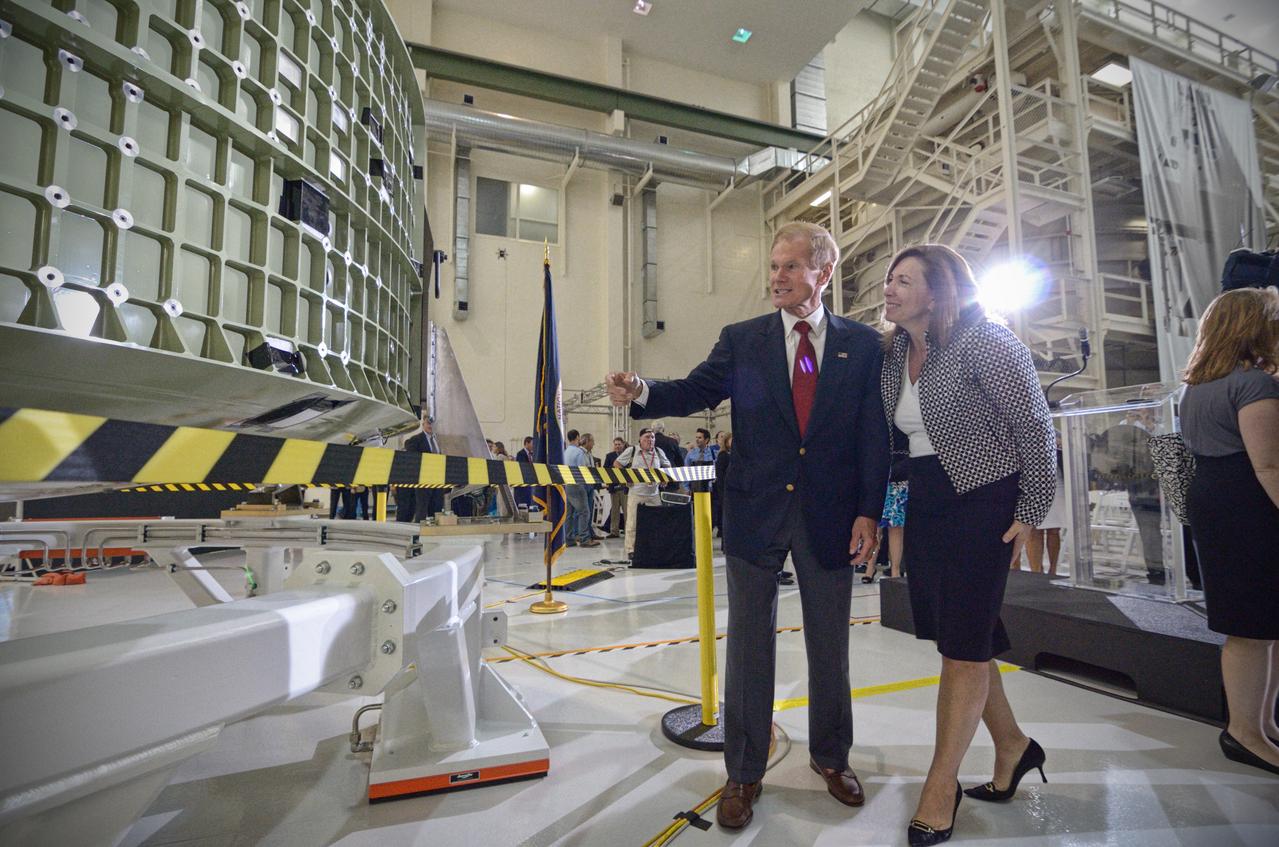
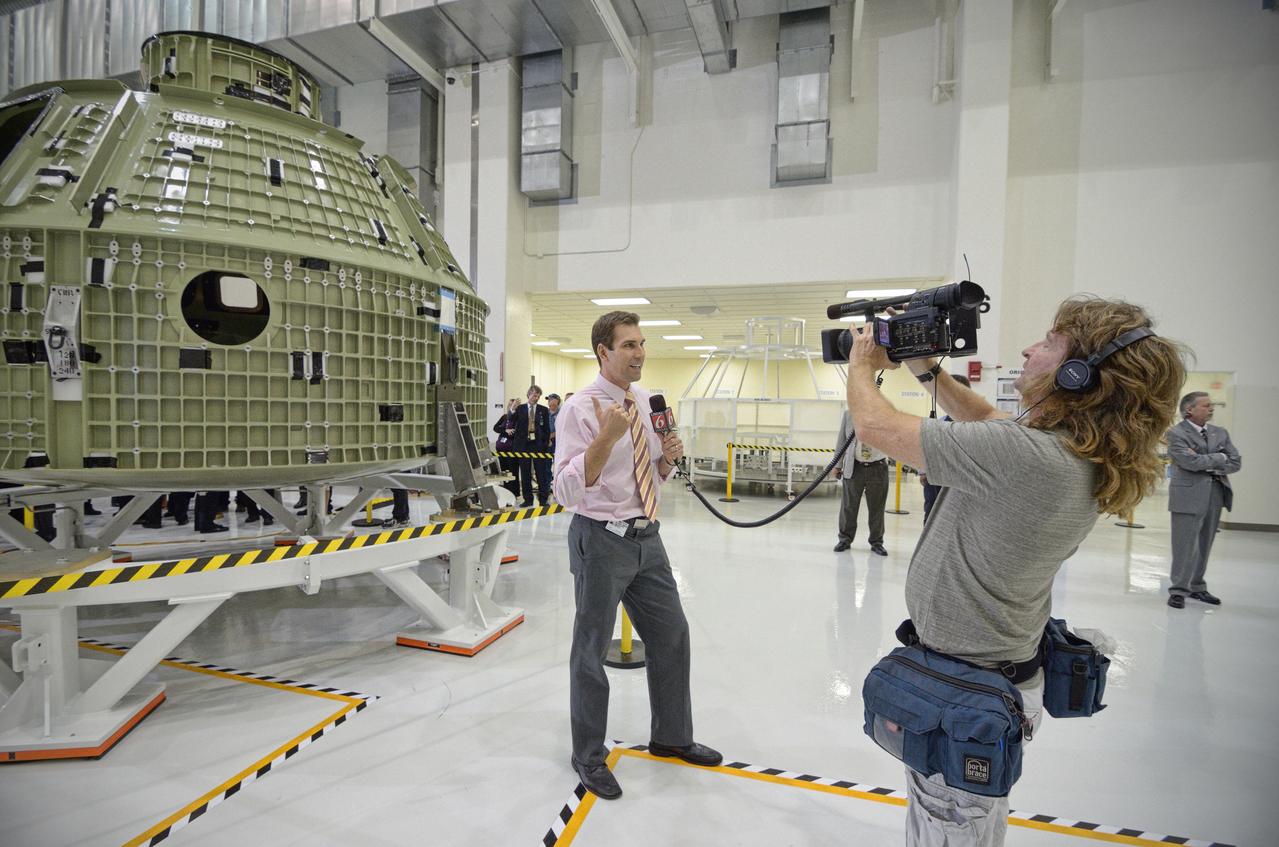
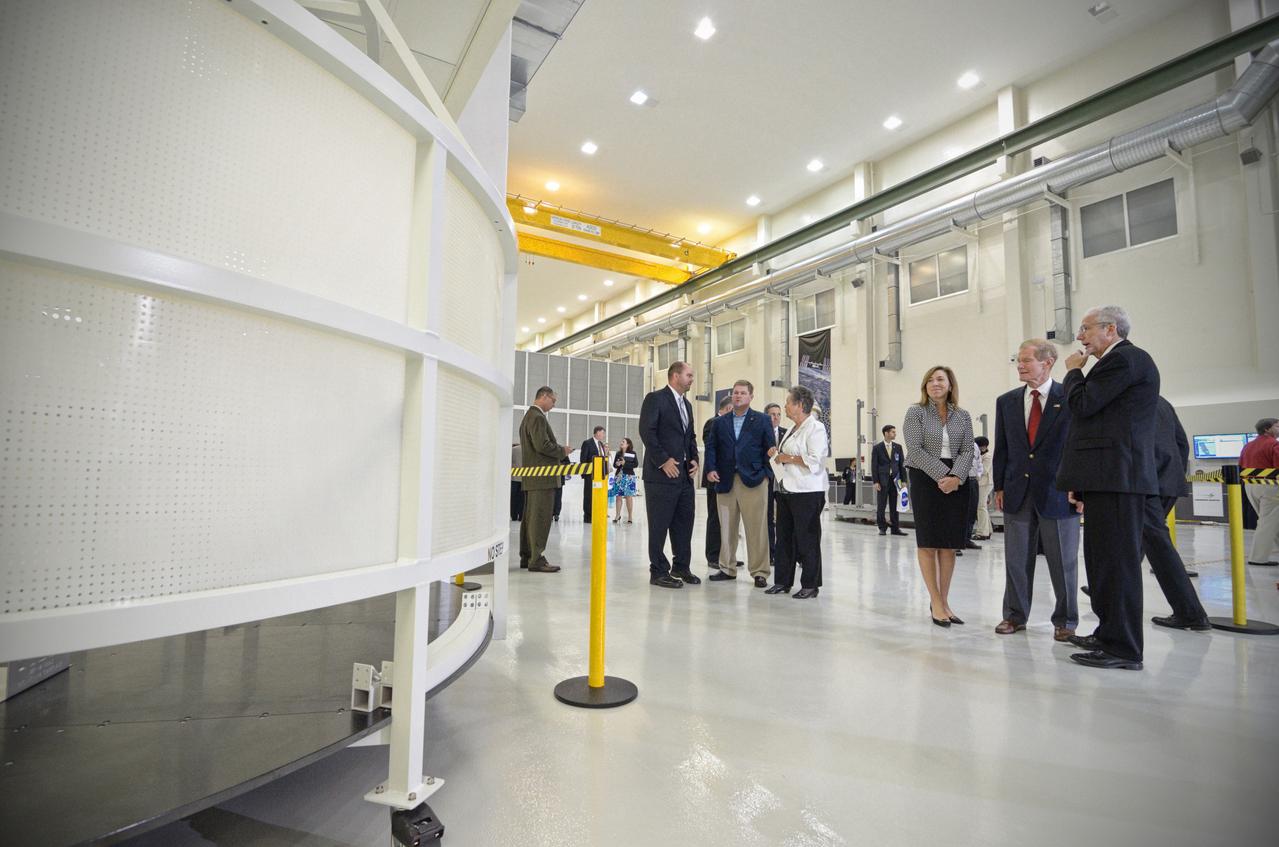
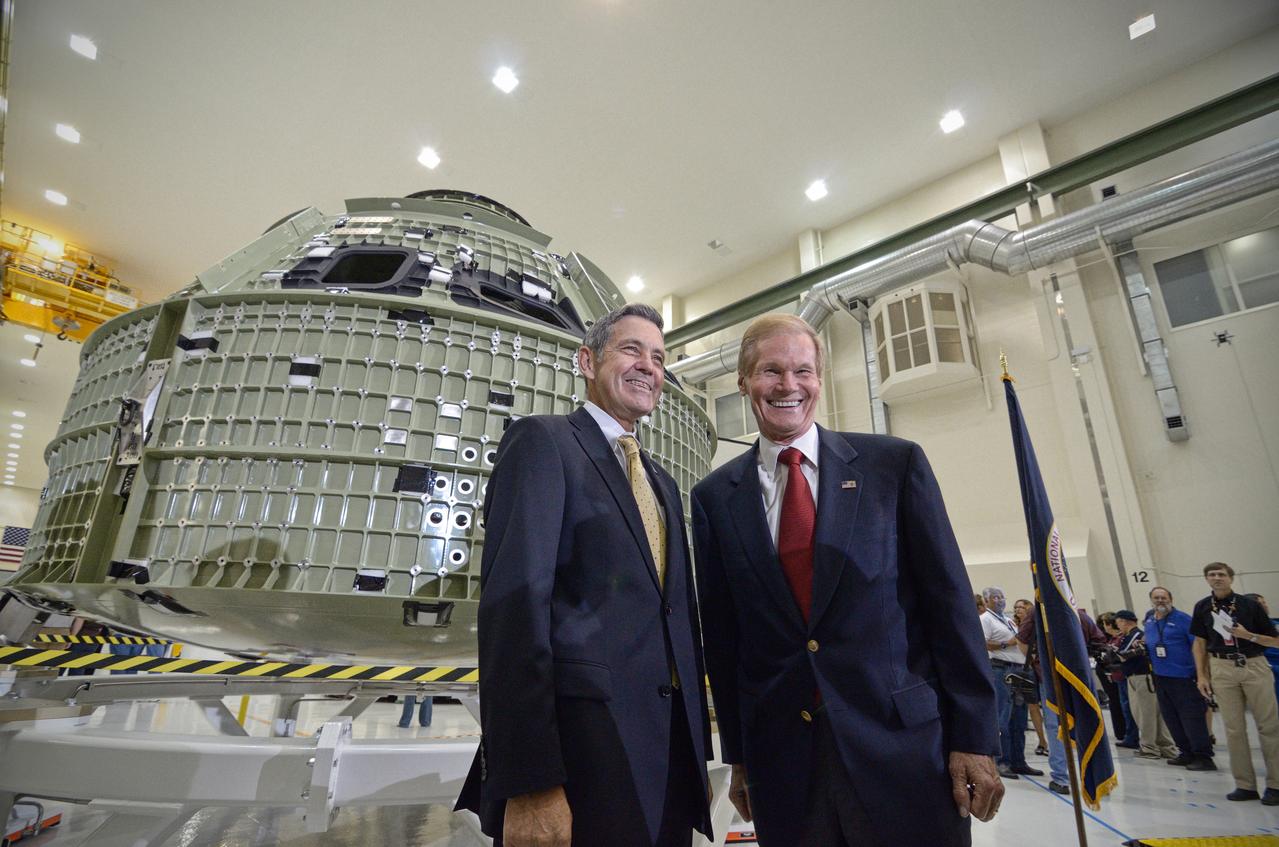
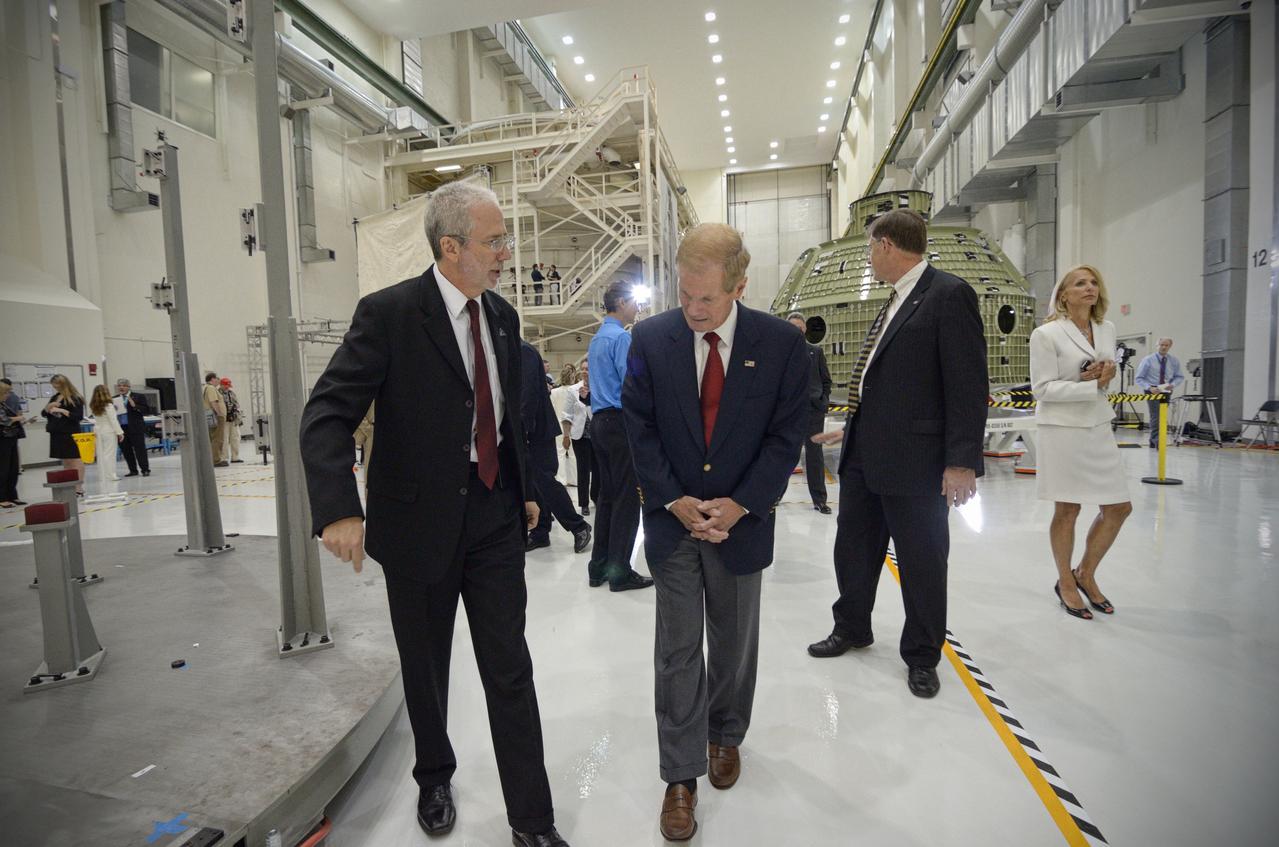
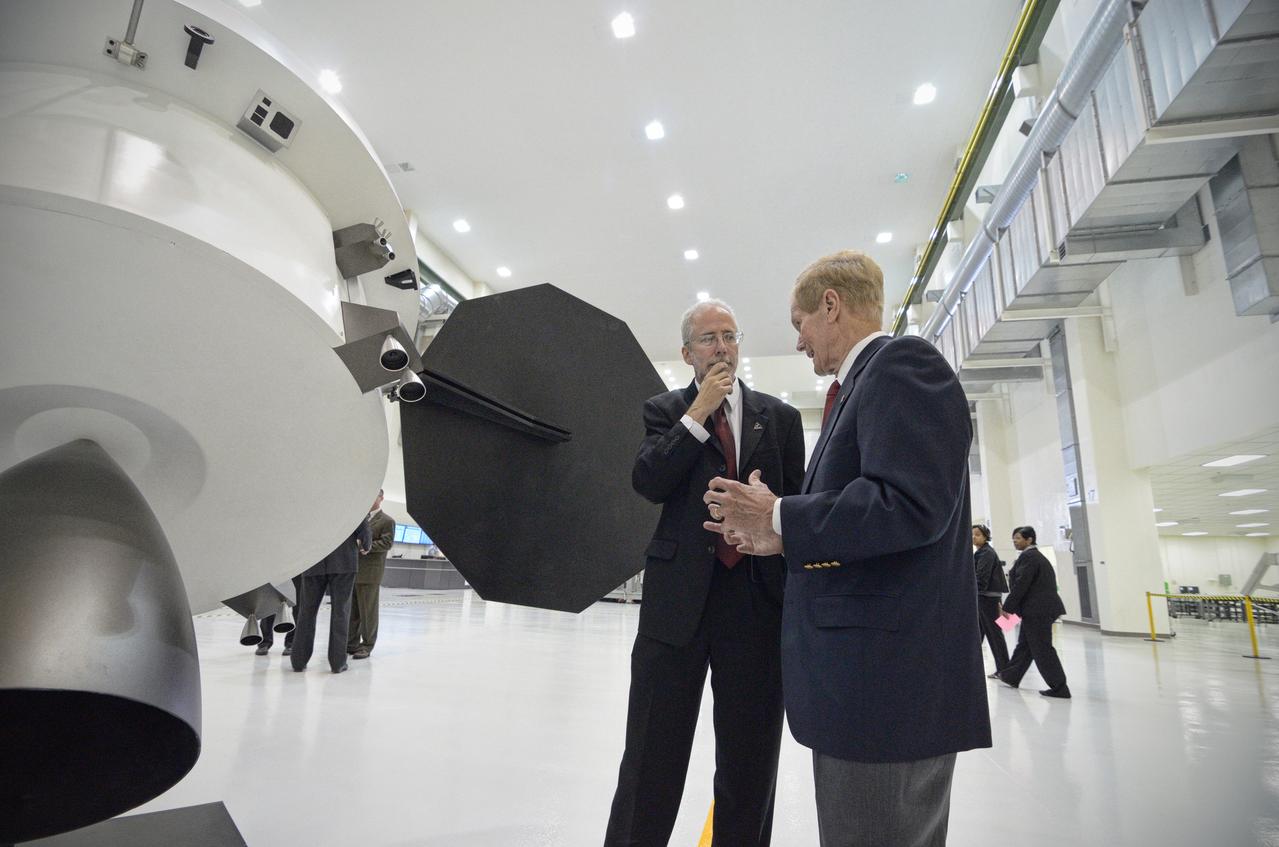
The Orion crew module pressure vessel for Exploration Flight Test-1 (EFT-1) is unveiled at a ceremony at the Operations and Checkout (O&C) Building at NASA’s Kennedy Space Center in Florida on July 2, 2012. Astronaut Rex Walheim poses for photo. Part of Batch image transfer from Flickr.
DSC_5890
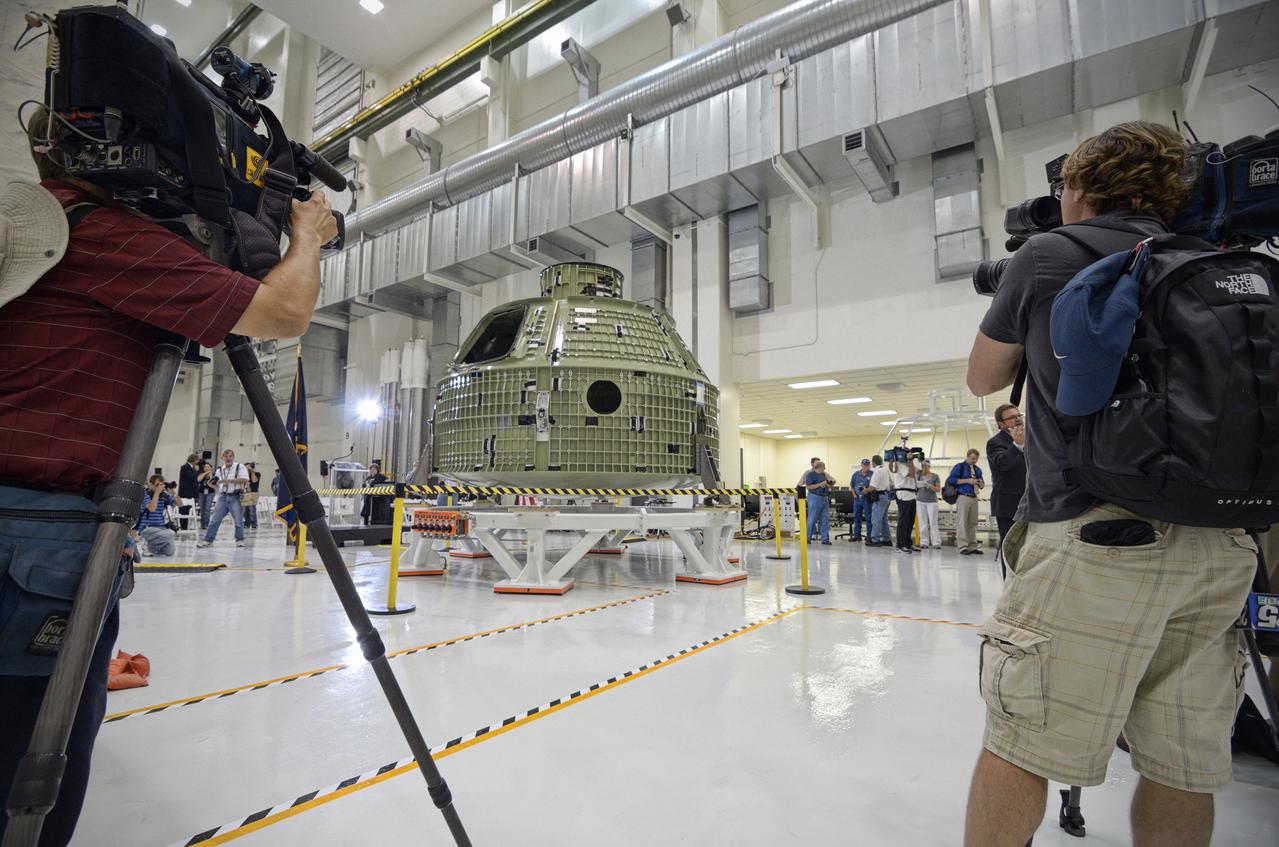
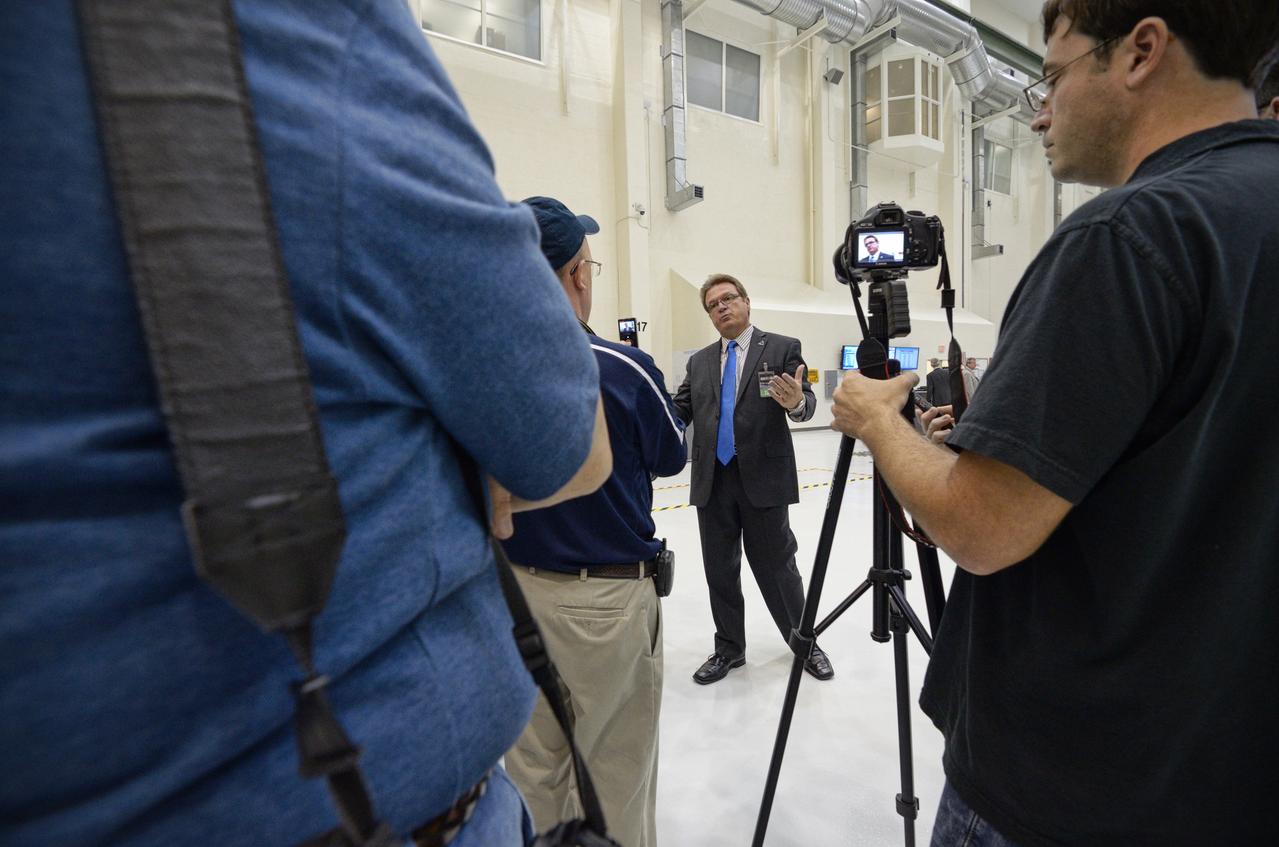
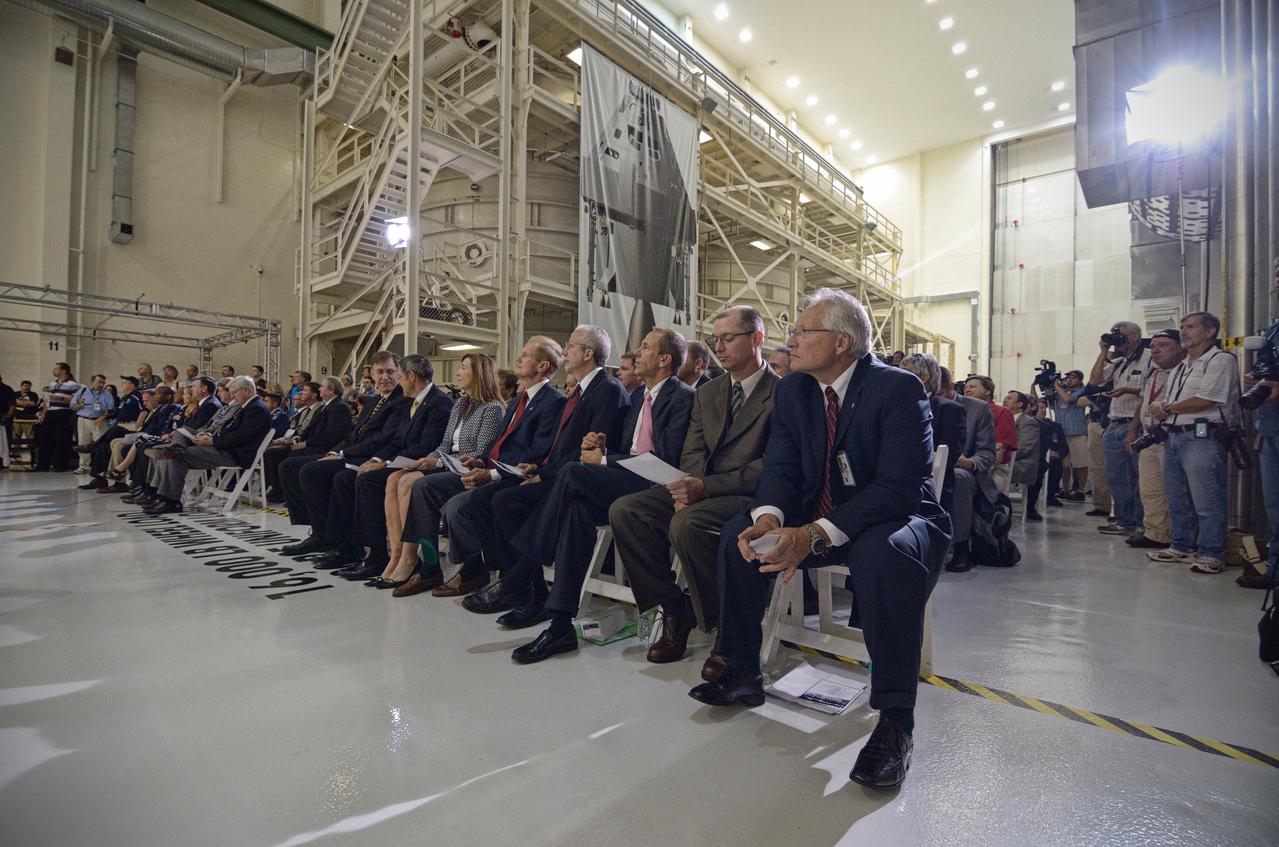
The Orion crew module pressure vessel for Exploration Flight Test-1 (EFT-1) is unveiled at a ceremony at the Operations and Checkout (O&C) Building at NASA’s Kennedy Space Center in Florida on July 2, 2012. Part of Batch image transfer from Flickr.
DSC_5744
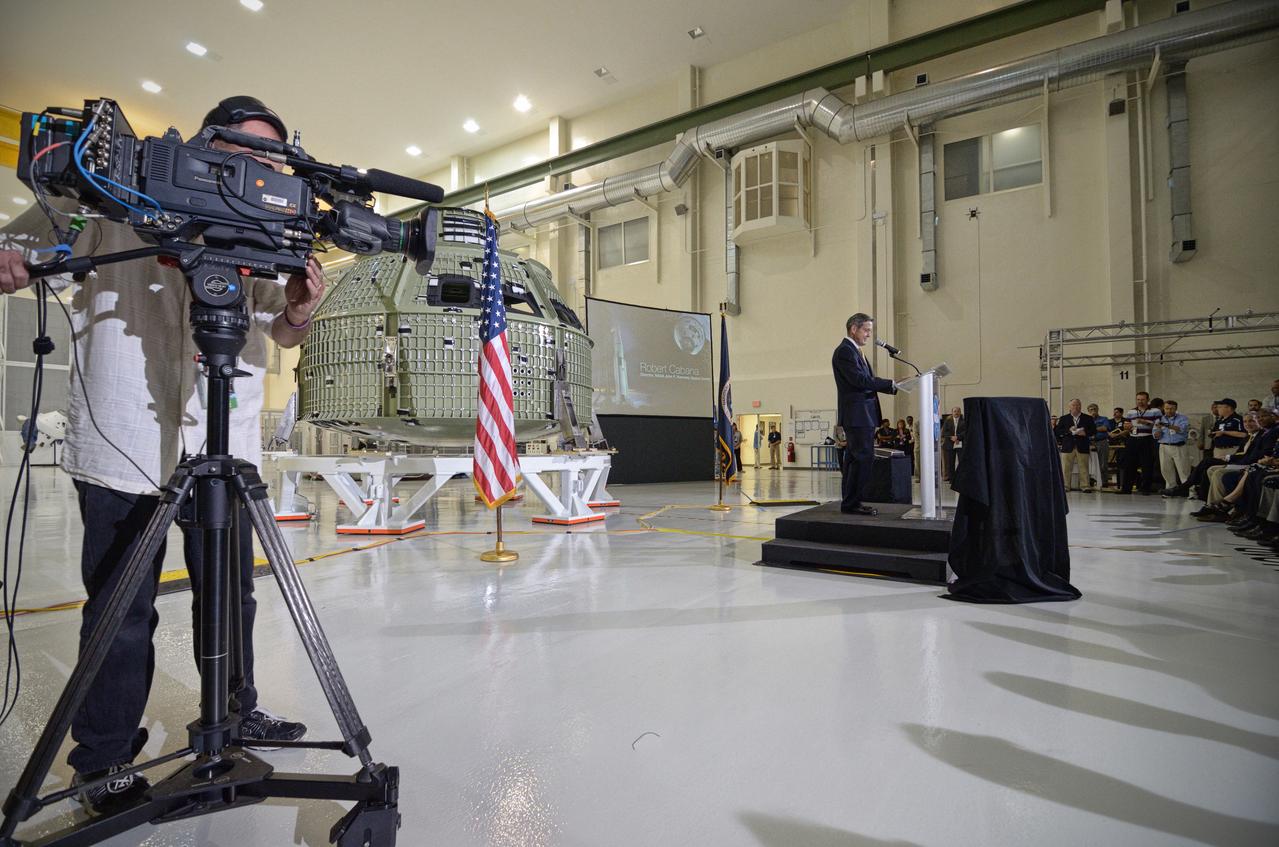
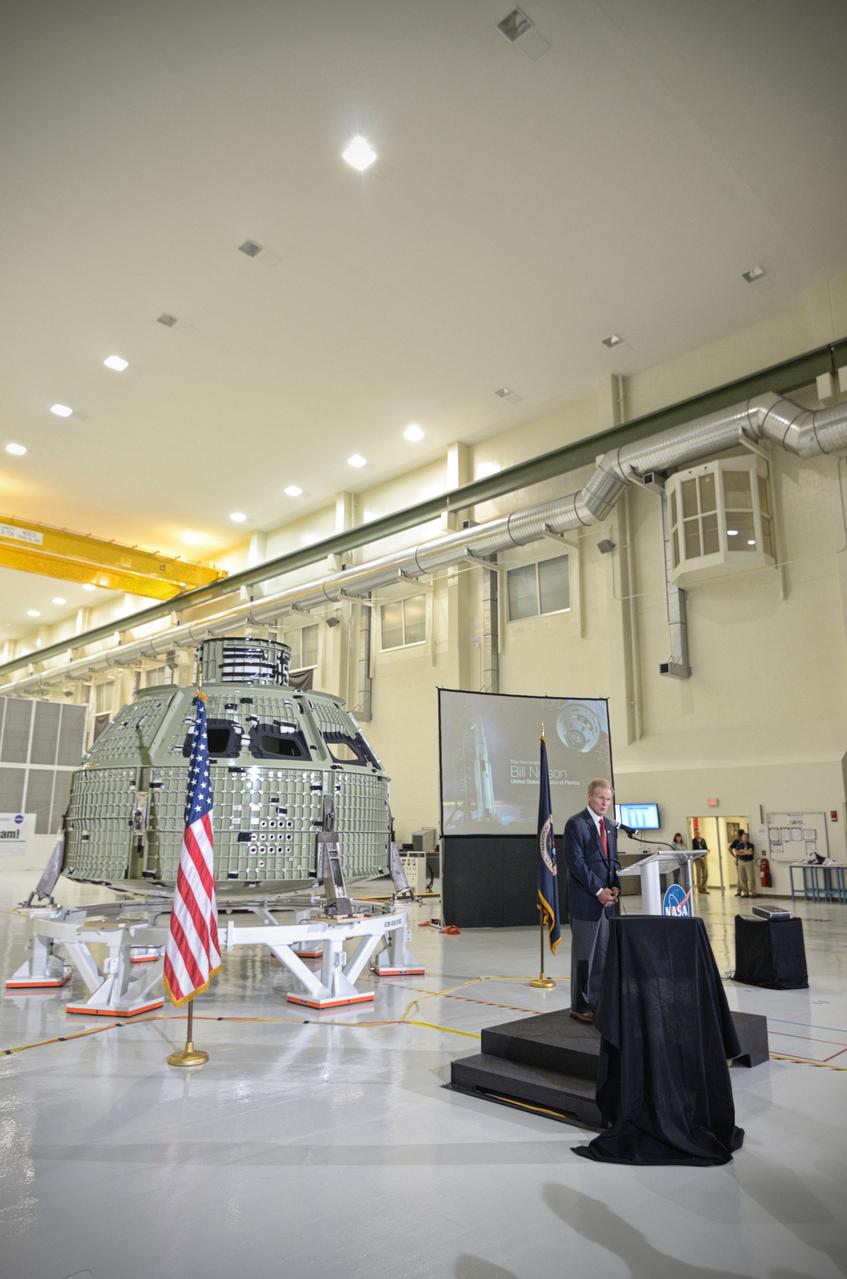
The Orion crew module pressure vessel for Exploration Flight Test-1 (EFT-1) is unveiled at a ceremony at the Operations and Checkout (O&C) Building at NASA’s Kennedy Space Center in Florida on July 2, 2012. Robert Cabana is visible at podium. Part of Batch image transfer from Flickr.
DSC_5725
The Orion crew module pressure vessel for Exploration Flight Test-1 (EFT-1) is unveiled at a ceremony at the Operations and Checkout (O&C) Building at NASA’s Kennedy Space Center in Florida on July 2, 2012. Orion Program Manager Mark Geyer is visible at podium. Part of Batch image transfer from Flickr.
DSC_5737
The Orion crew module pressure vessel for Exploration Flight Test-1 (EFT-1) is unveiled at a ceremony at the Operations and Checkout (O&C) Building at NASA’s Kennedy Space Center in Florida on July 2, 2012.  Part of Batch image transfer from Flickr.
DSC_5699
The Orion crew module pressure vessel for Exploration Flight Test-1 (EFT-1) is unveiled at a ceremony at the Operations and Checkout (O&C) Building at NASA’s Kennedy Space Center in Florida on July 2, 2012. Part of Batch image transfer from Flickr.
DSC_5864
The Orion crew module pressure vessel for Exploration Flight Test-1 (EFT-1) is unveiled at a ceremony at the Operations and Checkout (O&C) Building at NASA’s Kennedy Space Center in Florida on July 2, 2012. Part of Batch image transfer from Flickr.
DSC_6018
The Orion crew module pressure vessel for Exploration Flight Test-1 (EFT-1) is unveiled at a ceremony at the Operations and Checkout (O&C) Building at NASA’s Kennedy Space Center in Florida on July 2, 2012.  Part of Batch image transfer from Flickr.
DSC_5701
The Orion crew module pressure vessel for Exploration Flight Test-1 (EFT-1) is unveiled at a ceremony at the Operations and Checkout (O&C) Building at NASA’s Kennedy Space Center in Florida on July 2, 2012. Part of Batch image transfer from Flickr.
DSC_6025
The Orion crew module pressure vessel for Exploration Flight Test-1 (EFT-1) is unveiled at a ceremony at the Operations and Checkout (O&C) Building at NASA’s Kennedy Space Center in Florida on July 2, 2012. Orion Program Manager Mark Geyer is visible at podium. Part of Batch image transfer from Flickr.
DSC_5733
The Orion crew module pressure vessel for Exploration Flight Test-1 (EFT-1) is unveiled at a ceremony at the Operations and Checkout (O&C) Building at NASA’s Kennedy Space Center in Florida on July 2, 2012.  Part of Batch image transfer from Flickr.
DSC_5693
The Orion crew module pressure vessel for Exploration Flight Test-1 (EFT-1) is unveiled at a ceremony at the Operations and Checkout (O&C) Building at NASA’s Kennedy Space Center in Florida on July 2, 2012.  Part of Batch image transfer from Flickr.
DSC_5687
The Orion crew module pressure vessel for Exploration Flight Test-1 (EFT-1) is unveiled at a ceremony at the Operations and Checkout (O&C) Building at NASA’s Kennedy Space Center in Florida on July 2, 2012. Part of Batch image transfer from Flickr.
DSC_6022
The Orion crew module pressure vessel for Exploration Flight Test-1 (EFT-1) is unveiled at a ceremony at the Operations and Checkout (O&C) Building at NASA’s Kennedy Space Center in Florida on July 2, 2012. Part of Batch image transfer from Flickr.
DSC_5805
The Orion crew module pressure vessel for Exploration Flight Test-1 (EFT-1) is unveiled at a ceremony at the Operations and Checkout (O&C) Building at NASA’s Kennedy Space Center in Florida on July 2, 2012. Part of Batch image transfer from Flickr.
DSC_6046
The Orion crew module pressure vessel for Exploration Flight Test-1 (EFT-1) is unveiled at a ceremony at the Operations and Checkout (O&C) Building at NASA’s Kennedy Space Center in Florida on July 2, 2012.  Part of Batch image transfer from Flickr.
DSC_5718
The Orion crew module pressure vessel for Exploration Flight Test-1 (EFT-1) is unveiled at a ceremony at the Operations and Checkout (O&C) Building at NASA’s Kennedy Space Center in Florida on July 2, 2012. Part of Batch image transfer from Flickr.
DSC_5810
The Orion crew module pressure vessel for Exploration Flight Test-1 (EFT-1) is unveiled at a ceremony at the Operations and Checkout (O&C) Building at NASA’s Kennedy Space Center in Florida on July 2, 2012.  Part of Batch image transfer from Flickr.
DSC_5726
The Orion crew module pressure vessel for Exploration Flight Test-1 (EFT-1) is unveiled at a ceremony at the Operations and Checkout (O&C) Building at NASA’s Kennedy Space Center in Florida on July 2, 2012. Part of Batch image transfer from Flickr.
DSC_6050
The Orion crew module pressure vessel for Exploration Flight Test-1 (EFT-1) is unveiled at a ceremony at the Operations and Checkout (O&C) Building at NASA’s Kennedy Space Center in Florida on July 2, 2012. Part of Batch image transfer from Flickr.
DSC_5853
The Orion crew module pressure vessel for Exploration Flight Test-1 (EFT-1) is unveiled at a ceremony at the Operations and Checkout (O&C) Building at NASA’s Kennedy Space Center in Florida on July 2, 2012. Part of Batch image transfer from Flickr.
DSC_5751
The Orion crew module pressure vessel for Exploration Flight Test-1 (EFT-1) is unveiled at a ceremony at the Operations and Checkout (O&C) Building at NASA’s Kennedy Space Center in Florida on July 2, 2012.  Part of Batch image transfer from Flickr.
DSC_5721
The Orion crew module pressure vessel for Exploration Flight Test-1 (EFT-1) is unveiled at a ceremony at the Operations and Checkout (O&C) Building at NASA’s Kennedy Space Center in Florida on July 2, 2012. Part of Batch image transfer from Flickr.
DSC_5763
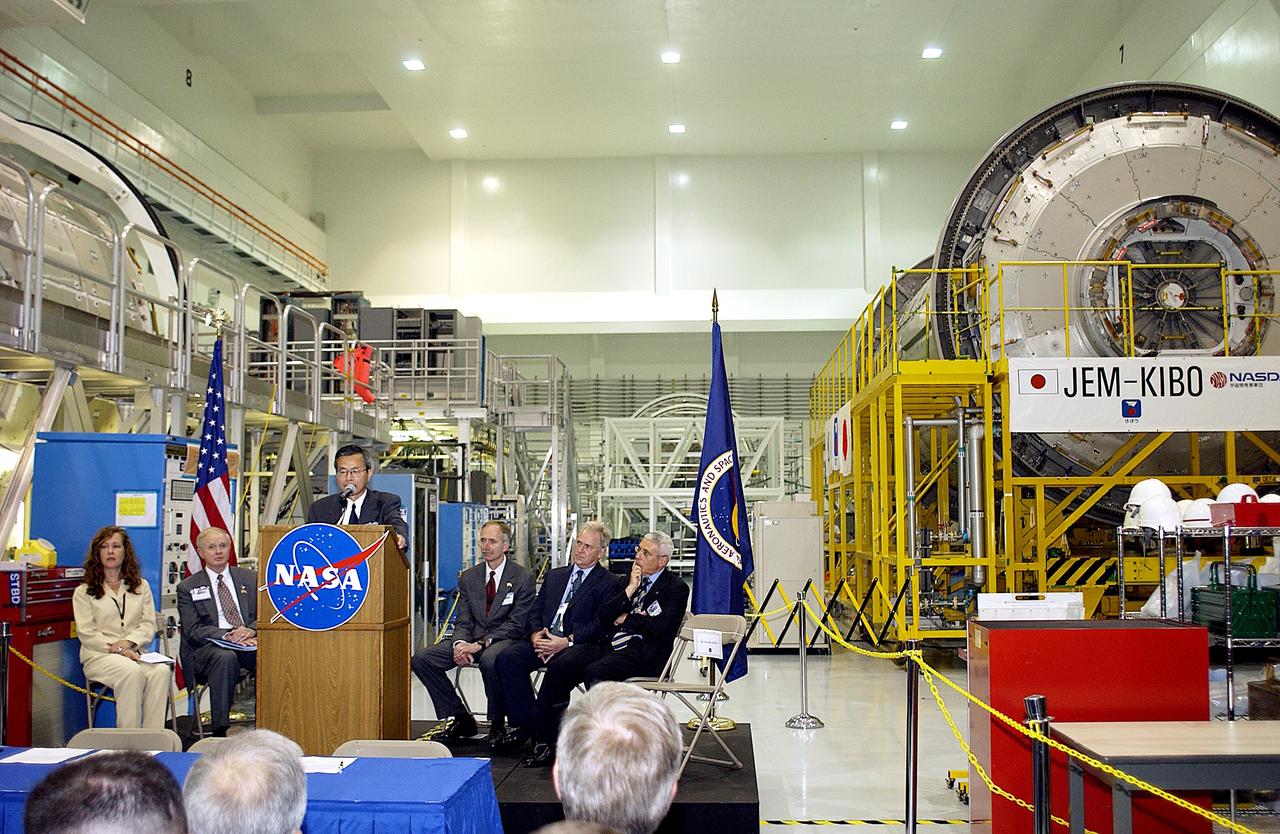
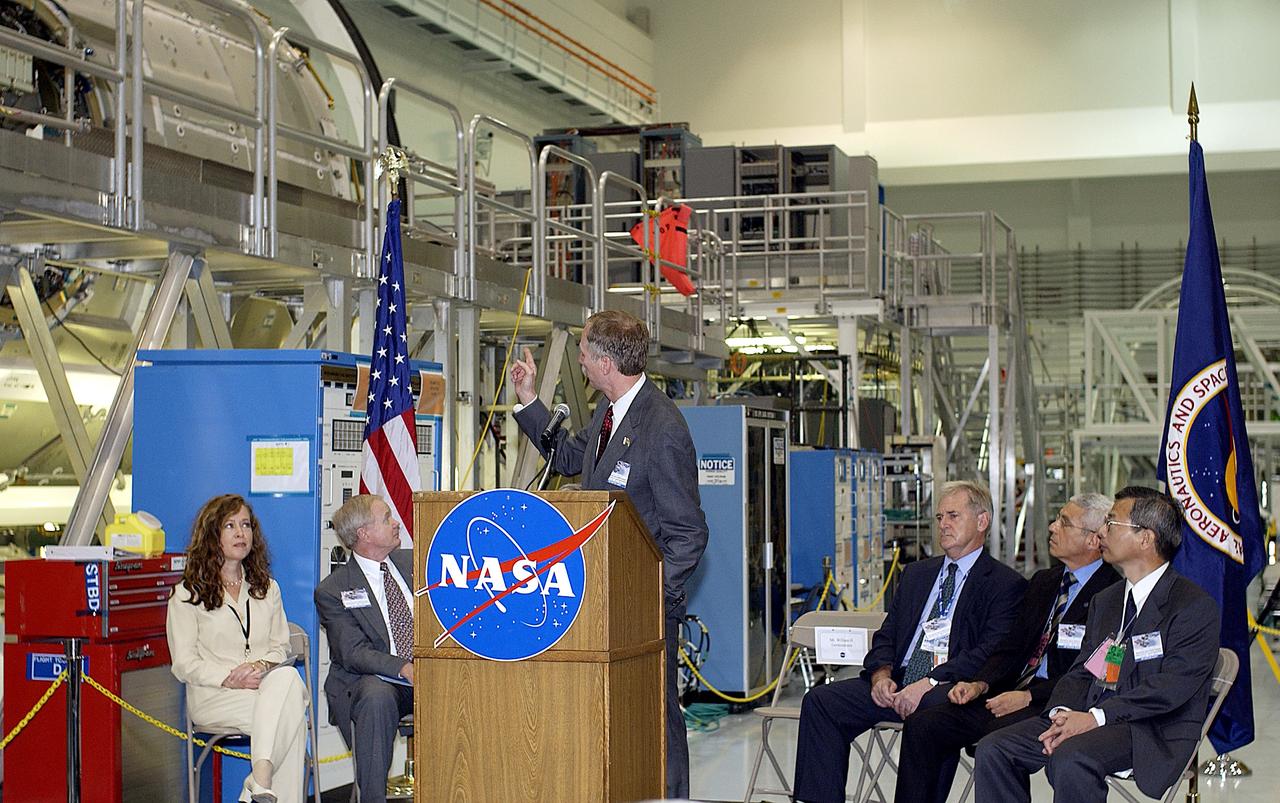
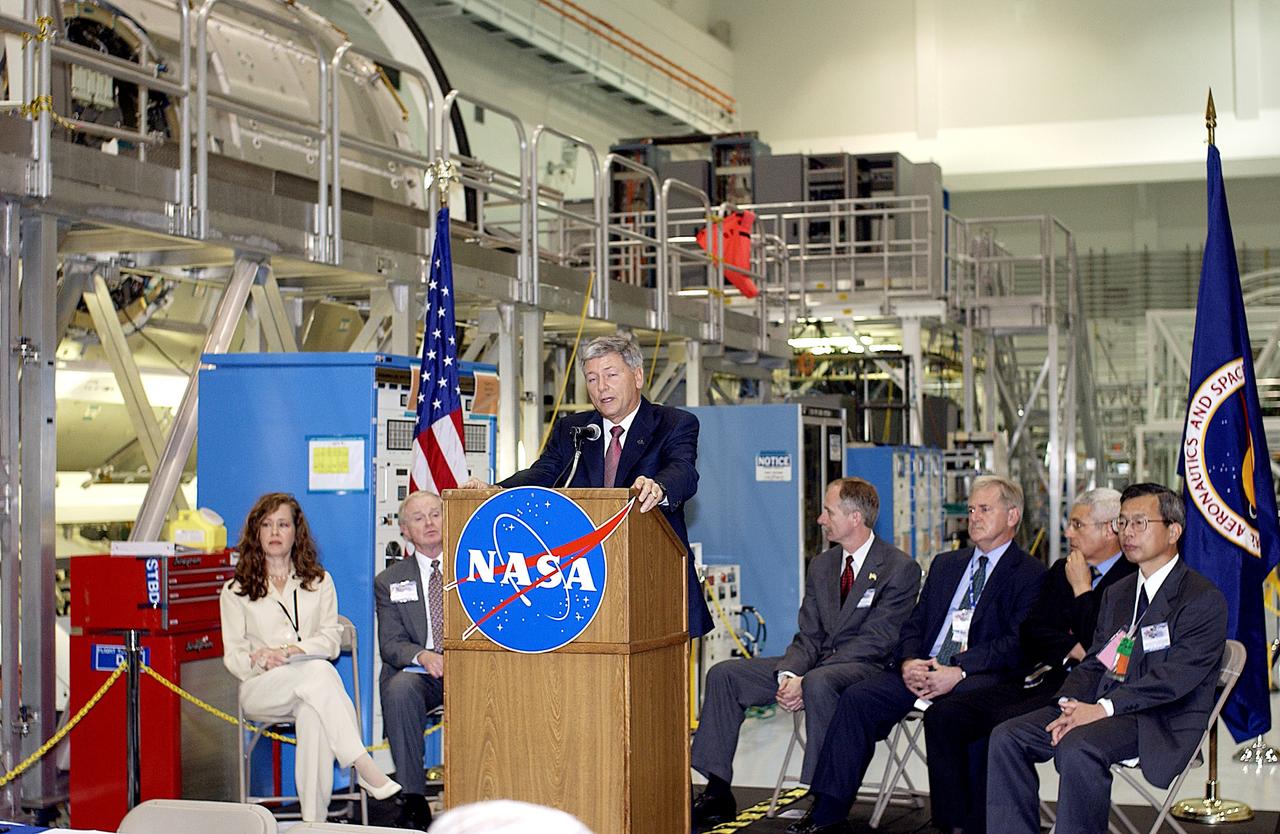
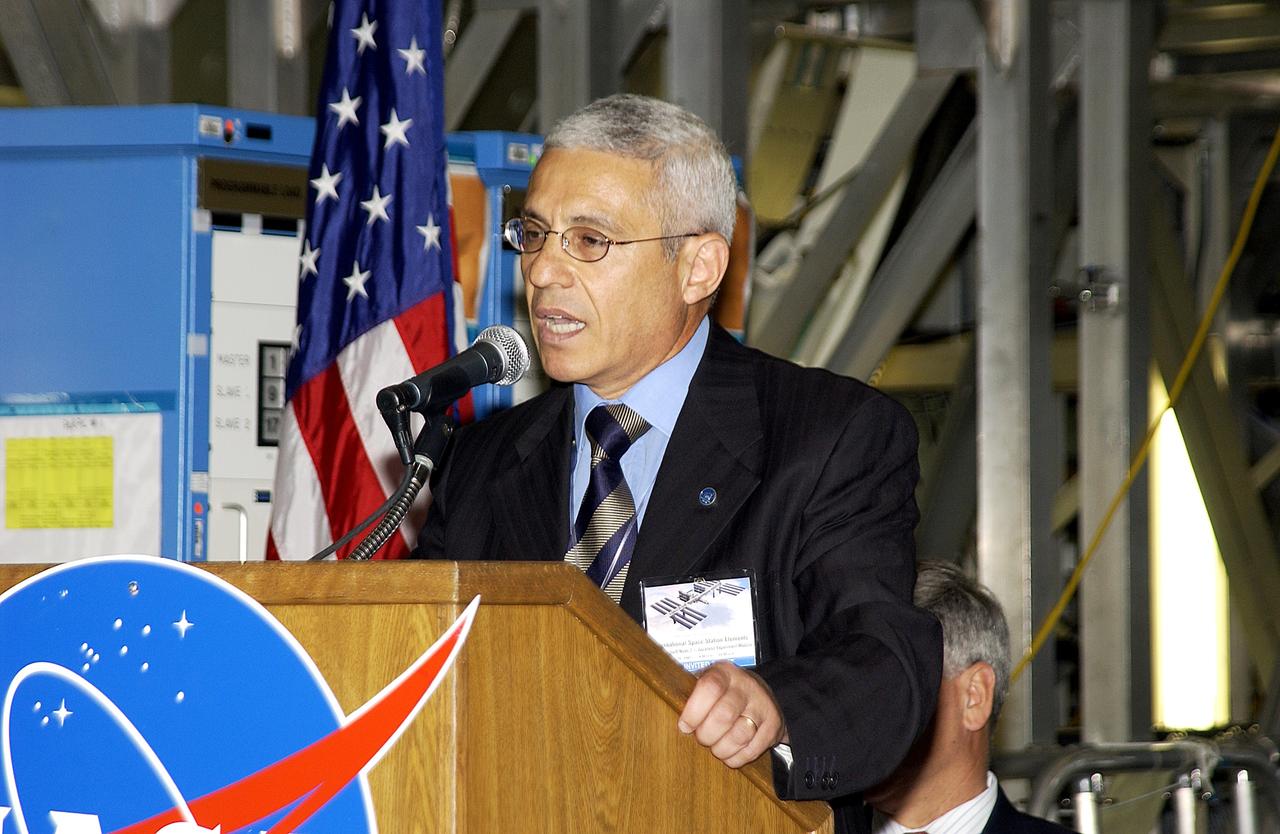
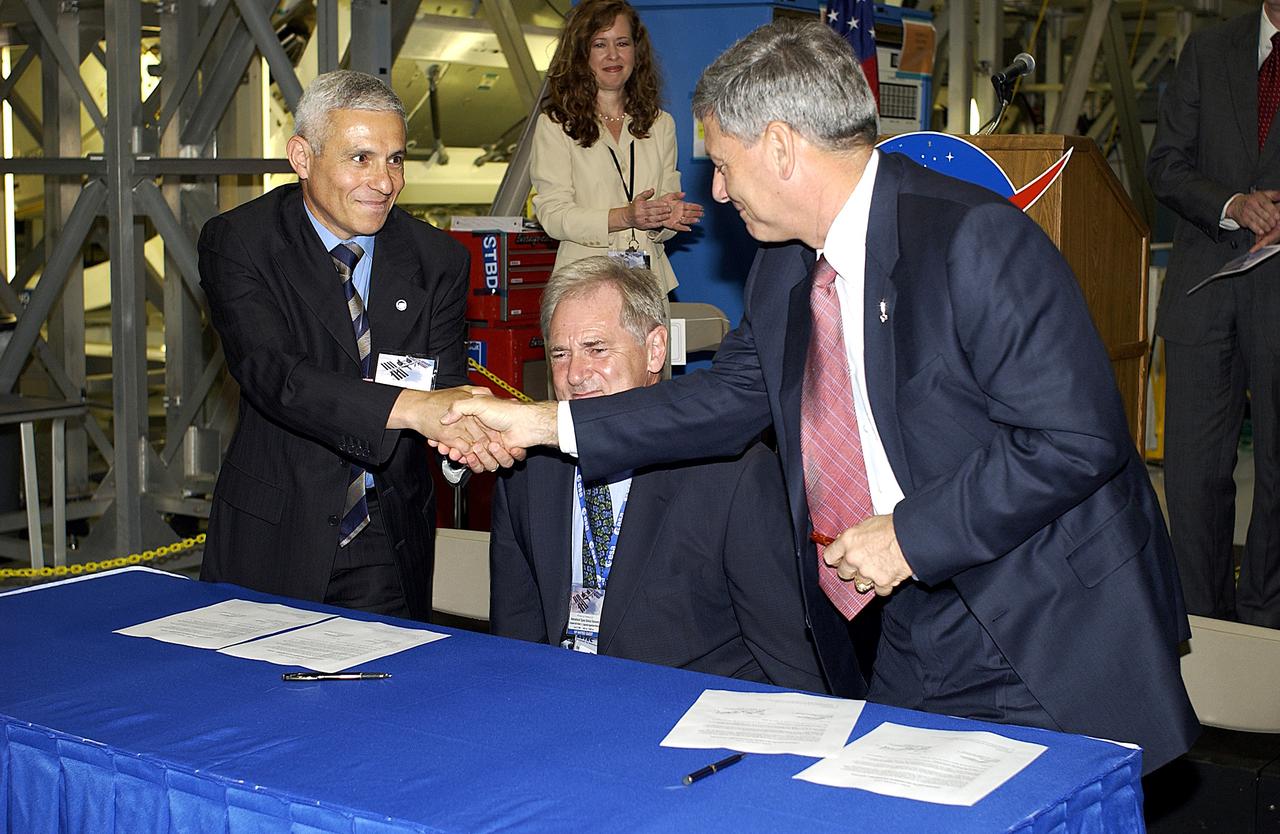
KENNEDY SPACE CENTER, FLA. -   At a ceremony highlighting the arrival of two major components of the International Space Station, William Gerstenmaier, International Space Station Program manager, points to one of the components as he speaks to guests and the media gathered in the Space Station Processing Facility.  NASA's Node 2, built by the European Space Agency (ESA) in Italy, arrived at KSC on June 1. It will be the next pressurized module installed on the Station. The pressurized module of the Japanese Experiment Module (JEM), named "Kibo" (Hope), arrived at KSC on June 4. It is Japan's primary contribution to the Station. The ceremony held today included the official transfer of ownership signing of Node 2 between the ESA and NASA.. Emceed by Lisa Malone, deputy director of External Relations and Business Development at KSC, the ceremony also included these speakers: Center Director Roy Bridges Jr.; NASA’s Michael C. Kostelnik, deputy associate administrator for International Space Station and Shuttle Programs; Alan Thirkettle, International Space Station Program manager for Node 2, ESA; Andrea Lorenzoni, International Space Station Program manager for Node 2, Italian Space Agency; and Kuniaki Shiraki, JEM Project manager, National Aerospace and Development Agency of Japan.
KENNEDY SPACE CENTER, FLA. - At a ceremony highlighting the arrival of two major components of the International Space Station, William Gerstenmaier, International Space Station Program manager, points to one of the components as he speaks to guests and the media gathered in the Space Station Processing Facility. NASA's Node 2, built by the European Space Agency (ESA) in Italy, arrived at KSC on June 1. It will be the next pressurized module installed on the Station. The pressurized module of the Japanese Experiment Module (JEM), named "Kibo" (Hope), arrived at KSC on June 4. It is Japan's primary contribution to the Station. The ceremony held today included the official transfer of ownership signing of Node 2 between the ESA and NASA.. Emceed by Lisa Malone, deputy director of External Relations and Business Development at KSC, the ceremony also included these speakers: Center Director Roy Bridges Jr.; NASA’s Michael C. Kostelnik, deputy associate administrator for International Space Station and Shuttle Programs; Alan Thirkettle, International Space Station Program manager for Node 2, ESA; Andrea Lorenzoni, International Space Station Program manager for Node 2, Italian Space Agency; and Kuniaki Shiraki, JEM Project manager, National Aerospace and Development Agency of Japan.
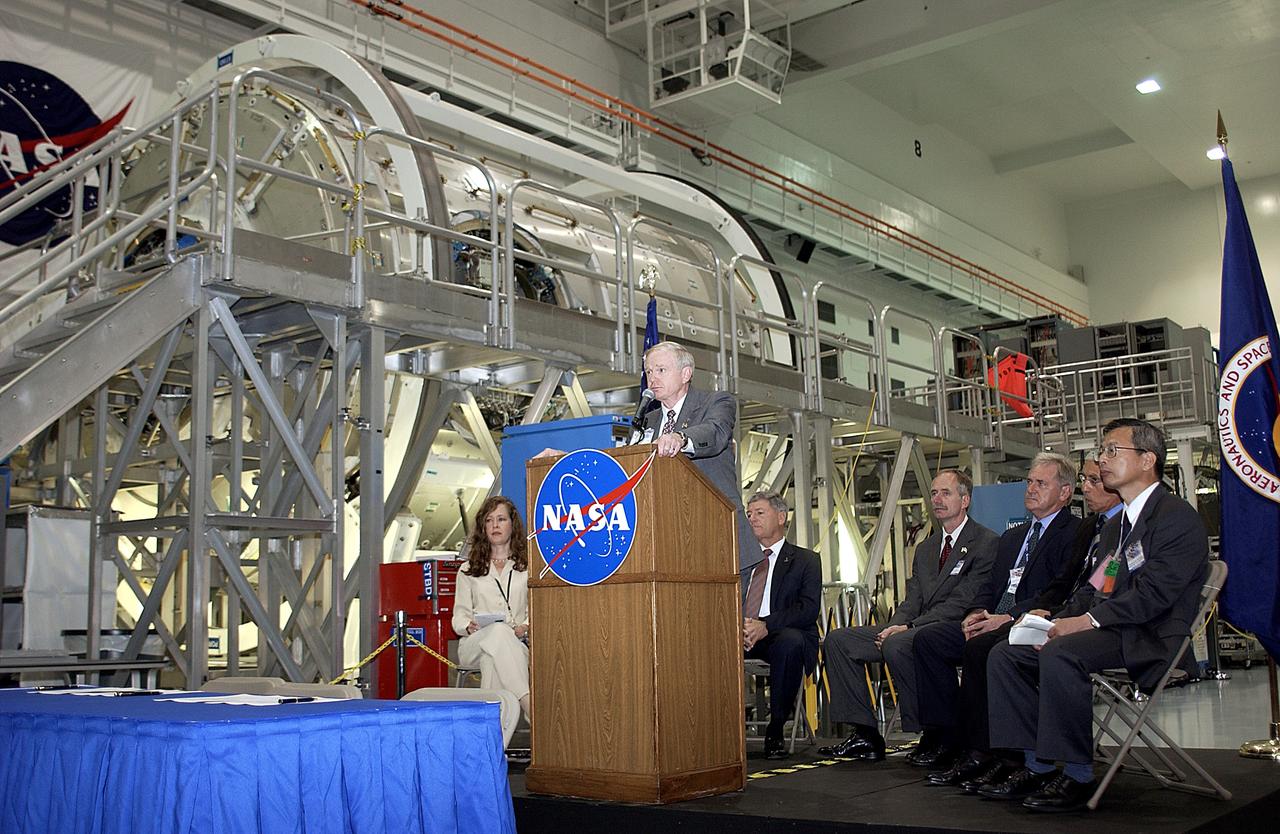
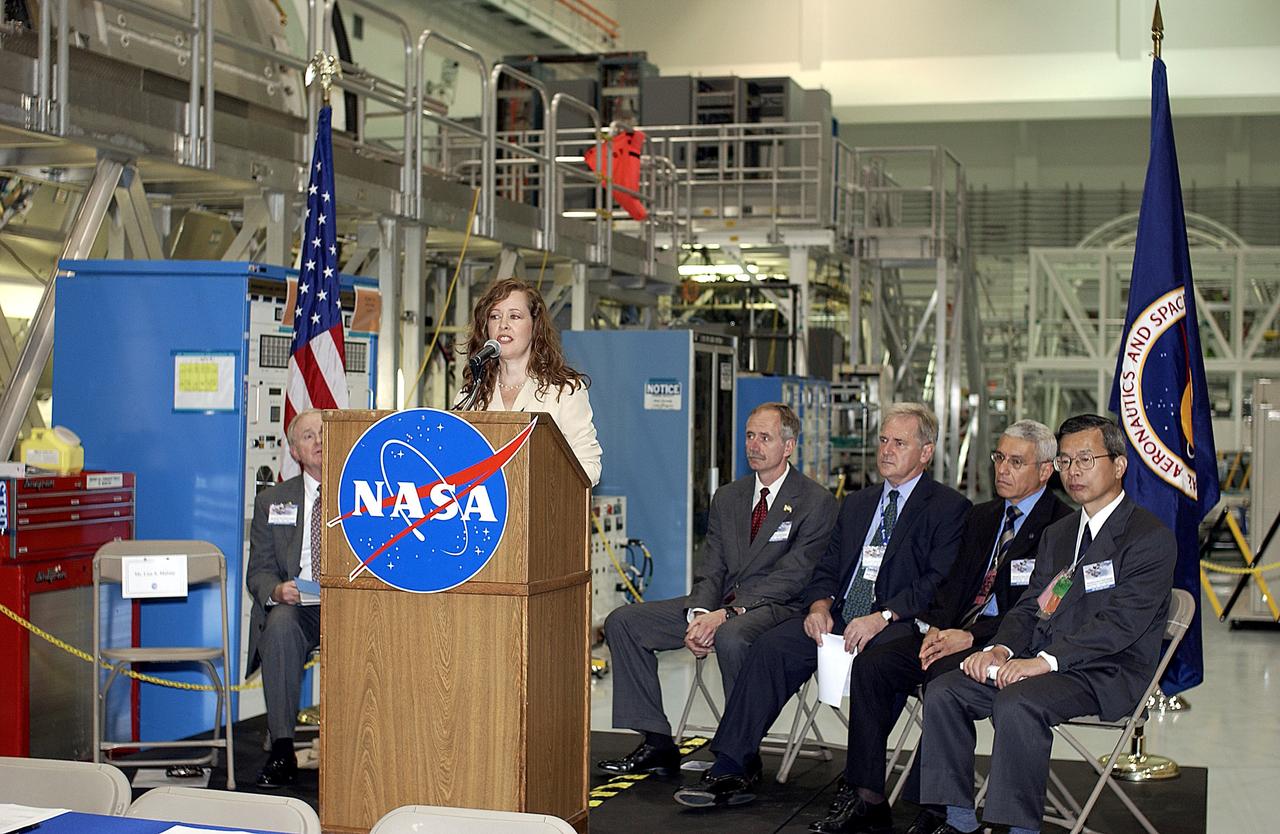
KENNEDY SPACE CENTER, FLA. -  NASA's Michael C. Kostelnik, deputy associate administrator for International Space Station and Shuttle Programs, speaks to guests and the media gathered in the Space Station Processing Facility for a ceremony to highlight the arrival of two major components of the International Space Station.  NASA's Node 2, built by the European Space Agency (ESA) in Italy arrived at KSC on June 1. It will be the next pressurized module installed on the Station. The pressurized module of the Japanese Experiment Module (JEM), named "Kibo" (Hope) arrived at KSC on June 4. It is Japan's primary contribution to the Station. The ceremony held today included the official transfer of ownership signing of Node 2 between the ESA and NASA.. Emceed by Lisa Malone (far left),  deputy director of External Relations and Business Development at KSC, the ceremony also included these speakers: Center Director Roy Bridges Jr. (second from left); William Gerstenmaier, International Space Station Program manager; Alan Thirkettle, International Space Station Program manager for Node 2, ESA; Andrea Lorenzoni, International Space Station Program manager for Node 2, Italian Space Agency; and Kuniaki Shiraki, JEM Project manager, National Aerospace and Development Agency of Japan.
KENNEDY SPACE CENTER, FLA. - NASA's Michael C. Kostelnik, deputy associate administrator for International Space Station and Shuttle Programs, speaks to guests and the media gathered in the Space Station Processing Facility for a ceremony to highlight the arrival of two major components of the International Space Station. NASA's Node 2, built by the European Space Agency (ESA) in Italy arrived at KSC on June 1. It will be the next pressurized module installed on the Station. The pressurized module of the Japanese Experiment Module (JEM), named "Kibo" (Hope) arrived at KSC on June 4. It is Japan's primary contribution to the Station. The ceremony held today included the official transfer of ownership signing of Node 2 between the ESA and NASA.. Emceed by Lisa Malone (far left), deputy director of External Relations and Business Development at KSC, the ceremony also included these speakers: Center Director Roy Bridges Jr. (second from left); William Gerstenmaier, International Space Station Program manager; Alan Thirkettle, International Space Station Program manager for Node 2, ESA; Andrea Lorenzoni, International Space Station Program manager for Node 2, Italian Space Agency; and Kuniaki Shiraki, JEM Project manager, National Aerospace and Development Agency of Japan.
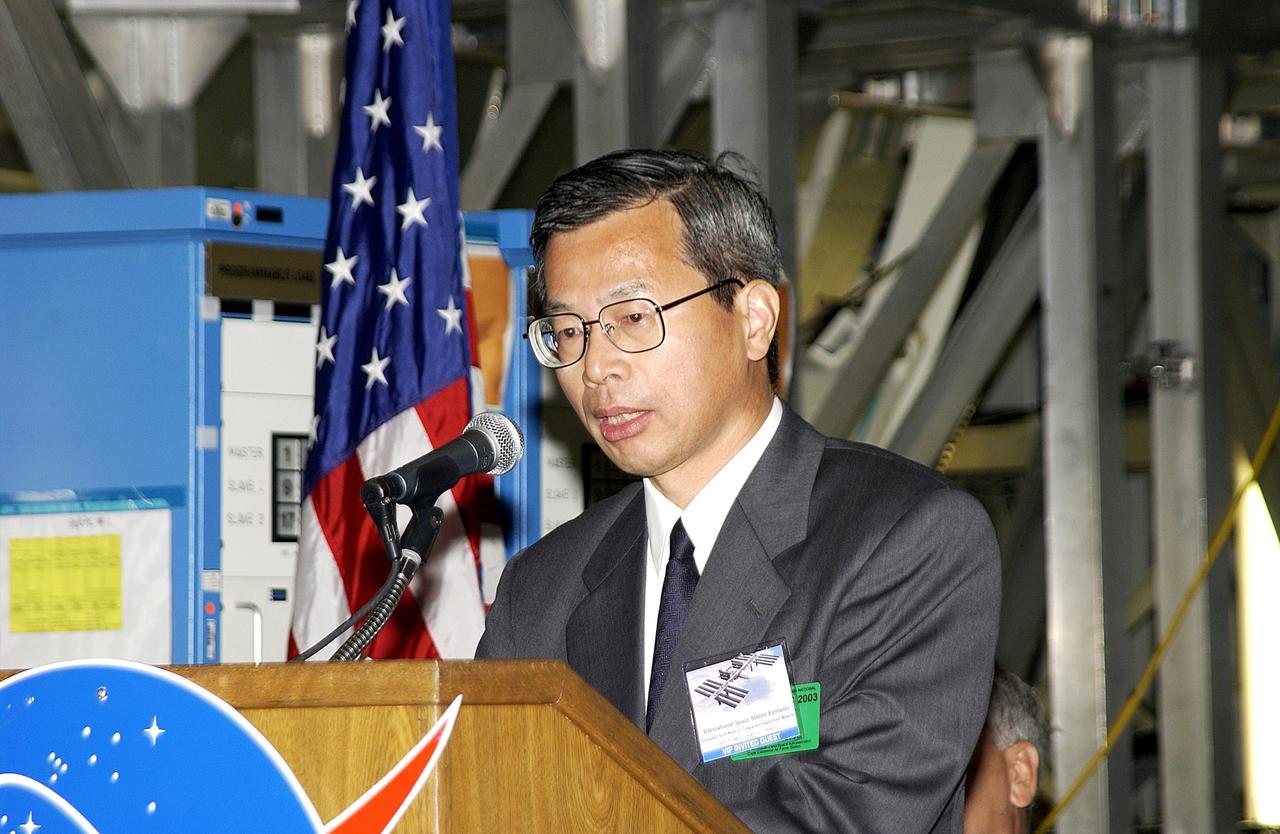
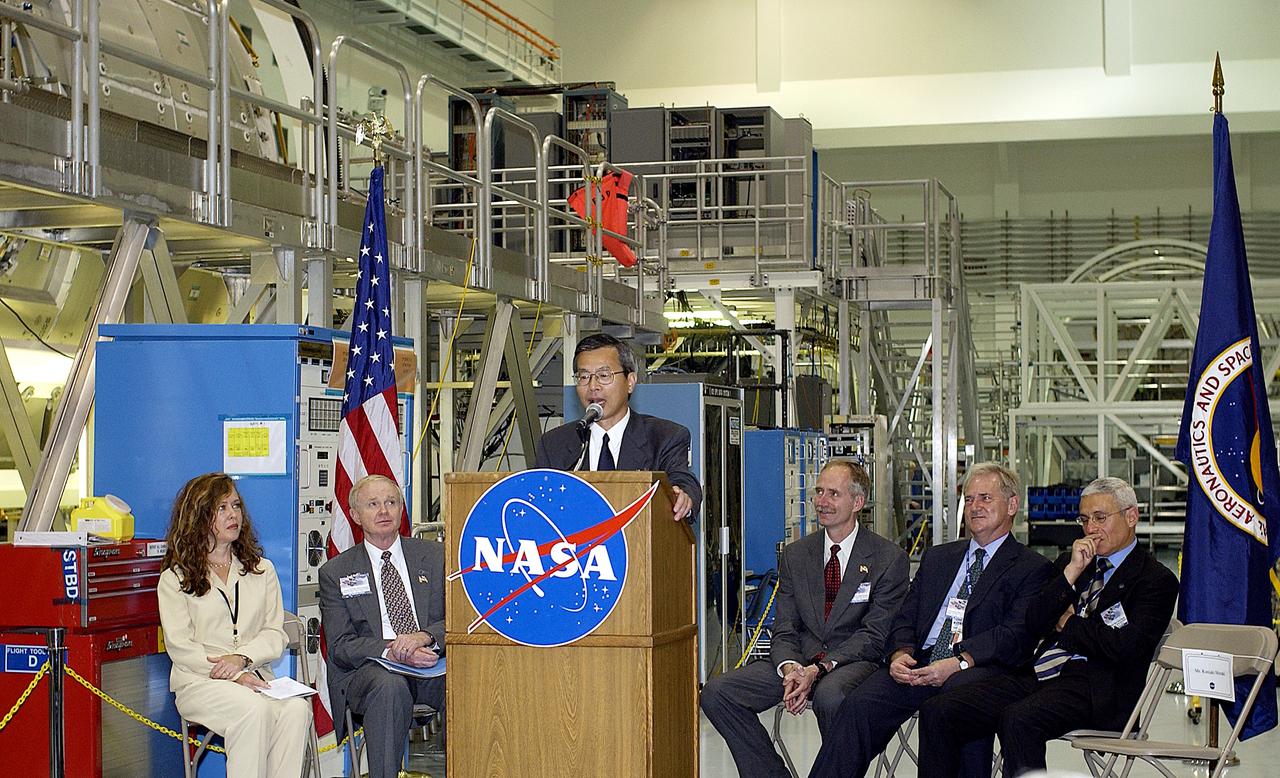
KENNEDY SPACE CENTER, FLA. -  Kuniaki Shiraki, JEM Project manager, National Aerospace and Development Agency of Japan,  speaks to guests and the media gathered in the Space Station Processing Facility at a ceremony highlighting the arrival of two major components of the International Space Station.  NASA's Node 2, built by the European Space Agency (ESA) in Italy, arrived at KSC on June 1. It will be the next pressurized module installed on the Station. The pressurized module of the Japanese Experiment Module (JEM), named "Kibo" (Hope), arrived at KSC on June 4. It is Japan's primary contribution to the Station. The ceremony held today included the official transfer of ownership signing of Node 2 between the ESA and NASA.. Emceed by Lisa Malone (far left), deputy director of External Relations and Business Development at KSC, the ceremony also included these speakers: Center Director Roy Bridges Jr. (second from left); NASA’s Michael C. Kostelnik, deputy associate administrator for International Space Station and Shuttle Programs and William Gerstenmaier, International Space Station Program manager; Alan Thirkettle, International Space Station Program manager for Node 2, ESA; and Andrea Lorenzoni, International Space Station Program manager for Node 2, Italian Space Agency.
KENNEDY SPACE CENTER, FLA. - Kuniaki Shiraki, JEM Project manager, National Aerospace and Development Agency of Japan, speaks to guests and the media gathered in the Space Station Processing Facility at a ceremony highlighting the arrival of two major components of the International Space Station. NASA's Node 2, built by the European Space Agency (ESA) in Italy, arrived at KSC on June 1. It will be the next pressurized module installed on the Station. The pressurized module of the Japanese Experiment Module (JEM), named "Kibo" (Hope), arrived at KSC on June 4. It is Japan's primary contribution to the Station. The ceremony held today included the official transfer of ownership signing of Node 2 between the ESA and NASA.. Emceed by Lisa Malone (far left), deputy director of External Relations and Business Development at KSC, the ceremony also included these speakers: Center Director Roy Bridges Jr. (second from left); NASA’s Michael C. Kostelnik, deputy associate administrator for International Space Station and Shuttle Programs and William Gerstenmaier, International Space Station Program manager; Alan Thirkettle, International Space Station Program manager for Node 2, ESA; and Andrea Lorenzoni, International Space Station Program manager for Node 2, Italian Space Agency.
KENNEDY SPACE CENTER, FLA. -   Lisa Malone, deputy director of External Relations and Business Development at KSC, emcees a ceremony in the Space Station Processing Facility to highlight the arrival of two major components of the International Space Station.  NASA's Node 2, built by the European Space Agency (ESA) in Italy arrived at KSC on June 1. It will be the next pressurized module installed on the Station. The pressurized module of the Japanese Experiment Module (JEM), named "Kibo" (Hope) arrived at KSC on June 4. It is Japan's primary contribution to the Station. The ceremony held today included the official transfer of ownership signing of Node 2 between the ESA and NASA..  Speakers at the ceremony included KSC Director Roy Bridges Jr.; NASA's Michael C. Kostelnik, deputy associate administrator for International Space Station and Shuttle Programs, and William Gerstenmaier, International Space Station Program manager; Alan Thirkettle, International Space Station Program manager for Node 2, ESA; Andrea Lorenzoni, International Space Station Program manager for Node 2, Italian Space Agency; Kuniaki Shiraki, JEM Project manager, National Aerospace and Development Agency of Japan.
KENNEDY SPACE CENTER, FLA. - Lisa Malone, deputy director of External Relations and Business Development at KSC, emcees a ceremony in the Space Station Processing Facility to highlight the arrival of two major components of the International Space Station. NASA's Node 2, built by the European Space Agency (ESA) in Italy arrived at KSC on June 1. It will be the next pressurized module installed on the Station. The pressurized module of the Japanese Experiment Module (JEM), named "Kibo" (Hope) arrived at KSC on June 4. It is Japan's primary contribution to the Station. The ceremony held today included the official transfer of ownership signing of Node 2 between the ESA and NASA.. Speakers at the ceremony included KSC Director Roy Bridges Jr.; NASA's Michael C. Kostelnik, deputy associate administrator for International Space Station and Shuttle Programs, and William Gerstenmaier, International Space Station Program manager; Alan Thirkettle, International Space Station Program manager for Node 2, ESA; Andrea Lorenzoni, International Space Station Program manager for Node 2, Italian Space Agency; Kuniaki Shiraki, JEM Project manager, National Aerospace and Development Agency of Japan.
KENNEDY SPACE CENTER, FLA. -  Center Director Roy Bridges Jr. speaks to the media and guests gathered in the Space Station Processing Facility for a ceremony to highlight the arrival of two major components of the International Space Station.  NASA's Node 2, built by the European Space Agency (ESA) in Italy arrived at KSC on June 1. It will be the next pressurized module installed on the Station. The pressurized module of the Japanese Experiment Module (JEM), named "Kibo" (Hope) arrived at KSC on June 4. It is Japan's primary contribution to the Station. The ceremony held today included the official transfer of ownership signing of Node 2 between the ESA and NASA.. Emceed by Lisa Malone (left),  deputy director of External Relations and Business Development at KSC, the ceremony also included these speakers: NASA's Michael C. Kostelnik, deputy associate administrator for International Space Station and Shuttle Programs, and William Gerstenmaier, International Space Station Program manager; Alan Thirkettle, International Space Station Program manager for Node 2, ESA; Andrea Lorenzoni, International Space Station Program manager for Node 2, Italian Space Agency; Kuniaki Shiraki, JEM Project manager, National Aerospace and Development Agency of Japan.
KENNEDY SPACE CENTER, FLA. - Center Director Roy Bridges Jr. speaks to the media and guests gathered in the Space Station Processing Facility for a ceremony to highlight the arrival of two major components of the International Space Station. NASA's Node 2, built by the European Space Agency (ESA) in Italy arrived at KSC on June 1. It will be the next pressurized module installed on the Station. The pressurized module of the Japanese Experiment Module (JEM), named "Kibo" (Hope) arrived at KSC on June 4. It is Japan's primary contribution to the Station. The ceremony held today included the official transfer of ownership signing of Node 2 between the ESA and NASA.. Emceed by Lisa Malone (left), deputy director of External Relations and Business Development at KSC, the ceremony also included these speakers: NASA's Michael C. Kostelnik, deputy associate administrator for International Space Station and Shuttle Programs, and William Gerstenmaier, International Space Station Program manager; Alan Thirkettle, International Space Station Program manager for Node 2, ESA; Andrea Lorenzoni, International Space Station Program manager for Node 2, Italian Space Agency; Kuniaki Shiraki, JEM Project manager, National Aerospace and Development Agency of Japan.
KENNEDY SPACE CENTER, FLA. -  Center Director Roy Bridges Jr. speaks to the media and guests gathered in the Space Station Processing Facility for a ceremony to highlight the arrival of two major components of the International Space Station.  NASA's Node 2, built by the European Space Agency (ESA) in Italy arrived at KSC on June 1. It will be the next pressurized module installed on the Station. The pressurized module of the Japanese Experiment Module (JEM), named "Kibo" (Hope) arrived at KSC on June 4. It is Japan's primary contribution to the Station. The ceremony held today included the official transfer of ownership signing of Node 2 between the ESA and NASA.. Emceed by Lisa Malone (left) ,  deputy director of External Relations and Business Development at KSC, the ceremony also included these speakers: NASA's Michael C. Kostelnik, deputy associate administrator for International Space Station and Shuttle Programs, and William Gerstenmaier, International Space Station Program manager; Alan Thirkettle, International Space Station Program manager for Node 2, ESA; Andrea Lorenzoni, International Space Station Program manager for Node 2, Italian Space Agency; Kuniaki Shiraki, JEM Project manager, National Aerospace and Development Agency of Japan.
KENNEDY SPACE CENTER, FLA. - Center Director Roy Bridges Jr. speaks to the media and guests gathered in the Space Station Processing Facility for a ceremony to highlight the arrival of two major components of the International Space Station. NASA's Node 2, built by the European Space Agency (ESA) in Italy arrived at KSC on June 1. It will be the next pressurized module installed on the Station. The pressurized module of the Japanese Experiment Module (JEM), named "Kibo" (Hope) arrived at KSC on June 4. It is Japan's primary contribution to the Station. The ceremony held today included the official transfer of ownership signing of Node 2 between the ESA and NASA.. Emceed by Lisa Malone (left) , deputy director of External Relations and Business Development at KSC, the ceremony also included these speakers: NASA's Michael C. Kostelnik, deputy associate administrator for International Space Station and Shuttle Programs, and William Gerstenmaier, International Space Station Program manager; Alan Thirkettle, International Space Station Program manager for Node 2, ESA; Andrea Lorenzoni, International Space Station Program manager for Node 2, Italian Space Agency; Kuniaki Shiraki, JEM Project manager, National Aerospace and Development Agency of Japan.
KENNEDY SPACE CENTER, FLA. -   NASA's Michael C. Kostelnik, deputy associate administrator for International Space Station and Shuttle Programs, speaks to guests and the media gathered in the Space Station Processing Facility for a ceremony to highlight the arrival of two major components of the International Space Station.  NASA's Node 2, built by the European Space Agency (ESA) in Italy arrived at KSC on June 1. It will be the next pressurized module installed on the Station. The pressurized module of the Japanese Experiment Module (JEM), named "Kibo" (Hope) arrived at KSC on June 4. It is Japan's primary contribution to the Station. The ceremony held today included the official transfer of ownership signing of Node 2 between the ESA and NASA.. Emceed by Lisa Malone (far left),  deputy director of External Relations and Business Development at KSC, the ceremony also included these speakers: Center Director Roy Bridges Jr. (second from left); William Gerstenmaier, International Space Station Program manager; Alan Thirkettle, International Space Station Program manager for Node 2, ESA; Andrea Lorenzoni, International Space Station Program manager for Node 2, Italian Space Agency; and Kuniaki Shiraki, JEM Project manager, National Aerospace and Development Agency of Japan.
KENNEDY SPACE CENTER, FLA. - NASA's Michael C. Kostelnik, deputy associate administrator for International Space Station and Shuttle Programs, speaks to guests and the media gathered in the Space Station Processing Facility for a ceremony to highlight the arrival of two major components of the International Space Station. NASA's Node 2, built by the European Space Agency (ESA) in Italy arrived at KSC on June 1. It will be the next pressurized module installed on the Station. The pressurized module of the Japanese Experiment Module (JEM), named "Kibo" (Hope) arrived at KSC on June 4. It is Japan's primary contribution to the Station. The ceremony held today included the official transfer of ownership signing of Node 2 between the ESA and NASA.. Emceed by Lisa Malone (far left), deputy director of External Relations and Business Development at KSC, the ceremony also included these speakers: Center Director Roy Bridges Jr. (second from left); William Gerstenmaier, International Space Station Program manager; Alan Thirkettle, International Space Station Program manager for Node 2, ESA; Andrea Lorenzoni, International Space Station Program manager for Node 2, Italian Space Agency; and Kuniaki Shiraki, JEM Project manager, National Aerospace and Development Agency of Japan.
KENNEDY SPACE CENTER, FLA. - Kuniaki Shiraki, JEM Project manager, National Aerospace and Development Agency of Japan,  speaks to guests and the media gathered in the Space Station Processing Facility at a ceremony highlighting the arrival of two major components of the International Space Station.  NASA's Node 2, built by the European Space Agency (ESA) in Italy, arrived at KSC on June 1. It will be the next pressurized module installed on the Station. The pressurized module (above right)  of the Japanese Experiment Module (JEM),  named "Kibo" (Hope), arrived at KSC on June 4. It is Japan's primary contribution to the Station. The ceremony held today included the official transfer of ownership signing of Node 2 between the ESA and NASA.. Emceed by Lisa Malone (far left), deputy director of External Relations and Business Development at KSC, the ceremony also included these speakers: Center Director Roy Bridges Jr. (second from left); NASA’s Michael C. Kostelnik, deputy associate administrator for International Space Station and Shuttle Programs and William Gerstenmaier, International Space Station Program manager ; Alan Thirkettle, International Space Station Program manager for Node 2, ESA; and Andrea Lorenzoni, International Space Station Program manager for Node 2, Italian Space Agency.
KENNEDY SPACE CENTER, FLA. - Kuniaki Shiraki, JEM Project manager, National Aerospace and Development Agency of Japan, speaks to guests and the media gathered in the Space Station Processing Facility at a ceremony highlighting the arrival of two major components of the International Space Station. NASA's Node 2, built by the European Space Agency (ESA) in Italy, arrived at KSC on June 1. It will be the next pressurized module installed on the Station. The pressurized module (above right) of the Japanese Experiment Module (JEM), named "Kibo" (Hope), arrived at KSC on June 4. It is Japan's primary contribution to the Station. The ceremony held today included the official transfer of ownership signing of Node 2 between the ESA and NASA.. Emceed by Lisa Malone (far left), deputy director of External Relations and Business Development at KSC, the ceremony also included these speakers: Center Director Roy Bridges Jr. (second from left); NASA’s Michael C. Kostelnik, deputy associate administrator for International Space Station and Shuttle Programs and William Gerstenmaier, International Space Station Program manager ; Alan Thirkettle, International Space Station Program manager for Node 2, ESA; and Andrea Lorenzoni, International Space Station Program manager for Node 2, Italian Space Agency.
KENNEDY SPACE CENTER, FLA. -  Kuniaki Shiraki, JEM Project manager, National Aerospace and Development Agency of Japan,  speaks to guests and the media gathered in the Space Station Processing Facility at a ceremony highlighting the arrival of two major components of the International Space Station.  NASA's Node 2, built by the European Space Agency (ESA) in Italy, arrived at KSC on June 1. It will be the next pressurized module installed on the Station. The pressurized module of the Japanese Experiment Module (JEM), named "Kibo" (Hope), arrived at KSC on June 4. It is Japan's primary contribution to the Station. The ceremony held today included the official transfer of ownership signing of Node 2 between the ESA and NASA.. Emceed by Lisa Malone, deputy director of External Relations and Business Development at KSC, the ceremony also included these speakers: Center Director Roy Bridges Jr.; NASA’s Michael C. Kostelnik, deputy associate administrator for International Space Station and Shuttle Programs and William Gerstenmaier, International Space Station Program manager ; Alan Thirkettle, International Space Station Program manager for Node 2, ESA; and Andrea Lorenzoni, International Space Station Program manager for Node 2, Italian Space Agency.
KENNEDY SPACE CENTER, FLA. - Kuniaki Shiraki, JEM Project manager, National Aerospace and Development Agency of Japan, speaks to guests and the media gathered in the Space Station Processing Facility at a ceremony highlighting the arrival of two major components of the International Space Station. NASA's Node 2, built by the European Space Agency (ESA) in Italy, arrived at KSC on June 1. It will be the next pressurized module installed on the Station. The pressurized module of the Japanese Experiment Module (JEM), named "Kibo" (Hope), arrived at KSC on June 4. It is Japan's primary contribution to the Station. The ceremony held today included the official transfer of ownership signing of Node 2 between the ESA and NASA.. Emceed by Lisa Malone, deputy director of External Relations and Business Development at KSC, the ceremony also included these speakers: Center Director Roy Bridges Jr.; NASA’s Michael C. Kostelnik, deputy associate administrator for International Space Station and Shuttle Programs and William Gerstenmaier, International Space Station Program manager ; Alan Thirkettle, International Space Station Program manager for Node 2, ESA; and Andrea Lorenzoni, International Space Station Program manager for Node 2, Italian Space Agency.
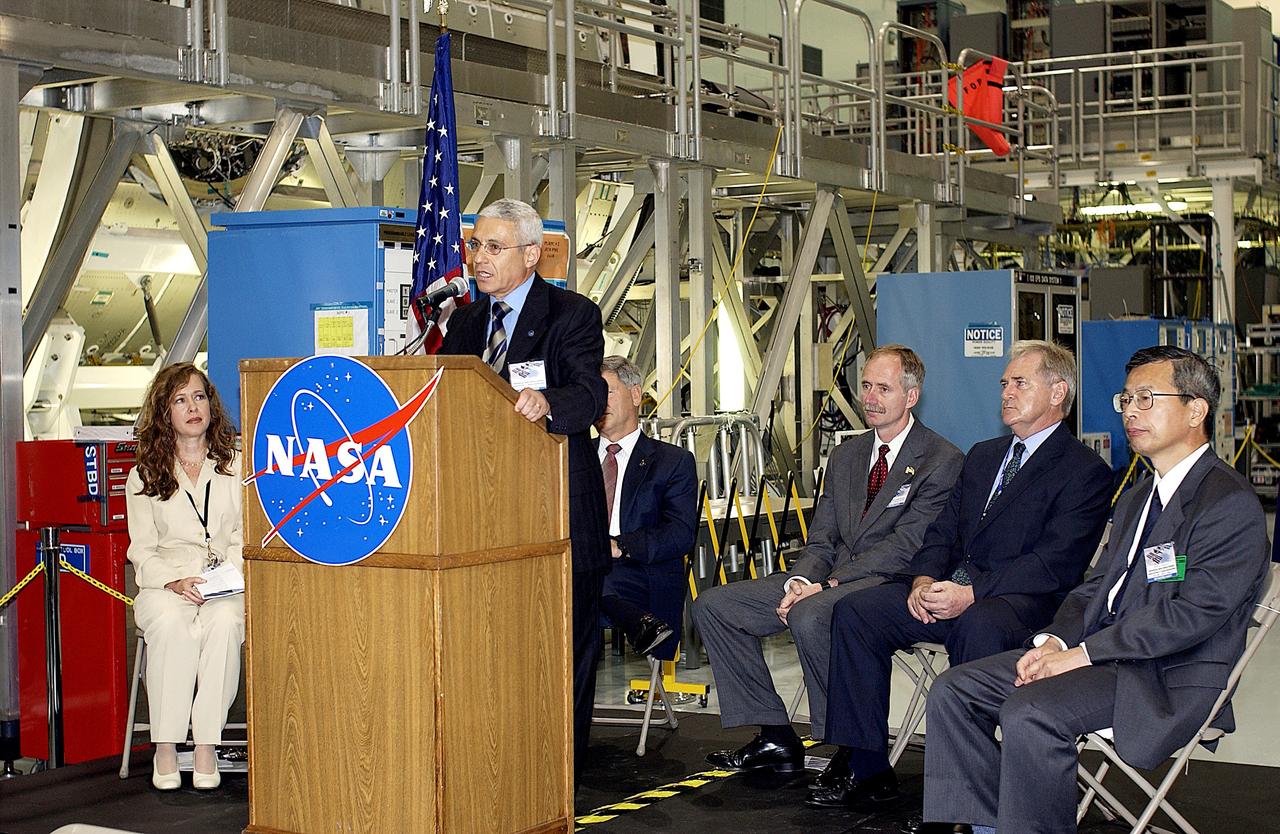
KENNEDY SPACE CENTER, FLA. -   Alan Thirkettle, International Space Station Program manager for Node 2, European Space Agency (ESA), speaks to guests and the media gathered in the Space Station Processing Facility at a ceremony highlighting the arrival of two major components of the International Space Station.  NASA's Node 2, built by ESA in Italy, arrived at KSC on June 1. It will be the next pressurized module installed on the Station. The pressurized module of the Japanese Experiment Module (JEM), named "Kibo" (Hope), arrived at KSC on June 4. It is Japan's primary contribution to the Station. The ceremony held today included the official transfer of ownership signing of Node 2 between the ESA and NASA.. Emceed by Lisa Malone, deputy director of External Relations and Business Development at KSC, the ceremony also included these speakers: Center Director Roy Bridges Jr.; NASA’s Michael C. Kostelnik, deputy associate administrator for International Space Station and Shuttle Programs and William Gerstenmaier, International Space Station Program manager; Andrea Lorenzoni, International Space Station Program manager for Node 2, Italian Space Agency; and Kuniaki Shiraki, JEM Project manager, National Aerospace and Development Agency of Japan.
KENNEDY SPACE CENTER, FLA. - Alan Thirkettle, International Space Station Program manager for Node 2, European Space Agency (ESA), speaks to guests and the media gathered in the Space Station Processing Facility at a ceremony highlighting the arrival of two major components of the International Space Station. NASA's Node 2, built by ESA in Italy, arrived at KSC on June 1. It will be the next pressurized module installed on the Station. The pressurized module of the Japanese Experiment Module (JEM), named "Kibo" (Hope), arrived at KSC on June 4. It is Japan's primary contribution to the Station. The ceremony held today included the official transfer of ownership signing of Node 2 between the ESA and NASA.. Emceed by Lisa Malone, deputy director of External Relations and Business Development at KSC, the ceremony also included these speakers: Center Director Roy Bridges Jr.; NASA’s Michael C. Kostelnik, deputy associate administrator for International Space Station and Shuttle Programs and William Gerstenmaier, International Space Station Program manager; Andrea Lorenzoni, International Space Station Program manager for Node 2, Italian Space Agency; and Kuniaki Shiraki, JEM Project manager, National Aerospace and Development Agency of Japan.
KENNEDY SPACE CENTER, FLA. -  Andrea Lorenzoni, International Space Station Program manager for Node 2, Italian Space Agency, speaks to guests and the media gathered in the Space Station Processing Facility at a ceremony highlighting the arrival of two major components of the International Space Station.  NASA's Node 2, built by the European Space Agency (ESA) in Italy, arrived at KSC on June 1. It will be the next pressurized module installed on the Station. The pressurized module of the Japanese Experiment Module (JEM), named "Kibo" (Hope), arrived at KSC on June 4. It is Japan's primary contribution to the Station. The ceremony held today included the official transfer of ownership signing of Node 2 between the ESA and NASA.. Emceed by Lisa Malone, deputy director of External Relations and Business Development at KSC, the ceremony also included these speakers: Center Director Roy Bridges Jr.; NASA’s Michael C. Kostelnik, deputy associate administrator for International Space Station and Shuttle Programs and William Gerstenmaier, International Space Station Program manager; Alan Thirkettle, International Space Station Program manager for Node 2, ESA; and Kuniaki Shiraki, JEM Project manager, National Aerospace and Development Agency of Japan.
KENNEDY SPACE CENTER, FLA. - Andrea Lorenzoni, International Space Station Program manager for Node 2, Italian Space Agency, speaks to guests and the media gathered in the Space Station Processing Facility at a ceremony highlighting the arrival of two major components of the International Space Station. NASA's Node 2, built by the European Space Agency (ESA) in Italy, arrived at KSC on June 1. It will be the next pressurized module installed on the Station. The pressurized module of the Japanese Experiment Module (JEM), named "Kibo" (Hope), arrived at KSC on June 4. It is Japan's primary contribution to the Station. The ceremony held today included the official transfer of ownership signing of Node 2 between the ESA and NASA.. Emceed by Lisa Malone, deputy director of External Relations and Business Development at KSC, the ceremony also included these speakers: Center Director Roy Bridges Jr.; NASA’s Michael C. Kostelnik, deputy associate administrator for International Space Station and Shuttle Programs and William Gerstenmaier, International Space Station Program manager; Alan Thirkettle, International Space Station Program manager for Node 2, ESA; and Kuniaki Shiraki, JEM Project manager, National Aerospace and Development Agency of Japan.
KENNEDY SPACE CENTER, FLA. -  Center Director Roy Bridges Jr. speaks to the media and guests gathered in the Space Station Processing Facility for a ceremony to highlight the arrival of two major components of the International Space Station.  NASA's Node 2, built by the European Space Agency (ESA) in Italy arrived at KSC on June 1. It will be the next pressurized module installed on the Station. The pressurized module of the Japanese Experiment Module (JEM), named "Kibo" (Hope) arrived at KSC on June 4. It is Japan's primary contribution to the Station. The ceremony held today included the official transfer of ownership signing of Node 2 between the ESA and NASA.. Emceed by Lisa Malone (far left),  deputy director of External Relations and Business Development at KSC, the ceremony also included these speakers: NASA's Michael C. Kostelnik, deputy associate administrator for International Space Station and Shuttle Programs, and William Gerstenmaier, International Space Station Program manager; Alan Thirkettle, International Space Station Program manager for Node 2, ESA; Andrea Lorenzoni, International Space Station Program manager for Node 2, Italian Space Agency; Kuniaki Shiraki, JEM Project manager, National Aerospace and Development Agency of Japan.
KENNEDY SPACE CENTER, FLA. - Center Director Roy Bridges Jr. speaks to the media and guests gathered in the Space Station Processing Facility for a ceremony to highlight the arrival of two major components of the International Space Station. NASA's Node 2, built by the European Space Agency (ESA) in Italy arrived at KSC on June 1. It will be the next pressurized module installed on the Station. The pressurized module of the Japanese Experiment Module (JEM), named "Kibo" (Hope) arrived at KSC on June 4. It is Japan's primary contribution to the Station. The ceremony held today included the official transfer of ownership signing of Node 2 between the ESA and NASA.. Emceed by Lisa Malone (far left), deputy director of External Relations and Business Development at KSC, the ceremony also included these speakers: NASA's Michael C. Kostelnik, deputy associate administrator for International Space Station and Shuttle Programs, and William Gerstenmaier, International Space Station Program manager; Alan Thirkettle, International Space Station Program manager for Node 2, ESA; Andrea Lorenzoni, International Space Station Program manager for Node 2, Italian Space Agency; Kuniaki Shiraki, JEM Project manager, National Aerospace and Development Agency of Japan.
KENNEDY SPACE CENTER, FLA. -   Andrea Lorenzoni, International Space Station Program manager for Node 2, Italian Space Agency, speaks to guests and the media gathered in the Space Station Processing Facility at a ceremony highlighting the arrival of two major components of the International Space Station.  NASA's Node 2, built by the European Space Agency (ESA) in Italy, arrived at KSC on June 1. It will be the next pressurized module installed on the Station. The pressurized module of the Japanese Experiment Module (JEM), named "Kibo" (Hope), arrived at KSC on June 4. It is Japan's primary contribution to the Station. The ceremony held today included the official transfer of ownership signing of Node 2 between the ESA and NASA.. Emceed by Lisa Malone (far left), deputy director of External Relations and Business Development at KSC, the ceremony also included these speakers: Center Director Roy Bridges Jr.; NASA’s Michael C. Kostelnik, deputy associate administrator for International Space Station and Shuttle Programs, and William Gerstenmaier, International Space Station Program manager ; Alan Thirkettle, International Space Station Program manager for Node 2, ESA; and Kuniaki Shiraki, JEM Project manager, National Aerospace and Development Agency of Japan.
KENNEDY SPACE CENTER, FLA. - Andrea Lorenzoni, International Space Station Program manager for Node 2, Italian Space Agency, speaks to guests and the media gathered in the Space Station Processing Facility at a ceremony highlighting the arrival of two major components of the International Space Station. NASA's Node 2, built by the European Space Agency (ESA) in Italy, arrived at KSC on June 1. It will be the next pressurized module installed on the Station. The pressurized module of the Japanese Experiment Module (JEM), named "Kibo" (Hope), arrived at KSC on June 4. It is Japan's primary contribution to the Station. The ceremony held today included the official transfer of ownership signing of Node 2 between the ESA and NASA.. Emceed by Lisa Malone (far left), deputy director of External Relations and Business Development at KSC, the ceremony also included these speakers: Center Director Roy Bridges Jr.; NASA’s Michael C. Kostelnik, deputy associate administrator for International Space Station and Shuttle Programs, and William Gerstenmaier, International Space Station Program manager ; Alan Thirkettle, International Space Station Program manager for Node 2, ESA; and Kuniaki Shiraki, JEM Project manager, National Aerospace and Development Agency of Japan.
KENNEDY SPACE CENTER, FLA. -   NASA’s Michael C. Kostelnik, deputy associate administrator for International Space Station and Shuttle Programs, speaks to guests and the media gathered in the Space Station Processing Facility for a ceremony to highlight the arrival of two major components of the International Space Station.  NASA's Node 2, built by the European Space Agency (ESA) in Italy arrived at KSC on June 1. It will be the next pressurized module installed on the Station. The pressurized module of the Japanese Experiment Module (JEM), named "Kibo" (Hope) arrived at KSC on June 4. It is Japan's primary contribution to the Station. The ceremony held today included the official transfer of ownership signing of Node 2 between the ESA and NASA.. Emceed by Lisa Malone, deputy director of External Relations and Business Development at KSC, the ceremony also included these speakers: Center Director Roy Bridges Jr.; William Gerstenmaier, International Space Station Program manager; Alan Thirkettle, International Space Station Program manager for Node 2, ESA; Andrea Lorenzoni, International Space Station Program manager for Node 2, Italian Space Agency; and Kuniaki Shiraki, JEM Project manager, National Aerospace and Development Agency of Japan.
KENNEDY SPACE CENTER, FLA. - NASA’s Michael C. Kostelnik, deputy associate administrator for International Space Station and Shuttle Programs, speaks to guests and the media gathered in the Space Station Processing Facility for a ceremony to highlight the arrival of two major components of the International Space Station. NASA's Node 2, built by the European Space Agency (ESA) in Italy arrived at KSC on June 1. It will be the next pressurized module installed on the Station. The pressurized module of the Japanese Experiment Module (JEM), named "Kibo" (Hope) arrived at KSC on June 4. It is Japan's primary contribution to the Station. The ceremony held today included the official transfer of ownership signing of Node 2 between the ESA and NASA.. Emceed by Lisa Malone, deputy director of External Relations and Business Development at KSC, the ceremony also included these speakers: Center Director Roy Bridges Jr.; William Gerstenmaier, International Space Station Program manager; Alan Thirkettle, International Space Station Program manager for Node 2, ESA; Andrea Lorenzoni, International Space Station Program manager for Node 2, Italian Space Agency; and Kuniaki Shiraki, JEM Project manager, National Aerospace and Development Agency of Japan.
KENNEDY SPACE CENTER, FLA. -   Alan Thirkettle, International Space Station Program manager for Node 2, European Space Agency (ESA), speaks to guests and the media gathered in the Space Station Processing Facility at a ceremony highlighting the arrival of two major components of the International Space Station.  NASA's Node 2, built by the European Space Agency (ESA) in Italy, arrived at KSC on June 1. It will be the next pressurized module installed on the Station. The pressurized module of the Japanese Experiment Module (JEM), named "Kibo" (Hope), arrived at KSC on June 4. It is Japan's primary contribution to the Station. The ceremony held today included the official transfer of ownership signing of Node 2 between the ESA and NASA.. Emceed by Lisa Malone, deputy director of External Relations and Business Development at KSC, the ceremony also included these speakers: Center Director Roy Bridges Jr.; NASA’s Michael C. Kostelnik, deputy associate administrator for International Space Station and Shuttle Programs and William Gerstenmaier, International Space Station Program manager; Andrea Lorenzoni, International Space Station Program manager for Node 2, Italian Space Agency; and Kuniaki Shiraki, JEM Project manager, National Aerospace and Development Agency of Japan.
KENNEDY SPACE CENTER, FLA. - Alan Thirkettle, International Space Station Program manager for Node 2, European Space Agency (ESA), speaks to guests and the media gathered in the Space Station Processing Facility at a ceremony highlighting the arrival of two major components of the International Space Station. NASA's Node 2, built by the European Space Agency (ESA) in Italy, arrived at KSC on June 1. It will be the next pressurized module installed on the Station. The pressurized module of the Japanese Experiment Module (JEM), named "Kibo" (Hope), arrived at KSC on June 4. It is Japan's primary contribution to the Station. The ceremony held today included the official transfer of ownership signing of Node 2 between the ESA and NASA.. Emceed by Lisa Malone, deputy director of External Relations and Business Development at KSC, the ceremony also included these speakers: Center Director Roy Bridges Jr.; NASA’s Michael C. Kostelnik, deputy associate administrator for International Space Station and Shuttle Programs and William Gerstenmaier, International Space Station Program manager; Andrea Lorenzoni, International Space Station Program manager for Node 2, Italian Space Agency; and Kuniaki Shiraki, JEM Project manager, National Aerospace and Development Agency of Japan.
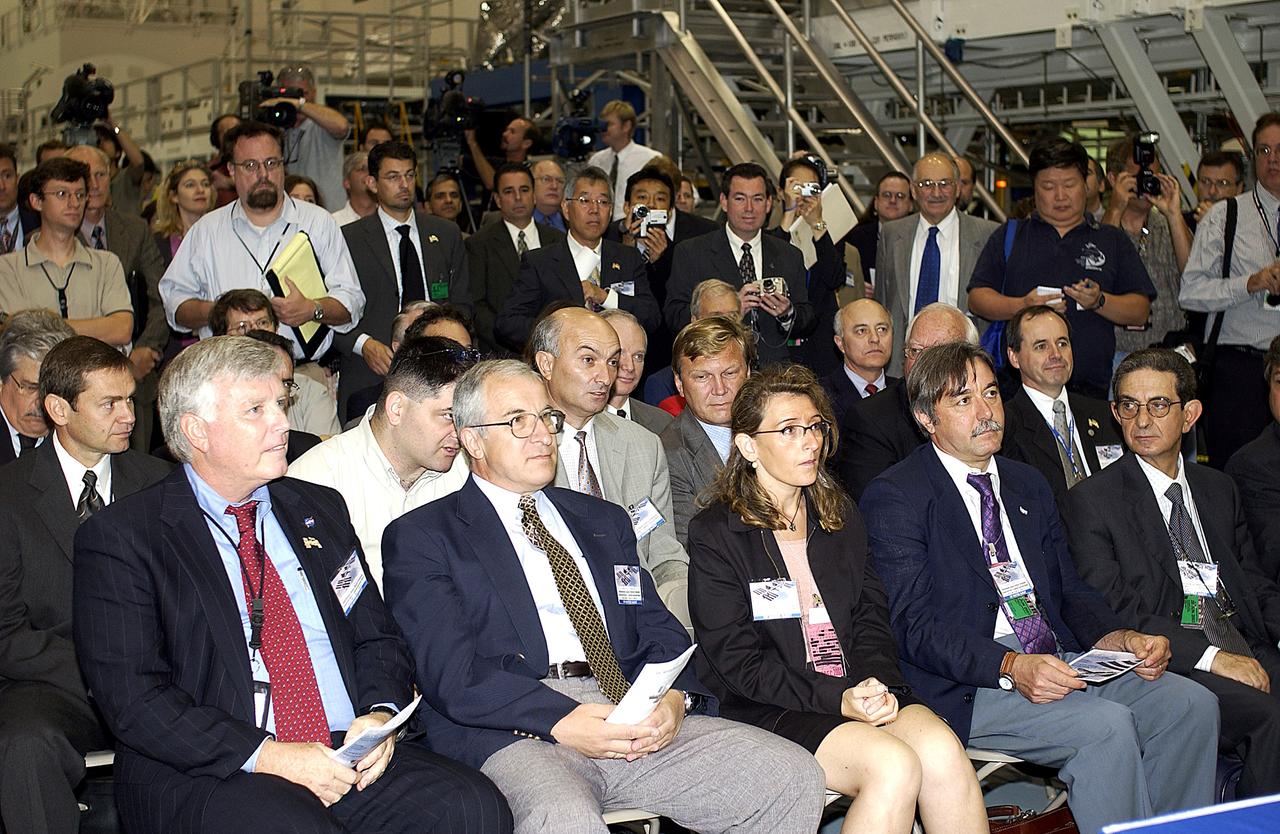
KENNEDY SPACE CENTER, FLA. -  In the Space Station Processing Facility, media and guests listen intently to remarks during a ceremony to highlight the arrival of two major components of the International Space Station.  NASA's Node 2, built by the European Space Agency (ESA) in Italy arrived at KSC on June 1. It will be the next pressurized module installed on the Station. The pressurized module of the Japanese Experiment Module (JEM), named "Kibo" (Hope) arrived at KSC on June 4. It is Japan's primary contribution to the Station. The ceremony held today included the official transfer of ownership signing of Node 2 between the ESA and NASA.. Emceed by Lisa Malone,  deputy director of External Relations and Business Development at KSC, the ceremony included these speakers: KSC Director Roy Bridges Jr.; NASA's Michael C. Kostelnik, deputy associate administrator for International Space Station and Shuttle Programs, and William Gerstenmaier, International Space Station Program manager; Alan Thirkettle, International Space Station Program manager for Node 2, ESA; Andrea Lorenzoni, International Space Station Program manager for Node 2, Italian Space Agency; Kuniaki Shiraki, JEM Project manager, National Aerospace and Development Agency of Japan.
KENNEDY SPACE CENTER, FLA. - In the Space Station Processing Facility, media and guests listen intently to remarks during a ceremony to highlight the arrival of two major components of the International Space Station. NASA's Node 2, built by the European Space Agency (ESA) in Italy arrived at KSC on June 1. It will be the next pressurized module installed on the Station. The pressurized module of the Japanese Experiment Module (JEM), named "Kibo" (Hope) arrived at KSC on June 4. It is Japan's primary contribution to the Station. The ceremony held today included the official transfer of ownership signing of Node 2 between the ESA and NASA.. Emceed by Lisa Malone, deputy director of External Relations and Business Development at KSC, the ceremony included these speakers: KSC Director Roy Bridges Jr.; NASA's Michael C. Kostelnik, deputy associate administrator for International Space Station and Shuttle Programs, and William Gerstenmaier, International Space Station Program manager; Alan Thirkettle, International Space Station Program manager for Node 2, ESA; Andrea Lorenzoni, International Space Station Program manager for Node 2, Italian Space Agency; Kuniaki Shiraki, JEM Project manager, National Aerospace and Development Agency of Japan.
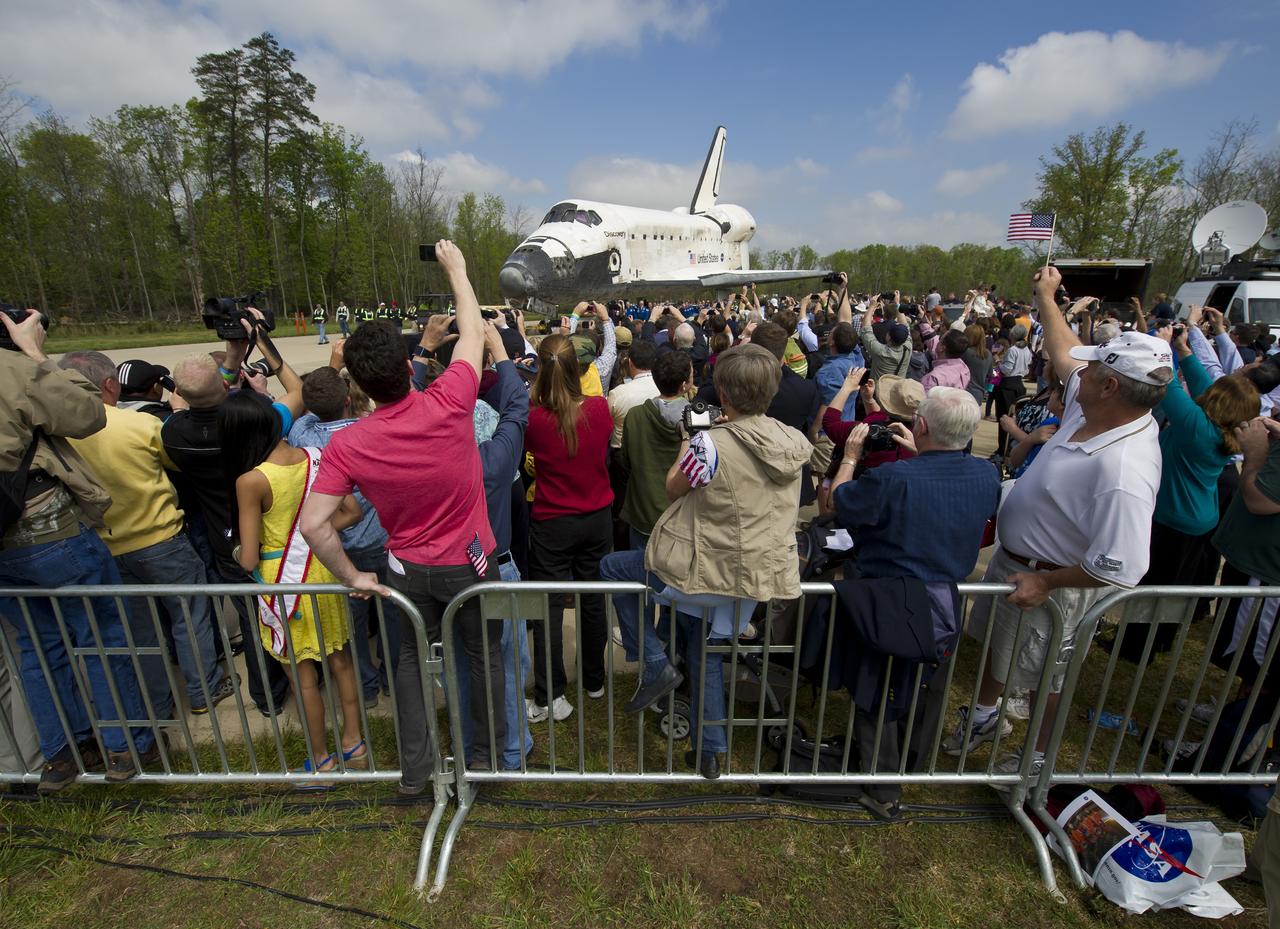
Space shuttle Discovery is rolled toward the transfer ceremony at the Steven F. Udvar-Hazy Center Thursday, April 19, 2012 in Chantilly, Va.  Discovery will be permanently housed at the Udvar-Hazy Center, part of the Smithsonian Institution’s Air and Space Museum. Discovery, the first orbiter retired from NASA’s shuttle fleet, completed 39 missions, spent 365 days in space, orbited the Earth 5,830 times, and traveled 148,221,675 miles. NASA will transfer Discovery to the National Air and Space Museum to begin its new mission to commemorate past achievements in space and to educate and inspire future generations of explorers. Photo Credit: (NASA/Carla Cioffi)
Shuttle Discovery Arrives at Udvar-Hazy
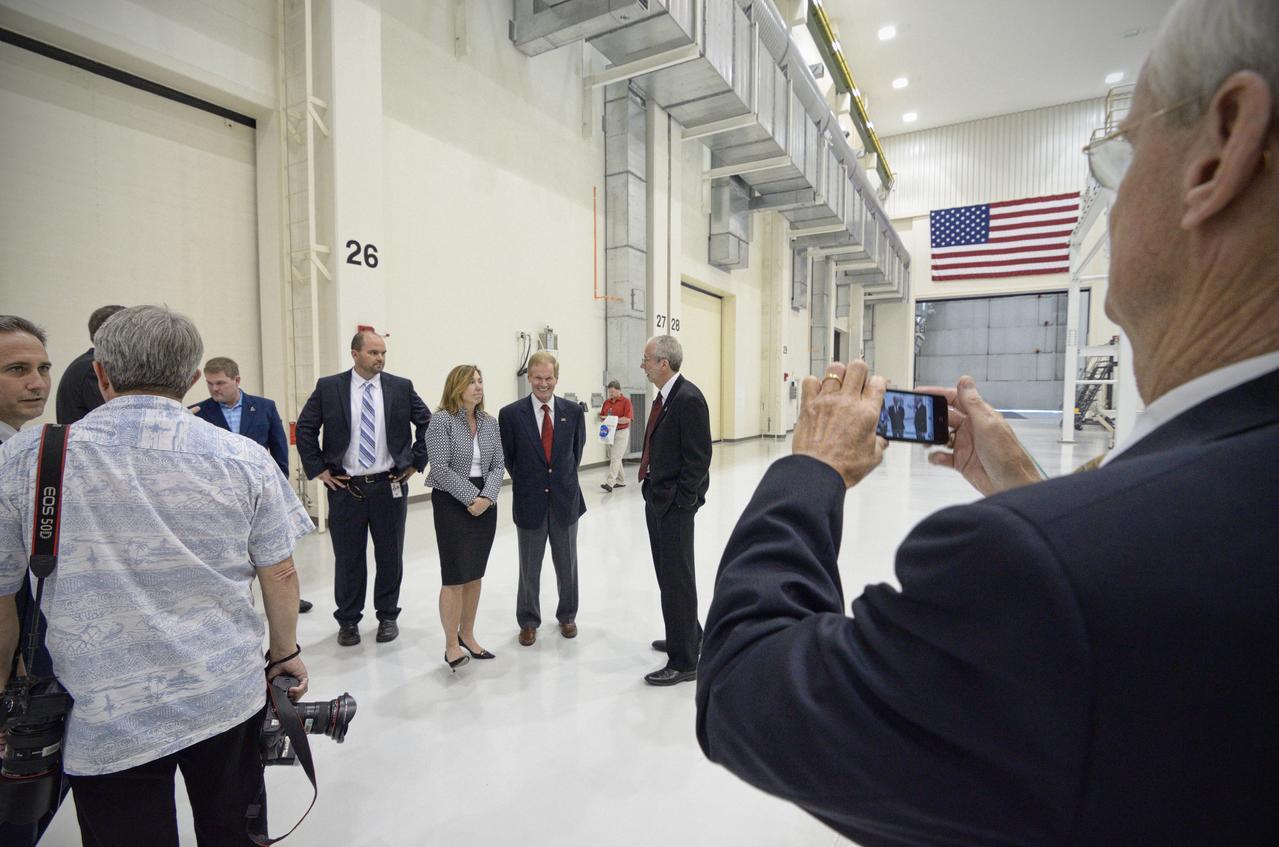
The Orion crew module pressure vessel for Exploration Flight Test-1 (EFT-1) is unveiled at a ceremony at the Operations and Checkout (O&C) Building at NASA’s Kennedy Space Center in Florida on July 2, 2012. Orion Program Manager Mark Geyer is visible talking to others. Part of Batch image transfer from Flickr.
DSC_5911
The Orion crew module pressure vessel for Exploration Flight Test-1 (EFT-1) is unveiled at a ceremony at the Operations and Checkout (O&C) Building at NASA’s Kennedy Space Center in Florida on July 2, 2012. Orion Program Manager Mark Geyer is visible talking to others. Part of Batch image transfer from Flickr.
DSC_6007
The Orion crew module pressure vessel for Exploration Flight Test-1 (EFT-1) is unveiled at a ceremony at the Operations and Checkout (O&C) Building at NASA’s Kennedy Space Center in Florida on July 2, 2012. Orion Program Manager Mark Geyer is visible talking to others. Part of Batch image transfer from Flickr.
DSC_5966
The Orion crew module pressure vessel for Exploration Flight Test-1 (EFT-1) is unveiled at a ceremony at the Operations and Checkout (O&C) Building at NASA’s Kennedy Space Center in Florida on July 2, 2012. Orion Program Manager Mark Geyer is visible talking to others. Part of Batch image transfer from Flickr.
DSC_5903
The Orion crew module pressure vessel for Exploration Flight Test-1 (EFT-1) is unveiled at a ceremony at the Operations and Checkout (O&C) Building at NASA’s Kennedy Space Center in Florida on July 2, 2012. Orion Program Manager Mark Geyer is visible talking to others. Part of Batch image transfer from Flickr.
DSC_5941
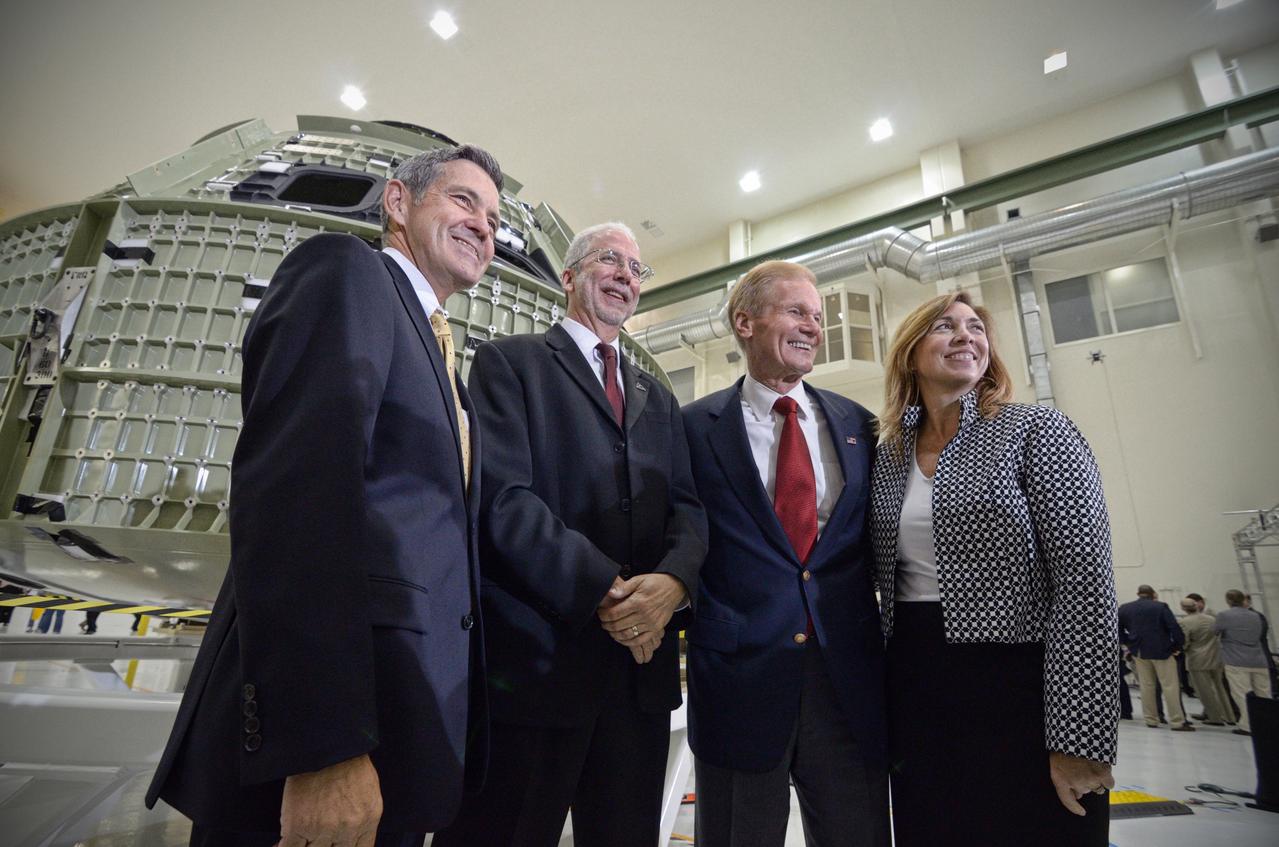
The Orion crew module pressure vessel for Exploration Flight Test-1 (EFT-1) is unveiled at a ceremony at the Operations and Checkout (O&C) Building at NASA’s Kennedy Space Center in Florida on July 2, 2012. Orion Program Manager Mark Geyer and KSC Center Director Robert Cabana pose for photo. Part of Batch image transfer from Flickr.
DSC_5875
The Orion crew module pressure vessel for Exploration Flight Test-1 (EFT-1) is unveiled at a ceremony at the Operations and Checkout (O&C) Building at NASA’s Kennedy Space Center in Florida on July 2, 2012. Orion Program Manager Mark Geyer is visible talking to others. Part of Batch image transfer from Flickr.
DSC_5925
The Orion crew module pressure vessel for Exploration Flight Test-1 (EFT-1) is unveiled at a ceremony at the Operations and Checkout (O&C) Building at NASA’s Kennedy Space Center in Florida on July 2, 2012. Orion Program Manager Mark Geyer is visible talking to others. Part of Batch image transfer from Flickr.
DSC_5895
KENNEDY SPACE CENTER, FLA. - Andrea Lorenzoni, International Space Station Program manager for Node 2, Italian Space Agency; Alan Thirkettle, International Space Station Program manager for Node 2, European Space Agency (ESA); and NASA’s Michael C. Kostelnik, deputy associate administrator for International Space Station and Shuttle Programs, sign documents officially transferring ownership of Node 2 between the ESA and NASA. The signing was part of a  ceremony highlighting the arrival of two major components of the International Space Station.  NASA's Node 2, built by the European Space Agency (ESA) in Italy, arrived at KSC on June 1. It will be the next pressurized module installed on the Station. The pressurized module (above right) of the Japanese Experiment Module (JEM),  named "Kibo" (Hope), arrived at KSC on June 4. It is Japan's primary contribution to the Station. Emceed by Lisa Malone (far left), deputy director of External Relations and Business Development at KSC, the ceremony also included these speakers: Center Director Roy Bridges Jr.; NASA’s William Gerstenmaier, International Space Station Program manager; and Kuniaki Shiraki, JEM Project manager, National Aerospace and Development Agency of Japan.
KENNEDY SPACE CENTER, FLA. - Andrea Lorenzoni, International Space Station Program manager for Node 2, Italian Space Agency; Alan Thirkettle, International Space Station Program manager for Node 2, European Space Agency (ESA); and NASA’s Michael C. Kostelnik, deputy associate administrator for International Space Station and Shuttle Programs, sign documents officially transferring ownership of Node 2 between the ESA and NASA. The signing was part of a ceremony highlighting the arrival of two major components of the International Space Station. NASA's Node 2, built by the European Space Agency (ESA) in Italy, arrived at KSC on June 1. It will be the next pressurized module installed on the Station. The pressurized module (above right) of the Japanese Experiment Module (JEM), named "Kibo" (Hope), arrived at KSC on June 4. It is Japan's primary contribution to the Station. Emceed by Lisa Malone (far left), deputy director of External Relations and Business Development at KSC, the ceremony also included these speakers: Center Director Roy Bridges Jr.; NASA’s William Gerstenmaier, International Space Station Program manager; and Kuniaki Shiraki, JEM Project manager, National Aerospace and Development Agency of Japan.
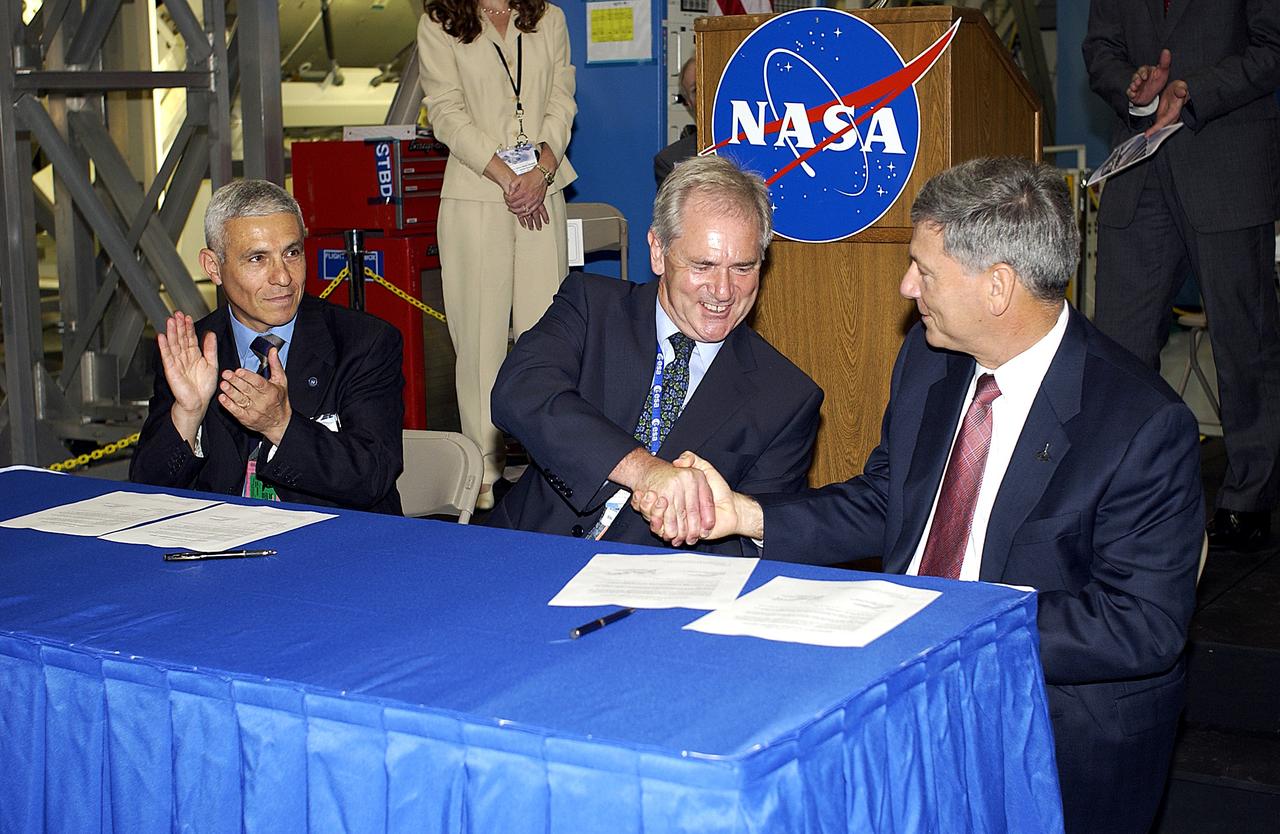
KENNEDY SPACE CENTER, FLA. - At ceremony highlighting the arrival of two major components of the International Space Station, Node 2 and the Japanese Experiment Module (JEM), ownership of Node 2 was officially transferred between the European Space Agency and NASA.  Shaking hands after the signing are Andrea Lorenzoni, International Space Station Program manager for Node 2, Italian Space Agency; and Alan Thirkettle, International Space Station Program manager for Node 2, European Space Agency (ESA).  At right is NASA’s Michael C. Kostelnik, deputy associate administrator for International Space Station and Shuttle Programs.  NASA's Node 2, built by ESA in Italy, arrived at KSC on June 1. It will be the next pressurized module installed on the Station. The pressurized module of the Japanese Experiment Module (JEM),  named "Kibo" (Hope), arrived at KSC on June 4. It is Japan's primary contribution to the Station. Emceed by Lisa Malone, deputy director of External Relations and Business Development at KSC, the ceremony also included these speakers: Center Director Roy Bridges Jr.; NASA’s William Gerstenmaier, International Space Station Program manager; and Kuniaki Shiraki, JEM Project manager, National Aerospace and Development Agency of Japan.
KENNEDY SPACE CENTER, FLA. - At ceremony highlighting the arrival of two major components of the International Space Station, Node 2 and the Japanese Experiment Module (JEM), ownership of Node 2 was officially transferred between the European Space Agency and NASA. Shaking hands after the signing are Andrea Lorenzoni, International Space Station Program manager for Node 2, Italian Space Agency; and Alan Thirkettle, International Space Station Program manager for Node 2, European Space Agency (ESA). At right is NASA’s Michael C. Kostelnik, deputy associate administrator for International Space Station and Shuttle Programs. NASA's Node 2, built by ESA in Italy, arrived at KSC on June 1. It will be the next pressurized module installed on the Station. The pressurized module of the Japanese Experiment Module (JEM), named "Kibo" (Hope), arrived at KSC on June 4. It is Japan's primary contribution to the Station. Emceed by Lisa Malone, deputy director of External Relations and Business Development at KSC, the ceremony also included these speakers: Center Director Roy Bridges Jr.; NASA’s William Gerstenmaier, International Space Station Program manager; and Kuniaki Shiraki, JEM Project manager, National Aerospace and Development Agency of Japan.
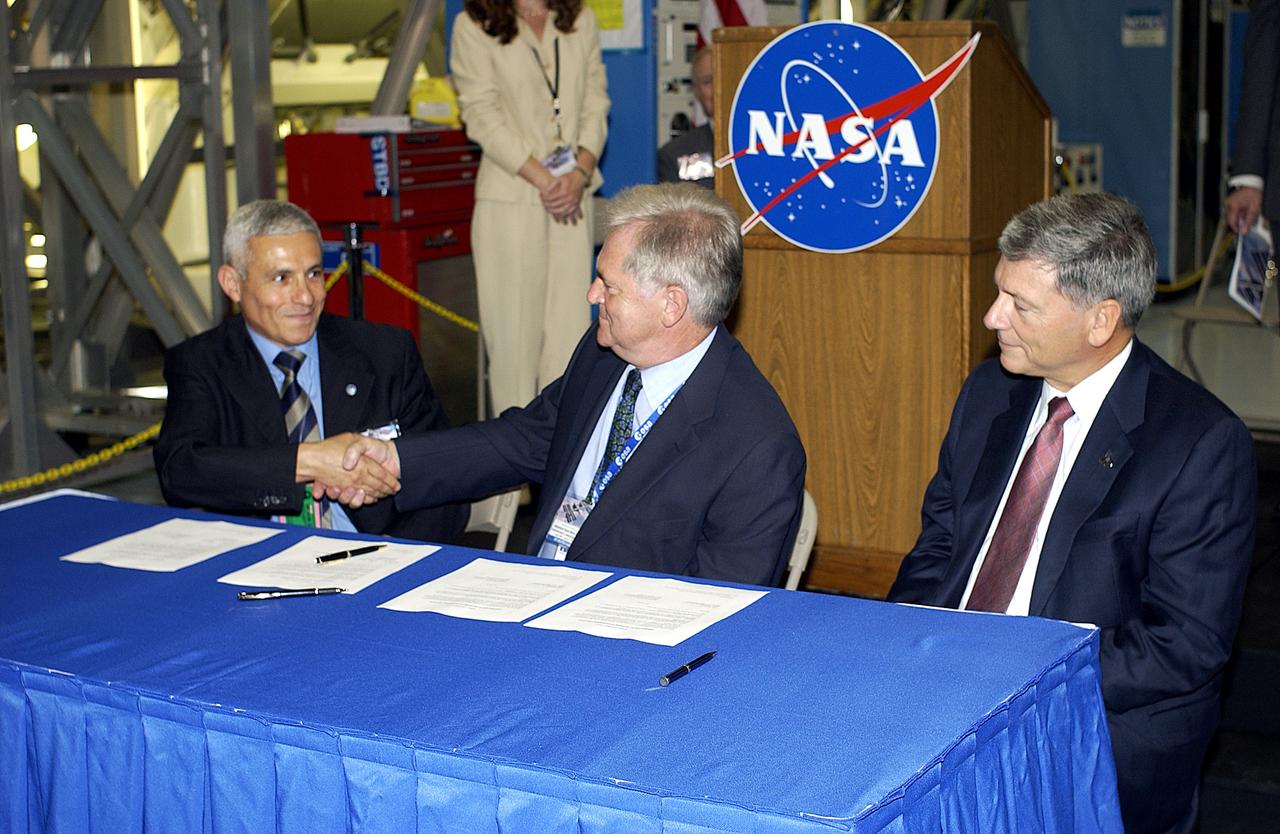
KENNEDY SPACE CENTER, FLA. - At a ceremony highlighting the arrival of two major components of the International Space Station, Node 2 and the Japanese Experiment Module (JEM), ownership of Node 2 was officially transferred between the European Space Agency (ESA) and NASA.  Shaking hands after the signing are Alan Thirkettle (center), International Space Station Program manager for Node 2, ESA; and NASA’s Michael C. Kostelnik (right), deputy associate administrator for International Space Station and Shuttle Programs.  At left, also part of the signing, is Andrea Lorenzoni (left), International Space Station Program manager for Node 2, Italian Space Agency.  NASA's Node 2, built by ESA in Italy, arrived at KSC on June 1. It will be the next pressurized module installed on the Station. The pressurized module of the Japanese Experiment Module (JEM),  named "Kibo" (Hope), arrived at KSC on June 4. It is Japan's primary contribution to the Station. Emceed by Lisa Malone, deputy director of External Relations and Business Development at KSC, the ceremony also included these speakers: Center Director Roy Bridges Jr.; NASA’s William Gerstenmaier, International Space Station Program manager; and Kuniaki Shiraki, JEM Project manager, National Aerospace and Development Agency of Japan.
KENNEDY SPACE CENTER, FLA. - At a ceremony highlighting the arrival of two major components of the International Space Station, Node 2 and the Japanese Experiment Module (JEM), ownership of Node 2 was officially transferred between the European Space Agency (ESA) and NASA. Shaking hands after the signing are Alan Thirkettle (center), International Space Station Program manager for Node 2, ESA; and NASA’s Michael C. Kostelnik (right), deputy associate administrator for International Space Station and Shuttle Programs. At left, also part of the signing, is Andrea Lorenzoni (left), International Space Station Program manager for Node 2, Italian Space Agency. NASA's Node 2, built by ESA in Italy, arrived at KSC on June 1. It will be the next pressurized module installed on the Station. The pressurized module of the Japanese Experiment Module (JEM), named "Kibo" (Hope), arrived at KSC on June 4. It is Japan's primary contribution to the Station. Emceed by Lisa Malone, deputy director of External Relations and Business Development at KSC, the ceremony also included these speakers: Center Director Roy Bridges Jr.; NASA’s William Gerstenmaier, International Space Station Program manager; and Kuniaki Shiraki, JEM Project manager, National Aerospace and Development Agency of Japan.
KENNEDY SPACE CENTER, FLA. - At a ceremony highlighting the arrival of two major components of the International Space Station, Node 2 and the Japanese Experiment Module (JEM), ownership of Node 2 was officially transferred between the European Space Agency (ESA) and NASA.  Shaking hands after the signing are (left) Andrea Lorenzoni, International Space Station Program manager for Node 2, Italian Space Agency, and (right) NASA’s Michael C. Kostelnik (right), deputy associate administrator for International Space Station and Shuttle Programs.  Also part of the signing is (center) Alan Thirkettle (center), International Space Station Program manager for Node 2, European Space Agency.  NASA's Node 2, built by ESA in Italy, arrived at KSC on June 1. It will be the next pressurized module installed on the Station. The pressurized module of the Japanese Experiment Module (JEM),  named "Kibo" (Hope), arrived at KSC on June 4. It is Japan's primary contribution to the Station. Emceed by Lisa Malone (background, left),  deputy director of External Relations and Business Development at KSC, the ceremony also included these speakers: Center Director Roy Bridges Jr.; NASA’s William Gerstenmaier, International Space Station Program manager; and Kuniaki Shiraki, JEM Project manager, National Aerospace and Development Agency of Japan.
KENNEDY SPACE CENTER, FLA. - At a ceremony highlighting the arrival of two major components of the International Space Station, Node 2 and the Japanese Experiment Module (JEM), ownership of Node 2 was officially transferred between the European Space Agency (ESA) and NASA. Shaking hands after the signing are (left) Andrea Lorenzoni, International Space Station Program manager for Node 2, Italian Space Agency, and (right) NASA’s Michael C. Kostelnik (right), deputy associate administrator for International Space Station and Shuttle Programs. Also part of the signing is (center) Alan Thirkettle (center), International Space Station Program manager for Node 2, European Space Agency. NASA's Node 2, built by ESA in Italy, arrived at KSC on June 1. It will be the next pressurized module installed on the Station. The pressurized module of the Japanese Experiment Module (JEM), named "Kibo" (Hope), arrived at KSC on June 4. It is Japan's primary contribution to the Station. Emceed by Lisa Malone (background, left), deputy director of External Relations and Business Development at KSC, the ceremony also included these speakers: Center Director Roy Bridges Jr.; NASA’s William Gerstenmaier, International Space Station Program manager; and Kuniaki Shiraki, JEM Project manager, National Aerospace and Development Agency of Japan.
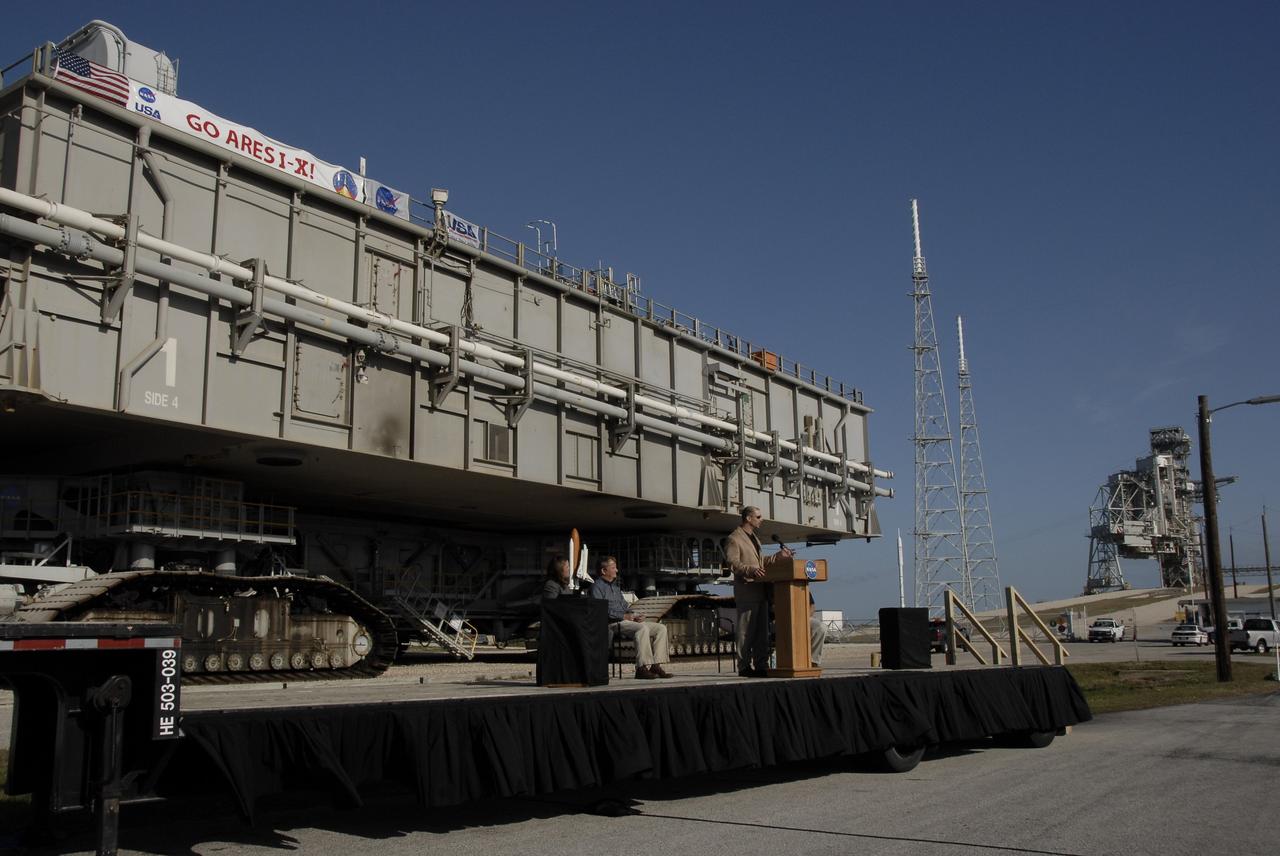
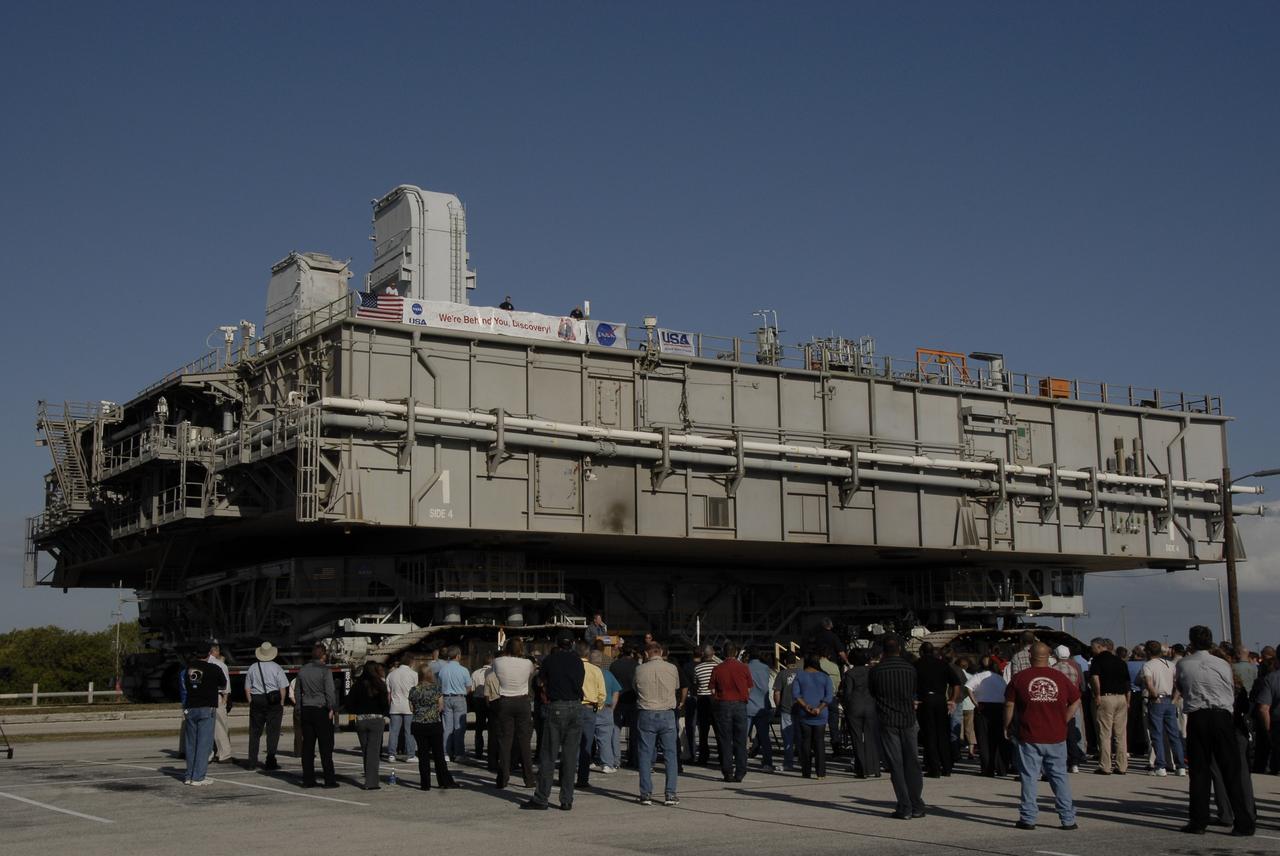
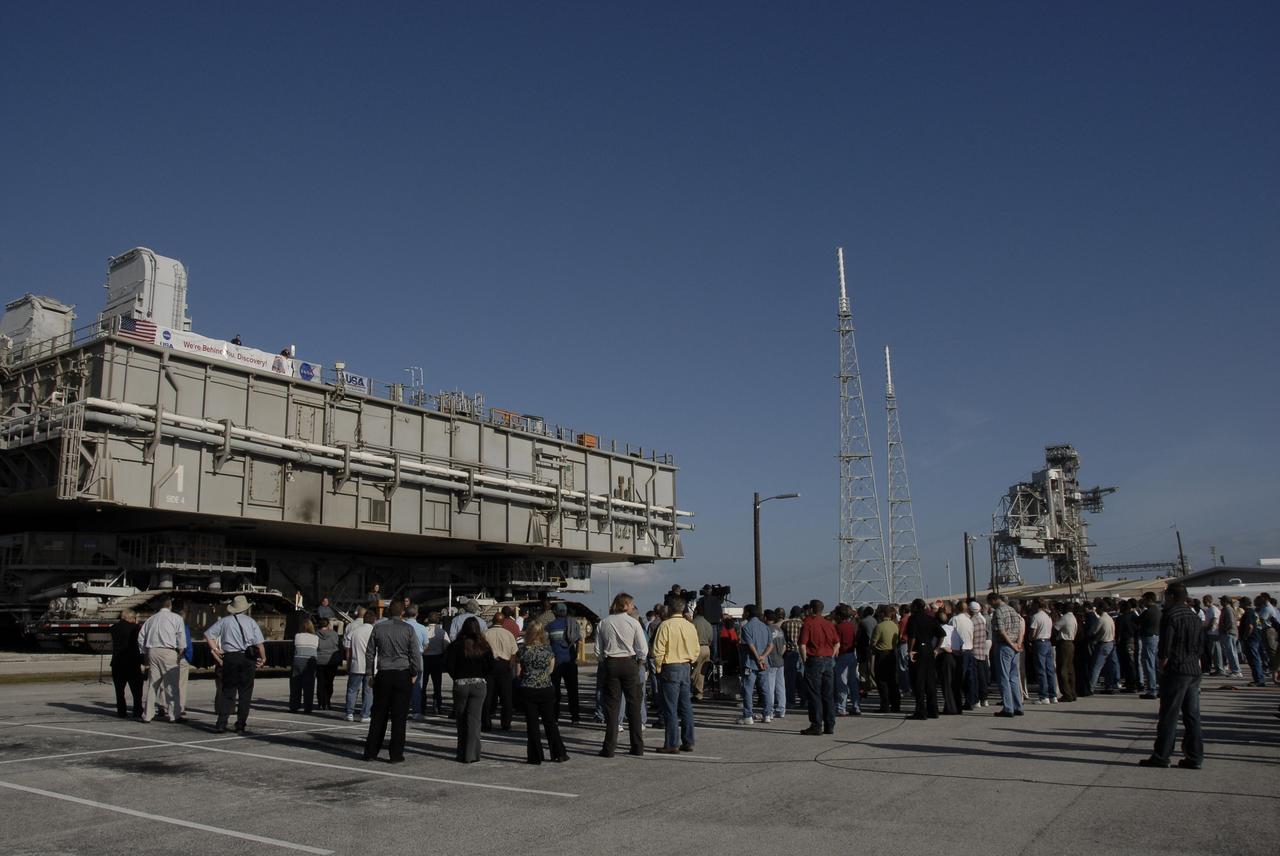
CAPE CANAVERAL, Fla. – Near Launch Pad 39B at NASA's Kennedy Space Center in Florida, employees and media gather listen to Shuttle Launch Director Mike Leinbach  during the handover ceremony for Mobile Launcher Platform-1. The platform is being transferred from NASA's Space Shuttle Program to the Constellation Program for the Ares I-X flight test targeted for this summer. Also participating in the ceremony are Rita Willcoxon, director of Launch Vehicle Processing at Kennedy, Pepper E. Phillips, director of the Constellation Project Office, and Brett Raulerson, manager of MLP Operations with United Space Alliance.  Constructed in 1964, the mobile launchers used in Apollo/Saturn operations were modified for use in shuttle operations. With cranes, umbilical towers and swing arms removed, the mobile launchers were renamed Mobile Launcher Platforms, or MLPs.  Photo credit: NASA/Kim Shiflett
KSC-2009-2304
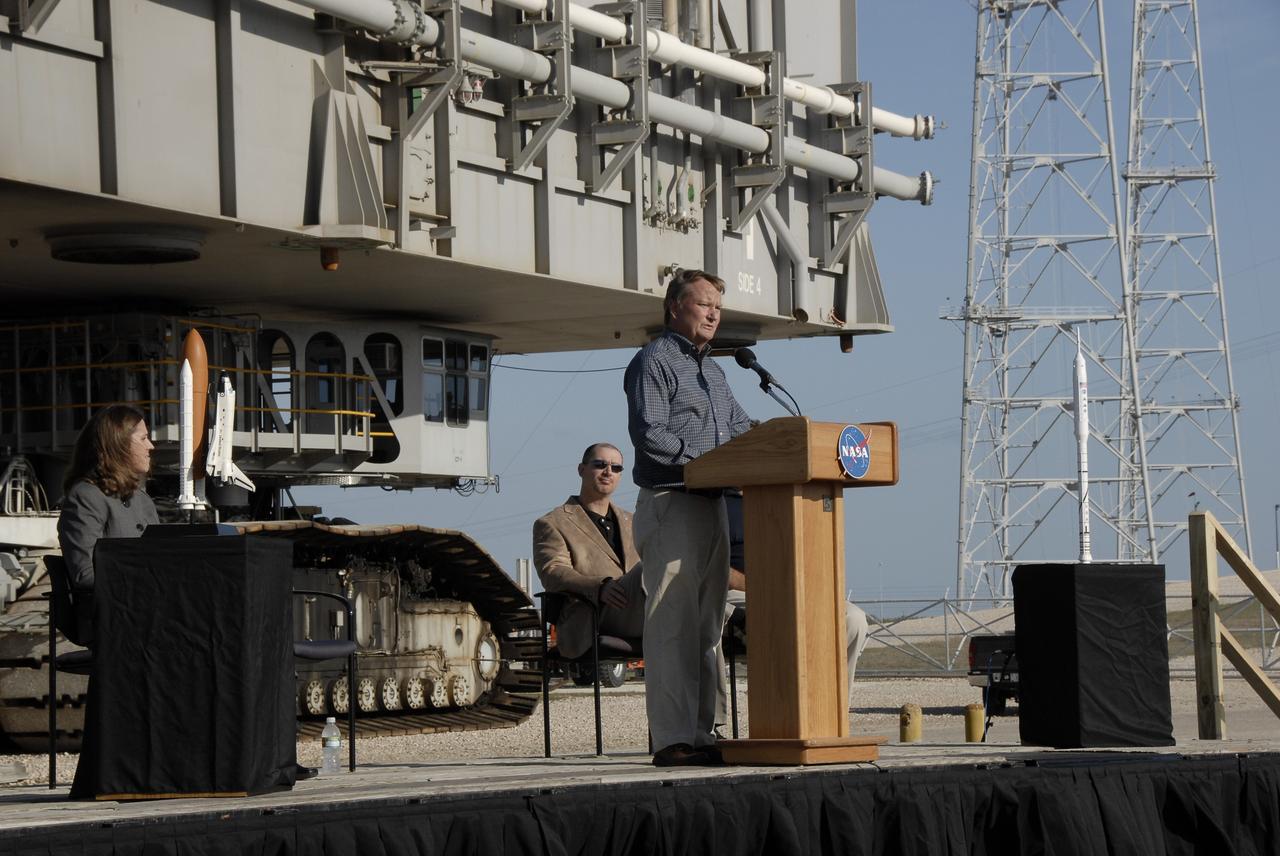
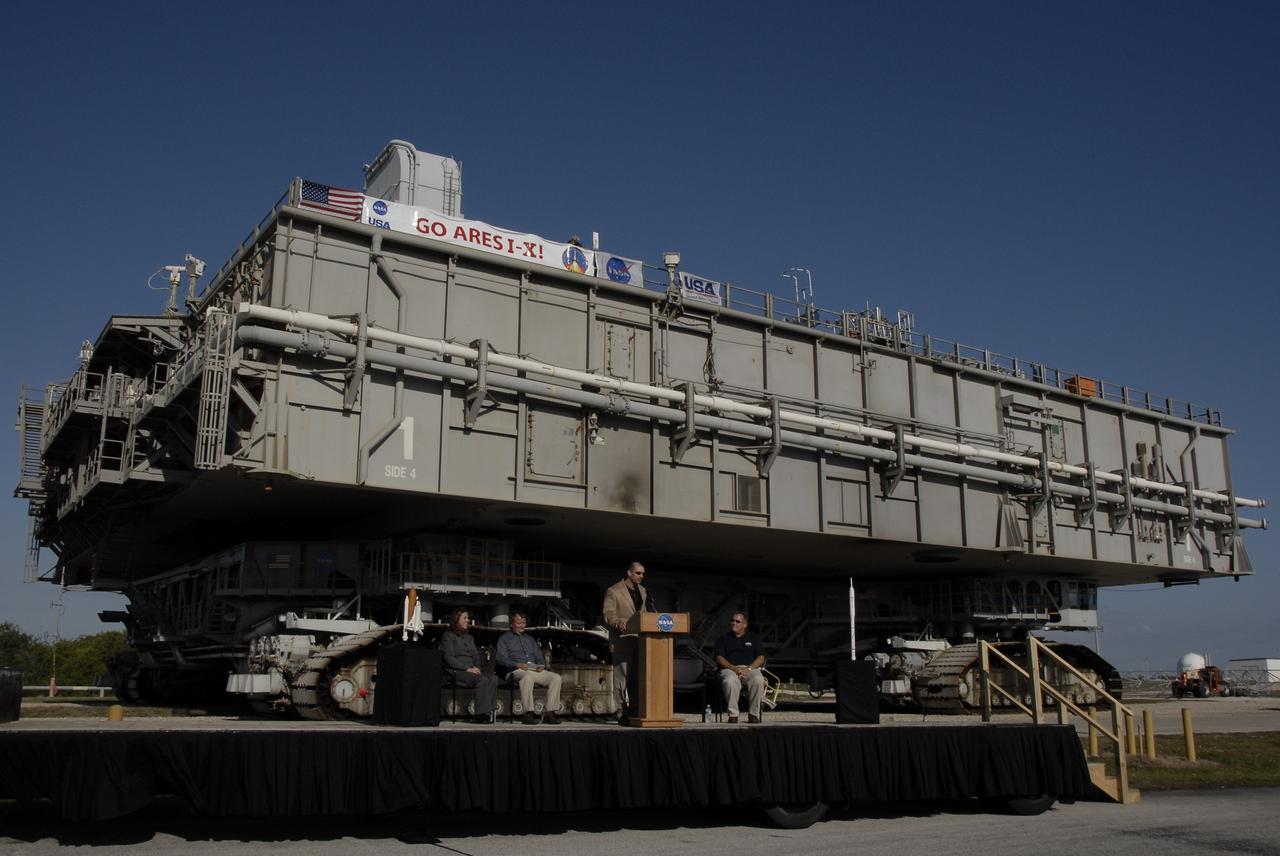
CAPE CANAVERAL, Fla. – Near Launch Pad 39B at NASA's Kennedy Space Center in Florida,  Director of the Constellation Project Office  Pepper E. Phillips speaks to employees and media during the handover ceremony for Mobile Launcher Platform-1.  Marking the handover is the change of banner on the platform behind him.  On the stage and also participating in the ceremony are Director of Launch Vehicle Processing Rita Willcoxon , Shuttle Launch Director Mike Leinbach,  and Manager of MLP Operations with United Space Alliance Brett Raulerson.  The platform is being transferred from NASA's Space Shuttle Program to the Constellation Program for the Ares I-X flight test targeted for this summer. Constructed in 1964, the mobile launchers used in Apollo/Saturn operations were modified for use in shuttle operations. With cranes, umbilical towers and swing arms removed, the mobile launchers were renamed Mobile Launcher Platforms, or MLPs.  Photo credit: NASA/Kim Shiflett
KSC-2009-2305
CAPE CANAVERAL, Fla. – Near Launch Pad 39B  at NASA's Kennedy Space Center in Florida, Shuttle Launch Director Mike Leinbach speaks to the employees and media during the handover ceremony for Mobile Launcher Platform-1. The platform is being transferred from NASA's Space Shuttle Program to the Constellation Program for the Ares I-X flight test targeted for this summer. Also participating in the ceremony are (left) Rita Willcoxon, director of Launch Vehicle Processing at Kennedy, (right) Pepper E. Phillips, director of the Constellation Project Office, and (not visible) Brett Raulerson, manager of MLP Operations with United Space Alliance. Constructed in 1964, the mobile launchers used in Apollo/Saturn operations were modified for use in shuttle operations. With cranes, umbilical towers and swing arms removed, the mobile launchers were renamed Mobile Launcher Platforms, or MLPs.  Photo credit: NASA/Kim Shiflett
KSC-2009-2303
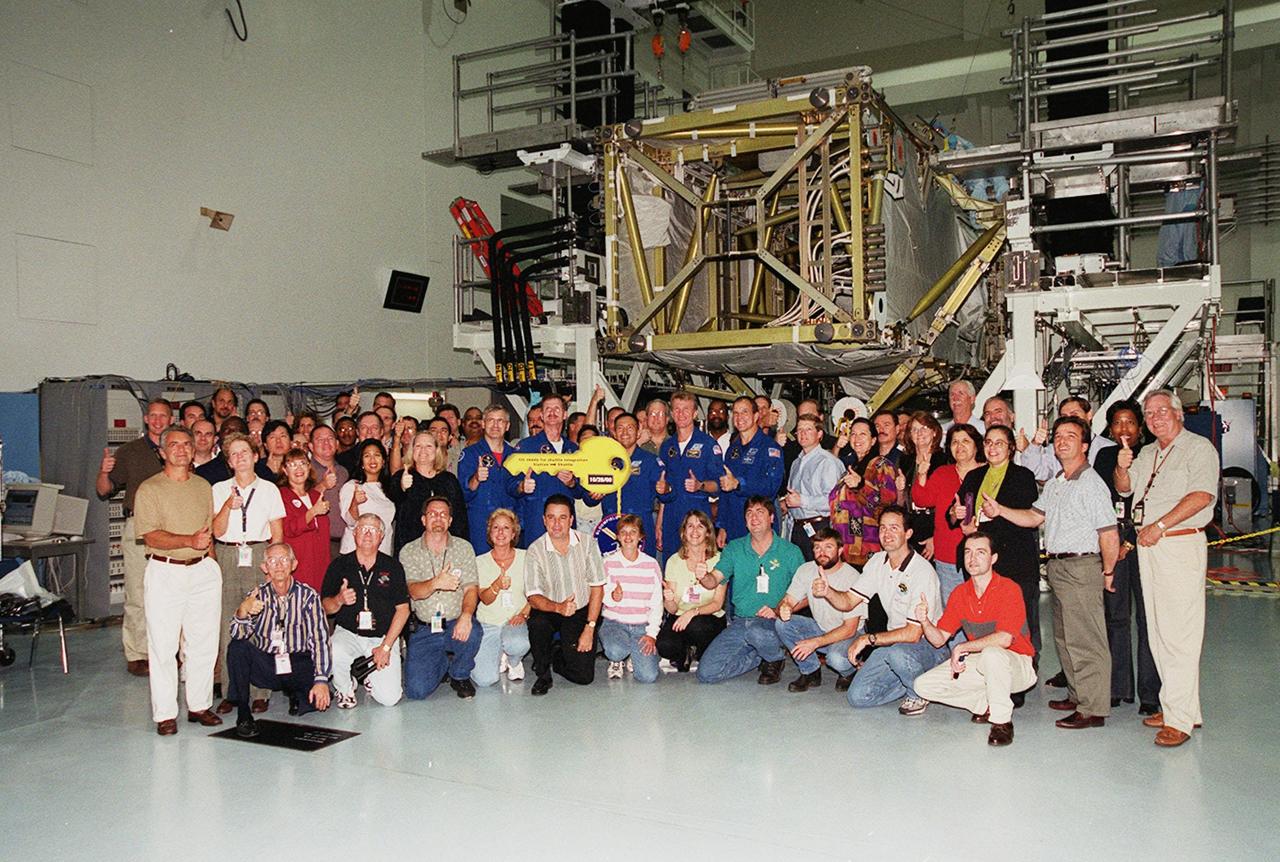
Workers in the Space Station Processing Facility gather with the crew of mission STS-97, who are holding the symbolic key representing the turnover of the P6 Integrated Truss Structure, part of the payload on their mission. During the ceremony the P6 truss segment was transferred from International Space Station ground operations to the NASA shuttle integration team. Commander Brent Jett (second from right) received the key in the ceremony. Standing with him are (left to right) Mission Specialists Marc Garneau, Joe Tanner and Carlos Noriega, at left; and Pilot Mike Bloomfield, at right. Mission STS-97is the sixth construction flight to the International Space Station. Its payload includes a photovoltaic (PV) module, with giant solar arrays that will provide power to the Station. The mission involves two spacewalks to complete the solar array connections. STS-97 is scheduled to launch Nov. 30 at 10:05 p.m. EST
KSC-00pp1664
CAPE CANAVERAL, Fla. – Near Launch Pad 39B at NASA's Kennedy Space Center in Florida,  Director of the Constellation Project Office  Pepper E. Phillips speaks to employees and media during the handover ceremony for Mobile Launcher Platform-1.  Marking the handover is the change of banner on the platform behind him.  On the stage and also participating in the ceremony are Director of Launch Vehicle Processing Rita Willcoxon , Shuttle Launch Director Mike Leinbach,  and Manager of MLP Operations with United Space Alliance Brett Raulerson.  The platform is being transferred from NASA's Space Shuttle Program to the Constellation Program for the Ares I-X flight test targeted for this summer. Constructed in 1964, the mobile launchers used in Apollo/Saturn operations were modified for use in shuttle operations. With cranes, umbilical towers and swing arms removed, the mobile launchers were renamed Mobile Launcher Platforms, or MLPs.  Photo credit: NASA/Kim Shiflett
KSC-2009-2306
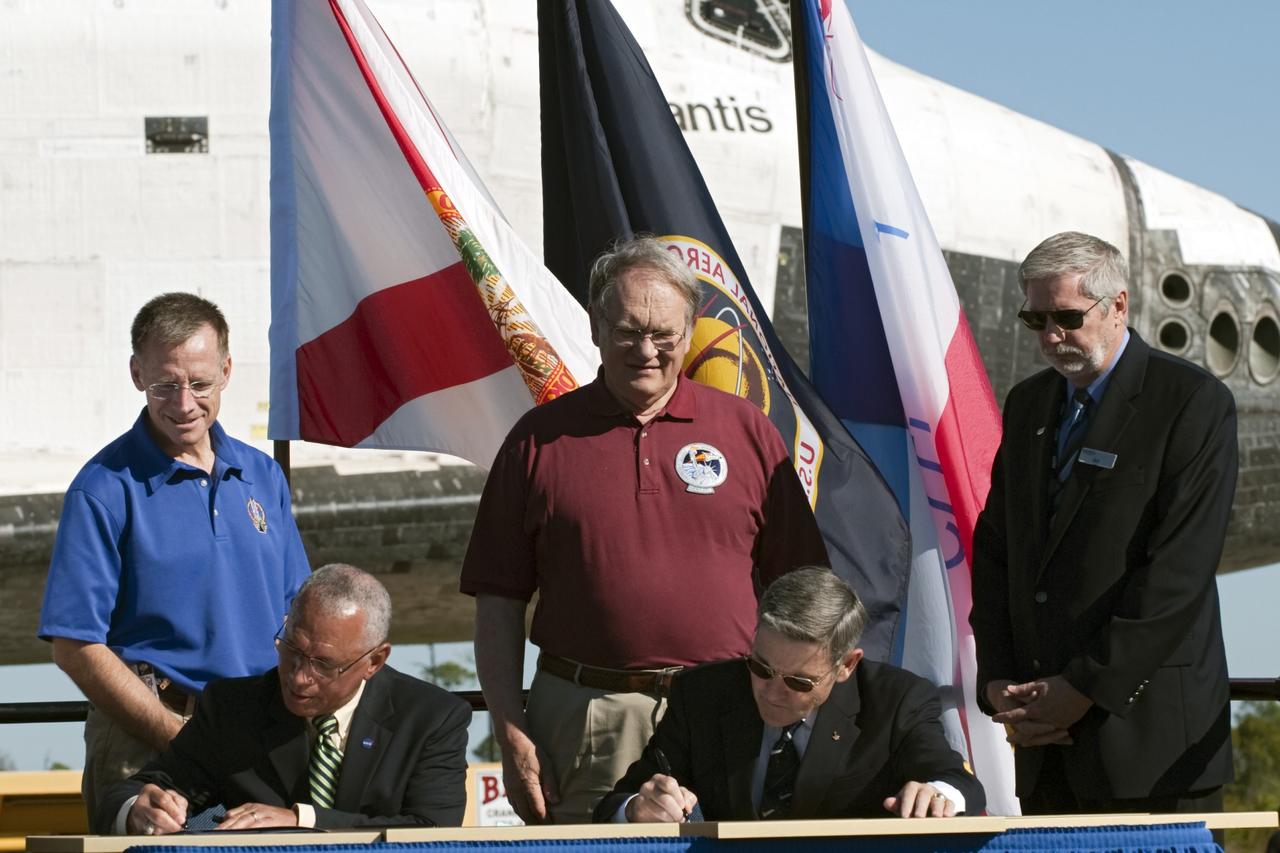
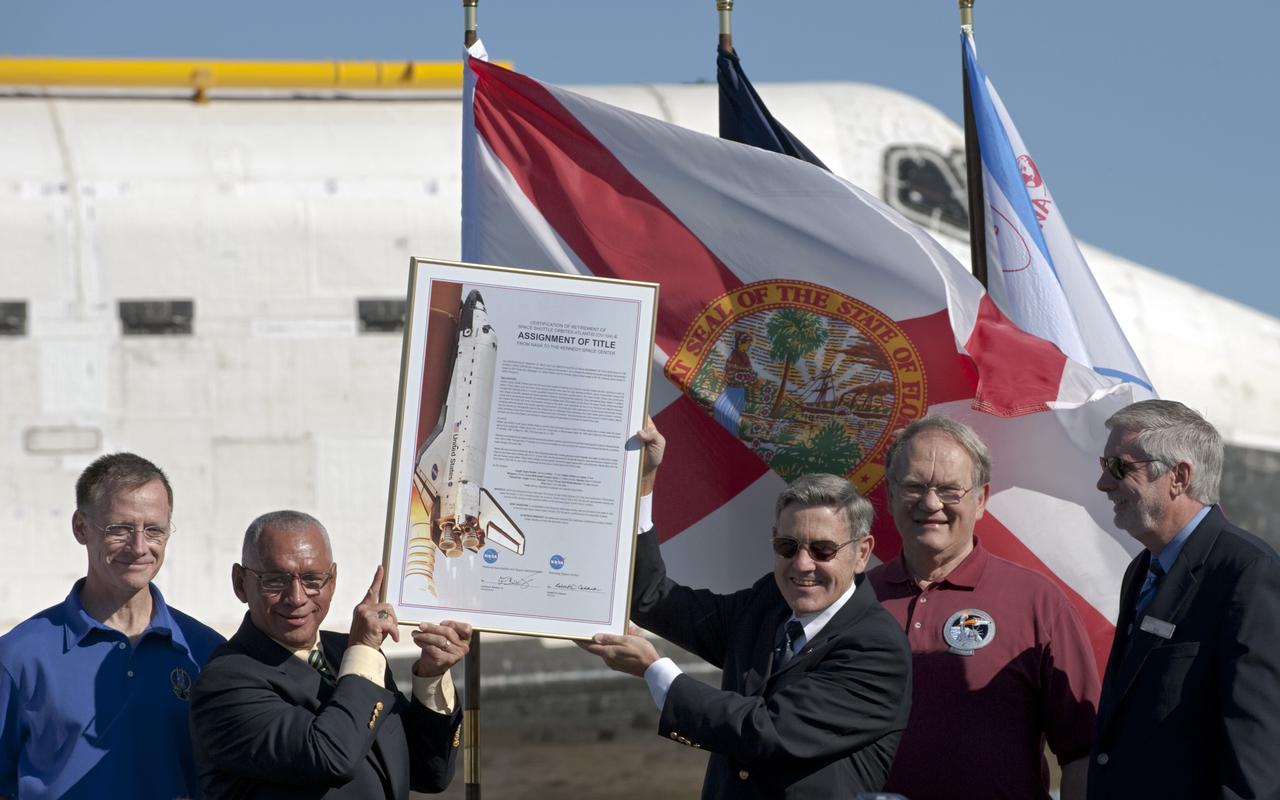
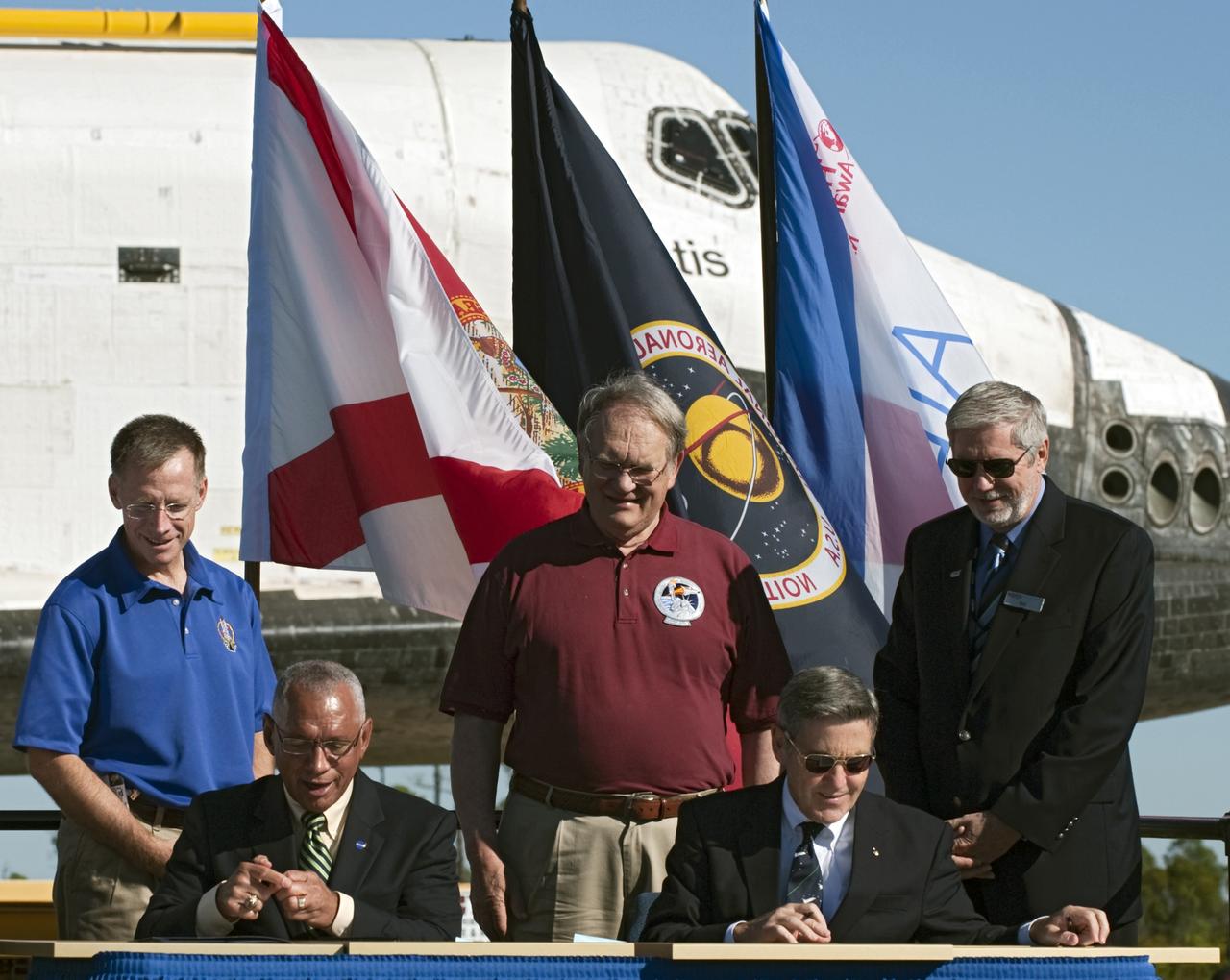
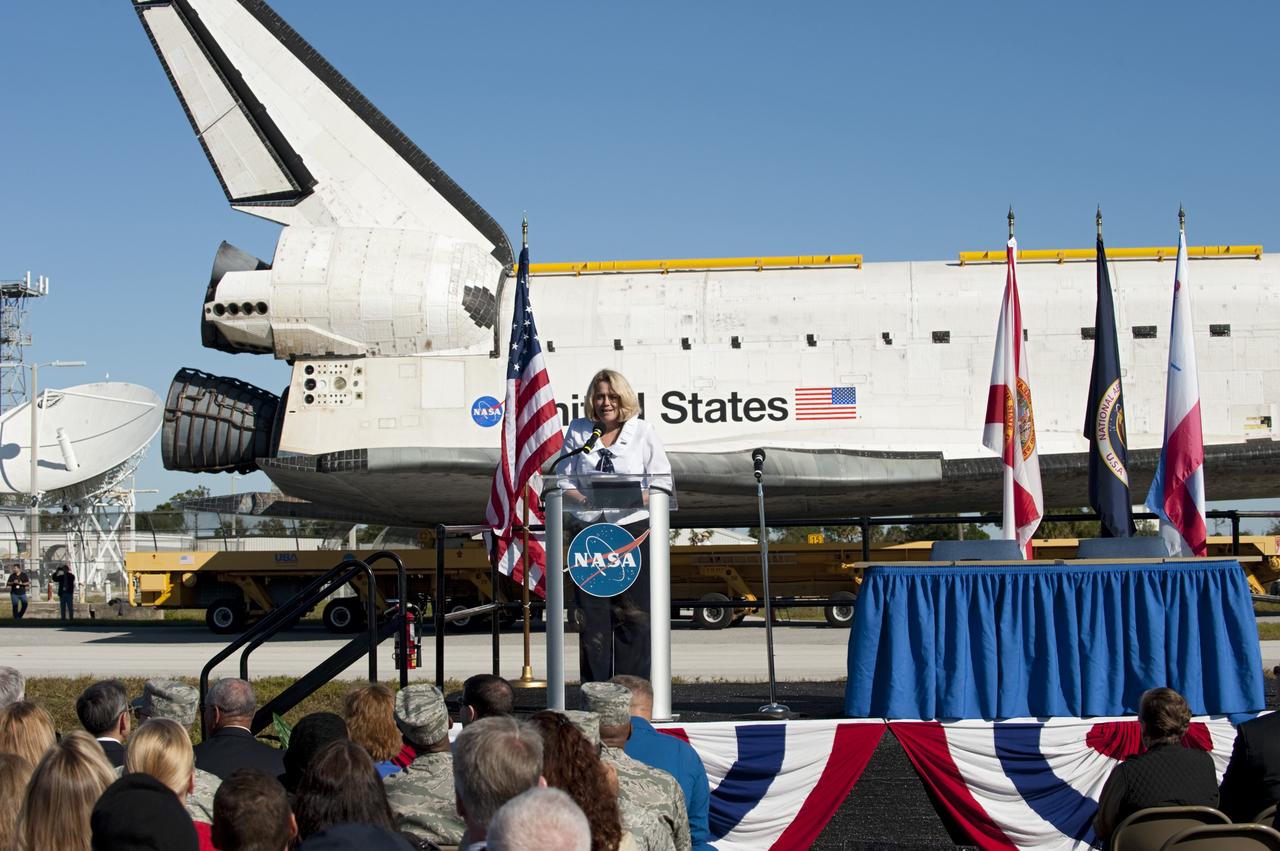
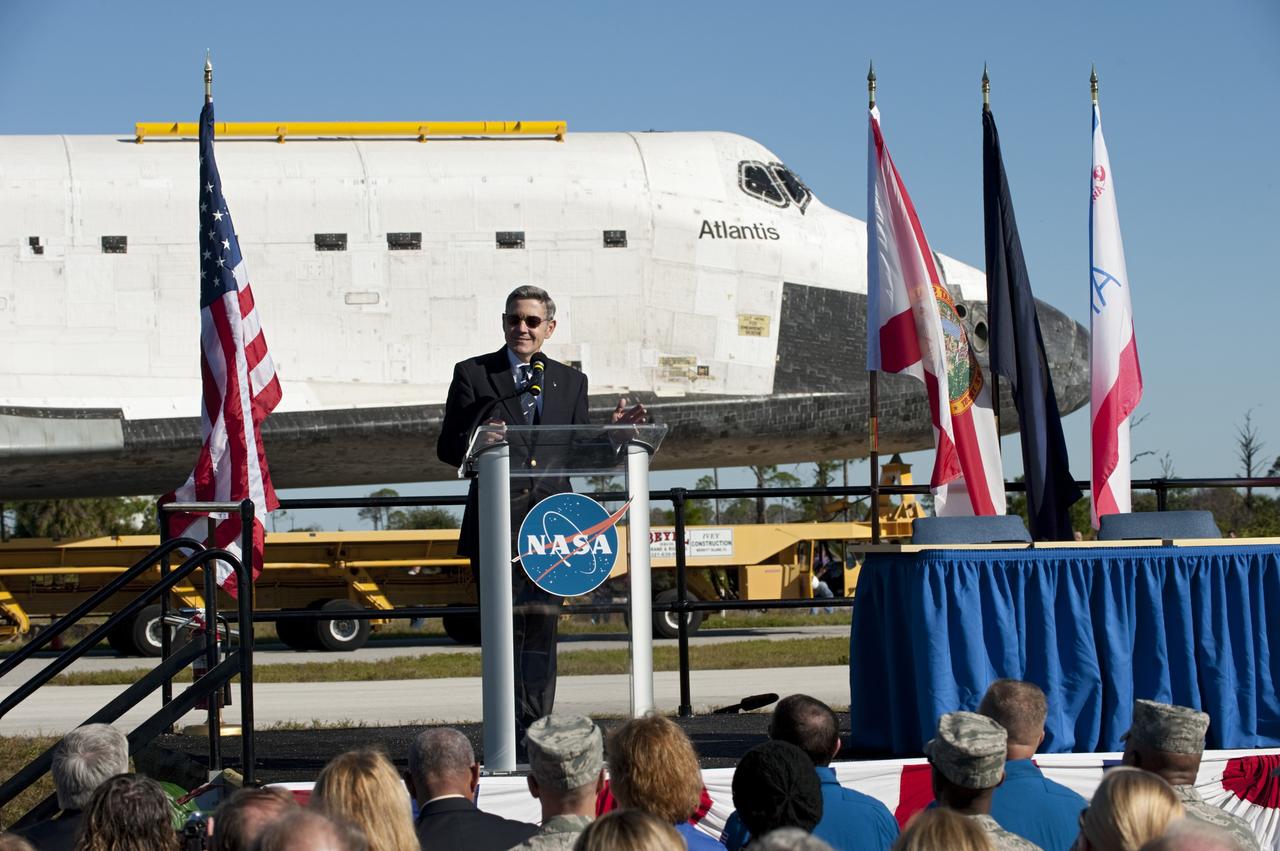
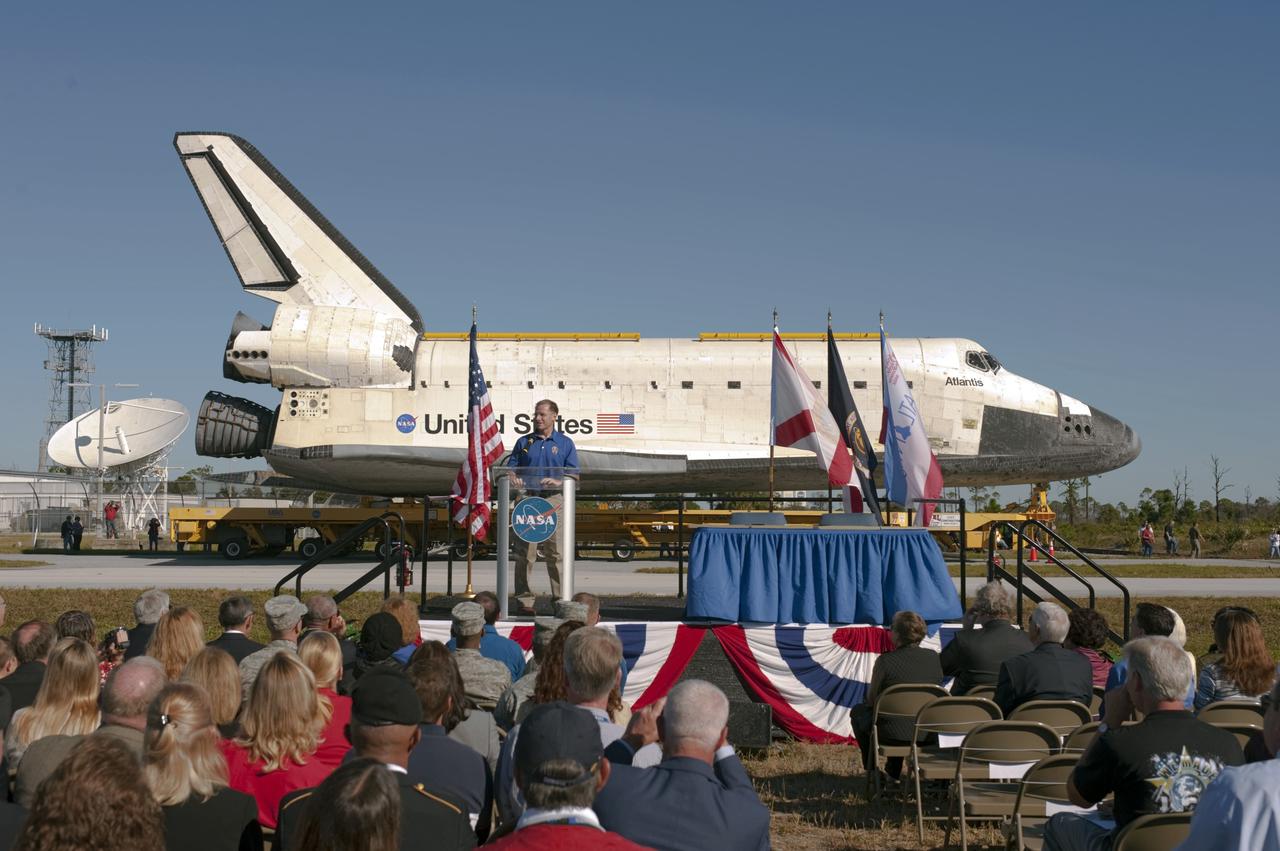
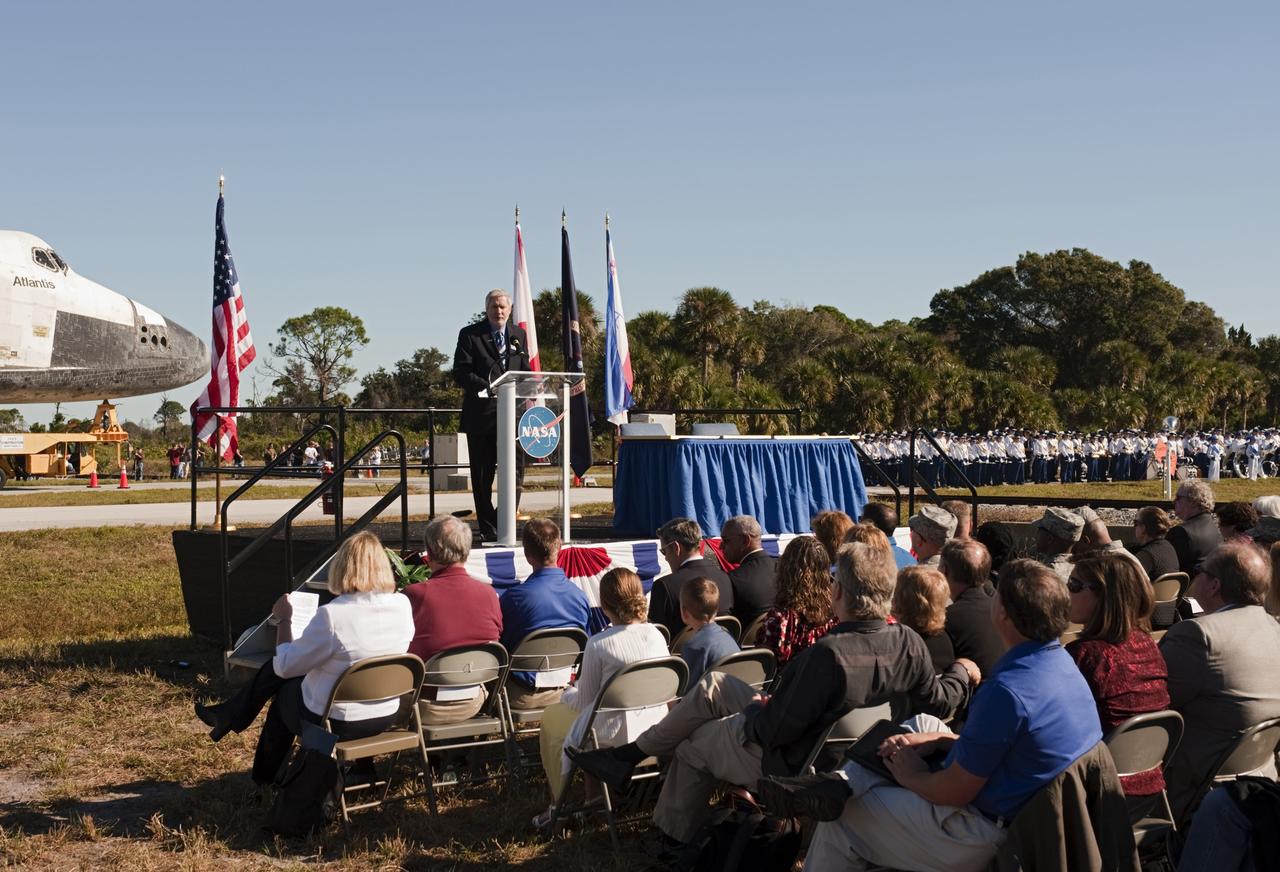
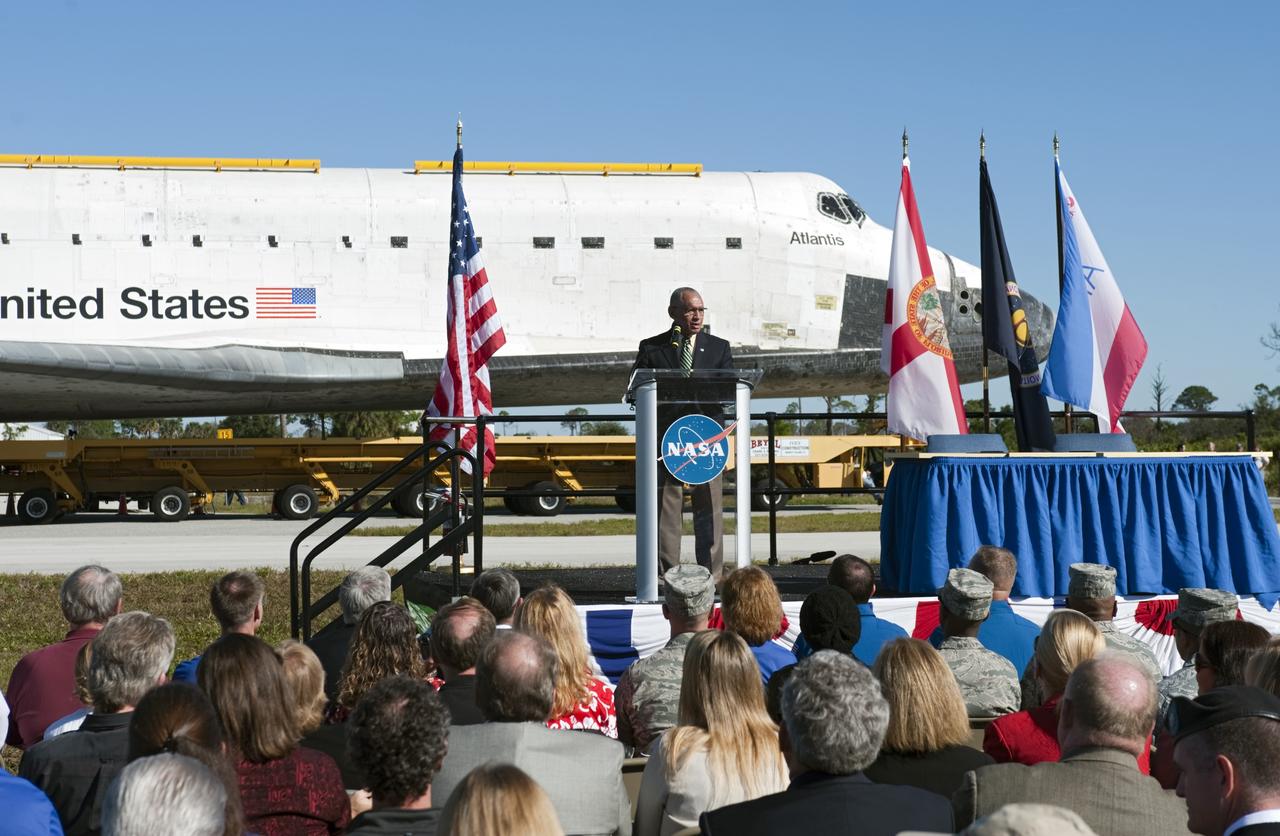
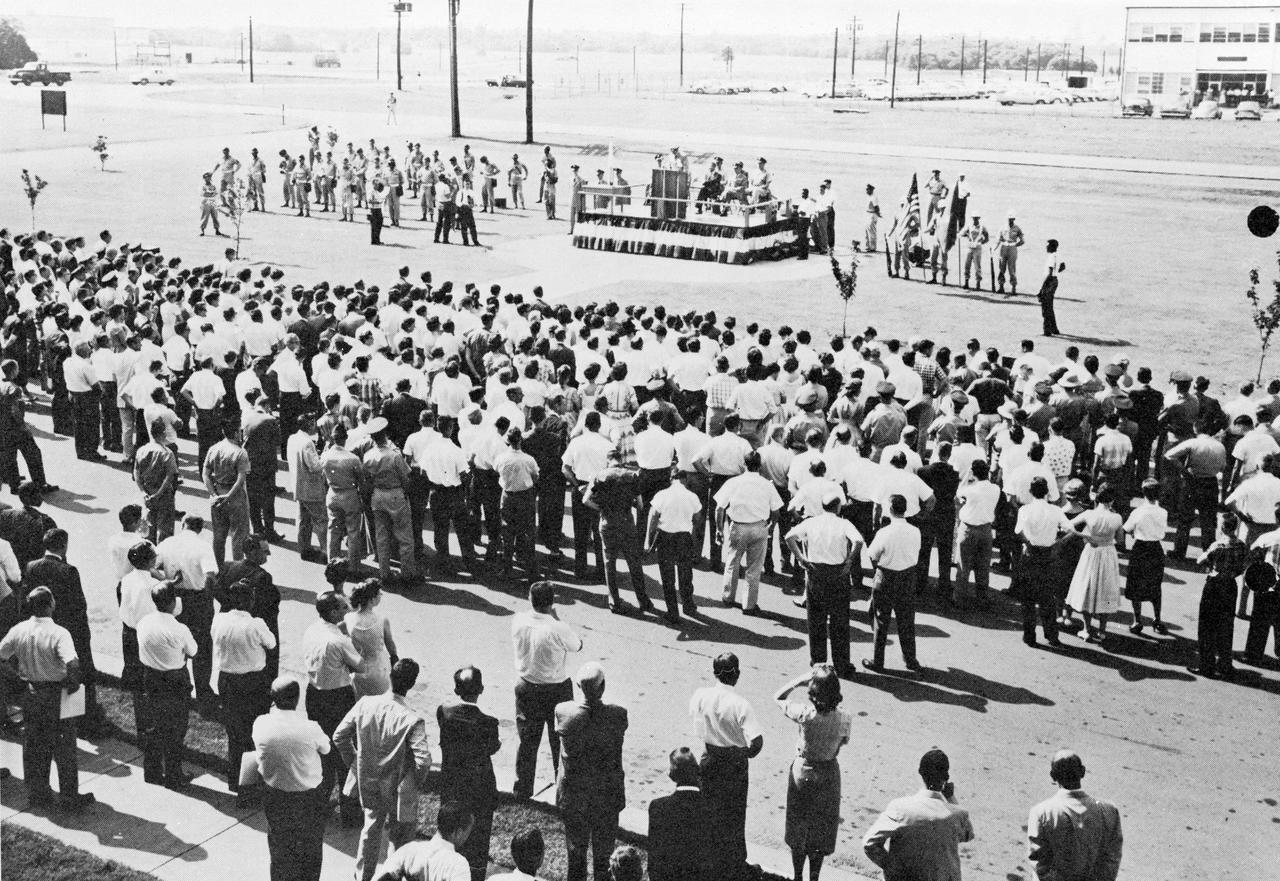
CAPE CANAVERAL, Fla. – At NASA's Kennedy Space Center in Florida, the space shuttle Atlantis pauses during its 10-mile journey to the Kennedy Visitor Complex for a ceremony to commemorate its transfer. NASA Administrator Charles Bolden, seated left, and Kennedy Director Bob Cabana sign documents transferring title of Atlantis from the agency to Kennedy Space Center. Also participating in the ceremony, standing, from left, are Chris Ferguson, who commanded Atlantis's final mission, Karol Bobko, commander of Atlantis' first mission, and Delaware North Companies Parks and Resorts Chief Operating Officer Bill Moore.      As part of transition and retirement of the Space Shuttle Program, Atlantis is to be displayed at Kennedy's visitor complex beginning in the summer of 2013. Over the course of its 26-year career, Atlantis traveled 125,935,769 miles during 307 days in space over 33 missions. For more information, visit http://www.nasa.gov/transition Photo credit: NASA/ Tony Gray
KSC-2012-6056
CAPE CANAVERAL, Fla. – At NASA's Kennedy Space Center in Florida, the space shuttle Atlantis pauses during its 10-mile journey to the Kennedy visitor complex for a ceremony to commemorate its transfer. NASA Administrator Charles Bolden, seated left, and Kennedy Director Bob Cabana sign documents transferring title of Atlantis from the agency to Kennedy Space Center. Also participating in the ceremony, standing, from left, are Chris Ferguson, who commanded Atlantis' final mission, Karol Bobko, commander of Atlantis' first mission and Delaware North Companies Parks and Resorts Chief Operating Officer Bill Moore.      As part of transition and retirement of the Space Shuttle Program, Atlantis is to be displayed at Kennedy's Visitor Complex beginning in the summer of 2013. Over the course of its 26-year career, Atlantis traveled 125,935,769 miles during 307 days in space over 33 missions. For more information, visit http://www.nasa.gov/transition Photo credit: NASA/ Tony Gray
KSC-2012-6057
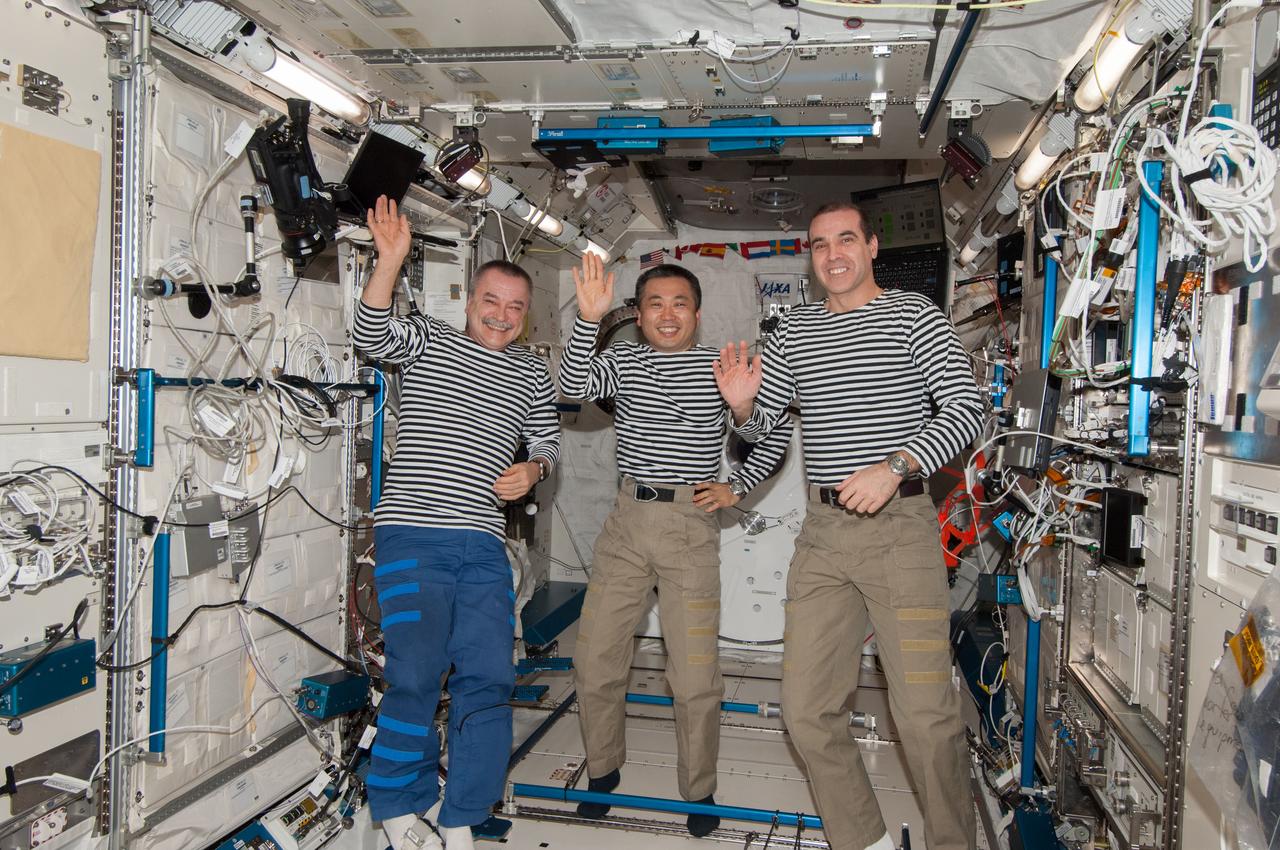
CAPE CANAVERAL, Fla. – At NASA's Kennedy Space Center in Florida, the space shuttle Atlantis pauses during its 10-mile journey to the Kennedy visitor complex for a ceremony to commemorate its transfer. NASA Administrator Charles Bolden, left, and Kennedy Director Bob Cabana hold the just-signed document transferring title of Atlantis from the agency to Kennedy Space Center. Participating in the ceremony, from left, are Chris Ferguson, who commanded Atlantis' final mission, Bolden, Cabana, Karol Bobko, commander of Atlantis' first mission, and Delaware North Companies Parks and Resorts Chief Operating Officer Bill Moore.      As part of transition and retirement of the Space Shuttle Program, Atlantis is to be displayed at Kennedy's visitor complex beginning in the summer of 2013. Over the course of its 26-year career, Atlantis traveled 125,935,769 miles during 307 days in space over 33 missions. For more information, visit http://www.nasa.gov/transition Photo credit: NASA/ Tony Gray
KSC-2012-6059
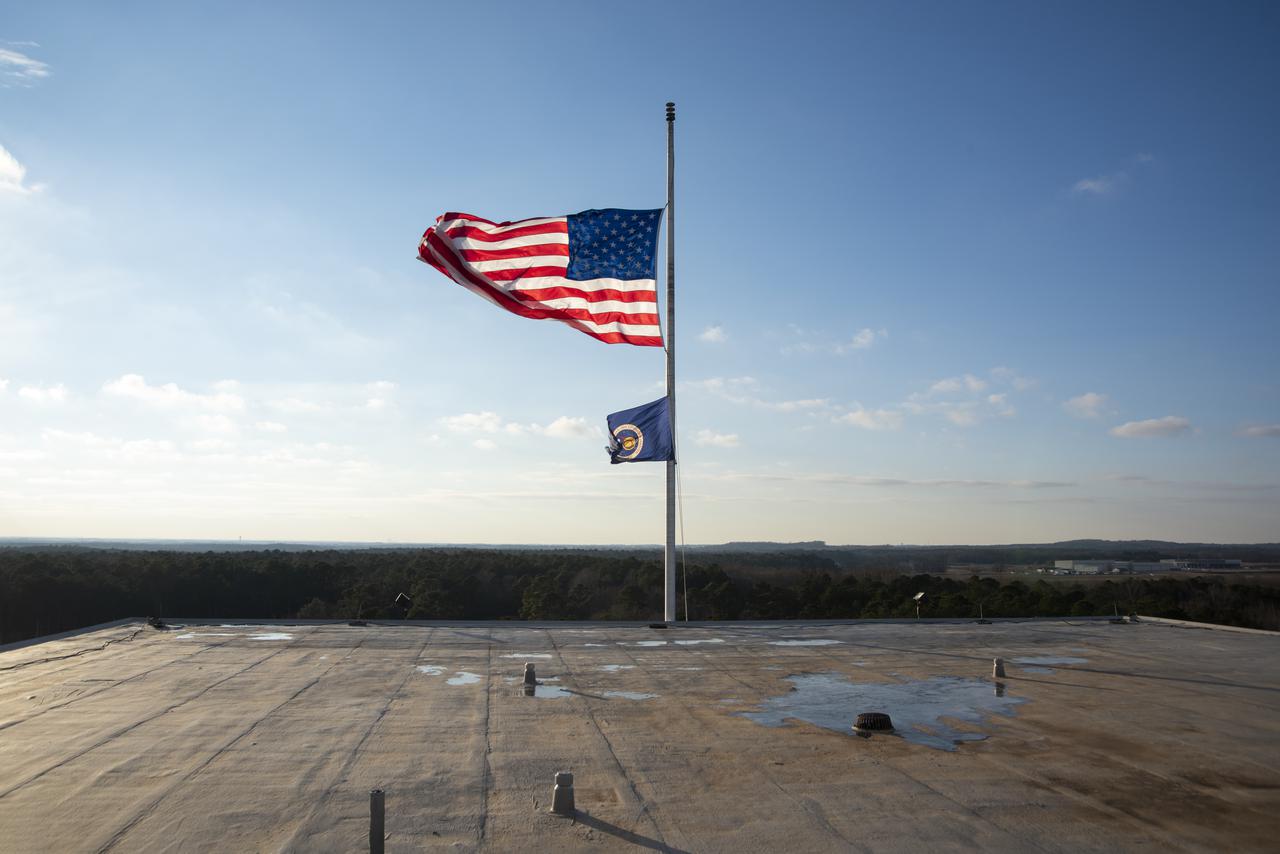
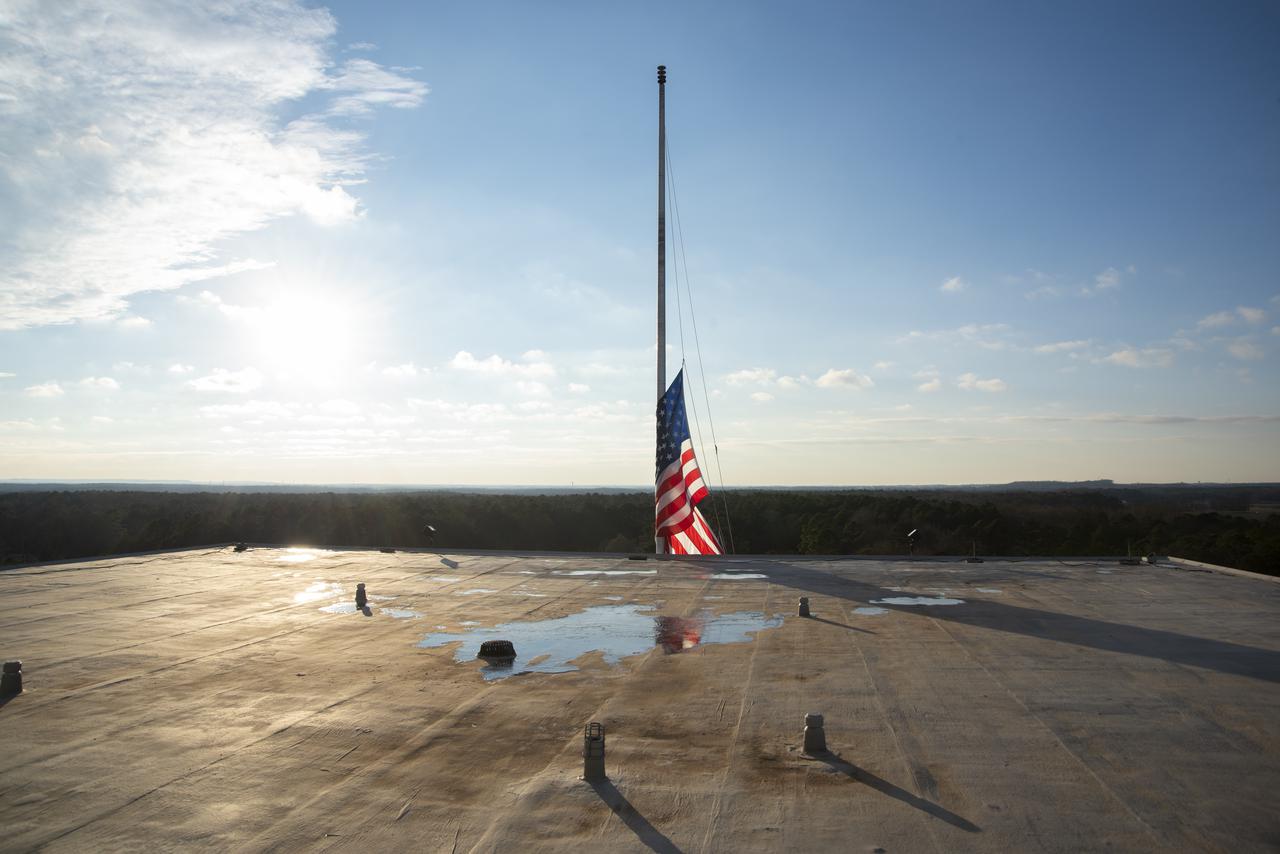
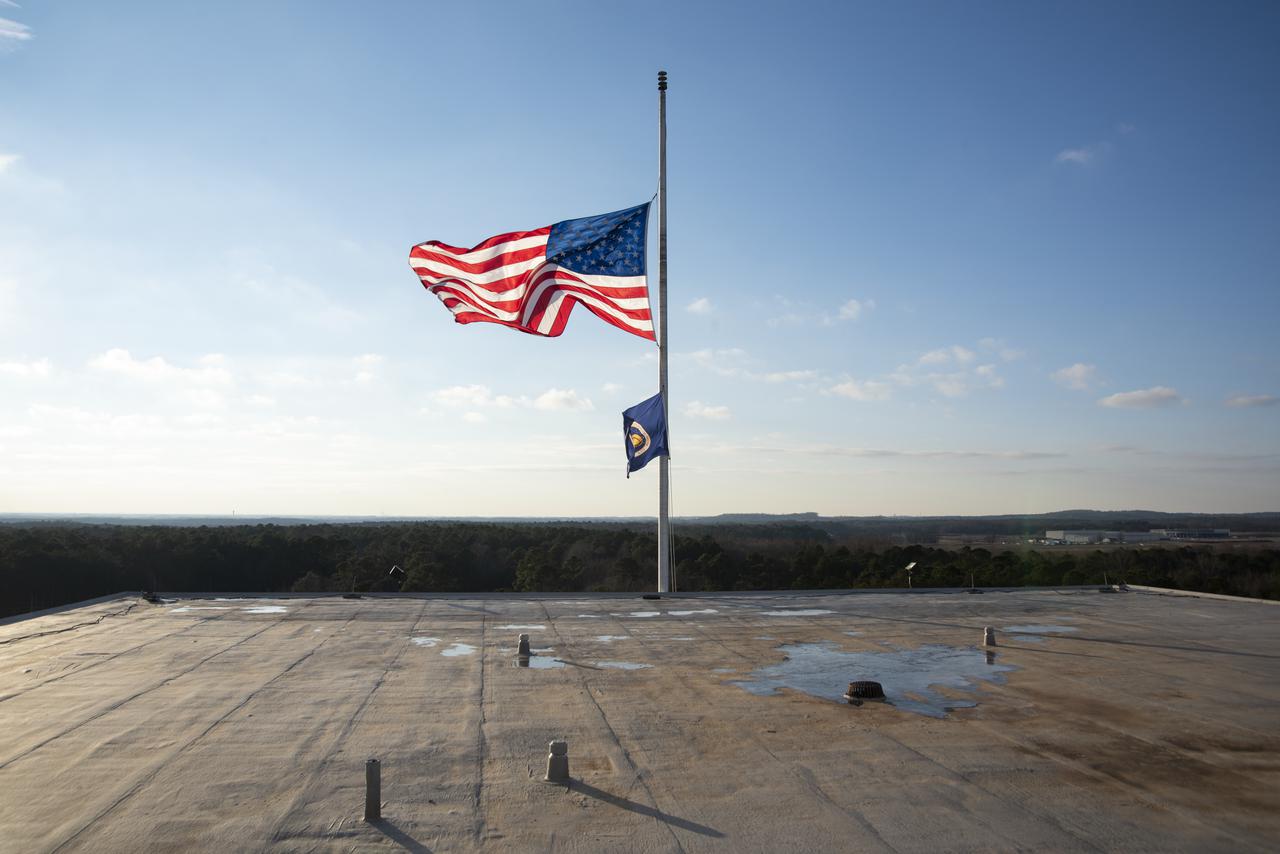
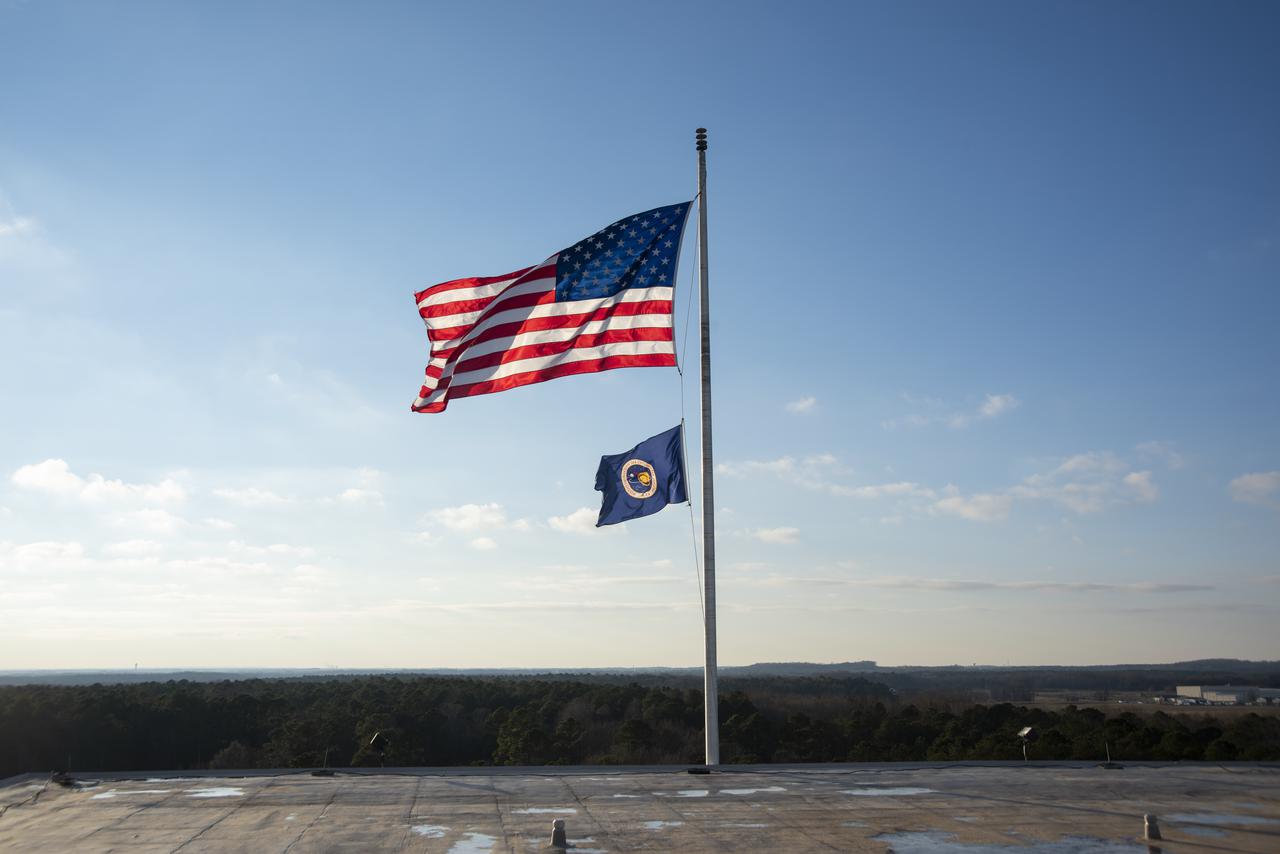
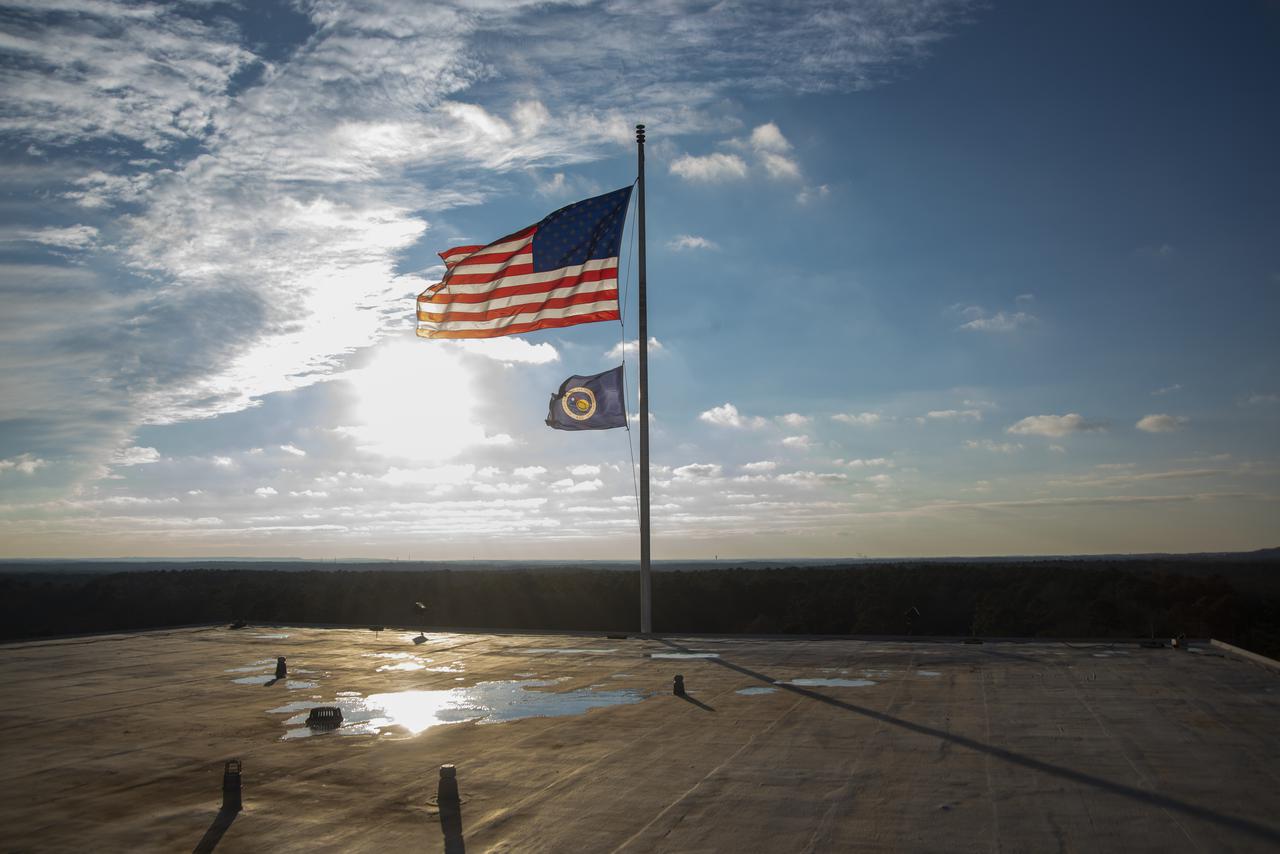
The U.S. and NASA flags atop Building 4200 at NASA Marshall Space Flight Center in Huntsville, Alabama, were retired Jan. 21, 2022. These images show center operations employees lowering the flags at Building 4200, which was Marshall’s original central laboratory and office building and served as Marshall’s headquarters since 1963. This building will be demolished later this year. A flag-raising ceremony marking the transfer of Marshall headquarters to Building 4221 was held Jan. 26, 2022. The doors to Building 4221 opened on Earth Day, April 22, 2019.
U.S. Flag Retired from Marshall Building 4200
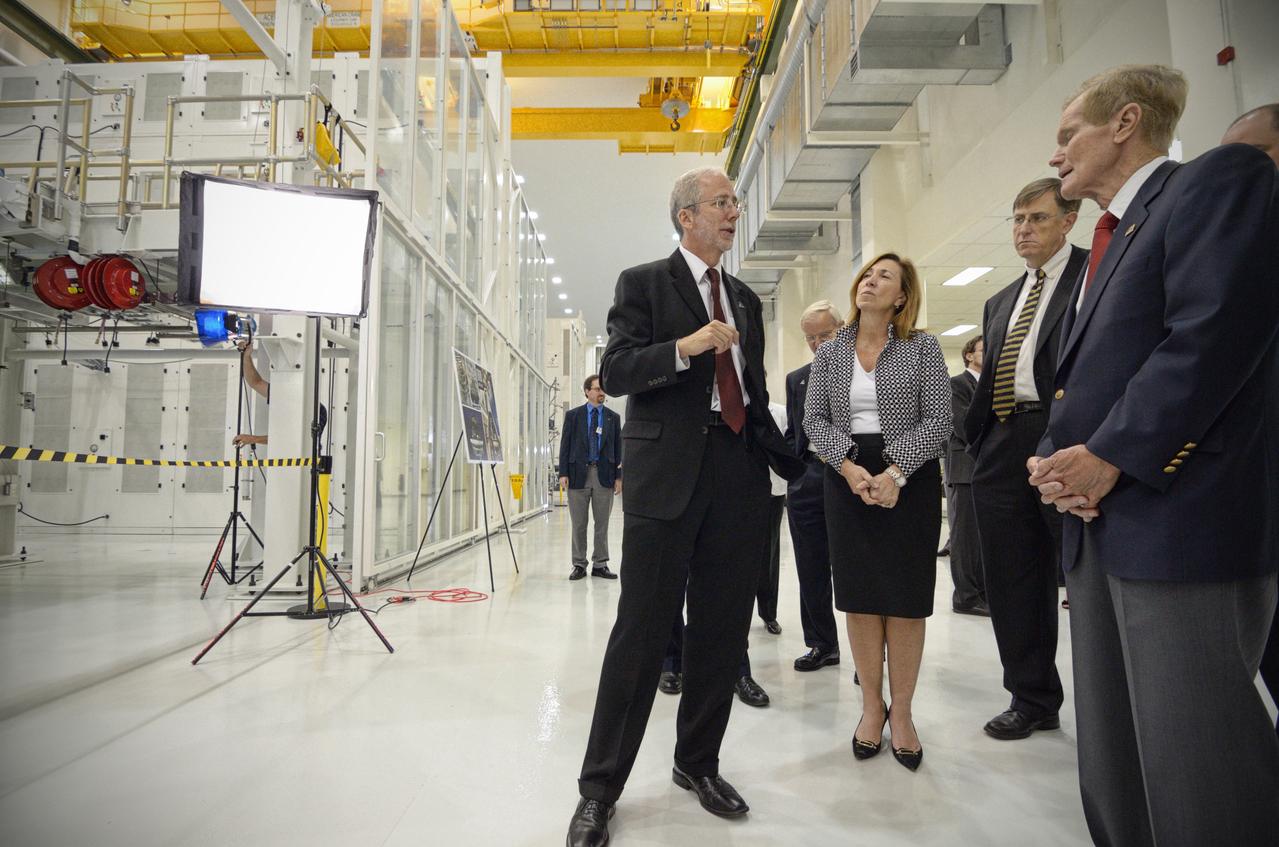
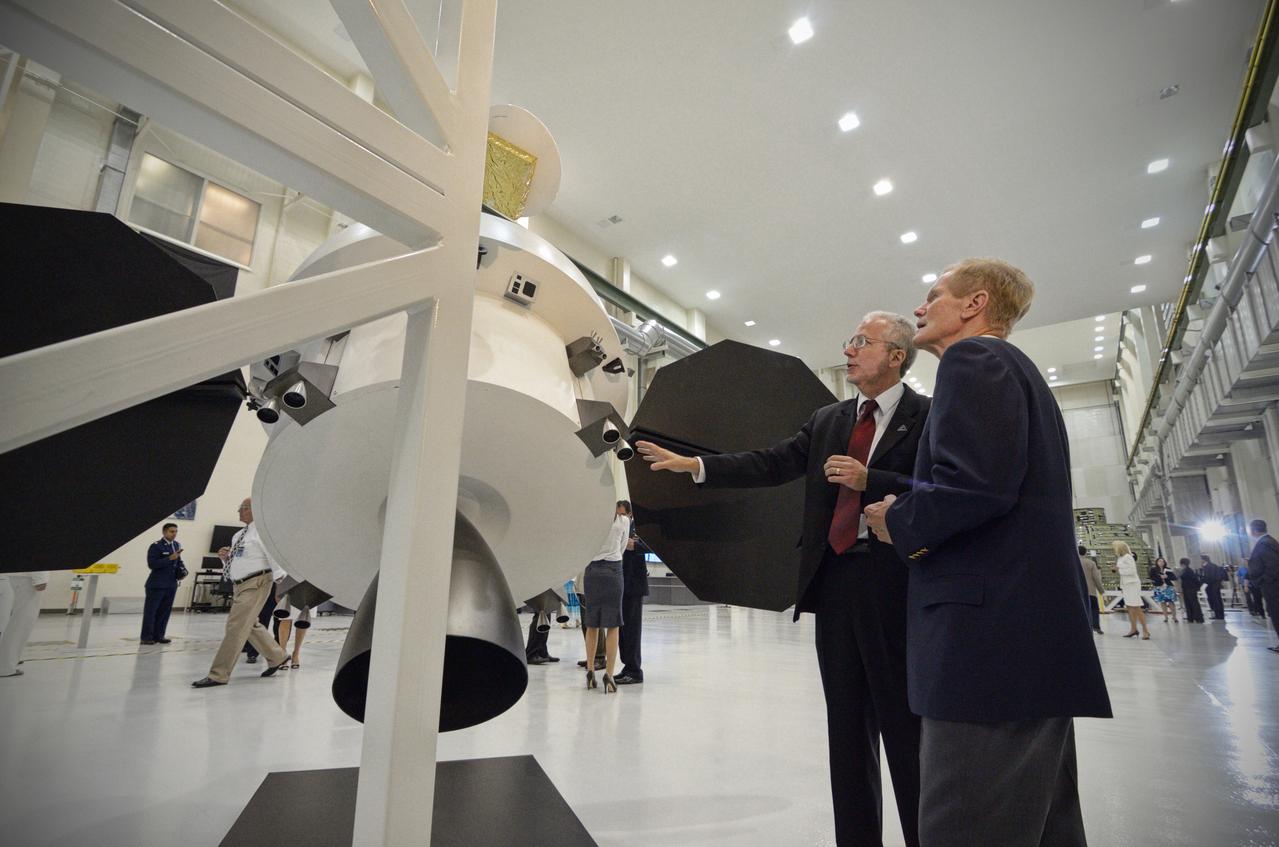
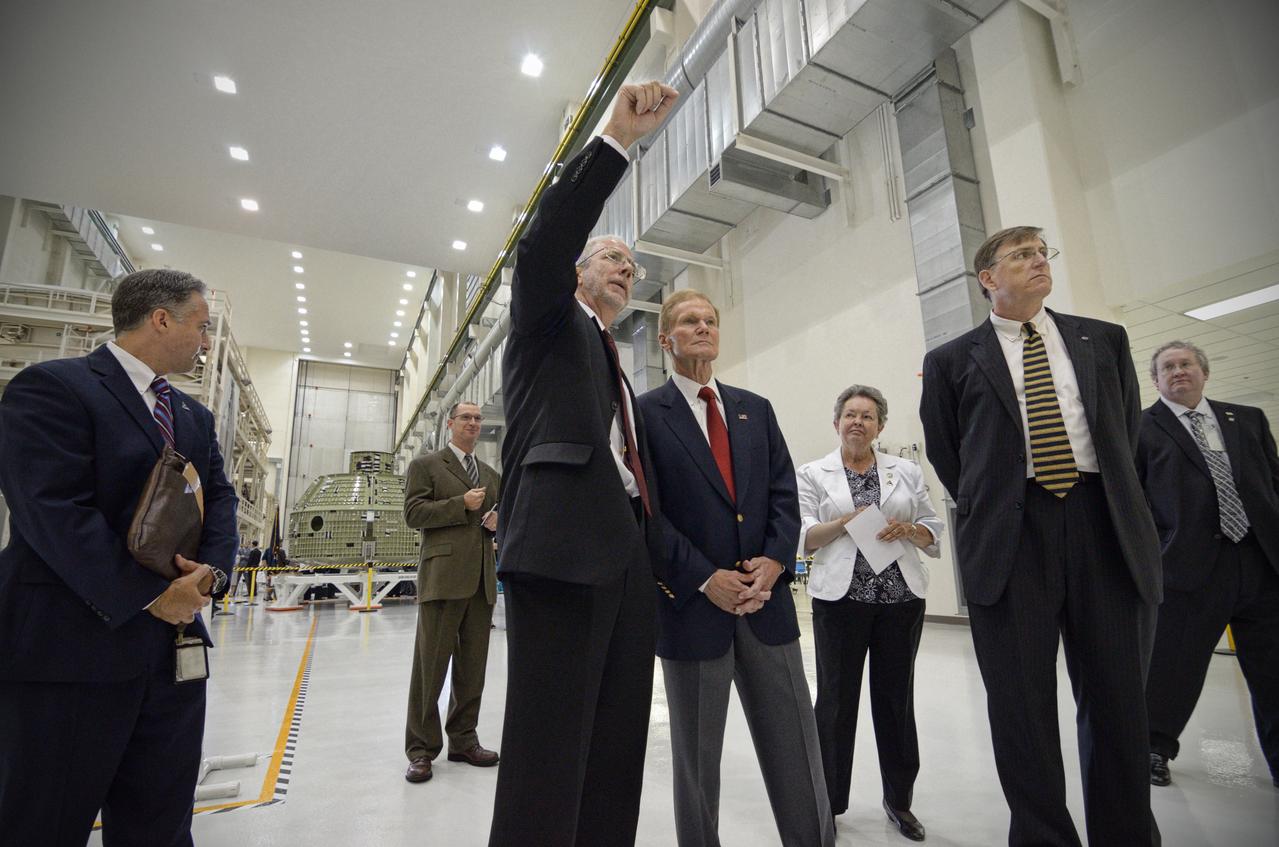
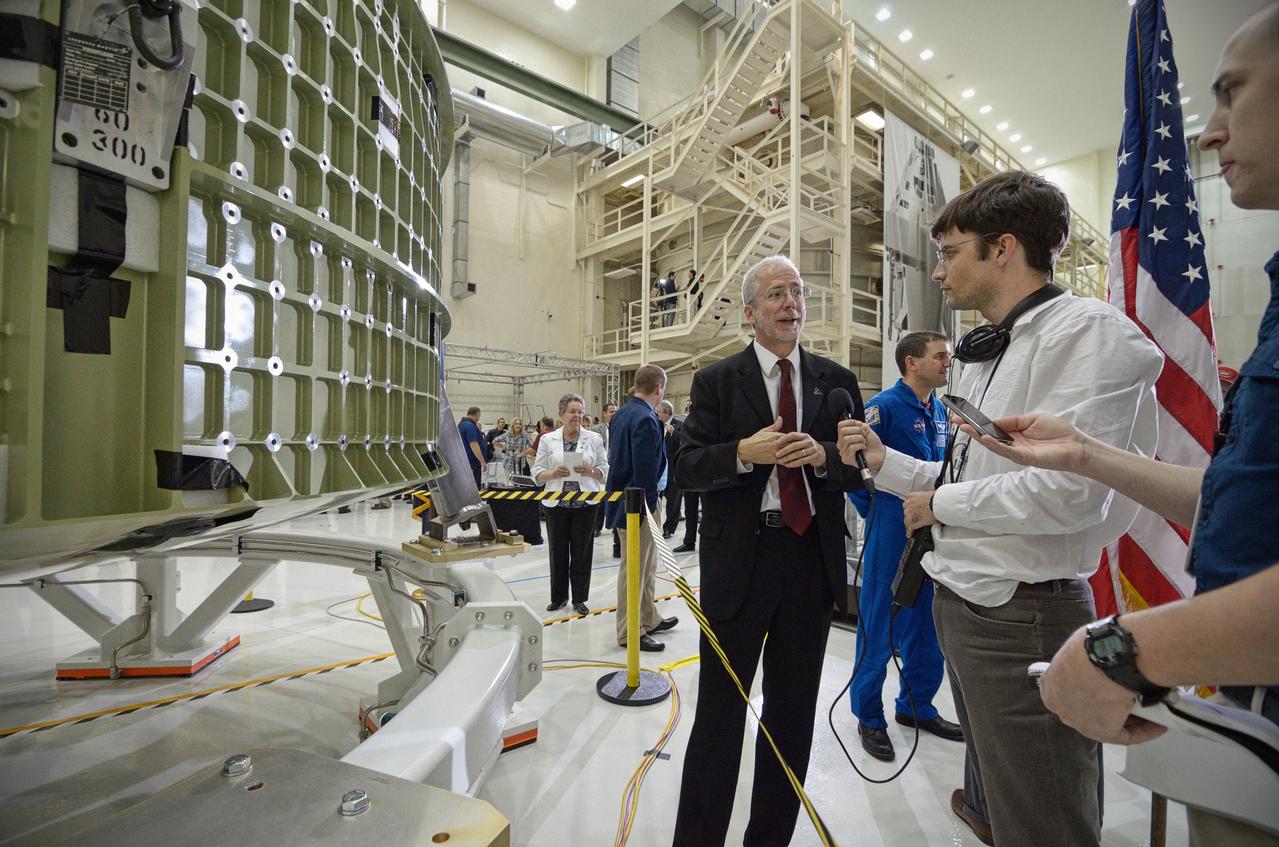
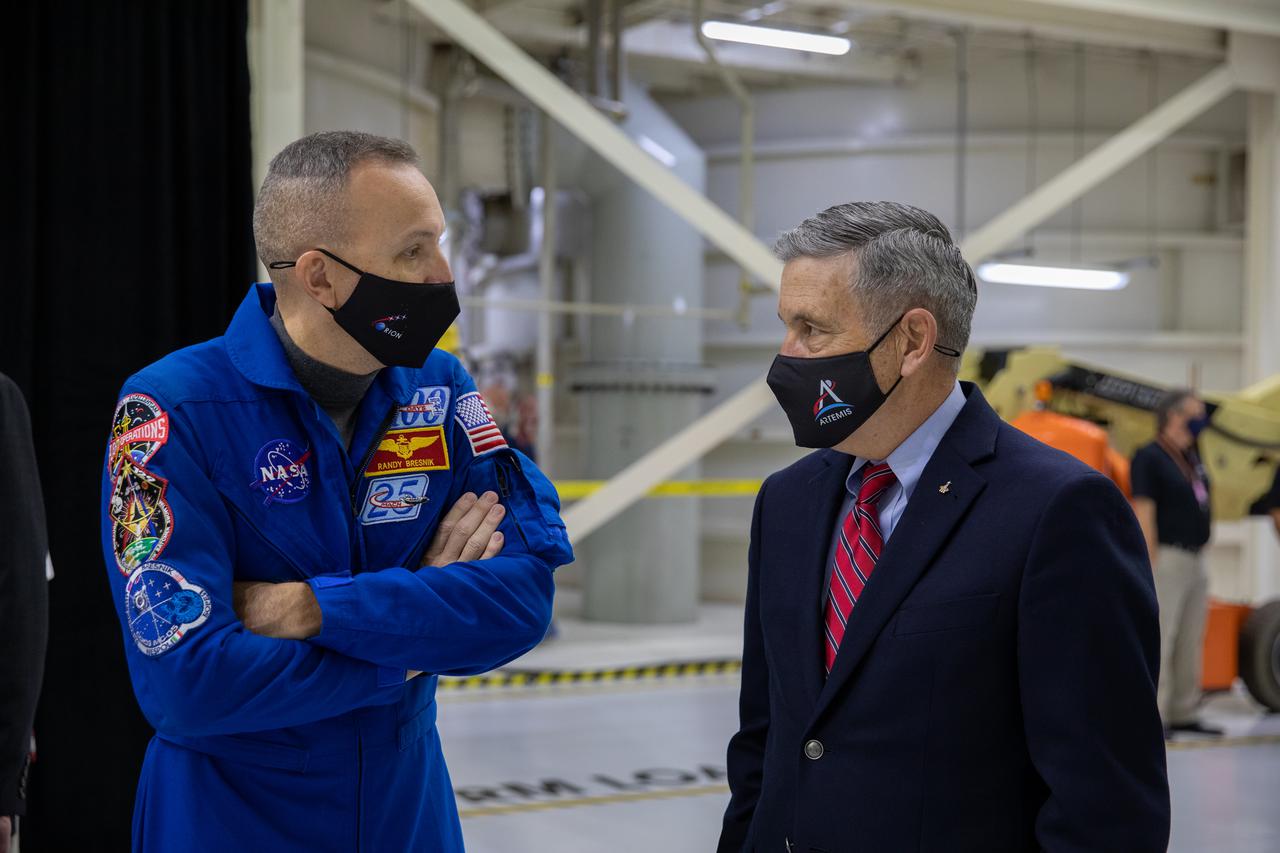
Orion is revealed for one of the final times on Jan. 14, as it is readied atop its transport pallet from the Neil Armstrong Operations and Checkout Building at NASA’s Kennedy Space Center in Florida, along its path to the pad ahead of the Artemis I launch. Orion was officially transferred from the Orion Program to Exploration Ground Systems (EGS) during a handover ceremony. NASA astronaut Randy Bresnik speaks with Kennedy Center Director Bob Cabana inside the high bay. Teams across the globe have worked tirelessly to assemble the spacecraft, which will receive a protective covering prior to departing for the Multi-Payload Processing Facility to begin ground processing by the EGS and Jacobs teams.
Artemis I Orion Lift to Transporter - Key Handover from Lockheed
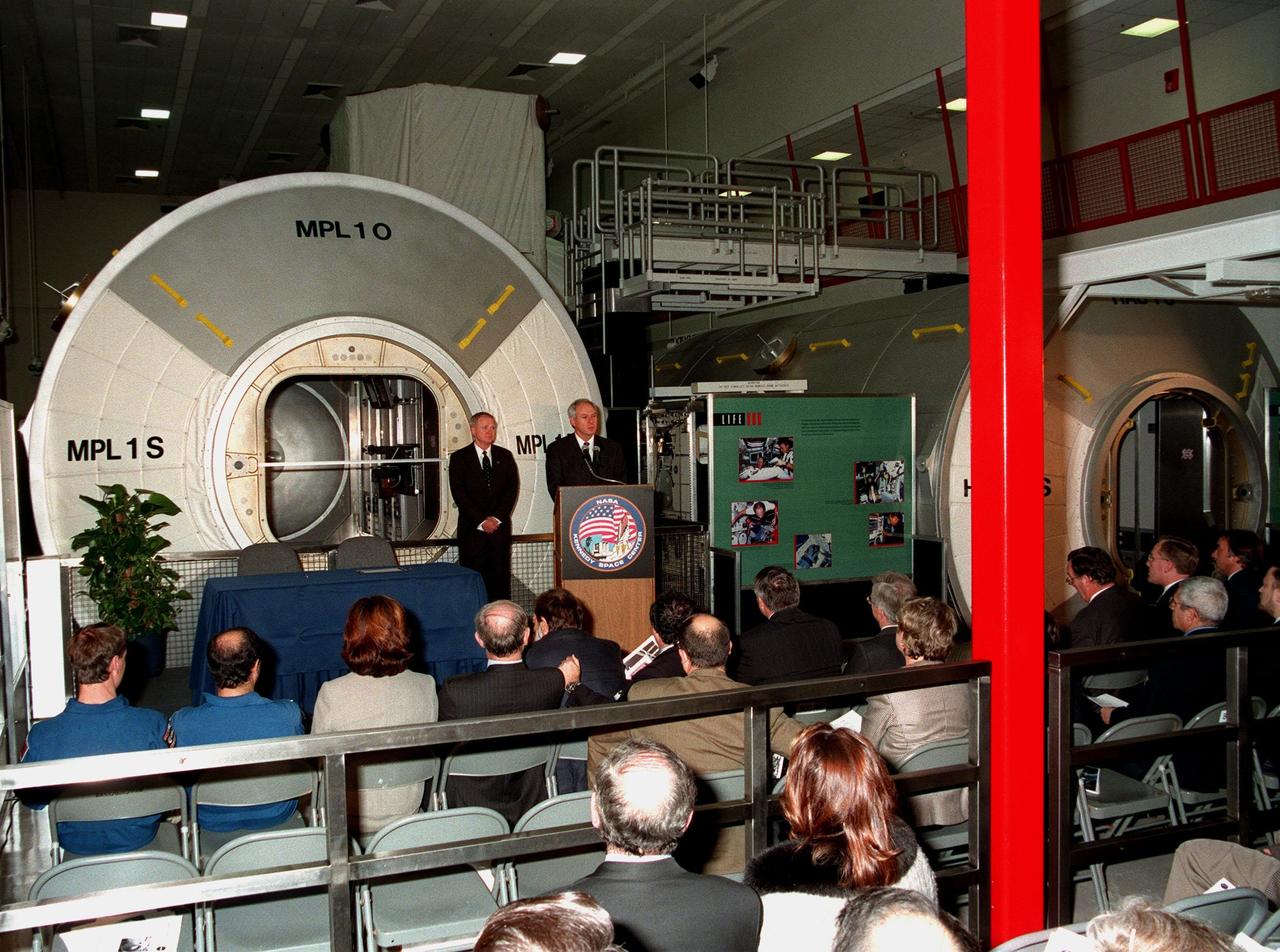
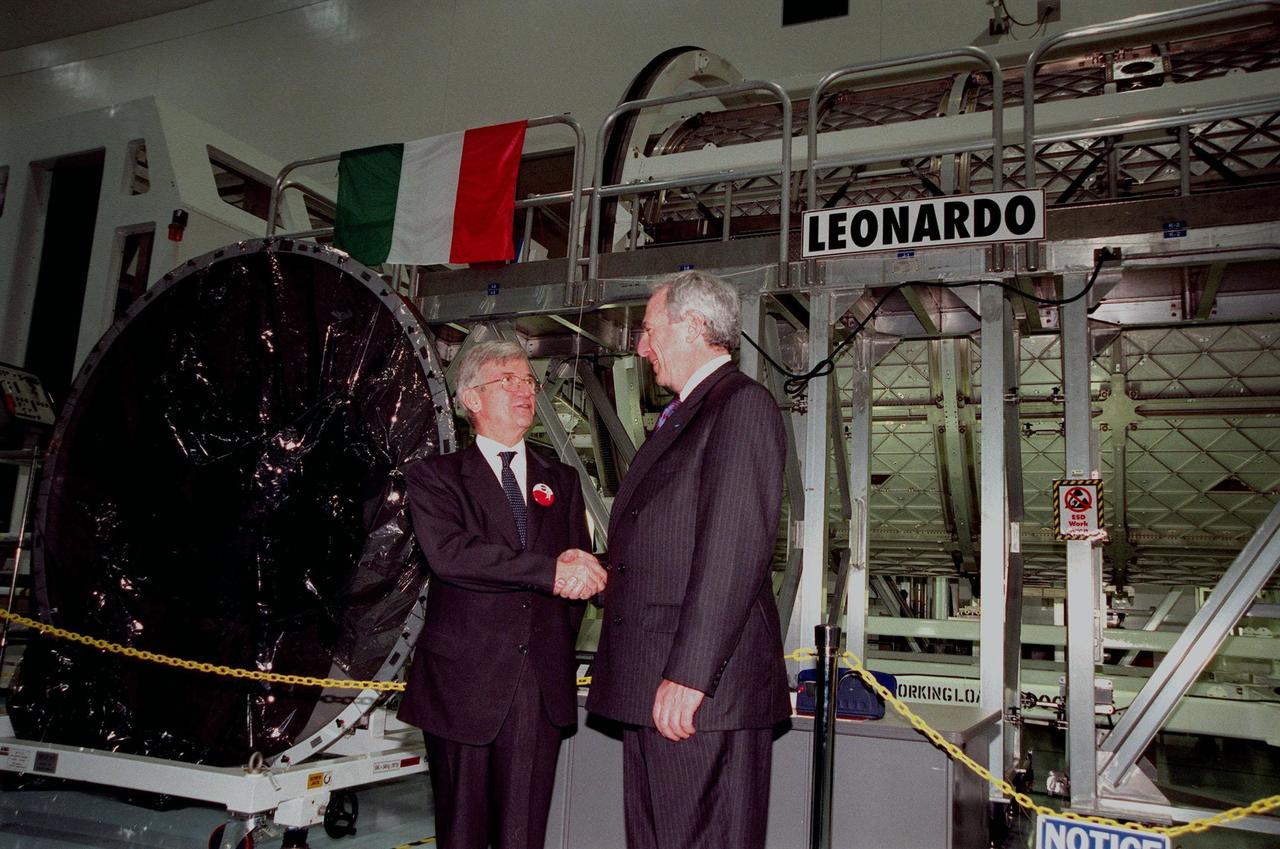
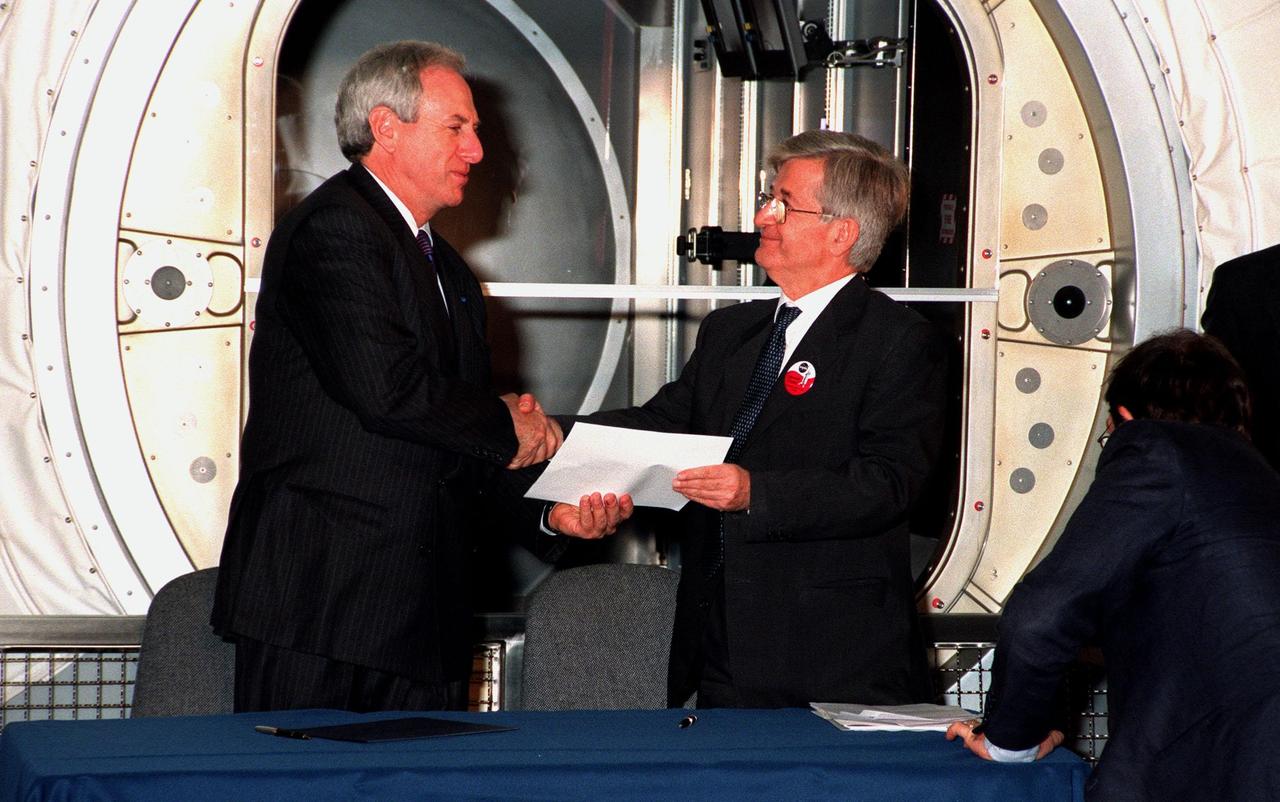
KENNEDY SPACE CENTER, FLA. -- NASA Administrator Daniel S. Goldin (at right) shakes the hand of Sergio De Julio, president of the Italian Space Agency, Agenzia Spaziale Italiana (ASI), during the ceremony transferring the "Leonardo" Multipurpose Logistics Module (MPLM) from ASI to NASA. The event was held in the Space Station Processing Facility beside Leonardo. The MPLM, a reusable logistics carrier, will be the primary delivery system used to resupply and return International Space Station cargo requiring a pressurized environment. Leonardo is the first of three MPLM carriers for the International Space Station. It is scheduled to be launched on Space Shuttle Mission STS-100, targeted for April 2000
KSC-98pc1773
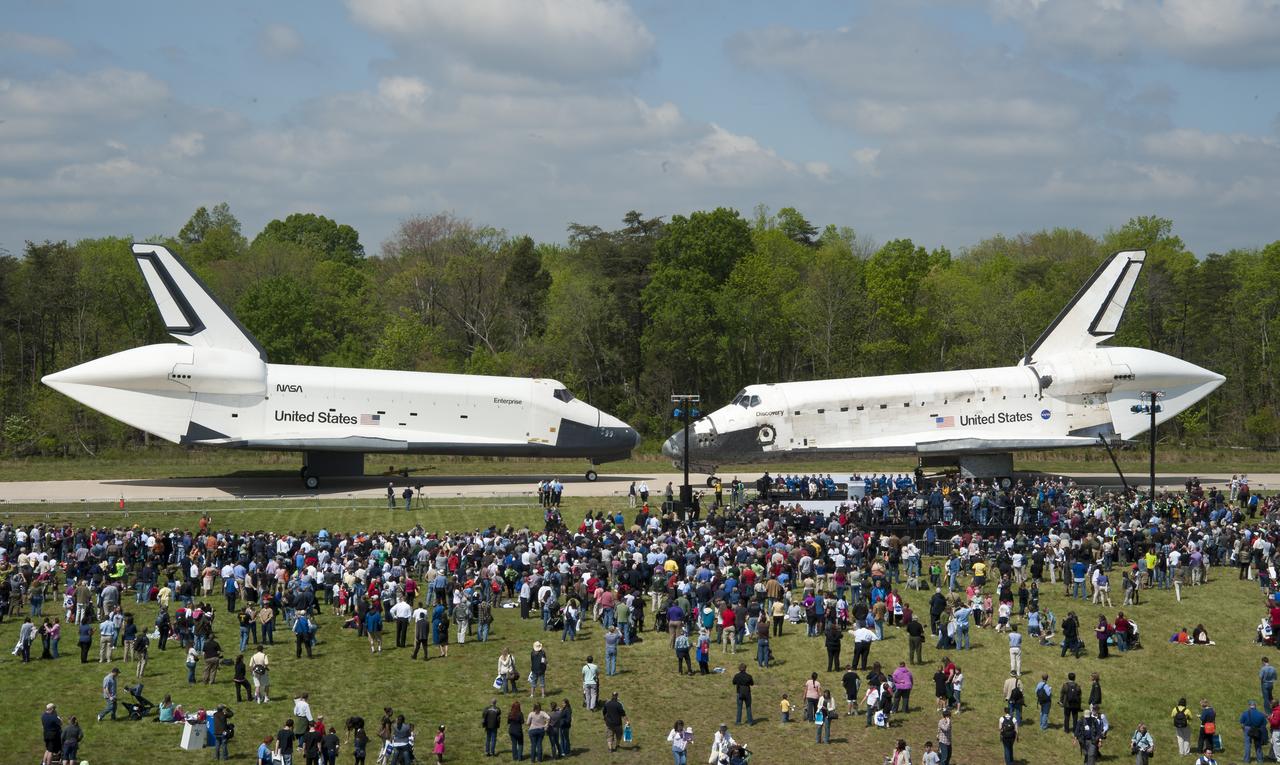
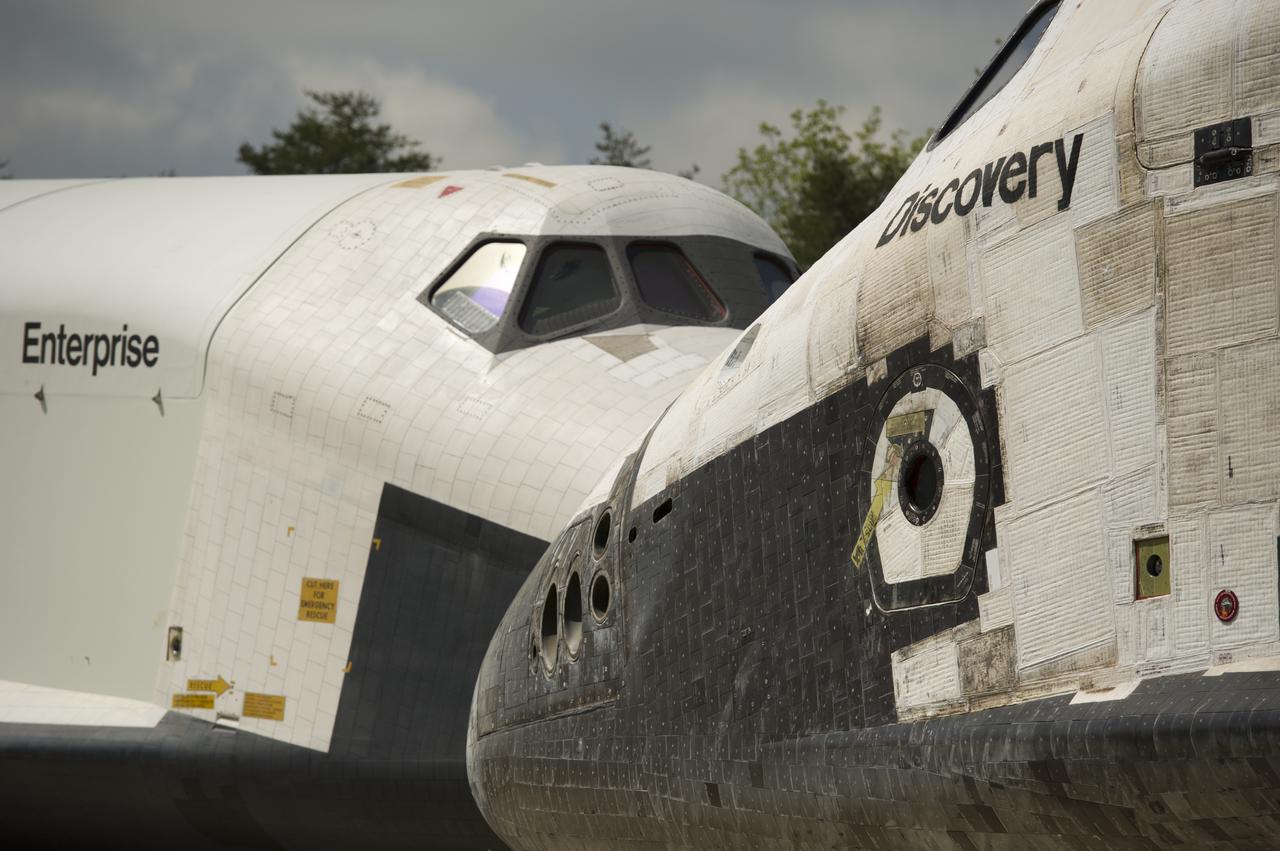
Space Shuttles Enterprise, left, and Discovery meet nose-to-nose during the a transfer ceremony at the Smithsonian's Steven F. Udvar-Hazy Center, Thursday, April 19, 2012, in Chantilly, Va. Space shuttle Discovery, the first orbiter retired from NASA’s shuttle fleet, completed 39 missions, spent 365 days in space, orbited the Earth 5,830 times, and traveled 148,221,675 miles will take the place of Enterprise at the center to commemorate past achievements in space and to educate and inspire future generations of explorers at the center. Photo Credit: (NASA/Carla Cioffi)
Shuttle Discovery Arrives at Udvar-Hazy
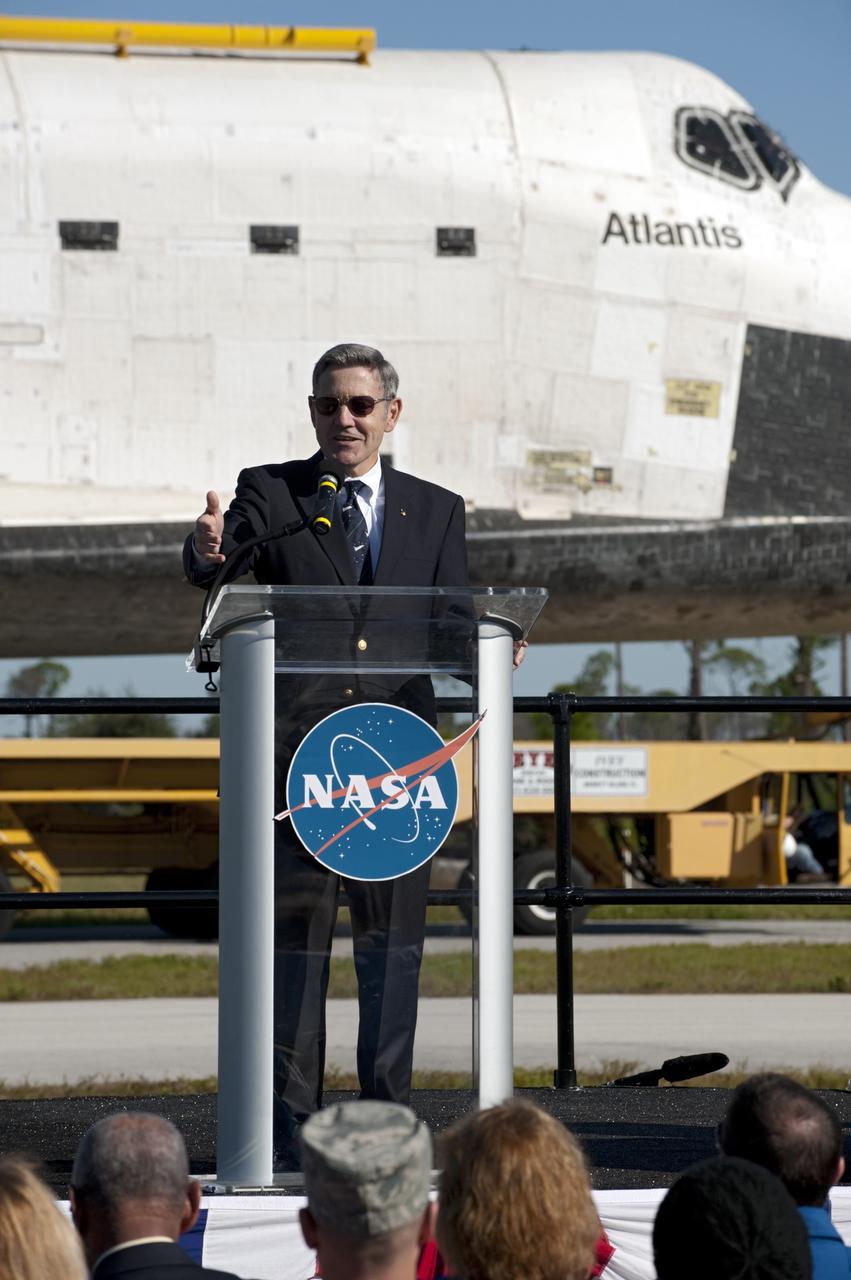
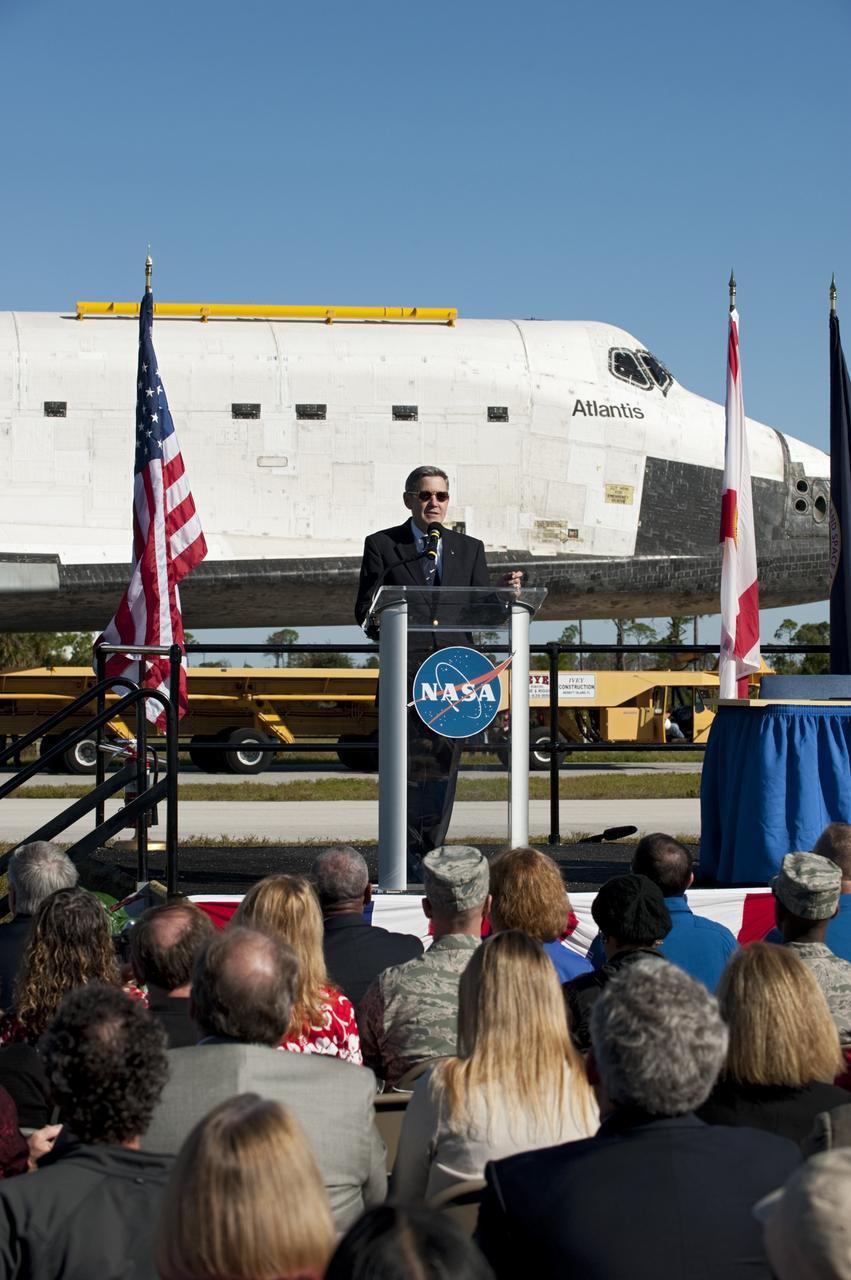
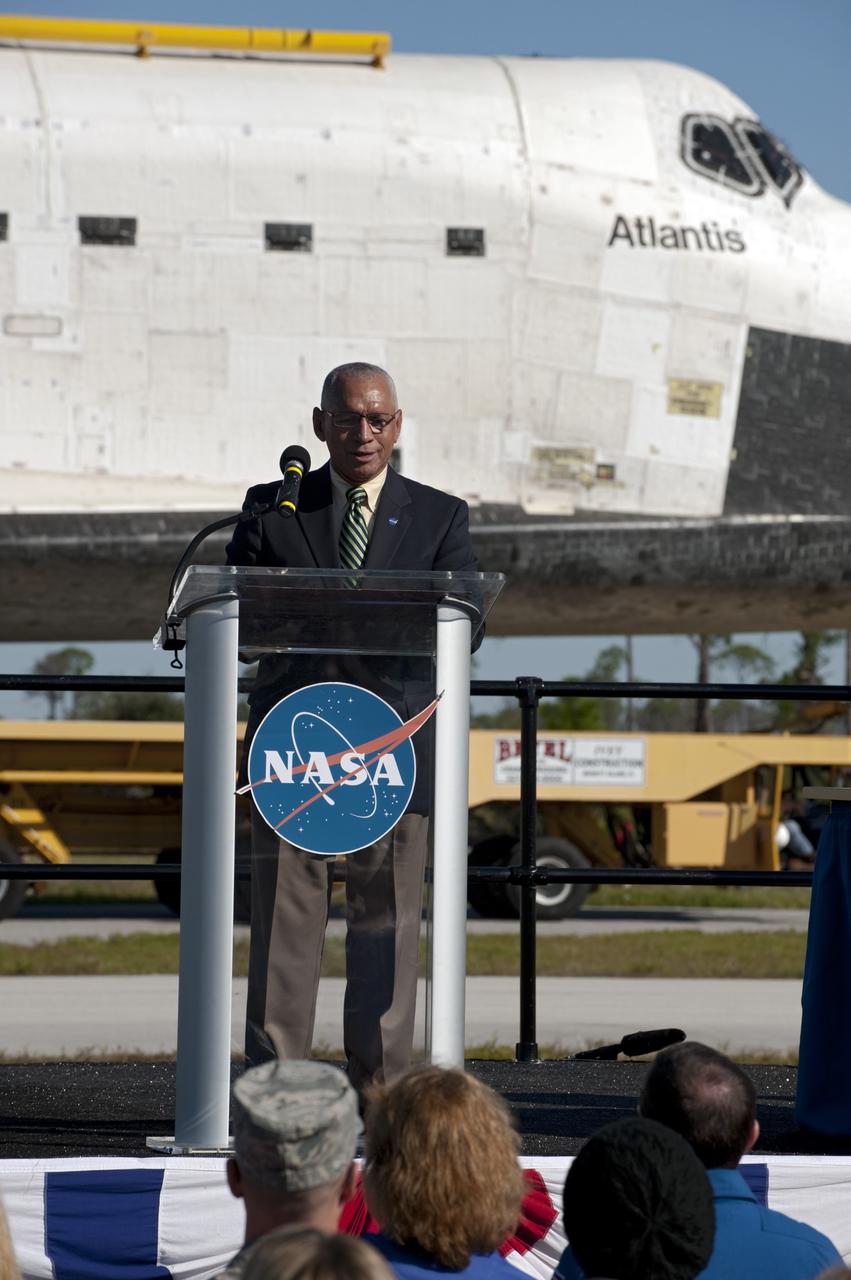
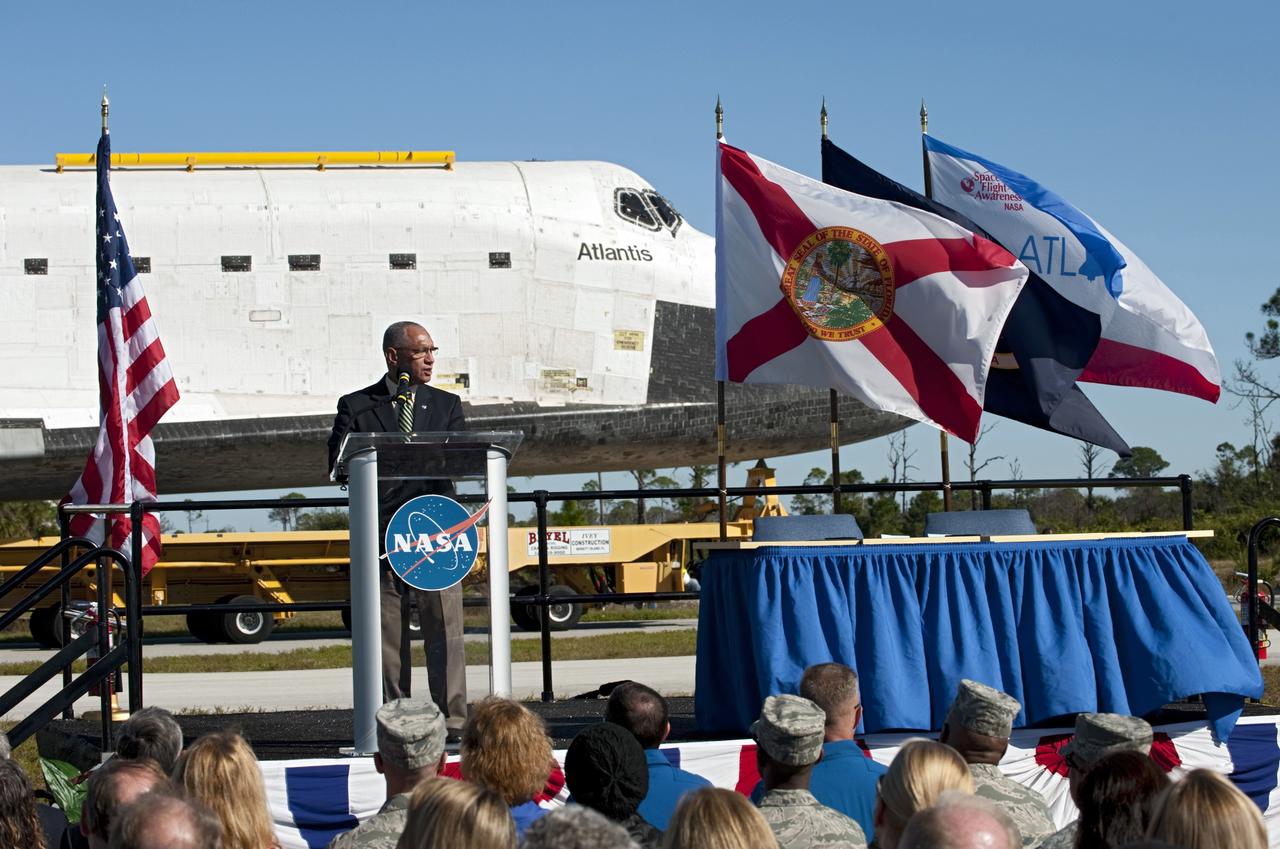
CAPE CANAVERAL, Fla. – At NASA's Kennedy Space Center in Florida, the space shuttle Atlantis pauses during its 10-mile journey to the Kennedy Visitor Complex for a ceremony to commemorate the transfer. NASA Administrator Charles Bolden spoke Kennedy employees and guests at the event.      As part of transition and retirement of the Space Shuttle Program, Atlantis is to be displayed at Kennedy's Visitor Complex beginning in the summer of 2013. Over the course of its 26-year career, Atlantis traveled 125,935,769 miles during 307 days in space over 33 missions. For more information, visit http://www.nasa.gov/transition Photo credit: NASA/Tony Gray
KSC-2012-6054
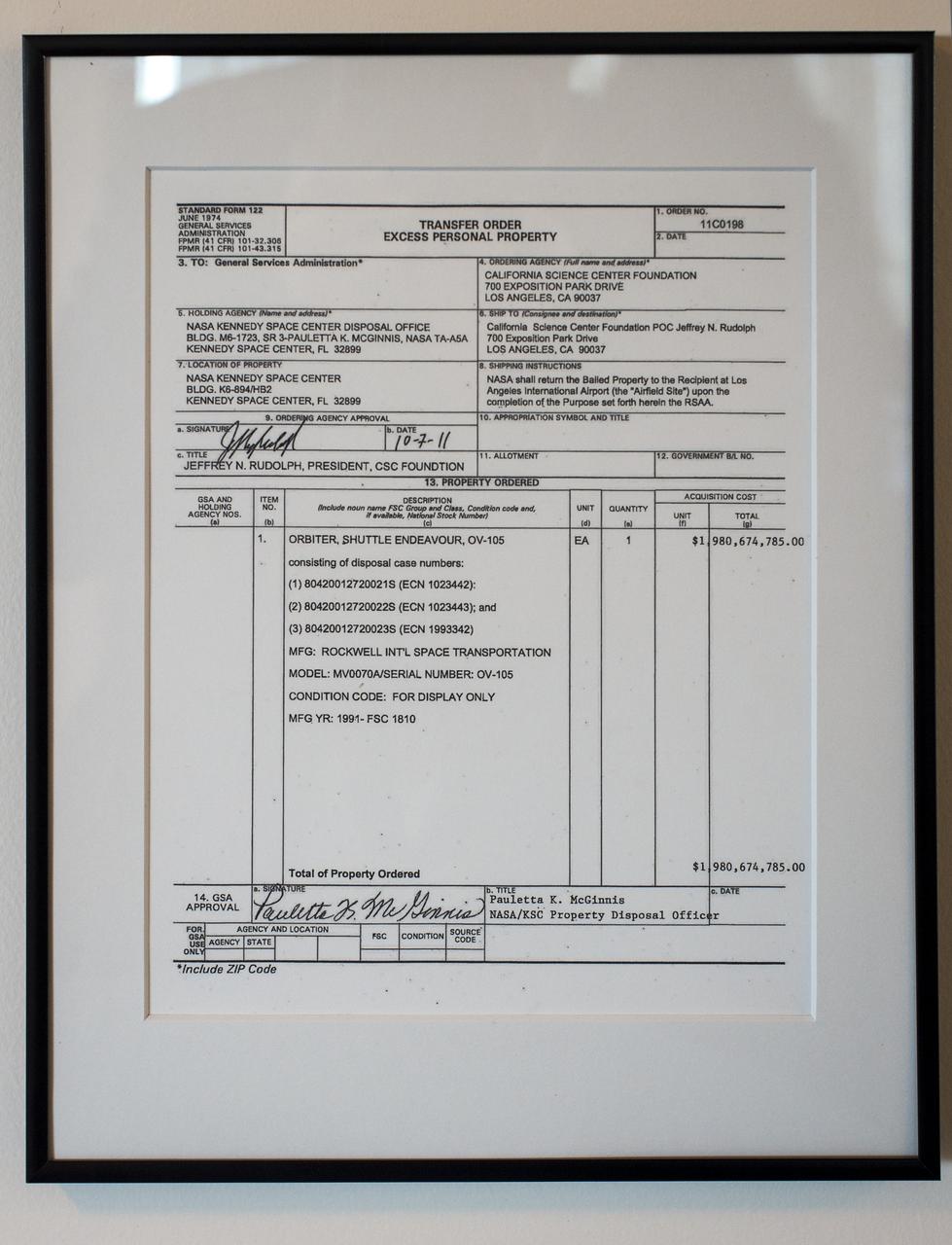
A government Transfer Order for Excess Personal Property is seen framed outside the office of President and CEO, California Science Center, Jeffrey N. Rudolph, on Tuesday, Oct. 30, 2012, in Los Angeles.  The grand opening ceremony for the California Science center's Samuel Oschin Space Shuttle Endeavour Display Pavilion took place on Tuesday, Oct. 30, 2012.  Endeavour, built as a replacement for space shuttle Challenger, completed 25 missions, spent 299 days in orbit, and orbited Earth 4,671 times while traveling 122,883,151 miles. Photo Credit: (NASA/Bill Ingalls)
Endeavour Grand Opening Ceremony
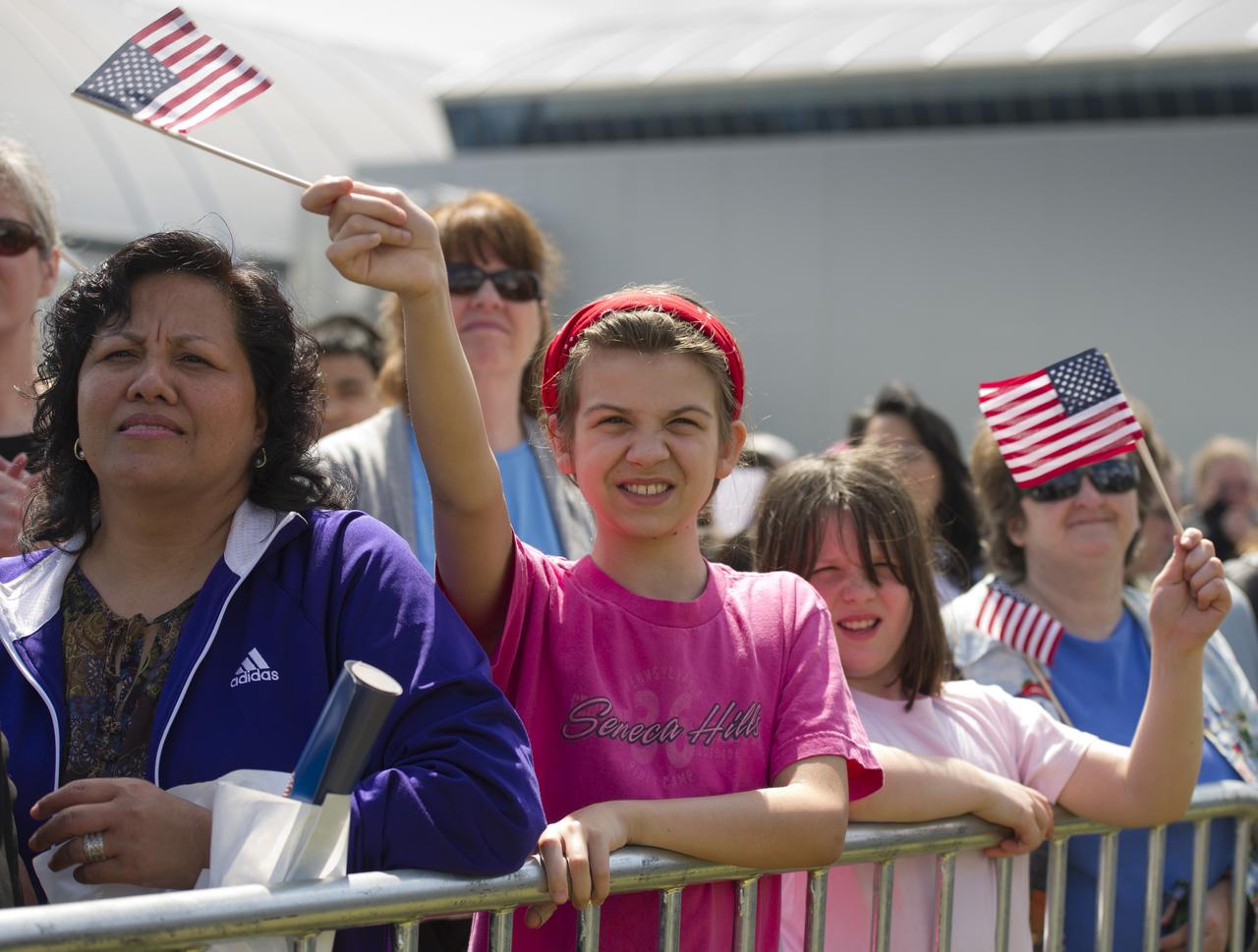
Rachel Ledford, in prink shirt, and Noelle Leford, right, from Butler, PA attend the transfer ceremony for space shuttle Discovery, Thursday, April 19, 2012, at the Smithsonian's Steven F. Udvar-Hazy Center in Chantilly, Va.  Discovery, the first orbiter retired from NASA’s shuttle fleet, which completed 39 missions, spent 365 days in space, orbited the Earth 5,830 times, and traveled 148,221,675 miles will take the place of Enterprise at the center to commemorate past achievements in space and to educate and inspire future generations of explorers at the center. Photo Credit: (NASA/Carla Cioffi)
Shuttle Discovery Arrives at Udvar-Hazy
The U.S. and NASA flags atop Building 4200 at NASA Marshall Space Flight Center in Huntsville, Alabama, were retired Jan. 21, 2022. These images show center operations employees lowering the flags at Building 4200, which was Marshall’s original central laboratory and office building and served as Marshall’s headquarters since 1963. This building will be demolished later this year. A flag-raising ceremony marking the transfer of Marshall headquarters to Building 4221 was held Jan. 26, 2022. The doors to Building 4221 opened on Earth Day, April 22, 2019.
U.S. Flag Retired from Marshall Building 4200
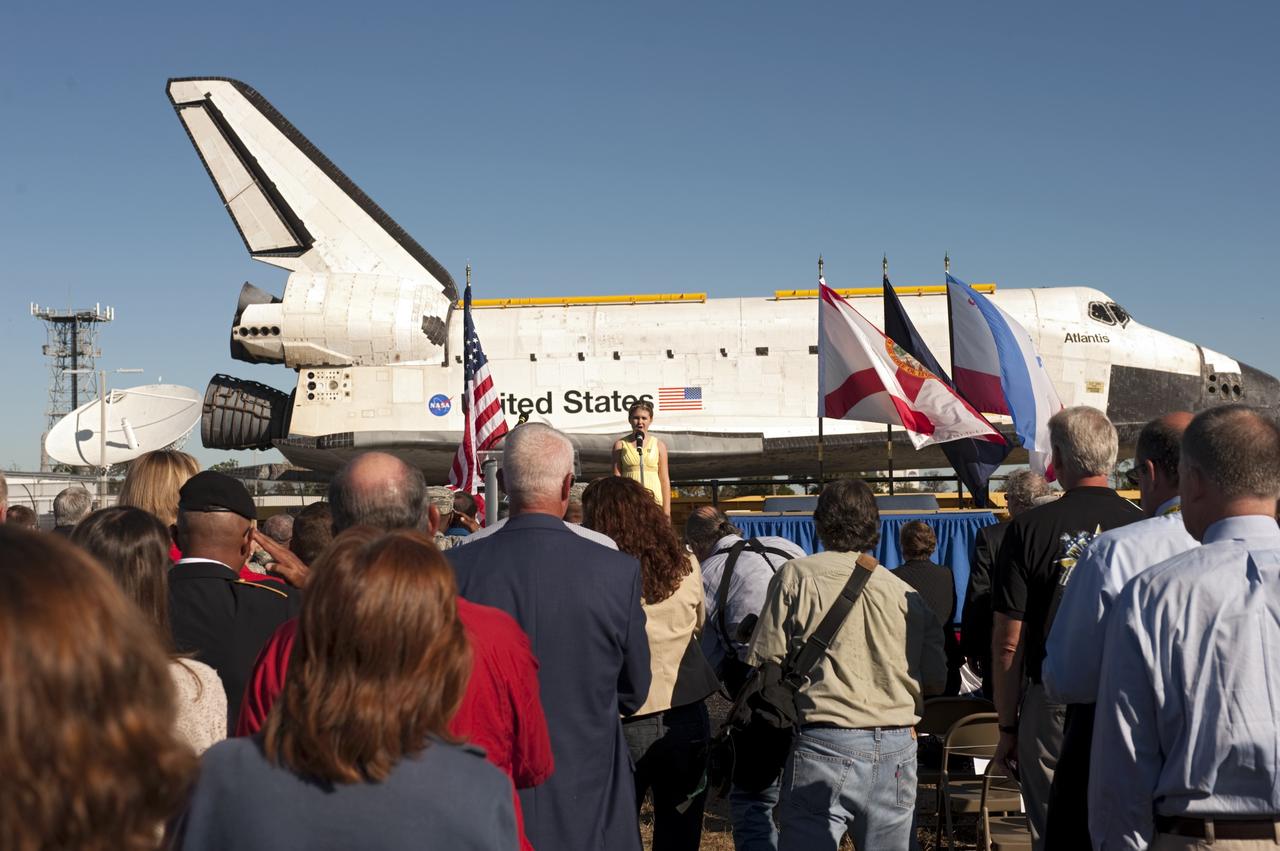
CAPE CANAVERAL, Fla. – At NASA's Kennedy Space Center in Florida, the space shuttle Atlantis pauses during its 10-mile journey to the Kennedy Visitor Complex for a ceremony to commemorate the transfer. Kennedy Middle School student Searra Weeks sang the National Anthem to begin the event.      As part of transition and retirement of the Space Shuttle Program, Atlantis is to be displayed at Kennedy's Visitor Complex beginning in the summer of 2013. Over the course of its 26-year career, Atlantis traveled 125,935,769 miles during 307 days in space over 33 missions. For more information, visit http://www.nasa.gov/transition Photo credit: NASA/ Tony Gray
KSC-2012-6045
The U.S. and NASA flags atop Building 4200 at NASA Marshall Space Flight Center in Huntsville, Alabama, were retired Jan. 21, 2022. These images show center operations employees lowering the flags at Building 4200, which was Marshall’s original central laboratory and office building and served as Marshall’s headquarters since 1963. This building will be demolished later this year. A flag-raising ceremony marking the transfer of Marshall headquarters to Building 4221 was held Jan. 26, 2022. The doors to Building 4221 opened on Earth Day, April 22, 2019.
U.S. Flag Retired from Marshall Building 4200
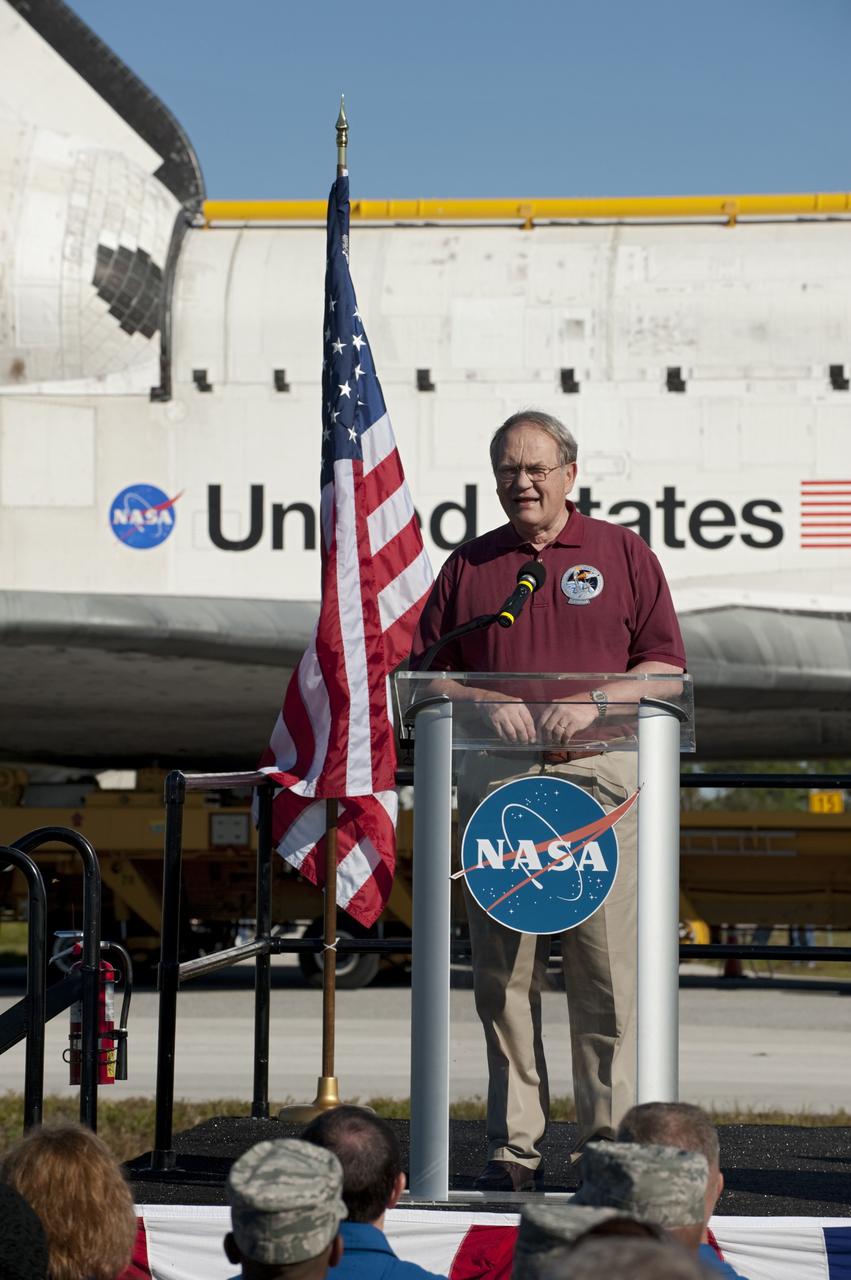
CAPE CANAVERAL, Fla. – At NASA's Kennedy Space Center in Florida, the space shuttle Atlantis pauses during its 10-mile journey to the Kennedy Visitor Complex for a ceremony to commemorate the transfer. Astronaut Chris Ferguson, who commanded Atlantis's final mission, STS-135 in 2011, spoke Kennedy employees and guests at the event.      As part of transition and retirement of the Space Shuttle Program, Atlantis is to be displayed at Kennedy's Visitor Complex beginning in the summer of 2013. Over the course of its 26-year career, Atlantis traveled 125,935,769 miles during 307 days in space over 33 missions. For more information, visit http://www.nasa.gov/transition Photo credit: NASA/ Tony Gray
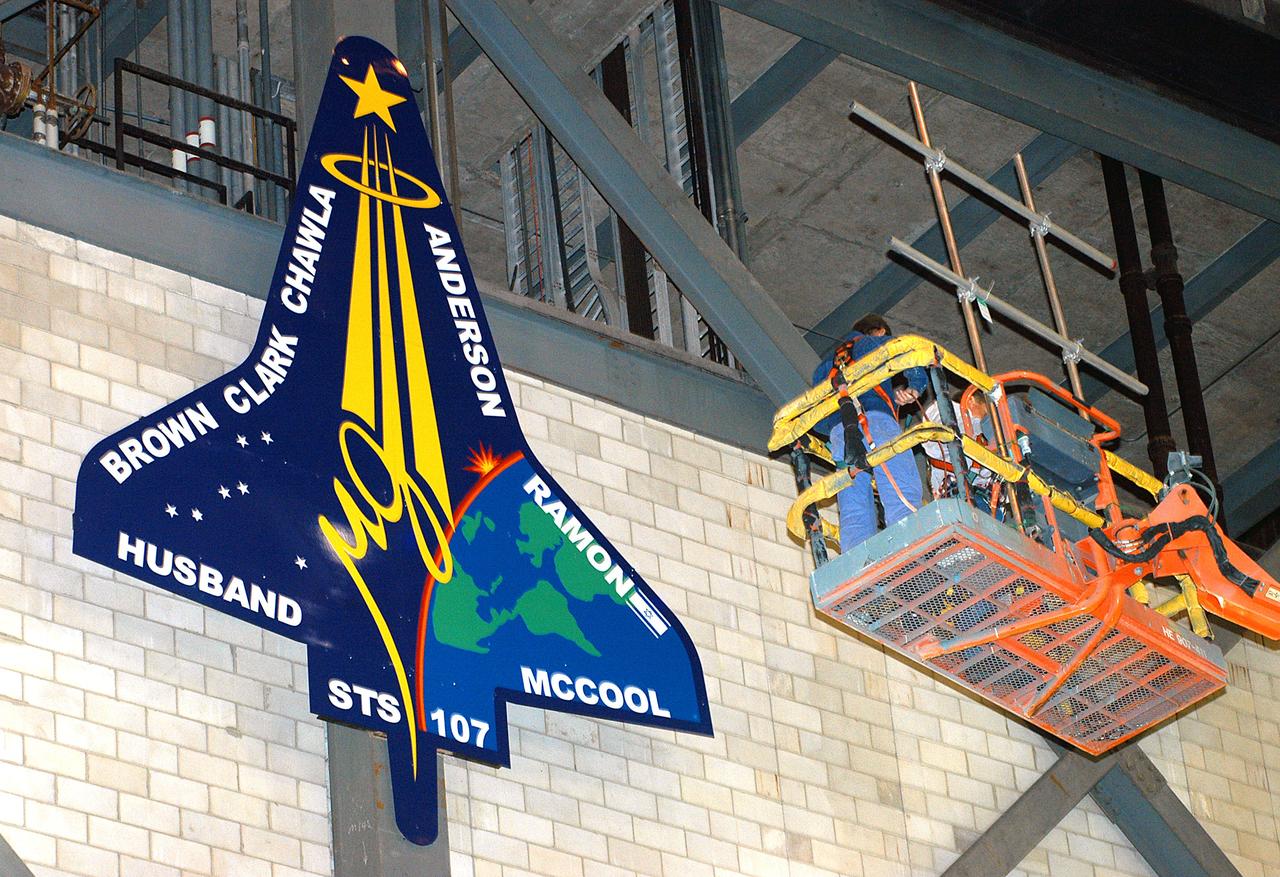
KSC-2012-6047
CAPE CANAVERAL, Fla. – At NASA's Kennedy Space Center in Florida, the space shuttle Atlantis pauses during its 10-mile journey to the Kennedy Visitor Complex for a ceremony to commemorate the transfer. Kennedy Director Bob Cabana spoke Kennedy employees and guests at the event.      As part of transition and retirement of the Space Shuttle Program, Atlantis is to be displayed at Kennedy's Visitor Complex beginning in the summer of 2013. Over the course of its 26-year career, Atlantis traveled 125,935,769 miles during 307 days in space over 33 missions. For more information, visit http://www.nasa.gov/transition Photo credit: NASA/Tony Gray
KSC-2012-6051
CAPE CANAVERAL, Fla. – At NASA's Kennedy Space Center in Florida, the space shuttle Atlantis pauses during its 10-mile journey to the Kennedy Visitor Complex for a ceremony to commemorate the transfer. NASA Administrator Charles Bolden spoke Kennedy employees and guests at the event.      As part of transition and retirement of the Space Shuttle Program, Atlantis is to be displayed at Kennedy's Visitor Complex beginning in the summer of 2013. Over the course of its 26-year career, Atlantis traveled 125,935,769 miles during 307 days in space over 33 missions. For more information, visit http://www.nasa.gov/transition Photo credit: NASA/Tony Gray
KSC-2012-6055
Dr. Valerie Neal, curator for the shuttle program in the Space History office at the National Air and Space Museum, attends the transfer ceremony for space shuttle Discovery, Thursday, April 19, 2012, at the Smithsonian's Steven F. Udvar-Hazy Center in Chantilly, Va.  Discovery, the first orbiter retired from NASA’s shuttle fleet, which completed 39 missions, spent 365 days in space, orbited the Earth 5,830 times, and traveled 148,221,675 miles will take the place of Enterprise at the center to commemorate past achievements in space and to educate and inspire future generations of explorers at the center. Photo Credit: (NASA/Carla Cioffi)
Shuttle Discovery Arrives at Udvar-Hazy
KENNEDY SPACE CENTER, FLA.  --  Sergio De Julio (at right), president of the Italian Space Agency, Agenzia Spaziale Italiana (ASI), shakes the hand of NASA Adminstrator Daniel S. Goldin while holding the document which signifies the transfer of the "Leonardo" Multipurpose Logistics Module (MPLM) from ASI to NASA. The ceremonial event was held in the Space Station Processing Facility beside Leonardo. The MPLM, a reusable logistics carrier, will be the primary delivery system used to resupply and return International Space Station cargo requiring a pressurized environment. Leonardo is the first of three MPLM carriers for the International Space Station. It is scheduled to be launched on Space Shuttle Mission STS-100, targeted for April 2000
KSC-98pc1772
Bettye Kozlowski, center, and Francesca Wright, right, from Santa Clarita, CA attend the transfer ceremony for space shuttle Discovery, Thursday, April 19, 2012, at the Smithsonian's Steven F. Udvar-Hazy Center in Chantilly, Va.  Discovery, the first orbiter retired from NASA’s shuttle fleet, which completed 39 missions, spent 365 days in space, orbited the Earth 5,830 times, and traveled 148,221,675 miles will take the place of Enterprise at the center to commemorate past achievements in space and to educate and inspire future generations of explorers at the center. Photo Credit: (NASA/Carla Cioffi)
Shuttle Discovery Arrives at Udvar-Hazy
NASA Administrator Daniel S. Goldin speaks at the Space Station Processing Facility ceremony transferring the "Leonardo" Multipurpose Logistics Module (MPLM) from the Agenzia Spaziale Italiana (ASI) to NASA. Standing behind him in front of Leonardo is KSC Director Roy D. Bridges Jr. The MPLM, a reusable logistics carrier, will be the primary delivery system used to resupply and return International Space Station cargo requiring a pressurized environment. Leonardo is the first of three MPLM carriers for the International Space Station. It is scheduled to be launched on Space Shuttle Mission STS-100, targeted for April 2000
KSC-98pc1771
CAPE CANAVERAL, Fla. – At NASA's Kennedy Space Center in Florida, the space shuttle Atlantis pauses during its 10-mile journey to the Kennedy Visitor Complex for a ceremony to commemorate the transfer. Delaware North Companies Parks and Resorts Chief Operating Officer Bill Moore spoke Kennedy employees and guests at the event.      As part of transition and retirement of the Space Shuttle Program, Atlantis is to be displayed at Kennedy's Visitor Complex beginning in the summer of 2013. Over the course of its 26-year career, Atlantis traveled 125,935,769 miles during 307 days in space over 33 missions. For more information, visit http://www.nasa.gov/transition Photo credit: NASA/ Tony Gray
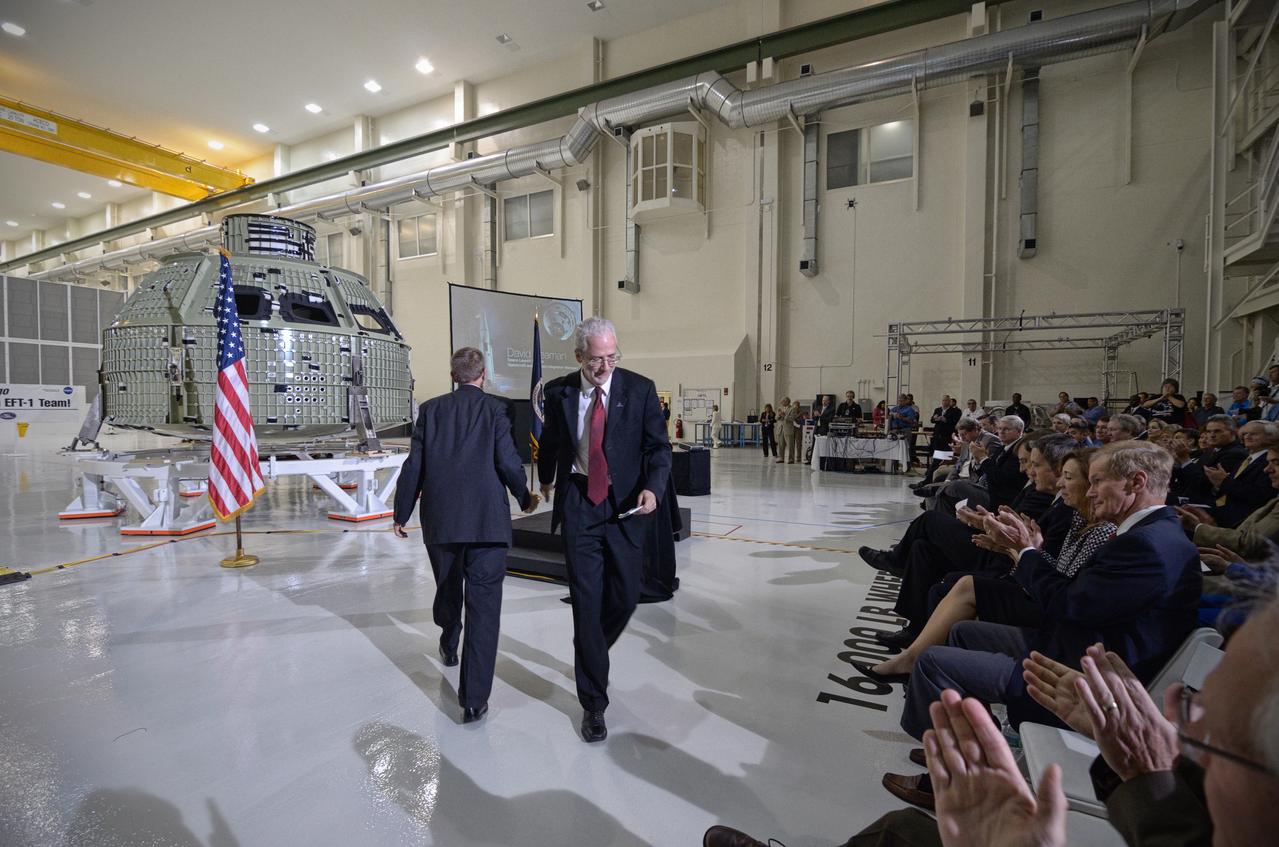
KSC-2012-6049
Space Shuttles Enterprise, left, and Discovery meet nose-to-nose at the beginning of a transfer ceremony at the Smithsonian's Steven F. Udvar-Hazy Center, Thursday, April 19, 2012, in Chantilly, Va. Space shuttle Discovery, the first orbiter retired from NASA’s shuttle fleet, completed 39 missions, spent 365 days in space, orbited the Earth 5,830 times, and traveled 148,221,675 miles will take the place of Enterprise at the center to commemorate past achievements in space and to educate and inspire future generations of explorers at the center. Photo Credit: (NASA/Smithsonian Institution/Carolyn Russo)
Space Shuttles Discovery Arrives at Udvar-Hazy
The U.S. and NASA flags atop Building 4200 at NASA Marshall Space Flight Center in Huntsville, Alabama, were retired Jan. 21, 2022. These images show center operations employees lowering the flags at Building 4200, which was Marshall’s original central laboratory and office building and served as Marshall’s headquarters since 1963. This building will be demolished later this year. A flag-raising ceremony marking the transfer of Marshall headquarters to Building 4221 was held Jan. 26, 2022. The doors to Building 4221 opened on Earth Day, April 22, 2019.
U.S. Flag Retired from Marshall Building 4200
CAPE CANAVERAL, Fla. – At NASA's Kennedy Space Center in Florida, the space shuttle Atlantis pauses during its 10-mile journey to the Kennedy Visitor Complex for a ceremony to commemorate the transfer. Astronaut Chris Ferguson, who commanded Atlantis's final mission, STS-135 in 2011, spoke Kennedy employees and guests at the event.      As part of transition and retirement of the Space Shuttle Program, Atlantis is to be displayed at Kennedy's Visitor Complex beginning in the summer of 2013. Over the course of its 26-year career, Atlantis traveled 125,935,769 miles during 307 days in space over 33 missions. For more information, visit http://www.nasa.gov/transition Photo credit: NASA/ Tony Gray
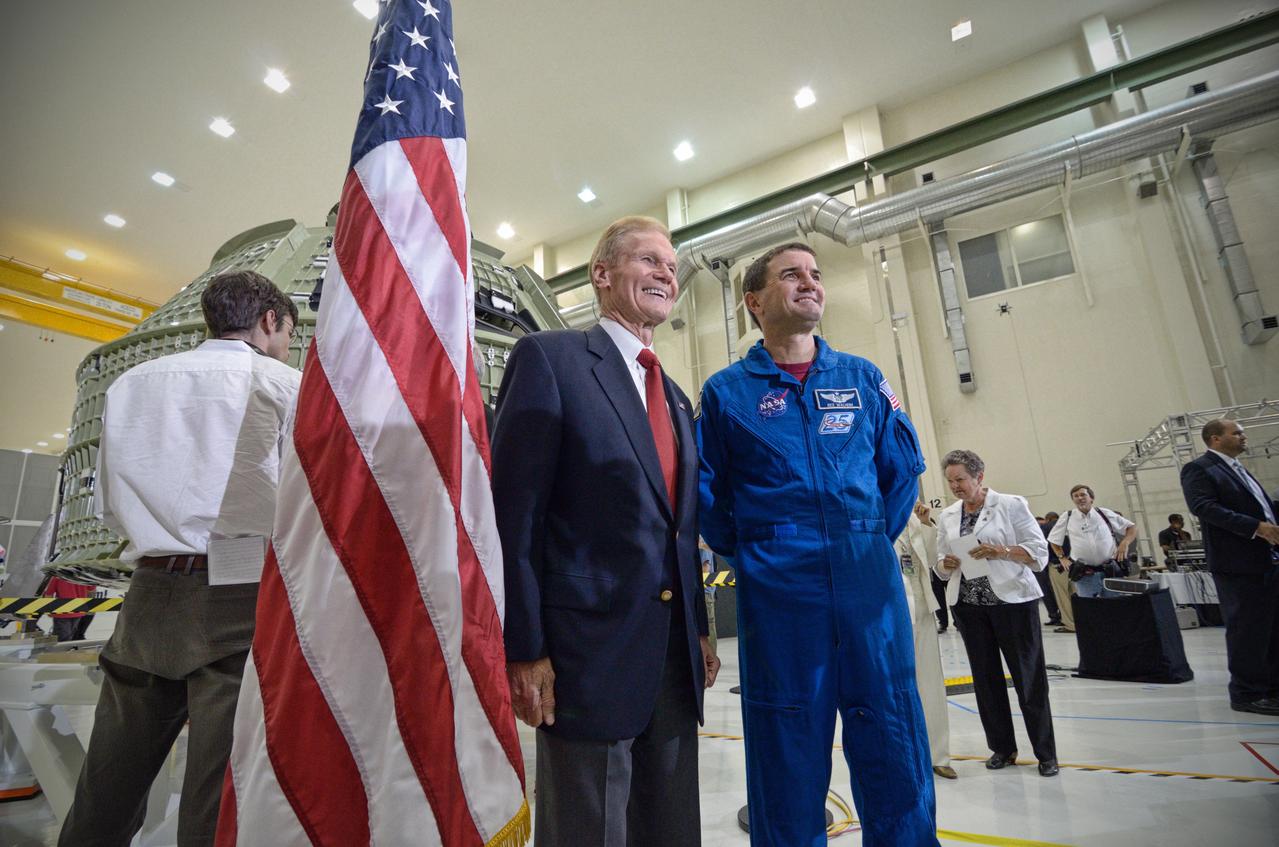
KSC-2012-6048
The U.S. and NASA flags atop Building 4200 at NASA Marshall Space Flight Center in Huntsville, Alabama, were retired Jan. 21, 2022. These images show center operations employees lowering the flags at Building 4200, which was Marshall’s original central laboratory and office building and served as Marshall’s headquarters since 1963. This building will be demolished later this year. A flag-raising ceremony marking the transfer of Marshall headquarters to Building 4221 was held Jan. 26, 2022. The doors to Building 4221 opened on Earth Day, April 22, 2019.
U.S. Flag Retired from Marshall Building 4200
NASA Deputy Administrator Lori Garver speaks Friday, April 27, 2012, during the transfer ceremony for space shuttle Enterprise at John F. Kennedy Airport in New York. Enterprise was the first shuttle orbiter built for NASA performing test flights in the atmosphere and was incapable of spaceflight. Originally housed at the Smithsonian's Steven F. Udvar-Hazy Center, Enterprise will be demated from the SCA and placed on a barge that will eventually be moved by tugboat up the Hudson River to the Intrepid Sea, Air & Space Museum in June. Photo Credit: (NASA/Paul E. Alers)
Shuttle Enterprise Lands JFK
CAPE CANAVERAL, Fla. – At NASA's Kennedy Space Center in Florida, the space shuttle Atlantis pauses during its 10-mile journey to the Kennedy Visitor Complex for a ceremony to commemorate the transfer. Kennedy Director Bob Cabana spoke Kennedy employees and guests at the event.      As part of transition and retirement of the Space Shuttle Program, Atlantis is to be displayed at Kennedy's Visitor Complex beginning in the summer of 2013. Over the course of its 26-year career, Atlantis traveled 125,935,769 miles during 307 days in space over 33 missions. For more information, visit http://www.nasa.gov/transition Photo credit: NASA/Tony Gray
KSC-2012-6052
President Dwight D. Eisenhower and Mrs. George C. Marshall unveil the bronze bust of General George C. Marshall during the dedication of the Marshall Space Flight Center. Eisenhower signed an Executive Order on October 21, 1959 directing the transfer of persornel from the Redstone Arsenal's Army Ballistic Missile Agency Development Operations Division to NASA. On March 15, 1960, another Executive Order announced that the space complex formed within the boundaries of Redstone Arsenal would become the George C. Marshall Space Flight Center. The Center was activated on July 1, 1960, with dedication ceremonies taking place September 8, 1960.
Origin of Marshall Space Flight Center (MSFC)
CAPE CANAVERAL, Fla. – At NASA's Kennedy Space Center in Florida, the space shuttle Atlantis pauses during its 10-mile journey to the Kennedy Visitor Complex for a ceremony to commemorate the transfer. NASA Director of Education and External Relations Cheryl Hurst welcomes Kennedy employees and guests to the event.      As part of transition and retirement of the Space Shuttle Program, Atlantis is to be displayed at Kennedy's Visitor Complex beginning in the summer of 2013. Over the course of its 26-year career, Atlantis traveled 125,935,769 miles during 307 days in space over 33 missions. For more information, visit http://www.nasa.gov/transition Photo credit: NASA/ Tony Gray
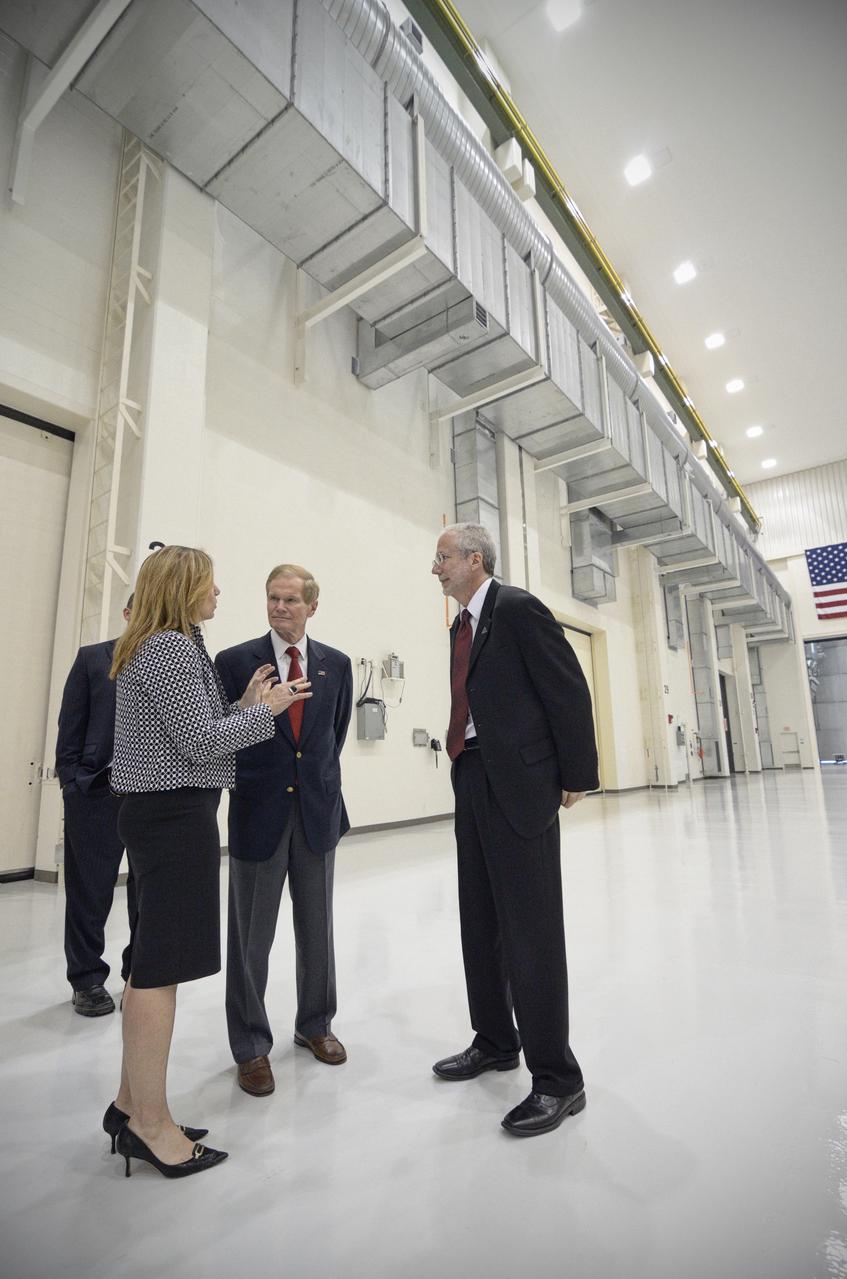
KSC-2012-6044
CAPE CANAVERAL, Fla. – At NASA's Kennedy Space Center in Florida, the space shuttle Atlantis pauses during its 10-mile journey to the Kennedy Visitor Complex for a ceremony to commemorate the transfer. Former astronaut Karol Bobko, who commanded Atlantis's first mission, STS-51J in 1985, spoke Kennedy employees and guests at the event.      As part of transition and retirement of the Space Shuttle Program, Atlantis is to be displayed at Kennedy's Visitor Complex beginning in the summer of 2013. Over the course of its 26-year career, Atlantis traveled 125,935,769 miles during 307 days in space over 33 missions. For more information, visit http://www.nasa.gov/transition Photo credit: NASA/ Tony Gray
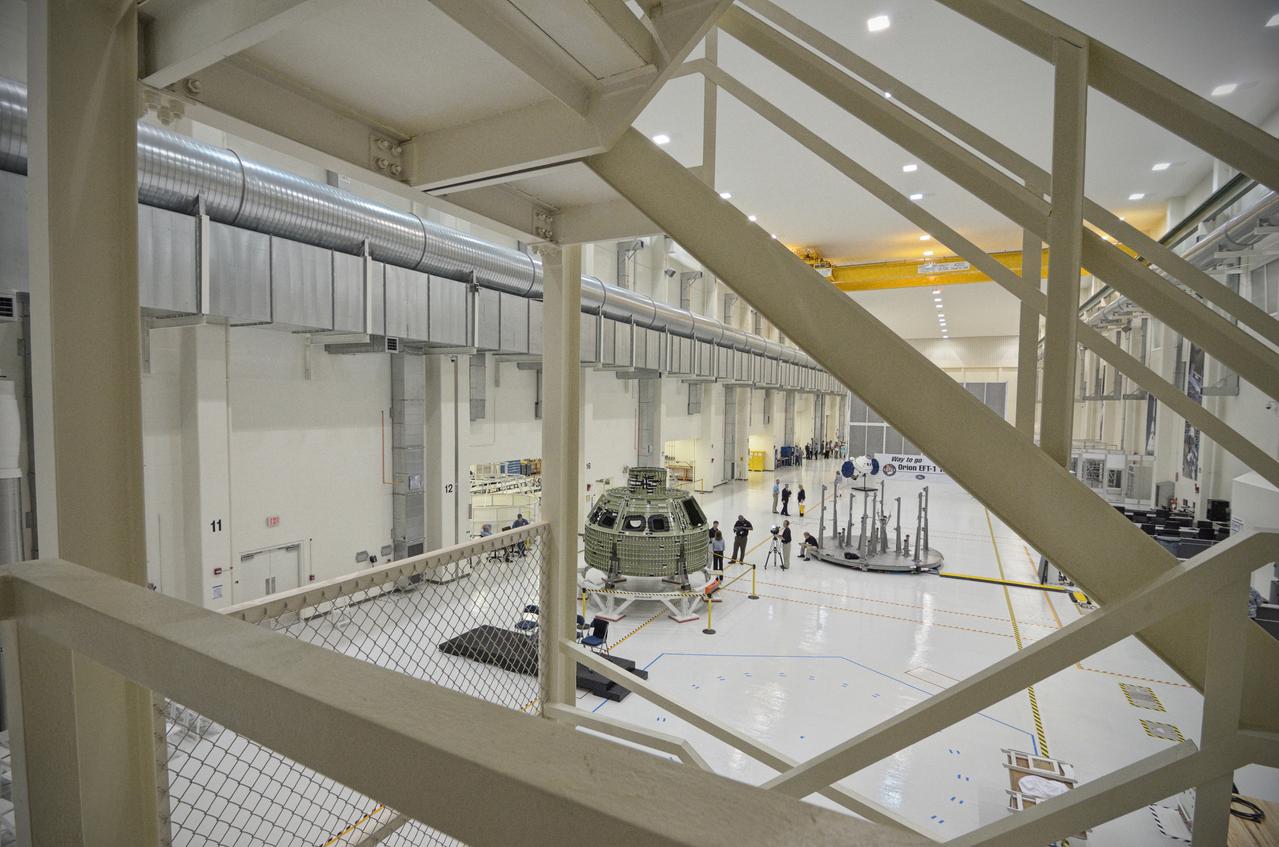
KSC-2012-6046
CAPE CANAVERAL, Fla. – At NASA's Kennedy Space Center in Florida, the space shuttle Atlantis pauses during its 10-mile journey to the Kennedy Visitor Complex for a ceremony to commemorate the transfer. NASA Administrator Charles Bolden spoke Kennedy employees and guests at the event.      As part of transition and retirement of the Space Shuttle Program, Atlantis is to be displayed at Kennedy's Visitor Complex beginning in the summer of 2013. Over the course of its 26-year career, Atlantis traveled 125,935,769 miles during 307 days in space over 33 missions. For more information, visit http://www.nasa.gov/transition Photo credit: NASA/Tony Gray
KSC-2012-6053
CAPE CANAVERAL, Fla. – –  Employees and media gather near Launch Pad 39B at NASA's Kennedy Space Center in Florida for the handover ceremony for Mobile Launcher Platform-1, seen here.  The platform is being transferred from NASA's Space Shuttle Program to the Constellation Program for the Ares I-X flight test targeted for this summer. Constructed in 1964, the mobile launchers used in Apollo/Saturn operations were modified for use in shuttle operations. With cranes, umbilical towers and swing arms removed, the mobile launchers were renamed Mobile Launcher Platforms, or MLPs.  Photo credit: NASA/Kim Shiflett
KSC-2009-2302
CAPE CANAVERAL, Fla. – At NASA's Kennedy Space Center in Florida, the space shuttle Atlantis pauses during its 10-mile journey to the Kennedy Visitor Complex for a ceremony to commemorate the transfer. Kennedy Director Bob Cabana spoke Kennedy employees and guests at the event.      As part of transition and retirement of the Space Shuttle Program, Atlantis is to be displayed at Kennedy's Visitor Complex beginning in the summer of 2013. Over the course of its 26-year career, Atlantis traveled 125,935,769 miles during 307 days in space over 33 missions. For more information, visit http://www.nasa.gov/transition Photo credit: NASA/ Tony Gray
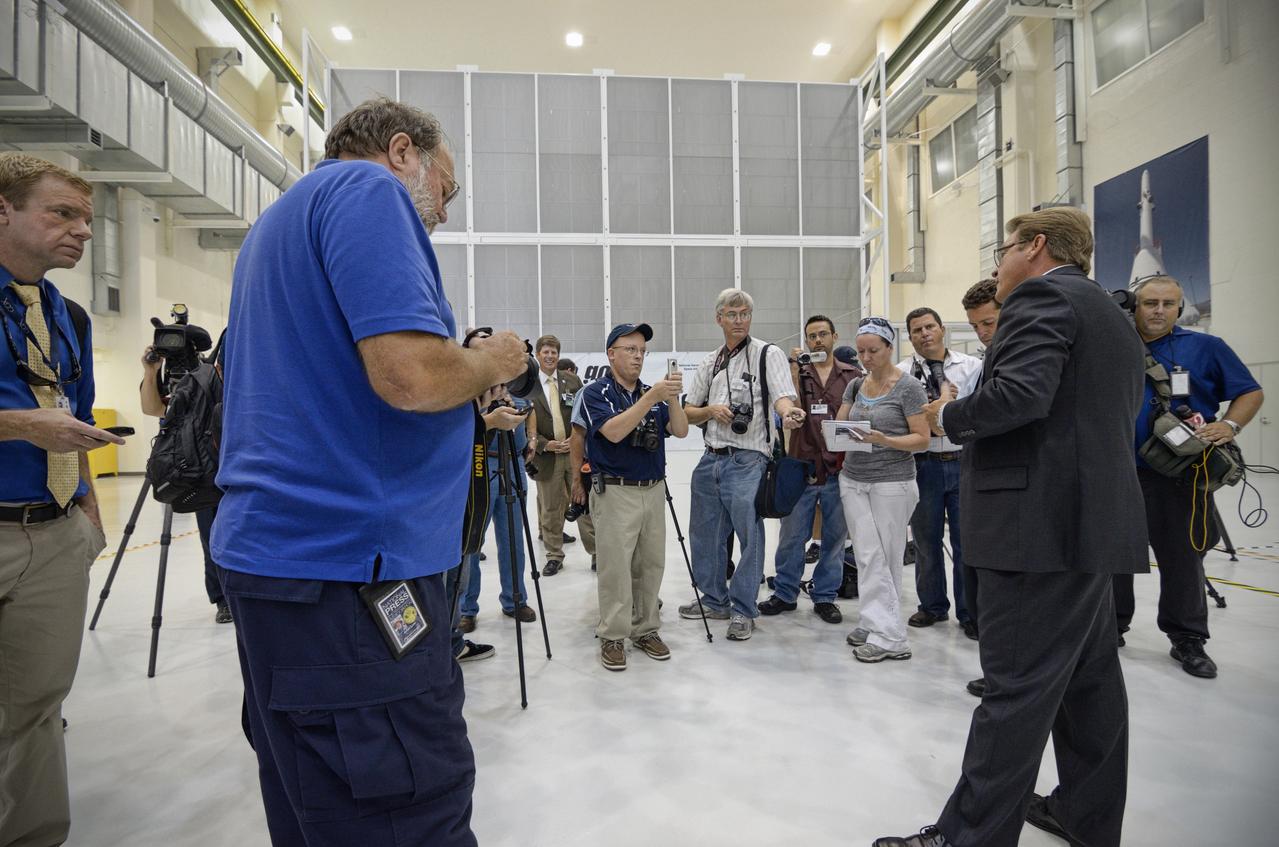
KSC-2012-6050
CAPE CANAVERAL, Fla. -- Apollo astronauts and their families tour the Vehicle Assembly Building, the facility in which Apollo's Saturn V rockets were processed at NASA's Kennedy Space Center in Florida. The tour followed a ceremony renaming the refurbished Operations and Checkout Building for Apollo 11 astronaut Neil Armstrong, the first person to set foot on the moon. Leading the way through the transfer aisle, from left, are Apollo astronaut Jim Lovell, Neil's former wife Janet, Neil's granddaughter Lily, and Apollo 11 moonwalker Buzz Aldrin.    The ceremony was part of NASA's 45th anniversary celebration of the Apollo 11 moon landing. As the world watched, Neil Armstrong and Buzz Aldrin landed in the moon's Sea of Tranquility on July 20, 1969, aboard the lunar module Eagle. Meanwhile, crewmate Michael Collins orbited above in the command module Columbia. For more, visit http://www.nasa.gov/press/2014/july/nasa-honors-historic-first-moon-landing-eyes-first-mars-mission.  Photo credit: NASA/Kim Shiflett
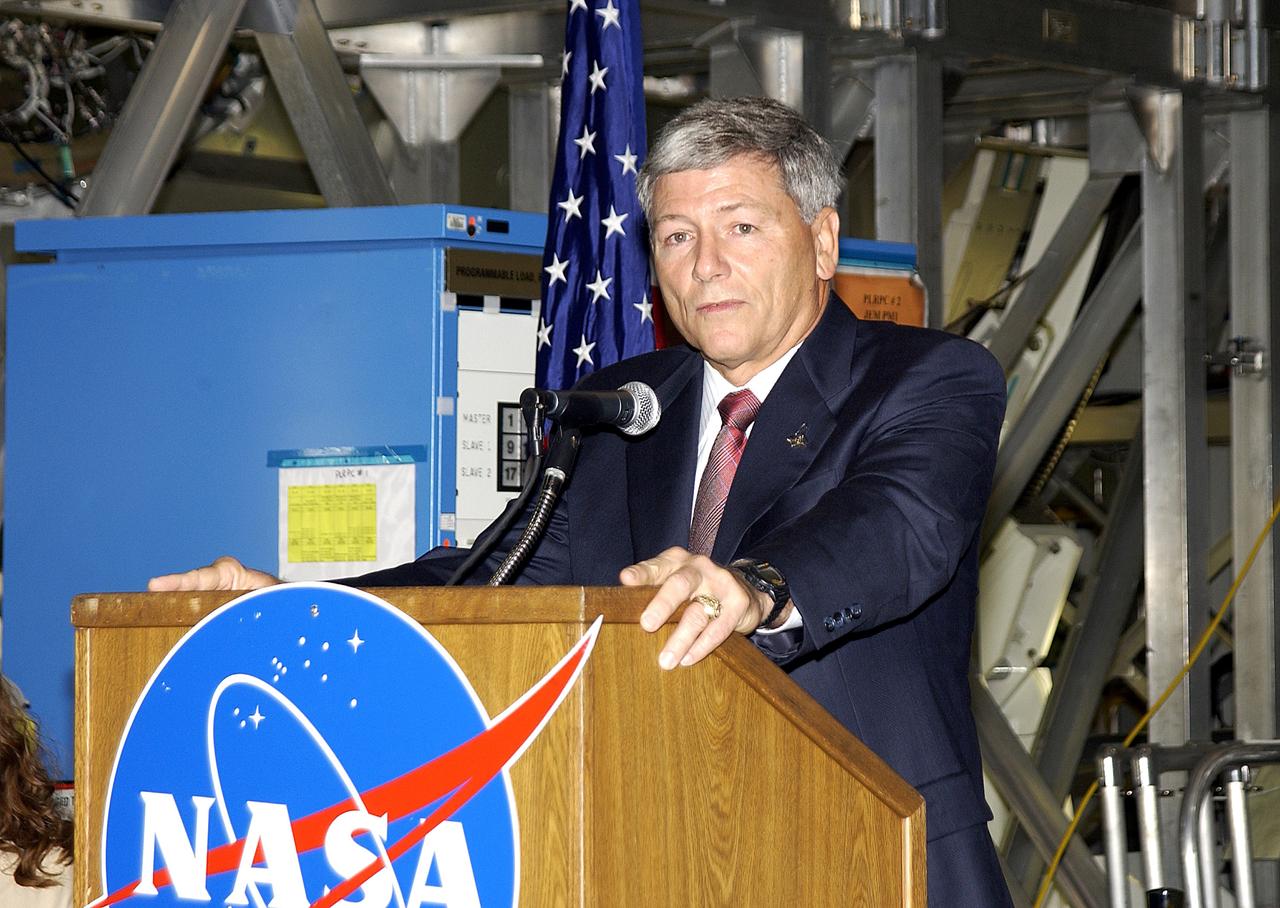
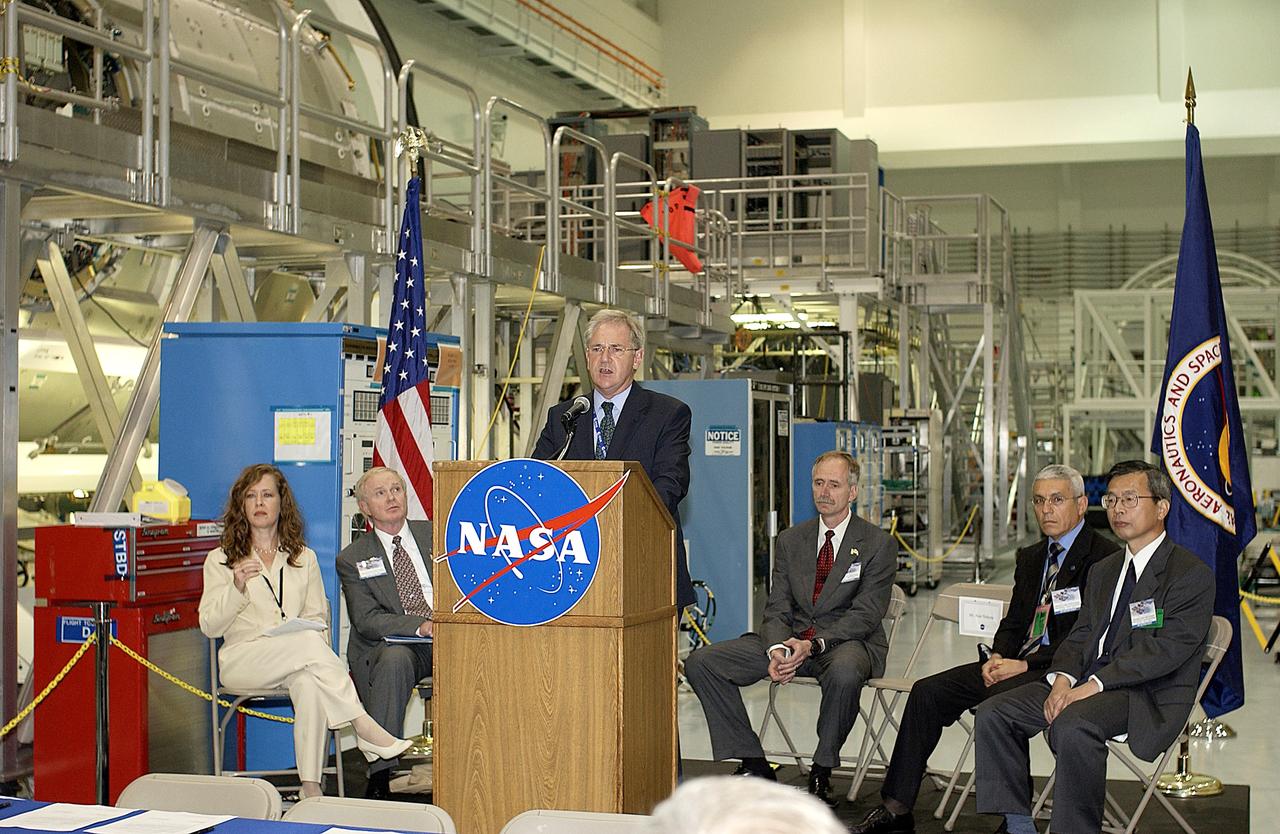
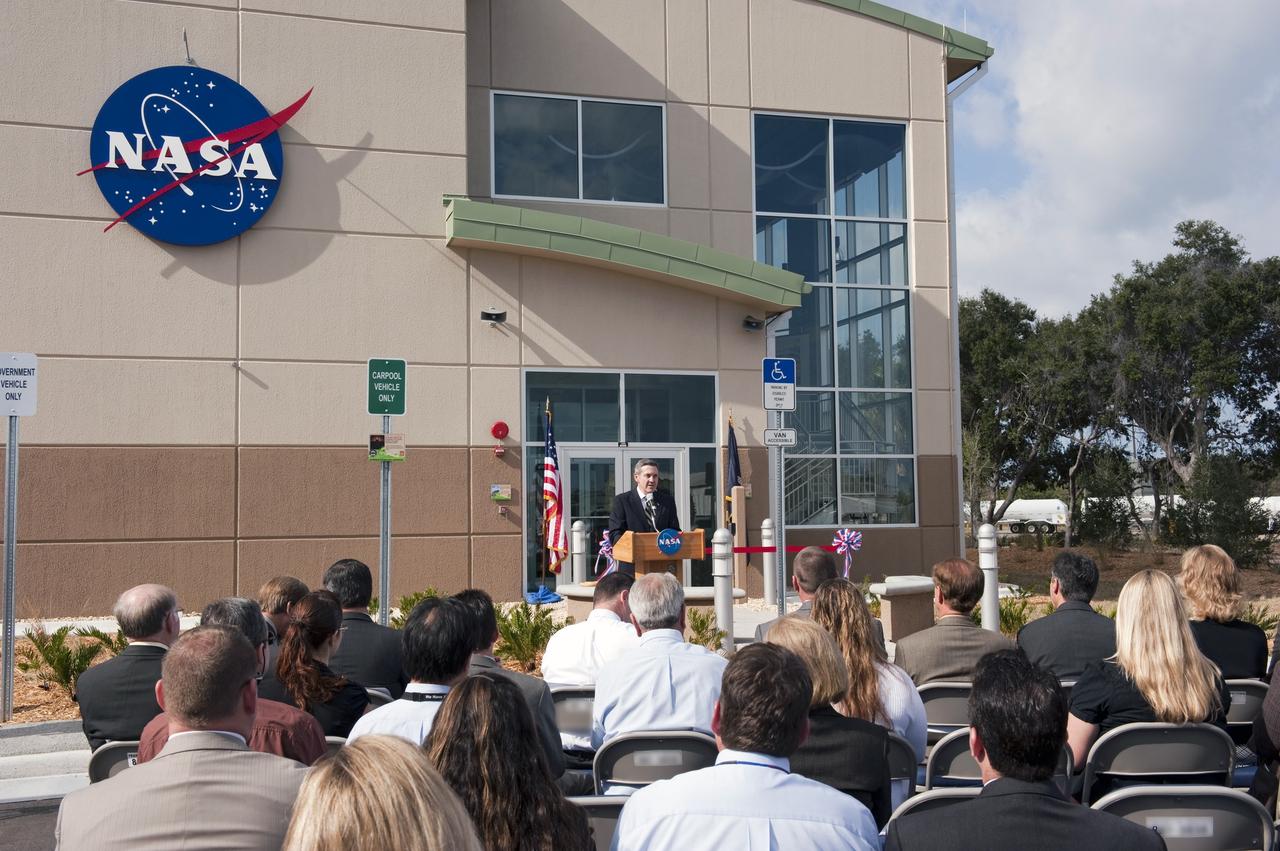
KSC-2014-3244
CAPE CANAVERAL, Fla. -- Kennedy Space Center Director Robert Cabana, at right, escorts Apollo astronauts and their families through the transfer aisle of the 525-foot-tall Vehicle Assembly Building, the facility in which Apollo's Saturn V rockets were processed at NASA's Kennedy Space Center in Florida. The visit followed a ceremony renaming Kennedy's refurbished Operations and Checkout Building for Apollo 11 astronaut Neil Armstrong, the first person to set foot on the moon. In front of the group, from left, are Apollo 11 moonwalker Buzz Aldrin, Armstrong's son Mark, Apollo astronaut Jim Lovell, Armstrong's former wife Janet, and Cabana.    The ceremony was part of NASA's 45th anniversary celebration of the Apollo 11 moon landing. As the world watched, Neil Armstrong and Buzz Aldrin landed in the moon's Sea of Tranquility on July 20, 1969, aboard the lunar module Eagle. Meanwhile, crewmate Michael Collins orbited above in the command module Columbia. For more, visit http://www.nasa.gov/press/2014/july/nasa-honors-historic-first-moon-landing-eyes-first-mars-mission.  Photo credit: NASA/Kim Shiflett
KSC-2014-3245
Lewis Rodert, then of the National Advisory Committee for Aeronautics (NACA) Lewis Flight Propulsion Laboratory, receives the Collier Trophy from President Harry Truman for his work in the design and development of an ice prevention system for aircraft. The accumulation of ice on an aircraft had been a critical issue for years. Rodert developed a method of transferring engine heat to the wings and other vulnerable components to prevent ice buildup.    Rodert began his icing investigations at Langley Memorial Aeronautical Laboratory in 1936. The NACA ordered a Lockheed 12A aircraft to be built using Rodert’s deicing system. The aircraft successfully flew through icing conditions during the following winter. Soon thereafter the military incorporated the system into a Consolidated B-24D Liberator and several other military aircraft, including a North American XB-25F.    Rodert and the NACA icing program transferred to the Lewis lab in Cleveland in 1946. In Cleveland, the focus turned to the study of cloud composition and the causes of icing. Rodert’s role at Lewis diminished over the ensuing years. Rodert was honored in 1947 for his Collier Trophy at ceremonies at Langley, Ames, and then finally Lewis.
Lewis Rodert Receiving a Collier Trophy from President Truman
CAPE CANAVERAL, Fla. -- The director of NASA's Kennedy Space Center in Florida, Bob Cabana, addresses an audience at the ribbon-cutting ceremony for the new environmentally friendly Propellants North Administration and Maintenance Facility.    Propellants North consists of two buildings, one to store cryogenic fuel transfer equipment and one to house personnel who support fueling spacecraft. The recently rebuilt buildings will be NASA's first carbon neutral facility, which means it will produce enough energy on site from renewable sources to offset what it requires to operate. The facility also will reach for the U.S. Green Building Council's Leadership in Environmental and Energy Design (LEED) Platinum status, which is the highest LEED rating. Photo credit: NASA/Kim Shiflett
KSC-2011-1150
CAPE CANAVERAL, Fla. -- Frank Kline, Construction of Facilities project manager at NASA's Kennedy Space Center in Florida, addresses an audience at the ribbon-cutting ceremony for the new environmentally friendly Propellants North Administration and Maintenance Facility.          Propellants North consists of two buildings, one to store cryogenic fuel transfer equipment and one to house personnel who support fueling spacecraft. The recently rebuilt buildings will be NASA's first carbon neutral facility, which means it will produce enough energy on site from renewable sources to offset what it requires to operate. The facility also will reach for the U.S. Green Building Council's Leadership in Environmental and Energy Design (LEED) Platinum status, which is the highest LEED rating. Photo credit: NASA/Kim Shiflett
KSC-2011-1148