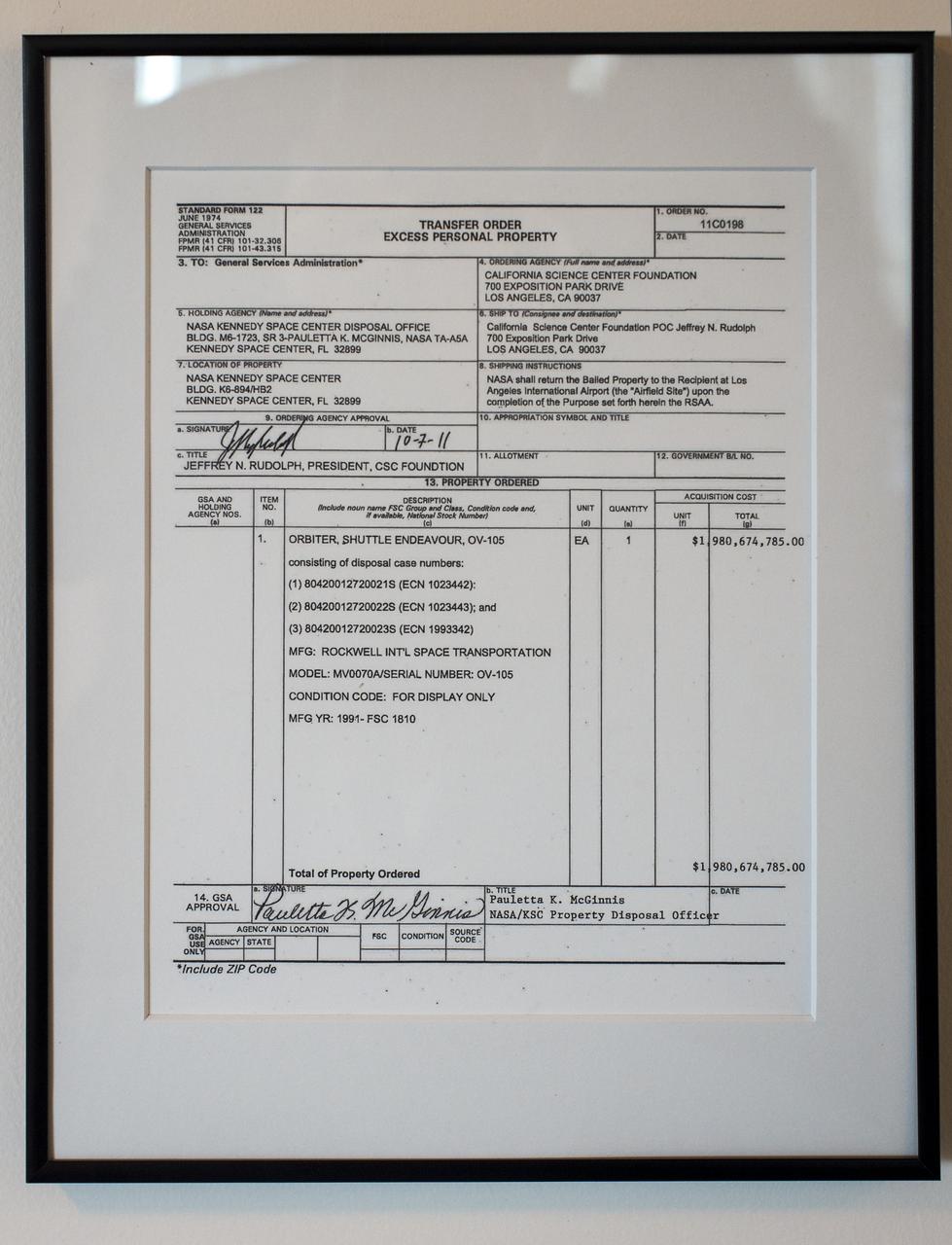
A government Transfer Order for Excess Personal Property is seen framed outside the office of President and CEO, California Science Center, Jeffrey N. Rudolph, on Tuesday, Oct. 30, 2012, in Los Angeles. The grand opening ceremony for the California Science center's Samuel Oschin Space Shuttle Endeavour Display Pavilion took place on Tuesday, Oct. 30, 2012. Endeavour, built as a replacement for space shuttle Challenger, completed 25 missions, spent 299 days in orbit, and orbited Earth 4,671 times while traveling 122,883,151 miles. Photo Credit: (NASA/Bill Ingalls)
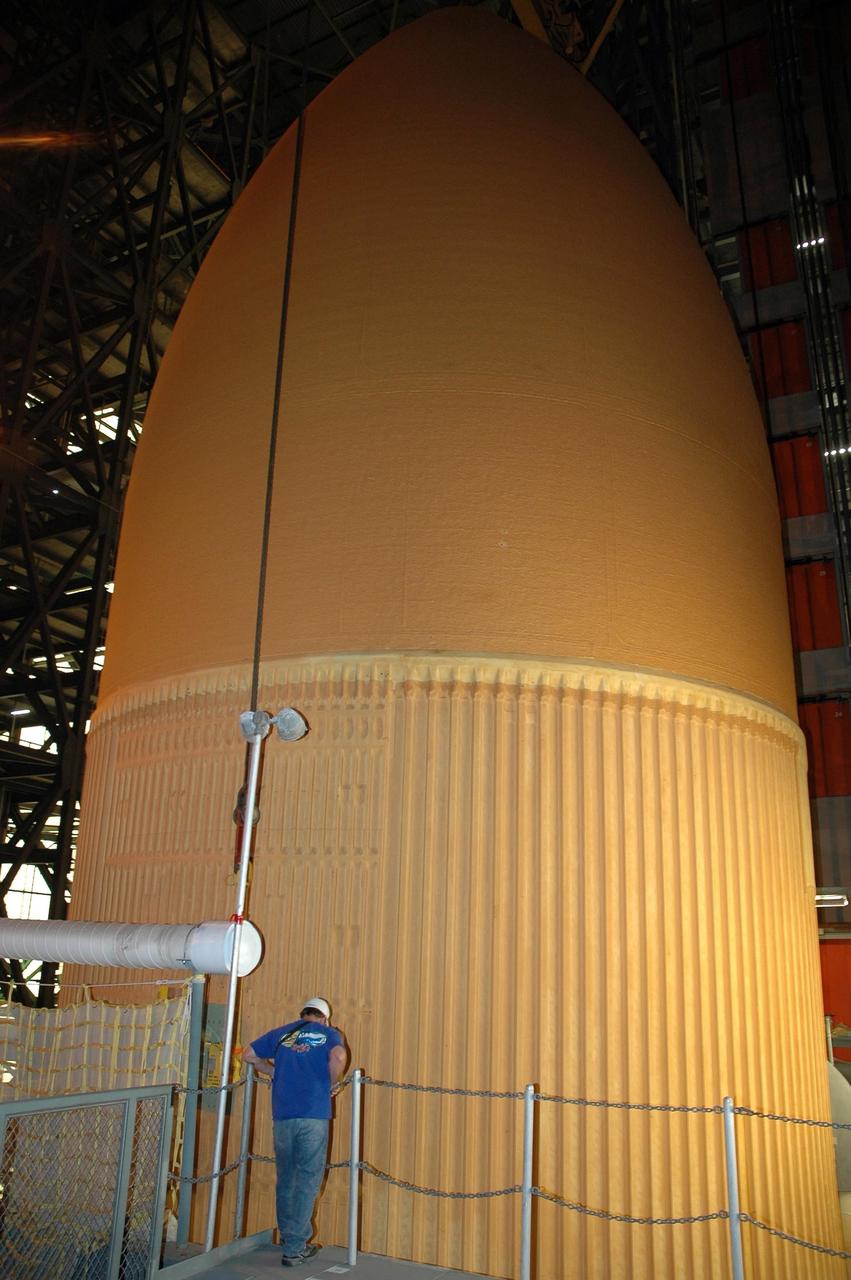
KENNEDY SPACE CENTER, FLA. - Inside the Vehicle Assembly Building at NASA's Kennedy Space Center, a worker watches external tank number 119 as it is being lifted from the checkout cell. The tank will be placed horizontally on the transporter in the transfer aisle. Once in the transfer aisle, technicians will reapply the thermal protection system foam that was removed in order to replace the tank's four liquid hydrogen engine cutoff sensors. The tank is being prepared to launch Space Shuttle Discovery on mission STS-121 in July. Photo credit: NASA/Cory Huston
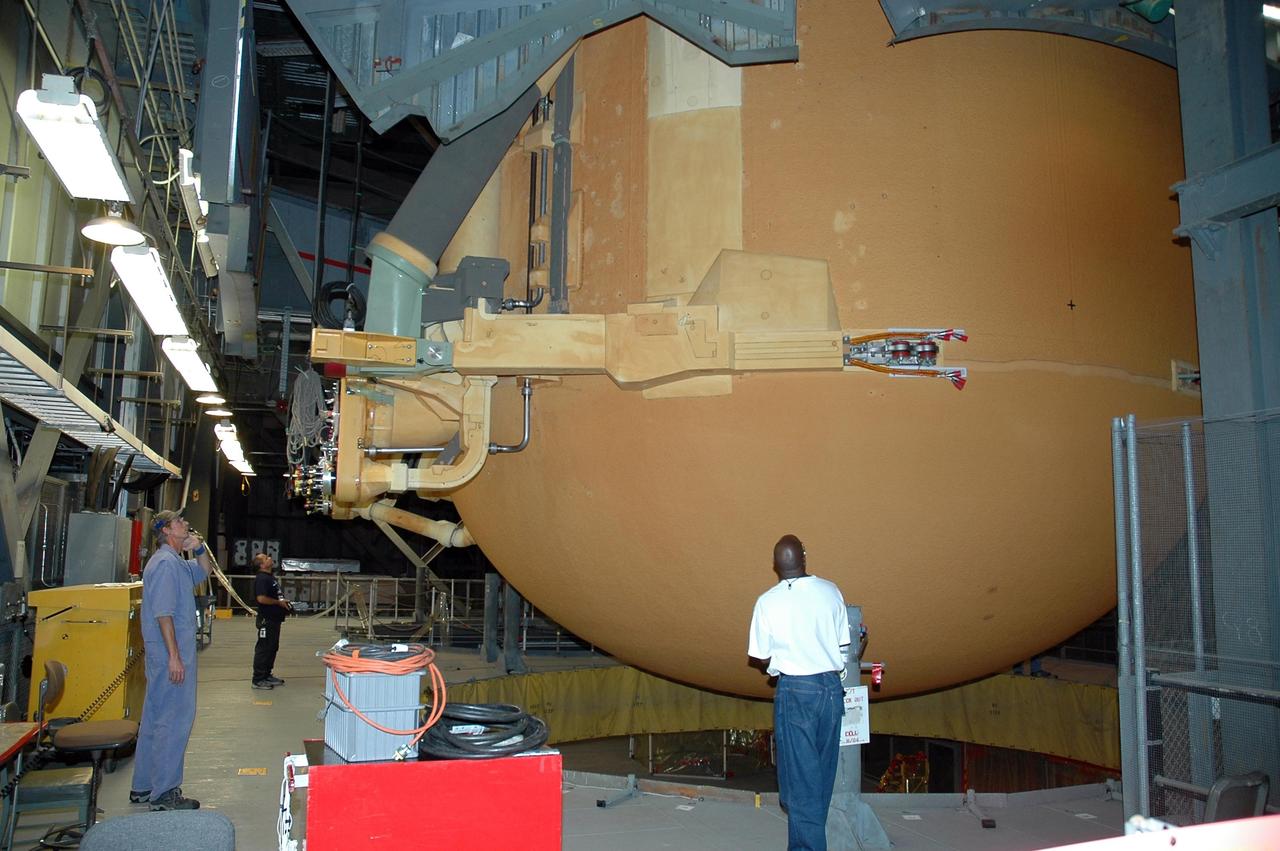
KENNEDY SPACE CENTER, FLA. - Inside the Vehicle Assembly Building at NASA's Kennedy Space Center, external tank number 119 is being lifted from the checkout cell and will be placed horizontally on the transporter in the transfer aisle. Once in the transfer aisle, technicians will reapply the thermal protection system foam that was removed in order to replace the tank's four liquid hydrogen engine cutoff sensors. The tank is being prepared to launch Space Shuttle Discovery on mission STS-121 in July.
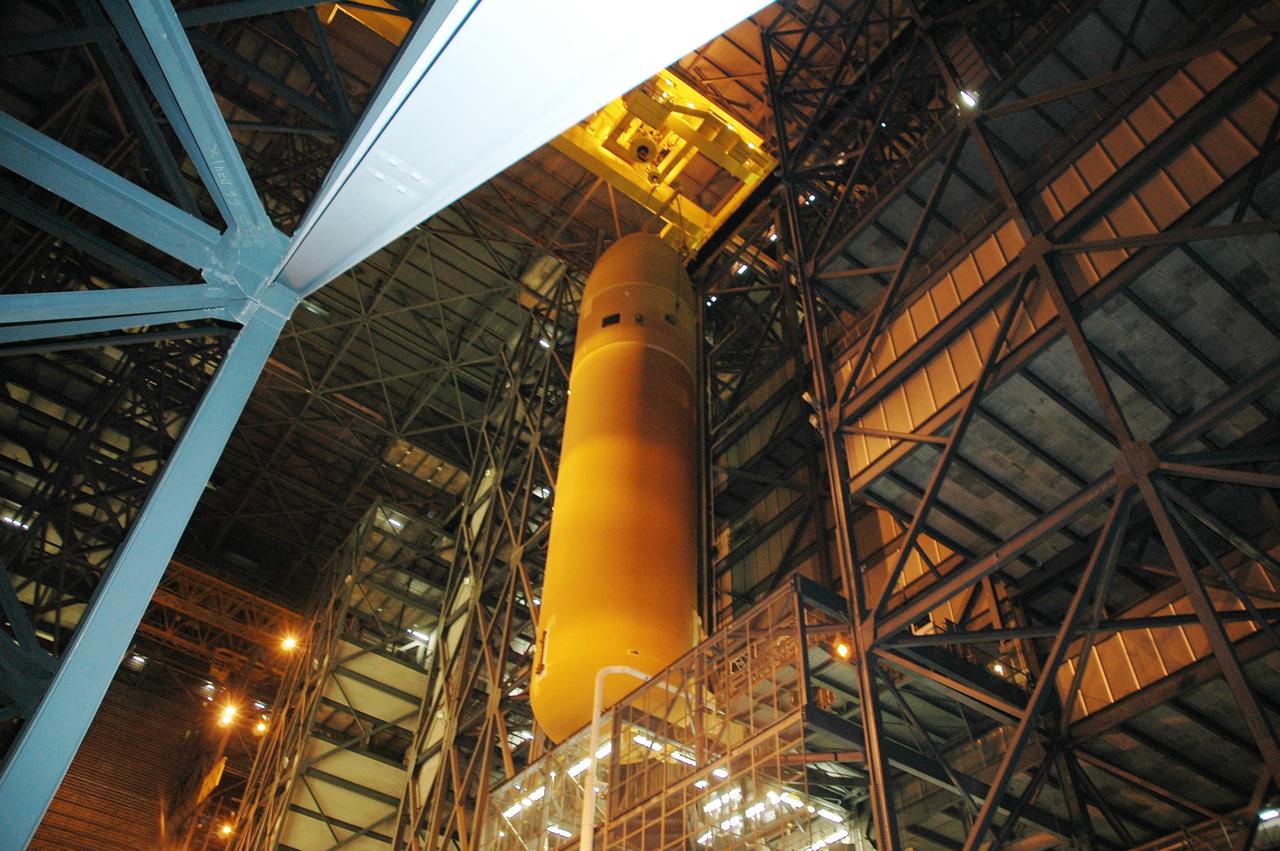
KENNEDY SPACE CENTER, FLA. - Inside the Vehicle Assembly Building at NASA's Kennedy Space Center, external tank number 119 is being moved from the checkout cell and will be placed horizontally on the transporter in the transfer aisle. Once in the transfer aisle, technicians will reapply the thermal protection system foam that was removed in order to replace the tank's four liquid hydrogen engine cutoff sensors. The tank is being prepared to launch Space Shuttle Discovery on mission STS-121 in July. Photo credit: NASA/Cory Huston
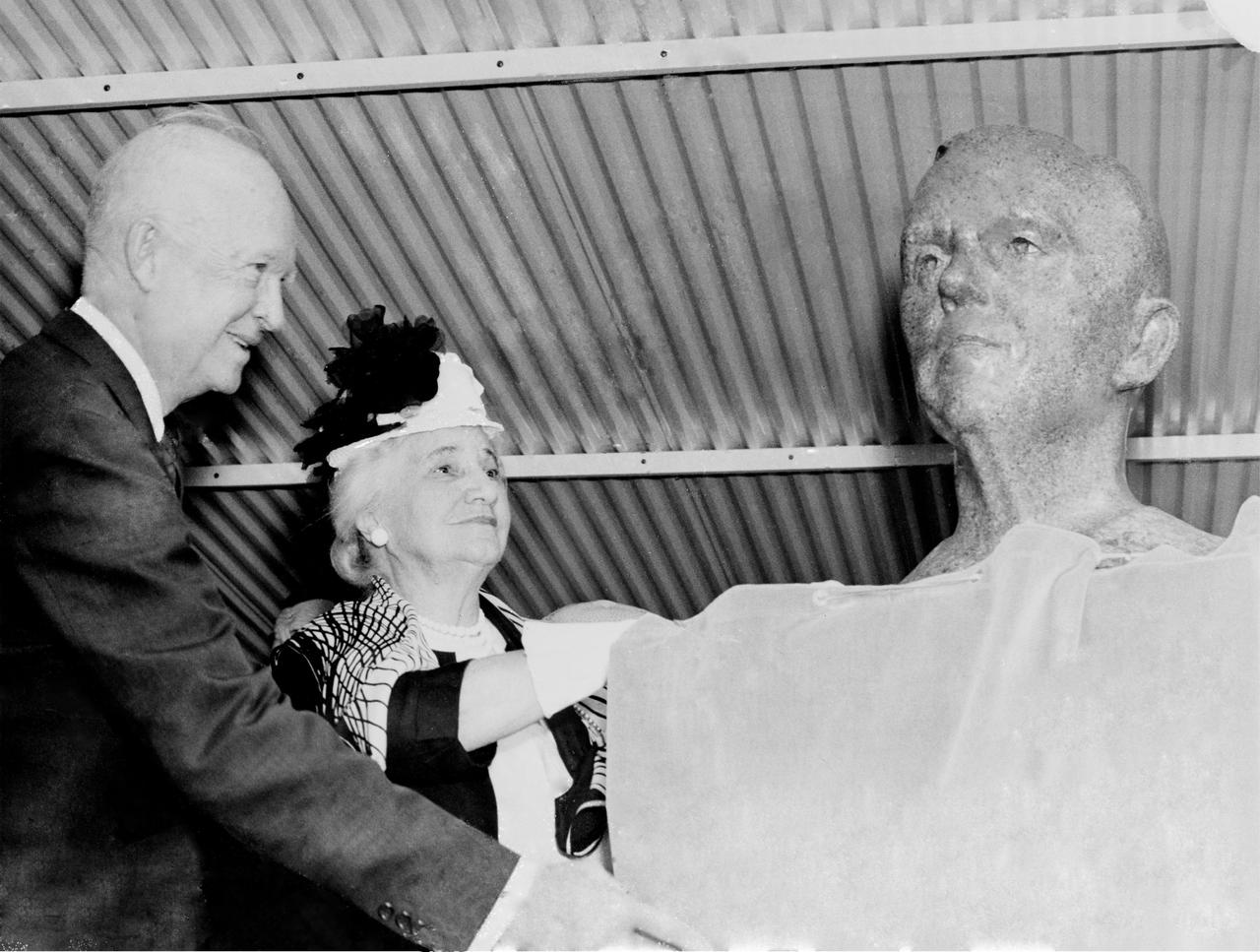
President Dwight D. Eisenhower and Mrs. George C. Marshall unveil the bronze bust of General George C. Marshall during the dedication of the Marshall Space Flight Center. Eisenhower signed an Executive Order on October 21, 1959 directing the transfer of persornel from the Redstone Arsenal's Army Ballistic Missile Agency Development Operations Division to NASA. On March 15, 1960, another Executive Order announced that the space complex formed within the boundaries of Redstone Arsenal would become the George C. Marshall Space Flight Center. The Center was activated on July 1, 1960, with dedication ceremonies taking place September 8, 1960.
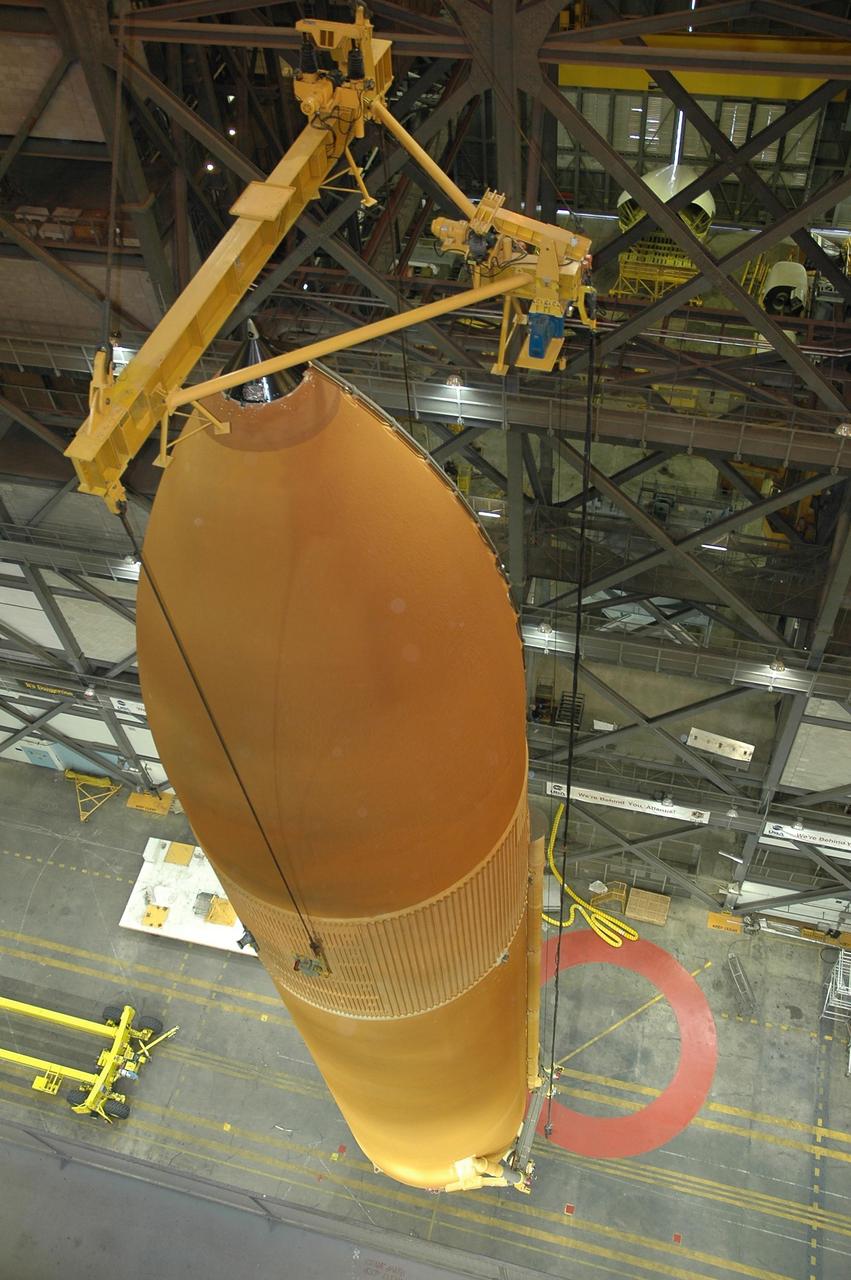
KENNEDY SPACE CENTER, FLA. - Inside the Vehicle Assembly Building at NASA's Kennedy Space Center, external tank number 119 is being lowered toward the floor of the transfer aisle. It will be placed horizontally on a transporter where technicians will reapply the thermal protection system foam that was removed in order to replace the tank's four liquid hydrogen engine cutoff sensors. The tank is being prepared to launch Space Shuttle Discovery on mission STS-121 in July. Photo credit: NASA/Cory Huston
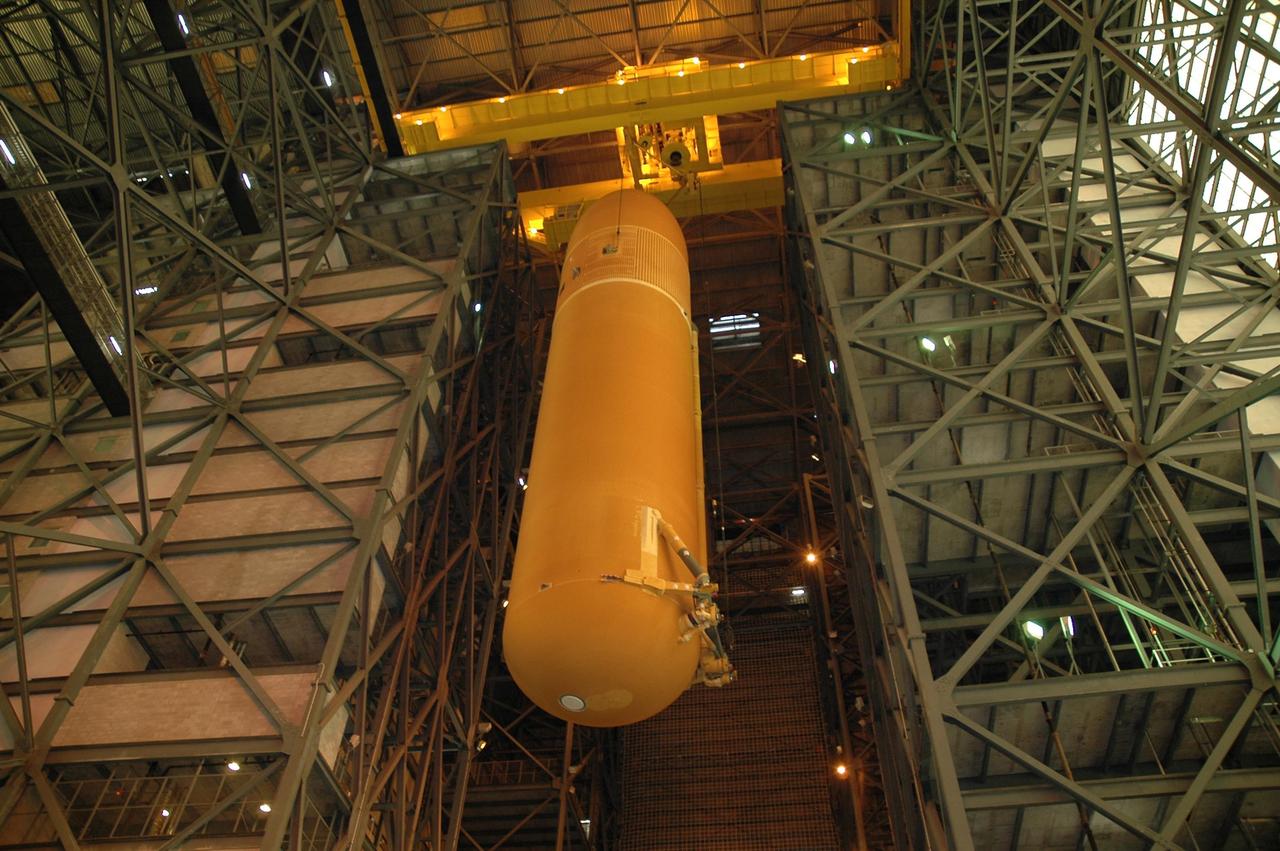
KENNEDY SPACE CENTER, FLA. - Inside the Vehicle Assembly Building at NASA's Kennedy Space Center, external tank number 119 is being lowered toward the floor of the transfer aisle. It will be placed horizontally on a transporter where technicians will reapply the thermal protection system foam that was removed in order to replace the tank's four liquid hydrogen engine cutoff sensors. The tank is being prepared to launch Space Shuttle Discovery on mission STS-121 in July. Photo credit: NASA/Cory Huston
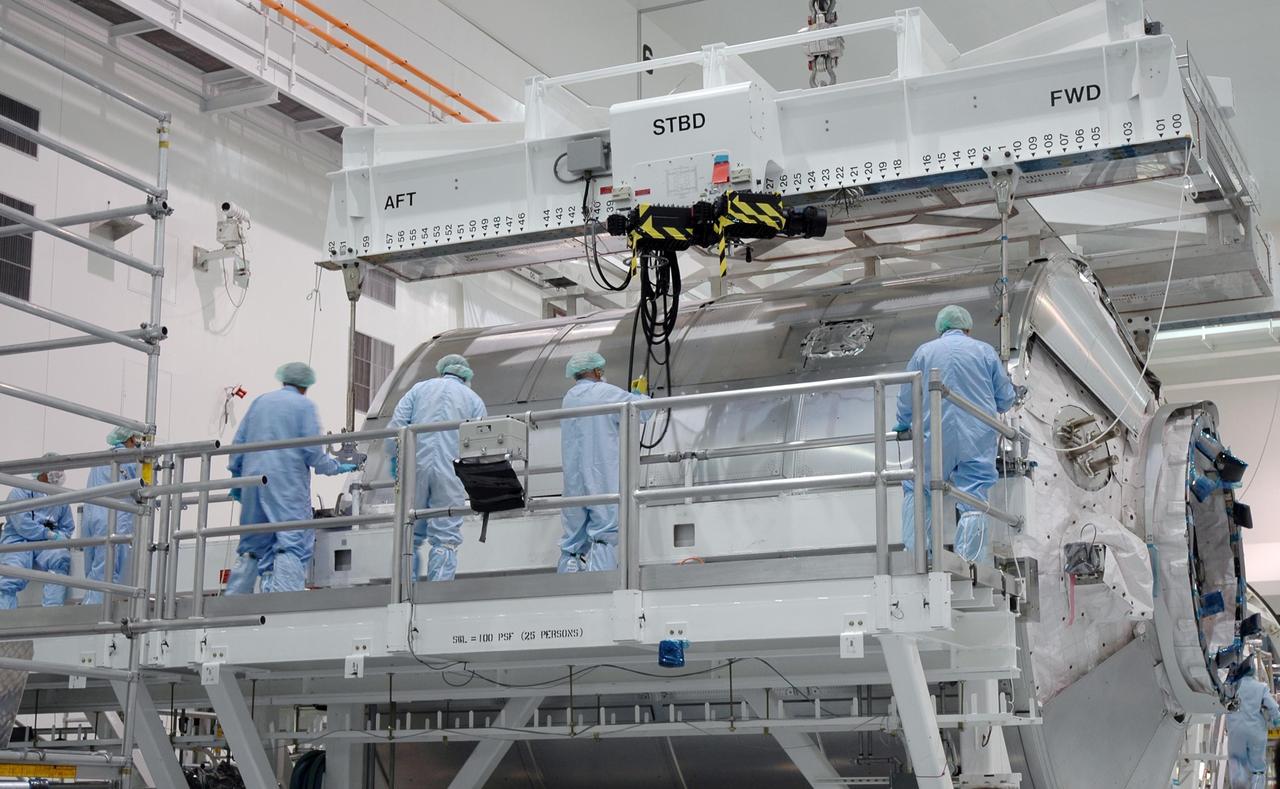
KENNEDY SPACE CENTER, FLA. - In NASA Kennedy Space Center's Space Station Processing Facility (SSPF), workers attach an overhead crane to the multi-purpose logistics module Donatello in order to move it to a payload canister. Donatello is being transferred to the Operations and Checkout Building to make room in the SSPF for the arrival of elements for future flights from other ISS partners. Photo credit: NASA/Jim Grossmann
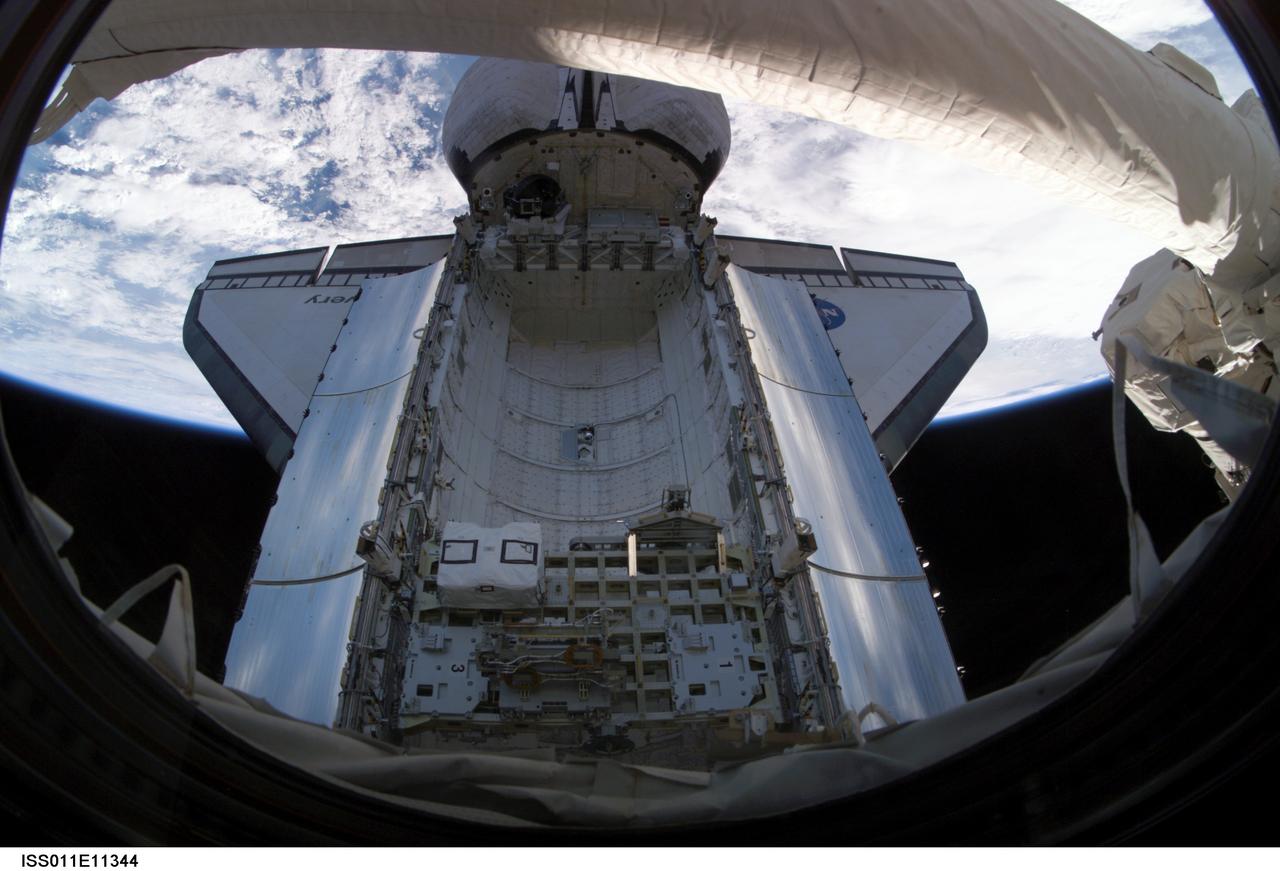
ISS011-E-11344 (30 July 2005) --- This image of the cargo bay of the Space Shuttle Discovery was taken with a digital still camera onboard the International Space Station, to which the orbiter will continue to be docked for several days. There is a vacancy in the payload bay, as the Multi-Purpose Logistics Module Raffaello temporarily has been docked with the orbital outpost's Unity Node in order to accommodate the transfer of a large amount of supplies.
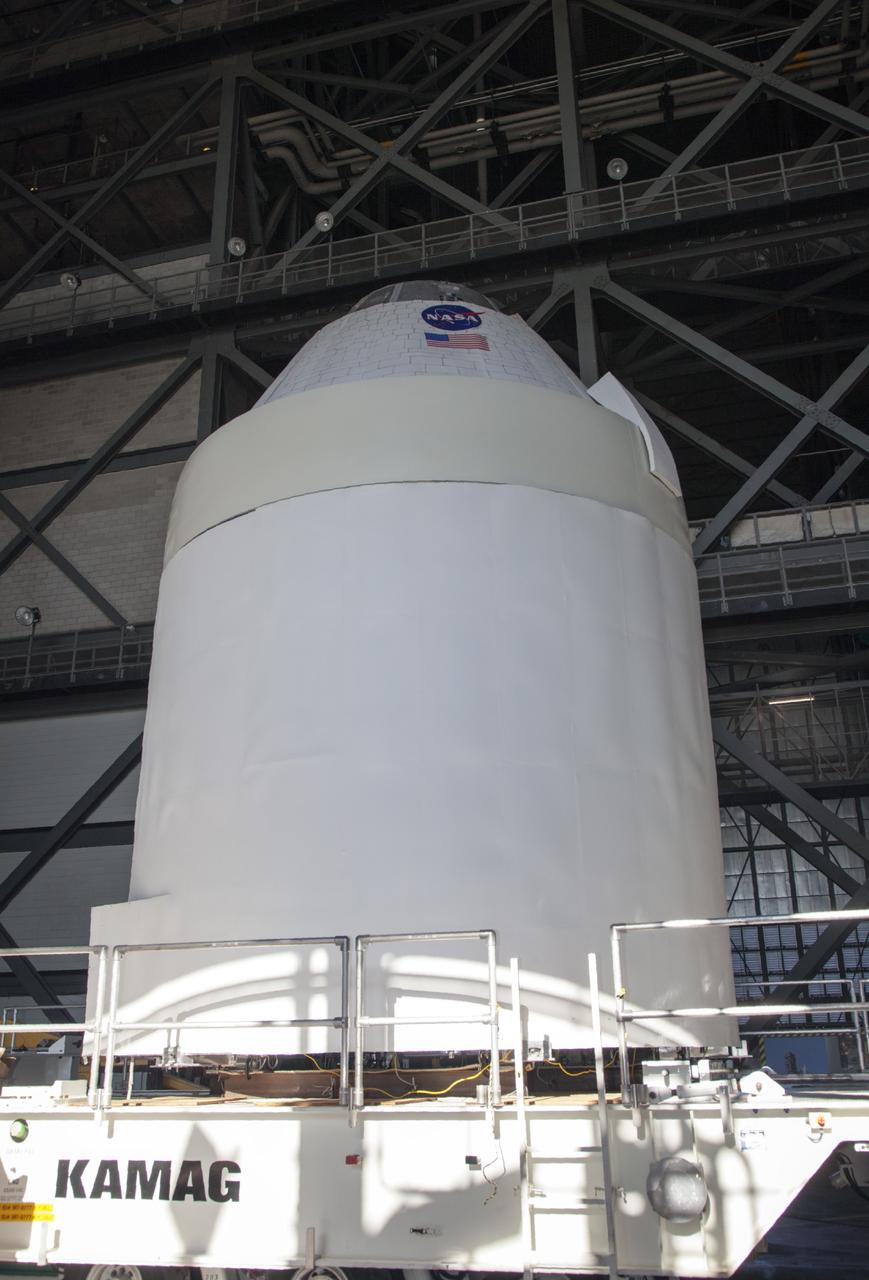
CAPE CANAVERAL, Fla. -- In the transfer aisle of the Vehicle Assembly Building at NASA’s Kennedy Space Center in Florida, a full-size mockup of the Orion spacecraft sits on a transporter. Crane operators and technicians are preparing to lift the mockup and transfer it into High Bay 4 in order to keep processing procedures and skills current for the Ground Systems Development and Operations Program. Orion is the exploration spacecraft designed to carry crews to space beyond low Earth orbit. It will provide emergency abort capability, sustain the crew during the space travel and provide safe re-entry from deep space return velocities. Orion’s first unpiloted test flight is scheduled to launch in 2014 atop a Delta IV rocket. A second uncrewed flight test is scheduled for 2017 on NASA’s Space Launch System rocket. For more information, visit http://www.nasa.gov/orion. Photo credit: NASA/Dan Casper
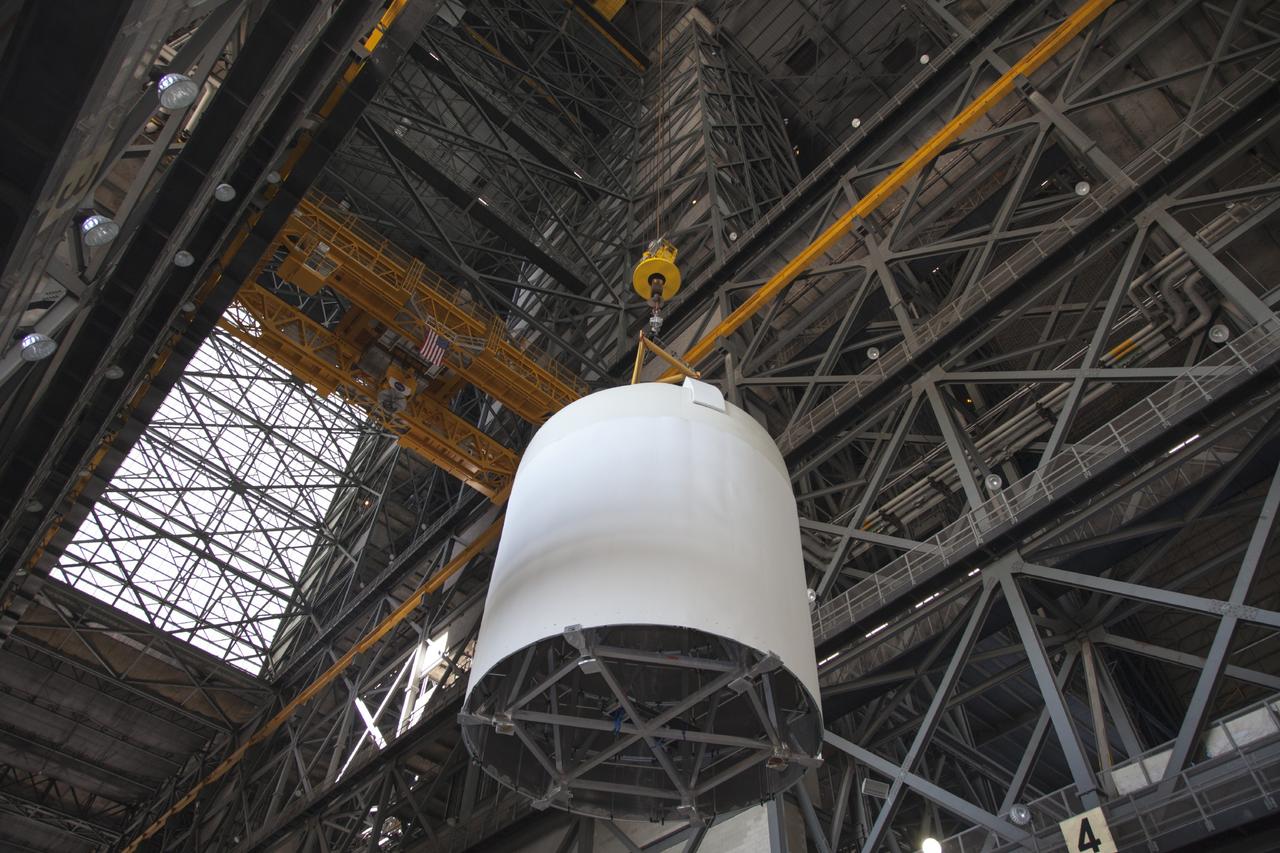
CAPE CANAVERAL, Fla. -- In the transfer aisle of the Vehicle Assembly Building at NASA’s Kennedy Space Center in Florida, a crane operator lifts a full-size mock-up of the Orion spacecraft high in the air for transfer to High Bay 4. Crane operators and technicians practice stacking and de-stacking operations in order to keep processing procedures and skills current for the Ground Systems Development and Operations Program. Orion is the exploration spacecraft designed to carry crews to space beyond low Earth orbit. It will provide emergency abort capability, sustain the crew during the space travel and provide safe re-entry from deep space return velocities. Orion’s first unpiloted test flight is scheduled to launch in 2014 atop a Delta IV rocket. A second uncrewed flight test is scheduled for 2017 on NASA’s Space Launch System rocket. For more information, visit http://www.nasa.gov/orion. Photo credit: NASA/Dan Casper
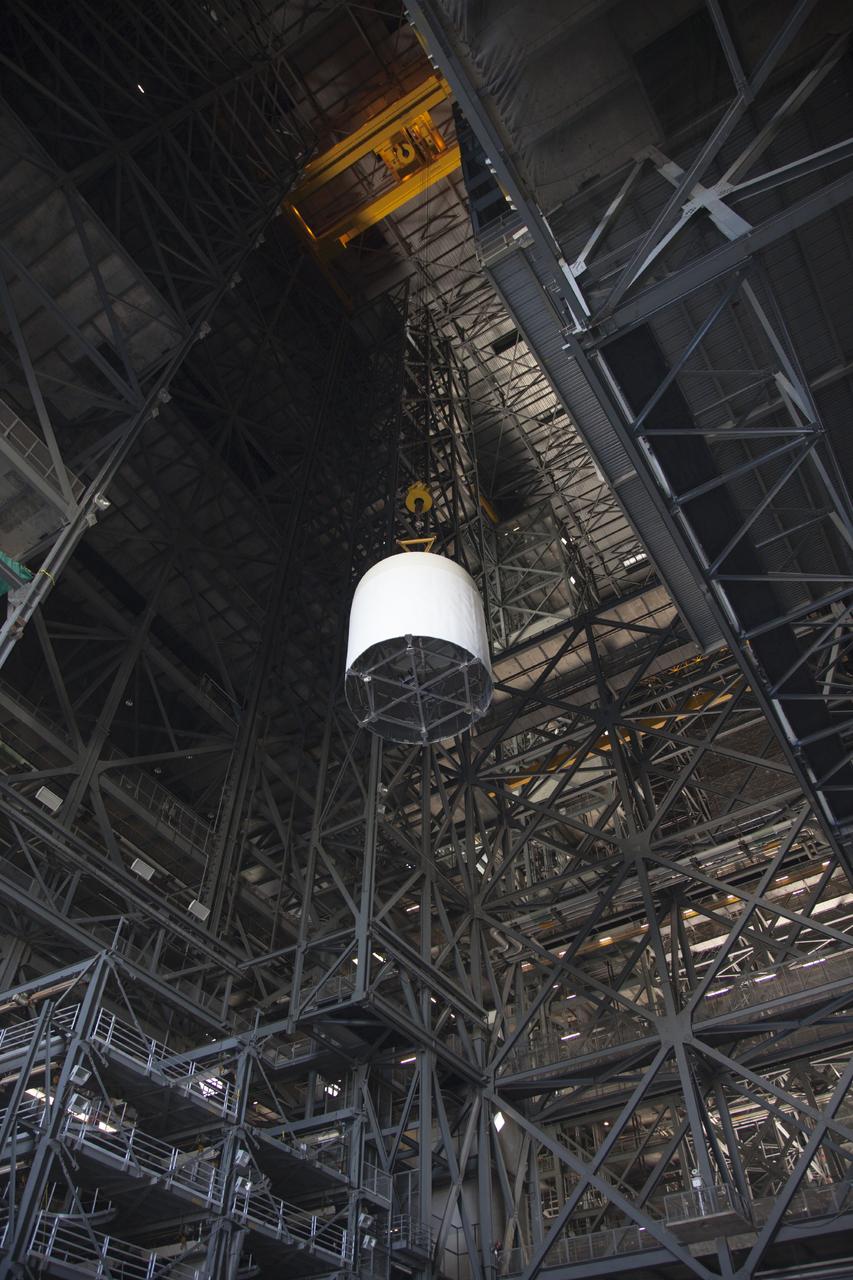
CAPE CANAVERAL, Fla. -- In the transfer aisle of the Vehicle Assembly Building at NASA’s Kennedy Space Center in Florida, a crane operator lifts a full-size mock-up of the Orion spacecraft high in the air for transfer to High Bay 4. Crane operators and technicians practice stacking and de-stacking operations in order to keep processing procedures and skills current for the Ground Systems Development and Operations Program. Orion is the exploration spacecraft designed to carry crews to space beyond low Earth orbit. It will provide emergency abort capability, sustain the crew during the space travel and provide safe re-entry from deep space return velocities. Orion’s first unpiloted test flight is scheduled to launch in 2014 atop a Delta IV rocket. A second uncrewed flight test is scheduled for 2017 on NASA’s Space Launch System rocket. For more information, visit http://www.nasa.gov/orion. Photo credit: NASA/Dan Casper
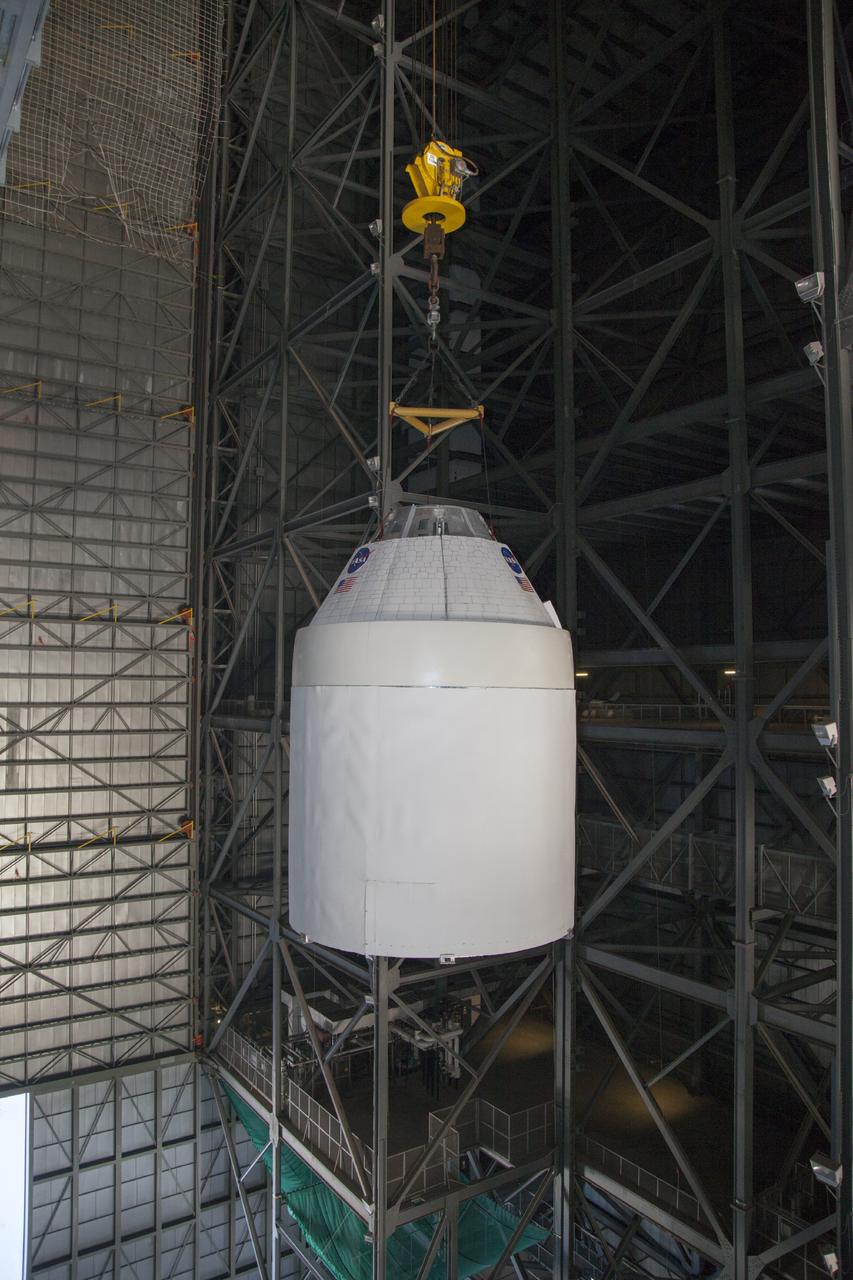
CAPE CANAVERAL, Fla. -- In the transfer aisle of the Vehicle Assembly Building at NASA’s Kennedy Space Center in Florida, a crane operator lifts a full-size mock-up of the Orion spacecraft high in the air for transfer to High Bay 4. Crane operators and technicians practice stacking and de-stacking operations in order to keep processing procedures and skills current for the Ground Systems Development and Operations Program. Orion is the exploration spacecraft designed to carry crews to space beyond low Earth orbit. It will provide emergency abort capability, sustain the crew during the space travel and provide safe re-entry from deep space return velocities. Orion’s first unpiloted test flight is scheduled to launch in 2014 atop a Delta IV rocket. A second uncrewed flight test is scheduled for 2017 on NASA’s Space Launch System rocket. For more information, visit http://www.nasa.gov/orion. Photo credit: NASA/Dan Casper

CAPE CANAVERAL, Fla. -- In the transfer aisle of the Vehicle Assembly Building at NASA’s Kennedy Space Center in Florida, a crane operator lifts a full-size mock-up of the Orion spacecraft high in the air for transfer to High Bay 4. Crane operators and technicians practice stacking and de-stacking operations in order to keep processing procedures and skills current for the Ground Systems Development and Operations Program. Orion is the exploration spacecraft designed to carry crews to space beyond low Earth orbit. It will provide emergency abort capability, sustain the crew during the space travel and provide safe re-entry from deep space return velocities. Orion’s first unpiloted test flight is scheduled to launch in 2014 atop a Delta IV rocket. A second uncrewed flight test is scheduled for 2017 on NASA’s Space Launch System rocket. For more information, visit http://www.nasa.gov/orion. Photo credit: NASA/Dan Casper
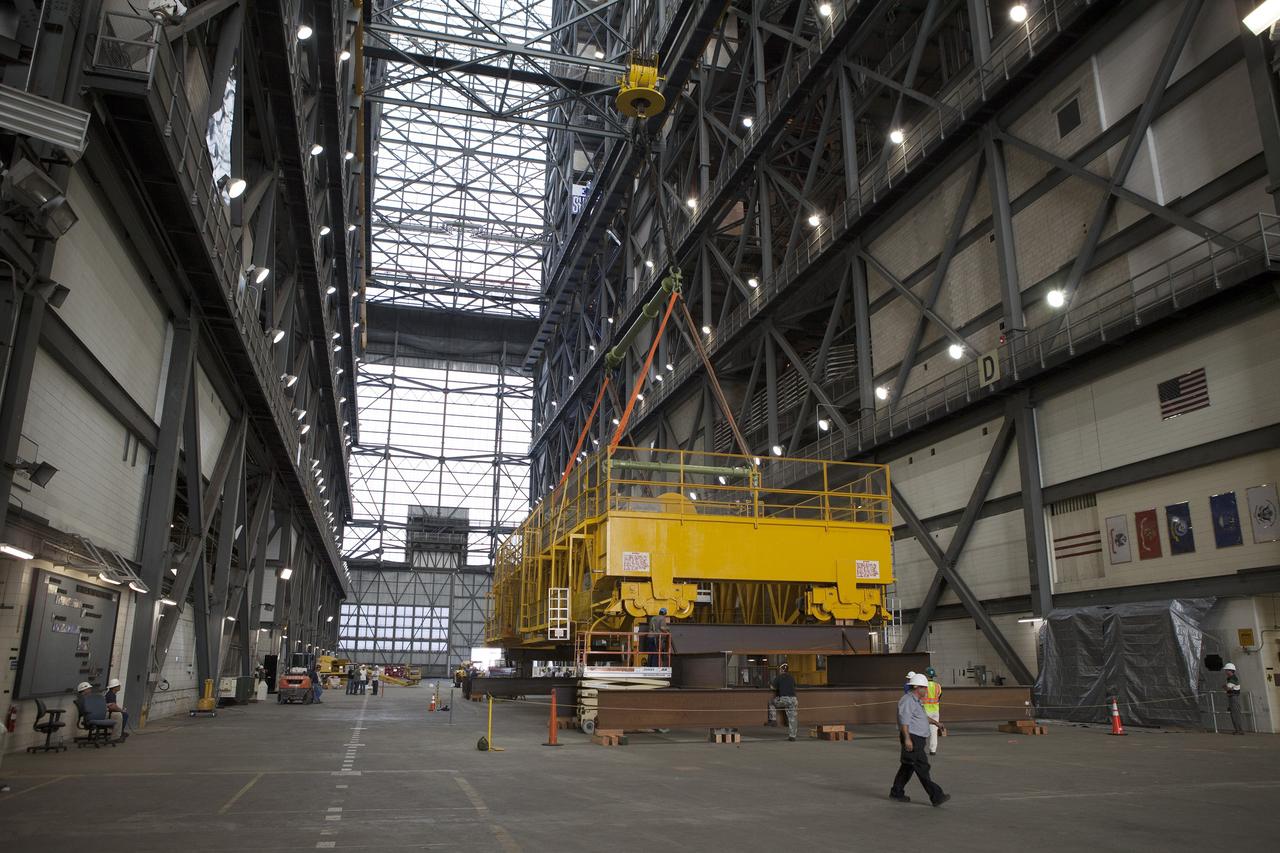
CAPE CANAVERAL, Fla. – Inside the Vehicle Assembly Building, or VAB, at NASA's Kennedy Space Center in Florida, the 175-ton crane has been lowered by crane onto steel stands on the transfer aisle floor. The crane was lowered from Level 16. Upgrades to the crane's 45-year-old controls will be performed in order to improve reliability, precision and safety. The Ground Systems Development and Operations Program is overseeing upgrades and modifications to the VAB. The crane will be upgraded so that it can support lifting needs for NASA and other exploration vehicles, including the agency's Space Launch System and Orion spacecraft. Photo credit: NASA/Daniel Casper
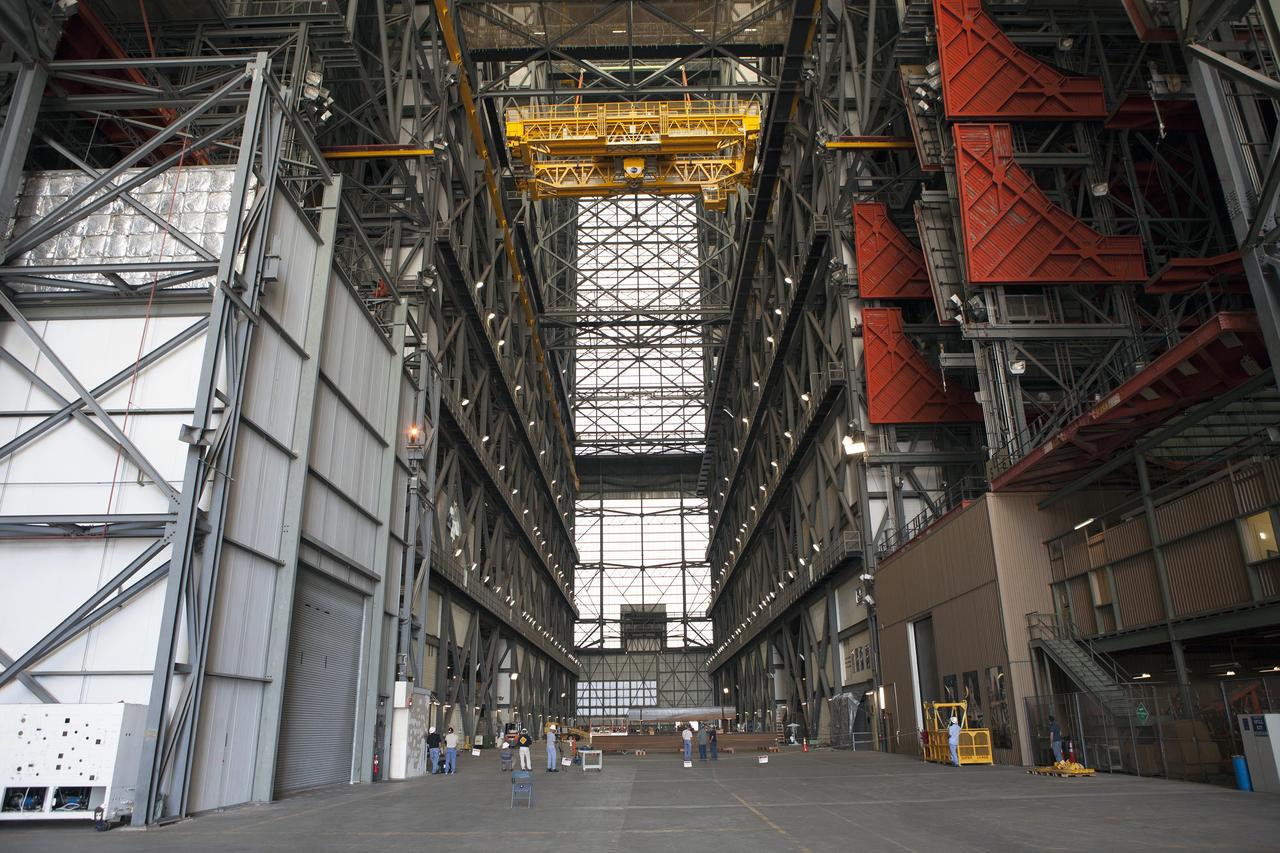
CAPE CANAVERAL, Fla. – Inside the Vehicle Assembly Building, or VAB, at NASA's Kennedy Space Center in Florida, a crane is being used to lower the 175-ton crane from Level 16 down to the transfer aisle floor. Upgrades to the crane's 45-year-old controls will be performed in order to improve reliability, precision and safety. The Ground Systems Development and Operations Program is overseeing upgrades and modifications to the VAB. The crane will be upgraded so that it can support lifting needs for NASA and other exploration vehicles, including the agency's Space Launch System and Orion spacecraft. Photo credit: NASA/Daniel Casper
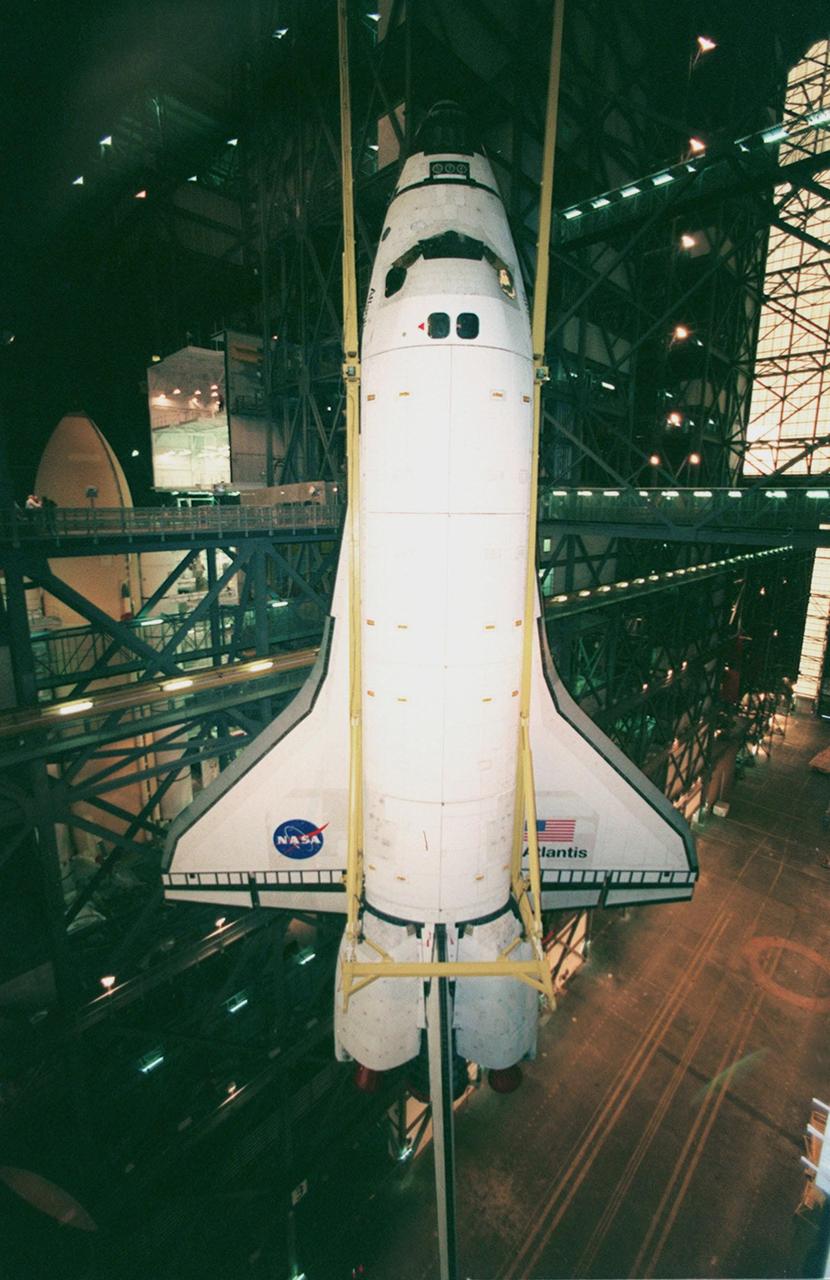
KENNEDY SPACE CENTER, FLA. -- Suspended by a crane over the transfer aisle of the Vehicle Assembly Building (VAB), orbiter Atlantis is lifted higher in order to move it toward the stack of external tank and solid rocket boosters at left. The 122-foot high orbiter is easily accommodated inside the 525-foot-tall, 518-foot-wide VAB. After being mated with the stack, Atlantis will be transported to Launch Pad 39A. Atlantis will fly on mission STS-101 to the International Space Station, where its crew of seven will prepare the Station for the arrival of the next pressurized module, the Russian-built Zvezda. Atlantis is expected to launch no earlier than April 17, 2000
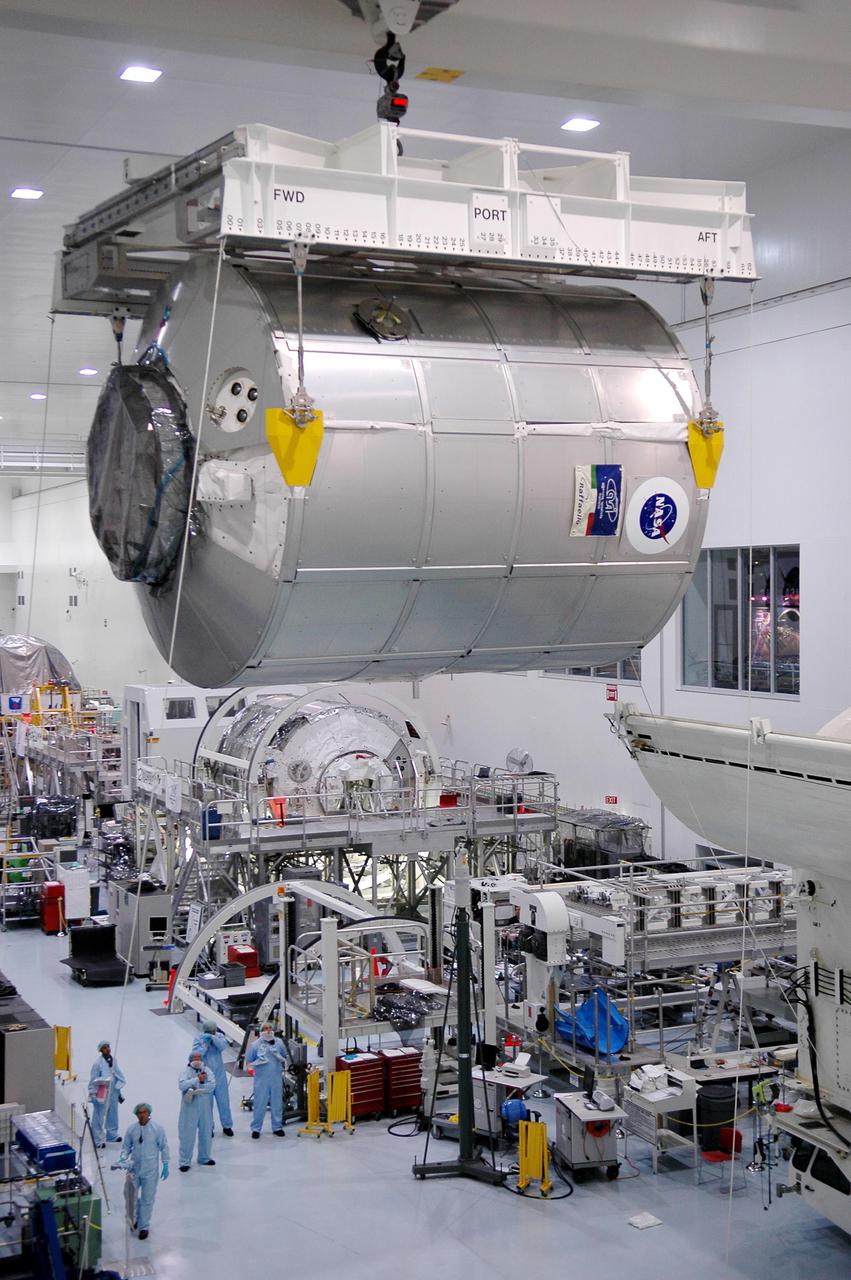
KENNEDY SPACE CENTER, FLA. - In the Space Station Processing Facility at NASA’s Kennedy Space Center, the Multi-Purpose Logistics Module Raffaello is moved away from the Payload Transportation Canister at right where it was waiting transfer to the pad. The module is being moved back to its work stand to allow the processing team access in order to address concerns with mechanical fasteners inside the module that do not incorporate an adequate secondary locking feature. The assessment and additional work is being conducted to ensure that the fasteners do not disengage during ascent. Raffaello is scheduled to launch on Discovery's Return to Flight mission STS-114.
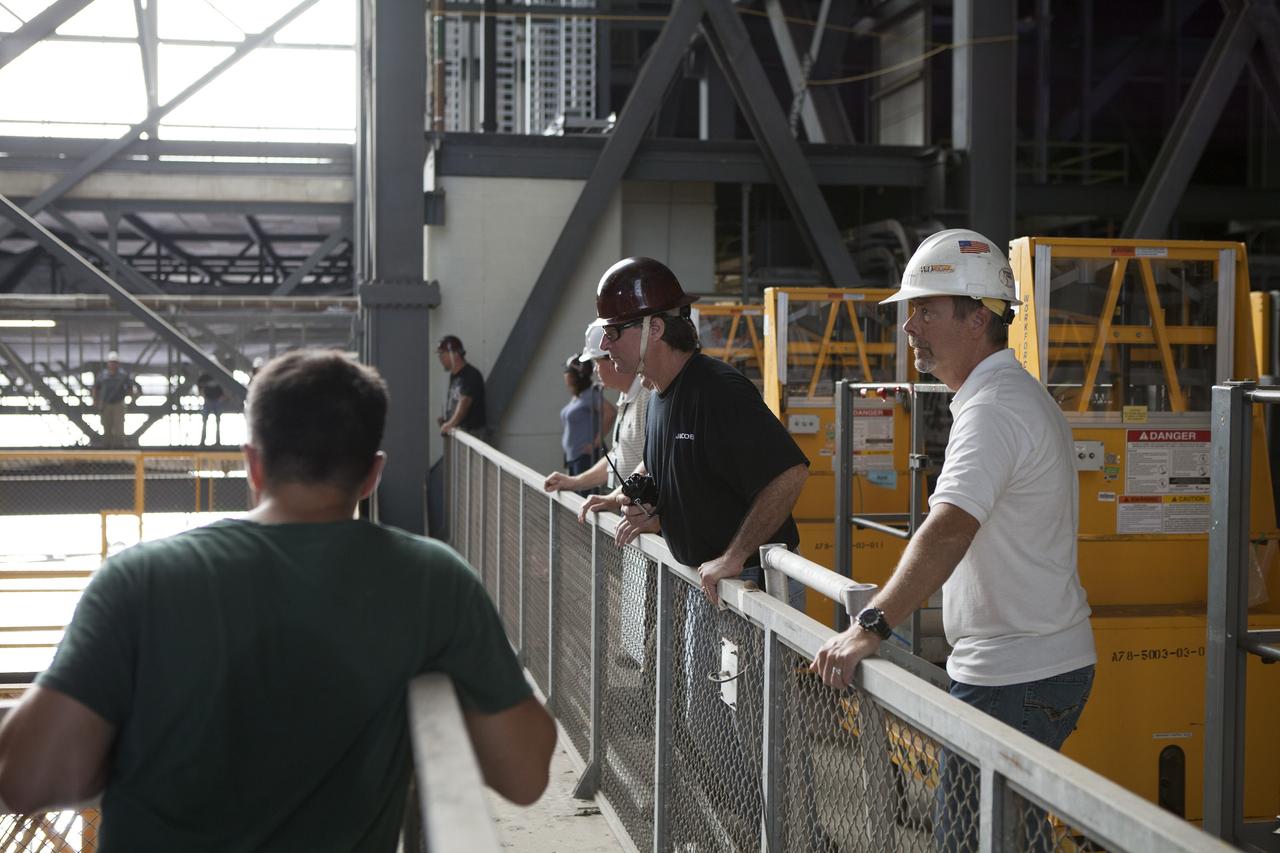
CAPE CANAVERAL, Fla. – Inside the Vehicle Assembly Building, or VAB, at NASA's Kennedy Space Center in Florida, NASA and contractor workers monitor the progress as the 175-ton crane is being lowered from Level 16 down to the transfer aisle floor. Upgrades to the crane's 45-year-old controls will be performed in order to improve reliability, precision and safety. The Ground Systems Development and Operations Program is overseeing upgrades and modifications to the VAB. The crane will be upgraded so that it can support lifting needs for NASA and other exploration vehicles, including the agency's Space Launch System and Orion spacecraft. Photo credit: NASA/Daniel Casper
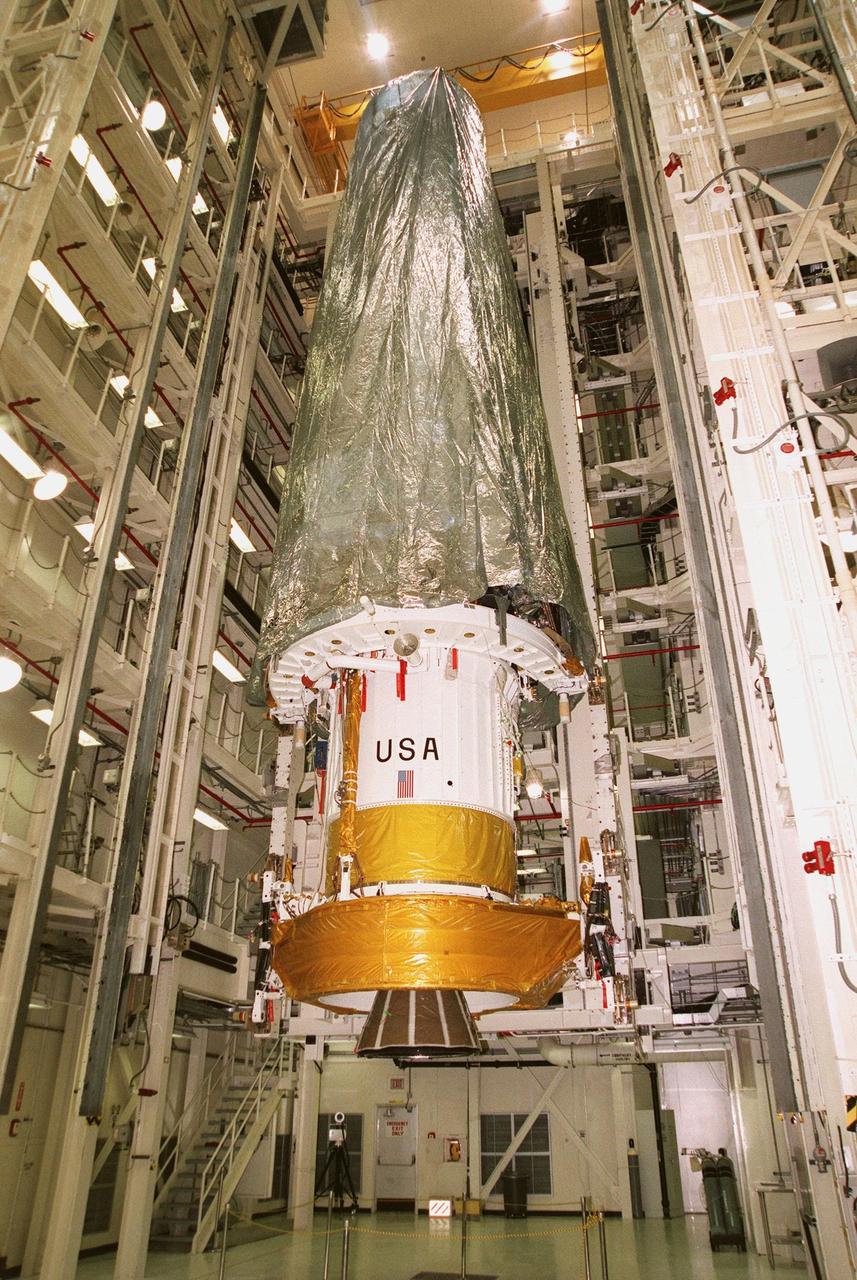
Inside the Vertical Processing Facility, the Chandra X-ray Observatory is lifted by an overhead crane in order to transfer it into the payload canister transporter and out to Launch Pad 39B. Chandra is scheduled to launch no earlier than July 20 at 12:36 a.m. EDT aboard Space Shuttle Columbia, on mission STS-93. With the world's most powerful X-ray telescope, Chandra will allow scientists from around the world to see previously invisible black holes and high-temperature gas clouds, giving the observatory the potential to rewrite the books on the structure and evolution of our universe
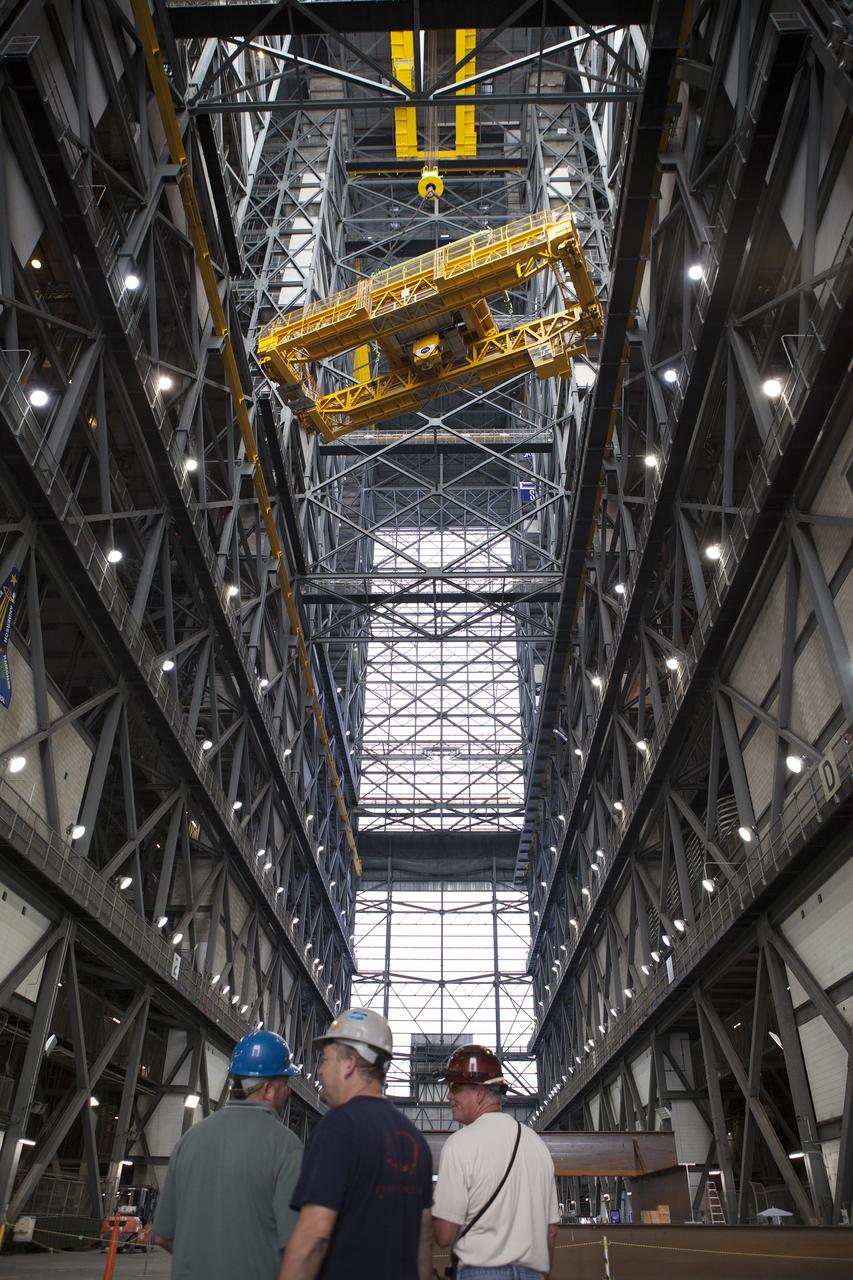
CAPE CANAVERAL, Fla. – Inside the Vehicle Assembly Building, or VAB, at NASA's Kennedy Space Center in Florida, the 175-ton crane is being turned as it is lowered by crane from Level 16 down to the transfer aisle floor. Upgrades to the crane's 45-year-old controls will be performed in order to improve reliability, precision and safety. The Ground Systems Development and Operations Program is overseeing upgrades and modifications to the VAB. The crane will be upgraded so that it can support lifting needs for NASA and other exploration vehicles, including the agency's Space Launch System and Orion spacecraft. Photo credit: NASA/Daniel Casper
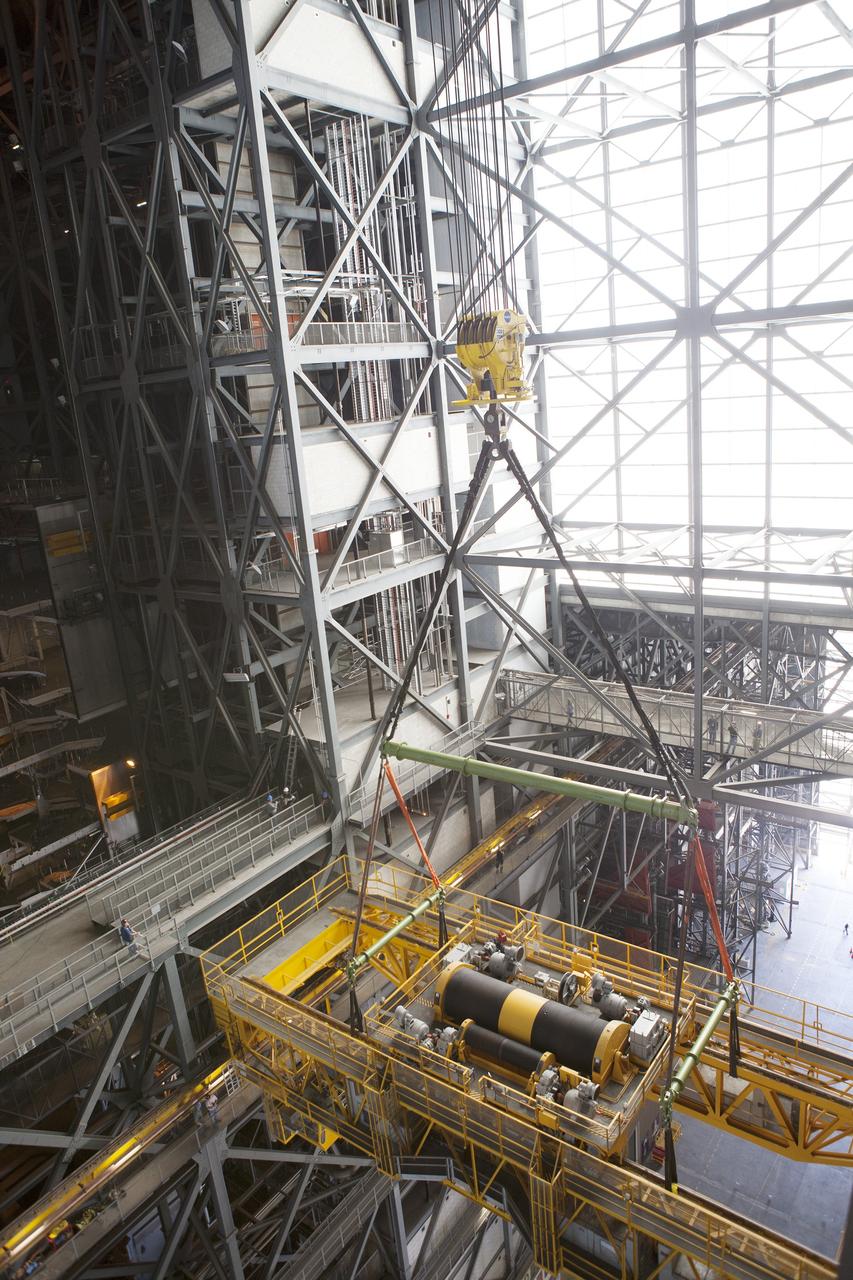
CAPE CANAVERAL, Fla. – Inside the Vehicle Assembly Building, or VAB, at NASA's Kennedy Space Center in Florida, a view from above shows a crane being used to lower the 175-ton crane. The crane is being lowered from Level 16 down to the transfer aisle floor to perform upgrades to its 45-year-old controls in order to improve reliability, precision and safety. The Ground Systems Development and Operations Program is overseeing upgrades and modifications to the VAB. The crane will be upgraded so that it can support lifting needs for NASA and other exploration vehicles, including the agency's Space Launch System and Orion spacecraft. Photo credit: NASA/Daniel Casper

CAPE CANAVERAL, Fla. – Inside the Vehicle Assembly Building, or VAB, at NASA's Kennedy Space Center in Florida, the 175-ton crane is being lowered from Level 16 down to the transfer aisle floor. Upgrades to the crane's 45-year-old controls will be performed in order to improve reliability, precision and safety. The Ground Systems Development and Operations Program is overseeing upgrades and modifications to the VAB. The crane will be upgraded so that it can support lifting needs for NASA and other exploration vehicles, including the agency's Space Launch System and Orion spacecraft. Photo credit: NASA/Daniel Casper
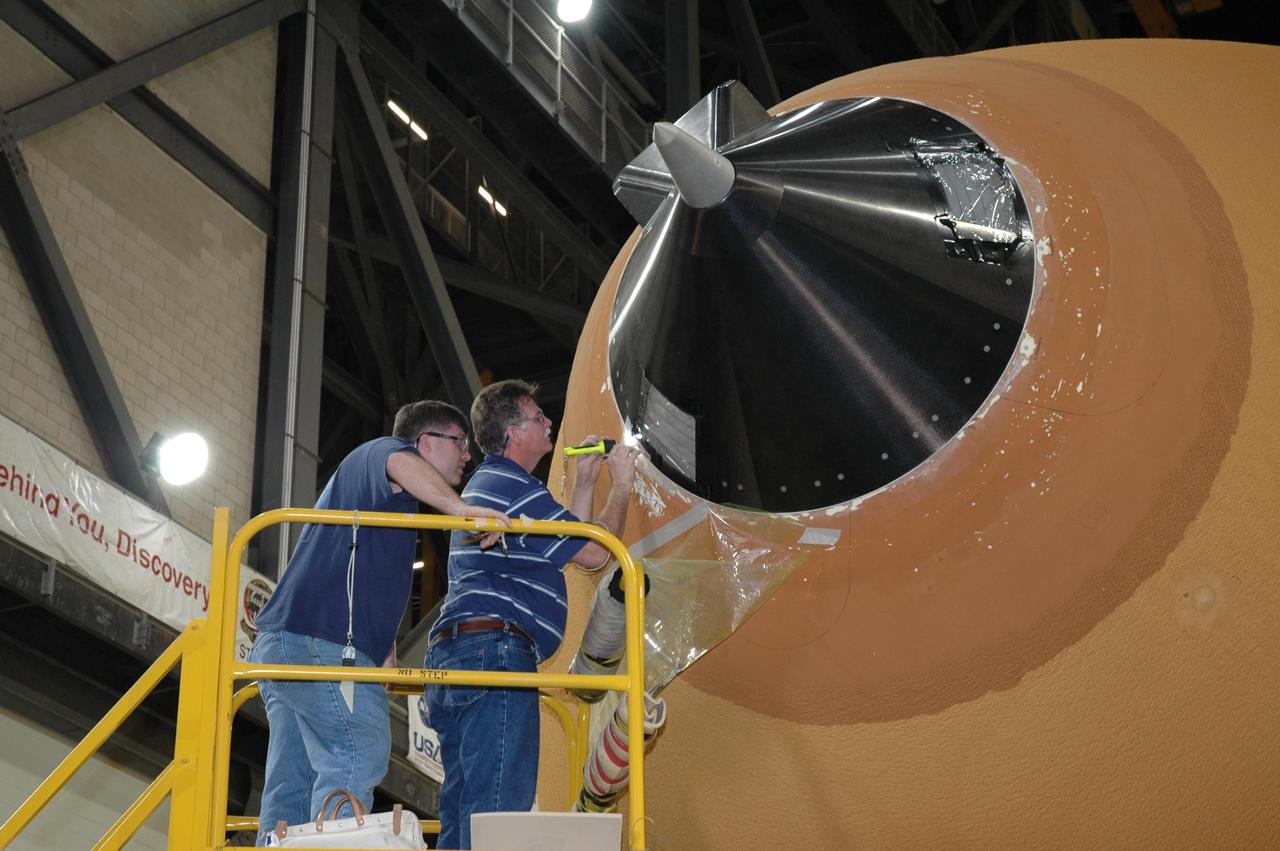
KENNEDY SPACE CENTER, FLA. - In the transfer aisle of the Vehicle Assembly Building, workers work on the rim around the nose cap of external tank number 119, the tank designated for mission STS-121. The cap was removed in order to install a new gaseous oxygen vent valve underneath. Vapors are created prior to launch as the liquid oxygen in the external tank boils off. At the forward end of each external tank propellant tank is a vent and relief valve that can be opened before launch for venting or by excessive tank pressure for relief. The vent function is available only before launch. Mission STS-121 to the International Space Station is scheduled for launch in July. Photo credit: NASA/Jim Grossmann
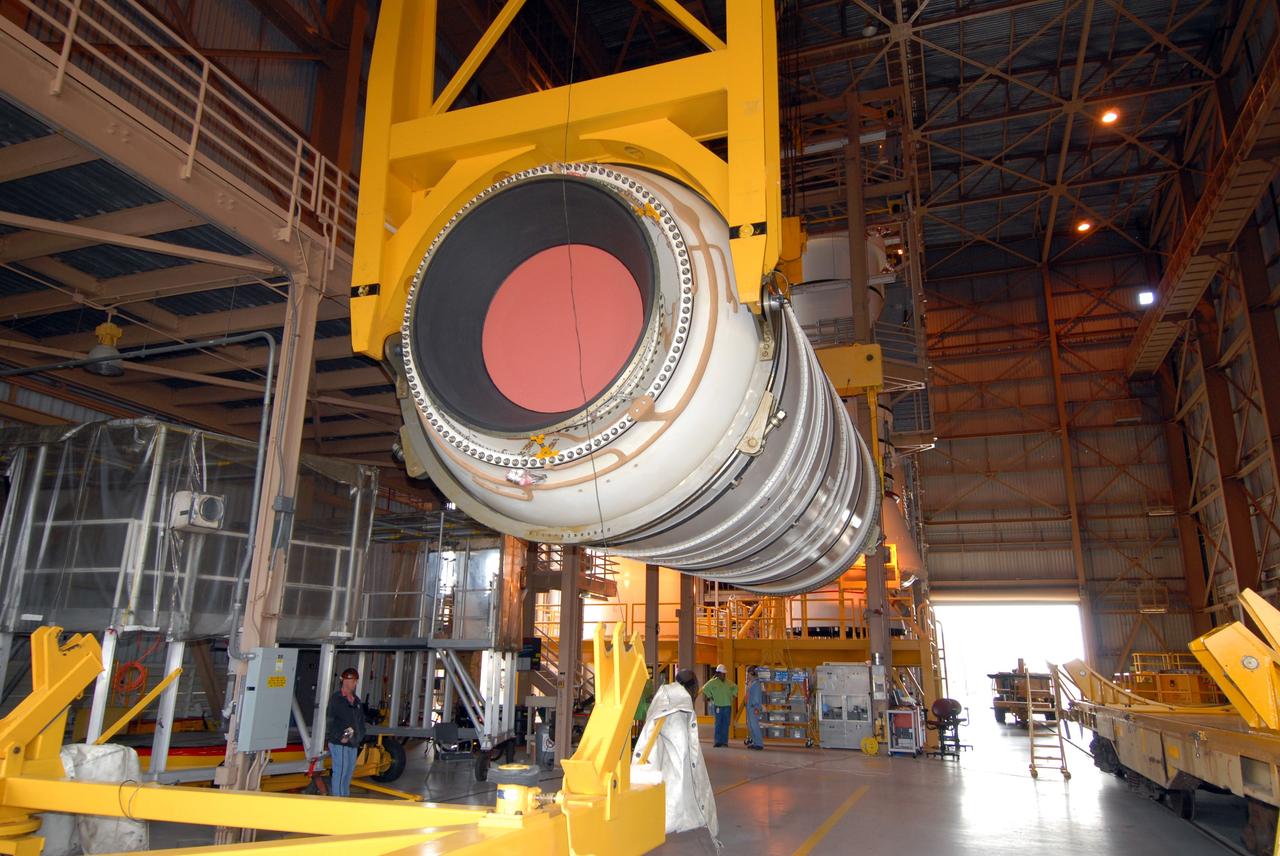
CAPE CANAVERAL, Fla. – Cranes lift the first of the Ares I-X motor segments in order to raise it to vertical and transfer it to a work stand in the Rotation, Processing and Surge Facility at NASA's Kennedy Space Center in Florida. Four segments were delivered to Kennedy for final processing and integration. The booster used for the Ares I-X launch is being modified by adding new forward structures and a fifth segment simulator. The motor is the final hardware needed for the rocket's upcoming test flight this summer. The stacking operations are scheduled to begin in the Vehicle Assembly Building in April. Photo credit: NASA/Jack Pfaller
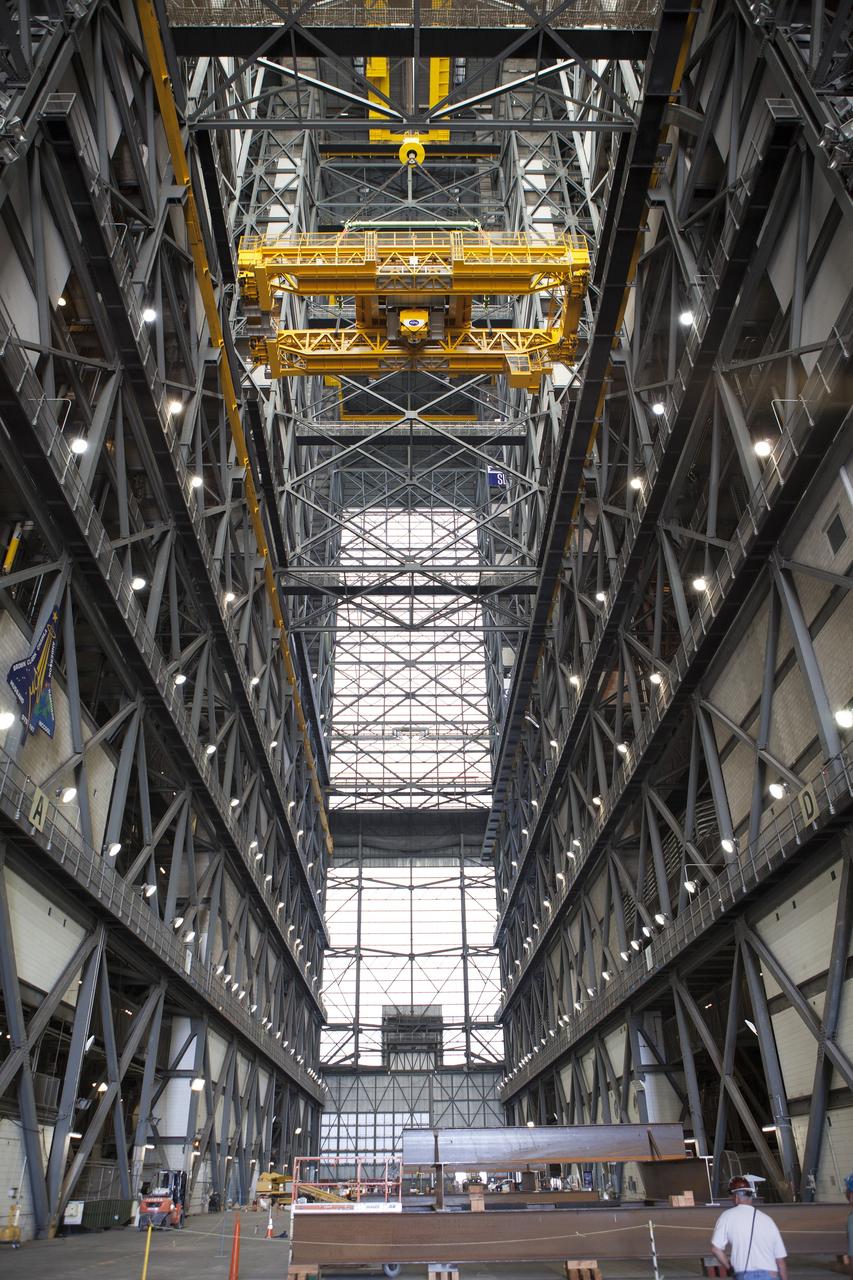
CAPE CANAVERAL, Fla. – Inside the Vehicle Assembly Building, or VAB, at NASA's Kennedy Space Center in Florida, a crane is being used to lower the 175-ton crane from Level 16 down to the transfer aisle floor. Upgrades to the crane's 45-year-old controls will be performed in order to improve reliability, precision and safety. The Ground Systems Development and Operations Program is overseeing upgrades and modifications to the VAB. The crane will be upgraded so that it can support lifting needs for NASA and other exploration vehicles, including the agency's Space Launch System and Orion spacecraft. Photo credit: NASA/Daniel Casper
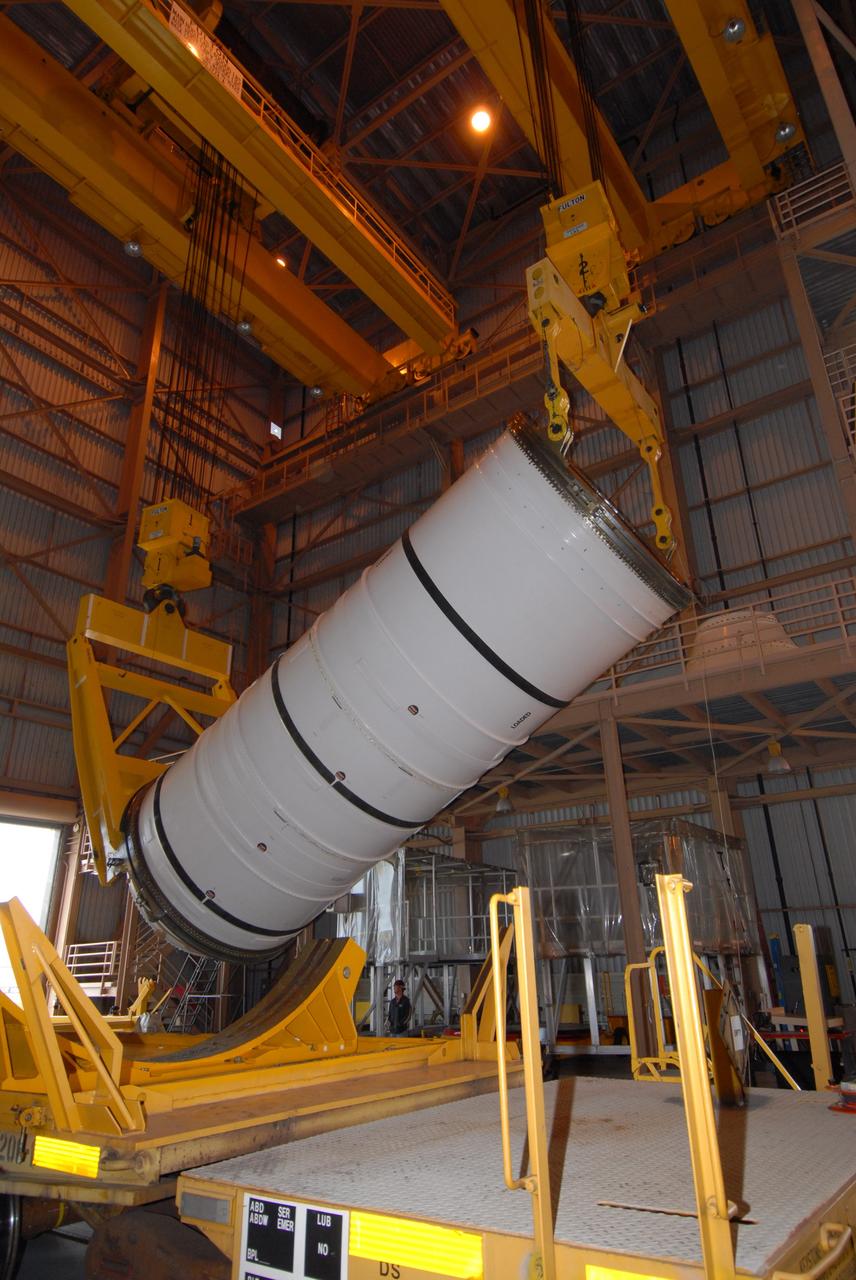
CAPE CANAVERAL, Fla. – Cranes begin rotating the Ares I-X motor segment to a vertical position in order to transfer it to a work stand in the Rotation, Processing and Surge Facility at NASA's Kennedy Space Center in Florida. Four segments were delivered to Kennedy for final processing and integration. The booster used for the Ares I-X launch is being modified by adding new forward structures and a fifth segment simulator. The motor is the final hardware needed for the rocket's upcoming test flight this summer. The stacking operations are scheduled to begin in the Vehicle Assembly Building in April. Photo credit: NASA/Jack Pfaller
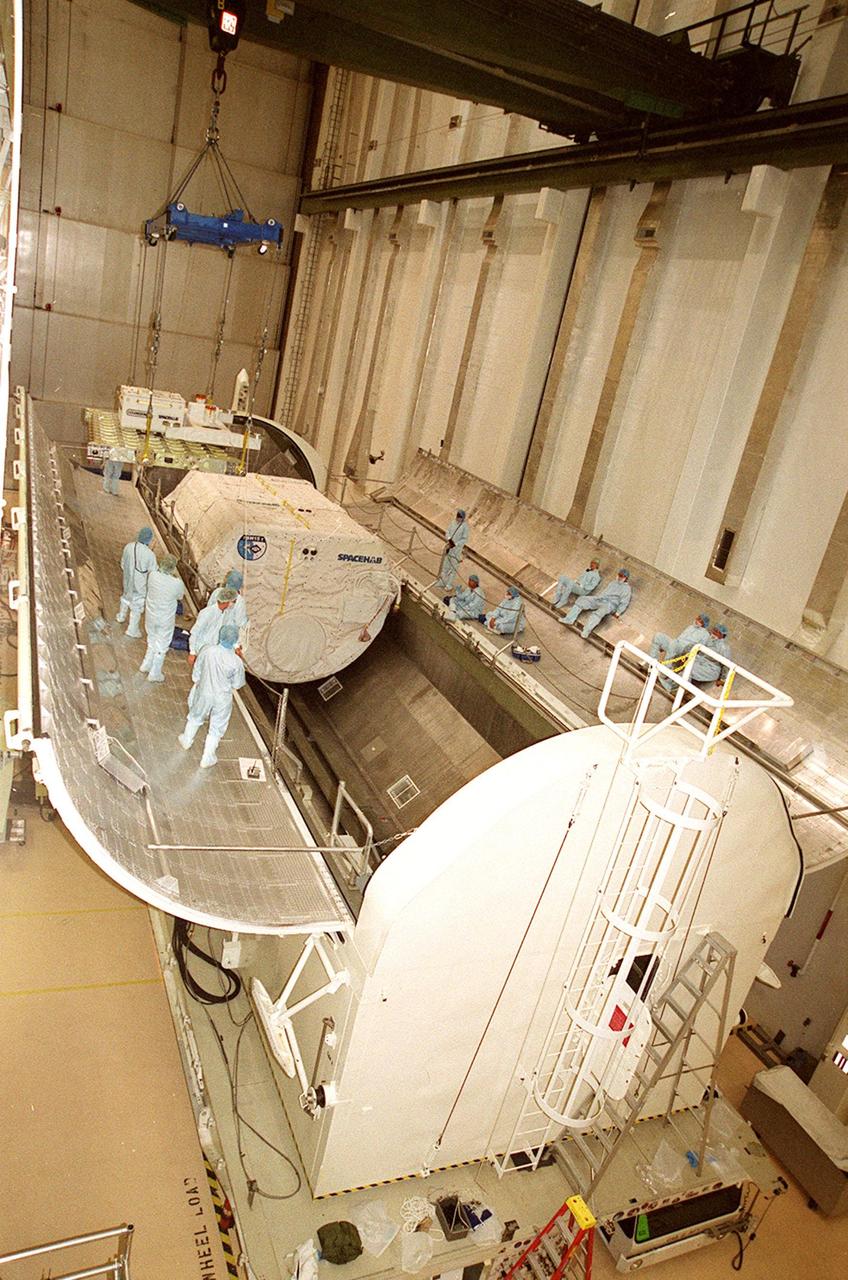
KENNEDY SPACE CENTER, FLA. -- In the Space Station Processing Facility, workers wait for the arrival of the Integrated Cargo Carrier (ICC), in the background, in order to load it into the payload canister. The canister already has the SPACEHAB module stowed. The canister will transport its cargo to Launch Pad 39B in preparation for mission STS-106, scheduled to launch Sept. 8 at 8:31 a.m. EDT. During the mission to the International Space Station, the crew will complete service module support tasks on orbit, transfer supplies and outfit the Space Station for the first long-duration crew
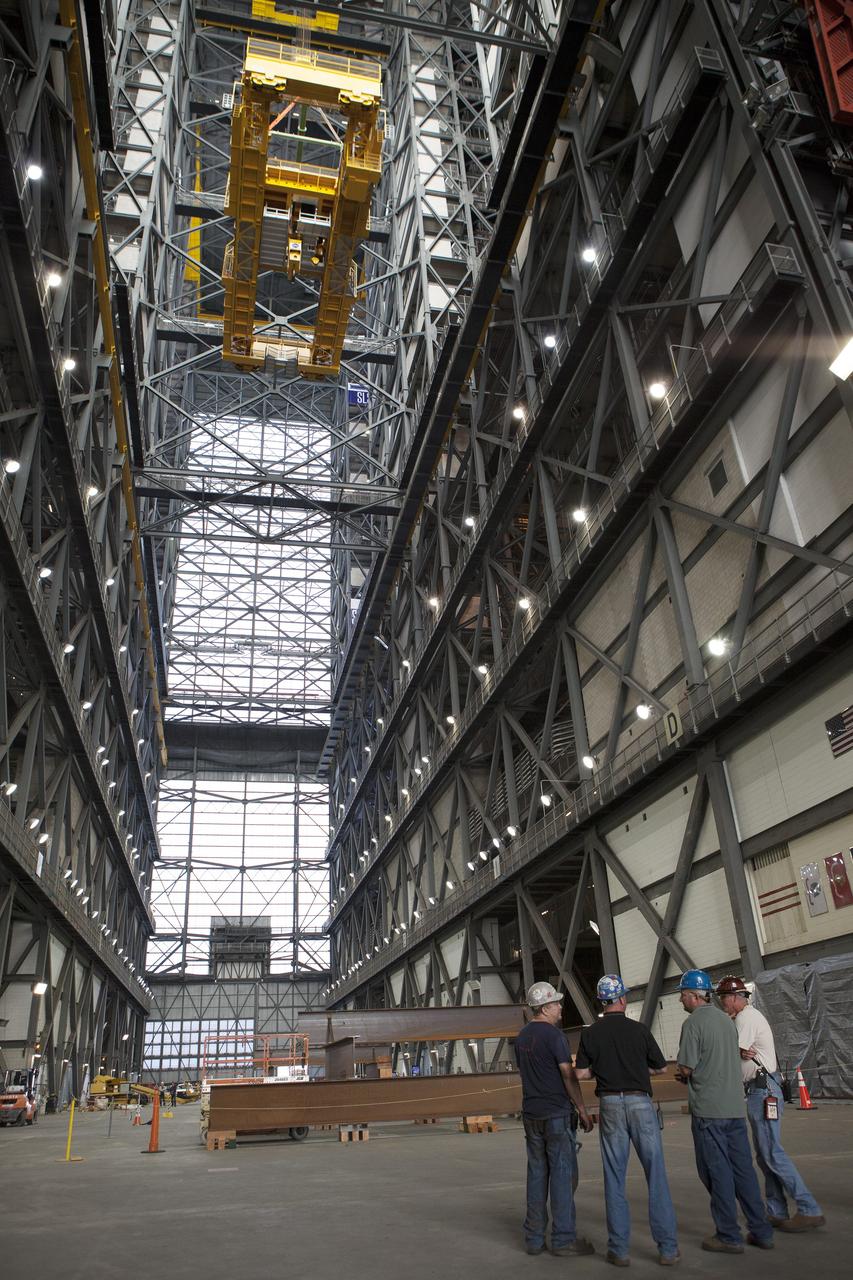
CAPE CANAVERAL, Fla. – Inside the Vehicle Assembly Building, or VAB, at NASA's Kennedy Space Center in Florida, the 175-ton crane has been turned as it is lowered by crane from Level 16 down to the transfer aisle floor. Upgrades to the crane's 45-year-old controls will be performed in order to improve reliability, precision and safety. The Ground Systems Development and Operations Program is overseeing upgrades and modifications to the VAB. The crane will be upgraded so that it can support lifting needs for NASA and other exploration vehicles, including the agency's Space Launch System and Orion spacecraft. Photo credit: NASA/Daniel Casper
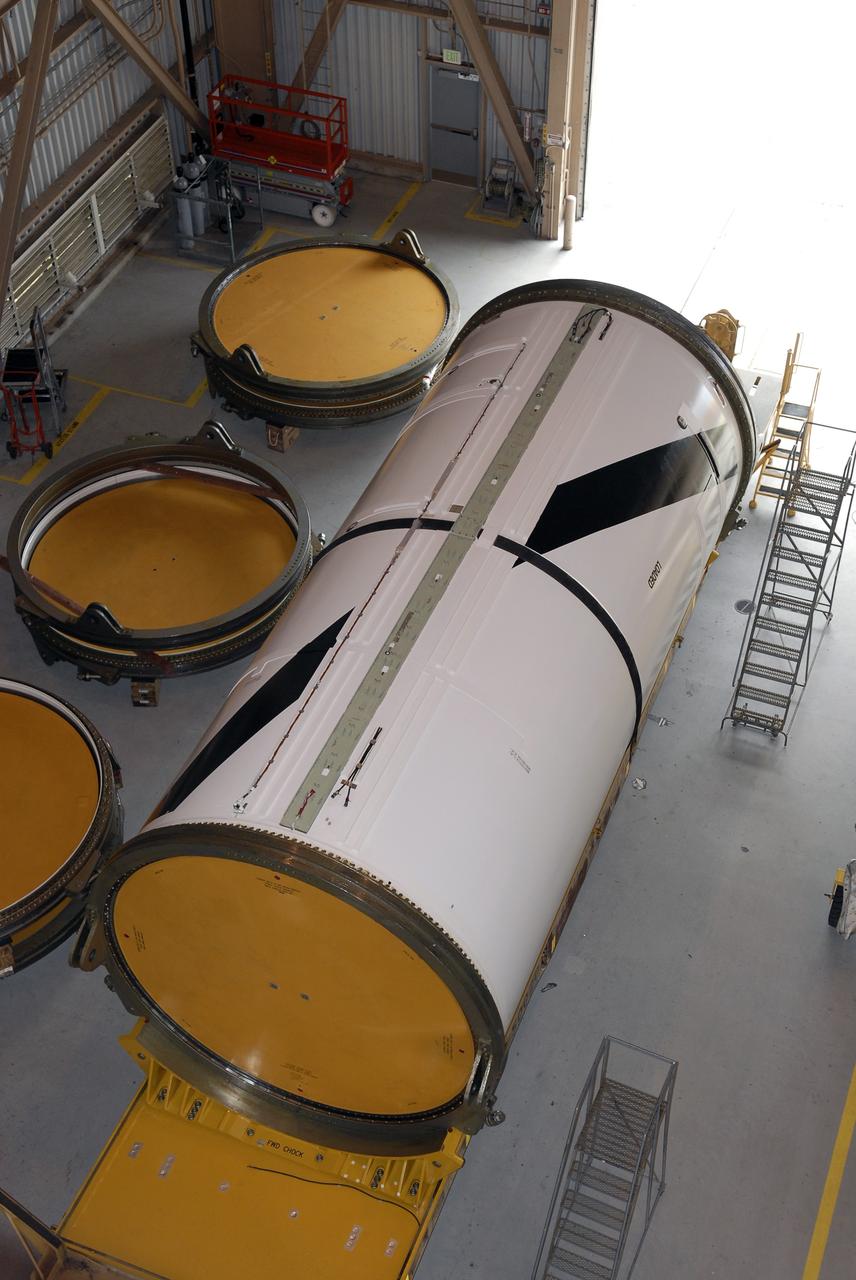
CAPE CANAVERAL, Fla. – In the Rotation, Processing and Surge Facility at NASA's Kennedy Space Center in Florida, the third of four Ares I-X segments arrives on a transporter. The segment will be raised to a vertical position in order to transfer it to a work stand for final processing and integration in the facility. The booster used for the Ares I-X launch is being modified by adding new forward structures and a fifth segment simulator. The stacking operations are scheduled to begin in the Vehicle Assembly Building in April. Launch of the Ares I-X test flight is targeted for July 2009. Photo credit: NASA/Kim Shiflett
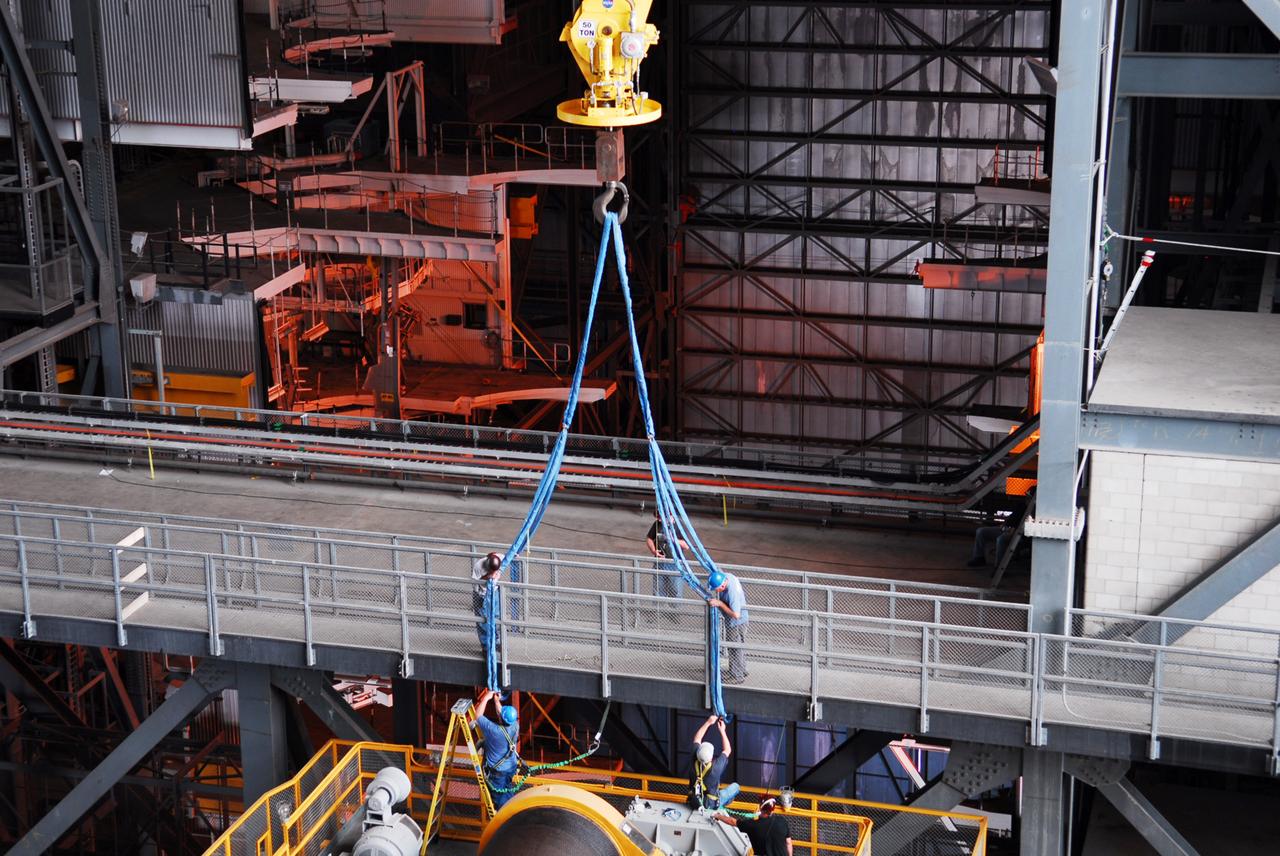
CAPE CANAVERAL, Fla. – Inside the Vehicle Assembly Building, or VAB, at NASA's Kennedy Space Center in Florida, workers have secured a crane to a portion of the catwalk on the east side of Level 16. The catwalk will be removed to allow room for the removal of the 175-ton crane that is situated above the transfer aisle. The crane will be lowered to the floor to perform upgrades to its 45-year-old controls in order to improve reliability, precision and safety. The Ground Systems Development and Operations Program is overseeing upgrades and modifications to the VAB. The crane will be upgraded so that it can support lifting needs for NASA and other exploration vehicles, including the agency's Space Launch System and Orion spacecraft. Photo credit: NASA/Jim Grossmann
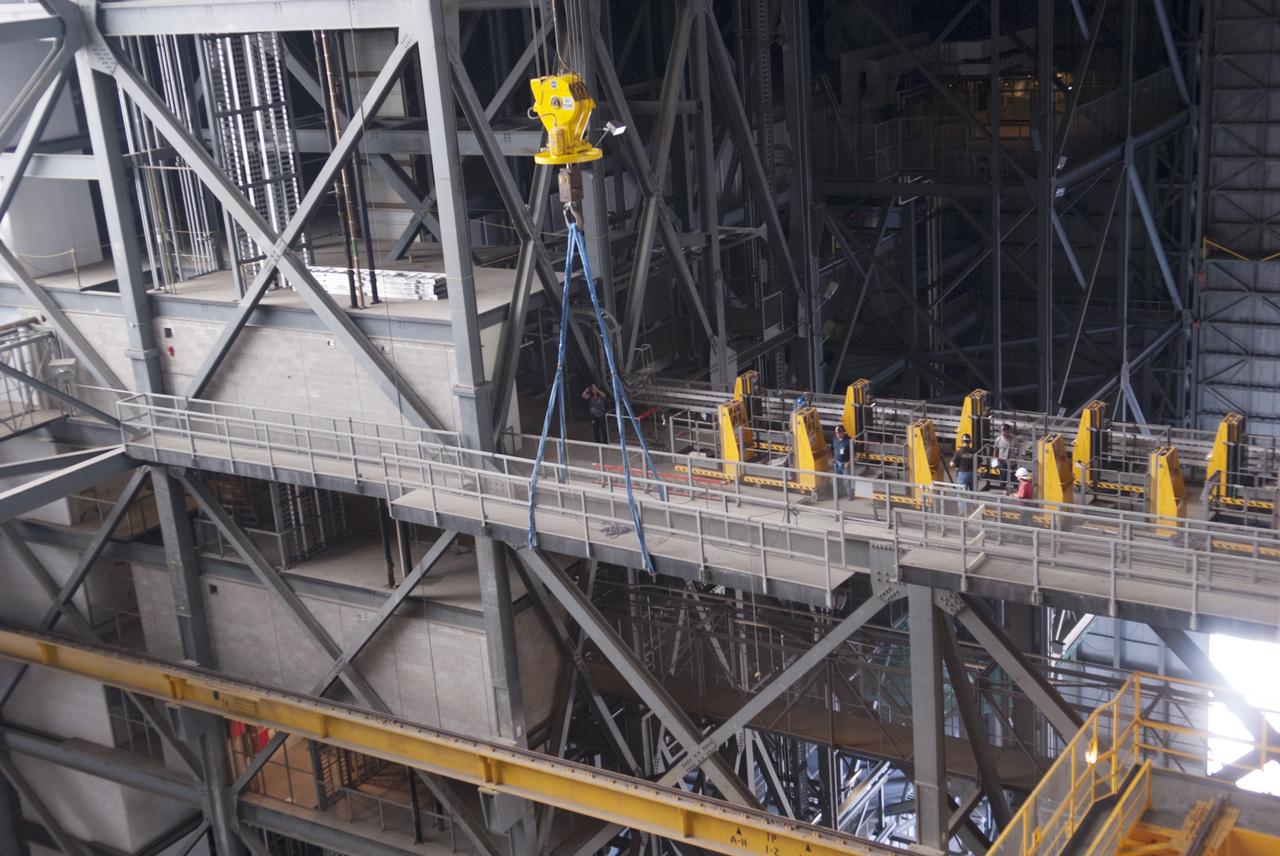
CAPE CANAVERAL, Fla. – Inside the Vehicle Assembly Building, or VAB, at NASA's Kennedy Space Center in Florida, a crane is used to remove a portion of the catwalk on the west side of Level 16. The catwalk is being removed to allow room for the removal of the 175-ton crane that is situated above the transfer aisle. The crane will be lowered to the floor to perform upgrades to its 45-year-old controls in order to improve reliability, precision and safety. The Ground Systems Development and Operations Program is overseeing upgrades and modifications to the VAB. The crane will be upgraded so that it can support lifting needs for NASA and other exploration vehicles, including the agency's Space Launch System and Orion spacecraft. Photo credit: NASA/Jim Grossmann
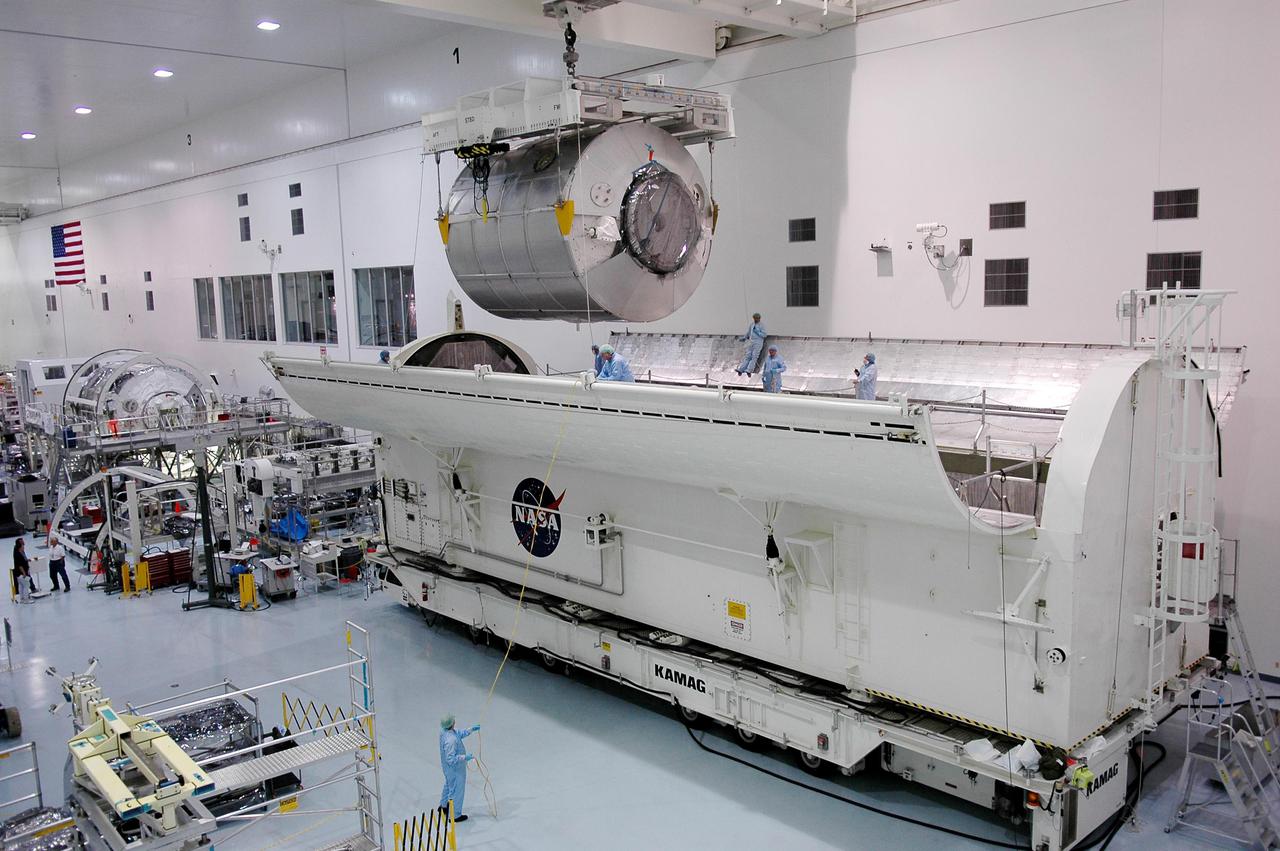
KENNEDY SPACE CENTER, FLA. - In the Space Station Processing Facility at NASA’s Kennedy Space Center, the Multi-Purpose Logistics Module Raffaello is lifted out of the Payload Transportation Canister where it was waiting transfer to the pad. The module is being moved back to its work stand to allow the processing team access in order to address concerns with mechanical fasteners inside the module that do not incorporate an adequate secondary locking feature. The assessment and additional work is being conducted to ensure that the fasteners do not disengage during ascent. Raffaello is scheduled to launch on Discovery's Return to Flight mission STS-114.
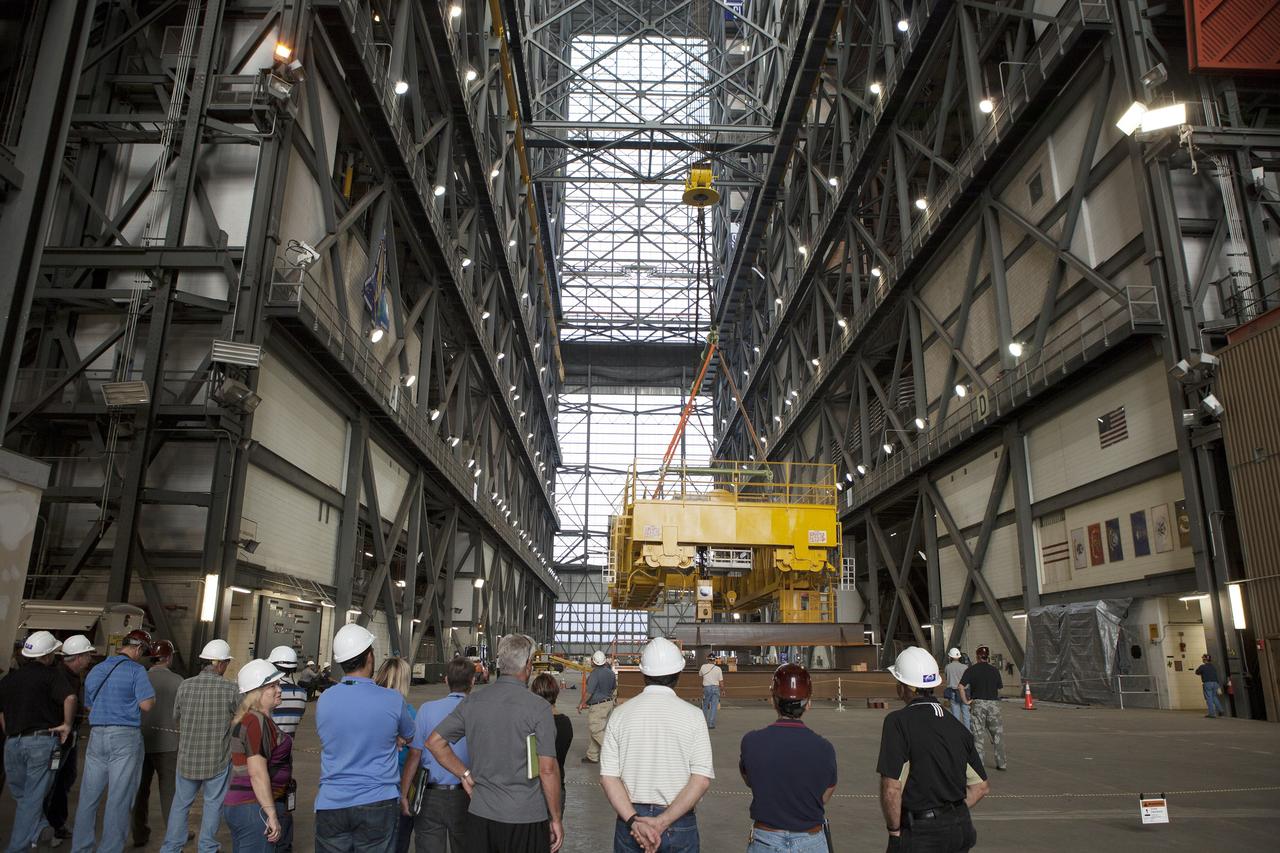
CAPE CANAVERAL, Fla. – Inside the Vehicle Assembly Building, or VAB, at NASA's Kennedy Space Center in Florida, NASA, contractor and construction workers watch as a crane lowers the 175-ton crane toward the floor of the transfer aisle. The crane was turned to make it easier to lower it from Level 16. Upgrades to the crane's 45-year-old controls will be performed in order to improve reliability, precision and safety. The Ground Systems Development and Operations Program is overseeing upgrades and modifications to the VAB. The crane will be upgraded so that it can support lifting needs for NASA and other exploration vehicles, including the agency's Space Launch System and Orion spacecraft. Photo credit: NASA/Daniel Casper

CAPE CANAVERAL, Fla. – Inside the Vehicle Assembly Building, or VAB, at NASA's Kennedy Space Center in Florida, the 175-ton crane is being lowered by crane onto steel stands on the transfer aisle floor. The crane was lowered from Level 16. In view at right is the cab that is used to control the crane. Upgrades to the crane's 45-year-old controls will be performed in order to improve reliability, precision and safety. The Ground Systems Development and Operations Program is overseeing upgrades and modifications to the VAB. The crane will be upgraded so that it can support lifting needs for NASA and other exploration vehicles, including the agency's Space Launch System and Orion spacecraft. Photo credit: NASA/Daniel Casper
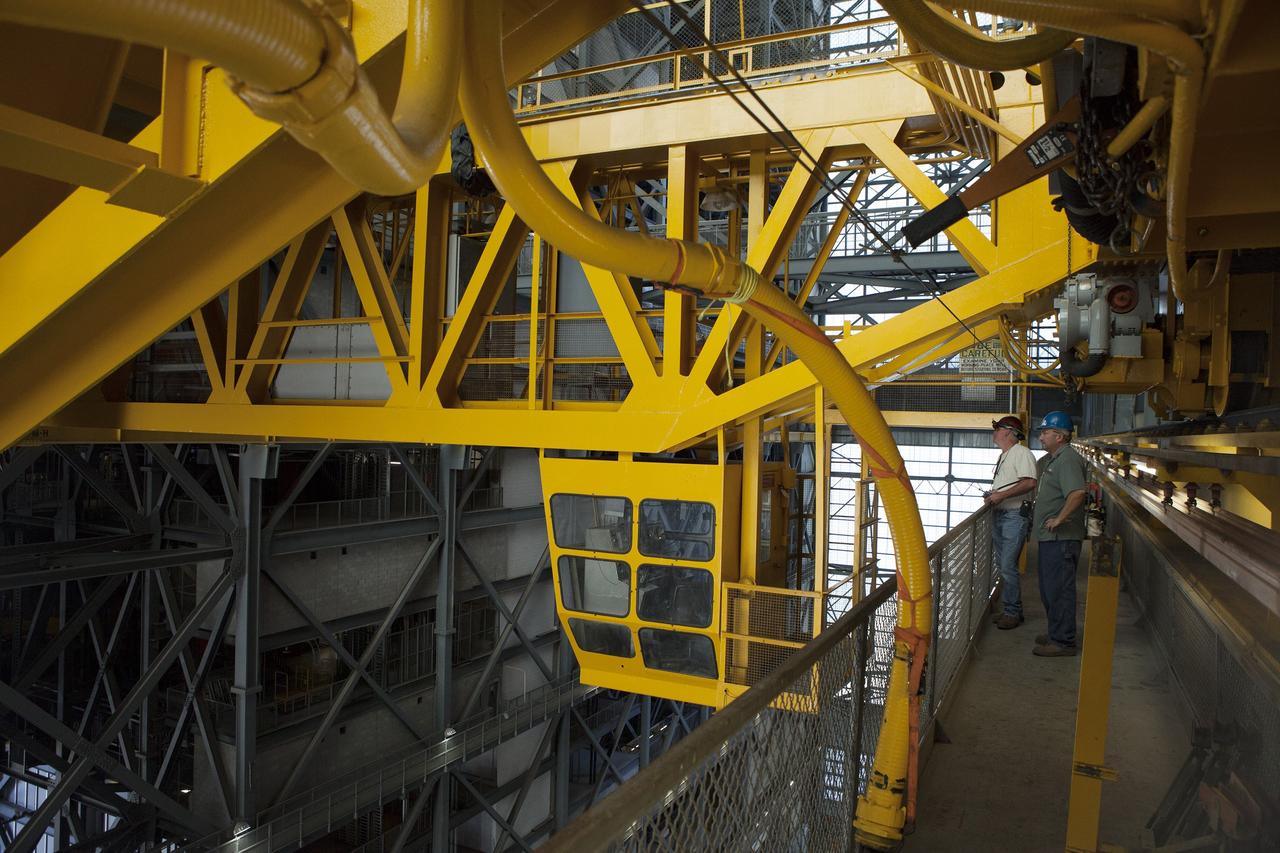
CAPE CANAVERAL, Fla. – Inside the Vehicle Assembly Building, or VAB, at NASA's Kennedy Space Center in Florida, preparations are underway to lower the 175-ton crane. In view is the cab that is used to control the crane. The crane is being lowered from Level 16 down to the floor of the transfer aisle to perform upgrades to its 45-year-old controls in order to improve reliability, precision and safety. The Ground Systems Development and Operations Program is overseeing upgrades and modifications to the VAB. The crane will be upgraded so that it can support lifting needs for NASA and other exploration vehicles, including the agency's Space Launch System and Orion spacecraft. Photo credit: NASA/Daniel Casper
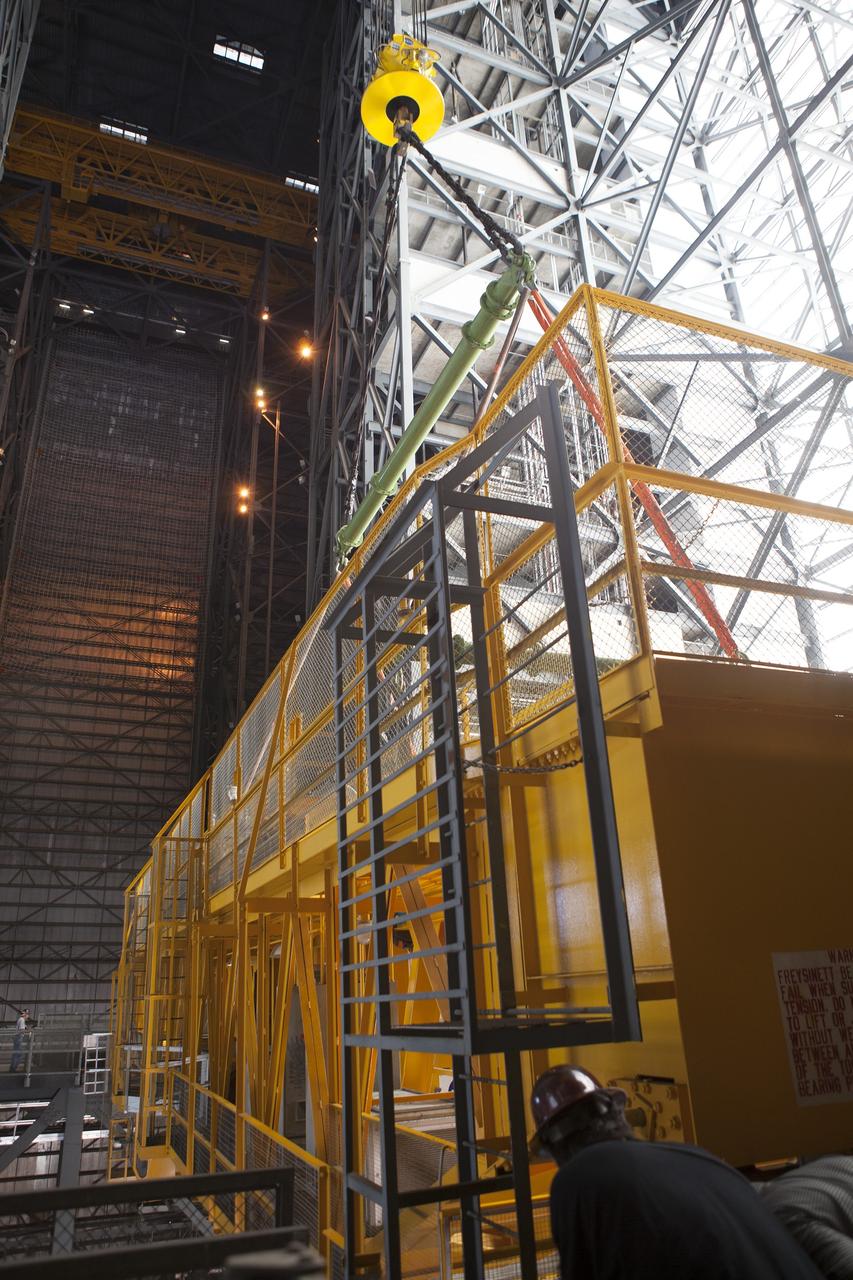
CAPE CANAVERAL, Fla. – Inside the Vehicle Assembly Building, or VAB, at NASA's Kennedy Space Center in Florida, a crane is being used to lower the 175-ton crane from Level 16 down to the transfer aisle floor. Upgrades to the crane's 45-year-old controls will be performed in order to improve reliability, precision and safety. The Ground Systems Development and Operations Program is overseeing upgrades and modifications to the VAB. The crane will be upgraded so that it can support lifting needs for NASA and other exploration vehicles, including the agency's Space Launch System and Orion spacecraft. Photo credit: NASA/Daniel Casper
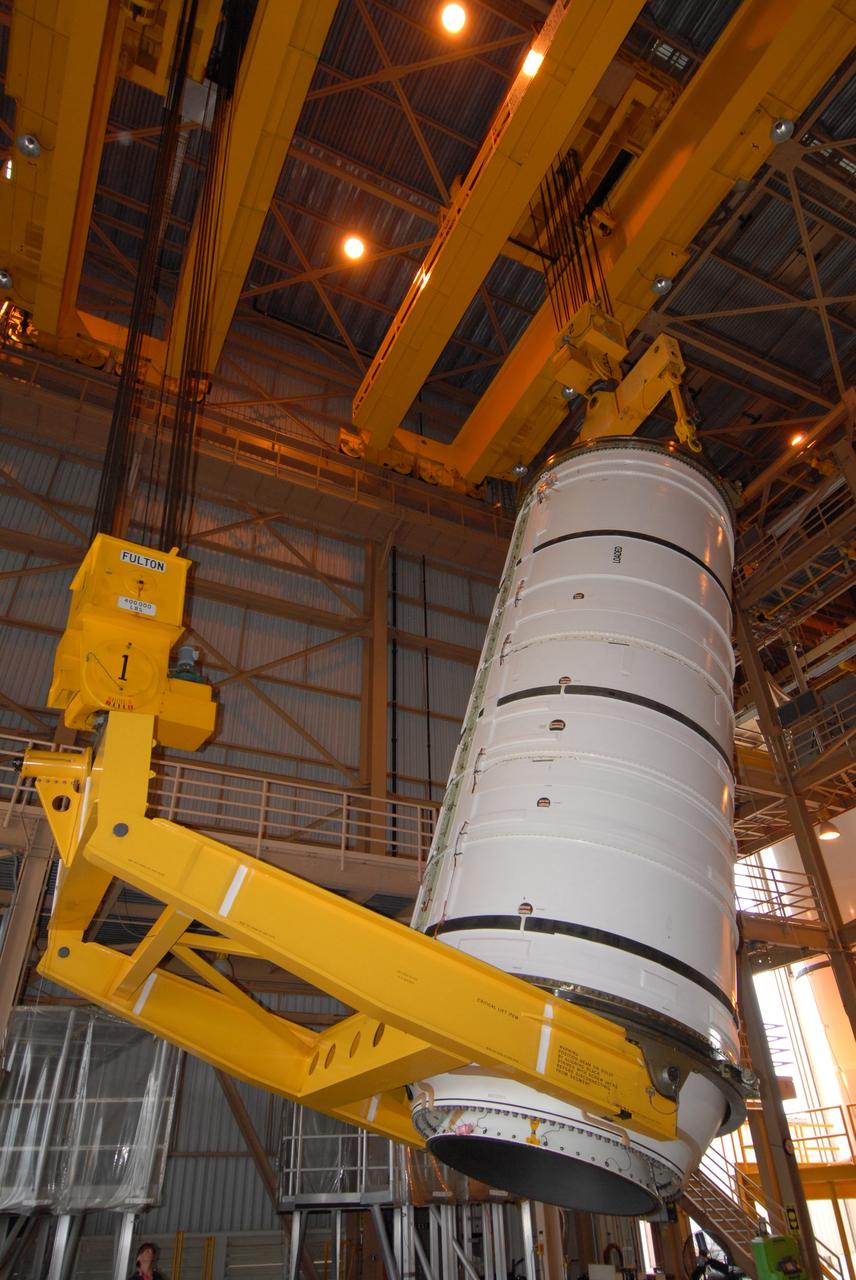
CAPE CANAVERAL, Fla. – Cranes rotate the Ares I-X motor segment to a vertical position in order to transfer it to a work stand in the Rotation, Processing and Surge Facility at NASA's Kennedy Space Center in Florida. Four segments were delivered to Kennedy for final processing and integration. The booster used for the Ares I-X launch is being modified by adding new forward structures and a fifth segment simulator. The motor is the final hardware needed for the rocket's upcoming test flight this summer. The stacking operations are scheduled to begin in the Vehicle Assembly Building in April. Photo credit: NASA/Jack Pfaller
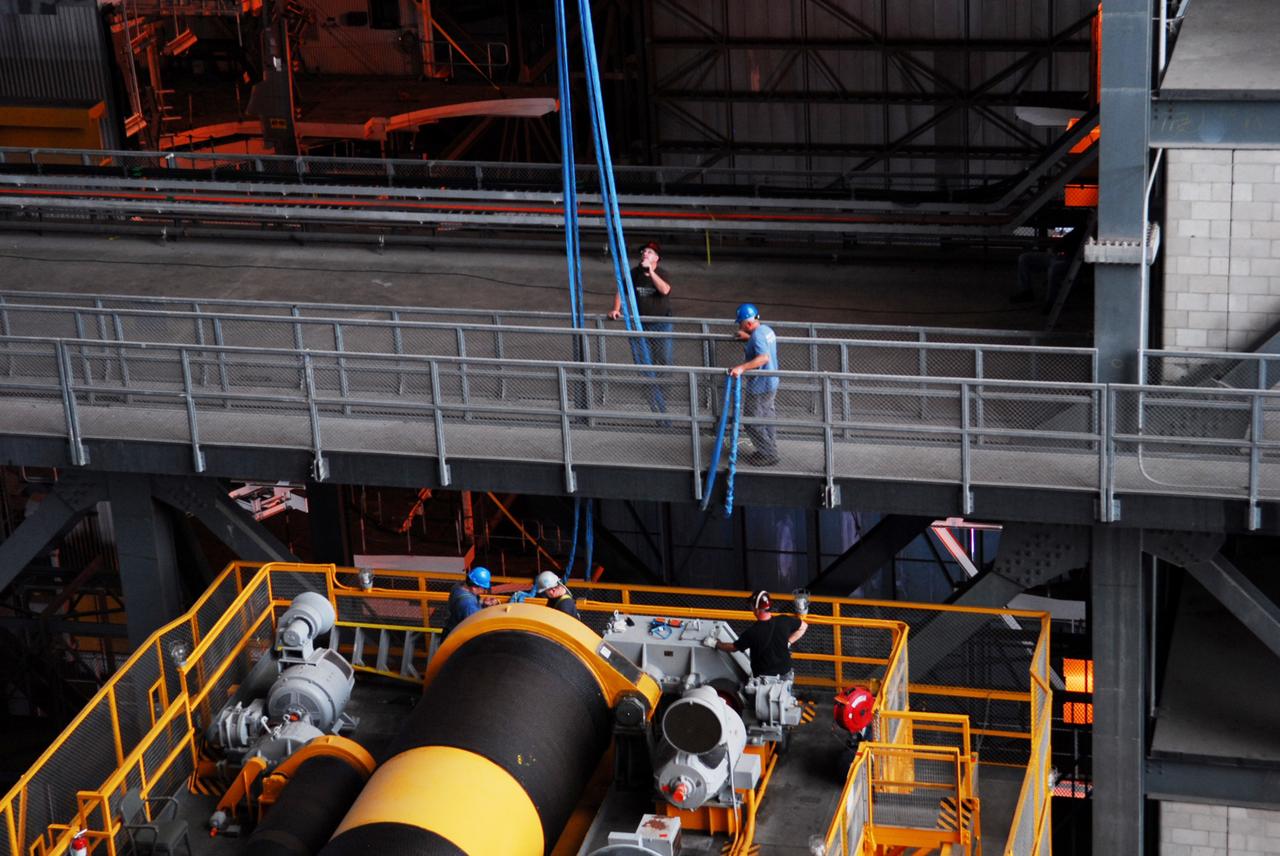
CAPE CANAVERAL, Fla. – Inside the Vehicle Assembly Building, or VAB, at NASA's Kennedy Space Center in Florida, preparations are underway to remove a portion of the catwalk on the east side of Level 16 to allow room for the removal of the 175-ton crane that is situated above the transfer aisle. The crane will be lowered to the floor to perform upgrades to its 45-year-old controls in order to improve reliability, precision and safety. The Ground Systems Development and Operations Program is overseeing upgrades and modifications to the VAB. The crane will be upgraded so that it can support lifting needs for NASA and other exploration vehicles, including the agency's Space Launch System and Orion spacecraft. Photo credit: NASA/Jim Grossmann
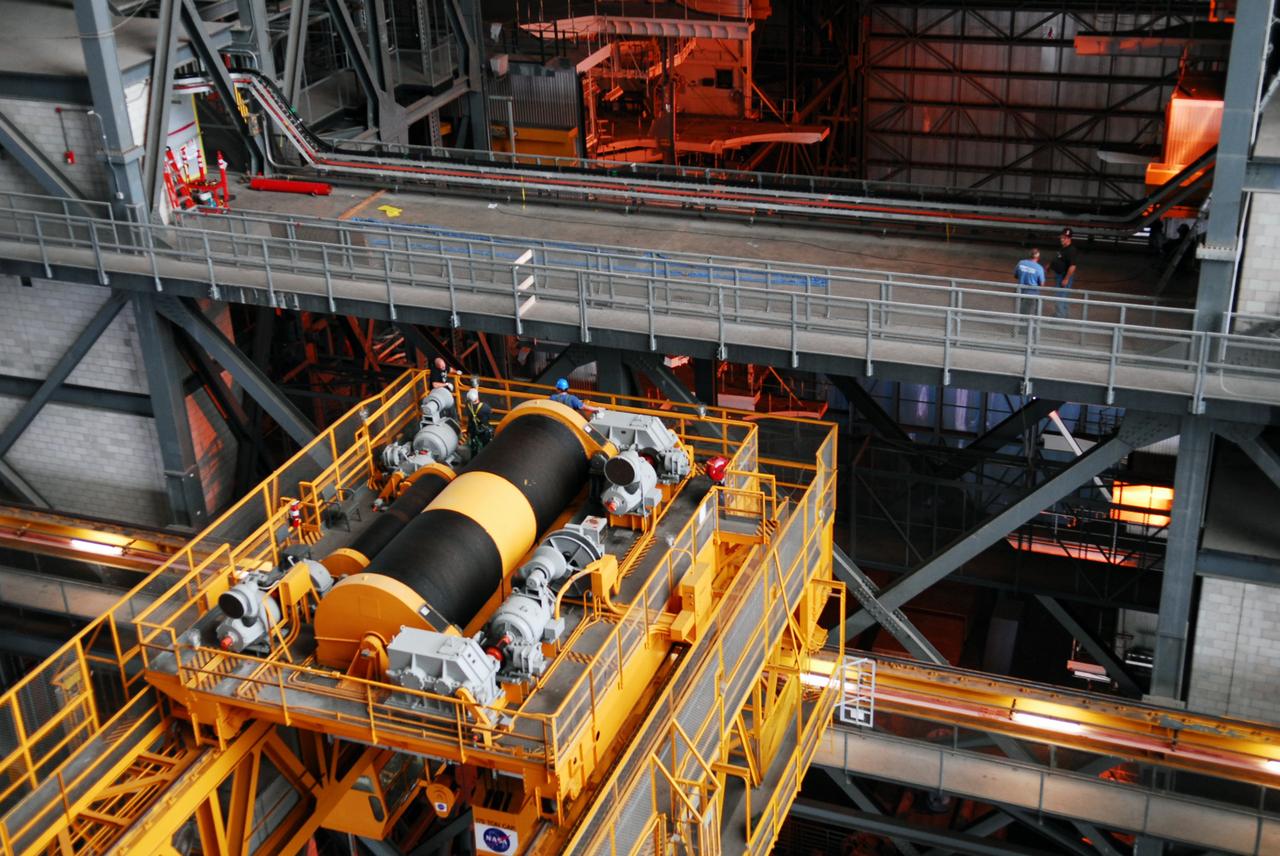
CAPE CANAVERAL, Fla. – Inside the Vehicle Assembly Building, or VAB, at NASA's Kennedy Space Center in Florida, preparations are underway to remove a portion of the catwalk on the east side of Level 16 to allow room for the removal of the 175-ton crane that is situated above the transfer aisle. The crane will be lowered to the floor to perform upgrades to its 45-year-old controls in order to improve reliability, precision and safety. The Ground Systems Development and Operations Program is overseeing upgrades and modifications to the VAB. The crane will be upgraded so that it can support lifting needs for NASA and other exploration vehicles, including the agency's Space Launch System and Orion spacecraft. Photo credit: NASA/Jim Grossmann
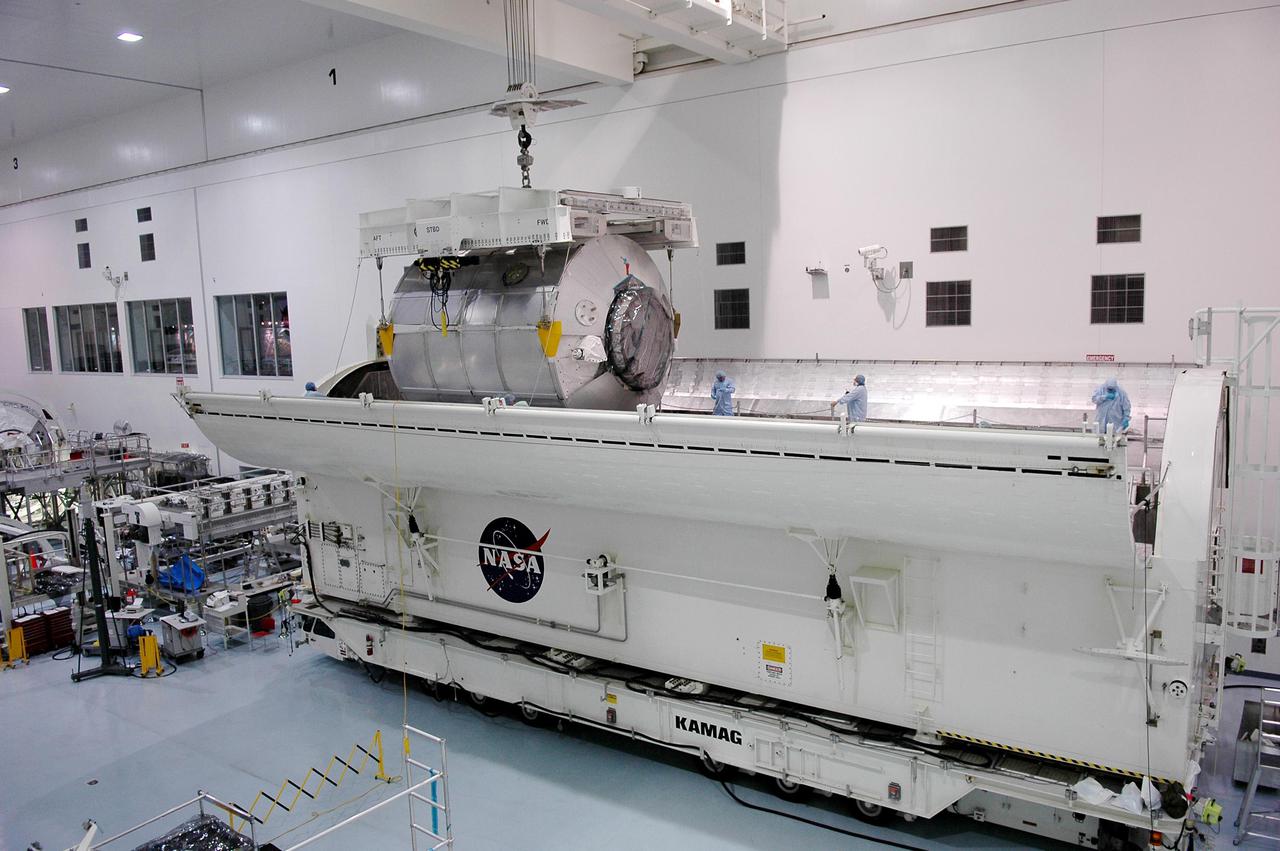
KENNEDY SPACE CENTER, FLA. - In the Space Station Processing Facility at NASA’s Kennedy Space Center, the Multi-Purpose Logistics Module Raffaello is lifted out of the Payload Transportation Canister where it was waiting transfer to the pad. The module is being moved back to its work stand to allow the processing team access in order to address concerns with mechanical fasteners inside the module that do not incorporate an adequate secondary locking feature. The assessment and additional work is being conducted to ensure that the fasteners do not disengage during ascent. Raffaello is scheduled to launch on Discovery's Return to Flight mission STS-114.
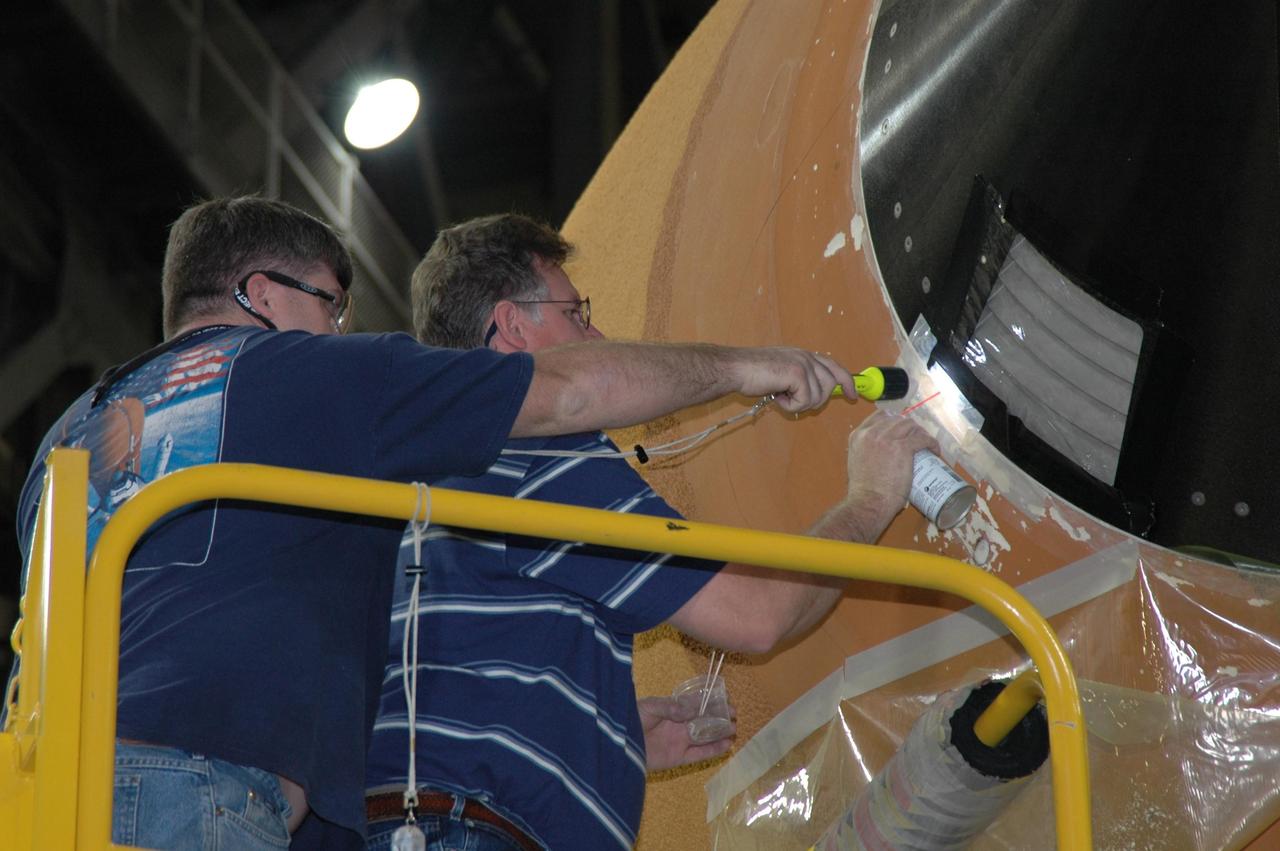
KENNEDY SPACE CENTER, FLA. - In the transfer aisle of the Vehicle Assembly Building, workers check the rim around the nose cap of external tank number 119, the tank designated for mission STS-121. The cap was removed in order to install a new gaseous oxygen vent valve underneath. Vapors are created prior to launch as the liquid oxygen in the external tank boils off. At the forward end of each external tank propellant tank is a vent and relief valve that can be opened before launch for venting or by excessive tank pressure for relief. The vent function is available only before launch. Mission STS-121 to the International Space Station is scheduled for launch in July. Photo credit: NASA/Jim Grossmann
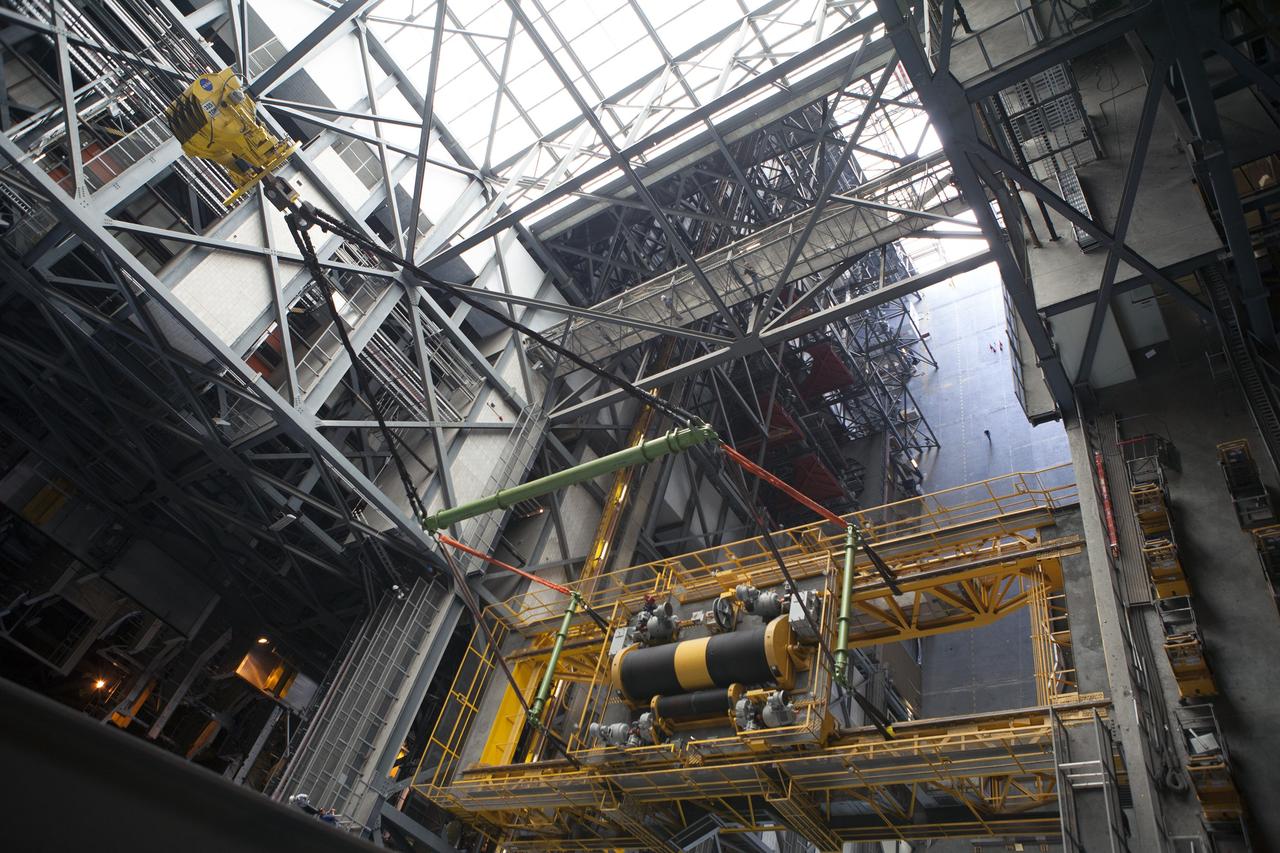
CAPE CANAVERAL, Fla. – Inside the Vehicle Assembly Building, or VAB, at NASA's Kennedy Space Center in Florida, a view from above shows a crane being used to lower the 175-ton crane. The crane is being lowered from Level 16 down to the transfer aisle floor to perform upgrades to its 45-year-old controls in order to improve reliability, precision and safety. The Ground Systems Development and Operations Program is overseeing upgrades and modifications to the VAB. The crane will be upgraded so that it can support lifting needs for NASA and other exploration vehicles, including the agency's Space Launch System and Orion spacecraft. Photo credit: NASA/Daniel Casper
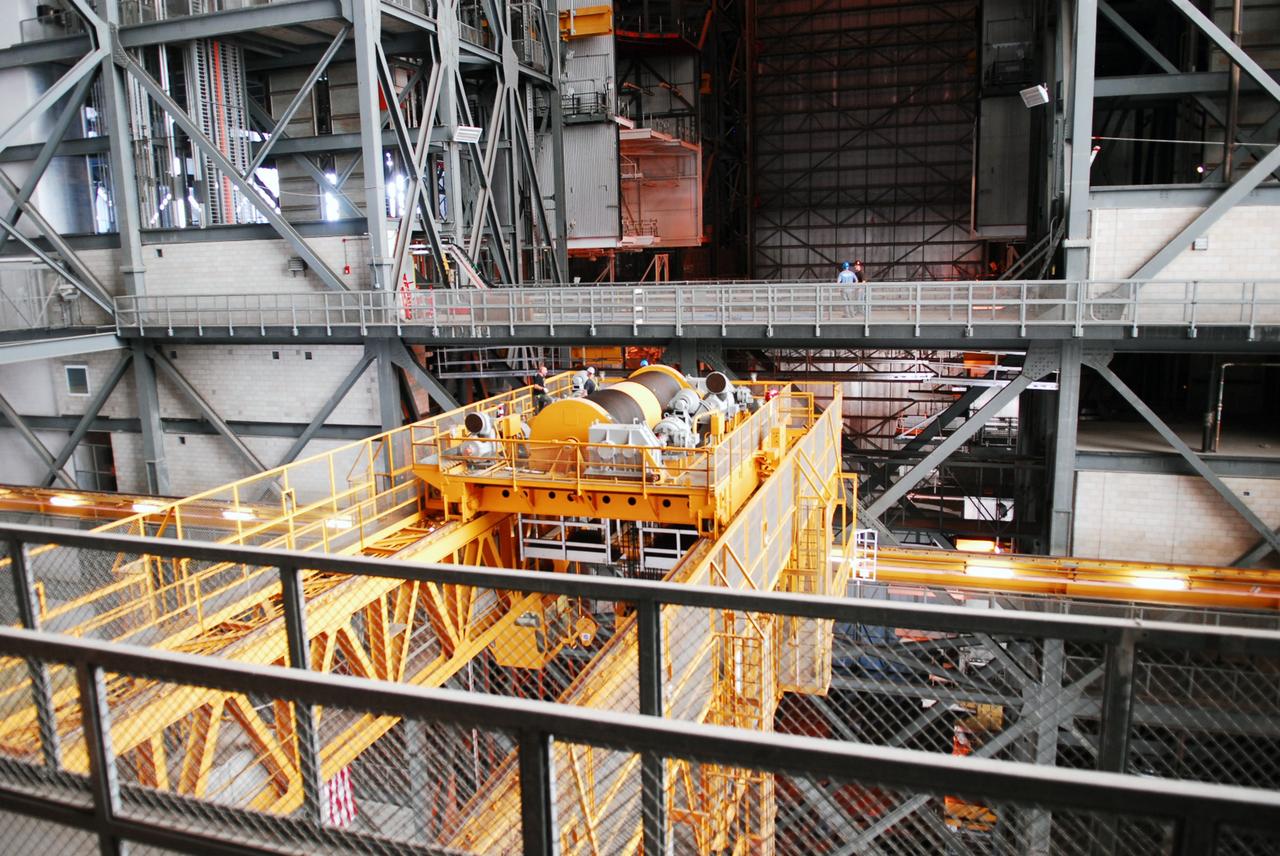
CAPE CANAVERAL, Fla. – Inside the Vehicle Assembly Building, or VAB, at NASA's Kennedy Space Center in Florida, preparations are underway to remove a portion of the catwalk on the east side of Level 16 to allow room for the removal of the 175-ton crane that is situated above the transfer aisle. The crane will be lowered to the floor to perform upgrades to its 45-year-old controls in order to improve reliability, precision and safety. The Ground Systems Development and Operations Program is overseeing upgrades and modifications to the VAB. The crane will be upgraded so that it can support lifting needs for NASA and other exploration vehicles, including the agency's Space Launch System and Orion spacecraft. Photo credit: NASA/Jim Grossmann
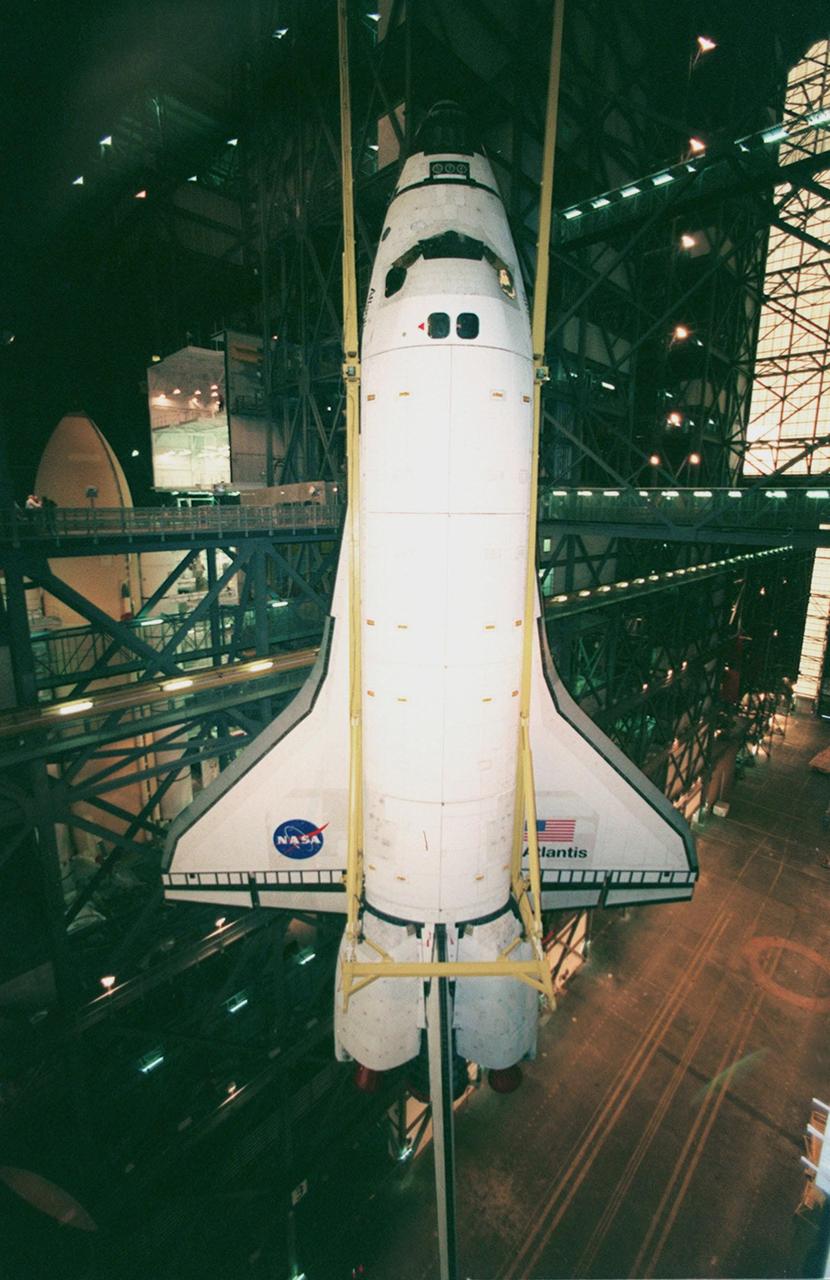
KENNEDY SPACE CENTER, FLA. -- Suspended by a crane over the transfer aisle of the Vehicle Assembly Building (VAB), orbiter Atlantis is lifted higher in order to move it toward the stack of external tank and solid rocket boosters at left. The 122-foot high orbiter is easily accommodated inside the 525-foot-tall, 518-foot-wide VAB. After being mated with the stack, Atlantis will be transported to Launch Pad 39A. Atlantis will fly on mission STS-101 to the International Space Station, where its crew of seven will prepare the Station for the arrival of the next pressurized module, the Russian-built Zvezda. Atlantis is expected to launch no earlier than April 17, 2000
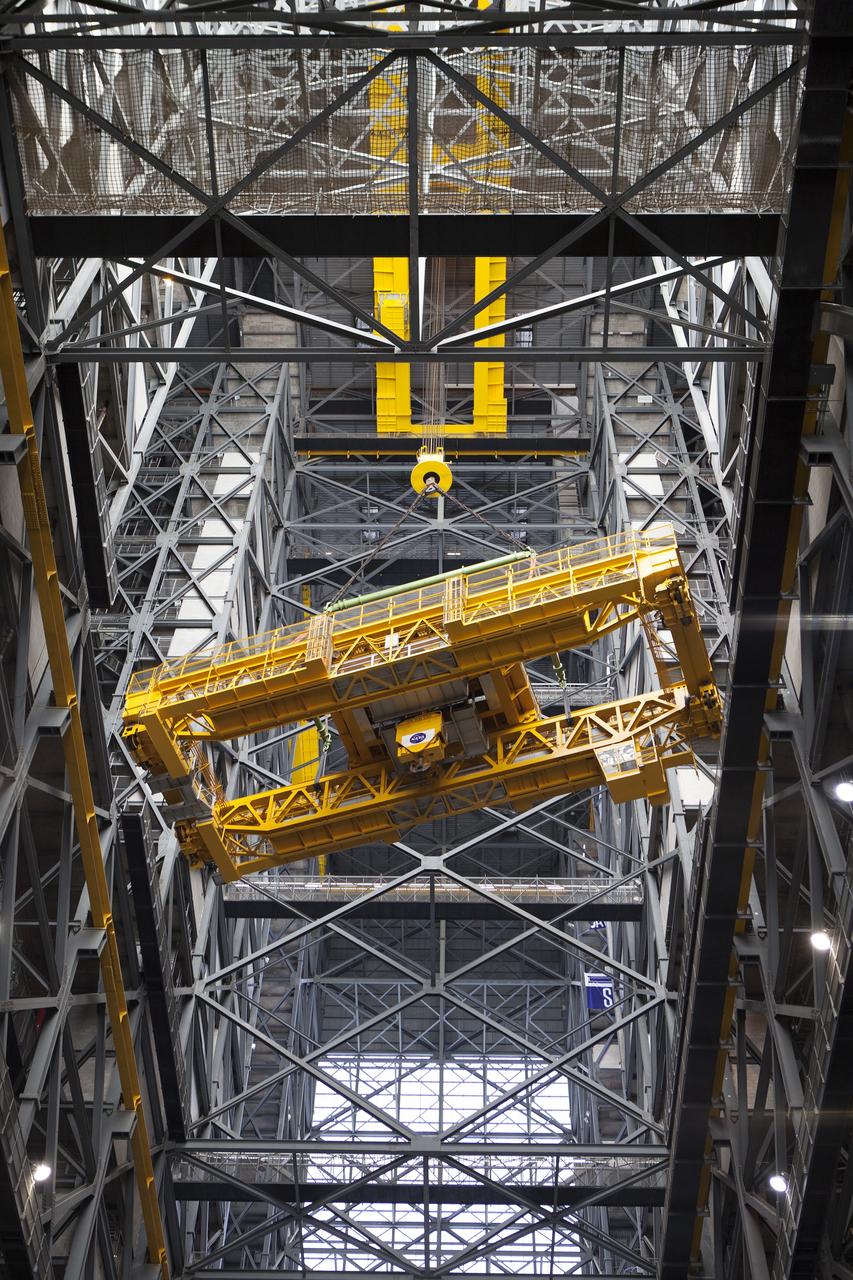
CAPE CANAVERAL, Fla. – Inside the Vehicle Assembly Building, or VAB, at NASA's Kennedy Space Center in Florida, the 175-ton crane is being turned as it is lowered by crane from Level 16 down to the transfer aisle floor. Upgrades to the crane's 45-year-old controls will be performed in order to improve reliability, precision and safety. The Ground Systems Development and Operations Program is overseeing upgrades and modifications to the VAB. The crane will be upgraded so that it can support lifting needs for NASA and other exploration vehicles, including the agency's Space Launch System and Orion spacecraft. Photo credit: NASA/Daniel Casper
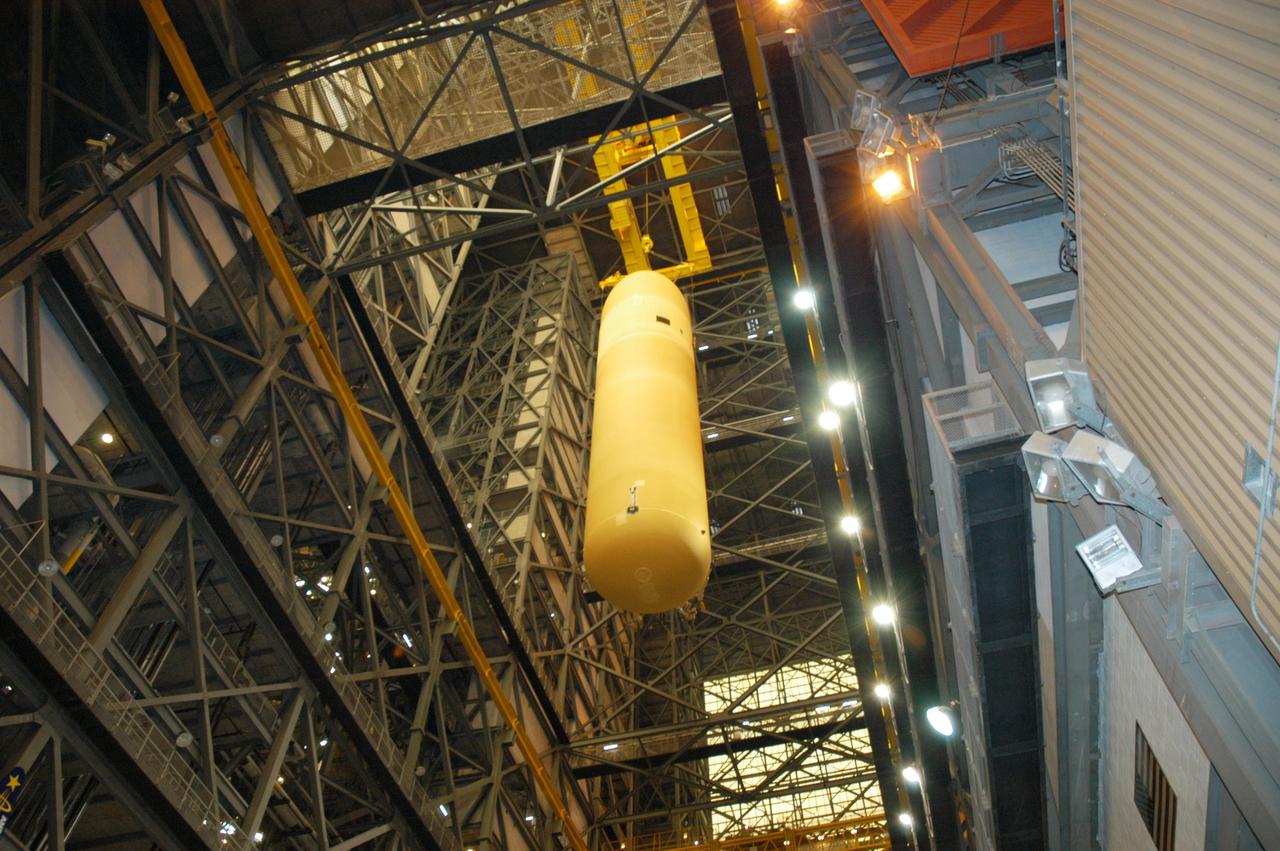
KENNEDY SPACE CENTER, FLA. - External Tank 118 (ET-118) is lowered from its cell in the Vehicle Assembly Building in order to place it on a transporter. The tank will be transferred to NASA’s Michoud Assembly Facility in New Orleans. The tank is being installed with an improved bipod fitting, which connects the external fuel tank to the Shuttle during launch. The new design, a significant milestone in the effort to return the Shuttle to safe flight, replaces the foam that was used to prevent ice buildup on the tank’s bipod fittings with four rod-shaped heaters. The heaters are being retrofitted on the 11 existing tanks and incorporated into the manufacture of all new tanks.

KENNEDY SPACE CENTER, FLA. -- A crane is attached to the U.S. laboratory module in order to transfer it to a truck. Intended for the International Space Station, the lab is being moved to the Space Station Processing Facility for pre-launch preparations. Scheduled for launch aboard the Shuttle Endeavour on mission STS-98, the laboratory comprises three cylindrical sections with two end cones. Each end-cone contains a hatch opening for entering and exiting the lab. The lab will provide a shirtsleeve environment for research in the areas of life science, microgravity science, Earth science and space science. Designated Flight 5A, this mission is targeted for launch in early 2000
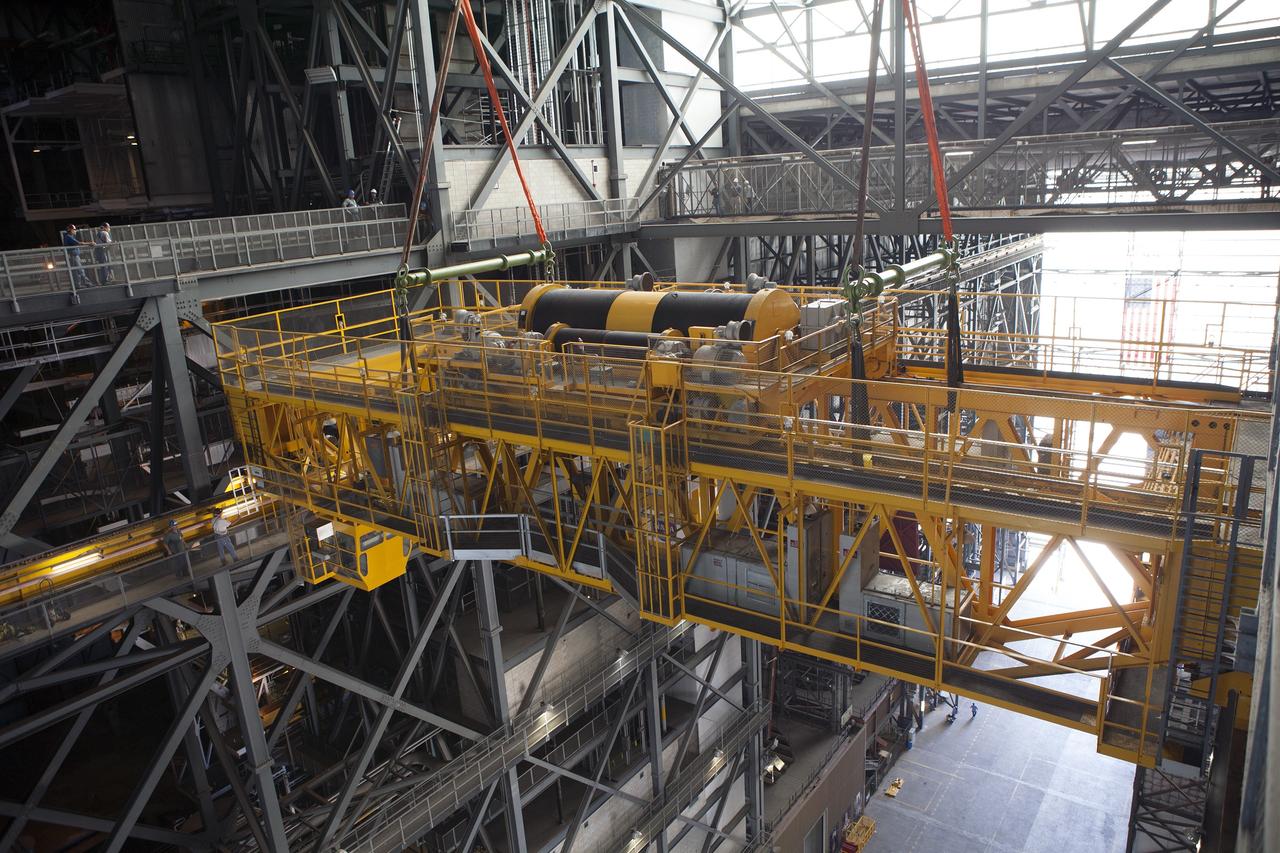
CAPE CANAVERAL, Fla. – Inside the Vehicle Assembly Building, or VAB, at NASA's Kennedy Space Center in Florida, the 175-ton crane is being lowered from Level 16 down to the transfer aisle floor. Upgrades to the crane's 45-year-old controls will be performed in order to improve reliability, precision and safety. The Ground Systems Development and Operations Program is overseeing upgrades and modifications to the VAB. The crane will be upgraded so that it can support lifting needs for NASA and other exploration vehicles, including the agency's Space Launch System and Orion spacecraft. Photo credit: NASA/Daniel Casper
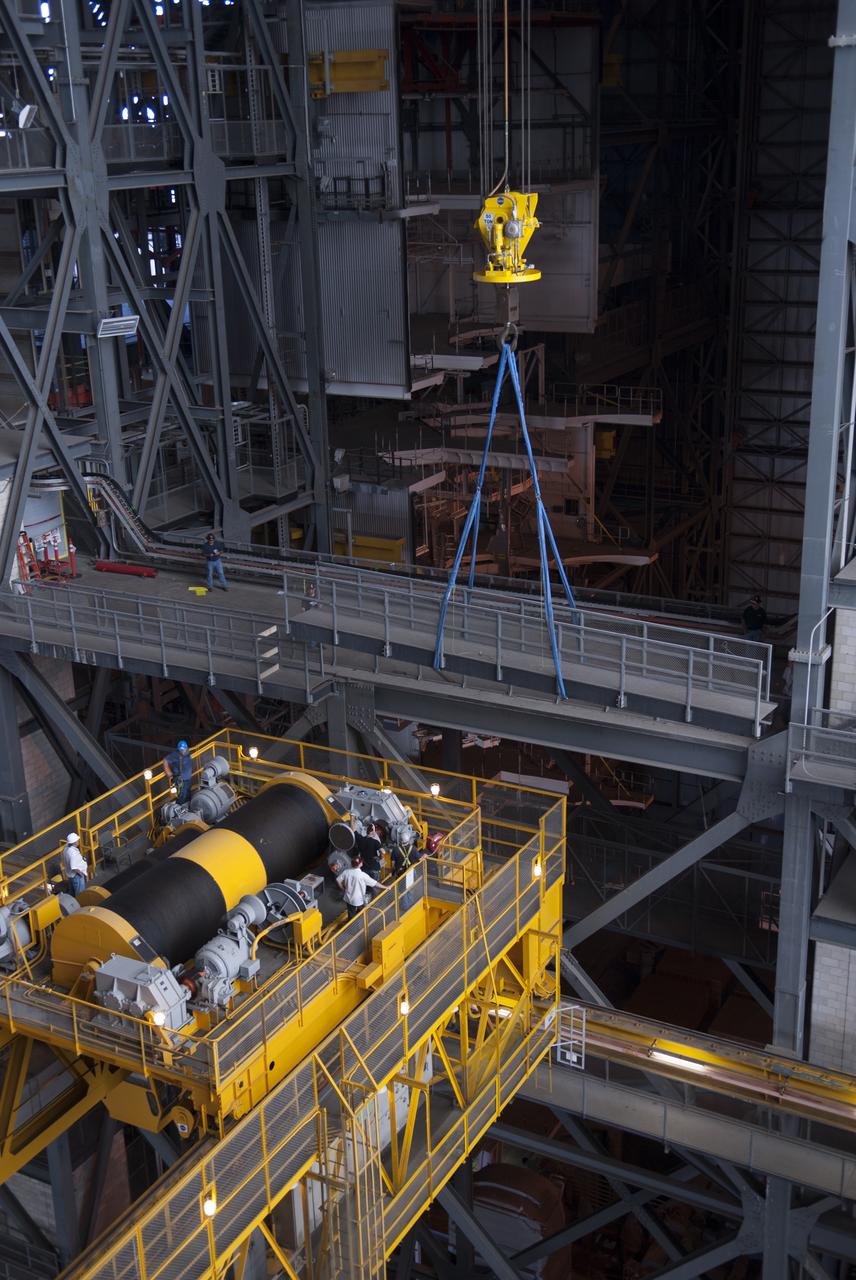
CAPE CANAVERAL, Fla. – Inside the Vehicle Assembly Building, or VAB, at NASA's Kennedy Space Center in Florida, a crane is used to lift up a portion of the catwalk on the east side of Level 16. The catwalk is being removed to allow room for the removal of the 175-ton crane that is situated above the transfer aisle. The crane will be lowered to the floor to perform upgrades to its 45-year-old controls in order to improve reliability, precision and safety. The Ground Systems Development and Operations Program is overseeing upgrades and modifications to the VAB. The crane will be upgraded so that it can support lifting needs for NASA and other exploration vehicles, including the agency's Space Launch System and Orion spacecraft. Photo credit: NASA/Jim Grossmann
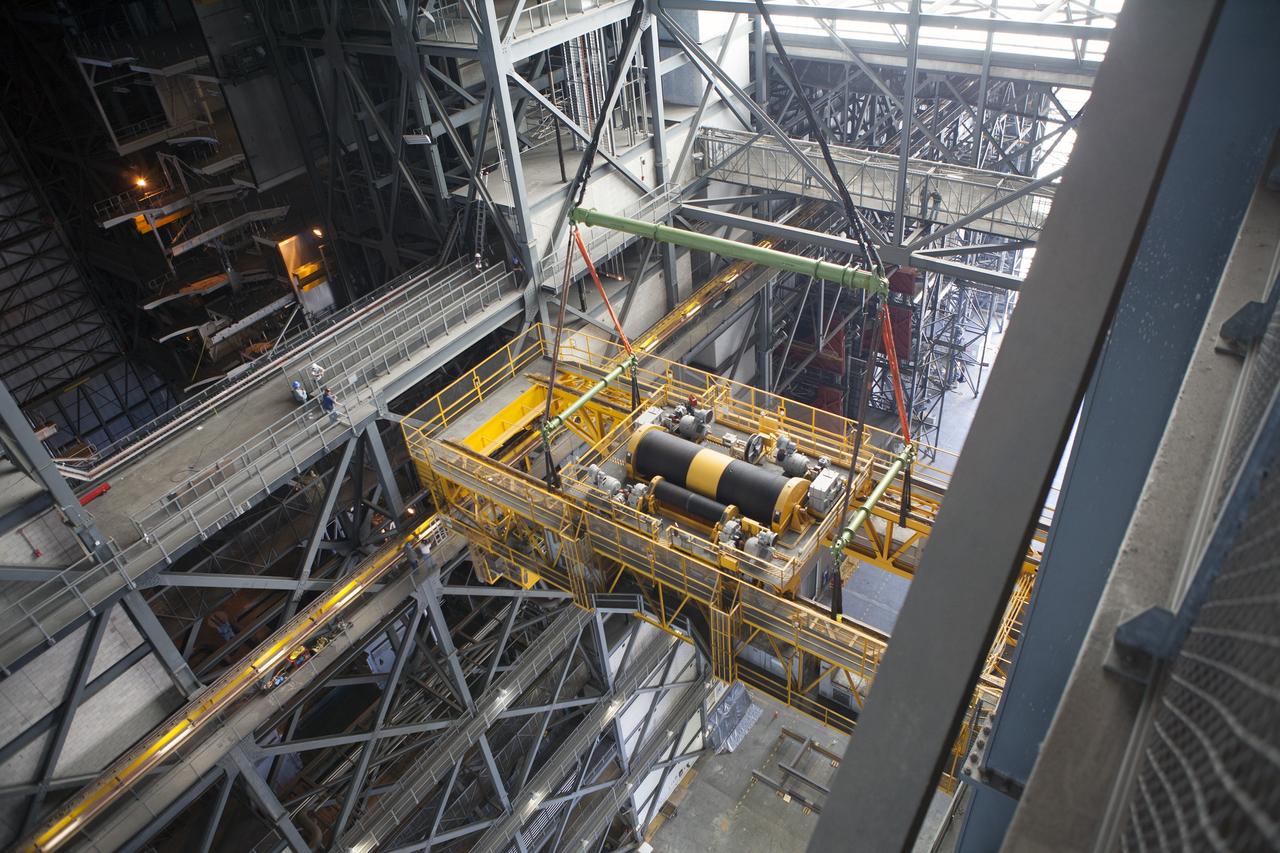
CAPE CANAVERAL, Fla. – Inside the Vehicle Assembly Building, or VAB, at NASA's Kennedy Space Center in Florida, a view from above shows a crane being used to lower the 175-ton crane. The crane is being lowered from Level 16 down to the transfer aisle floor to perform upgrades to its 45-year-old controls in order to improve reliability, precision and safety. The Ground Systems Development and Operations Program is overseeing upgrades and modifications to the VAB. The crane will be upgraded so that it can support lifting needs for NASA and other exploration vehicles, including the agency's Space Launch System and Orion spacecraft. Photo credit: NASA/Daniel Casper
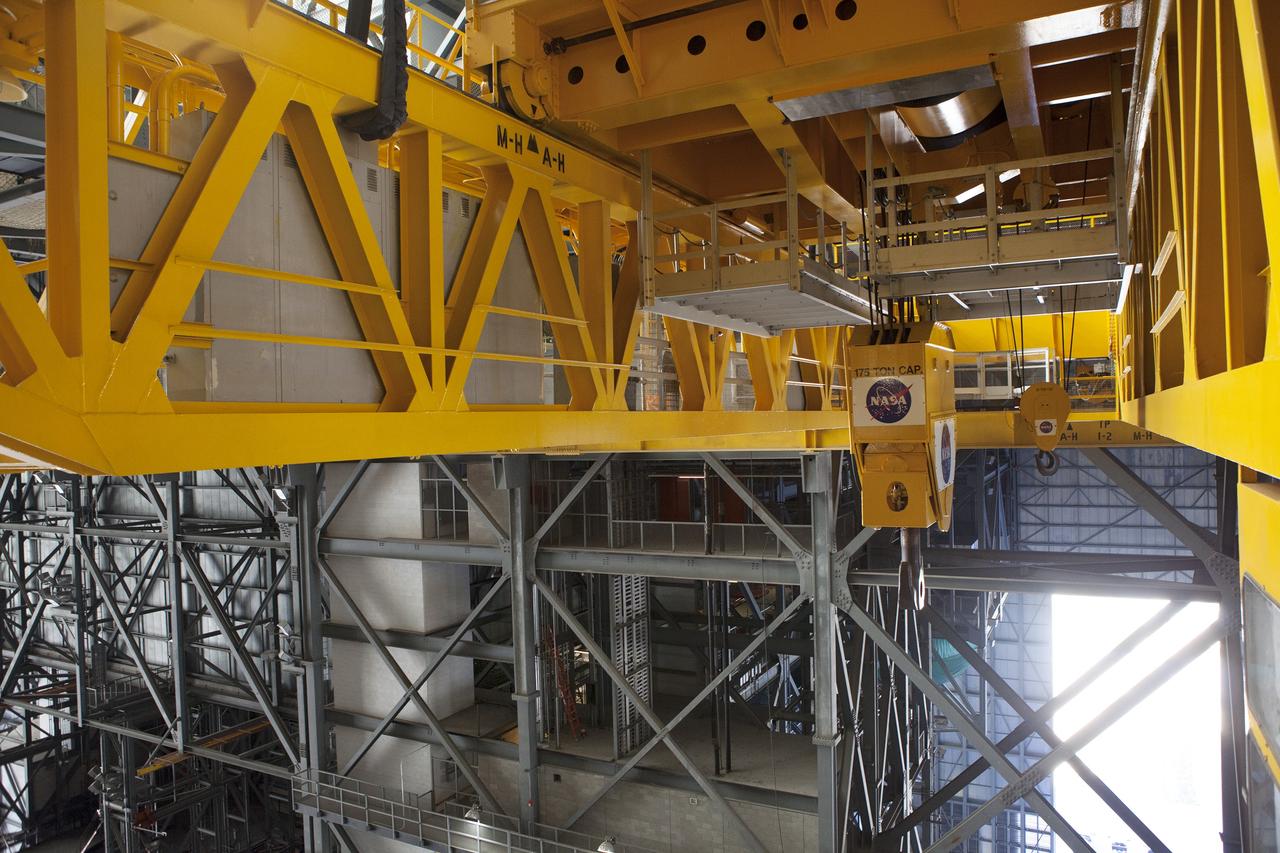
CAPE CANAVERAL, Fla. – Inside the Vehicle Assembly Building, or VAB, at NASA's Kennedy Space Center in Florida, preparations are underway to lower the 175-ton crane. The crane is being lowered from Level 16 down to the floor of the transfer aisle to perform upgrades to its 45-year-old controls in order to improve reliability, precision and safety. The Ground Systems Development and Operations Program is overseeing upgrades and modifications to the VAB. The crane will be upgraded so that it can support lifting needs for NASA and other exploration vehicles, including the agency's Space Launch System and Orion spacecraft. Photo credit: NASA/Daniel Casper
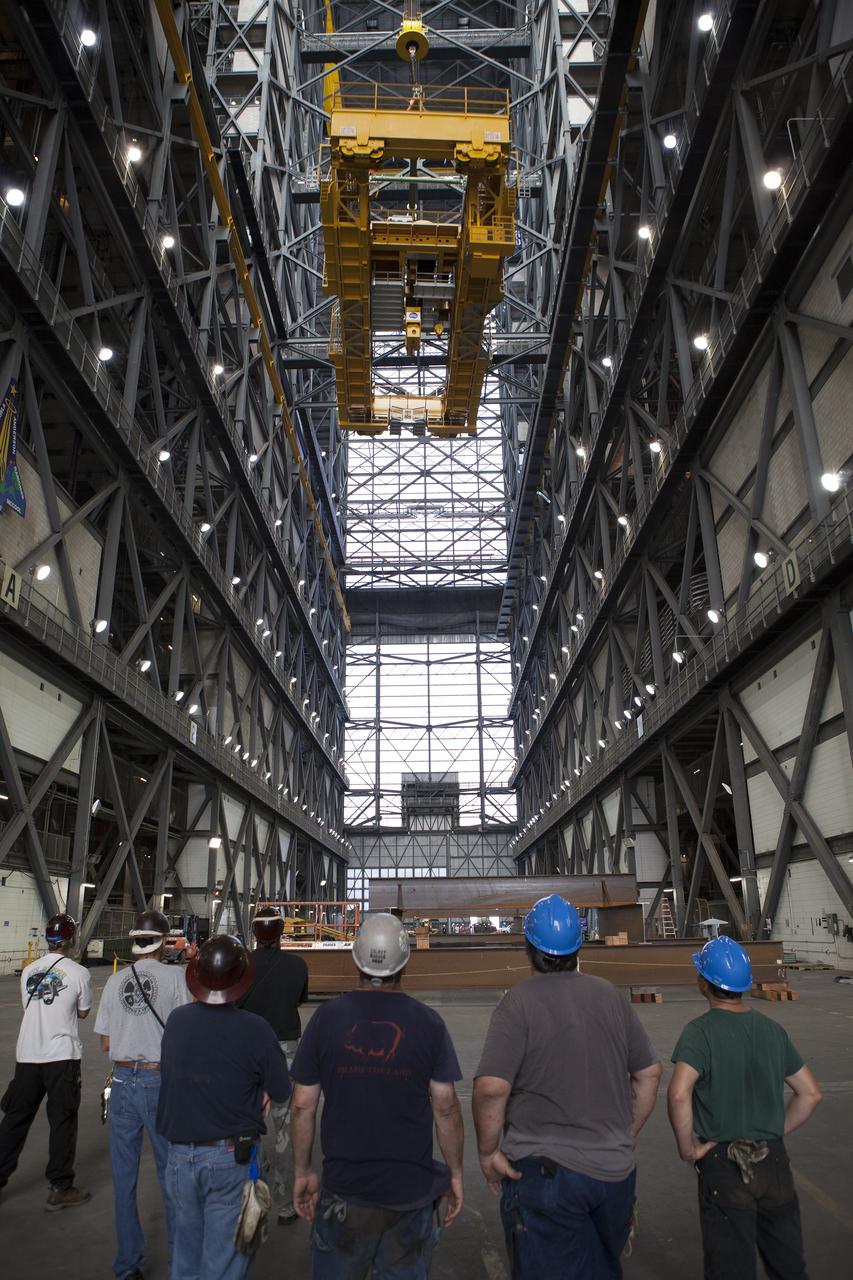
CAPE CANAVERAL, Fla. – Inside the Vehicle Assembly Building, or VAB, at NASA's Kennedy Space Center in Florida, construction workers watch as the 175-ton crane is lowered by crane from Level 16 down to the transfer aisle floor. Upgrades to the crane's 45-year-old controls will be performed in order to improve reliability, precision and safety. The Ground Systems Development and Operations Program is overseeing upgrades and modifications to the VAB. The crane will be upgraded so that it can support lifting needs for NASA and other exploration vehicles, including the agency's Space Launch System and Orion spacecraft. Photo credit: NASA/Daniel Casper
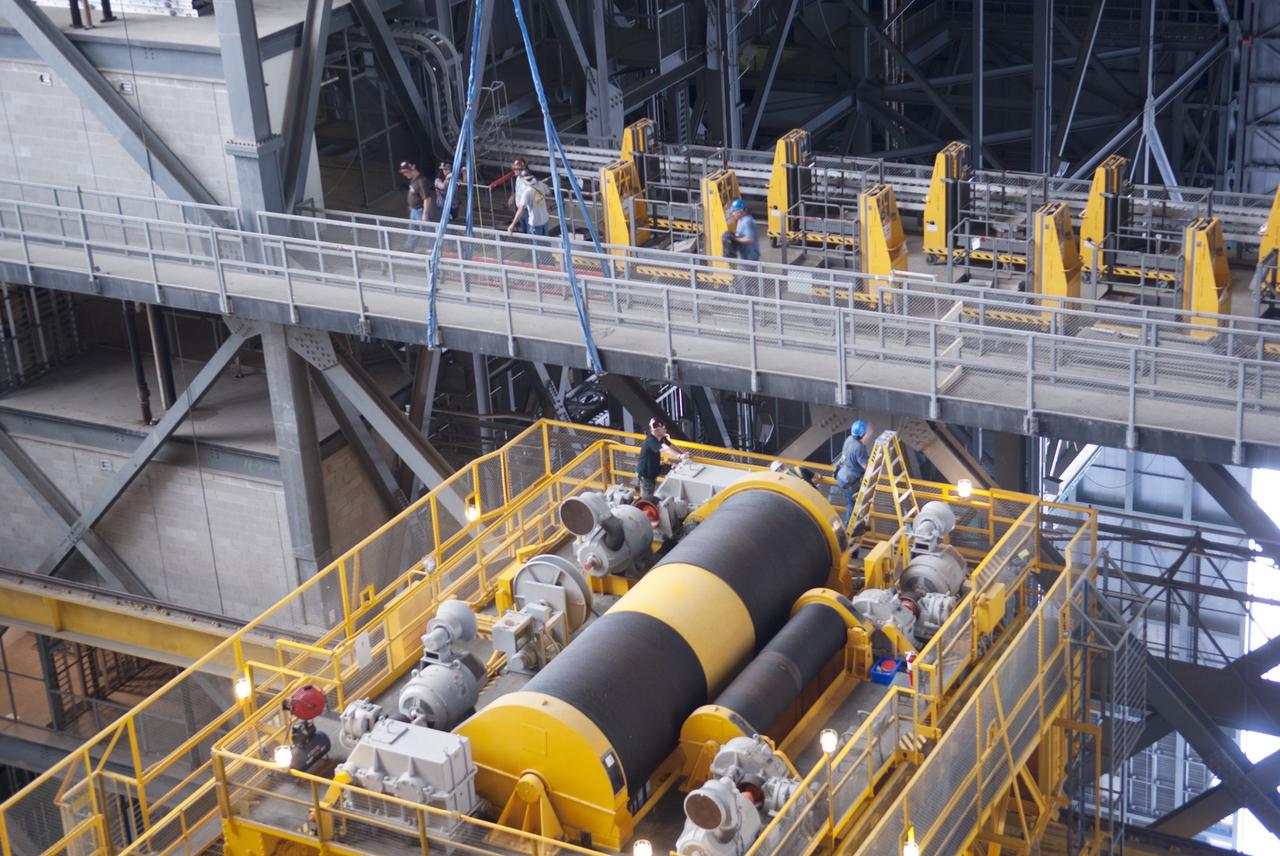
CAPE CANAVERAL, Fla. – Inside the Vehicle Assembly Building, or VAB, at NASA's Kennedy Space Center in Florida, preparations are underway to remove a portion of the catwalk on the west side of Level 16. The catwalk is being removed to allow room for the removal of the 175-ton crane that is situated above the transfer aisle. The crane will be lowered to the floor to perform upgrades to its 45-year-old controls in order to improve reliability, precision and safety. The Ground Systems Development and Operations Program is overseeing upgrades and modifications to the VAB. The crane will be upgraded so that it can support lifting needs for NASA and other exploration vehicles, including the agency's Space Launch System and Orion spacecraft. Photo credit: NASA/Jim Grossmann
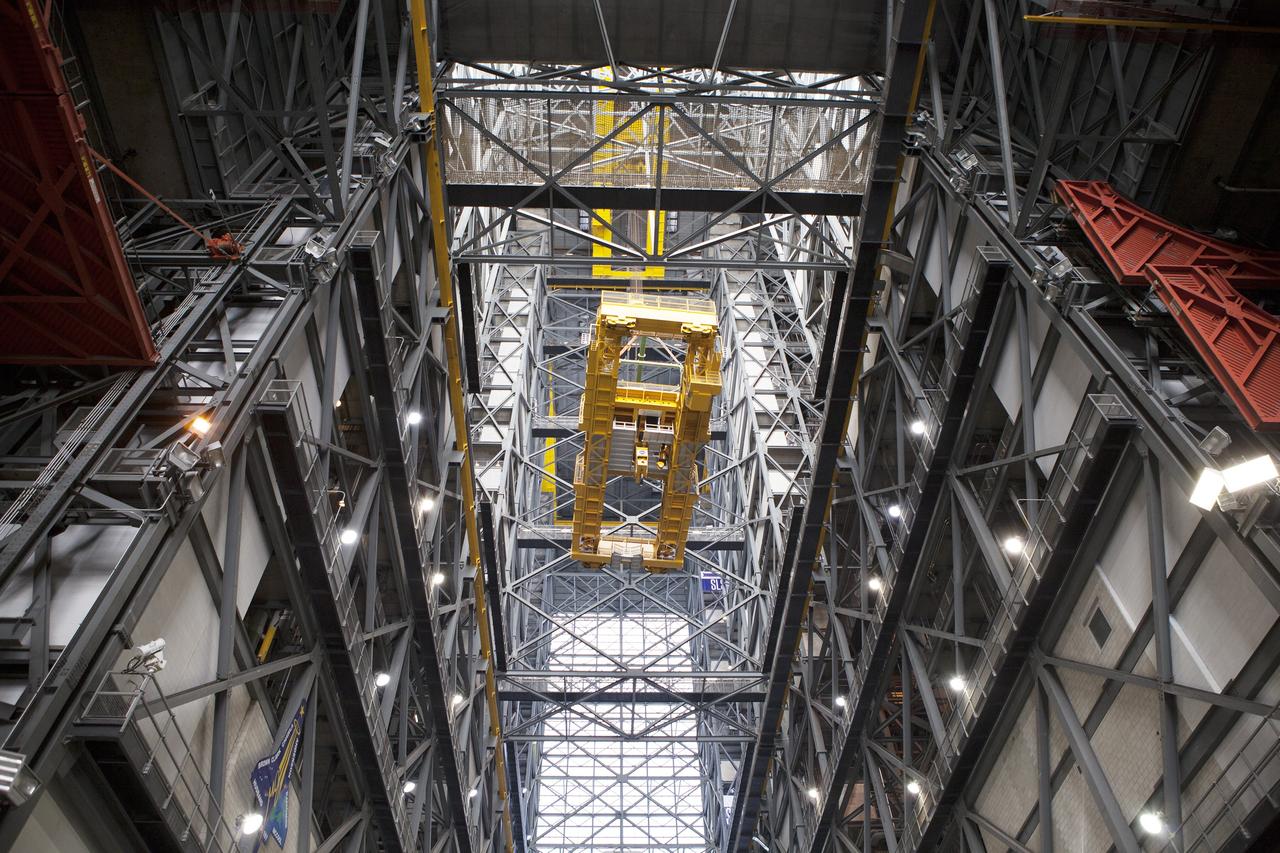
CAPE CANAVERAL, Fla. – Inside the Vehicle Assembly Building, or VAB, at NASA's Kennedy Space Center in Florida, the 175-ton crane has been turned as it is lowered by crane from Level 16 down to the transfer aisle floor. Upgrades to the crane's 45-year-old controls will be performed in order to improve reliability, precision and safety. The Ground Systems Development and Operations Program is overseeing upgrades and modifications to the VAB. The crane will be upgraded so that it can support lifting needs for NASA and other exploration vehicles, including the agency's Space Launch System and Orion spacecraft. Photo credit: NASA/Daniel Casper
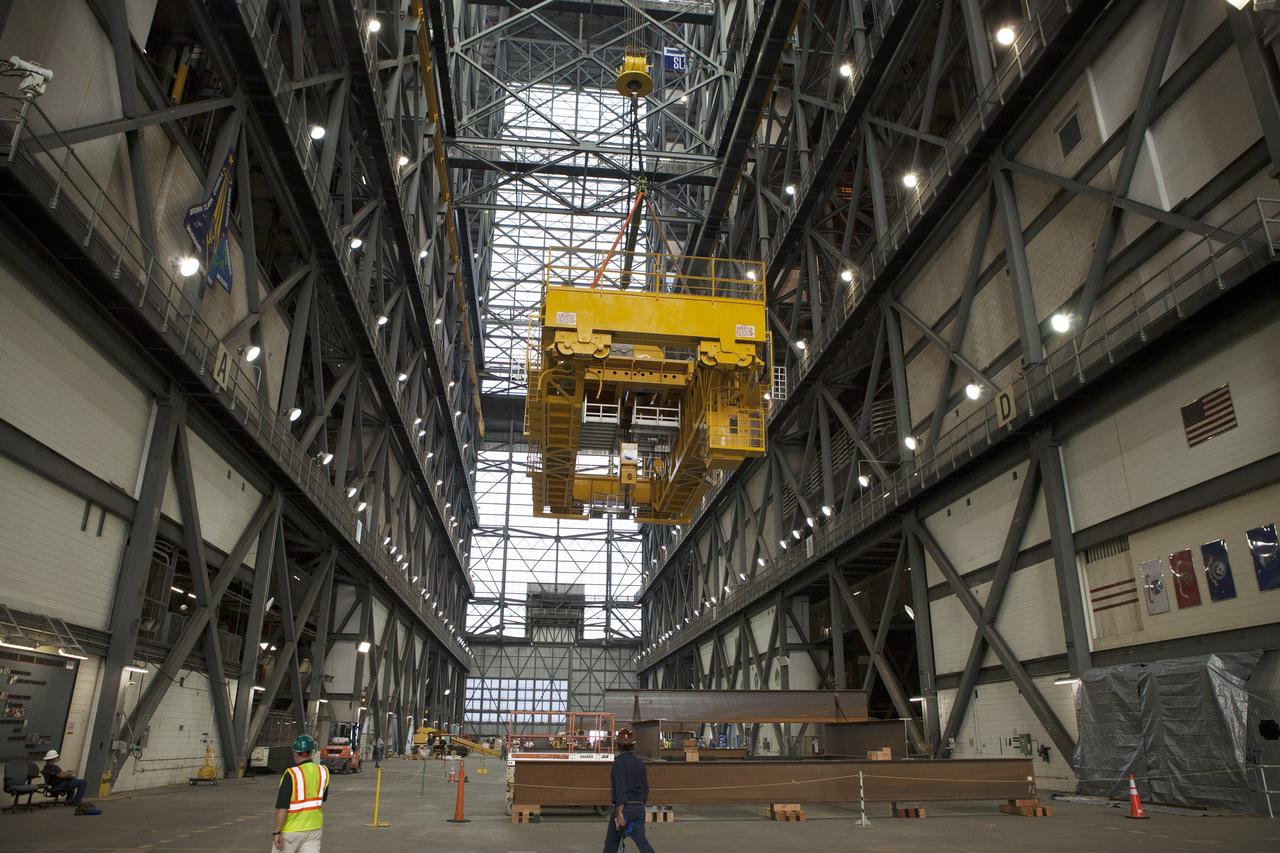
CAPE CANAVERAL, Fla. – Inside the Vehicle Assembly Building, or VAB, at NASA's Kennedy Space Center in Florida, the 175-ton crane is lowered closer to the transfer aisle floor. The crane was turned to make it easier to lower it from Level 16. Upgrades to the crane's 45-year-old controls will be performed in order to improve reliability, precision and safety. The Ground Systems Development and Operations Program is overseeing upgrades and modifications to the VAB. The crane will be upgraded so that it can support lifting needs for NASA and other exploration vehicles, including the agency's Space Launch System and Orion spacecraft. Photo credit: NASA/Daniel Casper
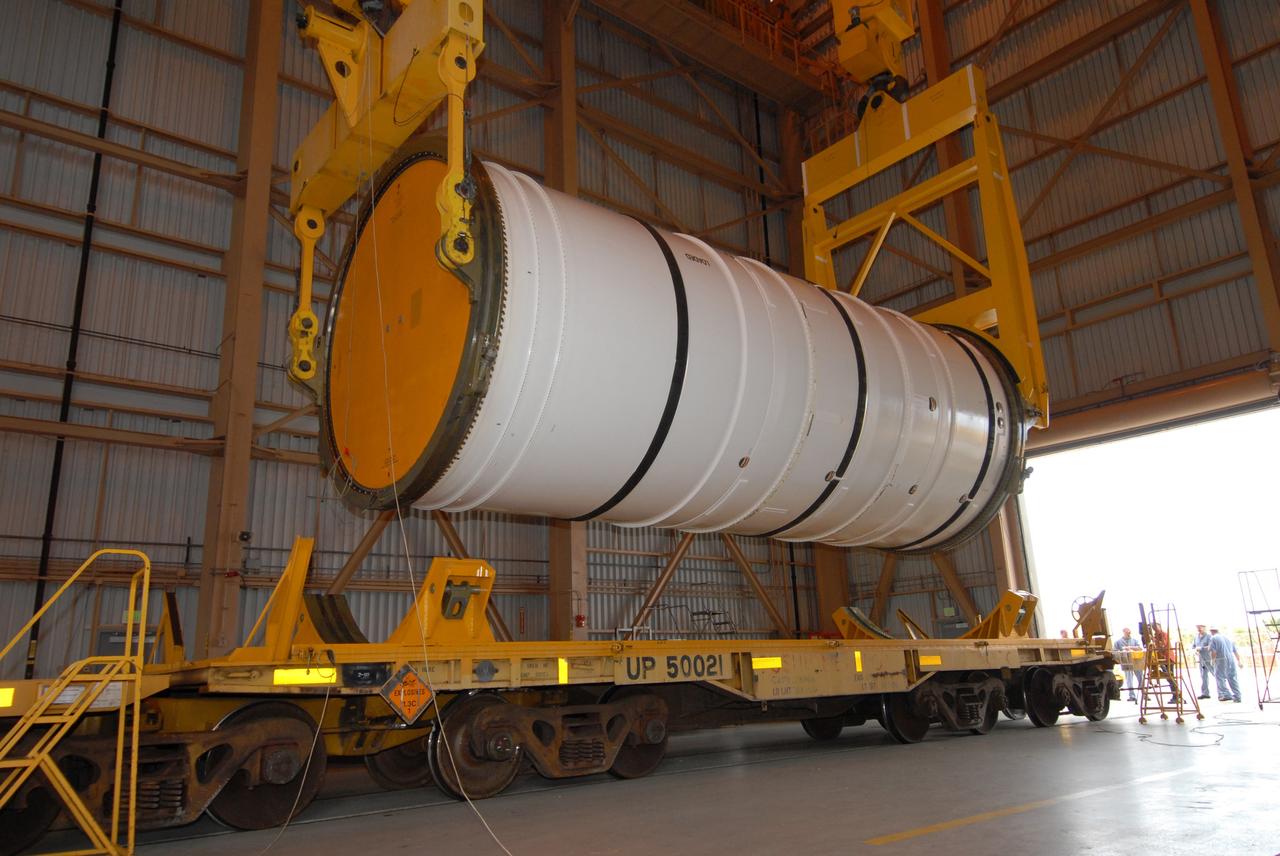
CAPE CANAVERAL, Fla. – Cranes lift the first of the Ares I-X motor segments in order to raise it to vertical and transfer it to a work stand in the Rotation, Processing and Surge Facility at NASA's Kennedy Space Center in Florida. Four segments were delivered to Kennedy for final processing and integration. The booster used for the Ares I-X launch is being modified by adding new forward structures and a fifth segment simulator. The motor is the final hardware needed for the rocket's upcoming test flight this summer. The stacking operations are scheduled to begin in the Vehicle Assembly Building in April. Photo credit: NASA/Jack Pfaller
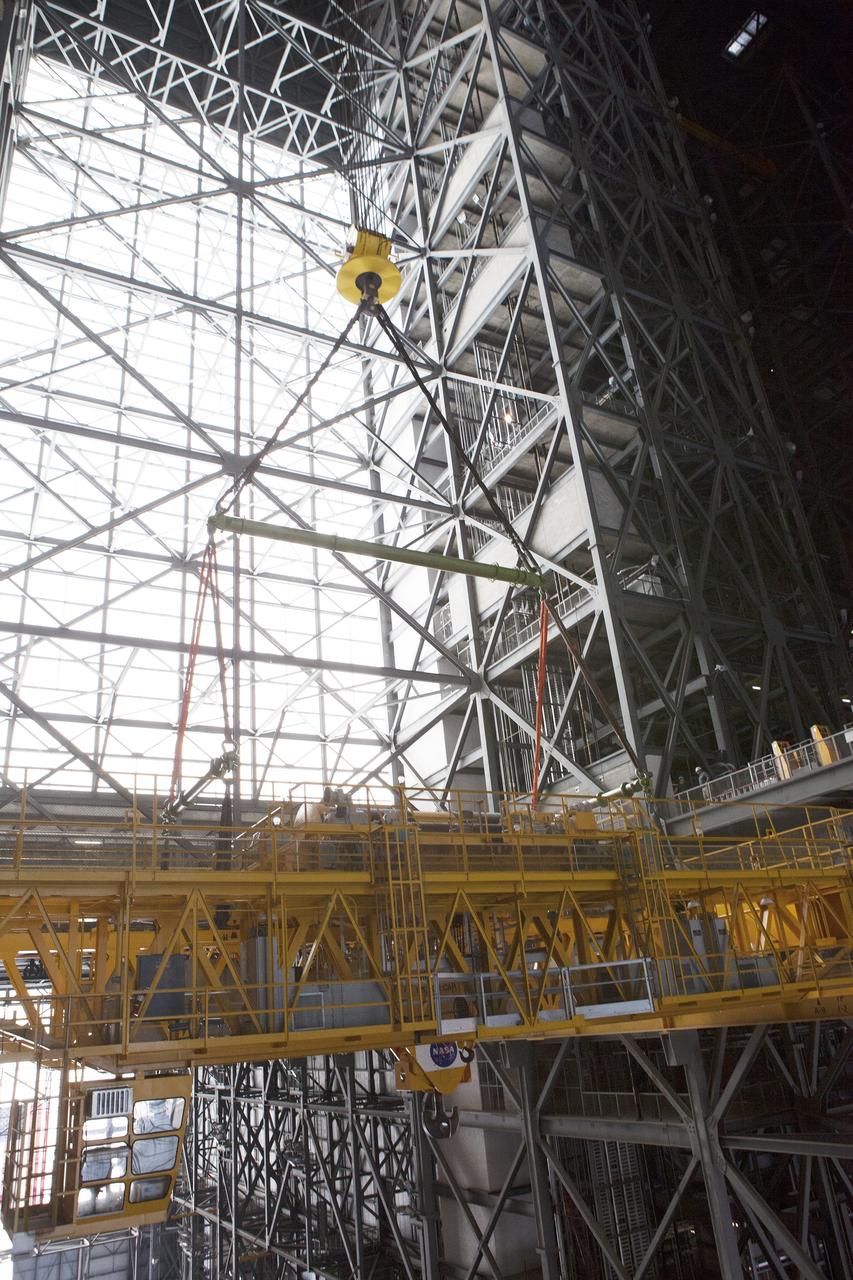
CAPE CANAVERAL, Fla. – Inside the Vehicle Assembly Building, or VAB, at NASA's Kennedy Space Center in Florida, preparations are underway to lower the 175-ton crane. The crane is being lowered from Level 16 down to the floor of the transfer aisle to perform upgrades to its 45-year-old controls in order to improve reliability, precision and safety. The Ground Systems Development and Operations Program is overseeing upgrades and modifications to the VAB. The crane will be upgraded so that it can support lifting needs for NASA and other exploration vehicles, including the agency's Space Launch System and Orion spacecraft. Photo credit: NASA/Daniel Casper
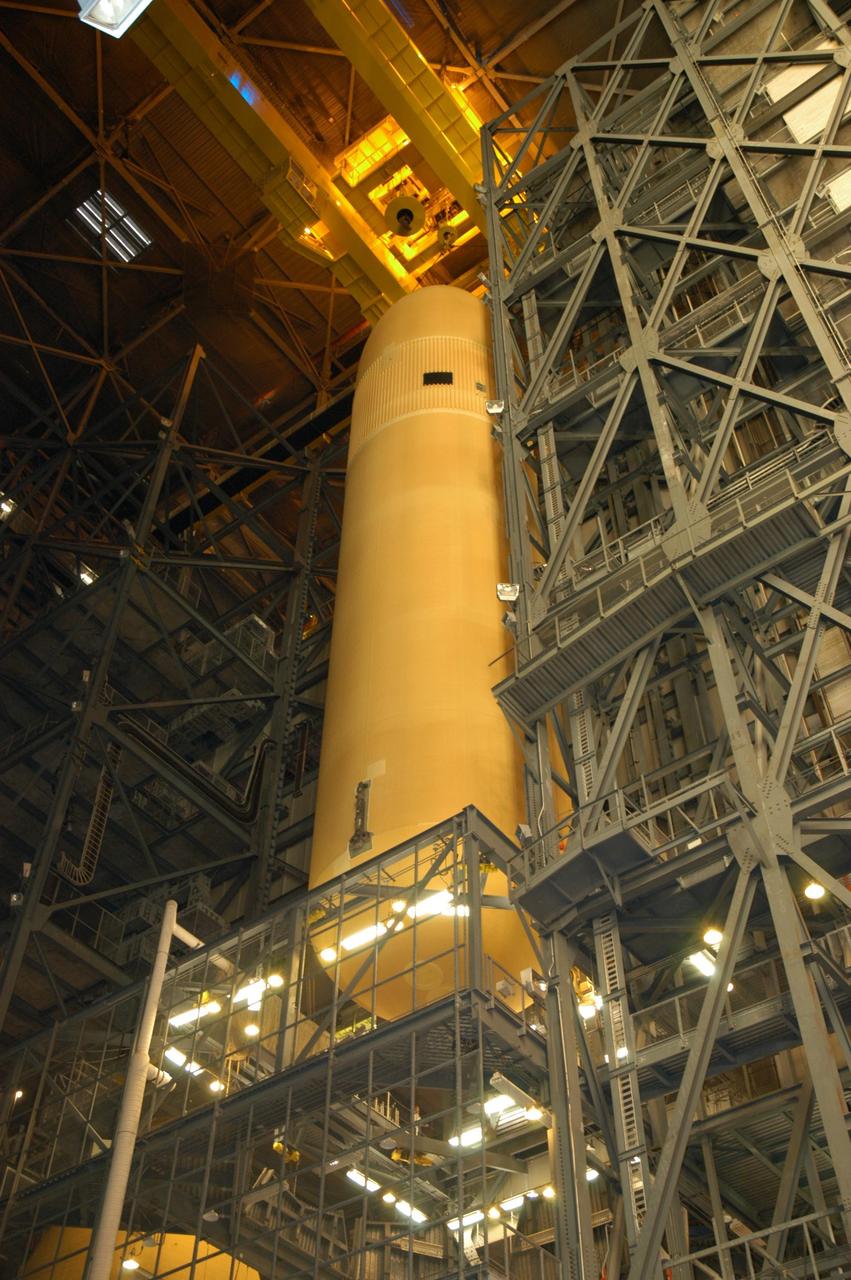
KENNEDY SPACE CENTER, FLA. - External Tank 118 (ET-118) is lifted from its cell in the Vehicle Assembly Building in order to place it on a transporter. The tank will be transferred to NASA’s Michoud Assembly Facility in New Orleans. The tank is being installed with an improved bipod fitting, which connects the external fuel tank to the Shuttle during launch. The new design, a significant milestone in the effort to return the Shuttle to safe flight, replaces the foam that was used to prevent ice buildup on the tank’s bipod fittings with four rod-shaped heaters. The heaters are being retrofitted on the 11 existing tanks and incorporated into the manufacture of all new tanks.
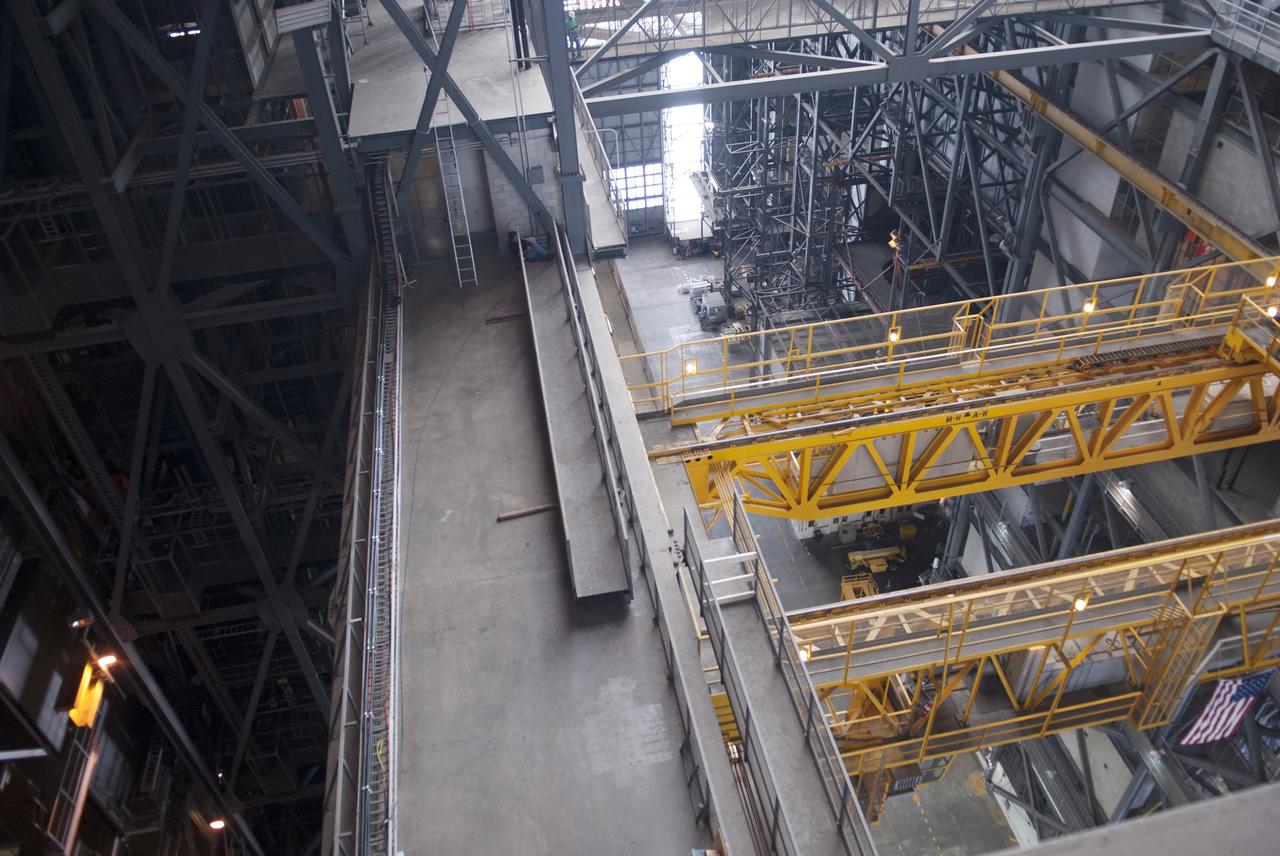
CAPE CANAVERAL, Fla. – Inside the Vehicle Assembly Building, or VAB, at NASA's Kennedy Space Center in Florida, a portion of the catwalk on the east side of Level 16 has been removed to allow room for the removal of the 175-ton crane that is situated above the transfer aisle. The crane will be lowered to the floor to perform upgrades to its 45-year-old controls in order to improve reliability, precision and safety. The Ground Systems Development and Operations Program is overseeing upgrades and modifications to the VAB. The crane will be upgraded so that it can support lifting needs for NASA and other exploration vehicles, including the agency's Space Launch System and Orion spacecraft. Photo credit: NASA/Jim Grossmann
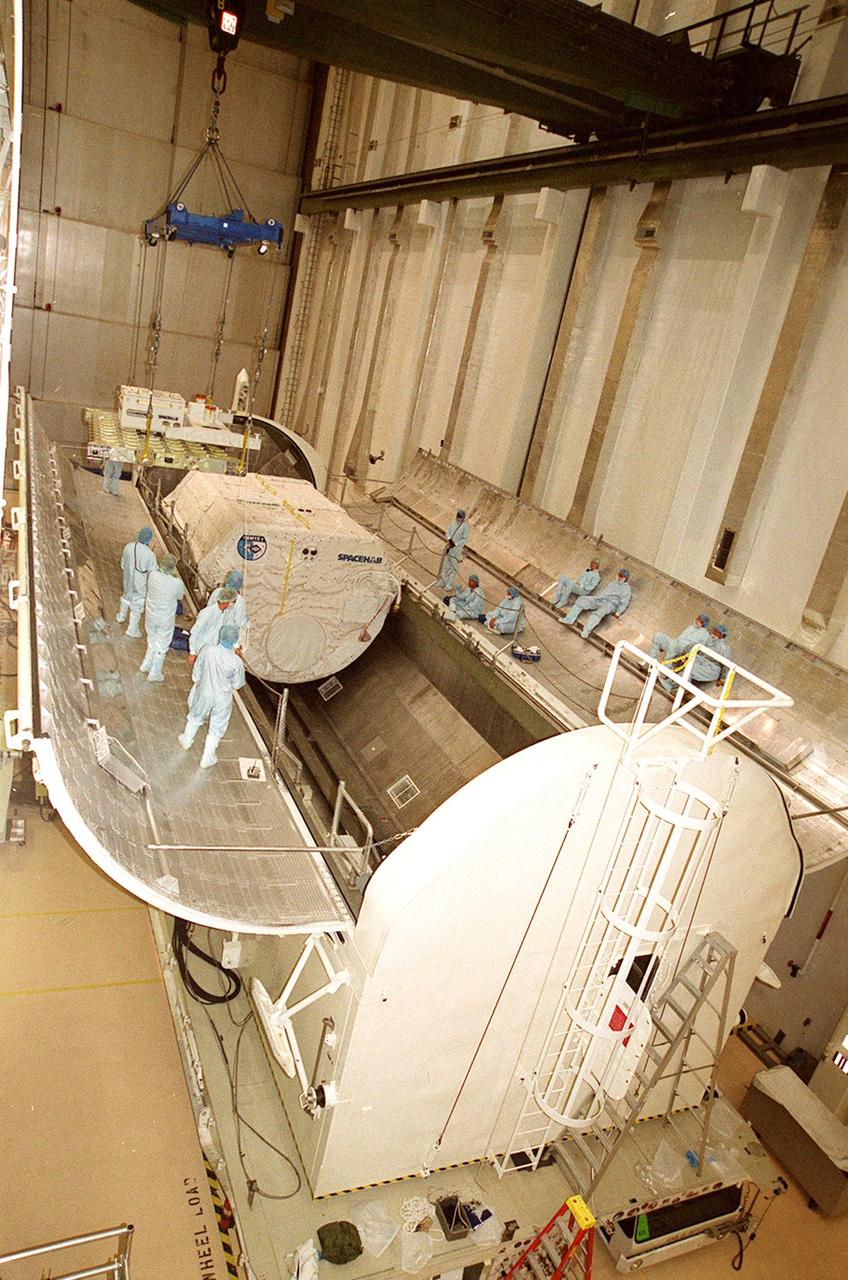
KENNEDY SPACE CENTER, FLA. -- In the Space Station Processing Facility, workers wait for the arrival of the Integrated Cargo Carrier (ICC), in the background, in order to load it into the payload canister. The canister already has the SPACEHAB module stowed. The canister will transport its cargo to Launch Pad 39B in preparation for mission STS-106, scheduled to launch Sept. 8 at 8:31 a.m. EDT. During the mission to the International Space Station, the crew will complete service module support tasks on orbit, transfer supplies and outfit the Space Station for the first long-duration crew
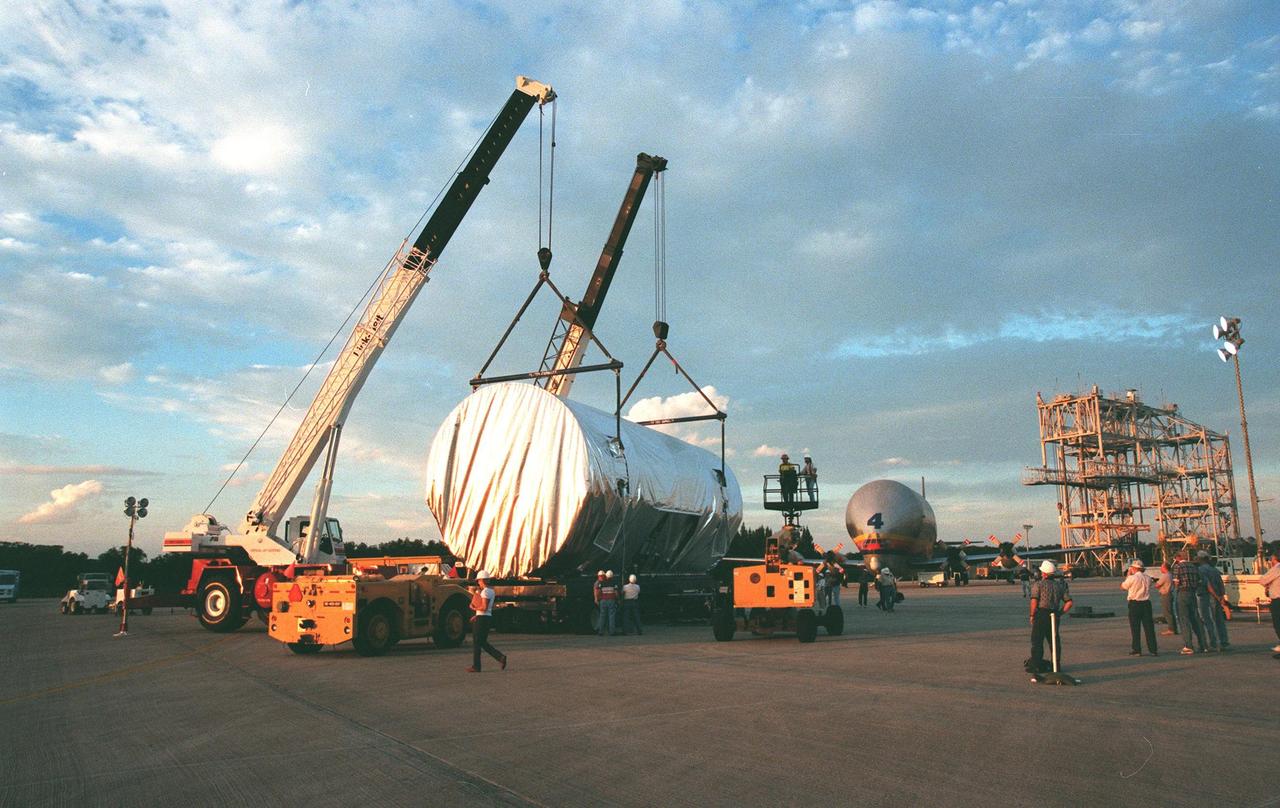
KENNEDY SPACE CENTER, FLA. -- A second crane is attached to the canister containing the U.S. laboratory module in order to transfer it to a truck. Intended for the International Space Station, the lab is being moved to the Space Station Processing Facility for pre-launch preparations. Scheduled for launch aboard the Shuttle Endeavour on mission STS-98, the laboratory comprises three cylindrical sections with two end cones. Each end-cone contains a hatch opening for entering and exiting the lab. The lab will provide a shirtsleeve environment for research in the areas of life science, microgravity science, Earth science and space science. Designated Flight 5A, this mission is targeted for launch in early 2000
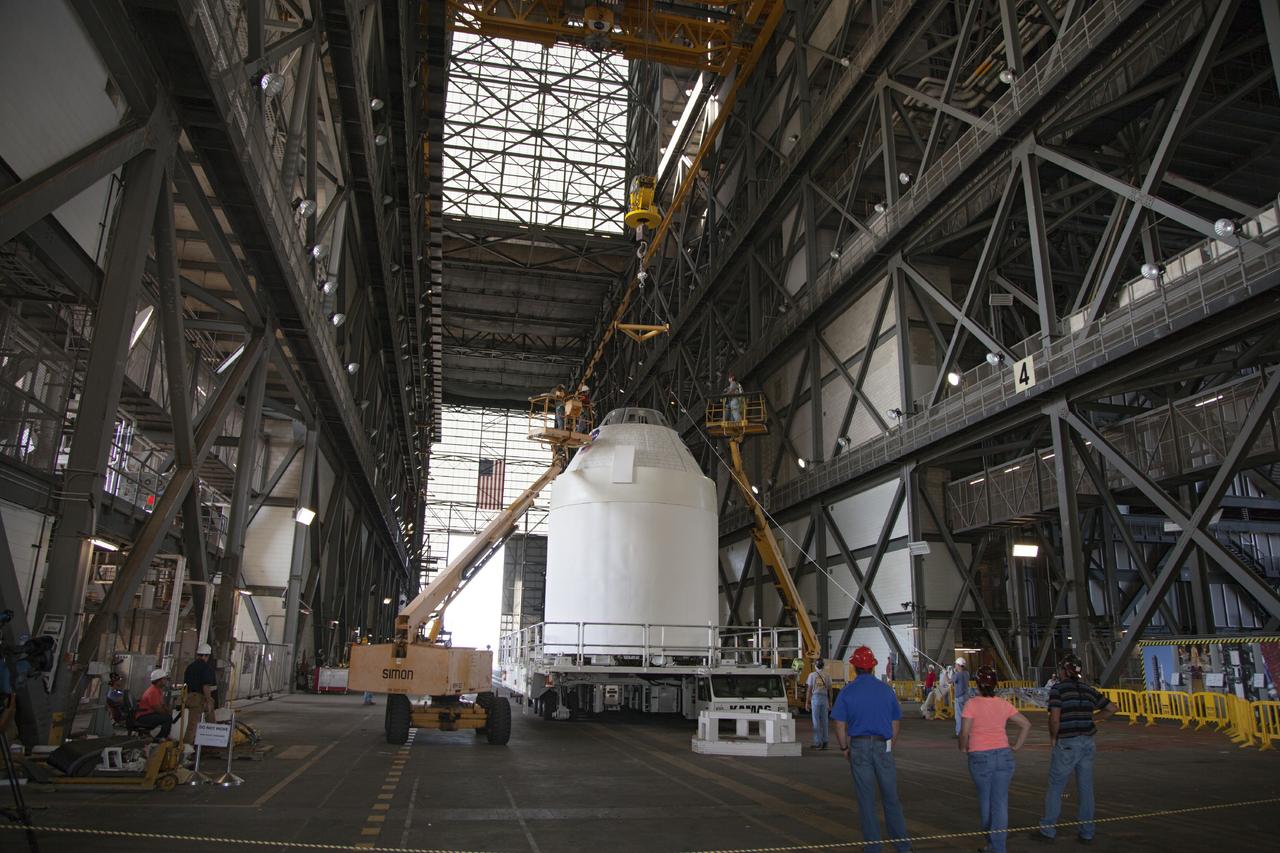
CAPE CANAVERAL, Fla. -- In the transfer aisle of the Vehicle Assembly Building at NASA’s Kennedy Space Center in Florida, a full-size mockup of the Orion spacecraft is being prepared for lifting into High Bay 4. Crane operators and technicians practice stacking and de-stacking operations in order to keep processing procedures and skills current for the Ground Systems Development and Operations Program. Orion is the exploration spacecraft designed to carry crews to space beyond low Earth orbit. It will provide emergency abort capability, sustain the crew during the space travel and provide safe re-entry from deep space return velocities. Orion’s first unpiloted test flight is scheduled to launch in 2014 atop a Delta IV rocket. A second uncrewed flight test is scheduled for 2017 on NASA’s Space Launch System rocket. For more information, visit http://www.nasa.gov/orion. Photo credit: NASA/Dan Casper

CAPE CANAVERAL, Fla. -- In the transfer aisle of the Vehicle Assembly Building at NASA’s Kennedy Space Center in Florida, technicians attach a crane to a full-size mock-up of the Orion spacecraft to prepare it to be lifted into High Bay 4. Crane operators and technicians practice stacking and de-stacking operations in order to keep processing procedures and skills current for the Ground Systems Development and Operations Program. Orion is the exploration spacecraft designed to carry crews to space beyond low Earth orbit. It will provide emergency abort capability, sustain the crew during the space travel and provide safe re-entry from deep space return velocities. Orion’s first unpiloted test flight is scheduled to launch in 2014 atop a Delta IV rocket. A second uncrewed flight test is scheduled for 2017 on NASA’s Space Launch System rocket. For more information, visit http://www.nasa.gov/orion. Photo credit: NASA/Dan Casper
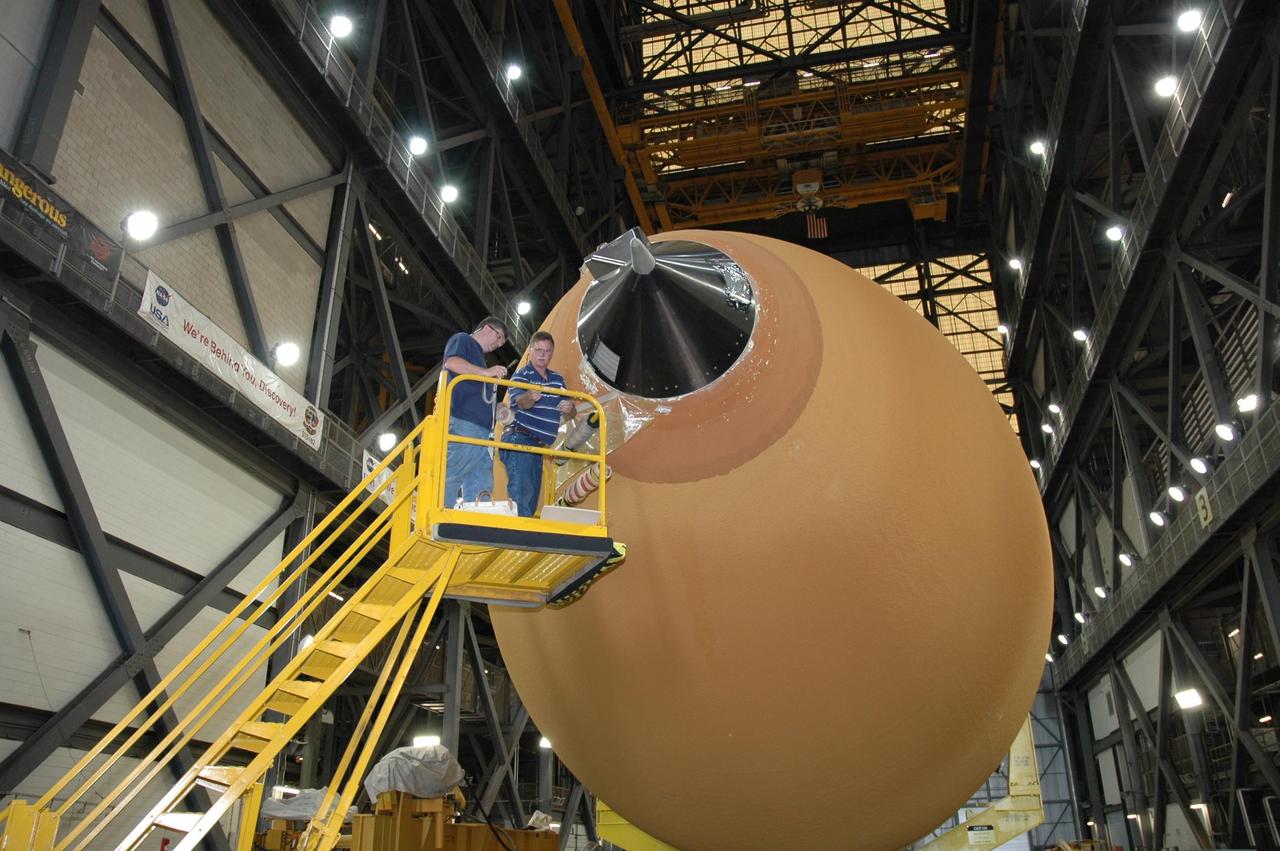
KENNEDY SPACE CENTER, FLA. - In the transfer aisle of the Vehicle Assembly Building, workers get ready to ablate the rim around the nose cap of external tank number 119, the tank designated for mission STS-121. The cap was removed in order to install a new gaseous oxygen vent valve underneath. Vapors are created prior to launch as the liquid oxygen in the external tank boils off. At the forward end of each external tank propellant tank is a vent and relief valve that can be opened before launch for venting or by excessive tank pressure for relief. The vent function is available only before launch. Mission STS-121 to the International Space Station is scheduled for launch in July. Photo credit: NASA/Jim Grossmann
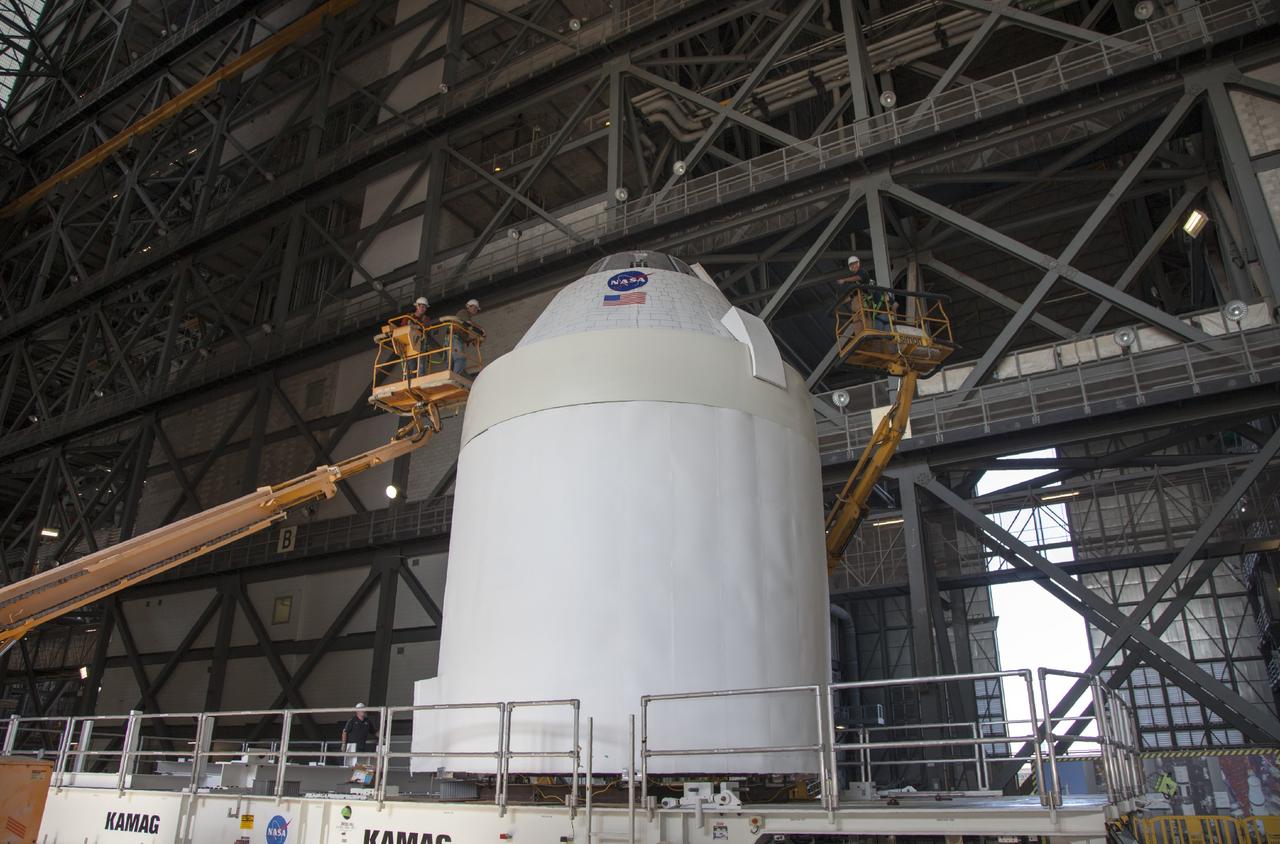
CAPE CANAVERAL, Fla. -- In the transfer aisle of the Vehicle Assembly Building at NASA’s Kennedy Space Center in Florida, a full-size mockup of the Orion spacecraft is being prepared for lifting into High Bay 4. Crane operators and technicians practice stacking and de-stacking operations in order to keep processing procedures and skills current for the Ground Systems Development and Operations Program. Orion is the exploration spacecraft designed to carry crews to space beyond low Earth orbit. It will provide emergency abort capability, sustain the crew during the space travel and provide safe re-entry from deep space return velocities. Orion’s first unpiloted test flight is scheduled to launch in 2014 atop a Delta IV rocket. A second uncrewed flight test is scheduled for 2017 on NASA’s Space Launch System rocket. For more information, visit http://www.nasa.gov/orion. Photo credit: NASA/Dan Casper
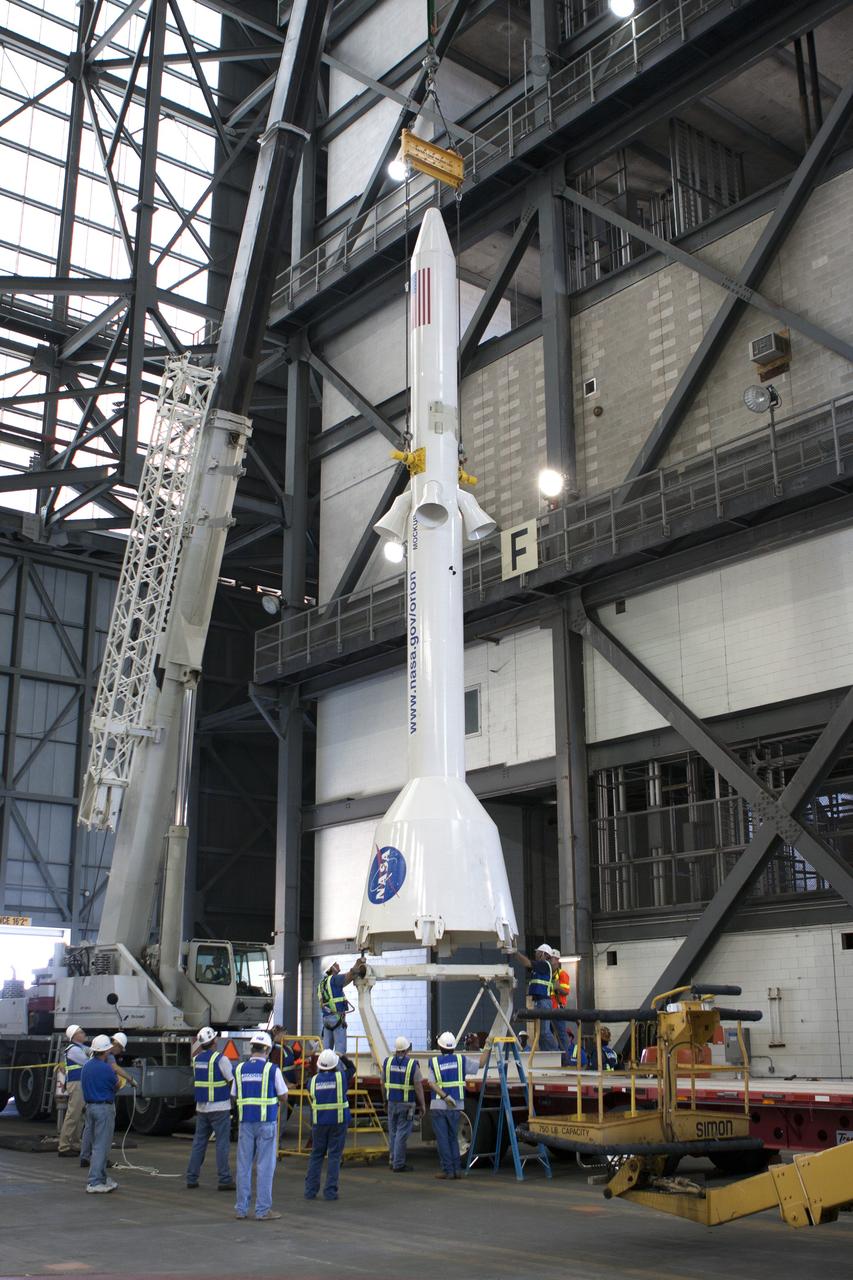
CAPE CANAVERAL, Fla. -- In the transfer aisle of the Vehicle Assembly Building at NASA’s Kennedy Space Center in Florida, crane operators and technicians practice de-stacking operations on a full-size mock-up of the Orion spacecraft and launch abort system in order to keep processing procedures and skills current. Orion is the exploration spacecraft designed to carry crews to space beyond low Earth orbit. It will provide emergency abort capability, sustain the crew during the space travel and provide safe re-entry from deep space return velocities. Orion’s first unpiloted test flight is scheduled to launch in 2014 atop a Delta IV rocket. A second uncrewed flight test is scheduled for 2017 on NASA’s Space Launch System rocket. For more information, visit http://www.nasa.gov/orion. Photo credit: NASA/Jim Grossmann

CAPE CANAVERAL, Fla. -- In the transfer aisle of the Vehicle Assembly Building at NASA’s Kennedy Space Center in Florida, a full-size mock-up of the Orion launch abort system has been lowered onto a transporter. Crane operators and technicians practice de-stacking operations on full-size mock-ups of the Orion spacecraft and launch abort system in order to keep processing procedures and skills current. Orion is the exploration spacecraft designed to carry crews to space beyond low Earth orbit. It will provide emergency abort capability, sustain the crew during the space travel and provide safe re-entry from deep space return velocities. Orion’s first unpiloted test flight is scheduled to launch in 2014 atop a Delta IV rocket. A second uncrewed flight test is scheduled for 2017 on NASA’s Space Launch System rocket. For more information, visit http://www.nasa.gov/orion. Photo credit: NASA/Tim Jacobs
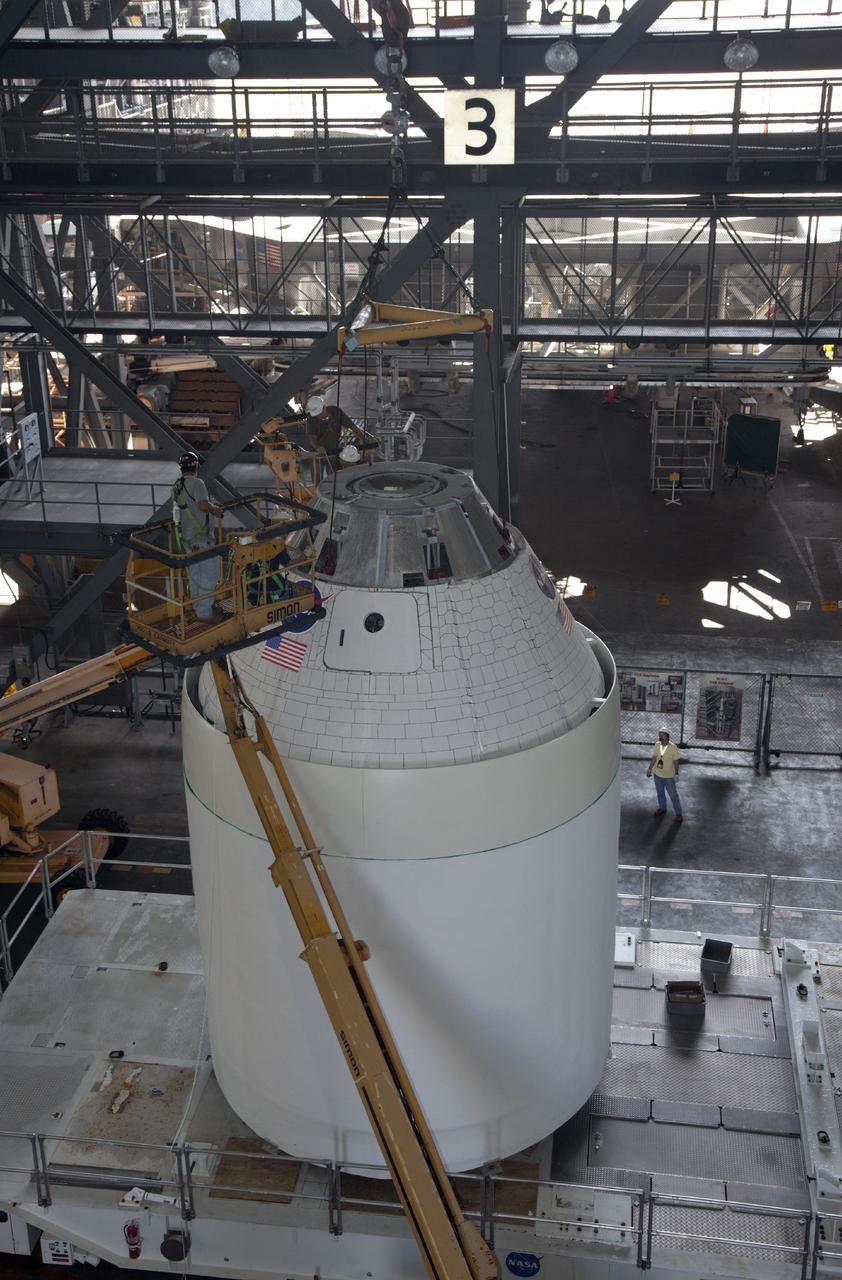
CAPE CANAVERAL, Fla. --In the transfer aisle of the Vehicle Assembly Building at NASA’s Kennedy Space Center in Florida, technicians attach a crane to a full-size mock-up of the Orion spacecraft to prepare it to be lifted into High Bay 4. Crane operators and technicians practice stacking and de-stacking operations in order to keep processing procedures and skills current for the Ground Systems Development and Operations Program. Orion is the exploration spacecraft designed to carry crews to space beyond low Earth orbit. It will provide emergency abort capability, sustain the crew during the space travel and provide safe re-entry from deep space return velocities. Orion’s first unpiloted test flight is scheduled to launch in 2014 atop a Delta IV rocket. A second uncrewed flight test is scheduled for 2017 on NASA’s Space Launch System rocket. For more information, visit http://www.nasa.gov/orion. Photo credit: NASA/Dan Casper
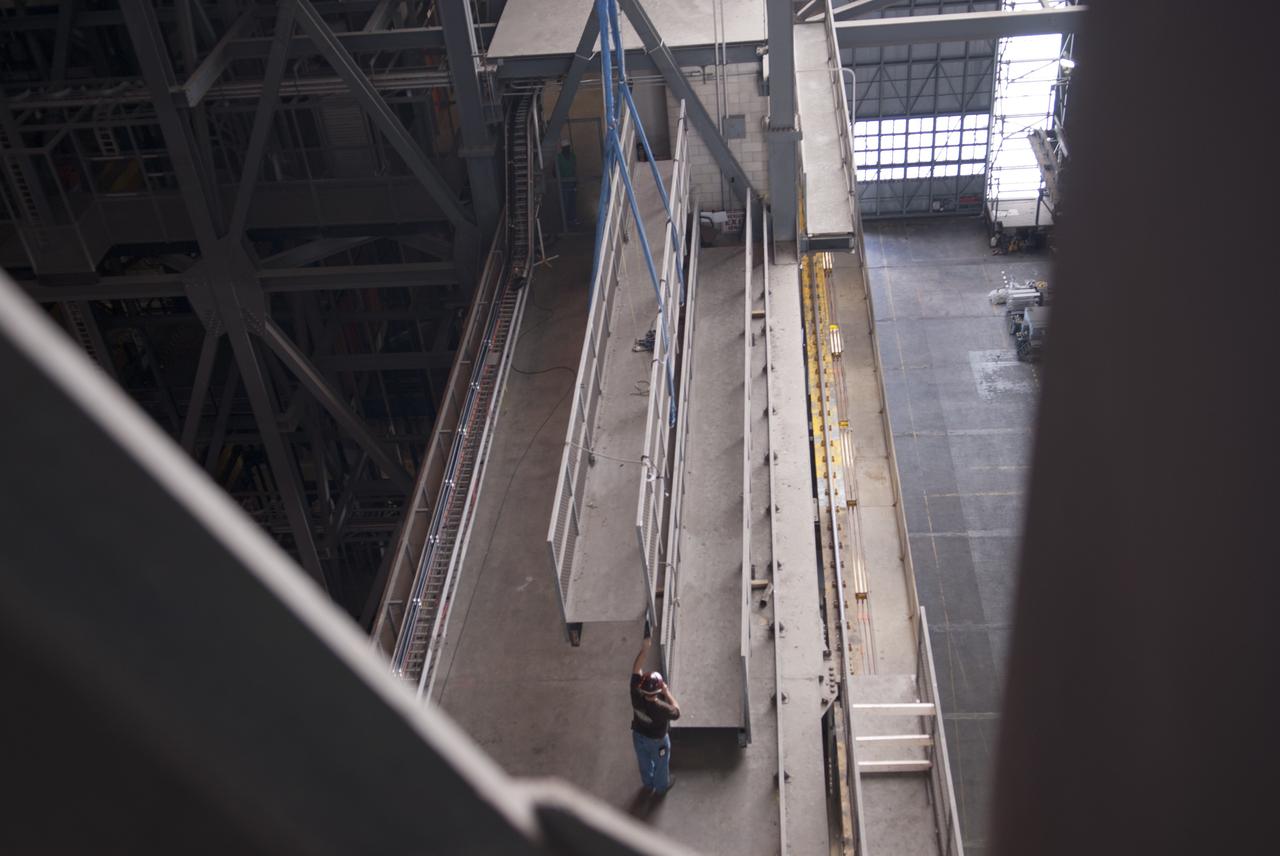
CAPE CANAVERAL, Fla. – Inside the Vehicle Assembly Building, or VAB, at NASA's Kennedy Space Center in Florida, portions of the catwalks on the east and west sides of Level 16 have been removed by crane and are being placed on the east side for storage. The catwalks were removed to allow room for the removal of the 175-ton crane that is situated above the transfer aisle. The crane will be lowered to the floor to perform upgrades to its 45-year-old controls in order to improve reliability, precision and safety. The Ground Systems Development and Operations Program is overseeing upgrades and modifications to the VAB. The crane will be upgraded so that it can support lifting needs for NASA and other exploration vehicles, including the agency's Space Launch System and Orion spacecraft. Photo credit: NASA/Jim Grossmann

CAPE CANAVERAL, Fla. -- In the transfer aisle of the Vehicle Assembly Building at NASA’s Kennedy Space Center in Florida, crane operators and technicians practice de-stacking operations on a full-size mock-up of the Orion spacecraft and launch abort system in order to keep processing procedures and skills current. Orion is the exploration spacecraft designed to carry crews to space beyond low Earth orbit. It will provide emergency abort capability, sustain the crew during the space travel and provide safe re-entry from deep space return velocities. Orion’s first unpiloted test flight is scheduled to launch in 2014 atop a Delta IV rocket. A second uncrewed flight test is scheduled for 2017 on NASA’s Space Launch System rocket. For more information, visit http://www.nasa.gov/orion. Photo credit: NASA/Jim Grossmann
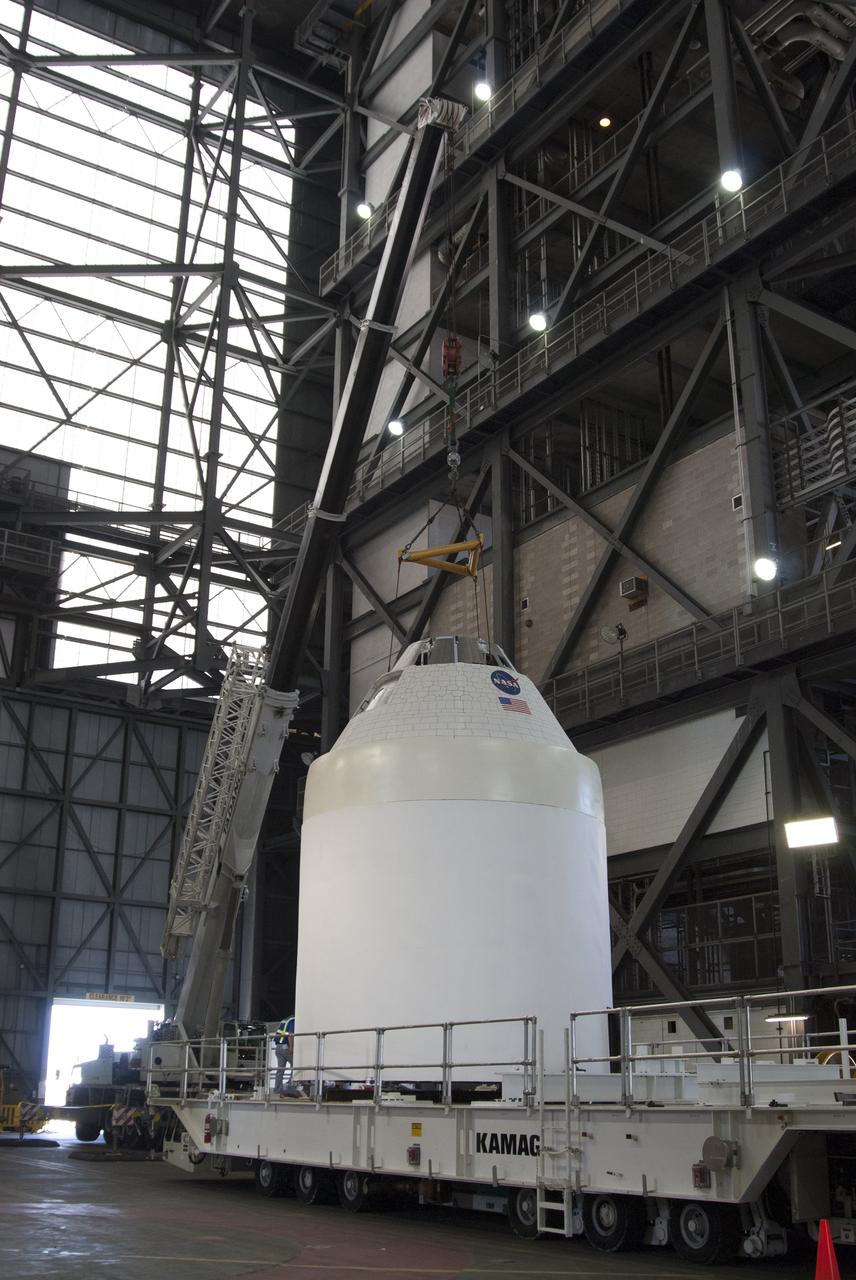
CAPE CANAVERAL, Fla. -- In the transfer aisle of the Vehicle Assembly Building at NASA’s Kennedy Space Center in Florida, a full-size test mock-up of the Orion spacecraft has been lowered onto a transporter. Crane operators and technicians practice de-stacking operations on mock-ups of the Orion spacecraft and launch abort system in order to keep processing procedures and skills current. Orion is the exploration spacecraft designed to carry crews to space beyond low Earth orbit. It will provide emergency abort capability, sustain the crew during the space travel and provide safe re-entry from deep space return velocities. Orion’s first unpiloted test flight is scheduled to launch in 2014 atop a Delta IV rocket. A second uncrewed flight test is scheduled for 2017 on NASA’s Space Launch System rocket. For more information, visit http://www.nasa.gov/orion. Photo credit: NASA/Tim Jacobs
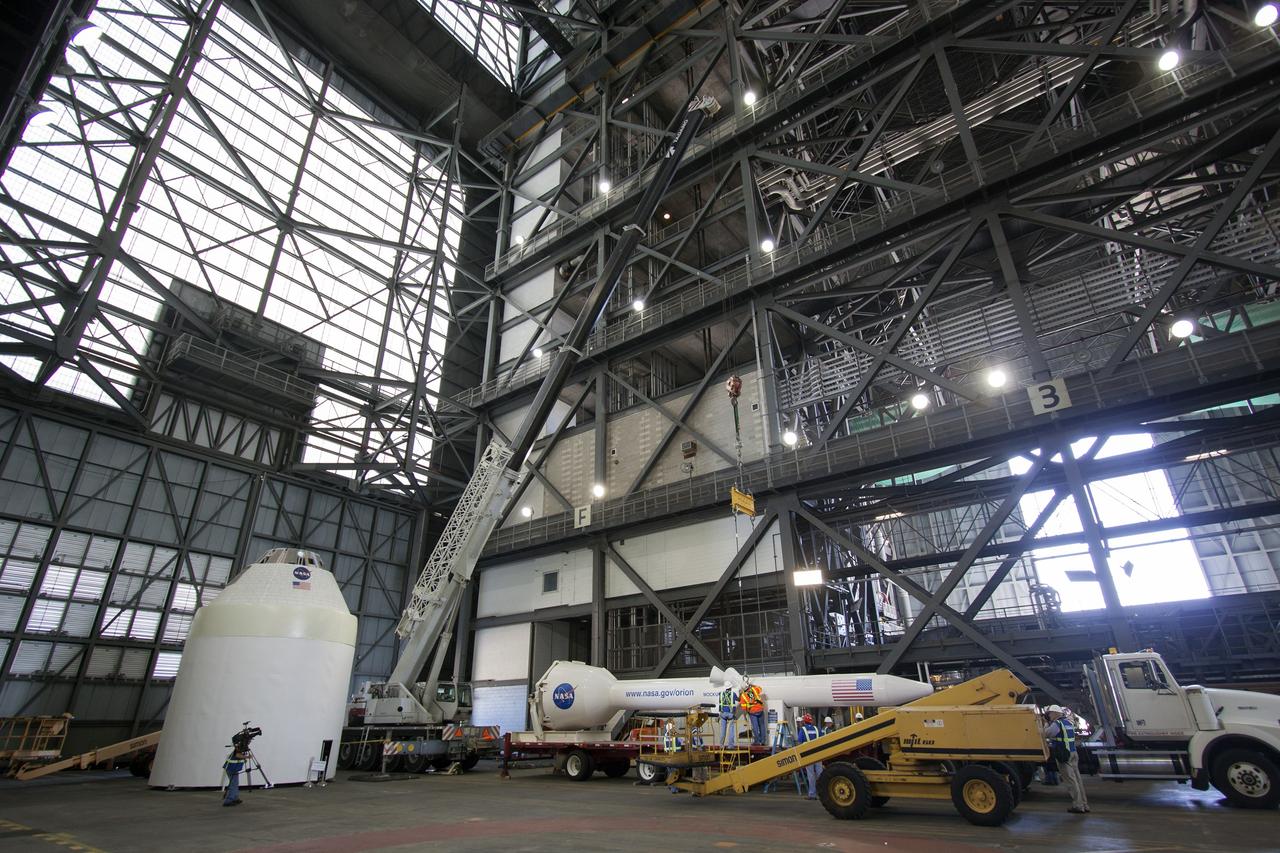
CAPE CANAVERAL, Fla. -- In the transfer aisle of the Vehicle Assembly Building at NASA’s Kennedy Space Center in Florida, a mock-up of the Orion launch abort system has been lowered onto a transporter. Crane operators and technicians practice de-stacking operations on a full-size mock-up of the Orion spacecraft and launch abort system in order to keep processing procedures and skills current. Orion is the exploration spacecraft designed to carry crews to space beyond low Earth orbit. It will provide emergency abort capability, sustain the crew during the space travel and provide safe re-entry from deep space return velocities. Orion’s first unpiloted test flight is scheduled to launch in 2014 atop a Delta IV rocket. A second uncrewed flight test is scheduled for 2017 on NASA’s Space Launch System rocket. For more information, visit http://www.nasa.gov/orion. Photo credit: NASA/Jim Grossmann
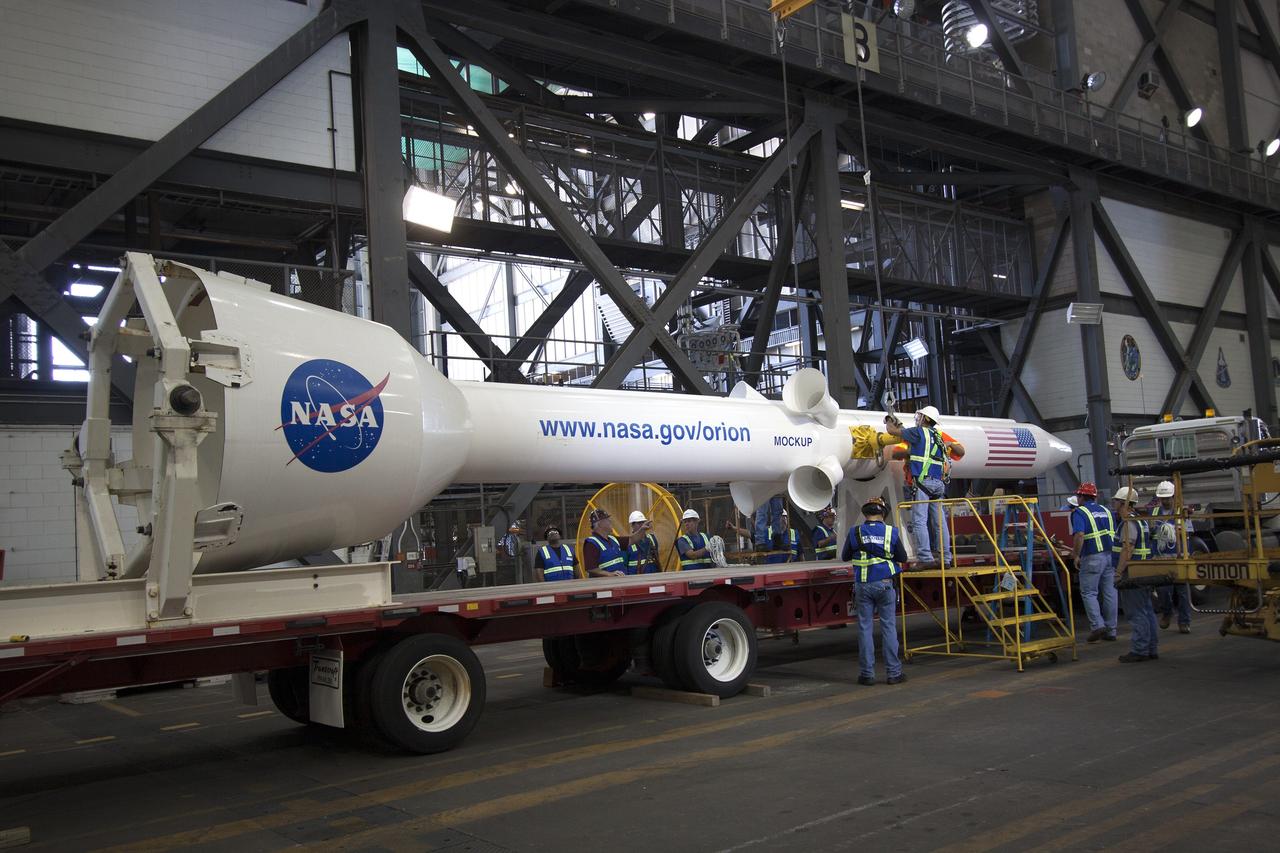
CAPE CANAVERAL, Fla. -- In the transfer aisle of the Vehicle Assembly Building at NASA’s Kennedy Space Center in Florida, a mock-up of the Orion launch abort system has been lowered onto a transporter. Crane operators and technicians practice de-stacking operations on a full-size mock-up of the Orion spacecraft and launch abort system in order to keep processing procedures and skills current. Orion is the exploration spacecraft designed to carry crews to space beyond low Earth orbit. It will provide emergency abort capability, sustain the crew during the space travel and provide safe re-entry from deep space return velocities. Orion’s first unpiloted test flight is scheduled to launch in 2014 atop a Delta IV rocket. A second uncrewed flight test is scheduled for 2017 on NASA’s Space Launch System rocket. For more information, visit http://www.nasa.gov/orion. Photo credit: NASA/Jim Grossmann
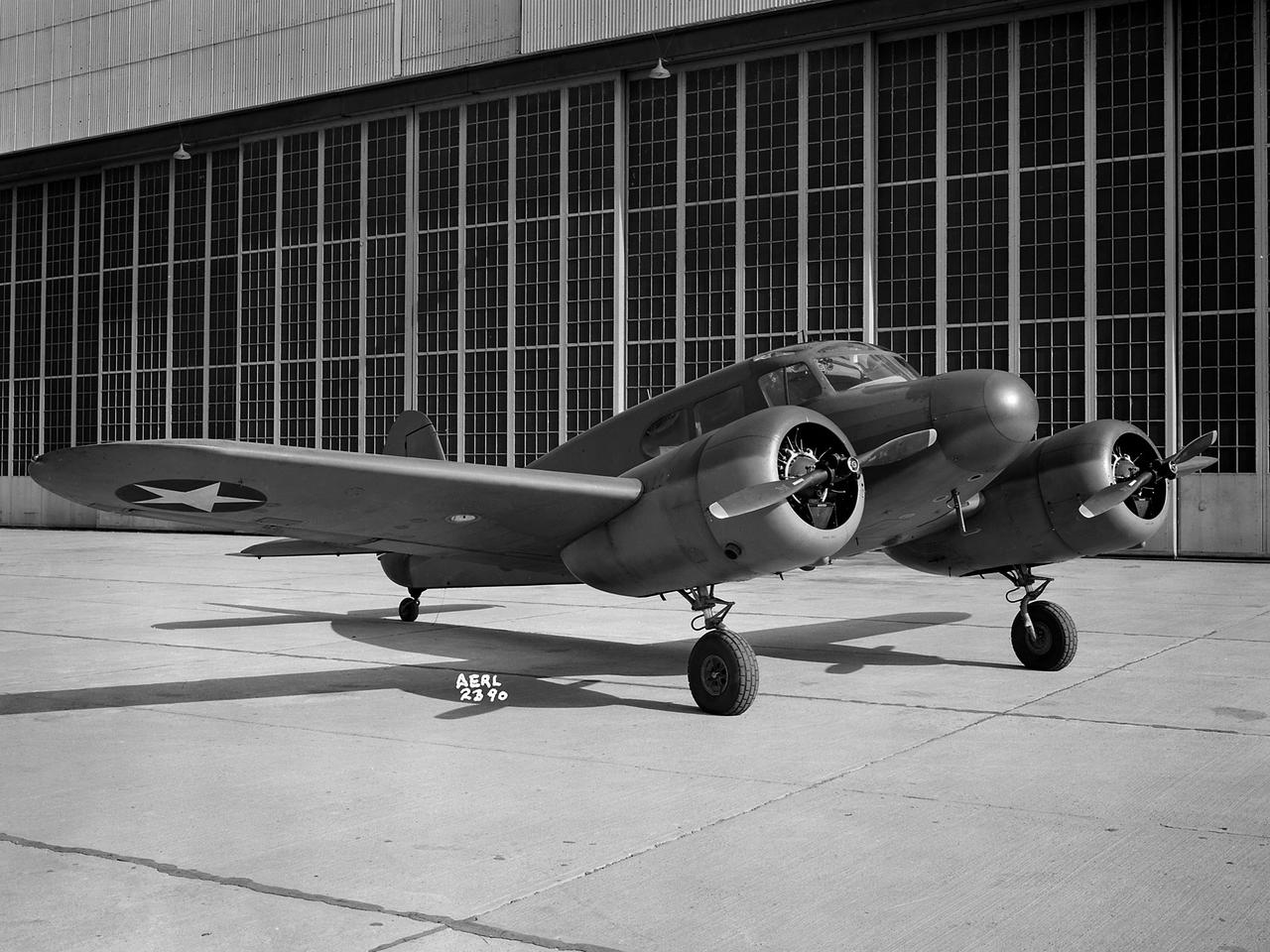
The Aircraft Engine Research Laboratory acquired the five-seat Cessna UC–78 in March 1943 to maintain the proficiency of its pilots. The UC–78 was referred to as the “Bamboo Bomber” because of its wooden wings and tail and its fabric-covered steel body. The aircraft was produced in 1939 for civilian use, but the military soon began ordering them as training aircraft. The military also began using the aircraft for personnel transport. Cessna produced over 4600 of the aircraft for the military during World War II. The National Advisory Committee for Aeronautics’ (NACA) pilot Howard Lilly flew the UC–78 extensively during its residency in Cleveland. The aircraft was used for ferrying staff members to nearby locations and helping the pilots keep their flying hours up. The UC–78 was transferred in October 1945.
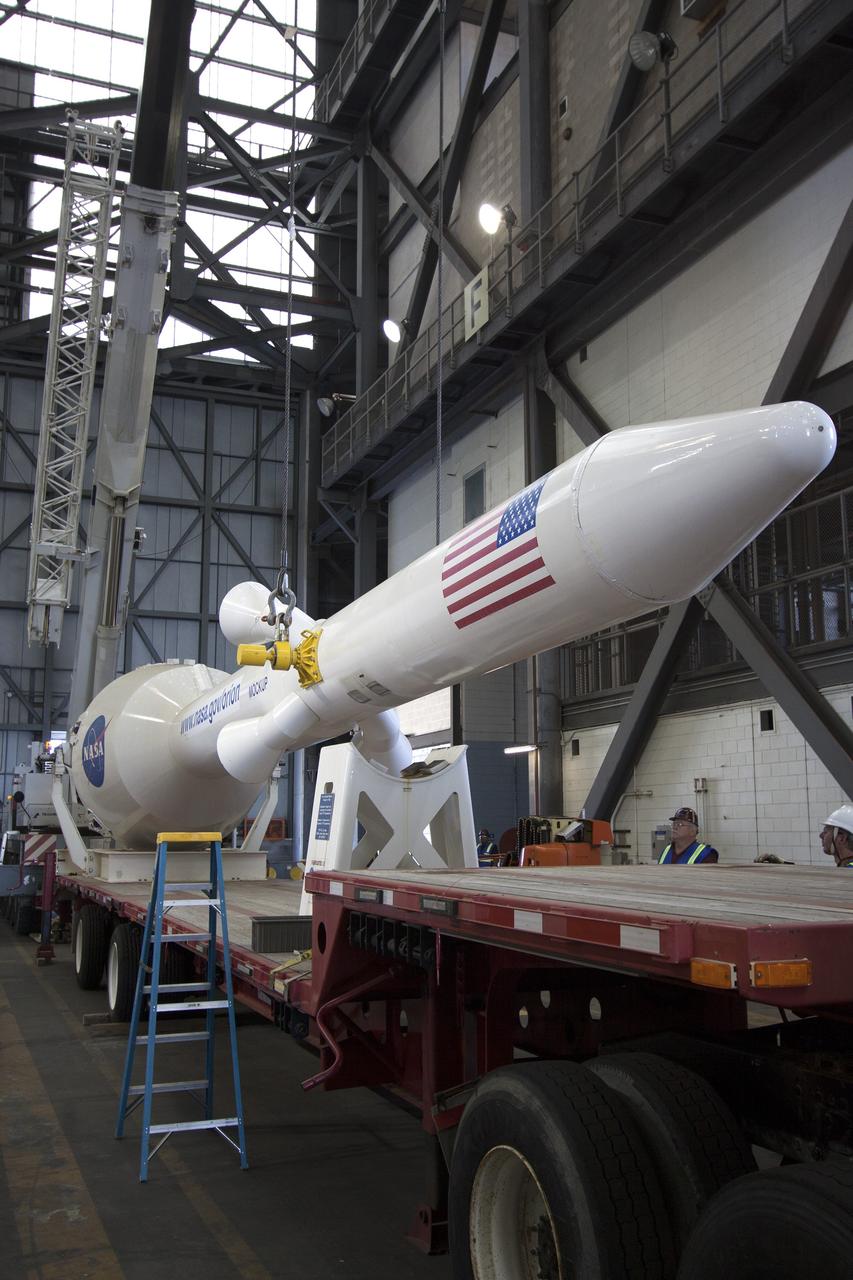
CAPE CANAVERAL, Fla. -- In the transfer aisle of the Vehicle Assembly Building at NASA’s Kennedy Space Center in Florida, crane operators and technicians practice lowering a mock-up of the Orion launch abort system onto a transporter in order to keep processing procedures and skills current. Orion is the exploration spacecraft designed to carry crews to space beyond low Earth orbit. It will provide emergency abort capability, sustain the crew during the space travel and provide safe re-entry from deep space return velocities. Orion’s first unpiloted test flight is scheduled to launch in 2014 atop a Delta IV rocket. A second uncrewed flight test is scheduled for 2017 on NASA’s Space Launch System rocket. For more information, visit http://www.nasa.gov/orion. Photo credit: NASA/Jim Grossmann
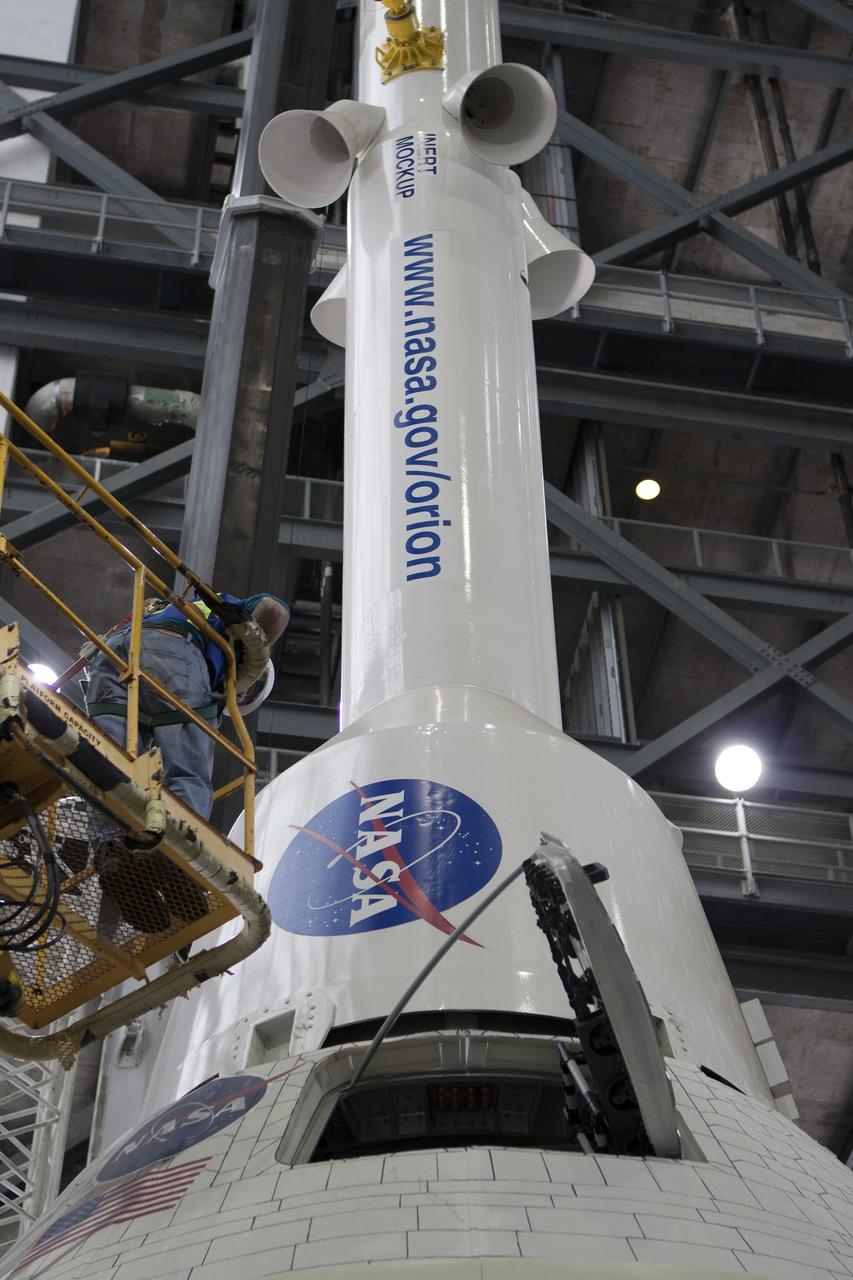
CAPE CANAVERAL, Fla. -- In the transfer aisle of the Vehicle Assembly Building at NASA’s Kennedy Space Center in Florida, a technician monitors de-stacking operations on a full-size mock-up of the Orion spacecraft and launch abort system. Crane operators and technicians practice stacking and de-stacking operations in order to keep processing procedures and skills current. Orion is the exploration spacecraft designed to carry crews to space beyond low Earth orbit. It will provide emergency abort capability, sustain the crew during the space travel and provide safe re-entry from deep space return velocities. Orion’s first unpiloted test flight is scheduled to launch in 2014 atop a Delta IV rocket. A second uncrewed flight test is scheduled for 2017 on NASA’s Space Launch System rocket. For more information, visit http://www.nasa.gov/orion. Photo credit: NASA/Jim Grossmann
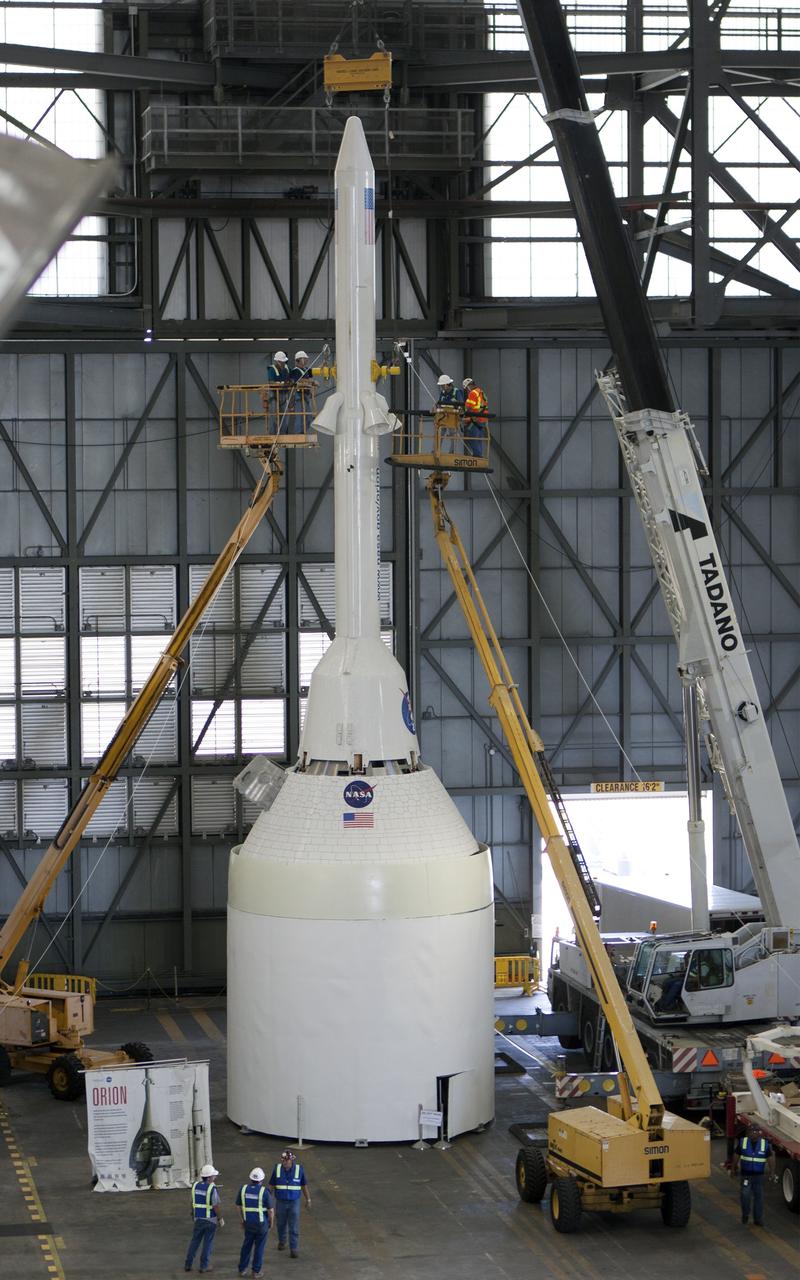
CAPE CANAVERAL, Fla. -- In the transfer aisle of the Vehicle Assembly Building at NASA’s Kennedy Space Center in Florida, crane operators and technicians practice de-stacking operations on a full-size mock-up of the Orion spacecraft and launch abort system in order to keep processing procedures and skills current. Orion is the exploration spacecraft designed to carry crews to space beyond low Earth orbit. It will provide emergency abort capability, sustain the crew during the space travel and provide safe re-entry from deep space return velocities. Orion’s first unpiloted test flight is scheduled to launch in 2014 atop a Delta IV rocket. A second uncrewed flight test is scheduled for 2017 on NASA’s Space Launch System rocket. For more information, visit http://www.nasa.gov/orion. Photo credit: NASA/Jim Grossmann
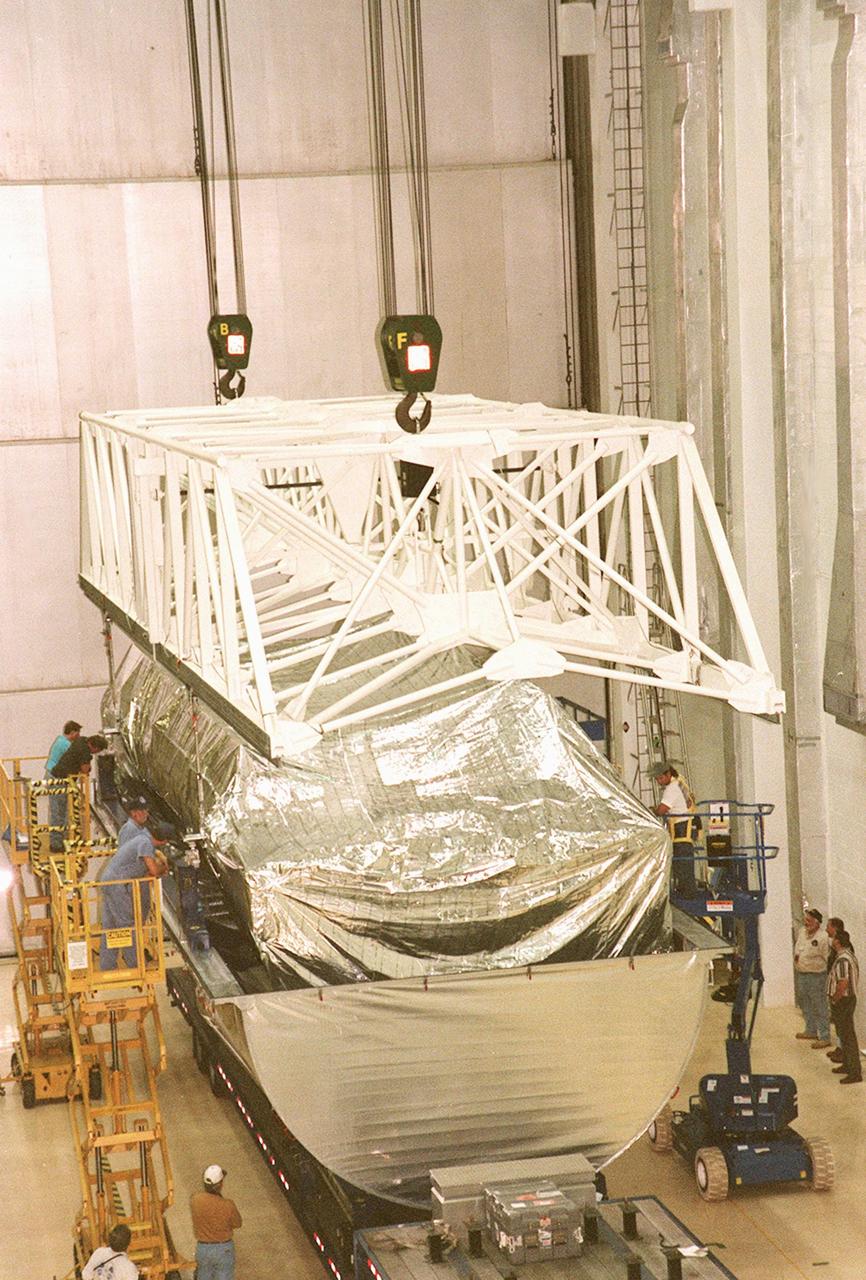
KENNEDY SPACE CENTER, FLA. -- Inside the Operations and Checkout Building, a strongback is lowered toward the S1 truss below it in order to lift the truss from the Guppy cargo carrier that protected it during flight and transfer. Manufactured by the Boeing Co. in Huntington Beach, Calif., this component of the International Space Station is the first starboard (right-side) truss segment, whose main job is providing structural support for the orbiting research facility's radiator panels that cool the Space Station's complex power system. The S1 truss segment also will house communications systems, external experiment positions and other subsystems. Primarily constructed of aluminum, the truss segment is 45 feet long, 15 feet wide and 6 feet tall. When fully outfitted, it will weigh 31,137 pounds. The truss is slated for flight in 2001
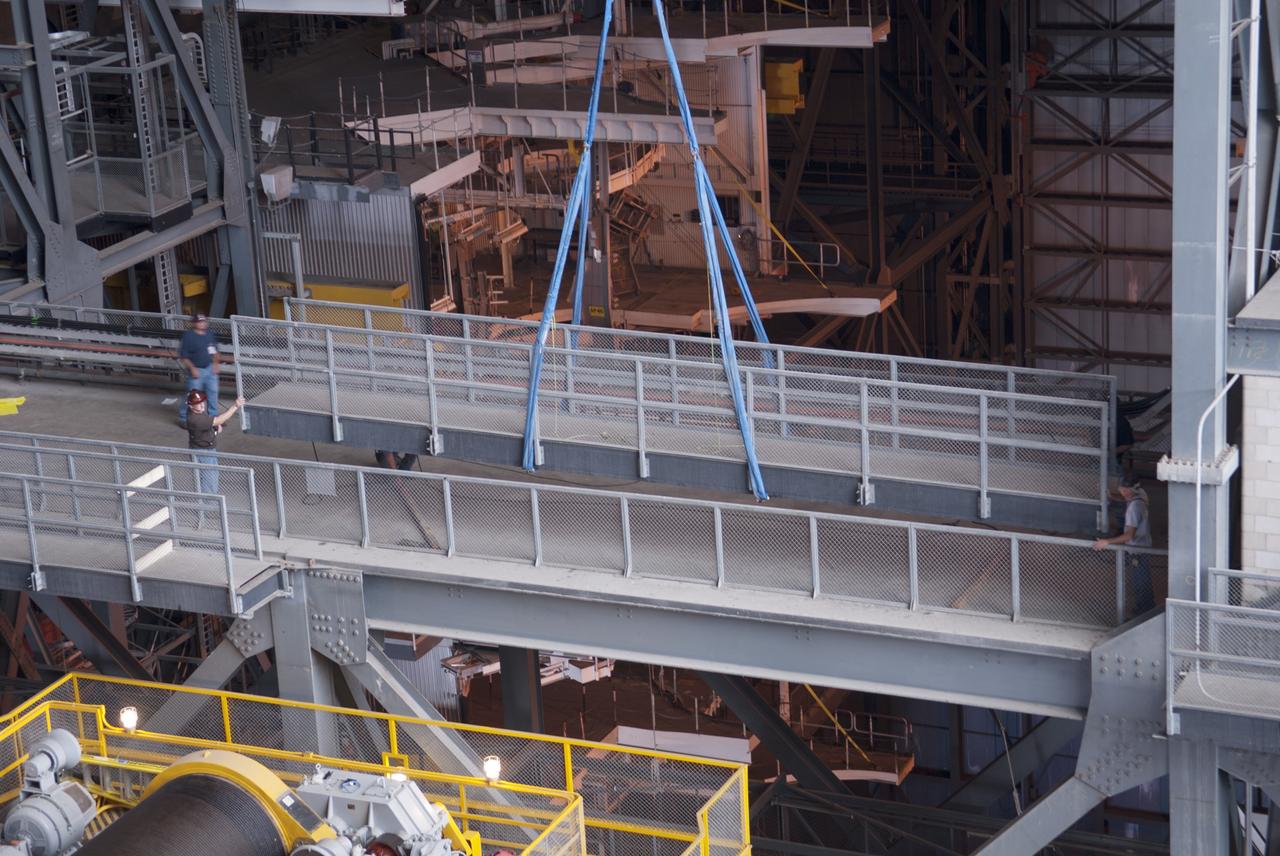
CAPE CANAVERAL, Fla. – Inside the Vehicle Assembly Building, or VAB, at NASA's Kennedy Space Center in Florida, workers monitor the progress as a crane lifts up a portion of the catwalk on the east side of Level 16. The catwalk is being removed to allow room for the removal of the 175-ton crane that is situated above the transfer aisle. The crane will be lowered to the floor to perform upgrades to its 45-year-old controls in order to improve reliability, precision and safety. The Ground Systems Development and Operations Program is overseeing upgrades and modifications to the VAB. The crane will be upgraded so that it can support lifting needs for NASA and other exploration vehicles, including the agency's Space Launch System and Orion spacecraft. Photo credit: NASA/Jim Grossmann
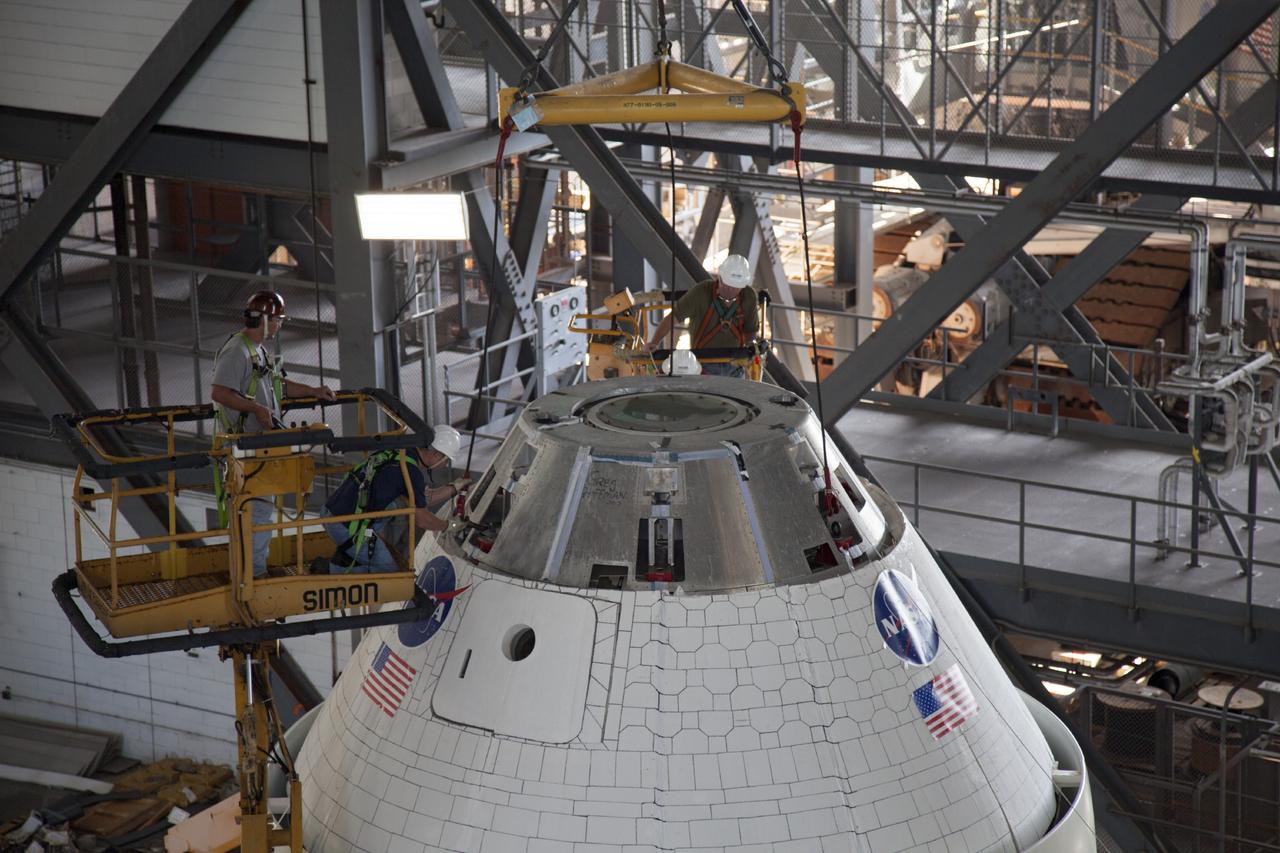
CAPE CANAVERAL, Fla. -- In the transfer aisle of the Vehicle Assembly Building at NASA’s Kennedy Space Center in Florida, crane operators and technicians practice stacking and de-stacking operations on a full-size mock-up of the Orion spacecraft and launch abort system in order to keep processing procedures and skills current for the Ground Systems Development and Operations Program. Orion is the exploration spacecraft designed to carry crews to space beyond low Earth orbit. It will provide emergency abort capability, sustain the crew during the space travel and provide safe re-entry from deep space return velocities. Orion’s first unpiloted test flight is scheduled to launch in 2014 atop a Delta IV rocket. A second uncrewed flight test is scheduled for 2017 on NASA’s Space Launch System rocket. For more information, visit http://www.nasa.gov/orion. Photo credit: NASA/Dan Casper
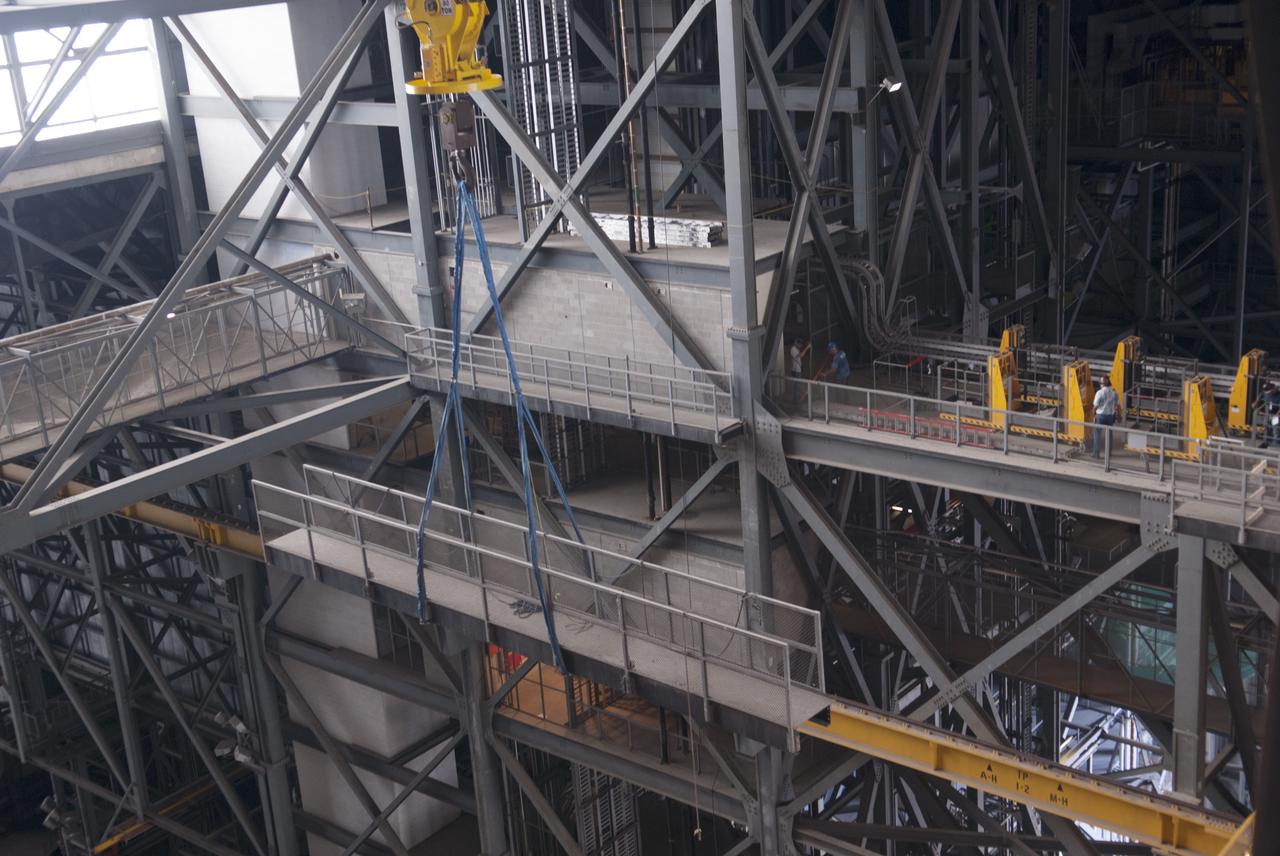
CAPE CANAVERAL, Fla. – Inside the Vehicle Assembly Building, or VAB, at NASA's Kennedy Space Center in Florida, a portion of the catwalk on the west side of Level 16 has been removed by crane and is being moved over the east side for storage. The catwalk was removed to allow room for the removal of the 175-ton crane that is situated above the transfer aisle. The crane will be lowered to the floor to perform upgrades to its 45-year-old controls in order to improve reliability, precision and safety. The Ground Systems Development and Operations Program is overseeing upgrades and modifications to the VAB. The crane will be upgraded so that it can support lifting needs for NASA and other exploration vehicles, including the agency's Space Launch System and Orion spacecraft. Photo credit: NASA/Jim Grossmann
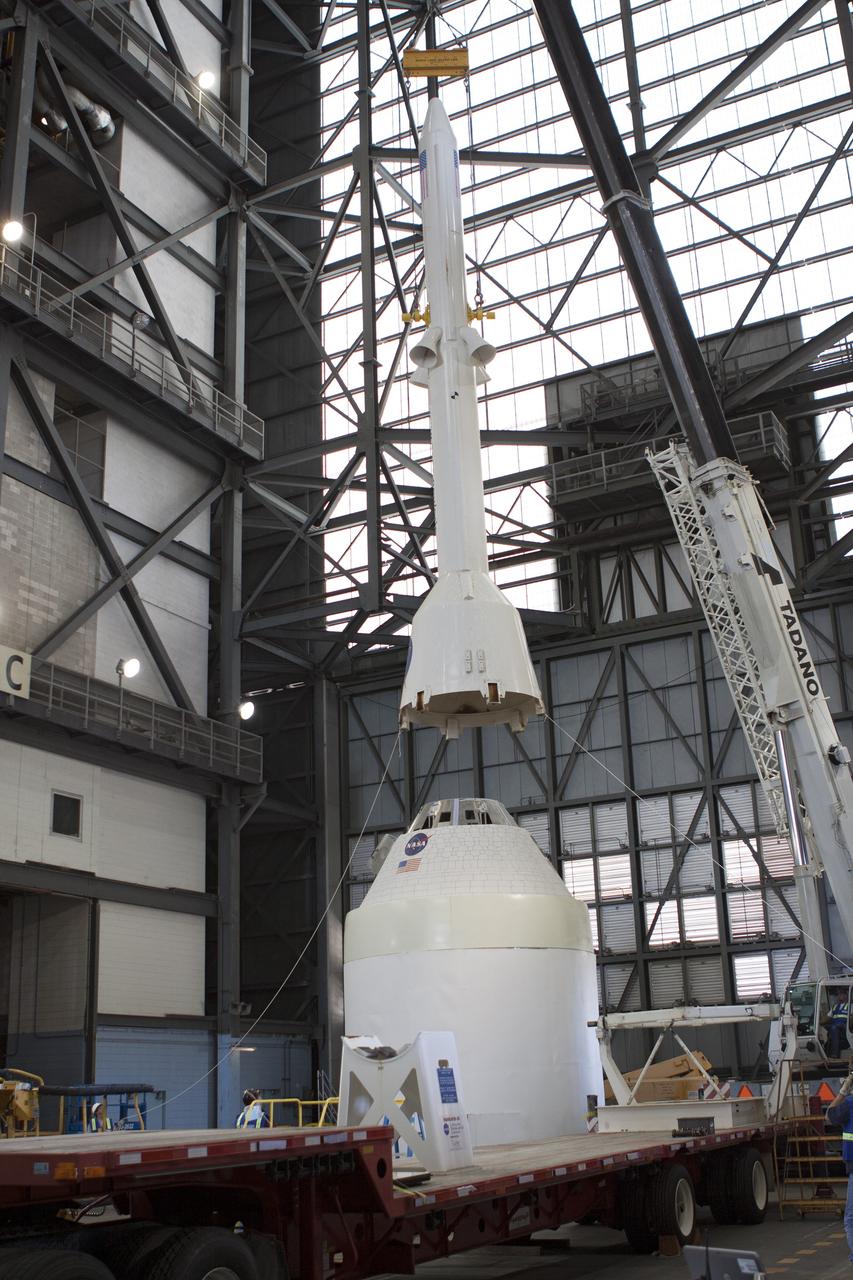
CAPE CANAVERAL, Fla. -- In the transfer aisle of the Vehicle Assembly Building at NASA’s Kennedy Space Center in Florida, crane operators and technicians practice de-stacking operations on a full-size mock-up of the Orion spacecraft and launch abort system in order to keep processing procedures and skills current. Orion is the exploration spacecraft designed to carry crews to space beyond low Earth orbit. It will provide emergency abort capability, sustain the crew during the space travel and provide safe re-entry from deep space return velocities. Orion’s first unpiloted test flight is scheduled to launch in 2014 atop a Delta IV rocket. A second uncrewed flight test is scheduled for 2017 on NASA’s Space Launch System rocket. For more information, visit http://www.nasa.gov/orion. Photo credit: NASA/Jim Grossmann
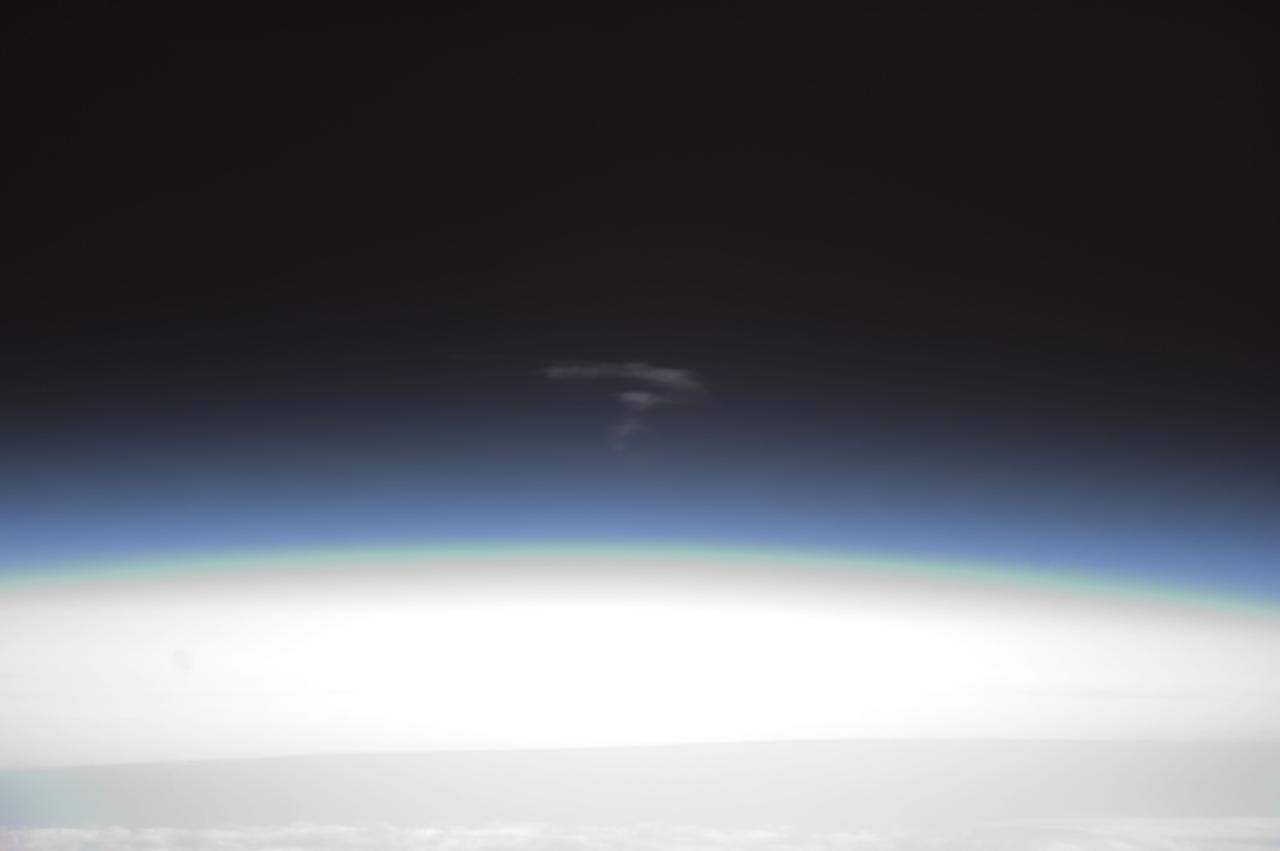
ISS033-E-009232 (3 Oct. 2012) --- This still photo taken by the Expedition 33 crew members aboard the International Space Station shows evidence of the fiery plunge through Earth?s atmosphere and the destructive re-entry of the European Automated Transfer Vehicle-3 (ATV-3) spacecraft, also known as ?Edoardo Amaldi.? The end of the ATV took place over a remote swath of the Pacific Ocean where any surviving debris safely splashed down a short time later, at around 1:30 a.m. (GMT) on Oct. 3, thus concluding the highly successful ATV-3 mission. Aboard the craft during re-entry was the Re Entry Breakup Recorder (REBR), a spacecraft ?black box? designed to gather data on vehicle disintegration during re-entry in order to improve future spacecraft re-entry models.
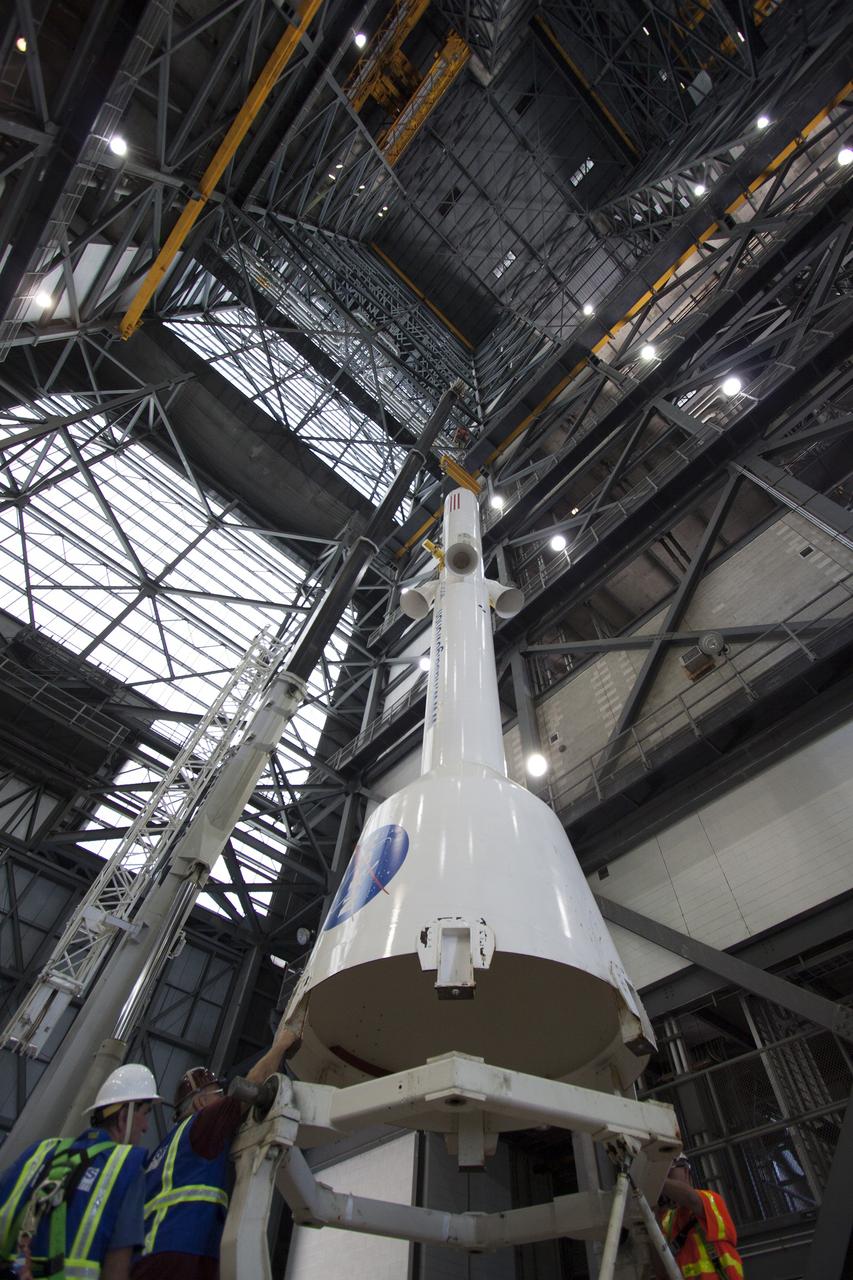
CAPE CANAVERAL, Fla. -- In the transfer aisle of the Vehicle Assembly Building at NASA’s Kennedy Space Center in Florida, crane operators and technicians practice de-stacking operations on a full-size mock-up of the Orion spacecraft and launch abort system in order to keep processing procedures and skills current. Orion is the exploration spacecraft designed to carry crews to space beyond low Earth orbit. It will provide emergency abort capability, sustain the crew during the space travel and provide safe re-entry from deep space return velocities. Orion’s first unpiloted test flight is scheduled to launch in 2014 atop a Delta IV rocket. A second uncrewed flight test is scheduled for 2017 on NASA’s Space Launch System rocket. For more information, visit http://www.nasa.gov/orion. Photo credit: NASA/Jim Grossmann
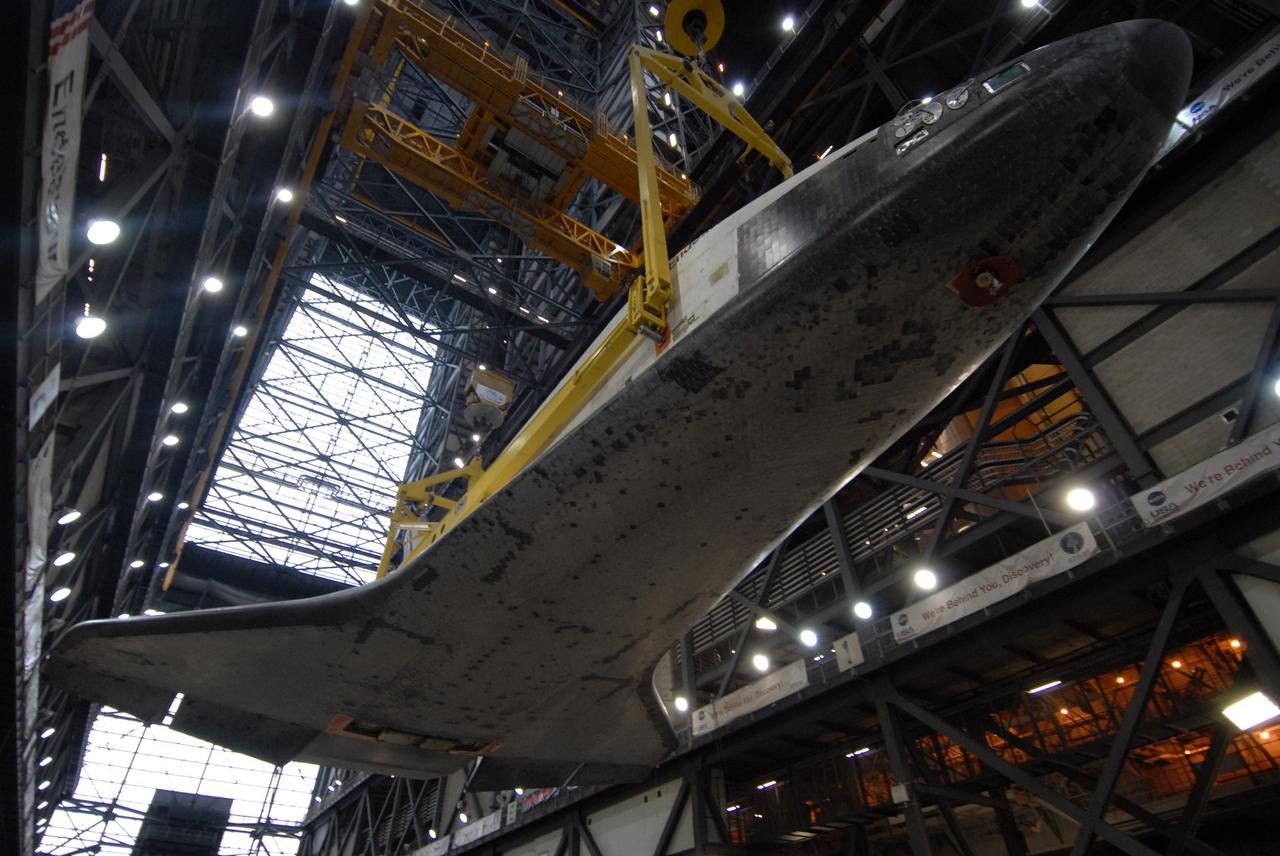
CAPE CANAVERAL, Fla. – In the transfer aisle of the Vehicle Assembly Building at NASA's Kennedy Space Center in Florida, cranes lift space shuttle Endeavour in order to raise it to vertical. Once vertical, the shuttle will be lifted into High Bay 1, then lowered and attached to the external fuel tank and solid rocket boosters already installed on the mobile launcher platform. Endeavour is scheduled to roll out to Launch Pad 39B on April 17. Endeavour will be prepared on the pad for liftoff in the unlikely event that a rescue mission is necessary following space shuttle Atlantis' launch on the STS-125 mission to service the Hubble Space Telescope. After Atlantis is cleared to land, Endeavour will move to Launch Pad 39A for its upcoming STS-127 mission to the International Space Station, targeted to launch in mid-June. Photo credit: NASA/Troy Cryder

CAPE CANAVERAL, Fla. -- In the transfer aisle of the Vehicle Assembly Building at NASA’s Kennedy Space Center in Florida, a full-size test mock-up of the Orion spacecraft has been lowered onto a transporter. Crane operators and technicians practice de-stacking operations on mock-ups of the Orion spacecraft and launch abort system in order to keep processing procedures and skills current. Orion is the exploration spacecraft designed to carry crews to space beyond low Earth orbit. It will provide emergency abort capability, sustain the crew during the space travel and provide safe re-entry from deep space return velocities. Orion’s first unpiloted test flight is scheduled to launch in 2014 atop a Delta IV rocket. A second uncrewed flight test is scheduled for 2017 on NASA’s Space Launch System rocket. For more information, visit http://www.nasa.gov/orion. Photo credit: NASA/Tim Jacobs
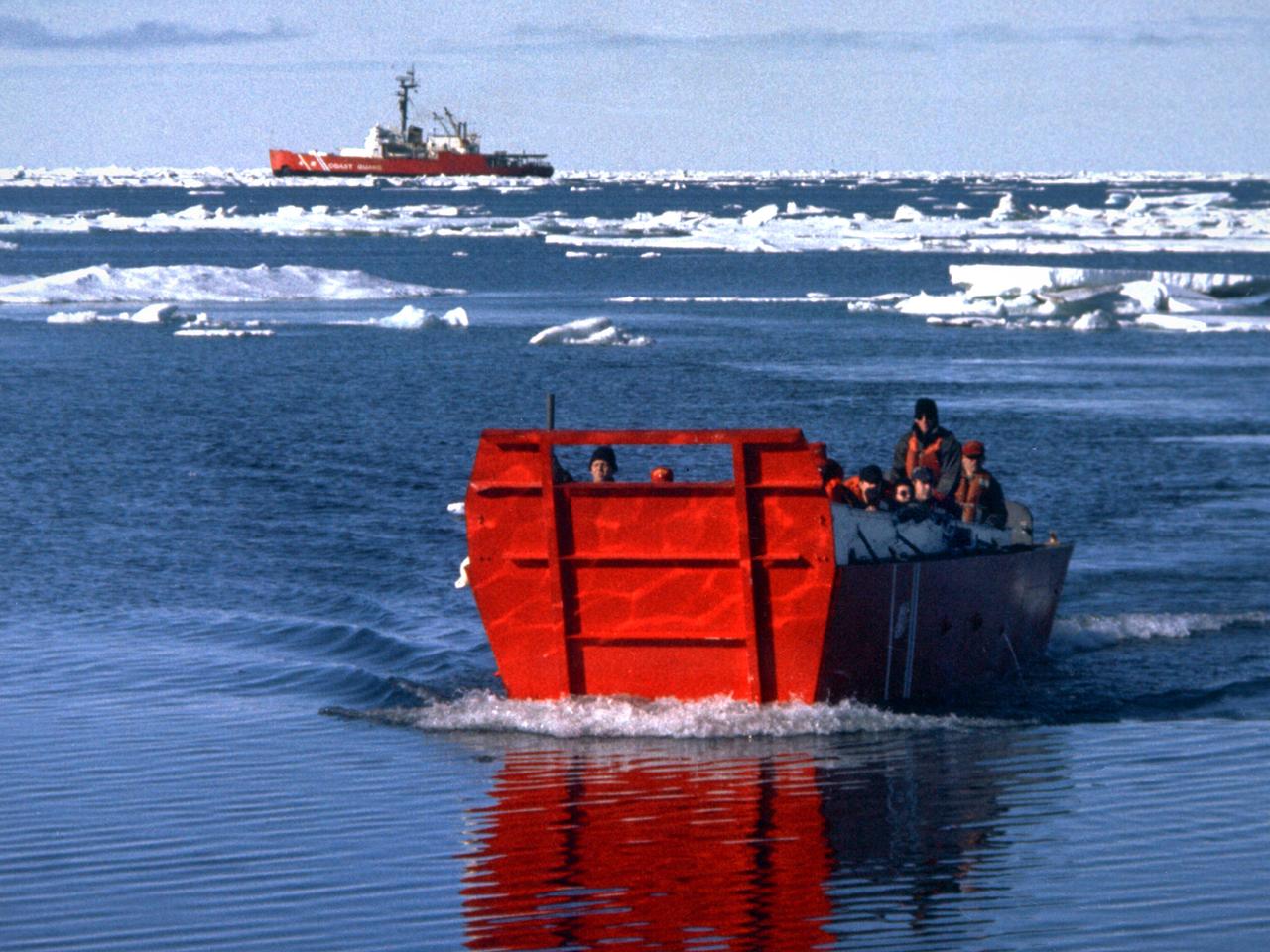
A group of Coast Guard seamen leave their ship to verify ice formations on the Great Lakes as part of an joint effort with the National Aeronautics and Space Administration (NASA) Lewis Research Center and the National Oceanic and Atmospheric Administration. The regular winter freezing of large portions of the Great Lakes stalled the shipping industry. Lewis began working on two complementary systems to monitor the ice. The Side Looking Airborne Radar (SLAR) system used microwaves to measure the ice distribution and electromagnetic systems used noise modulation to determine the thickness of the ice. The images were then transferred via satellite to the Coast Guard station. The Coast Guard then transmitted the pertinent images by VHF to the ship captains to help them select the best route. The Great Lakes ice mapping devices were first tested on NASA aircraft during the winter of 1972 and 1973. The pulsed radar system was transferred to the Coast Guard’s C-130 aircraft for the 1975 and 1976 winter. The SLAR was installed in the rear cargo door, and the small S-band antenna was mounted to the underside of the aircraft. Coast Guard flights began in January 1975 at an altitude of 11,000 feet. Early in the program, teams of guardsmen and NASA researchers frequently set out in boats to take samples and measurements of the ice in order to verify the radar information.
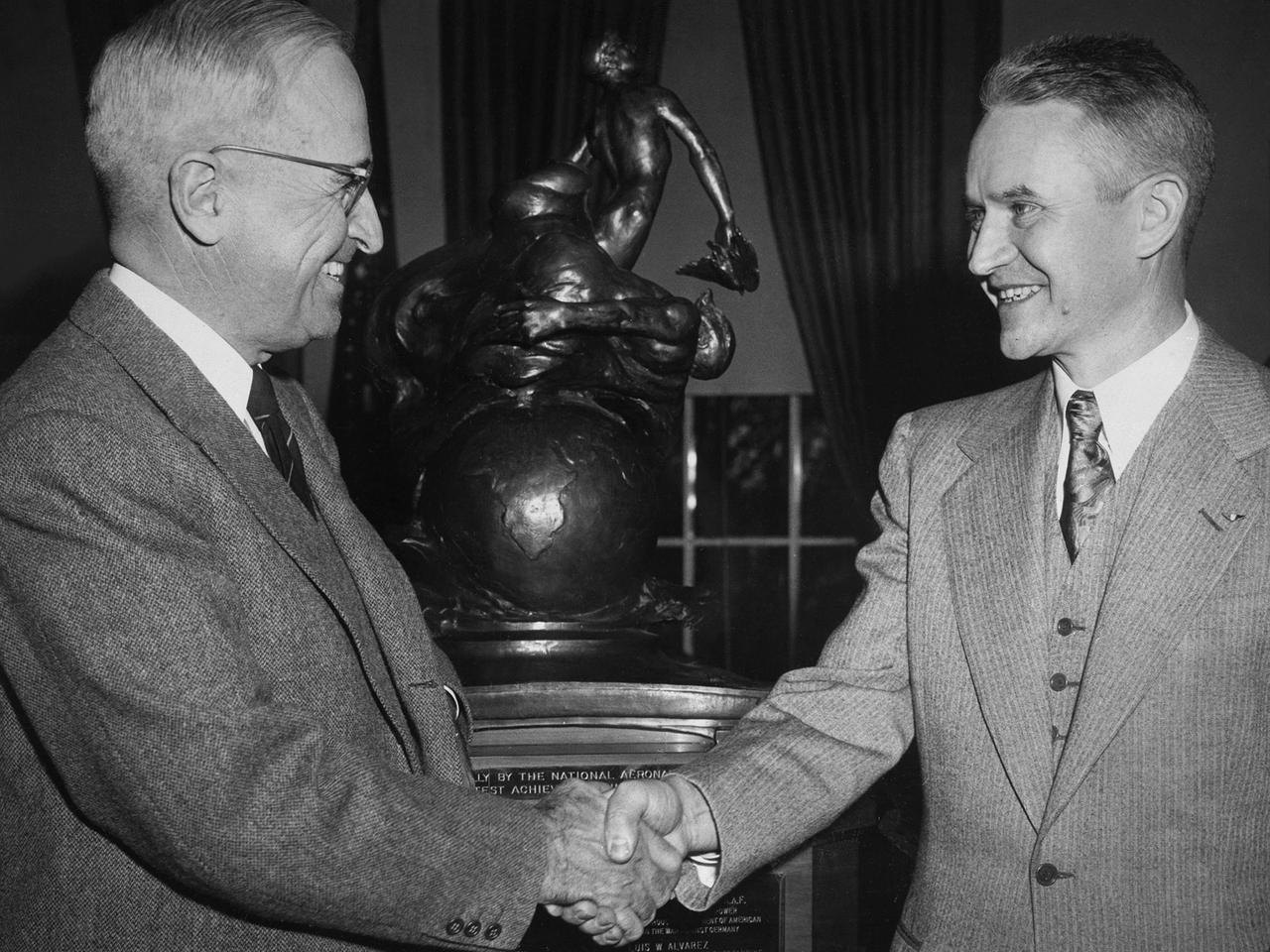
Lewis Rodert, then of the National Advisory Committee for Aeronautics (NACA) Lewis Flight Propulsion Laboratory, receives the Collier Trophy from President Harry Truman for his work in the design and development of an ice prevention system for aircraft. The accumulation of ice on an aircraft had been a critical issue for years. Rodert developed a method of transferring engine heat to the wings and other vulnerable components to prevent ice buildup. Rodert began his icing investigations at Langley Memorial Aeronautical Laboratory in 1936. The NACA ordered a Lockheed 12A aircraft to be built using Rodert’s deicing system. The aircraft successfully flew through icing conditions during the following winter. Soon thereafter the military incorporated the system into a Consolidated B-24D Liberator and several other military aircraft, including a North American XB-25F. Rodert and the NACA icing program transferred to the Lewis lab in Cleveland in 1946. In Cleveland, the focus turned to the study of cloud composition and the causes of icing. Rodert’s role at Lewis diminished over the ensuing years. Rodert was honored in 1947 for his Collier Trophy at ceremonies at Langley, Ames, and then finally Lewis.
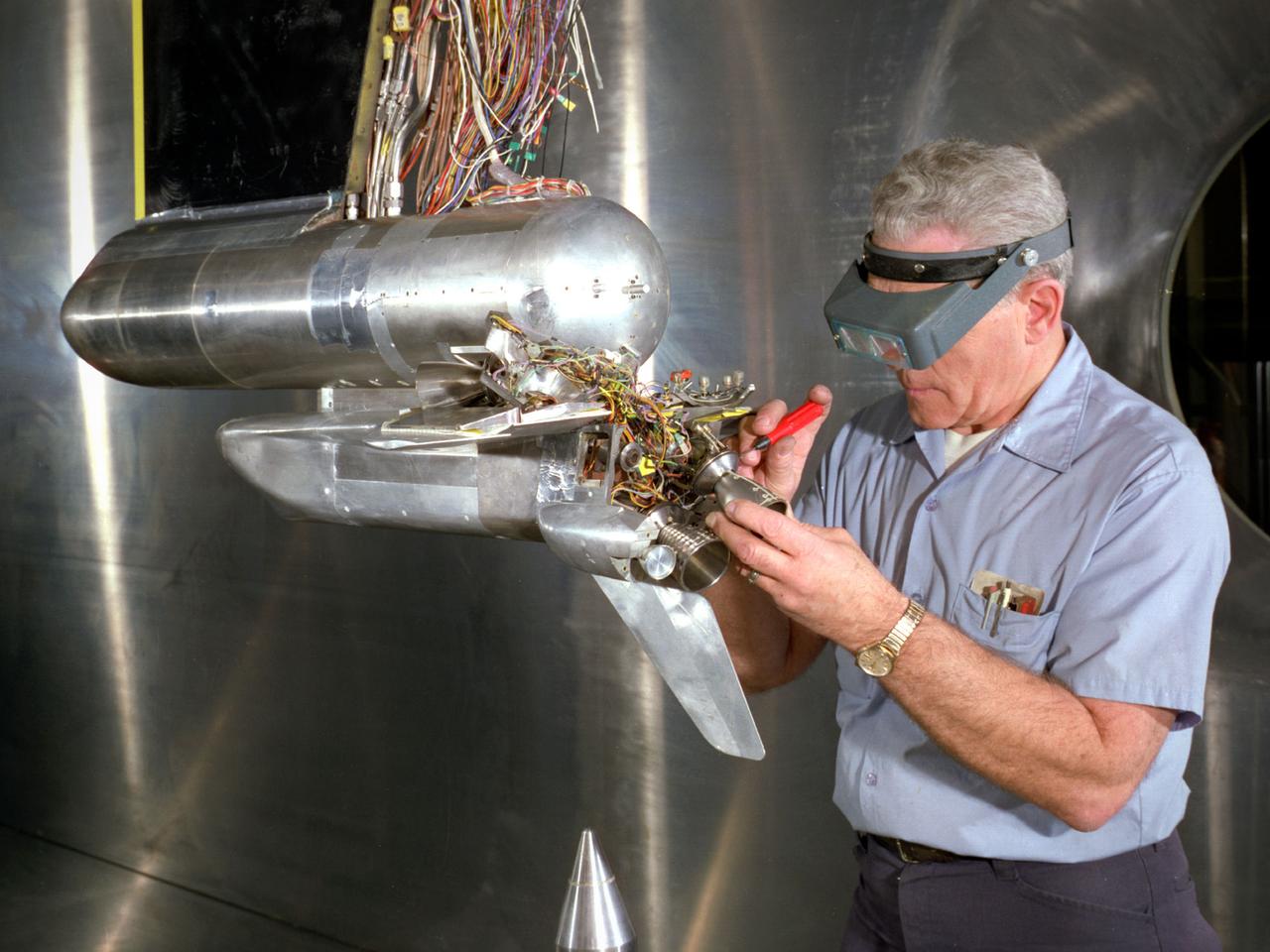
A technician prepares a 2.25 percent scale model of the space shuttle for a base heat study in the 10- by 10-Foot Supersonic Wind Tunnel at the National Aeronautics and Space Administration (NASA) Lewis Research Center. This space shuttle project, begun here in July 1976, was aimed at evaluating base heating and pressure prior to the Shuttle’s first lift-off scheduled for 1979. The space shuttle was expected to experience multifaceted heating and pressure distributions during the first and second stages of its launch. Engineers needed to understand these issues in order to design proper thermal protection. The test’s specific objectives were to measure the heat transfer and pressure distributions around the orbiter’s external tank and solid rocket afterbody caused by rocket exhaust recirculation and impingement, to measure the heat transfer and pressure distributions caused by rocket exhaust-induced separation, and determine gas recovery temperatures using gas temperature probes and heated base components. The shuttle model’s main engines and solid rockets were first fired and then just the main engines to simulate a launch during the testing. Lewis researchers conducted 163 runs in the 10- by 10 during the test program.

S-65 Meteor Impact Model set up in the former Altitude Wind Tunnel at the National Aeronautics and Space Administration (NASA) Lewis Research Center just days after the September 12, 1962 rededication of the facility as the Space Power Chamber. Although larger test chambers would later be constructed, the rapid conversion of the wind tunnel into two space tanks allowed the facility to play a vital role in the early years of the space program. The eastern section of the tunnel, seen here became a vacuum chamber capable of simulating 100 miles altitude. This space tank was envisioned for the study of small satellites like this one. The transfer of the Centaur Program to Lewis one month late, however, permanently changed this mission. NASA was undertaking an in depth study at the time on the effect of micrometeoroids on satellites. Large space radiators were particularly vulnerable to damage from the small particles of space debris. In order to determine the hazard from meteoroids researchers had to define the flux rate relative to the mass and the velocity distribution because the greater the mass or the velocity of a meteoroid the greater the damage.
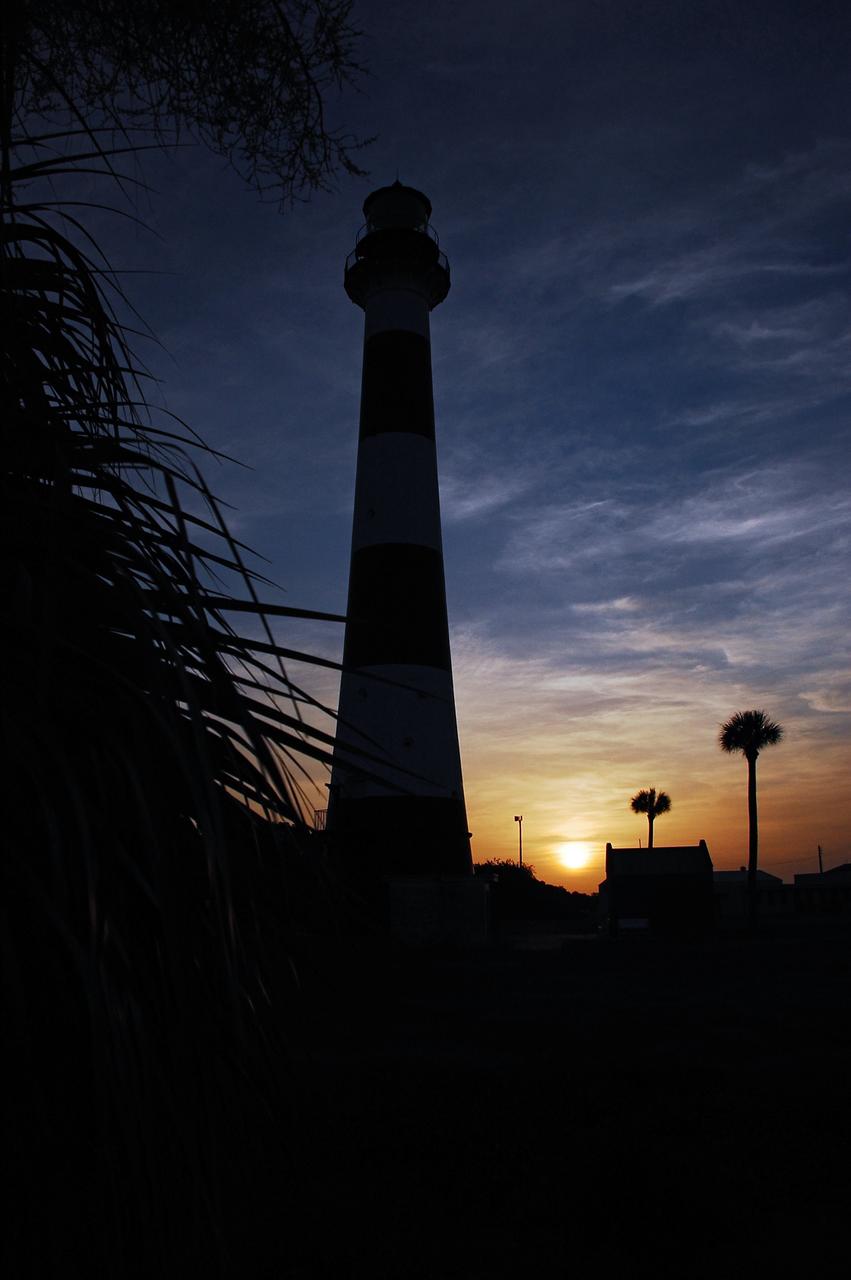
Cape Canaveral Air Force Station, Fla. -- As the sun rises, the Cape Canaveral Lighthouse is silhouetted against the early morning sky. The Canaveral light is the only operating lighthouse owned by the U.S. Air Force. In 2000, the Coast Guard transferred ownership of the lighthouse structure and its grounds to the Air Force, which is now responsible for maintaining it. The U.S. Coast Guard continues to operate the modern first-order beacon as an active navigational aid. The first lighthouse at Cape Canaveral was built near the tip of the Cape in 1848. The structure was only about 60 feet high with a rather dim light powered by whale oil. In 1859, work began nearby on a new, taller iron structure. Construction was halted during the Civil War, and the lighthouse finally was finished in 1868. The structure, with a brick lining inside its iron exterior, was painted with its "daymark" black and white horizontal bands in 1873 to make it easier to identify during the day as a navigation point. Between 1892 and 1894, the lighthouse was dismantled and moved to its new home about a mile from the coast, where it stands today. Photo credit: NASA/Ben Smegelsky
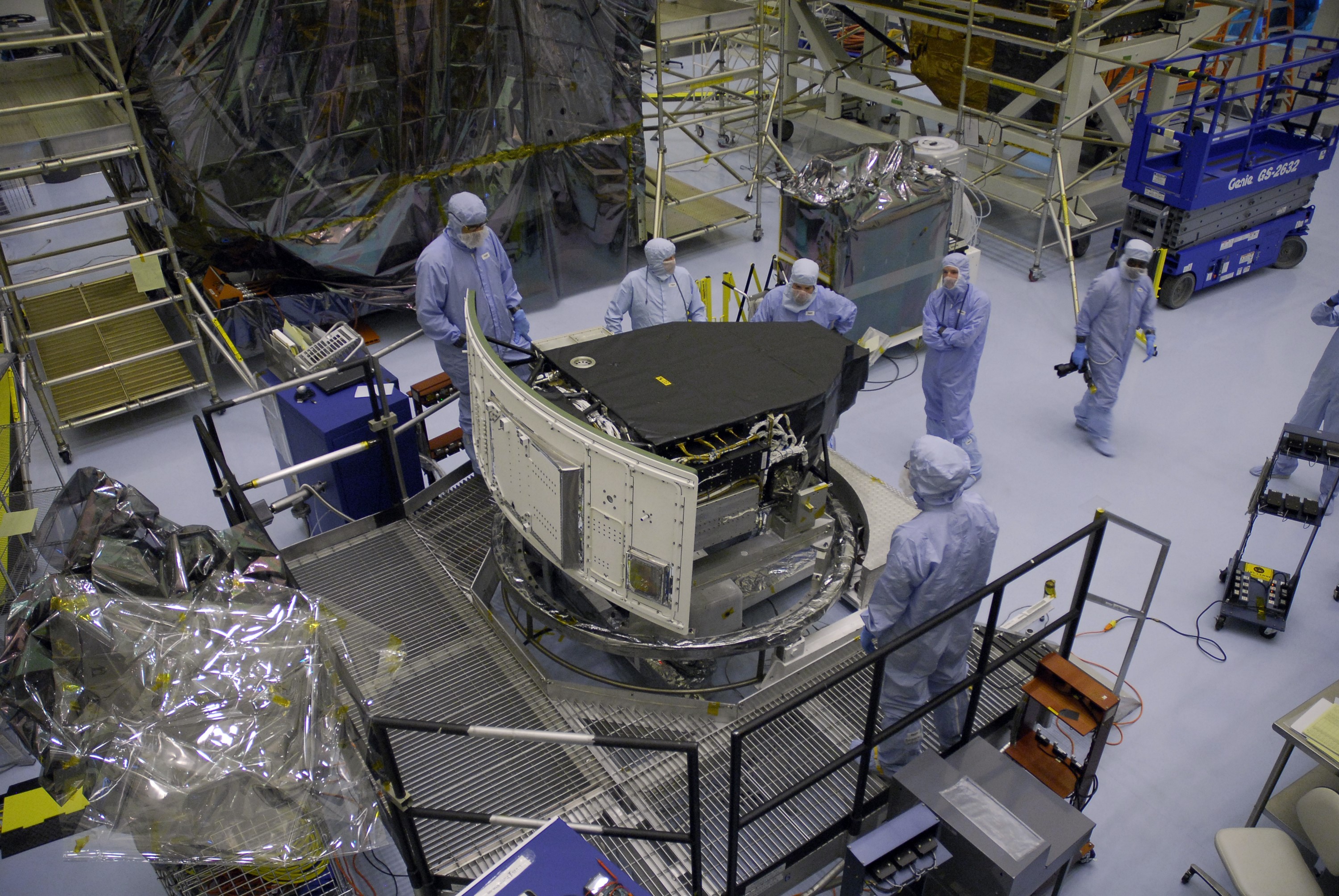
CAPE CANAVERAL, Fla. – In the Payload Hazardous Servicing Facility at NASA's Kennedy Space Center, technicians wait for the rotation of the Wide Field Camera 3, or WFC3, in order to attach a crane. The WFC3 will be transferred to the Super Lightweight Interchangeable Carrier. WFC3 is part of the payload on space shuttle Atlantis' STS-125 mission for the fifth and final Hubble servicing flight to NASA's Hubble Space Telescope. The curved edge shown at left is the radiator, the "outside" of WFC3 that will be exposed to space and will expel heat out of Hubble and into space through black body radiation. As Hubble enters the last stage of its life, WFC3 will be Hubble's next evolutionary step, allowing Hubble to peer ever further into the mysteries of the cosmos. WFC3 will study a diverse range of objects and phenomena, from young and extremely distant galaxies, to much more nearby stellar systems, to objects within our very own solar system. WFC3 will take the place of Wide Field Planetary Camera 2, which astronauts will bring back to Earth aboard the shuttle. Launch of Atlantis is targeted at 1:34 a.m. EDT Oct. 8. Photo credit: NASA/Amanda Diller
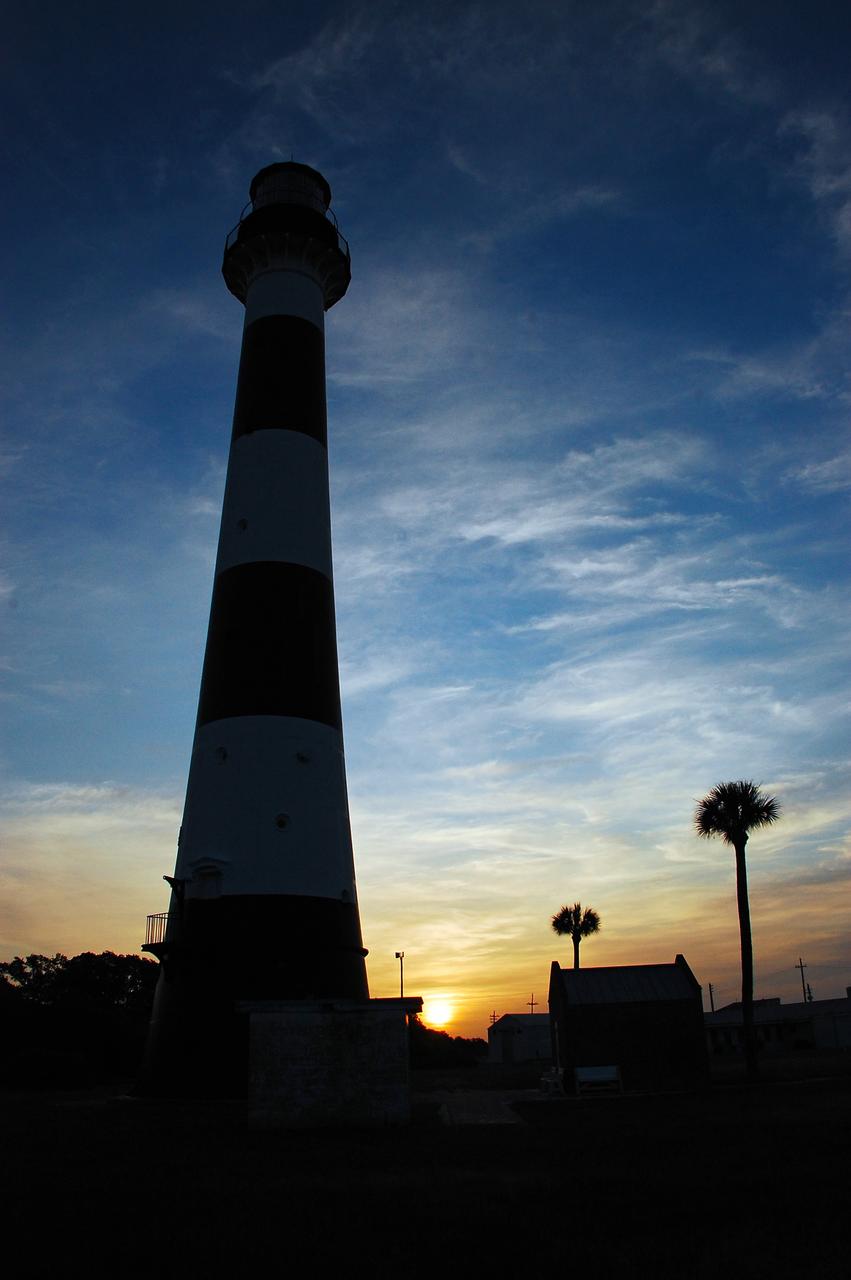
Cape Canaveral Air Force Station, Fla. -- As the sun rises, the Cape Canaveral Lighthouse is silhouetted against the early morning sky. The Canaveral light is the only operating lighthouse owned by the U.S. Air Force. In 2000, the Coast Guard transferred ownership of the lighthouse structure and its grounds to the Air Force, which is now responsible for maintaining it. The U.S. Coast Guard continues to operate the modern first-order beacon as an active navigational aid. The first lighthouse at Cape Canaveral was built near the tip of the Cape in 1848. The structure was only about 60 feet high with a rather dim light powered by whale oil. In 1859, work began nearby on a new, taller iron structure. Construction was halted during the Civil War, and the lighthouse finally was finished in 1868. The structure, with a brick lining inside its iron exterior, was painted with its "daymark" black and white horizontal bands in 1873 to make it easier to identify during the day as a navigation point. Between 1892 and 1894, the lighthouse was dismantled and moved to its new home about a mile from the coast, where it stands today. Photo credit: NASA/Ben Smegelsky
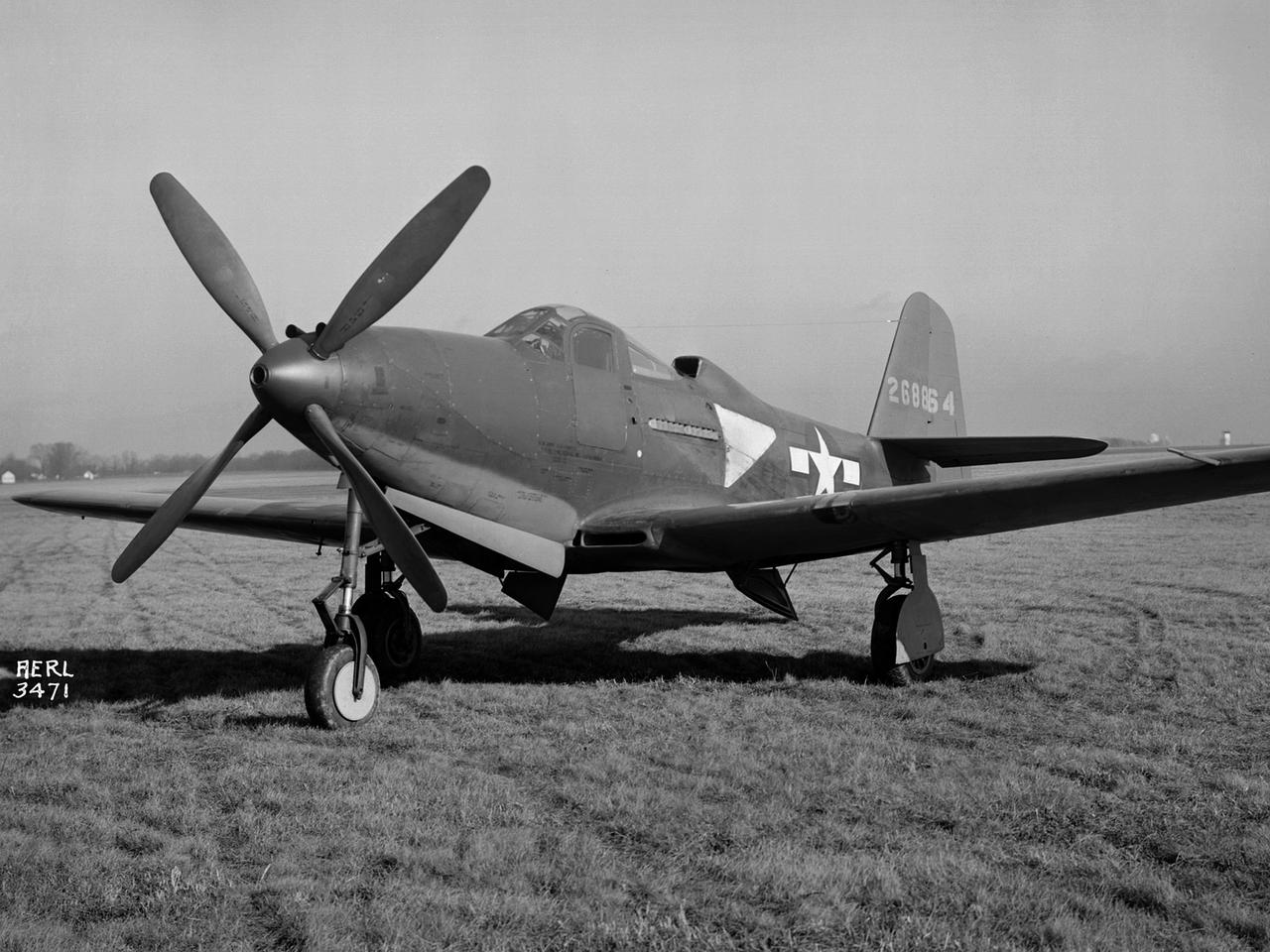
The Army Air Forces lent the National Advisory Committee for Aeronautics (NACA) Aircraft Engine Research Laboratory a Bell P–63A King Cobra in October 1943 to complement the lab's extensive efforts to improve the Allison V–1710 engine. The V–1710-powered P–63A was a single-seat fighter that could reach speeds of 410 miles per hour and an altitude of 43,000 feet. The fighter, first produced in 1942, was an improvement on Bell’s P–39, but persistent performance problems at high altitudes prevented its acceptance by the Air Corps. Instead many of the P–63s were transferred to the Soviet Union. Almost every test facility at the NACA’s engine lab was used to study the Allison V–1710 engine and its supercharger during World War II. Researchers were able to improve the efficiency, capacity and pressure ratio of the supercharger. They found that improved cooling significantly reduced engine knock in the fuel. Once the researchers were satisfied with their improvements, the new supercharger and cooling components were installed on the P–63A. The Flight Research Division first established the aircraft’s normal flight performance parameters such as speed at various altitudes, rate of climb, and peak altitude. Ensuing flights established the performance parameters of the new configuration in order to determine the improved performance. The program increased V–1710’s horsepower from 1650 to 2250.
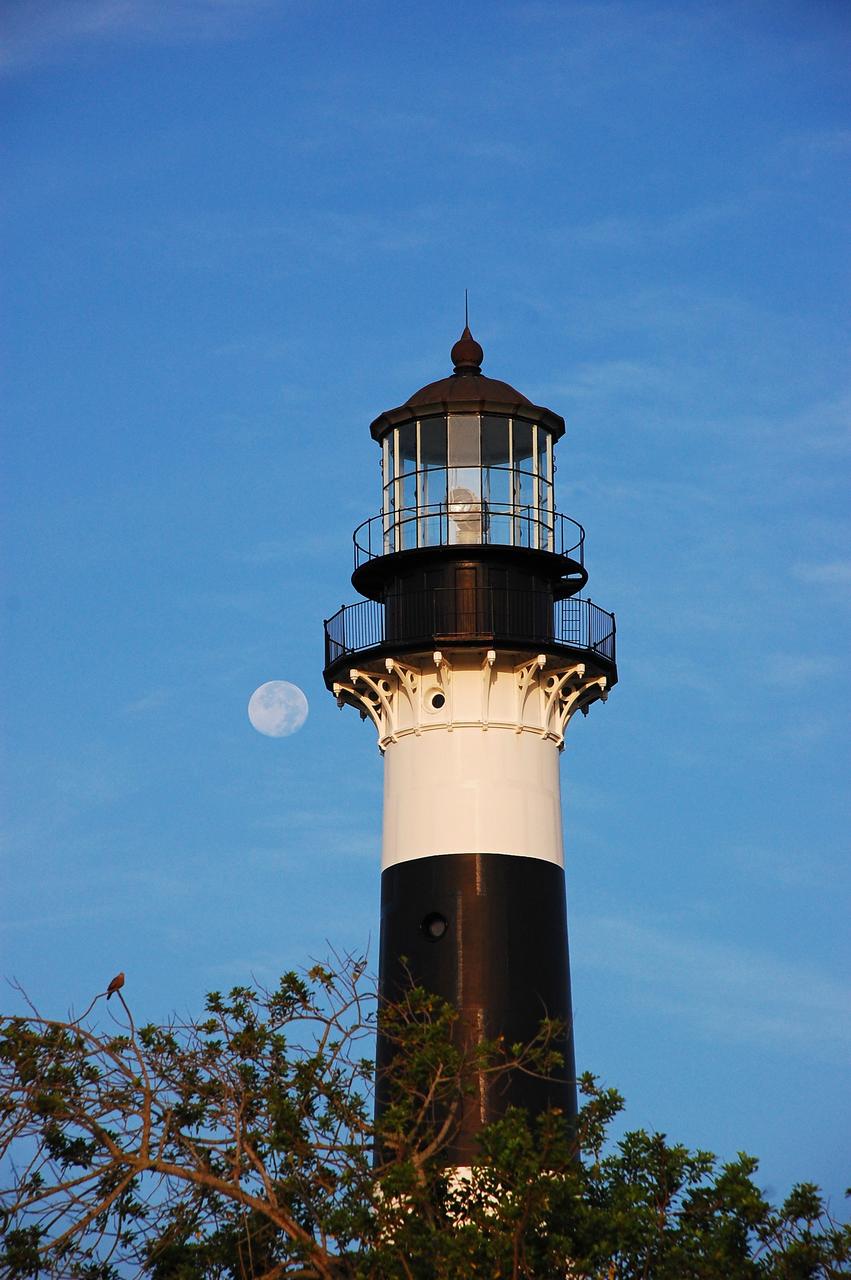
Cape Canaveral Air Force Station, Fla. -- The lantern room of the Cape Canaveral Lighthouse, with its modern first-order optic, takes on a warm glow as dawn breaks and a full moon still shines overhead. The Canaveral light is the only operating lighthouse owned by the U.S. Air Force. In 2000, the Coast Guard transferred ownership of the lighthouse structure and its grounds to the Air Force, which is now responsible for maintaining it. The U.S. Coast Guard continues to operate the beacon as an active navigational aid. The first lighthouse at Cape Canaveral was built near the tip of the Cape in 1848. The structure was only about 60 feet high with a rather dim light powered by whale oil. In 1859, work began nearby on a new, taller iron structure. Construction was halted during the Civil War, and the lighthouse finally was finished in 1868. The structure, with a brick lining inside its iron exterior, was painted with its "daymark" black and white horizontal bands in 1873 to make it easier to identify during the day as a navigation point. Between 1892 and 1894, the lighthouse was dismantled and moved to its new home about a mile from the coast, where it stands today. Photo credit: NASA/Ben Smegelsky
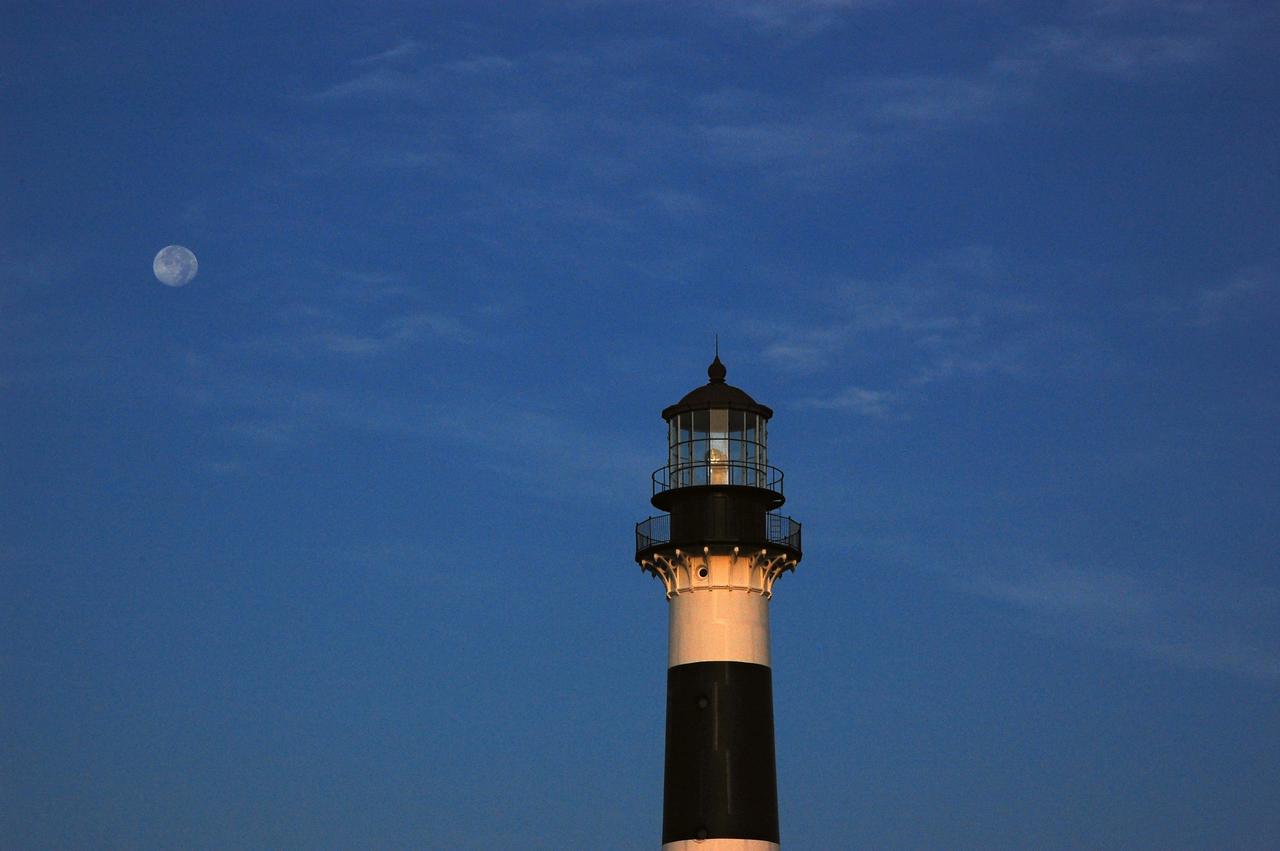
Cape Canaveral Air Force Station, Fla. -- The lantern room of the Cape Canaveral Lighthouse, with its modern first-order optic, takes on a warm glow as dawn breaks and a full moon still shines overhead. The Canaveral light is the only operating lighthouse owned by the U.S. Air Force. In 2000, the Coast Guard transferred ownership of the lighthouse structure and its grounds to the Air Force, which is now responsible for maintaining it. The U.S. Coast Guard continues to operate the beacon as an active navigational aid. The first lighthouse at Cape Canaveral was built near the tip of the Cape in 1848. The structure was only about 60 feet high with a rather dim light powered by whale oil. In 1859, work began nearby on a new, taller iron structure. Construction was halted during the Civil War, and the lighthouse finally was finished in 1868. The structure, with a brick lining inside its iron exterior, was painted with its "daymark" black and white horizontal bands in 1873 to make it easier to identify during the day as a navigation point. Between 1892 and 1894, the lighthouse was dismantled and moved to its new home about a mile from the coast, where it stands today. Photo credit: NASA/Ben Smegelsky
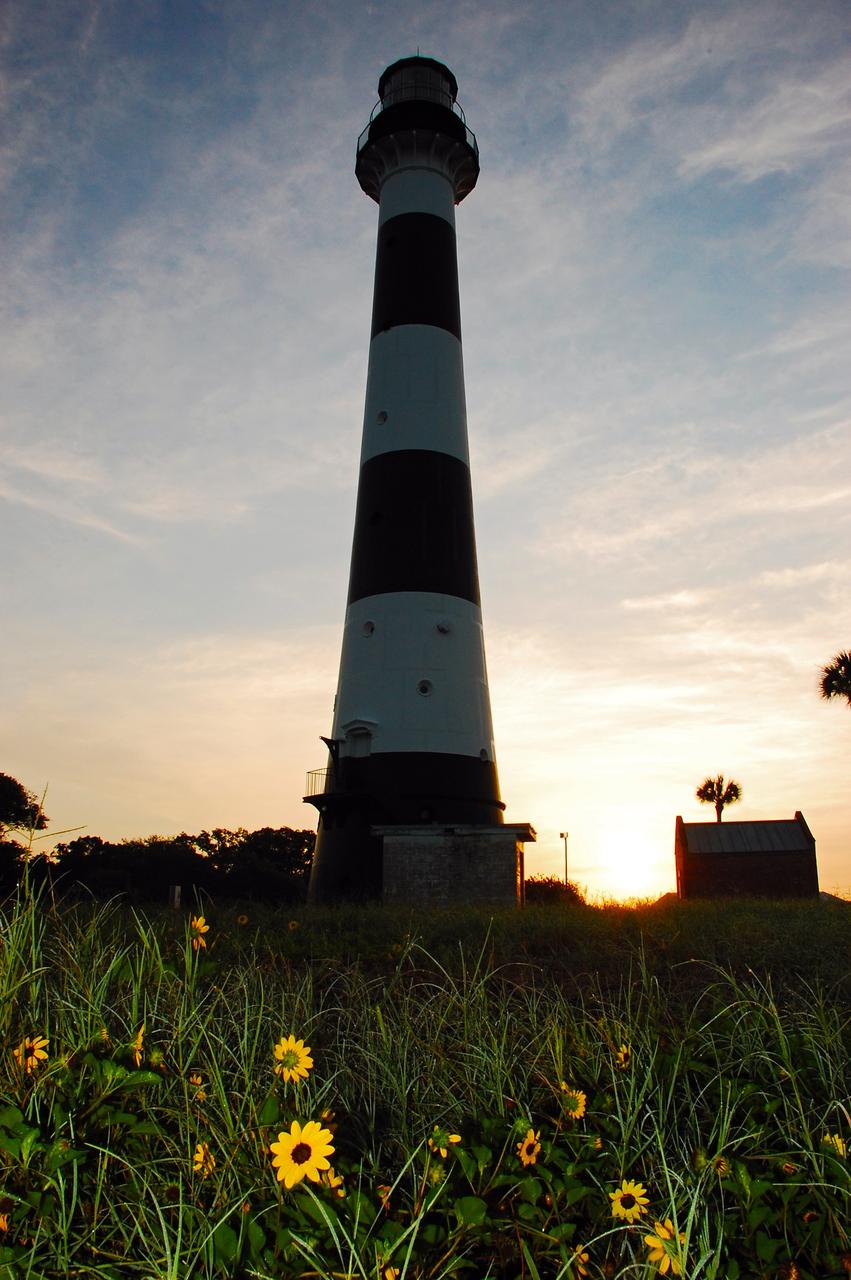
Cape Canaveral Air Force Station, Fla. -- As the sun rises, the Cape Canaveral Lighthouse is silhouetted against the early morning sky. The Canaveral light is the only operating lighthouse owned by the U.S. Air Force. In 2000, the Coast Guard transferred ownership of the lighthouse structure and its grounds to the Air Force, which is now responsible for maintaining it. The U.S. Coast Guard continues to operate the modern first-order beacon as an active navigational aid. The first lighthouse at Cape Canaveral was built near the tip of the Cape in 1848. The structure was only about 60 feet high with a rather dim light powered by whale oil. In 1859, work began nearby on a new, taller iron structure. Construction was halted during the Civil War, and the lighthouse finally was finished in 1868. The structure, with a brick lining inside its iron exterior, was painted with its "daymark" black and white horizontal bands in 1873 to make it easier to identify during the day as a navigation point. Between 1892 and 1894, the lighthouse was dismantled and moved to its new home about a mile from the coast, where it stands today. Photo credit: NASA/Ben Smegelsky
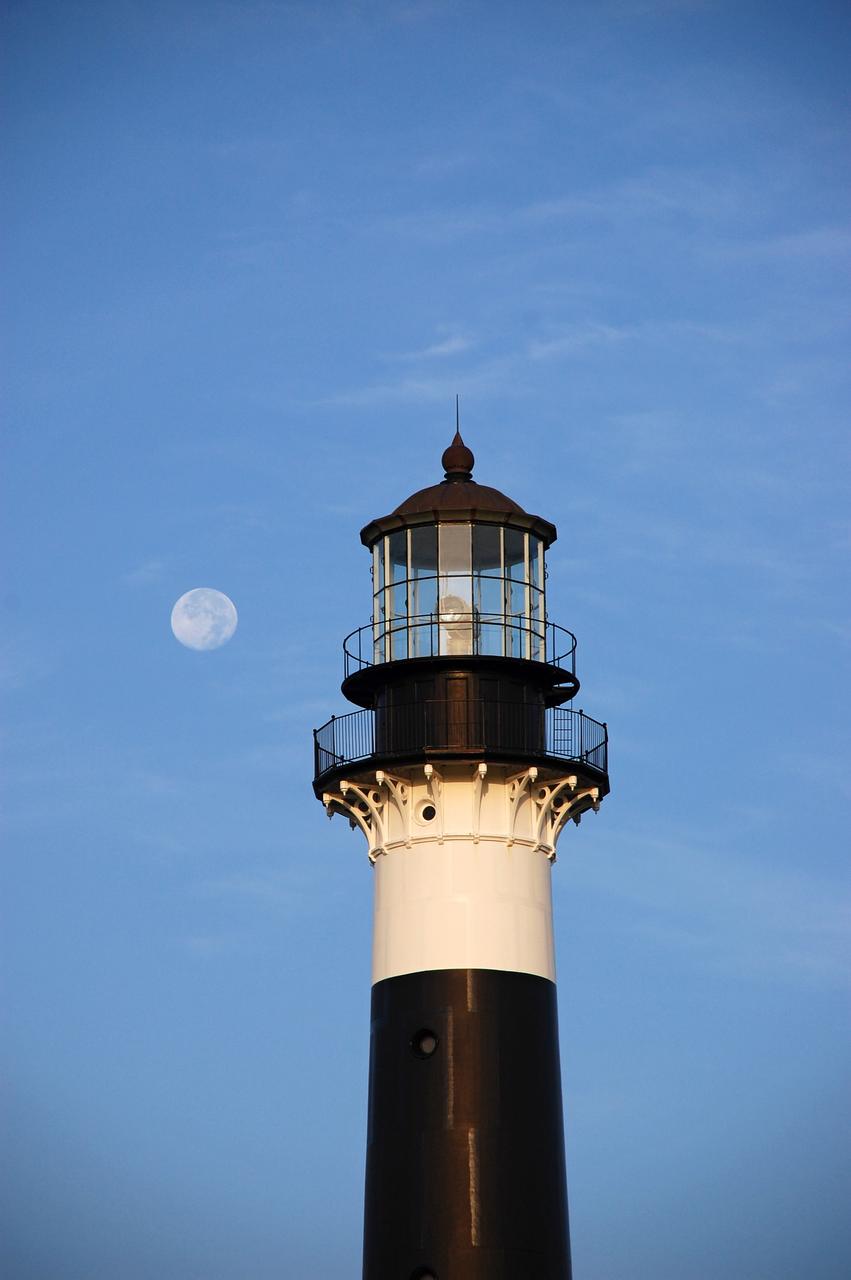
Cape Canaveral Air Force Station, Fla. -- The lantern room of the Cape Canaveral Lighthouse, with its modern first-order optic, takes on a warm glow as dawn breaks and a full moon still shines overhead. The Canaveral light is the only operating lighthouse owned by the U.S. Air Force. In 2000, the Coast Guard transferred ownership of the lighthouse structure and its grounds to the Air Force, which is now responsible for maintaining it. The U.S. Coast Guard continues to operate the beacon as an active navigational aid. The first lighthouse at Cape Canaveral was built near the tip of the Cape in 1848. The structure was only about 60 feet high with a rather dim light powered by whale oil. In 1859, work began nearby on a new, taller iron structure. Construction was halted during the Civil War, and the lighthouse finally was finished in 1868. The structure, with a brick lining inside its iron exterior, was painted with its "daymark" black and white horizontal bands in 1873 to make it easier to identify during the day as a navigation point. Between 1892 and 1894, the lighthouse was dismantled and moved to its new home about a mile from the coast, where it stands today. Photo credit: NASA/Ben Smegelsky
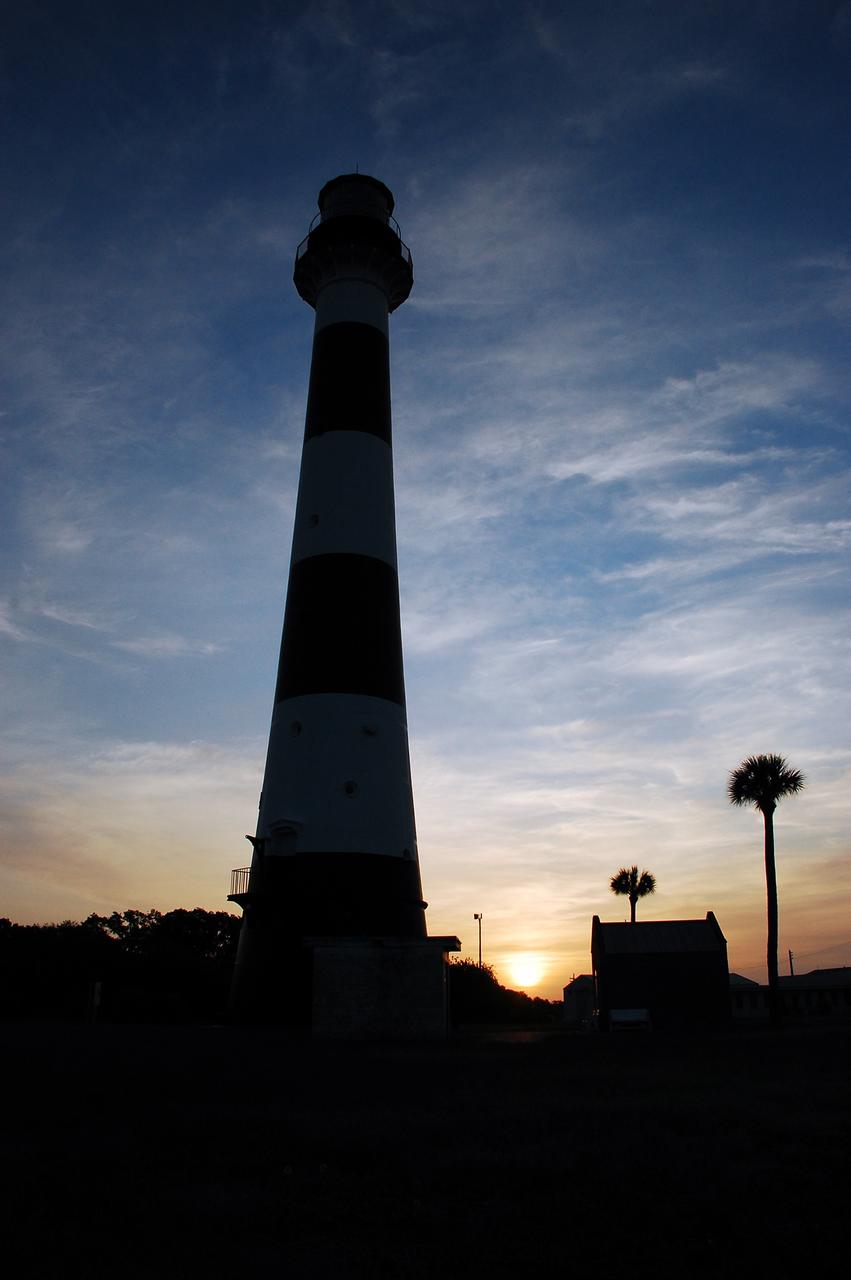
Cape Canaveral Air Force Station, Fla. -- As the sun rises, the Cape Canaveral Lighthouse is silhouetted against the early morning sky. The Canaveral light is the only operating lighthouse owned by the U.S. Air Force. In 2000, the Coast Guard transferred ownership of the lighthouse structure and its grounds to the Air Force, which is now responsible for maintaining it. The U.S. Coast Guard continues to operate the modern first-order beacon as an active navigational aid. The first lighthouse at Cape Canaveral was built near the tip of the Cape in 1848. The structure was only about 60 feet high with a rather dim light powered by whale oil. In 1859, work began nearby on a new, taller iron structure. Construction was halted during the Civil War, and the lighthouse finally was finished in 1868. The structure, with a brick lining inside its iron exterior, was painted with its "daymark" black and white horizontal bands in 1873 to make it easier to identify during the day as a navigation point. Between 1892 and 1894, the lighthouse was dismantled and moved to its new home about a mile from the coast, where it stands today. Photo credit: NASA/Ben Smegelsky