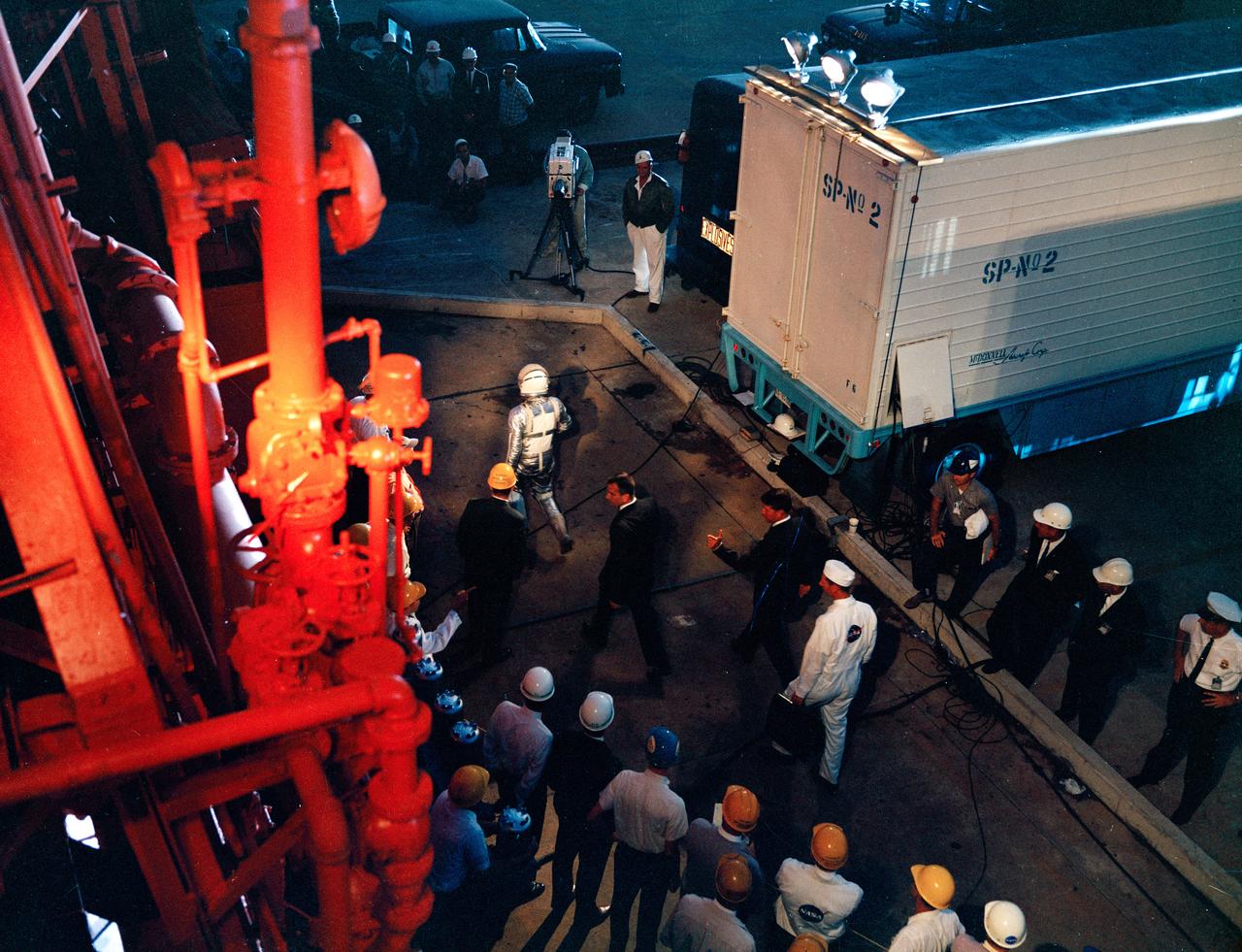
S63-07632 (15 May 1963) --- Astronaut L. Gordon Cooper Jr. leaves the transfer van for the launch pad and the beginning of the Mercury-Atlas 9 (MA-9) flight on May 15, 1963. Photo credit: NASA
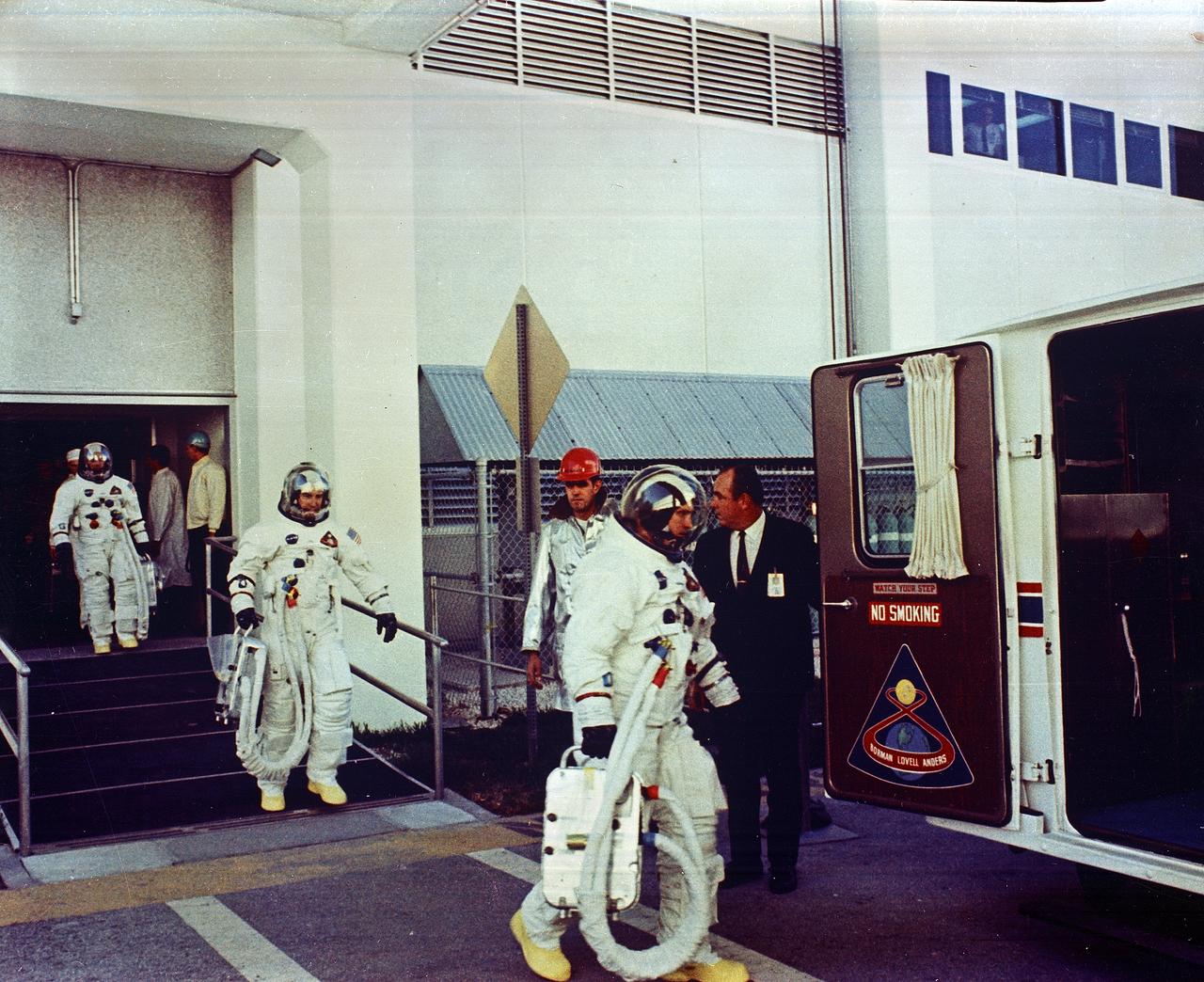
Apollo 8 Astronauts William Anders, Lunar Module (LM) Pilot; James Lovell, Command Module (CM) pilot; and Frank Borman, commander, transfer to the astronaut van for the trip to the launch pad. The first manned Apollo mission launched aboard the Saturn V and first manned Apollo craft to enter lunar orbit, the SA-503, Apollo 8 mission liftoff occurred on December 21, 1968 and returned safely to Earth on December 27, 1968. The mission achieved operational experience and tested the Apollo command module systems, including communications, tracking, and life-support, in cis-lunar space and lunar orbit, and allowed evaluation of crew performance on a lunar orbiting mission. The crew photographed the lunar surface, both far side and near side, obtaining information on topography and landmarks as well as other scientific information necessary for future Apollo landings. All systems operated within allowable parameters and all objectives of the mission were achieved.
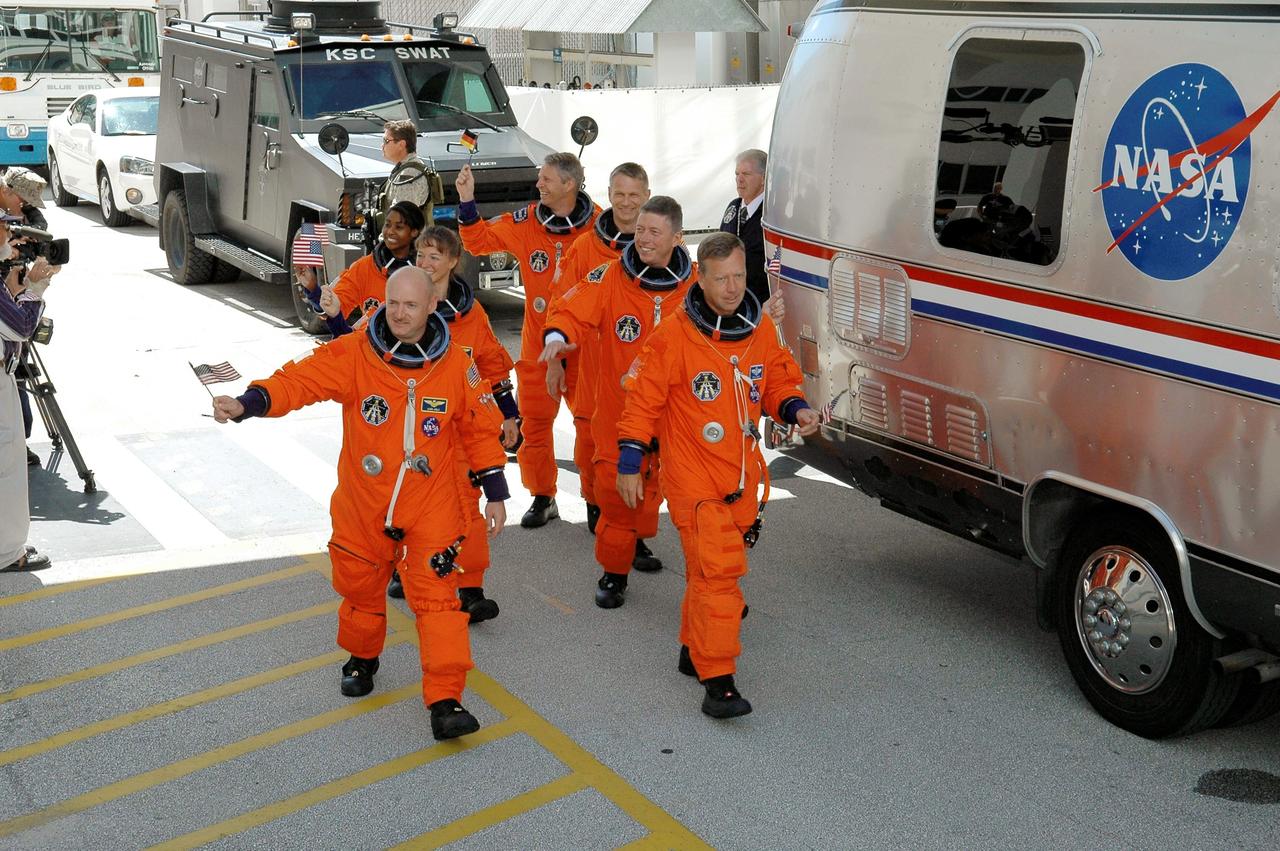
STS121-S-006 (4 July 2006) --- The STS-121 crewmembers, having donned their shuttle launch and entry suits, wave flags for the Fourth of July as they prepare to board the transfer van awaiting to take them to Launch Pad 39B. Steven W. Lindsey (right front), commander, and Mark E. Kelly, pilot, lead the way. Other crewmembers - Lisa M. Nowak, Michael E. Fossum, Stephanie D. Wilson, Piers J. Sellers and European Space Agency (ESA) astronaut Thomas Reiter of Germany - follow.
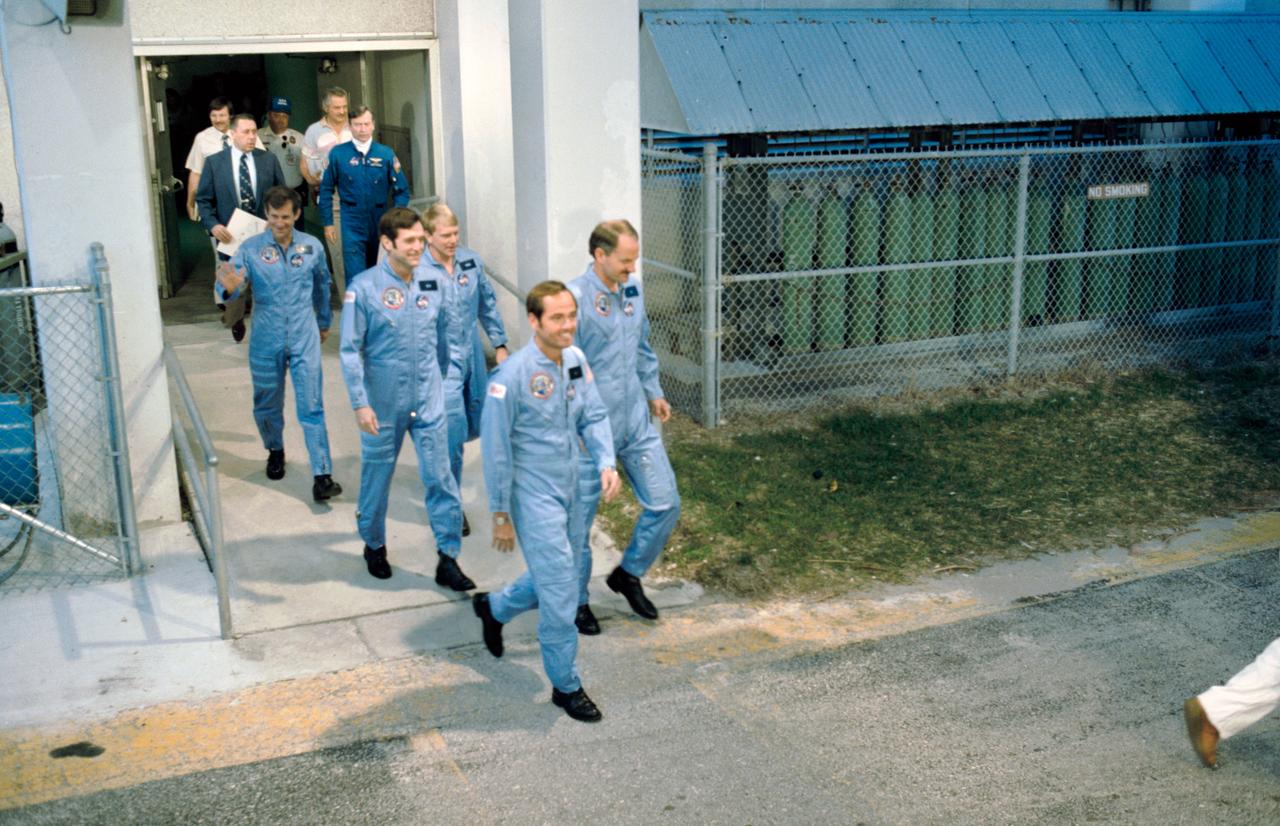
41C-3061 (6 April 1984) --- The five-member astronauts crew for NASA's STS-41C Space Shuttle mission head for the transfer van that will transport them to Launch Pad 39B at the Kennedy Space Center. Astronaut Robert L. Crippen, commander, leads the way. Immediately behind Crippen is Astronaut Francis R. (Dick) Scobee, pilot. The three mission specialists are (left to right) Astronauts Terry J. Hart, George D. Nelson and James D. van Hoften. The photograph was taken by Otis Imobden.
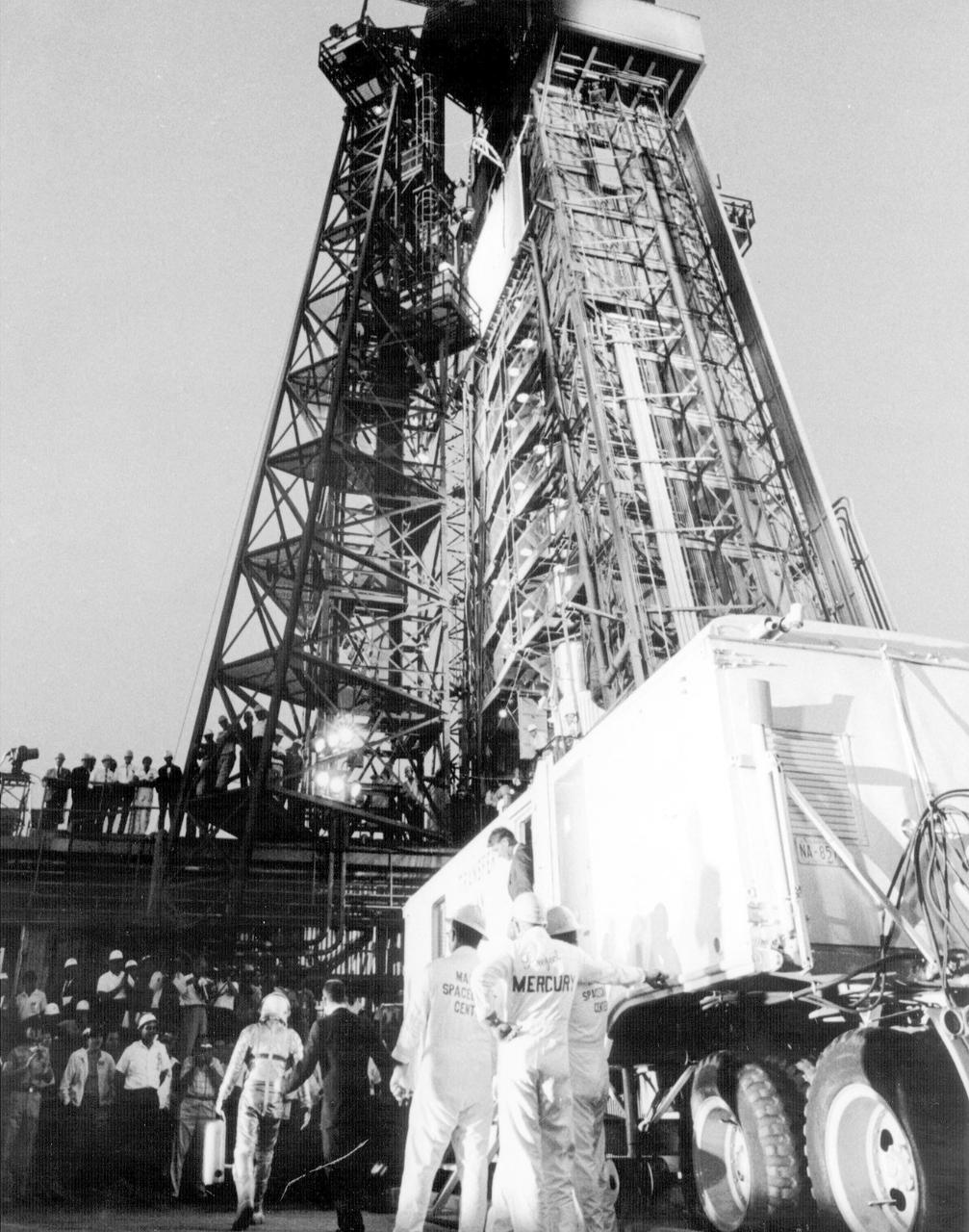
JSC2013-E-076221 (15 May 1963) --- Astronaut L. Gordon Cooper Jr. waited inside the transfer van for several minutes and then leaving the transfer van walked to the elevator which took him to the spacecraft "Faith 7" atop the Atlas vehicle for his mission. (63-MA9-132) Photo credit: NASA
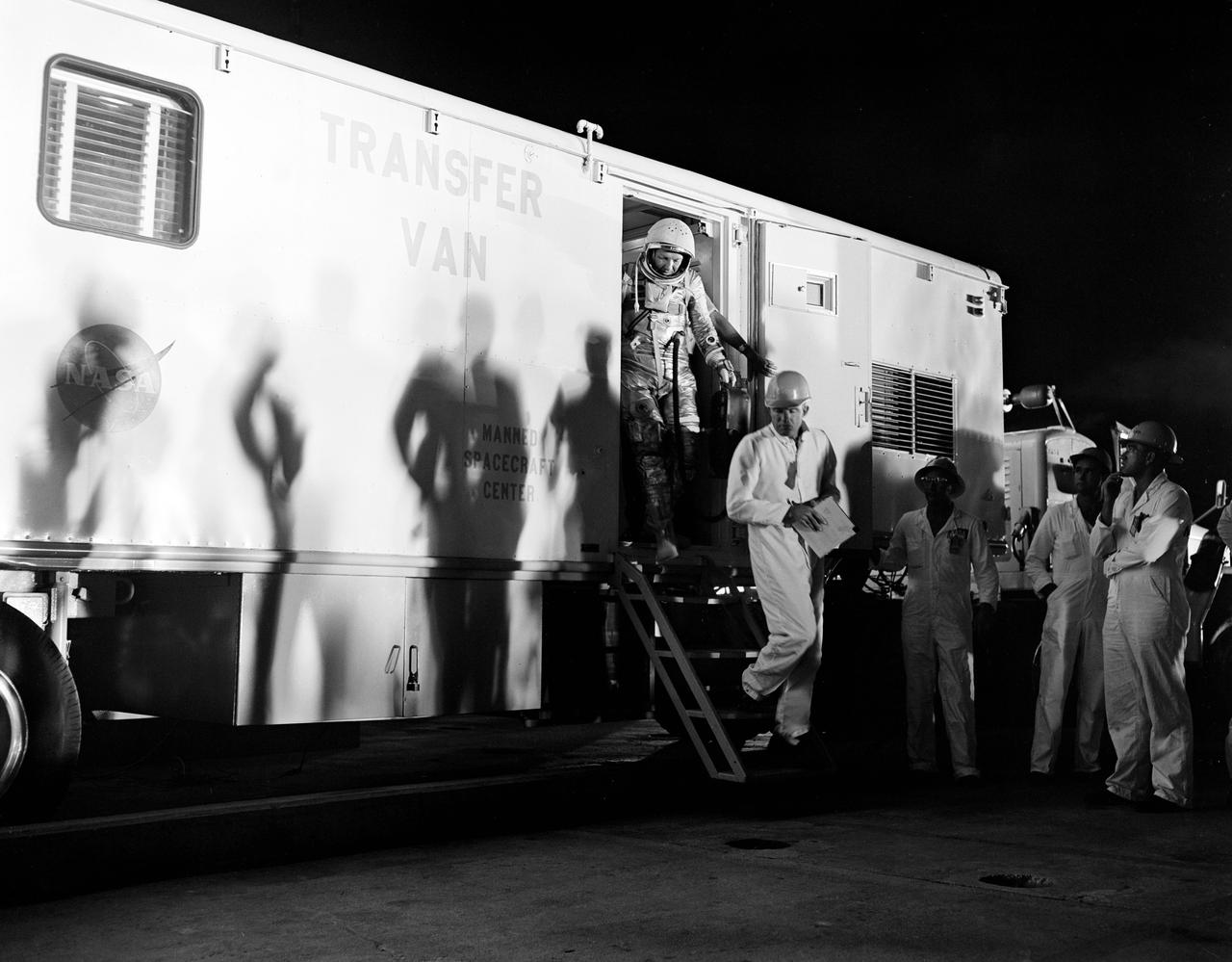
S62-06008 (3 Oct. 1962) --- Astronaut Walter M. Schirra Jr., pilot of the Mercury-Atlas 8 (MA-8) Earth-orbital spaceflight, steps from a transport van as he arrives at Cape Canaveral's Pad 14 during the MA-8 prelaunch countdown. Schirra is accompanied by astronaut L. Gordon Cooper Jr. (in white coveralls), MA-8 backup pilot. Photo credit: NASA
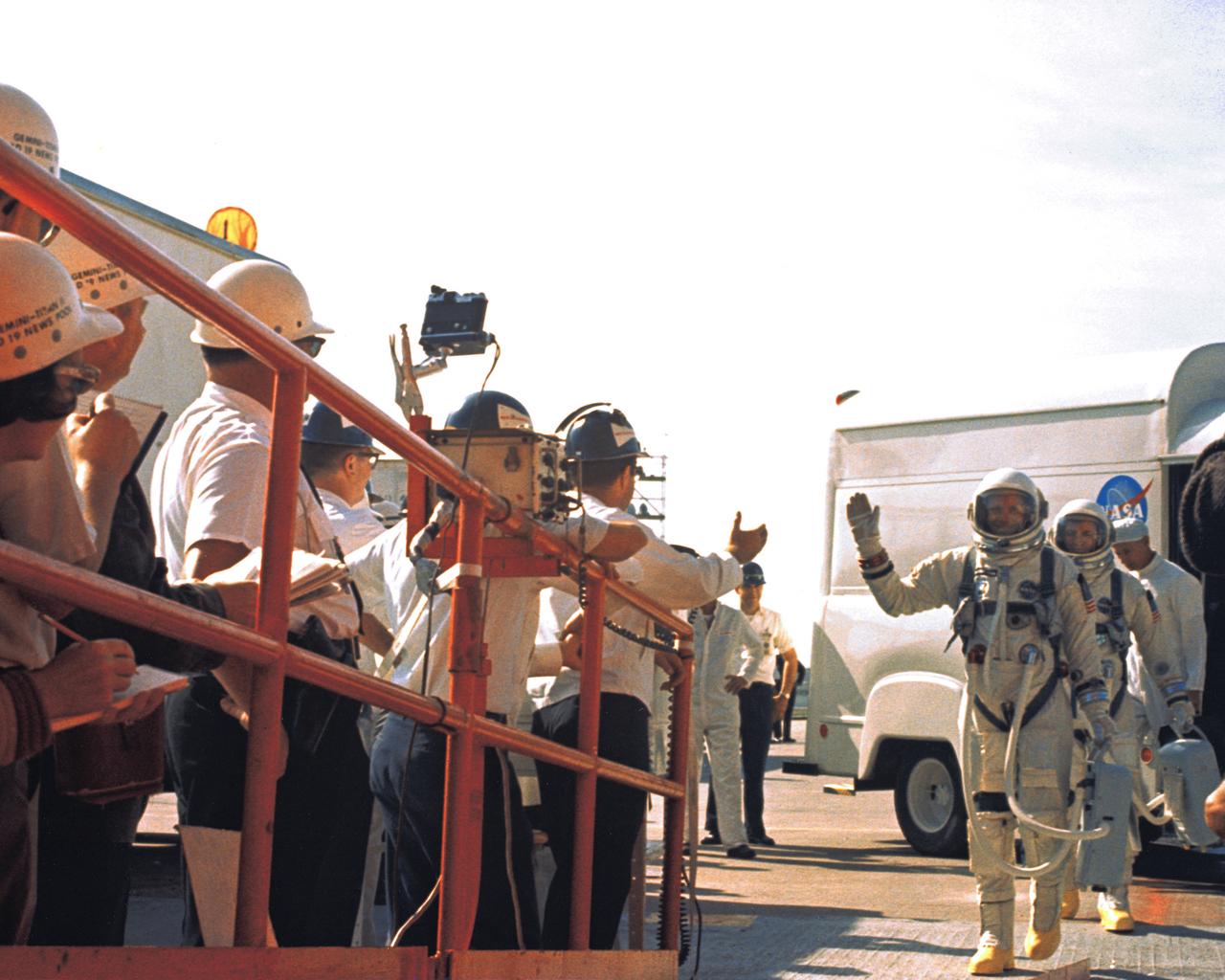
KSC-66C-1855 Gemini-8 Astronauts Neil A. Armstrong and David R. Scott leave Transfer Van at Complex 19, Cape Kennedy prior to boarding their Gemini 8 Spacecraft. (jrs)
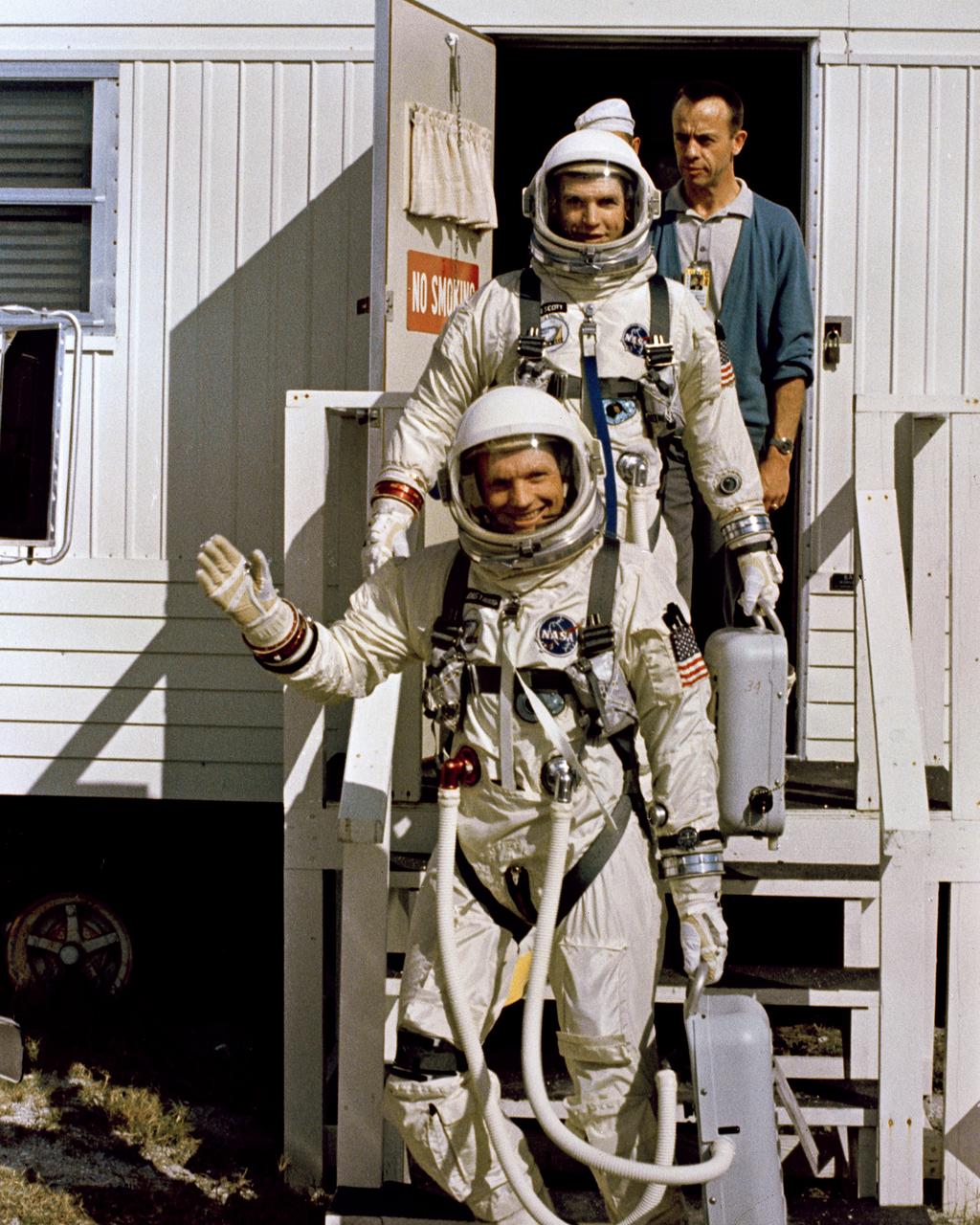
KSC-66C-1869 Astronauts Neil Armstrong and David Scott leave Suiting Trailer and enter Transfer Van at Cape Kennedy prior to boarding their Spacecraft for Gemini 8 Mission. (jrs)
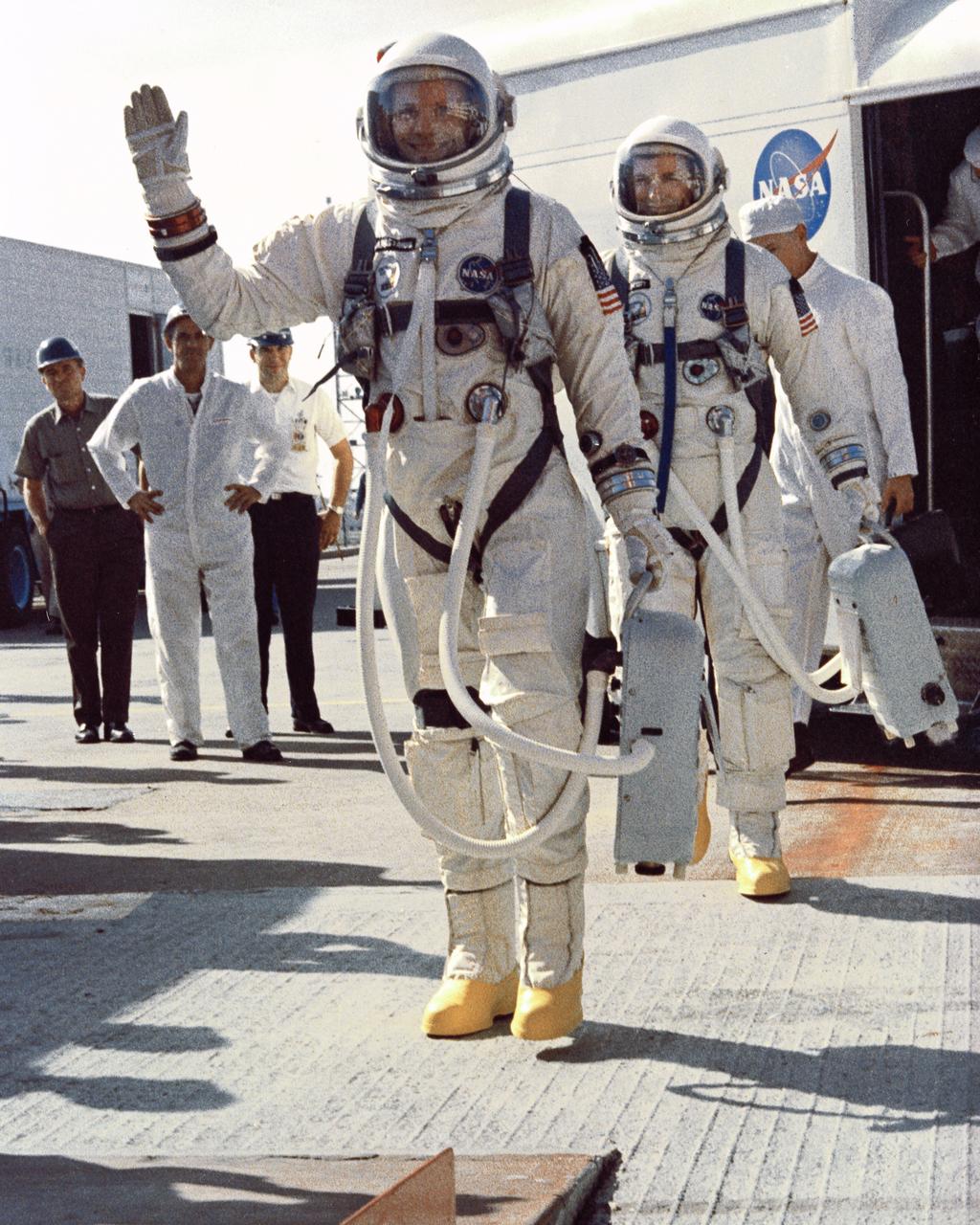
KSC-66C-1867 Gemini-8 Astronauts Neil A. Armstrong and David R. Scott leave Transfer Van at Complex 19, Cape Kennedy prior to boarding their Gemini 8 Spacecraft. (jrs)
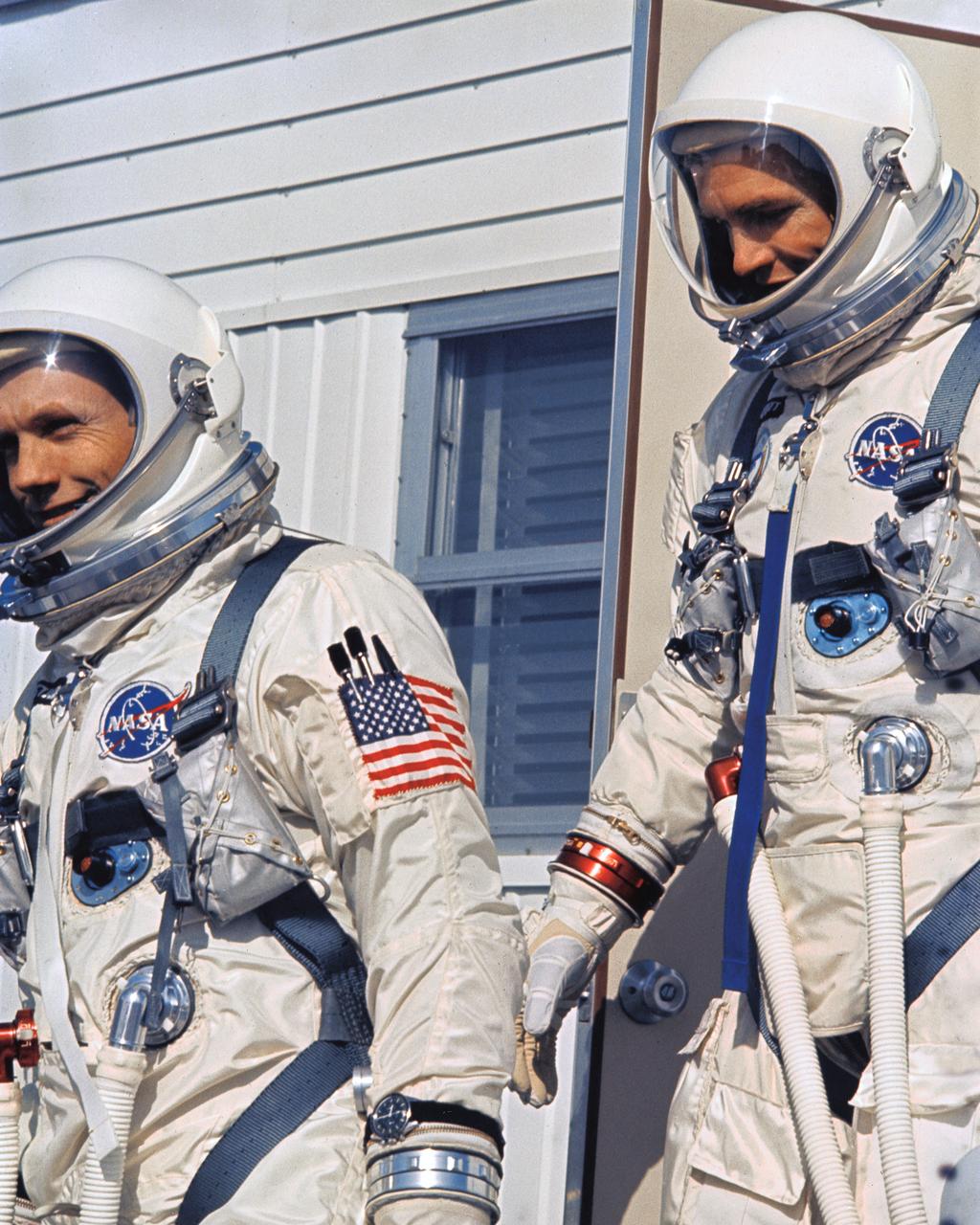
KSC-66C-1851 Astronauts Neil Armstrong and David Scott leave Suiting Trailer to enter Transfer Van, Complex 19, Cape Kennedy prior to boarding their Spacecraft for Gemini 8 Mission. (jrs)
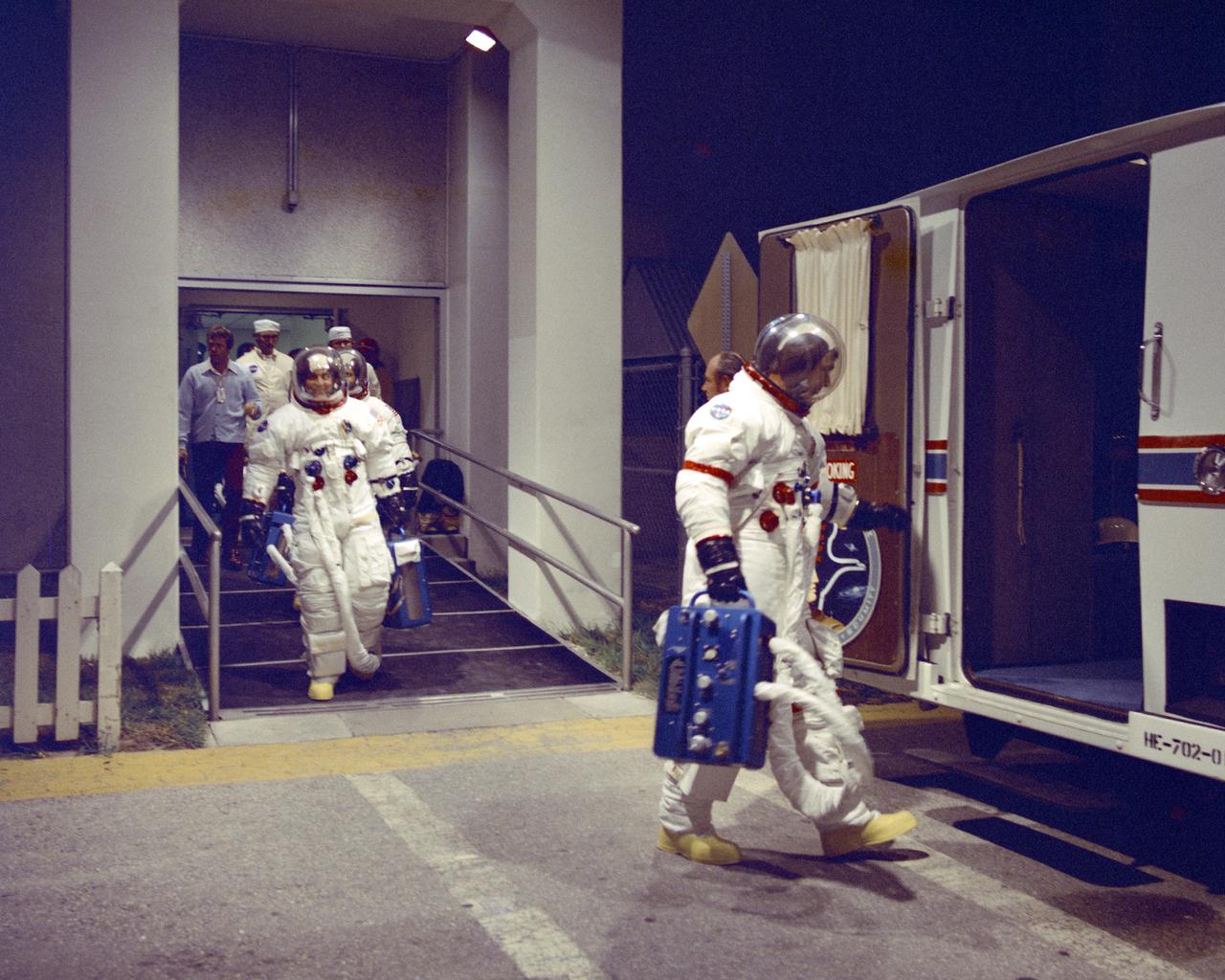
Apollo 17 Astronauts, front to rear, Eugene A. Cernan, Ronald E. Evans and Harrison H. Schmitt walk to the transfer van at start of brief ride to launch pad during countdown Demonstration test activities.
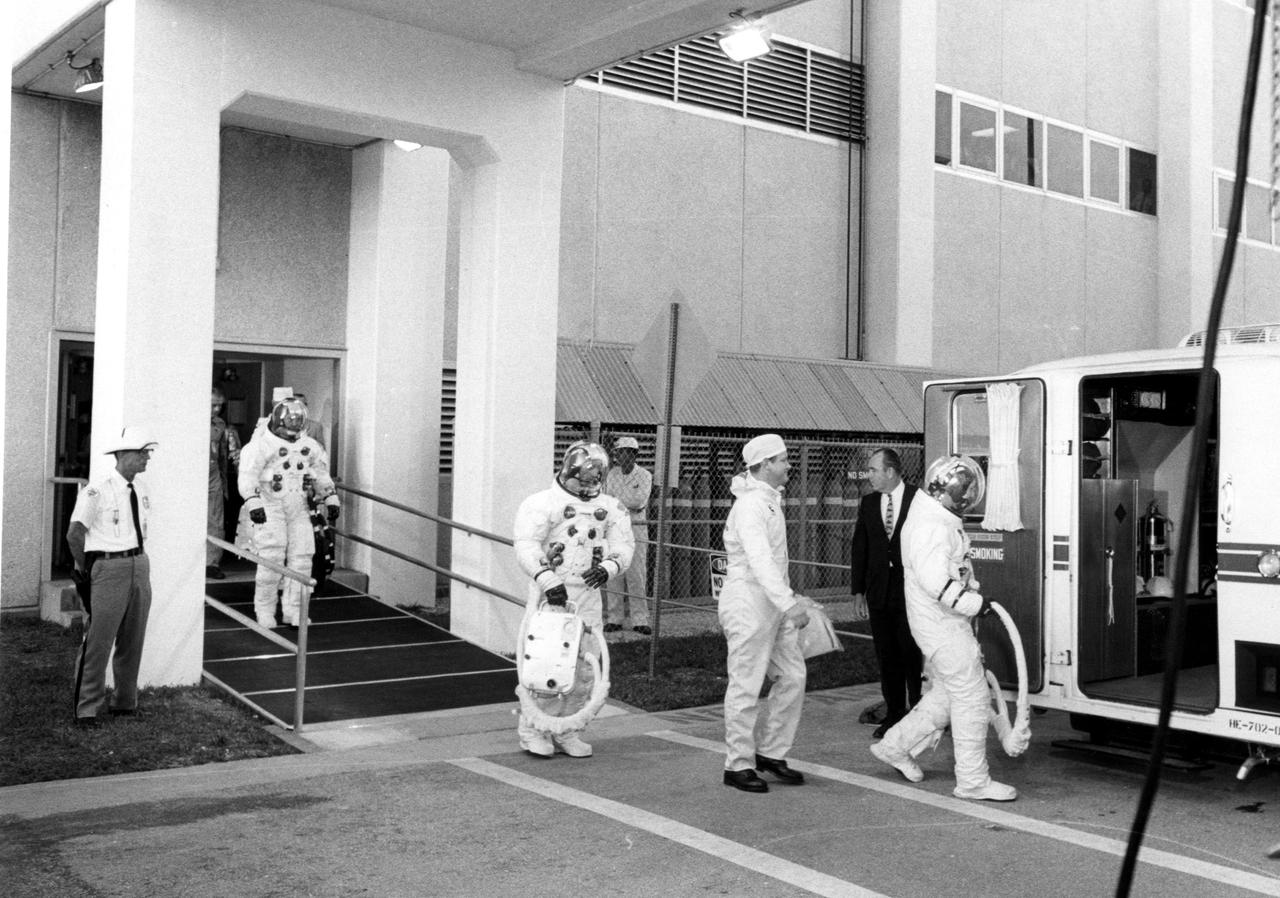
KENNEDY SPACE CENTER, FLA. -- Apollo 7 astronauts enter transfer van, which transported them to Cape Kennedy's Launch Complex 34 and their Saturn IB space vehicle that lifted off at 11:03 a.m. EDT, Oct. 11, 1968. First to enter the transfer van was Donn F. Eisele, command module pilot, followed by Walter Cunningham, lunar module pilot, and Walter M. Schirra Jr., Apollo 7 commander. The space pilots are scheduled to orbit the Earth 11 days, gathering information for future lunar voyages directed by the National Aeronautics and Space Administration.
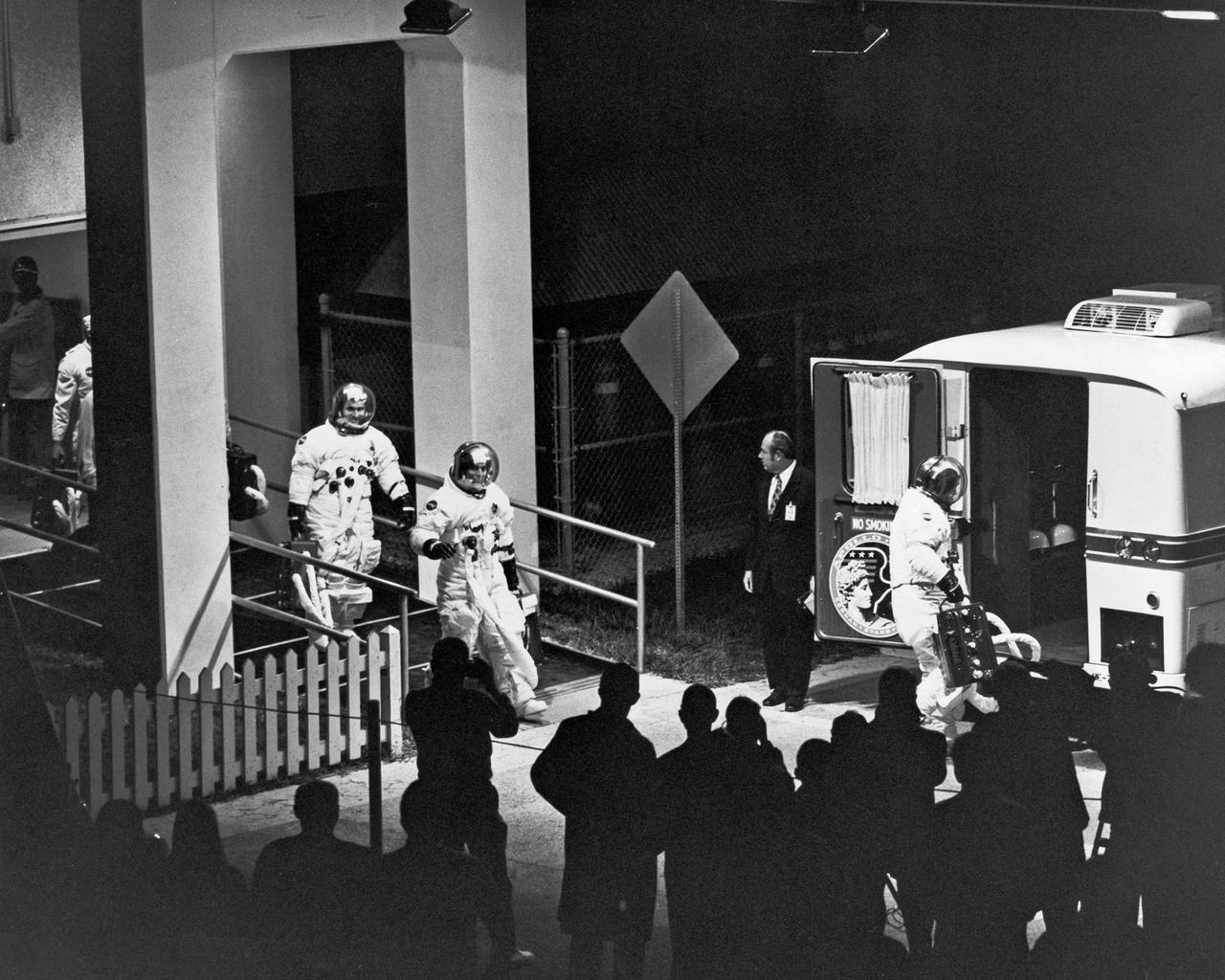
The Apollo 17 prime crew leaves the Manned Spaceflight Operations Building to enter the transfer van which will carry them to Complex 39's Pad A to participate in the CDDT. From right are Eugene A. Cernan, Commander Ronald E. Evans, Command Module Pilot, and Harrison H. Schmitt, Lunar Module Pilot.
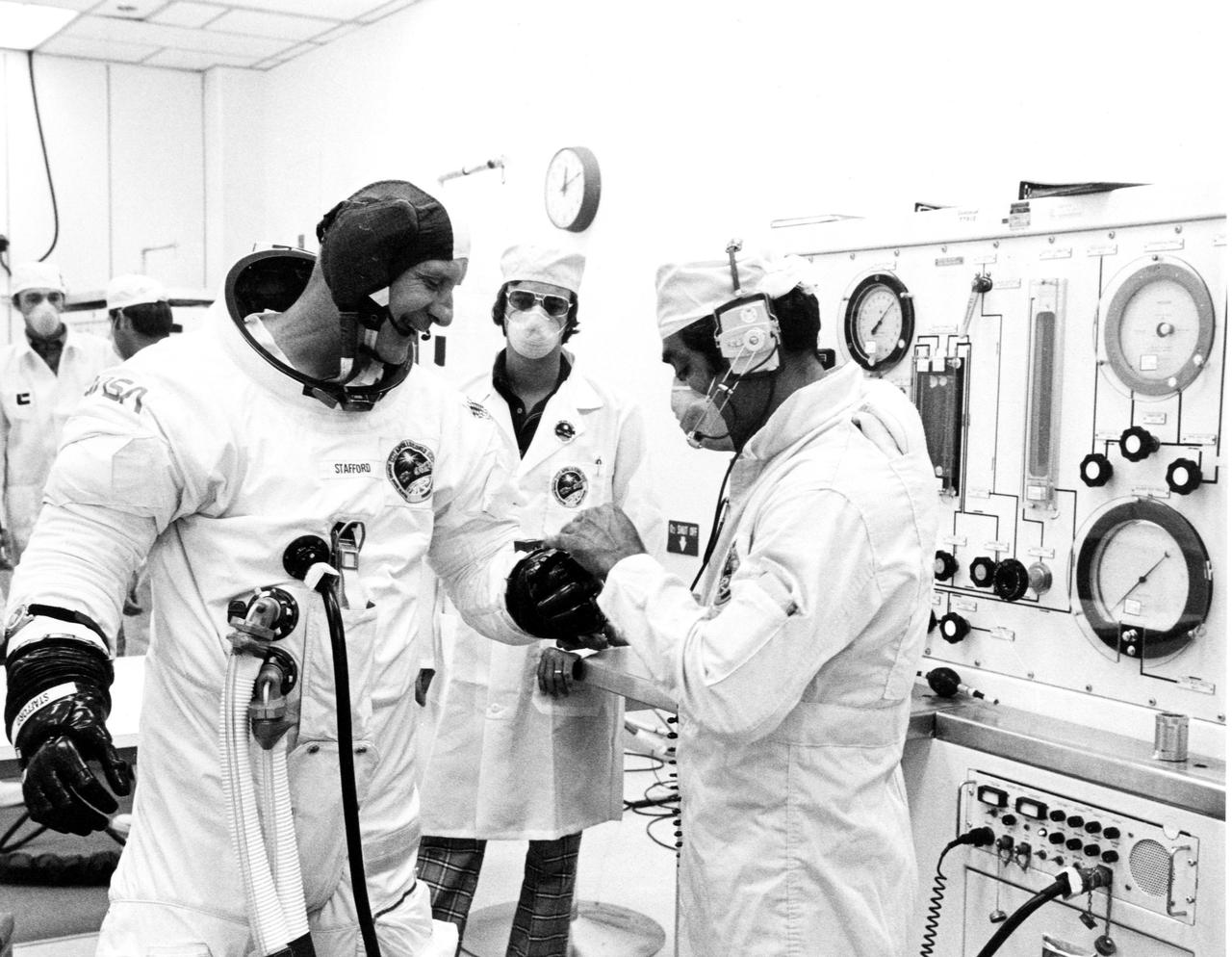
KENNEDY SPACE CENTER, FLA. -- A suit technician helps ASTP astronaut Thomas Stafford don his pressure suit. After suitup, Stafford and crewmen Vance Brand and Donald Slayton walked to the transfer van for the trip to the launch pad.
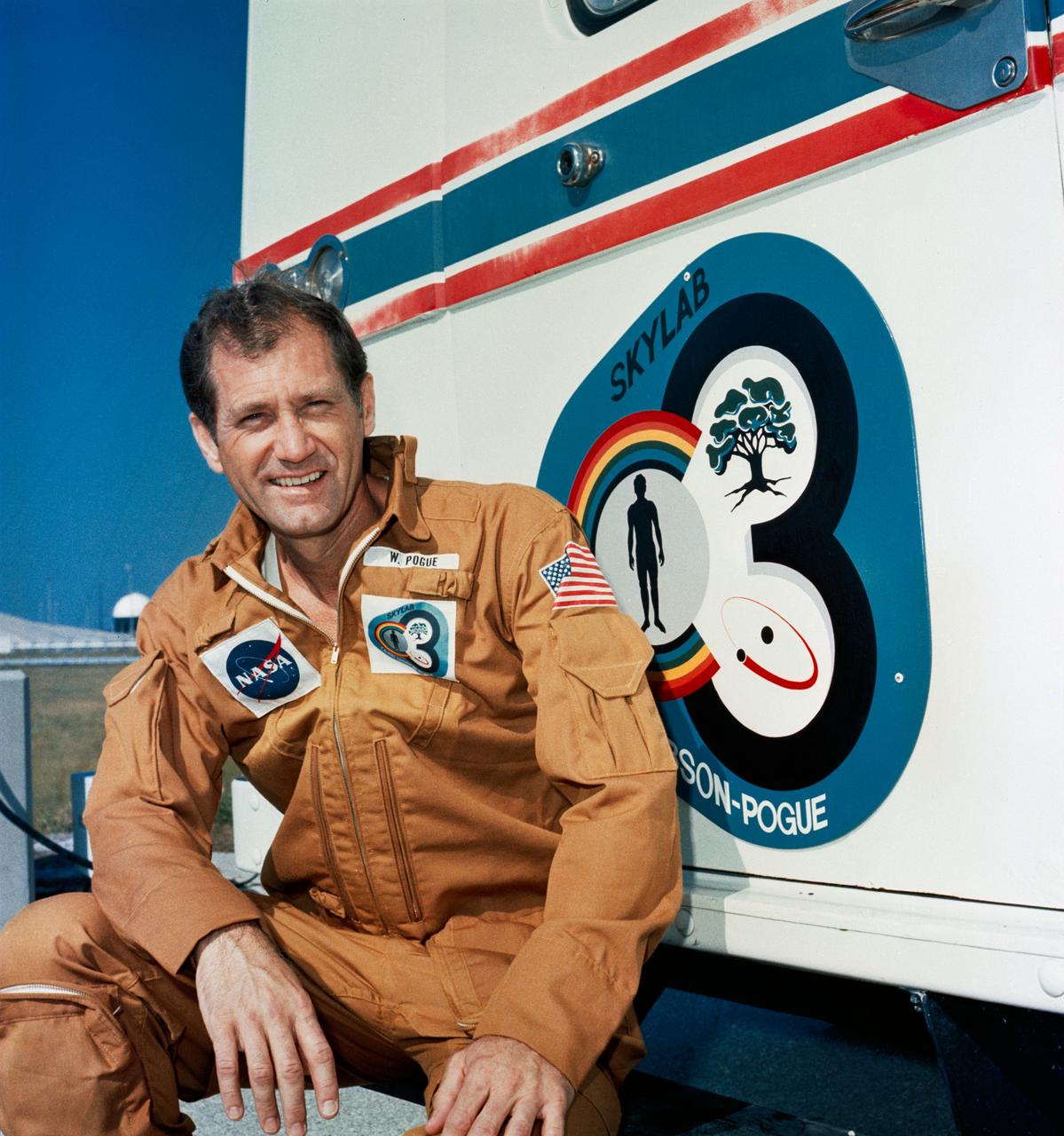
S73-36901 (8 Nov. 1973) --- Astronaut William R. Pogue, pilot of the Skylab 4 mission, relaxes on the running board of the transfer van during a visit to the Skylab 4/Saturn 1B space vehicle at Pad B, Launch Complex 39, Kennedy Space Center, Florida. On the morning of the launch the transfer van will transport astronauts Pogue, Gerald P. Carr, commander; and Edward G. Gibson, science pilot, from the suiting building to Pad B. Skylab 4, the third and last visit to the Skylab space station in Earth orbit, will return additional information on the Earth and sun, as well as provide a favorable location from which to observe the recently discovered Comet Kohoutek. Photo credit: NASA
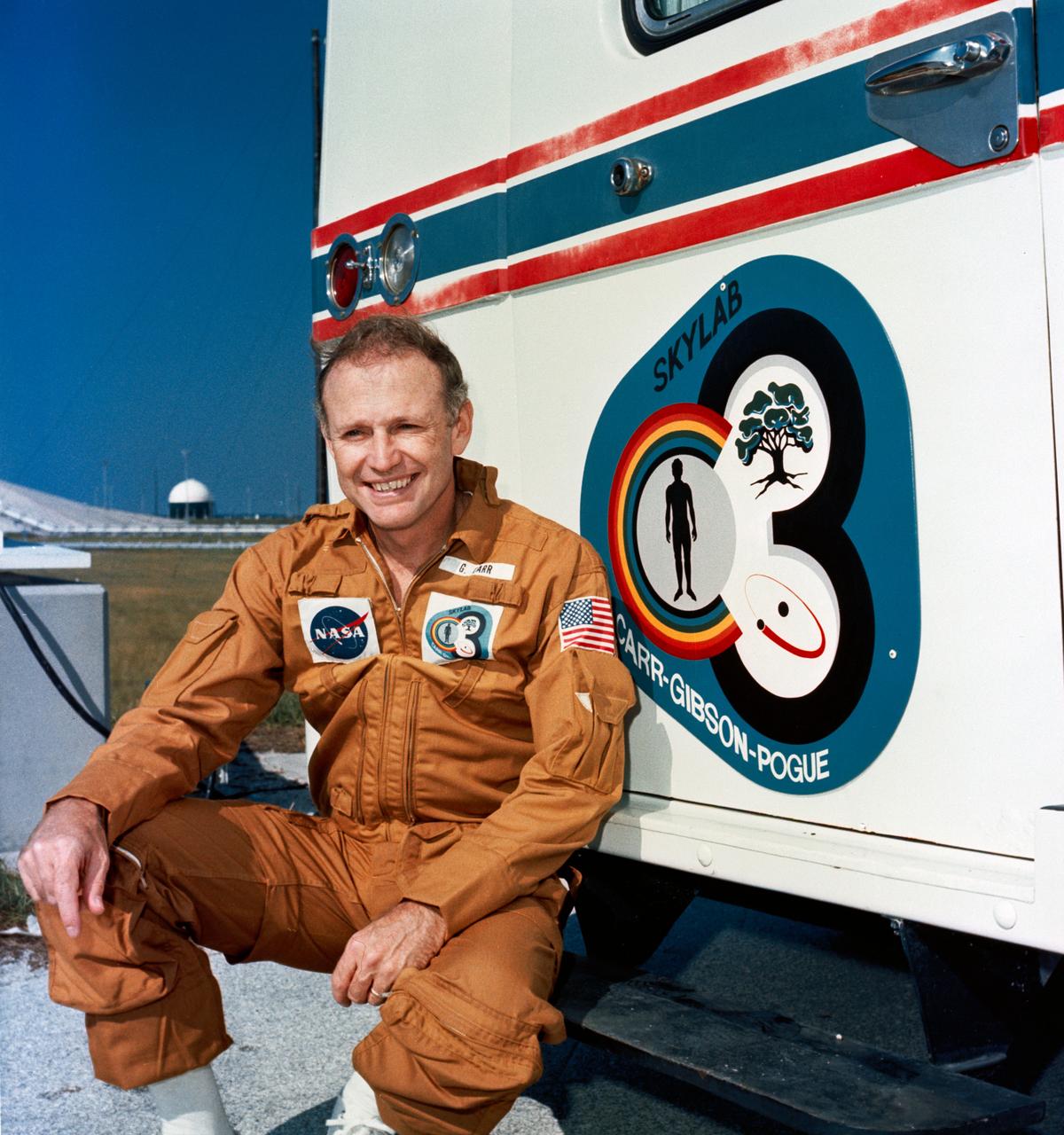
S73-36902 (8 Nov. 1973) --- Astronaut Gerald P. Carr, commander of the Skylab 4 mission, relaxes on the running board of the transfer van during a visit to the Skylab 4/Saturn 1B space vehicle at Pad B, Launch Complex 39, at the Kennedy Space Center, Florida. On the morning of the launch the transfer van will transport astronauts Carr; William R. Pogue, pilot; and Edward G. Gibson, science pilot, from the suiting building to Pad B. Skylab 4, the third and last visit to the Skylab space station in Earth orbit, will return additional information the Earth and sun, as well as provide a favorable location from which to observe the recently discovered Comet Kohoutek. Photo credit: NASA
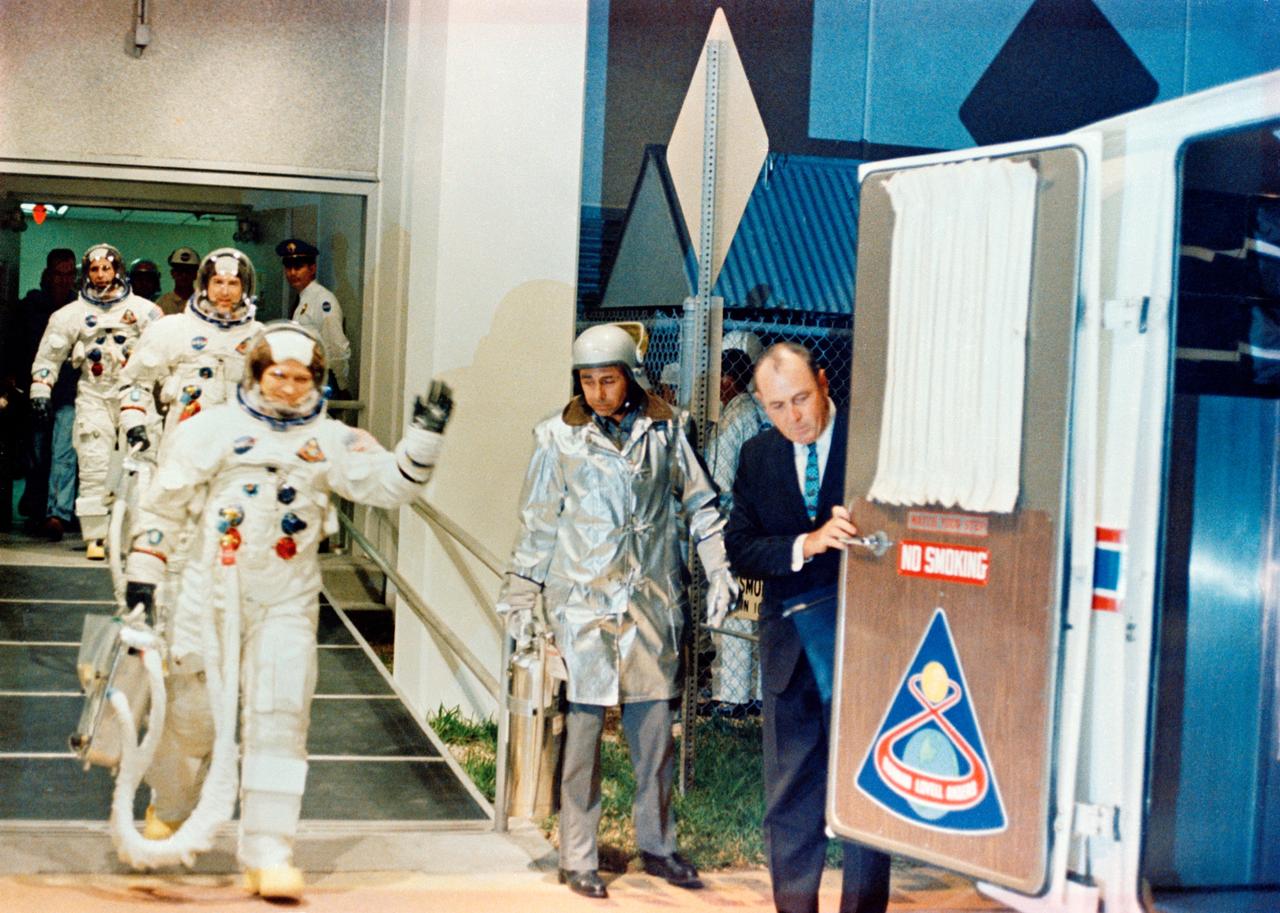
S68-55999 (21 Dec. 1968) --- The Apollo 8 crew leaves the Kennedy Space Center's (KSC) Manned Spacecraft Operations Building (MSOB) during the Apollo 8 prelaunch countdown. Astronaut Frank Borman (waving to well-wishers), commander, leads followed by astronauts James A. Lovell Jr., command module pilot; and William A. Anders, lunar module pilot. The crew is about to enter a special transfer van which transported them to Pad A, Launch Complex 39, where their Apollo 8 (Spacecraft 103/Saturn 503) space vehicle awaited them. Liftoff for the lunar orbit mission was at 7:51 a.m. (EST). Holding the door to the transfer van is Charles Buckley, KSC security chief.
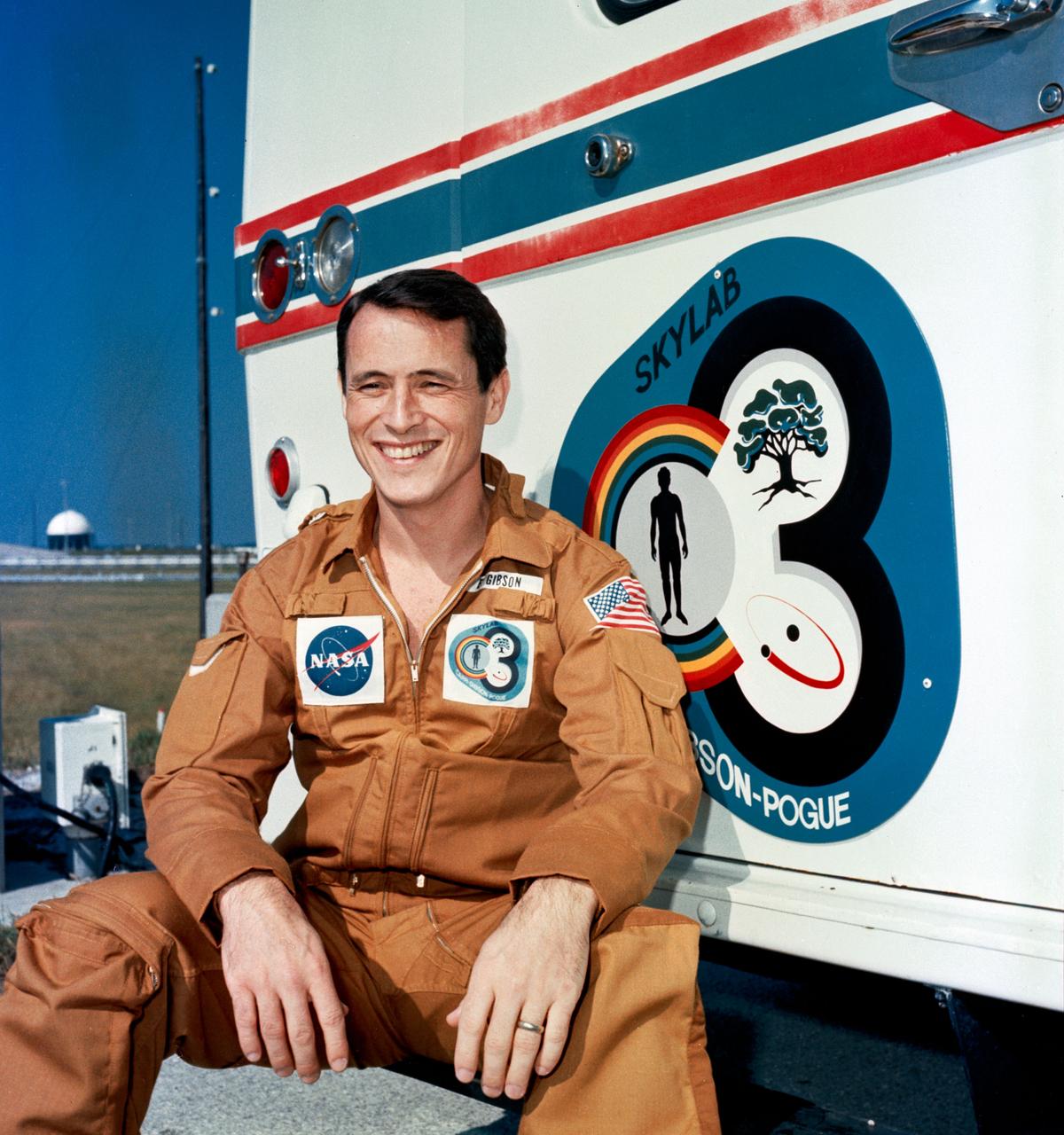
S73-36903 (8 Nov. 1973) --- Scientist-astronaut Edward G. Gibson, Skylab 4 science pilot, relaxes on the running board of the transfer van during a visit to the Skylab 4/Saturn 1B space vehicle at Pad B, Launch Complex 39, Kennedy Space Center, Florida. On the morning of the launch the transfer van will transport astronauts Gibson; Gerald P. Carr, commander; and William R. Pogue, pilot, from the suiting building to Pad B. Skylab 4, the third and last visit to the Skylab space station in Earth orbit, will return additional information on the Earth and sun, as well as provide a favorable location from which to observe the recently discovered Comet Kohoutek. Photo credit: NASA
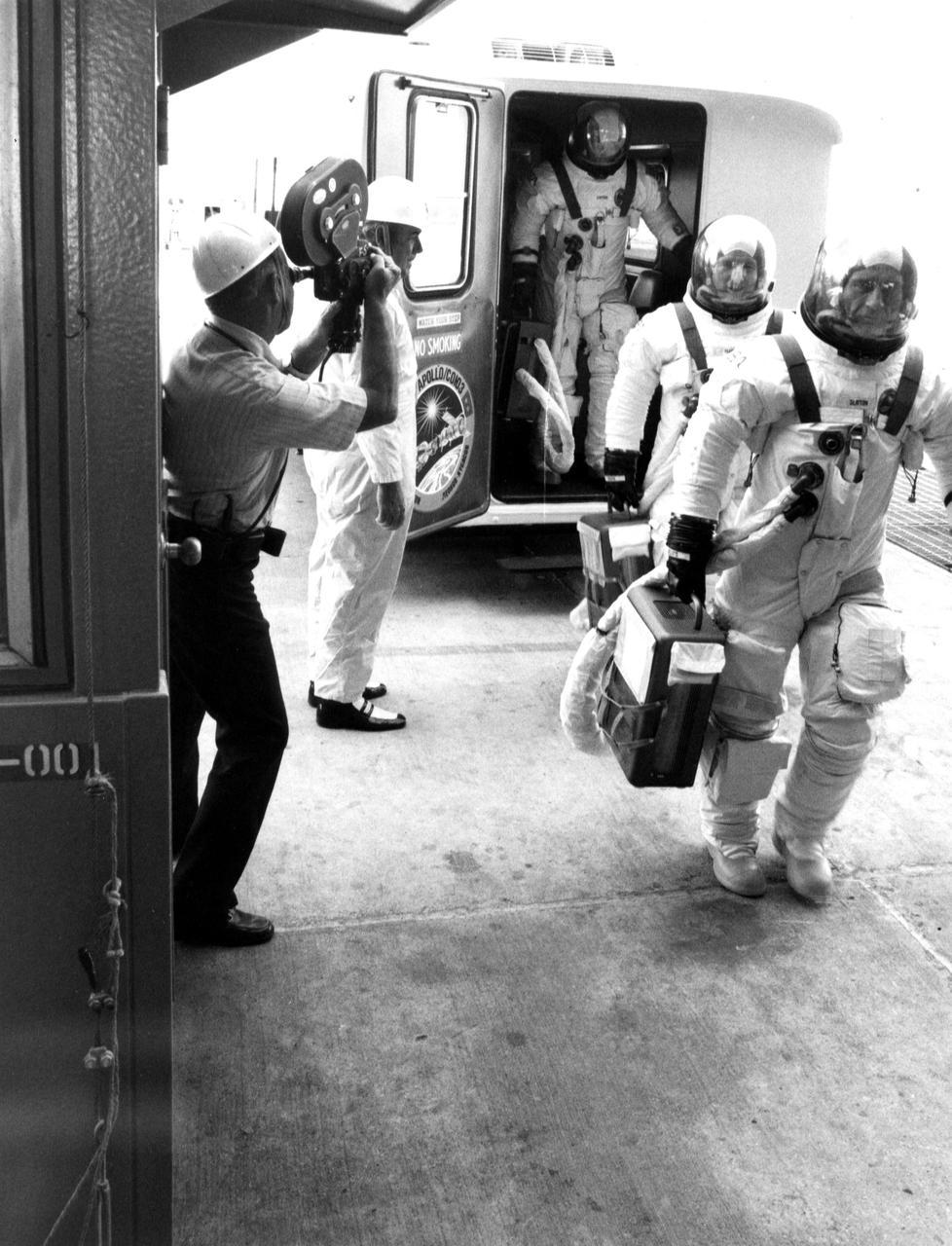
KENNEDY SPACE CENTER, FLA. -- ASTP asstronauts Donald slayton, Vance Brand and Thomas Stafford leave the transfer van at Complex 39's Pad B and enter the pad elevator during the Countdown Demonstration Test. The test, a step-by-step dress rehearsal for the July 15 launch, simulates the actual countdown but without the propellants in the Saturn IB launch vehicle's fuel tanks. The fueled portion of the test was conducted yesterday.
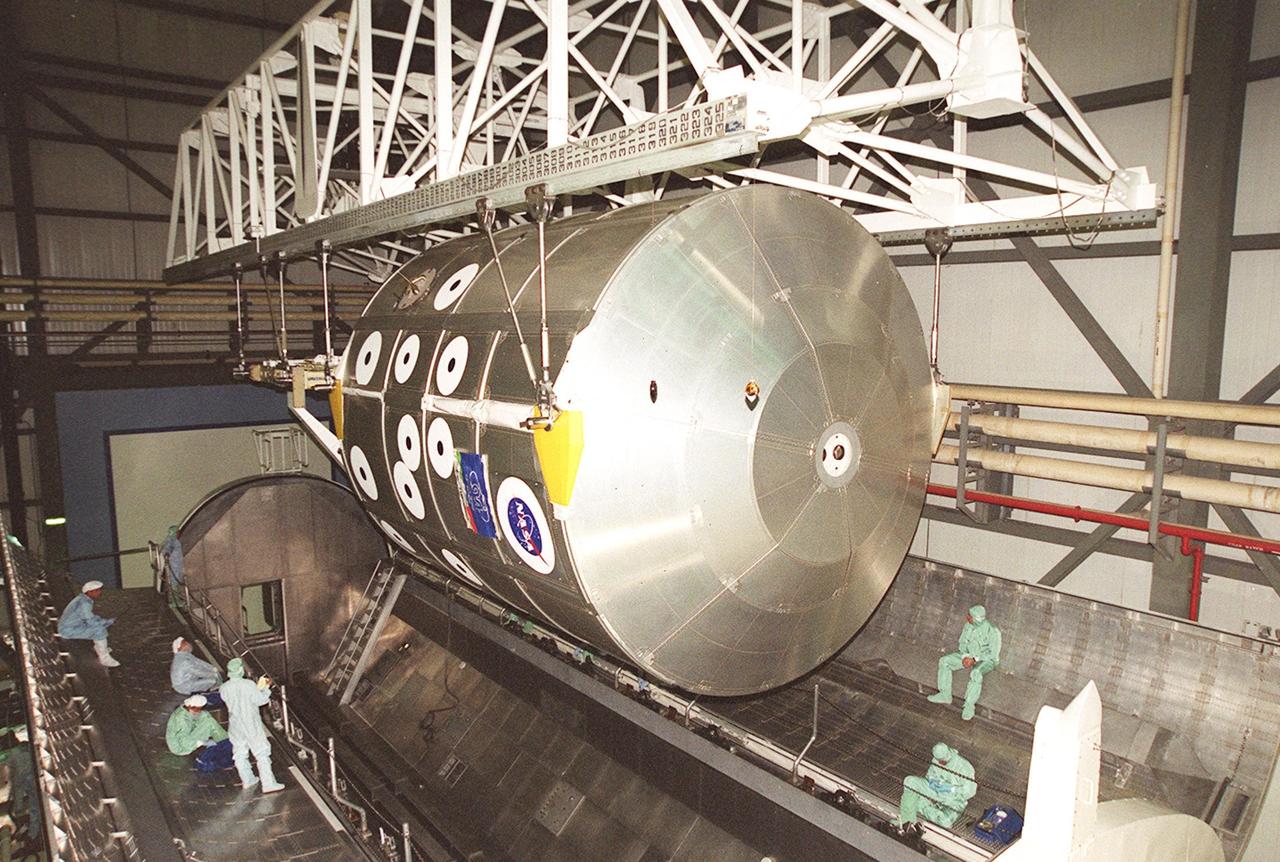
KENNEDY SPACE CENTER, FLA. -- In the Orbiter Processing Facility bay 2, an overhead crane positions the Multi-Purpose Logistics Module Leonardo and the integrated cargo carrier behind it above a payload canister. The MPLM has just returned from its first round trip to the International Space Station on mission STS-102. Leonardo will be transferred to the SSPF to prepare it for future missions. The MPLM serves as a cargo van, carrying equipment and supplies to the Space Station
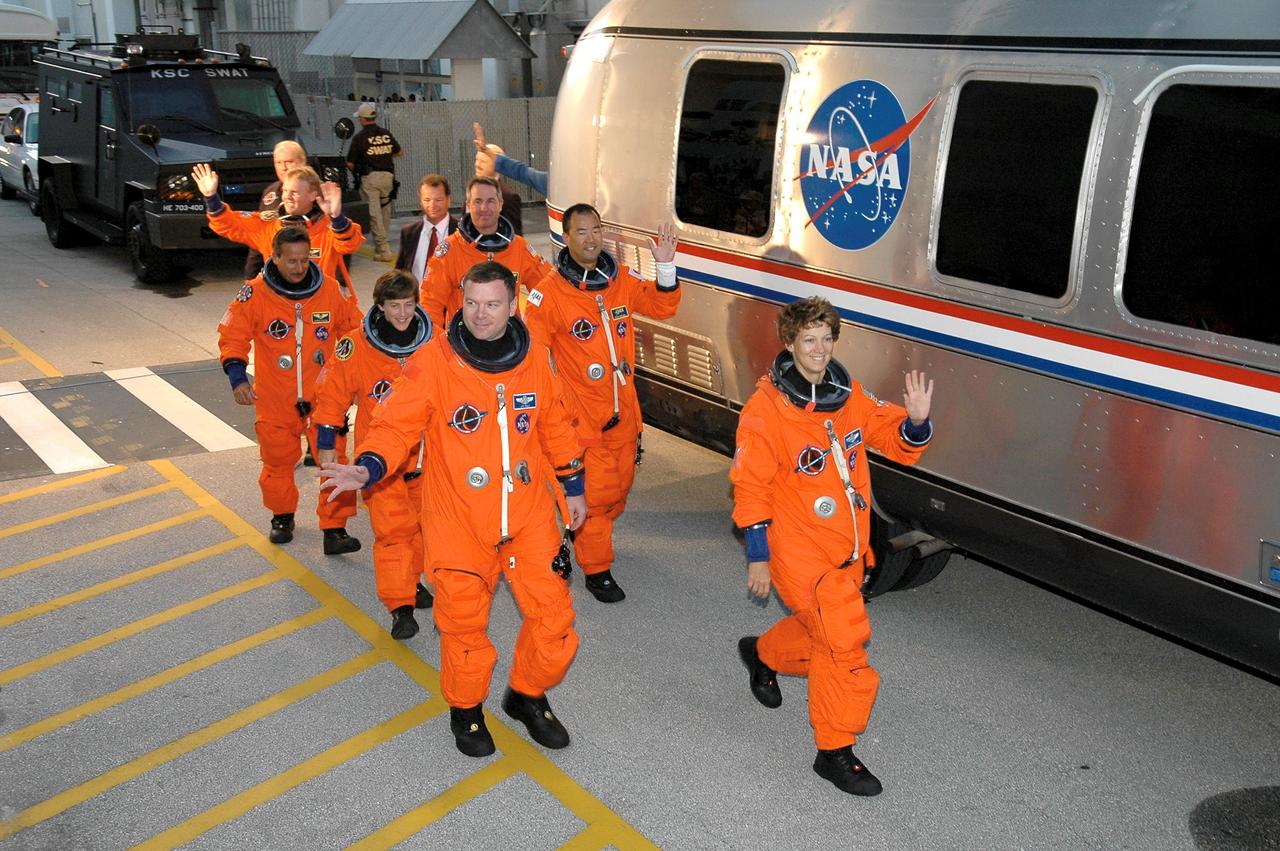
STS114-S-007 (26 July 2005) --- The STS-114 crew members, having donned their launch and entry suits, wave at KSC employees as they prepare to board the transfer van awaiting to take them to Launch Pad 39B. Eileen M. Collins, mission commander, leads the way. James M. Kelly, pilot, is at front left. Other crew members -- Wendy Lawrence, Andrew S.W. Thomas, Stephen K. Robinson, Charles J. Camarda and JAXA astronaut Soichi Noguchi -- follow.
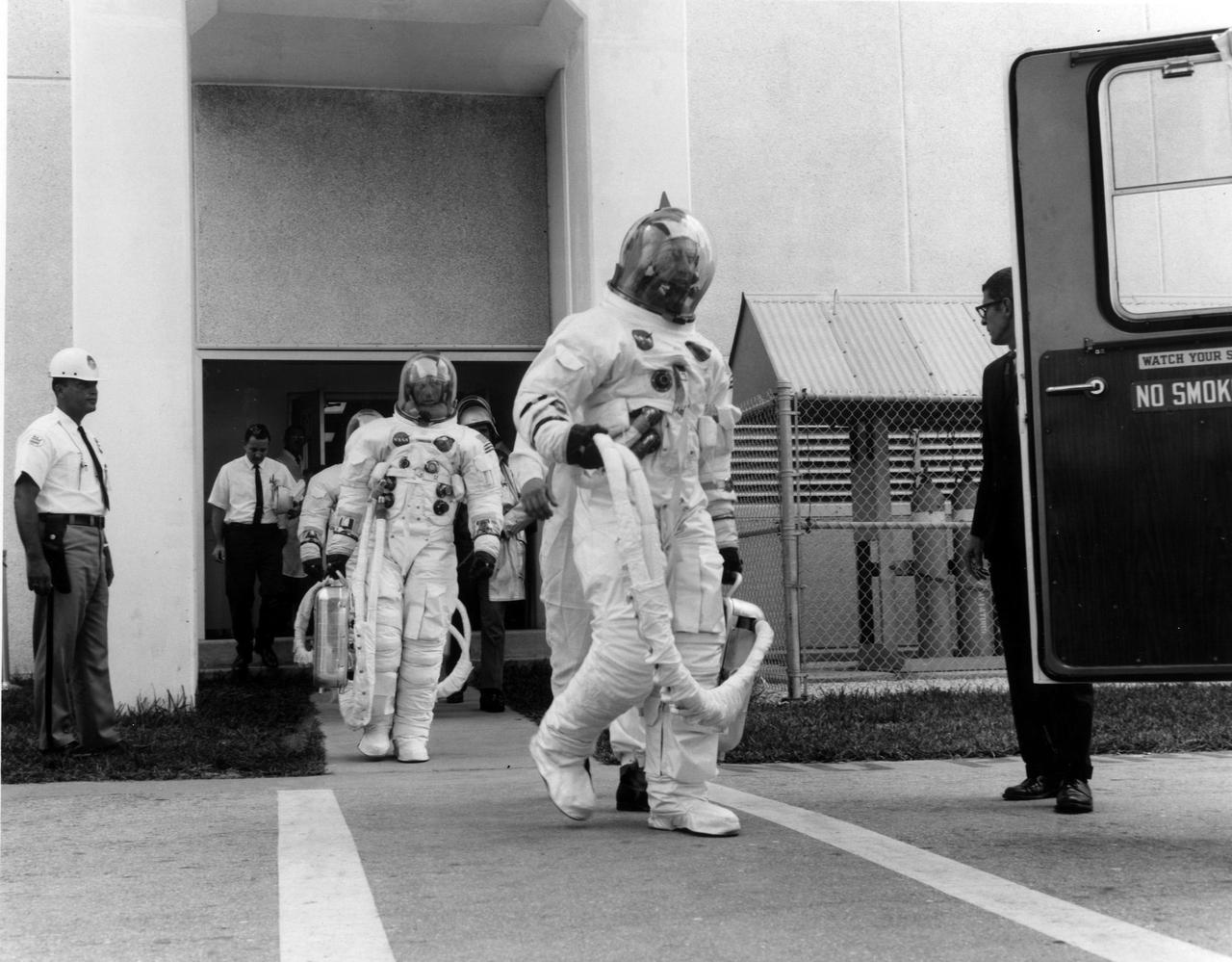
KENNEDY SPACE CENTER, FLA. -- Apollo 7 prime crew members, front to back, Donn F. Eisele, Walter M. Schirra Jr. and Walter Cunningham, leave the Kennedy Space Center's Manned Spacecraft Operations Building for a 20-minute ride in a transfer van to Cape Kennedy's Launch Complex 34, where they participated in a Space Vehicle Emergency Egress Test. The trio will pilot the National Aeronautics and Space Administration's first manned Apollo mission.
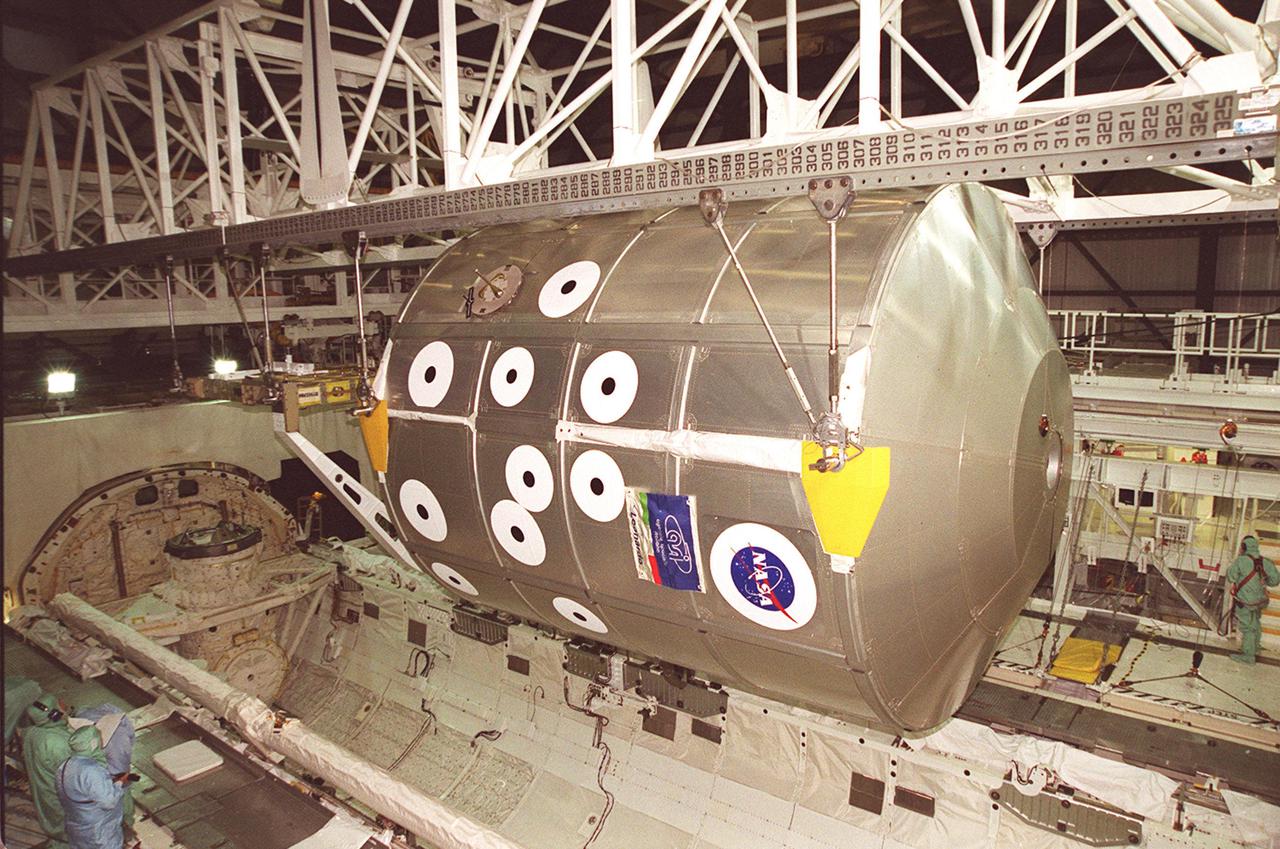
KENNEDY SPACE CENTER, FLA. -- In the Orbiter Processing Facility bay 2, an overhead crane lifts the Multi-Purpose Logistics Module Leonardo and the integrated cargo carrier behind it out of Discovery’s payload bay. The MPLM has just returned from its first round trip to the International Space Station on mission STS-102. Leonardo will be transferred to the SSPF to prepare it for future missions. The MPLM serves as a cargo van, carrying equipment and supplies to the Space Station
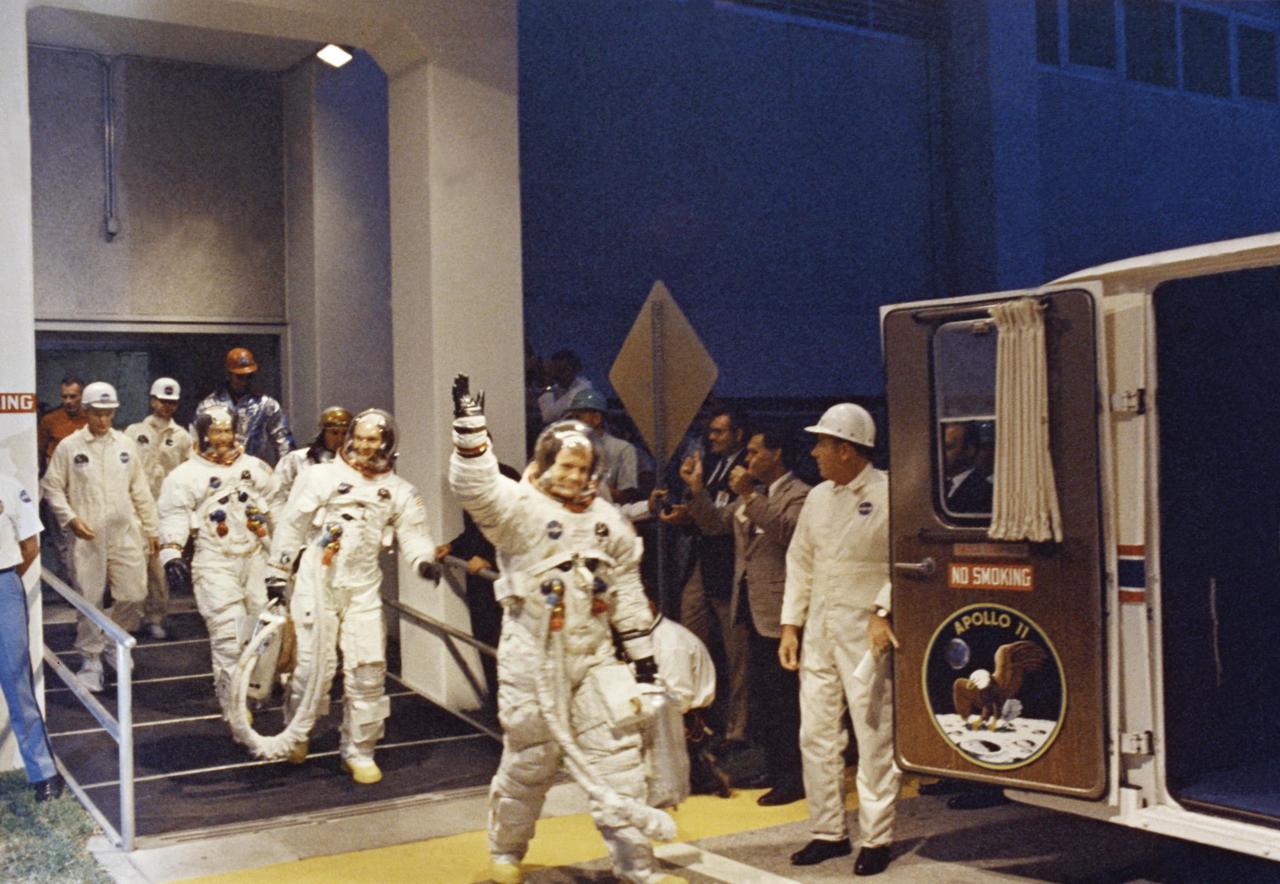
KENNEDY SPACE CENTER, FLA. -- Apollo 11 Commander Neil A. Armstrong leads Astronauts Michael Collins and Edwin E. Aldrin, Jr., from the Manned Spacecraft Operations Building to the transfer van for the eight mile trip to Pad 39A. Liftoff of Apollo 11 is scheduled at 9:32 a.m. EDT, which will begin man’s first lunar landing mission.
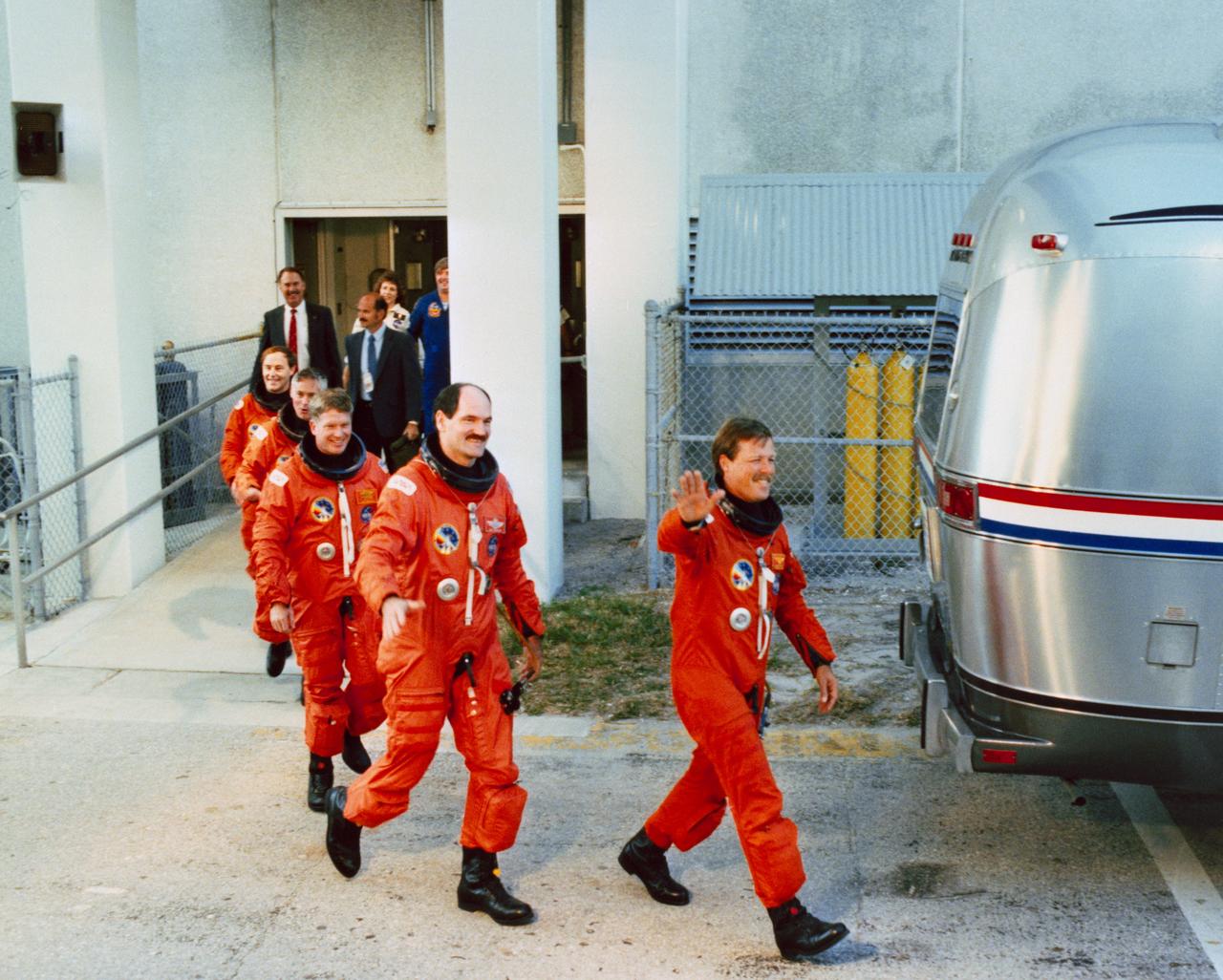
S88-53244 (14 Nov 1988) --- The crewmembers for STS-27 leave the operations and checkout (O&C) building en route to a transfer van that will take them to Launch Pad 39B for their terminal countdown demonstration test. From the front to the rear are astronauts Robert L. Gibson, Guy S. Gardner, William M. Shepherd, Richard M. (Mike) Mullane and Jerry L. Ross.
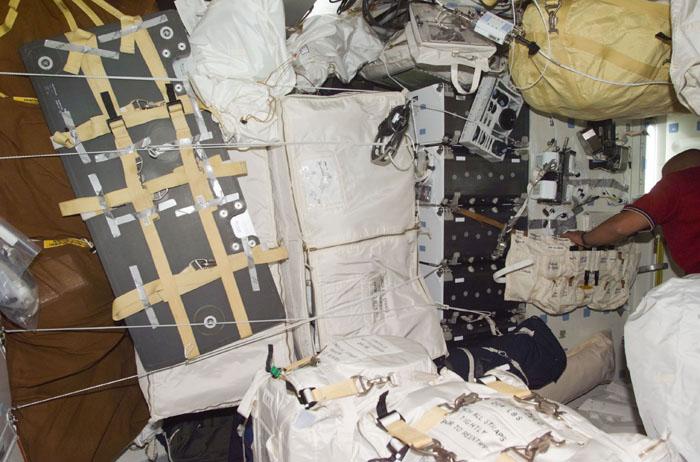
STS98-E-5010 (8 February 2001) --- This mid deck scene on the Earth-orbiting Space Shuttle Atlantis resembles the interior of a moving van, with equipment and supplies temporarily stored there. The STS-98 crew will transfer much of the gear over to the International Space Station (ISS) once the shuttle and station are docked later in the week. The scene was recorded with a digital still camera.
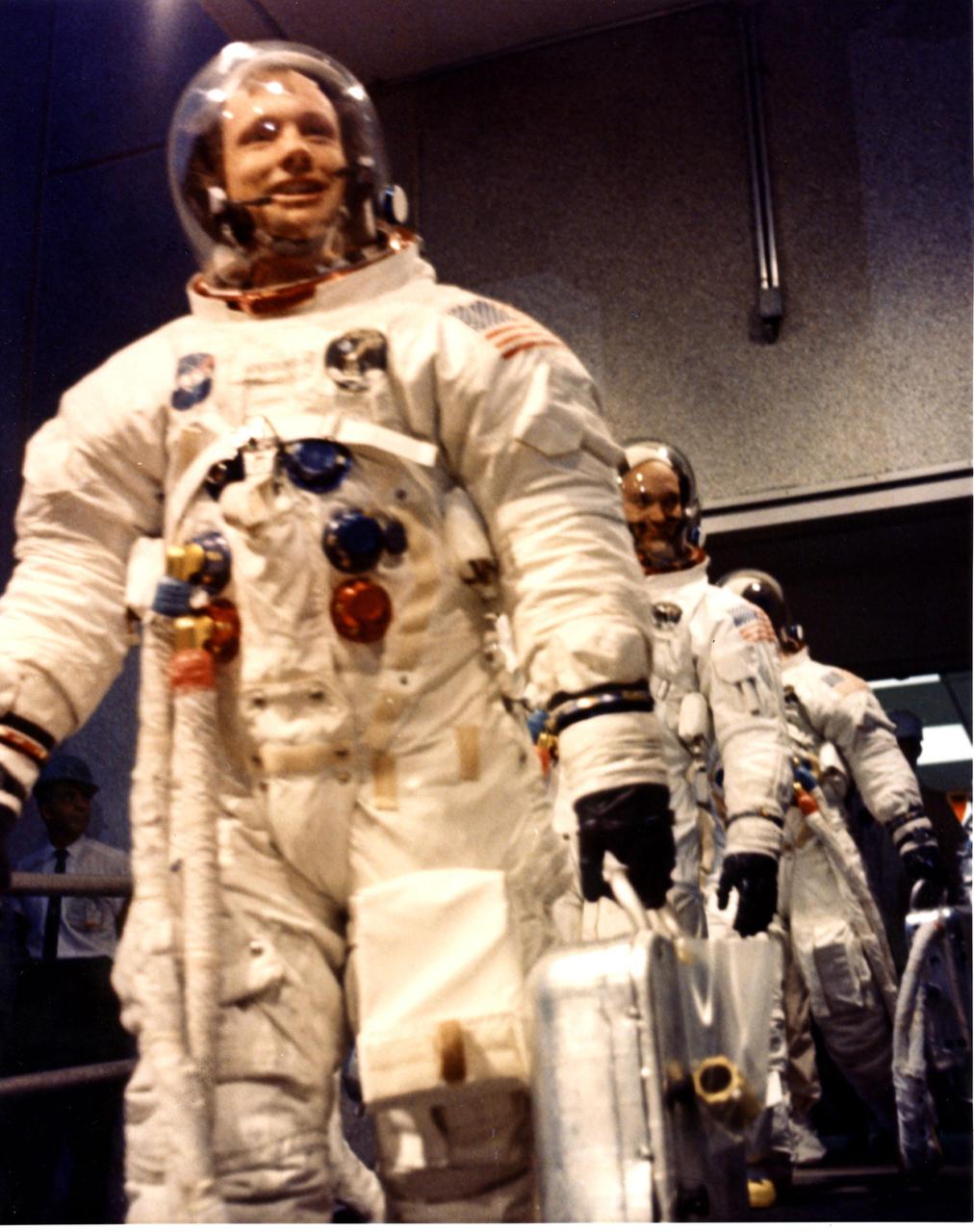
KENNEDY SPACE CENTER, FLA. - Apollo 11 Commander Neil A. Armstrong leads astronauts Michael Collins and Edwin E. Aldrin Jr. from the Manned Spacecraft Operations Building to the transfer van for the eight-mile trip to Pad 39A. Liftoff of Apollo 11 is scheduled at 9:32 a.m. EDT, which will begin man's first lunar landing mission.
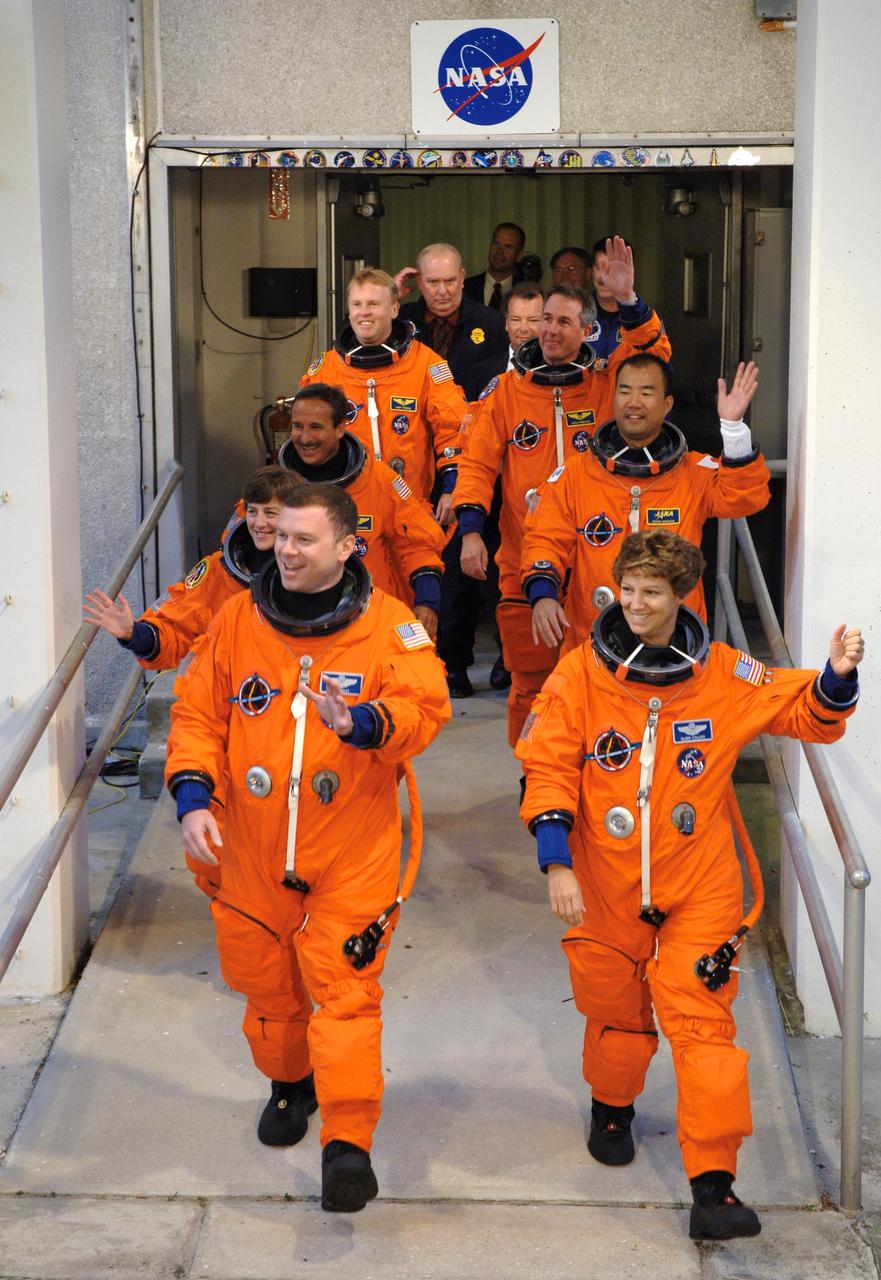
STS114-S-006 (26 July 2005) --- The STS-114 crew members, having donned their launch and entry suits, wave at KSC employees as they head out to the transfer van awaiting to take them to Launch Pad 39B. Eileen M. Collins, commander, leads the way. James M. Kelly, pilot, is at front left. Other crew members -- Wendy Lawrence, Andrew S.W. Thomas, Stephen K. Robinson, Charles J. Camarda and JAXA astronaut Soichi Noguchi--follow.
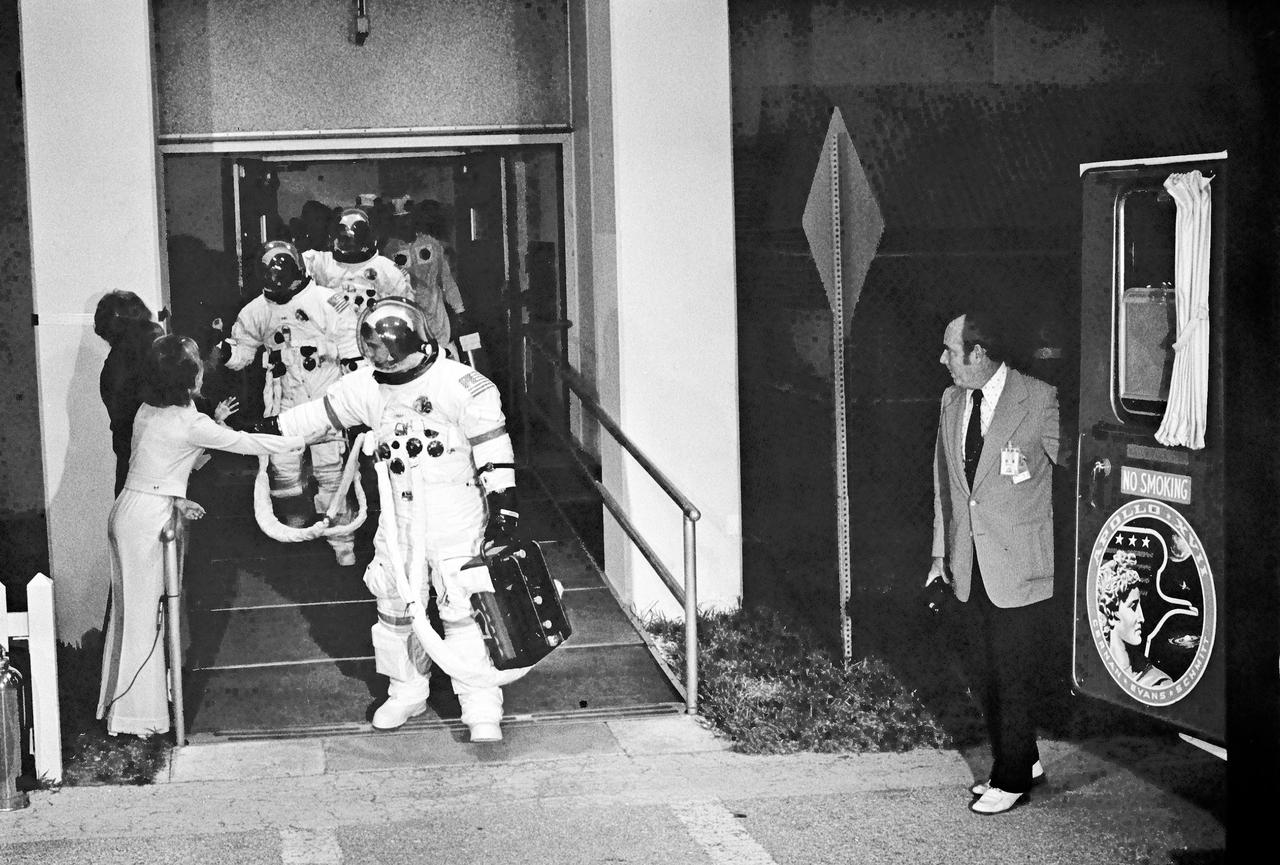
Leaving the Manned Spacecraft Operations Building enroute to the launch pad. Apollo 17 Mission Commander Eugene A. Cernan greets Mrs. Jan Evans, wife of Command module Pilot Ronald E. Evans, shown in background shaking hand with Cernan's wife Barbara. Further in the background is lunar Module Pilot Harrison H. Schmitt. At the right, next to the transfer van is Charles Buckley KSC Security Chief.
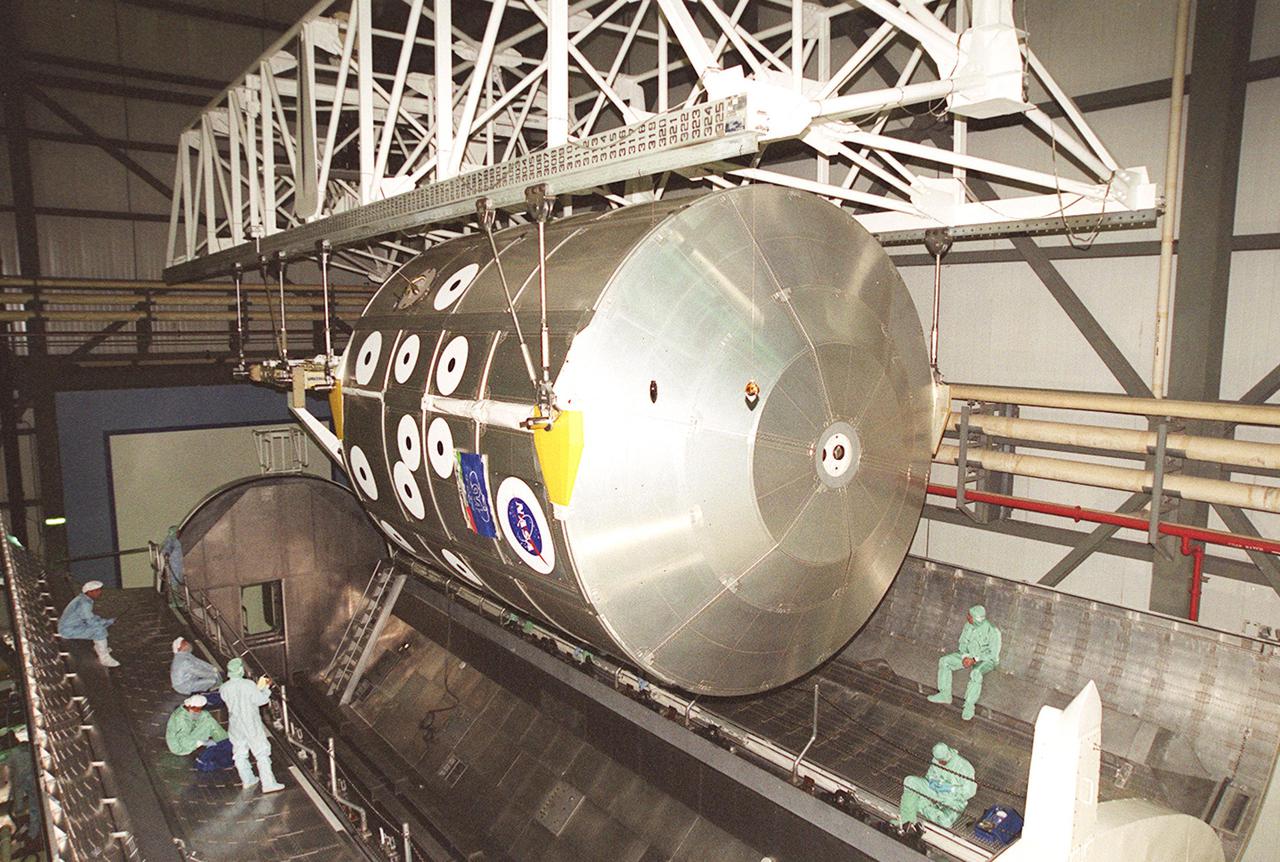
KENNEDY SPACE CENTER, FLA. -- In the Orbiter Processing Facility bay 2, an overhead crane positions the Multi-Purpose Logistics Module Leonardo and the integrated cargo carrier behind it above a payload canister. The MPLM has just returned from its first round trip to the International Space Station on mission STS-102. Leonardo will be transferred to the SSPF to prepare it for future missions. The MPLM serves as a cargo van, carrying equipment and supplies to the Space Station
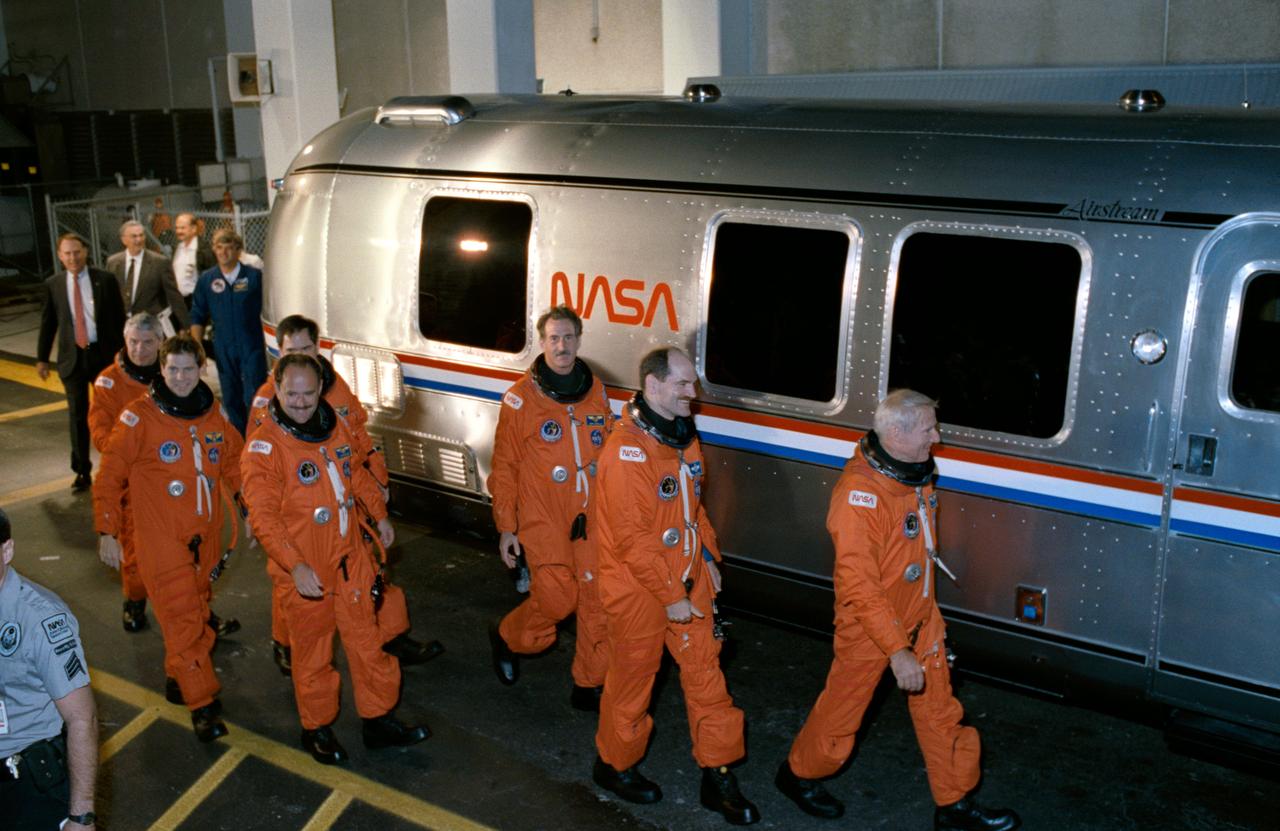
STS035-S-016 (2 Dec 1990) --- Astronaut Vance D. Brand, right, leads the STS 35 crew toward a transfer van that will take them from the nearby operations and checkout (O&C) building to Launch Complex 39. Trailing the mission commander, left to right, are Robert A. R. Parker, Samuel T. Durrance, Ronald A. Parise, John M. (Mike) Lounge, Jeffrey A. Hoffman and Guy S. Gardner.
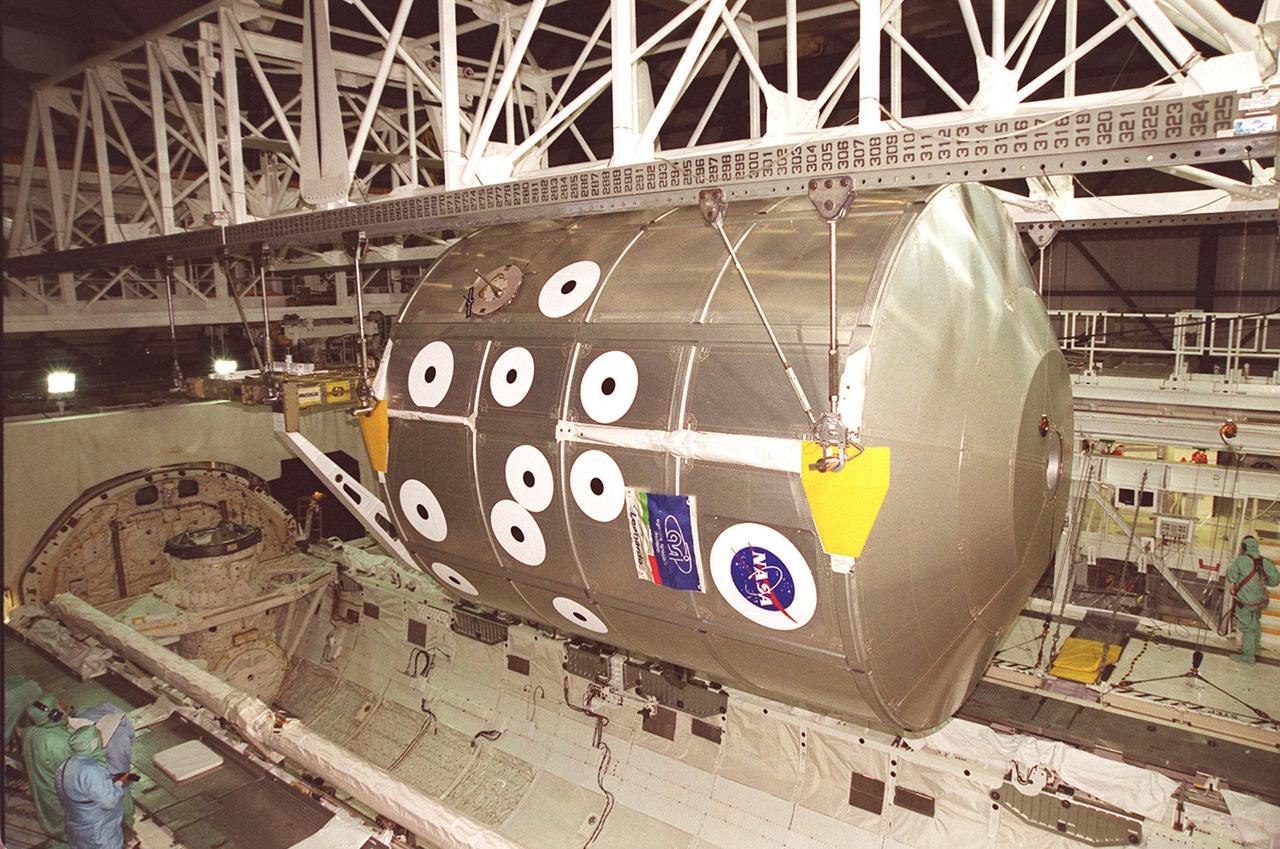
KENNEDY SPACE CENTER, FLA. -- In the Orbiter Processing Facility bay 2, an overhead crane lifts the Multi-Purpose Logistics Module Leonardo and the integrated cargo carrier behind it out of Discovery’s payload bay. The MPLM has just returned from its first round trip to the International Space Station on mission STS-102. Leonardo will be transferred to the SSPF to prepare it for future missions. The MPLM serves as a cargo van, carrying equipment and supplies to the Space Station
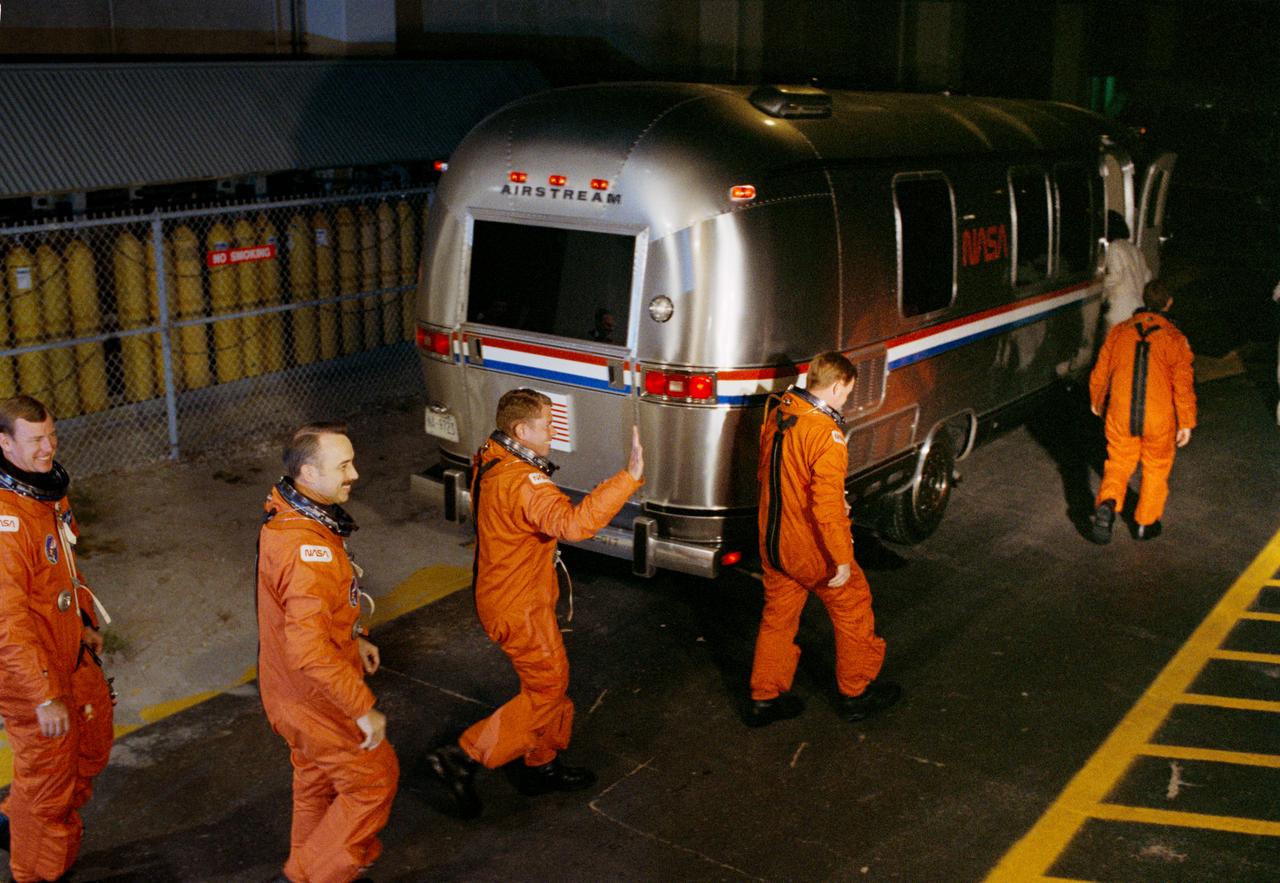
STS028-S-002 (8 Aug 1989) --- The five astronaut crewmembers for STS-28 leave the Operations and Checkout (O&C) Building to board a transfer van en route to Launch Complex 39 for a date with Columbia. Left to right are Astronauts Mark N. Brown, James C. Adamson, David C. Leestma, Richard N. Richards and Brewster H. Shaw Jr.

KENNEDY SPACE CENTER, FLA. -- For the second straight day, astronaut L. Gordon Cooper Jr. sets out at 4:55 a.m. EST from his living quarters at Hangar 'S' to go to Launch Pad 14 for the fourth manned Earth orbital mission. After being launched aboard a Mercury Atlas, astronaut Cooper will orbit the Earth 22 times. Following astronaut Cooper to the transfer van is astronaut Walter Schirra.
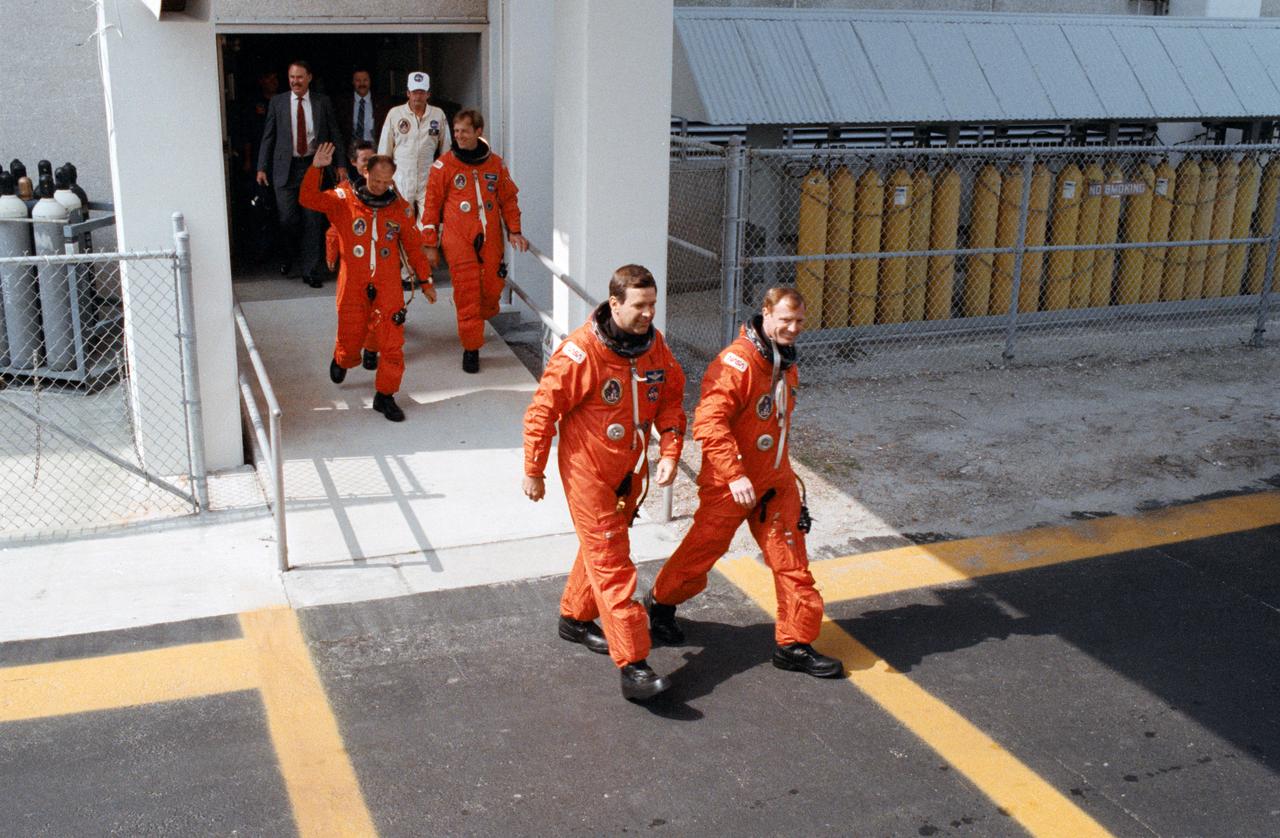
STS030-S-139 (4 May 1989) --- The five astronaut crewmembers of STS-30 leave the operations and checkout building en route to a transfer van that will take them to Pad 39B for a date with the Space Shuttle Atlantis. From front to back are Astronauts David M. Walker, Ronald J. Grabe, Norman E. Thagard, Mark C. Lee (aside) and Mary L. Cleave.
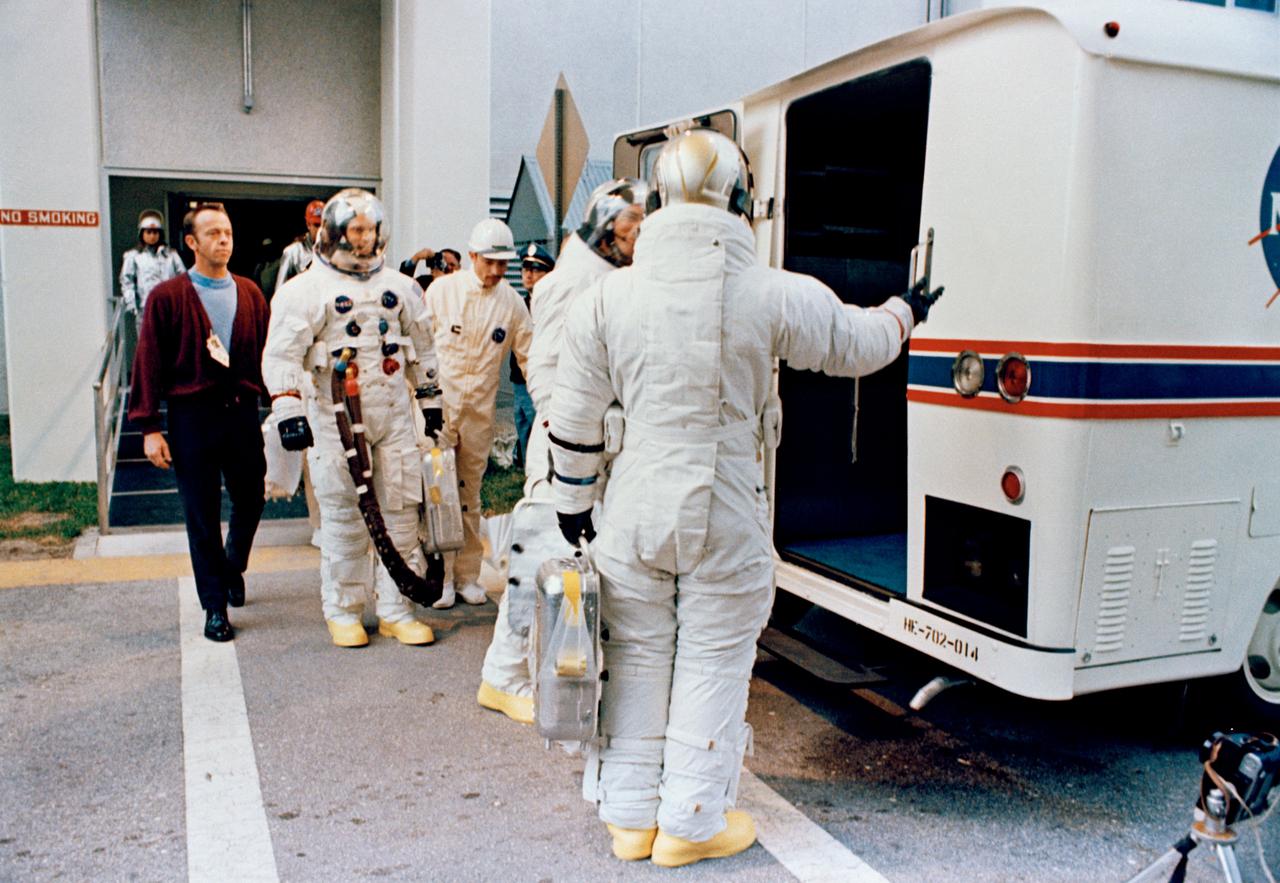
S69-25881 (3 March 1969) --- The Apollo 9 crew leaves the Kennedy Space Center's Manned Spacecraft Operations Building during the Apollo 9 prelaunch countdown. The crewman entered the special transfer van which transported them to their waiting spacecraft at Pad A, Launch Complex 39. Astronaut James A. McDivitt (back to camera) is the commander. McDivitt appears to be inviting astronaut David R. Scott, command module pilot, to step first into van. In background is astronaut Russell L. Schweickart, lunar module pilot. Walking along almost behind Schweickart is astronaut Alan B. Shepard Jr., chief, Astronaut Office, Manned Spacecraft Center. Apollo 9 was launched at 11 a.m. (EST), March 3, 1969, on a 10-day Earth-orbital mission.
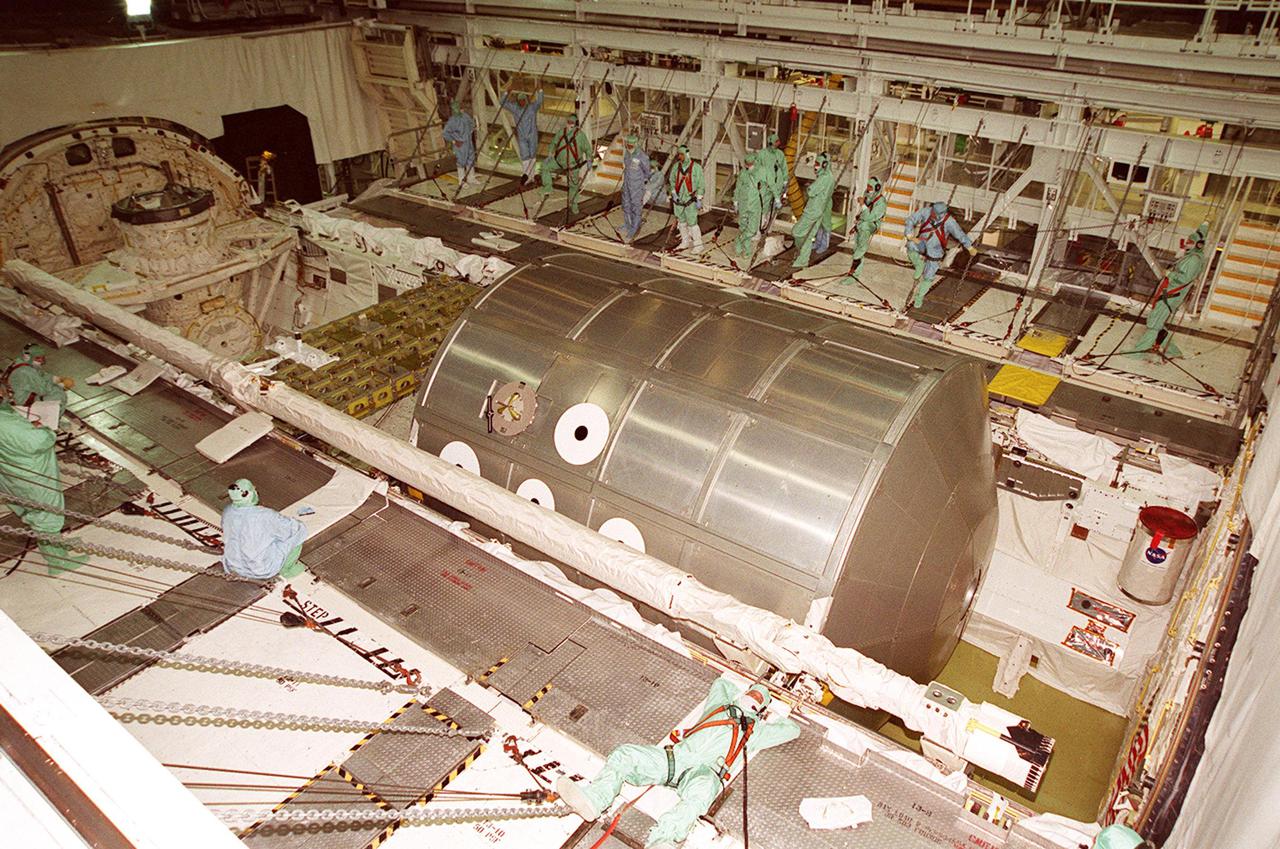
KENNEDY SPACE CENTER, FLA. -- In the Orbiter Processing Facility bay 2, Discovery’s payload bay doors are open to reveal the Multi-Purpose Logistics Module Leonardo, which has just returned from its first round trip to the International Space Station on mission STS-102. Behind it to the left is the integrated cargo carrier. Attached to the length of the payload bay, in front of Leonardo, is the robotic arm that was used to remove and position Leonardo on the ISS. Leonardo will be lifted from the payload bay and transferred to the SSPF to prepare it for future missions. The MPLM serves as a cargo van, carrying equipment and supplies to the Space Station
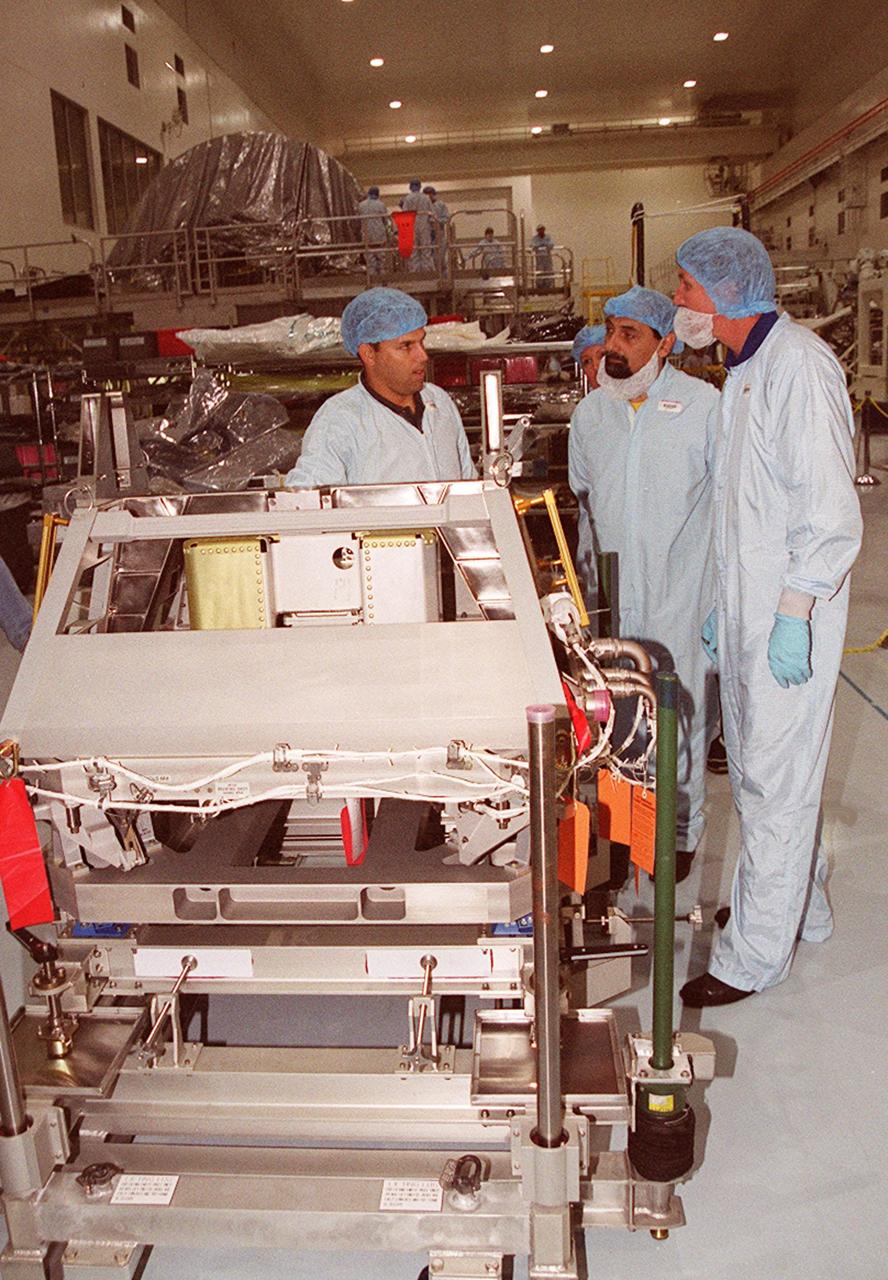
A worker (left) in the Space Station Processing Facility explains use of the equipment in the foreground to STS-100 Mission Specialist Umberto Guidoni (center) and Commander Kent Rominger (right). Guidoni is with the European Space Agency. Mission STS-100, scheduled to launch April 19, 2001, will include the Multi-Purpose Logistics Module (MPLM) Raffaello and the Space Station Remote Manipulator System (SSRMS) as its payload. MPLMs are pressurized modules that will serve as the International Space Station's “moving vans,” carrying laboratory racks filled with equipment, experiments and supplies to and from the station aboard the Space Shuttle. The SSRMS is the primary means of transferring payloads between the orbiter payload bay and the International Space Station for assembly
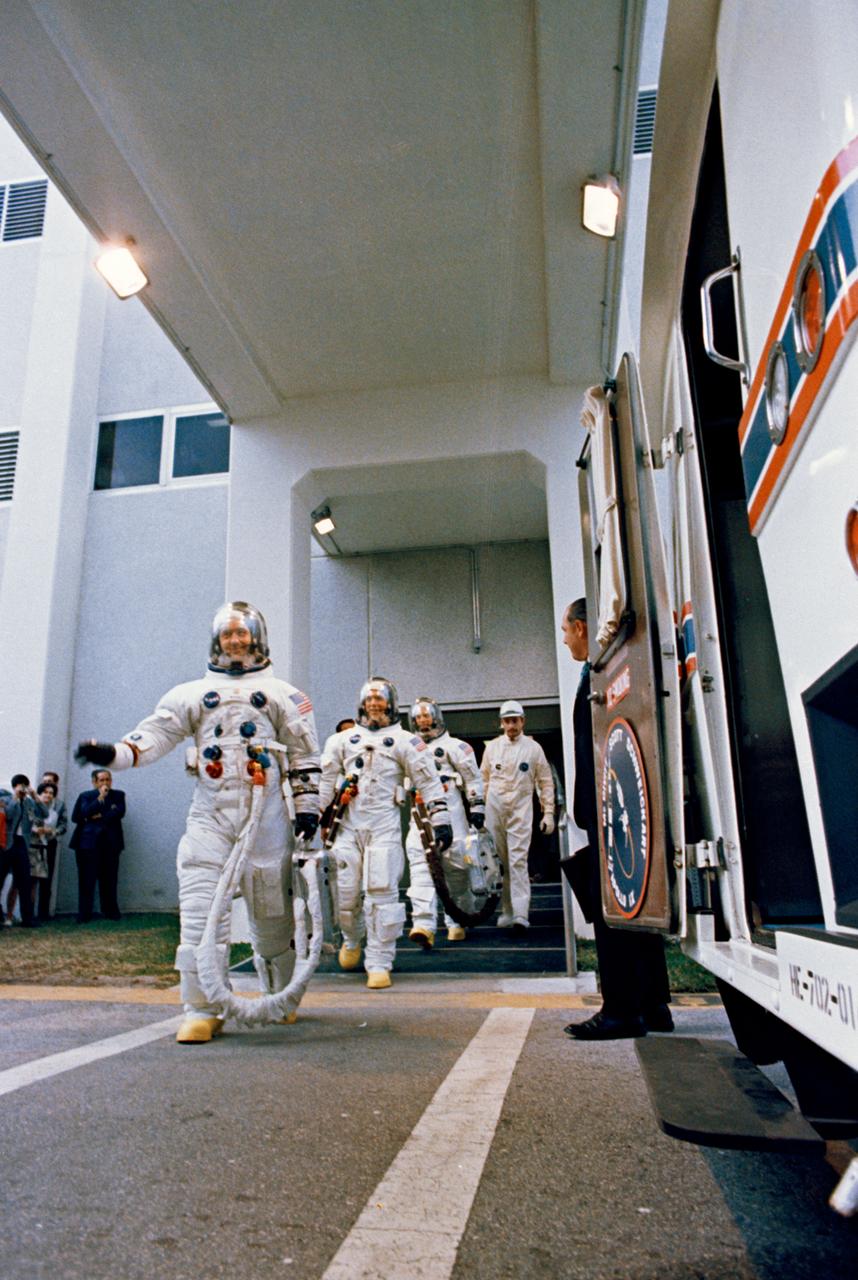
S69-25883 (3 March 1969) --- The Apollo 9 crew leaves the Kennedy Space Center's Manned Spacecraft Operations Building during the Apollo 9 prelaunch countdown. Leading is astronaut James A. McDivitt, commander; followed by astronaut David R. Scott, command module pilot; and Russell L. Schweickart, lunar module pilot. Moments later they entered the special transfer van which transported them to their waiting spacecraft at Pad A, Launch Complex 39. Apollo 9 was launched at 11 a.m. (EST), March 3, 1969, on a 10-day Earth-orbital mission.
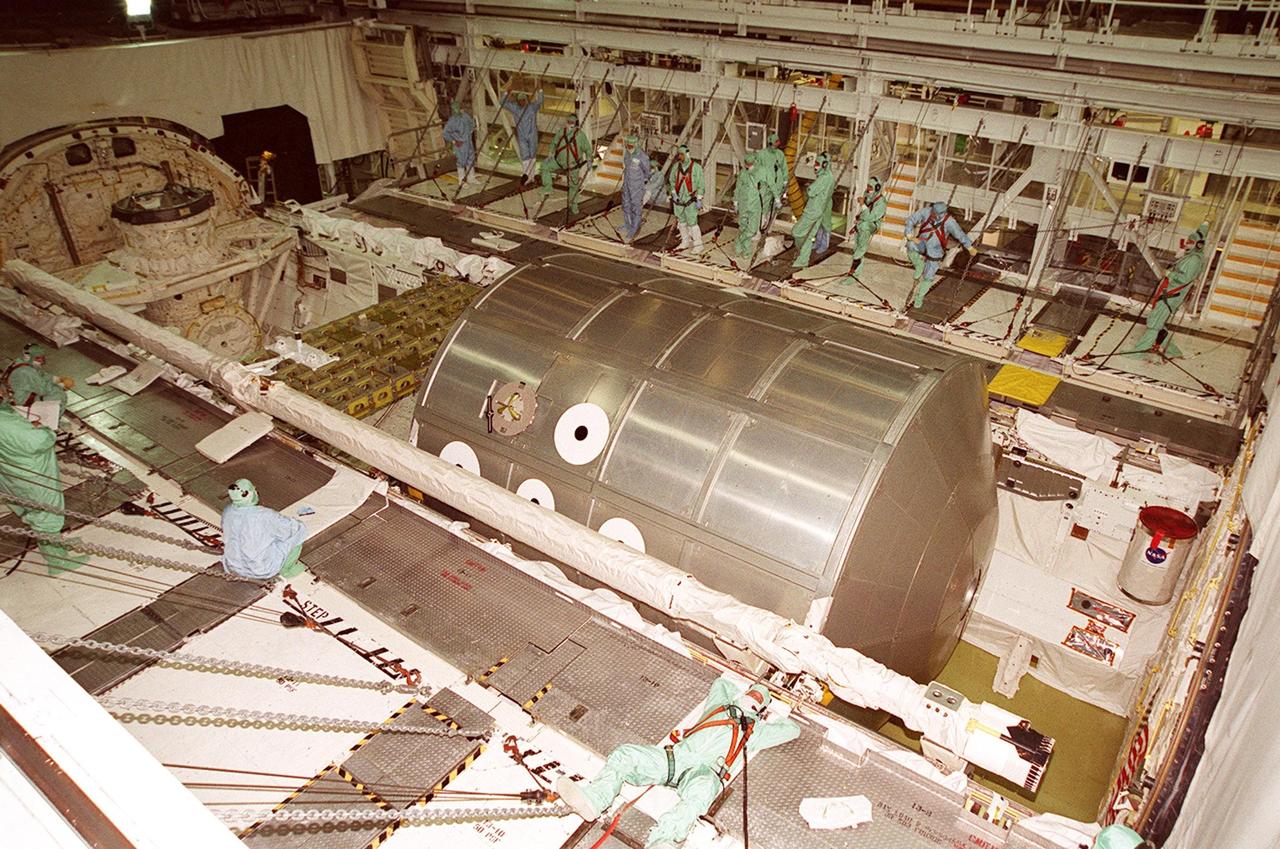
KENNEDY SPACE CENTER, FLA. -- In the Orbiter Processing Facility bay 2, Discovery’s payload bay doors are open to reveal the Multi-Purpose Logistics Module Leonardo, which has just returned from its first round trip to the International Space Station on mission STS-102. Behind it to the left is the integrated cargo carrier. Attached to the length of the payload bay, in front of Leonardo, is the robotic arm that was used to remove and position Leonardo on the ISS. Leonardo will be lifted from the payload bay and transferred to the SSPF to prepare it for future missions. The MPLM serves as a cargo van, carrying equipment and supplies to the Space Station
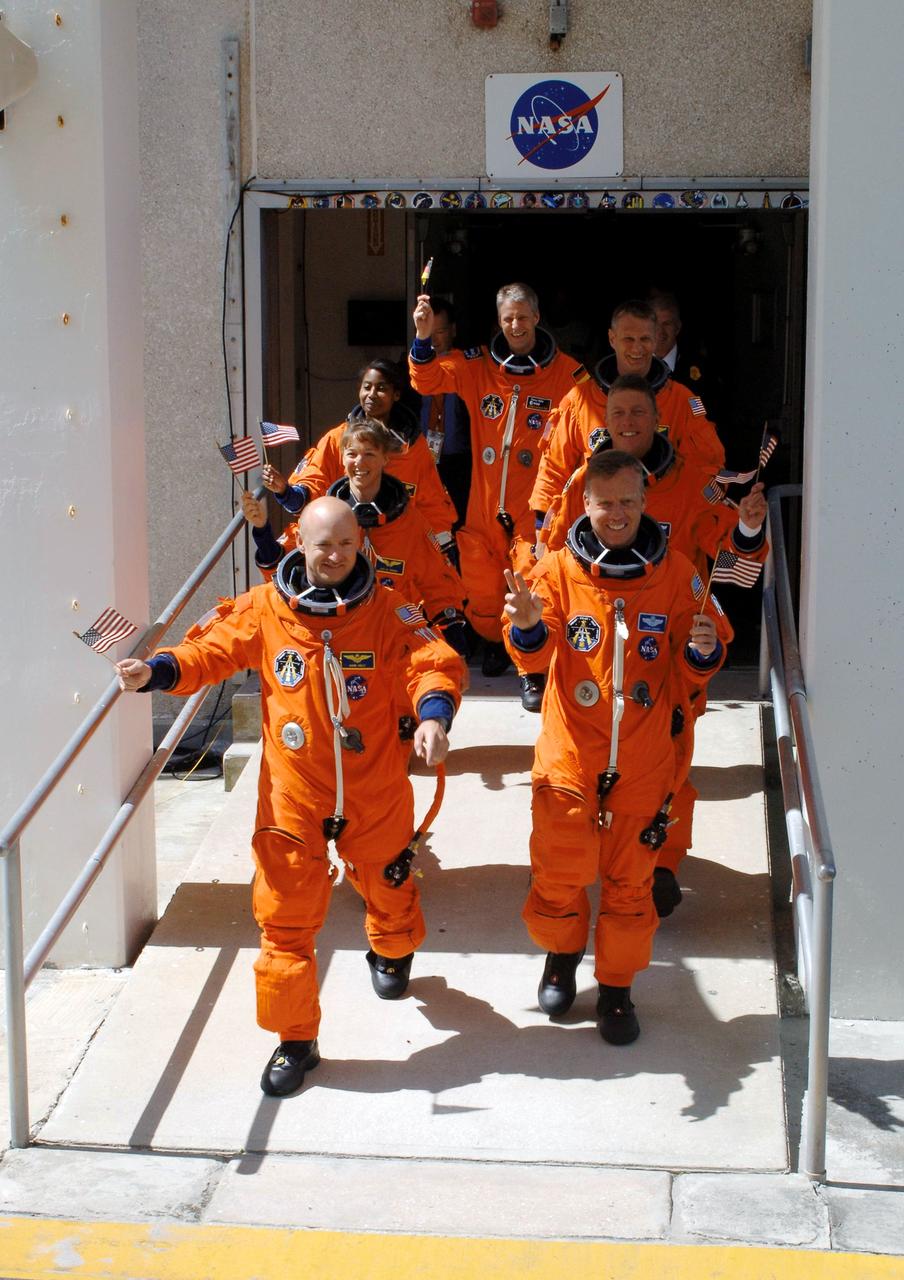
STS121-S-005 (4 July 2006) --- The STS-121 crewmembers, having donned their shuttle launch and entry suits, wave flags for the Fourth of July as they head out of the Operations and Checkout Building at Kennedy Space Center to the transfer van awaiting to take them to Launch Pad 39B. Steven W. Lindsey (right front), commander, and Mark E. Kelly, pilot, lead the way. Other crewmembers - Lisa M. Nowak, Michael E. Fossum, Stephanie D. Wilson, Piers J. Sellers and European Space Agency (ESA) astronaut Thomas Reiter of Germany - follow.
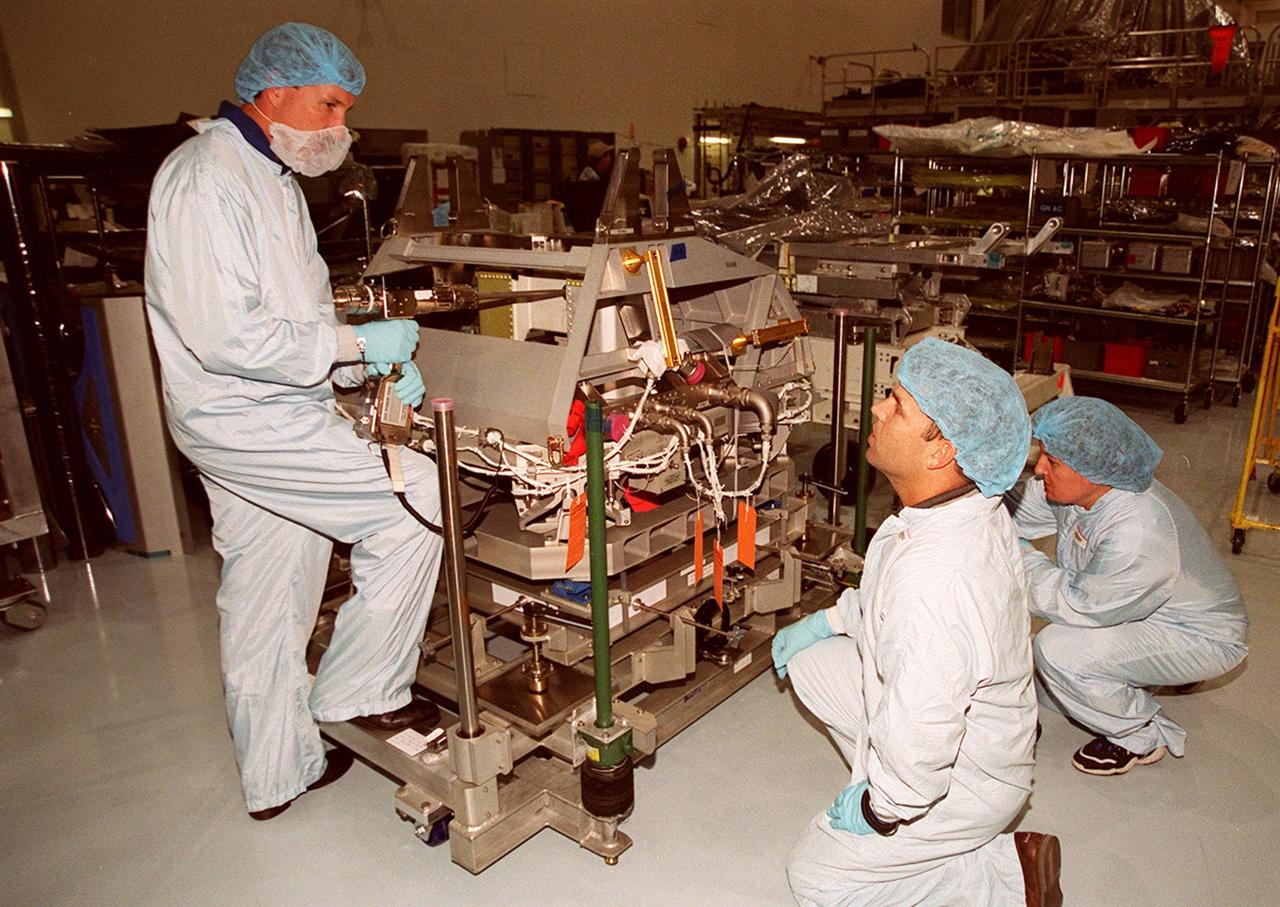
In the Space Station Processing Facility, STS-100 Commander Kent Rominger (left) listens to directions from the worker in the foreground. Another worker waits nearby. Mission STS-100, scheduled to launch April 19, 2001, will include Raffaello as well as the Space Station Remote Manipulator System (SSRMS) as its payload. MPLMs are pressurized modules that will serve as the International Space Station's “moving vans,” carrying laboratory racks filled with equipment, experiments and supplies to and from the station aboard the Space Shuttle. The SSRMS is the primary means of transferring payloads between the orbiter payload bay and the International Space Station for assembly
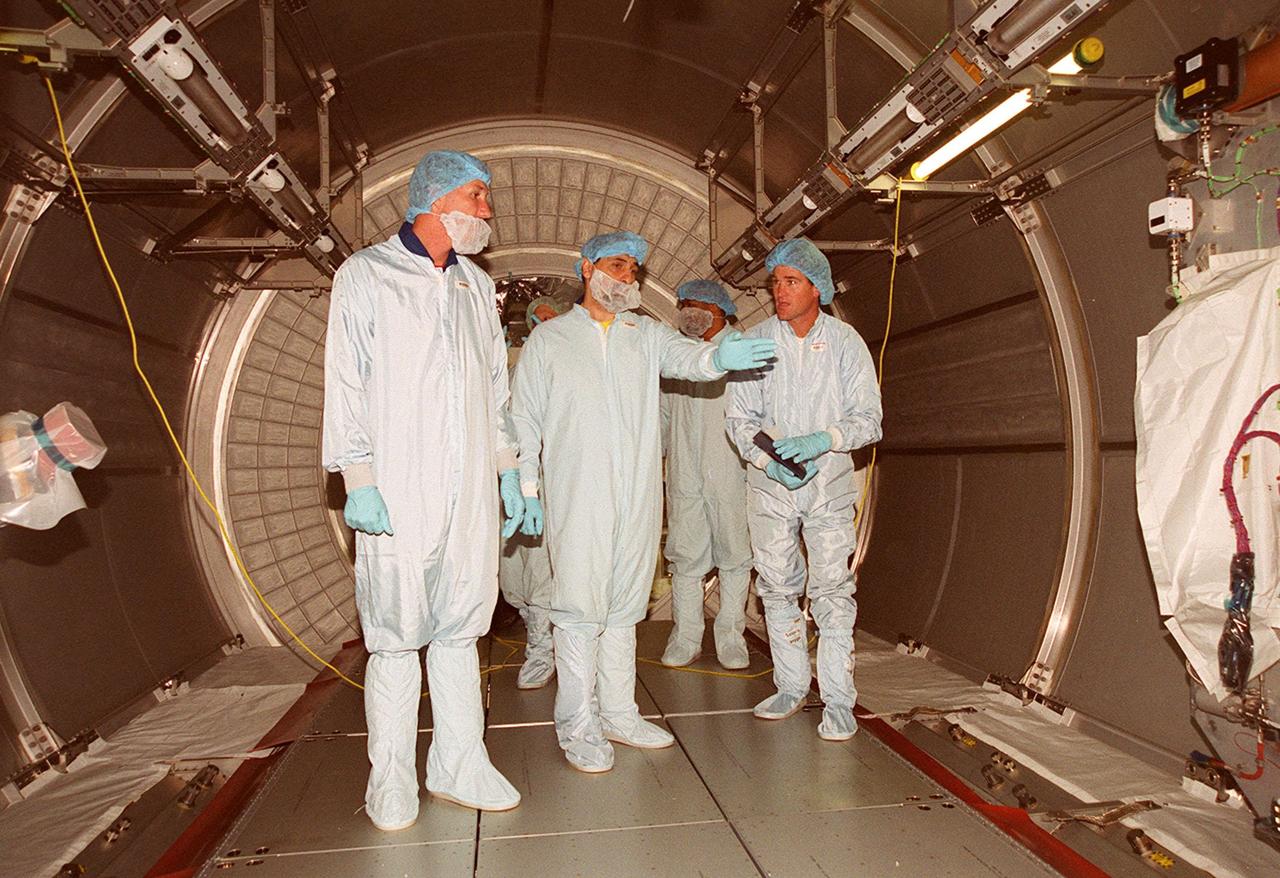
STS-100 Commander Kent Rominger and Mission Specialist Umberto Guidoni, who is with the European Space Agency, look over the inside of Raffaello, a Multi-Purpose Logistics Module. Mission STS-100, scheduled to launch April 19, 2001, will include Raffaello as well as the Space Station Remote Manipulator System (SSRMS) as its payload. MPLMs are pressurized modules that will serve as the International Space Station's “moving vans,” carrying laboratory racks filled with equipment, experiments and supplies to and from the station aboard the Space Shuttle. The SSRMS is the primary means of transferring payloads between the orbiter payload bay and the International Space Station for assembly
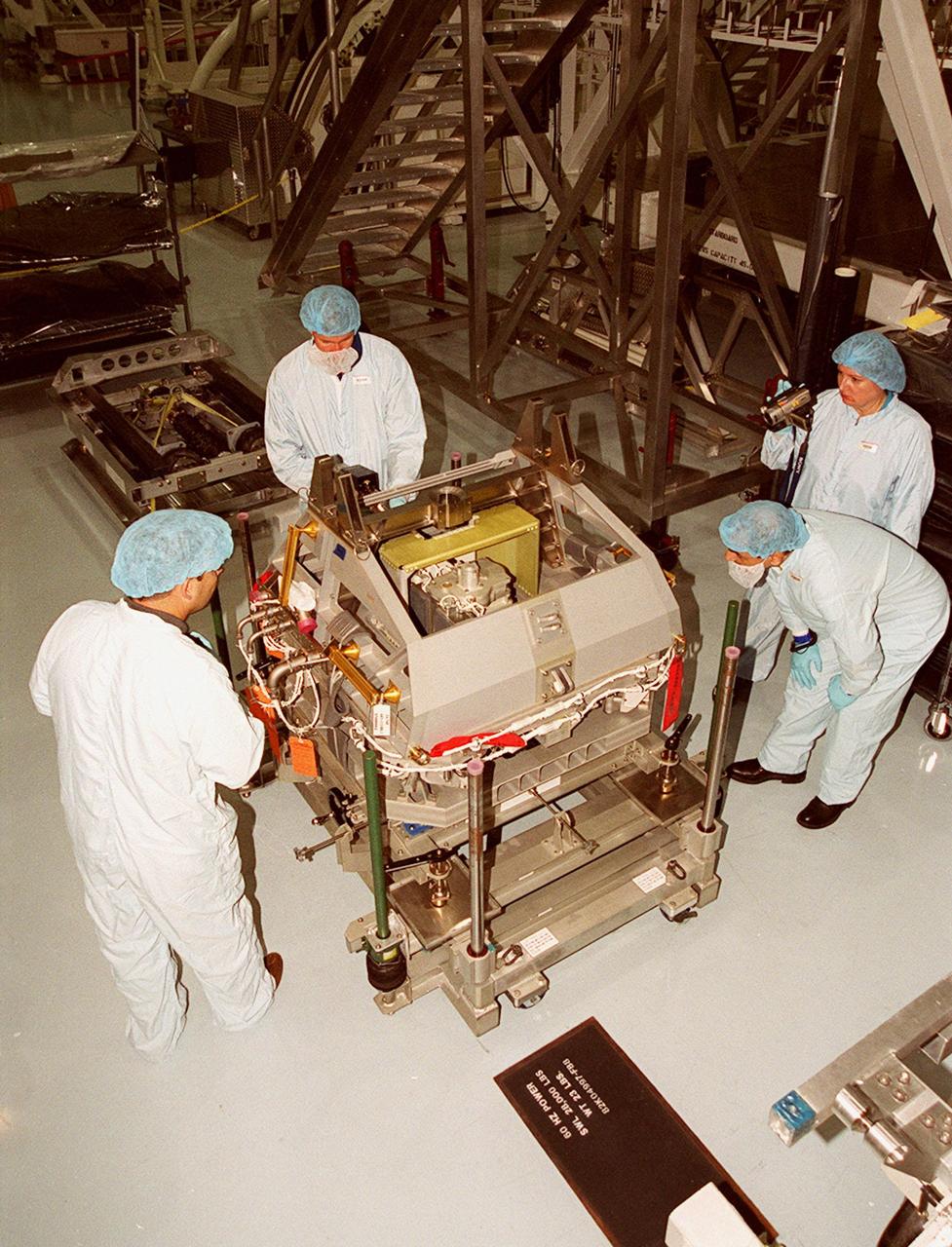
With workers (far left and far right) looking on, STS-100 Commander Kent Rominger tries out a piece of equipment while Mission Specialist Umberto Guidoni (leaning over) watches. Guidoni is with the European Space Agency. Mission STS-100, scheduled to launch April 19, 2001, will include Raffaello as well as the Space Station Remote Manipulator System (SSRMS) as its payload. MPLMs are pressurized modules that will serve as the International Space Station's “moving vans,” carrying laboratory racks filled with equipment, experiments and supplies to and from the station aboard the Space Shuttle. The SSRMS is the primary means of transferring payloads between the orbiter payload bay and the International Space Station for assembly
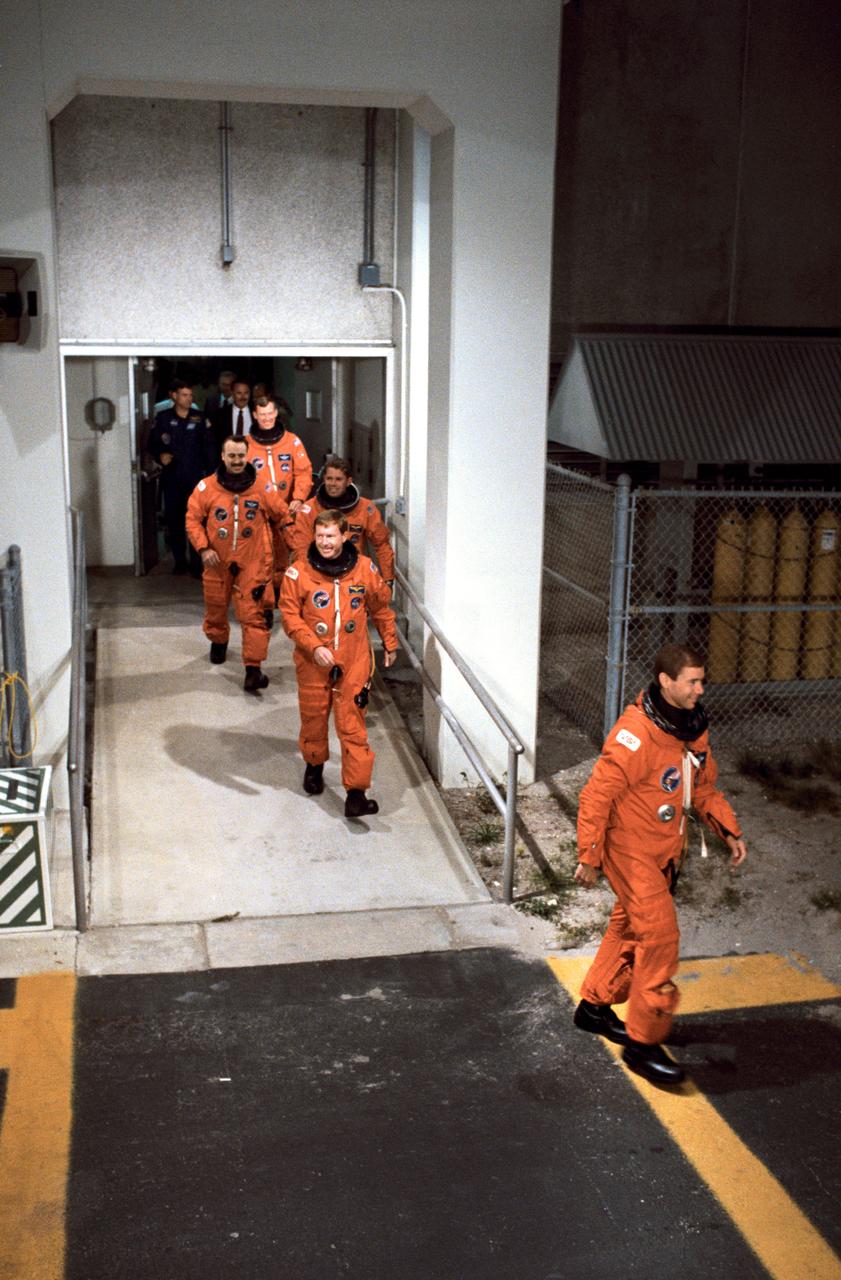
STS028-S-001 (8 Aug 1989) --- The five astronaut crewmembers for STS-28 leave the operations and checkout building to board a transfer van en route to Launch Complex 39 for a date with Columbia. Front to back are Brewster H. Shaw Jr., Richard N. Richards, David C. Leestma, James C. Adamson and Mark N. Brown. At the rear of the line are Astronaut Michael L. Coats, acting chief of the astronaut office; and Donald R. Puddy, director of flight crew operations at JSC. Coats later flew a NASA Shuttle training aircraft for pre-launch and launch monitoring activities.
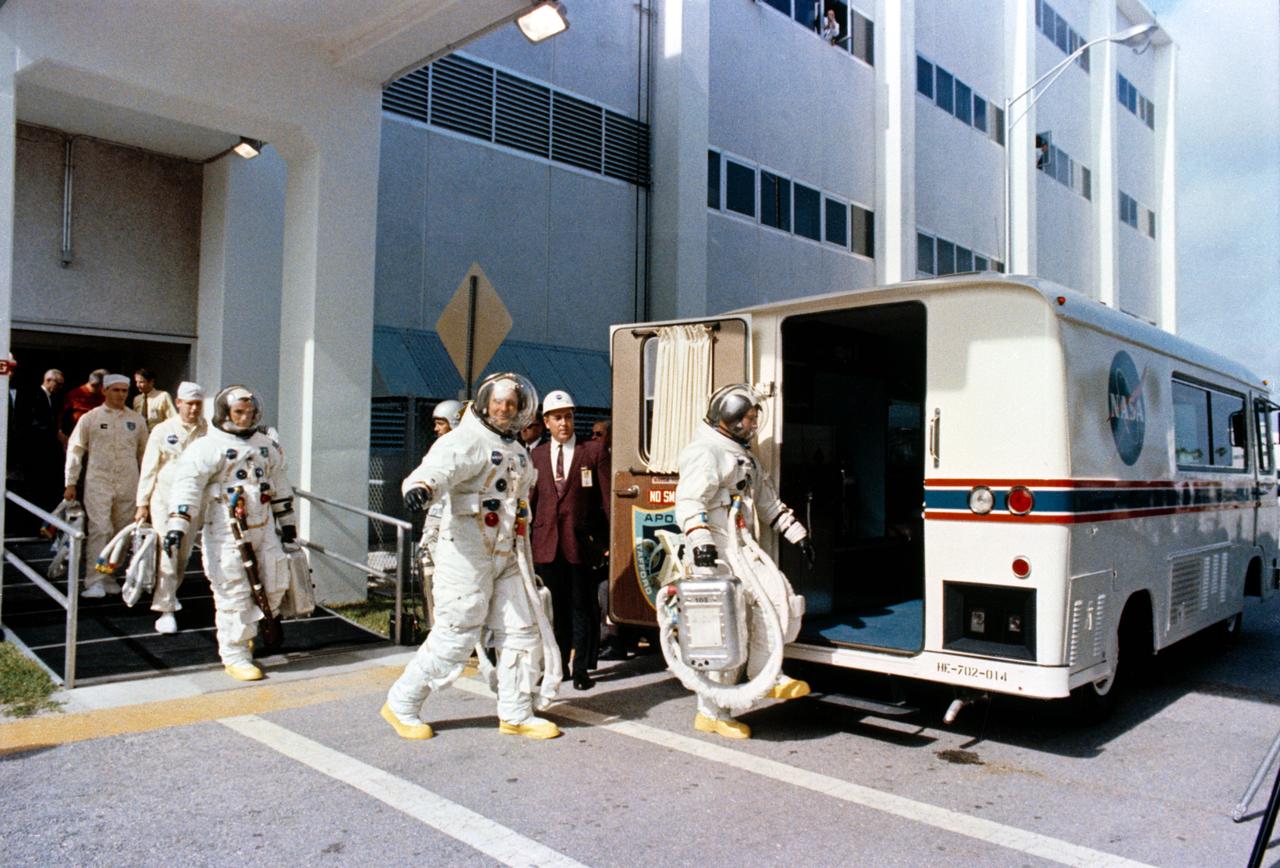
S69-35315 (18 May 1969) --- The Apollo 10 crew leaves the Kennedy Space Center's Manned Spacecraft Operations Building during the Apollo 10 prelaunch countdown. Leading is astronaut John W. Young, command module pilot, followed by astronauts Thomas P. Stafford, commander; and Eugene A. Cernan, lunar module pilot. The transfer van carried them over to Pad B, Launch Complex 39, where their spacecraft awaited them. Liftoff for the lunar orbit mission was at 12:49 p.m. (EDT), May 18, 1969.
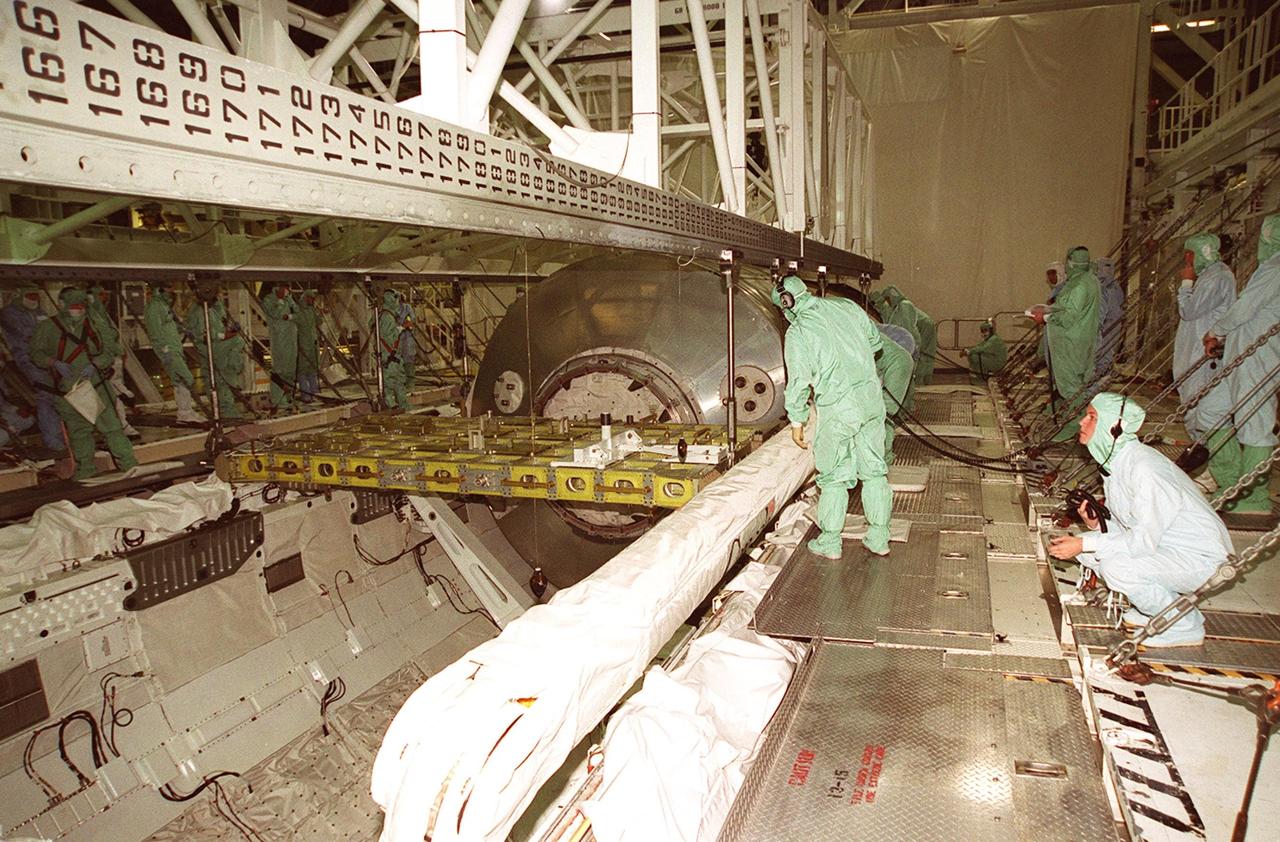
KENNEDY SPACE CENTER, FLA. -- Workers in the Orbiter Processing Facility bay 2 check the attachments on the overhead crane to the Multi-Purpose Logistics Module Leonardo and the integrated cargo carrier behind it sitting in Discovery’s payload bay. The MPLM has just returned from its first round trip to the International Space Station on mission STS-102. Attached to the length of the payload bay, in front of Leonardo, is the robotic arm that was used to remove and position Leonardo on the ISS. Leonardo will be lifted from the payload bay and transferred to the SSPF to prepare it for future missions. The MPLM serves as a cargo van, carrying equipment and supplies to the Space Station
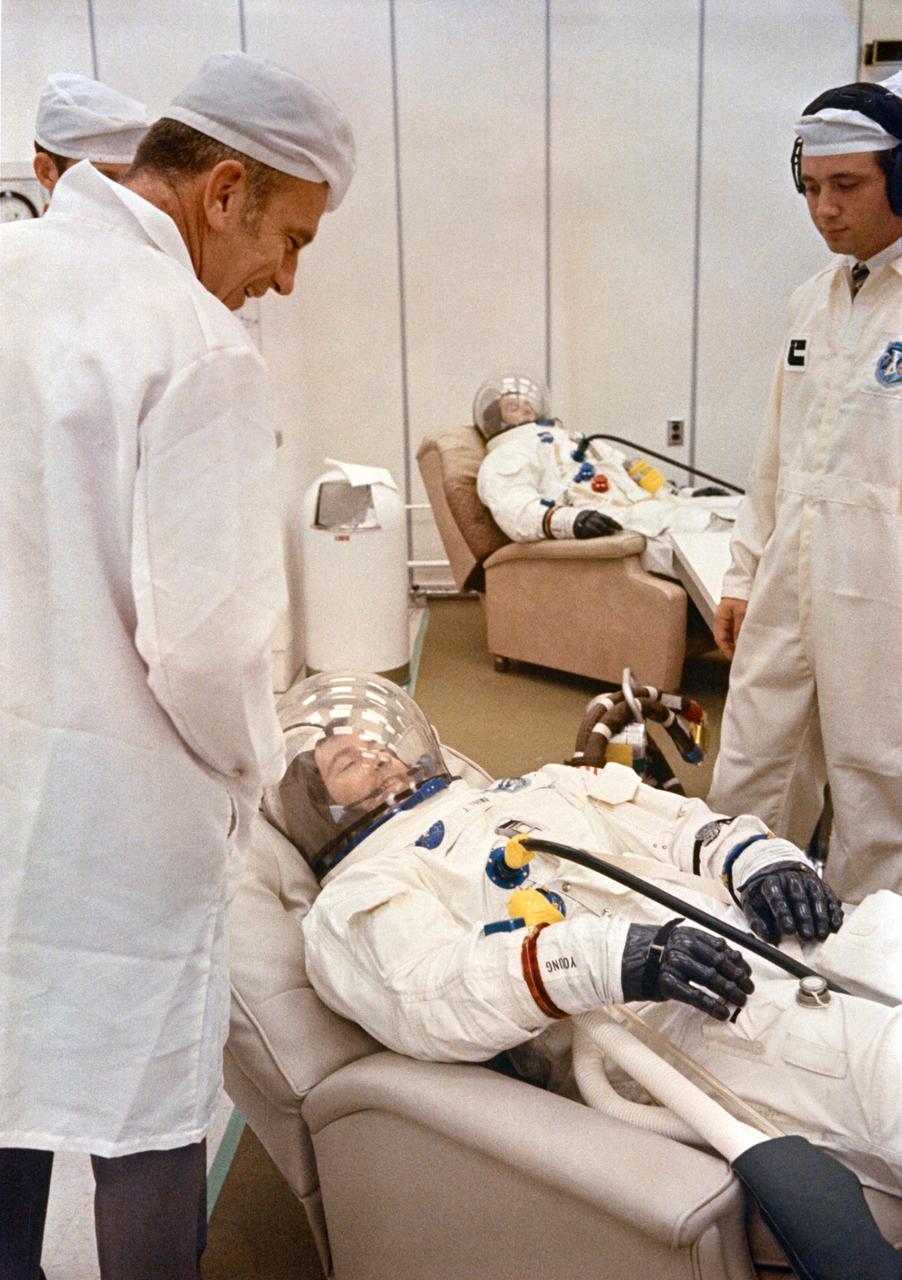
S69-34482 (18 May 1969) --- Astronaut John W. Young, Apollo 10 command module pilot, jokes with Donald K. Slayton (standing left), director of Flight Crew Operations, Manned Spacecraft Center, during Apollo 10 suiting up operations. On couch in background is astronaut Eugene A. Cernan, lunar module pilot. Astronauts Young; Cernan; and Thomas P. Stafford, commander, rode a transfer van from the Manned Spacecraft Operations Building over to Pad B, Launch Complex 39 where their spacecraft awaited them. Liftoff was at 12:49 p.m. (EDT), May 18, 1969.
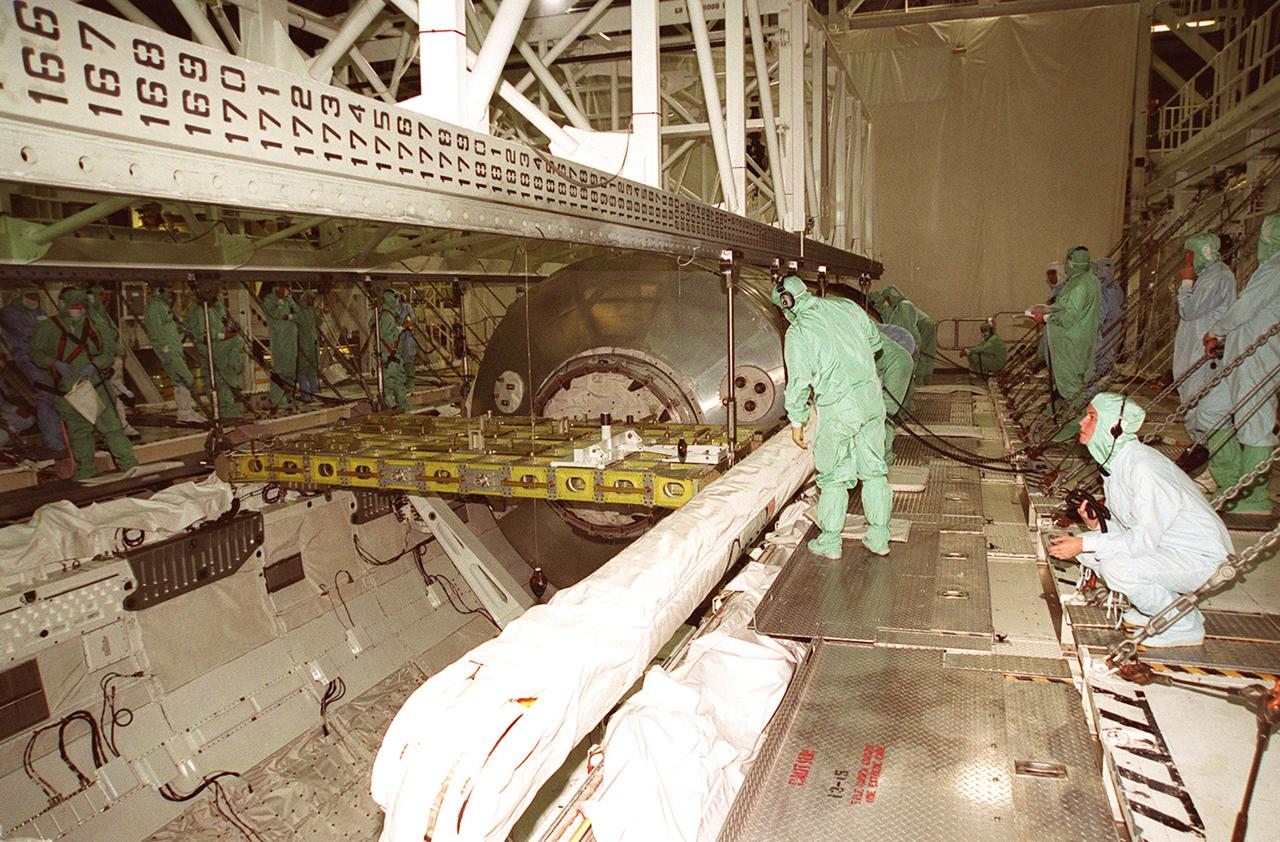
KENNEDY SPACE CENTER, FLA. -- Workers in the Orbiter Processing Facility bay 2 check the attachments on the overhead crane to the Multi-Purpose Logistics Module Leonardo and the integrated cargo carrier behind it sitting in Discovery’s payload bay. The MPLM has just returned from its first round trip to the International Space Station on mission STS-102. Attached to the length of the payload bay, in front of Leonardo, is the robotic arm that was used to remove and position Leonardo on the ISS. Leonardo will be lifted from the payload bay and transferred to the SSPF to prepare it for future missions. The MPLM serves as a cargo van, carrying equipment and supplies to the Space Station
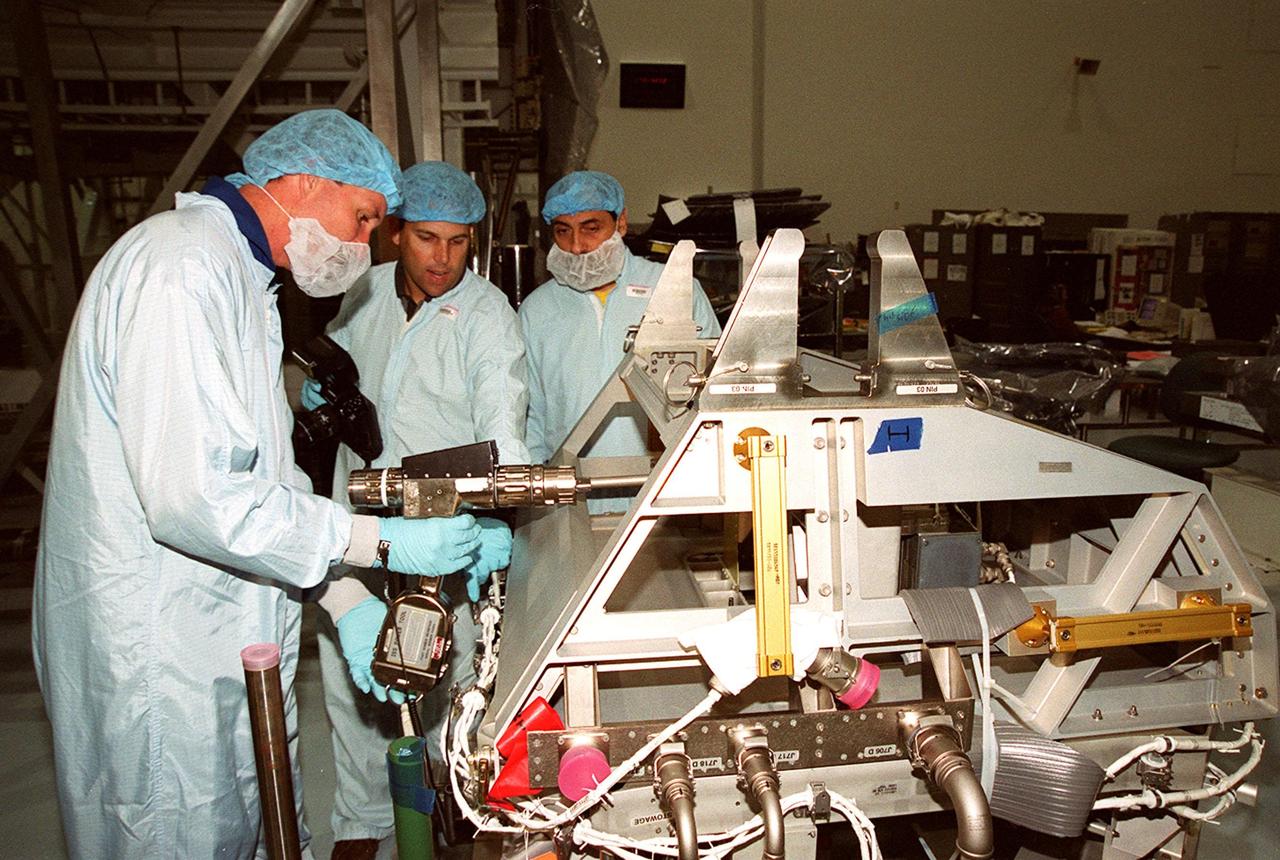
In the Space Station Processing Facility, STS-100 Commander Kent Rominger (left) tries out a piece of equipment while a worker (center) gives directions. Looking on at right is Mission Specialist Umberto Guidoni, with the European Space Agency. Mission STS-100, scheduled to launch April 19, 2001, will include Raffaello as well as the Space Station Remote Manipulator System (SSRMS) as its payload. MPLMs are pressurized modules that will serve as the International Space Station's “moving vans,” carrying laboratory racks filled with equipment, experiments and supplies to and from the station aboard the Space Shuttle. The SSRMS is the primary means of transferring payloads between the orbiter payload bay and the International Space Station for assembly
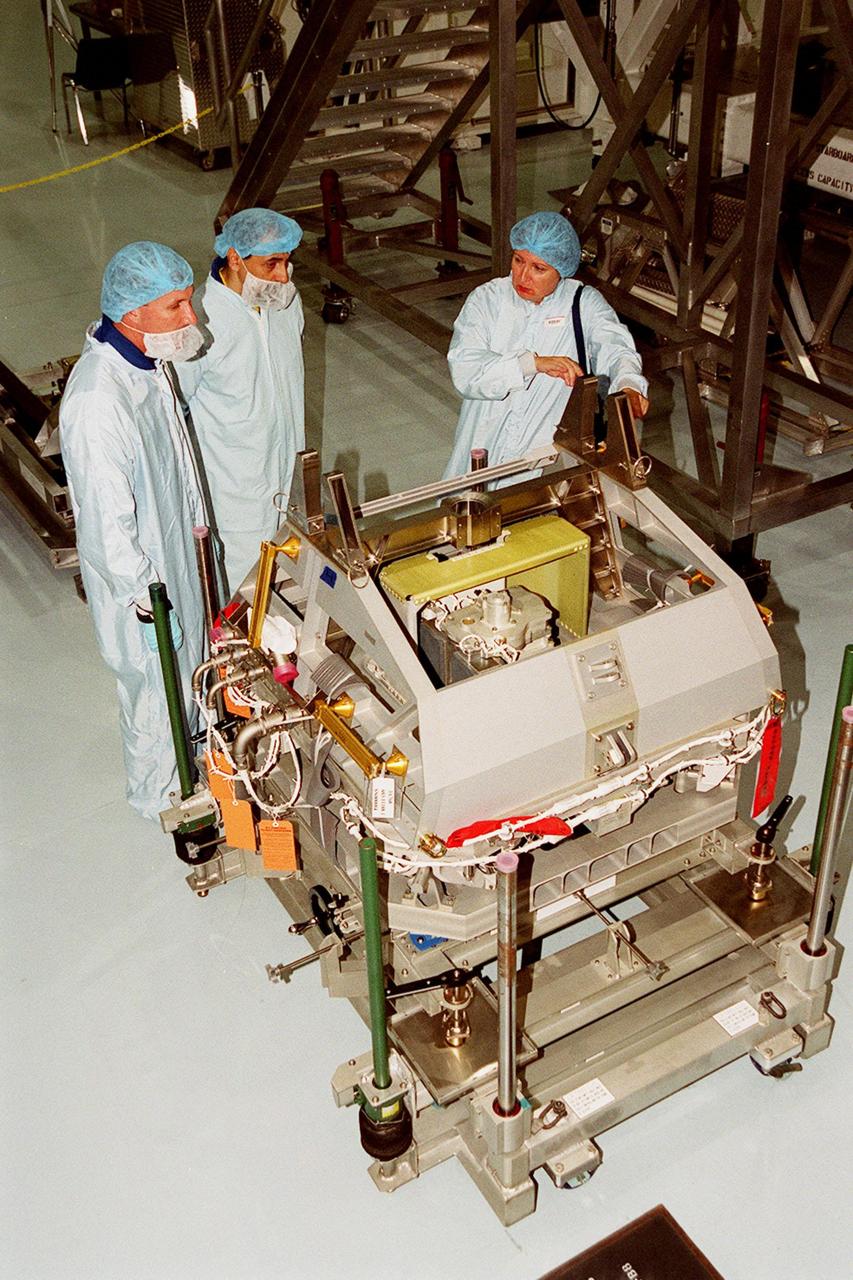
In the Space Station Processing Facility, STS-100 Commander Kent Rominger and Mission Specialist Umberto Guidoni, who is with the European Space Agency, look over equipment on the floor. Mission STS-100, scheduled to launch April 19, 2001, will include the Multi-Purpose Logistics Module (MPLM) Raffaello and the Space Station Remote Manipulator System (SSRMS) as its payload. MPLMs are pressurized modules that will serve as the International Space Station's “moving vans,” carrying laboratory racks filled with equipment, experiments and supplies to and from the station aboard the Space Shuttle. The SSRMS is the primary means of transferring payloads between the orbiter payload bay and the International Space Station for assembly
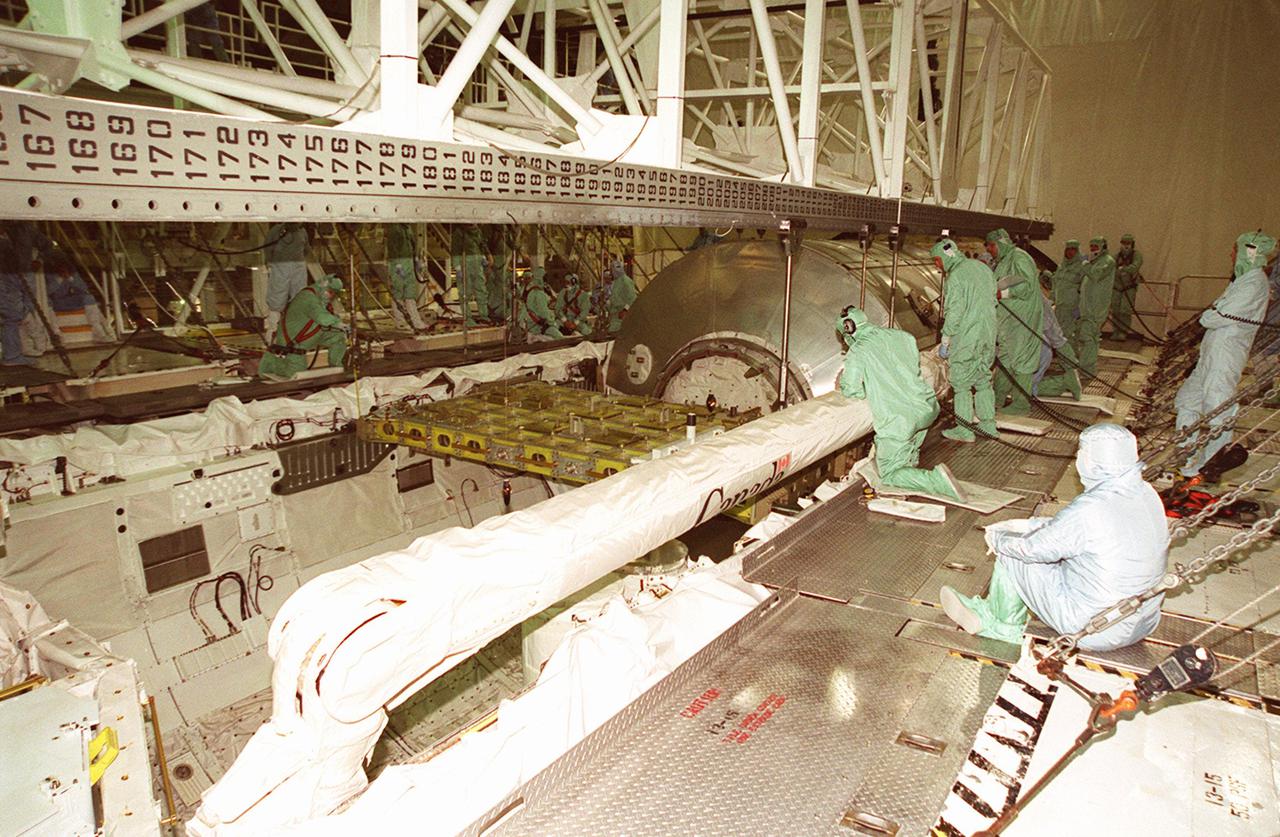
KENNEDY SPACE CENTER, FLA. -- In the Orbiter Processing Facility bay 2, workers attach an overhead crane to the Multi-Purpose Logistics Module Leonardo and the integrated cargo carrier behind it sitting in Discovery’s payload bay. The MPLM has just returned from its first round trip to the International Space Station on mission STS-102. Attached to the length of the payload bay, in front of Leonardo, is the robotic arm that was used to remove and position Leonardo on the ISS. Leonardo will be lifted from the payload bay and transferred to the SSPF to prepare it for future missions. The MPLM serves as a cargo van, carrying equipment and supplies to the Space Station
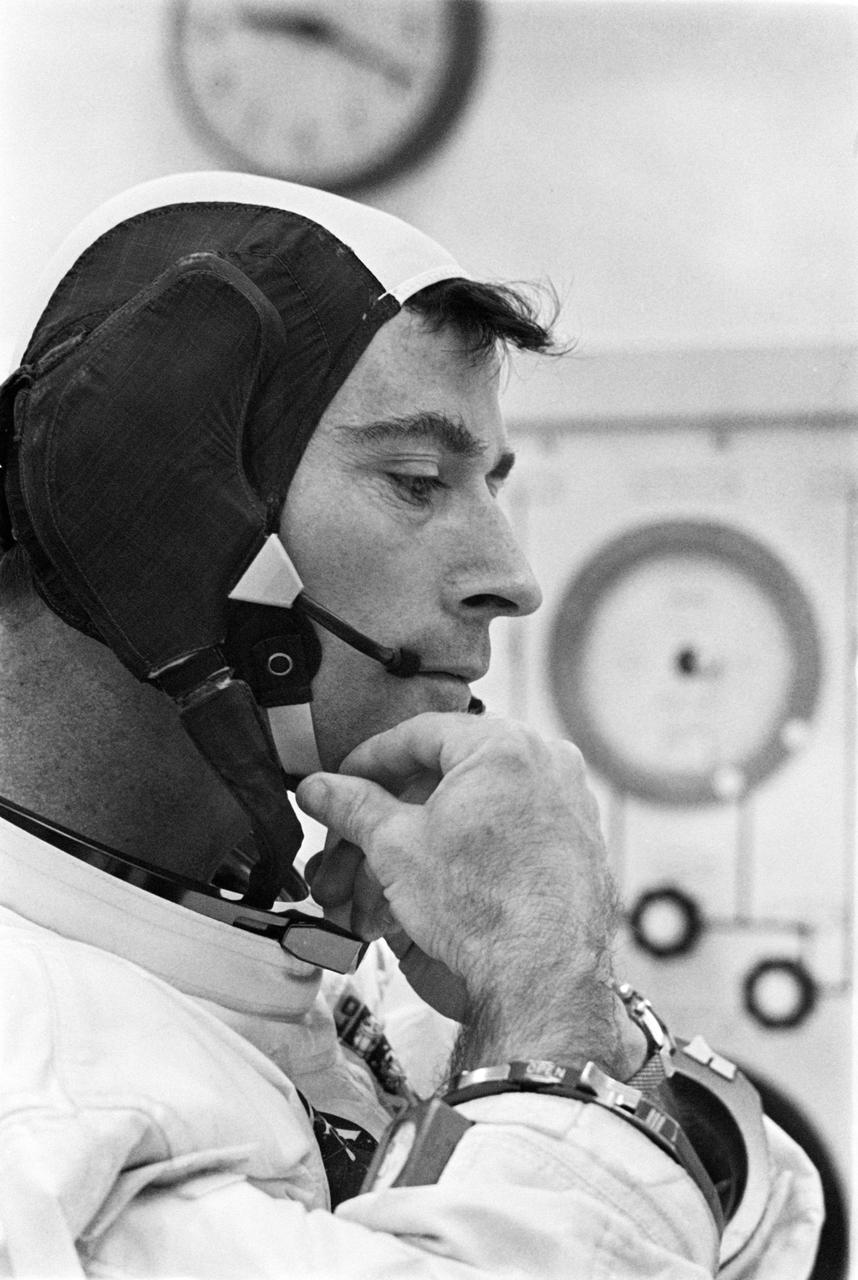
S69-34485 (18 May 1969) --- Astronaut John W. Young, Apollo 10 command module pilot, adjusts strap on his communications cap during suiting up operations for the lunar orbit mission. Minutes later astronauts Young; Thomas P. Stafford, commander; and Eugene A. Cernan, lunar module pilot, rode a transfer van from the Kennedy Space Center's Manned Spacecraft Operations Building over to Pad B, Launch Complex 39, where their spacecraft awaited them. Liftoff was at 12:49 p.m. (EDT), May 18, 1969.
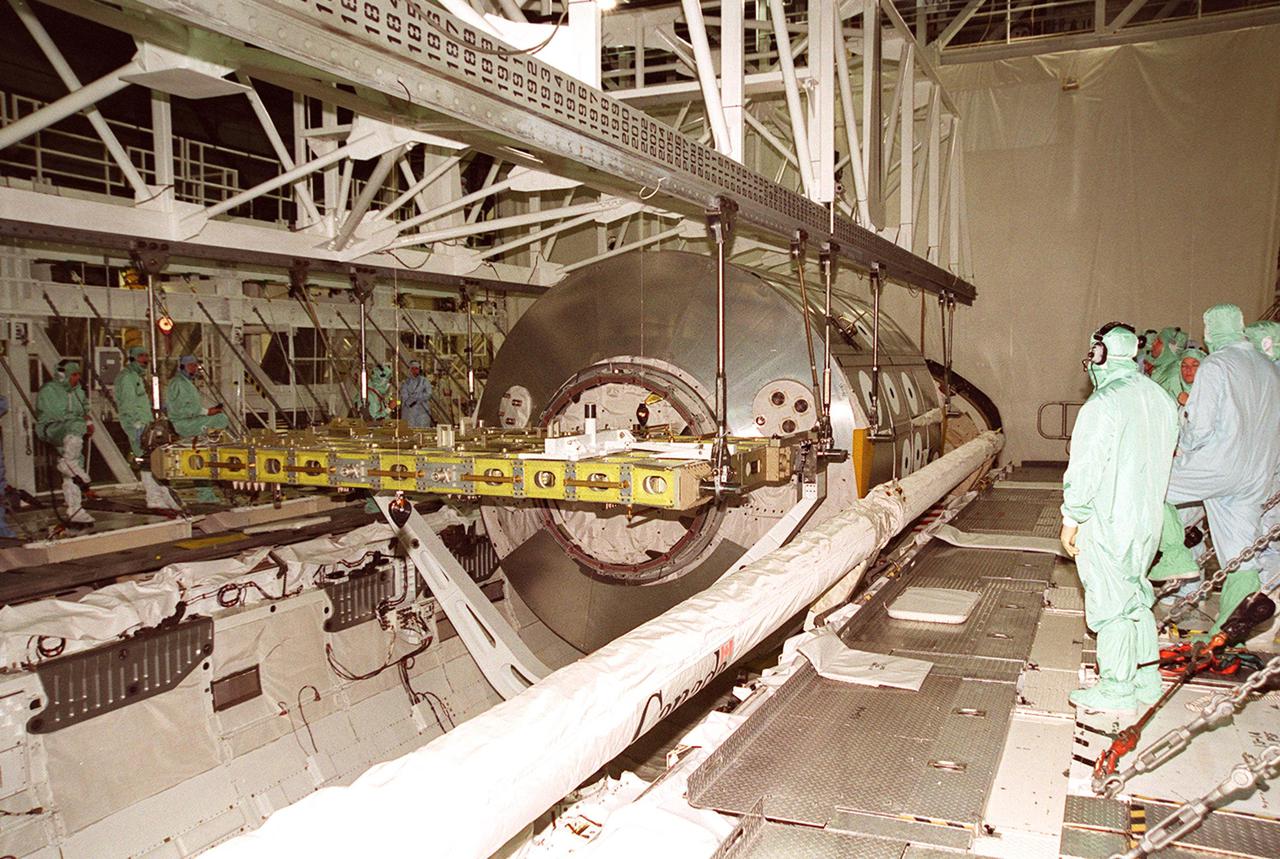
KENNEDY SPACE CENTER, FLA. -- In the Orbiter Processing Facility bay 2, an overhead crane begins lifting the Multi-Purpose Logistics Module Leonardo and the integrated cargo carrier next to it out of Discovery’s payload bay. The MPLM has just returned from its first round trip to the International Space Station on mission STS-102. Attached to the length of the payload bay, next to Leonardo, is the robotic arm that was used to remove and position Leonardo on the ISS. Leonardo will be transferred to the SSPF to prepare it for future missions. The MPLM serves as a cargo van, carrying equipment and supplies to the Space Station
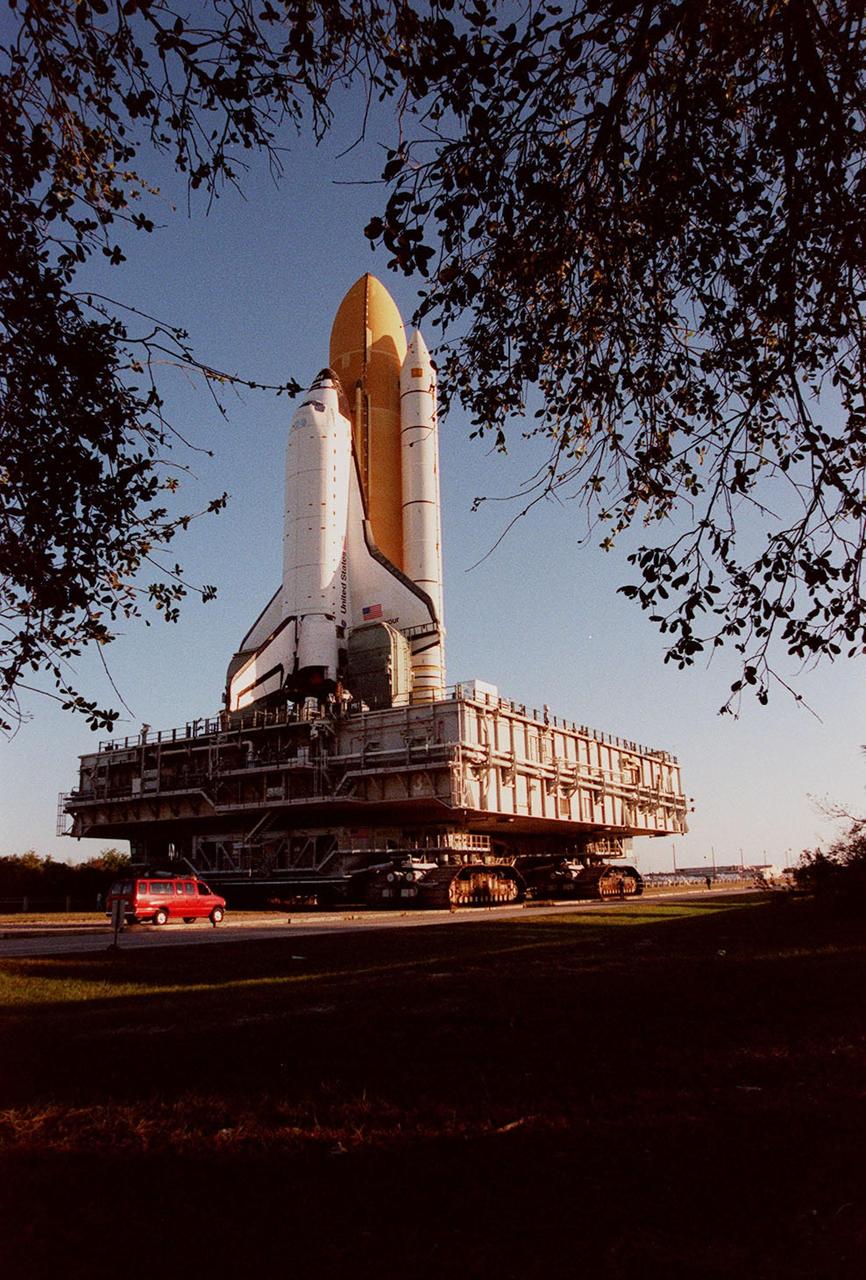
KENNEDY SPACE CENTER, Fla. -- Framed by branches of oak leaves in this photo, Space Shuttle Endeavour, on its mobile launcher platform, is transferred to Launch Pad 39A for mission STS-99. The van behind it is barely noticeable next to the gigantic stature of the moving vehicle. Named the Shuttle Radar Topography Mission (SRTM), it involves an international project spearheaded by the National Imagery and Mapping Agency and NASA, with participation of the German Aerospace Center DLR. The SRTM consists of a specially modified radar system that will gather data for the most accurate and complete topographic map of the Earth's surface that has ever been assembled
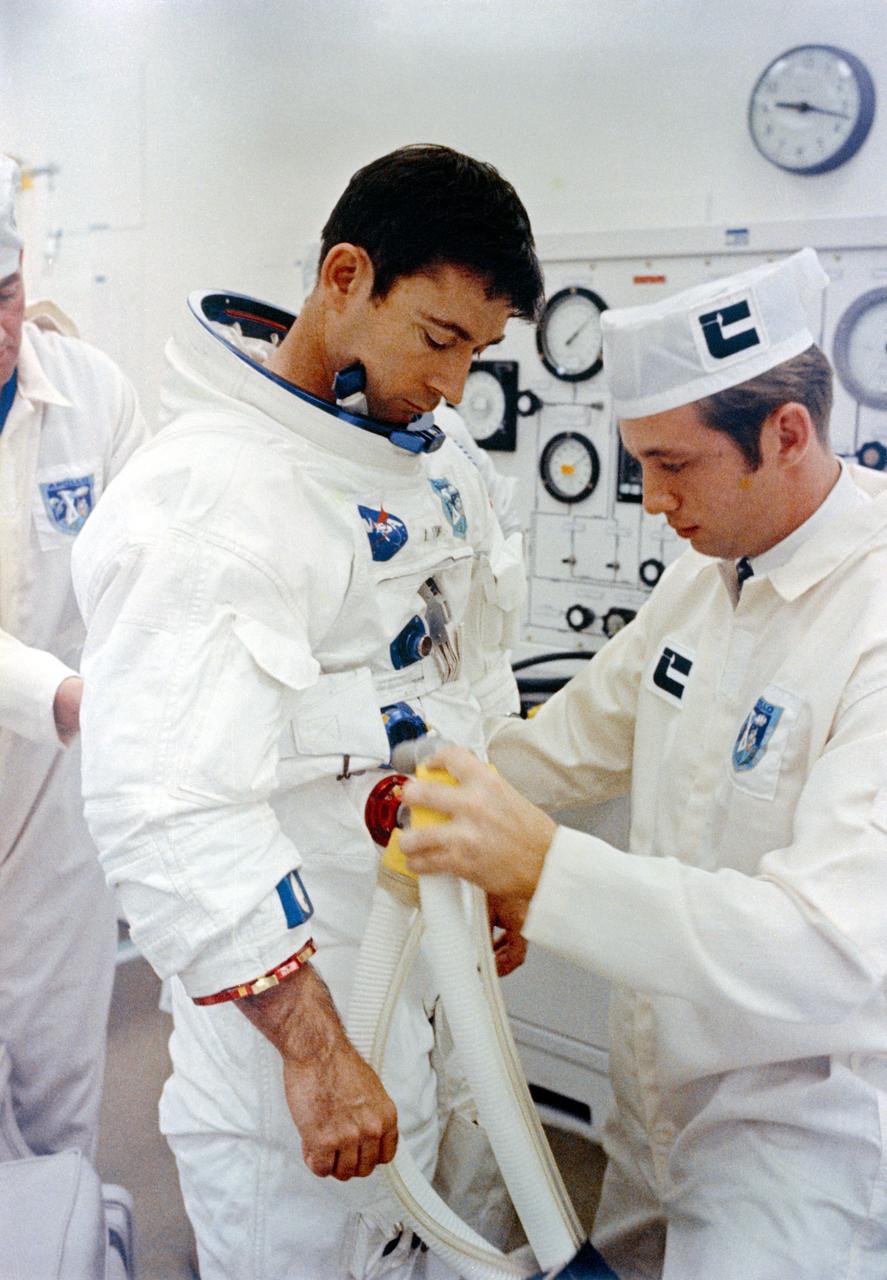
S69-34483 (18 May 1969) --- A technician attaches hose from test stand to spacesuit of astronaut John W. Young, Apollo 10 command module pilot, during final suiting operations for the Apollo 10 lunar orbit mission. Another technician makes adjustment behind Young. Minutes later astronauts Young; Thomas P. Stafford, commander; and Eugene A. Cernan, lunar module pilot, rode a transfer van from the Kennedy Space Center's Manned Spacecraft Operations Building over to Pad B, Launch Complex 39, where their spacecraft awaited them. Liftoff was at 12:49 p.m. (EDT), May 18, 1969.
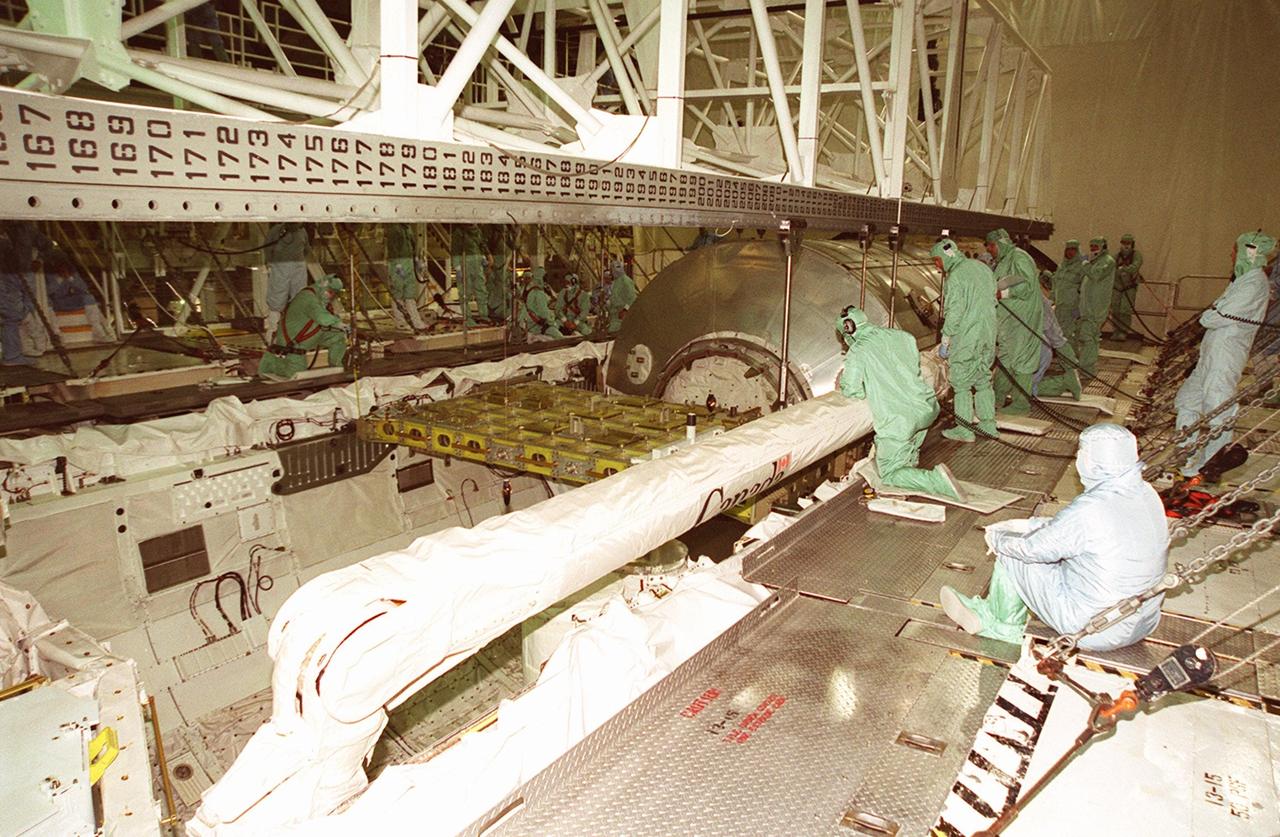
KENNEDY SPACE CENTER, FLA. -- In the Orbiter Processing Facility bay 2, workers attach an overhead crane to the Multi-Purpose Logistics Module Leonardo and the integrated cargo carrier behind it sitting in Discovery’s payload bay. The MPLM has just returned from its first round trip to the International Space Station on mission STS-102. Attached to the length of the payload bay, in front of Leonardo, is the robotic arm that was used to remove and position Leonardo on the ISS. Leonardo will be lifted from the payload bay and transferred to the SSPF to prepare it for future missions. The MPLM serves as a cargo van, carrying equipment and supplies to the Space Station
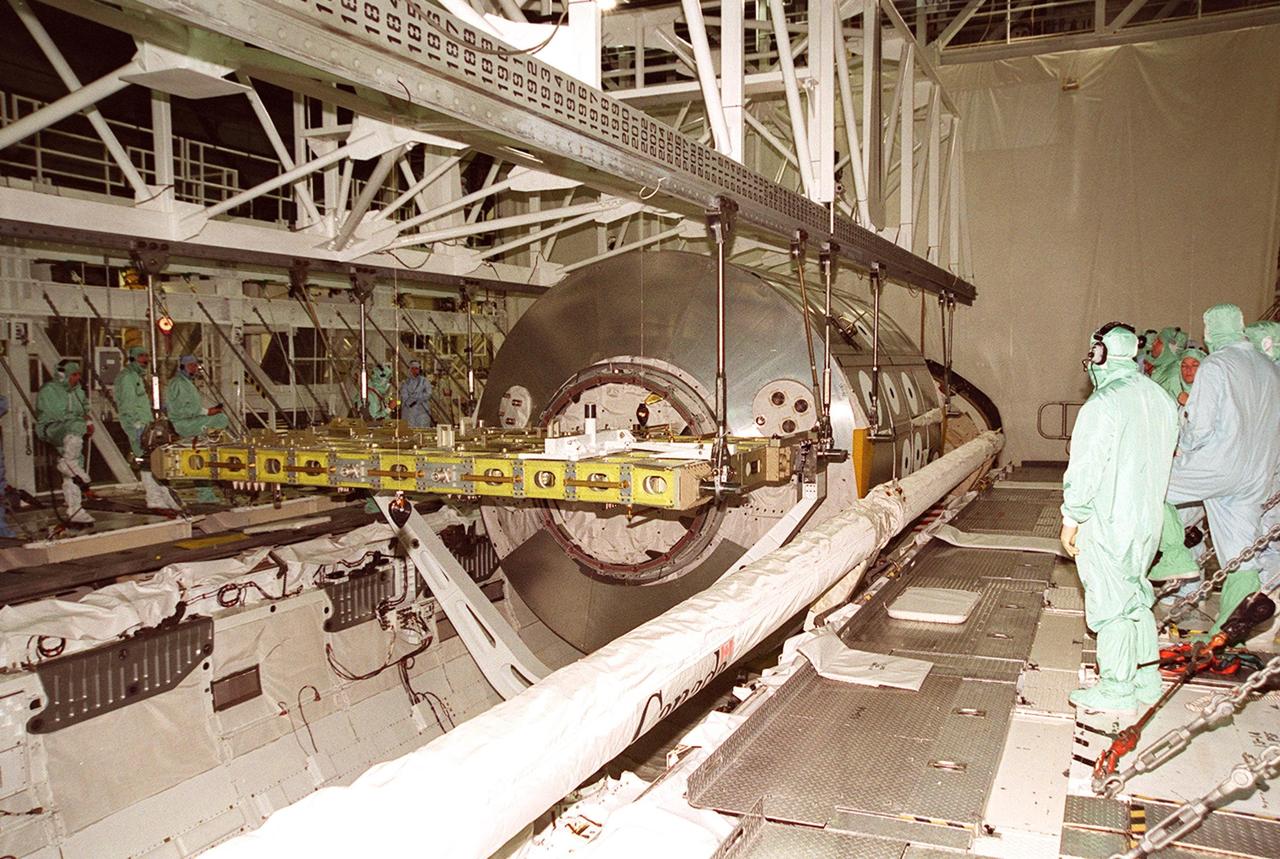
KENNEDY SPACE CENTER, FLA. -- In the Orbiter Processing Facility bay 2, an overhead crane begins lifting the Multi-Purpose Logistics Module Leonardo and the integrated cargo carrier next to it out of Discovery’s payload bay. The MPLM has just returned from its first round trip to the International Space Station on mission STS-102. Attached to the length of the payload bay, next to Leonardo, is the robotic arm that was used to remove and position Leonardo on the ISS. Leonardo will be transferred to the SSPF to prepare it for future missions. The MPLM serves as a cargo van, carrying equipment and supplies to the Space Station
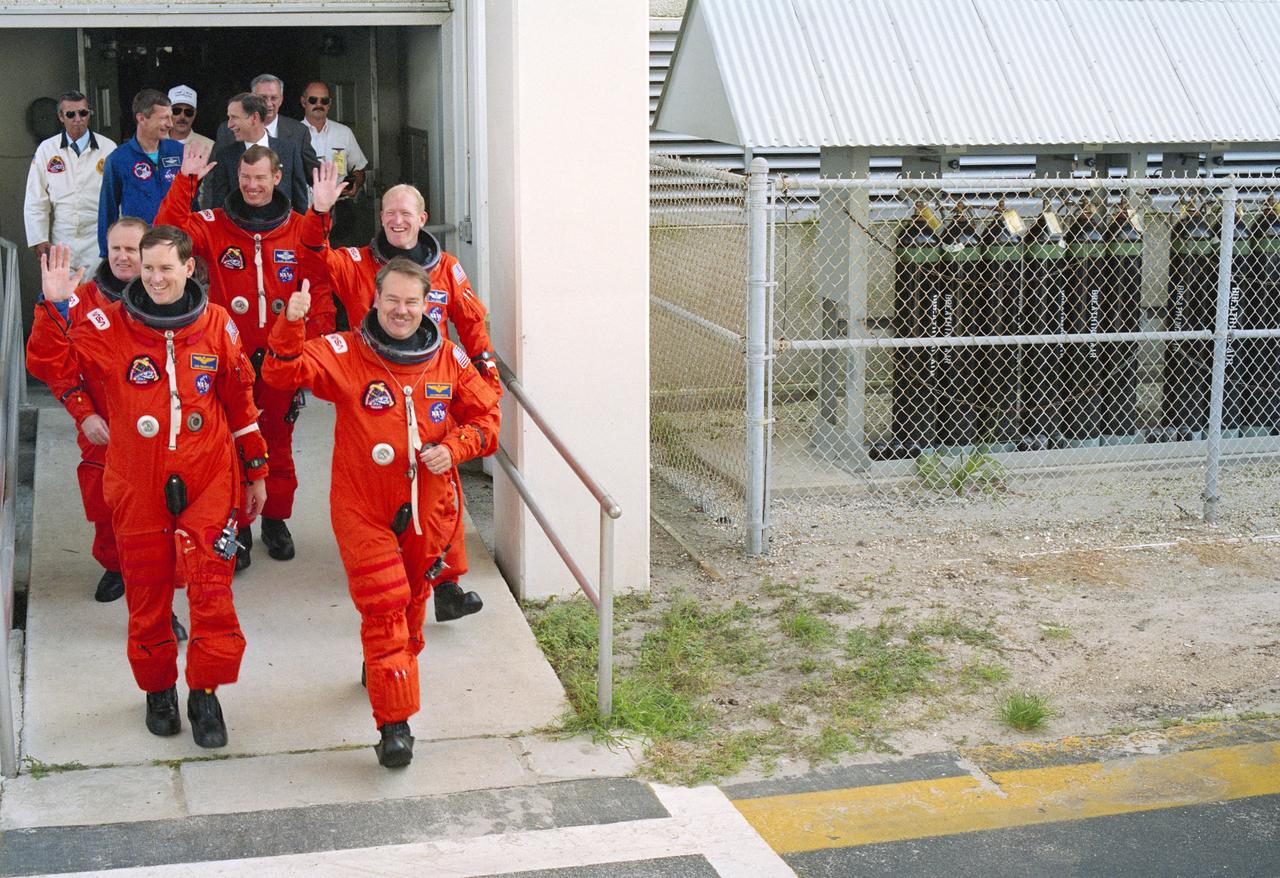
STS048-S-168 (18 Sept. 1991) --- The five astronaut crew members for NASA's STS-48 mission leave the operations and checkout building headed for a transfer van that will take them to the awaiting Discovery at Launch Complex 39. Astronaut John O. Creighton, right, mission commander, leads the group, with Kenneth S. Reightler, pilot, on his right. Mission specialists are, left to right, James F. Buchli, Mark N. Brown and Charles D. (Sam) Gemar. In the background are astronauts Steven R. Nagel and Richard O. Covey and Olan J. Bertrand, all from the Johnson Space Center (JSC). Discovery launched at 7:11:04 p.m. (EDT), Sept. 12, 1991. Photo credit: NASA
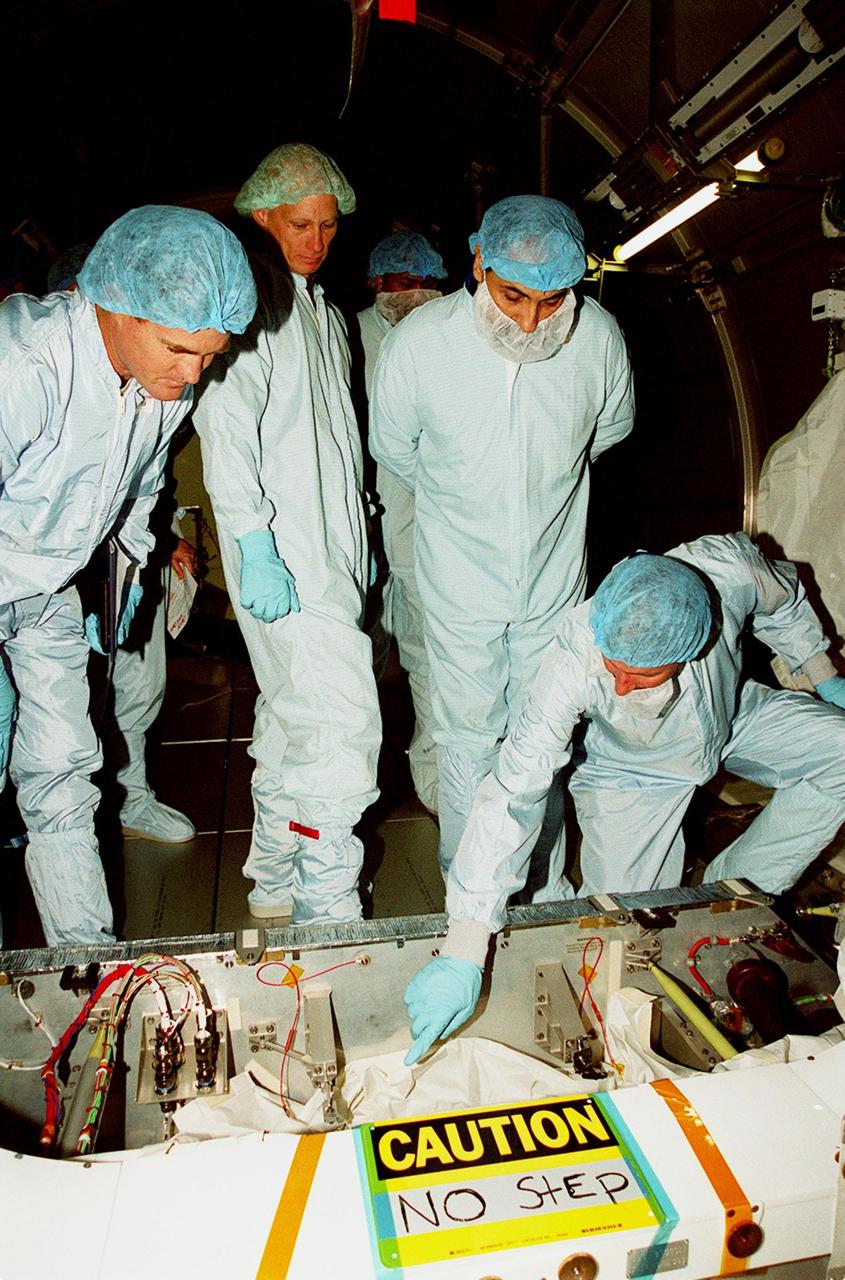
With workers at left looking on, STS-100 crew members check out equipment inside the Multi-Purpose Logistics Module Raffaello, located in the Space Station Processing Facility. At right is Commander Kent Rominger; to his left in the photo is Mission Specialist Umberto Guidoni, with the European Space Agency. Mission STS-100, scheduled to launch April 19, 2001, will include Raffaello as well as the Space Station Remote Manipulator System (SSRMS) as its payload. MPLMs are pressurized modules that will serve as the International Space Station's “moving vans,” carrying laboratory racks filled with equipment, experiments and supplies to and from the station aboard the Space Shuttle. The SSRMS is the primary means of transferring payloads between the orbiter payload bay and the International Space Station for assembly
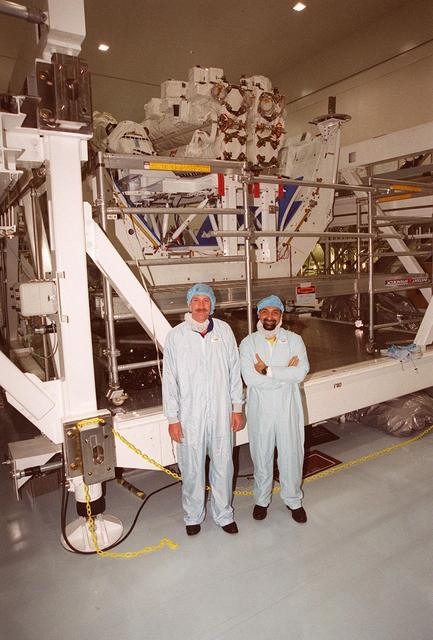
STS-100 Commander Kent Rominger and Mission Specialist Umberto Guidoni (right), with the European Space Agency, pose for a photo during Crew Equipment Interface Test activities in the Space Station Processing Facility. Behind them is the Space Station Remote Manipulator System (SSRMS), also known as the Canadian arm, which is part of the payload on their mission. The SSRMS is the primary means of transferring payloads between the orbiter payload bay and the International Space Station for assembly. The 56-foot-long robotic arm includes two 12-foot booms joined by a hinge. Seven joints on the arm allow highly flexible and precise movement. The payload also includes the Multi-Purpose Logistics Module (MPLM) Raffaello. MPLMs are pressurized modules that will serve as the International Space Station's “moving vans,” carrying laboratory racks filled with equipment, experiments and supplies to and from the station aboard the Space Shuttle. Mission STS-100 is scheduled to launch April 19, 2001
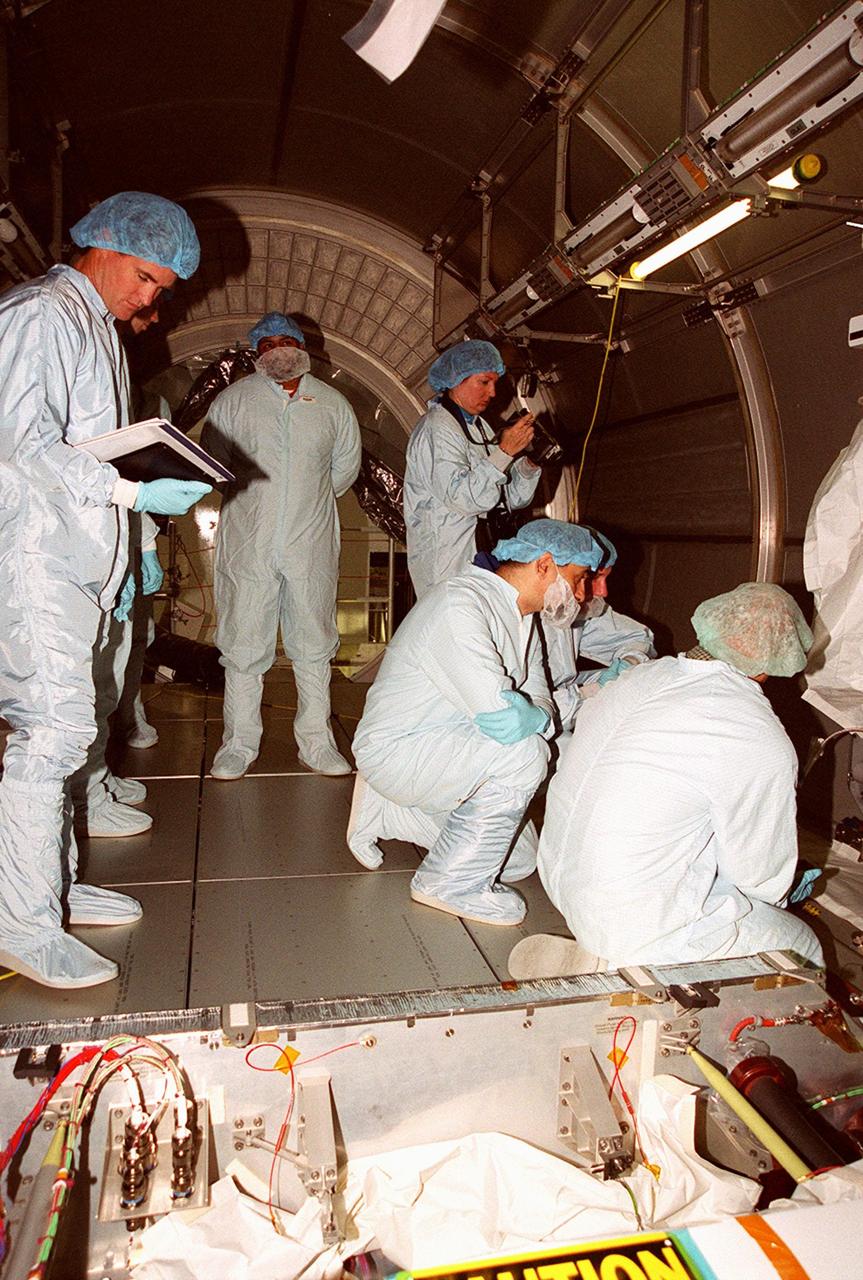
With workers looking on, STS-100 crew members check out equipment inside the Multi-Purpose Logistics Module Raffaello, located in the Space Station Processing Facility. Standing at center is Mission Specialist Umberto Guidoni, with the European Space Agency. Kneeling at right is Commander Kent Rominger. Mission STS-100, scheduled to launch April 19, 2001, will include Raffaello as well as the Space Station Remote Manipulator System (SSRMS) as its payload. MPLMs are pressurized modules that will serve as the International Space Station's “moving vans,” carrying laboratory racks filled with equipment, experiments and supplies to and from the station aboard the Space Shuttle. The SSRMS is the primary means of transferring payloads between the orbiter payload bay and the International Space Station for assembly
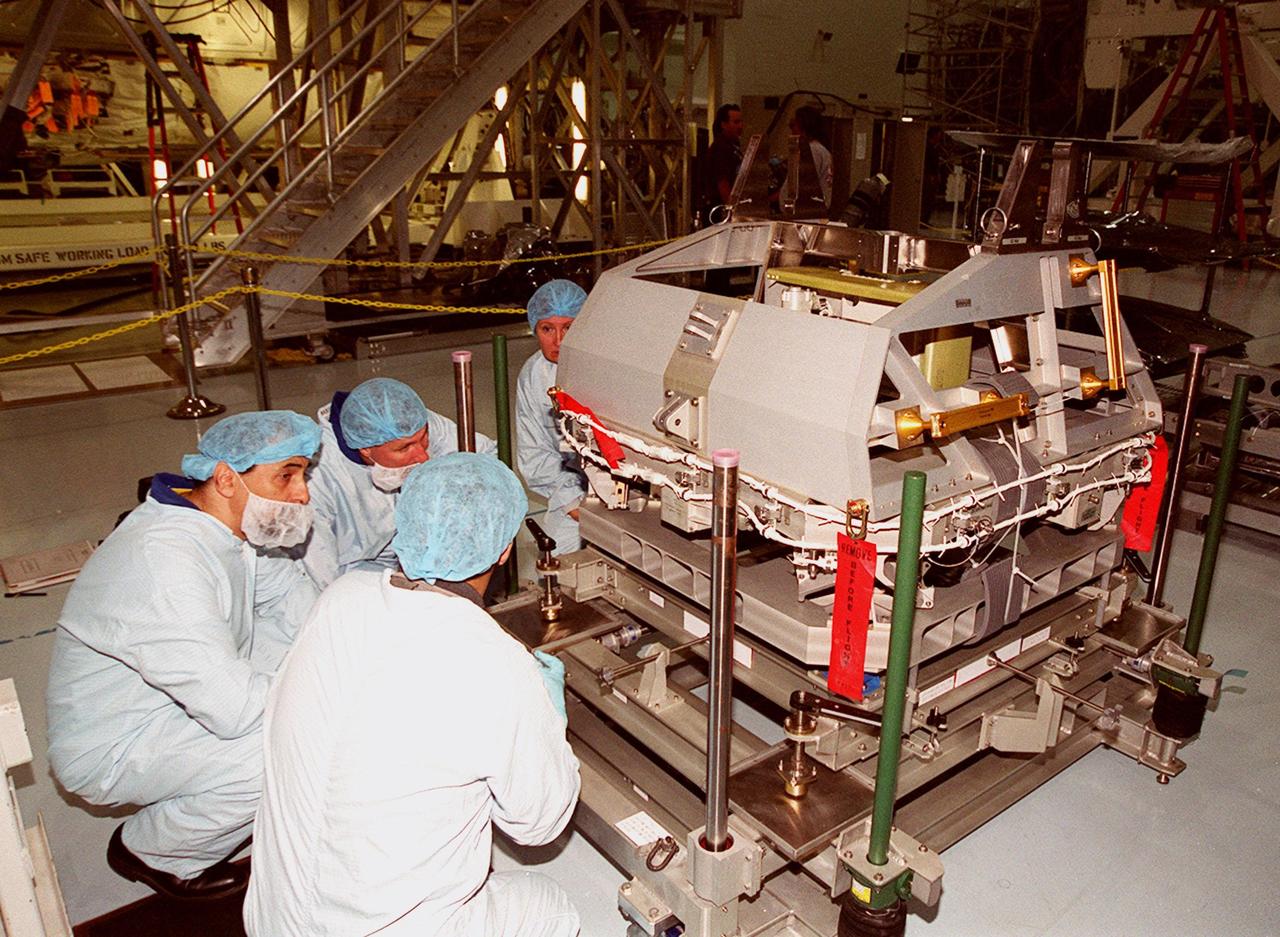
In the Space Station Processing Facility, STS-100 Mission Specialist Umberto Guidoni (left) and Commander Kent Rominger (center back), along with two workers, take a close look at equipment on the floor. Guidoni is with the European Space Agency. Mission STS-100, scheduled to launch April 19, 2001, will include the Multi-Purpose Logistics Module (MPLM) Raffaello and the Space Station Remote Manipulator System (SSRMS) as its payload. MPLMs are pressurized modules that will serve as the International Space Station's “moving vans,” carrying laboratory racks filled with equipment, experiments and supplies to and from the station aboard the Space Shuttle. The SSRMS is the primary means of transferring payloads between the orbiter payload bay and the International Space Station for assembly
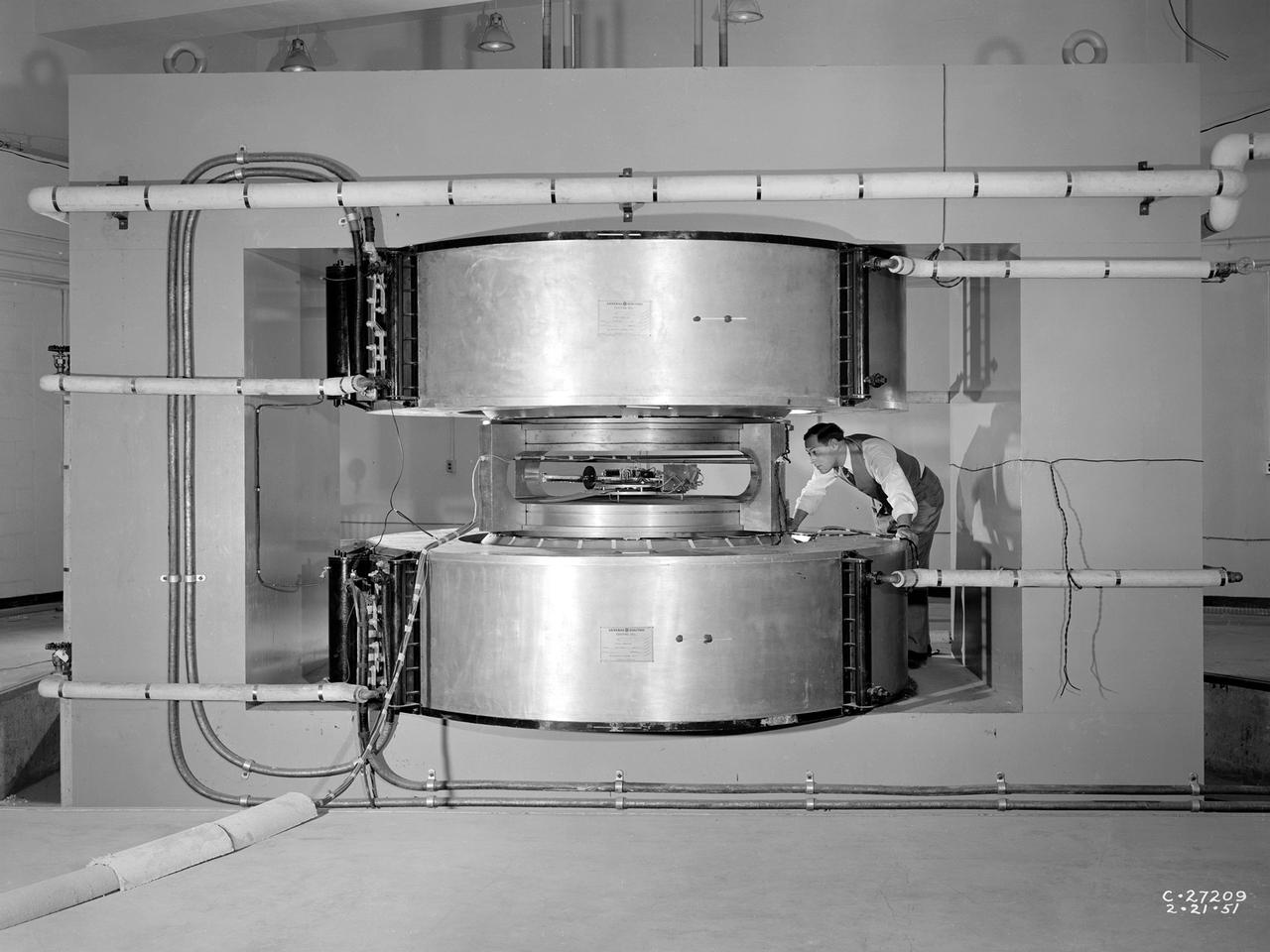
Researcher James Blue examines the new cyclotron at the National Advisory Committee for Aeronautics (NACA) Lewis Flight Propulsion Laboratory. Researchers at NACA Lewis began postulating about the use of atomic power for propulsion immediately after World War II. The NACA concentrated its efforts on the study of high temperature materials and heat transfer since it did not have access to the top secret fission information. The military studied the plausibility of nuclear propulsion for aircraft in the late 1940s. The military program was cancelled after four years without any breakthroughs, but the Atomic Energy Commission took on the effort in 1951. The NACA Lewis laboratory was expanding its nuclear-related research during this period. In 1948, Lewis engineers were assigned to the Oak Ridge National Laboratory to obtain expertise in high temperature heat transfer and advanced materials technology. The following year a new 80-person Nuclear Reactor Division was created, and an in-house nuclear school was established to train these researchers. The cyclotron was built behind the Materials and Structures Laboratory to support thermodynamic and materials research for both nuclear aircraft and nuclear rockets. The original NACA Lewis cyclotron was used to accelerate two kinds of particles. To better match the space radiation environment, the cyclotron was later modified to accelerate particles of the newly-discovered Van Allen radiation belts.
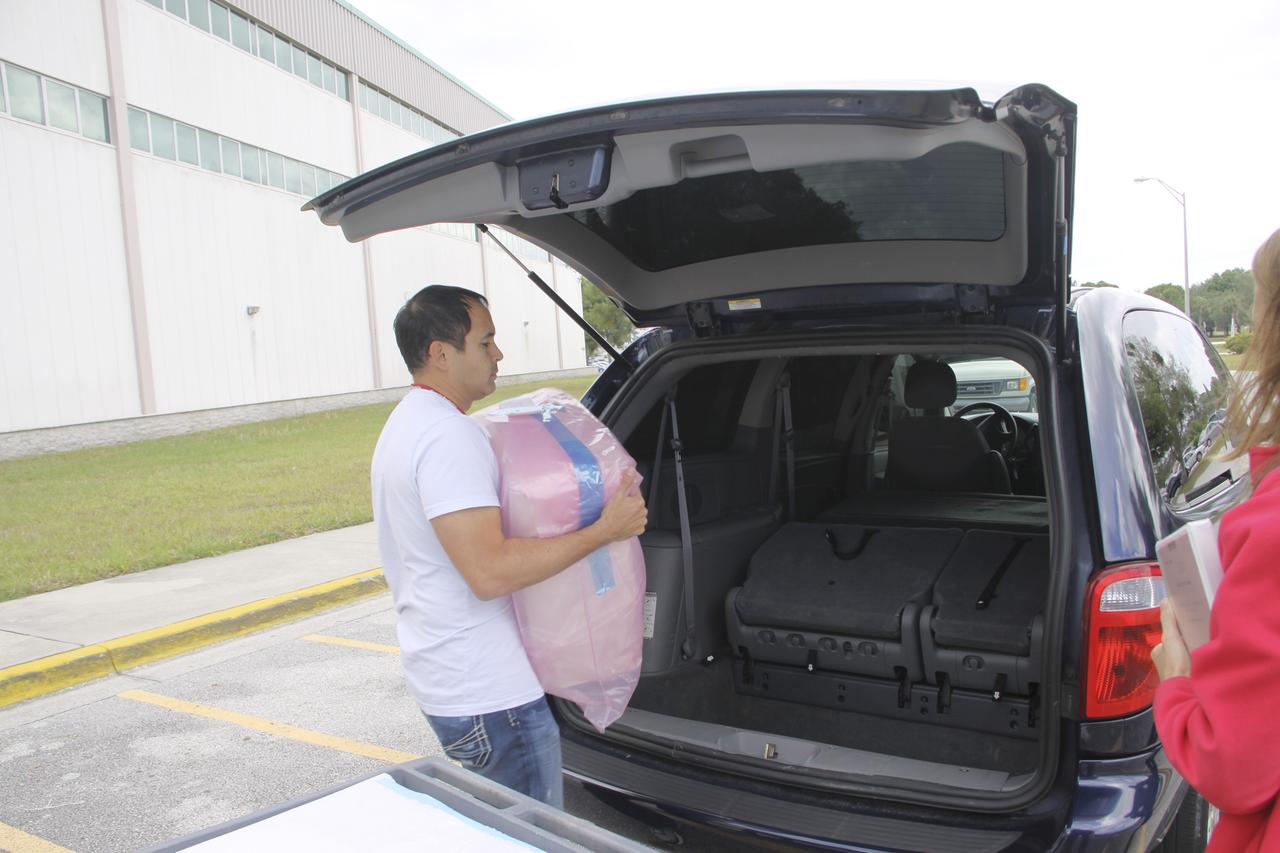
CAPE CANAVERAL, Fla. – A cargo bag designed to keep its contents cool, packed with NanoRacks-CubeLabs Module-9 experiments, is loaded into a van at the Space Station Processing Facility at NASA’s Kennedy Space Center in Florida for its trip to Space Launch Complex-40 on nearby Cape Canaveral Air Force Station. There, the bag will be loaded into the Space Exploration Technologies Dragon capsule in preparation for its scheduled April 30 liftoff aboard a Falcon 9 rocket. NanoRacks-CubeLabs Module-9 uses a two-cube unit box for student competition investigations using 15 liquid mixing tube assemblies that function similar to commercial glow sticks. The investigations range from microbial growth to water purification in microgravity. Known as SpaceX, the launch will be the company's second demonstration test flight for NASA's Commercial Orbital Transportation Services program, or COTS. During the flight, the capsule will conduct a series of check-out procedures to test and prove its systems, including rendezvous and berthing with the International Space Station. If the capsule performs as planned, the module and other cargo will be transferred to the station. The cargo includes food, water and provisions for the station’s Expedition crews, such as clothing, batteries and computer equipment. Under COTS, NASA has partnered with two private companies to launch cargo safely to the station. For more information, visit http://www.nasa.gov/spacex. Photo credit: NASA/Jim Grossmann
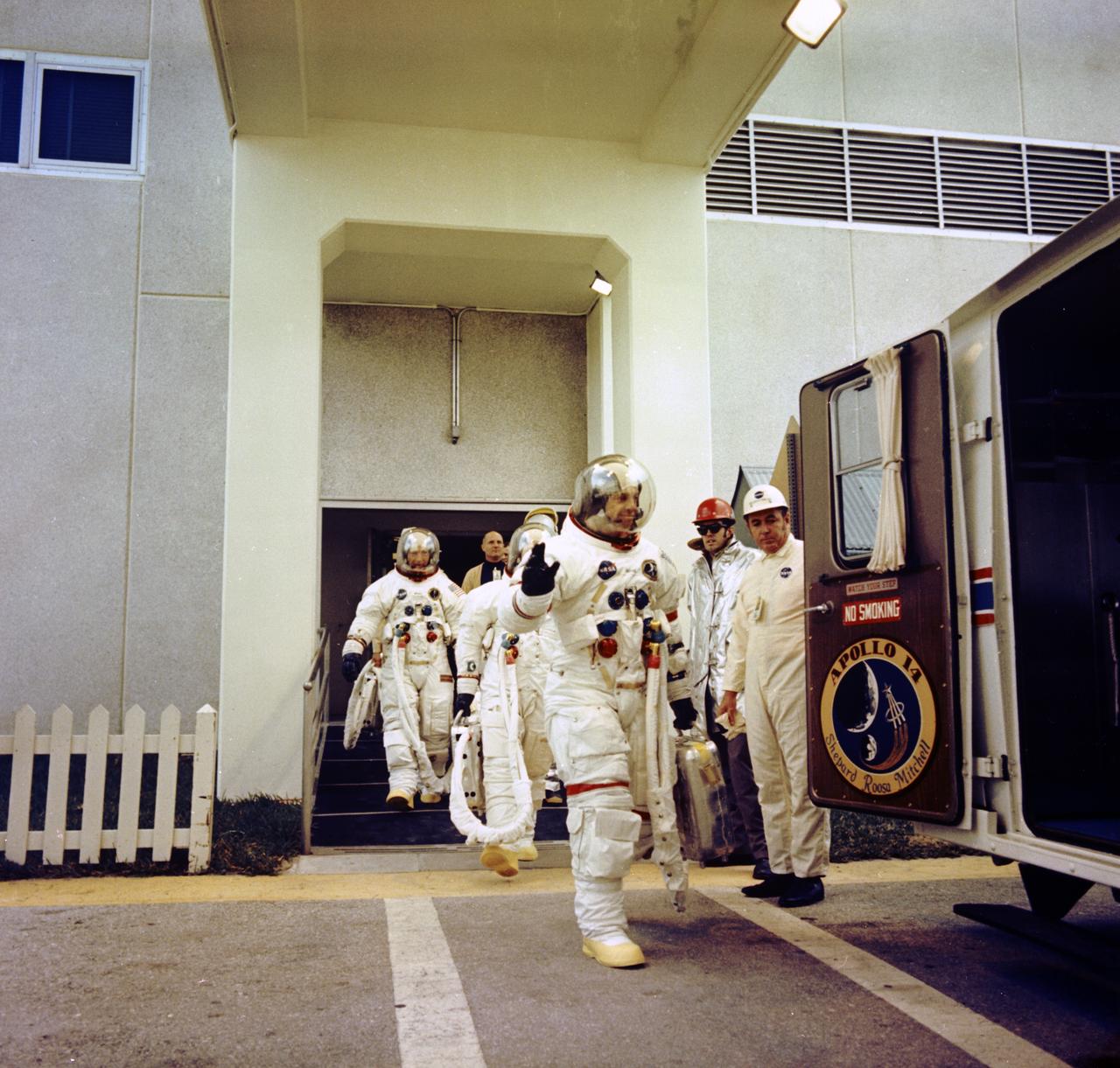
Apollo 14 Mission Commander, Alan B. Shepard, Jr., waves to well-wishers as he and astronauts Stuart A. Roosa, Command Module pilot; and Edgar D. Mitchell, Lunar Module pilot, walk to the transfer van during the countdown demonstration test. The Apollo 14, carrying the crew of three lifted off from launch complex 39A at KSC on January 31, 1971. It was the third manned lunar landing, the first manned landing in exploration of the lunar highlands, and it demonstrated pinpoint landing capability. The major goal of Apollo 14 was the scientific exploration of the Moon in the foothills of the rugged Fra Mauro region. The lunar surface extravehicular activity (EVA) of astronauts Shepard and Mitchell included setting up an automated scientific laboratory called Apollo Lunar Scientific Experiments Package (ALSEP), and collecting a total of about 95 pounds (43 kilograms) of Moon rock and soil for a geological investigation back on the Earth. Apollo 14 safely returned to Earth on February 9, 1971.
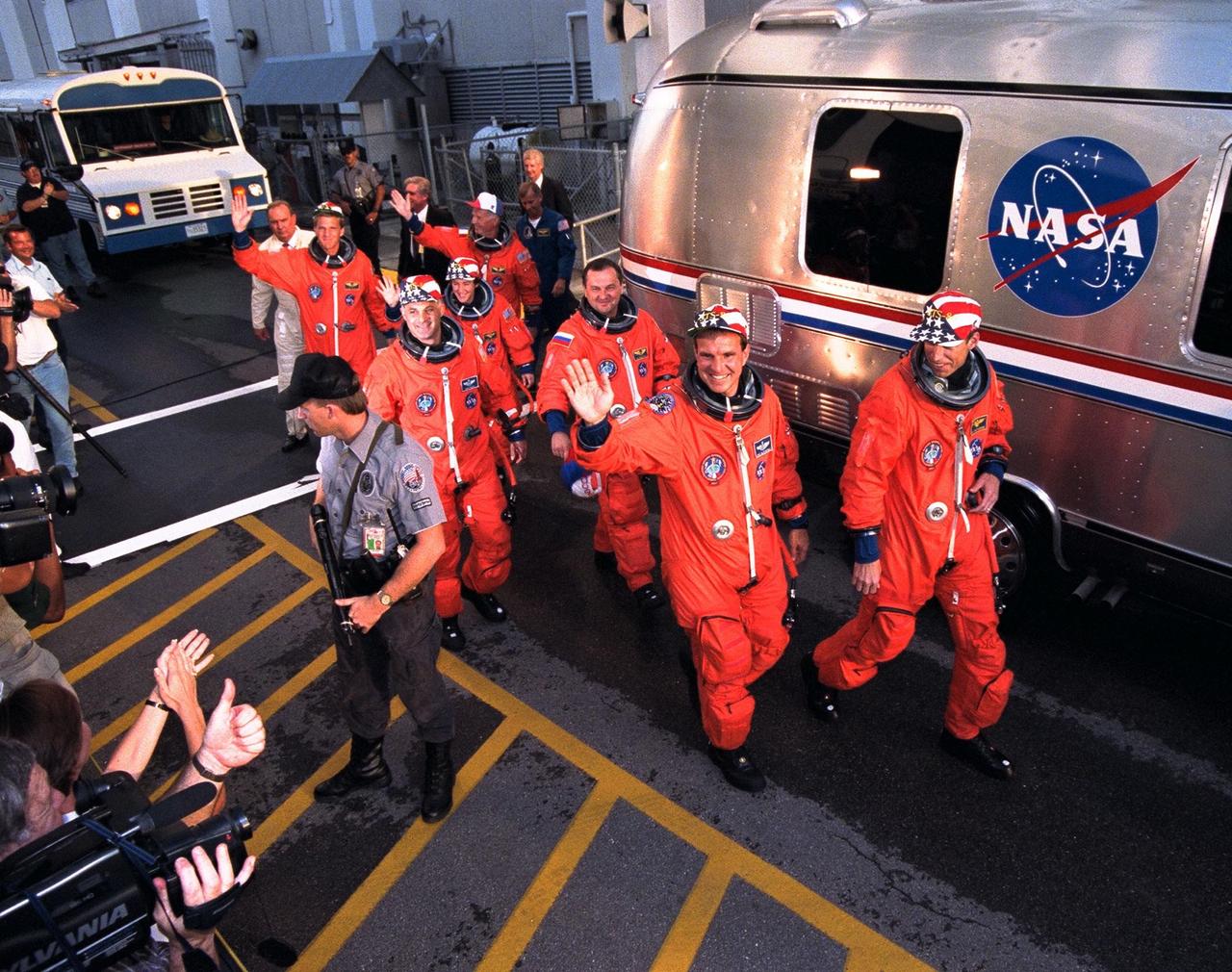
STS-86 crew members smile and wave to the crowd of press representatives, KSC employees and other well-wishers as they prepare to board the astronaut van, at right, after departing from the Operations and Checkout Building. Leading the way are Pilot Michael J. Bloomfield, at left, and Commander James D. Wetherbee. Mission Specialists David A. Wolf, at left, and Vladimir Georgievich Titov of the Russian Space Agency are directly behind them, followed by Mission Specialist Wendy B. Lawrence, at center. Bringing up the rear are Mission Specialists Scott E. Parazynski, at left, and Jean-Loup J.M. Chretien of the French Space Agency, CNES. The seven-member crew is en route to Launch Pad 39A, where the Space Shuttle Atlantis awaits liftoff on a planned 10-day mission slated to be the seventh docking of the Space Shuttle and the Russian Space Station Mir. Wolf is scheduled to transfer to the Mir 24 crew for an approximate four-month stay aboard the Russian space station. He will replace U.S. astronaut C. Michael Foale, who will return to Earth aboard Atlantis with the remainder of the STS-86 crew
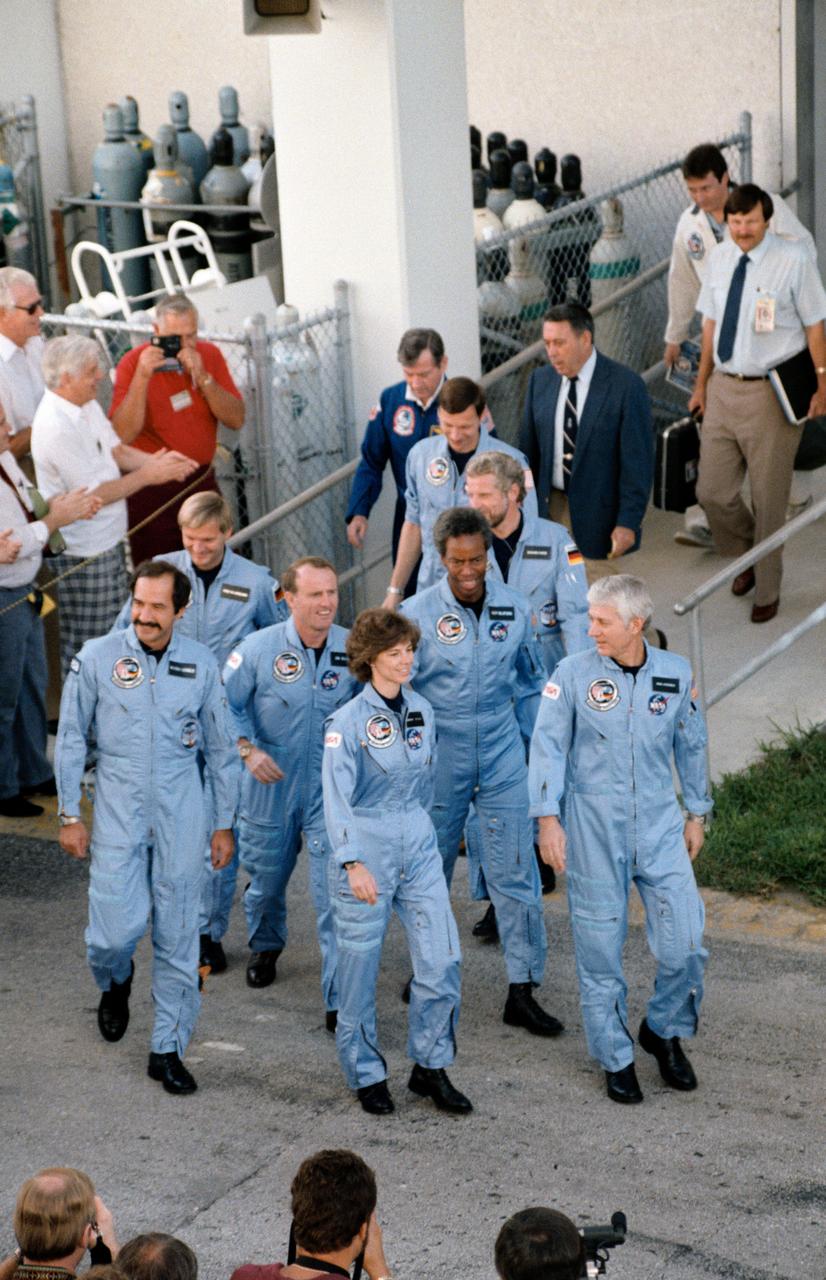
61A-S-015 (30 Oct 1985) --- A record number of crewmembers to serve on a Shuttle mission walks from the operations and checkout facility to a crew transfer van en route to Launch Pad 39A where the Challenger awaits the 61-A/Spacelab D-1launch. Leading the way is Henry W. Hartsfield Jr., mission commander, as Steven R. Nagel, pilot, trails the blue-suited team members. At center are James F. Buchli, Bonnie J. Dunbar and Guion S. Bluford Jr.--all mission specialists. They are flanked by Wubbo J. Ockels and Ernst Messerschmid on the left and Reinhard Furrer on the right. John W. Young, chief of the astronaut office at JSC and George W.S. Abbey, director of flight crew operations at JSC, follow the crew. Richard W. Nygren, assistant to the director, is in background. Messerschmid and Furrer are German scientists and Ockels is a Dutch scientist; and the three will be working with NASA's three mission specialists in the D-1 science module during the week-long flight.
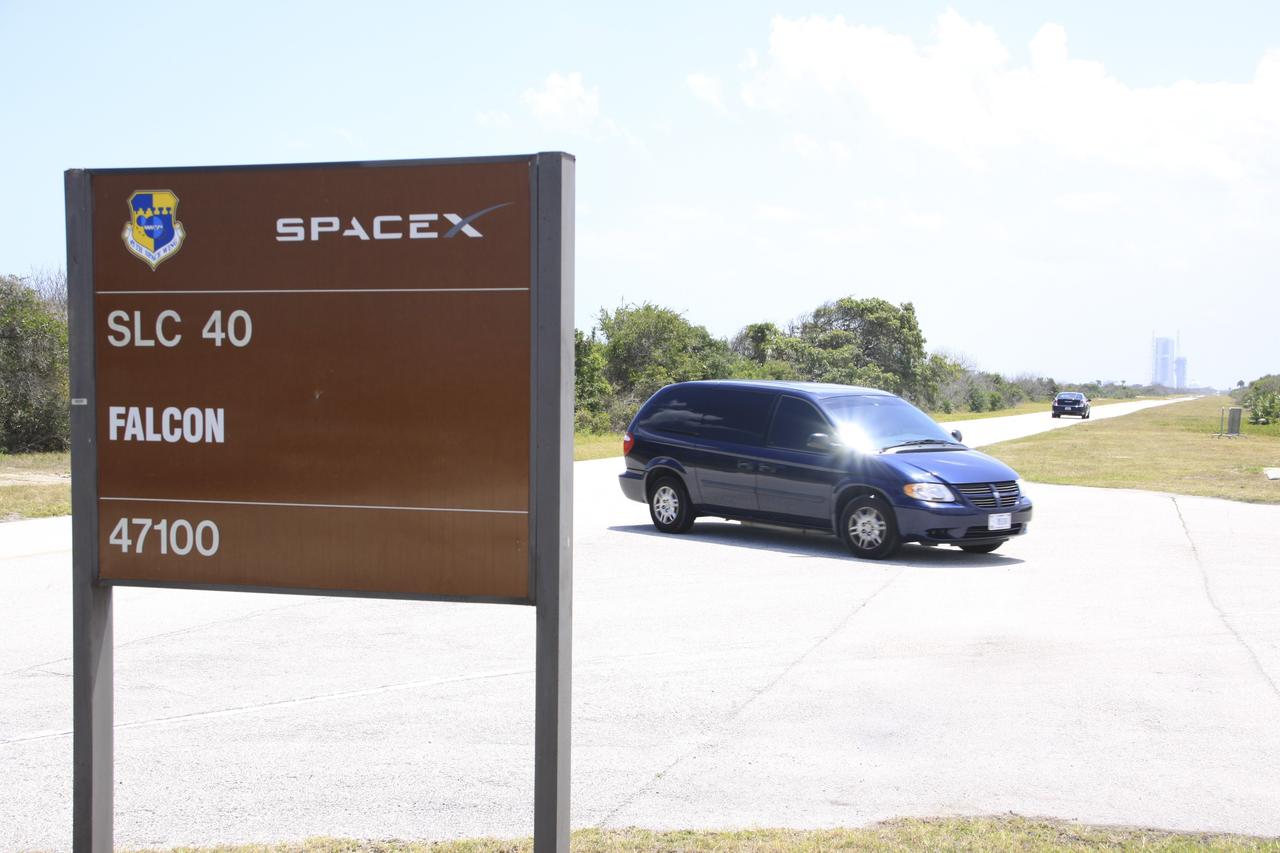
CAPE CANAVERAL, Fla. – The van transporting the cargo bag packed with NanoRacks-CubeLabs Module-9 experiments, arrives at Space Launch Complex-40 on Cape Canaveral Air Force Station in Florida for cold stowage. The bag will be loaded into the Space Exploration Technologies Dragon capsule in preparation for its scheduled April 30 liftoff aboard a Falcon 9 rocket. NanoRacks-CubeLabs Module-9 uses a two-cube unit box for student competition investigations using 15 liquid mixing tube assemblies that function similar to commercial glow sticks. The investigations range from microbial growth to water purification in microgravity. Known as SpaceX, the launch will be the company's second demonstration test flight for NASA's Commercial Orbital Transportation Services program, or COTS. During the flight, the capsule will conduct a series of check-out procedures to test and prove its systems, including rendezvous and berthing with the International Space Station. If the capsule performs as planned, the module and other cargo will be transferred to the station. The cargo includes food, water and provisions for the station’s Expedition crews, such as clothing, batteries and computer equipment. Under COTS, NASA has partnered with two private companies to launch cargo safely to the station. For more information, visit http://www.nasa.gov/spacex. Photo credit: NASA/Jim Grossmann