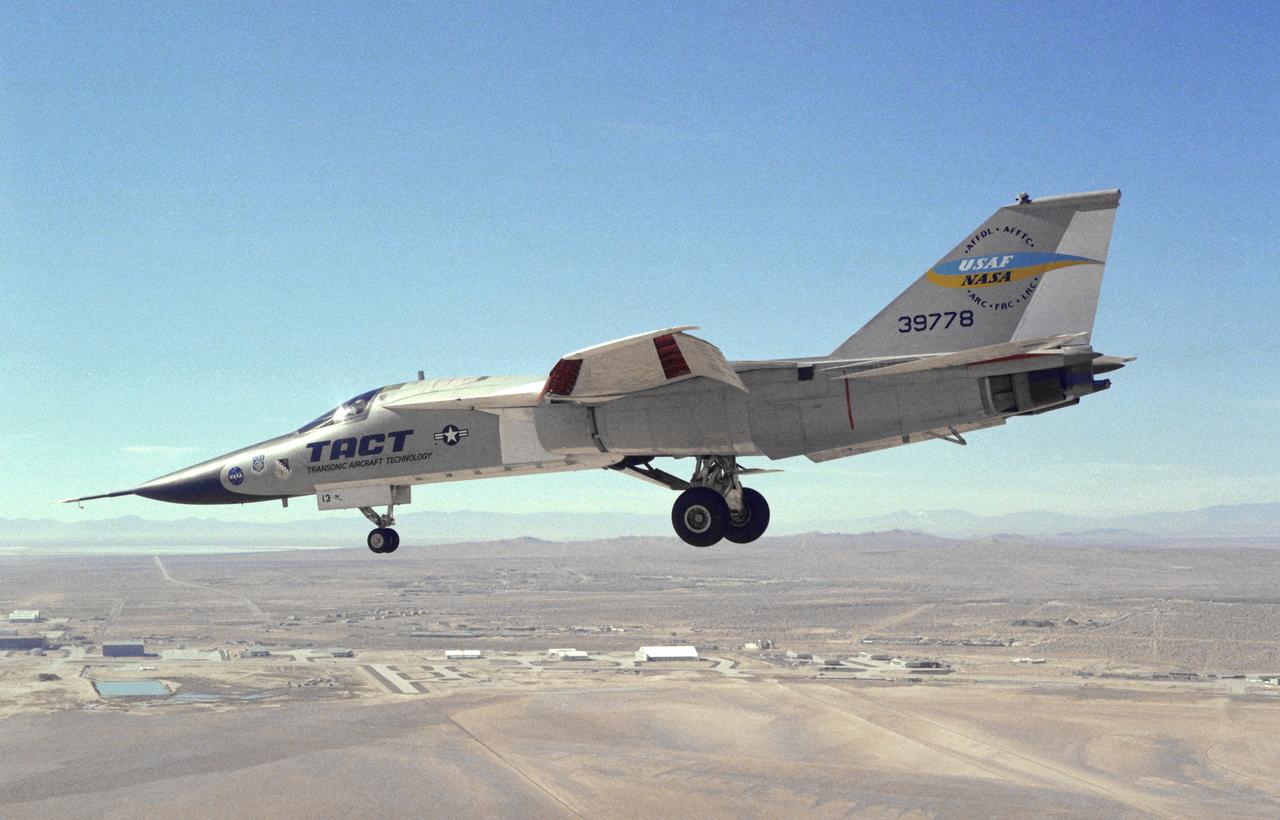
This photograph shows a modified General Dynamics TACT/F-111A Aardvaark with supercritical wings installed. The aircraft, with flaps and landing gear down, is in a decending turn over Rogers Dry Lakebed at Edwards Air Force Base. Starting in 1971 the NASA Flight Research Center and the Air Force undertook a major research and flight testing program, using F-111A (#63-9778), which would span almost 20 years before completion. Intense interest over the results coming from the NASA F-8 supercritical wing program spurred NASA and the Air Force to modify the General Dynamics-Convair F-111A to explore the application of supercritical wing technology to maneuverable military aircraft. This flight program was called Transonic Aircraft Technology (TACT).
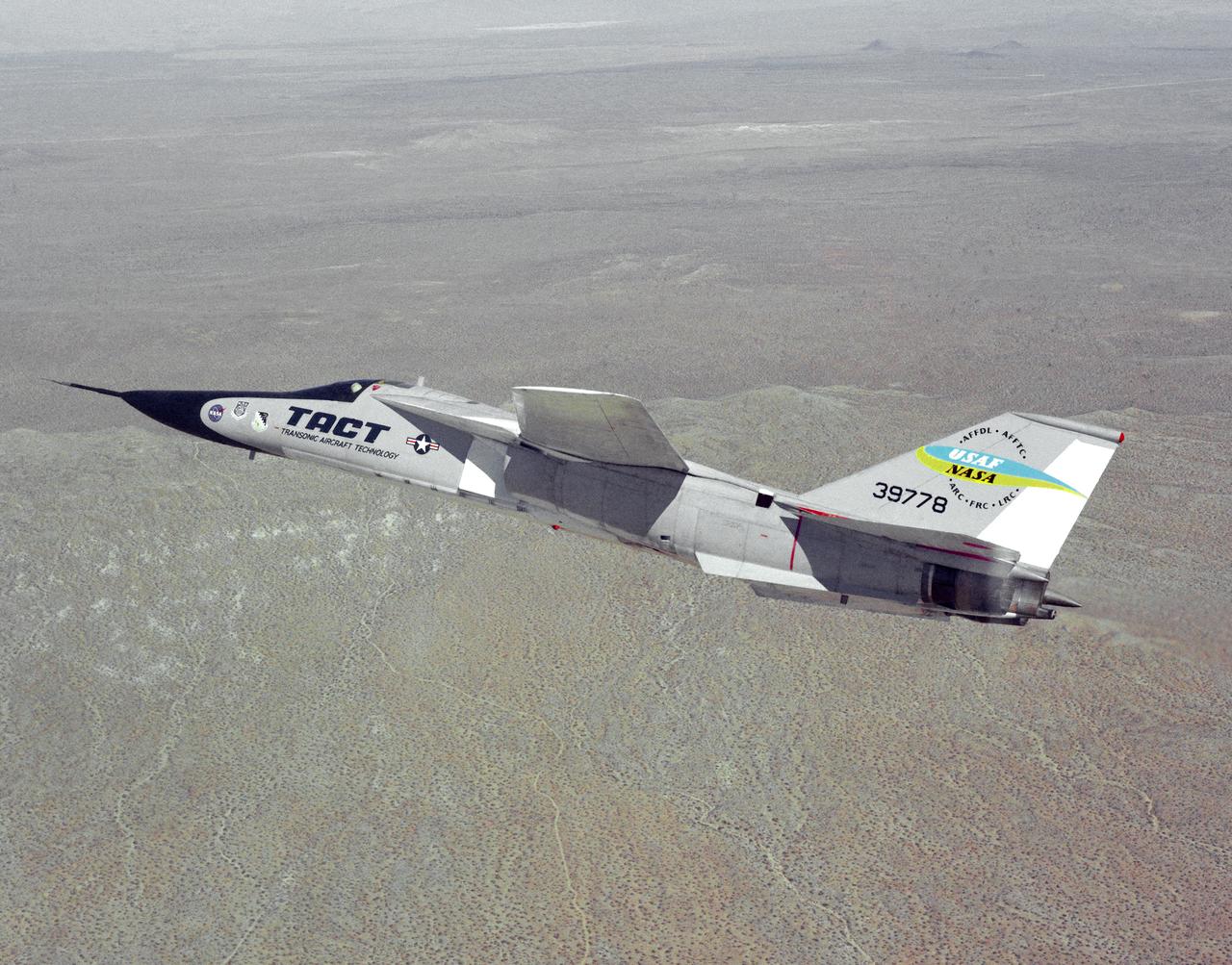
The General Dynamics TACT/F-111A Aardvark is seen In a banking-turn over the California Mojave desert. This photograph affords a good view of the supercritical wing airfoil shape. Starting in 1971 the NASA Flight Research Center and the Air Force undertook a major research and flight testing program, using F-111A (#63-9778), which would span almost 20 years before completion. Intense interest over the results coming from the NASA F-8 supercritical wing program spurred NASA and the Air Force to modify the General Dynamics F-111A to explore the application of supercritical wing technology to maneuverable military aircraft. This flight program was called Transonic Aircraft Technology (TACT).
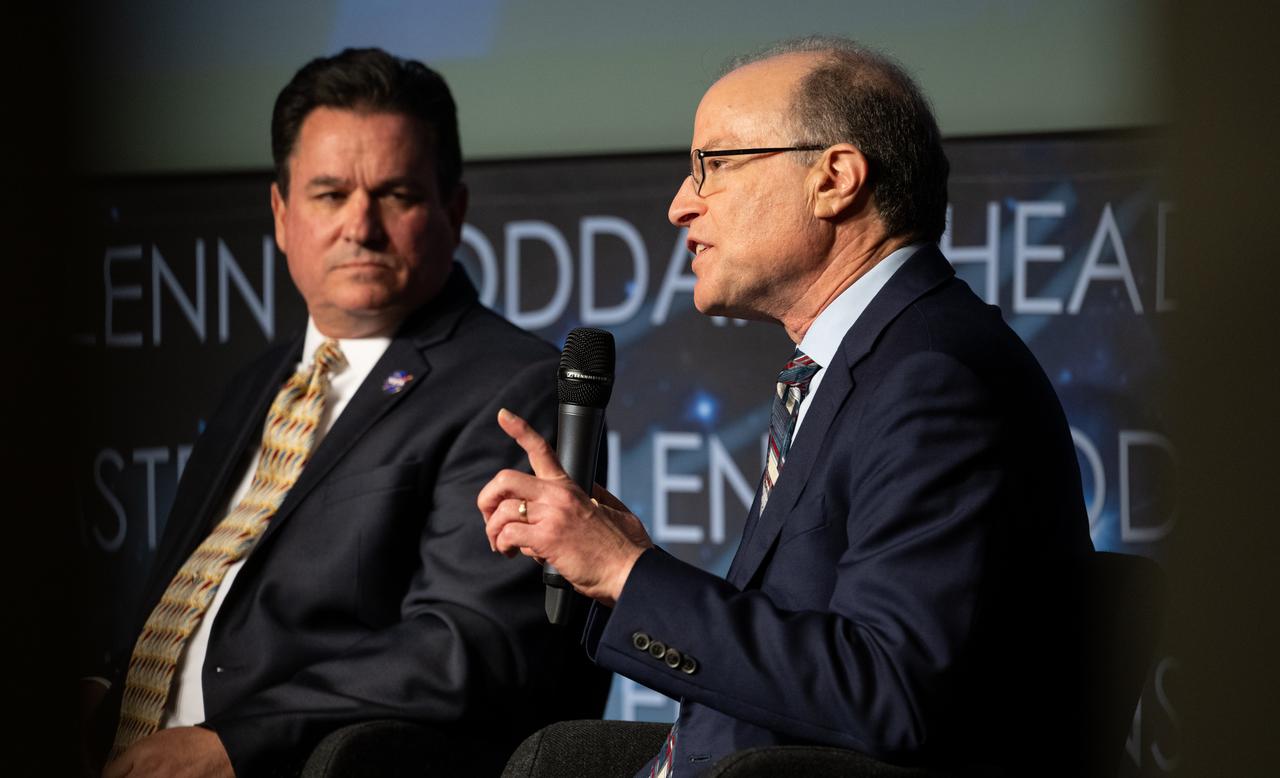
Todd Citron, chief technology officer, The Boeing Company, answers a question from a member of the media during a news conference on NASA’s Sustainable Flight Demonstrator project, Wednesday, Jan. 18, 2023, at the Mary W. Jackson NASA Headquarters building in Washington, DC. Through a Funded Space Act Agreement, The Boeing company and its industry team will collaborate with NASA to develop and flight-test a full-scale Transonic Truss-Braced Wing demonstrator aircraft. Photo Credit: (NASA/Joel Kowsky)
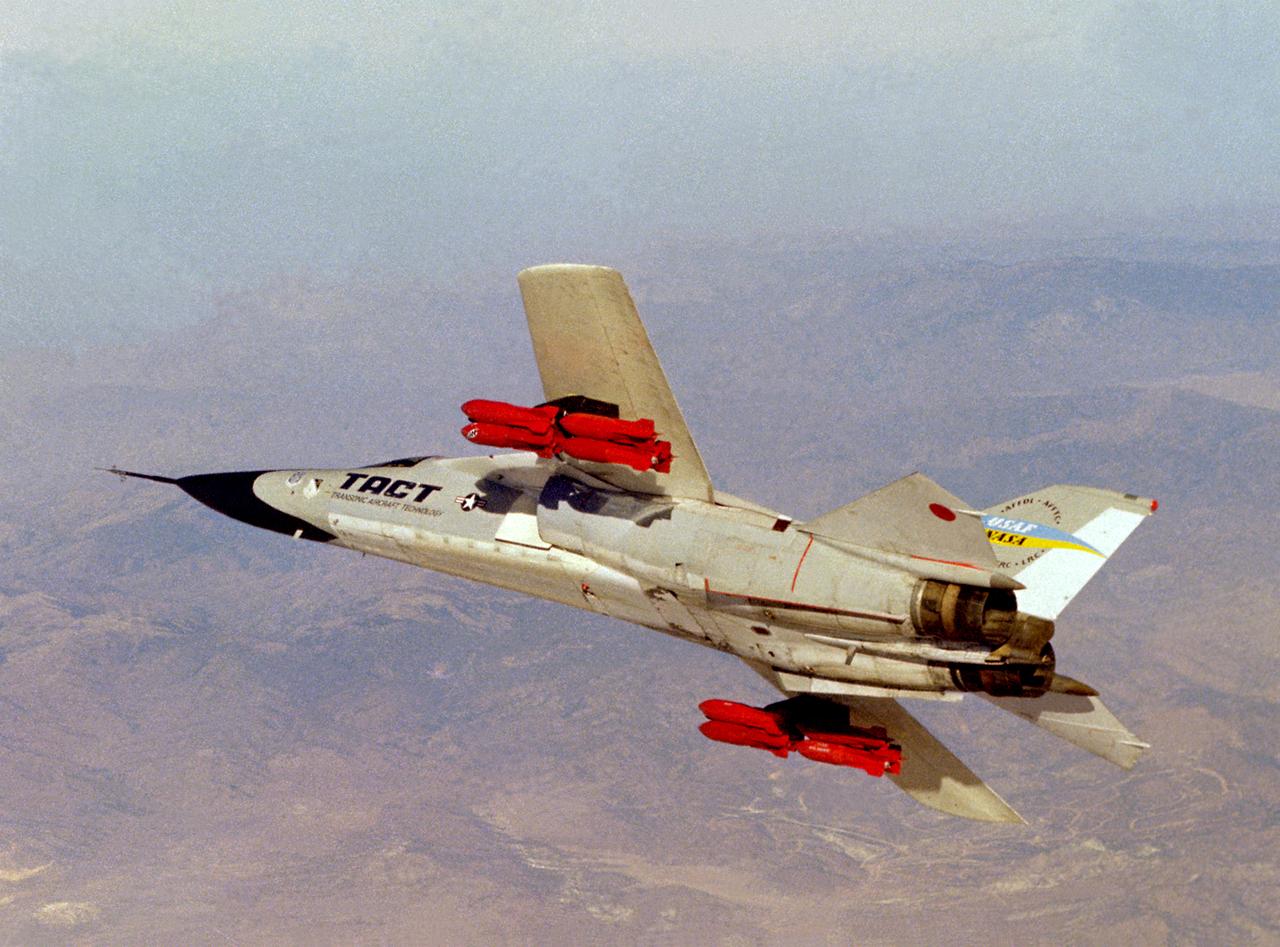
The General Dynamics TACT/F-111A (Serial #63-9778) banks over the Mojave Desert. Note the fully loaded racks of inert pratice bombs which were carried for weapon loads evaluations on the supercritical wing (SCW) that was the main feature of the Transonic Aircraft Technology F-111 research program. Intense interest in the results of the earlier F-8 SCW program spurred NASA and the U.S. Air Force to modify the number 13 F-111A for the TACT program. This aircraft participated in a major research and flight testing program that spanned nearly 20 years, beginning in 1971 at the NASA Flight Research Center at Edwards AFB, California.
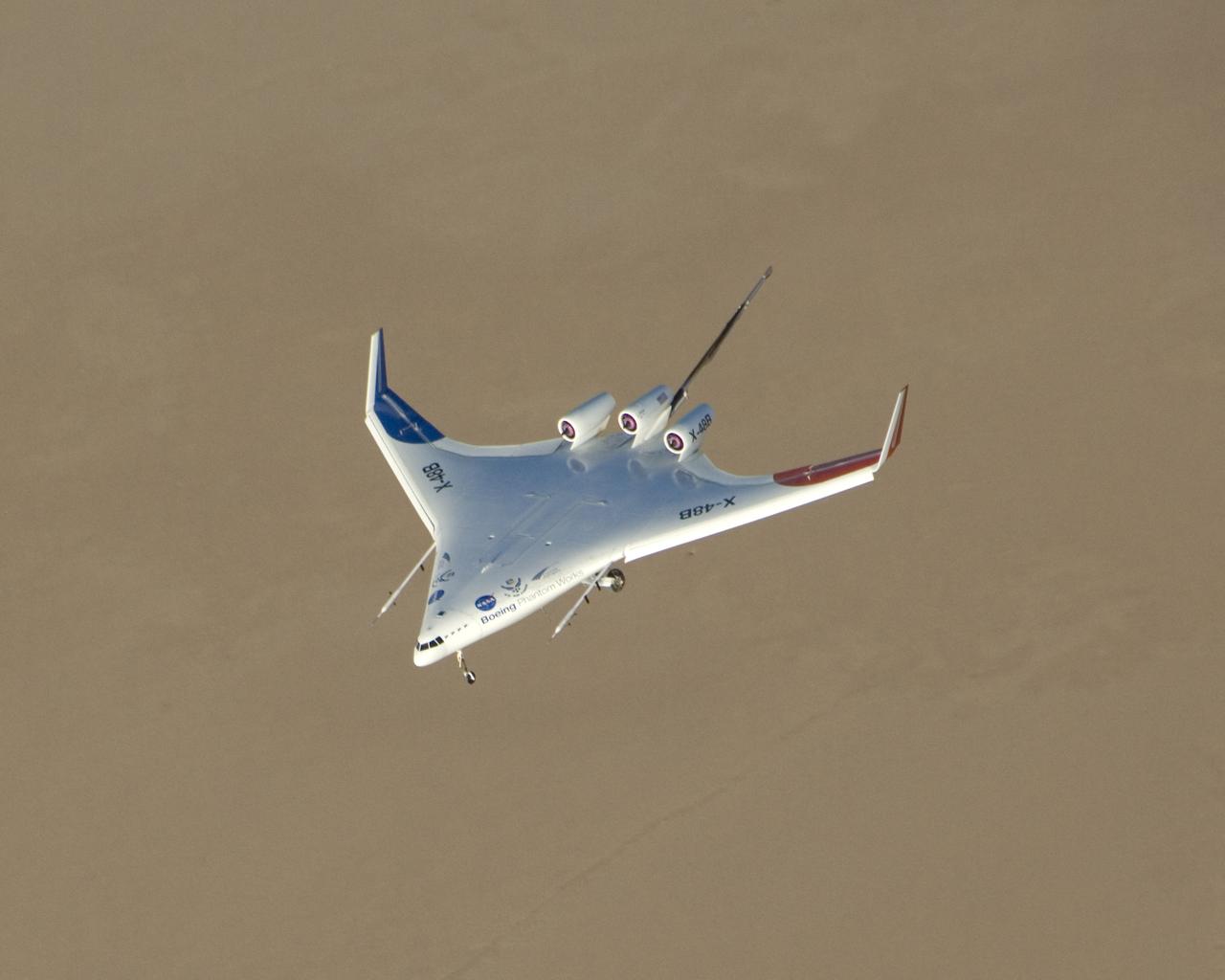
Boeing Phantom Works' subscale Blended Wing Body technology demonstration aircraft began its initial flight tests from NASA's Dryden Flight Research Center at Edwards Air Force Base, Calif. in the summer of 2007. The 8.5 percent dynamically scaled unmanned aircraft, designated the X-48B by the Air Force, is designed to mimic the aerodynamic characteristics of a full-scale large cargo transport aircraft with the same blended wing body shape. The initial flight tests focused on evaluation of the X-48B's low-speed flight characteristics and handling qualities. About 25 flights were planned to gather data in these low-speed flight regimes. Based on the results of the initial flight test series, a second set of flight tests was planned to test the aircraft's low-noise and handling characteristics at transonic speeds.
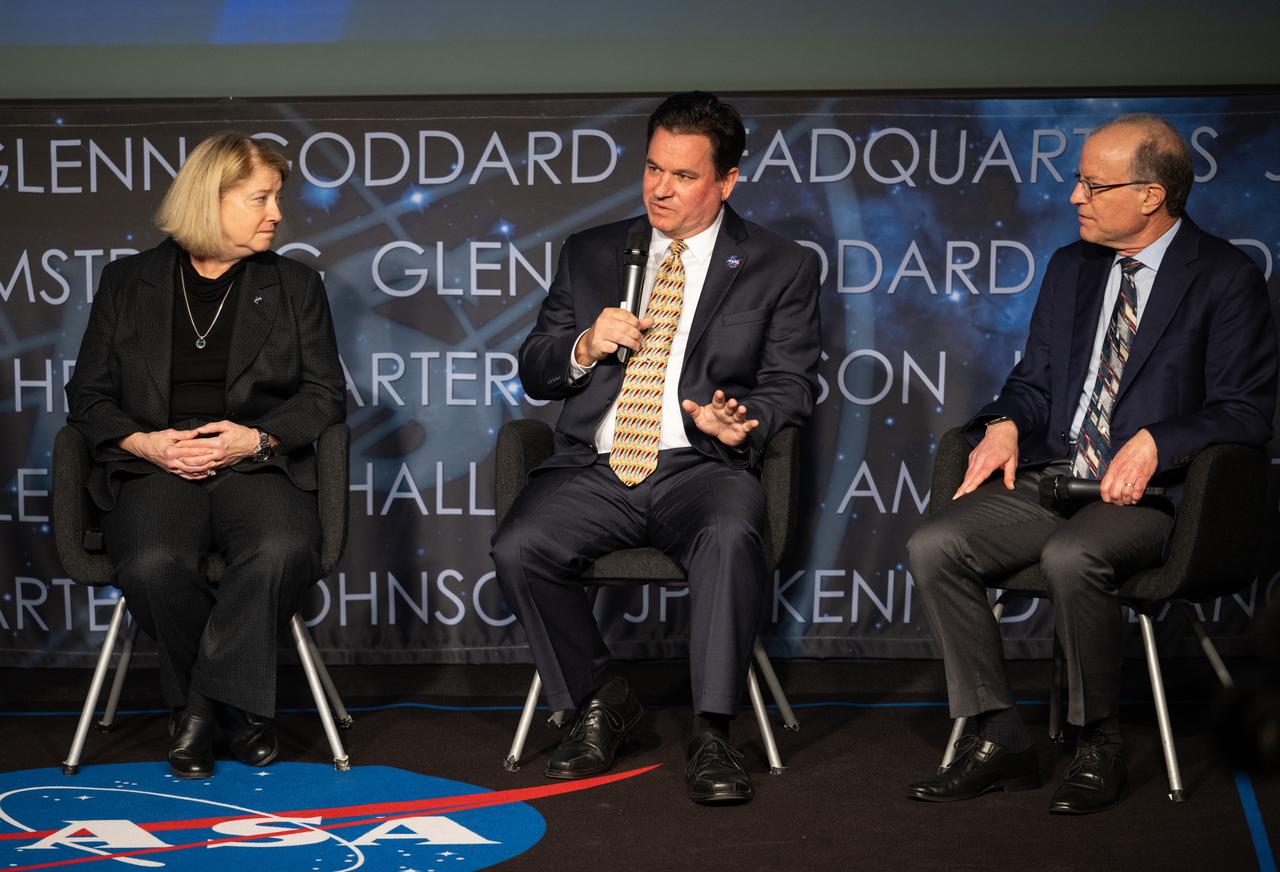
Brent Cobleigh, program manager for the Sustainable Flight Demonstrator at NASA's Armstrong Flight Research Center, center, answers a question from a member of the media during a news conference along with NASA Deputy Administrator Pam Melroy, left, and Todd Citron, chief technology officer, The Boeing Company, right, on NASA’s Sustainable Flight Demonstrator project, Wednesday, Jan. 18, 2023, at the Mary W. Jackson NASA Headquarters building in Washington, DC. Through a Funded Space Act Agreement, The Boeing company and its industry team will collaborate with NASA to develop and flight-test a full-scale Transonic Truss-Braced Wing demonstrator aircraft. Photo Credit: (NASA/Joel Kowsky)
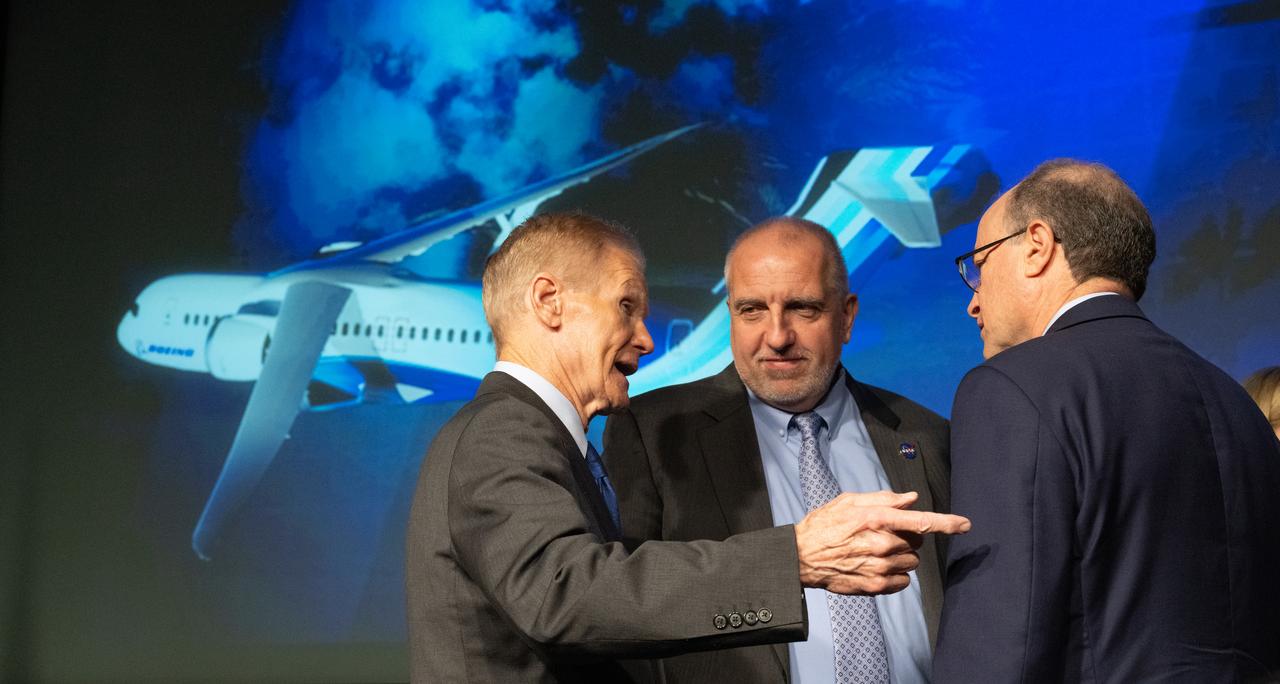
NASA Administrator Bill Nelson, left, Bob Pearce, associate administrator for NASA's Aeronautics Research Mission Directorate, center, and Todd Citron, chief technology officer, The Boeing Company, right, are seen following a news conference on NASA’s Sustainable Flight Demonstrator project, Wednesday, Jan. 18, 2023, at the Mary W. Jackson NASA Headquarters building in Washington, DC. Through a Funded Space Act Agreement, The Boeing company and its industry team will collaborate with NASA to develop and flight-test a full-scale Transonic Truss-Braced Wing demonstrator aircraft. Photo Credit: (NASA/Joel Kowsky)
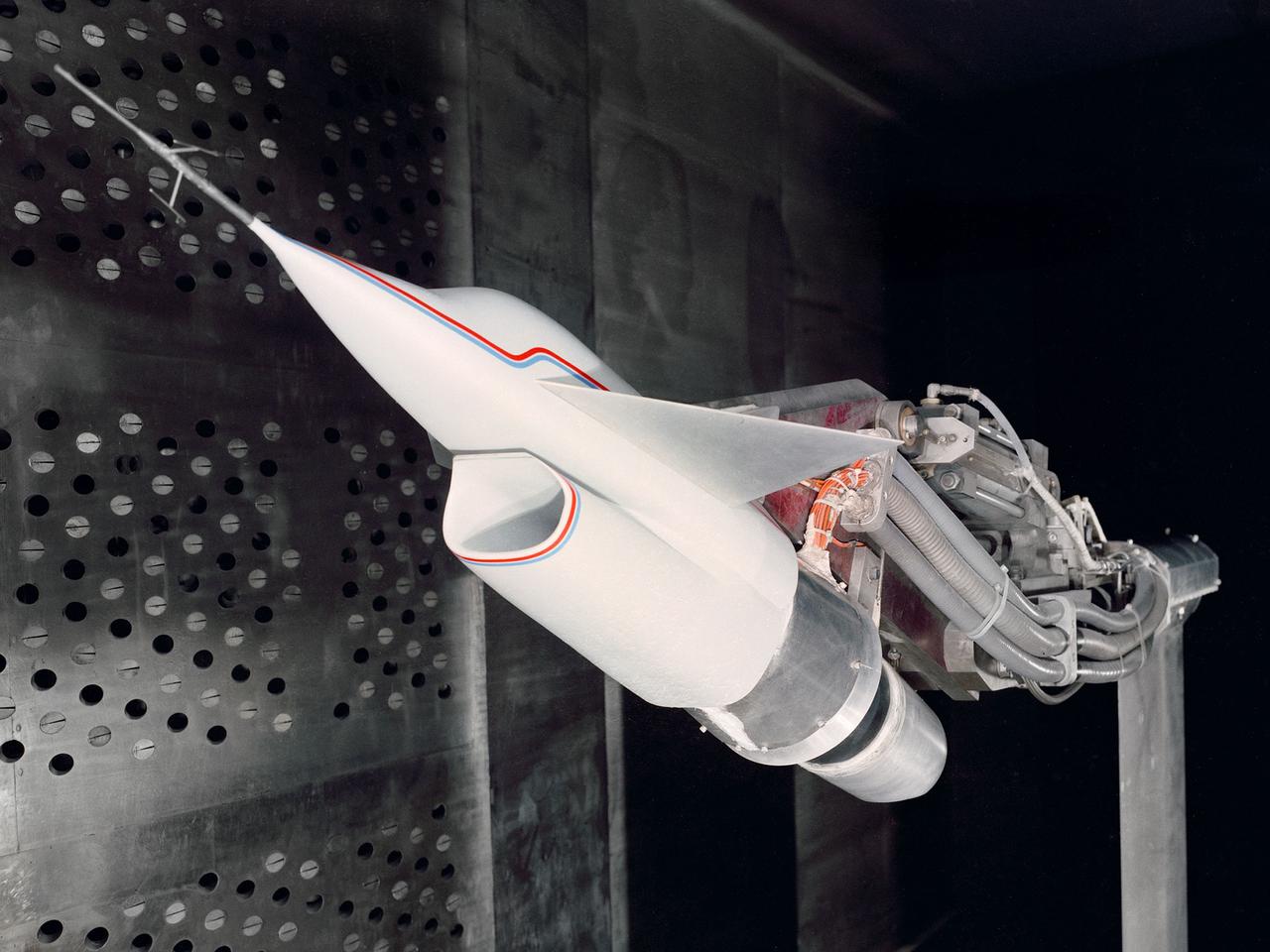
A Highly Maneuverable Aircraft Technology (HiMAT) inlet model installed in the test section of the 8- by 6-Foot Supersonic Wind Tunnel at the National Aeronautics and Space Administration (NASA) Lewis Research Center. Engineers at the Ames Research Center, Dryden Flight Research Center, and Rockwell International designed two pilotless subscale HiMAT vehicles in the mid-1970s to study new design concepts for fighter aircraft in the transonic realm without risking the lives of test pilots. The aircraft used sophisticated technologies such as advanced aerodynamics, composite materials, digital integrated propulsion control, and digital fly-by-wire control systems. In late 1977 NASA Lewis studied the HiMAT’s General Electric J85-21 jet engine in the Propulsion Systems Laboratory. The researchers charted the inlet quality with various combinations anti-distortion screens. HiMAT employed a relatively short and curved inlet compared to actual fighter jets. In the spring of 1979, Larry Smith led an in-depth analysis of the HiMAT inlet in the 8- by 6 tunnel. The researchers installed vortex generators to battle flow separation in the diffuser. The two HiMAT aircraft performed 11 hours of flying over the course of 26 missions from mid-1979 to January 1983 at Dryden and Ames. Although the HiMAT vehicles were considered to be overly complex and expensive, the program yielded a wealth of data that would validate computer-based design tools.
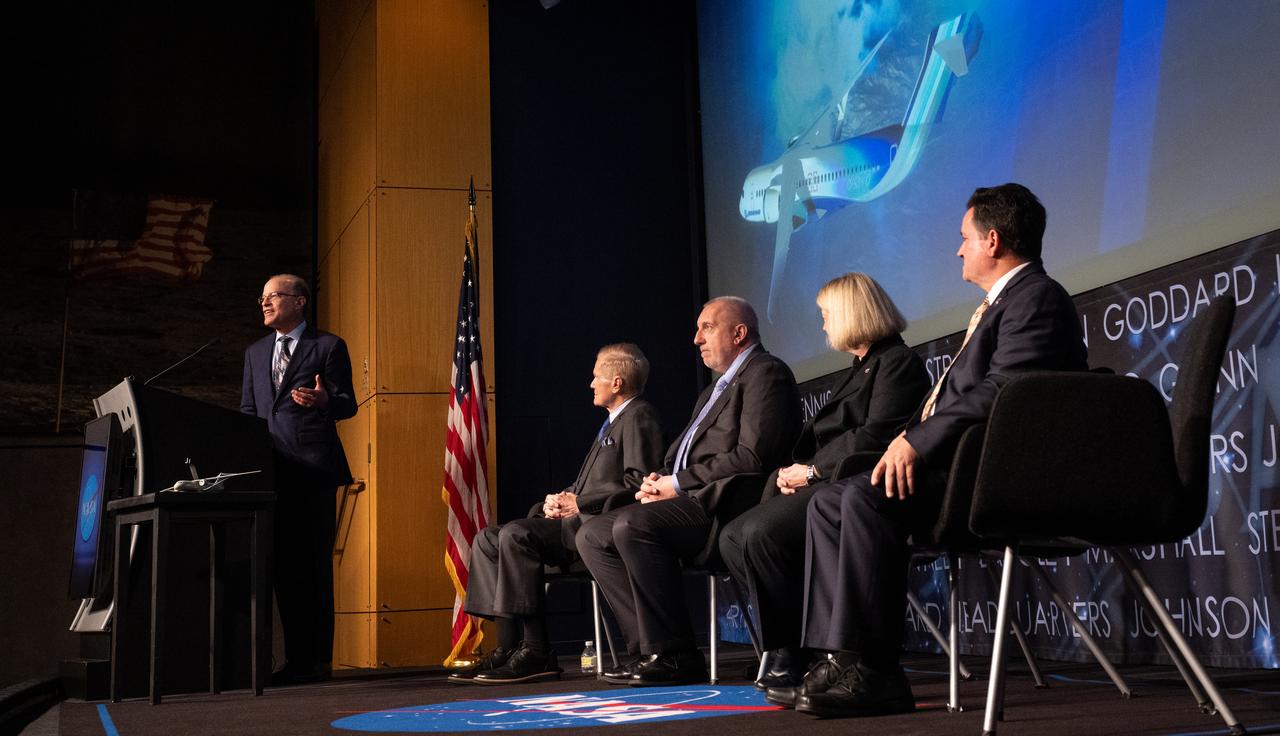
Todd Citron, chief technology officer, The Boeing Company, left, delivers remarks during a news conference on NASA’s Sustainable Flight Demonstrator project as NASA Administrator Bill Nelson, second from left, Bob Pearce, associate administrator for NASA's Aeronautics Research Mission Directorate, NASA Deputy Administrator Pam Melroy, and Brent Cobleigh, program manager for the Sustainable Flight Demonstrator at NASA's Armstrong Flight Research Center, look on, Wednesday, Jan. 18, 2023, at the Mary W. Jackson NASA Headquarters building in Washington, DC. Through a Funded Space Act Agreement, The Boeing company and its industry team will collaborate with NASA to develop and flight-test a full-scale Transonic Truss-Braced Wing demonstrator aircraft. Photo Credit: (NASA/Joel Kowsky)
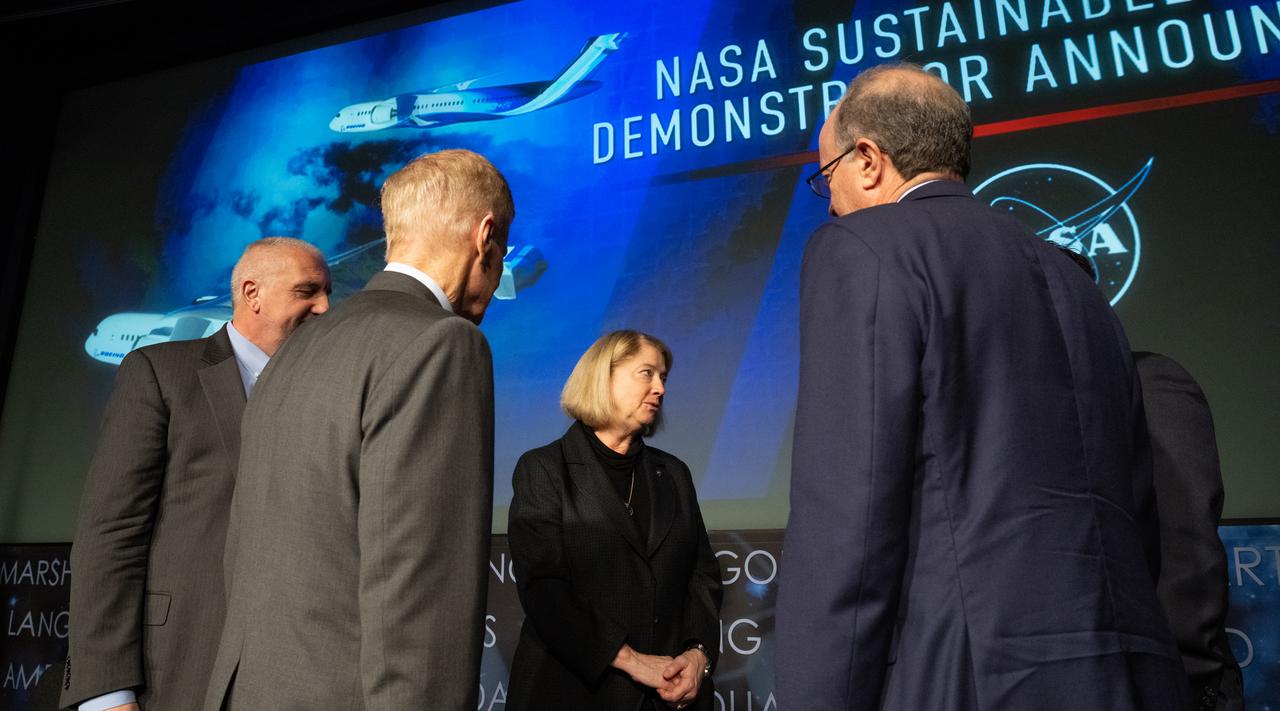
NASA Deputy Administrator Pam Melroy, center, is seen with Bob Pearce, associate administrator for NASA's Aeronautics Research Mission Directorate, NASA Administrator Bill Nelson, Todd Citron, chief technology officer, The Boeing Company, and Brent Cobleigh, program manager for the Sustainable Flight Demonstrator at NASA's Armstrong Flight Research Center, following a news conference on NASA’s Sustainable Flight Demonstrator project, Wednesday, Jan. 18, 2023, at the Mary W. Jackson NASA Headquarters building in Washington, DC. Through a Funded Space Act Agreement, The Boeing company and its industry team will collaborate with NASA to develop and flight-test a full-scale Transonic Truss-Braced Wing demonstrator aircraft. Photo Credit: (NASA/Joel Kowsky)
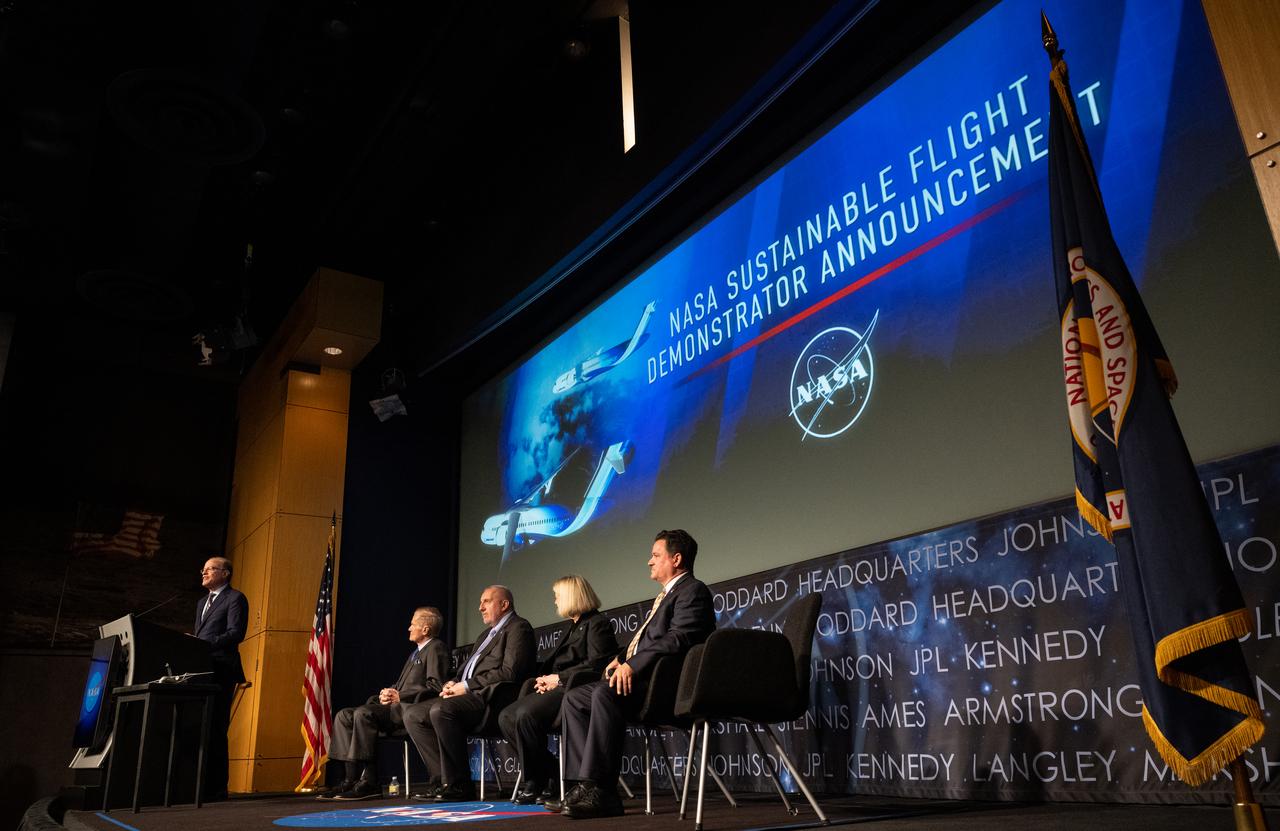
Todd Citron, chief technology officer, The Boeing Company, left, delivers remarks during a news conference on NASA’s Sustainable Flight Demonstrator project as NASA Administrator Bill Nelson, second from left, Bob Pearce, associate administrator for NASA's Aeronautics Research Mission Directorate, NASA Deputy Administrator Pam Melroy, and Brent Cobleigh, program manager for the Sustainable Flight Demonstrator at NASA's Armstrong Flight Research Center, look on, Wednesday, Jan. 18, 2023, at the Mary W. Jackson NASA Headquarters building in Washington, DC. Through a Funded Space Act Agreement, The Boeing company and its industry team will collaborate with NASA to develop and flight-test a full-scale Transonic Truss-Braced Wing demonstrator aircraft. Photo Credit: (NASA/Joel Kowsky)
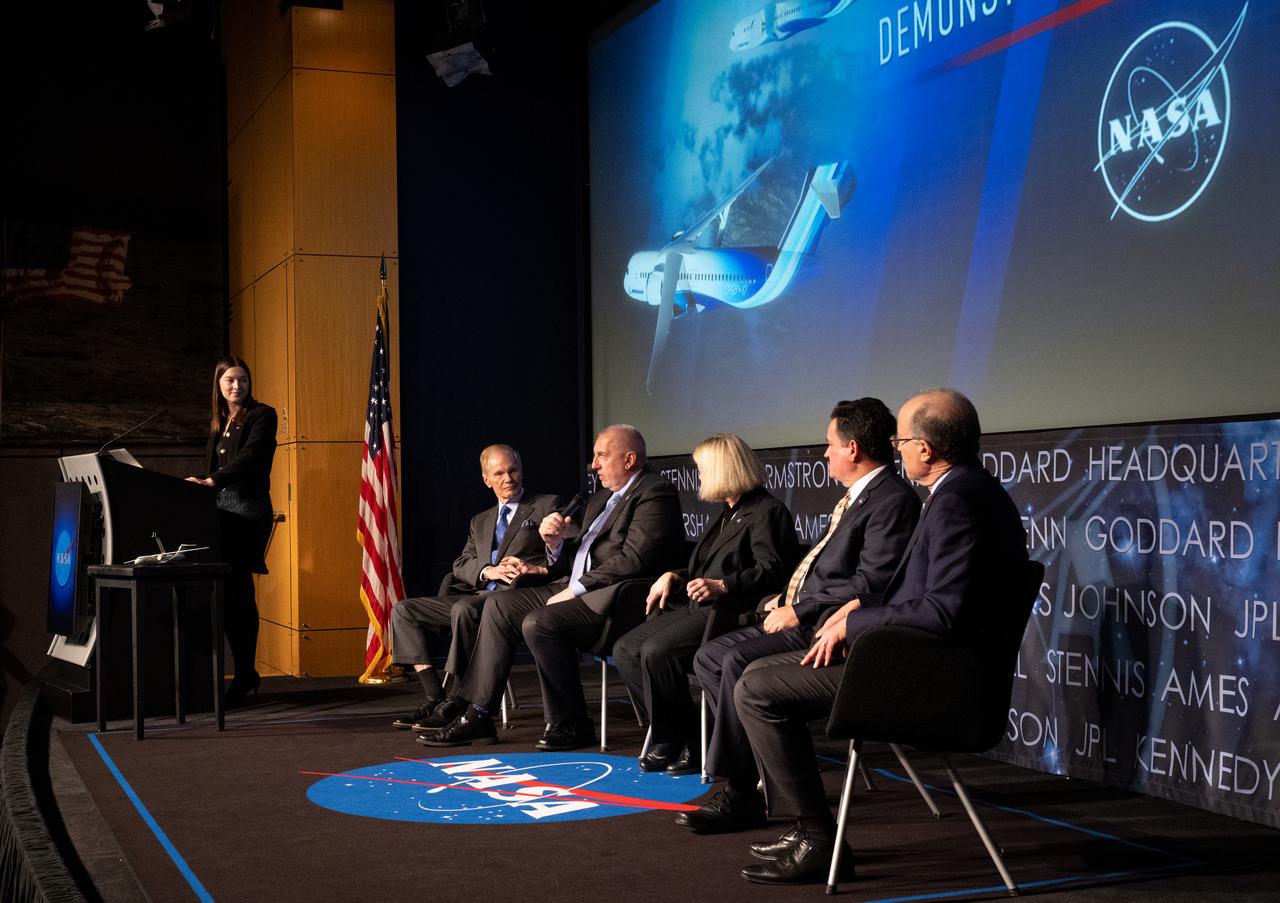
Jackie McGuinness, NASA’s Press Secretary, left, NASA Administrator Bill Nelson, Bob Pearce, associate administrator for NASA's Aeronautics Research Mission Directorate, NASA Deputy Administrator Pam Melroy, Brent Cobleigh, program manager for the Sustainable Flight Demonstrator at NASA's Armstrong Flight Research Center, and Todd Citron, chief technology officer, The Boeing Company, are seen as they take questions from members of the media during a news conference on NASA’s Sustainable Flight Demonstrator project, Wednesday, Jan. 18, 2023, at the Mary W. Jackson NASA Headquarters building in Washington, DC. Through a Funded Space Act Agreement, The Boeing company and its industry team will collaborate with NASA to develop and flight-test a full-scale Transonic Truss-Braced Wing demonstrator aircraft. Photo Credit: (NASA/Joel Kowsky)
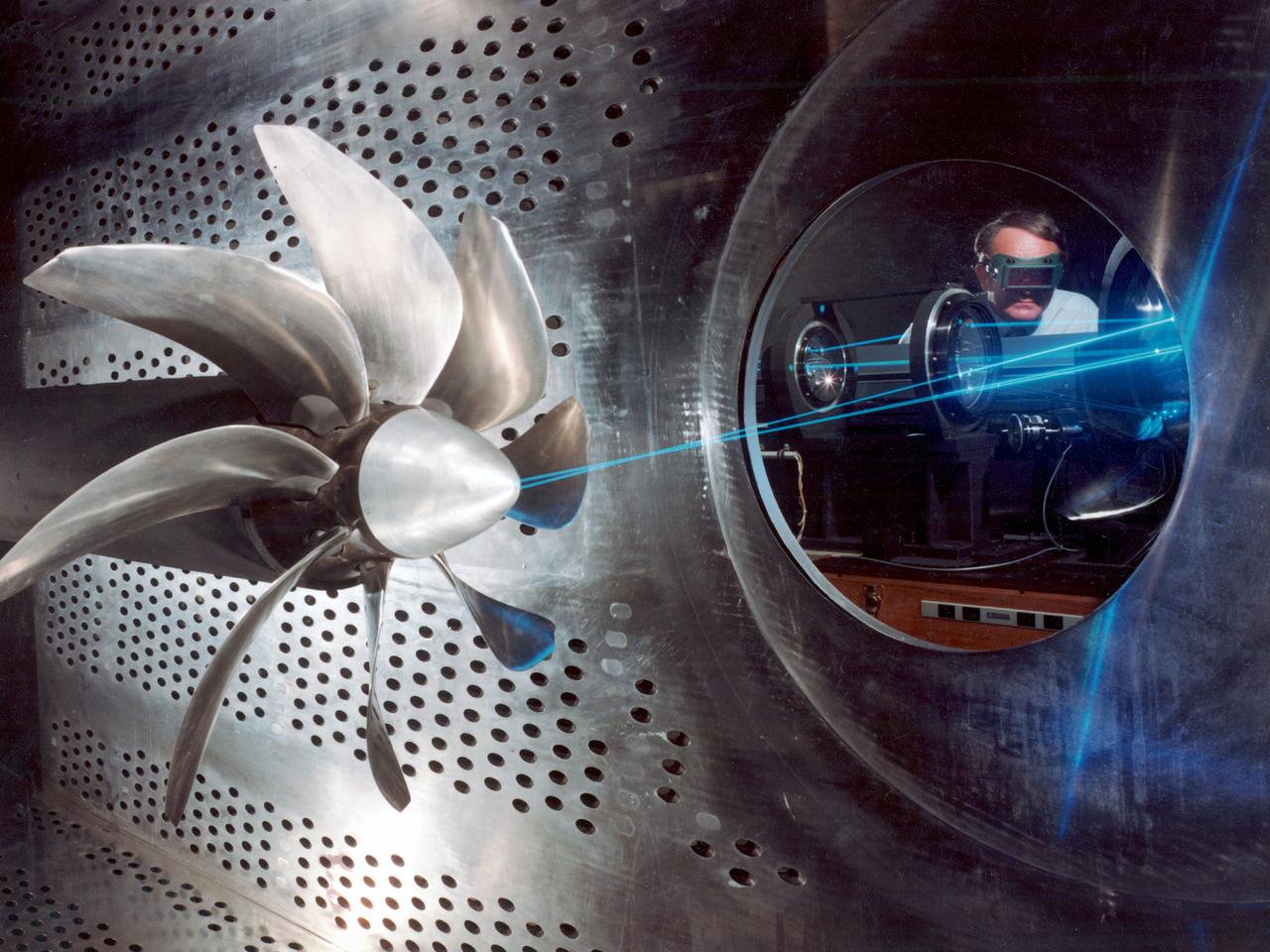
NASA Lewis Research Center researcher, John S. Sarafini, uses a laser doppler velocimeter to analyze a Hamilton Standard SR-2 turboprop design in the 8- by 6-Foot foot Supersonic Wind Tunnel. Lewis researchers were analyzing a series of eight-bladed propellers in their wind tunnels to determine their operating characteristics at speeds up to Mach 0.8. The program, which became the Advanced Turboprop (ATP), was part of a NASA-wide Aircraft Energy Efficiency Program undertaken to reduce aircraft fuel costs by 50 percent. The ATP concept was different from the turboprops in use in the 1950s. The modern versions had at least eight blades and were swept back for better performance. Bell Laboratories developed the laser doppler velocimeter technology in the 1960s to measure velocity of transparent fluid flows or vibration motion on reflective surfaces. Lewis researchers modified the device to measure the flow field of turboprop configurations in the transonic speed region. The modifications were necessary to overcome the turboprop’s vibration and noise levels. The laser beam was split into two beams which were crossed at a specific point. This permits researchers to measure two velocity components simultaneously. This data measures speeds both ahead and behind the propeller blades. Researchers could use this information as they sought to advance flow fields and to verify computer modeling codes.

This is the 3rd entry of the TTBW model in 14x22. This test specifically is a lateral-directional test looking at the effects of 3D printed ventral, keel, and dorsal strakes on the stability and control characteristics of the model. Cooperative agreement between Boeing and NASA.
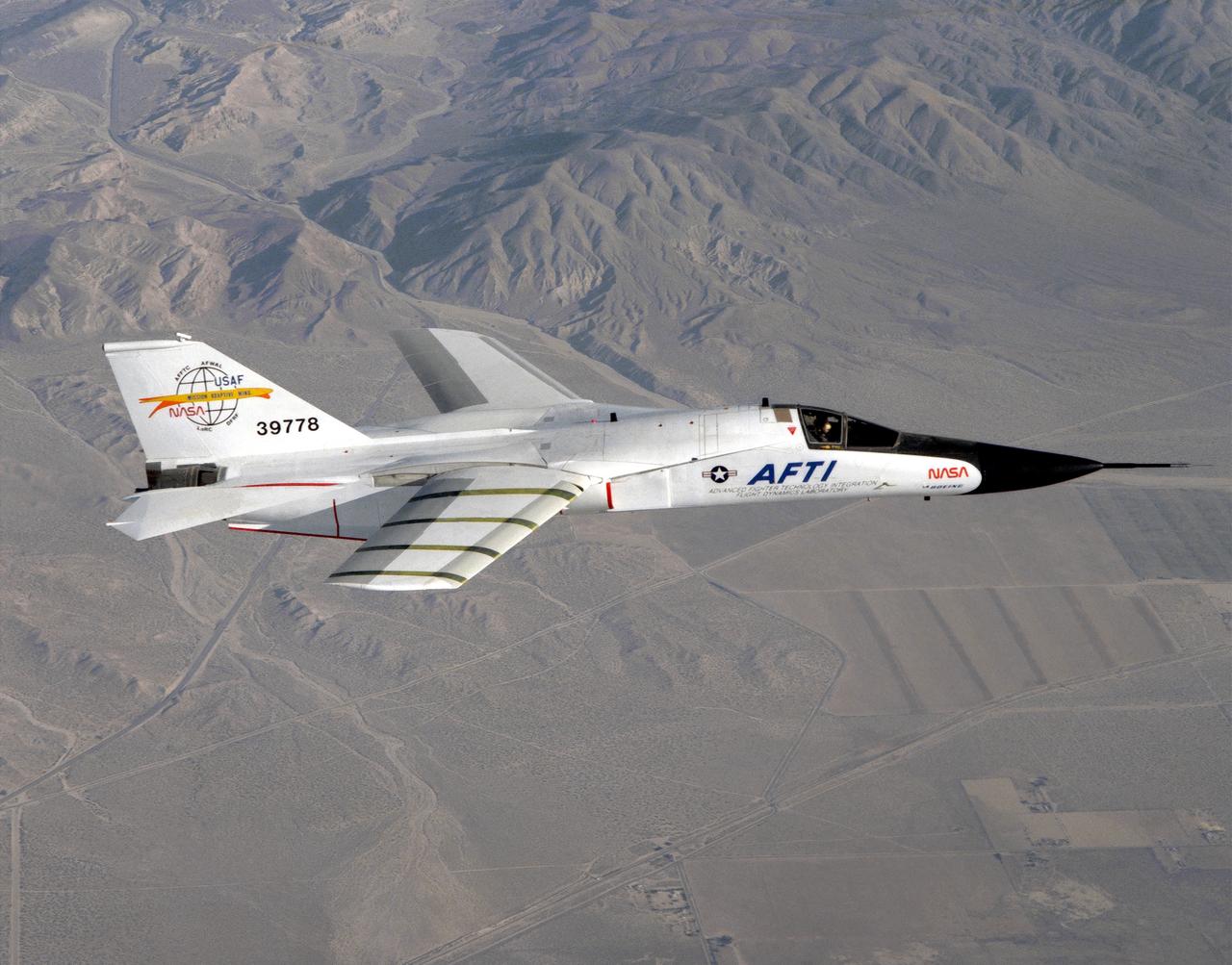
This photograph shows a modified General Dynamics AFTI/F-111A Aardvark with supercritical mission adaptive wings (MAW) installed. The four dark bands on the right wing are the locations of pressure orifices used to measure surface pressures and shock locations on the MAW. The El Paso Mountains and Red Rock Canyon State Park Califonia, about 30 miles northwest of Edwards Air Force Base, are seen directly in the background. With the phasing out of the TACT program came a renewed effort by the Air Force Flight Dynamics Laboratory to extend supercritical wing technology to a higher level of performance. In the early 1980s the supercritical wing on the F-111A aircraft was replaced with a wing built by Boeing Aircraft Company System called a “mission adaptive wing” (MAW), and a joint NASA and Air Force program called Advanced Fighter Technology Integration (AFTI) was born.
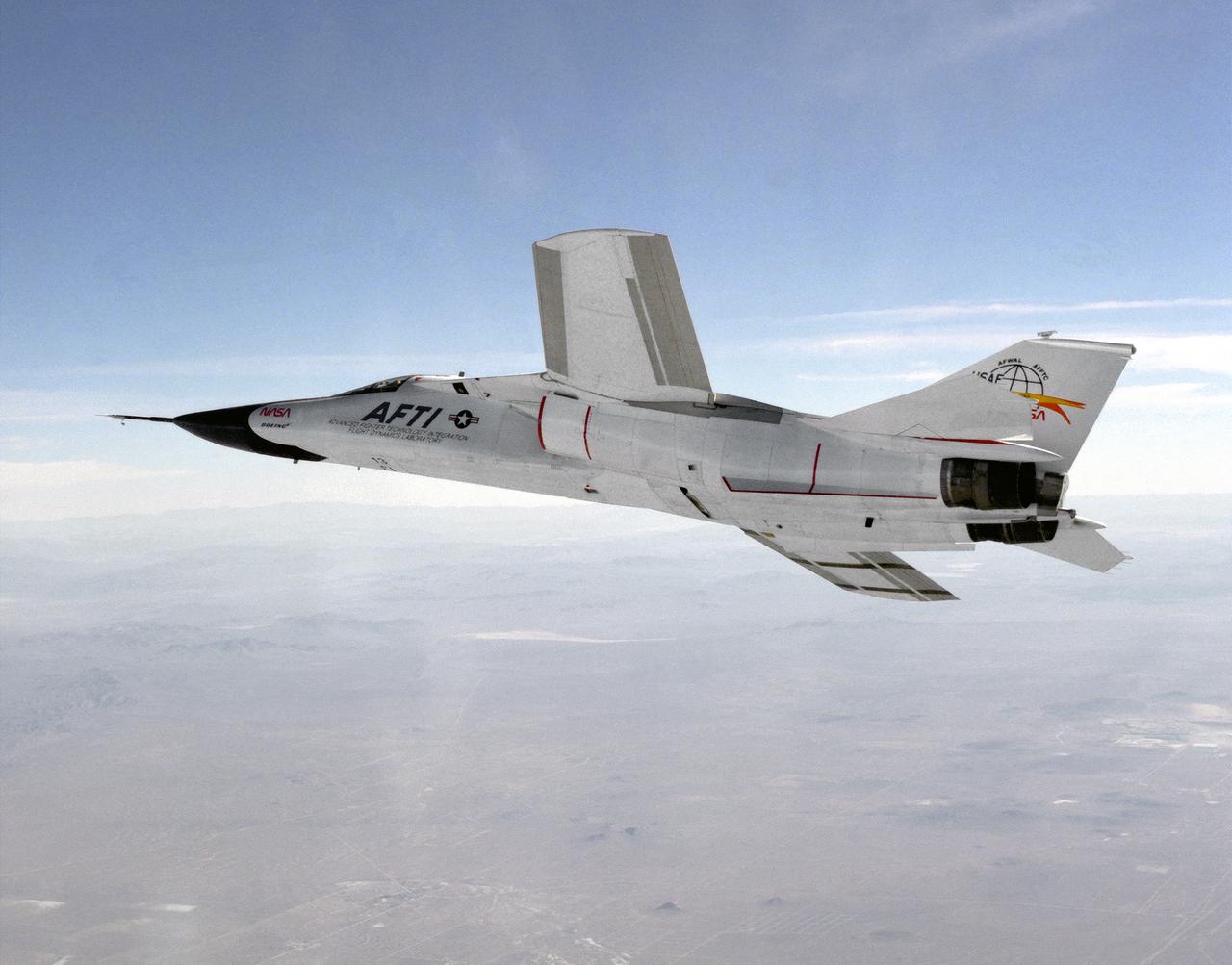
This photograph shows a modified General Dynamics AFTI/F-111A Aardvark with supercritical mission adaptive wings (MAW) installed. The AFTI/F111A is seen banking towards Rodgers Dry Lake and Edwards Air Force Base. With the phasing out of the TACT program came a renewed effort by the Air Force Flight Dynamics Laboratory to extend supercritical wing technology to a higher level of performance. In the early 1980s the supercritical wing on the F-111A aircraft was replaced with a wing built by Boeing Aircraft Company System called a “mission adaptive wing” (MAW), and a joint NASA and Air Force program called Advanced Fighter Technology Integration (AFTI) was born.