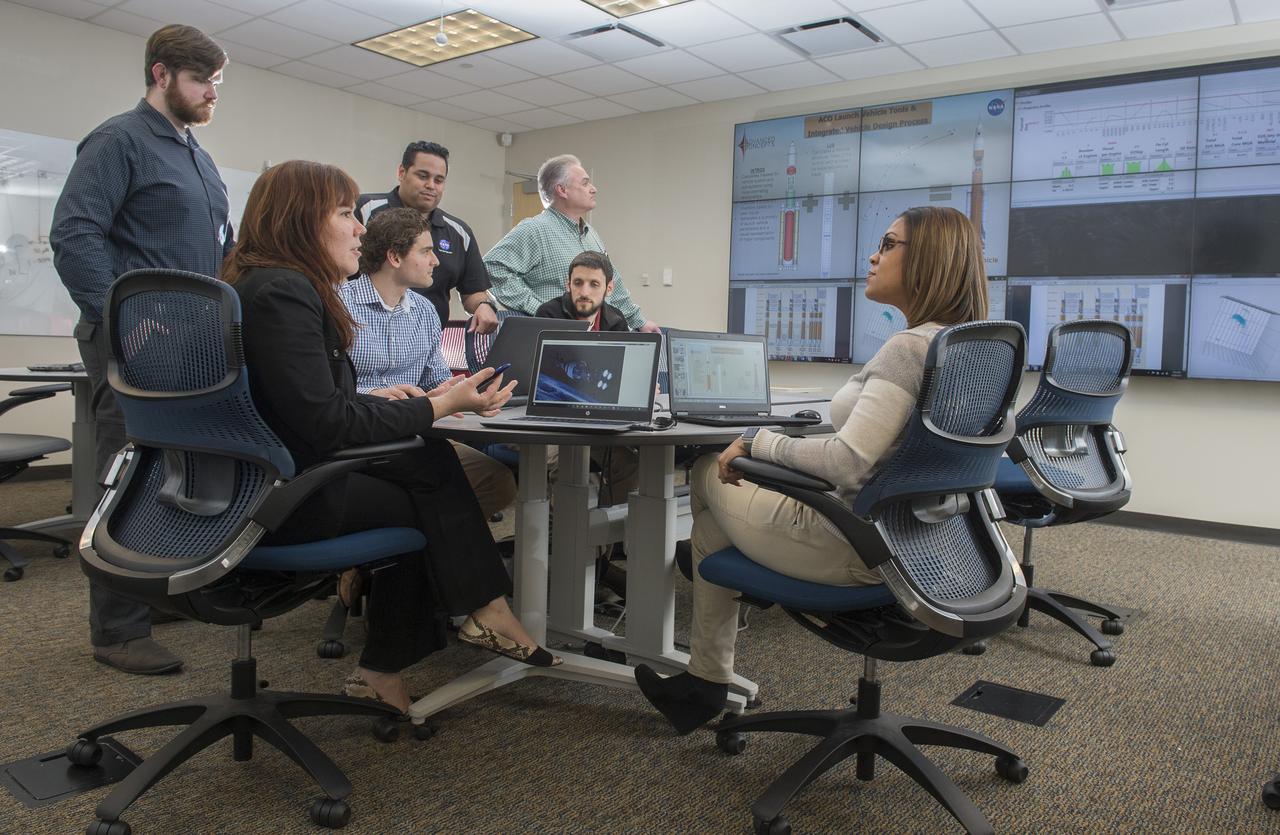
Advance Concept Office Space Transportation Team Assess the Latest Vehicle Studies
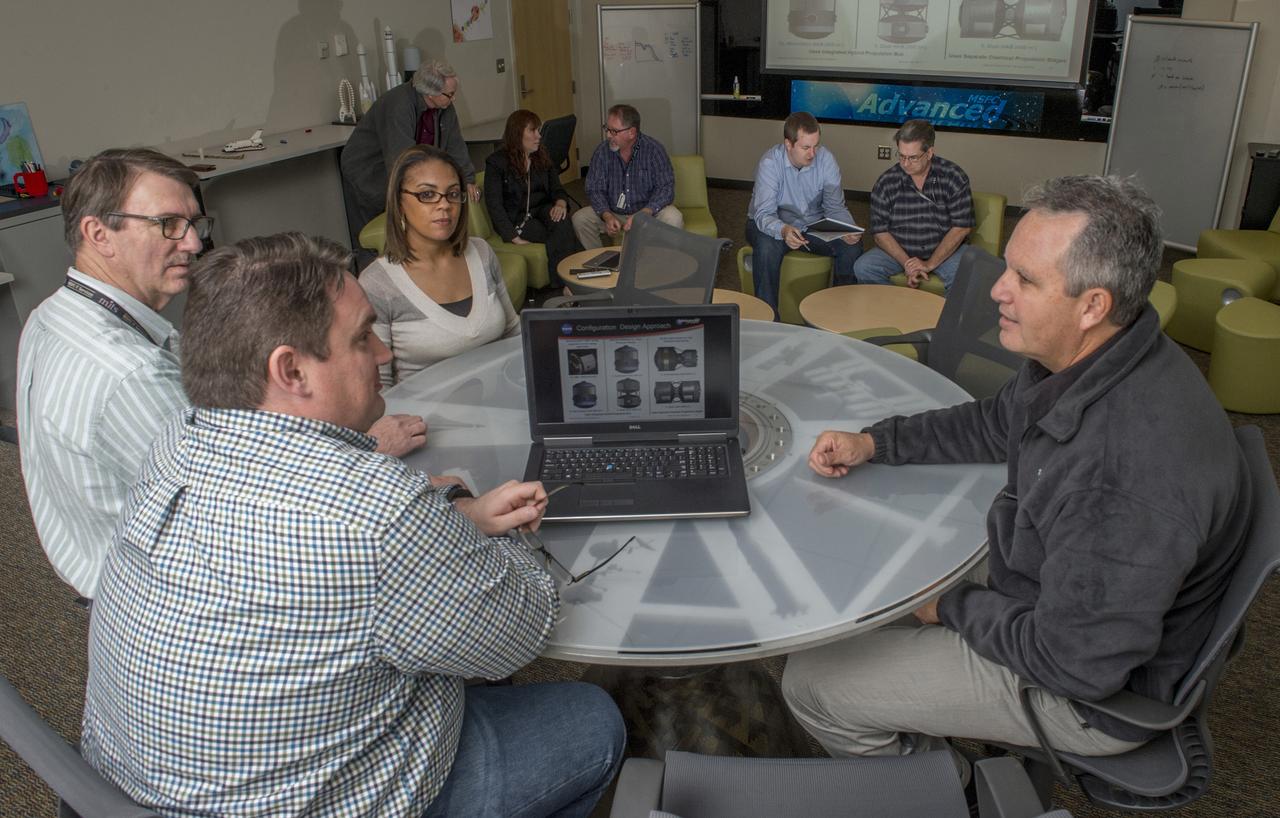
Advance Concept Office Space Transportation Team Assess the Latest Vehicle Studies
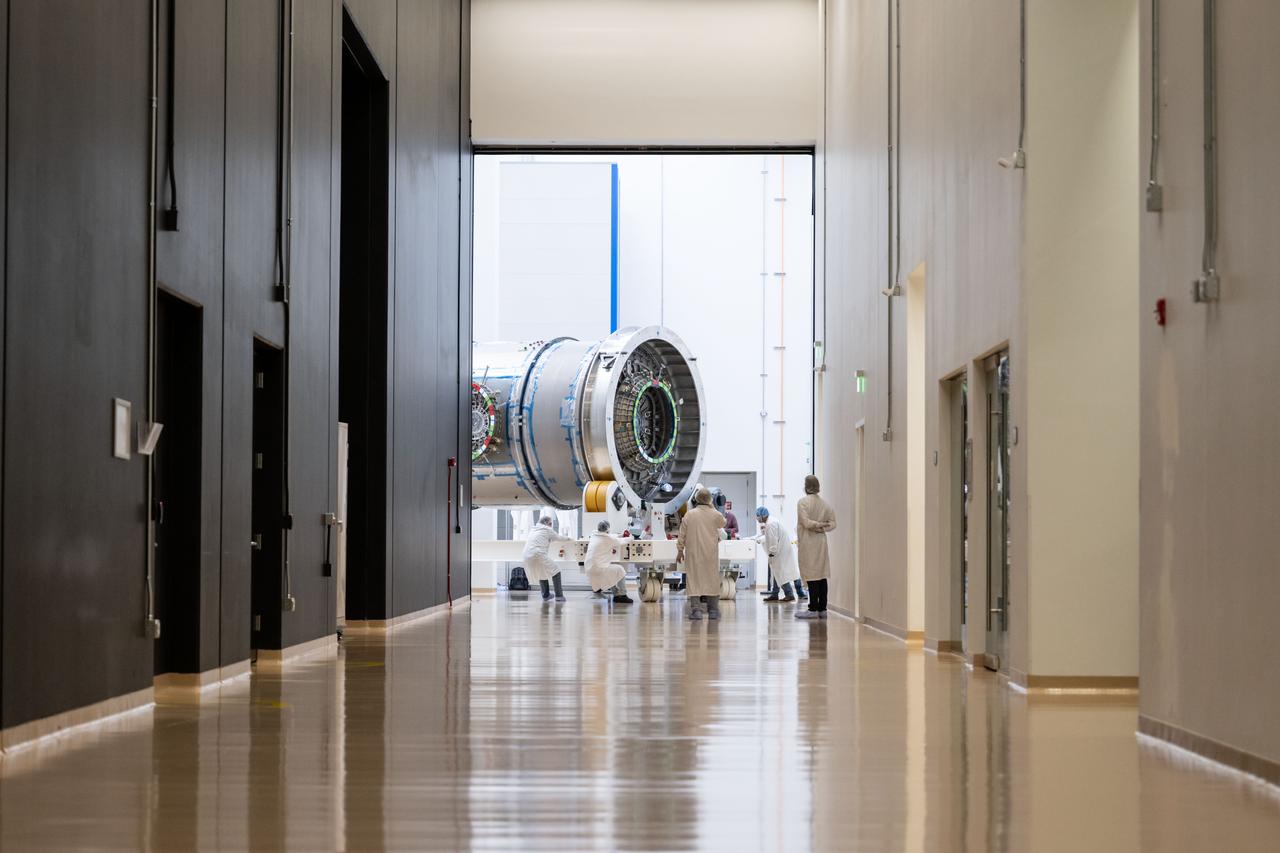
At Northrop Grumman’s Gilbert, Arizona, facility, teams transport Gateway’s HALO (Habitation and Logistics Outpost). HALO arrived from Turin, Italy, where Thales Alenia Space fabricated its primary structure. The module will undergo final outfitting in Gilbert before being integrated with the Power and Propulsion Element and launched to lunar orbit.
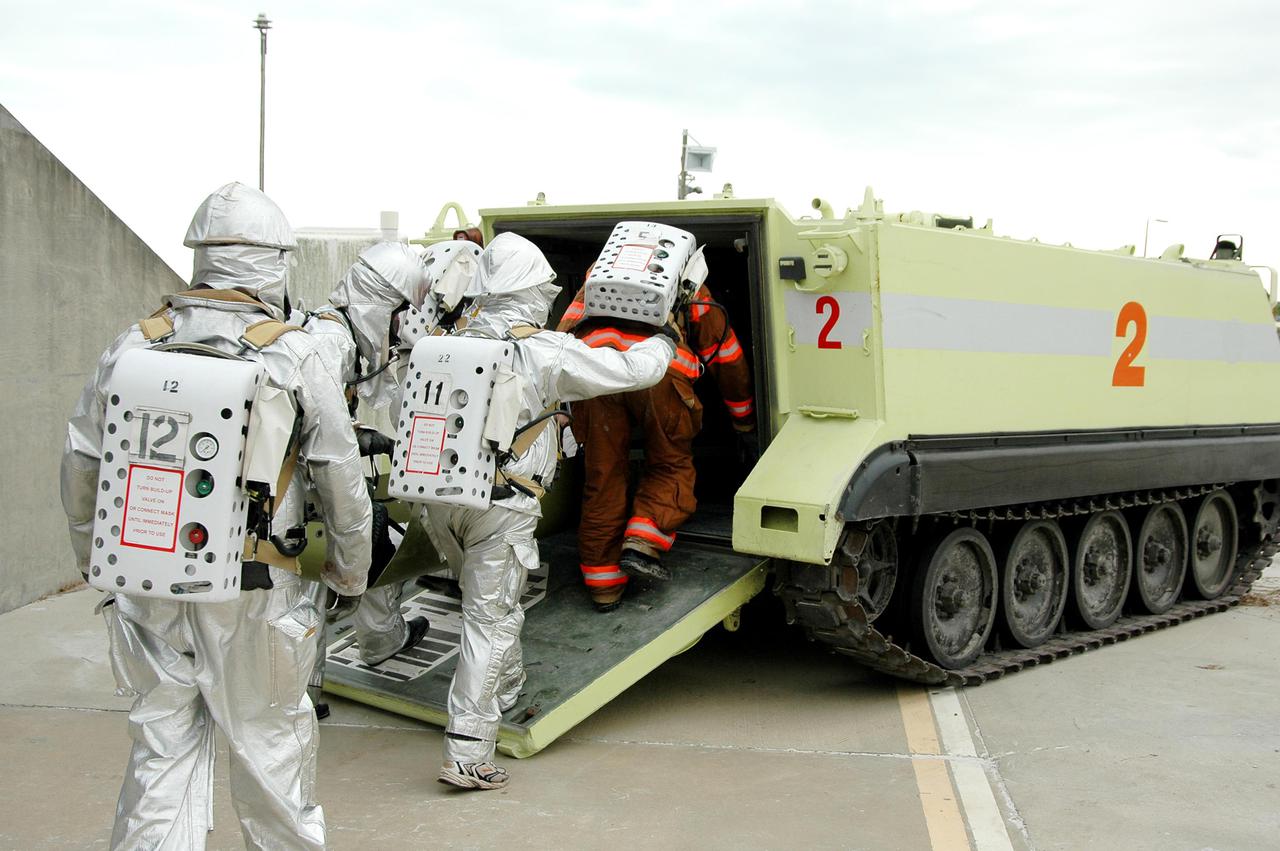
KENNEDY SPACE CENTER, FLA. - During a simulated launch countdown_emergency simulation on Launch Pad 39A, the rescue team helps astronaut-suited workers climb into an M-113 armored personnel carrier for transport away from the pad. The four-hour exercise simulated normal launch countdown operations, with the added challenge of a fictitious event causing an evacuation of the vehicle and launch pad. It tested the team’s rescue approaches on the Fixed Service Structure, slidewire basket evacuation, triage care and transportation of injured personnel to hospitals, as well as communications and coordination.
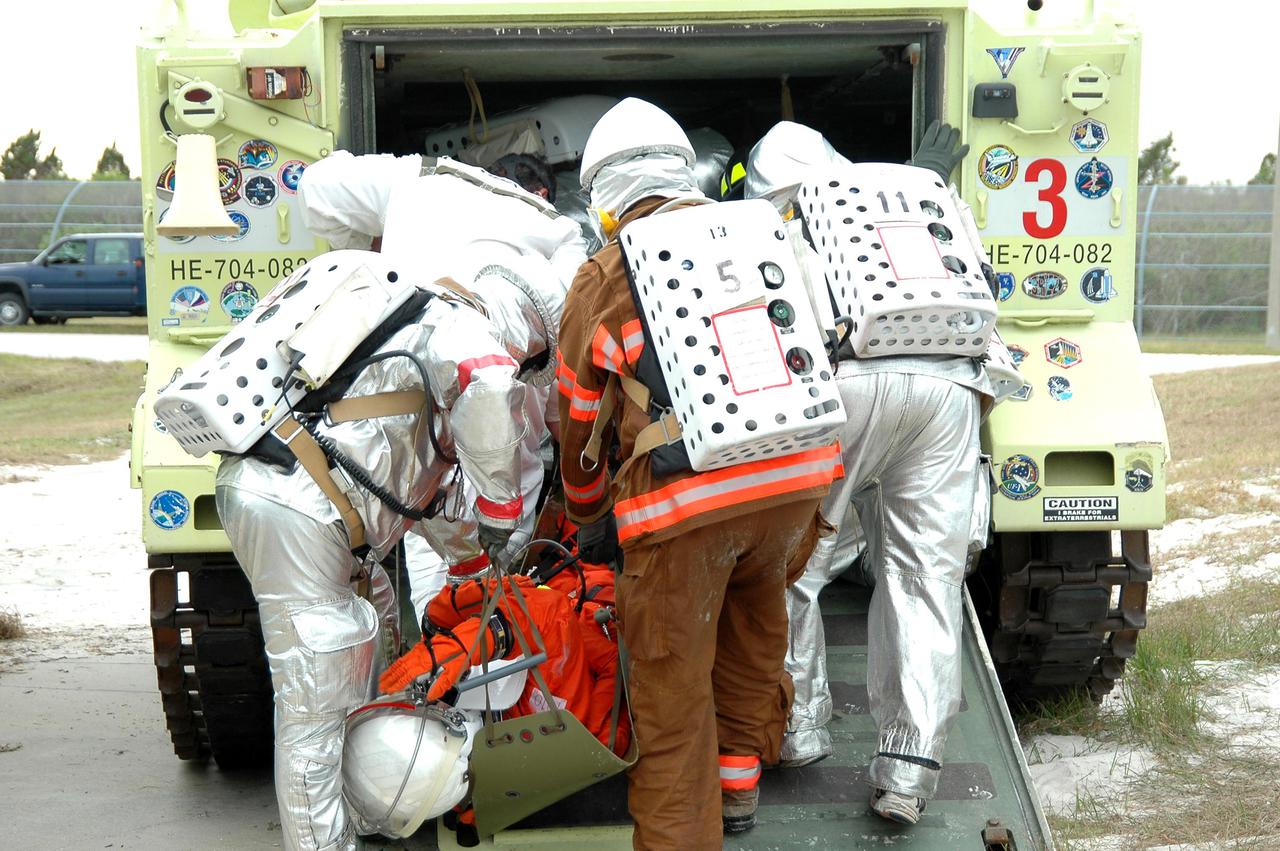
KENNEDY SPACE CENTER, FLA. - During a simulated launch countdown_emergency simulation on Launch Pad 39A, the rescue team carries “injured” astronaut-suited workers into an M-113 armored personnel carrier for transport away from the pad. The four-hour exercise simulated normal launch countdown operations, with the added challenge of a fictitious event causing an evacuation of the vehicle and launch pad. It tested the team’s rescue approaches on the Fixed Service Structure, slidewire basket evacuation, triage care and transportation of injured personnel to hospitals, as well as communications and coordination.
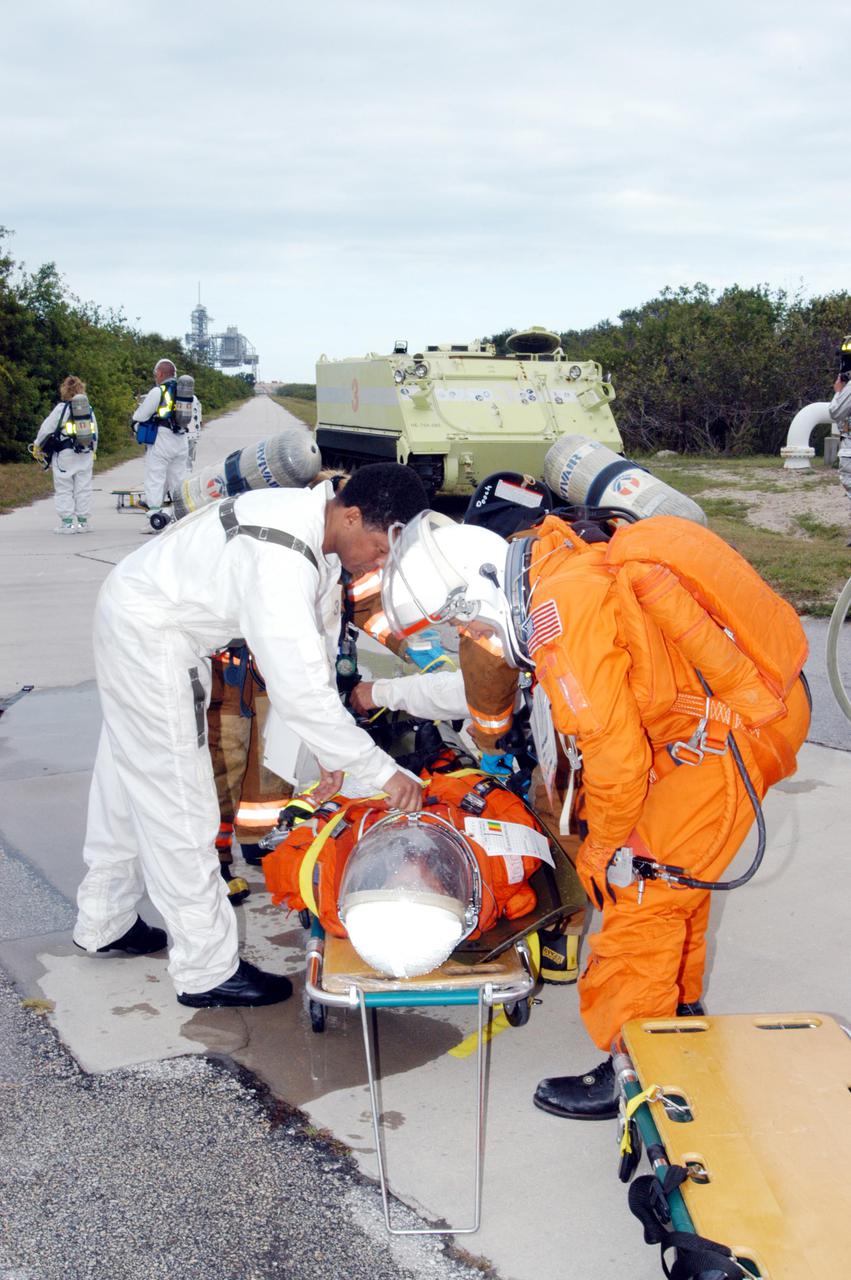
KENNEDY SPACE CENTER, FLA. - During a simulated launch countdown_emergency simulation on Launch Pad 39A, the rescue team moves “injured” astronaut-suited workers out of the M-113 armored personnel carriers that transported them away from the pad (seen in the distance). Pad team members participated in the four-hour exercise simulating normal launch countdown operations, with the added challenge of a fictitious event causing an evacuation of the vehicle and launch pad. The simulation tested the team’s rescue approaches on the Fixed Service Structure, slidewire basket evacuation, triage care and transportation of injured personnel to hospitals, as well as communications and coordination.
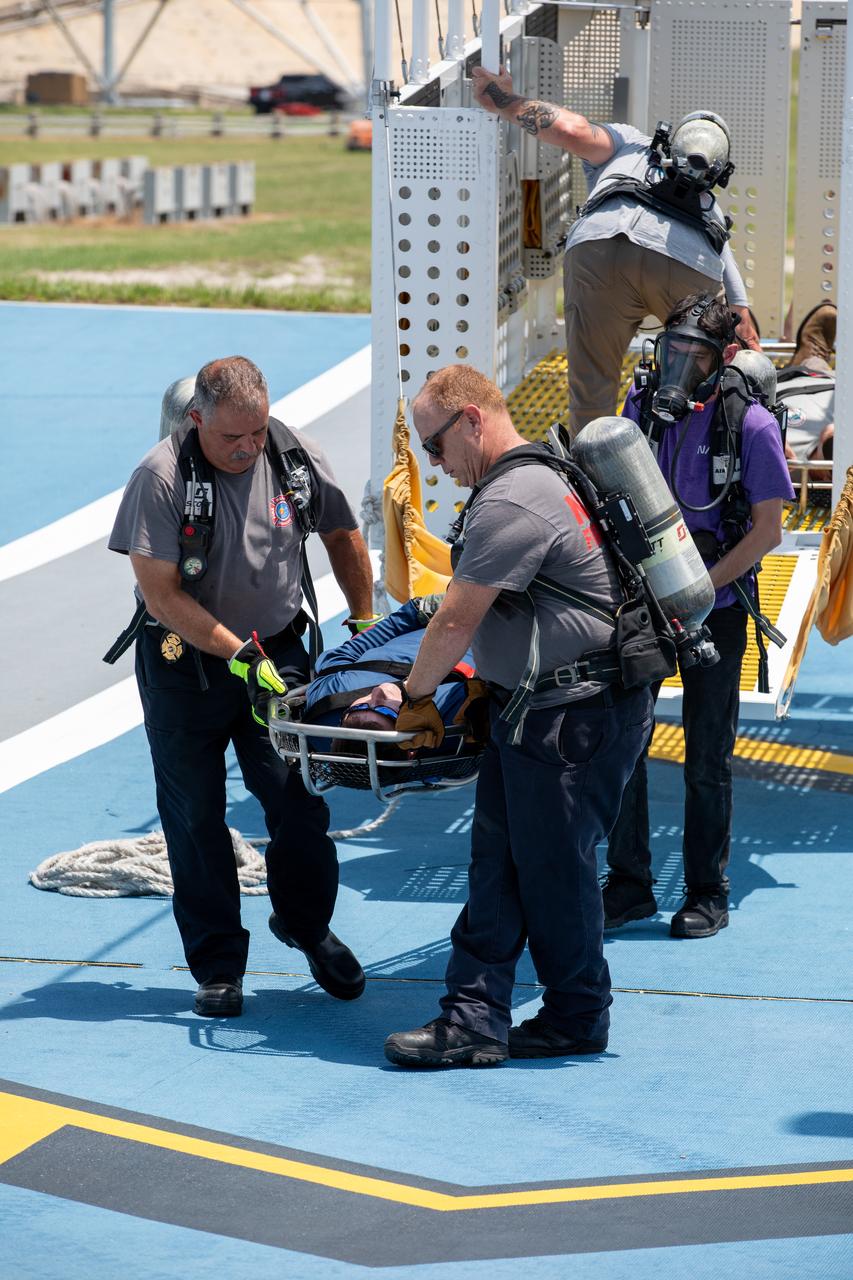
Teams at NASA’s Kennedy Space Center in Florida practice the Artemis mission emergency escape or egress procedures during a series of integrated system verification and validation tests at Launch Complex 39B on Friday, Aug. 9, 2024. Members of the closeout crew, pad rescue team, and the Exploration Ground Systems Program practiced the process of getting in and out of the emergency egress baskets then down to the launch pad where they would be transported to emergency transport vehicles and driven to safety. Prior to this test and throughout the course of several months, teams conducted several basket release demonstrations to validate the system.
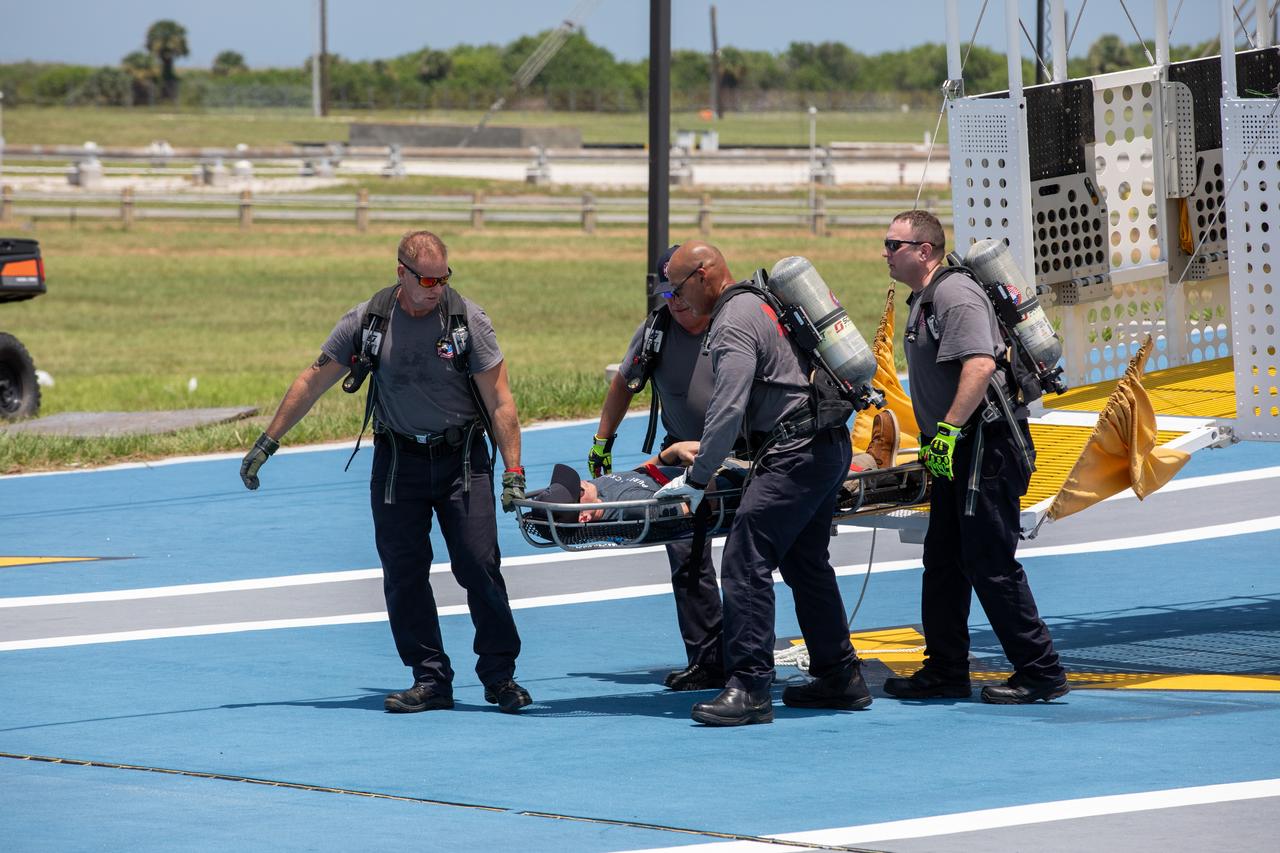
Teams at NASA’s Kennedy Space Center in Florida practice the Artemis mission emergency escape or egress procedures during a series of integrated system verification and validation tests at Launch Complex 39B on Friday, Aug. 9, 2024. Members of the closeout crew, pad rescue team, and the Exploration Ground Systems Program practiced the process of getting in and out of the emergency egress baskets then down to the launch pad where they would be transported to emergency transport vehicles and driven to safety. Prior to this test and throughout the course of several months, teams conducted several basket release demonstrations to validate the system.
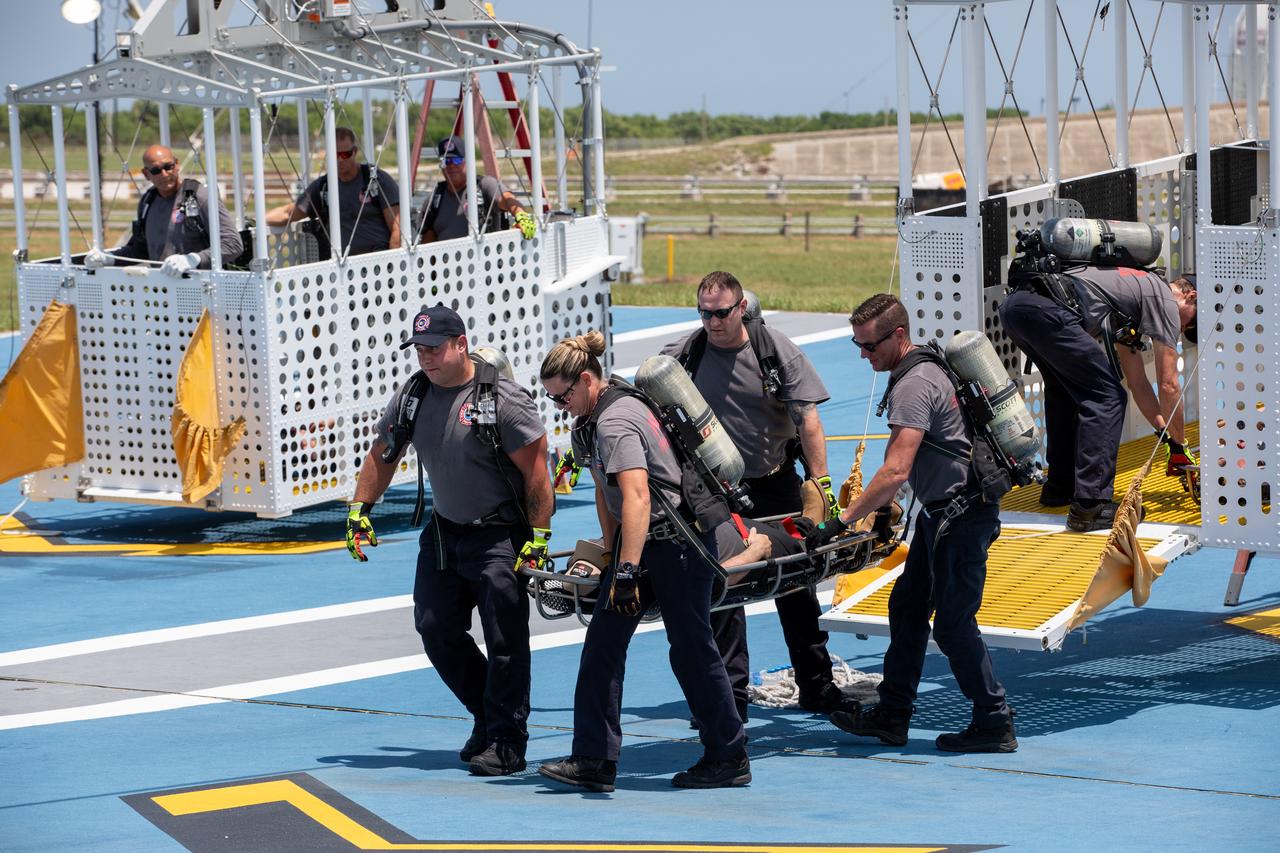
Teams at NASA’s Kennedy Space Center in Florida practice the Artemis mission emergency escape or egress procedures during a series of integrated system verification and validation tests at Launch Complex 39B on Friday, Aug. 9, 2024. Members of the closeout crew, pad rescue team, and the Exploration Ground Systems Program practiced the process of getting in and out of the emergency egress baskets then down to the launch pad where they would be transported to emergency transport vehicles and driven to safety. Prior to this test and throughout the course of several months, teams conducted several basket release demonstrations to validate the system.
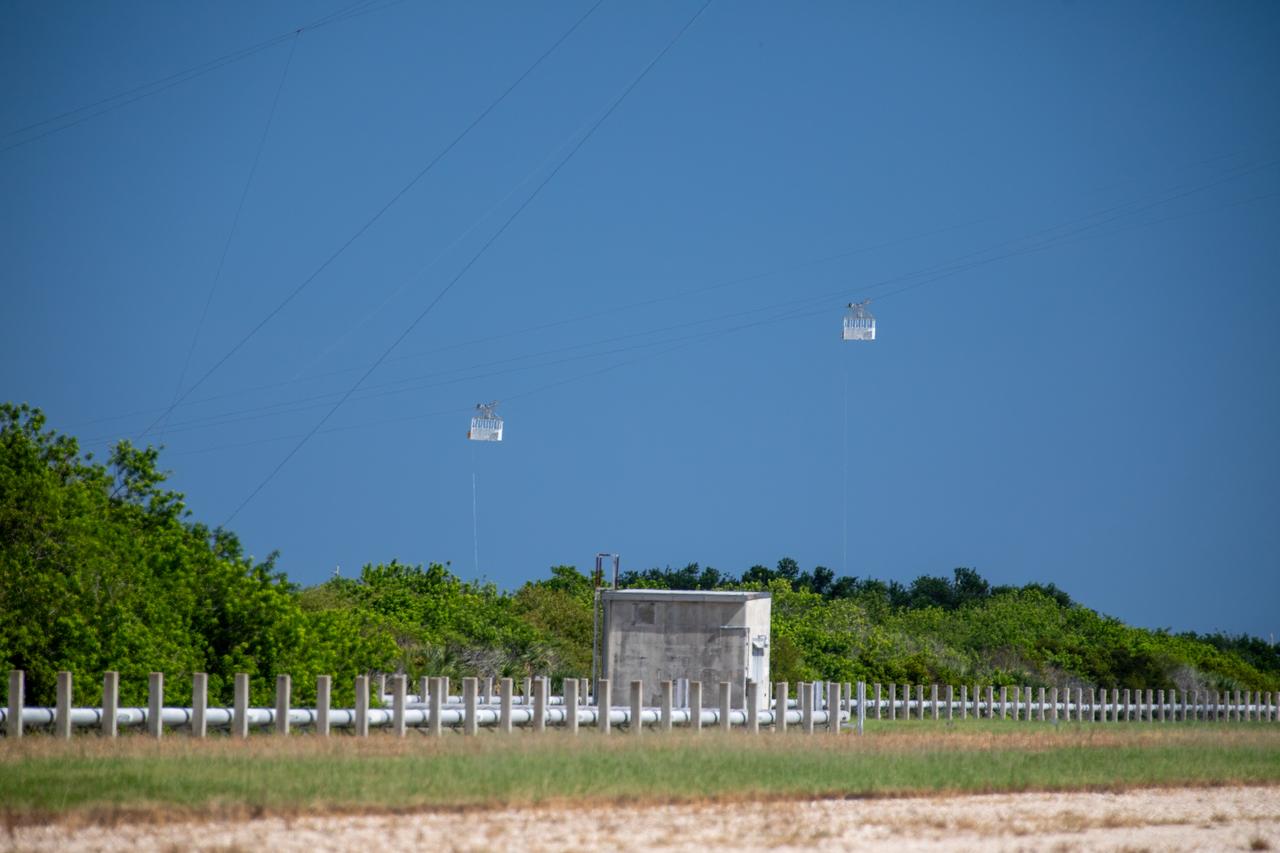
Teams at NASA’s Kennedy Space Center in Florida practice the Artemis mission emergency escape or egress procedures during a series of integrated system verification and validation tests at Launch Complex 39B on Monday, Aug. 12, 2024. Members of the closeout crew, pad rescue team, and the Exploration Ground Systems Program practiced the process of getting in and out of the emergency egress baskets then down to the launch pad where they would be transported to emergency transport vehicles and driven to safety. Prior to this test and throughout the course of several months, teams conducted basket release demonstrations to validate the system.
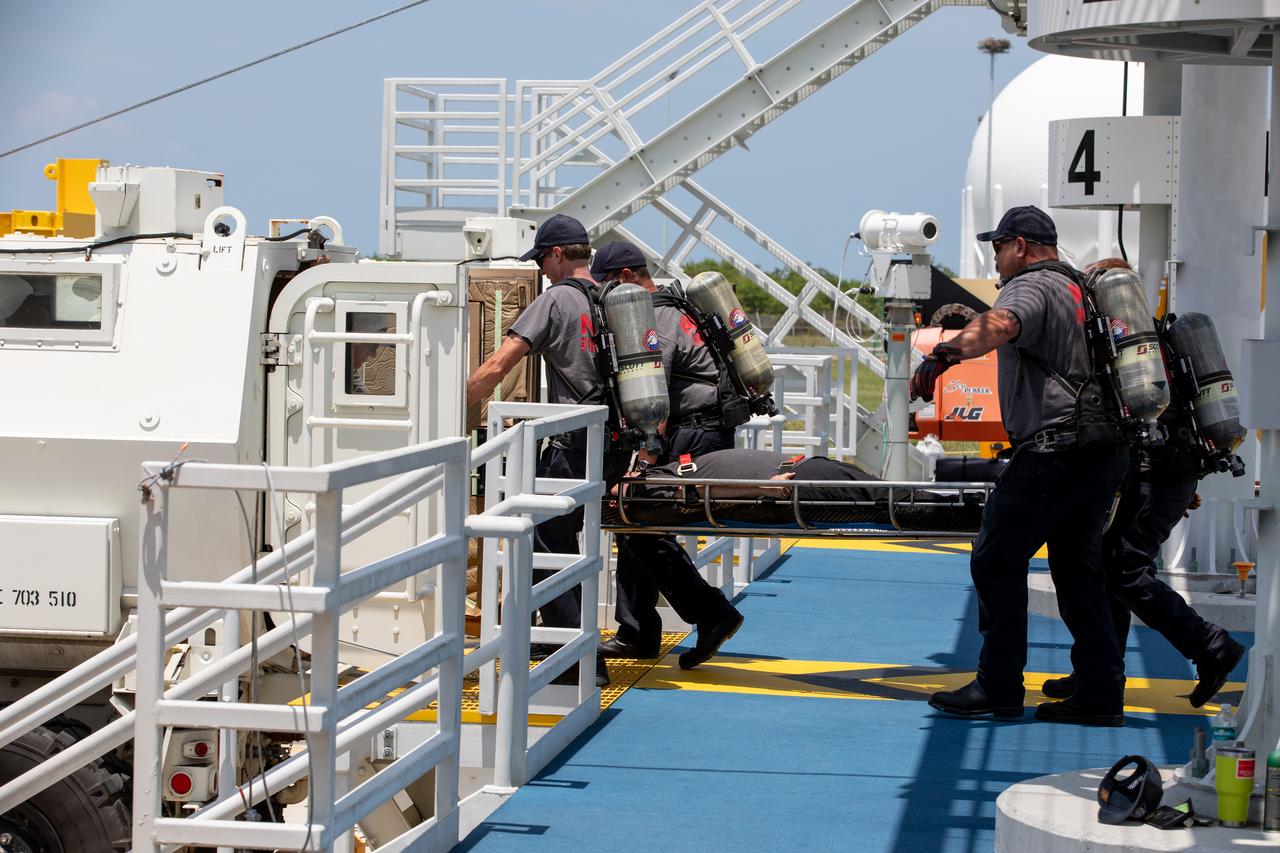
Teams at NASA’s Kennedy Space Center in Florida practice the Artemis mission emergency escape or egress procedures during a series of integrated system verification and validation tests at Launch Complex 39B on Friday, Aug. 9, 2024. Members of the closeout crew, pad rescue team, and the Exploration Ground Systems Program practiced the process of getting in and out of the emergency egress baskets then down to the launch pad where they would be transported to emergency transport vehicles and driven to safety. Prior to this test and throughout the course of several months, teams conducted several basket release demonstrations to validate the system.
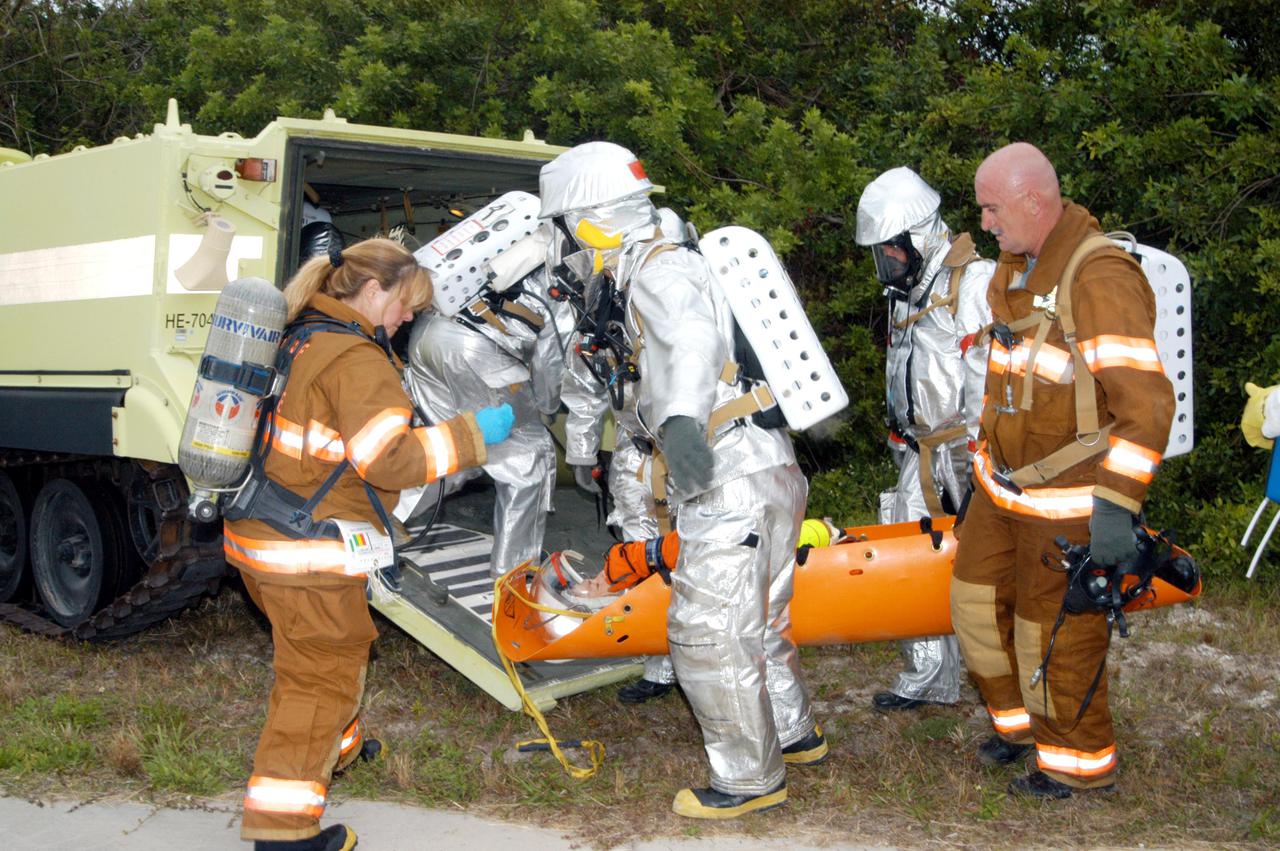
KENNEDY SPACE CENTER, FLA. - During a simulated launch countdown_emergency simulation on Launch Pad 39A, the rescue team moves “injured” astronaut-suited workers out of the M-113 armored personnel carriers that transported them away from the pad (seen in the distance). Pad team members participated in the four-hour exercise simulating normal launch countdown operations, with the added challenge of a fictitious event causing an evacuation of the vehicle and launch pad. The simulation tested the team’s rescue approaches on the Fixed Service Structure, slidewire basket evacuation, triage care and transportation of injured personnel to hospitals, as well as communications and coordination.

Teams at NASA’s Kennedy Space Center in Florida practice the Artemis mission emergency escape or egress procedures during a series of integrated system verification and validation tests at Launch Complex 39B on Monday, Aug. 12, 2024. Members of the closeout crew, pad rescue team, and the Exploration Ground Systems Program practiced the process of getting in and out of the emergency egress baskets then down to the launch pad where they would be transported to emergency transport vehicles and driven to safety. Prior to this test and throughout the course of several months, teams conducted basket release demonstrations to validate the system.
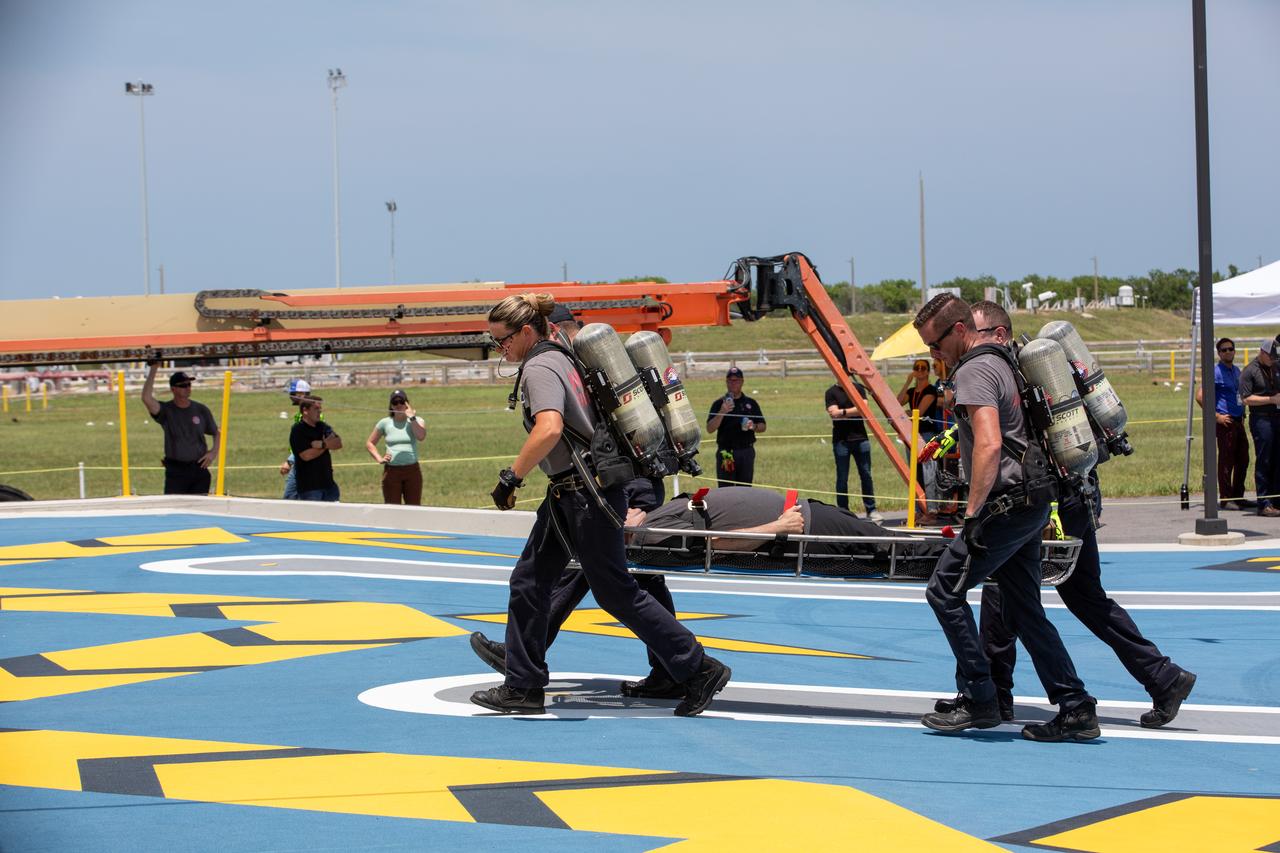
Teams at NASA’s Kennedy Space Center in Florida practice the Artemis mission emergency escape or egress procedures during a series of integrated system verification and validation tests at Launch Complex 39B on Friday, Aug. 9, 2024. Members of the closeout crew, pad rescue team, and the Exploration Ground Systems Program practiced the process of getting in and out of the emergency egress baskets then down to the launch pad where they would be transported to emergency transport vehicles and driven to safety. Prior to this test and throughout the course of several months, teams conducted several basket release demonstrations to validate the system.
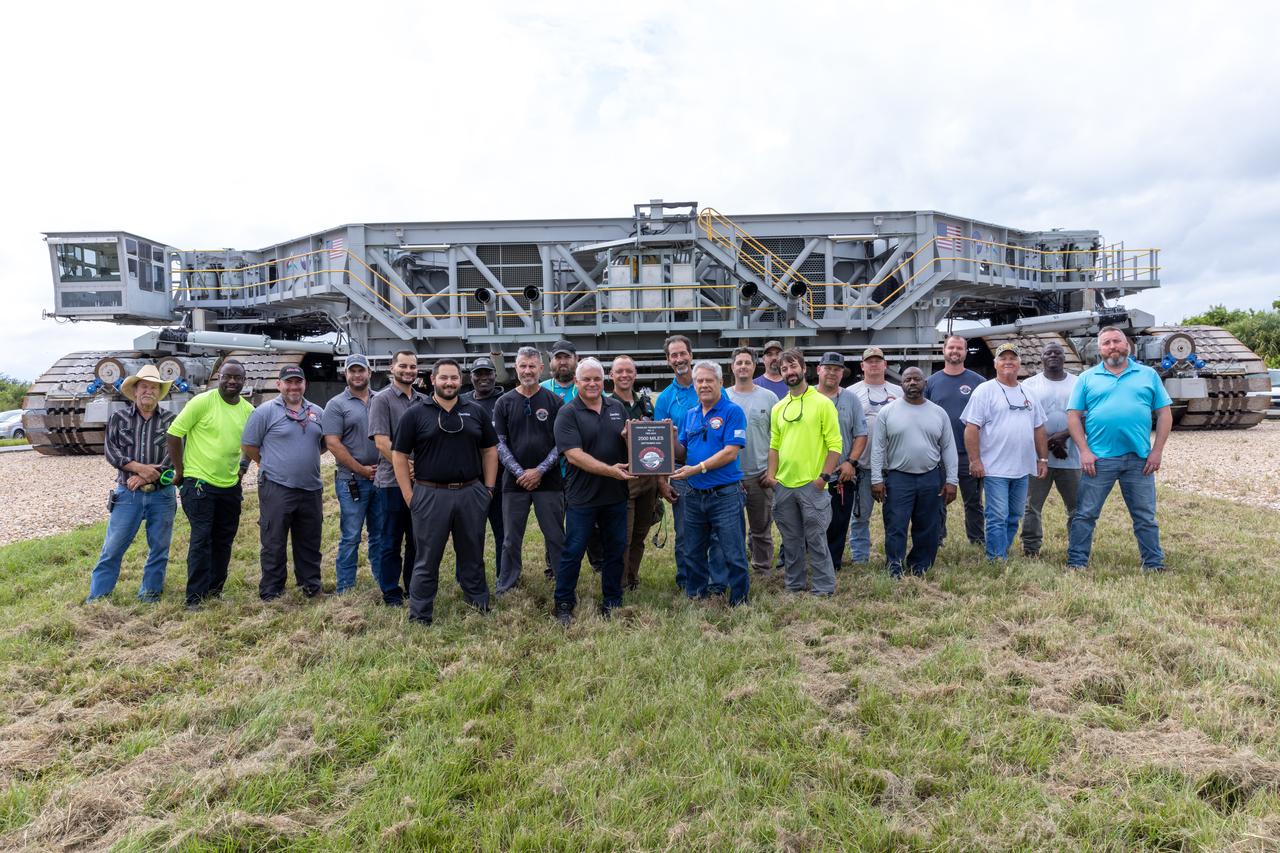
Teams with NASA’s Exploration Ground Systems at NASA’s Kennedy Space Center in Florida celebrate on Wednesday, Sept. 25, 2024, the agency’s crawler-transporter 2 reaching the milestone of 2,500 miles traveled since its construction in 1965. Crawler-transporter 2 reached the milestone while teams took it on a trip in preparation for supporting the roll of the mobile launcher from Launch Pad 39B back into the spaceport’s Vehicle Assembly Building ahead of the Artemis II launch. Built originally to transport massive Saturn V rockets during the Apollo Program, crawler-transporter 2 continued its service during the Space Shuttle Program, and currently transports the massive SLS (Space Launch System) rocket and Orion spacecraft atop the mobile launcher as part of the agency’s Artemis campaign.
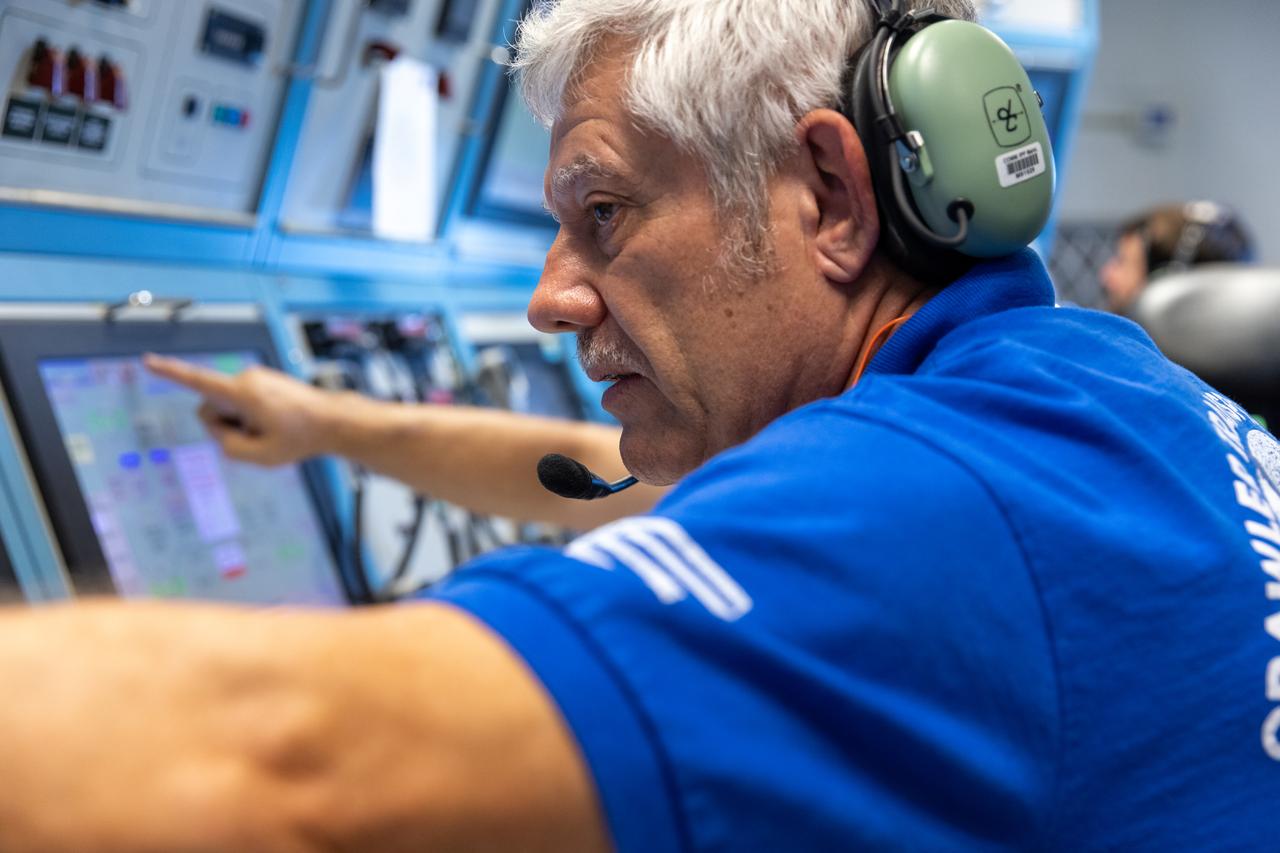
Teams with NASA’s Exploration Ground Systems at NASA’s Kennedy Space Center in Florida celebrate on Wednesday, Sept. 25, 2024, the agency’s crawler-transporter 2 reaching the milestone of 2,500 miles traveled since its construction in 1965. Crawler-transporter 2 reached the milestone while teams took it on a trip in preparation for supporting the roll of the mobile launcher from Launch Pad 39B back into the spaceport’s Vehicle Assembly Building ahead of the Artemis II launch. Built originally to transport massive Saturn V rockets during the Apollo Program, crawler-transporter 2 continued its service during the Space Shuttle Program, and currently transports the massive SLS (Space Launch System) rocket and Orion spacecraft atop the mobile launcher as part of the agency’s Artemis campaign.
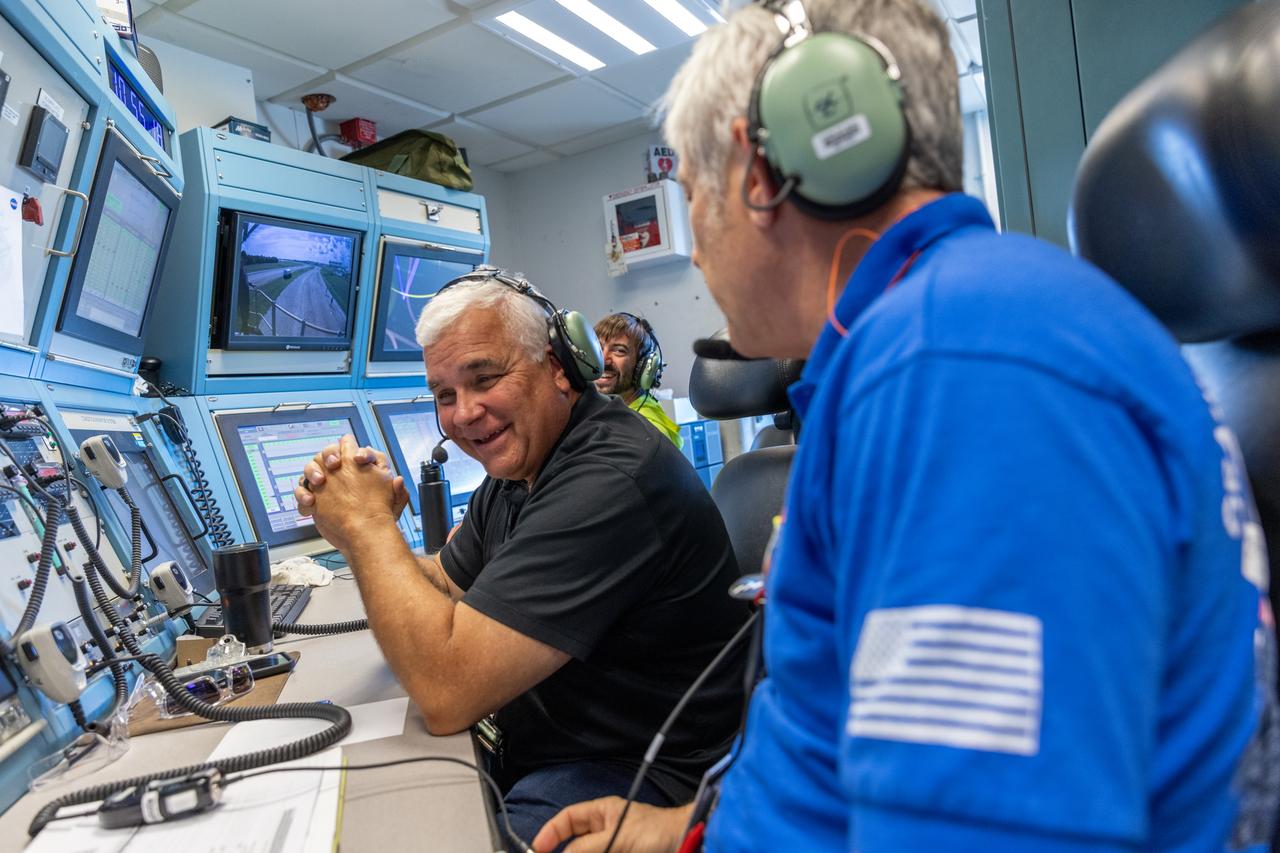
Teams with NASA’s Exploration Ground Systems at NASA’s Kennedy Space Center in Florida celebrate on Wednesday, Sept. 25, 2024, the agency’s crawler-transporter 2 reaching the milestone of 2,500 miles traveled since its construction in 1965. Crawler-transporter 2 reached the milestone while teams took it on a trip in preparation for supporting the roll of the mobile launcher from Launch Pad 39B back into the spaceport’s Vehicle Assembly Building ahead of the Artemis II launch. Built originally to transport massive Saturn V rockets during the Apollo Program, crawler-transporter 2 continued its service during the Space Shuttle Program, and currently transports the massive SLS (Space Launch System) rocket and Orion spacecraft atop the mobile launcher as part of the agency’s Artemis campaign.
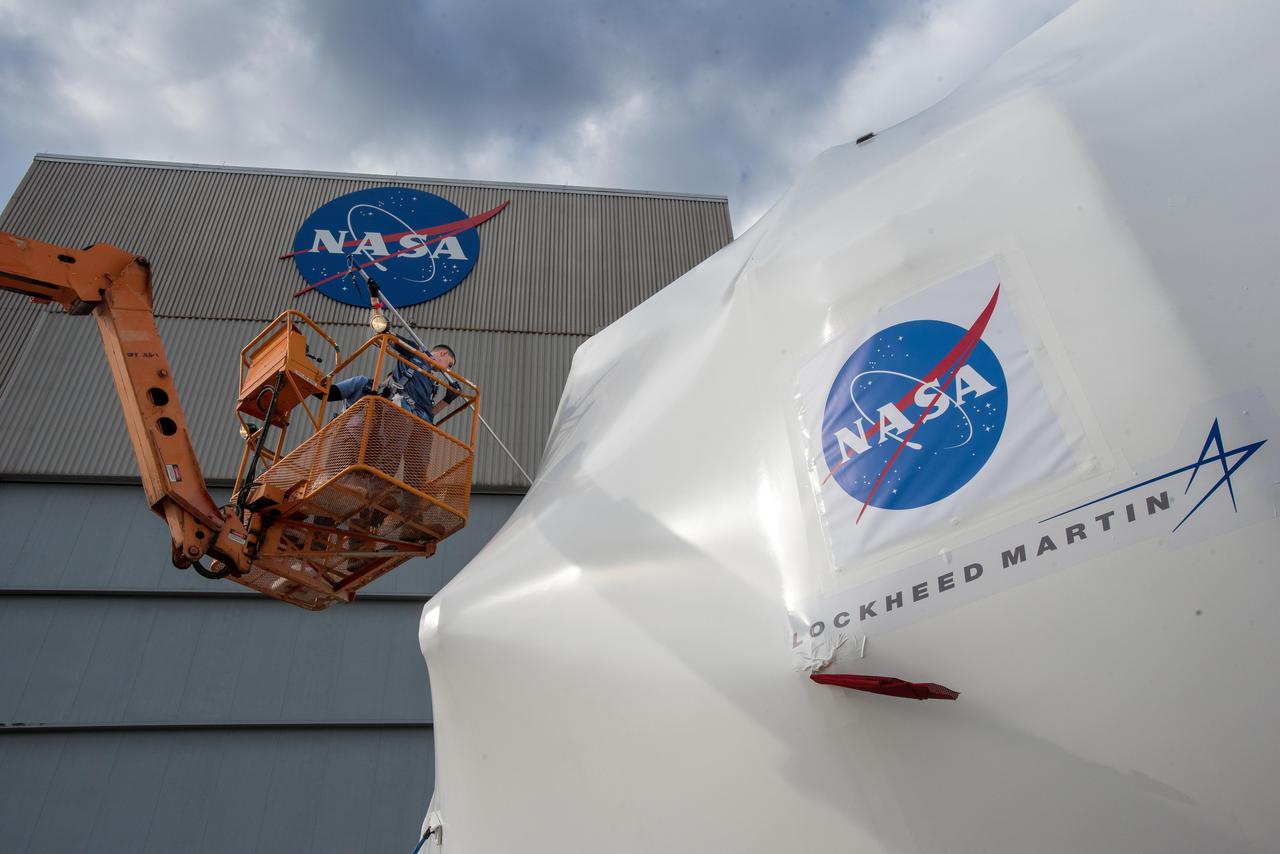
Orion - EM-1 - Artemis Spacecraft Arrival at Mansfield Lahm Airport, Transportation to Plum Brook Station and Installation in the Space Environment Complex, SEC Thermal Vacuum Chamber
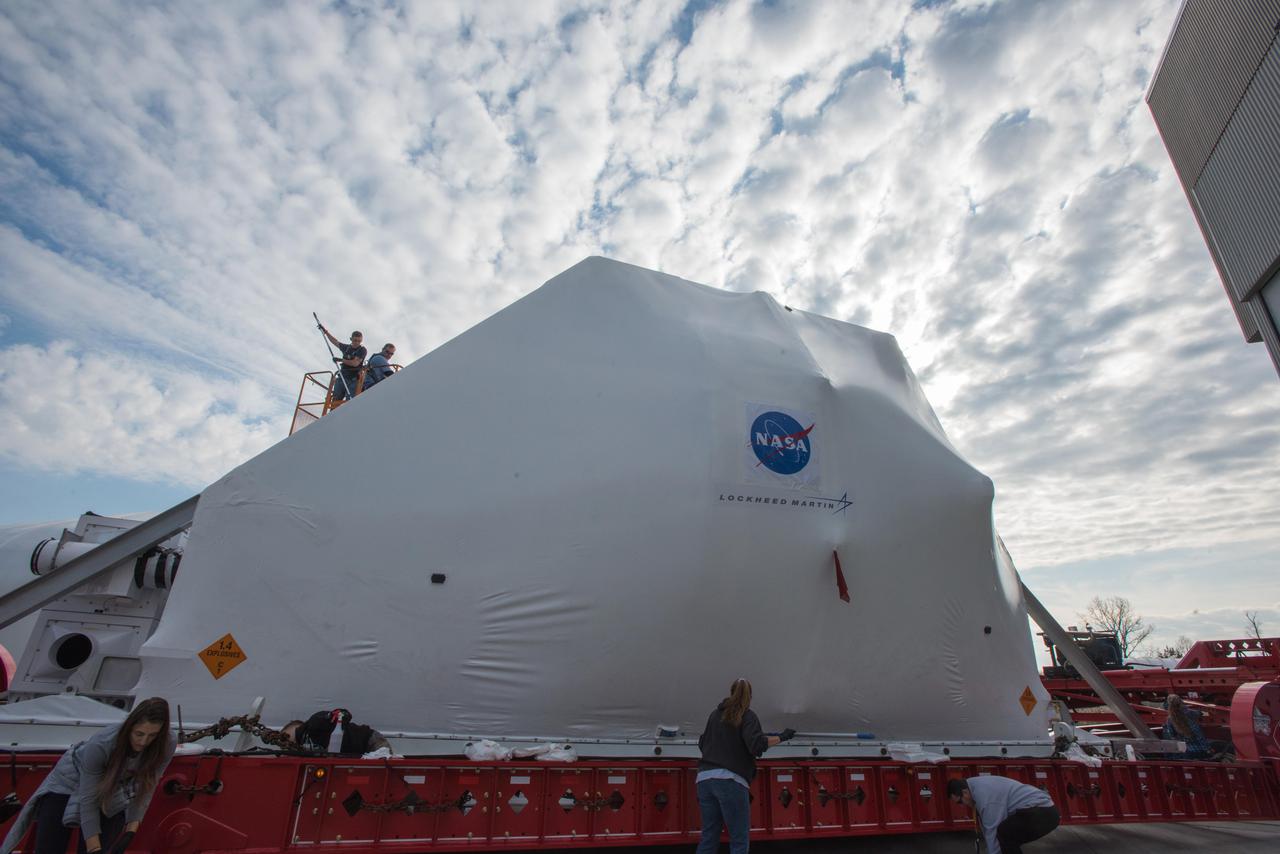
Orion - EM-1 - Artemis Spacecraft Arrival at Mansfield Lahm Airport, Transportation to Plum Brook Station and Installation in the Space Environment Complex, SEC Thermal Vacuum Chamber
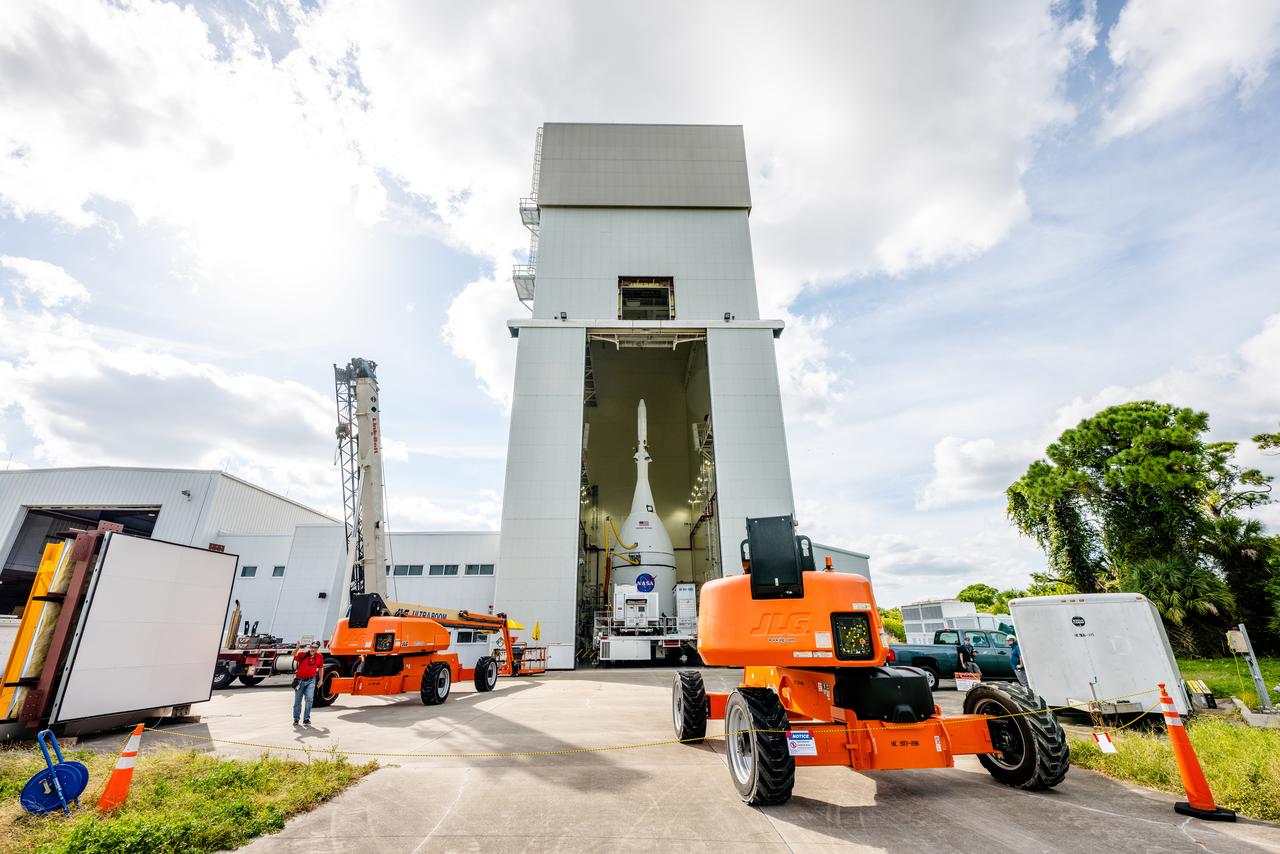
The team at Kennedy Space Center prepares the Artemis I Orion for transport from the Launch Abort System Facility to the Vehicle Assembly Building where it will be stacked atop the Launch Abort System.
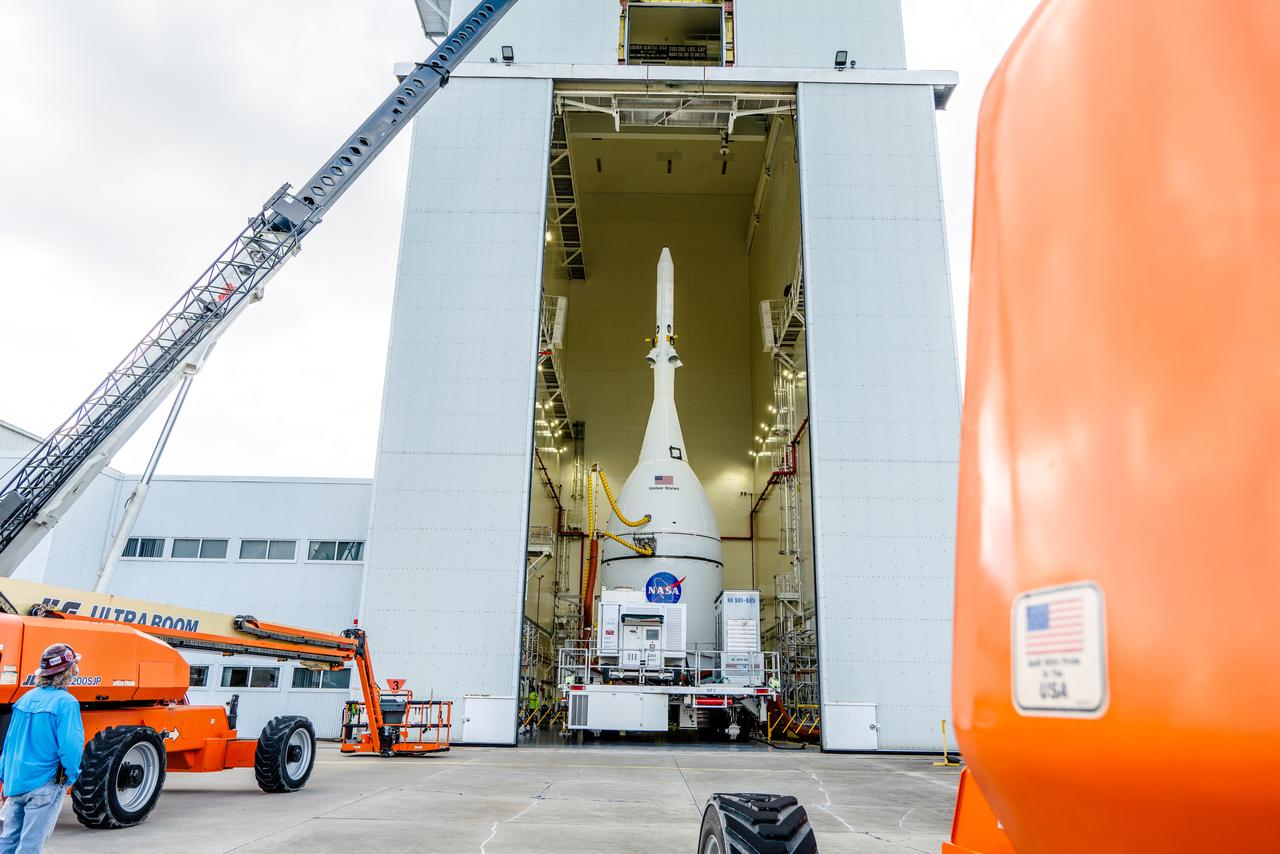
The team at Kennedy Space Center prepares the Artemis I Orion for transport from the Launch Abort System Facility to the Vehicle Assembly Building where it will be stacked atop the Launch Abort System.
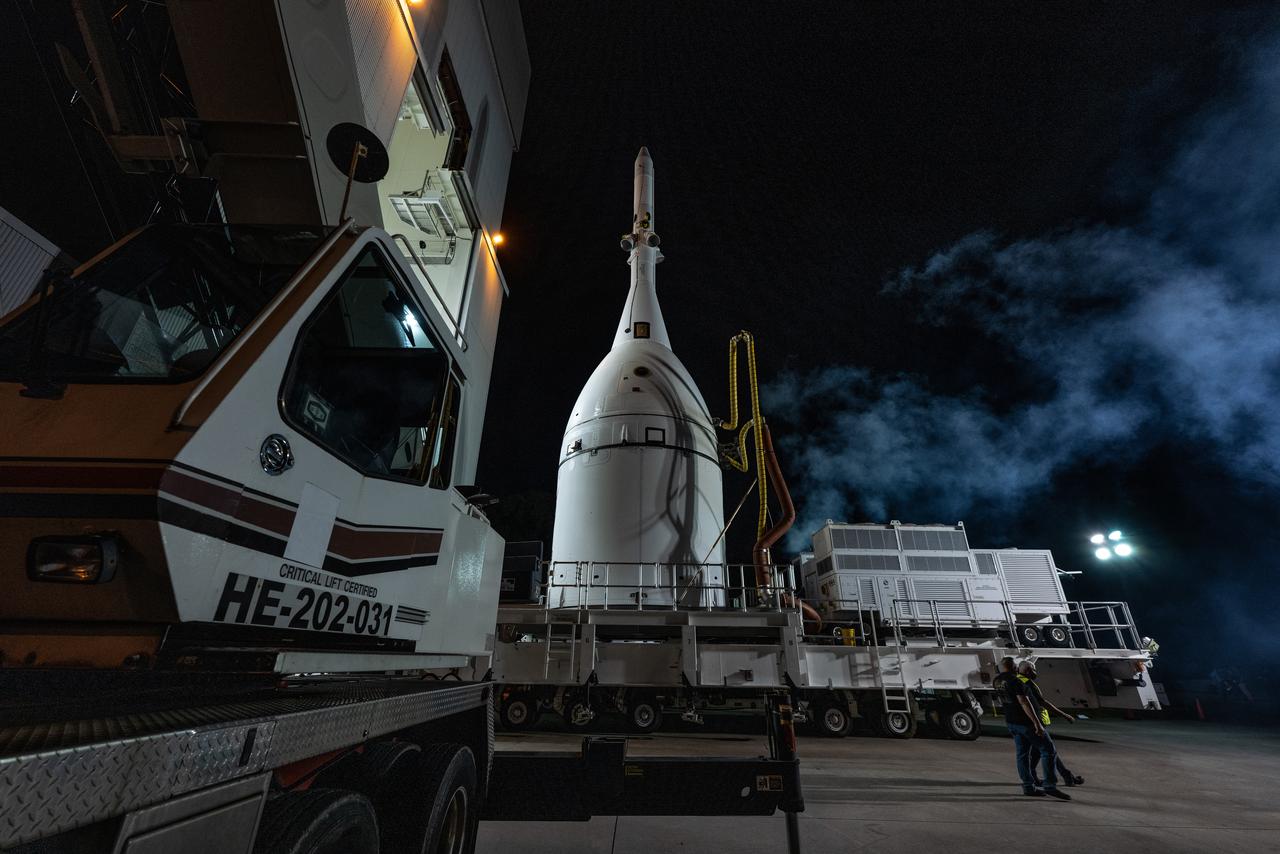
The team at Kennedy Space Center prepares the Artemis I Orion for transport from the Launch Abort System Facility to the Vehicle Assembly Building where it will be stacked atop the Space Launch System.
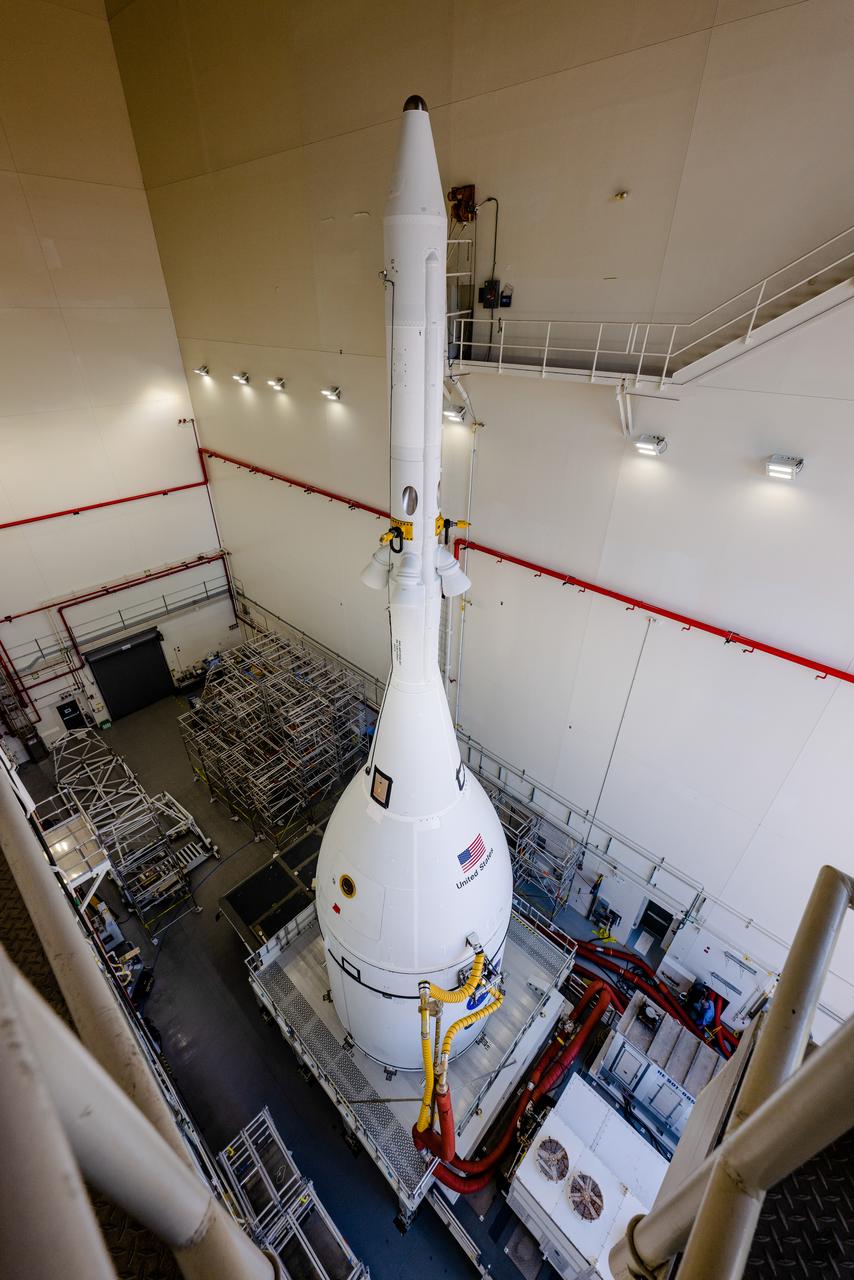
The team at Kennedy Space Center prepares the Artemis I Orion for transport from the Launch Abort System Facility to the Vehicle Assembly Building where it will be stacked atop the Launch Abort System.
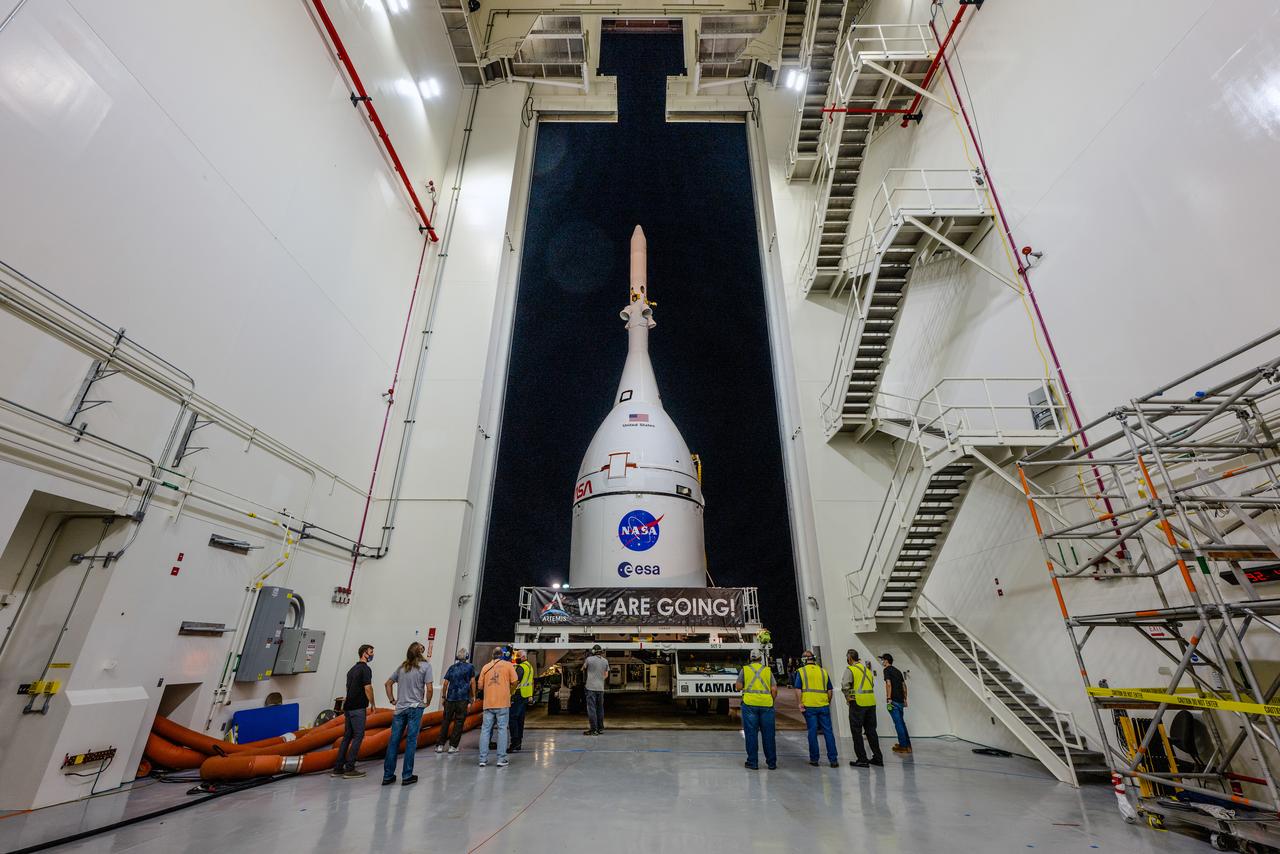
The team at Kennedy Space Center prepares the Artemis I Orion for transport from the Launch Abort System Facility to the Vehicle Assembly Building where it will be stacked atop the Launch Abort System.

The team at Kennedy Space Center prepares the Artemis I Orion for transport from the Launch Abort System Facility to the Vehicle Assembly Building where it will be stacked atop the Launch Abort System.
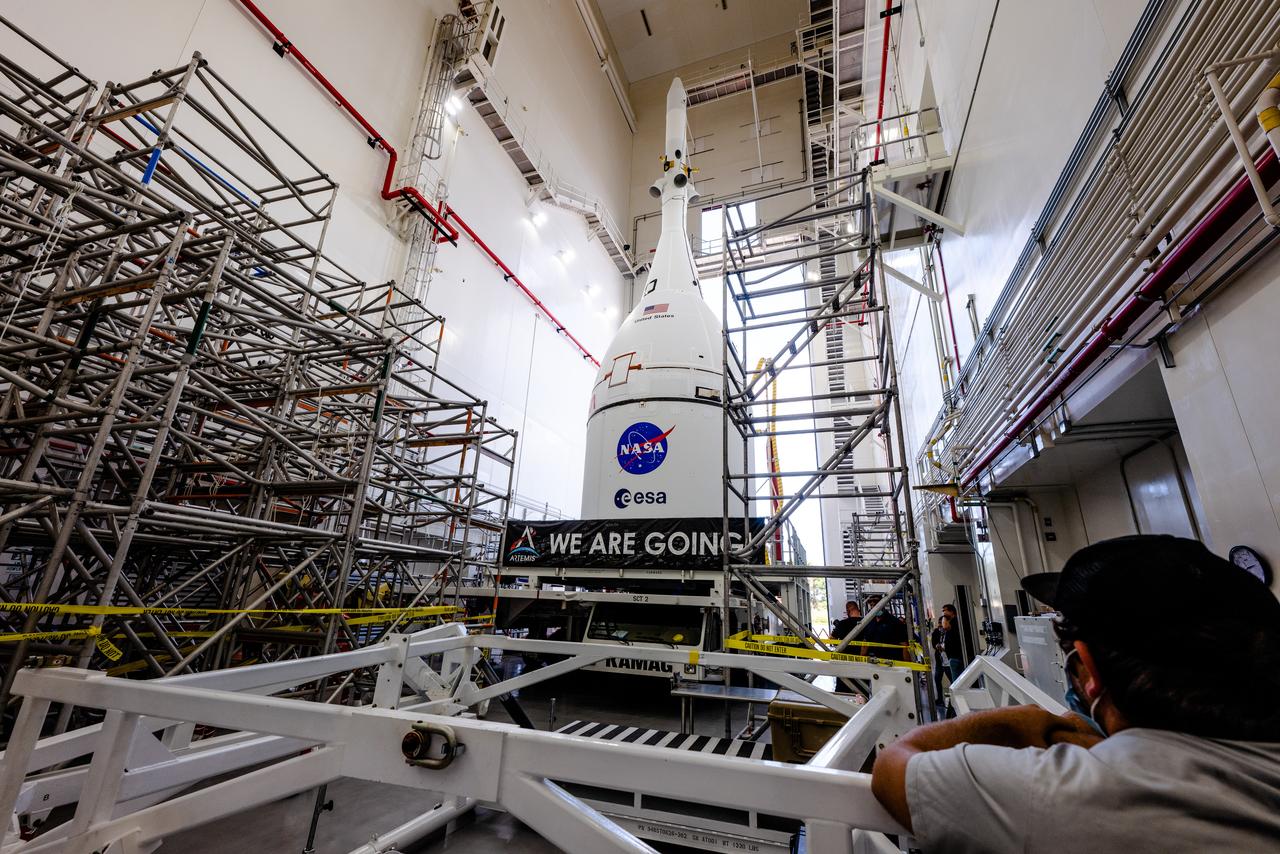
The team at Kennedy Space Center prepares the Artemis I Orion for transport from the Launch Abort System Facility to the Vehicle Assembly Building where it will be stacked atop the Launch Abort System.
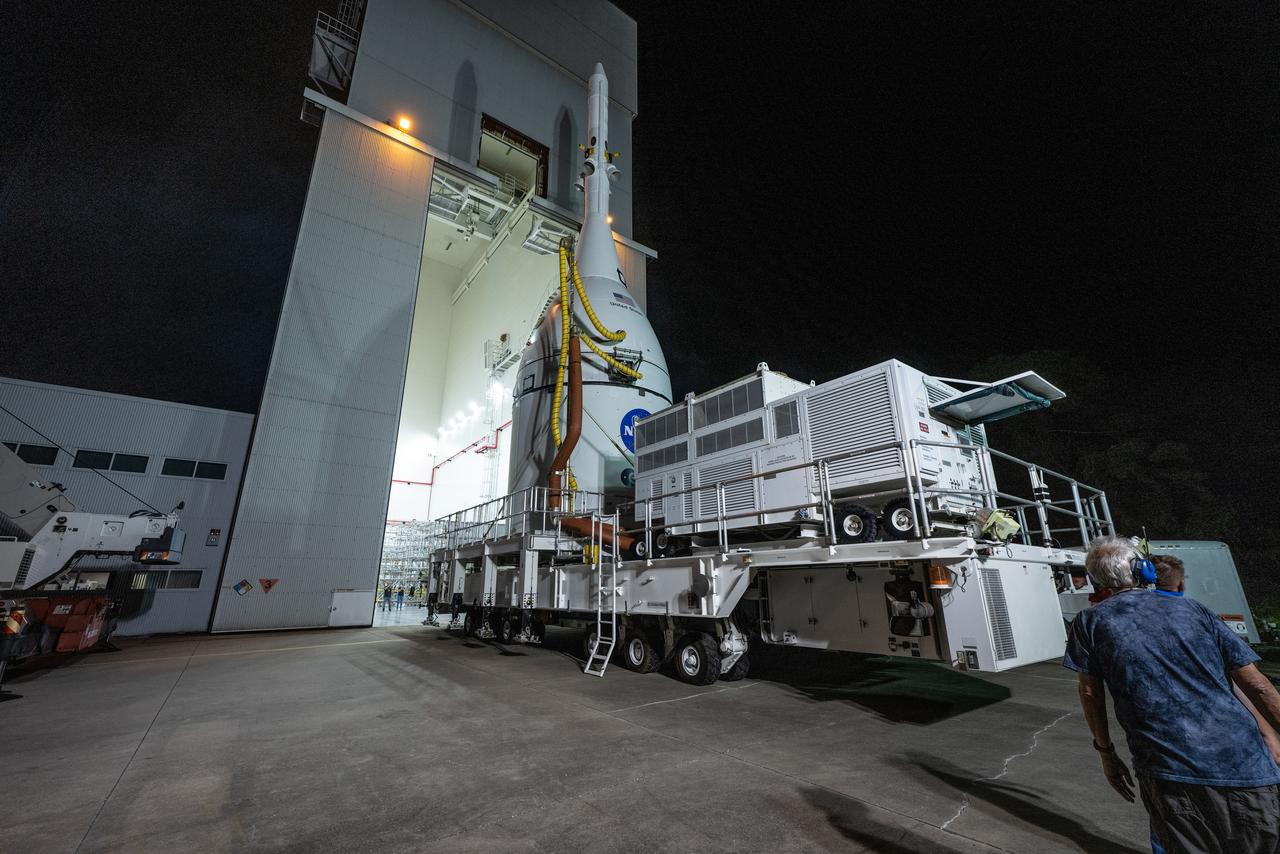
The team at Kennedy Space Center prepares the Artemis I Orion for transport from the Launch Abort System Facility to the Vehicle Assembly Building where it will be stacked atop the Launch Abort System.
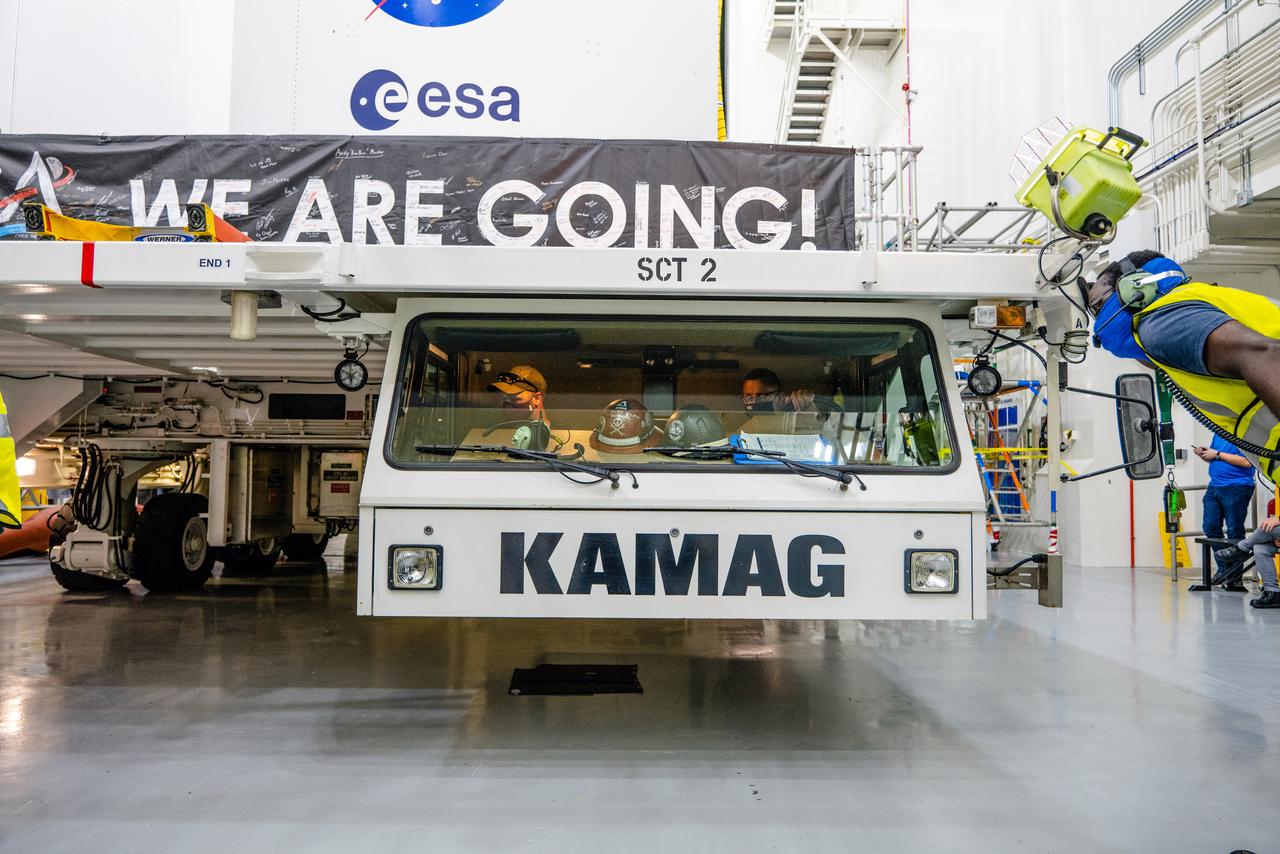
The team at Kennedy Space Center prepares the Artemis I Orion for transport from the Launch Abort System Facility to the Vehicle Assembly Building where it will be stacked atop the Launch Abort System.
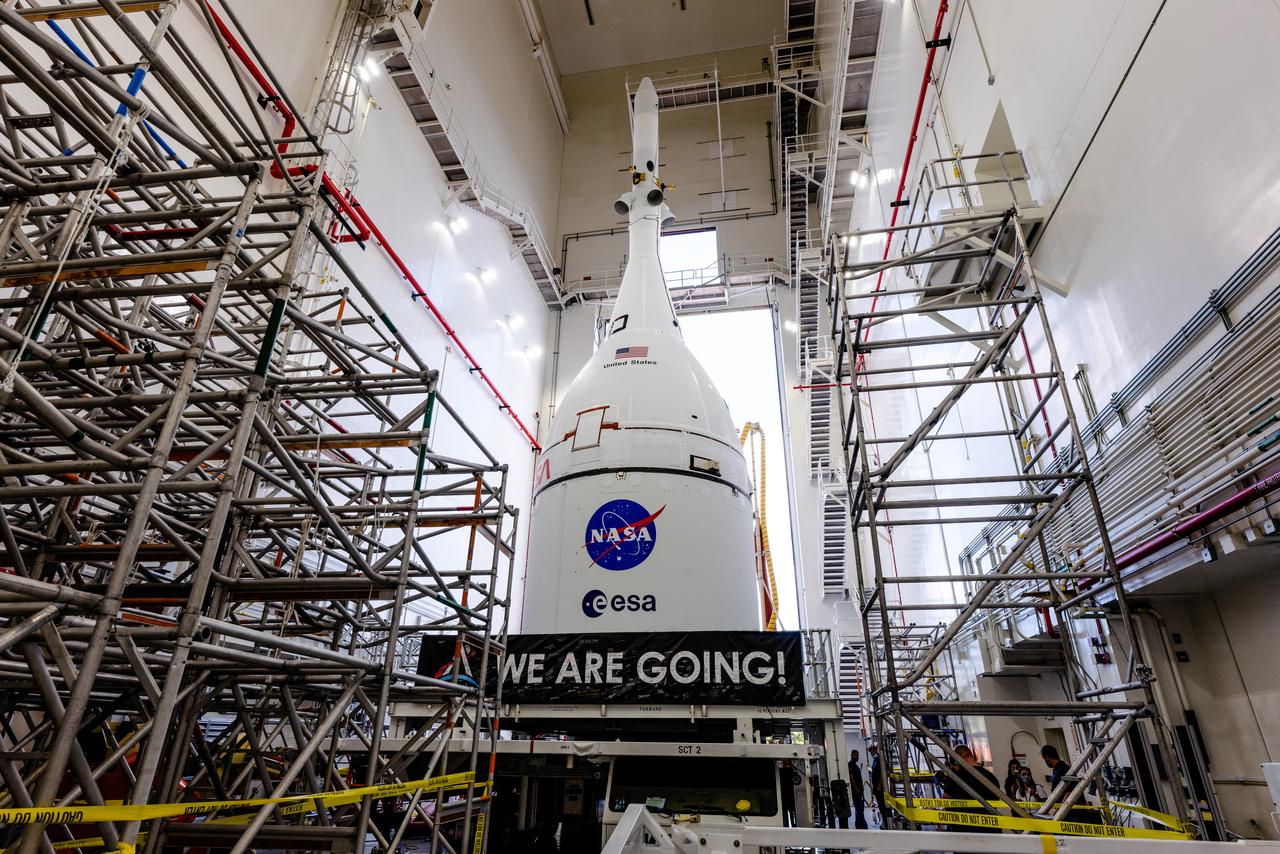
The team at Kennedy Space Center prepares the Artemis I Orion for transport from the Launch Abort System Facility to the Vehicle Assembly Building where it will be stacked atop the Launch Abort System.
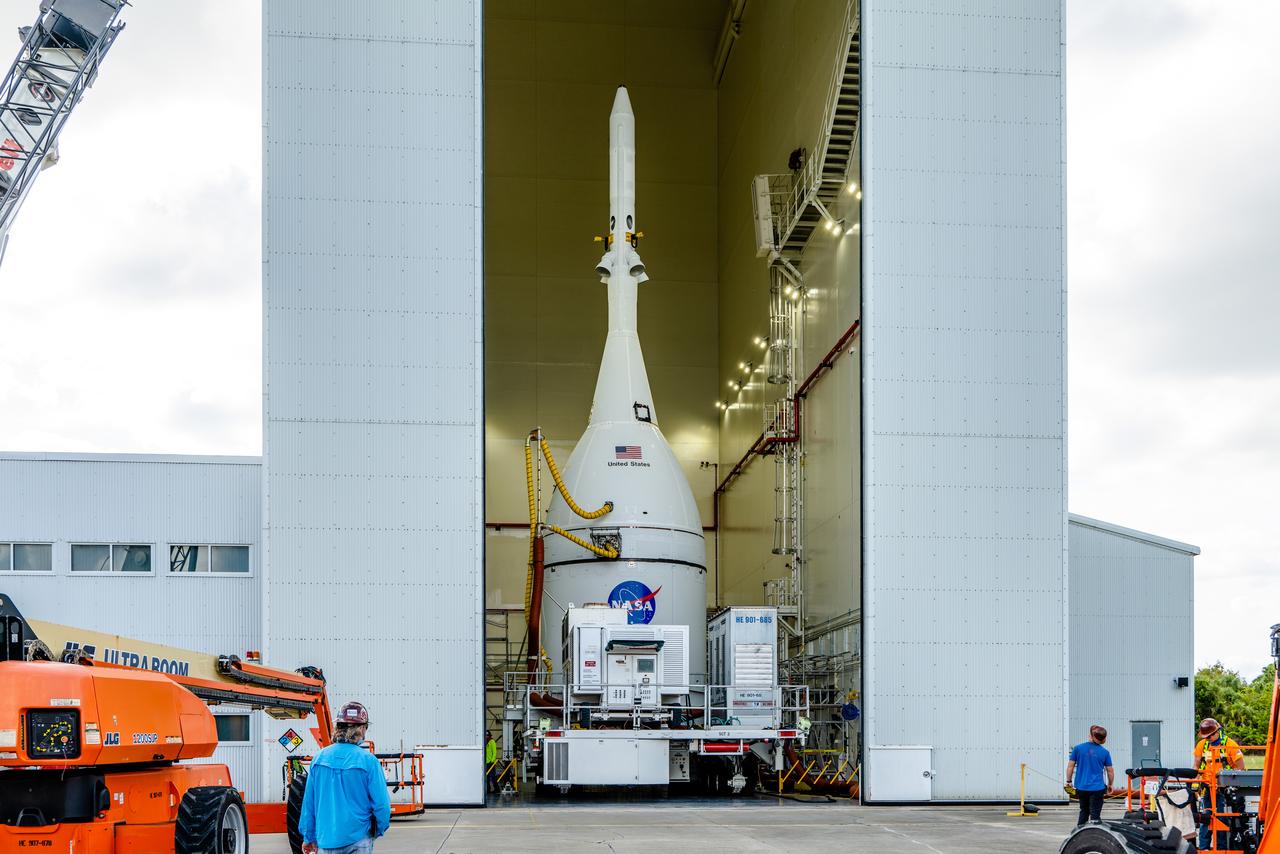
The team at Kennedy Space Center prepares the Artemis I Orion for transport from the Launch Abort System Facility to the Vehicle Assembly Building where it will be stacked atop the Launch Abort System.
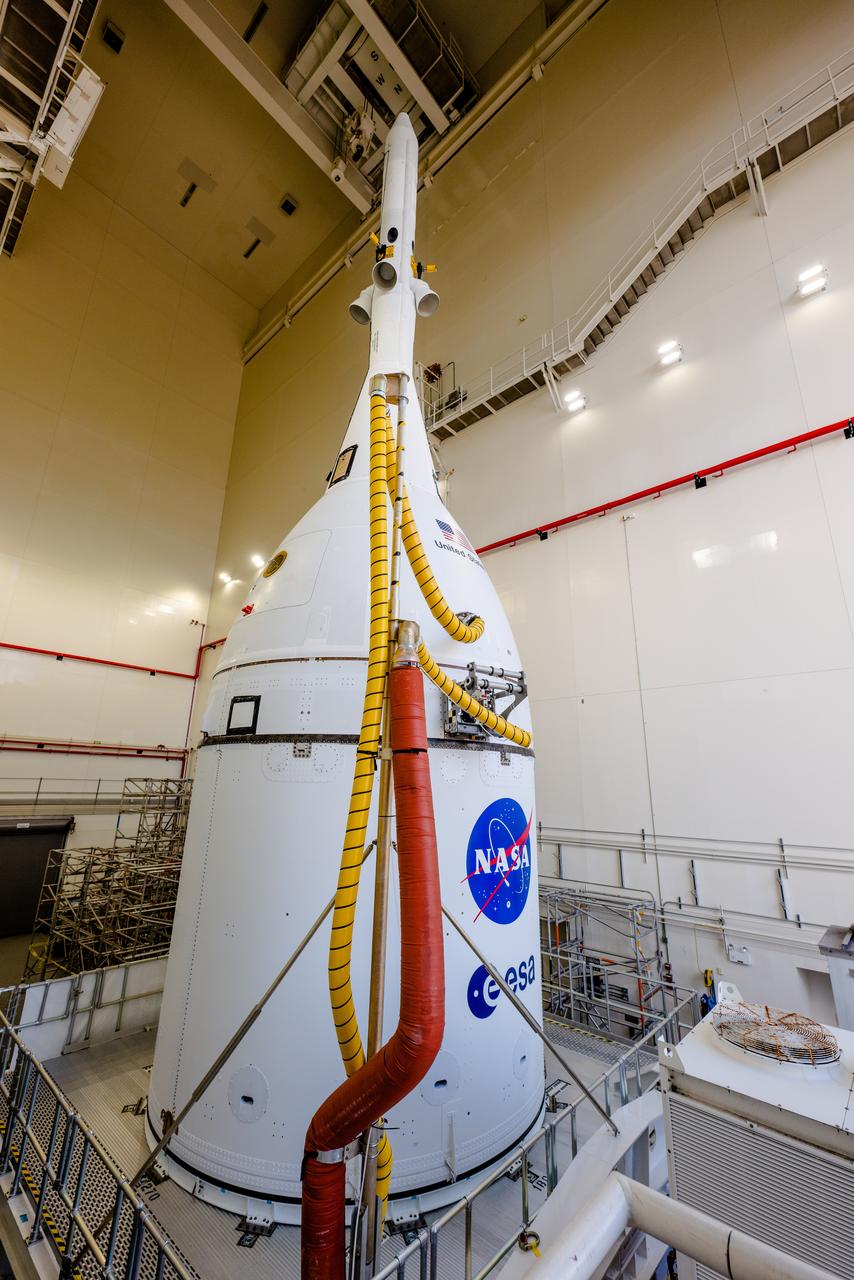
The team at Kennedy Space Center prepares the Artemis I Orion for transport from the Launch Abort System Facility to the Vehicle Assembly Building where it will be stacked atop the Launch Abort System.
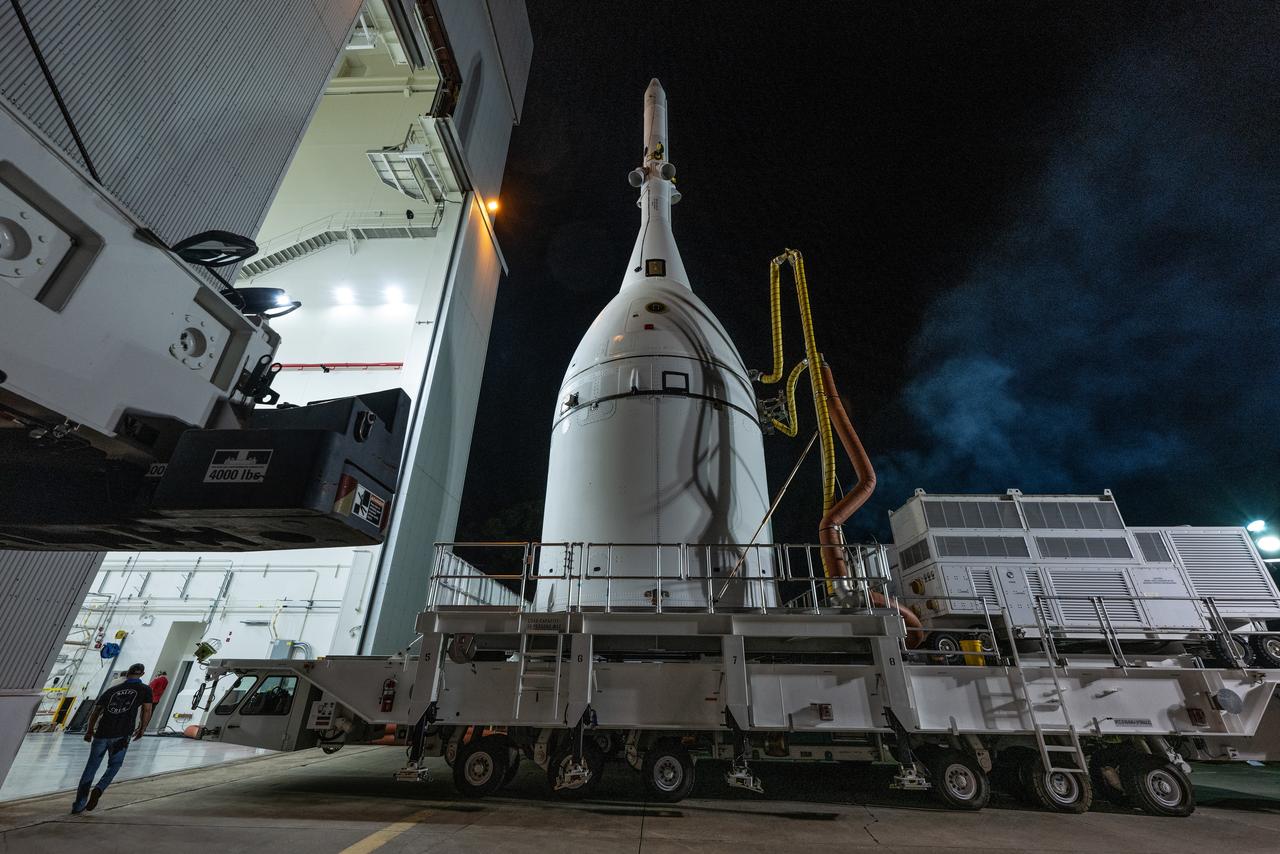
The team at Kennedy Space Center prepares the Artemis I Orion for transport from the Launch Abort System Facility to the Vehicle Assembly Building where it will be stacked atop the Launch Abort System.
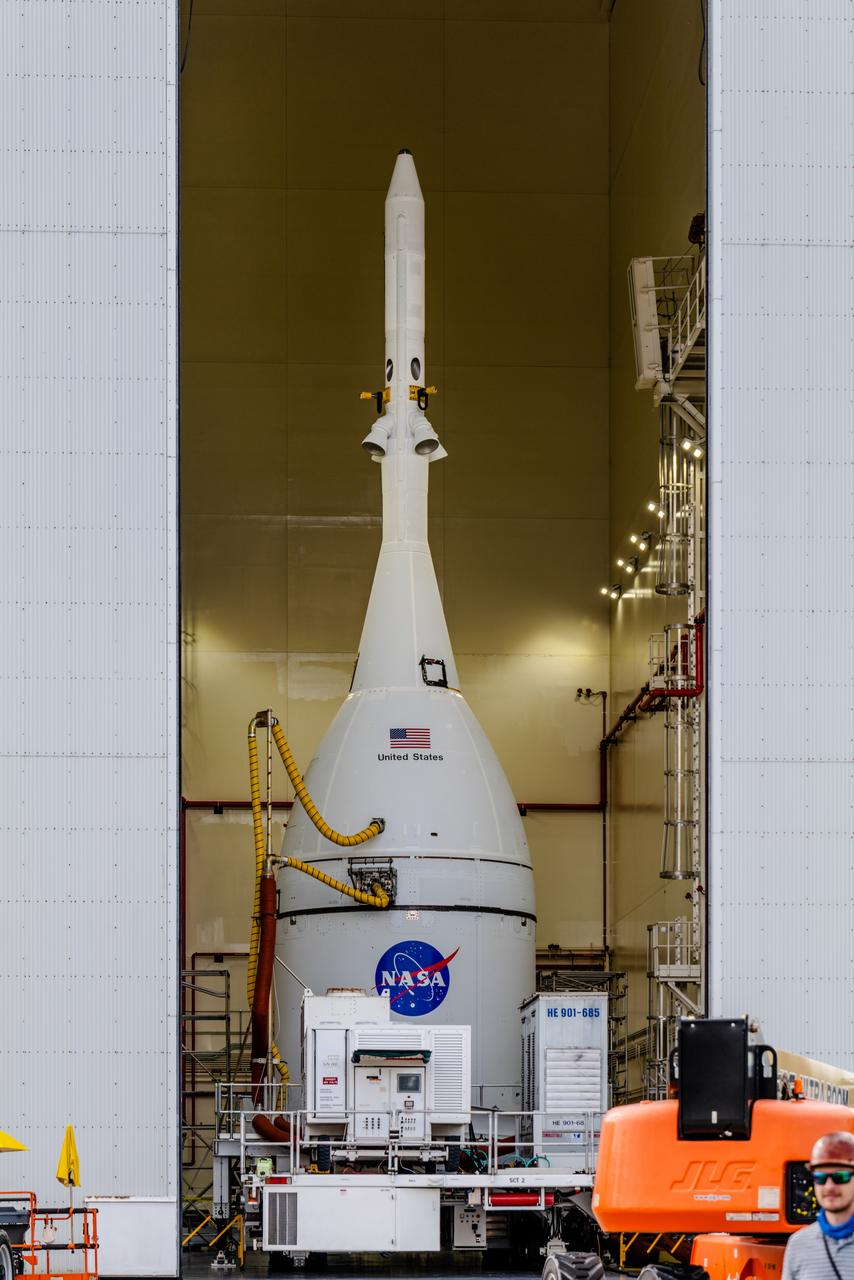
The team at Kennedy Space Center prepares the Artemis I Orion for transport from the Launch Abort System Facility to the Vehicle Assembly Building where it will be stacked atop the Launch Abort System.
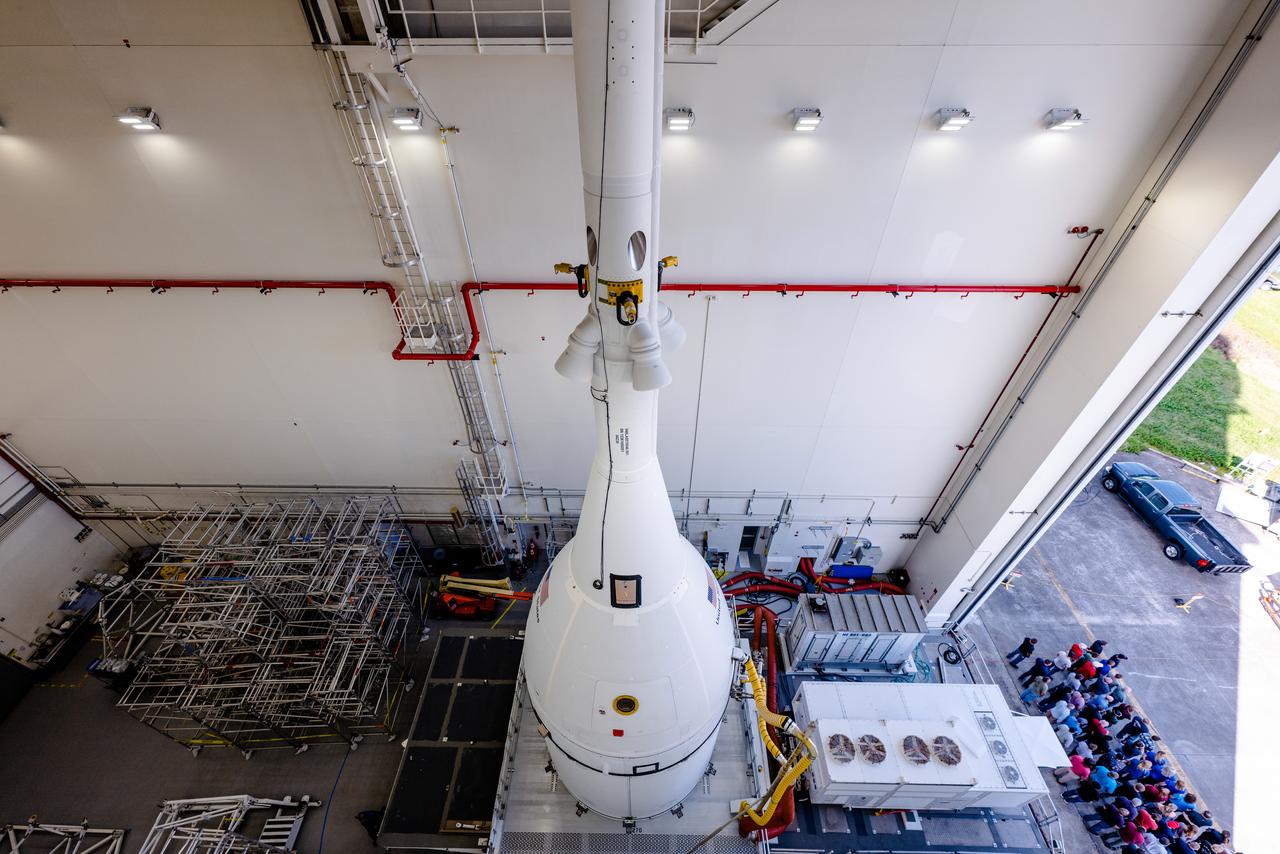
The team at Kennedy Space Center prepares the Artemis I Orion for transport from the Launch Abort System Facility to the Vehicle Assembly Building where it will be stacked atop the Launch Abort System.
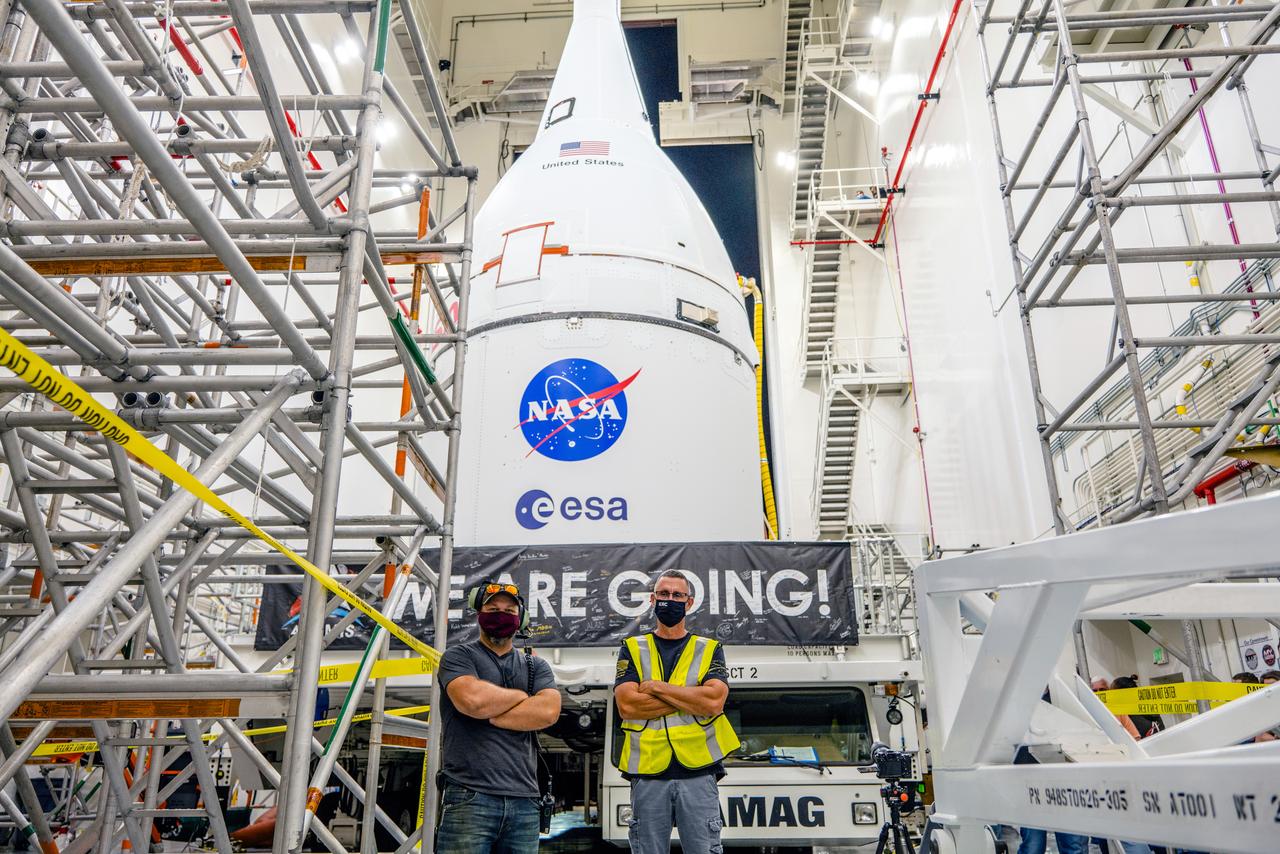
The team at Kennedy Space Center prepares the Artemis I Orion for transport from the Launch Abort System Facility to the Vehicle Assembly Building where it will be stacked atop the Launch Abort System.
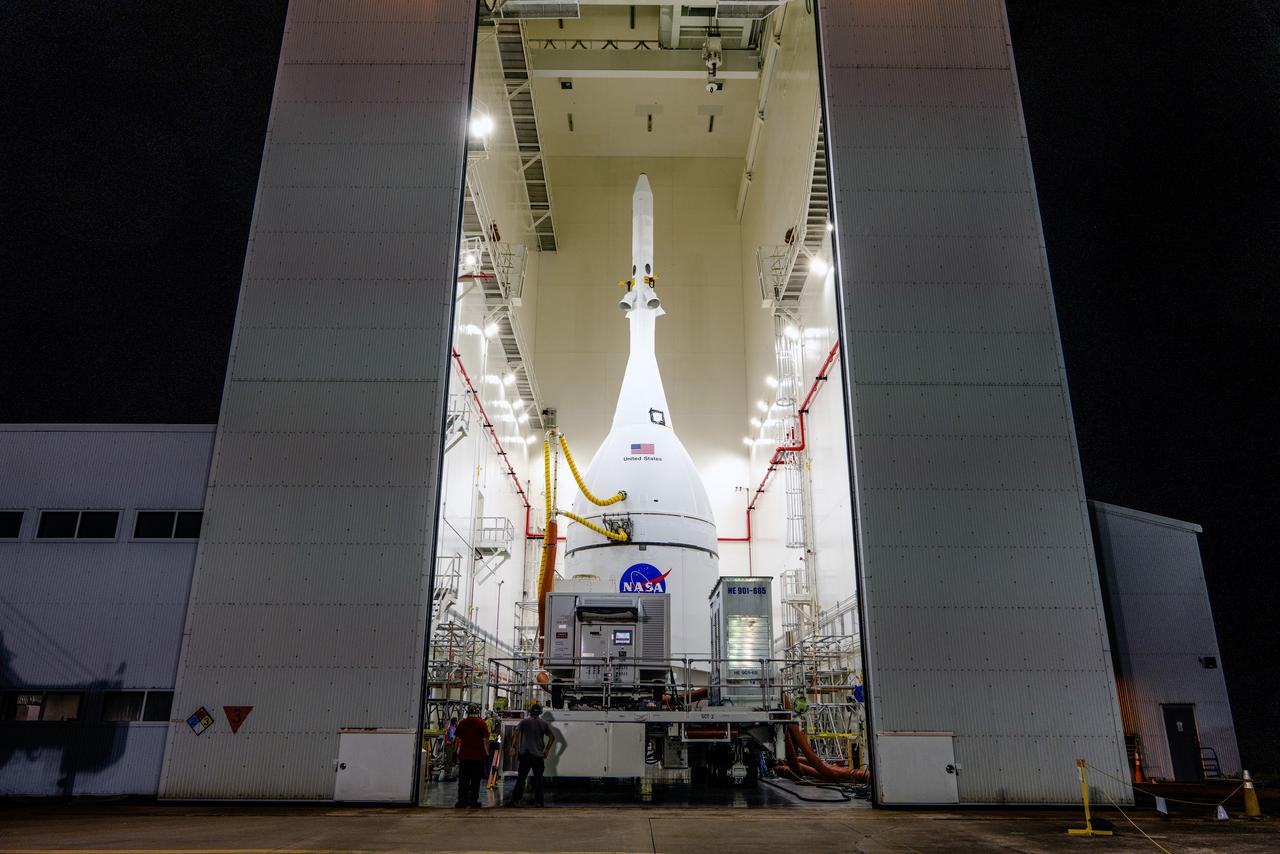
The team at Kennedy Space Center prepares the Artemis I Orion for transport from the Launch Abort System Facility to the Vehicle Assembly Building where it will be stacked atop the Launch Abort System.
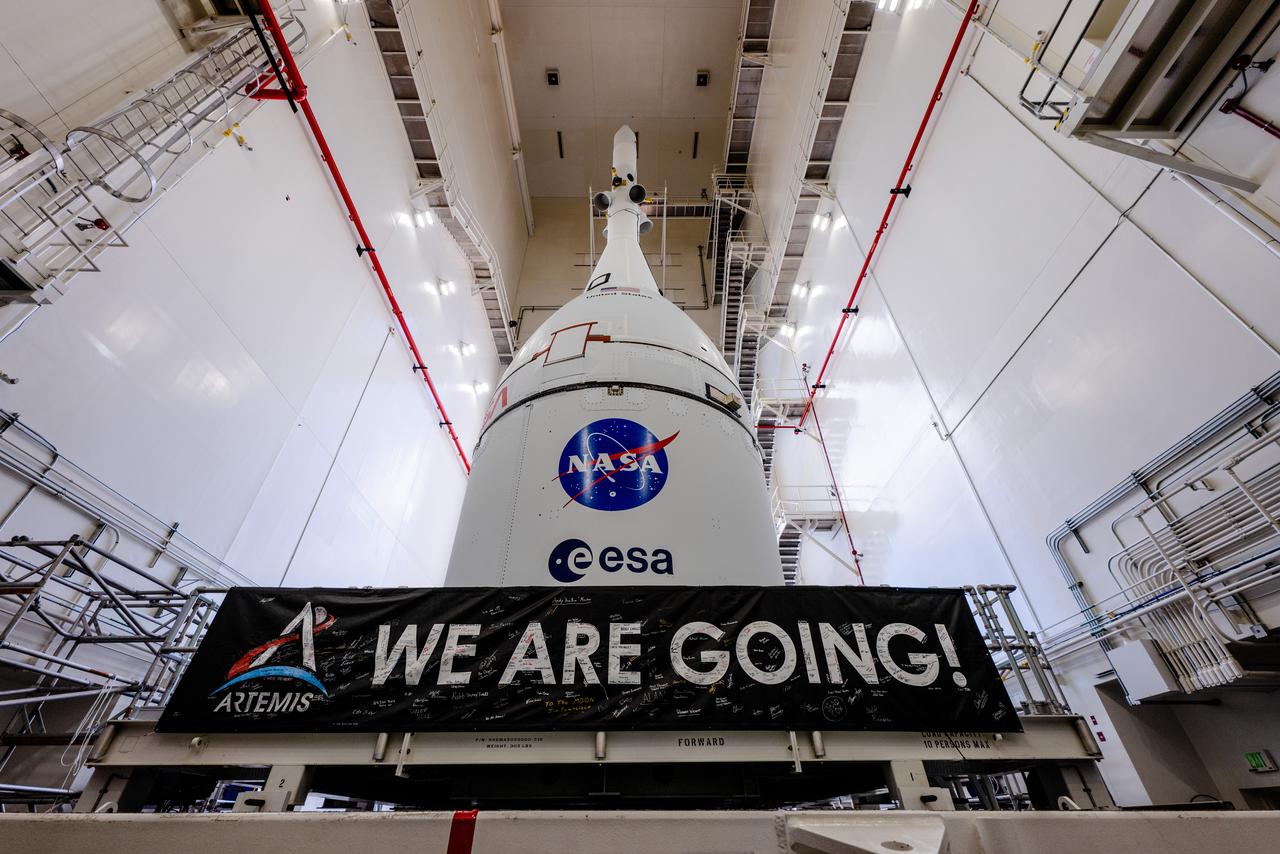
The team at Kennedy Space Center prepares the Artemis I Orion for transport from the Launch Abort System Facility to the Vehicle Assembly Building where it will be stacked atop the Launch Abort System.
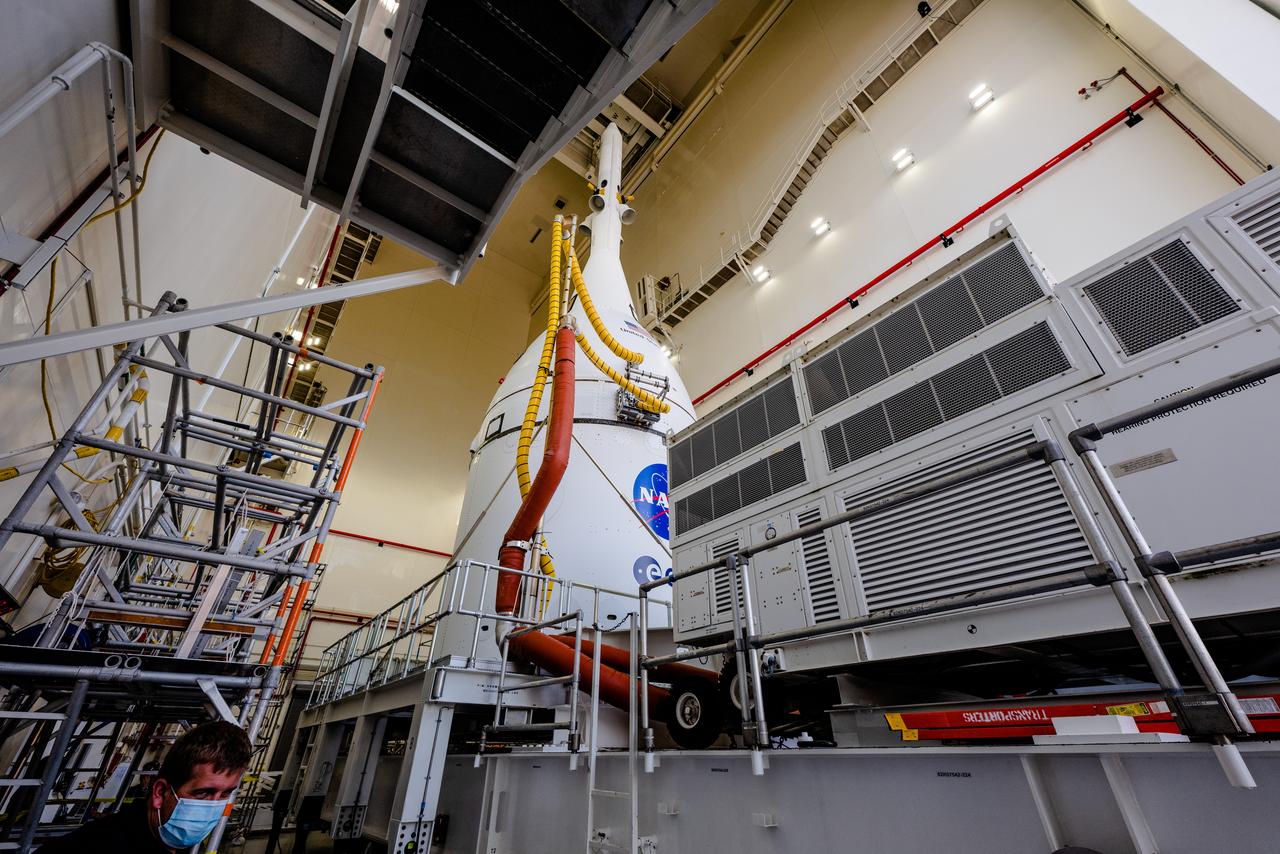
The team at Kennedy Space Center prepares the Artemis I Orion for transport from the Launch Abort System Facility to the Vehicle Assembly Building where it will be stacked atop the Launch Abort System.
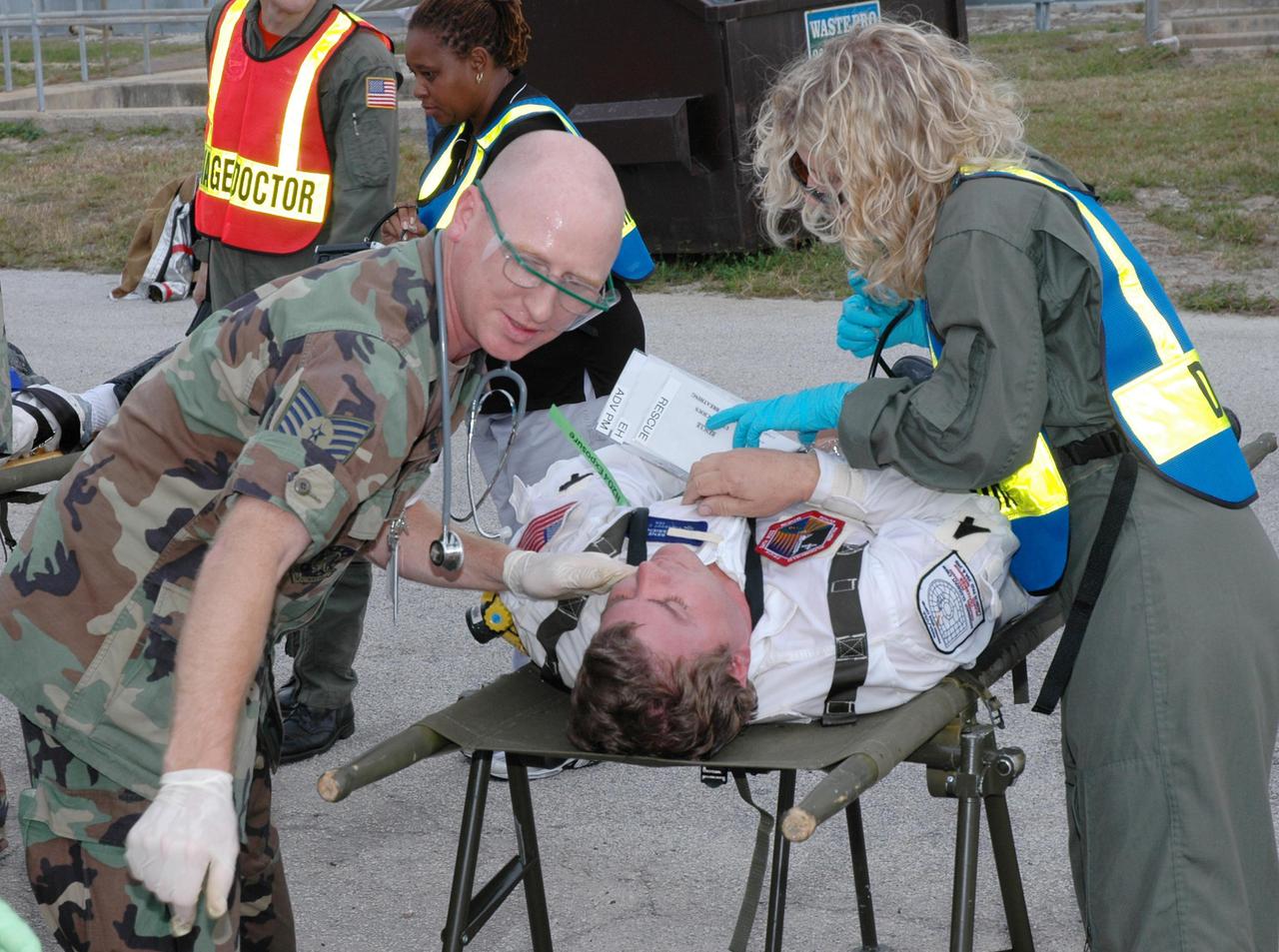
KENNEDY SPACE CENTER, FLA. - During a simulated launch countdown_emergency simulation on Launch Pad 39A, the rescue team performs triage on “injured” astronaut-suited workers. Pad team members participated in the four-hour exercise simulating normal launch countdown operations, with the added challenge of a fictitious event causing an evacuation of the vehicle and launch pad. The simulation tested the team’s rescue approaches on the Fixed Service Structure, slidewire basket evacuation, triage care and transportation of injured personnel to hospitals, as well as communications and coordination.

Medical and fire-rescue personnel participate in the Artemis II mission emergency escape or egress verification and validation tests near Launch Complex 39 at NASA's Kennedy Space Center in Florida on Monday, Aug. 12, 2024. During the multi-day tests, members of the closeout crew, pad rescue team, and the Exploration Ground Systems Program practiced the process of getting in and out of the emergency egress baskets then down to the launch pad where they would be transported to emergency transport vehicles and driven to safety. Prior to this test and throughout the course of several months, teams conducted basket release demonstrations to validate the system.
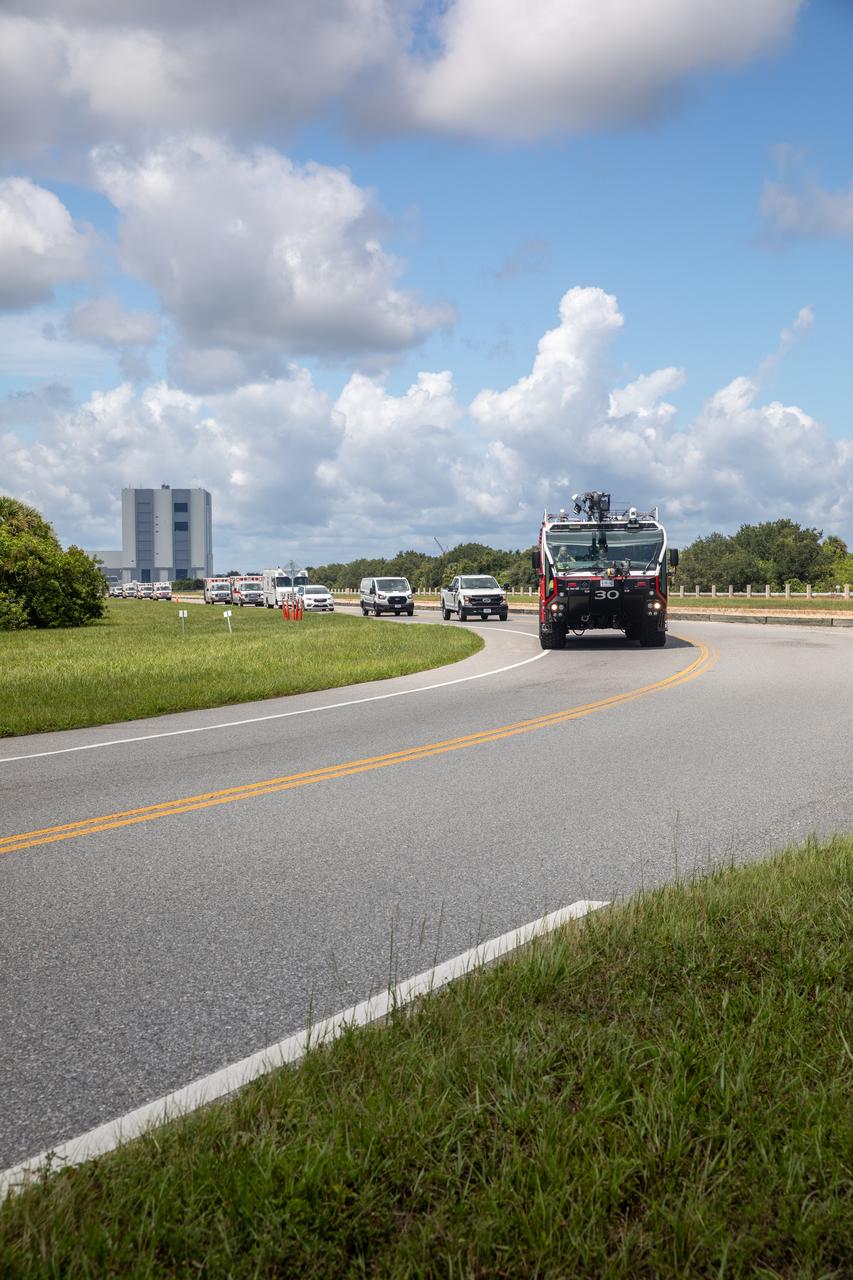
Medical and fire-rescue personnel participate in the Artemis II mission emergency escape or egress verification and validation tests near Launch Complex 39 at NASA's Kennedy Space Center in Florida on Monday, Aug. 12, 2024. During the multi-day tests, members of the closeout crew, pad rescue team, and the Exploration Ground Systems Program practiced the process of getting in and out of the emergency egress baskets then down to the launch pad where they would be transported to emergency transport vehicles and driven to safety. Prior to this test and throughout the course of several months, teams conducted basket release demonstrations to validate the system.
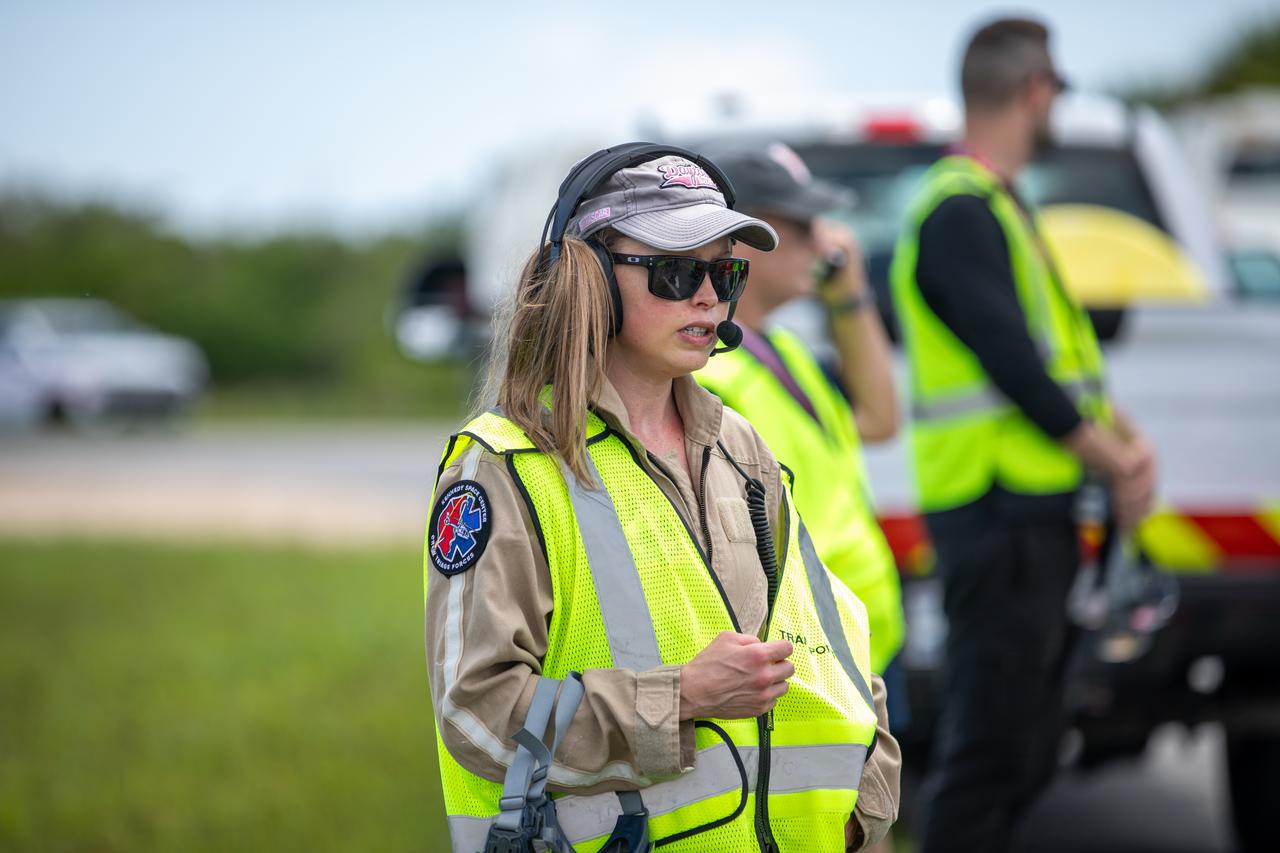
Medical and fire-rescue personnel participate in the Artemis II mission emergency escape or egress verification and validation tests near Launch Complex 39 at NASA's Kennedy Space Center in Florida on Monday, Aug. 12, 2024. During the multi-day tests, members of the closeout crew, pad rescue team, and the Exploration Ground Systems Program practiced the process of getting in and out of the emergency egress baskets then down to the launch pad where they would be transported to emergency transport vehicles and driven to safety. Prior to this test and throughout the course of several months, teams conducted basket release demonstrations to validate the system.
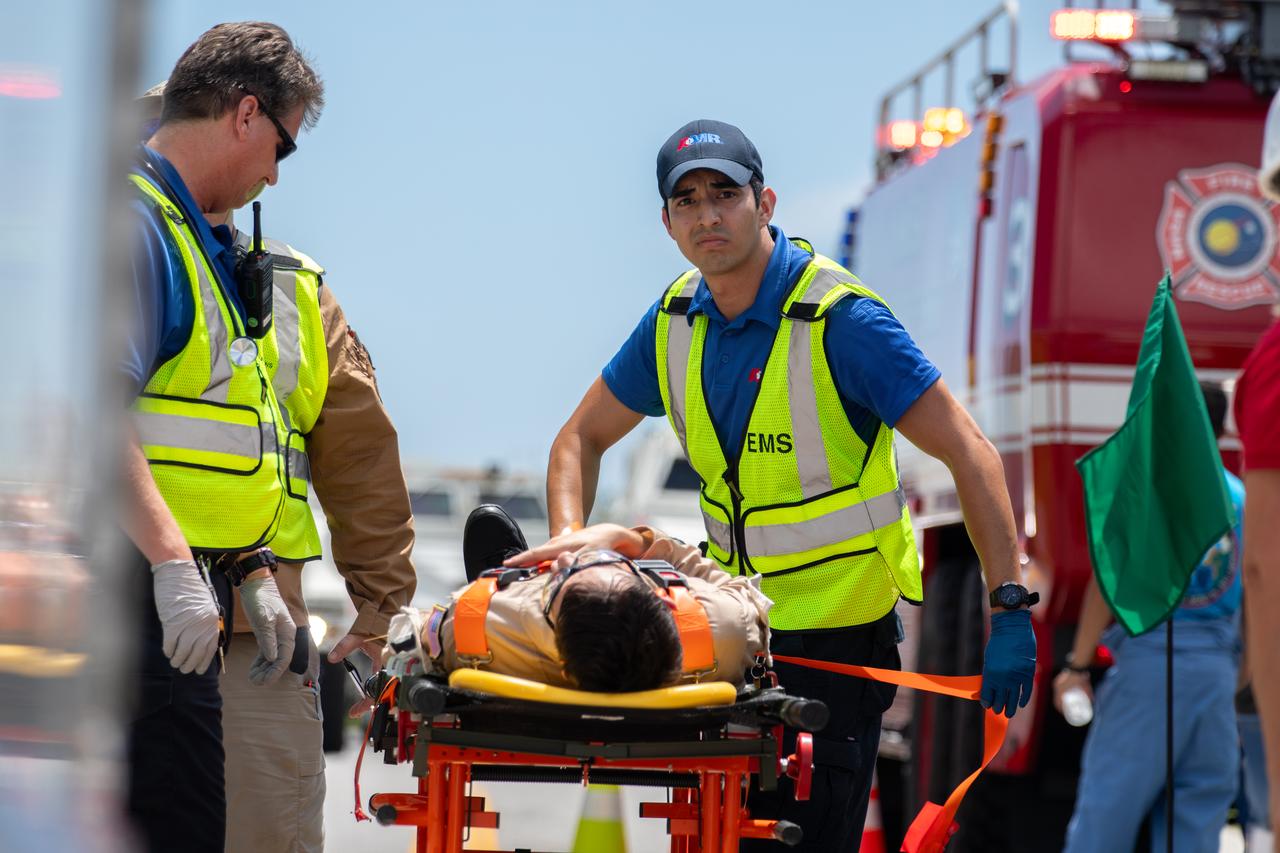
Medical and fire-rescue personnel participate in the Artemis II mission emergency escape or egress verification and validation tests near Launch Complex 39 at NASA's Kennedy Space Center in Florida on Monday, Aug. 12, 2024. During the multi-day tests, members of the closeout crew, pad rescue team, and the Exploration Ground Systems Program practiced the process of getting in and out of the emergency egress baskets then down to the launch pad where they would be transported to emergency transport vehicles and driven to safety. Prior to this test and throughout the course of several months, teams conducted basket release demonstrations to validate the system.
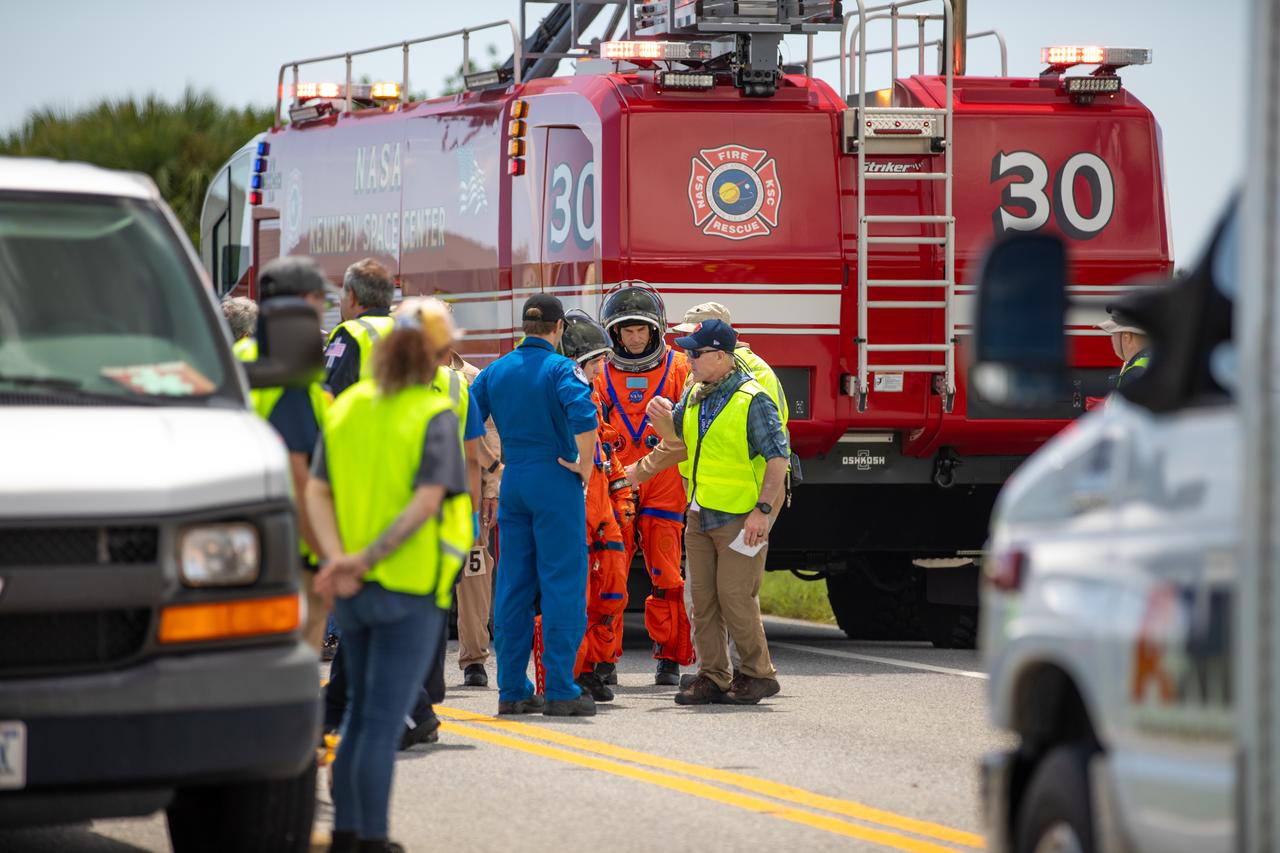
Medical, fire-rescue personnel, and simulated flight crew members participate in the Artemis II mission emergency escape or egress verification and validation tests near Launch Complex 39 at NASA's Kennedy Space Center in Florida on Monday, Aug. 12, 2024. During the multi-day tests, members of the closeout crew, pad rescue team, and the Exploration Ground Systems Program practiced the process of getting in and out of the emergency egress baskets then down to the launch pad where they would be transported to emergency transport vehicles and driven to safety. Prior to this test and throughout the course of several months, teams conducted basket release demonstrations to validate the system.
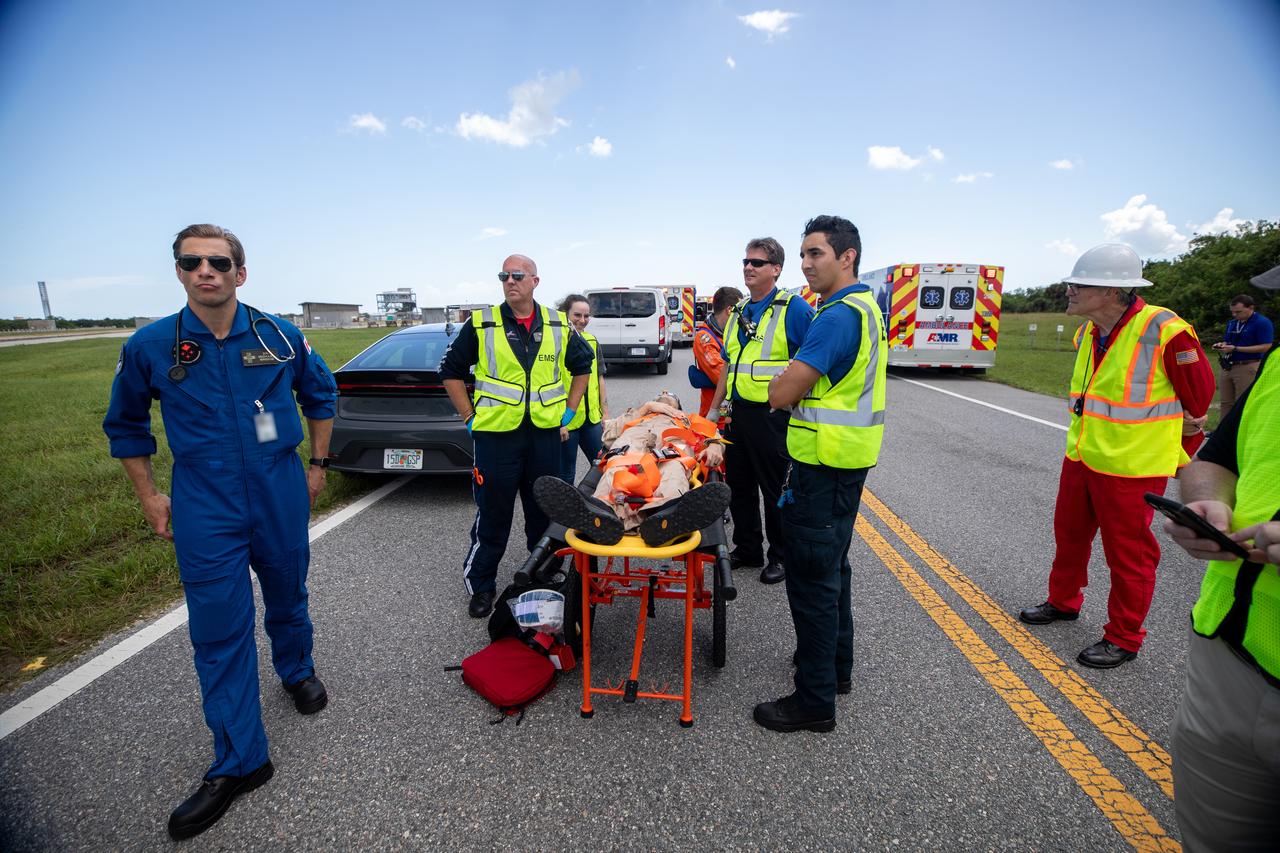
Medical, fire-rescue personnel, and simulated flight crew members participate in the Artemis II mission emergency escape or egress verification and validation tests near Launch Complex 39 at NASA's Kennedy Space Center in Florida on Monday, Aug. 12, 2024. During the multi-day tests, members of the closeout crew, pad rescue team, and the Exploration Ground Systems Program practiced the process of getting in and out of the emergency egress baskets then down to the launch pad where they would be transported to emergency transport vehicles and driven to safety. Prior to this test and throughout the course of several months, teams conducted basket release demonstrations to validate the system.
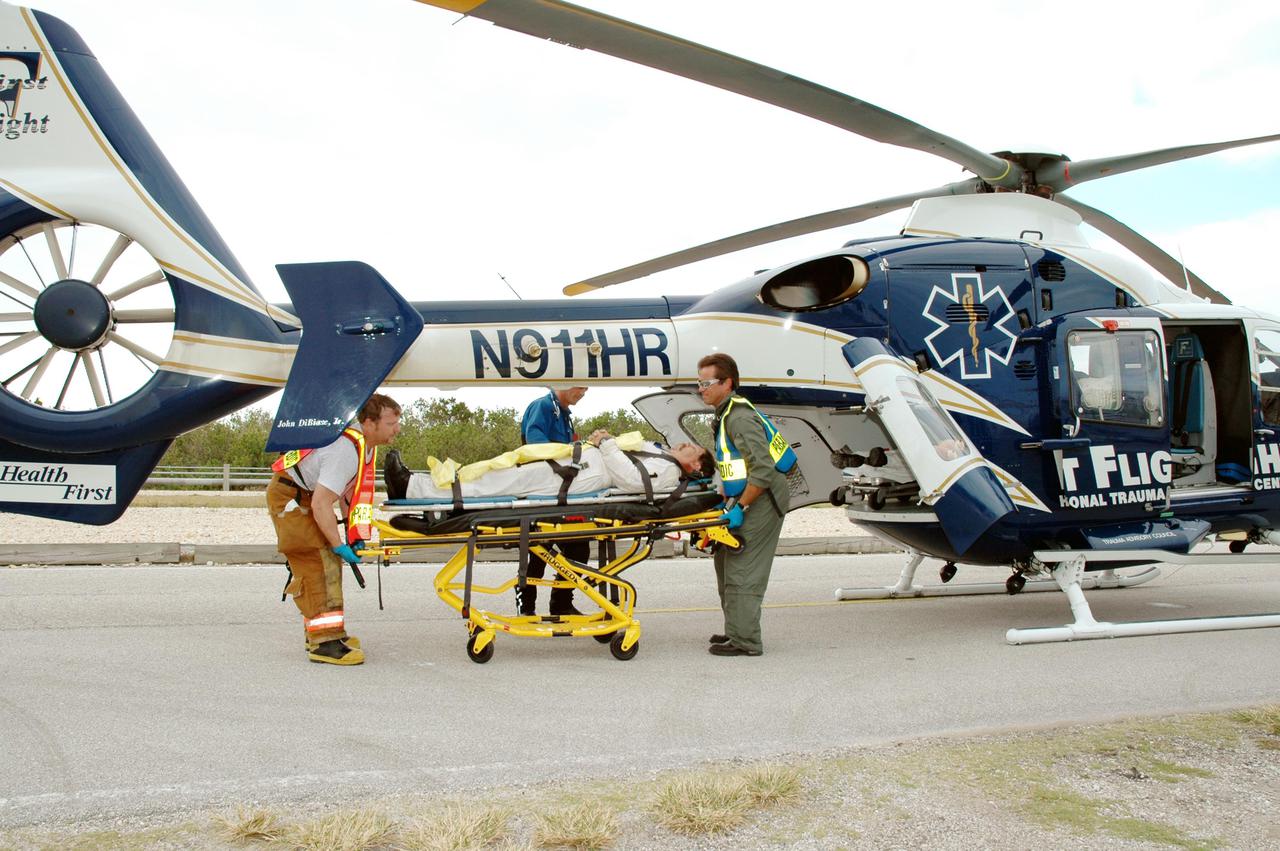
KENNEDY SPACE CENTER, FLA. - During a simulated launch countdown_emergency simulation on Launch Pad 39A, astronaut-suited workers are placed in a medical-rescue helicopter for transport to a hospital participating in the simulation. Pad team members took part in the four-hour exercise simulating normal launch countdown operations, with the added challenge of a fictitious event causing an evacuation of the vehicle and launch pad. The simulation tested the team’s rescue approaches on the Fixed Service Structure, slidewire basket evacuation, triage care and transportation of injured personnel to hospitals, as well as communications and coordination.
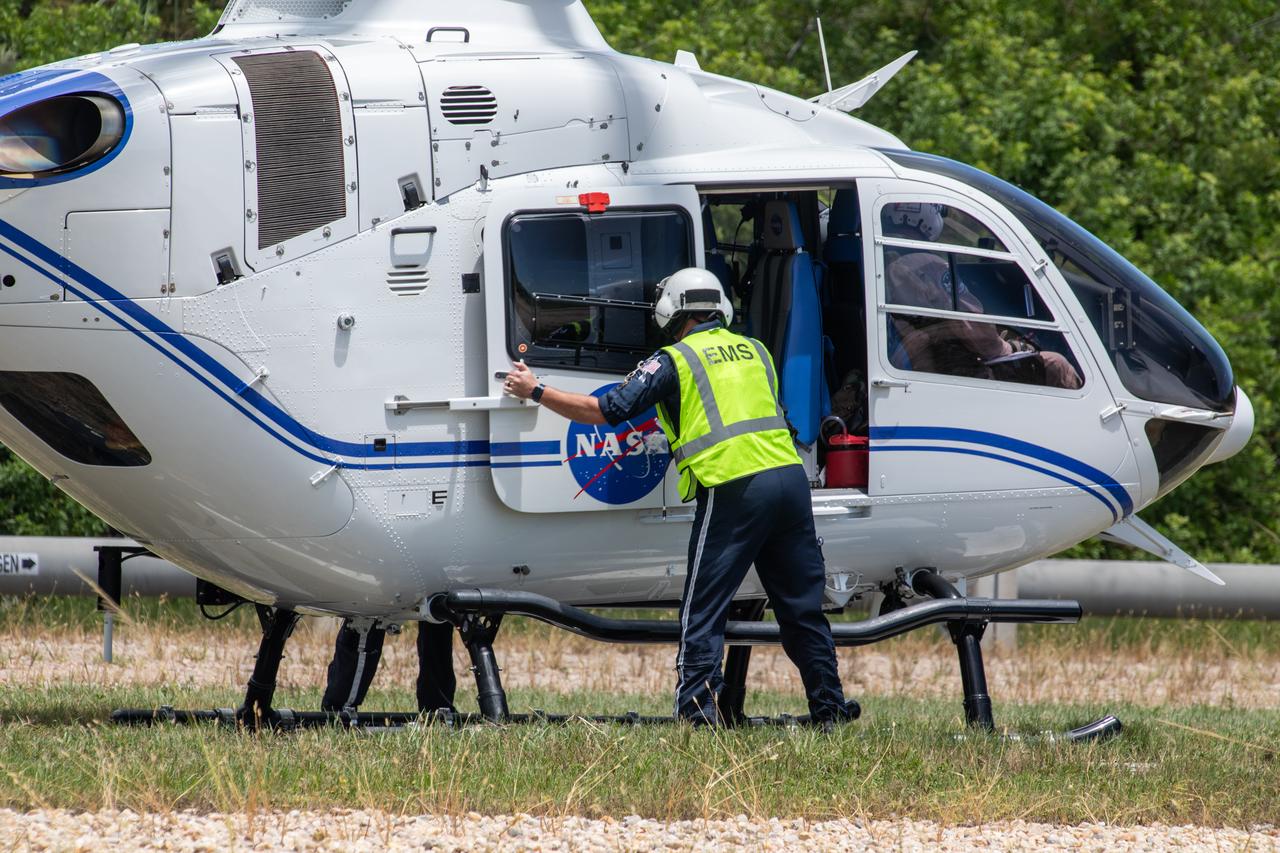
Medical and fire-rescue personnel participate in the Artemis II mission emergency escape or egress verification and validation tests near Launch Complex 39 at NASA's Kennedy Space Center in Florida on Monday, Aug. 12, 2024. During the multi-day tests, members of the closeout crew, pad rescue team, and the Exploration Ground Systems Program practiced the process of getting in and out of the emergency egress baskets then down to the launch pad where they would be transported to emergency transport vehicles and driven to safety. Prior to this test and throughout the course of several months, teams conducted basket release demonstrations to validate the system.
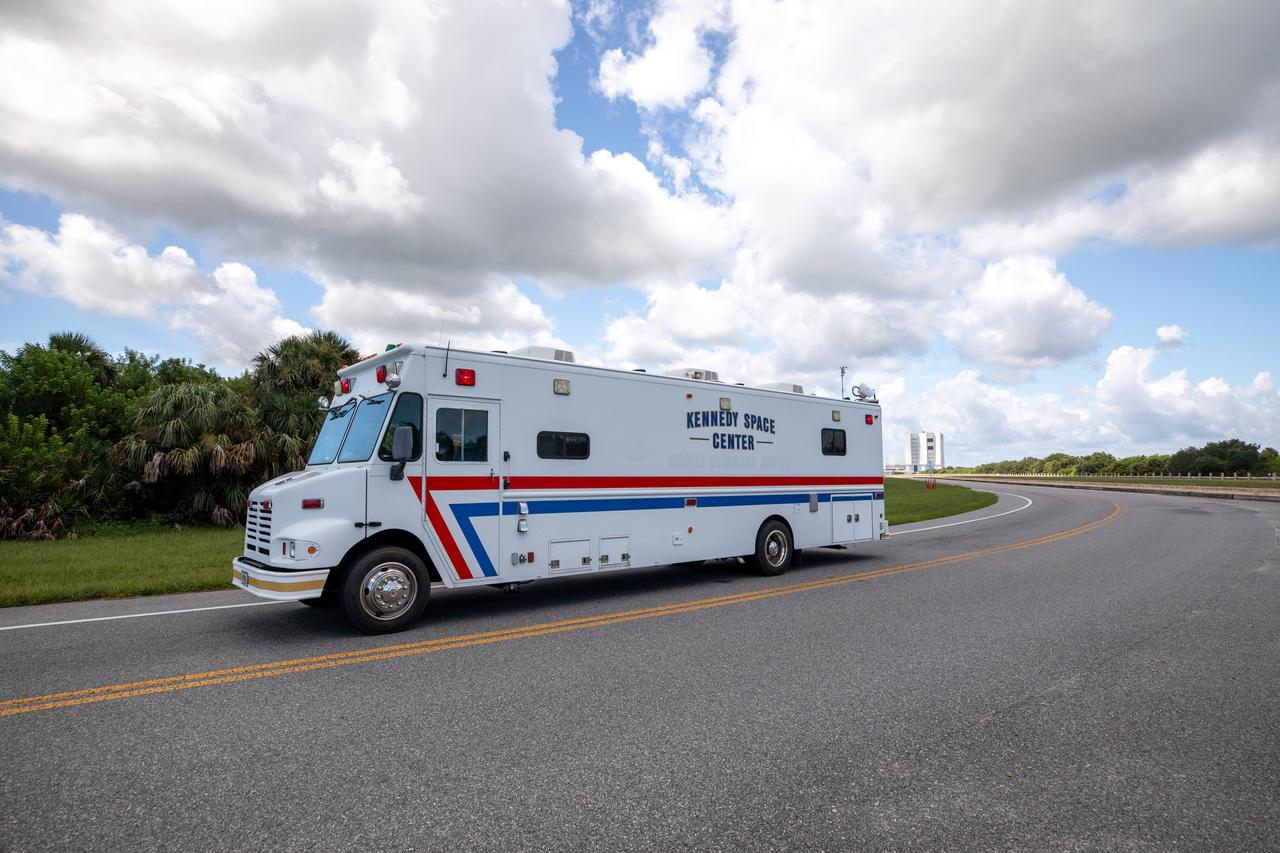
Medical and fire-rescue personnel participate in the Artemis II mission emergency escape or egress verification and validation tests near Launch Complex 39 at NASA's Kennedy Space Center in Florida on Monday, Aug. 12, 2024. During the multi-day tests, members of the closeout crew, pad rescue team, and the Exploration Ground Systems Program practiced the process of getting in and out of the emergency egress baskets then down to the launch pad where they would be transported to emergency transport vehicles and driven to safety. Prior to this test and throughout the course of several months, teams conducted basket release demonstrations to validate the system.
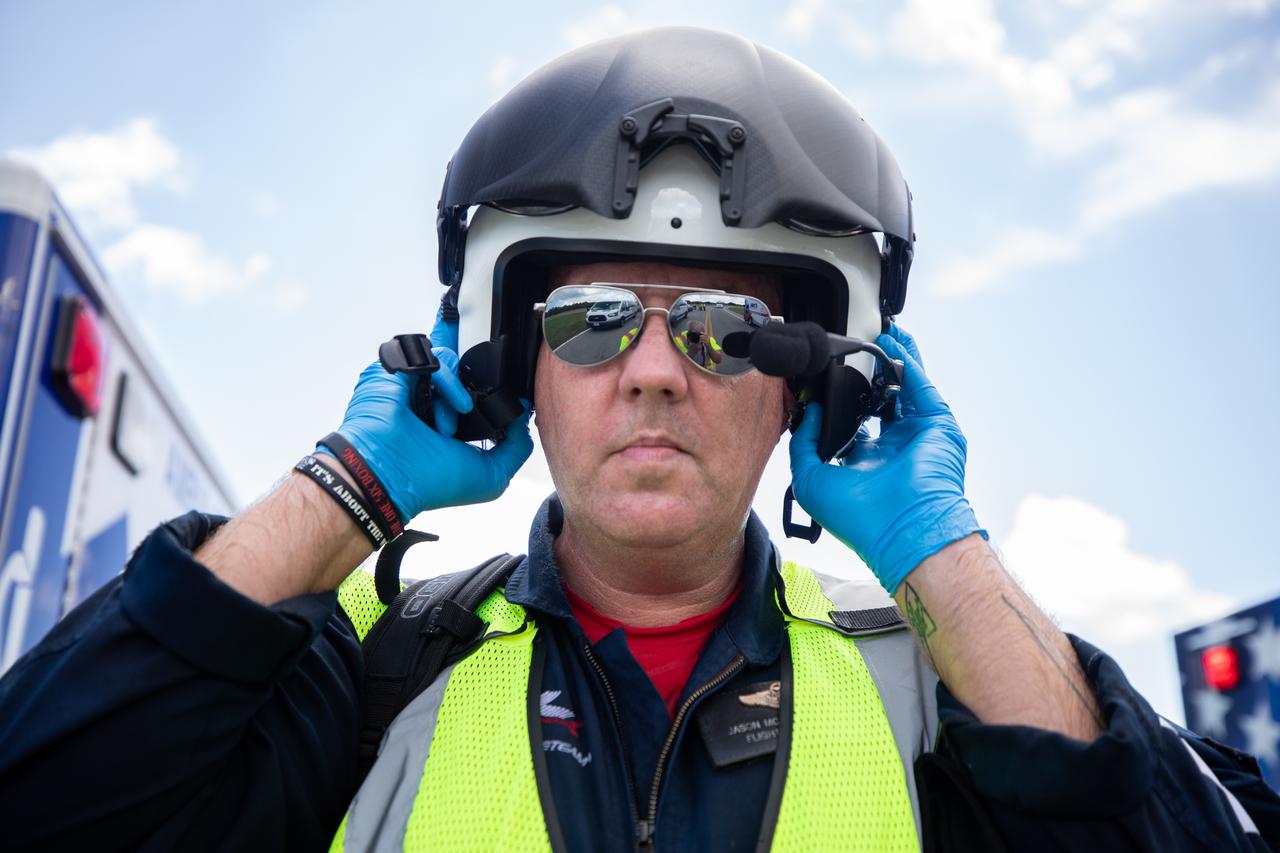
Medical and fire-rescue personnel participate in the Artemis II mission emergency escape or egress verification and validation tests near Launch Complex 39 at NASA's Kennedy Space Center in Florida on Monday, Aug. 12, 2024. During the multi-day tests, members of the closeout crew, pad rescue team, and the Exploration Ground Systems Program practiced the process of getting in and out of the emergency egress baskets then down to the launch pad where they would be transported to emergency transport vehicles and driven to safety. Prior to this test and throughout the course of several months, teams conducted basket release demonstrations to validate the system.
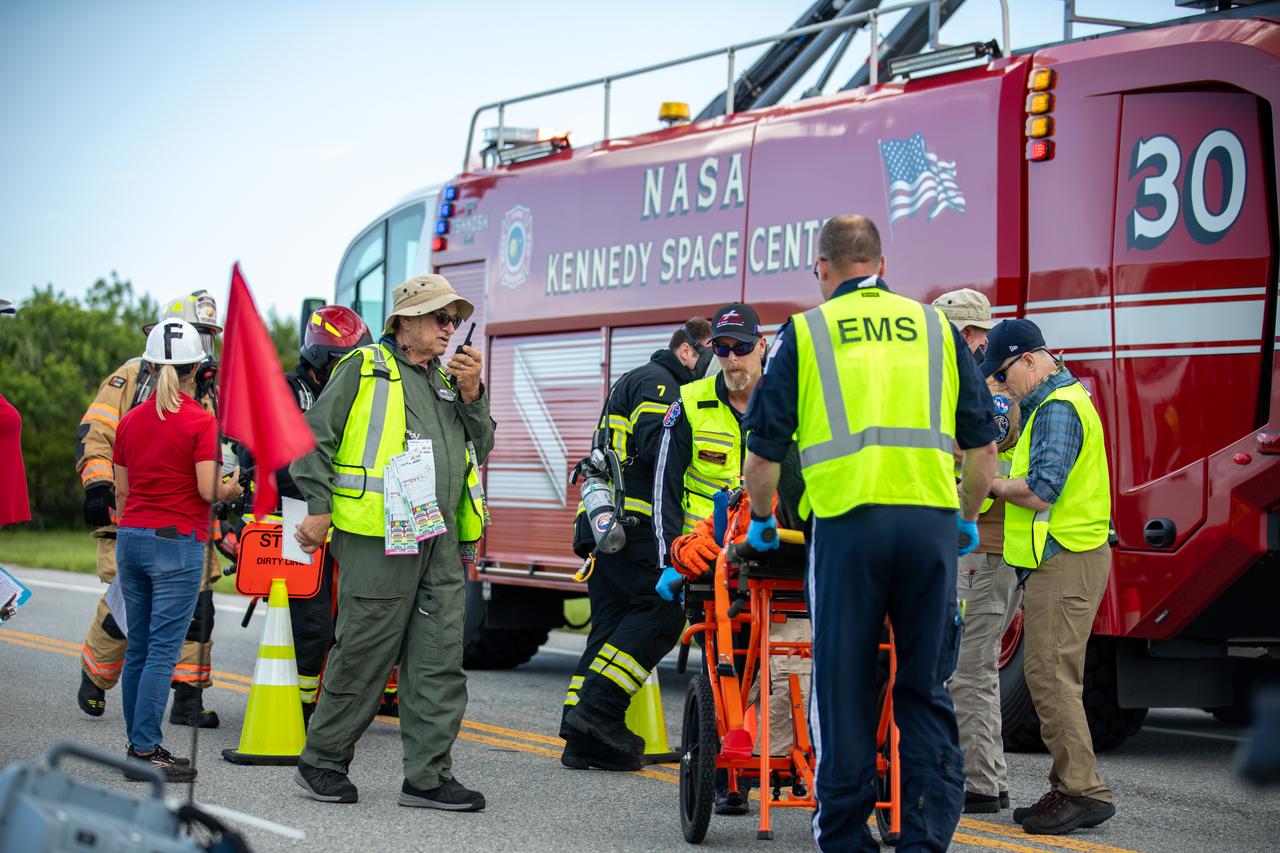
Medical and fire-rescue personnel participate in the Artemis II mission emergency escape or egress verification and validation tests near Launch Complex 39 at NASA's Kennedy Space Center in Florida on Monday, Aug. 12, 2024. During the multi-day tests, members of the closeout crew, pad rescue team, and the Exploration Ground Systems Program practiced the process of getting in and out of the emergency egress baskets then down to the launch pad where they would be transported to emergency transport vehicles and driven to safety. Prior to this test and throughout the course of several months, teams conducted basket release demonstrations to validate the system.
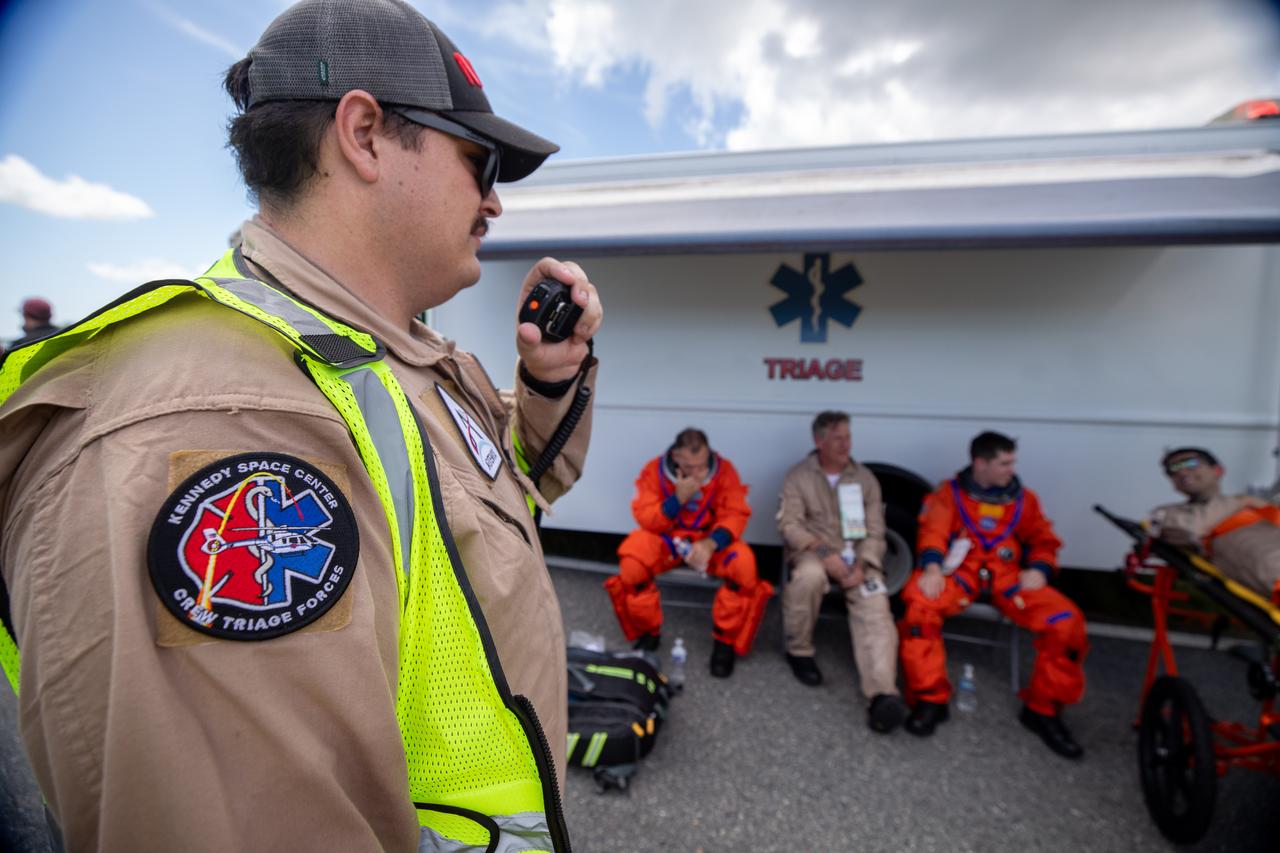
Medical and fire-rescue personnel participate in the Artemis II mission emergency escape or egress verification and validation tests near Launch Complex 39 at NASA's Kennedy Space Center in Florida on Monday, Aug. 12, 2024. During the multi-day tests, members of the closeout crew, pad rescue team, and the Exploration Ground Systems Program practiced the process of getting in and out of the emergency egress baskets then down to the launch pad where they would be transported to emergency transport vehicles and driven to safety. Prior to this test and throughout the course of several months, teams conducted basket release demonstrations to validate the system.
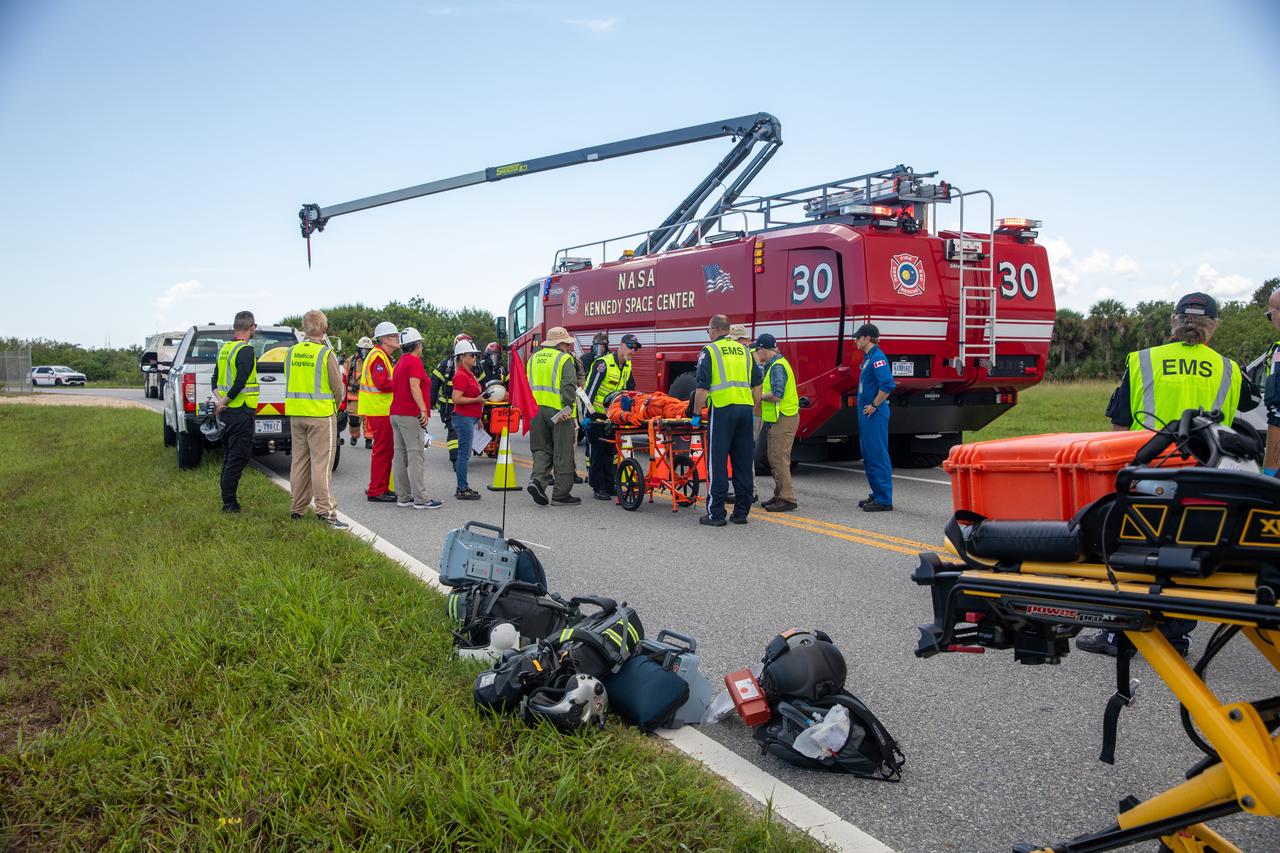
Medical, fire-rescue personnel, and simulated flight crew members participate in the Artemis II mission emergency escape or egress verification and validation tests near Launch Complex 39 at NASA's Kennedy Space Center in Florida on Monday, Aug. 12, 2024. During the multi-day tests, members of the closeout crew, pad rescue team, and the Exploration Ground Systems Program practiced the process of getting in and out of the emergency egress baskets then down to the launch pad where they would be transported to emergency transport vehicles and driven to safety. Prior to this test and throughout the course of several months, teams conducted basket release demonstrations to validate the system.
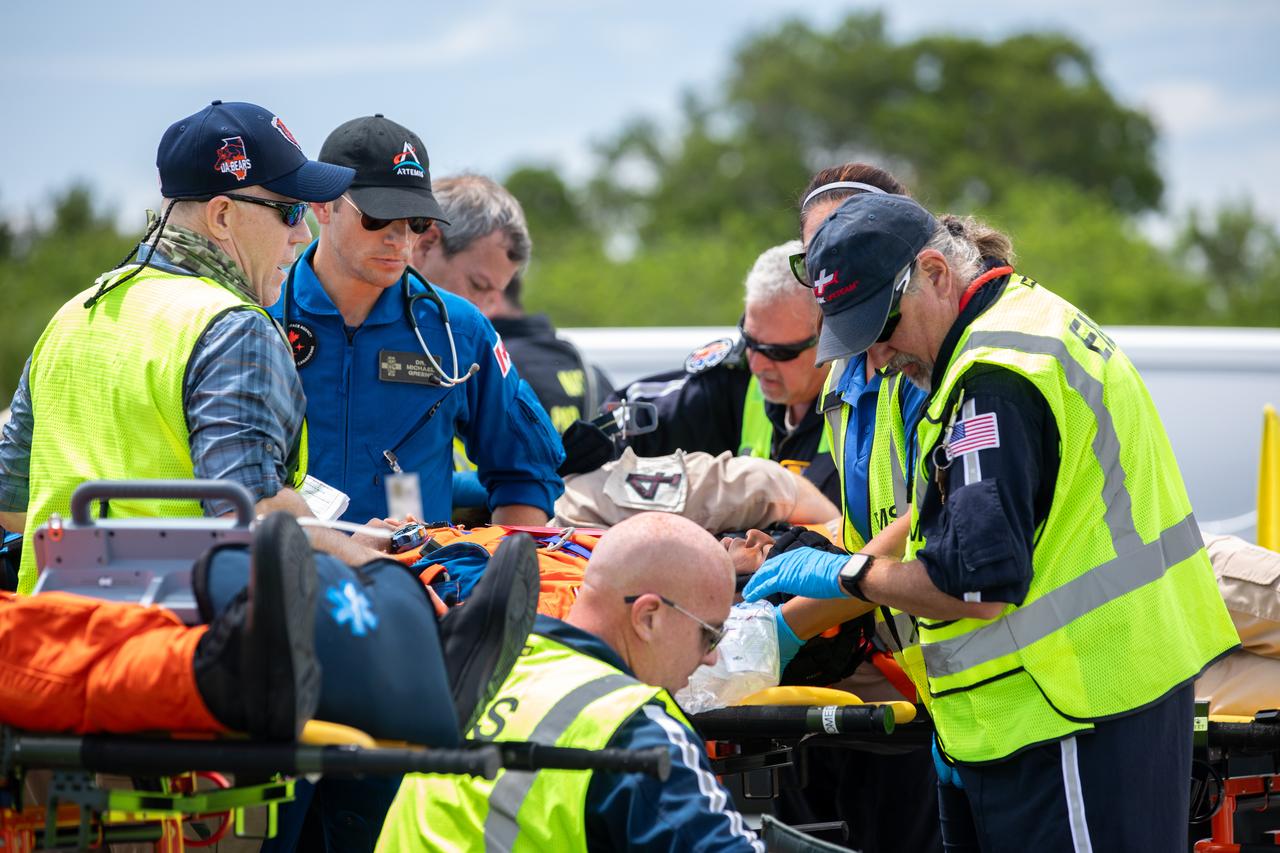
Medical, fire-rescue personnel, and simulated flight crew members participate in the Artemis II mission emergency escape or egress verification and validation tests near Launch Complex 39 at NASA's Kennedy Space Center in Florida on Monday, Aug. 12, 2024. During the multi-day tests, members of the closeout crew, pad rescue team, and the Exploration Ground Systems Program practiced the process of getting in and out of the emergency egress baskets then down to the launch pad where they would be transported to emergency transport vehicles and driven to safety. Prior to this test and throughout the course of several months, teams conducted basket release demonstrations to validate the system.
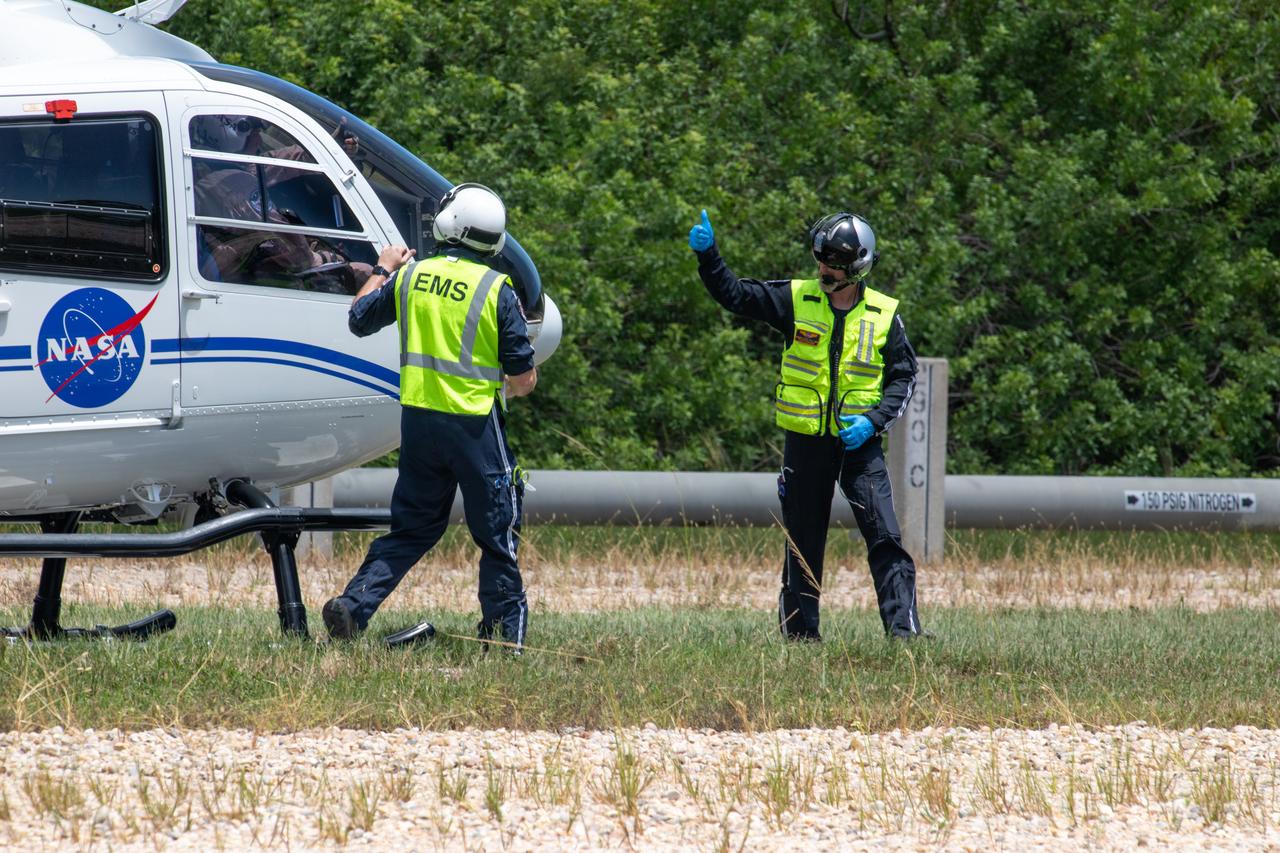
Medical and fire-rescue personnel participate in the Artemis II mission emergency escape or egress verification and validation tests near Launch Complex 39 at NASA's Kennedy Space Center in Florida on Monday, Aug. 12, 2024. During the multi-day tests, members of the closeout crew, pad rescue team, and the Exploration Ground Systems Program practiced the process of getting in and out of the emergency egress baskets then down to the launch pad where they would be transported to emergency transport vehicles and driven to safety. Prior to this test and throughout the course of several months, teams conducted basket release demonstrations to validate the system.
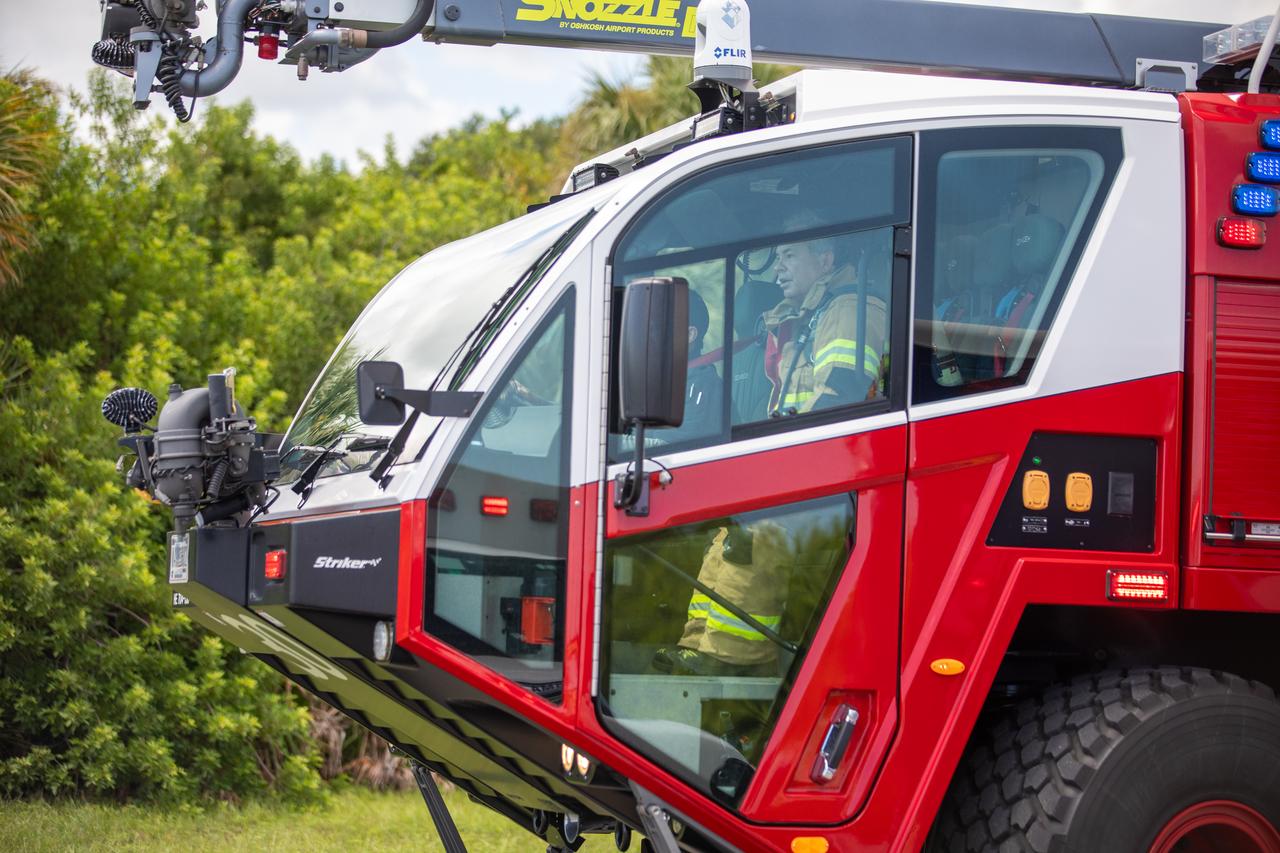
Medical and fire-rescue personnel participate in the Artemis II mission emergency escape or egress verification and validation tests near Launch Complex 39 at NASA's Kennedy Space Center in Florida on Monday, Aug. 12, 2024. During the multi-day tests, members of the closeout crew, pad rescue team, and the Exploration Ground Systems Program practiced the process of getting in and out of the emergency egress baskets then down to the launch pad where they would be transported to emergency transport vehicles and driven to safety. Prior to this test and throughout the course of several months, teams conducted basket release demonstrations to validate the system.

Medical, fire-rescue personnel, and simulated flight crew members participate in the Artemis II mission emergency escape or egress verification and validation tests near Launch Complex 39 at NASA's Kennedy Space Center in Florida on Monday, Aug. 12, 2024. During the multi-day tests, members of the closeout crew, pad rescue team, and the Exploration Ground Systems Program practiced the process of getting in and out of the emergency egress baskets then down to the launch pad where they would be transported to emergency transport vehicles and driven to safety. Prior to this test and throughout the course of several months, teams conducted basket release demonstrations to validate the system.
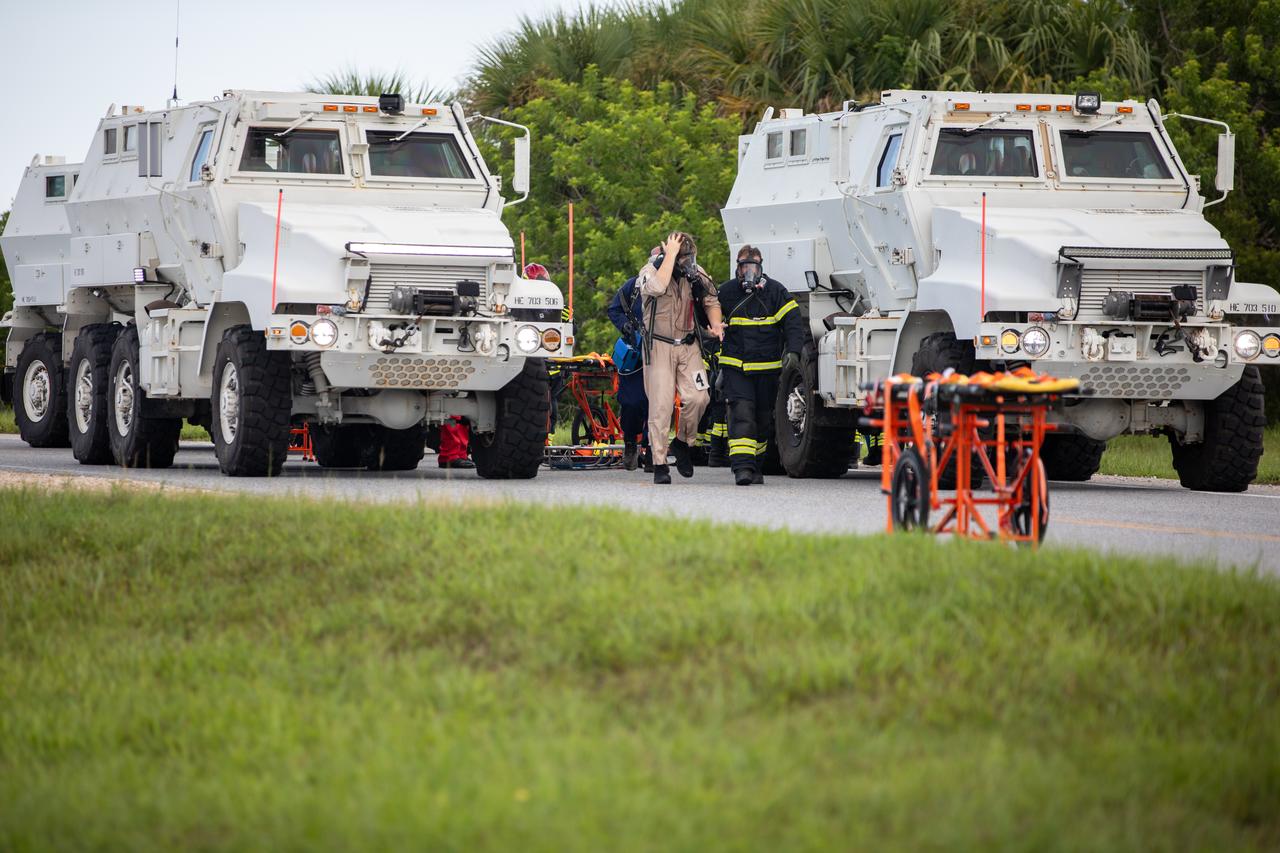
Medical and fire-rescue personnel participate in the Artemis II mission emergency escape or egress verification and validation tests near Launch Complex 39 at NASA's Kennedy Space Center in Florida on Monday, Aug. 12, 2024. During the multi-day tests, members of the closeout crew, pad rescue team, and the Exploration Ground Systems Program practiced the process of getting in and out of the emergency egress baskets then down to the launch pad where they would be transported to emergency transport vehicles and driven to safety. Prior to this test and throughout the course of several months, teams conducted basket release demonstrations to validate the system.

KENNEDY SPACE CENTER, FLA. - A helicopter rescue team prepares another “injured” astronaut for transportation to a local hospital. They are all taking part in a “Mode VII” emergency landing simulation at Kennedy Space Center. The purpose of the Mode VII is to exercise emergency preparedness personnel, equipment and facilities in rescuing astronauts from a downed orbiter and providing immediate medical attention. This simulation presents an orbiter that has crashed short of the Shuttle Landing Facility in a wooded area 2-1/2 miles south of Runway 33. Emergency crews are responding to the volunteer “astronauts” who are simulating various injuries inside the crew compartment mock-up. Rescuers must remove the crew, provide triage and transport to hospitals those who need further treatment. Local hospitals are participating in the exercise.
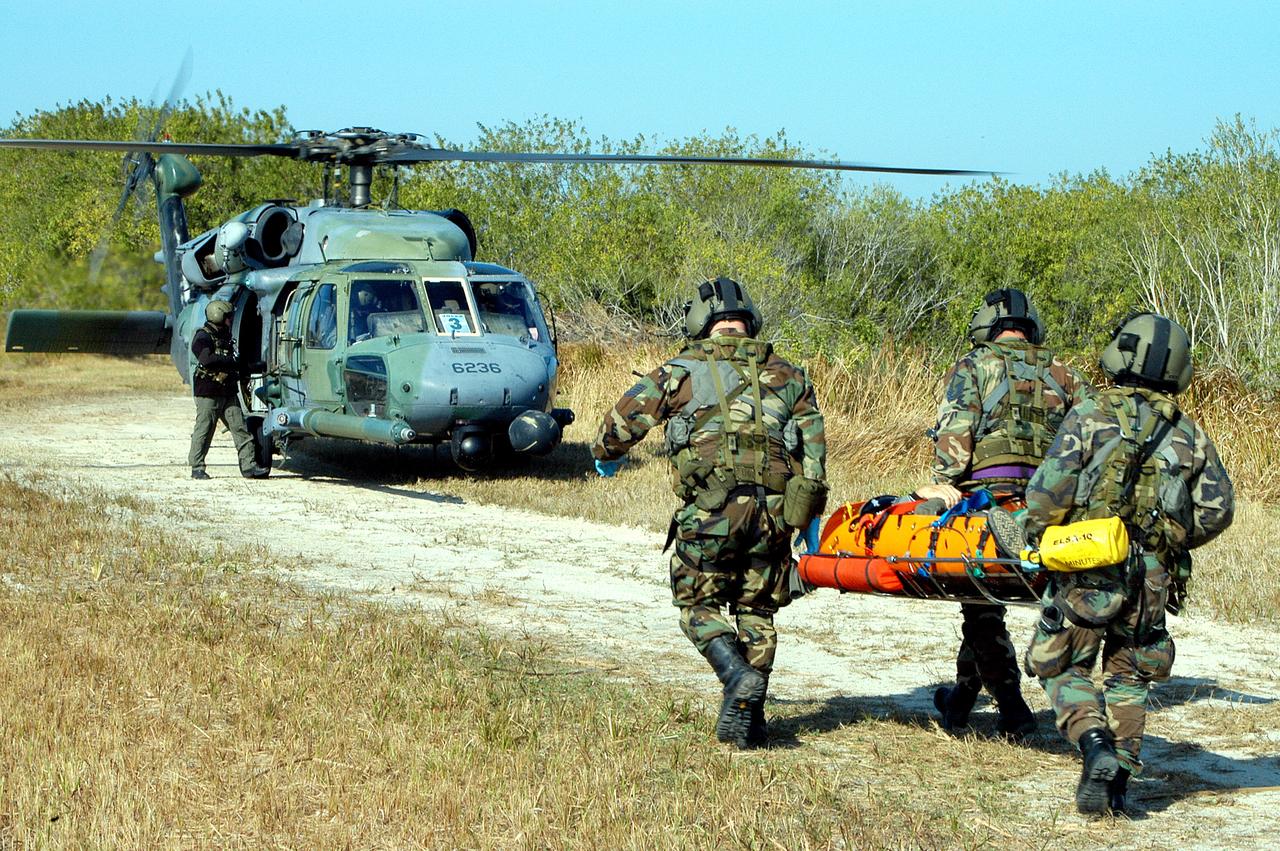
KENNEDY SPACE CENTER, FLA. - A helicopter rescue team carries another “injured” astronaut to a helicopter for transportation to a local hospital. They are all taking part in a “Mode VII” emergency landing simulation at Kennedy Space Center. The purpose of the Mode VII is to exercise emergency preparedness personnel, equipment and facilities in rescuing astronauts from a downed orbiter and providing immediate medical attention. This simulation presents an orbiter that has crashed short of the Shuttle Landing Facility in a wooded area 2-1/2 miles south of Runway 33. Emergency crews are responding to the volunteer “astronauts” who are simulating various injuries inside the crew compartment mock-up. Rescuers must remove the crew, provide triage and transport to hospitals those who need further treatment. Local hospitals are participating in the exercise.
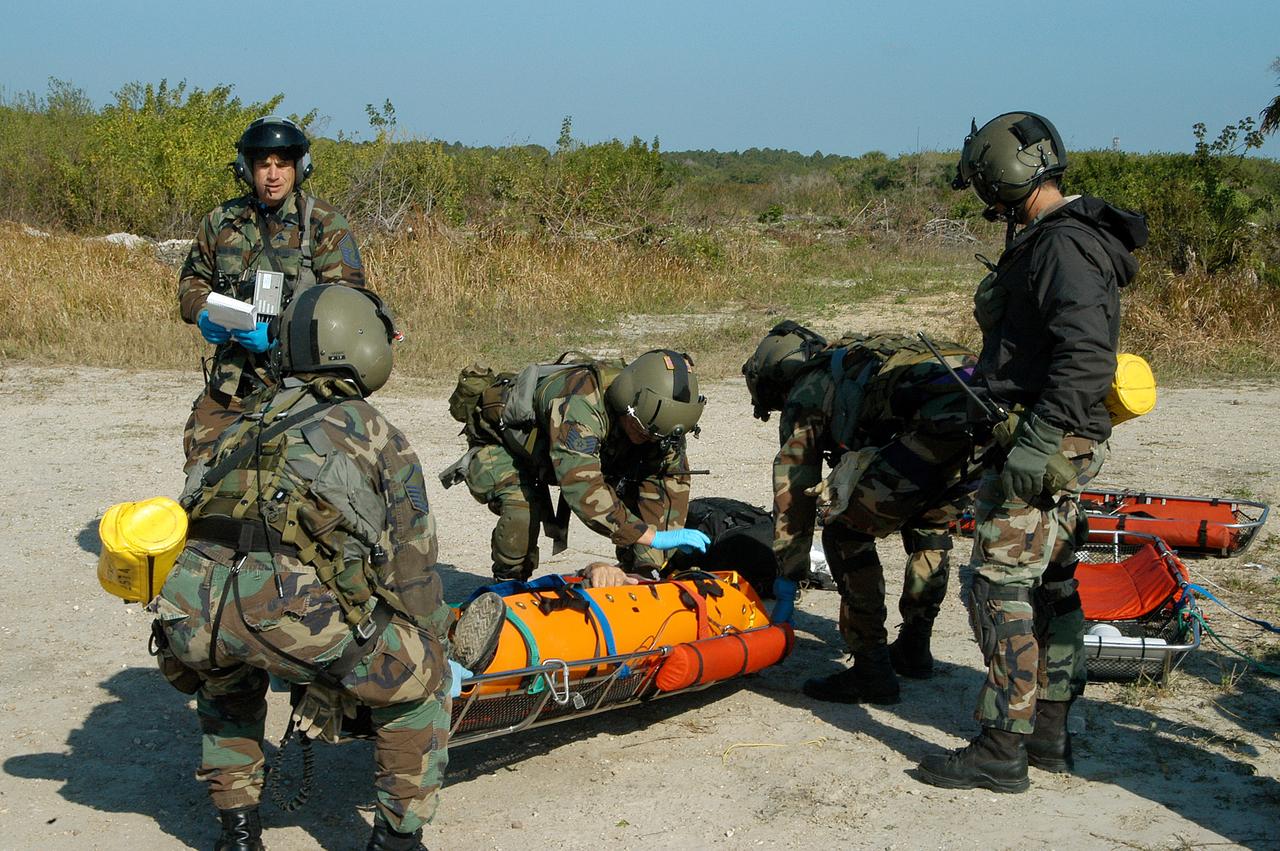
KENNEDY SPACE CENTER, FLA. - A helicopter rescue team prepares another “injured” astronaut for transportation to a local hospital. They are all taking part in a “Mode VII” emergency landing simulation at Kennedy Space Center. The purpose of the Mode VII is to exercise emergency preparedness personnel, equipment and facilities in rescuing astronauts from a downed orbiter and providing immediate medical attention. This simulation presents an orbiter that has crashed short of the Shuttle Landing Facility in a wooded area 2-1/2 miles south of Runway 33. Emergency crews are responding to the volunteer “astronauts” who are simulating various injuries inside the crew compartment mock-up. Rescuers must remove the crew, provide triage and transport to hospitals those who need further treatment. Local hospitals are participating in the exercise.
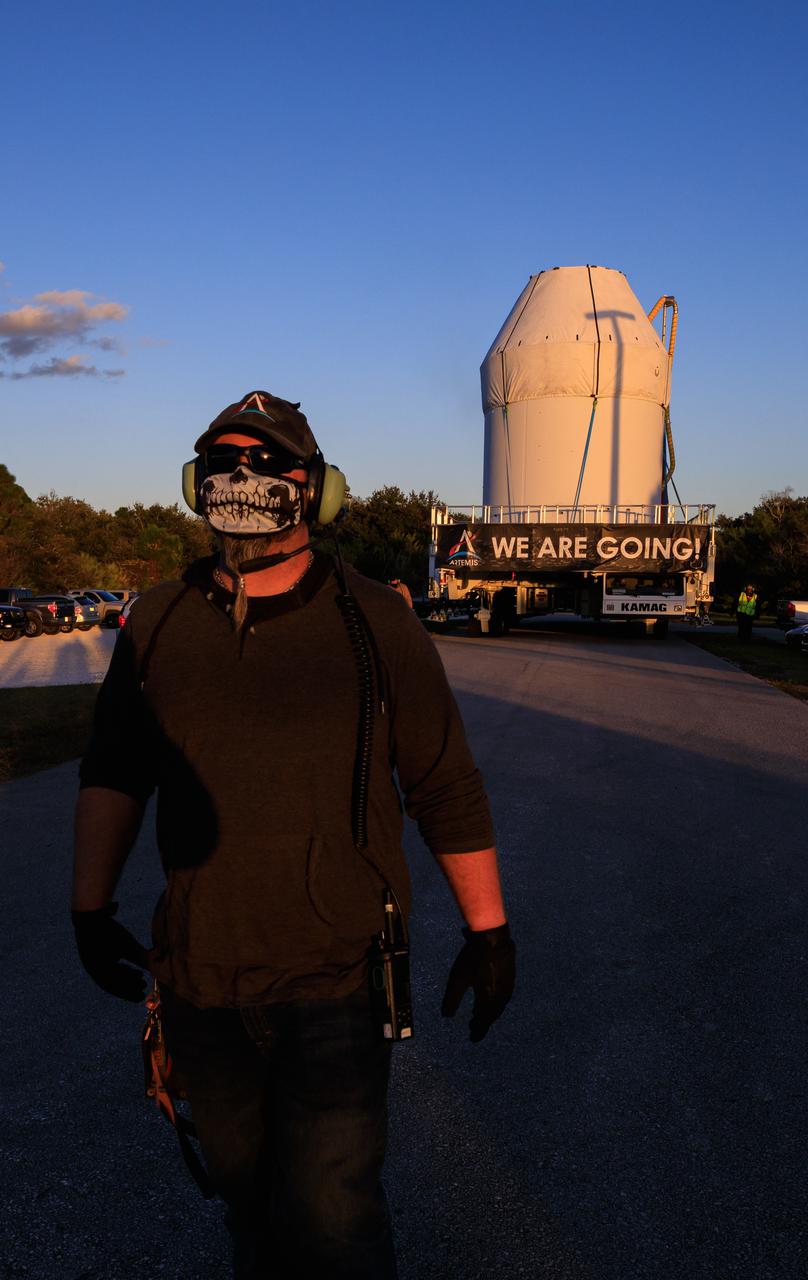
Secured atop a transport vehicle, Orion moves along the route to the Multi-Payload Processing Facility (MPPF) on Jan. 16, 2021, after departing from the Neil Armstrong Operations and Checkout Building at NASA’s Kennedy Space Center in Florida. Jason Parrish, a mechanical technician, Crawler Transporter Systems, with Jacobs, is one of the workers assisting with the move. Inside the MPPF, Orion will undergo processing with the Exploration Ground Systems team taking over ground processing ahead of the Artemis I launch.
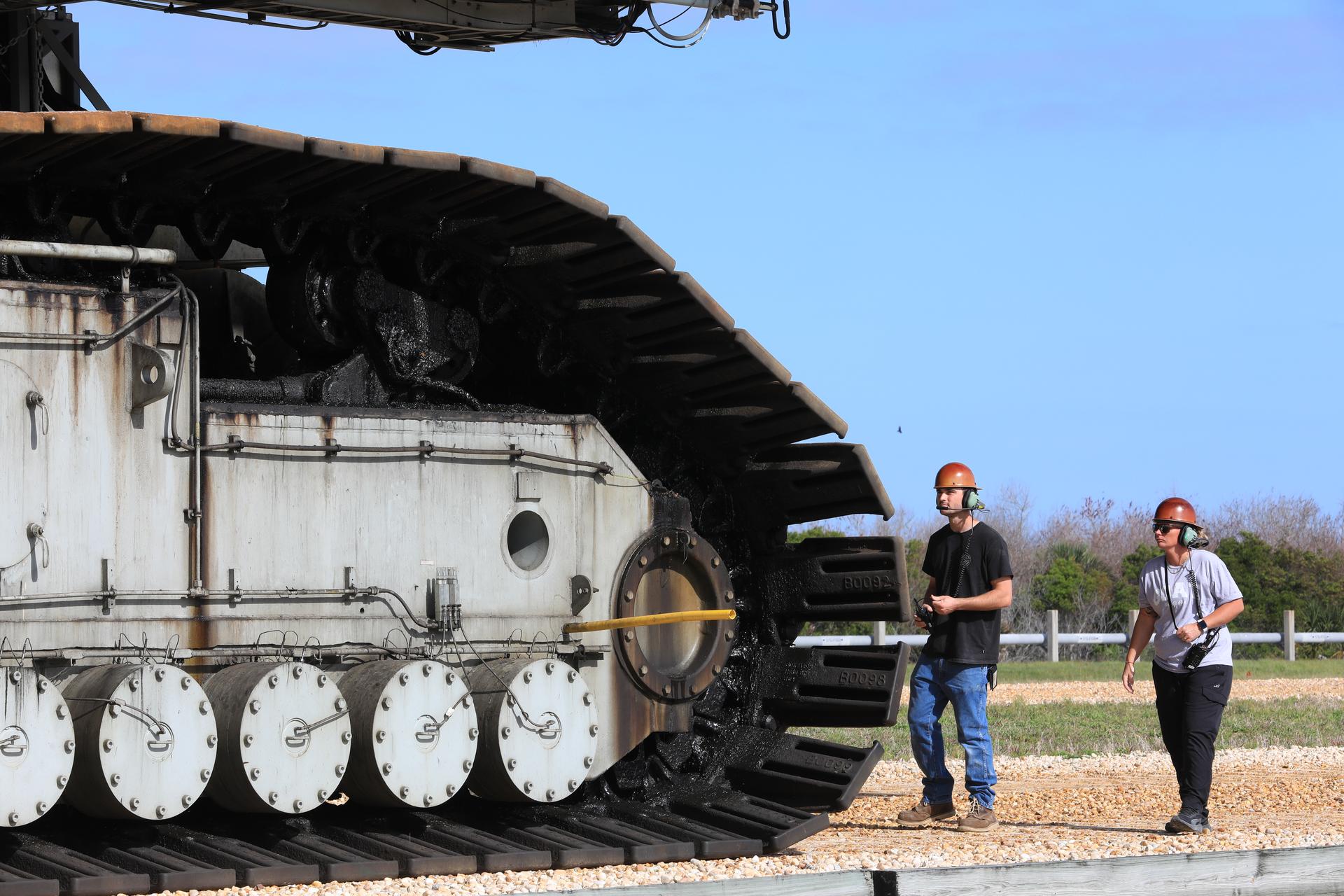
Technicians with NASA’s Exploration Gound Systems Program monitor crawler-transporter 2 as it transports the agency’s mobile launcher 1 slowly from Launch Complex 39B to the Vehicle Assembly Building at NASA’s Kennedy Space Center in Florida on Thursday, April 16, 2026, in preparation for Artemis III stacking operations. Teams will perform checkouts, inspections, and data analysis, and make repairs to the tower that saw damage during liftoff of the Artemis II test flight.
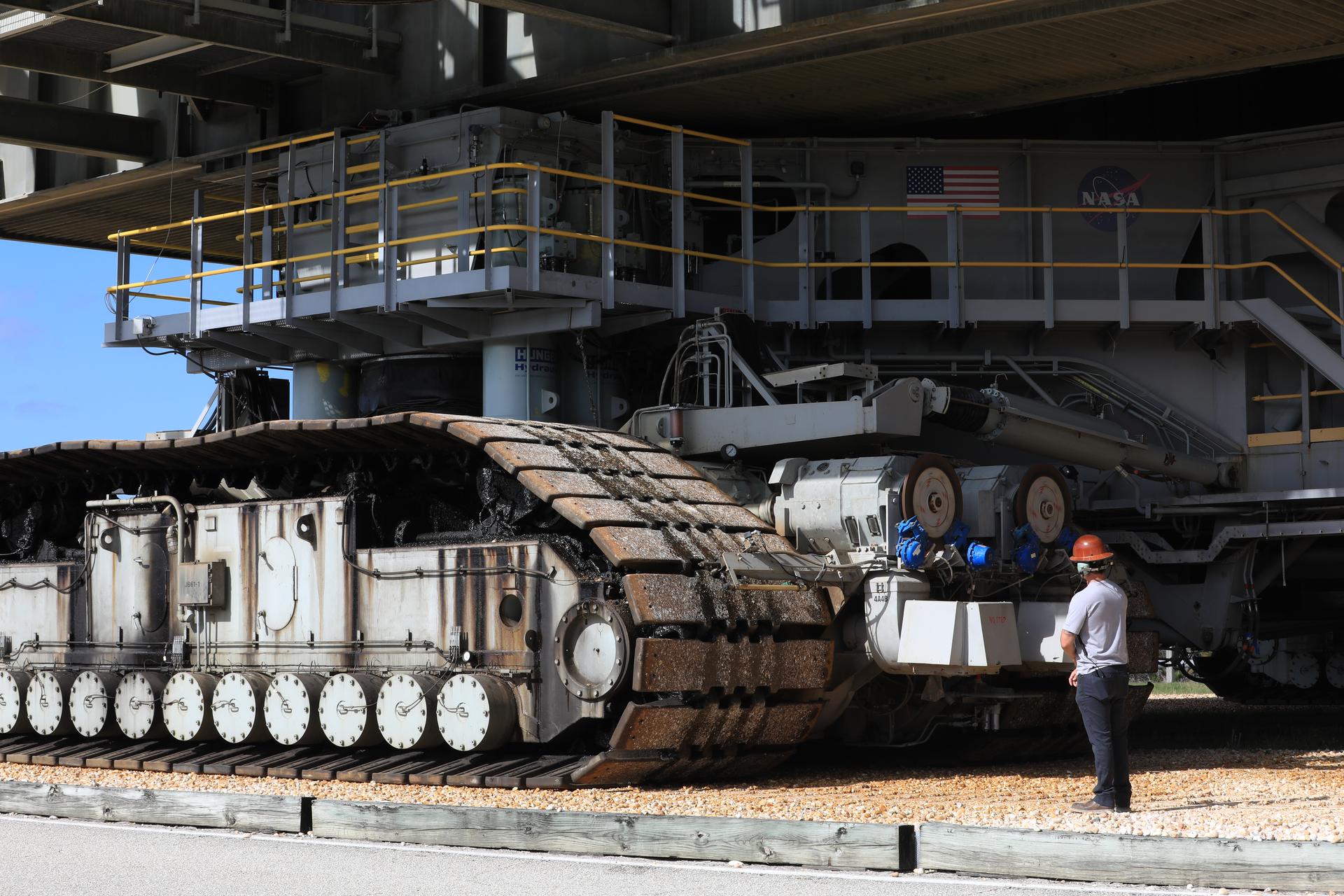
Technicians with NASA’s Exploration Gound Systems Program monitor crawler-transporter 2 as it transports the agency’s mobile launcher 1 slowly from Launch Complex 39B to the Vehicle Assembly Building at NASA’s Kennedy Space Center in Florida on Thursday, April 16, 2026, in preparation for Artemis III stacking operations. Teams will perform checkouts, inspections, and data analysis, and make repairs to the tower that saw damage during liftoff of the Artemis II test flight.
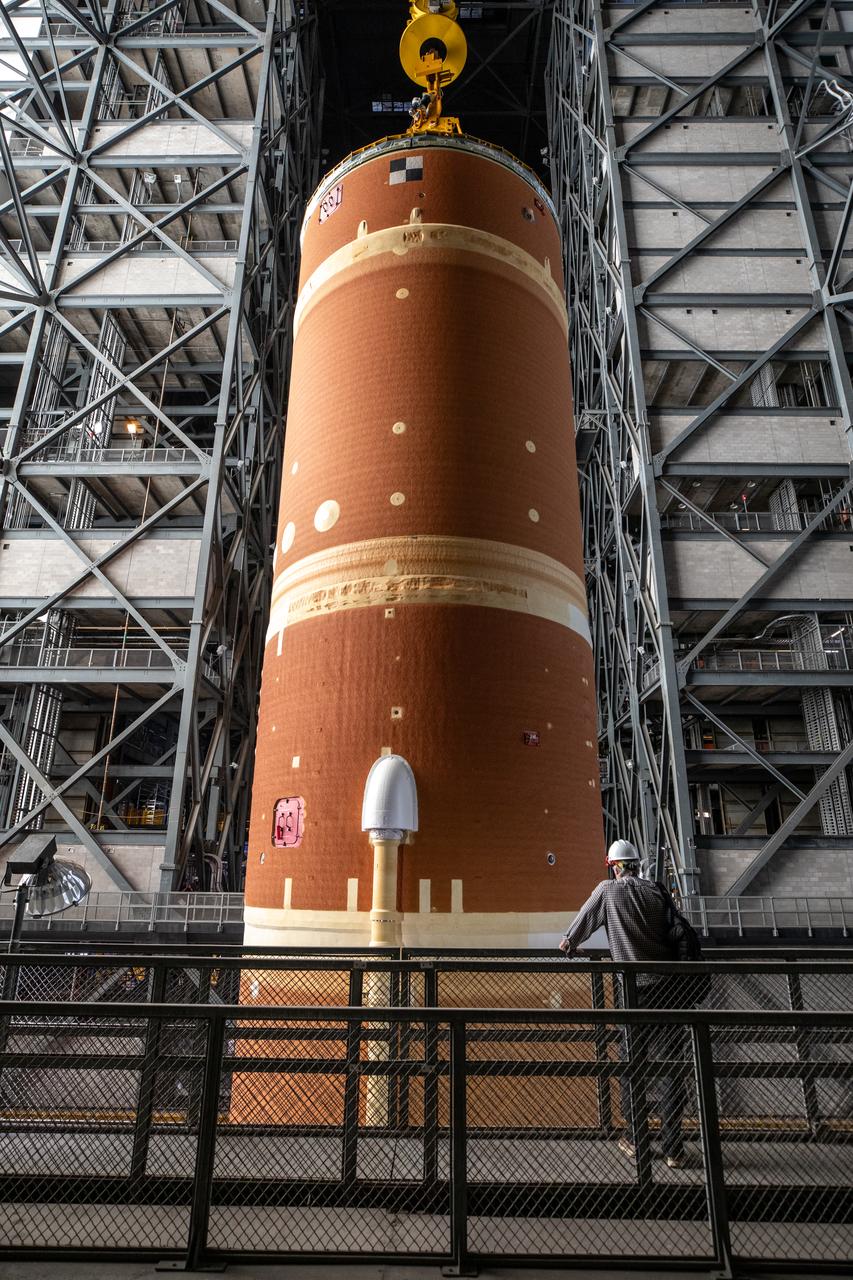
Teams with NASA’s Exploration Ground Systems transport the agency’s 212-foot-tall SLS (Space Launch System) core stage into High Bay 2 at the Vehicle Assembly Building at NASA’s Kennedy Space Center in Florida on Wednesday, Dec. 11, 2024. The one-of-a kind lifting beam is designed to lift the core stage from the transfer aisle to High Bay 2 where it will remain while teams stack the two solid rocket boosters on top of mobile launcher 1 for the SLS core stage.
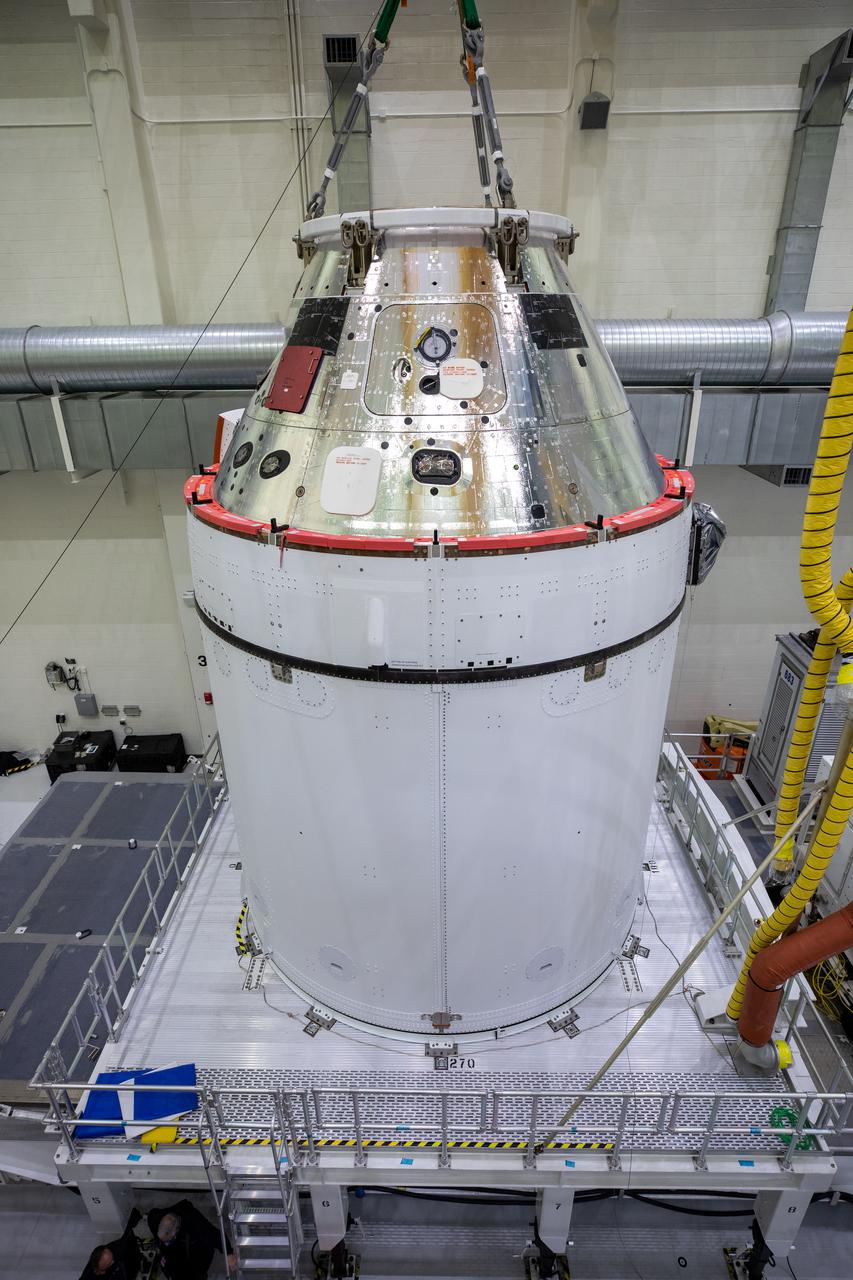
Orion is revealed for one of the final times on Jan. 14, as it is readied atop its transport pallet from the Neil Armstrong Operations and Checkout Building at NASA’s Kennedy Space Center in Florida, along its path to the pad ahead of the Artemis I launch. Teams across the globe have worked tirelessly to assemble the spacecraft, which will receive a protective covering prior to departing for the Multi-Payload Processing Facility to begin ground processing by the Exploration Ground Systems and Jacobs teams.
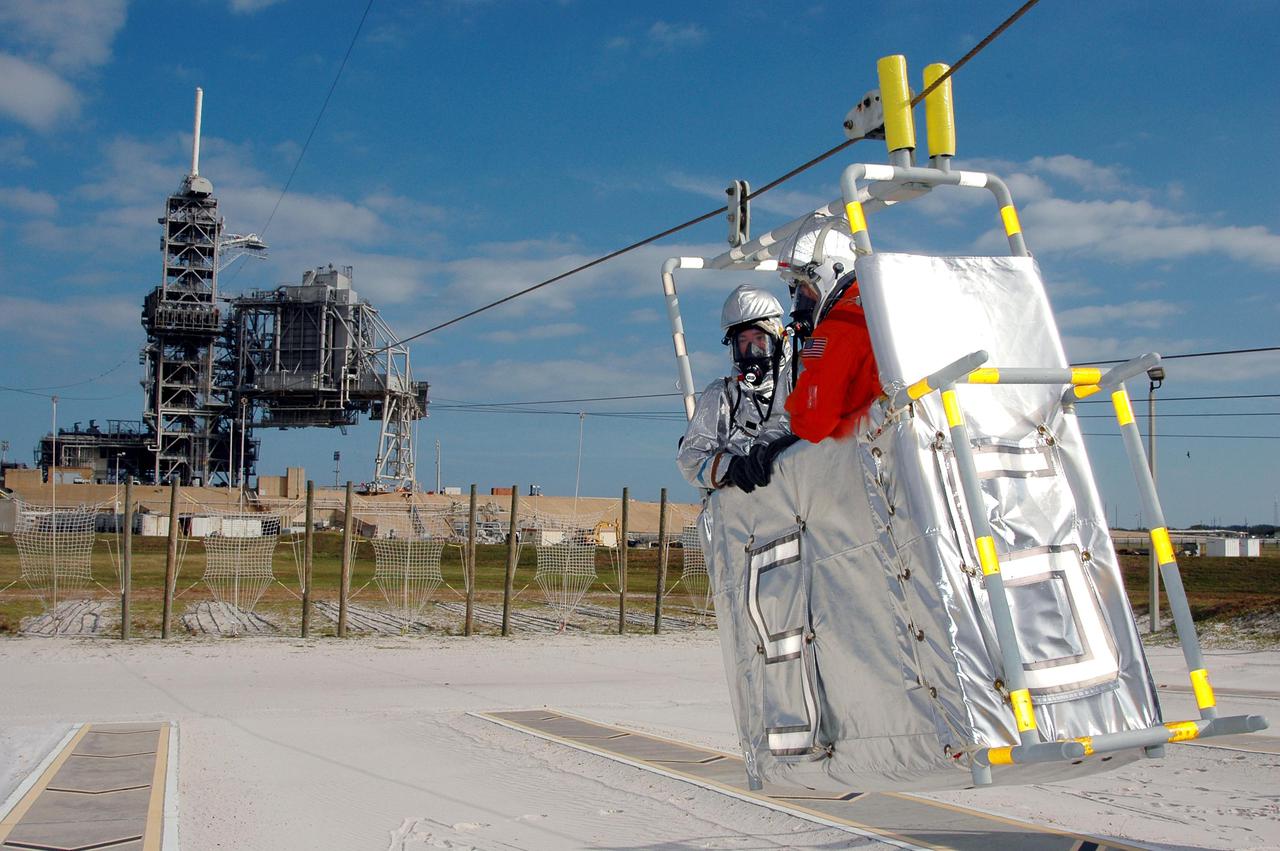
KENNEDY SPACE CENTER, FLA. - On Launch Pad 39A, a rescue team member and astronaut-suited worker approach landing in a slidewire basket reaching from the Fixed Service Structure in the background during an emergency egress scenario. The four-hour exercise simulated normal launch countdown operations, with the added challenge of a fictitious event causing an evacuation of the vehicle and launch pad. It tested the team’s rescue approaches on the Fixed Service Structure, slidewire basket evacuation, triage care and transportation of injured personnel to hospitals, as well as communications and coordination.

Orion is revealed for one of the final times on Jan. 14, as it is readied atop its transport pallet from the Neil Armstrong Operations and Checkout Building at NASA’s Kennedy Space Center in Florida, along its path to the pad ahead of the Artemis I launch. Teams across the globe have worked tirelessly to assemble the spacecraft which will receive a protective covering prior to departing for the Multi-Payload Processing Facility to begin ground processing by the Exploration Ground Systems and Jacobs teams.
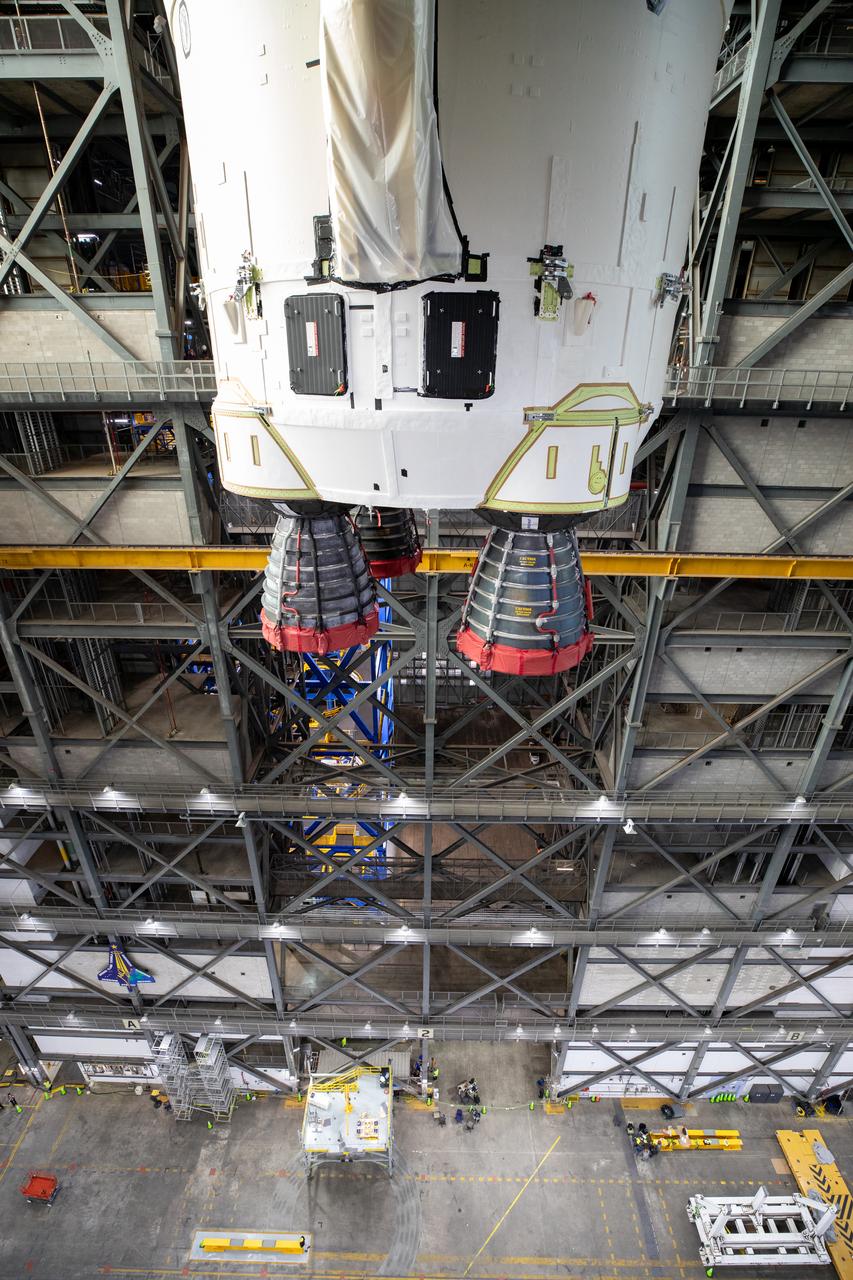
Teams with NASA’s Exploration Ground Systems transport the agency’s 212-foot-tall SLS (Space Launch System) core stage into High Bay 2 at the Vehicle Assembly Building at NASA’s Kennedy Space Center in Florida on Wednesday, Dec. 11, 2024. The one-of-a kind lifting beam is designed to lift the core stage from the transfer aisle to High Bay 2 where it will remain while teams stack the two solid rocket boosters on top of mobile launcher 1 for the SLS core stage.
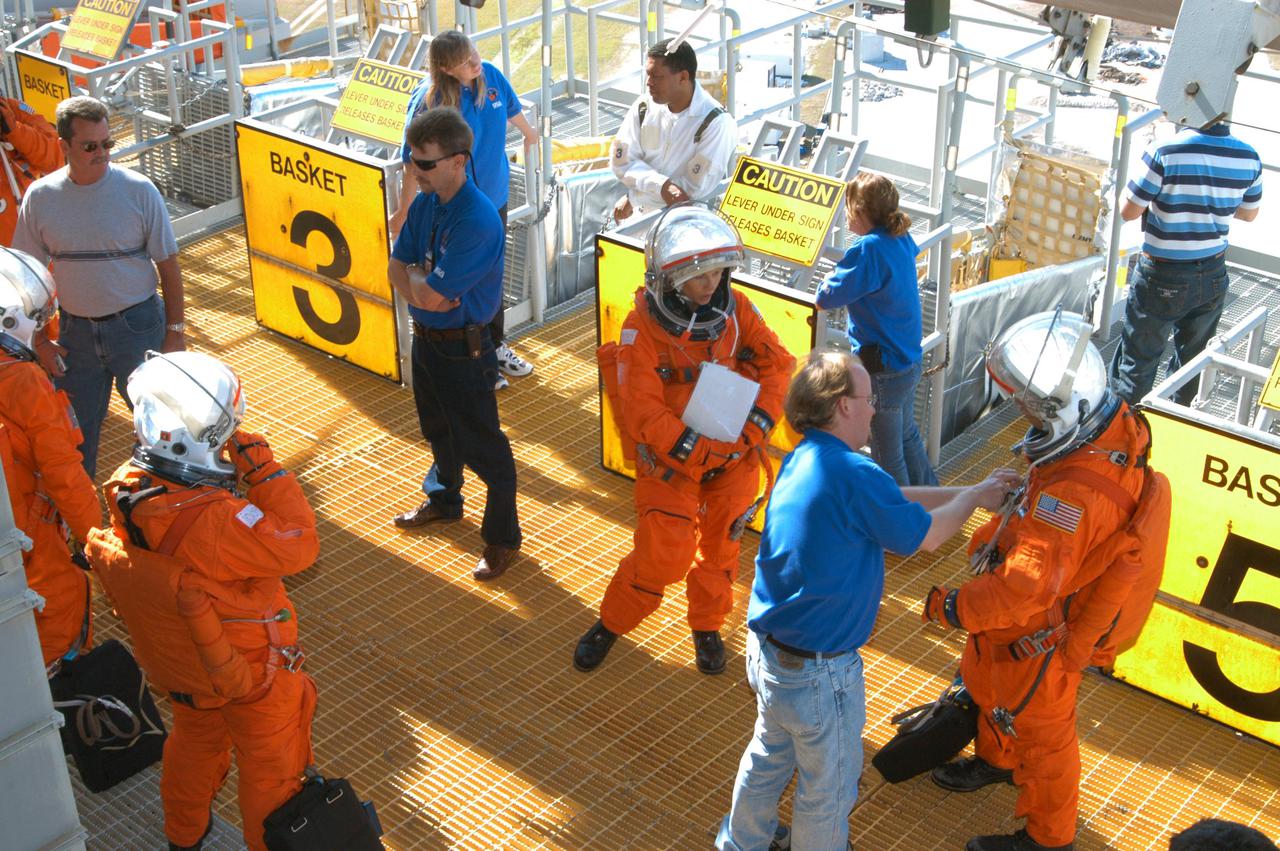
KENNEDY SPACE CENTER, FLA. - On Launch Pad 39-A, team members (in blue) help astronaut-suited co-workers near the slidewire baskets prepare for an emergency egress scenario. The four-hour exercise simulated normal launch countdown operations, with the added challenge of a fictitious event causing an evacuation of the vehicle and launch pad. It tested the team’s rescue approaches on the Fixed Service Structure, slidewire basket evacuation, triage care and transportation of injured personnel to hospitals, as well as communications and coordination.
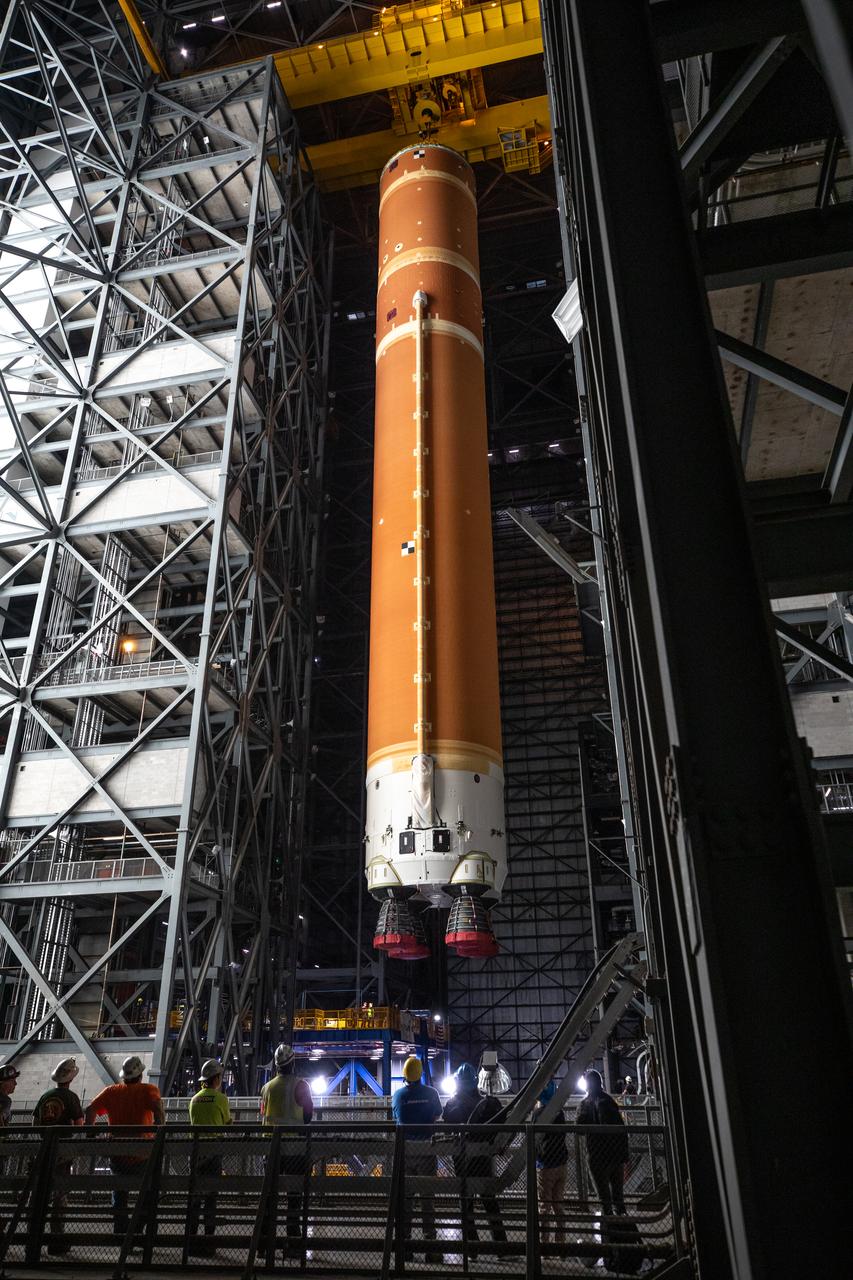
Teams with NASA’s Exploration Ground Systems transport the agency’s 212-foot-tall SLS (Space Launch System) core stage into High Bay 2 at the Vehicle Assembly Building at NASA’s Kennedy Space Center in Florida on Wednesday, Dec. 11, 2024. The one-of-a kind lifting beam is designed to lift the core stage from the transfer aisle to High Bay 2 where it will remain while teams stack the two solid rocket boosters on top of mobile launcher 1 for the SLS core stage.
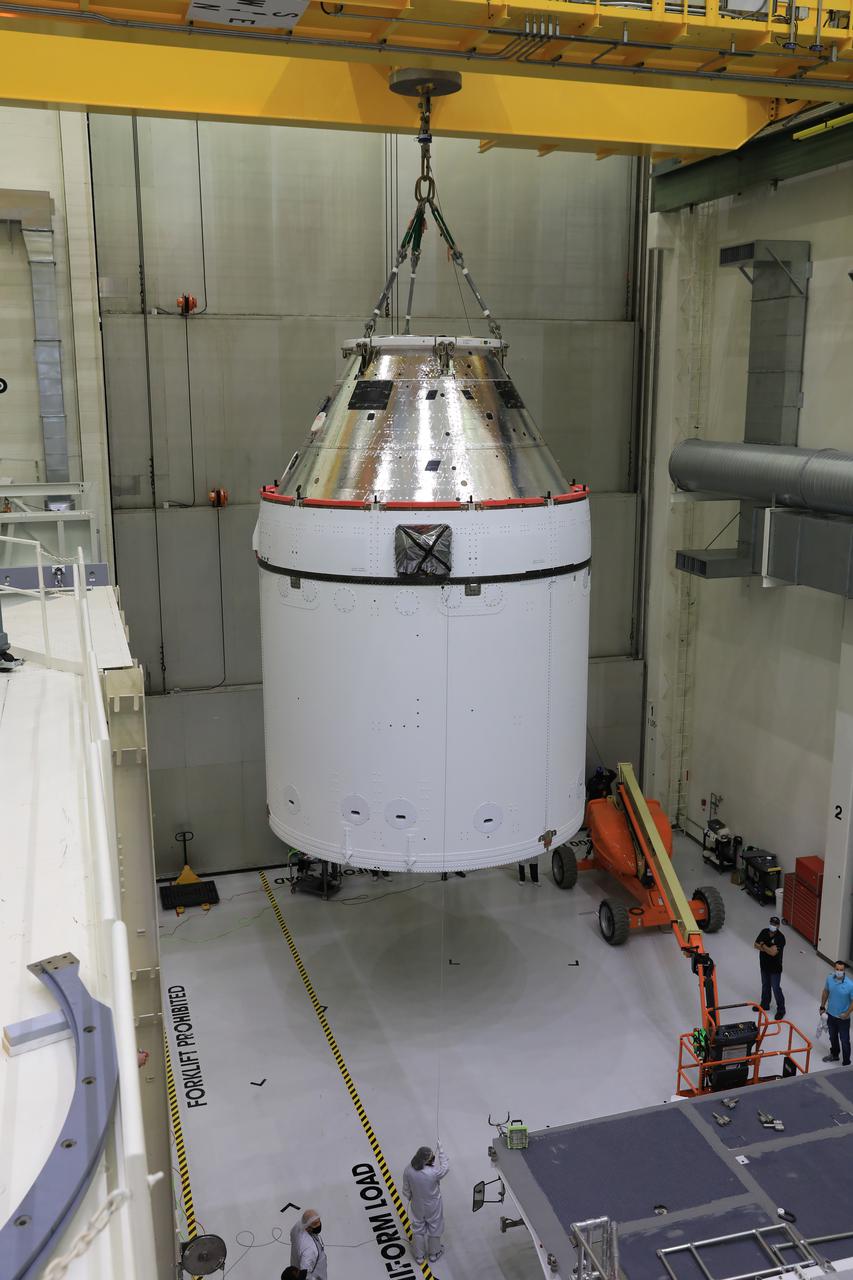
Orion is revealed for one of the final times on Jan. 14, as it is lowered by crane onto its transport pallet inside the Neil Armstrong Operations and Checkout Building at NASA’s Kennedy Space Center in Florida, along its path to the pad ahead of the Artemis I launch. Teams across the globe have worked tirelessly to assemble the spacecraft which will receive a protective covering prior to departing for the Multi-Payload Processing Facility to begin ground processing by the Exploration Ground Systems and Jacobs teams.

Teams with NASA’s Exploration Ground Systems transport the agency’s 212-foot-tall SLS (Space Launch System) core stage into High Bay 2 at the Vehicle Assembly Building at NASA’s Kennedy Space Center in Florida on Wednesday, Dec. 11, 2024. The one-of-a kind lifting beam is designed to lift the core stage from the transfer aisle to High Bay 2 where it will remain while teams stack the two solid rocket boosters on top of mobile launcher 1 for the SLS core stage.
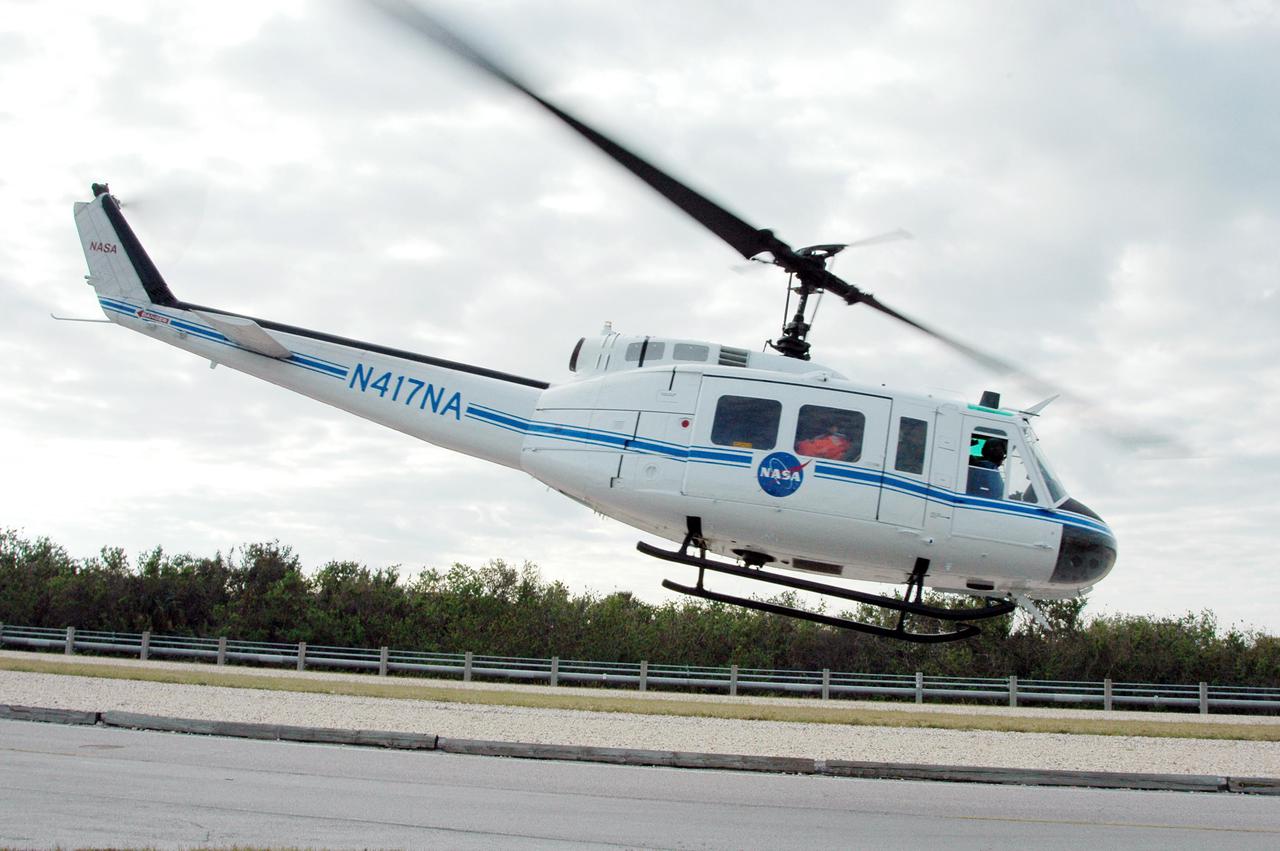
KENNEDY SPACE CENTER, FLA. - During a simulated launch countdown_emergency simulation on Launch Pad 39A, the NASA helicopter leaves the scene with “injured” astronaut-suited workers, heading to a hospital. Pad team members participated in the four-hour exercise simulating normal launch countdown operations, with the added challenge of a fictitious event causing an evacuation of the vehicle and launch pad. The simulation tested the team’s rescue approaches on the Fixed Service Structure, slidewire basket evacuation, triage care and transportation of injured personnel to hospitals, as well as communications and coordination.
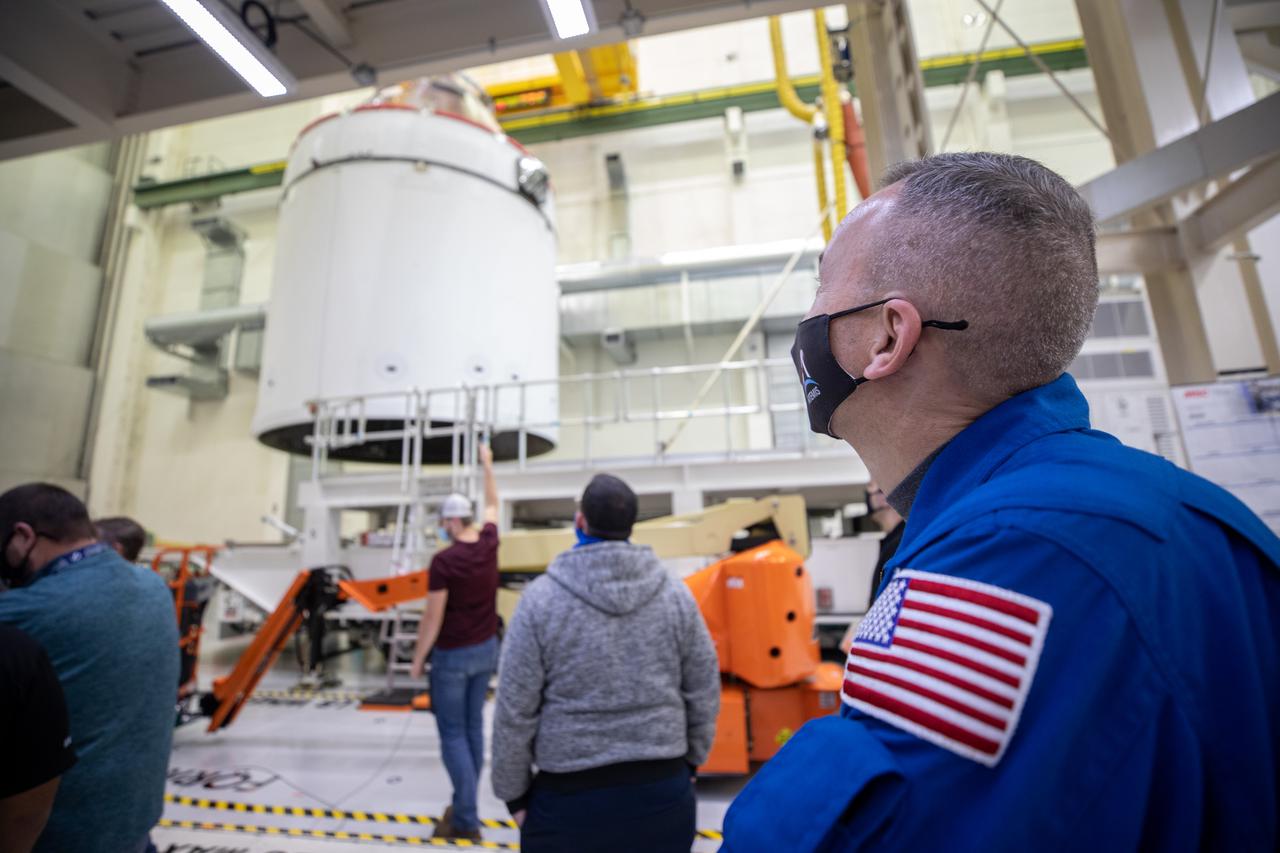
Orion is revealed for one of the final times on Jan. 14, as it is moved by crane to its transport pallet inside the Neil Armstrong Operations and Checkout Building at NASA’s Kennedy Space Center in Florida, along its path to the pad ahead of the Artemis I launch. Teams across the globe have worked tirelessly to assemble the spacecraft which will receive a protective covering prior to departing for the Multi-Payload Processing Facility to begin ground processing by the Exploration Ground Systems and Jacobs teams.

Orion is revealed for one of the final times on Jan. 14, as it is moved by crane to its transport pallet inside the Neil Armstrong Operations and Checkout Building at NASA’s Kennedy Space Center in Florida, along its path to the pad ahead of the Artemis I launch. Teams across the globe have worked tirelessly to assemble the spacecraft, which will receive a protective covering prior to departing for the Multi-Payload Processing Facility to begin ground processing by the Exploration Ground Systems and Jacobs teams.
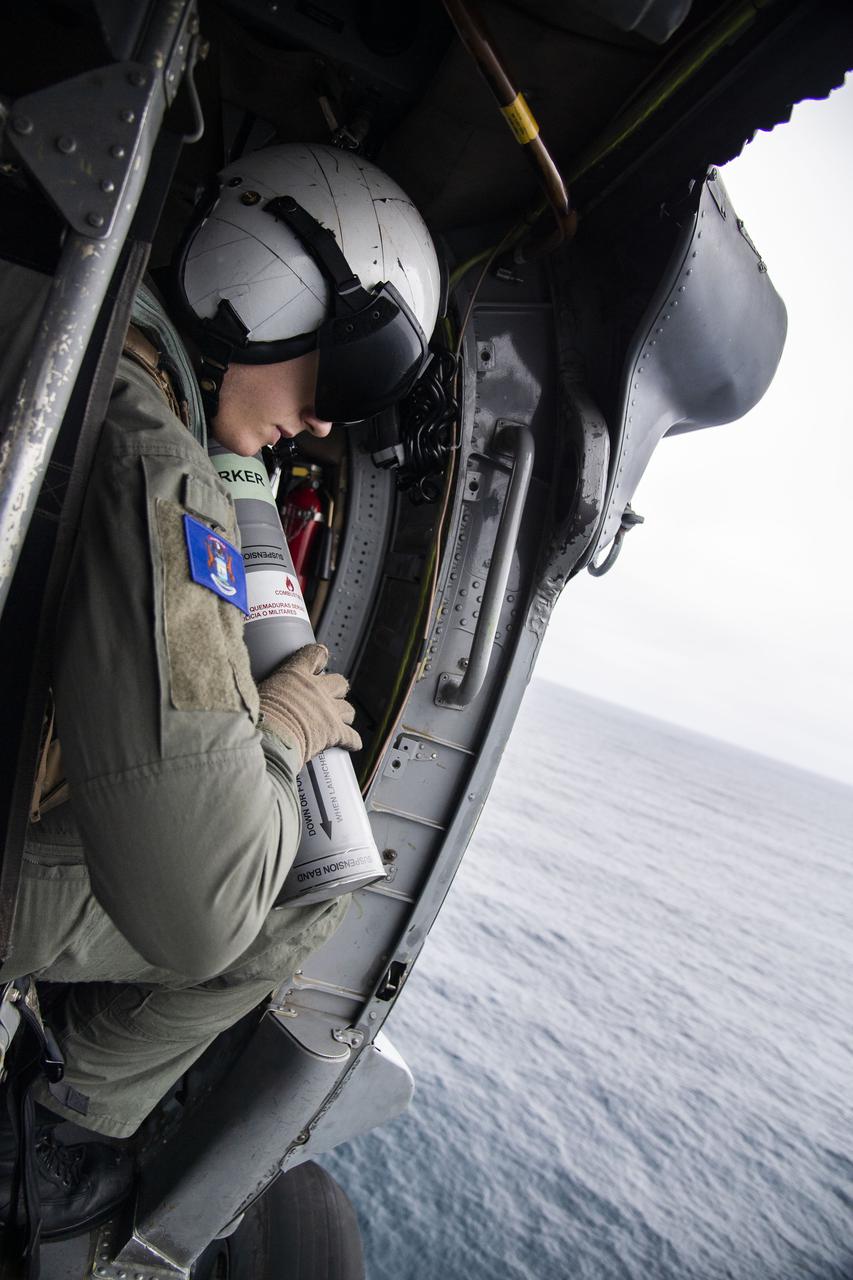
Naval Aircrewman 2nd Class Kanon Brooks, assigned to the “Wild Cards” of Helicopter Sea Combat Squadron (HSC) 23, prepares to drop a smoke canister from an MH-60S Seahawk helicopter near a mock Orion capsule to indicate the spacecraft’s location. During Underway Recovery Test 9 (URT-9) aboard amphibious transport dock ship USS John P. Murtha (LPD 26), NASA’s Landing and Recovery Team conducted a full mission profile simulation to certify the team for Artemis I.
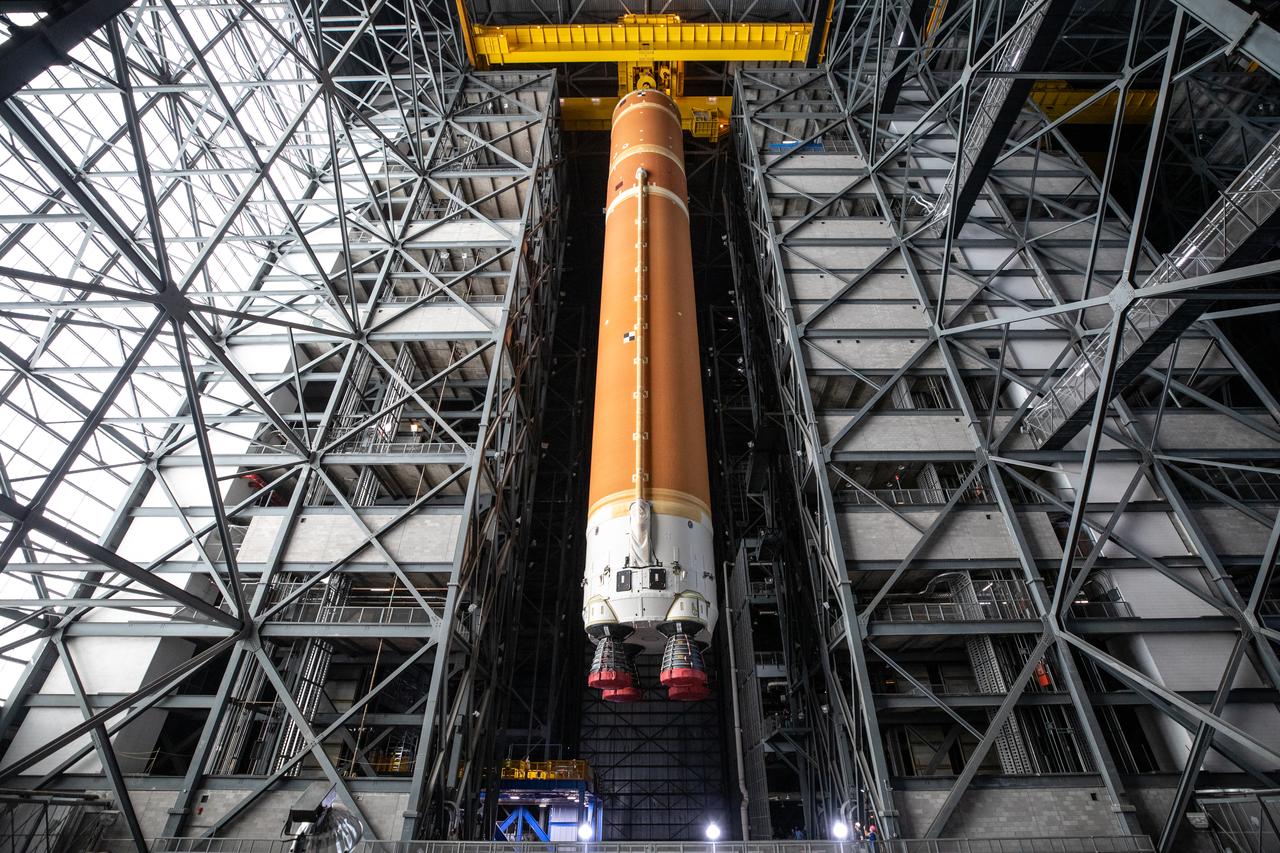
Teams with NASA’s Exploration Ground Systems transport the agency’s 212-foot-tall SLS (Space Launch System) core stage into High Bay 2 at the Vehicle Assembly Building at NASA’s Kennedy Space Center in Florida on Wednesday, Dec. 11, 2024. The one-of-a kind lifting beam is designed to lift the core stage from the transfer aisle to High Bay 2 where it will remain while teams stack the two solid rocket boosters on top of mobile launcher 1 for the SLS core stage.
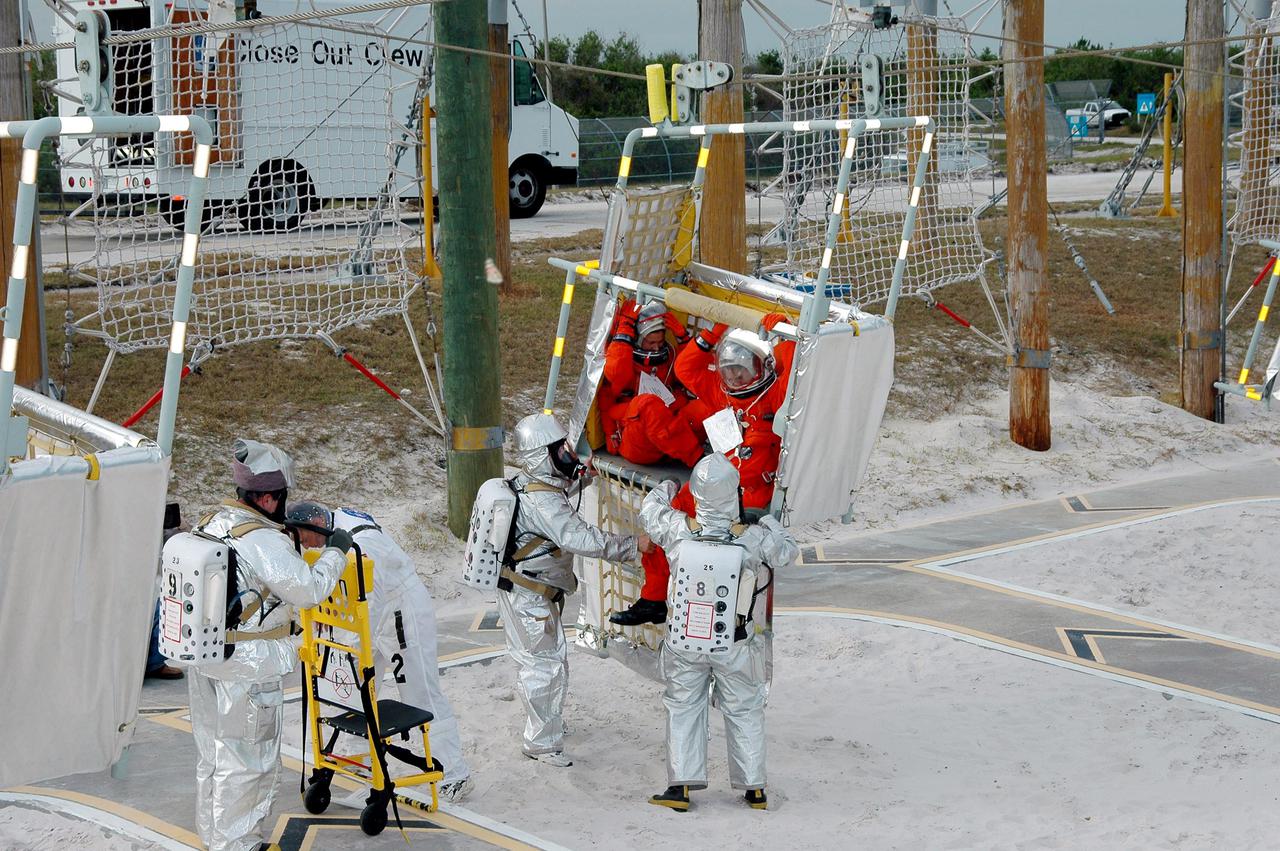
KENNEDY SPACE CENTER, FLA. - On Launch Pad 39A, rescue team members and astronaut-suited workers exit a slidewire basket during an emergency egress scenario. The four-hour exercise simulated normal launch countdown operations, with the added challenge of a fictitious event causing an evacuation of the vehicle and launch pad. It tested the team’s rescue approaches on the Fixed Service Structure, slidewire basket evacuation, triage care and transportation of injured personnel to hospitals, as well as communications and coordination.
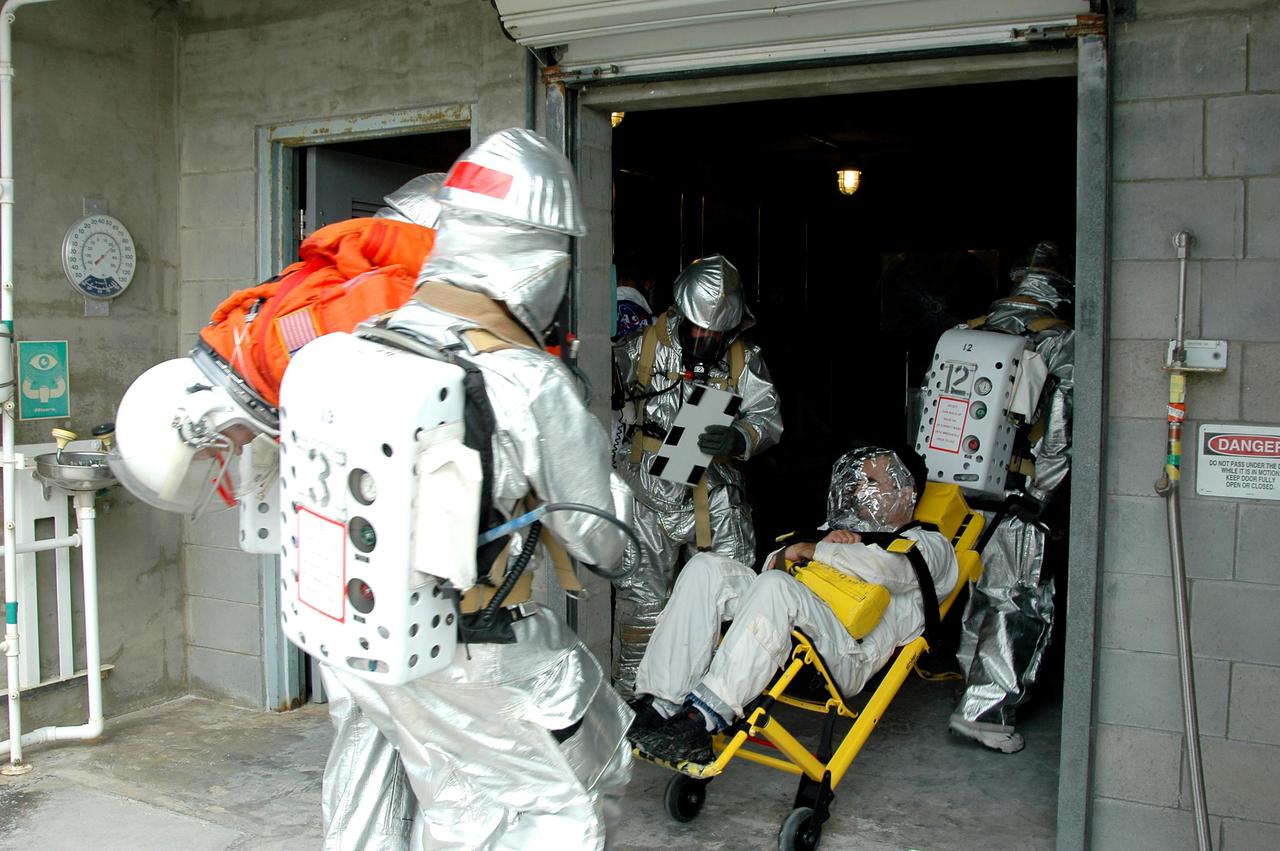
KENNEDY SPACE CENTER, FLA. - During a simulated launch countdown_emergency simulation on Launch Pad 39A, the rescue team takes “injured” astronaut-suited workers into the pad bunker. The four-hour exercise simulated normal launch countdown operations, with the added challenge of a fictitious event causing an evacuation of the vehicle and launch pad. It tested the team’s rescue approaches on the Fixed Service Structure, slidewire basket evacuation, triage care and transportation of injured personnel to hospitals, as well as communications and coordination.
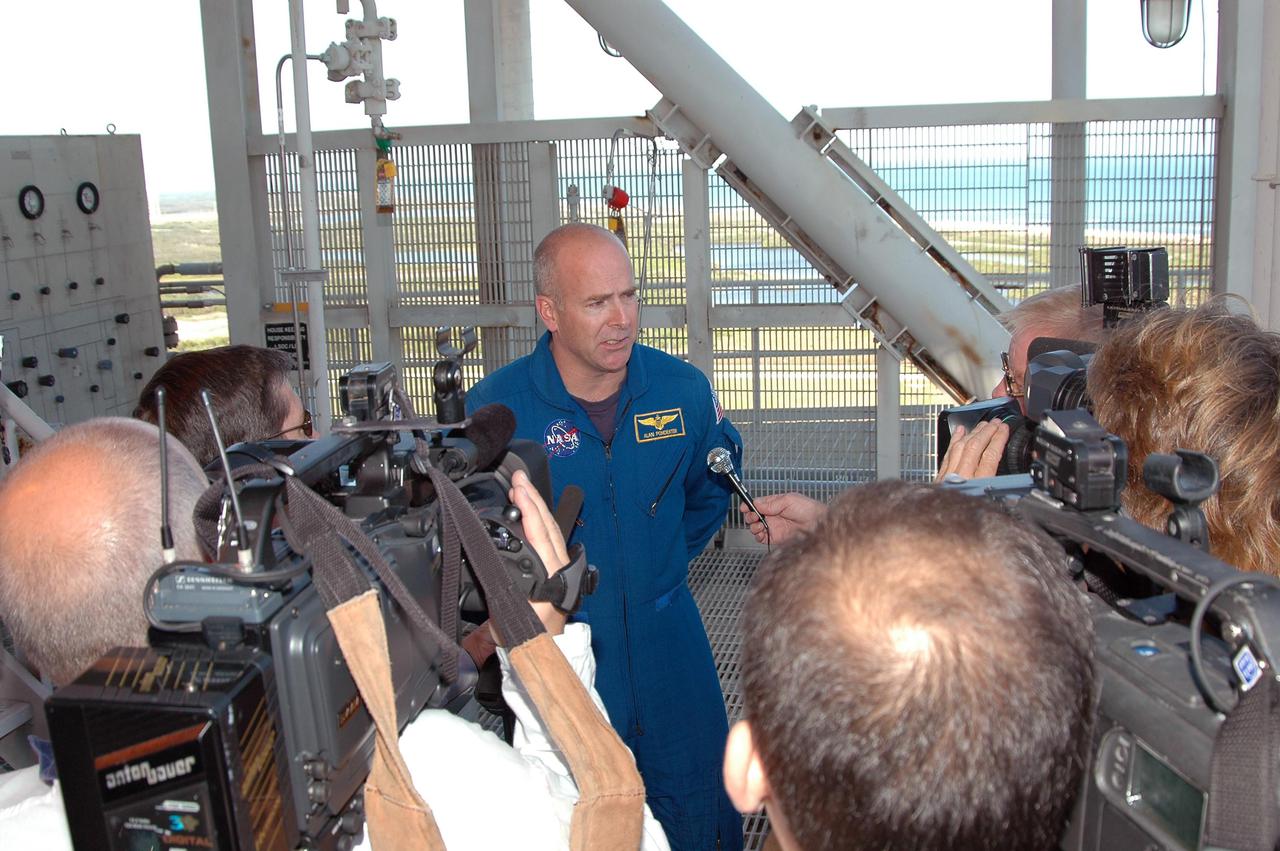
KENNEDY SPACE CENTER, FLA. - Prior to a simulated launch countdown_emergency simulation on Launch Pad 39A, the media photograph and interview astronaut Alan G. Poindexter. Pad team members participated in the four-hour exercise simulating normal launch countdown operations, with the added challenge of a fictitious event causing an evacuation of the vehicle and launch pad. The simulation tested the team’s rescue approaches on the Fixed Service Structure, slidewire basket evacuation, triage care and transportation of injured personnel to hospitals, as well as communications and coordination.

Orion is revealed for one of the final times on Jan. 14, as it is moved by crane to its transport pallet inside the Neil Armstrong Operations and Checkout Building at NASA’s Kennedy Space Center in Florida, along its path to the pad ahead of the Artemis I launch. Teams across the globe have worked tirelessly to assemble the spacecraft which will receive a protective covering prior to departing for the Multi-Payload Processing Facility to begin ground processing by the Exploration Ground Systems and Jacobs teams.
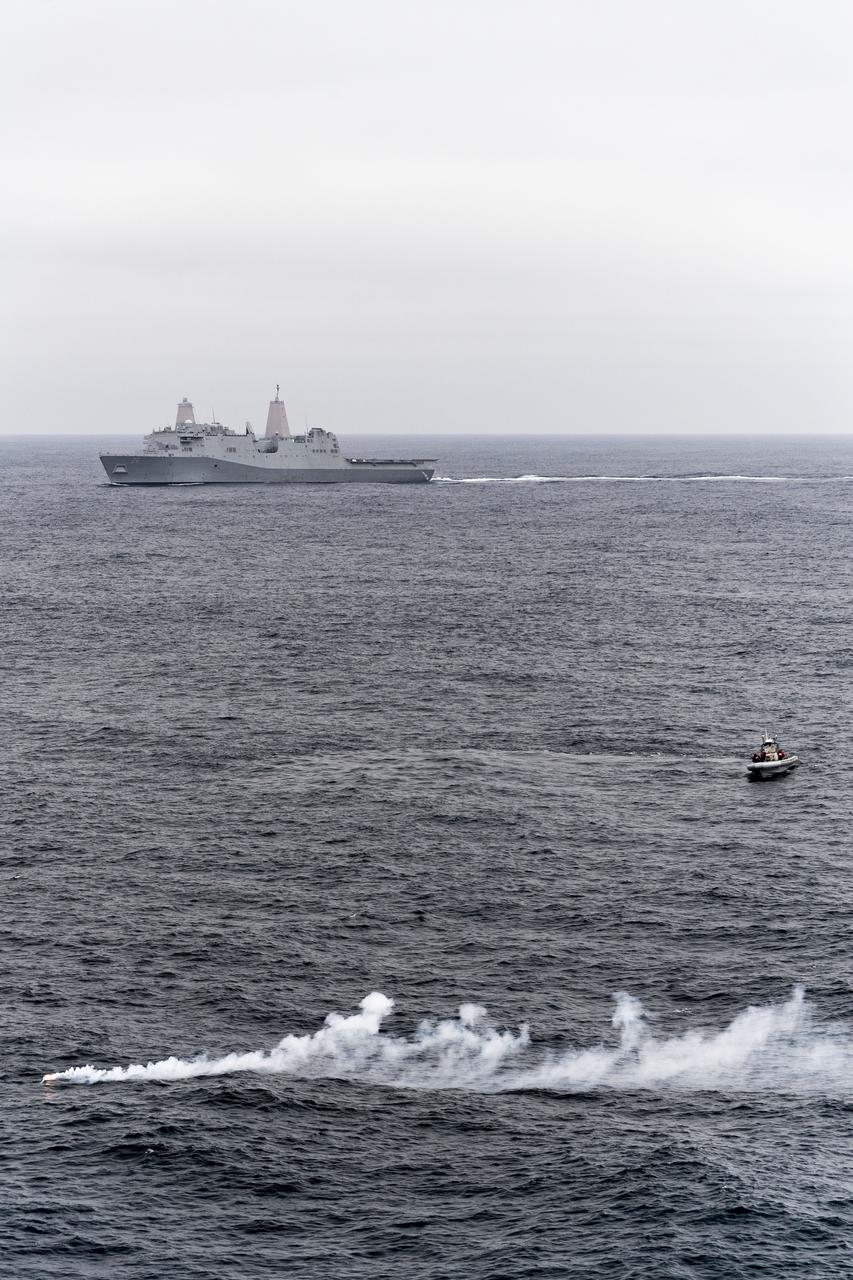
Small boats deployed from amphibious transport dock ship USS John P. Murtha (LPD 26) motor toward a smoke marker released by an MH-60S Seahawk helicopter to indicate the location of a mock Orion capsule during Underway Recovery Test 9 (URT-9). During the weeklong test, NASA’s Landing and Recovery Team conducted a full mission profile simulation to certify the team for Artemis I.

Teams at Kennedy Space Center in Florida transported the fourth core stage engine section from the spaceport’s Space Systems Processing Facility to the Vehicle Assembly Building in August 2025. The flight hardware will remain in the facility’s transfer aisle until teams lift the section into High Bay 2 for assembly and integration with the remaining core stage elements. Artemis will pave the way for a long-term human presence on the lunar surface while ushering the Golden Age of Innovation and Exploration.
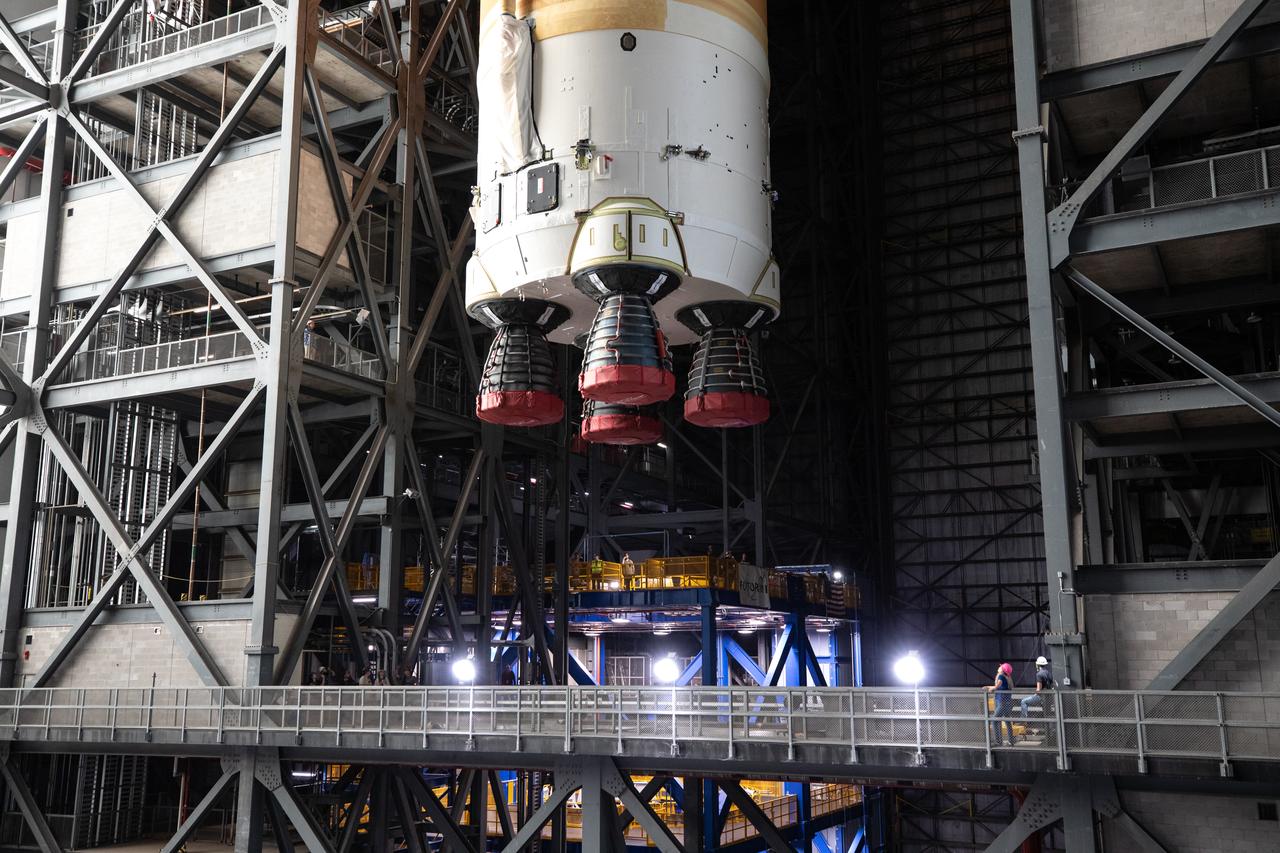
Teams with NASA’s Exploration Ground Systems transport the agency’s 212-foot-tall SLS (Space Launch System) core stage into High Bay 2 at the Vehicle Assembly Building at NASA’s Kennedy Space Center in Florida on Wednesday, Dec. 11, 2024. The one-of-a kind lifting beam is designed to lift the core stage from the transfer aisle to High Bay 2 where it will remain while teams stack the two solid rocket boosters on top of mobile launcher 1 for the SLS core stage.
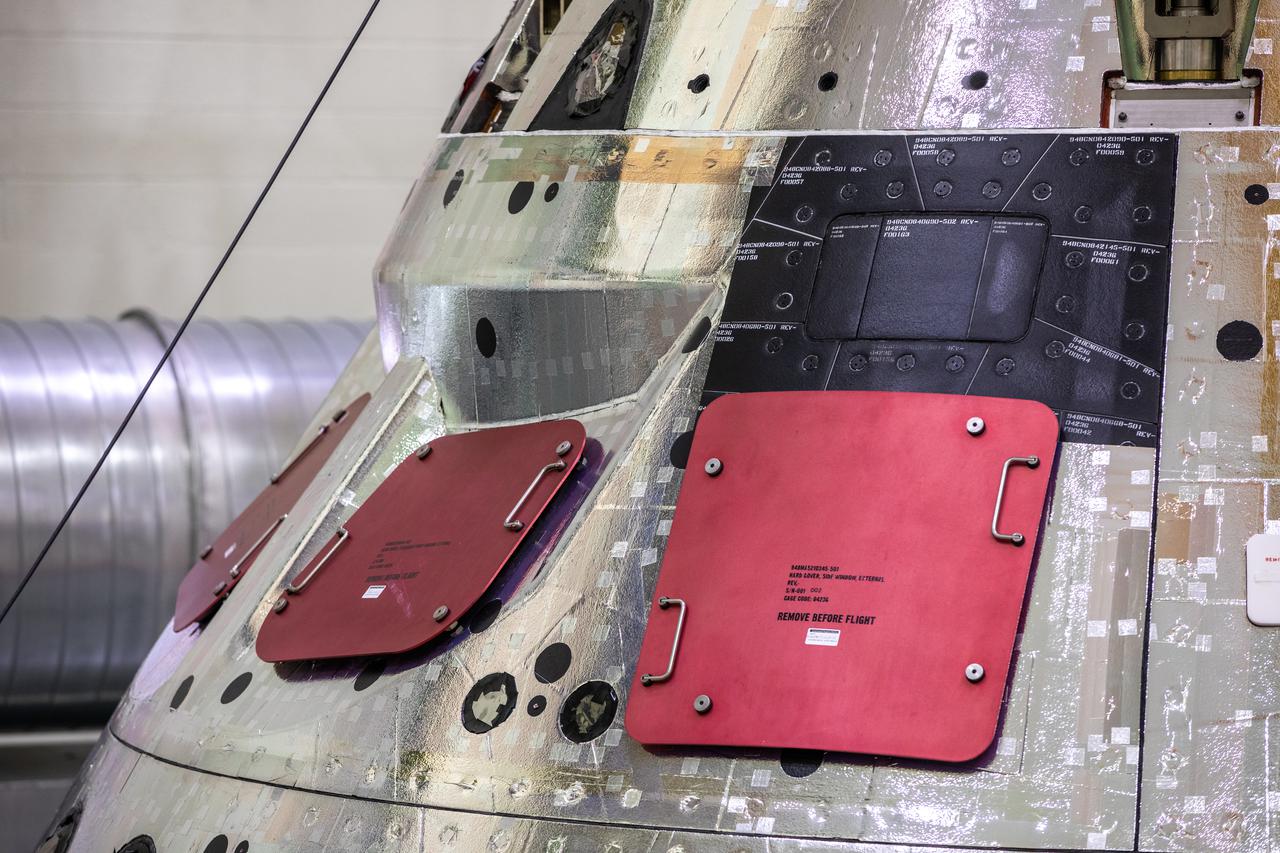
Orion is revealed for one of the final times on Jan. 14, as it is readied atop its transport pallet from the Neil Armstrong Operations and Checkout Building at NASA’s Kennedy Space Center in Florida, along its path to the pad ahead of the Artemis I launch. Teams across the globe have worked tirelessly to assemble the spacecraft which will receive a protective covering prior to departing for the Multi-Payload Processing Facility to begin ground processing by the Exploration Ground Systems and Jacobs teams.
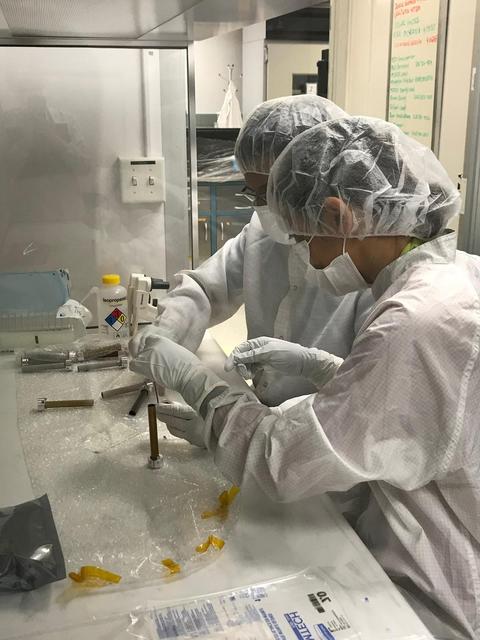
Planetary protection engineers at NASA's Jet Propulsion Laboratory in Southern California swab engineering models of the tubes that will store Martian rock and sediment samples as part of NASA’s Mars 2020 Perseverance mission. Team members wanted to understand the transport of biological particles when the rover is taking rock cores. These measurements helped the rover team design hardware and sampling methods that meet stringent biological contamination control requirements. https://photojournal.jpl.nasa.gov/catalog/PIA23718
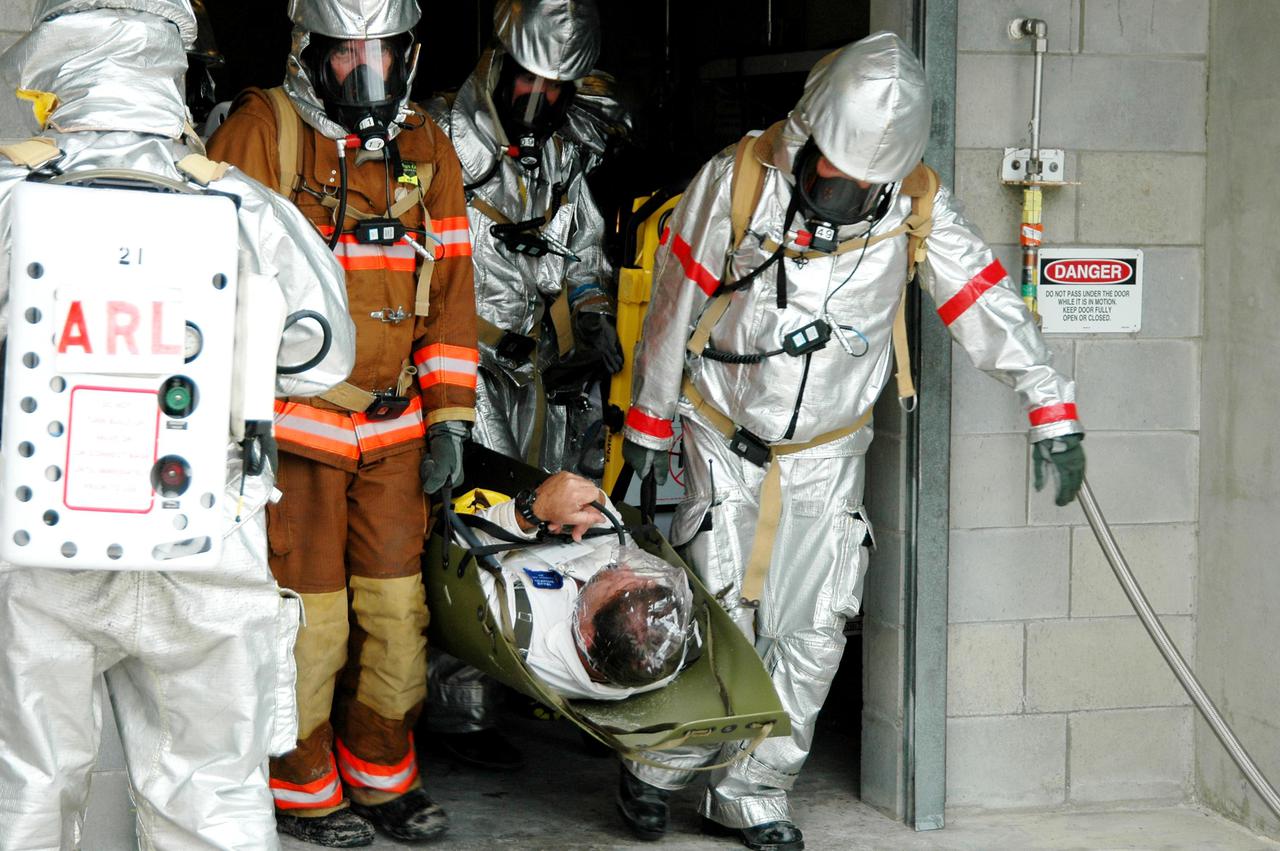
KENNEDY SPACE CENTER, FLA. - During a simulated launch countdown_emergency simulation on Launch Pad 39A, the rescue team carries “injured” astronaut-suited workers out of the pad bunker. The four-hour exercise simulated normal launch countdown operations, with the added challenge of a fictitious event causing an evacuation of the vehicle and launch pad. It tested the team’s rescue approaches on the Fixed Service Structure, slidewire basket evacuation, triage care and transportation of injured personnel to hospitals, as well as communications and coordination.
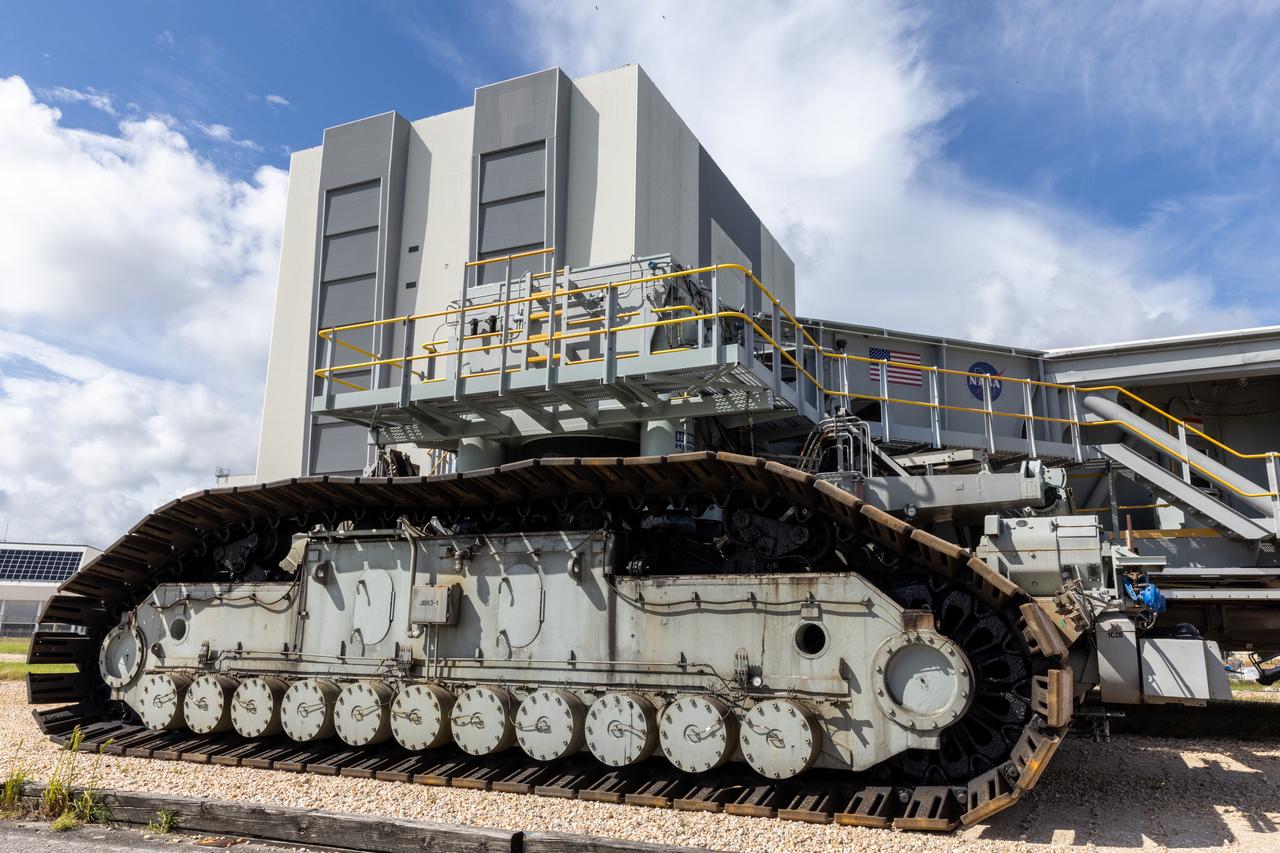
NASA’s crawler-transporter 2 moves slowly along the crawlerway towards Launch Pad 39B at the agency’s Kennedy Space Center in Florida on Wednesday, Sept. 25, 2024, after reaching the milestone of 2,500 miles traveled since its construction in 1965. Crawler-transporter 2 reached the milestone while teams with NASA’s Exploration Ground Systems took it on a trip in preparation for supporting the roll of the mobile launcher back into the spaceport’s Vehicle Assembly Building ahead of the Artemis II launch. Built originally to transport massive Saturn V rockets during the Apollo Program, crawler-transporter 2 continued its service during the Space Shuttle Program, and currently transports the massive SLS (Space Launch System) rocket and Orion spacecraft atop the mobile launcher as part of the agency’s Artemis campaign.
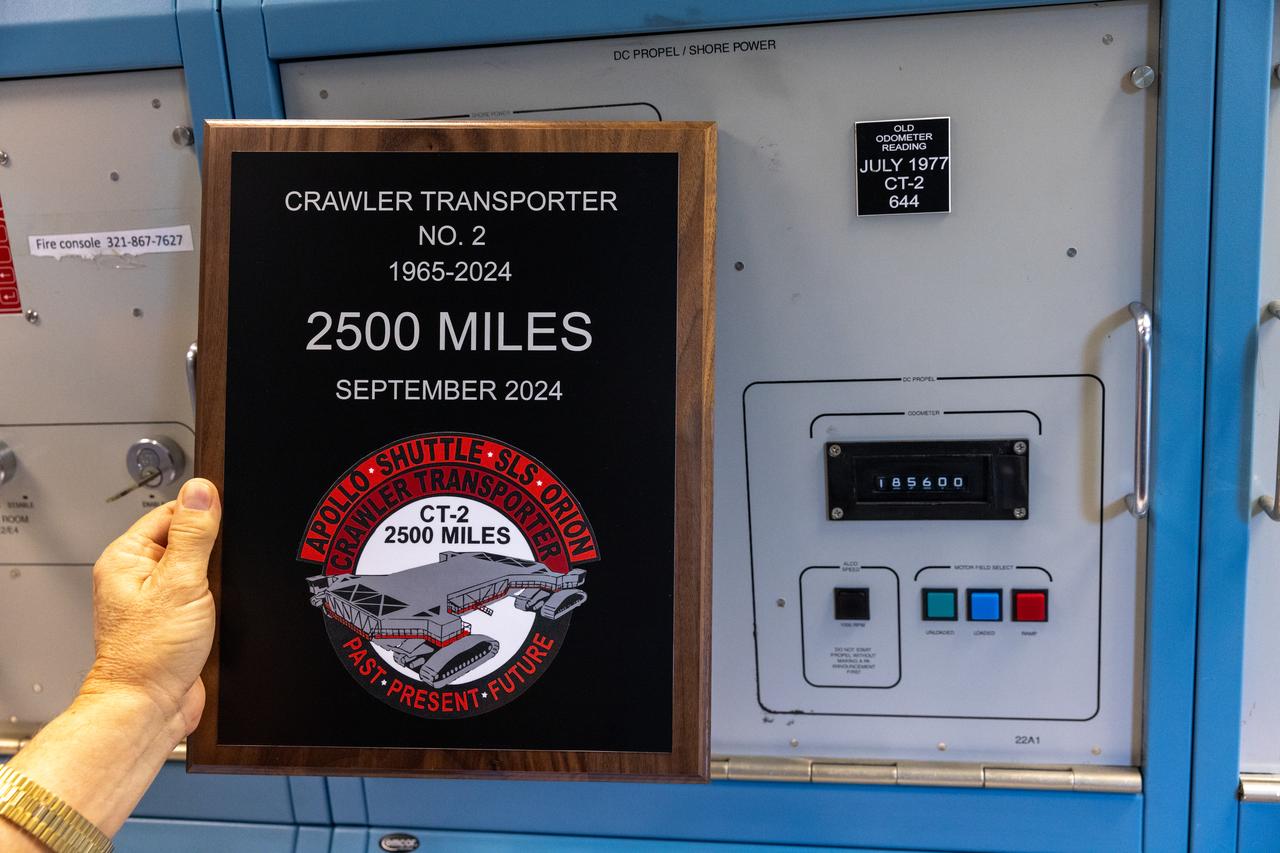
A plaque is held near the odometer of the agency’s crawler-transporter 2, on Wednesday, Sept. 25, 2024, at NASA’s Kennedy Space Center in Florida, commemorating the milestone of 2,500 miles traveled since its construction in 1965. Crawler-transporter 2 reached the milestone while teams with NASA’s Exploration Ground Systems took it on a trip in preparation for supporting the roll of the mobile launcher from Launch Pad 39B back into the spaceport’s Vehicle Assembly Building ahead of the Artemis II launch. Built originally to transport massive Saturn V rockets during the Apollo Program, crawler-transporter 2 continued its service during the Space Shuttle Program, and currently transports the massive SLS (Space Launch System) rocket and Orion spacecraft atop the mobile launcher as part of the agency’s Artemis campaign.
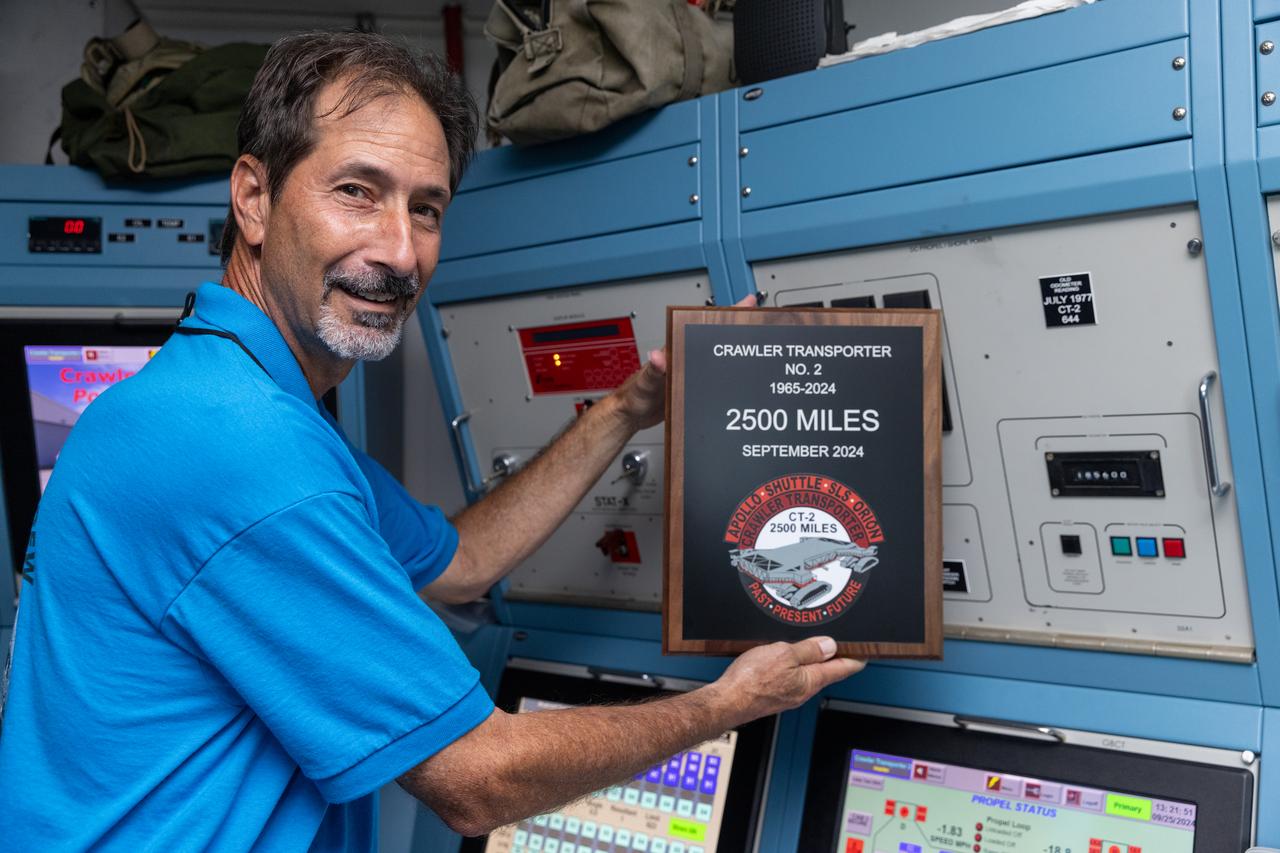
John Giles, crawler element operations manager for NASA’s Exploration Ground Systems, holds a plaque near the odometer of the agency’s crawler-transporter 2, on Wednesday, Sept. 25, 2024, at NASA’s Kennedy Space Center in Florida, commemorating the milestone of 2,500 miles traveled since its construction in 1965. Crawler-transporter 2 reached the milestone while teams took it on a trip in preparation for supporting the roll of the mobile launcher from Launch Pad 39B back into the spaceport’s Vehicle Assembly Building ahead of the Artemis II launch. Built originally to transport massive Saturn V rockets during the Apollo Program, crawler-transporter 2 continued its service during the Space Shuttle Program, and currently transports the massive SLS (Space Launch System) rocket and Orion spacecraft atop the mobile launcher as part of the agency’s Artemis campaign.
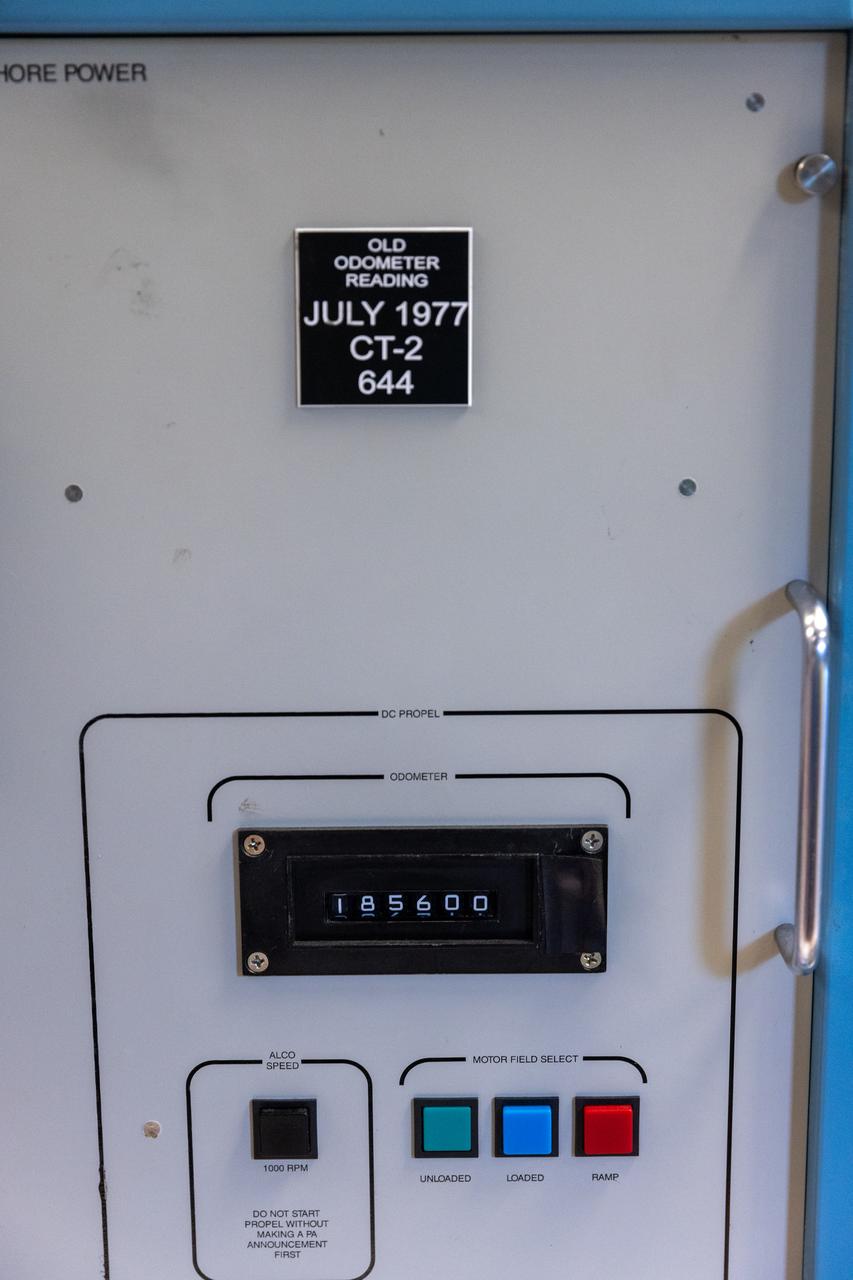
A photo of NASA’s crawler-transporter 2 odometer on Wednesday, Sept. 25, 2024, at NASA’s Kennedy Space Center in Florida, commemorates the milestone of reaching 2,500 miles traveled since its construction in 1965. Crawler-transporter 2’s original odometer ceased working in 1977 at 644 miles, so teams with NASA’s Exploration Ground Systems added the original figure to the new odometer to calculate the milestone. Built originally to transport massive Saturn V rockets during the Apollo Program, crawler-transporter 2 continued its service during the Space Shuttle Program, and currently transports the massive SLS (Space Launch System) rocket and Orion spacecraft atop the mobile launcher as part of the agency’s Artemis campaign.
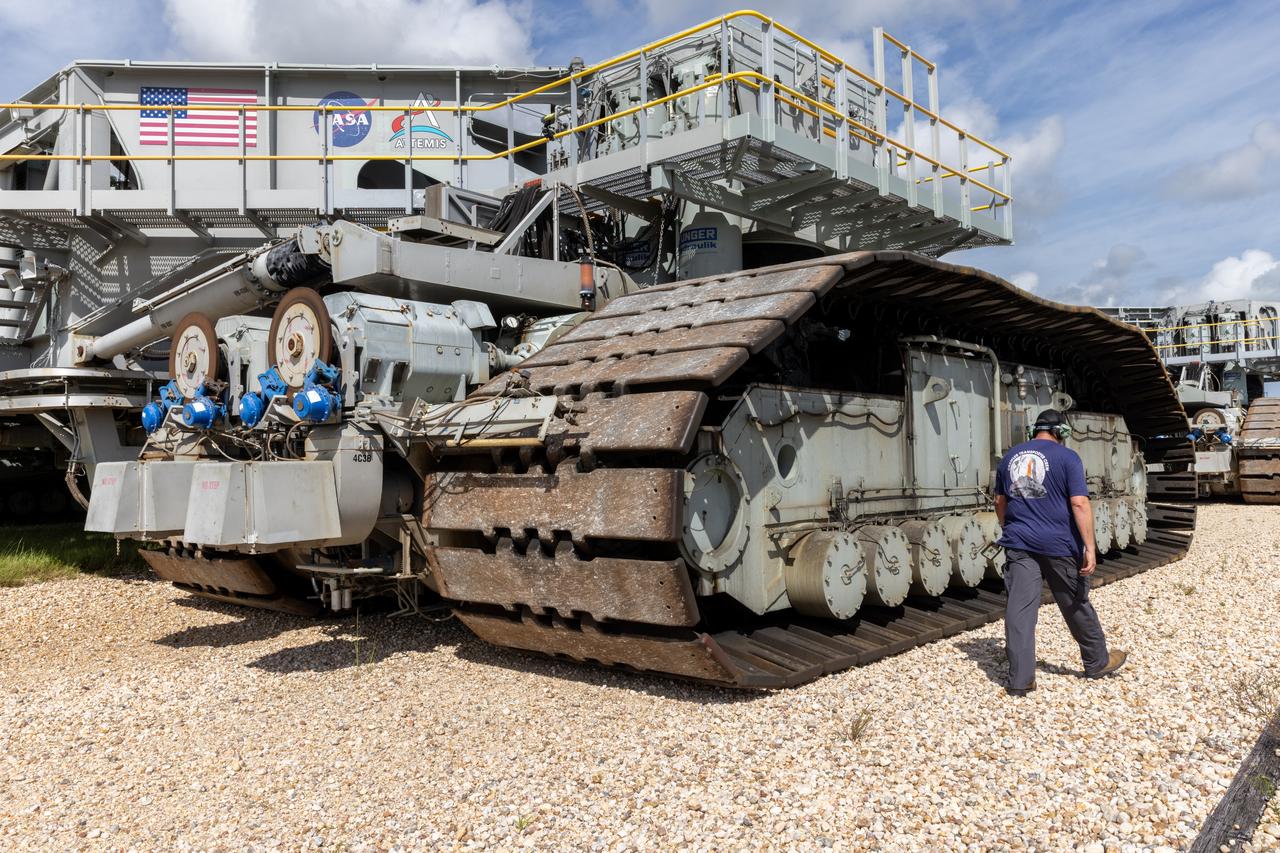
NASA’s crawler-transporter 2 moves slowly along the crawlerway towards Launch Pad 39B at the agency’s Kennedy Space Center in Florida on Wednesday, Sept. 25, 2024, after reaching the milestone of 2,500 miles traveled since its construction in 1965. Crawler-transporter 2 reached the milestone while teams with NASA’s Exploration Ground Systems took it on a trip in preparation for supporting the roll of the mobile launcher back into the spaceport’s Vehicle Assembly Building ahead of the Artemis II launch. Built originally to transport massive Saturn V rockets during the Apollo Program, crawler-transporter 2 continued its service during the Space Shuttle Program, and currently transports the massive SLS (Space Launch System) rocket and Orion spacecraft atop the mobile launcher as part of the agency’s Artemis campaign.
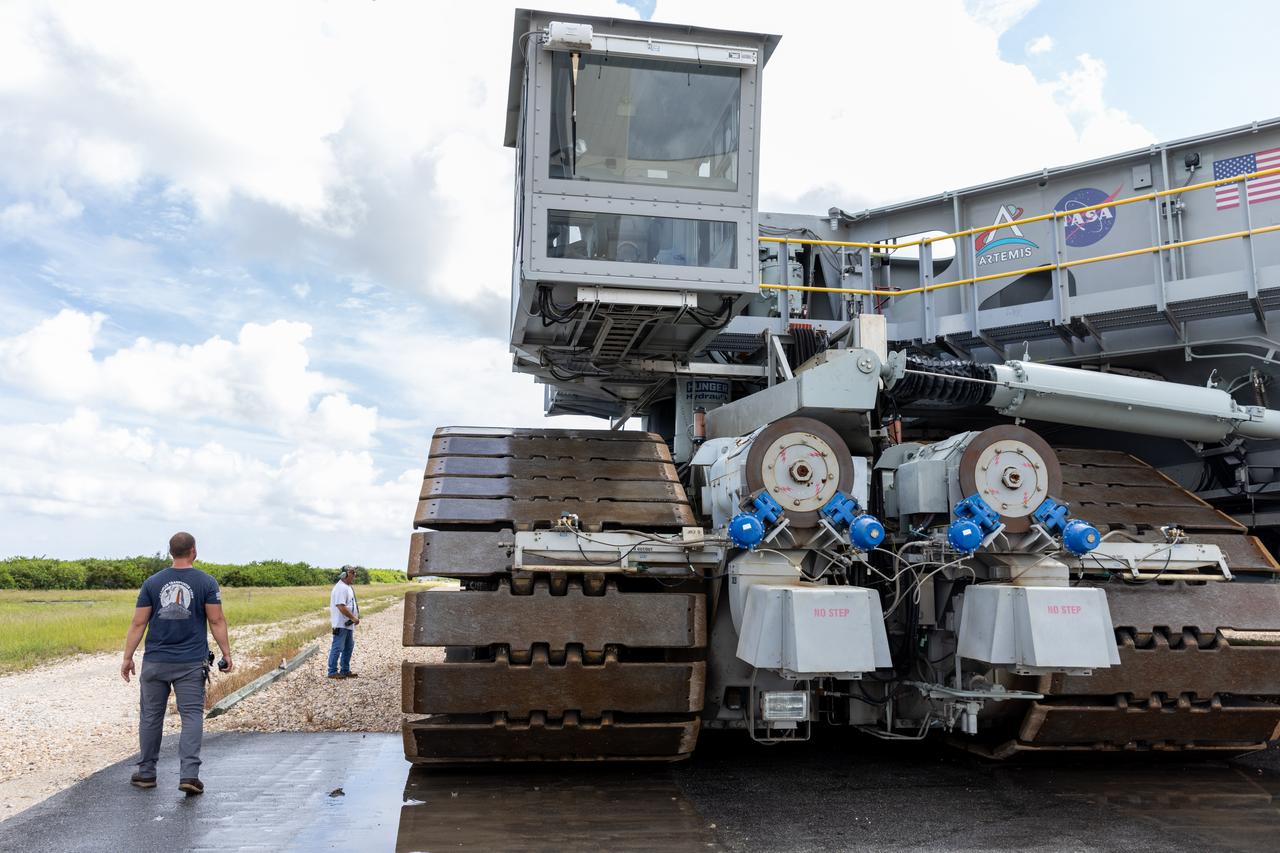
NASA’s crawler-transporter 2 moves slowly along the crawlerway towards Launch Pad 39B at the agency’s Kennedy Space Center in Florida on Wednesday, Sept. 25, 2024, after reaching the milestone of 2,500 miles traveled since its construction in 1965. Crawler-transporter 2 reached the milestone while teams with NASA’s Exploration Ground Systems took it on a trip in preparation for supporting the roll of the mobile launcher back into the spaceport’s Vehicle Assembly Building ahead of the Artemis II launch. Built originally to transport massive Saturn V rockets during the Apollo Program, crawler-transporter 2 continued its service during the Space Shuttle Program, and currently transports the massive SLS (Space Launch System) rocket and Orion spacecraft atop the mobile launcher as part of the agency’s Artemis campaign.
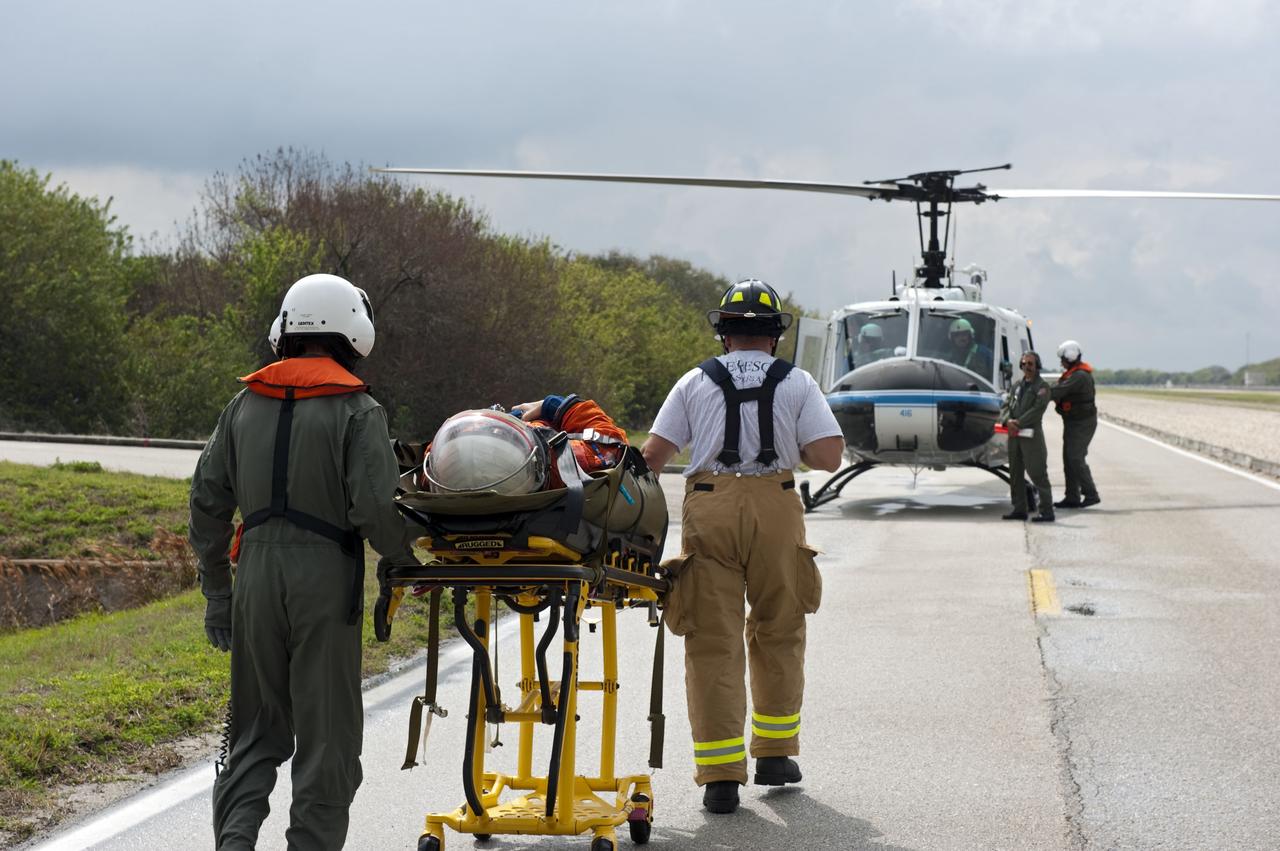
CAPE CANAVERAL, Fla. – Volunteers portraying injured astronauts are transported to a helicopter as part of an emergency exit, or Mode II/IV, exercise that allows teams to practice an emergency response at Launch Pad 39A at NASA's Kennedy Space Center in Florida. The exercise involves NASA fire rescue personnel, volunteers portraying astronauts with simulated injuries, helicopters and personnel from the Air Force’s 920th Rescue Wing, and medical trauma teams at three Central Florida hospitals. The drill allows teams to practice an emergency response at the launch pad, including helicopter evacuation to local hospitals. Photo credit: NASA/Kim Shiflett
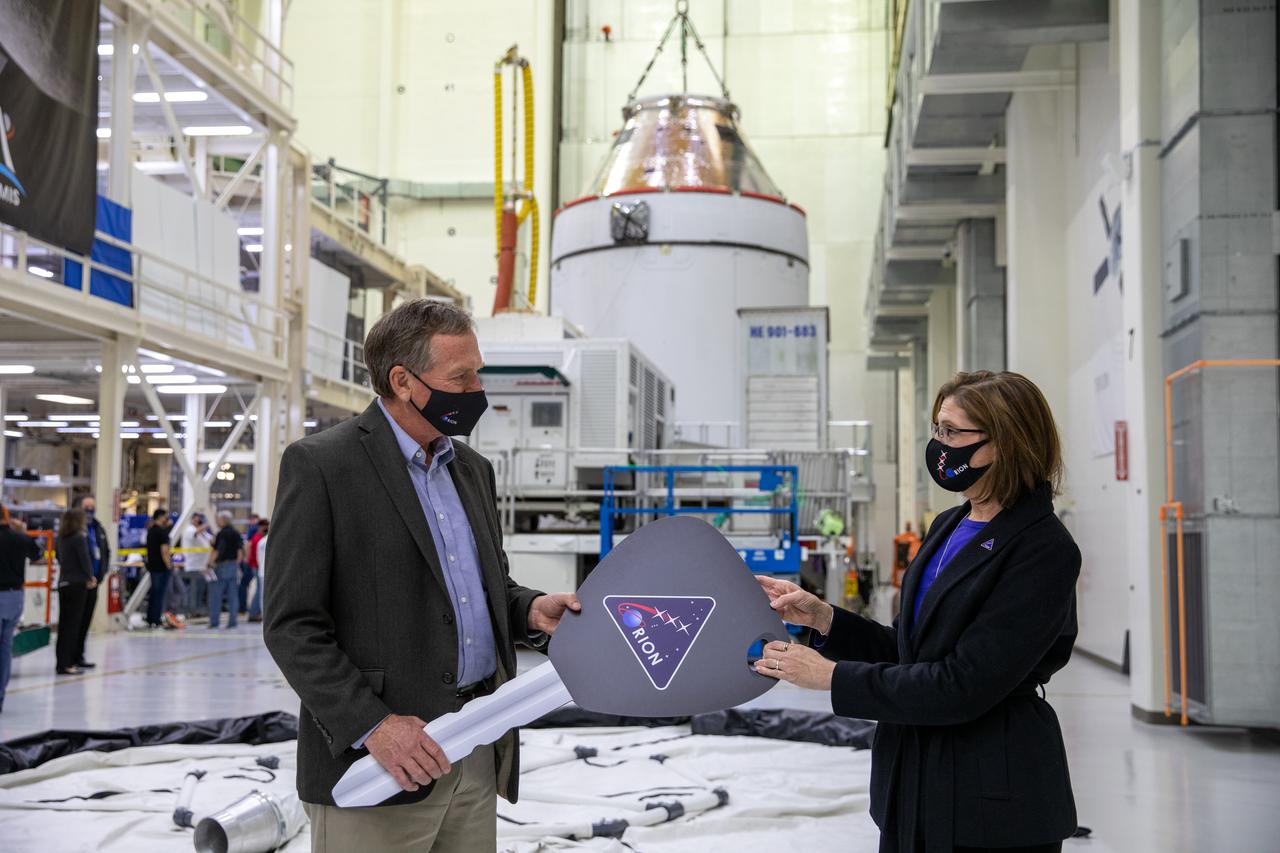
Orion is revealed for one of the final times on Jan. 14, as it is readied atop its transport pallet from the Neil Armstrong Operations and Checkout Building at NASA’s Kennedy Space Center in Florida, along its path to the pad ahead of the Artemis I launch. Mike Bolger, at left, manager of Exploration Ground Systems (EGS), receives the “key” to Orion from Cathy Koerner, Orion Program manager signifying the transfer of the spacecraft from the assembly to the ground system processing team. Teams across the globe have worked tirelessly to assemble the spacecraft, which will receive a protective covering prior to departing for the Multi-Payload Processing Facility to begin ground processing by the EGS and Jacobs teams.
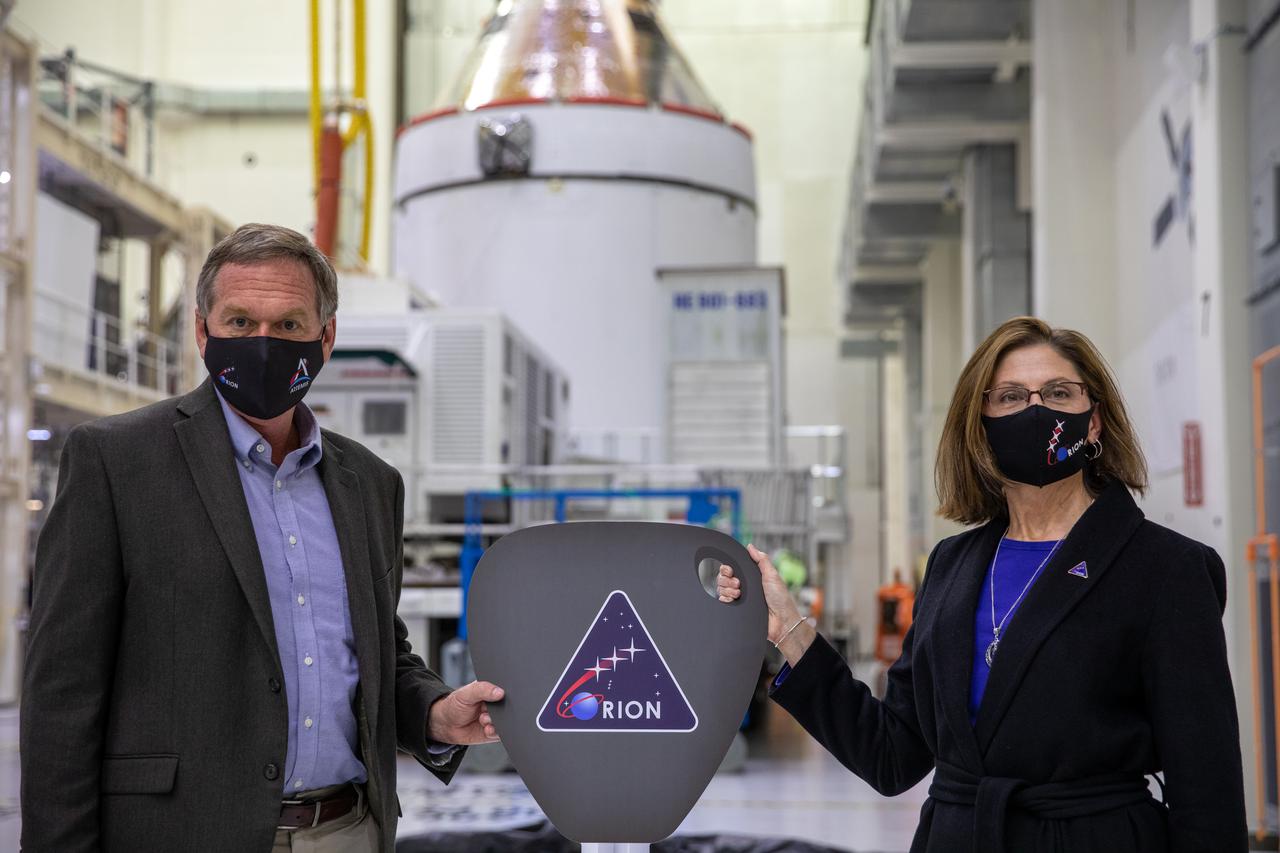
Orion is revealed for one of the final times on Jan. 14, as it is readied atop its transport pallet from the Neil Armstrong Operations and Checkout Building at NASA’s Kennedy Space Center in Florida, along its path to the pad ahead of the Artemis I launch. Mike Bolger, at left, manager of Exploration Ground Systems (EGS), receives the “key” to Orion from Cathy Koerner, Orion Program manager, signifying the transfer of the spacecraft from the assembly to the ground system processing team. Teams across the globe have worked tirelessly to assemble the spacecraft, which will receive a protective covering prior to departing for the Multi-Payload Processing Facility to begin ground processing by the EGS and Jacobs teams.
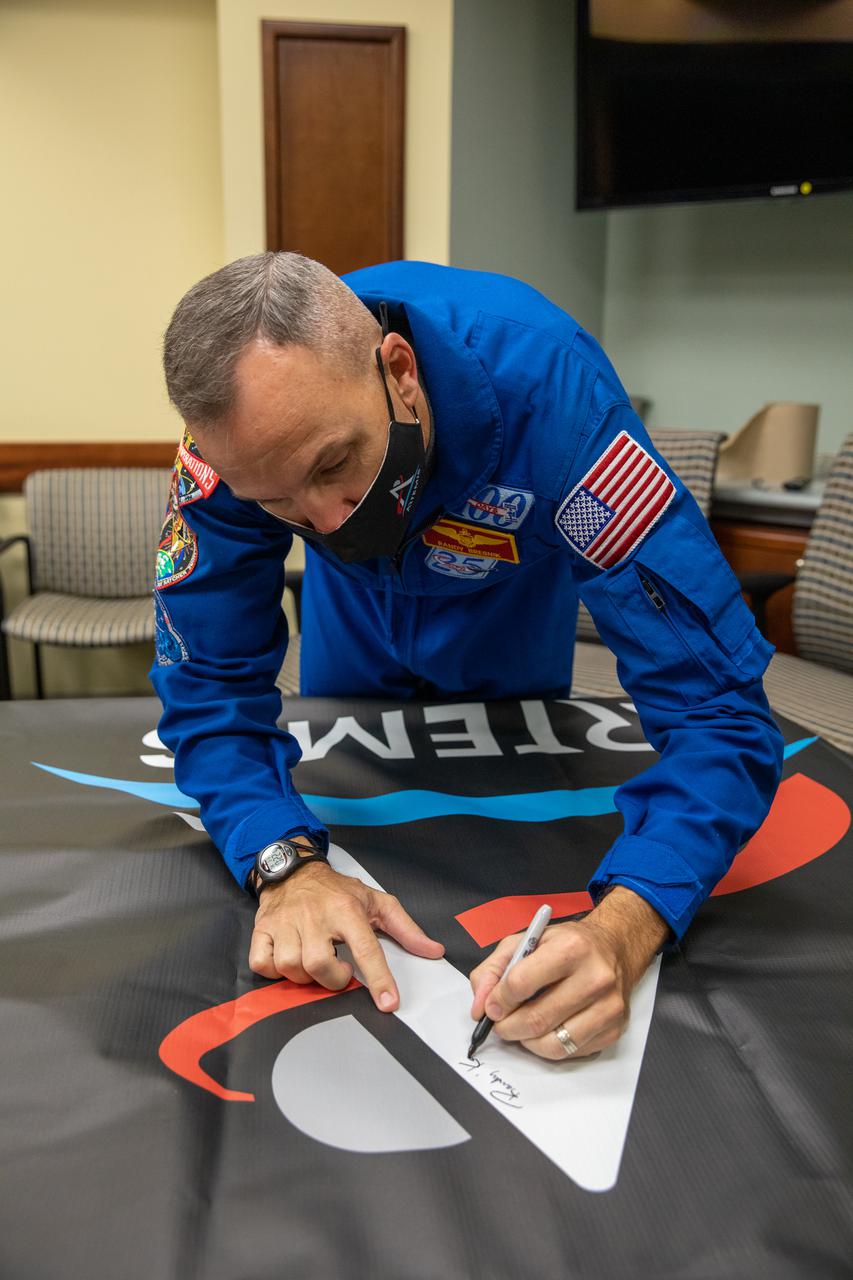
NASA astronaut Randy Bresnik signs an Artemis banner inside the Neil Armstrong Operations and Checkout Building at NASA’s Kennedy Space Center in Florida on Jan. 14, 2021. The banner will be hung on the KAMAG transporter ahead of the spacecraft’s journey to the Multi-Payload Processing Facility to begin ground processing by the Exploration Ground Systems and Jacobs teams.
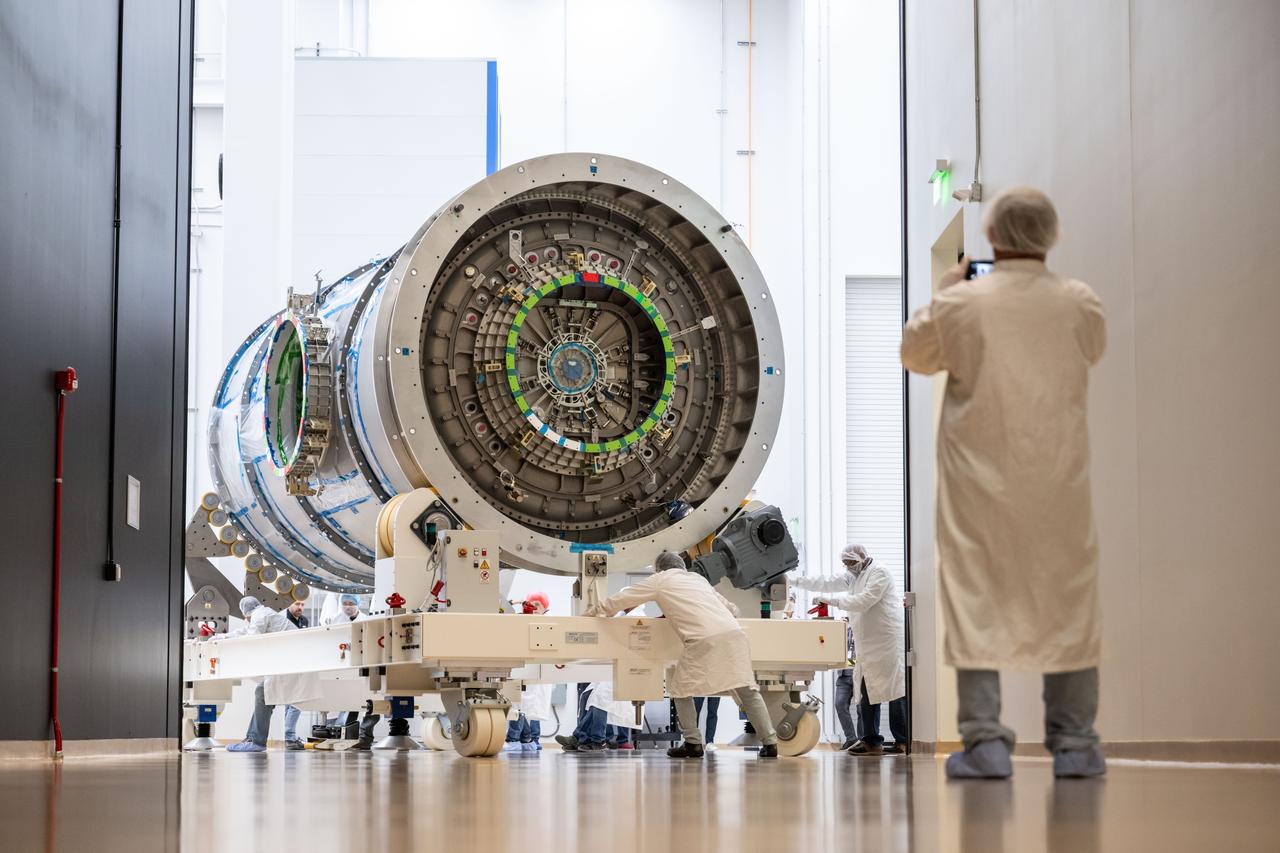
At Northrop Grumman’s Gilbert, Arizona, facility, teams transport Gateway’s HALO (Habitation and Logistics Outpost). HALO arrived from Turin, Italy, where Thales Alenia Space fabricated its primary structure. The module will undergo final outfitting in Gilbert before being integrated with the Power and Propulsion Element and launched to lunar orbit.
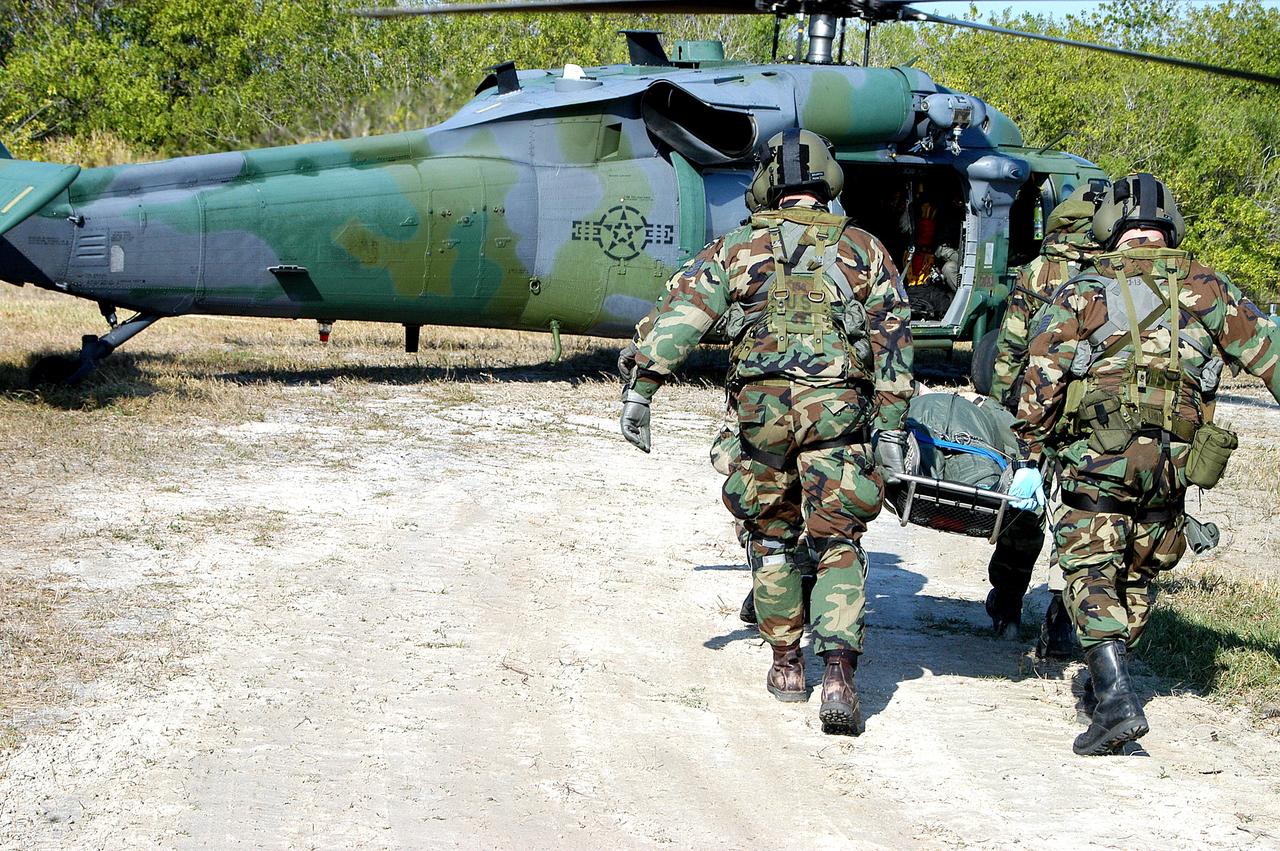
KENNEDY SPACE CENTER, FLA. - A rescue team carries an “injured” astronaut toward the helicopter for transportation to a local hospital. They are all taking part in a “Mode VII” emergency landing simulation at Kennedy Space Center. The purpose of the Mode VII is to exercise emergency preparedness personnel, equipment and facilities in rescuing astronauts from a downed orbiter and providing immediate medical attention. This simulation presents an orbiter that has crashed short of the Shuttle Landing Facility in a wooded area 2-1/2 miles south of Runway 33. Emergency crews are responding to the volunteer astronauts who are simulating various injuries inside the crew compartment mock-up. Rescuers must remove the crew, provide triage and transport to hospitals those who need further treatment. Local hospitals are participating in the exercise. Emergency crews are responding to the volunteer astronauts who are simulating various injuries inside the crew compartment mock-up. Rescuers must remove the crew, provide triage and transport to hospitals those who need further treatment. Local hospitals are participating in the exercise.
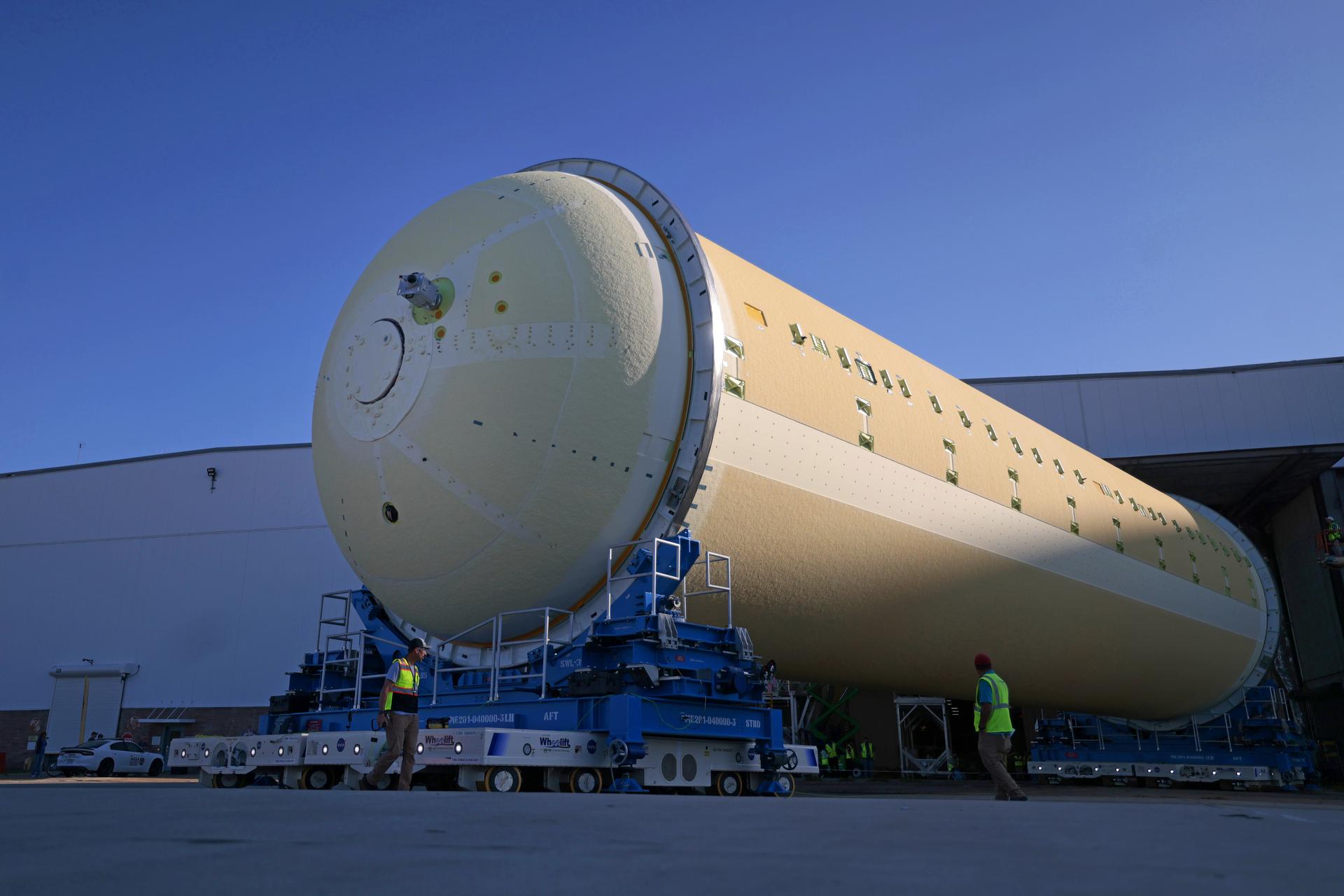
Teams at NASA’s Michoud Assembly Facility in New Orleans move a liquid hydrogen tank for the agency’s SLS (Space Launch System) rocket into the factory’s vertical assembly building on Sep. 26, 2025. The tank, which is designated for the agency’s Artemis III mission, is lifted and loaded into a production cell where it will be mated with the LH2 Transport Adapter Assembly for future transportation to NASA’s Kennedy Space Center. The engine section flight hardware structure was completed in 2022 and was shipped to Kennedy where teams continue to integrate vital systems. The propellant tank is one of five major elements that make up the 212-foot-tall rocket stage. The core stage, along with its four RS-25 engines, produce more than two million pounds of thrust to help launch NASA’s Orion spacecraft, astronauts, and supplies beyond Earth’s orbit and to the lunar surface for Artemis. Image credit: NASA/Michael DeMocker