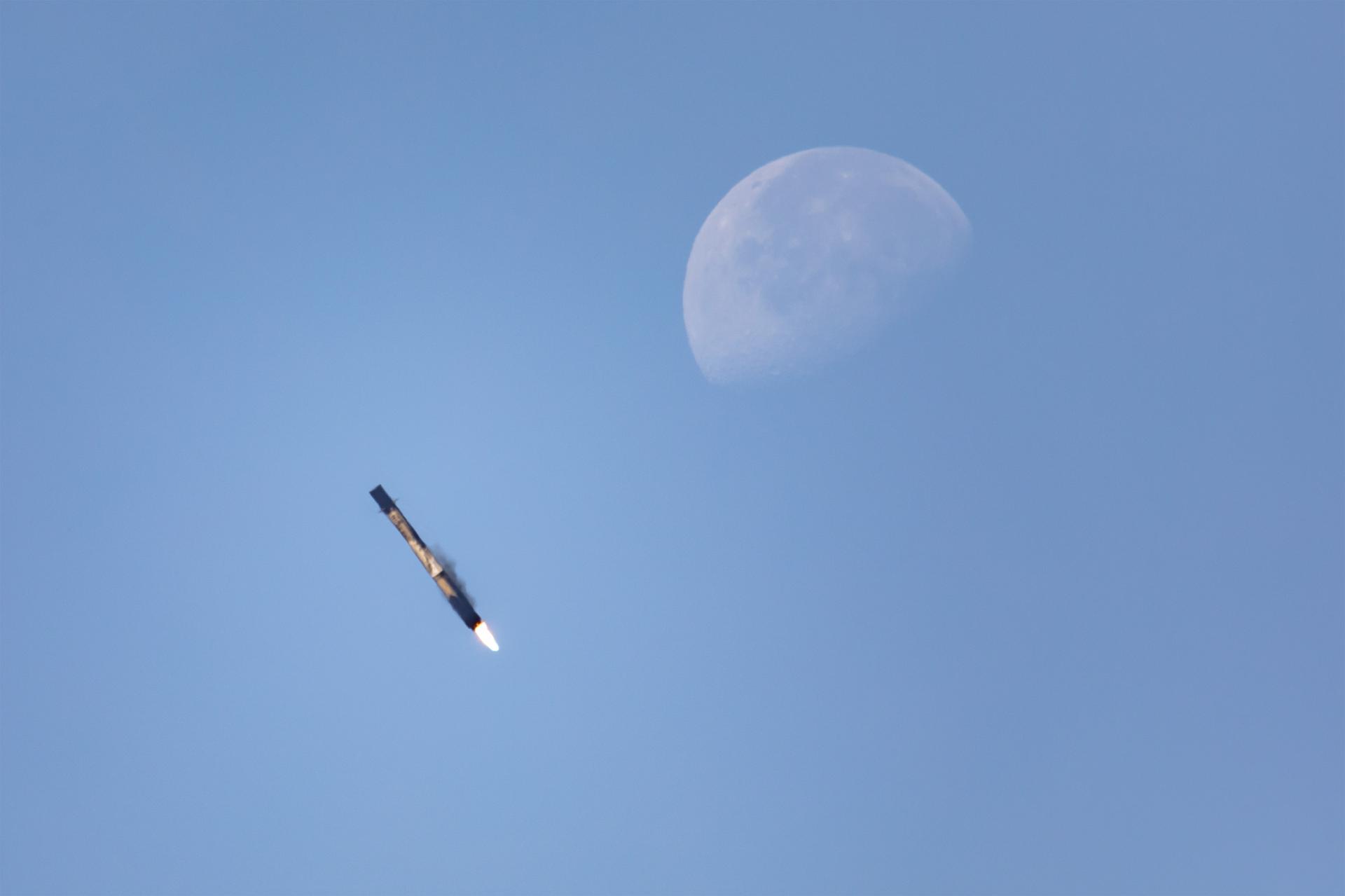
A SpaceX Falcon 9 rocket carrying three NASA-supported small spacecraft launched at 11:32 a.m. PDT Thursday, Oct. 1, 2026, as part of the company’s Transporter-18 mission from Space Launch Complex 4 East at Vandenberg Space Force Base in California. The ASCENT Propulsion Dual Mode CubeSat, the Supernova Remnants and Proxies for ReIonization Testbed Experiment (SPRITE) CubeSat, and the Small Spacecraft Propulsion and Inspection Capability (SSPICY) mission will demonstrate new propulsion technologies, study how galactic dust and high-energy radiation move through galaxies, and advance capabilities for inspecting inactive satellites.
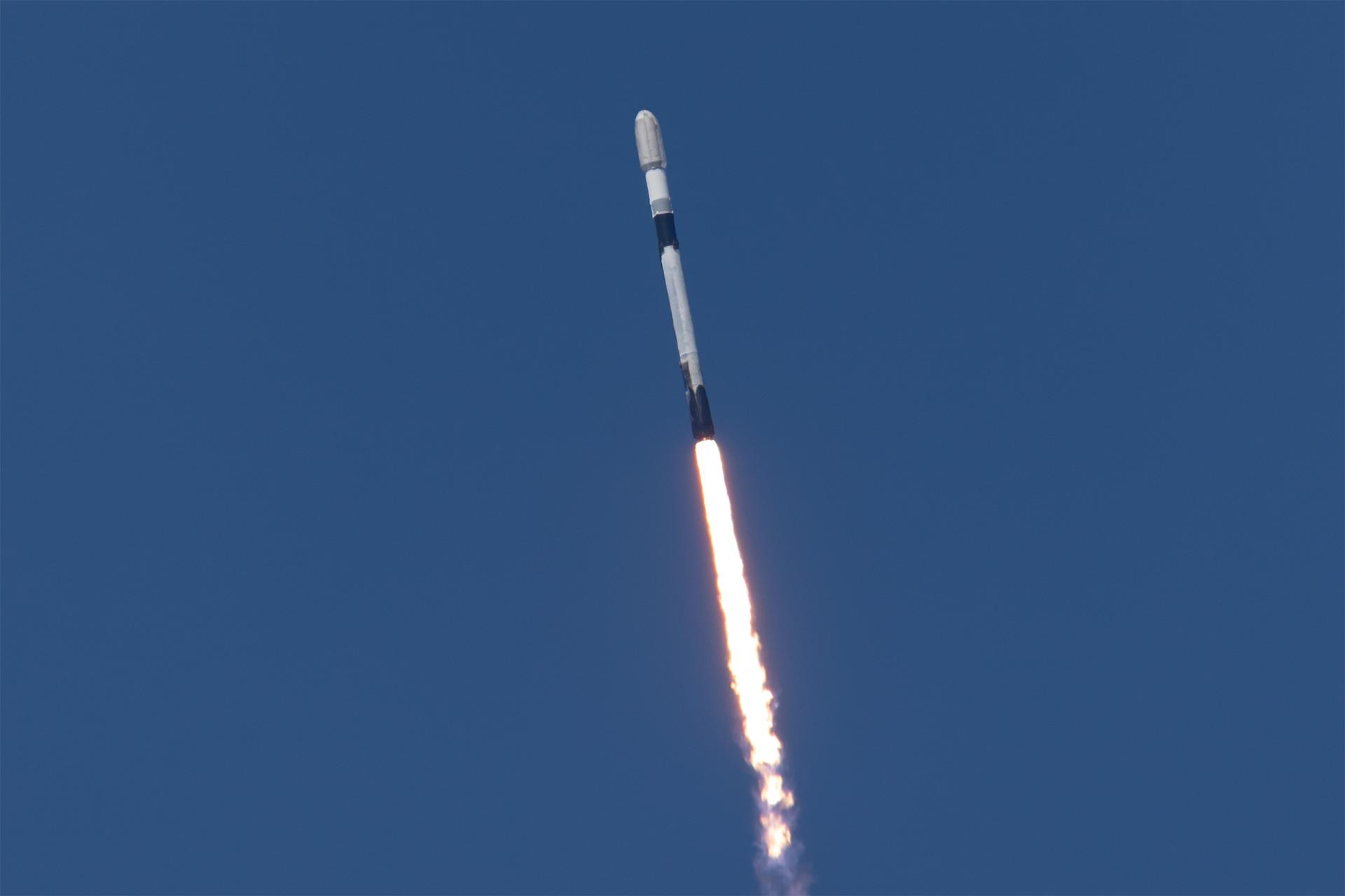
A SpaceX Falcon 9 rocket carrying three NASA-supported small spacecraft launched at 11:32 a.m. PDT Thursday, Oct. 1, 2026, as part of the company’s Transporter-18 mission from Space Launch Complex 4 East at Vandenberg Space Force Base in California. The ASCENT Propulsion Dual Mode CubeSat, the Supernova Remnants and Proxies for ReIonization Testbed Experiment (SPRITE) CubeSat, and the Small Spacecraft Propulsion and Inspection Capability (SSPICY) mission will demonstrate new propulsion technologies, study how galactic dust and high-energy radiation move through galaxies, and advance capabilities for inspecting inactive satellites.
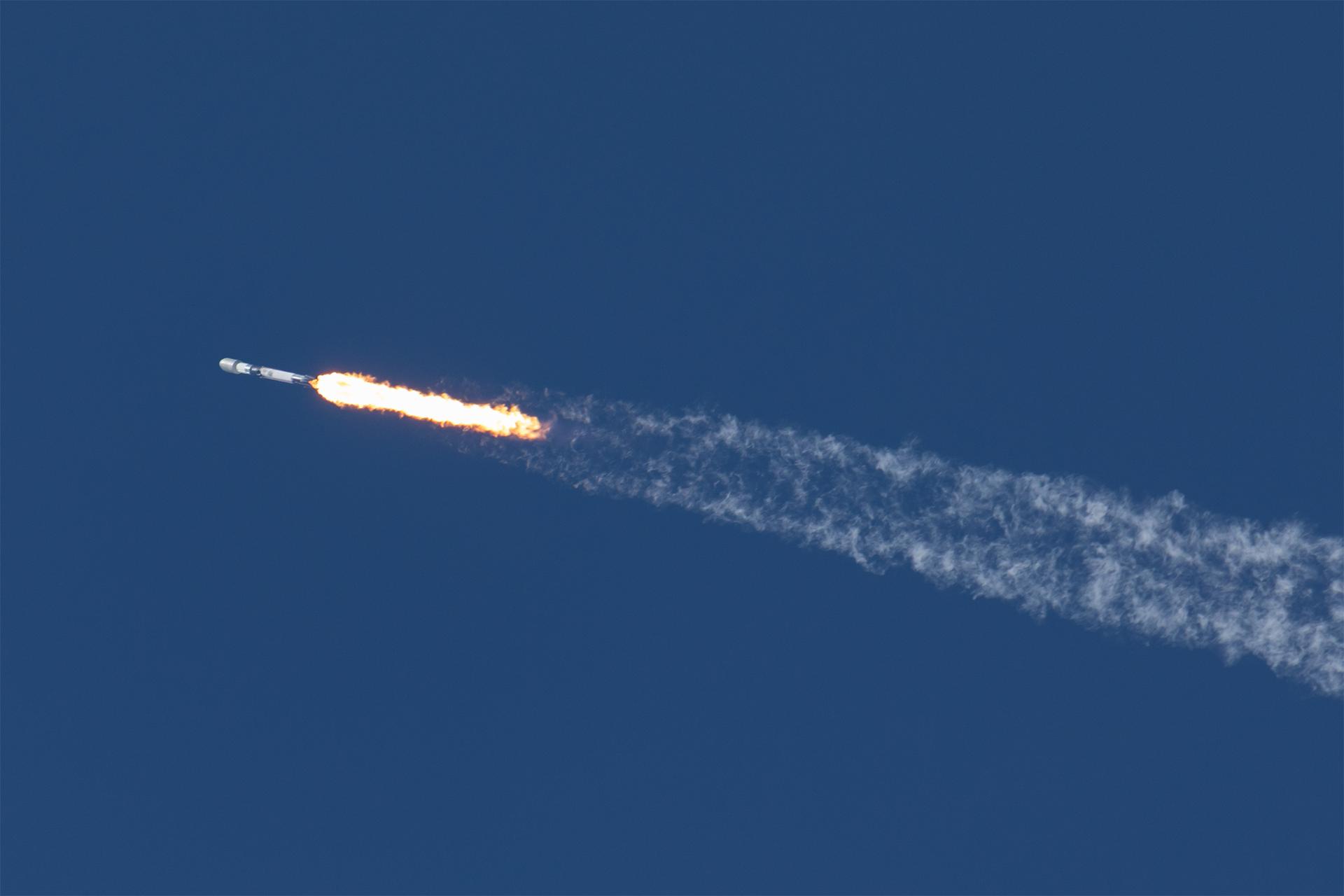
A SpaceX Falcon 9 rocket carrying three NASA-supported small spacecraft launched at 11:32 a.m. PDT Thursday, Oct. 1, 2026, as part of the company’s Transporter-18 mission from Space Launch Complex 4 East at Vandenberg Space Force Base in California. The ASCENT Propulsion Dual Mode CubeSat, the Supernova Remnants and Proxies for ReIonization Testbed Experiment (SPRITE) CubeSat, and the Small Spacecraft Propulsion and Inspection Capability (SSPICY) mission will demonstrate new propulsion technologies, study how galactic dust and high-energy radiation move through galaxies, and advance capabilities for inspecting inactive satellites.
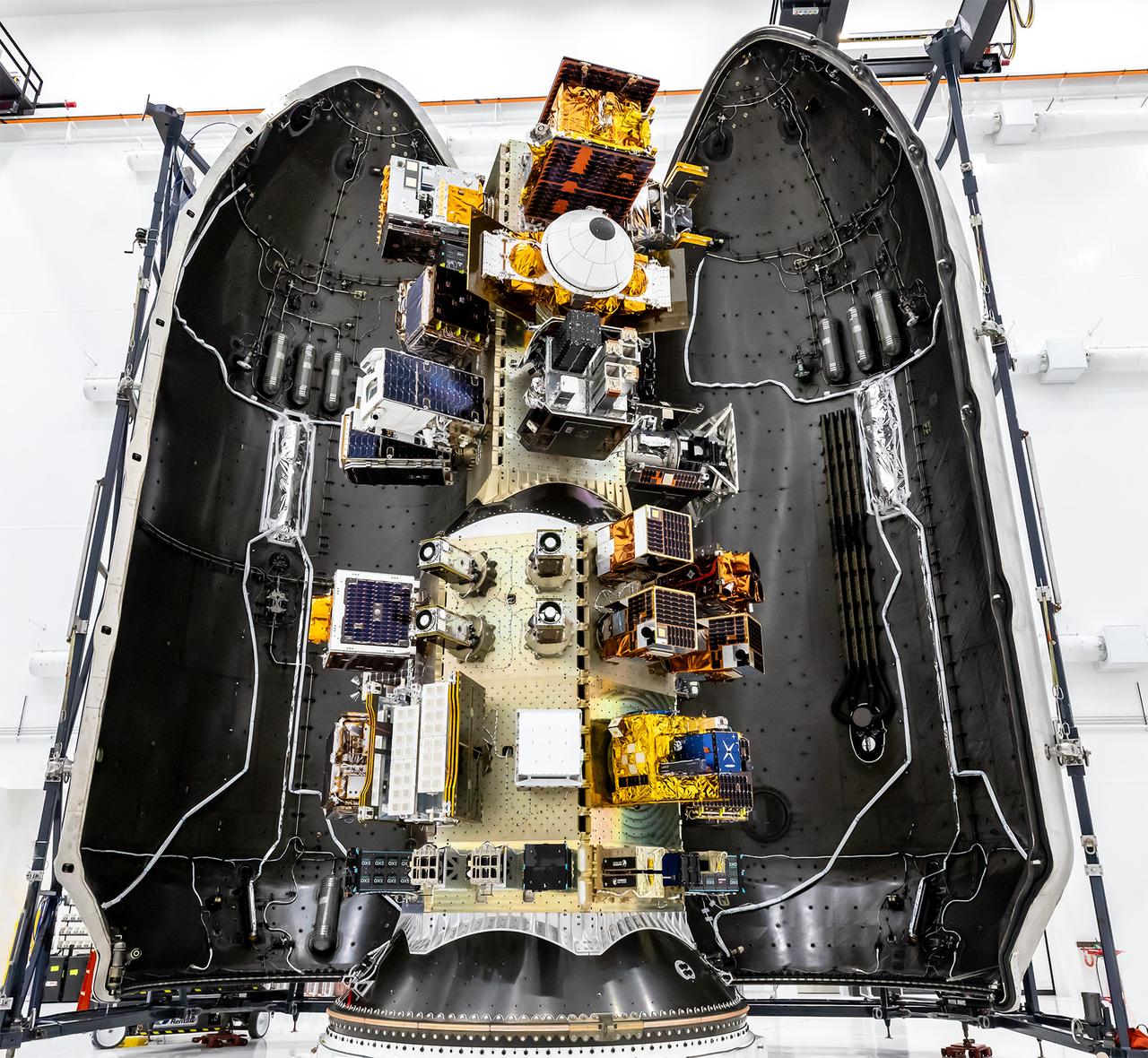
Three NASA-supported small spacecraft, shown along with many commercial payloads, before being encapsulated in a SpaceX Falcon 9. The rocket launched the payloads into low-Earth orbit at 11:32 a.m. PDT Thursday, Oct. 1, 2026, as part of the company’s Transporter-18 mission from Space Launch Complex 4 East at Vandenberg Space Force Base in California. The ASCENT Propulsion Dual Mode CubeSat, the Supernova Remnants and Proxies for ReIonization Testbed Experiment (SPRITE) CubeSat, and the Small Spacecraft Propulsion and Inspection Capability (SSPICY) mission will demonstrate new propulsion technologies, study how galactic dust and high-energy radiation move through galaxies, and advance capabilities for inspecting inactive satellites.
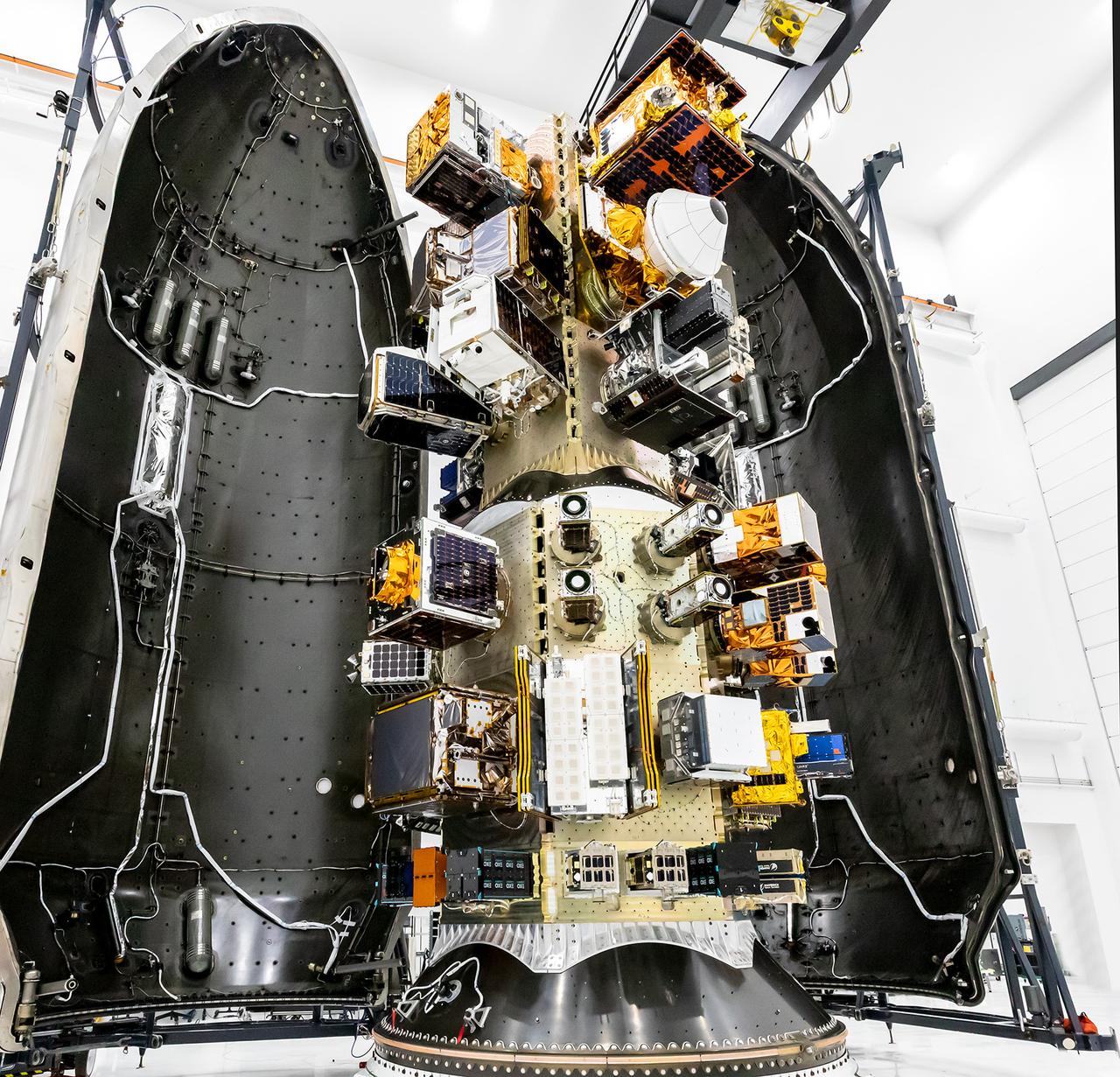
Three NASA-supported small spacecraft, shown along with many commercial payloads, before being encapsulated in a SpaceX Falcon 9. The rocket launched the payloads into low-Earth orbit at 11:32 a.m. PDT Thursday, Oct. 1, 2026, as part of the company’s Transporter-18 mission from Space Launch Complex 4 East at Vandenberg Space Force Base in California. The ASCENT Propulsion Dual Mode CubeSat, the Supernova Remnants and Proxies for ReIonization Testbed Experiment (SPRITE) CubeSat, and the Small Spacecraft Propulsion and Inspection Capability (SSPICY) mission will demonstrate new propulsion technologies, study how galactic dust and high-energy radiation move through galaxies, and advance capabilities for inspecting inactive satellites.
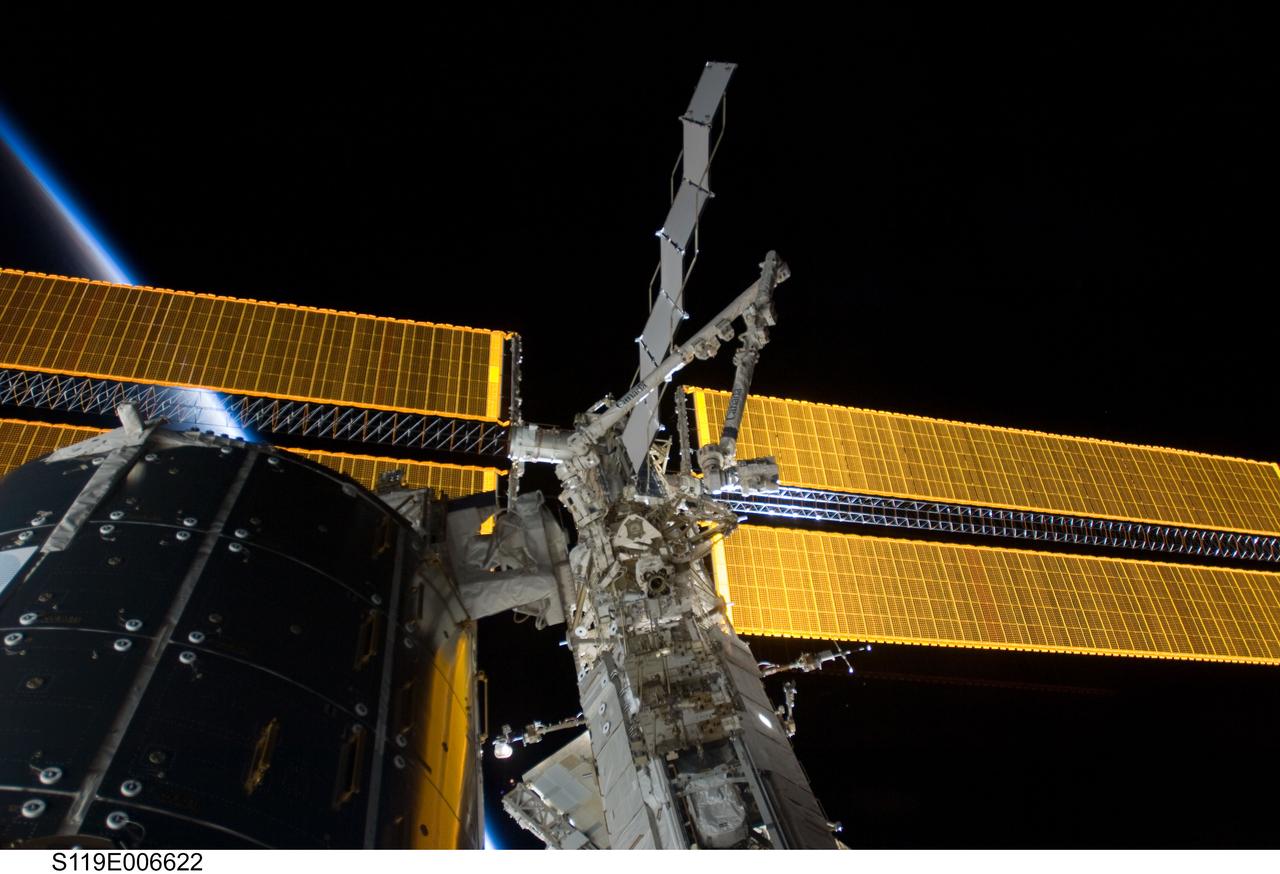
View of the Space Station Remote Manipulator System (SSRMS) on the Mobile Transporter (MT) for S6 Relocation OPS during STS-119 / Expedition 18 joint docked OPS. The MT is on the S1 Truss segment.
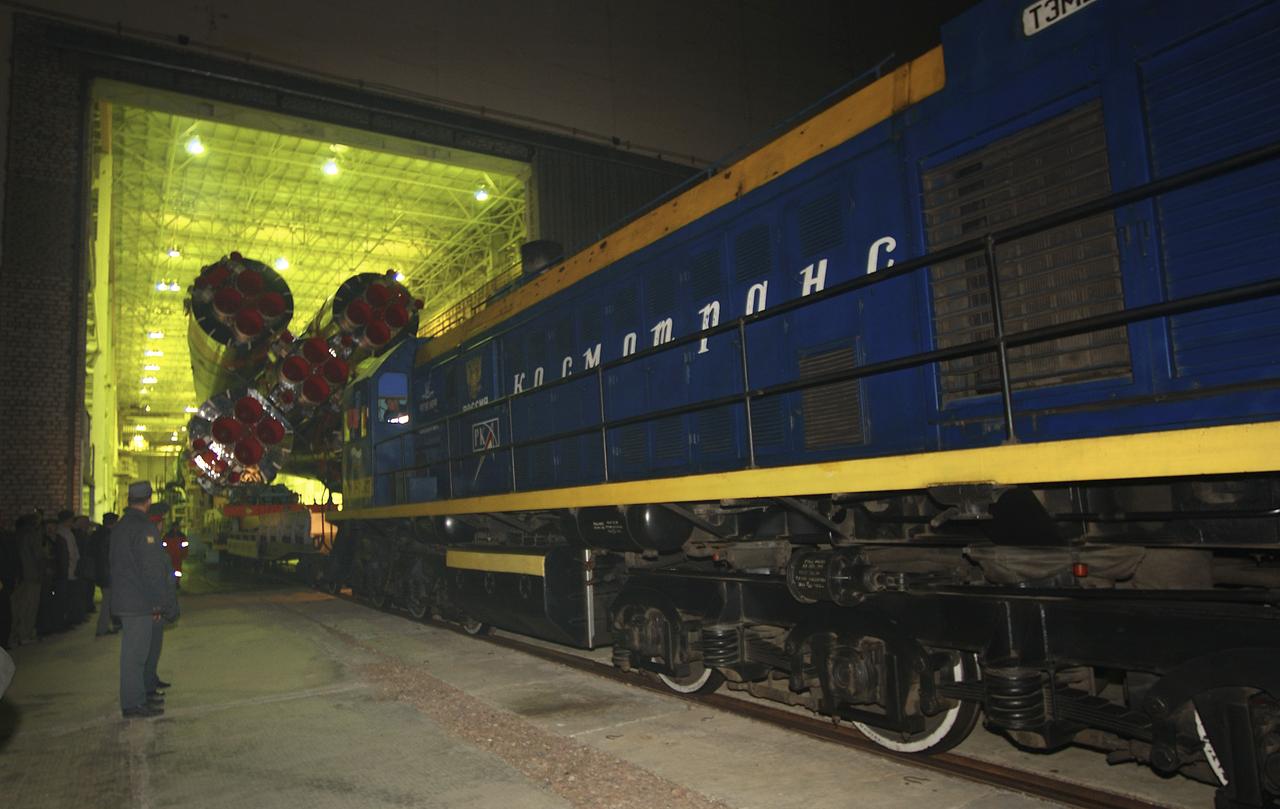
A Soyuz TMA-3 spacecraft and its booster rocket is seen, Thursday, Oct. 16, 2003, on a rail car to be transported to the launch pad and raised to its vertical launch position at the Baikonur Cosmodrome, Kazakhstan in preparation for liftoff Oct. 18, 2003. Photo Credit (NASA/Bill Ingalls)
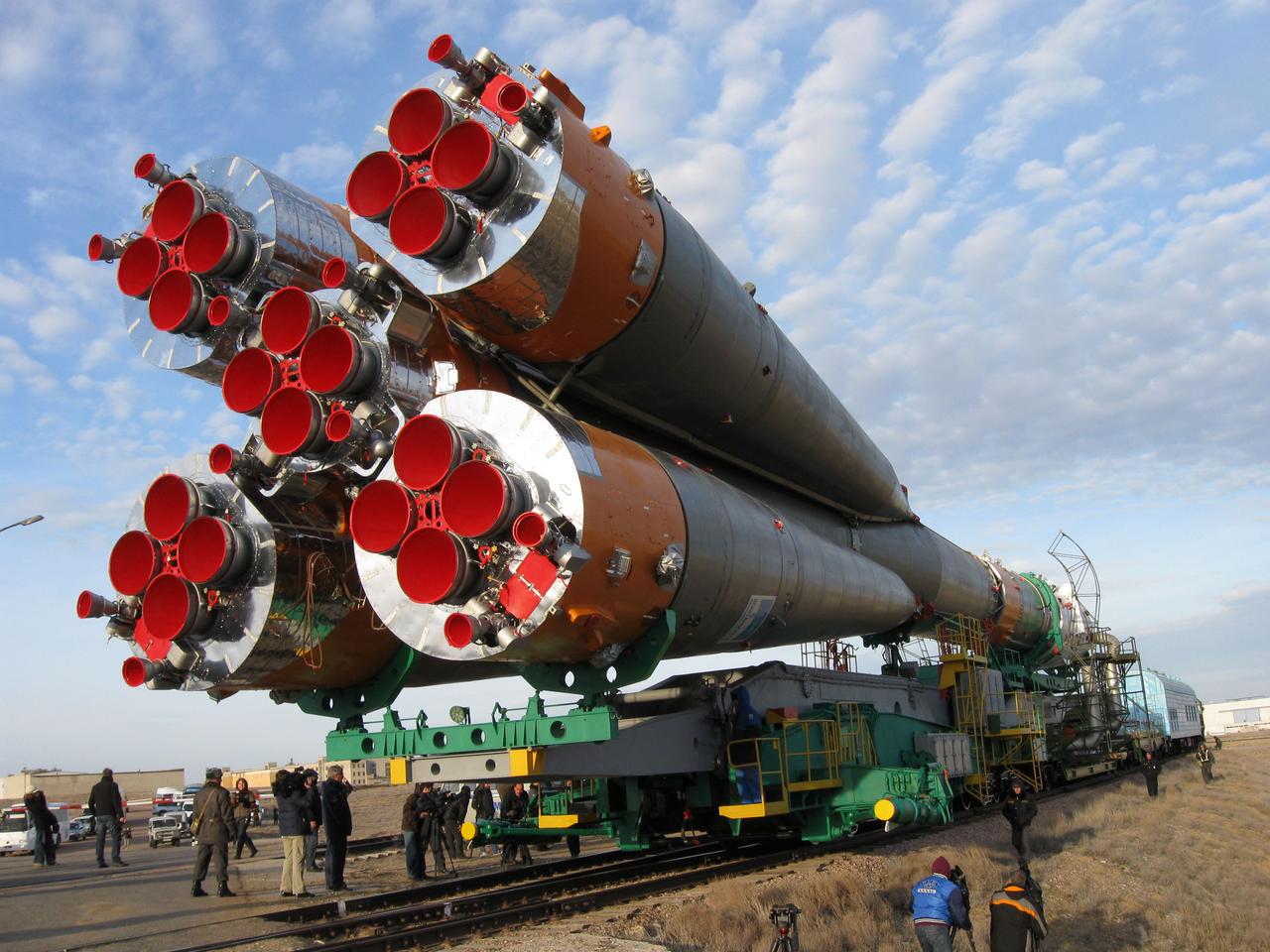
The Soyuz TMA-18 spacecraft and its booster rocket are hauled to the launch pad through the barren Baikonur Cosmodrome in Kazakhstan March 31, 2010 for launch April 2 to transport Expedition 23 crewmates Alexander Skvortsov, Mikhail Kornienko and Tracy Caldwell Dyson to the International Space Station.
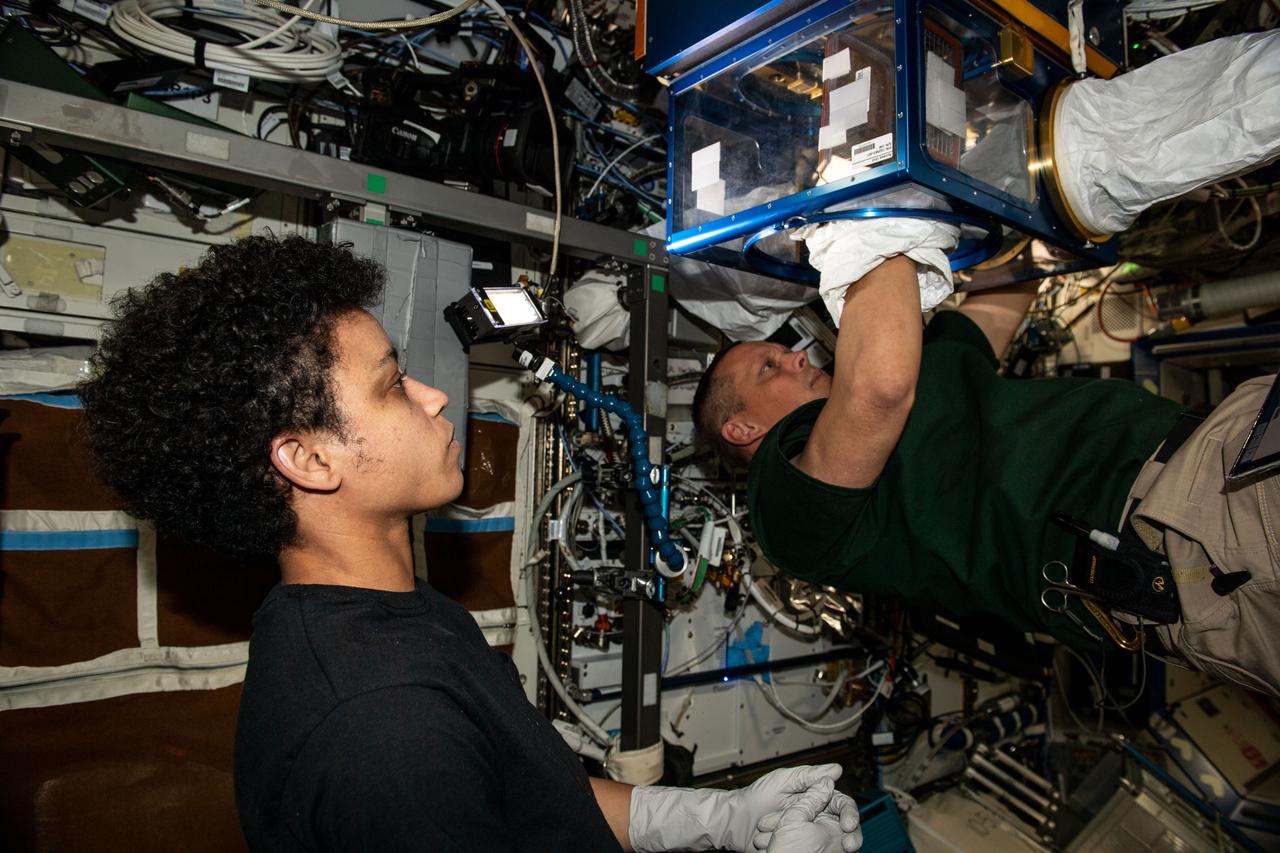
iss067e189949 (July 18, 2022) --- NASA's Expedition 67 Flight Engineers Jessica Watkins and Bob Hines transport research gear and samples from the SpaceX Dragon resupply ship into the U.S. Destiny laboratory module. The duo then activated an experiment to explore how microgravity affects the skin healing process.
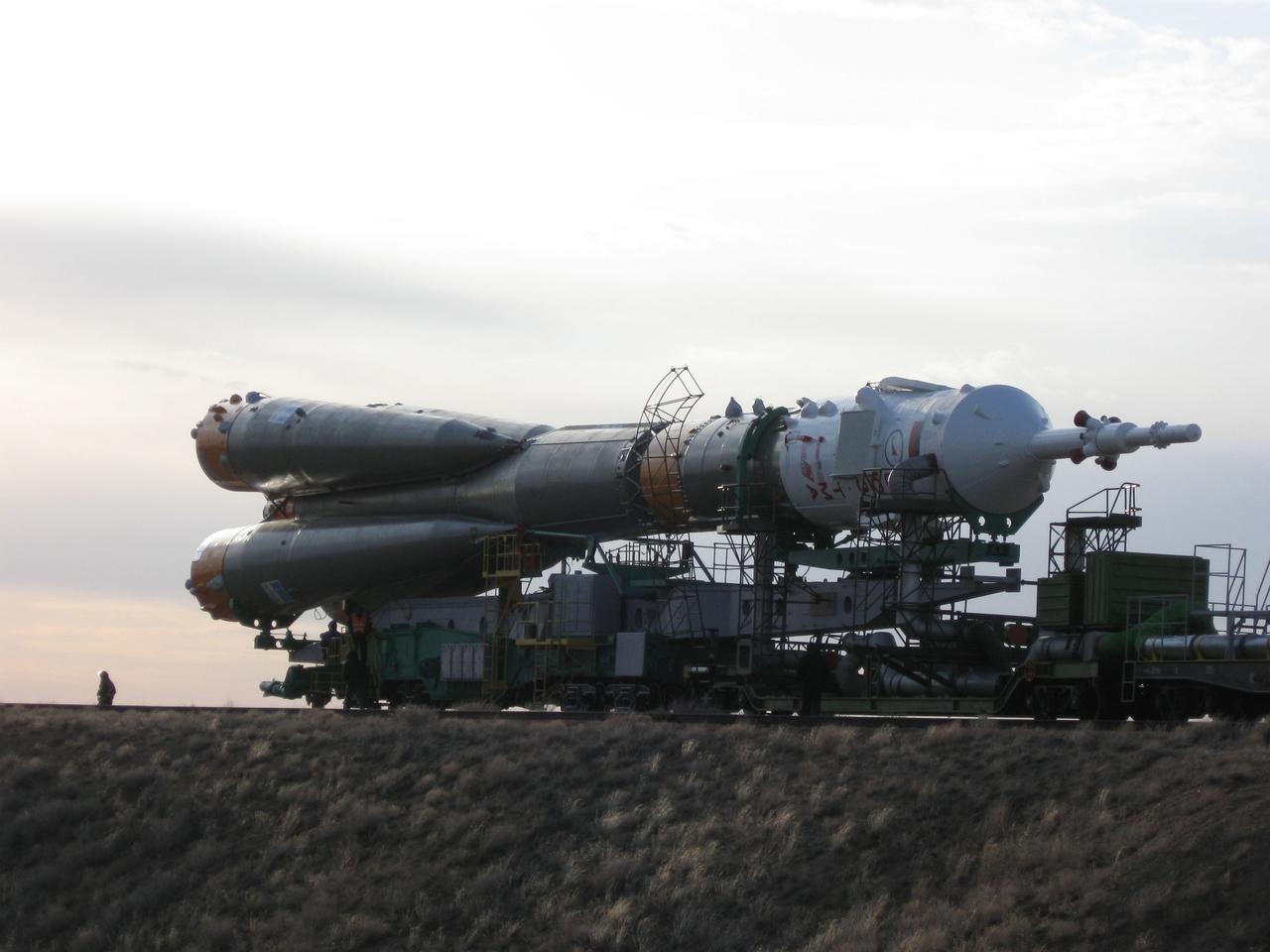
The Soyuz TMA-18 spacecraft and its booster rocket are hauled to the launch pad through the barren Baikonur Cosmodrome in Kazakhstan March 31, 2010 for launch April 2 to transport Expedition 23 crewmates Alexander Skvortsov, Mikhail Kornienko and Tracy Caldwell Dyson to the International Space Station.
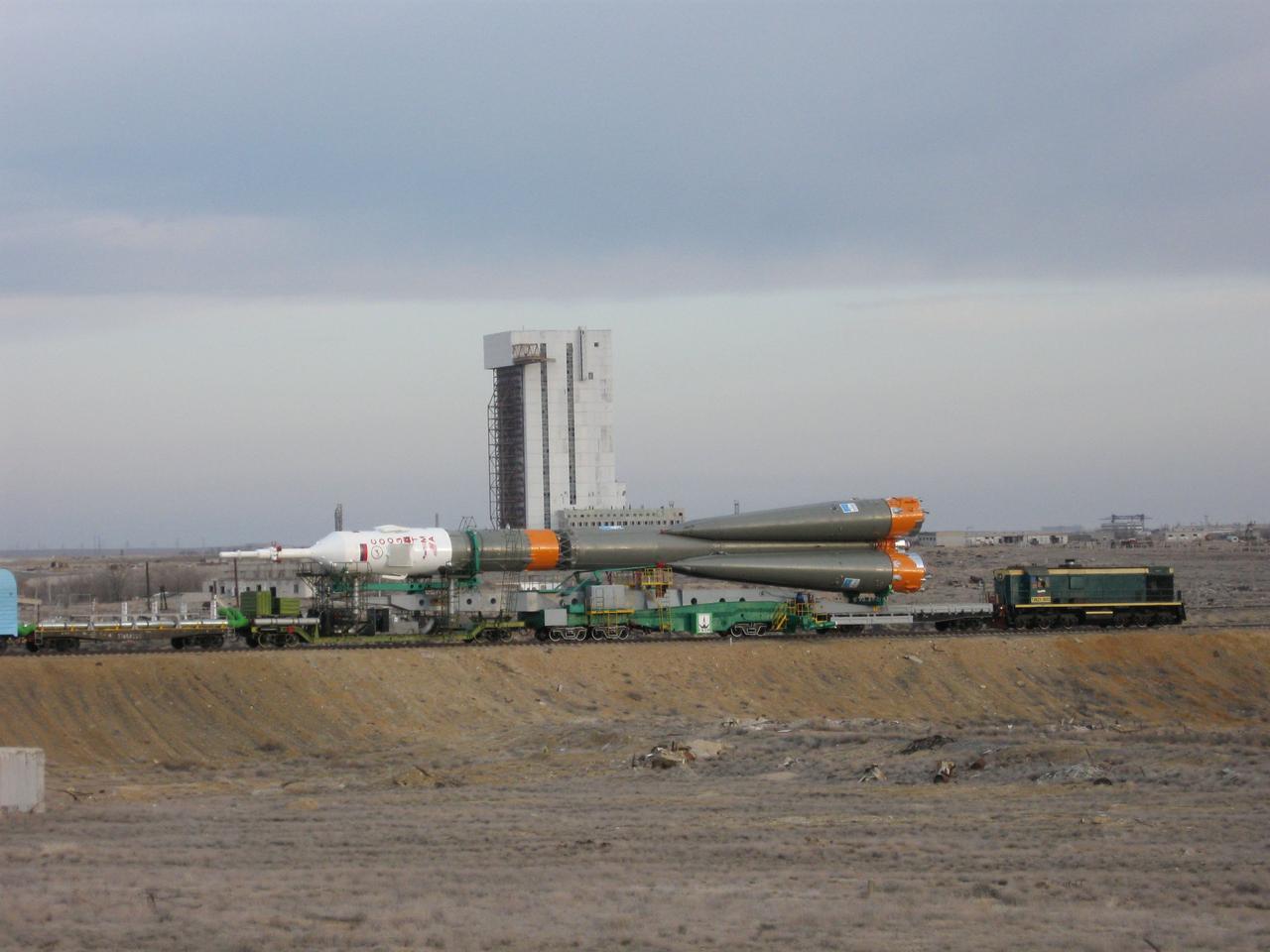
The Soyuz TMA-18 spacecraft and its booster rocket are hauled to the launch pad through the barren Baikonur Cosmodrome in Kazakhstan March 31, 2010 for launch April 2 to transport Expedition 23 crewmates Alexander Skvortsov, Mikhail Kornienko and Tracy Caldwell Dyson to the International Space Station.
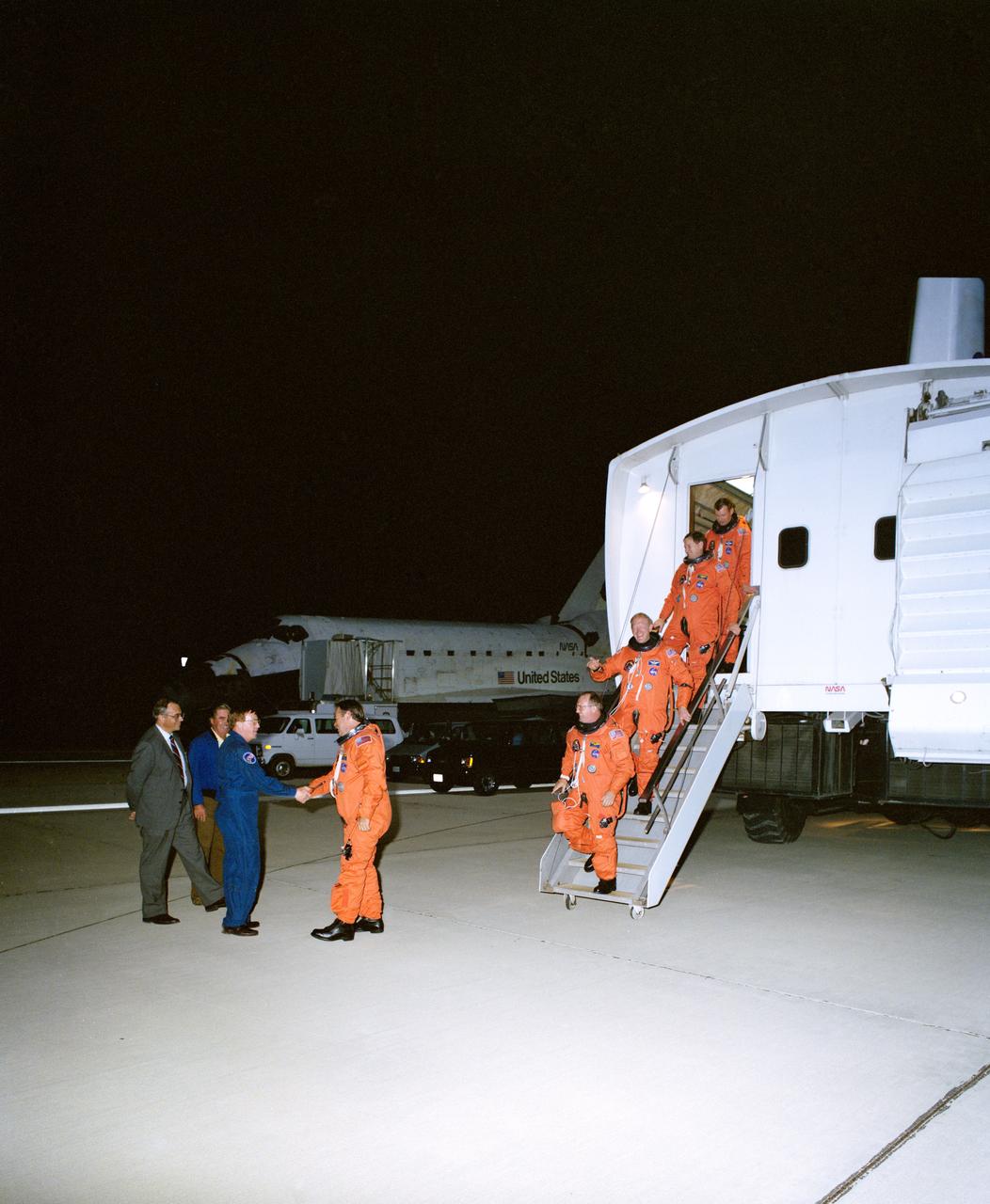
STS048-S-180 (18 Sept 1991) --- Having just completed a successful six day mission in Earth orbit, the five astronaut crewmembers for NASA's STS-48 spaceflight egress the crew transport vehicle (CTV). Astronaut John O. Creighton shakes hands with astronaut Richard N. Richards, who had earlier flown a NASA aircraft for weather checkout in the landing area. Following the mission commander are astronauts James F. Buchli, Charles D. (Sam) Gemar, Kenneth S. Reightler and Mark N. Brown. Discovery can be seen in the background. The Edwards Air Force Base landing occurred at 12:38:38 a.m. (PDT), September 18, 1991.
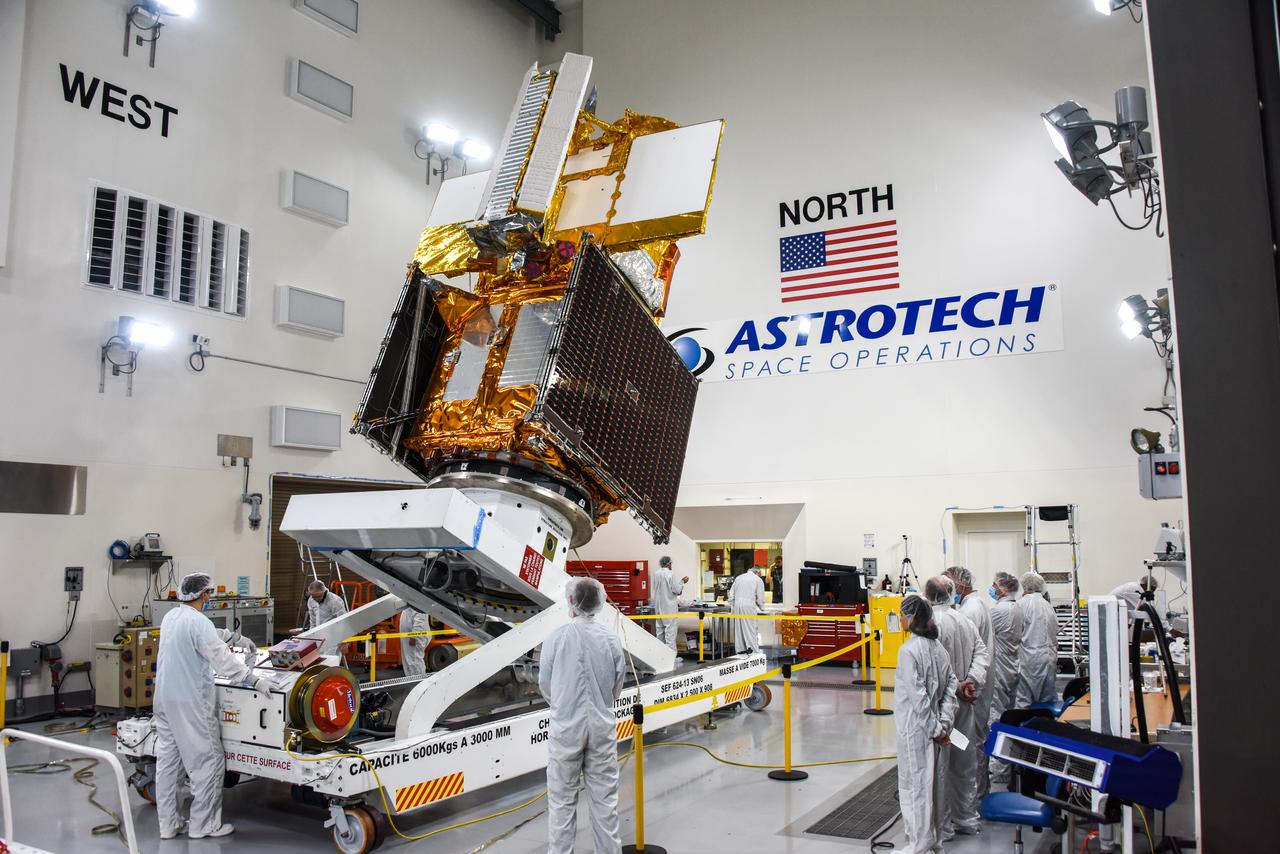
The Surface Water and Ocean Topography (SWOT) spacecraft is moved into a transport container inside the Astrotech facility at Vandenberg Space Force Base in California on Nov. 18, 2022. The satellite will be transported to the SpaceX facility at Vandenberg. SWOT is the first mission that will observe nearly all water on Earth’s surface, measuring the height of water in the planet’s lakes, rivers, reservoirs, and the ocean. It is set to launch aboard a SpaceX Falcon 9 rocket in December from Vandenberg’s Space Launch Center-4 East. NASA’s Launch Services Program, based at the agency’s Kennedy Space Center in Florida, is managing the launch service.
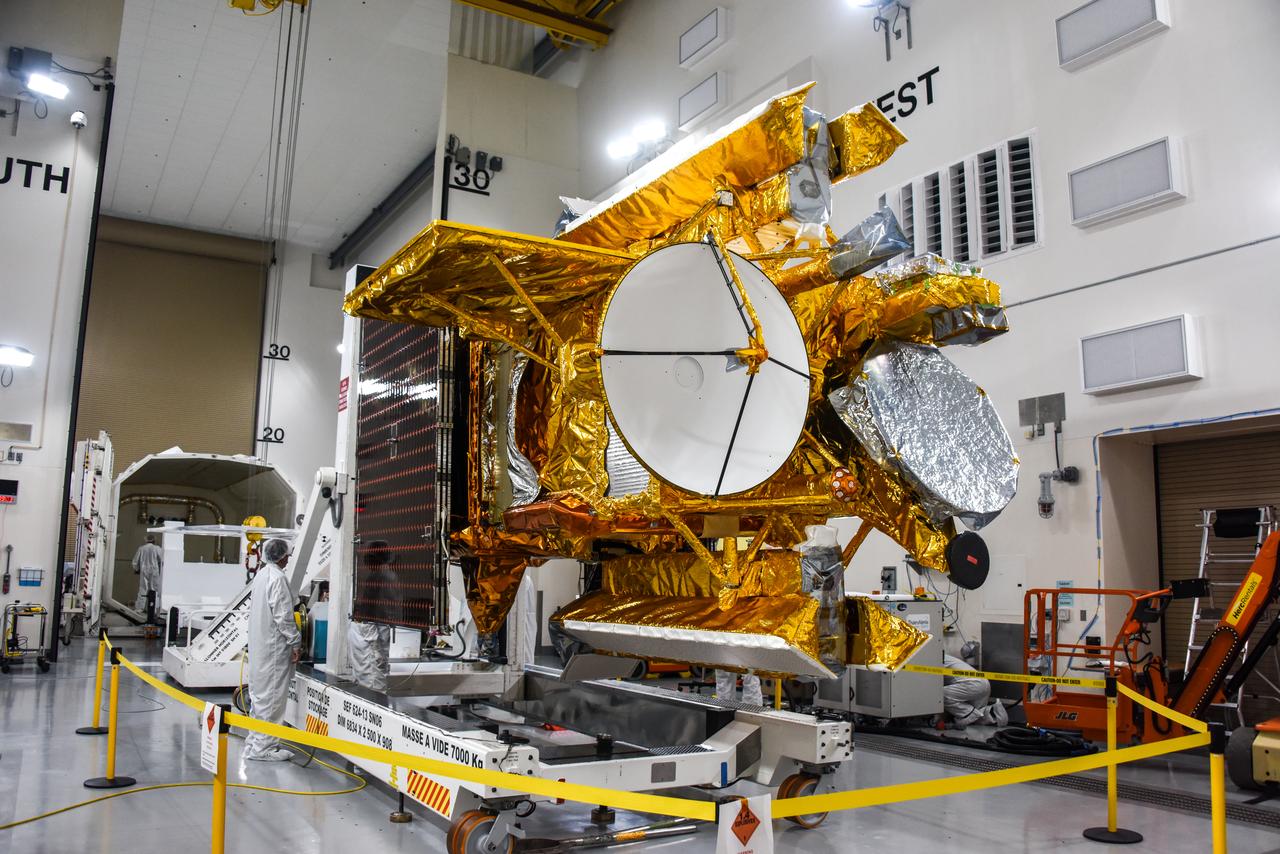
The Surface Water and Ocean Topography (SWOT) spacecraft is moved into a transport container inside the Astrotech facility at Vandenberg Space Force Base in California on Nov. 18, 2022. The satellite will be transported to the SpaceX facility at Vandenberg. SWOT is the first mission that will observe nearly all water on Earth’s surface, measuring the height of water in the planet’s lakes, rivers, reservoirs, and the ocean. It is set to launch aboard a SpaceX Falcon 9 rocket in December from Vandenberg’s Space Launch Center-4 East. NASA’s Launch Services Program, based at the agency’s Kennedy Space Center in Florida, is managing the launch service.
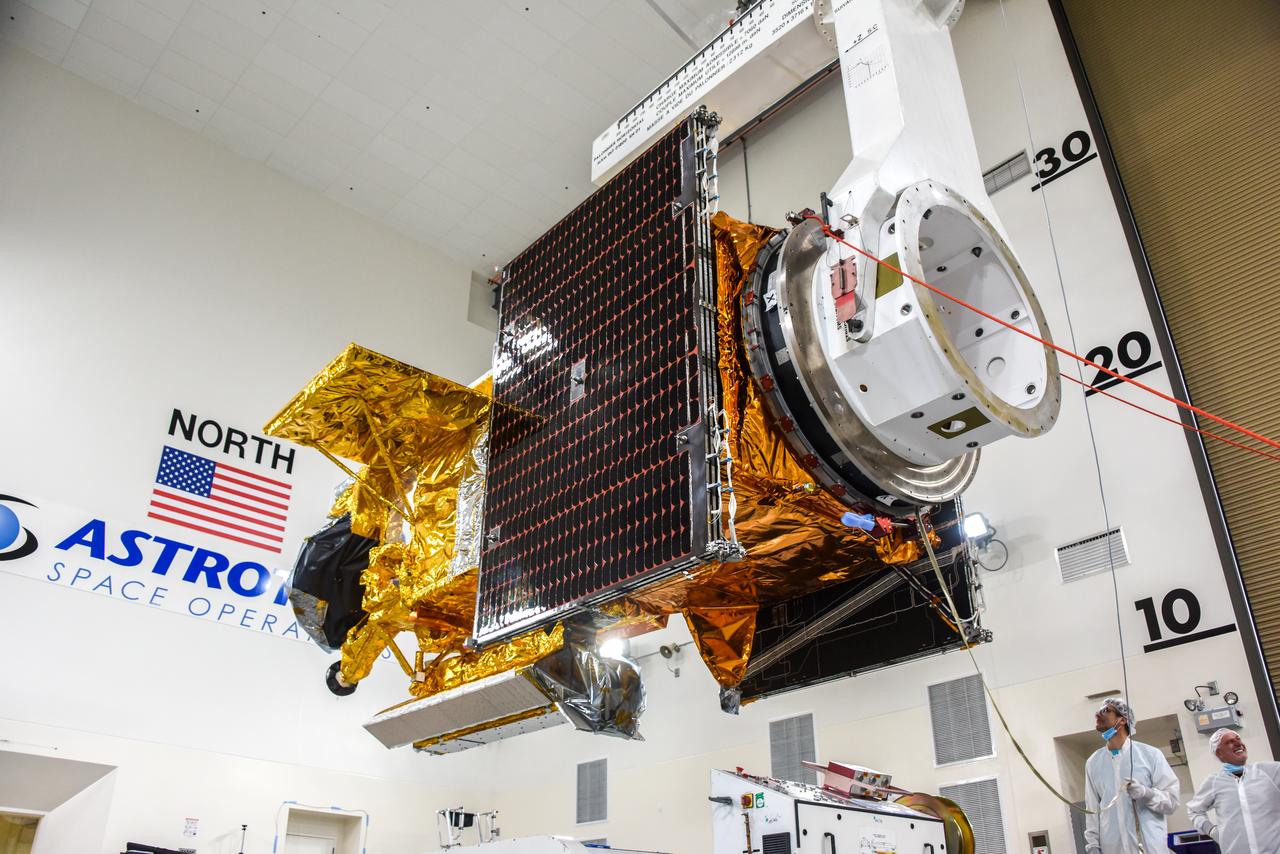
The Surface Water and Ocean Topography (SWOT) spacecraft is moved into a transport container inside the Astrotech facility at Vandenberg Space Force Base in California on Nov. 18, 2022. The satellite will be transported to the SpaceX facility at Vandenberg. SWOT is the first mission that will observe nearly all water on Earth’s surface, measuring the height of water in the planet’s lakes, rivers, reservoirs, and the ocean. It is set to launch aboard a SpaceX Falcon 9 rocket in December from Vandenberg’s Space Launch Center-4 East. NASA’s Launch Services Program, based at the agency’s Kennedy Space Center in Florida, is managing the launch service.
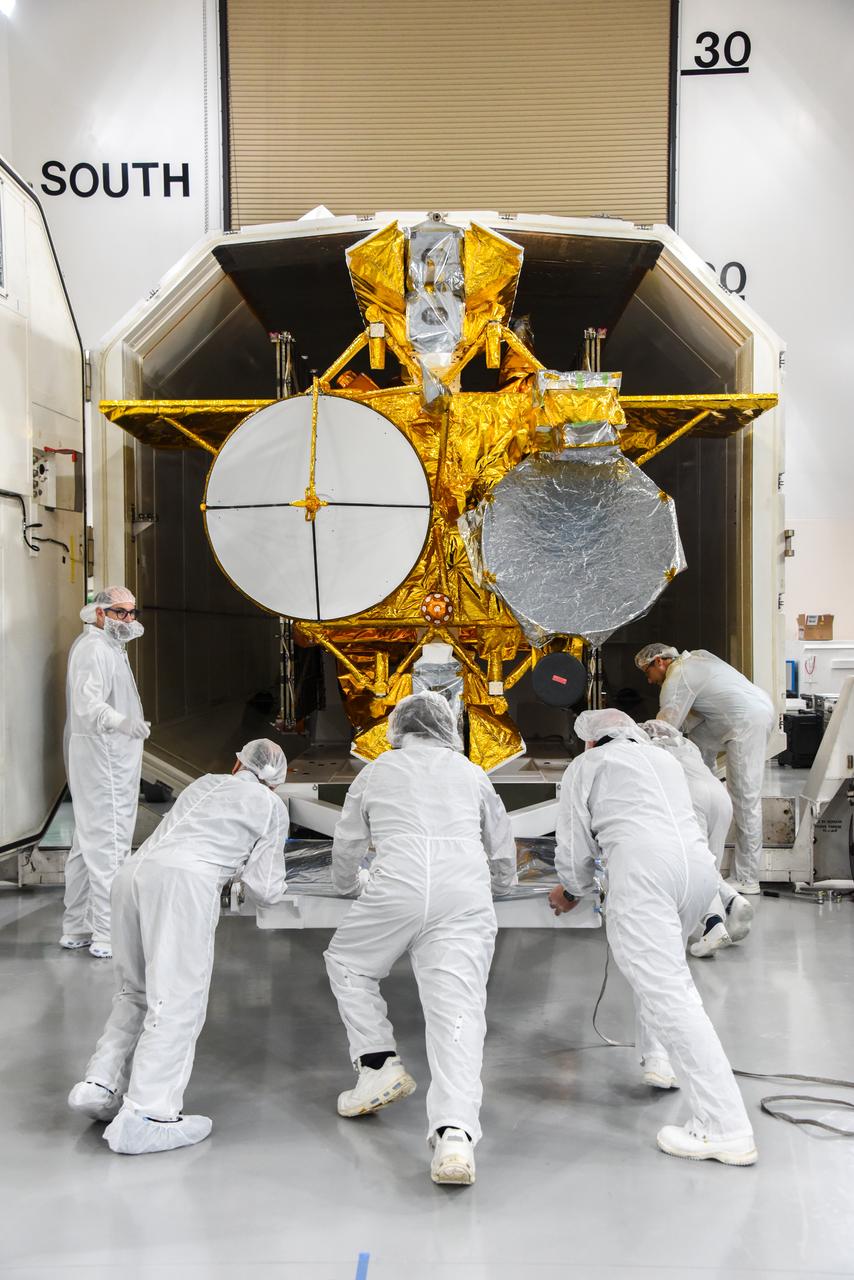
The Surface Water and Ocean Topography (SWOT) spacecraft is moved into a transport container inside the Astrotech facility at Vandenberg Space Force Base in California on Nov. 18, 2022. The satellite will be transported to the SpaceX facility at Vandenberg. SWOT is the first mission that will observe nearly all water on Earth’s surface, measuring the height of water in the planet’s lakes, rivers, reservoirs, and the ocean. It is set to launch aboard a SpaceX Falcon 9 rocket in December from Vandenberg’s Space Launch Center-4 East. NASA’s Launch Services Program, based at the agency’s Kennedy Space Center in Florida, is managing the launch service.
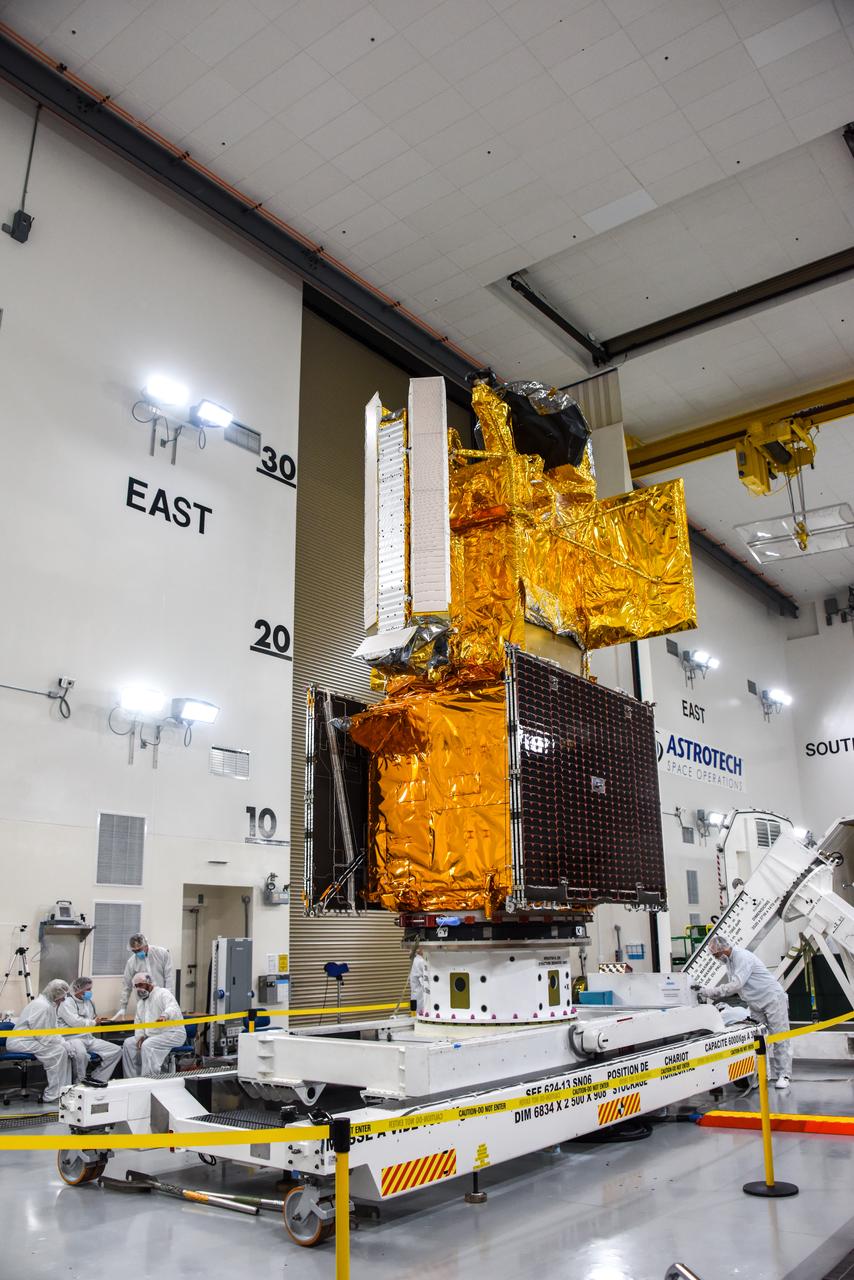
The Surface Water and Ocean Topography (SWOT) spacecraft is moved into a transport container inside the Astrotech facility at Vandenberg Space Force Base in California on Nov. 18, 2022. The satellite will be transported to the SpaceX facility at Vandenberg. SWOT is the first mission that will observe nearly all water on Earth’s surface, measuring the height of water in the planet’s lakes, rivers, reservoirs, and the ocean. It is set to launch aboard a SpaceX Falcon 9 rocket in December from Vandenberg’s Space Launch Center-4 East. NASA’s Launch Services Program, based at the agency’s Kennedy Space Center in Florida, is managing the launch service.
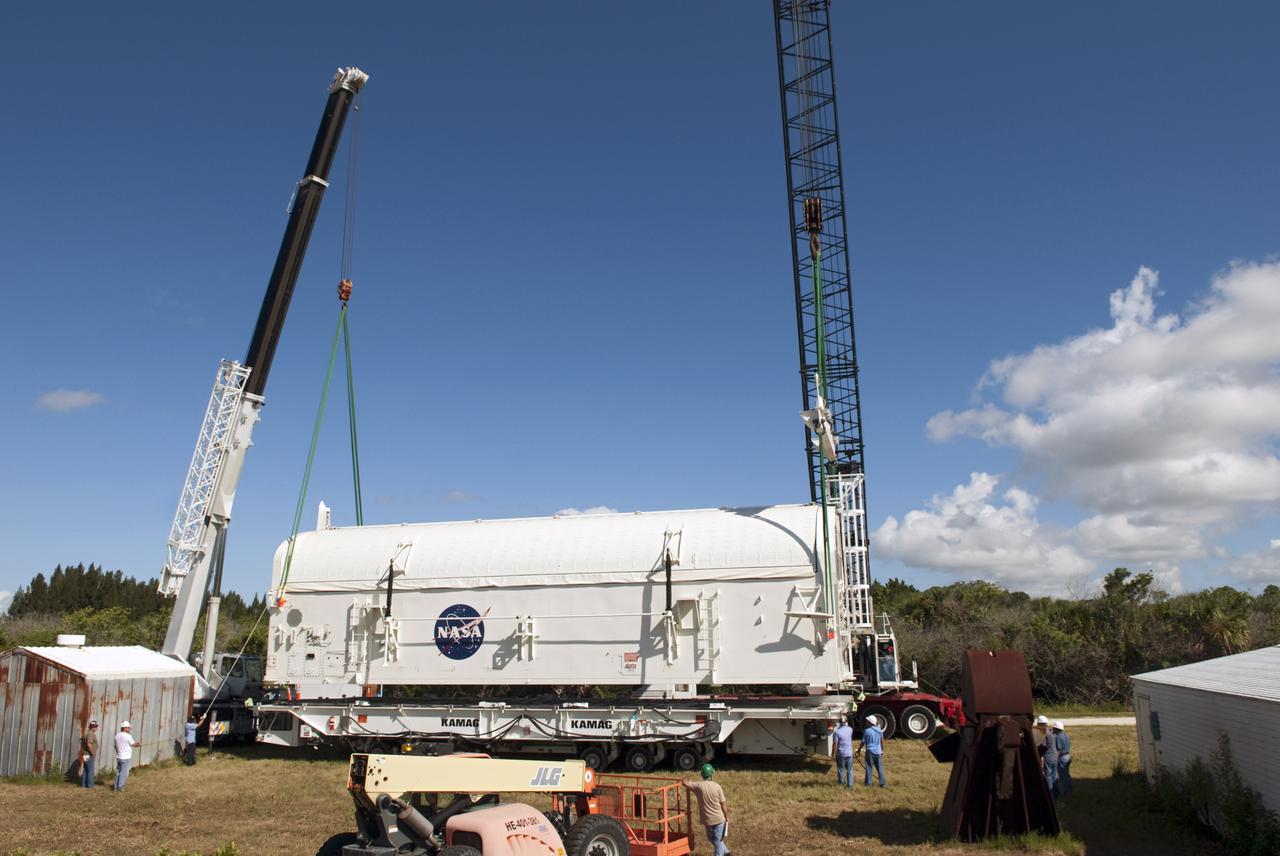
CAPE CANAVERAL, Fla. -- Cranes are attached to payload canister #1 to lift it from the transporter that delivered it to the Reutilization, Recycling and Marketing Facility on Ransom Road at NASA's Kennedy Space Center in Florida. The two payload canisters used to transport space shuttle payloads to the launch pad for installation in the shuttles' cargo bays are being decommissioned following the end of the Space Shuttle Program. Each canister weighs 110,000 pounds and is 65 feet long, 22 feet wide, and 18 feet, 7 inches high. The canisters were prescreened through NASA Headquarters as possible artifacts, but their size makes them difficult to transport to locations off the center. Federal and state agencies now will be given the opportunity to screen the canisters for potential use before a final decision is made on their disposition. For more information, visit http:__www.nasa.gov_centers_kennedy_pdf_167403main_CRF-06.pdf. Photo credit: NASA_Jim Grossmann
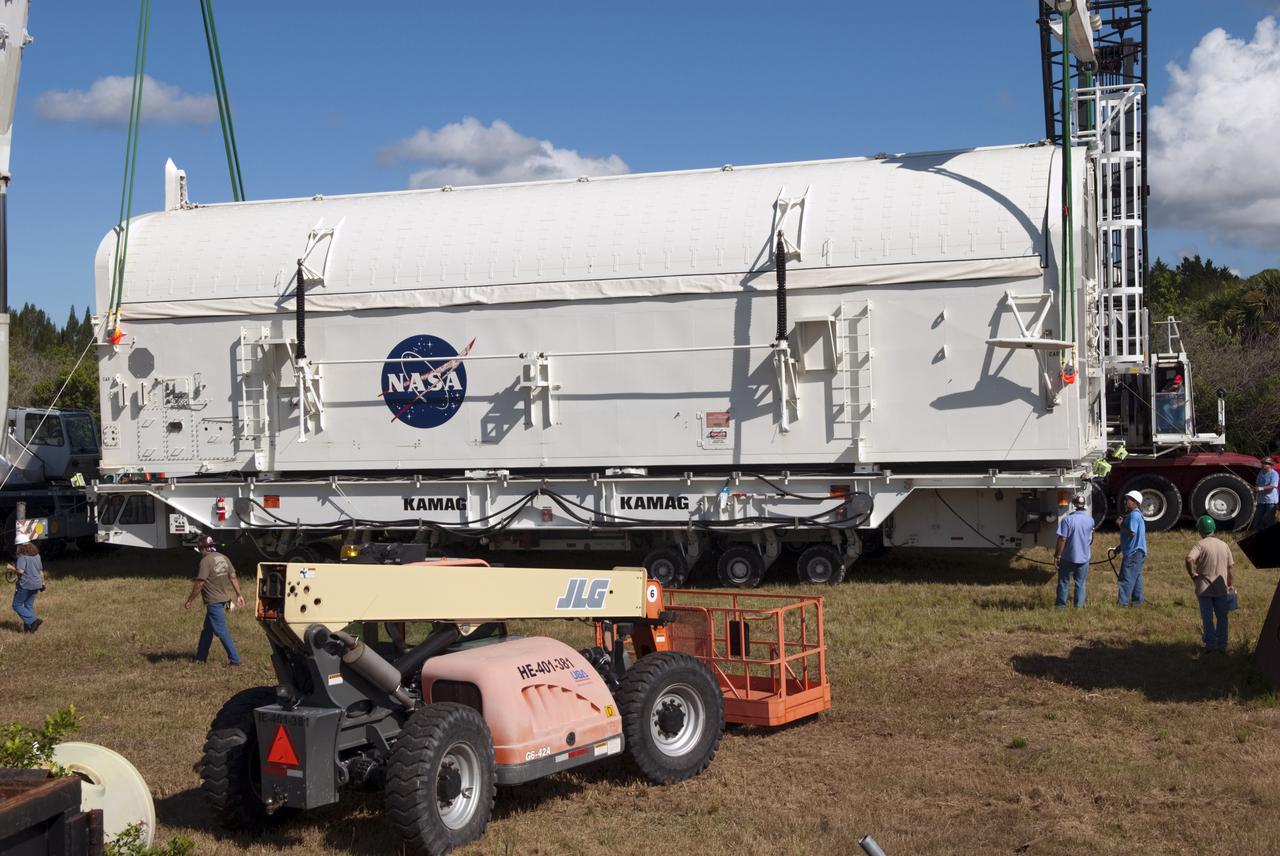
CAPE CANAVERAL, Fla. -- Preparations are under way to lift payload canister #1 from the transporter that delivered it to the Reutilization, Recycling and Marketing Facility on Ransom Road at NASA's Kennedy Space Center in Florida. The two payload canisters used to transport space shuttle payloads to the launch pad for installation in the shuttles' cargo bays are being decommissioned following the end of the Space Shuttle Program. Each canister weighs 110,000 pounds and is 65 feet long, 22 feet wide, and 18 feet, 7 inches high. The canisters were prescreened through NASA Headquarters as possible artifacts, but their size makes them difficult to transport to locations off the center. Federal and state agencies now will be given the opportunity to screen the canisters for potential use before a final decision is made on their disposition. For more information, visit http:__www.nasa.gov_centers_kennedy_pdf_167403main_CRF-06.pdf. Photo credit: NASA_Jim Grossmann
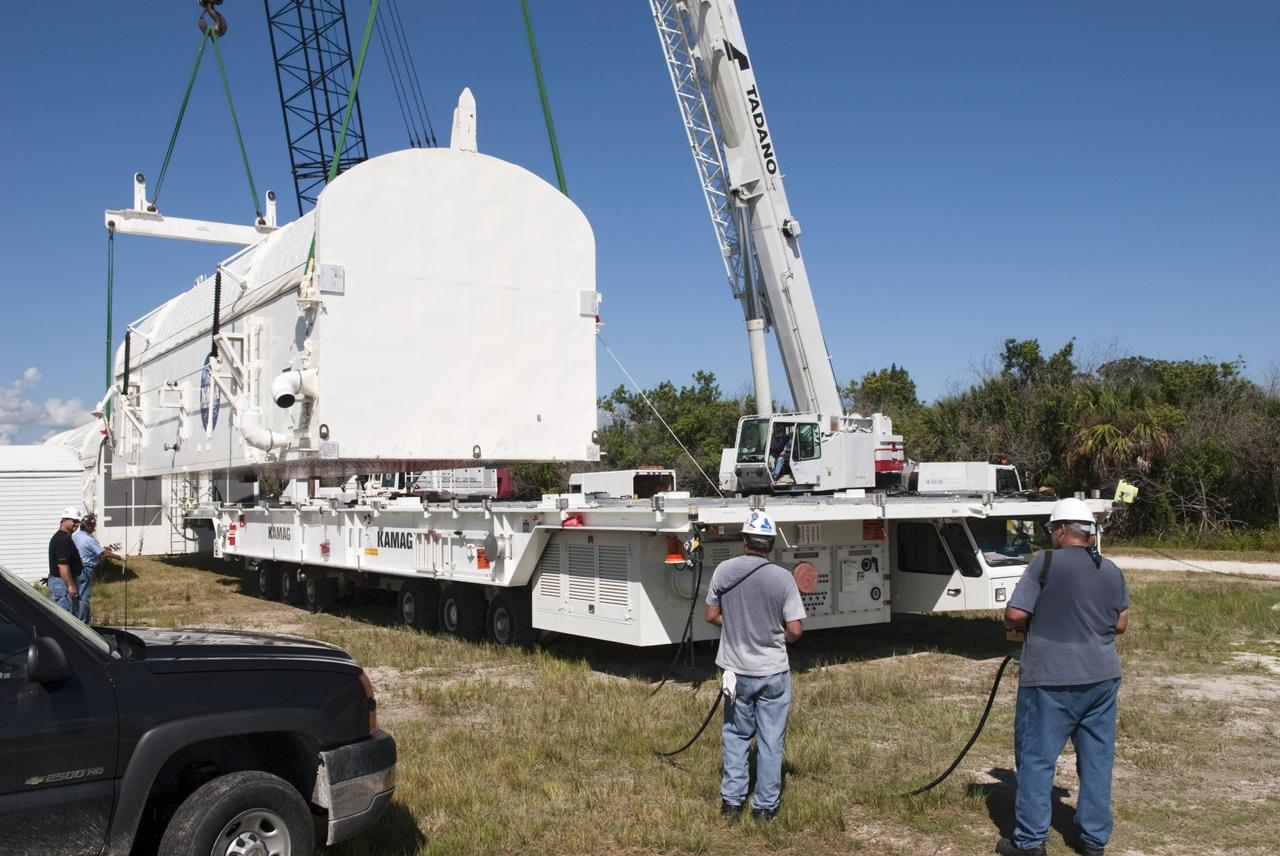
CAPE CANAVERAL, Fla. -- Cranes lift payload canister #2 from the transporter that delivered it to the Reutilization, Recycling and Marketing Facility on Ransom Road at NASA's Kennedy Space Center in Florida. The two payload canisters used to transport space shuttle payloads to the launch pad for installation in the shuttles' cargo bays are being decommissioned following the end of the Space Shuttle Program. Each canister weighs 110,000 pounds and is 65 feet long, 22 feet wide, and 18 feet, 7 inches high. The canisters were prescreened through NASA Headquarters as possible artifacts, but their size makes them difficult to transport to locations off the center. Federal and state agencies now will be given the opportunity to screen the canisters for potential use before a final decision is made on their disposition. For more information, visit http://www.nasa.gov/centers/kennedy/pdf/167403main_CRF-06.pdf. Photo credit: NASA/Jim Grossmann
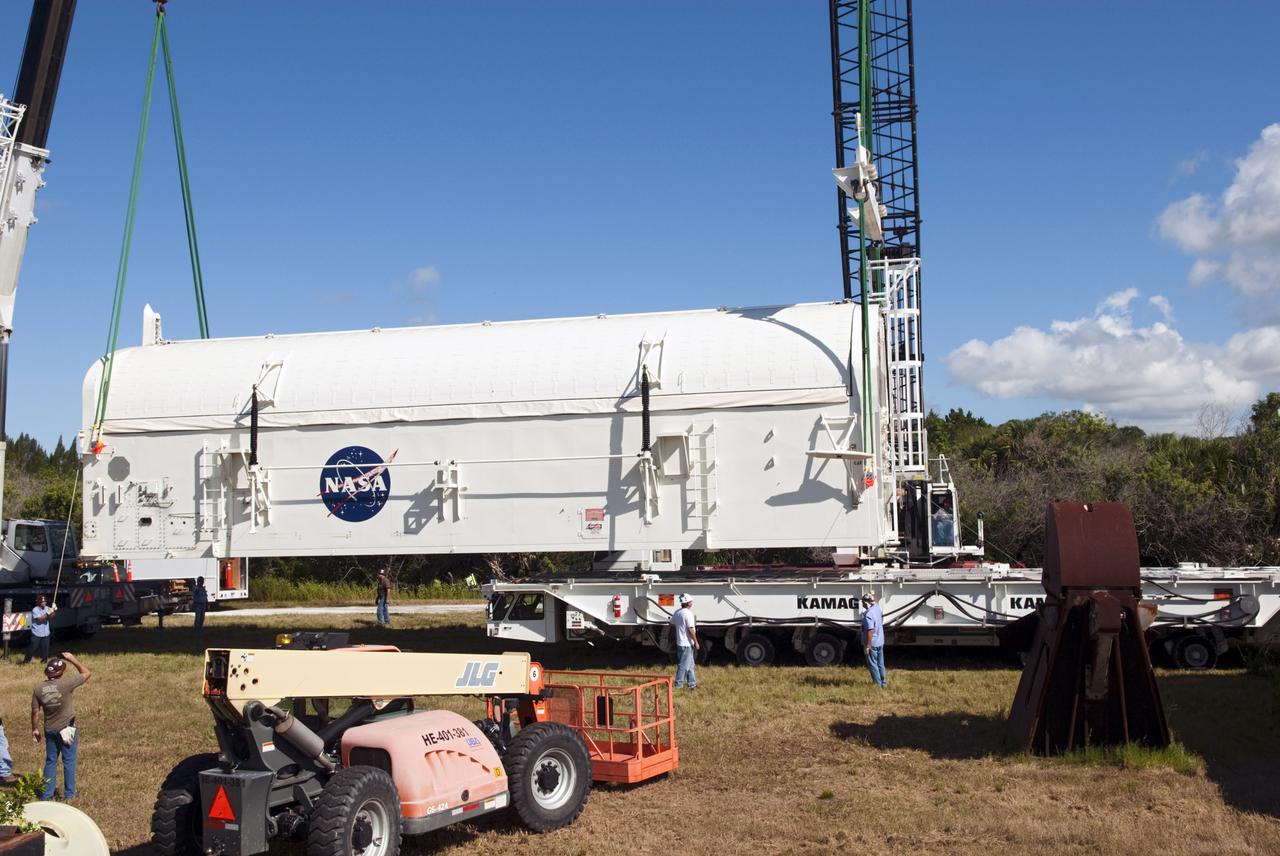
CAPE CANAVERAL, Fla. -- Cranes lift payload canister #1 from the transporter that delivered it to the Reutilization, Recycling and Marketing Facility on Ransom Road at NASA's Kennedy Space Center in Florida. The two payload canisters used to transport space shuttle payloads to the launch pad for installation in the shuttles' cargo bays are being decommissioned following the end of the Space Shuttle Program. Each canister weighs 110,000 pounds and is 65 feet long, 22 feet wide, and 18 feet, 7 inches high. The canisters were prescreened through NASA Headquarters as possible artifacts, but their size makes them difficult to transport to locations off the center. Federal and state agencies now will be given the opportunity to screen the canisters for potential use before a final decision is made on their disposition. For more information, visit http:__www.nasa.gov_centers_kennedy_pdf_167403main_CRF-06.pdf. Photo credit: NASA_Jim Grossmann
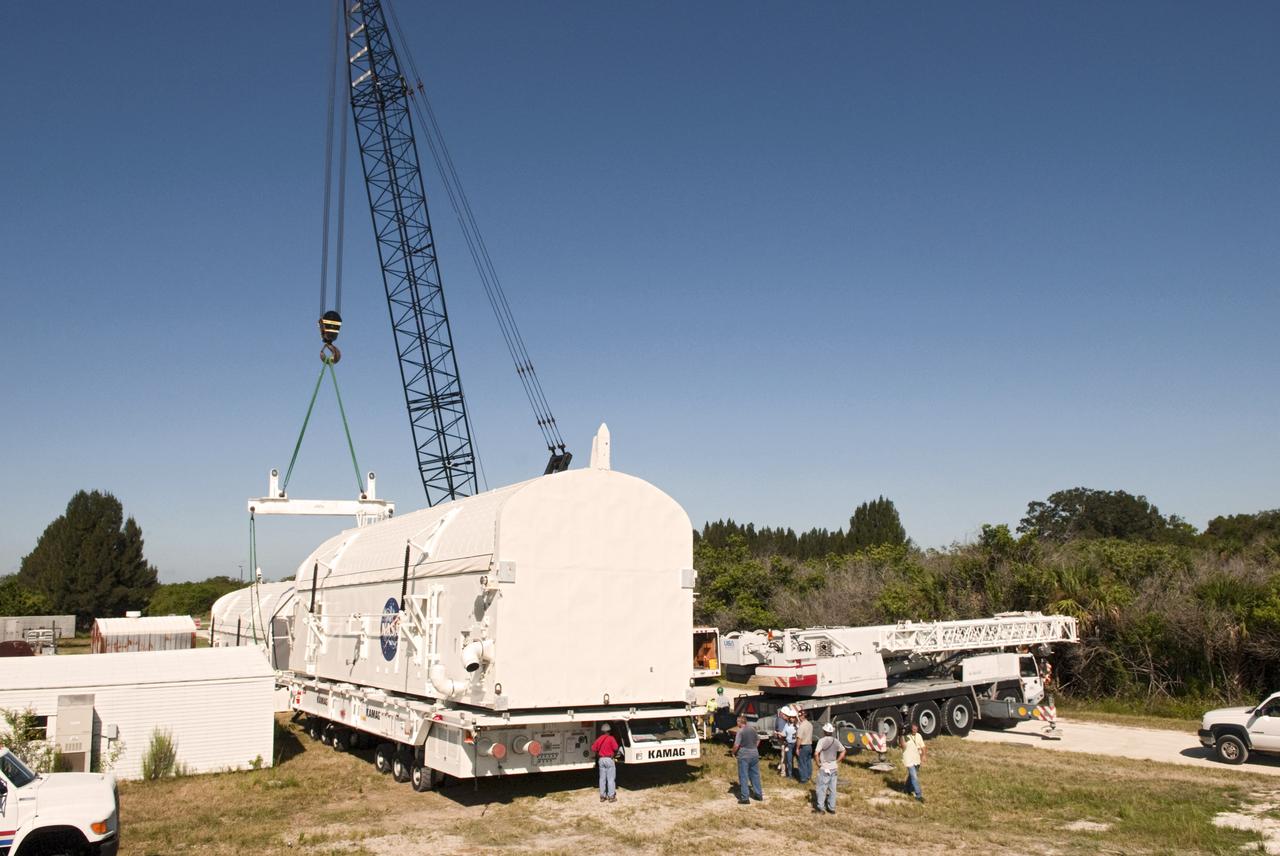
CAPE CANAVERAL, Fla. -- Preparations are under way to lift payload canister #2 from the transporter that delivered it to the Reutilization, Recycling and Marketing Facility on Ransom Road at NASA's Kennedy Space Center in Florida. The two payload canisters used to transport space shuttle payloads to the launch pad for installation in the shuttles' cargo bays are being decommissioned following the end of the Space Shuttle Program. Each canister weighs 110,000 pounds and is 65 feet long, 22 feet wide, and 18 feet, 7 inches high. The canisters were prescreened through NASA Headquarters as possible artifacts, but their size makes them difficult to transport to locations off the center. Federal and state agencies now will be given the opportunity to screen the canisters for potential use before a final decision is made on their disposition. For more information, visit http:__www.nasa.gov_centers_kennedy_pdf_167403main_CRF-06.pdf. Photo credit: NASA_Jim Grossmann
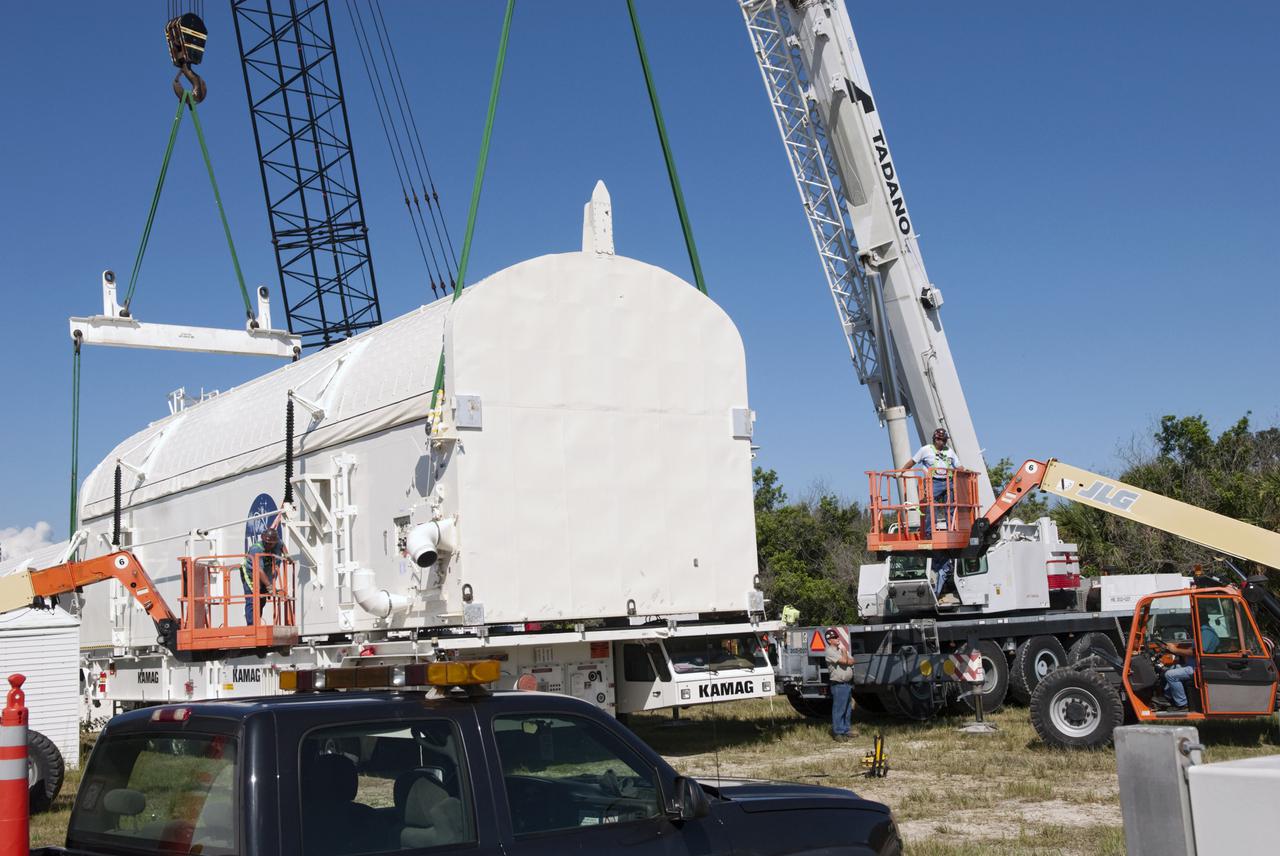
CAPE CANAVERAL, Fla. -- Cranes are attached to payload canister #2 to lift it from the transporter that delivered it to the Reutilization, Recycling and Marketing Facility on Ransom Road at NASA's Kennedy Space Center in Florida. The two payload canisters used to transport space shuttle payloads to the launch pad for installation in the shuttles' cargo bays are being decommissioned following the end of the Space Shuttle Program. Each canister weighs 110,000 pounds and is 65 feet long, 22 feet wide, and 18 feet, 7 inches high. The canisters were prescreened through NASA Headquarters as possible artifacts, but their size makes them difficult to transport to locations off the center. Federal and state agencies now will be given the opportunity to screen the canisters for potential use before a final decision is made on their disposition. For more information, visit http:__www.nasa.gov_centers_kennedy_pdf_167403main_CRF-06.pdf. Photo credit: NASA_Jim Grossmann
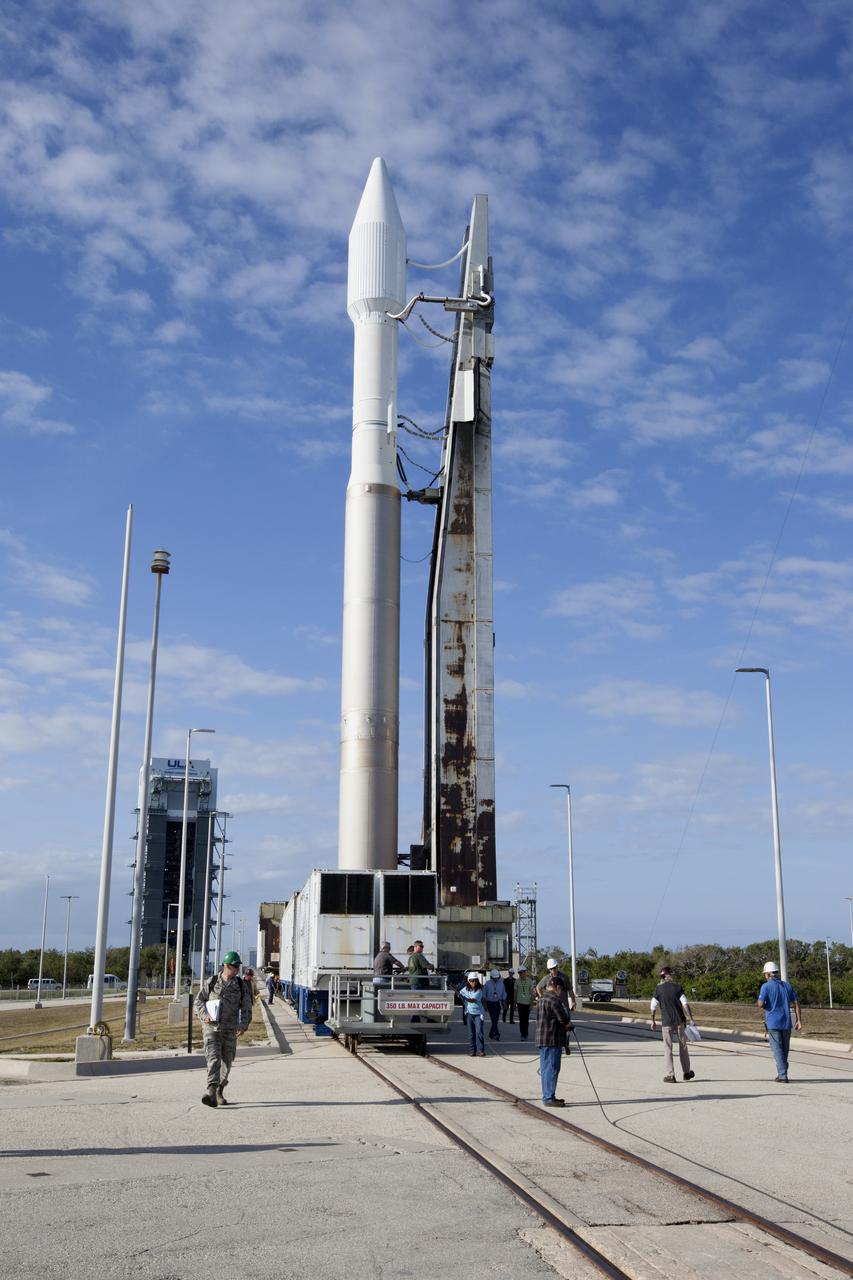
A United Launch Alliance Atlas V rocket, with the Orbital ATK Cygnus pressurized cargo module, is transported along the road to the pad at Space Launch Complex 41 at Cape Canaveral Air Force Station in Florida. Orbital ATK's seventh commercial resupply services mission, CRS-7, is scheduled to launch to the International Space Station on April 18, 2017. Cygnus will deliver 7,600 pounds of supplies, equipment and scientific research materials to the space station. Liftoff is scheduled for 11:11 a.m. EDT.

CAPE CANAVERAL, Fla. – In the Space Station Processing Facility at NASA's Kennedy Space Center in Florida, the Multi-Purpose Logistics Module Leonardo moves above the floor toward the payload canister, just visible at far right. The canister will transport the module to Launch Pad 39A for installation in space shuttle Discovery for the STS-128 mission. The module will carry science and storage racks to the International Space Station. Launch is targeted for Aug. 18. Photo credit: NASA/Jack Pfaller
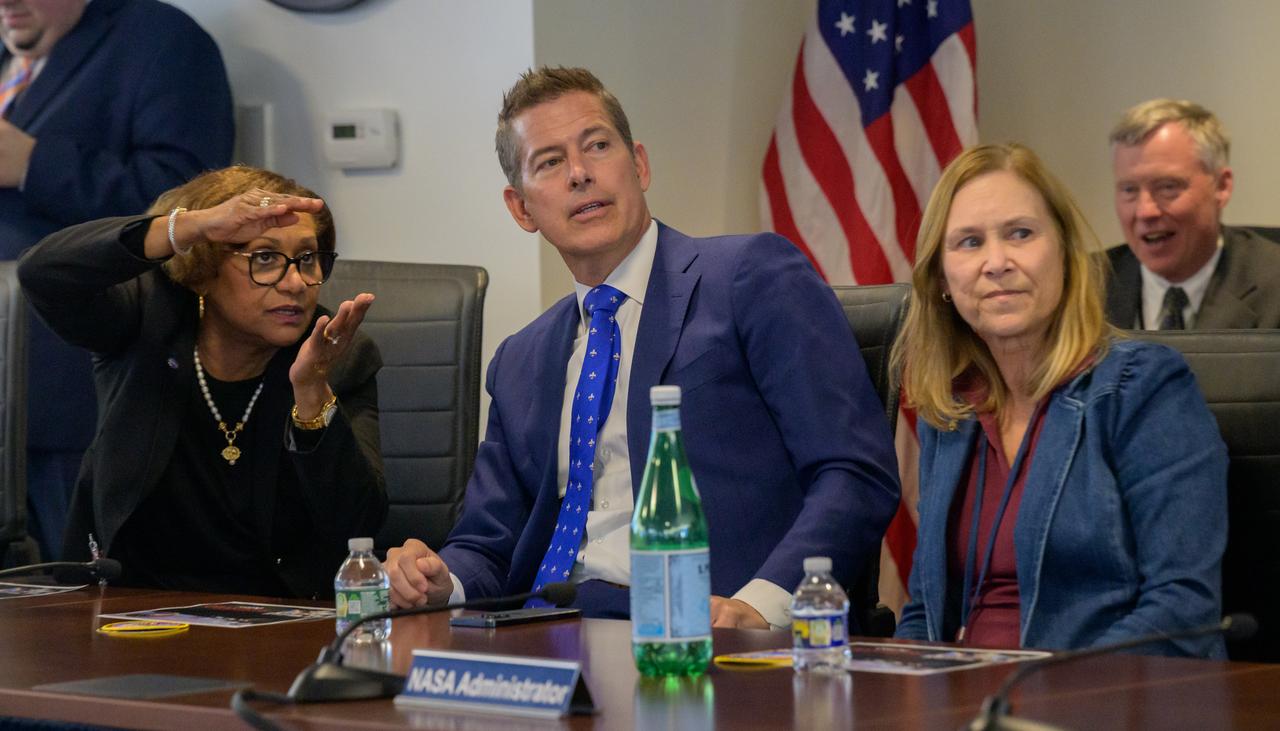
Acting NASA Associate Administrator Vanessa Wyche, left, U.S. Transportation Secretary Sean Duffy, and acting NASA Administrator Janet Petro, right, watch as the SpaceX Dragon spacecraft splashes down with NASA astronauts Butch Wilmore, Suni Williams, Nick Hague, and Roscosmos cosmonaut Aleksandr Gorbunov, Tuesday, March 18, 2025, from the Space Operations Center at the Mary W. Jackson NASA Headquarters Building in Washington. Photo Credit: (NASA/Bill Ingalls)
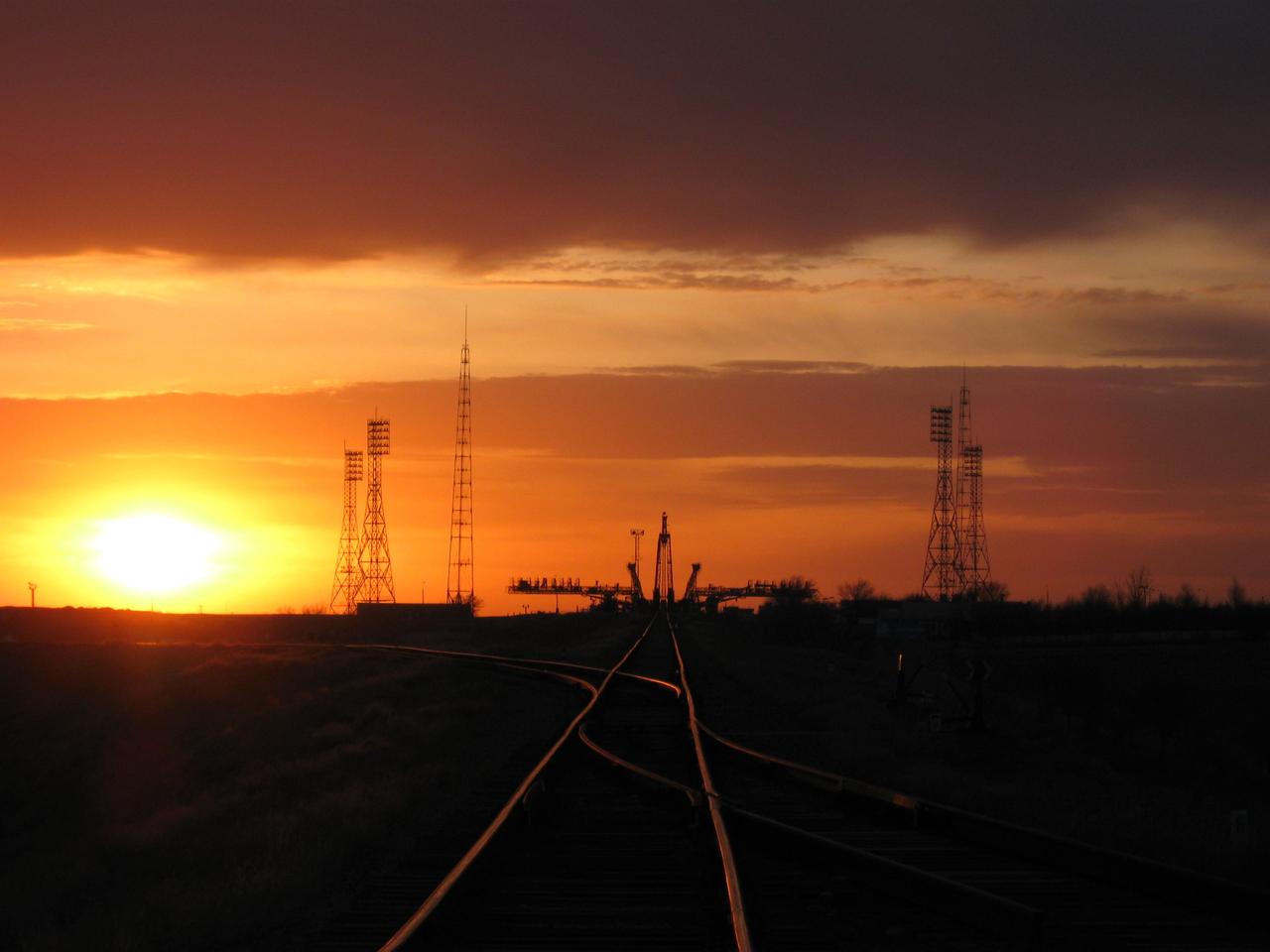
The launch pad at the Baikonur Cosmodrome in Kazakhstan is illuminated at sunrise in the Central Asian desert as it awaits the arrival of the Soyuz TMA-18 vehicle March 31, 2010 which was transported from its assembly hangar to the pad by railcar at dawn. Expedition 23 crewmates Alexander Skvortsov, Mikhail Kornienko and Tracy Caldwell Dyson will launch from Baikonur April 2 en route to the International Space Station.
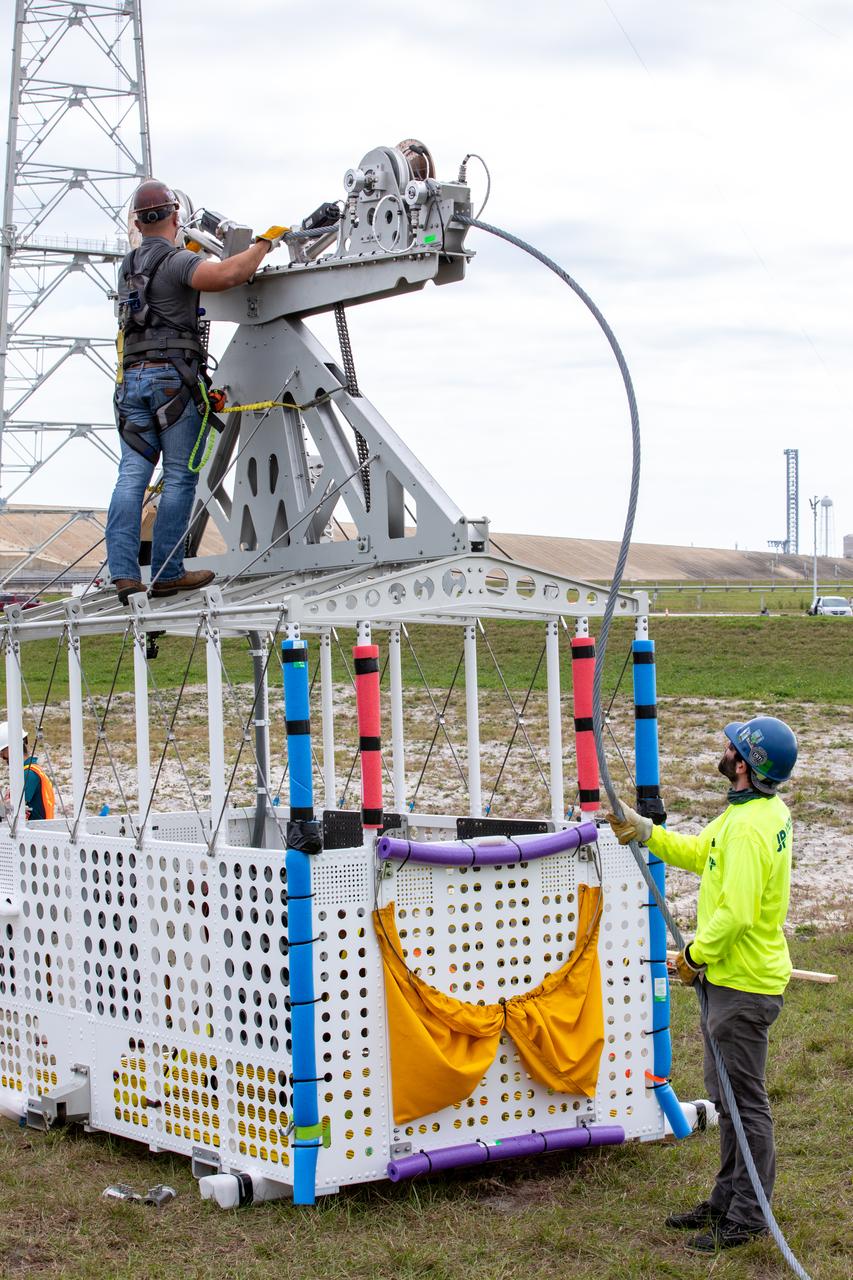
Teams with NASA’s Exploration Ground Systems Program, in preparation for the agency’s Artemis II crewed mission to the Moon, begin installation of four emergency egress baskets at Launch Complex 39B at Kennedy Space Center in Florida on Thursday, Jan. 18, 2024. The baskets, similar to gondolas on ski lifts, are used in the case of a pad abort emergency to enable astronauts and other pad personnel a way to quickly escape away from the mobile launcher to the base of the pad and where waiting emergency transport vehicles will then drive them away.
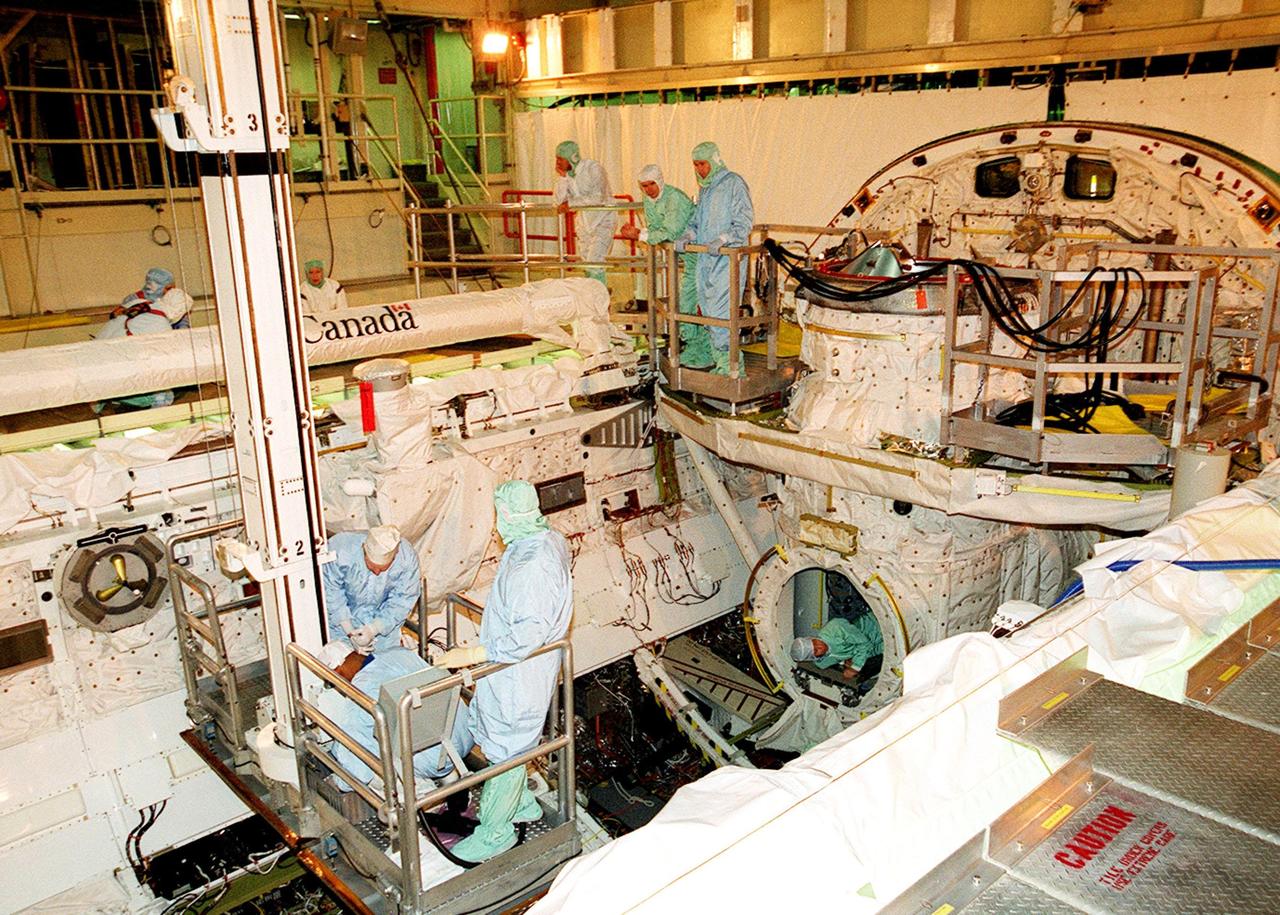
KENNEDY SPACE CENTER, FLA. -- The STS-98 crew looks over components of the equipment already installed in the payload bay of orbiter Atlantis, which is in the Orbiter Processing Facility bay 3. The crew is at KSC for Crew Equipment Interface Test activities. Launch on mission STS-98 is scheduled for Jan. 18, 2001. It will be transporting the U.S. Lab, Destiny, to the International Space Station with five system racks already installed inside of the module. After delivery of electronics in the lab, electrically powered attitude control for Control Moment Gyroscopes will be activated
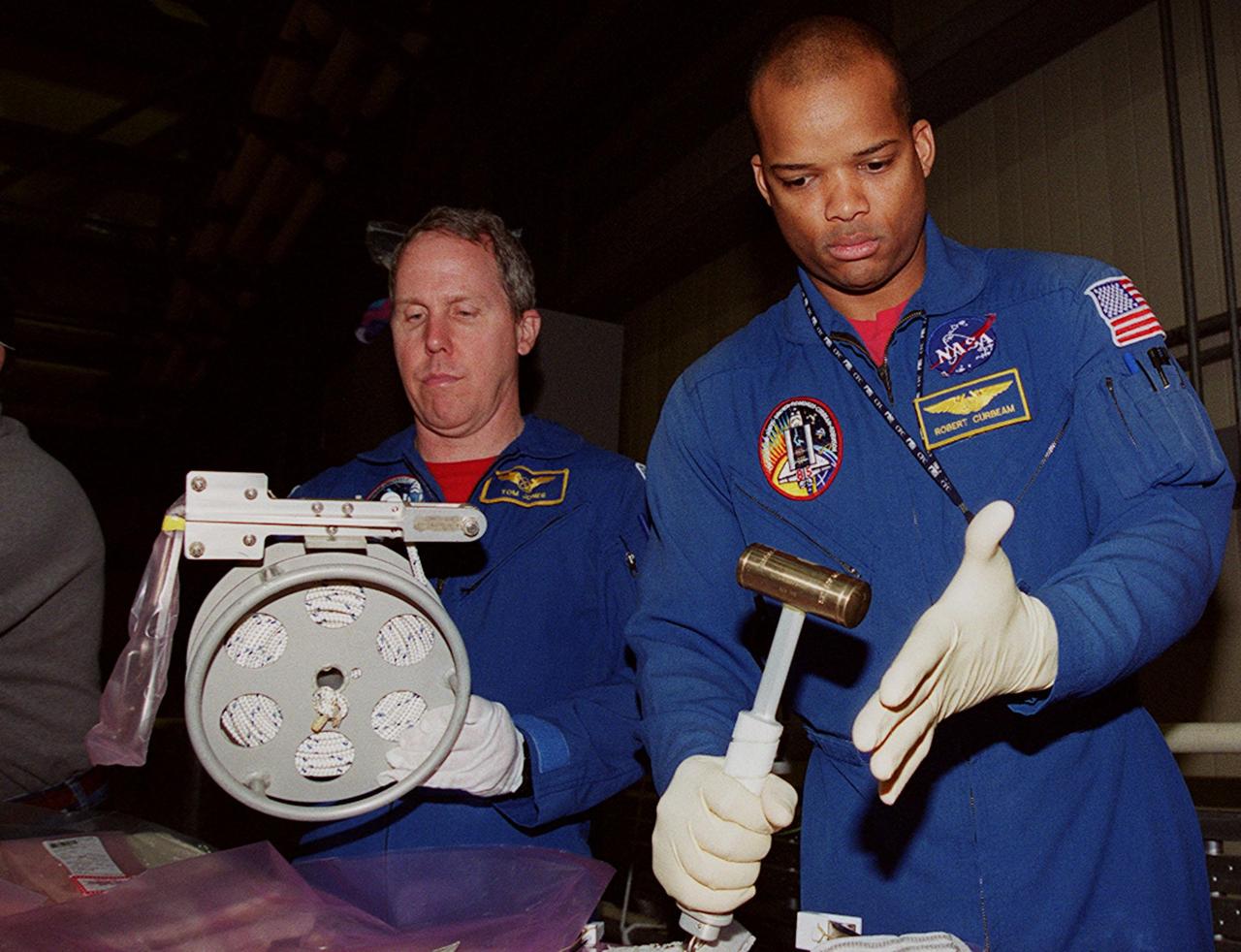
KENNEDY SPACE CENTER, FLA. -- In Orbiter Processing Facility bay 3, STS-98 Mission Specialists Tom Jones and Robert Curbeam test tools that will be used during extravehicular activities (EVA) on their mission. Scheduled for launch Jan. 18, 2001, STS-98 will be transporting the U.S. Lab, Destiny, to the International Space Station with five system racks already installed inside of the module. After delivery of electronics in the lab, electrically powered attitude control for Control Moment Gyroscopes will be activated
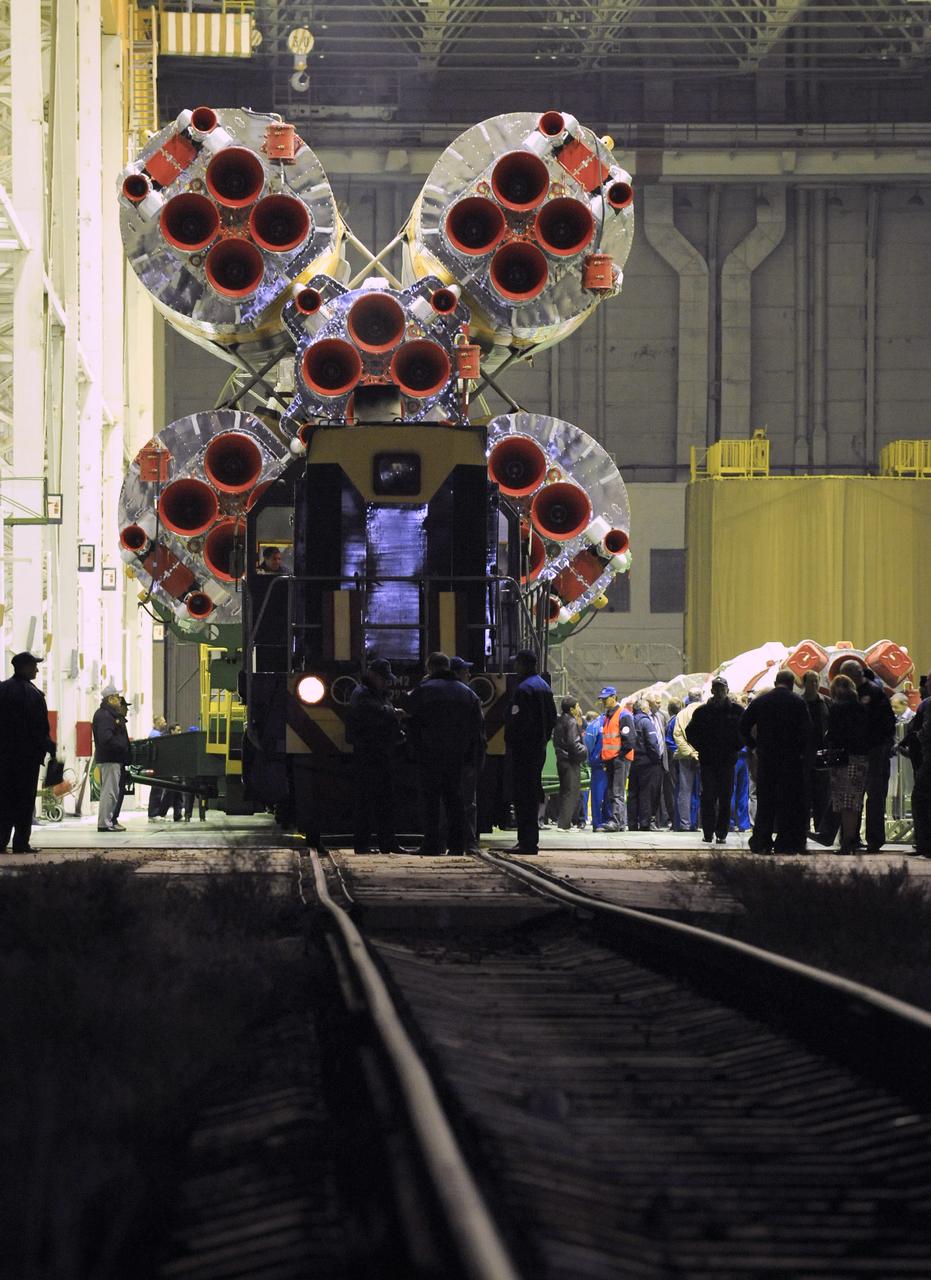
The Soyuz TMA-13 spacecraft is transported by railcar to its launch pad at the Baikonur Cosmodrome in Kazakhstan, Friday, Oct. 10, 2008. Expedition 18 Commander Michael Fincke, Flight Engineer Yuri V. Lonchakov and American spaceflight participant Richard Garriott will launch October 12 and dock with the International Space Station October 14. Fincke and Lonchakov will spend six months on the station, while Garriott will return to Earth after 10 days with the Expedition 17 crew members currently on the ISS. Photo Credit: (NASA/Bill Ingalls)
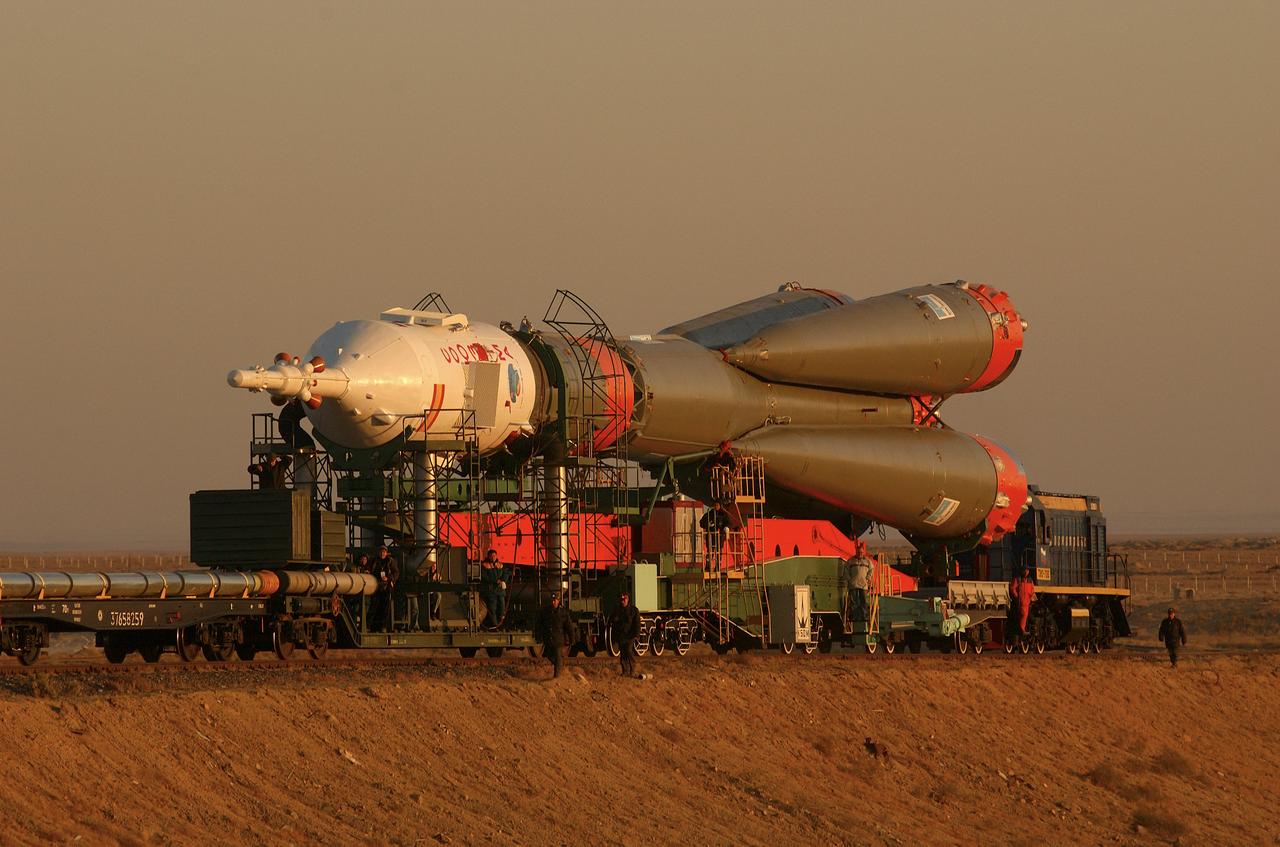
A Soyuz TMA-3 spacecraft and its booster rocket is transported on a rail car to the launch pad at the Baikonur Cosmodrome, Kazakhstan on Thursday, Oct. 16, 2003 in preparation for liftoff Oct. 18 to carry Expedition 8 Commander and NASA Science Officer Michael Foale, Expedition 8 Soyuz Commander Alexander Kaleri and European Space Agency astronaut Pedro Duque of Spain to the International Space Station. Photo Credit (NASA/Bill Ingalls)

CAPE CANAVERAL, Fla. – In the Space Station Processing Facility at NASA's Kennedy Space Center in Florida, the crane lowers the Multi-Purpose Logistics Module Leonardo toward the payload canister. The canister will transport the module to Launch Pad 39A for installation in space shuttle Discovery for the STS-128 mission. The module will carry science and storage racks to the International Space Station. Launch is targeted for Aug. 18. Photo credit: NASA/Jack Pfaller
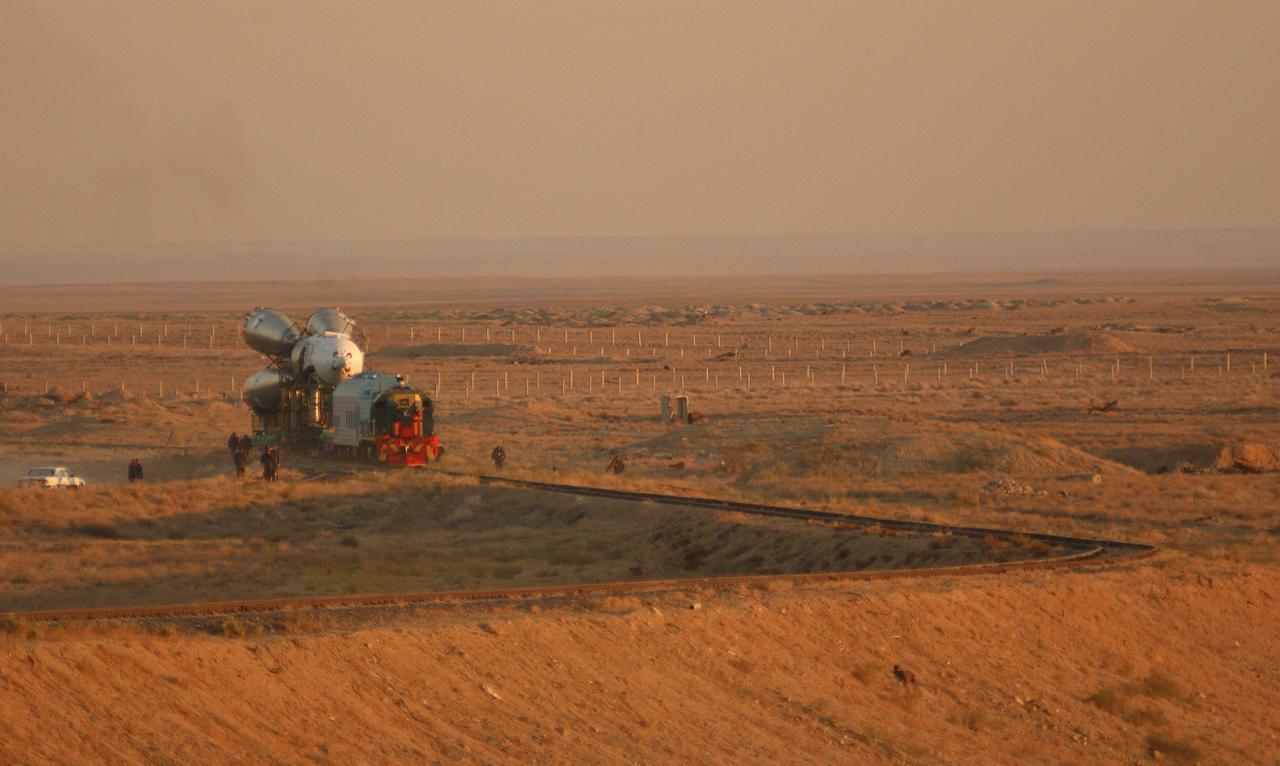
A Soyuz TMA-3 spacecraft and its booster rocket is transported on a rail car to the launch pad at the Baikonur Cosmodrome, Kazakhstan on Thursday, Oct. 16, 2003 in preparation for liftoff Oct. 18 to carry Expedition 8 Commander and NASA Science Officer Michael Foale, Expedition 8 Soyuz Commander Alexander Kaleri and European Space Agency astronaut Pedro Duque of Spain to the International Space Station. Photo Credit (NASA/Bill Ingalls)

CAPE CANAVERAL, Fla. – In the Space Station Processing Facility at NASA's Kennedy Space Center in Florida, the open doors of the payload canister (right) wait for transfer of the Multi-Purpose Logistics Module Leonardo (center) inside. The canister will transport the module to Launch Pad 39A for installation in space shuttle Discovery for the STS-128 mission. The module will carry science and storage racks to the International Space Station. Launch is targeted for Aug. 18. Photo credit: NASA/Jack Pfaller
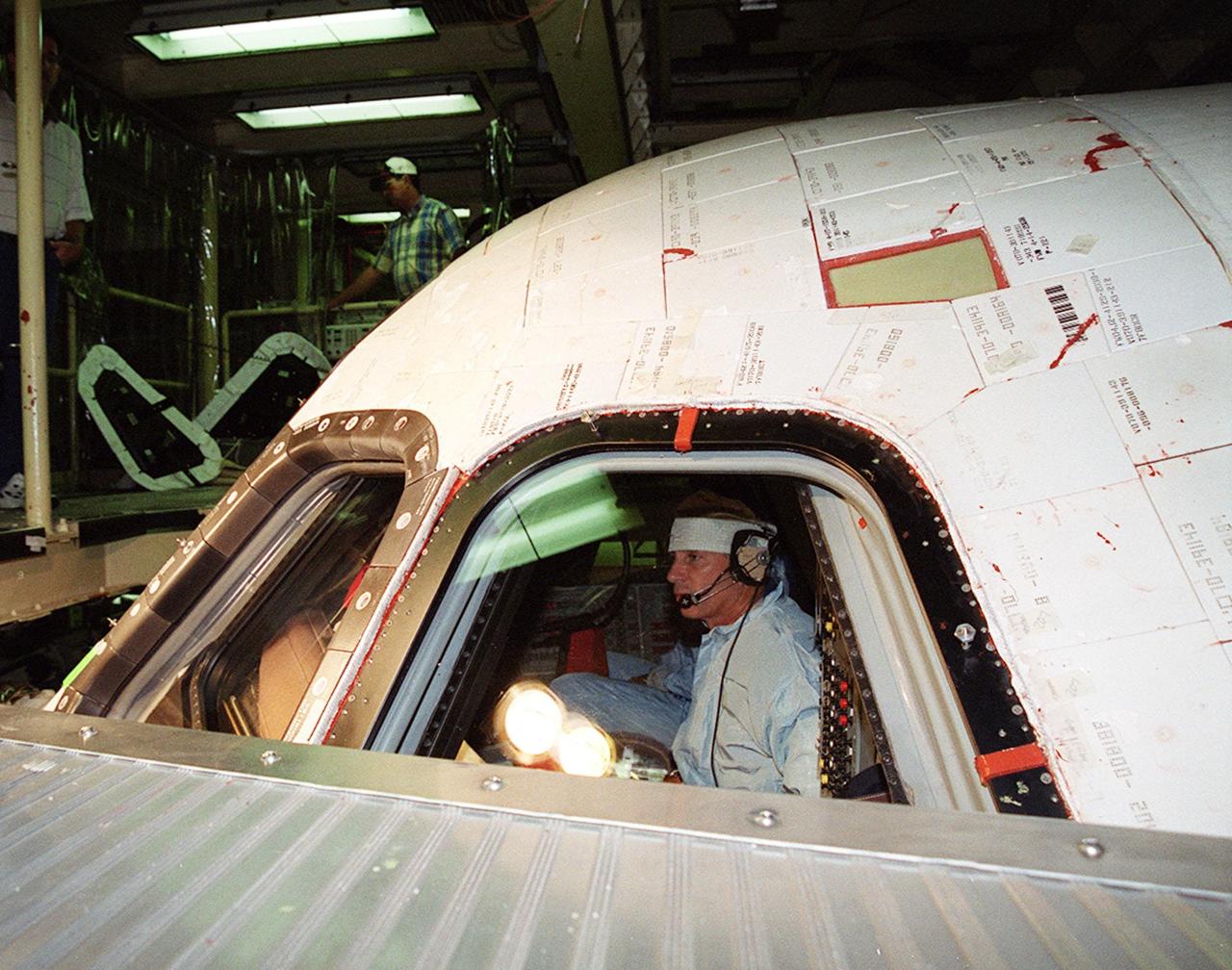
KENNEDY SPACE CENTER, FLA. -- In Orbiter Processing Facility bay 3, STS-98 Commander Ken Cockrell conducts window inspection, checking for leaks, in the cockpit of Atlantis. He and the rest of the crew are at KSC for Crew Equipment Interface Test activities. Launch on mission STS-98 is scheduled for Jan. 18, 2001. It will be transporting the U.S. Lab, Destiny, to the International Space Station with five system racks already installed inside of the module. After delivery of electronics in the lab, electrically powered attitude control for Control Moment Gyroscopes will be activated
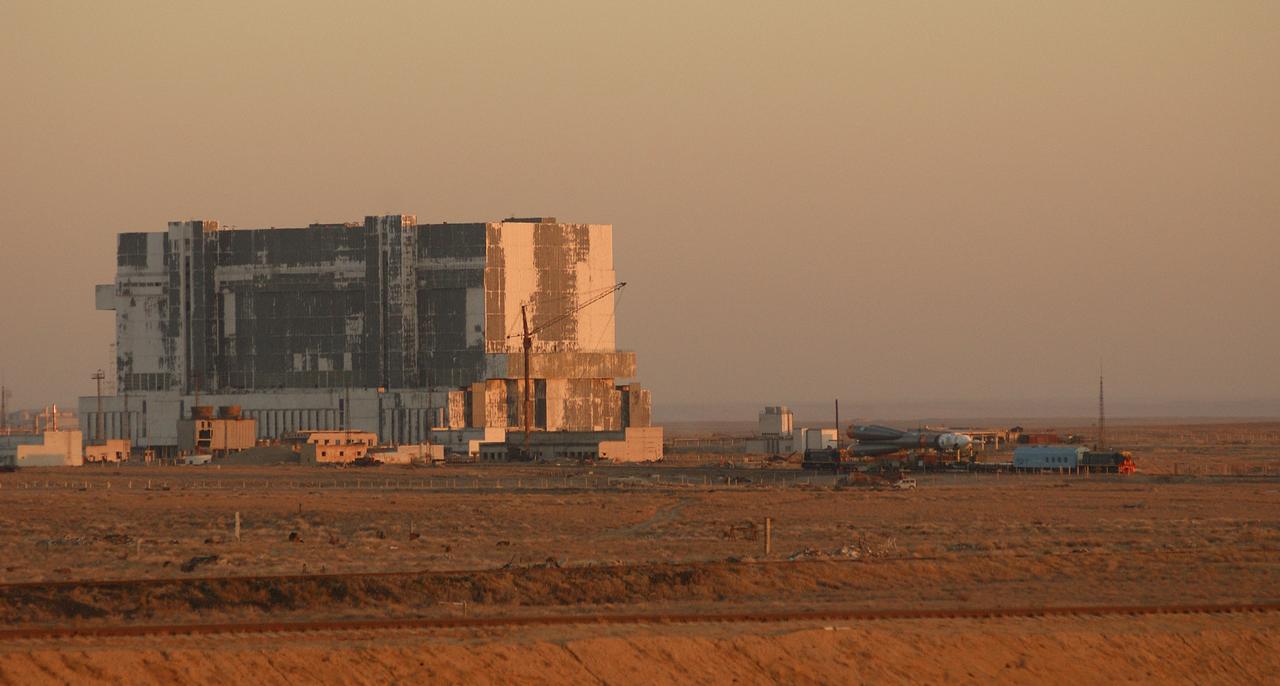
A Soyuz TMA-3 spacecraft and its booster rocket is transported on a rail car to the launch pad at the Baikonur Cosmodrome, Kazakhstan on Thursday, Oct. 16, 2003 in preparation for liftoff Oct. 18 to carry Expedition 8 Commander and NASA Science Officer Michael Foale, Expedition 8 Soyuz Commander Alexander Kaleri and European Space Agency astronaut Pedro Duque of Spain to the International Space Station. Photo Credit (NASA/Bill Ingalls)
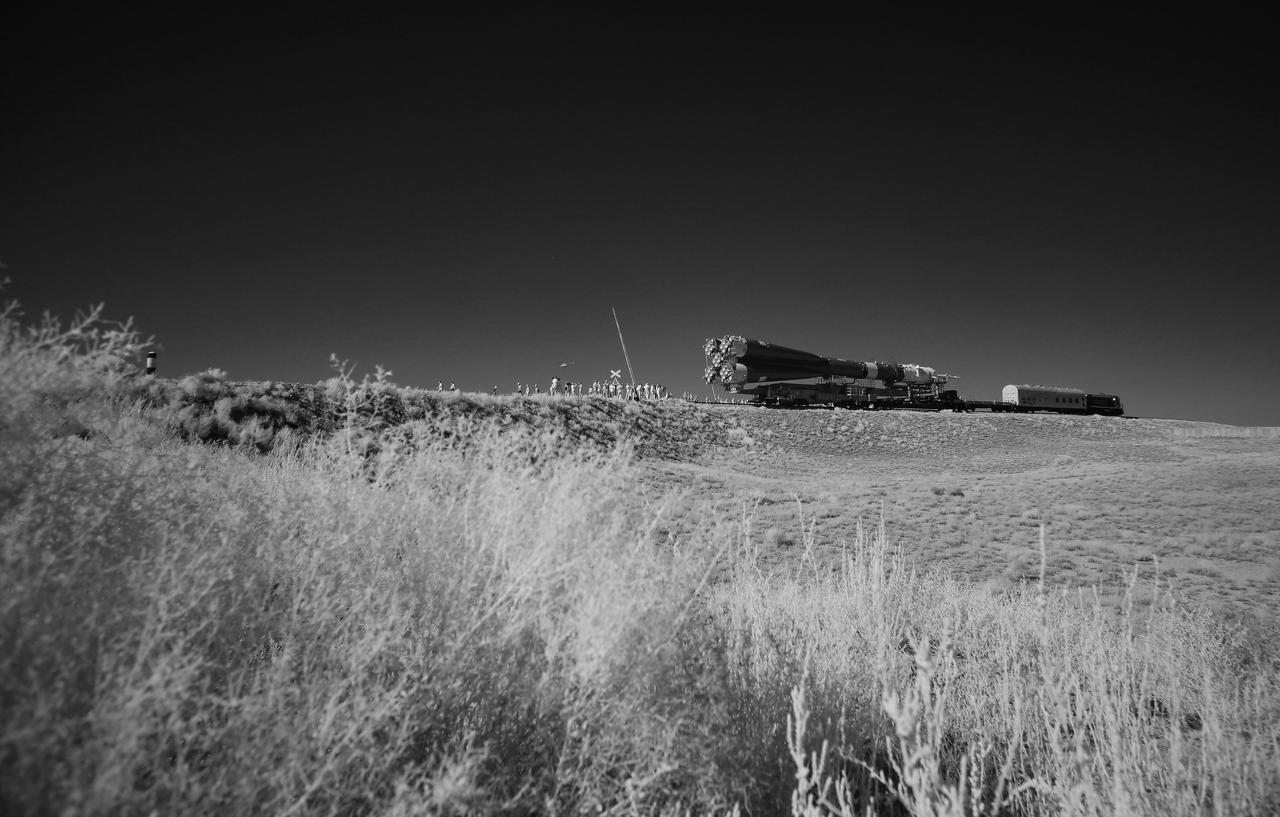
In this black and white infrared image, the Soyuz rocket is seen as it transported to the launch pad by train, Thursday, July 18, 2019 at the Baikonur Cosmodrome in Kazakhstan. Expedition 60 Soyuz Commander Alexander Skvortsov of Roscosmos, flight engineer Andrew Morgan of NASA, and flight engineer Luca Parmitano of ESA (European Space Agency) are scheduled to launch aboard their Soyuz MS-13 spacecraft at 12:28 p.m. Eastern time (9:28 p.m. Baikonur time), on Saturday, July 20. Photo Credit: (NASA/Joel Kowsky)
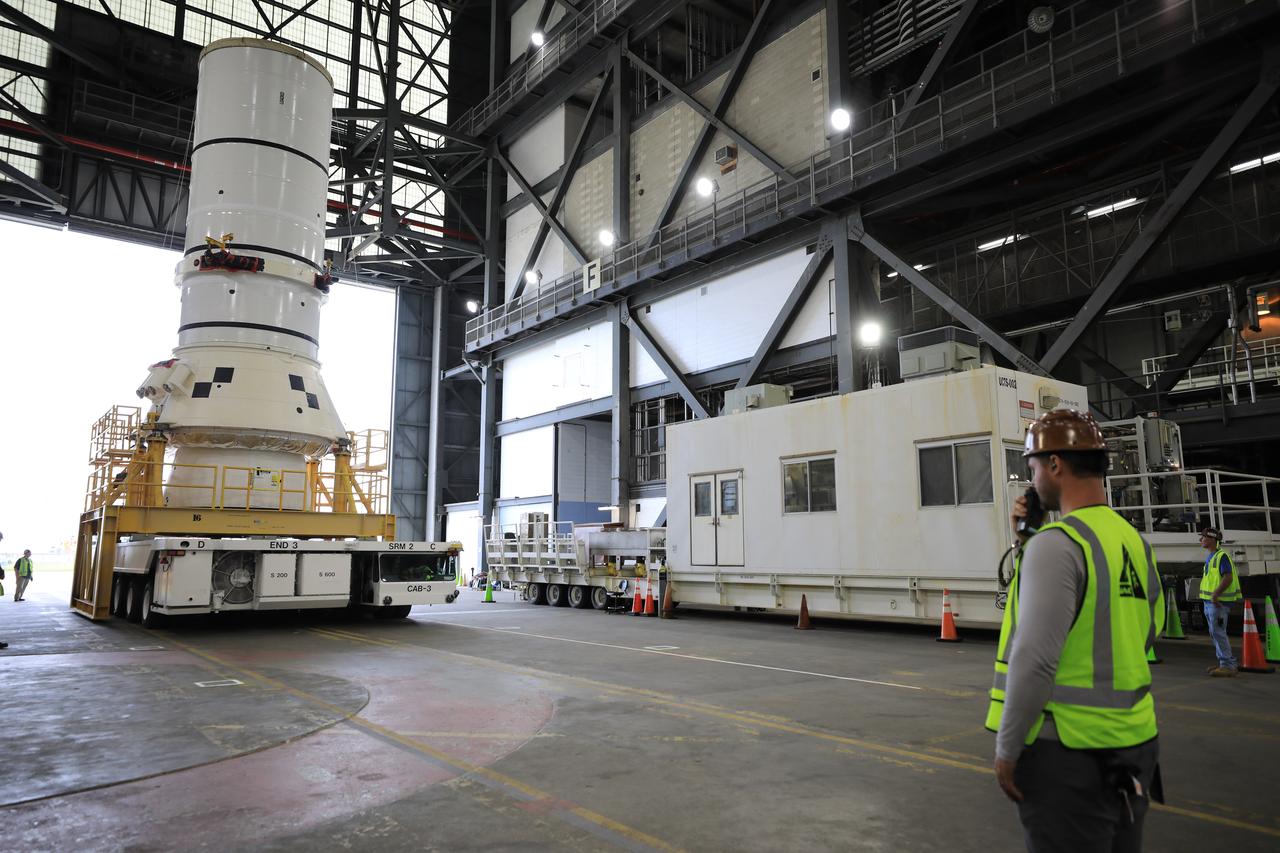
Engineers and technicians with the Exploration Ground Systems Program transport the left aft assembly, or bottom portion of the solid rocket boosters for the SLS (Space Launch System) rocket for the Artemis II mission inside the Vehicle Assembly Building at NASA’s Kennedy Space Center in Florida on Monday, Nov. 18, 2024. The aft assembly will be lifted atop the mobile launcher, followed by the right aft assembly and remaining booster segments.
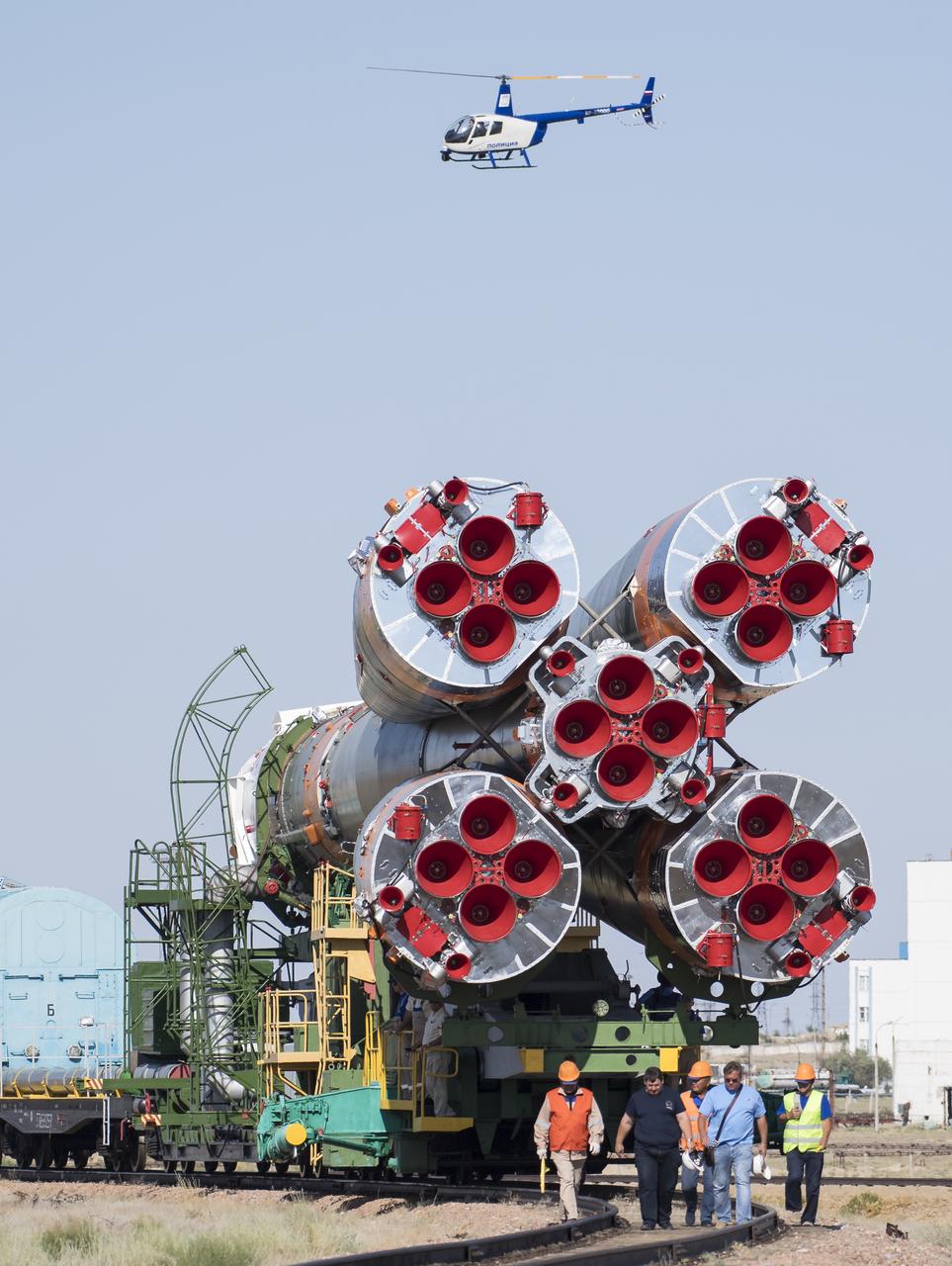
The Soyuz rocket is seen as it is transported to the launch pad by train, Thursday, July 18, 2019 at the Baikonur Cosmodrome in Kazakhstan. Expedition 60 Soyuz Commander Alexander Skvortsov of Roscosmos, flight engineer Andrew Morgan of NASA, and flight engineer Luca Parmitano of ESA (European Space Agency) are scheduled to launch aboard their Soyuz MS-13 spacecraft at 12:28 p.m. Eastern time (9:28 p.m. Baikonur time) , on Saturday, July 20. Photo Credit: (NASA/Joel Kowsky)
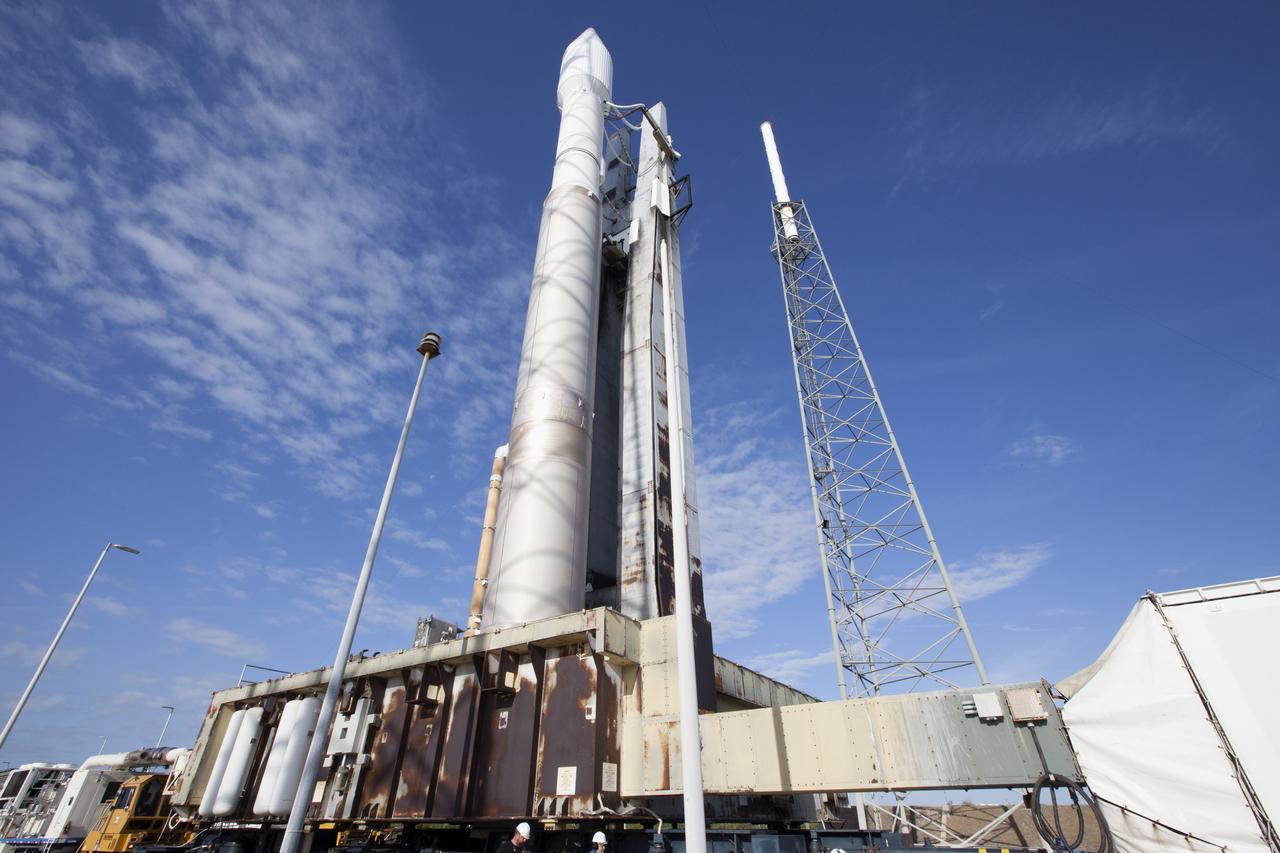
A United Launch Alliance Atlas V rocket, with the Orbital ATK Cygnus pressurized cargo module, is transported along the road to the pad at Space Launch Complex 41 at Cape Canaveral Air Force Station in Florida. Orbital ATK's seventh commercial resupply services mission, CRS-7, is scheduled to launch to the International Space Station on April 18, 2017. Cygnus will deliver 7,600 pounds of supplies, equipment and scientific research materials to the space station. Liftoff is scheduled for 11:11 a.m. EDT.
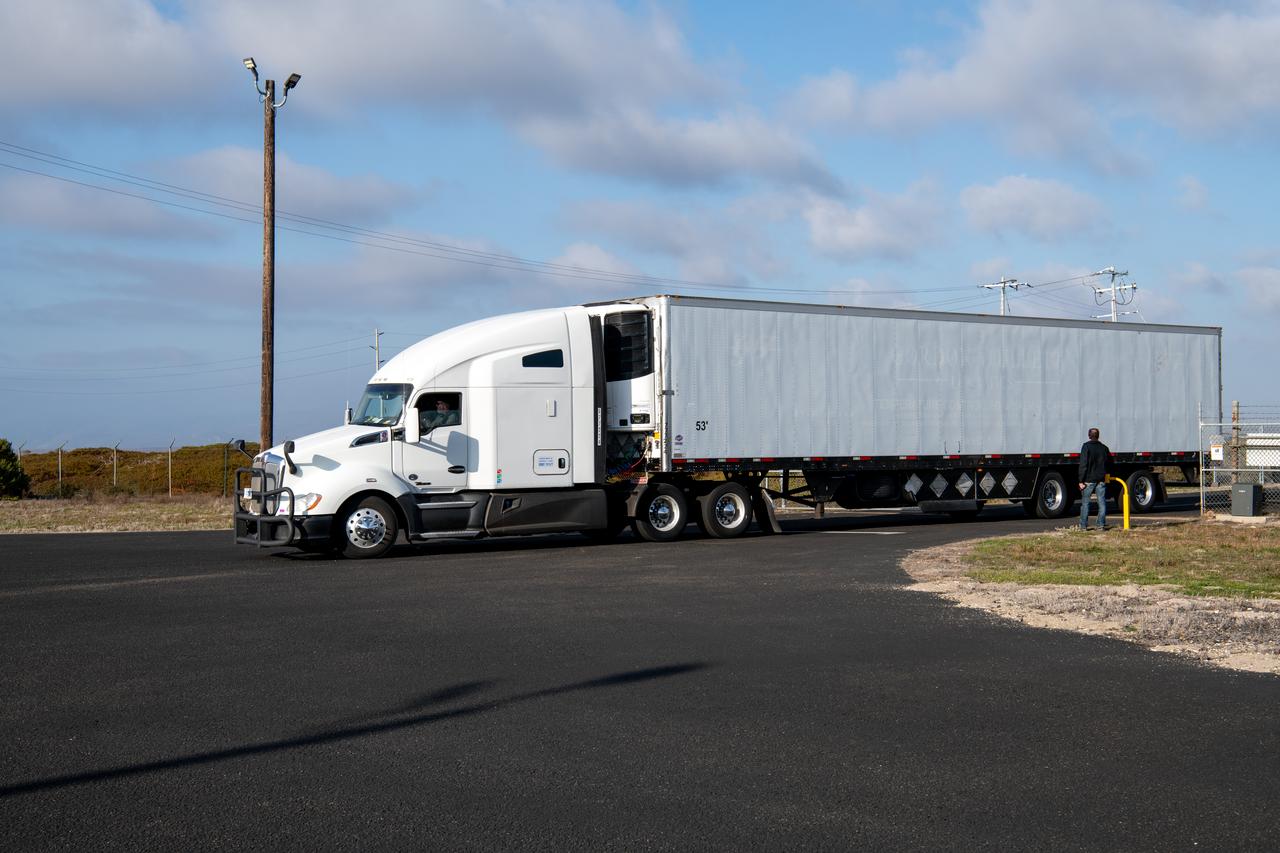
A transport truck carrying four small satellites of NASA’s PUNCH (Polarimeter to Unify the Corona and Heliosphere) arrives at Astrotech Space Operations located inside Vandenberg Space Force Base in California on Saturday, Jan. 18, 2025. PUNCH will make 3D observations of the Sun’s corona to learn how the mass and energy becomes solar wind. PUNCH, along with NASA’s SPHEREx (Spectro-Photometer for the History of the Universe, Epoch of Reionization and Ices Explorer), a space telescope, will launch aboard a SpaceX Falcon 9 rocket in late February 2025.

U.S. Transportation Secretary Sean Duffy reacts as he watches the SpaceX Dragon spacecraft splash down with NASA astronauts Butch Wilmore, Suni Williams, Nick Hague, and Roscosmos cosmonaut Aleksandr Gorbunov, Tuesday, March 18, 2025, from the Space Operations Center at the Mary W. Jackson NASA Headquarters Building in Washington. Photo Credit: (NASA/Bill Ingalls)
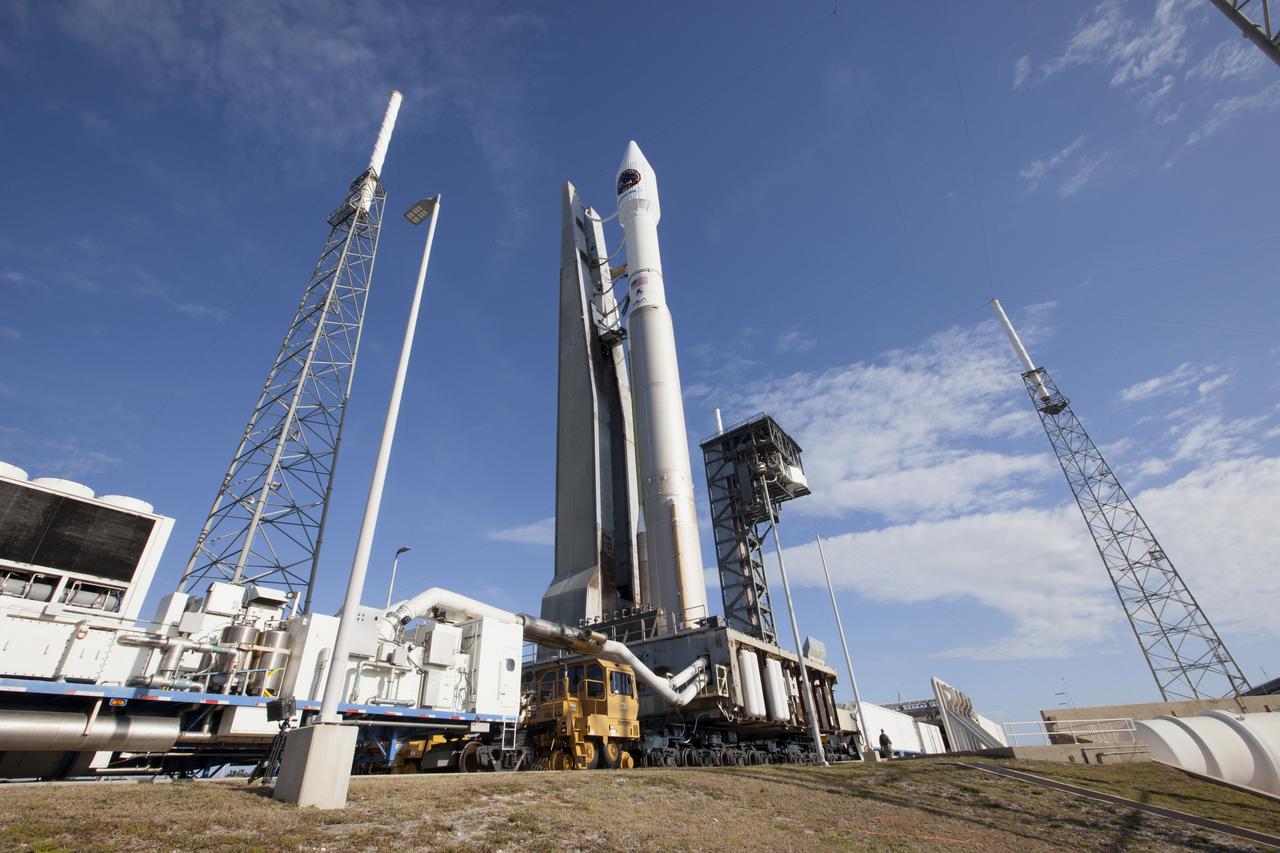
A United Launch Alliance Atlas V rocket, with the Orbital ATK Cygnus pressurized cargo module, is transported along the road to the pad at Space Launch Complex 41 at Cape Canaveral Air Force Station in Florida. Orbital ATK's seventh commercial resupply services mission, CRS-7, is scheduled to launch to the International Space Station on April 18, 2017. Cygnus will deliver 7,600 pounds of supplies, equipment and scientific research materials to the space station. Liftoff is scheduled for 11:11 a.m. EDT.
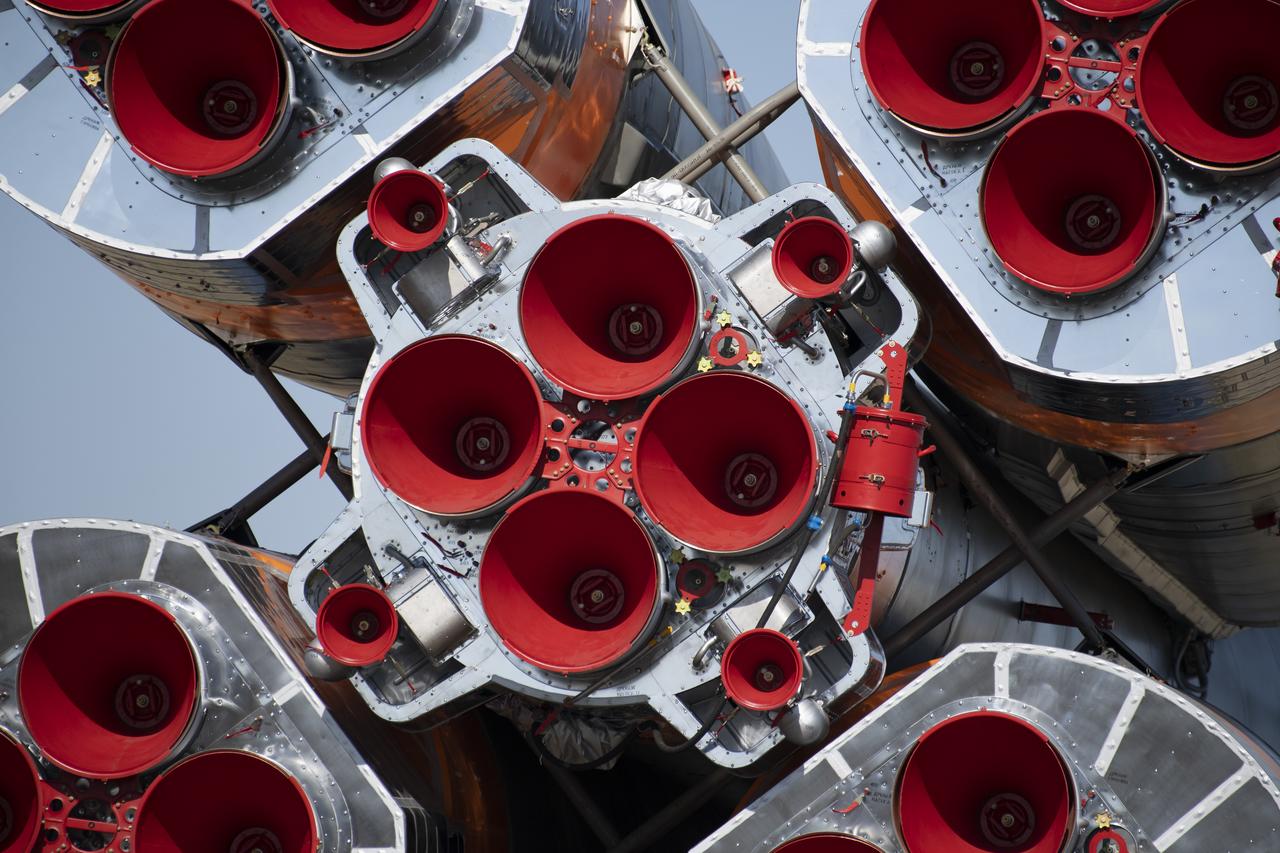
The Soyuz rocket is seen as it is transported to the launch pad by train, Thursday, July 18, 2019 at the Baikonur Cosmodrome in Kazakhstan. Expedition 60 Soyuz Commander Alexander Skvortsov of Roscosmos, flight engineer Andrew Morgan of NASA, and flight engineer Luca Parmitano of ESA (European Space Agency) are scheduled to launch aboard their Soyuz MS-13 spacecraft at 12:28 p.m. Eastern time (9:28 p.m. Baikonur time) , on Saturday, July 20. Photo Credit: (NASA/Joel Kowsky)
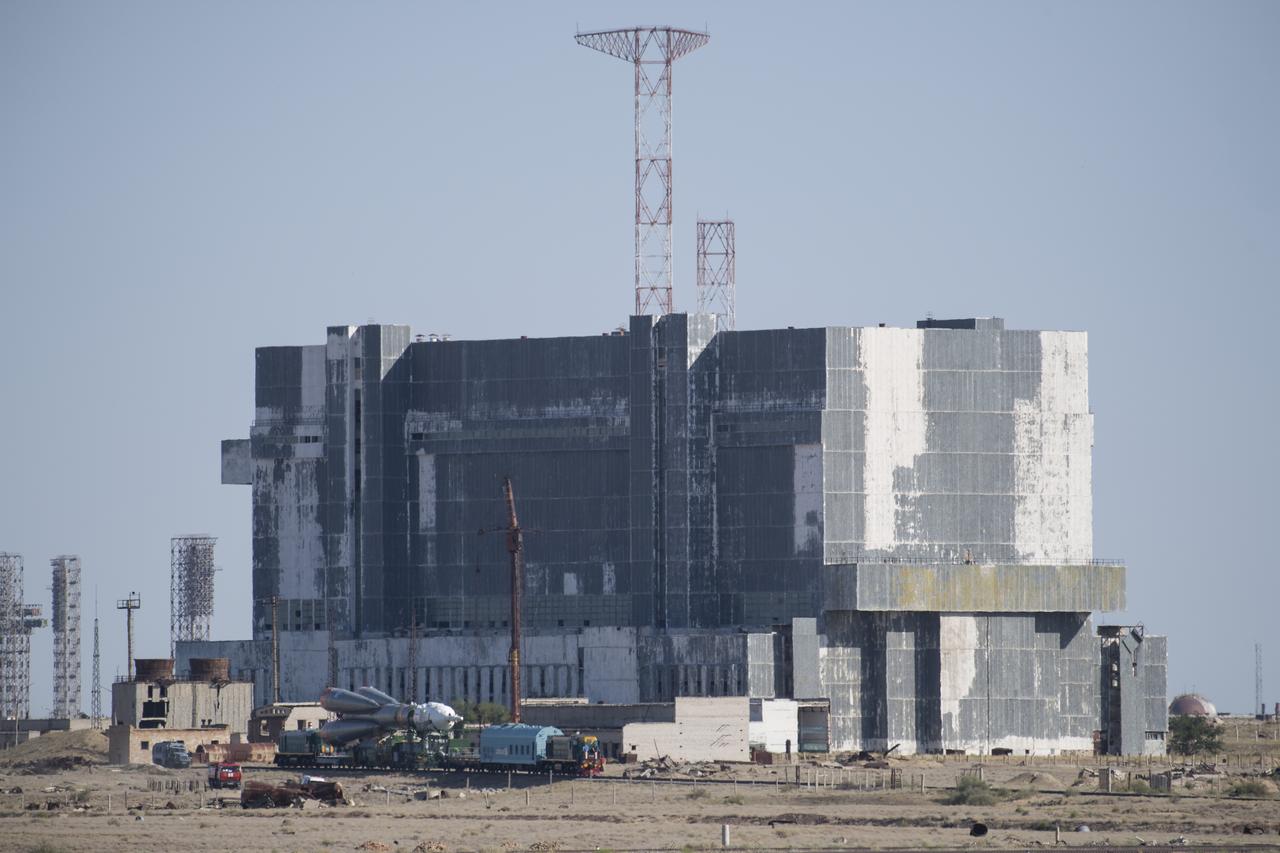
The Soyuz rocket is seen as it is transported to the launch pad by train, Thursday, July 18, 2019 at the Baikonur Cosmodrome in Kazakhstan. Expedition 60 Soyuz Commander Alexander Skvortsov of Roscosmos, flight engineer Andrew Morgan of NASA, and flight engineer Luca Parmitano of ESA (European Space Agency) are scheduled to launch aboard their Soyuz MS-13 spacecraft at 12:28 p.m. Eastern time (9:28 p.m. Baikonur time) , on Saturday, July 20. Photo Credit: (NASA/Joel Kowsky)
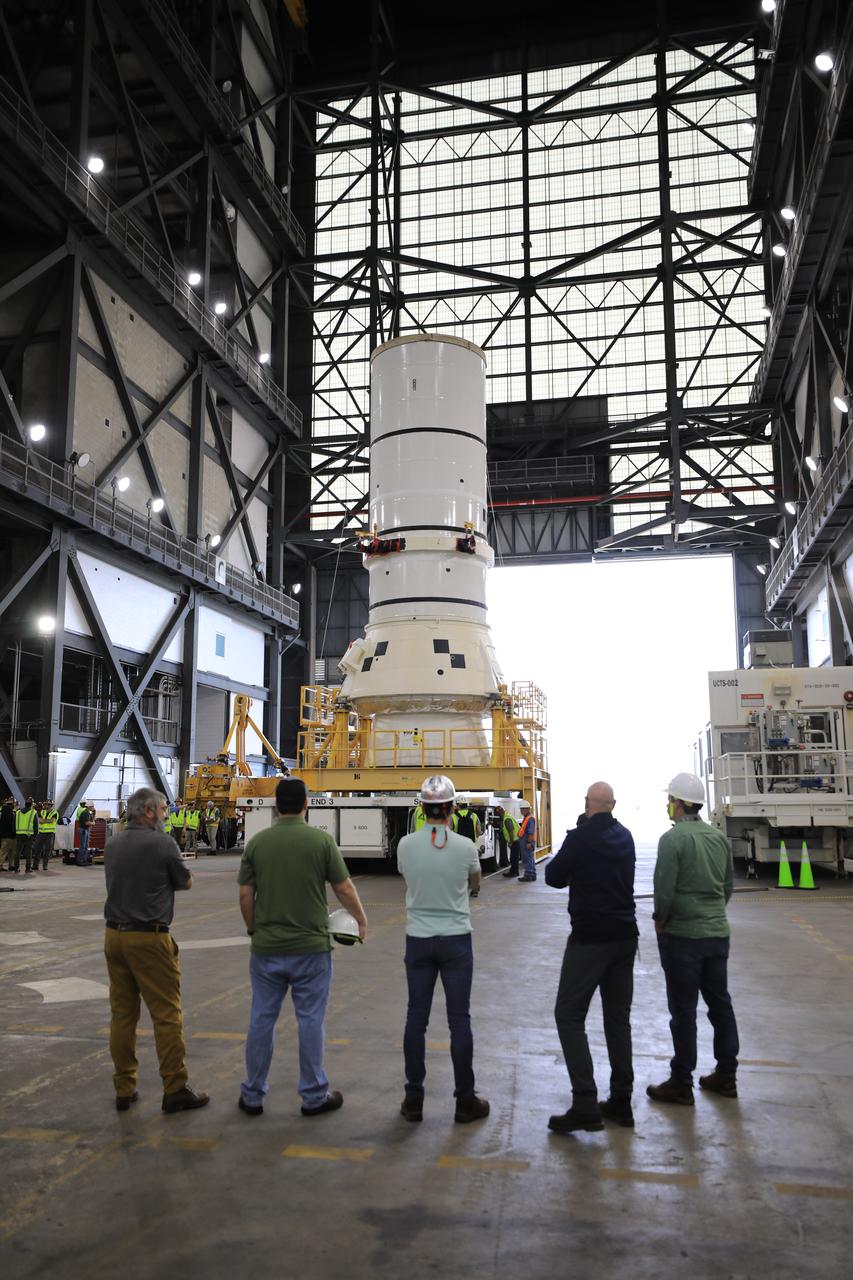
Engineers and technicians with the Exploration Ground Systems Program transport the left aft assembly, or bottom portion of the solid rocket boosters for the SLS (Space Launch System) rocket for the Artemis II mission inside the Vehicle Assembly Building at NASA’s Kennedy Space Center in Florida on Monday, Nov. 18, 2024. The aft assembly will be lifted atop the mobile launcher, followed by the right aft assembly and remaining booster segments.
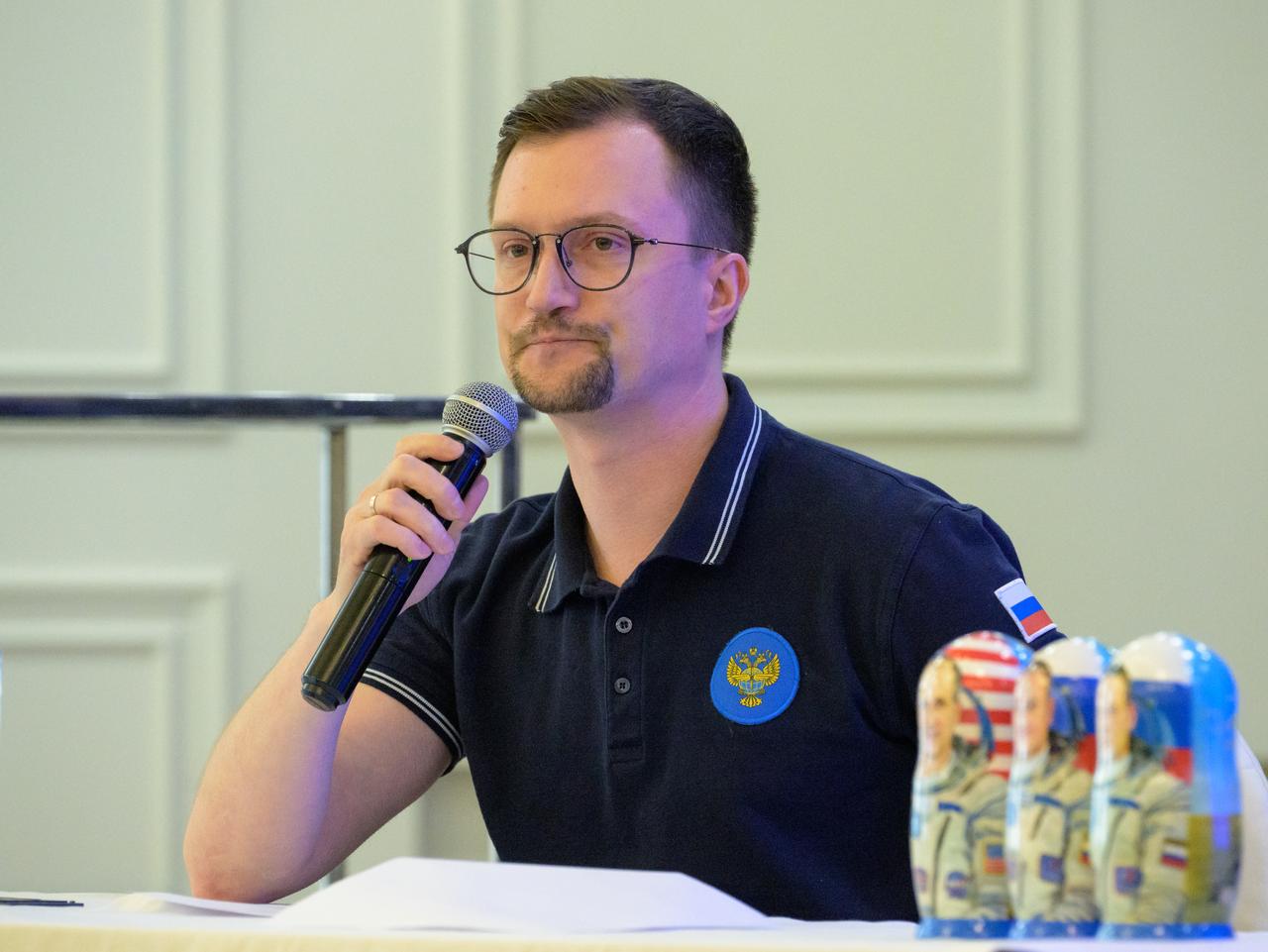
Head of the Search-and-Rescue Department of Rosaviatsiya (Russian Federal Agency for Air Transport) Andrey Aleksandrovich, conducts a meeting with NASA, Roscosmos, and Russian Search and Recovery Forces at the Cosmonaut Hotel in Karaganda, Kazakhstan, Friday, April 18, 2025. Teams discussed the readiness for the landing of Expedition 72 NASA astronaut Don Pettit, and Roscosmos cosmonauts Alexey Ovchinin and Ivan Vagner. Photo Credit: (NASA/Bill Ingalls)

S66-42742 (18 July 1966) --- The Gemini-10 prime crew, astronauts John W. Young (background), command pilot, and Michael Collins (foreground), pilot, relax in the Launch Complex 16 suiting trailer during the Gemini-10 prelaunch countdown. Minutes later astronaut Young and Collins were transported to Pad 19 and their waiting Gemini-10 spacecraft in preparation for their scheduled three-day mission in space. Photo credit: NASA
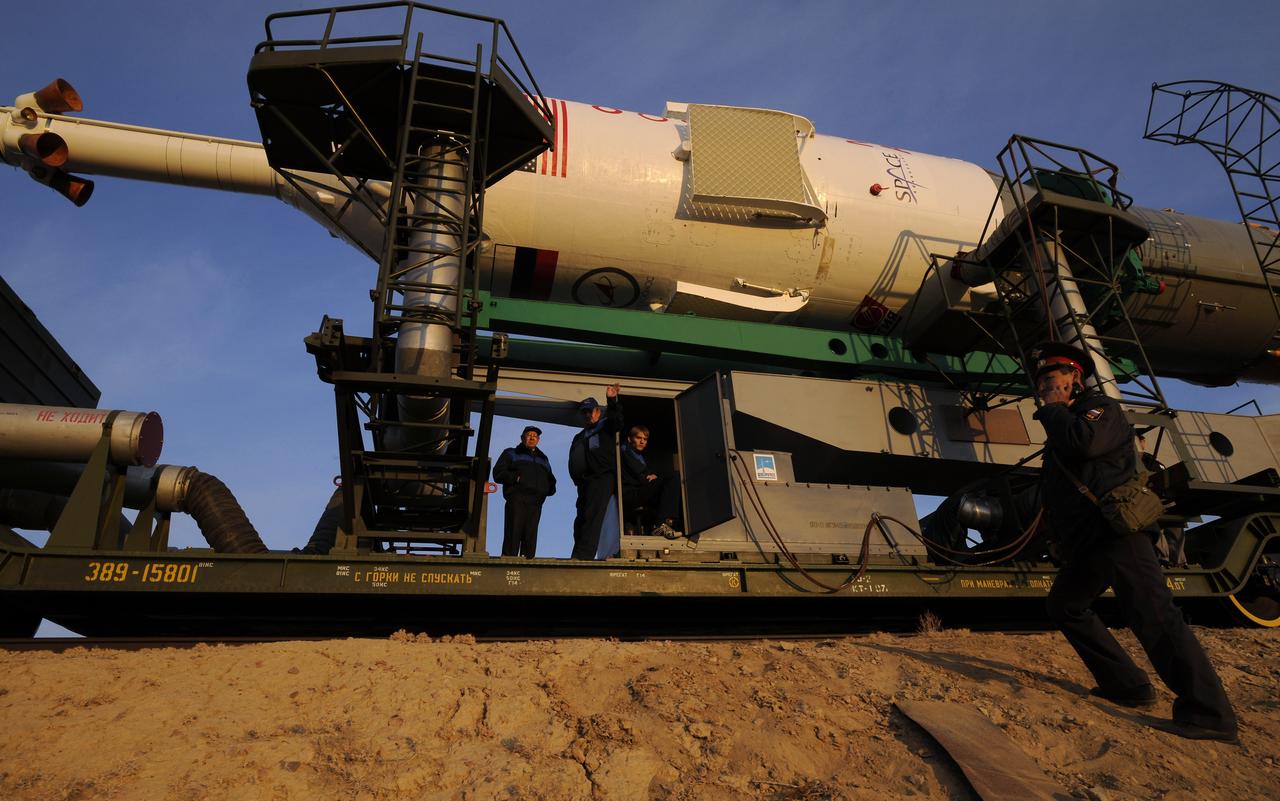
The Soyuz TMA-13 spacecraft is transported by railcar to its launch pad at the Baikonur Cosmodrome in Kazakhstan, Friday, Oct. 10, 2008. Expedition 18 Commander Michael Fincke, Flight Engineer Yuri V. Lonchakov and American spaceflight participant Richard Garriott will launch October 12 and dock with the International Space Station October 14. Fincke and Lonchakov will spend six months on the station, while Garriott will return to Earth after 10 days with the Expedition 17 crew members currently on the ISS. Photo Credit: (NASA/Bill Ingalls)
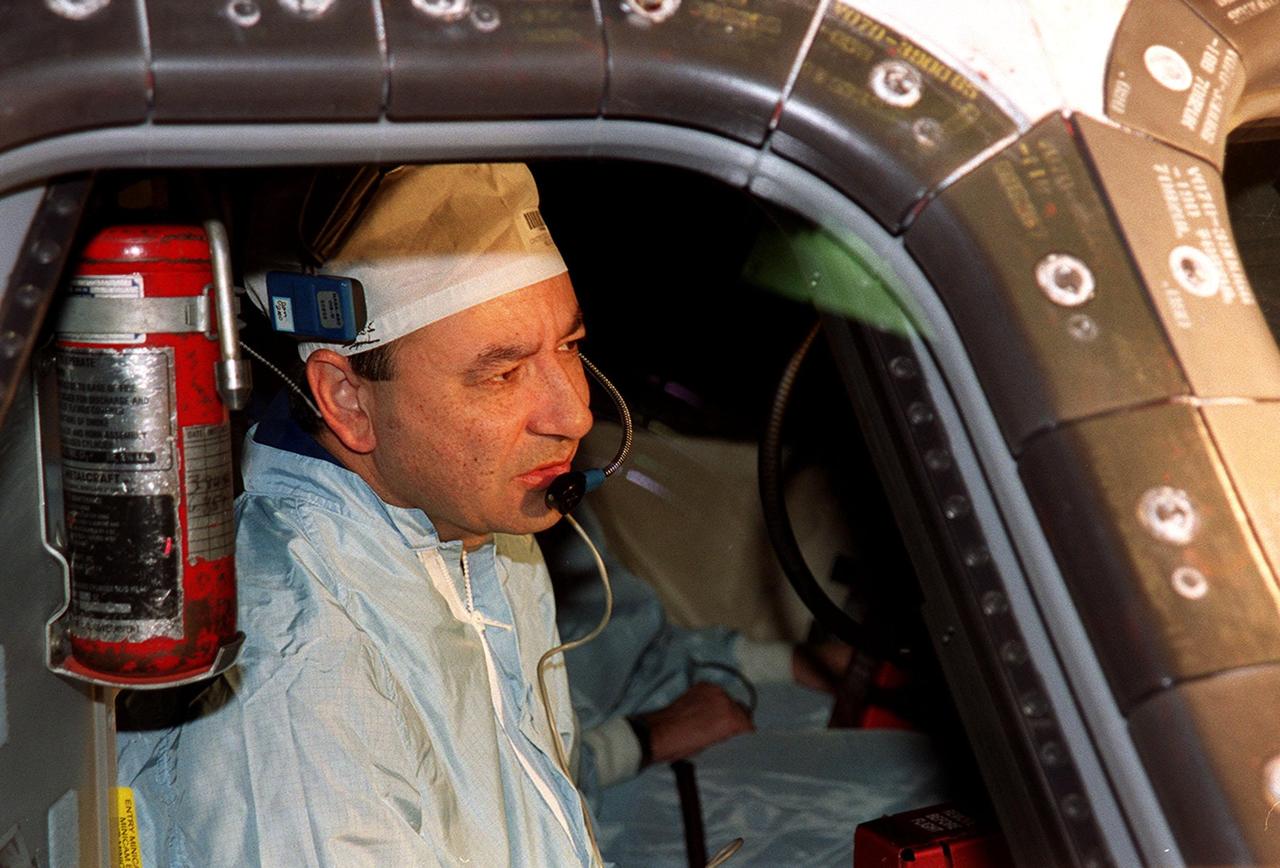
KENNEDY SPACE CENTER, FLA. -- In Orbiter Processing Facility bay 3, STS-98 Pilot Mark Polansky inspects the window in the cockpit of Atlantis. He and the rest of the crew are at KSC for Crew Equipment Interface Test activities. Launch on mission STS-98 is scheduled for Jan. 18, 2001. It will be transporting the U.S. Lab, Destiny, to the International Space Station with five system racks already installed inside of the module. After delivery of electronics in the lab, electrically powered attitude control for Control Moment Gyroscopes will be activated
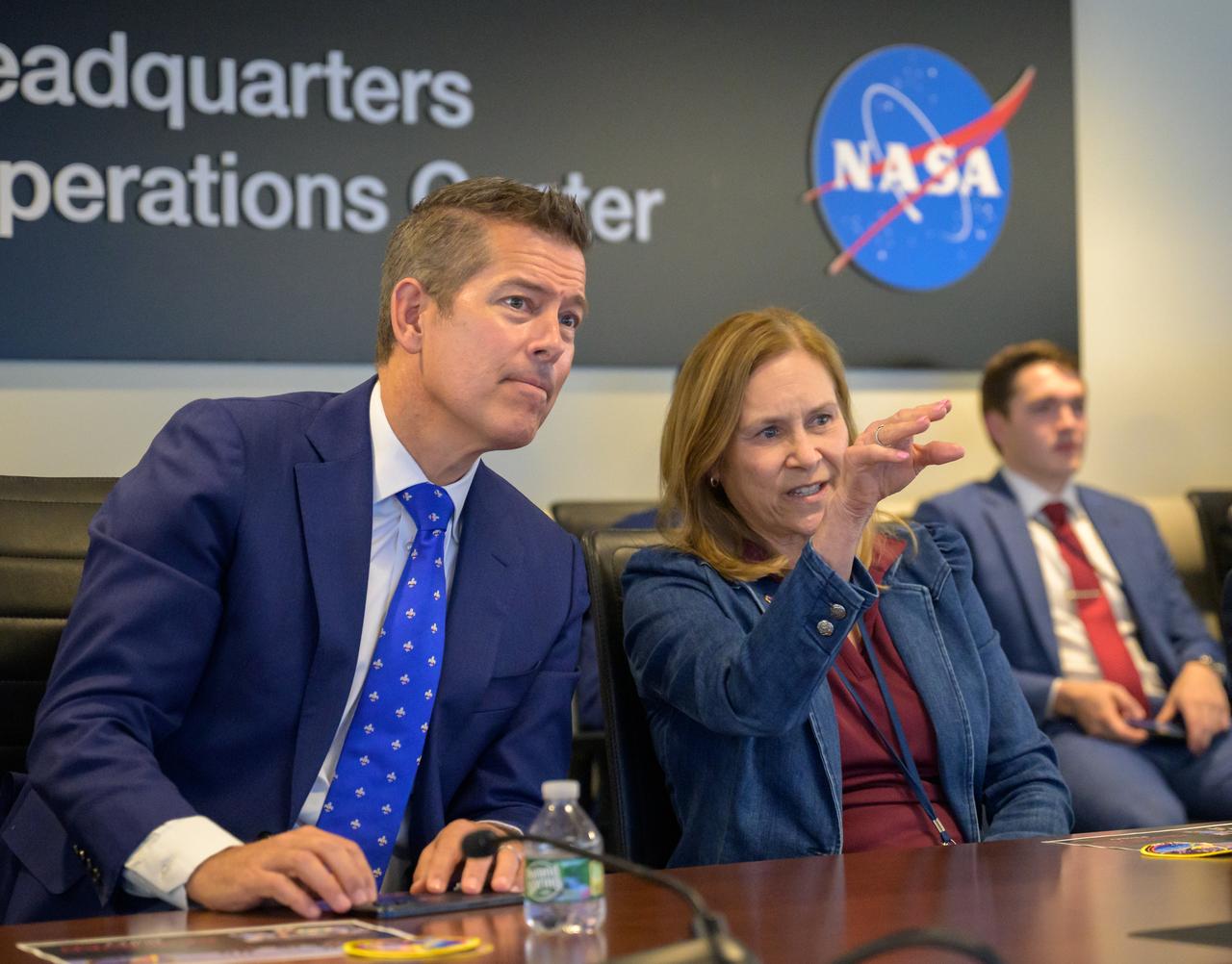
U.S. Transportation Secretary Sean Duffy, and acting NASA Administrator Janet Petro, right, watch as the SpaceX Dragon spacecraft splashes down with NASA astronauts Butch Wilmore, Suni Williams, Nick Hague, and Roscosmos cosmonaut Aleksandr Gorbunov, Tuesday, March 18, 2025, from the Space Operations Center at the Mary W. Jackson NASA Headquarters Building in Washington. Photo Credit: (NASA/Bill Ingalls)
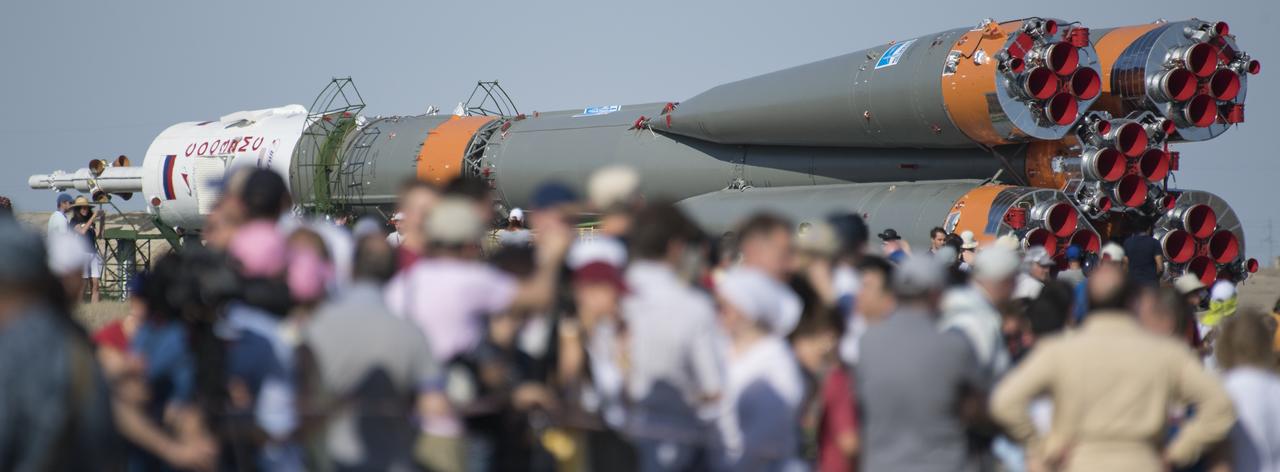
The Soyuz rocket is seen as it is transported to the launch pad by train, Thursday, July 18, 2019 at the Baikonur Cosmodrome in Kazakhstan. Expedition 60 Soyuz Commander Alexander Skvortsov of Roscosmos, flight engineer Andrew Morgan of NASA, and flight engineer Luca Parmitano of ESA (European Space Agency) are scheduled to launch aboard their Soyuz MS-13 spacecraft at 12:28 p.m. Eastern time (9:28 p.m. Baikonur time) , on Saturday, July 20. Photo Credit: (NASA/Joel Kowsky)
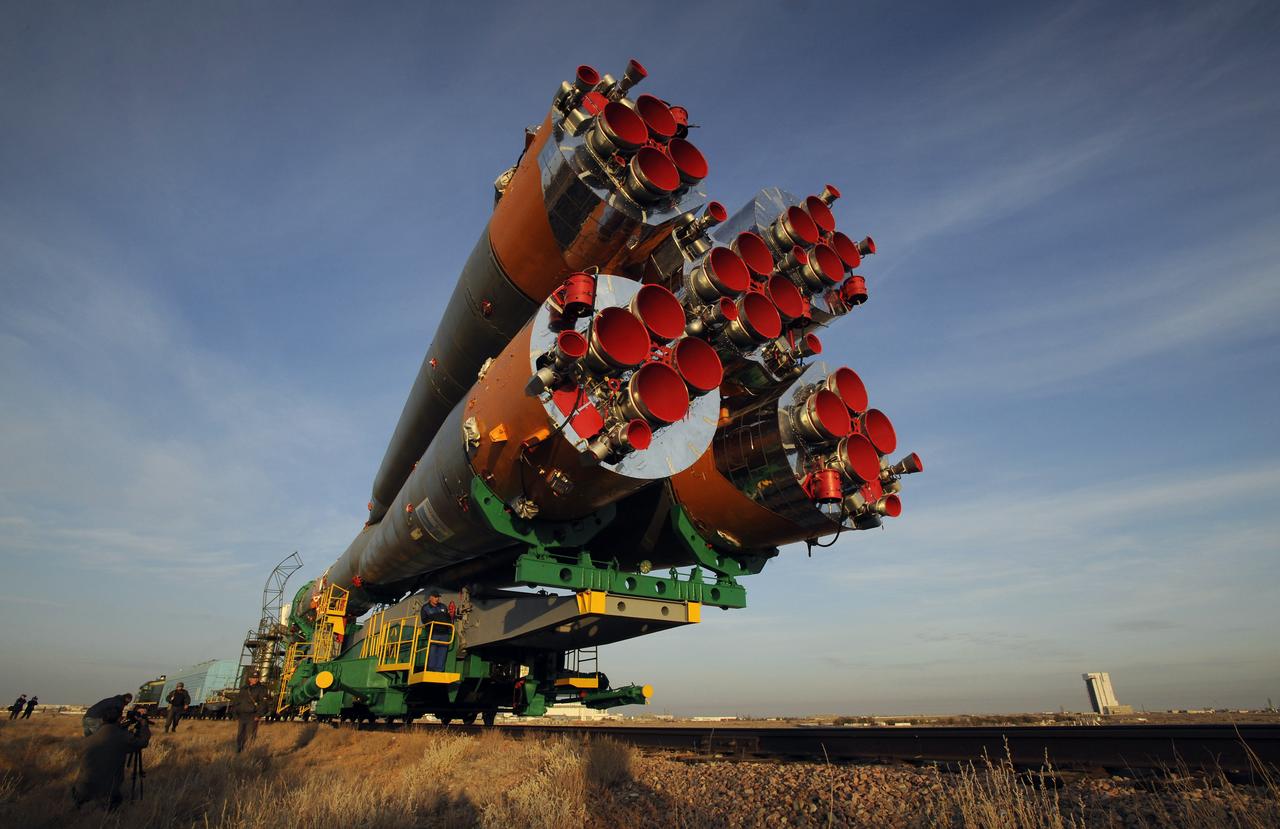
The Soyuz TMA-13 spacecraft is transported by railcar to its launch pad at the Baikonur Cosmodrome in Kazakhstan, Friday, Oct. 10, 2008. Expedition 18 Commander Michael Fincke, Flight Engineer Yuri V. Lonchakov and American spaceflight participant Richard Garriott will launch October 12 and dock with the International Space Station October 14. Fincke and Lonchakov will spend six months on the station, while Garriott will return to Earth after 10 days with the Expedition 17 crew members currently on the ISS. Photo Credit: (NASA/Bill Ingalls)

CAPE CANAVERAL, Fla. – In the Space Station Processing Facility at NASA's Kennedy Space Center in Florida, the Multi-Purpose Logistics Module Leonardo moves closer to the payload canister at right. The canister will transport the module to Launch Pad 39A for installation in space shuttle Discovery for the STS-128 mission. The module will carry science and storage racks to the International Space Station. Launch is targeted for Aug. 18. Photo credit: NASA/Jack Pfaller
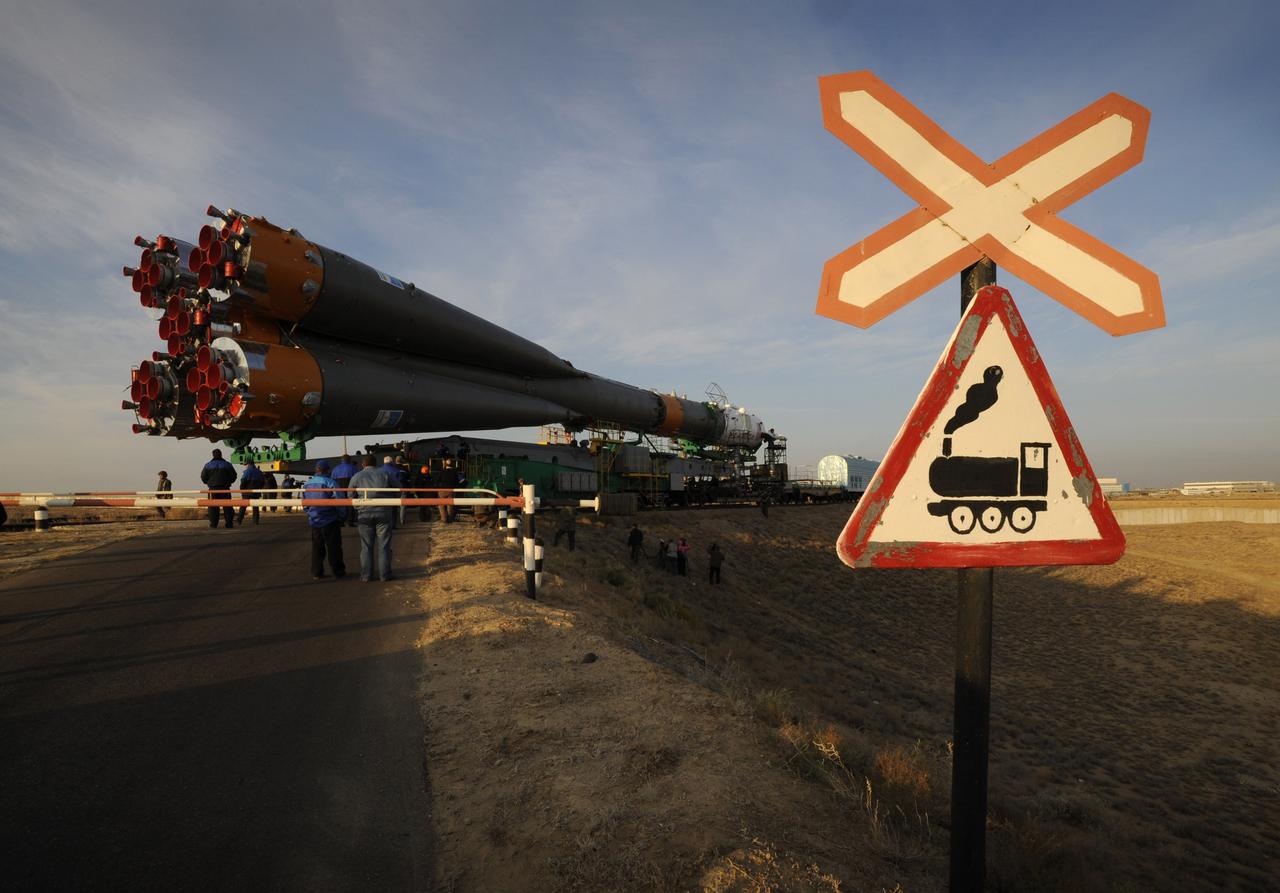
The Soyuz TMA-13 spacecraft is transported by railcar to its launch pad at the Baikonur Cosmodrome in Kazakhstan, Friday, Oct. 10, 2008. Expedition 18 Commander Michael Fincke, Flight Engineer Yuri V. Lonchakov and American spaceflight participant Richard Garriott will launch October 12 and dock with the International Space Station October 14. Fincke and Lonchakov will spend six months on the station, while Garriott will return to Earth after 10 days with the Expedition 17 crew members currently on the ISS. Photo Credit: (NASA/Bill Ingalls)

CAPE CANAVERAL, Fla. – In the Space Station Processing Facility at NASA's Kennedy Space Center in Florida, the crane lowers the Multi-Purpose Logistics Module Leonardo into the payload canister. The canister will transport the module to Launch Pad 39A for installation in space shuttle Discovery for the STS-128 mission. The module will carry science and storage racks to the International Space Station. Launch is targeted for Aug. 18. Photo credit: NASA/Jack Pfaller
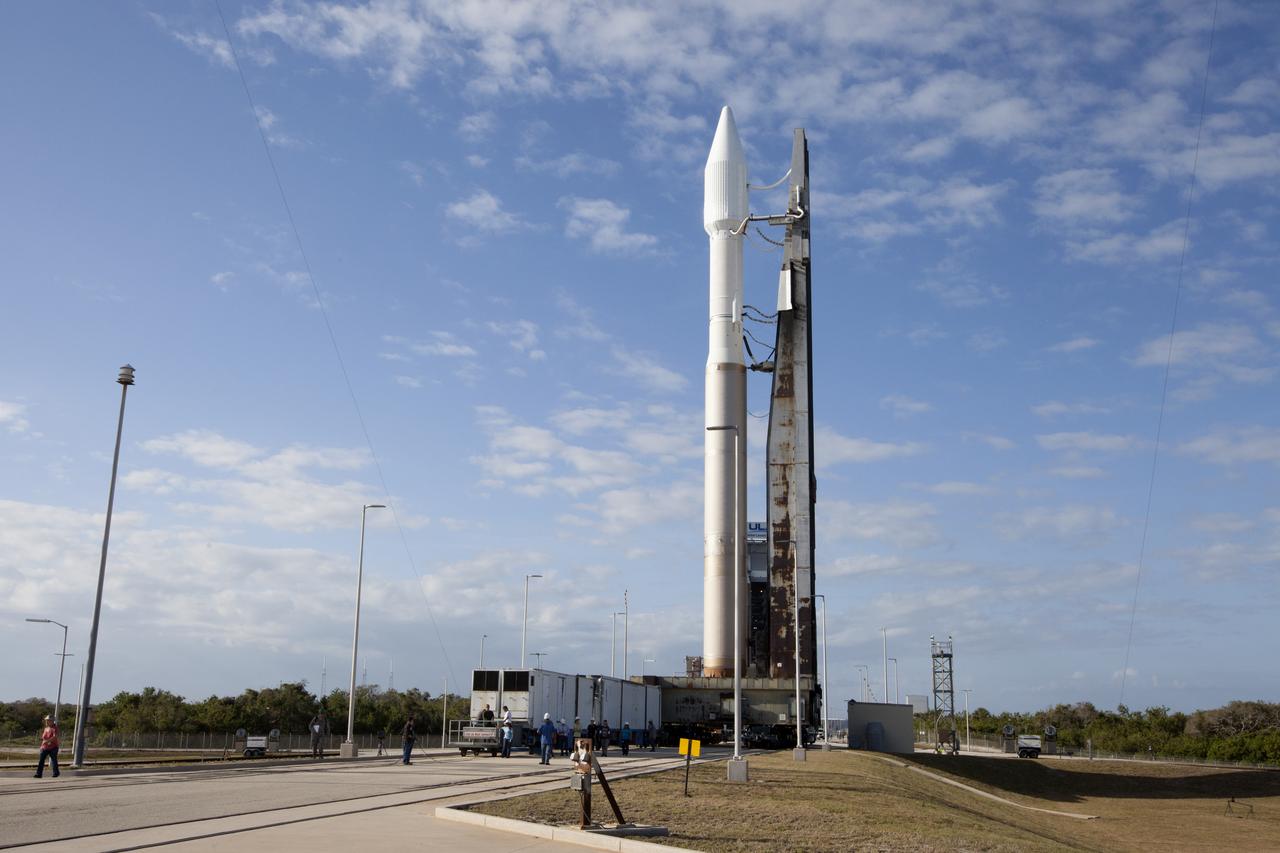
A United Launch Alliance Atlas V rocket, with the Orbital ATK Cygnus pressurized cargo module, is transported along the road to the pad at Space Launch Complex 41 at Cape Canaveral Air Force Station in Florida. Orbital ATK's seventh commercial resupply services mission, CRS-7, is scheduled to launch to the International Space Station on April 18, 2017. Cygnus will deliver 7,600 pounds of supplies, equipment and scientific research materials to the space station. Liftoff is scheduled for 11:11 a.m. EDT.
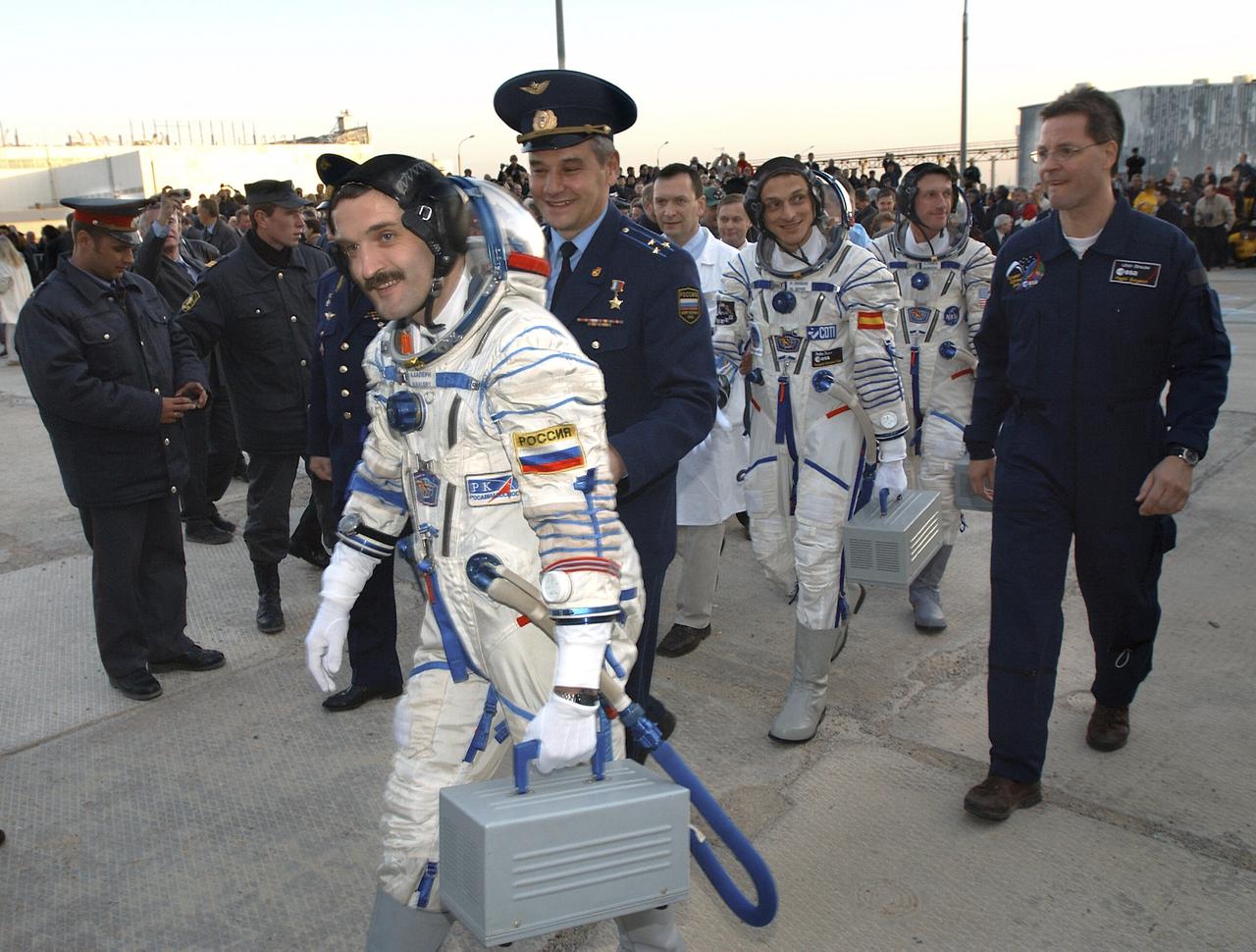
Expedition 8 Soyuz Commander Alexander Kaleri, left foreground, European Space Agency astronaut Pedro Duque of Spain and Expedition 8 Commander and NASA Science Officer Michael Foale walk to a bus at the Baikonur Cosmodrome in Kazakhstan, Saturday, Oct. 18, 2003, for transportation to the launch pad to liftoff in a Soyuz TMA-3 vehicle to the International Space Station. The trio arrived at the ISS Oct. 20. Photo Credit (NASA/Bill Ingalls)

CAPE CANAVERAL, Fla. – The Multi-Purpose Logistics Module Leonardo is lifted from its stand in the Space Station Processing Facility at NASA's Kennedy Space Center in Florida. The module is being transferred to the payload canister for its transport to Launch Pad 39A. It will be installed in space shuttle Discovery for the STS-128 mission. The module will carry science and storage racks to the International Space Station. Launch is targeted for Aug. 18. Photo credit: NASA/Jack Pfaller
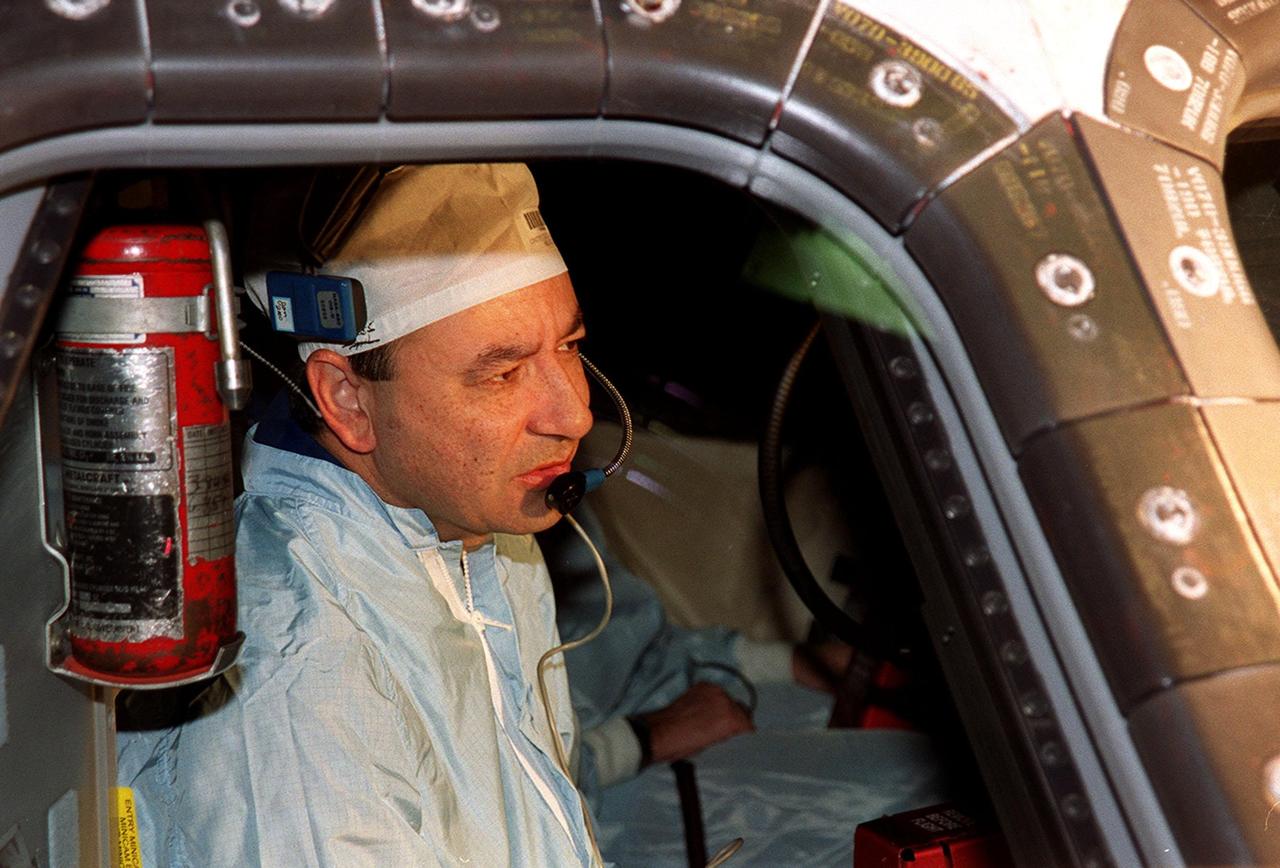
KENNEDY SPACE CENTER, FLA. -- In Orbiter Processing Facility bay 3, STS-98 Pilot Mark Polansky inspects the window in the cockpit of Atlantis. He and the rest of the crew are at KSC for Crew Equipment Interface Test activities. Launch on mission STS-98 is scheduled for Jan. 18, 2001. It will be transporting the U.S. Lab, Destiny, to the International Space Station with five system racks already installed inside of the module. After delivery of electronics in the lab, electrically powered attitude control for Control Moment Gyroscopes will be activated

ISS018-E-040973 (18 March 2009) --- This scene gives evidence that the "work crews" have arrived at the International Space Station to continue the "home improvement" project. A Soyuz vehicle used to transport the station crewmembers is in the foreground, with the Space Shuttle Discovery visible just beneath it. Ten people are busy on the station, and two of them are preparing to exit the shirt sleeve environment to go outside for a March 19 spacewalk, on which the other crewmembers will be pitching in their support and technical assistance.
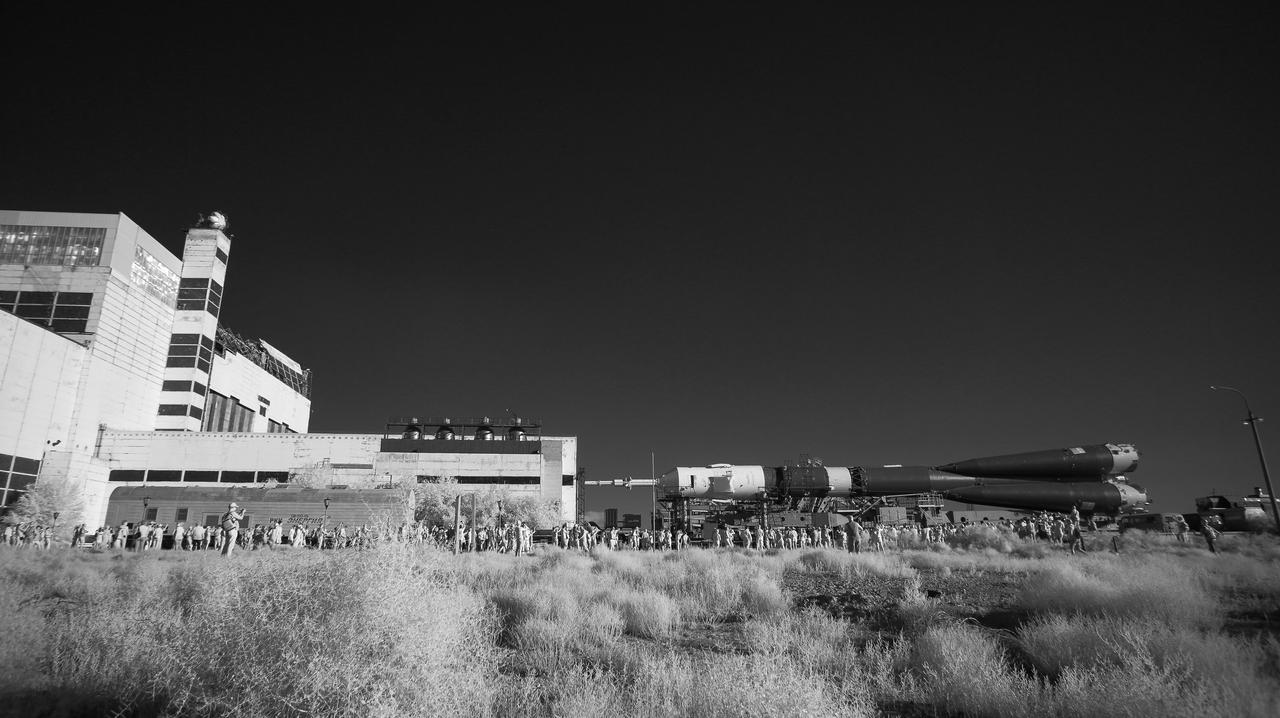
In this black and white infrared image, the Soyuz rocket is seen as it transported to the launch pad by train, Thursday, July 18, 2019 at the Baikonur Cosmodrome in Kazakhstan. Expedition 60 Soyuz Commander Alexander Skvortsov of Roscosmos, flight engineer Andrew Morgan of NASA, and flight engineer Luca Parmitano of ESA (European Space Agency) are scheduled to launch aboard their Soyuz MS-13 spacecraft at 12:28 p.m. Eastern time (9:28 p.m. Baikonur time), on Saturday, July 20. Photo Credit: (NASA/Joel Kowsky)
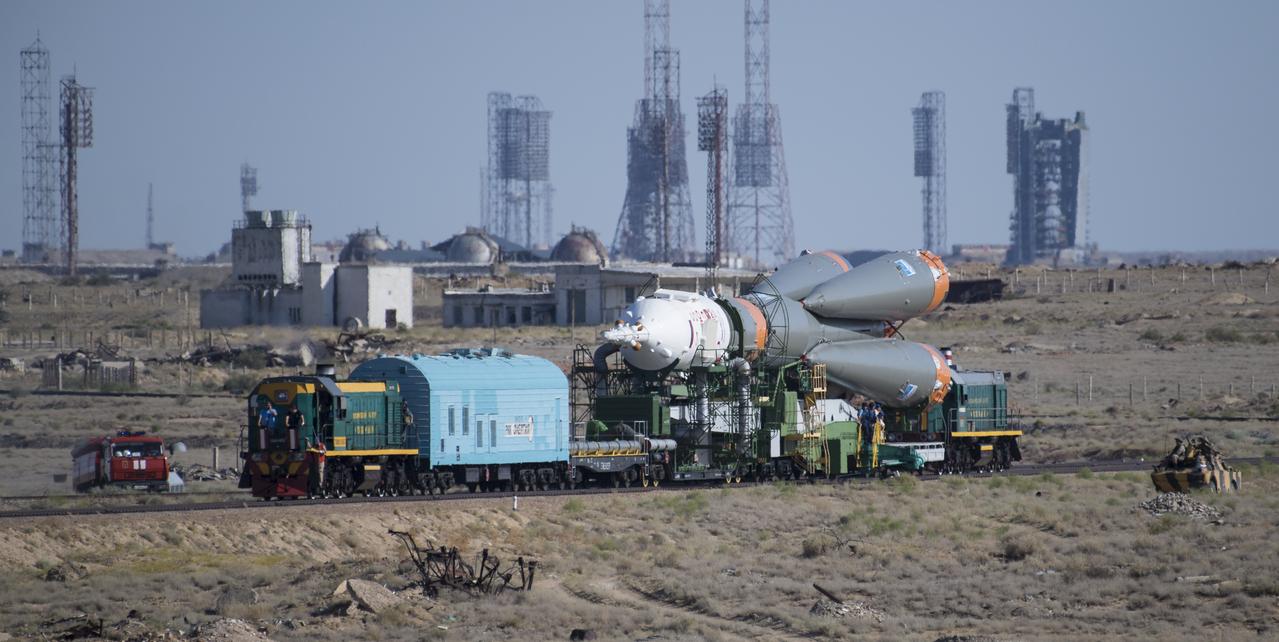
The Soyuz rocket is seen as it is transported to the launch pad by train, Thursday, July 18, 2019 at the Baikonur Cosmodrome in Kazakhstan. Expedition 60 Soyuz Commander Alexander Skvortsov of Roscosmos, flight engineer Andrew Morgan of NASA, and flight engineer Luca Parmitano of ESA (European Space Agency) are scheduled to launch aboard their Soyuz MS-13 spacecraft at 12:28 p.m. Eastern time (9:28 p.m. Baikonur time) , on Saturday, July 20. Photo Credit: (NASA/Joel Kowsky)
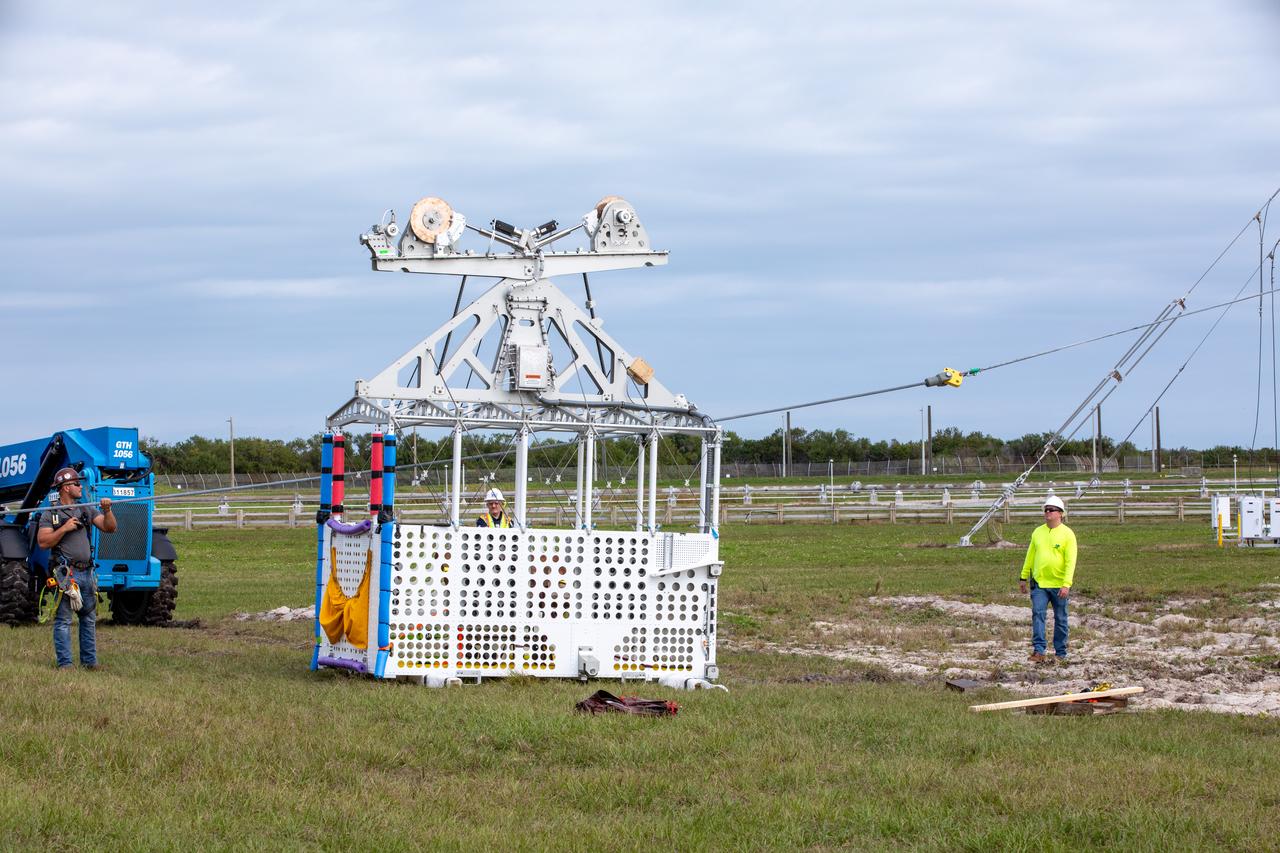
Teams with NASA’s Exploration Ground Systems Program, in preparation for the agency’s Artemis II crewed mission to the Moon, begin installation of four emergency egress baskets at Launch Complex 39B at Kennedy Space Center in Florida on Thursday, Jan. 18, 2024. The baskets, similar to gondolas on ski lifts, are used in the case of a pad abort emergency to enable astronauts and other pad personnel a way to quickly escape away from the mobile launcher to the base of the pad and where waiting emergency transport vehicles will then drive them away.

CAPE CANAVERAL, Fla. – In the Space Station Processing Facility at NASA's Kennedy Space Center in Florida, the Multi-Purpose Logistics Module Leonardo is carried by an overhead crane from its stand, at left, toward the payload canister. The canister will transport the module to Launch Pad 39A for installation in space shuttle Discovery for the STS-128 mission. The module will carry science and storage racks to the International Space Station. Launch is targeted for Aug. 18. Photo credit: NASA/Jack Pfaller
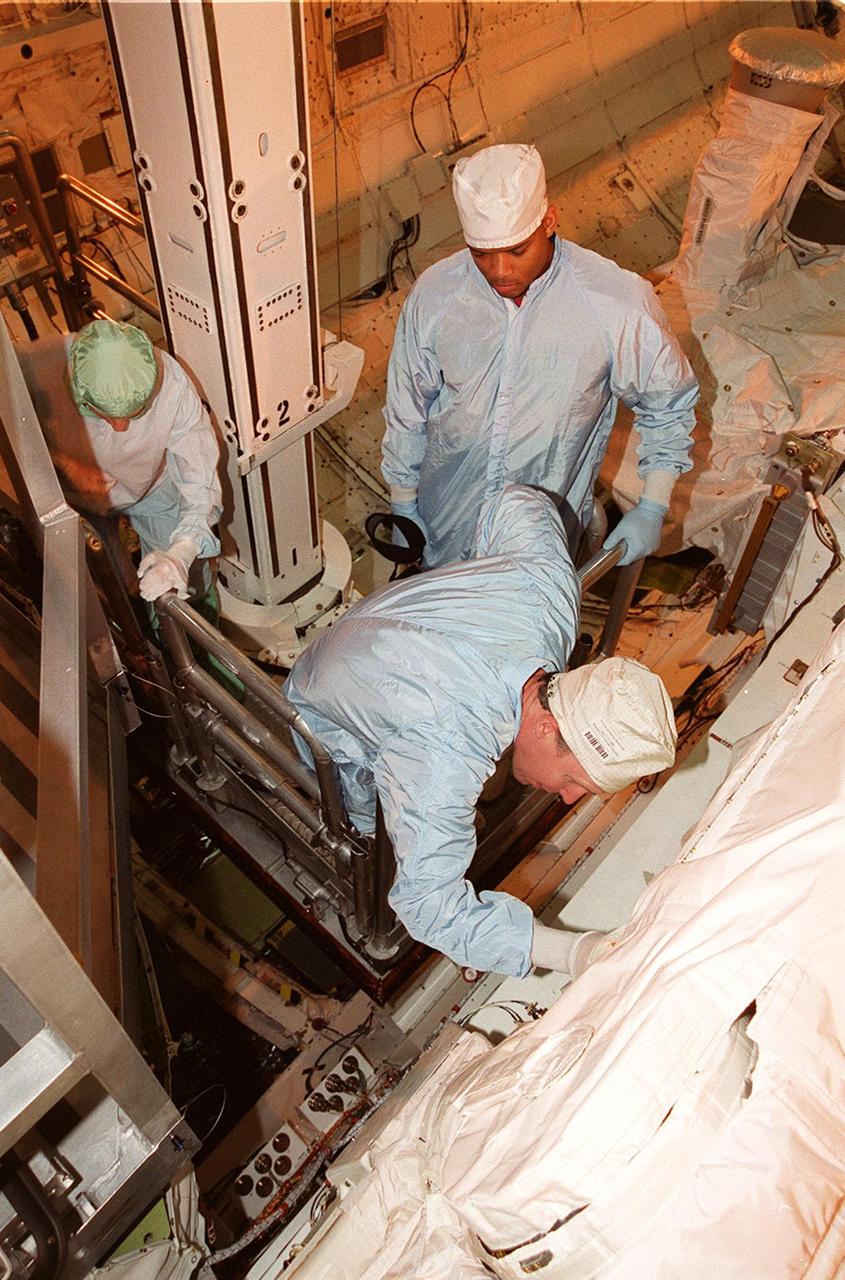
KENNEDY SPACE CENTER, FLA. -- Working on the Orbiter Docking System of orbiter Atlantis are Mission Specialists Tom Jones (leaning over) and Robert Curbeam. They and the rest of the crew are at KSC for Crew Equipment Interface Test activities. Launch on mission STS-98 is scheduled for Jan. 18, 2001. It will be transporting the U.S. Lab, Destiny, to the International Space Station with five system racks already installed inside of the module. After delivery of electronics in the lab, electrically powered attitude control for Control Moment Gyroscopes will be activated
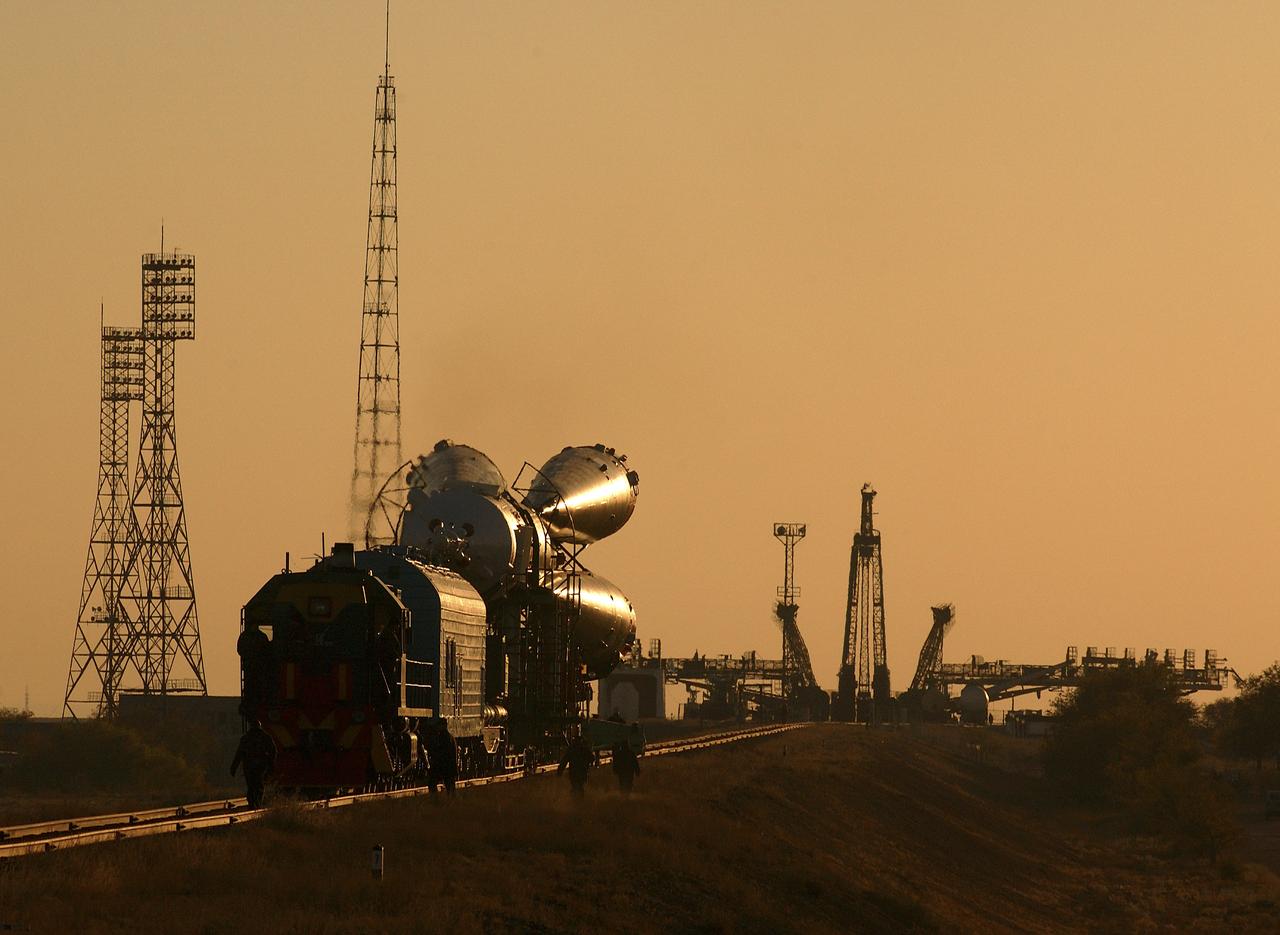
A Soyuz TMA-3 spacecraft and its booster rocket is transported on a rail car to the launch pad at the Baikonur Cosmodrome, Kazakhstan on Thursday, Oct. 16, 2003 in preparation for liftoff Oct. 18 to carry Expedition 8 Commander and NASA Science Officer Michael Foale, Expedition 8 Soyuz Commander Alexander Kaleri and European Space Agency astronaut Pedro Duque of Spain to the International Space Station. Photo Credit (NASA/Bill Ingalls)
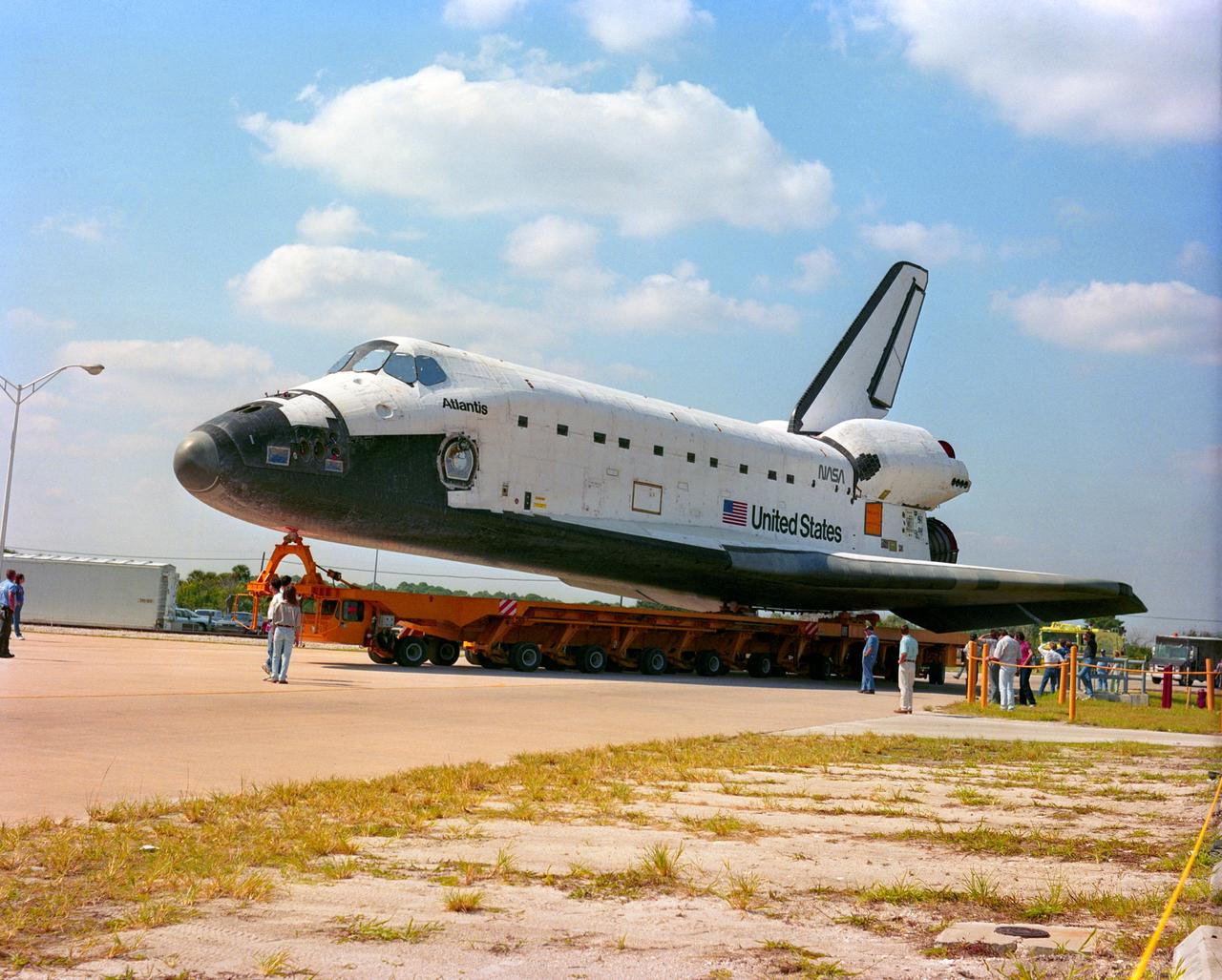
S91-50776 (18 Oct 1991) --- The Space Shuttle Atlantis is moved from the Orbital Processing Facility (OPF) Bay 2 to the Vehicle Assembly Building (VAB) at Kennedy Space Center, Florida. The Atlantis will be mated with the external fuel tank and solid rocket boosters before it is transported to Pad 39A, where it will launch a Department of Defense payload, Mission STS-44, in late 1991.
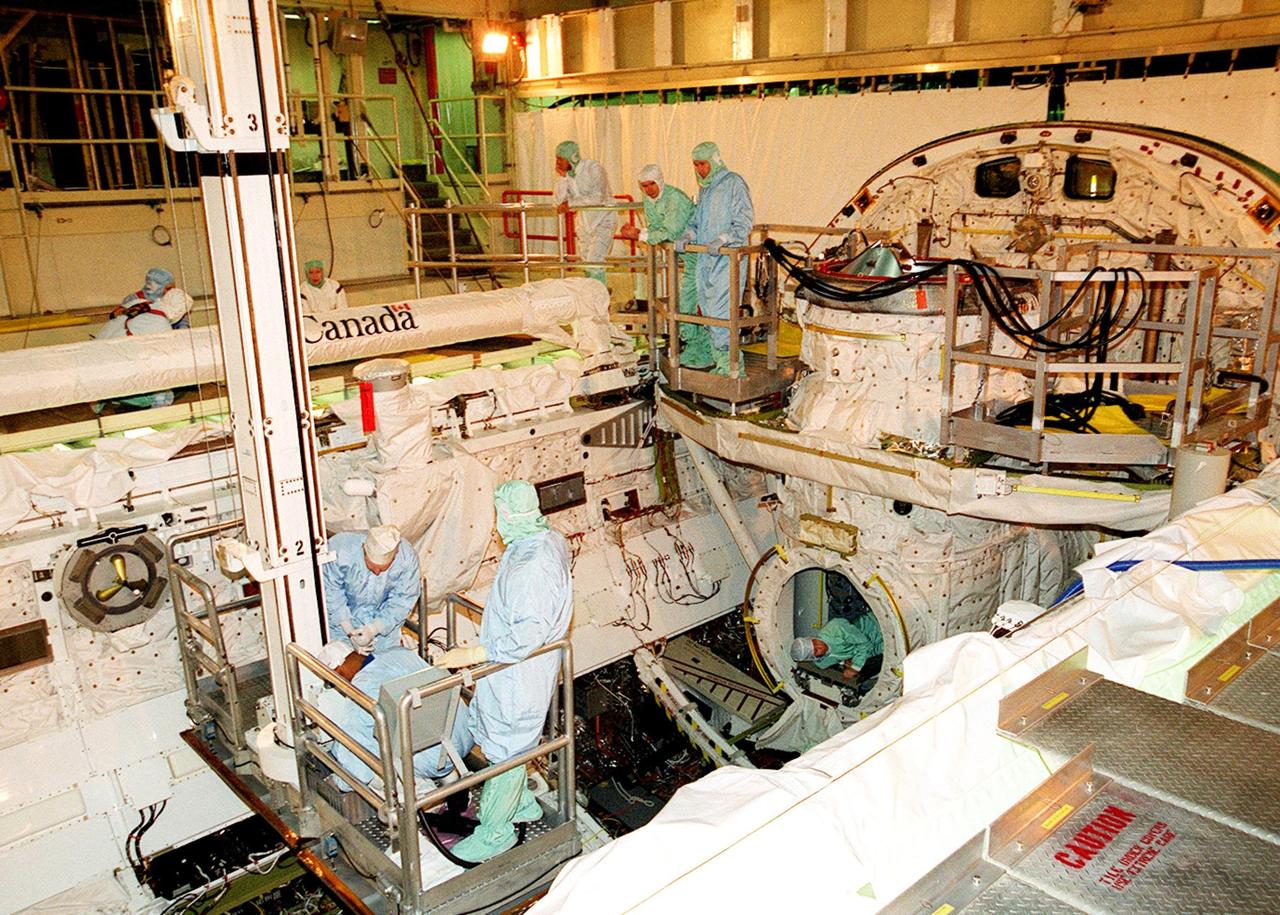
KENNEDY SPACE CENTER, FLA. -- The STS-98 crew looks over components of the equipment already installed in the payload bay of orbiter Atlantis, which is in the Orbiter Processing Facility bay 3. The crew is at KSC for Crew Equipment Interface Test activities. Launch on mission STS-98 is scheduled for Jan. 18, 2001. It will be transporting the U.S. Lab, Destiny, to the International Space Station with five system racks already installed inside of the module. After delivery of electronics in the lab, electrically powered attitude control for Control Moment Gyroscopes will be activated
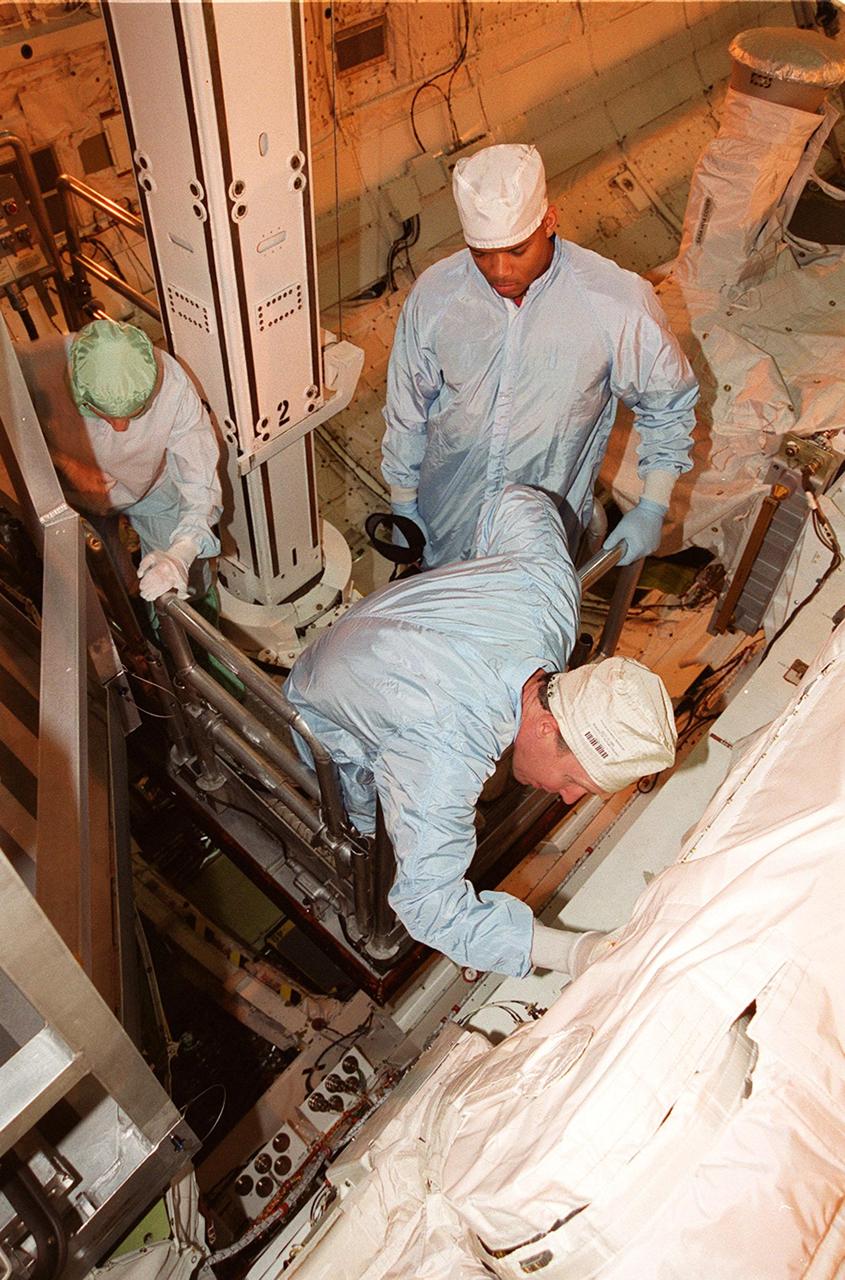
KENNEDY SPACE CENTER, FLA. -- Working on the Orbiter Docking System of orbiter Atlantis are Mission Specialists Tom Jones (leaning over) and Robert Curbeam. They and the rest of the crew are at KSC for Crew Equipment Interface Test activities. Launch on mission STS-98 is scheduled for Jan. 18, 2001. It will be transporting the U.S. Lab, Destiny, to the International Space Station with five system racks already installed inside of the module. After delivery of electronics in the lab, electrically powered attitude control for Control Moment Gyroscopes will be activated
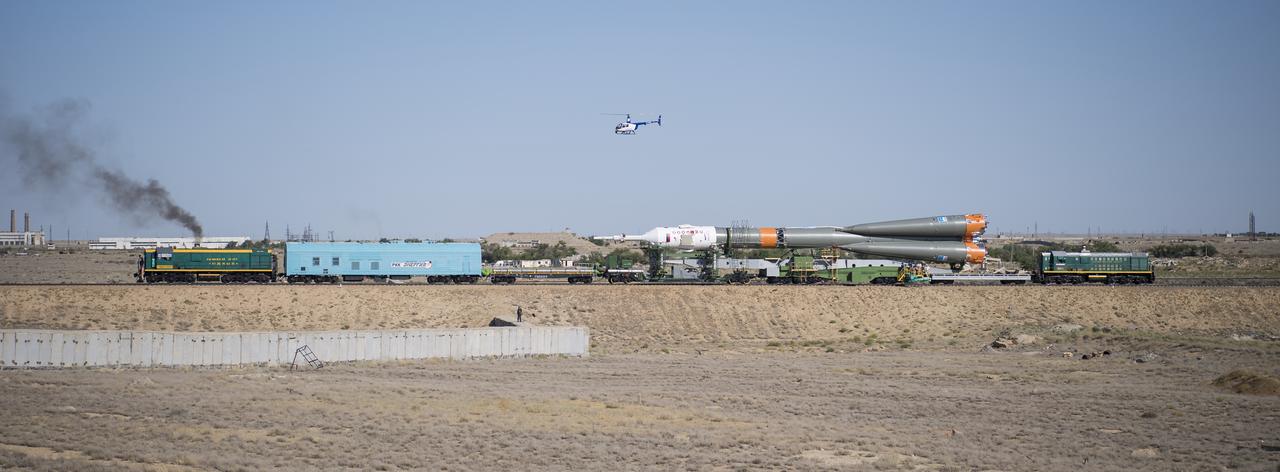
The Soyuz rocket is seen as it is transported to the launch pad by train, Thursday, July 18, 2019 at the Baikonur Cosmodrome in Kazakhstan. Expedition 60 Soyuz Commander Alexander Skvortsov of Roscosmos, flight engineer Andrew Morgan of NASA, and flight engineer Luca Parmitano of ESA (European Space Agency) are scheduled to launch aboard their Soyuz MS-13 spacecraft at 12:28 p.m. Eastern time (9:28 p.m. Baikonur time) , on Saturday, July 20. Photo Credit: (NASA/Joel Kowsky)
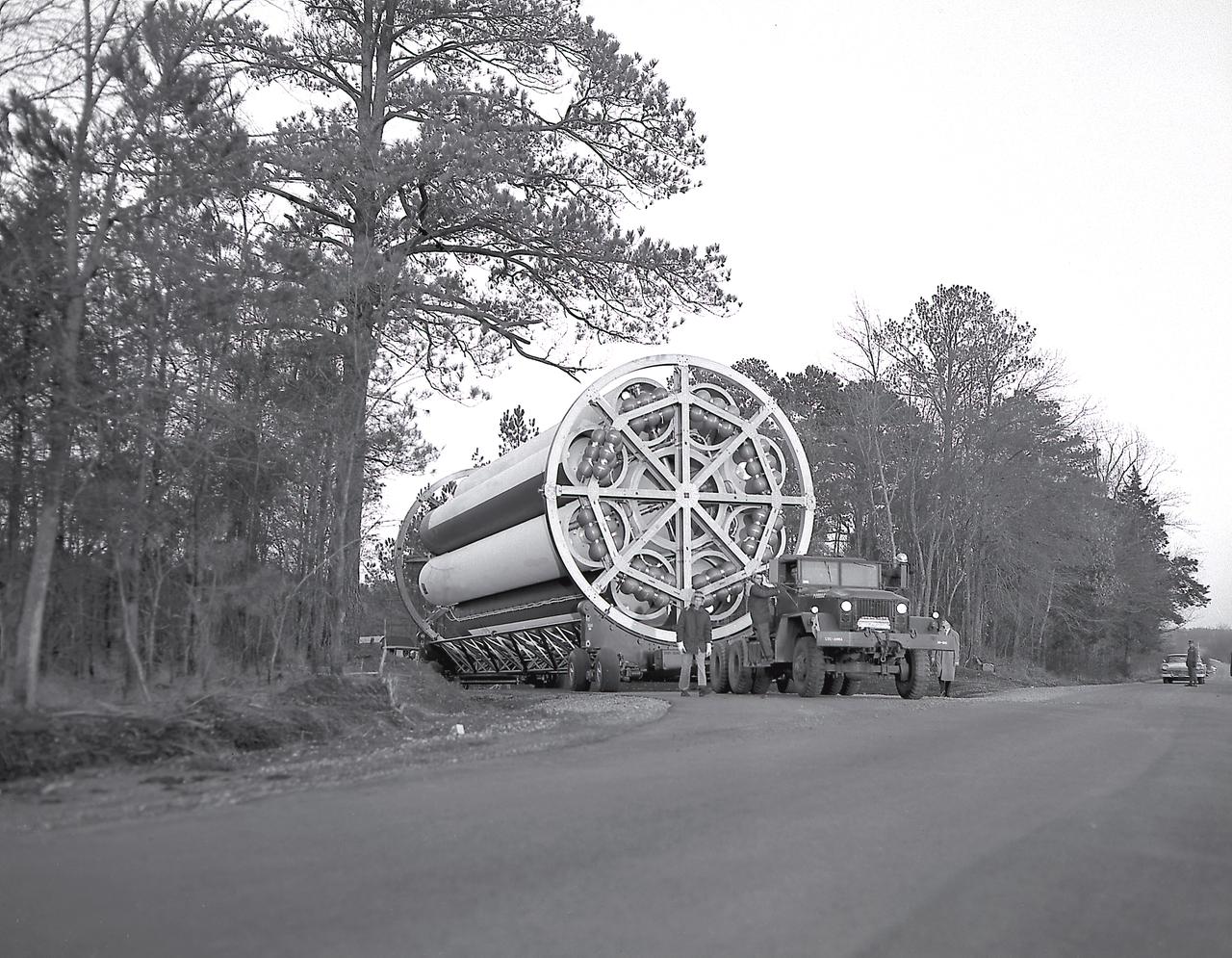
The Saturn Project was approved on January 18, 1960 as a program of the highest national priority. The formal test program to prove out the clustered-booster concept was well underway at Redstone Arsenal. This photograph depicts a mockup of the Saturn booster (S-I stage) being transported to the Army Ballistic Missile Agency (ABMA) test stand, to check mating of the booster and stand and servicing methods.
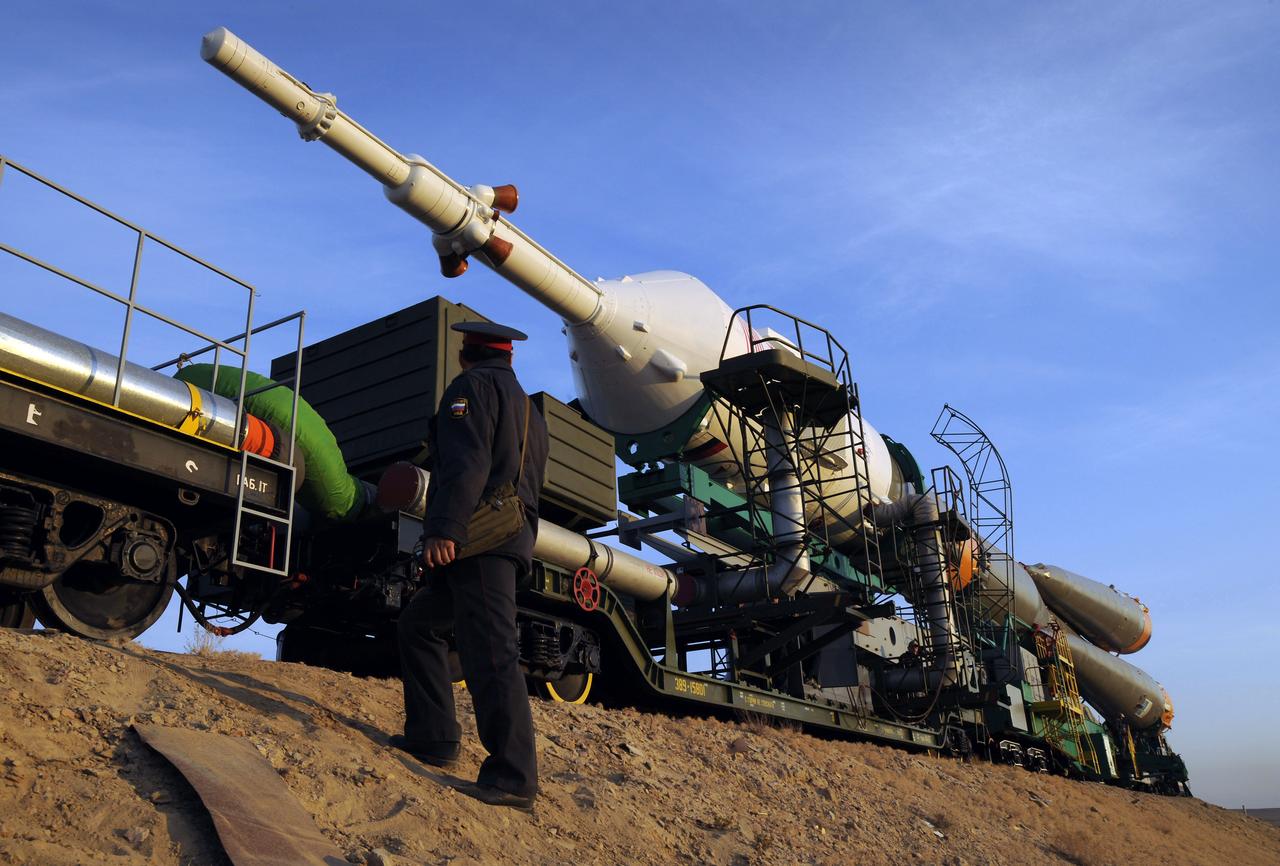
The Soyuz TMA-13 spacecraft is transported by railcar to its launch pad at the Baikonur Cosmodrome in Kazakhstan, Friday, Oct. 10, 2008. Expedition 18 Commander Michael Fincke, Flight Engineer Yuri V. Lonchakov and American spaceflight participant Richard Garriott will launch October 12 and dock with the International Space Station October 14. Fincke and Lonchakov will spend six months on the station, while Garriott will return to Earth after 10 days with the Expedition 17 crew members currently on the ISS. Photo Credit: (NASA/Bill Ingalls)
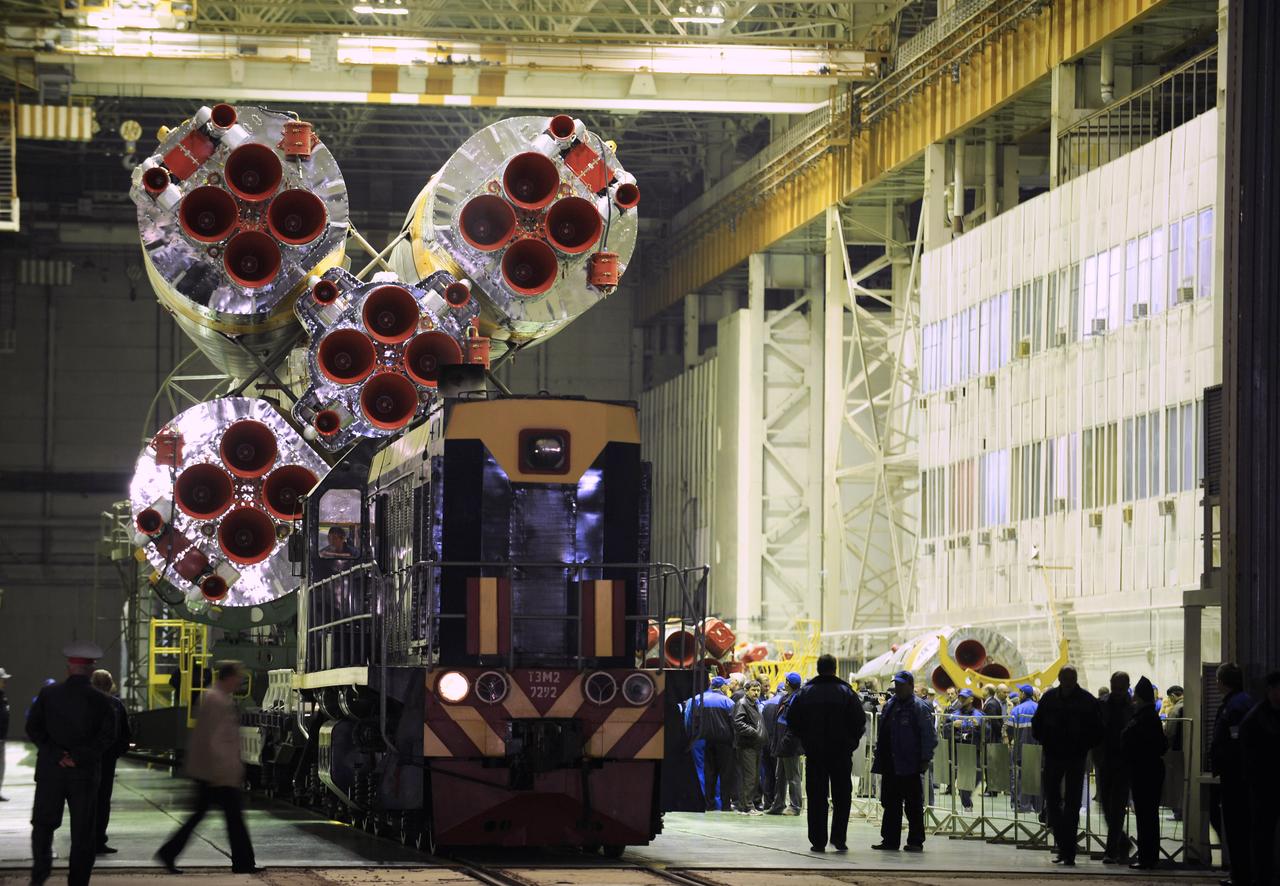
The Soyuz TMA-13 spacecraft is transported by railcar to its launch pad at the Baikonur Cosmodrome in Kazakhstan, Friday, Oct. 10, 2008. Expedition 18 Commander Michael Fincke, Flight Engineer Yuri V. Lonchakov and American spaceflight participant Richard Garriott will launch October 12 and dock with the International Space Station October 14. Fincke and Lonchakov will spend six months on the station, while Garriott will return to Earth after 10 days with the Expedition 17 crew members currently on the ISS. Photo Credit: (NASA/Bill Ingalls)
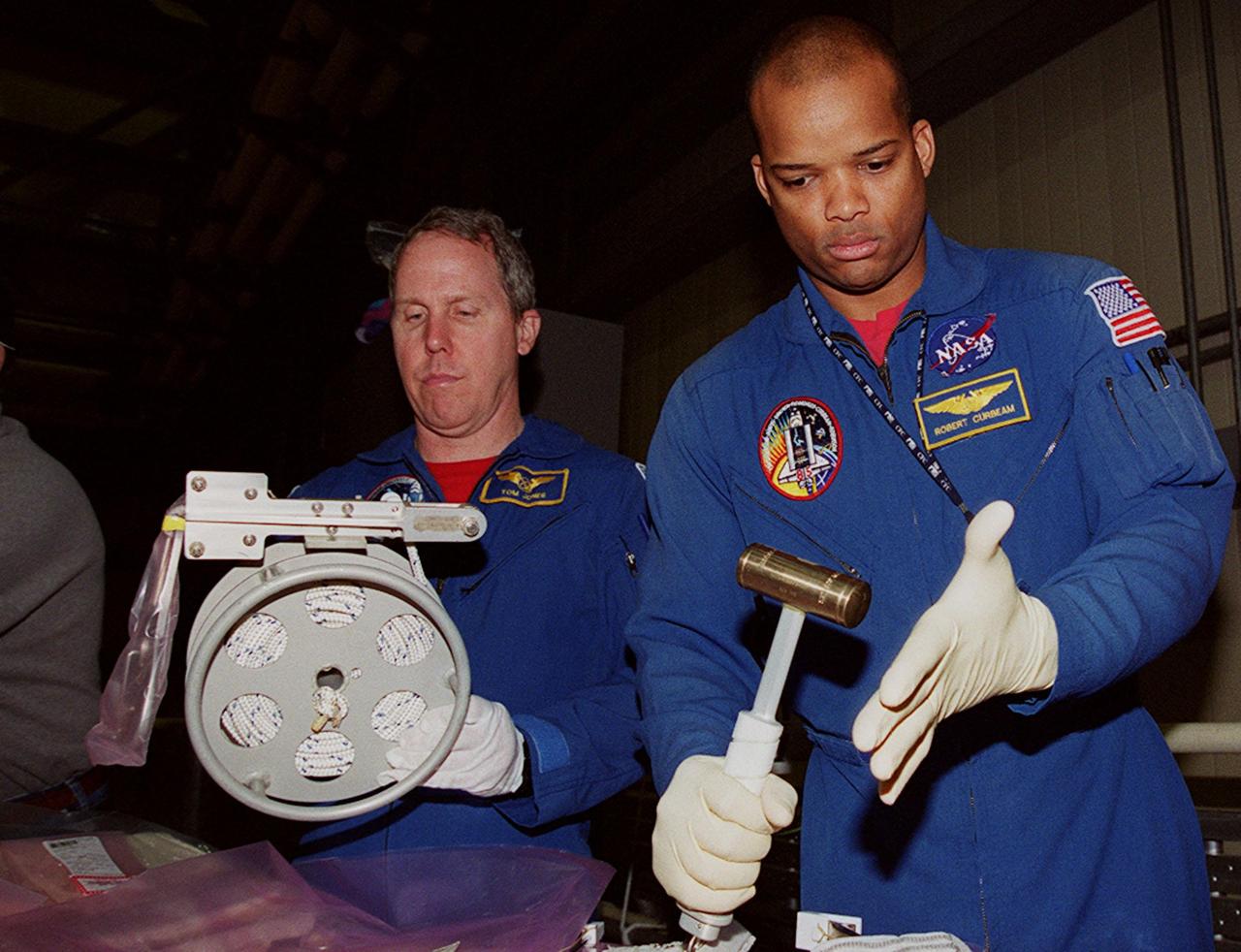
KENNEDY SPACE CENTER, FLA. -- In Orbiter Processing Facility bay 3, STS-98 Mission Specialists Tom Jones and Robert Curbeam test tools that will be used during extravehicular activities (EVA) on their mission. Scheduled for launch Jan. 18, 2001, STS-98 will be transporting the U.S. Lab, Destiny, to the International Space Station with five system racks already installed inside of the module. After delivery of electronics in the lab, electrically powered attitude control for Control Moment Gyroscopes will be activated

CAPE CANAVERAL, Fla. – In the Space Station Processing Facility at NASA's Kennedy Space Center in Florida, the Multi-Purpose Logistics Module Leonardo moves closer to the payload canister at right. The canister will transport the module to Launch Pad 39A for installation in space shuttle Discovery for the STS-128 mission. The module will carry science and storage racks to the International Space Station. Launch is targeted for Aug. 18. Photo credit: NASA/Jack Pfaller
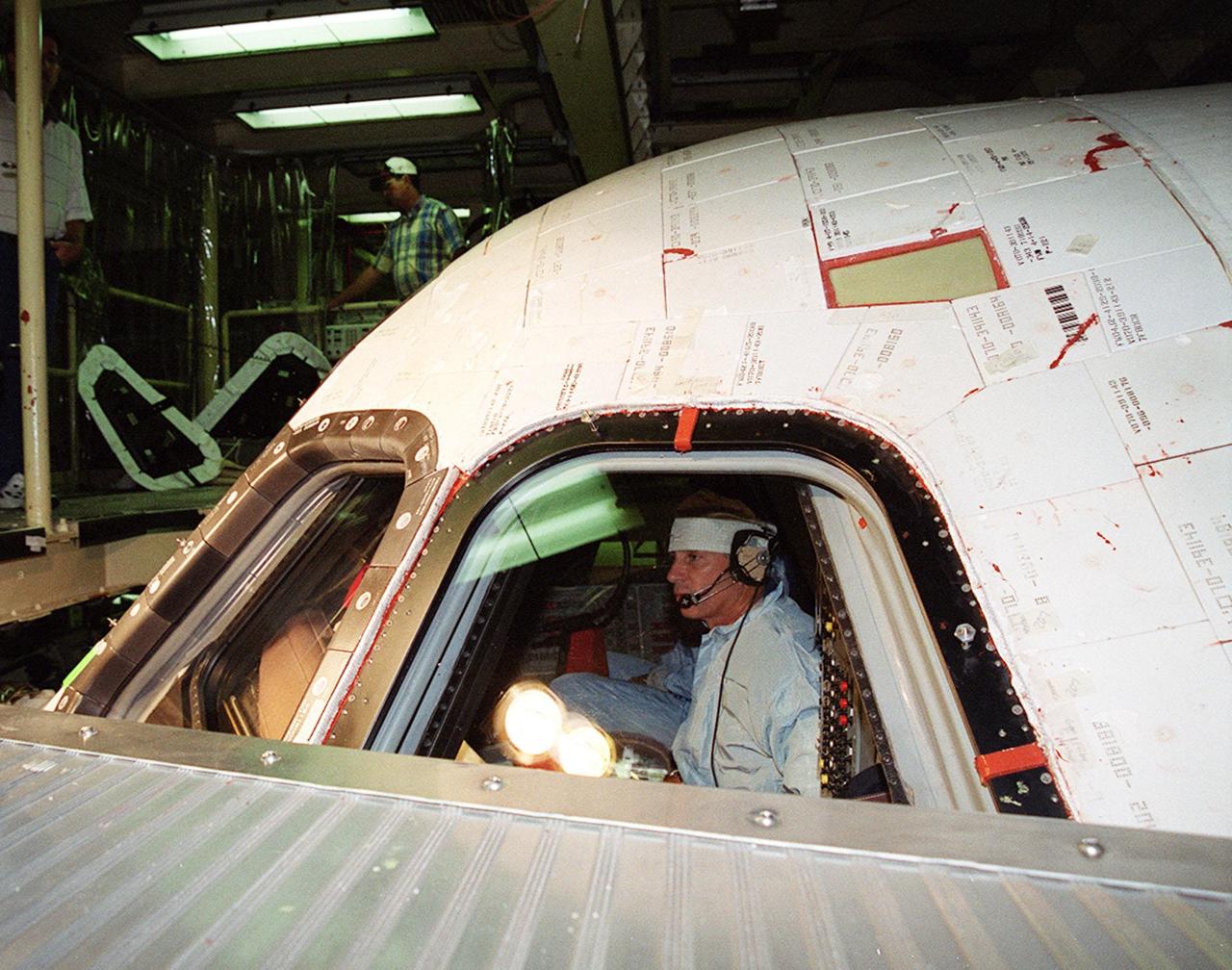
KENNEDY SPACE CENTER, FLA. -- In Orbiter Processing Facility bay 3, STS-98 Commander Ken Cockrell conducts window inspection, checking for leaks, in the cockpit of Atlantis. He and the rest of the crew are at KSC for Crew Equipment Interface Test activities. Launch on mission STS-98 is scheduled for Jan. 18, 2001. It will be transporting the U.S. Lab, Destiny, to the International Space Station with five system racks already installed inside of the module. After delivery of electronics in the lab, electrically powered attitude control for Control Moment Gyroscopes will be activated
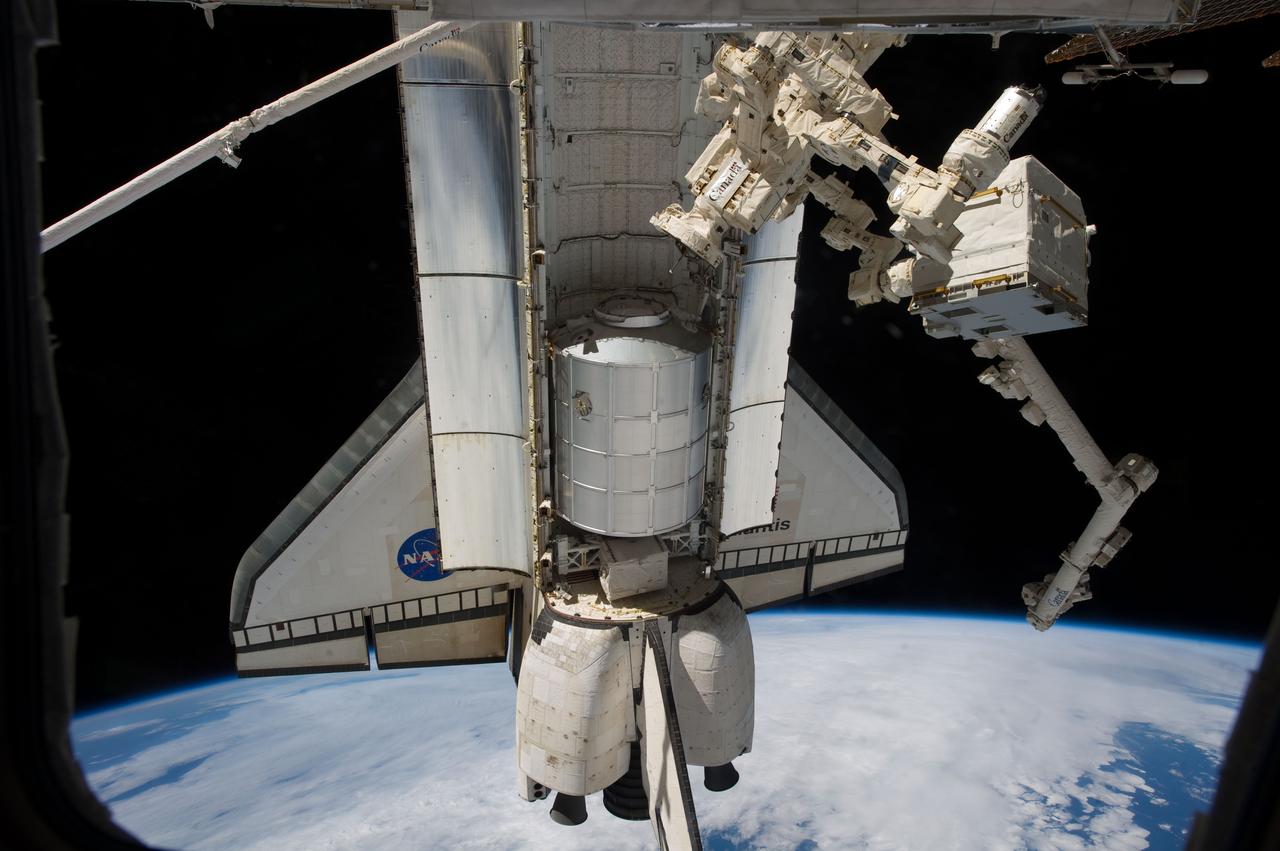
S135-E-009332 (18 July 2011) --- This is a view of the space shuttle Atlantis and its Raffaello multi-purpose logistics module during the final day of being docked with the International Space Station. The object connected to the station at right in the grasp of Dextre, a robot hand, is the Cargo Transport Container-2 (CTC-2) which was delivered by JAXA's HTV-2 vehicle earlier in the year. Photo credit: NASA
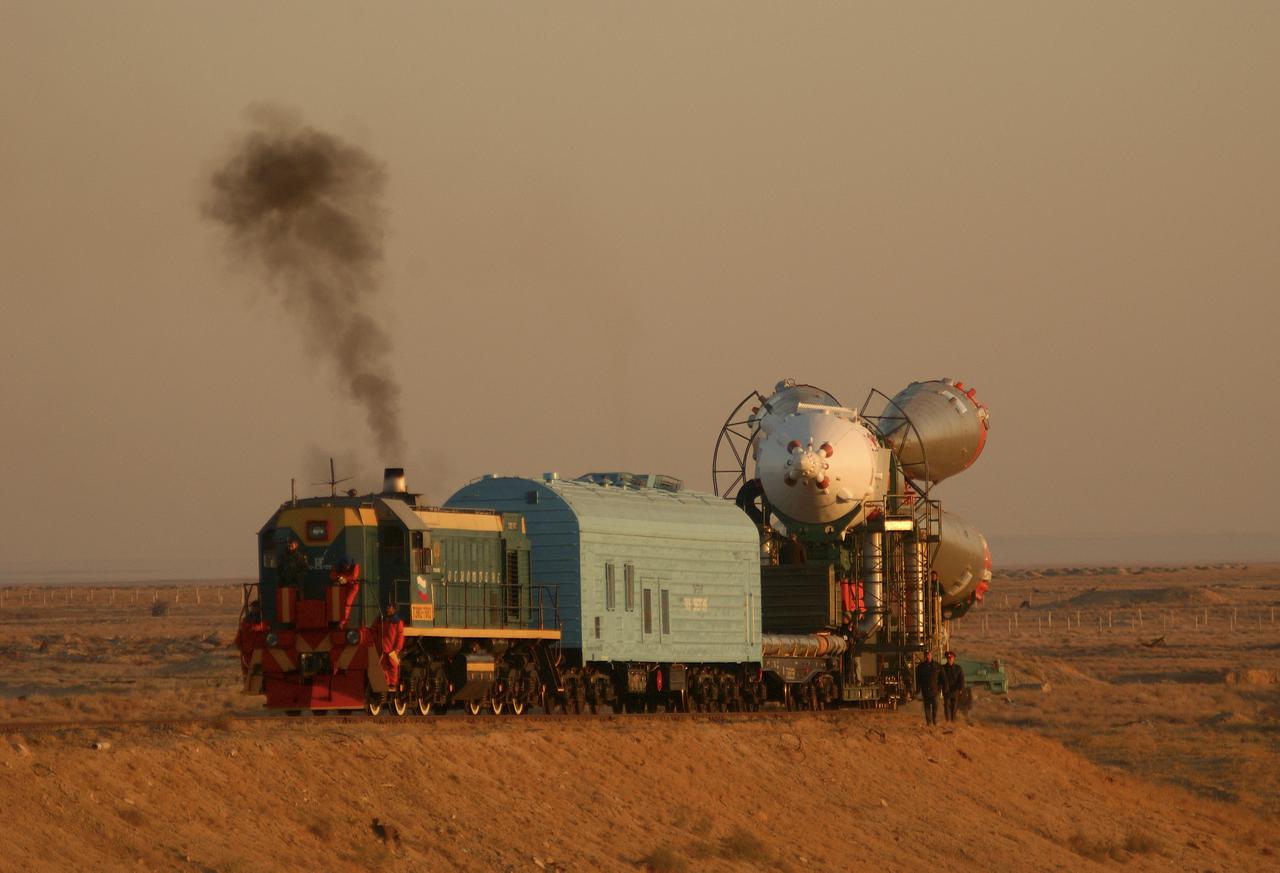
A Soyuz TMA-3 spacecraft and its booster rocket is transported on a rail car to the launch pad at the Baikonur Cosmodrome, Kazakhstan on Thursday, Oct. 16, 2003 in preparation for liftoff Oct. 18 to carry Expedition 8 Commander and NASA Science Officer Michael Foale, Expedition 8 Soyuz Commander Alexander Kaleri and European Space Agency astronaut Pedro Duque of Spain to the International Space Station. Photo Credit (NASA/Bill Ingalls)
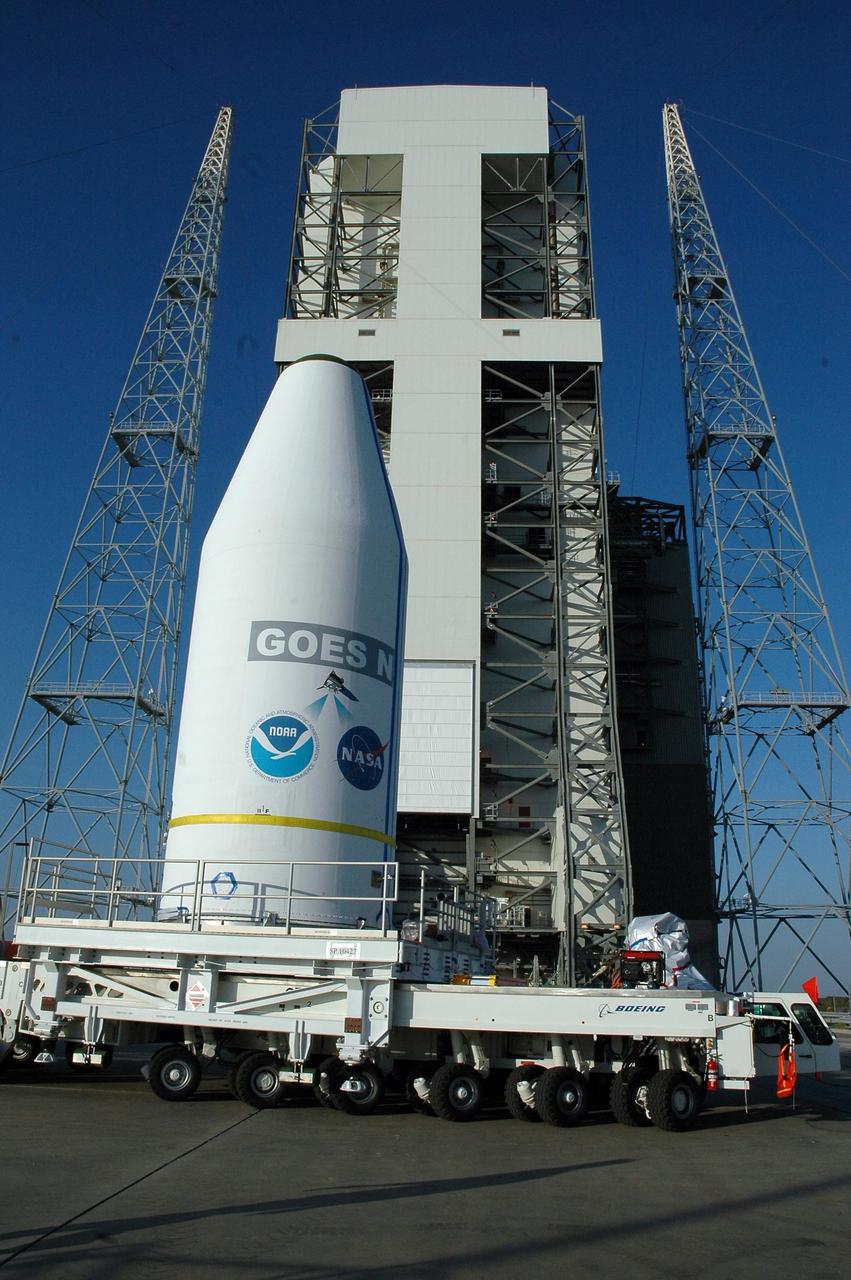
KENNEDY SPACE CENTER, FLA. - The encapsulated spacecraft GOES-N arrives aboard a transporter on Launch Complex 37 at Cape Canaveral Air Force Station in Florida. The spacecraft will be lifted up into the mobile service tower and mated with a Boeing Delta IV rocket for launch. GOES-N is the latest in a series of Geostationary Operational Environmental Satellites for NOAA and NASA providing continuous monitoring necessary for intensive data analysis. GOES-N is scheduled for launch May 18. Photo credit: NASA/Jack Pfaller
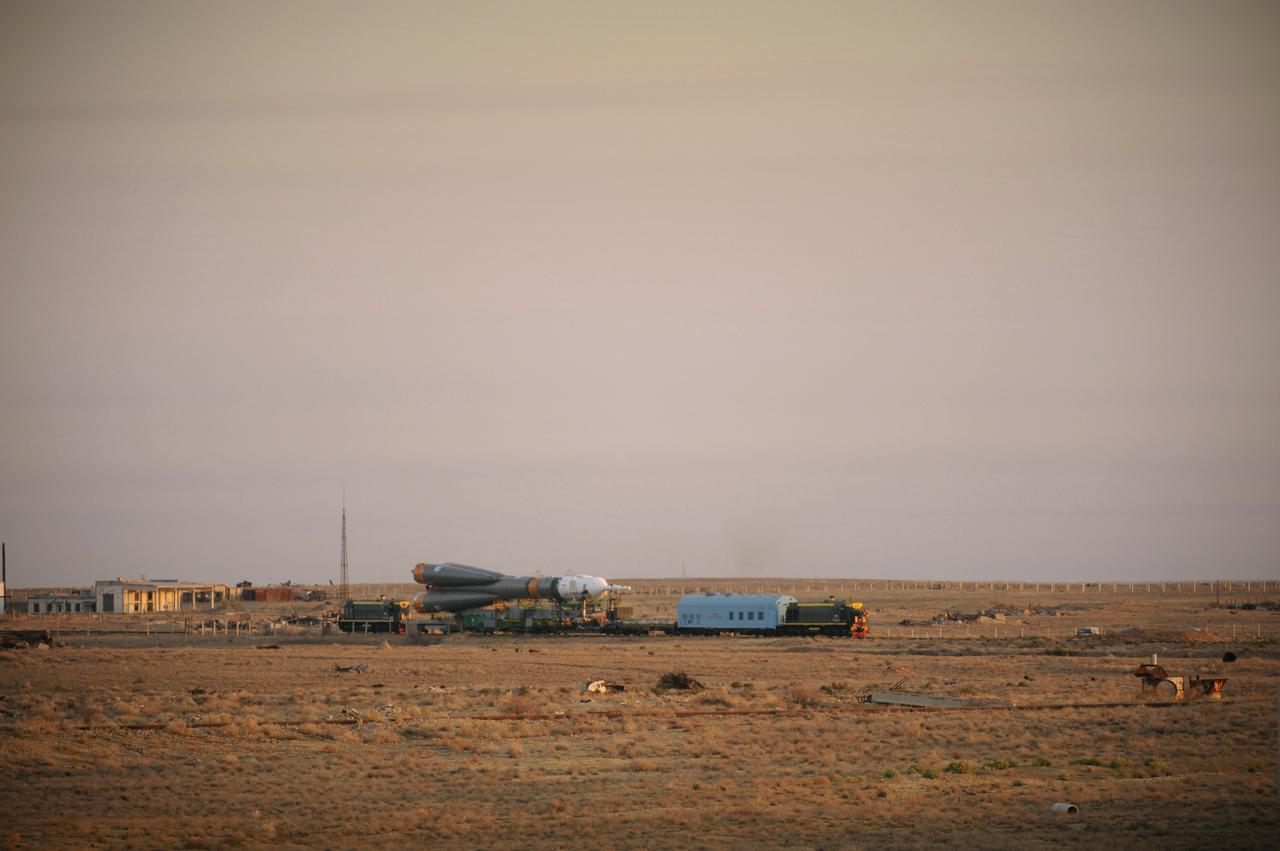
The Soyuz TMA-13 spacecraft is transported by railcar to its launch pad at the Baikonur Cosmodrome in Kazakhstan, Friday, Oct. 10, 2008. Expedition 18 Commander Michael Fincke, Flight Engineer Yuri V. Lonchakov and American spaceflight participant Richard Garriott will launch October 12 and dock with the International Space Station October 14. Fincke and Lonchakov will spend six months on the station, while Garriott will return to Earth after 10 days with the Expedition 17 crew members currently on the ISS. Photo Credit: (NASA/Bill Ingalls)
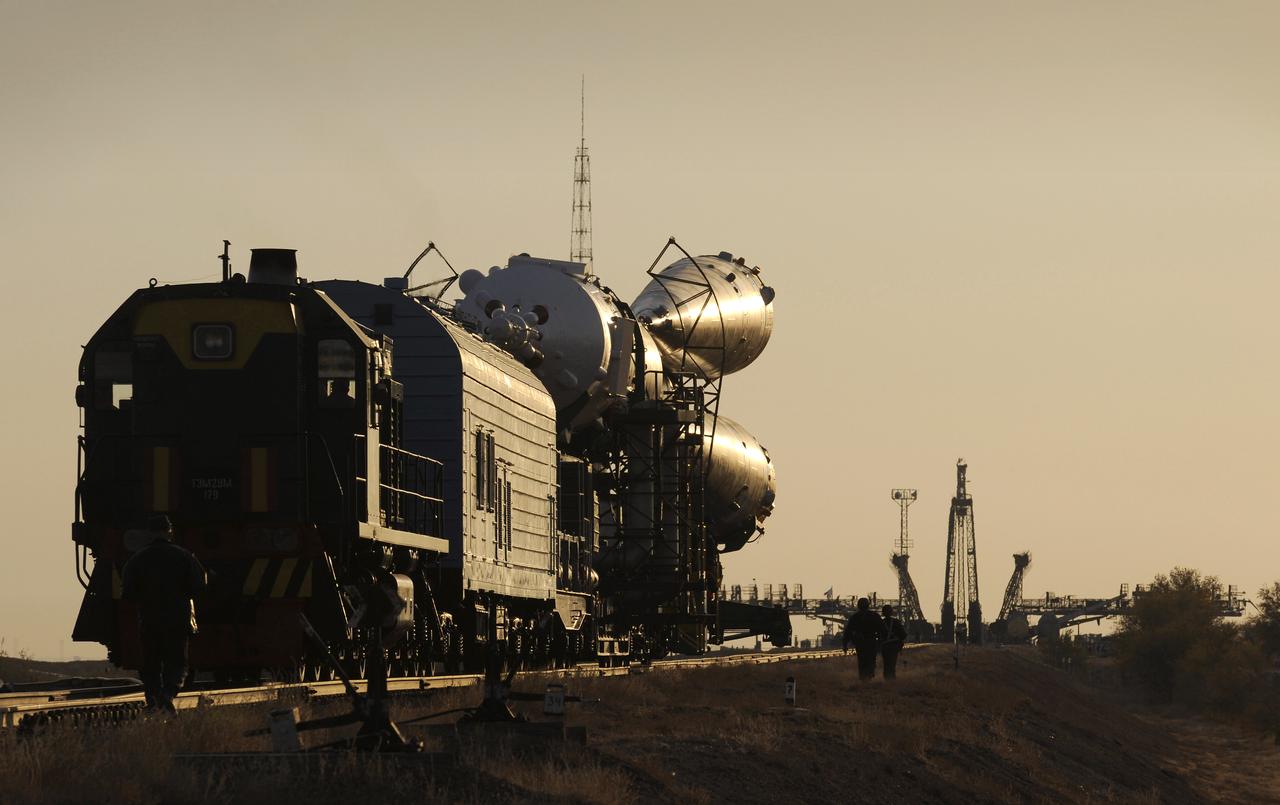
The Soyuz TMA-13 spacecraft is transported by railcar to its launch pad at the Baikonur Cosmodrome in Kazakhstan, Friday, Oct. 10, 2008. Expedition 18 Commander Michael Fincke, Flight Engineer Yuri V. Lonchakov and American spaceflight participant Richard Garriott will launch October 12 and dock with the International Space Station October 14. Fincke and Lonchakov will spend six months on the station, while Garriott will return to Earth after 10 days with the Expedition 17 crew members currently on the ISS. Photo Credit: (NASA/Bill Ingalls)
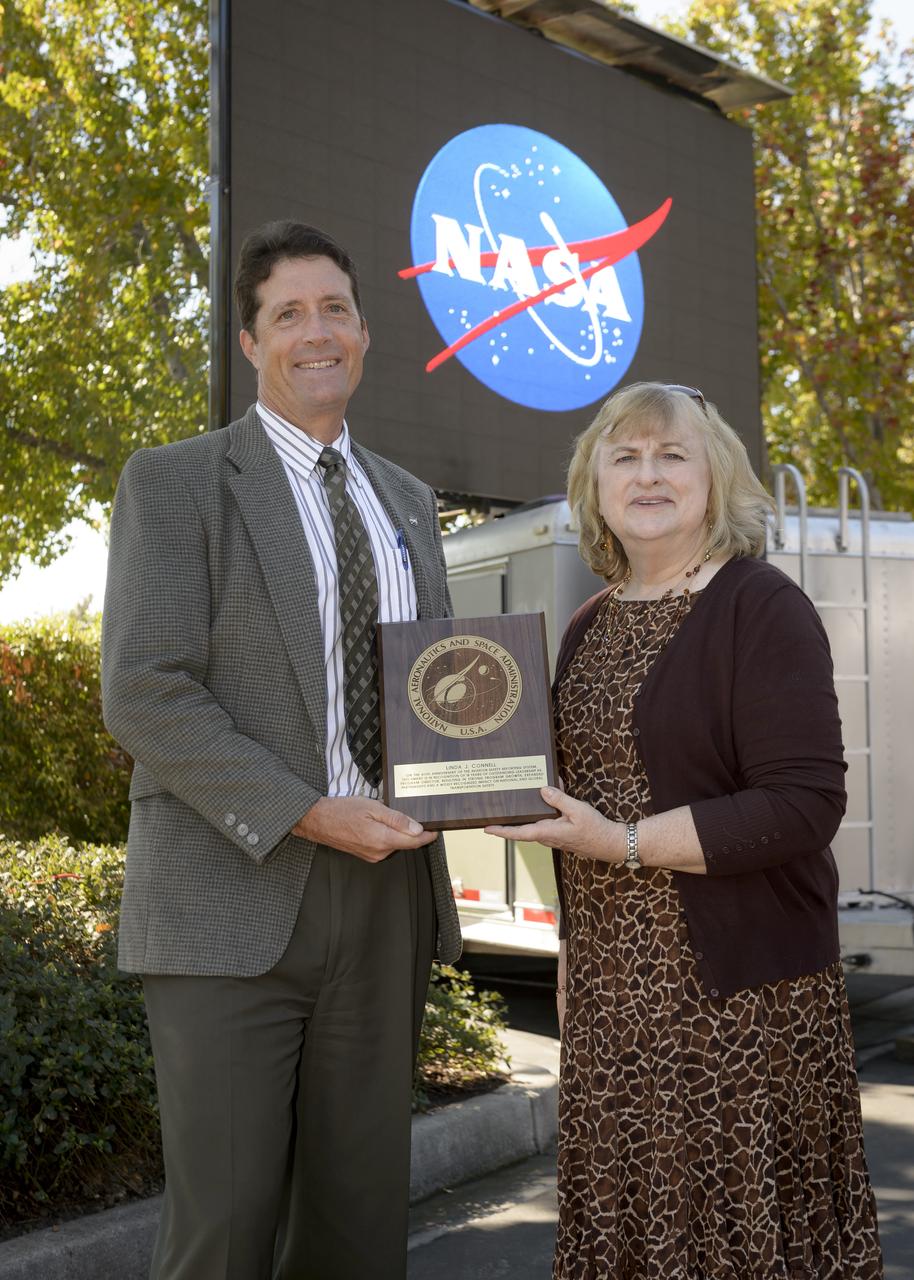
Avation Safety Reporting System (ASRS) 40th Anniversary lunch and open house at the Sunnyvale office. Thomas A Edwards, Deputy Center Director NASA Ames (Left), presents a plaque On the anniversary of the aviation safety reporting system, this award is in recognition of 18 years of outstanding leadership as Program Director, resulting in strong program growth, expanded partnership and a widely recognized impact on National and Global transportation safety. Presented to Linda J. Connell, ASRS Program Director (Right)
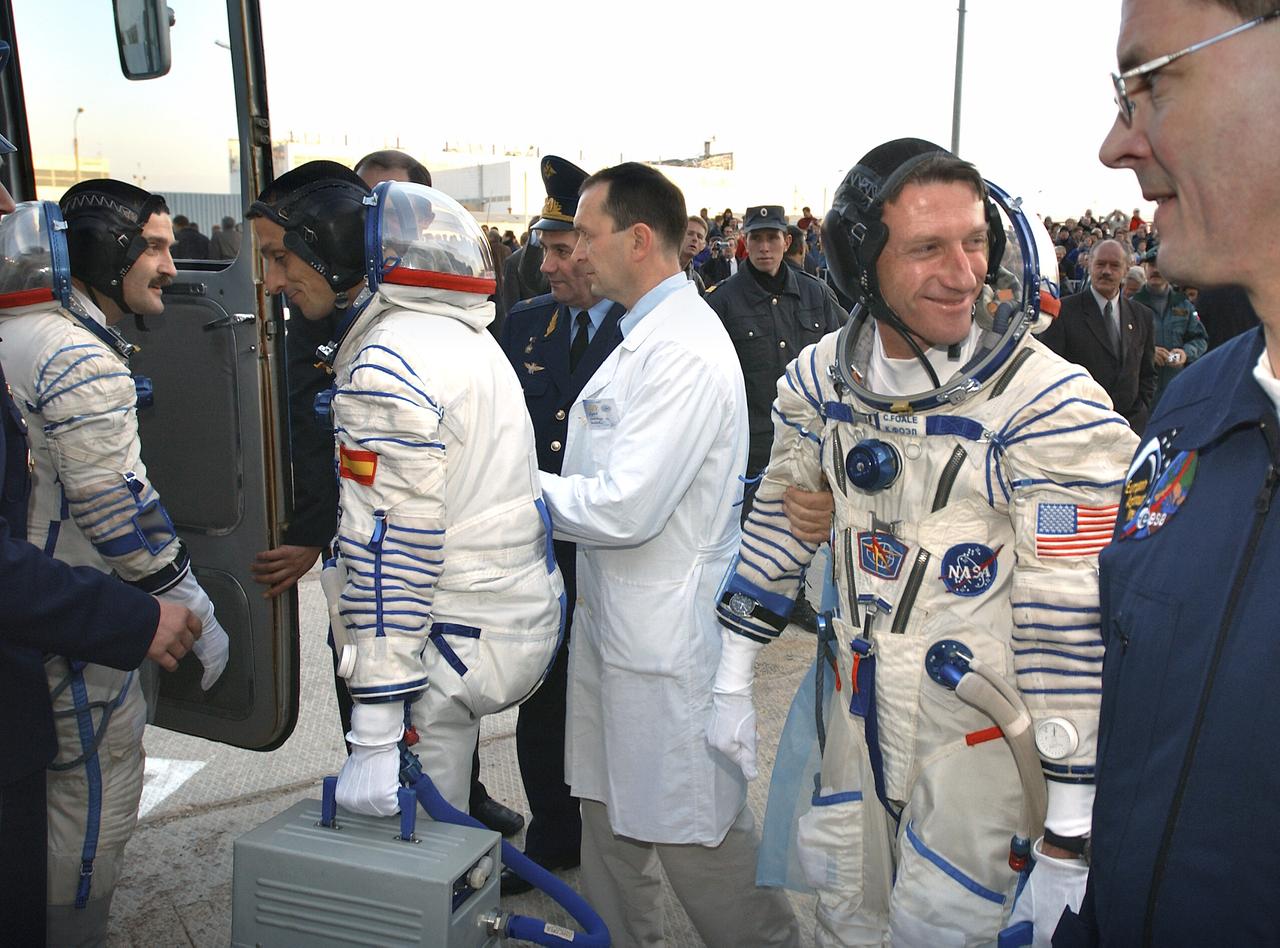
Expedition 8 Soyuz Commander Alexander Kaleri, left, European Space Agency astronaut Pedro Duque of Spain and Expedition 8 Commander and NASA Science Officer Michael Foale, right, prepare to board a bus at the Baikonur Cosmodrome in Kazakhstan, Saturday, Oct. 18, 2003, for transportation to the launch pad to liftoff in a Soyuz TMA-3 vehicle to the International Space Station. The trio arrived at the ISS Oct. 20. Photo Credit (NASA/Bill Ingalls)
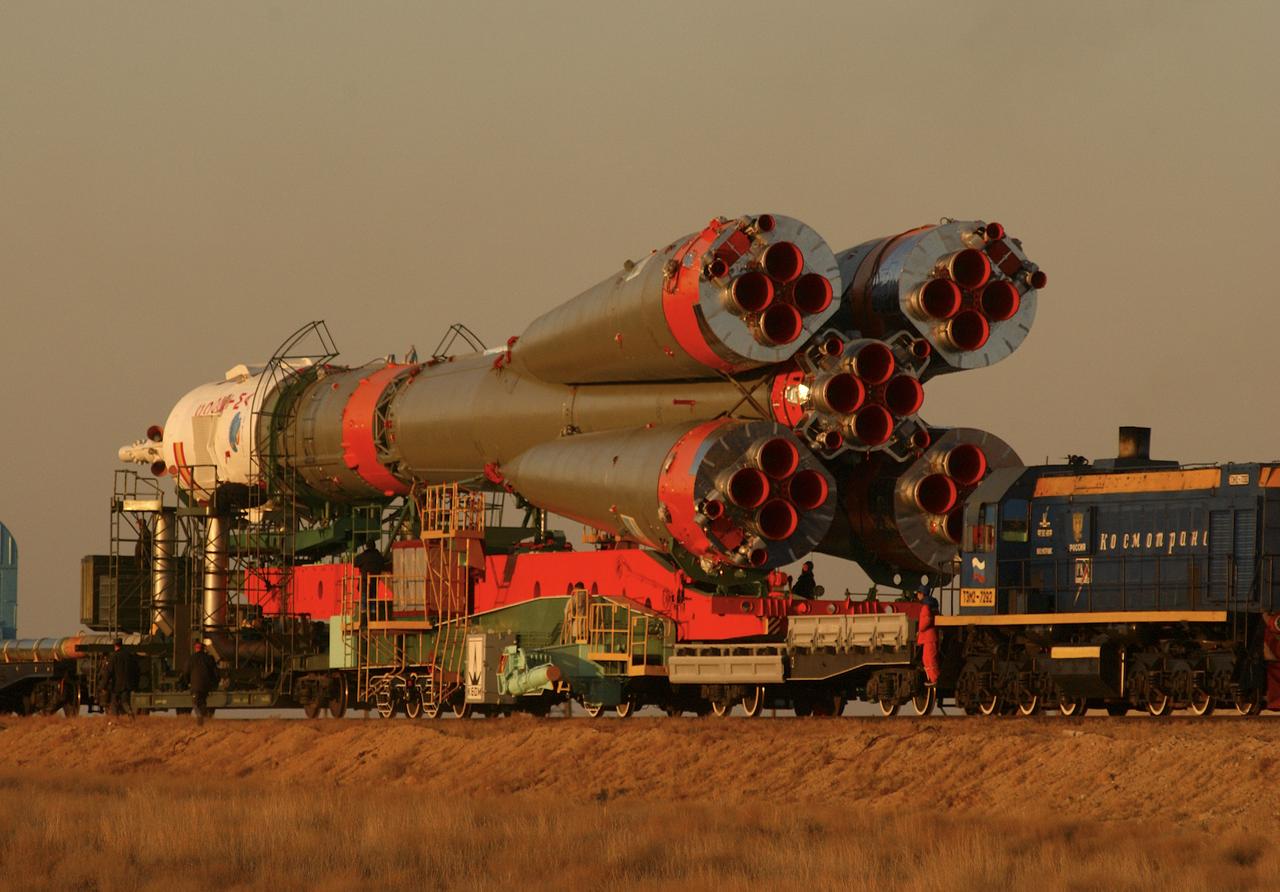
A Soyuz TMA-3 spacecraft and its booster rocket is transported on a rail car to the launch pad at the Baikonur Cosmodrome, Kazakhstan on Thursday, Oct. 16, 2003 in preparation for liftoff Oct. 18 to carry Expedition 8 Commander and NASA Science Officer Michael Foale, Expedition 8 Soyuz Commander Alexander Kaleri and European Space Agency astronaut Pedro Duque of Spain to the International Space Station. Photo Credit (NASA/Bill Ingalls)
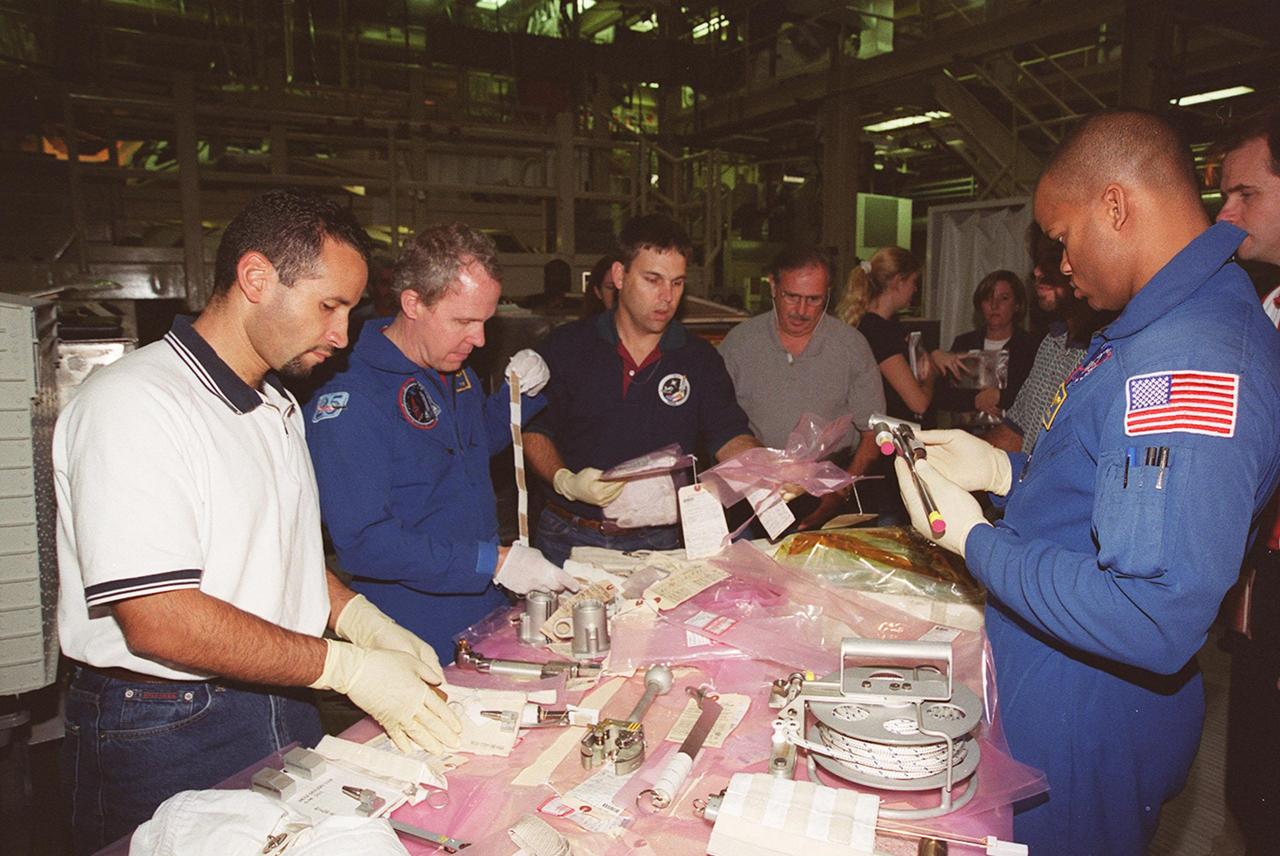
KENNEDY SPACE CENTER, FLA. -- In Orbiter Processing Facility bay 3, STS-98 Mission Specialists Tom Jones (second from left) and Robert Curbeam (right) test tools that will be used during extravehicular activities (EVA) on their mission. Scheduled for launch Jan. 18, 2001, STS-98 will be transporting the U.S. Lab, Destiny, to the International Space Station with five system racks already installed inside of the module. After delivery of electronics in the lab, electrically powered attitude control for Control Moment Gyroscopes will be activated
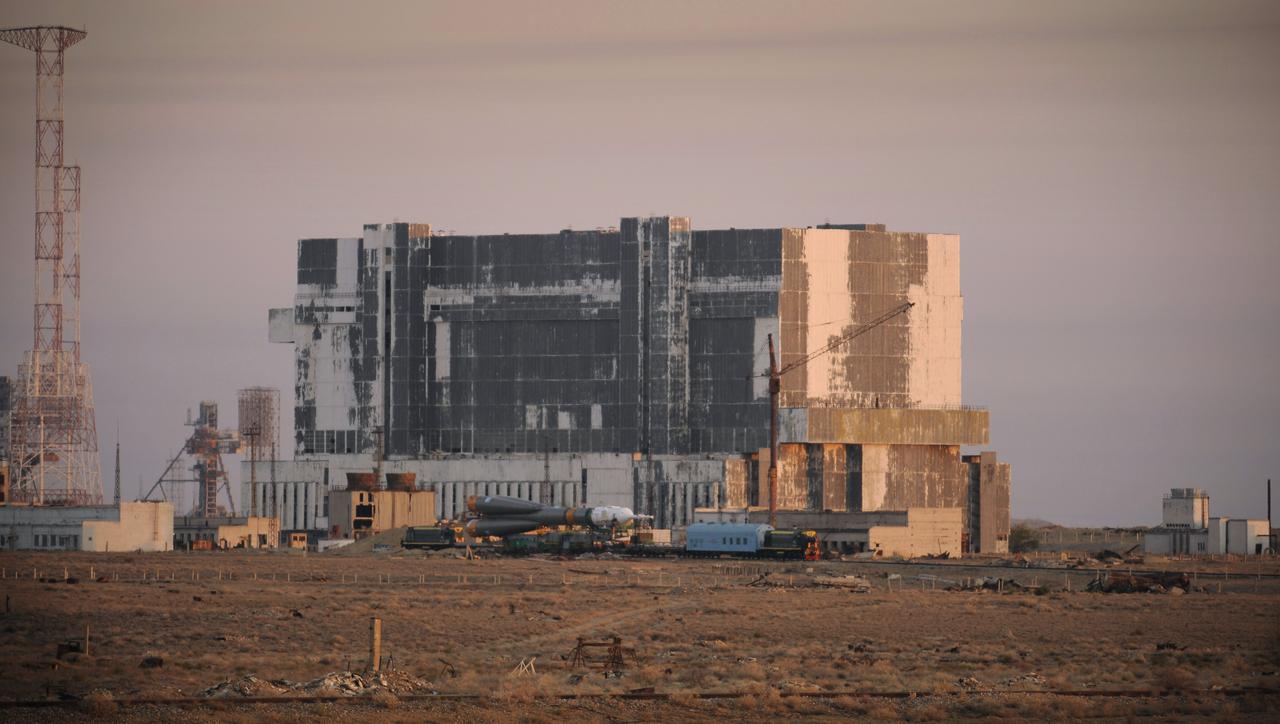
The Soyuz TMA-13 spacecraft is transported by railcar to its launch pad at the Baikonur Cosmodrome in Kazakhstan, Friday, Oct. 10, 2008. Expedition 18 Commander Michael Fincke, Flight Engineer Yuri V. Lonchakov and American spaceflight participant Richard Garriott will launch October 12 and dock with the International Space Station October 14. Fincke and Lonchakov will spend six months on the station, while Garriott will return to Earth after 10 days with the Expedition 17 crew members currently on the ISS. Photo Credit: (NASA/Bill Ingalls)
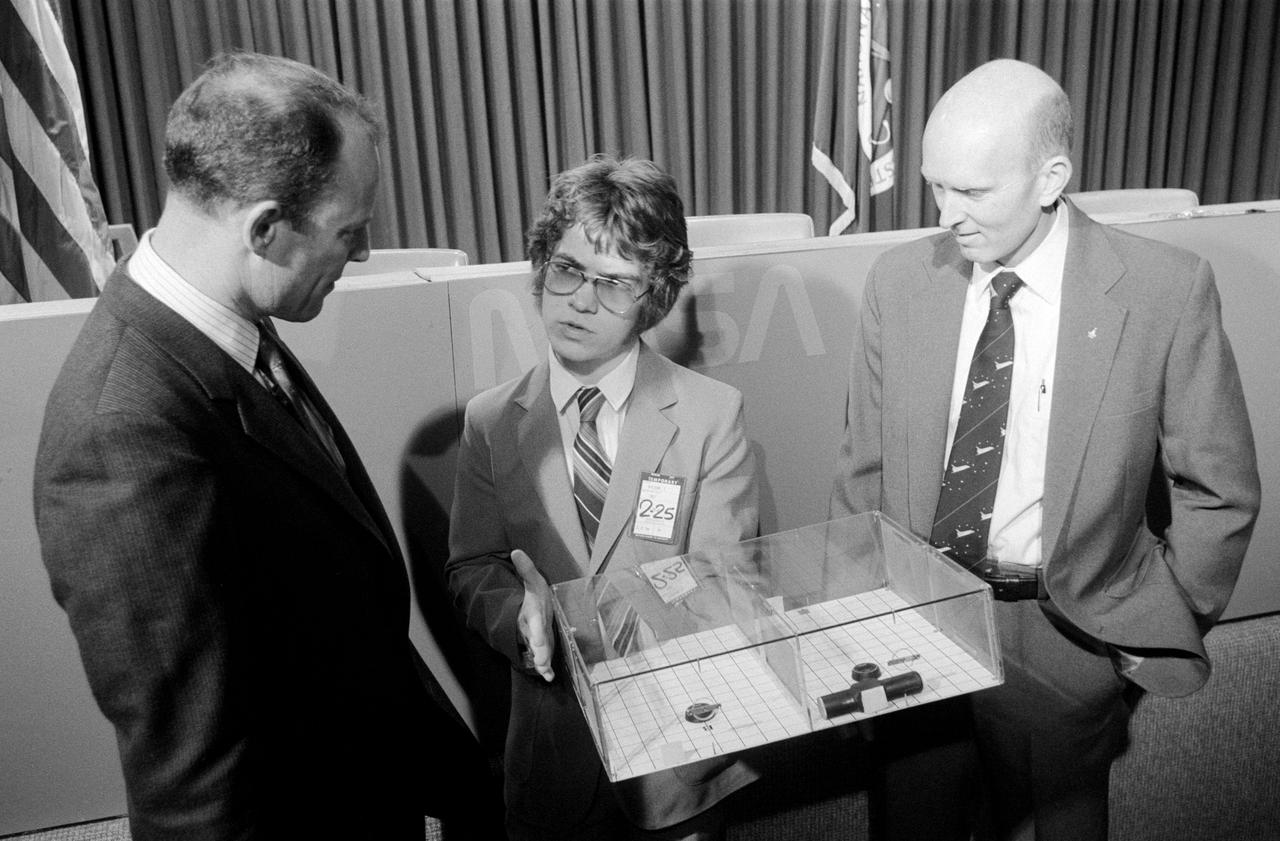
S82-27604 (26 Feb. 1982) --- The astronaut crew members for NASA?s third space transportation system (STS-3) flight meet with Todd E. Nelson, who devised a scientific experiment to fly on their mission. Astronauts Jack R. Lousma, left, commander, and C. Gordon Fullerton, pilot, along with the 18-year-old high school senior, discussed the experiment, entitled ?Insects in Flight Motion Study,? during a press briefing in JSC?s public affairs facility. Photo credit: NASA
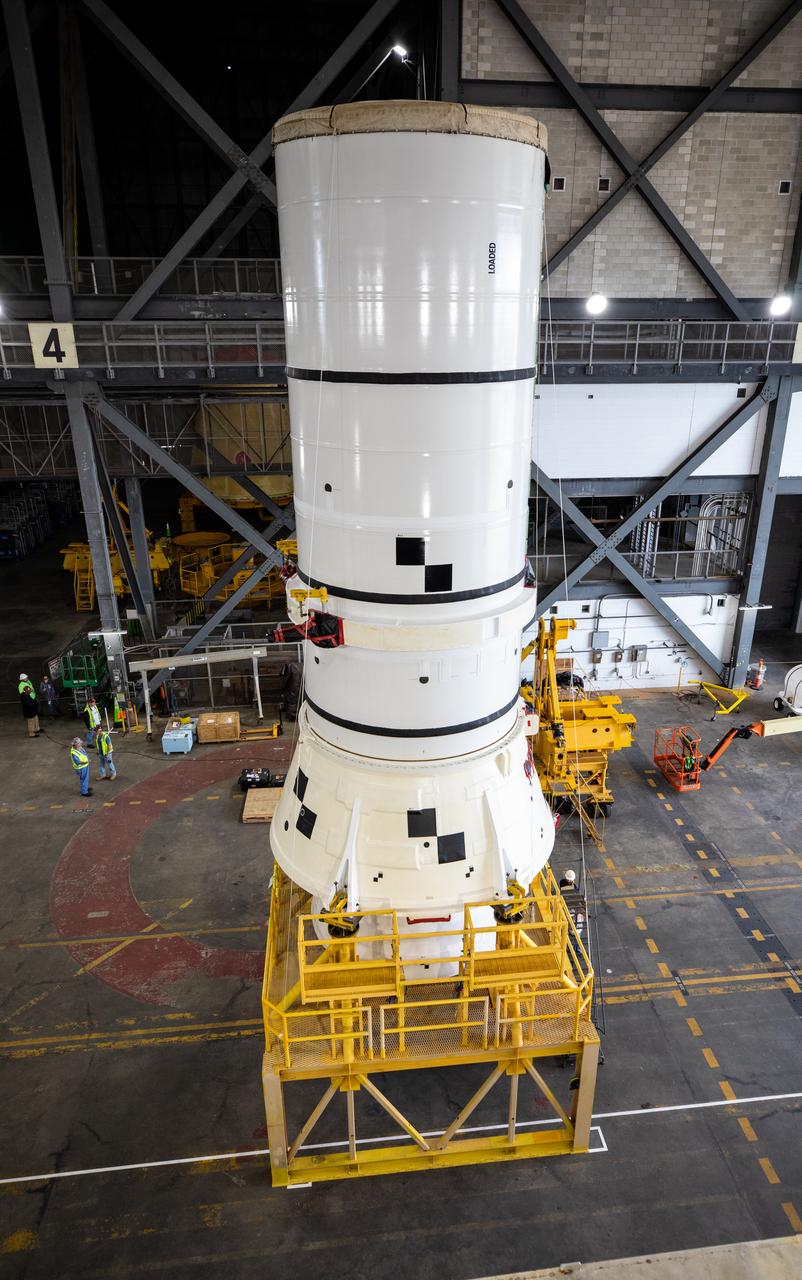
Engineers and technicians with the Exploration Ground Systems Program transport the left aft assembly, or bottom portion of the solid rocket boosters for the SLS (Space Launch System) rocket for the Artemis II mission inside the Vehicle Assembly Building at NASA’s Kennedy Space Center in Florida on Monday, Nov. 18, 2024. The aft assembly will be lifted atop the mobile launcher, followed by the right aft assembly and remaining booster segments.
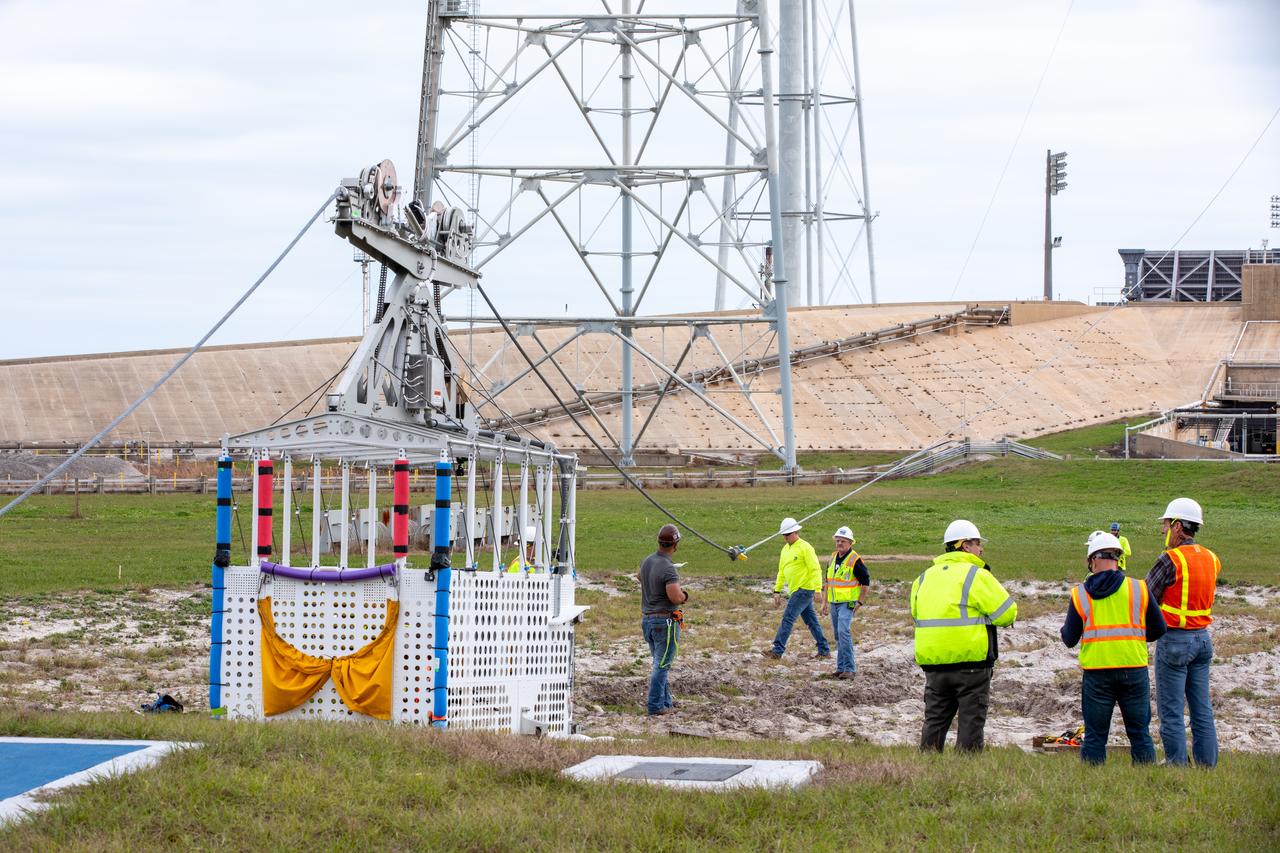
Teams with NASA’s Exploration Ground Systems Program, in preparation for the agency’s Artemis II crewed mission to the Moon, begin installation of four emergency egress baskets at Launch Complex 39B at Kennedy Space Center in Florida on Thursday, Jan. 18, 2024. The baskets, similar to gondolas on ski lifts, are used in the case of a pad abort emergency to enable astronauts and other pad personnel a way to quickly escape away from the mobile launcher to the base of the pad and where waiting emergency transport vehicles will then drive them away.
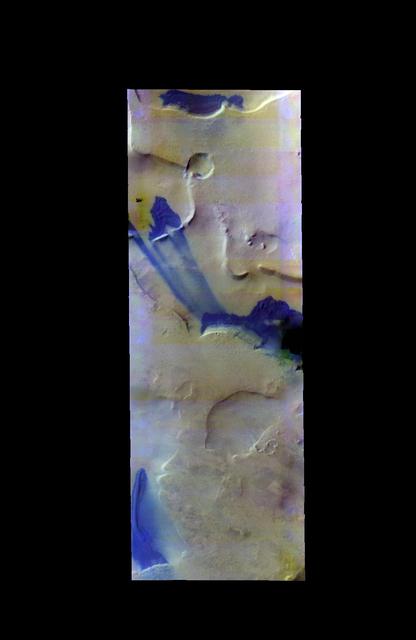
The THEMIS VIS camera contains 5 filters. Data from different filters can be combined in many ways to create a false color image. This image from NASA 2001 Mars Odyssey spacecraft shows sand dunes and sand materials in depressions near the south pole. The dark blue tone shows the location of sand transport from one depression to another. Orbit Number: 16870 Latitude: -75.1264 Longitude: 348.882 Instrument: VIS Captured: 2005-10-03 09:18 http://photojournal.jpl.nasa.gov/catalog/PIA20105
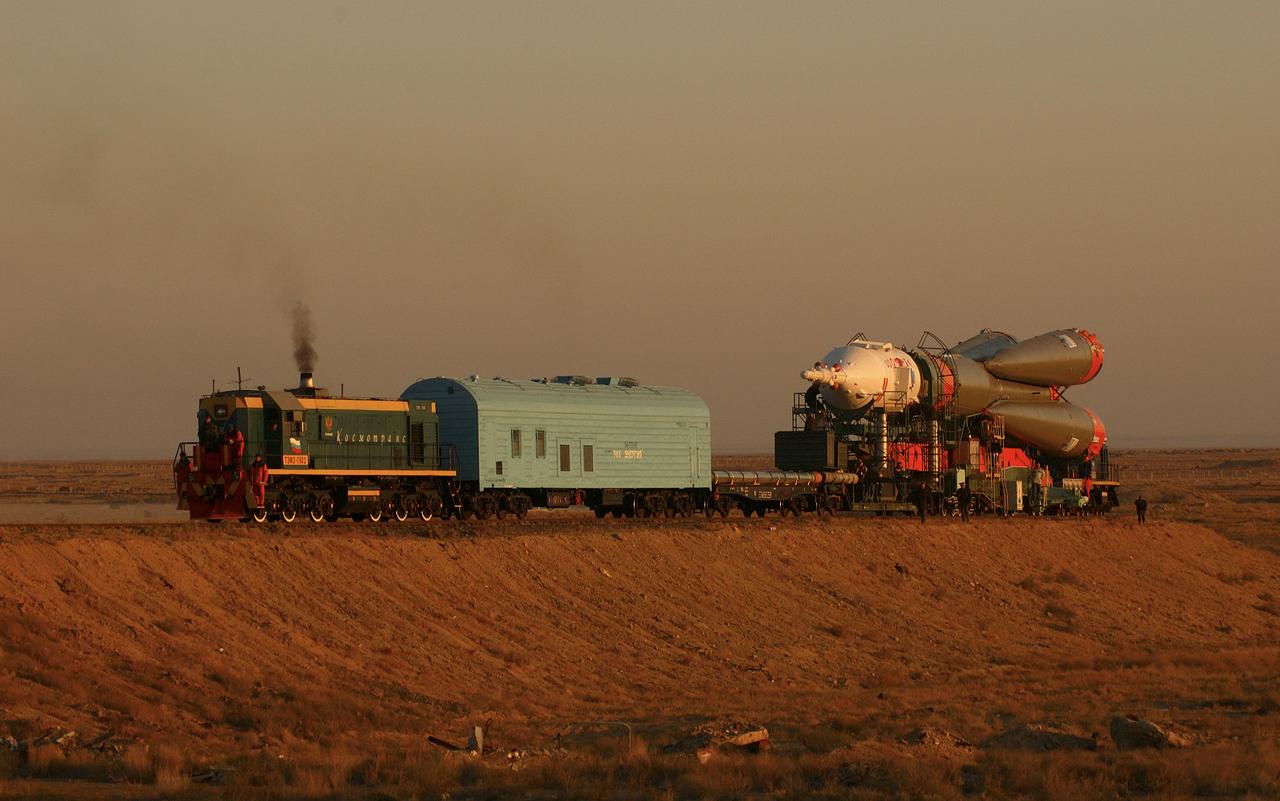
A Soyuz TMA-3 spacecraft and its booster rocket is transported on a rail car to the launch pad at the Baikonur Cosmodrome, Kazakhstan on Thursday, Oct. 16, 2003 in preparation for liftoff Oct. 18 to carry Expedition 8 Commander and NASA Science Officer Michael Foale, Expedition 8 Soyuz Commander Alexander Kaleri and European Space Agency astronaut Pedro Duque of Spain to the International Space Station. Photo Credit (NASA/Bill Ingalls)
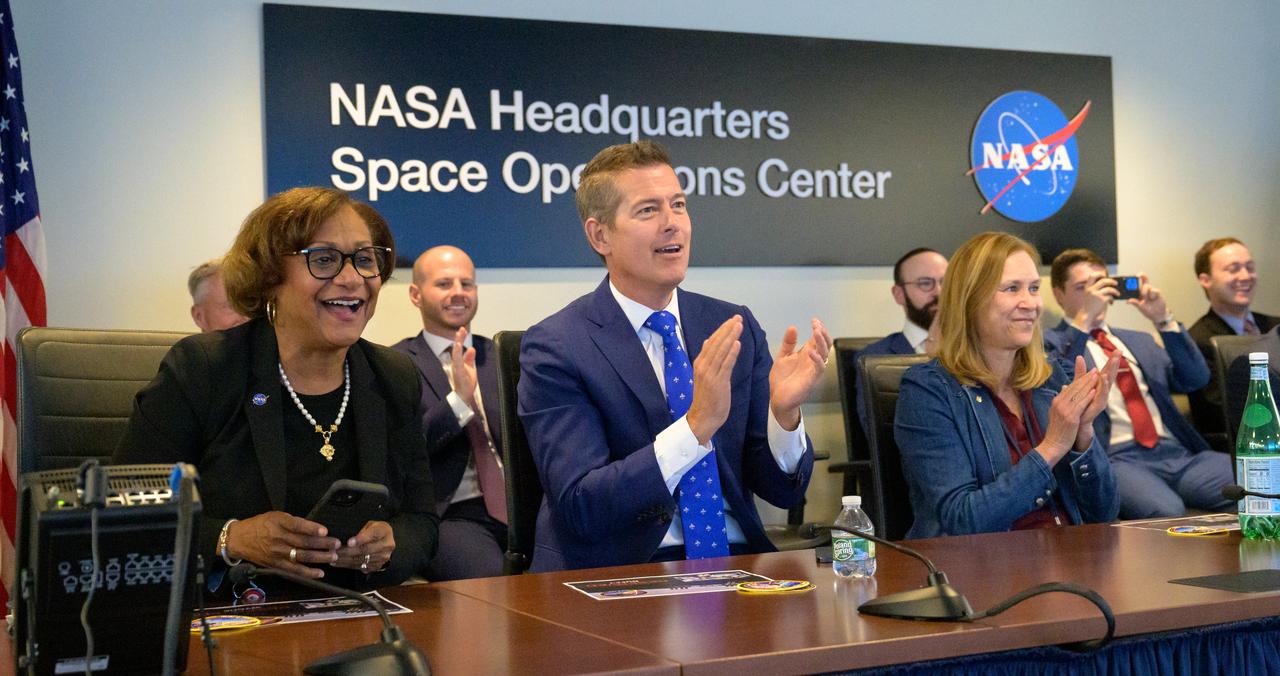
Acting NASA Associate Administrator Vanessa Wyche, left, U.S. Transportation Secretary Sean Duffy, and acting NASA Administrator Janet Petro, right, react as they watch the SpaceX Dragon spacecraft splash down with NASA astronauts Butch Wilmore, Suni Williams, Nick Hague, and Roscosmos cosmonaut Aleksandr Gorbunov, Tuesday, March 18, 2025, from the Space Operations Center at the Mary W. Jackson NASA Headquarters Building in Washington. Photo Credit: (NASA/Bill Ingalls)
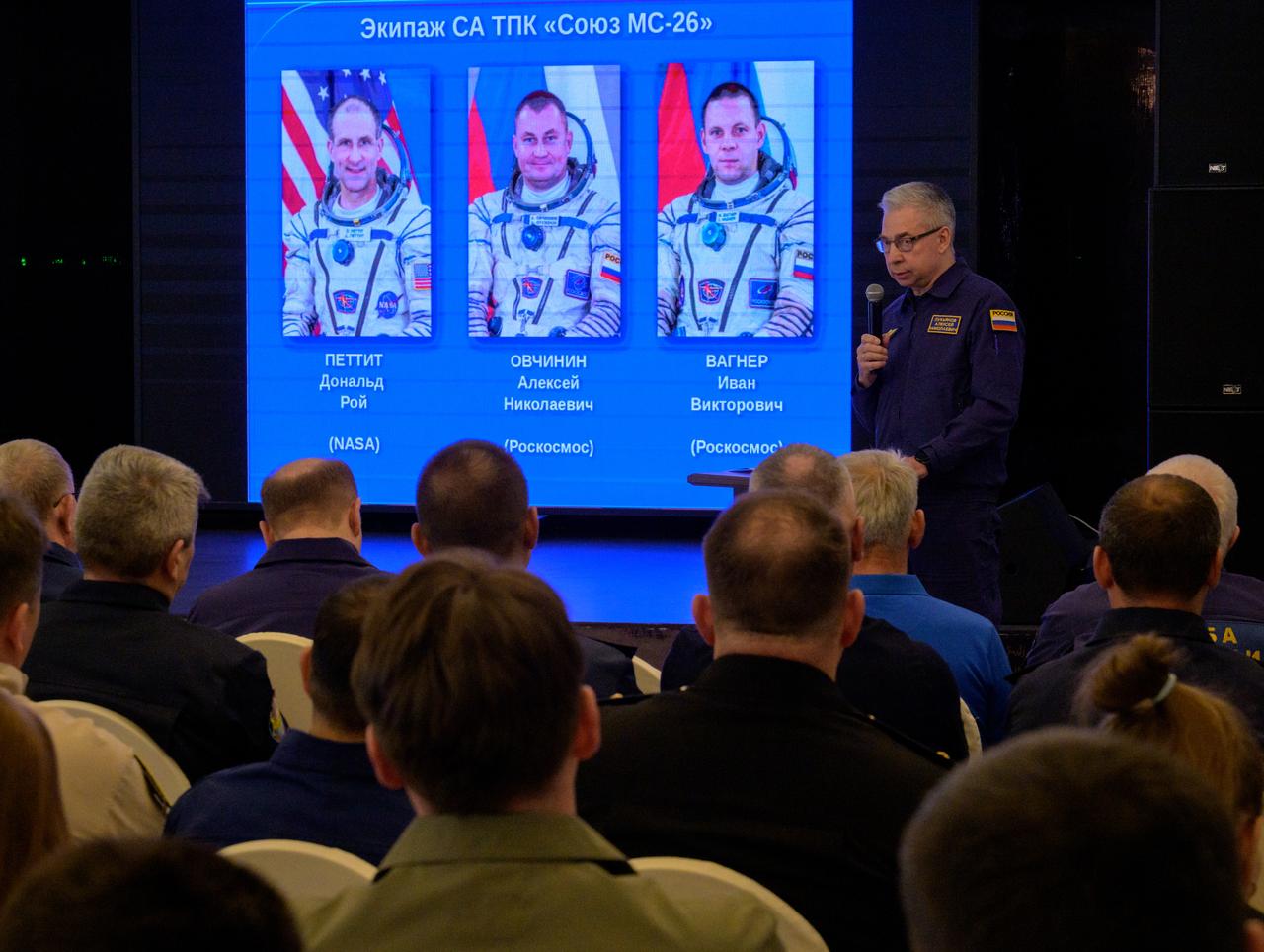
Deputy Head of the Search-and-Rescue Department of Rosaviatsiya (Russian Federal Air Transport Agency) Aleksey Lukiyanov, presents during a meeting with NASA, Roscosmos, and Russian Search and Recovery Forces at the Cosmonaut Hotel in Karaganda, Kazakhstan, Friday, April 18, 2025. Teams discussed the readiness for the landing of Expedition 72 NASA astronaut Don Pettit, and Roscosmos cosmonauts Alexey Ovchinin and Ivan Vagner. Photo Credit: (NASA/Bill Ingalls)
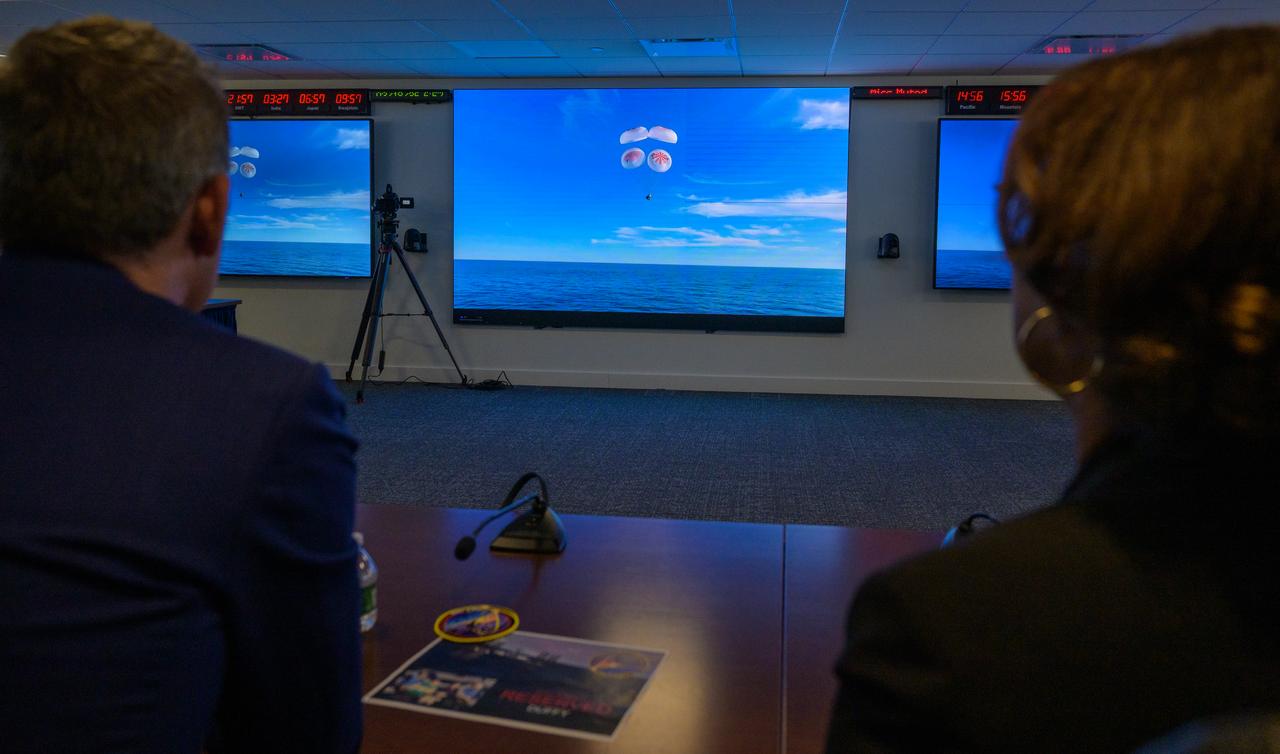
U.S. Transportation Secretary Sean Duffy, left, and NASA acting Associate Administrator Vanessa Wyche, watch as the SpaceX Dragon spacecraft splashes down with NASA astronauts Butch Wilmore, Suni Williams, Nick Hague, and Roscosmos cosmonaut Aleksandr Gorbunov, Tuesday, March 18, 2025, from the Space Operations Center at the Mary W. Jackson NASA Headquarters Building in Washington. Photo Credit: (NASA/Bill Ingalls)
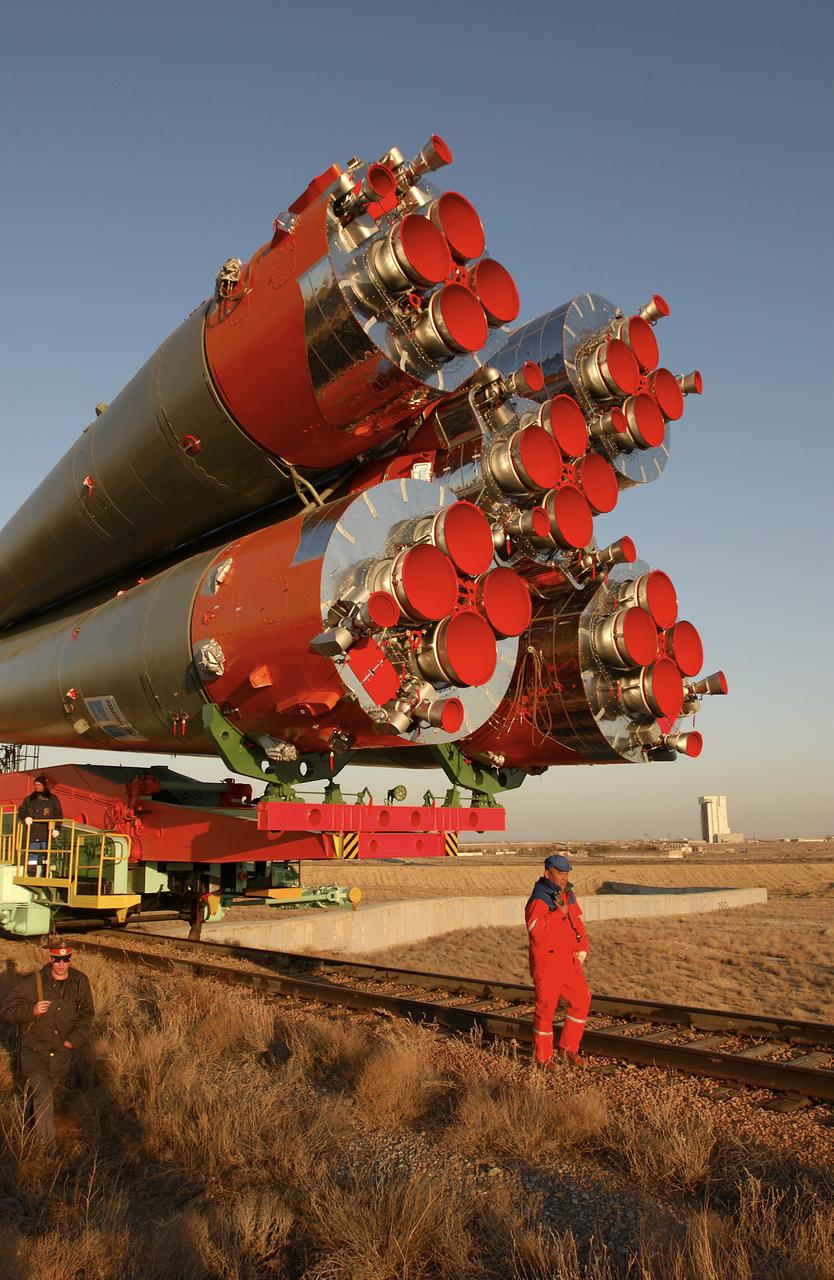
The booster rocker of the Soyuz TMA-3 spacecraft is transported on a rail car to the launch pad at the Baikonur Cosmodrome, Kazakhstan on Thursday, Oct. 16, 2003, in preparation for liftoff Oct. 18 to carry Expedition 8 Commander and NASA Science Officer Michael Foale, Expedition 8 Soyuz Commander Alexander Kaleri and European Space Agency astronaut Pedro Duque of Spain to the International Space Station. Photo Credit (NASA/Bill Ingalls)
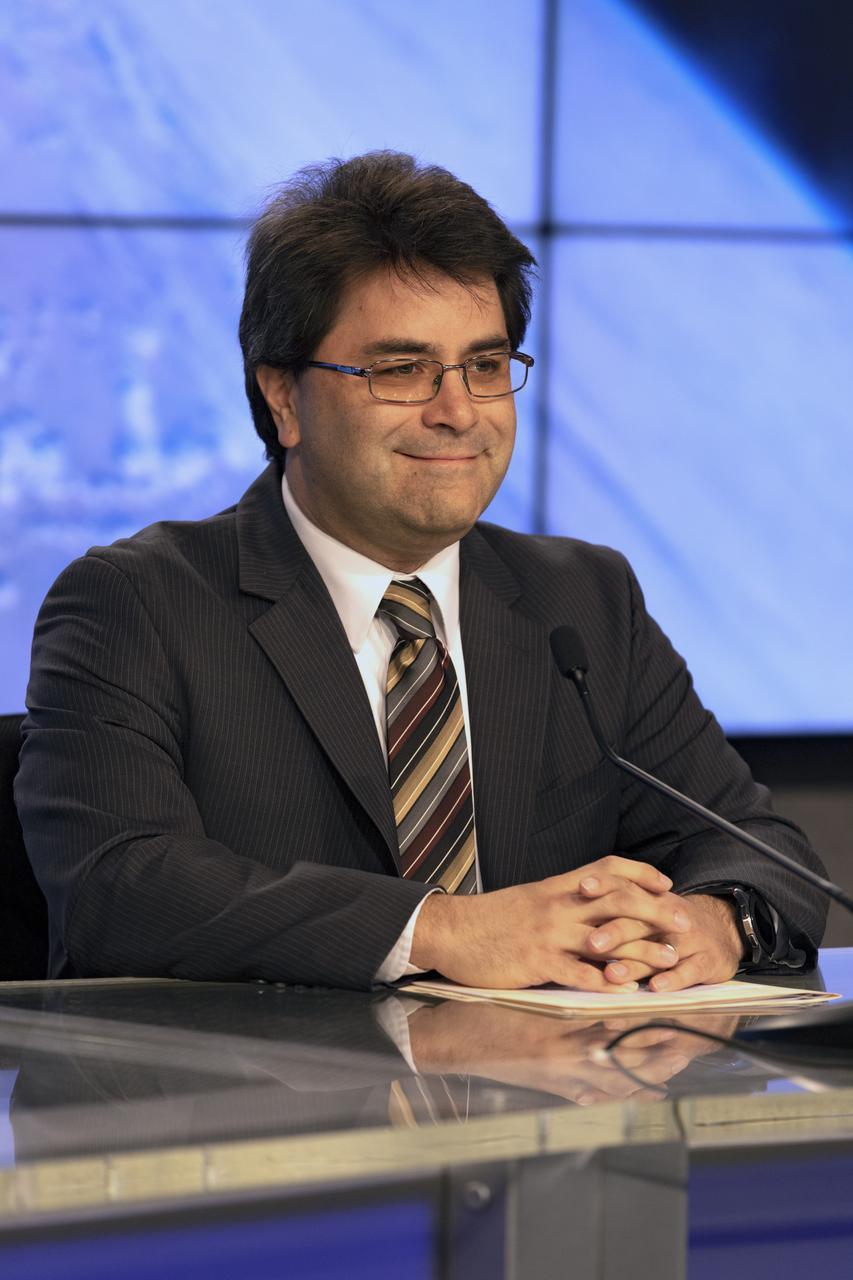
Bill Spetch, deputy manager of the International Space Station Transportation Integration Office at NASA’s Johnson Space Center in Houston, speaks during the prelaunch news conference for SpaceX’s 18th Commercial Resupply Services (CRS-18) mission to the station on July 24, 2019, at the agency’s Kennedy Space Center in Florida. The SpaceX Falcon 9 rocket and uncrewed Dragon spacecraft are scheduled to launch July 24, 2019, from Space Launch Complex 40 at Florida’s Cape Canaveral Air Force Station.
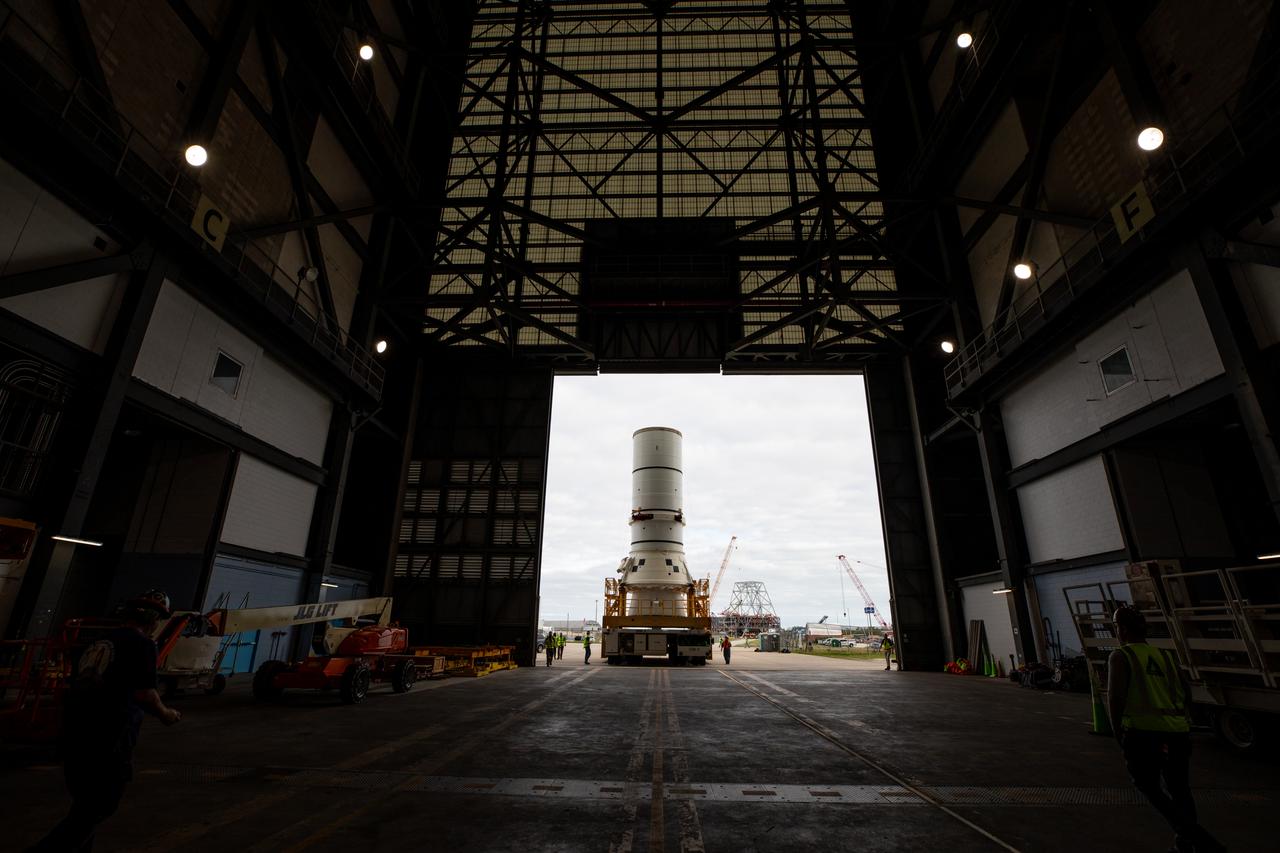
Engineers and technicians with the Exploration Ground Systems Program transport the left aft assembly, or bottom portion of the solid rocket boosters for the SLS (Space Launch System) rocket for the Artemis II mission inside the Vehicle Assembly Building at NASA’s Kennedy Space Center in Florida on Monday, Nov. 18, 2024. The aft assembly will be lifted atop the mobile launcher, followed by the right aft assembly and remaining booster segments.

CAPE CANAVERAL, Fla. – In the Space Station Processing Facility at NASA's Kennedy Space Center in Florida, the Multi-Purpose Logistics Module Leonardo moves above the floor toward the payload canister. The canister will transport the module to Launch Pad 39A for installation in space shuttle Discovery for the STS-128 mission. The module will carry science and storage racks to the International Space Station. Launch is targeted for Aug. 18. Photo credit: NASA/Jack Pfaller