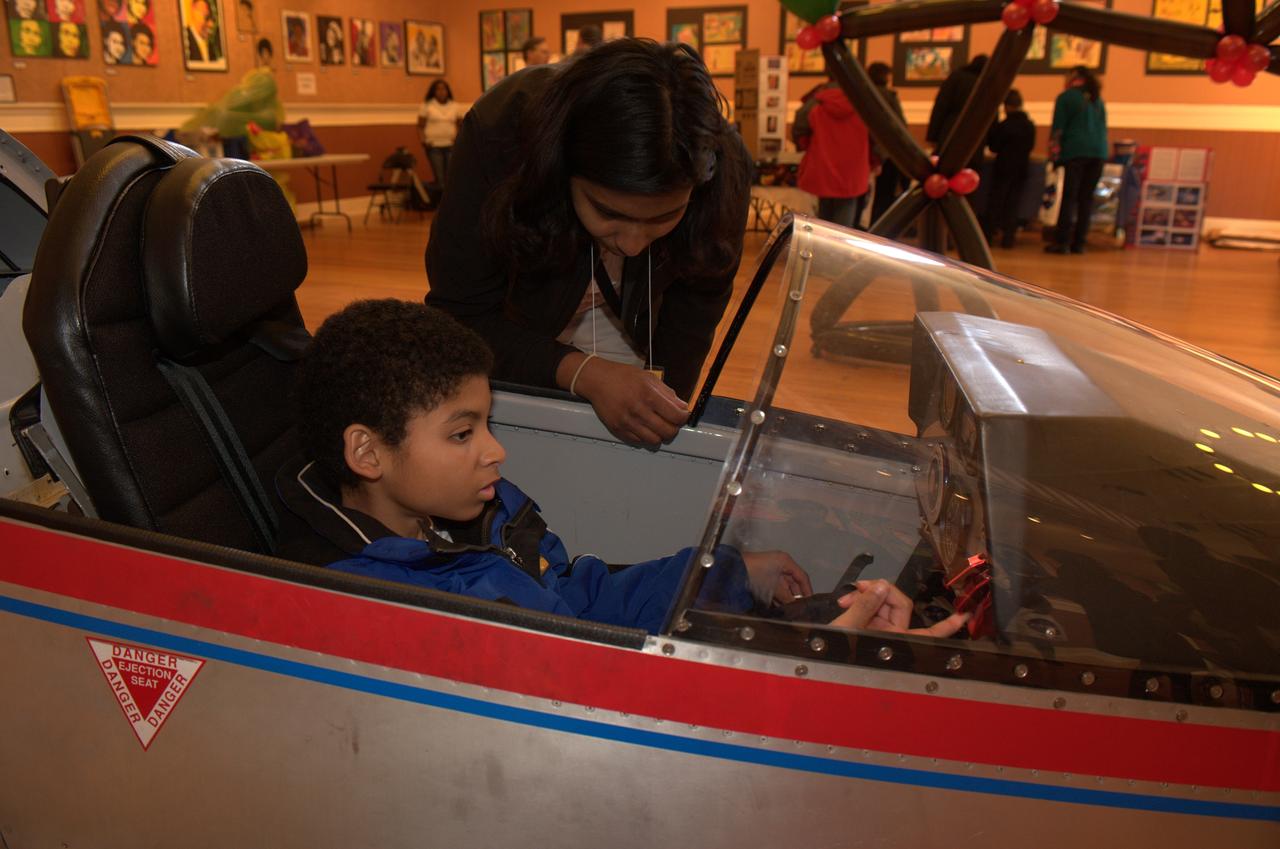
10th Anniversary of Reachout for the Rainbow after School Science Festival highlighting NASA Ames and the Traveling Space Museum exhibits and activities at the South San Francisco Bayview Opera House. Stephen Horsley gets a close up look at the cockpit of one the models provided by the Traveling Space Museum (TCS). photo release on file
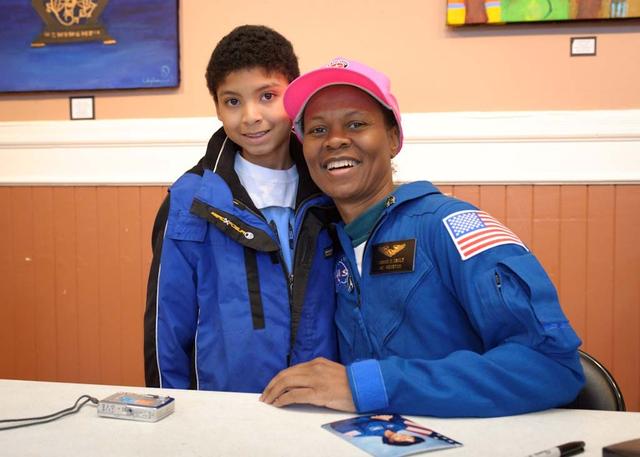
10th Anniversary of Reachout for the Rainbow after School Science Festival highlighting NASA Ames and the Traveling Space Museum exhibits and activities at the South San Francisco Bayview Opera House. NASA Astronaut Yvonne Cagle signing autographs after speaking at event, shown here with Stephen Horsley. photo release on file
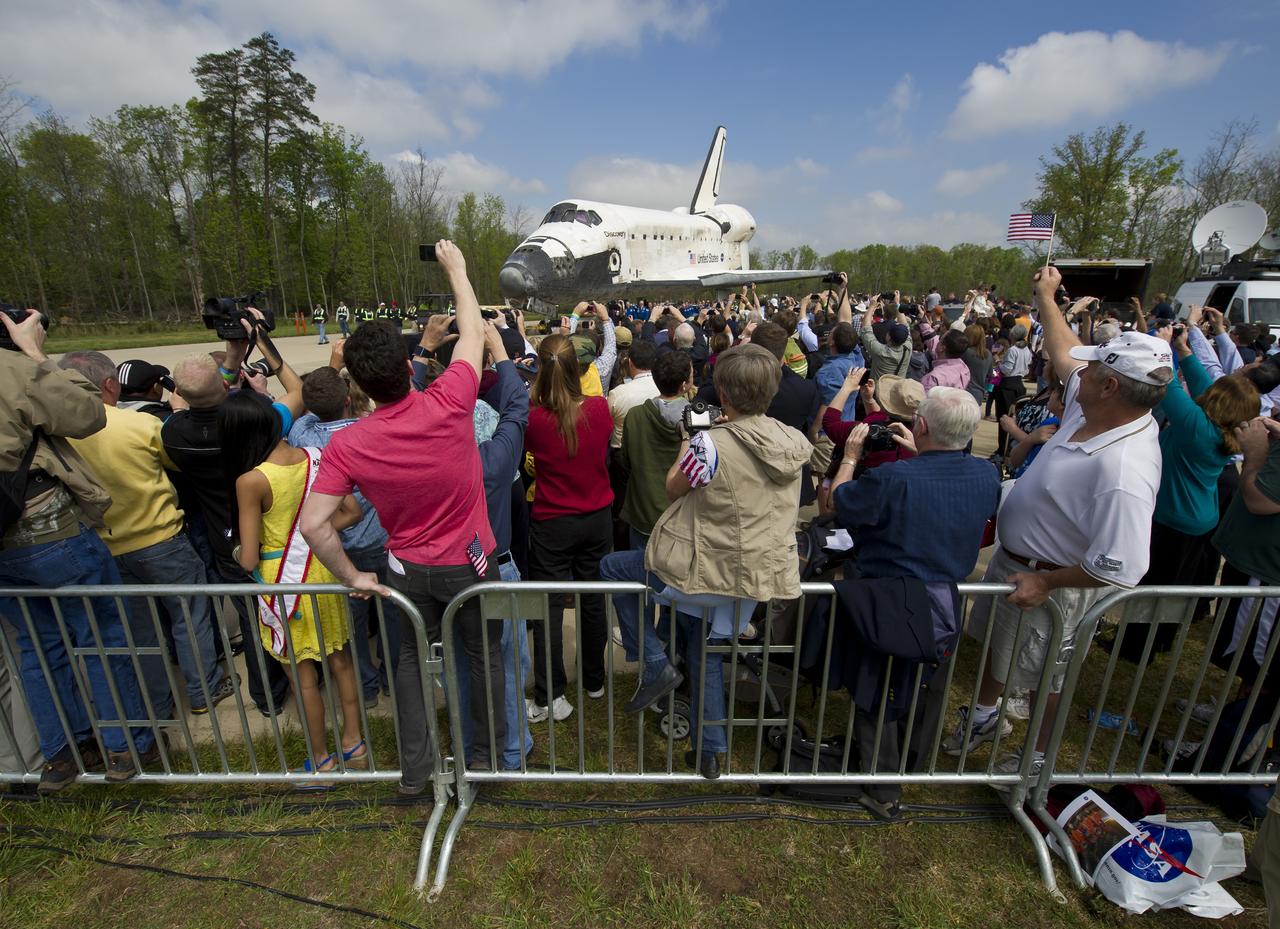
Space shuttle Discovery is rolled toward the transfer ceremony at the Steven F. Udvar-Hazy Center Thursday, April 19, 2012 in Chantilly, Va. Discovery will be permanently housed at the Udvar-Hazy Center, part of the Smithsonian Institution’s Air and Space Museum. Discovery, the first orbiter retired from NASA’s shuttle fleet, completed 39 missions, spent 365 days in space, orbited the Earth 5,830 times, and traveled 148,221,675 miles. NASA will transfer Discovery to the National Air and Space Museum to begin its new mission to commemorate past achievements in space and to educate and inspire future generations of explorers. Photo Credit: (NASA/Carla Cioffi)

Jarod Ondas (left), of Virginia, and his brother Austin, watch as space shuttle Discovery approaches the National Air and Space Museum’s Steven F. Udvar-Hazy Center for its fly-over, Tuesday, April 17, 2012, in Chantilly, Va. Discovery, the first orbiter retired from NASA’s shuttle fleet, completed 39 missions, spent 365 days in space, orbited the Earth 5,830 times, and traveled 148,221,675 miles. NASA will transfer Discovery to the National Air and Space Museum to begin its new mission to commemorate past achievements in space and to educate and inspire future generations of explorers. Photo Credit: (NASA/Carla Cioffi)
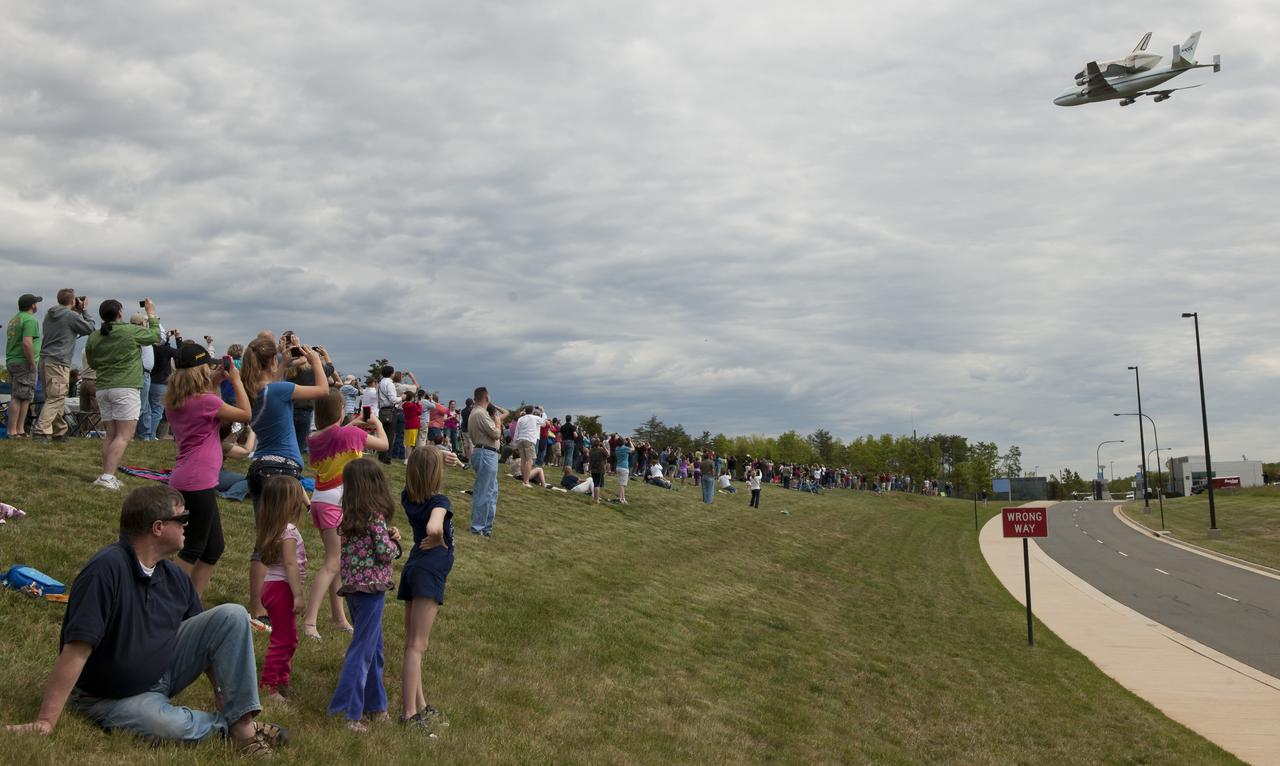
Spectators watch as space shuttle Discovery, mounted atop a NASA 747 Shuttle Carrier Aircraft (SCA) flies over the National Air and Space Museum’s Steven F. Udvar-Hazy Center, Tuesday, April 17, 2012, in Chantilly, Va. Discovery, the first orbiter retired from NASA’s shuttle fleet, completed 39 missions, spent 365 days in space, orbited the Earth 5,830 times, and traveled 148,221,675 miles. NASA will transfer Discovery to the National Air and Space Museum to begin its new mission to commemorate past achievements in space and to educate and inspire future generations of explorers. Photo Credit: (NASA/Carla Cioffi)
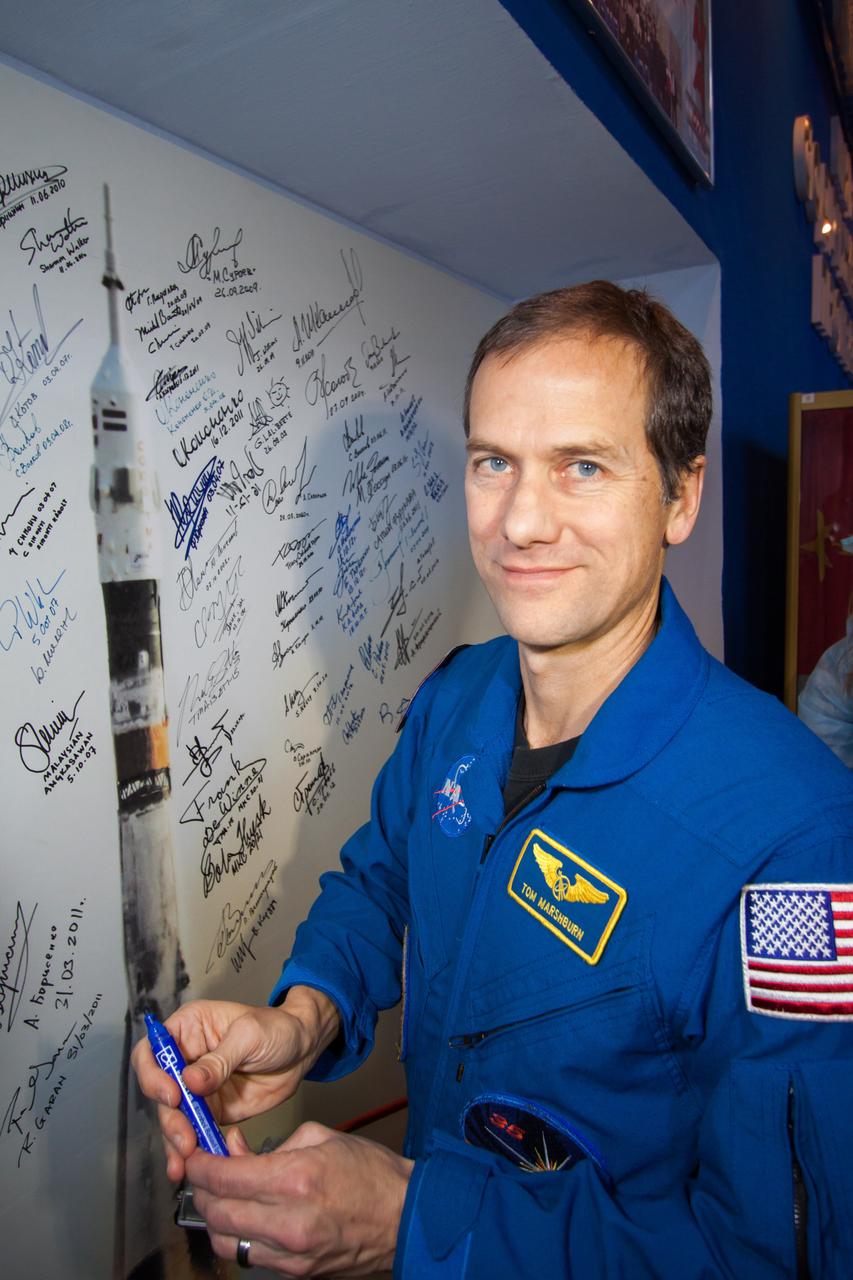
At the Korolev Museum at the Baikonur Cosmodrome in Kazakhstan, Expedition 34/35 Flight Engineer Tom Marshburn of NASA signs a mural of a Soyuz spacecraft launch Dec. 14, 2012, part of a tradition for all space travelers launching from the Central Asian spaceport. Marshburn, Soyuz Commander Roman Romanenko and Flight Engineer Chris Hadfield of the Canadian Space Agency will launch Dec. 19 in the Soyuz TMA-07M spacecraft from Baikonur for a five-month mission on the International Space Station. NASA/Victor Zelentsov
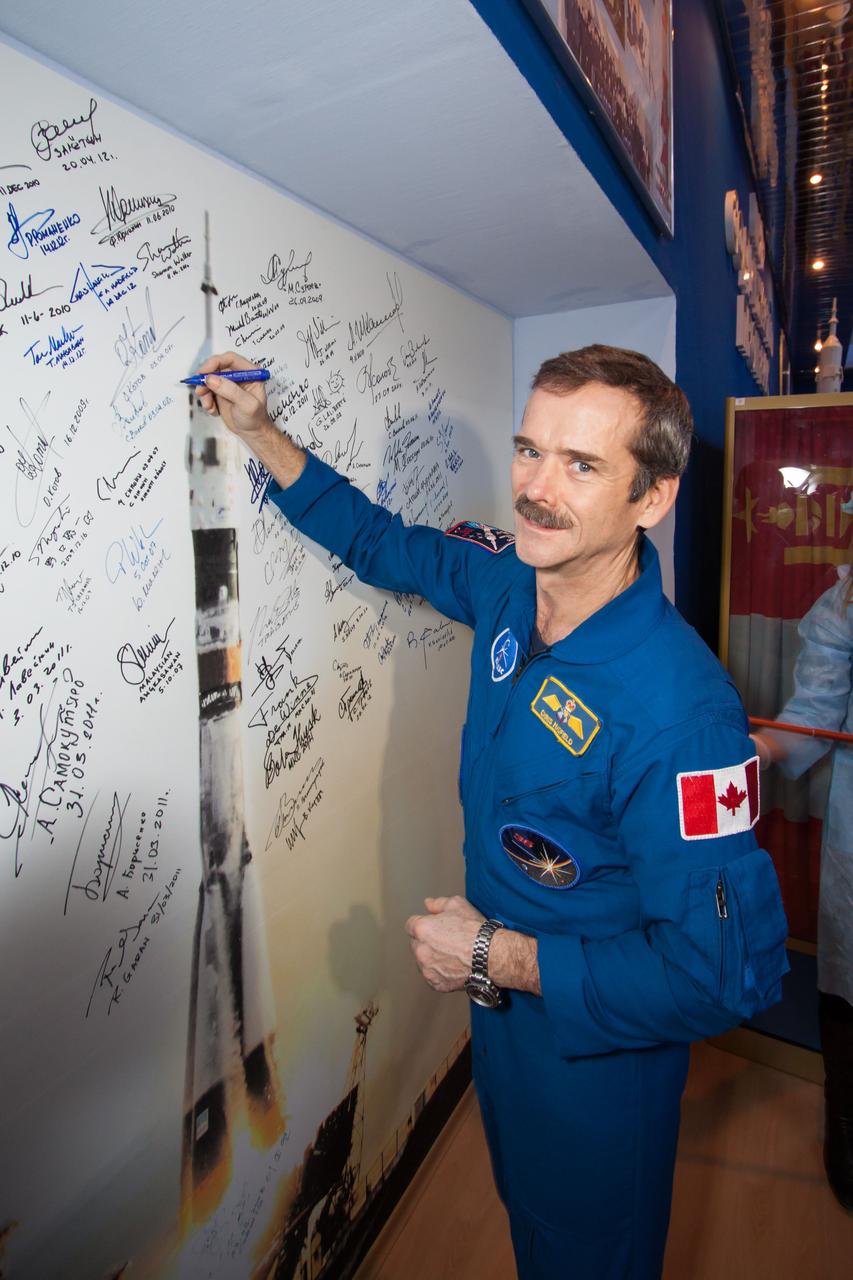
At the Korolev Museum at the Baikonur Cosmodrome in Kazakhstan, Expedition 34/35 Flight Engineer Chris Hadfield of the Canadian Space Agency signs a mural of a Soyuz spacecraft launch Dec. 14, 2012, part of a tradition for all space travelers launching from the Central Asian spaceport. Hadfield, Soyuz Commander Roman Romanenko and Flight Engineer Tom Marshburn of NASA will launch Dec. 19 in the Soyuz TMA-07M spacecraft from Baikonur for a five-month mission on the International Space Station. NASA/Victor Zelentsov

StenniSphere, the John C. Stennis Space Center's visitor center in Hancock County, Miss., features a 14,000-square-foot museum and outdoor exhibits about Stennis Space Center. Designed to entertain while educating, StenniSphere includes informative displays and exhibits from NASA, the Naval Meteorology and Oceanography Command, and other resident agencies. Recently named Mississippi's Travel Attraction of the Year, StenniSphere hosted a quarter of a million visitors in its first year and is a major school field trip destination.
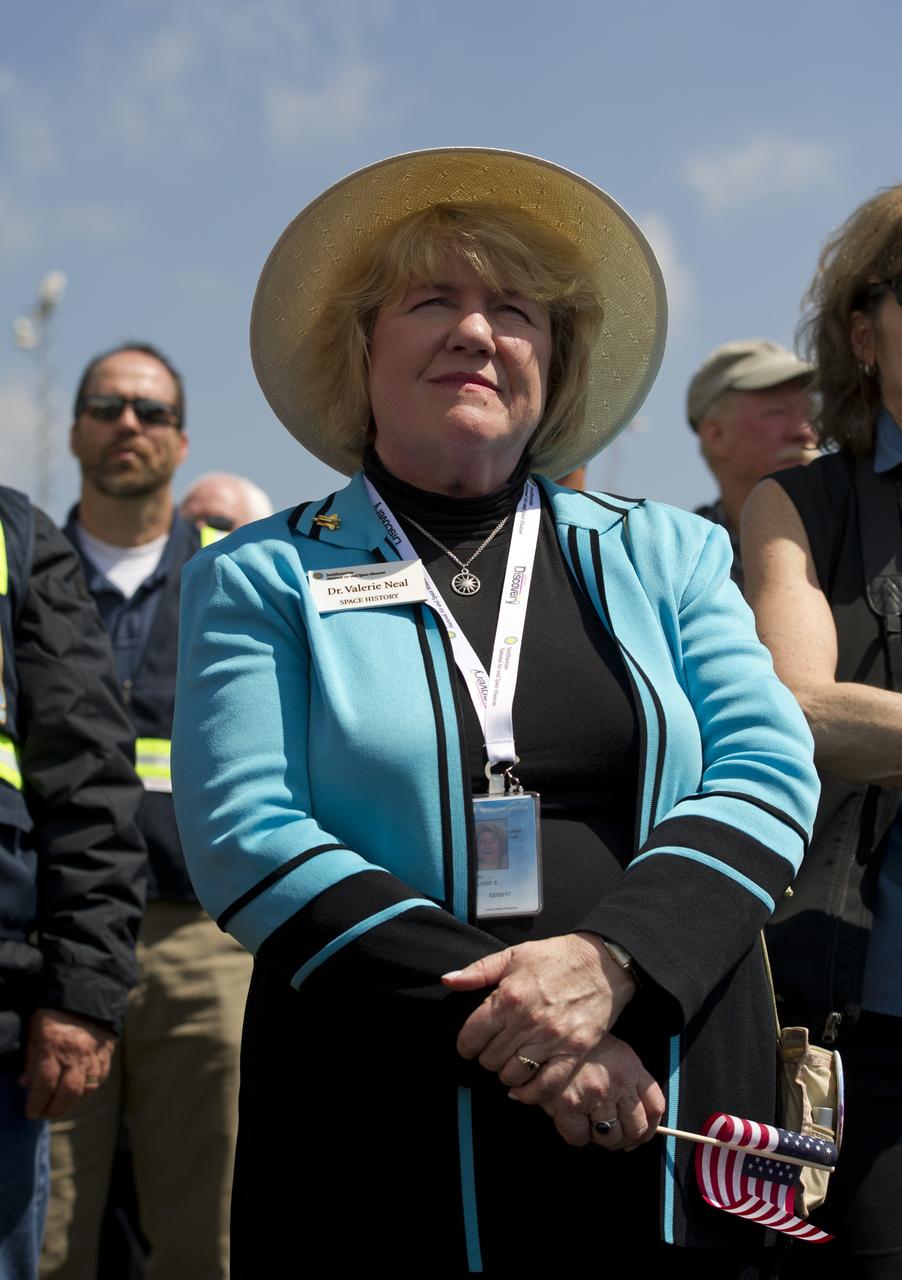
Dr. Valerie Neal, curator for the shuttle program in the Space History office at the National Air and Space Museum, attends the transfer ceremony for space shuttle Discovery, Thursday, April 19, 2012, at the Smithsonian's Steven F. Udvar-Hazy Center in Chantilly, Va. Discovery, the first orbiter retired from NASA’s shuttle fleet, which completed 39 missions, spent 365 days in space, orbited the Earth 5,830 times, and traveled 148,221,675 miles will take the place of Enterprise at the center to commemorate past achievements in space and to educate and inspire future generations of explorers at the center. Photo Credit: (NASA/Carla Cioffi)
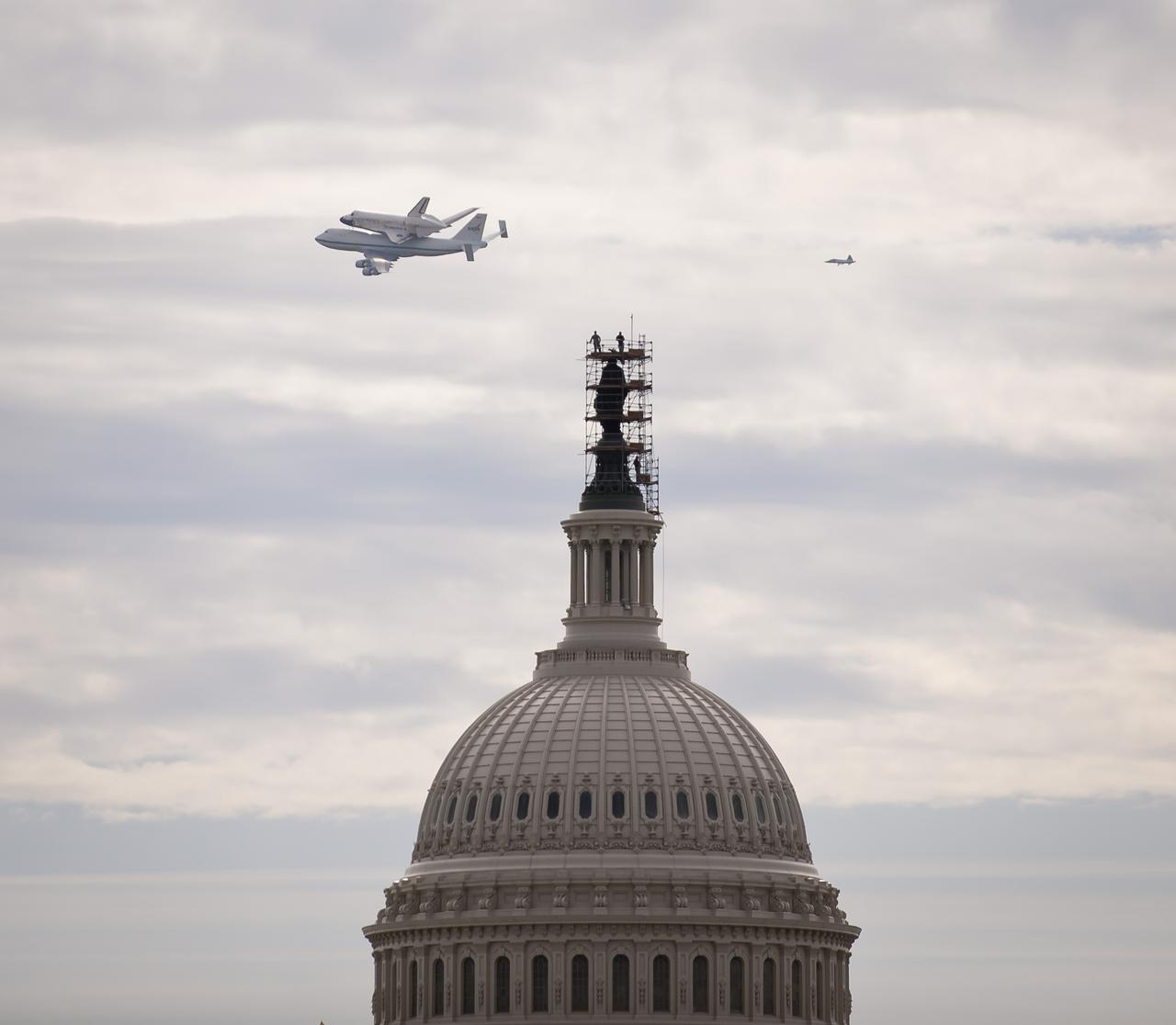
Space shuttle Discovery, mounted atop a NASA 747 Shuttle Carrier Aircraft (SCA) is seen as it flies near the U.S. Capitol, Tuesday, April 17, 2012, in Washington. Discovery, the first orbiter retired from NASA’s shuttle fleet, completed 39 missions, spent 365 days in space, orbited the Earth 5,830 times, and traveled 148,221,675 miles. NASA will transfer Discovery to the National Air and Space Museum to begin its new mission to commemorate past achievements in space and to educate and inspire future generations of explorers. Photo Credit: (NASA/Smithsonian Institution/Harold Dorwin)
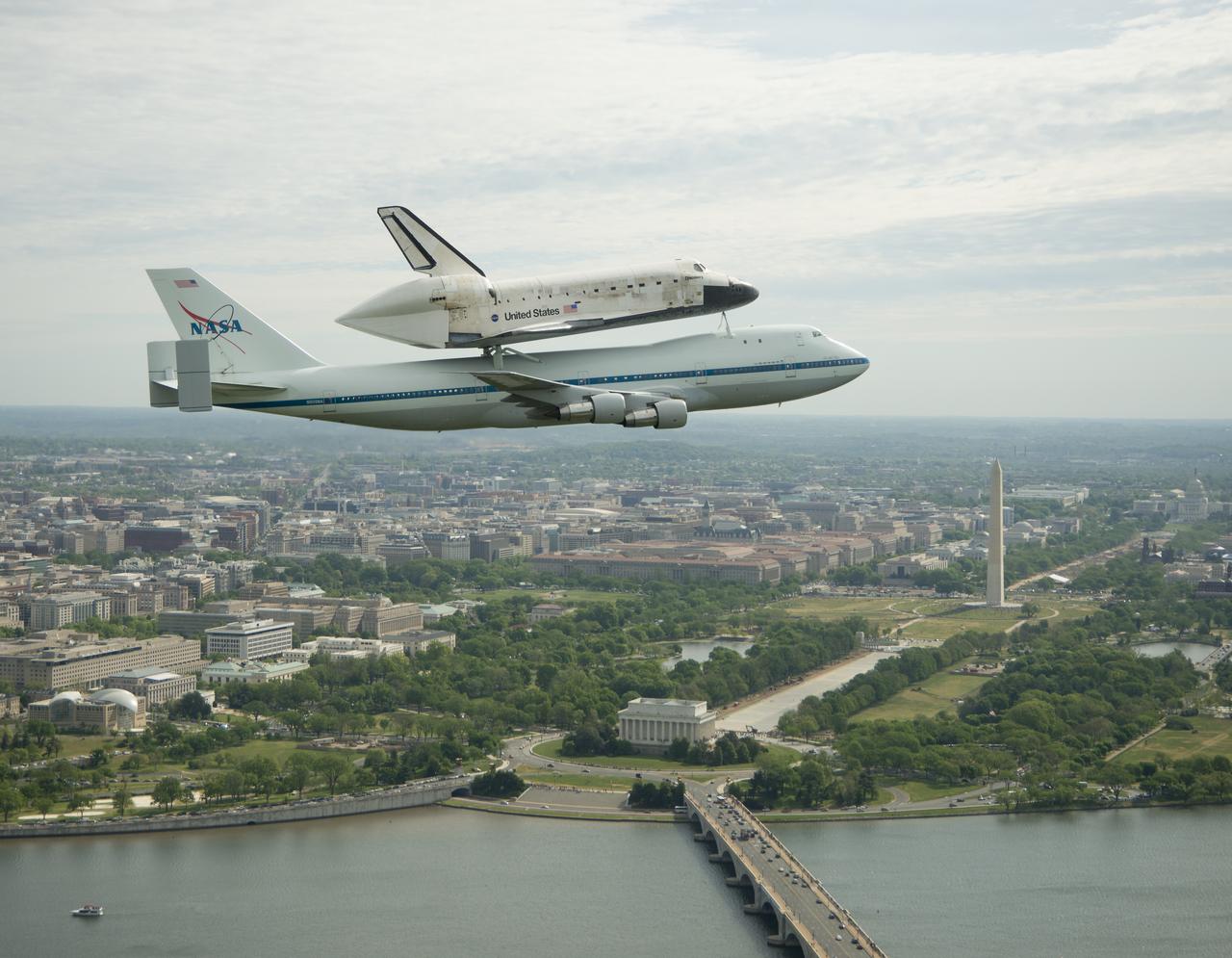
Space shuttle Discovery, mounted atop a NASA 747 Shuttle Carrier Aircraft (SCA), flies over the Washington skyline as seen from a NASA T-38 aircraft, Tuesday, April 17, 2012. Discovery, the first orbiter retired from NASA’s shuttle fleet, completed 39 missions, spent 365 days in space, orbited the Earth 5,830 times, and traveled 148,221,675 miles. NASA will transfer Discovery to the National Air and Space Museum to begin its new mission to commemorate past achievements in space and to educate and inspire future generations of explorers. Photo Credit: (NASA/Robert Markowitz)

Space Shuttle Discovery mounted atop a 747 Shuttle Carrier Aircraft (SCA) approaches the runway for landing at Washington Dulles International Airport, Tuesday April 17, 2012, in Sterling, Va. Discovery, the first orbiter retired from NASA’s shuttle fleet, completed 39 missions, spent 365 days in space, orbited the Earth 5,830 times, and traveled 148,221,675 miles. NASA will transfer Discovery to the National Air and Space Museum to begin its new mission to commemorate past achievements in space and to educate and inspire future generations of explorers. Photo Credit: (NASA/Paul E. Alers)
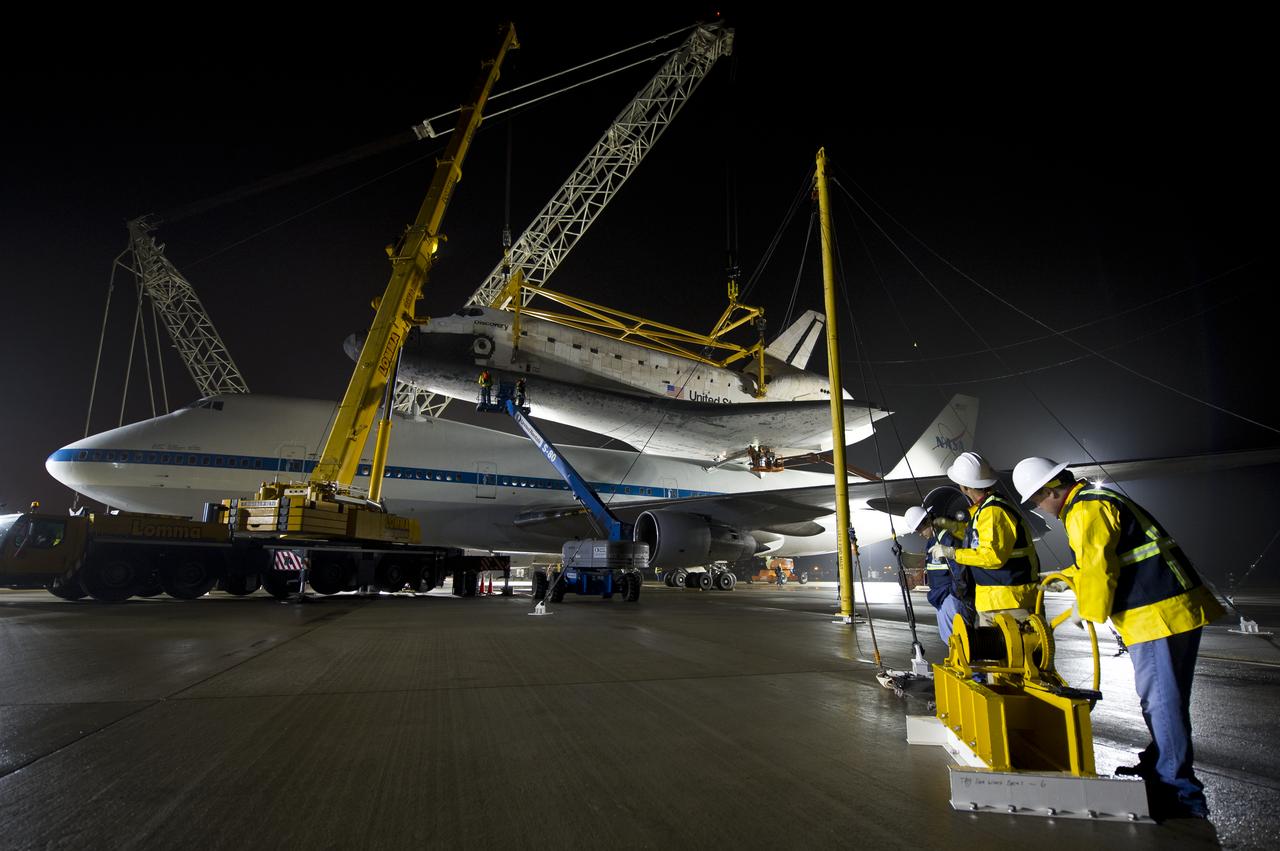
Workers monitor the lift of the space shuttle Discovery from the the NASA 747 Shuttle Carrier Aircraft (SCA) at Washington Dulles International Airport, Thursday, April 19, 2012, in Sterling, VA. Discovery, the first orbiter retired from NASA’s shuttle fleet, completed 39 missions, spent 365 days in space, orbited the Earth 5,830 times, and traveled 148,221,675 miles. NASA will transfer Discovery to the National Air and Space Museum to begin its new mission to commemorate past achievements in space and to educate and inspire future generations of explorers. Photo Credit: (NASA/Bill Ingalls)
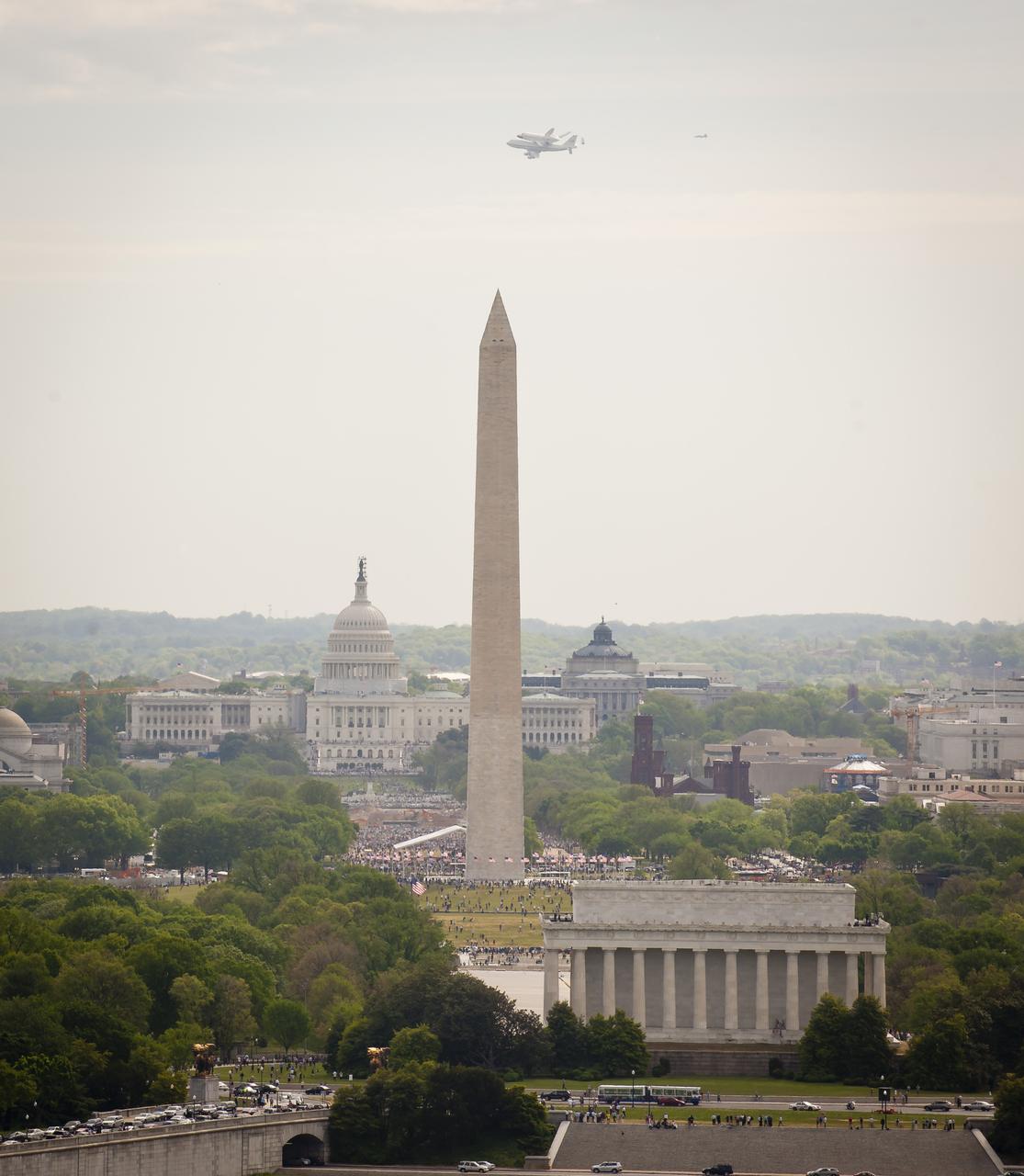
Space shuttle Discovery, mounted atop a NASA 747 Shuttle Carrier Aircraft (SCA) is seen from Top of the Town in Arlington, Virginia as it flies near the U.S. Capitol, Tuesday, April 17, 2012, in Washington. Discovery, the first orbiter retired from NASA’s shuttle fleet, completed 39 missions, spent 365 days in space, orbited the Earth 5,830 times, and traveled 148,221,675 miles. NASA will transfer Discovery to the National Air and Space Museum to begin its new mission to commemorate past achievements in space and to educate and inspire future generations of explorers. Photo Credit: (NASA/Chris Gunn)
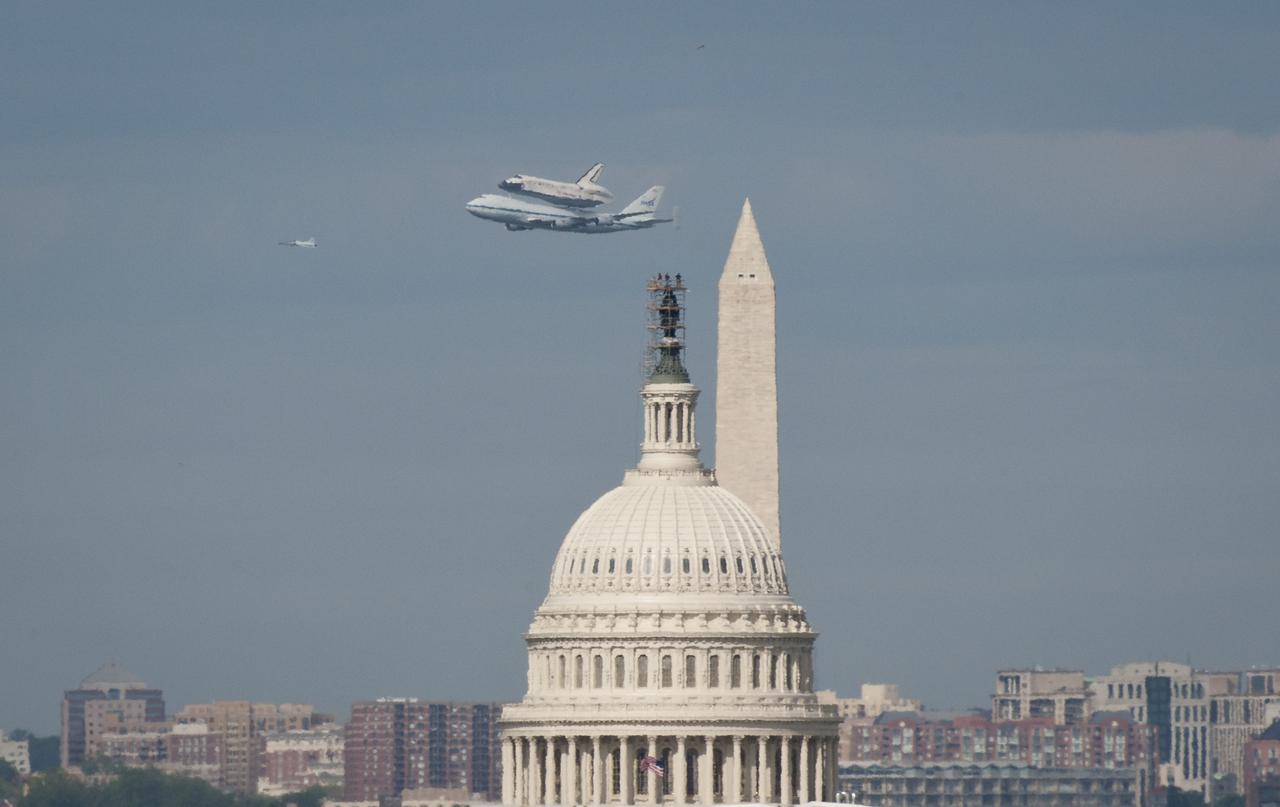
Space shuttle Discovery, mounted atop a NASA 747 Shuttle Carrier Aircraft (SCA) flies near the U.S. Capitol, Tuesday, April 17, 2012, in Washington. Discovery, the first orbiter retired from NASA’s shuttle fleet, completed 39 missions, spent 365 days in space, orbited the Earth 5,830 times, and traveled 148,221,675 miles. NASA will transfer Discovery to the National Air and Space Museum to begin its new mission to commemorate past achievements in space and to educate and inspire future generations of explorers. Photo Credit: (NASA/Rebecca Roth)
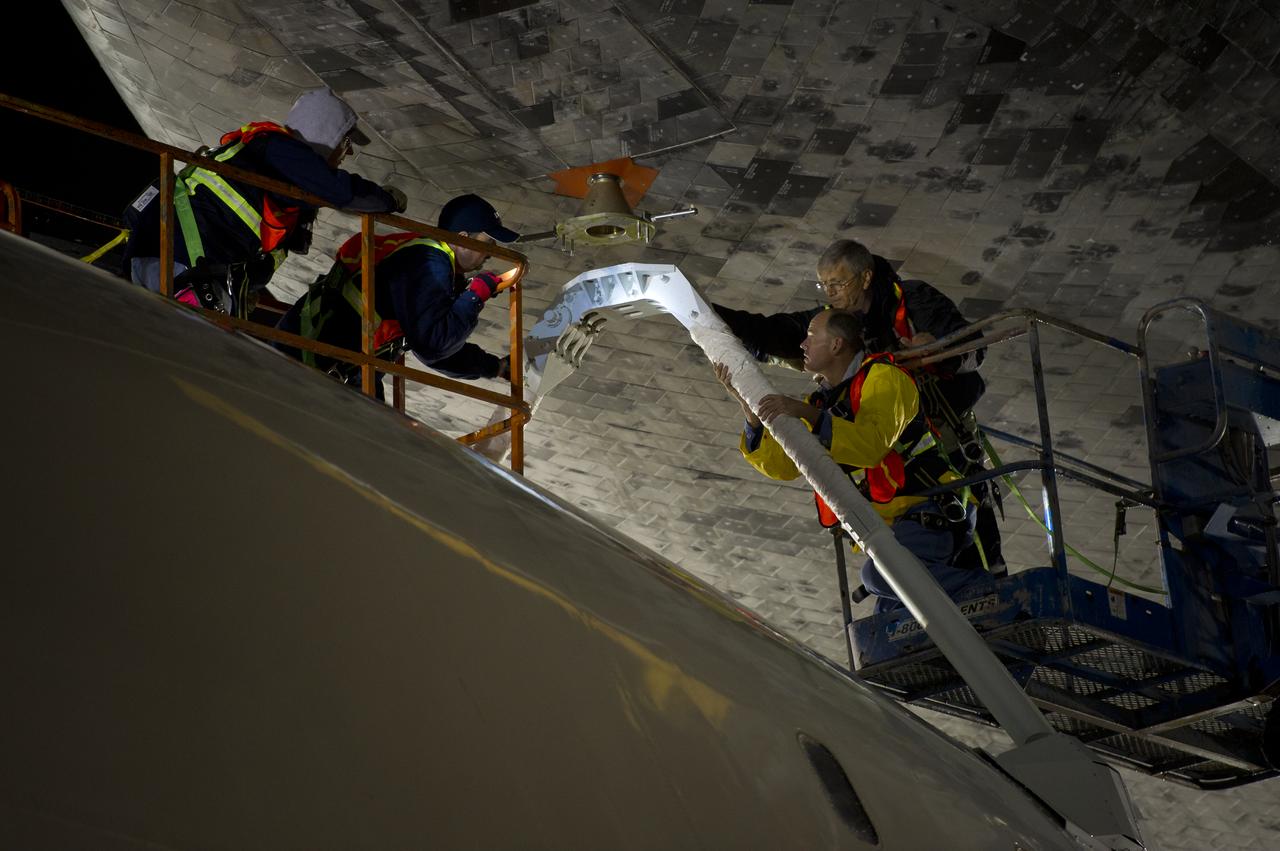
Workers monitor the lift of the space shuttle Discovery from the top of the NASA 747 Shuttle Carrier Aircraft (SCA) at Washington Dulles International Airport, Thursday, April 19, 2012, in Sterling, VA. Discovery, the first orbiter retired from NASA’s shuttle fleet, completed 39 missions, spent 365 days in space, orbited the Earth 5,830 times, and traveled 148,221,675 miles. NASA will transfer Discovery to the National Air and Space Museum to begin its new mission to commemorate past achievements in space and to educate and inspire future generations of explorers. Photo Credit: (NASA/Bill Ingalls)
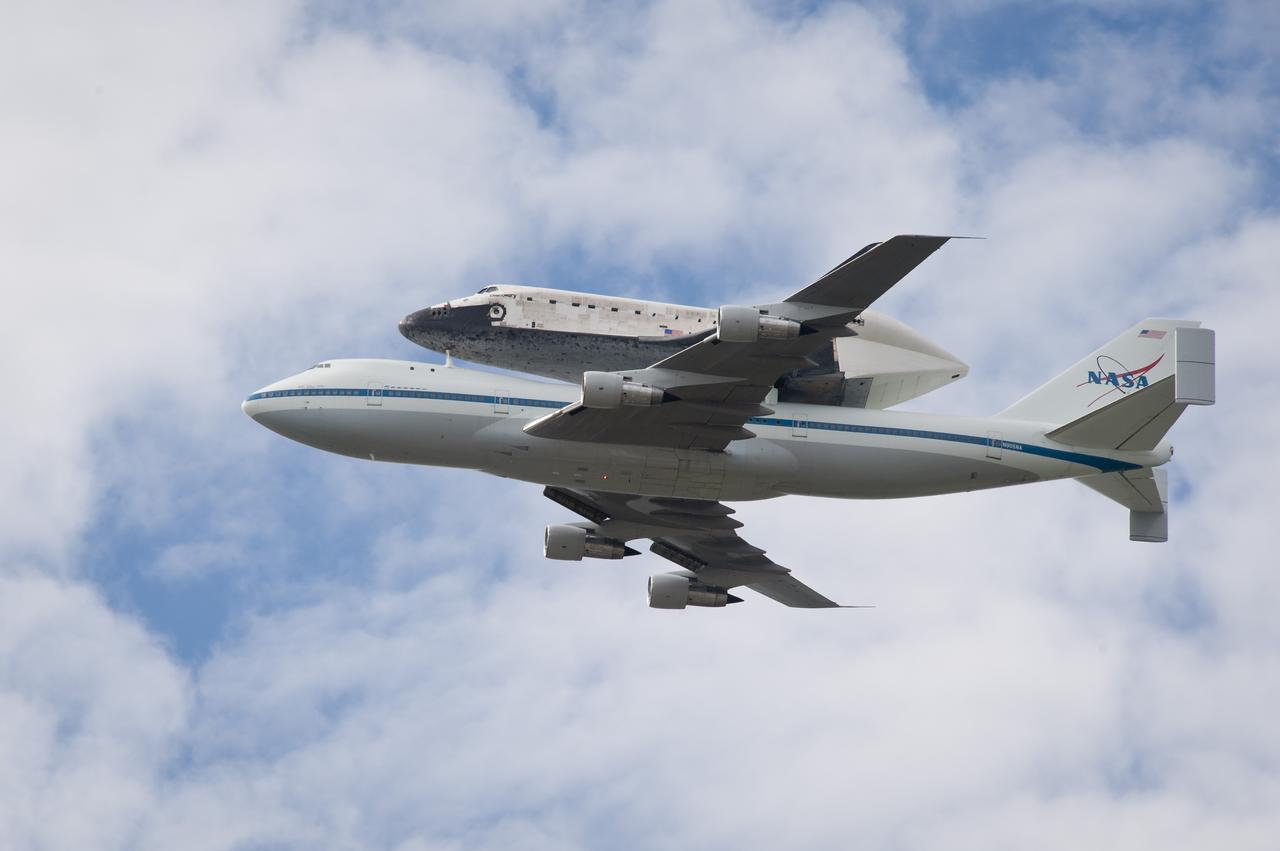
Space shuttle Discovery, mounted atop a NASA 747 Shuttle Carrier Aircraft (SCA) flies near the U.S. Capitol, Tuesday, April 17, 2012, in Washington. Discovery, the first orbiter retired from NASA’s shuttle fleet, completed 39 missions, spent 365 days in space, orbited the Earth 5,830 times, and traveled 148,221,675 miles. NASA will transfer Discovery to the National Air and Space Museum to begin its new mission to commemorate past achievements in space and to educate and inspire future generations of explorers. Photo Credit: (NASA/Michael Porterfield)

Space shuttle Discovery, mounted atop a NASA 747 Shuttle Carrier Aircraft (SCA) lands at Washington Dulles International Airport, Tuesday, April 17, 2012, in Sterling, Va. Discovery, the first orbiter retired from NASA’s shuttle fleet, completed 39 missions, spent 365 days in space, orbited the Earth 5,830 times, and traveled 148,221,675 miles. NASA will transfer Discovery to the National Air and Space Museum to begin its new mission to commemorate past achievements in space and to educate and inspire future generations of explorers. Photo Credit: (NASA/Smithsonian Institution/Eric Long)
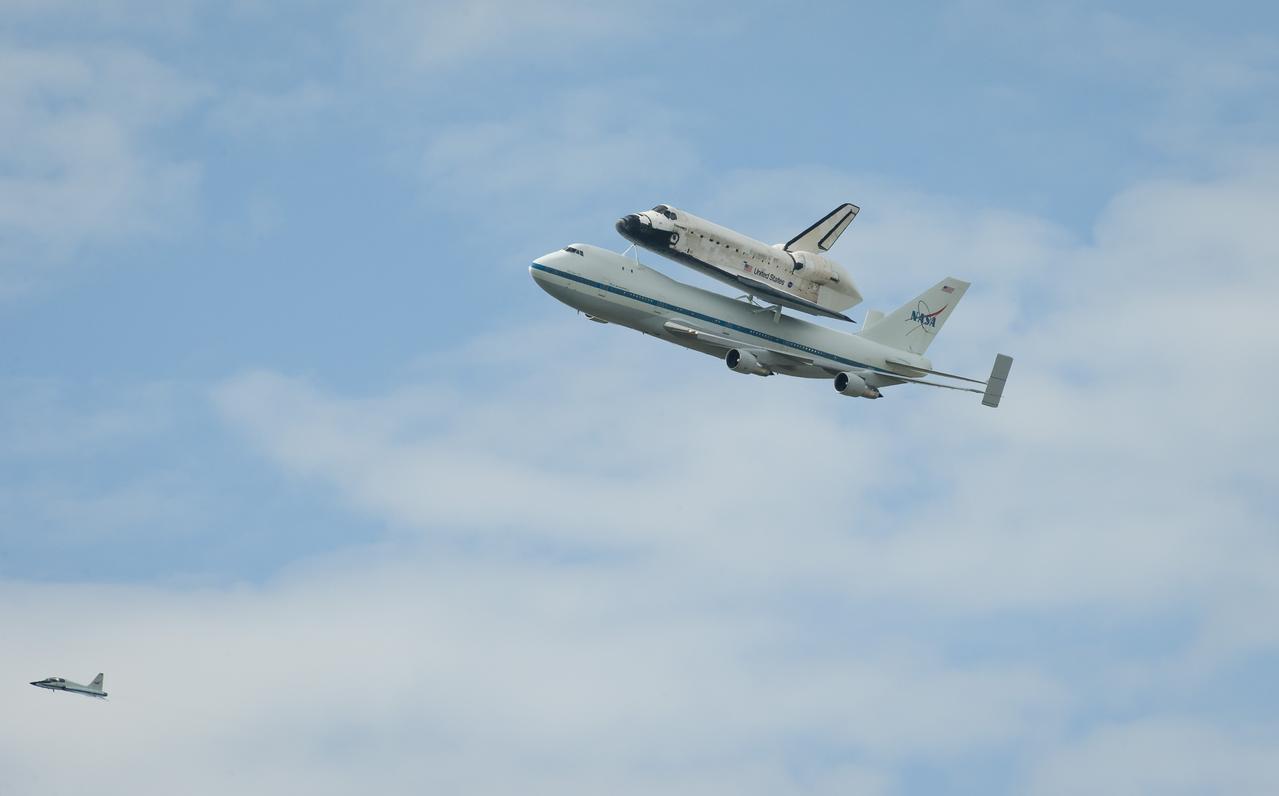
Space shuttle Discovery, mounted atop a NASA 747 Shuttle Carrier Aircraft (SCA) flies near the U.S. Capitol, Tuesday, April 17, 2012, in Washington. Discovery, the first orbiter retired from NASA’s shuttle fleet, completed 39 missions, spent 365 days in space, orbited the Earth 5,830 times, and traveled 148,221,675 miles. NASA will transfer Discovery to the National Air and Space Museum to begin its new mission to commemorate past achievements in space and to educate and inspire future generations of explorers. Photo Credit: (NASA/Rebecca Roth)

NASA Deputy Administrator Lori Garver, at podium, speaks to those in attendance at Apron W after the 747 Shuttle Carrier Aircraft (SCA) with space shuttle Discovery mounted on top rolled to a halt at Washington Dulles International Airport, Tuesday, April 17, 2012 in Sterling, Va. Discovery, the first orbiter retired from NASA’s shuttle fleet, completed 39 missions, spent 365 days in space, orbited the Earth 5,830 times, and traveled 148,221,675 miles. NASA will transfer Discovery to the National Air and Space Museum to begin its new mission to commemorate past achievements in space and to educate and inspire future generations of explorers. Photo Credit: (NASA/Smithsonian Institution/Dane Penland)

Space shuttle Discovery, mounted atop a NASA 747 Shuttle Carrier Aircraft (SCA) flies over the Steven F. Udvar-Hazy Center, Tuesday, April 17, 2012, in Washington. Discovery, the first orbiter retired from NASA’s shuttle fleet, completed 39 missions, spent 365 days in space, orbited the Earth 5,830 times, and traveled 148,221,675 miles. NASA will transfer Discovery to the National Air and Space Museum to begin its new mission to commemorate past achievements in space and to educate and inspire future generations of explorers. Photo Credit: (NASA/Smithsonian Institution/Eric Long)
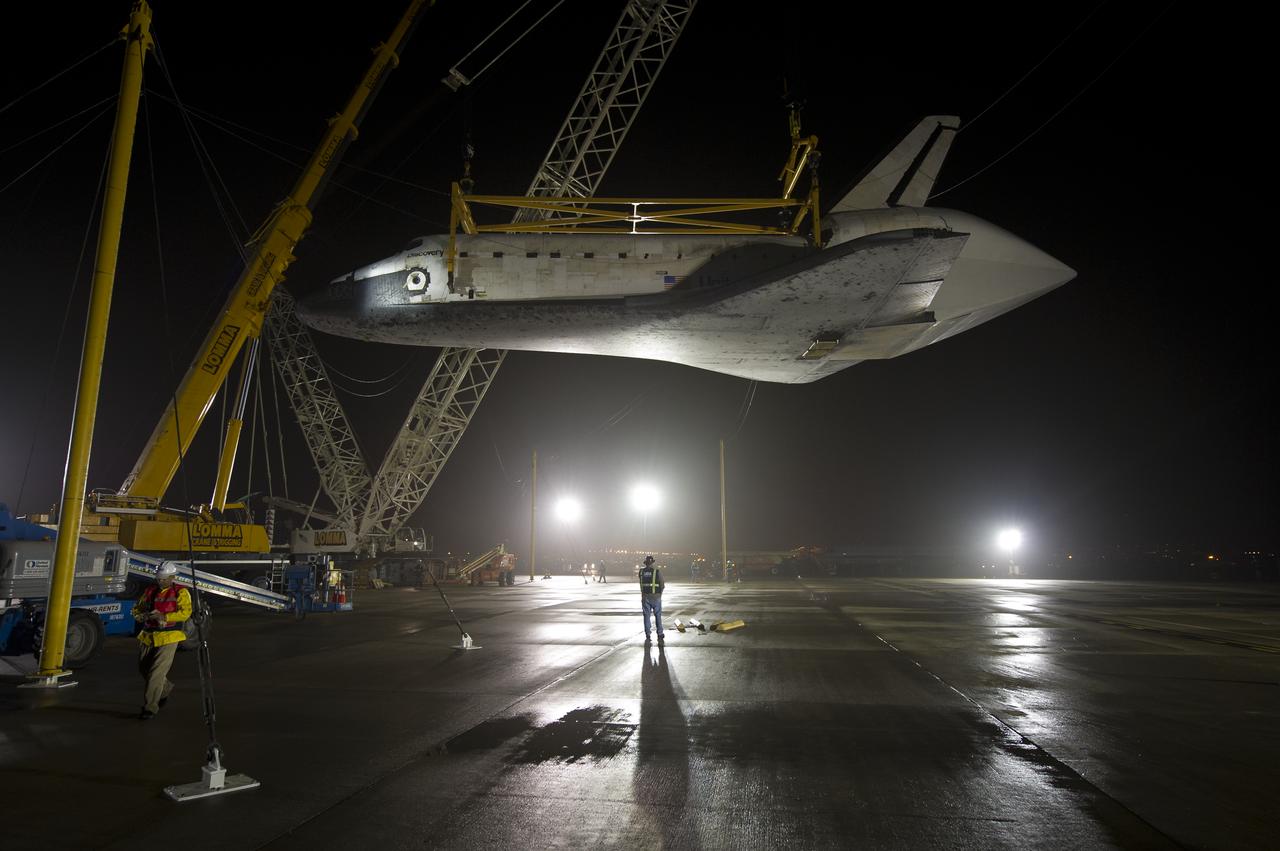
The space shuttle Discovery is suspended from a sling held by two cranes shortly after the NASA 747 Shuttle Carrier Aircraft (SCA) was pushed back from underneath at Washington Dulles International Airport, Thursday, April 19, 2012, in Sterling, VA. Discovery, the first orbiter retired from NASA’s shuttle fleet, completed 39 missions, spent 365 days in space, orbited the Earth 5,830 times, and traveled 148,221,675 miles. NASA will transfer Discovery to the National Air and Space Museum to begin its new mission to commemorate past achievements in space and to educate and inspire future generations of explorers. Photo Credit: (NASA/Bill Ingalls)
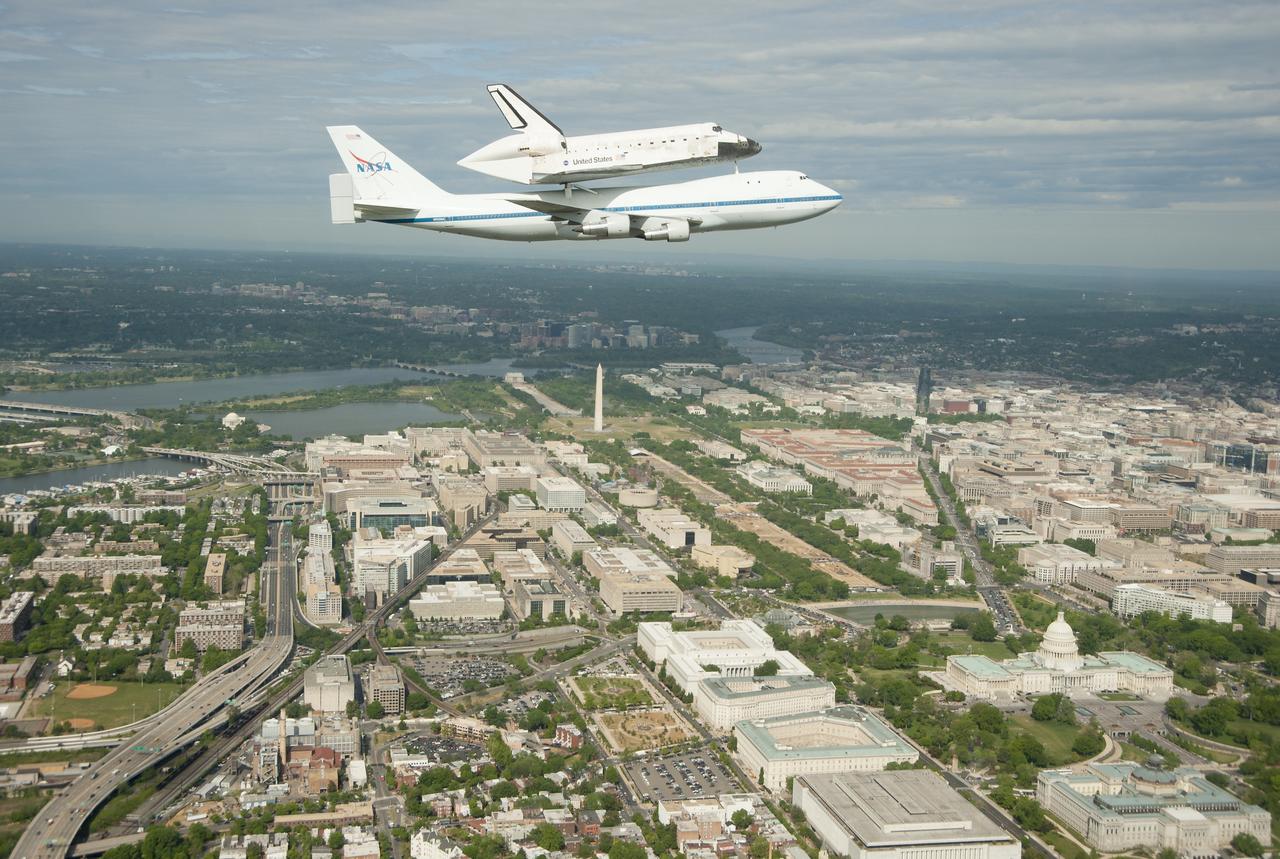
Space shuttle Discovery, mounted atop a NASA 747 Shuttle Carrier Aircraft (SCA), flies over the Washington skyline as seen from a NASA T-38 aircraft, Tuesday, April 17, 2012. Discovery, the first orbiter retired from NASA’s shuttle fleet, completed 39 missions, spent 365 days in space, orbited the Earth 5,830 times, and traveled 148,221,675 miles. NASA will transfer Discovery to the National Air and Space Museum to begin its new mission to commemorate past achievements in space and to educate and inspire future generations of explorers. Photo Credit: (NASA/Robert Markowitz)

Space shuttle Discovery, mounted atop a NASA 747 Shuttle Carrier Aircraft (SCA) taxis in front of the main terminal at Washington Dulles International Airport, Tuesday, April 17, 2012, in Sterling, Va. Discovery, the first orbiter retired from NASA’s shuttle fleet, completed 39 missions, spent 365 days in space, orbited the Earth 5,830 times, and traveled 148,221,675 miles. NASA will transfer Discovery to the National Air and Space Museum to begin its new mission to commemorate past achievements in space and to educate and inspire future generations of explorers. Photo Credit: (NASA/Smithsonian Institution/Eric Long)
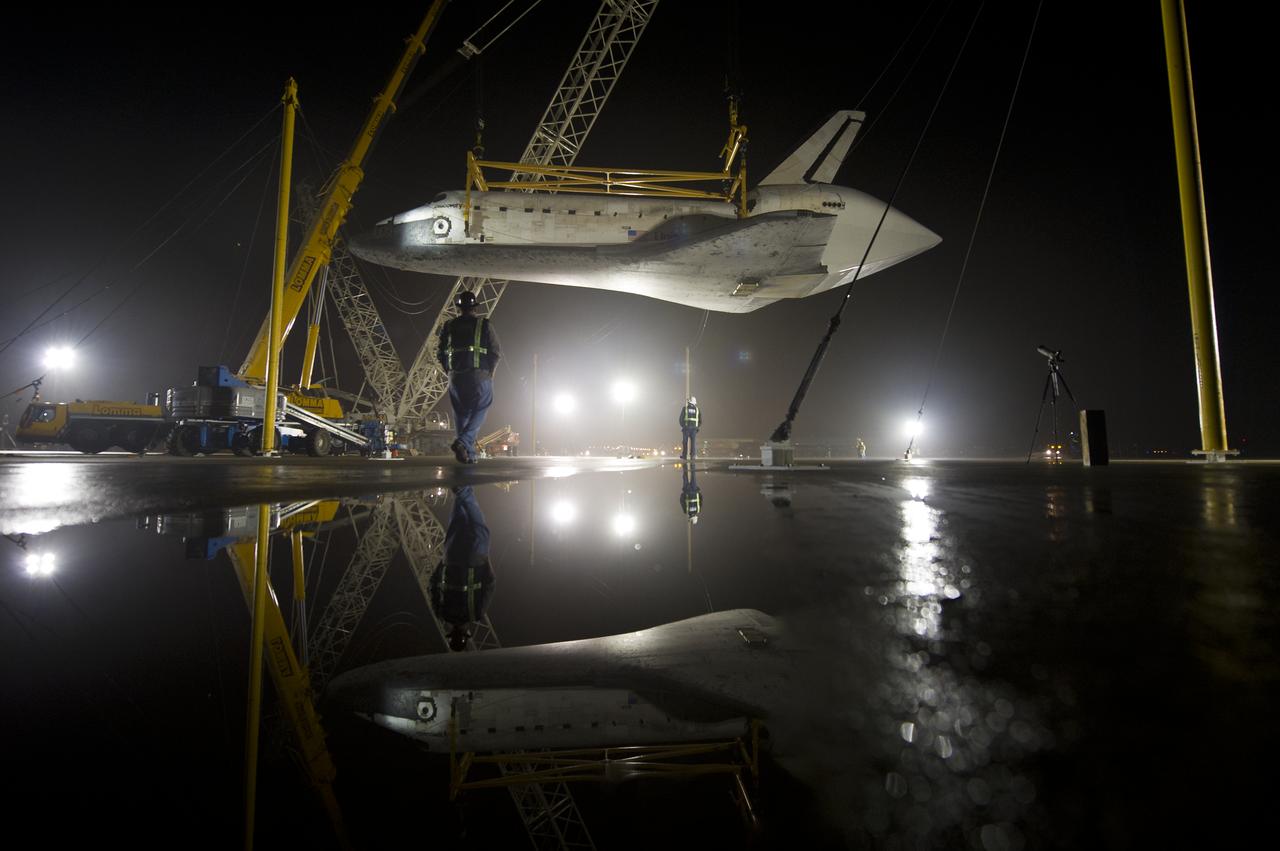
The space shuttle Discovery is suspended from a sling held by two cranes shortly after the NASA 747 Shuttle Carrier Aircraft (SCA) was pushed back from underneath at Washington Dulles International Airport, Thursday, April 19, 2012, in Sterling, VA. Discovery, the first orbiter retired from NASA’s shuttle fleet, completed 39 missions, spent 365 days in space, orbited the Earth 5,830 times, and traveled 148,221,675 miles. NASA will transfer Discovery to the National Air and Space Museum to begin its new mission to commemorate past achievements in space and to educate and inspire future generations of explorers. Photo Credit: (NASA/Bill Ingalls)
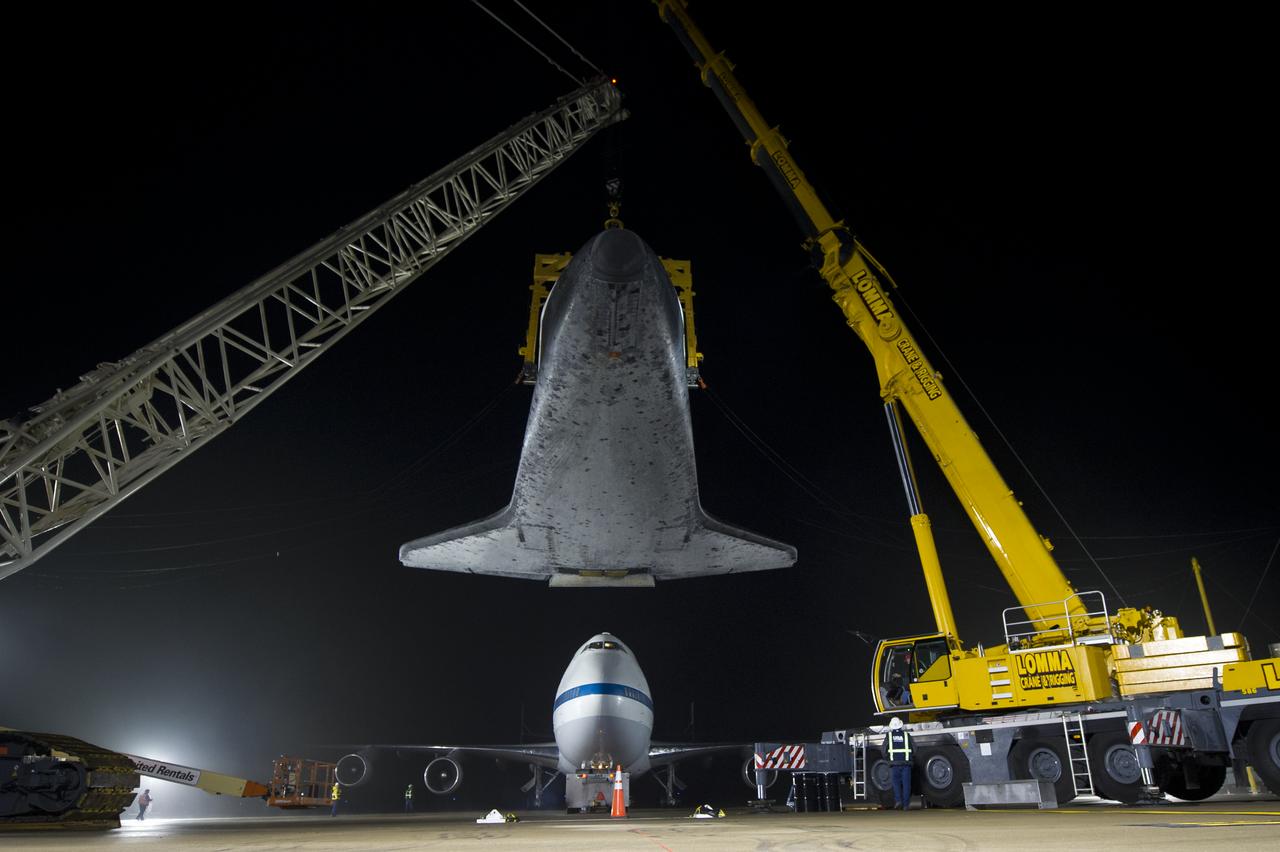
The space shuttle Discovery is suspended from a sling held by two cranes as the NASA 747 Shuttle Carrier Aircraft (SCA) is pushed back from underneath at Washington Dulles International Airport, Thursday, April 19, 2012, in Sterling, VA. Discovery, the first orbiter retired from NASA’s shuttle fleet, completed 39 missions, spent 365 days in space, orbited the Earth 5,830 times, and traveled 148,221,675 miles. NASA will transfer Discovery to the National Air and Space Museum to begin its new mission to commemorate past achievements in space and to educate and inspire future generations of explorers. Photo Credit: (NASA/Bill Ingalls)
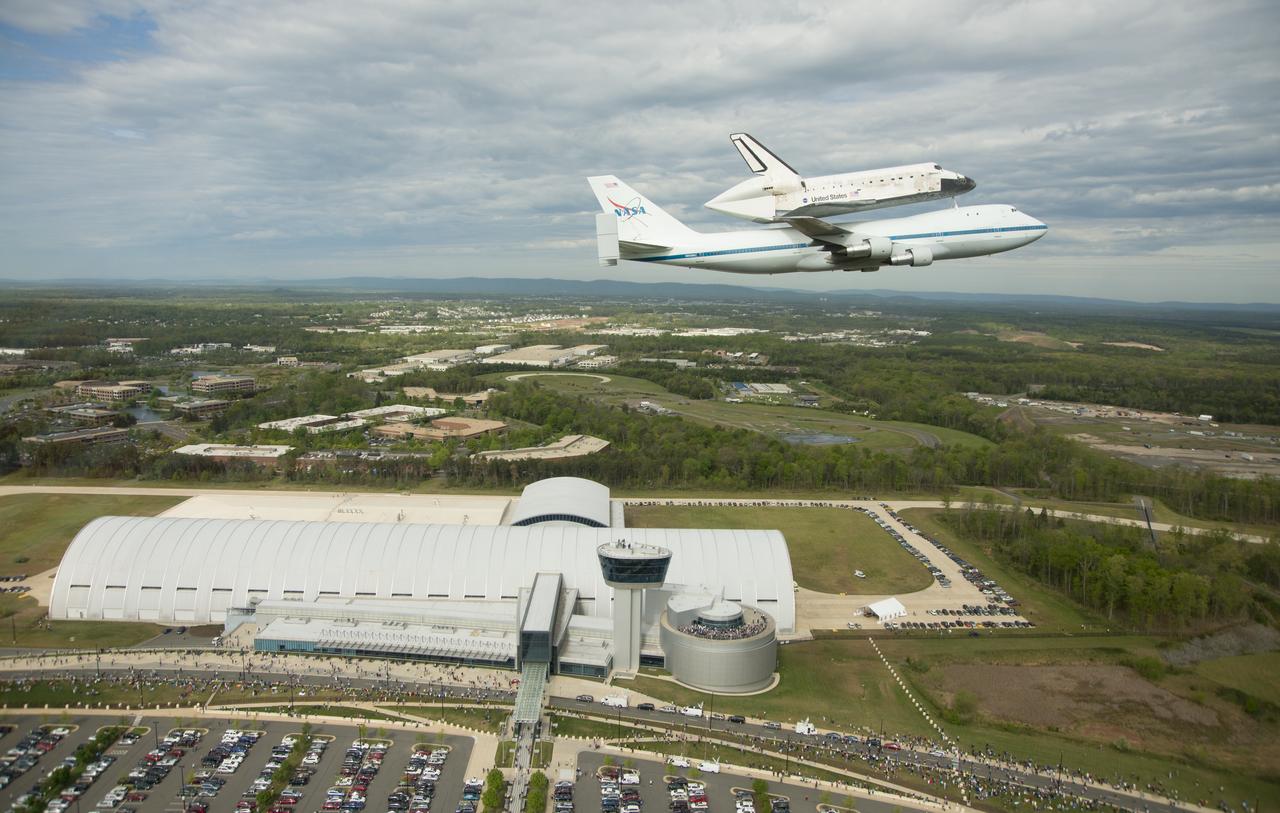
Space shuttle Discovery, mounted atop a NASA 747 Shuttle Carrier Aircraft (SCA) flies over the Steven F. Udvar-Hazy Center, Tuesday, April 17, 2012, in Washington. Discovery, the first orbiter retired from NASA’s shuttle fleet, completed 39 missions, spent 365 days in space, orbited the Earth 5,830 times, and traveled 148,221,675 miles. NASA will transfer Discovery to the National Air and Space Museum to begin its new mission to commemorate past achievements in space and to educate and inspire future generations of explorers. Photo Credit: (NASA/Robert Markowitz)
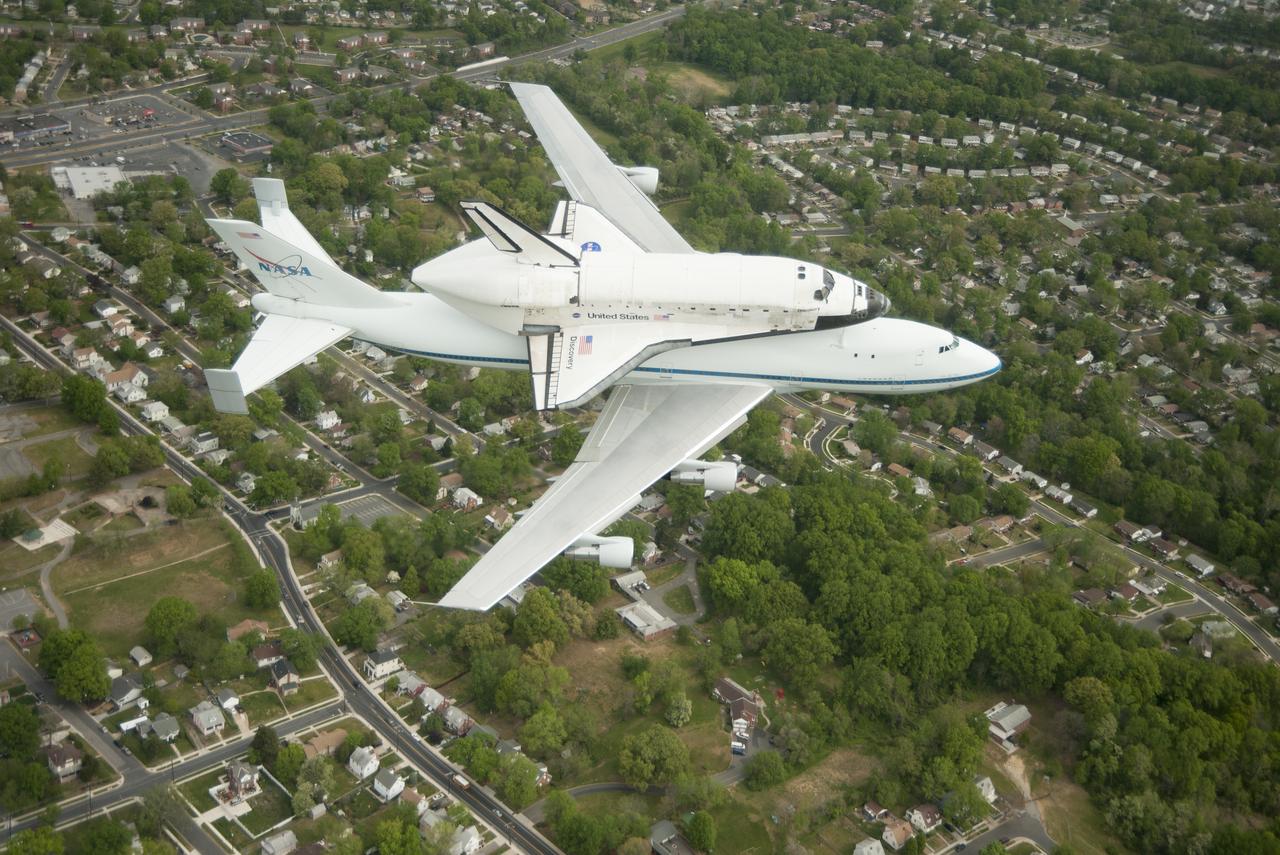
Space shuttle Discovery, mounted atop a NASA 747 Shuttle Carrier Aircraft (SCA), flies over the Washington skyline as seen from a NASA T-38 aircraft, Tuesday, April 17, 2012. Discovery, the first orbiter retired from NASA’s shuttle fleet, completed 39 missions, spent 365 days in space, orbited the Earth 5,830 times, and traveled 148,221,675 miles. NASA will transfer Discovery to the National Air and Space Museum to begin its new mission to commemorate past achievements in space and to educate and inspire future generations of explorers. Photo Credit: (NASA/Robert Markowitz)
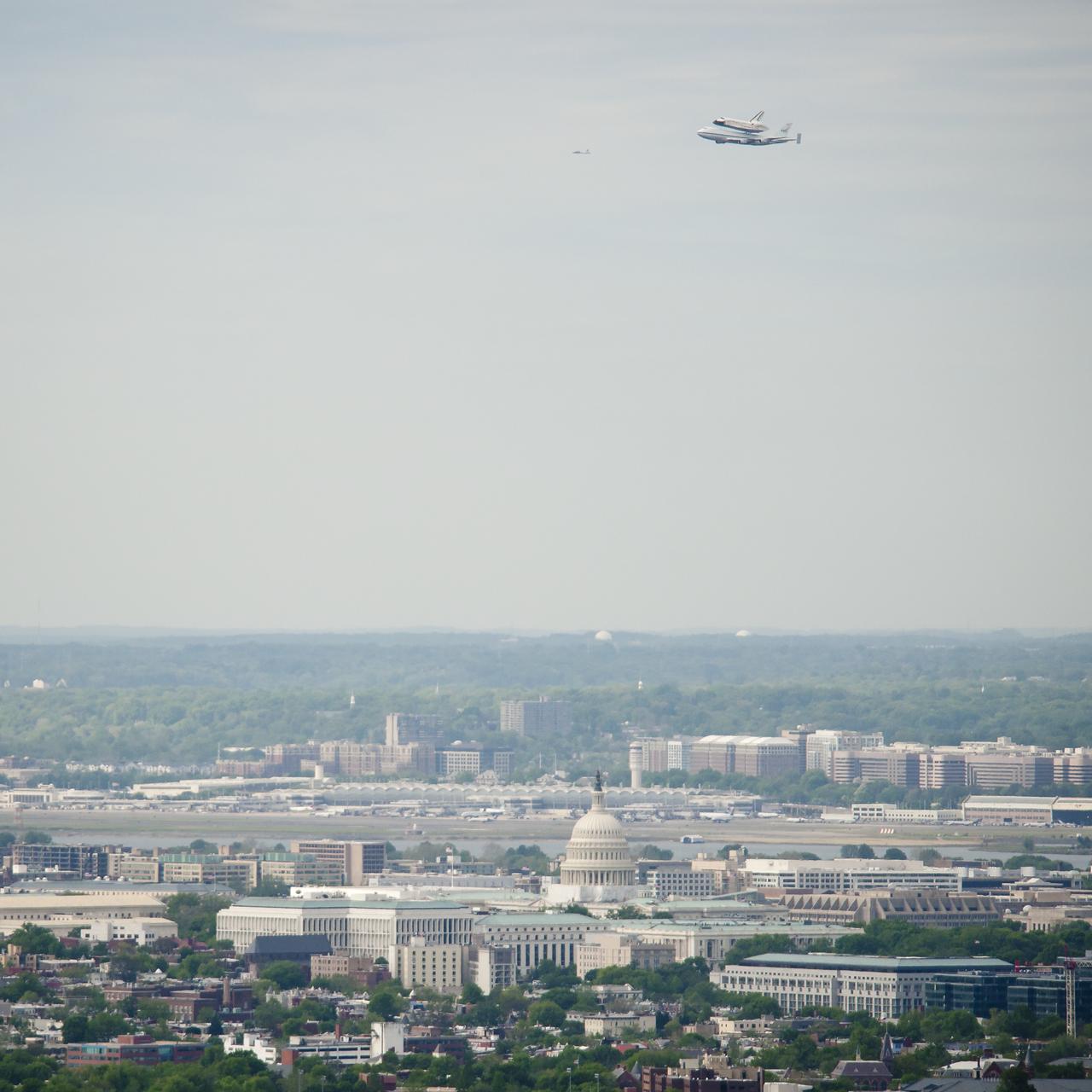
Space shuttle Discovery, mounted atop a NASA 747 Shuttle Carrier Aircraft (SCA) flies near the U.S. Capitol, Tuesday, April 17, 2012, in Washington. Discovery, the first orbiter retired from NASA’s shuttle fleet, completed 39 missions, spent 365 days in space, orbited the Earth 5,830 times, and traveled 148,221,675 miles. NASA will transfer Discovery to the National Air and Space Museum to begin its new mission to commemorate past achievements in space and to educate and inspire future generations of explorers. Photo Credit: (NASA/Bill Ingalls)
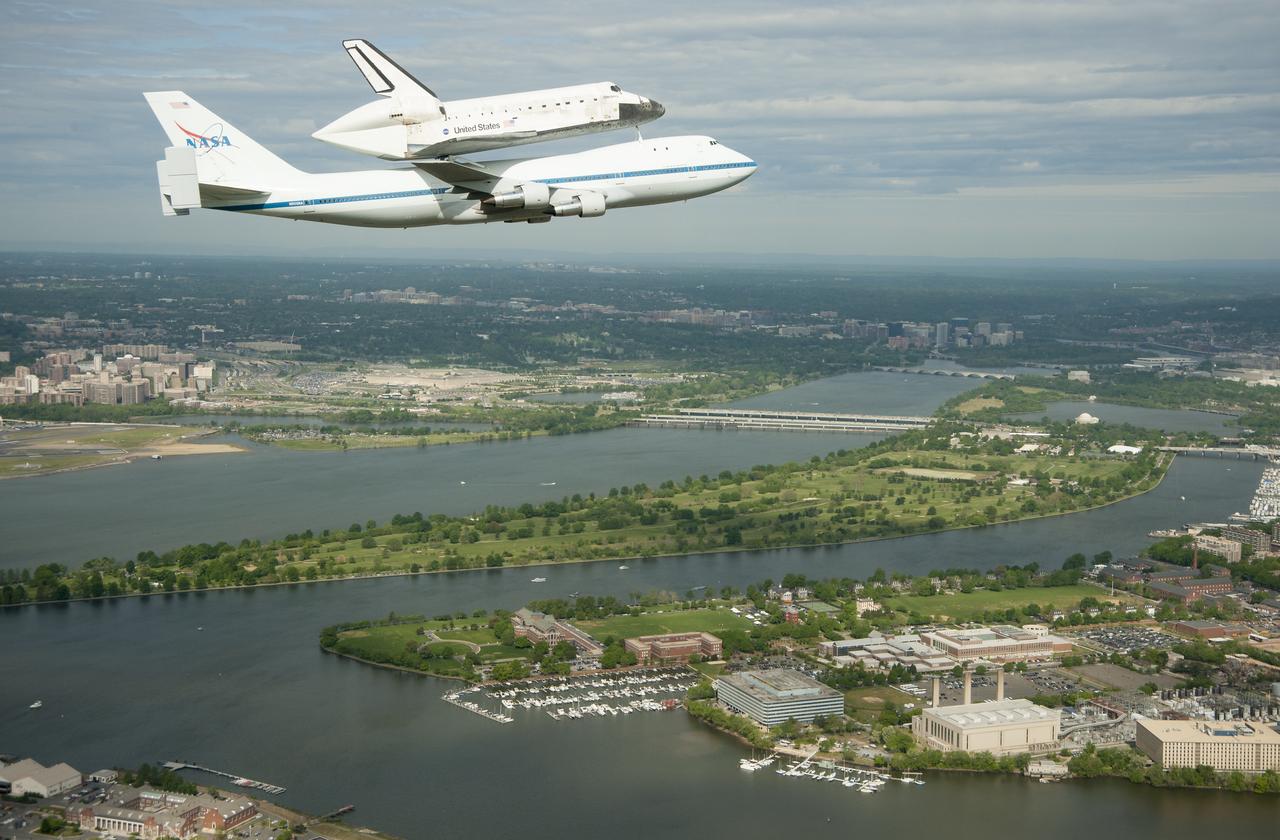
Space shuttle Discovery, mounted atop a NASA 747 Shuttle Carrier Aircraft (SCA), flies over the Washington skyline as seen from a NASA T-38 aircraft, Tuesday, April 17, 2012. Discovery, the first orbiter retired from NASA’s shuttle fleet, completed 39 missions, spent 365 days in space, orbited the Earth 5,830 times, and traveled 148,221,675 miles. NASA will transfer Discovery to the National Air and Space Museum to begin its new mission to commemorate past achievements in space and to educate and inspire future generations of explorers. Photo Credit: (NASA/Robert Markowitz)
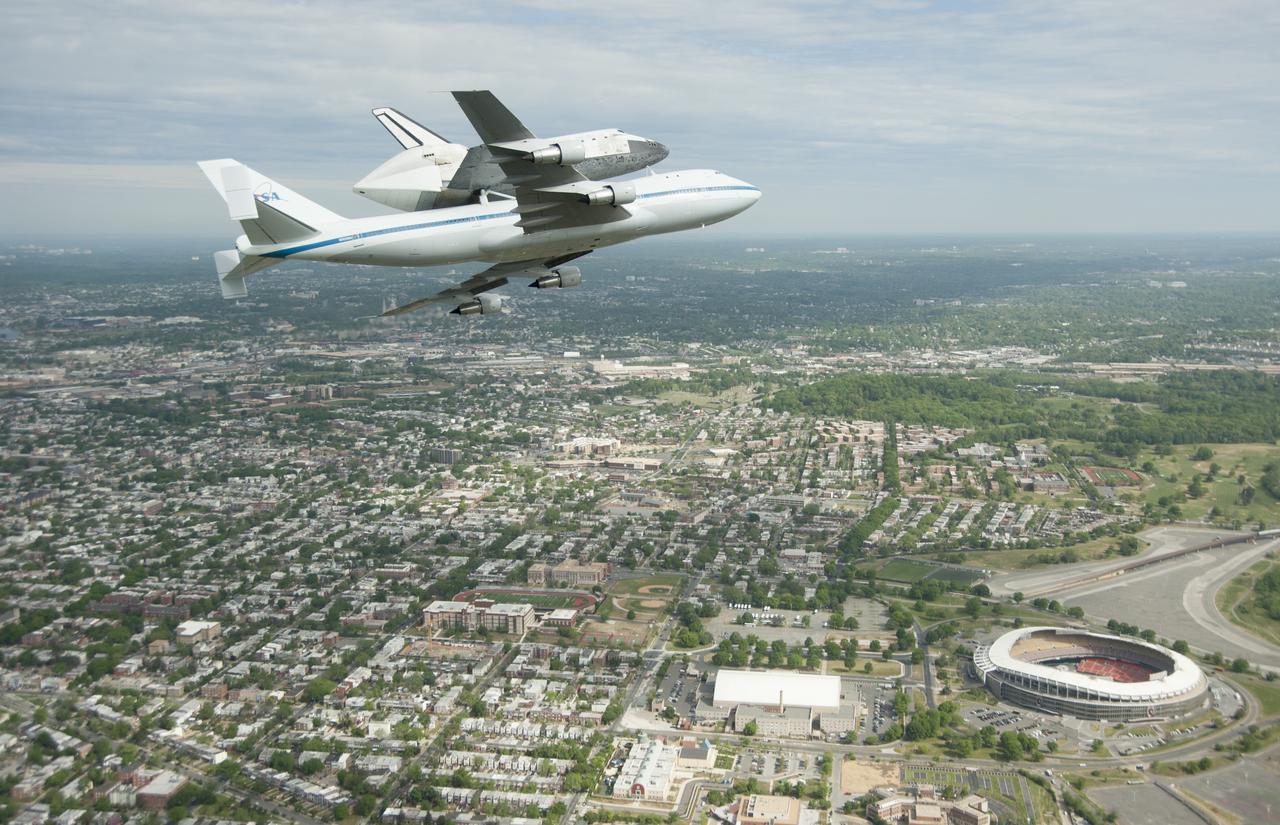
Space shuttle Discovery, mounted atop a NASA 747 Shuttle Carrier Aircraft (SCA), flies over the Washington skyline as seen from a NASA T-38 aircraft, Tuesday, April 17, 2012. Discovery, the first orbiter retired from NASA’s shuttle fleet, completed 39 missions, spent 365 days in space, orbited the Earth 5,830 times, and traveled 148,221,675 miles. NASA will transfer Discovery to the National Air and Space Museum to begin its new mission to commemorate past achievements in space and to educate and inspire future generations of explorers. Photo Credit: (NASA/Robert Markowitz)
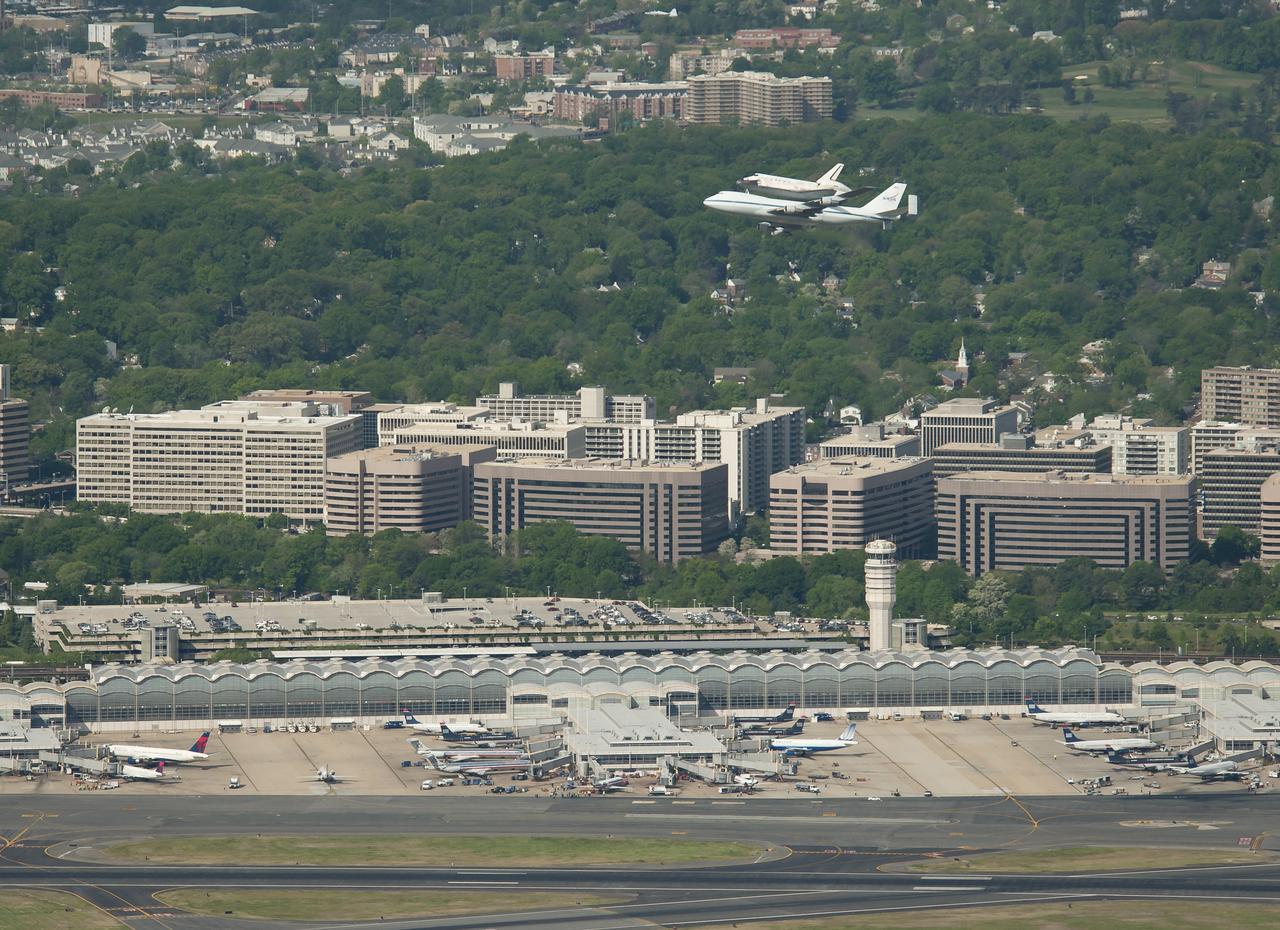
Space shuttle Discovery, mounted atop a NASA 747 Shuttle Carrier Aircraft (SCA) makes its way past Ronald Reagan Washington National Airport, Tuesday, April 17, 2012, in Arlington, Va. Discovery, the first orbiter retired from NASA’s shuttle fleet, completed 39 missions, spent 365 days in space, orbited the Earth 5,830 times, and traveled 148,221,675 miles. NASA will transfer Discovery to the National Air and Space Museum to begin its new mission to commemorate past achievements in space and to educate and inspire future generations of explorers. Photo Credit: (NASA/Bill Ingalls)
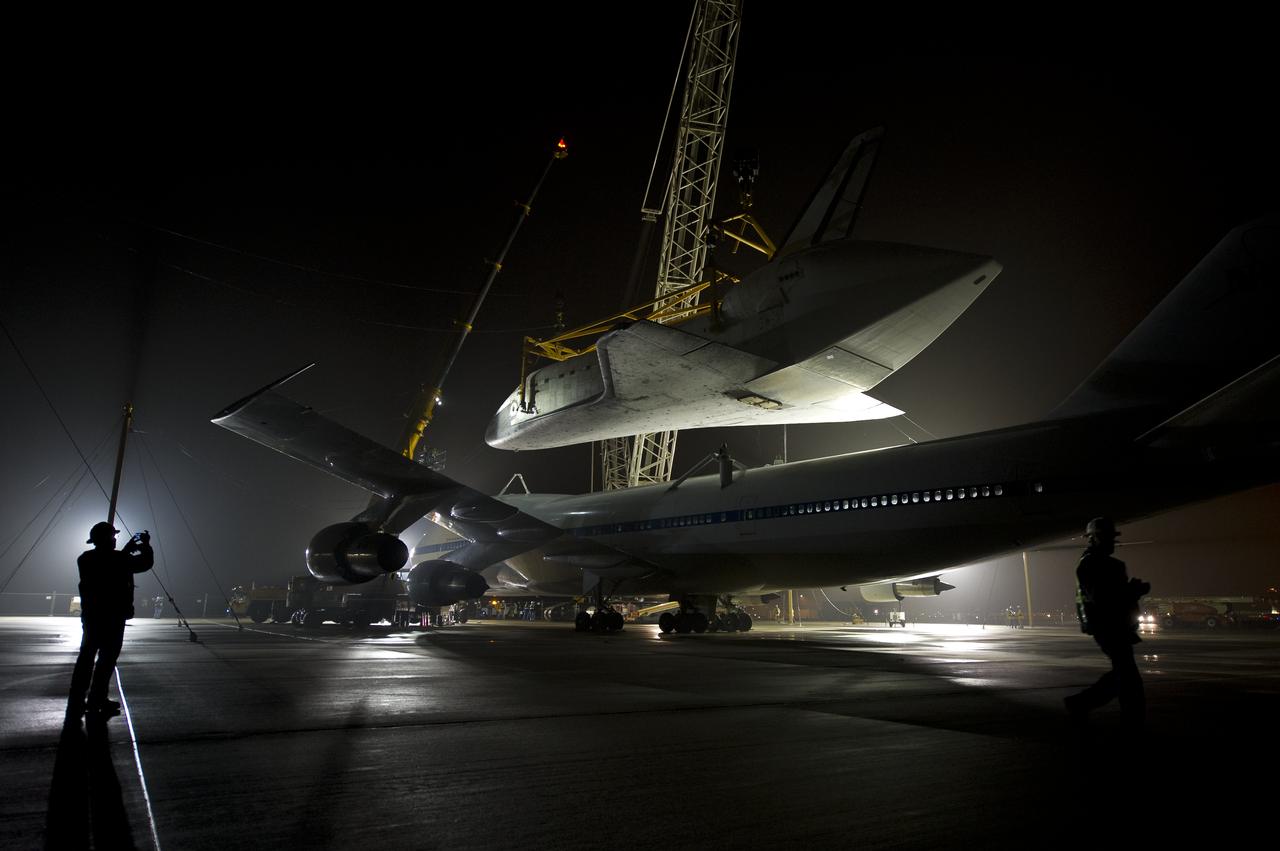
Workers monitor the lift of the space shuttle Discovery from the top of the NASA 747 Shuttle Carrier Aircraft (SCA) at Washington Dulles International Airport, Thursday, April 19, 2012, in Sterling, VA. Discovery, the first orbiter retired from NASA’s shuttle fleet, completed 39 missions, spent 365 days in space, orbited the Earth 5,830 times, and traveled 148,221,675 miles. NASA will transfer Discovery to the National Air and Space Museum to begin its new mission to commemorate past achievements in space and to educate and inspire future generations of explorers. Photo Credit: (NASA/Bill Ingalls)
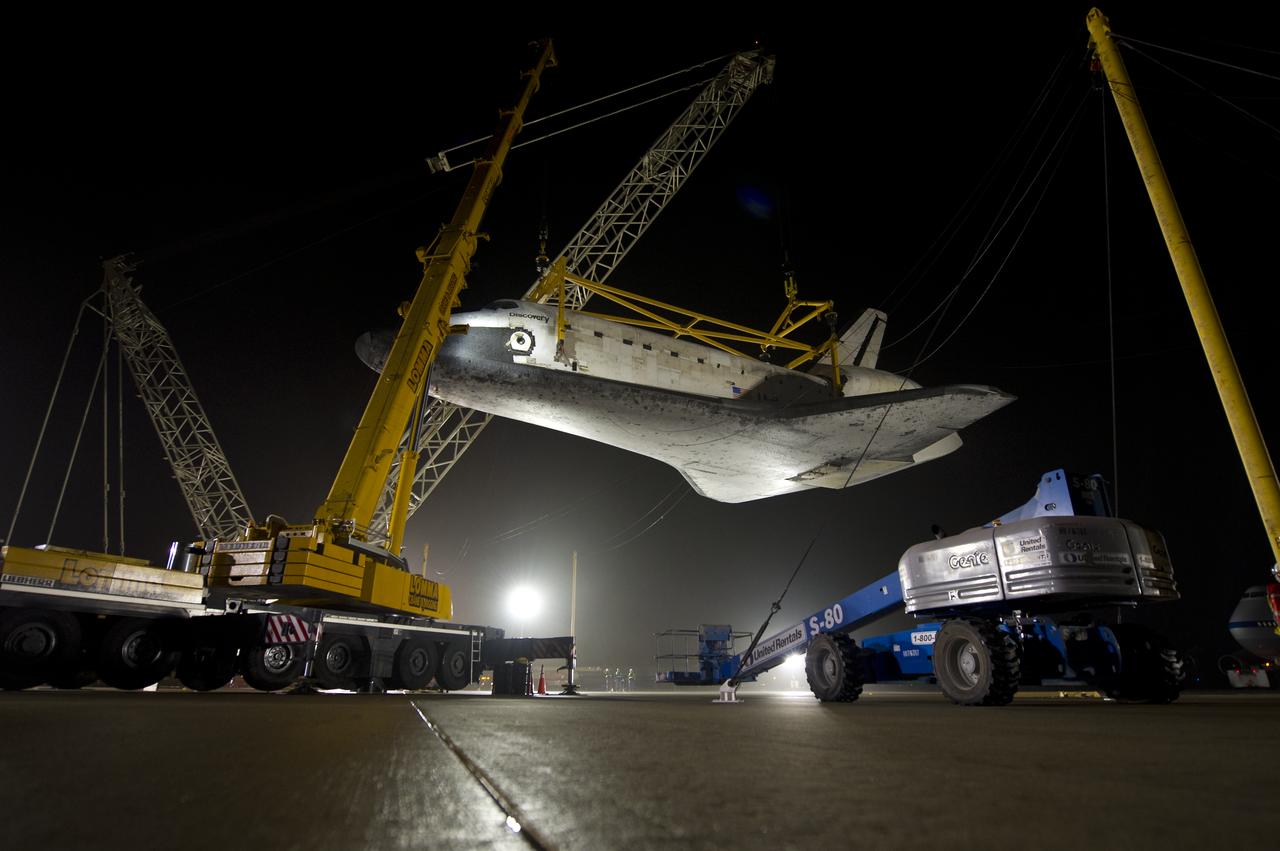
The space shuttle Discovery is suspended from a sling held by two cranes shortly after the NASA 747 Shuttle Carrier Aircraft (SCA) was pushed back from underneath at Washington Dulles International Airport, Thursday, April 19, 2012, in Sterling, VA. Discovery, the first orbiter retired from NASA’s shuttle fleet, completed 39 missions, spent 365 days in space, orbited the Earth 5,830 times, and traveled 148,221,675 miles. NASA will transfer Discovery to the National Air and Space Museum to begin its new mission to commemorate past achievements in space and to educate and inspire future generations of explorers. Photo Credit: (NASA/Bill Ingalls)

Space shuttle Discovery, mounted atop a NASA 747 Shuttle Carrier Aircraft (SCA) lands at Washington Dulles International Airport, Tuesday, April 17, 2012, in Sterling, Va. Discovery, the first orbiter retired from NASA’s shuttle fleet, completed 39 missions, spent 365 days in space, orbited the Earth 5,830 times, and traveled 148,221,675 miles. NASA will transfer Discovery to the National Air and Space Museum to begin its new mission to commemorate past achievements in space and to educate and inspire future generations of explorers. Photo Credit: (NASA/Smithsonian Institution/Eric Long)
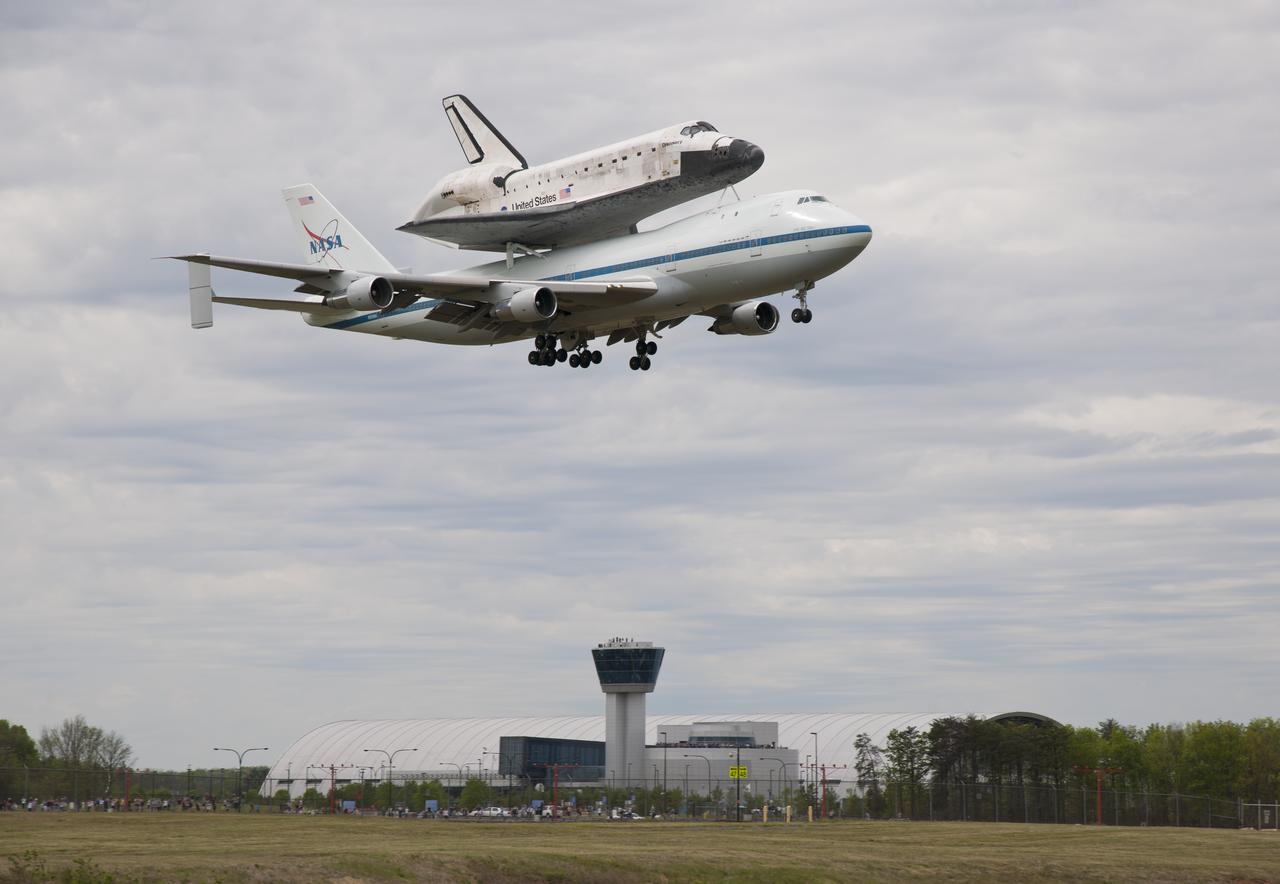
Space shuttle Discovery, mounted atop a NASA 747 Shuttle Carrier Aircraft (SCA) flies over the Steven F. Udvar-Hazy Center, Tuesday, April 17, 2012, in Washington. Discovery, the first orbiter retired from NASA’s shuttle fleet, completed 39 missions, spent 365 days in space, orbited the Earth 5,830 times, and traveled 148,221,675 miles. NASA will transfer Discovery to the National Air and Space Museum to begin its new mission to commemorate past achievements in space and to educate and inspire future generations of explorers. Photo Credit: (NASA/Smithsonian Institution/Dane Penland)

Space shuttle Discovery, mounted atop a NASA 747 Shuttle Carrier Aircraft (SCA) lands at Washington Dulles International Airport, Tuesday, April 17, 2012, in Sterling, Va. The Steven F. Udvar-Hazy Center is seen in the background. Discovery, the first orbiter retired from NASA’s shuttle fleet, completed 39 missions, spent 365 days in space, orbited the Earth 5,830 times, and traveled 148,221,675 miles. NASA will transfer Discovery to the National Air and Space Museum to begin its new mission to commemorate past achievements in space and to educate and inspire future generations of explorers. Photo Credit: (NASA/Smithsonian Institution/Eric Long)
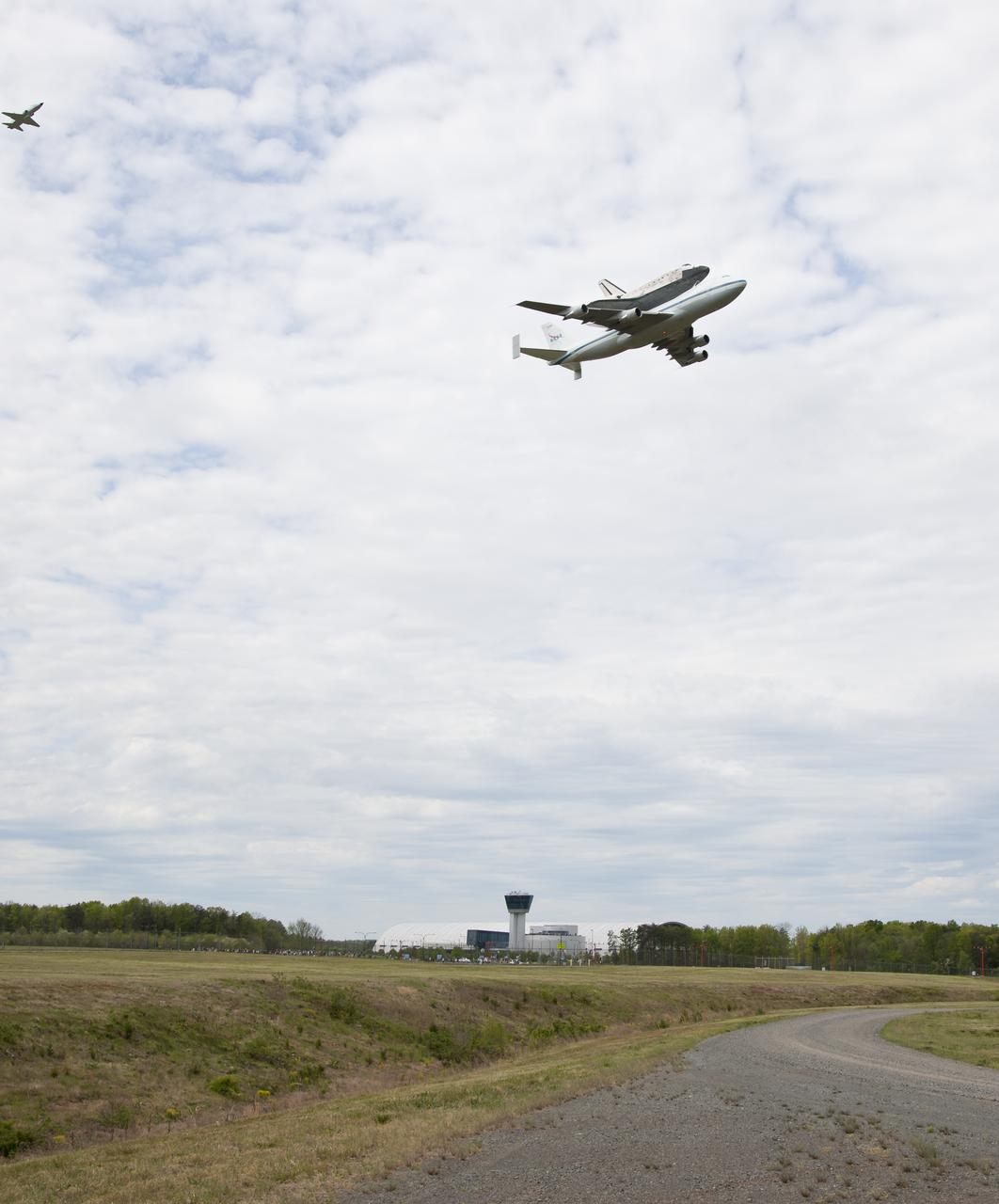
Space shuttle Discovery, mounted atop a NASA 747 Shuttle Carrier Aircraft (SCA) flies over the Steven F. Udvar-Hazy Center, Tuesday, April 17, 2012, in Washington. Discovery, the first orbiter retired from NASA’s shuttle fleet, completed 39 missions, spent 365 days in space, orbited the Earth 5,830 times, and traveled 148,221,675 miles. NASA will transfer Discovery to the National Air and Space Museum to begin its new mission to commemorate past achievements in space and to educate and inspire future generations of explorers. Photo Credit: (NASA/Smithsonian Institution/Dane Penland)
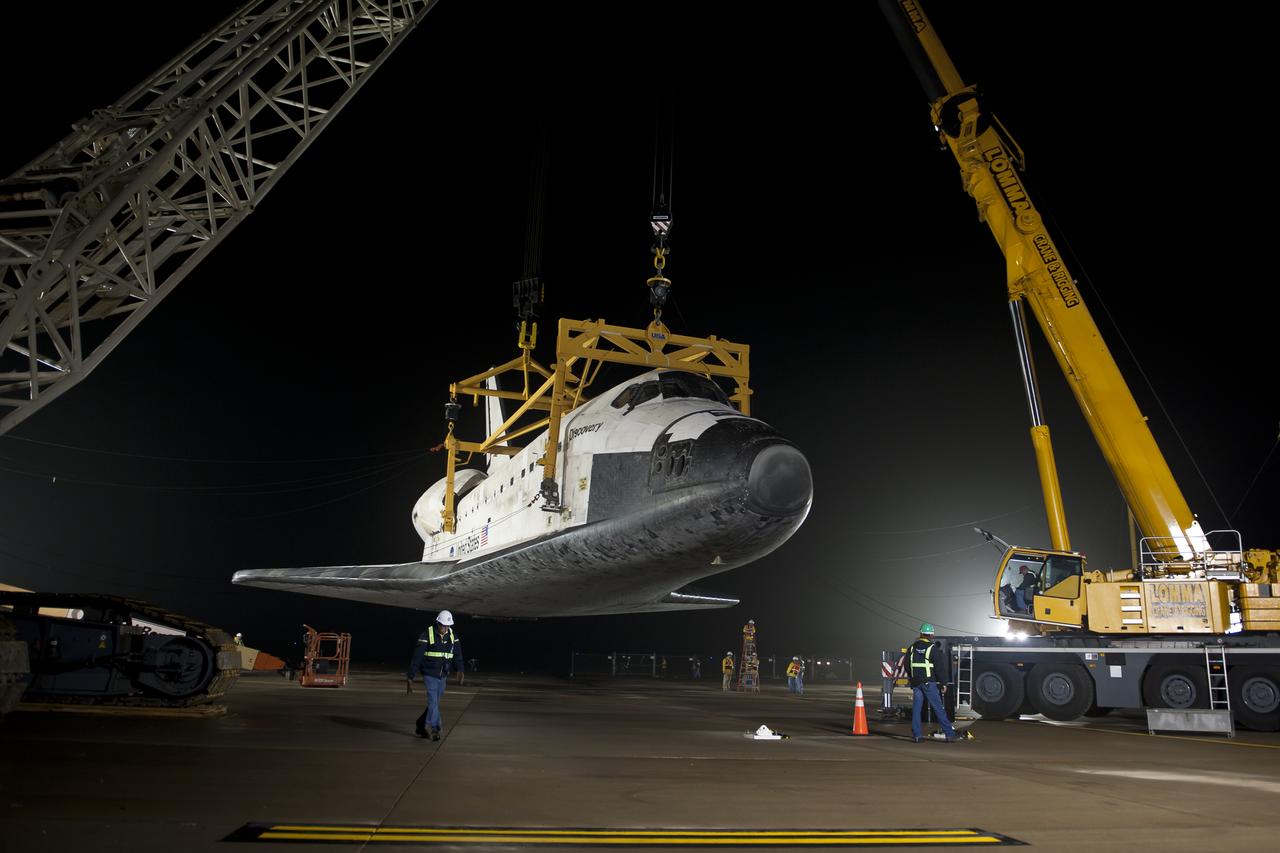
The space shuttle Discovery is suspended from a sling held by two cranes after the NASA 747 Shuttle Carrier Aircraft (SCA) was pushed back from underneath at Washington Dulles International Airport, Thursday, April 19, 2012, in Sterling, VA. Discovery, the first orbiter retired from NASA’s shuttle fleet, completed 39 missions, spent 365 days in space, orbited the Earth 5,830 times, and traveled 148,221,675 miles. NASA will transfer Discovery to the National Air and Space Museum to begin its new mission to commemorate past achievements in space and to educate and inspire future generations of explorers. Photo Credit: (NASA/Bill Ingalls)
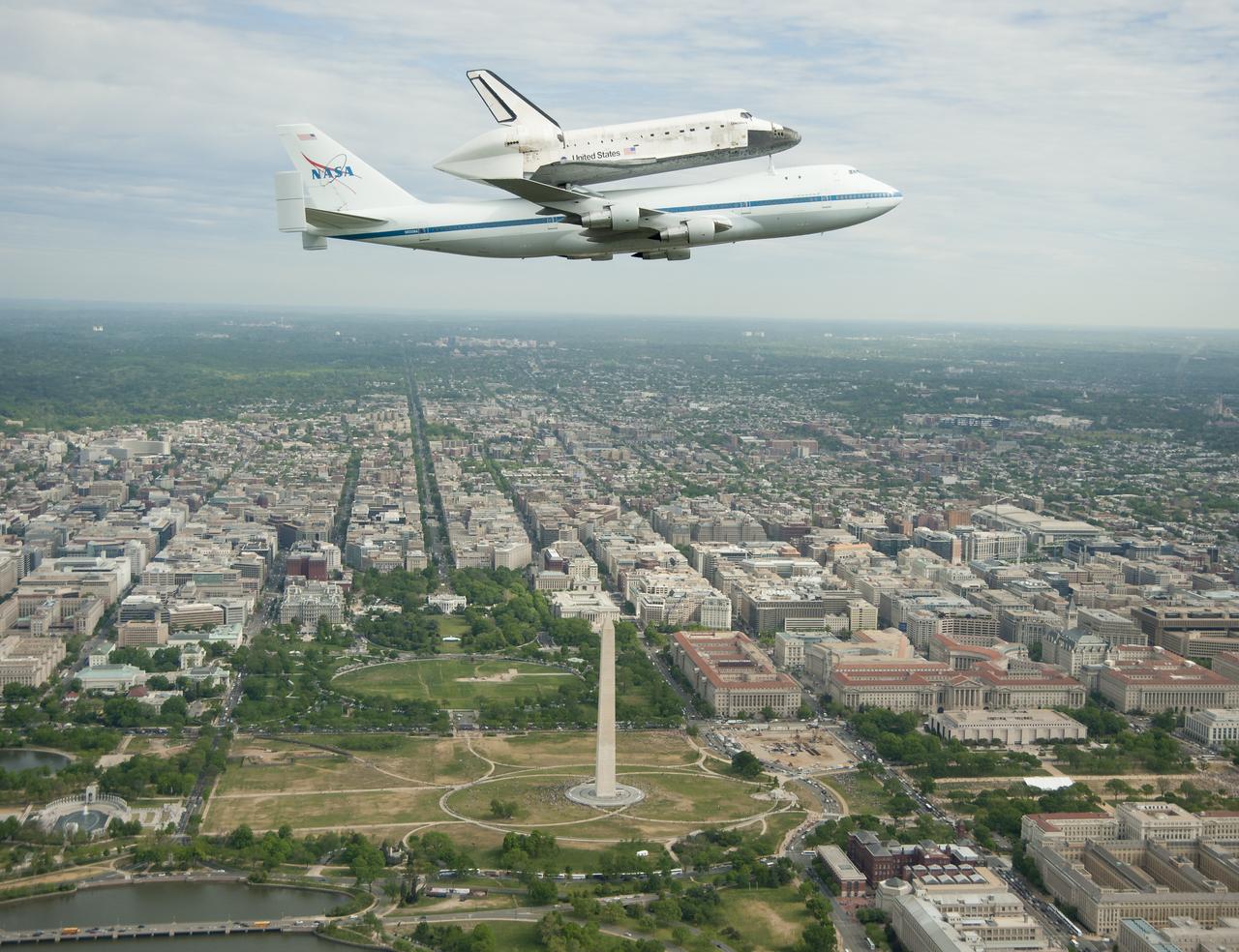
Space shuttle Discovery, mounted atop a NASA 747 Shuttle Carrier Aircraft (SCA), flies over the Washington skyline as seen from a NASA T-38 aircraft, Tuesday, April 17, 2012. Discovery, the first orbiter retired from NASA’s shuttle fleet, completed 39 missions, spent 365 days in space, orbited the Earth 5,830 times, and traveled 148,221,675 miles. NASA will transfer Discovery to the National Air and Space Museum to begin its new mission to commemorate past achievements in space and to educate and inspire future generations of explorers. Photo Credit: (NASA/Robert Markowitz)
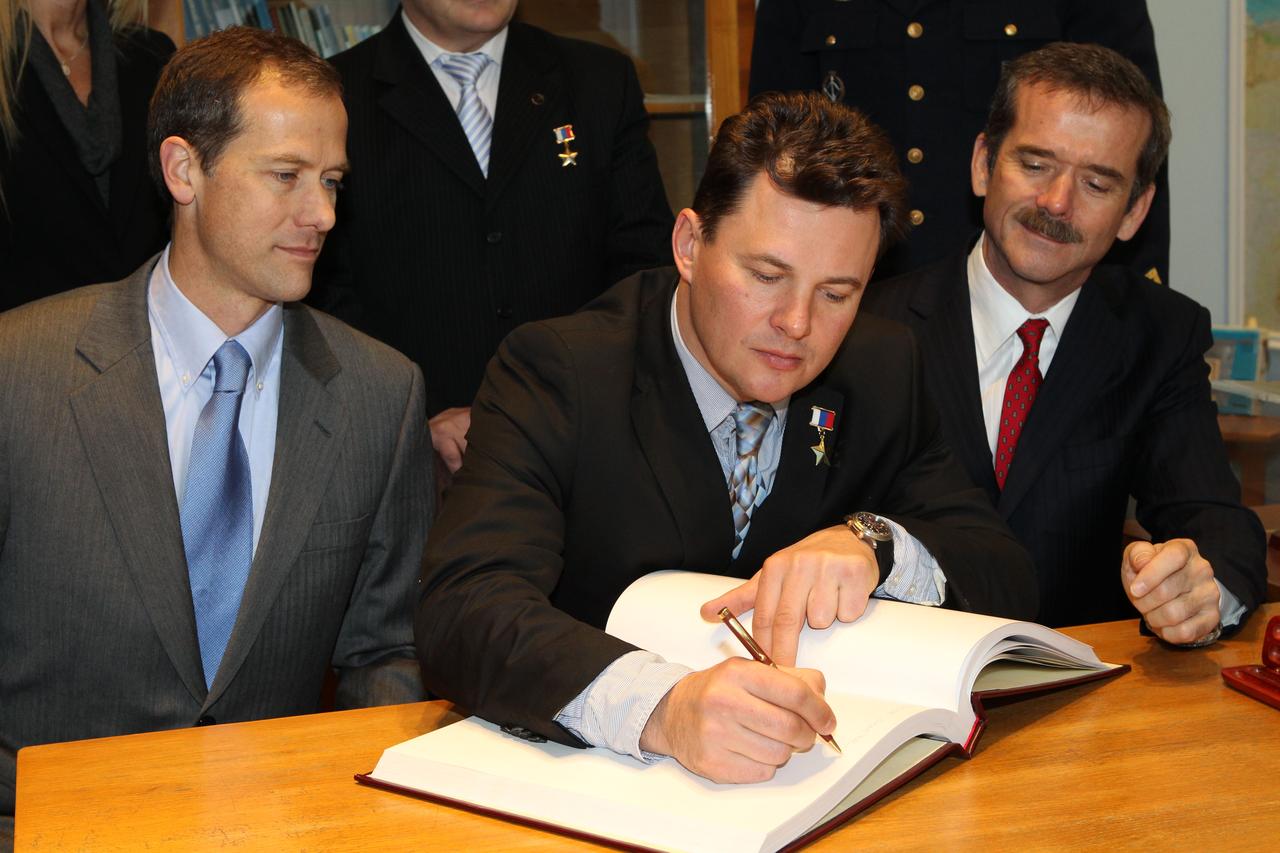
At the Gagarin Museum at the Gagarin Cosmonaut Training Center in Star City, Russia, Expedition 34/35 Soyuz Commander Roman Romanenko (center) signs a testimonial book Nov. 29, 2012 during ceremonial activities. The book is signed by all Russian and international space travelers prior to their flights. Looking on are NASA Flight Engineer Tom Marshburn (left) and Flight Engineer Chris Hadfield of the Canadian Space Agency (right). They are scheduled to launch Dec. 19 to the International Space Station in the Soyuz TMA-07M spacecraft from the Baikonur Cosmodrome in Kazakhstan. NASA/Stephanie Stoll
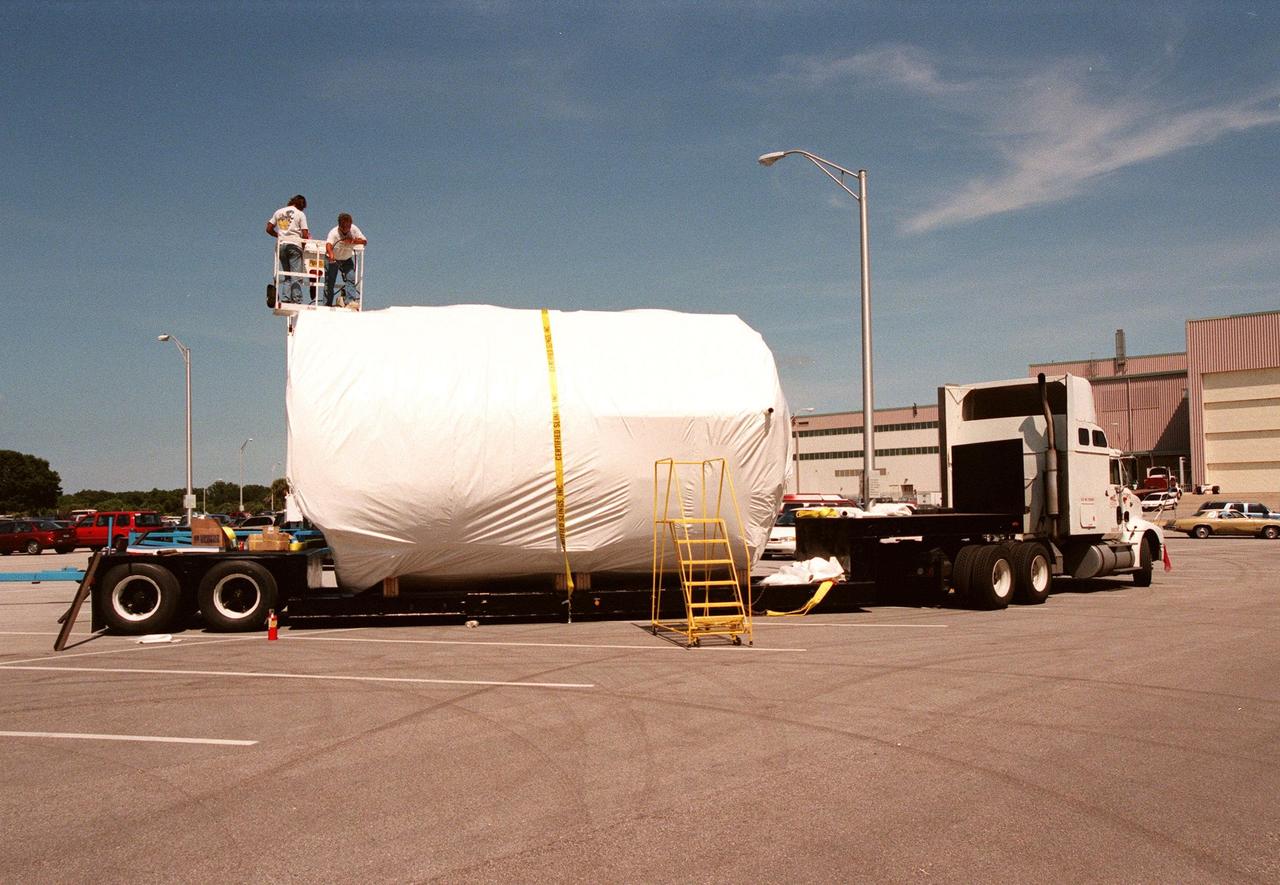
Spacelab is wrapped and ready for transport to the National Air and Space Museum in Washington, DC. Spacelab was designed by the European Space Agency (ESA) for the Space Shuttle program and first flew on STS-9 in November 1983. Its final flight was the STS-90 Neurolab mission in April 1998. A sister module will travel home and be placed on display in Europe. The Spacelab concept of modular experiment racks in a pressurized shirt-sleeve environment made it highly user-friendly and accessible. Numerous experiments conceived by hundreds of scientists on the ground were conducted by flight crews in orbit. Spacelab modules served as on-orbit homes for everything from squirrel monkeys to plant seeds. They supported astronomical as well as Earth observations, for servicing the Hubble Space Telescope and for research preparatory to the International Space Station. One of the greatest benefits afforded by the Spacelab missions was the opportunity to fly a mission more than once, with the second or third flight building on the experiences and data gathered from its predecessors
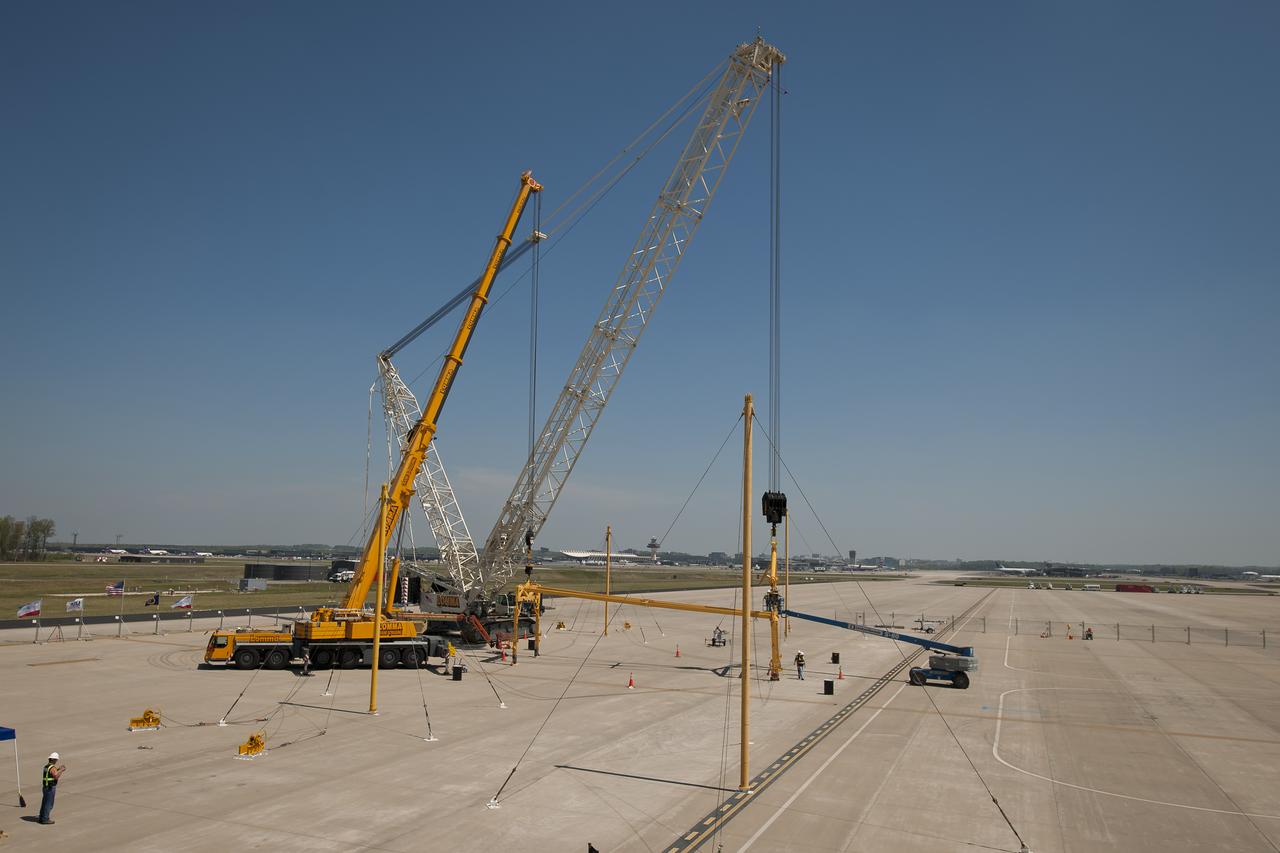
Workers use two cranes to position the sling that will be used to demate the space shuttle Discovery, Monday, April 16, 2012, at the Apron W area of Washington Dulles international Airport in Sterling, Va. The sling will be used to demate the space shuttle Discovery from the 747 Shuttle Carrier Aircraft (SCA) once it arrives. Discovery, the first orbiter retired from NASA’s shuttle fleet, completed 39 missions, spent 365 days in space, orbited the Earth 5,830 times, and traveled 148,221,675 miles. NASA will transfer Discovery to the National Air and Space Museum to begin its new mission to commemorate past achievements in space and to educate and inspire future generations of explorers. Photo Credit: (NASA/Bill Ingalls)
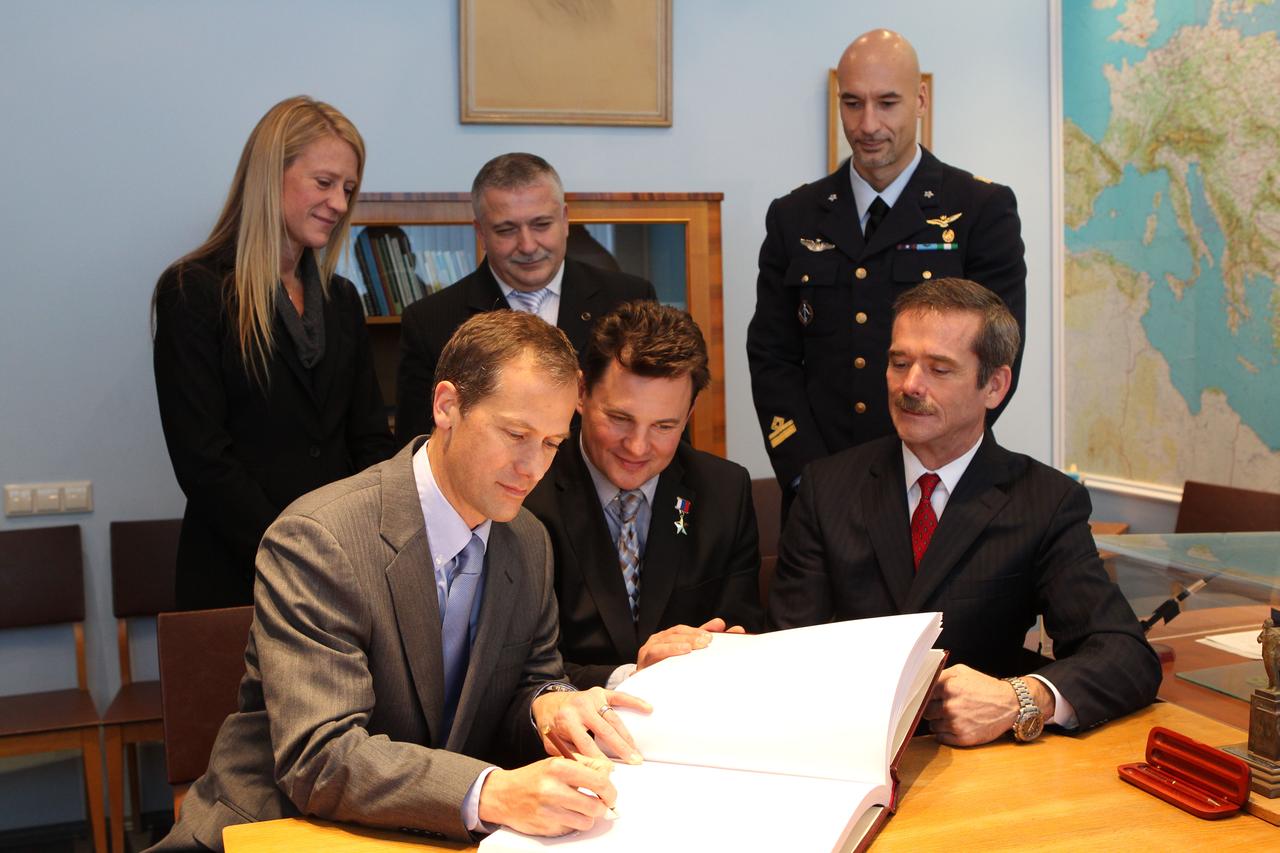
At the Gagarin Museum at the Gagarin Cosmonaut Training Center in Star City, Russia, Expedition 34/35 Flight Engineer Tom Marshburn of NASA (left) signs a testimonial book Nov. 29, 2012 during ceremonial activities. The book is signed by all Russian and international space travelers prior to their flights. Looking on are Soyuz Commander Roman Romanenko (front center), and Flight Engineer Chris Hadfield of the Canadian Space Agency (front right). In the back row are their backups, NASA’s Karen Nyberg (left), Fyodor Yurchikhin (center) and Luca Parmitano of the European Space Agency (right). Marshburn, Romanenko and Hadfield are scheduled to launch Dec. 19 to the International Space Station in the Soyuz TMA-07M spacecraft from the Baikonur Cosmodrome in Kazakhstan. NASA/Stephanie Stoll

At the Gagarin Museum at the Gagarin Cosmonaut Training Center in Star City, Russia, Expedition 34/35 Soyuz Commander Roman Romanenko (front center) thumbs through a testimonial book Nov. 29, 2012 during ceremonial activities. The book is signed by all Russian and international space travelers prior to their flights. Romanenko, NASA Flight Engineer Tom Marshburn (front left), Flight Engineer Chris Hadfield of the Canadian Space Agency (front right) and their backups, NASA’s Karen Nyberg (rear left), Fyodor Yurchikhin (rear center) and Luca Parmitano (rear right) are training for the launch of Marshburn, Hadfield and Romanenko Dec. 19 to the International Space Station in the Soyuz TMA-07M spacecraft from the Baikonur Cosmodrome in Kazakhstan. NASA/Stephanie Stoll
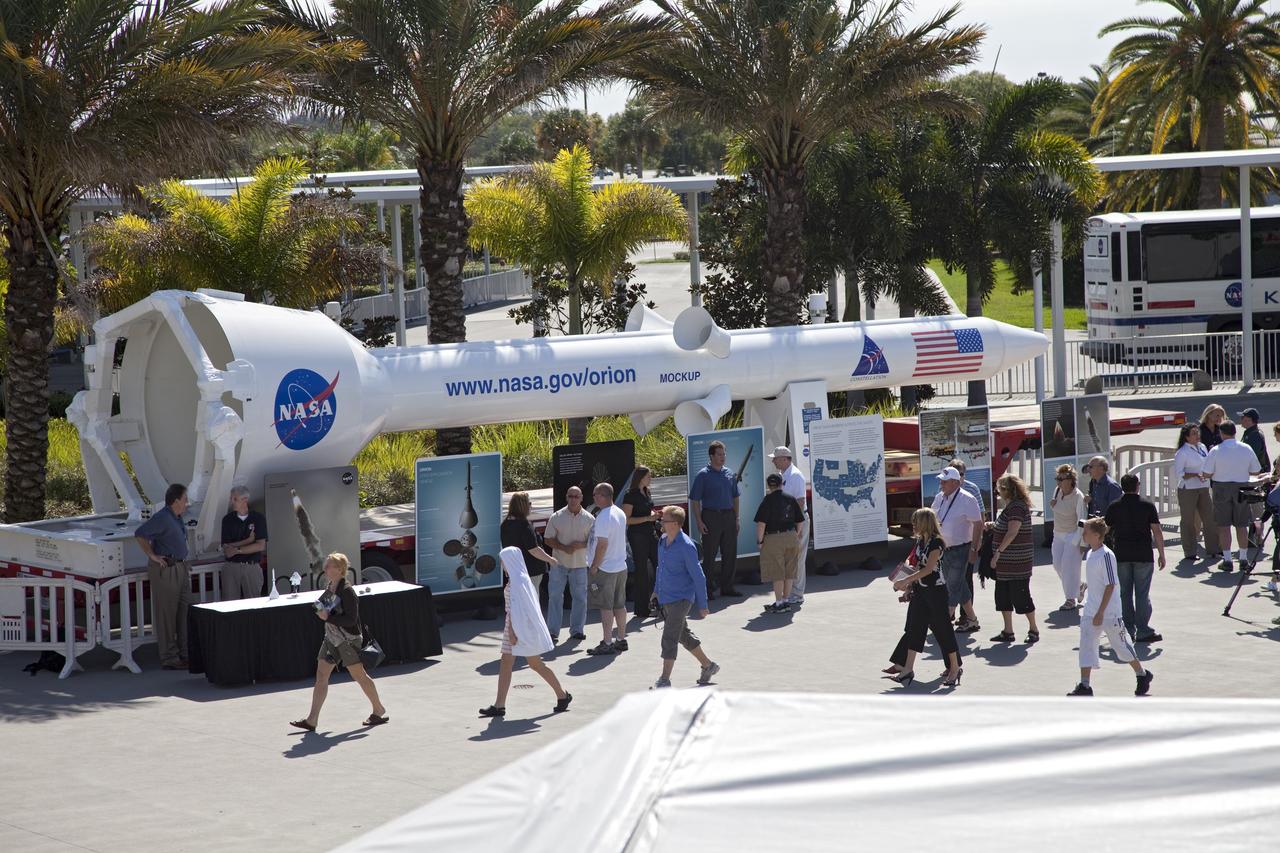
CAPE CANAVERAL, Fla. -- Tourists check out the Orion launch abort system mock-up, called pathfinder, at the Kennedy Space Center Visitor Complex in Florida. The nearly 45-foot-long mock-up traveled from the U.S. Army's White Sands Missile Range in New Mexico aboard a flatbed trailer, making stops at museums and science centers in Denver, Illinois, Ohio, Pennsylvania and Virginia along the way. Before its cross-country journey, the mock-up was used to practice lifting and stacking operations for the Pad Abort-1 flight test at White Sands. Next, it will be used at Kennedy for similar operations. For information on NASA's future plans, visit www.nasa.gov. Photo credit: NASA/Frankie Martin
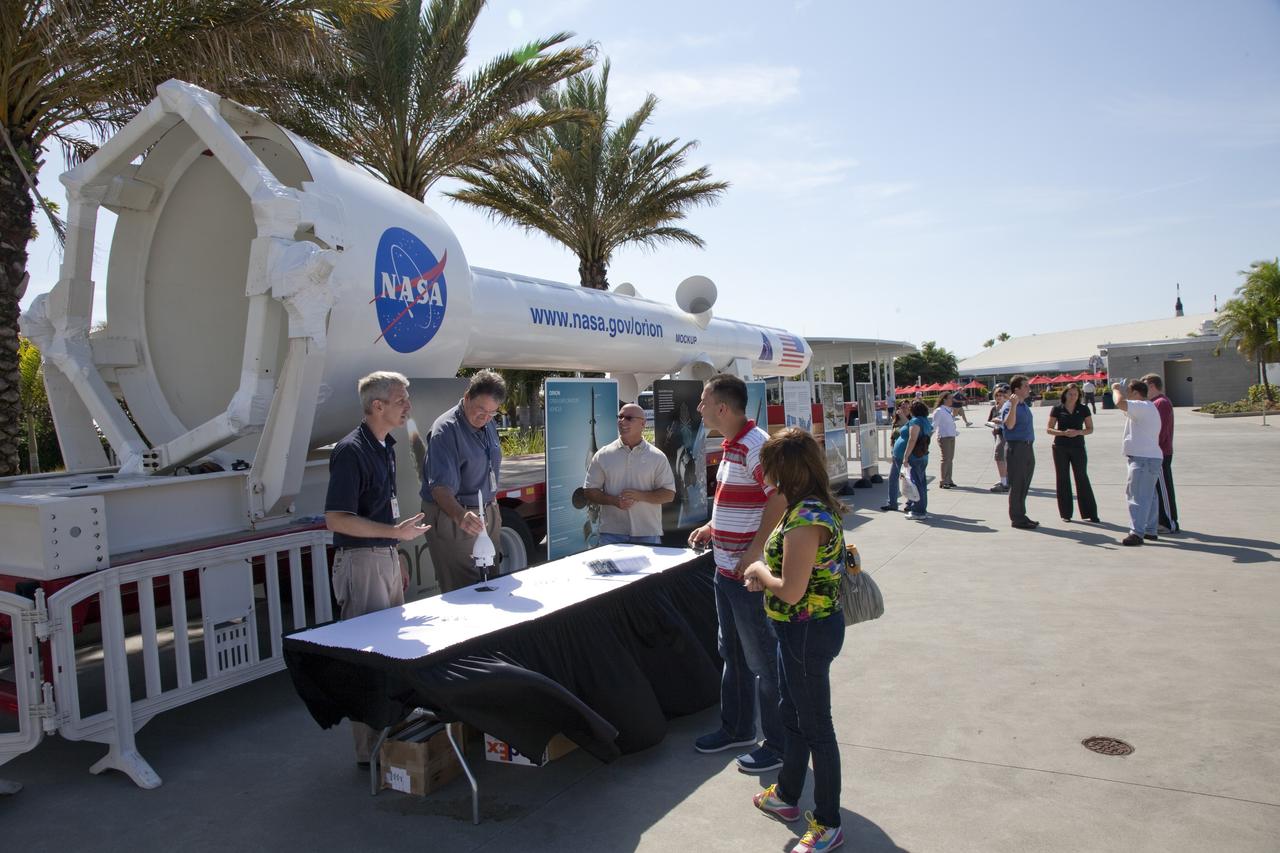
CAPE CANAVERAL, Fla. -- Tourists check out the Orion launch abort system mock-up, called pathfinder, at the Kennedy Space Center Visitor Complex in Florida. The nearly 45-foot-long mock-up traveled from the U.S. Army's White Sands Missile Range in New Mexico aboard a flatbed trailer, making stops at museums and science centers in Denver, Illinois, Ohio, Pennsylvania and Virginia along the way. Before its cross-country journey, the mock-up was used to practice lifting and stacking operations for the Pad Abort-1 flight test at White Sands. Next, it will be used at Kennedy for similar operations. For information on NASA's future plans, visit www.nasa.gov. Photo credit: NASA/Frankie Martin
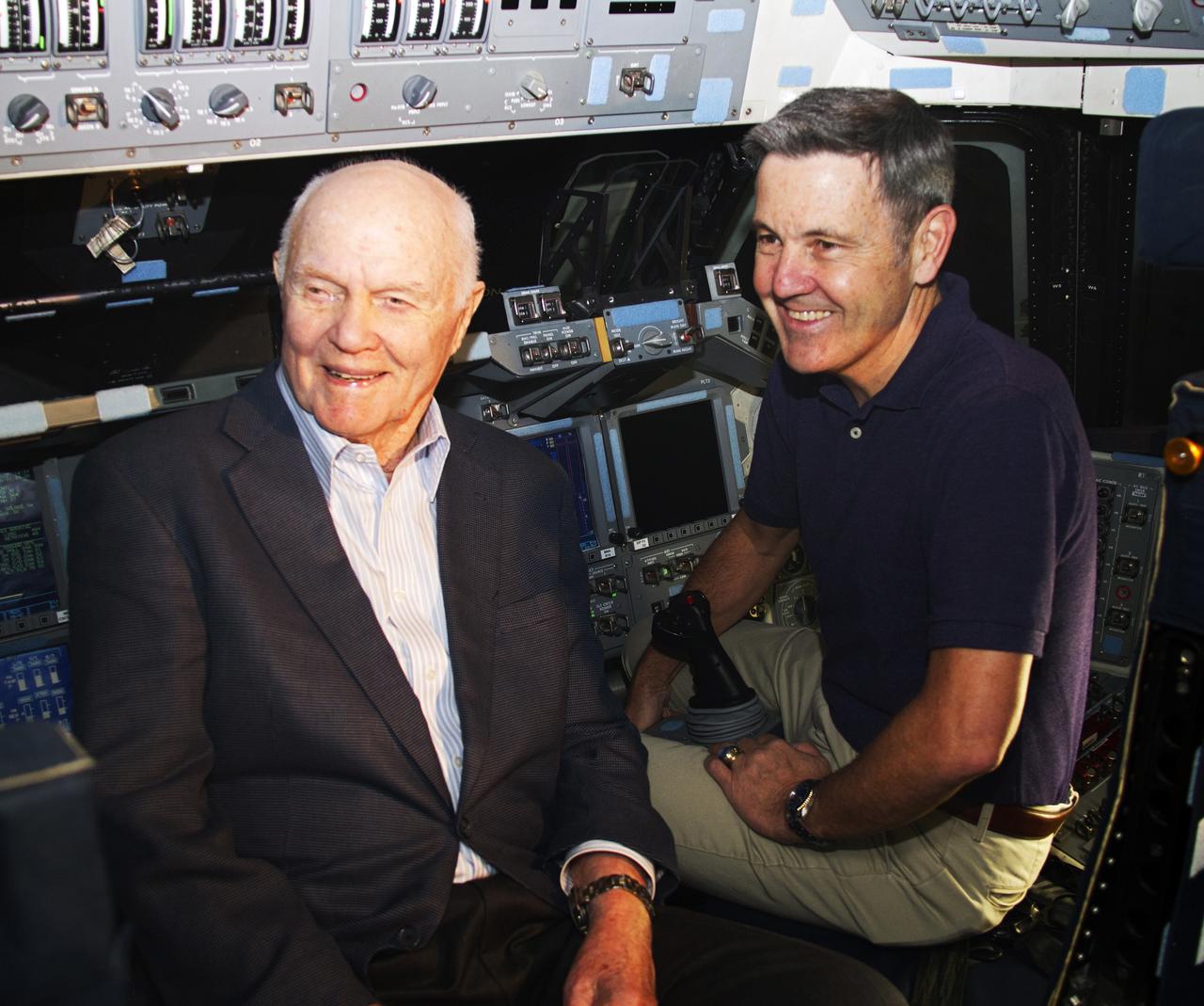
John Glenn and NASA Kennedy Space Center Director Bob Cabana sit in the flight deck of space shuttle Discovery in Bay 1 of the Orbiter Processing Facility at NASA's Kennedy Space Center in Florida. Glenn is at the space center to mark the 50th anniversary of being the first American astronaut to orbit the Earth inside the NASA Mercury Project's Friendship 7 capsule on Feb. 20, 1962. Glenn later returned to space in October 1998 as a payload specialist aboard Discovery's STS-95 mission. Glenn's launch aboard an Atlas rocket took with it the hopes of an entire nation and ushered in a new era of space travel that eventually led to Americans walking on the moon by the end of the 1960s. Glenn soon was followed into orbit by Scott Carpenter, Walter Schirra and Gordon Cooper. Their fellow Mercury astronauts Alan Shepard and Virgil "Gus" Grissom flew earlier suborbital flights. Deke Slayton, a member of NASA's original Mercury 7 astronauts, was grounded by a medical condition until the Apollo-Soyuz Test Project in 1975. Shuttle Discovery currently is being prepared for display at Smithsonian’s National Air and Space Museum, Steven F. Udvar-Hazy Center in Chantilly, Virginia.
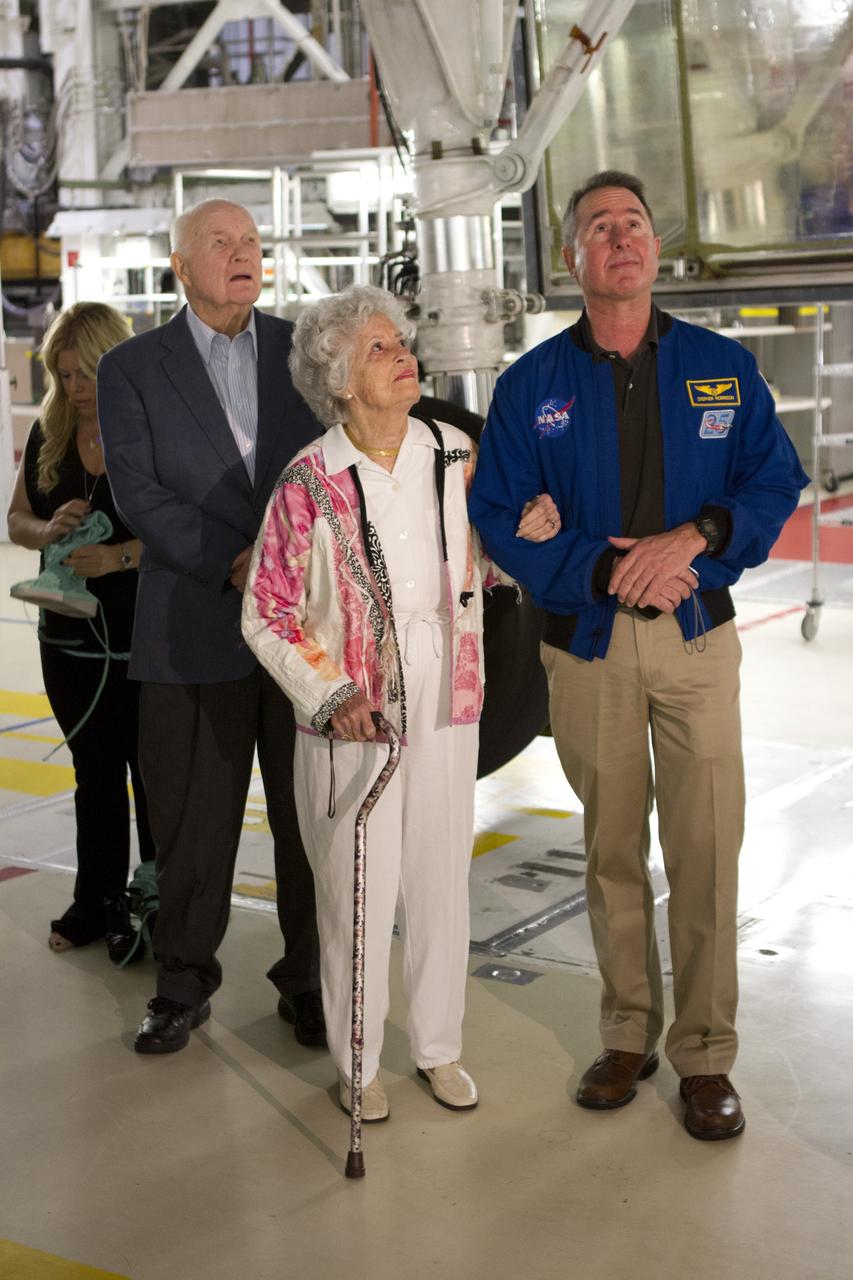
CAPE CANAVERAL, Fla. -- John Glenn and his wife, Annie, and NASA astronaut Stephen Robinson stand under space shuttle Discovery in Orbiter Processing Facility-1 OPF-1 at NASA's Kennedy Space Center in Florida. Glenn is at the space center to mark the 50th anniversary of being the first American astronaut to orbit the Earth inside the NASA Mercury Project's Friendship 7 capsule on Feb. 20, 1962. Glenn later returned to space in October 1998 as a payload specialist aboard Discovery's STS-95 mission. Robinson was the payload commander of STS-95. Glenn's launch aboard an Atlas rocket took with it the hopes of an entire nation and ushered in a new era of space travel that eventually led to Americans walking on the moon by the end of the 1960s. Glenn soon was followed into orbit by Scott Carpenter, Walter Schirra and Gordon Cooper. Their fellow Mercury astronauts Alan Shepard and Virgil "Gus" Grissom flew earlier suborbital flights. Deke Slayton, a member of NASA's original Mercury 7 astronauts, was grounded by a medical condition until the Apollo-Soyuz Test Project in 1975. Shuttle Discovery currently is being prepared for display at Smithsonian’s National Air and Space Museum, Steven F. Udvar-Hazy Center in Chantilly, Va. Photo credit: Cory Huston
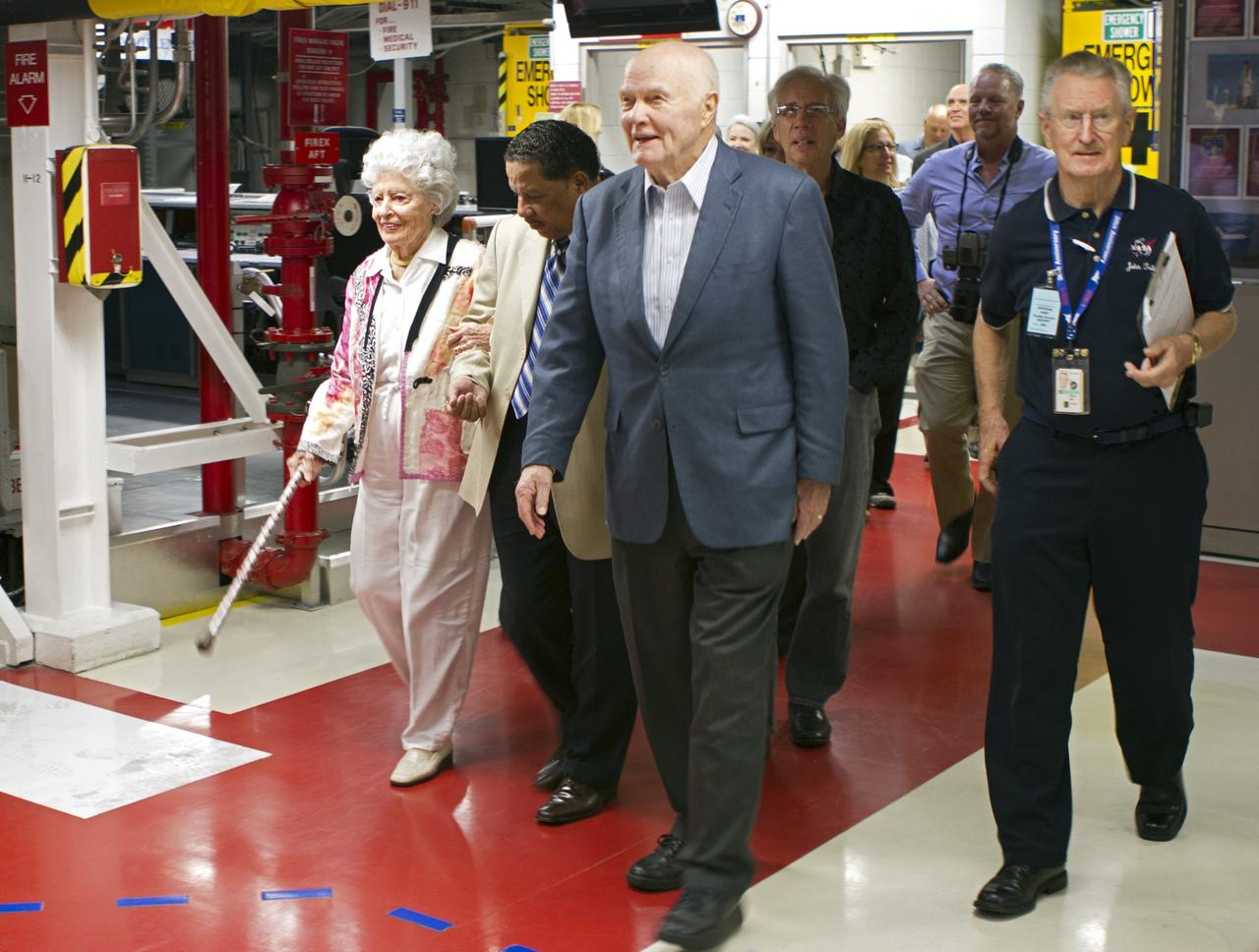
CAPE CANAVERAL, Fla. -- John Glenn and his wife, Annie, left, enter Orbiter Processing Facility-1 OPF-1 at NASA's Kennedy Space Center in Florida where space shuttle Discovery is being prepared for public display. Glenn is at the space center to mark the 50th anniversary of being the first American astronaut to orbit the Earth inside the NASA Mercury Project's Friendship 7 capsule on Feb. 20, 1962. Glenn later returned to space in October 1998 as a payload specialist aboard Discovery's STS-95 mission. Glenn's launch aboard an Atlas rocket took with it the hopes of an entire nation and ushered in a new era of space travel that eventually led to Americans walking on the moon by the end of the 1960s. Glenn soon was followed into orbit by Scott Carpenter, Walter Schirra and Gordon Cooper. Their fellow Mercury astronauts Alan Shepard and Virgil "Gus" Grissom flew earlier suborbital flights. Deke Slayton, a member of NASA's original Mercury 7 astronauts, was grounded by a medical condition until the Apollo-Soyuz Test Project in 1975. Shuttle Discovery currently is being prepared for display at Smithsonian’s National Air and Space Museum, Steven F. Udvar-Hazy Center in Chantilly, Va. Photo credit: Cory Huston
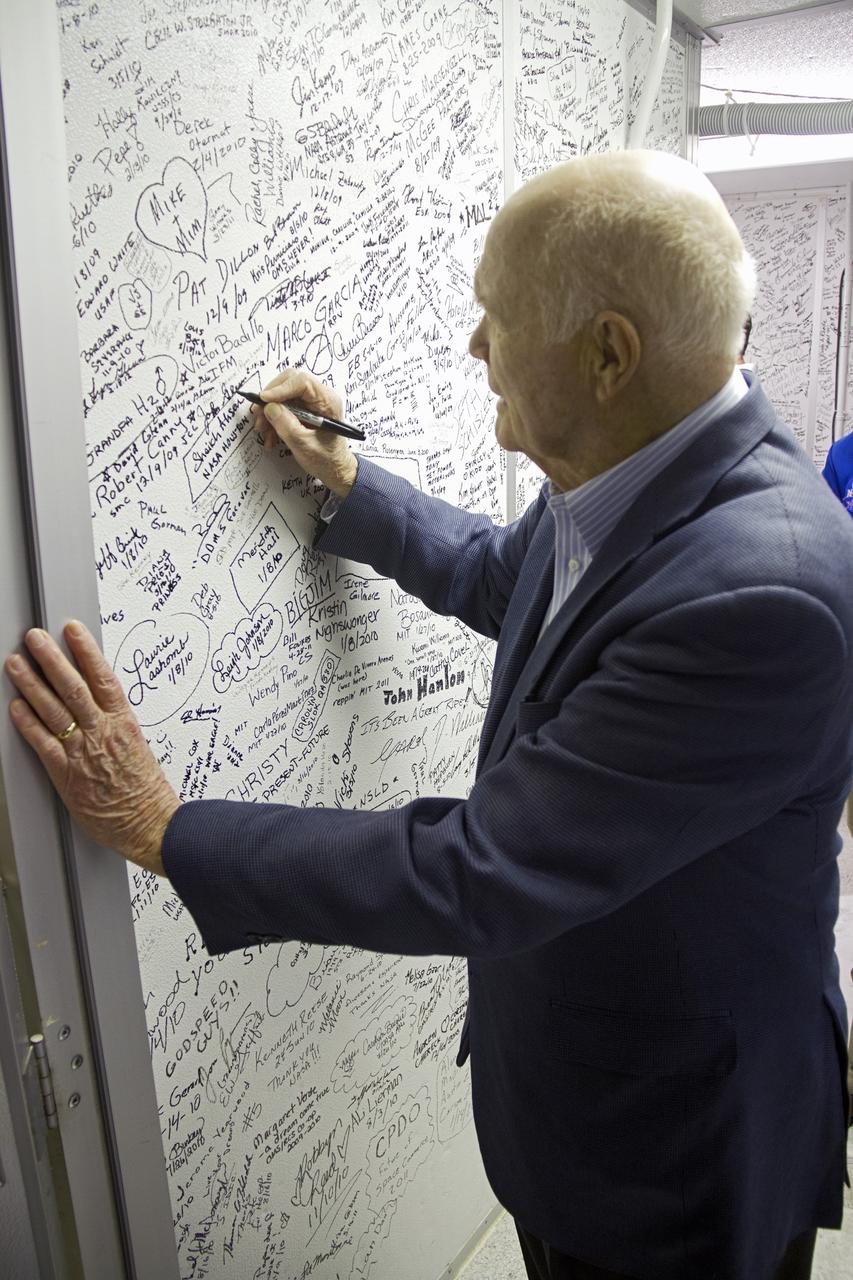
CAPE CANAVERAL, Fla. -- John Glenn signs the wall of the clean room leading into space shuttle Discovery in Orbiter Processing Facility-1 OPF-1 at NASA's Kennedy Space Center in Florida. Glenn is at the space center to mark the 50th anniversary of being the first American astronaut to orbit the Earth inside the NASA Mercury Project's Friendship 7 capsule on Feb. 20, 1962. Glenn later returned to space in October 1998 as a payload specialist aboard Discovery's STS-95 mission. Glenn's launch aboard an Atlas rocket took with it the hopes of an entire nation and ushered in a new era of space travel that eventually led to Americans walking on the moon by the end of the 1960s. Glenn soon was followed into orbit by Scott Carpenter, Walter Schirra and Gordon Cooper. Their fellow Mercury astronauts Alan Shepard and Virgil "Gus" Grissom flew earlier suborbital flights. Deke Slayton, a member of NASA's original Mercury 7 astronauts, was grounded by a medical condition until the Apollo-Soyuz Test Project in 1975. Shuttle Discovery currently is being prepared for display at Smithsonian’s National Air and Space Museum, Steven F. Udvar-Hazy Center in Chantilly, Va. Photo credit: Cory Huston
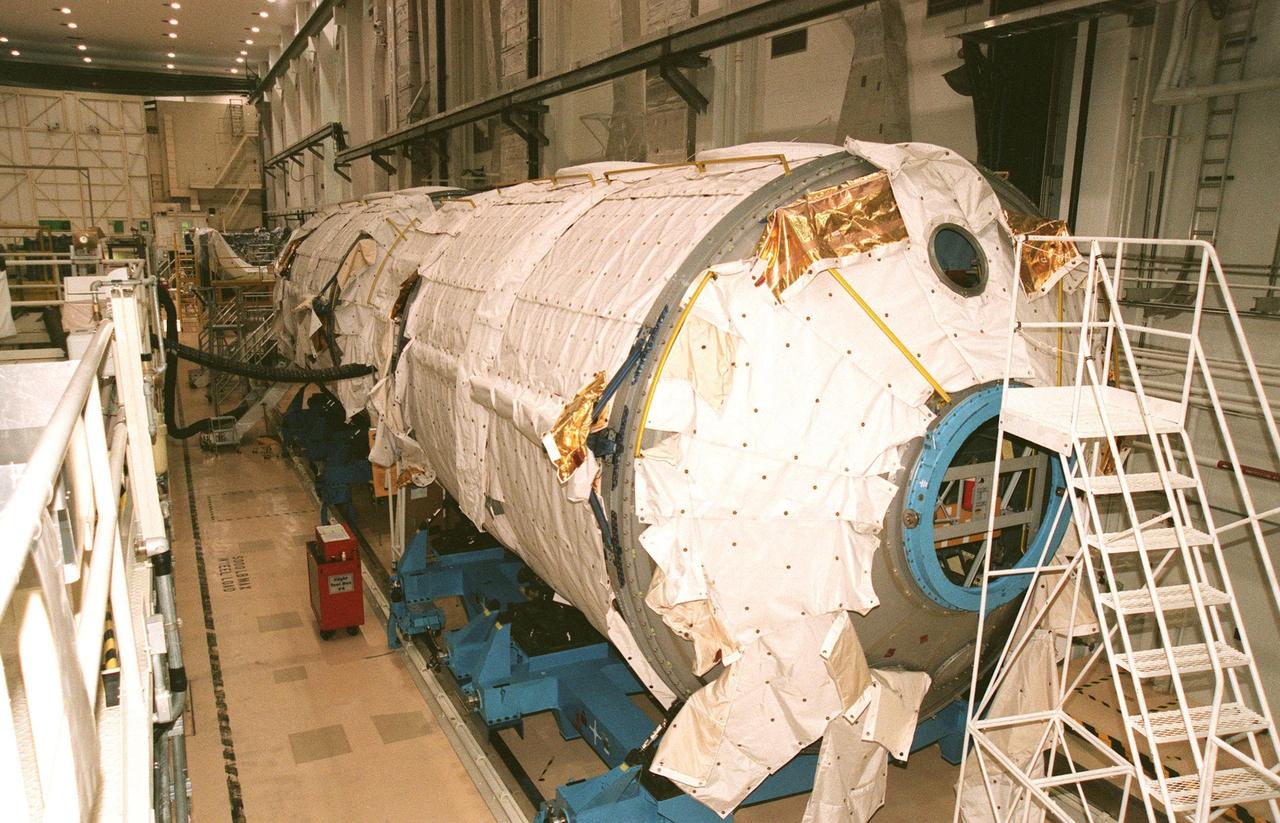
KENNEDY SPACE CENTER, FLA. -- Two Spacelab modules (end to end) are made ready in the Operations and Checkout Building for shipment to the National Air and Space Museum in Washington, DC. Spacelab was designed by the European Space Agency (ESA) for the Space Shuttle program and first flew on STS-9 in November 1983. Its final flight was the STS-90 Neurolab mission in April 1998. The sister module (first in line) will travel home and be placed on display in Europe. The Spacelab concept of modular experiment racks in a pressurized shirt-sleeve environment made it highly user-friendly and accessible. Numerous experiments conceived by hundreds of scientists on the ground were conducted by flight crews in orbit. Spacelab modules served as on-orbit homes for everything from squirrel monkeys to plant seeds. They supported astronomical as well as Earth observations, for servicing the Hubble Space Telescope and for research preparatory to the International Space Station. One of the greatest benefits afforded by the Spacelab missions was the opportunity to fly a mission more than once, with the second or third flight building on the experiences and data gathered from its predecessors
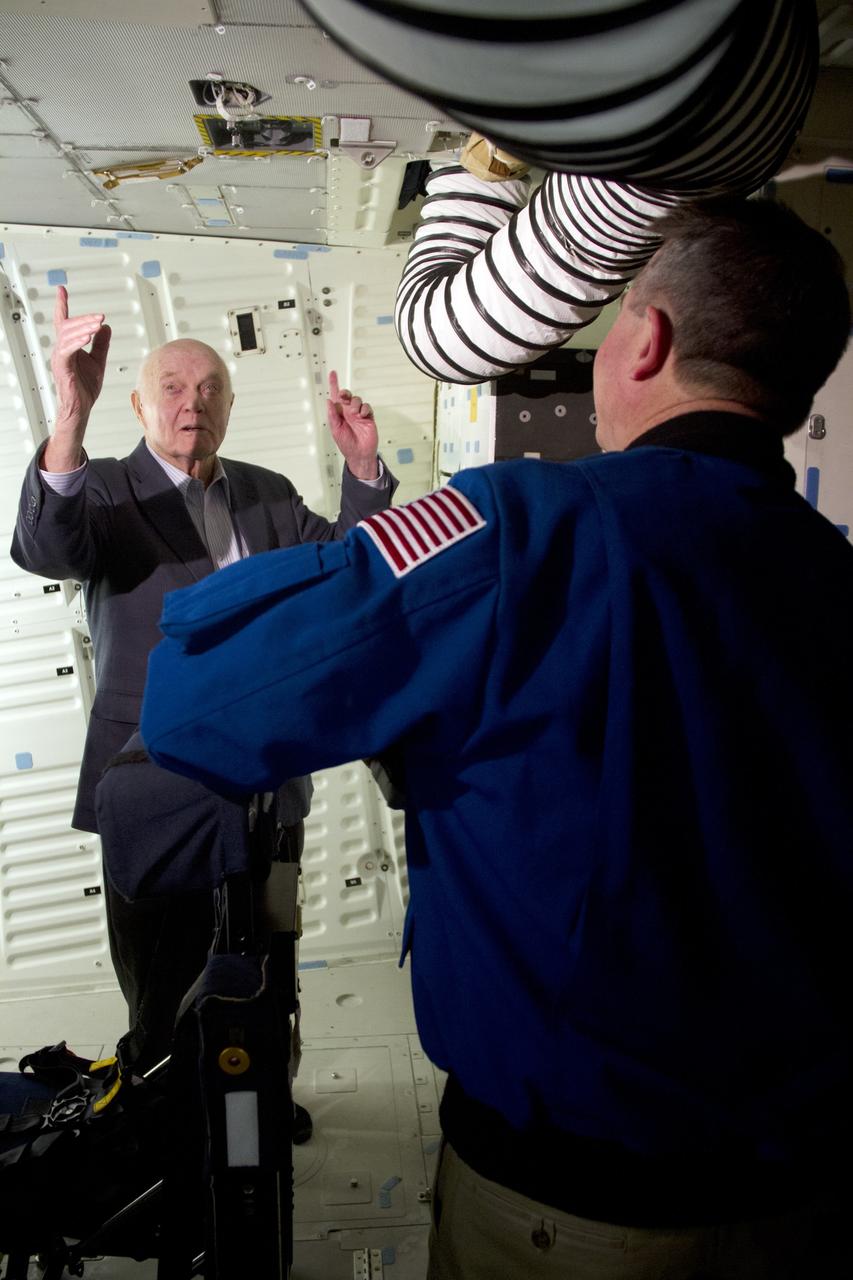
CAPE CANAVERAL, Fla. -- John Glenn and NASA astronaut Stephen Robinson stand in the middeck of space shuttle Discovery in Orbiter Processing Facility-1 OPF-1 at NASA's Kennedy Space Center in Florida. Glenn is at the space center to mark the 50th anniversary of being the first American astronaut to orbit the Earth inside the NASA Mercury Project's Friendship 7 capsule on Feb. 20, 1962. Glenn later returned to space in October 1998 as a payload specialist aboard Discovery's STS-95 mission. Robinson was the payload commander of STS-95. Glenn's launch aboard an Atlas rocket took with it the hopes of an entire nation and ushered in a new era of space travel that eventually led to Americans walking on the moon by the end of the 1960s. Glenn soon was followed into orbit by Scott Carpenter, Walter Schirra and Gordon Cooper. Their fellow Mercury astronauts Alan Shepard and Virgil "Gus" Grissom flew earlier suborbital flights. Deke Slayton, a member of NASA's original Mercury 7 astronauts, was grounded by a medical condition until the Apollo-Soyuz Test Project in 1975. Shuttle Discovery currently is being prepared for display at Smithsonian’s National Air and Space Museum, Steven F. Udvar-Hazy Center in Chantilly, Va. Photo credit: Cory Huston
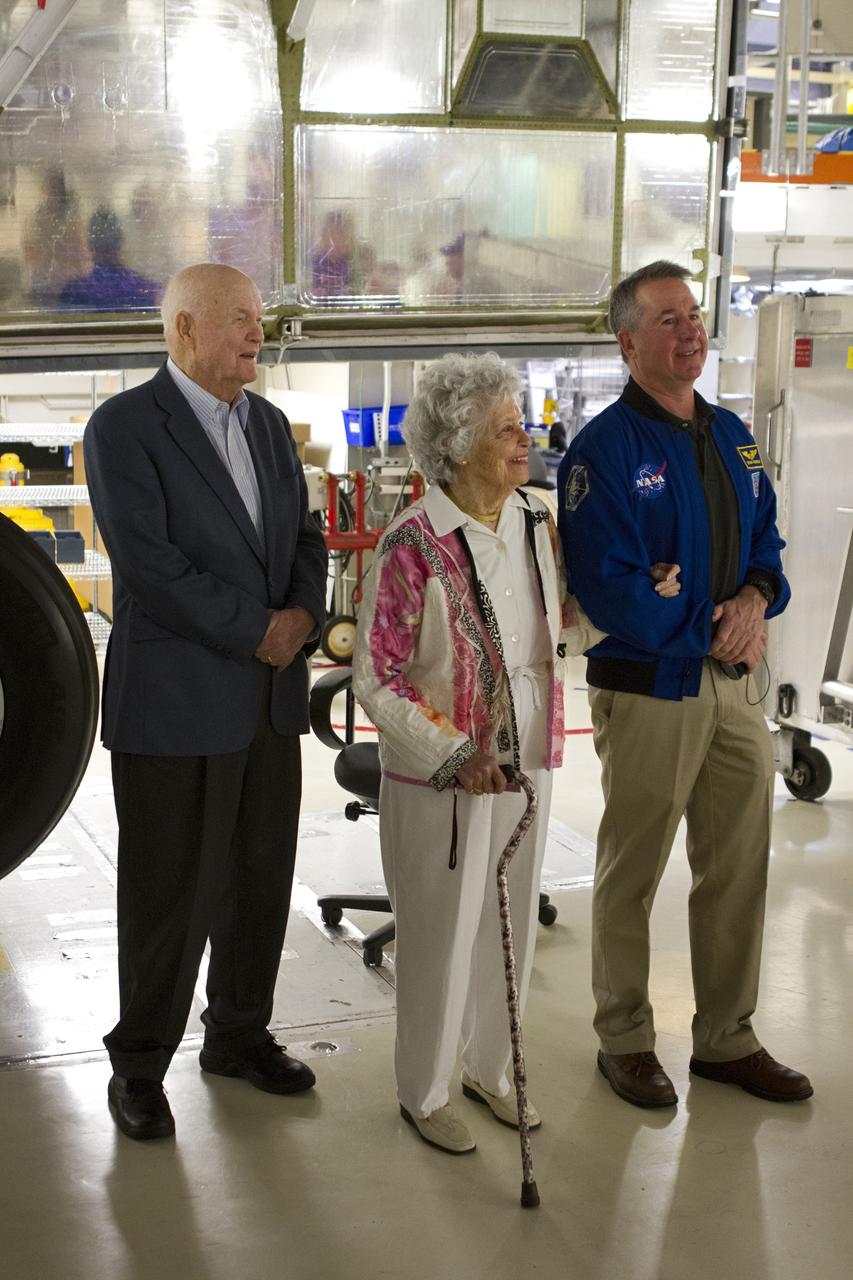
CAPE CANAVERAL, Fla. -- John Glenn and his wife, Annie, and NASA astronaut Stephen Robinson stand beside the wheel of space shuttle Discovery in Orbiter Processing Facility-1 OPF-1 at NASA's Kennedy Space Center in Florida. Glenn is at the space center to mark the 50th anniversary of being the first American astronaut to orbit the Earth inside the NASA Mercury Project's Friendship 7 capsule on Feb. 20, 1962. Glenn later returned to space in October 1998 as a payload specialist aboard Discovery's STS-95 mission. Robinson was the payload commander of STS-95. Glenn's launch aboard an Atlas rocket took with it the hopes of an entire nation and ushered in a new era of space travel that eventually led to Americans walking on the moon by the end of the 1960s. Glenn soon was followed into orbit by Scott Carpenter, Walter Schirra and Gordon Cooper. Their fellow Mercury astronauts Alan Shepard and Virgil "Gus" Grissom flew earlier suborbital flights. Deke Slayton, a member of NASA's original Mercury 7 astronauts, was grounded by a medical condition until the Apollo-Soyuz Test Project in 1975. Shuttle Discovery currently is being prepared for display at Smithsonian’s National Air and Space Museum, Steven F. Udvar-Hazy Center in Chantilly, Va. Photo credit: Cory Huston
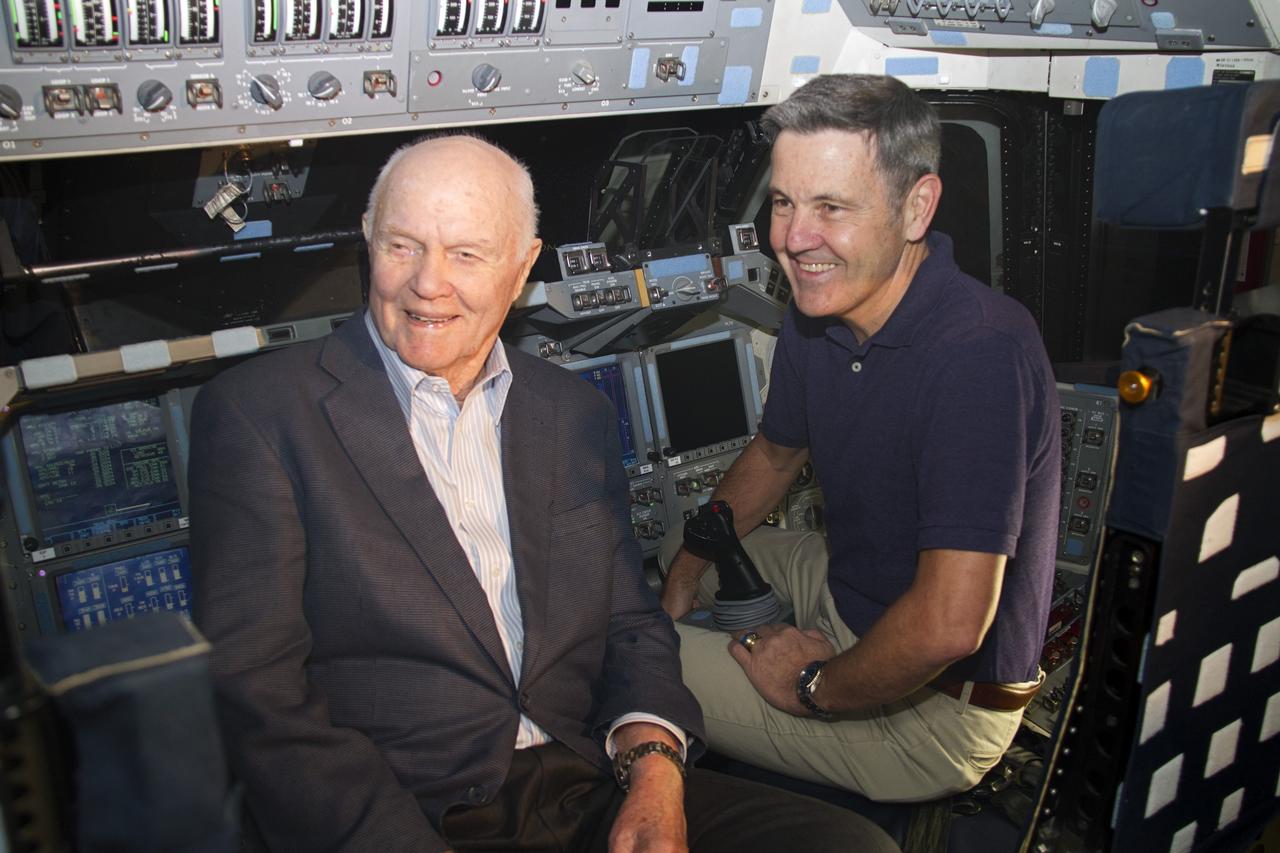
CAPE CANAVERAL, Fla. -- John Glenn and NASA Kennedy Space Center Director Bob Cabana sit in the flight deck of space shuttle Discovery in Orbiter Processing Facility-1 OPF-1. Glenn is at the space center to mark the 50th anniversary of being the first American astronaut to orbit the Earth inside the NASA Mercury Project's Friendship 7 capsule on Feb. 20, 1962. Glenn later returned to space in October 1998 as a payload specialist aboard Discovery's STS-95 mission. Glenn's launch aboard an Atlas rocket took with it the hopes of an entire nation and ushered in a new era of space travel that eventually led to Americans walking on the moon by the end of the 1960s. Glenn soon was followed into orbit by Scott Carpenter, Walter Schirra and Gordon Cooper. Their fellow Mercury astronauts Alan Shepard and Virgil "Gus" Grissom flew earlier suborbital flights. Deke Slayton, a member of NASA's original Mercury 7 astronauts, was grounded by a medical condition until the Apollo-Soyuz Test Project in 1975. Shuttle Discovery currently is being prepared for display at Smithsonian’s National Air and Space Museum, Steven F. Udvar-Hazy Center in Chantilly, Va. Photo credit: Cory Huston
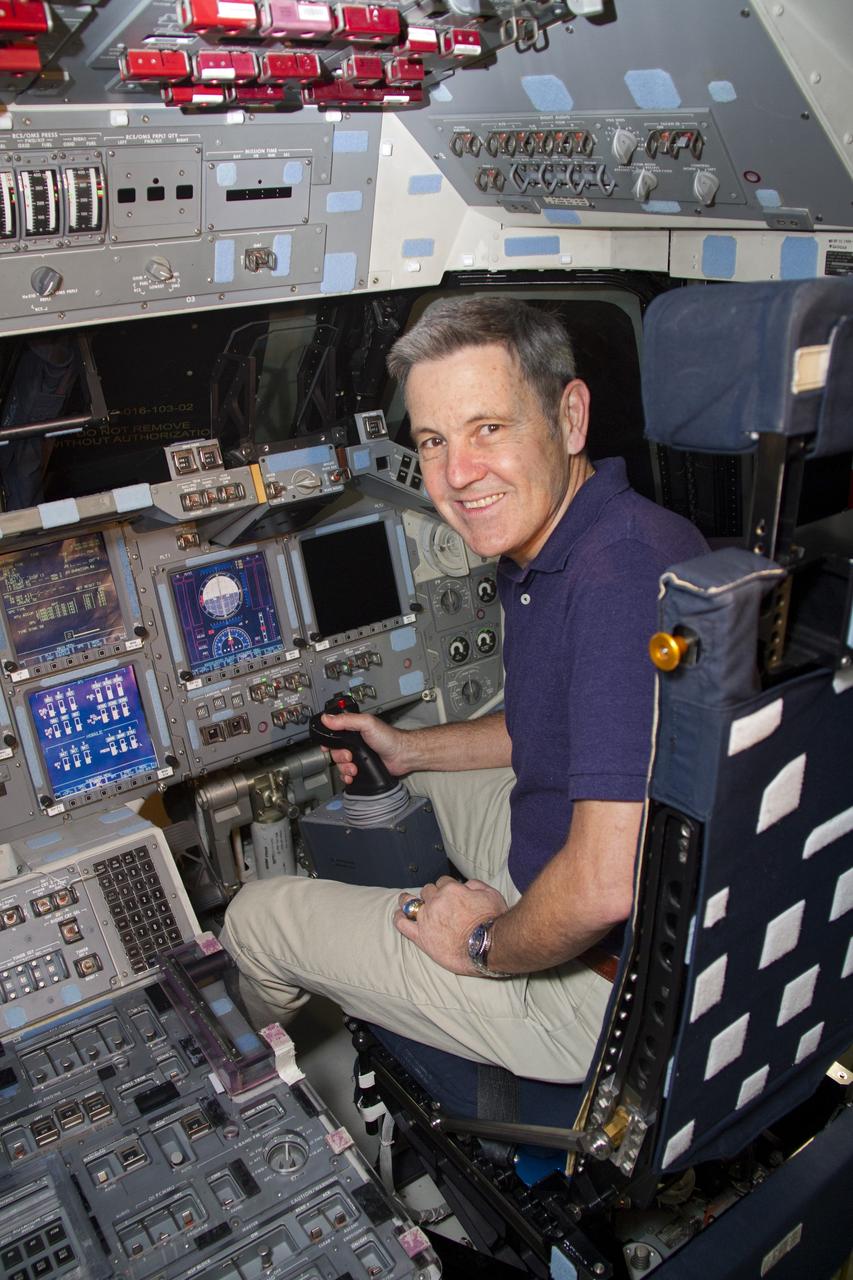
CAPE CANAVERAL, Fla. -- NASA Kennedy Space Center Director Bob Cabana sits at the controls in the flight deck of space shuttle Discovery in Orbiter Processing Facility-1 OPF-1. At the space center in Florida, Cabana is helping John Glenn mark the 50th anniversary of being the first American astronaut to orbit the Earth inside the NASA Mercury Project's Friendship 7 capsule on Feb. 20, 1962. Glenn later returned to space in October 1998 as a payload specialist aboard Discovery's STS-95 mission. Glenn's launch aboard an Atlas rocket took with it the hopes of an entire nation and ushered in a new era of space travel that eventually led to Americans walking on the moon by the end of the 1960s. Glenn soon was followed into orbit by Scott Carpenter, Walter Schirra and Gordon Cooper. Their fellow Mercury astronauts Alan Shepard and Virgil "Gus" Grissom flew earlier suborbital flights. Deke Slayton, a member of NASA's original Mercury 7 astronauts, was grounded by a medical condition until the Apollo-Soyuz Test Project in 1975. Shuttle Discovery currently is being prepared for display at Smithsonian’s National Air and Space Museum, Steven F. Udvar-Hazy Center in Chantilly, Va. Photo credit: Cory Huston
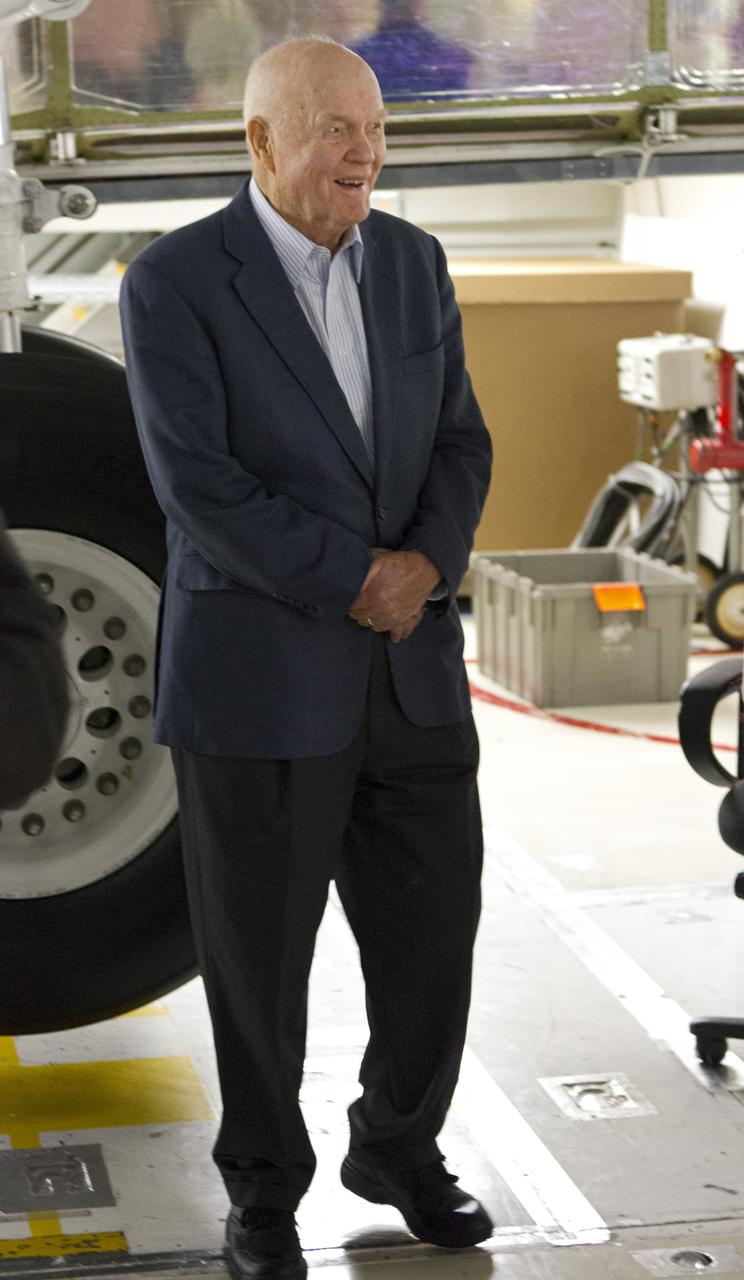
CAPE CANAVERAL, Fla. -- John Glenn stands beside the wheel of space shuttle Discovery in Orbiter Processing Facility-1 OPF-1 at NASA's Kennedy Space Center in Florida. Glenn is at the space center to mark the 50th anniversary of being the first American astronaut to orbit the Earth inside the NASA Mercury Project's Friendship 7 capsule on Feb. 20, 1962. Glenn later returned to space in October 1998 as a payload specialist aboard Discovery's STS-95 mission. Glenn's launch aboard an Atlas rocket took with it the hopes of an entire nation and ushered in a new era of space travel that eventually led to Americans walking on the moon by the end of the 1960s. Glenn soon was followed into orbit by Scott Carpenter, Walter Schirra and Gordon Cooper. Their fellow Mercury astronauts Alan Shepard and Virgil "Gus" Grissom flew earlier suborbital flights. Deke Slayton, a member of NASA's original Mercury 7 astronauts, was grounded by a medical condition until the Apollo-Soyuz Test Project in 1975. Shuttle Discovery currently is being prepared for display at Smithsonian’s National Air and Space Museum, Steven F. Udvar-Hazy Center in Chantilly, Va. Photo credit: Cory Huston
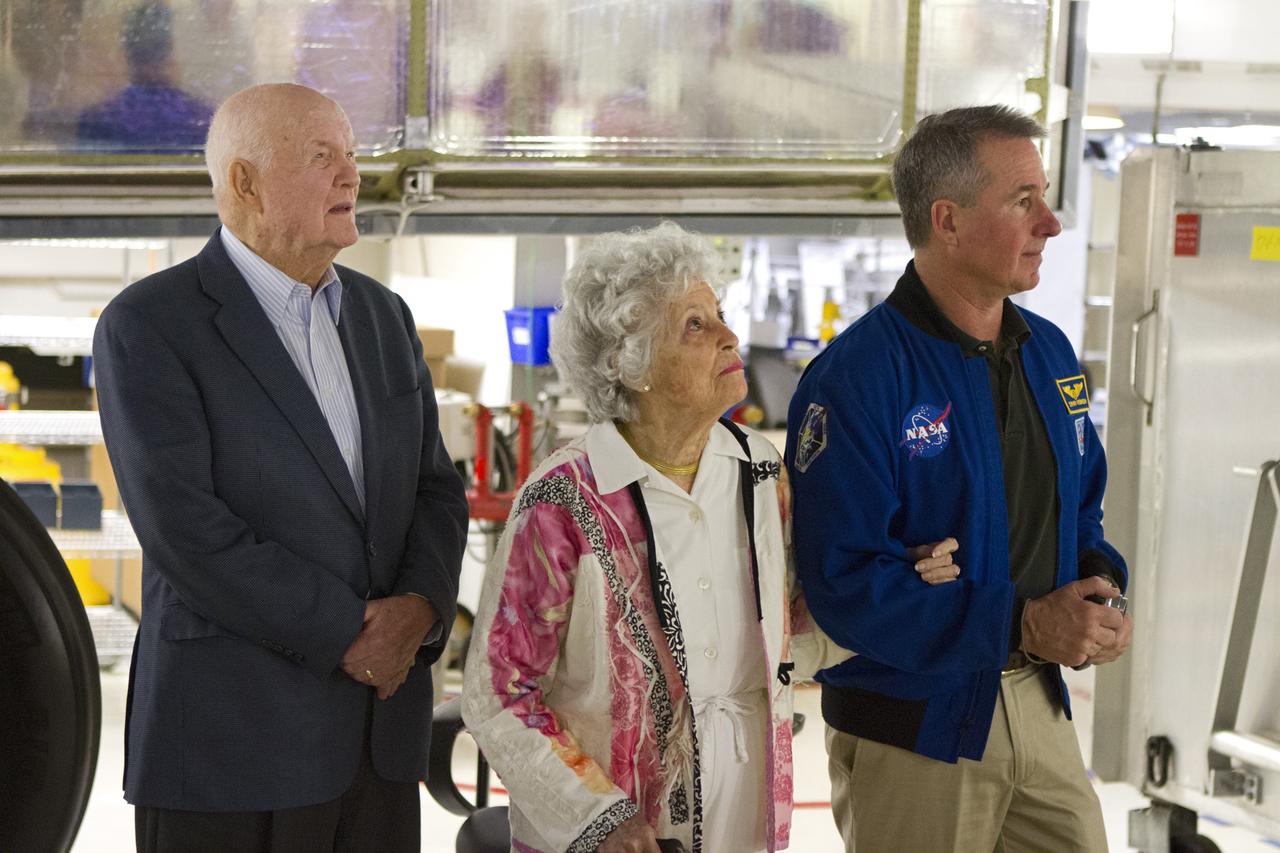
CAPE CANAVERAL, Fla. -- John Glenn and his wife, Annie, and NASA astronaut Stephen Robinson stand under space shuttle Discovery in Orbiter Processing Facility-1 OPF-1 at NASA's Kennedy Space Center in Florida. Glenn is at the space center to mark the 50th anniversary of being the first American astronaut to orbit the Earth inside the NASA Mercury Project's Friendship 7 capsule on Feb. 20, 1962. Glenn later returned to space in October 1998 as a payload specialist aboard Discovery's STS-95 mission. Robinson was the payload commander of STS-95. Glenn's launch aboard an Atlas rocket took with it the hopes of an entire nation and ushered in a new era of space travel that eventually led to Americans walking on the moon by the end of the 1960s. Glenn soon was followed into orbit by Scott Carpenter, Walter Schirra and Gordon Cooper. Their fellow Mercury astronauts Alan Shepard and Virgil "Gus" Grissom flew earlier suborbital flights. Deke Slayton, a member of NASA's original Mercury 7 astronauts, was grounded by a medical condition until the Apollo-Soyuz Test Project in 1975. Shuttle Discovery currently is being prepared for display at Smithsonian’s National Air and Space Museum, Steven F. Udvar-Hazy Center in Chantilly, Va. Photo credit: Cory Huston
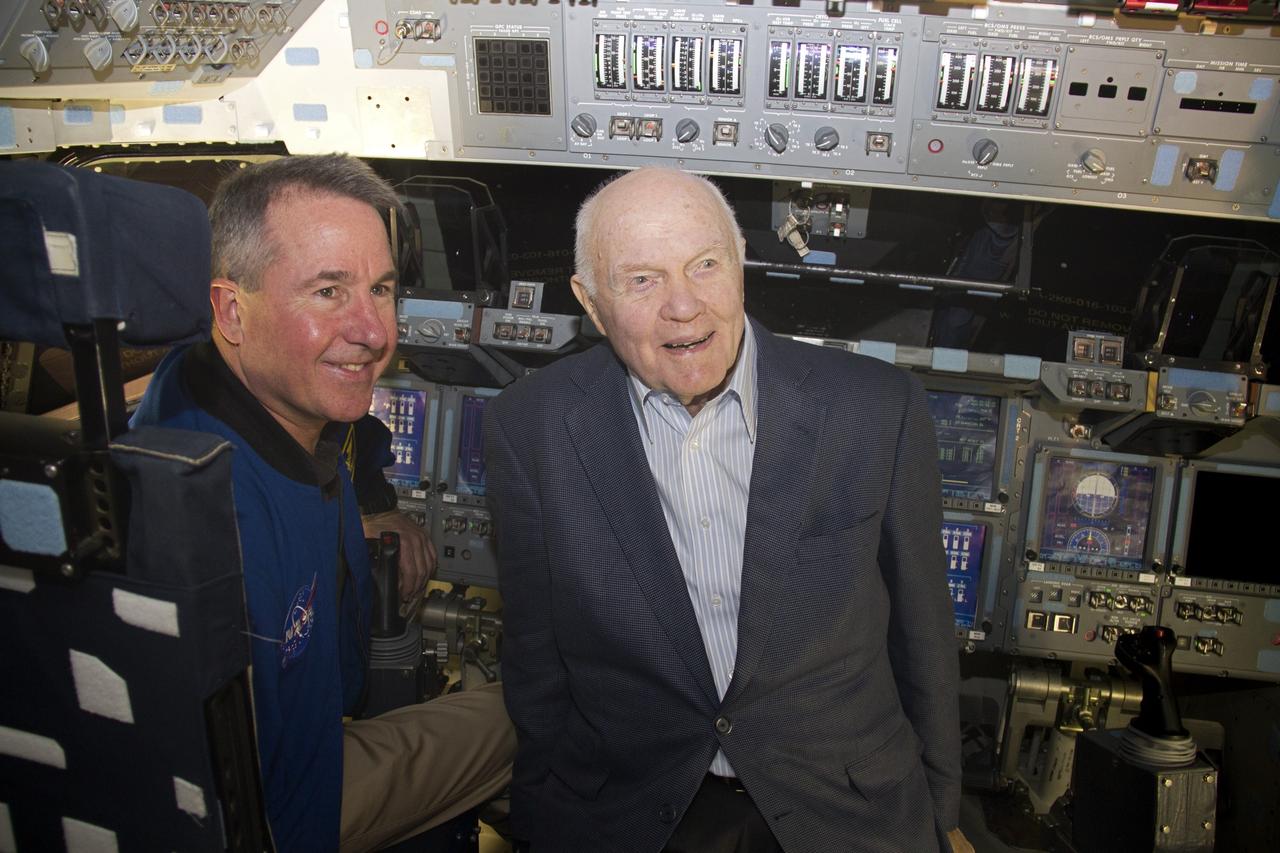
CAPE CANAVERAL, Fla. -- John Glenn and NASA astronaut Stephen Robinson sit in the flight deck of space shuttle Discovery in Orbiter Processing Facility-1 OPF-1 at NASA's Kennedy Space Center in Florida. Glenn is at the space center to mark the 50th anniversary of being the first American astronaut to orbit the Earth inside the NASA Mercury Project's Friendship 7 capsule on Feb. 20, 1962. Glenn later returned to space in October 1998 as a payload specialist aboard Discovery's STS-95 mission. Robinson was the payload commander of STS-95. Glenn's launch aboard an Atlas rocket took with it the hopes of an entire nation and ushered in a new era of space travel that eventually led to Americans walking on the moon by the end of the 1960s. Glenn soon was followed into orbit by Scott Carpenter, Walter Schirra and Gordon Cooper. Their fellow Mercury astronauts Alan Shepard and Virgil "Gus" Grissom flew earlier suborbital flights. Deke Slayton, a member of NASA's original Mercury 7 astronauts, was grounded by a medical condition until the Apollo-Soyuz Test Project in 1975. Shuttle Discovery currently is being prepared for display at Smithsonian’s National Air and Space Museum, Steven F. Udvar-Hazy Center in Chantilly, Va. Photo credit: Cory Huston
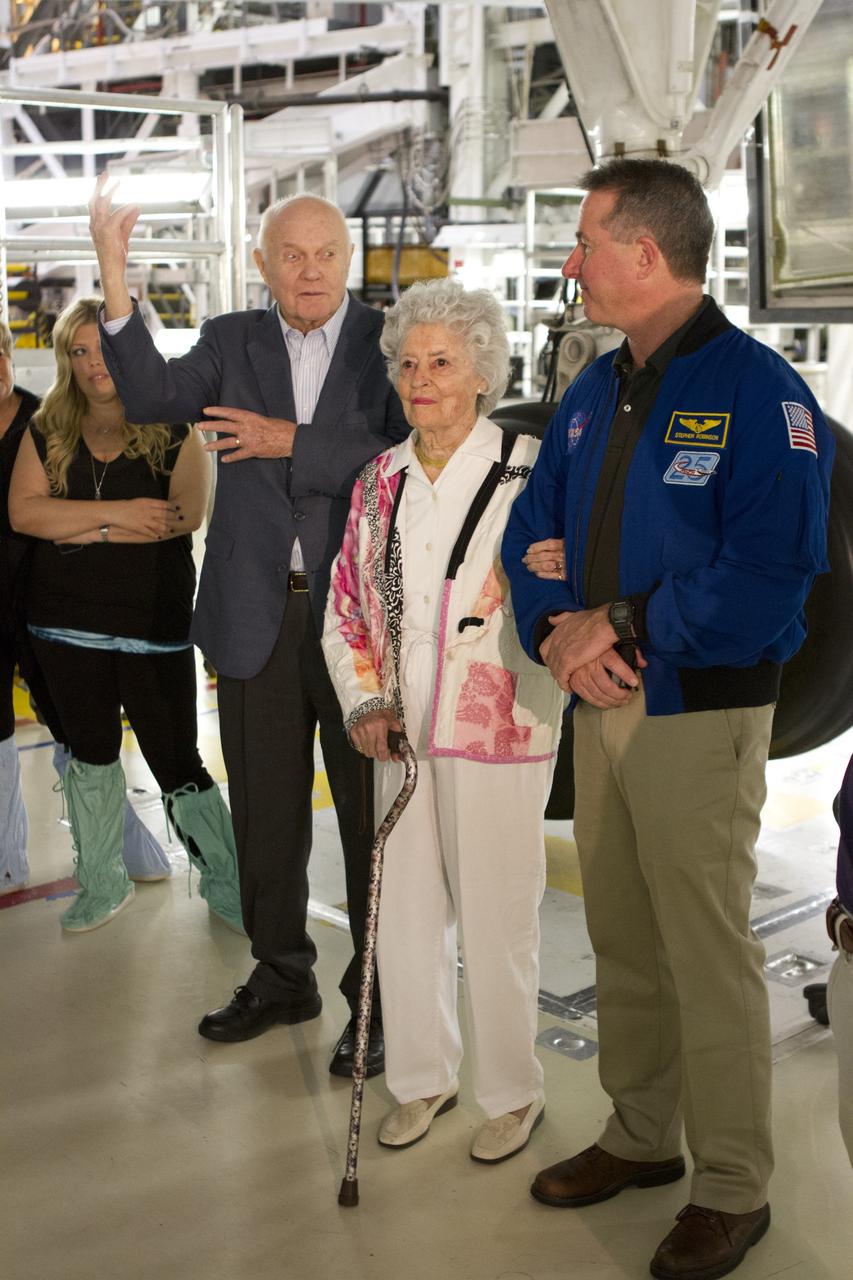
CAPE CANAVERAL, Fla. -- John Glenn and his wife, Annie, and NASA astronaut Stephen Robinson stand under space shuttle Discovery in Orbiter Processing Facility-1 OPF-1 at NASA's Kennedy Space Center in Florida. Glenn is at the space center to mark the 50th anniversary of being the first American astronaut to orbit the Earth inside the NASA Mercury Project's Friendship 7 capsule on Feb. 20, 1962. Glenn later returned to space in October 1998 as a payload specialist aboard Discovery's STS-95 mission. Robinson was the payload commander of STS-95. Glenn's launch aboard an Atlas rocket took with it the hopes of an entire nation and ushered in a new era of space travel that eventually led to Americans walking on the moon by the end of the 1960s. Glenn soon was followed into orbit by Scott Carpenter, Walter Schirra and Gordon Cooper. Their fellow Mercury astronauts Alan Shepard and Virgil "Gus" Grissom flew earlier suborbital flights. Deke Slayton, a member of NASA's original Mercury 7 astronauts, was grounded by a medical condition until the Apollo-Soyuz Test Project in 1975. Shuttle Discovery currently is being prepared for display at Smithsonian’s National Air and Space Museum, Steven F. Udvar-Hazy Center in Chantilly, Va. Photo credit: Cory Huston

CAPE CANAVERAL, Fla. -- NASA Kennedy Space Center Director Bob Cabana talks to guests in Orbiter Processing Facility-1 OPF-1 where space shuttle Discovery is being prepared for public display during a 50th anniversary celebration of the first orbital flight of an American. The astronaut who made that first flight, John Glenn, is at the space center to commemorate that achievement. Glenn orbited the Earth three times in the NASA Mercury Project's Friendship 7 capsule on Feb. 20, 1962. He later returned to space in October 1998 as a payload specialist aboard Discovery's STS-95 mission. Glenn's launch aboard an Atlas rocket took with it the hopes of an entire nation and ushered in a new era of space travel that eventually led to Americans walking on the moon by the end of the 1960s. Glenn soon was followed into orbit by Scott Carpenter, Walter Schirra and Gordon Cooper. Their fellow Mercury astronauts Alan Shepard and Virgil "Gus" Grissom flew earlier suborbital flights. Deke Slayton, a member of NASA's original Mercury 7 astronauts, was grounded by a medical condition until the Apollo-Soyuz Test Project in 1975. Shuttle Discovery currently is being prepared for display at Smithsonian’s National Air and Space Museum, Steven F. Udvar-Hazy Center in Chantilly, Va. Photo credit: Cory Huston
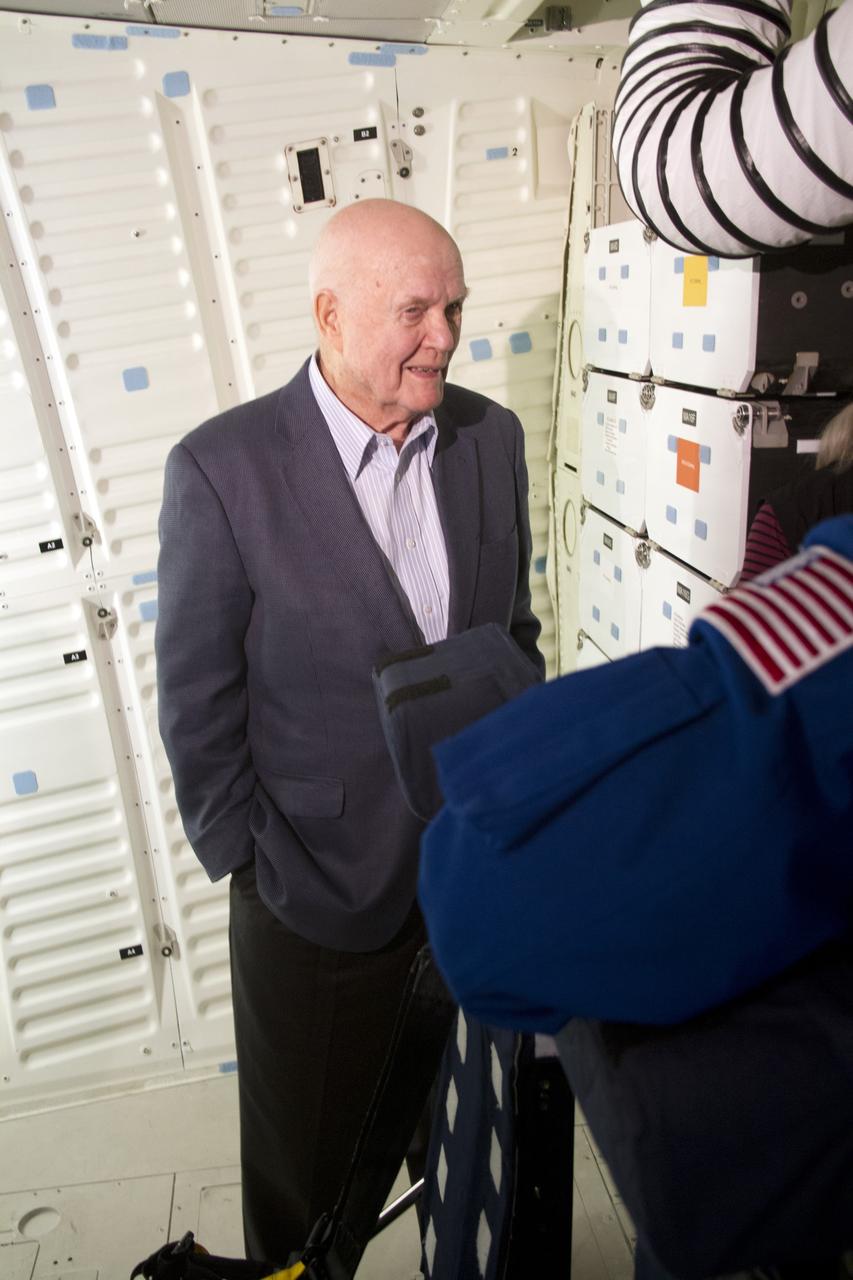
CAPE CANAVERAL, Fla. -- John Glenn stands in the middeck of space shuttle Discovery in Orbiter Processing Facility-1 OPF-1 at NASA's Kennedy Space Center in Florida. Glenn is at the space center to mark the 50th anniversary of being the first American astronaut to orbit the Earth inside the NASA Mercury Project's Friendship 7 capsule on Feb. 20, 1962. Glenn later returned to space in October 1998 as a payload specialist aboard Discovery's STS-95 mission. Glenn's launch aboard an Atlas rocket took with it the hopes of an entire nation and ushered in a new era of space travel that eventually led to Americans walking on the moon by the end of the 1960s. Glenn soon was followed into orbit by Scott Carpenter, Walter Schirra and Gordon Cooper. Their fellow Mercury astronauts Alan Shepard and Virgil "Gus" Grissom flew earlier suborbital flights. Deke Slayton, a member of NASA's original Mercury 7 astronauts, was grounded by a medical condition until the Apollo-Soyuz Test Project in 1975. Shuttle Discovery currently is being prepared for display at Smithsonian’s National Air and Space Museum, Steven F. Udvar-Hazy Center in Chantilly, Va. Photo credit: Cory Huston
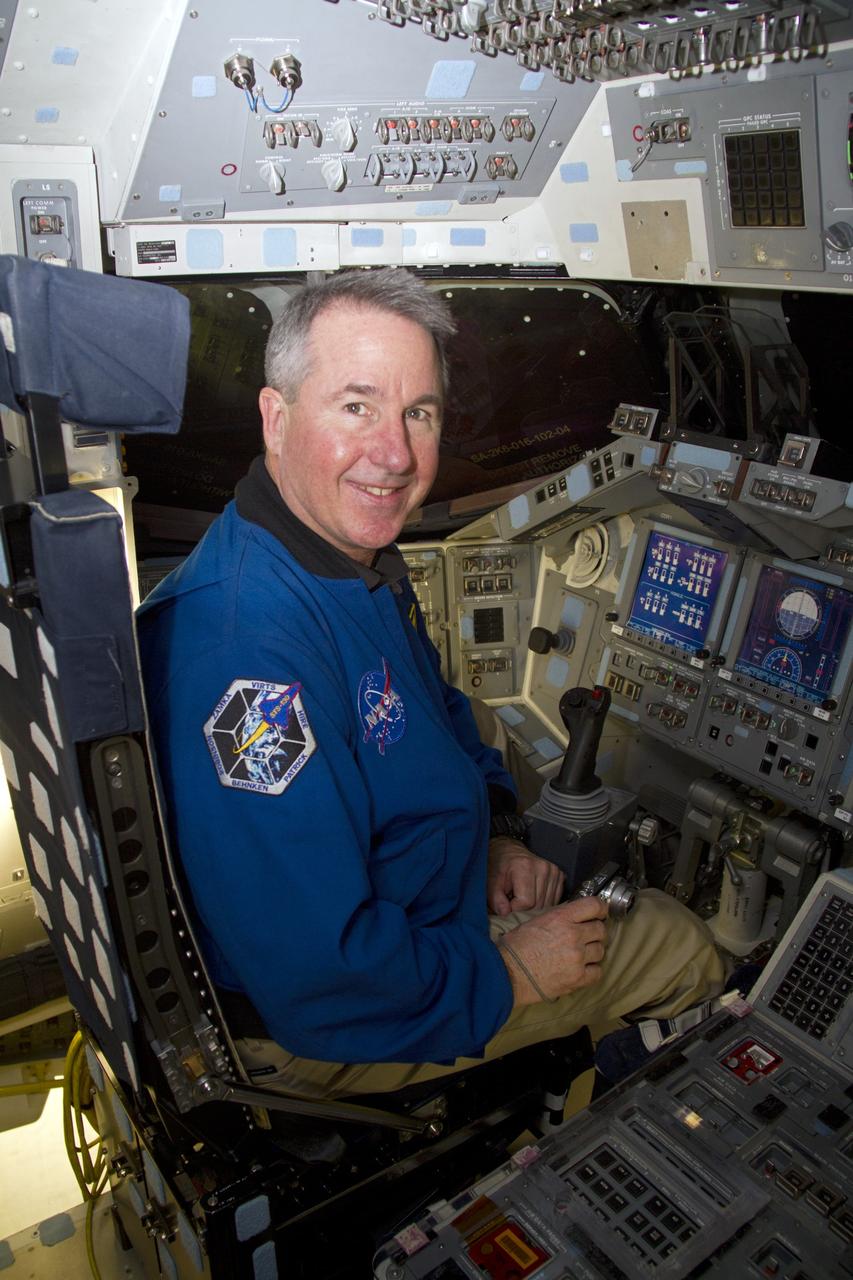
CAPE CANAVERAL, Fla. -- NASA astronaut Stephen Robinson sits at the controls in the flight deck of space shuttle Discovery in Orbiter Processing Facility-1 OPF-1 at NASA's Kennedy Space Center in Florida. Robinson is helping John Glenn mark the 50th anniversary of being the first American astronaut to orbit the Earth inside the NASA Mercury Project's Friendship 7 capsule on Feb. 20, 1962. Glenn later returned to space in October 1998 as a payload specialist aboard Discovery's STS-95 mission. Robinson was the payload commander of STS-95. Glenn's launch aboard an Atlas rocket took with it the hopes of an entire nation and ushered in a new era of space travel that eventually led to Americans walking on the moon by the end of the 1960s. Glenn soon was followed into orbit by Scott Carpenter, Walter Schirra and Gordon Cooper. Their fellow Mercury astronauts Alan Shepard and Virgil "Gus" Grissom flew earlier suborbital flights. Deke Slayton, a member of NASA's original Mercury 7 astronauts, was grounded by a medical condition until the Apollo-Soyuz Test Project in 1975. Shuttle Discovery currently is being prepared for display at Smithsonian’s National Air and Space Museum, Steven F. Udvar-Hazy Center in Chantilly, Va. Photo credit: Cory Huston
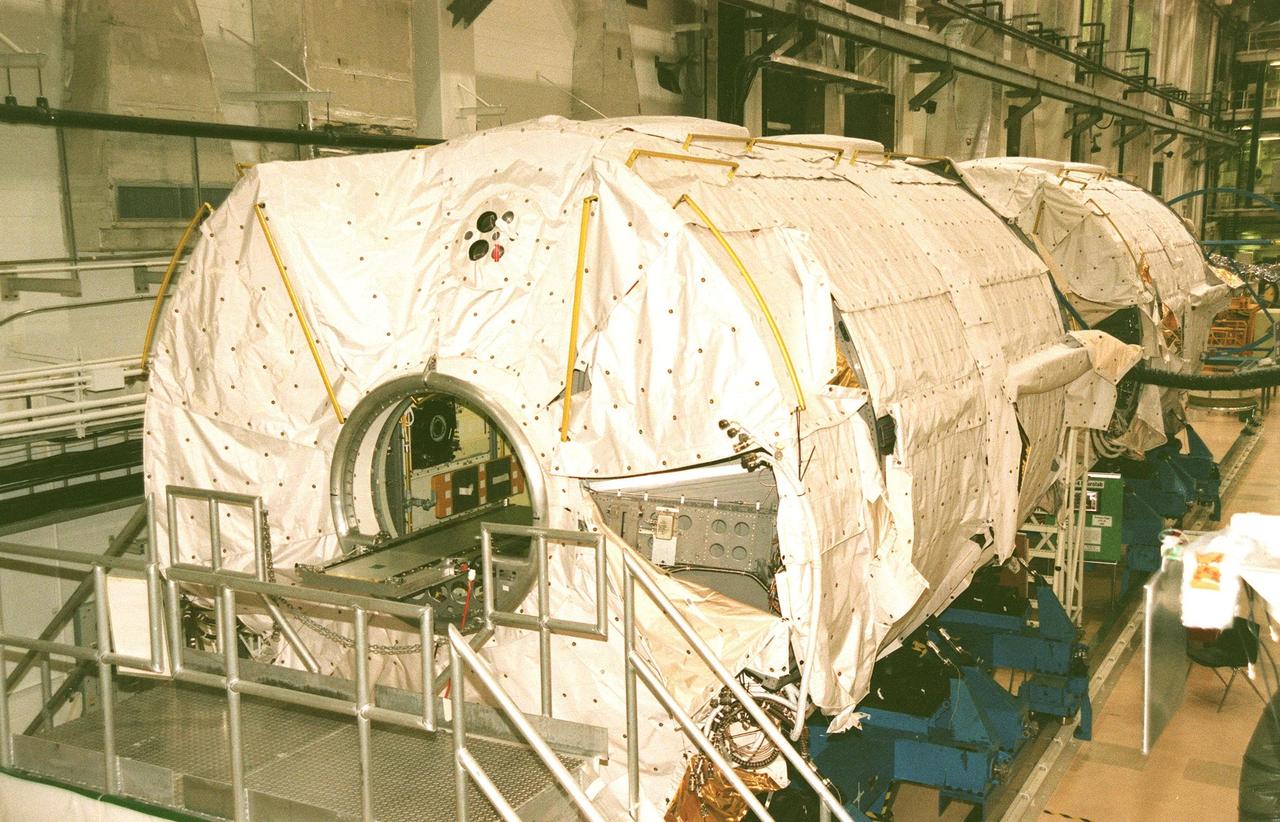
Spacelab Module MD001 (foreground) and its sister module (behind it) are prepared for shipment to the National Air and Space Museum in Washington, DC. Spacelab was designed by the European Space Agency (ESA) for the Space Shuttle program. It first flew on STS-9 in November 1983 and its final flight was the STS-90 Neurolab mission in April 1998. The sister module will travel home and be placed on display in Europe. The Spacelab concept of modular experiment racks in a pressurized shirt-sleeve environment made it highly user-friendly and accessible. Numerous experiments conceived by hundreds of scientists on the ground were conducted by flight crews in orbit. Spacelab modules served as on-orbit homes for everything from squirrel monkeys to plant seeds. They supported astronomical as well as Earth observations, for servicing the Hubble Space Telescope and for research preparatory to the International Space Station. One of the greatest benefits afforded by the Spacelab missions was the opportunity to fly a mission more than once, with the second or third flight building on the experiences and data gathered from its predecessors
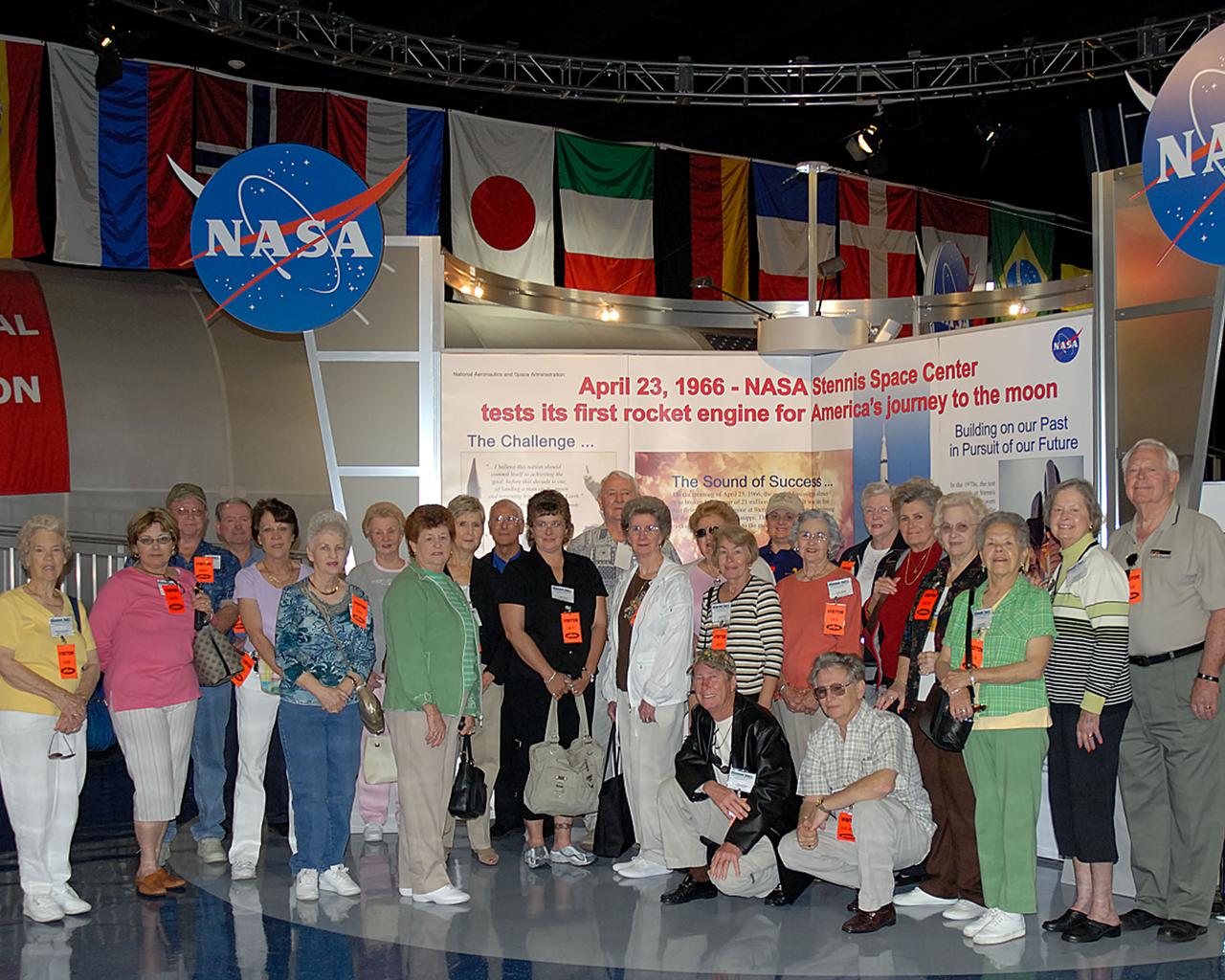
On April 24, a group traveling with Diamond Tours visited StenniSphere, the visitor center at NASA John C. Stennis Space Center in South Mississippi. The trip marked Diamond Tours' return to StenniSphere since Hurricane Katrina struck the Gulf Coast on Aug. 29, 2005. About 25 business professionals from Georgia enjoyed the day's tour of America's largest rocket engine test complex, along with the many displays and exhibits at the museum. Before Hurricane Katrina, the nationwide company brought more than 1,000 visitors to StenniSphere each month. That contributed to more than 100,000 visitors from around the world touring the space center each year. In past years StenniSphere's visitor relations specialists booked Diamond Tours two or three times a week, averaging 40 to 50 people per visit. SSC was established in the 1960s to test the huge engines for the Saturn V moon rockets. Now 40 years later, the center tests every main engine for the space shuttle. SSC will soon begin testing the rocket engines that will power spacecraft carrying Americans back to the moon and on to Mars. For more information or to book a tour, visit http://www.nasa.gov/centers/stennis/home/index.html and click on the StenniSphere logo; or call 800-237-1821 or 228-688-2370.
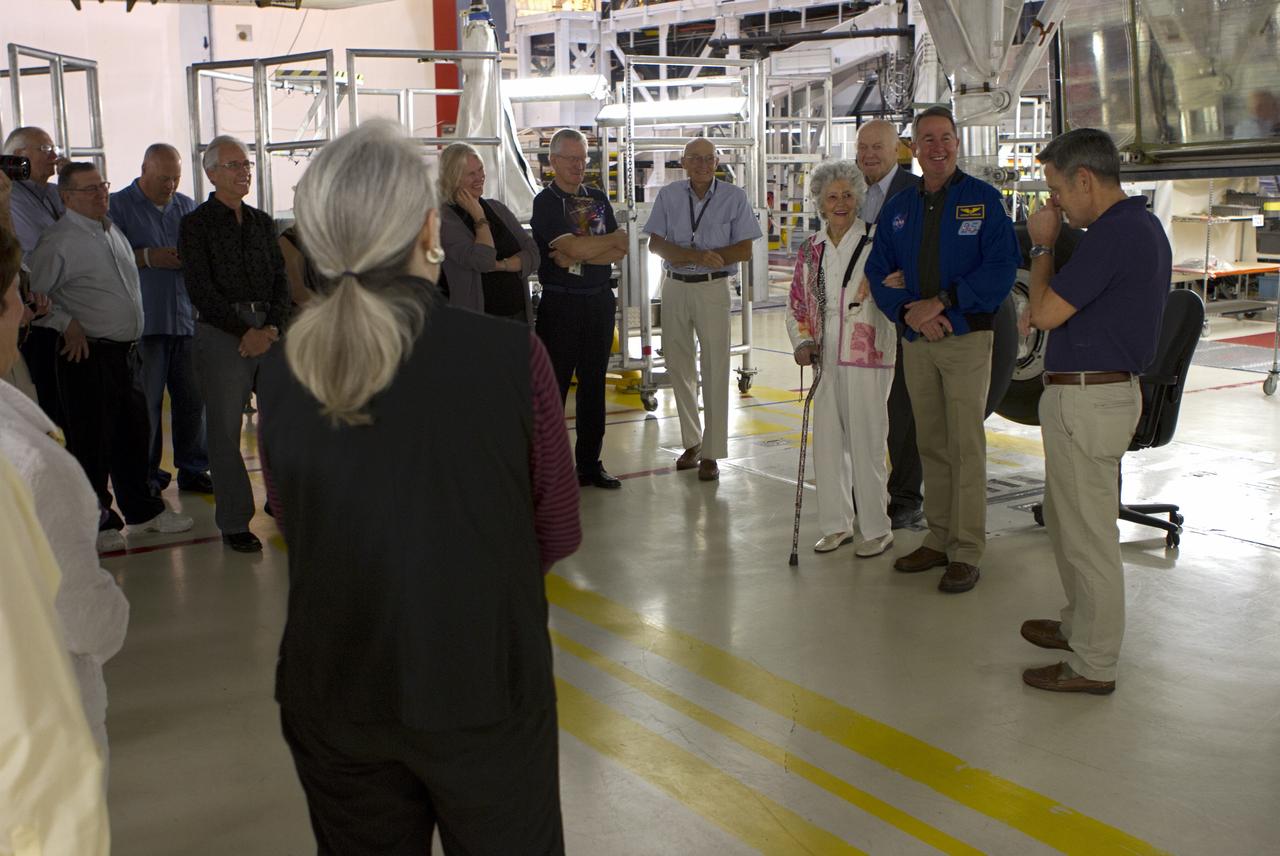
CAPE CANAVERAL, Fla. -- NASA Kennedy Space Center Director Bob Cabana, right, talks to guests in Orbiter Processing Facility-1 OPF-1 where space shuttle Discovery is being prepared for public display during a 50th anniversary celebration of the first orbital flight of an American. The astronaut who made that first flight, John Glenn, is at the space center to commemorate that achievement. Glenn orbited the Earth three times in the NASA Mercury Project's Friendship 7 capsule on Feb. 20, 1962. He later returned to space in October 1998 as a payload specialist aboard Discovery's STS-95 mission. Also in the photo are Glenn's wife, Annie, NASA astronaut Stephen Robinson, and Bob Sieck, a former shuttle launch director. Robinson was the payload commander of STS-95. Glenn's launch aboard an Atlas rocket took with it the hopes of an entire nation and ushered in a new era of space travel that eventually led to Americans walking on the moon by the end of the 1960s. Glenn soon was followed into orbit by Scott Carpenter, Walter Schirra and Gordon Cooper. Their fellow Mercury astronauts Alan Shepard and Virgil "Gus" Grissom flew earlier suborbital flights. Deke Slayton, a member of NASA's original Mercury 7 astronauts, was grounded by a medical condition until the Apollo-Soyuz Test Project in 1975. Shuttle Discovery currently is being prepared for display at Smithsonian’s National Air and Space Museum, Steven F. Udvar-Hazy Center in Chantilly, Va. Photo credit: Cory Huston
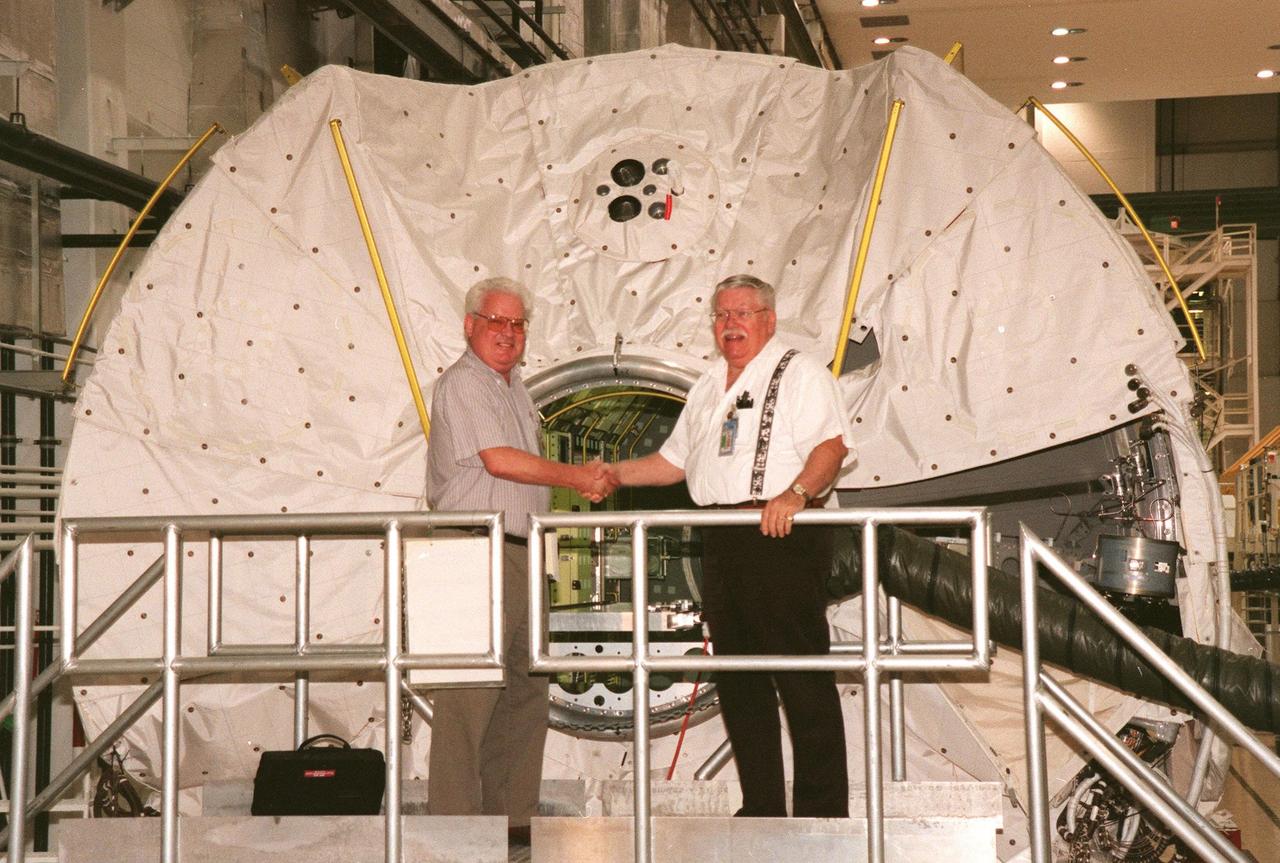
KENNEDY SPACE CENTER, FLA. -- In the Operations and Checkout Building, Rainer Goercke shakes hands with Norman Jatz in front of the Spacelab Module MD001 as they prepare to close it for the last time before shipment to the National Air and Space Museum in Washington, DC. Goercke and Jatz have been on the Spacelab program since 1979 and were part of the team that first unloaded the module at KSC. Goercke is the only remaining European representative from the German-based Spacelab contractor, ERNO, and Jatz is a mechanical engineering lead from Boeing. Spacelab was designed by the European Space Agency (ESA) for the Space Shuttle program. It first flew on STS-9 in November 1983 and its final flight was the STS-90 Neurolab mission in April 1998. The sister module will travel home and be placed on display in Europe. The Spacelab concept of modular experiment racks in a pressurized shirt-sleeve environment made it highly user-friendly and accessible. Numerous experiments conceived by hundreds of scientists on the ground were conducted by flight crews in orbit. Spacelab modules served as on-orbit homes for everything from squirrel monkeys to plant seeds. They supported astronomical as well as Earth observations, for servicing the Hubble Space Telescope and for research preparatory to the International Space Station. One of the greatest benefits afforded by the Spacelab missions was the opportunity to fly a mission more than once, with the second or third flight building on the experiences and data gathered from its predecessors

Photographs documenting International Space Station (ISS) Phase One activities at the Russian Space Agency's (RSA) Gagarin Cosmonaut Training Center, Korolov Mission Control Center and Zvezda; and ISS and Soyuz manufacturing at RSA's Khrunichev Design Center and RSC Energiya in Moscow, Russia, the French Space Agency's (CNES) INTESPACE facility in Toulouse, France, and the Italian Space Agency's (ASI) Alenia Spazio facility in Torino, Italy. Photographs were taken by Johnson Space Center Imagery and Publications Office contractors travelling from October 7 to November 4, 1996. Includes: VIEWS FROM RSC ENERGIYA'S SPACE MUSEUM: Room with a Buran model and photographic displays (17372-374). Salyut Space Station mock-up (17376). Russian propulsion engines on display (17377-378). Russian spacecraft on display (17375, 17387-398). Graphic displays (17399-405). VIEWS FROM RSC ENERGIYA MANUFACTURING FACILITIES: Unidentified facility (17379). Mir 24 crew member Michael C. Foale, suited in a Soyuz pressure suit, ingresses the Soyuz TM-26 flight article at RSC Energiya for a fit check (17380-381). Closeups of Foale inside the Soyuz during the fit check (17382-383, 17466-467). Overhead views of RSC Energiya's Building 444 manufacturing floor where docking modules and Soyuz TM spacecraft are built (17495-498). Technicians on the Building 444 manufacturing floor assembling probe and drogue docking modules (17499-500, 17504). Technicians assembling Soyuz spacecraft (17437-439). Views of other Soyuz spacecraft (17440-441). Androgynous Peripheral Docking System (APDS) mock-up (17501-503). Closeups of a control panel, possibly for the APDS mock-up (17519-528). VIEWS FROM ZVEZDA, RSA CONTRACTOR FOR SUIT DESIGN AND SOYUZ SEAT LINERS: Mir 24 crew member Foale dons a "penguin" flight suit for a fit check (17454-456). Zvezda personnel adjust Foale's Soyuz seat and seat liner (17442). Closeup of Foale, suited in a Soyuz pressure suit, sitting on a chair (17444). Zvezda personnel strap pressure-suited Foale into his Soyuz seat (17443, 17445, 17450). Views of Foale in his Soyuz seat during a pressurized pressure suit fit check (17451-453). Views looking into a vacuum chamber where Foale, wearing pressure suit, is strapped into his Soyuz seat (17466-467). Views of Zvezda personnel working at the vacuum chamber control station during the vacuum chamber suit test (17468-471). VIEWS FROM KHRUNICHEV DESIGN CENTER: Views of a green ISS Functional Cargo Block (FGB) test article on the manufacturing floor (17529, 17532-536, 17540-544). Views of an ISS Service Module (SM) test article on the manufacturing floor (17530-531, 17537, 17539). Closeup of the SM test article docking sphere (17538). Views of the FGB flight article on the manufacturing floor during systems tests (17545-548, 17550-567). Views of technicians conducting the FGB systems tests (17549, 17557). VIEWS FROM GAGARIN COSMONAUT TRAINING CENTER: NASA astronauts work out in the cosmonaut gym at Gagarin: Closeup of ISS 2R Expedition Commander William Shepherd on a weight machine (17384). Shepherd and an unidentified man with back to camera work out with dumbbells (17386). Shepherd does pull-ups (17447). Closeup of Foale on an exercise machine (17385). Closeups of Foale exercising arms on a cycle ergometer and a weight machine (17415, 17448-449). Foale exercises on a Nordic Track (17416). Closeup of Mir 23 crew member Jerry Linenger exercising arms (17417). Wendy Lawrence exercises with dumbbells (17418). Closeup of Lawrence in a handstand position (17419). David Wolf works out on a leg press machine (17446). Views of the Mir Space Station mock-up at Gagarin: Interior views of the Mir Base Module mock-up looking toward the transfer compartment (17421-425). Mir Base Module living area mock-up (17420). Overall views of the Base Module mock-up central control station (17426-427, 17505). Closeups of switch panels on the central control station (17428-436, 17506-518). Other views from Gagarin: Personnel work at an unidentified test/trainer control station (17472-473). Linenger sits at a table next to an RSA trainer during a Mir 23 meeting (17475-476). Out-of-focus view of two subjects in the Soyuz trainer (17474). Foale examines a Mir Complex EVA Suit (Orlan) with RSA trainers during an EVA suit training class (17492-494). VIEWS FROM KOROLOV MISSION CONTROL CENTER: Various views of personnel working in the NASA Consulting Room and/or PAO Consulting Room at Korolov Mission Control Center (17457-463). VIEWS FROM INTESPACE: Exterior views of an ISS Mini Pressurized Logistics Module (MPLM) structural test article (STA) during testing at INTESPACE (17406-409, 17477, 17482-484). Technicians install hatch on the MPLM STA (17410-414). Interior views of the MPLM STA (17478-481). VIEWS FROM ALENIA SPAZIO: Closeups of MPLM flight article #1 side panels during milling and refining at Alenia Spazio (17485-488). Workers process MPLM parts at milling machines (17489-491).