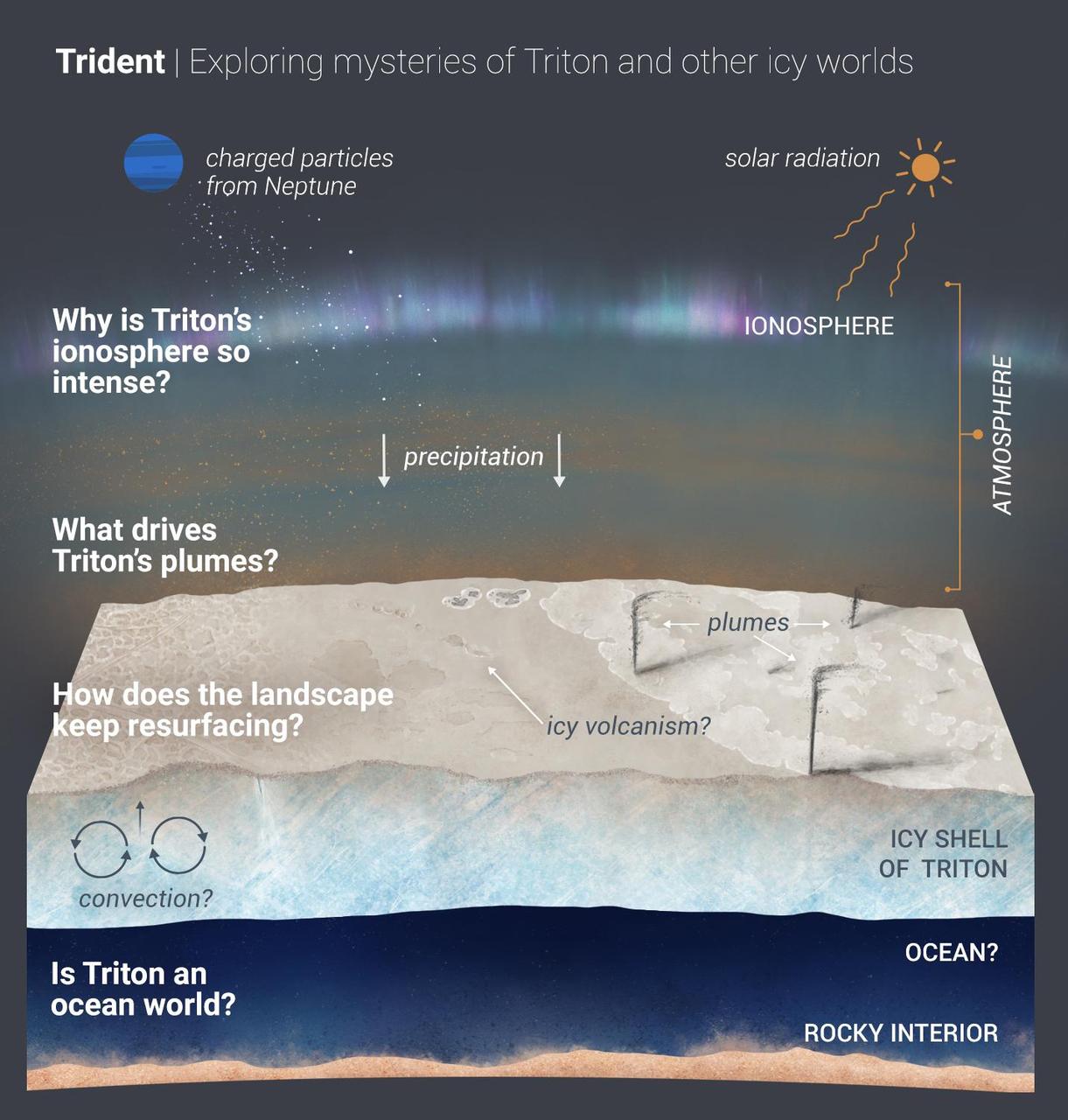
A new mission competing for selection under NASA's Discovery Program would explore Neptune's largest moon, Triton, which is potentially an ocean world with liquid water under its icy crust. Trident aims to answer the questions outlined in the graphic illustration above. The questions fall under Trident's three main goals. The first goal is to explore the factors that lead to a solar system body having the necessary ingredients — including water — to be habitable. A second goal is to explore vast, unseen lands. Most of what we know of the moon came from Voyager 2 data. But we've only seen 40% of the moon's surface; Trident would map most of the remainder. Trident's third major goal: to understand how Triton's surface keeps renewing itself. The surface is remarkably young, geologically speaking (possibly only 10 million years old in a 4.6-billion-year-old solar system) and has almost no visible craters. The Trident team is one of four developing concept studies for new missions. Up to two will be selected by summer 2021 to become a full-fledged mission and will launch later in the decade. https://photojournal.jpl.nasa.gov/catalog/PIA23874
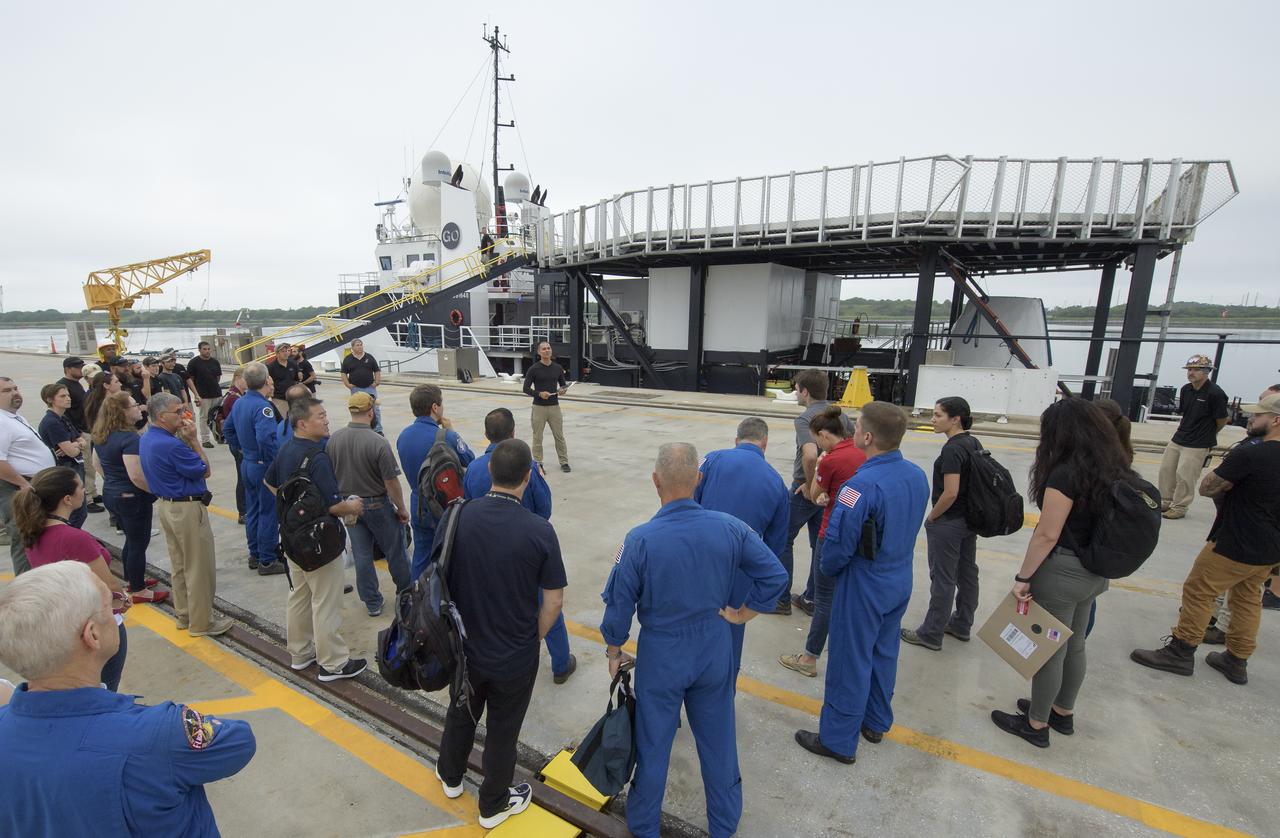
Teams from NASA and SpaceX gather at the Trident Basin in Cape Canaveral, Florida, on August 13, 2019 to rehearse extracting astronauts from SpaceX’s Crew Dragon, which will be used to carry humans to the International Space Station. Using the Go Searcher ship SpaceX uses to recover their spacecraft after splashdown and a mock-up of the Crew Dragon, the teams worked through the steps necessary to get NASA astronauts Doug Hurley and Bob Behnken out of the Dragon and back to dry land. Hurley and Behnken will fly to the space station aboard the Crew Dragon for the SpaceX Demo-2 mission. Photo Credit: (NASA/Bill Ingalls)
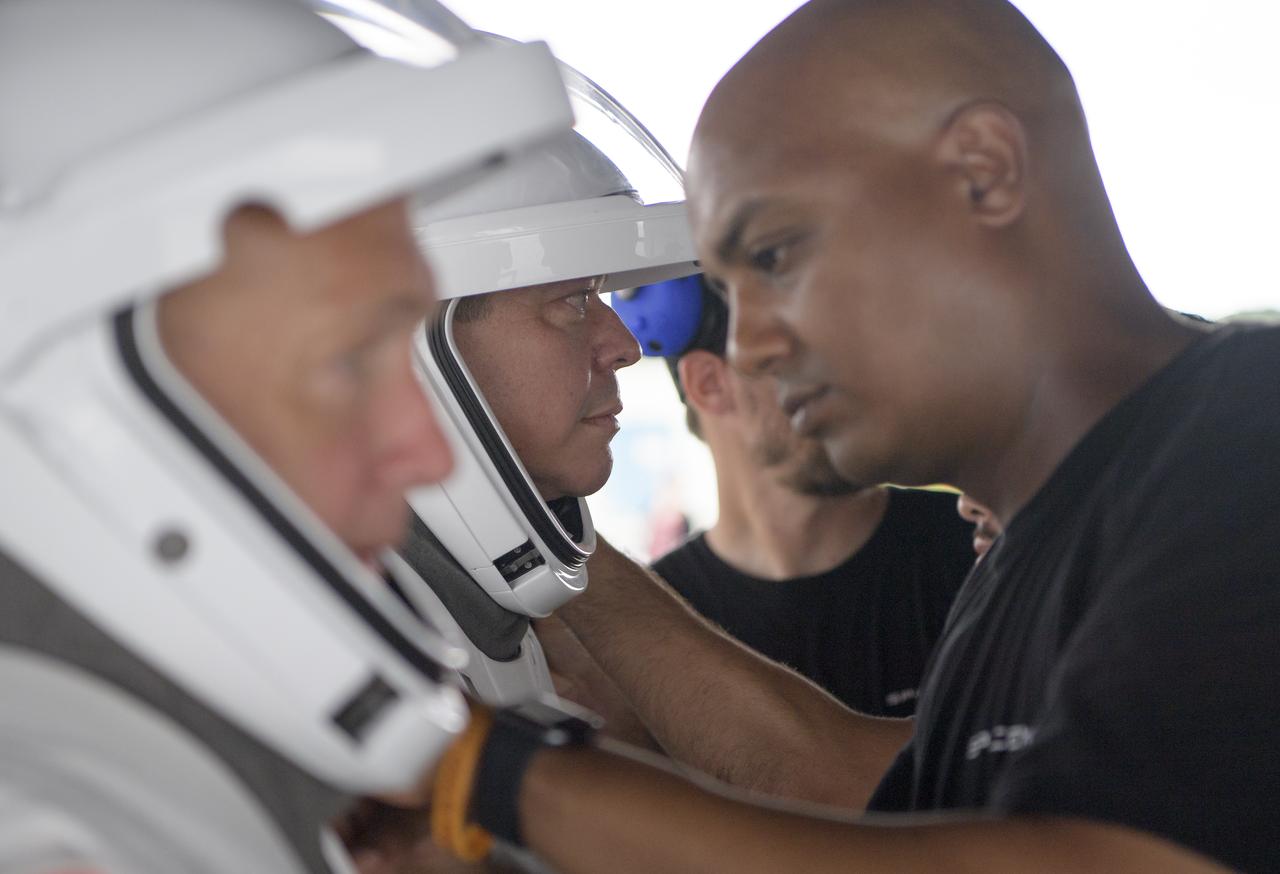
NASA astronauts Doug Hurley, left, and Bob Behnken work with teams from NASA and SpaceX to rehearse crew extraction from SpaceX’s Crew Dragon, which will be used to carry humans to the International Space Station, on August 13, 2019 at the Trident Basin in Cape Canaveral, Florida. Using the Go Searcher ship SpaceX uses to recover their spacecraft after splashdown and a mock-up of the Crew Dragon, the teams worked through the steps necessary to get NASA astronauts Doug Hurley and Bob Behnken out of the Dragon and back to dry land. Hurley and Behnken will fly to the space station aboard the Crew Dragon for the SpaceX Demo-2 mission. Photo Credit: (NASA/Bill Ingalls)
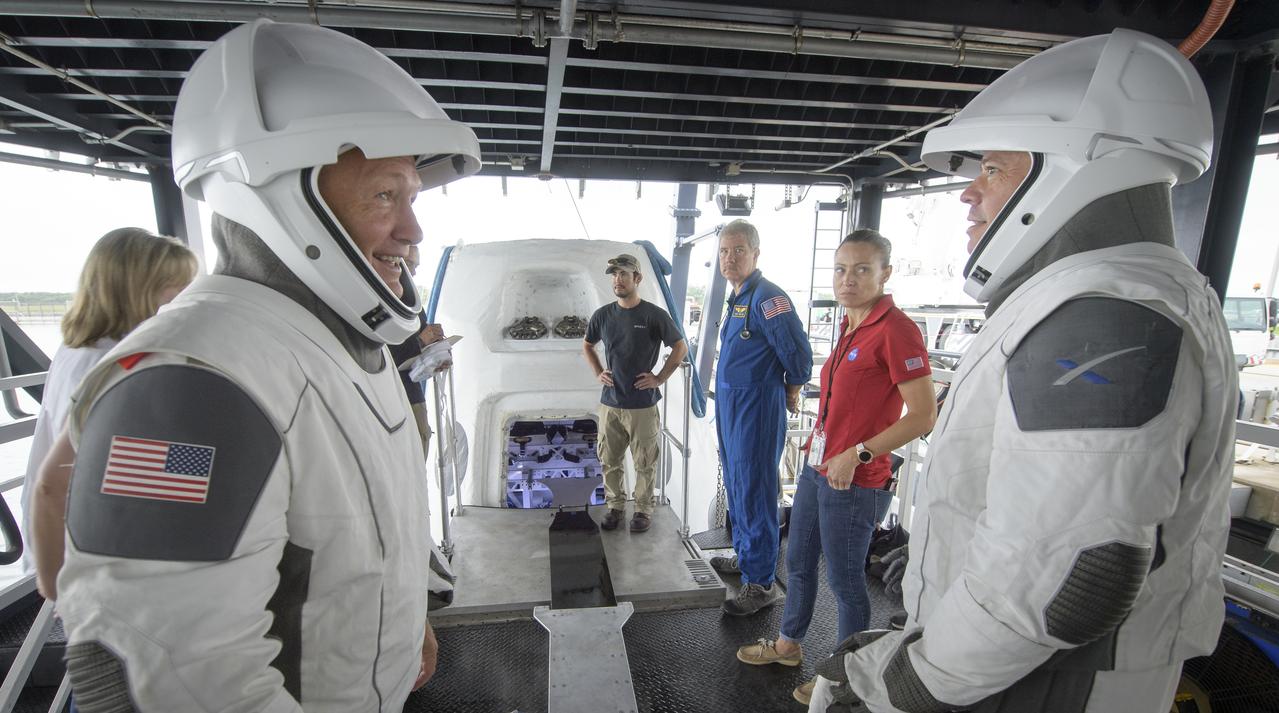
NASA astronauts Doug Hurley, left, and Bob Behnken work with teams from NASA and SpaceX to rehearse crew extraction from SpaceX’s Crew Dragon, which will be used to carry humans to the International Space Station, on August 13, 2019 at the Trident Basin in Cape Canaveral, Florida. Using the Go Searcher ship SpaceX uses to recover their spacecraft after splashdown and a mock-up of the Crew Dragon, the teams worked through the steps necessary to get NASA astronauts Doug Hurley and Bob Behnken out of the Dragon and back to dry land. Hurley and Behnken will fly to the space station aboard the Crew Dragon for the SpaceX Demo-2 mission. Photo Credit: (NASA/Bill Ingalls)
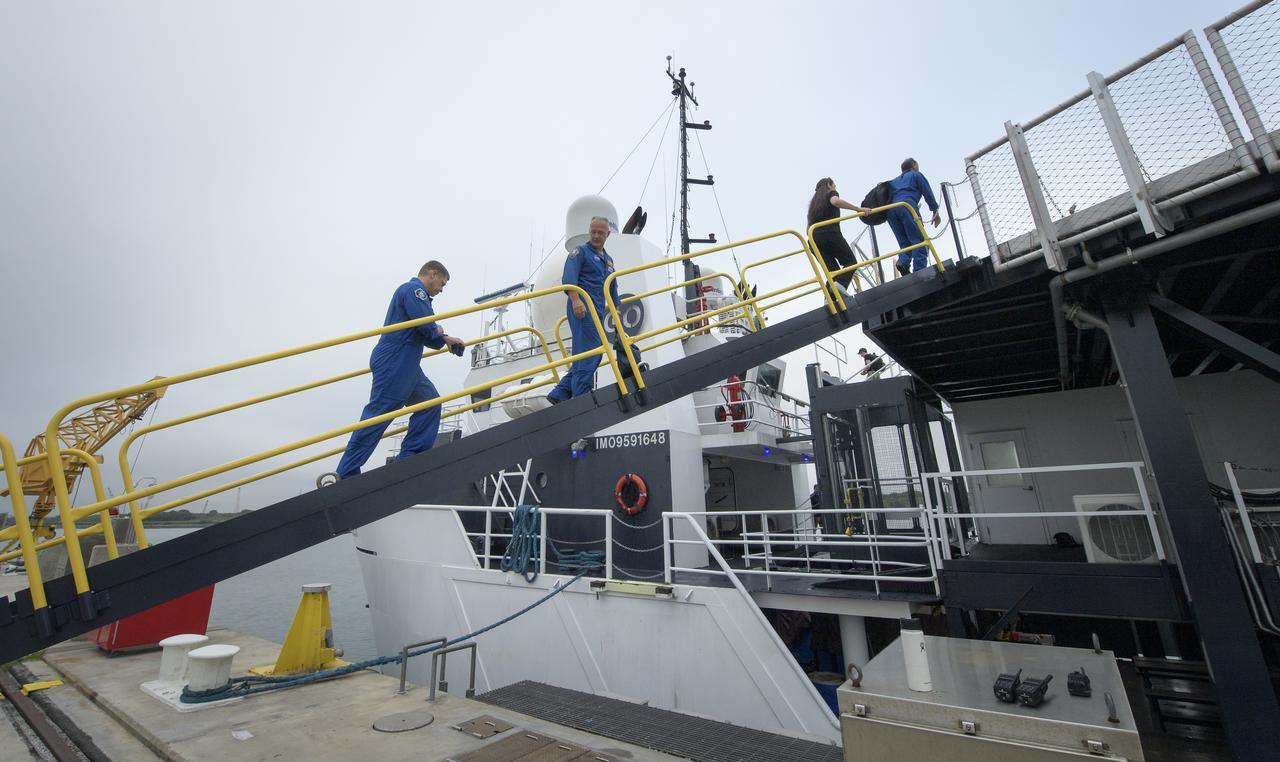
NASA astronauts Bob Behnken, left, and Doug Hurley board the SpaceX GO Searcher ship at the Trident Basin in Cape Canaveral, Florida, on August 13, 2019 to rehearse extracting astronauts from SpaceX’s Crew Dragon, which will be used to carry humans to the International Space Station. Using the Go Searcher ship SpaceX uses to recover their spacecraft after splashdown and a mock-up of the Crew Dragon, the teams worked through the steps necessary to get NASA astronauts Doug Hurley and Bob Behnken out of the Dragon and back to dry land. Hurley and Behnken will fly to the space station aboard the Crew Dragon for the SpaceX Demo-2 mission. Photo Credit: (NASA/Bill Ingalls)
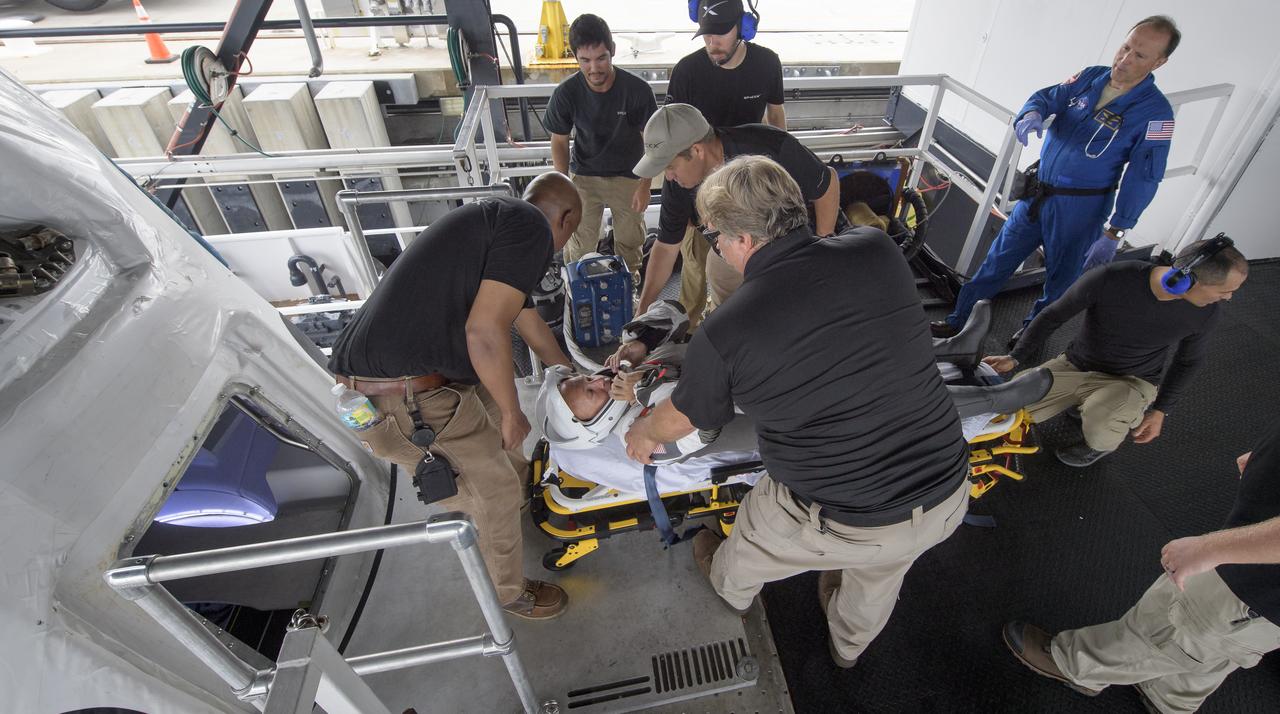
NASA astronaut Doug Hurley, along with teams from NASA and SpaceX, rehearse crew extraction from SpaceX’s Crew Dragon, which will be used to carry humans to the International Space Station, on August 13, 2019 at the Trident Basin in Cape Canaveral, Florida. Using the Go Searcher ship SpaceX uses to recover their spacecraft after splashdown and a mock-up of the Crew Dragon, the teams worked through the steps necessary to get NASA astronauts Doug Hurley and Bob Behnken out of the Dragon and back to dry land. Hurley and Behnken will fly to the space station aboard the Crew Dragon for the SpaceX Demo-2 mission. Photo Credit: (NASA/Bill Ingalls)
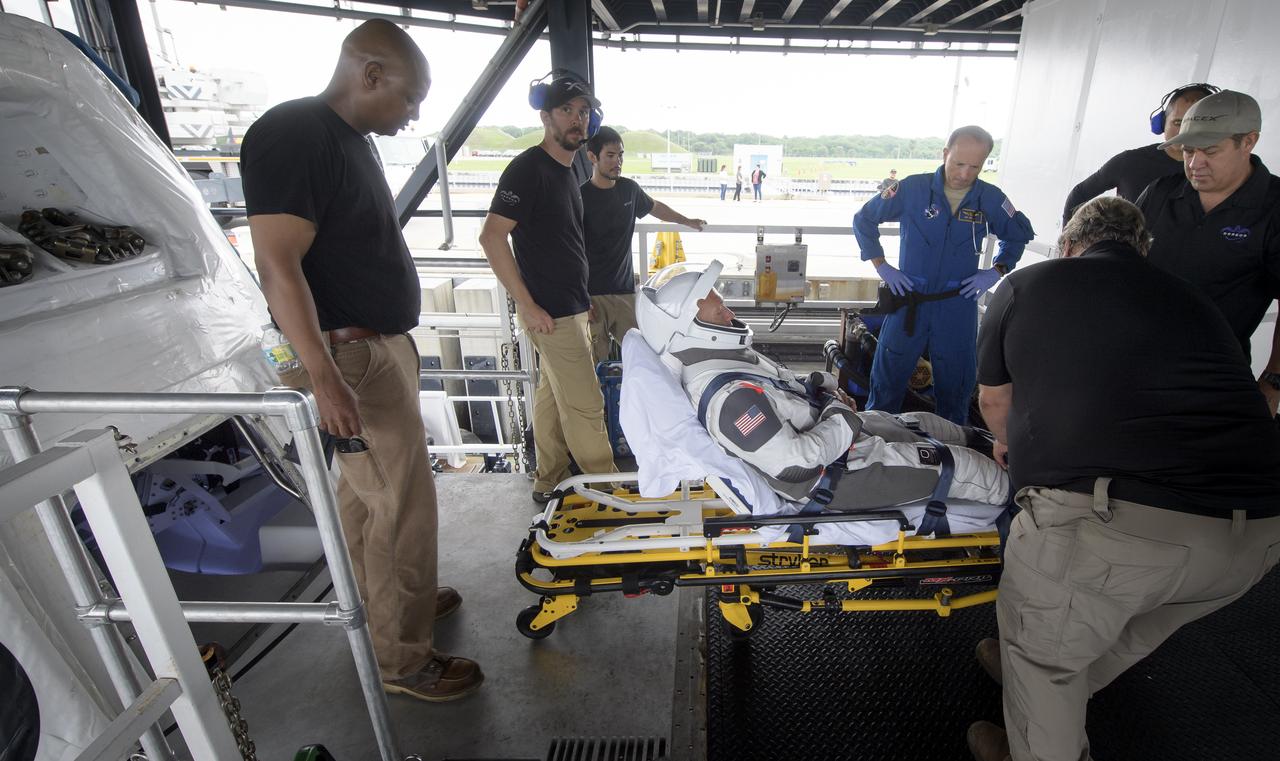
NASA astronaut Doug Hurley, along with teams from NASA and SpaceX, rehearse crew extraction from SpaceX’s Crew Dragon, which will be used to carry humans to the International Space Station, on August 13, 2019 at the Trident Basin in Cape Canaveral, Florida. Using the Go Searcher ship SpaceX uses to recover their spacecraft after splashdown and a mock-up of the Crew Dragon, the teams worked through the steps necessary to get NASA astronauts Doug Hurley and Bob Behnken out of the Dragon and back to dry land. Hurley and Behnken will fly to the space station aboard the Crew Dragon for the SpaceX Demo-2 mission. Photo Credit: (NASA/Bill Ingalls)
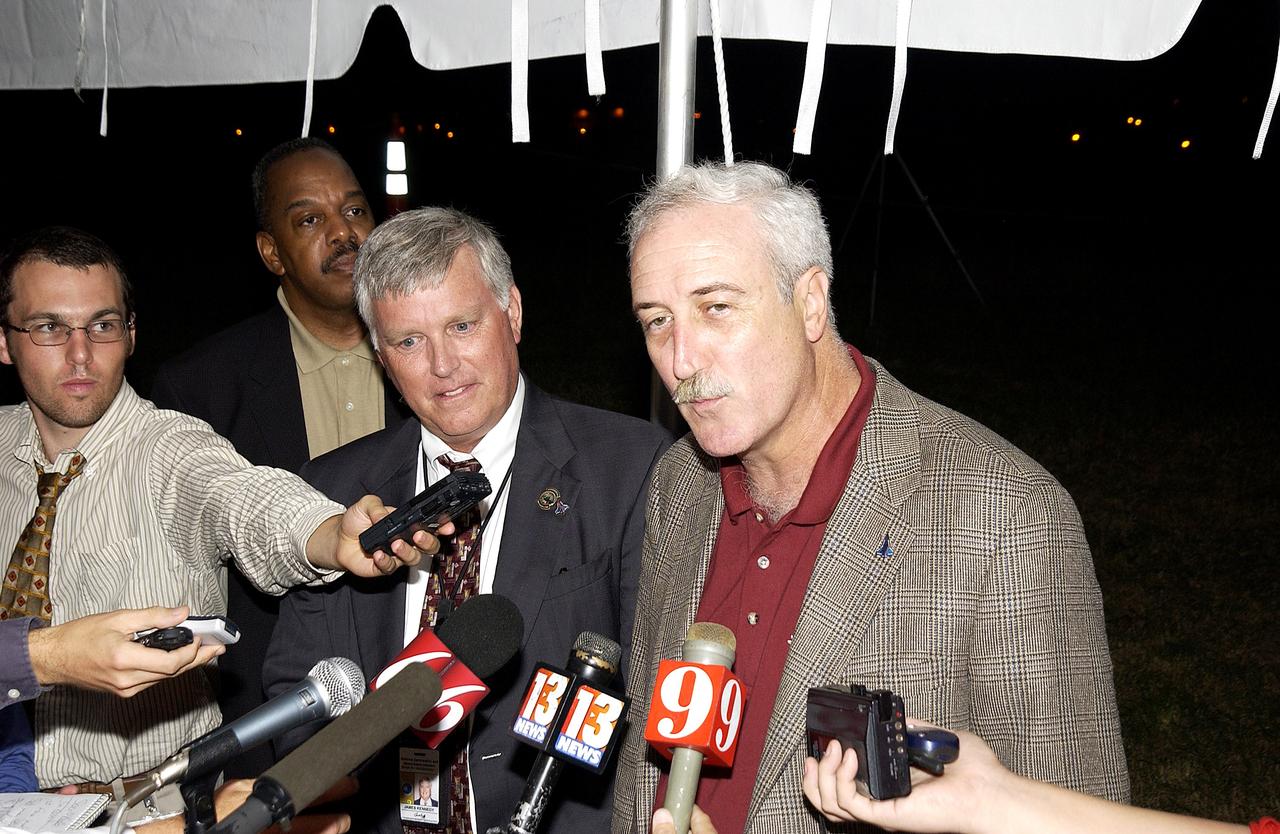
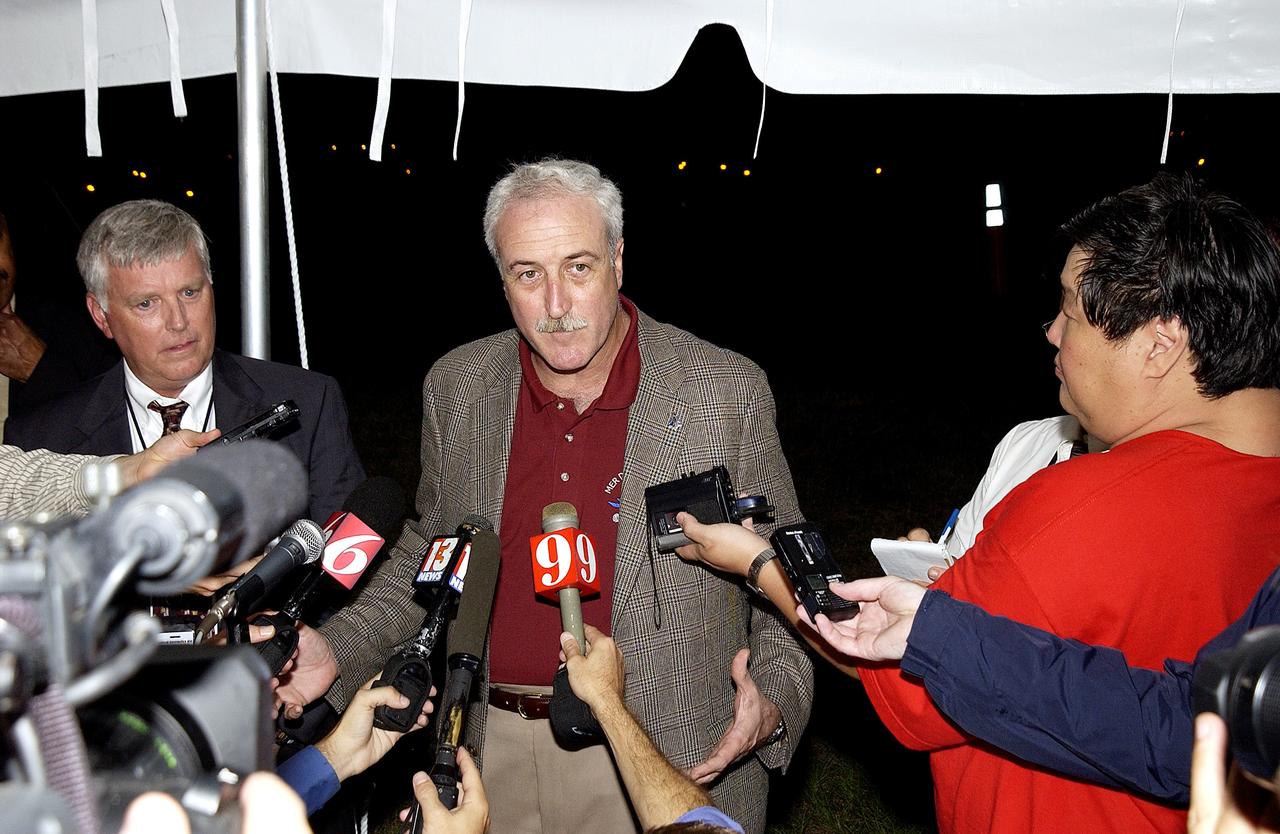
KENNEDY SPACE CENTER, FLA. - Newly appointed KSC Director James W. Kennedy (second from left) and NASA Administrator Sean O'Keefe (right) talk to the media following the launch of the Mars Exploration Rover "Opportunity" at the Trident Basin berm press site at Cape Canaveral Air Force Station.
KENNEDY SPACE CENTER, FLA. - Newly appointed KSC Director James W. Kennedy (left) and NASA Administrator Sean O'Keefe (center) talk to the media following the launch of the Mars Exploration Rover "Opportunity" at the Trident Basin berm press site at Cape Canaveral Air Force Station.
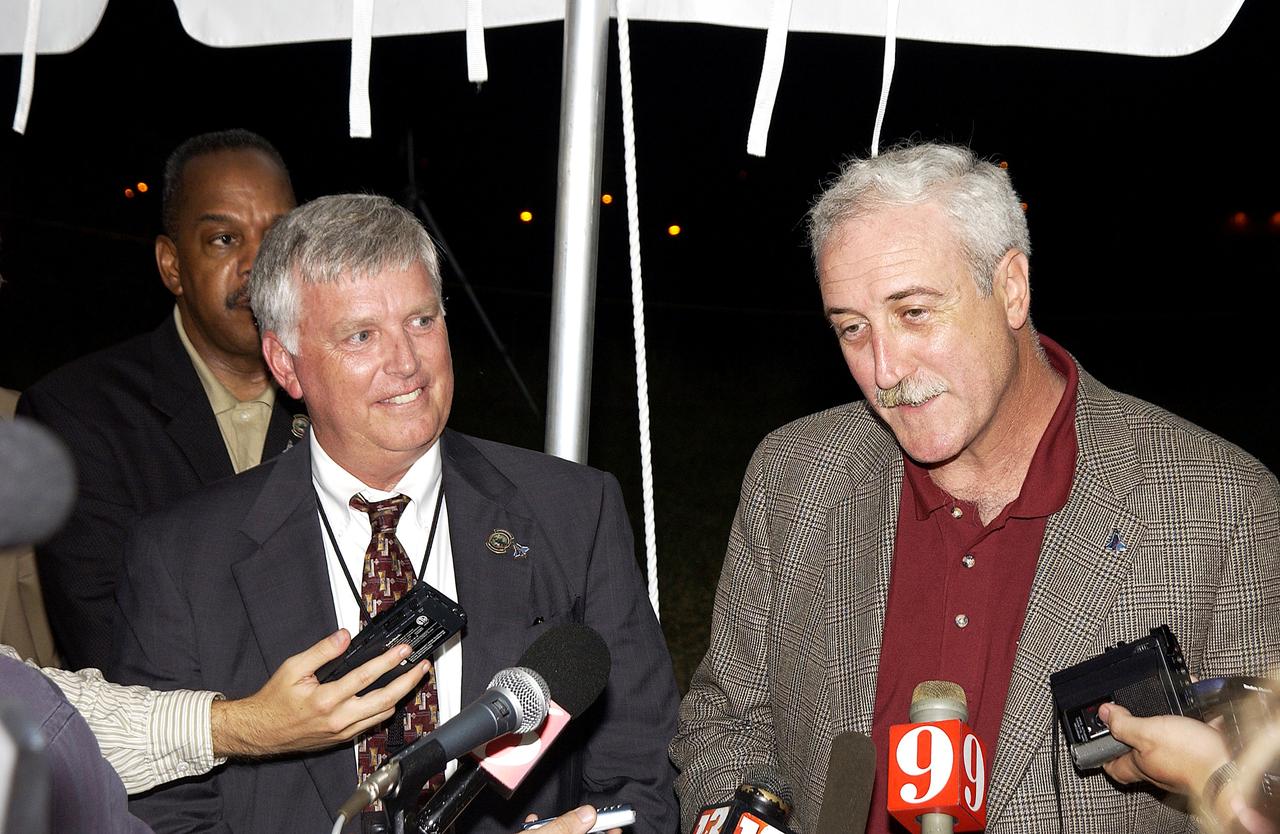
KENNEDY SPACE CENTER, FLA. - Newly appointed KSC Director James W. Kennedy (left) and NASA Administrator Sean O'Keefe (right) talk to the media following the launch of the Mars Exploration Rover "Opportunity" at the Trident Basin berm press site at Cape Canaveral Air Force Station.
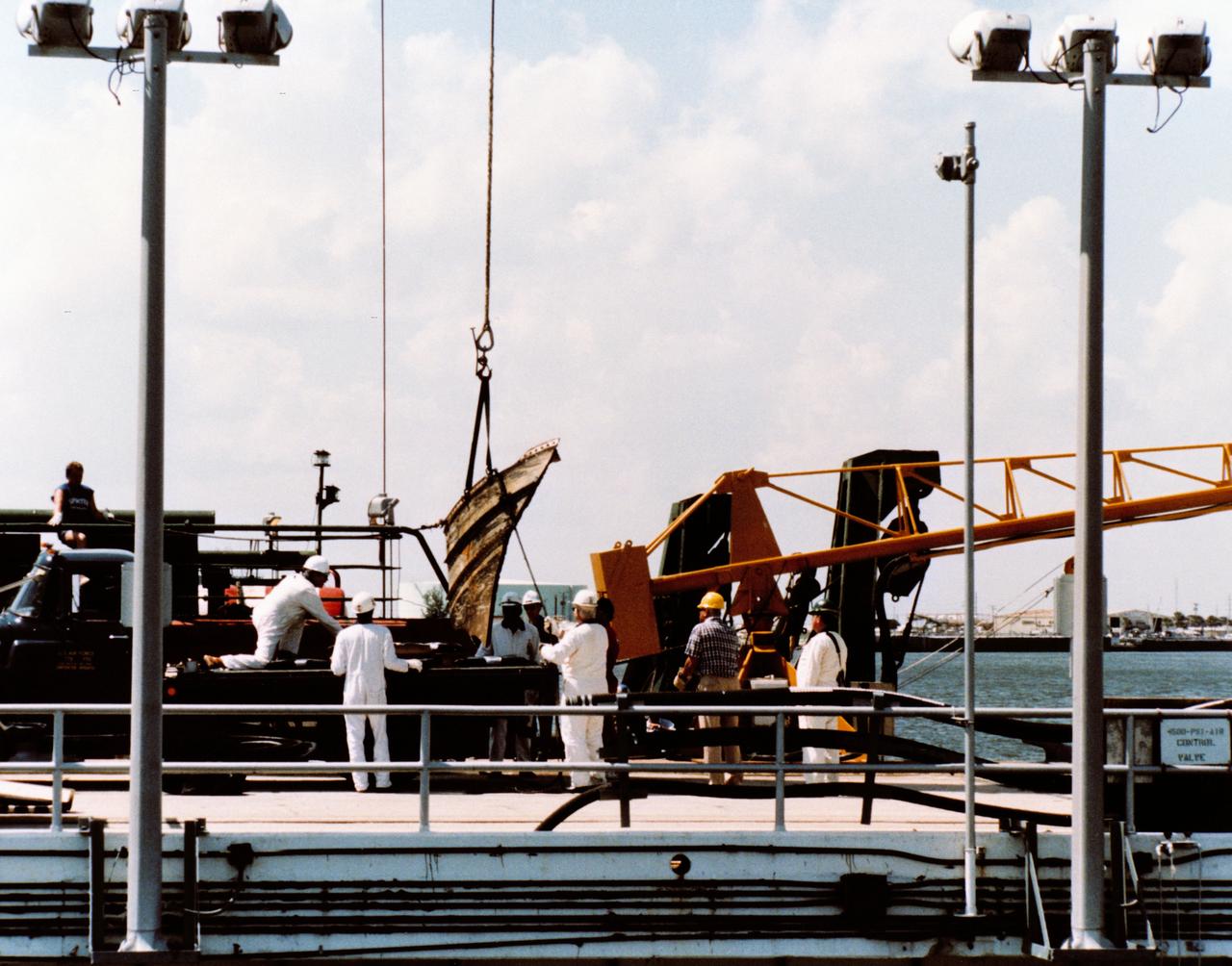
S86-29890 (20 March 1986) --- Stena workhorse arrival and offload of SRB. Trident Basin. (112) (st)
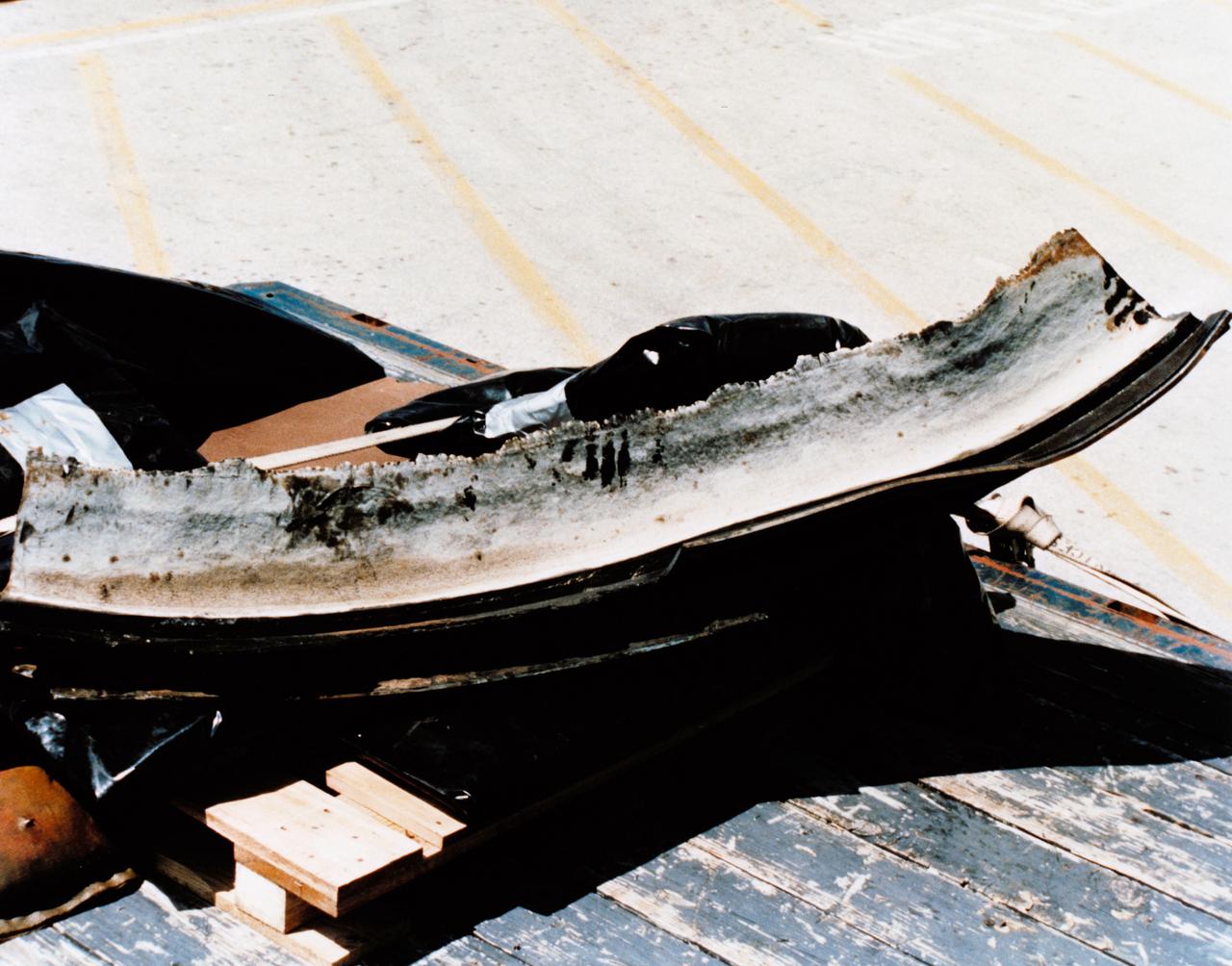
S86-29888 (20 March 1986) --- Stena workhorse arrival and offload of SRB. Trident Basin. (112) (st)
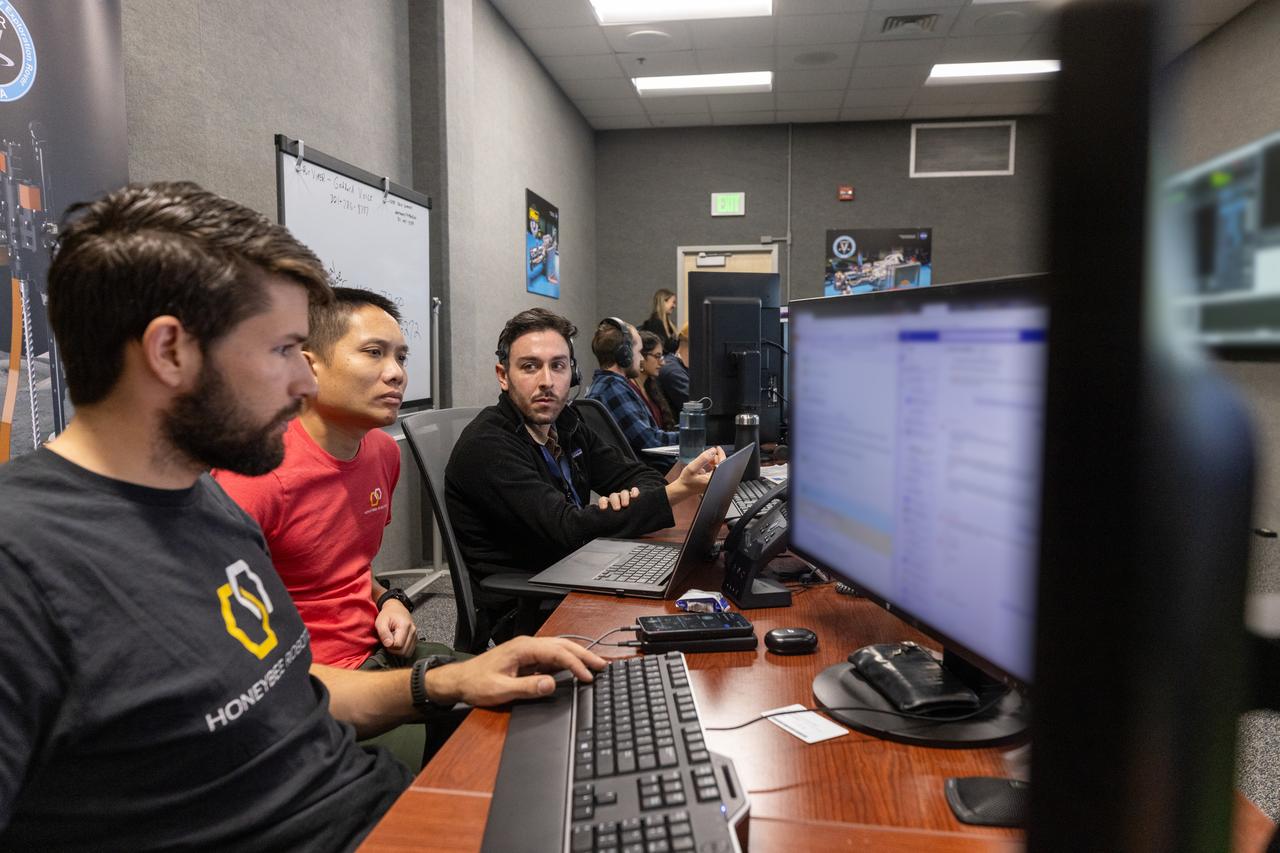
A team from Honeybee Robotics in Altadena, California participates in simulation training for the Polar Resources Ice Mining Experiment-1 (PRIME-1) on Thursday, Nov. 2, 2023, inside the Neil Armstrong Operations and Checkout Building at NASA’s Kennedy Space Center in Florida. The purpose of the training is to get the integrated PRIME-1 team – engineers with PRIME-1’s MSOLO (Mass Spectrometer Observing Lunar Operations) and Honeybee Robotics’ TRIDENT (The Regolith and Ice Drill for Exploring New Terrain) drill – prepared to operate the instrument on the lunar surface. The team commanded the PRIME-1 hardware, located at Intuitive Machines in Houston, to operate MSOLO and TRIDENT. PRIME-1 is scheduled to launch through NASA’s CLPS (Commercial Lunar Payload Delivery Service) initiative and will be the first in-situ resource utilization demonstration on the Moon, with MSOLO and TRIDENT making up its two primary components. Through Artemis missions, CLPS deliveries will be used to perform science experiments, test technologies, and demonstrate capabilities to help NASA explore the Moon and prepare for human deep space exploration missions.

A team of engineers participates in simulation training for the Polar Resources Ice Mining Experiment-1 (PRIME-1) on Thursday, Nov. 2, 2023, inside the Neil Armstrong Operations and Checkout Building at NASA’s Kennedy Space Center in Florida. The purpose of the training is to get the integrated PRIME-1 team – engineers with PRIME-1’s MSOLO (Mass Spectrometer Observing Lunar Operations) and Honeybee Robotics’ TRIDENT (The Regolith and Ice Drill for Exploring New Terrain) drill – prepared to operate the instrument on the lunar surface. The team commanded the PRIME-1 hardware, located at Intuitive Machines in Houston, to operate MSOLO and TRIDENT. PRIME-1 is scheduled to launch through NASA’s CLPS (Commercial Lunar Payload Delivery Service) initiative and will be the first in-situ resource utilization demonstration on the Moon, with MSOLO and TRIDENT making up its two primary components. Through Artemis missions, CLPS deliveries will be used to perform science experiments, test technologies, and demonstrate capabilities to help NASA explore the Moon and prepare for human deep space exploration missions.

ISS036-S-001 (January 2012) --- The dynamic design of the Expedition 36 patch portrays the International Space Station?s (ISS) iconic solar arrays. The slanted angles denote a kinetic energy leading from the Earth in the lower right to the upper left tip of the triangular shape of the patch, representing the infinite scientific research, education, and long-duration spaceflight capabilities the ISS provides with each mission, as well as our goal for future exploration beyond the Space Station. The numbers 3 and 6 harmoniously intertwine to form expedition number 36 and its gray coloration signifies the unity and neutrality among all of the international partners of the ISS. The blue and gold color scheme of the patch represents the subtle way the central gold orbit wraps around the number 36 to form a trident at its lower right tip. The trident also symbolizes the sea, air, and land, all of which make up the Earth from where the trident originates in the design. The NASA insignia design for shuttle and space station flights is reserved for use by the astronauts and for other official use as the NASA Administrator may authorize. Public availability has been approved only in the form of illustrations by the various news media. When and if there is any change in this policy, which is not anticipated, it will be publicly announced. Photo credit: NASA
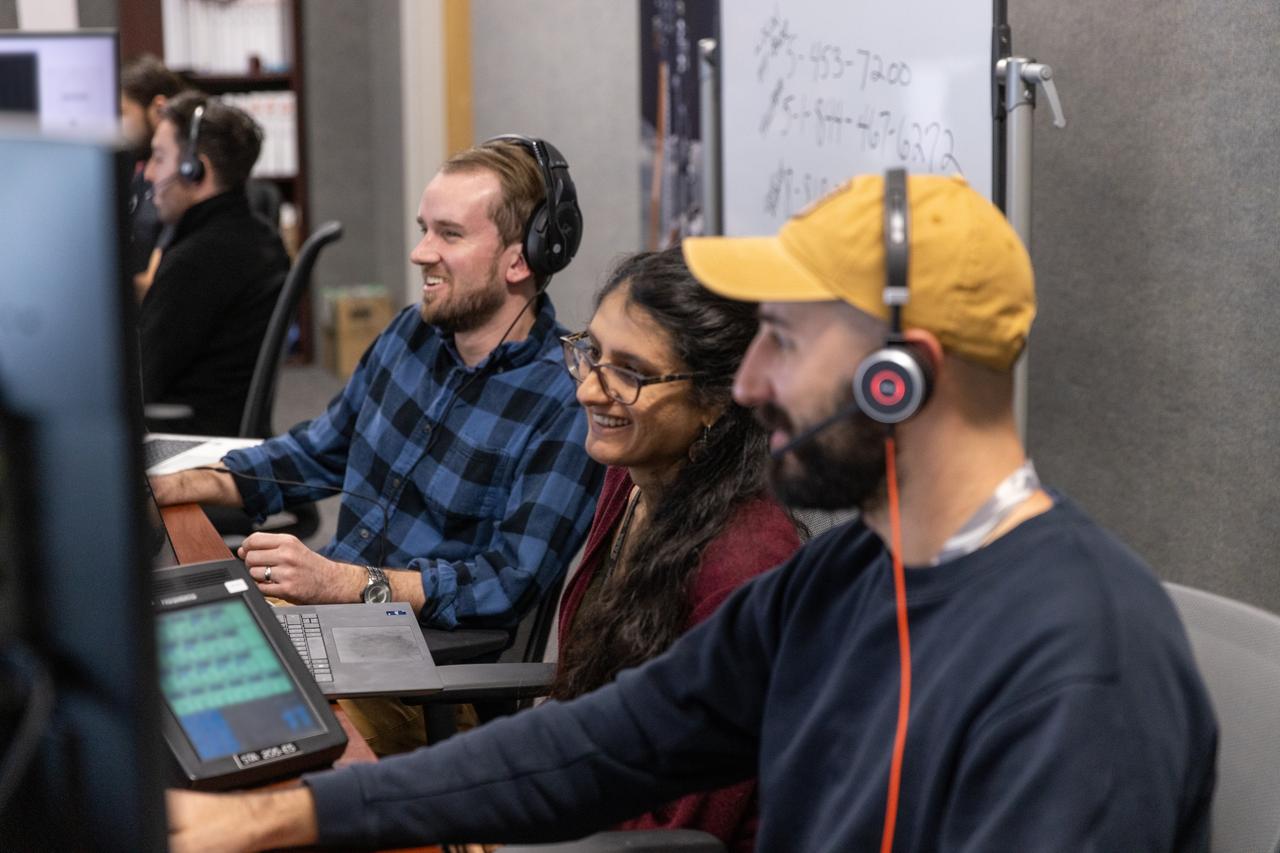
A team of engineers participates in simulation training for the Polar Resources Ice Mining Experiment-1 (PRIME-1) on Thursday, Nov. 2, 2023, inside the Neil Armstrong Operations and Checkout Building at NASA’s Kennedy Space Center in Florida. The purpose of the training is to get the integrated PRIME-1 team – engineers with PRIME-1’s MSOLO (Mass Spectrometer Observing Lunar Operations) and Honeybee Robotics’ TRIDENT (The Regolith and Ice Drill for Exploring New Terrain) drill – prepared to operate the instrument on the lunar surface. The team commanded the PRIME-1 hardware, located at Intuitive Machines in Houston, to operate MSOLO and TRIDENT. PRIME-1 is scheduled to launch through NASA’s CLPS (Commercial Lunar Payload Delivery Service) initiative and will be the first in-situ resource utilization demonstration on the Moon, with MSOLO and TRIDENT making up its two primary components. Through Artemis missions, CLPS deliveries will be used to perform science experiments, test technologies, and demonstrate capabilities to help NASA explore the Moon and prepare for human deep space exploration missions.
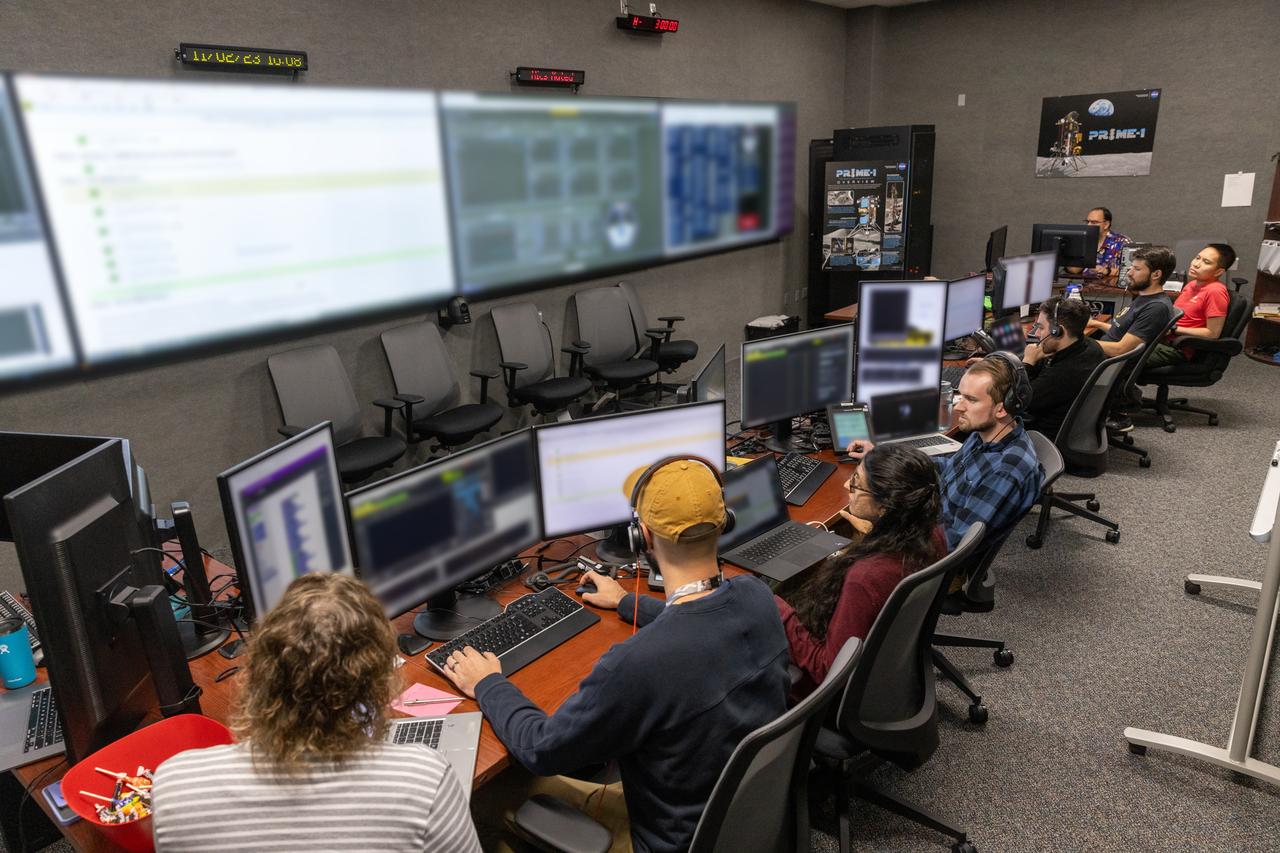
A team of engineers participates in simulation training for the Polar Resources Ice Mining Experiment-1 (PRIME-1) on Thursday, Nov. 2, 2023, inside the Neil Armstrong Operations and Checkout Building at NASA’s Kennedy Space Center in Florida. The purpose of the training is to get the integrated PRIME-1 team – engineers with PRIME-1’s MSOLO (Mass Spectrometer Observing Lunar Operations) and Honeybee Robotics’ TRIDENT (The Regolith and Ice Drill for Exploring New Terrain) drill – prepared to operate the instrument on the lunar surface. The team commanded the PRIME-1 hardware, located at Intuitive Machines in Houston, to operate MSOLO and TRIDENT. PRIME-1 is scheduled to launch through NASA’s CLPS (Commercial Lunar Payload Delivery Service) initiative and will be the first in-situ resource utilization demonstration on the Moon, with MSOLO and TRIDENT making up its two primary components. Through Artemis missions, CLPS deliveries will be used to perform science experiments, test technologies, and demonstrate capabilities to help NASA explore the Moon and prepare for human deep space exploration missions.
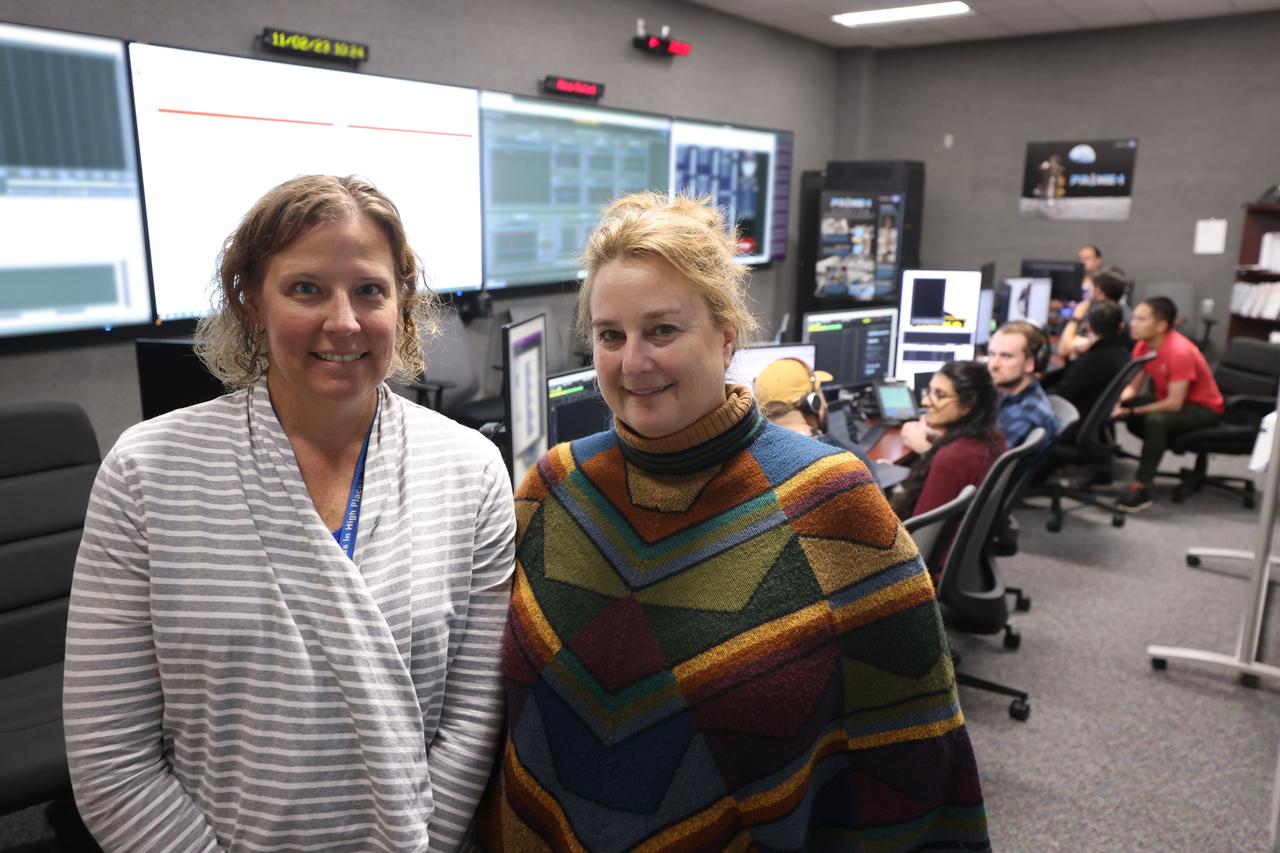
Janine Captain, left, and Jackie Quinn participate in simulation training for the Polar Resources Ice Mining Experiment-1 (PRIME-1) on Thursday, Nov. 2, 2023, inside the Neil Armstrong Operations and Checkout Building at NASA’s Kennedy Space Center in Florida. The purpose of the training is to get the integrated PRIME-1 team – engineers with PRIME-1’s MSOLO (Mass Spectrometer Observing Lunar Operations) and Honeybee Robotics’ TRIDENT (Regolith and Ice Drill for Exploring New Terrain) drill – prepared to operate the instrument on the lunar surface. The team commanded the PRIME-1 hardware, located at Intuitive Machines in Houston, to operate MSOLO and TRIDENT. PRIME-1 is scheduled to launch through NASA’s CLPS (Commercial Lunar Payload Delivery Service) initiative and will be the first in-situ resource utilization demonstration on the Moon, with MSOLO and TRIDENT making up its two primary components. Through Artemis missions, CLPS deliveries will be used to perform science experiments, test technologies, and demonstrate capabilities to help NASA explore the Moon and prepare for human deep space exploration missions.
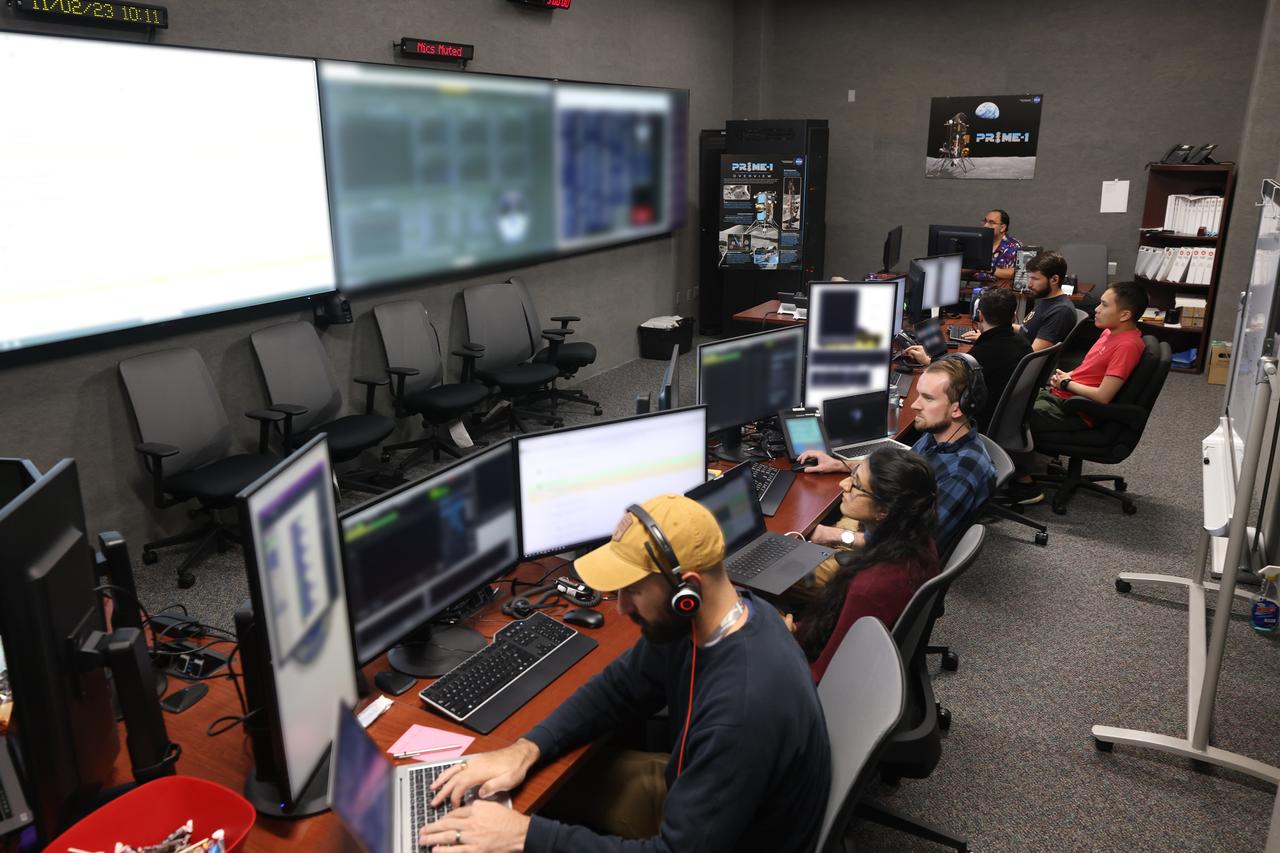
A team of engineers participates in simulation training for the Polar Resources Ice Mining Experiment-1 (PRIME-1) on Thursday, Nov. 2, 2023, inside the Neil Armstrong Operations and Checkout Building at NASA’s Kennedy Space Center in Florida. The purpose of the training is to get the integrated PRIME-1 team – engineers with PRIME-1’s MSOLO (Mass Spectrometer Observing Lunar Operations) and Honeybee Robotics’ TRIDENT (The Regolith and Ice Drill for Exploring New Terrain) drill – prepared to operate the instrument on the lunar surface. The team commanded the PRIME-1 hardware, located at Intuitive Machines in Houston, to operate MSOLO and TRIDENT. PRIME-1 is scheduled to launch through NASA’s CLPS (Commercial Lunar Payload Delivery Service) initiative and will be the first in-situ resource utilization demonstration on the Moon, with MSOLO and TRIDENT making up its two primary components. Through Artemis missions, CLPS deliveries will be used to perform science experiments, test technologies, and demonstrate capabilities to help NASA explore the Moon and prepare for human deep space exploration missions.

SpaceX’s Crew Dragon spacecraft arrives in Port Canaveral, Florida, aboard the company’s recovery ship, Go Searcher, on Saturday, March 9, 2019. Crew Dragon splashed down in the Atlantic Ocean, about 200 miles off Florida’s east coast, at 8:45 a.m. EST on March 8, after undocking from the International Space Station at 2:32 a.m. As part of the Demo-1 mission, the uncrewed spacecraft docked to the orbiting laboratory on March 3, following a 2:49 a.m. EST liftoff aboard a SpaceX Falcon 9 rocket from Launch Complex 39A at NASA’s Kennedy Space Center in Florida on March 2. SpaceX’s inaugural flight with NASA’s Commercial Crew Program is the first flight test of a space system designed for humans built and operated by a commercial company through a public-private partnership. NASA and SpaceX will use data from Demo-1 to further prepare for Demo-2, the crewed flight test that will carry NASA astronauts Bob Behnken and Doug Hurley to the International Space Station later this year.
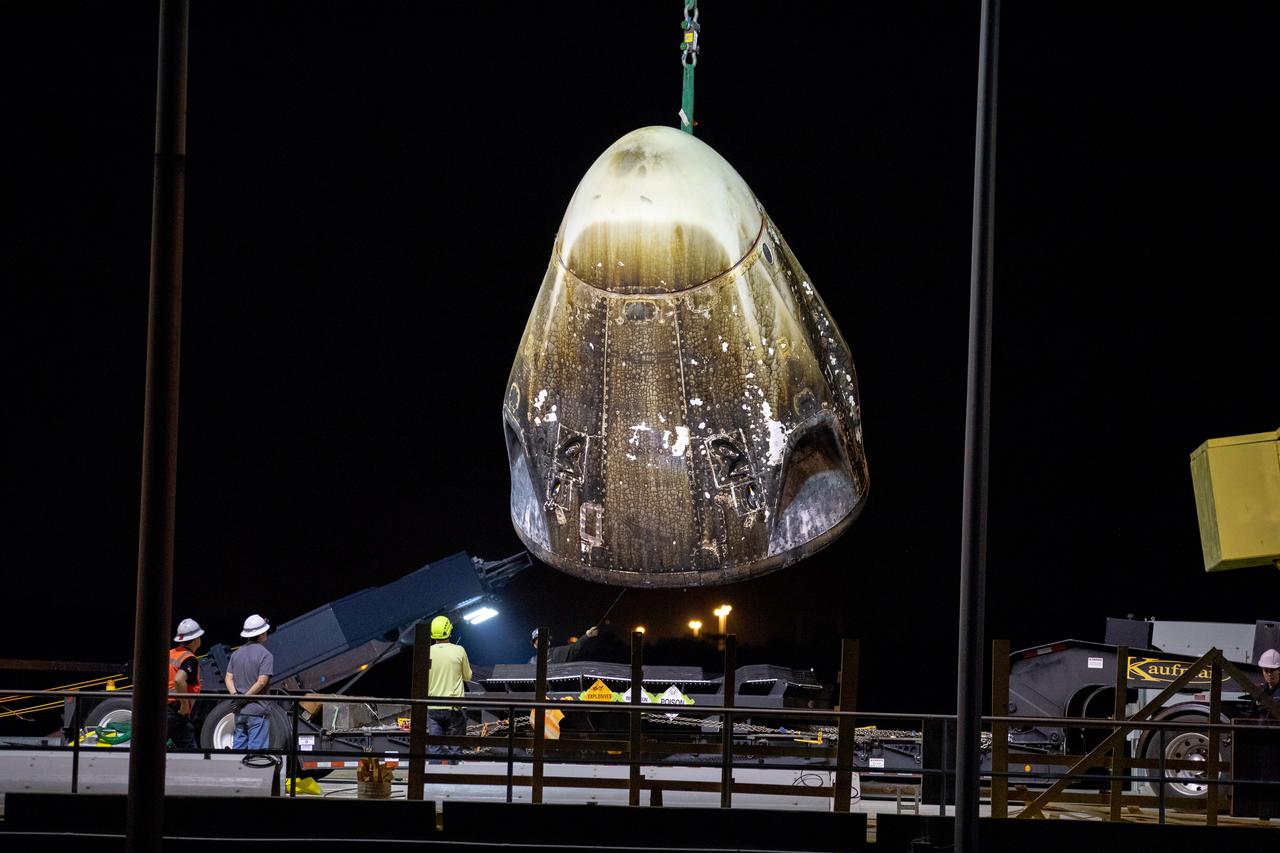
The SpaceX Crew Dragon spacecraft is offloaded from the company’s recovery ship, Go Searcher, in Florida’s Port Canaveral on Saturday, March 9, 2019. Crew Dragon splashed down in the Atlantic Ocean, about 200 miles off Florida’s east coast, at 8:45 a.m. EST on March 8, after undocking from the International Space Station at 2:32 a.m. As part of the Demo-1 mission, the uncrewed spacecraft docked to the orbiting laboratory on March 3, following a 2:49 a.m. EST liftoff aboard a SpaceX Falcon 9 rocket from Launch Complex 39A at NASA’s Kennedy Space Center in Florida on March 2. SpaceX’s inaugural flight with NASA’s Commercial Crew Program is the first flight test of a space system designed for humans built and operated by a commercial company through a public-private partnership. NASA and SpaceX will use data from Demo-1 to further prepare for Demo-2, the crewed flight test that will carry NASA astronauts Bob Behnken and Doug Hurley to the International Space Station later this year.
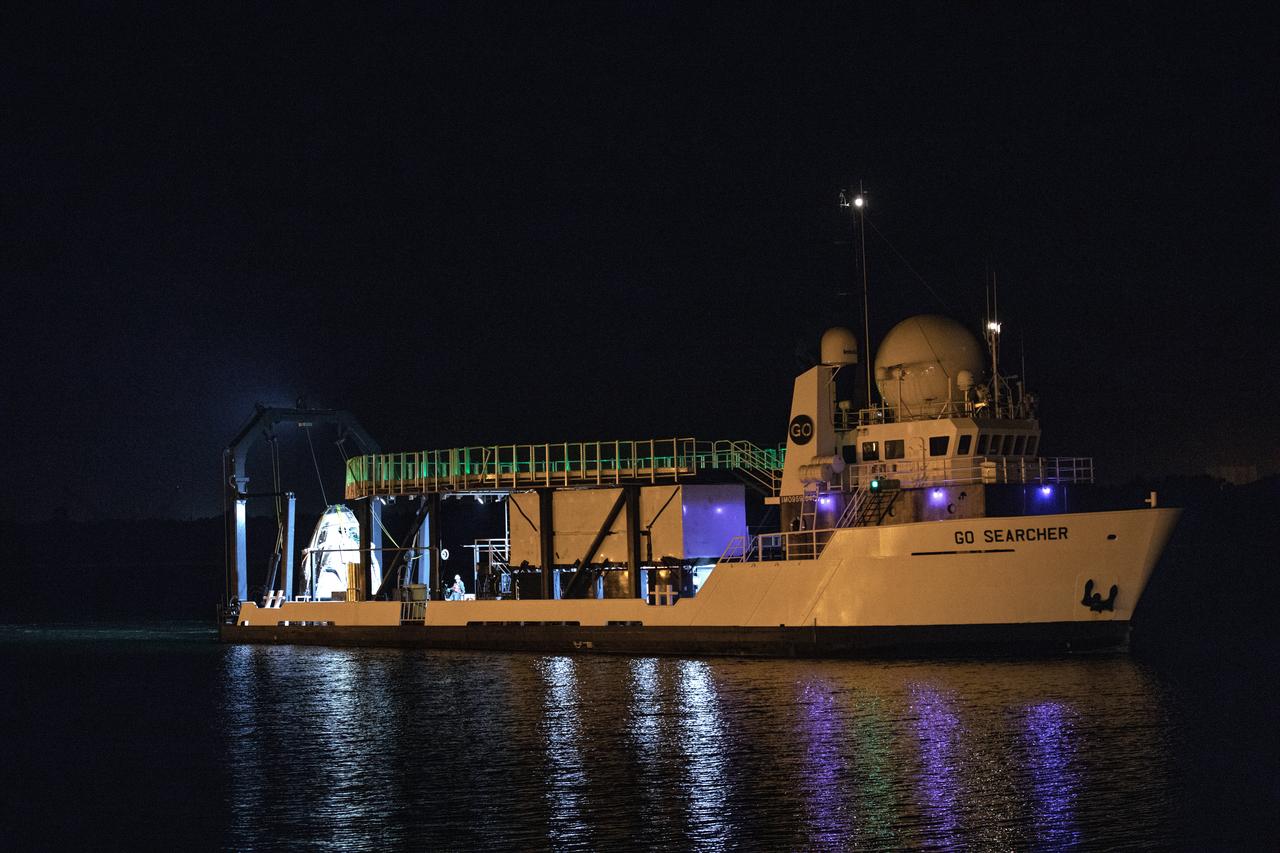
SpaceX’s recovery ship, Go Searcher, enters Port Canaveral in Florida on Saturday, March 9, 2019, with the company’s Crew Dragon spacecraft on its main deck. Crew Dragon splashed down in the Atlantic Ocean, about 200 miles off Florida’s east coast, at 8:45 a.m. EST on March 8, after undocking from the International Space Station at 2:32 a.m. As part of the Demo-1 mission, the uncrewed spacecraft docked to the orbiting laboratory on March 3, following a 2:49 a.m. EST liftoff aboard a SpaceX Falcon 9 rocket from Launch Complex 39A at NASA’s Kennedy Space Center in Florida on March 2. SpaceX’s inaugural flight with NASA’s Commercial Crew Program is the first flight test of a space system designed for humans built and operated by a commercial company through a public-private partnership. NASA and SpaceX will use data from Demo-1 to further prepare for Demo-2, the crewed flight test that will carry NASA astronauts Bob Behnken and Doug Hurley to the International Space Station later this year.

KENNEDY SPACE CENTER, FLA. -- Kennedy Space Center's Advanced Systems Development organization conducts a test of an unmanned robotic submersible to evaluate its ability to assist divers in the task of recovering spent solid rocket boosters (SRBs) in the Atlantic Ocean. NASA and contractor Deep Sea Systems of Falmouth, Mass., demonstrated the Max Rover submersible at Port Canaveral's Trident pier. The fact-finding tests are part of NASA's effort to make SRB recovery operations safer and less strenuous
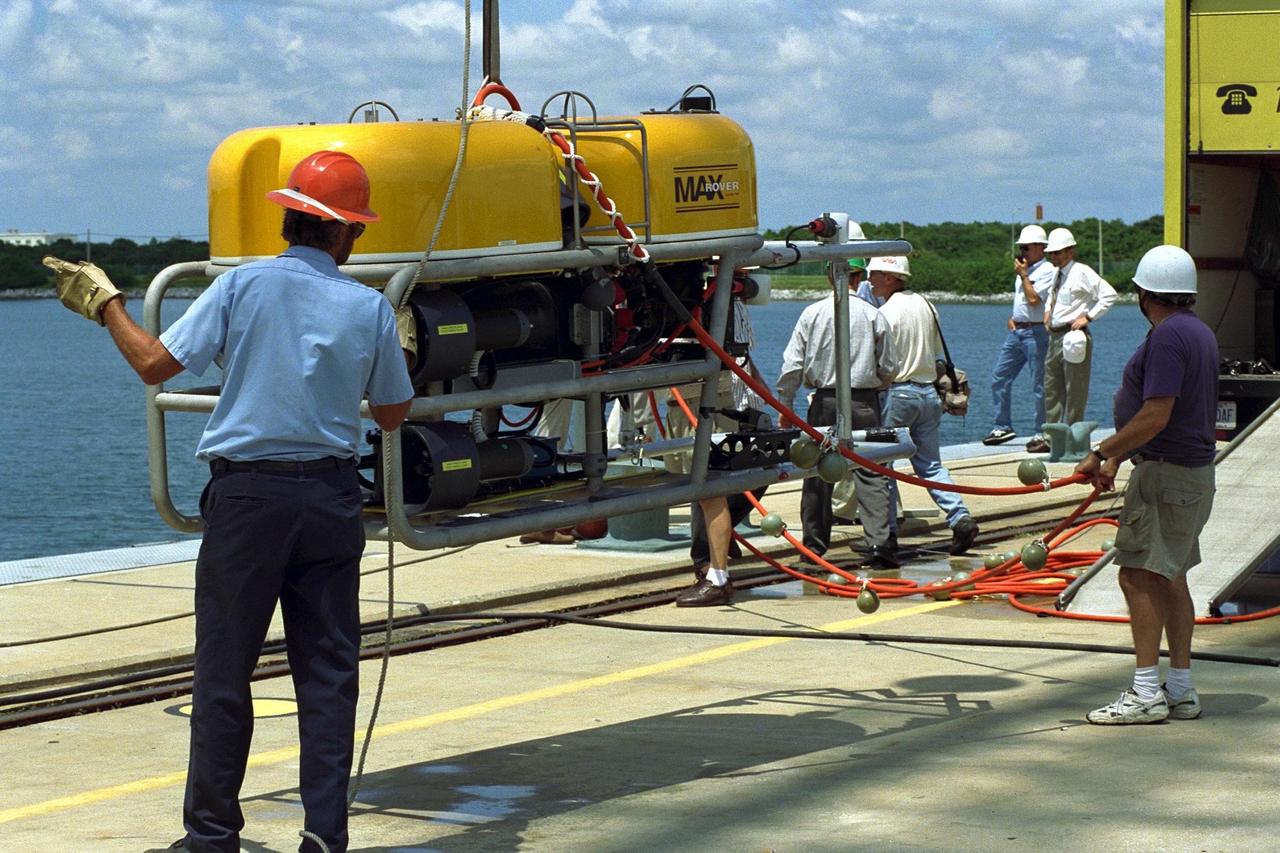
KENNEDY SPACE CENTER, FLA. -- Kennedy Space Center's Advanced Systems Development organization conducts a test of an unmanned robotic submersible to evaluate its ability to assist divers in the task of recovering spent solid rocket boosters (SRBs) in the Atlantic Ocean. NASA and contractor Deep Sea Systems of Falmouth, Mass., demonstrated the Max Rover submersible at Port Canaveral's Trident pier. The fact-finding tests are part of NASA's effort to make SRB recovery operations safer and less strenuous
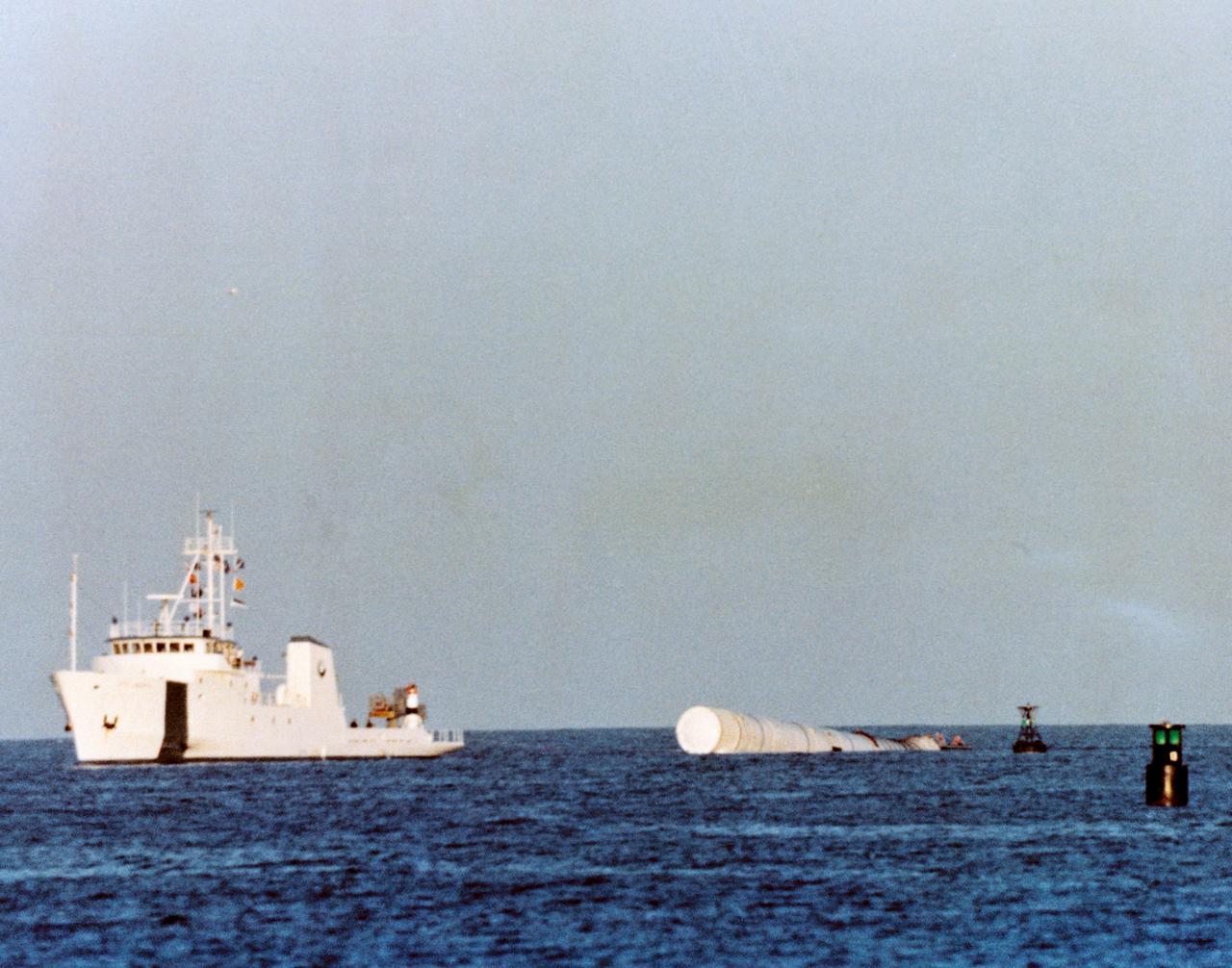
S81-30953 (13 April 1981) --- With one of the two expended solid rocket boosters from the launch of the space shuttle Columbia in tow, the recovery ship UTC Liberty heads toward the Trident Submarine Basin at Port Canaveral, south of NASA's Kennedy Space Center (KSC). The ship, built especially for the task of recovering expended boosters and their parachutes, is bound for ran overnight berth in the submarine basin, before continuing tomorrow toward recovery facilities at KSC. Photo credit: NASA
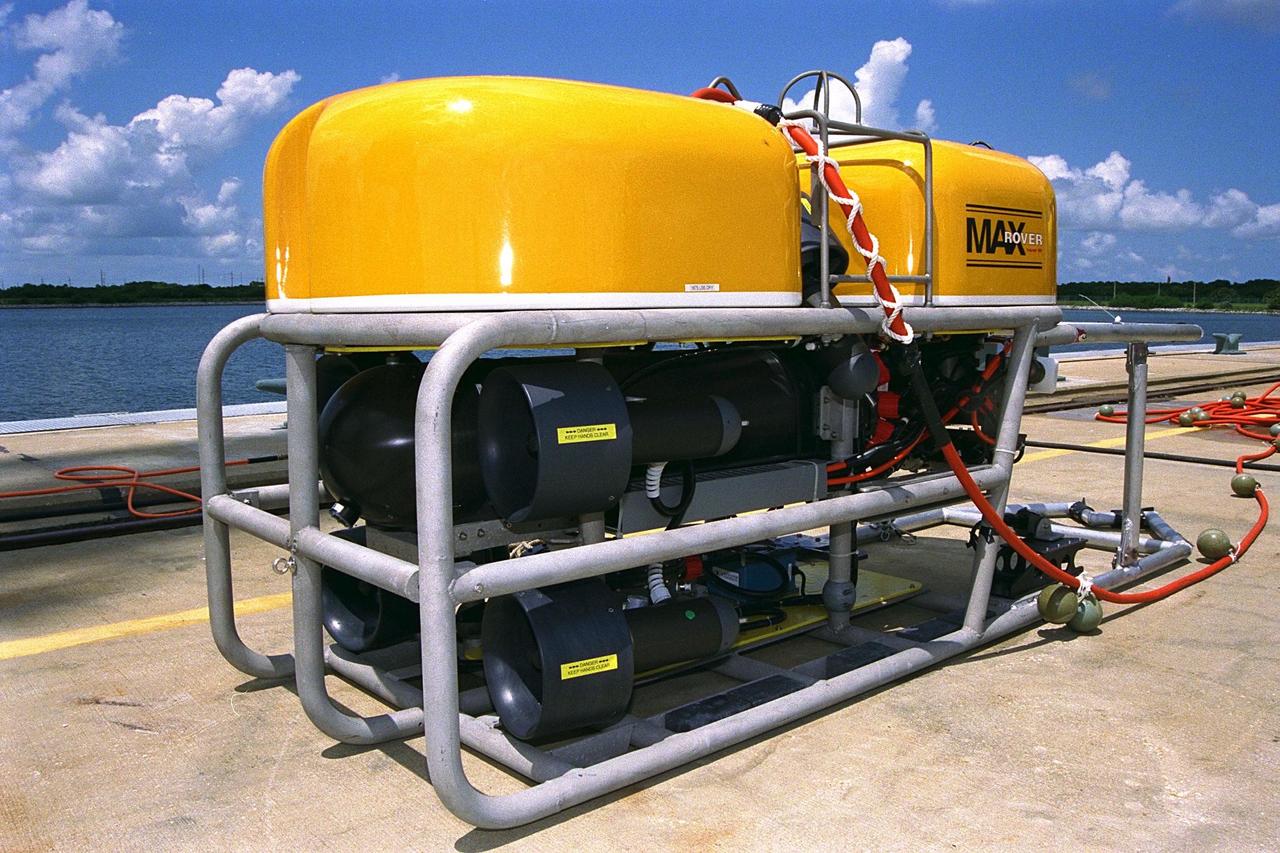
KENNEDY SPACE CENTER, FLA. -- Kennedy Space Center's Advanced Systems Development organization conducts a test of an unmanned robotic submersible to evaluate its ability to assist divers in the task of recovering spent solid rocket boosters (SRBs) in the Atlantic Ocean. NASA and contractor Deep Sea Systems of Falmouth, Mass., demonstrated the Max Rover submersible at Port Canaveral's Trident pier. The fact-finding tests are part of NASA's effort to make SRB recovery operations safer and less strenuous
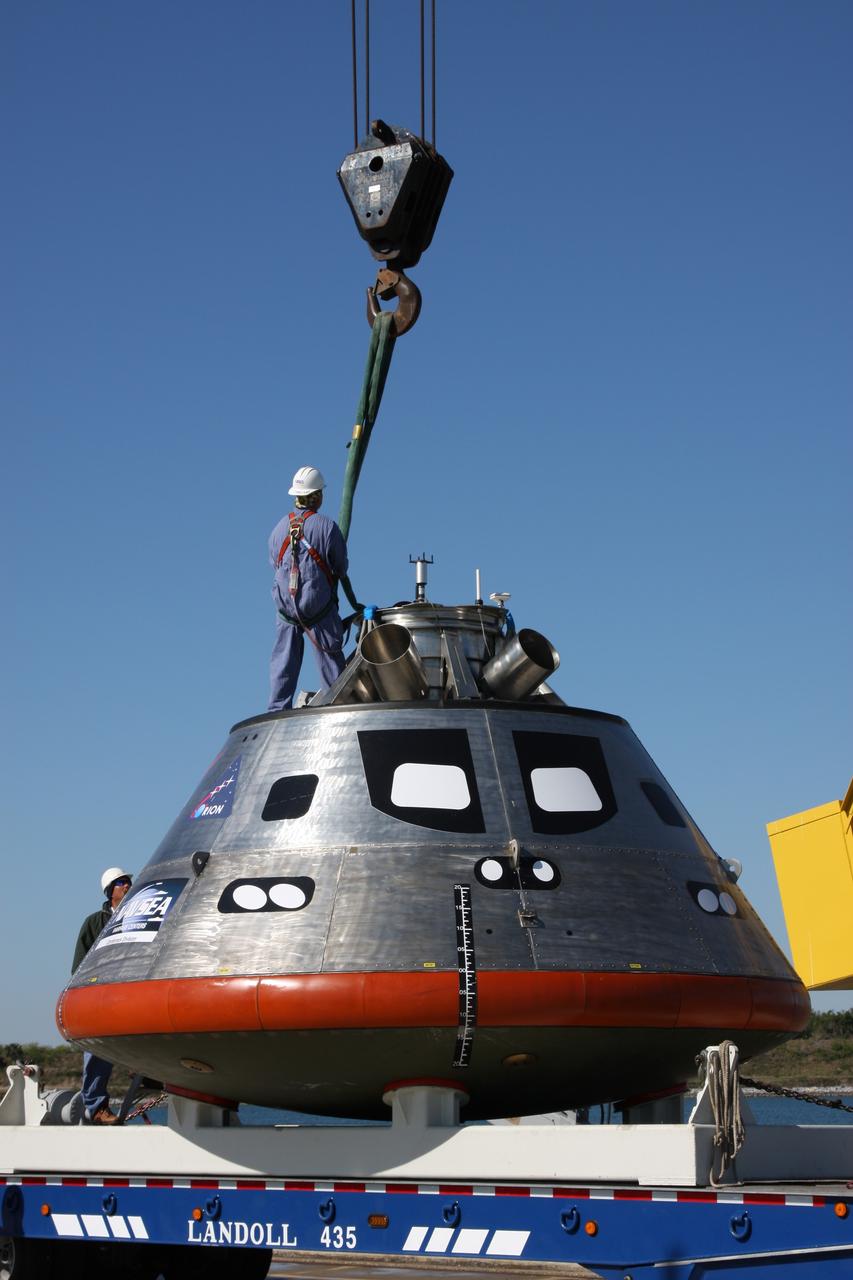
CAPE CANAVERAL, Fla. – The mockup Orion crew exploration vehicle is prepared to be lifted into the water at the Trident Basin at Port Canaveral, Fla., for testing. Orion is targeted to begin carrying humans to the International Space Station in 2015 and to the moon by 2020. The goal of the operation, dubbed the Post-landing Orion Recovery Test, or PORT, is to determine what kind of motion astronauts can expect after landing, as well as outside conditions for recovery teams. Orion, along with the Ares I and V rockets and the Altair lunar lander, are part of the Constellation Program. Photo credit: NASA/Dimitri Gerondidakis
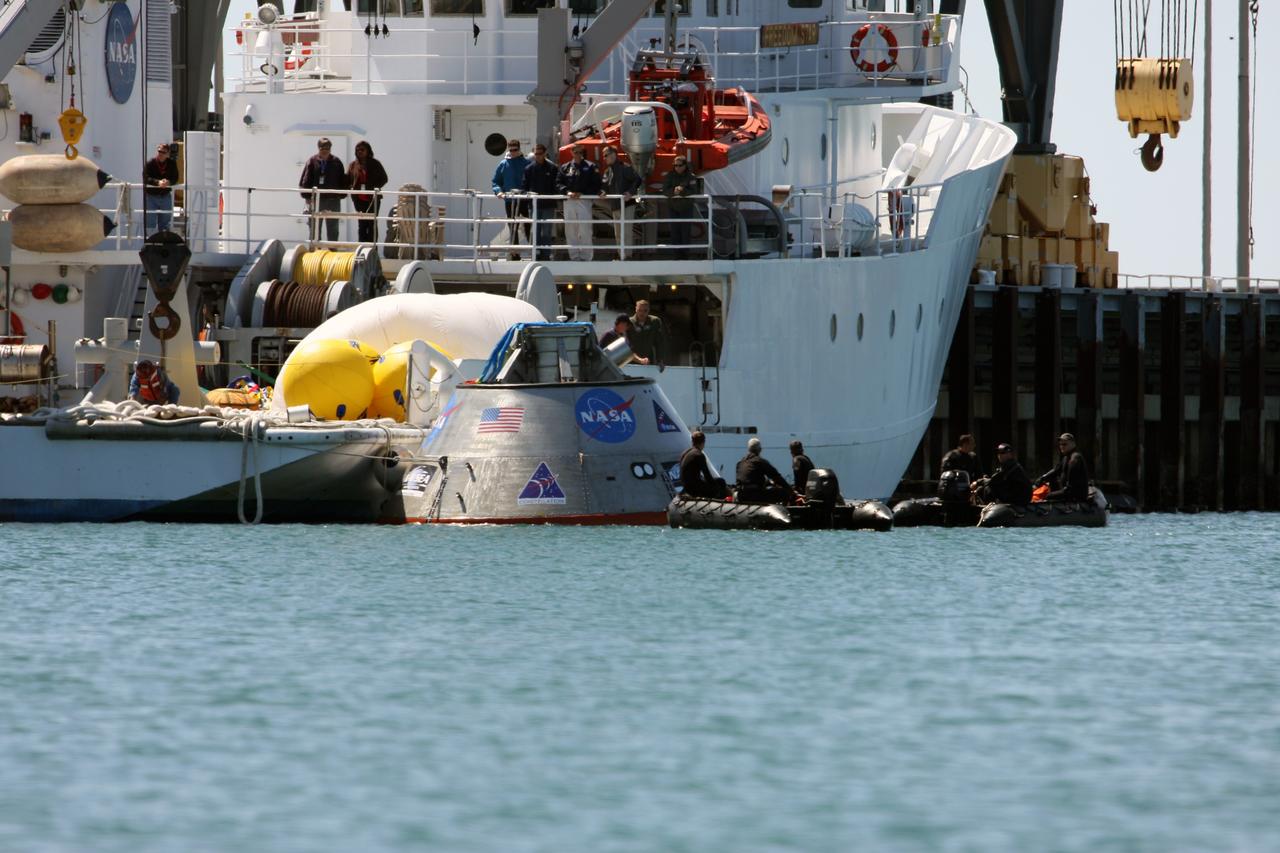
CAPE CANAVERAL, Fla. – The mockup Orion crew exploration vehicle floats in the water at the Trident Basin at Port Canaveral, Fla. Orion is targeted to begin carrying humans to the International Space Station in 2015 and to the moon by 2020. The mockup vehicle will undergo testing in open water. The goal of the operation, dubbed the Post-landing Orion Recovery Test, or PORT, is to determine what kind of motion astronauts can expect after landing, as well as outside conditions for recovery teams. Orion, along with the Ares I and V rockets and the Altair lunar lander, are part of the Constellation Program. Photo credit: NASA/Dimitri Gerondidakis
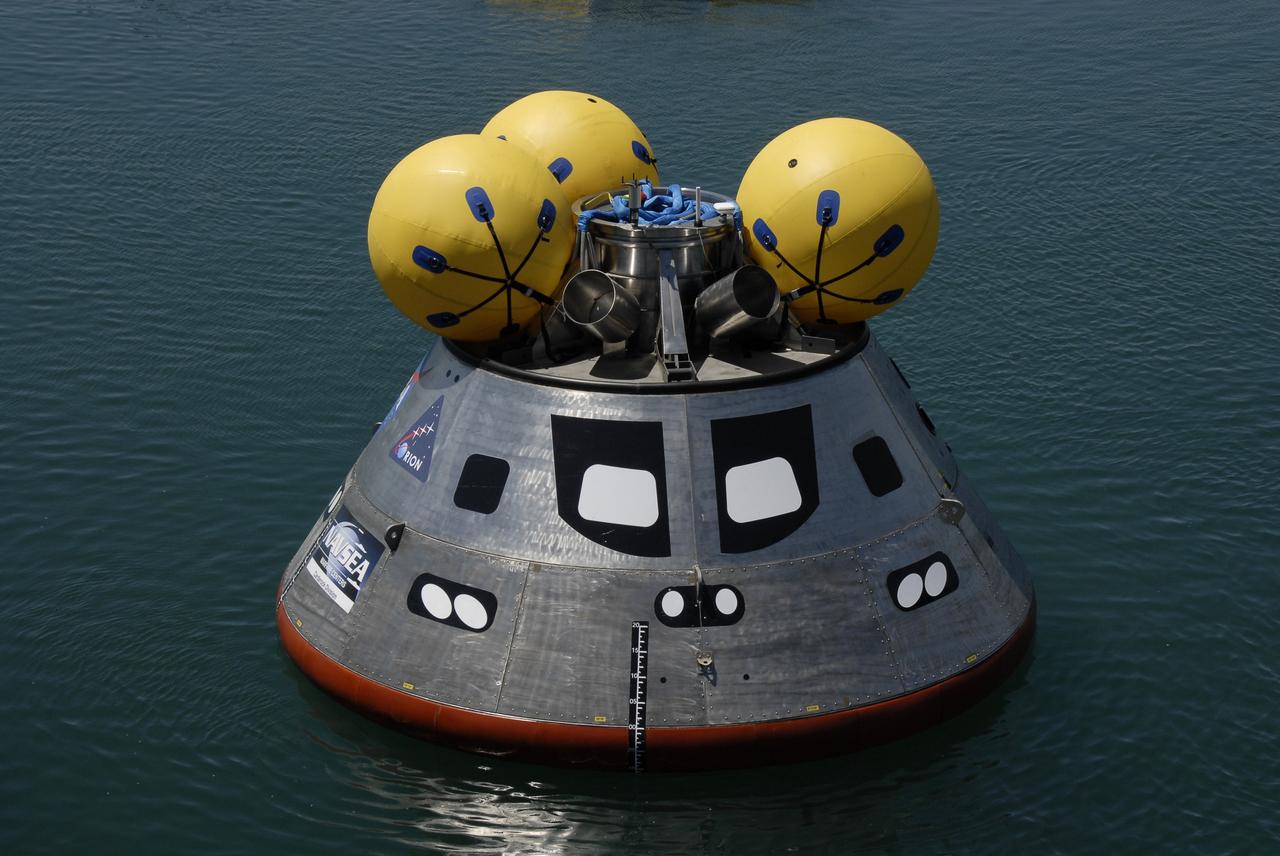
CAPE CANAVERAL, Fla. – The mockup Orion crew exploration vehicle floats in the water at the Trident Basin at Port Canaveral, Fla. On top of Orion are additional flotation devices. Orion is targeted to begin carrying humans to the International Space Station in 2015 and to the moon by 2020. The mockup vehicle is undergoing testing in open water. The goal of the operation, dubbed the Post-landing Orion Recovery Test, or PORT, is to determine what kind of motion astronauts can expect after landing, as well as outside conditions for recovery teams. Orion, along with the Ares I and V rockets and the Altair lunar lander, are part of the Constellation Program. Photo credit: NASA/Kim Shiflett
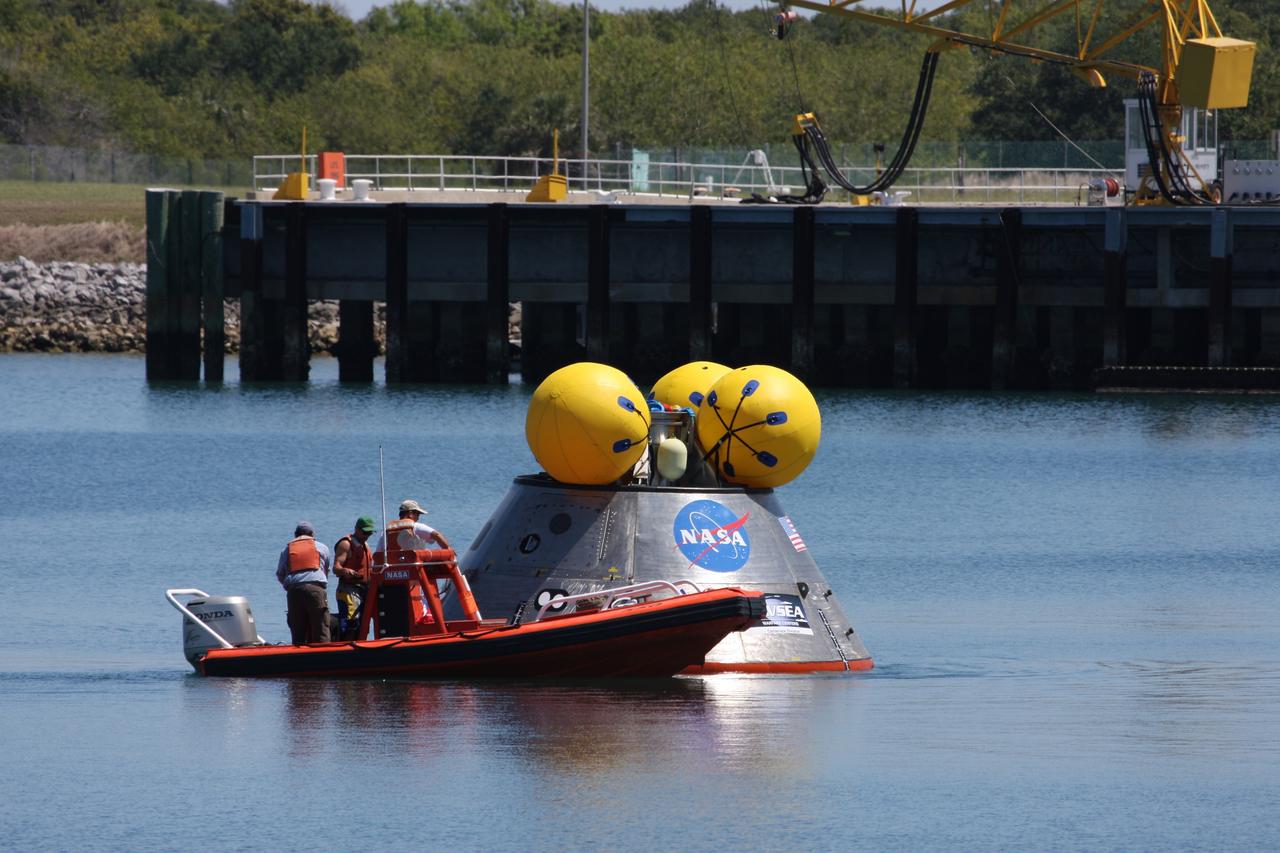
CAPE CANAVERAL, Fla. – Members of the 920th Rescue Wing get ready to release a flotation collar around the mockup Orion crew exploration vehicle at the Trident Basin at Port Canaveral, Fla. On top of Orion are additional flotation devices. The goal of the operation, dubbed the Post-landing Orion Recovery Test, or PORT, is to determine what kind of motion astronauts can expect after landing, as well as outside conditions for recovery teams. Orion is targeted to begin carrying humans to the International Space Station in 2015 and to the moon by 2020. Orion, along with the Ares I and V rockets and the Altair lunar lander, are part of the Constellation Program. Photo credit: NASA/Dimitri Gerondidakis
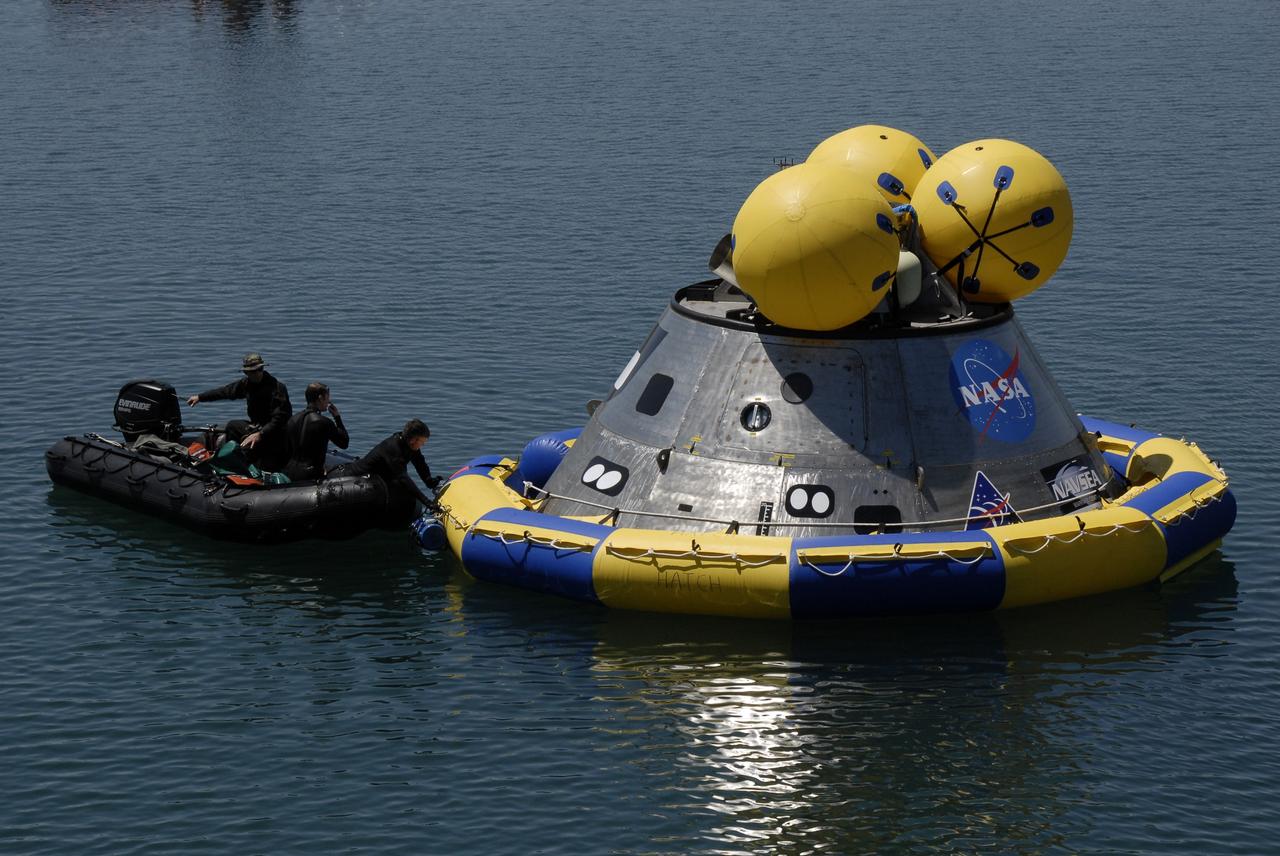
CAPE CANAVERAL, Fla. – Members of the 920th Rescue Wing secure a flotation collar around the mockup Orion crew exploration vehicle at the Trident Basin at Port Canaveral, Fla. On top of Orion are additional flotation devices. The mockup vehicle will undergo testing in open water. The goal of the operation, dubbed the Post-landing Orion Recovery Test, or PORT, is to determine what kind of motion astronauts can expect after landing, as well as outside conditions for recovery teams. Orion is targeted to begin carrying humans to the International Space Station in 2015 and to the moon by 2020. Orion, along with the Ares I and V rockets and the Altair lunar lander, are part of the Constellation Program. Photo credit: NASA/Kim Shiflett
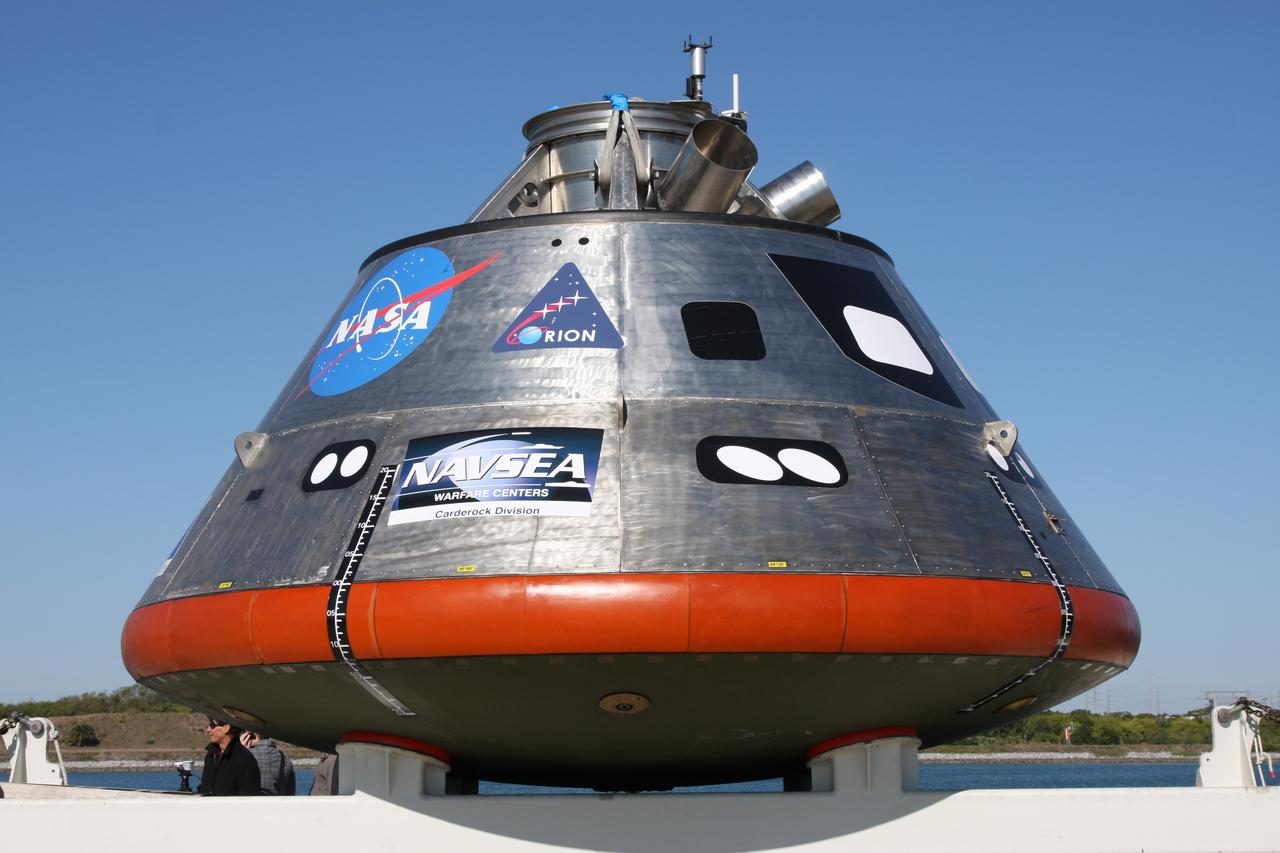
CAPE CANAVERAL, Fla. – The mockup Orion crew exploration vehicle is on the dock at the Trident Basin at Port Canaveral, Fla., waiting to be tested in open waters. Orion is targeted to begin carrying humans to the International Space Station in 2015 and to the moon by 2020. The goal of the operation, dubbed the Post-landing Orion Recovery Test, or PORT, is to determine what kind of motion astronauts can expect after landing, as well as outside conditions for recovery teams. Orion, along with the Ares I and V rockets and the Altair lunar lander, are part of the Constellation Program. Photo credit: NASA/Dimitri Gerondidakis
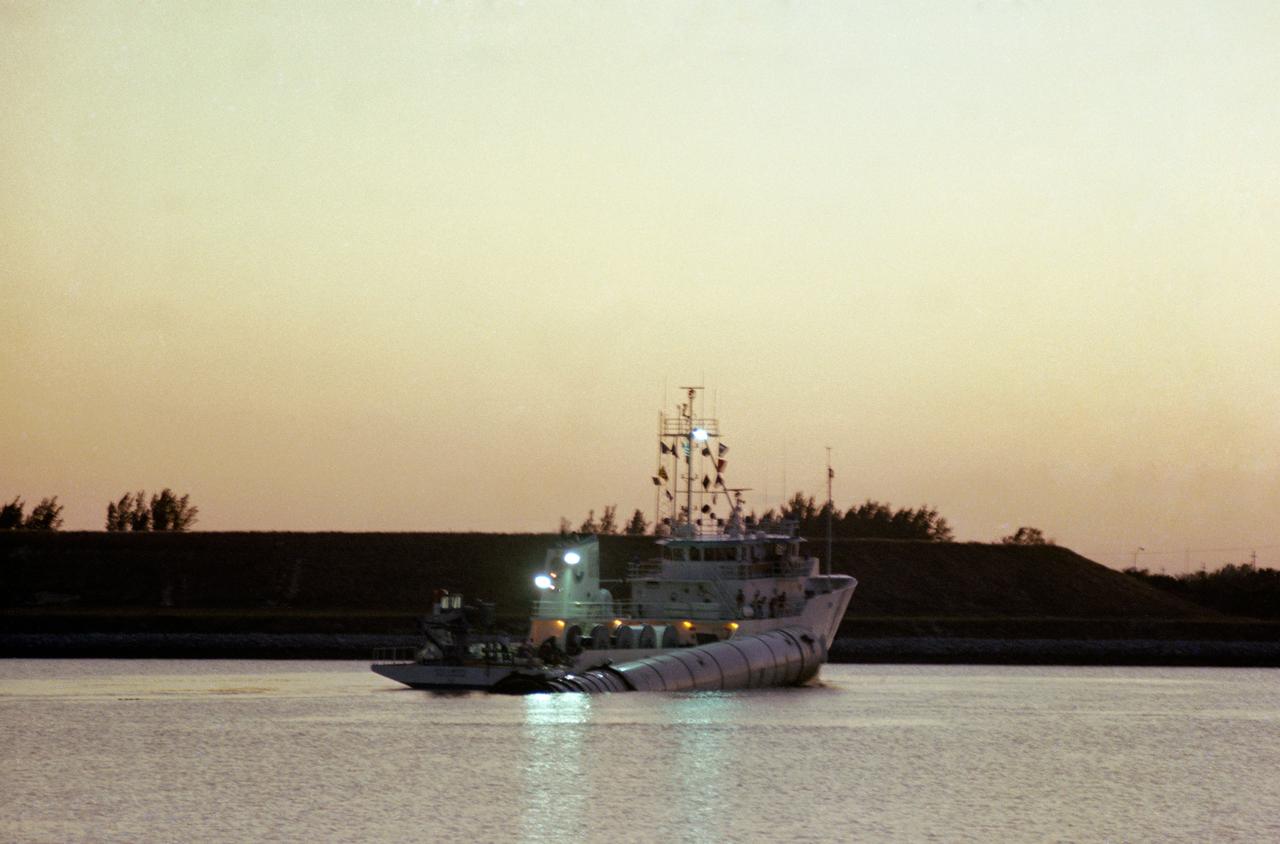
S81-31308 (13 April 1981) --- The solid rocket booster recovery ship UTC Liberty heads for Cape Canaveral Air Force Station after retrieving one of the two booster casings from the launch of Columbia, America?s first space shuttle in orbit. The vessel had been tied up overnight at the Trident Submarine Basin at Port Canaveral, from which point this photograph was made. The boosters and the parachutes that bring them to safe landings in the Atlantic east of NASA's Kennedy Space Center are recovered at sea, dewatered and towed to processing facilities at Cape Canaveral Air Force Station. Photo credit: NASA
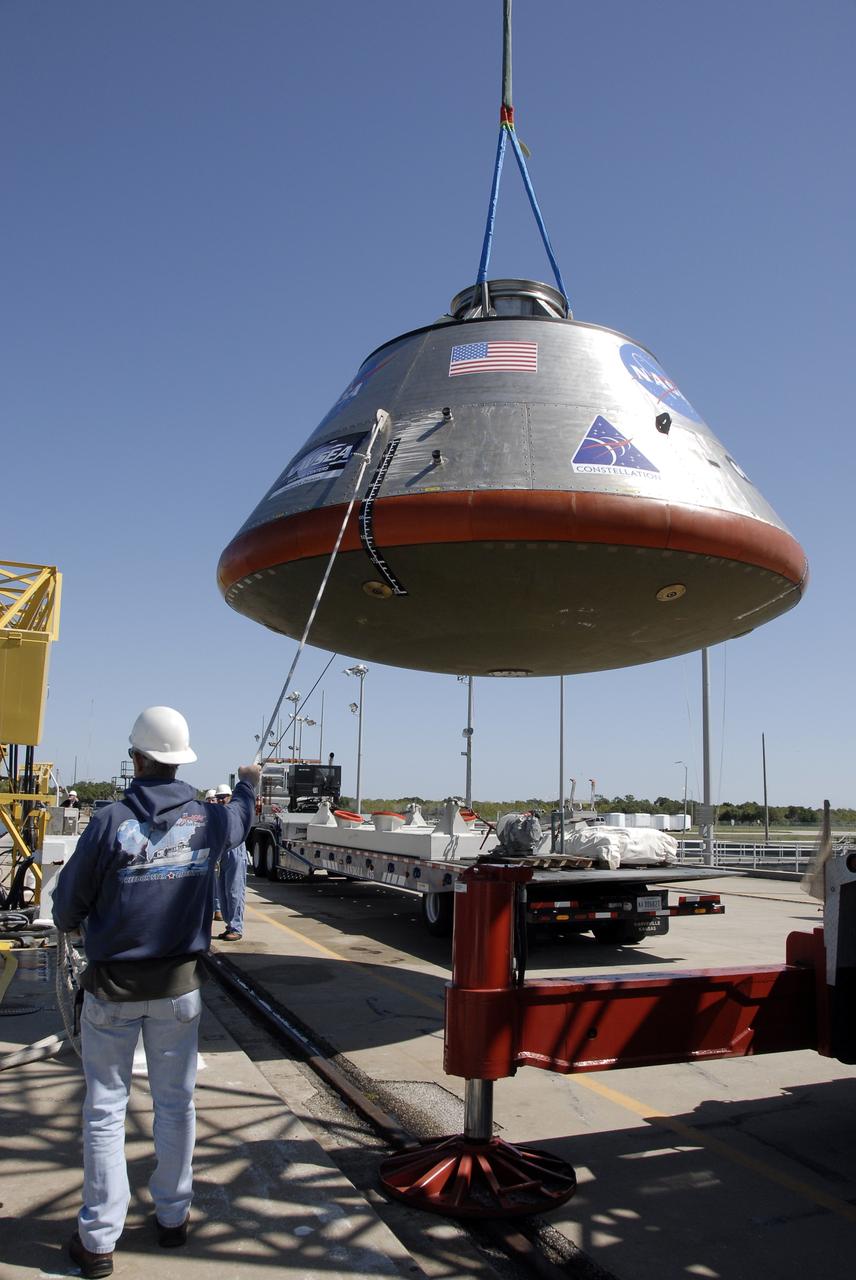
CAPE CANAVERAL, Fla. – The mockup Orion crew exploration vehicle is prepared to be lifted into the water at the Trident Basin at Port Canaveral, Fla., for testing in open water. The goal of the operation, dubbed the Post-landing Orion Recovery Test, or PORT, is to determine what kind of motion astronauts can expect after landing, as well as outside conditions for recovery teams. Orion is targeted to begin carrying humans to the International Space Station in 2015 and to the moon by 2020. Orion, along with the Ares I and V rockets and the Altair lunar lander, are part of the Constellation Program. Photo credit: NASA/Kim Shiflett
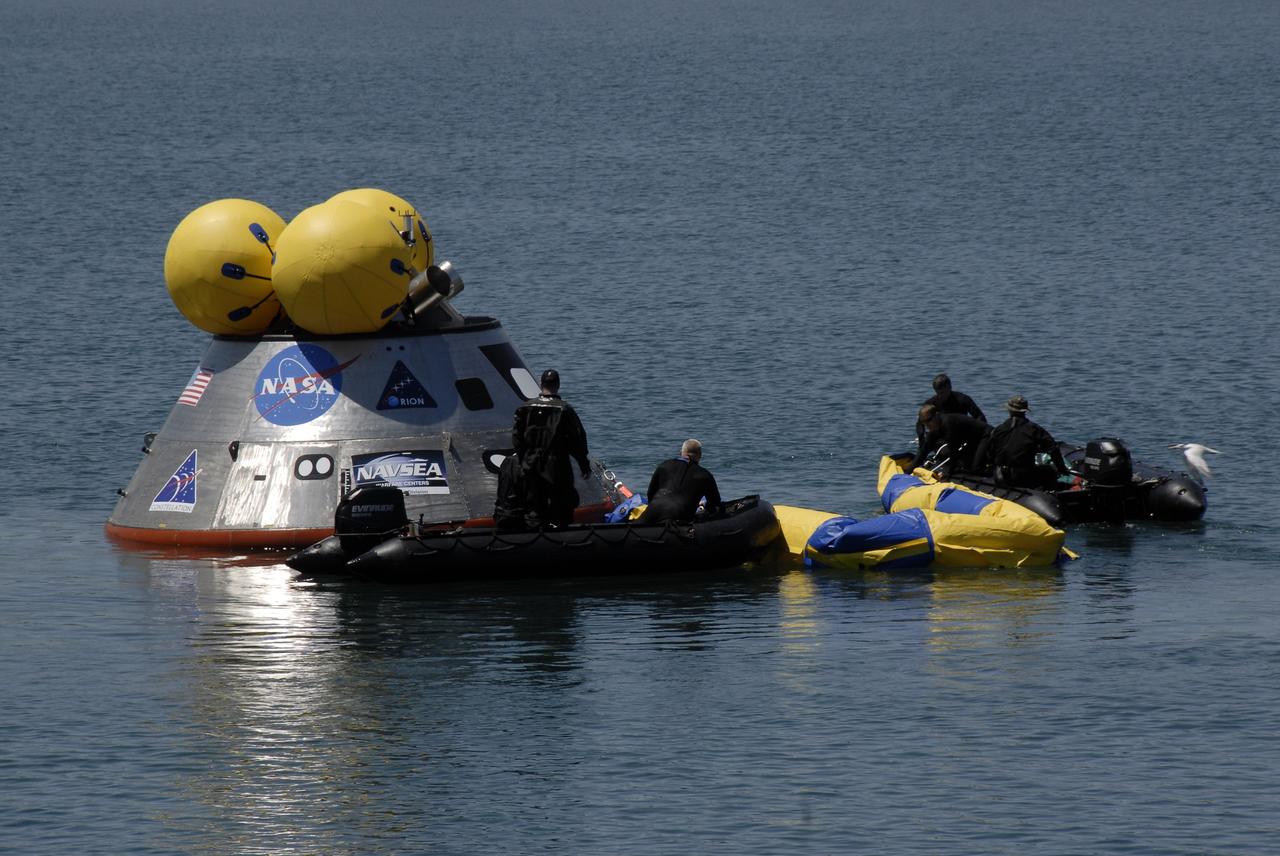
CAPE CANAVERAL, Fla. – Members of the 920th Rescue Wing release a flotation collar around the mockup Orion crew exploration vehicle at the Trident Basin at Port Canaveral, Fla. On top of Orion are additional flotation devices. The mockup vehicle will undergo testing in open water. The goal of the operation, dubbed the Post-landing Orion Recovery Test, or PORT, is to determine what kind of motion astronauts can expect after landing, as well as outside conditions for recovery teams. Orion is targeted to begin carrying humans to the International Space Station in 2015 and to the moon by 2020. Orion, along with the Ares I and V rockets and the Altair lunar lander, are part of the Constellation Program. Photo credit: NASA/Kim Shiflett
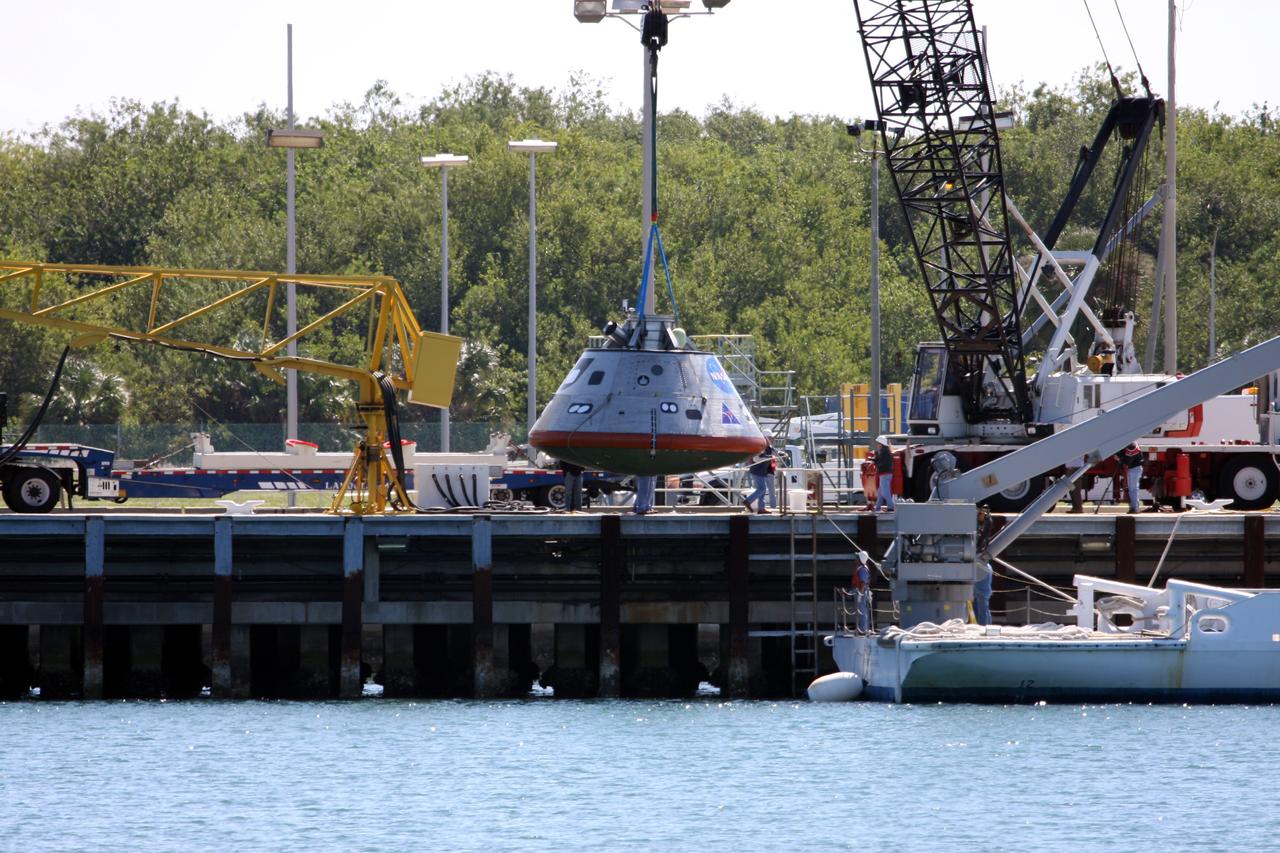
CAPE CANAVERAL, Fla. – The mockup Orion crew exploration vehicle is lowered toward the water at the Trident Basin at Port Canaveral, Fla., for testing. Orion is targeted to begin carrying humans to the International Space Station in 2015 and to the moon by 2020. The goal of the operation, dubbed the Post-landing Orion Recovery Test, or PORT, is to determine what kind of motion astronauts can expect after landing, as well as outside conditions for recovery teams. Orion, along with the Ares I and V rockets and the Altair lunar lander, are part of the Constellation Program. Photo credit: NASA/Dimitri Gerondidakis
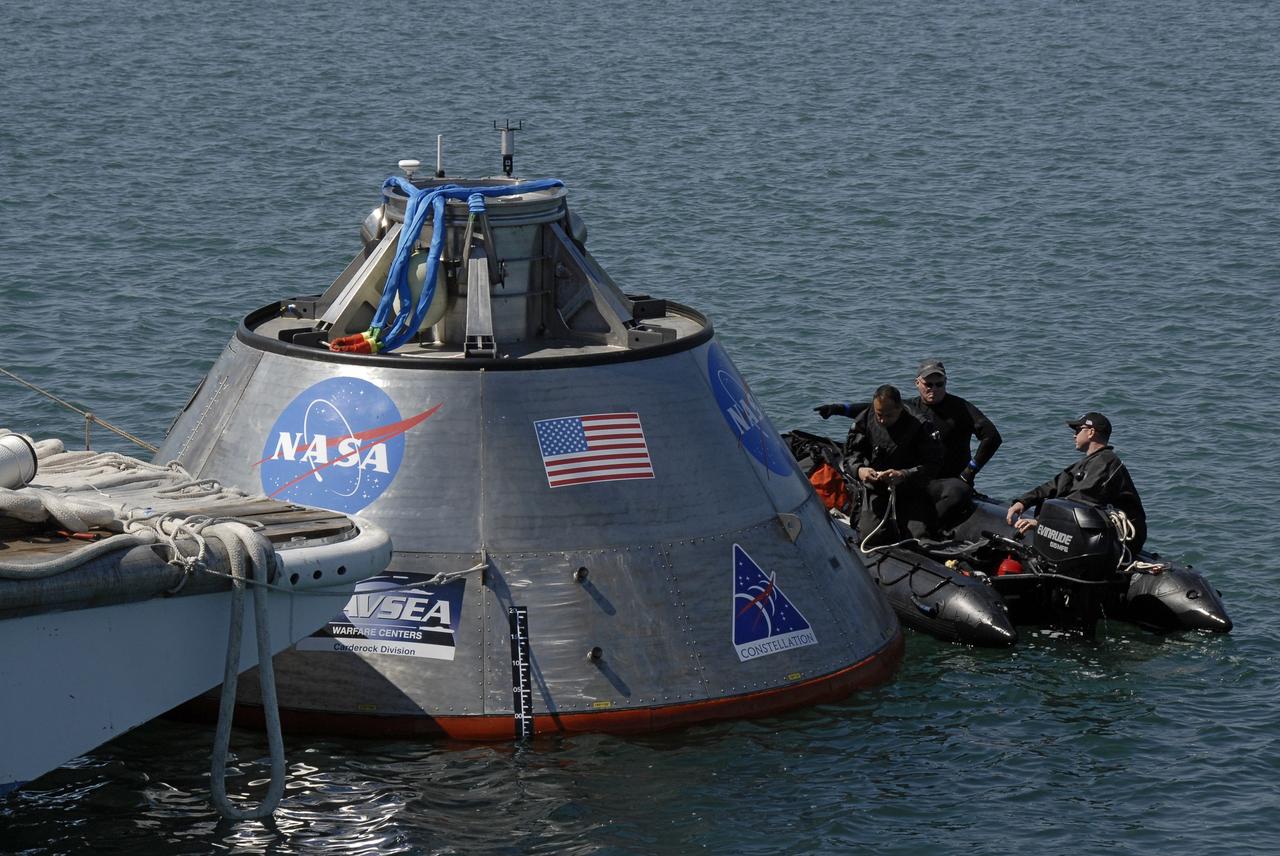
CAPE CANAVERAL, Fla. – Members of the 920th Rescue Wing help prepare the mockup Orion crew exploration vehicle for testing in the open water at the Trident Basin at Port Canaveral, Fla. The mockup vehicle will undergo testing in open water. The goal of the operation, dubbed the Post-landing Orion Recovery Test, or PORT, is to determine what kind of motion astronauts can expect after landing, as well as outside conditions for recovery teams. Orion is targeted to begin carrying humans to the International Space Station in 2015 and to the moon by 2020. Orion, along with the Ares I and V rockets and the Altair lunar lander, are part of the Constellation Program. Photo credit: NASA/Kim Shiflett
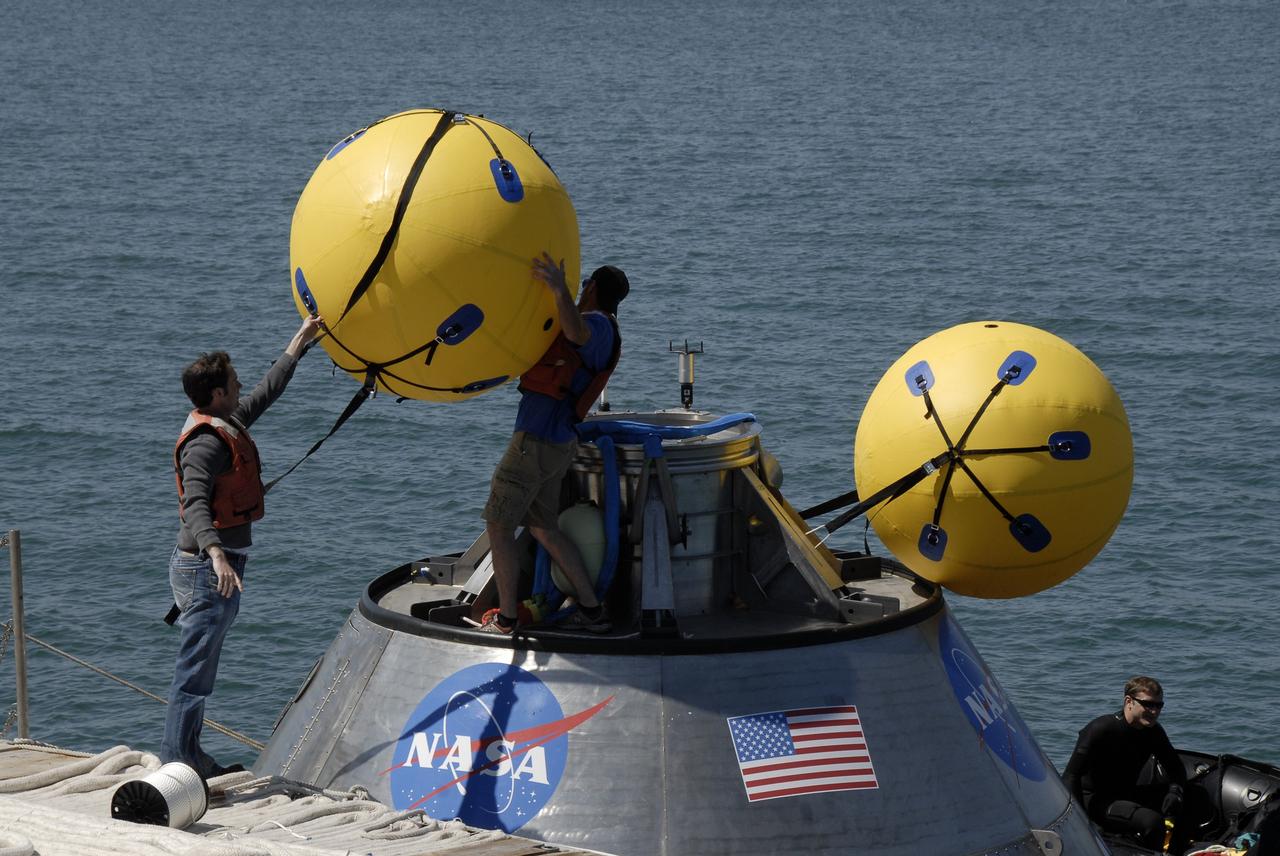
CAPE CANAVERAL, Fla. – Flotation devices are attached to the top of the mockup Orion crew exploration vehicle before the testing in the open water at the Trident Basin at Port Canaveral, Fla. The mockup vehicle will undergo testing in open water. The goal of the operation, dubbed the Post-landing Orion Recovery Test, or PORT, is to determine what kind of motion astronauts can expect after landing, as well as outside conditions for recovery teams. Orion is targeted to begin carrying humans to the International Space Station in 2015 and to the moon by 2020. Orion, along with the Ares I and V rockets and the Altair lunar lander, are part of the Constellation Program. Photo credit: NASA/Kim Shiflett
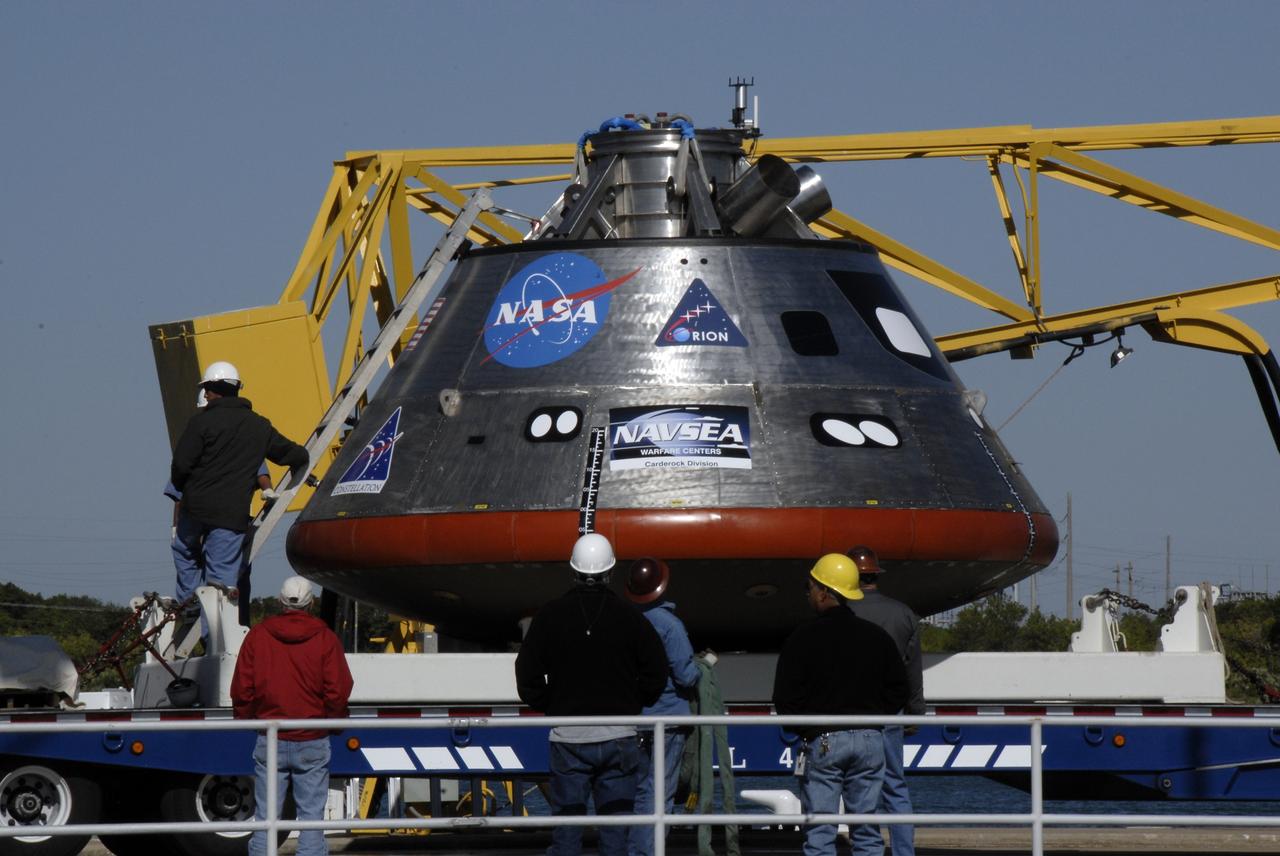
CAPE CANAVERAL, Fla. – The mockup Orion crew exploration vehicle is on the dock at the Trident Basin at Port Canaveral, Fla., waiting to be tested in open water. The goal of the operation, dubbed the Post-landing Orion Recovery Test, or PORT, is to determine what kind of motion astronauts can expect after landing, as well as outside conditions for recovery teams. Orion is targeted to begin carrying humans to the International Space Station in 2015 and to the moon by 2020. Orion, along with the Ares I and V rockets and the Altair lunar lander, are part of the Constellation Program. Photo credit: NASA/Kim Shiflett
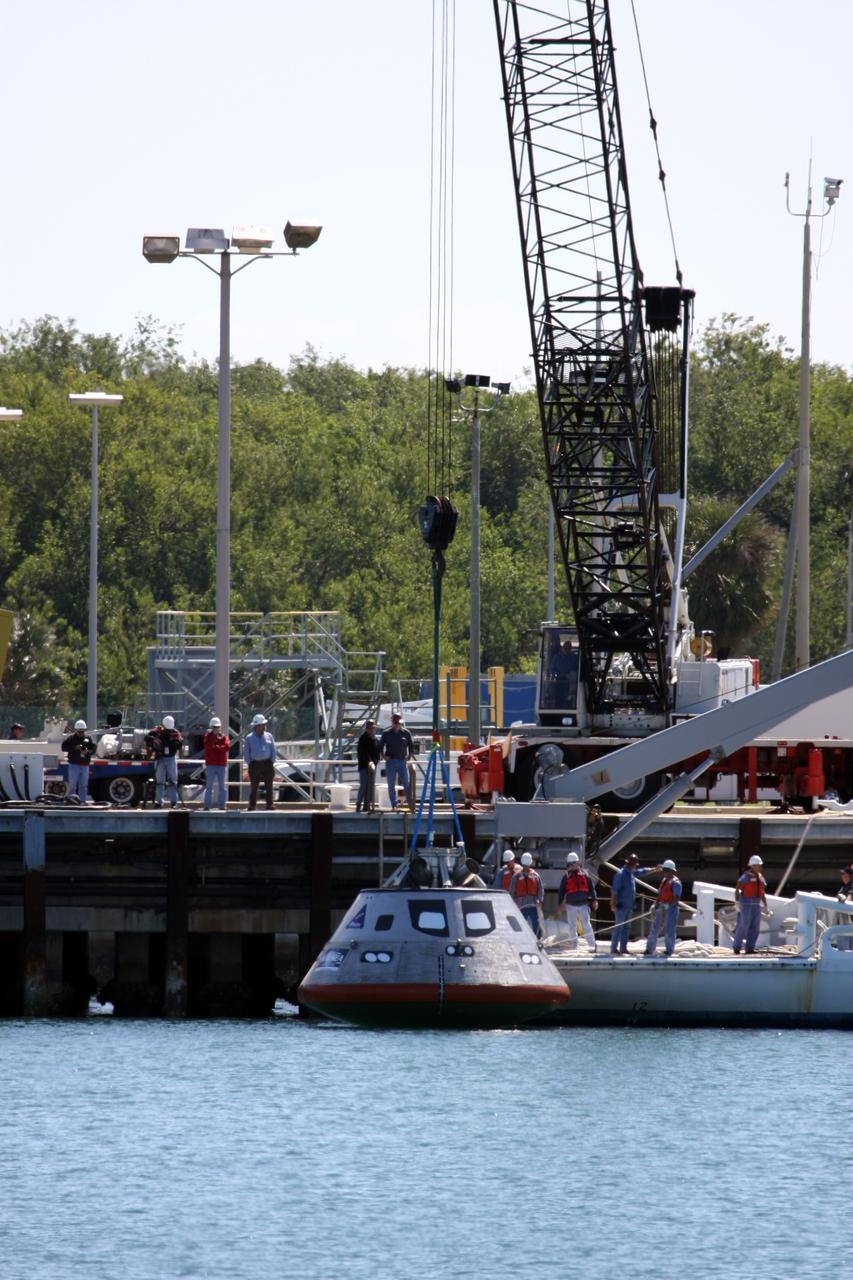
CAPE CANAVERAL, Fla. – The mockup Orion crew exploration vehicle is lowered into the water at the Trident Basin at Port Canaveral, Fla., for testing. Orion is targeted to begin carrying humans to the International Space Station in 2015 and to the moon by 2020. The goal of the operation, dubbed the Post-landing Orion Recovery Test, or PORT, is to determine what kind of motion astronauts can expect after landing, as well as outside conditions for recovery teams. Orion, along with the Ares I and V rockets and the Altair lunar lander, are part of the Constellation Program. Photo credit: NASA/Dimitri Gerondidakis
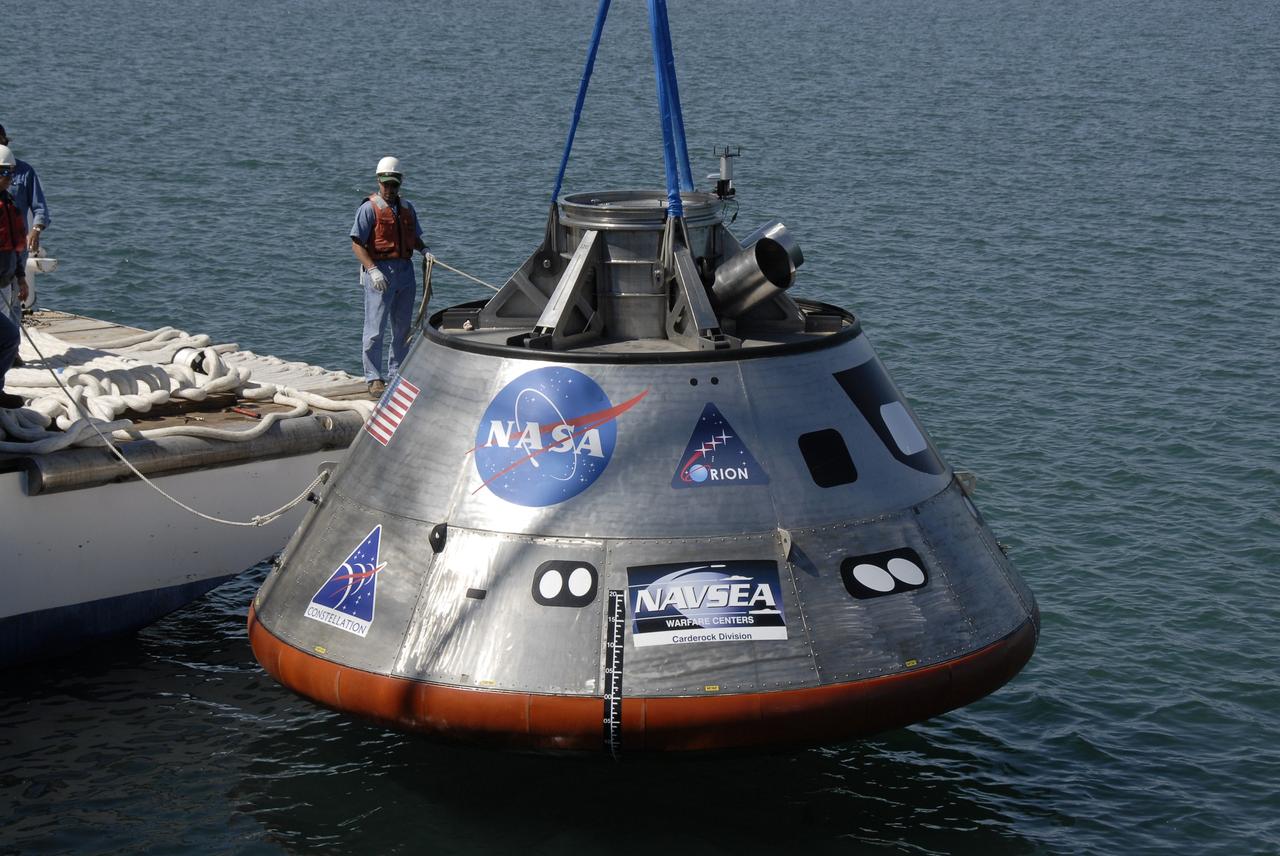
CAPE CANAVERAL, Fla. – The mockup Orion crew exploration vehicle is lowered into the water at the Trident Basin at Port Canaveral, Fla., for testing in open water. The goal of the operation, dubbed the Post-landing Orion Recovery Test, or PORT, is to determine what kind of motion astronauts can expect after landing, as well as outside conditions for recovery teams. Orion is targeted to begin carrying humans to the International Space Station in 2015 and to the moon by 2020. Orion, along with the Ares I and V rockets and the Altair lunar lander, are part of the Constellation Program. Photo credit: NASA/Kim Shiflett
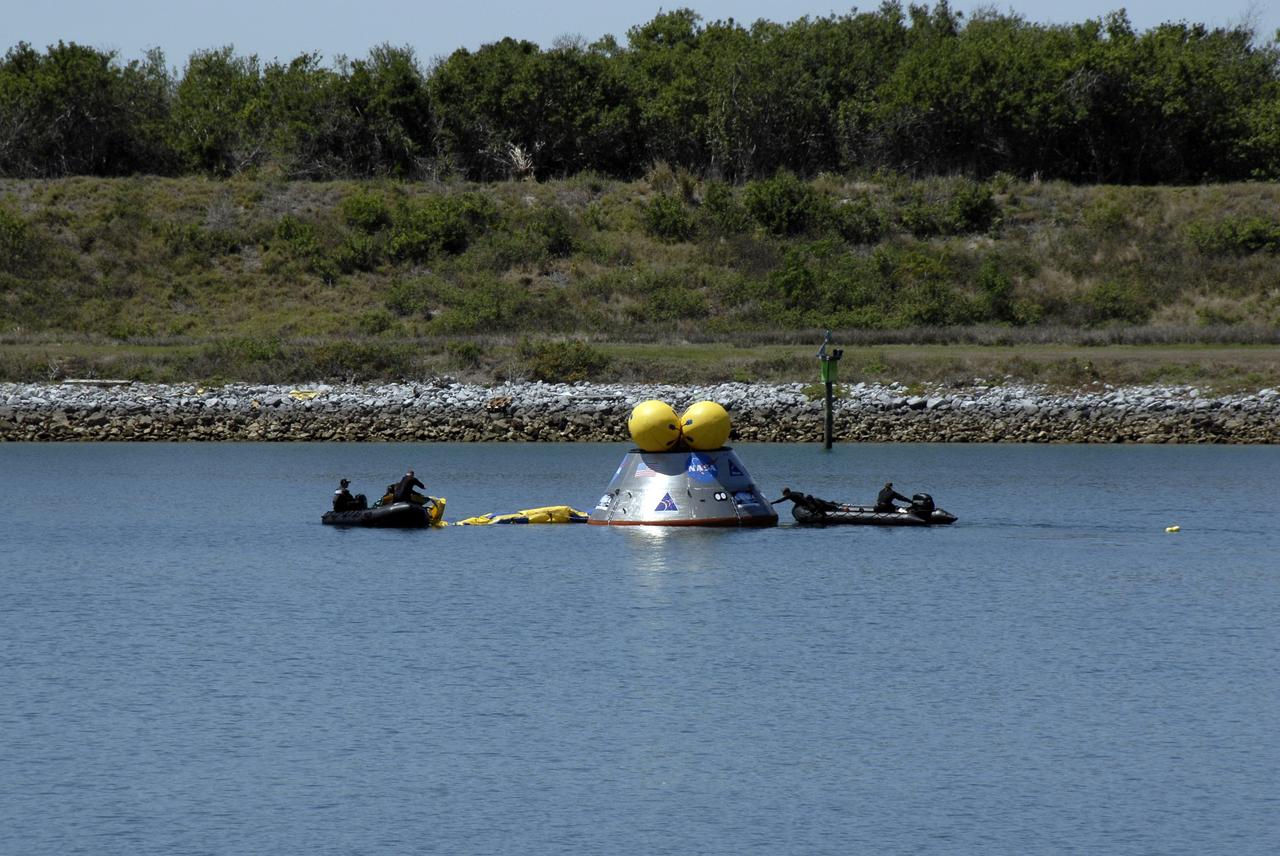
CAPE CANAVERAL, Fla. – Members of the 920th Rescue Wing release a flotation collar around the mockup Orion crew exploration vehicle at the Trident Basin at Port Canaveral, Fla. On top of Orion are additional flotation devices. The mockup vehicle will undergo testing in open water. The goal of the operation, dubbed the Post-landing Orion Recovery Test, or PORT, is to determine what kind of motion astronauts can expect after landing, as well as outside conditions for recovery teams. Orion is targeted to begin carrying humans to the International Space Station in 2015 and to the moon by 2020. Orion, along with the Ares I and V rockets and the Altair lunar lander, are part of the Constellation Program. Photo credit: NASA/Kim Shiflett
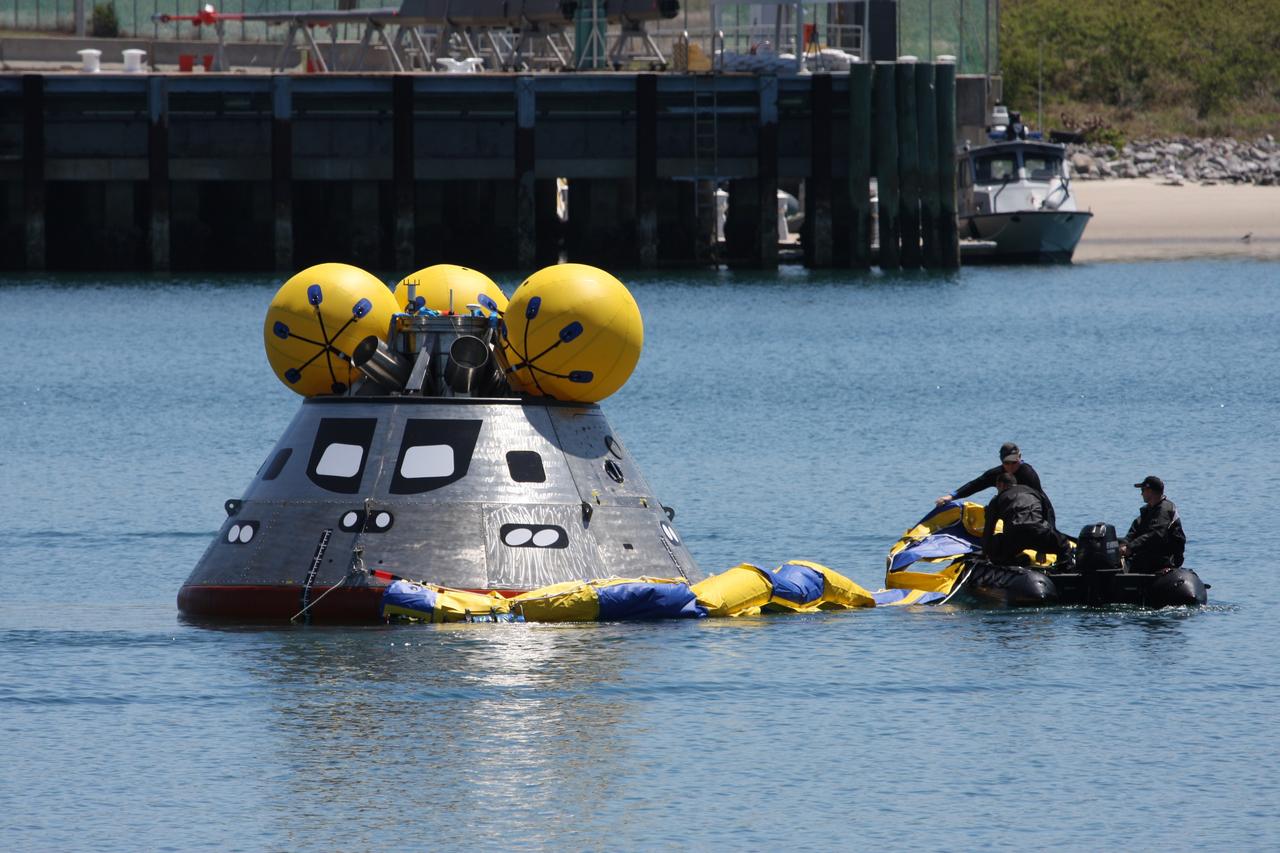
CAPE CANAVERAL, Fla. – Members of the 920th Rescue Wing release a flotation collar around the mockup Orion crew exploration vehicle at the Trident Basin at Port Canaveral, Fla. On top of Orion are additional flotation devices. The goal of the operation, dubbed the Post-landing Orion Recovery Test, or PORT, is to determine what kind of motion astronauts can expect after landing, as well as outside conditions for recovery teams. Orion is targeted to begin carrying humans to the International Space Station in 2015 and to the moon by 2020. Orion is targeted to begin carrying humans to the International Space Station in 2015 and to the moon by 2020. Orion, along with the Ares I and V rockets and the Altair lunar lander, are part of the Constellation Program. Photo credit: NASA/Dimitri Gerondidakis
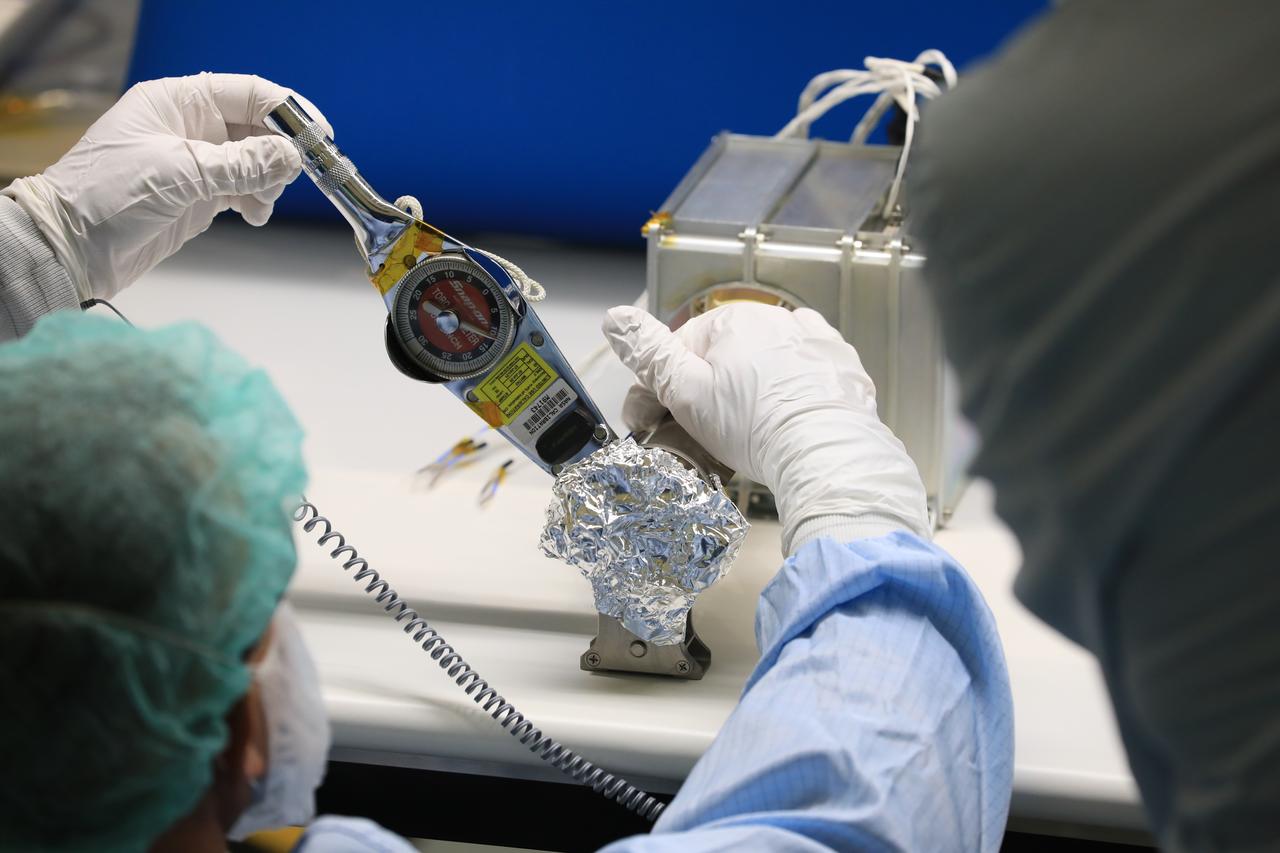
Engineers and technicians at NASA’s Kennedy Space Center in Florida work with instruments for Mass Spectrometer observing lunar operations (MSolo) inside the Space Station Processing on Sept. 25, 2020. MSolo is a commercial off-the-shelf mass spectrometer modified to work in space and it will help analyze the chemical makeup of landing sites on the Moon, as well as study water on the lunar surface. This work is preparing MSolo hardware for a robotic mission as part of the Commercial Lunar Payload Services (CLPS) launching to exploring Lacus Mortis, a large crater on the near side of the Moon in 2021. A future mission will send a mobile robot named the Volatiles Investigating Polar Exploration Rover (VIPER) to the Moon to prospect for water. VIPER will have several instruments that will allow it to detect and sample water including MSolo, the Neutron Spectrometer System, the Near Infrared Volatiles Spectrometer System and The Regolith and Ice Drill for Exploring New Terrain (TRIDENT).
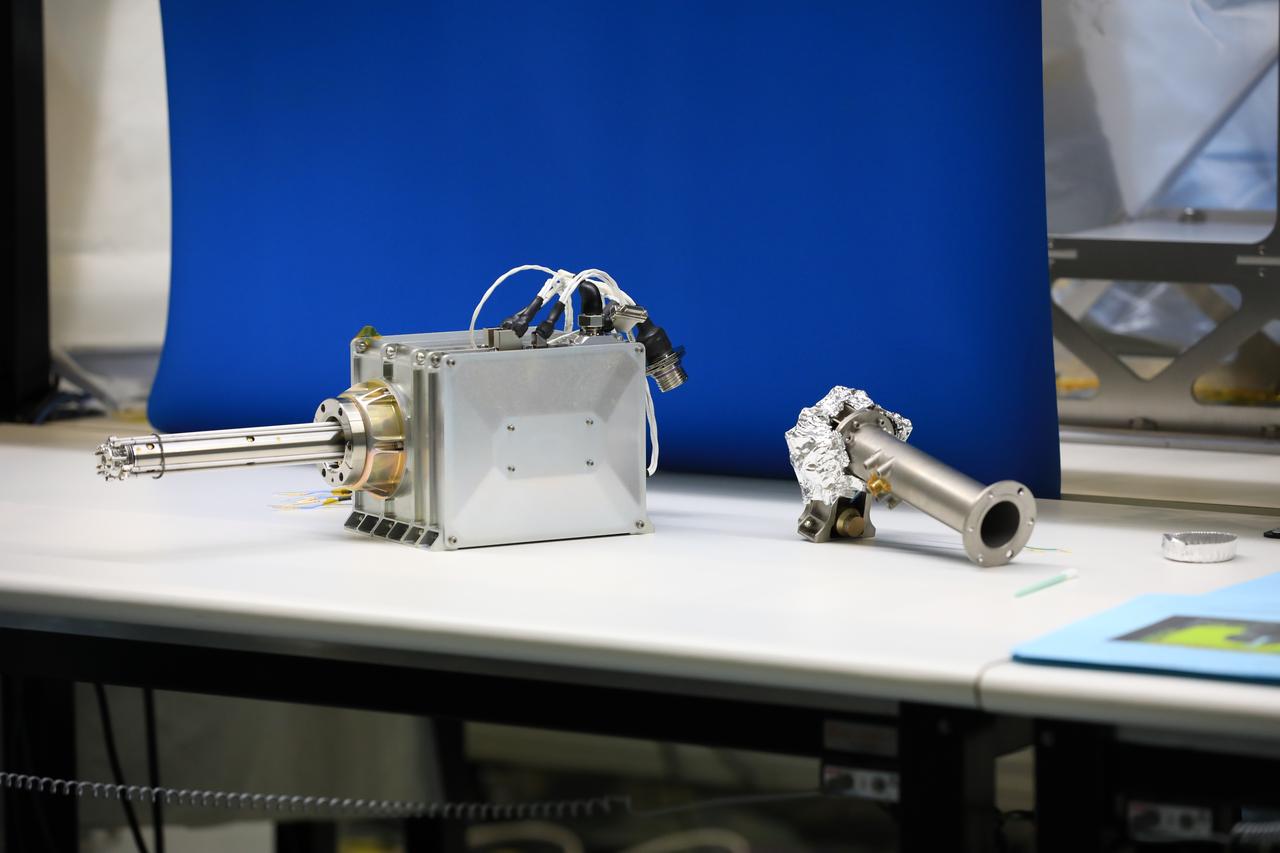
Instruments for the Mass Spectrometer observing lunar operations (MSolo) are in view inside the Space Station Processing Facility at NASA’s Kennedy Space Center in Florida on Sept. 25, 2020. MSolo is a commercial off-the-shelf mass spectrometer modified to work in space and it will help analyze the chemical makeup of landing sites on the Moon, as well as study water on the lunar surface. This work is preparing MSolo hardware for a robotic mission as part of the Commercial Lunar Payload Services (CLPS) launching to exploring Lacus Mortis, a large crater on the near side of the Moon in 2021. A future mission will send a mobile robot named the Volatiles Investigating Polar Exploration Rover (VIPER) to the Moon to prospect for water. VIPER will have several instruments that will allow it to detect and sample water including MSolo, the Neutron Spectrometer System, the Near Infrared Volatiles Spectrometer System and The Regolith and Ice Drill for Exploring New Terrain (TRIDENT).
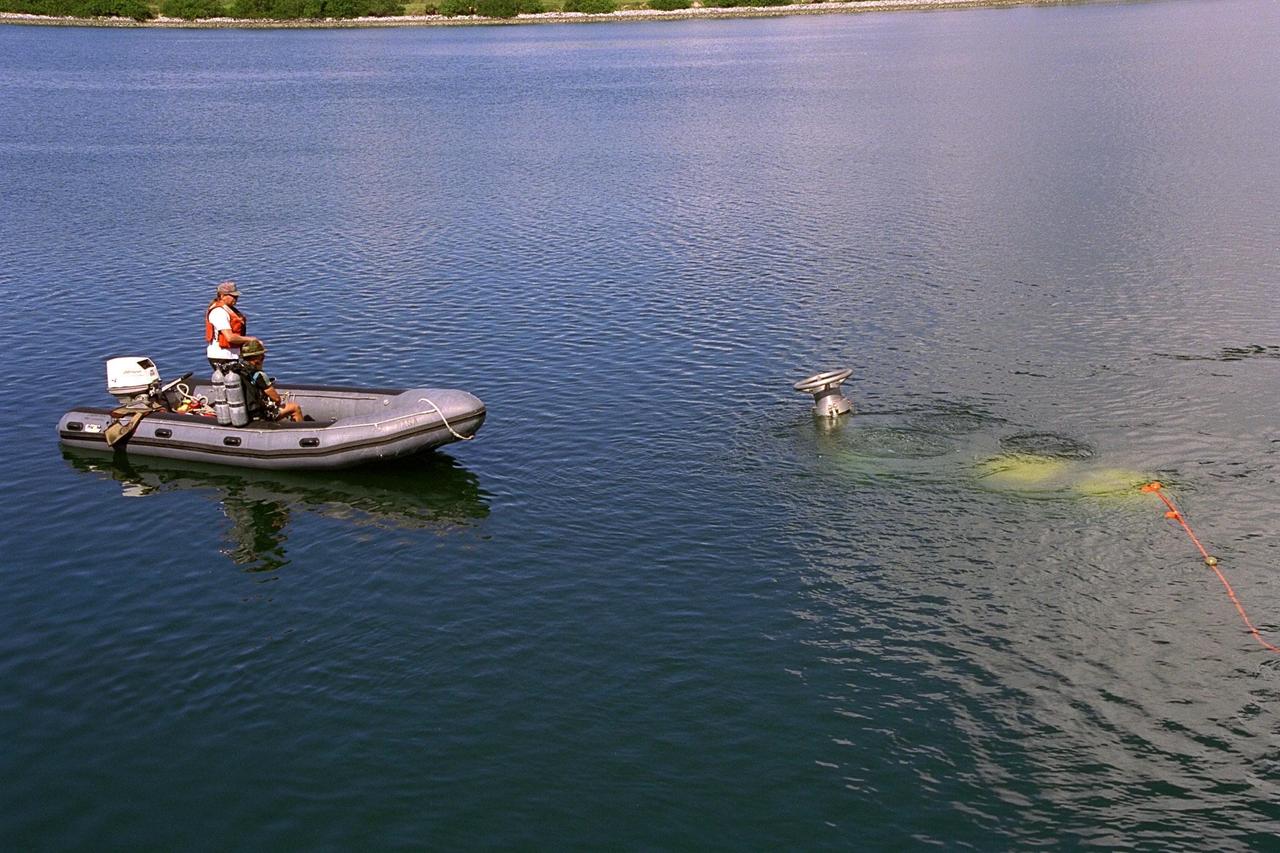
KENNEDY SPACE CENTER, FLA. -- A scuba diver stands by as the unmanned Max Rover submersible goes down to insert a Diver Operated Plug (DOP) into an aft nozzle like the ones used on the Space Shuttle's solid rocket boosters (SRBs). NASA and contractor Deep Sea Systems demonstrated the submersible at Port Canaveral's Trident pier. Kennedy Space Center's SRB retrieval team and Advanced Systems Development laboratory staff hope that the new robotic technology will make the process of inserting the plug into spent SRBs safer and less strenuous. Currently, scuba divers manually insert the DOP into the aft nozzle of a jettisoned SRB 60 to 70 feet below the surface of the Atlantic Ocean. After the plug is installed, water is pumped out of the booster allowing it to float horizontally. It is then towed back to Hangar AF at Cape Canaveral Air Station for refurbishment. Deep Sea Systems of Falmouth, Mass., built the submersible for NASA
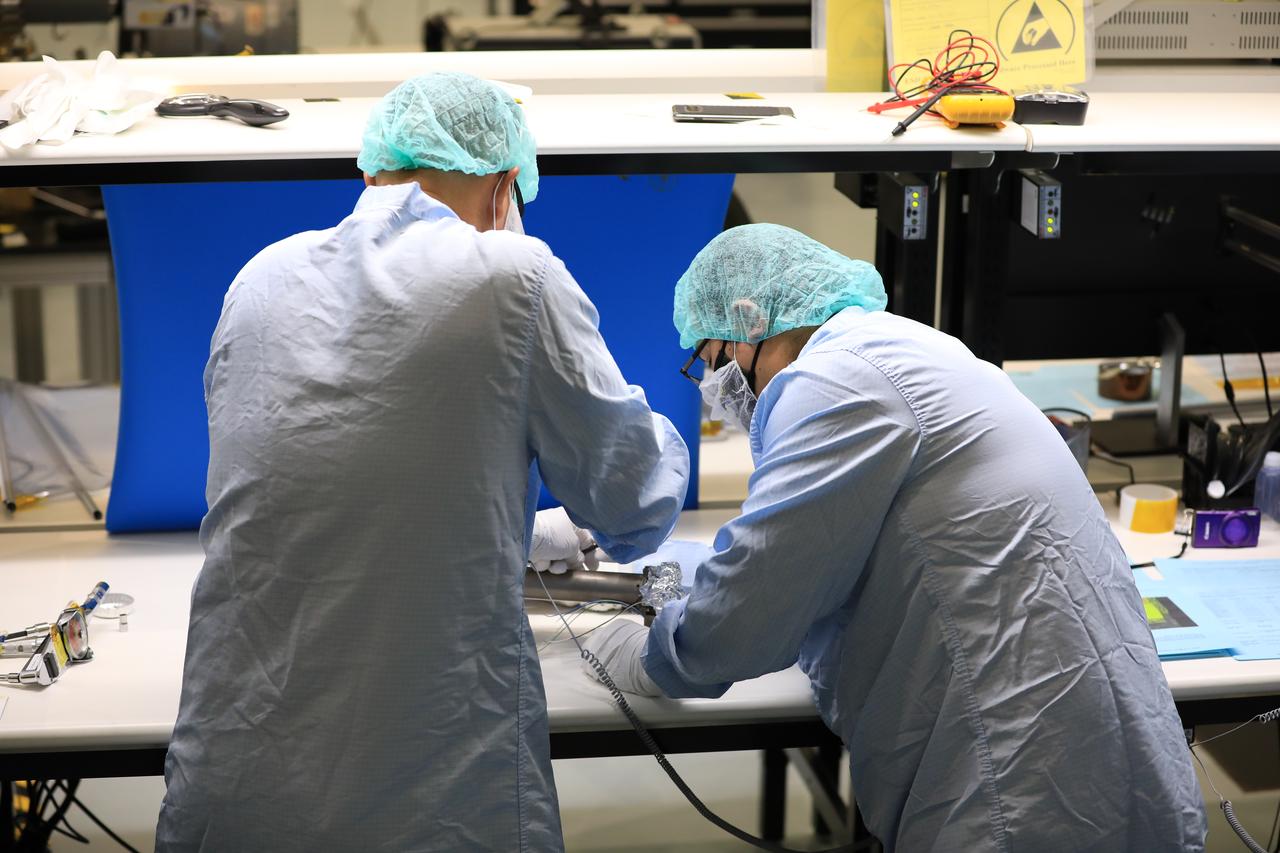
Engineers and technicians at NASA’s Kennedy Space Center in Florida work with instruments for Mass Spectrometer observing lunar operations (MSolo) inside the Space Station Processing on Sept. 25, 2020. MSolo is a commercial off-the-shelf mass spectrometer modified to work in space and it will help analyze the chemical makeup of landing sites on the Moon, as well as study water on the lunar surface. This work is preparing MSolo hardware for a robotic mission as part of the Commercial Lunar Payload Services (CLPS) launching to exploring Lacus Mortis, a large crater on the near side of the Moon in 2021. A future mission will send a mobile robot named the Volatiles Investigating Polar Exploration Rover (VIPER) to the Moon to prospect for water. VIPER will have several instruments that will allow it to detect and sample water including MSolo, the Neutron Spectrometer System, the Near Infrared Volatiles Spectrometer System and The Regolith and Ice Drill for Exploring New Terrain (TRIDENT).
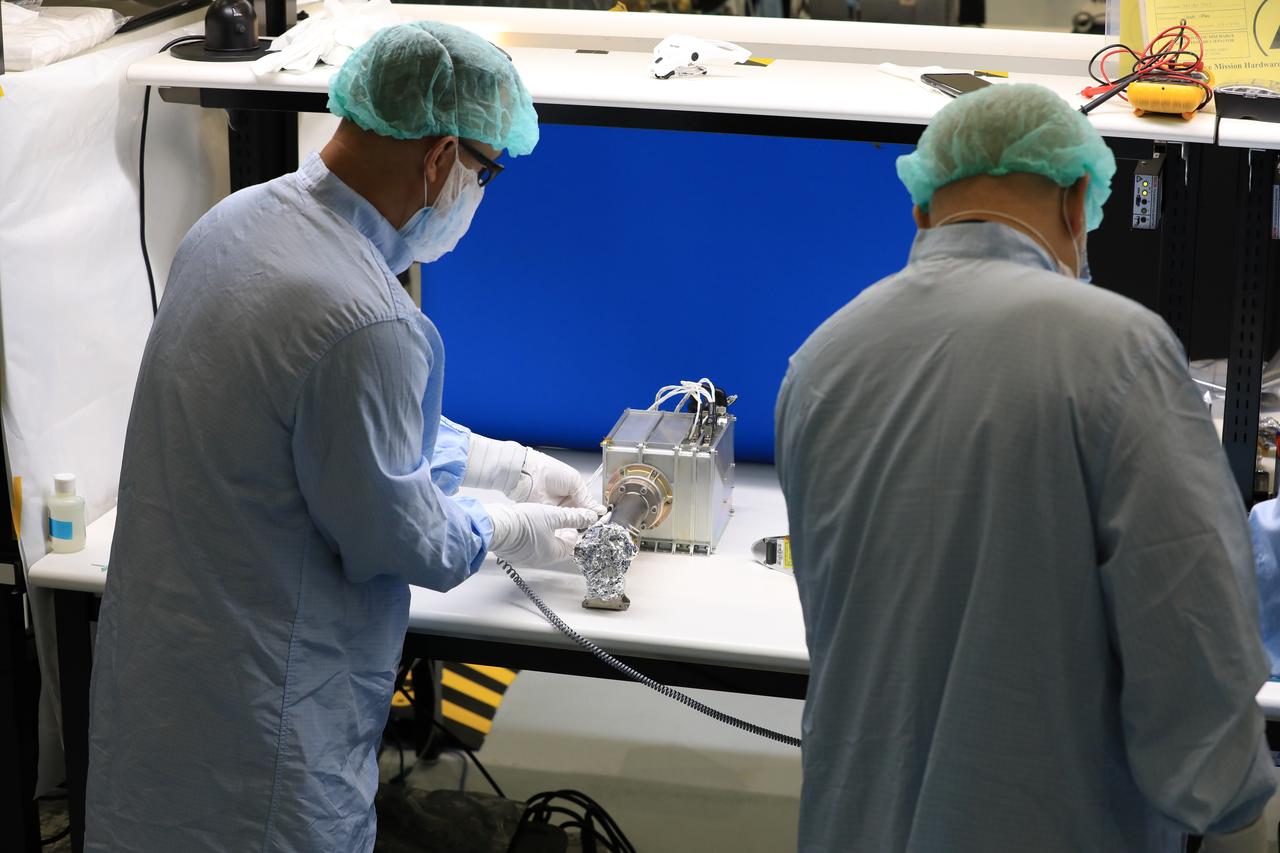
Engineers and technicians at NASA’s Kennedy Space Center in Florida work with instruments for Mass Spectrometer observing lunar operations (MSolo) inside the Space Station Processing on Sept. 25, 2020. MSolo is a commercial off-the-shelf mass spectrometer modified to work in space and it will help analyze the chemical makeup of landing sites on the Moon, as well as study water on the lunar surface. This work is preparing MSolo hardware for a robotic mission as part of the Commercial Lunar Payload Services (CLPS) launching to exploring Lacus Mortis, a large crater on the near side of the Moon in 2021. A future mission will send a mobile robot named the Volatiles Investigating Polar Exploration Rover (VIPER) to the Moon to prospect for water. VIPER will have several instruments that will allow it to detect and sample water including MSolo, the Neutron Spectrometer System, the Near Infrared Volatiles Spectrometer System and The Regolith and Ice Drill for Exploring New Terrain (TRIDENT).
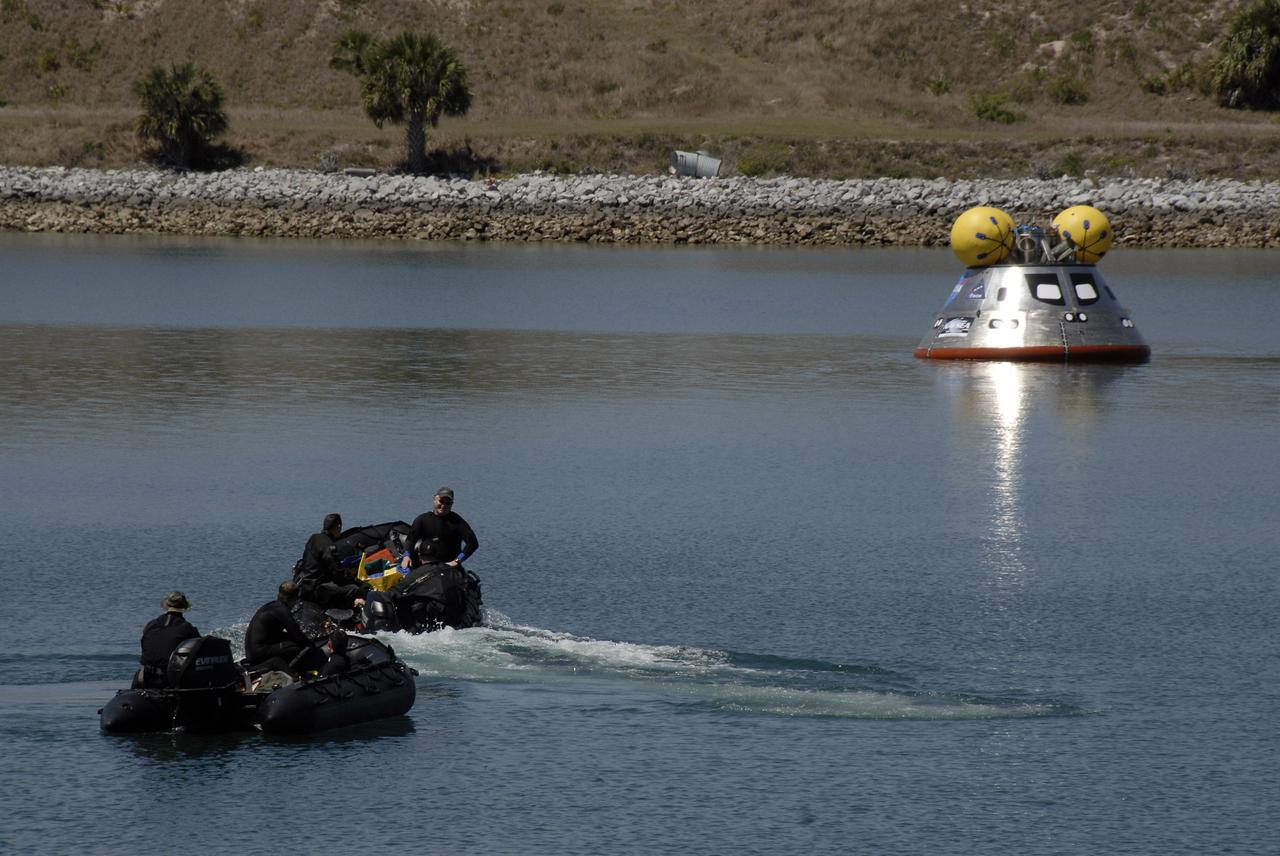
CAPE CANAVERAL, Fla. – Members of the 920th Rescue Wing make their way toward the mockup Orion crew exploration vehicle floating in the open water of the Trident Basin at Port Canaveral, Fla. They will place a flotation collar around the mockup vehicle. The mockup vehicle will undergo testing in open water. The goal of the operation, dubbed the Post-landing Orion Recovery Test, or PORT, is to determine what kind of motion astronauts can expect after landing, as well as outside conditions for recovery teams. Orion is targeted to begin carrying humans to the International Space Station in 2015 and to the moon by 2020. Orion, along with the Ares I and V rockets and the Altair lunar lander, are part of the Constellation Program. Photo credit: NASA/Kim Shiflett
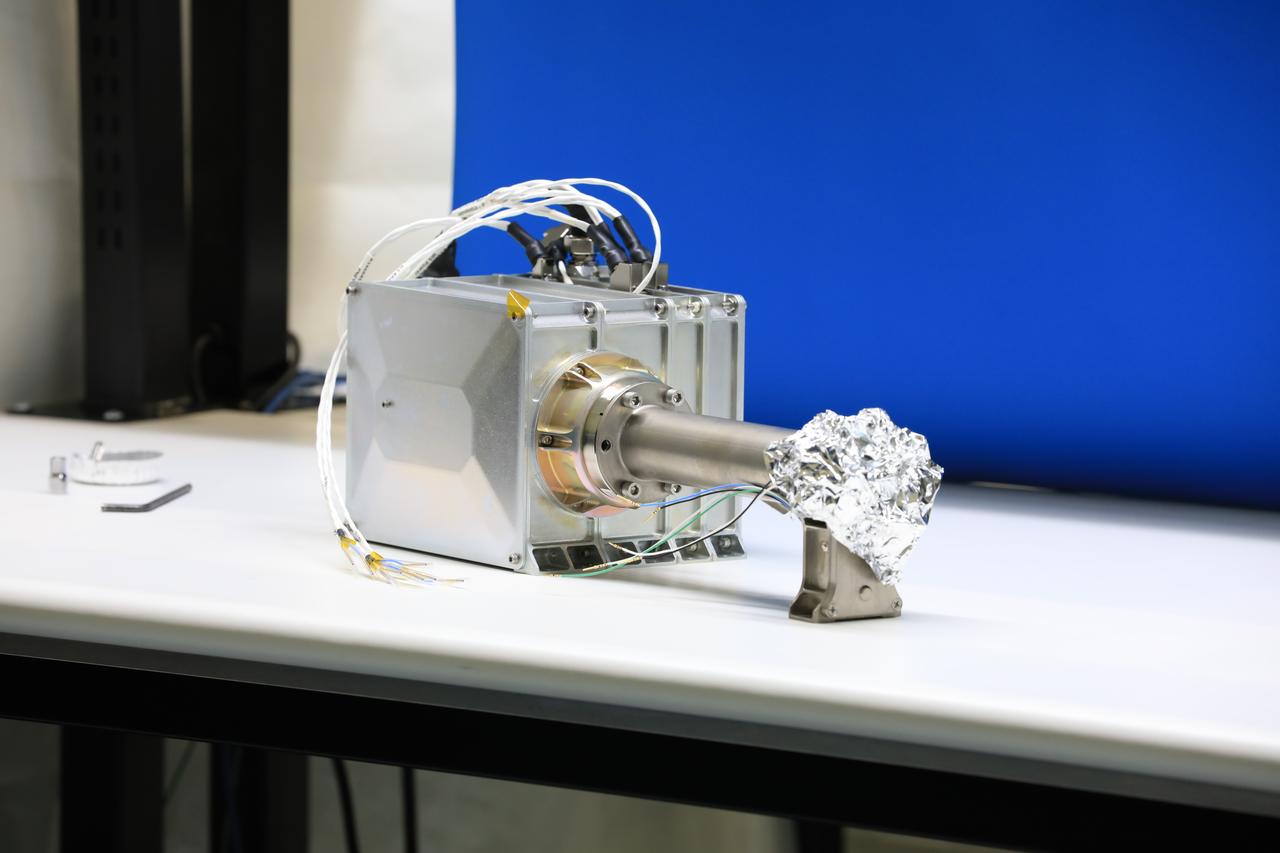
Engineers and technicians at NASA’s Kennedy Space Center in Florida are preparing the Mass Spectrometer observing lunar operations (MSolo) for launch inside the Space Station Processing Facility at NASA’s Kennedy Space Center in Florida on Sept. 25, 2020. MSolo is a commercial off-the-shelf mass spectrometer modified to work in space and it will help analyze the chemical makeup of landing sites on the Moon, as well as study water on the lunar surface. MSolo hardware is a payload for a robotic mission to the Moon as part of the Commercial Lunar Payload Services (CLPS) launching to exploring Lacus Mortis, a large crater on the near side of the Moon in 2021. A future mission will send a mobile robot named the Volatiles Investigating Polar Exploration Rover (VIPER) to the Moon to prospect for water. VIPER will have several instruments that will allow it to detect and sample water including MSolo, the Neutron Spectrometer System, the Near Infrared Volatiles Spectrometer System and The Regolith and Ice Drill for Exploring New Terrain (TRIDENT).
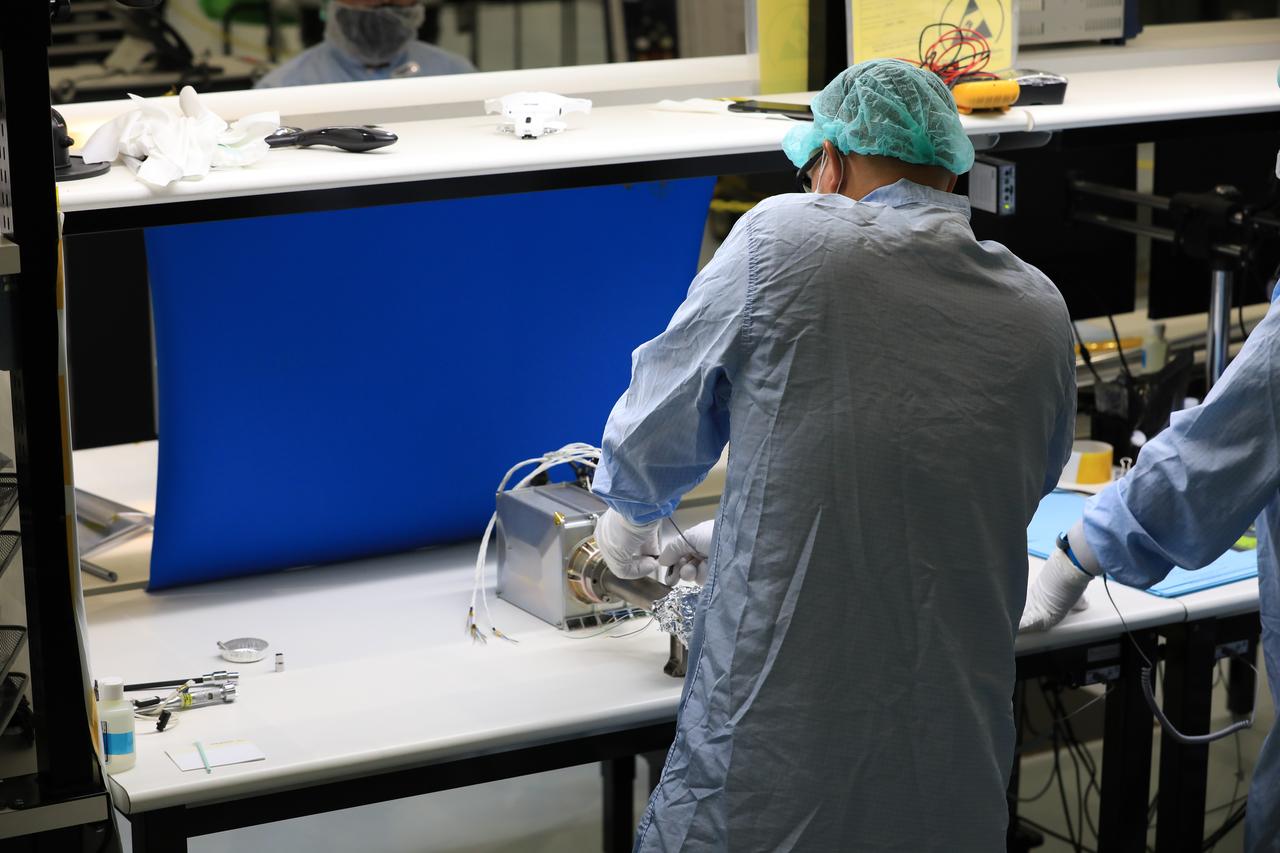
Engineers and technicians at NASA’s Kennedy Space Center in Florida work with instruments for Mass Spectrometer observing lunar operations (MSolo) inside the Space Station Processing on Sept. 25, 2020. MSolo is a commercial off-the-shelf mass spectrometer modified to work in space and it will help analyze the chemical makeup of landing sites on the Moon, as well as study water on the lunar surface. This work is preparing MSolo hardware for a robotic mission as part of the Commercial Lunar Payload Services (CLPS) launching to exploring Lacus Mortis, a large crater on the near side of the Moon in 2021. A future mission will send a mobile robot named the Volatiles Investigating Polar Exploration Rover (VIPER) to the Moon to prospect for water. VIPER will have several instruments that will allow it to detect and sample water including MSolo, the Neutron Spectrometer System, the Near Infrared Volatiles Spectrometer System and The Regolith and Ice Drill for Exploring New Terrain (TRIDENT).
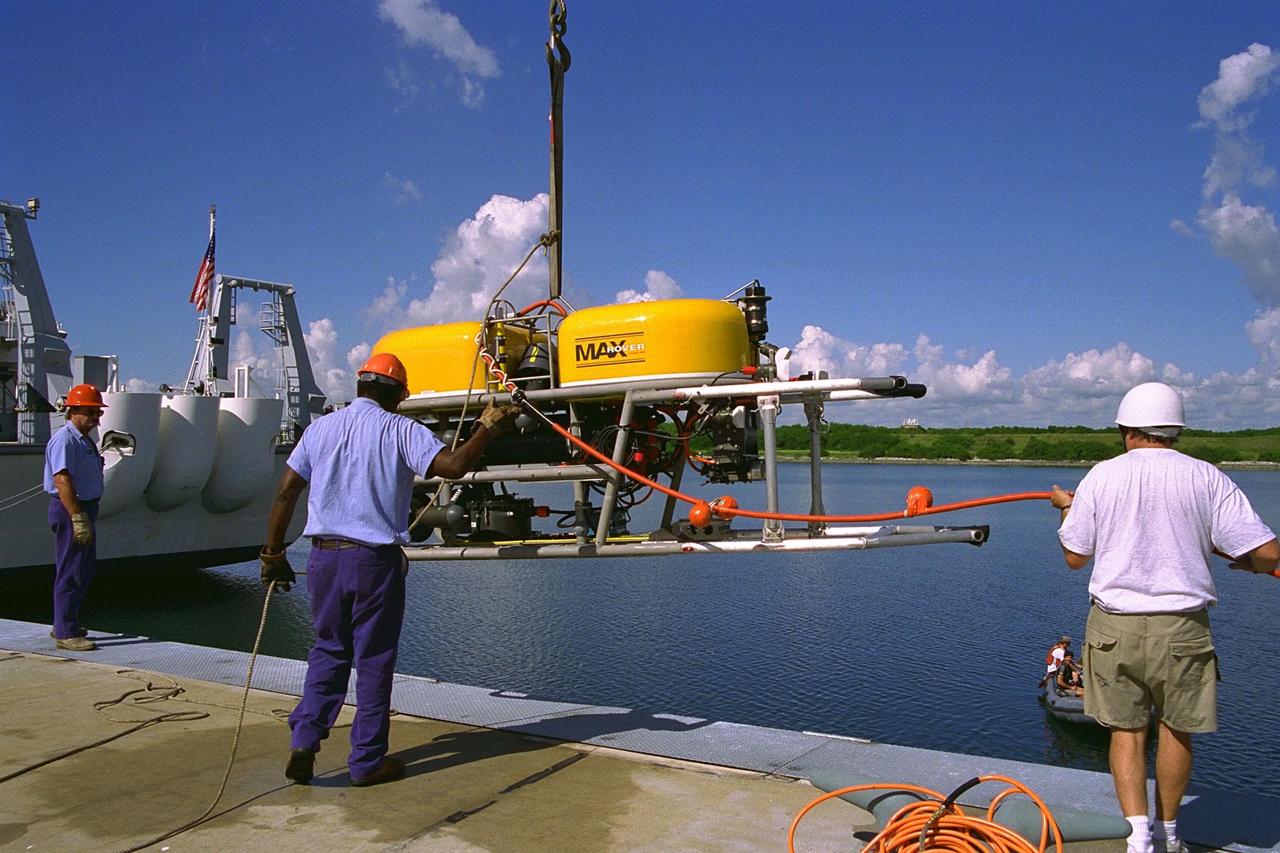
KENNEDY SPACE CENTER, FLA. -- Technicians lower the unmanned robotic submersible recovery system, known as Max Rover, into the water at the Trident Pier at Port Canaveral during a test of the system. Kennedy Space Center's solid rocket booster (SRB) retrieval team and Advanced Systems Development laboratory staff hope that the new robotic technology will make the process of inserting the Diver Operated Plug (DOP) into the aft nozzle of a spent SRB safer and less strenuous. Currently, scuba divers manually insert the DOP into the aft nozzle of a jettisoned SRB 60 to 70 feet below the surface of the Atlantic Ocean. After the plug is installed, water is pumped out of the booster allowing it to float horizontally. It is then towed back to Hangar AF at Cape Canaveral Air Station. Deep Sea Systems of Falmouth, Mass., built the submersible for NASA
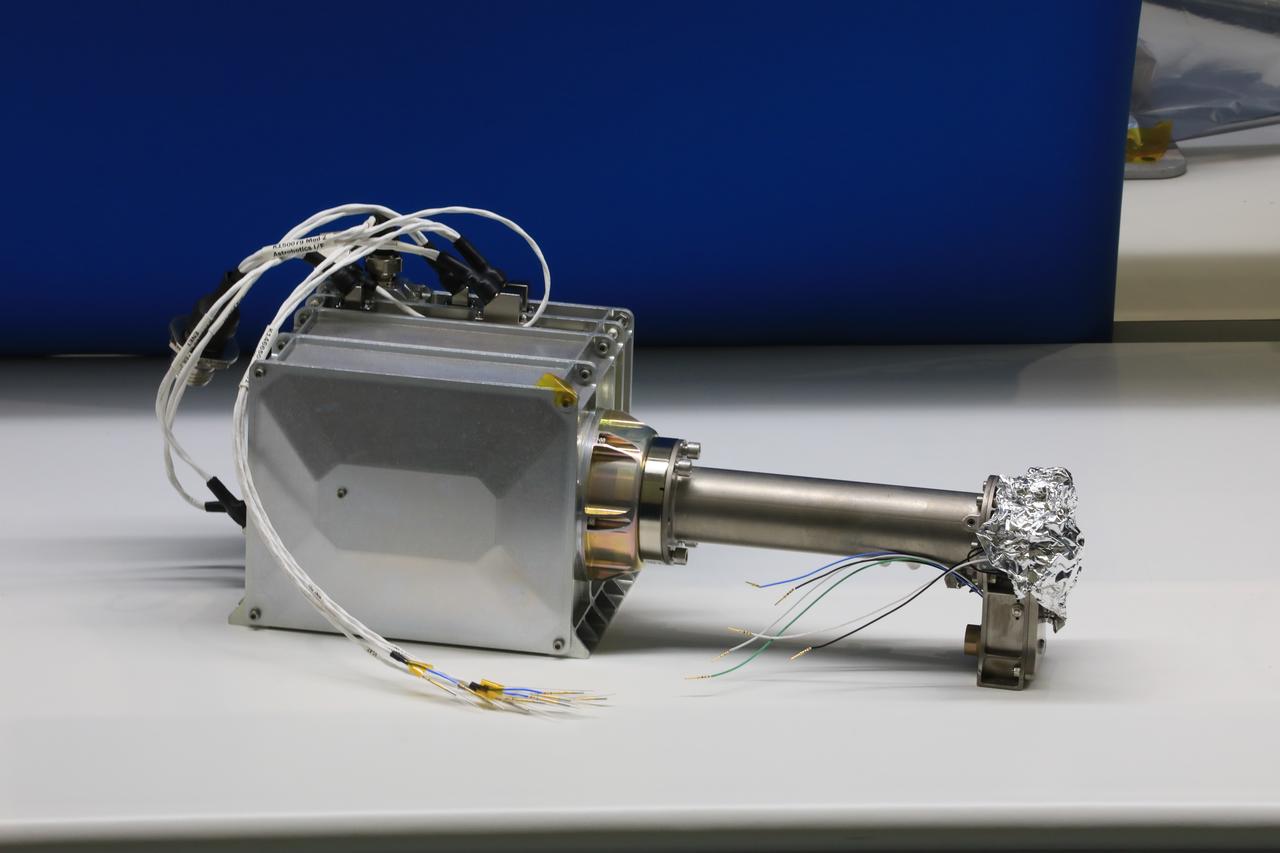
Engineers and technicians at NASA’s Kennedy Space Center in Florida are preparing the Mass Spectrometer observing lunar operations (MSolo) for launch inside the Space Station Processing Facility at NASA’s Kennedy Space Center in Florida on Sept. 25, 2020. MSolo is a commercial off-the-shelf mass spectrometer modified to work in space and it will help analyze the chemical makeup of landing sites on the Moon, as well as study water on the lunar surface. MSolo hardware is a payload for a robotic mission to the Moon as part of the Commercial Lunar Payload Services (CLPS) launching to exploring Lacus Mortis, a large crater on the near side of the Moon in 2021. A future mission will send a mobile robot named the Volatiles Investigating Polar Exploration Rover (VIPER) to the Moon to prospect for water. VIPER will have several instruments that will allow it to detect and sample water including MSolo, the Neutron Spectrometer System, the Near Infrared Volatiles Spectrometer System and The Regolith and Ice Drill for Exploring New Terrain (TRIDENT).
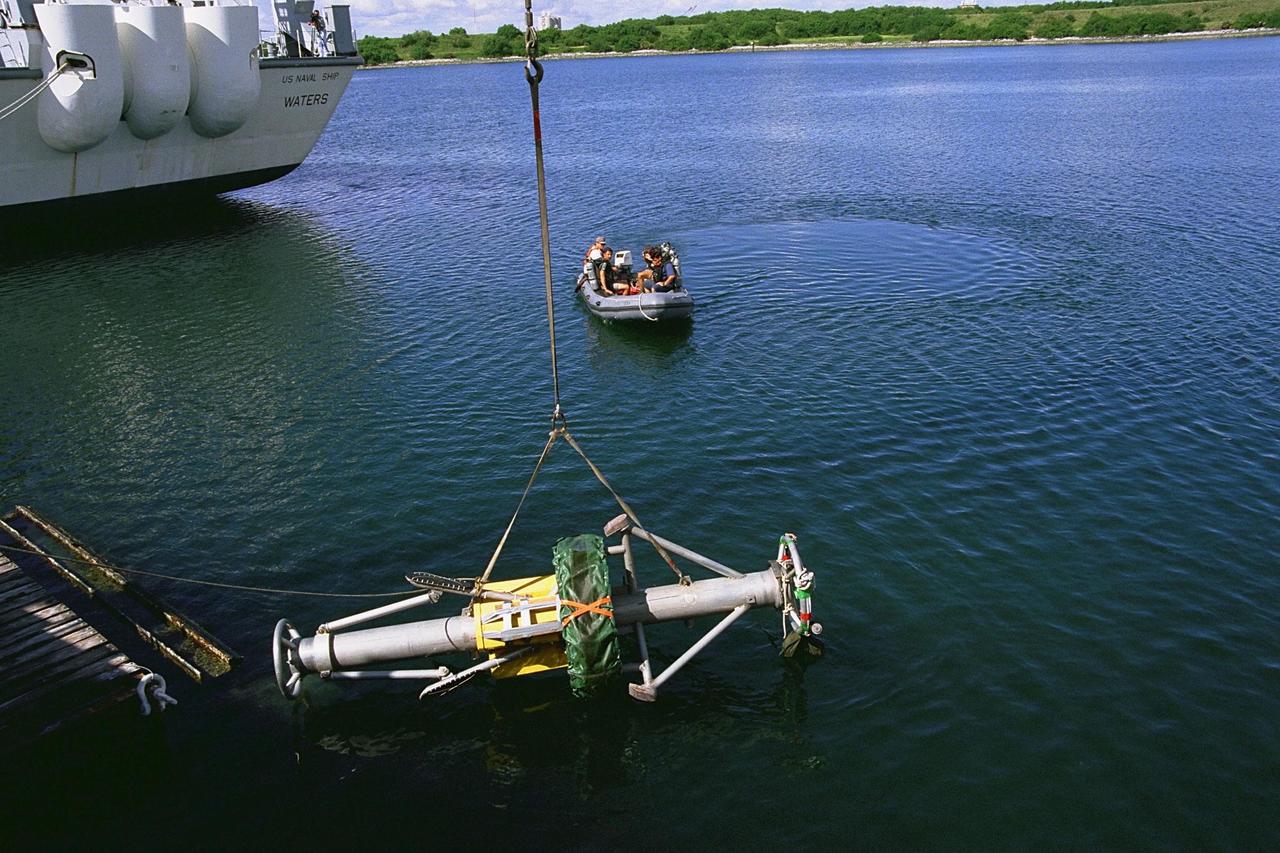
KENNEDY SPACE CENTER, FLA. -- As scuba divers stand by, a Diver Operated Plug (DOP) is lowered into the water at the Trident Pier at Port Canaveral during a test of the unmanned robotic submersible recovery system, known as Max Rover. Kennedy Space Center's solid rocket booster (SRB) retrieval team and Advanced Systems Development laboratory staff hope that the new robotic technology will make the process of inserting the plug into spent SRBs safer and less strenuous. Currently, scuba divers manually insert the DOP into the aft nozzle of a jettisoned SRB 60 to 70 feet below the surface of the Atlantic Ocean. After the plug is installed, water is pumped out of the booster allowing it to float horizontally. It is then towed back to Hangar AF at Cape Canaveral Air Station for refurbishment. Deep Sea Systems of Falmouth, Mass., built the submersible for NASA
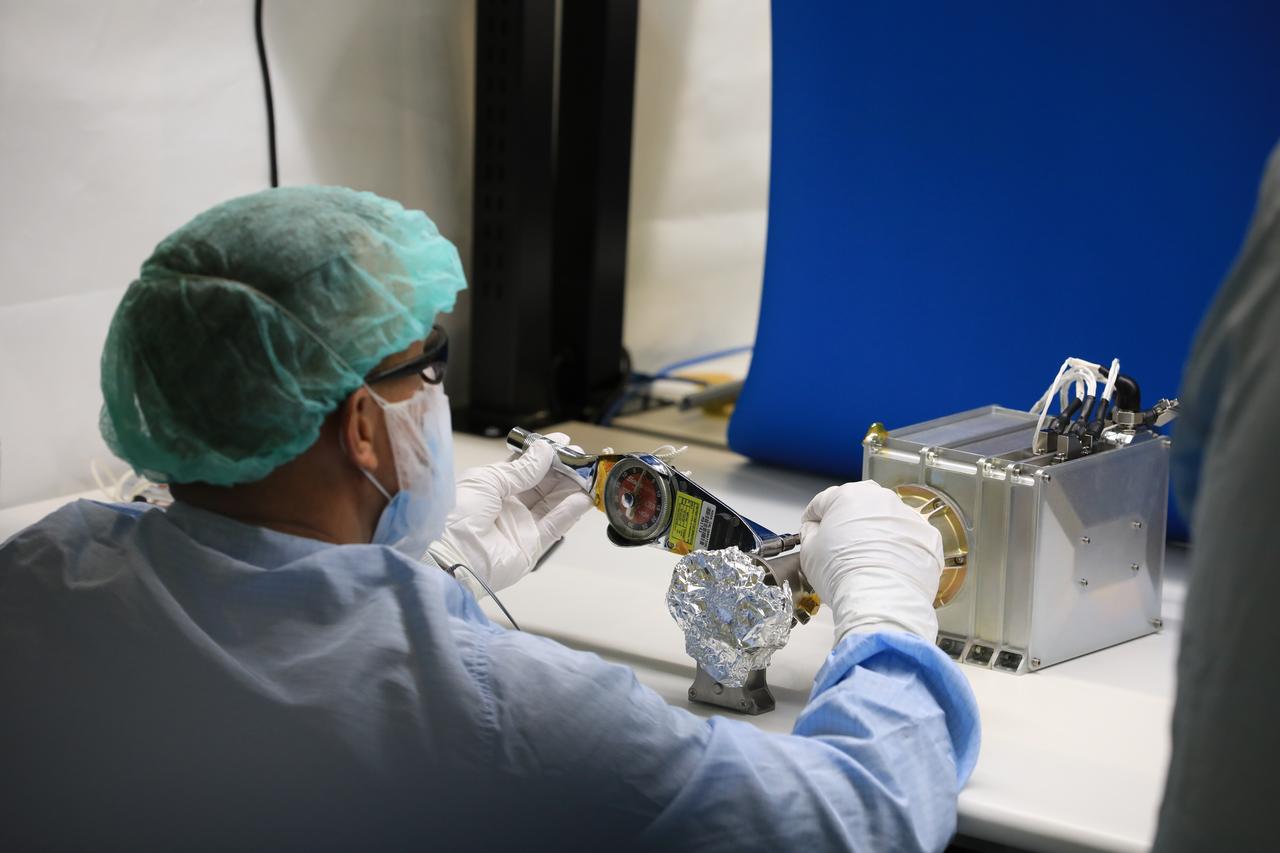
Engineers and technicians at NASA’s Kennedy Space Center in Florida work with instruments for Mass Spectrometer observing lunar operations (MSolo) inside the Space Station Processing on Sept. 25, 2020. MSolo is a commercial off-the-shelf mass spectrometer modified to work in space and it will help analyze the chemical makeup of landing sites on the Moon, as well as study water on the lunar surface. This work is preparing MSolo hardware for a robotic mission as part of the Commercial Lunar Payload Services (CLPS) launching to exploring Lacus Mortis, a large crater on the near side of the Moon in 2021. A future mission will send a mobile robot named the Volatiles Investigating Polar Exploration Rover (VIPER) to the Moon to prospect for water. VIPER will have several instruments that will allow it to detect and sample water including MSolo, the Neutron Spectrometer System, the Near Infrared Volatiles Spectrometer System and The Regolith and Ice Drill for Exploring New Terrain (TRIDENT).
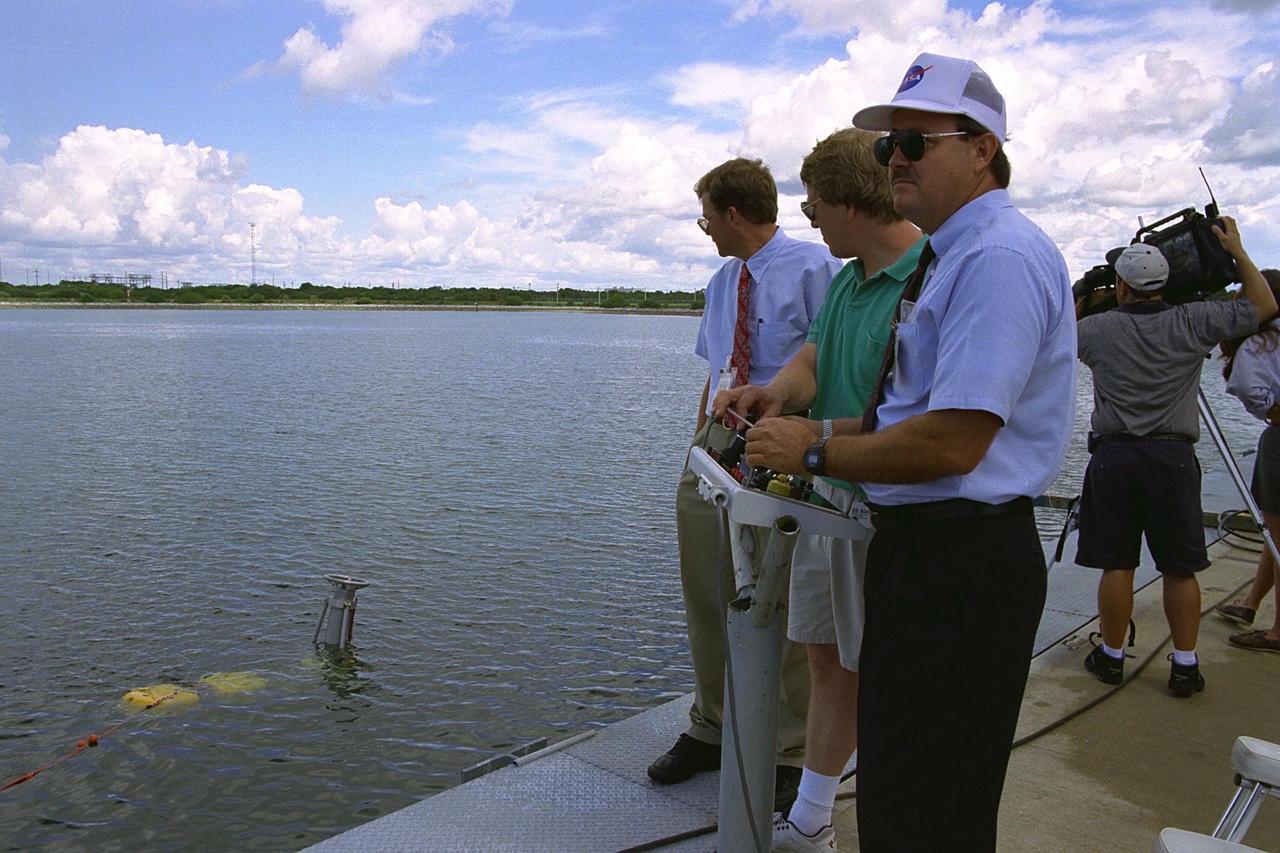
KENNEDY SPACE CENTER, FLA. -- Thomas Lippitt of NASA's Advanced Systems Development (ASD) laboratory observes robotic operations as Chris Nicholson, owner of Deep Sea Systems, and Bill Jones of NASA's ASD laboratory operate the unmanned robotic submersible recovery system, known as Max Rover, during a test of the system at the Trident Pier at Port Canaveral. The submersible is seen in the water with the Diver Operated Plug (DOP). Kennedy Space Center's solid rocket booster (SRB) retrieval team and ASD laboratory staff hope that the new robotic technology will make the process of inserting the plug safer and less strenuous. Currently, scuba divers manually insert the DOP into the aft nozzle of a jettisoned SRB 60 to 70 feet below the surface of the Atlantic Ocean. After the plug is installed, water is pumped out of the booster allowing it to float horizontally. It is then towed back to Hangar AF at Cape Canaveral Air Station for refurbishment. Deep Sea Systems of Falmouth, Mass., built the submersible for NASA
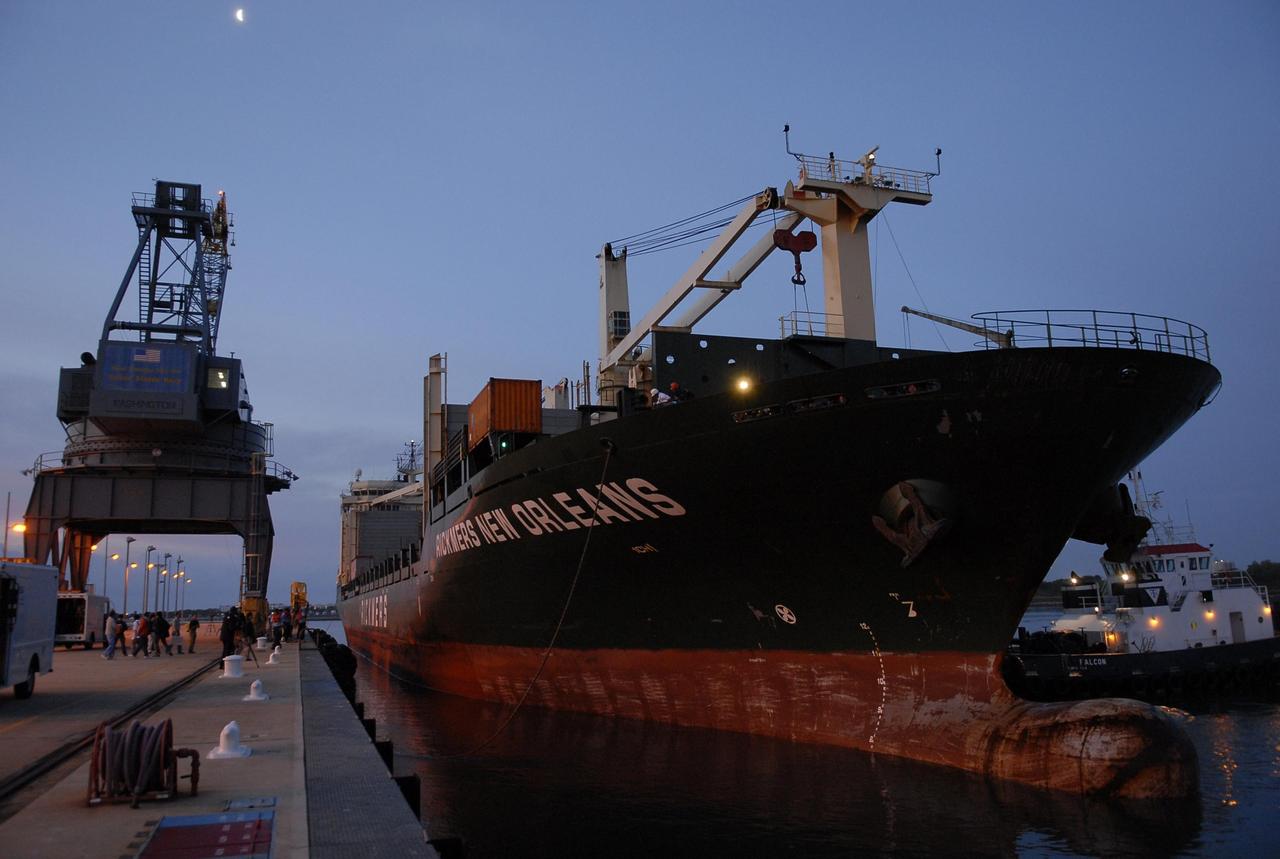
KENNEDY SPACE CENTER, FLA. -- The ship carrying the Experiment Logistics Module Pressurized Section for the Japanese Experiment Module arrives at the Trident wharf after departing from Yokohama, Japan, Feb. 7. The logistics module will be offloaded and transported to the Space Station Processing Facility at NASA's Kennedy Space Center. The Japanese Experiment Module is composed of three segments and is known as Kibo, which means "hope" in Japanese. Kibo consists of six components: two research facilities -- the Pressurized Module and Exposed Facility; a Logistics Module attached to each of them; a Remote Manipulator System; and an Inter-Orbit Communication System unit. Kibo also has a scientific airlock through which experiments are transferred and exposed to the external environment of space. Kibo is Japan's first human space facility and its primary contribution to the station. Kibo will enhance the unique research capabilities of the orbiting complex by providing an additional environment in which astronauts can conduct science experiments. The various components of JEM will be assembled in space over the course of three Space Shuttle missions. The first of those three missions, STS-123, will carry the Experiment Logistics Module Pressurized Section aboard the Space Shuttle Endeavour, targeted for launch in 2007. Photo credit: NASA/Kim Shiflett
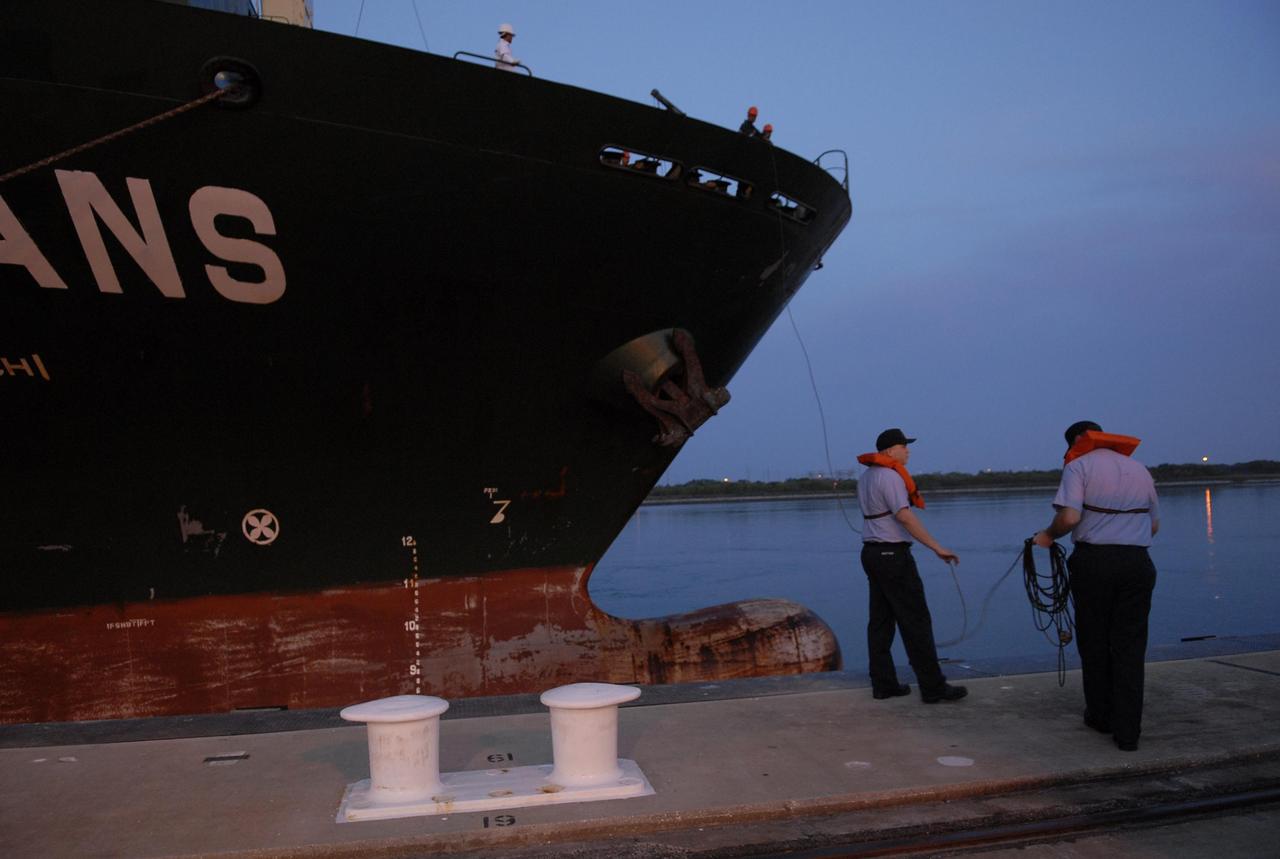
KENNEDY SPACE CENTER, FLA. -- The ship carrying the Experiment Logistics Module Pressurized Section for the Japanese Experiment Module is tied up at the Trident wharf after departing from Yokohama, Japan, Feb. 7. The logistics module will be offloaded and transported to the Space Station Processing Facility at NASA's Kennedy Space Center. The Japanese Experiment Module is composed of three segments and is known as Kibo, which means "hope" in Japanese. Kibo consists of six components: two research facilities -- the Pressurized Module and Exposed Facility; a Logistics Module attached to each of them; a Remote Manipulator System; and an Inter-Orbit Communication System unit. Kibo also has a scientific airlock through which experiments are transferred and exposed to the external environment of space. Kibo is Japan's first human space facility and its primary contribution to the station. Kibo will enhance the unique research capabilities of the orbiting complex by providing an additional environment in which astronauts can conduct science experiments. The various components of JEM will be assembled in space over the course of three Space Shuttle missions. The first of those three missions, STS-123, will carry the Experiment Logistics Module Pressurized Section aboard the Space Shuttle Endeavour, targeted for launch in 2007. Photo credit: NASA/Kim Shiflett

KENNEDY SPACE CENTER, FLA. -- The ship carrying the Experiment Logistics Module Pressurized Section for the Japanese Experiment Module arrives at the Trident wharf after departing from Yokohama, Japan, Feb. 7. The logistics module will be offloaded and transported to the Space Station Processing Facility at NASA's Kennedy Space Center. The Japanese Experiment Module is composed of three segments and is known as Kibo, which means "hope" in Japanese. Kibo consists of six components: two research facilities -- the Pressurized Module and Exposed Facility; a Logistics Module attached to each of them; a Remote Manipulator System; and an Inter-Orbit Communication System unit. Kibo also has a scientific airlock through which experiments are transferred and exposed to the external environment of space. Kibo is Japan's first human space facility and its primary contribution to the station. Kibo will enhance the unique research capabilities of the orbiting complex by providing an additional environment in which astronauts can conduct science experiments. The various components of JEM will be assembled in space over the course of three Space Shuttle missions. The first of those three missions, STS-123, will carry the Experiment Logistics Module Pressurized Section aboard the Space Shuttle Endeavour, targeted for launch in 2007. Photo credit: NASA/Kim Shiflett
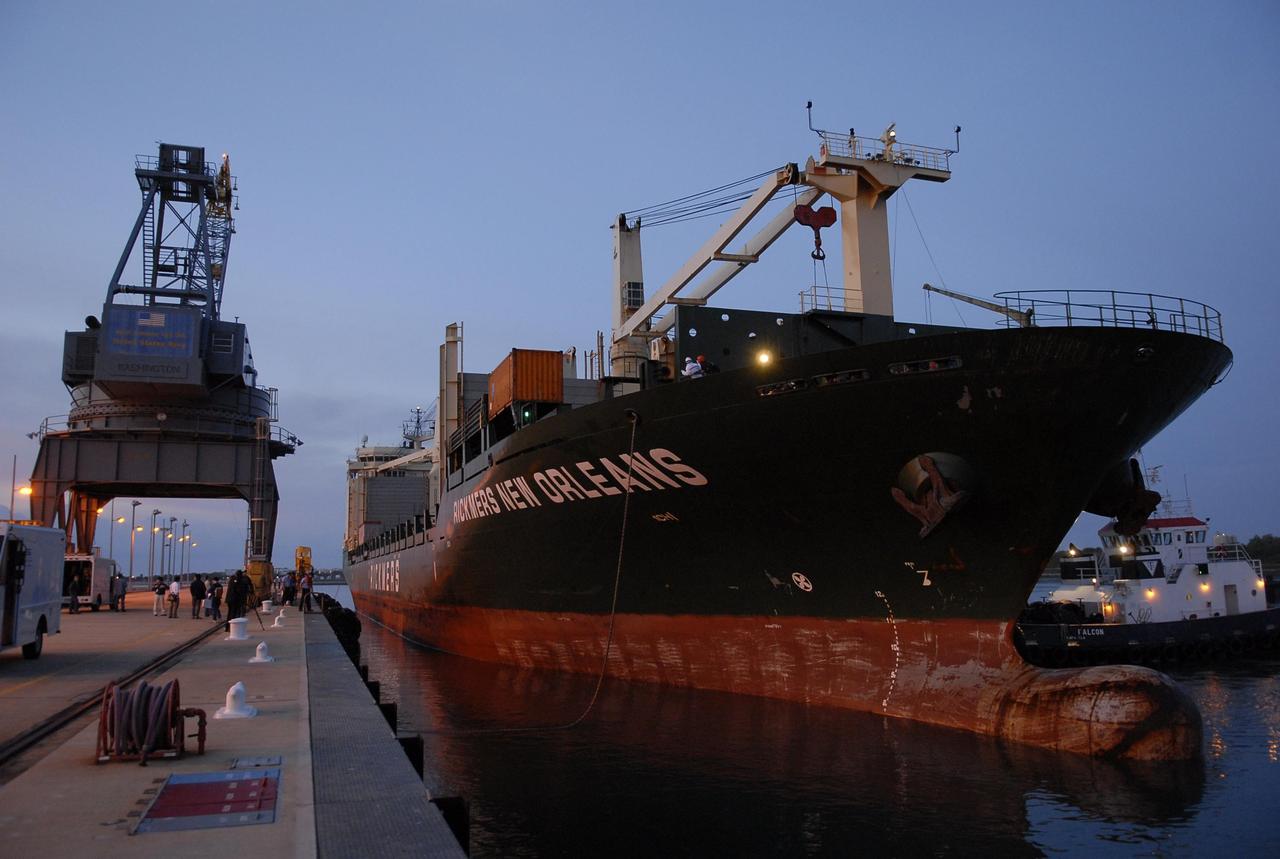
KENNEDY SPACE CENTER, FLA. -- The ship carrying the Experiment Logistics Module Pressurized Section for the Japanese Experiment Module arrives at the Trident wharf after departing from Yokohama, Japan, Feb. 7. The logistics module will be offloaded and transported to the Space Station Processing Facility at NASA's Kennedy Space Center. The Japanese Experiment Module is composed of three segments and is known as Kibo, which means "hope" in Japanese. Kibo consists of six components: two research facilities -- the Pressurized Module and Exposed Facility; a Logistics Module attached to each of them; a Remote Manipulator System; and an Inter-Orbit Communication System unit. Kibo also has a scientific airlock through which experiments are transferred and exposed to the external environment of space. Kibo is Japan's first human space facility and its primary contribution to the station. Kibo will enhance the unique research capabilities of the orbiting complex by providing an additional environment in which astronauts can conduct science experiments. The various components of JEM will be assembled in space over the course of three Space Shuttle missions. The first of those three missions, STS-123, will carry the Experiment Logistics Module Pressurized Section aboard the Space Shuttle Endeavour, targeted for launch in 2007. Photo credit: NASA/Kim Shiflett

KENNEDY SPACE CENTER, FLA. -- At the Trident wharf, workers help guide the container with the Experiment Logistics Module Pressurized Section inside toward a flat bed on the dock. The logistics module is part of the Japanese Experiment Module. The logistics module will be transported to the Space Station Processing Facility at NASA's Kennedy Space Center. The Japanese Experiment Module is composed of three segments and is known as Kibo, which means "hope" in Japanese. Kibo consists of six components: two research facilities -- the Pressurized Module and Exposed Facility; a Logistics Module attached to each of them; a Remote Manipulator System; and an Inter-Orbit Communication System unit. Kibo also has a scientific airlock through which experiments are transferred and exposed to the external environment of space. Kibo is Japan's first human space facility and its primary contribution to the station. Kibo will enhance the unique research capabilities of the orbiting complex by providing an additional environment in which astronauts can conduct science experiments. The various components of JEM will be assembled in space over the course of three Space Shuttle missions. The first of those three missions, STS-123, will carry the Experiment Logistics Module Pressurized Section aboard the Space Shuttle Endeavour, targeted for launch in 2007. Photo credit: NASA/Kim Shiflett
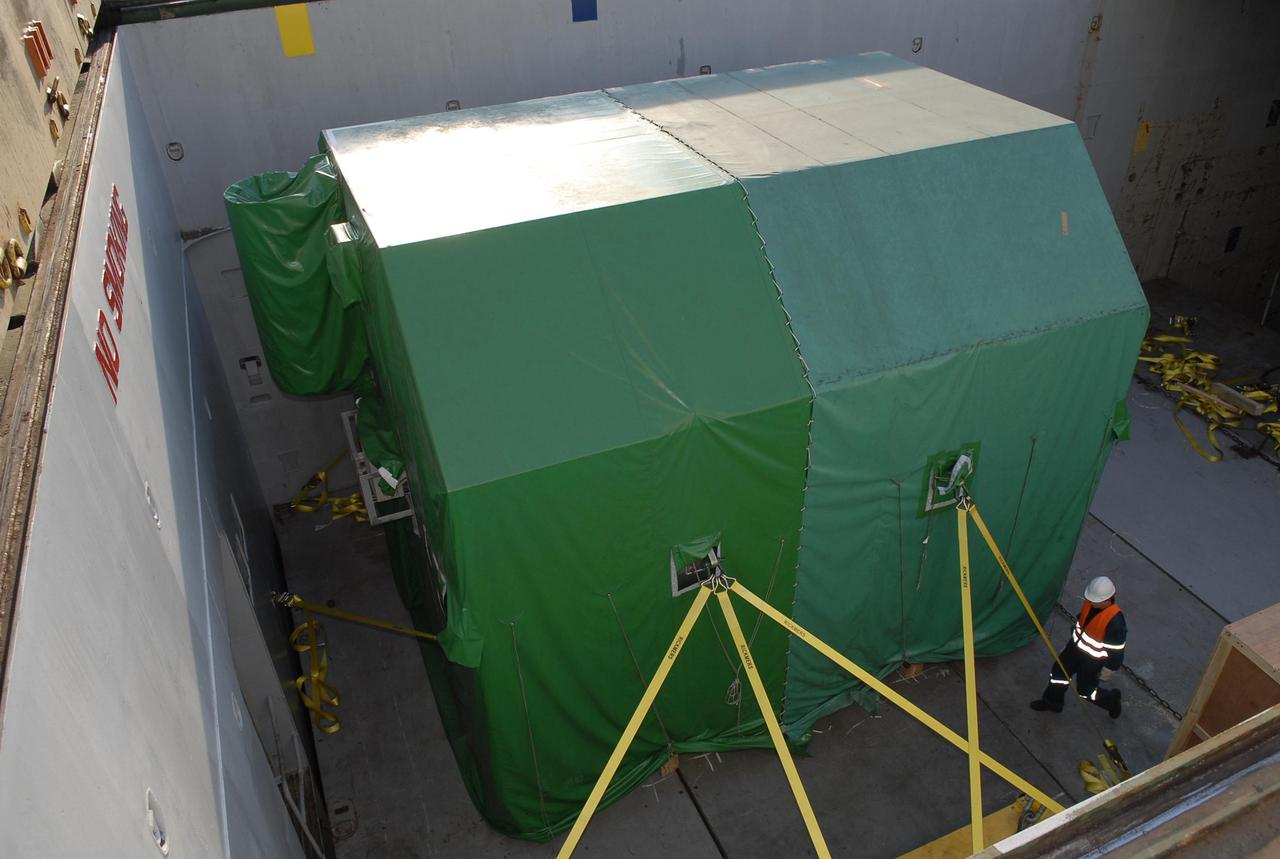
KENNEDY SPACE CENTER, FLA. -- At the Trident wharf, the shipping container with the Experiment Logistics Module Pressurized Section for the Japanese Experiment Module is ready for lifting out of the hold of the ship that brought it from Yokohama, Japan. The logistics module will be offloaded and transported to the Space Station Processing Facility at NASA's Kennedy Space Center. The Japanese Experiment Module is composed of three segments and is known as Kibo, which means "hope" in Japanese. Kibo consists of six components: two research facilities -- the Pressurized Module and Exposed Facility; a Logistics Module attached to each of them; a Remote Manipulator System; and an Inter-Orbit Communication System unit. Kibo also has a scientific airlock through which experiments are transferred and exposed to the external environment of space. Kibo is Japan's first human space facility and its primary contribution to the station. Kibo will enhance the unique research capabilities of the orbiting complex by providing an additional environment in which astronauts can conduct science experiments. The various components of JEM will be assembled in space over the course of three Space Shuttle missions. The first of those three missions, STS-123, will carry the Experiment Logistics Module Pressurized Section aboard the Space Shuttle Endeavour, targeted for launch in 2007. Photo credit: NASA/Kim Shiflett
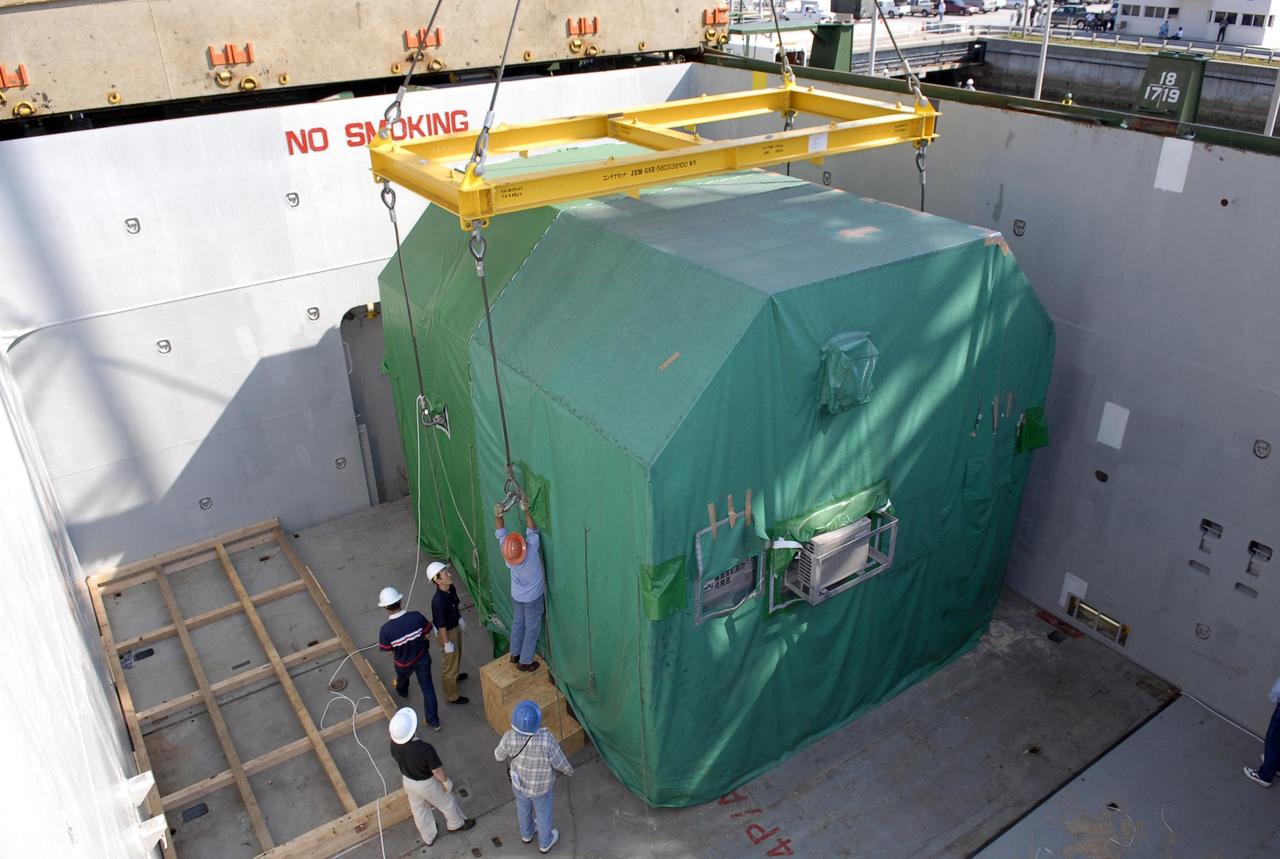
KENNEDY SPACE CENTER, FLA. -- At the Trident wharf, workers in the hold of a ship attach a crane to the shipping container with the Experiment Logistics Module Pressurized Section for the Japanese Experiment Module. The ship brought the module from Yokohama, Japan. The logistics module will be offloaded and transported to the Space Station Processing Facility at NASA's Kennedy Space Center. The Japanese Experiment Module is composed of three segments and is known as Kibo, which means "hope" in Japanese. Kibo consists of six components: two research facilities -- the Pressurized Module and Exposed Facility; a Logistics Module attached to each of them; a Remote Manipulator System; and an Inter-Orbit Communication System unit. Kibo also has a scientific airlock through which experiments are transferred and exposed to the external environment of space. Kibo is Japan's first human space facility and its primary contribution to the station. Kibo will enhance the unique research capabilities of the orbiting complex by providing an additional environment in which astronauts can conduct science experiments. The various components of JEM will be assembled in space over the course of three Space Shuttle missions. The first of those three missions, STS-123, will carry the Experiment Logistics Module Pressurized Section aboard the Space Shuttle Endeavour, targeted for launch in 2007. Photo credit: NASA/Kim Shiflett
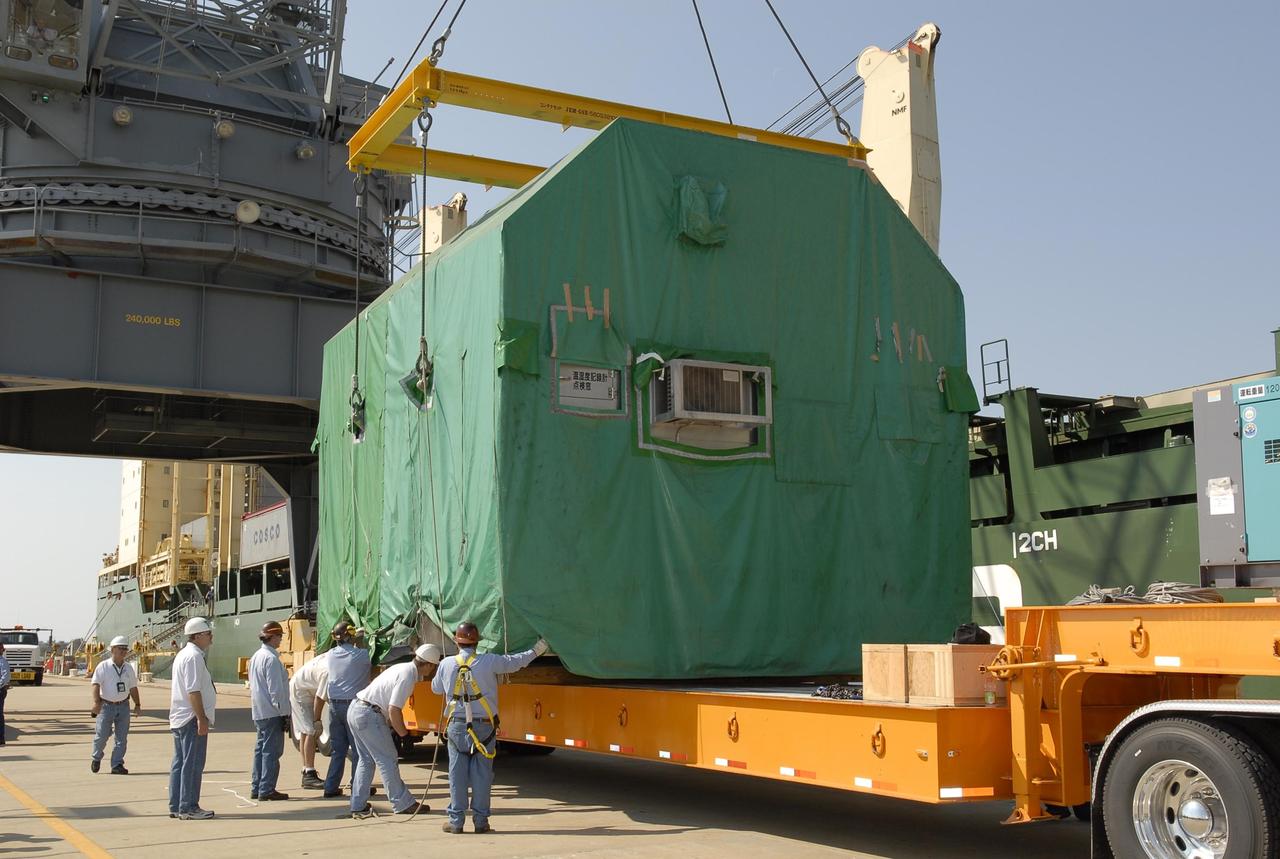
KENNEDY SPACE CENTER, FLA. -- At the Trident wharf, workers help guide the container with the Experiment Logistics Module Pressurized Section inside onto a flat bed on the dock. The logistics module is part of the Japanese Experiment Module. The logistics module will be transported to the Space Station Processing Facility at NASA's Kennedy Space Center. The Japanese Experiment Module is composed of three segments and is known as Kibo, which means "hope" in Japanese. Kibo consists of six components: two research facilities -- the Pressurized Module and Exposed Facility; a Logistics Module attached to each of them; a Remote Manipulator System; and an Inter-Orbit Communication System unit. Kibo also has a scientific airlock through which experiments are transferred and exposed to the external environment of space. Kibo is Japan's first human space facility and its primary contribution to the station. Kibo will enhance the unique research capabilities of the orbiting complex by providing an additional environment in which astronauts can conduct science experiments. The various components of JEM will be assembled in space over the course of three Space Shuttle missions. The first of those three missions, STS-123, will carry the Experiment Logistics Module Pressurized Section aboard the Space Shuttle Endeavour, targeted for launch in 2007. Photo credit: NASA/Kim Shiflett
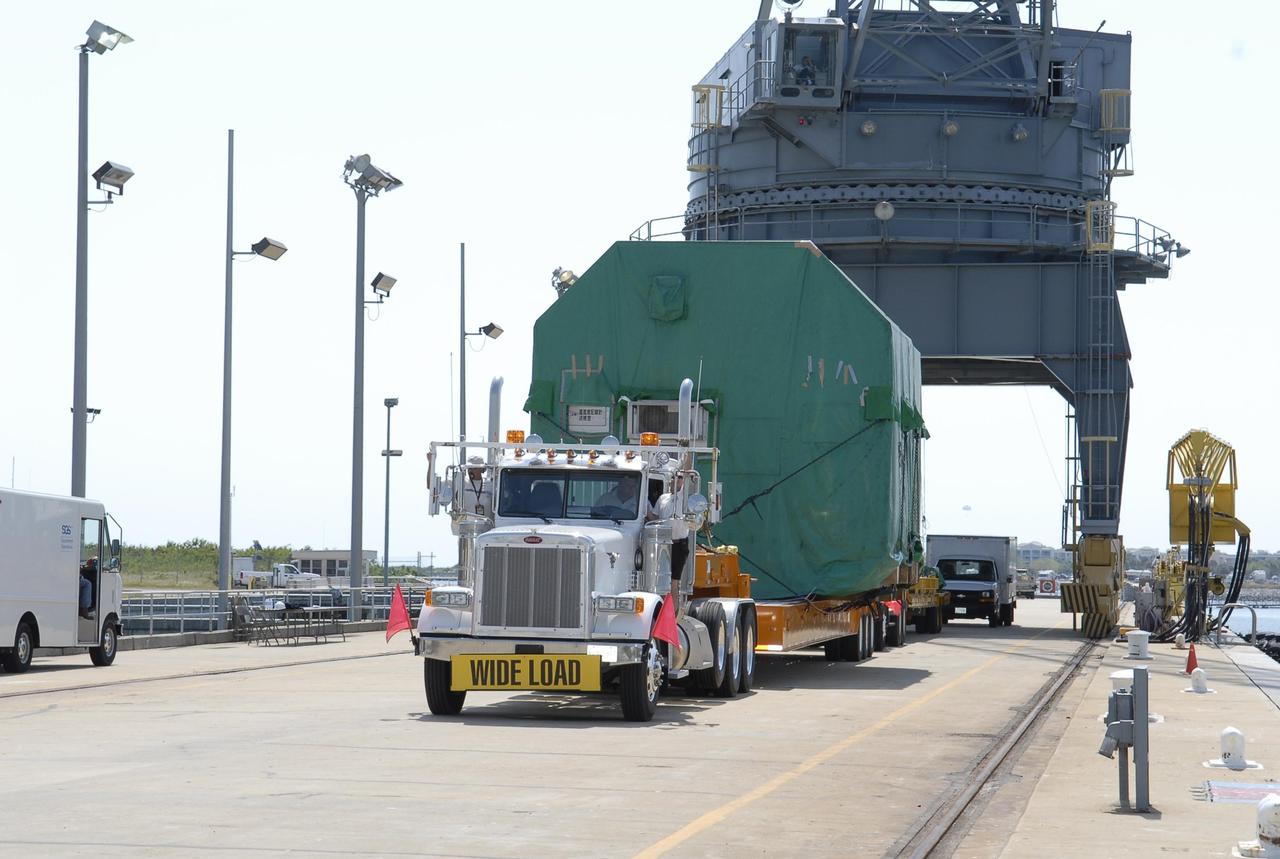
KENNEDY SPACE CENTER, FLA. -- A flat bed truck hauls the container with the Experiment Logistics Module Pressurized Section inside away from the Trident wharf. The logistics module is part of the Japanese Experiment Module. The logistics module is being transported to the Space Station Processing Facility at NASA's Kennedy Space Center. The Japanese Experiment Module is composed of three segments and is known as Kibo, which means "hope" in Japanese. Kibo consists of six components: two research facilities -- the Pressurized Module and Exposed Facility; a Logistics Module attached to each of them; a Remote Manipulator System; and an Inter-Orbit Communication System unit. Kibo also has a scientific airlock through which experiments are transferred and exposed to the external environment of space. Kibo is Japan's first human space facility and its primary contribution to the station. Kibo will enhance the unique research capabilities of the orbiting complex by providing an additional environment in which astronauts can conduct science experiments. The various components of JEM will be assembled in space over the course of three Space Shuttle missions. The first of those three missions, STS-123, will carry the Experiment Logistics Module Pressurized Section aboard the Space Shuttle Endeavour, targeted for launch in 2007. Photo credit: NASA/Kim Shiflett

KENNEDY SPACE CENTER, FLA. -- A flat bed truck hauls the container with the Experiment Logistics Module Pressurized Section inside away from the Trident wharf. The logistics module is part of the Japanese Experiment Module, known as Kibo. The logistics module is being transported to the Space Station Processing Facility at NASA's Kennedy Space Center. Kibo consists of six components: two research facilities -- the Pressurized Module and Exposed Facility; a Logistics Module attached to each of them; a Remote Manipulator System; and an Inter-Orbit Communication System unit. Kibo also has a scientific airlock through which experiments are transferred and exposed to the external environment of space. Kibo is Japan's first human space facility and its primary contribution to the station. Kibo will enhance the unique research capabilities of the orbiting complex by providing an additional environment in which astronauts can conduct science experiments. The various components of JEM will be assembled in space over the course of three Space Shuttle missions. The first of those three missions, STS-123, will carry the Experiment Logistics Module Pressurized Section aboard the Space Shuttle Endeavour, targeted for launch in 2007. Photo credit: NASA/Kim Shiflett

KENNEDY SPACE CENTER, FLA. -- At the Trident wharf, workers help guide the container with the Experiment Logistics Module Pressurized Section inside toward the dock. The logistics module is part of the Japanese Experiment Module. The logistics module will be transported to the Space Station Processing Facility at NASA's Kennedy Space Center. The Japanese Experiment Module is composed of three segments and is known as Kibo, which means "hope" in Japanese. Kibo consists of six components: two research facilities -- the Pressurized Module and Exposed Facility; a Logistics Module attached to each of them; a Remote Manipulator System; and an Inter-Orbit Communication System unit. Kibo also has a scientific airlock through which experiments are transferred and exposed to the external environment of space. Kibo is Japan's first human space facility and its primary contribution to the station. Kibo will enhance the unique research capabilities of the orbiting complex by providing an additional environment in which astronauts can conduct science experiments. The various components of JEM will be assembled in space over the course of three Space Shuttle missions. The first of those three missions, STS-123, will carry the Experiment Logistics Module Pressurized Section aboard the Space Shuttle Endeavour, targeted for launch in 2007. Photo credit: NASA/Kim Shiflett
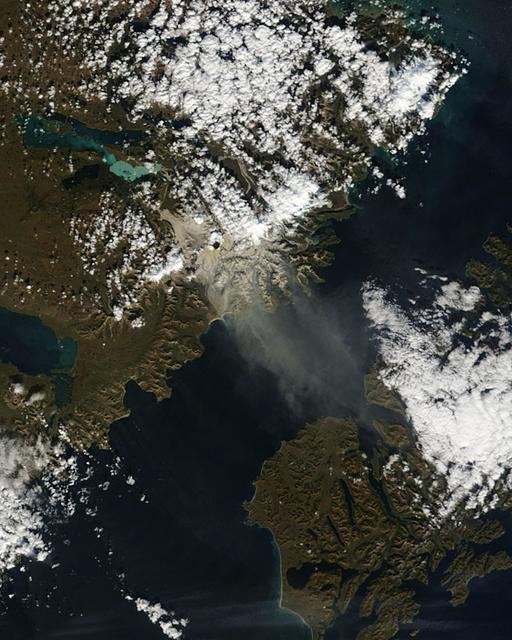
The Valley of Ten Thousand Smokes, located in Katmai National Park, forms a unique and ashen landscape. Encircled by volcanoes – both active and inactive – it has served as a perfect collection area for huge amounts of volcanic ash. According to the Alaska Historical Society (AHS), 2012 marked the centennial anniversary of the volcanic eruption that formed the valley, and led to the establishment, in 1918, of Katmai National Park. A massive eruption rocked the region on June 6, 1912 as the then-unknown volcano, Novarupta, became suddenly and violently active. According to the AHS, it erupted with “such force that mountains collapsed, ash darkened summer skies, earthquakes rocked population centers and were recorded as far away as Washington, D.C.” Glowing hot ash was reported to have smothered an area covering 40 square miles, and up to 700 feet deep. While the active volcanoes surrounding the valley - Novarupta, Mt. Mageik, Trident Volcano, Mt. Griggs, Mt. Martin and Mt. Katmai - have remained relatively quiescent, their ashen legacy continues to affect the landscape – and air traffic - even a century after it was laid down. The Moderate Resolution Imaging Spectroradiometer (MODIS) aboard NASA’s Terra satellite captured this true-color image on September 29, 2014. Volcanic ash from the Katmai region has been lifted aloft by strong winds, and is blowing to the southeast, over Shelikof Strait, Kodiak Island, and the Gulf of Alaska. Although such clouds are not from active volcanoes, the remobilized volcanic ash still provides a potential hazard to aircraft flying through the region. Credit: NASA/GSFC/Jeff Schmaltz/MODIS Land Rapid Response Team <b><a href="http://www.nasa.gov/audience/formedia/features/MP_Photo_Guidelines.html" rel="nofollow">NASA image use policy.</a></b> <b><a href="http://www.nasa.gov/centers/goddard/home/index.html" rel="nofollow">NASA Goddard Space Flight Center</a></b> enables NASA’s mission through four scientific endeavors: Earth Science, Heliophysics, Solar System Exploration, and Astrophysics. Goddard plays a leading role in NASA’s accomplishments by contributing compelling scientific knowledge to advance the Agency’s mission. <b>Follow us on <a href="http://twitter.com/NASAGoddardPix" rel="nofollow">Twitter</a></b> <b>Like us on <a href="http://www.facebook.com/pages/Greenbelt-MD/NASA-Goddard/395013845897?ref=tsd" rel="nofollow">Facebook</a></b> <b>Find us on <a href="http://instagram.com/nasagoddard?vm=grid" rel="nofollow">Instagram</a></b>