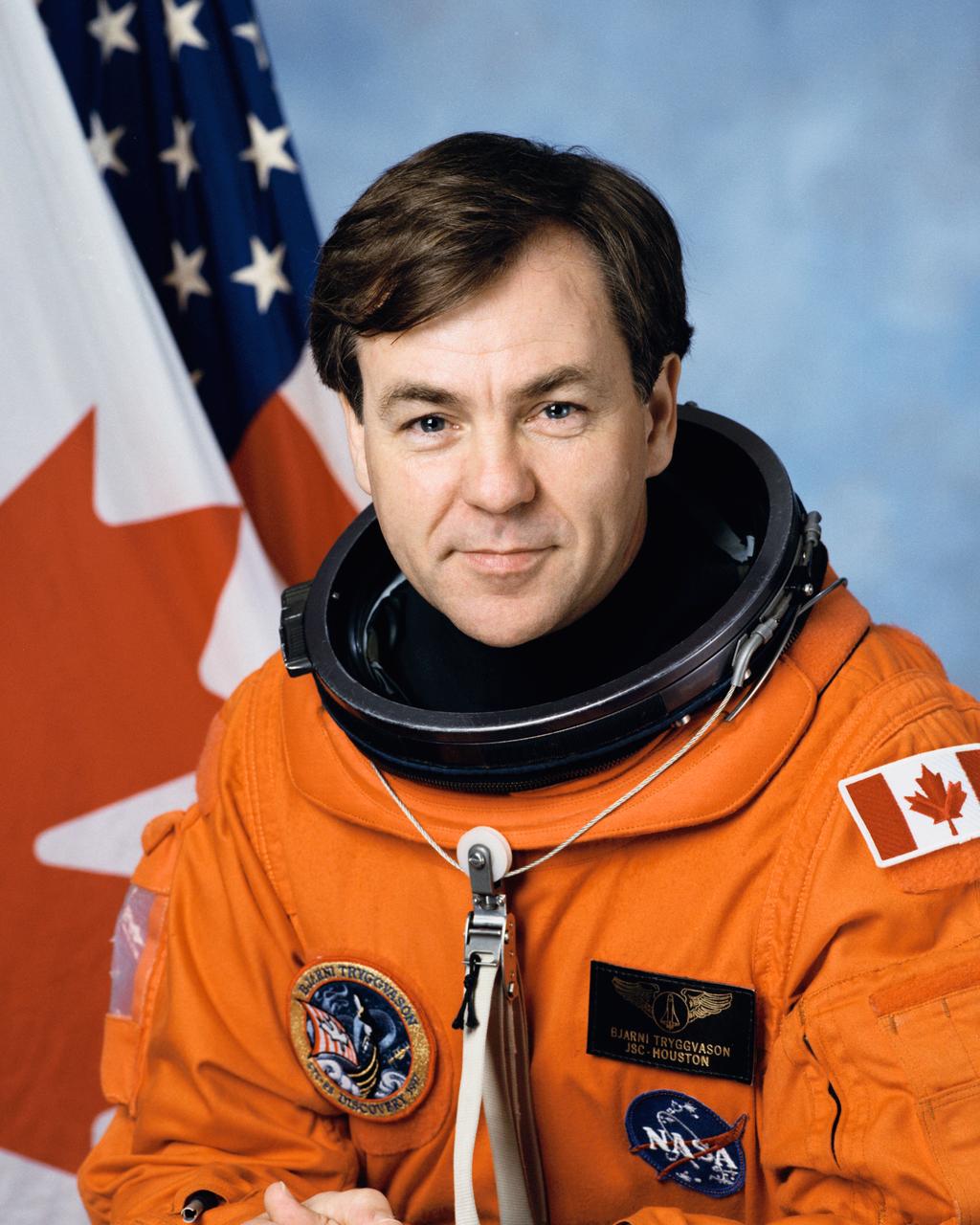
S97-06278 (2 April 1997) --- Bjarni V. Tryggvason, payload specialist representing the Canadian Space Agency (CSA).
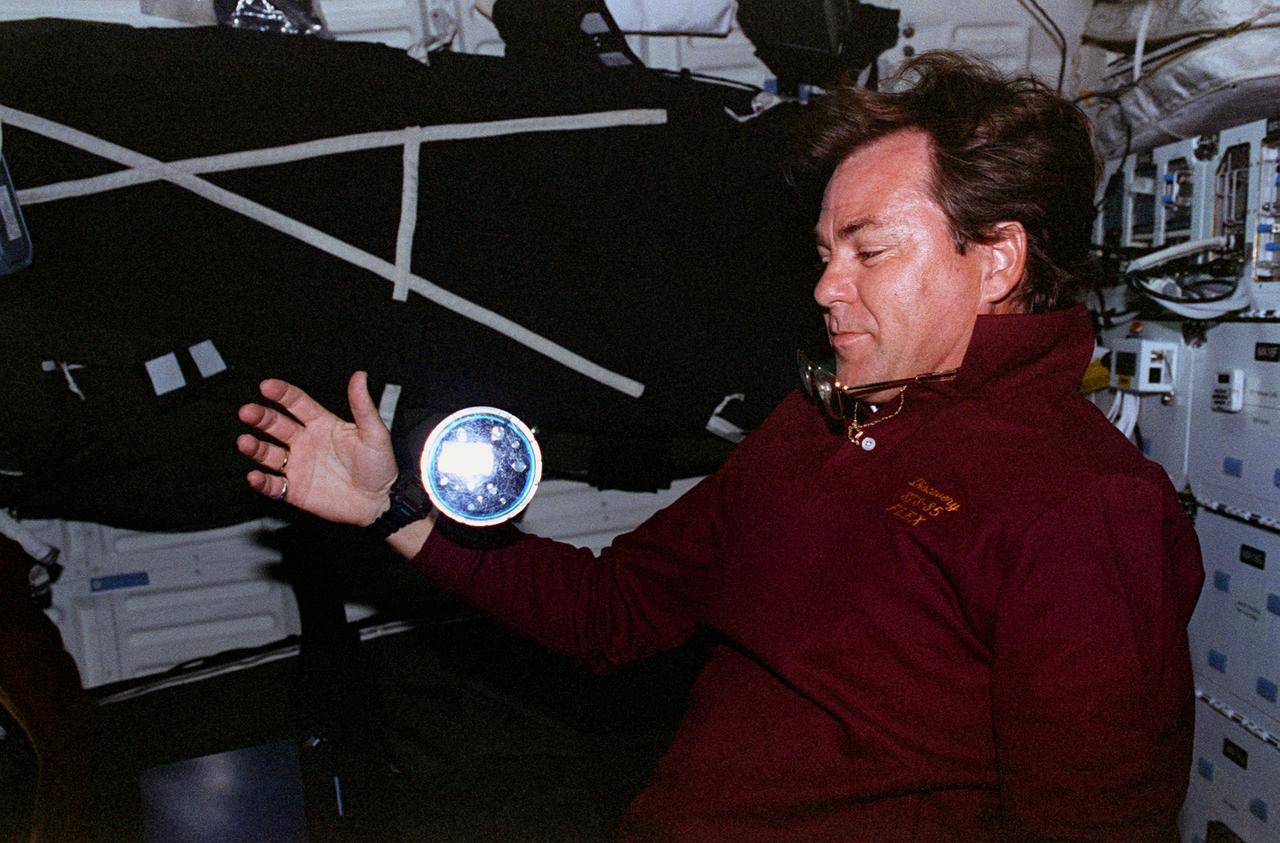
STS085-351-003 (7 - 19 August 1997) --- Payload specialist Bjarni Tryggvason of the Canadian Space Agency (CSA) shows off the Microgravity Vibration Isolation Mount (MIM) fluid disk. One of five Fluid Loop Experiments (FLEX), this one deals with the Growth of Resonance Patterns (GORP) in gaseous liquid systems.
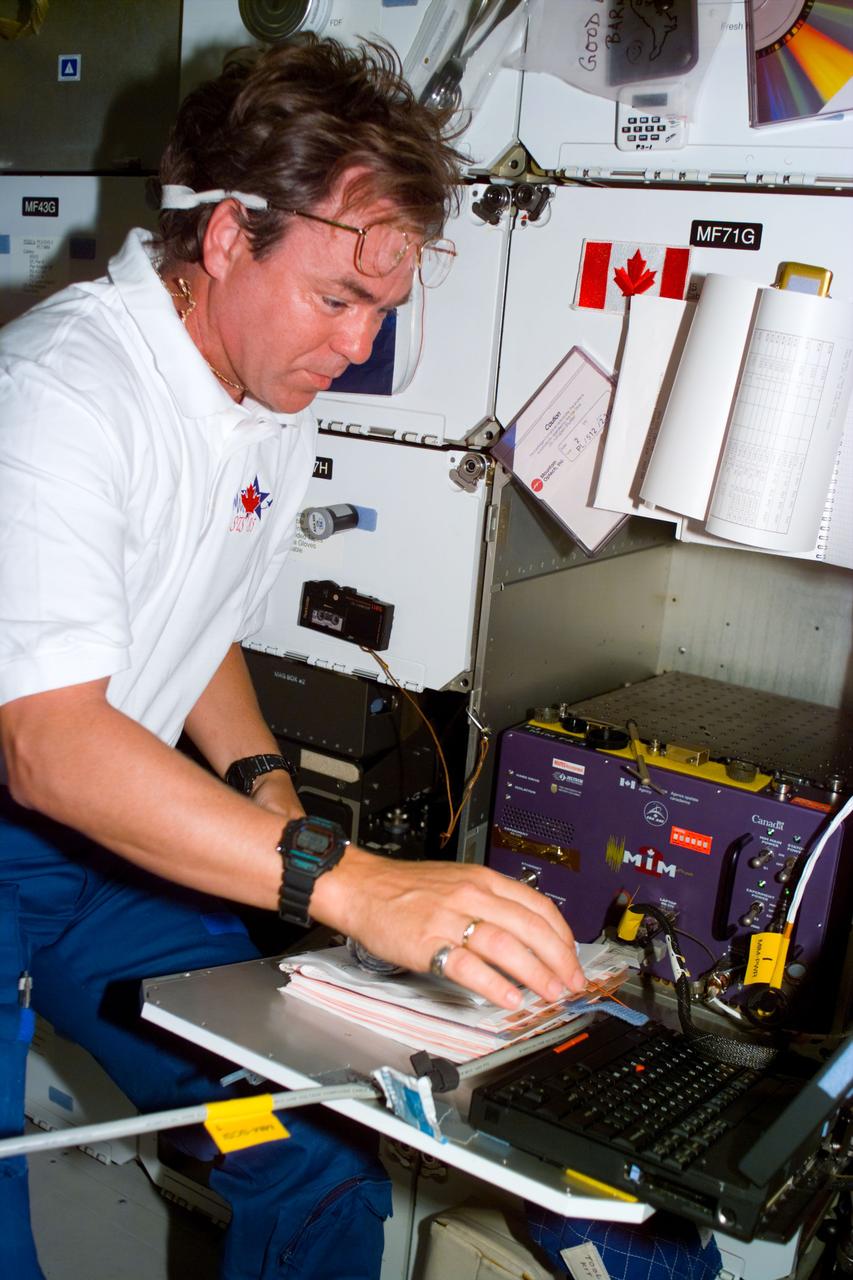
S85-E-5013 (10 August 1997) --- Bjarni V. Tryggvason, payload specialist representing the Canadian Space Agency (CSA), inputs data on a lap top during flight day four activities, onboard the Space Shuttle Discovery.

STS085-351-005 (7 - 19 August 1997) --- Payload specialist Bjarni Tryggvason of the Canadian Space Agency (CSA) shows off the Microgravity Vibration Isolation Mount (MIM) fluid disk. One of five fluid loop experiments (FLEX), this one deals with the growth of resonance patterns (GORP) in gaseous liquid systems.
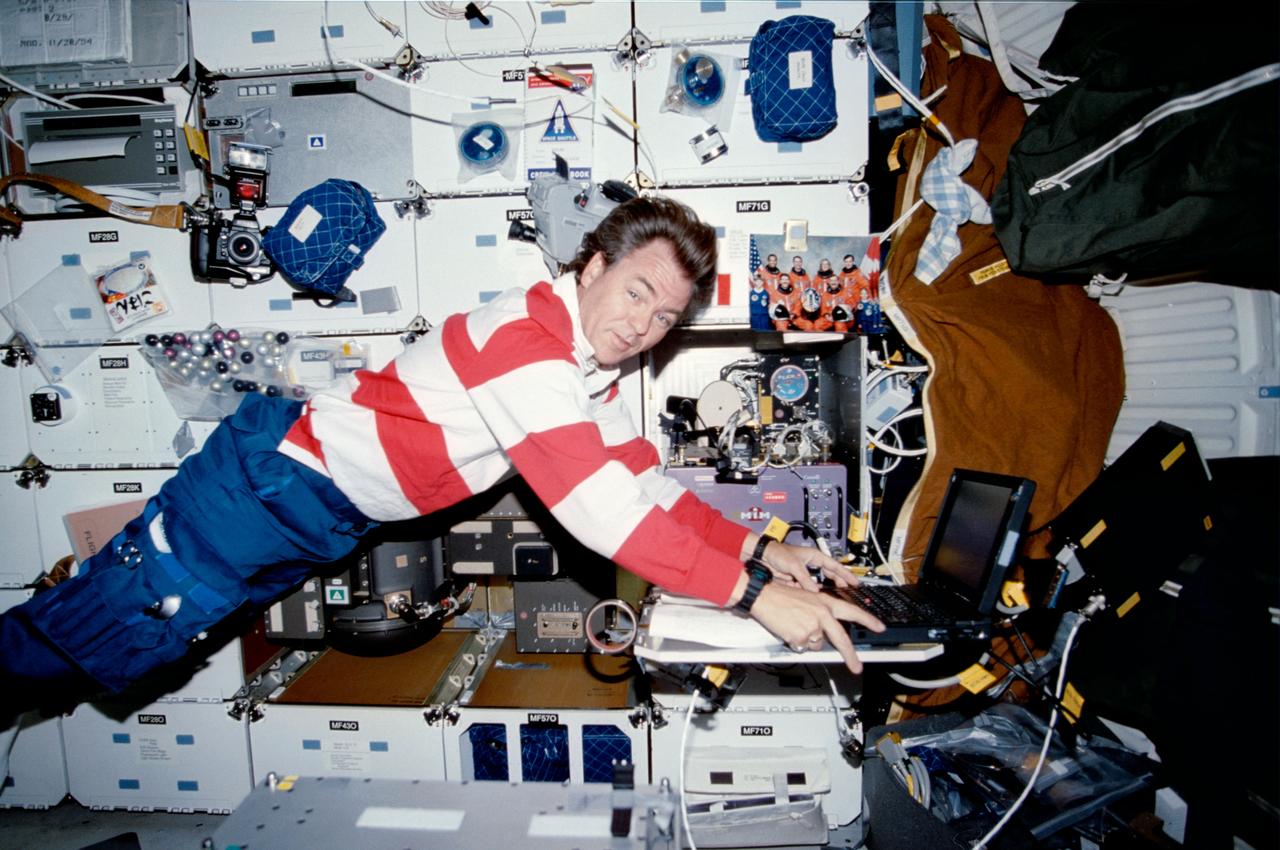
STS085-312-006 (7-19 August 1997) --- Payload specialist Bjarni Tryggvason, representing the Canadian Space Agency (CSA), inputs data into a computer regarding the Microgravity Vibration Isolation Mount (MIM) experiment on the mid-deck of the Space Shuttle Discovery.
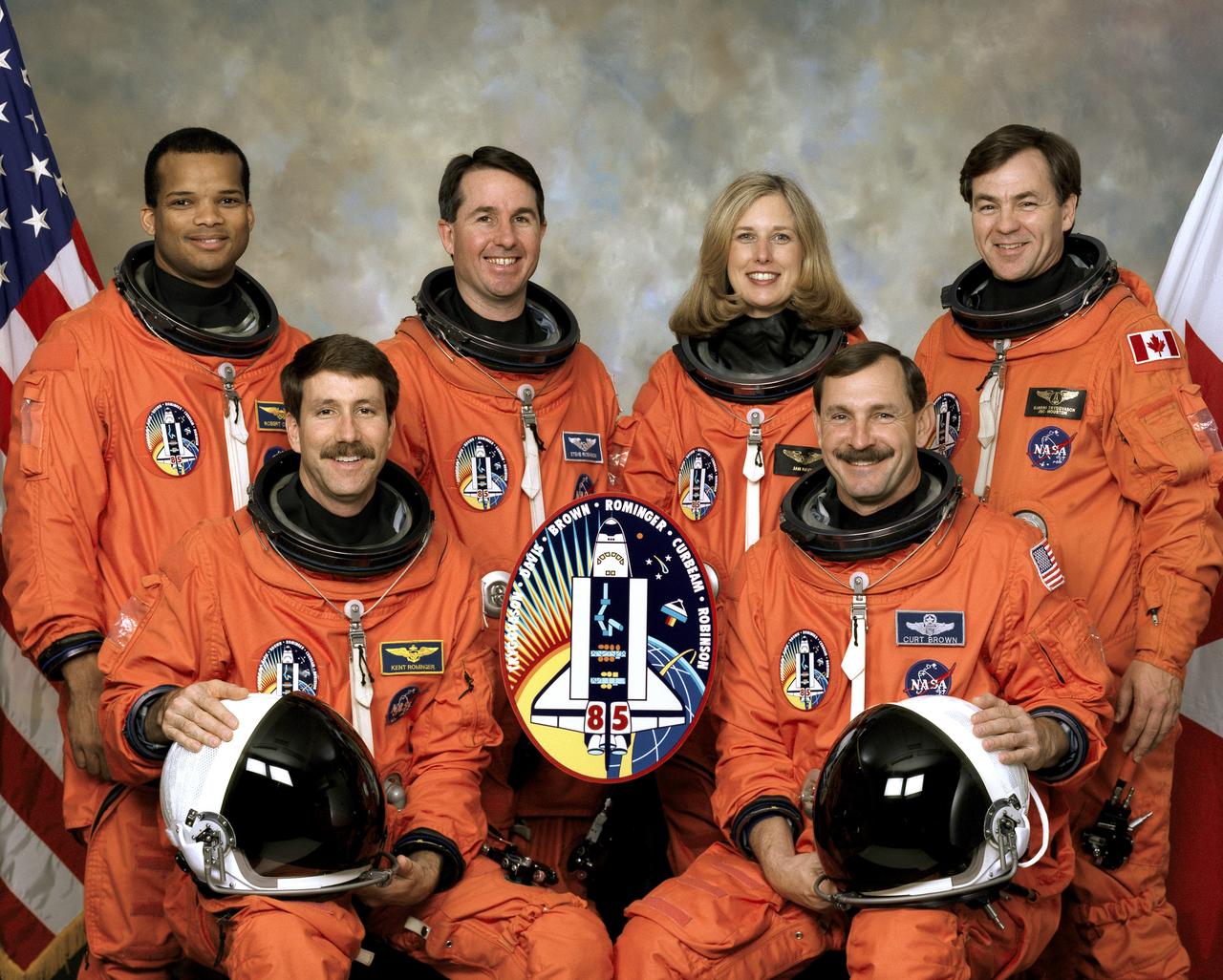
Five NASA astronauts and a Canadian payload specialist pause from their training schedule to pose for the traditional crew portrait for their mission, STS-85. In front are astronauts Curtis L. Brown, Jr. (right), mission commander, and Kent V. Rominger, pilot. On the back row, from the left, are astronauts Robert L. Curbeam, Jr., Stephen K. Robinson, and N. Jan Davis, all mission specialists, along with the Canadian Space Agency’s (CSA) payload specialist, Bjarni Tryggvason. The five launched into space aboard the Space Shuttle Discovery on August 7, 1997 at 10:41:00 a.m. (EDT). Major payloads included the satellite known as Cryogenic Infrared Spectrometers and Telescopes for the Atmosphere-Shuttle Pallet Satellite-2 CRISTA-SPAS-02. CRISTA; a Japanese Manipulator Flight Development (MFD); the Technology Applications and Science (TAS-01); and the International Extreme Ultraviolet Hitchhiker (IEH-02).
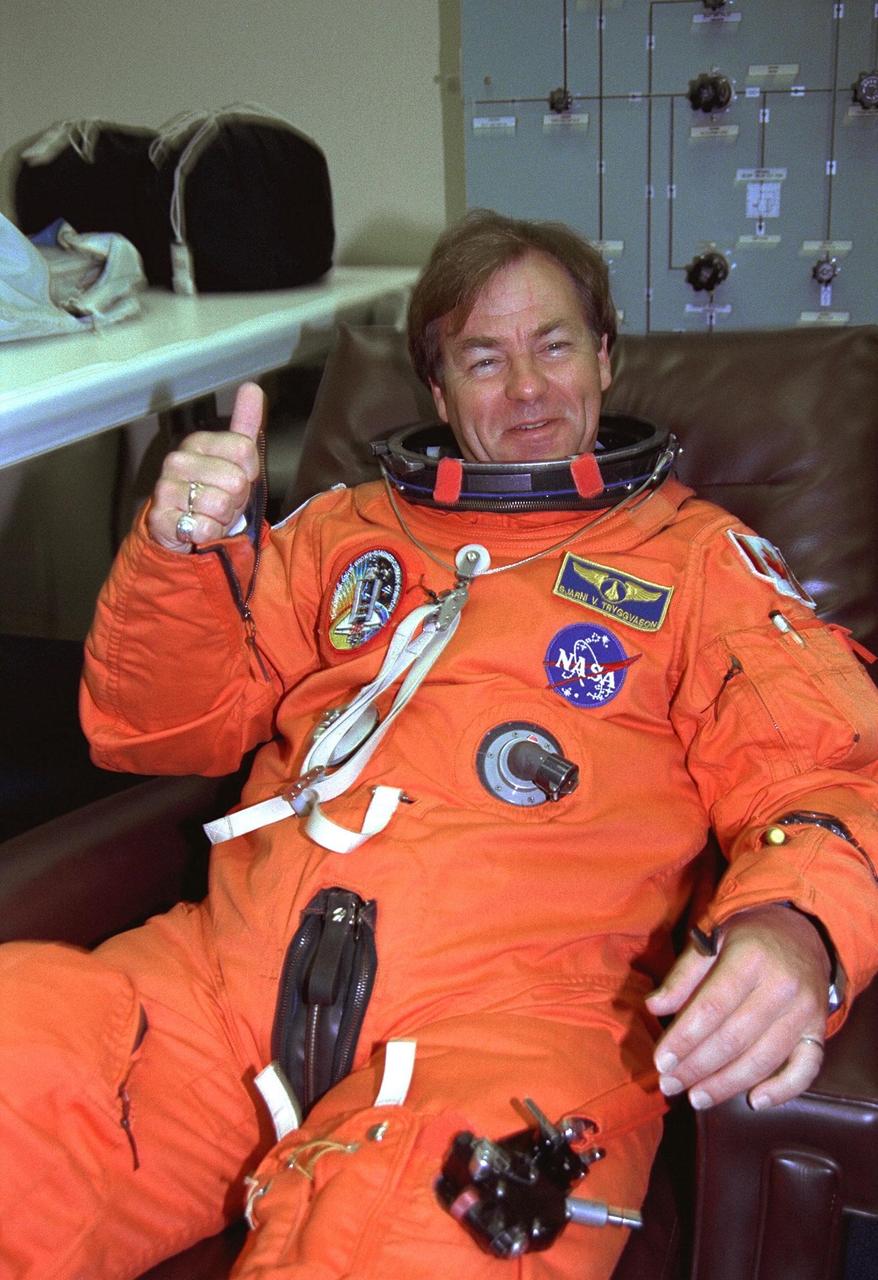
STS-85 Payload Specialist Bjarni V. Tryggvason gives a thumbs up as he is assisted with his ascent/reentry flight suit in the Operations and Checkout (O&C) Building. He is a Canadian Space Agency astronaut and was born in Iceland. Tryggvason has also been a flight instructor for the Canadian Air Force. Tryggvason is the principal investigator of the Microgravity Vibration Isolation Mount now flying on the Russian Mir space station. During STS-85, Tryggvason will conduct vibration isolation mount and fluid physics investigations. His work to study how Shuttle vibrations affect the results of experiments will be valuable to the International Space Station program, since this experiment is planned for use on that space platform. Tryggvason will also conduct Bioreactor experiments and assist Mission Specialist Stephen K. Robinson with photography
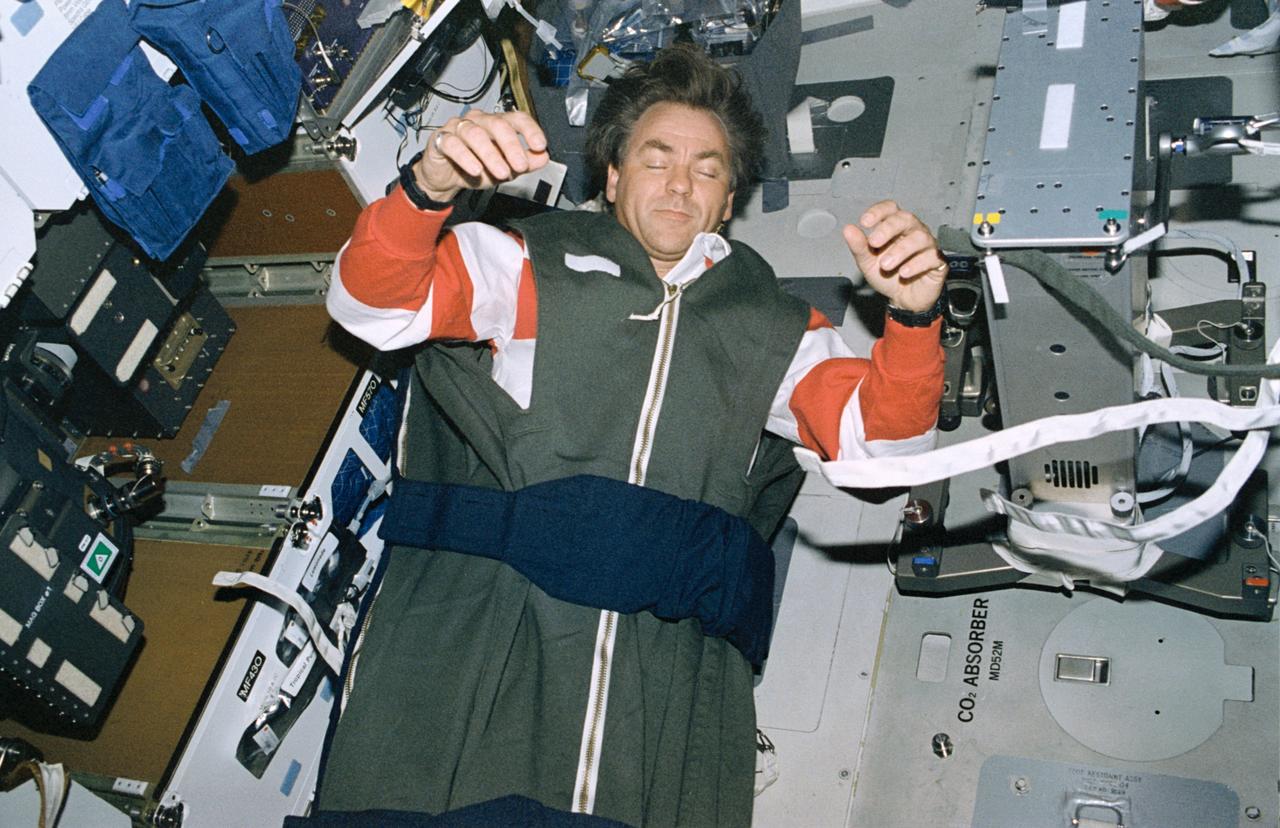
STS085-327-026 (7 - 19 August 1997) --- Payload specialist Bjarni V. Tryggvason, representing the Canadian Space Agency (CSA), sleeps on the Space Shuttle Discovery's mid-deck floor. Tryggvason elected to not use a pillow, allowing his head to float freely in the Microgravity environment.
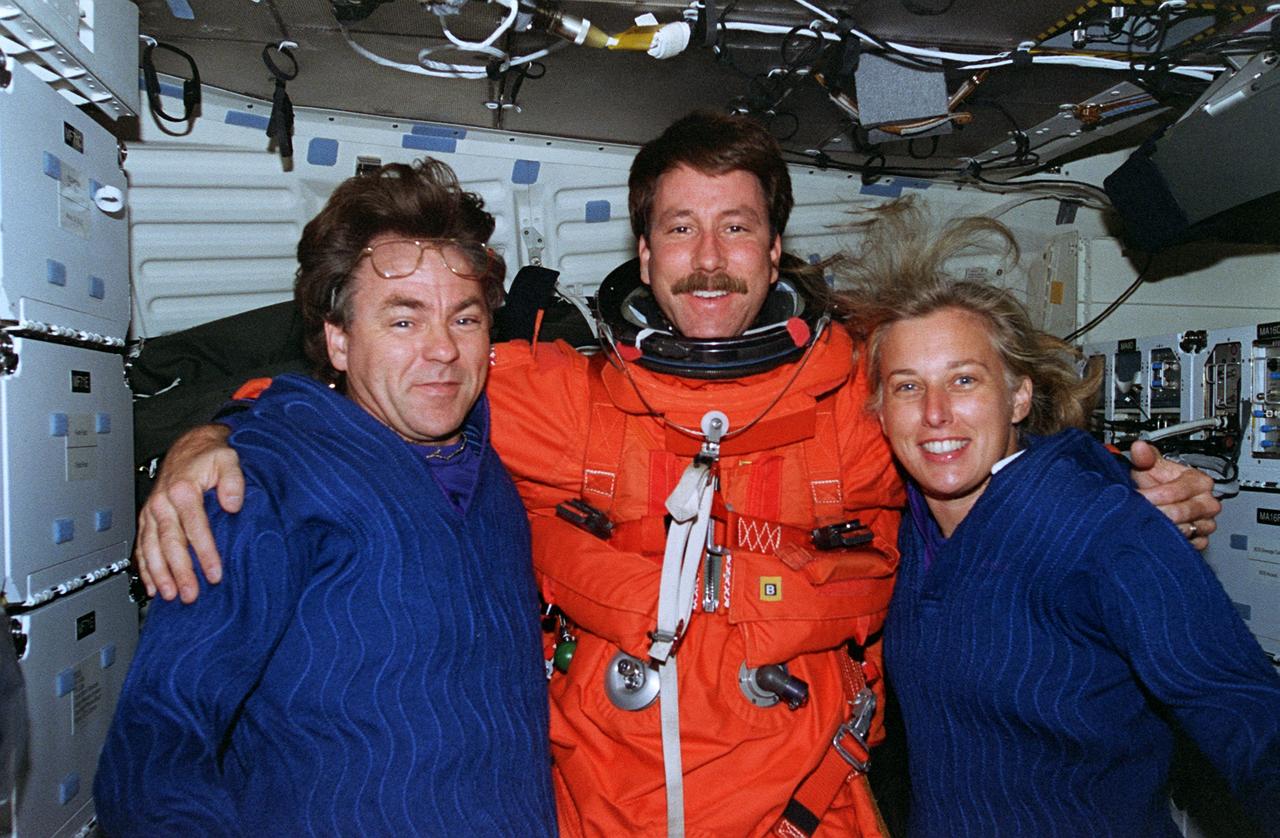
STS085-364-008 (19 August 1997) --- One of the final pictures taken during the STS-85 mission was this frame, exposed on the mid-deck during preparations for the August 19, 1997 entry. Left to right are payload specialist Bjarni V. Tryggvason, with astronauts Kent V. Rominger, pilot, and N. Jan Davis, payload commander. Rominger has already donned his partial pressure launch and entry suit, while Tryggvason and Davis have put on their blue under garments but have yet to don their escape suits.
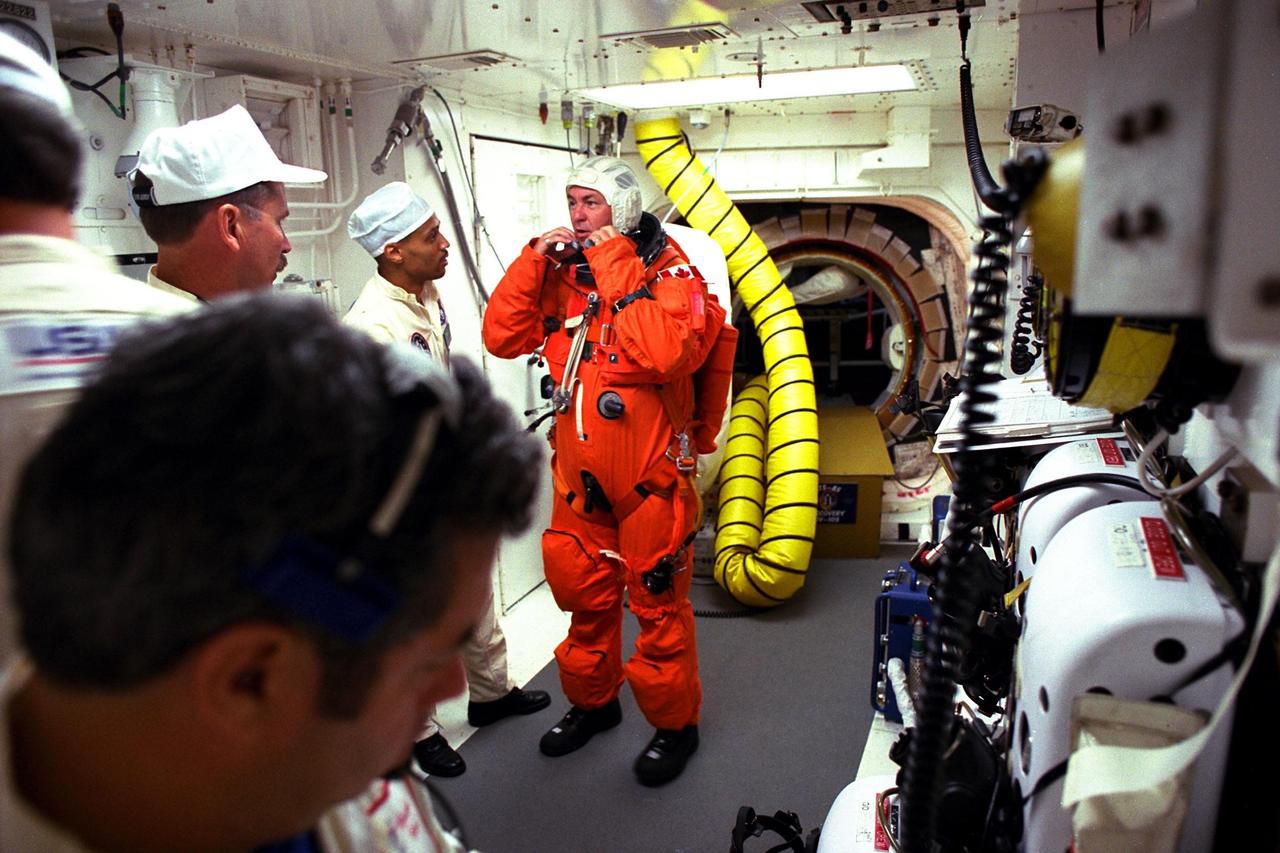
STS-85 Payload Specialist Bjarni V. Tryggvason is assisted with his ascent/reentry flight suit by white room closeout crew members Jack Burritt and Carlos Gillis at Launch Pad 39A before he enters the crew cabin of the Space Shuttle orbiter Discovery
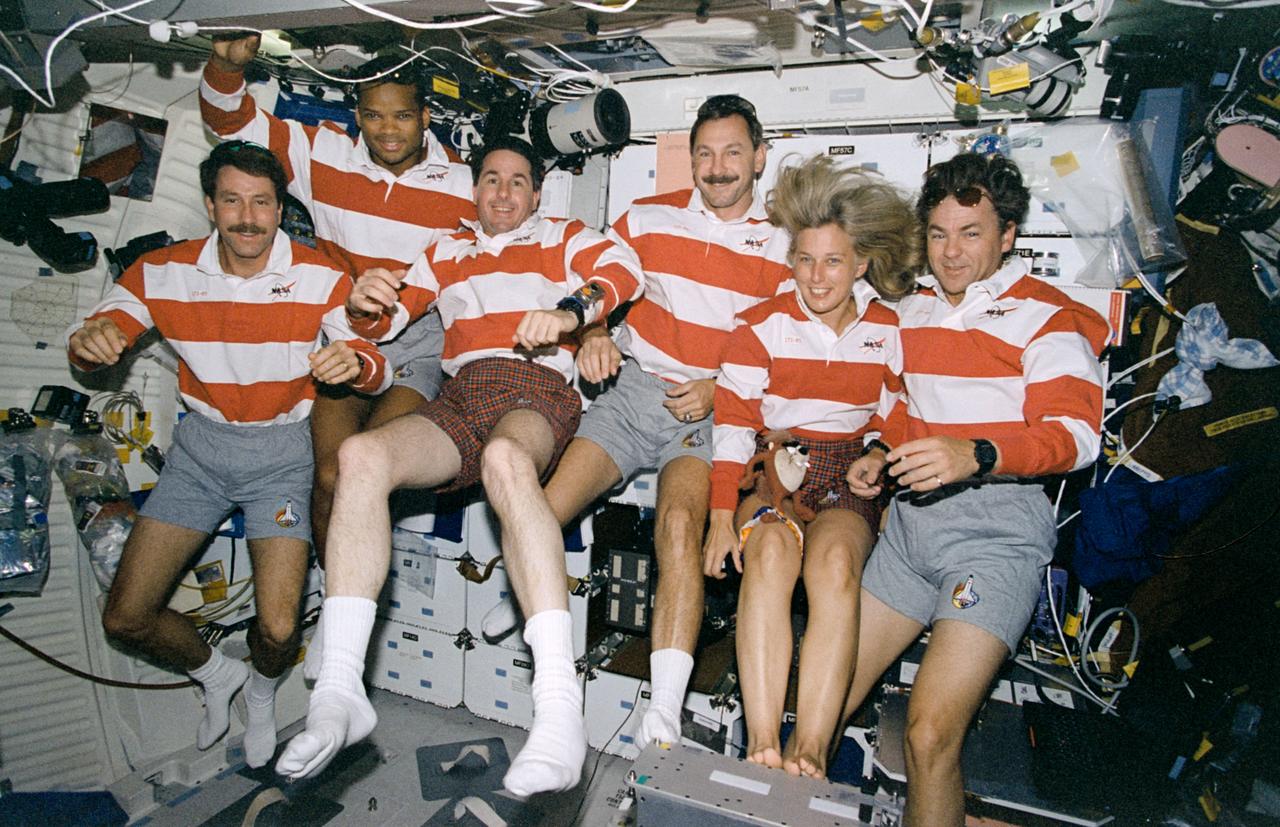
STS085-326-016 (7 - 19 August 1997) --- An impromptu in-flight crew portrait was snapped while the crew members were setting up for a more balanced portrait on the Space Shuttle Discovery's mid-deck. Left to right are astronauts Kent V. Rominger, Robert L. Curbeam, Stephen K. Robinson, Curtis L. Brown, Jr., N. Jan Davis and Bjarni V. Tryggvason.
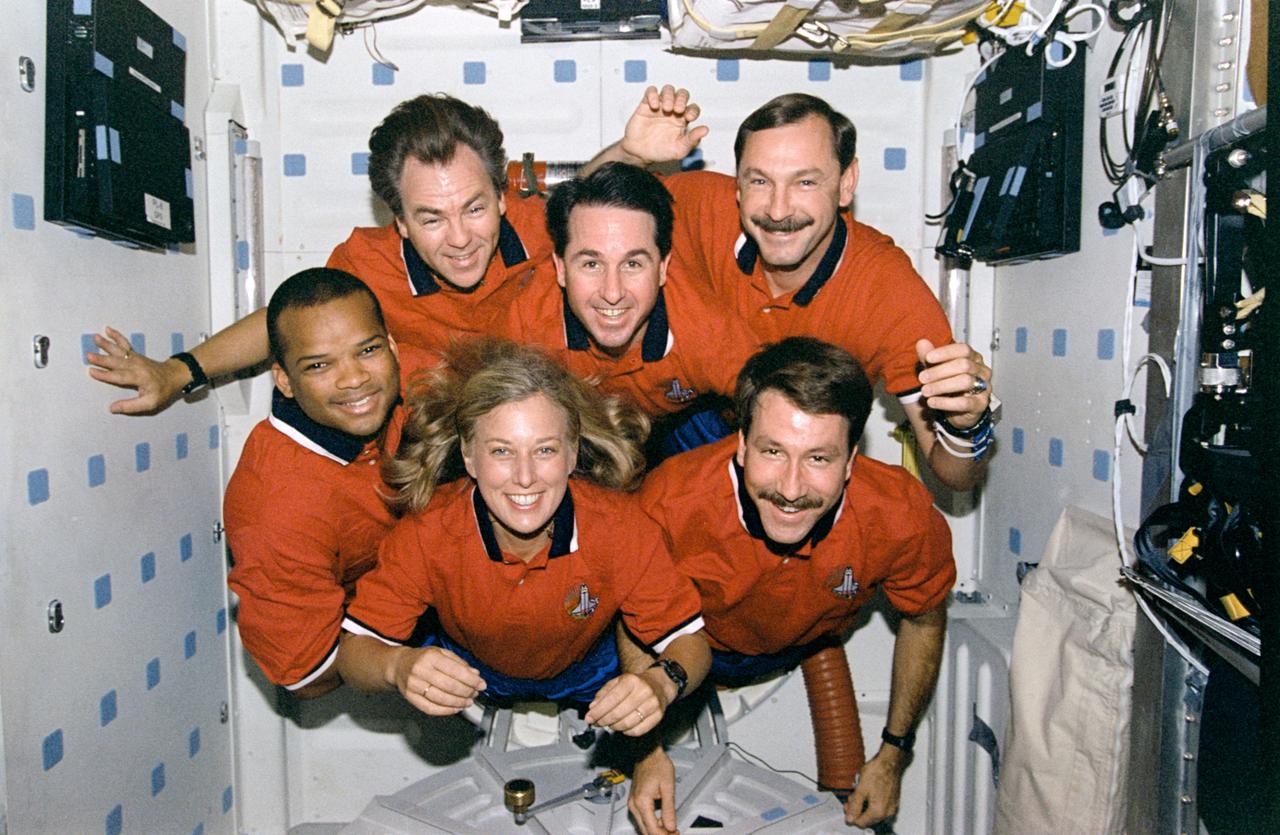
STS085-320-020 (7 - 19 August 1997) --- For their traditional in-flight crew portrait, the six crew members for this mission float on the mid-deck of the Space Shuttle Discovery. On top, left to right, are Bjarni Tryggvason, payload specialist of the Canadian Space Agency (CSA); along with astronauts Stephen K. Robinson, mission specialist; and Curtis L. Brown, Jr., mission commander. On bottom, from the left, are astronauts Robert L. Curbeam, Jr., mission specialist; N. Jan Davis, payload commander; and Kent V. Rominger, pilot.
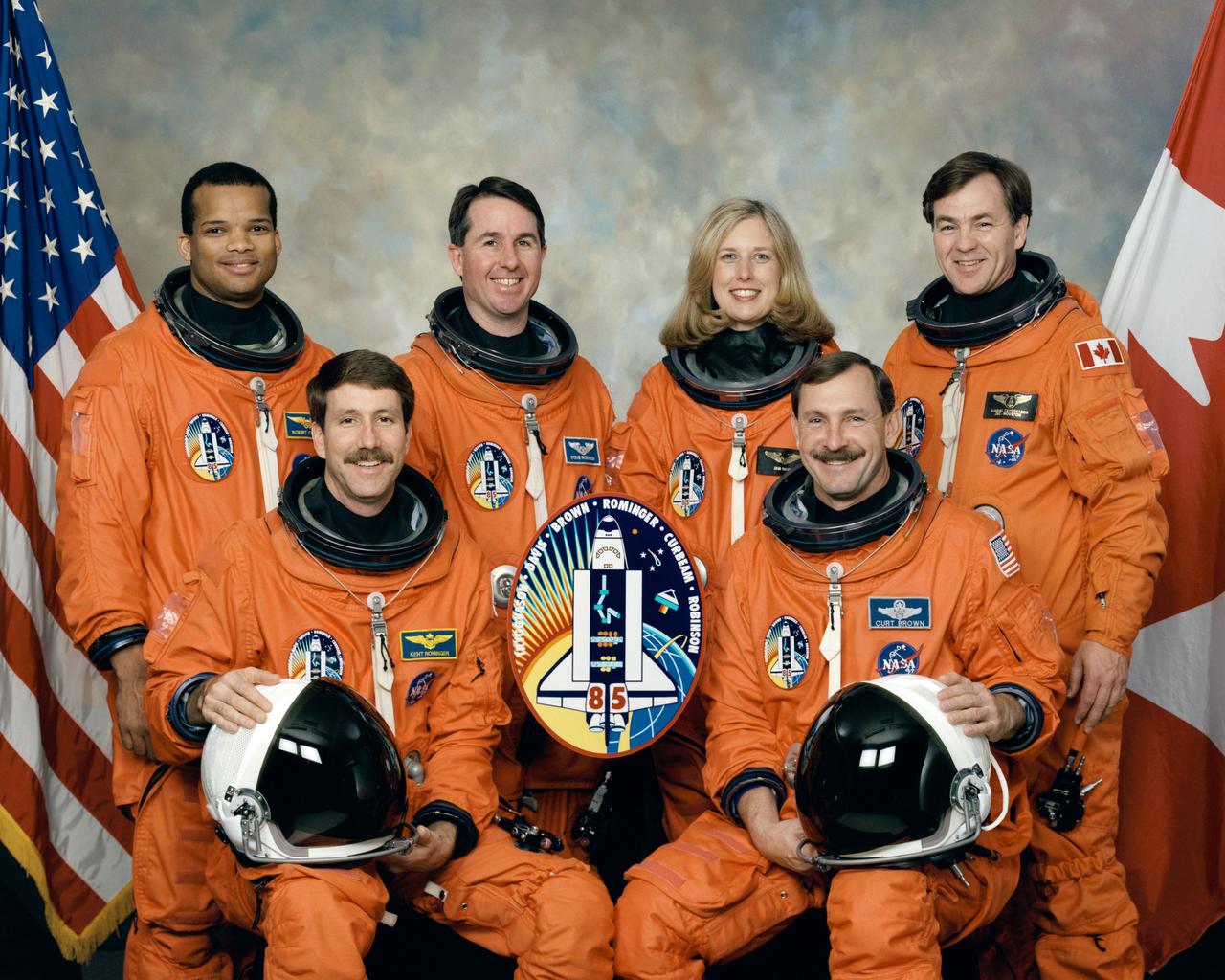
STS085-S-002 (May 1997) --- Five NASA astronauts and a Canadian payload specialist pause from their training schedule to pose for the traditional crew portrait for their mission. In front are astronauts Curtis L. Brown, Jr. (right), mission commander, and Kent V. Rominger, pilot. On the back row, from the left, are astronauts Robert L. Curbeam, Jr., Stephen K. Robinson and N. Jan Davis, all mission specialists, along with the Canadian Space Agency’s (CSA) payload specialist Bjarni Tryggvason.
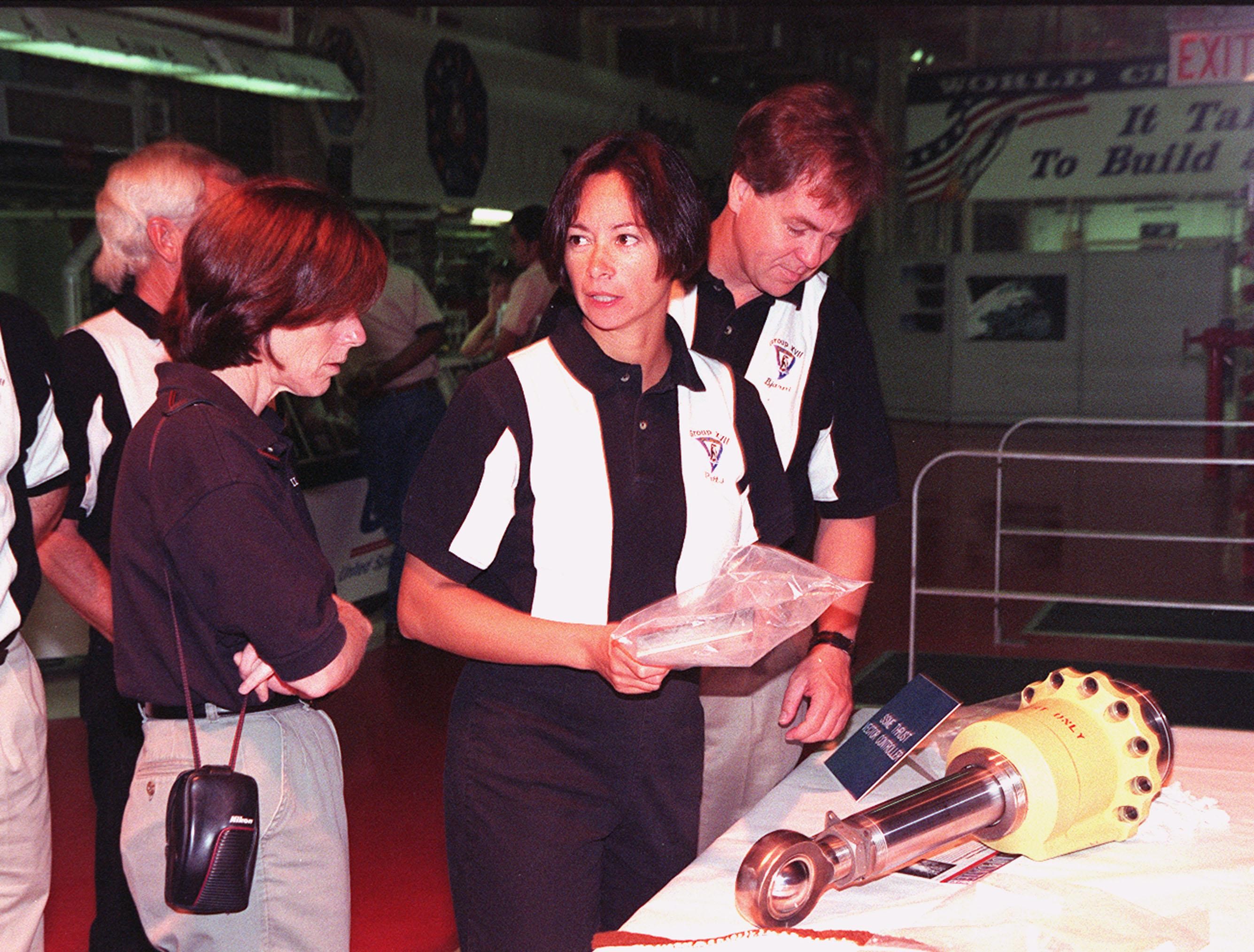
In the Orbiter Processing Facility, 1998 astronaut candidates (ASCAN) Barbara R. Morgan, Patricia C. Hilliard (M.D.) and Bjarni V. Tryggvason look at the hardware exhibits, such as the engine actuator on the table. Tryggvason is with the Canadian Space Agency. The 1998 ASCAN class is at KSC for training activities, including fire training and a flight awareness program, plus touring the OPF, SSME Processing Facility, VAB, SSPF, launch pads, SLF, Apollo/Saturn V Center and the crew headquarters. Other U.S. candidates in the '98 class are Clayton C. Anderson, Lee J. Archambault, Tracy E. Caldwell (Ph.D.), Gregory E. Chamitoff (Ph.D.), Timothy J. Creamer, Christopher J. Ferguson, Michael J. Foreman, Michael E. Fossum, Kenneth T. Ham, Gregory C. Johnson, Gregory H. Johnson, Stanley G. Love (Ph.D.), Leland D. Melvin, William A. Oefelein, John D. Olivas (Ph.D.), Nicholas J.M. Patrick (Ph.D.), Alan G. Poindexter, Garrett E. Reisman (Ph.D.), Steven R. Swanson, Douglas H. Wheelock, Sunita L. Williams, Neil W. Woodward III, George D. Zamka; and the other international candidates are Leopold Eyharts, Paolo Nespoli, Hans Schlegel, Roberto Vittori, and Marcos Pontes
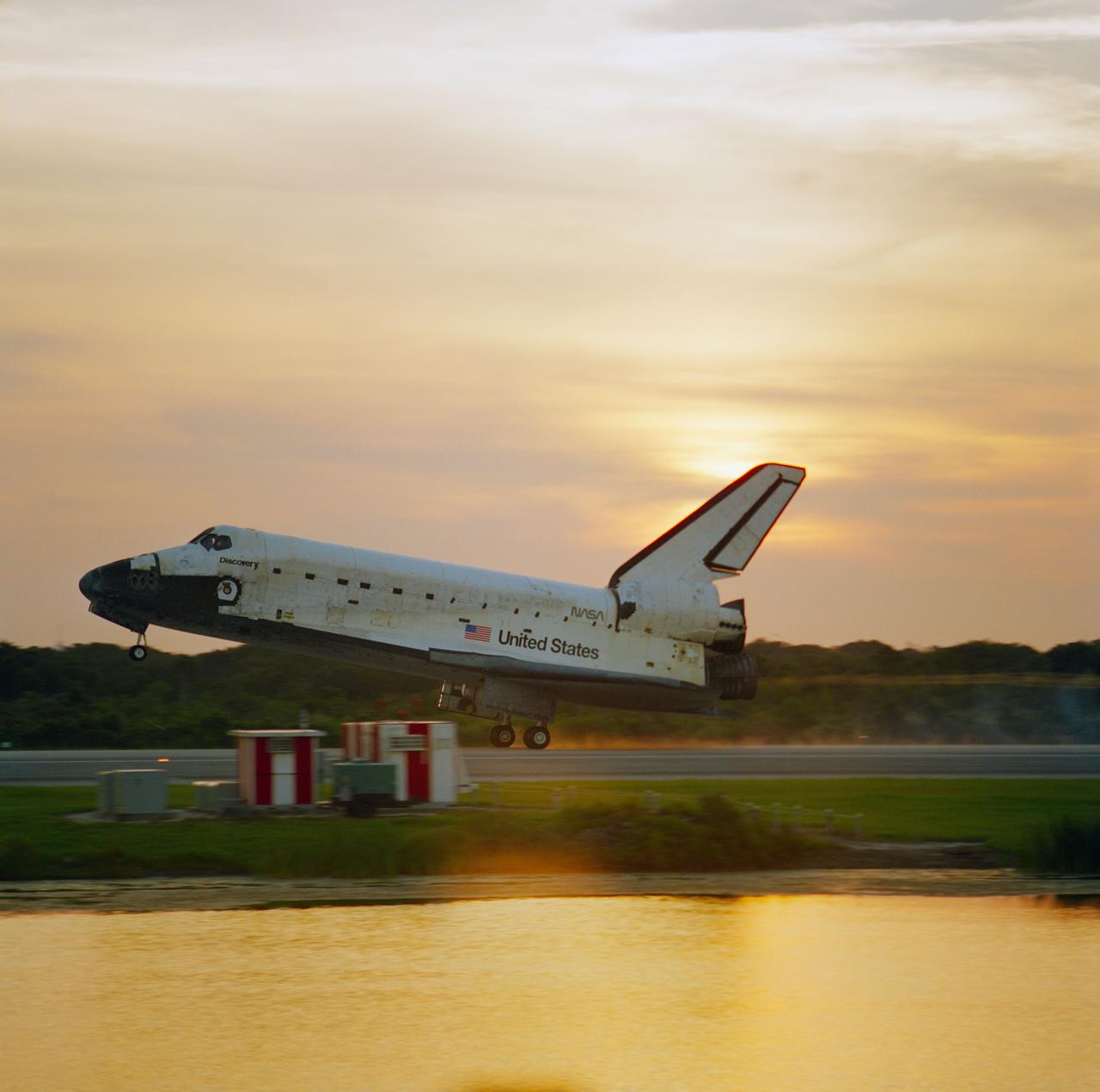
STS085-S-014 (19 Aug. 1997) --- The main landing gear of the space shuttle Discovery touches down on Runway 33 at the Kennedy Space Center to mark the successful completion of 12-day STS-85 mission. Landing occurred at 7:08 a.m. (EDT) on Aug. 19, 1997. Onboard were astronauts Curtis L. Brown, mission commander; Kent V. Rominger, pilot; N. Jan Davis, payload commander; and Robert L. Curbeam and Stephen K. Robinson, both mission specialists; along with payload specialist Bjarni Tryggvason, representing the Canadian Space Agency. Photo credit: NASA
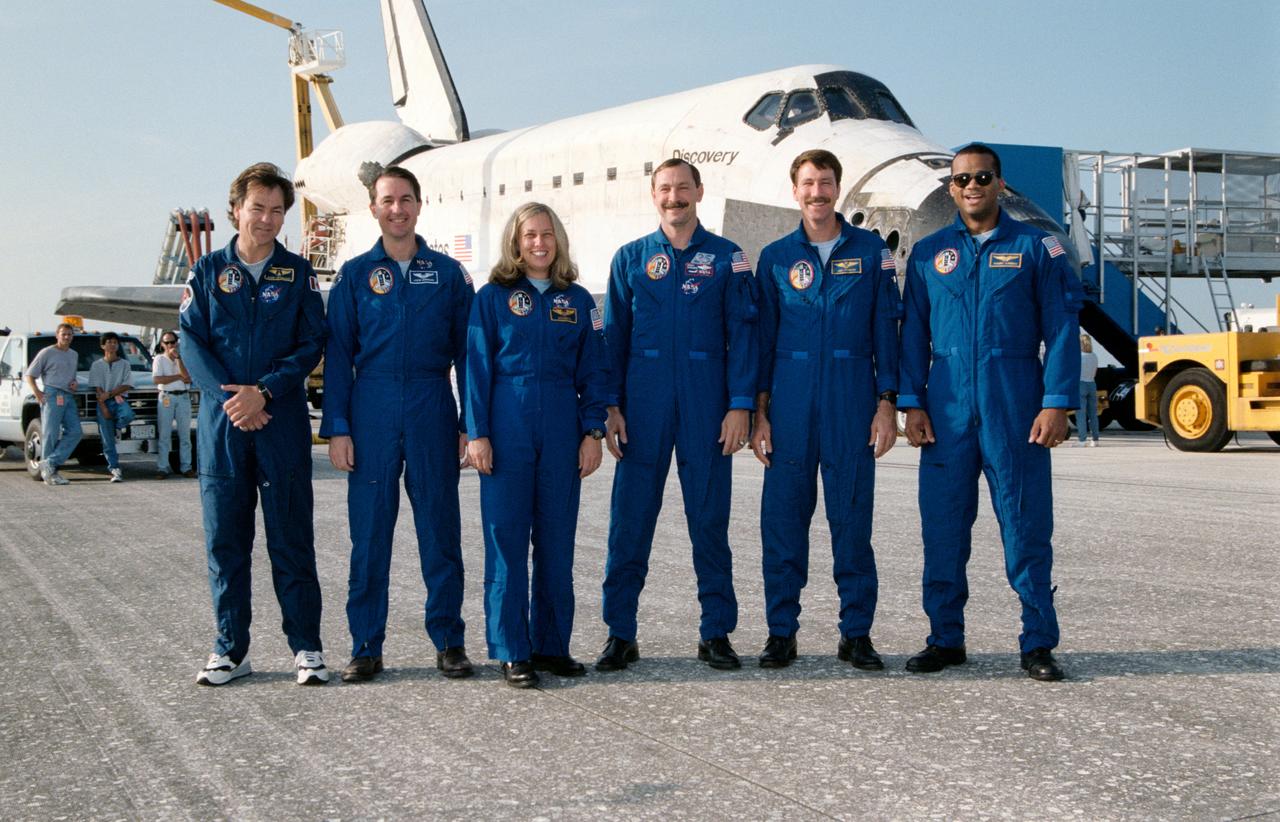
STS085-S-011 (19 August 1997) --- Following the landing of the Space Shuttle Discovery on runway 33 at the Kennedy Space Center (KSC), the six member crew poses for a final crew portrait. The landing, at 7:08 a.m. (EDT), August 19, 1997, marked the completion of a successful 12-day STS-85 mission. Left to right are payload specialist Bjarni Tryggvason of the Canadian Space Agency (CSA), along with astronauts Stephen K. Robinson, mission specialist; N. Jan Davis, payload commander; Curtis L. Brown, Jr., mission commander; Kent V. Rominger, pilot; and Robert L. Curbeam, Jr., mission specialist.
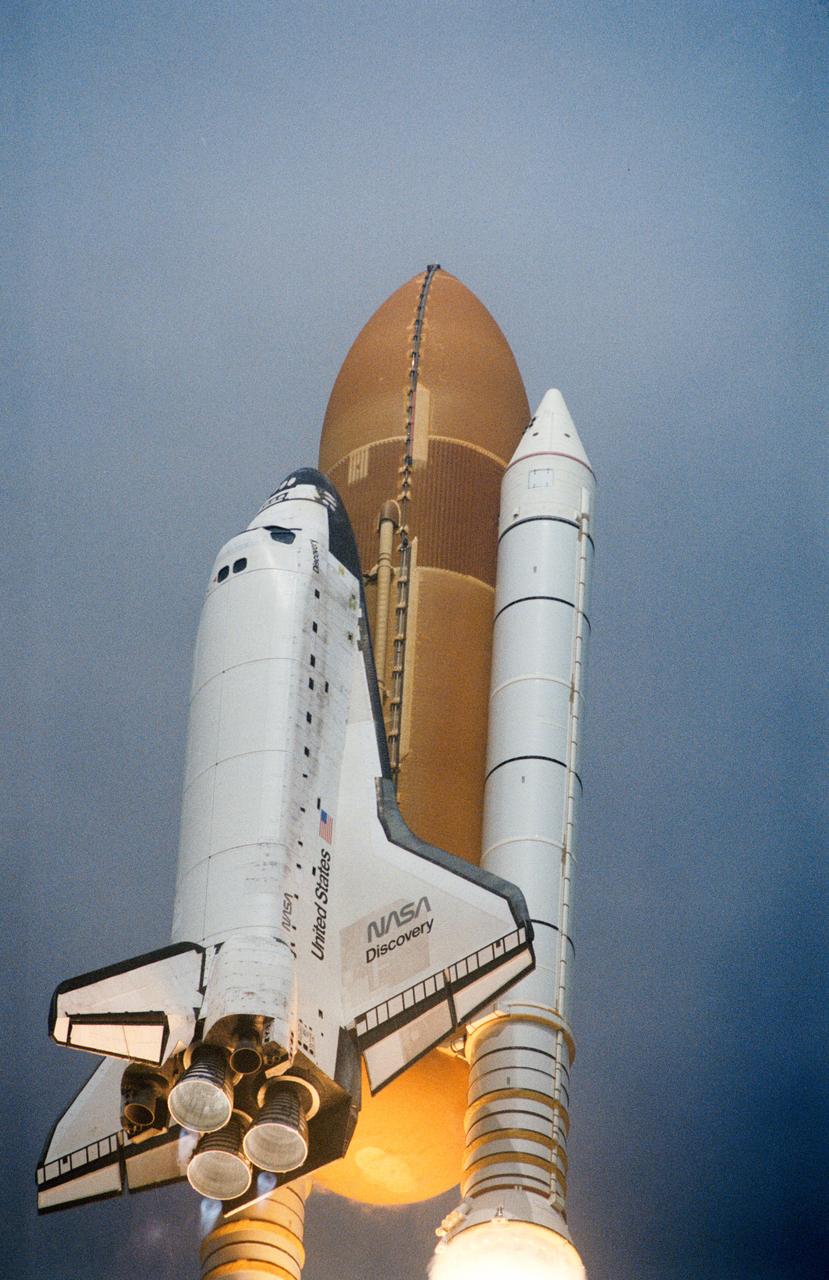
STS085-S-006 (7 August 1997) --- The Space Shuttle Discovery has cleared the launch tower at Pad 39A, at the Kennedy Space Center (KSC), in this low-angle, 35mm frame, and is headed toward an eleven-day mission in Earth-orbit in support of the STS-85 mission. Launch occurred at 10:41 a.m. (EDT), August 7, 1997. Onboard the spacecraft were astronauts Curtis L. Brown, Jr., commander; Kent V. Rominger, pilot; N. Jan Davis, payload commander; and Stephen K. Robinson and Robert L. Curbeam, Jr., both mission specialists; along with payload specialist Bjarni V. Tryggvason, a Canadian Space Agency (CSA) astronaut.
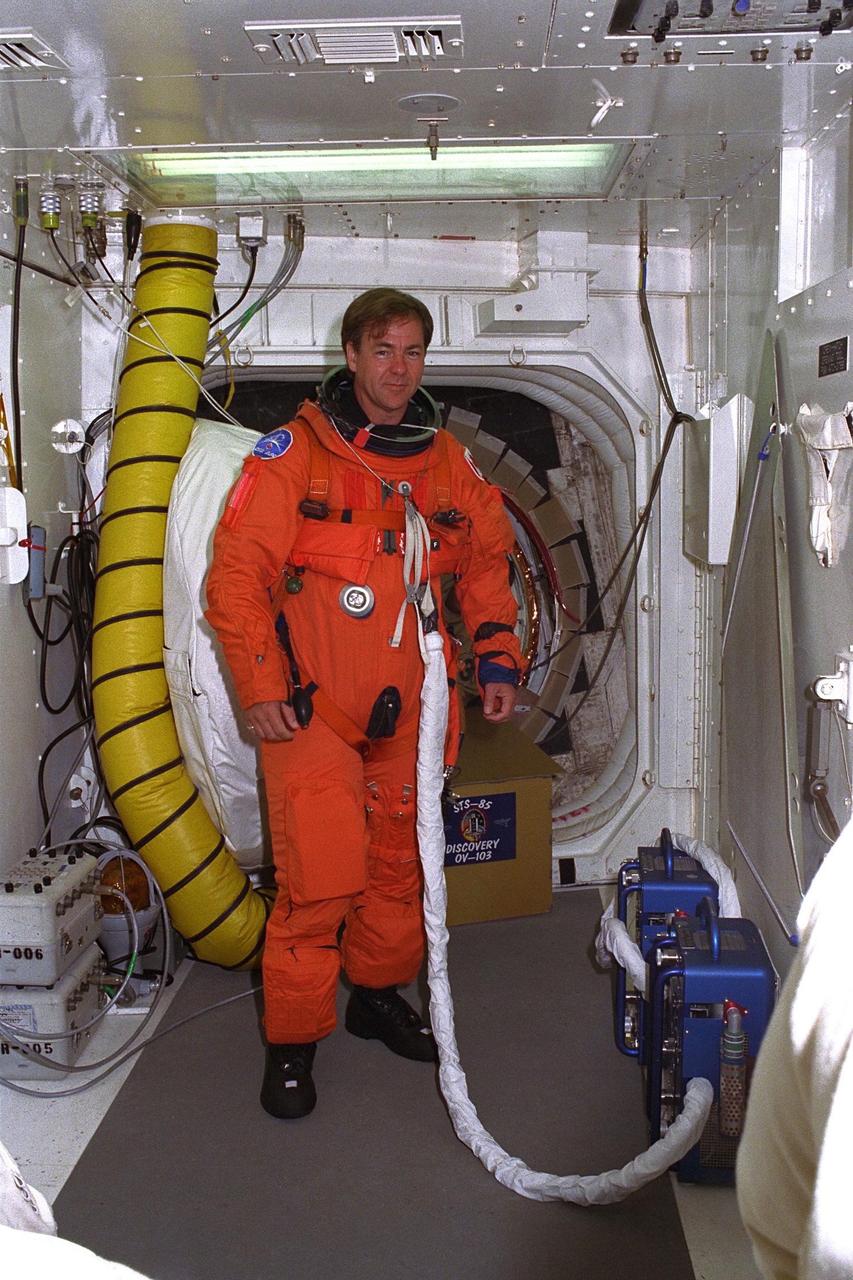
STS-85 Payload Specialist Bjarni V. Tryggvason poses in the white room at Launch Pad 39A with his ascent/reentry flight suit as he prepares to enter the Space Shuttle orbiter Discovery at Launch Pad 39A during Terminal Countdown Demonstration Test (TCDT) activities for that mission. The primary payload aboard the Space Shuttle orbiter Discovery is the Cryogenic Infrared Spectrometers and Telescopes for the Atmosphere-2 (CRISTA-SPAS-2). Other payloads on the 11-day mission include the Manipulator Flight Demonstration (MFD), and Technology Applications and Science-1 (TAS-1) and International Extreme Ultraviolet Hitchhiker-2 (IEH-2) experiments
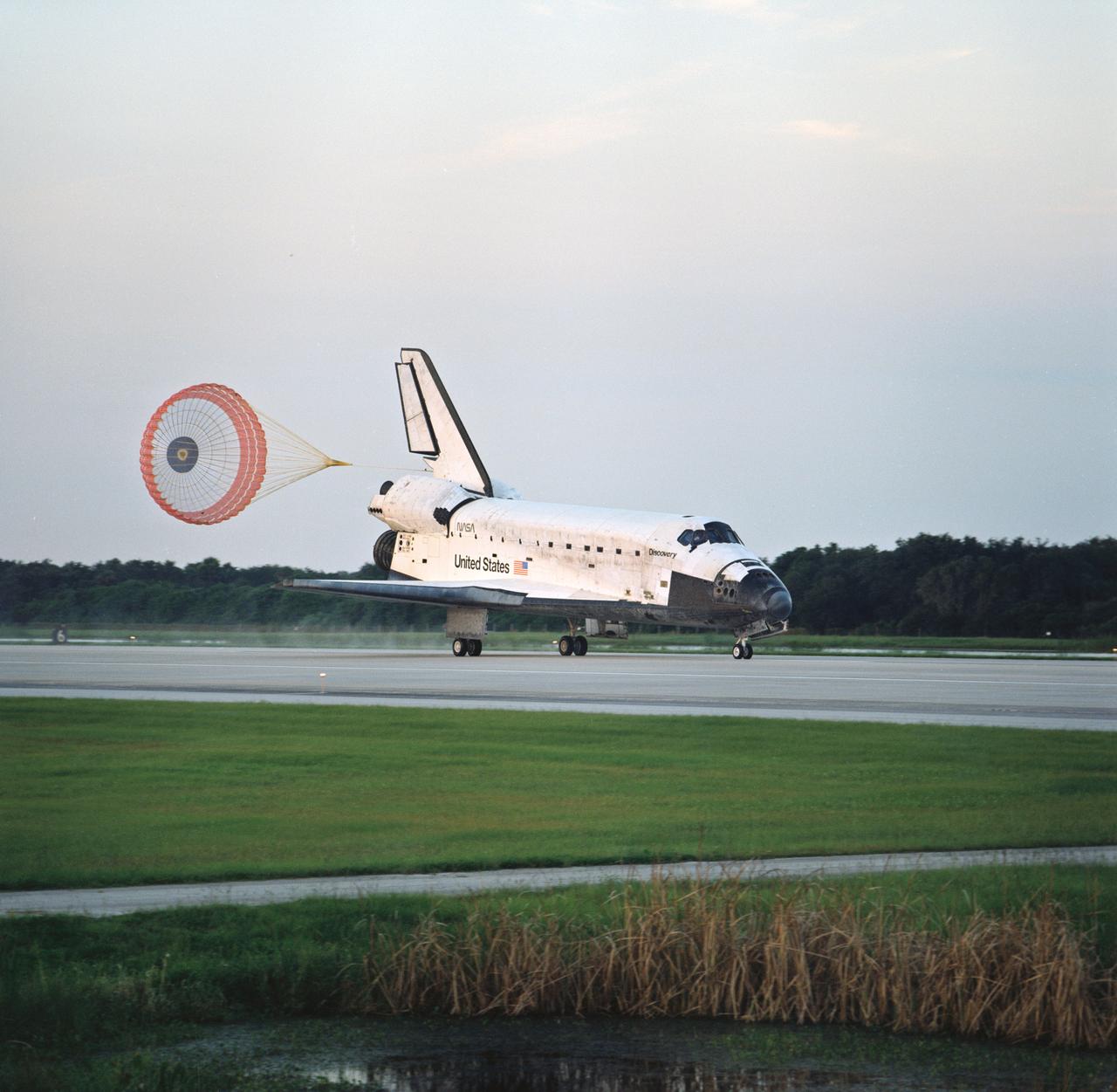
STS085-S-013 (19 August 1997) --- The drag chute of the Space Shuttle Discovery is fully deployed in this scene of the spacecraft's landing on runway 33 at the Kennedy Space Center (KSC). The landing, at 7:08 a.m. (EDT), August 19, 1997, marked the completion of a successful 12-day STS-85 mission. Onboard were astronauts Curtis L. Brown, Jr., mission commander; Kent V. Rominger, pilot; N. Jan Davis, payload commander; and Robert L. Curbeam, Jr., and Stephen K. Robinson, both mission specialists; along with payload specialist Bjarni Tryggvason, representing the Canadian Space Agency (CSA).

KENNEDY SPACE CENTER, Fla. -- STS-85 Mission Specialist Stephen K. Robinson (left) and Payload Specialist Bjarni V. Tryggvason check out an emergency egress slidewire basket at the 195-foot level of Launch Pad 39A during Terminal Countdown Demonstration Test (TCDT) activities for that mission. The primary payload aboard the Space Shuttle orbiter Discovery is the Cryogenic Infrared Spectrometers and Telescopes for the Atmosphere-2 (CRISTA-SPAS-2). Other STS-85 payloads include the Manipulator Flight Demonstration (MFD), and Technology Applications and Science-1 (TAS-1) and International Extreme Ultraviolet Hitchhiker-2 (IEH-2)
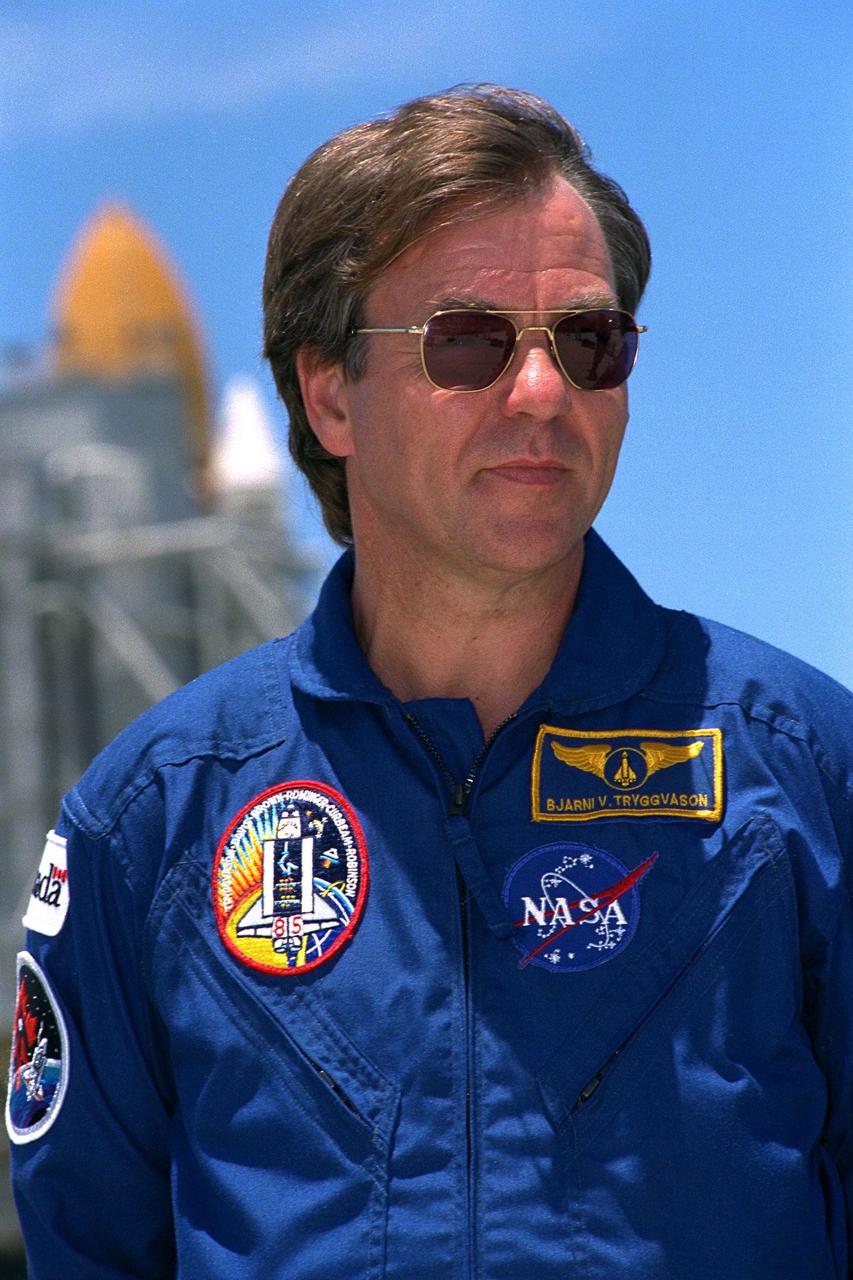
KENNEDY SPACE CENTER, Fla. -- STS-85 Payload Specialist Bjarni V. Tryggvason stands ready for questions at a news briefing at Launch Pad 39A during a break in Terminal Countdown Demonstration Test (TCDT) activities for that mission. The primary payload aboard the Space Shuttle orbiter Discovery is the Cryogenic Infrared Spectrometers and Telescopes for the Atmosphere-2 (CRISTA-SPAS-2). Other payloads on the 11-day mission include the Manipulator Flight Demonstration (MFD), and Technology Applications and Science-1 (TAS-1) and International Extreme Ultraviolet Hitchhiker-2 (IEH-2) experiments
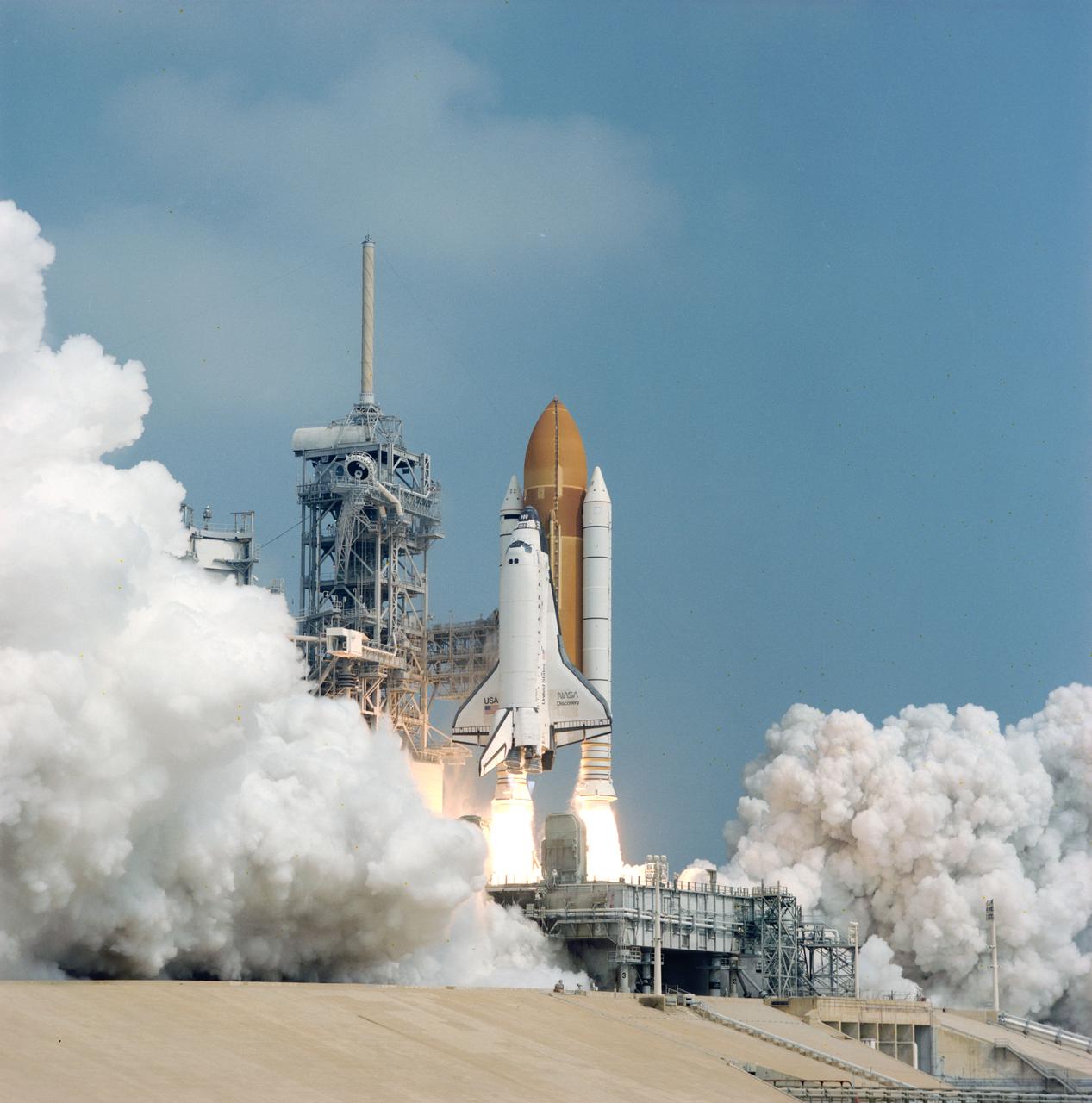
STS085-S-005 (7 August 1997) --- In this scene moments after ignition at Launch Pad 39A, at the Kennedy Space Center (KSC), the Space Shuttle Discovery heads toward an eleven-day mission in Earth-orbit in support of the STS-85 mission. Launch occurred at 10:41 a.m. (EDT), August 7, 1997. Onboard the spacecraft were astronauts Curtis L. Brown, Jr., commander; Kent V. Rominger, pilot; N. Jan Davis, payload commander; and Stephen K. Robinson and Robert L. Curbeam, Jr., both mission specialists; along with payload specialist Bjarni V. Tryggvason, a Canadian Space Agency (CSA) astronaut.
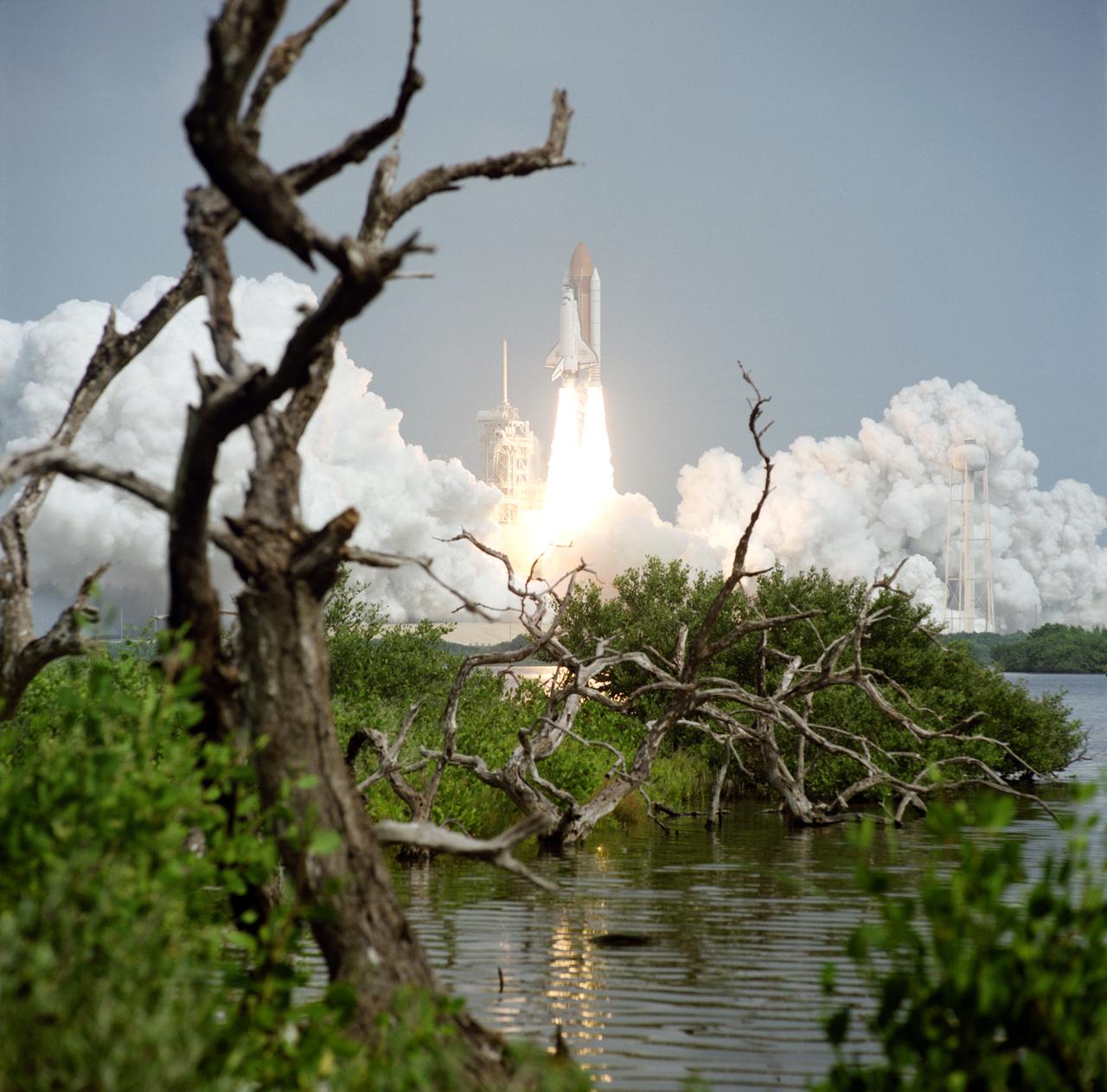
STS085-S-009 (7 August 1997) --- The Space Shuttle Discovery has cleared the launch tower in this low-angle, 35mm frame, and is headed toward an eleven-day mission in Earth-orbit in support of the STS-85 mission. Launch from Pad 39A, at the Kennedy Space Center (KSC), occurred at 10:41 a.m. (EDT), August 7, 1997. Onboard the spacecraft were astronauts Curtis L. Brown, Jr., commander; Kent V. Rominger, pilot; N. Jan Davis, payload commander; and Stephen K. Robinson and Robert L. Curbeam, Jr., both mission specialists; along with payload specialist Bjarni V. Tryggvason, a Canadian Space Agency (CSA) astronaut.

KENNEDY SPACE CENTER, FLA. -- STS-85 Payload Specialist Bjarni V. Tryggvason and Mission Specialist Stephen K. Robinson go through countdown procedures aboard the Space Shuttle orbiter Discovery during Terminal Countdown Demonstration Test (TCDT) activities for that mission. The TCDT includes a simulation of the final launch countdown. The primary payload aboard the Space Shuttle orbiter Discovery is the Cryogenic Infrared Spectrometers and Telescopes for the Atmosphere-2 (CRISTA-SPAS- 2). Other STS-85 payloads include the Manipulator Flight Demonstration (MFD), and Technology Applications and Science-1 (TAS-1) and International Extreme Ultraviolet Hitchhiker-2 (IEH-2) experiments
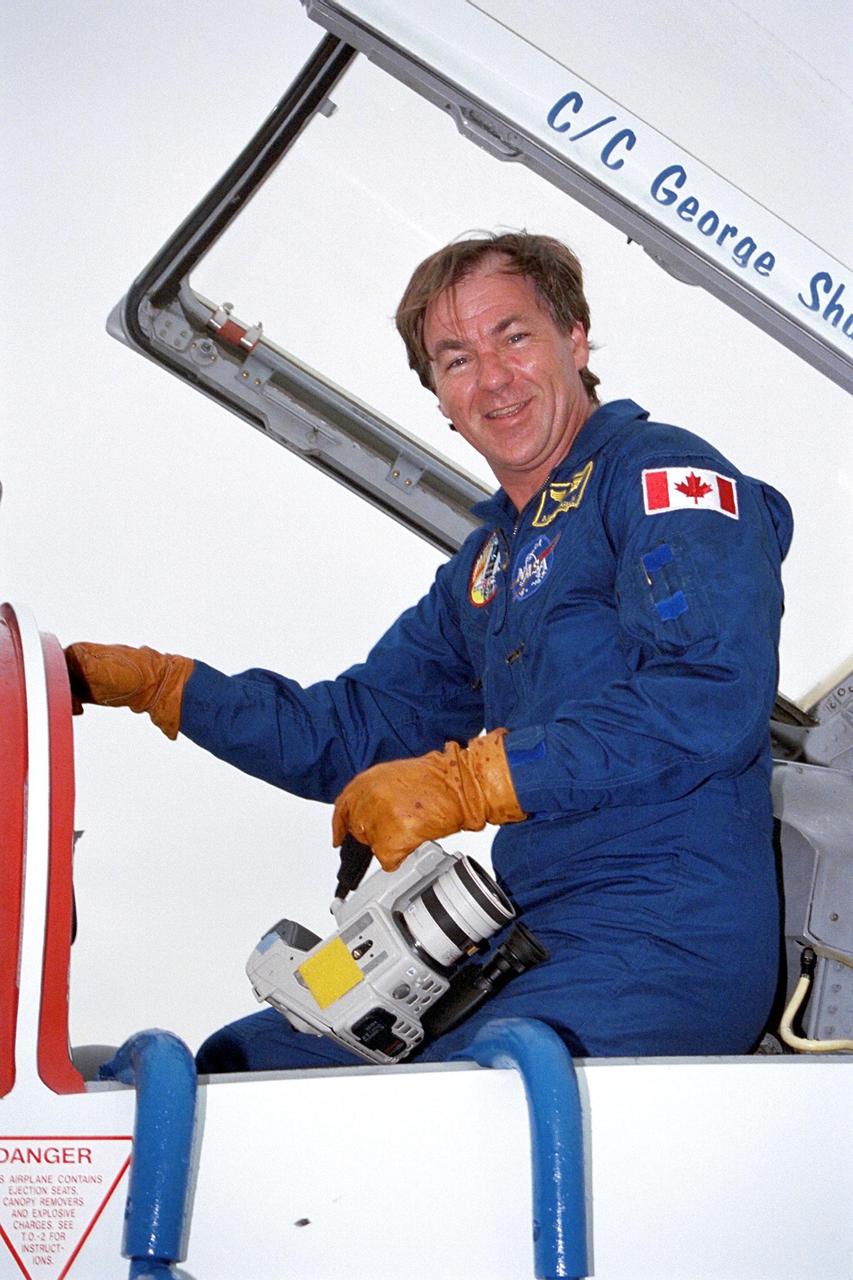
STS-85 Payload Specialist Bjarni V. Tryggvason poses in the cockpit of his T-38 jet trainer aircraft at KSC’s Shuttle Landing Facility (SLF) after his arrival with the rest of the flight crew from NASA’s Johnson Space Center to begin final preparations for the STS-85 mission. The other crew members are Commander Curtis L. Brown, Jr., Pilot Kent V. Rominger, Payload Commander N. Jan Davis, Mission Specialist Robert L. Curbeam, Jr., and Mission Specialist Stephen K. Robinson. The primary payload aboard the Space Shuttle orbiter Discovery for the 11-day space flight is the Cryogenic Infrared Spectrometers and Telescopes for the Atmosphere-2 (CRISTA-SPAS-2). Other STS-85 payloads include the Manipulator Flight Demonstration (MFD), and Technology Applications and Science-1 (TAS-1) and International Extreme Ultraviolet Hitchhiker-2 (IEH-2) experiments
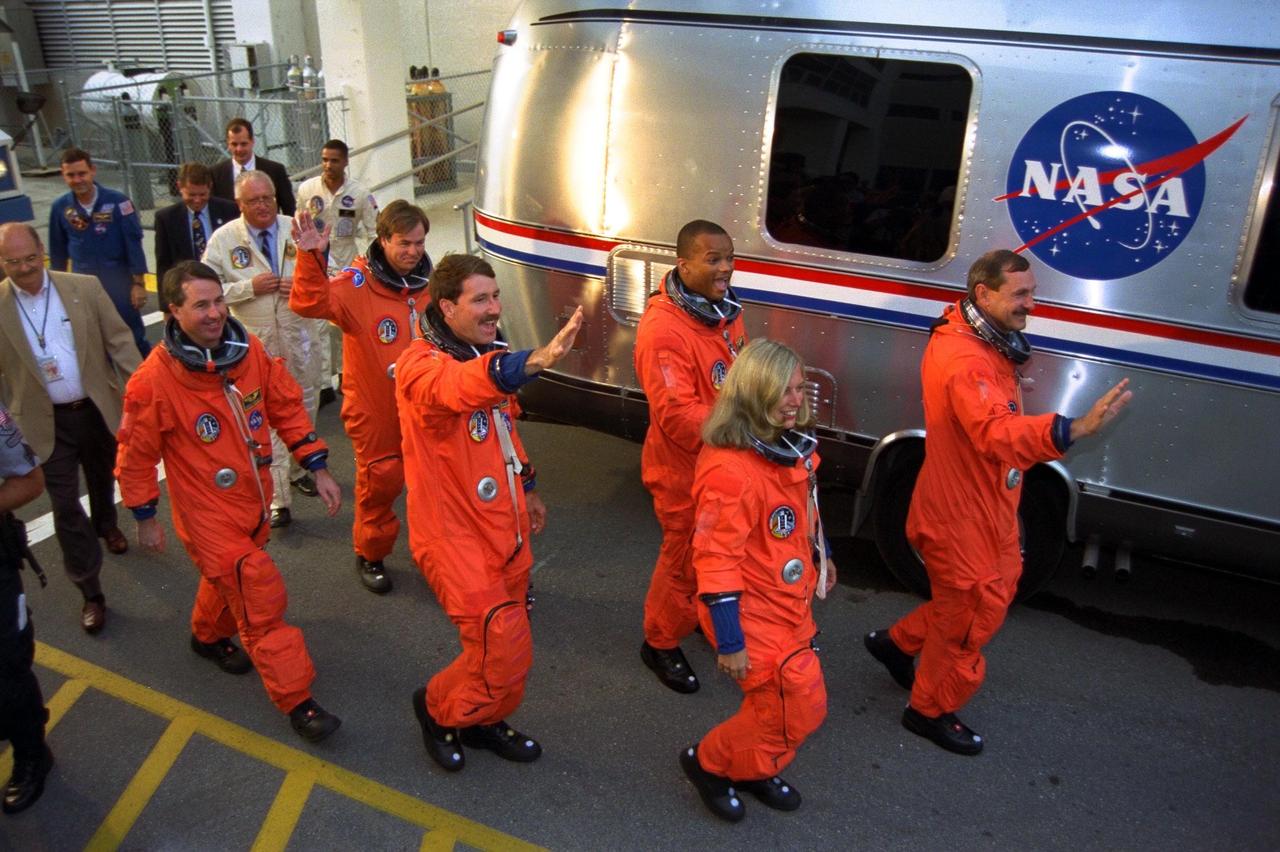
The STS-85 flight crew greets a crowd of well-wishers as they walk out of the Operations and Checkout (O&C) Building to board the Astrovan for their ride to Launch Pad 39A, where they will take their places aboard the Space Shuttle Discovery. Waving to the crowd is Commander Curtis L. Brown, Jr.(right), followed by Payload Commander N. Jan Davis, Mission Specialist Robert L. Curbeam, Jr., Pilot Kent V. Rominger, Mission Specialist Stephen K. Robinson and Payload Specialist Bjarni V. Tryggvason. The primary payload aboard the Space Shuttle orbiter Discovery is the Cryogenic Infrared Spectrometers and Telescopes for the Atmosphere-Shuttle Pallet Satellite-2 (CRISTA-SPAS-2) free-flyer. Other payloads on the 11-day mission include the Manipulator Flight Demonstration (MFD), and Technology Applications and Science-1 (TAS-1) and International Extreme Ultraviolet Hitchhiker-2 (IEH-2) experiments
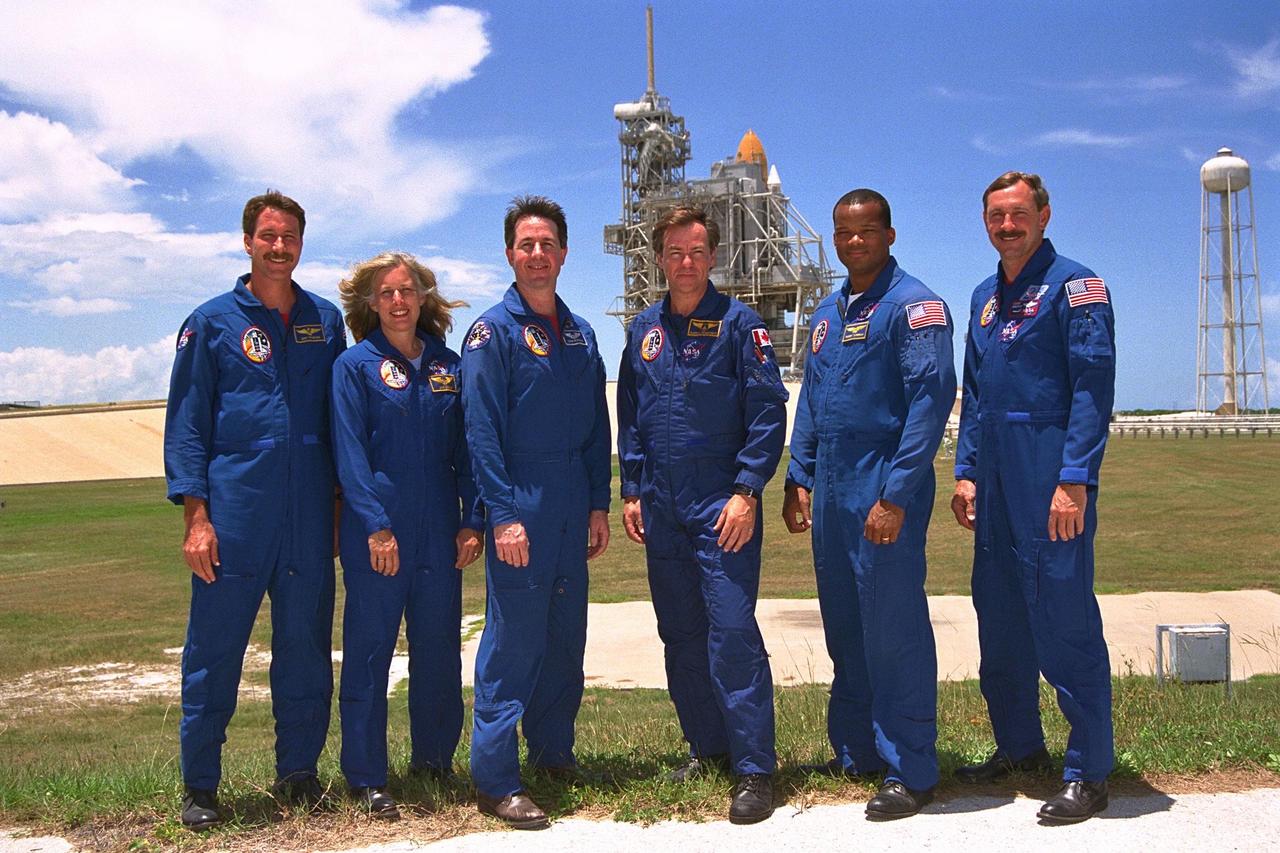
KENNEDY SPACE CENTER, Fla. -- The STS-85 flight crew poses at Launch Pad 39A during a break in Terminal Countdown Demonstration Test (TCDT) activities for that mission. They are (back row, from left): Pilot Kent V. Rominger; Payload Commander N. Jan Davis; Mission Specialist Stephen K. Robinson; Payload Specialist Bjarni V. Tryggvason; Mission Specialist Robert L. Curbeam, Jr.; and Commander Curtis L. Brown, Jr. The primary payload aboard the Space Shuttle orbiter Discovery is the Cryogenic Infrared Spectrometers and Telescopes for the Atmosphere-2 (CRISTA-SPAS-2). Other payloads on the 11-day mission include the Manipulator Flight Demonstration (MFD), and Technology Applications and Science-1 (TAS-1) and International Extreme Ultraviolet Hitchhiker-2 (IEH-2) experiments
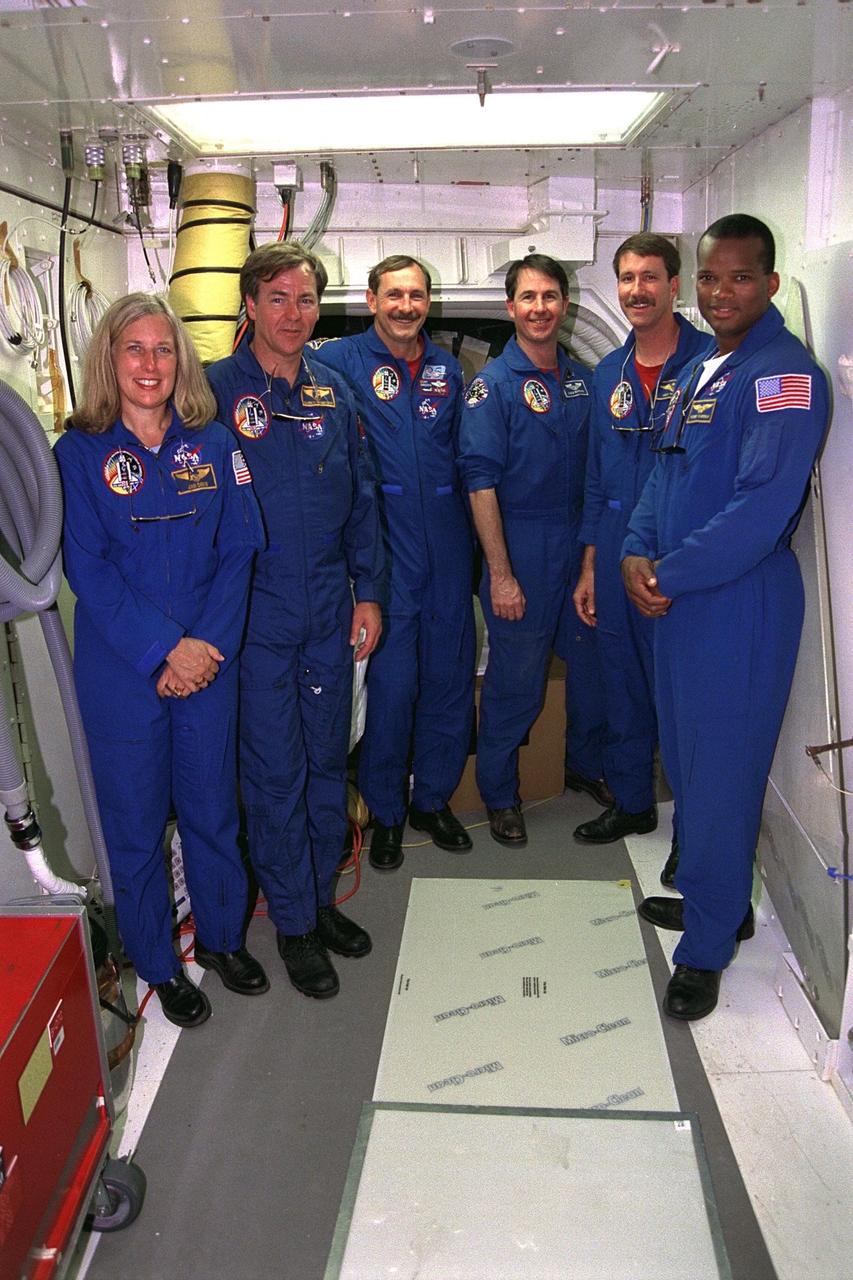
The STS-85 flight crew poses in the white room at Launch Pad 39A during a break in Terminal Countdown Demonstration Test (TCDT) activities for that mission. They are (from left): Payload Commander N. Jan Davis; Payload Specialist Bjarni V. Tryggvason; Commander Curtis L. Brown, Jr.; Mission Specialist Stephen K. Robinson; Pilot Kent V. Rominger; and Mission Specialist Robert L. Curbeam, Jr. The primary payload aboard the Space Shuttle orbiter Discovery is the Cryogenic Infrared Spectrometers and Telescopes for the Atmosphere-2 (CRISTA-SPAS-2). Other payloads on the 11-day mission include the Manipulator Flight Demonstration (MFD), and Technology Applications and Science-1 (TAS-1) and International Extreme Ultraviolet Hitchhiker-2 (IEH-2) experiments
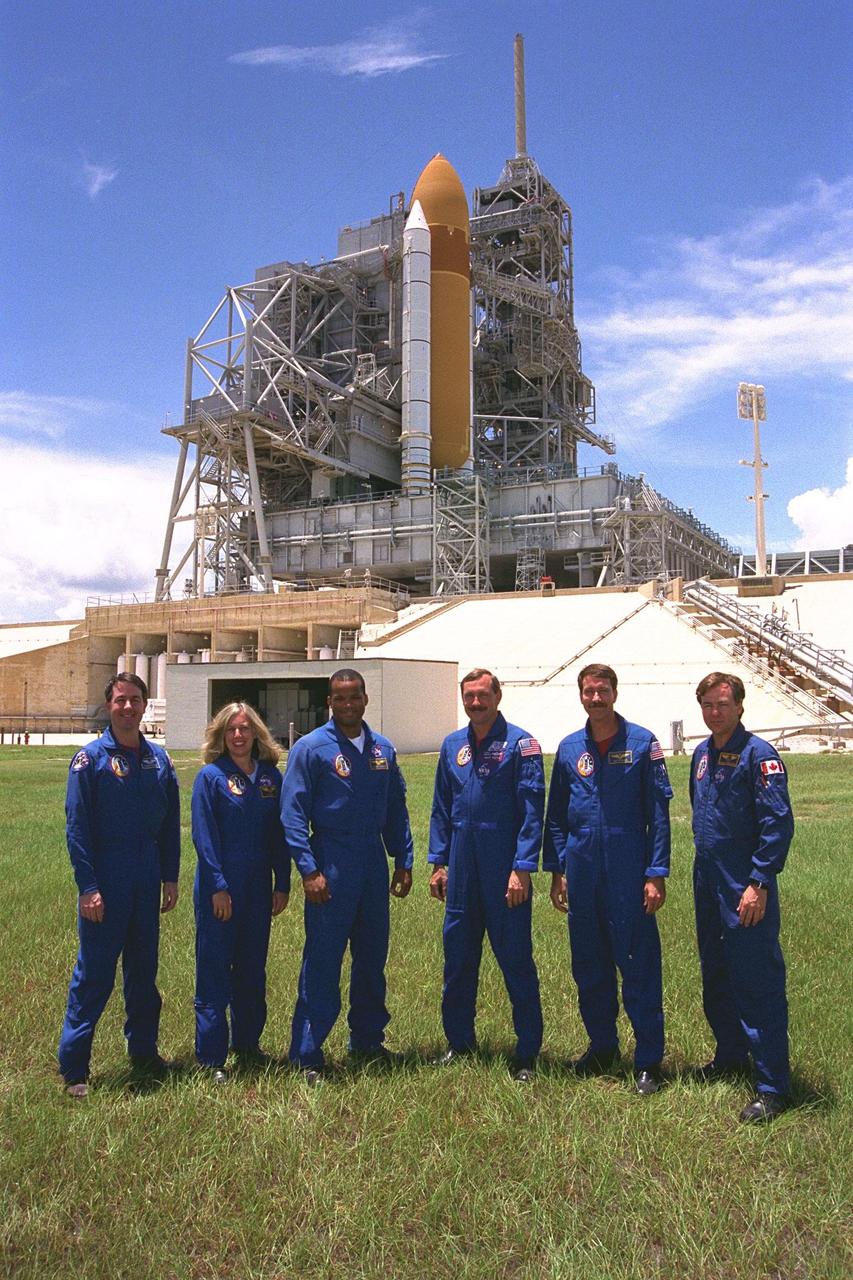
KENNEDY SPACE CENTER, Fla. -- The STS-85 flight crew poses in front of the Space Shuttle Discovery at Launch Pad 39A during a break in Terminal Countdown Demonstration Test (TCDT) activities for that mission. They are (from left): Mission Specialist Stephen K. Robinson; Payload Commander N. Jan Davis; Mission Specialist Robert L. Curbeam, Jr.; Commander Curtis L. Brown, Jr.; Pilot Kent V. Rominger; and Payload Specialist Bjarni V. Tryggvason. The primary payload aboard the Space Shuttle orbiter Discovery is the Cryogenic Infrared Spectrometers and Telescopes for the Atmosphere-2 (CRISTA-SPAS-2). Other payloads on the 11-day mission include the Manipulator Flight Demonstration (MFD), and Technology Applications and Science-1 (TAS-1) and International Extreme Ultraviolet Hitchhiker-2 (IEH-2) experiments

KENNEDY SPACE CENTER, Fla. -- The Rotating Service Structure is rolled back at Launch Complex 39A to reveal the Space Shuttle orbiter Discovery, scheduled to launch on mission STS-85 at 10:41 a.m. EDT on August 7. The STS-85 flight crew members are Mission Specialist Stephen K. Robinson; Payload Commander N. Jan Davis; Pilot Kent V. Rominger; Payload Specialist Bjarni V. Tryggvason; Commander Curtis L. Brown, Jr.; and Mission Specialist Robert L. Curbeam, Jr. The primary payload aboard the Space Shuttle orbiter Discovery for the 11-day space flight is the Cryogenic Infrared Spectrometers and Telescopes for the Atmosphere-2 (CRISTA-SPAS-2). Other STS-85 payloads include the Manipulator Flight Demonstration (MFD), and Technology Applications and Science-1 (TAS-1) and International Extreme Ultraviolet Hitchhiker-2 (IEH-2) experiments
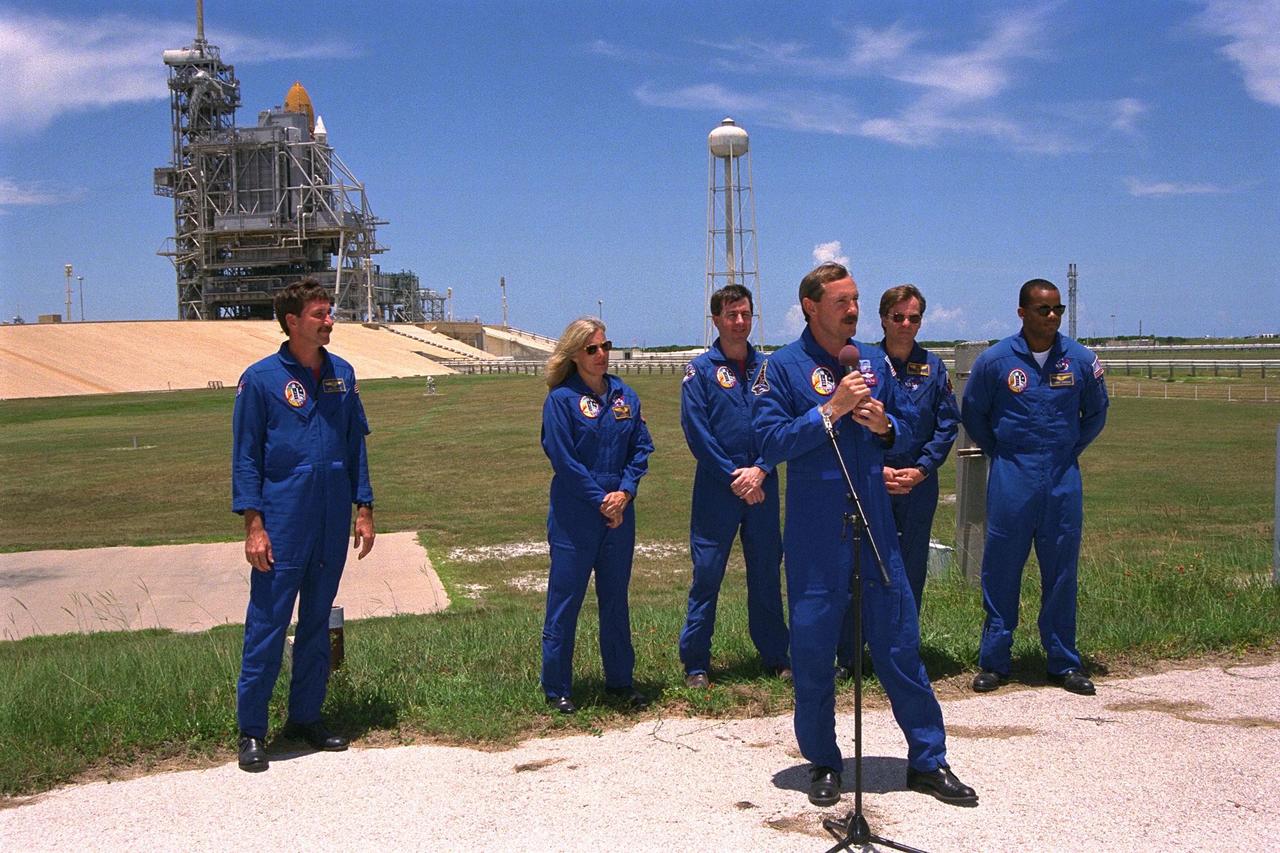
KENNEDY SPACE CENTER, Fla. -- STS-85 Commander Curtis L. Brown, Jr., addresses the news media at a briefing at Launch Pad 39A while the other members of the flight crew in the background prepare to field questions during a break in Terminal Countdown Demonstration Test (TCDT) activities for that mission. They are (back row, from left): Pilot Kent V. Rominger; Payload Commander N. Jan Davis; Mission Specialist Stephen K. Robinson; Payload Specialist Bjarni V. Tryggvason; and Mission Specialist Robert L. Curbeam, Jr. The primary payload aboard the Space Shuttle orbiter Discovery is the Cryogenic Infrared Spectrometers and Telescopes for the Atmosphere-2 (CRISTA-SPAS-2). Other payloads on the 11-day mission include the Manipulator Flight Demonstration (MFD), and Technology Applications and Science-1 (TAS-1) and International Extreme Ultraviolet Hitchhiker-2 (IEH-2) experiments
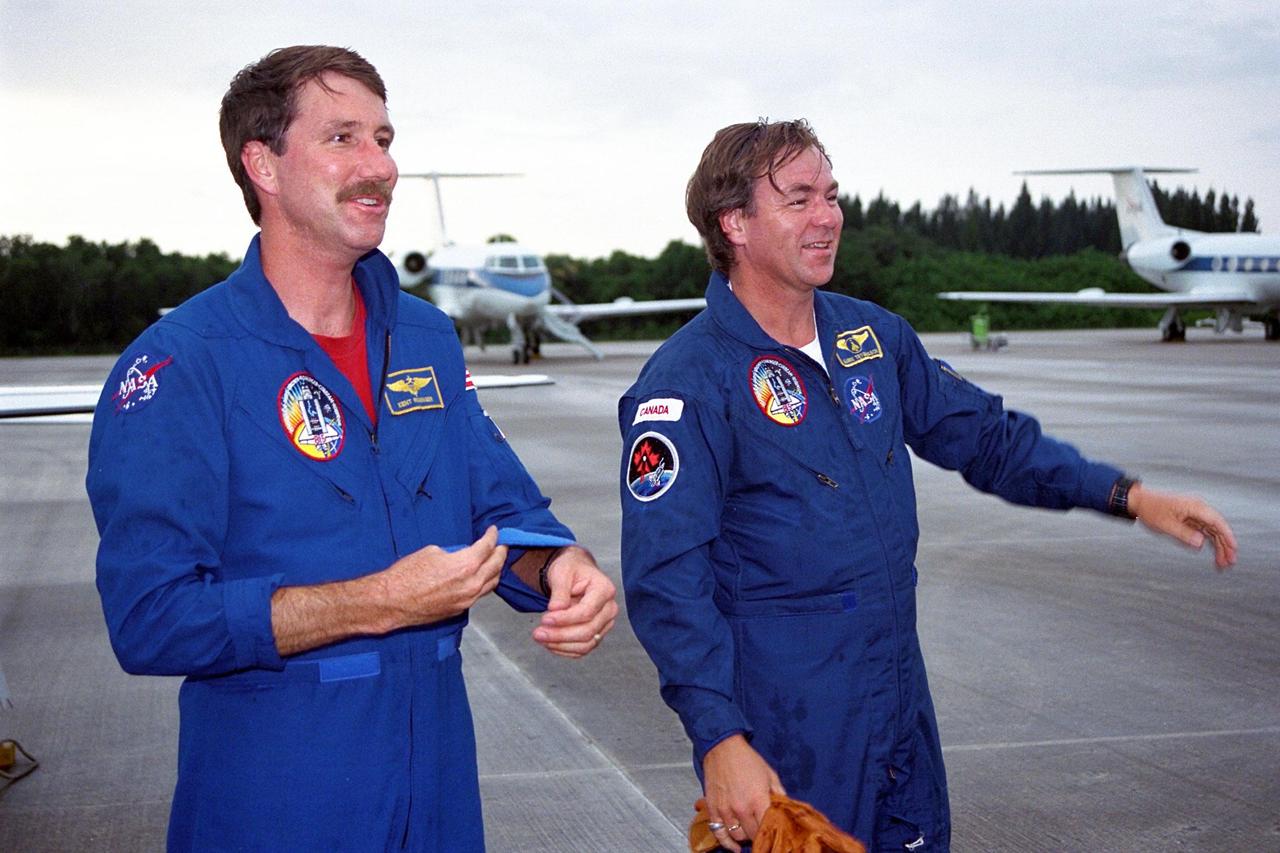
STS-85 Pilot Kent V. Rominger (left) and Payload Specialist Bjarni V. Tryggvason prepare to greet the rest of the flight crew at KSC’s Shuttle Landing Facility (SLF) after their arrival from NASA’s Johnson Space Center to begin final preparations for the STS-85 mission. The other crew members are Commander Curtis L. Brown, Jr., Payload Commander N. Jan Davis, Mission Specialist Robert L. Curbeam, Jr., and Mission Specialist Stephen K. Robinson. The primary payload aboard the Space Shuttle orbiter Discovery for the 11-day space flight is the Cryogenic Infrared Spectrometers and Telescopes for the Atmosphere-2 (CRISTA-SPAS2). Other STS-85 payloads include the Manipulator Flight Demonstration (MFD), and Technology Applications and Science-1 (TAS-1) and International Extreme Ultraviolet Hitchhiker-2 (IEH-2) experiments
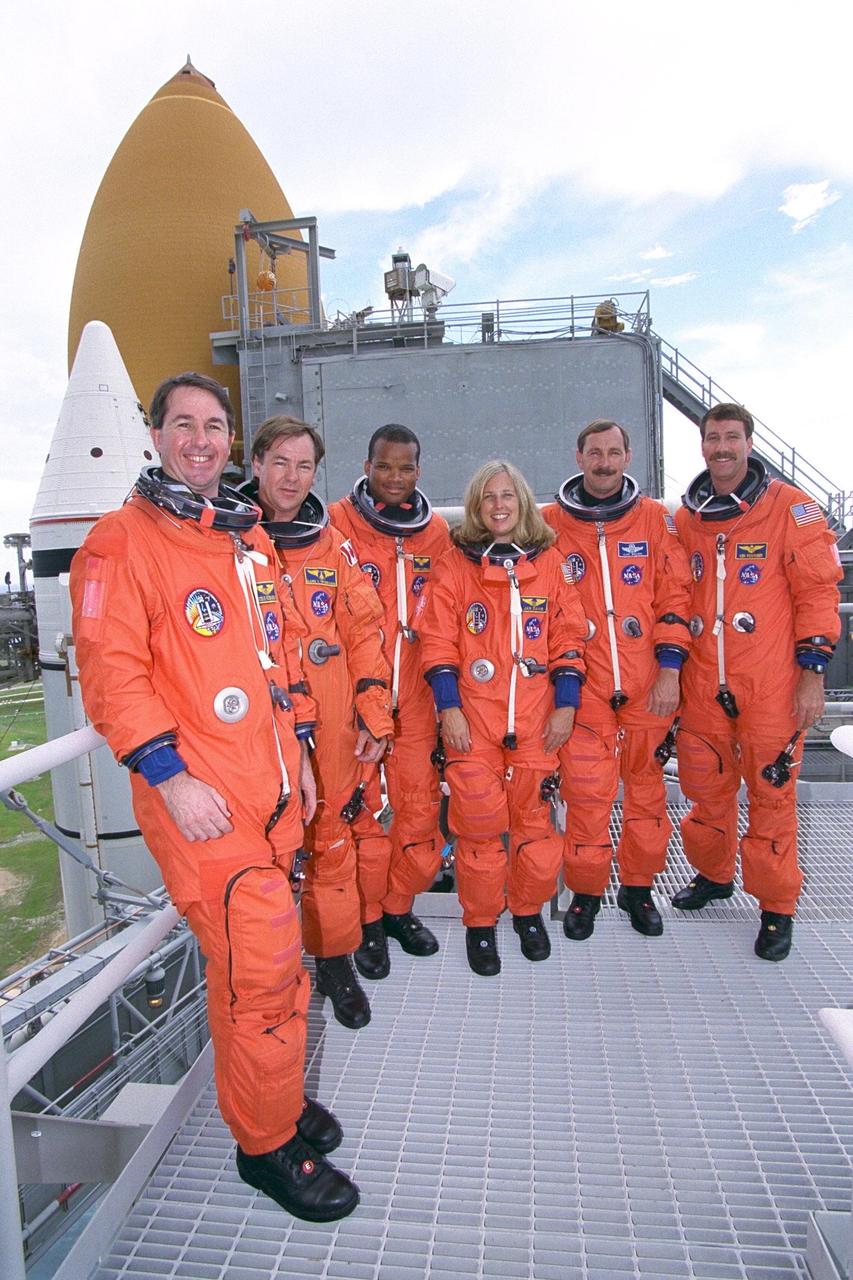
KENNEDY SPACE CENTER, Fla. -- The STS-85 flight crew members pose at the 195-foot level of Launch Pad 39A with the Space Shuttle Discovery in the background during Terminal Countdown Demonstration Test (TCDT) activities for that mission. They are (from left): Mission Specialist Stephen K. Robinson; Payload Specialist Bjarni V. Tryggvason; Mission Specialist Robert L. Curbeam, Jr.; Payload Commander N. Jan Davis; Commander Curtis L. Brown, Jr.; and Pilot Kent V. Rominger. The primary payload aboard the Space Shuttle orbiter Discovery is the Cryogenic Infrared Spectrometers and Telescopes for the Atmosphere-2 (CRISTA-SPAS-2). Other STS-85 payloads include the Manipulator Flight Demonstration (MFD), and Technology Applications and Science-1 (TAS-1) and International Extreme Ultraviolet Hitchhiker-2 (IEH-2) experiments
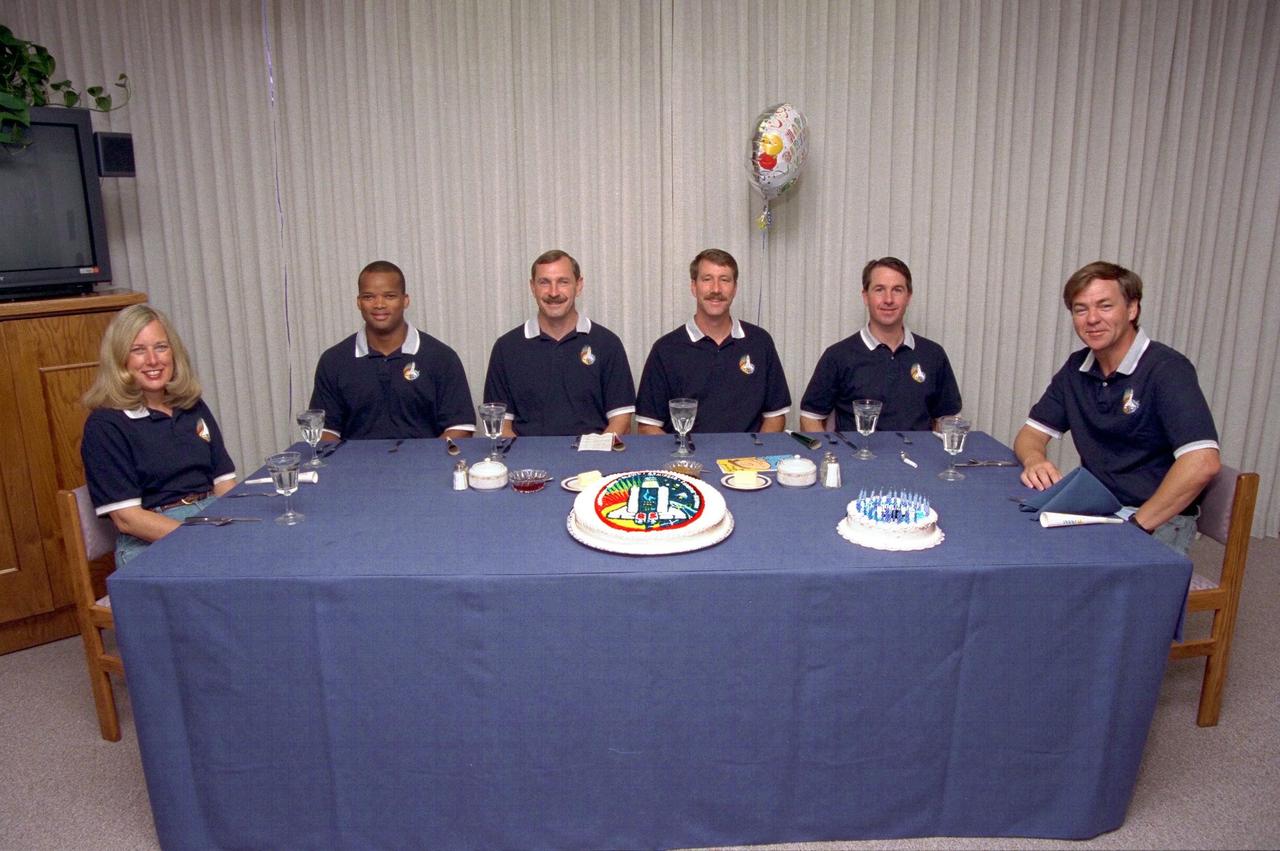
The STS-85 crew partakes in the traditional pre-liftoff breakfast in the Operations and Checkout (O&C) Building. They are (from left): Payload Commander N. Jan Davis; Mission Specialist Robert L. Curbeam, Jr.; Commander Curtis L. Brown, Jr.; Pilot Kent V. Rominger; Mission Specialist Stephen K. Robinson; Payload Specialist Bjarni V. Tryggvason; and The primary payload aboard the Space Shuttle orbiter Discovery is the Cryogenic Infrared Spectrometers and Telescopes for the Atmosphere-Shuttle Pallet Satellite-2 (CRISTA-SPAS-2). Other payloads on the 11-day mission include the Manipulator Flight Demonstration (MFD), and Technology Applications and Science-1 (TAS-1) and International Extreme Ultraviolet Hitchhiker-2 (IEH-2) experiments
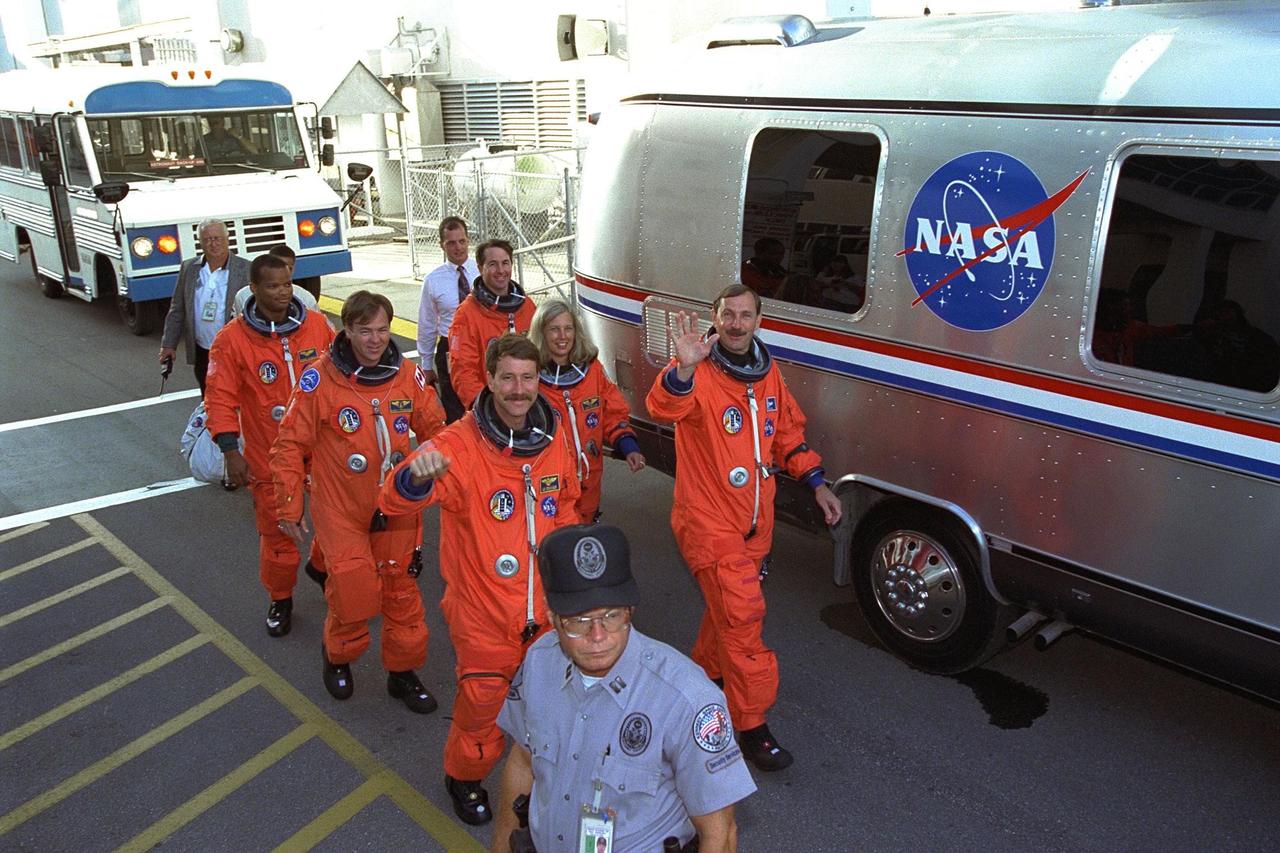
The STS-85 flight crew walks out of the Operations and Checkout (O&C) Building during Terminal Countdown Demonstration Test (TCDT) activities for that mission to board the Astrovan for the ride to the Space Shuttle Discovery on Launch Pad 39A. Waving to the crowd is Commander Curtis L. Brown, Jr. (right). Directly behind him are Payload Commander N. Jan Davis and Mission Specialist Stephen K. Robinson. Pilot Kent V. Rominger (to Brown’s right) is leading the second row, followed by Payload Specialist Bjarni V. Tryggvason and Mission Specialist Robert L. Curbeam, Jr. The primary payload aboard the Space Shuttle orbiter Discovery is the Cryogenic Infrared Spectrometers and Telescopes for the Atmosphere-2 (CRISTA-SPAS-2). Other payloads on the 11-day mission include the Manipulator Flight Demonstration (MFD), and Technology Applications and Science-1 (TAS-1) and International Extreme Ultraviolet Hitchhiker-2 (IEH-2) experiments
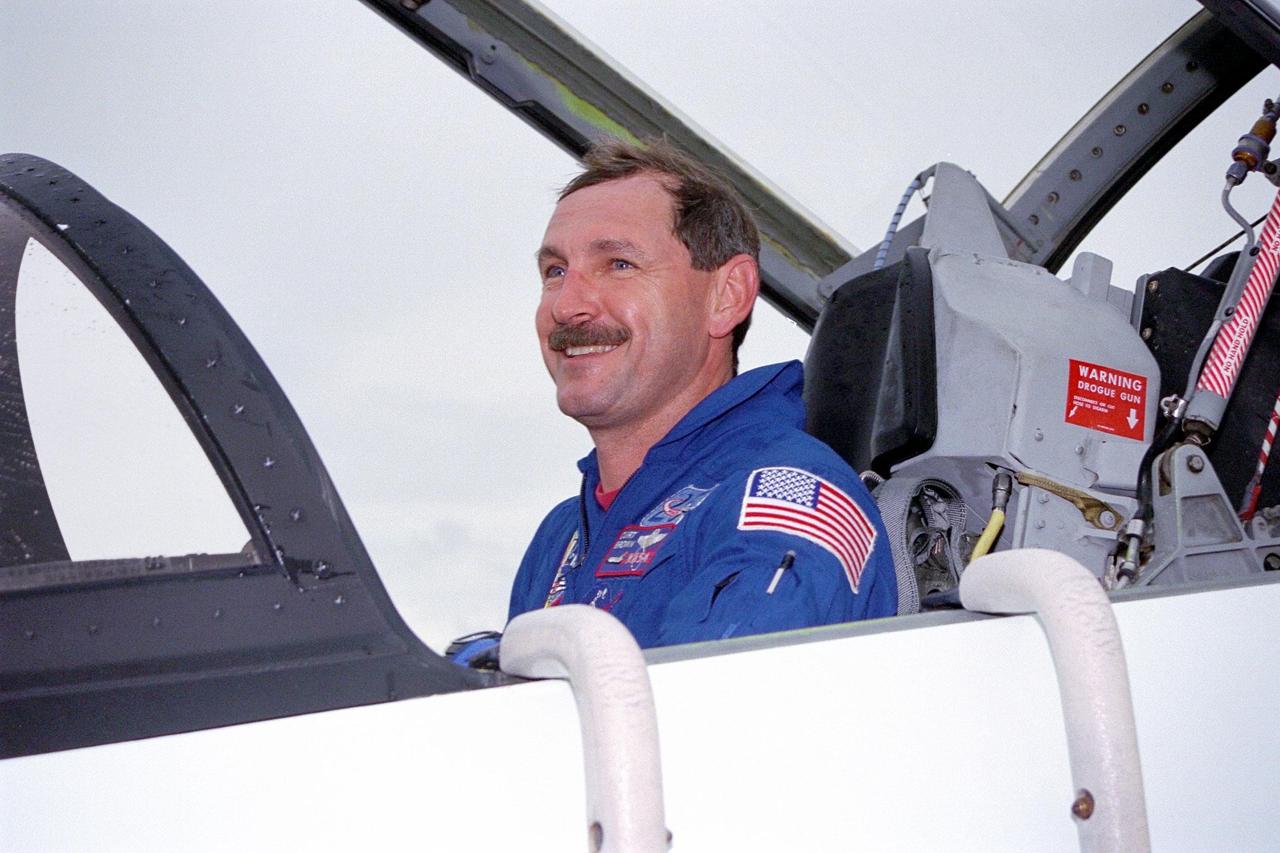
STS-85 Commander Curtis L. Brown, Jr. poses in the cockpit of his T-38 jet trainer aircraft at KSC’s Shuttle Landing Facility (SLF) after his arrival with the rest of the flight crew from NASA’s Johnson Space Center to begin final preparations for the STS-85 mission. The other crew members are Pilot Kent V. Rominger, Payload Commander N. Jan Davis, Mission Specialist Robert L. Curbeam, Jr., Mission Specialist Stephen K. Robinson and Payload Specialist Bjarni V. Tryggvason. The primary payload aboard the Space Shuttle orbiter Discovery for the 11-day space flight is the Cryogenic Infrared Spectrometers and Telescopes for the Atmosphere-2 (CRISTA-SPAS-2). Other STS-85 payloads include the Manipulator Flight Demonstration (MFD), and Technology Applications and Science-1 (TAS-1) and International Extreme Ultraviolet Hitchhiker-2 (IEH-2) experiments
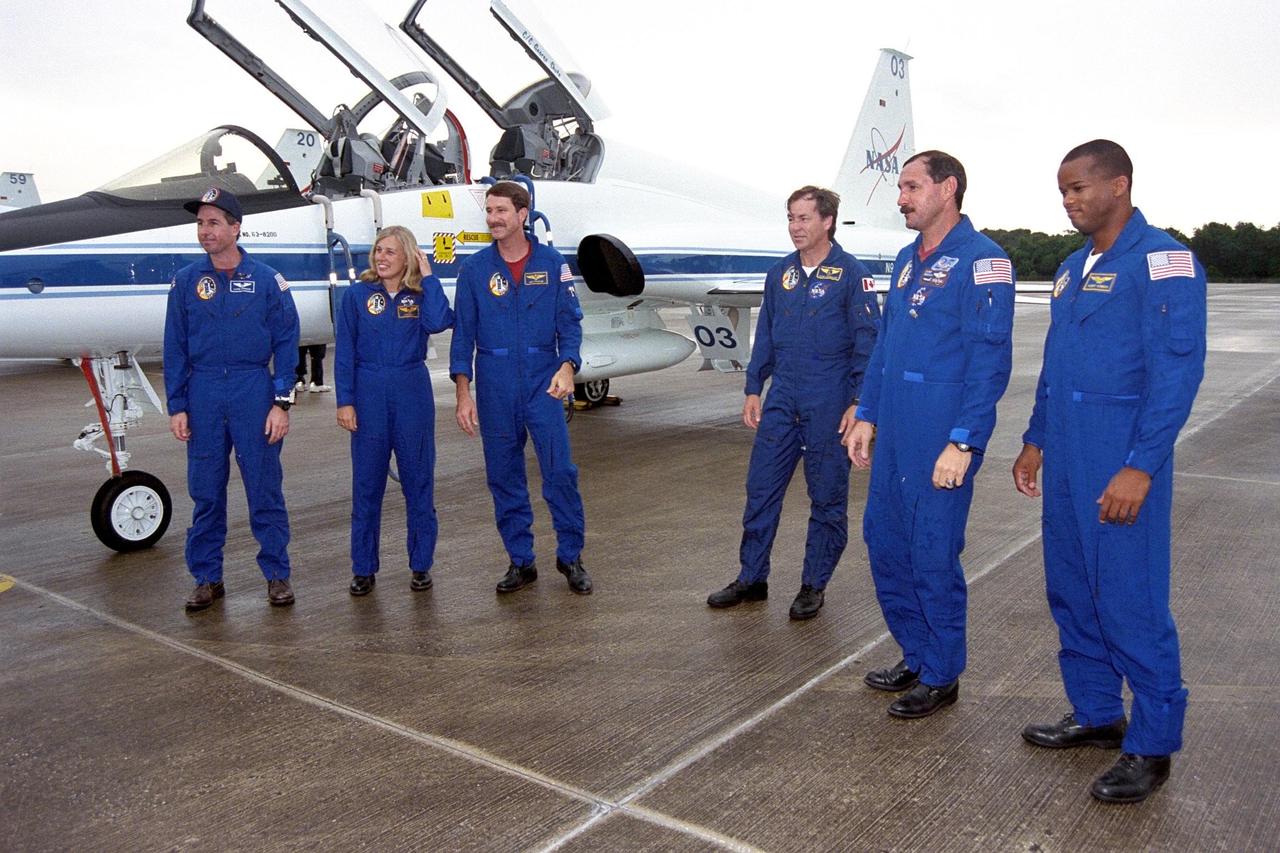
The STS-85 flight crew members pose with their T-38 jet trainer aircraft at the KSC Shuttle Landing Facility (SLF) after their arrival from NASA’s Johnson Space Center to begin final preparations for the STS-85 mission. They are (from left): Mission Specialist Stephen K. Robinson; Payload Commander N. Jan Davis; Pilot Kent V. Rominger; Payload Specialist Bjarni V. Tryggvason; Commander Curtis L. Brown, Jr.; and Mission Specialist Robert L. Curbeam, Jr. The primary payload aboard the Space Shuttle orbiter Discovery for the 11-day space flight is the Cryogenic Infrared Spectrometers and Telescopes for the Atmosphere-2 (CRISTA-SPAS-2). Other STS-85 payloads include the Manipulator Flight Demonstration (MFD), and Technology Applications and Science-1 (TAS-1) and International Extreme Ultraviolet Hitchhiker-2 (IEH-2) experiments

KENNEDY SPACE CENTER, FLA. -- The STS-85 flight crew members address the news media at the KSC Shuttle Landing Facility (SLF) after their arrival from NASA’s Johnson Space Center to begin final preparations for the STS-85 mission. They are (from left): Mission Specialist Stephen K. Robinson; Payload Commander N. Jan Davis; Commander Curtis L. Brown, Jr.; Pilot Kent V. Rominger; Mission Specialist Robert L. Curbeam, Jr.; and Payload Specialist Bjarni V. Tryggvason. The primary payload aboard the Space Shuttle orbiter Discovery for the 11-day space flight is the Cryogenic Infrared Spectrometers and Telescopes for the Atmosphere-2 (CRISTA-SPAS-2). Other STS-85 payloads include the Manipulator Flight Demonstration (MFD), and Technology Applications and Science-1 (TAS-1) and International Extreme Ultraviolet Hitchhiker-2 (IEH-2) experiments.
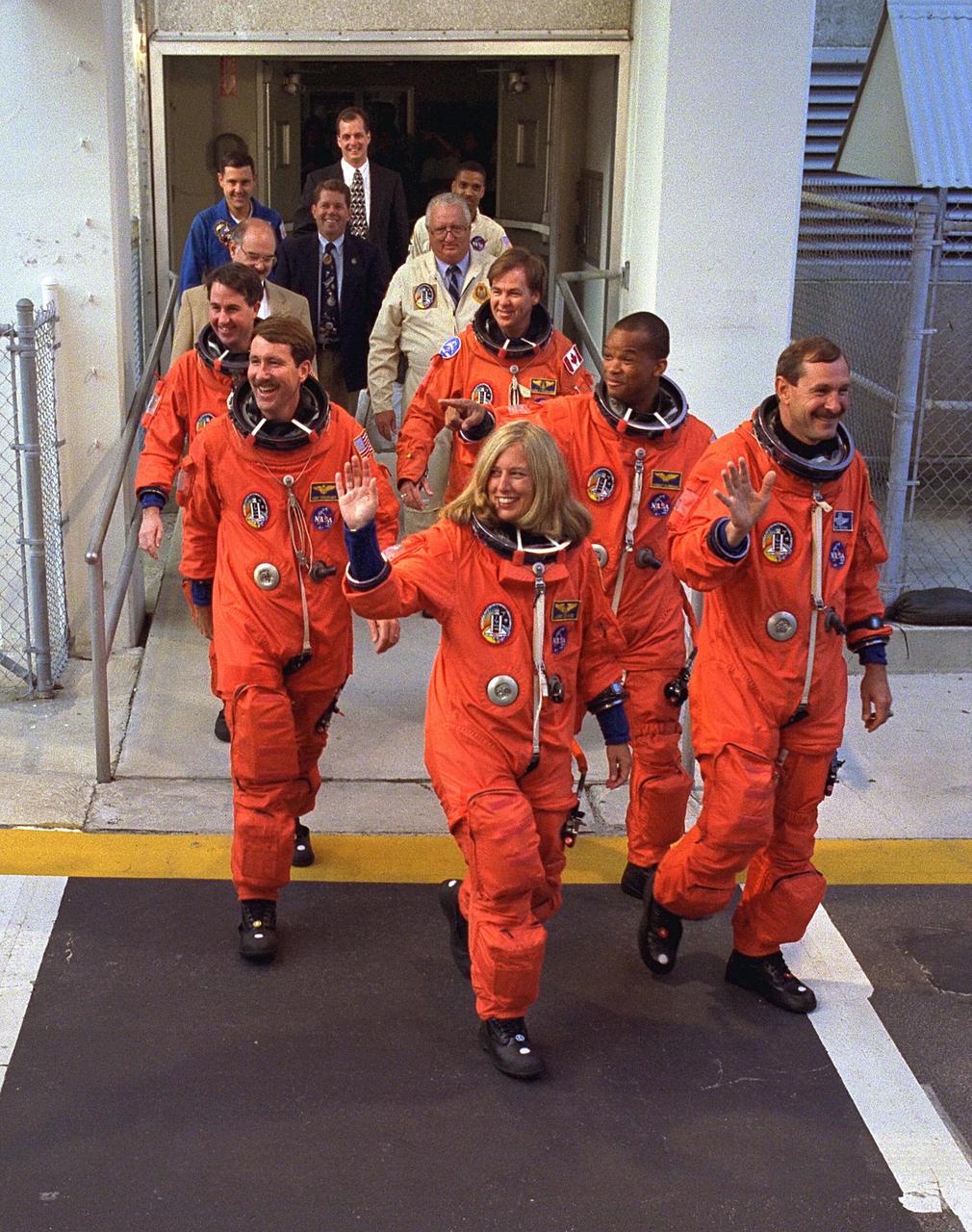
KENNEDY SPACE CENTER, FLA. -- The STS-85 flight crew greets a crowd of well-wishers as they walk out of the Operations and Checkout (O&C) Building for their ride to Launch Pad 39A, where they will take their places aboard the Space Shuttle Discovery. Waving to the crowd is Commander Curtis L. Brown, Jr.(right). Directly behind him are Mission Specialist Robert L. Curbeam, Jr. and Payload Specialist Bjarni V. Tryggvason. To Brown’s right is Payload Commander N. Jan Davis. Directly behind her are Pilot Kent V. Rominger and Mission Specialist Stephen K. Robinson. The primary payload aboard the Space Shuttle orbiter Discovery is the Cryogenic Infrared Spectrometers and Telescopes for the AtmosphereShuttle Pallet Satellite-2 (CRISTA-SPAS-2) free-flyer. Other payloads on the 11-day mission include the Manipulator Flight Demonstration (MFD), and Technology Applications and Science-1 (TAS-1) and International Extreme Ultraviolet Hitchhiker-2 (IEH-2) experiments
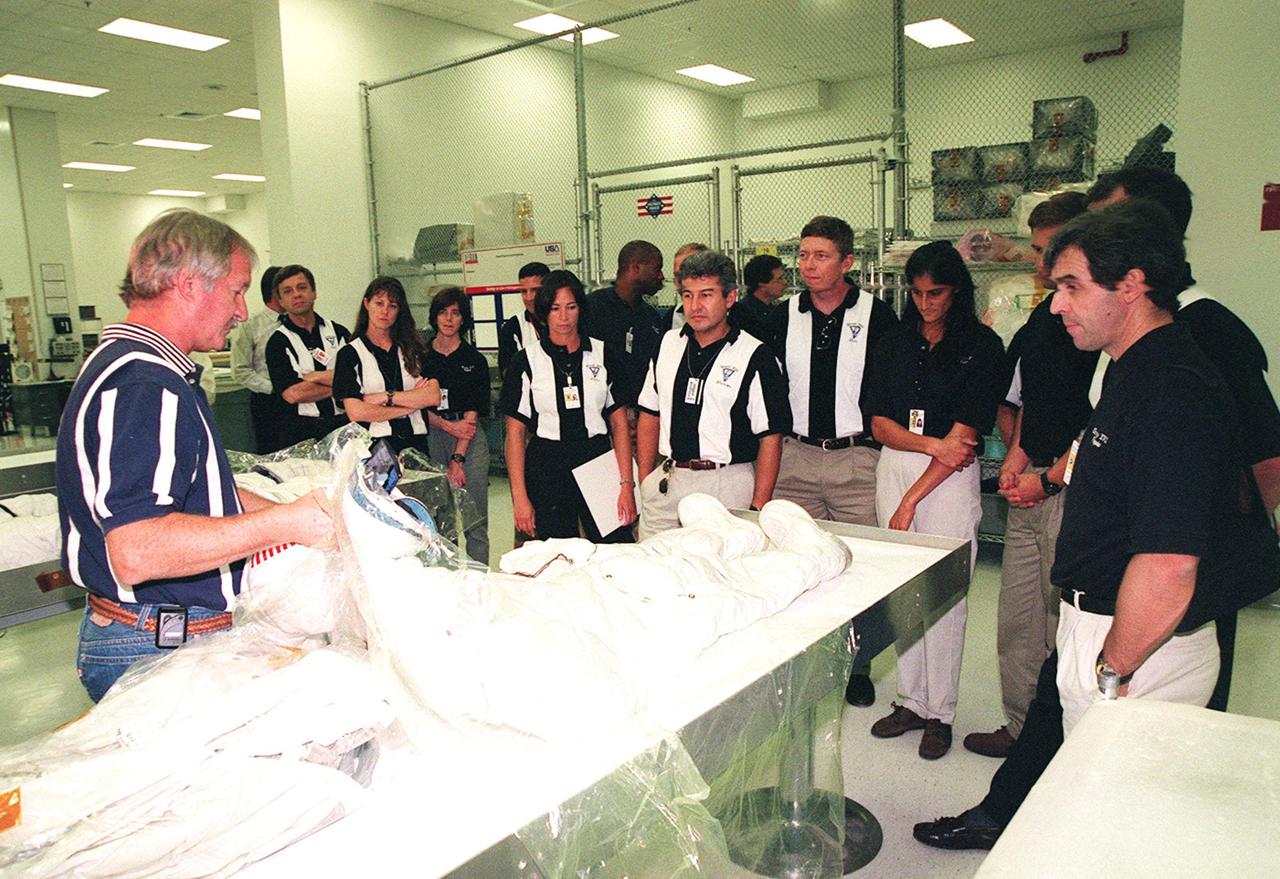
KENNEDY SPACE CENTER, FLA. -- In the Space Station Processing Facility, Ron Woods (left) shows members of the 1998 astronaut candidate class (group 17) an Apollo-style space suit and how it differs from the current suits. The class is taking part in training activities, including fire training and a flight awareness program, plus touring the OPF, VAB, SSPF, launch pads, SLF, Apollo/Saturn V Center, the crew headquarters, as well as the SSME Processing Facility. The U.S. candidates in the '98 class are Clayton C. Anderson, Lee J. Archambault, Tracy E. Caldwell (Ph.D.), Gregory E. Chamitoff (Ph.D.), Timothy J. Creamer, Christopher J. Ferguson, Michael J. Foreman, Michael E. Fossum, Kenneth T. Ham, Patricia C. Hilliard (M.D.), Gregory C. Johnson, Gregory H. Johnson, Stanley G. Love (Ph.D.), Leland D. Melvin, Barbara R. Morgan, William A. Oefelein, John D. Olivas (Ph.D.), Nicholas J.M. Patrick (Ph.D.), Alan G. Poindexter, Garrett E. Reisman (Ph.D.), Steven R. Swanson, Douglas H. Wheelock, Sunita L. Williams, Neil W. Woodward III, George D. Zamka; and the international candidates are Leopold Eyharts, Paolo Nespoli, Hans Schlegel, Roberto Vittori, Bjarni V. Tryggvason, and Marcos Pontes
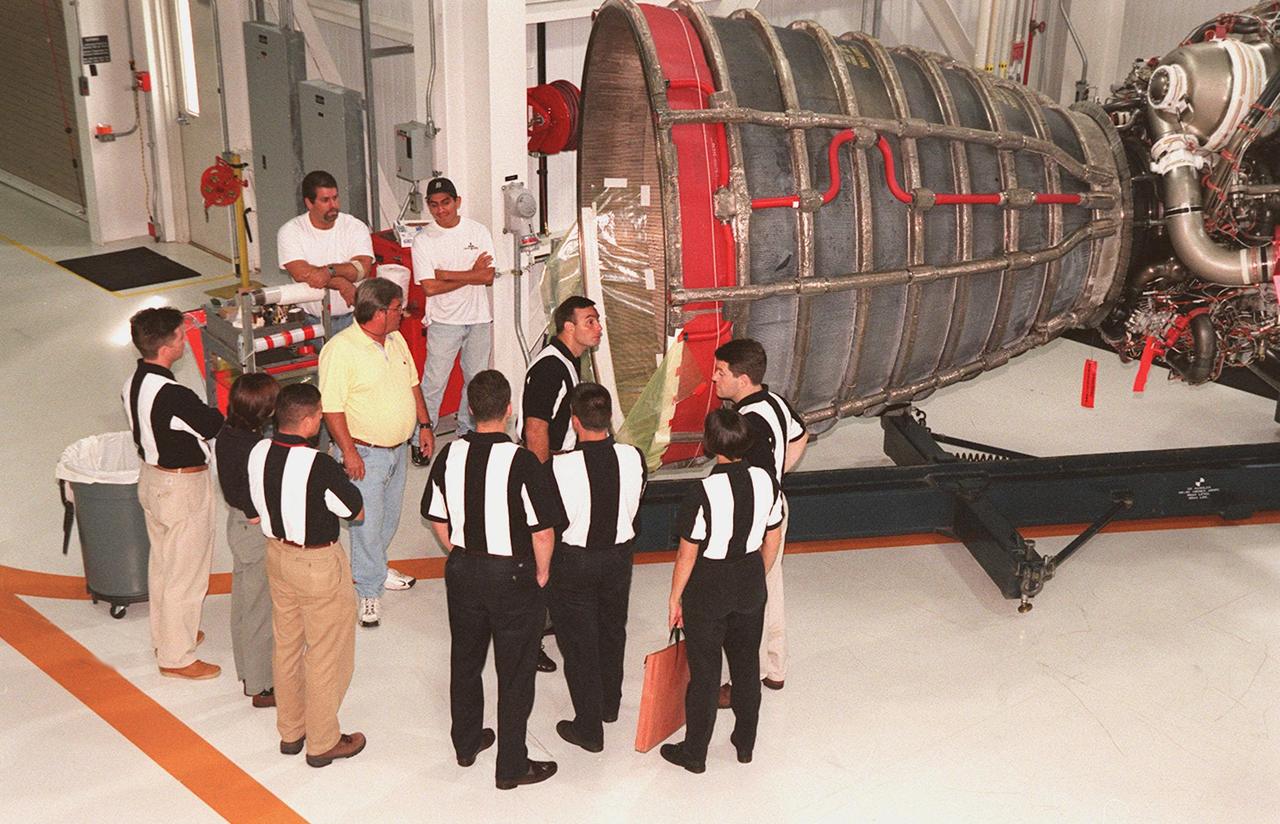
Members of the 1998 astronaut candidate class (group 17) look at the aft of a Space Shuttle Main Engine (SSME) (right). The class is at KSC for training activities, including fire training and a flight awareness program, plus touring the OPF, VAB, SSPF, launch pads, SLF, Apollo/Saturn V Center, the crew headquarters, as well as the SSME Processing Facility. The U.S. candidates in the '98 class are Clayton C. Anderson, Lee J. Archambault, Tracy E. Caldwell (Ph.D.), Gregory E. Chamitoff (Ph.D.), Timothy J. Creamer, Christopher J. Ferguson, Michael J. Foreman, Michael E. Fossum, Kenneth T. Ham, Patricia C. Hilliard (M.D.), Gregory C. Johnson, Gregory H. Johnson, Stanley G. Love (Ph.D.), Leland D. Melvin, Barbara R. Morgan, William A. Oefelein, John D. Olivas (Ph.D.), Nicholas J.M. Patrick (Ph.D.), Alan G. Poindexter, Garrett E. Reisman (Ph.D.), Steven R. Swanson, Douglas H. Wheelock, Sunita L. Williams, Neil W. Woodward III, George D. Zamka; and the international candidates are Leopold Eyharts, Paolo Nespoli, Hans Schlegel, Roberto Vittori, Bjarni V. Tryggvason, and Marcos Pontes
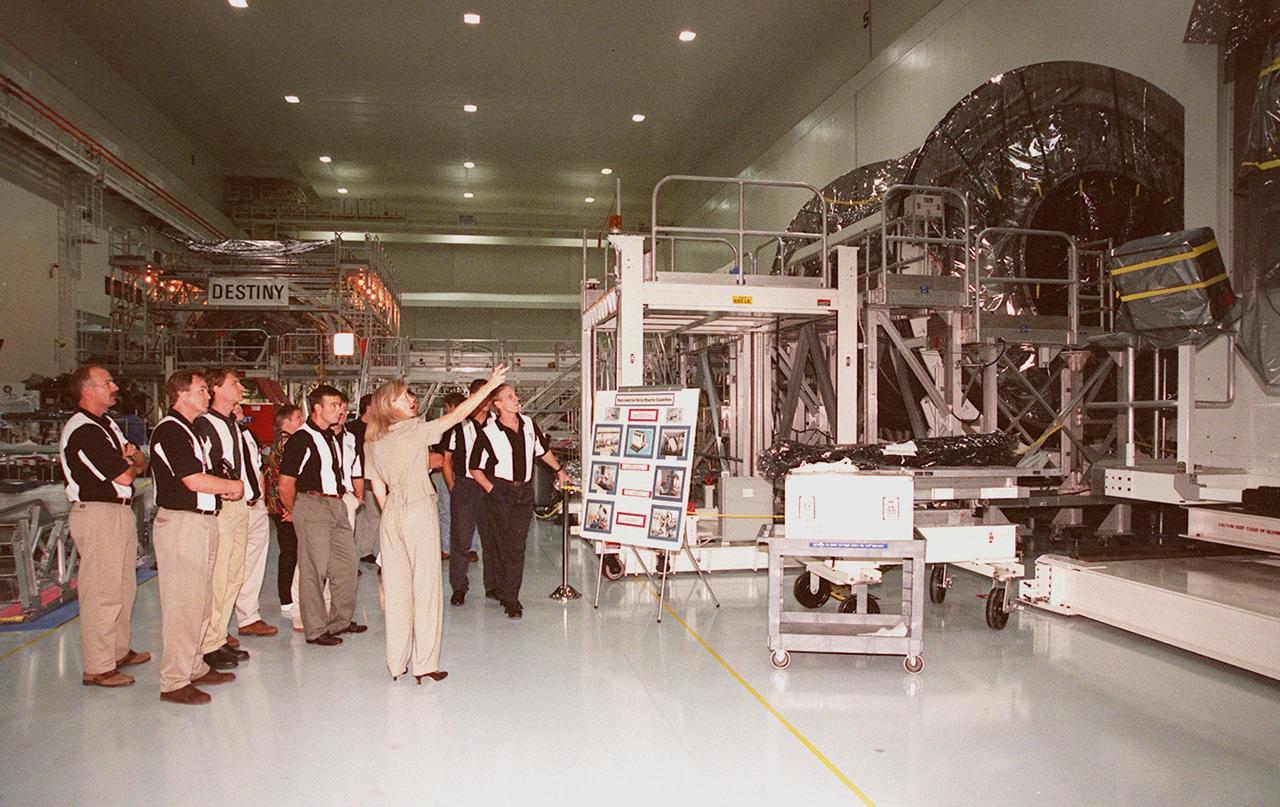
KENNEDY SPACE CENTER, FLA. -- In the Space Station Processing Facility (SSPF), members of the 1998 astronaut candidate class (group 17) are shown future components of the International Space Station, such as the Multi-Purpose Logistics Module at right. The class is taking part in training activities, including fire training and a flight awareness program, plus touring the OPF, VAB, SSME Processing Facility, launch pads, SLF, Apollo/Saturn V Center, the crew headquarters, as well as the SSPF. The U.S. candidates in the '98 class are Clayton C. Anderson, Lee J. Archambault, Tracy E. Caldwell (Ph.D.), Gregory E. Chamitoff (Ph.D.), Timothy J. Creamer, Christopher J. Ferguson, Michael J. Foreman, Michael E. Fossum, Kenneth T. Ham, Patricia C. Hilliard (M.D.), Gregory C. Johnson, Gregory H. Johnson, Stanley G. Love (Ph.D.), Leland D. Melvin, Barbara R. Morgan, William A. Oefelein, John D. Olivas (Ph.D.), Nicholas J.M. Patrick (Ph.D.), Alan G. Poindexter, Garrett E. Reisman (Ph.D.), Steven R. Swanson, Douglas H. Wheelock, Sunita L. Williams, Neil W. Woodward III, George D. Zamka; and the international candidates are Leopold Eyharts, Paolo Nespoli, Hans Schlegel, Roberto Vittori, Bjarni V. Tryggvason, and Marcos Pontes
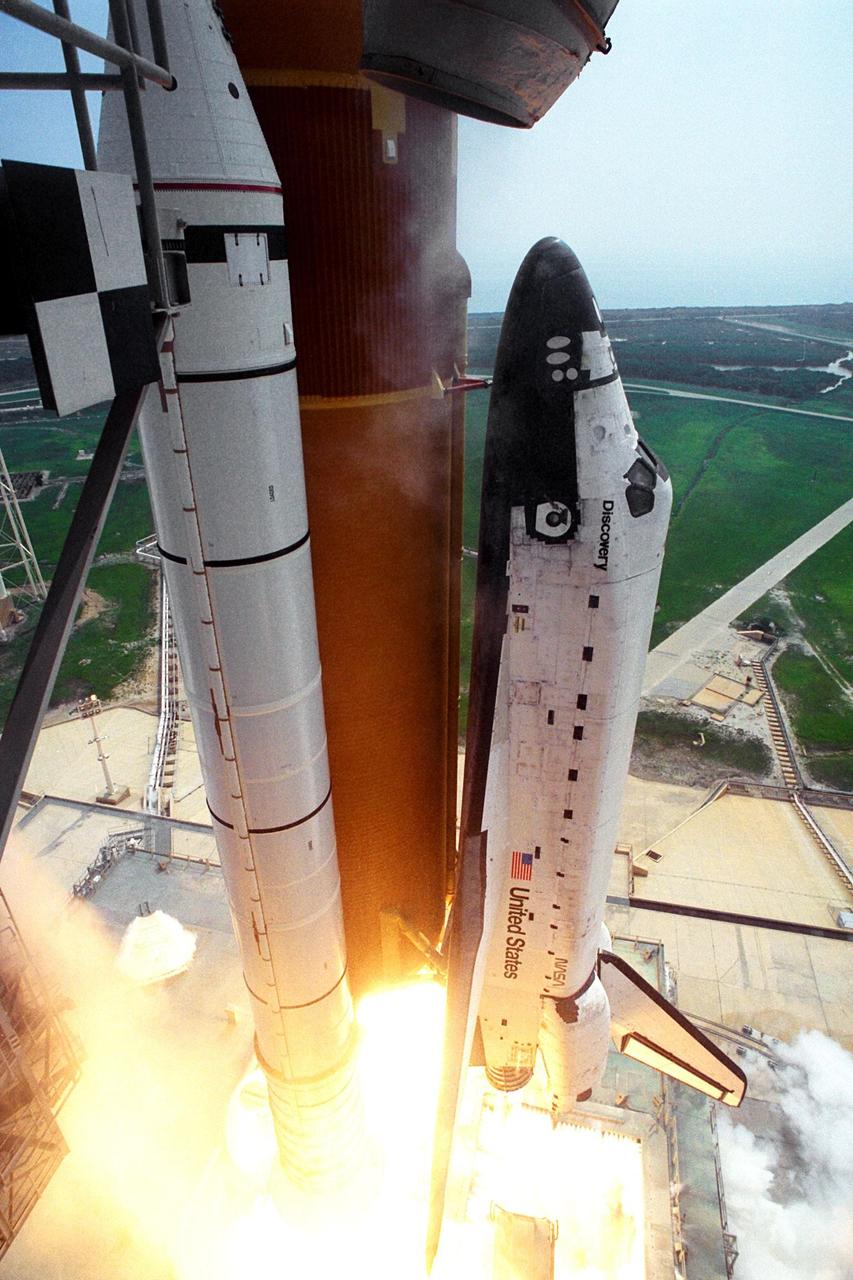
KENNEDY SPACE CENTER, Fla. -- Blasting through the hazy late morning sky, the Space Shuttle Discovery soars from Launch Pad 39A at 10:41 a.m. EDT Aug. 7 on the 11-day STS-85 mission. Aboard Discovery are Commander Curtis L. Brown, Jr.; Pilot Kent V. Rominger, Payload Commander N. Jan Davis, Mission Specialist Robert L. Curbeam, Jr., Mission Specialist Stephen K. Robinson and Payload Specialist Bjarni V. Tryggvason, a Canadian Space Agency astronaut . The primary payload aboard the Space Shuttle orbiter Discovery is the Cryogenic Infrared Spectrometers and Telescopes for the Atmosphere-Shuttle Pallet Satellite-2 (CRISTA-SPAS-2) free-flyer. The CRISTA-SPAS-2 will be deployed on flight day 1 to study trace gases in the Earth’s atmosphere as a part of NASA’s Mission to Planet Earth program. Also aboard the free-flying research platform will be the Middle Atmosphere High Resolution Spectrograph Instrument (MAHRSI). Other payloads on the 11-day mission include the Manipulator Flight Demonstration (MFD), a Japanese Space Agency-sponsored experiment. Also in Discovery’s payload bay are the Technology Applications and Science-1 (TAS-1) and International Extreme Ultraviolet Hitchhiker-2 (IEH-2) experiments
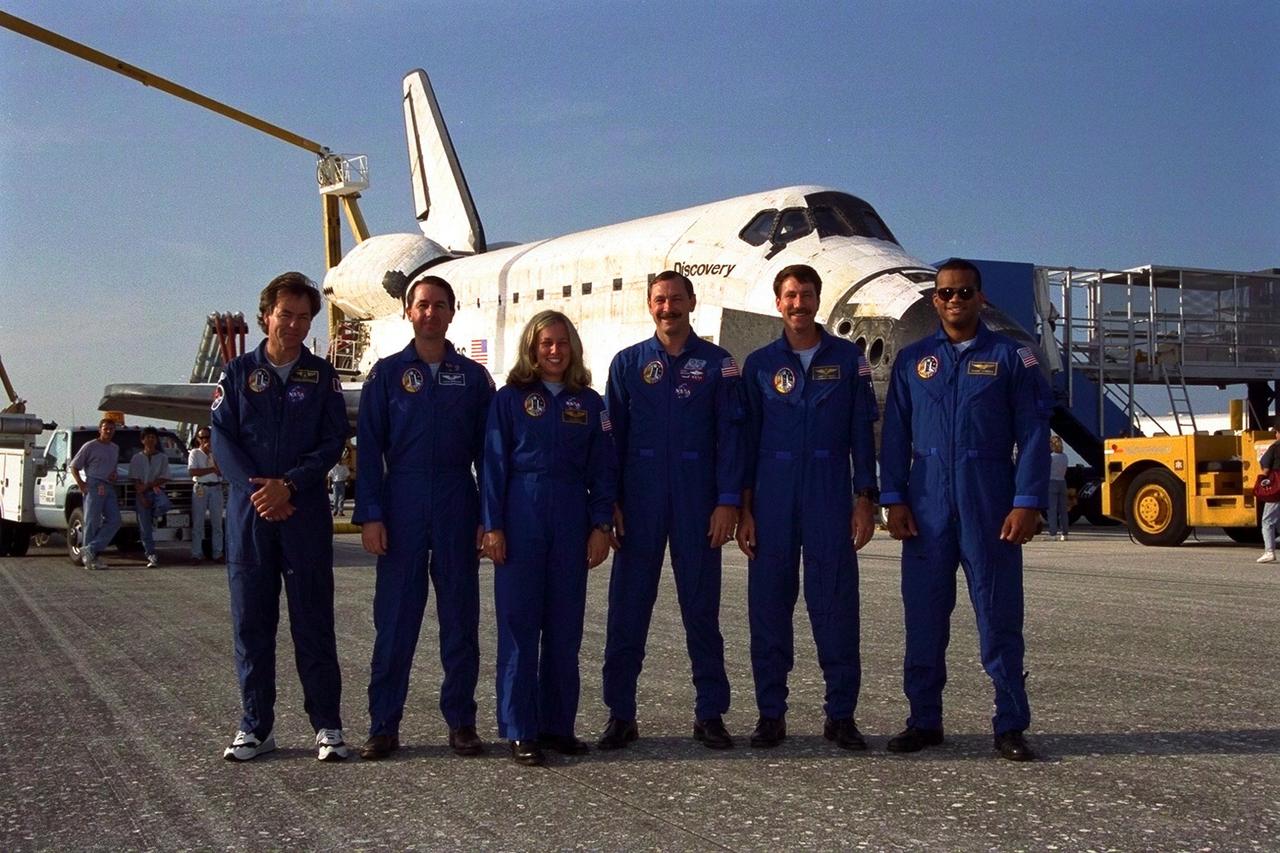
KENNEDY SPACE CENTER, FLA. -- The STS-85 crew poses in front of the Space Shuttle orbiter Discovery after the space plane landed on Runway 33 at KSC’s Shuttle Landing Facility Aug. 19 to complete the 11-day, 20-hour and 27-minute-long STS-85 mission. They are (from left): Payload Specialist and Canadian Space Agency astronaut Bjarni V. Tryggvason; Mission Specialist Stephen K. Robinson; Payload Commander N. Jan Davis; Commander Curtis L. Brown, Jr.; Pilot Kent V. Rominger, and Mission Specialist Robert L. Curbeam, Jr. During the 86th Space Shuttle mission, the crew deployed the Cryogenic Infrared Spectrometers and Telescopes for the AtmosphereShuttle Pallet Satellite-2 (CRISTA-SPAS-2) free-flyer to conduct research on the Earth’s middle atmosphere, retrieving it on flight day 9. The crew also conducted investigations with the Manipulator Flight Demonstration (MFD), Technology Applications and Science-1 (TAS-1) and International Extreme Ultraviolet Hitchhiker-2 (IEH-2) experiments. This was the 39th landing at KSC in the history of the Space Shuttle program and the 11th touchdown for Discovery at the space center
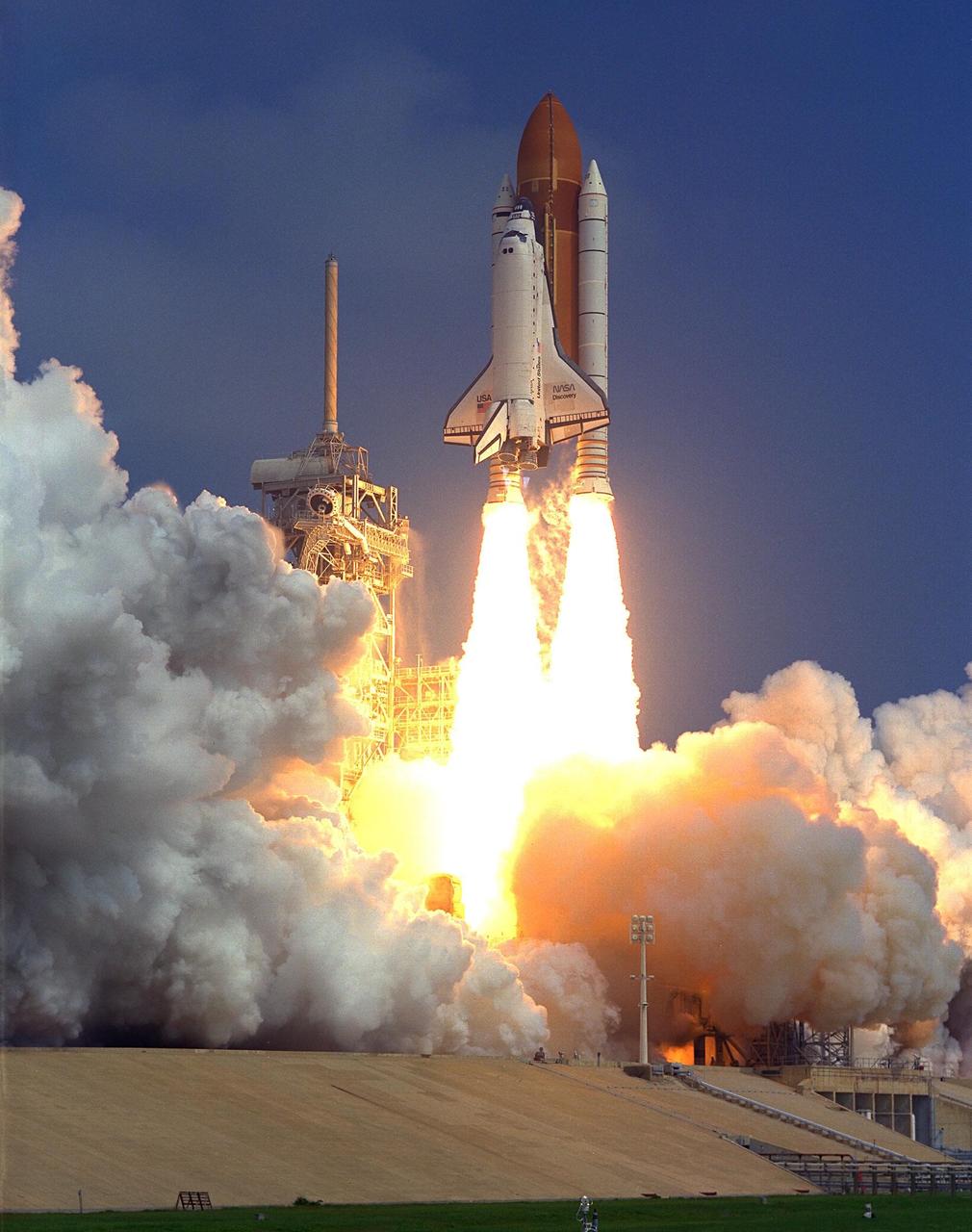
KENNEDY SPACE CENTER, Fla. -- Blasting through the hazy late morning sky, the Space Shuttle Discovery soars from Launch Pad 39A at 10:41 a.m. EDT Aug. 7 on the 11-day STS-85 mission. Aboard Discovery are Commander Curtis L. Brown, Jr.; Pilot Kent V. Rominger, Payload Commander N. Jan Davis, Mission Specialist Robert L. Curbeam, Jr., Mission Specialist Stephen K. Robinson and Payload Specialist Bjarni V. Tryggvason, a Canadian Space Agency astronaut . The primary payload aboard the Space Shuttle orbiter Discovery is the Cryogenic Infrared Spectrometers and Telescopes for the Atmosphere-Shuttle Pallet Satellite-2 (CRISTA-SPAS-2) free-flyer. The CRISTA-SPAS-2 will be deployed on flight day 1 to study trace gases in the Earth’s atmosphere as a part of NASA’s Mission to Planet Earth program. Also aboard the free-flying research platform will be the Middle Atmosphere High Resolution Spectrograph Instrument (MAHRSI). Other payloads on the 11-day mission include the Manipulator Flight Demonstration (MFD), a Japanese Space Agency-sponsored experiment. Also in Discovery’s payload bay are the Technology Applications and Science-1 (TAS-1) and International Extreme Ultraviolet Hitchhiker-2 (IEH-2) experiments
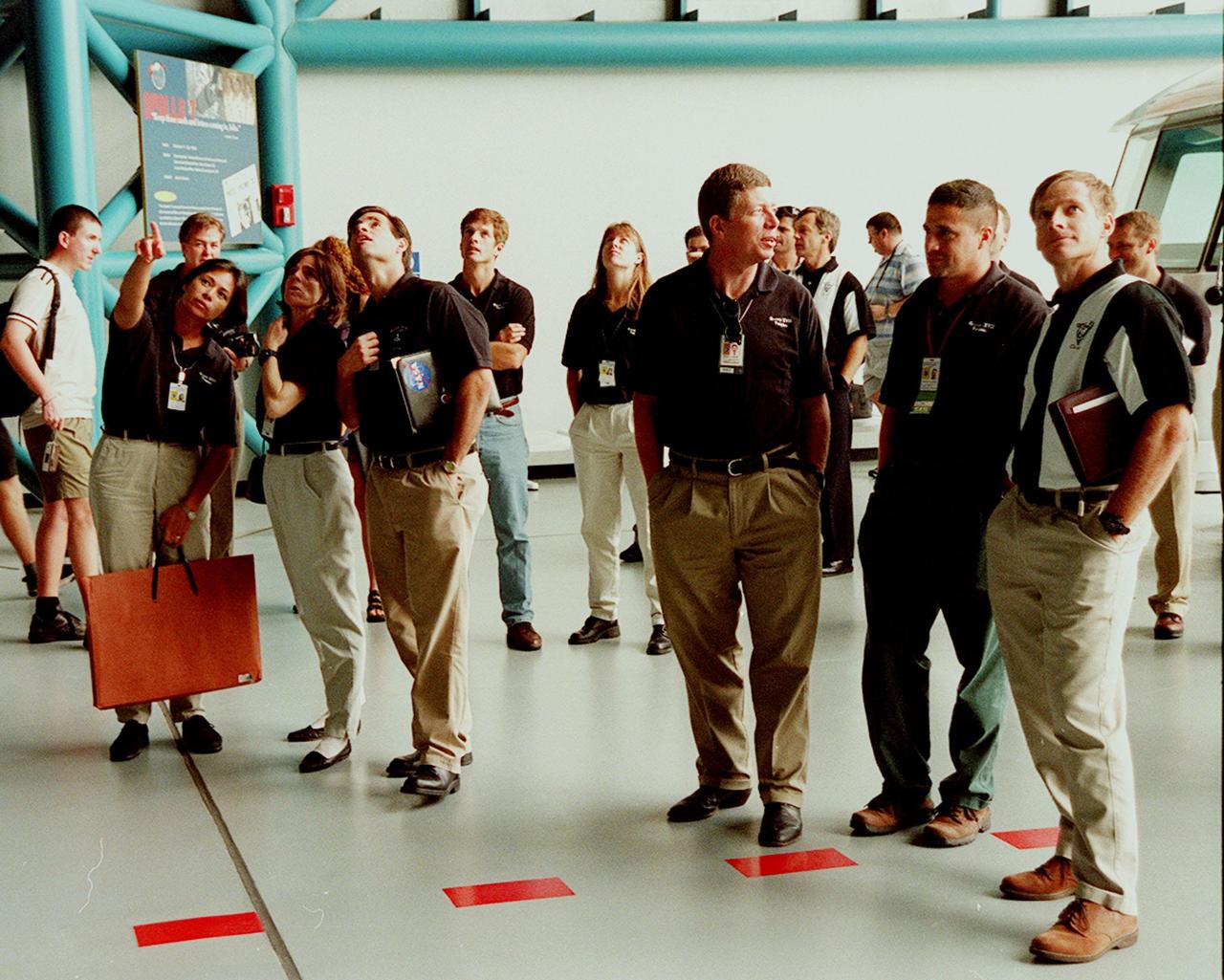
KENNEDY SPACE CENTER, FLA. -- At the Apollo/Saturn V Center, some of the 1998 astronaut candidate class (group 17) take a close look at the Saturn V rocket on display. The U.S. candidates include Clayton C. Anderson, Lee J. Archambault, Tracy E. Caldwell (Ph.D.), Gregory E. Chamitoff (Ph.D.), Timothy J. Creamer, Christopher J. Ferguson, Michael J. Foreman, Michael E. Fossum, Kenneth T. Ham, Patricia C. Hilliard (M.D.), Gregory C. Johnson, Gregory H. Johnson, Stanley G. Love (Ph.D.), Leland D. Melvin, Barbara R. Morgan, William A. Oefelein, John D. Olivas (Ph.D.), Nicholas J.M. Patrick (Ph.D.), Alan G. Poindexter, Garrett E. Reisman (Ph.D.), Steven R. Swanson, Douglas H. Wheelock, Sunita L. Williams, Neil W. Woodward III, George D. Zamka; and international candidates Leopold Eyharts, Paolo Nespoli, Hans Schlegel, Roberto Vittori, Bjarni V. Tryggvason, and Marcos Pontes. The class is at KSC for training activities, including fire training and a flight awareness program, plus touring the OPF, SSME Processing Facility, VAB, SSPF, launch pads, SLF, Apollo/Saturn V Center and the crew headquarters
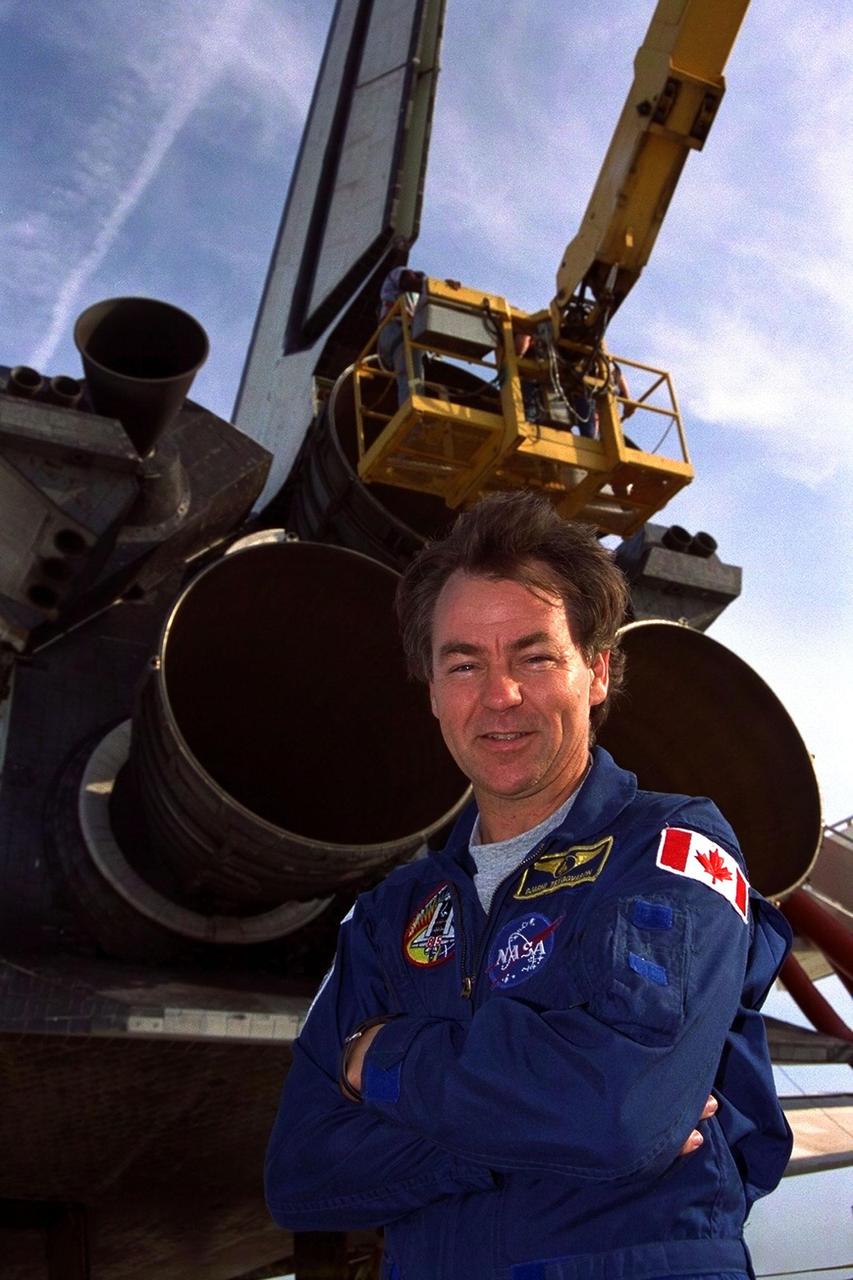
KENNEDY SPACE CENTER, FLA. -- STS-85 Payload Specialist and Canadian Space Agency astronaut Bjarni V. Tryggvason poses under the Space Shuttle orbiter Discovery after the space plane landed on Runway 33 at KSC’s Shuttle Landing Facility Aug. 19 to complete the 11-day, 20-hour and 27-minute-long STS-85 mission. Also on board were Commander Curtis L. Brown, Jr., Pilot Kent V. Rominger, Payload Commander N. Jan Davis, Mission Specialist Robert L. Curbeam, Jr. and Mission Specialist Stephen K. Robinson During the 86th Space Shuttle mission, the crew deployed the Cryogenic Infrared Spectrometers and Telescopes for the Atmosphere-Shuttle Pallet Satellite-2 (CRISTA-SPAS-2) free-flyer to conduct research on the Earth’s middle atmosphere, retrieving it on flight day 9. The crew also conducted investigations with the Manipulator Flight Demonstration (MFD), Technology Applications and Science-1 (TAS-1) and International Extreme Ultraviolet Hitchhiker-2 (IEH-2) experiments. This was the 39th landing at KSC in the history of the Space Shuttle program and the 11th touchdown for Discovery at the space center
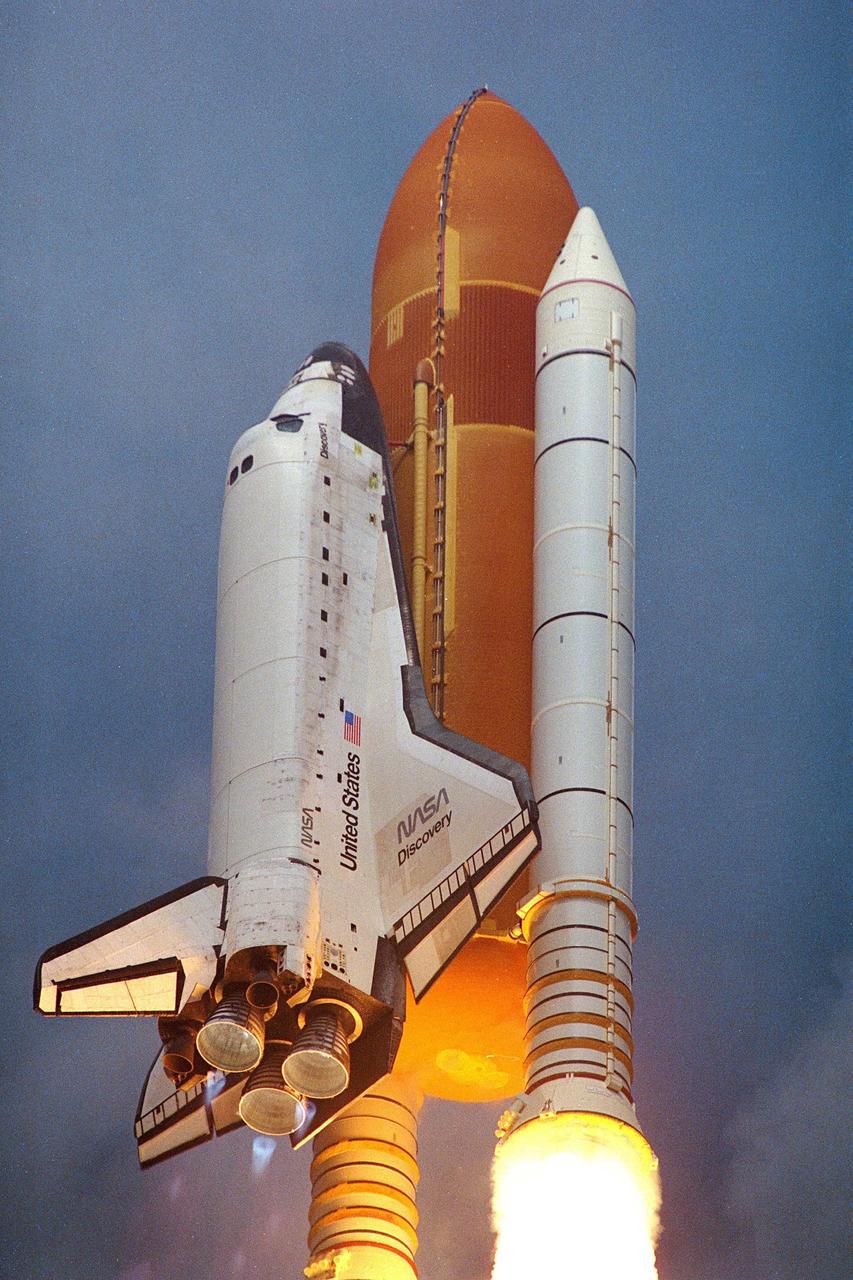
KENNEDY SPACE CENTER, Fla. -- Blasting through the hazy late morning sky, the Space Shuttle Discovery soars from Launch Pad 39A at 10:41 a.m. EDT Aug. 7 on the 11-day STS-85 mission. Aboard Discovery are Commander Curtis L. Brown, Jr.; Pilot Kent V. Rominger, Payload Commander N. Jan Davis, Mission Specialist Robert L. Curbeam, Jr., Mission Specialist Stephen K. Robinson and Payload Specialist Bjarni V. Tryggvason, a Canadian Space Agency astronaut . The primary payload aboard the Space Shuttle orbiter Discovery is the Cryogenic Infrared Spectrometers and Telescopes for the Atmosphere-Shuttle Pallet Satellite-2 (CRISTA-SPAS-2) free-flyer. The CRISTA-SPAS-2 will be deployed on flight day 1 to study trace gases in the Earth’s atmosphere as a part of NASA’s Mission to Planet Earth program. Also aboard the free-flying research platform will be the Middle Atmosphere High Resolution Spectrograph Instrument (MAHRSI). Other payloads on the 11-day mission include the Manipulator Flight Demonstration (MFD), a Japanese Space Agency-sponsored experiment. Also in Discovery’s payload bay are the Technology Applications and Science-1 (TAS-1) and International Extreme Ultraviolet Hitchhiker-2 (IEH-2) experiments
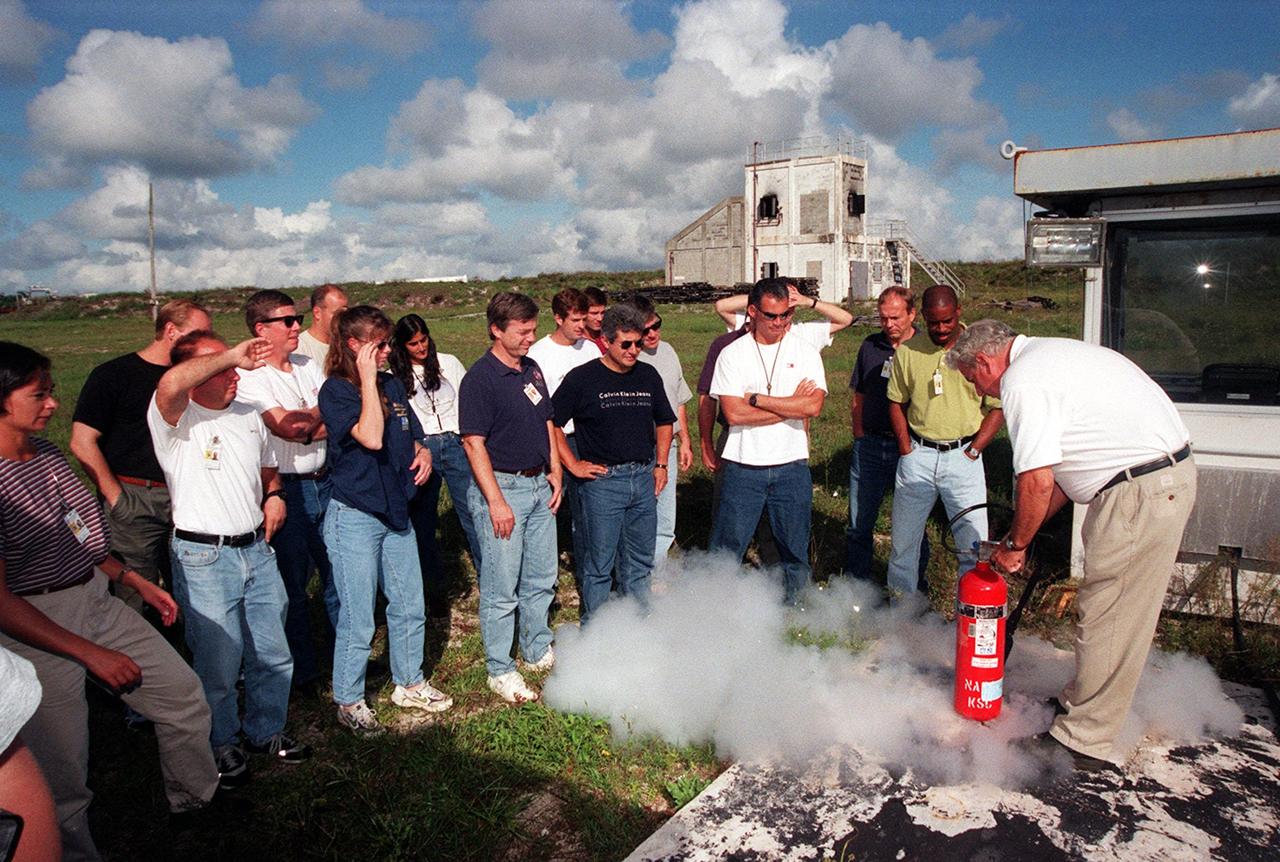
KENNEDY SPACE CENTER, FLA. -- On the grounds of the Kennedy Space Center, members of the 1998 astronaut candidate class (Group 17) take part in fire training. The class is taking part in training activities, including a flight awareness program, plus touring the OPF, VAB, SSPF, SSME Processing Facility, launch pads, SLF, Apollo/Saturn V Center, and the crew quarters. The U.S. candidates in the '98 class are Clayton C. Anderson, Lee J. Archambault, Tracy E. Caldwell (Ph.D.), Gregory E. Chamitoff (Ph.D.), Timothy J. Creamer, Christopher J. Ferguson, Michael J. Foreman, Michael E. Fossum, Kenneth T. Ham, Patricia C. Hilliard (M.D.), Gregory C. Johnson, Gregory H. Johnson, Stanley G. Love (Ph.D.), Leland D. Melvin, Barbara R. Morgan, William A. Oefelein, John D. Olivas (Ph.D.), Nicholas J.M. Patrick (Ph.D.), Alan G. Poindexter, Garrett E. Reisman (Ph.D.), Steven R. Swanson, Douglas H. Wheelock, Sunita L. Williams, Neil W. Woodward III, George D. Zamka; and the international candidates are Leopold Eyharts, Paolo Nespoli, Hans Schlegel, Roberto Vittori, Bjarni V. Tryggvason, and Marcos Pontes
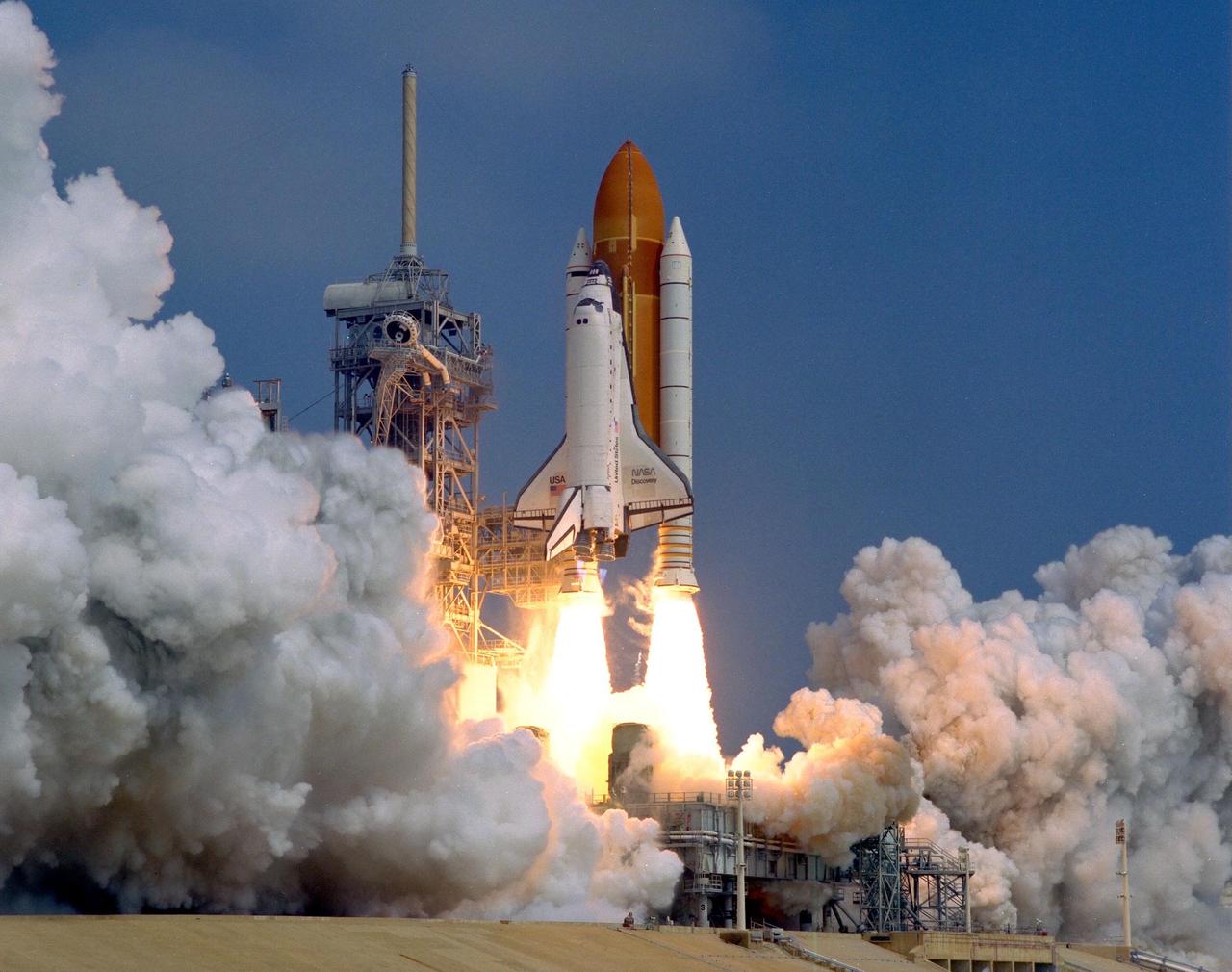
KENNEDY SPACE CENTER, Fla. -- Blasting through the hazy late morning sky, the Space Shuttle Discovery soars from Launch Pad 39A at 10:41 a.m. EDT Aug. 7 on the 11-day STS-85 mission. Aboard Discovery are Commander Curtis L. Brown, Jr.; Pilot Kent V. Rominger, Payload Commander N. Jan Davis, Mission Specialist Robert L. Curbeam, Jr., Mission Specialist Stephen K. Robinson and Payload Specialist Bjarni V. Tryggvason, a Canadian Space Agency astronaut . The primary payload aboard the Space Shuttle orbiter Discovery is the Cryogenic Infrared Spectrometers and Telescopes for the Atmosphere-Shuttle Pallet Satellite-2 (CRISTA-SPAS-2) free-flyer. The CRISTA-SPAS-2 will be deployed on flight day 1 to study trace gases in the Earth’s atmosphere as a part of NASA’s Mission to Planet Earth program. Also aboard the free-flying research platform will be the Middle Atmosphere High Resolution Spectrograph Instrument (MAHRSI). Other payloads on the 11-day mission include the Manipulator Flight Demonstration (MFD), a Japanese Space Agency-sponsored experiment. Also in Discovery’s payload bay are the Technology Applications and Science-1 (TAS-1) and International Extreme Ultraviolet Hitchhiker-2 (IEH-2) experiments
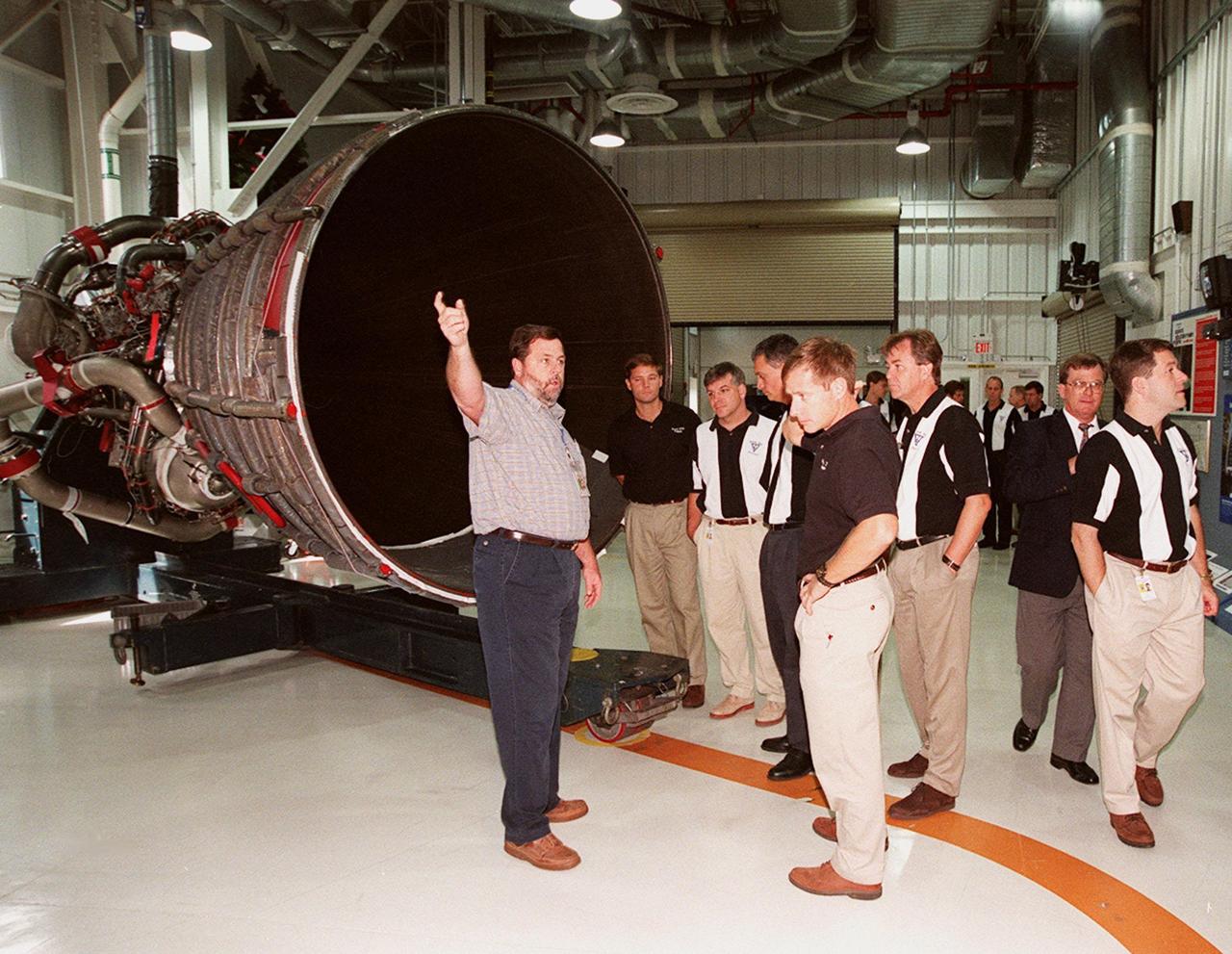
Members of the 1998 astronaut candidate class (group 17) learn about the use of the Space Shuttle Main Engine (SSME) Processing Facility. At left is one of the main shuttle engines. The class is at KSC for training activities, including fire training and a flight awareness program, plus touring the OPF, VAB, SSPF, launch pads, SLF, Apollo/Saturn V Center, the crew headquarters, as well as the SSME Processing Facility. The U.S. candidates in the '98 class are Clayton C. Anderson, Lee J. Archambault, Tracy E. Caldwell (Ph.D.), Gregory E. Chamitoff (Ph.D.), Timothy J. Creamer, Christopher J. Ferguson, Michael J. Foreman, Michael E. Fossum, Kenneth T. Ham, Patricia C. Hilliard (M.D.), Gregory C. Johnson, Gregory H. Johnson, Stanley G. Love (Ph.D.), Leland D. Melvin, Barbara R. Morgan, William A. Oefelein, John D. Olivas (Ph.D.), Nicholas J.M. Patrick (Ph.D.), Alan G. Poindexter, Garrett E. Reisman (Ph.D.), Steven R. Swanson, Douglas H. Wheelock, Sunita L. Williams, Neil W. Woodward III, George D. Zamka; and the international candidates are Leopold Eyharts, Paolo Nespoli, Hans Schlegel, Roberto Vittori, Bjarni V. Tryggvason, and Marcos Pontes
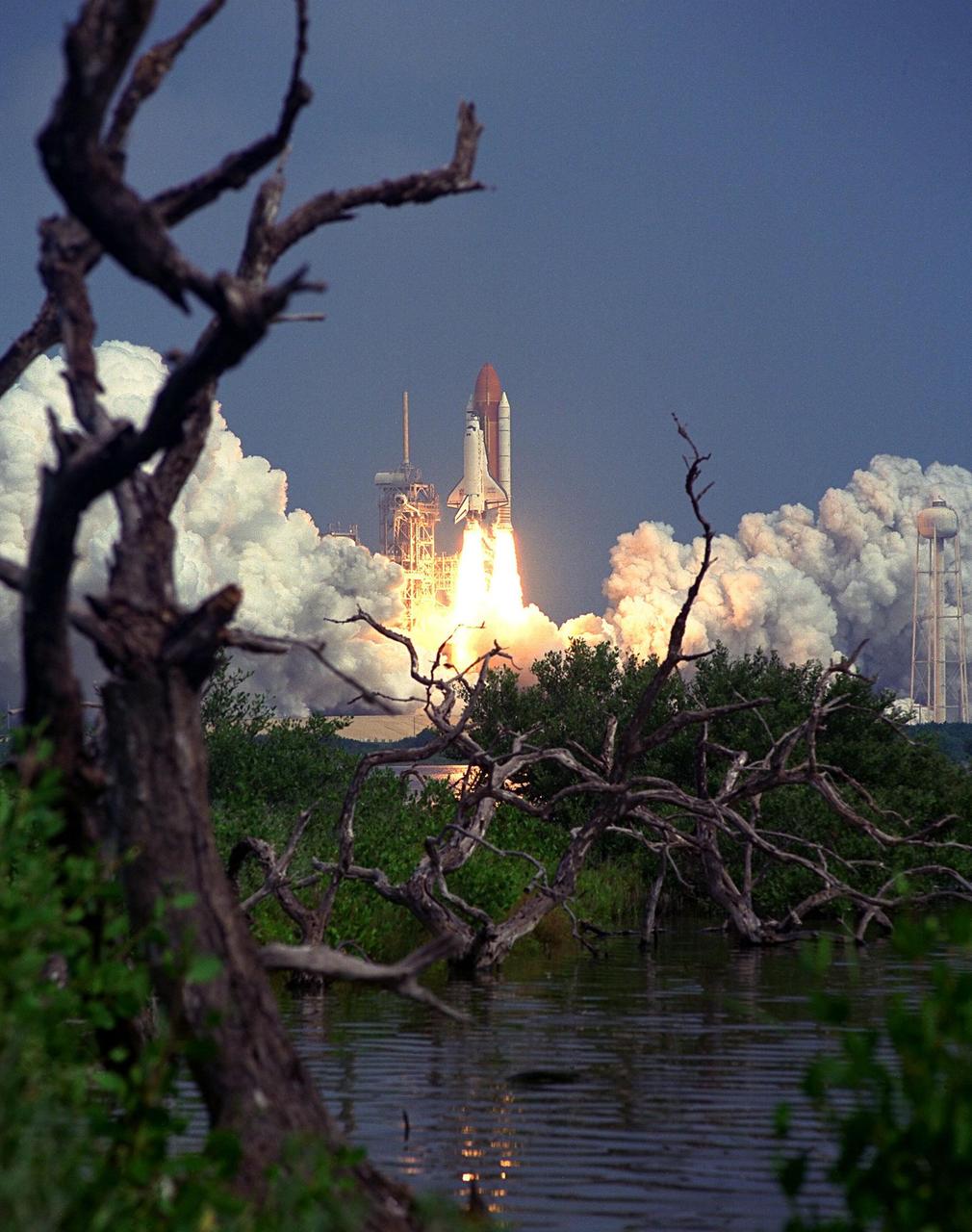
KENNEDY SPACE CENTER, Fla. -- Blasting through the hazy late morning sky, the Space Shuttle Discovery soars from Launch Pad 39A at 10:41 a.m. EDT Aug. 7 on the 11-day STS-85 mission. Aboard Discovery are Commander Curtis L. Brown, Jr.; Pilot Kent V. Rominger, Payload Commander N. Jan Davis, Mission Specialist Robert L. Curbeam, Jr., Mission Specialist Stephen K. Robinson and Payload Specialist Bjarni V. Tryggvason, a Canadian Space Agency astronaut . The primary payload aboard the Space Shuttle orbiter Discovery is the Cryogenic Infrared Spectrometers and Telescopes for the Atmosphere-Shuttle Pallet Satellite-2 (CRISTA-SPAS-2) free-flyer. The CRISTA-SPAS-2 will be deployed on flight day 1 to study trace gases in the Earth’s atmosphere as a part of NASA’s Mission to Planet Earth program. Also aboard the free-flying research platform will be the Middle Atmosphere High Resolution Spectrograph Instrument (MAHRSI). Other payloads on the 11-day mission include the Manipulator Flight Demonstration (MFD), a Japanese Space Agency-sponsored experiment. Also in Discovery’s payload bay are the Technology Applications and Science-1 (TAS-1) and International Extreme Ultraviolet Hitchhiker-2 (IEH-2) experiments
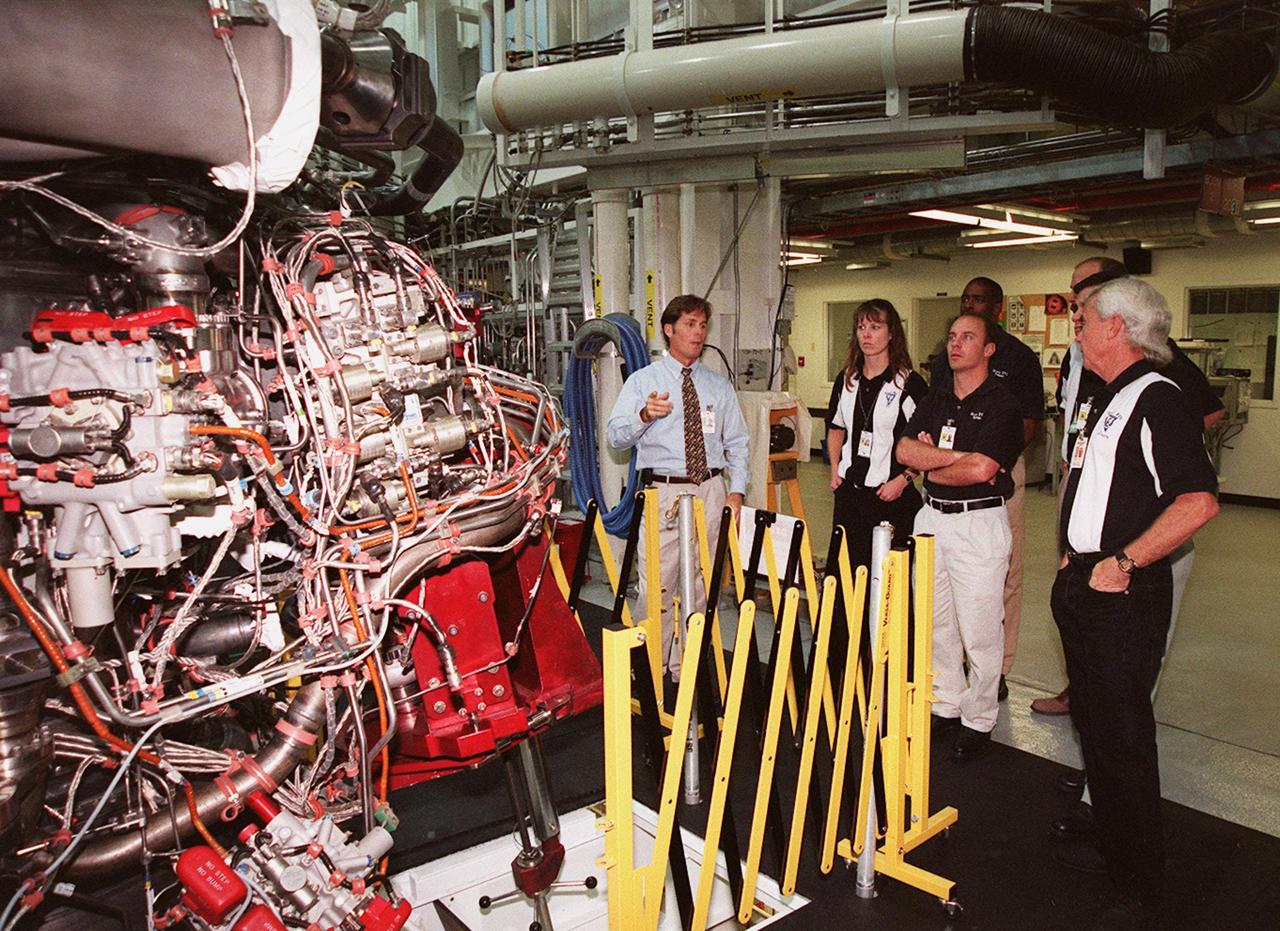
KENNEDY SPACE CENTER, FLA. -- On their tour of KSC, members of the 1998 astronaut candidate class (group 17) stop at the Space Shuttle Main Engine (SSME) Processing Facility for a close up look at a main shuttle engine. The class is taking part in training activities, including fire training and a flight awareness program, plus touring the OPF, VAB, SSPF, launch pads, SLF, Apollo/Saturn V Center, the crew headquarters, as well as the SSME Processing Facility. The U.S. candidates in the '98 class are Clayton C. Anderson, Lee J. Archambault, Tracy E. Caldwell (Ph.D.), Gregory E. Chamitoff (Ph.D.), Timothy J. Creamer, Christopher J. Ferguson, Michael J. Foreman, Michael E. Fossum, Kenneth T. Ham, Patricia C. Hilliard (M.D.), Gregory C. Johnson, Gregory H. Johnson, Stanley G. Love (Ph.D.), Leland D. Melvin, Barbara R. Morgan, William A. Oefelein, John D. Olivas (Ph.D.), Nicholas J.M. Patrick (Ph.D.), Alan G. Poindexter, Garrett E. Reisman (Ph.D.), Steven R. Swanson, Douglas H. Wheelock, Sunita L. Williams, Neil W. Woodward III, George D. Zamka; and the international candidates are Leopold Eyharts, Paolo Nespoli, Hans Schlegel, Roberto Vittori, Bjarni V. Tryggvason, and Marcos Pontes
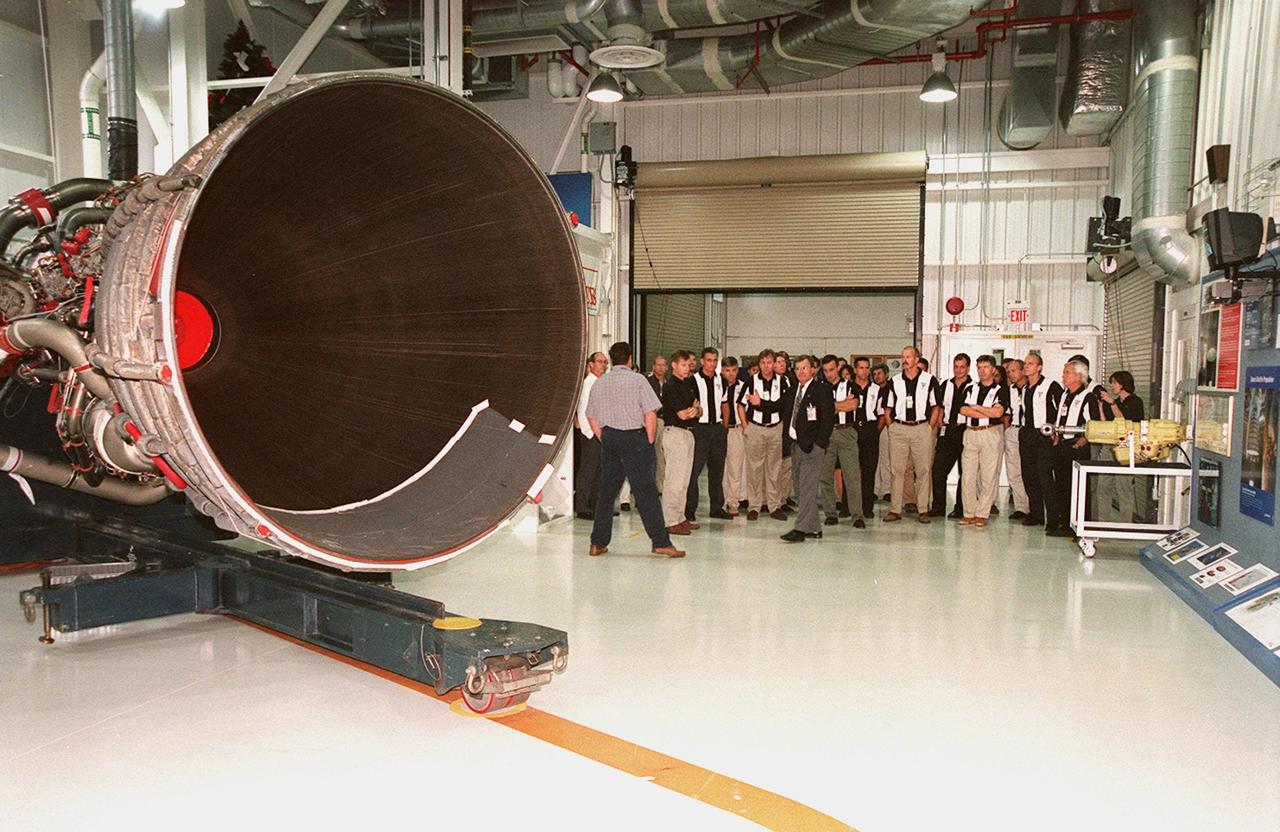
The 1998 astronaut candidate class (group 17) gather in the Space Shuttle Main Engine Processing (SSMEP) Facility. In the foreground is one of the main shuttle engines. The class is at KSC for training activities, including fire training and a flight awareness program, plus touring the OPF, SSME Processing Facility, VAB, SSPF, launch pads, SLF, Apollo/Saturn V Center and the crew headquarters. The U.S. candidates in the '98 class are Clayton C. Anderson, Lee J. Archambault, Tracy E. Caldwell (Ph.D.), Gregory E. Chamitoff (Ph.D.), Timothy J. Creamer, Christopher J. Ferguson, Michael J. Foreman, Michael E. Fossum, Kenneth T. Ham, Patricia C. Hilliard (M.D.), Gregory C. Johnson, Gregory H. Johnson, Stanley G. Love (Ph.D.), Leland D. Melvin, Barbara R. Morgan, William A. Oefelein, John D. Olivas (Ph.D.), Nicholas J.M. Patrick (Ph.D.), Alan G. Poindexter, Garrett E. Reisman (Ph.D.), Steven R. Swanson, Douglas H. Wheelock, Sunita L. Williams, Neil W. Woodward III, George D. Zamka; and the international candidates are Leopold Eyharts, Paolo Nespoli, Hans Schlegel, Roberto Vittori, Bjarni V. Tryggvason, and Marcos Pontes
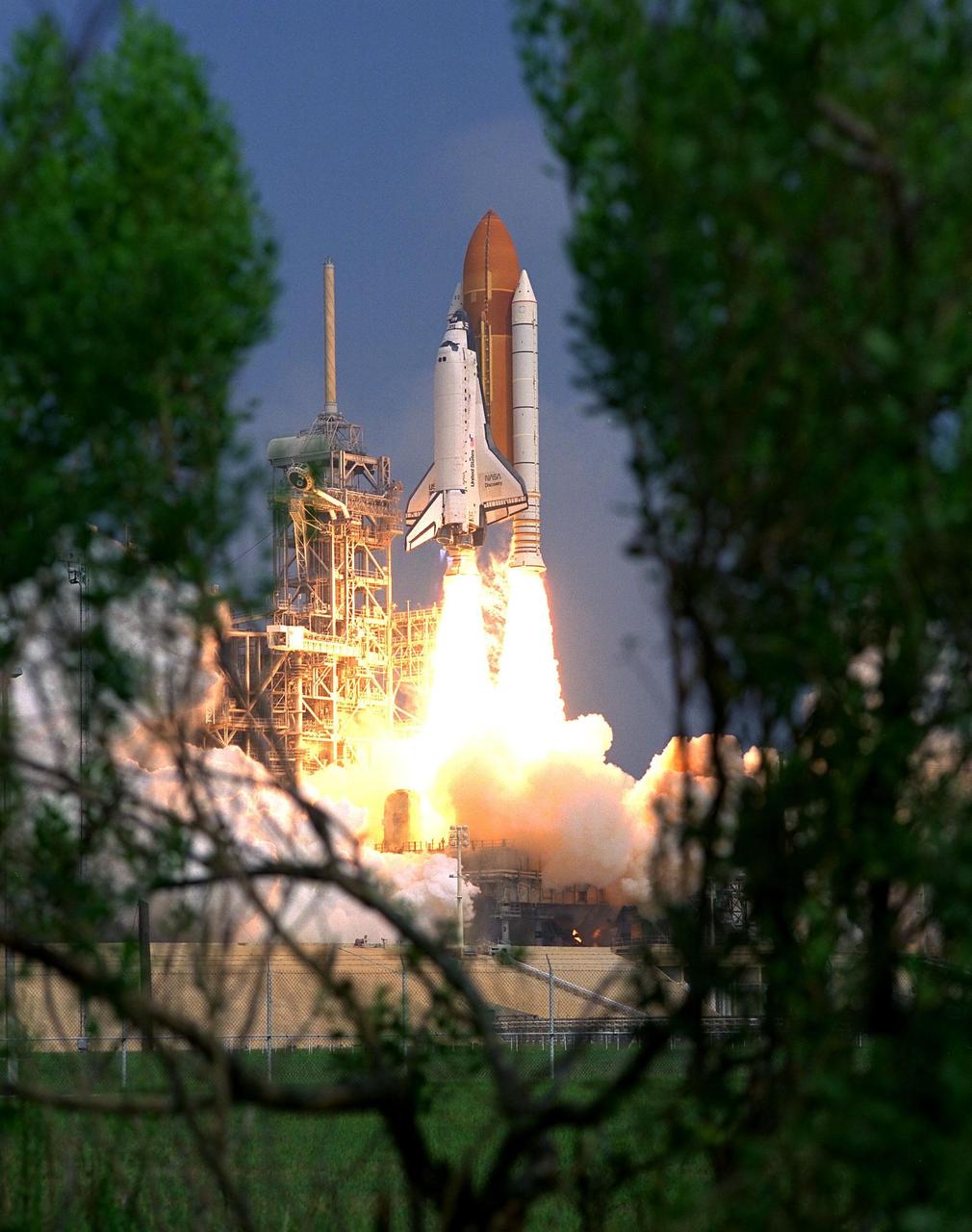
KENNEDY SPACE CENTER, Fla. -- Blasting through the hazy late morning sky, the Space Shuttle Discovery soars from Launch Pad 39A at 10:41 a.m. EDT Aug. 7 on the 11-day STS-85 mission. Aboard Discovery are Commander Curtis L. Brown, Jr.; Pilot Kent V. Rominger, Payload Commander N. Jan Davis, Mission Specialist Robert L. Curbeam, Jr., Mission Specialist Stephen K. Robinson and Payload Specialist Bjarni V. Tryggvason, a Canadian Space Agency astronaut . The primary payload aboard the Space Shuttle orbiter Discovery is the Cryogenic Infrared Spectrometers and Telescopes for the Atmosphere-Shuttle Pallet Satellite-2 (CRISTA-SPAS-2) free-flyer. The CRISTA-SPAS-2 will be deployed on flight day 1 to study trace gases in the Earth’s atmosphere as a part of NASA’s Mission to Planet Earth program. Also aboard the free-flying research platform will be the Middle Atmosphere High Resolution Spectrograph Instrument (MAHRSI). Other payloads on the 11-day mission include the Manipulator Flight Demonstration (MFD), a Japanese Space Agency-sponsored experiment. Also in Discovery’s payload bay are the Technology Applications and Science-1 (TAS-1) and International Extreme Ultraviolet Hitchhiker-2 (IEH-2) experiments
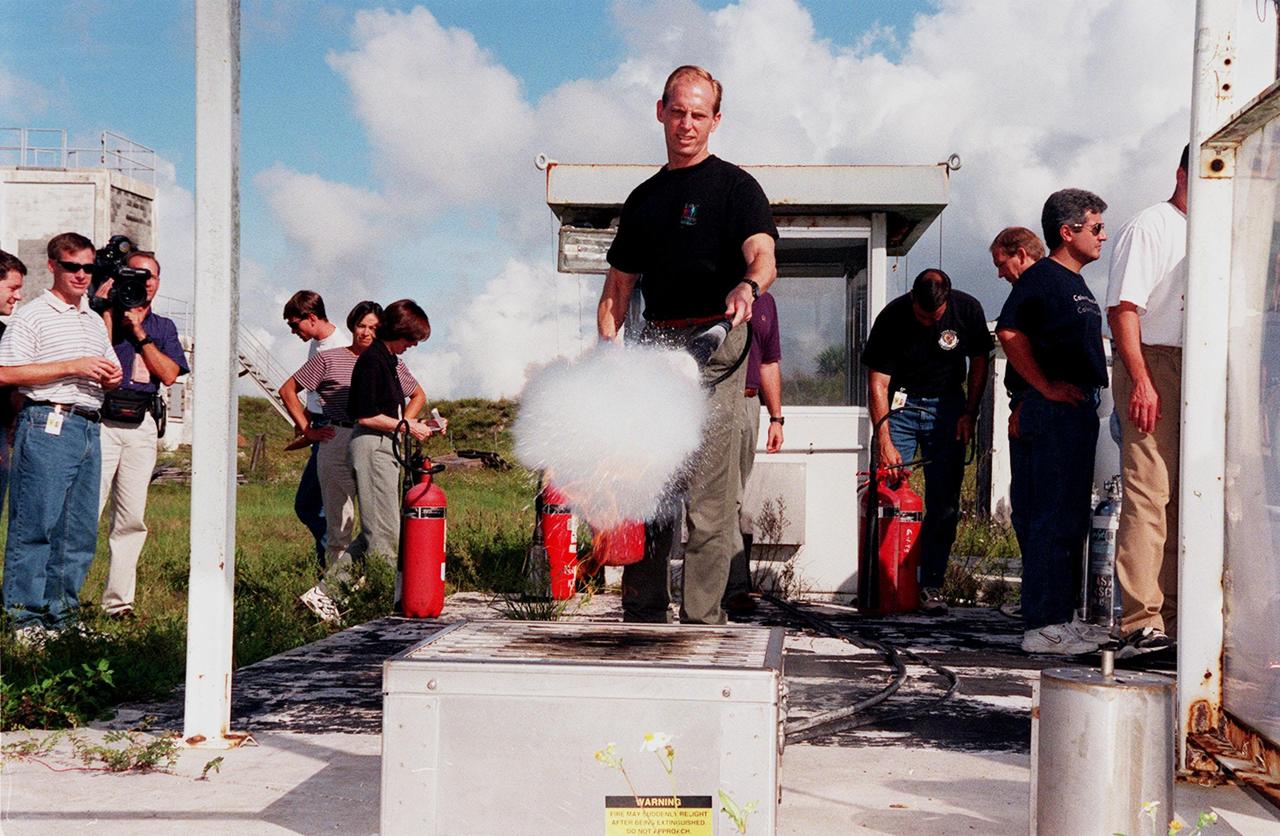
KENNEDY SPACE CENTER, FLA. -- On the grounds of the Kennedy Space Center, members of the 1998 astronaut candidate class (Group 17) watch as candidate Clayton C. Anderson practices using firefighting equipment during fire training. The class is at KSC for training activities, including a flight awareness program, plus touring the OPF, VAB, SSPF, SSME Processing Facility, launch pads, SLF, Apollo/Saturn V Center, and the crew quarters. The other U.S. candidates in the '98 class are Lee J. Archambault, Tracy E. Caldwell (Ph.D.), Gregory E. Chamitoff (Ph.D.), Timothy J. Creamer, Christopher J. Ferguson, Michael J. Foreman, Michael E. Fossum, Kenneth T. Ham, Patricia C. Hilliard (M.D.), Gregory C. Johnson, Gregory H. Johnson, Stanley G. Love (Ph.D.), Leland D. Melvin, Barbara R. Morgan, William A. Oefelein, John D. Olivas (Ph.D.), Nicholas J.M. Patrick (Ph.D.), Alan G. Poindexter, Garrett E. Reisman (Ph.D.), Steven R. Swanson, Douglas H. Wheelock, Sunita L. Williams, Neil W. Woodward III, George D. Zamka; and the international candidates are Leopold Eyharts, Paolo Nespoli, Hans Schlegel, Roberto Vittori, Bjarni V. Tryggvason, and Marcos Pontes
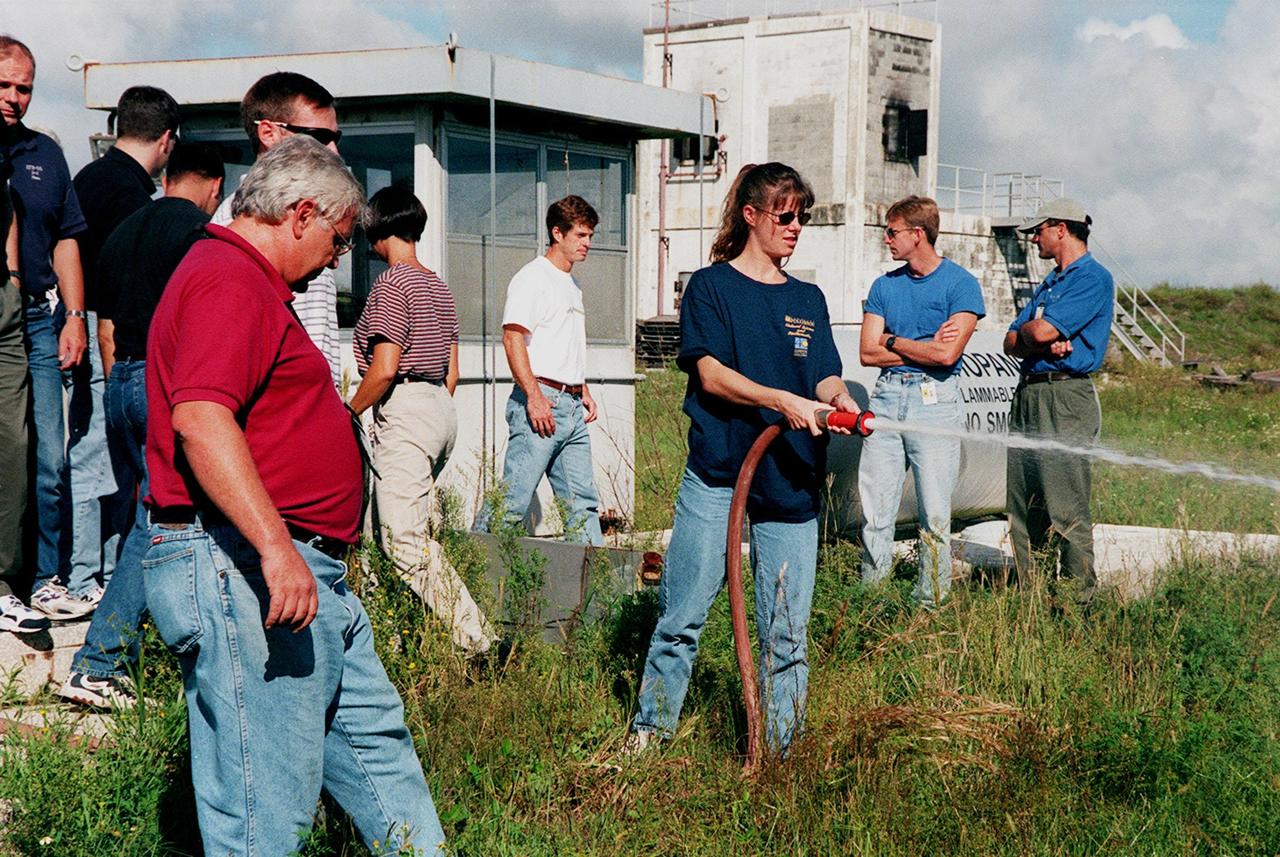
KENNEDY SPACE CENTER, FLA. -- On the grounds of the Kennedy Space Center, members of the 1998 astronaut candidate class (Group 17) watch as candidate Tracy E. Caldwell (Ph.D.) practices using firefighting equipment during fire training. The class is at KSC for training activities, including a flight awareness program, plus touring the OPF, VAB, SSPF, SSME Processing Facility, launch pads, SLF, Apollo/Saturn V Center, and the crew quarters. The other U.S. candidates in the '98 class are Clayton C. Anderson, Lee J. Archambault, Gregory E. Chamitoff (Ph.D.), Timothy J. Creamer, Christopher J. Ferguson, Michael J. Foreman, Michael E. Fossum, Kenneth T. Ham, Patricia C. Hilliard (M.D.), Gregory C. Johnson, Gregory H. Johnson, Stanley G. Love (Ph.D.), Leland D. Melvin, Barbara R. Morgan, William A. Oefelein, John D. Olivas (Ph.D.), Nicholas J.M. Patrick (Ph.D.), Alan G. Poindexter, Garrett E. Reisman (Ph.D.), Steven R. Swanson, Douglas H. Wheelock, Sunita L. Williams, Neil W. Woodward III, George D. Zamka; and the international candidates are Leopold Eyharts, Paolo Nespoli, Hans Schlegel, Roberto Vittori, Bjarni V. Tryggvason, and Marcos Pontes
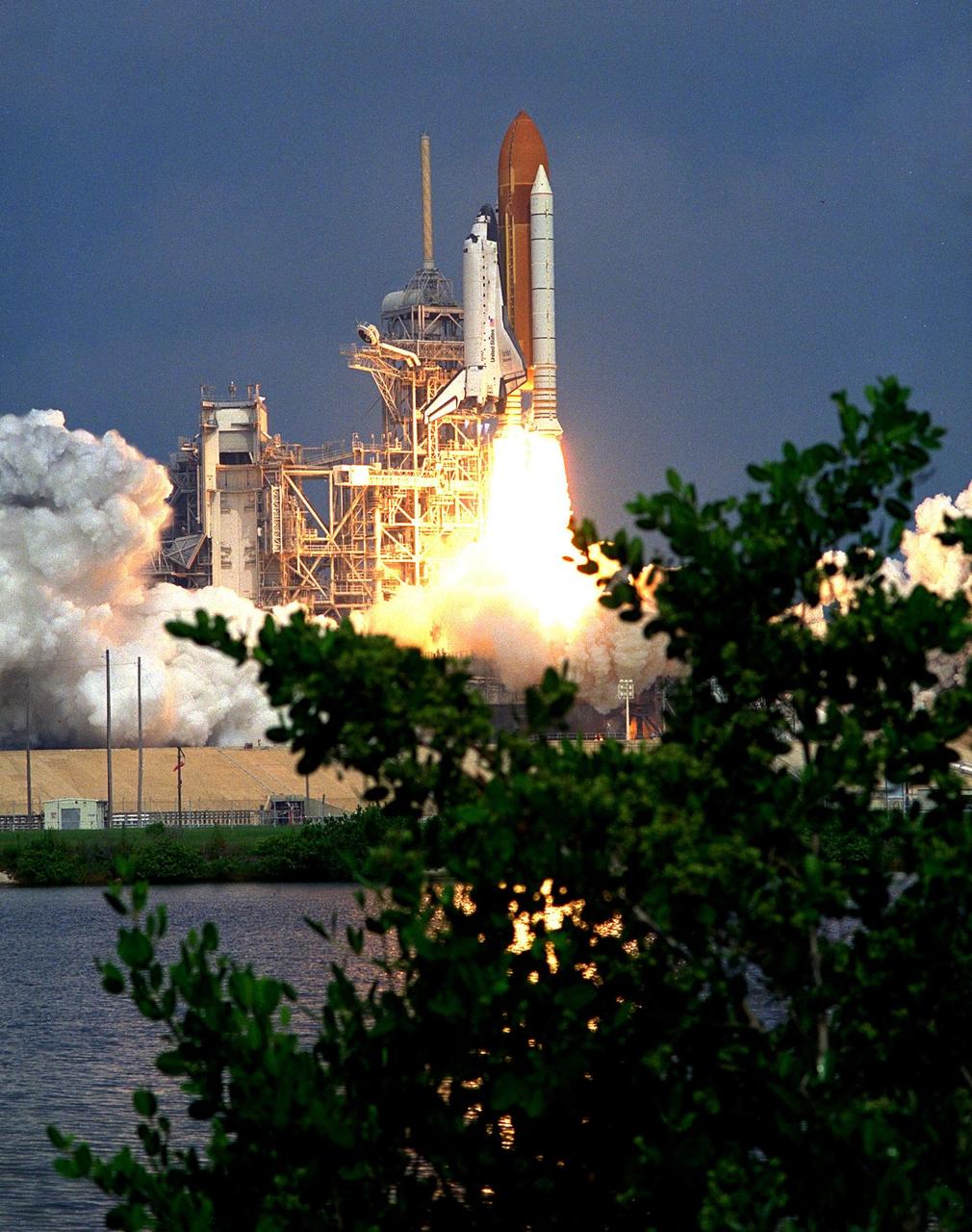
KENNEDY SPACE CENTER, Fla. -- Blasting through the hazy late morning sky, the Space Shuttle Discovery soars from Launch Pad 39A at 10:41 a.m. EDT Aug. 7 on the 11-day STS-85 mission. Aboard Discovery are Commander Curtis L. Brown, Jr.; Pilot Kent V. Rominger, Payload Commander N. Jan Davis, Mission Specialist Robert L. Curbeam, Jr., Mission Specialist Stephen K. Robinson and Payload Specialist Bjarni V. Tryggvason, a Canadian Space Agency astronaut . The primary payload aboard the Space Shuttle orbiter Discovery is the Cryogenic Infrared Spectrometers and Telescopes for the Atmosphere-Shuttle Pallet Satellite-2 (CRISTA-SPAS-2) free-flyer. The CRISTA-SPAS-2 will be deployed on flight day 1 to study trace gases in the Earth’s atmosphere as a part of NASA’s Mission to Planet Earth program. Also aboard the free-flying research platform will be the Middle Atmosphere High Resolution Spectrograph Instrument (MAHRSI). Other payloads on the 11-day mission include the Manipulator Flight Demonstration (MFD), a Japanese Space Agency-sponsored experiment. Also in Discovery’s payload bay are the Technology Applications and Science-1 (TAS-1) and International Extreme Ultraviolet Hitchhiker-2 (IEH-2) experiments
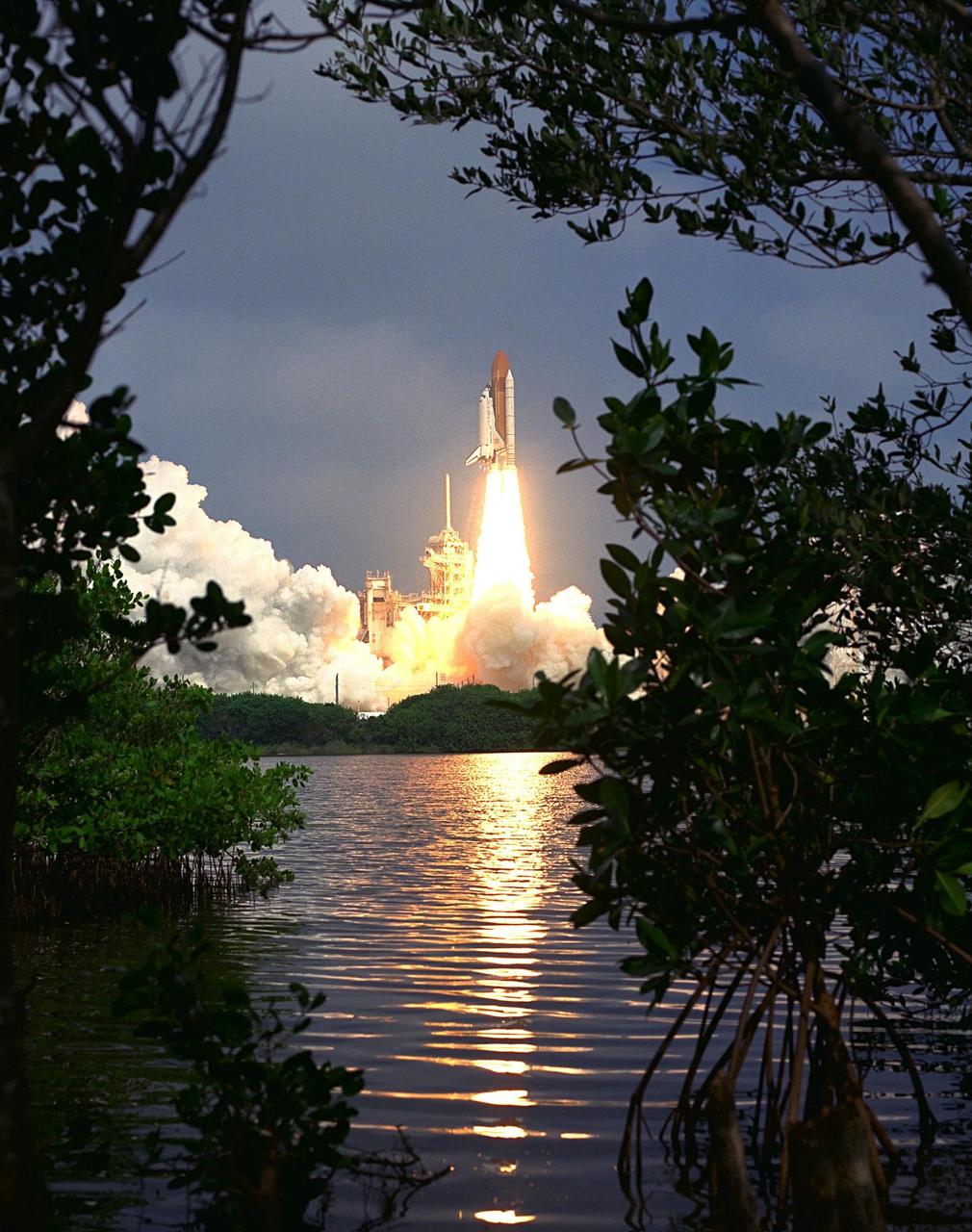
KENNEDY SPACE CENTER, Fla. -- Blasting through the hazy late morning sky, the Space Shuttle Discovery soars from Launch Pad 39A at 10:41 a.m. EDT Aug. 7 on the 11-day STS-85 mission. Aboard Discovery are Commander Curtis L. Brown, Jr.; Pilot Kent V. Rominger, Payload Commander N. Jan Davis, Mission Specialist Robert L. Curbeam, Jr., Mission Specialist Stephen K. Robinson and Payload Specialist Bjarni V. Tryggvason, a Canadian Space Agency astronaut . The primary payload aboard the Space Shuttle orbiter Discovery is the Cryogenic Infrared Spectrometers and Telescopes for the Atmosphere-Shuttle Pallet Satellite-2 (CRISTA-SPAS-2) free-flyer. The CRISTA-SPAS-2 will be deployed on flight day 1 to study trace gases in the Earth’s atmosphere as a part of NASA’s Mission to Planet Earth program. Also aboard the free-flying research platform will be the Middle Atmosphere High Resolution Spectrograph Instrument (MAHRSI). Other payloads on the 11-day mission include the Manipulator Flight Demonstration (MFD), a Japanese Space Agency-sponsored experiment. Also in Discovery’s payload bay are the Technology Applications and Science-1 (TAS-1) and International Extreme Ultraviolet Hitchhiker-2 (IEH-2) experiments
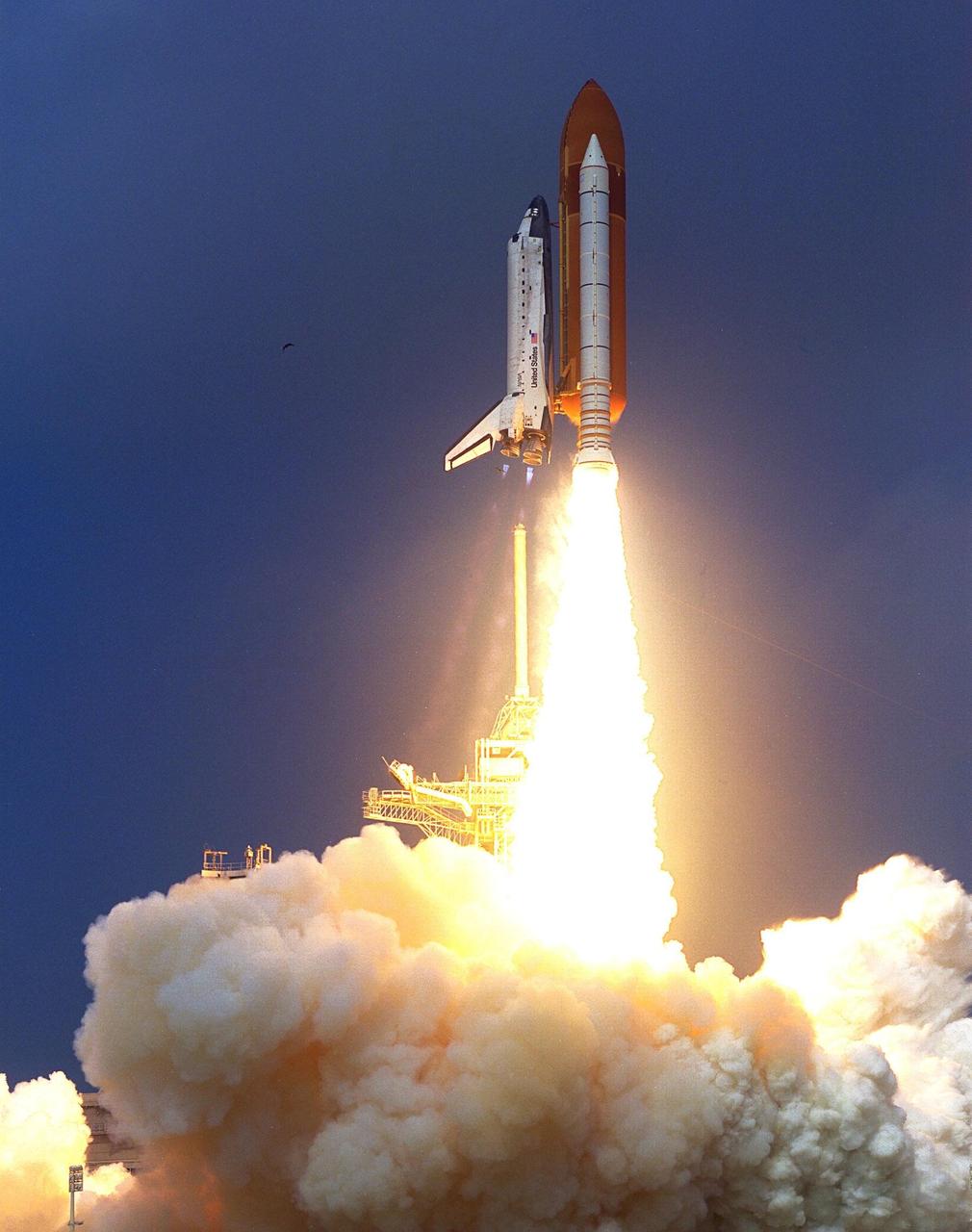
KENNEDY SPACE CENTER, Fla. -- Blasting through the hazy late morning sky, the Space Shuttle Discovery soars from Launch Pad 39A at 10:41 a.m. EDT Aug. 7 on the 11-day STS-85 mission. Aboard Discovery are Commander Curtis L. Brown, Jr.; Pilot Kent V. Rominger, Payload Commander N. Jan Davis, Mission Specialist Robert L. Curbeam, Jr., Mission Specialist Stephen K. Robinson and Payload Specialist Bjarni V. Tryggvason, a Canadian Space Agency astronaut . The primary payload aboard the Space Shuttle orbiter Discovery is the Cryogenic Infrared Spectrometers and Telescopes for the Atmosphere-Shuttle Pallet Satellite-2 (CRISTA-SPAS-2) free-flyer. The CRISTA-SPAS-2 will be deployed on flight day 1 to study trace gases in the Earth’s atmosphere as a part of NASA’s Mission to Planet Earth program. Also aboard the free-flying research platform will be the Middle Atmosphere High Resolution Spectrograph Instrument (MAHRSI). Other payloads on the 11-day mission include the Manipulator Flight Demonstration (MFD), a Japanese Space Agency-sponsored experiment. Also in Discovery’s payload bay are the Technology Applications and Science-1 (TAS-1) and International Extreme Ultraviolet Hitchhiker-2 (IEH-2) experiments
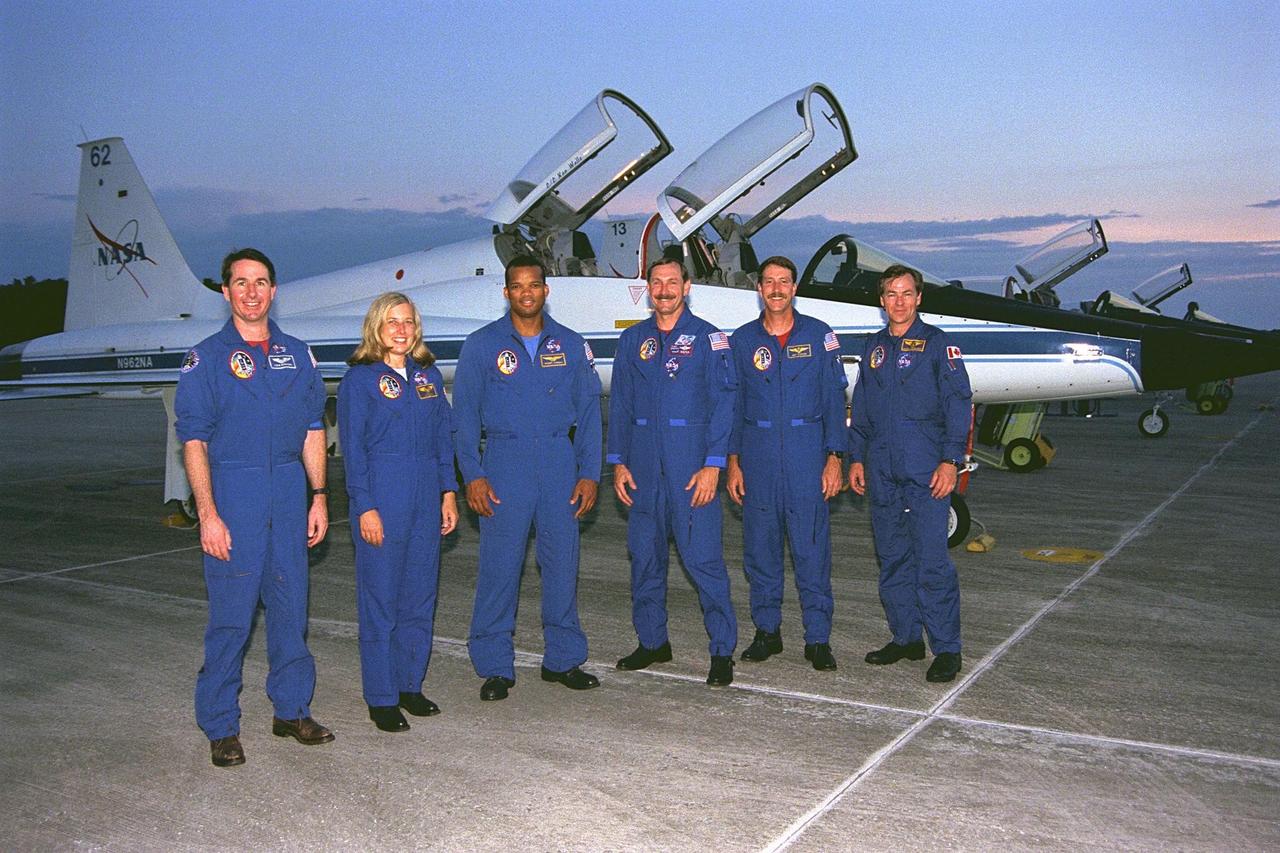
The STS-85 mission crew members pose in front of their T-38 jet trainers after they arrived at KSC’s Shuttle Landing Facility from NASA’s Johnson Space Center to begin Terminal Countdown Demonstration Test (TCDT) activities for that mission. The TCDT includes a dress rehearsal of the launch countdown. They are (front row, from left): Mission Specialist Stephen K. Robinson; Payload Commander N. Jan Davis; Mission Specialist Robert L. Curbeam, Jr.; Commander Curtis L. Brown, Jr.; Pilot Kent V. Rominger; and Payload Specialist Bjarni V. Tryggvason. The STS-85 mission is now targeted for Aug. 7. The primary payload aboard the Space Shuttle orbiter Discovery is the Cryogenic Infrared Spectrometers and Telescopes for the Atmosphere-2 (CRISTA-SPAS-2). Other STS-85 payloads include the Manipulator Flight Demonstration (MFD), and Technology Applications and Science-1 (TAS-1) and International Extreme Ultraviolet Hitchhiker-2 (IEH-2) experiments
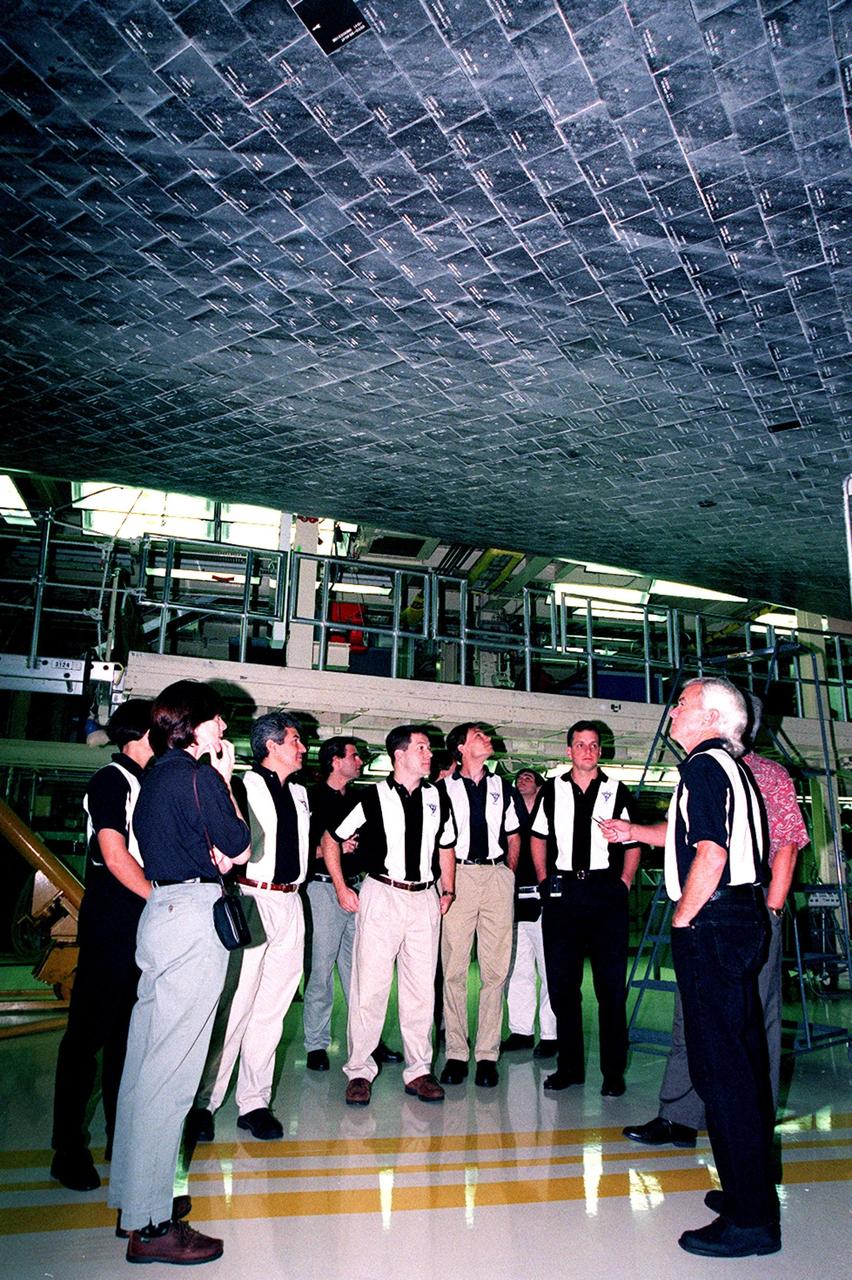
In the Orbiter Processing Facility bay 3, members of the 1998 astronaut candidate class (group 17) get a close-up view of the tiles, part of the thermal protection system, on the underside of the orbiter Atlantis overhead. The class is at KSC for training activities, including fire training and a flight awareness program, plus touring the OPF, SSME Processing Facility, VAB, SSPF, launch pads, SLF, Apollo/Saturn V Center and the crew headquarters. The U.S. candidates in the '98 class are Clayton C. Anderson, Lee J. Archambault, Tracy E. Caldwell (Ph.D.), Gregory E. Chamitoff (Ph.D.), Timothy J. Creamer, Christopher J. Ferguson, Michael J. Foreman, Michael E. Fossum, Kenneth T. Ham, Patricia C. Hilliard (M.D.), Gregory C. Johnson, Gregory H. Johnson, Stanley G. Love (Ph.D.), Leland D. Melvin, Barbara R. Morgan, William A. Oefelein, John D. Olivas (Ph.D.), Nicholas J.M. Patrick (Ph.D.), Alan G. Poindexter, Garrett E. Reisman (Ph.D.), Steven R. Swanson, Douglas H. Wheelock, Sunita L. Williams, Neil W. Woodward III, George D. Zamka; and the international candidates are Leopold Eyharts, Paolo Nespoli, Hans Schlegel, Roberto Vittori, Bjarni V. Tryggvason, and Marcos Pontes
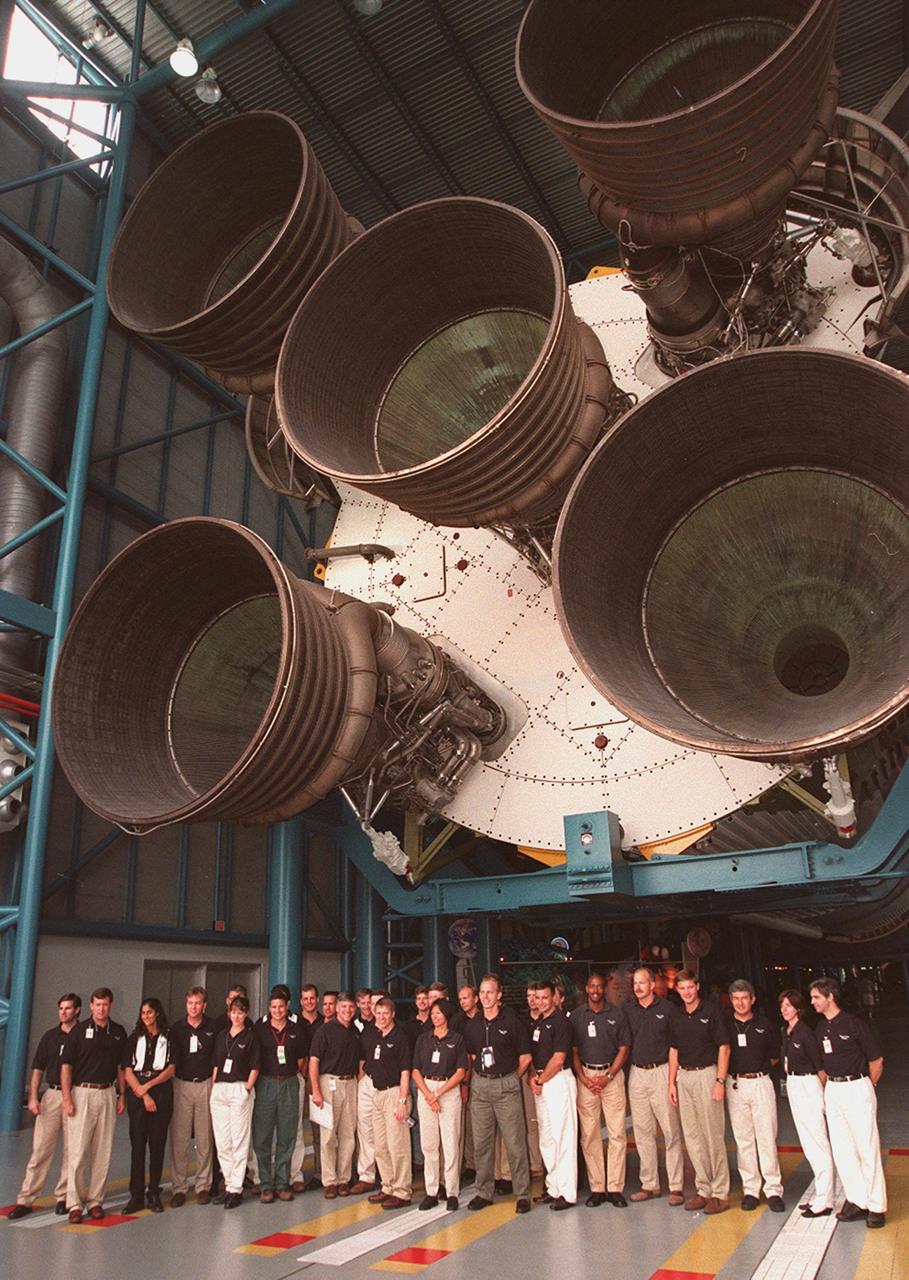
KENNEDY SPACE CENTER, FLA. -- At the Apollo/Saturn V Center, some of the 1998 astronaut candidate class (group 17) line up for a photo while standing under the engines of the Saturn V rocket on display. The U.S. candidates include Clayton C. Anderson, Lee J. Archambault, Tracy E. Caldwell (Ph.D.), Gregory E. Chamitoff (Ph.D.), Timothy J. Creamer, Christopher J. Ferguson, Michael J. Foreman, Michael E. Fossum, Kenneth T. Ham, Patricia C. Hilliard (M.D.), Gregory C. Johnson, Gregory H. Johnson, Stanley G. Love (Ph.D.), Leland D. Melvin, Barbara R. Morgan, William A. Oefelein, John D. Olivas (Ph.D.), Nicholas J.M. Patrick (Ph.D.), Alan G. Poindexter, Garrett E. Reisman (Ph.D.), Steven R. Swanson, Douglas H. Wheelock, Sunita L. Williams, Neil W. Woodward III, George D. Zamka; and international candidates Leopold Eyharts, Paolo Nespoli, Hans Schlegel, Roberto Vittori, Bjarni V. Tryggvason, and Marcos Pontes. The class is at KSC for training activities, including fire training and a flight awareness program, plus touring the OPF, SSME Processing Facility, VAB, SSPF, launch pads, SLF, Apollo/Saturn V Center and the crew headquarters
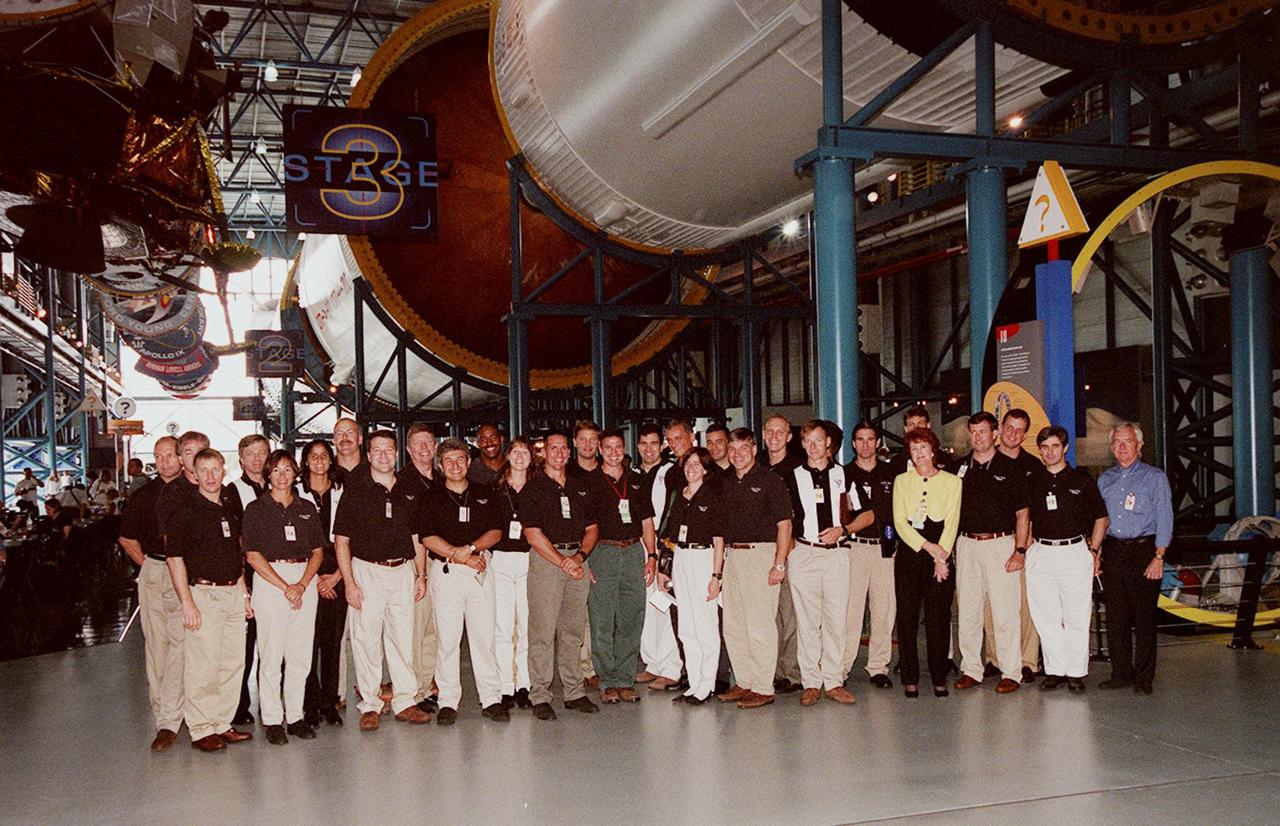
KENNEDY SPACE CENTER, FLA. -- At the Apollo/Saturn V Center, some of the 1998 astronaut candidate class (group 17) line up for a photo during a tour of facilities at KSC. The U.S. candidates include Clayton C. Anderson, Lee J. Archambault, Tracy E. Caldwell (Ph.D.), Gregory E. Chamitoff (Ph.D.), Timothy J. Creamer, Christopher J. Ferguson, Michael J. Foreman, Michael E. Fossum, Kenneth T. Ham, Patricia C. Hilliard (M.D.), Gregory C. Johnson, Gregory H. Johnson, Stanley G. Love (Ph.D.), Leland D. Melvin, Barbara R. Morgan, William A. Oefelein, John D. Olivas (Ph.D.), Nicholas J.M. Patrick (Ph.D.), Alan G. Poindexter, Garrett E. Reisman (Ph.D.), Steven R. Swanson, Douglas H. Wheelock, Sunita L. Williams, Neil W. Woodward III, George D. Zamka; and international candidates Leopold Eyharts, Paolo Nespoli, Hans Schlegel, Roberto Vittori, Bjarni V. Tryggvason, and Marcos Pontes. The class is at KSC for training activities, including fire training and a flight awareness program, plus touring the OPF, SSME Processing Facility, VAB, SSPF, launch pads, SLF and the crew headquarters
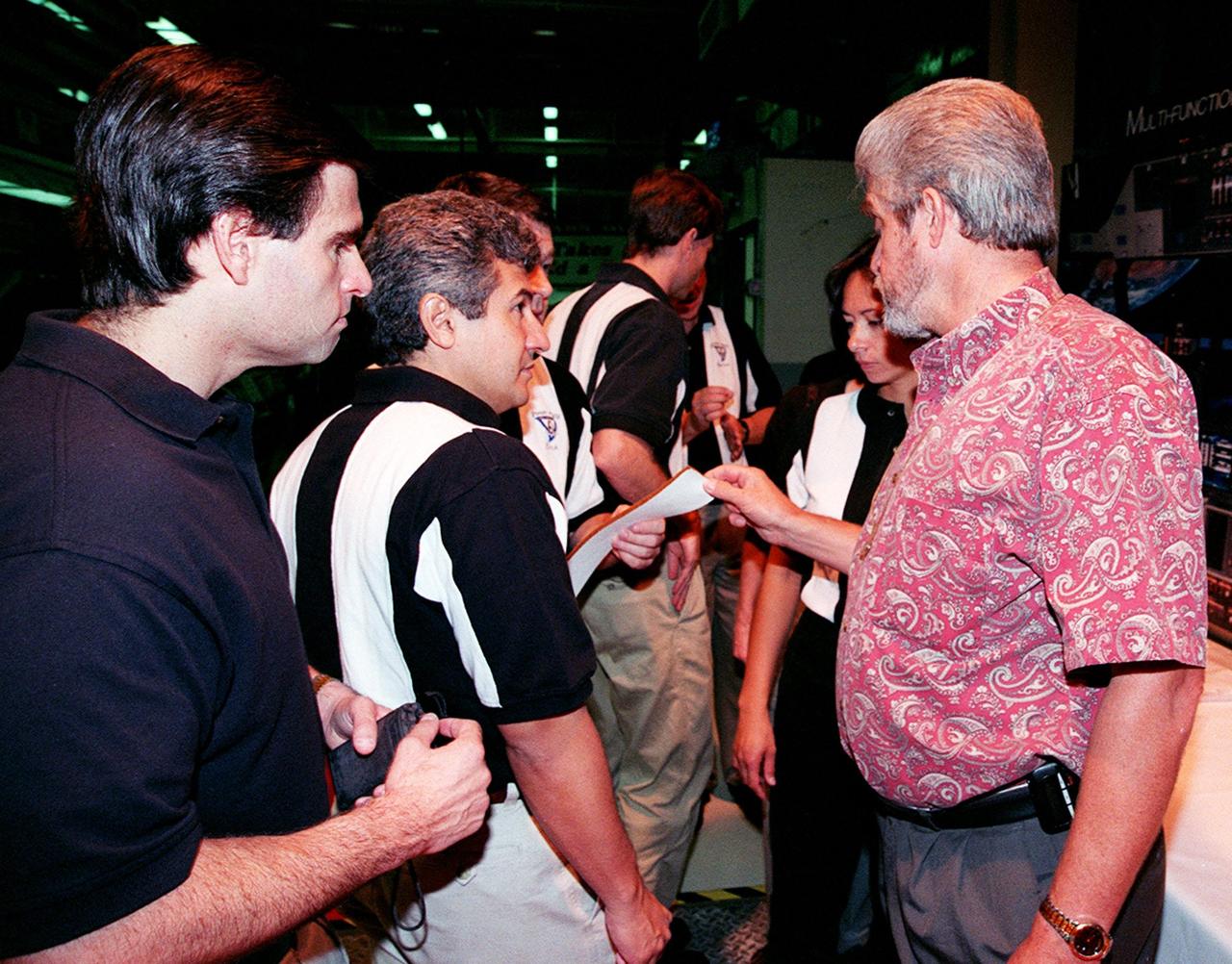
In the Orbiter Processing Facility bay 3, Larry Osheim (right), who is with United Space Alliance, shows members of the 1998 astronaut candidate class (group 17) a sample of Felt Reusable Surface Insulation (FRSI) blankets used on the orbiters. The class is at KSC for training activities, including fire training and a flight awareness program, plus touring the OPF, SSME Processing Facility, VAB, SSPF, launch pads, SLF, Apollo/Saturn V Center and the crew headquarters. The U.S. candidates in the '98 class are Clayton C. Anderson, Lee J. Archambault, Tracy E. Caldwell (Ph.D.), Gregory E. Chamitoff (Ph.D.), Timothy J. Creamer, Christopher J. Ferguson, Michael J. Foreman, Michael E. Fossum, Kenneth T. Ham, Patricia C. Hilliard (M.D.), Gregory C. Johnson, Gregory H. Johnson, Stanley G. Love (Ph.D.), Leland D. Melvin, Barbara R. Morgan, William A. Oefelein, John D. Olivas (Ph.D.), Nicholas J.M. Patrick (Ph.D.), Alan G. Poindexter, Garrett E. Reisman (Ph.D.), Steven R. Swanson, Douglas H. Wheelock, Sunita L. Williams, Neil W. Woodward III, George D. Zamka; and the international candidates are Leopold Eyharts, Paolo Nespoli, Hans Schlegel, Roberto Vittori, Bjarni V. Tryggvason, and Marcos Pontes
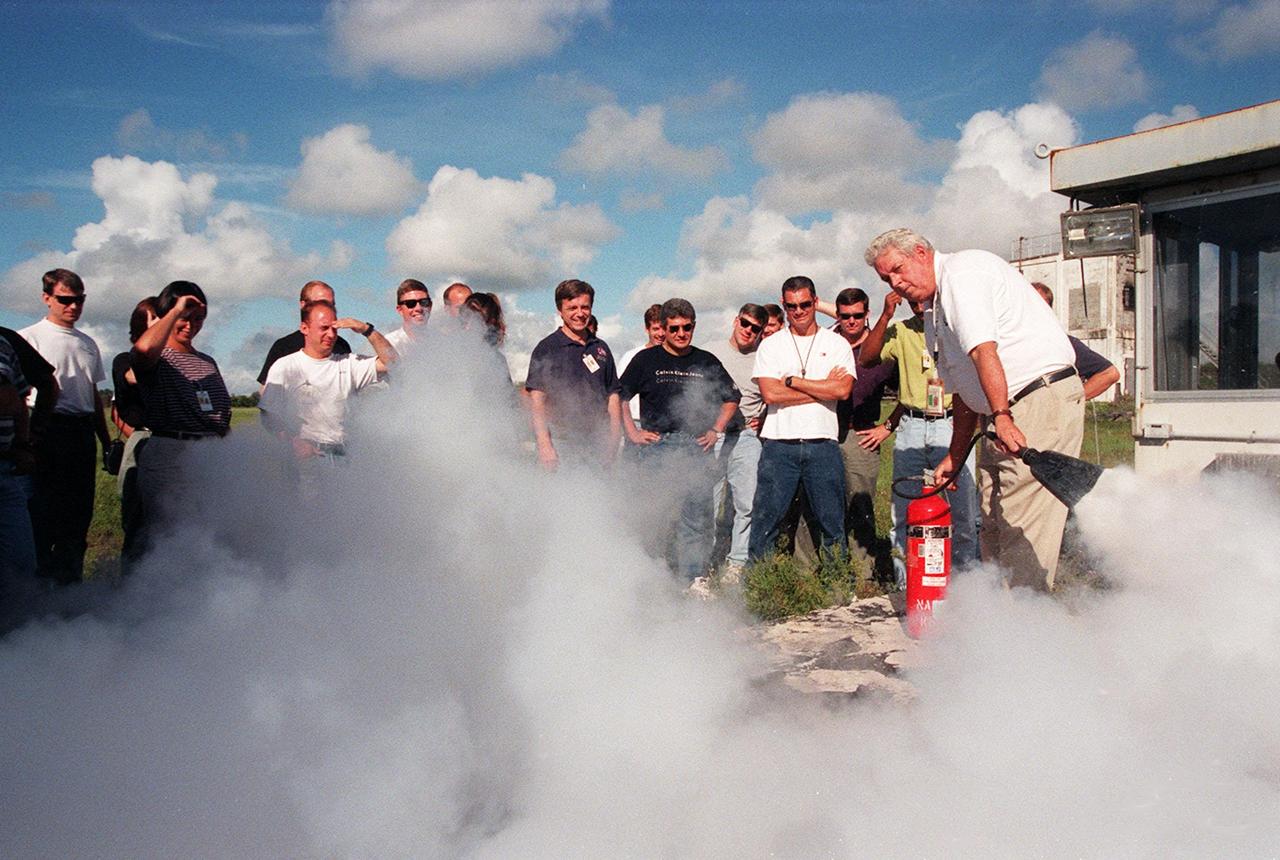
KENNEDY SPACE CENTER, FLA. -- On the grounds of the Kennedy Space Center, members of the 1998 astronaut candidate class (Group 17) watch a demonstration as part of fire training. The class is taking part in training activities, including a flight awareness program, plus touring the OPF, VAB, SSPF, SSME Processing Facility, launch pads, SLF, Apollo/Saturn V Center, and the crew quarters. The U.S. candidates in the '98 class are Clayton C. Anderson, Lee J. Archambault, Tracy E. Caldwell (Ph.D.), Gregory E. Chamitoff (Ph.D.), Timothy J. Creamer, Christopher J. Ferguson, Michael J. Foreman, Michael E. Fossum, Kenneth T. Ham, Patricia C. Hilliard (M.D.), Gregory C. Johnson, Gregory H. Johnson, Stanley G. Love (Ph.D.), Leland D. Melvin, Barbara R. Morgan, William A. Oefelein, John D. Olivas (Ph.D.), Nicholas J.M. Patrick (Ph.D.), Alan G. Poindexter, Garrett E. Reisman (Ph.D.), Steven R. Swanson, Douglas H. Wheelock, Sunita L. Williams, Neil W. Woodward III, George D. Zamka; and the international candidates are Leopold Eyharts, Paolo Nespoli, Hans Schlegel, Roberto Vittori, Bjarni V. Tryggvason, and Marcos Pontes
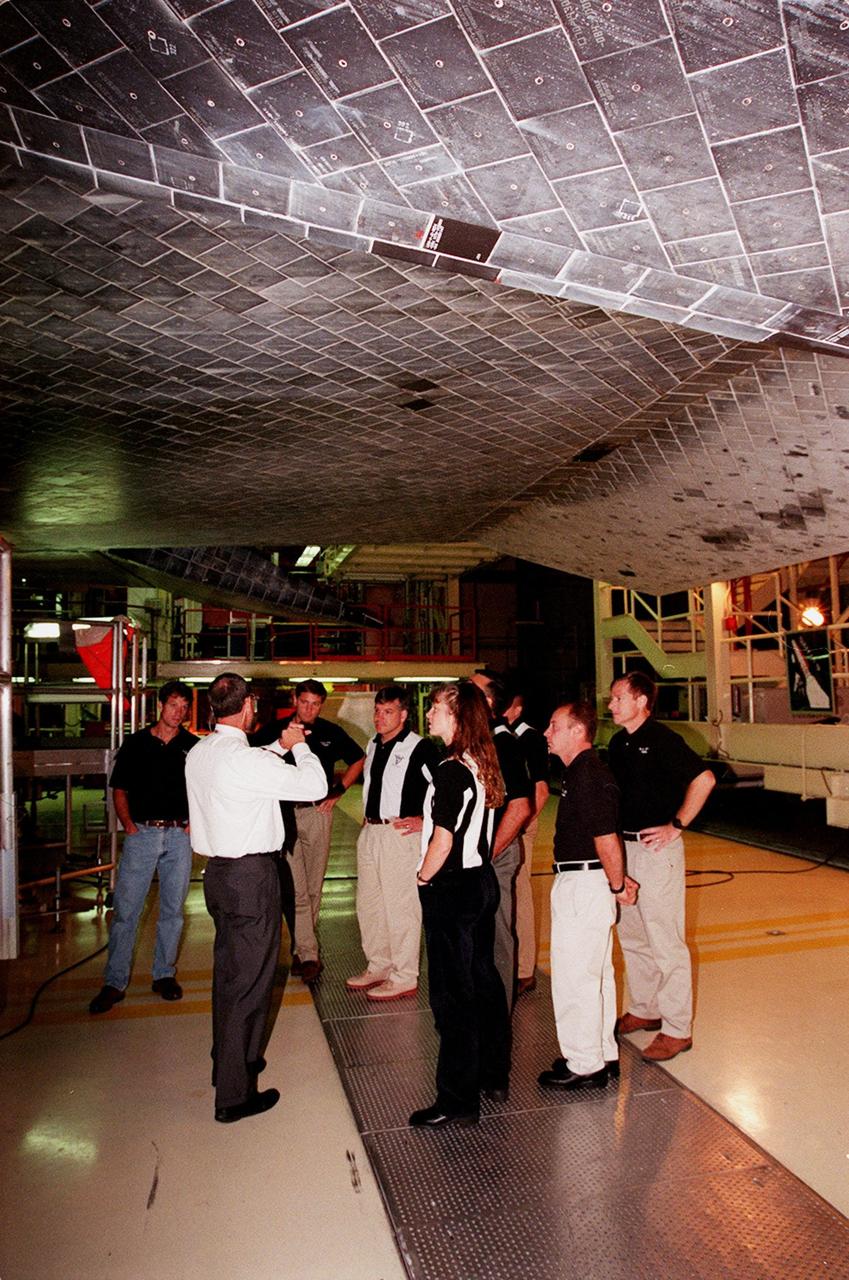
In the Orbiter Processing Facility, members of the 1998 astronaut candidate class (group 17) learn about the thermal protection system on the orbiters, such as Atlantis overhead. The class is at KSC for training activities, including fire training and a flight awareness program, plus touring the OPF, SSME Processing Facility, VAB, SSPF, launch pads, SLF, Apollo/Saturn V Center and the crew headquarters. The U.S. candidates in the '98 class are Clayton C. Anderson, Lee J. Archambault, Tracy E. Caldwell (Ph.D.), Gregory E. Chamitoff (Ph.D.), Timothy J. Creamer, Christopher J. Ferguson, Michael J. Foreman, Michael E. Fossum, Kenneth T. Ham, Patricia C. Hilliard (M.D.), Gregory C. Johnson, Gregory H. Johnson, Stanley G. Love (Ph.D.), Leland D. Melvin, Barbara R. Morgan, William A. Oefelein, John D. Olivas (Ph.D.), Nicholas J.M. Patrick (Ph.D.), Alan G. Poindexter, Garrett E. Reisman (Ph.D.), Steven R. Swanson, Douglas H. Wheelock, Sunita L. Williams, Neil W. Woodward III, George D. Zamka; and the international candidates are Leopold Eyharts, Paolo Nespoli, Hans Schlegel, Roberto Vittori, Bjarni V. Tryggvason, and Marcos Pontes

KENNEDY SPACE CENTER, FLA. -- On the grounds of the Kennedy Space Center, members of the 1998 astronaut candidate class (Group 17) watch as candidate Sunita L. Williams practices using firefighting equipment during fire training. The class is at KSC for training activities, including a flight awareness program, plus touring the OPF, VAB, SSPF, SSME Processing Facility, launch pads, SLF, Apollo/Saturn V Center, and the crew quarters. The other U.S. candidates in the '98 class are Clayton C. Anderson, Lee J. Archambault, Tracy E. Caldwell (Ph.D.), Gregory E. Chamitoff (Ph.D.), Timothy J. Creamer, Christopher J. Ferguson, Michael J. Foreman, Michael E. Fossum, Kenneth T. Ham, Patricia C. Hilliard (M.D.), Gregory C. Johnson, Gregory H. Johnson, Stanley G. Love (Ph.D.), Leland D. Melvin, Barbara R. Morgan, William A. Oefelein, John D. Olivas (Ph.D.), Nicholas J.M. Patrick (Ph.D.), Alan G. Poindexter, Garrett E. Reisman (Ph.D.), Steven R. Swanson, Douglas H. Wheelock, Neil W. Woodward III, George D. Zamka; and the international candidates are Leopold Eyharts, Paolo Nespoli, Hans Schlegel, Roberto Vittori, Bjarni V. Tryggvason, and Marcos Pontes
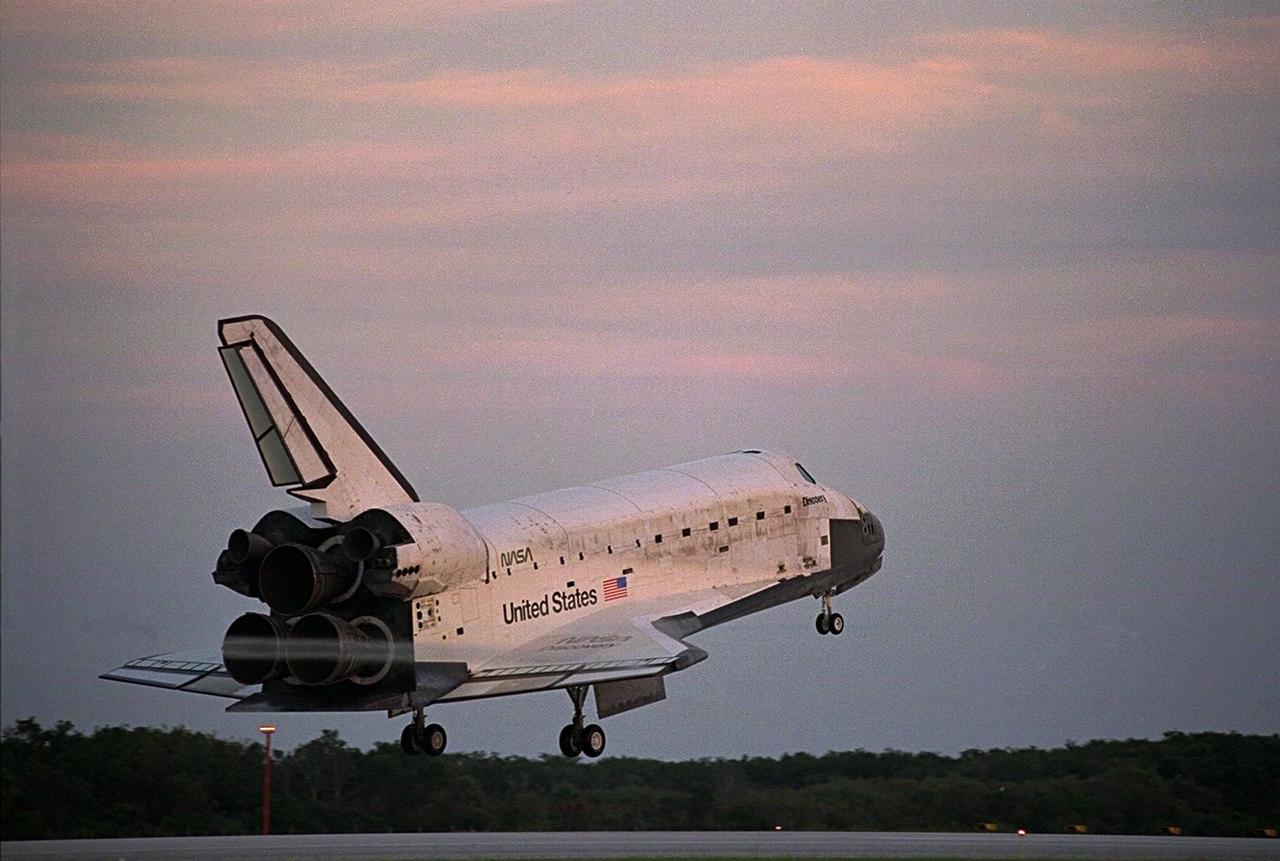
KENNEDY SPACE CENTER, FLA. -- With Commander Curtis L. Brown, Jr. and Pilot Kent V. Rominger at the controls, the Space Shuttle orbiter Discovery prepares to touch down on Runway 33 at KSC’s Shuttle Landing Facility at approximately 7:08 a.m. EDT Aug. 19 to complete the nearly 12-day-long STS-85 mission. The first landing opportunity on Aug. 18 was waved off due to the potential for ground fog. Also onboard the orbiter are Payload Commander N. Jan Davis, Mission Specialist Robert L. Curbeam, Jr., Mission Specialist Stephen K. Robinson and Payload Specialist Bjarni V. Tryggvason. During the 86th Space Shuttle mission, the crew deployed the Cryogenic Infrared Spectrometers and Telescopes for the Atmosphere-Shuttle Pallet Satellite-2 (CRISTA-SPAS-2) free-flyer to conduct research on the Earth’s middle atmosphere, retrieving it on flight day 9. They also conducted investigations with the Manipulator Flight Demonstration (MFD), Technology Applications and Science-1 (TAS-1) and International Extreme Ultraviolet Hitchhiker-2 (IEH-2) experiments. Robinson also made observations of the comet Hale-Bopp with the Southwest Ultraviolet Imaging System (SWIS) while other members of the crew conducted biological experiments in the orbiter’s crew cabin
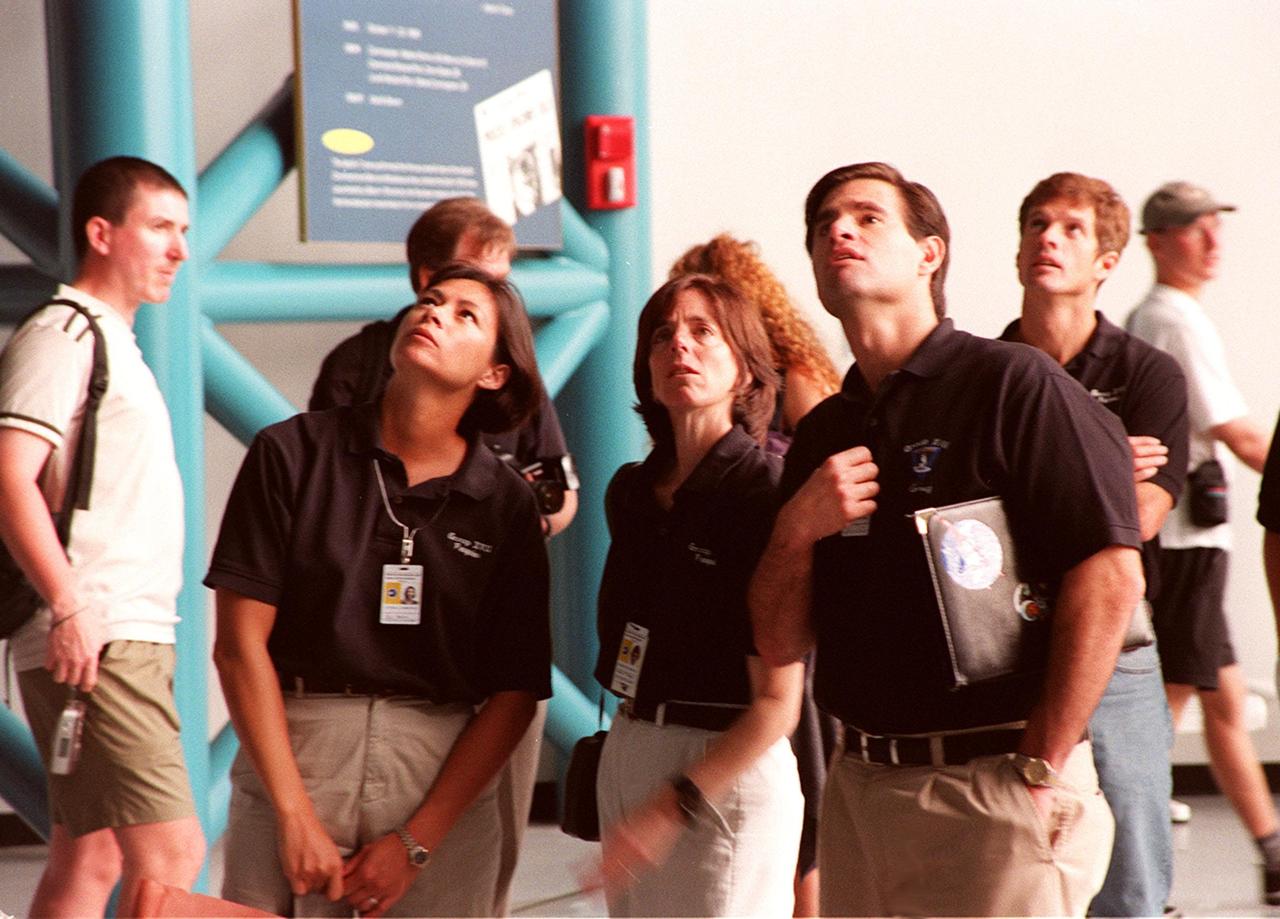
KENNEDY SPACE CENTER, FLA. -- Some of the 1998 astronaut candidate class (group 17) take a close look at displays in the Apollo/Saturn V Center at KSC. The U.S. candidates include Clayton C. Anderson, Lee J. Archambault, Tracy E. Caldwell (Ph.D.), Gregory E. Chamitoff (Ph.D.), Timothy J. Creamer, Christopher J. Ferguson, Michael J. Foreman, Michael E. Fossum, Kenneth T. Ham, Patricia C. Hilliard (M.D.), Gregory C. Johnson, Gregory H. Johnson, Stanley G. Love (Ph.D.), Leland D. Melvin, Barbara R. Morgan, William A. Oefelein, John D. Olivas (Ph.D.), Nicholas J.M. Patrick (Ph.D.), Alan G. Poindexter, Garrett E. Reisman (Ph.D.), Steven R. Swanson, Douglas H. Wheelock, Sunita L. Williams, Neil W. Woodward III, George D. Zamka; and international candidates Leopold Eyharts, Paolo Nespoli, Hans Schlegel, Roberto Vittori, Bjarni V. Tryggvason, and Marcos Pontes. The class is at KSC for training activities, including fire training and a flight awareness program, plus touring the OPF, SSME Processing Facility, VAB, SSPF, launch pads, SLF, Apollo/Saturn V Center and the crew headquarters
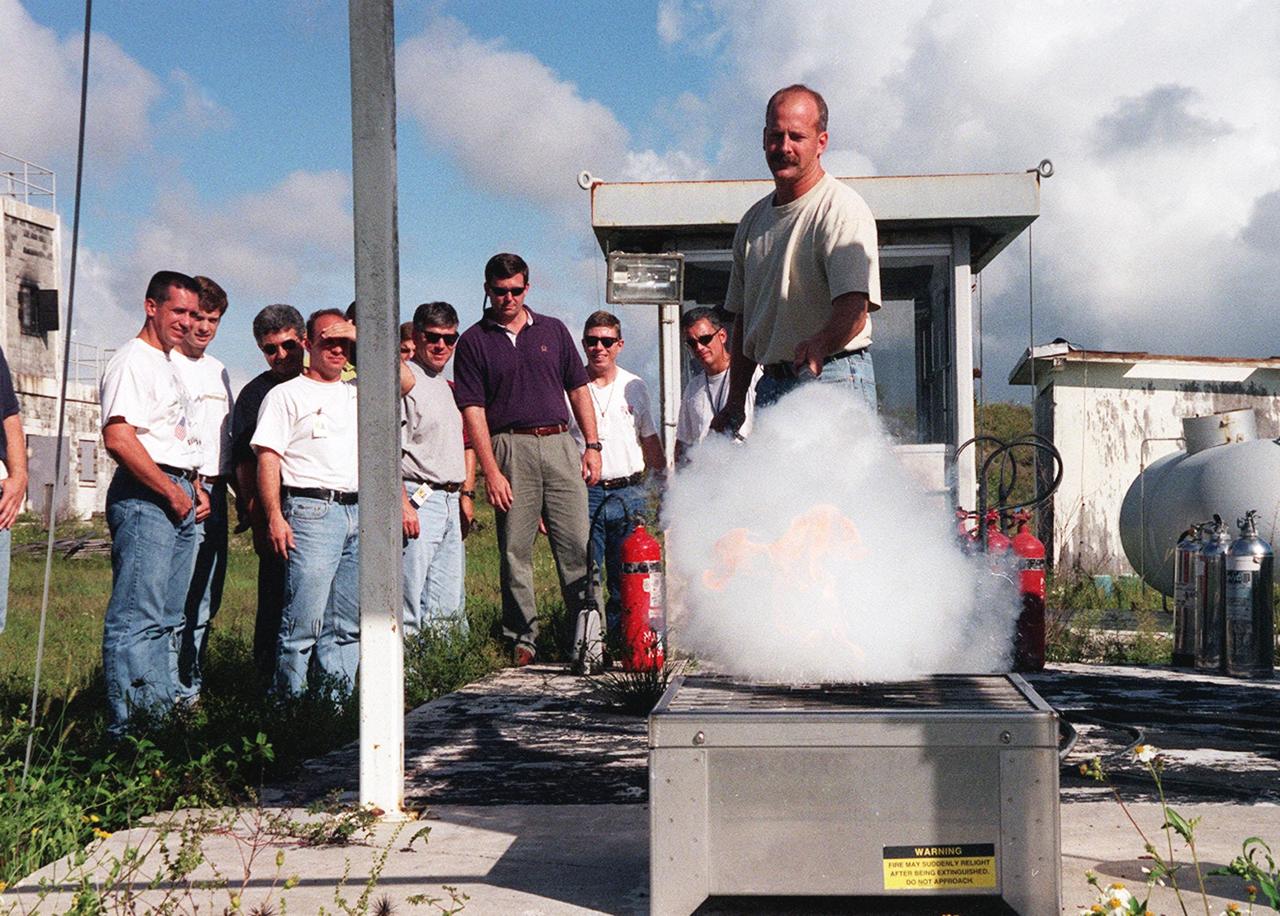
KENNEDY SPACE CENTER, FLA. -- On the grounds of the Kennedy Space Center, members of the 1998 astronaut candidate class (Group 17) watch as candidate Alan G. Poindexter practices using firefighting equipment during fire training. The class is at KSC for training activities, including a flight awareness program, plus touring the OPF, VAB, SSPF, SSME Processing Facility, launch pads, SLF, Apollo/Saturn V Center, and the crew quarters. The other U.S. candidates in the '98 class are Clayton C. Anderson, Lee J. Archambault, Tracy E. Caldwell (Ph.D.), Gregory E. Chamitoff (Ph.D.), Timothy J. Creamer, Christopher J. Ferguson, Michael J. Foreman, Michael E. Fossum, Kenneth T. Ham, Patricia C. Hilliard (M.D.), Gregory C. Johnson, Gregory H. Johnson, Stanley G. Love (Ph.D.), Leland D. Melvin, Barbara R. Morgan, William A. Oefelein, John D. Olivas (Ph.D.), Nicholas J.M. Patrick (Ph.D.), Garrett E. Reisman (Ph.D.), Steven R. Swanson, Douglas H. Wheelock, Sunita L. Williams, Neil W. Woodward III, George D. Zamka; and the international candidates are Leopold Eyharts, Paolo Nespoli, Hans Schlegel, Roberto Vittori, Bjarni V. Tryggvason, and Marcos Pontes
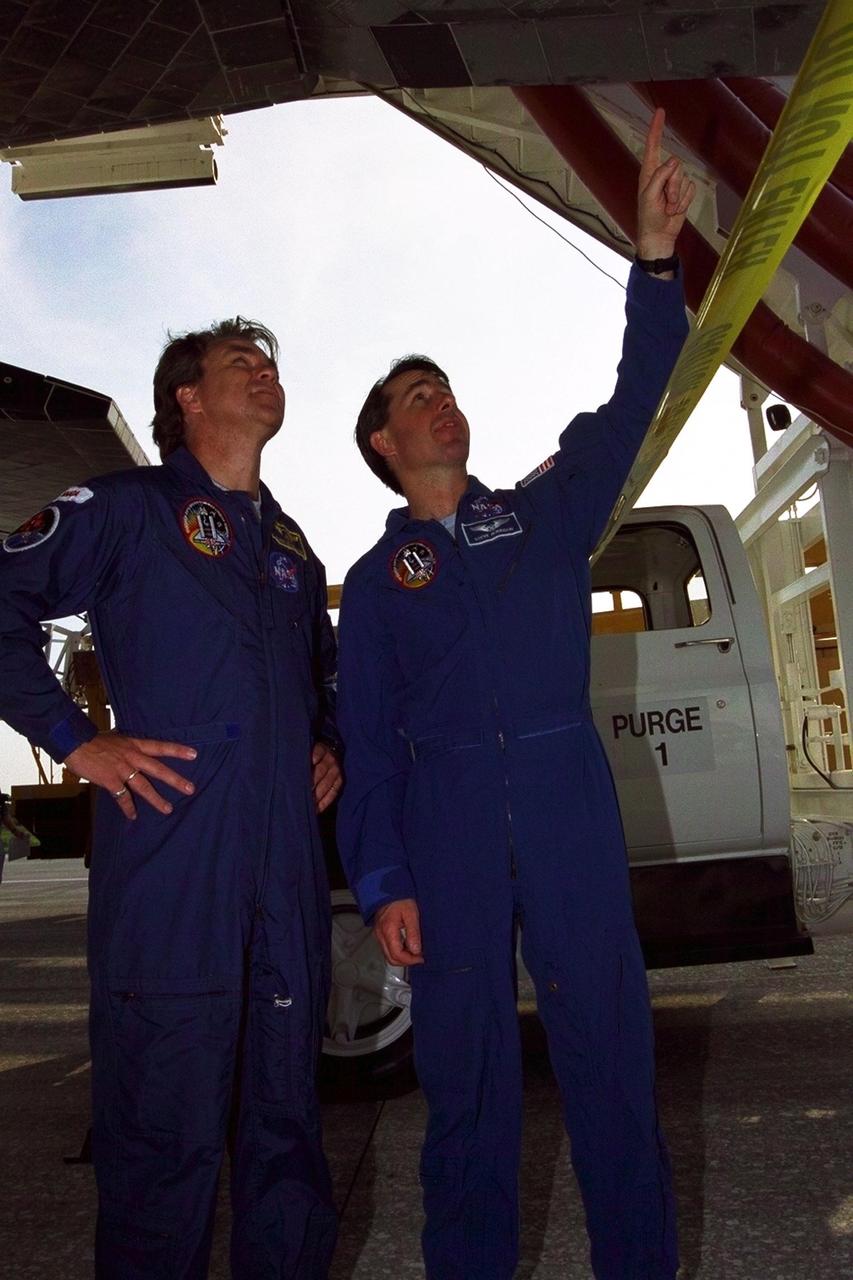
KENNEDY SPACE CENTER, FLA. -- STS-85 Payload Specialist and Canadian Space Agency astronaut Bjarni V. Tryggvason (left) and Mission Specialist Stephen K. Robinson examine the Space Shuttle orbiter Discovery after the space plane landed on Runway 33 at KSC’s Shuttle Landing Facility Aug. 19 to complete the 11-day, 20-hour and 27-minute-long STS-85 mission. Also on board were Commander Curtis L. Brown, Jr., Pilot Kent V. Rominger, Payload Commander N. Jan Davis and Mission Specialist Robert L. Curbeam, Jr. During the 86th Space Shuttle mission, the crew deployed the Cryogenic Infrared Spectrometers and Telescopes for the Atmosphere-Shuttle Pallet Satellite-2 (CRISTA-SPAS-2) free-flyer to conduct research on the Earth’s middle atmosphere, retrieving it on flight day 9. The crew also conducted investigations with the Manipulator Flight Demonstration (MFD), Technology Applications and Science-1 (TAS-1) and International Extreme Ultraviolet Hitchhiker-2 (IEH-2) experiments. This was the 39th landing at KSC in the history of the Space Shuttle program and the 11th touchdown for Discovery at the space center
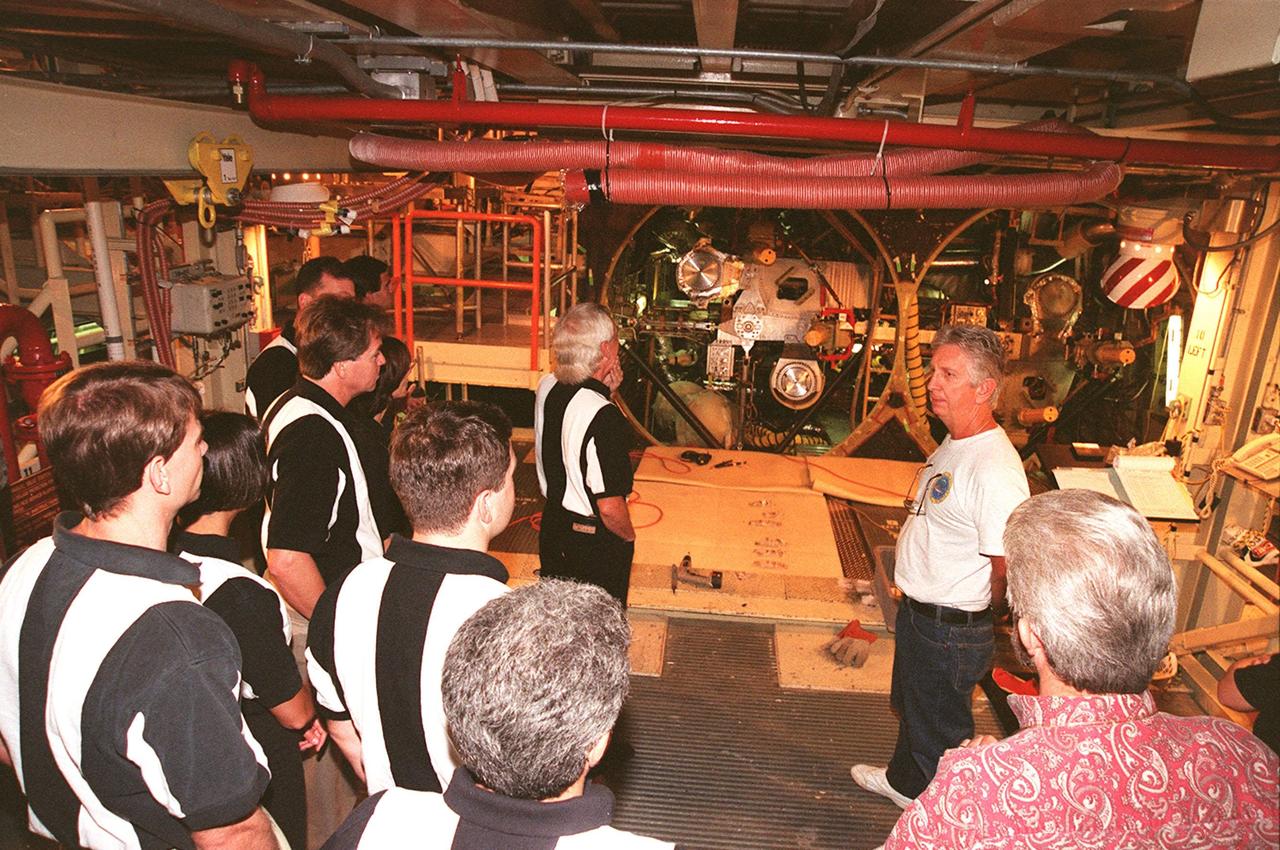
On a raised platform in the Orbiter Processing Facility bay 3, members of the 1998 astronaut candidate class (group 17) look at the aft fuselage of the orbiter Atlantis. The class is at KSC for training activities, including fire training and a flight awareness program, plus touring the OPF, SSME Processing Facility, VAB, SSPF, launch pads, SLF, Apollo/Saturn V Center and the crew headquarters. The U.S. candidates in the '98 class are Clayton C. Anderson, Lee J. Archambault, Tracy E. Caldwell (Ph.D.), Gregory E. Chamitoff (Ph.D.), Timothy J. Creamer, Christopher J. Ferguson, Michael J. Foreman, Michael E. Fossum, Kenneth T. Ham, Patricia C. Hilliard (M.D.), Gregory C. Johnson, Gregory H. Johnson, Stanley G. Love (Ph.D.), Leland D. Melvin, Barbara R. Morgan, William A. Oefelein, John D. Olivas (Ph.D.), Nicholas J.M. Patrick (Ph.D.), Alan G. Poindexter, Garrett E. Reisman (Ph.D.), Steven R. Swanson, Douglas H. Wheelock, Sunita L. Williams, Neil W. Woodward III, George D. Zamka; and the international candidates are Leopold Eyharts, Paolo Nespoli, Hans Schlegel, Roberto Vittori, Bjarni V. Tryggvason, and Marcos Pontes
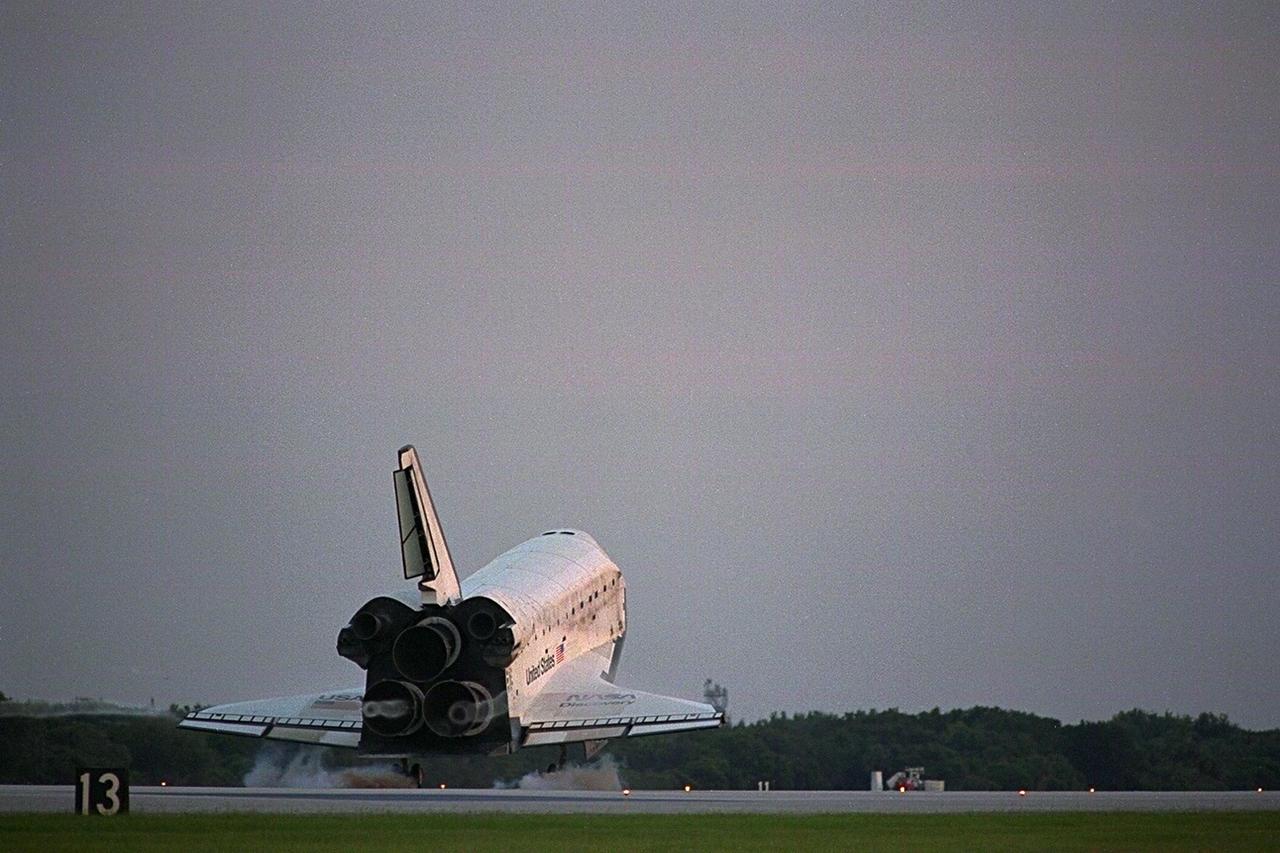
KENNEDY SPACE CENTER, FLA. -- With Commander Curtis L. Brown, Jr. and Pilot Kent V. Rominger at the controls, the Space Shuttle orbiter Discovery touches down on Runway 33 at KSC’s Shuttle Landing Facility at 7:07:59 a.m. EDT Aug. 19 to complete the 11-day, 20-hour and 27-minute-long STS-85 mission. The first landing opportunity on Aug. 18 was waved off due to the potential for ground fog. Also onboard the orbiter are Payload Commander N. Jan Davis, Mission Specialist Robert L. Curbeam, Jr., Mission Specialist Stephen K. Robinson and Payload Specialist Bjarni V. Tryggvason. During the 86th Space Shuttle mission, the crew deployed the Cryogenic Infrared Spectrometers and Telescopes for the Atmosphere-Shuttle Pallet Satellite-2 (CRISTA-SPAS-2) free-flyer to conduct research on the Earth’s middle atmosphere, retrieving it on flight day 9. The crew also conducted investigations with the Manipulator Flight Demonstration (MFD), Technology Applications and Science-1 (TAS-1) and International Extreme Ultraviolet Hitchhiker-2 (IEH-2) experiments. Robinson also made observations of the comet HaleBopp with the Southwest Ultraviolet Imaging System (SWIS) while other members of the crew conducted biological experiments in the orbiter’s crew cabin. This was the 39th landing at KSC in the history of the Space Shuttle program and the 11th touchdown for Discovery at the space center
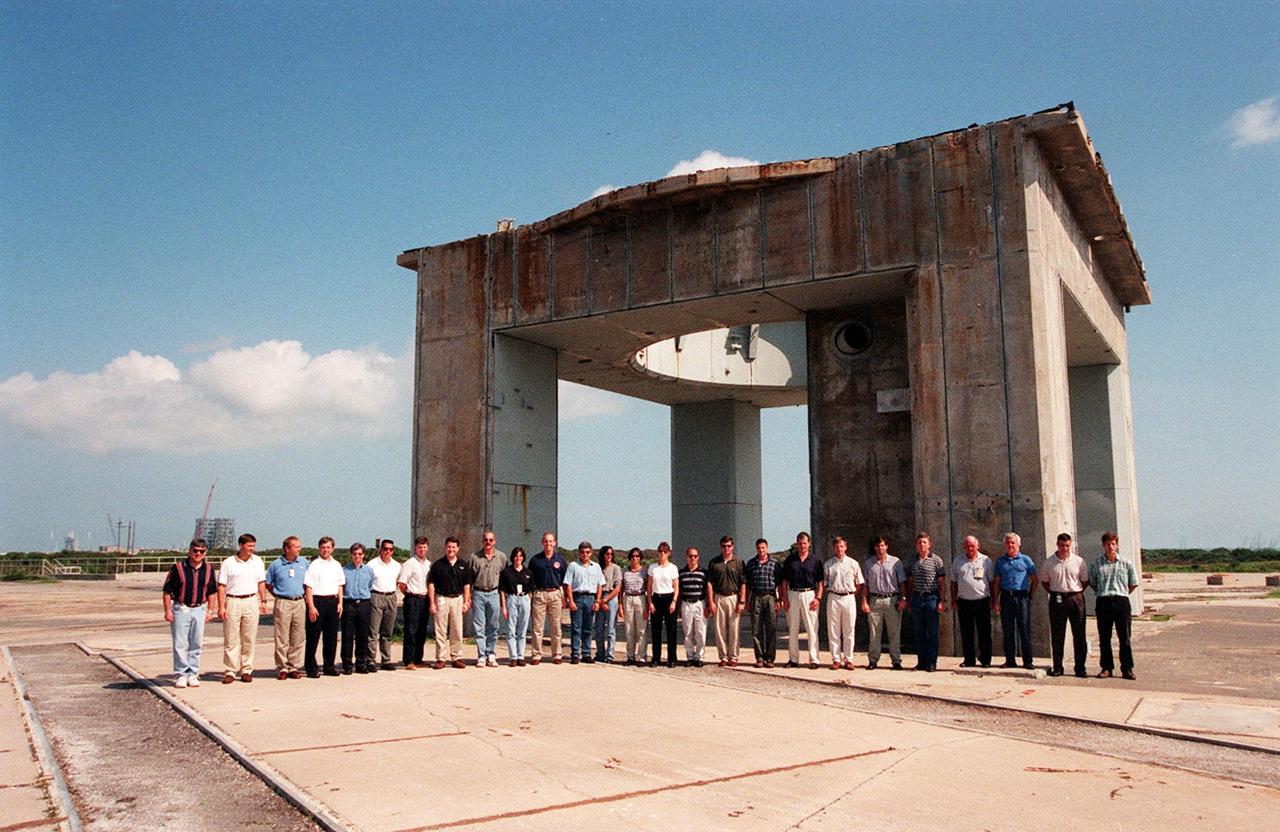
At Cape Canaveral Air Station, members of the 1998 astronaut candidate class (Group 17) pose in front of what remains of the launch tower at Launch Complex 34 during a tour of the station's facilities. During the Apollo Program, Launch Complex 34 was the site of the first Saturn I and Saturn IB launches, as well as the tragic fire in which the Apollo I astronauts lost their lives. The class is at Kennedy Space Center taking part in training activities, including a flight awareness program, as well as touring the OPF, VAB, SSPF, SSME Processing Facility, launch pads, SLF, Apollo/Saturn V Center, and the crew quarters. The U.S. candidates in the '98 class are Clayton C. Anderson, Lee J. Archambault, Tracy E. Caldwell (Ph.D.), Gregory E. Chamitoff (Ph.D.), Timothy J. Creamer, Christopher J. Ferguson, Michael J. Foreman, Michael E. Fossum, Kenneth T. Ham, Patricia C. Hilliard (M.D.), Gregory C. Johnson, Gregory H. Johnson, Stanley G. Love (Ph.D.), Leland D. Melvin, Barbara R. Morgan, William A. Oefelein, John D. Olivas (Ph.D.), Nicholas J.M. Patrick (Ph.D.), Alan G. Poindexter, Garrett E. Reisman (Ph.D.), Steven R. Swanson, Douglas H. Wheelock, Sunita L. Williams, Neil W. Woodward III, George D. Zamka; and the international candidates are Leopold Eyharts, Paolo Nespoli, Hans Schlegel, Roberto Vittori, Bjarni V. Tryggvason, and Marcos Pontes
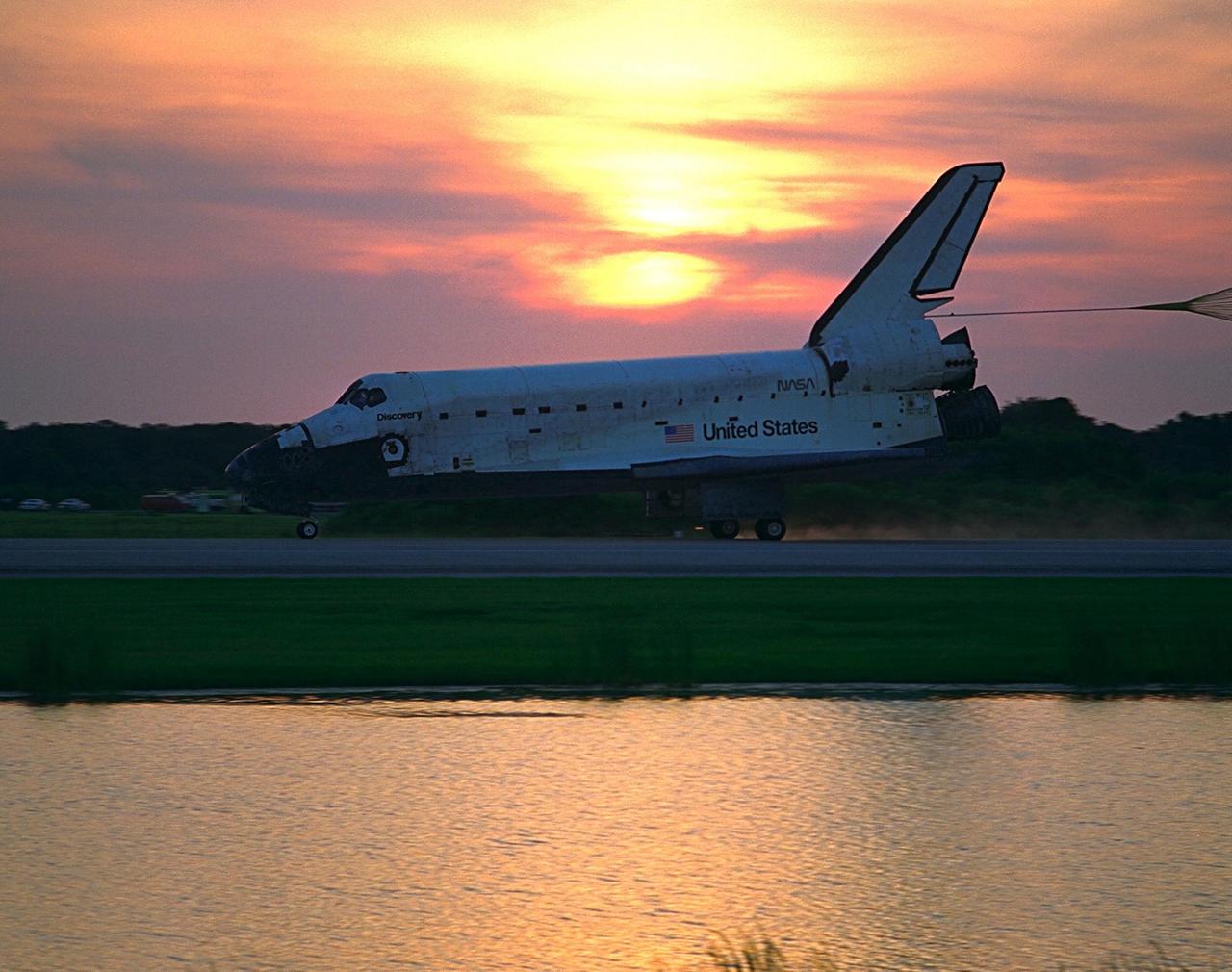
KENNEDY SPACE CENTER, FLA. -- With Commander Curtis L. Brown, Jr. and Pilot Kent V. Rominger at the controls, the Space Shuttle orbiter Discovery touches down on Runway 33 at KSC’s Shuttle Landing Facility at 7:07:59 a.m. EDT Aug. 19 to complete the 11-day, 20-hour and 27-minute-long STS-85 mission. The first landing opportunity on Aug. 18 was waved off due to the potential for ground fog. Also onboard the orbiter are Payload Commander N. Jan Davis, Mission Specialist Robert L. Curbeam, Jr., Mission Specialist Stephen K. Robinson and Payload Specialist Bjarni V. Tryggvason. During the 86th Space Shuttle mission, the crew deployed the Cryogenic Infrared Spectrometers and Telescopes for the Atmosphere-Shuttle Pallet Satellite-2 (CRISTA-SPAS-2) free-flyer to conduct research on the Earth’s middle atmosphere, retrieving it on flight day 9. The crew also conducted investigations with the Manipulator Flight Demonstration (MFD), Technology Applications and Science-1 (TAS-1) and International Extreme Ultraviolet Hitchhiker-2 (IEH-2) experiments. Robinson also made observations of the comet HaleBopp with the Southwest Ultraviolet Imaging System (SWIS) while other members of the crew conducted biological experiments in the orbiter’s crew cabin. This was the 39th landing at KSC in the history of the Space Shuttle program and the 11th touchdown for Discovery at the space center
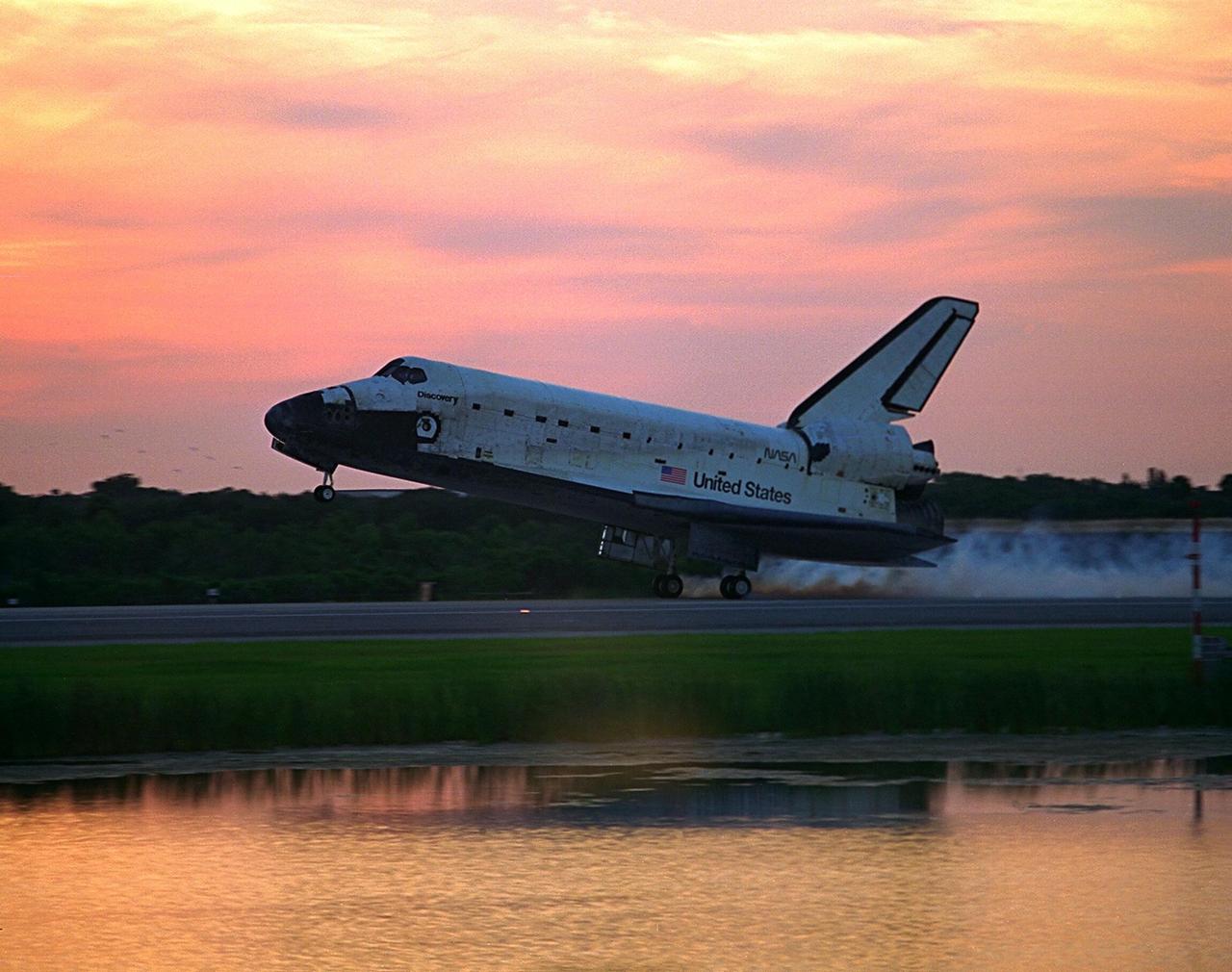
KENNEDY SPACE CENTER, FLA. -- With Commander Curtis L. Brown, Jr. and Pilot Kent V. Rominger at the controls, the Space Shuttle orbiter Discovery touches down on Runway 33 at KSC’s Shuttle Landing Facility at 7:07:59 a.m. EDT Aug. 19 to complete the 11-day, 20-hour and 27-minute-long STS-85 mission. The first landing opportunity on Aug. 18 was waved off due to the potential for ground fog. Also onboard the orbiter are Payload Commander N. Jan Davis, Mission Specialist Robert L. Curbeam, Jr., Mission Specialist Stephen K. Robinson and Payload Specialist Bjarni V. Tryggvason. During the 86th Space Shuttle mission, the crew deployed the Cryogenic Infrared Spectrometers and Telescopes for the Atmosphere-Shuttle Pallet Satellite-2 (CRISTA-SPAS-2) free-flyer to conduct research on the Earth’s middle atmosphere, retrieving it on flight day 9. The crew also conducted investigations with the Manipulator Flight Demonstration (MFD), Technology Applications and Science-1 (TAS-1) and International Extreme Ultraviolet Hitchhiker-2 (IEH-2) experiments. Robinson also made observations of the comet HaleBopp with the Southwest Ultraviolet Imaging System (SWIS) while other members of the crew conducted biological experiments in the orbiter’s crew cabin. This was the 39th landing at KSC in the history of the Space Shuttle program and the 11th touchdown for Discovery at the space center
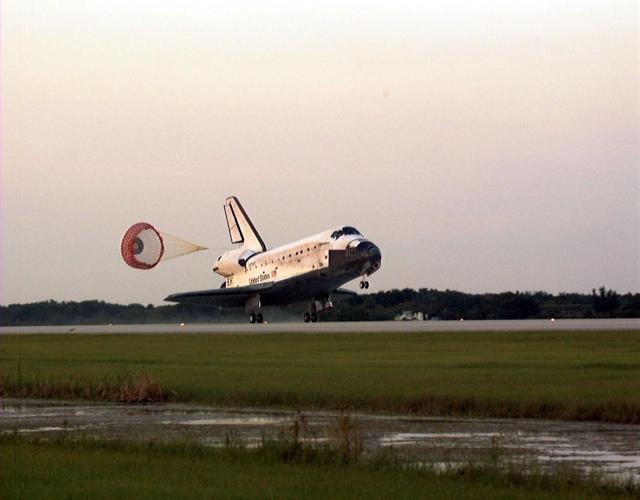
KENNEDY SPACE CENTER, FLA. -- With drag chute deployed, the Space Shuttle orbiter Discovery touches down on Runway 33 at KSC’s Shuttle Landing Facility at 7:07:59 a.m. EDT Aug. 19 to complete the 11-day, 20-hour and 27-minute-long STS-85 mission. At the controls are Commander Curtis L. Brown, Jr. and Pilot Kent V. Rominger. The first landing opportunity on Aug. 18 was waved off due to the potential for ground fog. Also onboard the orbiter are Payload Commander N. Jan Davis, Mission Specialist Robert L. Curbeam, Jr., Mission Specialist Stephen K. Robinson and Payload Specialist Bjarni V. Tryggvason. During the 86th Space Shuttle mission, the crew deployed the Cryogenic Infrared Spectrometers and Telescopes for the AtmosphereShuttle Pallet Satellite-2 (CRISTA-SPAS-2) free-flyer to conduct research on the Earth’s middle atmosphere, retrieving it on flight day 9. The crew also conducted investigations with the Manipulator Flight Demonstration (MFD), Technology Applications and Science-1 (TAS-1) and International Extreme Ultraviolet Hitchhiker-2 (IEH-2) experiments. Robinson also made observations of the comet Hale-Bopp with the Southwest Ultraviolet Imaging System (SWIS) while other members of the crew conducted biological experiments in the orbiter’s crew cabin. This was the 39th landing at KSC in the history of the Space Shuttle program and the 11th touchdown for Discovery at the space center
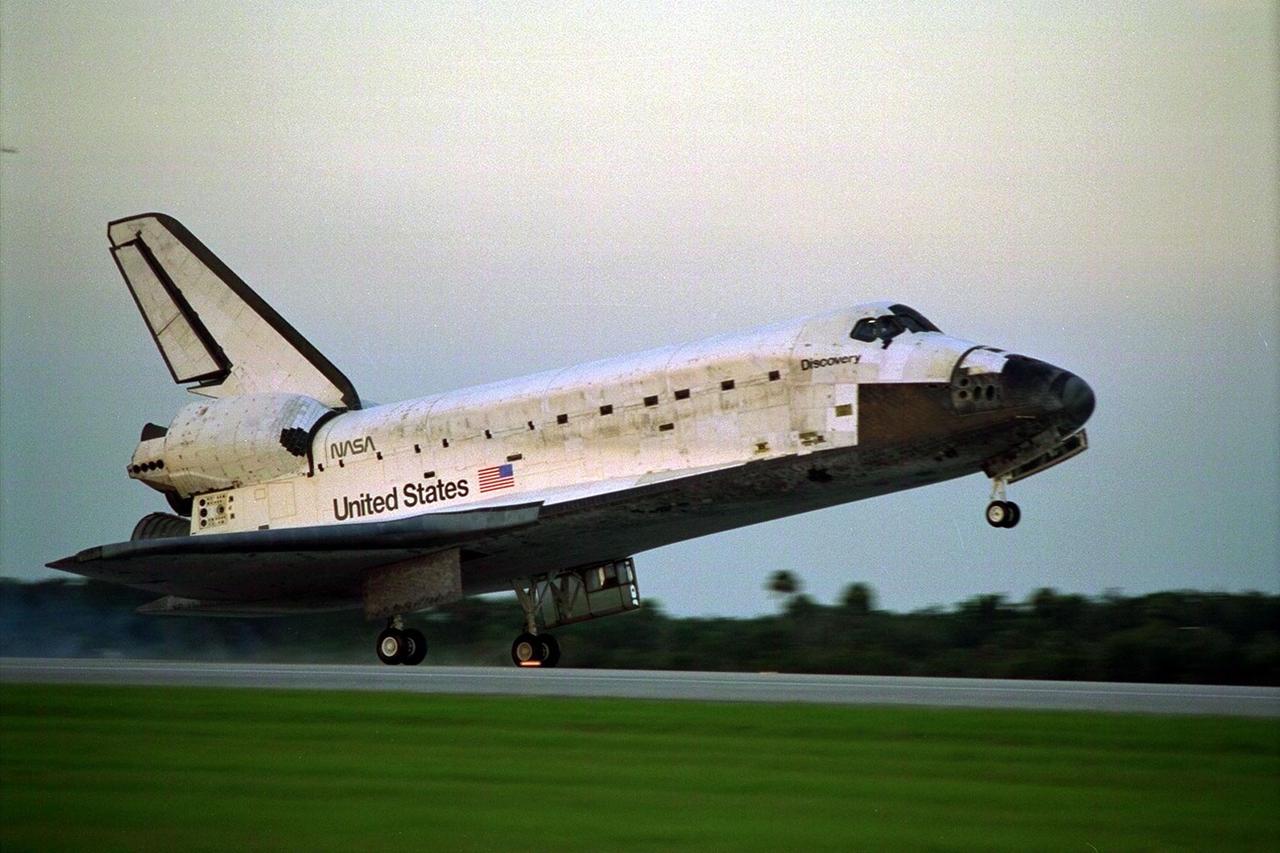
KENNEDY SPACE CENTER, FLA. -- With Commander Curtis L. Brown, Jr. and Pilot Kent V. Rominger at the controls, the Space Shuttle orbiter Discovery touches down on Runway 33 at KSC’s Shuttle Landing Facility at 7:07:59 a.m. EDT Aug. 19 to complete the 11-day, 20-hour and 27-minute-long STS-85 mission. The first landing opportunity on Aug. 18 was waved off due to the potential for ground fog. Also onboard the orbiter are Payload Commander N. Jan Davis, Mission Specialist Robert L. Curbeam, Jr., Mission Specialist Stephen K. Robinson and Payload Specialist Bjarni V. Tryggvason. During the 86th Space Shuttle mission, the crew deployed the Cryogenic Infrared Spectrometers and Telescopes for the Atmosphere-Shuttle Pallet Satellite-2 (CRISTA-SPAS-2) free-flyer to conduct research on the Earth’s middle atmosphere, retrieving it on flight day 9. The crew also conducted investigations with the Manipulator Flight Demonstration (MFD), Technology Applications and Science-1 (TAS-1) and International Extreme Ultraviolet Hitchhiker-2 (IEH-2) experiments. Robinson also made observations of the comet HaleBopp with the Southwest Ultraviolet Imaging System (SWIS) while other members of the crew conducted biological experiments in the orbiter’s crew cabin. This was the 39th landing at KSC in the history of the Space Shuttle program and the 11th touchdown for Discovery at the space center
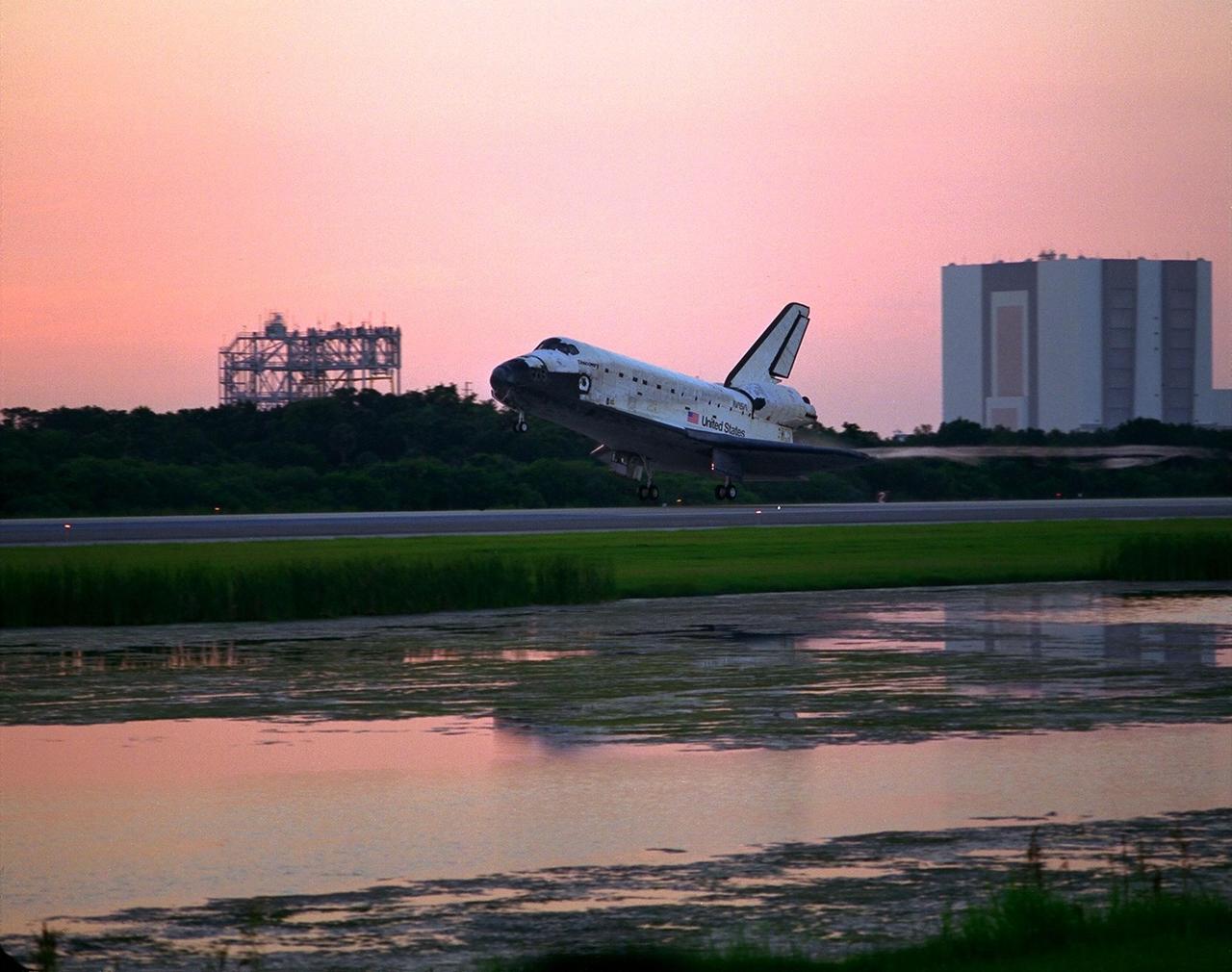
KENNEDY SPACE CENTER, FLA. -- With Commander Curtis L. Brown, Jr. and Pilot Kent V. Rominger at the controls and the Mate/Demate Device (MDD) and the Vehicle Assembly Building (VAB) in the background, the Space Shuttle orbiter Discovery touches down on Runway 33 at KSC’s Shuttle Landing Facility at 7:07:59 a.m. EDT Aug. 19 to complete the 11-day, 20-hour and 27-minute-long STS-85 mission. The first landing opportunity on Aug. 18 was waved off due to the potential for ground fog. Also onboard the orbiter are Payload Commander N. Jan Davis, Mission Specialist Robert L. Curbeam, Jr., Mission Specialist Stephen K. Robinson and Payload Specialist Bjarni V. Tryggvason. During the 86th Space Shuttle mission, the crew deployed the Cryogenic Infrared Spectrometers and Telescopes for the Atmosphere-Shuttle Pallet Satellite-2 (CRISTA-SPAS-2) free-flyer to conduct research on the Earth’s middle atmosphere, retrieving it on flight day 9. The crew also conducted investigations with the Manipulator Flight Demonstration (MFD), Technology Applications and Science-1 (TAS-1) and International Extreme Ultraviolet Hitchhiker-2 (IEH-2) experiments. Robinson also made observations of the comet HaleBopp with the Southwest Ultraviolet Imaging System (SWIS) while other members of the crew conducted biological experiments in the orbiter’s crew cabin. This was the 39th landing at KSC in the history of the Space Shuttle program and the 11th touchdown for Discovery at the space center
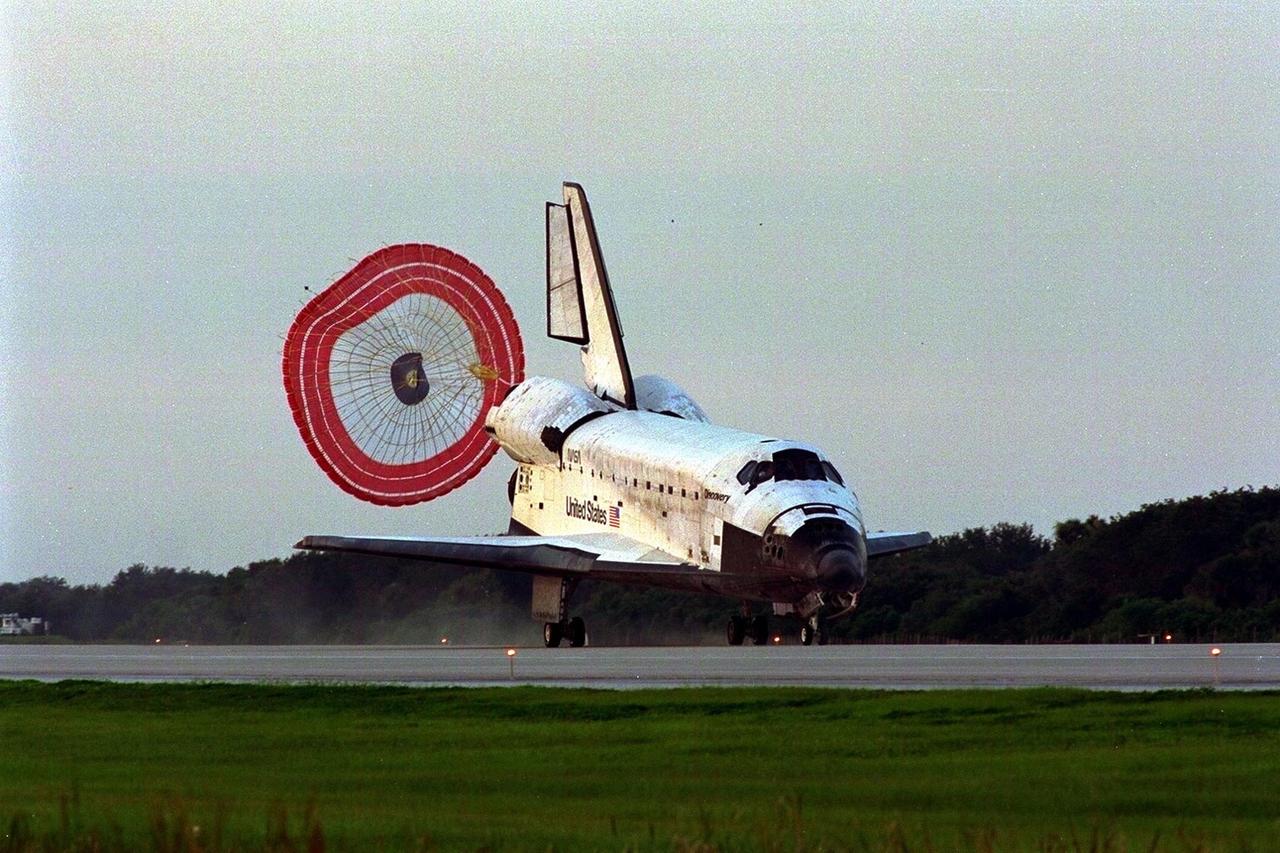
KENNEDY SPACE CENTER, FLA. -- With drag chute deployed, the Space Shuttle orbiter Discovery touches down on Runway 33 at KSC’s Shuttle Landing Facility at 7:07:59 a.m. EDT Aug. 19 to complete the 11-day, 20-hour and 27-minute-long STS-85 mission. At the controls are Commander Curtis L. Brown, Jr. and Pilot Kent V. Rominger. The first landing opportunity on Aug. 18 was waved off due to the potential for ground fog. Also onboard the orbiter are Payload Commander N. Jan Davis, Mission Specialist Robert L. Curbeam, Jr., Mission Specialist Stephen K. Robinson and Payload Specialist Bjarni V. Tryggvason. During the 86th Space Shuttle mission, the crew deployed the Cryogenic Infrared Spectrometers and Telescopes for the AtmosphereShuttle Pallet Satellite-2 (CRISTA-SPAS-2) free-flyer to conduct research on the Earth’s middle atmosphere, retrieving it on flight day 9. The crew also conducted investigations with the Manipulator Flight Demonstration (MFD), Technology Applications and Science-1 (TAS-1) and International Extreme Ultraviolet Hitchhiker-2 (IEH-2) experiments. Robinson also made observations of the comet Hale-Bopp with the Southwest Ultraviolet Imaging System (SWIS) while other members of the crew conducted biological experiments in the orbiter’s crew cabin. This was the 39th landing at KSC in the history of the Space Shuttle program and the 11th touchdown for Discovery at the space center
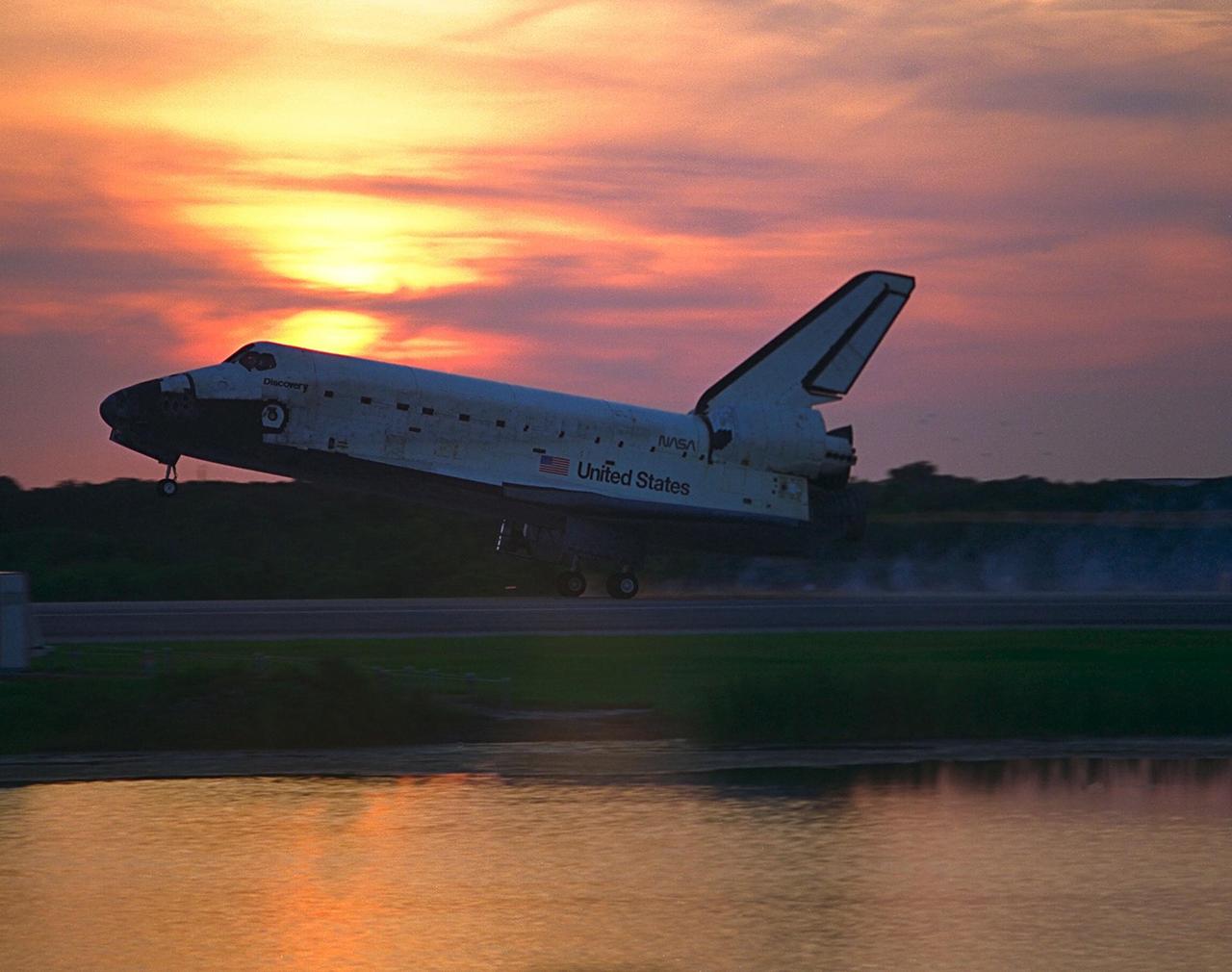
KENNEDY SPACE CENTER, FLA. -- With Commander Curtis L. Brown, Jr. and Pilot Kent V. Rominger at the controls, the Space Shuttle orbiter Discovery touches down on Runway 33 at KSC’s Shuttle Landing Facility at 7:07:59 a.m. EDT Aug. 19 to complete the 11-day, 20-hour and 27-minute-long STS-85 mission. The first landing opportunity on Aug. 18 was waved off due to the potential for ground fog. Also onboard the orbiter are Payload Commander N. Jan Davis, Mission Specialist Robert L. Curbeam, Jr., Mission Specialist Stephen K. Robinson and Payload Specialist Bjarni V. Tryggvason. During the 86th Space Shuttle mission, the crew deployed the Cryogenic Infrared Spectrometers and Telescopes for the Atmosphere-Shuttle Pallet Satellite-2 (CRISTA-SPAS-2) free-flyer to conduct research on the Earth’s middle atmosphere, retrieving it on flight day 9. The crew also conducted investigations with the Manipulator Flight Demonstration (MFD), Technology Applications and Science-1 (TAS-1) and International Extreme Ultraviolet Hitchhiker-2 (IEH-2) experiments. Robinson also made observations of the comet HaleBopp with the Southwest Ultraviolet Imaging System (SWIS) while other members of the crew conducted biological experiments in the orbiter’s crew cabin. This was the 39th landing at KSC in the history of the Space Shuttle program and the 11th touchdown for Discovery at the space center
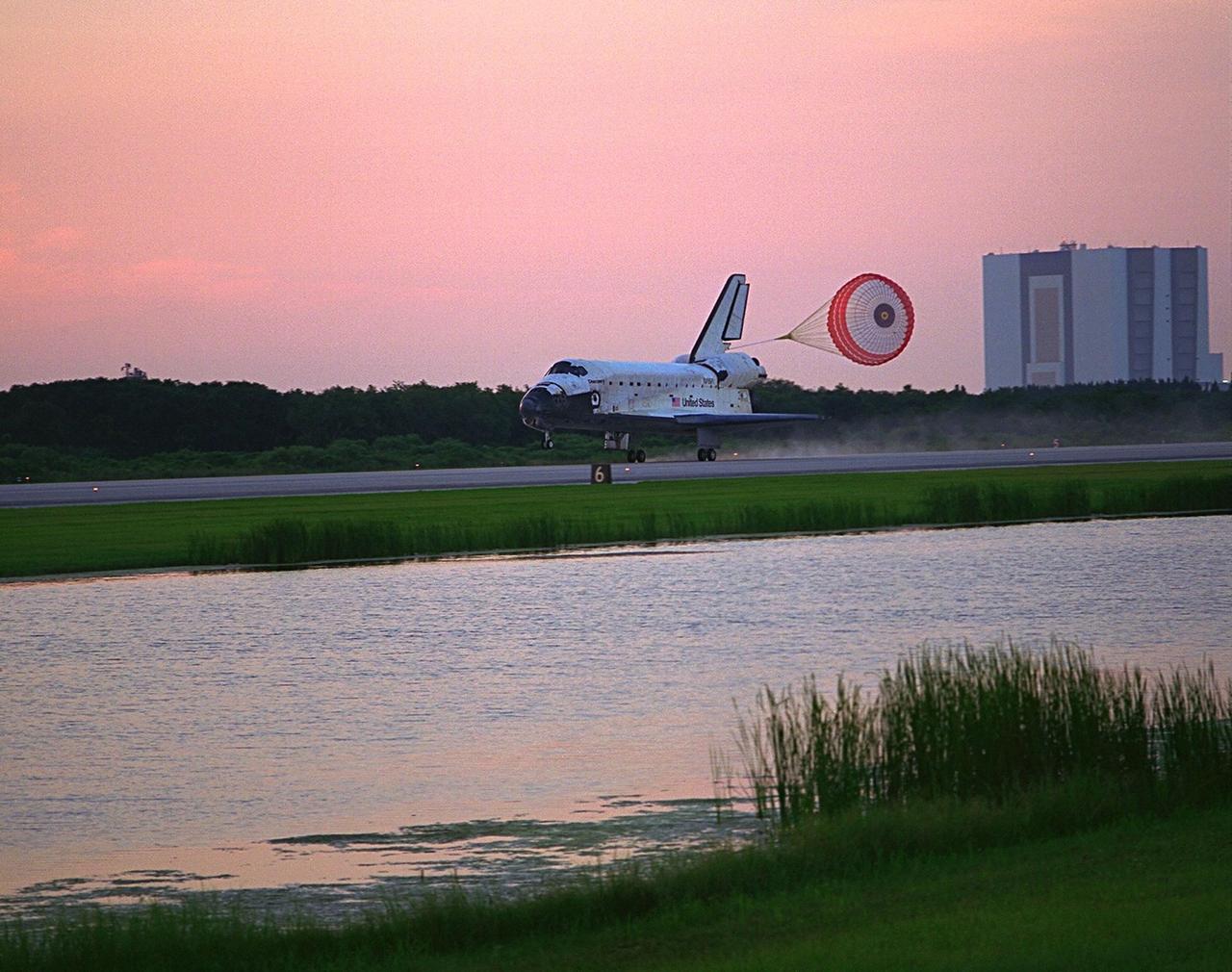
KENNEDY SPACE CENTER, FLA. -- With Commander Curtis L. Brown, Jr. and Pilot Kent V. Rominger at the controls and the Vehicle Assembly Building (VAB) in the background, the Space Shuttle orbiter Discovery touches down on Runway 33 at KSC’s Shuttle Landing Facility at 7:07:59 a.m. EDT Aug. 19 to complete the 11-day, 20-hour and 27-minute-long STS-85 mission. The first landing opportunity on Aug. 18 was waved off due to the potential for ground fog. Also onboard the orbiter are Payload Commander N. Jan Davis, Mission Specialist Robert L. Curbeam, Jr., Mission Specialist Stephen K. Robinson and Payload Specialist Bjarni V. Tryggvason. During the 86th Space Shuttle mission, the crew deployed the Cryogenic Infrared Spectrometers and Telescopes for the Atmosphere-Shuttle Pallet Satellite-2 (CRISTA-SPAS-2) free-flyer to conduct research on the Earth’s middle atmosphere, retrieving it on flight day 9. The crew also conducted investigations with the Manipulator Flight Demonstration (MFD), Technology Applications and Science-1 (TAS-1) and International Extreme Ultraviolet Hitchhiker-2 (IEH-2) experiments. Robinson also made observations of the comet HaleBopp with the Southwest Ultraviolet Imaging System (SWIS) while other members of the crew conducted biological experiments in the orbiter’s crew cabin. This was the 39th landing at KSC in the history of the Space Shuttle program and the 11th touchdown for Discovery at the space center
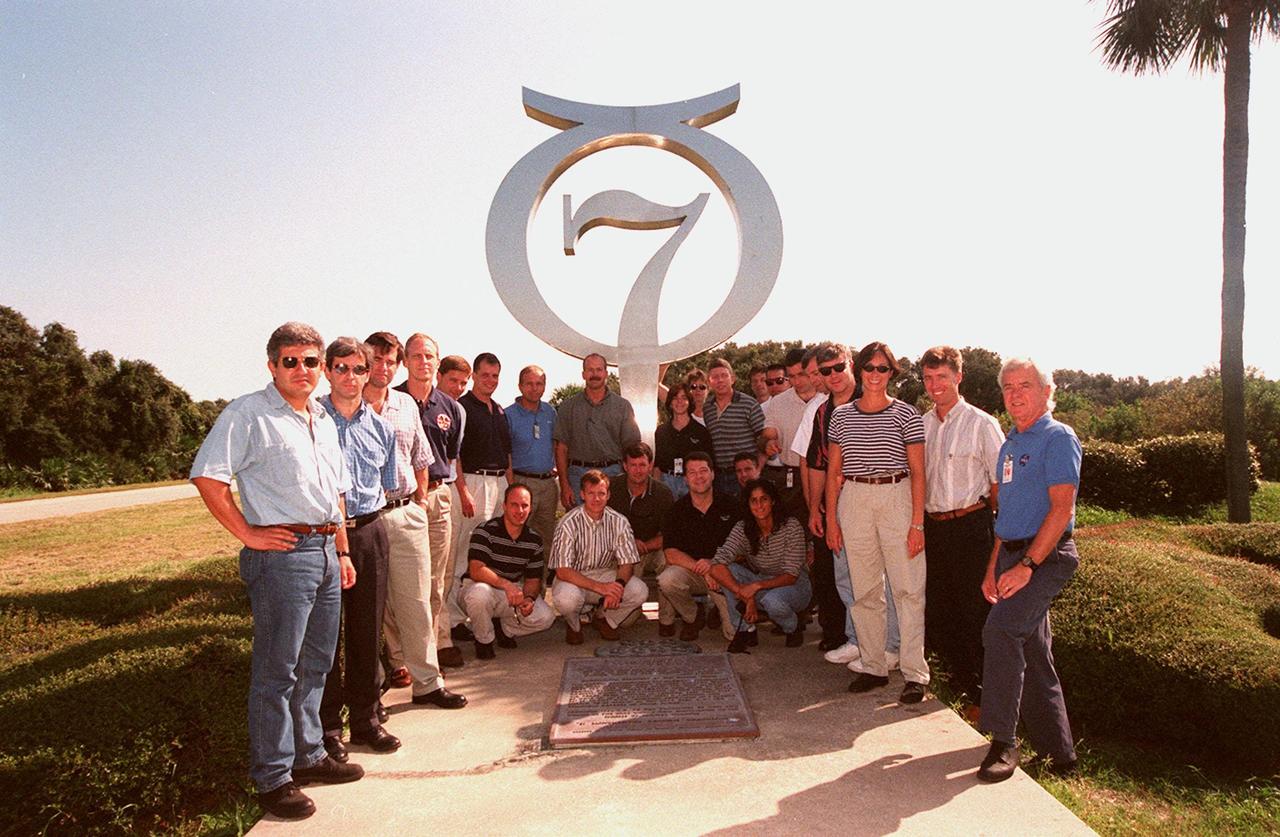
At Cape Canaveral Air Station, members of the 1998 astronaut candidate class (Group 17) pose in front of the Project Mercury monument at Launch Complex 14 during a tour of the station's facilities. This 13-foot-high astronomical symbol for the planet Mercury was constructed by General Dynamics, the Atlas airframe contractor, and dedicated in 1964 in honor of those who flew in the Mercury 7 capsule. The class is at Kennedy Space Center taking part in training activities, including a flight awareness program, as well as touring the OPF, VAB, SSPF, SSME Processing Facility, launch pads, SLF, Apollo/Saturn V Center, and the crew quarters. The U.S. candidates in the '98 class are Clayton C. Anderson, Lee J. Archambault, Tracy E. Caldwell (Ph.D.), Gregory E. Chamitoff (Ph.D.), Timothy J. Creamer, Christopher J. Ferguson, Michael J. Foreman, Michael E. Fossum, Kenneth T. Ham, Patricia C. Hilliard (M.D.), Gregory C. Johnson, Gregory H. Johnson, Stanley G. Love (Ph.D.), Leland D. Melvin, Barbara R. Morgan, William A. Oefelein, John D. Olivas (Ph.D.), Nicholas J.M. Patrick (Ph.D.), Alan G. Poindexter, Garrett E. Reisman (Ph.D.), Steven R. Swanson, Douglas H. Wheelock, Sunita L. Williams, Neil W. Woodward III, George D. Zamka; and the international candidates are Leopold Eyharts, Paolo Nespoli, Hans Schlegel, Roberto Vittori, Bjarni V. Tryggvason, and Marcos Pontes
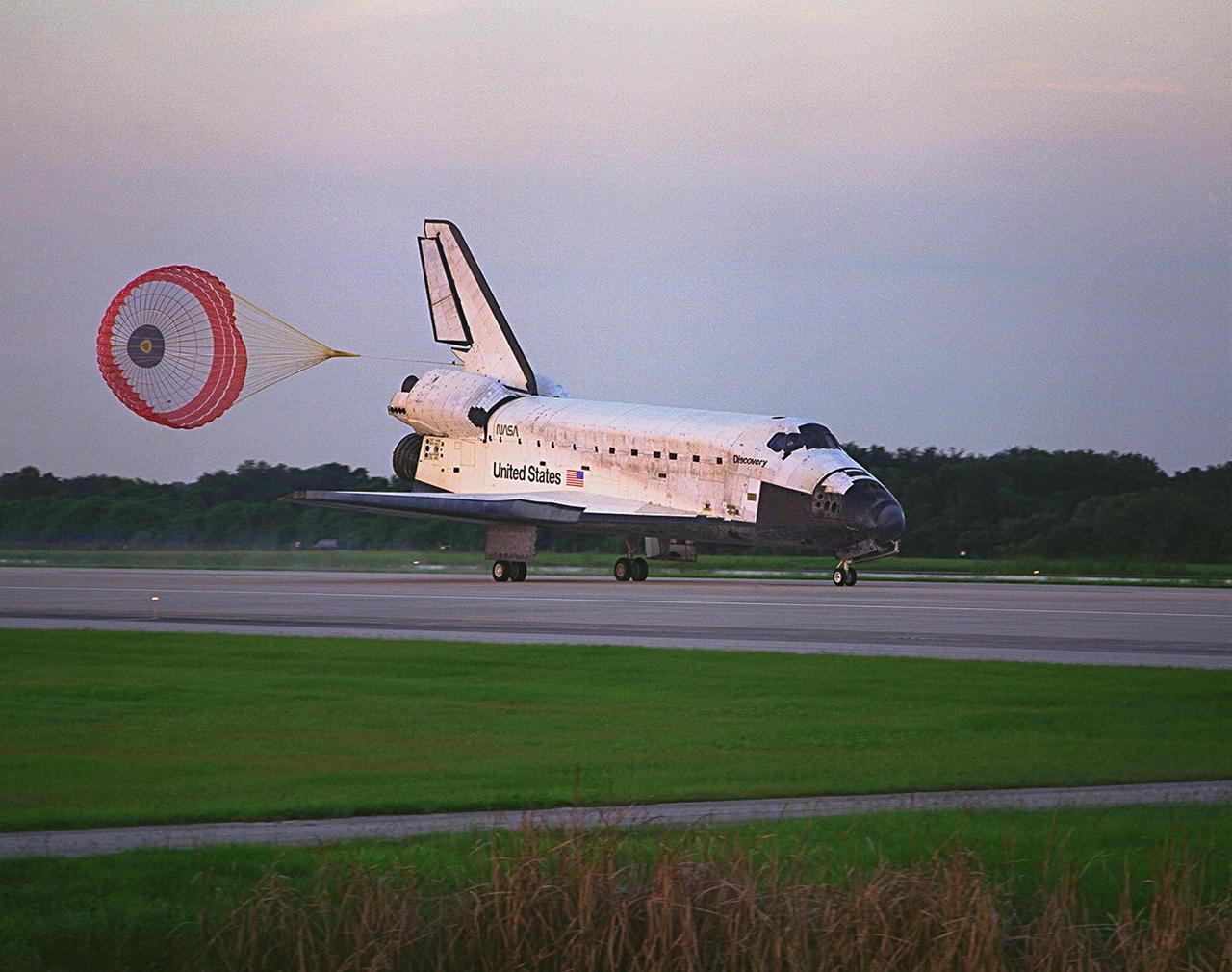
KENNEDY SPACE CENTER, FLA. -- With drag chute deployed, the Space Shuttle orbiter Discovery touches down on Runway 33 at KSC’s Shuttle Landing Facility at 7:07:59 a.m. EDT Aug. 19 to complete the 11-day, 20-hour and 27-minute-long STS-85 mission. At the controls are Commander Curtis L. Brown, Jr. and Pilot Kent V. Rominger. The first landing opportunity on Aug. 18 was waved off due to the potential for ground fog. Also onboard the orbiter are Payload Commander N. Jan Davis, Mission Specialist Robert L. Curbeam, Jr., Mission Specialist Stephen K. Robinson and Payload Specialist Bjarni V. Tryggvason. During the 86th Space Shuttle mission, the crew deployed the Cryogenic Infrared Spectrometers and Telescopes for the AtmosphereShuttle Pallet Satellite-2 (CRISTA-SPAS-2) free-flyer to conduct research on the Earth’s middle atmosphere, retrieving it on flight day 9. The crew also conducted investigations with the Manipulator Flight Demonstration (MFD), Technology Applications and Science-1 (TAS-1) and International Extreme Ultraviolet Hitchhiker-2 (IEH-2) experiments. Robinson also made observations of the comet Hale-Bopp with the Southwest Ultraviolet Imaging System (SWIS) while other members of the crew conducted biological experiments in the orbiter’s crew cabin. This was the 39th landing at KSC in the history of the Space Shuttle program and the 11th touchdown for Discovery at the space center