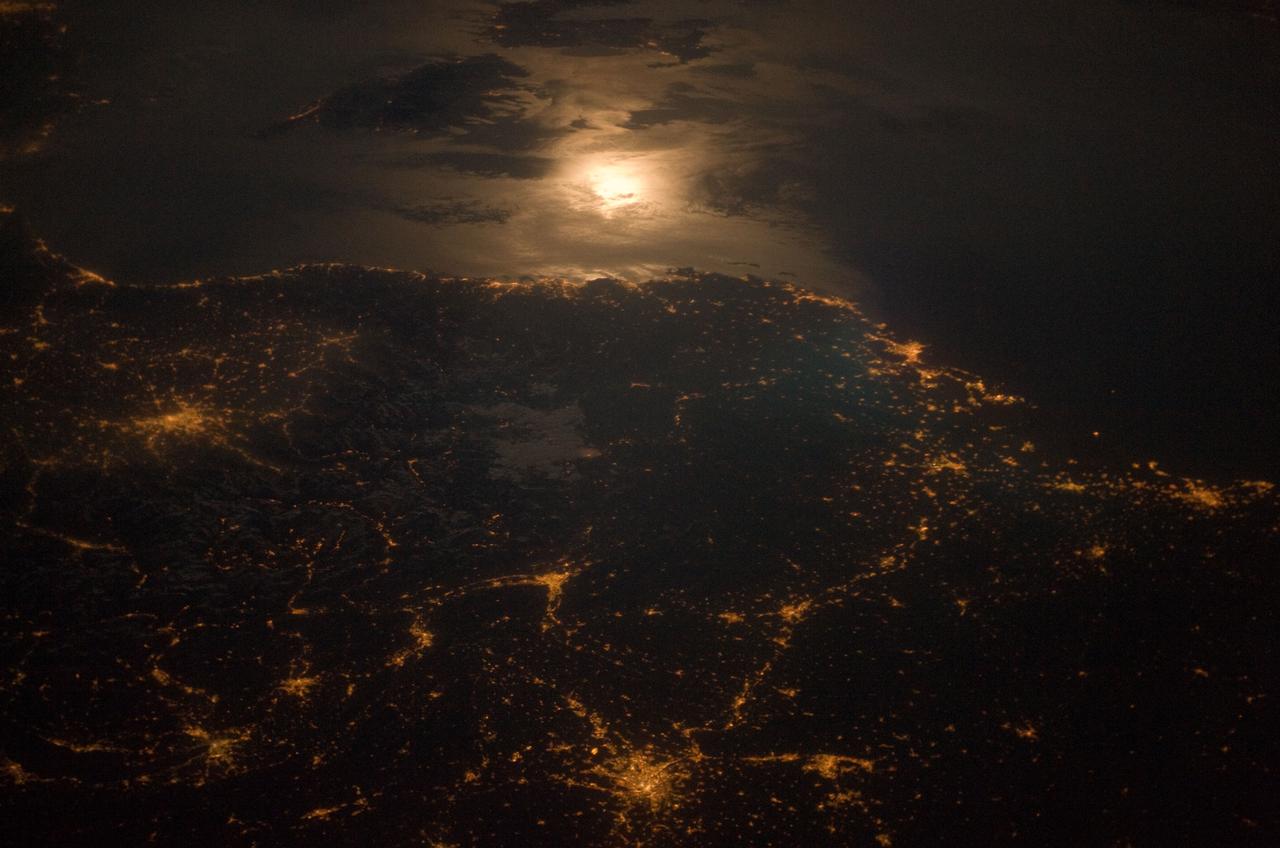
City lights at night along the France-Italy border, Europe are featured in this image photographed by an Expedition 23 crew member on the International Space Station (ISS). The brightly lit metropolitan areas of Torino (Italy), Lyon, and Marseille (both in France) stand out amidst numerous smaller urban areas in this dramatic photograph. The image captures the night time appearance of the France-Italy border area between the mountainous Alps to the north (not shown) and the island of Corsica in the Ligurian Sea to the south (top). The full moon reflects brightly on the water surface and also illuminates the tops of low patchy clouds over the border (center). This image was taken by an ISS crew member at approximately 11:55 p.m. local time when the station was located over the France-Belgium border near Luxembourg. Crew members orbiting Earth frequently collect images that include sunglint, or sunlight that reflects off a water surface at such an angle that it travels directly back towards the observer. Sunglint typically lends a mirror-like appearance to the water surface. During clear sky conditions reflected light from the moon can produce the same effect (moon glint) as illustrated in this view. The observer was looking towards the southeast at an oblique viewing angle at the time the image was taken; in other words, looking outwards from the ISS, not straight down towards Earth. Credit: NASA <b><a href="http://www.nasa.gov/audience/formedia/features/MP_Photo_Guidelines.html" rel="nofollow">NASA image use policy.</a></b> <b><a href="http://www.nasa.gov/centers/goddard/home/index.html" rel="nofollow">NASA Goddard Space Flight Center</a></b> enables NASA’s mission through four scientific endeavors: Earth Science, Heliophysics, Solar System Exploration, and Astrophysics. Goddard plays a leading role in NASA’s accomplishments by contributing compelling scientific knowledge to advance the Agency’s mission. <b>Follow us on <a href="http://twitter.com/NASAGoddardPix" rel="nofollow">Twitter</a></b> <b>Like us on <a href="http://www.facebook.com/pages/Greenbelt-MD/NASA-Goddard/395013845897?ref=tsd" rel="nofollow">Facebook</a></b> <b>Find us on <a href="http://instagram.com/nasagoddard?vm=grid" rel="nofollow">Instagram</a></b>
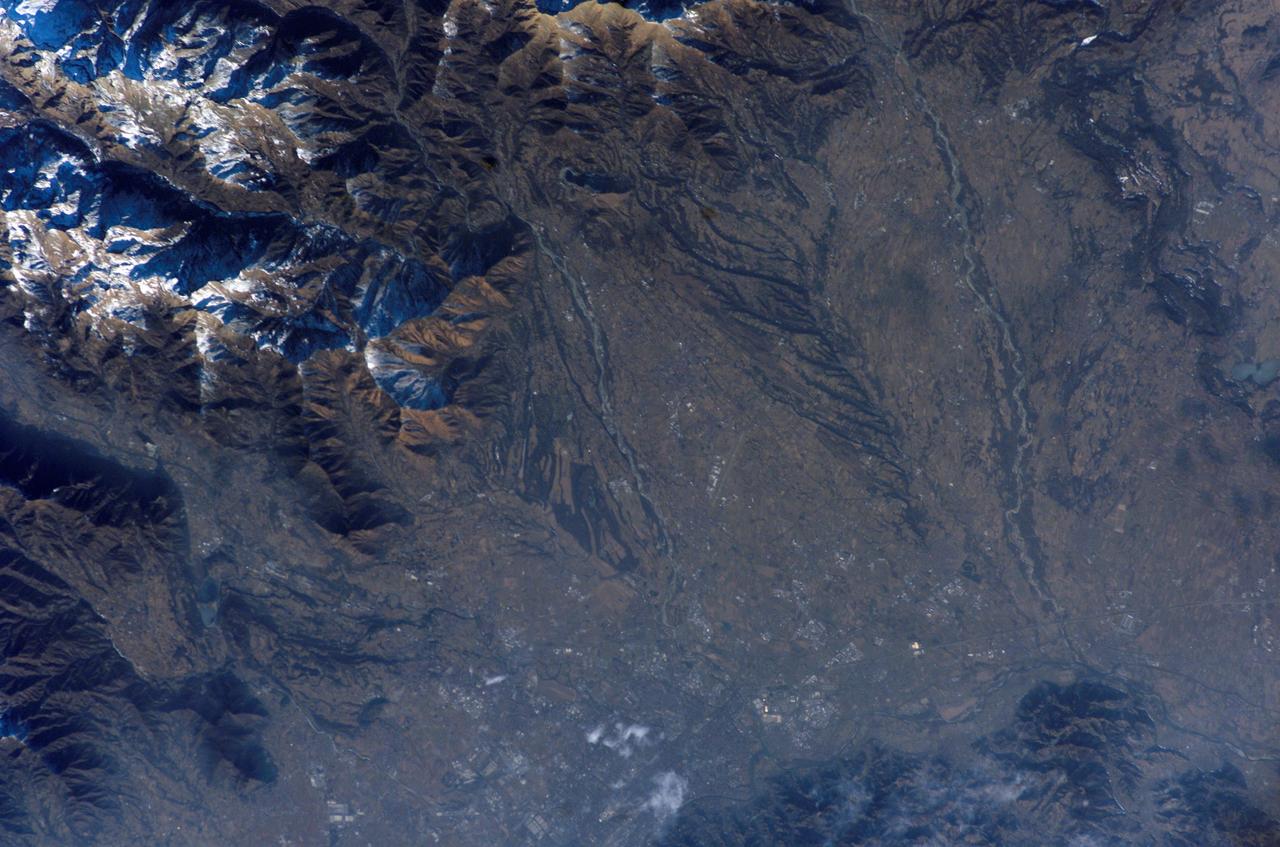
ISS012-E-15598 (21 Jan. 2006) --- PLEASE ORIENT PHOTO WITH SNOW-COVERED MOUNTAINS AT LOWER RIGHT CORNER. NORTH WILL THEN BE TOWARD BOTTOM. Turin (Torino), Italy is featured in this image photographed by an Expedition 12 crewmember on the International Space Station (ISS). Located in the Piemonte region of northwestern Italy, Torino is host of the Twentieth Olympic Winter Games. Venues for the Games include several locations within downtown Torino and the nearby Alps to the west. In this image, the built area of Turin appears dark grayish brown with large building complexes indicated by white roofs (above center of frame). Also shown are the snow-capped Alps visible to the west and north and two tributaries of the Po River, Stura di Lanzo and the Malone River.

KENNEDY SPACE CENTER, FLA. - In the Space Station Processing Facility, workers guide one of the hatches from the Node-2 module onto a shipping container. The hatches are being removed in preparation for shipment to the Marshall Space Flight Center, Ala., for re-balance certification. The Node-2 will launch on mission 10A, STS-120, to the International Space Station (ISS) currently scheduled for Fall 2006. The installation of the Node-2 on the ISS will signify the completion of the U.S. stage of assembly and increase the living and working space inside the Station to approximately 18,000 cubic feet. Under contract to the Italian Space Agency (ASI), Alenia Spazio in Turin, Italy, led a consortium of European subcontractors to build Node-2. The module was built for NASA under an agreement with the European Space Agency (ESA) in exchange for launch of the European Columbus Laboratory.

KENNEDY SPACE CENTER, FLA. - In the Space Station Processing Facility, workers are removing one of the hatches on the Node-2 module. The hatches are being removed in preparation for shipment to the Marshall Space Flight Center, Ala., for re-balance certification. The Node-2 will launch on mission 10A, STS-120, to the International Space Station (ISS) currently scheduled for Fall 2006. The installation of the Node-2 on the ISS will signify the completion of the U.S. stage of assembly and increase the living and working space inside the Station to approximately 18,000 cubic feet. Under contract to the Italian Space Agency (ASI), Alenia Spazio in Turin, Italy, led a consortium of European subcontractors to build Node-2. The module was built for NASA under an agreement with the European Space Agency (ESA) in exchange for launch of the European Columbus Laboratory.

KENNEDY SPACE CENTER, FLA. - In the Space Station Processing Facility, workers prepare to move one of the hatches from the Node-2 module to a shipping container. The hatches are being removed in preparation for shipment to the Marshall Space Flight Center, Ala., for re-balance certification. The Node-2 will launch on mission 10A, STS-120, to the International Space Station (ISS) currently scheduled for Fall 2006. The installation of the Node-2 on the ISS will signify the completion of the U.S. stage of assembly and increase the living and working space inside the Station to approximately 18,000 cubic feet. Under contract to the Italian Space Agency (ASI), Alenia Spazio in Turin, Italy, led a consortium of European subcontractors to build Node-2. The module was built for NASA under an agreement with the European Space Agency (ESA) in exchange for launch of the European Columbus Laboratory.

KENNEDY SPACE CENTER, FLA. - In the Space Station Processing Facility, workers prepare to remove one of the hatches on the Node-2 module. The hatches are being removed in preparation for shipment to the Marshall Space Flight Center, Ala., for re-balance certification. The Node-2 will launch on mission 10A, STS-120, to the International Space Station (ISS) currently scheduled for Fall 2006. The installation of the Node-2 on the ISS will signify the completion of the U.S. stage of assembly and increase the living and working space inside the Station to approximately 18,000 cubic feet. Under contract to the Italian Space Agency (ASI), Alenia Spazio in Turin, Italy, led a consortium of European subcontractors to build Node-2. The module was built for NASA under an agreement with the European Space Agency (ESA) in exchange for launch of the European Columbus Laboratory.

KENNEDY SPACE CENTER, FLA. - In the Space Station Processing Facility, workers are removing one of the hatches on the Node-2 module. The hatches are being removed in preparation for shipment to the Marshall Space Flight Center, Ala., for re-balance certification. The Node-2 will launch on mission 10A, STS-120, to the International Space Station (ISS) currently scheduled for Fall 2006. The installation of the Node-2 on the ISS will signify the completion of the U.S. stage of assembly and increase the living and working space inside the Station to approximately 18,000 cubic feet. Under contract to the Italian Space Agency (ASI), Alenia Spazio in Turin, Italy, led a consortium of European subcontractors to build Node-2. The module was built for NASA under an agreement with the European Space Agency (ESA) in exchange for launch of the European Columbus Laboratory.

KENNEDY SPACE CENTER, FLA. - In the Space Station Processing Facility, workers finish packing one of the hatches from the Node-2 module inside a shipping container. The hatches are being removed in preparation for shipment to the Marshall Space Flight Center, Ala., for re-balance certification. The Node-2 will launch on mission 10A, STS-120, to the International Space Station (ISS) currently scheduled for Fall 2006. The installation of the Node-2 on the ISS will signify the completion of the U.S. stage of assembly and increase the living and working space inside the Station to approximately 18,000 cubic feet. Under contract to the Italian Space Agency (ASI), Alenia Spazio in Turin, Italy, led a consortium of European subcontractors to build Node-2. The module was built for NASA under an agreement with the European Space Agency (ESA) in exchange for launch of the European Columbus Laboratory.