
CAPE CANAVERAL, Fla. – At KARS Park 1 on Merritt Island in Florida, a group of Tweetup participants prepare to watch the United Launch Alliance Delta II Heavy rocket launch from Space Launch Complex 17B at Cape Canaveral Air Force Station carrying NASA’s Gravity Recovery and Interior Laboratory (GRAIL) mission to the moon. The tweeters will share their experiences with followers through the social networking site Twitter. GRAIL will fly twin spacecraft in tandem around the moon to precisely measure and map variations in the moon's gravitational field. The mission will provide the most accurate global gravity field to date for any planet, including Earth. This detailed information will reveal differences in the density of the moon's crust and mantle and will help answer fundamental questions about the moon's internal structure, thermal evolution, and history of collisions with asteroids. The aim is to map the moon's gravity field so completely that future moon vehicles can safely navigate anywhere on the moon’s surface. For more information, visit http://www.nasa.gov/grail. Photo credit: NASA/Frankie Martin

CAPE CANAVERAL, Fla. – At KARS Park 1 on Merritt Island in Florida, a group of Tweetup participants watch as a United Launch Alliance Delta II Heavy rocket lifts off at 9:08 a.m. EDT Sept. 10 from Space Launch Complex 17B at Cape Canaveral Air Force Station carrying NASA’s Gravity Recovery and Interior Laboratory (GRAIL) mission to the moon. The tweeters will share their experiences with followers through the social networking site Twitter. GRAIL will fly twin spacecraft in tandem around the moon to precisely measure and map variations in the moon's gravitational field. The mission will provide the most accurate global gravity field to date for any planet, including Earth. This detailed information will reveal differences in the density of the moon's crust and mantle and will help answer fundamental questions about the moon's internal structure, thermal evolution, and history of collisions with asteroids. The aim is to map the moon's gravity field so completely that future moon vehicles can safely navigate anywhere on the moon’s surface. For more information, visit http://www.nasa.gov/grail. Photo credit: NASA/Frankie Martin
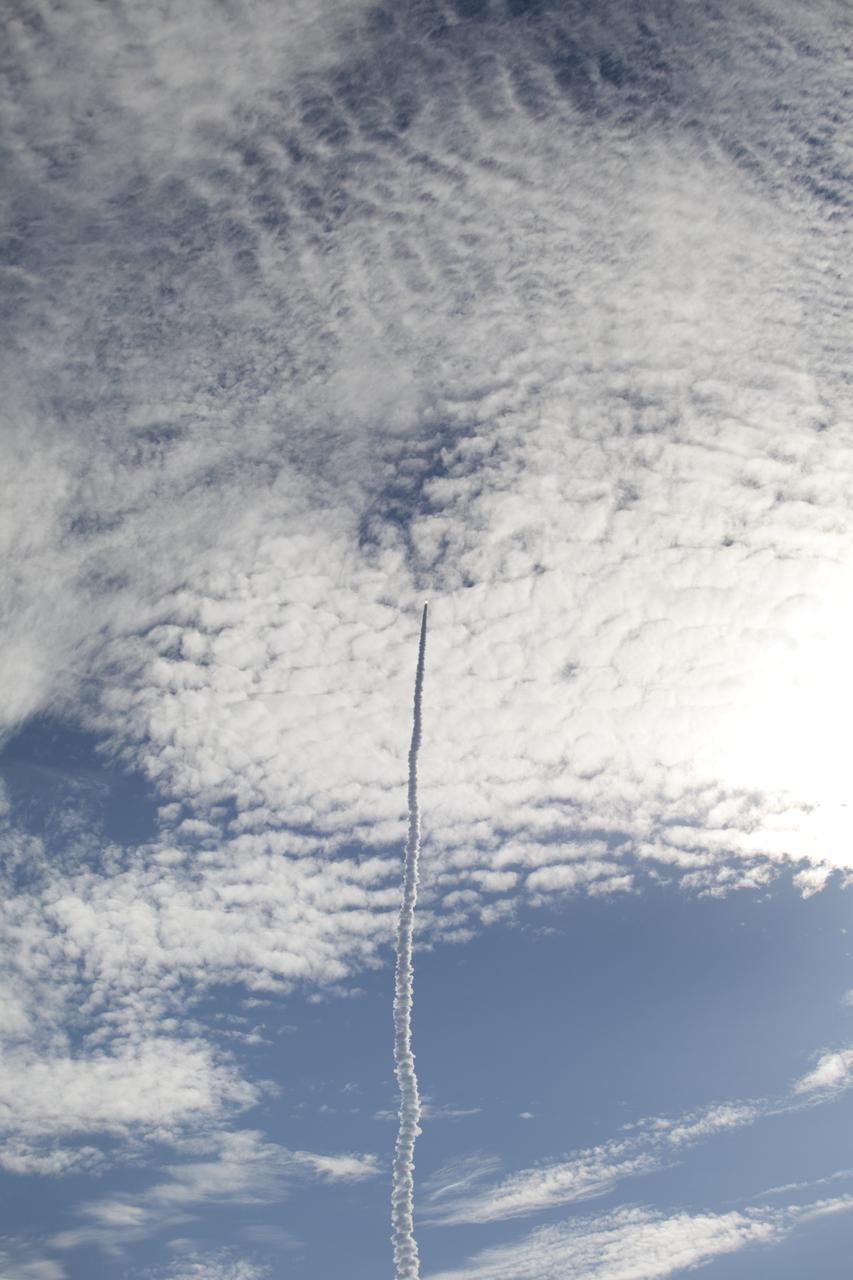
CAPE CANAVERAL, Fla. – Viewed from KARS Park 1 on Merritt Island in Florida, the United Launch Alliance Delta II Heavy rocket soars skyward after lifting off at 9:08 a.m. EDT Sept. 10 from Space Launch Complex 17B at Cape Canaveral Air Force Station. The Delta II is carrying NASA’s Gravity Recovery and Interior Laboratory (GRAIL) mission to the moon. A group of Tweetup participants viewed the launch from the park and will share their experiences with followers through the social networking site Twitter. GRAIL will fly twin spacecraft in tandem around the moon to precisely measure and map variations in the moon's gravitational field. The mission will provide the most accurate global gravity field to date for any planet, including Earth. This detailed information will reveal differences in the density of the moon's crust and mantle and will help answer fundamental questions about the moon's internal structure, thermal evolution, and history of collisions with asteroids. The aim is to map the moon's gravity field so completely that future moon vehicles can safely navigate anywhere on the moon’s surface. For more information, visit http://www.nasa.gov/grail. Photo credit: NASA/Frankie Martin

CAPE CANAVERAL, Fla. – At KARS Park 1 on Merritt Island in Florida, a group of Tweetup participants take pictures and watch excitedly as a United Launch Alliance Delta II Heavy rocket lifts off at 9:08 a.m. EDT Sept. 10 from Space Launch Complex 17B at Cape Canaveral Air Force Station carrying NASA’s Gravity Recovery and Interior Laboratory (GRAIL) mission to the moon. The tweeters will share their experiences with followers through the social networking site Twitter. GRAIL will fly twin spacecraft in tandem around the moon to precisely measure and map variations in the moon's gravitational field. The mission will provide the most accurate global gravity field to date for any planet, including Earth. This detailed information will reveal differences in the density of the moon's crust and mantle and will help answer fundamental questions about the moon's internal structure, thermal evolution, and history of collisions with asteroids. The aim is to map the moon's gravity field so completely that future moon vehicles can safely navigate anywhere on the moon’s surface. For more information, visit http://www.nasa.gov/grail. Photo credit: NASA/Frankie Martin

CAPE CANAVERAL, Fla. – At KARS Park 1 on Merritt Island in Florida, a group of Tweetup participants take pictures as watch as a United Launch Alliance Delta II Heavy rocket lifts off at 9:08 a.m. EDT Sept. 10 from Space Launch Complex 17B at Cape Canaveral Air Force Station carrying NASA’s Gravity Recovery and Interior Laboratory (GRAIL) mission to the moon. The tweeters will share their experiences with followers through the social networking site Twitter. GRAIL will fly twin spacecraft in tandem around the moon to precisely measure and map variations in the moon's gravitational field. The mission will provide the most accurate global gravity field to date for any planet, including Earth. This detailed information will reveal differences in the density of the moon's crust and mantle and will help answer fundamental questions about the moon's internal structure, thermal evolution, and history of collisions with asteroids. The aim is to map the moon's gravity field so completely that future moon vehicles can safely navigate anywhere on the moon’s surface. For more information, visit http://www.nasa.gov/grail. Photo credit: NASA/Frankie Martin

CAPE CANAVERAL, Fla. – At KARS Park 1 on Merritt Island in Florida, a group of Tweetup participants take pictures and watch excitedly as a United Launch Alliance Delta II Heavy rocket lifts off at 9:08 a.m. EDT Sept. 10 from Space Launch Complex 17B at Cape Canaveral Air Force Station carrying NASA’s Gravity Recovery and Interior Laboratory (GRAIL) mission to the moon. The tweeters will share their experiences with followers through the social networking site Twitter. GRAIL will fly twin spacecraft in tandem around the moon to precisely measure and map variations in the moon's gravitational field. The mission will provide the most accurate global gravity field to date for any planet, including Earth. This detailed information will reveal differences in the density of the moon's crust and mantle and will help answer fundamental questions about the moon's internal structure, thermal evolution, and history of collisions with asteroids. The aim is to map the moon's gravity field so completely that future moon vehicles can safely navigate anywhere on the moon’s surface. For more information, visit http://www.nasa.gov/grail. Photo credit: NASA/Frankie Martin