
The spider part of The Spider and the Fly nebulae, IC 417 abounds in star formation, as seen in this infrared image from NASA Spitzer Space Telescope and the Two Micron All Sky Survey 2MASS.

This panoramic view encompasses the entire sky as seen by Two Micron All-Sky Survey. The measured brightnesses of half a billion stars (points) have been combined into colors representing three distinct wavelengths of infrared light: blue at 1.2 microns, green at 1.6 microns, and red at 2.2 microns. This image is centered on the core of our own Milky Way galaxy, toward the constellation of Sagittarius. The reddish stars seemingly hovering in the middle of the Milky Way's disc -- many of them never observed before -- trace the densest dust clouds in our galaxy. The two faint smudges seen in the lower right quadrant are our neighboring galaxies, the Small and Large Magellanic Clouds. http://photojournal.jpl.nasa.gov/catalog/PIA04250
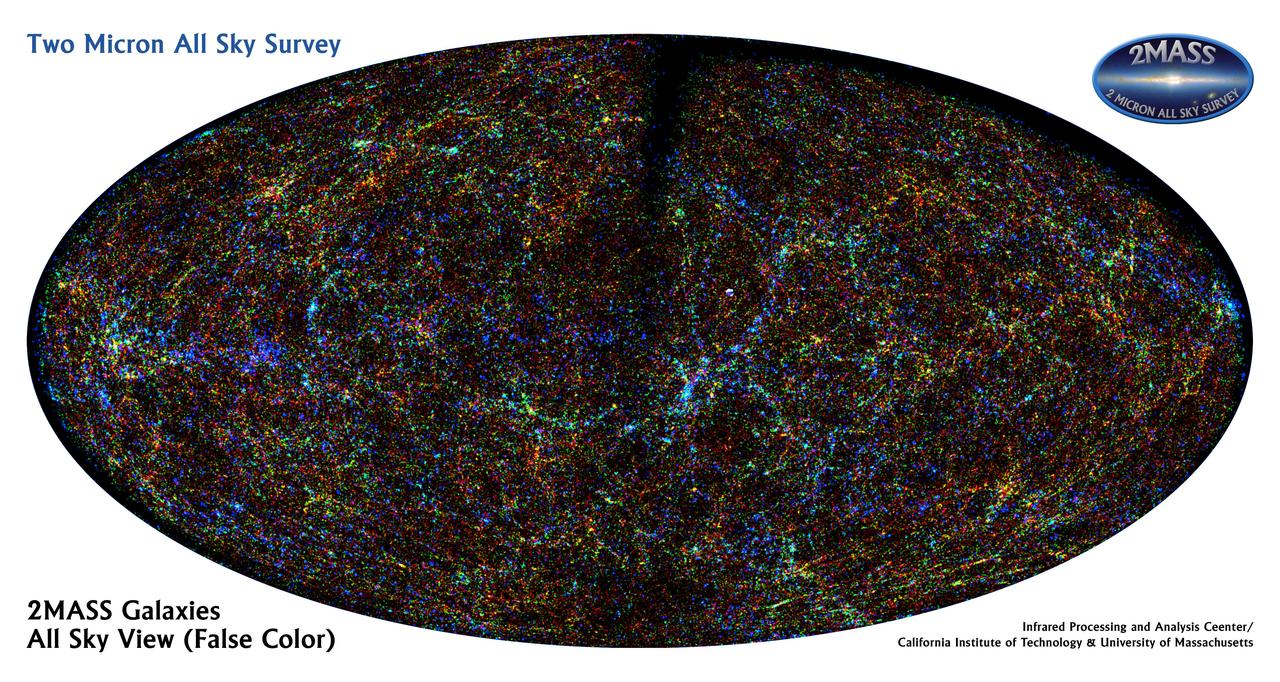
This panoramic view of the entire sky reveals the distribution of galaxies beyond our Milky Way galaxy, which astronomers call extended sources, as observed by Two Micron All-Sky Survey. The image is constructed from a database of over 1.6 million galaxies listed in the survey's Extended Source Catalog; more than half of the galaxies have never before been catalogued. The image is a representation of the relative brightnesses of these million-plus galaxies, all observed at a wavelength of 2.2 microns. The brightest and nearest galaxies are represented in blue, and the faintest, most distant ones are in red. This color scheme gives insights into the three dimensional large-scale structure of the nearby universe with the brightest, closest clusters and superclusters showing up as the blue and bluish-white features. The dark band in this image shows the area of the sky where our Milky Way galaxy blocks our view of distant objects, which, in this projection, lies predominantly along the edges of the image. http://photojournal.jpl.nasa.gov/catalog/PIA04252
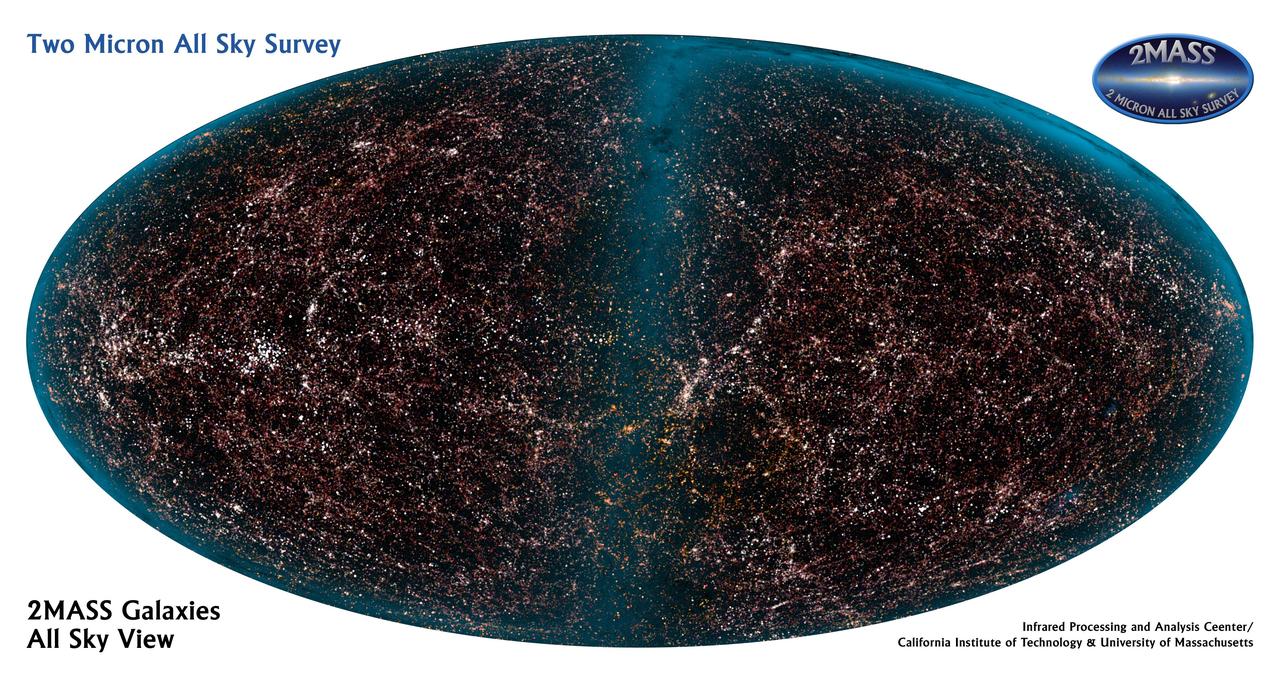
This panoramic view encompasses the entire sky and reveals the distribution of galaxies beyond the Milky Way galaxy, which astronomers call extended sources, as observed by Two Micron All-Sky Survey. The image is assembled from a database of over 1.6 million galaxies listed in the survey’s All-Sky Survey Extended Source Catalog; more than half of the galaxies have never before been catalogued. The colors represent how the many galaxies appear at three distinct wavelengths of infrared light (blue at 1.2 microns, green at 1.6 microns, and red at 2.2 microns). Quite evident are the many galactic clusters and superclusters, as well as some streamers composing the large-scale structure of the nearby universe. The blue overlay represents the very close and bright stars from our own Milky Way galaxy. In this projection, the bluish Milky Way lies predominantly toward the upper middle and edges of the image. http://photojournal.jpl.nasa.gov/catalog/PIA04251
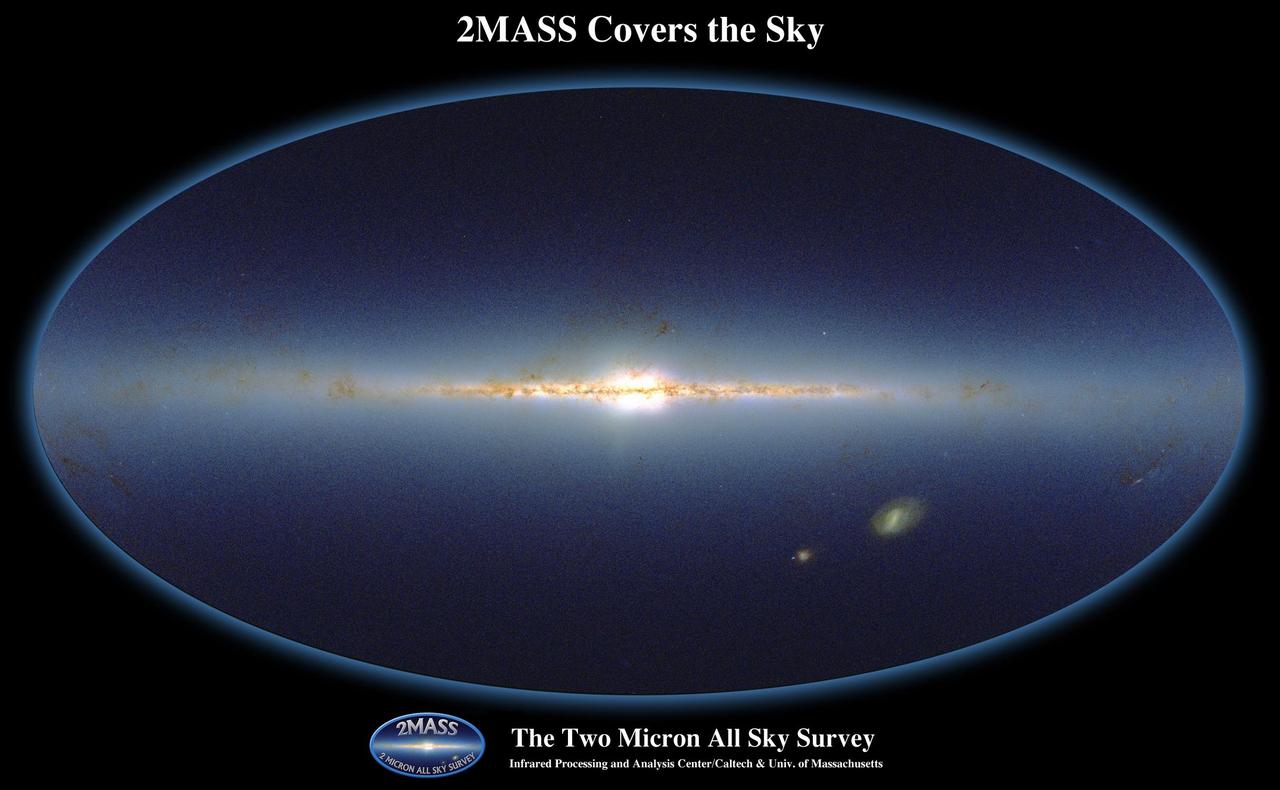
Aitoff projection of the three-color composite JHKs source count map of the entire sky, based on 95,851,173 stars with Ks 13.5. What appears most prominently are the Galactic plane and the Galactic bulge.

Atlas Image mosaic, covering 14.8 x 20.0 on the sky, of the Trifid Nebula, aka Messier 20 and NGC 6514. The Trifid is only about 1.5 degrees northwest on the sky of the larger Lagoon Nebula Messier 8 in the constellation Sagittarius
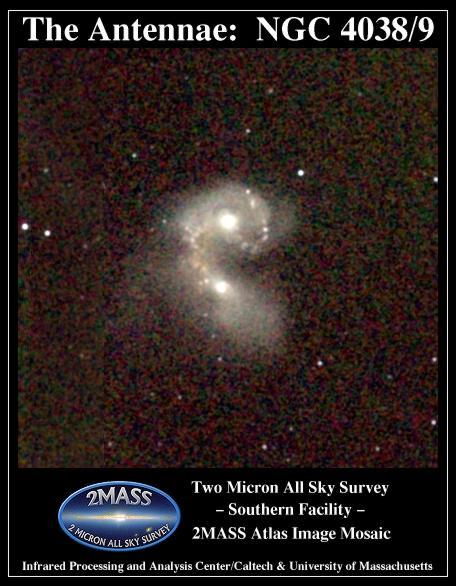
Atlas Image mosaic, covering 7 x 7 on the sky of the interacting galaxies NGC 4038 and NGC 4039, better known as the Antennae, or Ring Tail galaxies. The two galaxies are engaged in a tug-of-war as they collide.

Atlas Image mosaic, covering 34 x 34 on the sky, of the Coma cluster, aka Abell 1656. This is a particularly rich cluster of individual galaxies over 1000 members, most prominently the two giant ellipticals, NGC 4874 right and NGC 4889 left.
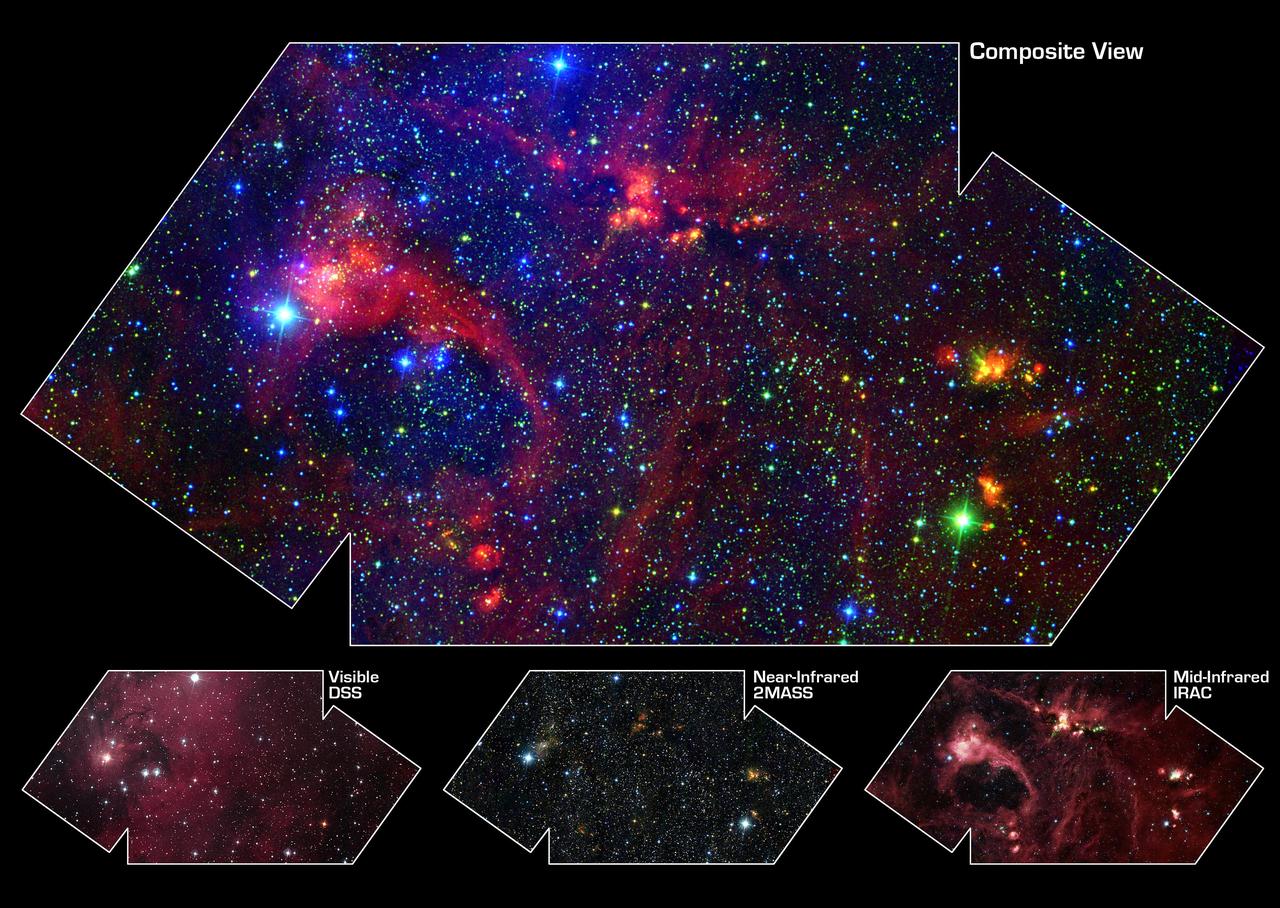
Hidden behind a shroud of dust in the constellation Cygnus is a stellar nursery called DR21, which is giving birth to some of the most massive stars in our galaxy. Visible light images reveal no trace of this interstellar cauldron because of heavy dust obscuration. In fact, visible light is attenuated in DR21 by a factor of more than 10,000,000,000,000,000,000,000,000,000,000,000,000,000 (ten thousand trillion heptillion). New images from NASA's Spitzer Space Telescope allow us to peek behind the cosmic veil and pinpoint one of the most massive natal stars yet seen in our Milky Way galaxy. The never-before-seen star is 100,000 times as bright as the Sun. Also revealed for the first time is a powerful outflow of hot gas emanating from this star and bursting through a giant molecular cloud. The colorful image (top panel) is a large-scale composite mosaic assembled from data collected at a variety of different wavelengths. Views at visible wavelengths appear blue, near-infrared light is depicted as green, and mid-infrared data from the InfraRed Array Camera (IRAC) aboard NASA's Spitzer Space Telescope is portrayed as red. The result is a contrast between structures seen in visible light (blue) and those observed in the infrared (yellow and red). A quick glance shows that most of the action in this image is revealed to the unique eyes of Spitzer. The image covers an area about two times that of a full moon. Each of the constituent images is shown below the large mosaic. The Digital Sky Survey (DSS) image (lower left) provides a familiar view of deep space, with stars scattered around a dark field. The reddish hue is from gas heated by foreground stars in this region. This fluorescence fades away in the near-infrared Two-Micron All-Sky Survey (2MASS) image (lower center), but other features start to appear through the obscuring clouds of dust, now increasingly transparent. Many more stars are discerned in this image because near-infrared light pierces through some of the obscuration of the interstellar dust. Note that some stars seen as very bright in the visible image are muted in the near-infrared image, whereas other stars become more prominent. Embedded nebulae revealed in the Spitzer image are only hinted at in this picture. The Spitzer image (lower right) provides a vivid contrast to the other component images, revealing star-forming complexes and large-scale structures otherwise hidden from view. The Spitzer image is composed of photographs obtained at four wavelengths: 3.6 microns (blue), 4.5 microns (green), 5.8 microns (orange) and 8 microns (red). The brightest infrared cloud near the top center corresponds to DR21, which presumably contains a cluster of newly forming stars at a distance of nearly 10,000 light-years. The red filaments stretching across the Spitzer image denote the presence of polycyclic aromatic hydrocarbons. These organic molecules, comprised of carbon and hydrogen, are excited by surrounding interstellar radiation and become luminescent at wavelengths near 8 microns. The complex pattern of filaments is caused by an intricate combination of radiation pressure, gravity, and magnetic fields. The result is a tapestry in which winds, outflows, and turbulence move and shape the interstellar medium. http://photojournal.jpl.nasa.gov/catalog/PIA05735