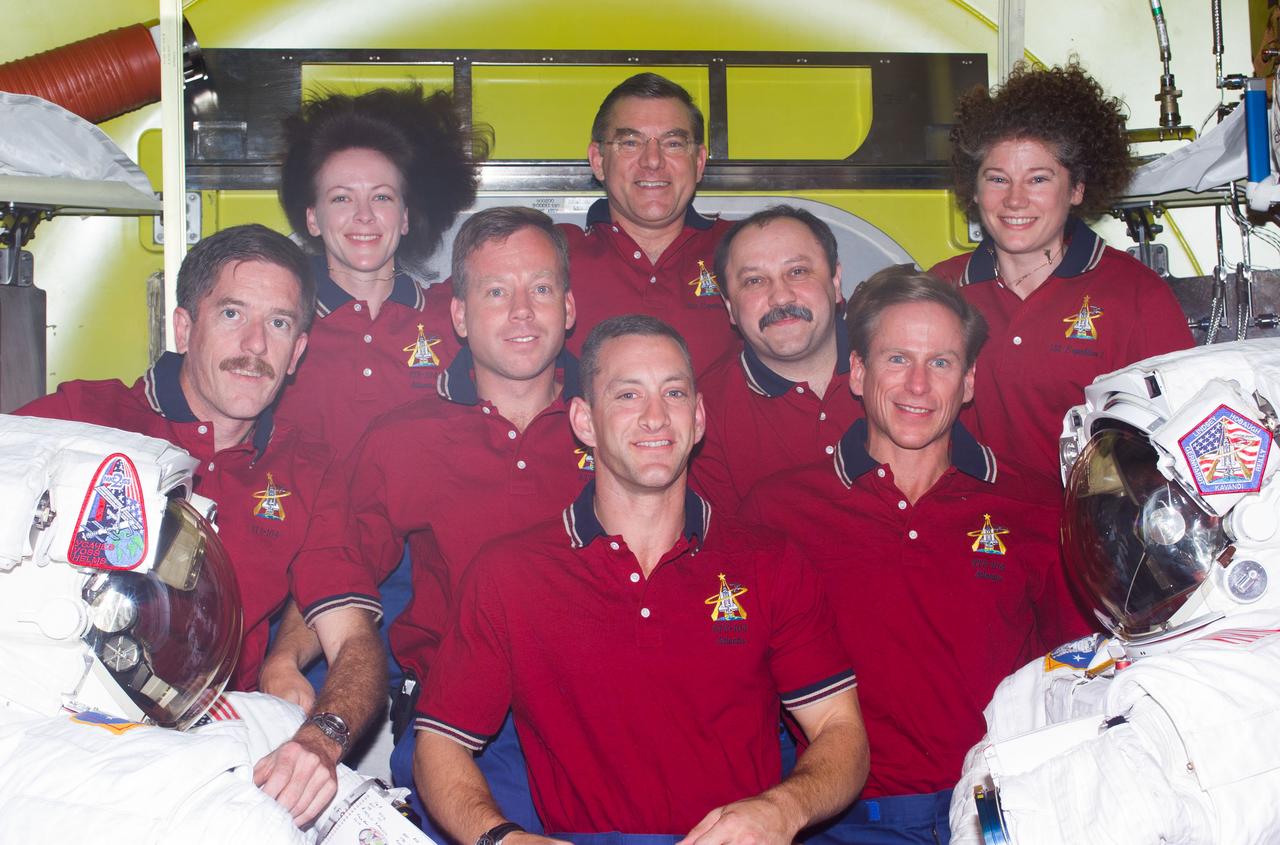
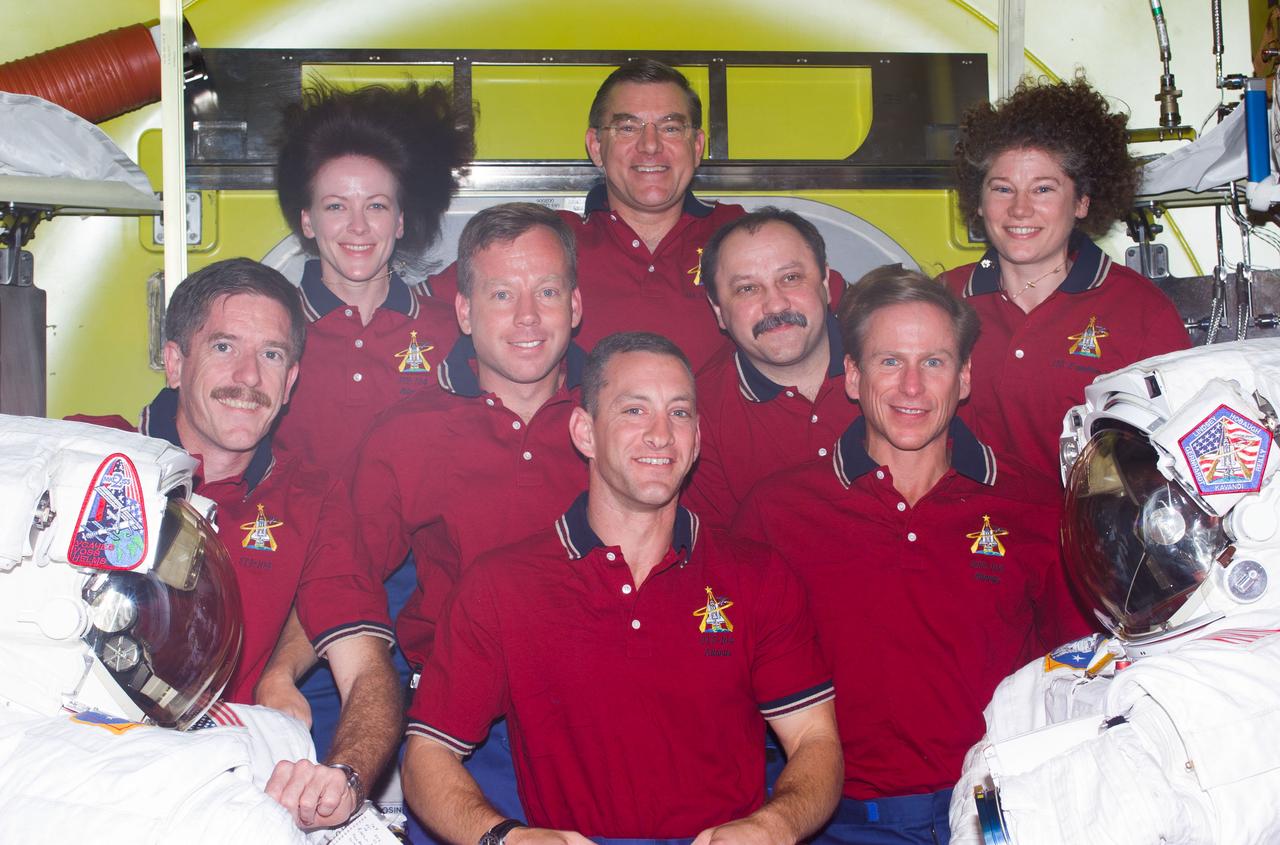
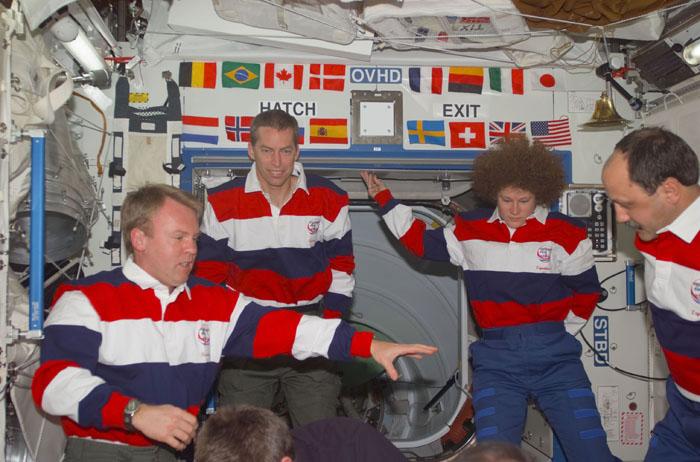
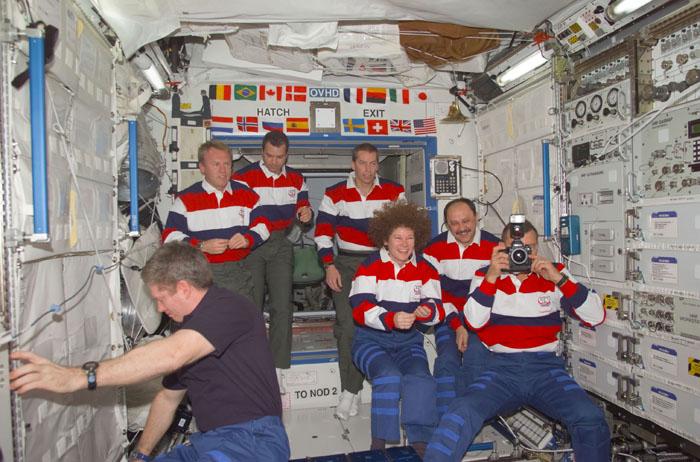
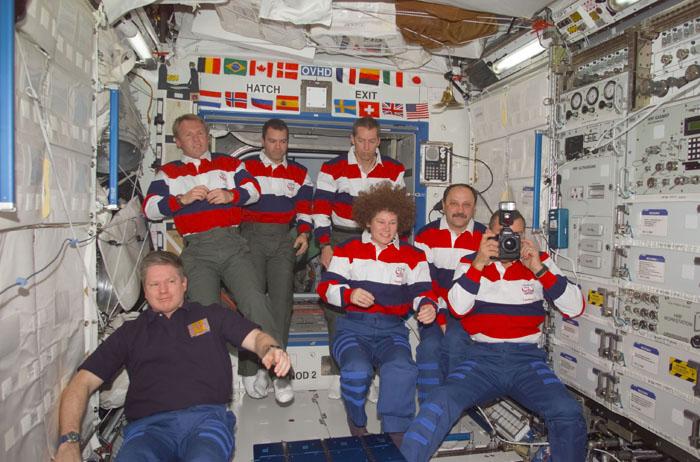
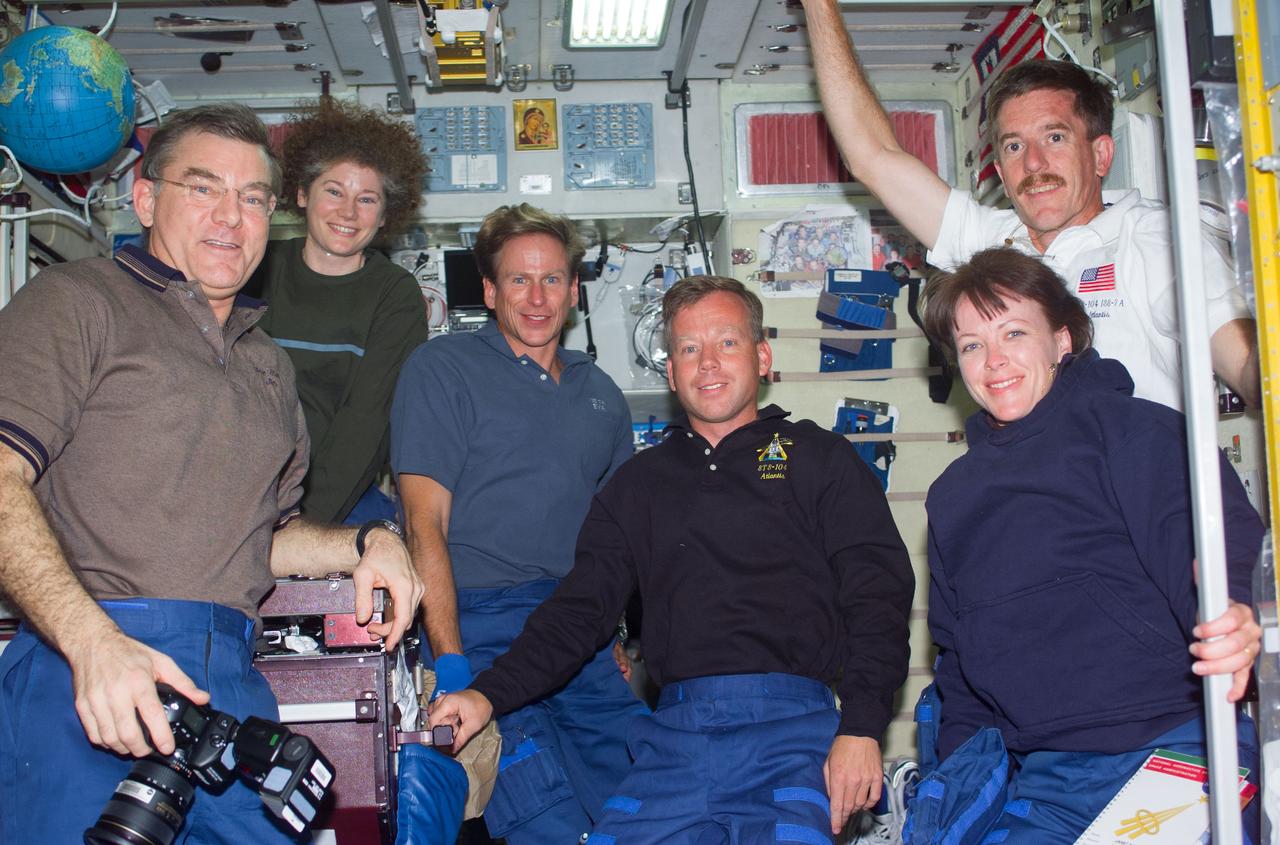
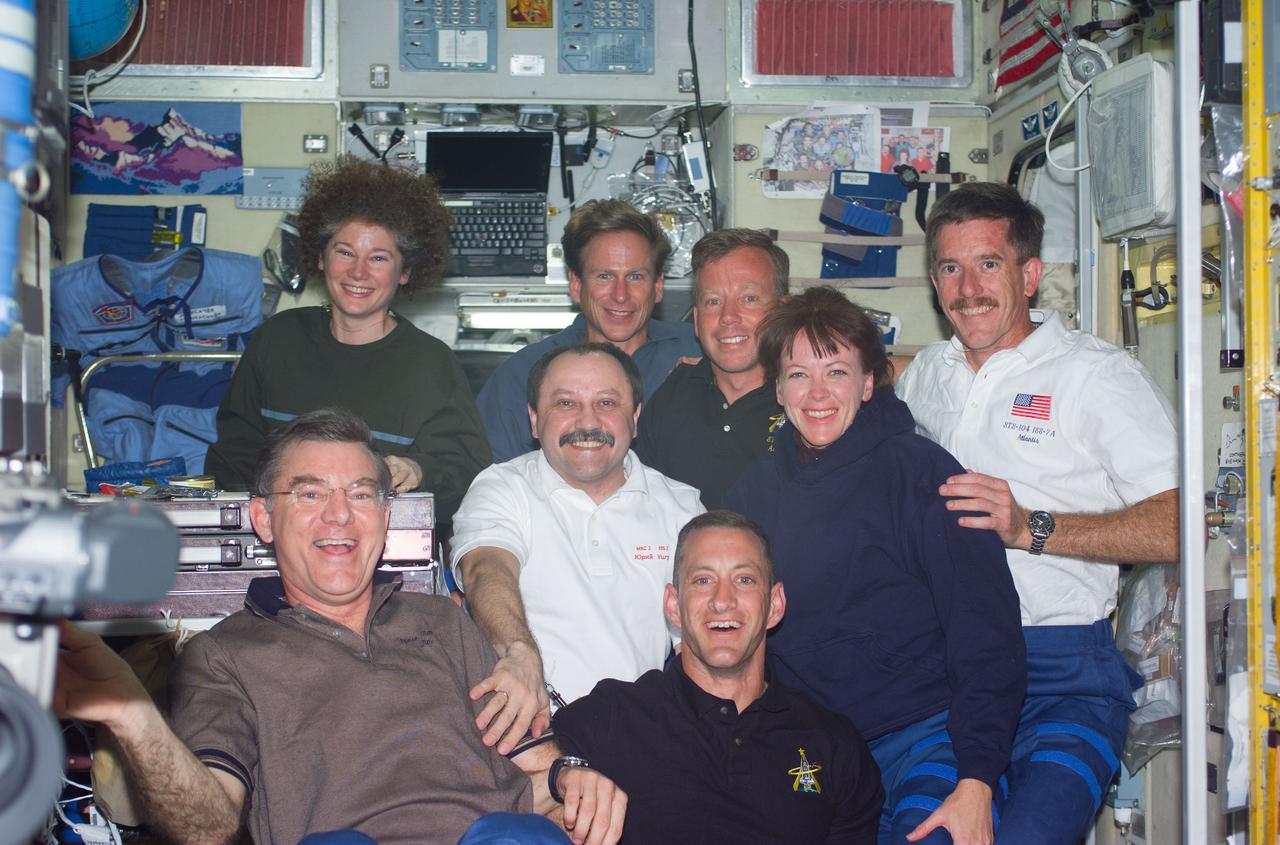
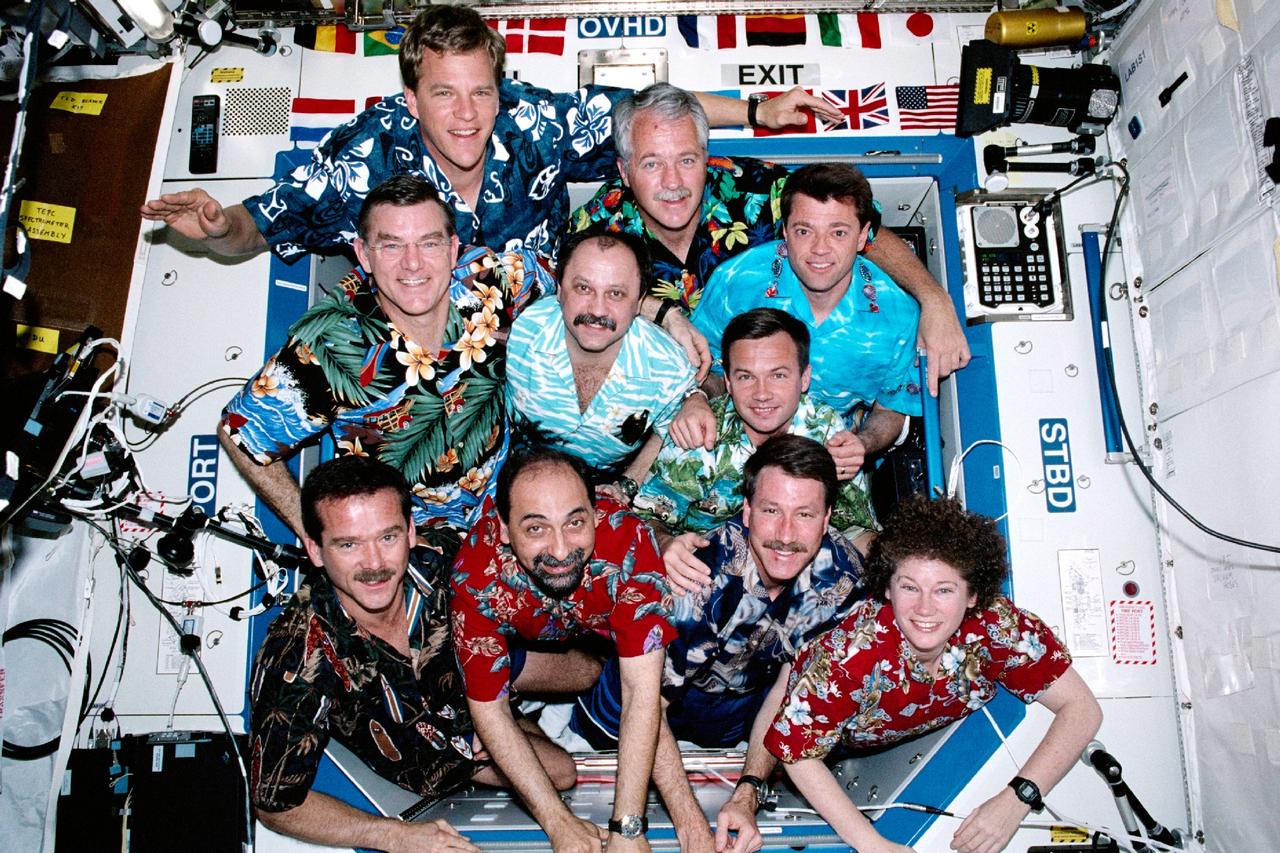
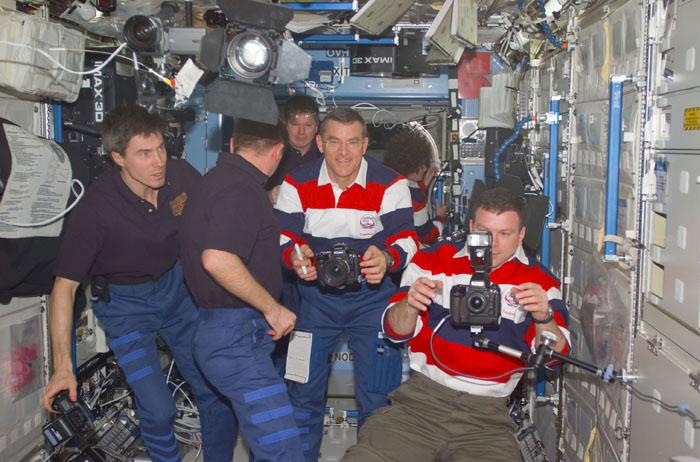
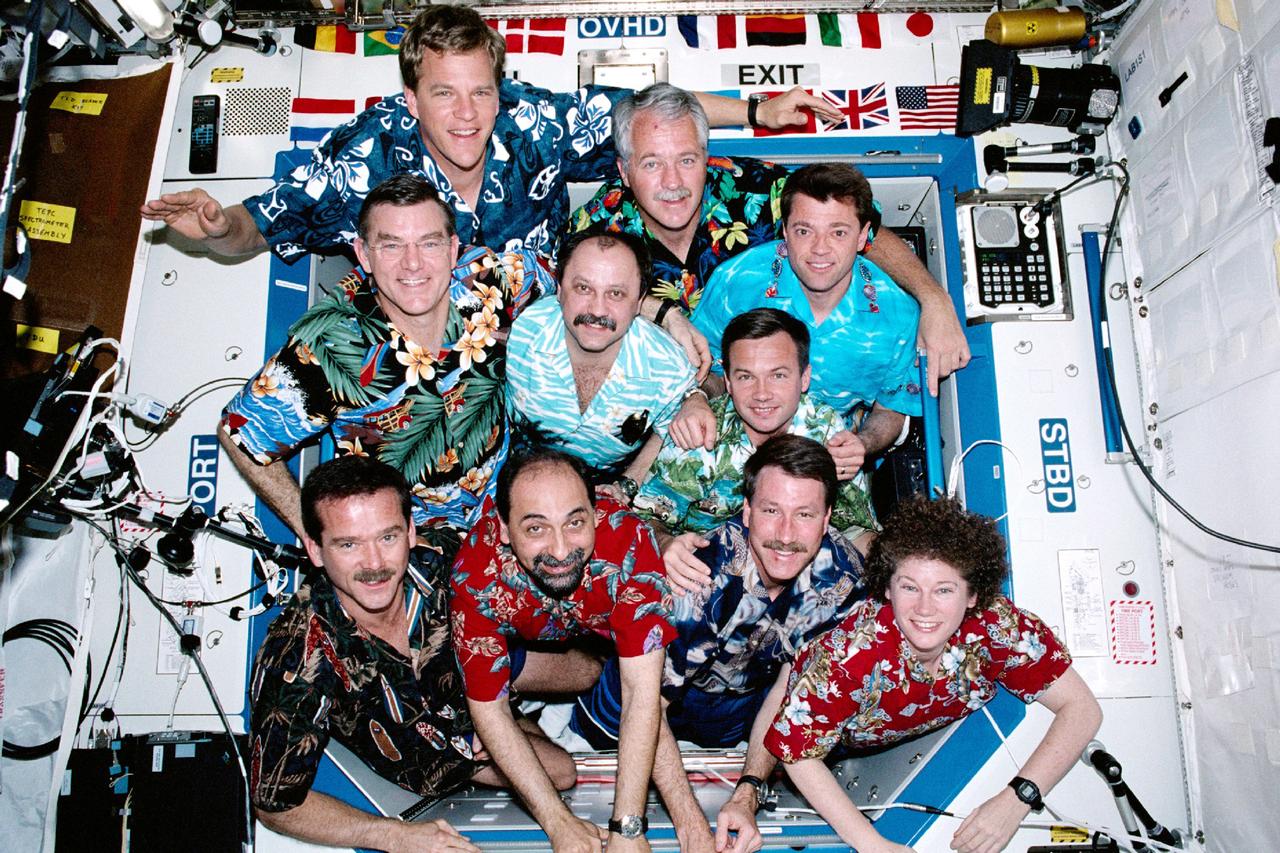
STS-100 and Expedition Two crew members pose for an onboard portrait in the Destiny laboratory of the International Space Station (ISS). Bottom, from left, are Chris A. Hadfield of the Canadian Space Agency, Umberto Guidoni of the European Space Agency, Kent V. Rominger, and Susan J. Helms (Expedition Two). Middle row, James S. Voss (Expedition Two), and cosmonauts Yury V. Usachev (Expedition Two) and Yuri V. Lonchakov. Top, Scott E. Parazynski, John L. Phillips, and Jeffrey S. Ashby. The crews accomplished the following objectives: The delivery of the Canadian-built Space Station Remote Manipulator System (SSRMS), Canadarm2, which is needed to perform assembly operations on later flights; The delivery and installation of a UHF anterna that provides space-to-space communications capability for U.S. based space walks; and carried the Italian-built multipurpose Logistics Module Raffaello containing six system racks and two storage racks for the U.S. Lab, Destiny.
International Space Station (ISS)
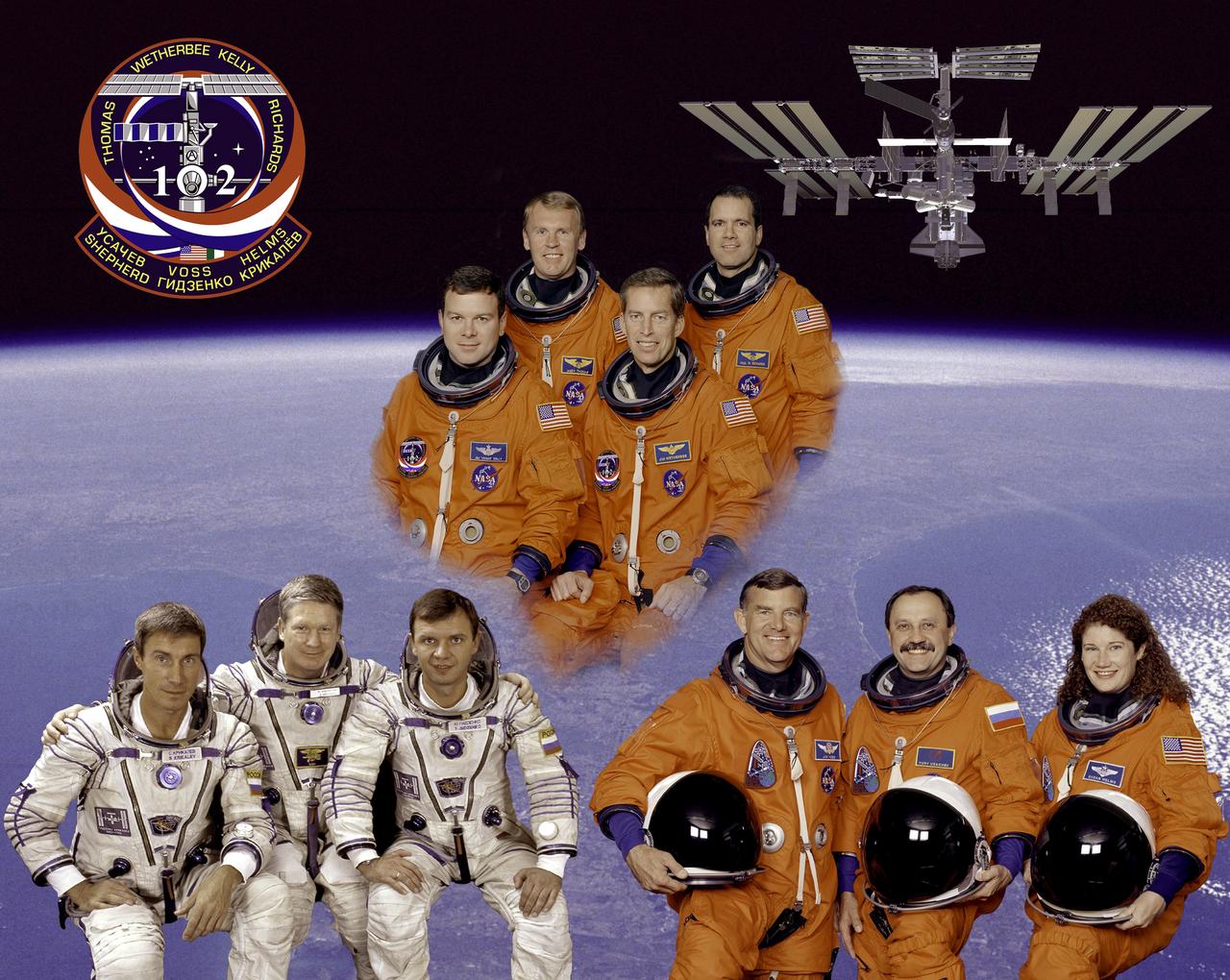
These 10 astronauts and cosmonauts represent the base STS-102 space travelers, as well as the crew members for the station crews switching out turns aboard the outpost. Those astronauts wearing orange represent the STS-102 crew members. In the top photo, from left to right are: James M. Kelly, pilot; Andrew S.W. Thomas, mission specialist; James D. Wetherbee, commander; and Paul W. Richards, mission specialist. The group pictured in the lower right portion of the portrait are STS-members as well as Expedition Two crew members (from left): mission specialist and flight engineer James S. Voss; cosmonaut Yury V. Usachev, Expedition Two Commander; and mission specialist and flight engineer Susan Helms. The lower left inset are the 3 man crew of Expedition One (pictured from left): Cosmonaut Sergei K. Krikalev, flight engineer; astronaut William M. (Bill) Shepherd, commander; and cosmonaut Yuri P. Gidzenko, Soyuz commander. The main objective of the STS-102 mission was the first Expedition Crew rotation and the primary cargo was the Leonardo, the Italian Space Agency-built Multipurpose Logistics Module (MPLM). The Leonardo MPLM is the first of three such pressurized modules that will serve as the International Space Station's (ISS') moving vans, carrying laboratory racks filled with equipment, experiments, and supplies to and from the Station aboard the Space Shuttle. NASA's 103rd overall mission and the 8th Space Station Assembly Flight, STS-102 mission launched on March 8, 2001 aboard the Space Shuttle Orbiter Discovery.
International Space Station (ISS)
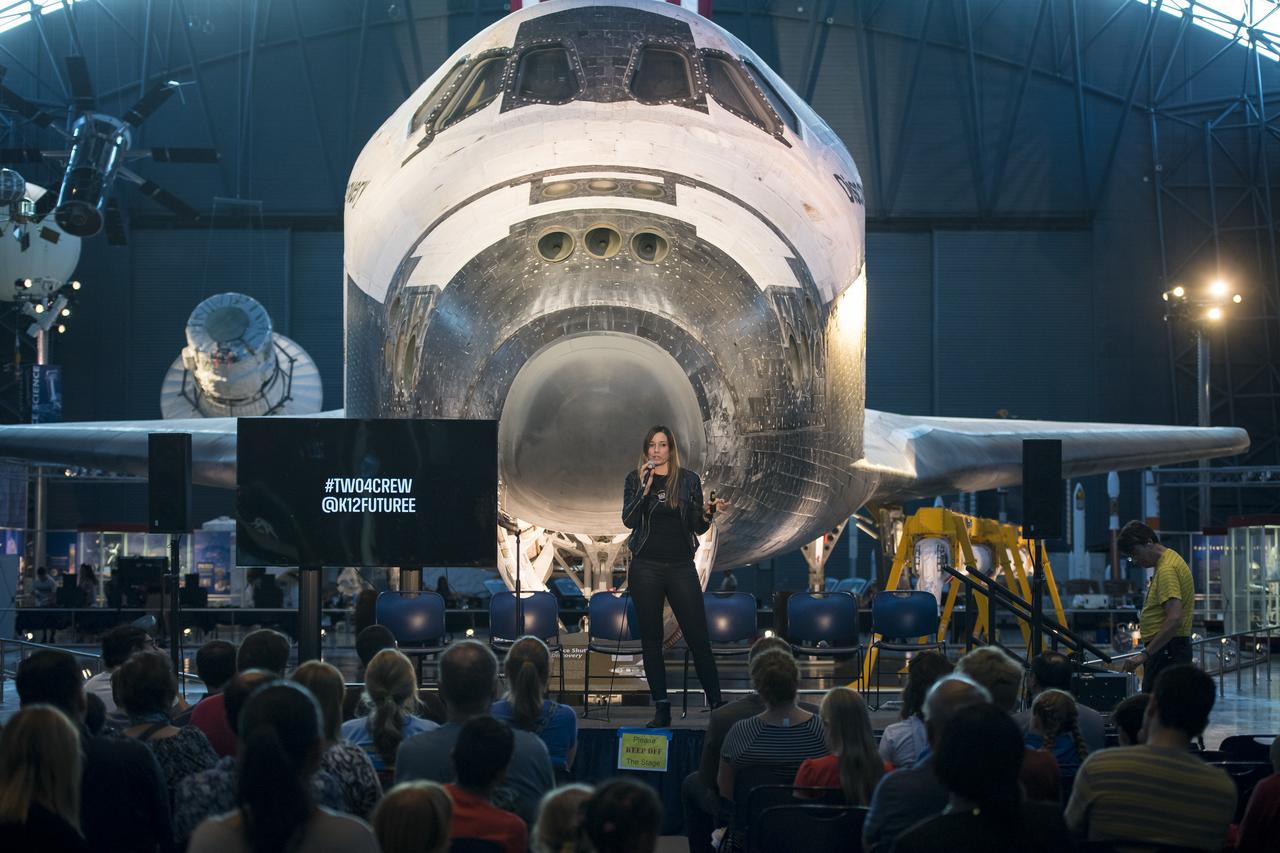
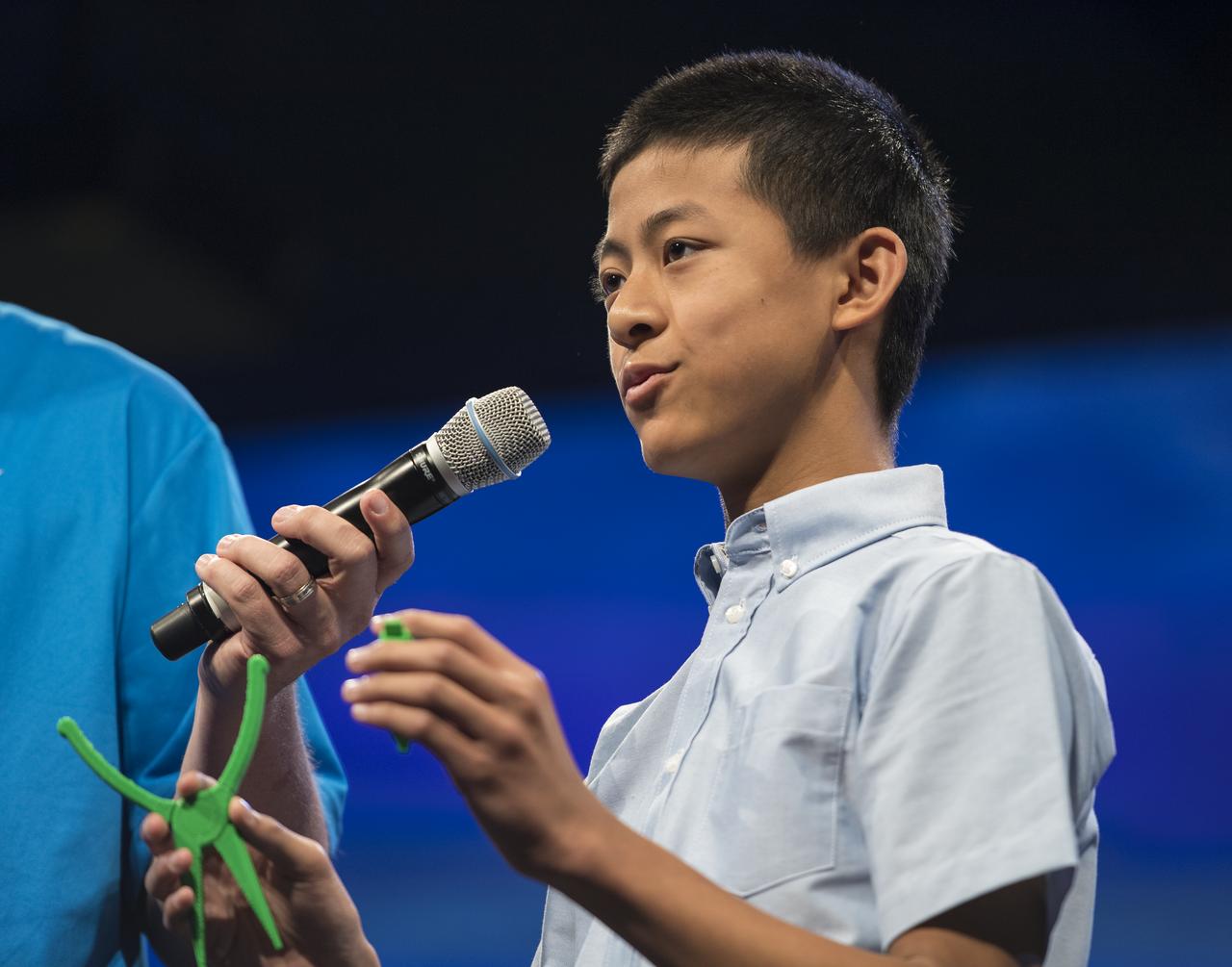
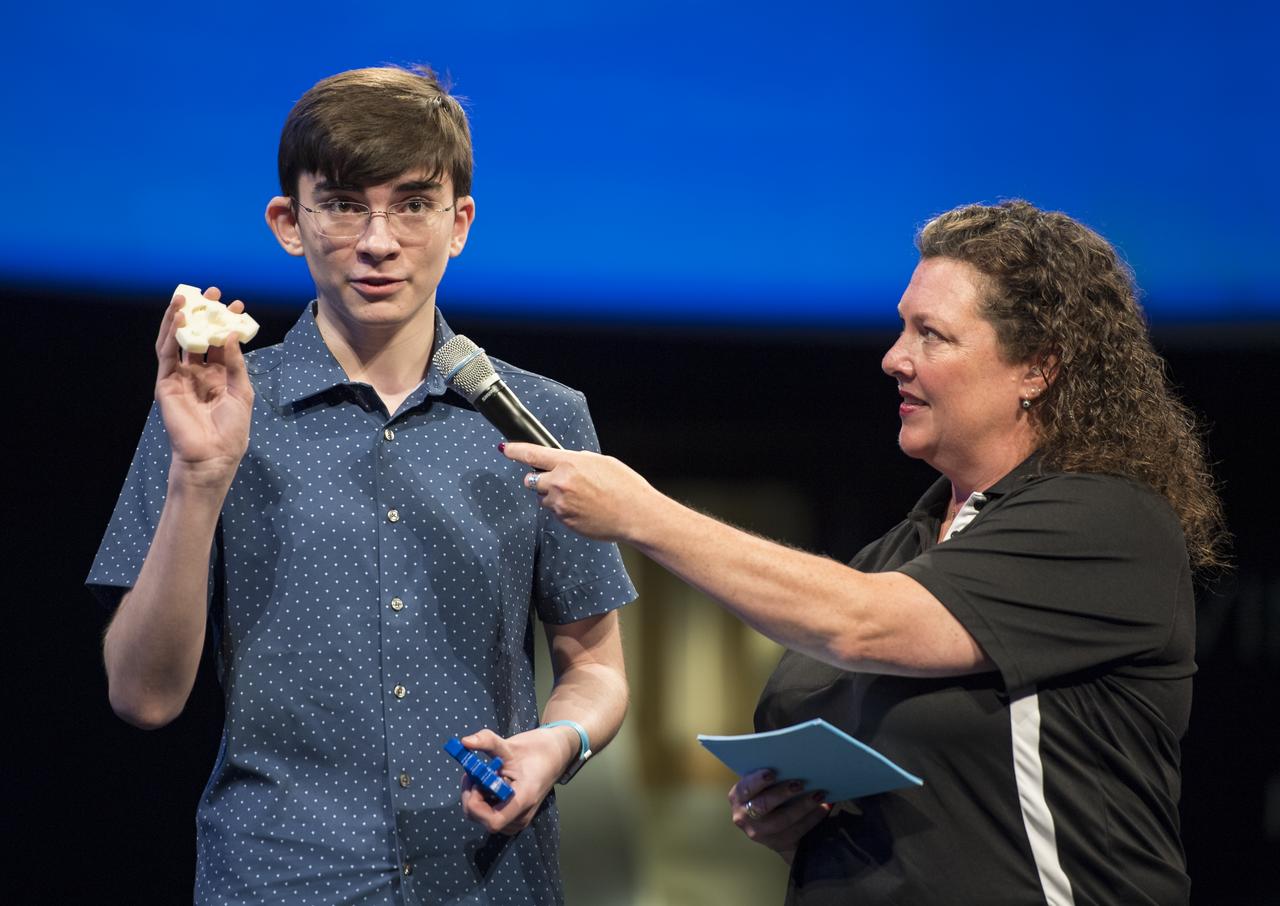
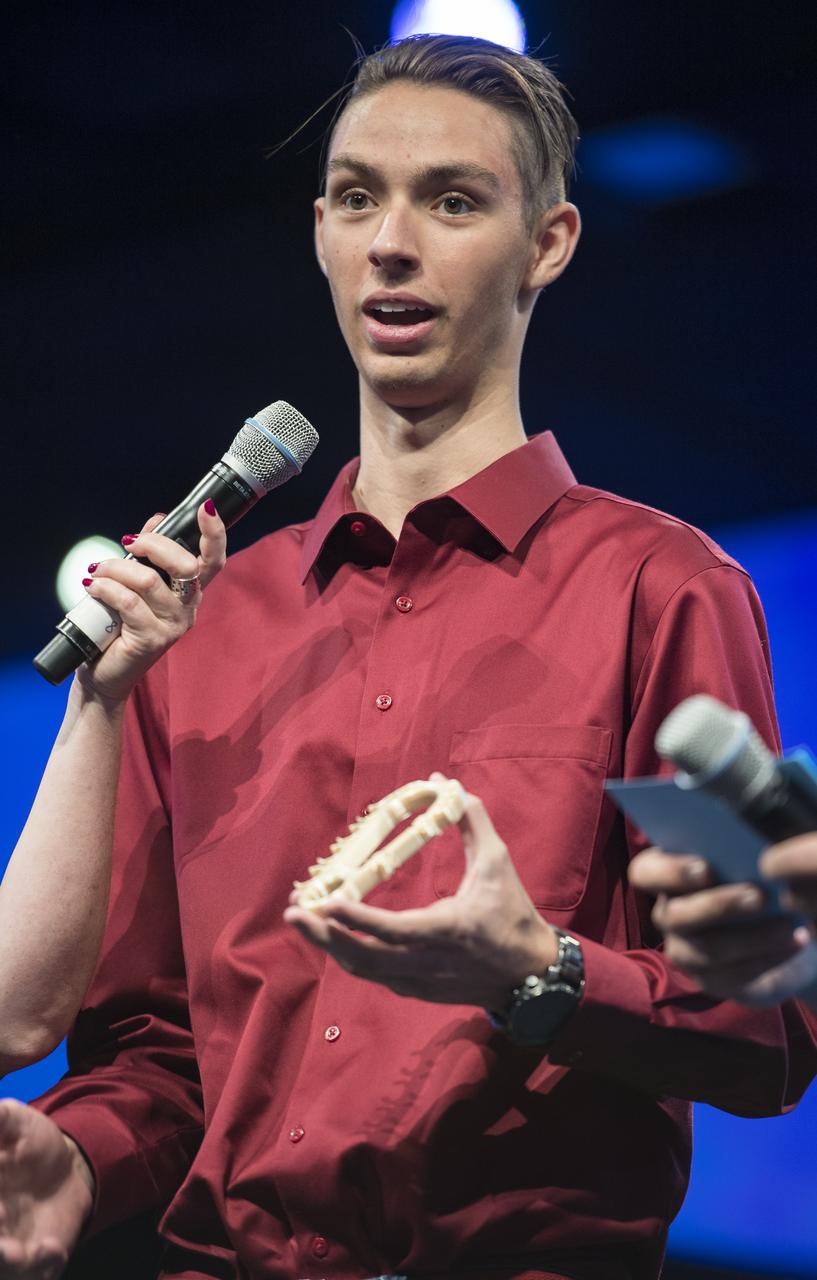
Future Engineers "Two for the Crew" competition winner, Jason Qin, speaks about his Two Pliers + 1 Handle, during a STEM in 30 event, Wednesday, June 27, 2018 at Smithsonian's National Air and Space Museum in Washington. Photo Credit: (NASA/Aubrey Gemignani)
Astronaut Serena Auñon-Chancellor at Air and Space Museum
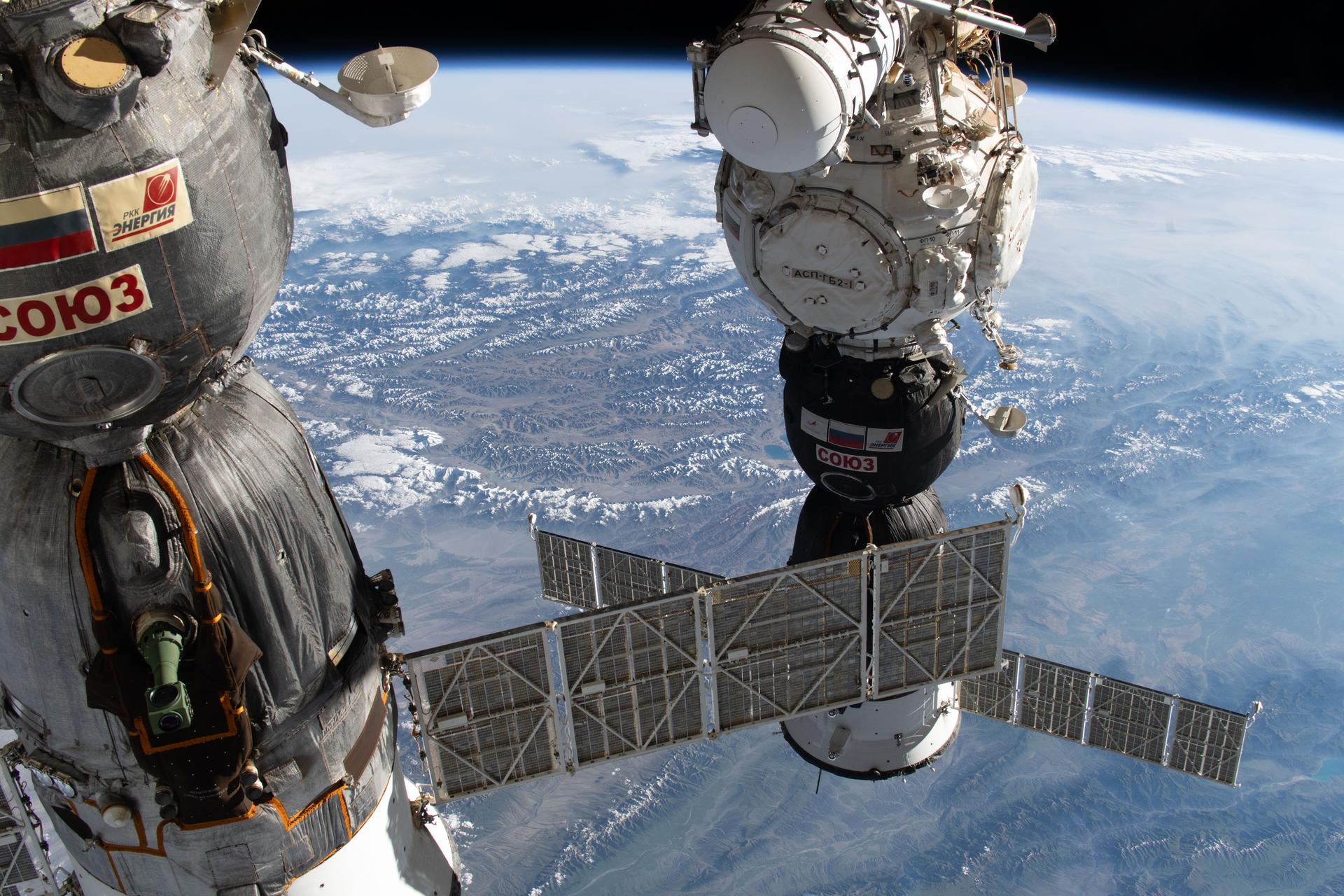
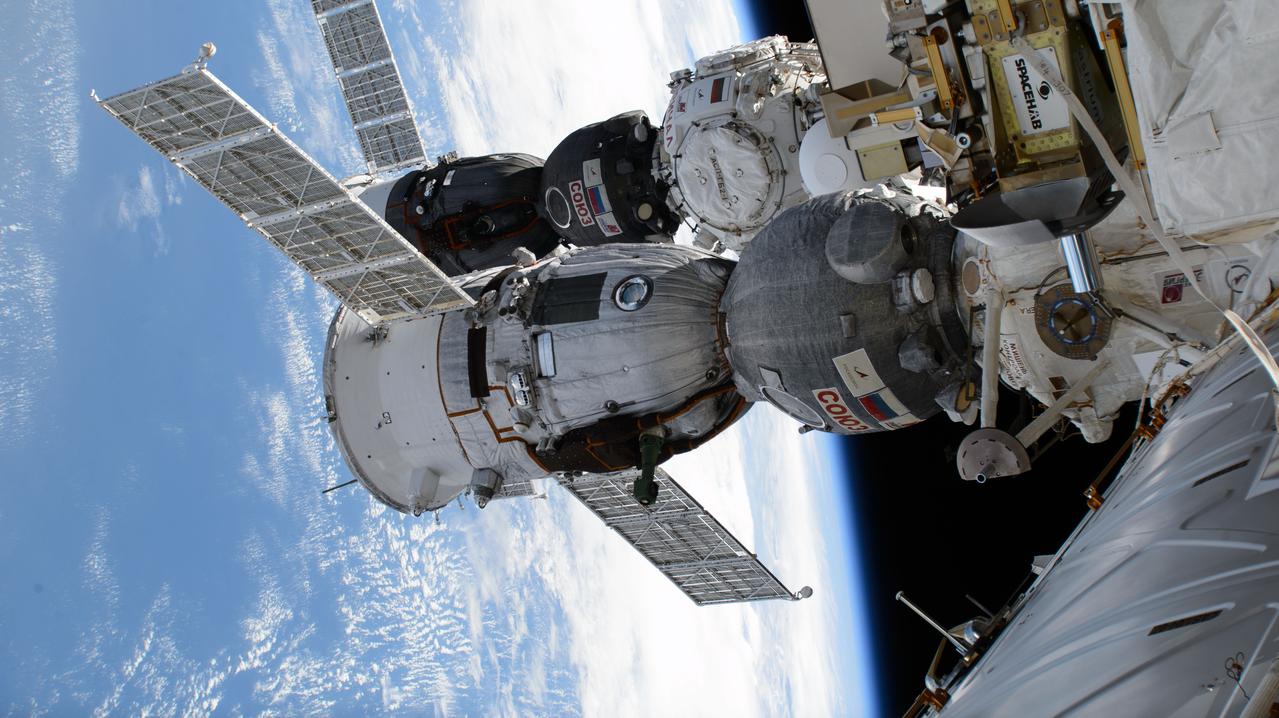
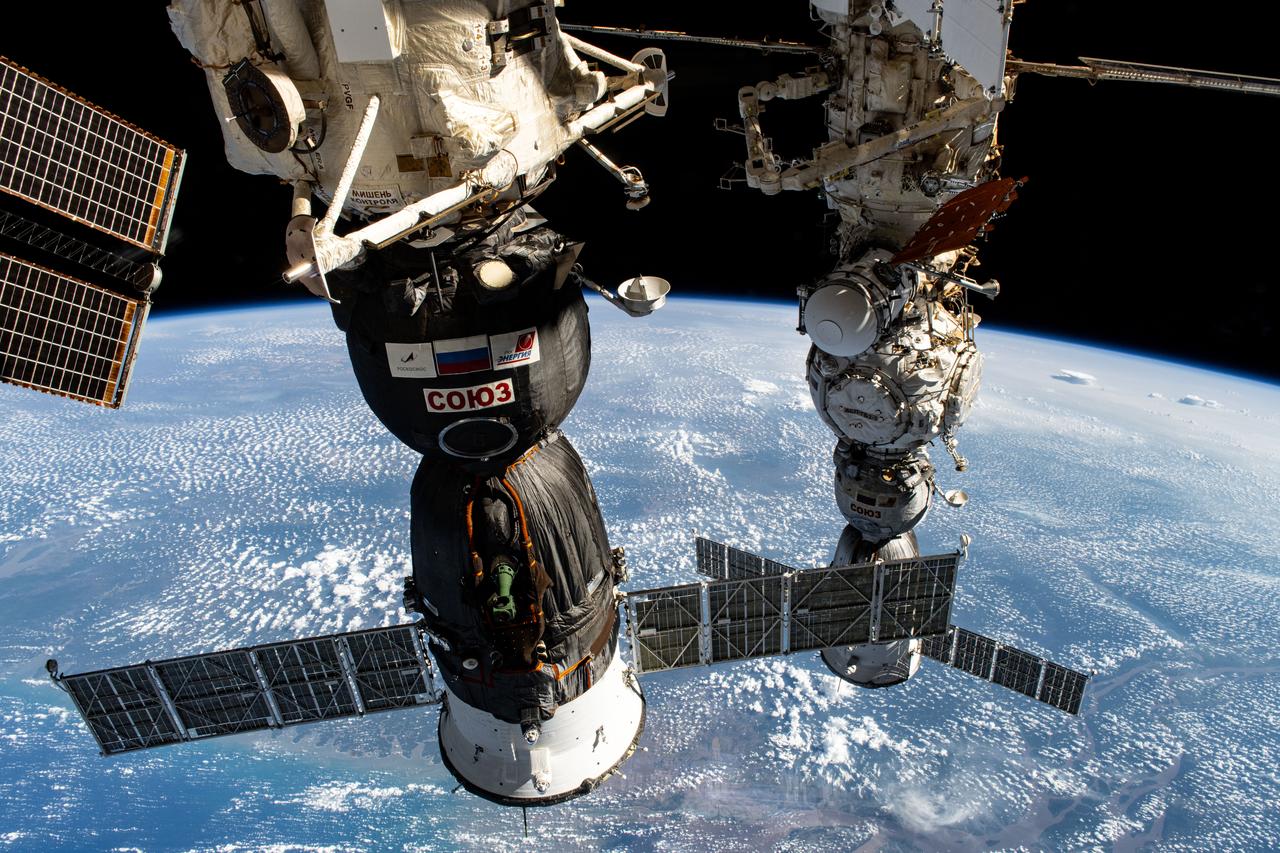
iss071e665075 (Sept. 16, 2024) --- Two Roscosmos crew ships, the Soyuz MS-26 docked to the Rassvet module (foreground) and the Soyuz MS-25 (background) docked to the Prichal docking module, are pictured parked at the International Space Station as it orbited 257 miles above the Atlantic Ocean near Brazil's Amazon Delta.
Two Roscosmos Soyuz crew ships
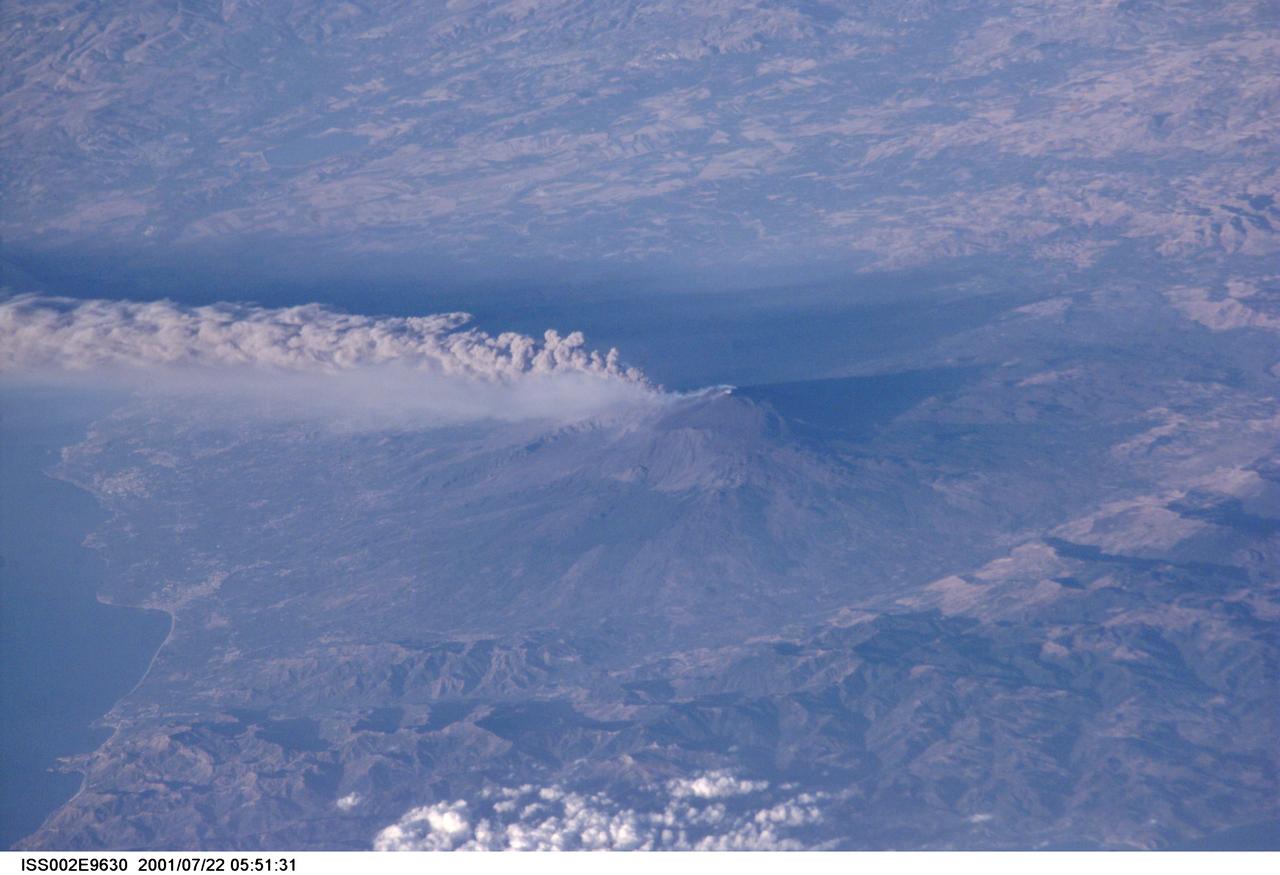
ISS002-E-9630 (22 July 2001) --- The active volcano Mt. Etna on the island of Sicily was recorded by an Expedition Two crew member with a digital still camera.
Mt. Etna taken by the Expedition Two crew
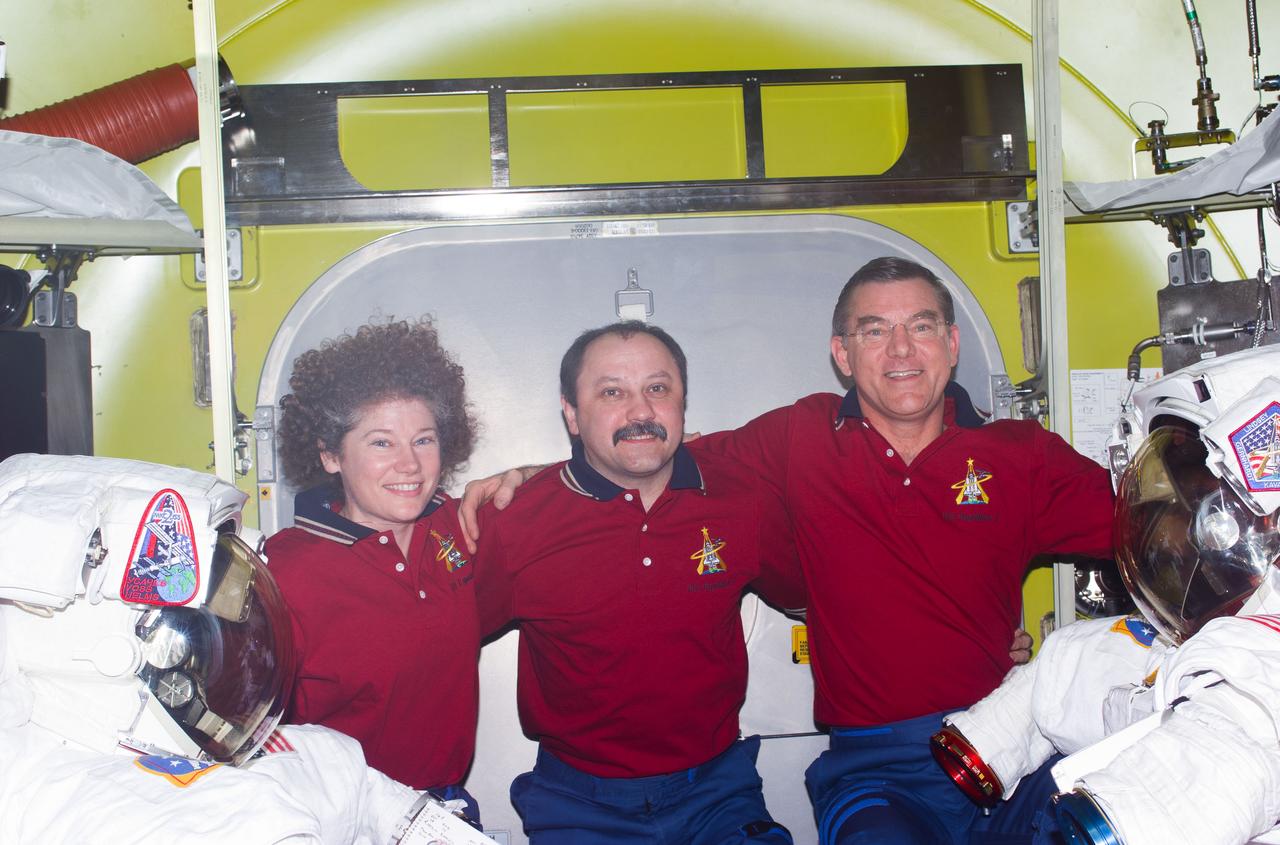
STS104-E-5188 (20 July 2001) --- The Expedition Two crew poses for an in-flight portrait in the newly- delivered Quest Airlock on the International Space Station (ISS). Flanked by two extravehicular mobility unit (EMU) space suits, are, from left, Susan J. Helms, Yury V. Usachev and James S. Voss.  Usachev is commander and Voss and Helms are both flight engineers. This image was recorded by one of the visiting STS-104 crew members using a digital still camera.
Expedition Two Crew photo in Quest airlock
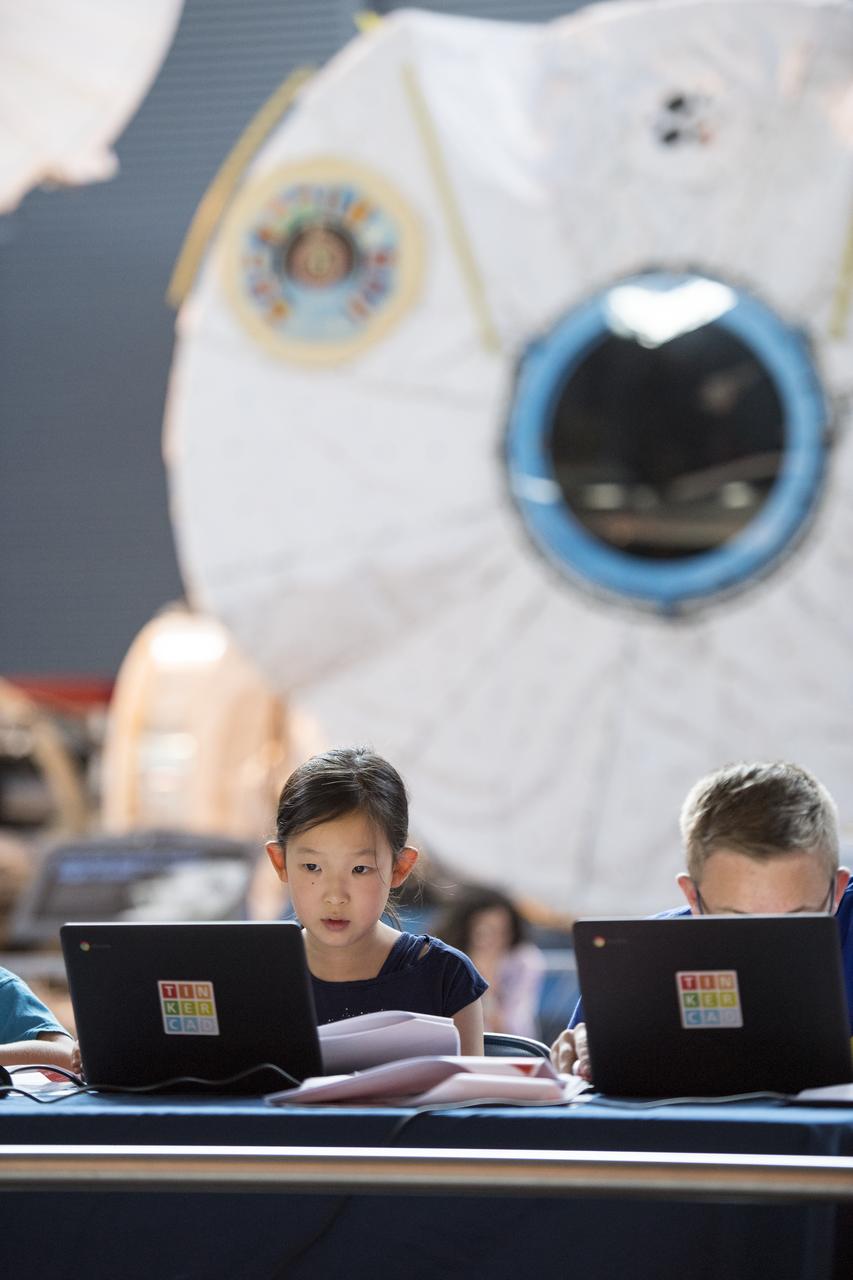
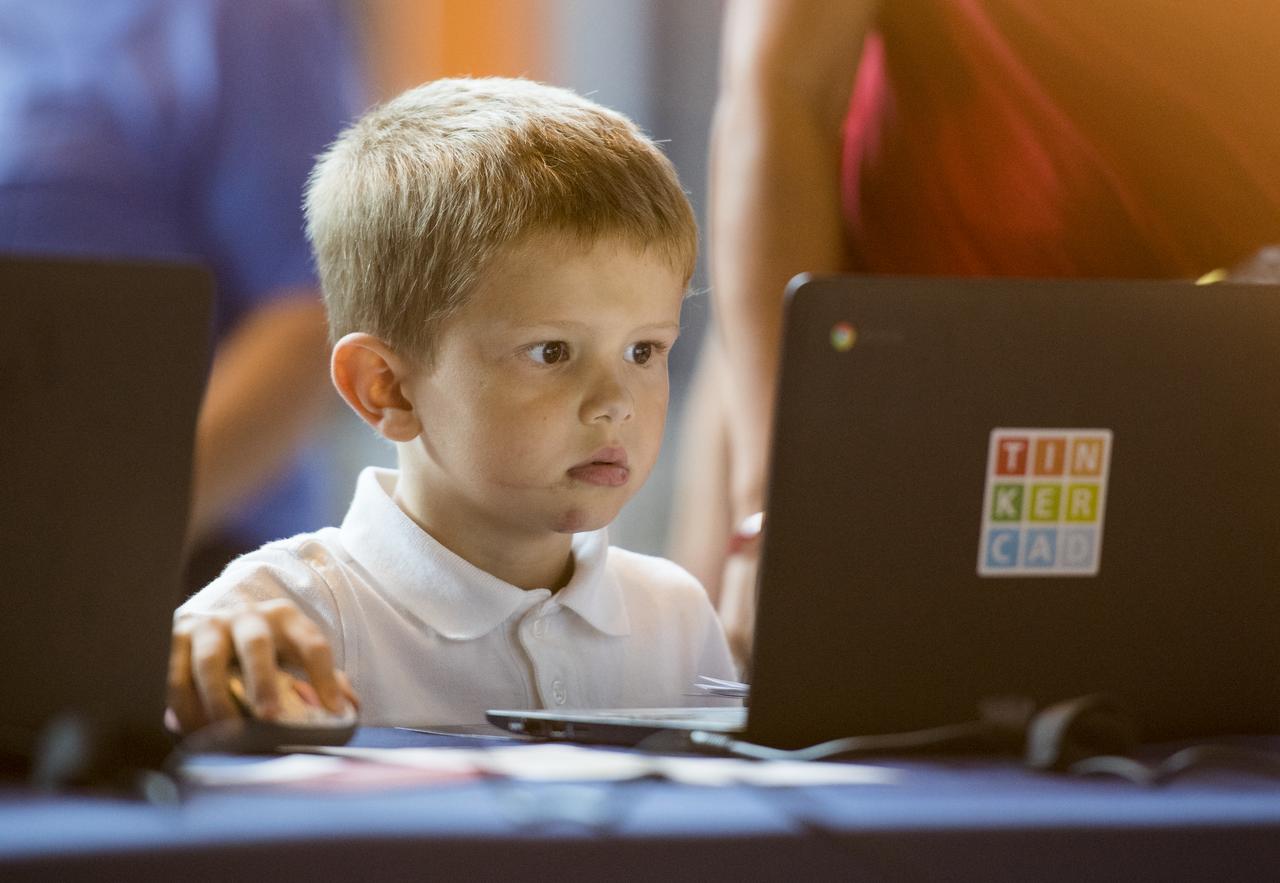
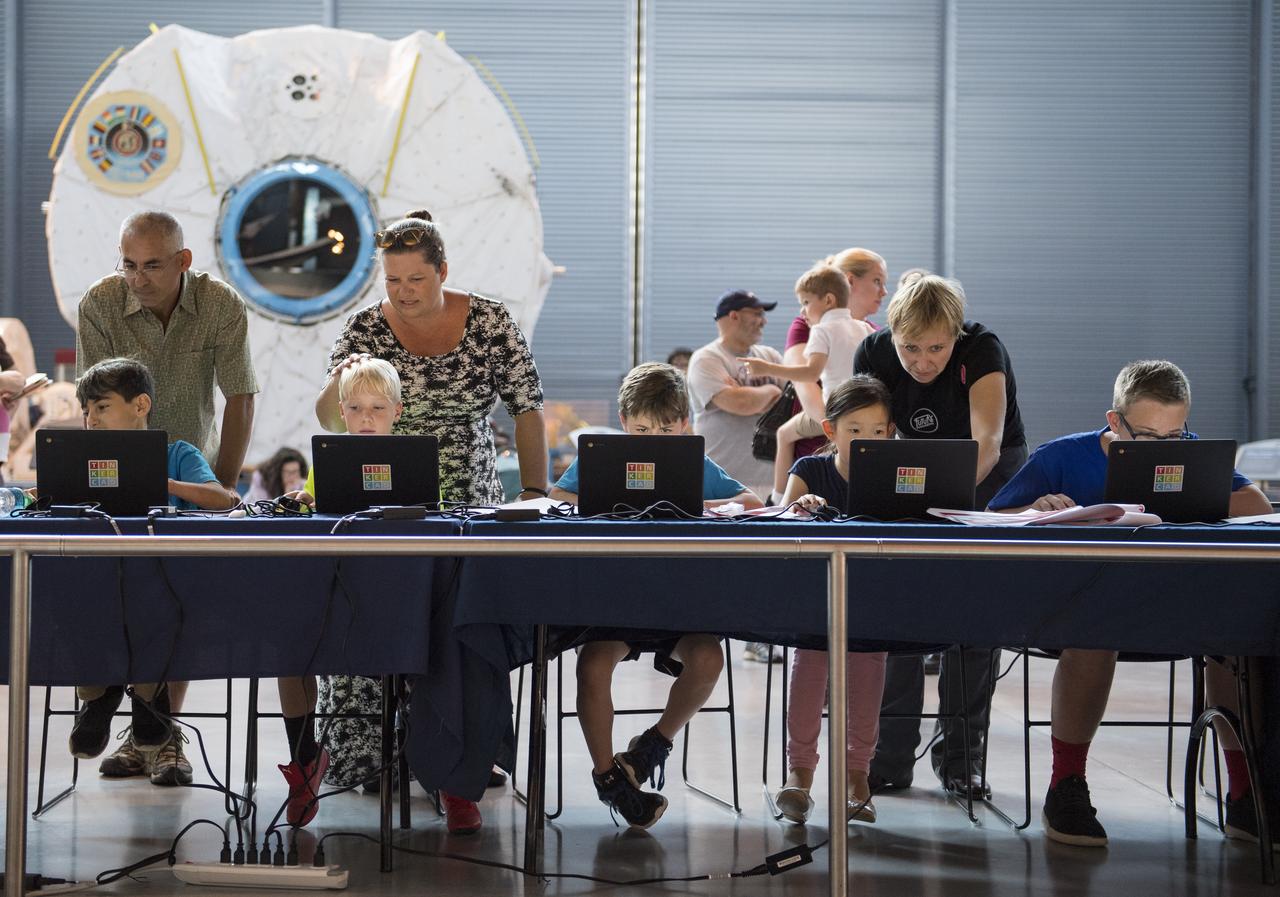
Participants create digital 3D models using Autodesk Tinkercad in the Two for the Crew Challenge at a pop-up makerspace held by Future Engineers, with support from NASA and The American Society of Mechanical Engineers (ASME), at the Steven F. Udvar-Hazy Center, Thursday, September 21, 2017 in Chantilly, Virginia. Participants had the opportunity to create digital 3D models and watch objects being printed with Makerbot 3D printers. The winner of the Two for the Crew challenge will have their design printed on the International Space Station. Photo Credit: (NASA/Aubrey Gemignani)
NASA SOLVE Challenge Event
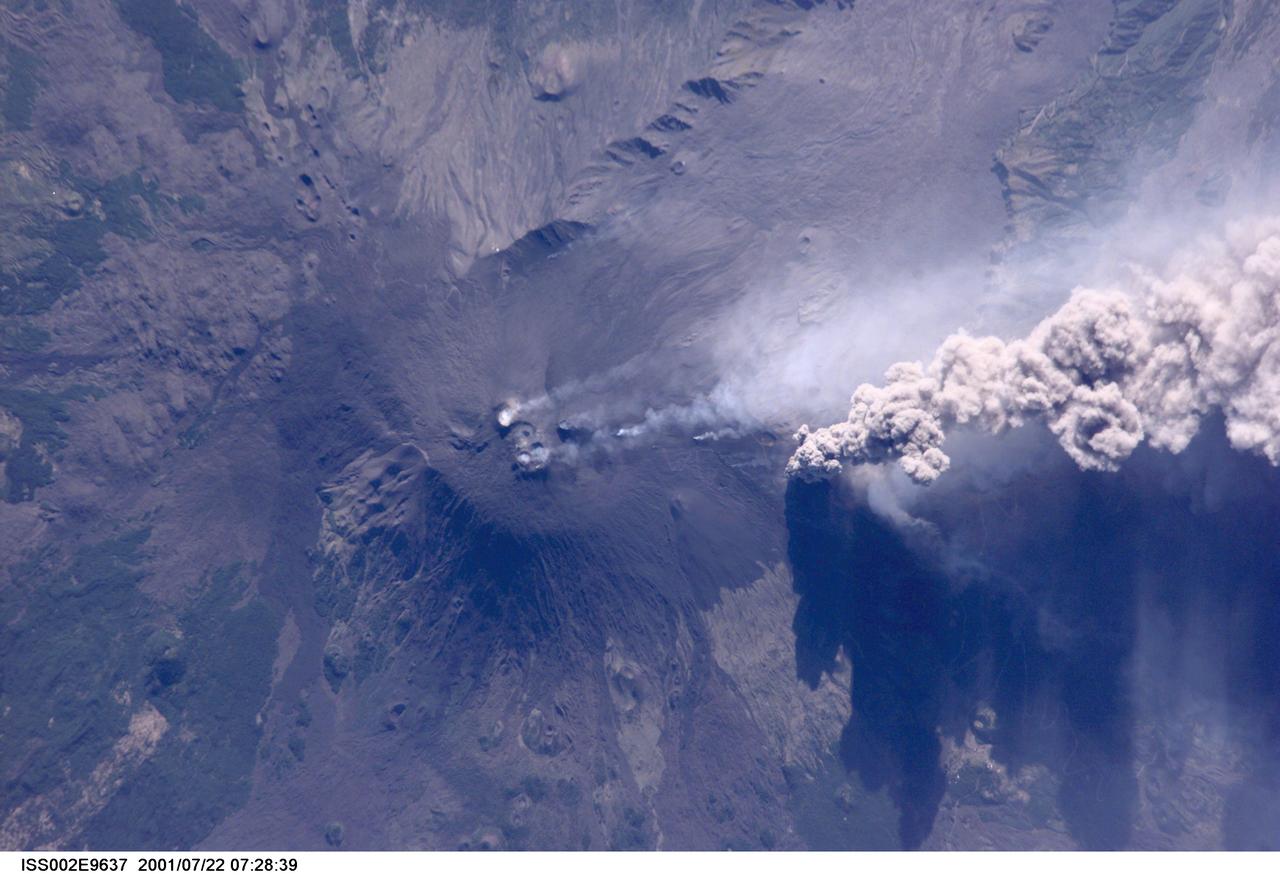
ISS002-E-9637 (22 July 2001) --- An overhead look at the smoke and ash being expelled from the erupting volcano Mt. Etna on the island of Sicily.  This image was recorded by an Expedition Two crew member with a digital still camera.
Mt. Etna taken by the Expedition Two crew
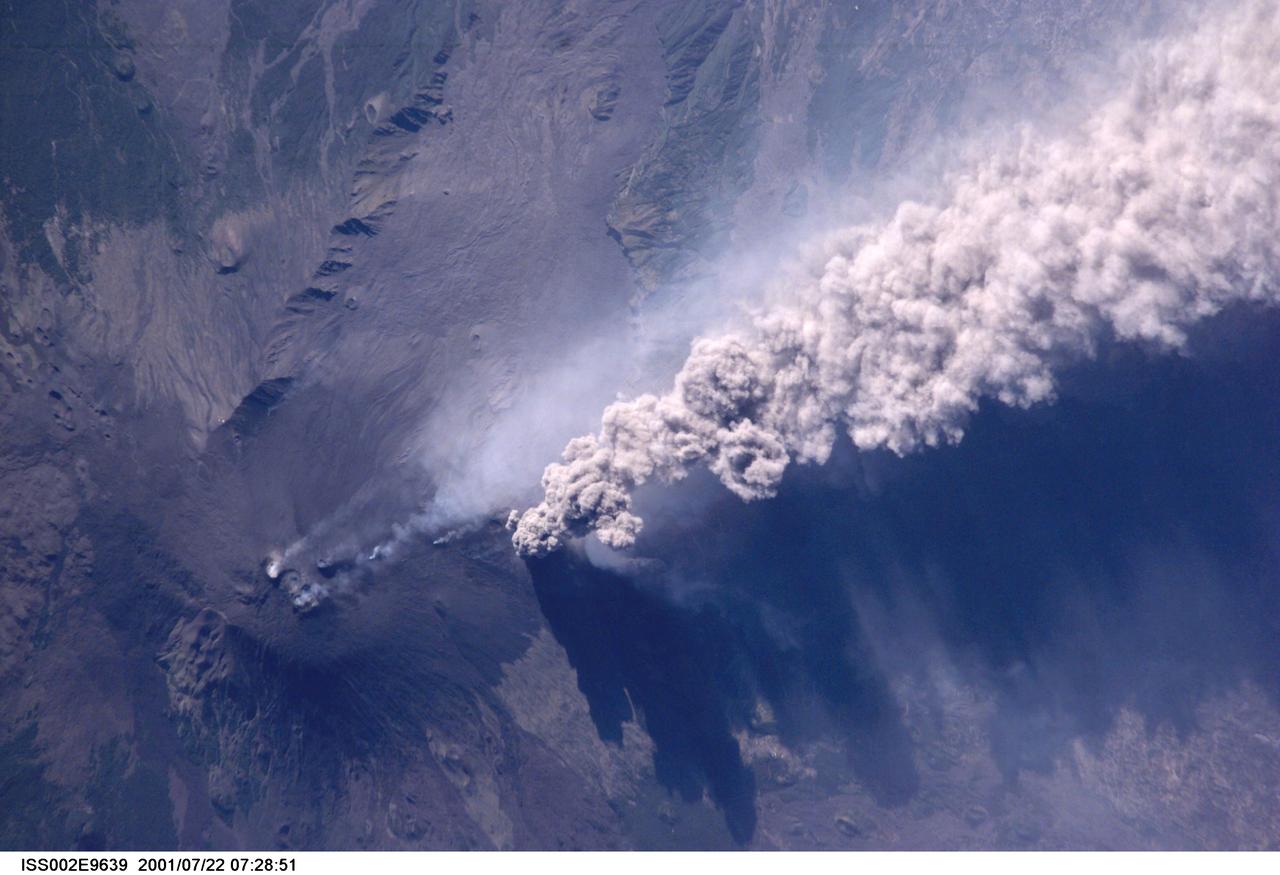
ISS002-E-9639 (22 July 2001) --- An overhead look at the smoke and ash being expelled from the erupting volcano Mt. Etna on the island of Sicily.  This image was recorded by an Expedition Two crew member with a digital still camera.
Mt. Etna taken by the Expedition Two crew
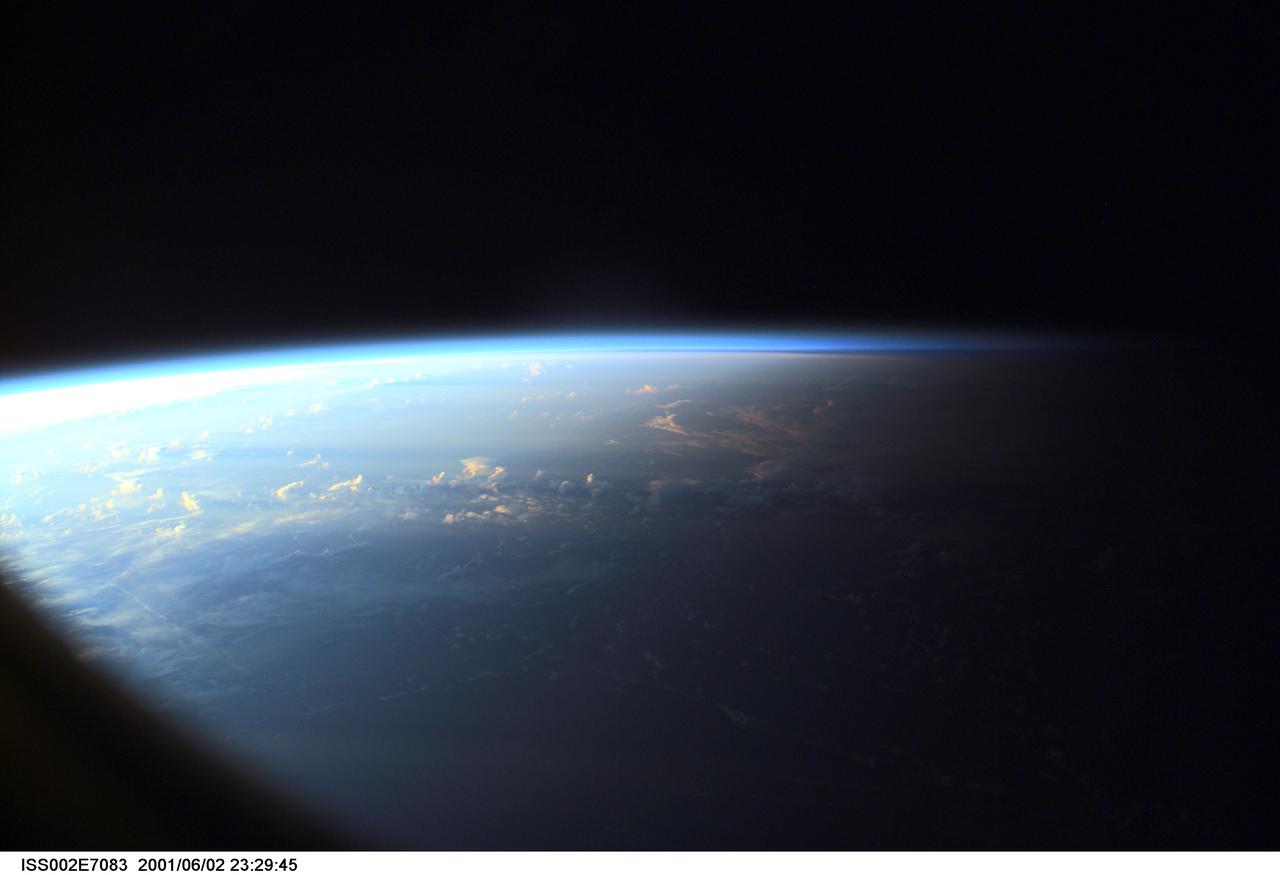
ISS002-E-7083 (2 June 2001) --- Earth's limb at sunset as photographed by one of the Expedition Two crew members with a digital still camera aimed through the nadir window of the U.S. laboratory Destiny.
Earth limb taken by the Expedition Two crew
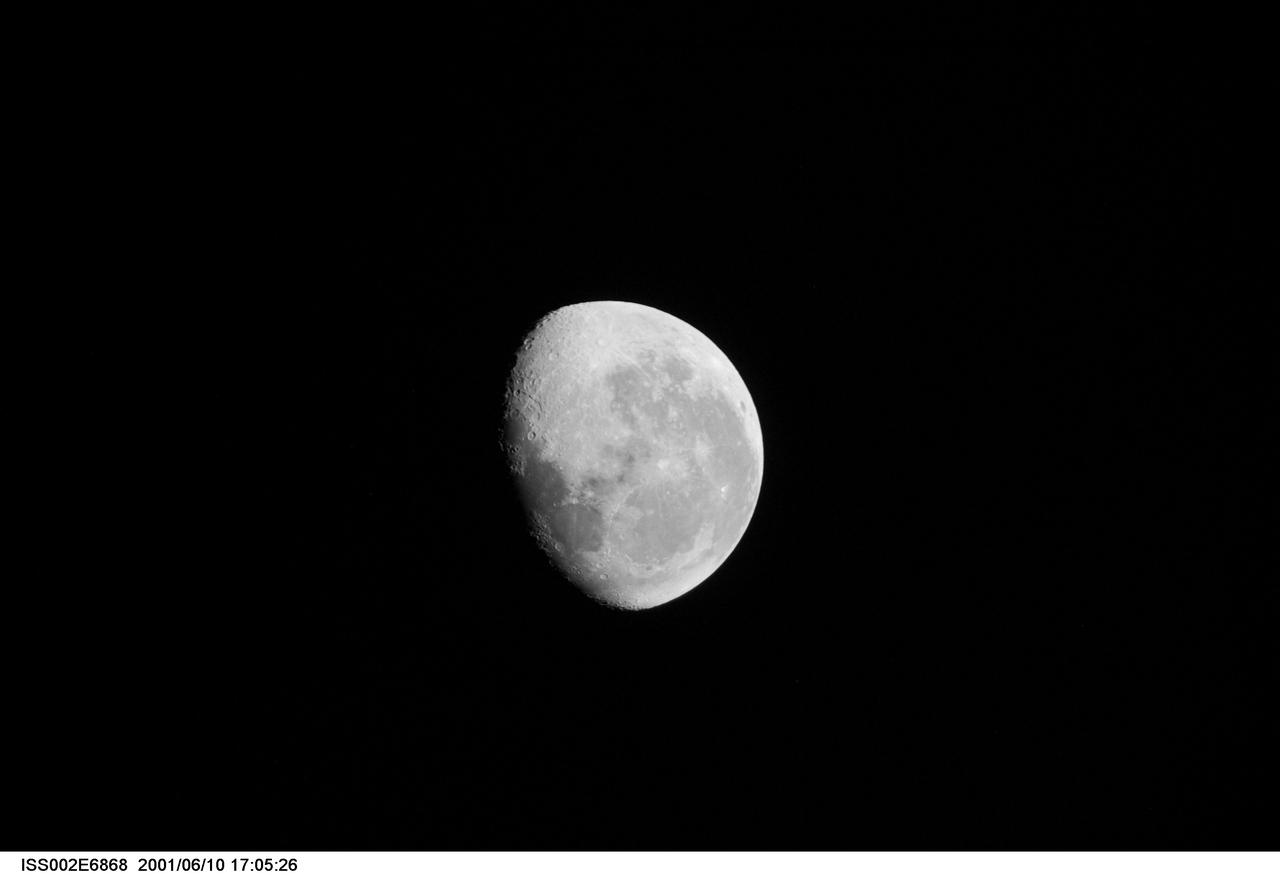
ISS002-E-6868 (10 June 2001) --- View of a gibbous Moon photographed by one of the crew members aboard the International Space Station (ISS) for Expedition Two.  The image was recorded with a digital still camera.
View of the Moon taken by the Expedition Two crew
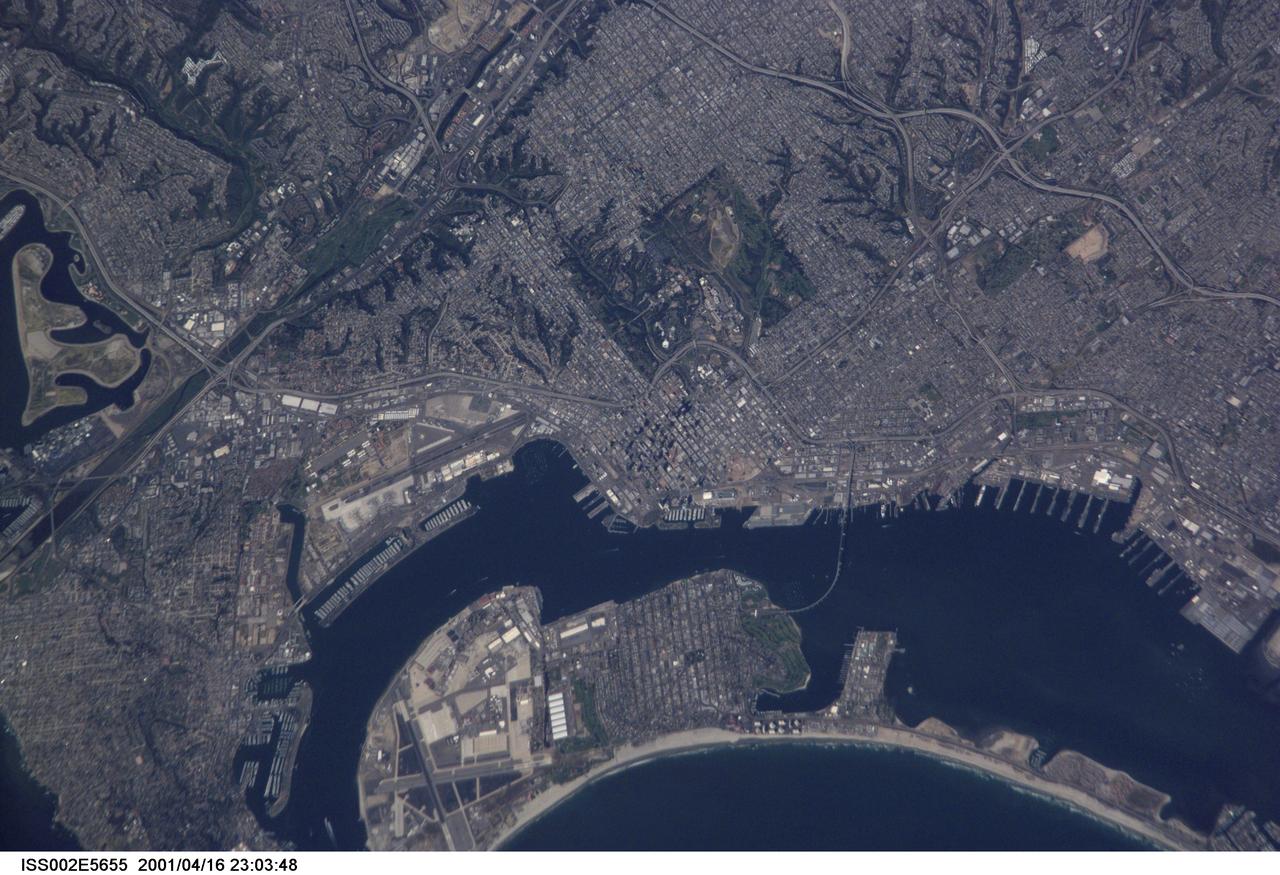
ISS002-E-5655 (16 April 2001) --- A detailed vertical view of San Diego, California, was provided by a digital still camera by the Expedition Two crew onboard the International Space Station (ISS).
San Diego, California as seen by Expedition Two crew
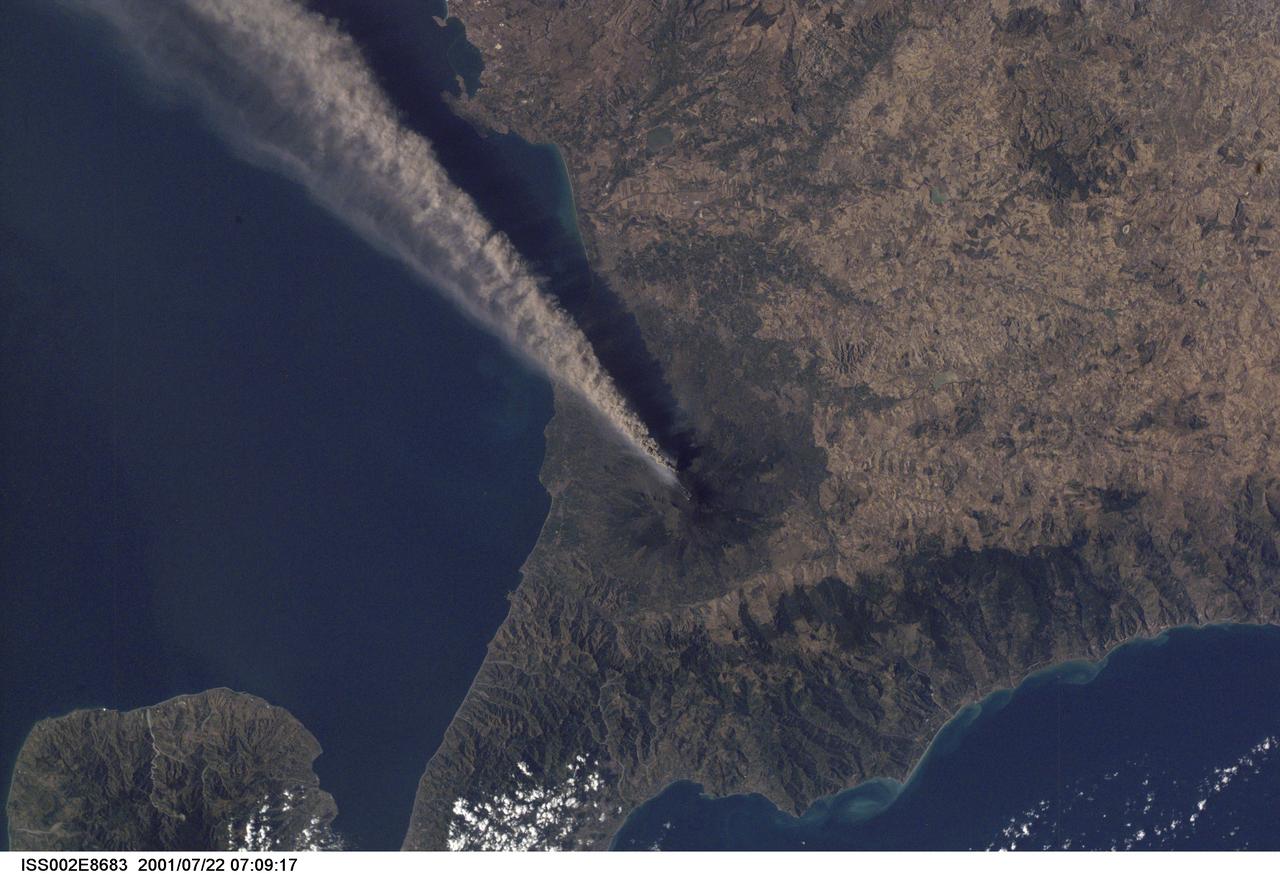
ISS002-E-8683 (22 July 2001) --- Smoke and ash combine to create a plume extending from the erupting volcano on Mt. Etna in  Sicily.  The digital still image was recorded by one of the Expedition Two crew members.
Mt. Etna, Italy taken by the Expedition Two crew
STS104-E-5177 (20 July 2001) --- Seven astronauts and a cosmonaut representing Rosaviakosmos take a break in joint activities involving the Expedition Two and STS-104 crews to pose for an in-flight portrait in the newly delivered Quest Airlock on the International Space Station (ISS). Flanked by two extravehicular mobility unit (EMU) space suits,  Charles O. Hobaugh is in front. On the second row are, from the left, James F. Reilly, Steven W. Lindsey, Yury V. Usachev and Michael L. Gernhardt. In the rear are  Janet L. Kavandi, James S. Voss and Susan J. Helms.  Usachev, commander; along with Voss and Helms, both flight engineers, comprise the Expedition Two crew.  Lindsey is STS-104  commander, with Hobaugh serving as pilot.  Kavandi, STS-104 flight engineer, is joined by Gernhardt and Reilly as mission specialists on the mission. This image was recorded with a digital still camera.
Joint STS-104 and Expedition Two Crew photo
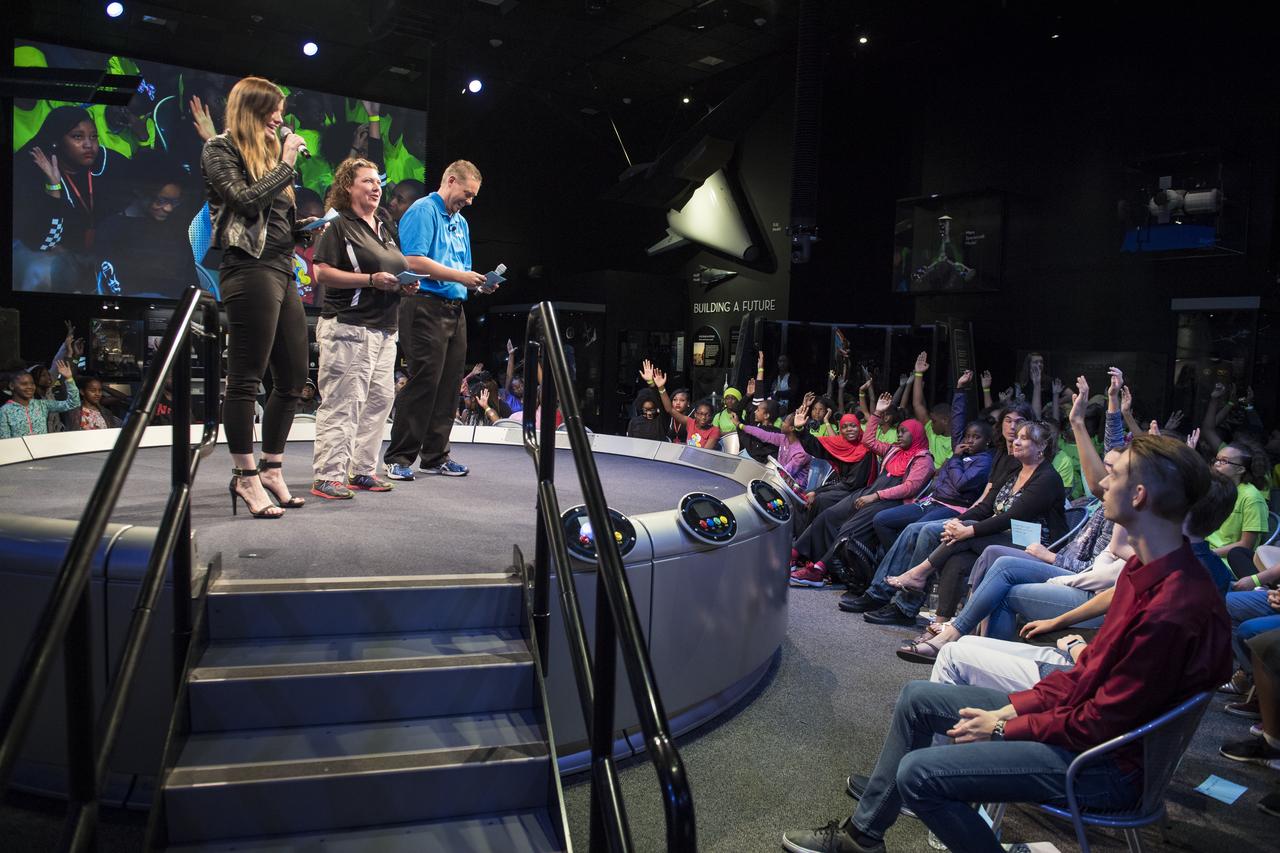
Deanne Bell, engineer, television host, and the founder & CEO of Future Engineers speaks to students during a STEM in 30 event where they announced the winners of the "Two for the Crew" competition, Wednesday, June 27, 2018 at Smithsonian's National Air and Space Museum in Washington. Photo Credit: (NASA/Aubrey Gemignani)
Astronaut Serena Auñon-Chancellor at Air and Space Museum
Future Engineers "Two for the Crew" competition winner, Ansel Austin, speaks about his Trillium Tool, a type of wrench, during a STEM in 30 event, Wednesday, June 27, 2018 at Smithsonian's National Air and Space Museum in Washington. Photo Credit: (NASA/Aubrey Gemignani)
Astronaut Serena Auñon-Chancellor at Air and Space Museum
Future Engineers "Two for the Crew" competition winner, Austin Suder, speaks about his Carabiner Tool Clip, during a STEM in 30 event, Wednesday, June 27, 2018 at Smithsonian's National Air and Space Museum in Washington. Photo Credit: (NASA/Aubrey Gemignani)
Astronaut Serena Auñon-Chancellor at Air and Space Museum
Deanne Bell, engineer, television host, and the founder & CEO of Future Engineers speaks to students during a STEM in 30 event where they announced the winners of the "Two for the Crew" competition, Wednesday, June 27, 2018 at Smithsonian's National Air and Space Museum in Washington. Photo Credit: (NASA/Aubrey Gemignani)
Astronaut Serena Auñon-Chancellor at Air and Space Museum
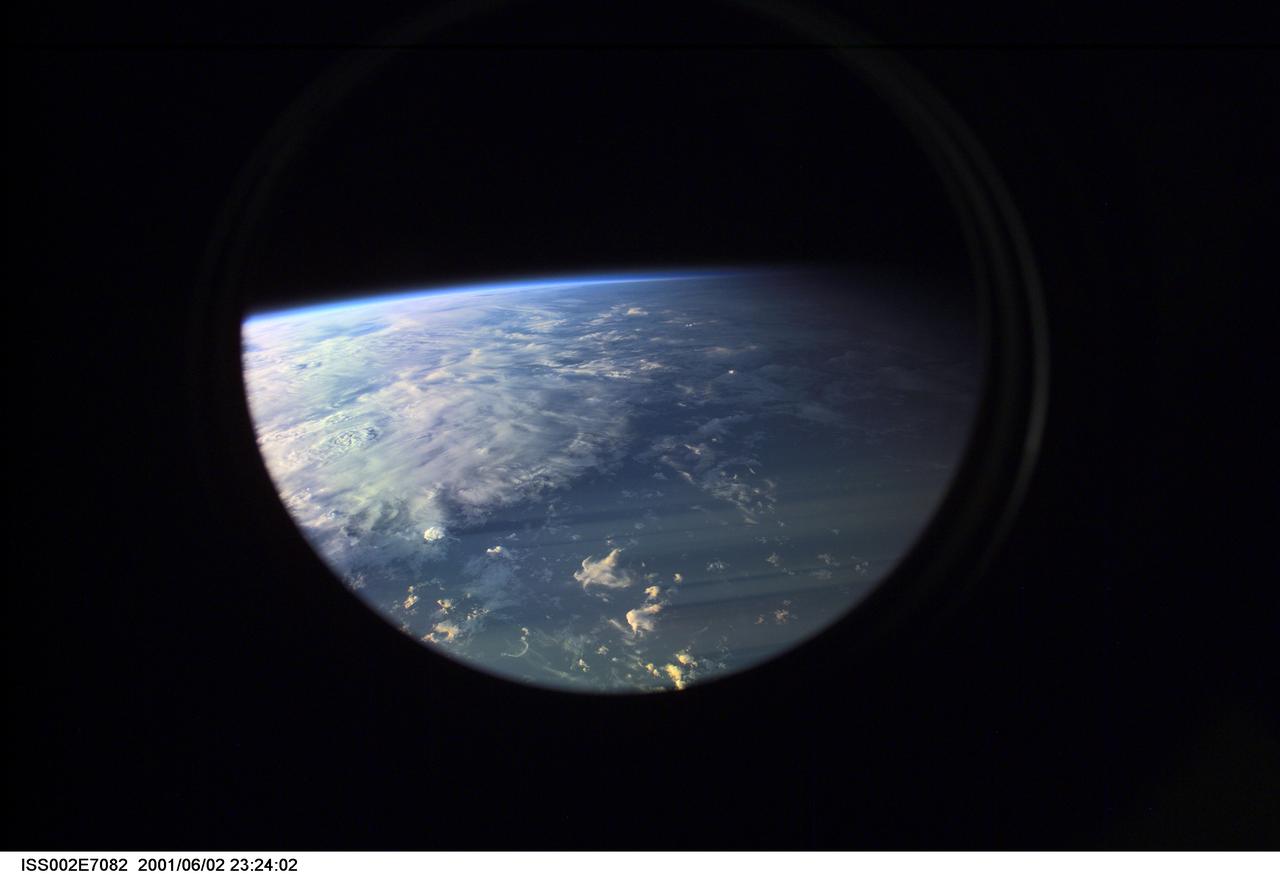
ISS002-E-7082 (2 June 2001) --- Earth's limb at sunset as photographed by one of the Expedition Two crew members with a digital still camera aimed through the nadir window of the U.S. laboratory Destiny.  Beneath the limb, a large mass of clouds fills the window.
Earth limb taken by the Expedition Two crew
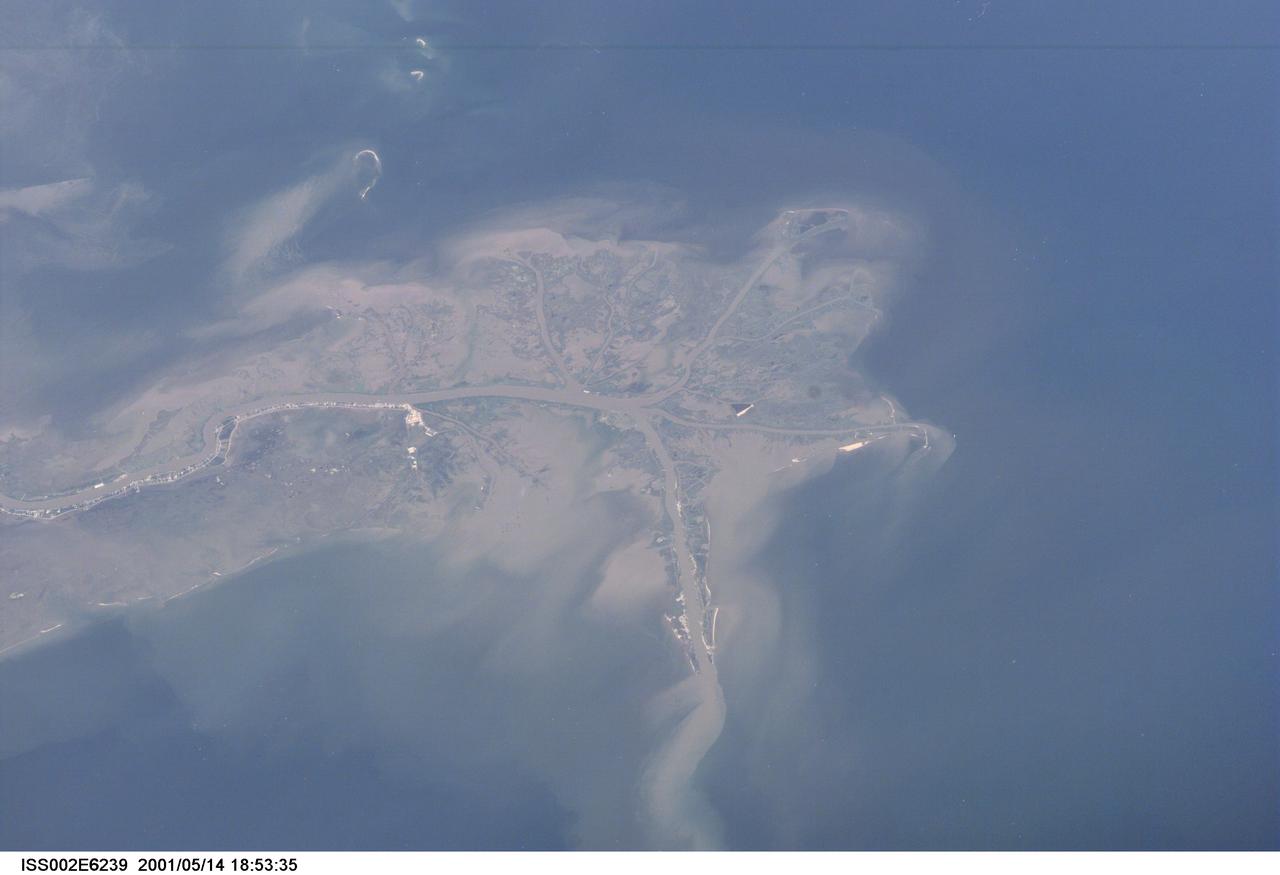
ISS002-E-6239 (14 May 2001) --- This digital still camera's image, recorded by one of the Expedition Two crew members aboard the International Space Station, features the mouth of the Mississippi River.  The distribution of riverborne sediments is clearly evident in the Gulf of Mexico. This delta area is often referred to as the "crow's foot."
Mississippi delta taken by the Expedition Two crew
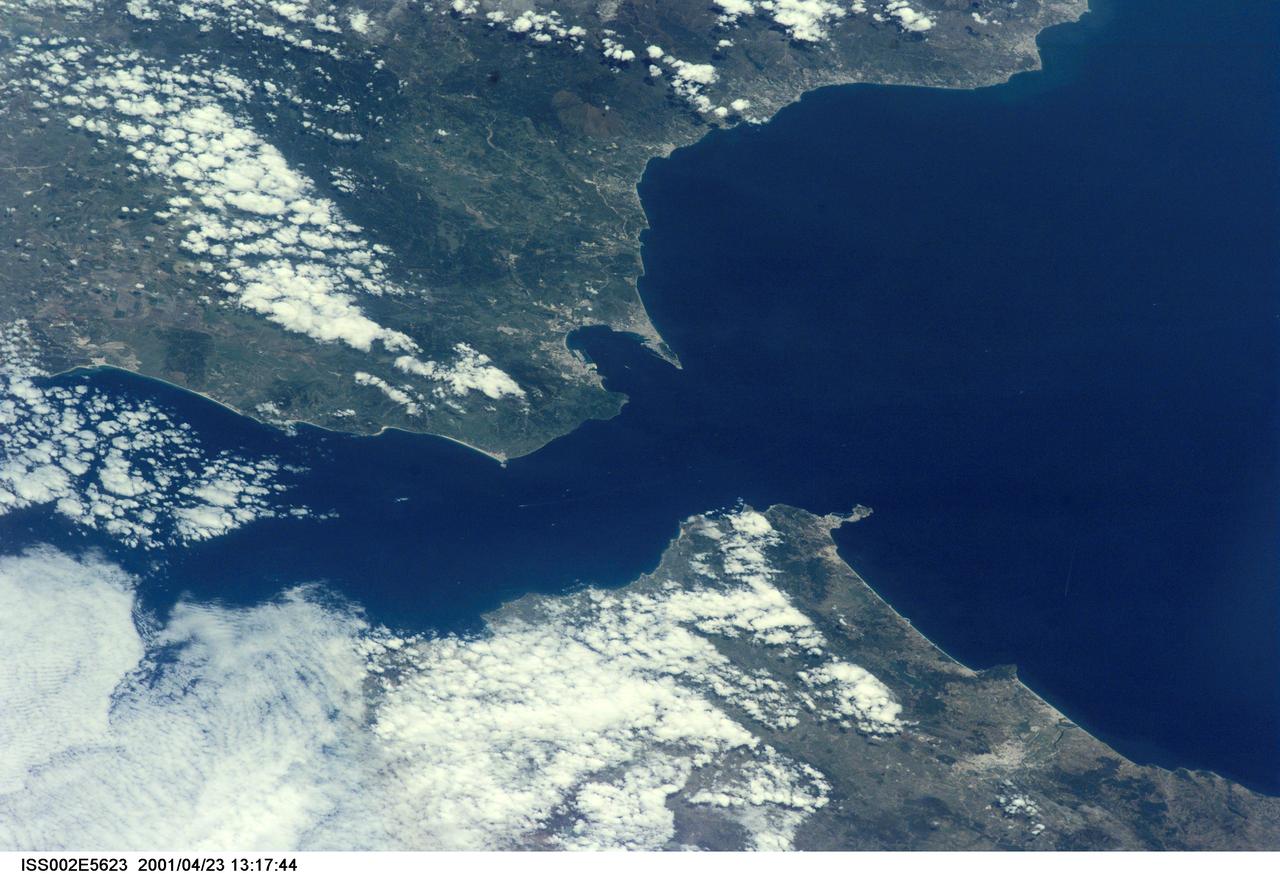
ISS002-E-5623 (23 April 2001) --- The Strait of Gibraltar, with part of Spain and all of Gibraltar at upper left and  upper center, respectively, and portions of Morocco at bottom, was photographed with a digital still camera by the Expedition Two crew onboard the International Space Station (ISS).
Strait of Gibraltar as seen by Expedition Two crew
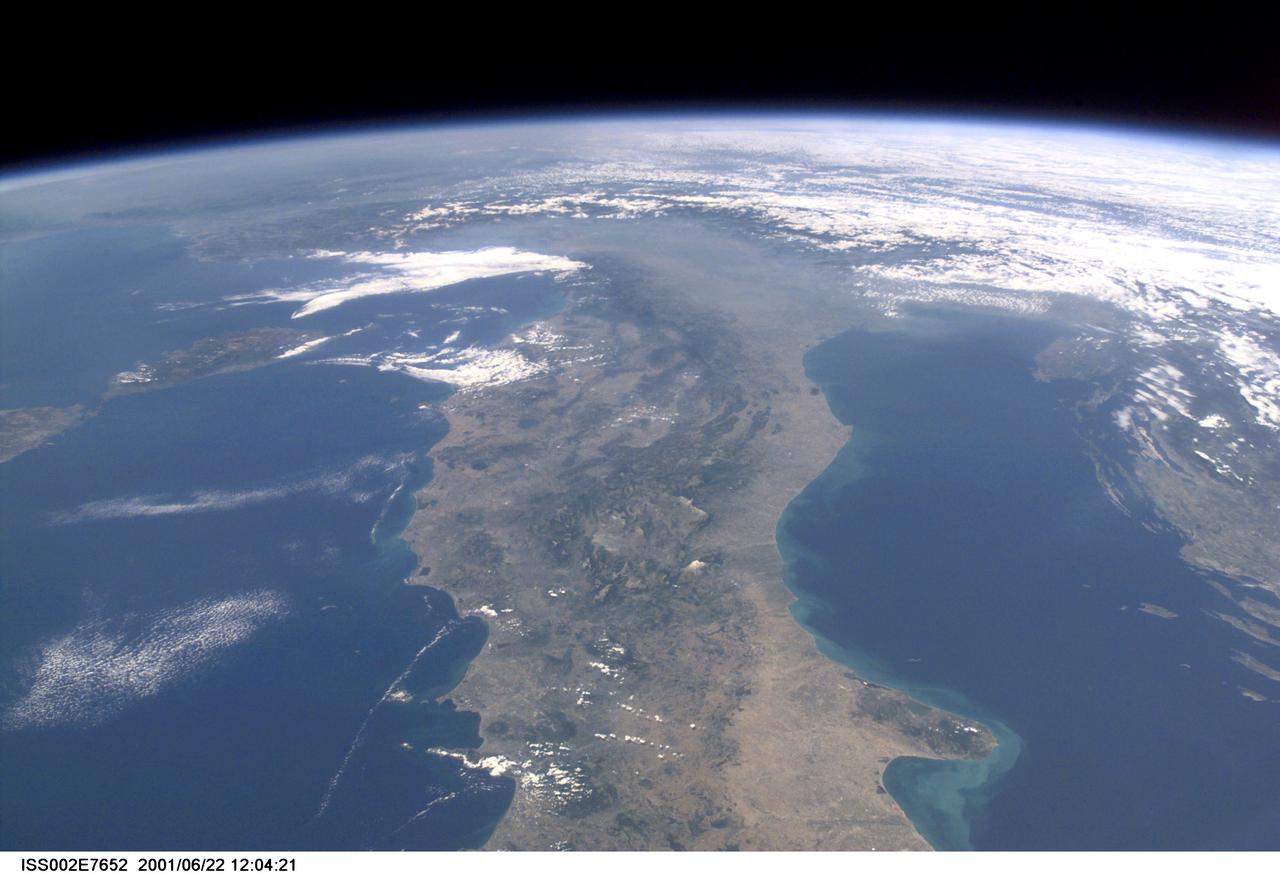
ISS002-E-7652 (22 June 2001) --- Almost a full length view of mainland Italy, with Corsica visible off the west (left) coast, was captured with a digital still camera by an Expedition Two crew member aboard the International Space Station (ISS).
Panoramic of the Italian peninsula taken by Expedition Two crew
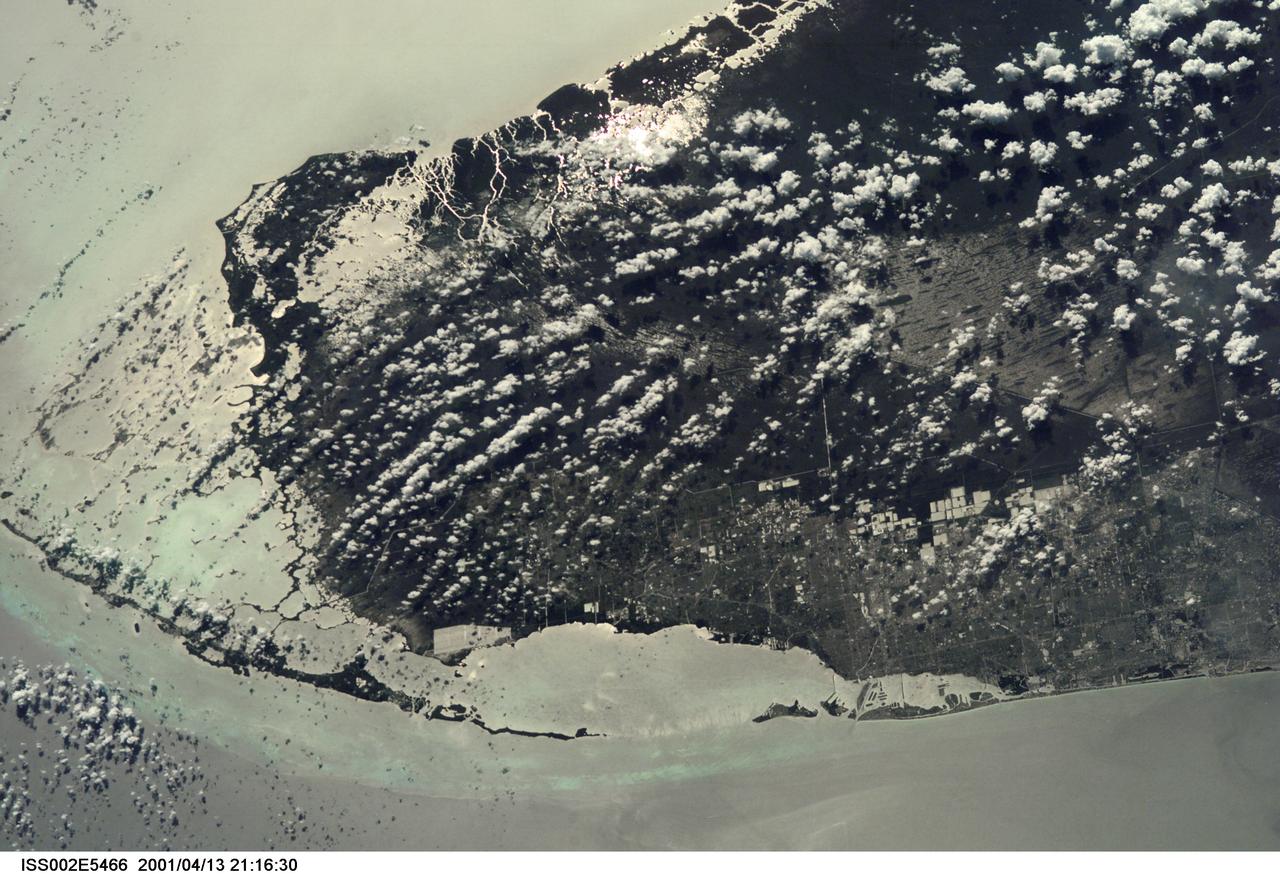
ISS002-E-5466 (13 April 2001) --- From the International Space Station (ISS), an Expedition Two crew member photographed southern Florida, including Dade County with Miami and Miami Beach; Everglades National Park; Big Cypress National Reserve; and the Florida Keys and many other recognizable areas. The crew member, using a digital still camera on this same pass, also recorded imagery of the Lake Okeechobee area, just north of the area represented in this frame.
Sunglint in Florida Bay taken by the Expedition Two crew
STS104-E-5178 (20 July 2001) --- Seven astronauts and a cosmonaut representing Rosaviakosmos take a break in joint activities involving the Expedition Two and STS-104 crews to pose for an inflight portrait in the newly delivered Quest Airlock on the International Space Station (ISS).   Charles O. Hobaugh is in front.  On the second row are, from the left, James F. Reilly,  Steven W. Lindsey, Yury V. Usachev and   Michael L. Gernhardt. In the rear are  astronauts Janet L. Kavandi, James S. Voss and Susan J. Helms.  Usachev, commander; along with Voss and Helms, both flight engineers, comprise the Expediton Two crew.  Lindsey is STS-104  commander, with Hobaugh serving as pilot.  Kavandi, STS-104 flight engineer, is joined by Gernhardt and Reilly as mission specialists on the mission. This image was recorded with a digital still camera.
Joint STS-104 and Expedition Two Crew photo
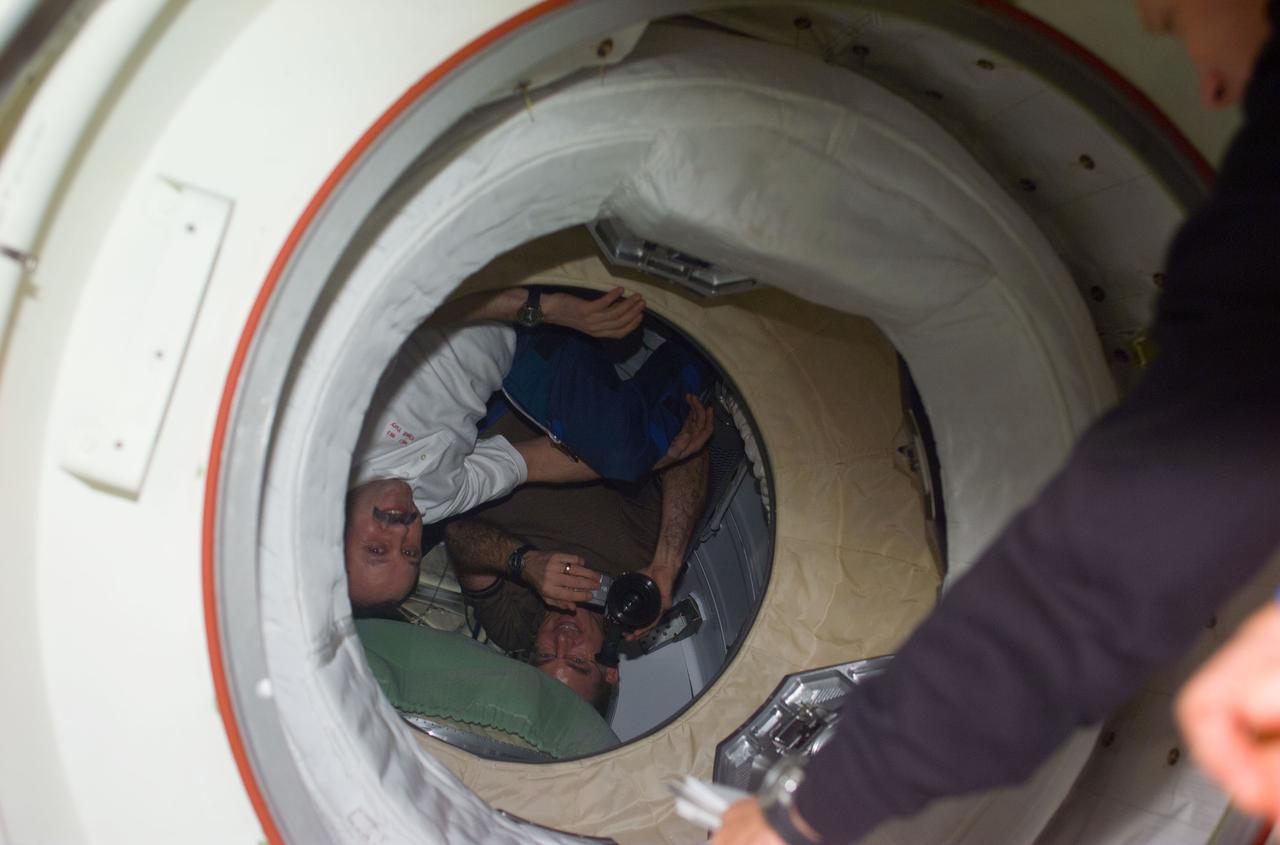
S104-E-5041 (14 July 2001) --- Expedition Two crewmembers Yury V. Usachev of Rosaviakosmos, mission commander, and James S.  Voss, flight engineer, greet the STS-104 crew with smiles when the hatch to Pressurized Mating Adapter 2 (PMA2) was opened for the STS-104 ingress.
Expedition Two crew greet STS-104 crew at PMA-2 hatch
A participant creates digital 3D models using Autodesk Tinkercad in the Two for the Crew Challenge at a pop-up makerspace held by Future Engineers, with support from NASA and The American Society of Mechanical Engineers (ASME), at the Steven F. Udvar-Hazy Center, Thursday, September 21, 2017 in Chantilly, Virginia. Participants had the opportunity to create digital 3D models and watch objects being printed with Makerbot 3D printers. Photo Credit: (NASA/Aubrey Gemignani)
NASA SOLVE Challenge Event
A participant creates digital 3D models using Autodesk Tinkercad in the Two for the Crew Challenge at a pop-up makerspace held by Future Engineers, with support from NASA and The American Society of Mechanical Engineers (ASME), at the Steven F. Udvar-Hazy Center, Thursday, September 21, 2017 in Chantilly, Virginia. Participants had the opportunity to create digital 3D models and watch objects being printed with Makerbot 3D printers. Photo Credit: (NASA/Aubrey Gemignani)
NASA SOLVE Challenge Event
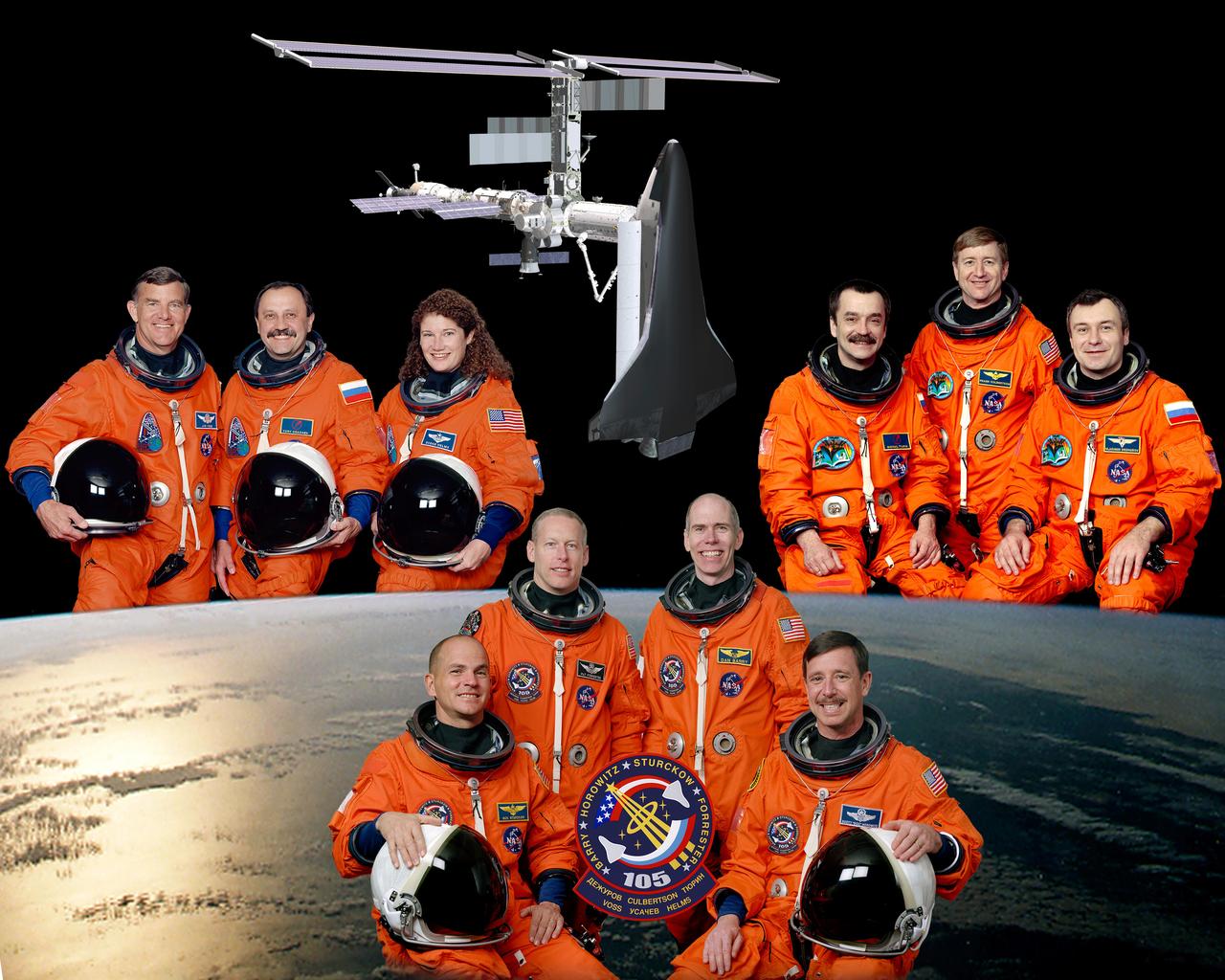
This is the portrait of the astronaut and cosmonaut crewmembers comprising the STS-105 mission. The base crew (bottom center), left to right, are pilot Frederick W. (Rich) Sturckow, Mission Specialists Patrick G. Forester and Daniel T. Barry, and Commander Scott J. Horowitz. The upper right group are the International Space Station (ISS) Expedition Three crew, (left to right) Cosmonaut Mikhail Tyurin, flight engineer; Astronaut Frank L. Culbertson, Jr., commander; and Cosmonaut Vladimir N. Dezhurov, flight engineer. The upper left group are the ISS Expedition Two crew, (left to right) Astronaut James S. Voss, commander; Cosmonaut Yury V. Usachev, flight engineer; and Astronaut Susan J. Helms, flight engineer. The STS-105 was the 11th ISS assembly flight and launched on August 19, 2001 aboard the Space Shuttle Orbiter Discovery.
Space Shuttle Projects
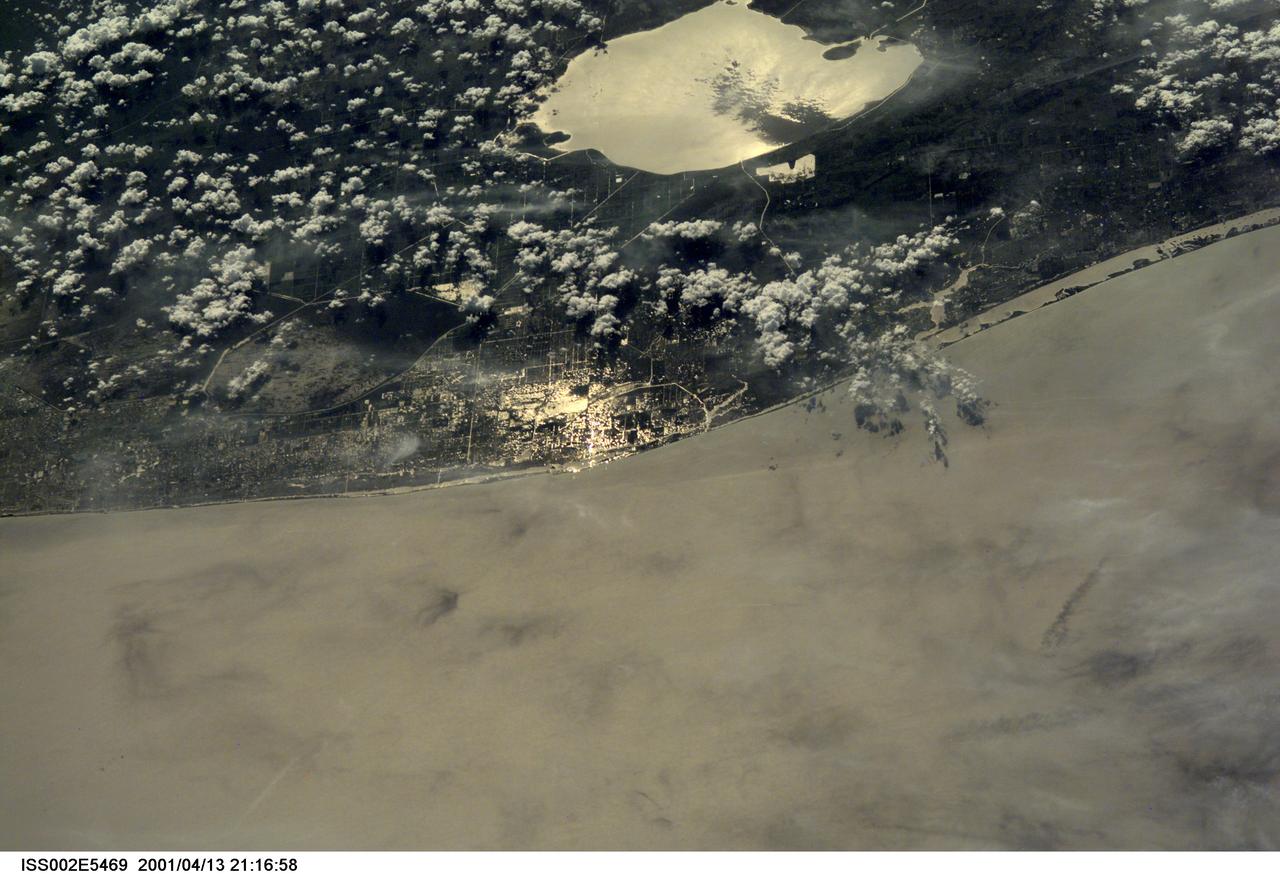
ISS002-E-5469 (13 April 2001) --- The Atlantic Coast of parts of southern Florida was captured with a digital still camera by one of the Expedition Two crew members aboard the International Space Station (ISS).  Among recognizable points are Palm Beach, West Palm Beach (near center frame), the Indian River (near the coast) and Lake Okeechobee (top center).  This was one of a series of images of southern Florida that were  captured by the Expedition Two crew on April 13, 2001.
Sunglint on West Palm Beach taken by the Expedition Two crew
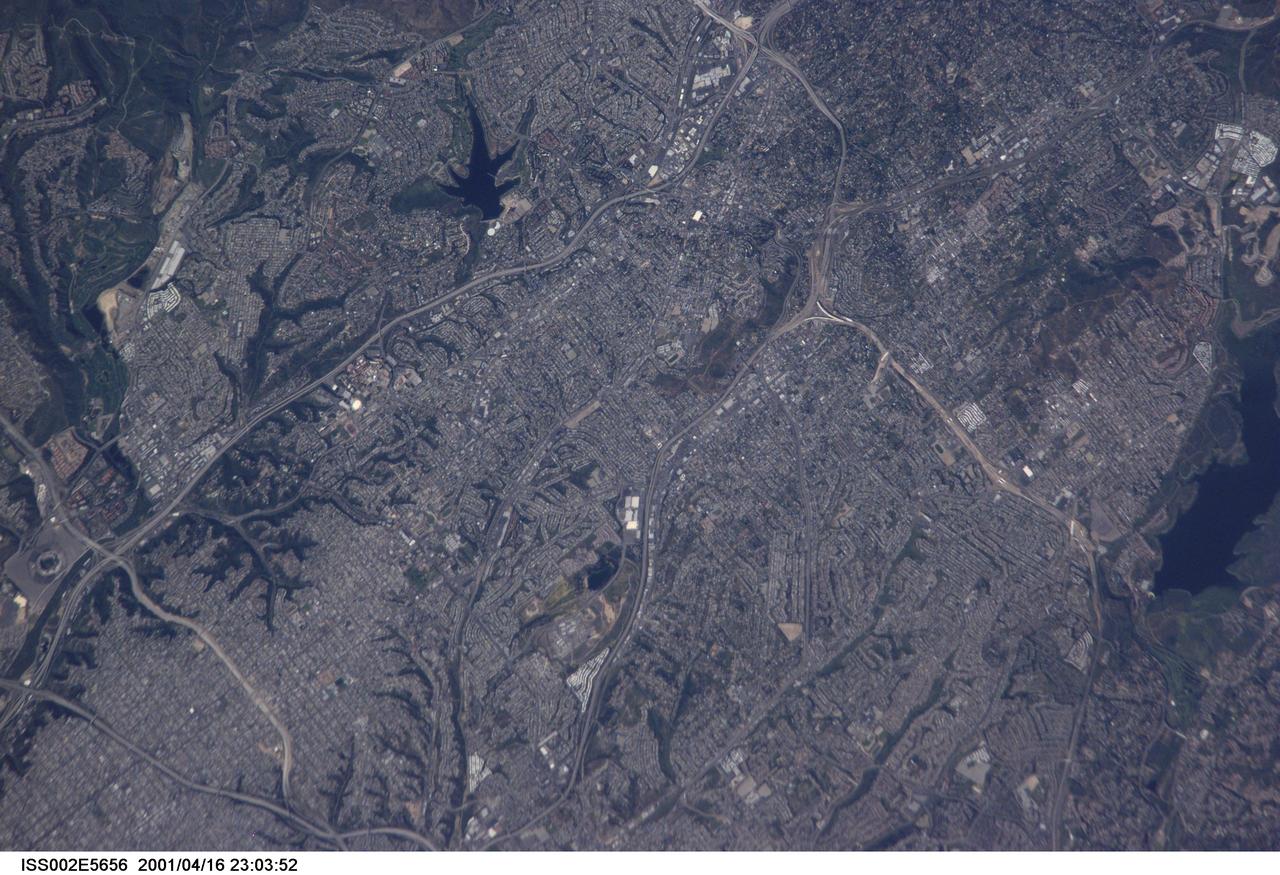
ISS002-E-5656 (16 April 2001) --- Extreme southern topography of California, including inland portions of the San Diego area were captured in this digital still camera's image from the International Space Station's Expedition Two crew members.  The previous frame (5655) and this one were both recorded with an 800mm lens, whereas the succeeding frame (5657) was shot with a 105mm lens.
Earth Observation as seen by Expedition Two crew
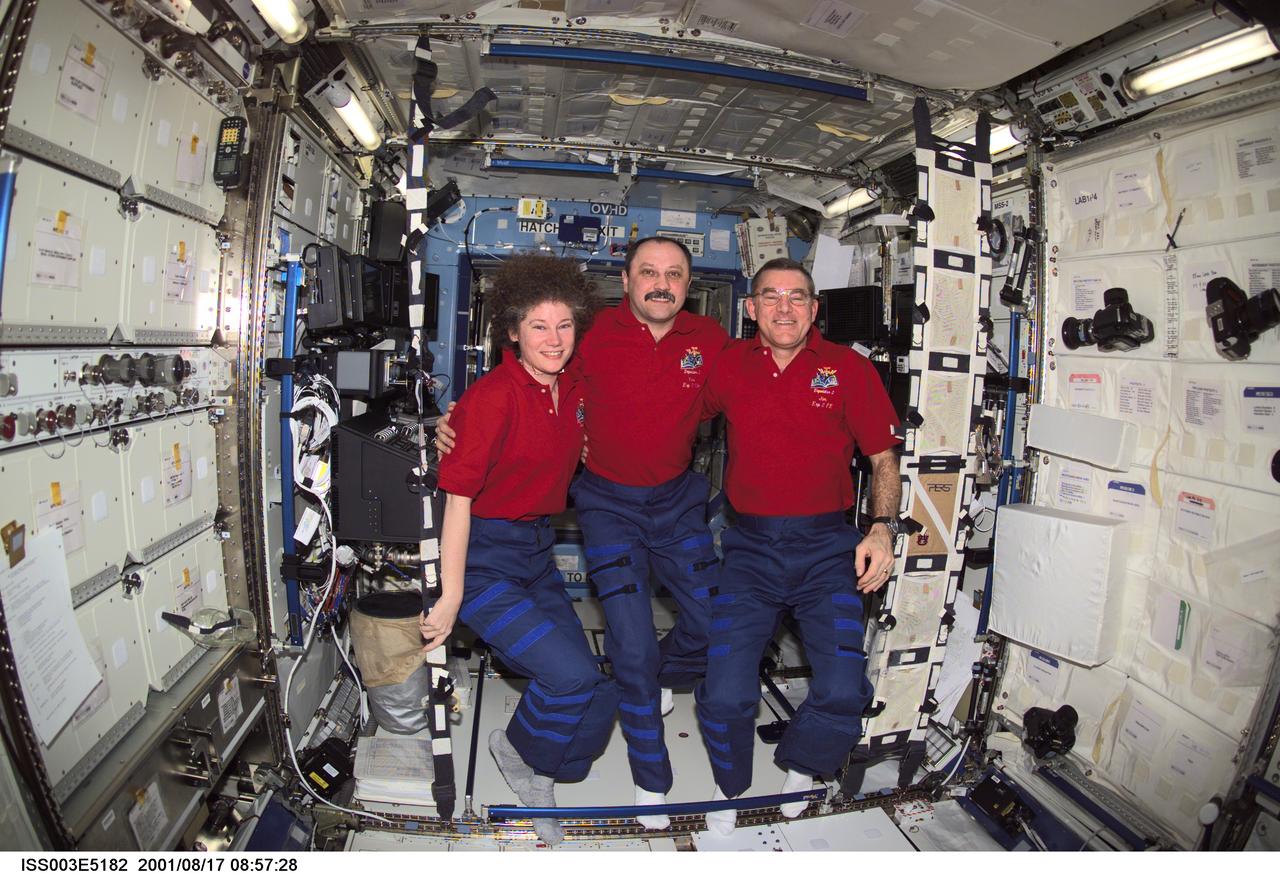
ISS003-E-5182 (17 August 2001) --- The Expedition Two crew members pause from their daily activities to pose for a group photo in the Destiny laboratory on the International Space Station (ISS). From left to right are, astronaut Susan J. Helms, flight engineer, cosmonaut Yury V. Usachev, mission commander, and astronaut James S. Voss, flight engineer. Usachev represents Rosaviakosmos. This image was taken with a digital still camera.
The Expedition Two crew pose in the U.S. Laboratory
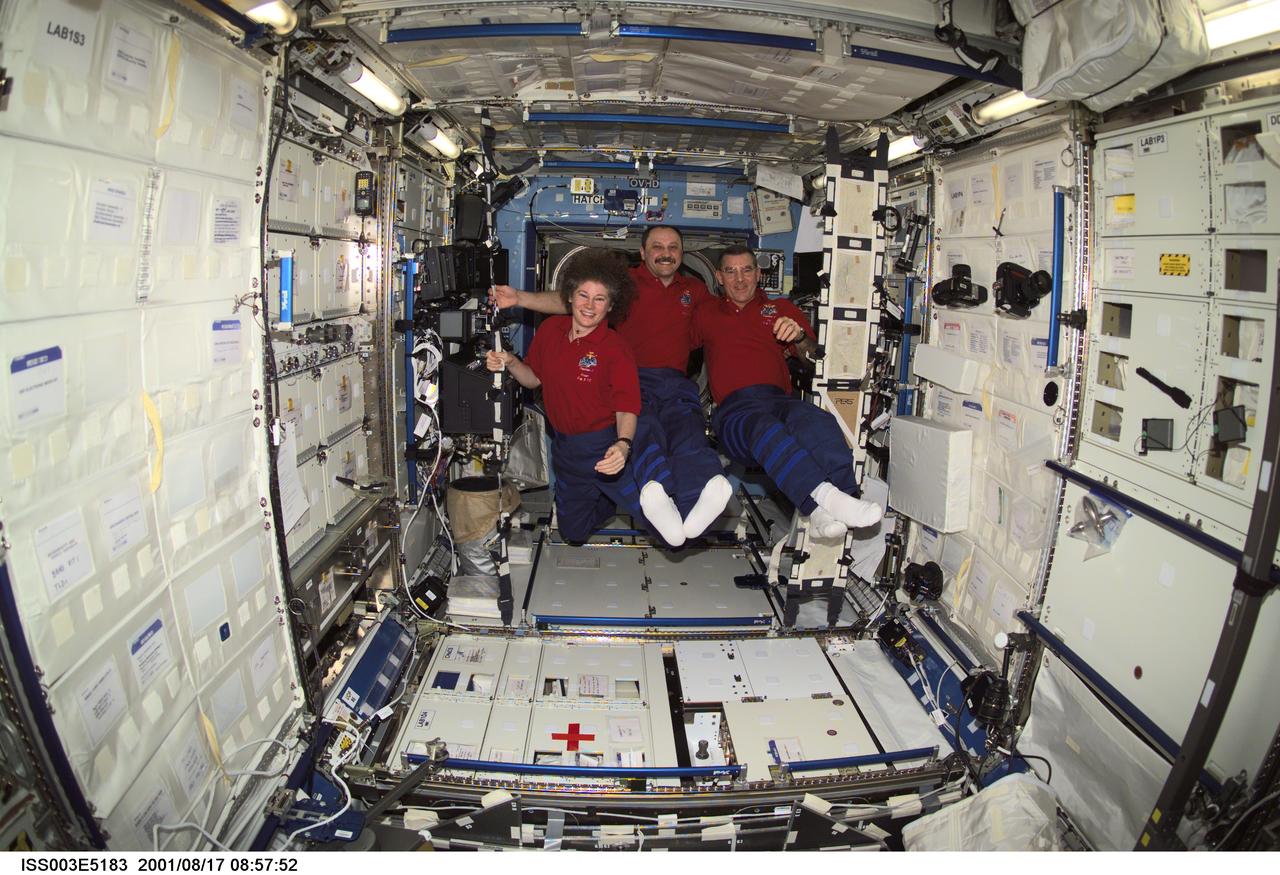
ISS003-E-5183 (17 August 2001) --- The Expedition Two crew members pause from their daily activities to pose for a group photo in the Destiny laboratory while visiting the International Space Station (ISS). From left to right are, astronaut Susan J. Helms, flight engineer, cosmonaut Yury V. Usachev, mission commander, and astronaut James S. Voss, flight engineer. Usachev represents Rosaviakosmos. This image was taken with a digital still camera.
The Expedition Two crew pose in the U.S. Laboratory
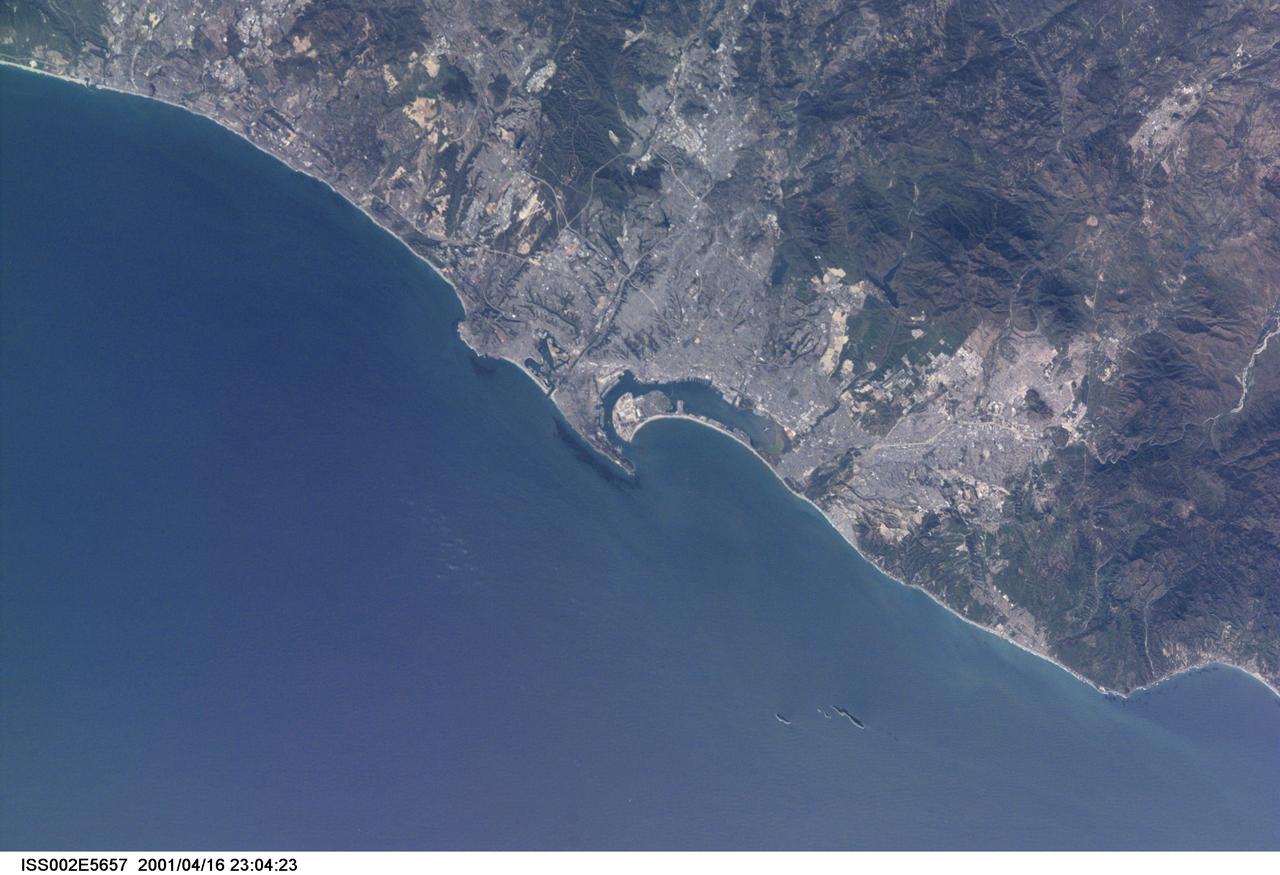
ISS002-E-5657 (16 April 2001) --- San Diego, California, and the California border with Mexico were photographed with a digital still camera by the Expedition Two crew onboard the International Space Station (ISS). A 105mm lens was used for this frame.  Other pictures taken in this April 16, 2001 series show different angles of the metropolitan area and utilize various lenses.
San Diego, California as seen by Expedition Two crew
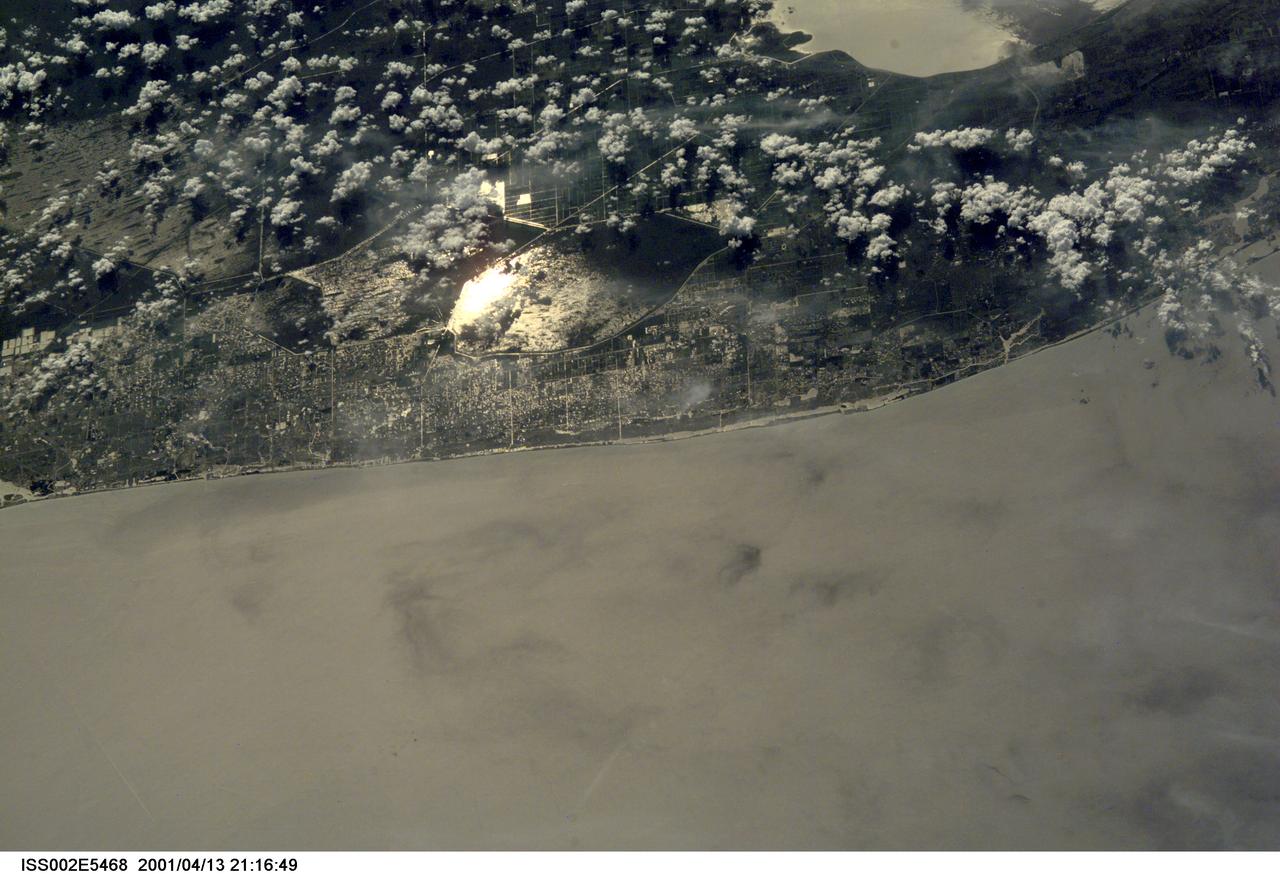
ISS002-E-5468 (13 April 2001) --- From the International Space Station (ISS), an Expedition Two crew member photographed part of the Atlantic coast side of southern Florida.  The eastern side of Lake Okeechobee is at upper right.  Miami and Miami Beach can be seen in another frame (5466) from this series of images, recorded with a digital still camera.
Sunglint on Miami taken by the Expedition Two crew
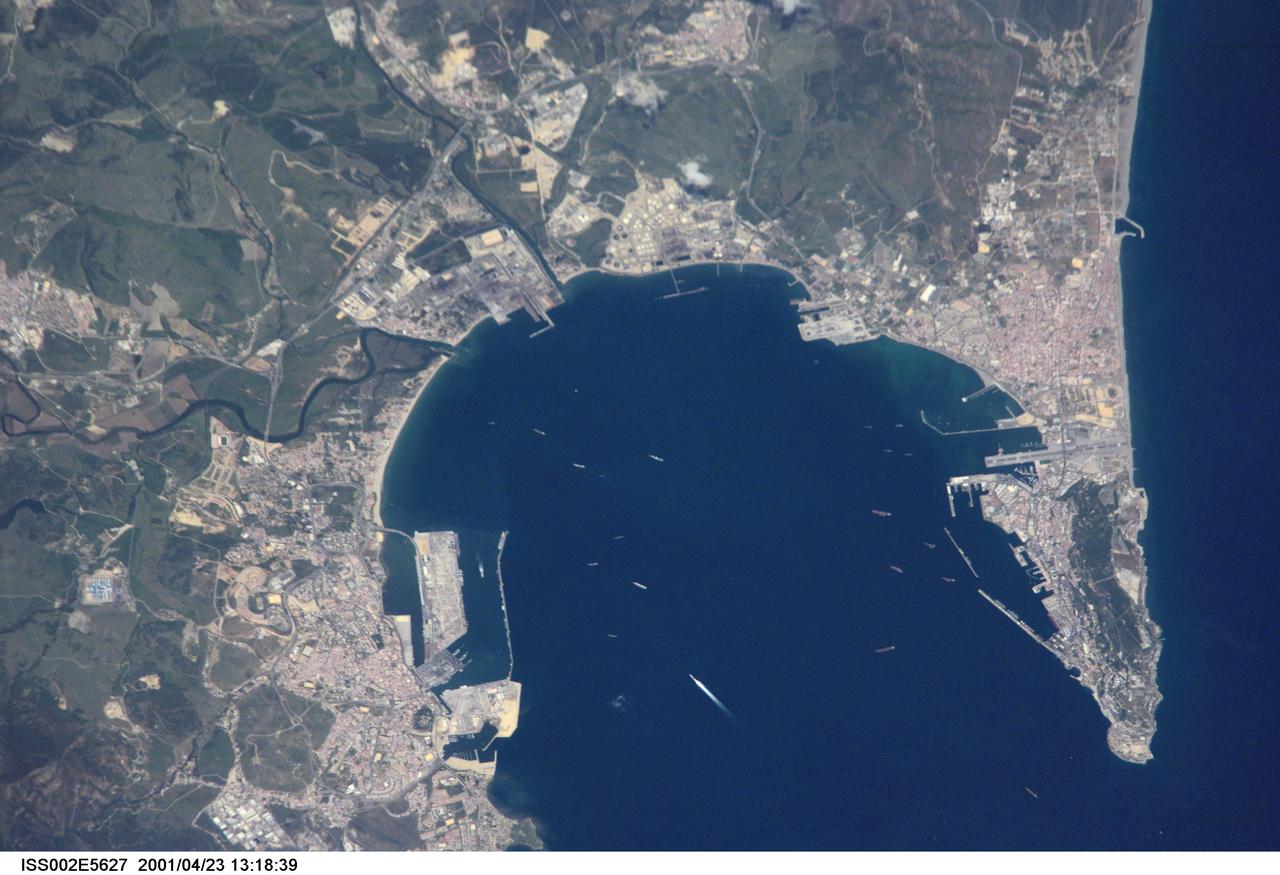
ISS002-E-5627 (23 April 2001) --- Algecira (left), the Bay of Gibraltar (Bahia de Algecira) and "The Rock of Gibraltar" (right) are featured in this detailed vertical view on the European side of the Strait of Gibraltar. Ship traffic in the Bay and Gibraltar Dock Yard can easily be seen. This digital still camera's image is part of a series of pictures centering on the Strait of Gibraltar area which was recorded by the ISS Expedition Two crew on April 23, 2001.
Earth Observation as seen by Expedition Two crew
STS105-E-5334 (17 August 2001) --- The Expedition Two (back row) and Expedition Three crews participate in a press conference in the U.S. Laboratory.  In less than 48 hours, the Expedition Two crew will hold the final handover ceremony with the newly arrived Expedition Three crew. The Expedition Two crewmembers are, from left to right, Susan J. Helms, flight engineer, cosmonaut Yury V. Usachev, mission commander, and James S. Voss, flight engineer. The Expedition Three crewmembers are, from left to right, cosmonaut Mikhail Tyurin, flight engineer, Frank L. Culbertson, Jr., mission commander, and cosmonaut Vladimir N. Dezhurov, flight engineer. This image was taken with a digital still camera.
Expeditions Two and Three group crew portrait in ISS U.S. Laboratory/Destiny
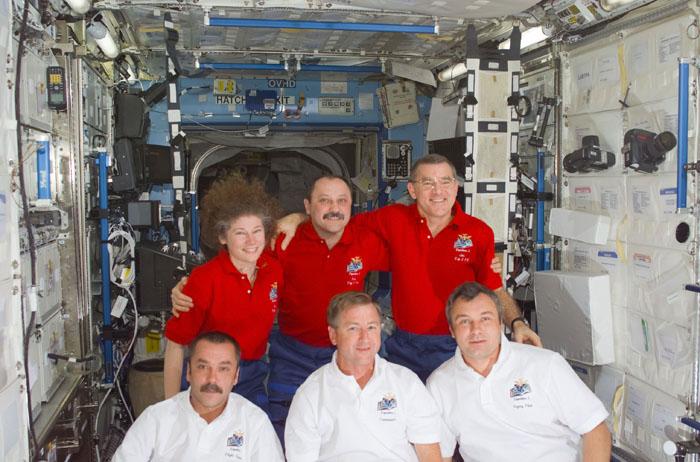
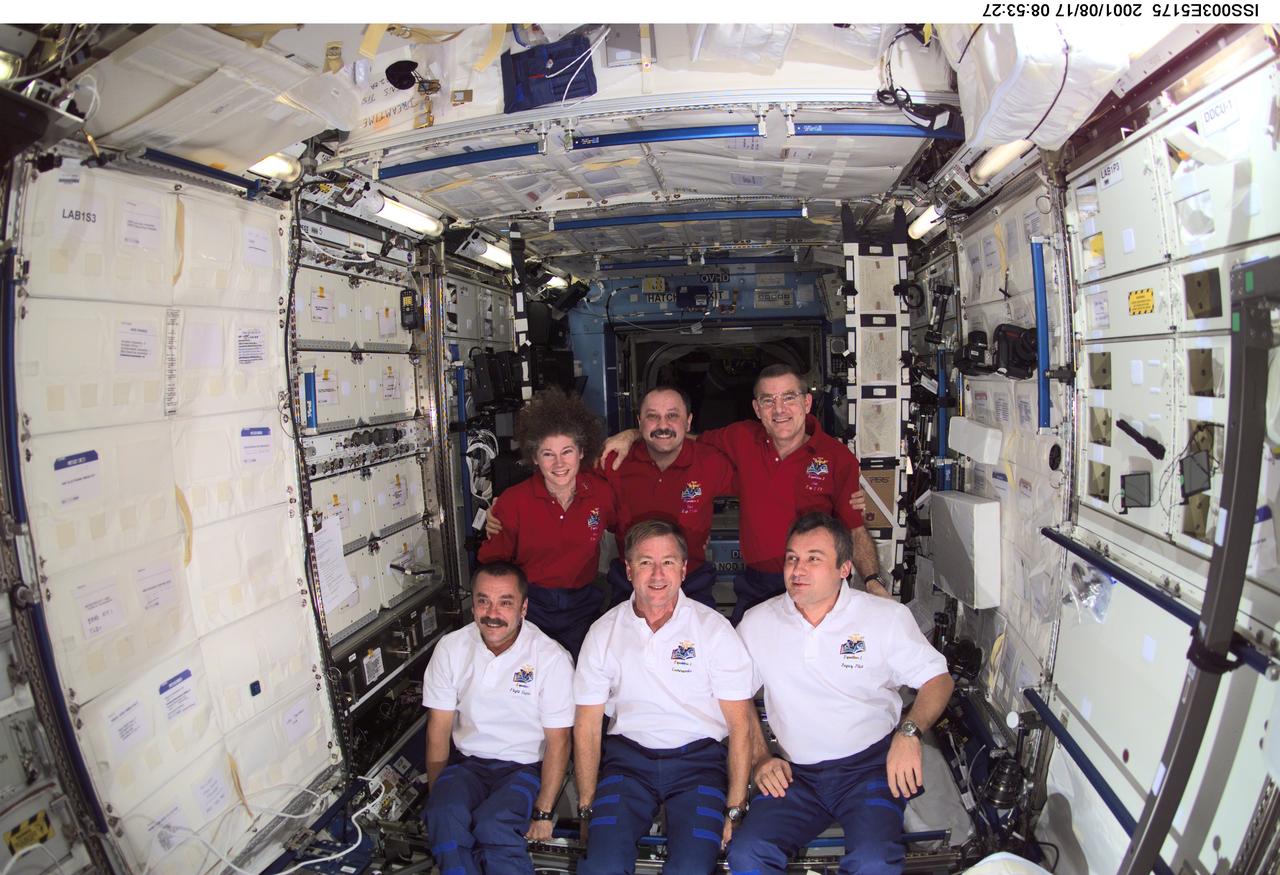
ISS003-E-5175 (17 August 2001) --- The Expedition Two (back row) and Expedition Three crews assemble for a group photo in the Destiny laboratory on the International Space Station (ISS). The Expedition Two crew members are, from left to right, Susan J. Helms, flight engineer, cosmonaut Yury V. Usachev, mission commander, and James S. Voss, flight engineer. The Expedition Three crew members are, from left to right, cosmonaut Mikhail Tyurin, flight engineer, Frank L. Culbertson, Jr., mission commander, and cosmonaut Vladimir N. Dezhurov, flight engineer. Dezhurov, Tyurin and Usachev represent Rosaviakosmos. This image was taken with a digital still camera.
Expedition Three and Expedition Two crews pose in the U.S. Laboratory
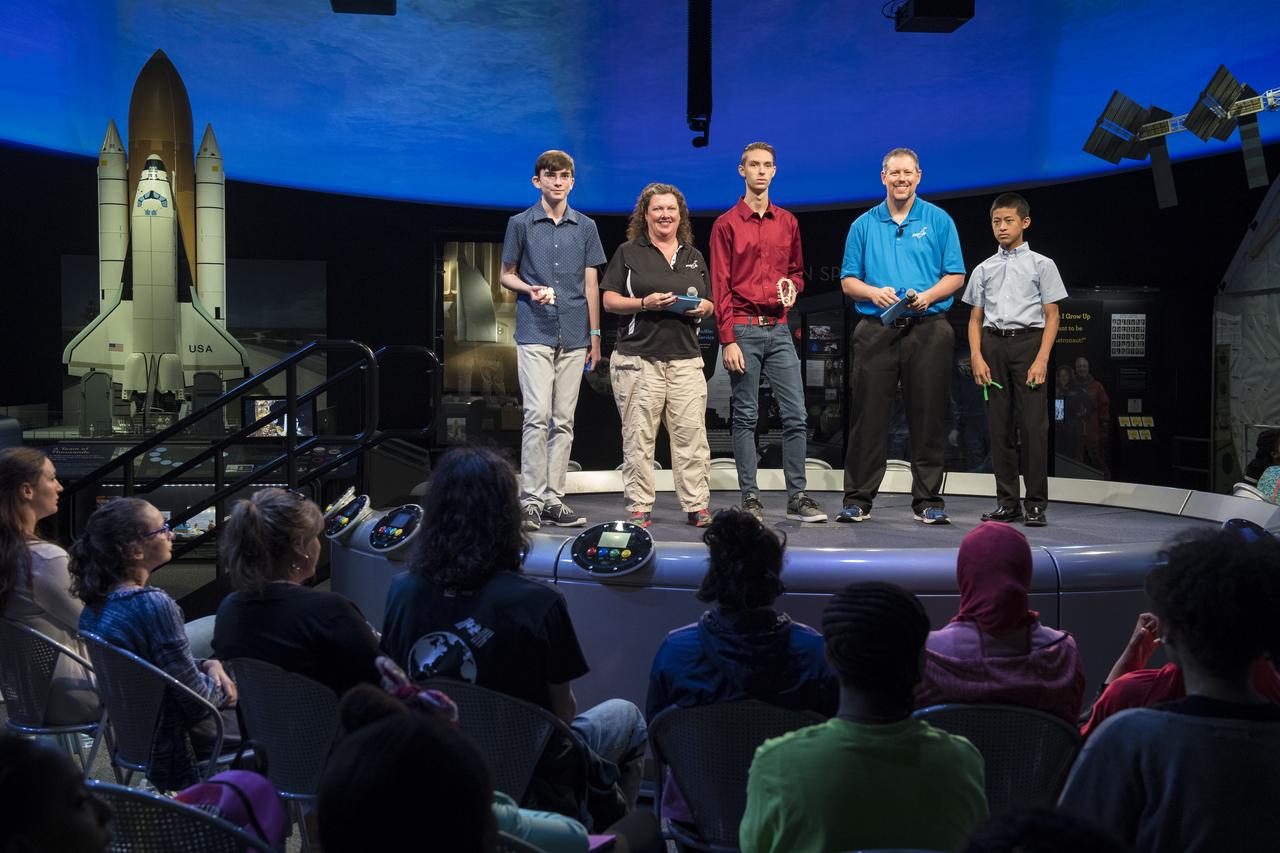
Future Engineers "Two for the Crew" competition winners, Ansel Austin, left, Austin Suder, center, and Jason Qin, right, are seen onstage during a STEM in 30 event, Wednesday, June 27, 2018 at Smithsonian's National Air and Space Museum in Washington. Photo Credit: (NASA/Aubrey Gemignani)
Astronaut Serena Auñon-Chancellor at Air and Space Museum
Future Engineers "Two for the Crew" competition winners, Ansel Austin, left, Austin Suder, center, and Jason Qin, right, are seen onstage during a STEM in 30 event, Wednesday, June 27, 2018 at Smithsonian's National Air and Space Museum in Washington. Photo Credit: (NASA/Aubrey Gemignani)
Astronaut Serena Auñon-Chancellor at Air and Space Museum
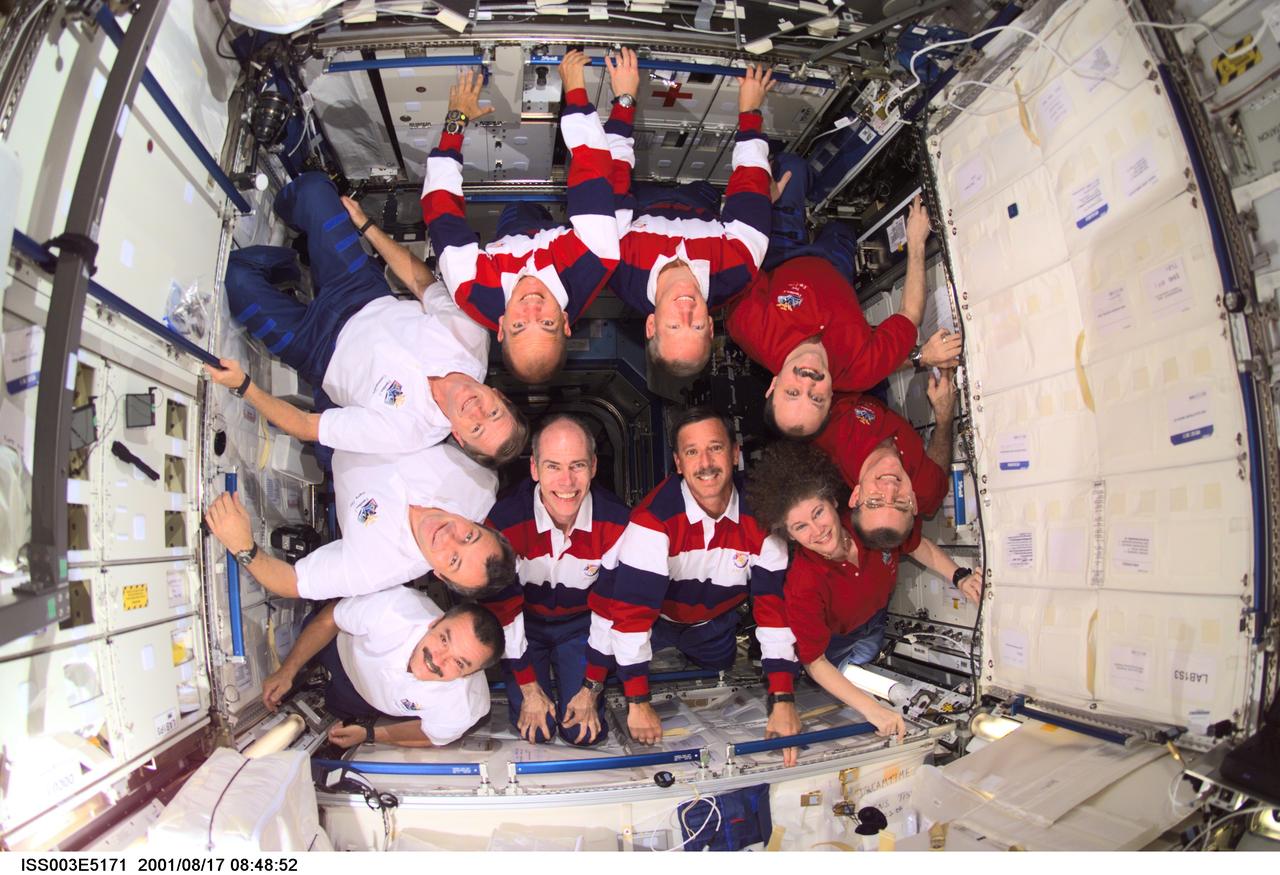
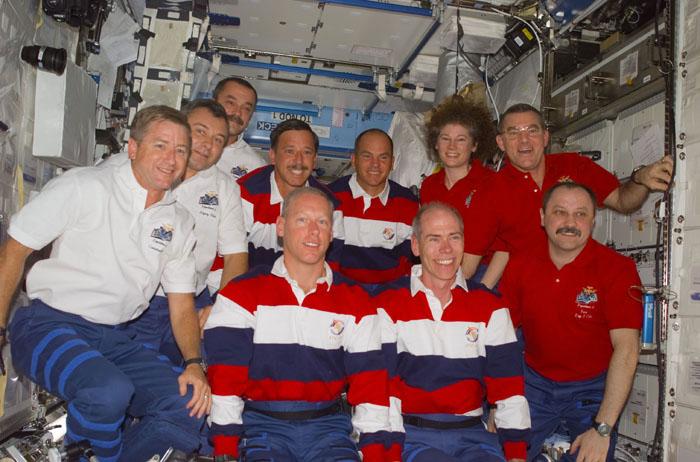
ISS003-E-5171 (17 August 2001) --- The Expedition Three (white shirts), STS-105 (striped shirts), and Expedition Two (red shirts) crews assemble for a group photo in the Destiny laboratory on the International Space Station (ISS). The Expedition Three crew members are, from bottom to top, cosmonauts Mikhail Tyurin and Vladimir N. Dezhurov, both flight engineers, and Frank L. Culbertson, Jr., mission commander; STS-105 crew members are, front row, Daniel T. Barry, mission specialist, and Scott J. Horowitz, commander, back row, Frederick W. (Rick) Sturckow, pilot, and Patrick G. Forrester, mission specialist; Expedition Two crew members are, from top to bottom, cosmonaut Yury V. Usachev, mission commander, James S. Voss and Susan J. Helms, flight engineers. Dezhurov, Tyurin and Usachev represent Rosaviakosmos. This image was taken with a digital still camera.
Expedition Three, Expedition Two and STS-105 crews pose in the U.S. Laboratory
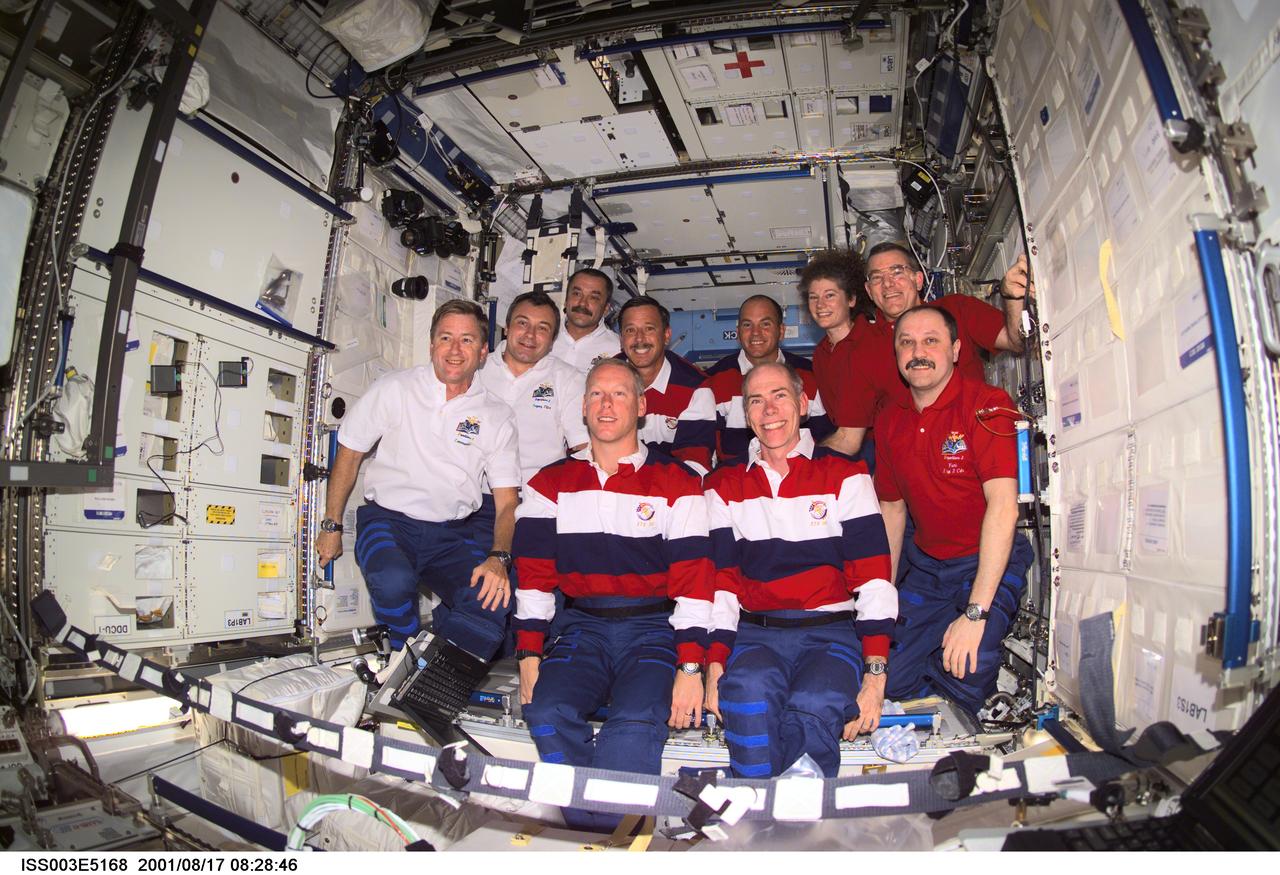
ISS003-E-5168 (17 August 2001) --- The Expedition Three (white shirts), STS-105 (striped shirts), and Expedition Two (red shirts) crews assemble for a group photo in the Destiny laboratory on the International Space Station (ISS). The Expedition Three crew members are, from front to back, Frank L. Culbertson, Jr., mission commander; and cosmonauts Vladimir N. Dezhurov and Mikhail Tyurin, flight engineers; STS-105 crew members are, front row, Patrick G. Forrester and Daniel T. Barry, mission specialists, and back row, Scott J. Horowitz, commander, and Frederick W. (Rick) Sturckow, pilot; Expedition Two crew members are, from front to back, cosmonaut Yury V. Usachev, mission commander, James S. Voss and Susan J. Helms, flight engineers. Dezhurov, Tyurin and Usachev represent Rosaviakosmos. This image was taken with a digital still camera.
Expedition Three, Expedition Two and STS-105 crews pose in the U.S. Laboratory
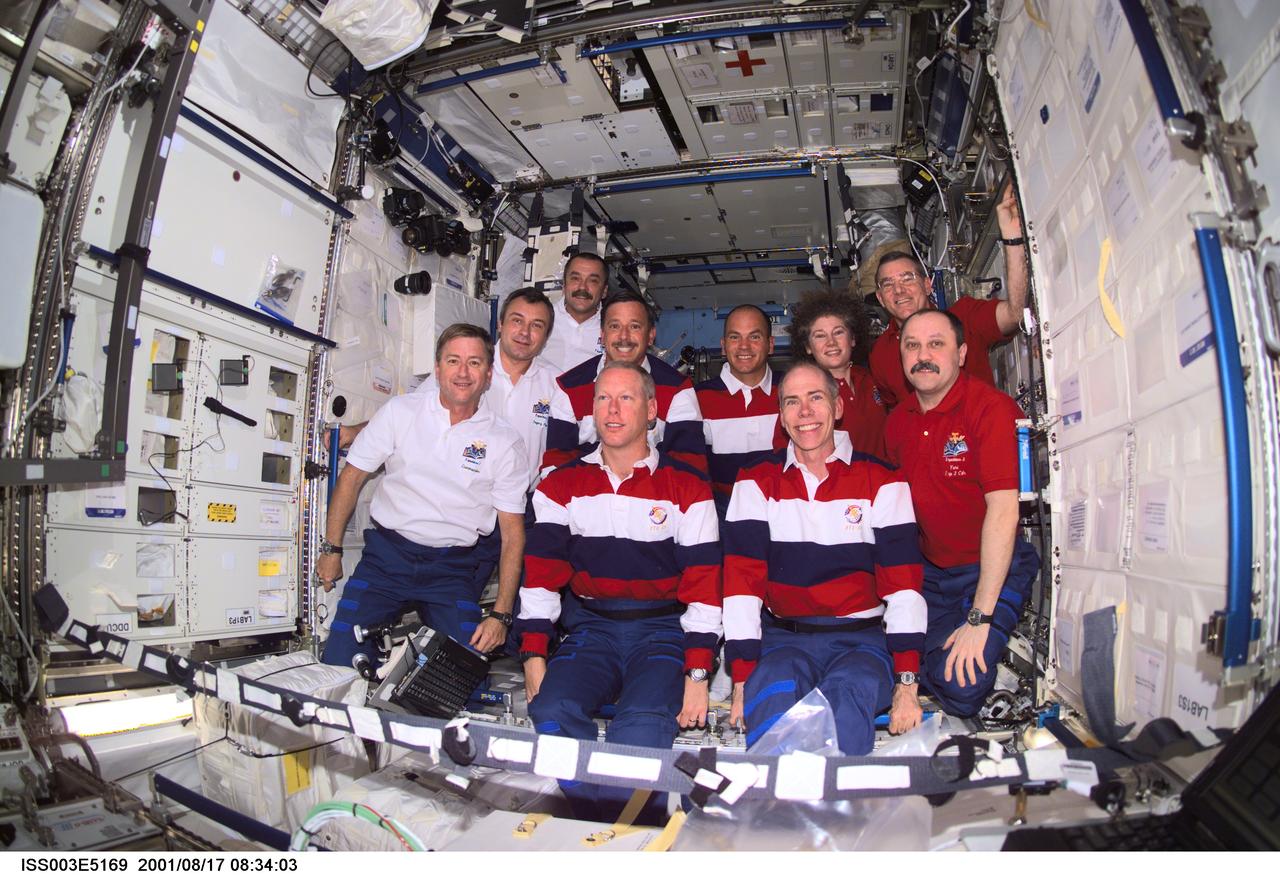
ISS003-E-5169 (17 August 2001) --- The Expedition Three (white shirts), STS-105 (striped shirts), and Expedition Two (red shirts) crews assemble for a group photo in the Destiny laboratory on the International Space Station (ISS). The Expedition Three crew members are, from front to back, Frank L. Culbertson, Jr., mission commander; and cosmonauts Vladimir N. Dezhurov and Mikhail Tyurin, flight engineers; STS-105 crew members are, front row, Patrick G. Forrester and Daniel T. Barry, mission specialists, and back row, Scott J. Horowitz, commander, and Frederick W. (Rick) Sturckow, pilot; Expedition Two crew members are, from front to back, cosmonaut Yury V. Usachev, mission commander, James S. Voss and Susan J. Helms, flight engineers. Dezhurov, Tyurin and Usachev represent Rosaviakosmos. This image was taken with a digital still camera.
Expedition Three, Expedition Two and STS-105 crews pose in the U.S. Laboratory
ISS002-E-7172 (26 April 2001) --- The Expedition Two and STS-100 crew members get together for a group portrait in the  emptied Raffaello Multi-Purpose Logistics Module (MPLM).  Clockwise from the 12 o'clock point in the circle are Kent V. Rominger, Yuri V. Lonchakov, Yury V. Usachev, Umberto Guidoni, James S. Voss, Jeffrey S. Ashby, Scott E. Parazynski, John L. Phillips and Chris A. Hadfield, with Susan J. Helms at center.  Usachev, Helms and Voss are members of three Expedition Two crew, with the other seven serving as  the STS-100 crew on the Space Shuttle Endeavour.  Usachev and Lonchakov represent Rosaviakosmos; Guidoni is associated with the European Space Agency (ESA); and Hadfield is from the Canadian Space Agency (CSA).  The image was taken with a pre-set digital still camera.
Joint STS-100 and Expedition Two crew portrait in Hawaiian shirts
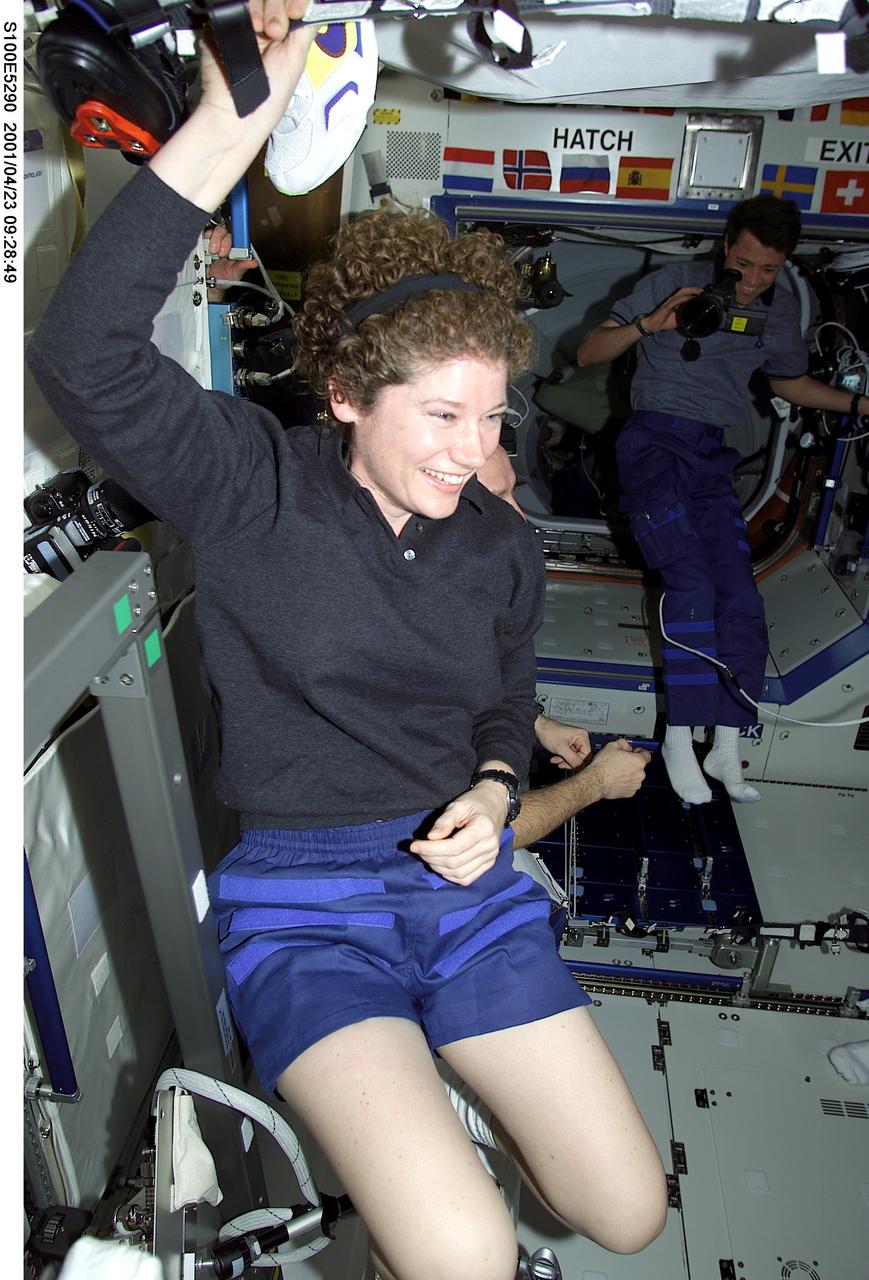
S100-E-5290 (23 April 2001)---  Astronaut Susan J. Helms, Expedition Two flight engineer, greets members of the STS-100 crew in the Destiny laboratory just after hatch opening. Astronaut Jeffrey S. Ashby, STS-100 pilot, documents the reunion in the background. The image was recorded with a digital still camera.
Expedition Two's Helms welcomes the STS-100 crew into the ISS
STS102-E-5224 (16 March 2001) --- Onboard the Destiny laboratory on the International Space Station (ISS), astronauts and cosmonauts convene in the midst of personnel changes on crew assignments.  From the left are astronauts Andrew S.W. Thomas, James D. Wetherbee and Susan J. Helms; and cosmonaut Yury V. Usachev of Rosaviakosmos.  Though all are wearing STS-102 attire, Helms and Usachev will be dressed in that of the Expedition Two crew shortly.  The photo was taken with a digital still camera.
STS-102 crew, Expeditions One and Two in the ISS U.S. Laboratory
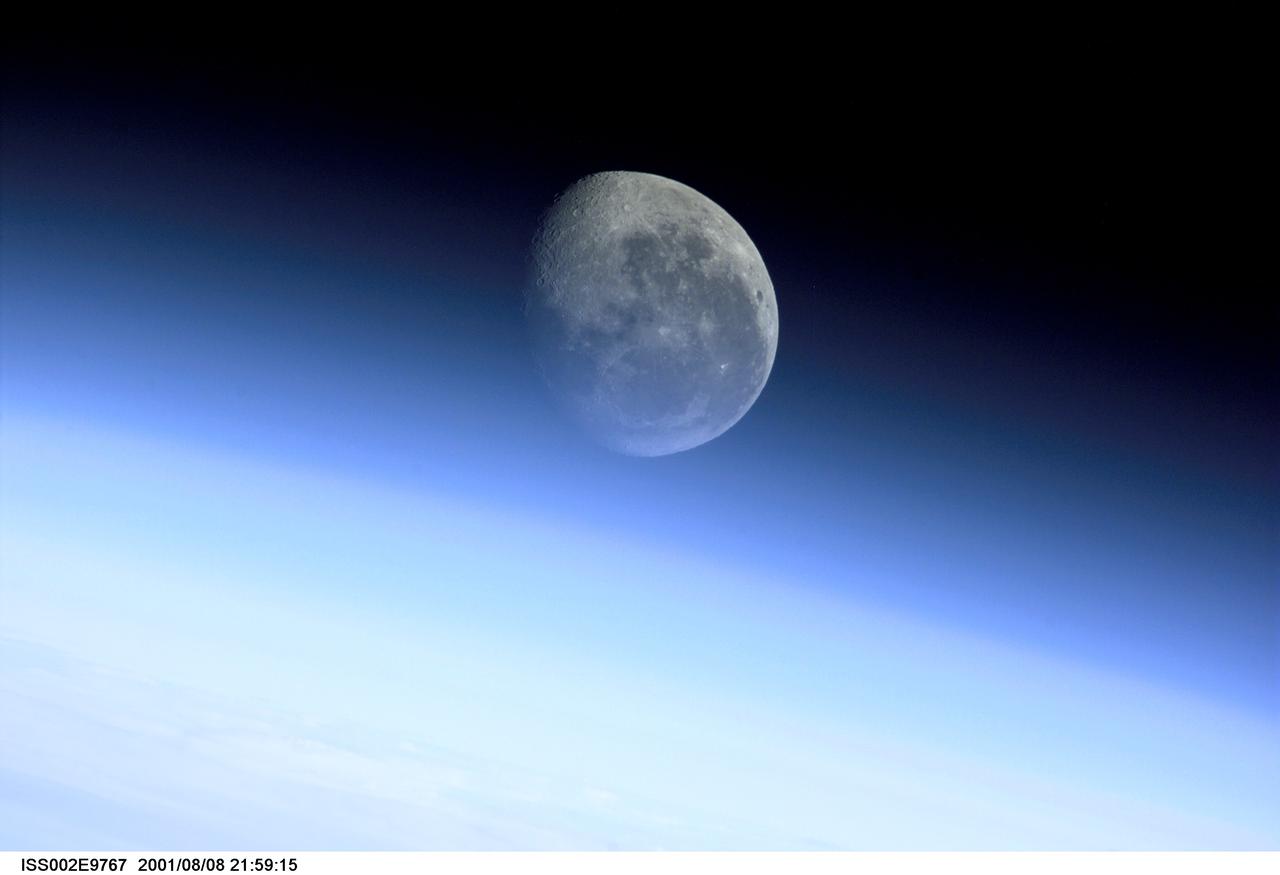
ISS002-E-9767 (8 Aug. 2001) ---  This image, recorded with a digital still camera by one of the Expedition Two crew members onboard the International Space Station,  is a glimpse of the barren moon through the Earth's limb. With no atmosphere, and therefore no limb of its own, the edge of the moon arcs crisply against the backdrop of space. Some of the most breathtaking views of Earth taken from space are those that capture our planet's limb. When viewed from the side, the Earth looks like a flat circle, and the atmosphere appears like a halo around it. This glowing halo is known as the limb. Viewed from satellites, space shuttles, and even the moon, the image of this luminous envelope of gases shielding the life on our planet from the dark, cold space beyond rarely fails to fascinate us.
View of the Moon taken by the Expedition Two crew
STS102-E-5227 (16 March 2001) --- Onboard the Destiny laboratory on the International Space Station (ISS), astronauts and cosmonauts convene in the midst of personnel changes on crew assignments.  From the left are astronauts William M. (Bill) Shepherd, Andrew S.W. Thomas, Paul W. Richards, James D. Wetherbee and Susan J. Helms;  along with cosmonaut Yury V. Usachev of Rosaviakosmos and astronaut James S. Voss.  Though six here are wearing STS-102 attire, Helms, Voss and Usachev will be dressed in that of the Expedition Two crew shortly and Shepherd's suit will match those of the STS-102 crew members.   The photo was taken with a digital still camera.
STS-102 crew, Expeditions One and Two in the ISS U.S. Laboratory
STS102-E-5228 (16 March 2001) --- Onboard the Destiny laboratory for the International Space Station (ISS), astronauts and cosmonauts convene in the midst of personnel changes on crew assignments.  From the left are astronauts William M. (Bill) Shepherd, Andrew S.W. Thomas, Paul W. Richards, James D. Wetherbee and Susan J. Helms;  along with cosmonaut Yury V. Usachev of Rosaviakosmos and astronaut James S. Voss.  Though six here are wearing STS-102 attire, Helms, Voss and Usachev will be dressed in that of the Expedition Two crew shortly and Shepherd's suit will match those of the STS-102 crew members.   The photo was taken with a digital still camera.
STS-102 crew, Expeditions One and Two in the ISS U.S. Laboratory
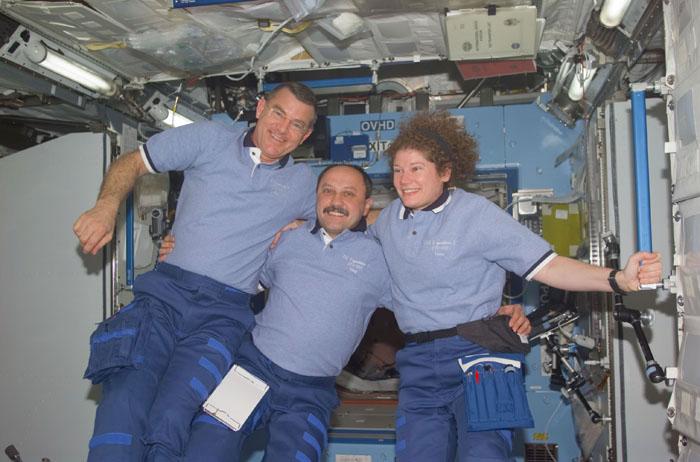
STS102-E-5096  (10 March 2001)  --- Astronaut James S. Voss, cosmonaut Yury V. Usachev and astronaut Susan J. Helms--the Expedition Two crew members--pose for a photo on the International Space Station (ISS).  Voss and Helms are assigned to space walk duties after the Space Shuttle Discovery and the International Space Station (ISS) link in Earth orbit.  The photograph was recorded with a digital still camera.
The new Expedition Two crew in the ISS Node/Unity module
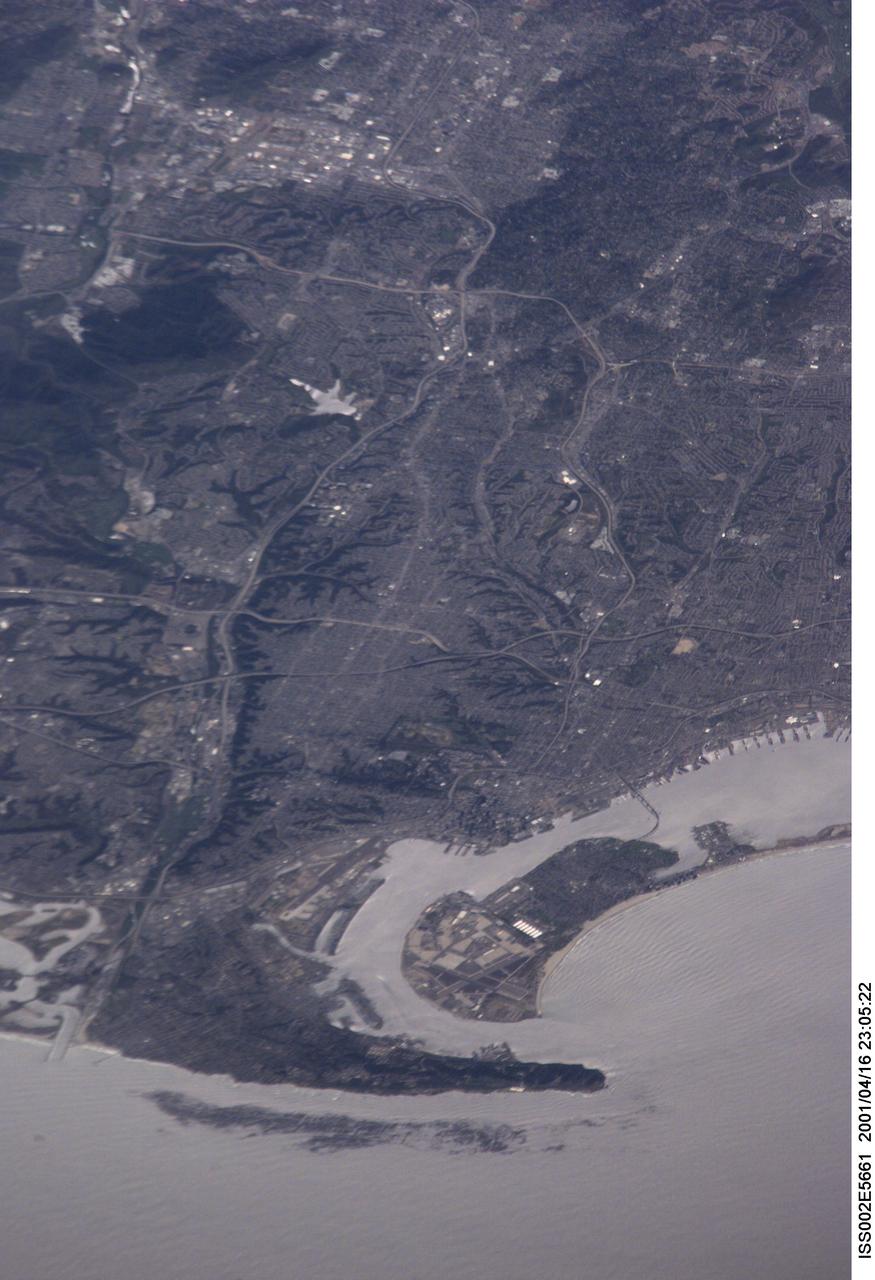
ISS002-E-5661 (16 April 2001) --- As the International Space Station (ISS) recently passed over the Pacific Ocean, one of the Expedition Two crew members, using an 800mm lens on a digital still camera, photographed this high oblique image of the coastal metropolitan area of San Diego, California.  The angle of the view allows one to see quite a distance inland.
San Diego, California (with sunglint) as seen by Expedition Two crew
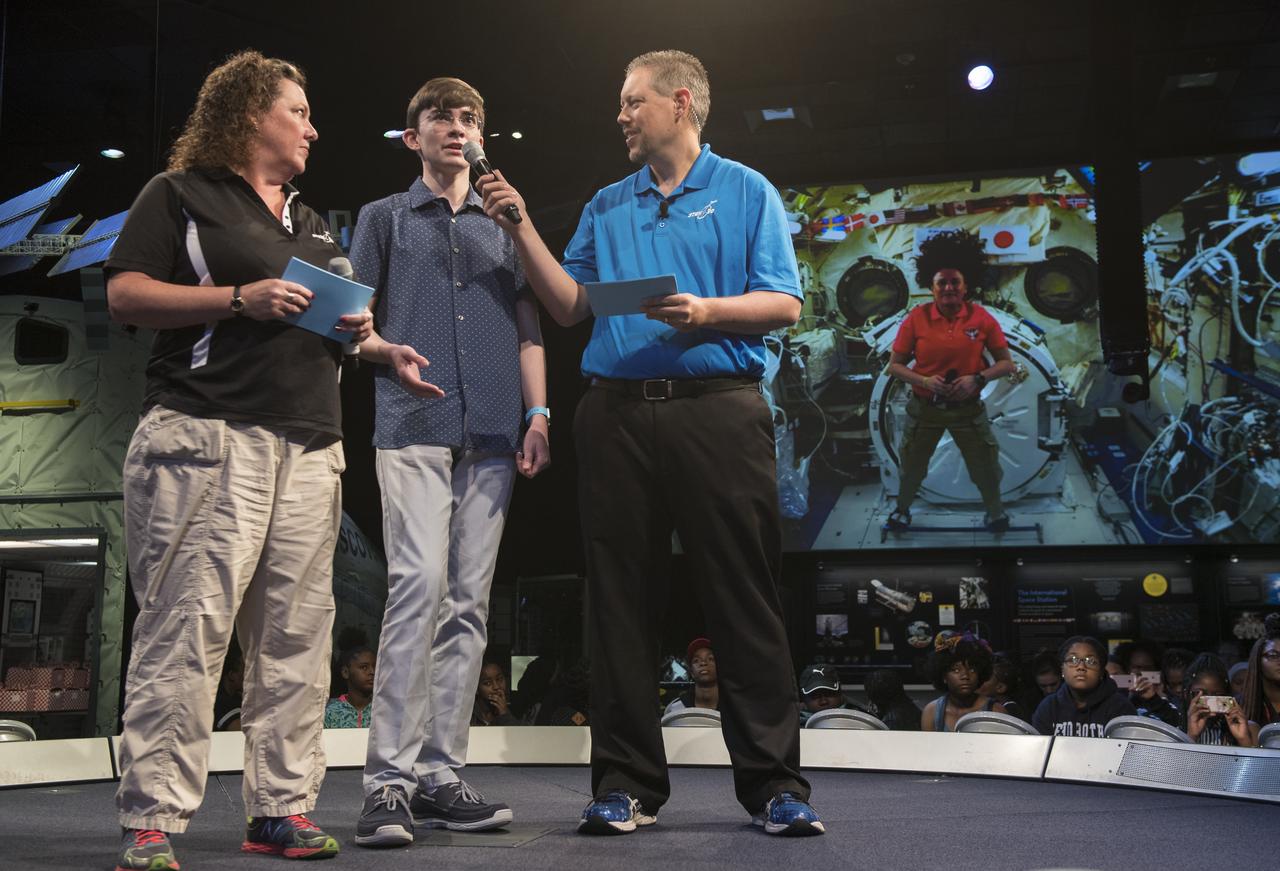
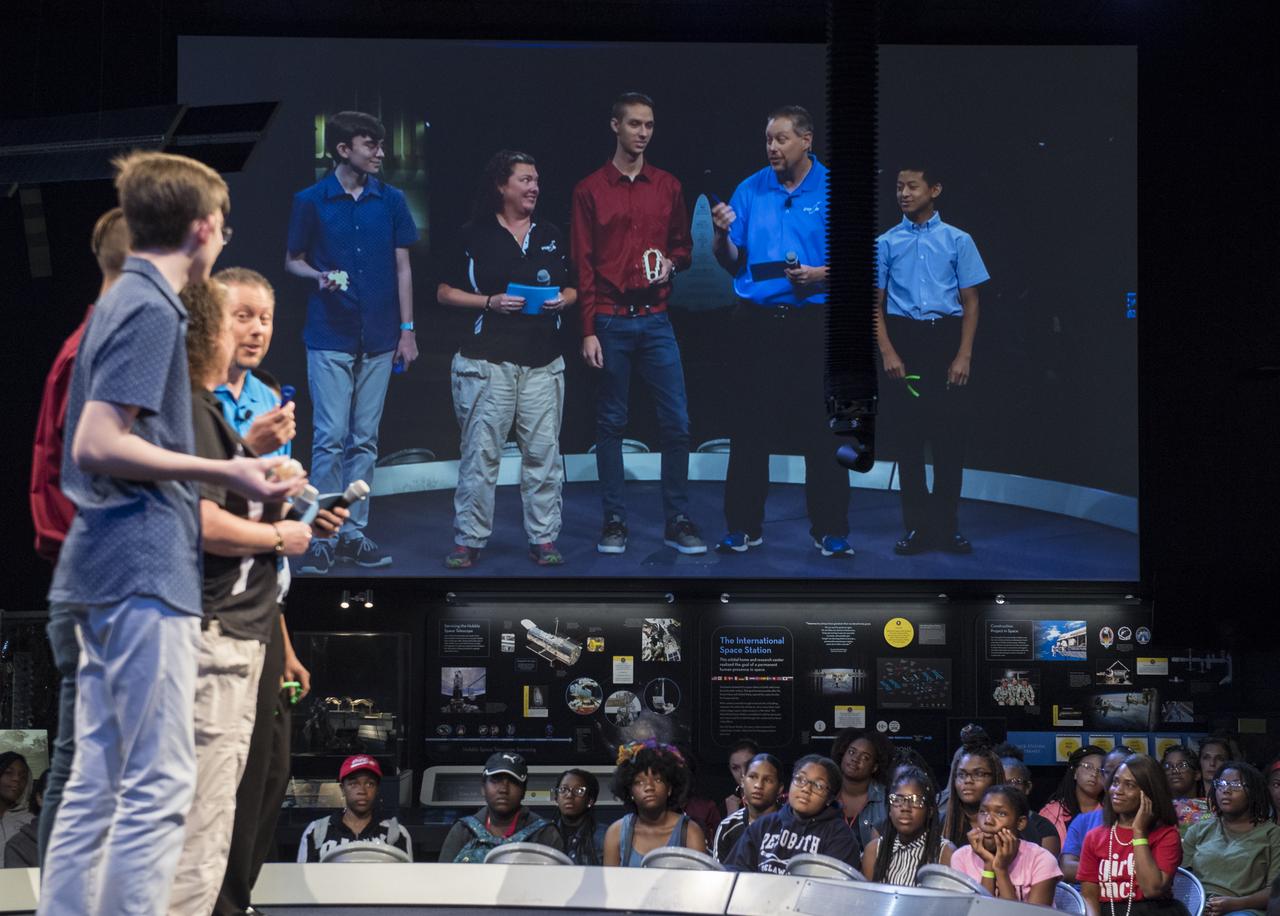
Future Engineers "Two for the Crew" winner Ansel Austin asks NASA astronaut Serena Auñon-Chancellor a question during a live downlink with the International Space Station (ISS), Wednesday, June 27, 2018 at Smithsonian's National Air and Space Museum in Washington. Serena is part of the Expedition 56/57 crew that launched to the ISS June 6, 2018. Photo Credit: (NASA/Aubrey Gemignani)
Astronaut Serena Auñon-Chancellor at Air and Space Museum
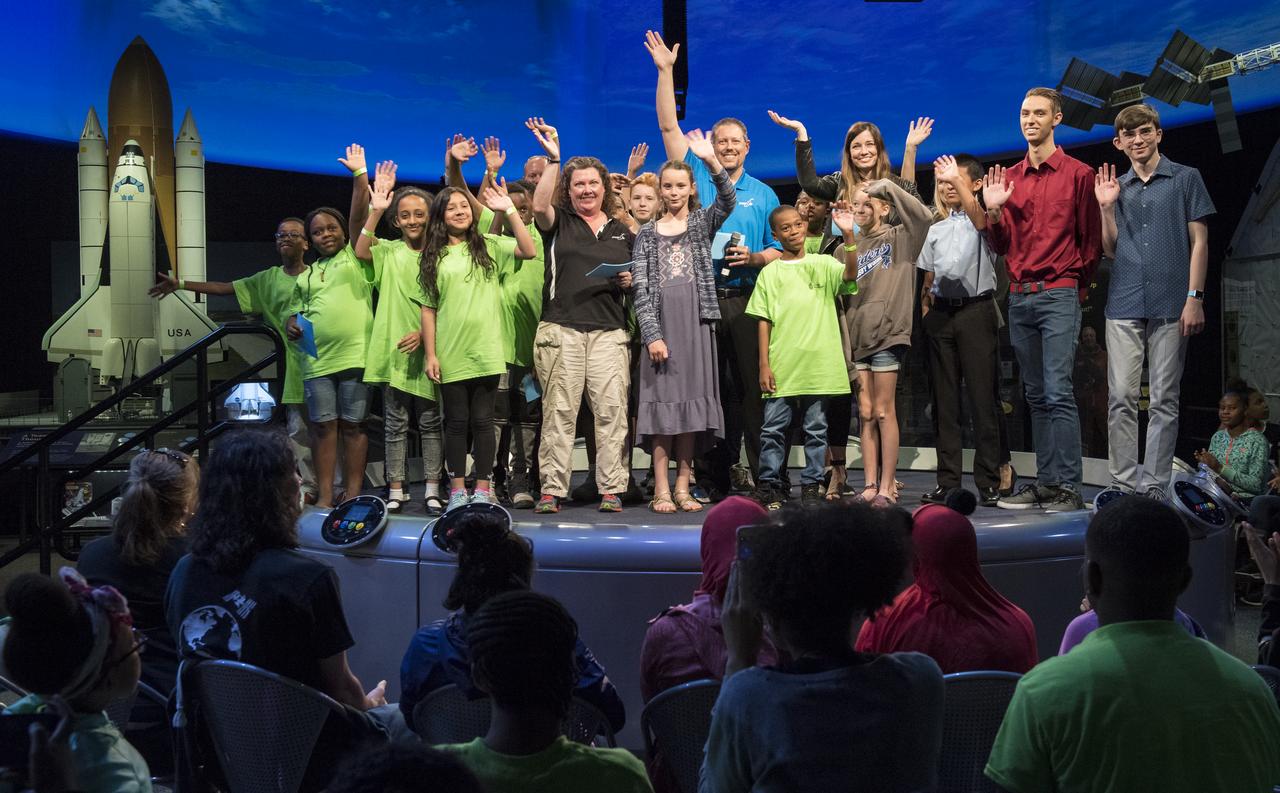
Students and Future Engineers "Two for the Crew" winners wave goodbye at the conclusion of a STEM in 30 event, Wednesday, June 27, 2018 at Smithsonian's National Air and Space Museum in Washington. During the event, NASA astronaut Serena Auñon-Chancellor spoke to students while onboard the International Space Station (ISS), during a live downlink. Photo Credit: (NASA/Aubrey Gemignani)
Astronaut Serena Auñon-Chancellor at Air and Space Museum
STS105-E-5326 (17 August 2001) --- The Expedition Three (white shirts), STS-105 (striped shirts), and Expedition Two (red shirts) crews assemble for a press conference in the U.S. Laboratory. The Expedition Three crew members are, from front to back, Frank L. Culbertson, mission commander;  and cosmonauts Vladimir N. Dezhurov and Mikhail Tyurin, flight engineers; STS-105 crewmembers are, front row, Patrick G. Forrester and Daniel T. Barry, mission specialists, and back row, Scott J. Horowitz, commander, and Frederick W. (Rick) Sturckow, pilot; Expedition Two crewmembers are, from front to back, cosmonaut Yury V. Usachev, mission commander, and James S. Voss and Susan J. Helms, flight engineers. This image was taken with a digital still camera.
STS-105, Expeditions Two and Three crew portrait in the ISS U.S. Laboratory/Destiny
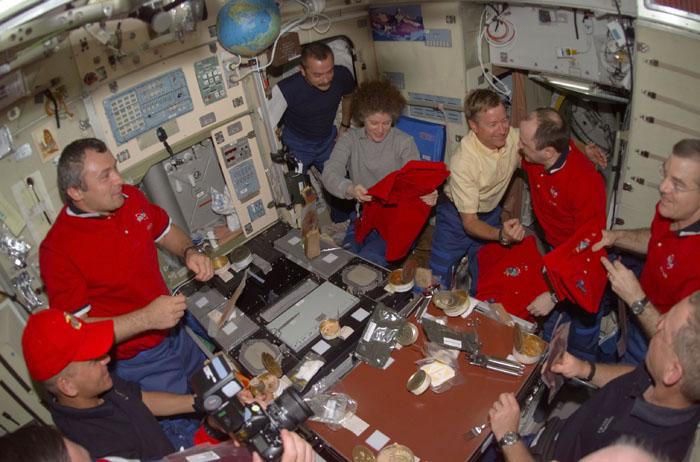
STS105-E-5201 (15 August 2001) --- Part of the "dessert" course for one of the first meals shared by the STS-105 and Expedition Two crews was the issuance of mission shirts for the departing station occupants.  Holding new jerseys in the Zvezda Service Module on the right side of the frame are astronauts Susan J. Helms and James S. Voss, departing flight engineers, and cosmonaut Yury V. Usachev, Expedition Two commander.  Clockwise from the lower left corner are astronaut Frederick W. (Rick) Sturckow, cosmonauts Vladimir Dezhurov and Mikhail Tyurin, Helms, astronaut Frank L. Culbertson, Jr., Usachev, Voss and astronaut Patrick G. Forrester. Astronauts Daniel T. Barry and Scott J. Horowitz are out of frame. Usachev, Dezhurov and Tyurin all represent Rosaviakosmos.  PLEASE NOTE: This event occurred on August 14, according to Central Daylight Time (CDT) but it was already the following day in Greenwich Mean Time (GMT).
Meal for Expedition Two, Three and STS-105 crews in the ISS Service Module/Zvezda
Founder and CEO of Future Engineers, Deanne Bell, speaks at a pop-up makerspace hosted by Future Engineers with support from NASA and The American Society of Mechanical Engineers (ASME), at the Steven F. Udvar-Hazy Center, Thursday, September 21, 2017 in Chantilly, Virginia. Participants were able to create digital 3D models using Autodesk Tinkercad and watch objects being printed with Makerbot 3D printers. Photo Credit: (NASA/Aubrey Gemignani)
NASA SOLVE Challenge Event
ISS002-E-5457 (13 April 2001) --- The "bull's-eye" of the Richat Structure adds interest to the barren Gres de Chinguetti Plateau in central Mauritania in northwest Africa. It represents domally uplifted, layered (sedimentary) rocks that have been eroded by water and wind into the present shape. The 25-mile-wide structure is a 300-foot-deep landmark that has caught the eye of many an astronaut in Earth orbit. Image number ISS002-E-5693 shows the same feature six days later.  The image was recorded with a digital still camera.
Richat structure, Mauritania taken by the Expedition Two crew
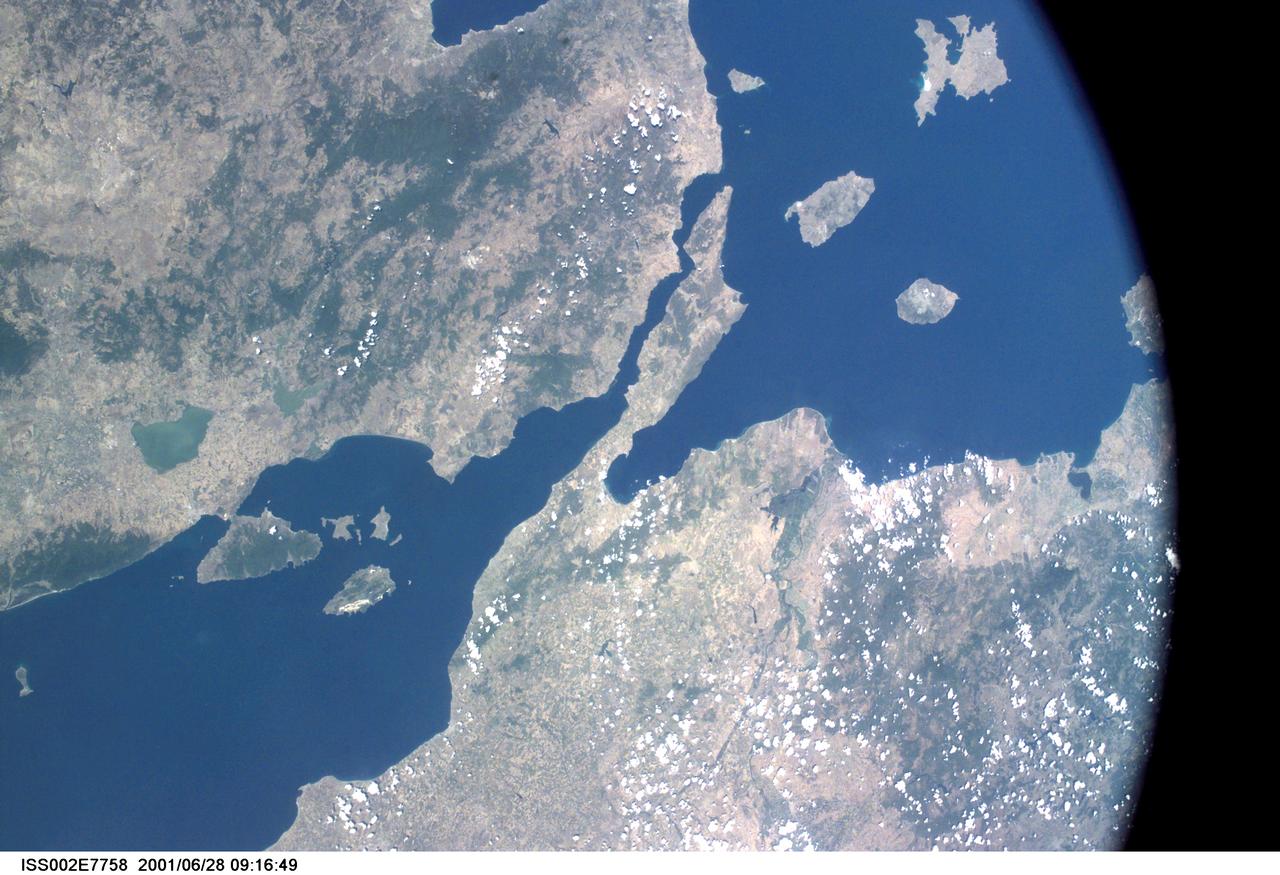
ISS002-E-7758 (28 June 2001) --- View of the Dardanelles, Turkey, as photographed with a digital still camera aboard the International Space Station (ISS).
View of the Dardanelles, Turkey taken by the Expedition Two crew
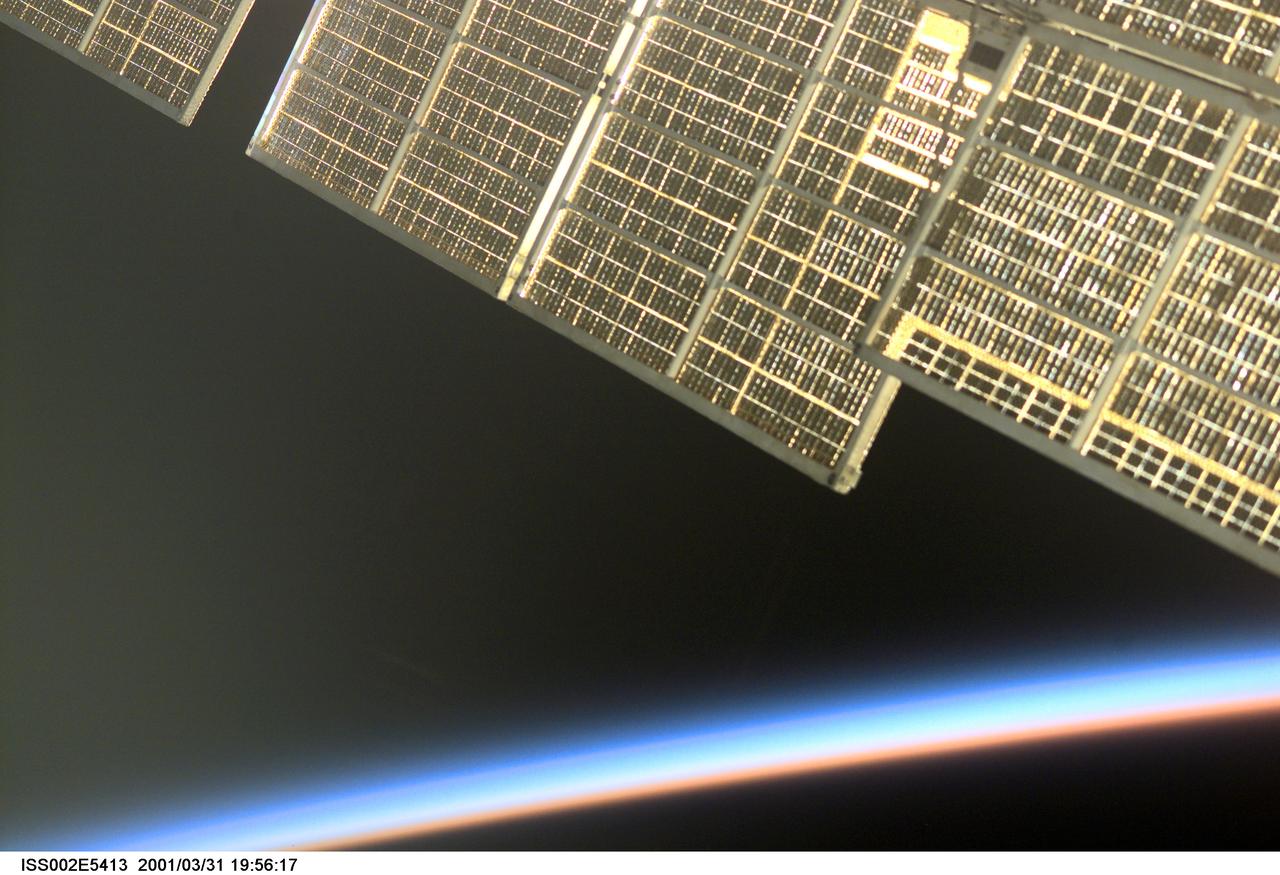
ISS002-E-5413 (31 March 2001) --- As the sun sets on the Earth's horizon, a golden reflection emanates from the solar array of the Zvezda / Service Module of the International Space Station (ISS).  An Expedition Two crewmember took this unusual photograph with a digital still camera.
View of sunset taken by the Expedition Two crew
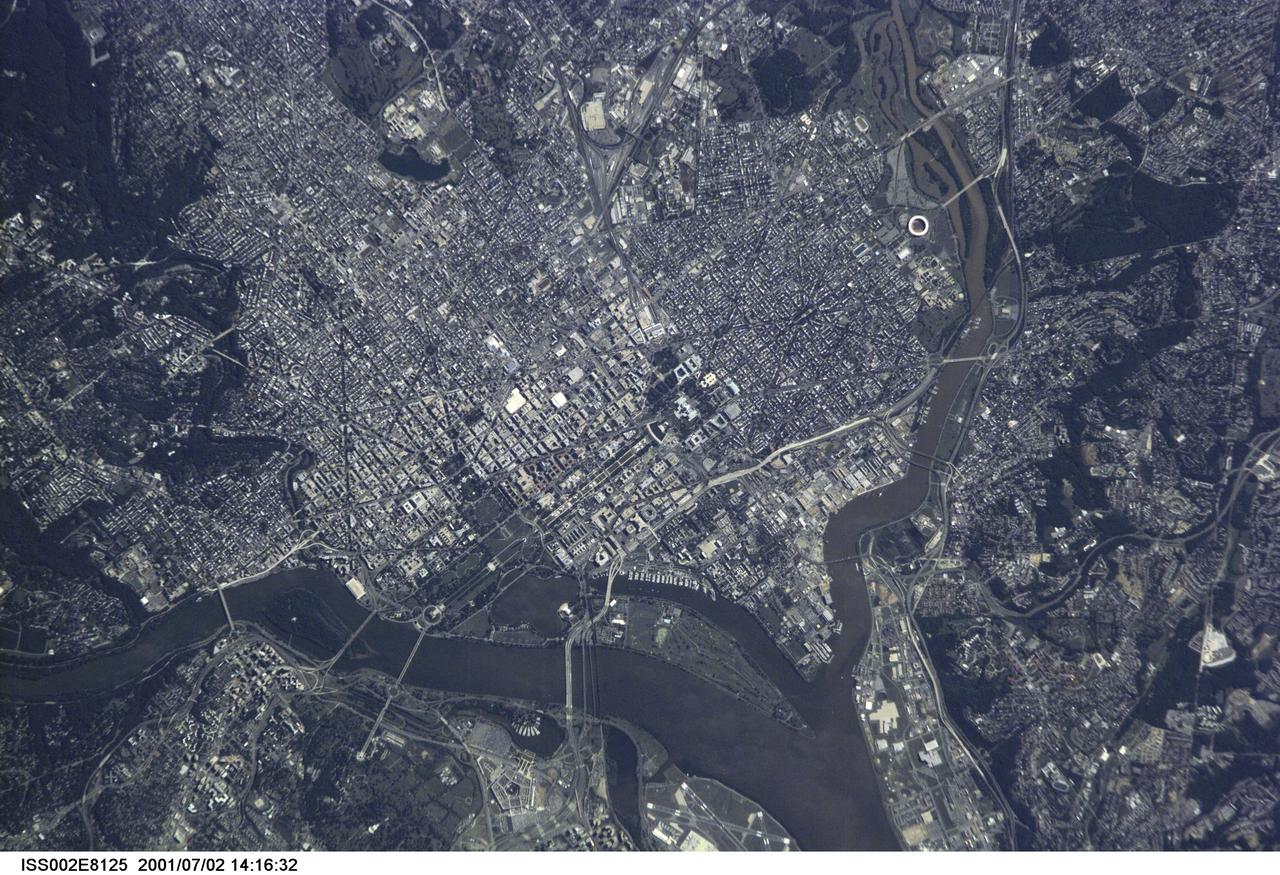
ISS002-E-8125 (2 July 2001) --- Washington, DC
Washington, D.C. taken by the Expedition Two crew
S104-E-5053 (14 July 2001) --- Soon after their ingress into the International Space Station (ISS), STS-104 crewmembers pose for a photograph with Expedition Two crewmembers in the Zvezda Service Module.  From left to right are: James S.  Voss, Expedition Two flight engineer; Susan J. Helms, Expedition Two flight engineer; Michael L. Gernhardt, STS-104 mission specialist; Steven W. Lindsey, STS-104 mission commander; Janet L. Kavandi, STS-104 mission specialist; and James F. Reilly, STS-104 mission specialist.
Expedition Two and STS-104 joint crew portrait
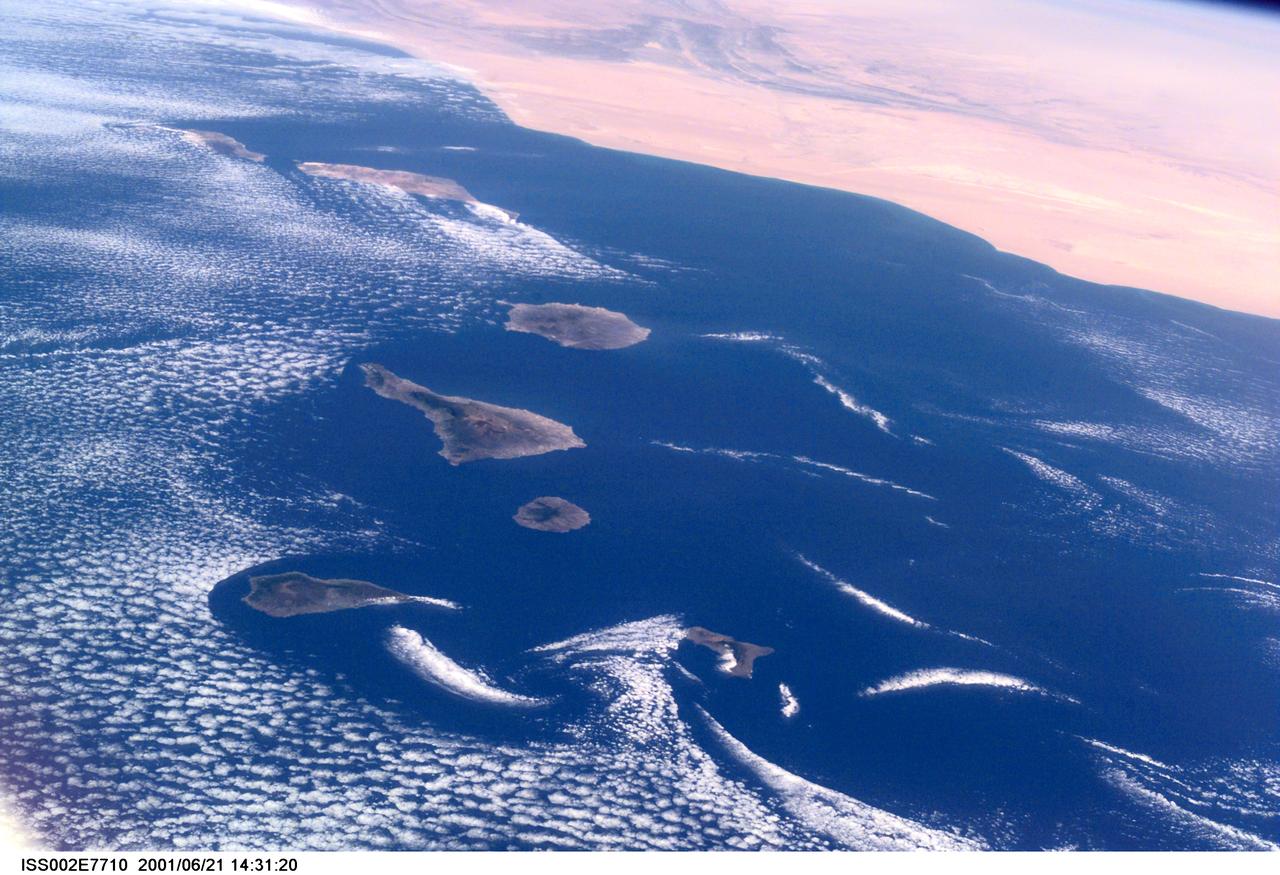
ISS002-E-7710 (21 June 2001) --- Commonly visible cloud vortices hover in the area of the Canary Islands off the coast of Morocco in this Expedition Two digital still camera's view from the International Space Station (ISS).
Earth Observation taken by Expedition Two crew
S104-E-5055 (14 July 2001) --- Soon after their ingress into the International Space Station (ISS), STS-104 crewmembers pose for a photograph with Expedition Two crewmembers in the Zvezda Service Module.  From left to right are: back row - Susan J. Helms, Expedition Two flight engineer; Michael L. Gernhardt, STS-104 mission specialist; Steven W. Lindsey, STS-104 mission commander; James F. Reilly, STS-104 mission specialist; front row - Yury V. Usachev, Expedition Two mission commander; and Janet L. Kavandi, STS-104 mission specialist.  Usachev represents Rosaviakosmos.
Expedition Two and STS-104 joint crew portrait
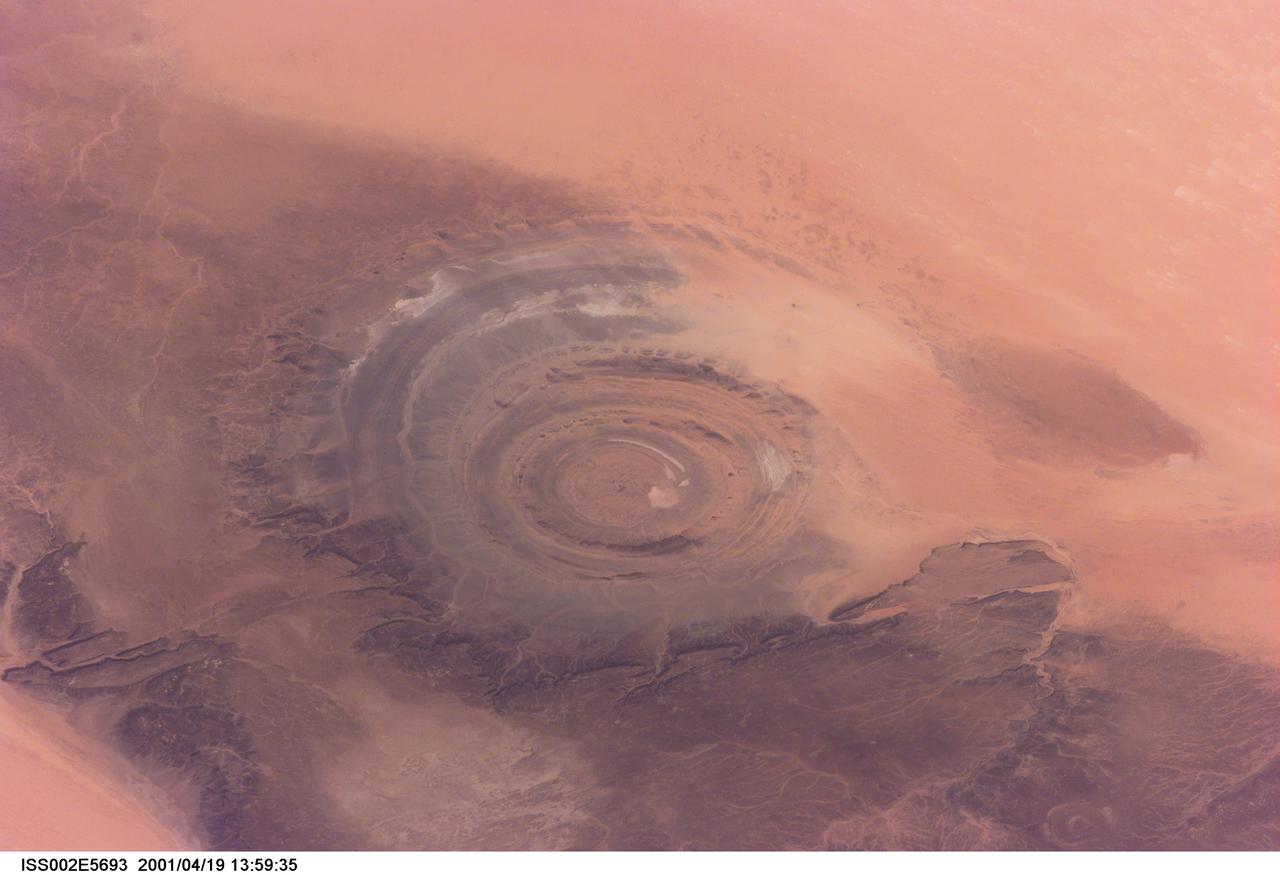
ISS002-E-5693 (19 April 2001) --- The "bull's-eye" of the Richat Structure adds interest to the barren Gres de Chinguetti Plateau in central Mauritania in northwest Africa. It represents domally uplifted, layered (sedimentary) rocks that have been eroded by water and wind into the present shape. The 25-mile-wide structure is a 300-foot-deep landmark that has caught the eye of many an astronaut in Earth orbit. Image number ISS002-E-5457 shows the same feature six days earlier.  The image was recorded with a digital still camera.
Richat Structure, Mauritania as seen by Expedition Two crew
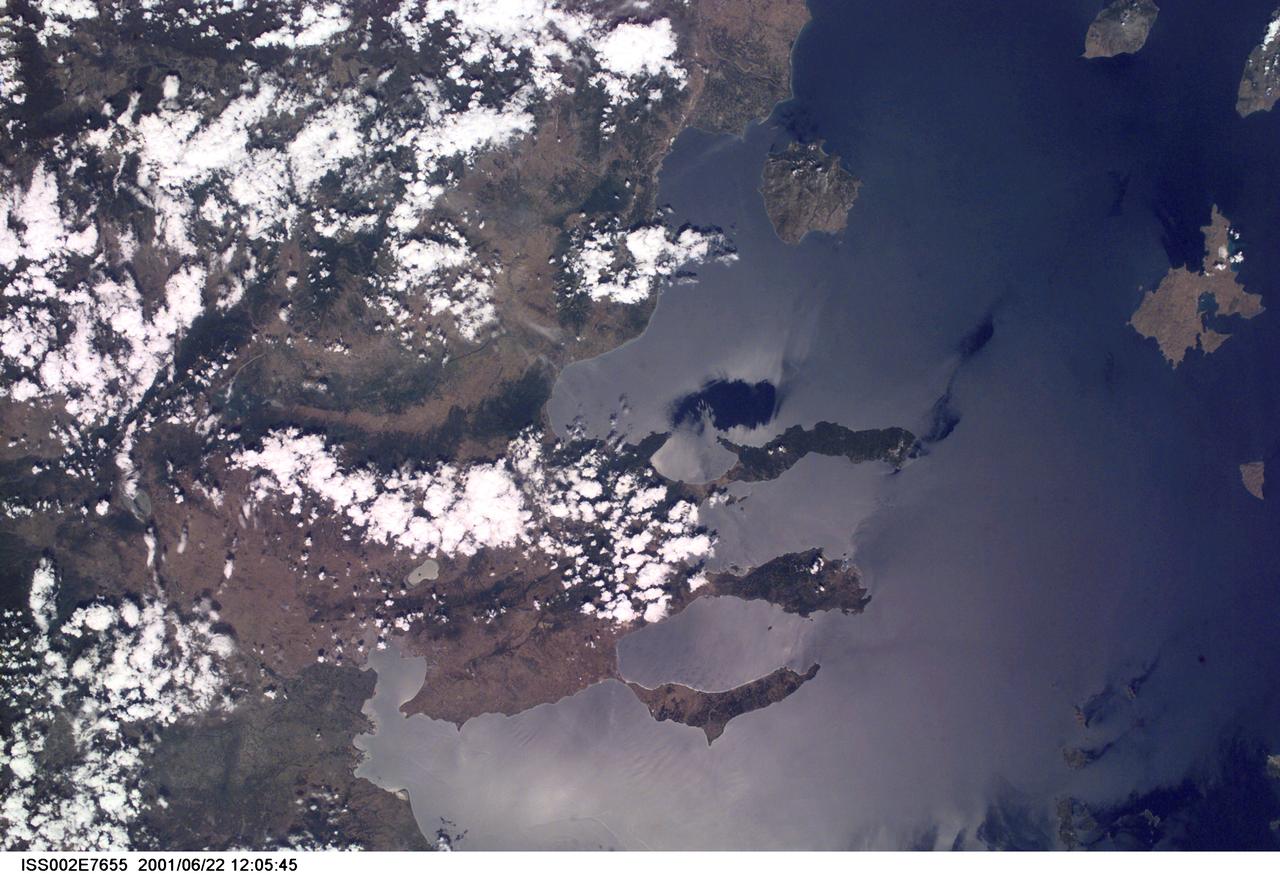
ISS002-E-7655 (22 June 2001) --- A view of Chalcidice (Khalkidhiki) Peninsula in Northeast Greece was photographed with a digital still camera aboard the Interntational Space Station (ISS).
Earth observation taken by Expedition Two crew
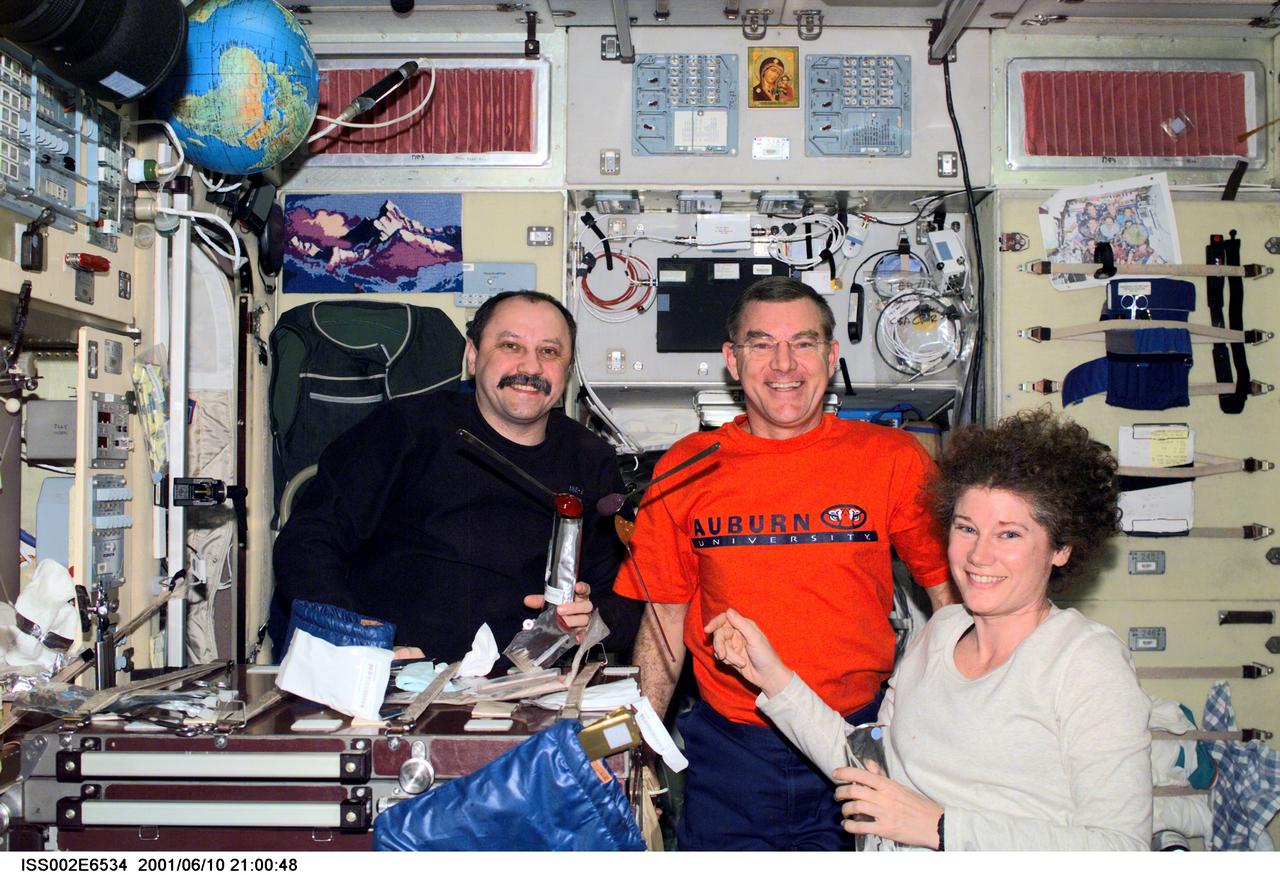
ISS002-E-6534  (10 June 2001) --- Expedition Two crewmembers Yury V. Usachev (left), mission commander, James S. Voss, flight engineer, and Susan J. Helms, flight engineer, share a dessert in the Zvezda Service Module.  Usachev represents Rosaviakosmos.  The image was recorded with a digital still camera.
Expedition Two crew share dessert in Zvezda module
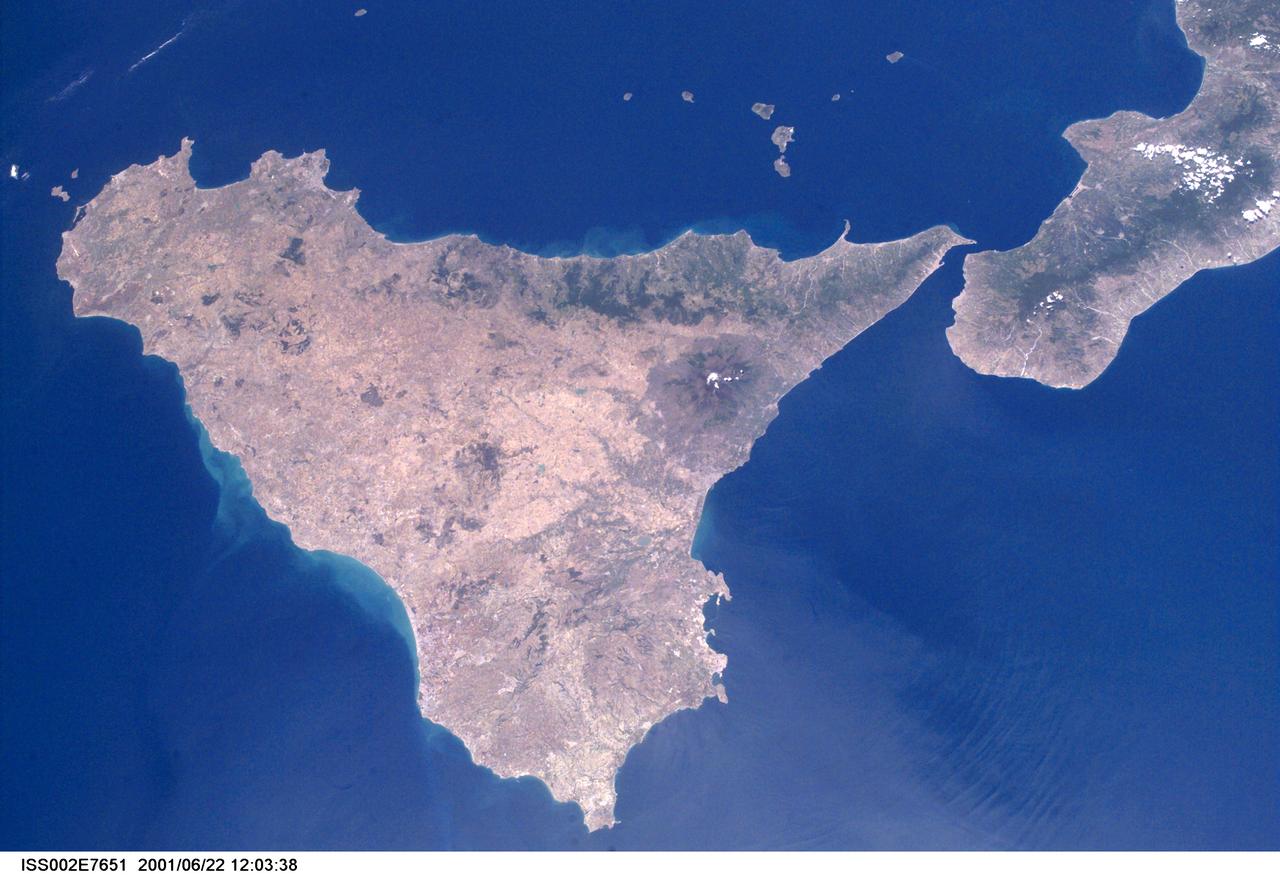
ISS002-E-7651 (22 June 2001) --- Sicily  and the "toe" of Italy are featured in this Expedition Two  digital still camera's nearly-vertical view from the International Space Station (ISS).
Island of Sicily taken by Expedition Two crew
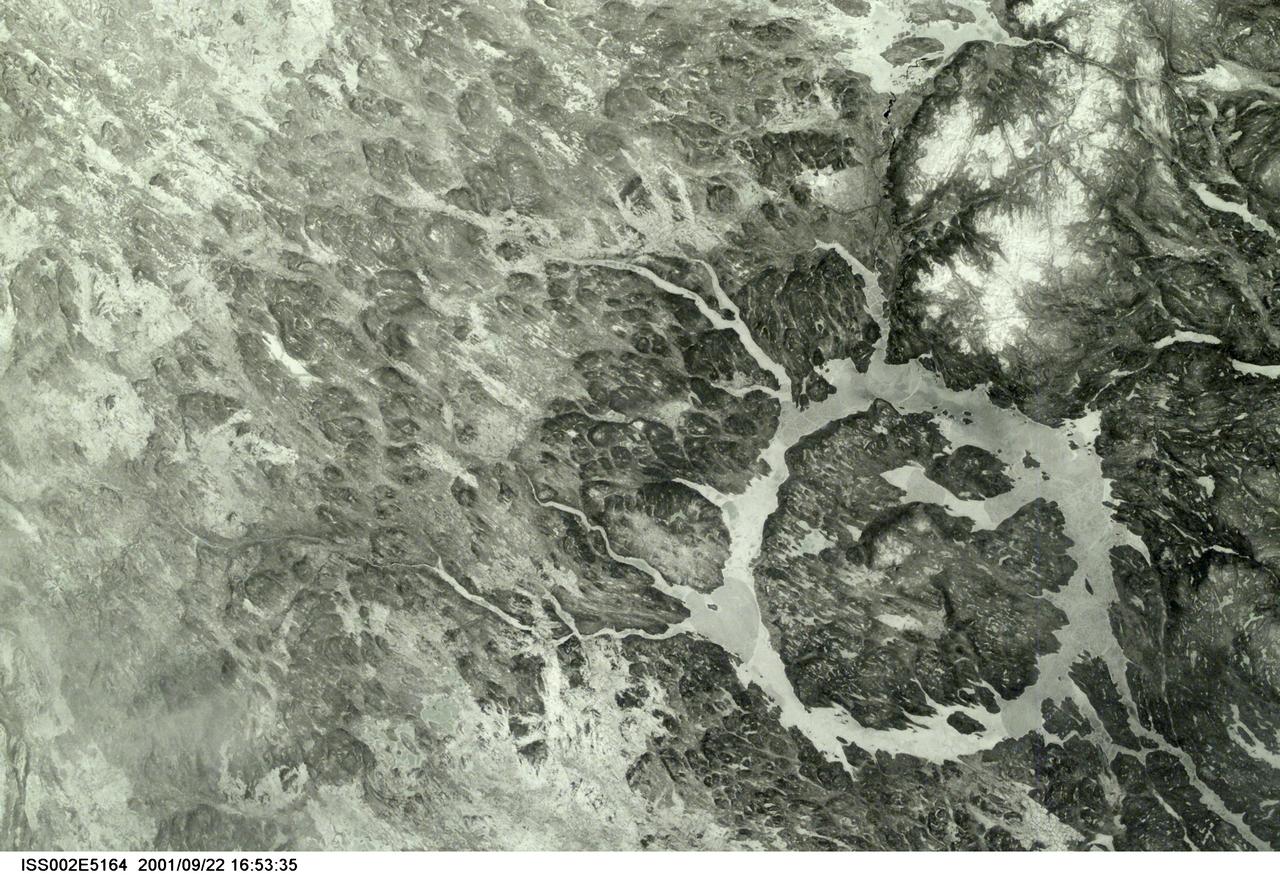
SS002-E-5164 (March 2001) --- The Manicouagan Impact Crater reservoir in Quebec, Canada, was photographed  early in the mission   by one of the Expedition Two crewmembers using a digital still camera.
Manicouagan impact crater taken by Expedition Two crew
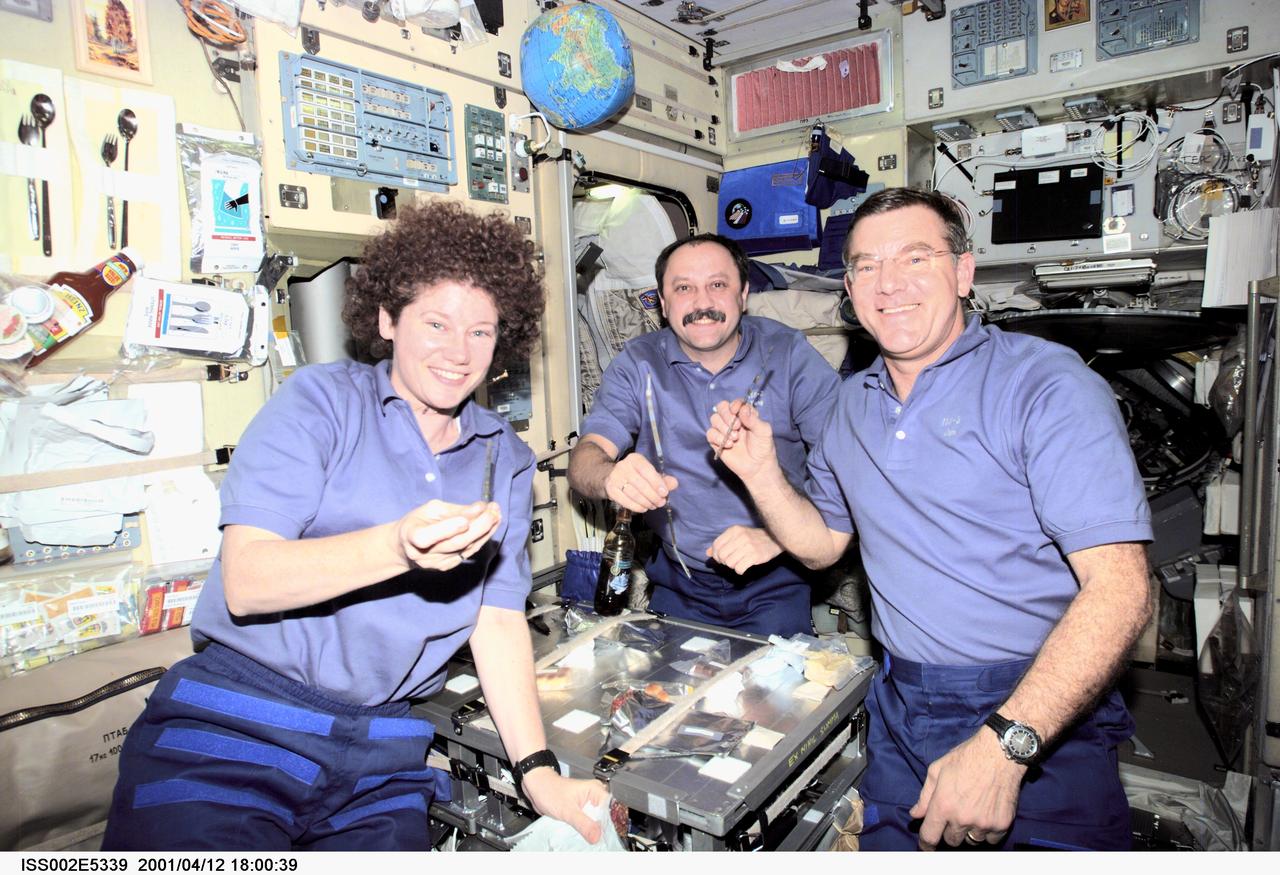
ISS002-E-5339 (12 April 2001) --- The Expedition Two crewmembers -- astronaut Susan J. Helms (left), cosmonaut Yury V. Usachev and astronaut James S. Voss -- share a meal at the table in the Zvezda / Service Module of the International Space Station (ISS).  This image was recorded with a digital still camera.
Expedition Two crew eat a meal in the Service Module
S104-E-5057 (14 July 2001) --- Soon after their ingress into the International Space Station (ISS), the STS-104 crewmembers pose for a photograph with the Expedition Two crewmembers in the Zvezda Service Module.  From left to right are: back row - Susan J. Helms, Expedition Two flight engineer; Michael L. Gernhardt, STS-104 mission specialist; Steven W. Lindsey, STS-104; James F. Reilly, STS-104 mission specialist; middle row - Yury V. Usachev, Expedition Two mission commander; Janet L. Kavandi, STS-104 mission specialist; front row - James S. Voss, Expedition Two flight engineer; and Charles O. Hobaugh, STS-104 pilot.  Usachev represents Rosaviakosmos.
Expedition Two and STS-104 joint crew portrait
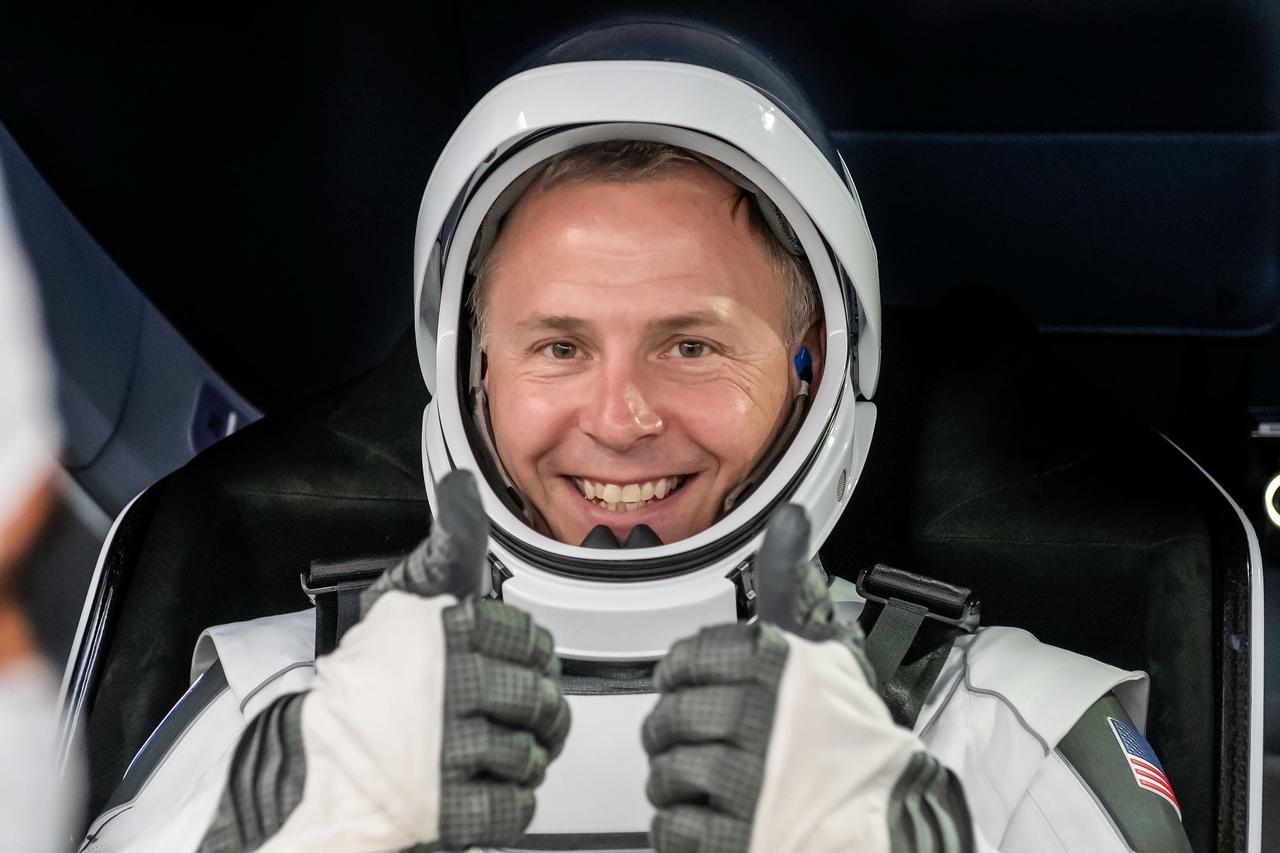
jsc2024e052329 (July 22, 2024) --- NASA’s SpaceX Crew-9 Pilot Nick Hague smiles and gives two thumbs up during the crew equipment interface test (CEIT) at SpaceX’s new Dragon refurbishing facility at Kennedy Space Center in Florida. This will be his second mission to the orbiting laboratory. Credit: SpaceX
SpaceX Crew-9 Pilot Nick Hague
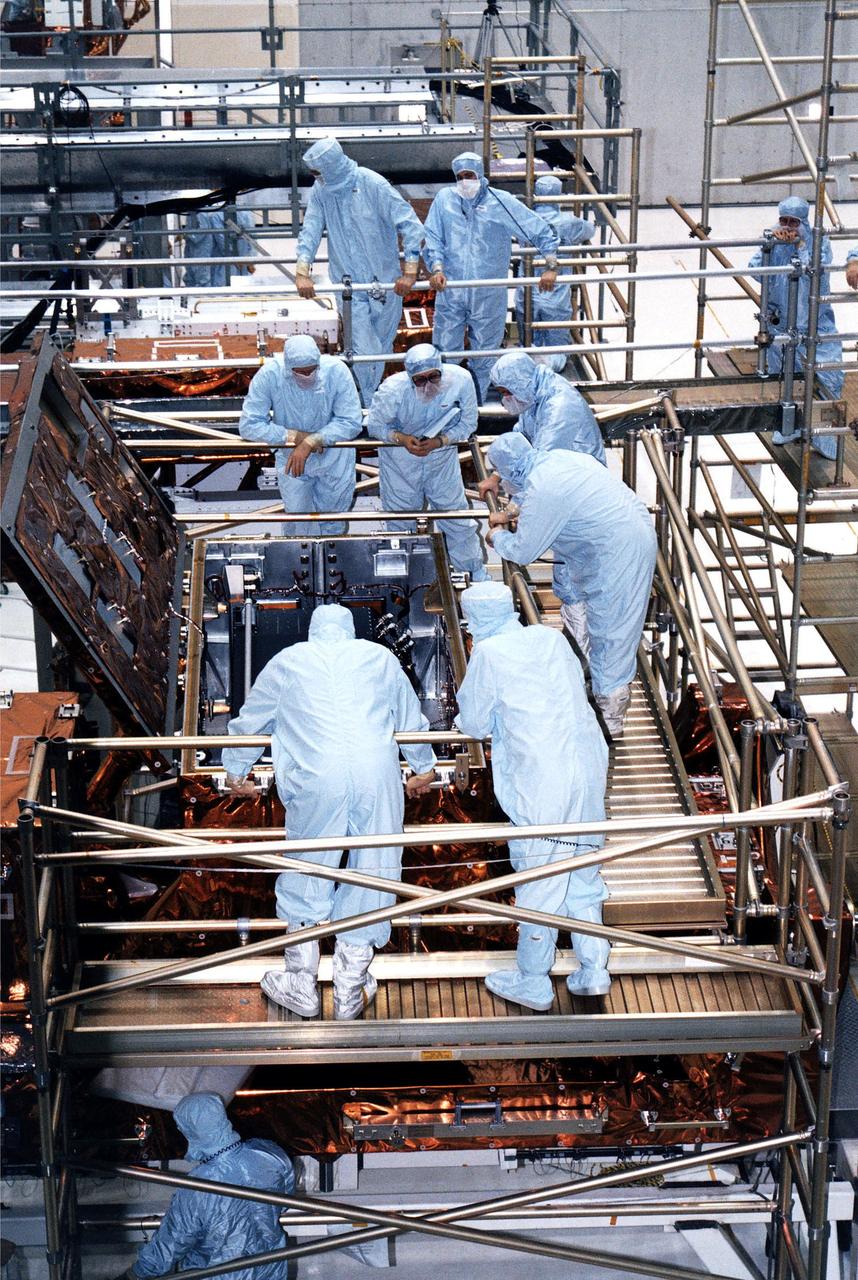
KENNEDY SPACE CENTER, FLA. -  STS-82 crew members and workers at KSC's Vertical Processing Facility get a final look at the Near Infrared Camera and Multi-Object Spectrometer (NICMOS) in its flight configuration for the STS-82 mission.  The crew is participating in the Crew Equipment Integration Test (CEIT).  NICMOS is one of two new scientific instruments that will replace two outdated instruments on the Hubble Space Telescope (HST).  NICMOS will provide HST with the capability for infrared imaging and spectroscopic observations of astronomical targets.  The refrigerator-sized NICMOS also is HST's first cryogenic instrument - its sensitive infrared detectors must operate at very cold temperatures of minus 355 degrees Fahrenheit or 58 degrees Kelvin.  NICMOS will be installed in Hubble during STS-82, the second Hubble Space Telescope servicing mission.  Liftoff is scheduled Feb. 11 aboard Discovery with a crew of seven.
KENNEDY SPACE CENTER, FLA. - STS-82 crew members and workers at KSC's Vertical Processing Facility get a final look at the Near Infrared Camera and Multi-Object Spectrometer (NICMOS) in its flight configuration for the STS-82 mission. The crew is participating in the Crew Equipment Integration Test (CEIT). NICMOS is one of two new scientific instruments that will replace two outdated instruments on the Hubble Space Telescope (HST). NICMOS will provide HST with the capability for infrared imaging and spectroscopic observations of astronomical targets. The refrigerator-sized NICMOS also is HST's first cryogenic instrument - its sensitive infrared detectors must operate at very cold temperatures of minus 355 degrees Fahrenheit or 58 degrees Kelvin. NICMOS will be installed in Hubble during STS-82, the second Hubble Space Telescope servicing mission. Liftoff is scheduled Feb. 11 aboard Discovery with a crew of seven.
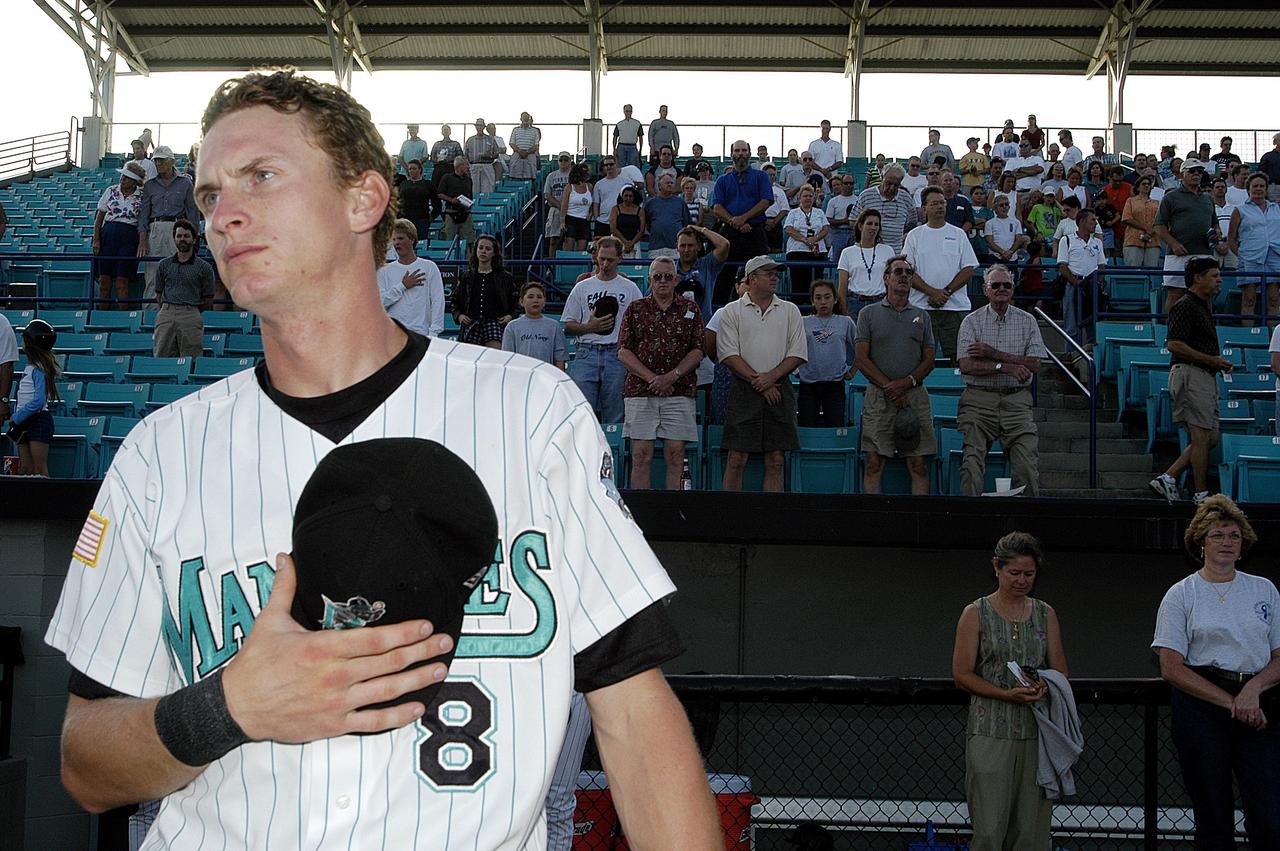
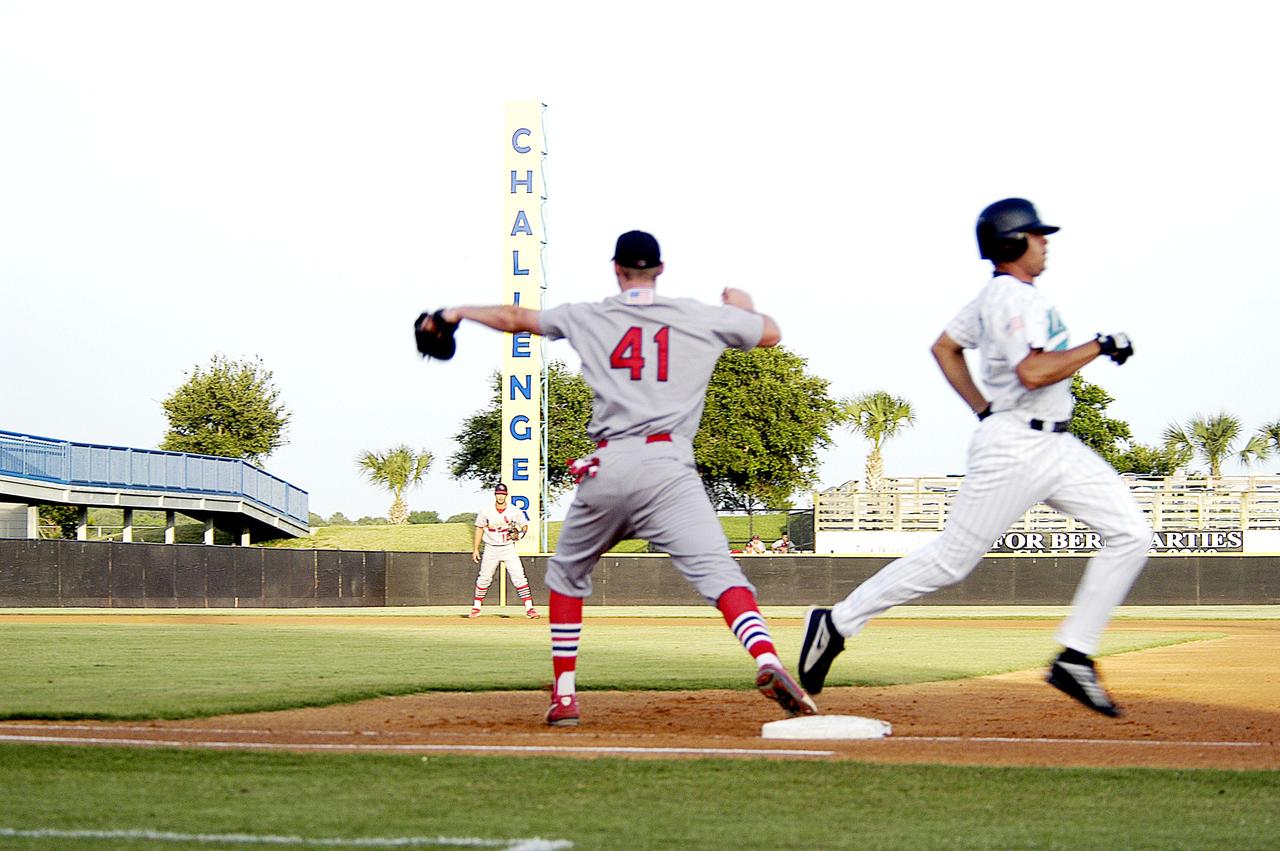
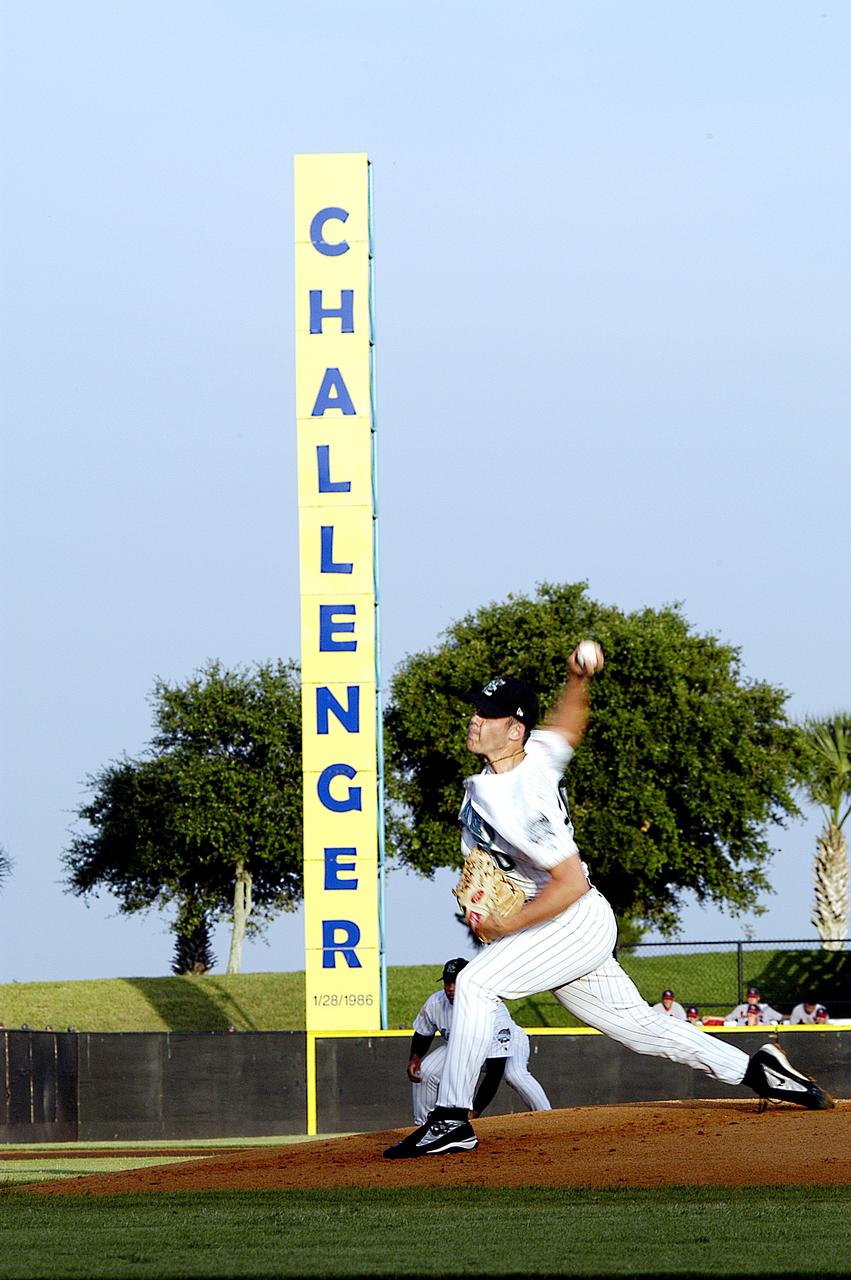
KENNEDY SPACE CENTER, FLA. - The pitcher with the Brevard Manatees, a minor league baseball team in Central Florida, starts the game on a night that hosted KSC employees.  Before the game, attendees offered a moment of silence to honor the STS-107 crew and two recovery workers who died in a helicopter crash.
KENNEDY SPACE CENTER, FLA. - The pitcher with the Brevard Manatees, a minor league baseball team in Central Florida, starts the game on a night that hosted KSC employees. Before the game, attendees offered a moment of silence to honor the STS-107 crew and two recovery workers who died in a helicopter crash.
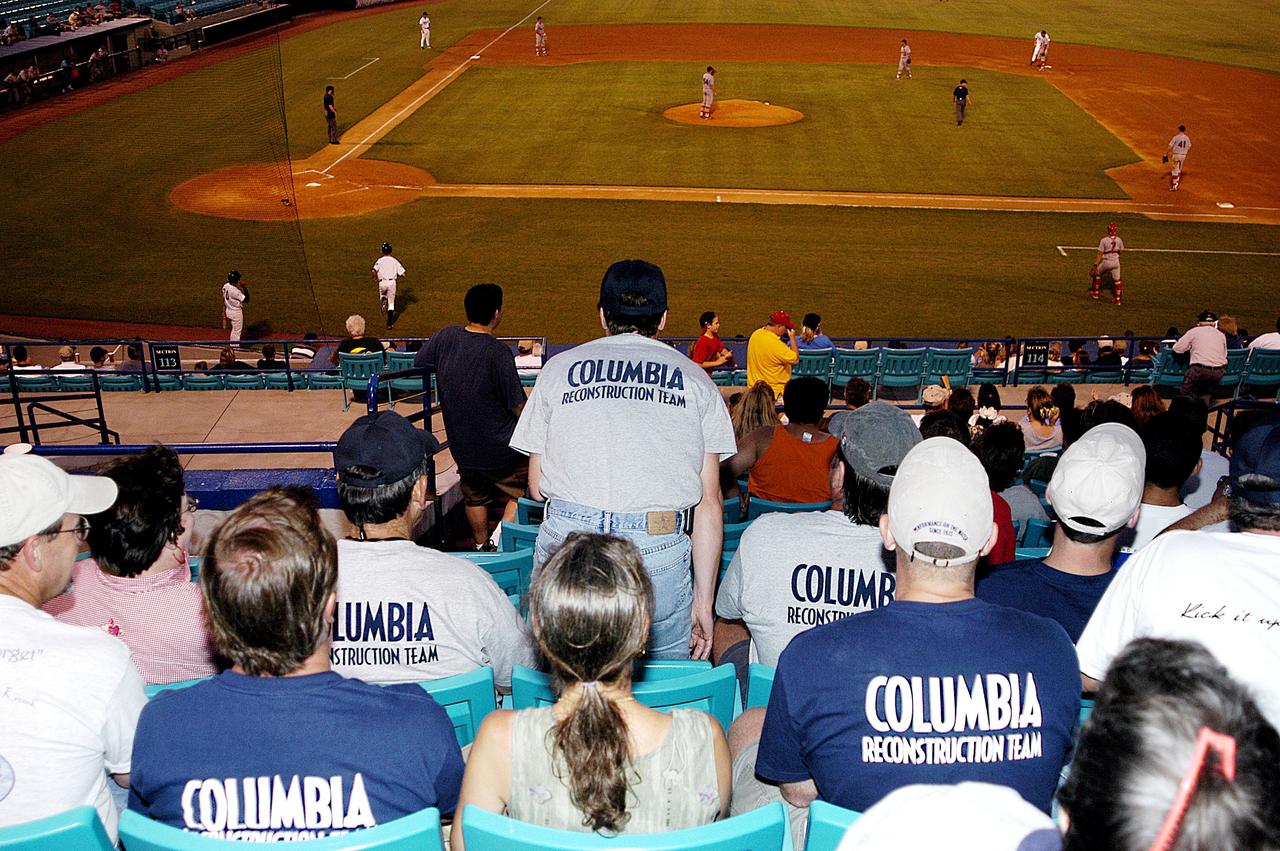
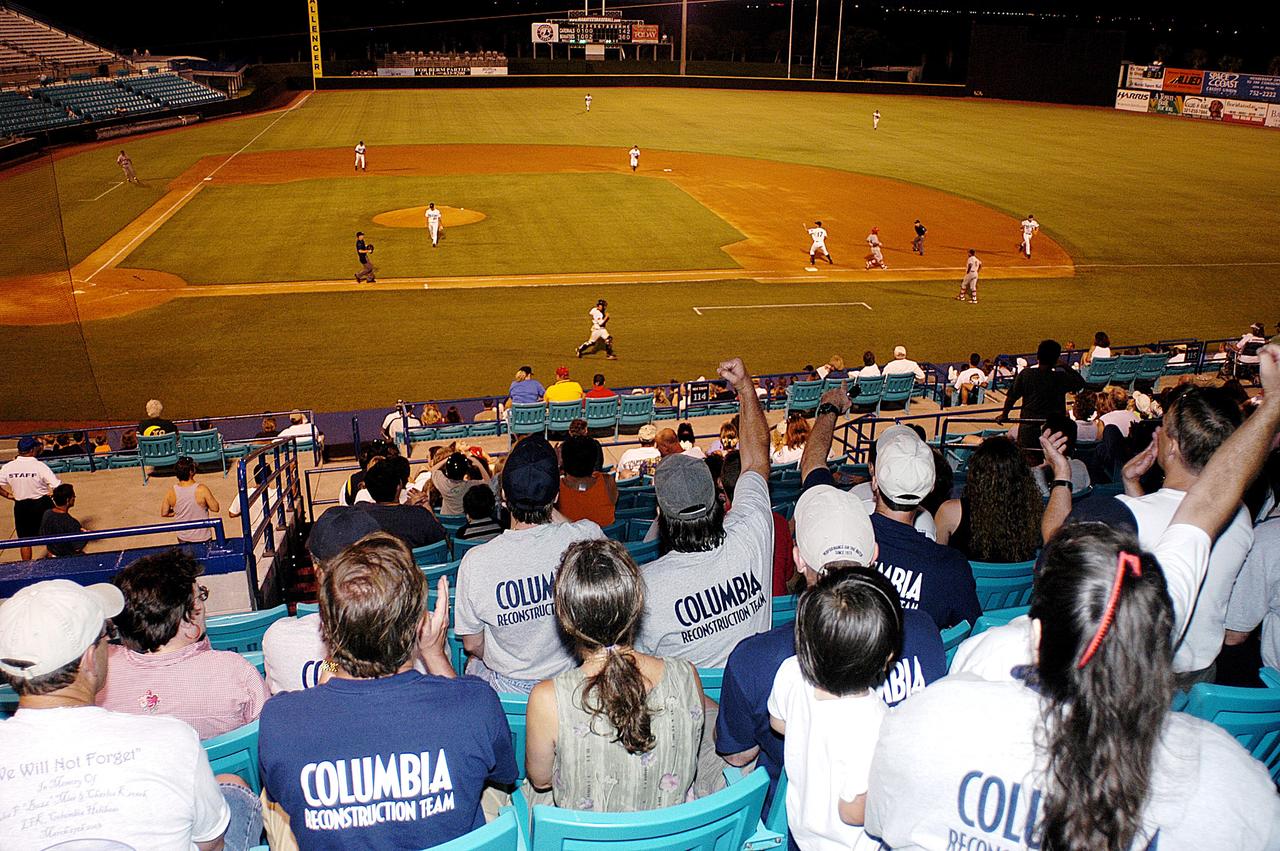
KENNEDY SPACE CENTER, FLA. -  KSC employees enjoy a baseball game at Manatees Stadium, home of the Brevard Manatees, a minor league baseball team in Central Florida.  The team hosted KSC employees for the game, which included a moment of silence to honor the STS-107 crew and two recovery workers who died in a helicopter crash.
KENNEDY SPACE CENTER, FLA. - KSC employees enjoy a baseball game at Manatees Stadium, home of the Brevard Manatees, a minor league baseball team in Central Florida. The team hosted KSC employees for the game, which included a moment of silence to honor the STS-107 crew and two recovery workers who died in a helicopter crash.
KENNEDY SPACE CENTER, FLA. - The Brevard Manatees, a minor league baseball team in Central Florida, hosts KSC employees at a ballgame at Manatees Stadium.   Before the game, attendees offered a moment of silence to honor the STS-107 crew and two recovery workers who died in a helicopter crash.
KENNEDY SPACE CENTER, FLA. - The Brevard Manatees, a minor league baseball team in Central Florida, hosts KSC employees at a ballgame at Manatees Stadium. Before the game, attendees offered a moment of silence to honor the STS-107 crew and two recovery workers who died in a helicopter crash.
KENNEDY SPACE CENTER, FLA. - KSC employees enjoy a baseball game at Manatees Stadium, home of the Brevard Manatees, a minor league baseball team in Central Florida.  The team hosted the employees for the game, which included a moment of silence to honor the STS-107 crew and two recovery workers who died in a helicopter crash.
KENNEDY SPACE CENTER, FLA. - KSC employees enjoy a baseball game at Manatees Stadium, home of the Brevard Manatees, a minor league baseball team in Central Florida. The team hosted the employees for the game, which included a moment of silence to honor the STS-107 crew and two recovery workers who died in a helicopter crash.
KENNEDY SPACE CENTER, FLA. -  There is action on the baseball diamond during a game at Manatees Stadium, home of the Brevard Manatees, a minor league baseball team in Central Florida.  The team hosted KSC employees for the game, which included a moment of silence to honor the STS-107 crew and two recovery workers who died in a helicopter crash.
KENNEDY SPACE CENTER, FLA. - There is action on the baseball diamond during a game at Manatees Stadium, home of the Brevard Manatees, a minor league baseball team in Central Florida. The team hosted KSC employees for the game, which included a moment of silence to honor the STS-107 crew and two recovery workers who died in a helicopter crash.
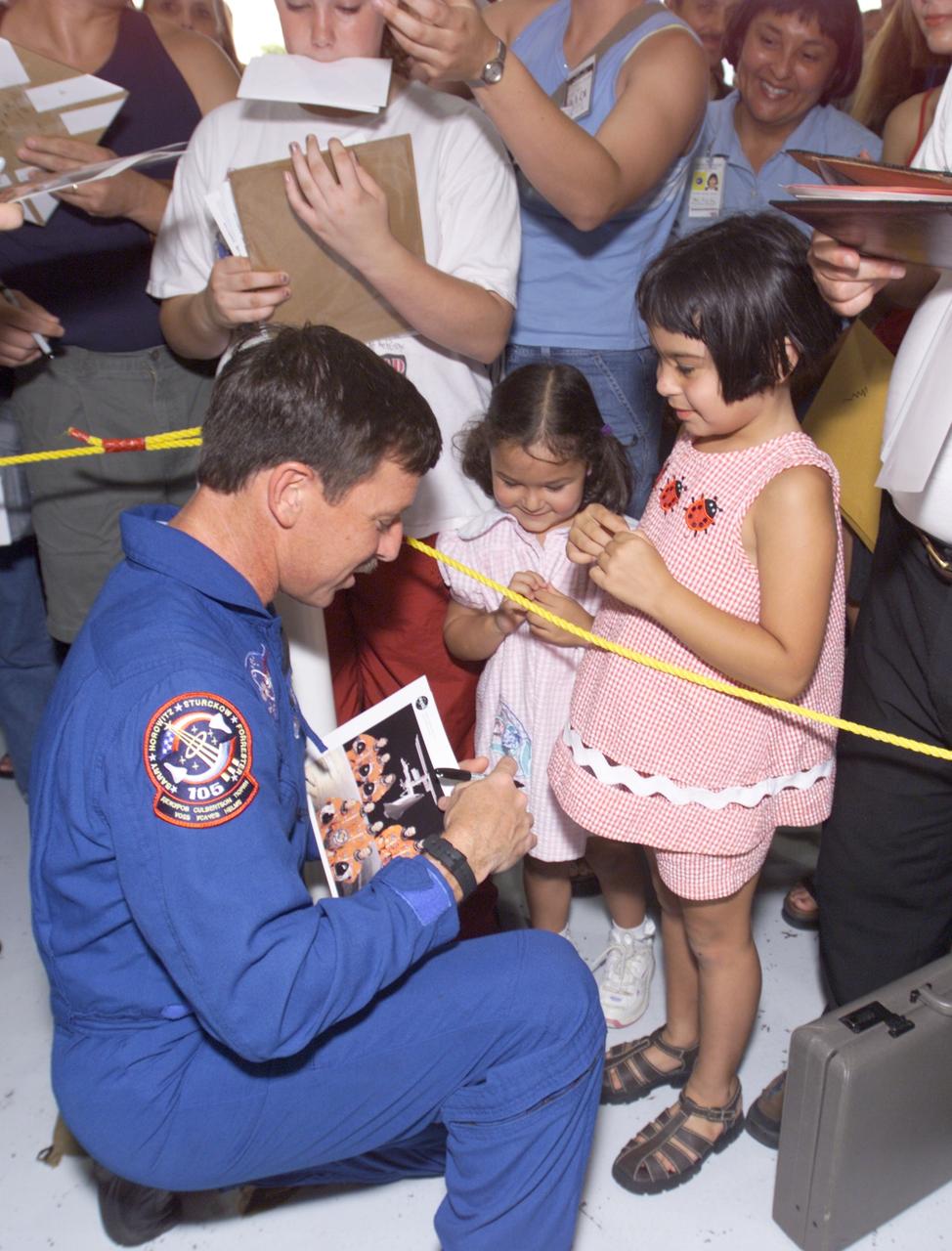
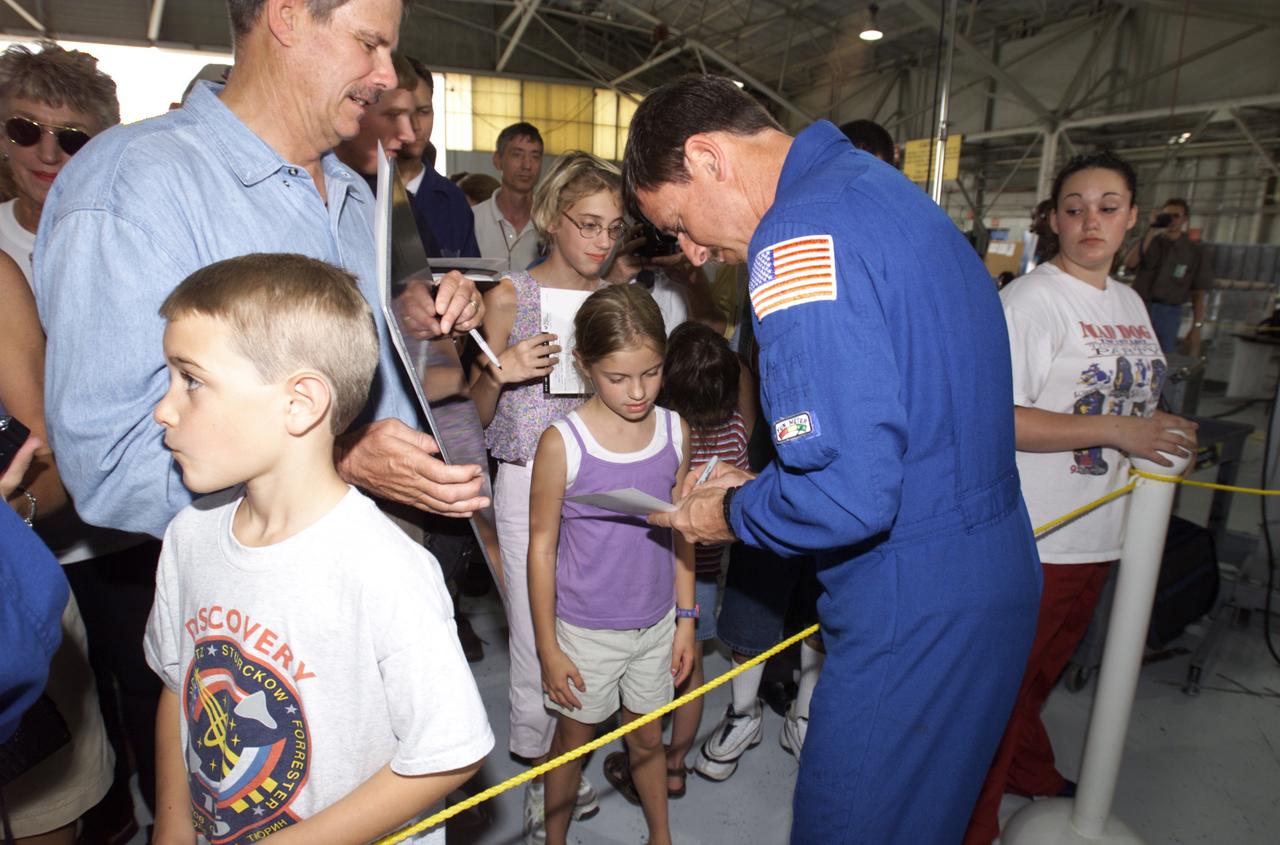
JSC2001-E-25829 (23 August 2001) --- Scott J. Horowitz, STS-105 commander, signs an autograph for two young visitors in Hangar 990 at Ellington Field during the STS-105 and Expedition Two crew return ceremonies.  The STS-105 crew delivered the Expedition Three crew and supplies to the International Space Station (ISS) and brought the Expedition Two crew back to Earth.
STS-105 Expedition 2 Return
iss072e1021804 (April 19, 2025) --- The Soyuz crew ships that each brought three crew members to the International Space Station are pictured docked to the orbital outpost. In the foreground, is the Soyuz MS-26 spacecraft docked to the Rassvet module moments before it undocked and returned to Earth with NASA astronaut Pettit and Roscosmos cosmonauts Alexey Ovchinin and Ivan Vagner after 220 days in space. In the rear, is the Soyuz MS-27 spacecraft docked to the Prichal module after it launched on April 8, 2025, with NASA astronaut Jonny Kim and Roscosmos cosmonauts Sergey Ryzhikov and Alexey Zubritsky beginning an eight-month space research mission.
Two Soyuz crew ships are pictured docked to the International Space Station
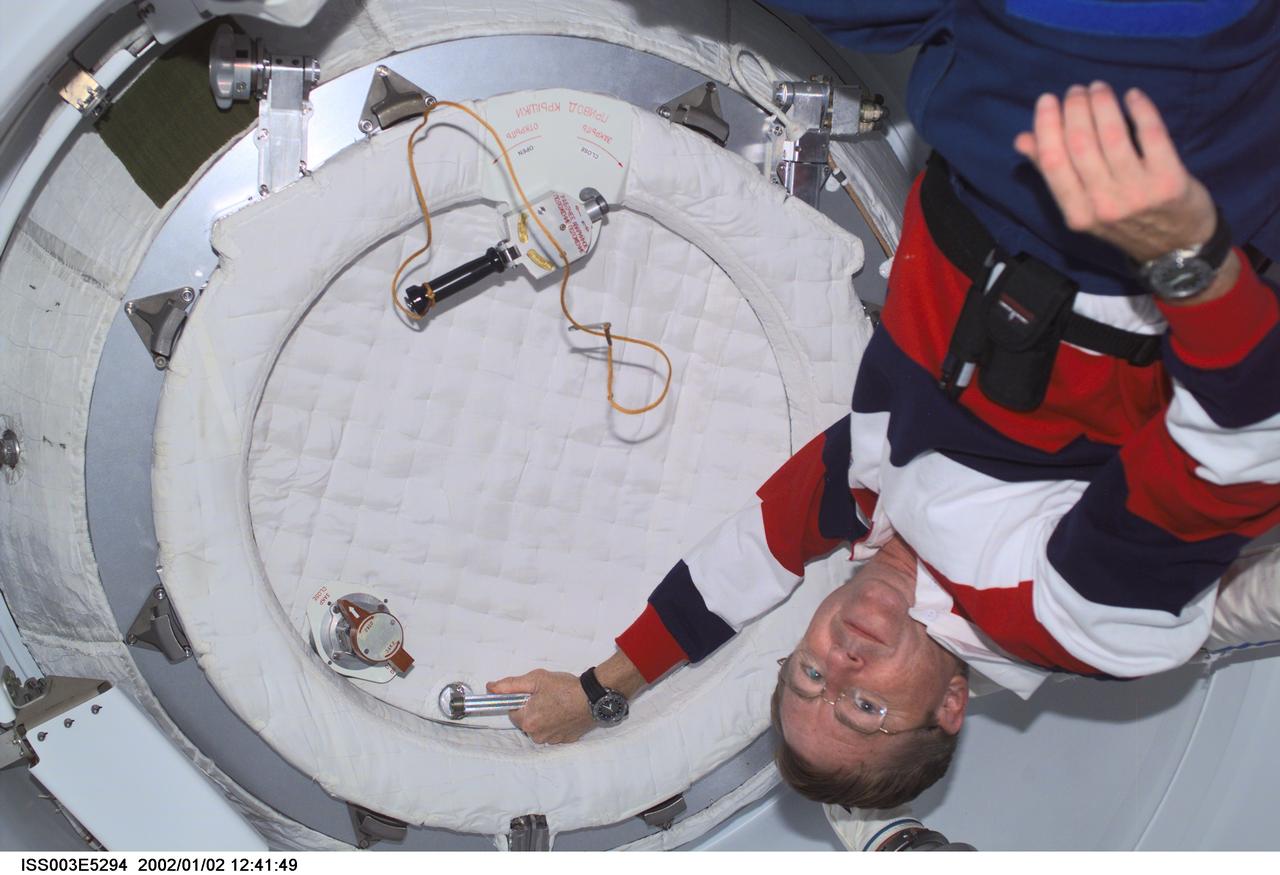
ISS003-E-5294 (August 2001) --- Astronaut Frank L. Culbertson, Jr., Expedition Three commander, closes the hatch in the Pressurized Mating Adapter (PMA2) on the International Space Station (ISS) prior to the separation of the station and the Space Shuttle Discovery. This image was taken with a digital still camera.
Frank Culbertson closes the PMA2 hatch after the Expedition Two crew egress
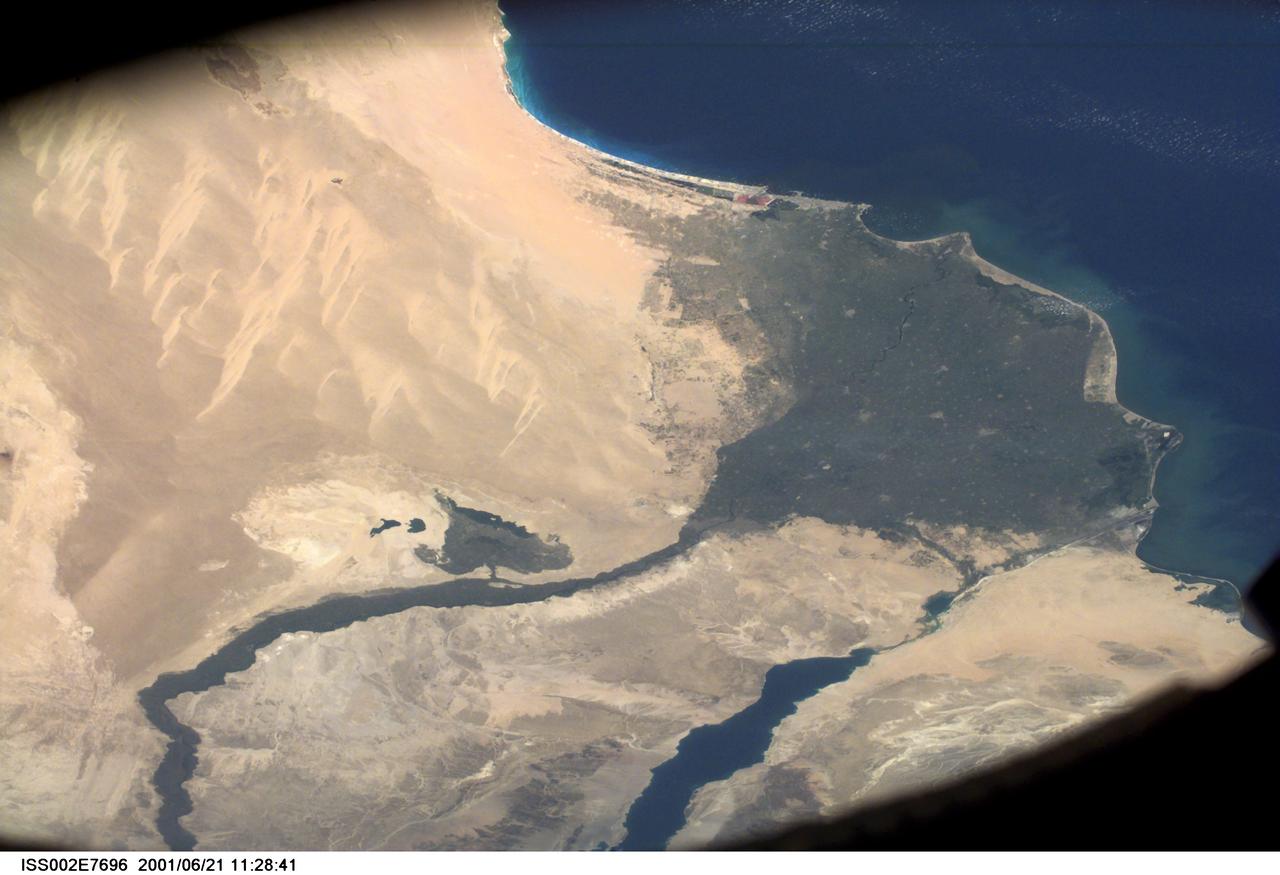
SS002-E-7696 (21 June 2001) --- Wide view of the Nile River and Suez Canal, Egypt, as photographed with a digital still camera aboard the International Space Station (ISS).
Nile Delta and the Suez Canal in Egypt taken by Expedition Two crew
STS102-E-5223 (16 March 2001) --- Cameras are plentiful in this digital still camera's image of astronauts and cosmonauts on the International Space Station (ISS).  From the left are cosmonauts Sergei K. Krikalev and Yuri P. Gidzenko of Rosaviakosmos; along with astronauts William M. (Bill) Shepherd, James S. Voss, Susan J. Helms (background) and James. M. Kelly.   Shepherd, Gidzenko and Krikalev  have been aboard the orbital outpost since  early November 2000 and are just days away from return to Earth.  Helms and  Voss are about to begin a lengthy stay aboard the station as flight engineers.  Kelly is pilot for the STS-102 crew.
STS-102 crew, Expeditions One and Two in the ISS U.S. Laboratory
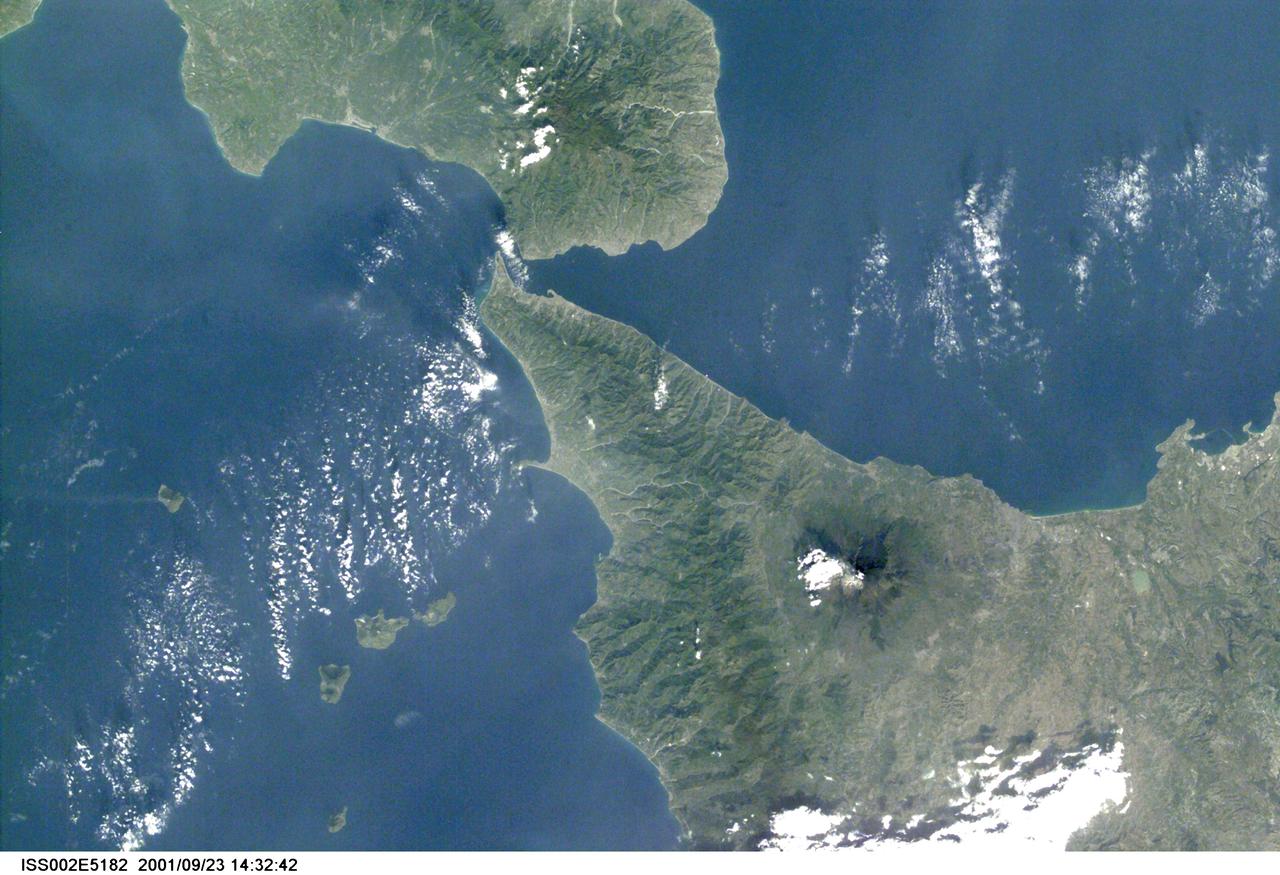
ISS002-E-5182 (March 2001) --- Part of the "toe" of Italy and Sicily are visible in this Expedition Two digital still camera's image.
Part of the toe of Italy and Sicily taken by Expedition Two crew
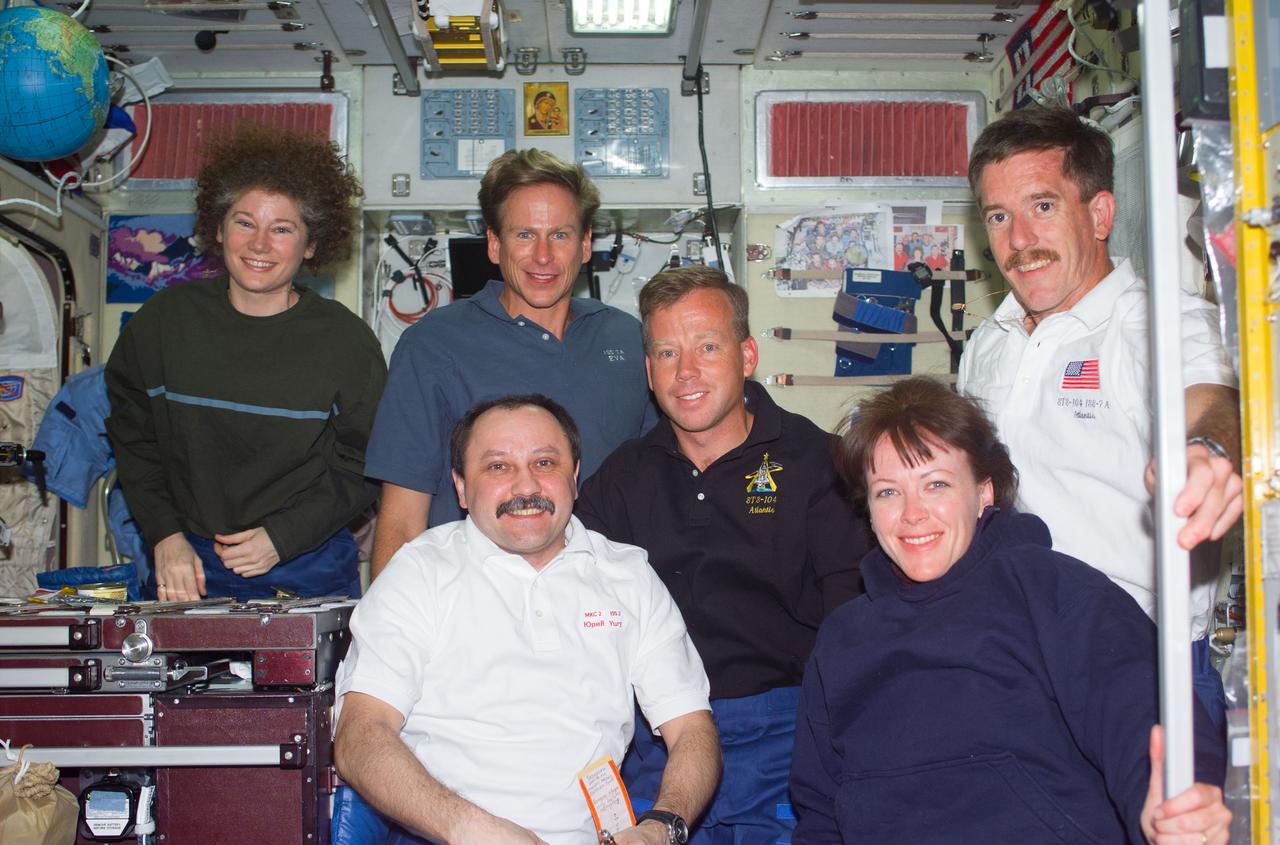
STS100-341-003 (19 April-1 May 2001) --- STS-100 and Expedition Two crewmembers pose for traditional in-flight portrait in Destiny laboratory. Bottom, from left, Chris A. Hadfield, Umberto Guidoni, Kent V. Rominger and Susan J. Helms. Middle row, James S. Voss, Yury V. Usachev and Yuri V. Lonchakov. Top, Scott E. Parazynski, John L. Phillips and Jeffrey S. Ashby. Guidoni represents the European Space Agency (ESA); Lonchakov and Usachev are with Rosaviakosmos and Hadfield is associated with the Canadian Space Agency (CSA).
The STS-100 and Expedition Two crews pose for a group photo in the U.S. Laboratory
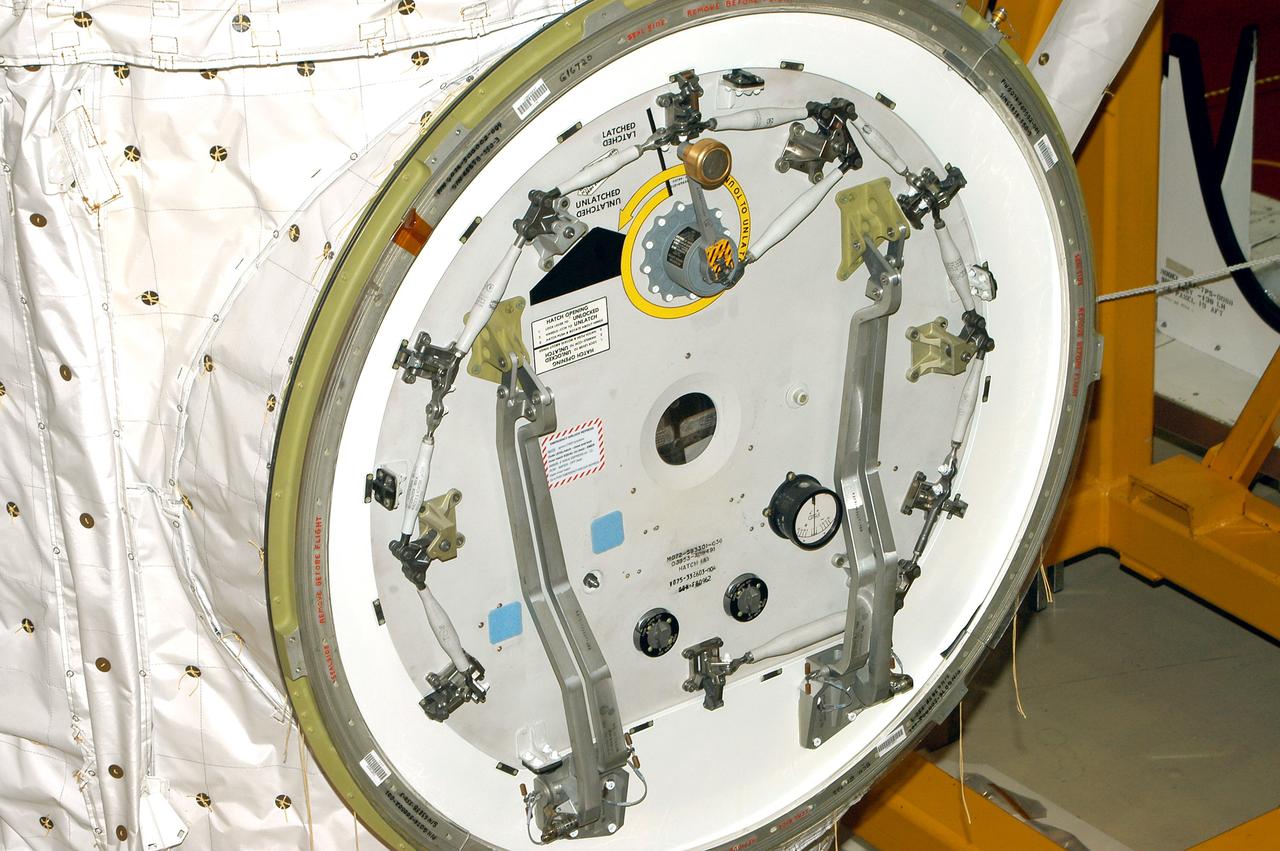
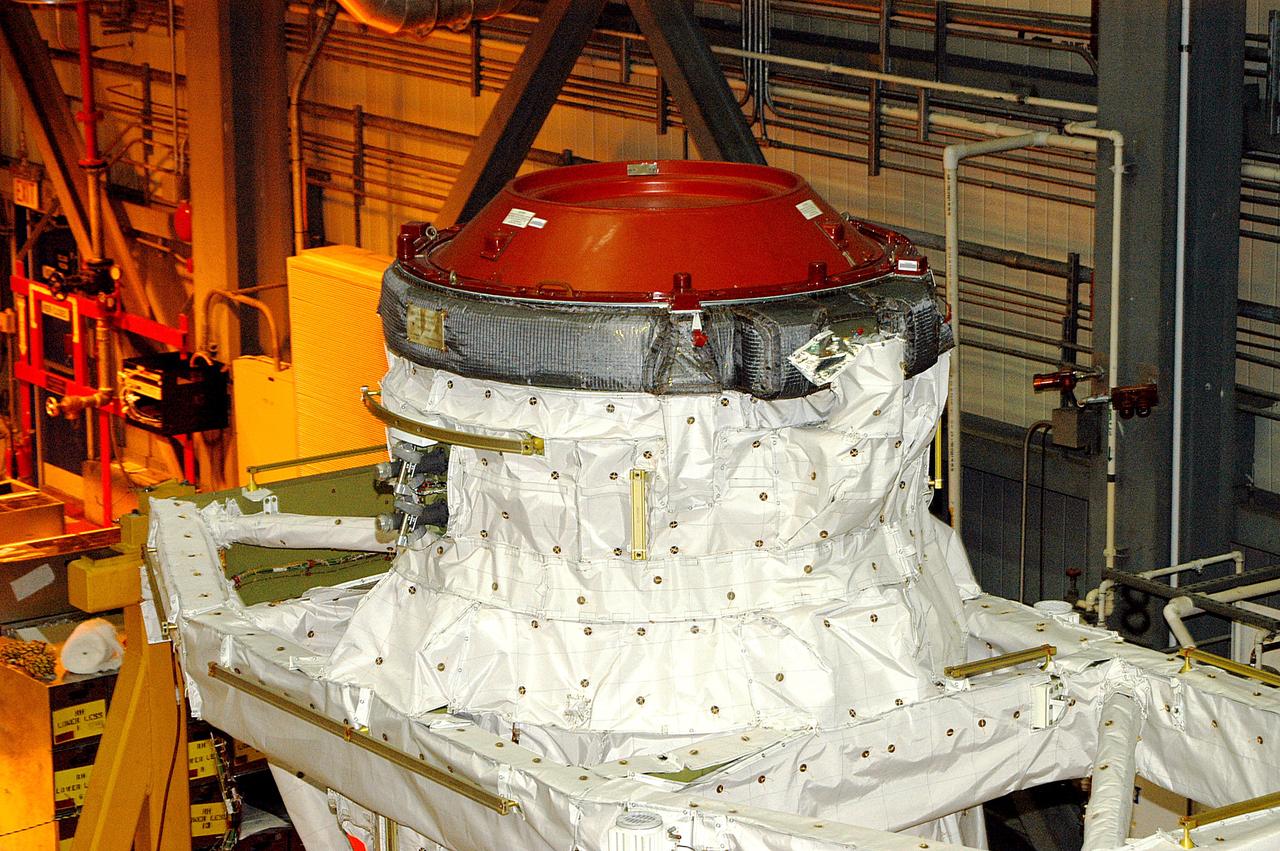
KENNEDY SPACE CENTER, FLA. -  Seen in the photo is one end of the airlock that is installed in the payload bay of orbiter Discovery.  The airlock is normally located inside the middeck of the spacecraft’s pressurized crew cabin. The airlock is sized to accommodate two fully suited flight crew members simultaneously. Support functions include airlock depressurization and repressurization, extravehicular activity equipment recharge, liquid-cooled garment water cooling, EVA equipment checkout, donning and communications. The outer hatch isolates the airlock from the unpressurized payload bay when closed and permits the EVA crew members to exit from the airlock to the payload bay when open.
KENNEDY SPACE CENTER, FLA. - Seen in the photo is one end of the airlock that is installed in the payload bay of orbiter Discovery. The airlock is normally located inside the middeck of the spacecraft’s pressurized crew cabin. The airlock is sized to accommodate two fully suited flight crew members simultaneously. Support functions include airlock depressurization and repressurization, extravehicular activity equipment recharge, liquid-cooled garment water cooling, EVA equipment checkout, donning and communications. The outer hatch isolates the airlock from the unpressurized payload bay when closed and permits the EVA crew members to exit from the airlock to the payload bay when open.
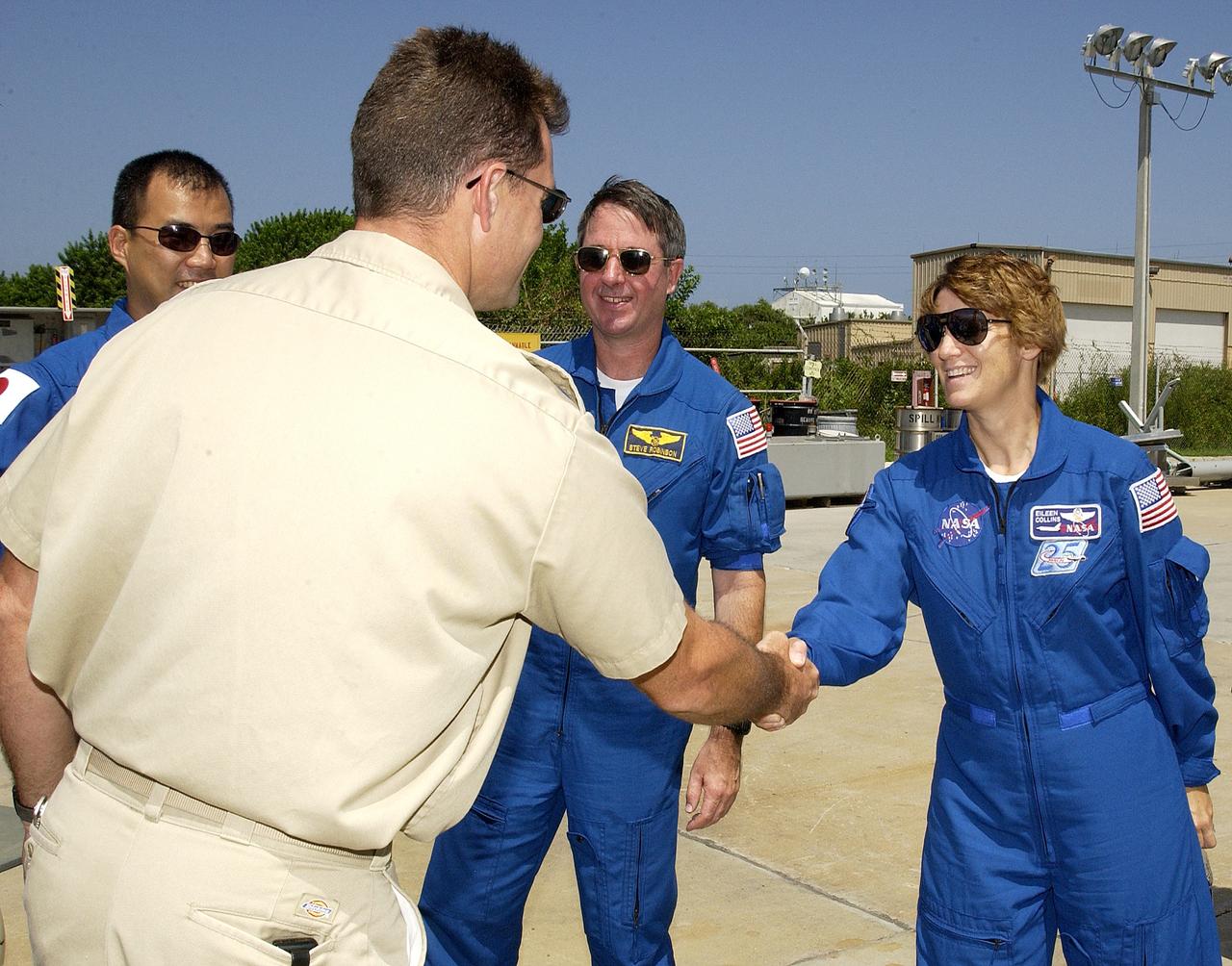
KENNEDY SPACE CENTER, FLA. -  Members of the STS-114 crew are welcomed to the Liberty Star, one of two SRB Retrieval Ships, by Captain Bren Wade (back to camera).  Crew members, from left, are Mission Specialist Soichi Noguchi, Mission Specialist Stephen Robinson and Commander Eileen Collins. Noguchi is with the Japanese space agency NASDA. Not pictured is Pilot James Kelly.  On their mission, the crew will carry the MultiPurpose Logistics Module (MPLM) Raffaello and External Stowage Platform 2 to the International Space Station.  The MPLM will contain supplies and equipment.  Another goal of the mission is to remove and replace a Control Moment Gyro.  Launch date for mission STS-114 is under review.
KENNEDY SPACE CENTER, FLA. - Members of the STS-114 crew are welcomed to the Liberty Star, one of two SRB Retrieval Ships, by Captain Bren Wade (back to camera). Crew members, from left, are Mission Specialist Soichi Noguchi, Mission Specialist Stephen Robinson and Commander Eileen Collins. Noguchi is with the Japanese space agency NASDA. Not pictured is Pilot James Kelly. On their mission, the crew will carry the MultiPurpose Logistics Module (MPLM) Raffaello and External Stowage Platform 2 to the International Space Station. The MPLM will contain supplies and equipment. Another goal of the mission is to remove and replace a Control Moment Gyro. Launch date for mission STS-114 is under review.
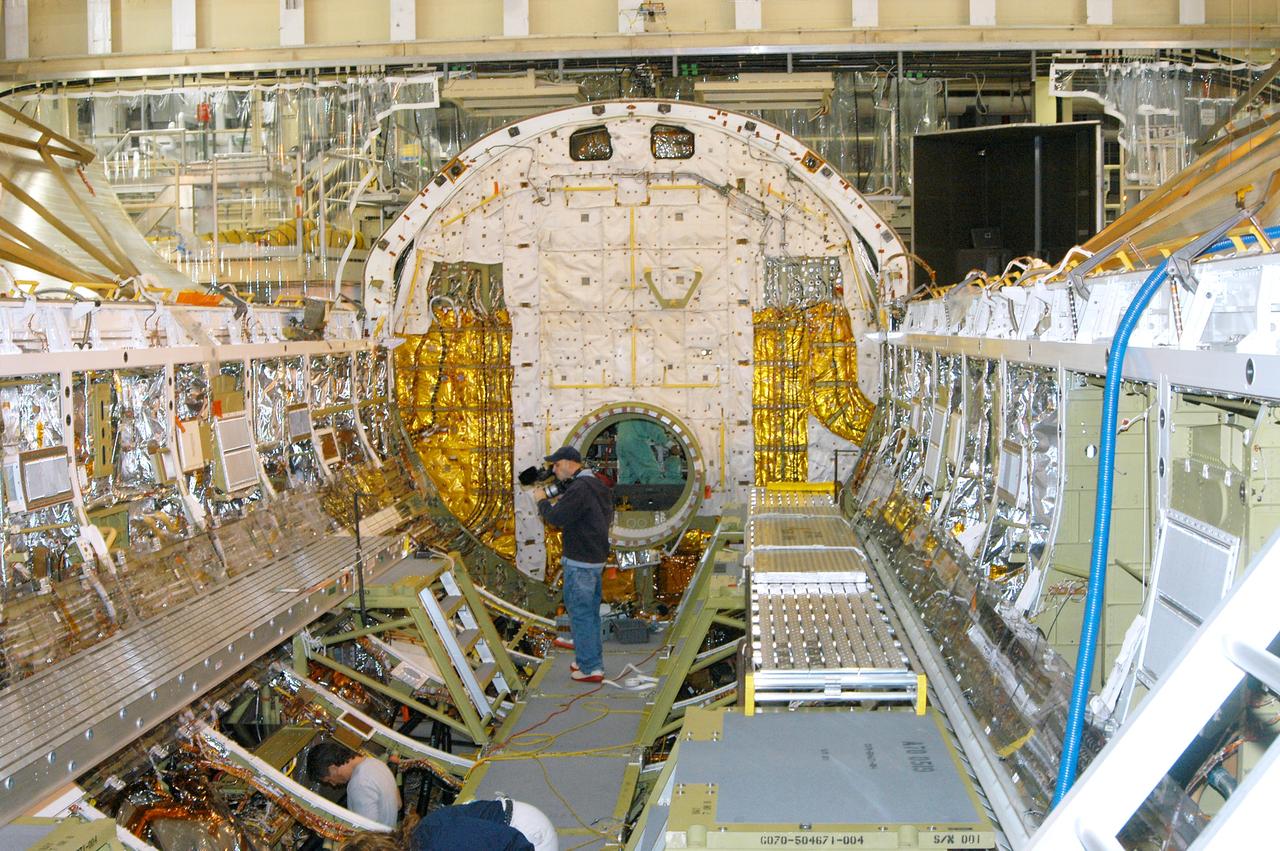
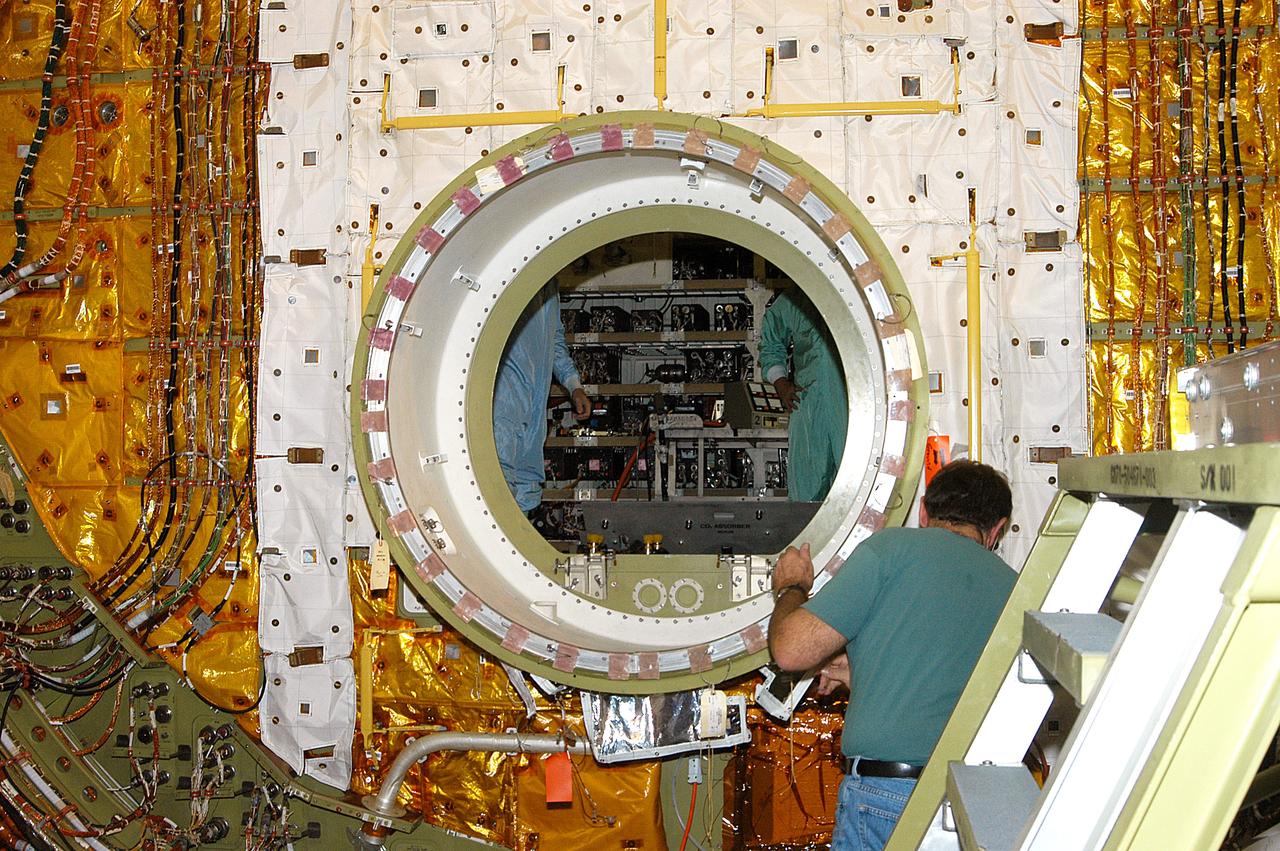
KENNEDY SPACE CENTER, FLA. -  In the Orbiter Processing Facility, a cameraman films part of Discovery’s payload bay for a special feature on the KSC Web.  In the background is the open hatch of the airlock, located inside the middeck of the spacecraft’s pressurized crew cabin. The airlock is sized to accommodate two fully suited flight crew members simultaneously. Support functions include airlock depressurization and repressurization, extravehicular activity equipment recharge, liquid-cooled garment water cooling, EVA equipment checkout, donning and communications. The outer hatch isolates the airlock from the unpressurized payload bay when closed and permits the EVA crew members to exit from the airlock to the payload bay when open.
KENNEDY SPACE CENTER, FLA. - In the Orbiter Processing Facility, a cameraman films part of Discovery’s payload bay for a special feature on the KSC Web. In the background is the open hatch of the airlock, located inside the middeck of the spacecraft’s pressurized crew cabin. The airlock is sized to accommodate two fully suited flight crew members simultaneously. Support functions include airlock depressurization and repressurization, extravehicular activity equipment recharge, liquid-cooled garment water cooling, EVA equipment checkout, donning and communications. The outer hatch isolates the airlock from the unpressurized payload bay when closed and permits the EVA crew members to exit from the airlock to the payload bay when open.
KENNEDY SPACE CENTER, FLA. -  A worker in the Orbiter Processing Facility checks the open hatch of the airlock in Discovery’s payload bay. The airlock is normally located inside the middeck of the spacecraft’s pressurized crew cabin. The airlock is sized to accommodate two fully suited flight crew members simultaneously. Support functions include airlock depressurization and repressurization, extravehicular activity equipment recharge, liquid-cooled garment water cooling, EVA equipment checkout, donning and communications. The outer hatch isolates the airlock from the unpressurized payload bay when closed and permits the EVA crew members to exit from the airlock to the payload bay when open.
KENNEDY SPACE CENTER, FLA. - A worker in the Orbiter Processing Facility checks the open hatch of the airlock in Discovery’s payload bay. The airlock is normally located inside the middeck of the spacecraft’s pressurized crew cabin. The airlock is sized to accommodate two fully suited flight crew members simultaneously. Support functions include airlock depressurization and repressurization, extravehicular activity equipment recharge, liquid-cooled garment water cooling, EVA equipment checkout, donning and communications. The outer hatch isolates the airlock from the unpressurized payload bay when closed and permits the EVA crew members to exit from the airlock to the payload bay when open.
KENNEDY SPACE CENTER, FLA. -  Seen in the photo is one end of the airlock that is installed in the payload bay of orbiter Discovery.  The airlock is normally located inside the middeck of the spacecraft’s pressurized crew cabin. The airlock is sized to accommodate two fully suited flight crew members simultaneously. Support functions include airlock depressurization and repressurization, extravehicular activity equipment recharge, liquid-cooled garment water cooling, EVA equipment checkout, donning and communications. The outer hatch isolates the airlock from the unpressurized payload bay when closed and permits the EVA crew members to exit from the airlock to the payload bay when open.
KENNEDY SPACE CENTER, FLA. - Seen in the photo is one end of the airlock that is installed in the payload bay of orbiter Discovery. The airlock is normally located inside the middeck of the spacecraft’s pressurized crew cabin. The airlock is sized to accommodate two fully suited flight crew members simultaneously. Support functions include airlock depressurization and repressurization, extravehicular activity equipment recharge, liquid-cooled garment water cooling, EVA equipment checkout, donning and communications. The outer hatch isolates the airlock from the unpressurized payload bay when closed and permits the EVA crew members to exit from the airlock to the payload bay when open.
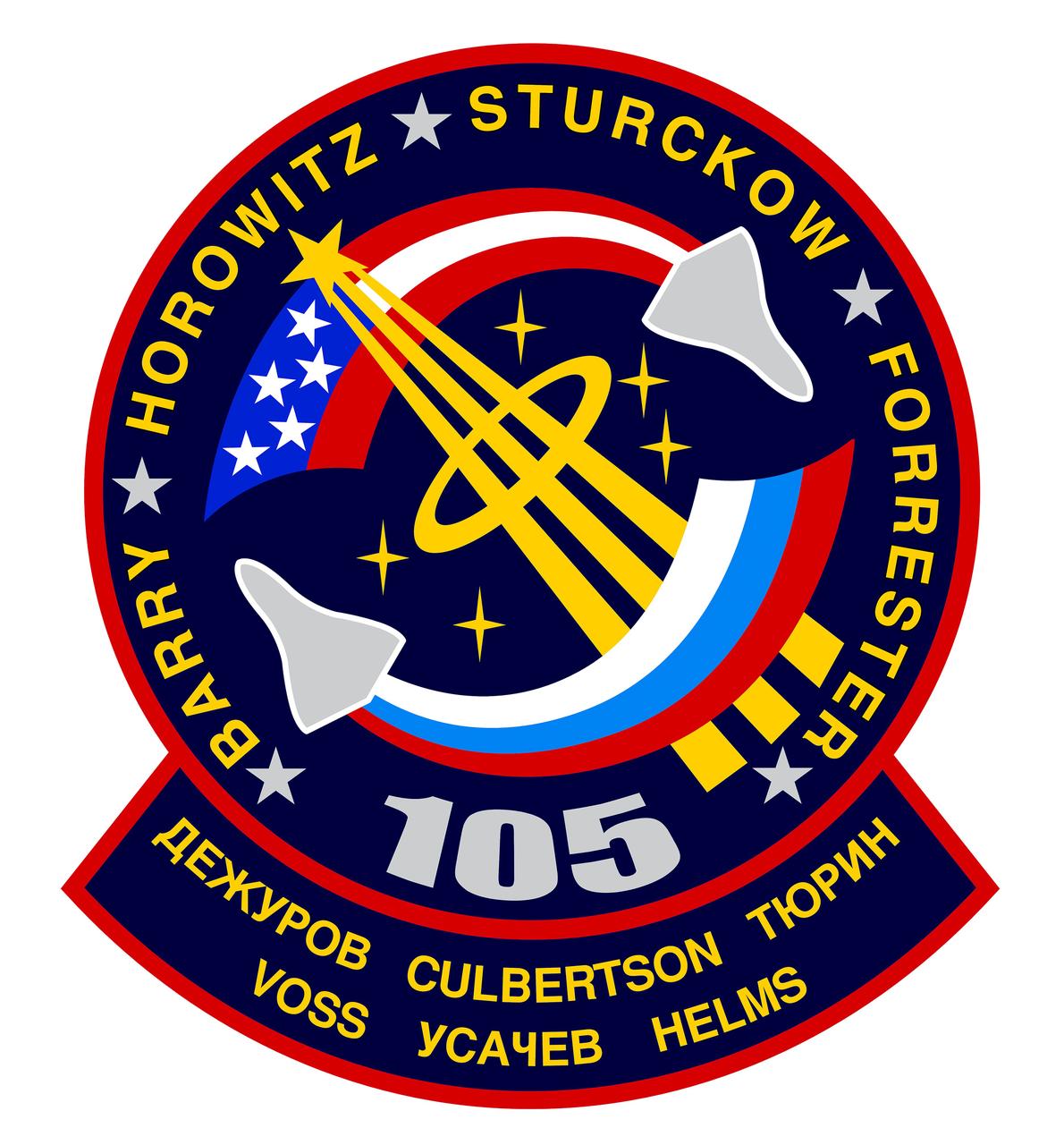
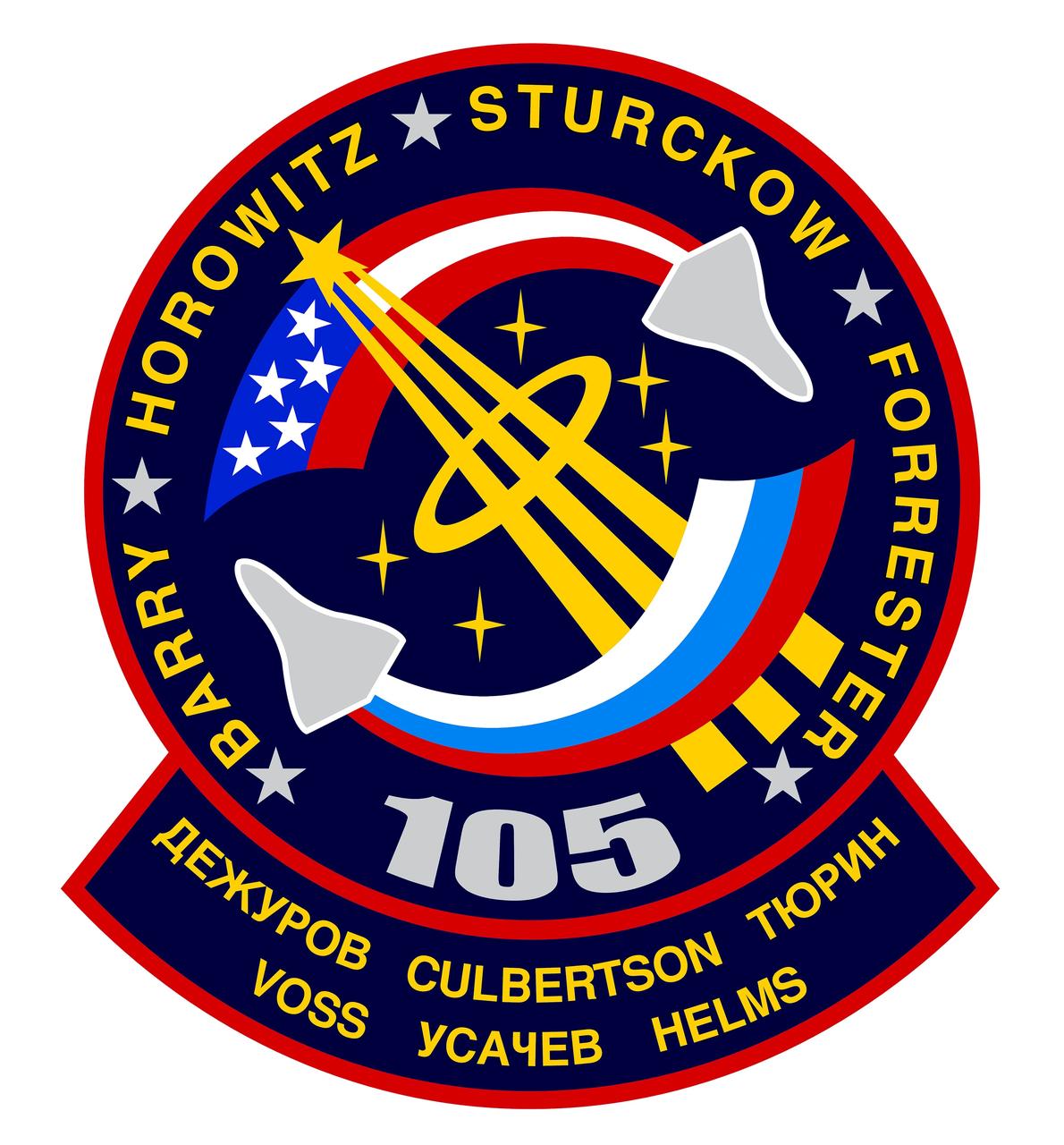
The STS-105 crew patch symbolizes the exchange of the Expedition Two and Expedition Three crews aboard the International Space Station (ISS). The three gold stars near the ascending orbiter represent the U.S. commanded Expedition Three Crew journeying into space, while the two gold stars near the descending orbiter represent the Russian commanded Expedition Two crew on their return to Earth. The ascending and descending Orbiters form a circle that represents both the crew rotation and the continuous presence in space aboard the station. The plumes of each orbiter represent the flags of the U.S. and Russia, symbolizing the close cooperation between the two nations. The Astronaut office symbol, a star with three rays of light, depicts the unbroken link between Earth and the brightest star on the horizon, the ISS. The names of Discovery's crew of four astronauts are shown along the border of the patch while the names of the Expedition crews are shown on the chevron at the bottom of the patch.
Space Shuttle Projects
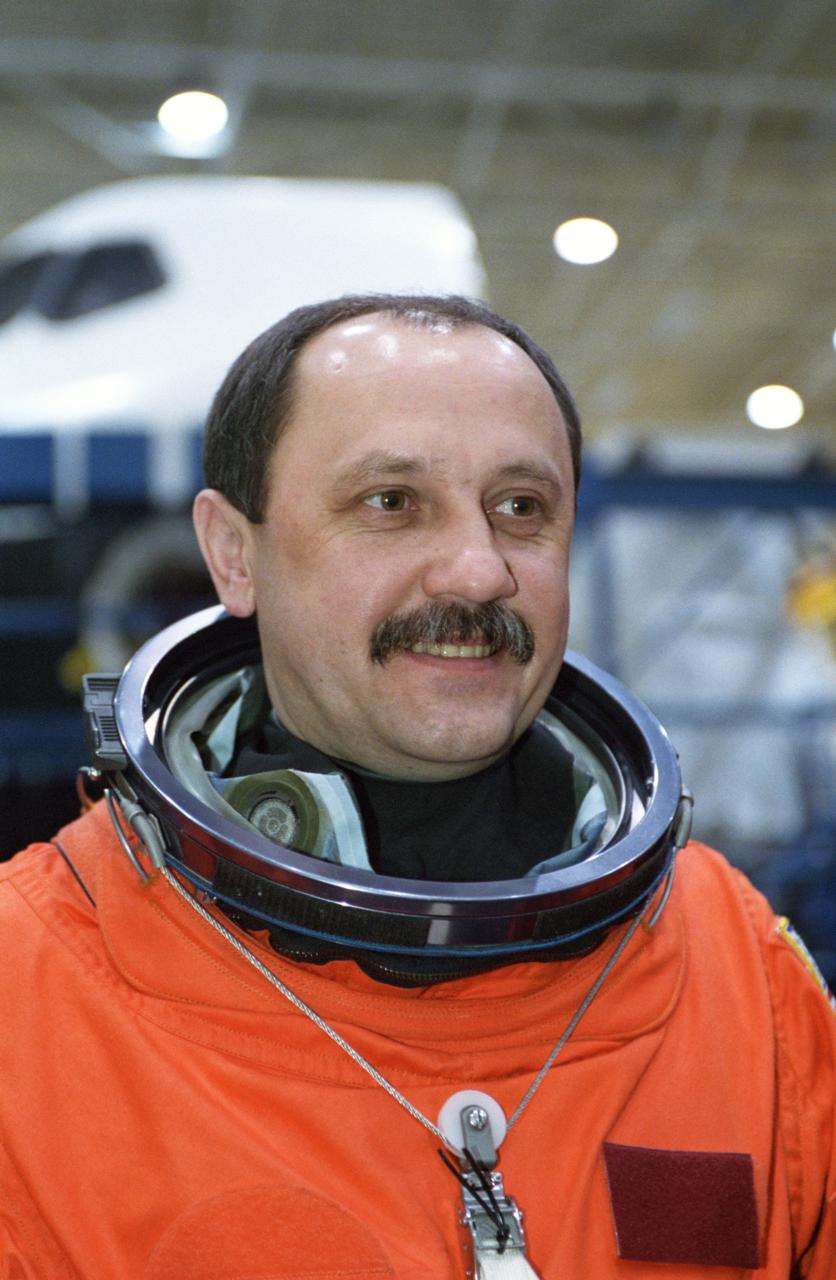
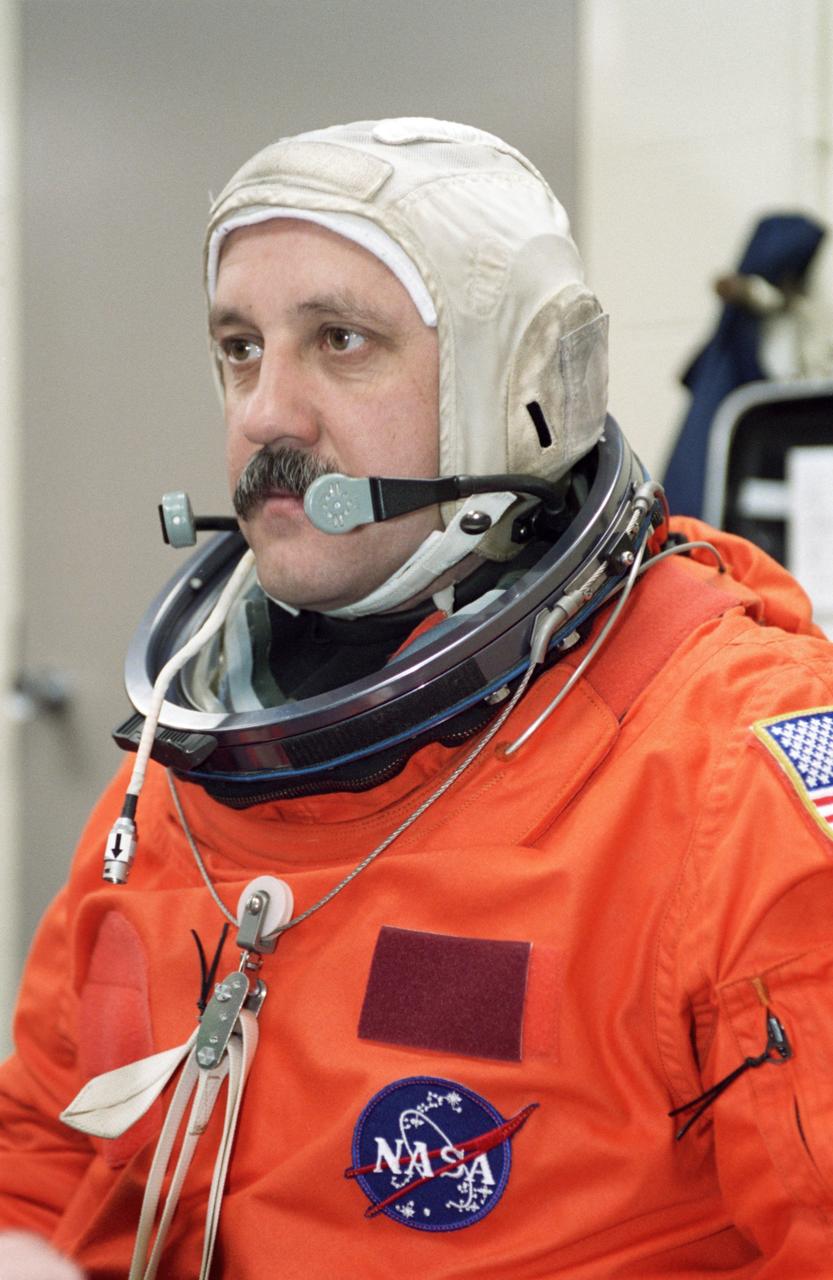
JSC2000-07447 (6 December 2000) --- Cosmonaut Yury V. Usachev, Expedition Two mission commander, checks out his communications gear during a joint Expedition Two/STS-102 training session in the Systems Integration Facility at the Johnson Space Center (JSC).   The Russian Aviation and Space Agency representative, along with two astronauts on his crew and the four STS-102 crew members, later simulated procedures for a nominal countdown in the crew compartment trainer (CCT-2) in the high bay area of this facility.
STS-102 and Expedition Two ascent training in Building 9
JSC2000-07445 (6 December 2000) --- Cosmonaut Yury V. Usachev, Expedition Two mission commander, talks to nearby astronauts (out of frame) during a joint Expedition Two/STS-102 training session in the Systems Integration Facility at the Johnson Space Center (JSC).   The Russian Aviation and Space Agency representative, along with two astronauts on his crew and the four STS-102 crew members, later simulated procedures for a nominal countdown in the crew compartment trainer (CCT-2) in the high bay area of this facility.
STS-102 and Expedition Two ascent training in Building 9
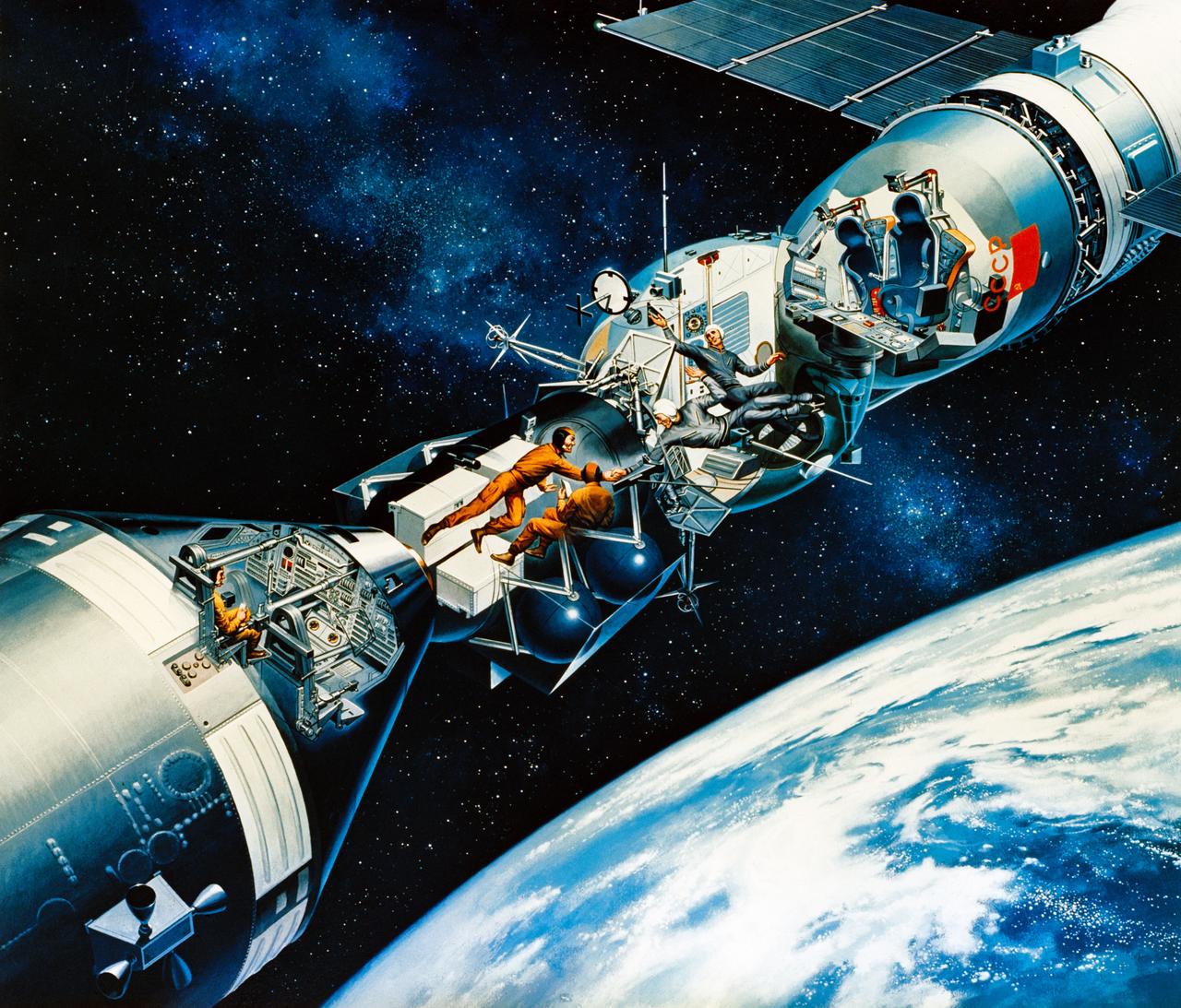
S75-27290 (April 1975) --- An artist?s concept illustrating a cutaway view of the docked Apollo and Soyuz spacecraft in Earth orbit.  This scene depicts the moment the two international crews meet in space for the first time. Two of the three American crewmen are in the Docking Module. The two Soviet crewmen are in the Soyuz spacecraft?s Orbital Module. The two crew commanders are shaking hands through the hatchway. The third American crewman is in the Apollo Command Module. During the joint U.S.-USSR Apollo-Soyuz Test Project mission, which is scheduled for July 1975, the American and Soviet crews will visit one another?s spacecraft while the Soyuz and Apollo are docked for a maximum period of two days. The mission is designed to test equipment and techniques that will establish international crew rescue capability in space, as well as permit future cooperative scientific missions. The artwork is by Davis Meltzer.
ART CONCEPTS - APOLLO-SOYUZ TEST PROJECT (ASTP)
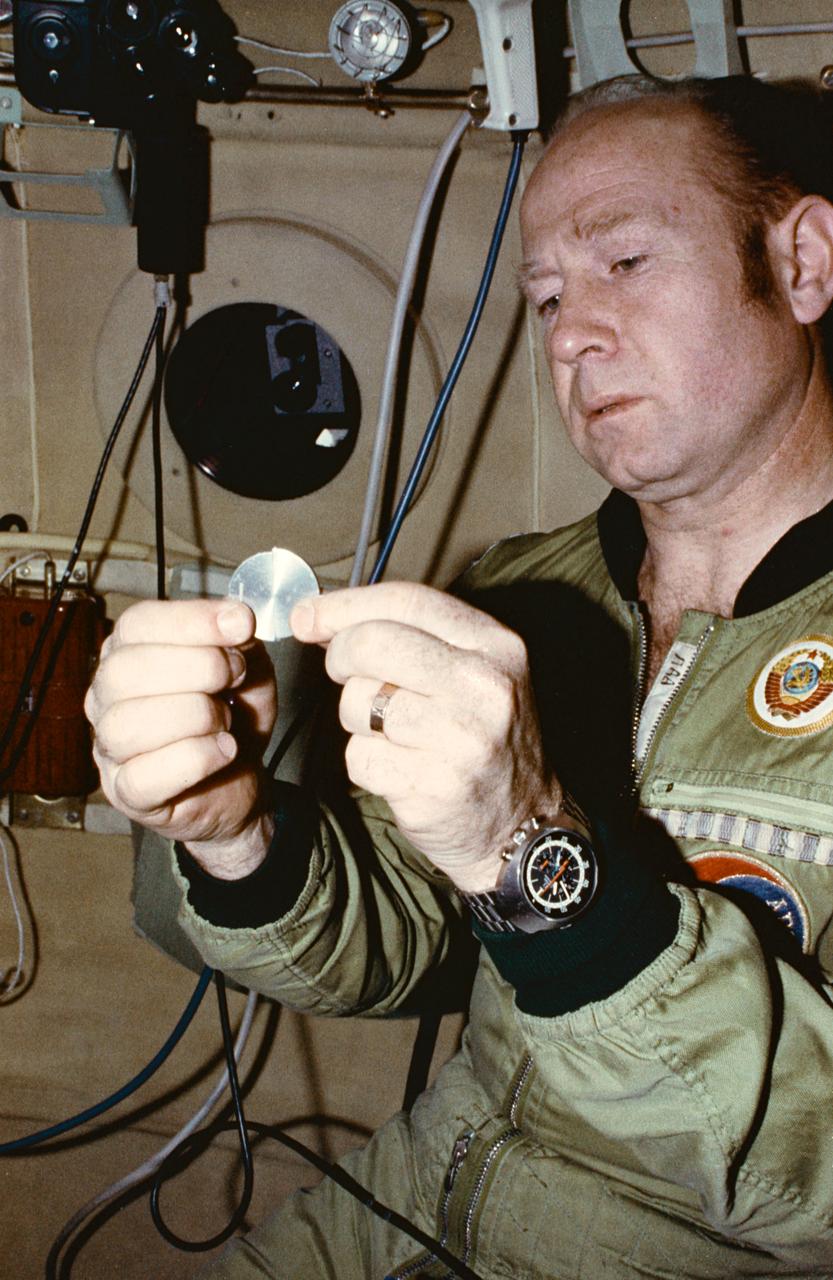
S75-24926 (April 1975) --- Cosmonaut Aleksey A. Leonov, commander of the Soviet ASTP prime crew, practices with a training mock-up of the ASTP commemorative medal during Apollo-Soyuz Test Project activity at the Cosmonaut Training Center (Star City) near Moscow.  Leonov is in the Soyuz orbital module trainer. Two medals divided into two halves each will be flown on the mission. The American ASTP crew will carry two halves aboard Apollo; and the Soviet ASTP crew will carry the other two halves aboard Soyuz. The four halves will be joined together to make two complete medals after the two spacecraft rendezvous and dock in Earth orbit. Grooved slots in the halves will allow the medals to be fitted together.  One medal then will be returned to Earth by the astronauts; and the second medal will be brought back by the cosmonauts.
SIMULATIONS - APOLLO-SOYUZ TEST PROJECT (ASTP) - USSR
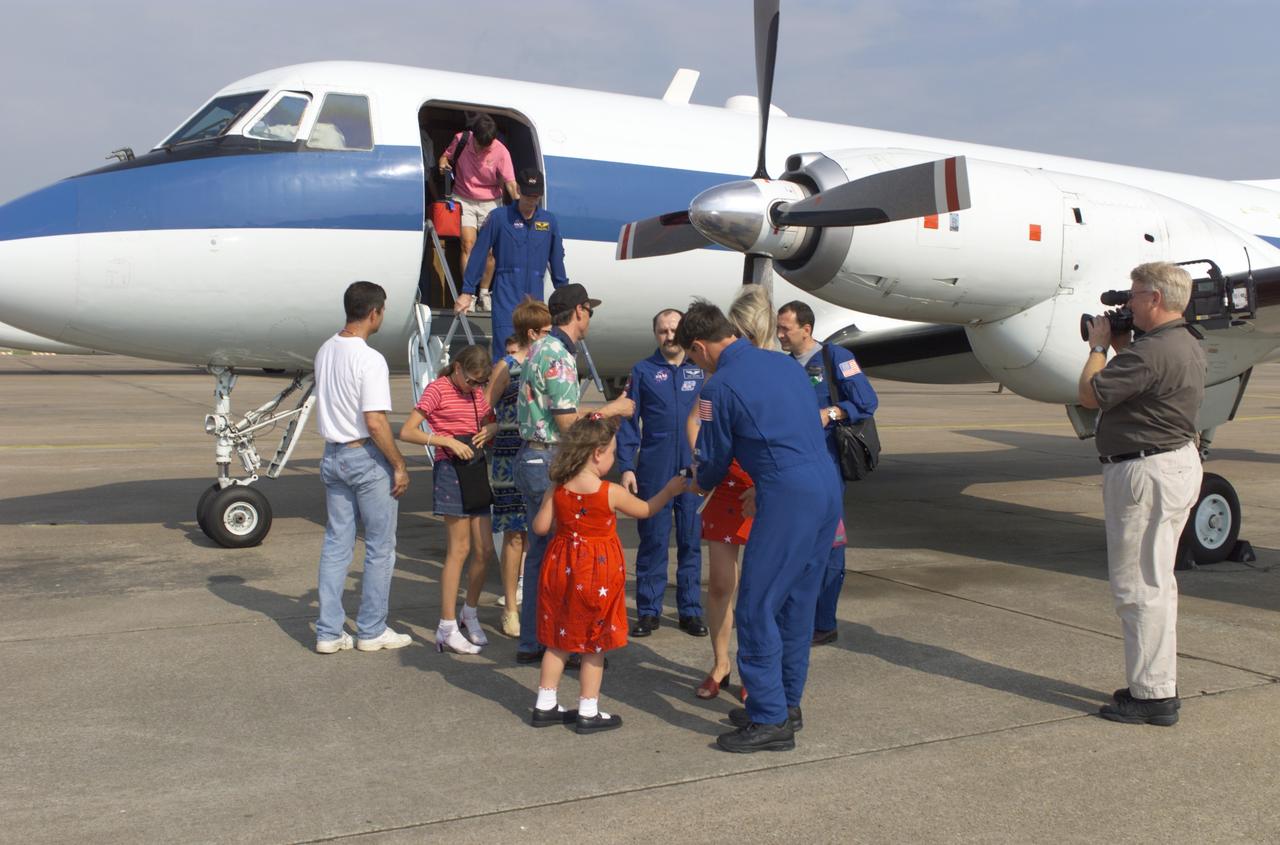
JSC2001-E-25807 (23 August 2001) --- The STS-105 and Expedition Two crews step off of the Gulfstream I aircraft and meet their families during the crew return ceremonies at Ellington Field.  The STS-105 crew delivered the Expedition Three crew and supplies to the International Space Station (ISS) and brought the Expedition Two crew back to Earth.
STS-105 Expedition 2 Return
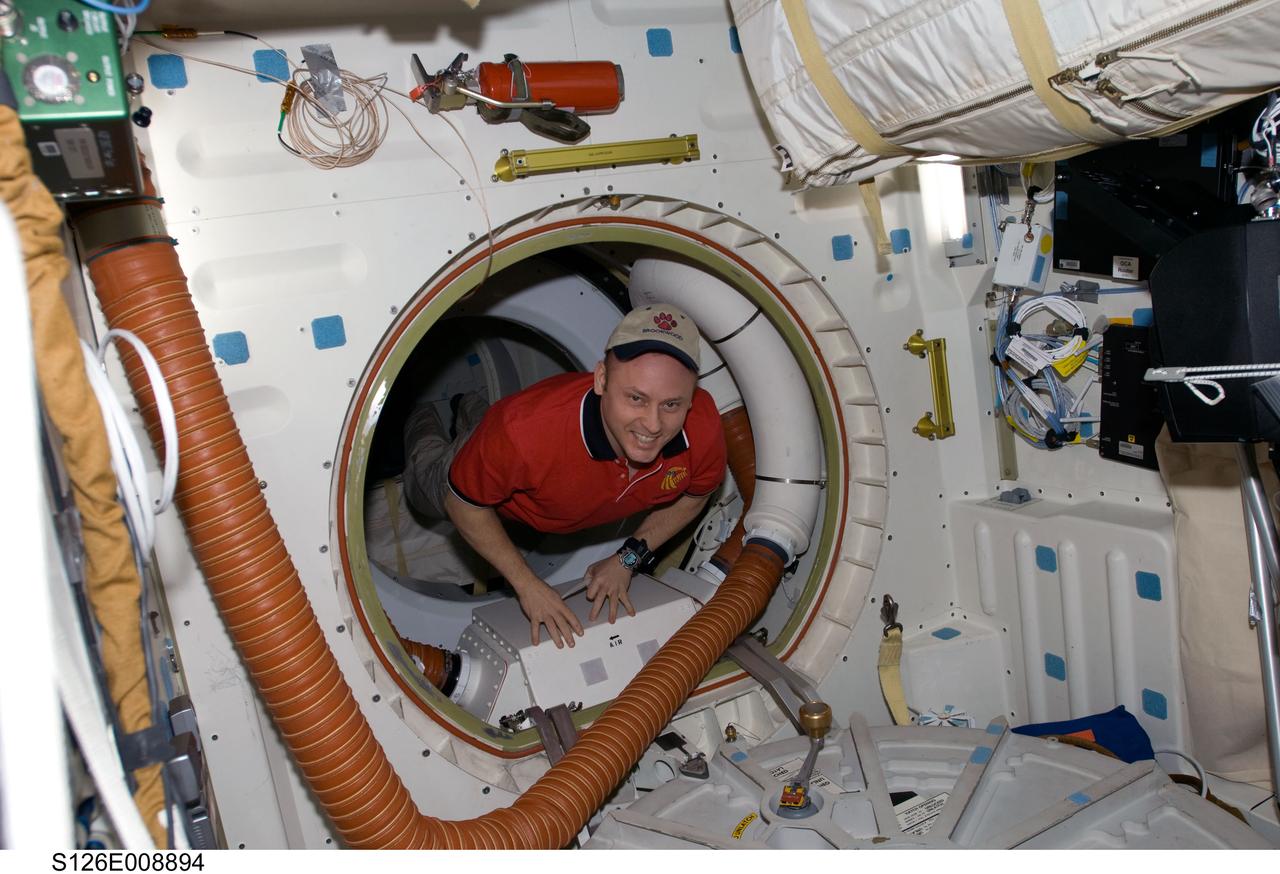
S126-E-008894 (21 Nov. 2008) --- This image, recorded in the late evening hours of Nov. 21, Houston time,  shows a smiling astronaut Michael Fincke, Expedition 18 commander, as he and his station crew near the mid point of joint efforts with the Endeavour crew,  commanded by astronaut Chris Ferguson (out of frame).  The two crews are spending close to two weeks in space together, accomplishing home improvement chores and a number of other tasks. Just a few hours after this photo was taken, two astronauts started prepping for the joint crews' third spacewalk of the week.
Fincke entering Endeavour
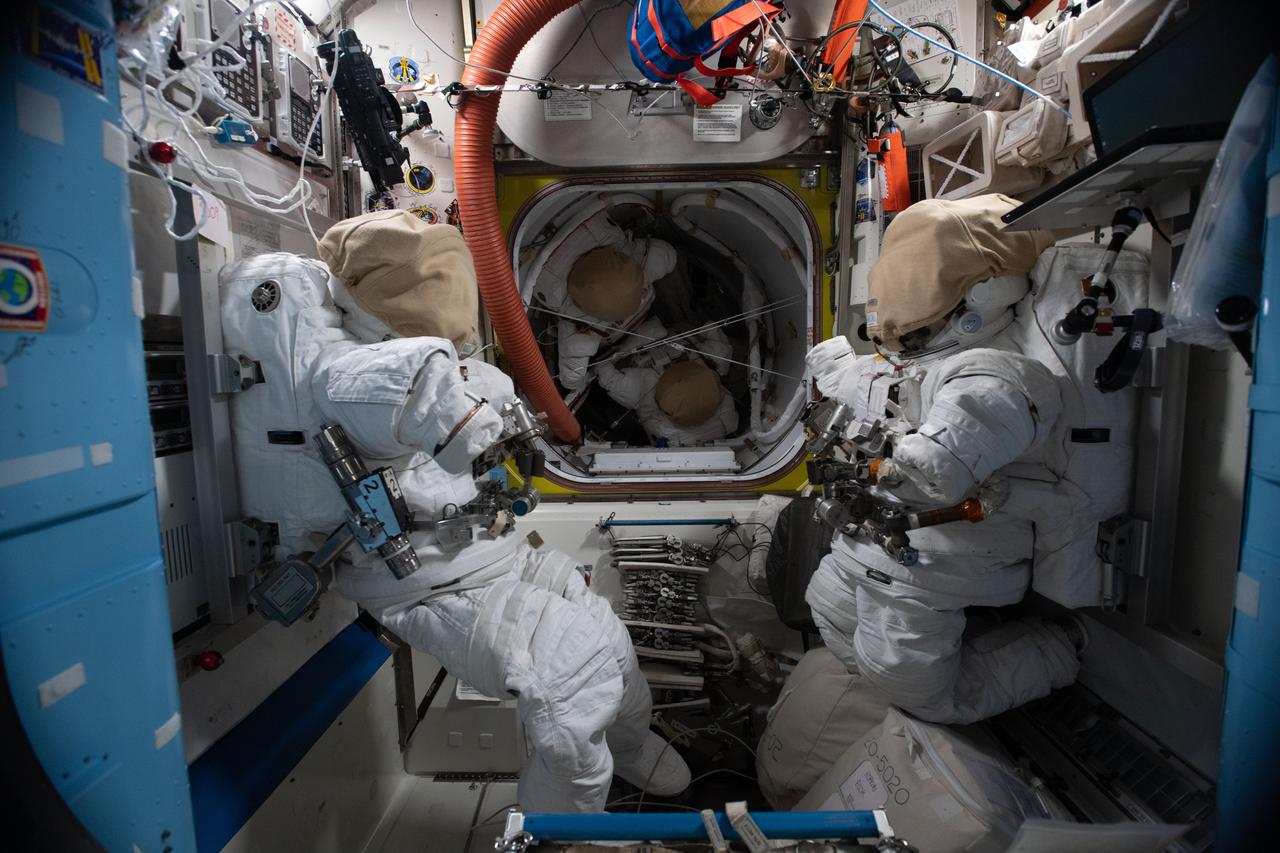
iss064e008969 (Dec. 2, 2020) --- Four U.S. spacesuits are pictured inside the International Space Station's Quest Joint airlock, including two in the equipment lock (foreground) and two in the crew lock (background).
iss064e008969
STS105-S-001 (April 2001) --- The STS-105 crew patch symbolizes the exchange of the Expedition Two and Expedition Three crews aboard the International Space Station. The three gold stars near the ascending orbiter represent the U.S. commanded Expedition Three crew as they journey into space, while the two gold stars near the descending orbiter represent the Russian commanded Expedition Two crew and their return to Earth. The plumes of each orbiter represent the flags of the United States and Russia and symbolize the close cooperation between the two countries. The Astronaut Office symbol, a star with three rays of light, depicts the unbroken link between Earth and the newest and brightest star on the horizon, the International Space Station (ISS). The ascending and descending orbiters form a circle that represents both the crew rotation and the continuous presence in space aboard the ISS. The names of the four astronauts who will crew Discovery are shown along the border of the patch. The names of the Expedition Three and Expedition Two crews are shown on the chevron at the bottom of the patch.    The NASA insignia design for space shuttle flights is reserved for use by the astronauts and for other official use as the NASA Administrator may authorize. Public availability has been approved only in the forms of illustrations by the various news media. When and if there is any change in this policy, which is not anticipated, the change will be publicly announced. Photo credit: NASA
STS-105 insignia
JSC2001-E-25812 (23 August 2001) --- Yury V. Usachev of Rosaviakosmos, Expedition Two mission commander, speaks from the podium in Hangar 990 at Ellington Field during the STS-105 and Expedition Two crew return ceremonies.  The STS-105 crew listens in the background.  Usachev and fellow Expedition Two crewmembers Susan J. Helms and James S. Voss spent five months aboard the International Space Station (ISS).
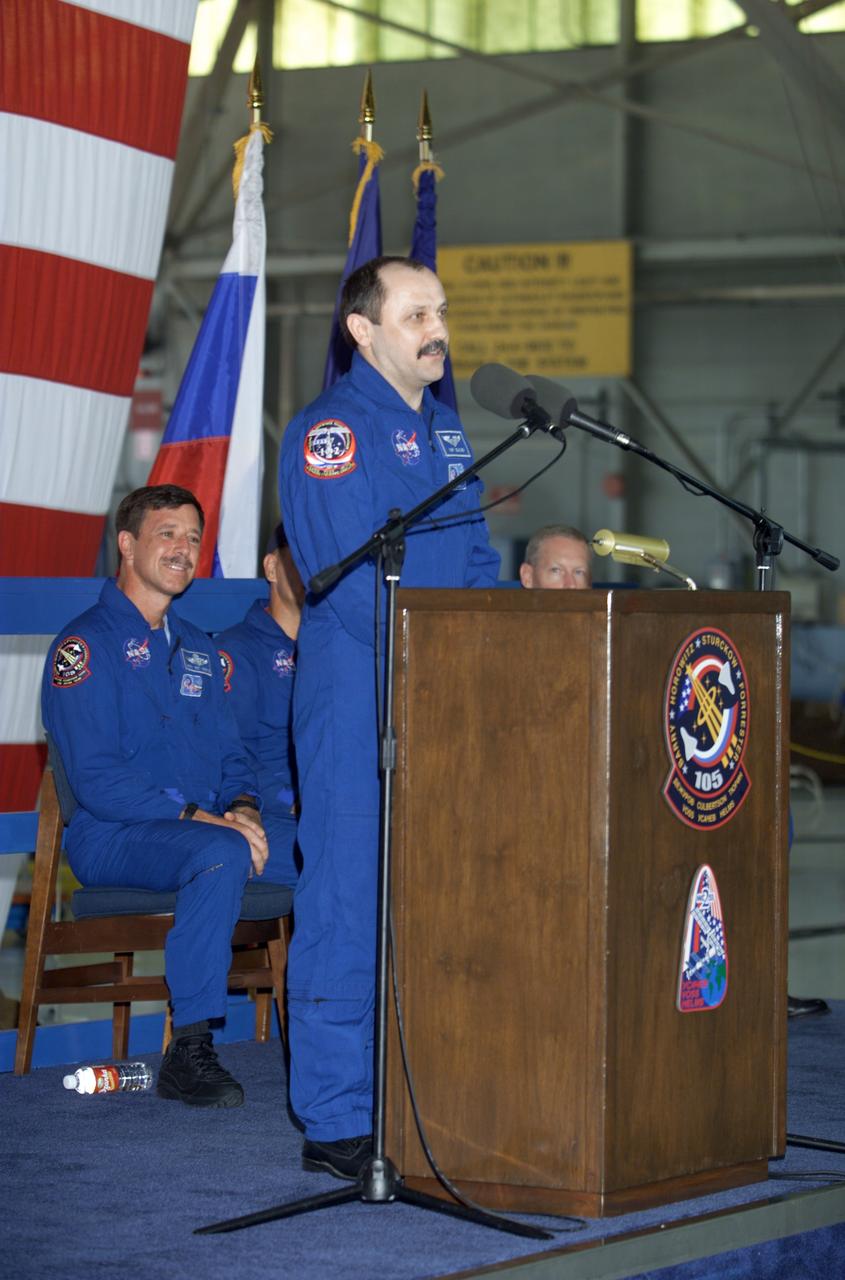
STS-105 Expedition 2 Return
JSC2001-E-25806 (23 August 2001) --- Scott J. Horowitz, STS-105 commander, followed by his daughter and wife, step off of the Gulfstream I aircraft during the STS-105 and Expedition Two crew return ceremonies at Ellington Field.  The STS-105 crew delivered the Expedition Three crew and supplies to the International Space Station (ISS) and brought the Expedition Two crew back to Earth.
STS-105 Expedition 2 Return
JSC2001-E-25823 (23 August 2001) --- Patrick G. Forrester (foreground) and Daniel T. Barry, STS-105 mission specialists, sign autographs for the assembled crowd in Hangar 990 at Ellington Field during the STS-105 and Expedition Two crew return ceremonies.  The STS-105 crew delivered the Expedition Three crew and supplies to the International Space Station (ISS) and brought the Expedition Two crew back to Earth.
STS-105 Expedition 2 Return