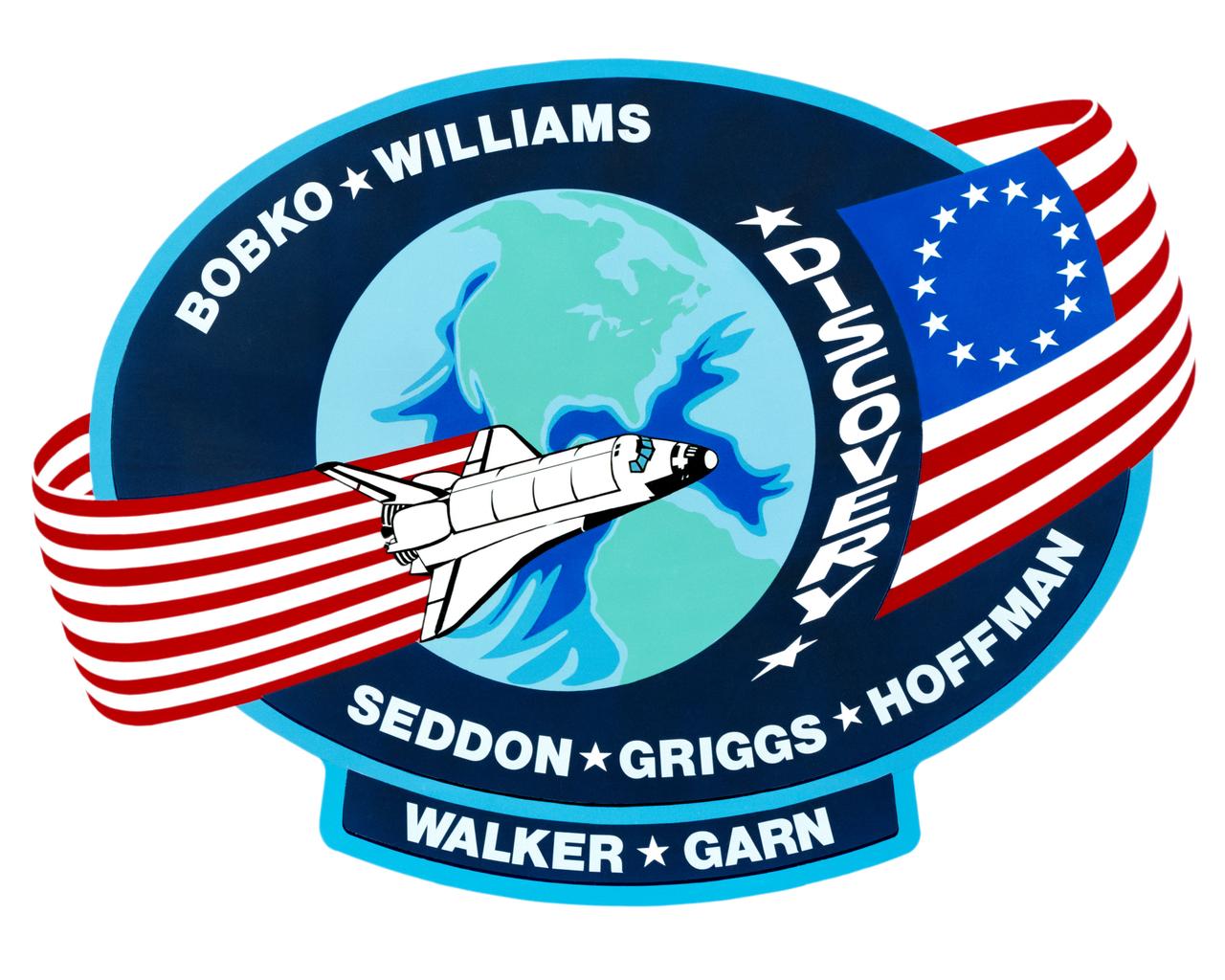
S85-28989 (March 1985) --- The dominant features of the STS-51D emblem are an orbit formed by a Colonial American flag and a space shuttle. The flag in orbit signifies the U.S. flag to indicate that it comes from this country and the American people. The original 13-star flag is used to symbolize a continuity of technical achievement and progress since colonial times. The name Discovery preceding the flag represents the spirit of Discovery and exploration of new frontiers which have been a hallmark of American people even before they were formed together as a nation. The crew members are Karol J. Bobko, Donald E. Williams, Rhea Seddon, S. David Griggs and Jeffrey A. Hoffman of NASA; and Charles D. Walker, representing McDonnell Douglas Corporation; and U. S. Senator Jake Garn. The NASA insignia design for space shuttle flights is reserved for use by the astronauts and for other official use as the NASA Administrator may authorize. Public availability has been approved only in the forms of illustrations by the various news media. When and if there is any change in this policy, which is not anticipated, the change will be publicly announced. Photo credit: NASA
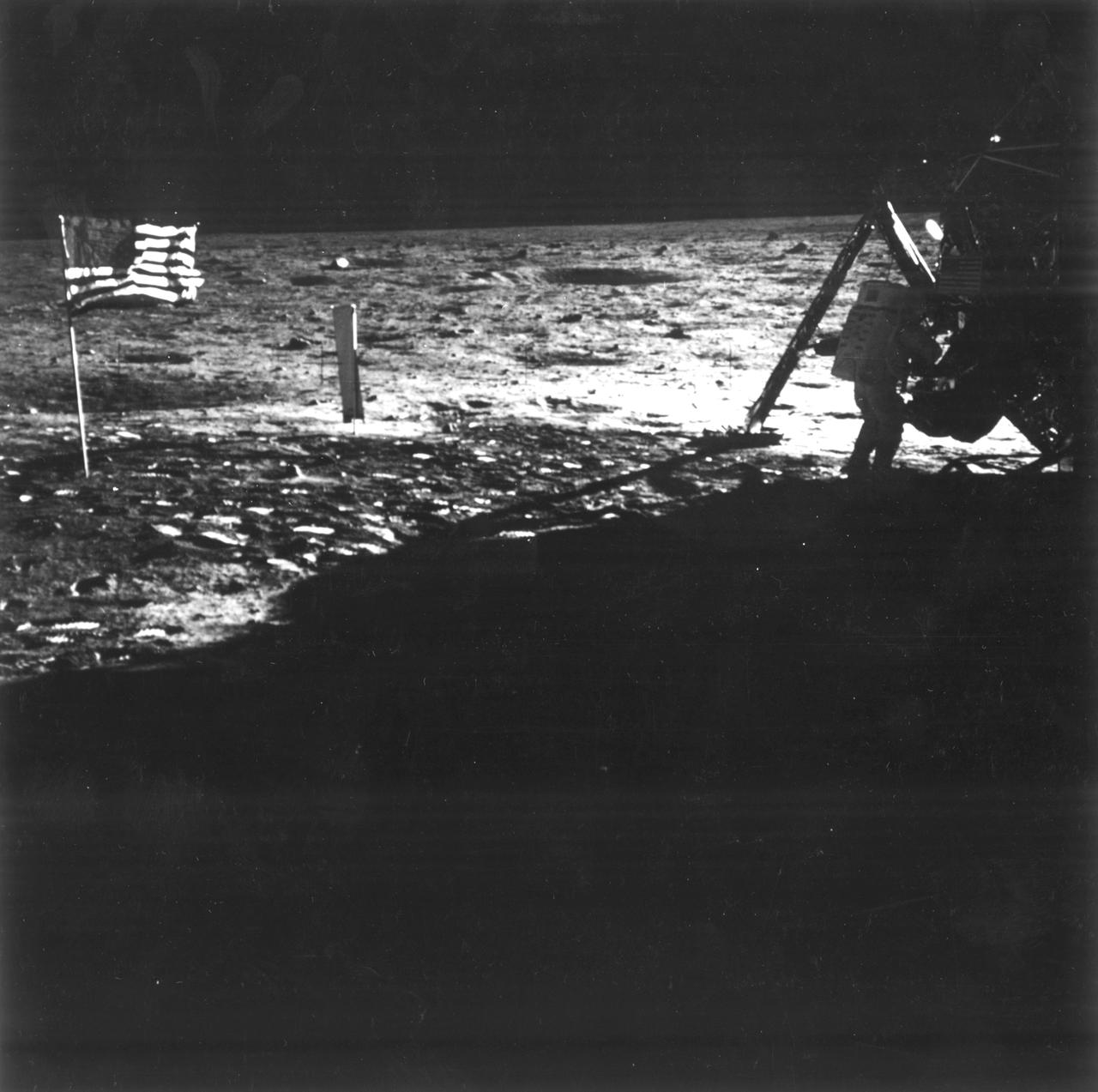
The first manned lunar landing mission, Apollo 11, launched from the Kennedy Space Flight Center (KSC) in Florida via the Marshall Space Flight Center (MSFC) developed Saturn V launch vehicle on July 16, 1969 and safely returned to Earth on July 24, 1969. Astronauts onboard included Neil A. Armstrong, commander; Michael Collins, Command Module (CM) pilot; and Edwin E. Aldrin, Jr., Lunar Module (LM) pilot. The CM, “Columbia”, piloted by Collins, remained in a parking orbit around the Moon while the LM, “Eagle'', carrying astronauts Armstrong and Aldrin, landed on the Moon in the Sea of Tranquility. On July 20, 1969, Armstrong was the first human to ever stand on the lunar surface, followed by Aldrin. During 2½ hours of surface exploration, the crew set up experiments, collected 47 pounds of lunar surface material for analysis back on Earth, planted the U.S Flag, and left a message for all mankind. In this photograph, Armstrong is removing scientific equipment from a storage bay of the LM. The brilliant sunlight emphasizes the U. S. Flag to the left. The object near the flag is the Solar Wind Composition Experiment deployed by Aldrin earlier.
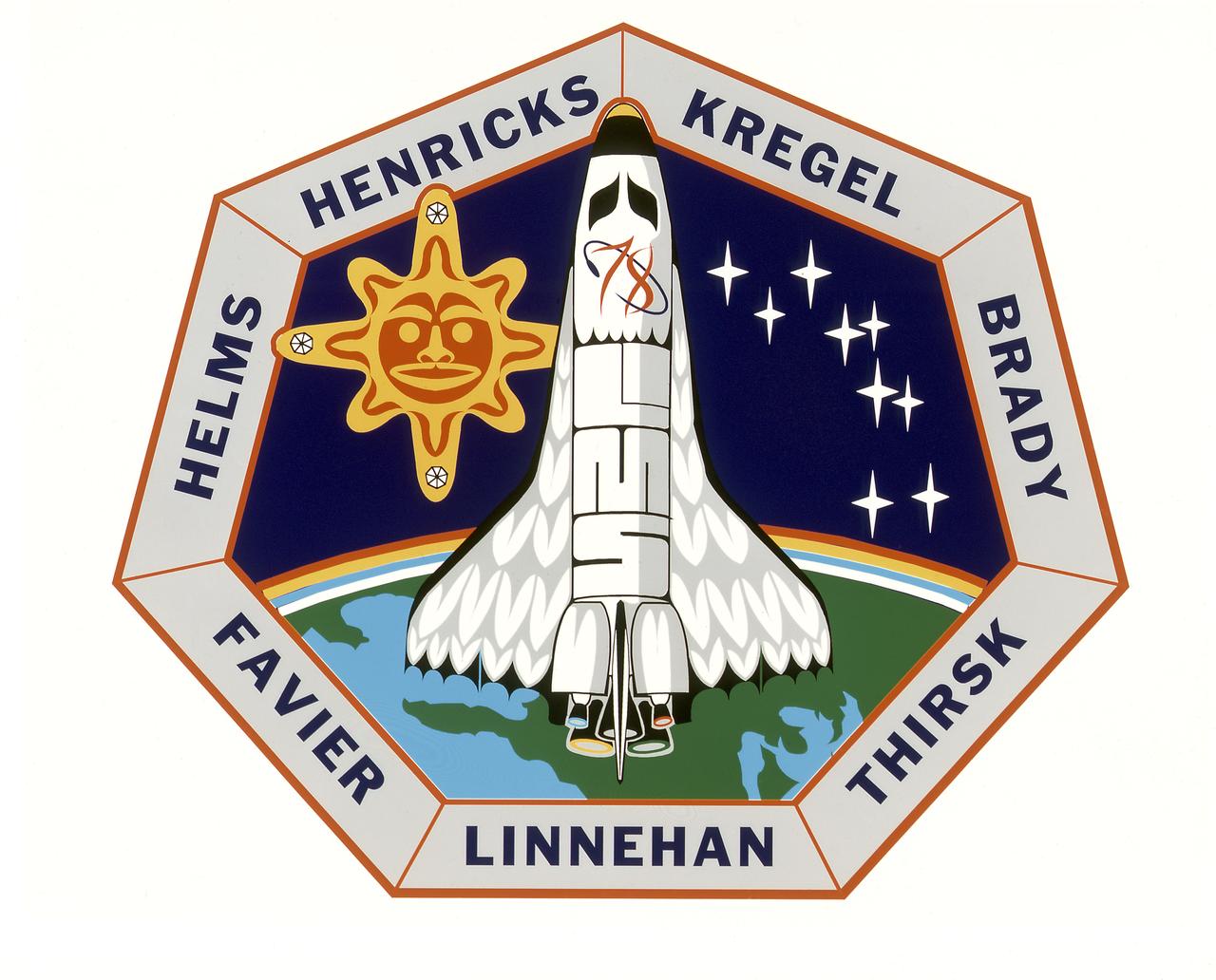
The STS-78 patch links past with present to tell the story of its mission and science through a design imbued with the strength and vitality of the 2-dimensional art of North America's northwest coast Indians. Central to the design is the space Shuttle whose bold lines and curves evoke the Indian image for the eagle, a native American symbol of power and prestige as well as the national symbol of the United States. The wings of the Shuttle suggest the wings of the eagle whose feathers, indicative of peace and friendship in Indian tradition, are captured by the U forms, a characteristic feature of Northwest coast Indian art. The nose of the Shuttle is the strong downward curve of the eagle's beak, and the Shuttle's forward windows, the eagle's eyes, represented through the tapered S forms again typical of this Indian art form. The basic black and red atoms orbiting the mission number recall the original NASA emblem while beneath, utilizing Indian ovoid forms, the major mission scientific experiment package LMS (Life and Materials Sciences) housed in the Shuttle's cargo bay is depicted in a manner reminiscent of totem-pole art. This image of a bird poised for flight, so common to Indian art, is counterpointed by an equally familiar Tsimshian Indian symbol, a pulsating sun with long hyperbolic rays, the symbol of life. Within each of these rays are now encased crystals, the products of this mission's 3 major, high-temperature materials processing furnaces. And as the sky in Indian lore is a lovely open country, home of the Sun Chief and accessible to travelers through a hole in the western horizon, so too, space is a vast and beckoning landscape for explorers launched beyond the horizon. Beneath the Tsimshian sun, the colors of the earth limb are appropriately enclosed by a red border representing life to the Northwest coast Indians. The Indian colors of red, navy blue, white, and black pervade the STS-78 path. To the right of the Shuttle-eagle, the constellation Delphinus recalls the dolphin, friend of ancient sailors and, now perhaps too, of the 9 space voyagers suggested by this constellation's blaze of 9 stars. The patch simultaneously celebrates international unity fostered by the Olympic spirit of sports competition at the 1996 Olympic Games in Atlanta, Georgia, U.S.A. Deliberately poised over the city of Atlanta, the Space Shuttle glows at its base with the 5 official Olympic rings in the 5 Olympic colors which can also be found throughout the patch, rings and colors which signify the 5 continents of the earth. This is an international mission and for the first time in NASA patch history, astronauts have dispensed with identifying country flags beneath their names to celebrate the spirit of international unity so characteristic of this flight.