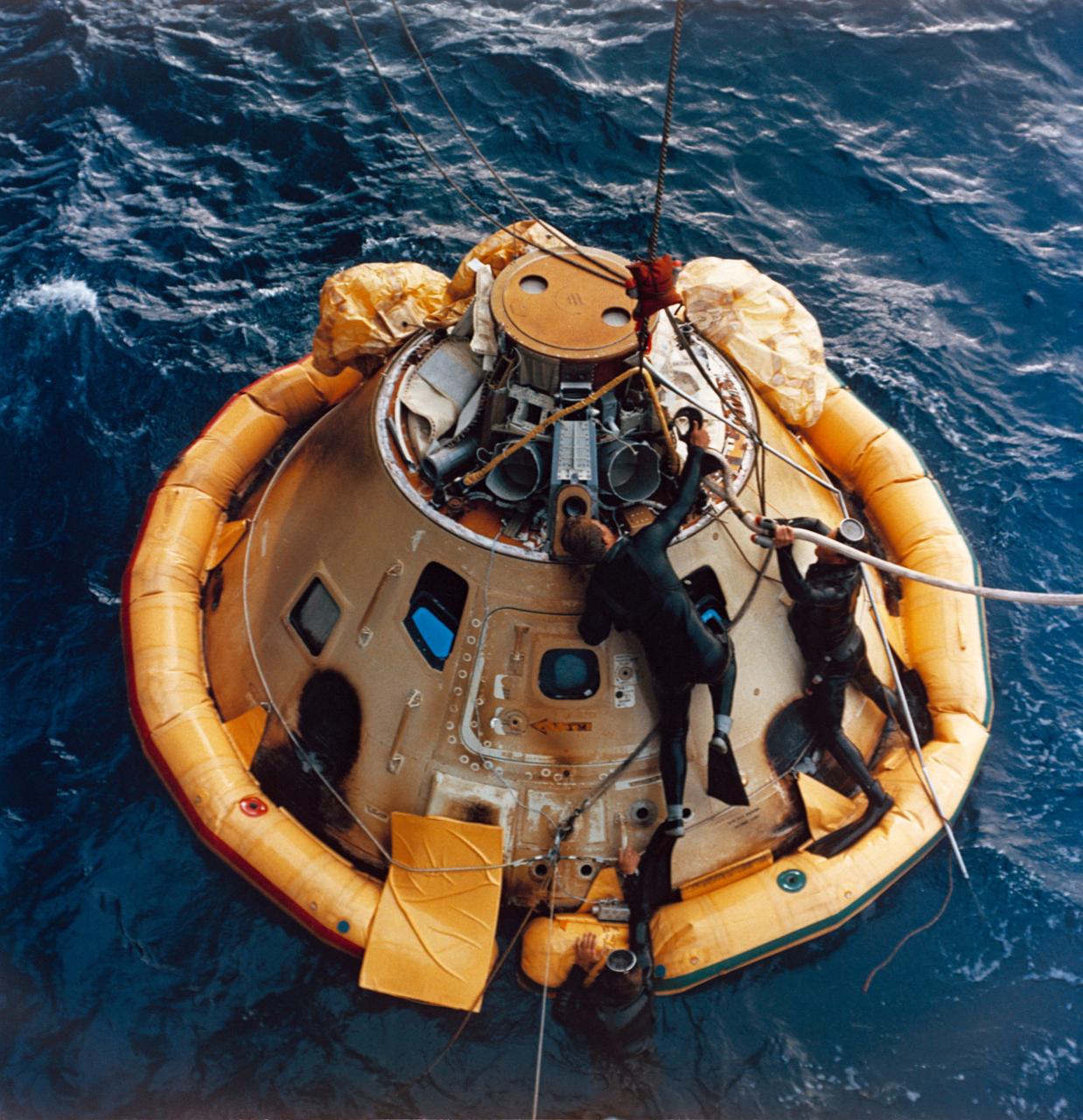
S68-27884 (4 April 1968) --- A U. S. Navy frogman team prepares the Apollo Spacecraft 020 Command Module (CM) for hoisting aboard the USS Okinawa. The USS Okinawa was the prime recovery ship for the Apollo 6 (Spacecraft 020/Saturn 502) unmanned space mission. Splashdown occurred at 4:58:45 p.m. (EST), April 4, 1968, at 375 nautical miles north of Honolulu, Hawaii.
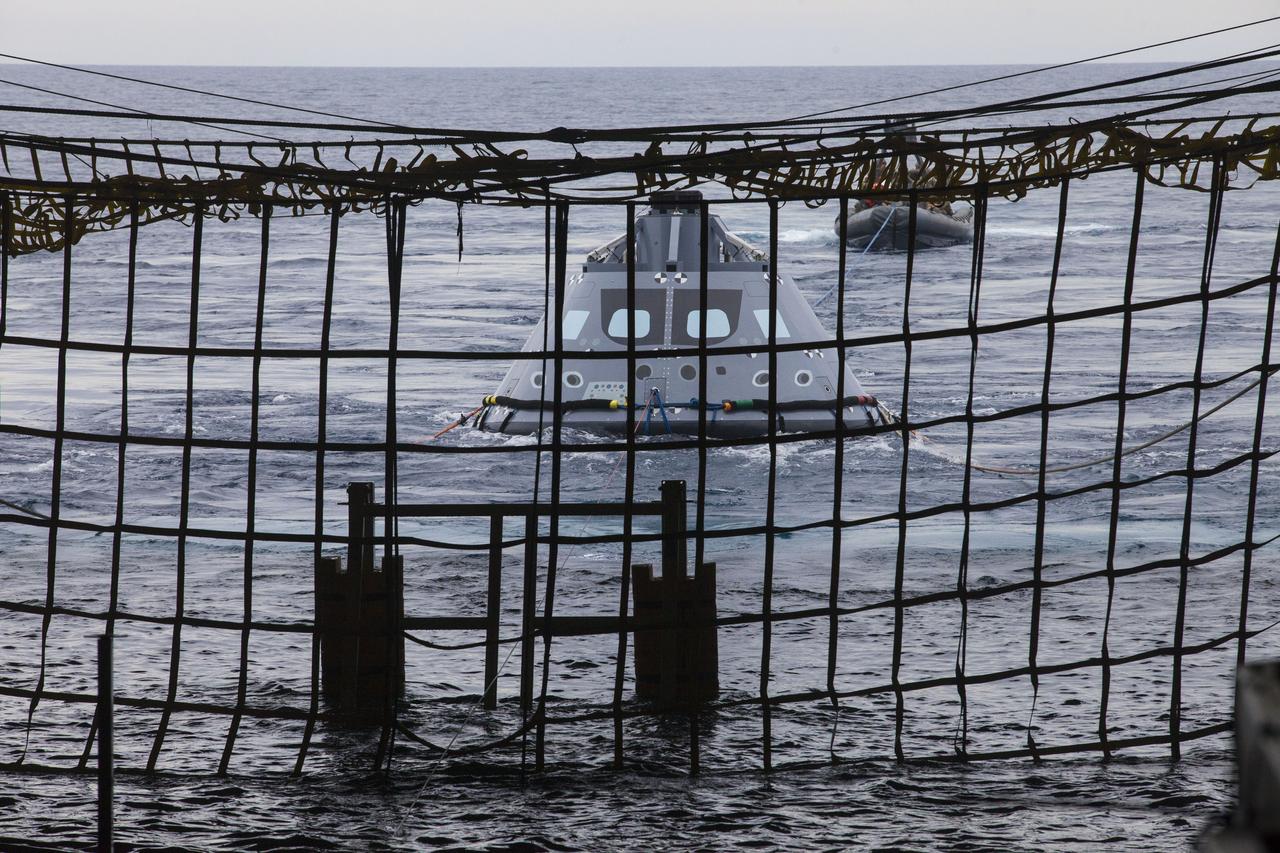
A test version of the Orion crew module is guided into the well deck of the USS San Diego during Underway Recovery Test 5 in the Pacific Ocean off the coast of California. Tether lines have been attached to the crew module by U. S. Navy divers and other personnel in a rigid hull inflatable boat. NASA's Ground Systems Development and Operations Program and the U.S. Navy are practicing recovery techniques to prepare for recovery of Orion on its return from deep space missions. The testing will allow the team to demonstrate and evaluate recovery processes, procedures, hardware and personnel in open waters. Orion is the exploration spacecraft designed to carry astronauts to destinations not yet explored by humans, including an asteroid and NASA's Journey to Mars. It will have emergency abort capability, sustain the crew during space travel and provide safe re-entry from deep space return velocities. Orion is scheduled to launch on NASA's Space Launch System in late 2018. For more information, visit http://www.nasa.gov/orion.
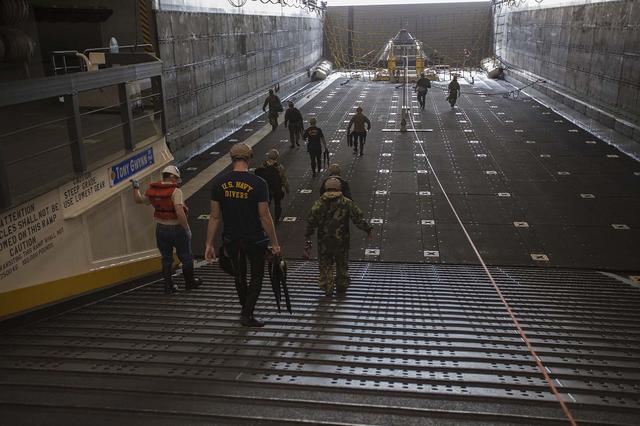
U. S. Navy divers and other personnel enter the well deck of the USS San Diego after another day of Underway Recovery Test 5 using a test version of the Orion crew module and several rigid hull inflatable and Zodiac boats in the Pacific Ocean off the coast of California. The test module is secured at the far end of the well deck. NASA's Ground Systems Development and Operations Program and the U.S. Navy are conducting a series of tests to prepare for recovery of Orion on its return from deep space missions. The testing allows the team to demonstrate and evaluate recovery processes, procedures, hardware and personnel in open waters. Orion is the exploration spacecraft designed to carry astronauts to destinations not yet explored by humans, including an asteroid and NASA's Journey to Mars. It will have emergency abort capability, sustain the crew during space travel and provide safe re-entry from deep space return velocities. Orion is scheduled to launch on NASA's Space Launch System in late 2018. For more information, visit http://www.nasa.gov/orion.
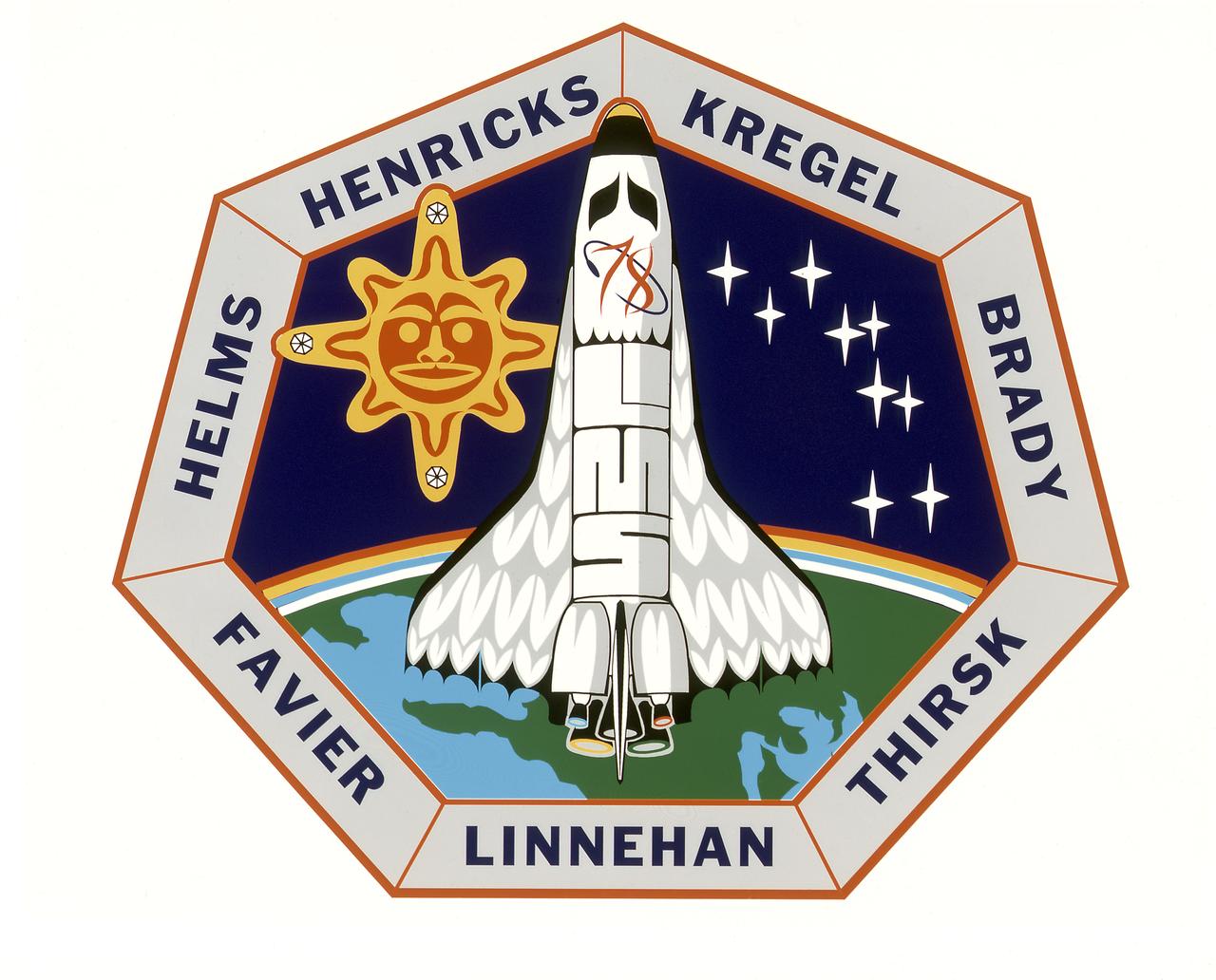
The STS-78 patch links past with present to tell the story of its mission and science through a design imbued with the strength and vitality of the 2-dimensional art of North America's northwest coast Indians. Central to the design is the space Shuttle whose bold lines and curves evoke the Indian image for the eagle, a native American symbol of power and prestige as well as the national symbol of the United States. The wings of the Shuttle suggest the wings of the eagle whose feathers, indicative of peace and friendship in Indian tradition, are captured by the U forms, a characteristic feature of Northwest coast Indian art. The nose of the Shuttle is the strong downward curve of the eagle's beak, and the Shuttle's forward windows, the eagle's eyes, represented through the tapered S forms again typical of this Indian art form. The basic black and red atoms orbiting the mission number recall the original NASA emblem while beneath, utilizing Indian ovoid forms, the major mission scientific experiment package LMS (Life and Materials Sciences) housed in the Shuttle's cargo bay is depicted in a manner reminiscent of totem-pole art. This image of a bird poised for flight, so common to Indian art, is counterpointed by an equally familiar Tsimshian Indian symbol, a pulsating sun with long hyperbolic rays, the symbol of life. Within each of these rays are now encased crystals, the products of this mission's 3 major, high-temperature materials processing furnaces. And as the sky in Indian lore is a lovely open country, home of the Sun Chief and accessible to travelers through a hole in the western horizon, so too, space is a vast and beckoning landscape for explorers launched beyond the horizon. Beneath the Tsimshian sun, the colors of the earth limb are appropriately enclosed by a red border representing life to the Northwest coast Indians. The Indian colors of red, navy blue, white, and black pervade the STS-78 path. To the right of the Shuttle-eagle, the constellation Delphinus recalls the dolphin, friend of ancient sailors and, now perhaps too, of the 9 space voyagers suggested by this constellation's blaze of 9 stars. The patch simultaneously celebrates international unity fostered by the Olympic spirit of sports competition at the 1996 Olympic Games in Atlanta, Georgia, U.S.A. Deliberately poised over the city of Atlanta, the Space Shuttle glows at its base with the 5 official Olympic rings in the 5 Olympic colors which can also be found throughout the patch, rings and colors which signify the 5 continents of the earth. This is an international mission and for the first time in NASA patch history, astronauts have dispensed with identifying country flags beneath their names to celebrate the spirit of international unity so characteristic of this flight.