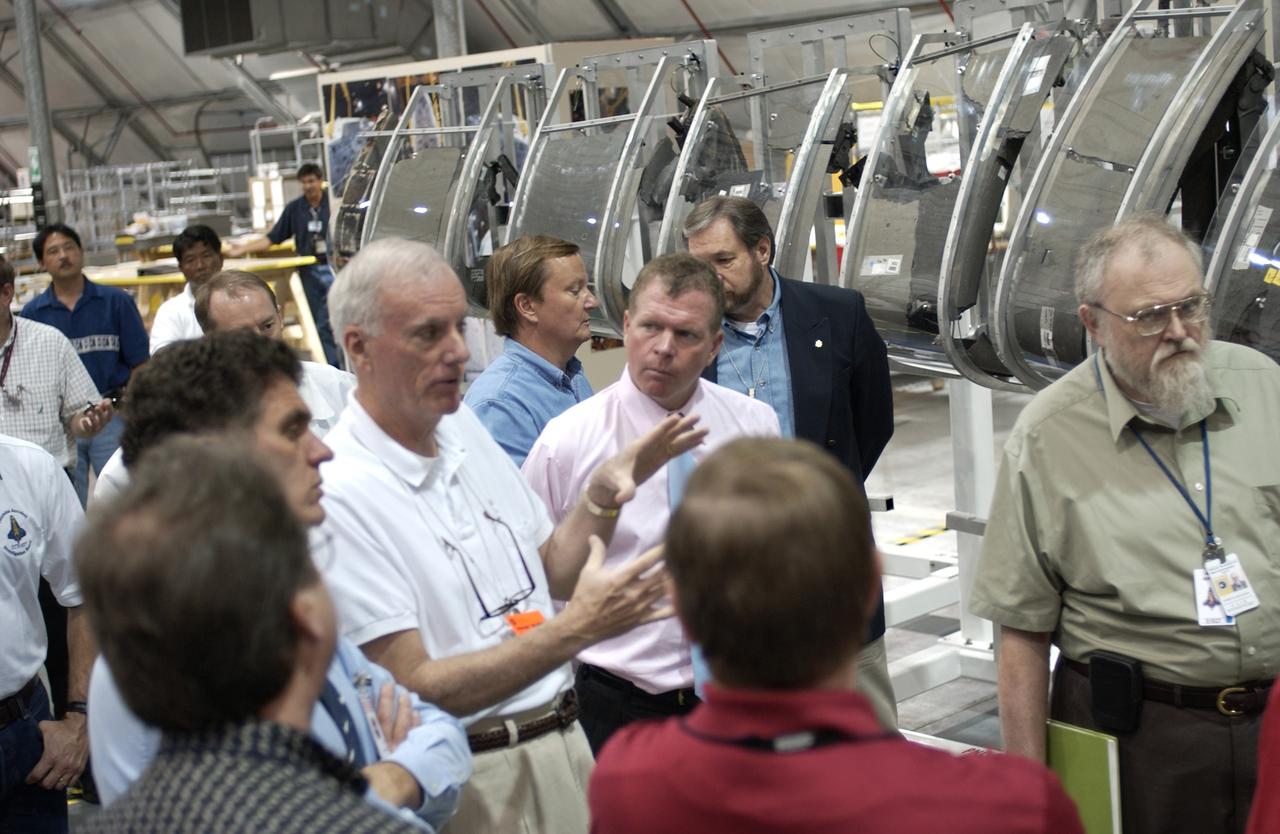
In the RLV Hangar, Adm. Harold Gehman (gesturing) and the Columbia Investigation Accident Board are visiting KSC as part of the ongoing investigation. Flanking Gehman are U. S. Representatives Dave Weldon (left) and Tom Feeney (right), who accompanied the board. Recovery efforts as of May 5 included 82,500 pieces of debris weighing 84,800 pounds, almost 40 percent of the total dry weight of the shuttle. About 25,000 personnel took part, utilizing almost 1.5 million total man-hours in the recovery effort and involving more than 130 federal, state and local agencies. The operation was also supported by more than 270 organizations that included businesses and volunteer groups.
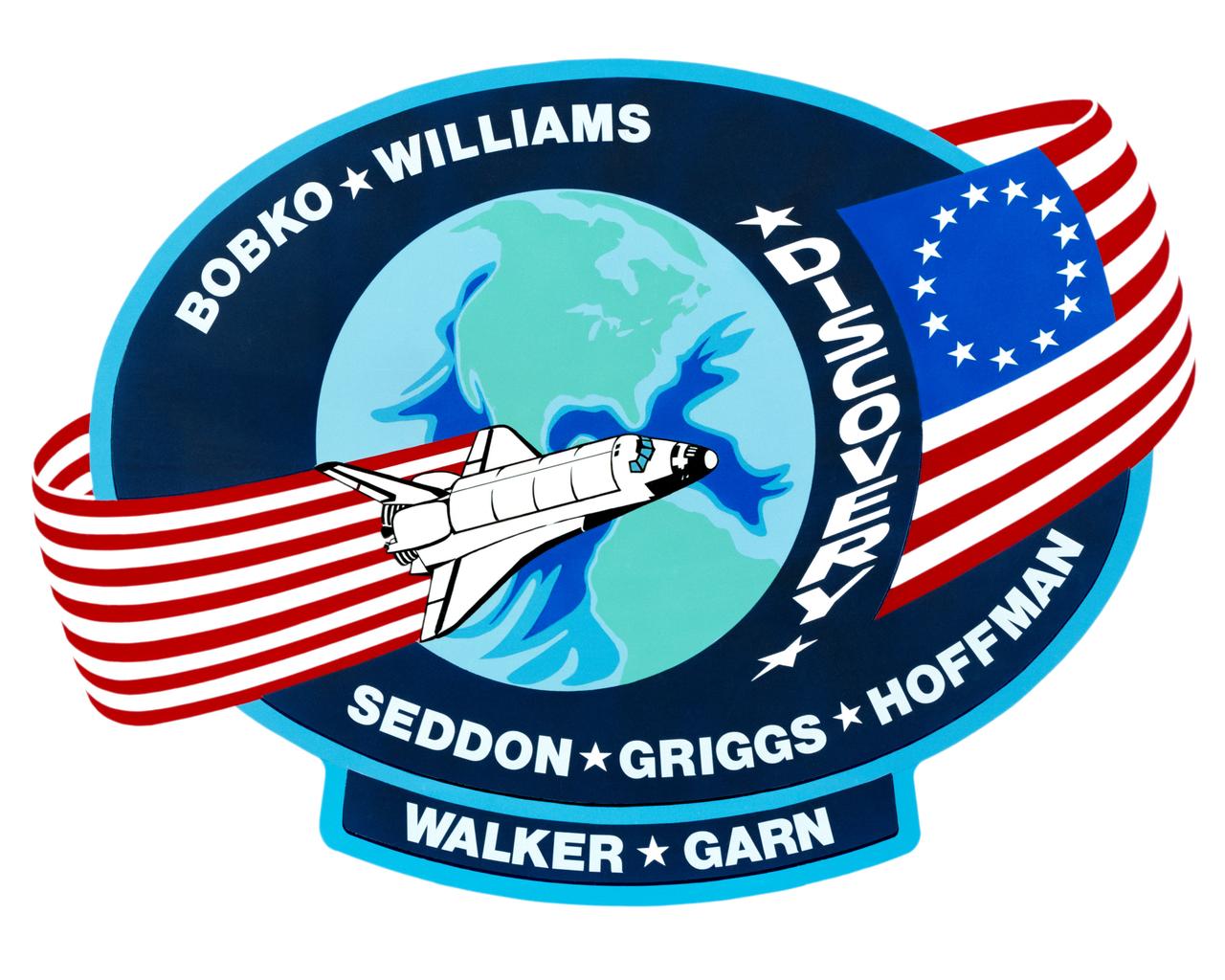
S85-28989 (March 1985) --- The dominant features of the STS-51D emblem are an orbit formed by a Colonial American flag and a space shuttle. The flag in orbit signifies the U.S. flag to indicate that it comes from this country and the American people. The original 13-star flag is used to symbolize a continuity of technical achievement and progress since colonial times. The name Discovery preceding the flag represents the spirit of Discovery and exploration of new frontiers which have been a hallmark of American people even before they were formed together as a nation. The crew members are Karol J. Bobko, Donald E. Williams, Rhea Seddon, S. David Griggs and Jeffrey A. Hoffman of NASA; and Charles D. Walker, representing McDonnell Douglas Corporation; and U. S. Senator Jake Garn. The NASA insignia design for space shuttle flights is reserved for use by the astronauts and for other official use as the NASA Administrator may authorize. Public availability has been approved only in the forms of illustrations by the various news media. When and if there is any change in this policy, which is not anticipated, the change will be publicly announced. Photo credit: NASA
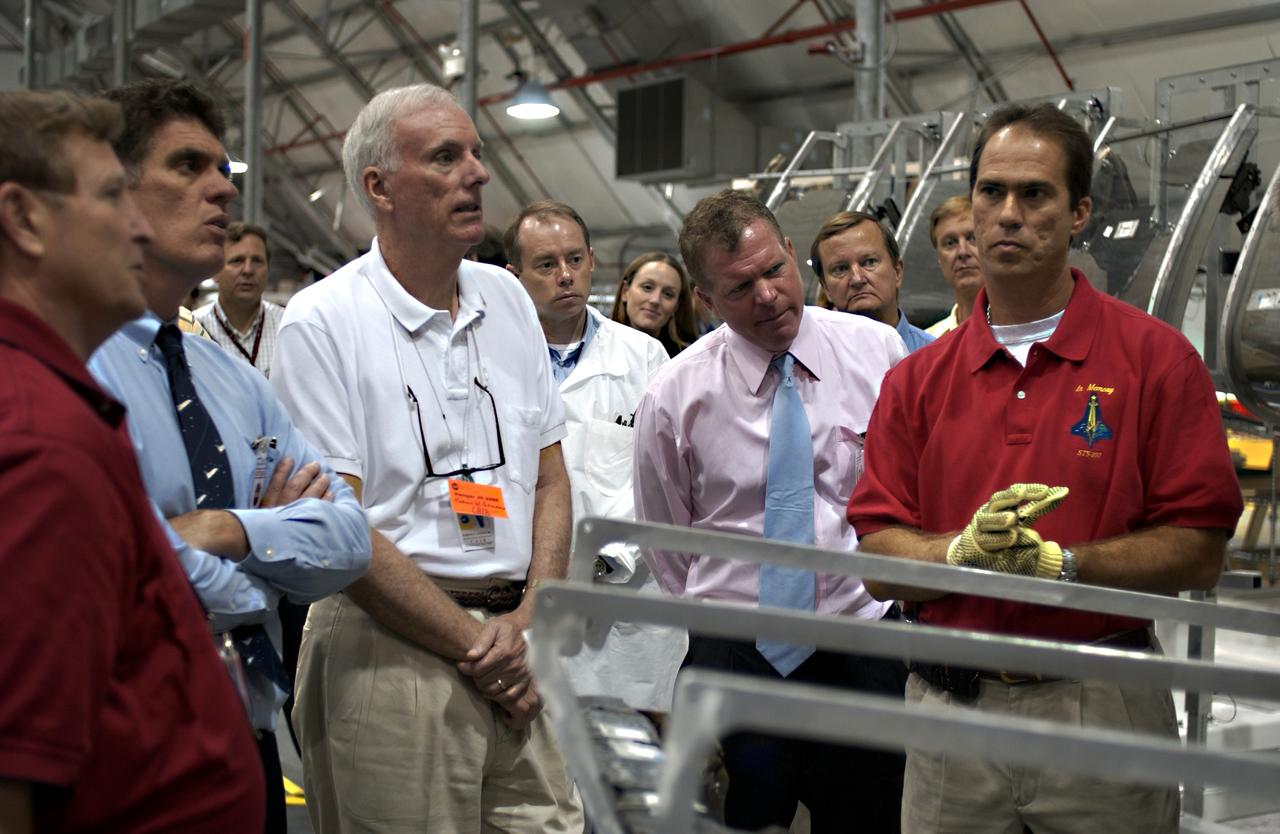
KENNEDY SPACE CENTER, FLA. - In the RLV Hangar, Adm. Harold Gehman (second from right) , chairman of the Columbia Investigation Accident Board, looks at Columbia debris. Gehman and the board are visiting KSC as part of the ongoing investigation. Flanking Gehman are U. S. Representatives Dave Weldon (left) and Tom Feeney (right), who accompanied the board. Recovery efforts as of May 5 included 82,500 pieces of debris weighing 84,800 pounds, almost 40 percent of the total dry weight of the shuttle. About 25,000 personnel took part, utilizing almost 1.5 million total man-hours in the recovery effort and involving more than 130 federal, state and local agencies. The operation was also supported by more than 270 organizations that included businesses and volunteer groups.
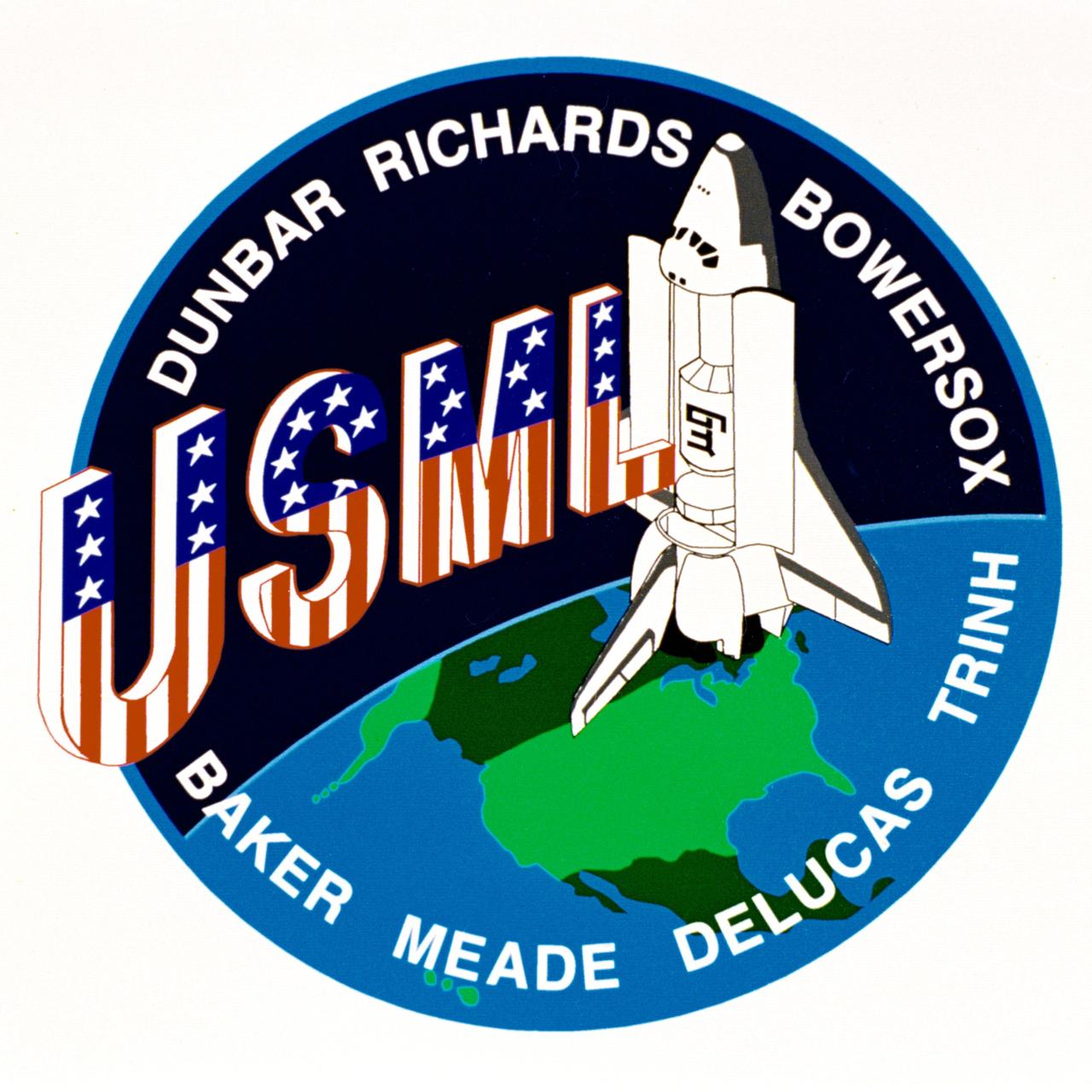
STS050-S-001 (January 1992) --- Designed by the flight crew, the insignia for the United States Microgravity Laboratory (USML-1), captures a space shuttle traveling above Earth while trailing the USML banner. The orbiter is oriented vertically in a typical attitude for microgravity science and in this position represents the numeral 1 in the mission's abbreviated title. This flight represents the first in a series of USML flights on which the primary objective is microgravity science, planned and executed through the combined efforts of the United States of America's government, industry and academia. Visible in the payload bay are the Spacelab module, and the extended duration orbiter "cryo" pallet which will be making its first flight. The small g and Greek letter mu on the Spacelab module symbolize the microgravity environment being used for research in the areas of materials science and fluid physics. The large block letter U extends outside the patch perimeter, symbolizing the potential for the experiments on this flight to expand the current boundaries of knowledge in microgravity science. The Stars and Stripes of the USML block letters and the United States landmass in the Earth scene below reflect the crew's pride in the United States origin of all onboard experiments. The NASA insignia design for space shuttle flights is reserved for use by the astronauts and for other official use as the NASA Administrator may authorize. Public availability has been approved only in the forms of illustrations by the various news media. When and if there is any change in this policy, which is not anticipated, the change will be publicly announced. Photo credit: NASA
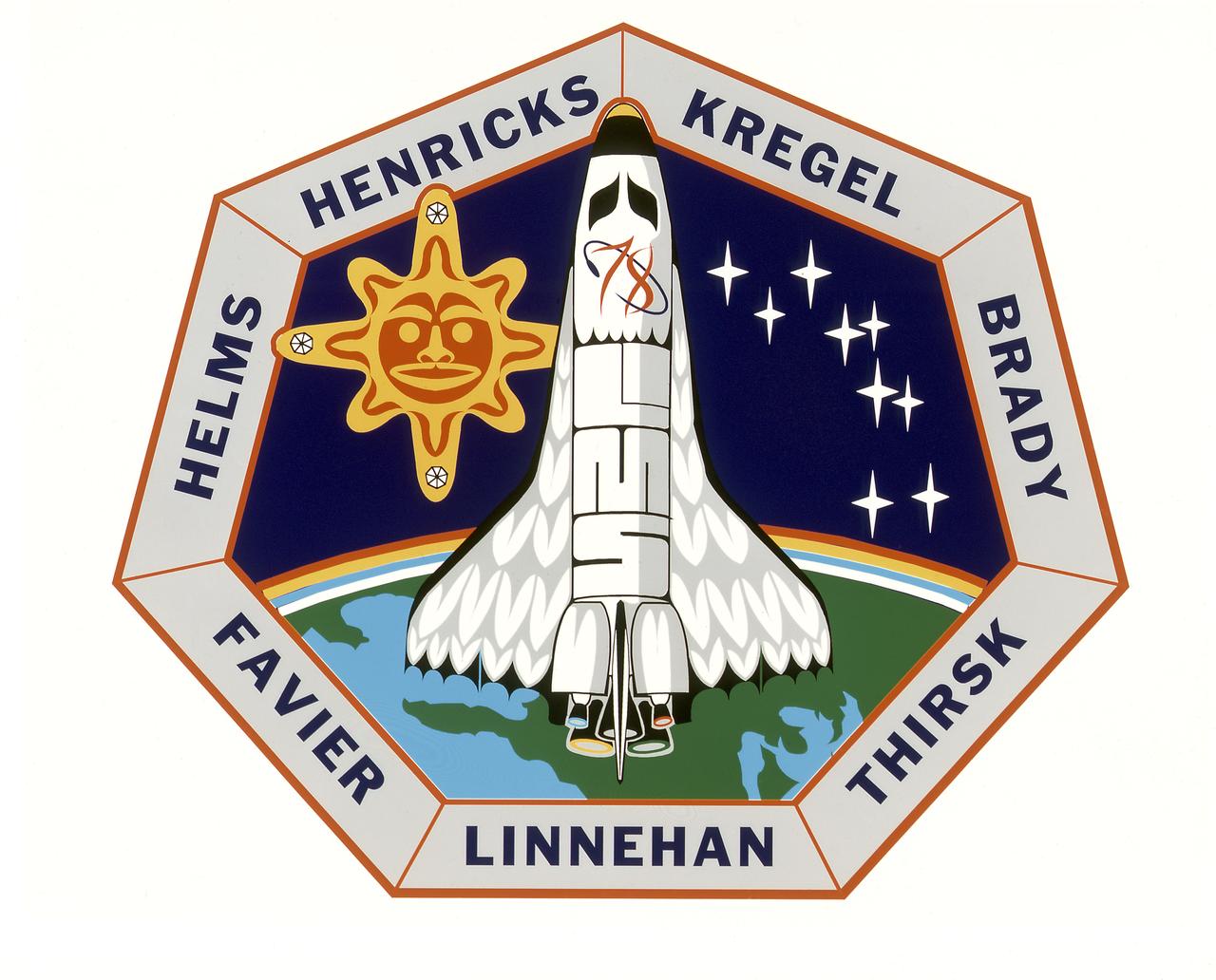
The STS-78 patch links past with present to tell the story of its mission and science through a design imbued with the strength and vitality of the 2-dimensional art of North America's northwest coast Indians. Central to the design is the space Shuttle whose bold lines and curves evoke the Indian image for the eagle, a native American symbol of power and prestige as well as the national symbol of the United States. The wings of the Shuttle suggest the wings of the eagle whose feathers, indicative of peace and friendship in Indian tradition, are captured by the U forms, a characteristic feature of Northwest coast Indian art. The nose of the Shuttle is the strong downward curve of the eagle's beak, and the Shuttle's forward windows, the eagle's eyes, represented through the tapered S forms again typical of this Indian art form. The basic black and red atoms orbiting the mission number recall the original NASA emblem while beneath, utilizing Indian ovoid forms, the major mission scientific experiment package LMS (Life and Materials Sciences) housed in the Shuttle's cargo bay is depicted in a manner reminiscent of totem-pole art. This image of a bird poised for flight, so common to Indian art, is counterpointed by an equally familiar Tsimshian Indian symbol, a pulsating sun with long hyperbolic rays, the symbol of life. Within each of these rays are now encased crystals, the products of this mission's 3 major, high-temperature materials processing furnaces. And as the sky in Indian lore is a lovely open country, home of the Sun Chief and accessible to travelers through a hole in the western horizon, so too, space is a vast and beckoning landscape for explorers launched beyond the horizon. Beneath the Tsimshian sun, the colors of the earth limb are appropriately enclosed by a red border representing life to the Northwest coast Indians. The Indian colors of red, navy blue, white, and black pervade the STS-78 path. To the right of the Shuttle-eagle, the constellation Delphinus recalls the dolphin, friend of ancient sailors and, now perhaps too, of the 9 space voyagers suggested by this constellation's blaze of 9 stars. The patch simultaneously celebrates international unity fostered by the Olympic spirit of sports competition at the 1996 Olympic Games in Atlanta, Georgia, U.S.A. Deliberately poised over the city of Atlanta, the Space Shuttle glows at its base with the 5 official Olympic rings in the 5 Olympic colors which can also be found throughout the patch, rings and colors which signify the 5 continents of the earth. This is an international mission and for the first time in NASA patch history, astronauts have dispensed with identifying country flags beneath their names to celebrate the spirit of international unity so characteristic of this flight.