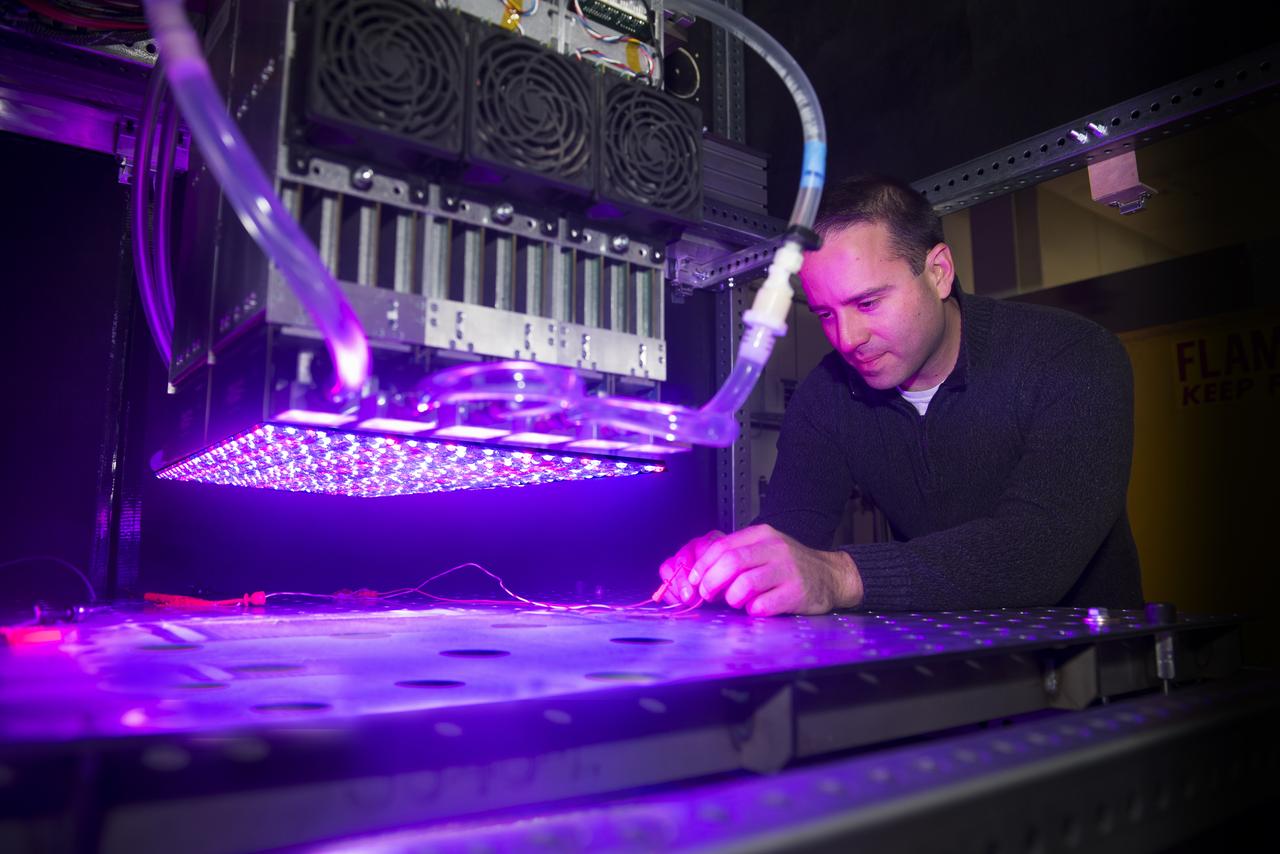
NASA Glenn's new LED solar simulator was developed by Angstrom Designs and UC Santa Barbara under a Small Business Innovative Research program to test the next generation of high-efficiency space solar cells for future missions. The new simulator contains over 1500 individually adjustable light sources, most of which emit light invisible to the human eye, to cover a 10 x10 foot area.

Dr. Paolo Luzzatto-Fergiz, professor, UC Santa Barbara Engineering Dept., addresses members of the media during a briefing in the Kennedy Space Center’s Press Site auditorium. The briefing focused on research planned for launch to the International Space Station. The scientific materials and supplies will be aboard a SpaceX Dragon spacecraft scheduled for liftoff from Cape Canaveral Air Force Station's Space Launch Complex 40. The SpaceX Falcon 9 rocket will launch the company's 15th Commercial Resupply Services mission to the space station.
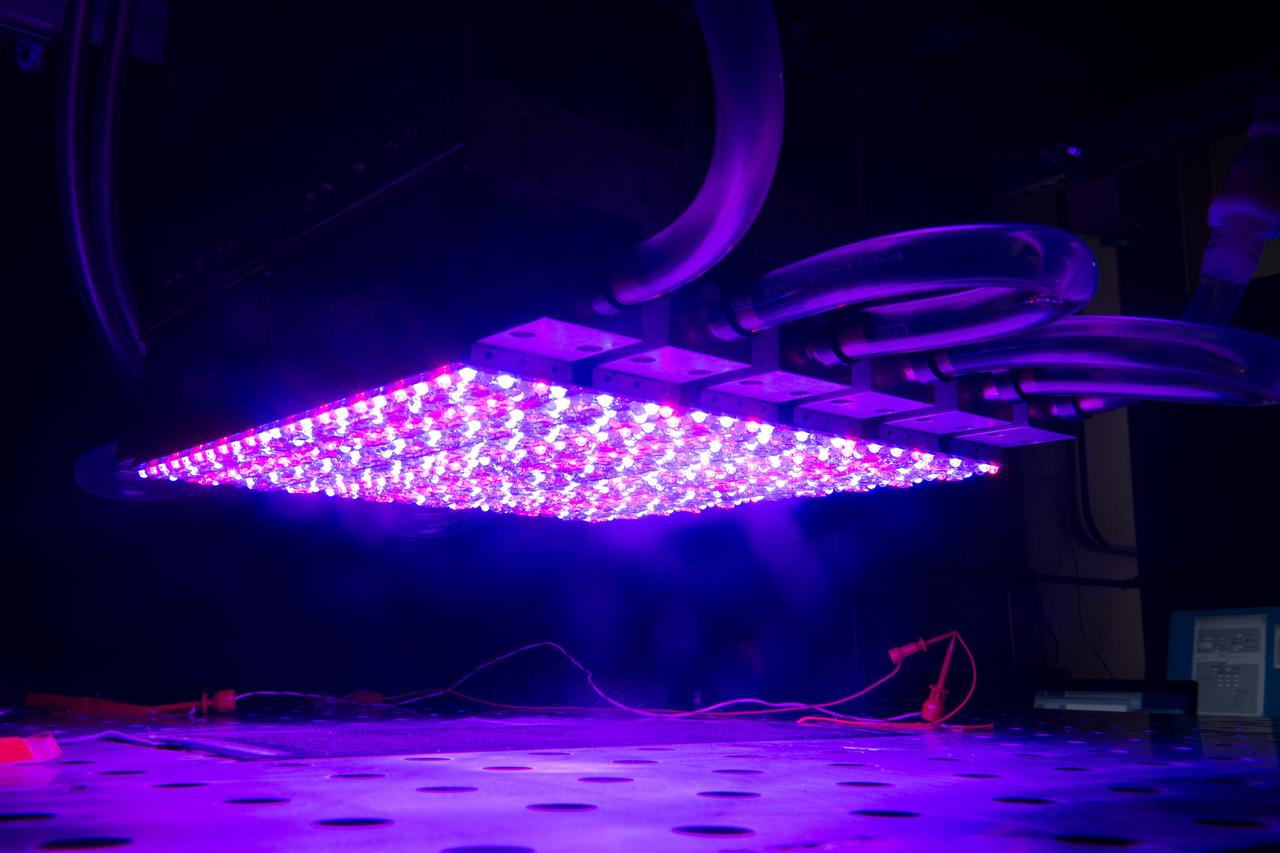
NASA Glenn's new LED solar simulator was developed by Angstrom Designs and UC Santa Barbara under a Small Business Innovative Research program to test the next generation of high-efficiency space solar cells for future missions. The new simulator contains over 1500 individually adjustable light sources, most of which emit light invisible to the human eye, to cover a 10 x10 foot area.
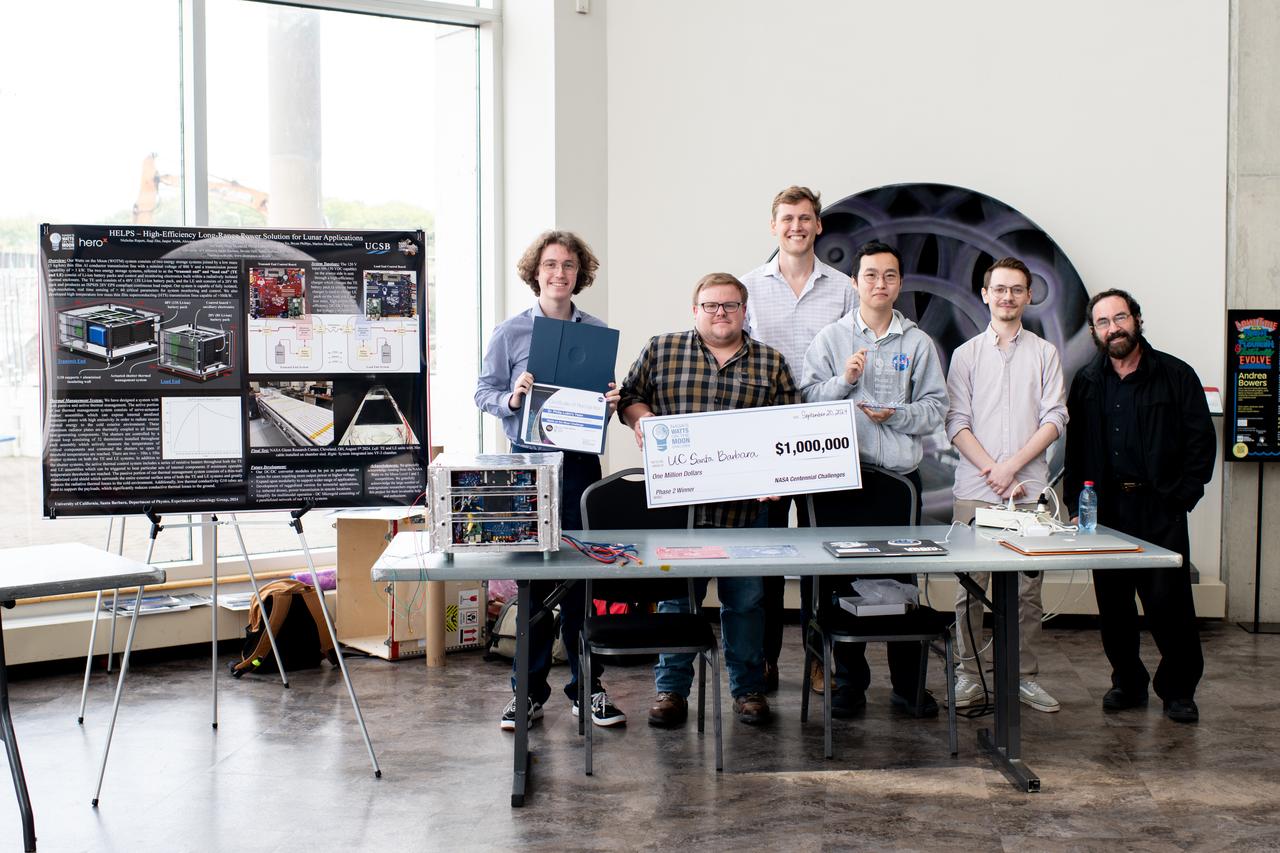
NASA has awarded a total of $1.5 million to two U.S. teams for their novel technology solutions addressing energy distribution, management, and storage as part of the agency’s Watts on the Moon Challenge. The innovations from this challenge aim to support NASA’s Artemis missions, which will establish long-term human presence on the Moon. This two-phase competition has challenged U.S. innovators to develop breakthrough power transmission and energy storage technologies that could enable long-duration Moon missions to advance the nation’s lunar exploration goals. The final phase of the challenge concluded with a technology showcase and winners’ announcement ceremony Friday at Great Lakes Science Center, home of the visitor center for NASA’s Glenn Research Center in Cleveland. Team H.E.L.P.S. (High Efficiency Long-Range Power Solution) from The University of California, Santa Barbara won the $1 million grand prize in NASA’s Watts on the Moon Challenge. Their team developed a low-mass, high efficiency cable and featured energy storage batteries on both ends of their power transmission and energy storage system. Second prize ($500,000): Orbital Mining Corporation of Golden, Colorado
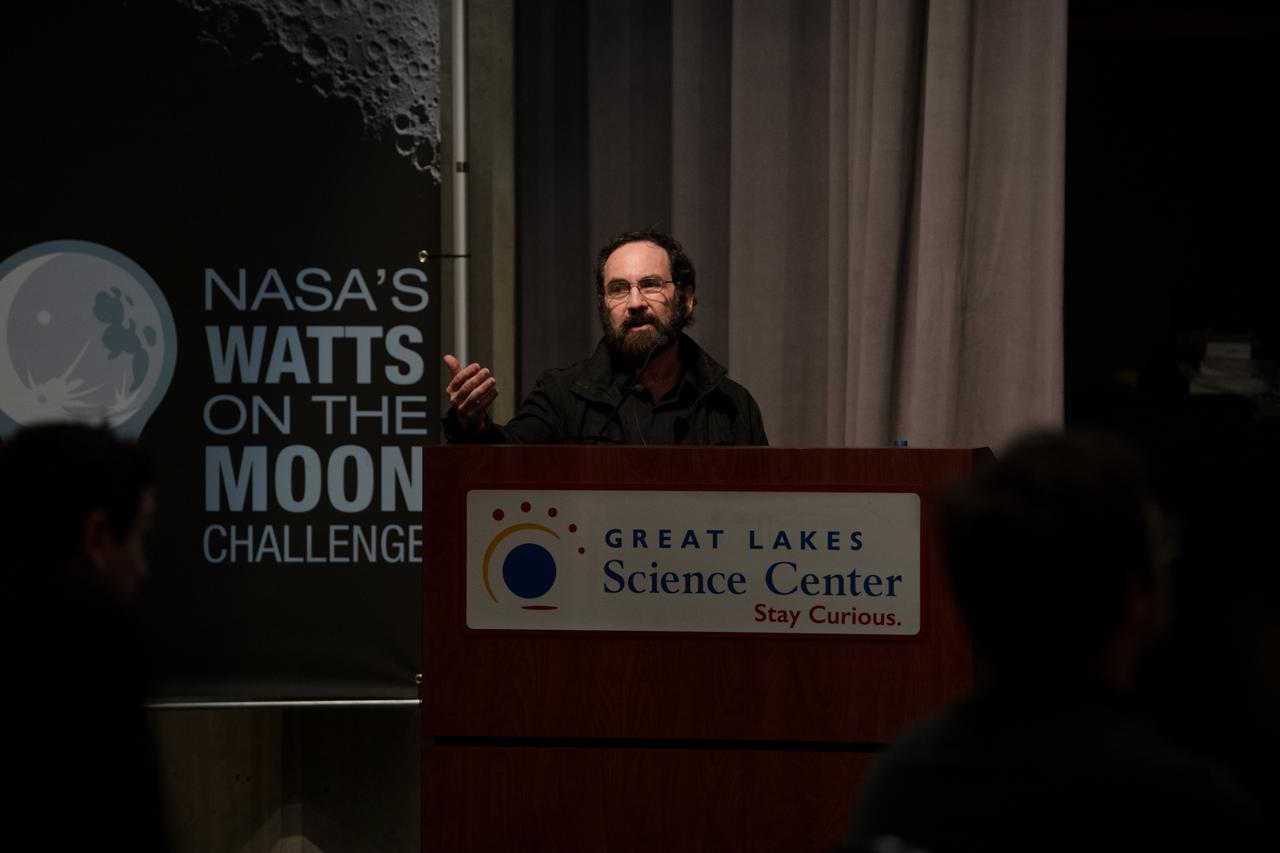
Philip Lubin from H.E.L.P.S. (High Efficiency Long-Range Power Solution) from The University of California gives their presentation. NASA has awarded a total of $1.5 million to two U.S. teams for their novel technology solutions addressing energy distribution, management, and storage as part of the agency’s Watts on the Moon Challenge. The innovations from this challenge aim to support NASA’s Artemis missions, which will establish long-term human presence on the Moon. This two-phase competition has challenged U.S. innovators to develop breakthrough power transmission and energy storage technologies that could enable long-duration Moon missions to advance the nation’s lunar exploration goals. The final phase of the challenge concluded with a technology showcase and winners’ announcement ceremony on September 11, 2024 at Great Lakes Science Center, home of the visitor center for NASA’s Glenn Research Center in Cleveland. Team H.E.L.P.S. (High Efficiency Long-Range Power Solution) from The University of California, Santa Barbara won the $1 million grand prize in NASA’s Watts on the Moon Challenge. Their team developed a low-mass, high efficiency cable and featured energy storage batteries on both ends of their power transmission and energy storage system. Second prize ($500,000): Orbital Mining Corporation of Golden, Colorado. Photo Credit: (NASA/Sara Lowthian-Hanna)
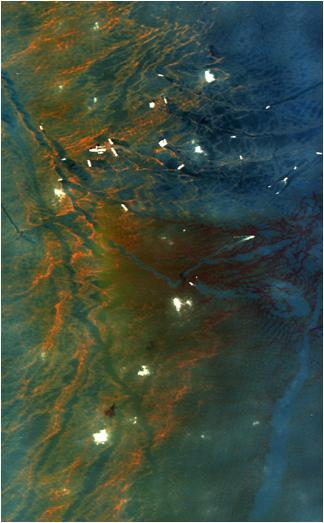
This image from NASA Airborne Visible/Infrared Imaging Spectrometer instrument AVIRIS was collected on May 17, 2010, over the site of the Deepwater Horizon BP oil spill disaster. In the image, crude oil on the surface appears orange to brown.