
This photograph was taken during the integration of the Astro-1 mission payloads at the Kennedy Space Center on March 20, 1990, showing the Broad Band X-Ray Telescope (BBXRT) at the left, as three telescopes for the Astro-1 Observatory are settled into the Orbiter Columbia payload bay. Above Earth's atmospheric interference, Astro-1 would make precise measurements of objects such as planets, stars, and galaxies in relatively small fields of view and would observe and measure ultraviolet radiation from celestial objects. The Astro-1 used a Spacelab pallet system with an instrument pointing system and a cruciform structure for bearing the three ultraviolet instruments mounted in a parallel configuration. The three instruments were: The Hopkins Ultraviolet Telescope (HUT), which was designed to obtain far-ultraviolet spectroscopic data from white dwarfs, emission nebulae, active galaxies, and quasars; the Wisconsin Ultraviolet Photo-Polarimeter Experiment (WUPPE) which was to study polarized ultraviolet light from magnetic white dwarfs, binary stars, reflection nebulae, and active galaxies; and the Ultraviolet Imaging Telescope (UIT), which was to record photographic images in ultraviolet light of galaxies, star clusters, and nebulae. The star trackers that supported the instrument pointing system, were also mounted on the cruciform. Also in the payload bay was the Broad Band X-Ray Telescope (BBXRT), which was designed to obtain high-resolution x-ray spectra from stellar corona, x-ray binary stars, active galactic nuclei, and galaxy clusters. Managed by the Marshall Space Flight Center, the Astro-1 observatory was launched aboard the Space Shuttle Orbiter Columbia (STS-35) on December 2, 1990.
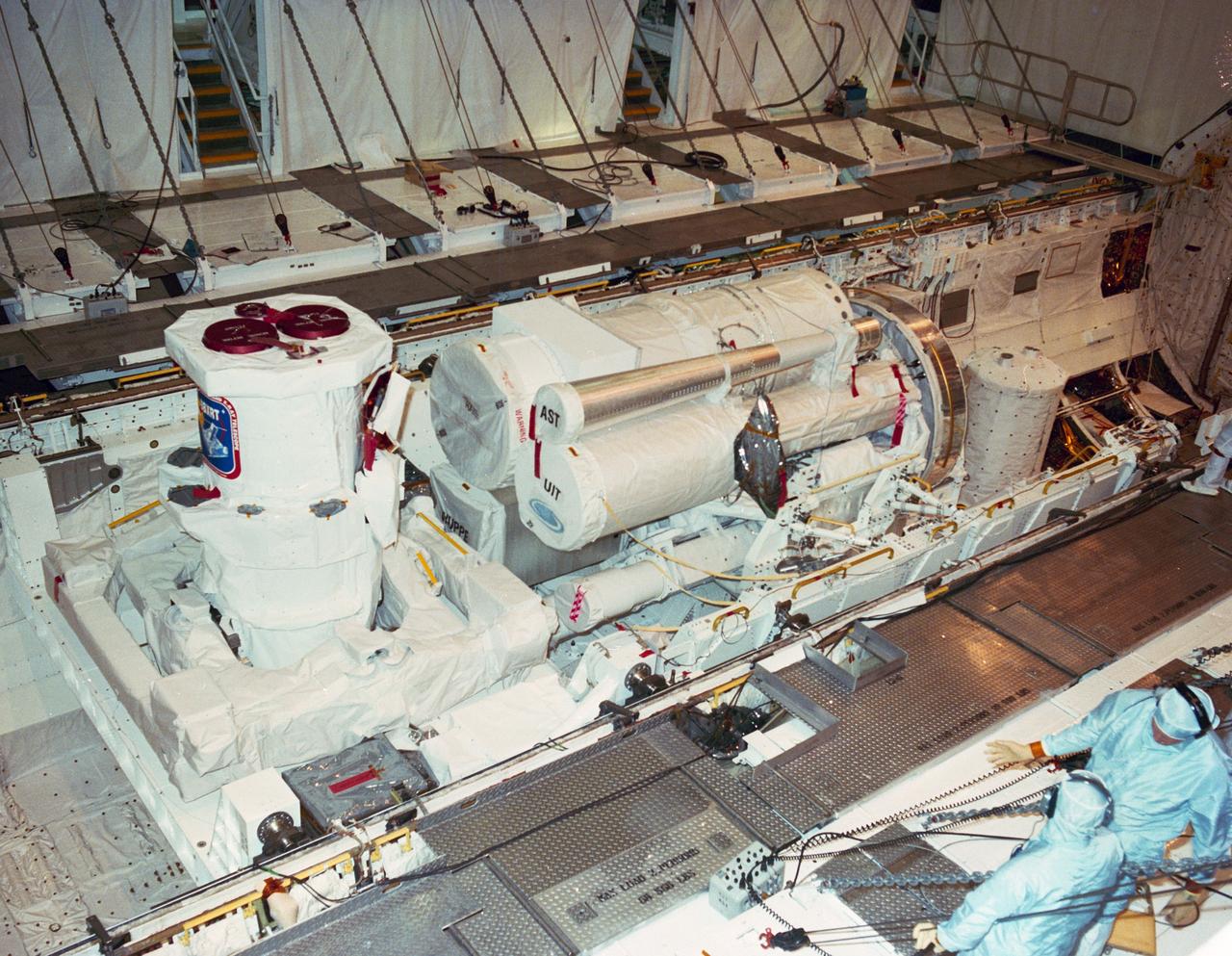
STS-35 Astronomy Laboratory 1 (ASTRO-1) is installed in Columbia's, Orbiter Vehicle (OV) 102's, payload bay (PLB) at the Kennedy Space Center (KSC) Orbiter Processing Facility (OPF). On the left, in the aft PLB is the Broad Band X Ray Telescope (BBXRT) mounted on the two axis pointing system (TAPS). In the center, the three ultraviolet telescopes - Wisconsin Ultraviolet Photo-Polarimeter Experiment (WUPPE), the Hopkins Ultraviolet Telescope (HUT), and the Ultraviolet Imaging Telescope (UIT) - are mounted on the instrument pointing system (IPS) and are in stowed position. At the far right is the Spacelab Pallet System (SPS) igloo. View provided by KSC with alternate number KSSC-90PC-421.
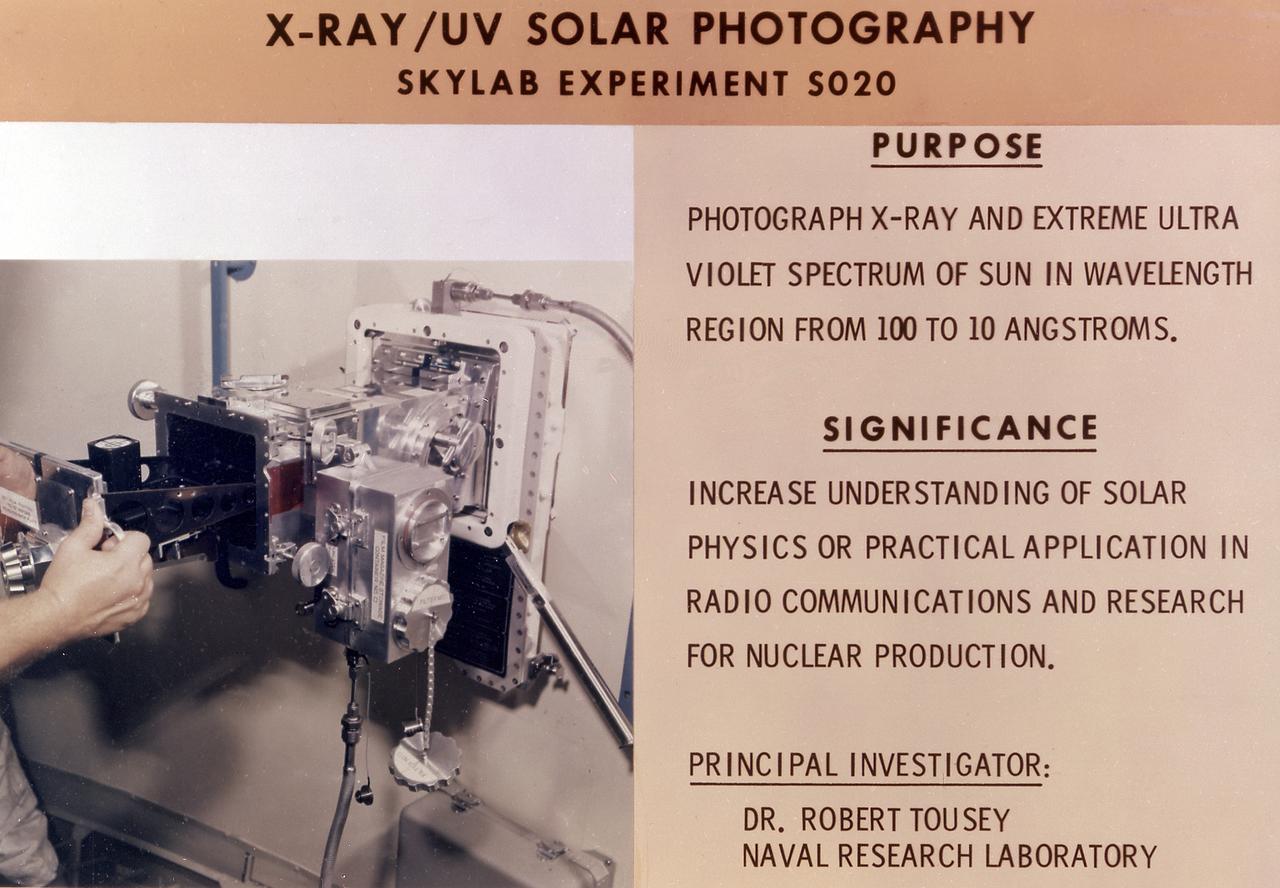
This chart details Skylab's Ultraviolet (UV) X-Ray Solar Photography experiment (S020) in an Apollo Telescope Mount facility. It was designed to photograph normal and explosive areas within the solar atmosphere in the UV and x-ray spectra. The Marshall Space Flight Center had program management responsibility for the development of Skylab hardware and experiments.
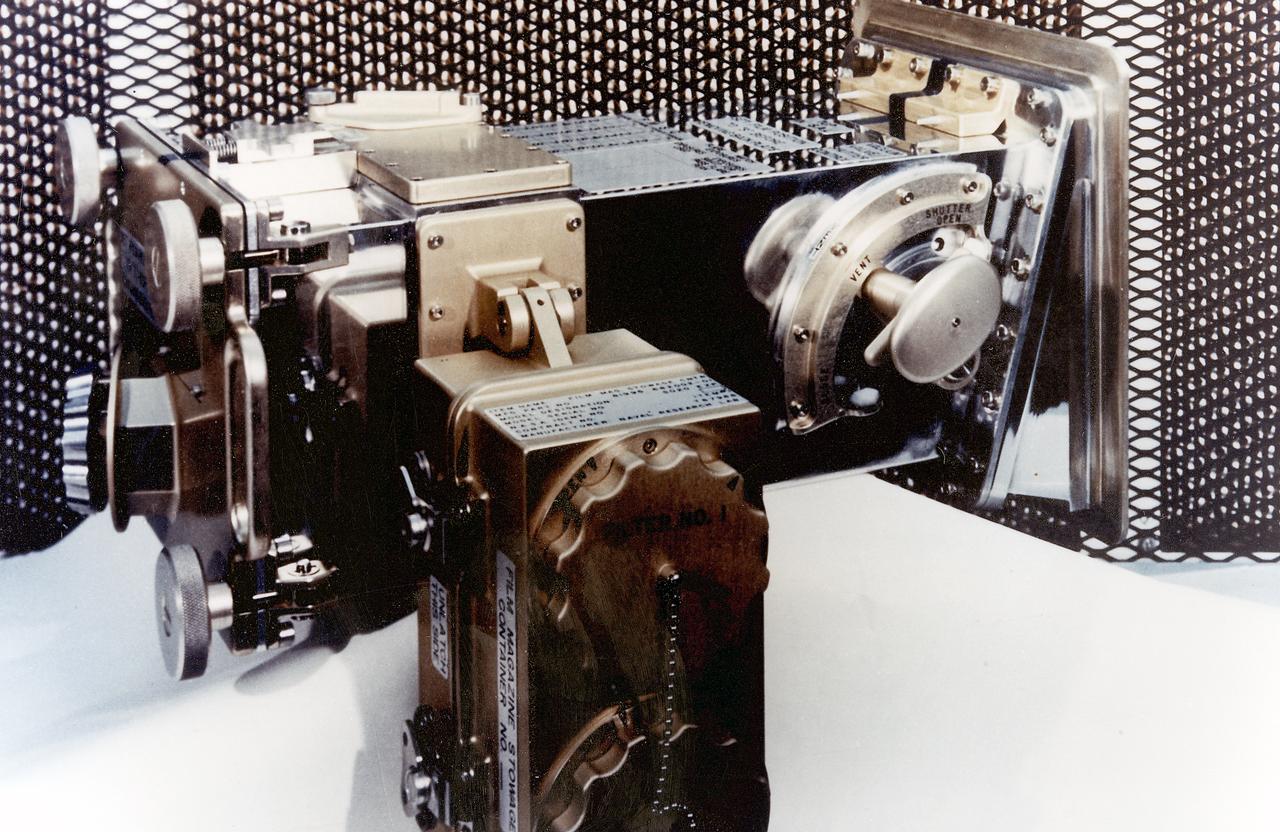
This 1970 photograph shows Skylab's Ultraviolet (UV)/X-Ray Solar Photography instrument, an Apollo Telescope Mount (ATM) facility designed to photograph normal and explosive areas in the solar atmosphere in the x-ray and UV spectra. The Marshall Space Flight Center had program management responsibility for the development of Skylab hardware and experiments.

In 1986, NASA introduced a Shuttle-borne ultraviolet observatory called Astro. The Astro Observatory was designed to explore the universe by observing and measuring the ultraviolet radiation from celestial objects. Astronomical targets of observation selected for Astro missions included planets, stars, star clusters, galaxies, clusters of galaxies, quasars, remnants of exploded stars (supernovae), clouds of gas and dust (nebulae), and the interstellar medium. Astro-1 used a Spacelab pallet system with an instrument pointing system and a cruciform structure for bearing the three ultraviolet instruments mounted in a parallel configuration. The three instruments were: The Hopkins Ultraviolet Telescope (HUT), which was designed to obtain far-ultraviolet spectroscopic data from white dwarfs, emission nebulae, active galaxies, and quasars; the Wisconsin Ultraviolet Photo-Polarimeter Experiment (WUPPE) which was to study polarized ultraviolet light from magnetic white dwarfs, binary stars, reflection nebulae, and active galaxies; and the Ultraviolet Imaging Telescope (UIT) which was to record photographic images in ultraviolet light of galaxies, star clusters, and nebulae. The star trackers that supported the instrument pointing system were also mounted on the cruciform. Also in the payload bay was the Broad Band X-Ray Telescope (BBXRT), which was designed to obtain high-resolution x-ray spectra from stellar corona, x-ray binary stars, active galactic nuclei, and galaxy clusters. Managed by the Marshall Space Flight Center, the Astro-1 observatory was launched aboard the Space Shuttle Orbiter Columbia (STS-35) on December 2, 1990.

In this photograph, the instruments of the Astro-1 Observatory are erected in the cargo bay of the Columbia orbiter. Astro-1 was launched aboard the the Space Shuttle Orbiter Columbia (STS-35) mission on December 2, 1990. The Astro Observatory was designed to explore the universe by observing and measuring the ultraviolet radiation from celestial objects. Astronomical targets of observation selected for Astro missions included planets, stars, star clusters, galaxies, clusters of galaxies, quasars, remnants of exploded stars (supernovae), clouds of gas and dust (nebulae), and the interstellar medium. Astro-1 used a Spacelab pallet system with an instrument pointing system and a cruciform structure for bearing the three ultraviolet instruments mounted in a parallel configuration. The three instruments were:The Hopkins Ultraviolet Telescope (HUT), the Wisconsin Ultraviolet Photo-Polarimeter Experiment (WUPPE), and the Ultraviolet Imaging Telescope (UIT). Also in the payload bay was the Broad Band X-Ray Telescope (BBXRT). Scientific return included approximately 1,000 photographs of the ultraviolet sky in the most extensive ultraviolet imagery ever attempted, the longest ultraviolet spectral observation of a comet ever made, and data never before seen on types of active galaxies called Seyfert galaxies. The mission also provided data on a massive supergiant star captured in outburst and confirmed that a spectral feature observed in the interstellar medium was due to graphite. In addition, Astro-1 acquired superb observations of the Jupiter magnetic interaction with one of its satellites.
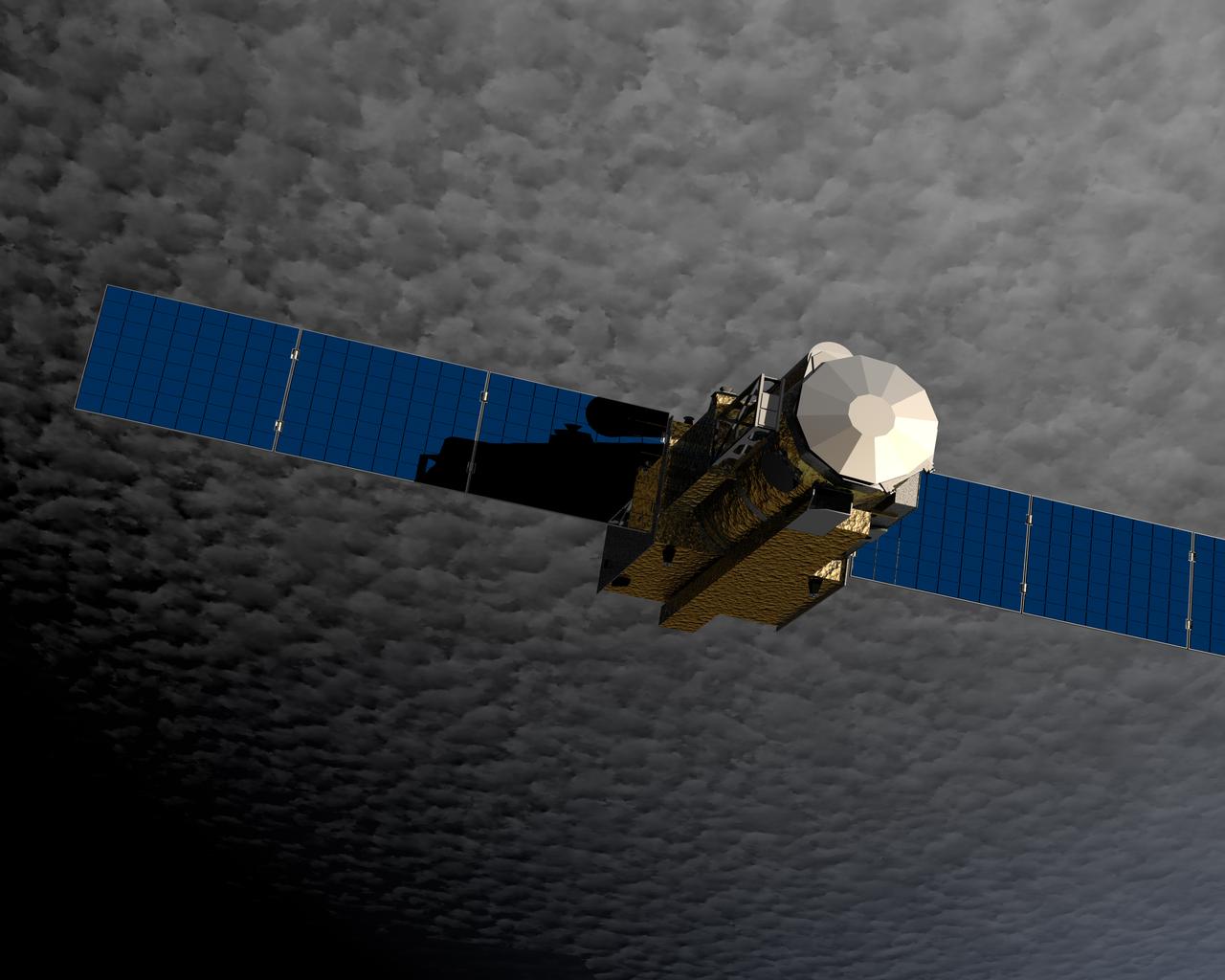
Hinode (Sunrise), formerly known as Solar-B before reaching orbit, was launched from the Uchinoura Space Center in Japan on September 23, 2006. Hinode was designed to probe into the Sun’s magnetic field to better understand the origin of solar disturbances which interfere with satellite communications, electrical power transmission grids, and the safety of astronauts traveling beyond the Earth’s magnetic field. Hinode is circling Earth in a polar orbit that places the instruments in continuous sunlight for nine months each year and allows data dumps to a high latitude European Space Agency (ESA) ground station every orbit. NASA and other science teams will support instrument operations and data collection from the spacecraft’s operation center at the Japanese Aerospace Exploration Agency’s (JAXA’s) Institute of Space and Aeronautical Science facility located in Tokyo. The Hinode spacecraft is a collaboration among space agencies of Japan, the United States, the United Kingdom, and Europe. The Marshall Space Flight Center (MSFC) managed development of three instruments comprising the spacecraft; the Solar Optical Telescope (SOT); the X-Ray Telescope (XRT); and the Extreme Ultraviolet (EUV) Imaging Spectrometer (EIS). Provided by the Multimedia support group at MSFC, this rendering illustrates the Solar-B Spacecraft in earth orbit with its solar panels completely extended.
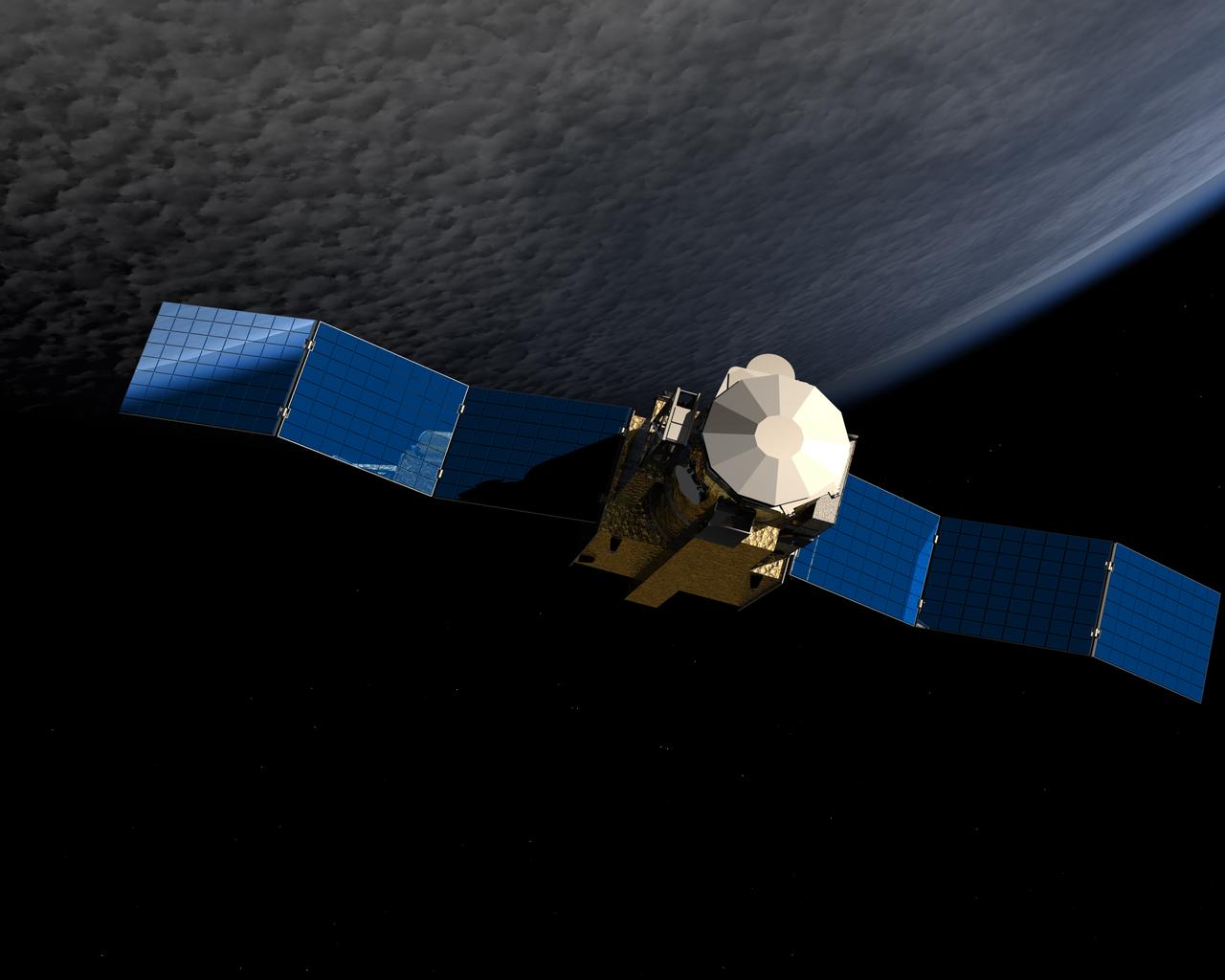
Hinode (Sunrise), formerly known as Solar-B before reaching orbit, was launched from the Uchinoura Space Center in Japan on September 23, 2006. Hinode was designed to probe into the Sun’s magnetic field to better understand the origin of solar disturbances which interfere with satellite communications, electrical power transmission grids, and the safety of astronauts traveling beyond the Earth’s magnetic field. Hinode is circling Earth in a polar orbit that places the instruments in continuous sunlight for nine months each year and allows data dumps to a high latitude European Space Agency (ESA) ground station every orbit. NASA and other science teams will support instrument operations and data collection from the spacecraft’s operation center at the Japanese Aerospace Exploration Agency’s (JAXA’s) Institute of Space and Aeronautical Science facility located in Tokyo. The Hinode spacecraft is a collaboration among space agencies of Japan, the United States, the United Kingdom, and Europe. The Marshall Space Flight Center (MSFC) managed development of three instruments comprising the spacecraft; the Solar Optical Telescope (SOT); the X-Ray Telescope (XRT); and the Extreme Ultraviolet (EUV) Imaging Spectrometer (EIS). Provided by the Multimedia support group at MSFC, this rendering illustrates the Solar-B Spacecraft in earth orbit with its solar panels partially extended.

Hinode (Sunrise), formerly known as Solar-B before reaching orbit, was launched from the Uchinoura Space Center in Japan on September 23, 2006. Hinode was designed to probe into the Sun’s magnetic field to better understand the origin of solar disturbances which interfere with satellite communications, electrical power transmission grids, and the safety of astronauts traveling beyond the Earth’s magnetic field. Hinode is circling Earth in a polar orbit that places the instruments in continuous sunlight for nine months each year and allows data dumps to a high latitude European Space Agency (ESA) ground station every orbit. NASA and other science teams will support instrument operations and data collection from the spacecraft’s operation center at the Japanese Aerospace Exploration Agency’s (JAXA’s) Institute of Space and Aeronautical Science facility located in Tokyo. The Hinode spacecraft is a collaboration among space agencies of Japan, the United States, the United Kingdom, and Europe. The Marshall Space Flight Center (MSFC) managed development of three instruments comprising the spacecraft; the Solar Optical Telescope (SOT); the X-Ray Telescope (XRT); and the Extreme Ultraviolet (EUV) Imaging Spectrometer (EIS). This image of a sunspot, taken by Hinode, is a prime example of what the spacecraft can offer.
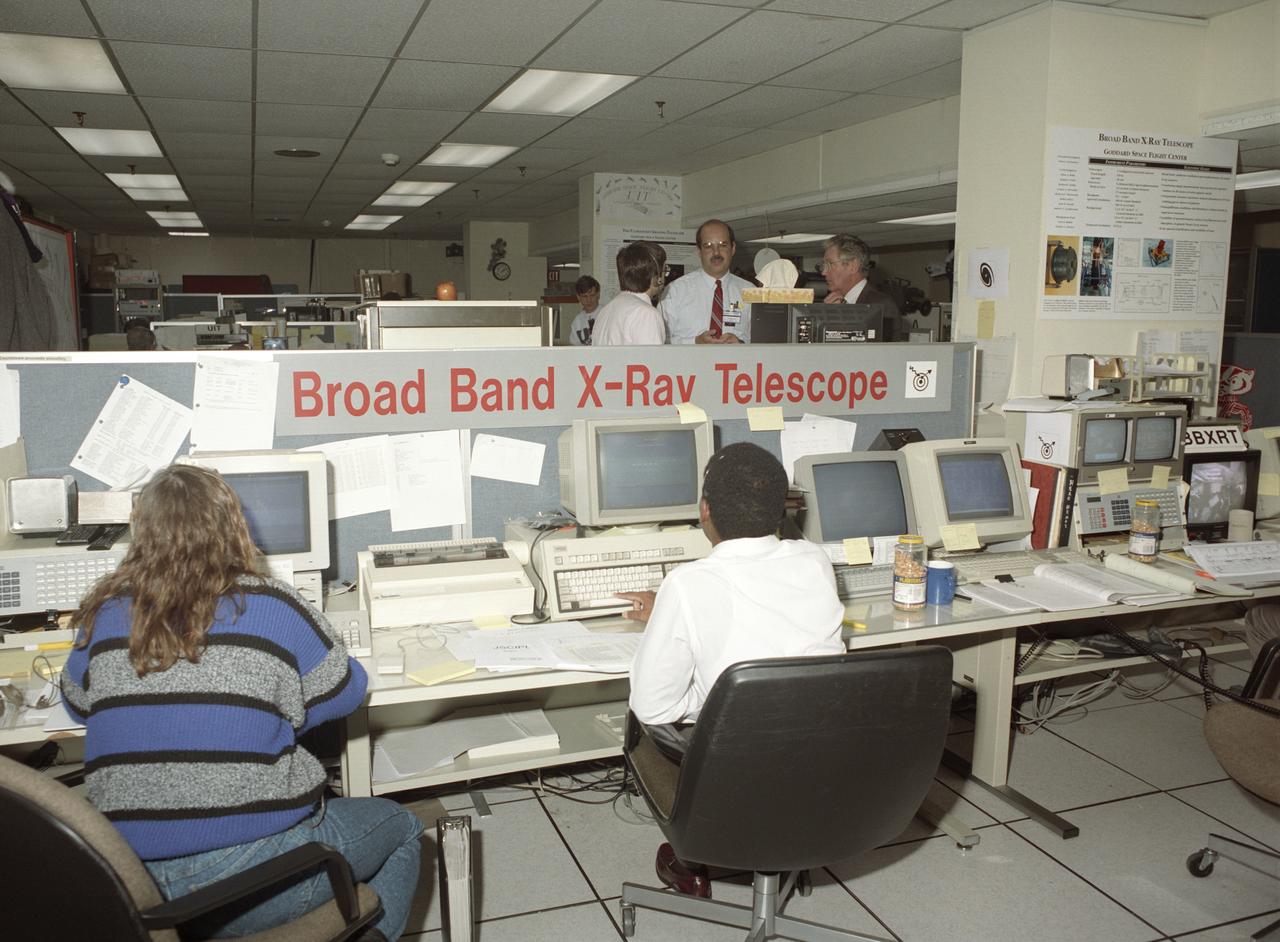
The primary objective of the STS-35 mission was round the clock observation of the celestial sphere in ultraviolet and X-Ray astronomy with the Astro-1 observatory which consisted of four telescopes: the Hopkins Ultraviolet Telescope (HUT); the Wisconsin Ultraviolet Photo-Polarimeter Experiment (WUPPE); the Ultraviolet Imaging Telescope (UIT); and the Broad Band X-Ray Telescope (BBXRT). The Huntsville Operations Support Center (HOSC) Spacelab Payload Operations Control Center (SL POCC) at the Marshall Space Flight Center (MSFC) was the air/ground communication channel used between the astronauts and ground control teams during the Spacelab missions. Teams of controllers and researchers directed on-orbit science operations, sent commands to the spacecraft, received data from experiments aboard the Space Shuttle, adjusted mission schedules to take advantage of unexpected science opportunities or unexpected results, and worked with crew members to resolve problems with their experiments. Due to loss of data used for pointing and operating the ultraviolet telescopes, MSFC ground teams were forced to aim the telescopes with fine tuning by the flight crew. This photo captures the activity of WUPPE (Wisconsin Ultraviolet Photo-Polarimeter Experiment) data review at the Science Operations Area during the mission. This image shows mission activities at the Broad Band X-Ray Telescope (BBXRT) Work Station in the Science Operations Area (SOA).
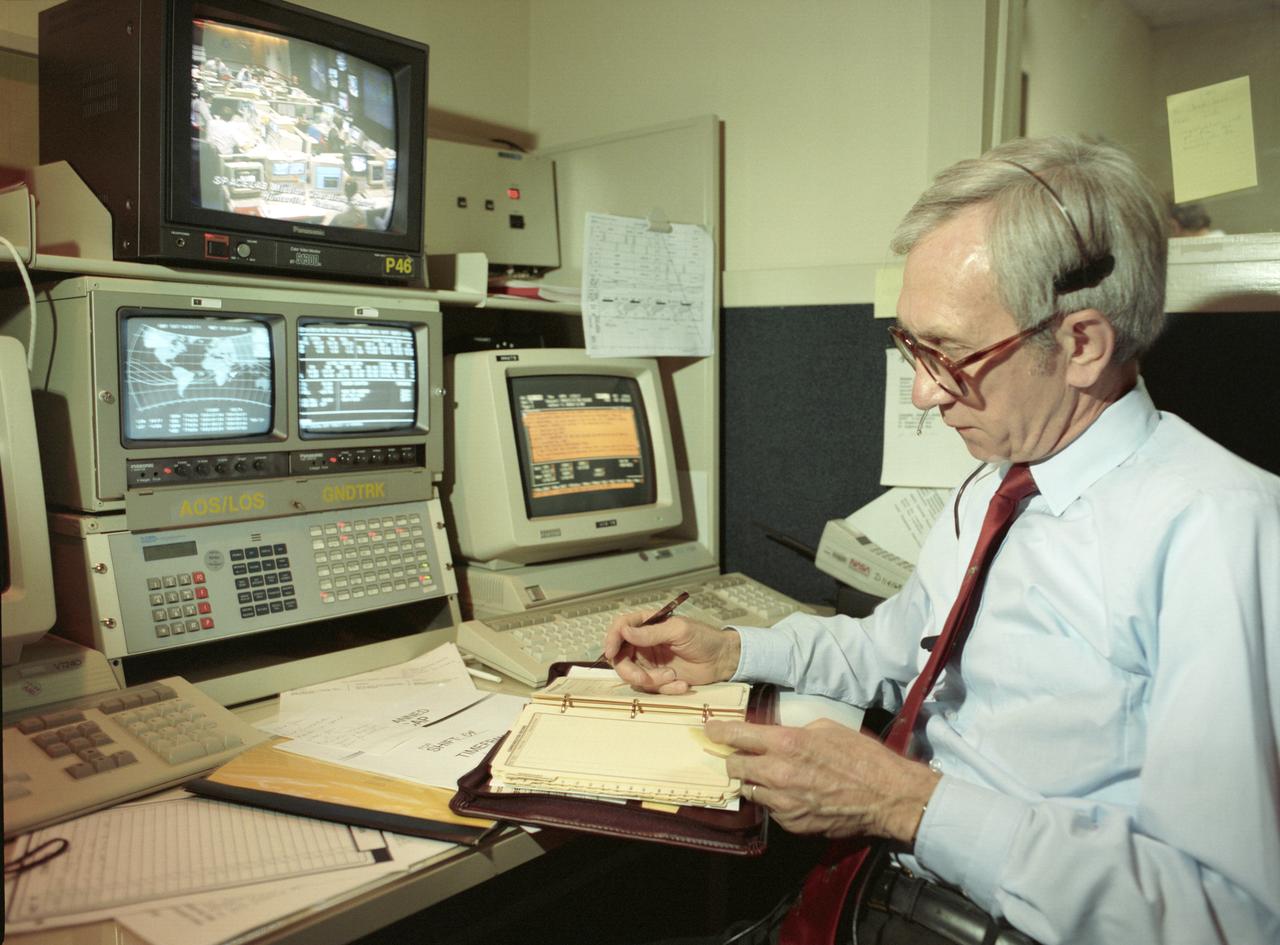
The primary objective of the STS-35 mission was round the clock observation of the celestial sphere in ultraviolet and X-Ray astronomy with the Astro-1 observatory which consisted of four telescopes: the Hopkins Ultraviolet Telescope (HUT); the Wisconsin Ultraviolet Photo-Polarimeter Experiment (WUPPE); the Ultraviolet Imaging Telescope (UIT); and the Broad Band X-Ray Telescope (BBXRT). The Huntsville Operations Support Center (HOSC) Spacelab Payload Operations Control Center (SL POCC) at the Marshall Space Flight Center (MSFC) was the air/ground communication channel used between the astronauts and ground control teams during the Spacelab missions. Teams of controllers and researchers directed on-orbit science operations, sent commands to the spacecraft, received data from experiments aboard the Space Shuttle, adjusted mission schedules to take advantage of unexpected science opportunities or unexpected results, and worked with crew members to resolve problems with their experiments. Pictured is Jack Jones in the Mission Manager Area.
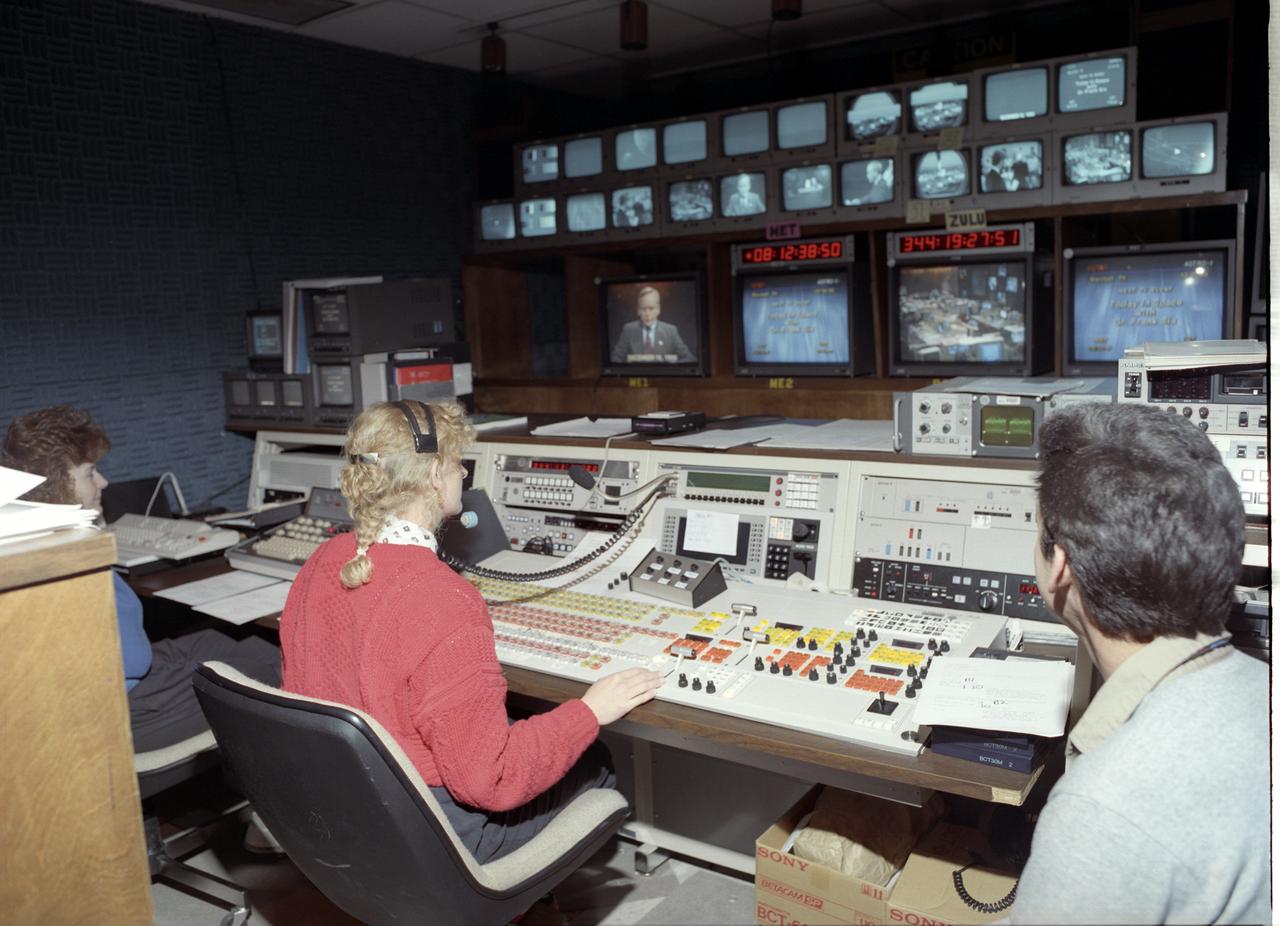
The primary objective of the STS-35 mission was round the clock observation of the celestial sphere in ultraviolet and X-Ray astronomy with the Astro-1 observatory which consisted of four telescopes: the Hopkins Ultraviolet Telescope (HUT); the Wisconsin Ultraviolet Photo-Polarimeter Experiment (WUPPE); the Ultraviolet Imaging Telescope (UIT); and the Broad Band X-Ray Telescope (BBXRT). The Huntsville Operations Support Center (HOSC) Spacelab Payload Operations Control Center (SL POCC) at the Marshall Space Flight Center (MSFC) was the air/ground communication channel used between the astronauts and ground control teams during the Spacelab missions. Teams of controllers and researchers directed on-orbit science operations, sent commands to the spacecraft, received data from experiments aboard the Space Shuttle, adjusted mission schedules to take advantage of unexpected science opportunities or unexpected results, and worked with crew members to resolve problems with their experiments. Pictured is the TV OPS area of the SL POCC.
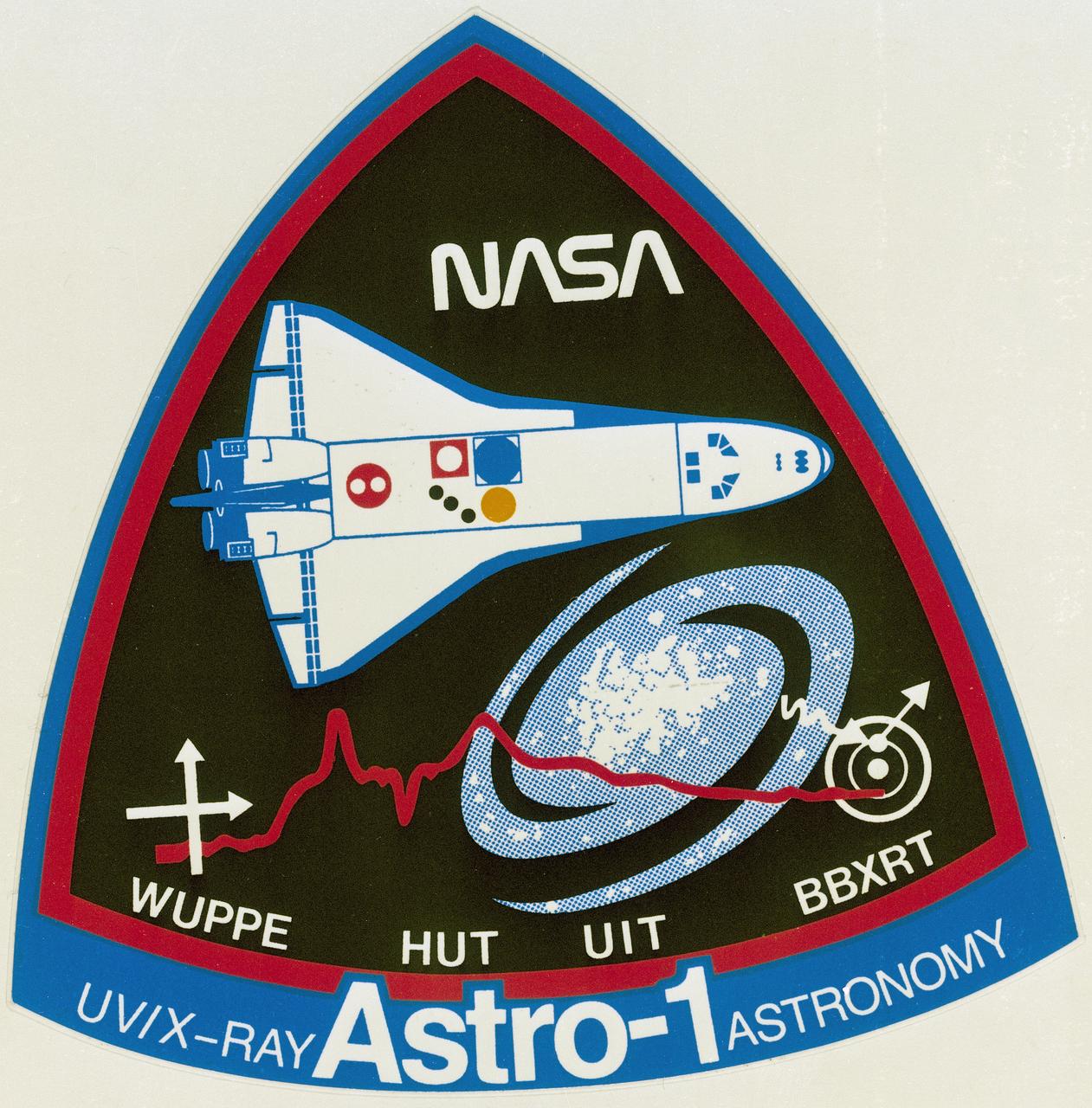
The primary payload for Space Shuttle Mission STS-35, launched December 2, 1990, was the ASTRO-1 Observatory. Designed for round the clock observation of the celestial sphere in ultraviolet and X-ray astronomy, ASTRO-1 featured a collection of four telescopes: the Hopkins Ultraviolet Telescope (HUT); the Wisconsin Ultraviolet Photo- Polarimeter Experiment (WUPPE); the Ultraviolet Imaging Telescope (UIT); and the Broad Band X-ray Telescope (BBXRT). Ultraviolet telescopes mounted on Spacelab elements in cargo bay were to be operated in shifts by flight crew. Loss of both data display units (used for pointing telescopes and operating experiments) during mission impacted crew-aiming procedures and forced ground teams at Marshall Space Flight Center to aim ultraviolet telescopes with fine-tuning by flight crew. BBXRT, also mounted in cargo bay, was directed from outset by ground-based operators at Goddard Space Flight Center. This is the logo or emblem that was designed to represent the ASTRO-1 payload.
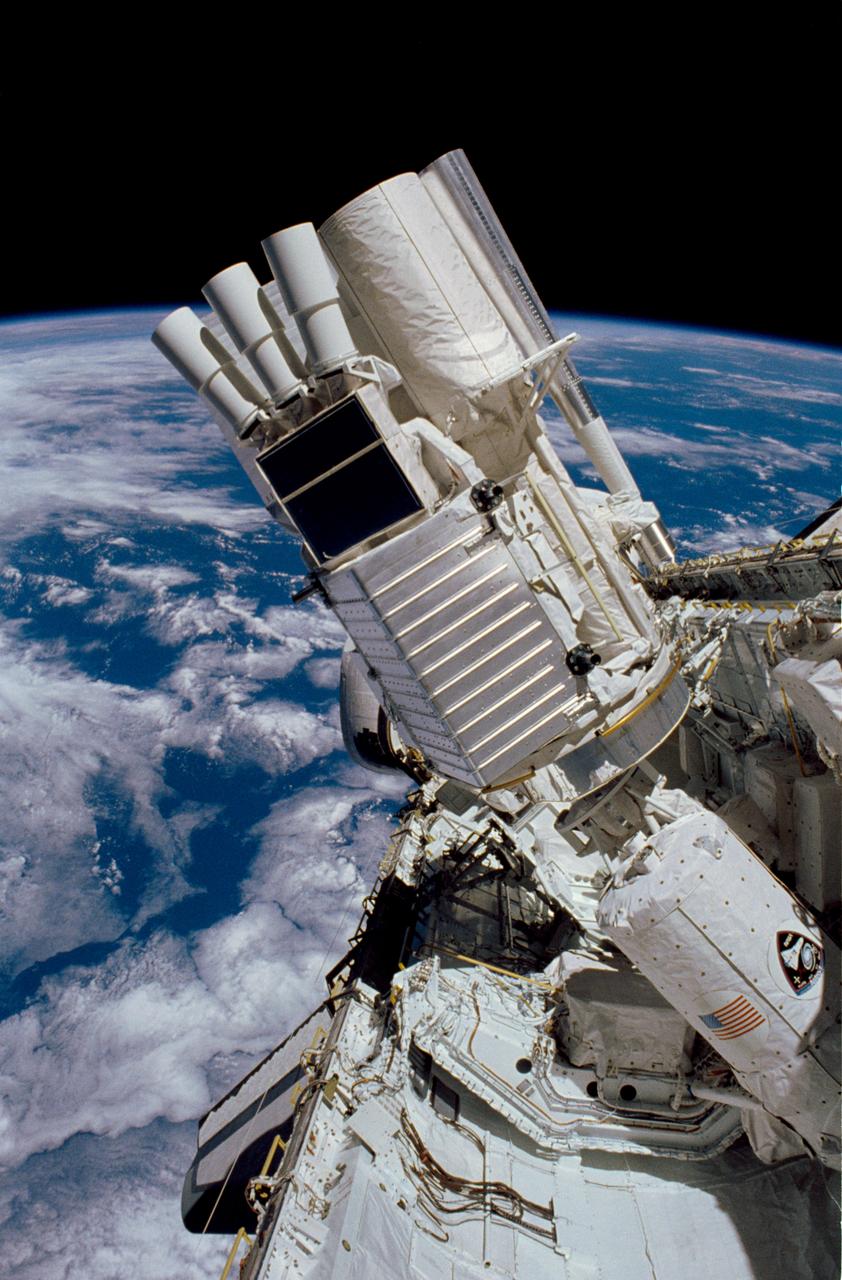
STS035-13-008 (2-10 Dec. 1990) --- The various components of the Astro-1 payload are seen backdropped against the blue and white Earth in this 35mm scene photographed through Columbia's aft flight deck windows. Parts of the Hopkins Ultraviolet Telescope (HUT), Ultraviolet Imaging Telescope (UIT) and the Wisconsin Ultraviolet Photo-Polarimeter Experiment (WUPPE) are visible on the Spacelab Pallet in the foreground. The Broad Band X-Ray Telescope (BBXRT) is behind this pallet and is not visible in this scene. The smaller cylinder in the foreground is the "Igloo," which is a pressurized container housing the Command and Data Management System, which interfaces with the in-cabin controllers to control the Instrument Pointing System (IPS) and the telescopes.
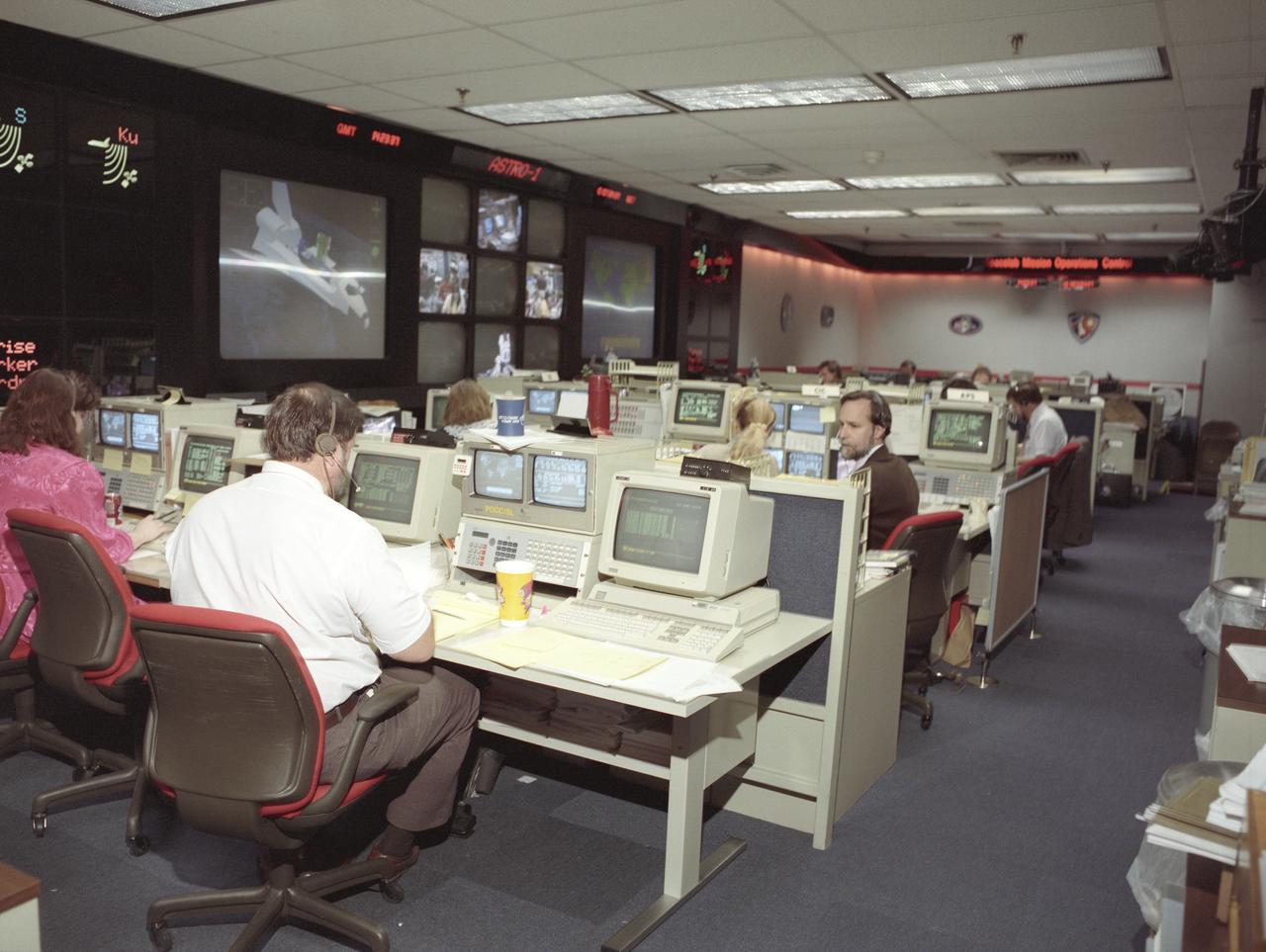
The primary objective of the STS-35 mission was round the clock observation of the celestial sphere in ultraviolet and X-Ray astronomy with the Astro-1 observatory which consisted of four telescopes: the Hopkins Ultraviolet Telescope (HUT); the Wisconsin Ultraviolet Photo-Polarimeter Experiment (WUPPE); the Ultraviolet Imaging Telescope (UIT); and the Broad Band X-Ray Telescope (BBXRT). The Huntsville Operations Support Center (HOSC) Spacelab Payload Operations Control Center (SL POCC) at the Marshall Space Flight Center (MSFC) was the air/ground communication channel used between the astronauts and ground control teams during the Spacelab missions. Teams of controllers and researchers directed on-orbit science operations, sent commands to the spacecraft, received data from experiments aboard the Space Shuttle, adjusted mission schedules to take advantage of unexpected science opportunities or unexpected results, and worked with crew members to resolve problems with their experiments. Due to loss of data used for pointing and operating the ultraviolet telescopes, MSFC ground teams were forced to aim the telescopes with fine tuning by the flight crew. This photo is an overview of the MSFC Payload Control Room (PCR).
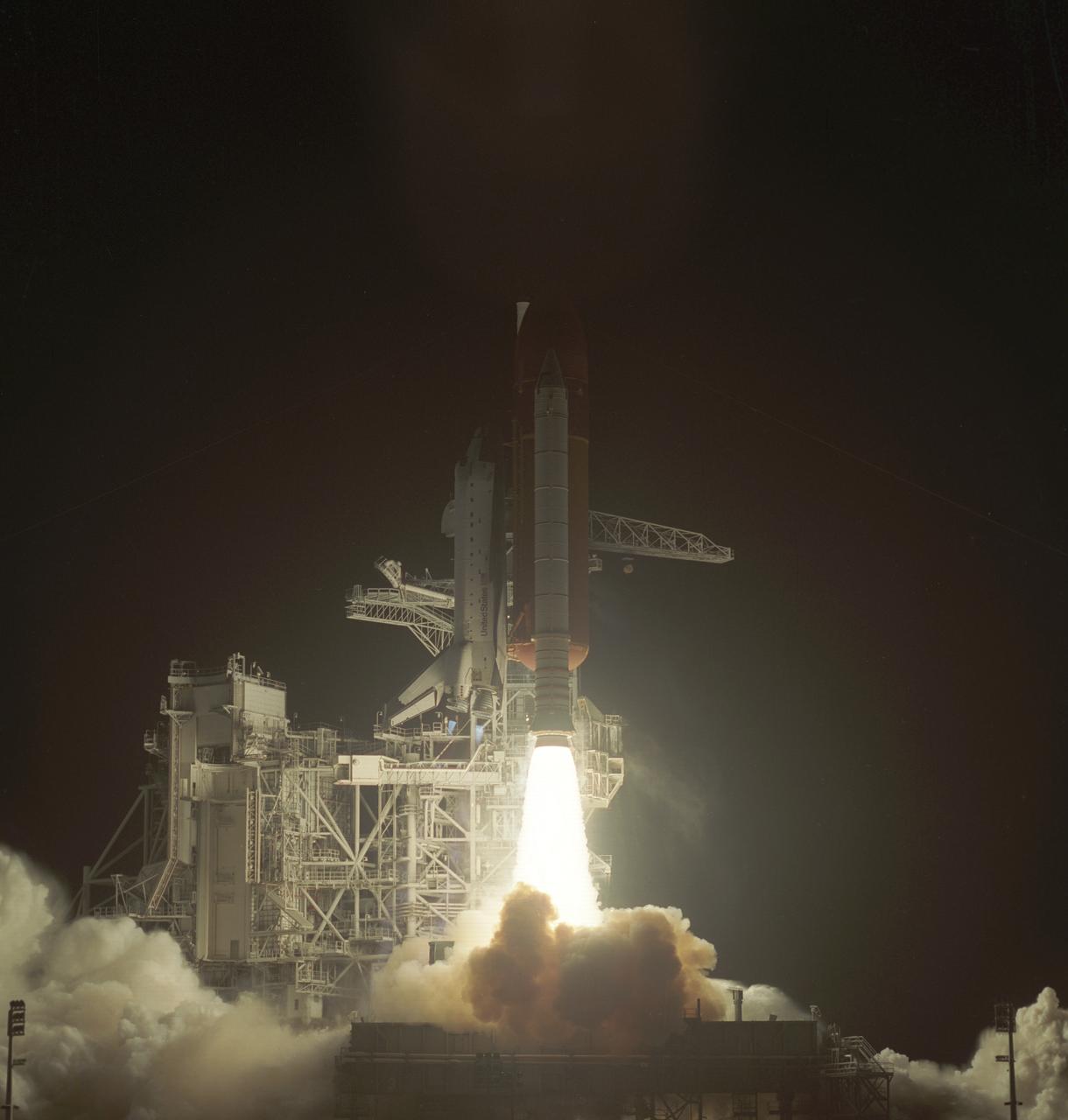
STS-35 lifted off December 2, 1990, at 1:19 am EST, aboard the Space Shuttle Orbiter Columbia. Her crew of eight included: Vance D. Brand, commander; Colonel Guy S. Gardner, pilot; mission specialists Dr. Robert A. R. Parker, John M. (Mike) Lounge, and Dr. Jeffery A. Hoffman; and payload specialists Dr. Kenneth H. Nordsieck, Dr. Samual T. Durrance, and Dr. Ronald A. Parise. The primary objective of the mission was round the clock observation of the celestial sphere in ultraviolet and X-Ray astronomy with the Astro-1 Observatory which consisted of four telescopes: the Hopkins Ultraviolet Telescope (HUT); the Wisconsin Ultraviolet Photo-Polarimeter Experiment (WUPPE); the Ultraviolet Imaging Telescope (UIT); and the Broad Band X-Ray Telescope (BBXRT). Due to loss of data used for pointing and operating the ultraviolet telescopes, Marshall Space Flight Center ground teams were forced to aim the telescopes with fine tuning by the flight crew.
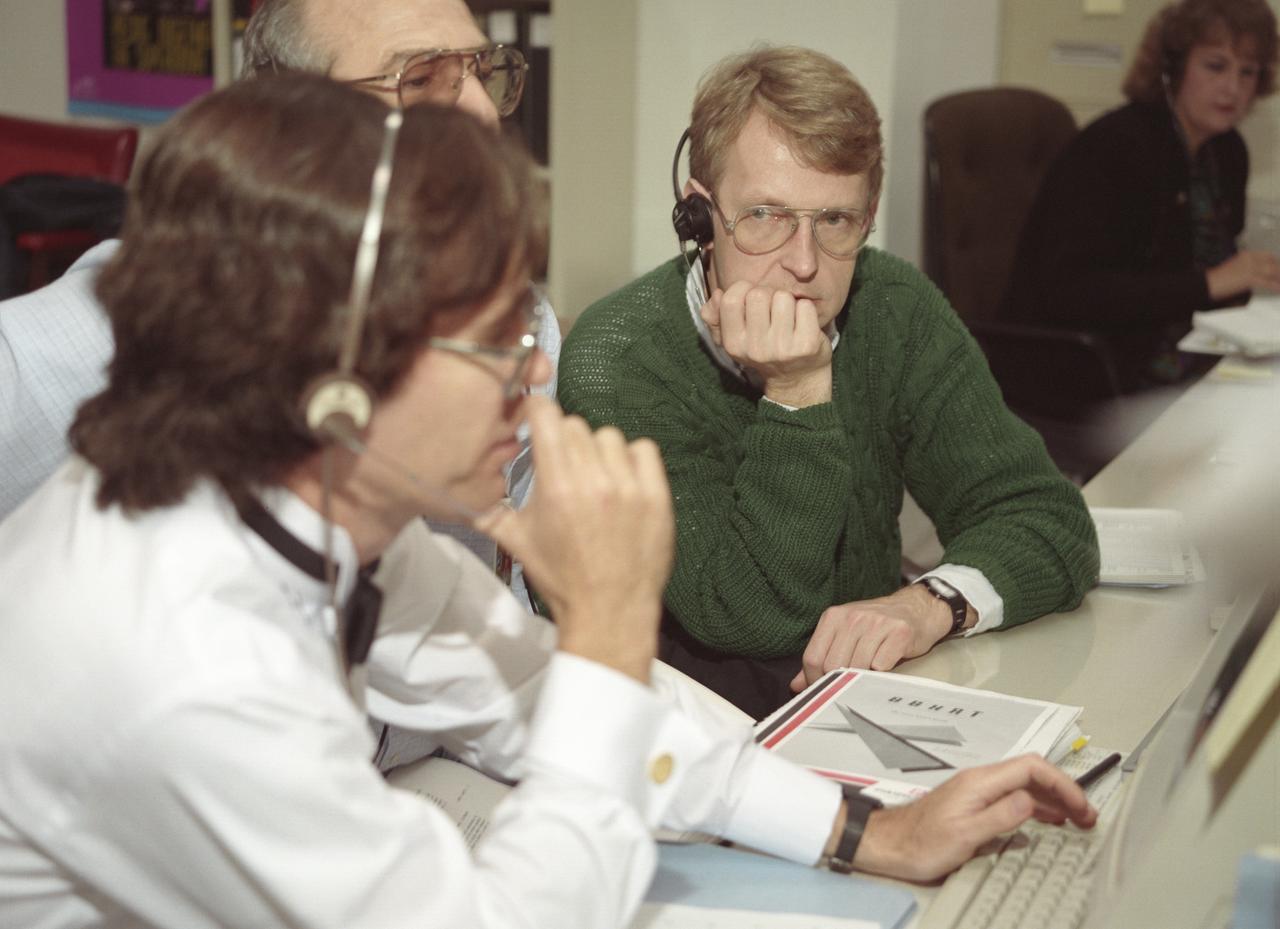
The primary objective of the STS-35 mission was round the clock observation of the celestial sphere in ultraviolet and X-Ray astronomy with the Astro-1 observatory which consisted of four telescopes: the Hopkins Ultraviolet Telescope (HUT); the Wisconsin Ultraviolet Photo-Polarimeter Experiment (WUPPE); the Ultraviolet Imaging Telescope (UIT); and the Broad Band X-Ray Telescope (BBXRT). The Huntsville Operations Support Center (HOSC) Spacelab Payload Operations Control Center (SL POCC) at the Marshall Space Flight Center (MSFC) was the air/ground communication channel used between the astronauts and ground control teams during the Spacelab missions. Teams of controllers and researchers directed on-orbit science operations, sent commands to the spacecraft, received data from experiments aboard the Space Shuttle, adjusted mission schedules to take advantage of unexpected science opportunities or unexpected results, and worked with crew members to resolve problems with their experiments. Due to loss of data used for pointing and operating the ultraviolet telescopes, MSFC ground teams were forced to aim the telescopes with fine tuning by the flight crew. This photo captures the activity of BBKRT data review in the Science Operations Area during the mission.
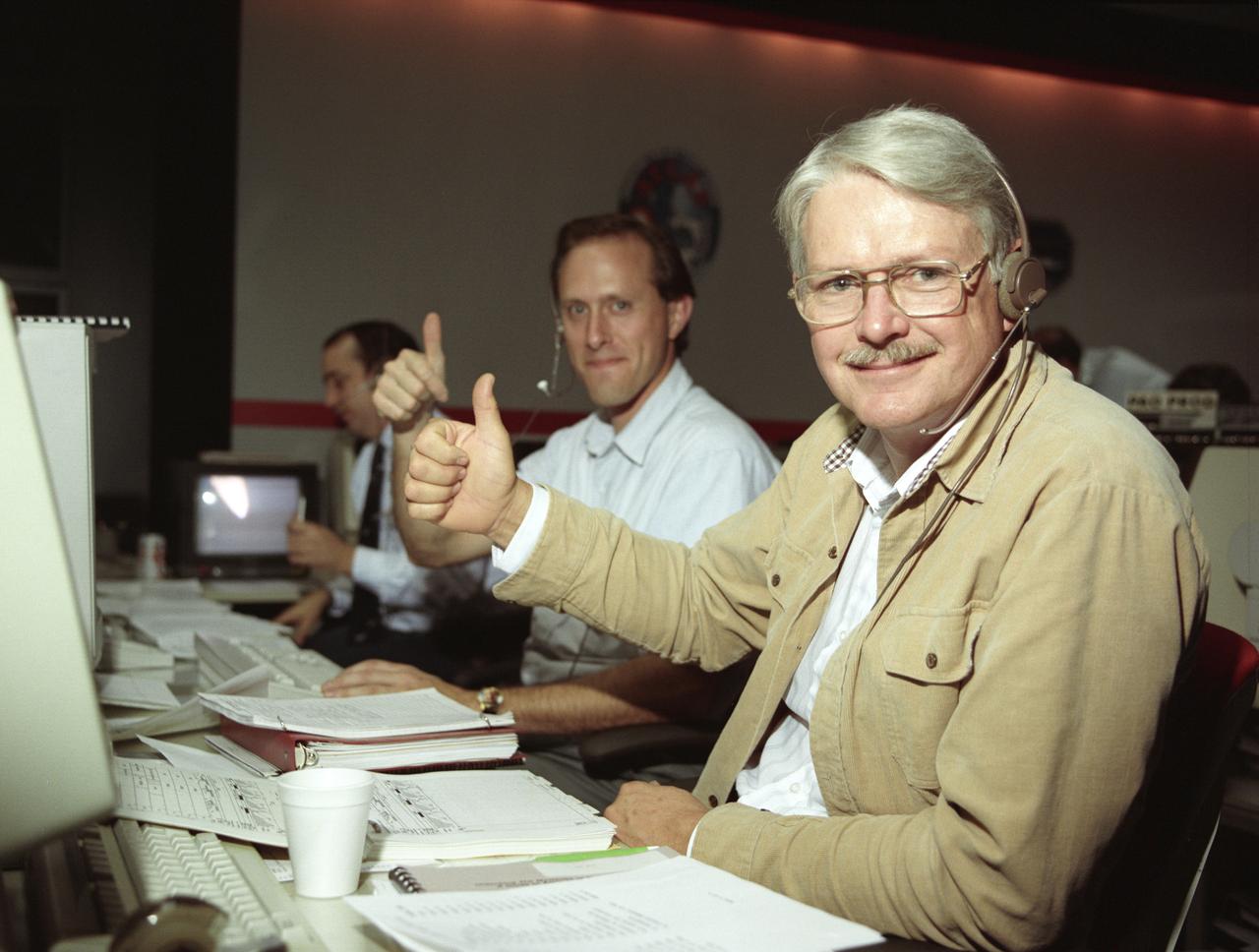
The primary objective of the STS-35 mission was round the clock observation of the celestial sphere in ultraviolet and X-Ray astronomy with the Astro-1 observatory which consisted of four telescopes: the Hopkins Ultraviolet Telescope (HUT); the Wisconsin Ultraviolet Photo-Polarimeter Experiment (WUPPE); the Ultraviolet Imaging Telescope (UIT); and the Broad Band X-Ray Telescope (BBXRT). The Huntsville Operations Support Center (HOSC) Spacelab Payload Operations Control Center (SL POCC) at the Marshall Space Flight Center (MSFC) was the air/ground communication channel used between the astronauts and ground control teams during the Spacelab missions. Teams of controllers and researchers directed on-orbit science operations, sent commands to the spacecraft, received data from experiments aboard the Space Shuttle, adjusted mission schedules to take advantage of unexpected science opportunities or unexpected results, and worked with crew members to resolve problems with their experiments. Due to loss of data used for pointing and operating the ultraviolet telescopes, MSFC ground teams were forced to aim the telescopes with fine tuning by the flight crew. This photo captures the activity at the Operations Control Facility during the mission as Dr. Urban and Paul Whitehouse give a “thumbs up”.
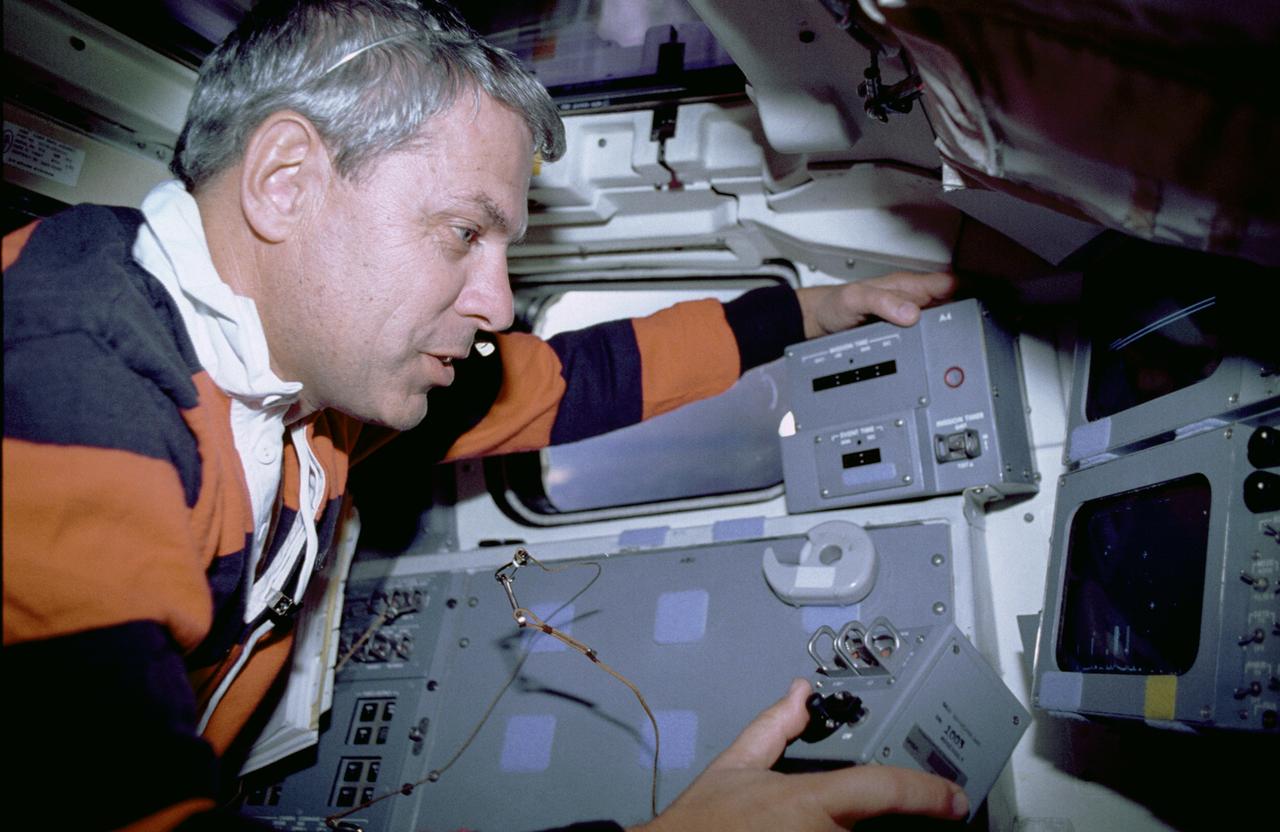
The primary objective of the STS-35 mission was round the clock observation of the celestial sphere in ultraviolet and X-Ray astronomy with the Astro-1 observatory which consisted of four telescopes: the Hopkins Ultraviolet Telescope (HUT); the Wisconsin Ultraviolet Photo-Polarimeter Experiment (WUPPE); the Ultraviolet Imaging Telescope (UIT); and the Broad Band X-Ray Telescope (BBXRT). The Huntsville Operations Support Center (HOSC) Spacelab Payload Operations Control Center (SL POCC) at the Marshall Space Flight Center (MSFC) was the air/ground communication channel used between the astronauts and ground control teams during the Spacelab missions. Teams of controllers and researchers directed on-orbit science operations, sent commands to the spacecraft, received data from experiments aboard the Space Shuttle, adjusted mission schedules to take advantage of unexpected science opportunities or unexpected results, and worked with crew members to resolve problems with their experiments. Due to loss of data used for pointing and operating the ultraviolet telescopes, MSFC ground teams were forced to aim the telescopes with fine tuning by the flight crew. Pictured onboard the shuttle is astronaut Robert Parker using a Manual Pointing Controller (MPC) for the ASTRO-1 mission Instrument Pointing System (IPS).
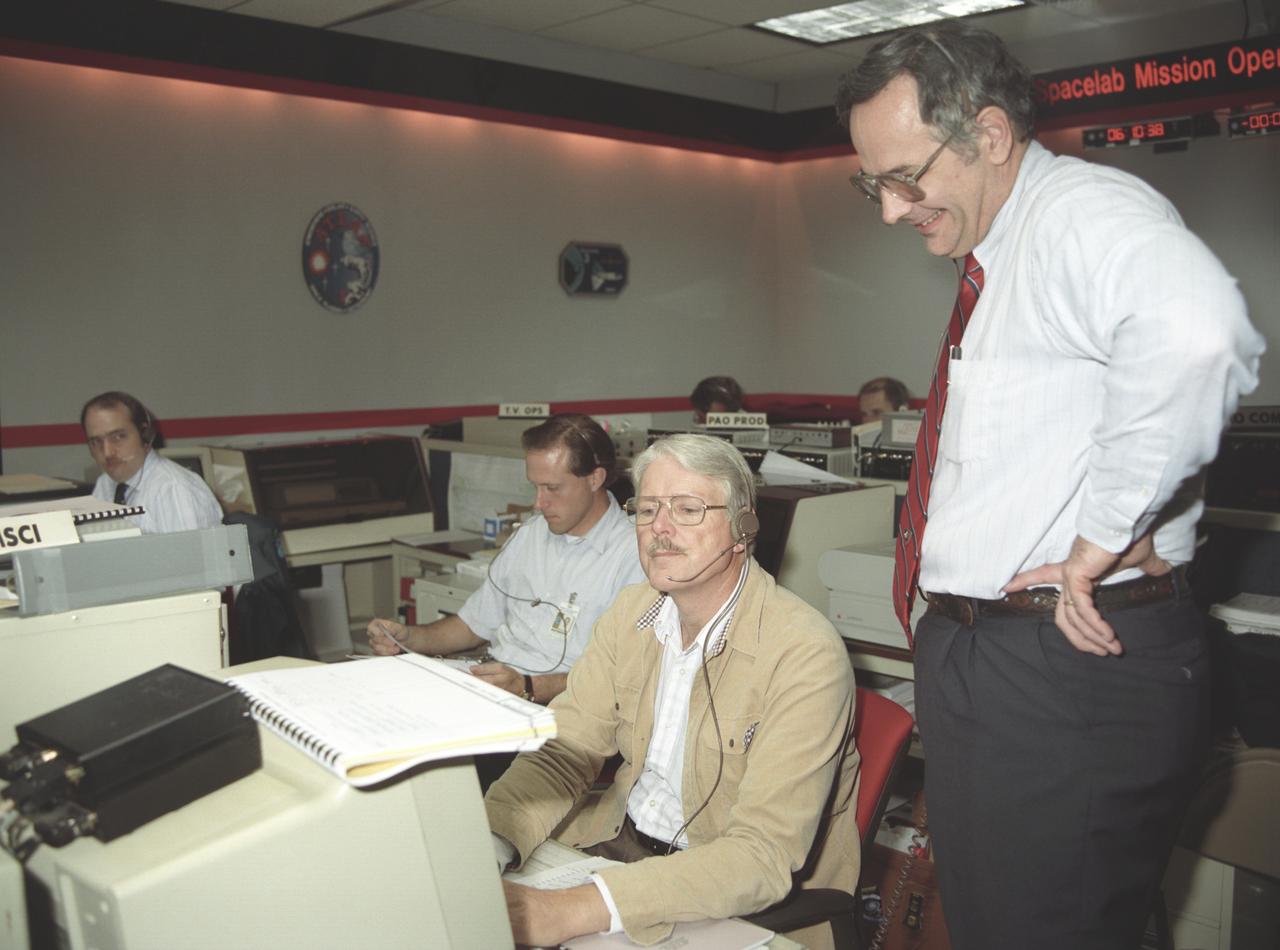
The primary objective of the STS-35 mission was round the clock observation of the celestial sphere in ultraviolet and X-Ray astronomy with the Astro-1 observatory which consisted of four telescopes: the Hopkins Ultraviolet Telescope (HUT); the Wisconsin Ultraviolet Photo-Polarimeter Experiment (WUPPE); the Ultraviolet Imaging Telescope (UIT); and the Broad Band X-Ray Telescope (BBXRT). The Huntsville Operations Support Center (HOSC) Spacelab Payload Operations Control Center (SL POCC) at the Marshall Space Flight Center (MSFC) was the air/ground communication channel used between the astronauts and ground control teams during the Spacelab missions. Teams of controllers and researchers directed on-orbit science operations, sent commands to the spacecraft, received data from experiments aboard the Space Shuttle, adjusted mission schedules to take advantage of unexpected science opportunities or unexpected results, and worked with crew members to resolve problems with their experiments. Due to loss of data used for pointing and operating the ultraviolet telescopes, MSFC ground teams were forced to aim the telescopes with fine tuning by the flight crew. This photo captures the activity of WUPPE data review at the Science Operations Area during the mission.
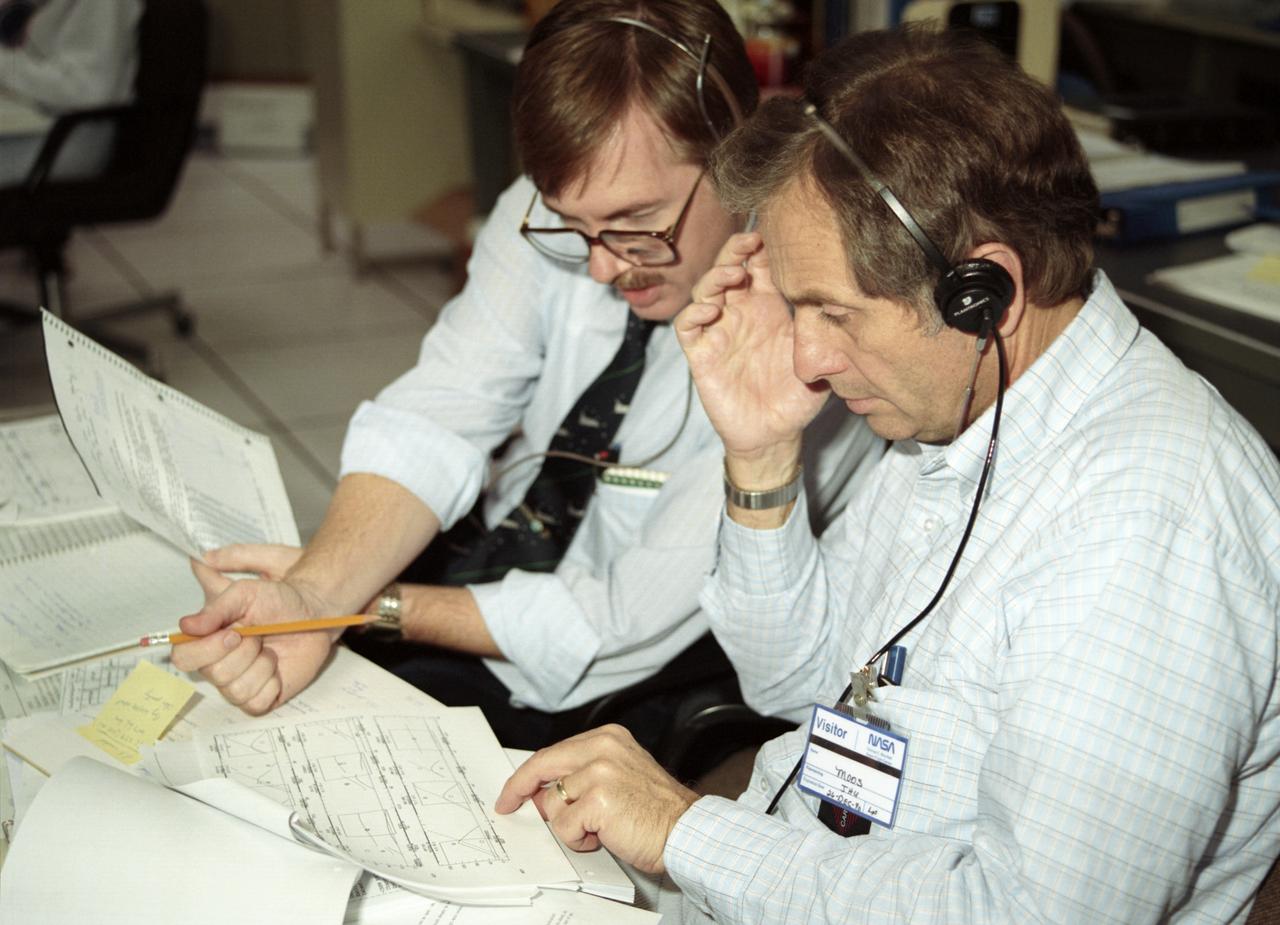
The primary objective of the STS-35 mission was round the clock observation of the celestial sphere in ultraviolet and X-Ray astronomy with the Astro-1 observatory which consisted of four telescopes: the Hopkins Ultraviolet Telescope (HUT); the Wisconsin Ultraviolet Photo-Polarimeter Experiment (WUPPE); the Ultraviolet Imaging Telescope (UIT); and the Broad Band X-Ray Telescope (BBXRT). The Huntsville Operations Support Center (HOSC) Spacelab Payload Operations Control Center (SL POCC) at the Marshall Space Flight Center (MSFC) was the air/ground communication channel used between the astronauts and ground control teams during the Spacelab missions. Teams of controllers and researchers directed on-orbit science operations, sent commands to the spacecraft, received data from experiments aboard the Space Shuttle, adjusted mission schedules to take advantage of unexpected science opportunities or unexpected results, and worked with crew members to resolve problems with their experiments. Due to loss of data used for pointing and operating the ultraviolet telescopes, MSFC ground teams were forced to aim the telescopes with fine tuning by the flight crew. This photo captures the activity of viewing HUT data in the Mission Manager Actions Room during the mission.
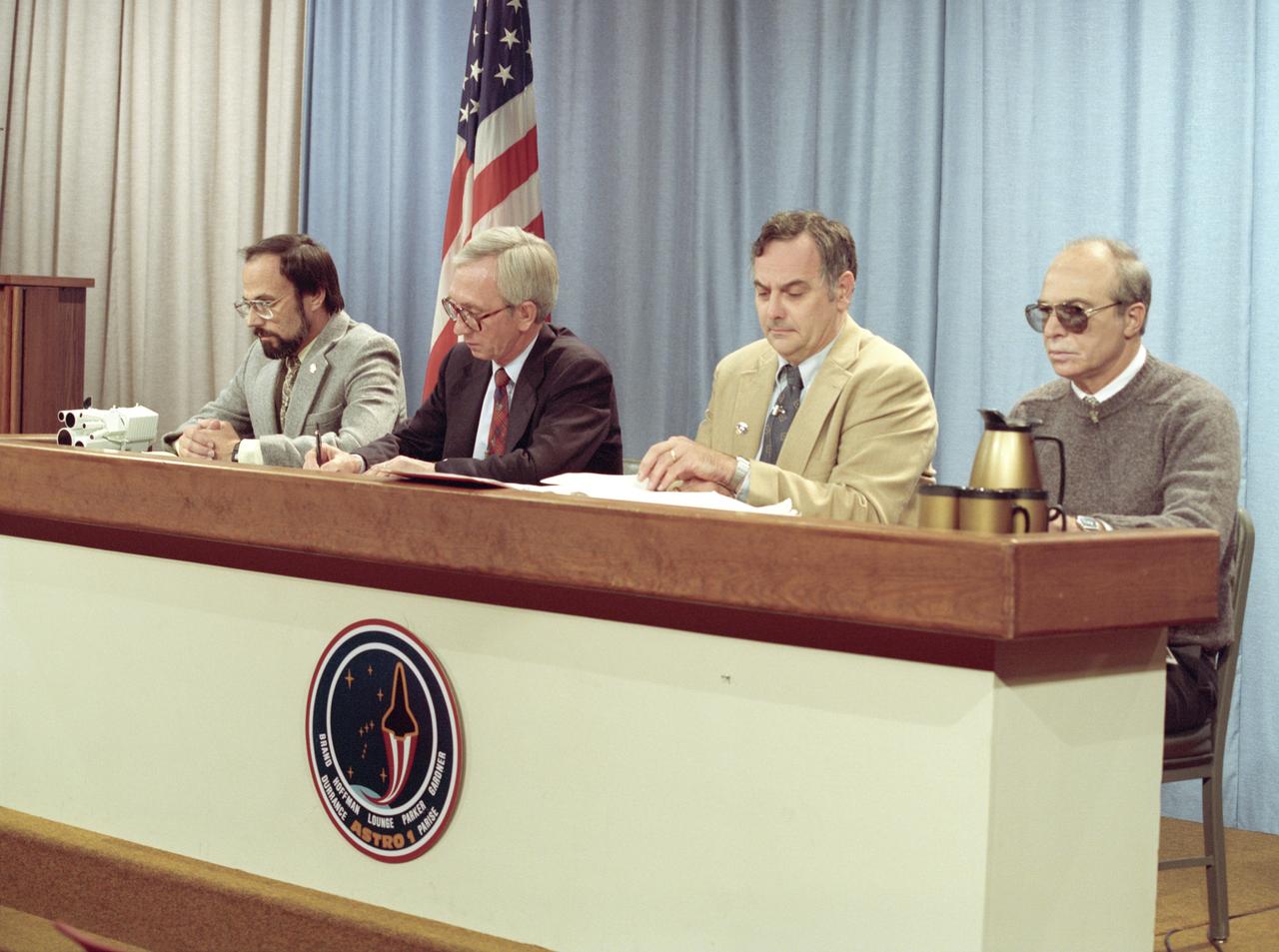
The primary objective of the STS-35 mission was round the clock observation of the celestial sphere in ultraviolet and X-Ray astronomy with the Astro-1 observatory which consisted of four telescopes: the Hopkins Ultraviolet Telescope (HUT); the Wisconsin Ultraviolet Photo-Polarimeter Experiment (WUPPE); the Ultraviolet Imaging Telescope (UIT); and the Broad Band X-Ray Telescope (BBXRT). The Huntsville Operations Support Center (HOSC) Spacelab Payload Operations Control Center (SL POCC) at the Marshall Space Flight Center (MSFC) was the air/ground communication channel used between the astronauts and ground control teams during the Spacelab missions. Teams of controllers and researchers directed on-orbit science operations, sent commands to the spacecraft, received data from experiments aboard the Space Shuttle, adjusted mission schedules to take advantage of unexpected science opportunities or unexpected results, and worked with crew members to resolve problems with their experiments. Due to loss of data used for pointing and operating the ultraviolet telescopes, MSFC ground teams were forced to aim the telescopes with fine tuning by the flight crew. This photo captures a press briefing at MSFC during STS-35, ASTRO-1 Mission.
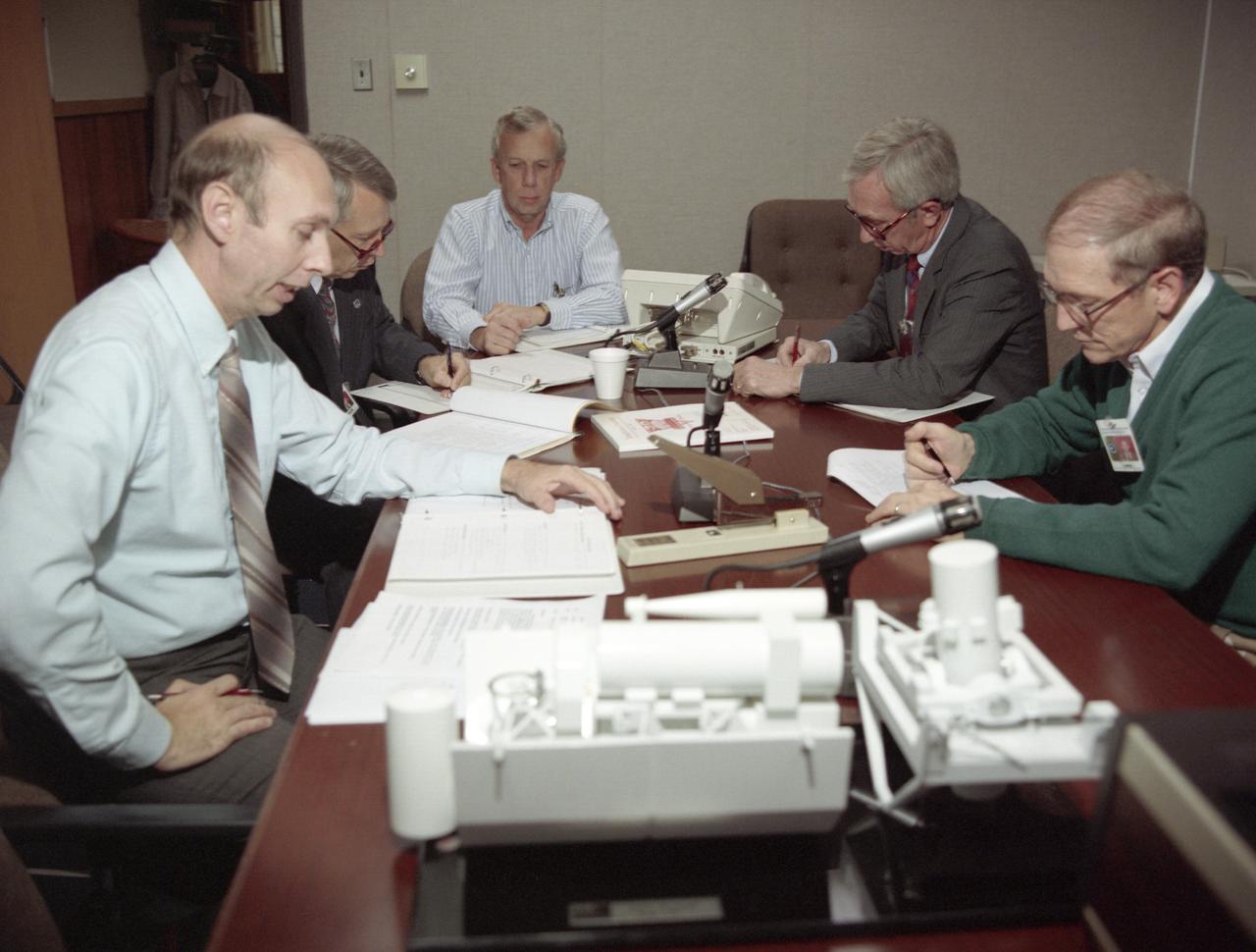
The primary objective of the STS-35 mission was round the clock observation of the celestial sphere in ultraviolet and X-Ray astronomy with the Astro-1 observatory which consisted of four telescopes: the Hopkins Ultraviolet Telescope (HUT); the Wisconsin Ultraviolet Photo-Polarimeter Experiment (WUPPE); the Ultraviolet Imaging Telescope (UIT); and the Broad Band X-Ray Telescope (BBXRT). The Huntsville Operations Support Center (HOSC) Spacelab Payload Operations Control Center (SL POCC) at the Marshall Space Flight Center (MSFC) was the air/ground communication channel used between the astronauts and ground control teams during the Spacelab missions. Teams of controllers and researchers directed on-orbit science operations, sent commands to the spacecraft, received data from experiments aboard the Space Shuttle, adjusted mission schedules to take advantage of unexpected science opportunities or unexpected results, and worked with crew members to resolve problems with their experiments. Due to loss of data used for pointing and operating the ultraviolet telescopes, MSFC ground teams were forced to aim the telescopes with fine tuning by the flight crew. This photo captures the activities at the Mission Manager Actions Room during the mission.
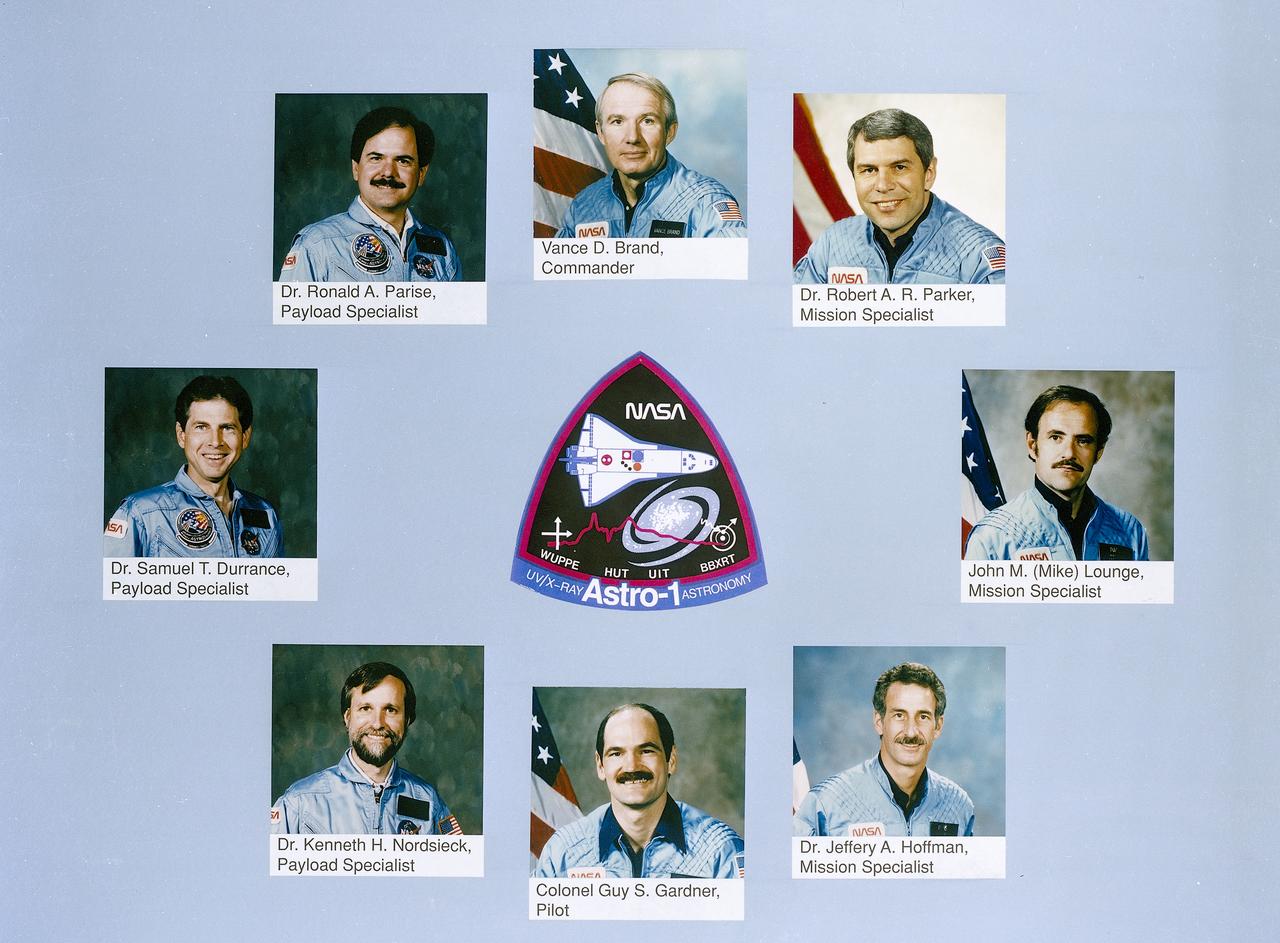
This montage consists of 8 individual STS-35 crew member portraits surrounding the mission’s insignia. Starting from top center, clockwise, are Vance D. Brand, commander; mission specialists Dr. Robert A. R. Parker, John M. (Mike) Lounge, and Dr. Jeffery A. Hoffman; Colonel Guy S. Gardner, pilot; and payload specialists Dr. Kenneth H. Nordsieck, Dr. Samual T. Durrance, and Dr. Ronald A. Parise. The crew of 8 launched aboard the Space Shuttle Orbiter Columbia on December 2, 1990 at 1:19:01am (EST). The primary objective of the mission was round the clock observation of the celestial sphere in ultrviolet and X-Ray astronomy with the Astro-1 observatory which consisted of four telescopes: the Hopkins Ultraviolet Telescope (HUT); the Wisconsin Ultraviolet Photo-Polarimeter Experiment (WUPPE); the Ultraviolet Imaging Telescope (UIT); and the Broad Band X-Ray Telescope (BBXRT). Due to loss of data used for pointing and operating the ultraviolet telescopes, Marshall Space Flight Center ground teams were forced to aim the telescopes with fine tuning by the flight crew.
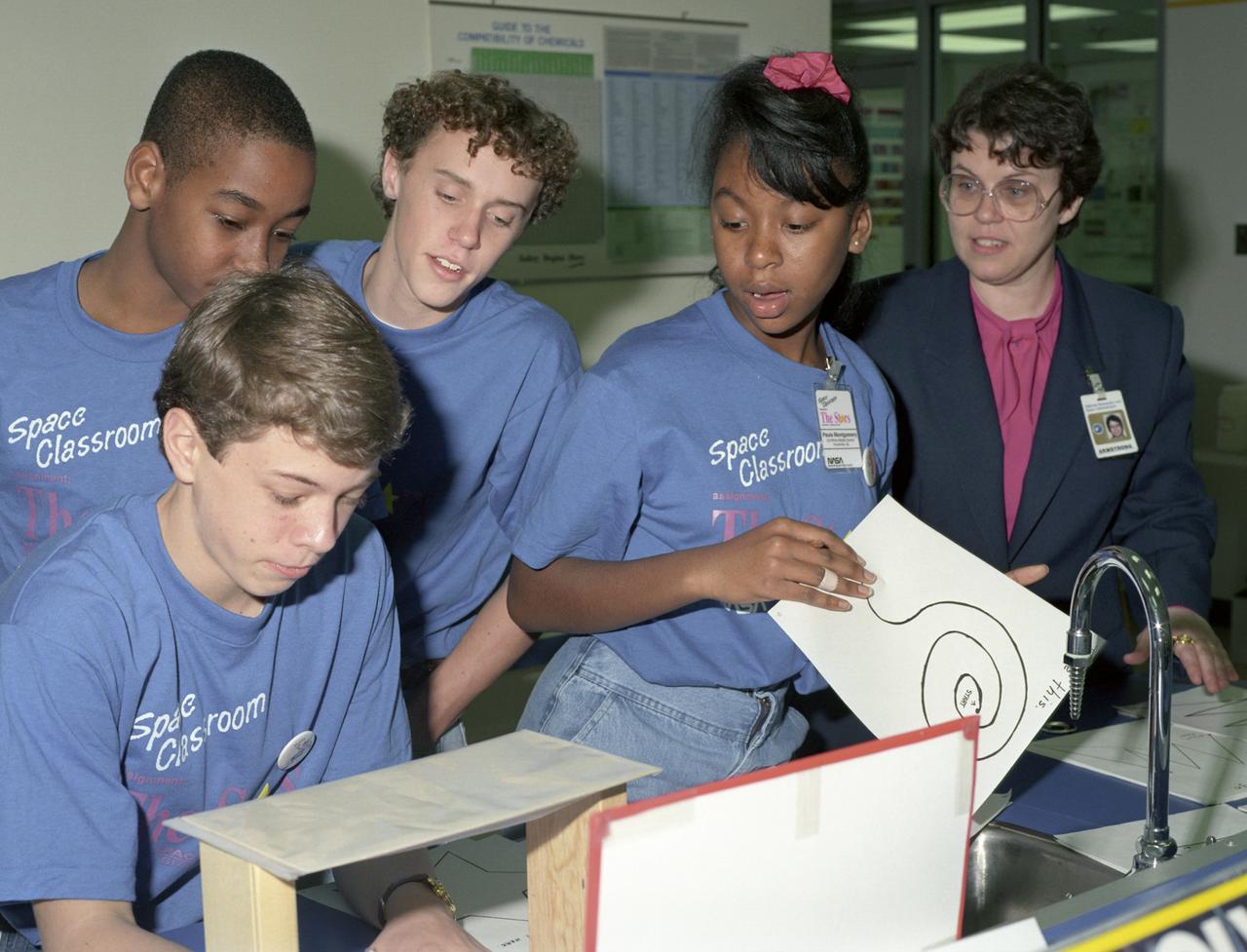
The primary objective of the STS-35 mission was round the clock observation of the celestial sphere in ultraviolet and X-Ray astronomy with the Astro-1 observatory which consisted of four telescopes: the Hopkins Ultraviolet Telescope (HUT); the Wisconsin Ultraviolet Photo-Polarimeter Experiment (WUPPE); the Ultraviolet Imaging Telescope (UIT); and the Broad Band X-Ray Telescope (BBXRT). The Huntsville Operations Support Center (HOSC) Spacelab Payload Operations Control Center (SL POCC) at the Marshall Space Flight Center (MSFC) was the air/ground communication channel used between the astronauts and ground control teams during the Spacelab missions. Teams of controllers and researchers directed on-orbit science operations, sent commands to the spacecraft, received data from experiments aboard the Space Shuttle, adjusted mission schedules to take advantage of unexpected science opportunities or unexpected results, and worked with crew members to resolve problems with their experiments. This photo is of Space classroom students in the Discovery Optics Lab at MSFC during STS-35, ASTRO-1 mission payload operations.

Flaring, active regions of our sun are highlighted in this image combining observations from several telescopes. High-energy X-rays from NASA's Nuclear Spectroscopic Telescope Array (NuSTAR) are shown in blue; low-energy X-rays from Japan's Hinode spacecraft are green; and extreme ultraviolet light from NASA's Solar Dynamics Observatory (SDO) is yellow and red. All three telescopes captured their solar images around the same time on April 29, 2015. The NuSTAR image is a mosaic made from combining smaller images. The active regions across the sun's surface contain material heated to several millions of degrees. The blue-white areas showing the NuSTAR data pinpoint the most energetic spots. During the observations, microflares went off, which are smaller versions of the larger flares that also erupt from the sun's surface. The microflares rapidly release energy and heat the material in the active regions. NuSTAR typically stares deeper into the cosmos to observe X-rays from supernovas, black holes and other extreme objects. But it can also look safely at the sun and capture images of its high-energy X-rays with more sensitivity than before. Scientists plan to continue to study the sun with NuSTAR to learn more about microflares, as well as hypothesized nanoflares, which are even smaller. In this image, the NuSTAR data shows X-rays with energies between 2 and 6 kiloelectron volts; the Hinode data, which is from the X-ray Telescope instrument, has energies of 0.2 to 2.4 kiloelectron volts; and the Solar Dynamics Observatory data, taken using the Atmospheric Imaging Assembly instrument, shows extreme ultraviolet light with wavelengths of 171 and 193 Angstroms. Note the green Hinode image frame edge does not extend as far as the SDO ultraviolet image, resulting in the green portion of the image being truncated on the right and left sides. http://photojournal.jpl.nasa.gov/catalog/PIA19821
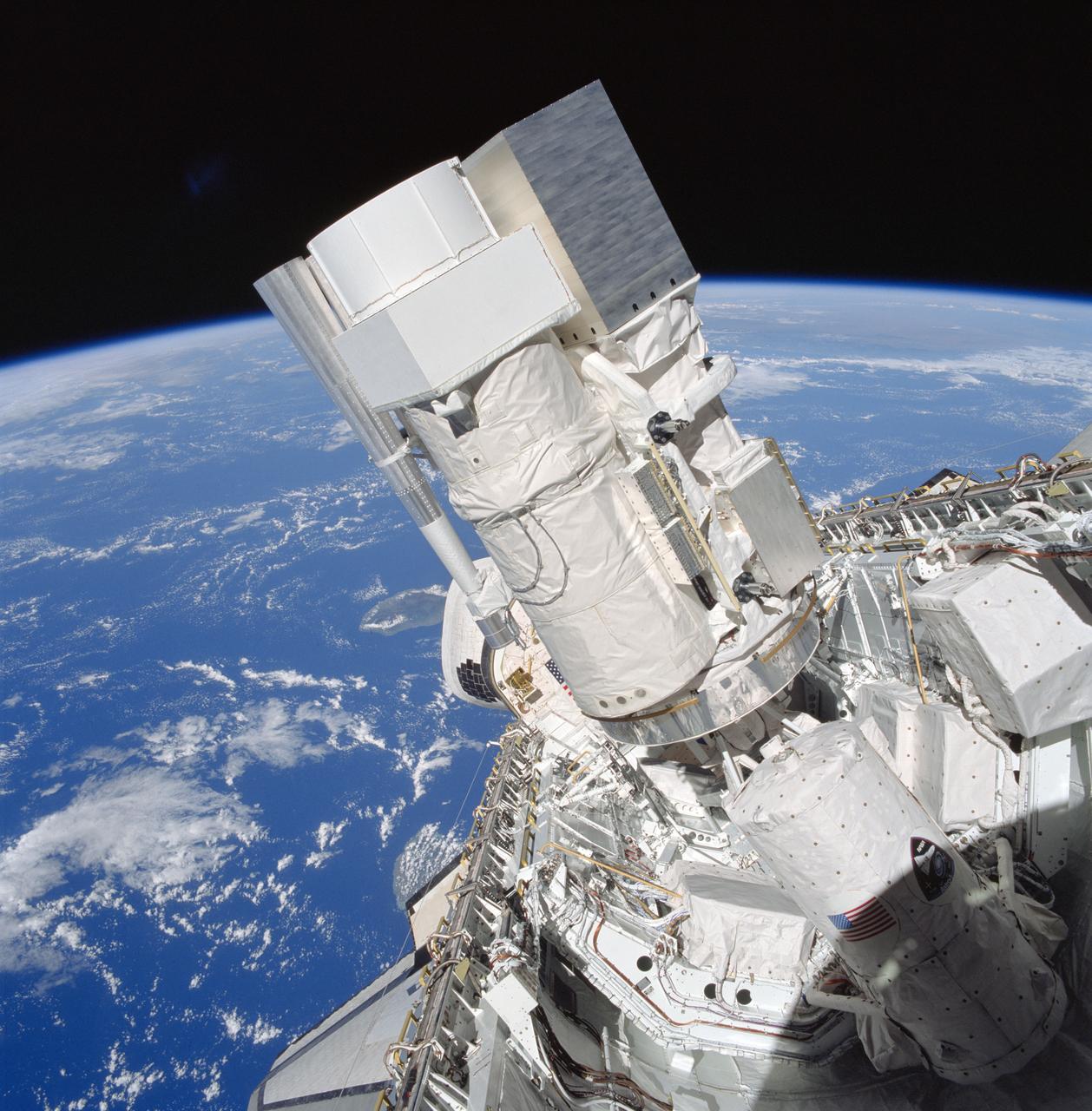
STS035-604-058 (2-10 Dec 1990) --- The various components of the Astro-1 payload are seen backdropped against the blue and white Earth in this scene photographed through Columbia's aft flight deck windows. Parts of the Hopkins Ultraviolet Telescope (HUT), Ultraviolet Imaging Telescope (UIT) and the Wisconsin Ultraviolet Photopolarimetry Experiment (WUPPE) are visible on the Spacelab pallet in the foreground. The Broad Band X-ray Telescope (BBXRT) is behind this pallet and is not visible in this scene. The smaller cylinder in the foreground is the "Igloo," which is a pressurized container housing the Command and Data Management System, which interfaces with the in-cabin controllers to control the Instrument Pointing System (IPS) and the telescopes. The photograph was made with a handheld Rolleiflex camera aimed through Columbia's aft flight deck windows.
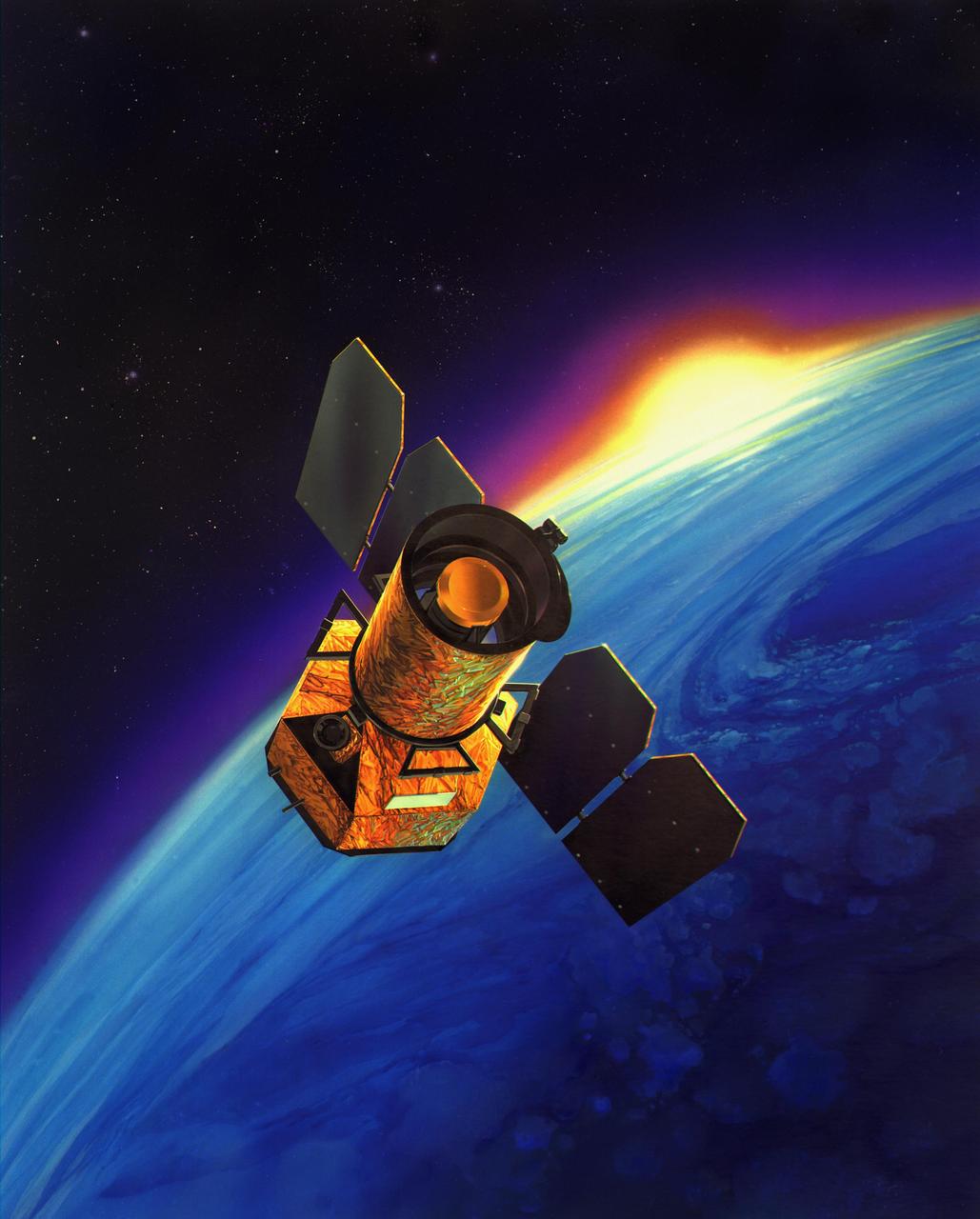
The Galaxy Evolution Explorer was launched on April 28, 2003. Its mission is to study the shape, brightness, size and distance of galaxies across 10 billion years of cosmic history. The 50-centimeter-diameter (19.7-inch) telescope onboard the Galaxy Evolution Explorer sweeps the skies in search of ultraviolet-light sources. Ultraviolet is light from the higher end of the electromagnetic spectrum, just above visible light in frequency, but below X-rays and gamma rays. While a small amount of ultraviolet penetrates Earth's atmosphere, causing sunburn, the Galaxy Evolution Explorer observes those ultraviolet frequencies that can only be seen from space. http://photojournal.jpl.nasa.gov/catalog/PIA04234
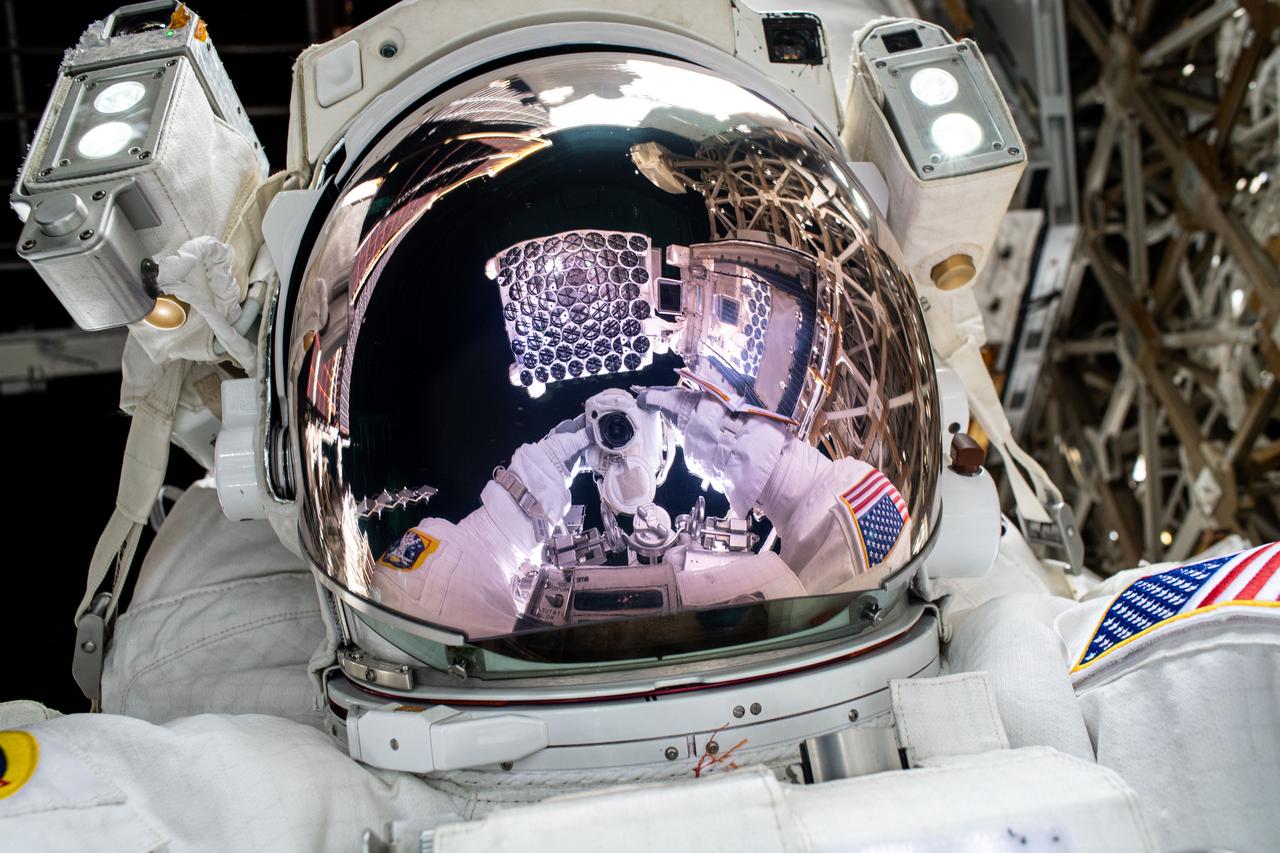
iss072e487911 (Jan. 16, 2025) --- The NICER X-ray telescope is reflected on NASA astronaut and Expedition 72 Flight Engineer Nick Hague's spacesuit helmet visor in this high-flying "space-selfie." Also, visible in Hague's visor is the camera he is pointing toward himself to take this photograph. During the six-hour spacewalk, Hague patched light leaks on some of NICER's 56 X-ray concentrators that block ultraviolet, infrared, and visible light while allowing X-rays to pass through to the mirrors underneath enabling the observation of neutron stars.

Astronomers have produced a highly detailed image of the Crab Nebula, by combining data from telescopes spanning nearly the entire breadth of the electromagnetic spectrum, from radio waves seen by the Karl G. Jansky Very Large Array (VLA) to the powerful X-ray glow as seen by the orbiting Chandra X-ray Observatory. And, in between that range of wavelengths, the Hubble Space Telescope's crisp visible-light view, and the infrared perspective of the Spitzer Space Telescope. This video starts with a composite image of the Crab Nebula, a supernova remnant that was assembled by combining data from five telescopes spanning nearly the entire breadth of the electromagnetic spectrum: the Very Large Array, the Spitzer Space Telescope, the Hubble Space Telescope, the XMM-Newton Observatory, and the Chandra X-ray Observatory. The video dissolves to the red-colored radio-light view that shows how a neutron star’s fierce “wind” of charged particles from the central neutron star energized the nebula, causing it to emit the radio waves. The yellow-colored infrared image includes the glow of dust particles absorbing ultraviolet and visible light. The green-colored Hubble visible-light image offers a very sharp view of hot filamentary structures that permeate this nebula. The blue-colored ultraviolet image and the purple-colored X-ray image shows the effect of an energetic cloud of electrons driven by a rapidly rotating neutron star at the center of the nebula. Read more: <a href="https://go.nasa.gov/2r0s8VC" rel="nofollow">go.nasa.gov/2r0s8VC</a> Credits: NASA, ESA, J. DePasquale (STScI)
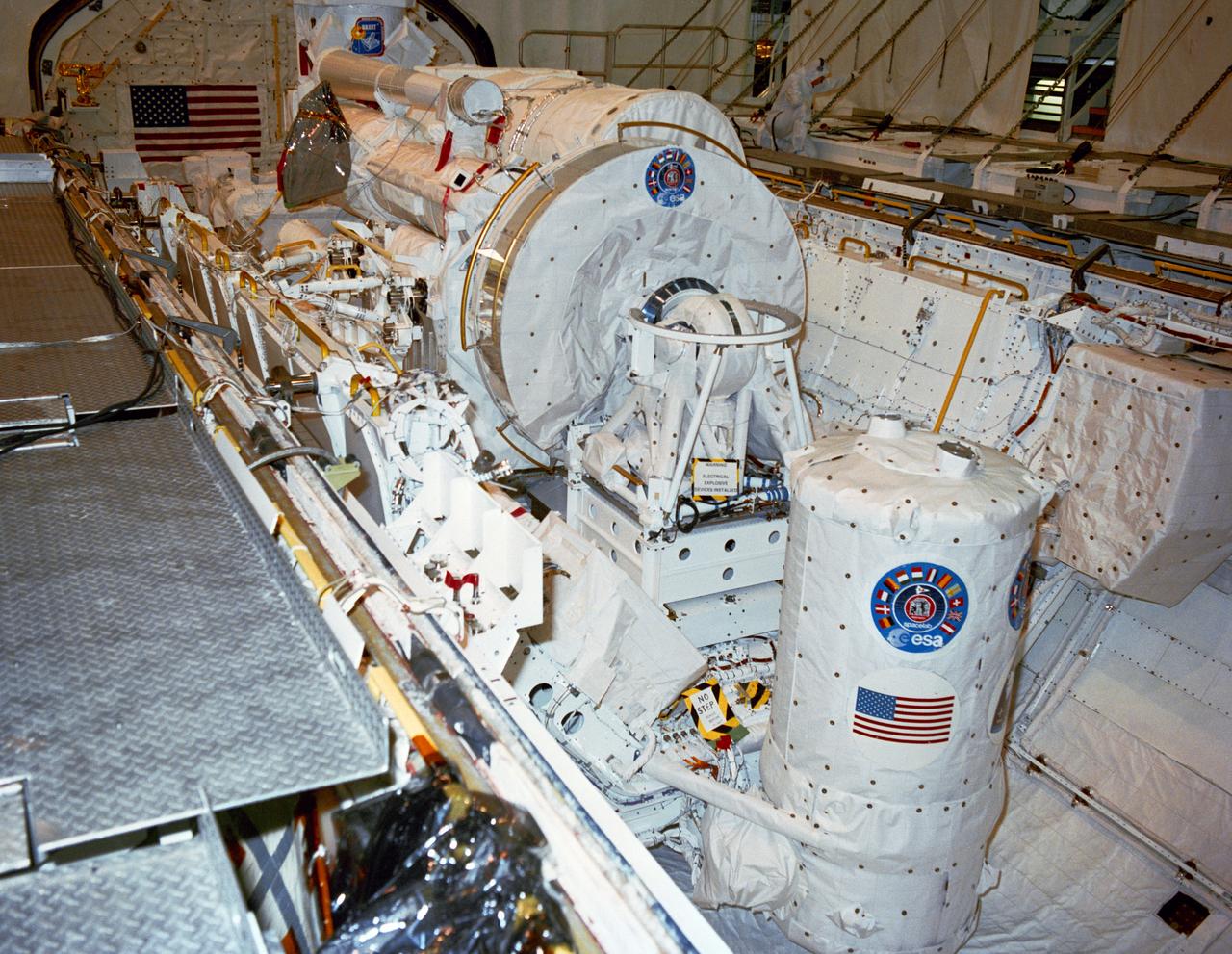
S90-36708 (7 May 1990) --- STS-35 Astronomy Laboratory 1 (ASTRO-1) view shows its telescopes, instrument pointing system (IPS), and support equipment installed in Columbia's, Orbiter Vehicle (OV) 102's, payload bay (PLB) at the Kennedy Space Center (KSC) Orbiter Processing Facility (OPF). In the foreground is the Spacelab Pallet System (SPS) igloo. The stowed IPS with its three ultraviolet telescopes appears in the center of the picture. In the background, the Broad Band X Ray Telescope (BBXRT) two axis pointing system (TAPS) is barely visible. View provided by KSC with alternate number KSC-90PC-423.

In the summer of the year 1054 AD, Chinese astronomers saw a new "guest star," that appeared six times brighter than Venus. So bright in fact, it could be seen during the daytime for several months. This "guest star" was forgotten about until 700 years later with the advent of telescopes. Astronomers saw a tentacle-like nebula in the place of the vanished star and called it the Crab Nebula. Today we know it as the expanding gaseous remnant from a star that self-detonated as a supernova, briefly shining as brightly as 400 million suns. The explosion took place 6,500 light-years away. If the blast had instead happened 50 light-years away it would have irradiated Earth, wiping out most life forms. In the late 1960s astronomers discovered the crushed heart of the doomed star, an ultra-dense neutron star that is a dynamo of intense magnetic field and radiation energizing the nebula. Astronomers therefore need to study the Crab Nebula across a broad range of electromagnetic radiation, from X-rays to radio waves. This image combines data from five different telescopes: the VLA (radio) in red; Spitzer Space Telescope (infrared) in yellow; Hubble Space Telescope (visible) in green; XMM-Newton (ultraviolet) in blue; and Chandra X-ray Observatory (X-ray) in purple. More images and an animation are available at https://photojournal.jpl.nasa.gov/catalog/PIA21474
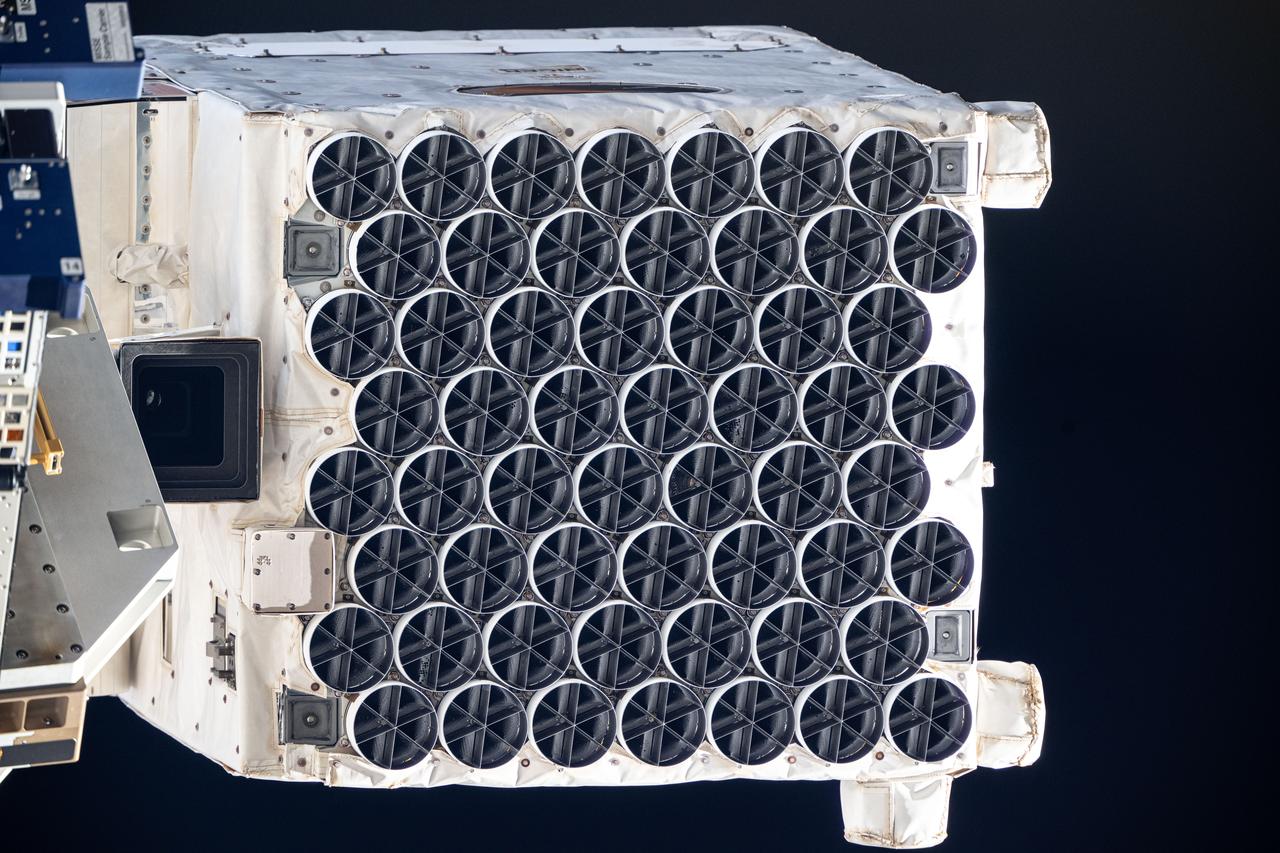
iss072e371351 (Dec. 17, 2024) --- The NICER (Neutron star Interior Composition Explorer) X-ray telescope is pictured installed on the starboard side of the International Space Station's integrated truss segment. NICER's 56 X-ray concentrators are covered by thermal shields, or filters, that block ultraviolet, infrared, and visible light while allowing X-rays to pass through to the mirrors underneath enabling the observation of neutron stars. Several thermal shields have been damaged allowing unwanted sunlight to "leak" into the astrophysics instrument interfering with X-ray measurements. NASA astronauts Nick Hague and Sun Williams will conduct a spacewalk on Jan. 16 to patch the damaged thermal shields and restore NICER for daytime scientific operations.
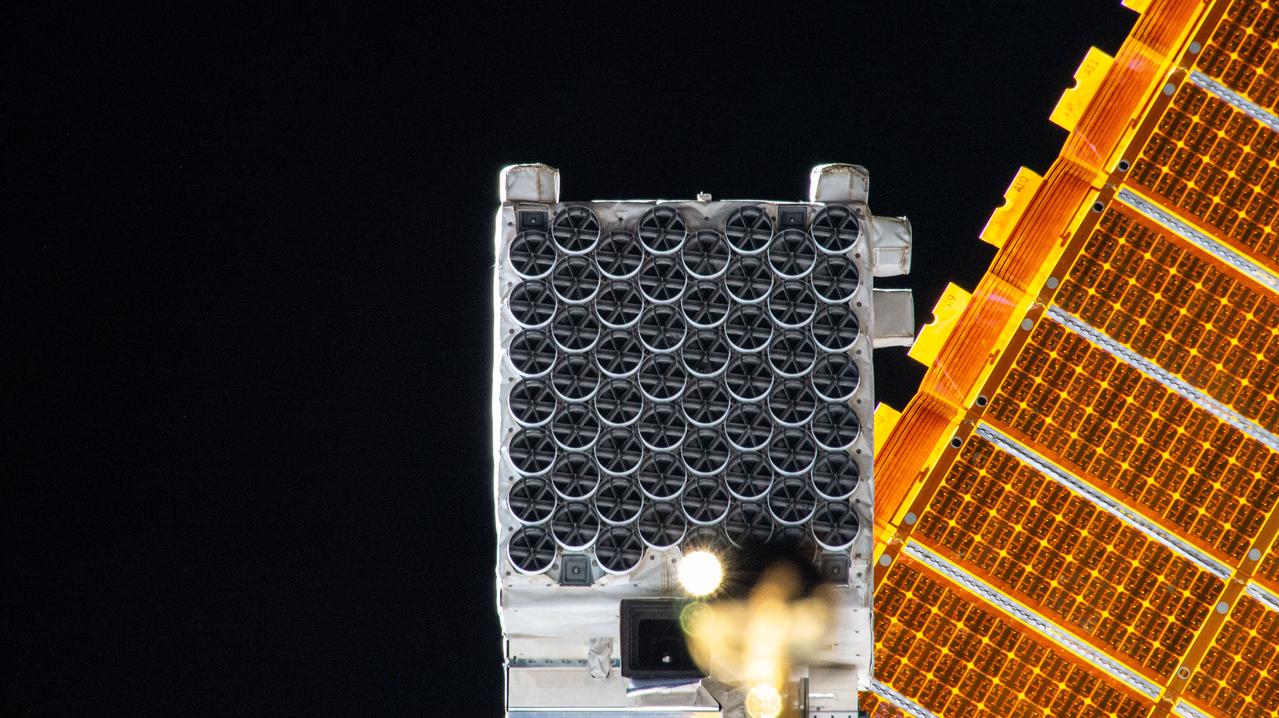
iss072e371305 (Dec. 17, 2024) --- The NICER (Neutron star Interior Composition Explorer) X-ray telescope is pictured installed on the starboard side of the International Space Station's integrated truss segment. NICER's 56 X-ray concentrators are covered by thermal shields, or filters, that block ultraviolet, infrared, and visible light while allowing X-rays to pass through to the mirrors underneath enabling the observation of neutron stars. Several thermal shields have been damaged allowing unwanted sunlight to "leak" into the astrophysics instrument interfering with X-ray measurements. NASA astronauts Nick Hague and Sun Williams will conduct a spacewalk on Jan. 16 to patch the damaged thermal shields and restore NICER for daytime scientific operations.
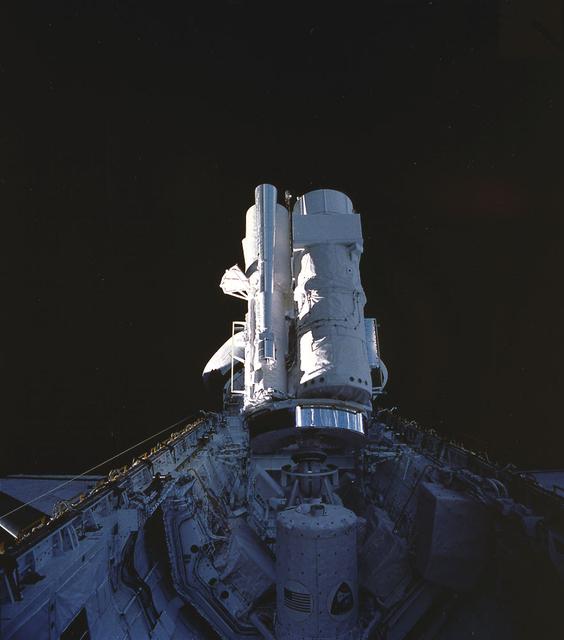
Onboard the Space Shuttle Orbiter Columbia (STS-35), the various components of the Astro-1 payload are seen backdropped against dark space. Parts of the Hopkins Ultraviolet Telescope (HUT), Ultraviolet Imaging Telescope (UIT), and the Wisconsin Ultraviolet Photo-Polarimetry Experiment (WUPPE) are visible on the Spacelab pallet. The Broad-Band X-Ray Telescope (BBXRT) is behind the pallet and is not visible in this scene. The smaller cylinder in the foreground is the igloo. The igloo was a pressurized container housing the Command Data Management System, that interfaced with the in-cabin controllers to control the Instrument Pointing System (IPS) and the telescopes. The Astro Observatory was designed to explore the universe by observing and measuring the ultraviolet radiation from celestial objects. Astronomical targets of observation selected for Astro missions included planets, stars, star clusters, galaxies, clusters of galaxies, quasars, remnants of exploded stars (supernovae), clouds of gas and dust (nebulae), and the interstellar medium. Managed by the Marshall Space Flight Center, the Astro-1 was launched aboard the Space Shuttle Orbiter Columbia (STS-35) on December 2, 1990.
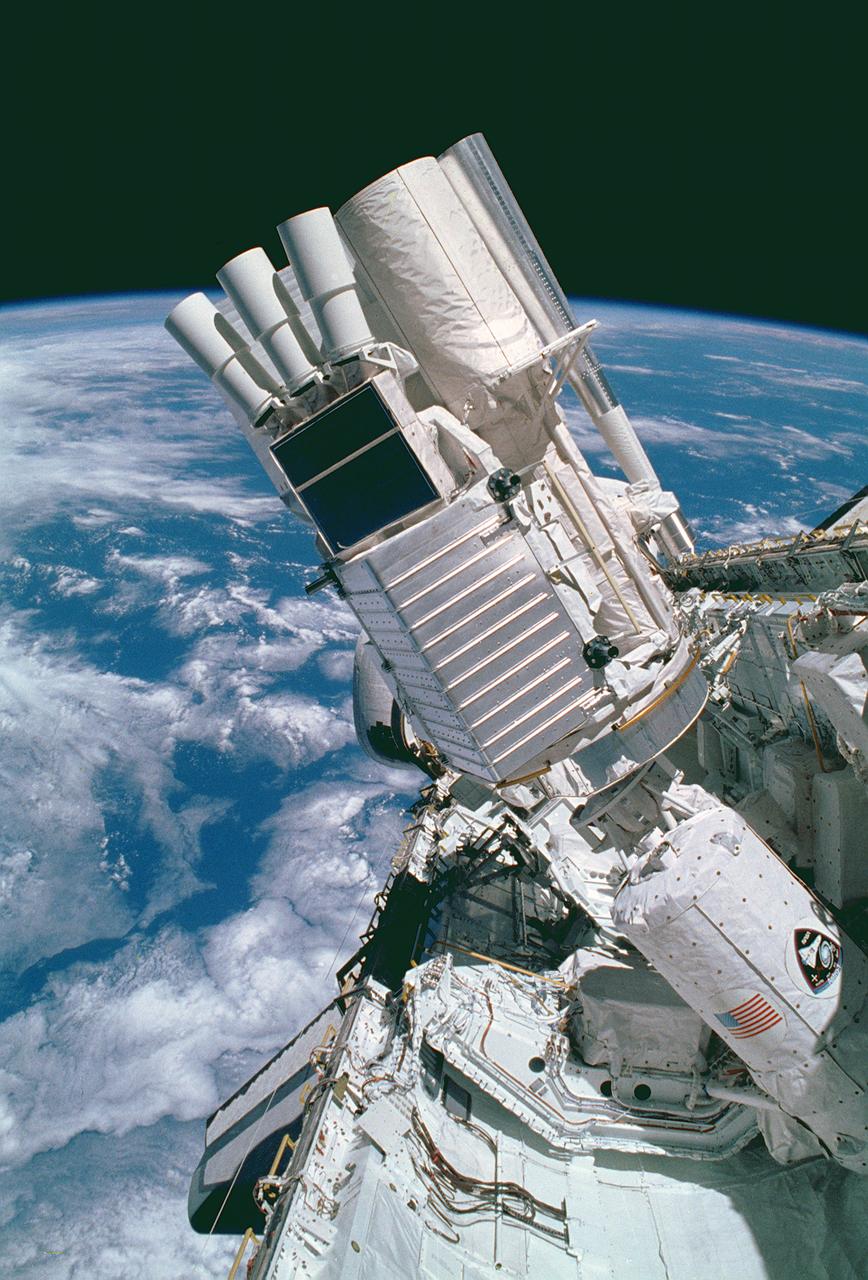
Onboard the Space Shuttle Orbiter Columbia (STS-35), the various components of the Astro-1 payload are seen backdropped against a blue and white Earth. Parts of the Hopkins Ultraviolet Telescope (HUT), the Ultraviolet Imaging Telescope (UIT), and the Wisconsin Ultraviolet Photo-Polarimetry Experiment (WUPPE) are visible on the Spacelab pallet. The Broad-Band X-Ray Telescope (BBXRT) is behind the pallet and is not visible in this scene. The smaller cylinder in the foreground is the igloo. The igloo was a pressurized container housing the Command Data Management System, that interfaced with the in-cabin controllers to control the Instrument Pointing System (IPS) and the telescopes. The Astro Observatory was designed to explore the universe by observing and measuring the ultraviolet radiation from celestial objects. Astronomical targets of observation selected for Astro missions included planets, stars, star clusters, galaxies, clusters of galaxies, quasars, remnants of exploded stars (supernovae), clouds of gas and dust (nebulae), and the interstellar medium. Managed by the Marshall Space Flight Center, the Astro-1 was launched aboard the Space Shuttle Orbiter Columbia (STS-35) on December 2, 1990.
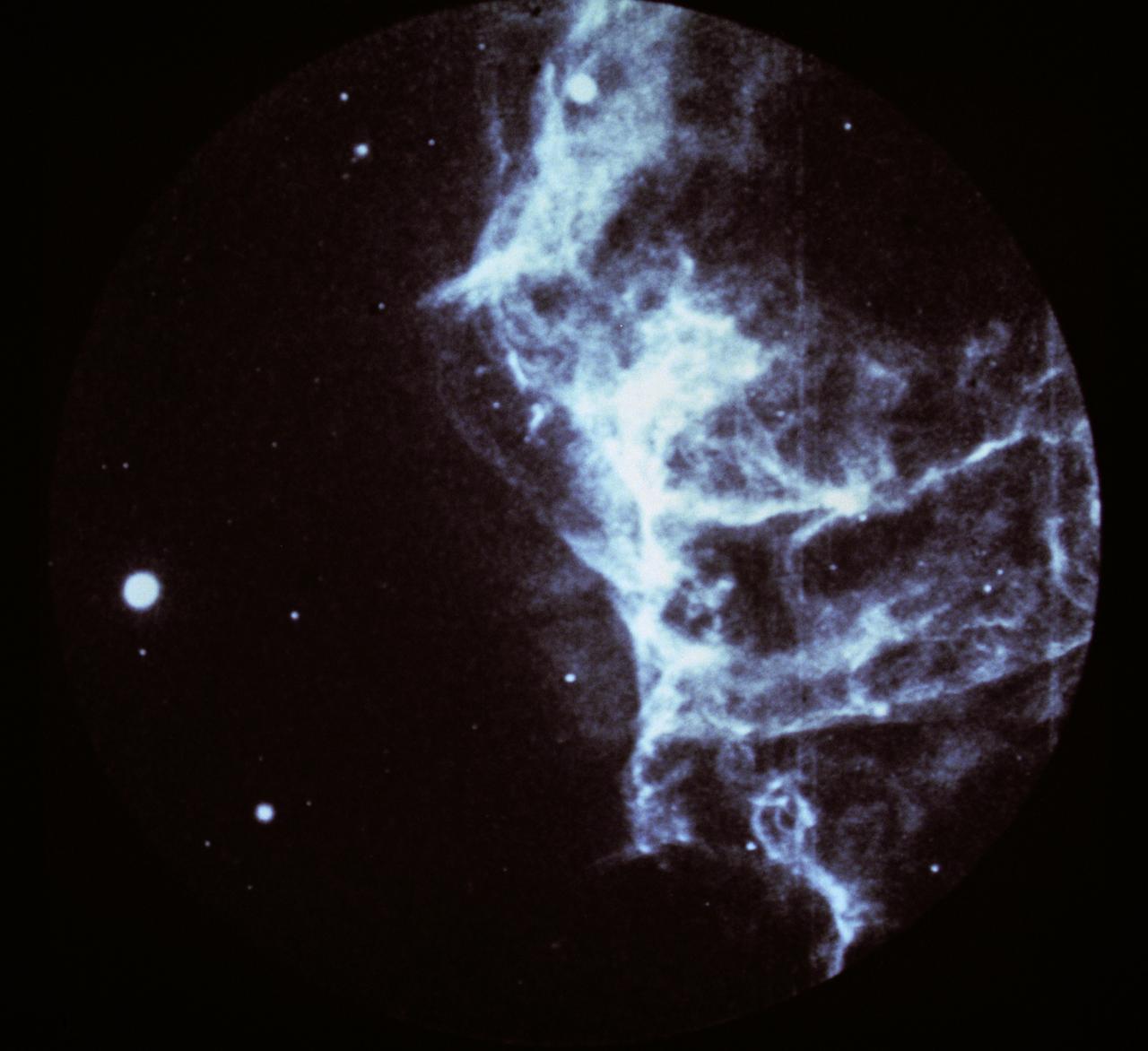
This image shows a part of the Cygnus loop supernova remnant, taken by the Ultraviolet Imaging Telescope (UIT) on the Astro Observatory during the Astro-1 mission (STS-35) on December 5, 1990. Pictured is a portion of the huge Cygnus loop, an array of interstellar gas clouds that have been blasted by a 900,000 mile per hour shock wave from a prehistoric stellar explosion, which occurred about 20,000 years ago, known as supernova. With ultraviolet and x-rays, astronomers can see emissions from extremely hot gases, intense magnetic fields, and other high-energy phenomena that more faintly appear in visible and infrared light or in radio waves that are crucial to deepening the understanding of the universe. The Astro Observatory was designed to explore the universe by observing and measuring the ultraviolet radiation from celestial objects. Three instruments make up the Astro Observatory: The Hopkins Ultraviolet Telescope (HUT), the Ultraviolet Imaging Telescope (UIT), and the Wisconsin Ultraviolet Photo-Polarimetry Experiment (WUPPE). The Marshall Space Flight Center had managment responsibilities for the Astro-1 mission. The Astro-1 Observatory was launched aboard the Space Shuttle Orbiter Columbia (STS-35) on December 2, 1990.
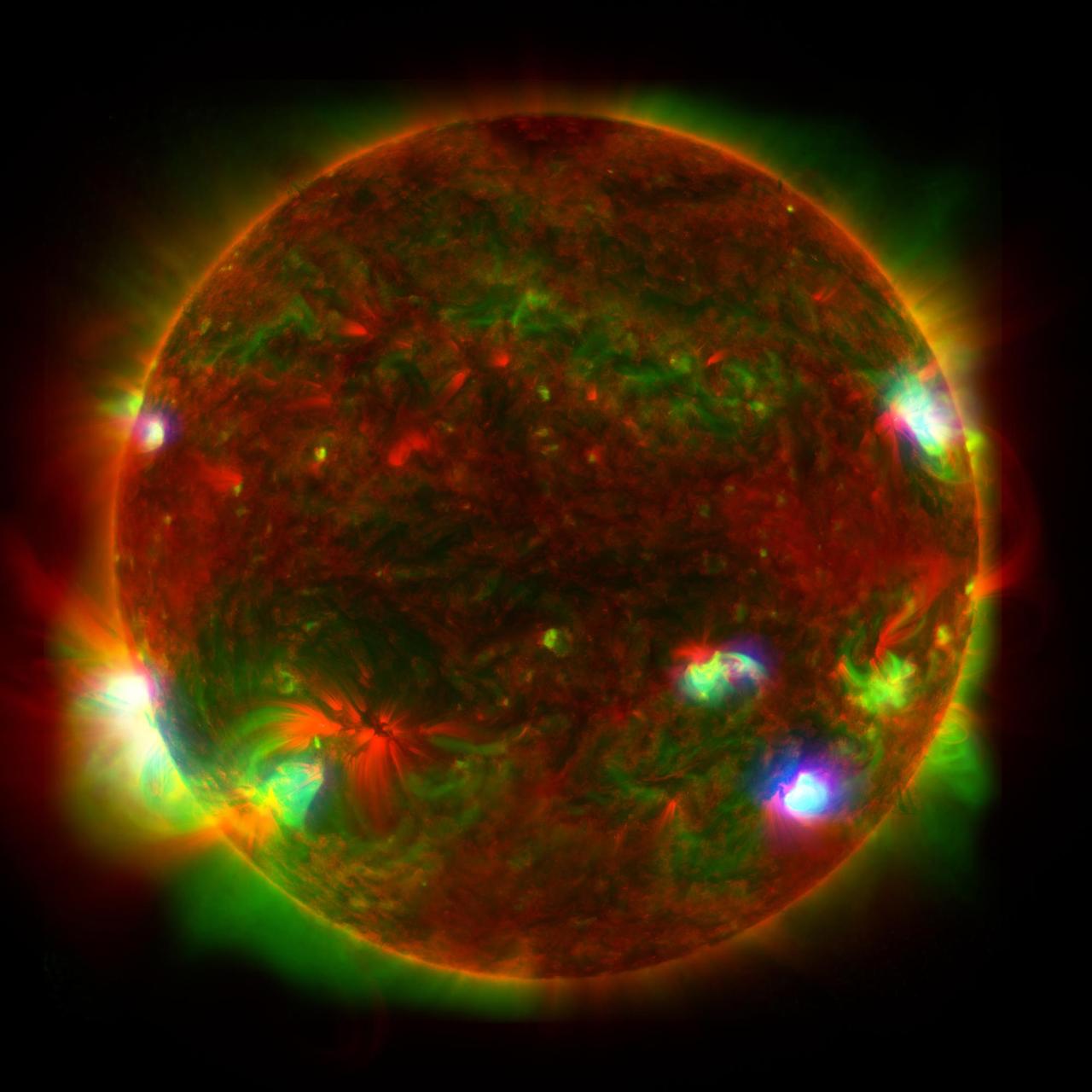
This composite image of the Sun includes high-energy X-ray data from NASA's Nuclear Spectroscopic Telescope Array (NuSTAR) shown in blue; lower energy X-ray data from the X-ray Telescope (XRT) on the Japanese Aerospace Exploration Agency's Hinode mission shown in green; and ultraviolet light detected by the Atmospheric Imaging Assembly (AIA) on NASA's Solar Dynamics Observatory (SDO) shown in red. NuSTAR's relatively small field of view means it can't see the entire Sun from its position in Earth orbit, so Figure A is a composite of 25 images, which were taken by the observatory in June 2022. NuSTAR sees high-energy X-rays that appear at only a few locations, where the hottest material is present in the Sun's atmopshere. By contrast, Hinode's XRT and SDO's AIA detect detect wavelengths emitted across the entire face of the Sun. The hotspots observed by NuSTAR might be caused by collections of nanoflares, or small outbursts of heat, light, and particles from the Sun's surface that subsequently heat the atmosphere. Individual nanoflares are too faint to directly observe amid the Sun's blazing light. https://photojournal.jpl.nasa.gov/catalog/PIA25628
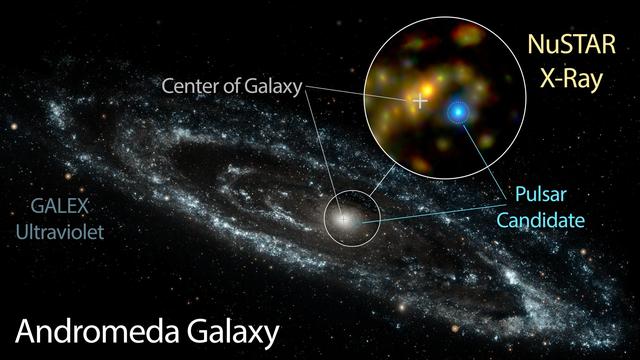
NASA's Nuclear Spectroscope Telescope Array, or NuSTAR, has identified a candidate pulsar in Andromeda -- the nearest large galaxy to the Milky Way. This likely pulsar is brighter at high energies than the Andromeda galaxy's entire black hole population. The inset image shows the pulsar candidate in blue, as seen in X-ray light by NuSTAR. The background image of Andromeda was taken by NASA's Galaxy Evolution Explorer in ultraviolet light. Andromeda is a spiral galaxy like our Milky Way but larger in size. It lies 2.5 million light-years away in the Andromeda constellation. http://photojournal.jpl.nasa.gov/catalog/PIA20970

NASA image release April 6, 2011 Images from Swift's Ultraviolet/Optical (white, purple) and X-ray telescopes (yellow and red) were combined in this view of GRB 110328A. The blast was detected only in X-rays, which were collected over a 3.4-hour period on March 28. Credit: NASA/Swift/Stefan Immler NASA's Swift, Hubble Space Telescope and Chandra X-ray Observatory have teamed up to study one of the most puzzling cosmic blasts yet observed. More than a week later, high-energy radiation continues to brighten and fade from its location. Astronomers say they have never seen anything this bright, long-lasting and variable before. Usually, gamma-ray bursts mark the destruction of a massive star, but flaring emission from these events never lasts more than a few hours. Although research is ongoing, astronomers say that the unusual blast likely arose when a star wandered too close to its galaxy's central black hole. Intense tidal forces tore the star apart, and the infalling gas continues to stream toward the hole. According to this model, the spinning black hole formed an outflowing jet along its spin axis. A powerful blast of X- and gamma rays is seen if this jet is pointed in our direction. To read more go to: <a href="http://www.nasa.gov/topics/universe/features/star-disintegration.." rel="nofollow">www.nasa.gov/topics/universe/features/star-disintegration..</a>. NASA Goddard Space Flight Center enables NASA’s mission through four scientific endeavors: Earth Science, Heliophysics, Solar System Exploration, and Astrophysics. Goddard plays a leading role in NASA’s accomplishments by contributing compelling scientific knowledge to advance the Agency’s mission. Follow us on Twitter Join us on Facebook
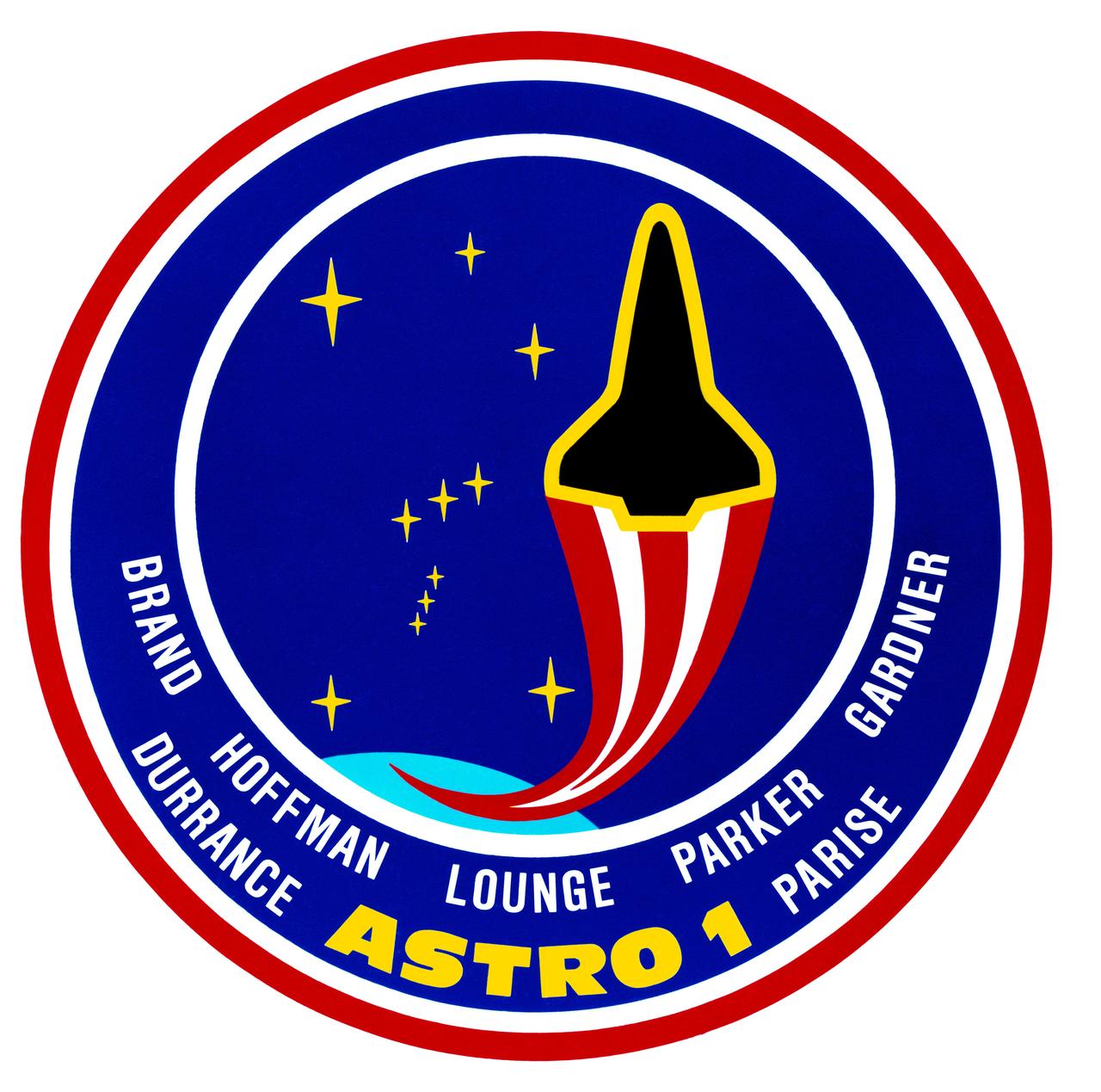
STS035-S-001 (29 Jan. 1990) --- Designed by the crew members assigned to the mission, the STS-35 crew patch symbolizes the space shuttle flying above Earth's atmosphere to better study the many celestial objects of the Universe, represented by the constellation Orion. The primary payload of STS-35 is ASTRO-l, a group of ultraviolet telescopes and the Broad-Band X-Ray Telescope. Crew members on the flight are astronauts Vance D. Brand, commander; Guy S. Gardner, pilot; and Jeffrey A. Hoffman, John M. (Mike) Lounge, Robert A. R. Parker, all mission specialists; along with the two payload specialists - Samuel T. Durrance and Ronald Parise. The NASA insignia design for space shuttle flights is reserved for use by the astronauts and for other official use as the NASA Administrator may authorize. Public availability has been approved only in the forms of illustrations by the various news media. When and if there is any change in this policy, which is not anticipated, the change will be publicly announced. Photo credit: NASA

This is a Hubble Space Telescope composite image of a supernova explosion designated SN 2014J in the galaxy M82. At a distance of approximately 11.5 million light-years from Earth it is the closest supernova of its type discovered in the past few decades. The explosion is categorized as a Type Ia supernova, which is theorized to be triggered in binary systems consisting of a white dwarf and another star — which could be a second white dwarf, a star like our sun, or a giant star. Astronomers using a ground-based telescope discovered the explosion on January 21, 2014. This Hubble photograph was taken on January 31, as the supernova approached its peak brightness. The Hubble data are expected to help astronomers refine distance measurements to Type Ia supernovae. In addition, the observations could yield insights into what kind of stars were involved in the explosion. Hubble’s ultraviolet-light sensitivity will allow astronomers to probe the environment around the site of the supernova explosion and in the interstellar medium of the host galaxy. Because of their consistent peak brightness, Type Ia supernovae are among the best tools to measure distances in the universe. They were fundamental to the 1998 discovery of the mysterious acceleration of the expanding universe. A hypothesized repulsive force, called dark energy, is thought to cause the acceleration. Among the other major NASA space-based observatories used in the M82 viewing campaign are Spitzer Space Telescope, Chandra X-ray Observatory, Nuclear Spectroscopic Telescope Array (NuSTAR), Fermi Gamma-ray Space Telescope, Swift Gamma Ray Burst Explorer, and the Stratospheric Observatory for Infrared Astronomy (SOFIA). Image Credit: NASA, ESA, A. Goobar (Stockholm University), and the Hubble Heritage Team (STScI/AURA) <b><a href="http://www.nasa.gov/audience/formedia/features/MP_Photo_Guidelines.html" rel="nofollow">NASA image use policy.</a></b> <b><a href="http://www.nasa.gov/centers/goddard/home/index.html" rel="nofollow">NASA Goddard Space Flight Center</a></b> enables NASA’s mission through four scientific endeavors: Earth Science, Heliophysics, Solar System Exploration, and Astrophysics. Goddard plays a leading role in NASA’s accomplishments by contributing compelling scientific knowledge to advance the Agency’s mission. <b>Follow us on <a href="http://twitter.com/NASAGoddardPix" rel="nofollow">Twitter</a></b> <b>Like us on <a href="http://www.facebook.com/pages/Greenbelt-MD/NASA-Goddard/395013845897?ref=tsd" rel="nofollow">Facebook</a></b> <b>Find us on <a href="http://instagram.com/nasagoddard?vm=grid" rel="nofollow">Instagram</a></b>
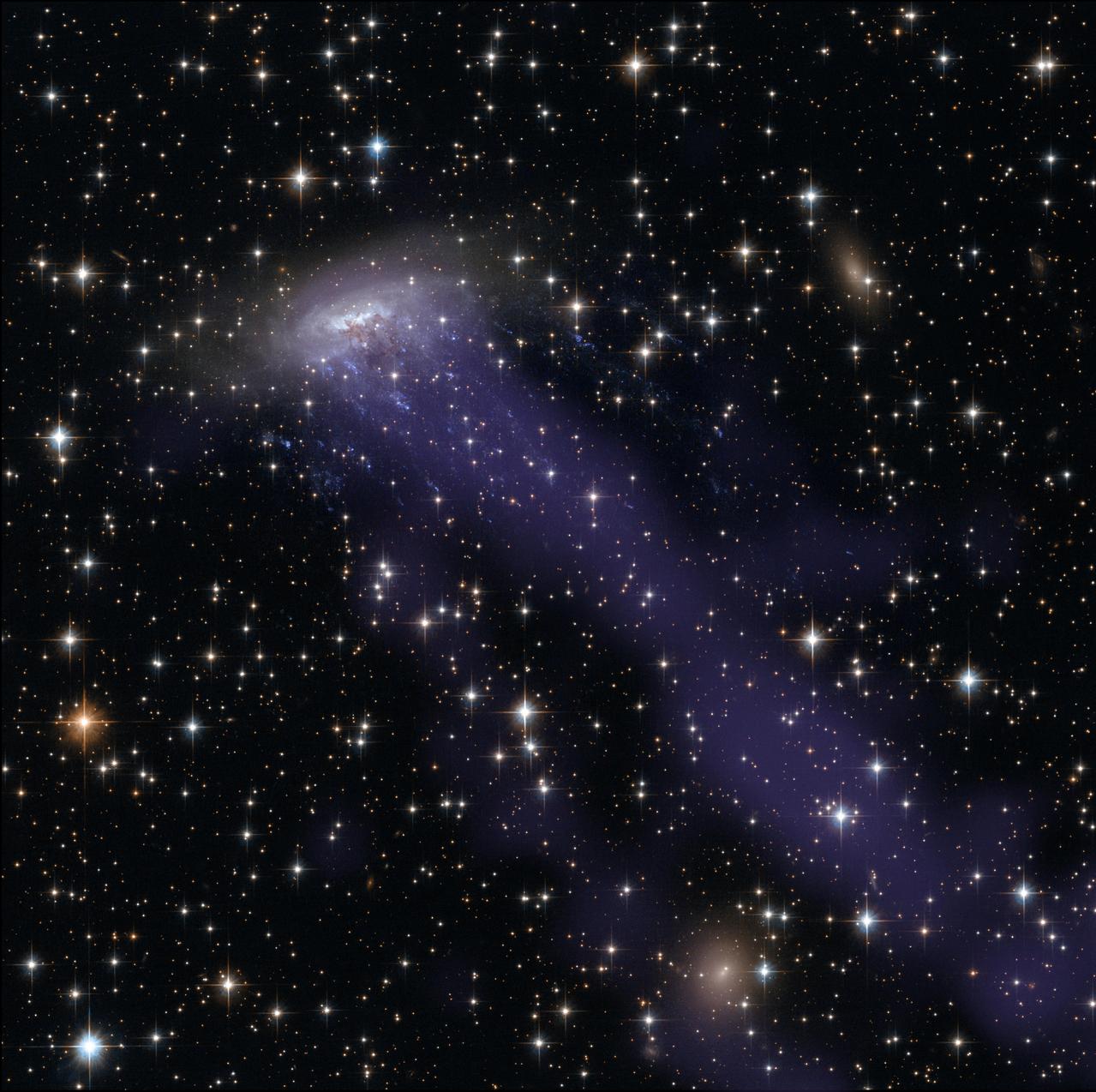
This image combines NASA/ESA Hubble Space Telescope observations with data from the Chandra X-ray Observatory. As well as the electric blue ram pressure stripping streaks seen emanating from ESO 137-001, a giant gas stream can be seen extending towards the bottom of the frame, only visible in the X-ray part of the spectrum. Credit: NASA, ESA, CXC The spiral galaxy ESO 137-001 looks like a dandelion caught in a breeze in this new Hubble Space Telescope image. The galaxy is zooming toward the upper right of this image, in between other galaxies in the Norma cluster located over 200 million light-years away. The road is harsh: intergalactic gas in the Norma cluster is sparse, but so hot at 180 million degrees Fahrenheit that it glows in X-rays. The spiral plows through the seething intra-cluster gas so rapidly – at nearly 4.5 million miles per hour — that much of its own gas is caught and torn away. Astronomers call this "ram pressure stripping." The galaxy’s stars remain intact due to the binding force of their gravity. Tattered threads of gas, the blue jellyfish-tendrils trailing ESO 137-001 in the image, illustrate the process. Ram pressure has strung this gas away from its home in the spiral galaxy and out over intergalactic space. Once there, these strips of gas have erupted with young, massive stars, which are pumping out light in vivid blues and ultraviolet. The brown, smoky region near the center of the spiral is being pushed in a similar manner, although in this case it is small dust particles, and not gas, that are being dragged backwards by the intra-cluster medium. Read more here: <a href="http://1.usa.gov/P0HSFh" rel="nofollow">1.usa.gov/P0HSFh</a> <b><a href="http://www.nasa.gov/audience/formedia/features/MP_Photo_Guidelines.html" rel="nofollow">NASA image use policy.</a></b> <b><a href="http://www.nasa.gov/centers/goddard/home/index.html" rel="nofollow">NASA Goddard Space Flight Center</a></b> enables NASA’s mission through four scientific endeavors: Earth Science, Heliophysics, Solar System Exploration, and Astrophysics. Goddard plays a leading role in NASA’s accomplishments by contributing compelling scientific knowledge to advance the Agency’s mission. <b>Follow us on <a href="http://twitter.com/NASAGoddardPix" rel="nofollow">Twitter</a></b> <b>Like us on <a href="http://www.facebook.com/pages/Greenbelt-MD/NASA-Goddard/395013845897?ref=tsd" rel="nofollow">Facebook</a></b> <b>Find us on <a href="http://instagram.com/nasagoddard?vm=grid" rel="nofollow">Instagram</a></b>
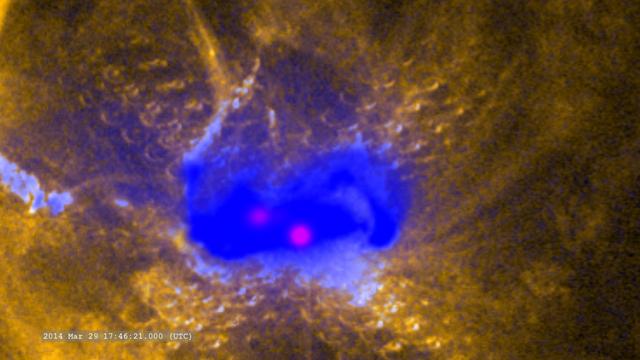
Zoom in on the flare in ultraviolet (SDO/AIA), X-rays (Hinode) and gamma-rays (RHESSI) -- On March 29, 2014 the sun released an X-class flare. It was observed by NASA's Interface Region Imaging Spectrograph, or IRIS; NASA's Solar Dynamics Observatory, or SDO; NASA's Reuven Ramaty High Energy Solar Spectroscopic Imager, or RHESSI; the Japanese Aerospace Exploration Agency's Hinode; and the National Solar Observatory's Dunn Solar Telescope located at Sacramento Peak in New Mexico. To have a record of such an intense flare from so many observatories is unprecedented. Such research can help scientists better understand what catalyst sets off these large explosions on the sun. Perhaps we may even some day be able to predict their onset and forewarn of the radio blackouts solar flares can cause near Earth - blackouts that can interfere with airplane, ship and military communications. Read more: <a href="http://1.usa.gov/1kMDQbO" rel="nofollow">1.usa.gov/1kMDQbO</a> Join our Google+ Hangout on May 8 at 2:30pm EST: <a href="http://go.nasa.gov/1mwbBEZ" rel="nofollow">go.nasa.gov/1mwbBEZ</a> Credit: NASA Goddard <b><a href="http://www.nasa.gov/audience/formedia/features/MP_Photo_Guidelines.html" rel="nofollow">NASA image use policy.</a></b> <b><a href="http://www.nasa.gov/centers/goddard/home/index.html" rel="nofollow">NASA Goddard Space Flight Center</a></b> enables NASA’s mission through four scientific endeavors: Earth Science, Heliophysics, Solar System Exploration, and Astrophysics. Goddard plays a leading role in NASA’s accomplishments by contributing compelling scientific knowledge to advance the Agency’s mission. <b>Follow us on <a href="http://twitter.com/NASAGoddardPix" rel="nofollow">Twitter</a></b> <b>Like us on <a href="http://www.facebook.com/pages/Greenbelt-MD/NASA-Goddard/395013845897?ref=tsd" rel="nofollow">Facebook</a></b> <b>Find us on <a href="http://instagram.com/nasagoddard?vm=grid" rel="nofollow">Instagram</a></b>
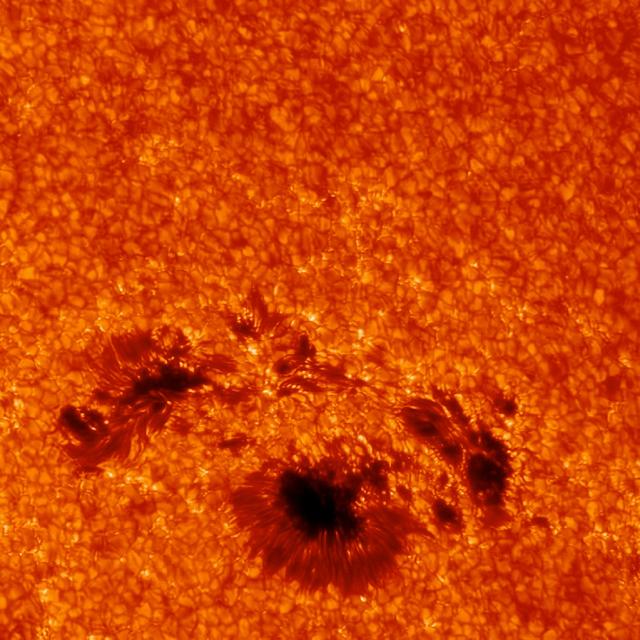
This close-up of the sunspot underneath the March 29, 2014, flare shows incredible detail. The image was captured by the G-band camera at Sacramento Peak in New Mexico. This instrument can focus on only a small area at once, but provide very high resolution. Ground-based telescope data can be hindered by Earth's atmosphere, which blocks much of the sun's ultraviolet and X-ray light, and causes twinkling even in the light it does allow through. As it happens, the March 29 flare occurred at a time of day in New Mexico that often results in the best viewing times from the ground. Credit: Kevin Reardon (National Solar Observatory), Lucia Kleint (BAER Institute) -- On March 29, 2014 the sun released an X-class flare. It was observed by NASA's Interface Region Imaging Spectrograph, or IRIS; NASA's Solar Dynamics Observatory, or SDO; NASA's Reuven Ramaty High Energy Solar Spectroscopic Imager, or RHESSI; the Japanese Aerospace Exploration Agency's Hinode; and the National Solar Observatory's Dunn Solar Telescope located at Sacramento Peak in New Mexico. To have a record of such an intense flare from so many observatories is unprecedented. Such research can help scientists better understand what catalyst sets off these large explosions on the sun. Perhaps we may even some day be able to predict their onset and forewarn of the radio blackouts solar flares can cause near Earth - blackouts that can interfere with airplane, ship and military communications. Read more: <a href="http://1.usa.gov/1kMDQbO" rel="nofollow">1.usa.gov/1kMDQbO</a> Join our Google+ Hangout on May 8 at 2:30pm EST: <a href="http://go.nasa.gov/1mwbBEZ" rel="nofollow">go.nasa.gov/1mwbBEZ</a> Credit: NASA Goddard <b><a href="http://www.nasa.gov/audience/formedia/features/MP_Photo_Guidelines.html" rel="nofollow">NASA image use policy.</a></b> <b><a href="http://www.nasa.gov/centers/goddard/home/index.html" rel="nofollow">NASA Goddard Space Flight Center</a></b> enables NASA’s mission through four scientific endeavors: Earth Science, Heliophysics, Solar System Exploration, and Astrophysics. Goddard plays a leading role in NASA’s accomplishments by contributing compelling scientific knowledge to advance the Agency’s mission. <b>Follow us on <a href="http://twitter.com/NASAGoddardPix" rel="nofollow">Twitter</a></b> <b>Like us on <a href="http://www.facebook.com/pages/Greenbelt-MD/NASA-Goddard/395013845897?ref=tsd" rel="nofollow">Facebook</a></b> <b>Find us on <a href="http://instagram.com/nasagoddard?vm=grid" rel="nofollow">Instagram</a></b>

A lone source shines out brightly from the dark expanse of deep space, glowing softly against a picturesque backdrop of distant stars and colorful galaxies. Captured by the NASA/ESA Hubble Space Telescope’s Advanced Camera for Surveys (ACS), this scene shows PGC 83677, a lenticular galaxy — a galaxy type that sits between the more familiar elliptical and spiral varieties. It reveals both the relatively calm outskirts and intriguing core of PGC 83677. Here, studies have uncovered signs of a monstrous black hole that is spewing out high-energy X-rays and ultraviolet light. Credit: NASA/ESA/Hubble; acknowledgements: Judy Schmidt (Geckzilla) <b><a href="http://www.nasa.gov/audience/formedia/features/MP_Photo_Guidelines.html" rel="nofollow">NASA image use policy.</a></b> <b><a href="http://www.nasa.gov/centers/goddard/home/index.html" rel="nofollow">NASA Goddard Space Flight Center</a></b> enables NASA’s mission through four scientific endeavors: Earth Science, Heliophysics, Solar System Exploration, and Astrophysics. Goddard plays a leading role in NASA’s accomplishments by contributing compelling scientific knowledge to advance the Agency’s mission. <b>Follow us on <a href="http://twitter.com/NASAGoddardPix" rel="nofollow">Twitter</a></b> <b>Like us on <a href="http://www.facebook.com/pages/Greenbelt-MD/NASA-Goddard/395013845897?ref=tsd" rel="nofollow">Facebook</a></b> <b>Find us on <a href="http://instagrid.me/nasagoddard/?vm=grid" rel="nofollow">Instagram</a></b>
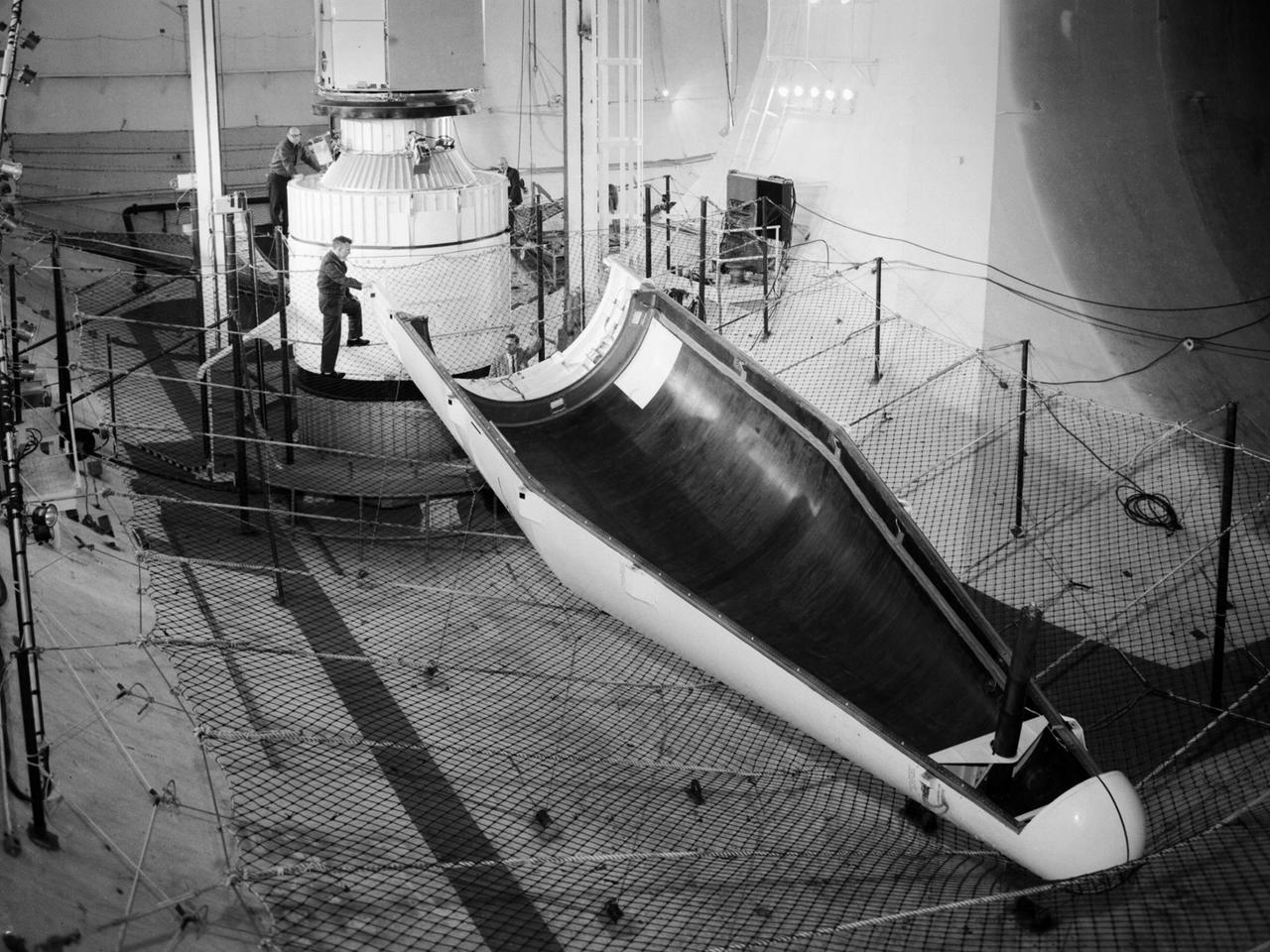
Researchers at the National Aeronautics and Space Administration (NASA) Lewis Research Center conducted a series of shroud jettison tests for the second Orbiting Astronomical Observatory (OAO-2) in the Space Power Chambers during April 1968. The Orbiting Astronomical Observatory satellites were designed by Goddard Space Flight Center to study and retrieve ultraviolet data on stars and galaxies which earthbound and atmospheric telescopes could not view due to ozone absorption. The shroud jettison system was tested in the Space Power Chambers. In 1961, NASA Lewis management decided to convert its Altitude Wind Tunnel into two large test chambers and later renamed it the Space Power Chambers. The conversion, which took over two years, included removing the tunnel’s internal components and inserting bulkheads to seal off the new chambers. The larger chamber, seen here, could simulate altitudes of 100,000 feet. These chambers were used for a variety of tests on the Centaur second-stage rocket until the early 1970s. The first OAO mission in 1965 failed due to problems with the satellite. OAO-2 would be launched on an Atlas/Centaur with a modified Agena shroud. The new shroud was 18 feet longer than the normal Centaur payload shrouds. This new piece of hardware was successfully qualified during three tests at 90,000 feet altitude in the Space Power Chambers in April 1968. For the first time, x-rays were used to verify the payload clearance once the shroud was sealed. OAO-2 was launched on December 7, 1968 and proved to be an extremely successful mission.
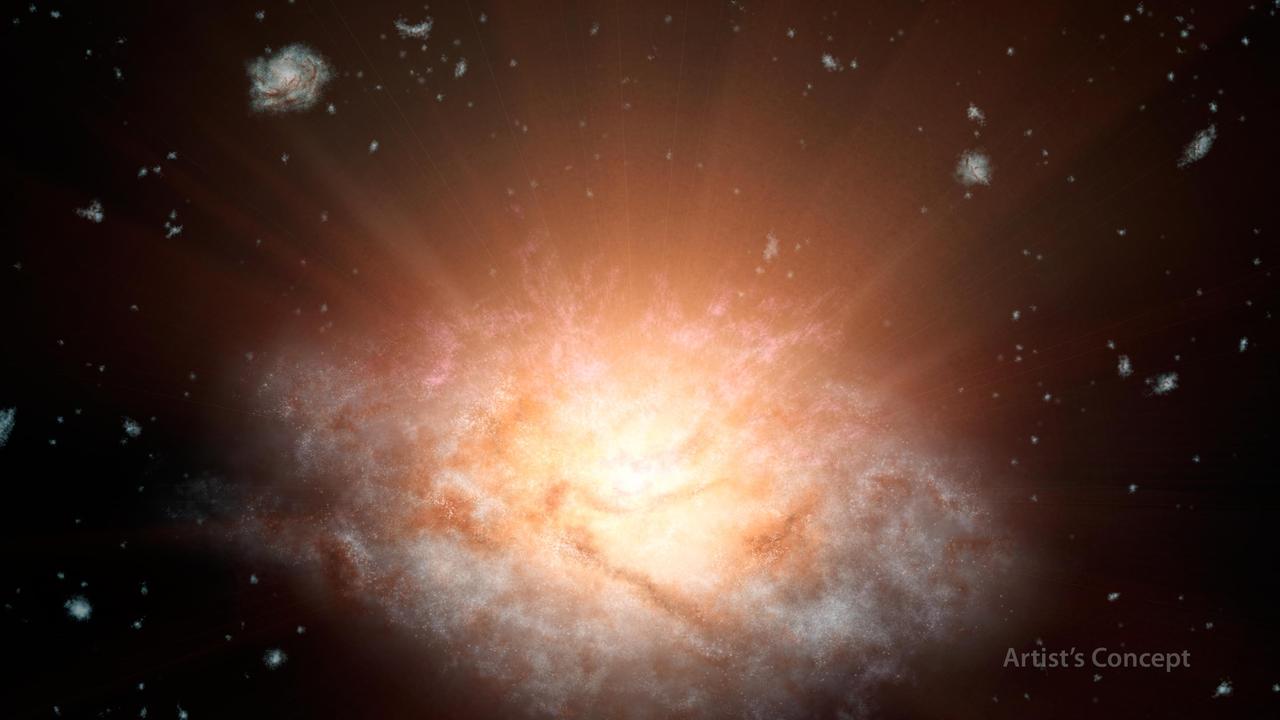
This artist's concept depicts the current record holder for the most luminous galaxy in the universe. The galaxy, named WISE J224607.57-052635.0, is erupting with light equal to more than 300 trillion suns. It was discovered by NASA's Wide-Field Infrared Survey Explorer, or WISE. The galaxy is smaller than the Milky Way, yet puts out 10,000 times more energy. Scientists think that a supermassive black hole at the center of this dusty galaxy is busily consuming gaseous material in a colossal growth spurt. As the gas is dragged toward the black hole, it heats up and blasts out visible, ultraviolet and X-ray light. The dust swaddling the galaxy absorbs this light and heats up, radiating longer-wavelength, infrared light. The dust also blocks our view of shorter, visible-light wavelengths, while letting longer-wavelengths through. This is similar to what happens when sunlight streams through our dusty atmosphere, producing a brilliant red sunrise. In fact, more than 99 percent of the light escaping from this dusty galaxy is infrared. As a result, it is much harder to see with optical telescopes. Because light from the galaxy hosting the black hole has traveled 12.5 billion years to reach us, astronomers are seeing the object as it was in the distant past. During this epoch, galaxies would have been more than five times closer together than they are now, as illustrated in the background of the artist's concept. This is due to the expansion of space -- space itself and the galaxies in it are stretching apart from each other at ever-increasing speeds. http://photojournal.jpl.nasa.gov/catalog/PIA19339
![This image from NASA Spitzer Space Telescope, shows the wispy filamentary structure of Henize 206, is a four-color composite mosaic created by combining data from an infrared array camera IRAC. The LMC is a small satellite galaxy gravitationally bound to our own Milky Way. Yet the gravitational effects are tearing the companion to shreds in a long-playing drama of 'intergalactic cannibalism.' These disruptions lead to a recurring cycle of star birth and star death. Astronomers are particularly interested in the LMC because its fractional content of heavy metals is two to five times lower than is seen in our solar neighborhood. [In this context, 'heavy elements' refer to those elements not present in the primordial universe. Such elements as carbon, oxygen and others are produced by nucleosynthesis and are ejected into the interstellar medium via mass loss by stars, including supernova explosions.] As such, the LMC provides a nearby cosmic laboratory that may resemble the distant universe in its chemical composition. The primary Spitzer image, showing the wispy filamentary structure of Henize 206, is a four-color composite mosaic created by combining data from an infrared array camera (IRAC) at near-infrared wavelengths and the mid-infrared data from a multiband imaging photometer (MIPS). Blue represents invisible infrared light at wavelengths of 3.6 and 4.5 microns. Note that most of the stars in the field of view radiate primarily at these short infrared wavelengths. Cyan denotes emission at 5.8 microns, green depicts the 8.0 micron light, and red is used to trace the thermal emission from dust at 24 microns. The separate instrument images are included as insets to the main composite. An inclined ring of emission dominates the central and upper regions of the image. This delineates a bubble of hot, x-ray emitting gas that was blown into space when a massive star died in a supernova explosion millions of years ago. The shock waves from that explosion impacted a cloud of nearby hydrogen gas, compressed it, and started a new generation of star formation. The death of one star led to the birth of many new stars. This is particularly evident in the MIPS inset, where the 24-micron emission peaks correspond to newly formed stars. The ultraviolet and visible-light photons from the new stars are absorbed by surrounding dust and re-radiated at longer infrared wavelengths, where it is detected by Spitzer. This emission nebula was cataloged by Karl Henize (HEN-eyes) while spending 1948-1951 in South Africa doing research for his Ph.D. dissertation at the University of Michigan. Henize later became a NASA astronaut and, at age 59, became the oldest rookie to fly on the Space Shuttle during an eight-day flight of the Challenger in 1985. He died just short of his 67th birthday in 1993 while attempting to climb the north face of Mount Everest, the world's highest peak. http://photojournal.jpl.nasa.gov/catalog/PIA05517](https://images-assets.nasa.gov/image/PIA05517/PIA05517~medium.jpg)
This image from NASA Spitzer Space Telescope, shows the wispy filamentary structure of Henize 206, is a four-color composite mosaic created by combining data from an infrared array camera IRAC. The LMC is a small satellite galaxy gravitationally bound to our own Milky Way. Yet the gravitational effects are tearing the companion to shreds in a long-playing drama of 'intergalactic cannibalism.' These disruptions lead to a recurring cycle of star birth and star death. Astronomers are particularly interested in the LMC because its fractional content of heavy metals is two to five times lower than is seen in our solar neighborhood. [In this context, 'heavy elements' refer to those elements not present in the primordial universe. Such elements as carbon, oxygen and others are produced by nucleosynthesis and are ejected into the interstellar medium via mass loss by stars, including supernova explosions.] As such, the LMC provides a nearby cosmic laboratory that may resemble the distant universe in its chemical composition. The primary Spitzer image, showing the wispy filamentary structure of Henize 206, is a four-color composite mosaic created by combining data from an infrared array camera (IRAC) at near-infrared wavelengths and the mid-infrared data from a multiband imaging photometer (MIPS). Blue represents invisible infrared light at wavelengths of 3.6 and 4.5 microns. Note that most of the stars in the field of view radiate primarily at these short infrared wavelengths. Cyan denotes emission at 5.8 microns, green depicts the 8.0 micron light, and red is used to trace the thermal emission from dust at 24 microns. The separate instrument images are included as insets to the main composite. An inclined ring of emission dominates the central and upper regions of the image. This delineates a bubble of hot, x-ray emitting gas that was blown into space when a massive star died in a supernova explosion millions of years ago. The shock waves from that explosion impacted a cloud of nearby hydrogen gas, compressed it, and started a new generation of star formation. The death of one star led to the birth of many new stars. This is particularly evident in the MIPS inset, where the 24-micron emission peaks correspond to newly formed stars. The ultraviolet and visible-light photons from the new stars are absorbed by surrounding dust and re-radiated at longer infrared wavelengths, where it is detected by Spitzer. This emission nebula was cataloged by Karl Henize (HEN-eyes) while spending 1948-1951 in South Africa doing research for his Ph.D. dissertation at the University of Michigan. Henize later became a NASA astronaut and, at age 59, became the oldest rookie to fly on the Space Shuttle during an eight-day flight of the Challenger in 1985. He died just short of his 67th birthday in 1993 while attempting to climb the north face of Mount Everest, the world's highest peak. http://photojournal.jpl.nasa.gov/catalog/PIA05517