
NASA's Kennedy Space Center in Florida observes U.S. Constitution Day, the official birthday of our U.S. government, with the theme "Freedom Needs Space." A remembrance poster made appearances in various locations around the multi-user spaceport, including at the new Headquarters Campus Building. Constitution Day is an American federal observance. It recognizes the adoption of the U.S. Constitution and those who have become U.S. citizens. Constitution Day is observed on Sept. 17, the day in 1787 that delegates to the Constitutional Convention signed the document in Philadelphia.

NASA's Kennedy Space Center in Florida observes U.S. Constitution Day, the official birthday of our U.S. government, with the theme "Freedom Needs Space." A remembrance poster made appearances in various locations around the multi-user spaceport, including on the crawlerway, as the mobile launcher, atop crawler-transporter 2, in the background, slowly moves off of Launch Pad 39B for its trip to the Vehicle Assembly Building. Constitution Day is an American federal observance. It recognizes the adoption of the U.S. Constitution and those who have become U.S. citizens. Constitution Day is observed on Sept. 17, the day in 1787 that delegates to the Constitutional Convention signed the document in Philadelphia.

NASA's Kennedy Space Center in Florida observes U.S. Constitution Day, the official birthday of our U.S. government, with the theme "Freedom Needs Space." A remembrance poster made appearances in various locations around the multi-user spaceport, including near the iconic Vehicle Assembly Building. Constitution Day is an American federal observance. It recognizes the adoption of the U.S. Constitution and those who have become U.S. citizens. Constitution Day is observed on Sept. 17, the day in 1787 that delegates to the Constitutional Convention signed the document in Philadelphia.
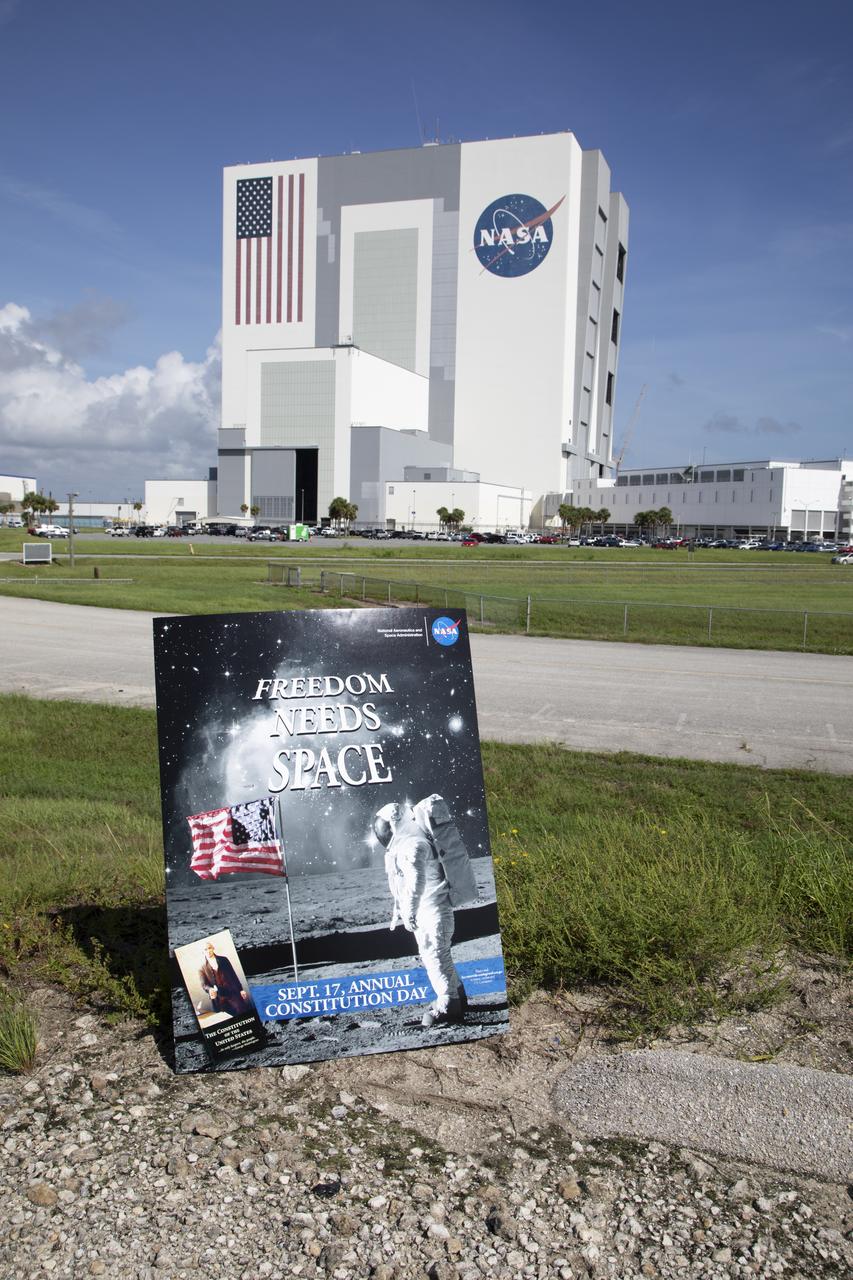
NASA's Kennedy Space Center in Florida observes U.S. Constitution Day, the official birthday of our U.S. government, with the theme "Freedom Needs Space." A remembrance poster made appearances in various locations around the multi-user spaceport, including near the iconic Vehicle Assembly Building. Constitution Day is an American federal observance. It recognizes the adoption of the U.S. Constitution and those who have become U.S. citizens. Constitution Day is observed on Sept. 17, the day in 1787 that delegates to the Constitutional Convention signed the document in Philadelphia.
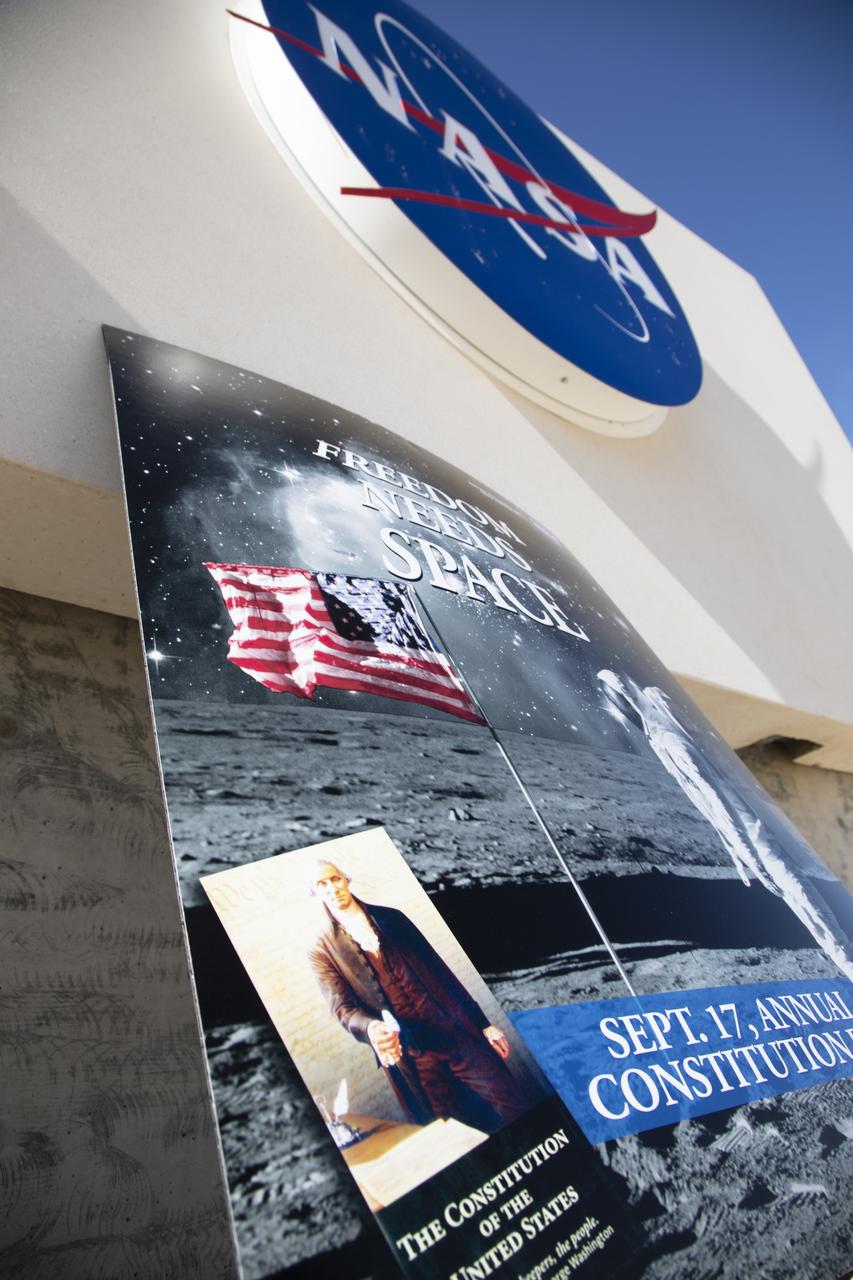
NASA's Kennedy Space Center in Florida observes U.S. Constitution Day, the official birthday of our U.S. government, with the theme "Freedom Needs Space." A remembrance poster made appearances in various locations around the multi-user spaceport, including at the new Headquarters Campus building. Constitution Day is an American federal observance. It recognizes the adoption of the U.S. Constitution and those who have become U.S. citizens. Constitution Day is observed on Sept. 17, the day in 1787 that delegates to the Constitutional Convention signed the document in Philadelphia.
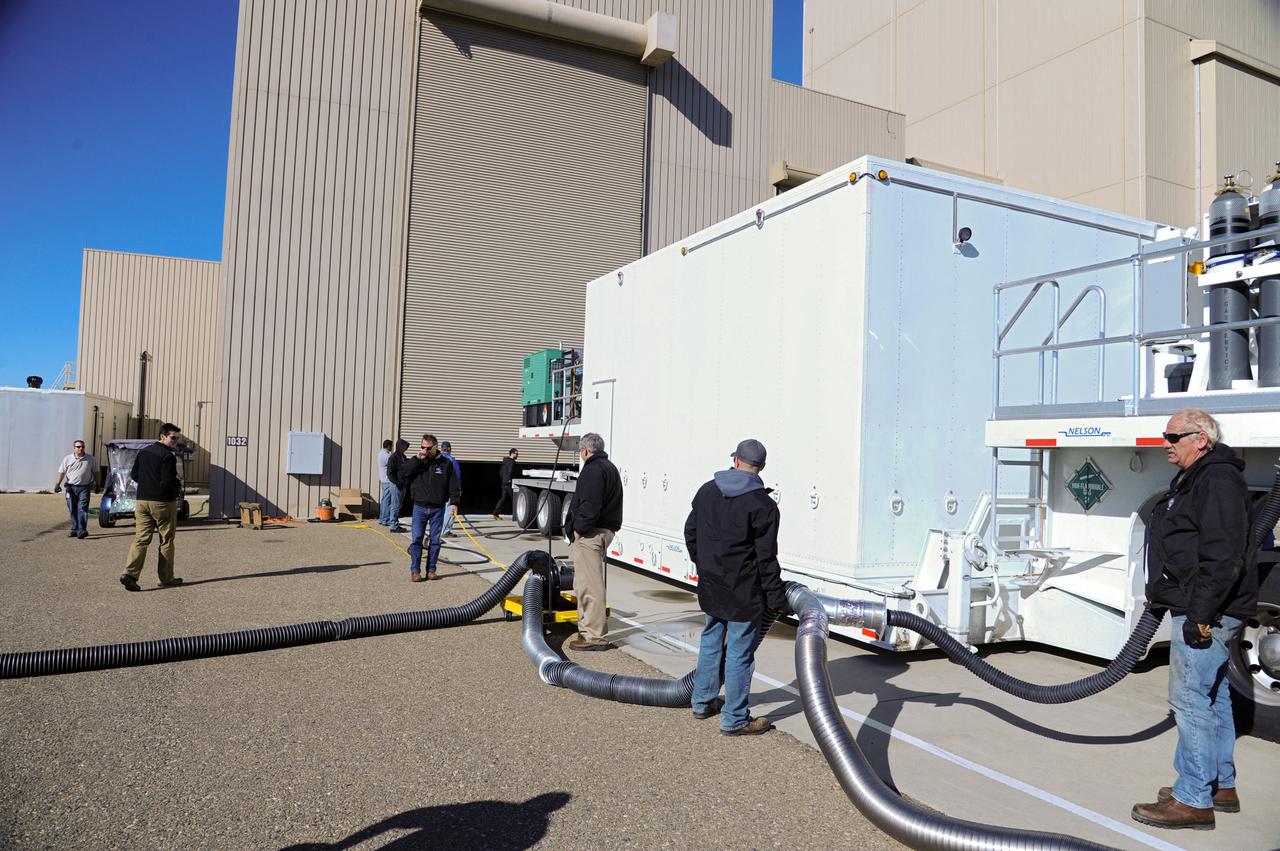
VANDENBERG AFB, Calif.-- Technicians check out the transport truck used to deliver NASA's Landsat Data Continuity Mission, or LDCM, satellite to Vandenberg Air Force Base, Calif. for prelaunch processing. The Landsat Data Continuity Mission LDCM is the future of Landsat satellites. It will continue to obtain valuable data and imagery to be used in agriculture, education, business, science, and government. The Landsat Program provides repetitive acquisition of high resolution multispectral data of the Earth's surface on a global basis. The data from the Landsat spacecraft constitute the longest record of the Earth's continental surfaces as seen from space. It is a record unmatched in quality, detail, coverage, and value. Launch is planned for Feb. 11, 2013. For more information, visit: http://www.nasa.gov/mission_pages/landsat/main/index.html Photo credit: NASA
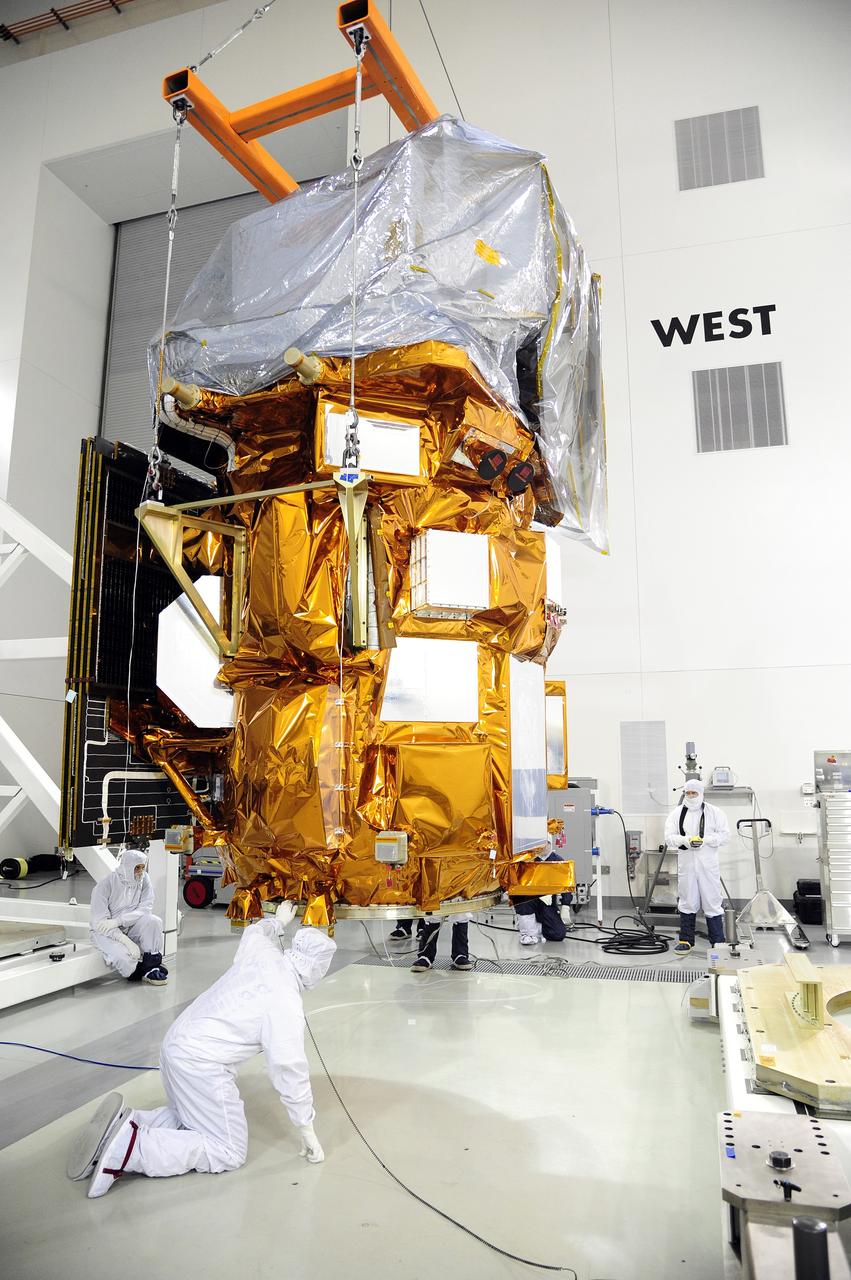
VANDENBERG AFB, Calif.-- Technicians use a crane to move NASA's Landsat Data Continuity Mission, or LDCM, satellite at the Astrotech processing facility at Vandenberg Air Force Base, Calif. The Landsat Data Continuity Mission LDCM is the future of Landsat satellites. It will continue to obtain valuable data and imagery to be used in agriculture, education, business, science, and government. The Landsat Program provides repetitive acquisition of high resolution multispectral data of the Earth's surface on a global basis. The data from the Landsat spacecraft constitute the longest record of the Earth's continental surfaces as seen from space. It is a record unmatched in quality, detail, coverage, and value. Launch is planned for Feb. 11, 2013. For more information, visit: http://www.nasa.gov/mission_pages/landsat/main/index.html Photo credit: NASA

VANDENBERG AFB, Calif.-- Technicians use a crane to move NASA's Landsat Data Continuity Mission, or LDCM, satellite at the Astrotech processing facility at Vandenberg Air Force Base, Calif. The Landsat Data Continuity Mission LDCM is the future of Landsat satellites. It will continue to obtain valuable data and imagery to be used in agriculture, education, business, science, and government. The Landsat Program provides repetitive acquisition of high resolution multispectral data of the Earth's surface on a global basis. The data from the Landsat spacecraft constitute the longest record of the Earth's continental surfaces as seen from space. It is a record unmatched in quality, detail, coverage, and value. Launch is planned for Feb. 11, 2013. For more information, visit: http://www.nasa.gov/mission_pages/landsat/main/index.html Photo credit: NASA
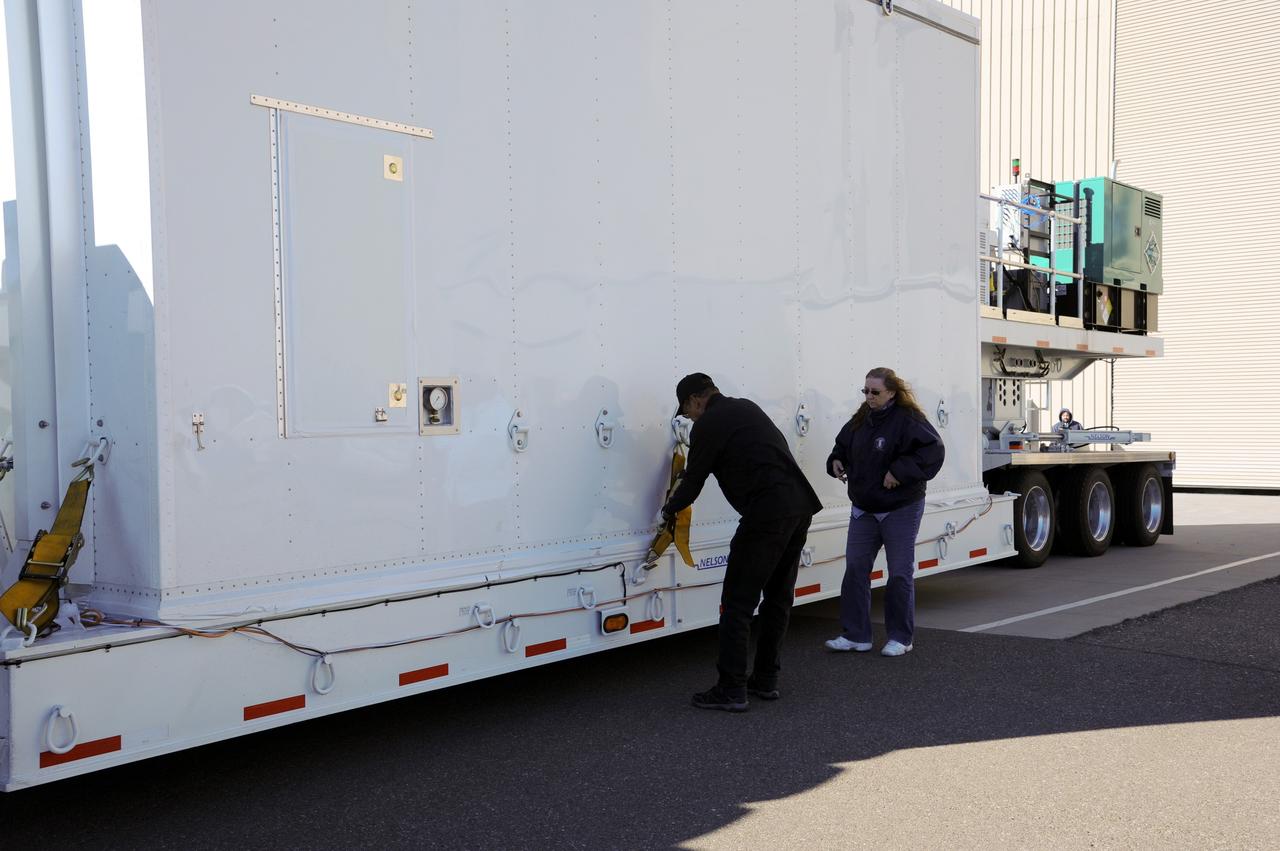
VANDENBERG AFB, Calif.-- Technicians check out the transport truck used to deliver NASA's Landsat Data Continuity Mission, or LDCM, satellite to Vandenberg Air Force Base, Calif. for prelaunch processing. The Landsat Data Continuity Mission LDCM is the future of Landsat satellites. It will continue to obtain valuable data and imagery to be used in agriculture, education, business, science, and government. The Landsat Program provides repetitive acquisition of high resolution multispectral data of the Earth's surface on a global basis. The data from the Landsat spacecraft constitute the longest record of the Earth's continental surfaces as seen from space. It is a record unmatched in quality, detail, coverage, and value. Launch is planned for Feb. 11, 2013. For more information, visit: http://www.nasa.gov/mission_pages/landsat/main/index.html Photo credit: NASA
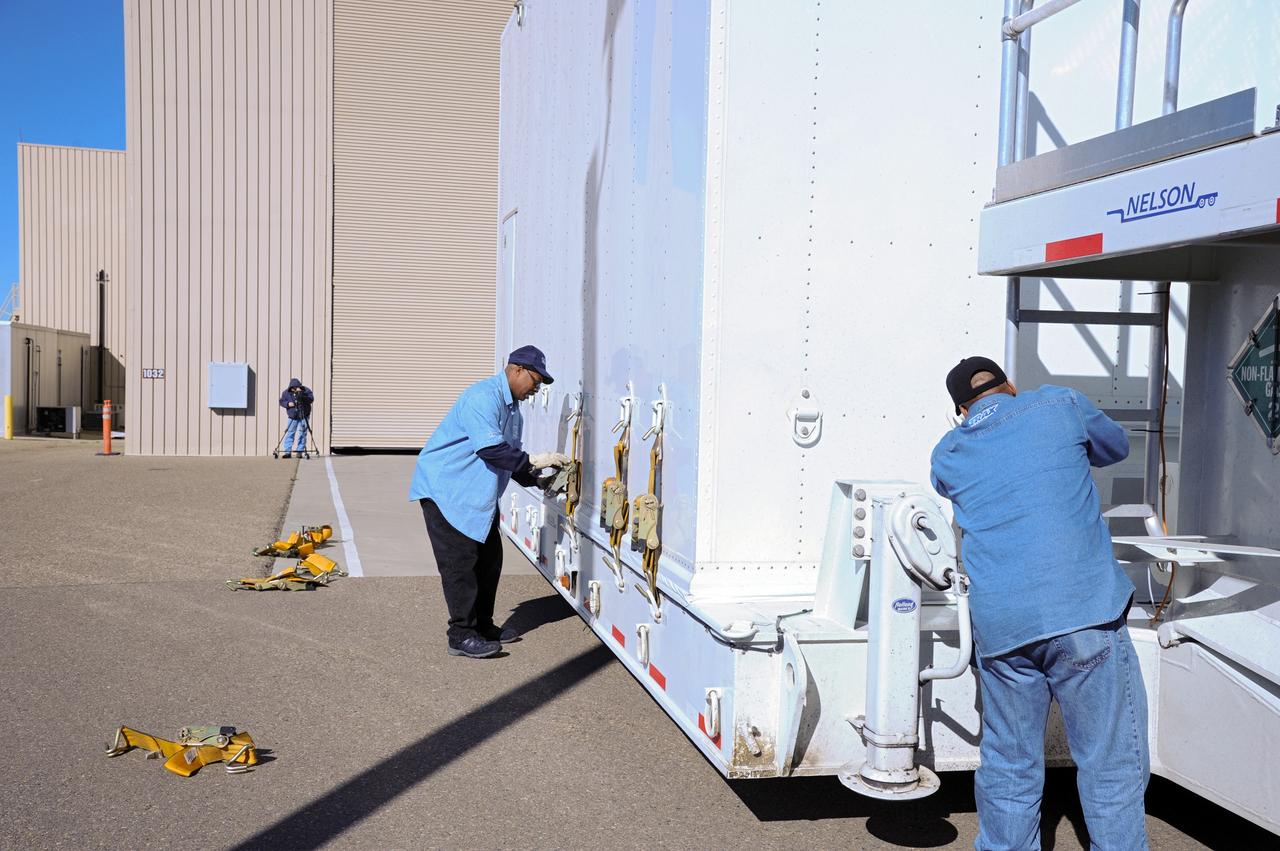
VANDENBERG AFB, Calif.-- Technicians check out the transport truck used to deliver NASA's Landsat Data Continuity Mission, or LDCM, satellite to Vandenberg Air Force Base, Calif. for prelaunch processing. The Landsat Data Continuity Mission LDCM is the future of Landsat satellites. It will continue to obtain valuable data and imagery to be used in agriculture, education, business, science, and government. The Landsat Program provides repetitive acquisition of high resolution multispectral data of the Earth's surface on a global basis. The data from the Landsat spacecraft constitute the longest record of the Earth's continental surfaces as seen from space. It is a record unmatched in quality, detail, coverage, and value. Launch is planned for Feb. 11, 2013. For more information, visit: http://www.nasa.gov/mission_pages/landsat/main/index.html Photo credit: NASA
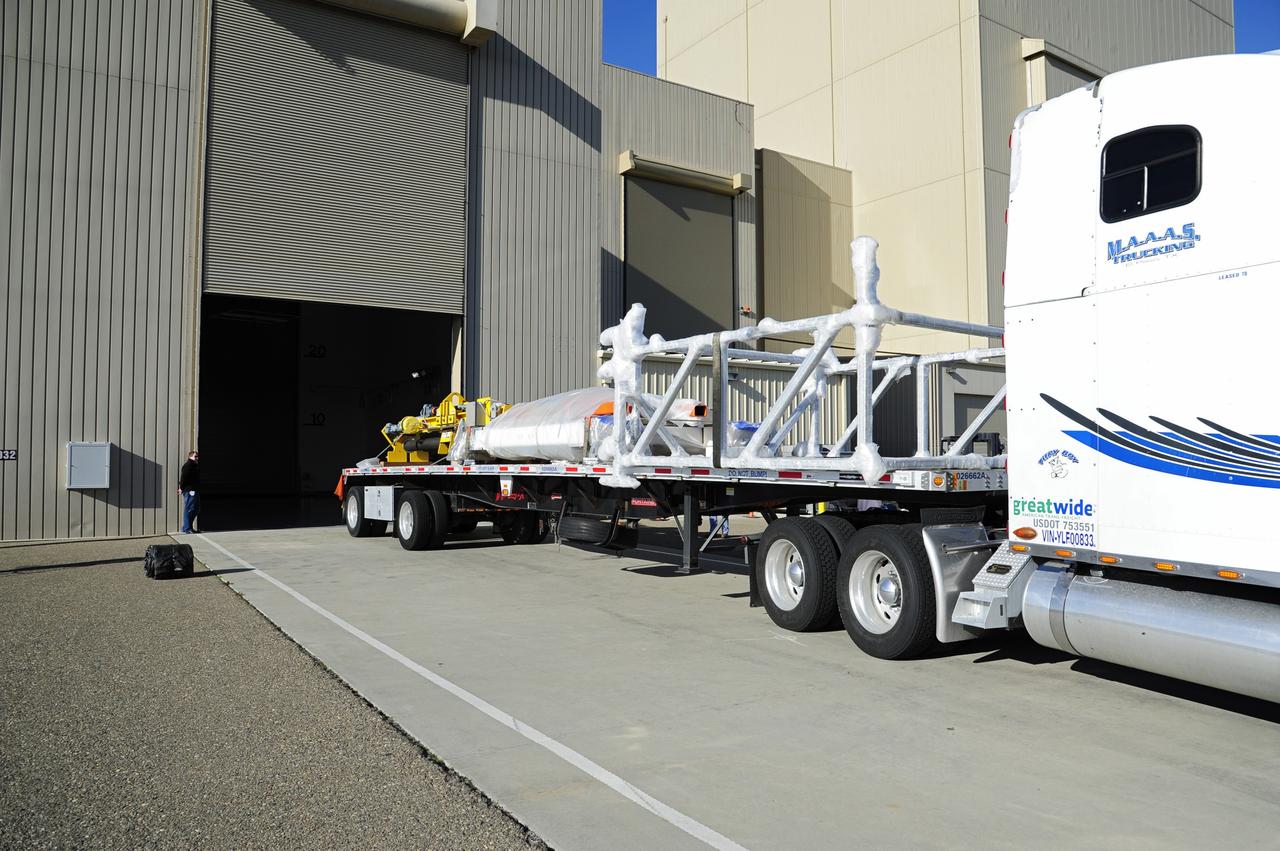
VANDENBERG AFB, Calif.-- Mechanical ground support equipment to be used in support of NASA's Landsat Data Continuity Mission, or LDCM, satellite arrives by transport truck at Vandenberg Air Force Base, Calif. The Landsat Data Continuity Mission LDCM is the future of Landsat satellites. It will continue to obtain valuable data and imagery to be used in agriculture, education, business, science, and government. The Landsat Program provides repetitive acquisition of high resolution multispectral data of the Earth's surface on a global basis. The data from the Landsat spacecraft constitute the longest record of the Earth's continental surfaces as seen from space. It is a record unmatched in quality, detail, coverage, and value. Launch is planned for Feb. 11, 2013. For more information, visit: http://www.nasa.gov/mission_pages/landsat/main/index.html Photo credit: NASA
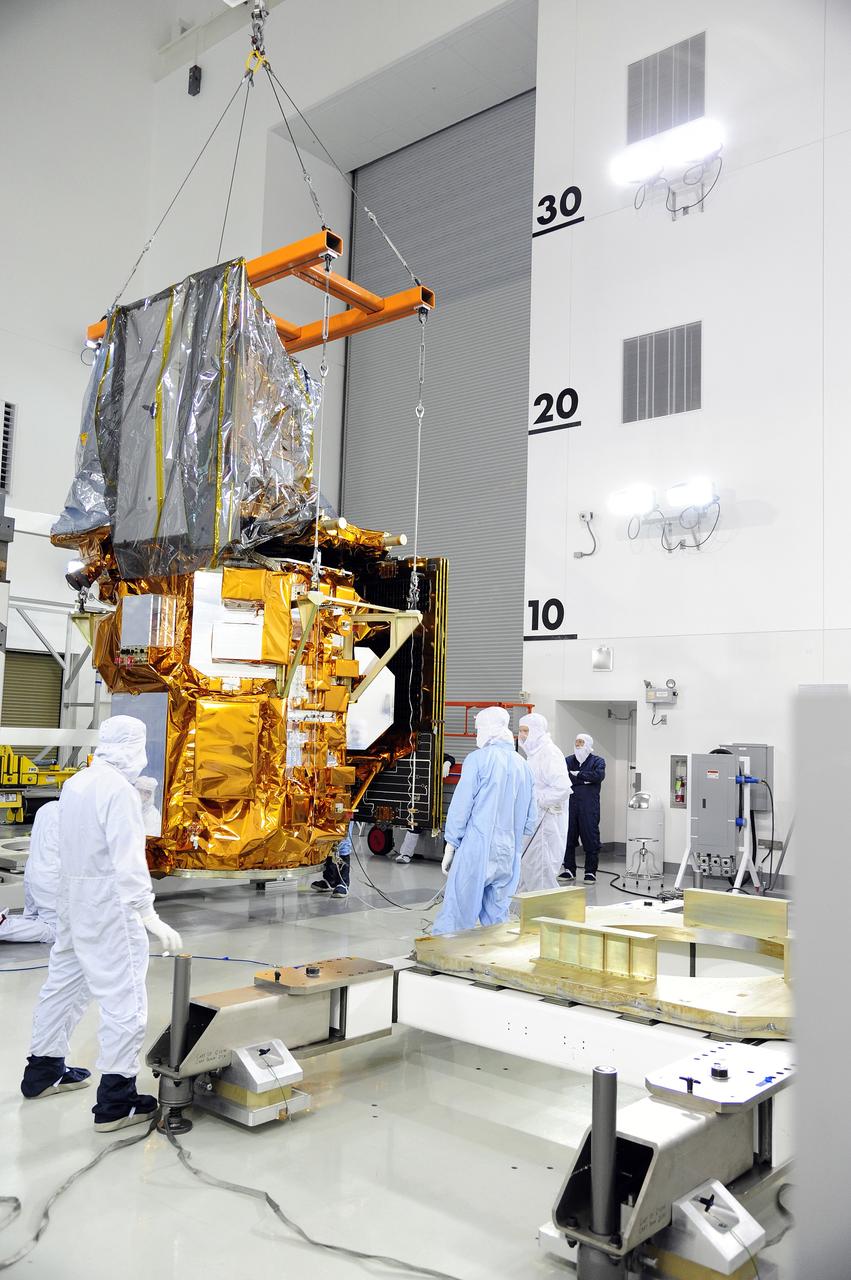
VANDENBERG AFB, Calif.-- Technicians use a crane to move NASA's Landsat Data Continuity Mission, or LDCM, satellite at the Astrotech processing facility at Vandenberg Air Force Base, Calif. The Landsat Data Continuity Mission LDCM is the future of Landsat satellites. It will continue to obtain valuable data and imagery to be used in agriculture, education, business, science, and government. The Landsat Program provides repetitive acquisition of high resolution multispectral data of the Earth's surface on a global basis. The data from the Landsat spacecraft constitute the longest record of the Earth's continental surfaces as seen from space. It is a record unmatched in quality, detail, coverage, and value. Launch is planned for Feb. 11, 2013. For more information, visit: http://www.nasa.gov/mission_pages/landsat/main/index.html Photo credit: NASA
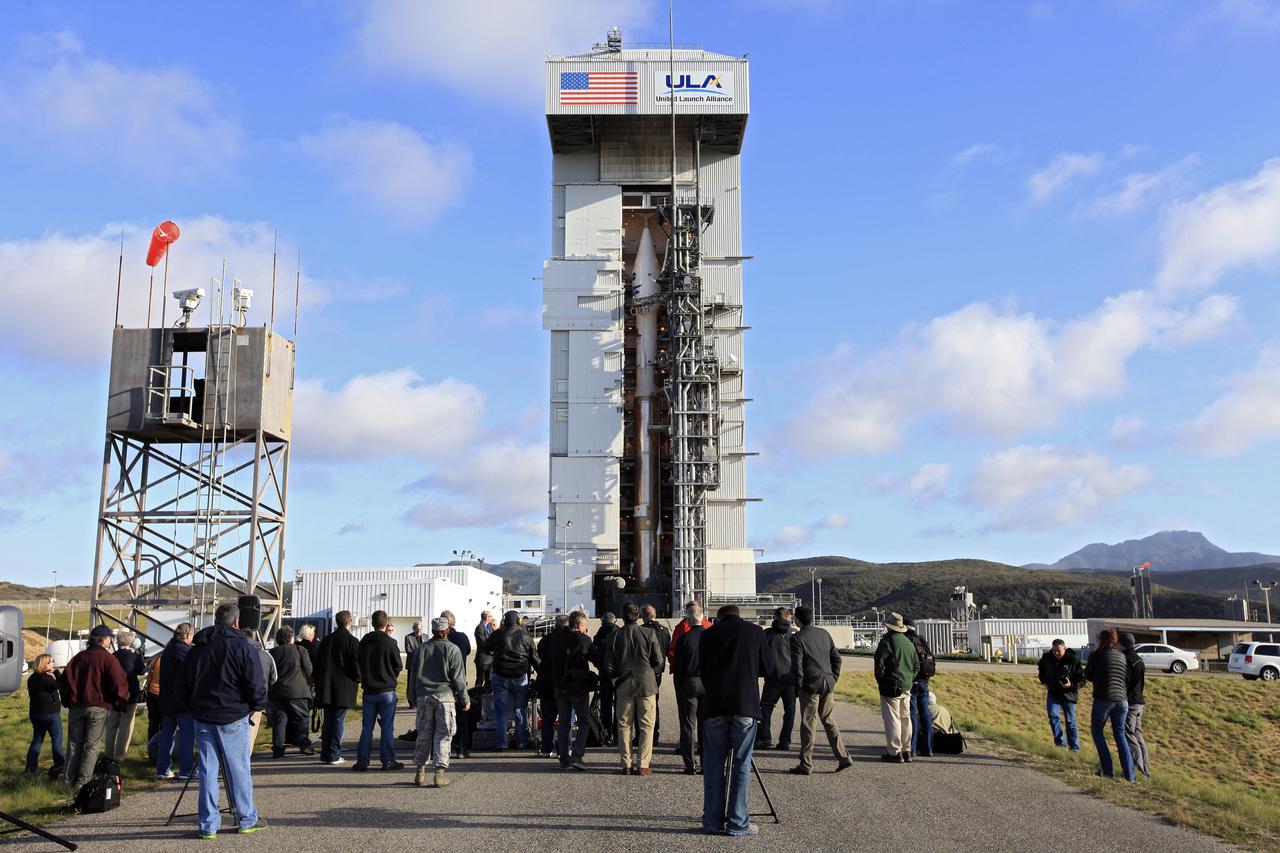
VANDENBERG AFB, Calif. -- At Vandenberg Air Force Base, Calif., NASA social media followers are briefed on the agency's Landsat Data Continuity Mission, or LDCM, satellite mission. In the background, the satellite is mounted atop a United Launch Alliance Atlas V rocket in the gantry at Space Launch Complex 3E. The Landsat Data Continuity Mission LDCM is the future of Landsat satellites. It will continue to obtain valuable data and imagery to be used in agriculture, education, business, science, and government. The Landsat Program provides repetitive acquisition of high resolution multispectral data of the Earth's surface on a global basis. The data from the Landsat spacecraft constitute the longest record of the Earth's continental surfaces as seen from space. It is a record unmatched in quality, detail, coverage, and value. Liftoff is planned for Feb. 11, 2013 aboard a United Launch Alliance Atlas V rocket. For more information, visit: http:__www.nasa.gov_mission_pages_landsat_main_index.html Photo credit: NASA_Kim Shiflett
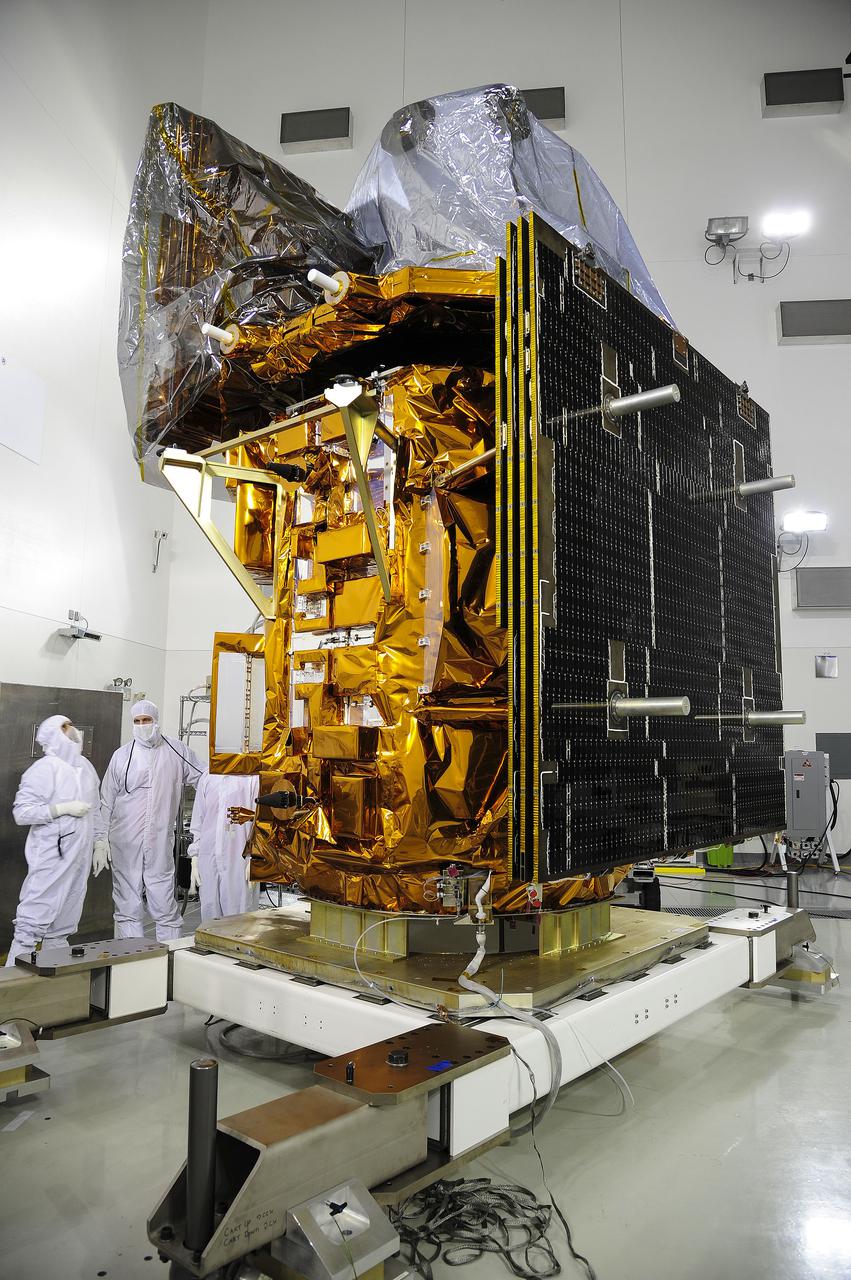
VANDENBERG AFB, Calif. -- At the Astrotech processing facility at Vandenberg Air Force Base, Calif., technicians perform close-outs on NASA's Landsat Data Continuity Mission, or LDCM, satellite. The Landsat Data Continuity Mission LDCM is the future of Landsat satellites. It will continue to obtain valuable data and imagery to be used in agriculture, education, business, science, and government. The Landsat Program provides repetitive acquisition of high resolution multispectral data of the Earth's surface on a global basis. The data from the Landsat spacecraft constitute the longest record of the Earth's continental surfaces as seen from space. It is a record unmatched in quality, detail, coverage, and value. Liftoff is planned for Feb. 11, 2013 aboard a United Launch Alliance Atlas V rocket. For more information, visit: http:__www.nasa.gov_mission_pages_landsat_main_index.html Photo credit: NASA
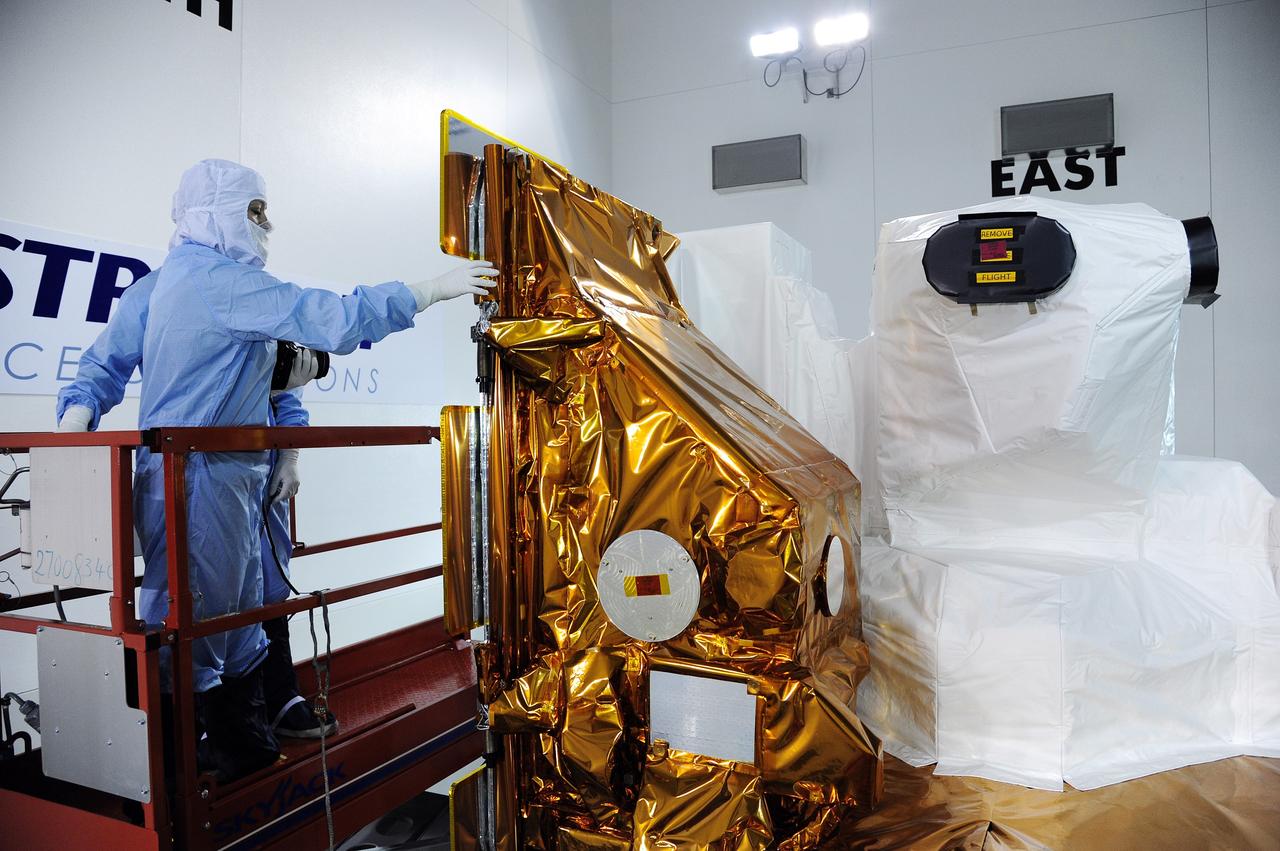
VANDENBERG AFB, Calif. -- Technicians inspect NASA's Landsat Data Continuity Mission, or LDCM, satellite at the Astrotech processing facility at Vandenberg Air Force Base, Calif. The Landsat Data Continuity Mission LDCM is the future of Landsat satellites. It will continue to obtain valuable data and imagery to be used in agriculture, education, business, science, and government. The Landsat Program provides repetitive acquisition of high resolution multispectral data of the Earth's surface on a global basis. The data from the Landsat spacecraft constitute the longest record of the Earth's continental surfaces as seen from space. It is a record unmatched in quality, detail, coverage, and value. Launch is planned for Feb. 11, 2013. For more information, visit: http://www.nasa.gov/mission_pages/landsat/main/index.html Photo credit: NASA
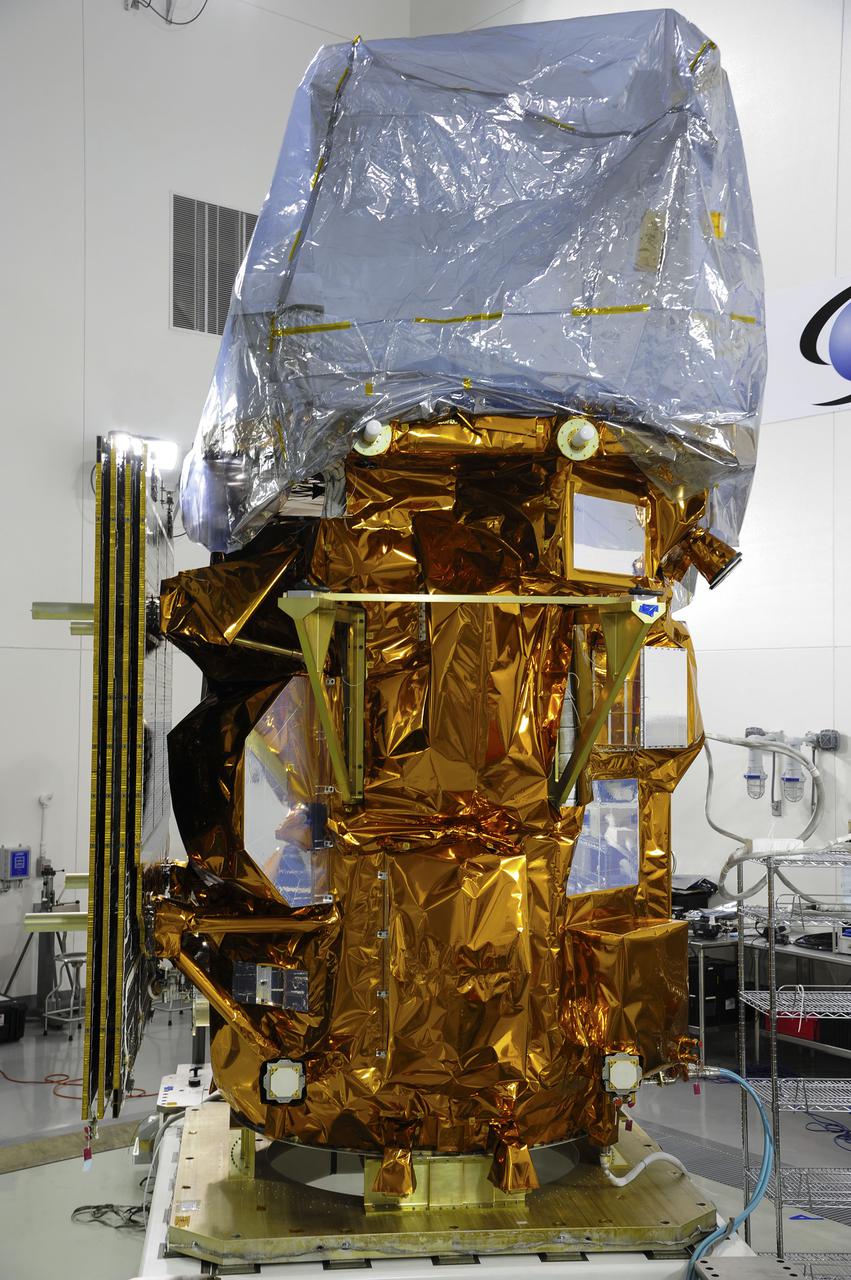
VANDENBERG AFB, Calif. -- At the Astrotech processing facility at Vandenberg Air Force Base, Calif., NASA's Landsat Data Continuity Mission, or LDCM, satellite is undergoing close-outs prior to encapsulation in the payload fairing. The Landsat Data Continuity Mission LDCM is the future of Landsat satellites. It will continue to obtain valuable data and imagery to be used in agriculture, education, business, science, and government. The Landsat Program provides repetitive acquisition of high resolution multispectral data of the Earth's surface on a global basis. The data from the Landsat spacecraft constitute the longest record of the Earth's continental surfaces as seen from space. It is a record unmatched in quality, detail, coverage, and value. Liftoff is planned for Feb. 11, 2013 aboard a United Launch Alliance Atlas V rocket. For more information, visit: http:__www.nasa.gov_mission_pages_landsat_main_index.html Photo credit: NASA

VANDENBERG AIR FORCE BASE, Calif. -- Media attending a post-launch news conference at Vandenberg Air Force Base, Calif. heard from Michael Freilich, director of the Earth Science Division, Science Mission Directorate at Headquarters. The Landsat Data Continuity Mission LDCM is the future of Landsat satellites. It will continue to obtain valuable data and imagery to be used in agriculture, education, business, science, and government. The Landsat Program provides repetitive acquisition of high resolution multispectral data of the Earth's surface on a global basis. The data from the Landsat spacecraft constitute the longest record of the Earth's continental surfaces as seen from space. It is a record unmatched in quality, detail, coverage, and value. Liftoff took place at 10:02 a.m. PST 1:02 P.M. EST) on Feb. 11, 2013 aboard a United Launch Alliance Atlas V rocket. For more information, visit: http:__www.nasa.gov_mission_pages_landsat_main_index.html Photo credit: NASA_Kim Shiflett

VANDENBERG AIR FORCE BASE, Calif. -- Media attending a post-launch news conference at Vandenberg Air Force Base, Calif. heard from Anne Castle, assistant secretary for Water and Science, U.S. Department of the Interior. The Landsat Data Continuity Mission LDCM is the future of Landsat satellites. It will continue to obtain valuable data and imagery to be used in agriculture, education, business, science, and government. The Landsat Program provides repetitive acquisition of high resolution multispectral data of the Earth's surface on a global basis. The data from the Landsat spacecraft constitute the longest record of the Earth's continental surfaces as seen from space. It is a record unmatched in quality, detail, coverage, and value. Liftoff took place at 10:02 a.m. PST 1:02 P.M. EST) on Feb. 11, 2013 aboard a United Launch Alliance Atlas V rocket. For more information, visit: http:__www.nasa.gov_mission_pages_landsat_main_index.html Photo credit: NASA_Kim Shiflett
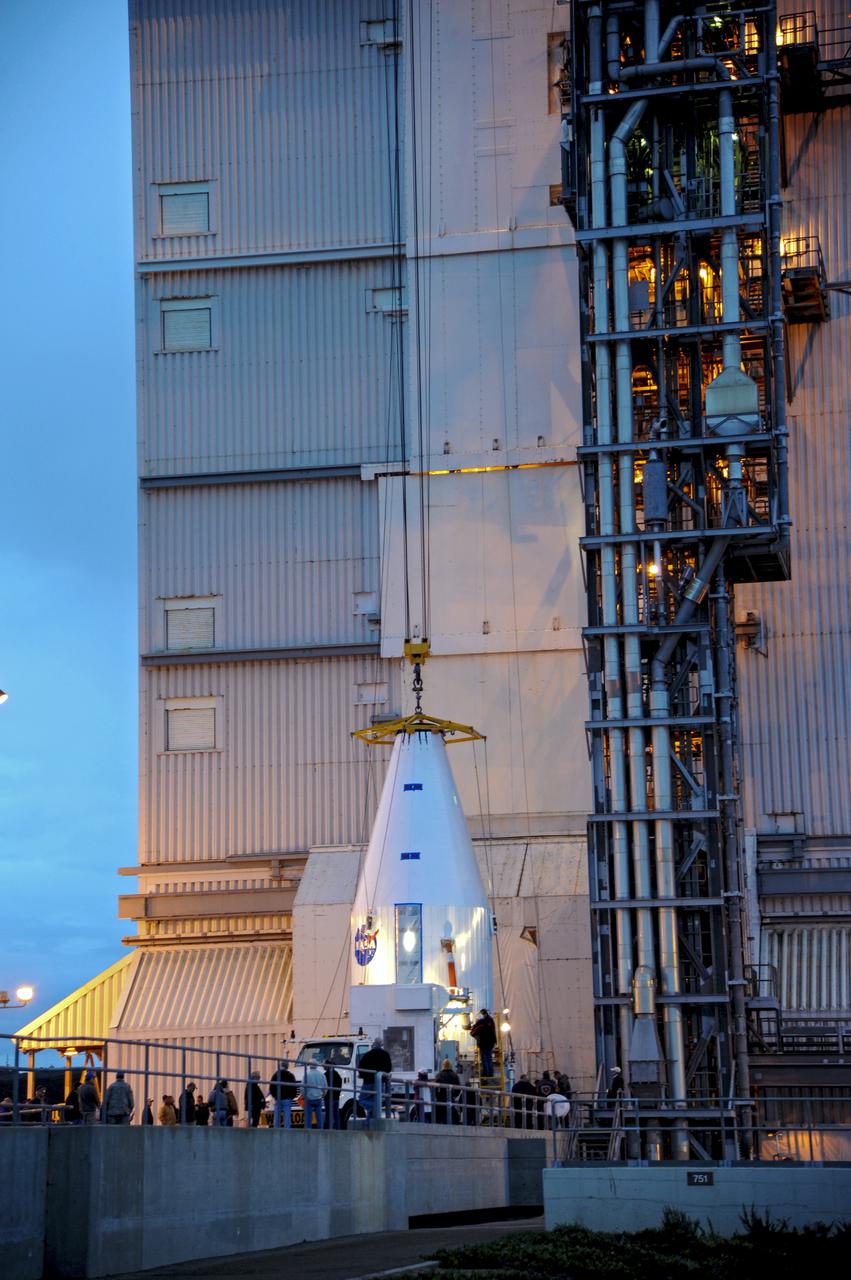
VANDENBERG AFB, Calif. -- The payload fairing containing the Landsat Data Continuity Mission, or LDCM, spacecraft is about to be hoisted atop a United Launch Alliance Atlas V rocket at Space Launch Complex-3E at Vandenberg Air Force Base, Calif. The Landsat Data Continuity Mission LDCM is the future of Landsat satellites. It will continue to obtain valuable data and imagery to be used in agriculture, education, business, science, and government. The Landsat Program provides repetitive acquisition of high resolution multispectral data of the Earth's surface on a global basis. The data from the Landsat spacecraft constitute the longest record of the Earth's continental surfaces as seen from space. It is a record unmatched in quality, detail, coverage, and value. Liftoff is planned for Feb. 11, 2013 aboard a United Launch Alliance Atlas V rocket. For more information, visit: http:__www.nasa.gov_mission_pages_landsat_main_index.html Photo credit: NASA
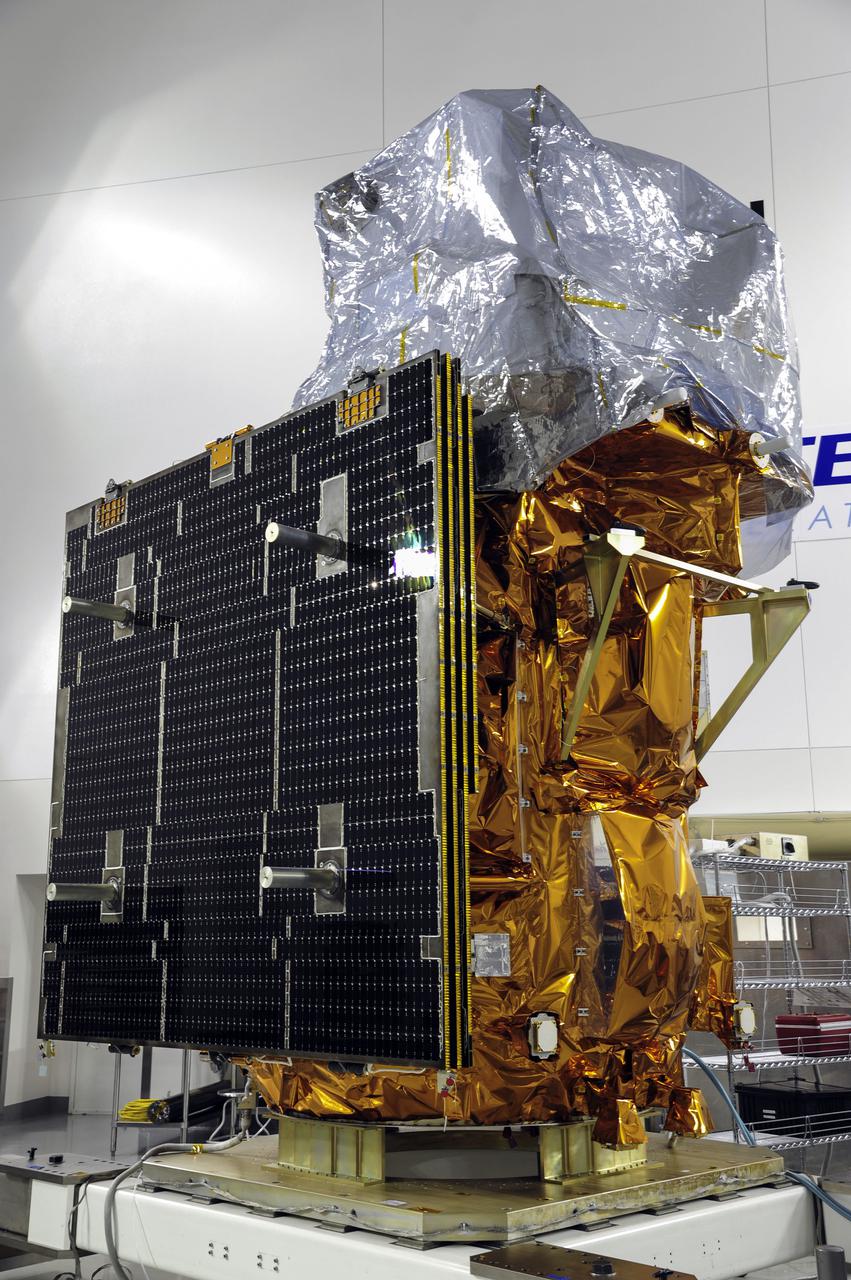
VANDENBERG AFB, Calif. -- At the Astrotech processing facility at Vandenberg Air Force Base, Calif., NASA's Landsat Data Continuity Mission, or LDCM, satellite is undergoing close-outs prior to encapsulation in the payload fairing. The Landsat Data Continuity Mission LDCM is the future of Landsat satellites. It will continue to obtain valuable data and imagery to be used in agriculture, education, business, science, and government. The Landsat Program provides repetitive acquisition of high resolution multispectral data of the Earth's surface on a global basis. The data from the Landsat spacecraft constitute the longest record of the Earth's continental surfaces as seen from space. It is a record unmatched in quality, detail, coverage, and value. Liftoff is planned for Feb. 11, 2013 aboard a United Launch Alliance Atlas V rocket. For more information, visit: http:__www.nasa.gov_mission_pages_landsat_main_index.html Photo credit: NASA
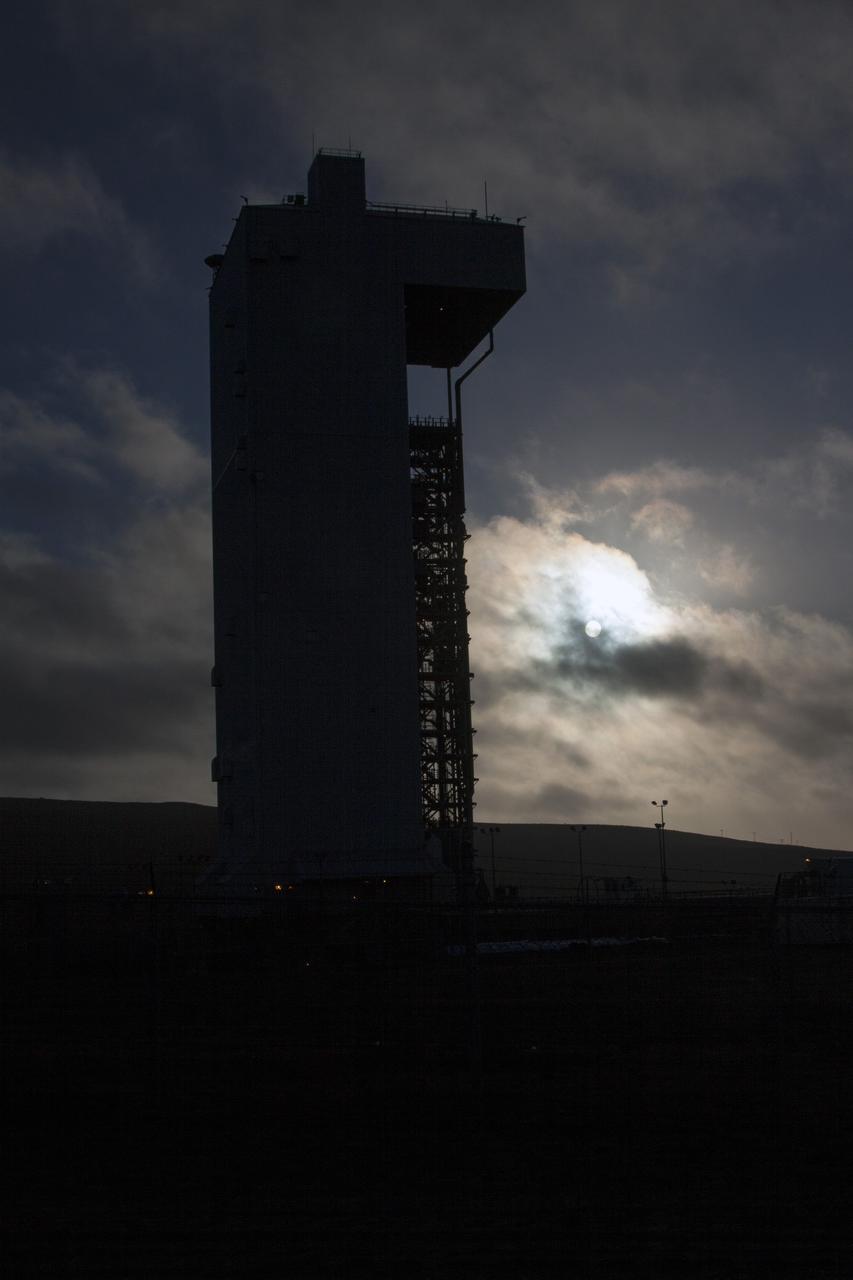
VANDENBERG AFB, Calif. -- The sun sets in the west behind Space Launch Complex 3 at Vandenberg Air Force Base where preparations continue for the launch of the Landsat Data Continuity Mission, or LDCM, satellite atop an Atlas V rocket. The Landsat Data Continuity Mission LDCM is the future of Landsat satellites. It will continue to obtain valuable data and imagery to be used in agriculture, education, business, science, and government. The Landsat Program provides repetitive acquisition of high resolution multispectral data of the Earth's surface on a global basis. The data from the Landsat spacecraft constitute the longest record of the Earth's continental surfaces as seen from space. It is a record unmatched in quality, detail, coverage, and value. Liftoff is planned for Feb. 11, 2013 aboard a United Launch Alliance Atlas V rocket. For more information, visit: http:__www.nasa.gov_mission_pages_landsat_main_index.html Photo credit: NASA_ Ben Smegelsky
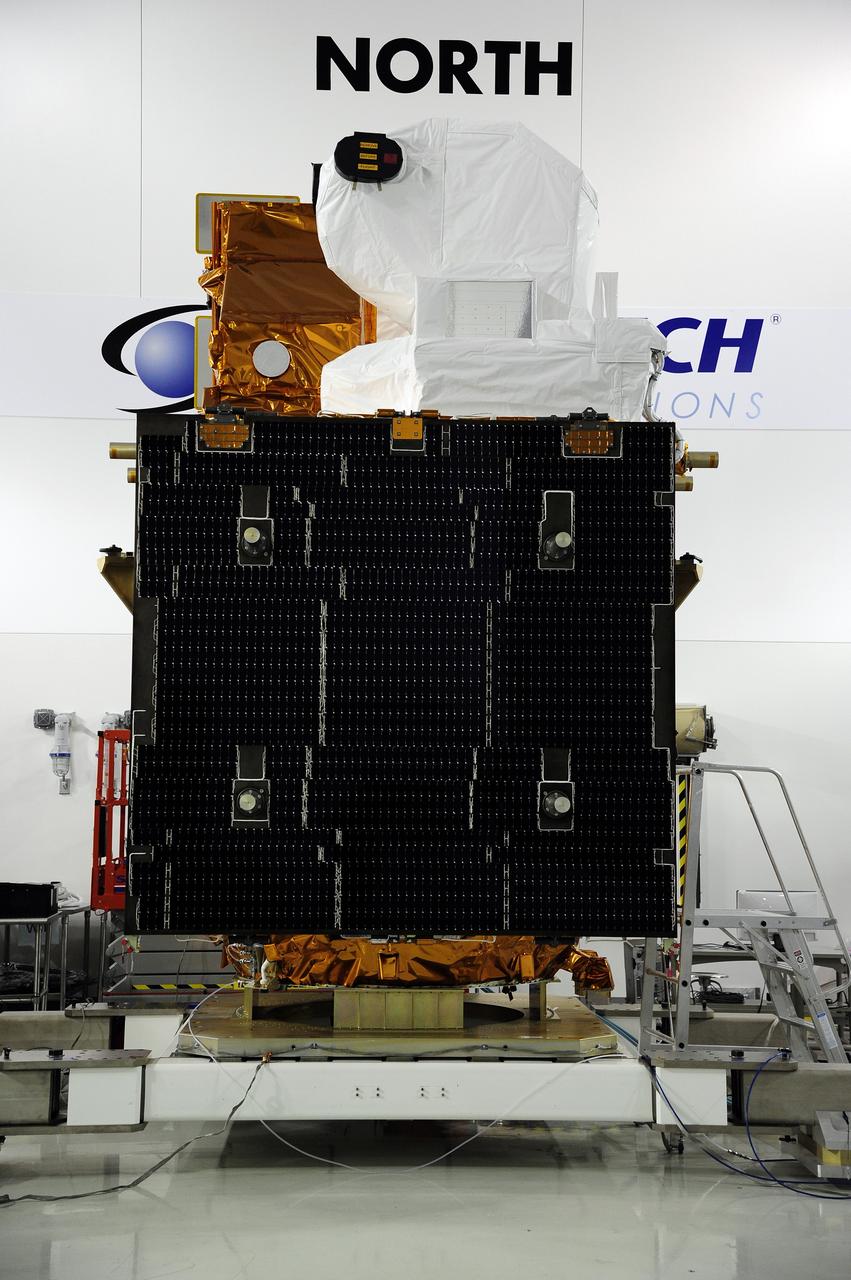
VANDENBERG AFB, Calif. -- NASA's Landsat Data Continuity Mission, or LDCM, satellite during post-arrival inspections at the Astrotech processing facility at Vandenberg Air Force Base, Calif. The Landsat Data Continuity Mission LDCM is the future of Landsat satellites. It will continue to obtain valuable data and imagery to be used in agriculture, education, business, science, and government. The Landsat Program provides repetitive acquisition of high resolution multispectral data of the Earth's surface on a global basis. The data from the Landsat spacecraft constitute the longest record of the Earth's continental surfaces as seen from space. It is a record unmatched in quality, detail, coverage, and value. Launch is planned for Feb. 11, 2013. For more information, visit: http://www.nasa.gov/mission_pages/landsat/main/index.html Photo credit: NASA
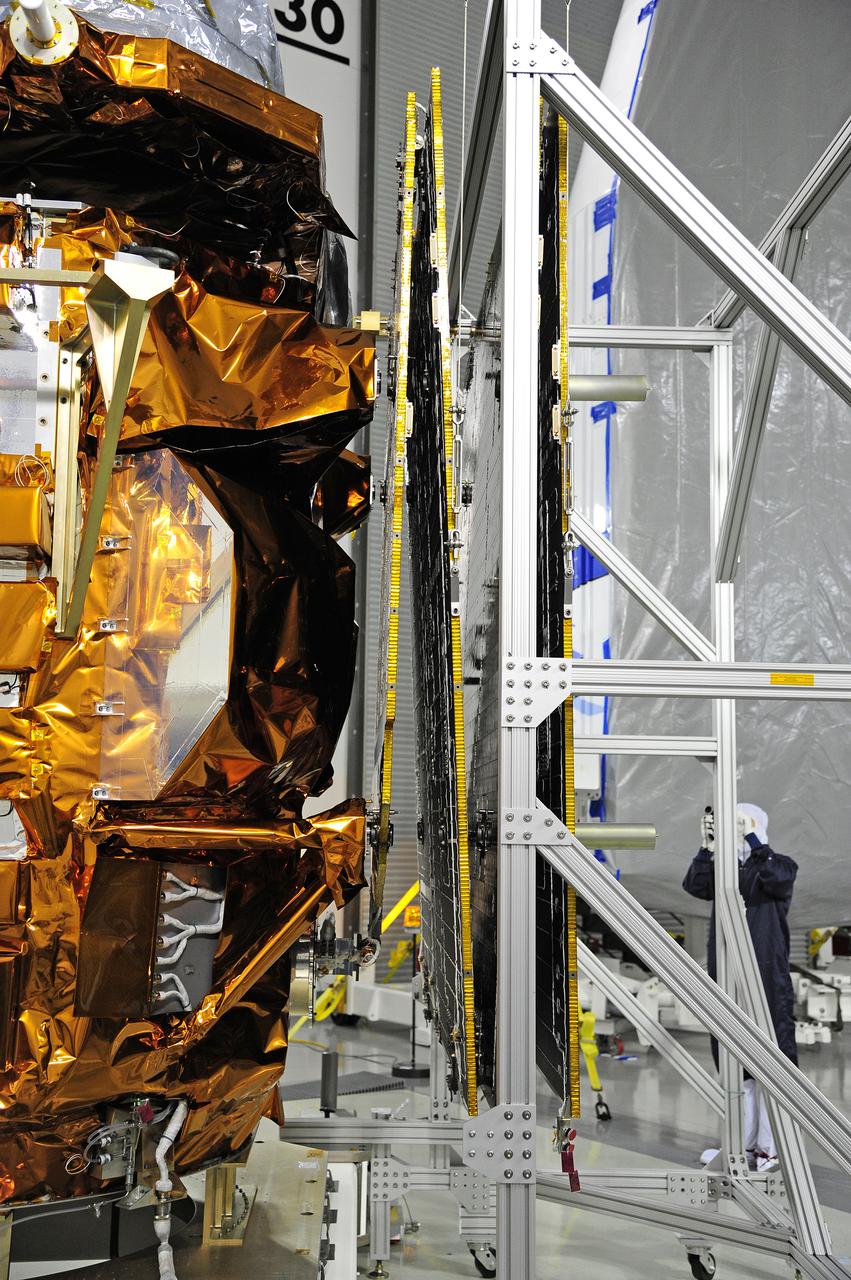
VANDENBERG AFB, Calif. -- In the Astrotech processing facility at Vandenberg Air Force Base, Calif., a technician photographs NASA's Landsat Data Continuity Mission, or LDCM, satellite after the solar arrays were attached and tested. The Landsat Data Continuity Mission LDCM is the future of Landsat satellites. It will continue to obtain valuable data and imagery to be used in agriculture, education, business, science, and government. The Landsat Program provides repetitive acquisition of high resolution multispectral data of the Earth's surface on a global basis. The data from the Landsat spacecraft constitute the longest record of the Earth's continental surfaces as seen from space. It is a record unmatched in quality, detail, coverage, and value. Liftoff is planned for Feb. 11, 2013 aboard a United Launch Alliance Atlas V rocket. For more information, visit: http:__www.nasa.gov_mission_pages_landsat_main_index.html Photo credit: NASA
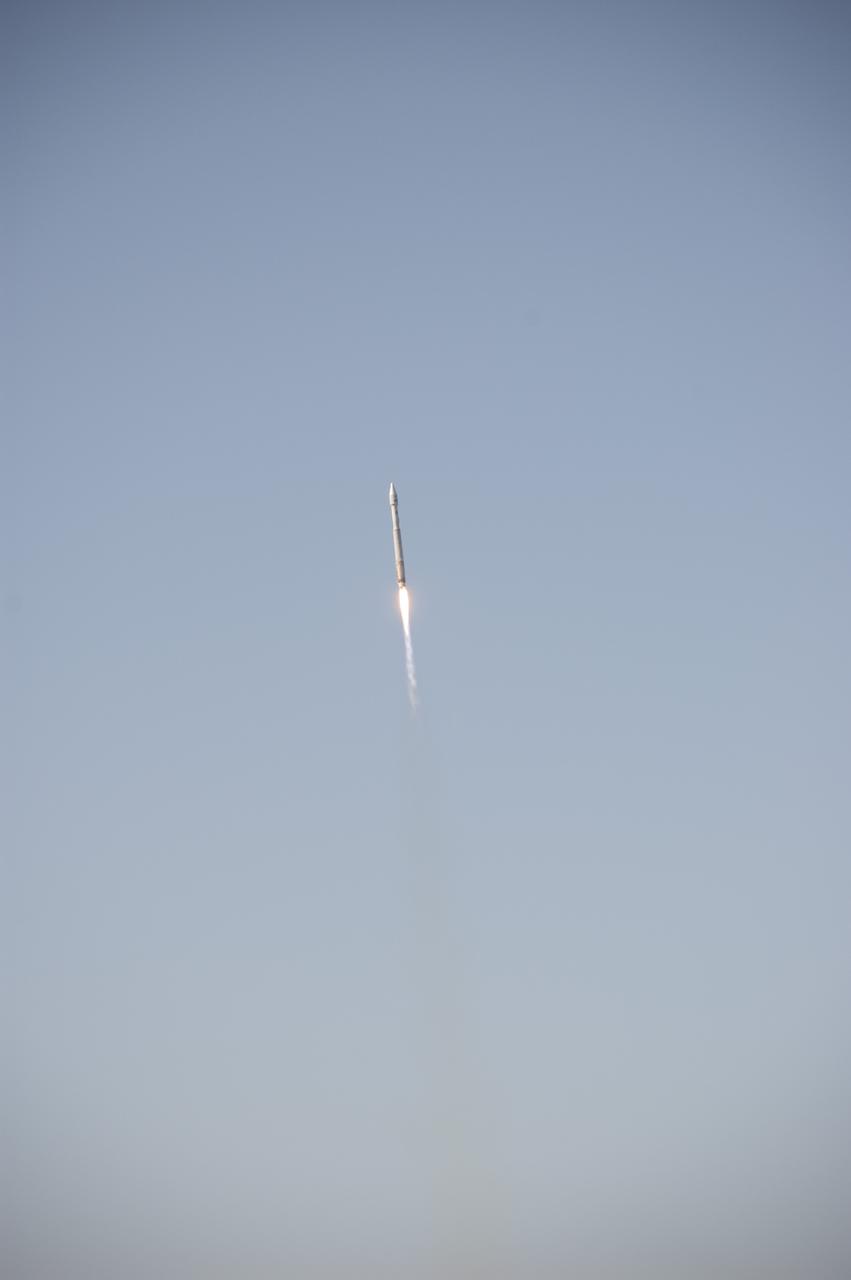
VANDENBERG AFB, Calif. -- The Landsat Data Continuity Mission spacecraft lifts off at 1:02 p.m. EST, 10:02 a.m. PST) atop a United Launch Alliance Atlas V rocket from Space Launch Complex 3 at California's Vandenberg Air Force Base. The Landsat Data Continuity Mission LDCM is the future of Landsat satellites. It will continue to obtain valuable data and imagery to be used in agriculture, education, business, science, and government. The Landsat Program provides repetitive acquisition of high resolution multispectral data of the Earth's surface on a global basis. The data from the Landsat spacecraft constitute the longest record of the Earth's continental surfaces as seen from space. It is a record unmatched in quality, detail, coverage, and value. For more information, visit: http:__www.nasa.gov_mission_pages_landsat_main_index.html Photo credit: NASA_Ben Smegelsky
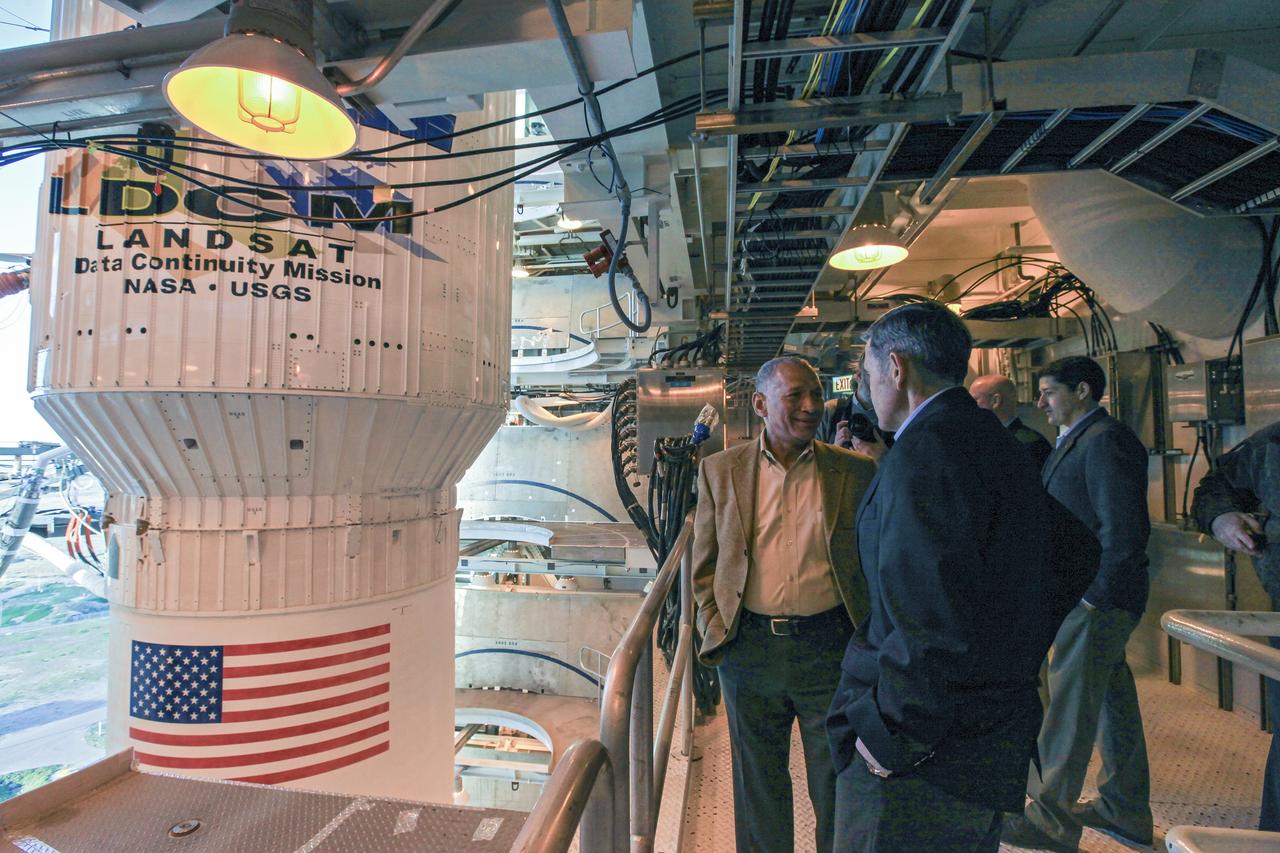
VANDENBERG AFB, Calif. -- At Space Launch Complex 3E at Vandenberg Air Force Base, Calif., NASA Administrator Charles Bolden, left, discusses Landsat Data Continuity Mission, or LDCM, satellite preparations with Kennedy Space Center Director Bob Cabana. The Landsat Data Continuity Mission LDCM is the future of Landsat satellites. It will continue to obtain valuable data and imagery to be used in agriculture, education, business, science, and government. The Landsat Program provides repetitive acquisition of high resolution multispectral data of the Earth's surface on a global basis. The data from the Landsat spacecraft constitute the longest record of the Earth's continental surfaces as seen from space. It is a record unmatched in quality, detail, coverage, and value. Liftoff is planned for Feb. 11, 2013 aboard a United Launch Alliance Atlas V rocket. For more information, visit: http://www.nasa.gov/mission_pages/landsat/main/index.html Photo credit: NASA/Kim Shiflett
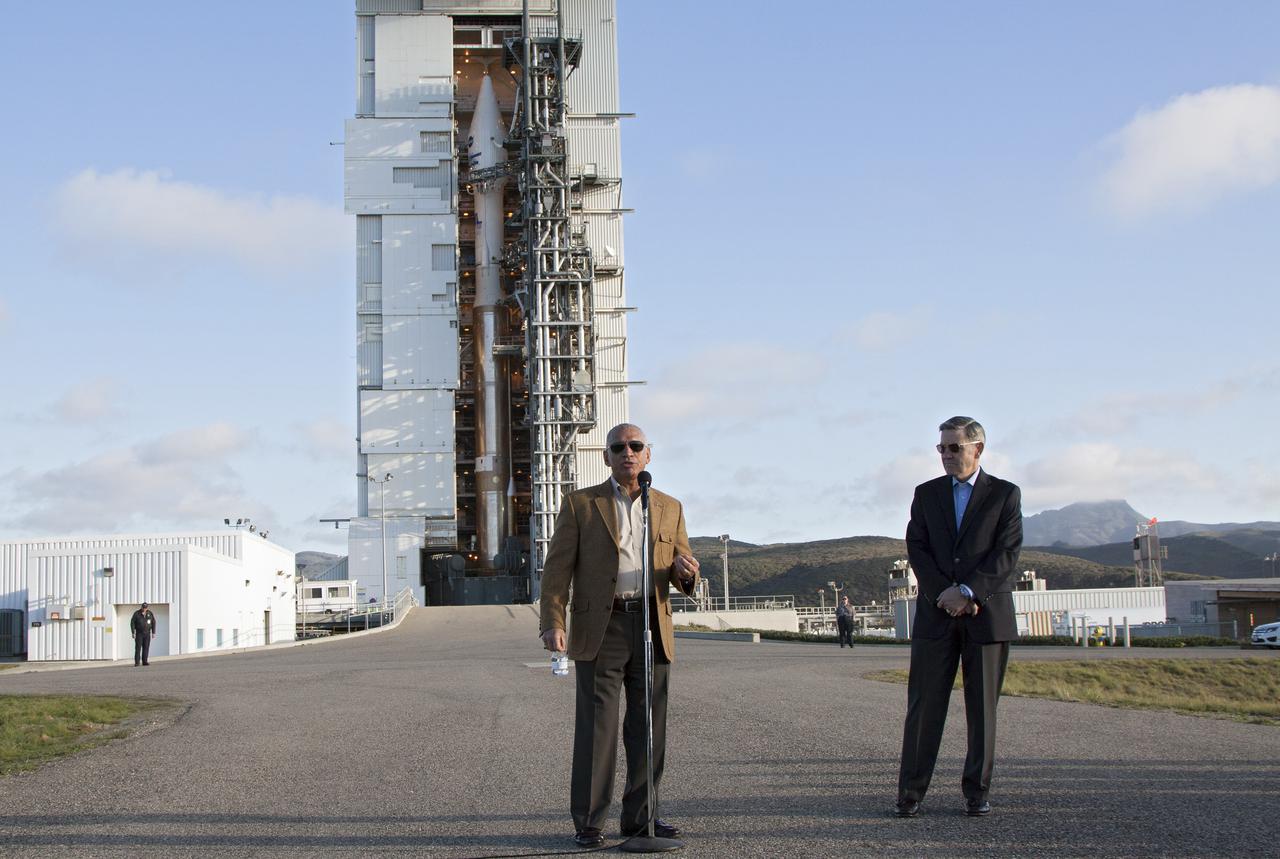
VANDENBERG AFB, Calif. -- At Space Launch Complex 3E at Vandenberg Air Force Base, NASA Administrator Charles Bolden discusses the Landsat Data Continuity Mission, or LDCM, satellite mission with NASA social media followers. Looking on, to the right, is Kennedy Space Center Director Bob Cabana. The Landsat Data Continuity Mission LDCM is the future of Landsat satellites. It will continue to obtain valuable data and imagery to be used in agriculture, education, business, science, and government. The Landsat Program provides repetitive acquisition of high resolution multispectral data of the Earth's surface on a global basis. The data from the Landsat spacecraft constitute the longest record of the Earth's continental surfaces as seen from space. It is a record unmatched in quality, detail, coverage, and value. Liftoff is planned for Feb. 11, 2013 aboard a United Launch Alliance Atlas V rocket. For more information, visit: http:__www.nasa.gov_mission_pages_landsat_main_index.html Photo credit: NASA_Kim Shiflett
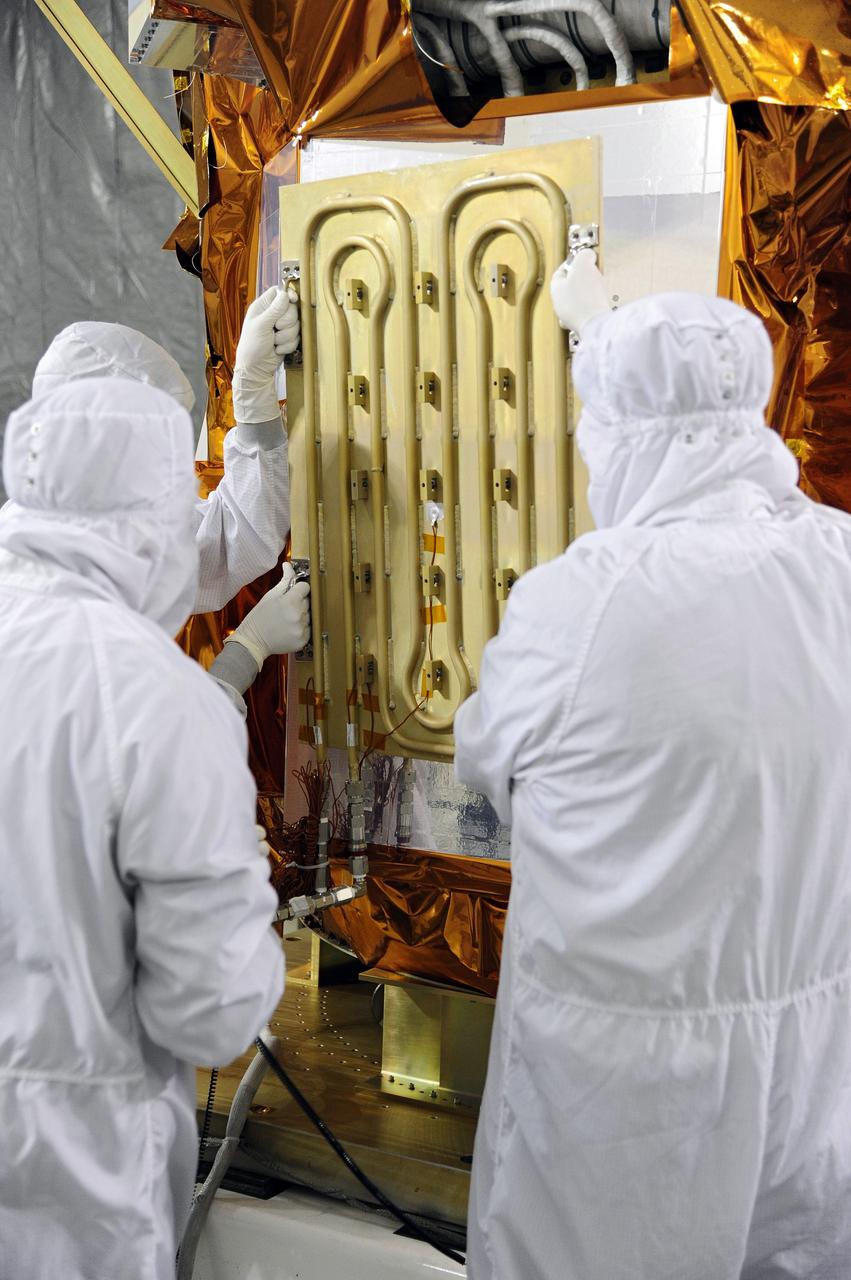
VANDENBERG AFB, Calif. – A technician performs thermal blanket closeouts on the fuel servicing valves of the Landsat Data Continuity Mission, or LDCM, spacecraft in the Astrotech processing facility at Vandenberg Air Force Base in Calif., following fueling operations. The Landsat Data Continuity Mission is the future of Landsat satellites. It will continue to obtain valuable data and imagery to be used in agriculture, education, business, science, and government. The Landsat Program provides repetitive acquisition of high resolution multispectral data of the Earth's surface on a global basis. The data from the Landsat spacecraft constitute the longest record of the Earth's continental surfaces as seen from space. It is a record unmatched in quality, detail, coverage, and value. Launch is planned for Feb. 11, 2013. For more information, visit: http://www.nasa.gov/mission_pages/landsat/main/index.html Photo credit: VAFB
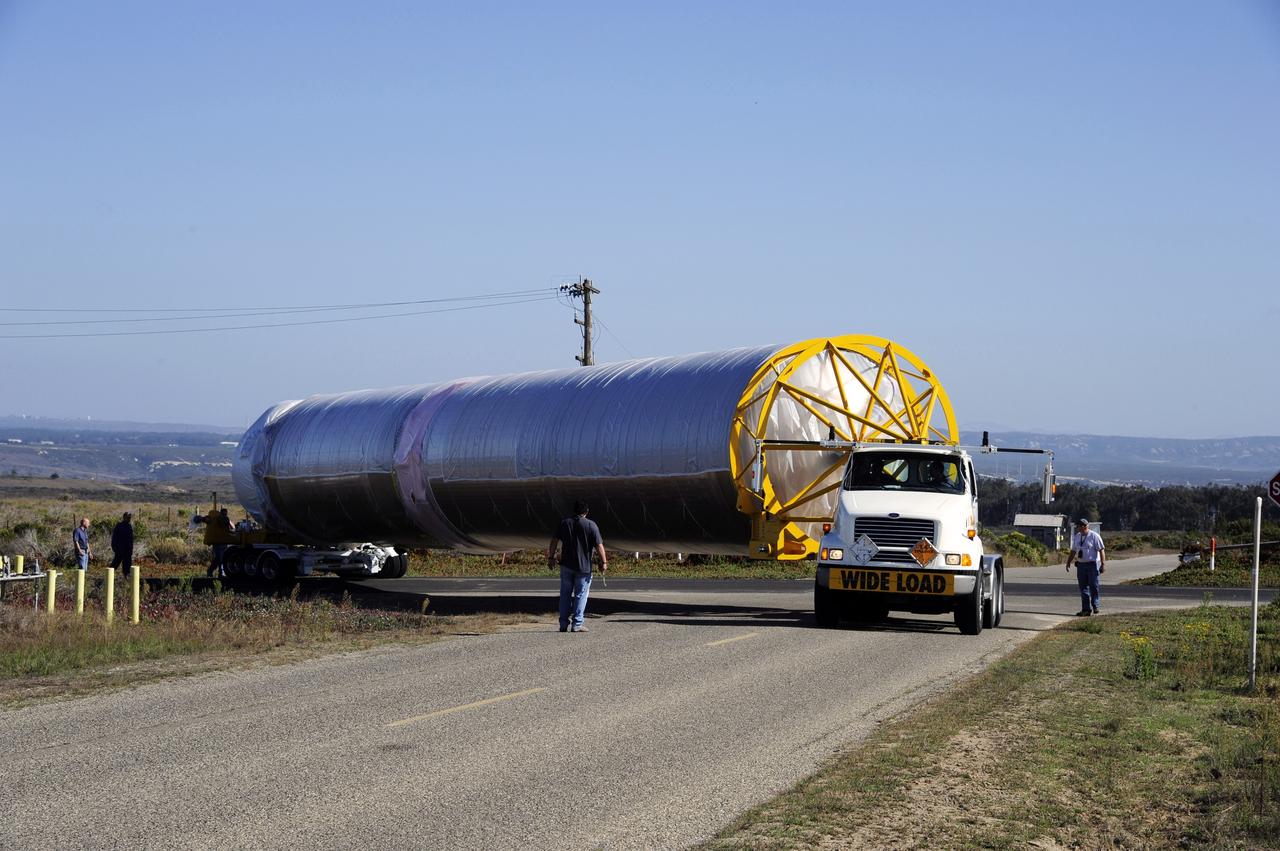
VANDENBERG AFB, Calif. – A truck moves the first stage booster of a United Launch Alliance Atlas V to Space Launch Complex-3E at Vandenberg Air Force Base, Calif. in preparation for the launch of the Landsat Data Continuity Mission. The Landsat Data Continuity Mission, or LDCM, is the future of Landsat satellites. It will continue to obtain valuable data and imagery to be used in agriculture, education, business, science, and government. The Landsat Program provides repetitive acquisition of high resolution multispectral data of the Earth's surface on a global basis. The data from the Landsat spacecraft constitute the longest record of the Earth's continental surfaces as seen from space. It is a record unmatched in quality, detail, coverage, and value. Launch is planned for Feb. 2013. Photo credit: NASA/Roy Allison
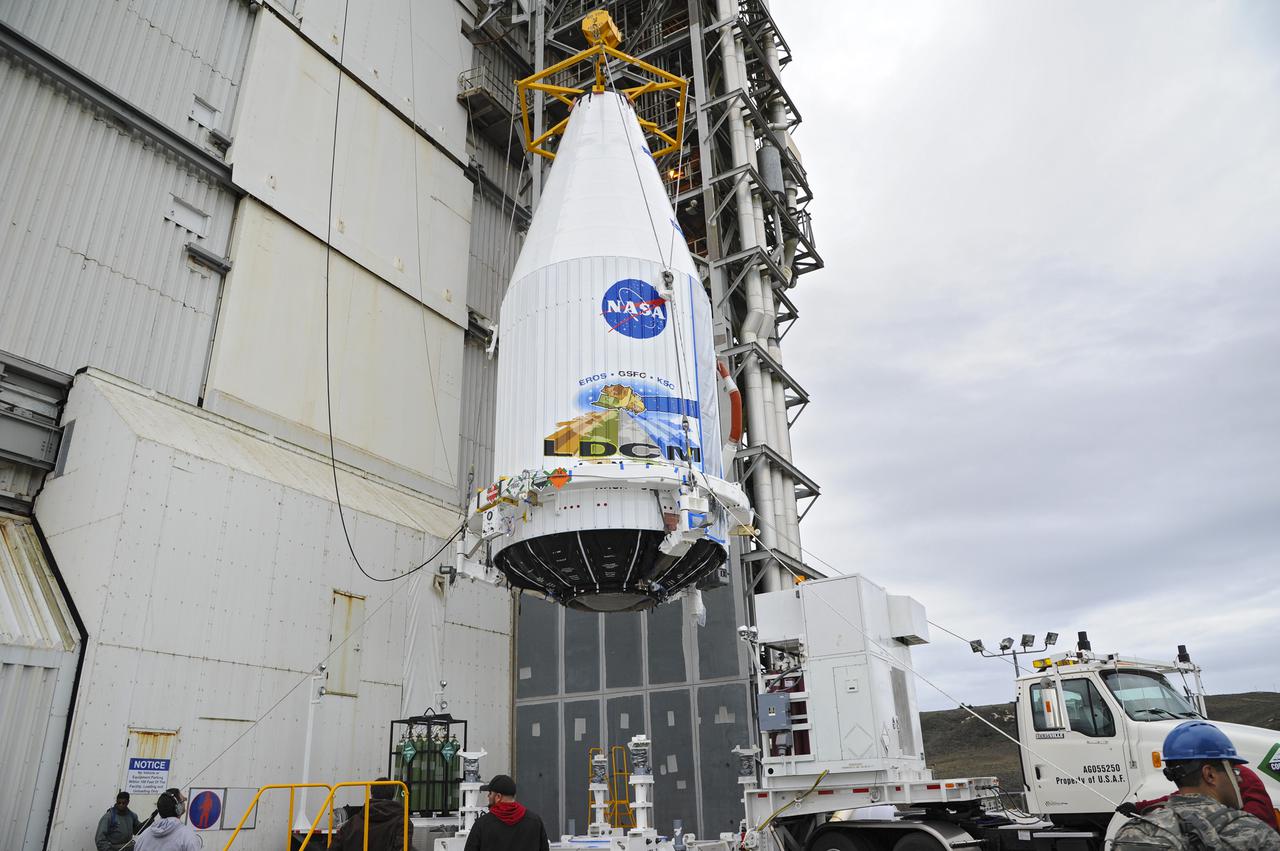
VANDENBERG AFB, Calif. -- The payload fairing containing the Landsat Data Continuity Mission, or LDCM, spacecraft is lifted to the top of Space Launch Complex-3E at Vandenberg Air Force Base, Calif. where it will be mounted atop a United Launch Alliance Atlas V rocket. The Landsat Data Continuity Mission LDCM is the future of Landsat satellites. It will continue to obtain valuable data and imagery to be used in agriculture, education, business, science, and government. The Landsat Program provides repetitive acquisition of high resolution multispectral data of the Earth's surface on a global basis. The data from the Landsat spacecraft constitute the longest record of the Earth's continental surfaces as seen from space. It is a record unmatched in quality, detail, coverage, and value. Liftoff is planned for Feb. 11, 2013 aboard a United Launch Alliance Atlas V rocket. For more information, visit: http:__www.nasa.gov_mission_pages_landsat_main_index.html Photo credit: NASA
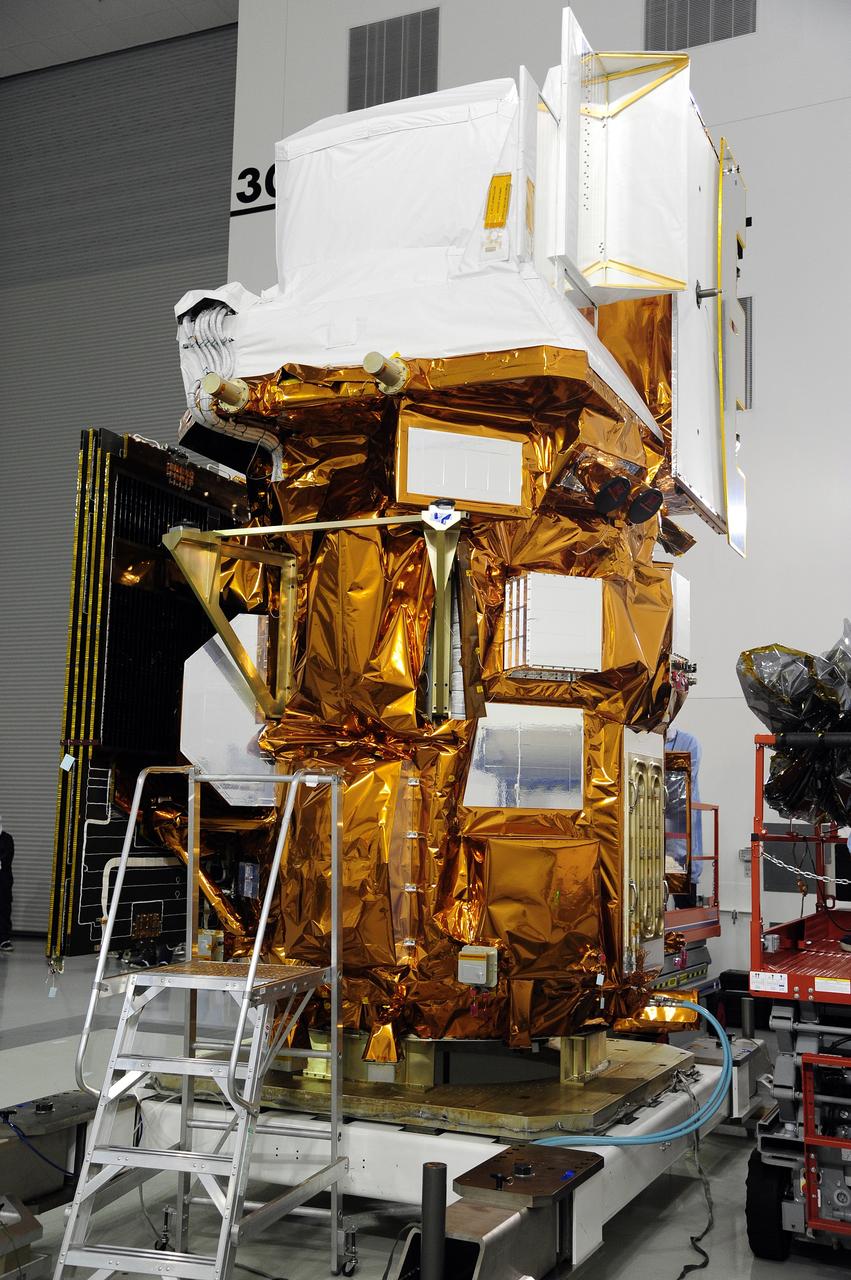
VANDENBERG AFB, Calif. -- NASA's Landsat Data Continuity Mission, or LDCM, satellite during post-arrival inspections at the Astrotech processing facility at Vandenberg Air Force Base, Calif. The Landsat Data Continuity Mission LDCM is the future of Landsat satellites. It will continue to obtain valuable data and imagery to be used in agriculture, education, business, science, and government. The Landsat Program provides repetitive acquisition of high resolution multispectral data of the Earth's surface on a global basis. The data from the Landsat spacecraft constitute the longest record of the Earth's continental surfaces as seen from space. It is a record unmatched in quality, detail, coverage, and value. Launch is planned for Feb. 11, 2013. For more information, visit: http://www.nasa.gov/mission_pages/landsat/main/index.html Photo credit: NASA
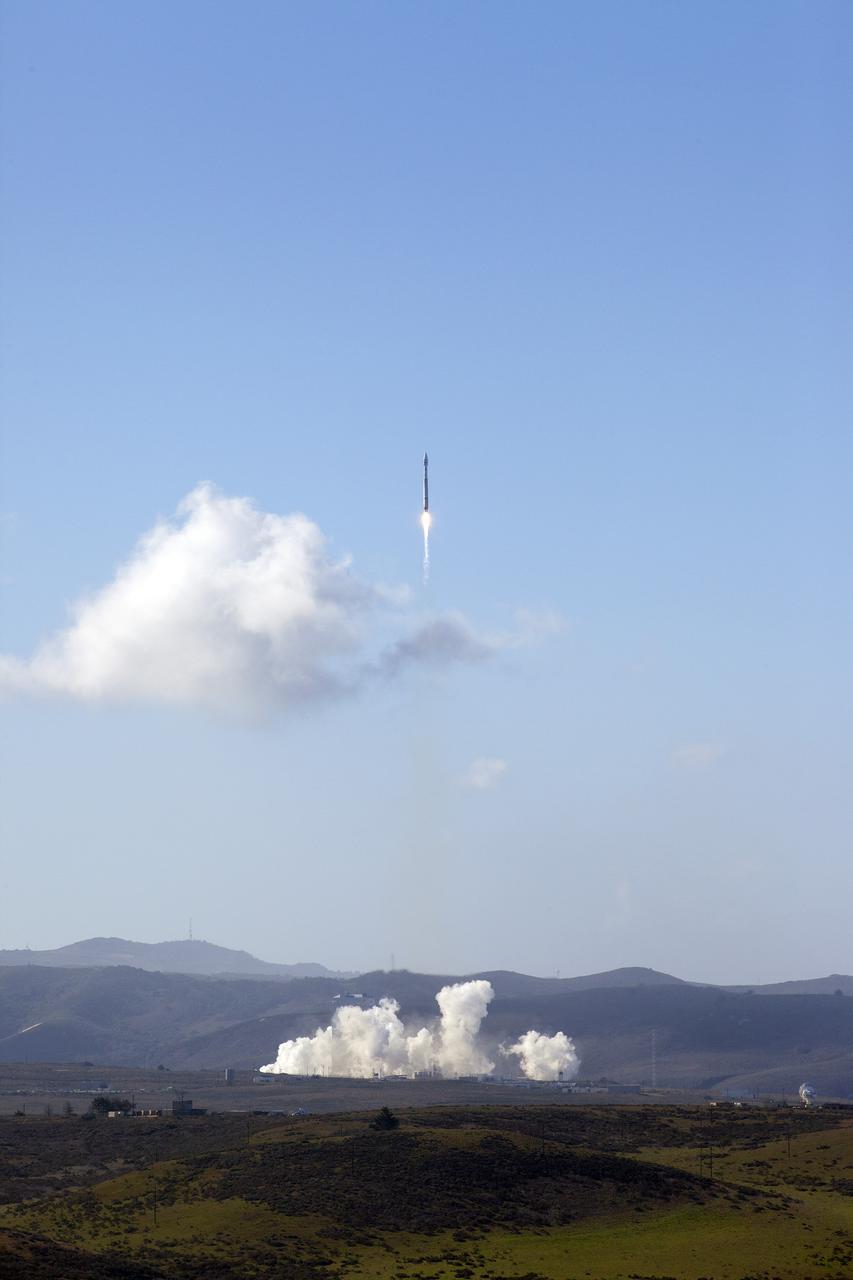
VANDENBERG AFB, Calif. -- The Landsat Data Continuity Mission spacecraft lifted off at 1:02 p.m. EST, 10:02 a.m. PST) atop a United Launch Alliance Atlas V rocket from Space Launch Complex 3 at California's Vandenberg Air Force Base. The Landsat Data Continuity Mission LDCM is the future of Landsat satellites. It will continue to obtain valuable data and imagery to be used in agriculture, education, business, science, and government. The Landsat Program provides repetitive acquisition of high resolution multispectral data of the Earth's surface on a global basis. The data from the Landsat spacecraft constitute the longest record of the Earth's continental surfaces as seen from space. It is a record unmatched in quality, detail, coverage, and value. For more information, visit: http:__www.nasa.gov_mission_pages_landsat_main_index.html Photo credit: NASA_Kim Shiflett
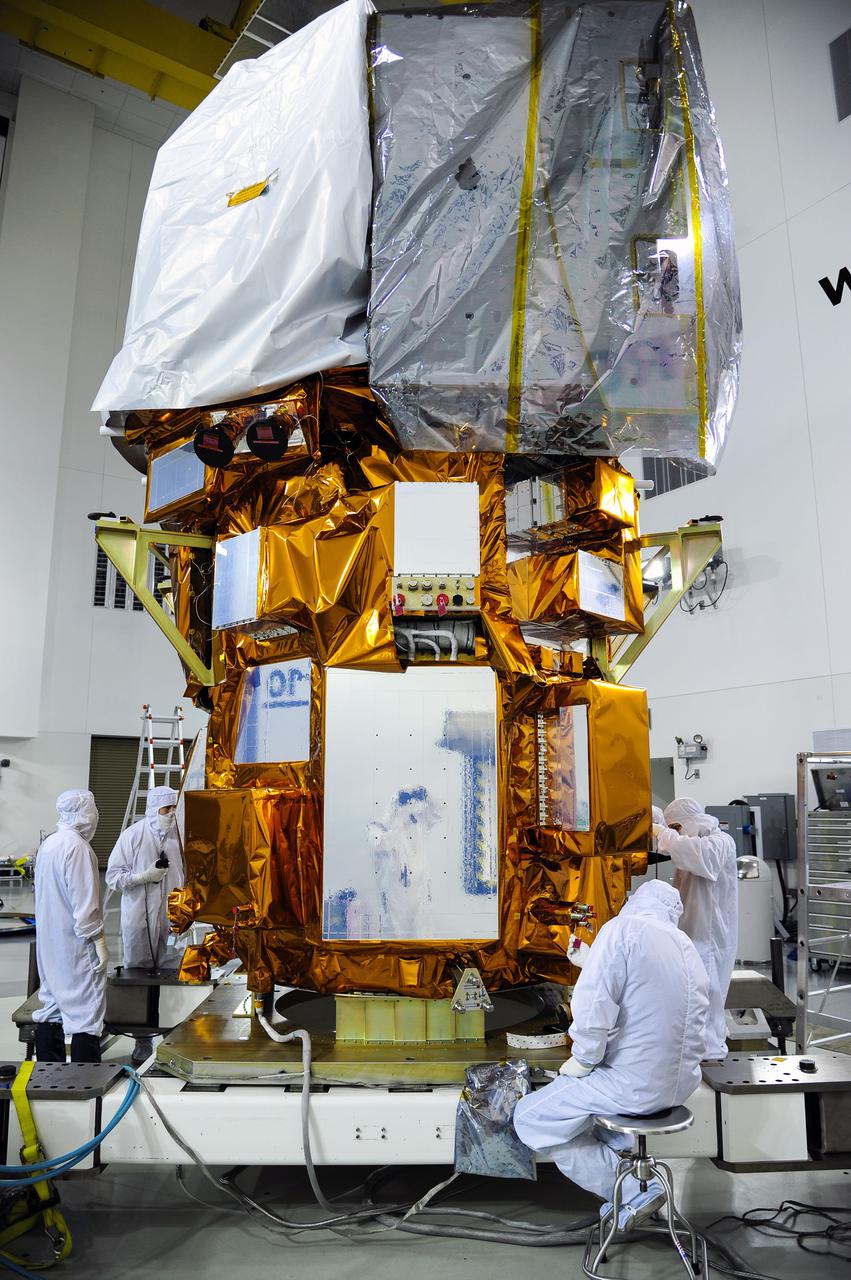
VANDENBERG AFB, Calif. -- At the Astrotech processing facility at Vandenberg Air Force Base, Calif., technicians perform close-out inspections on NASA's Landsat Data Continuity Mission, or LDCM, satellite. The Landsat Data Continuity Mission LDCM is the future of Landsat satellites. It will continue to obtain valuable data and imagery to be used in agriculture, education, business, science, and government. The Landsat Program provides repetitive acquisition of high resolution multispectral data of the Earth's surface on a global basis. The data from the Landsat spacecraft constitute the longest record of the Earth's continental surfaces as seen from space. It is a record unmatched in quality, detail, coverage, and value. Liftoff is planned for Feb. 11, 2013 aboard a United Launch Alliance Atlas V rocket. For more information, visit: http:__www.nasa.gov_mission_pages_landsat_main_index.html Photo credit: NASA
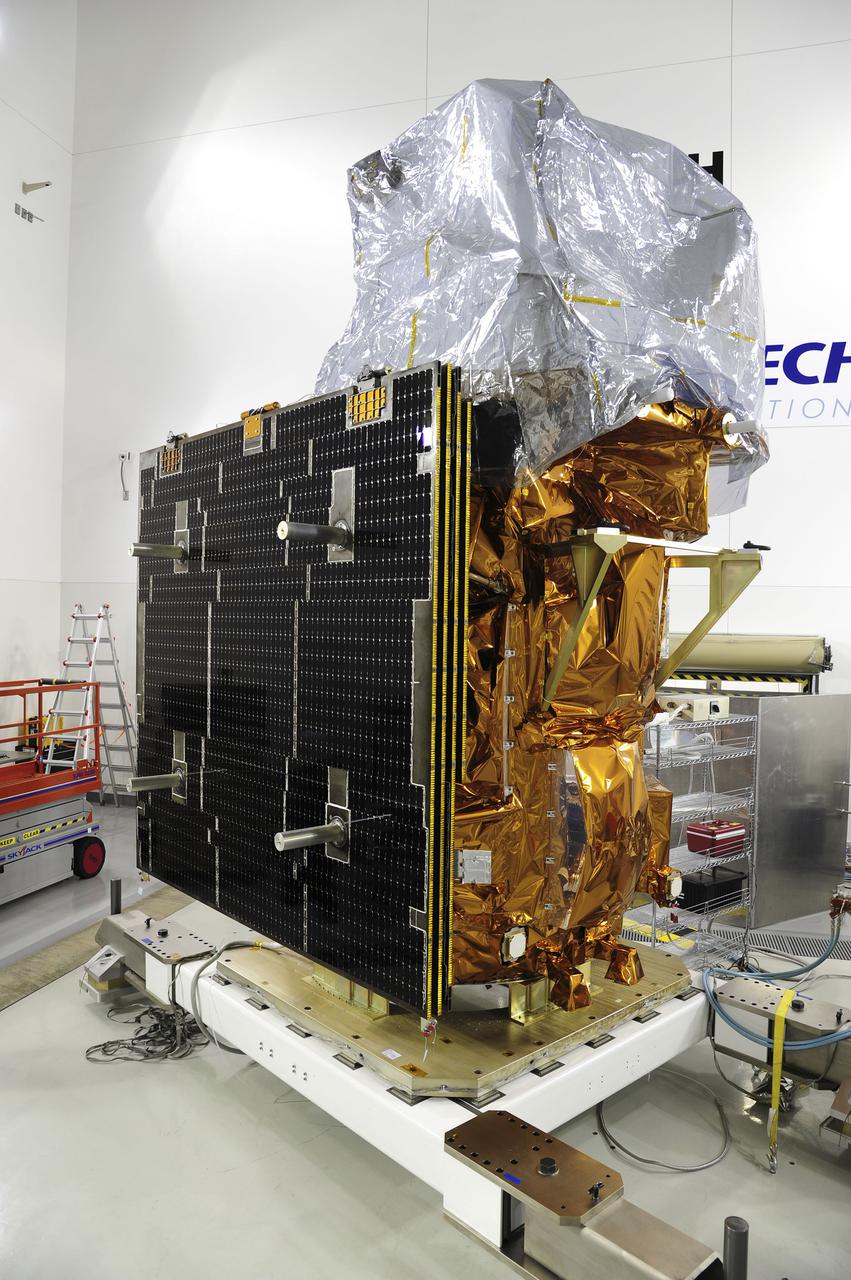
VANDENBERG AFB, Calif. -- At the Astrotech processing facility at Vandenberg Air Force Base, Calif., NASA's Landsat Data Continuity Mission, or LDCM, satellite is undergoing close-outs prior to encapsulation in the payload fairing. The Landsat Data Continuity Mission LDCM is the future of Landsat satellites. It will continue to obtain valuable data and imagery to be used in agriculture, education, business, science, and government. The Landsat Program provides repetitive acquisition of high resolution multispectral data of the Earth's surface on a global basis. The data from the Landsat spacecraft constitute the longest record of the Earth's continental surfaces as seen from space. It is a record unmatched in quality, detail, coverage, and value. Liftoff is planned for Feb. 11, 2013 aboard a United Launch Alliance Atlas V rocket. For more information, visit: http:__www.nasa.gov_mission_pages_landsat_main_index.html Photo credit: NASA
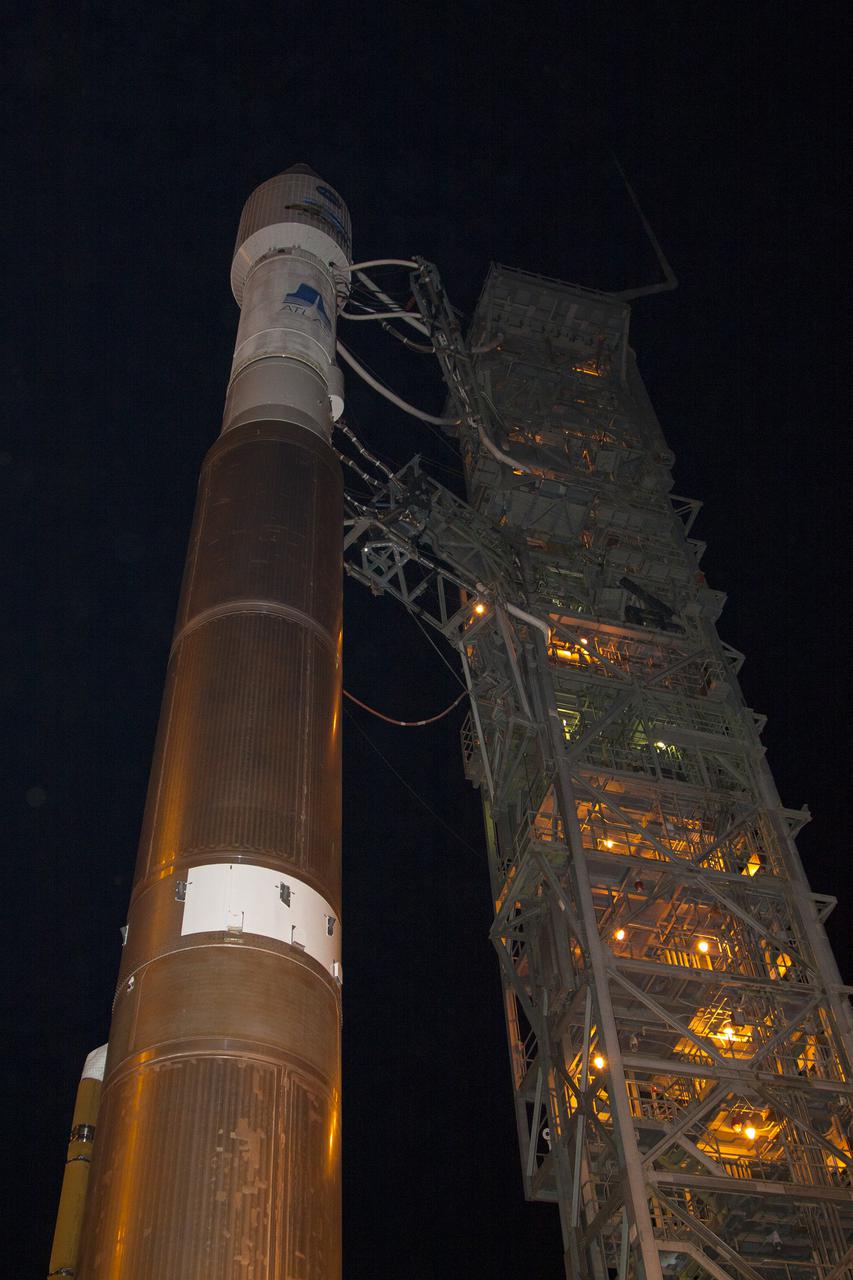
VANDENBERG AFB, Calif. -- At Vandenberg Air Force Base, Calif., NASA's Landsat Data Continuity Mission, or LDCM, satellite is mounted atop a United Launch Alliance Atlas V rocket poised for launch at Space Launch Complex 3E. The Landsat Data Continuity Mission LDCM is the future of Landsat satellites. It will continue to obtain valuable data and imagery to be used in agriculture, education, business, science, and government. The Landsat Program provides repetitive acquisition of high resolution multispectral data of the Earth's surface on a global basis. The data from the Landsat spacecraft constitute the longest record of the Earth's continental surfaces as seen from space. It is a record unmatched in quality, detail, coverage, and value. Liftoff is planned for Feb. 11, 2013 aboard a United Launch Alliance Atlas V rocket. For more information, visit: http:__www.nasa.gov_mission_pages_landsat_main_index.html Photo credit: NASA_Kim Shiflett
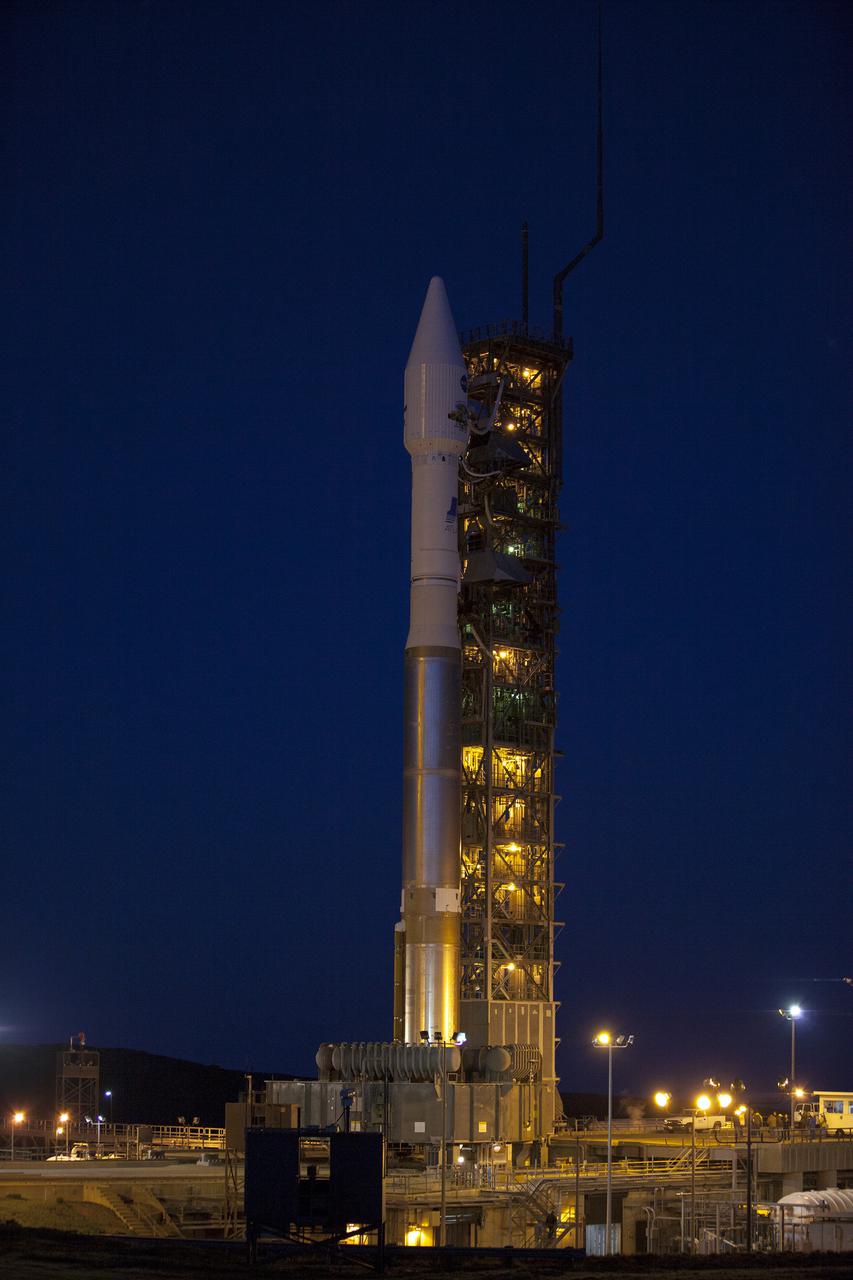
VANDENBERG AFB, Calif. -- At Vandenberg Air Force Base, Calif., NASA's Landsat Data Continuity Mission, or LDCM, satellite is mounted atop a United Launch Alliance Atlas V rocket poised for launch at Space Launch Complex 3E. The Landsat Data Continuity Mission LDCM is the future of Landsat satellites. It will continue to obtain valuable data and imagery to be used in agriculture, education, business, science, and government. The Landsat Program provides repetitive acquisition of high resolution multispectral data of the Earth's surface on a global basis. The data from the Landsat spacecraft constitute the longest record of the Earth's continental surfaces as seen from space. It is a record unmatched in quality, detail, coverage, and value. Liftoff is planned for Feb. 11, 2013 aboard a United Launch Alliance Atlas V rocket. For more information, visit: http:__www.nasa.gov_mission_pages_landsat_main_index.html Photo credit: NASA_Kim Shiflett
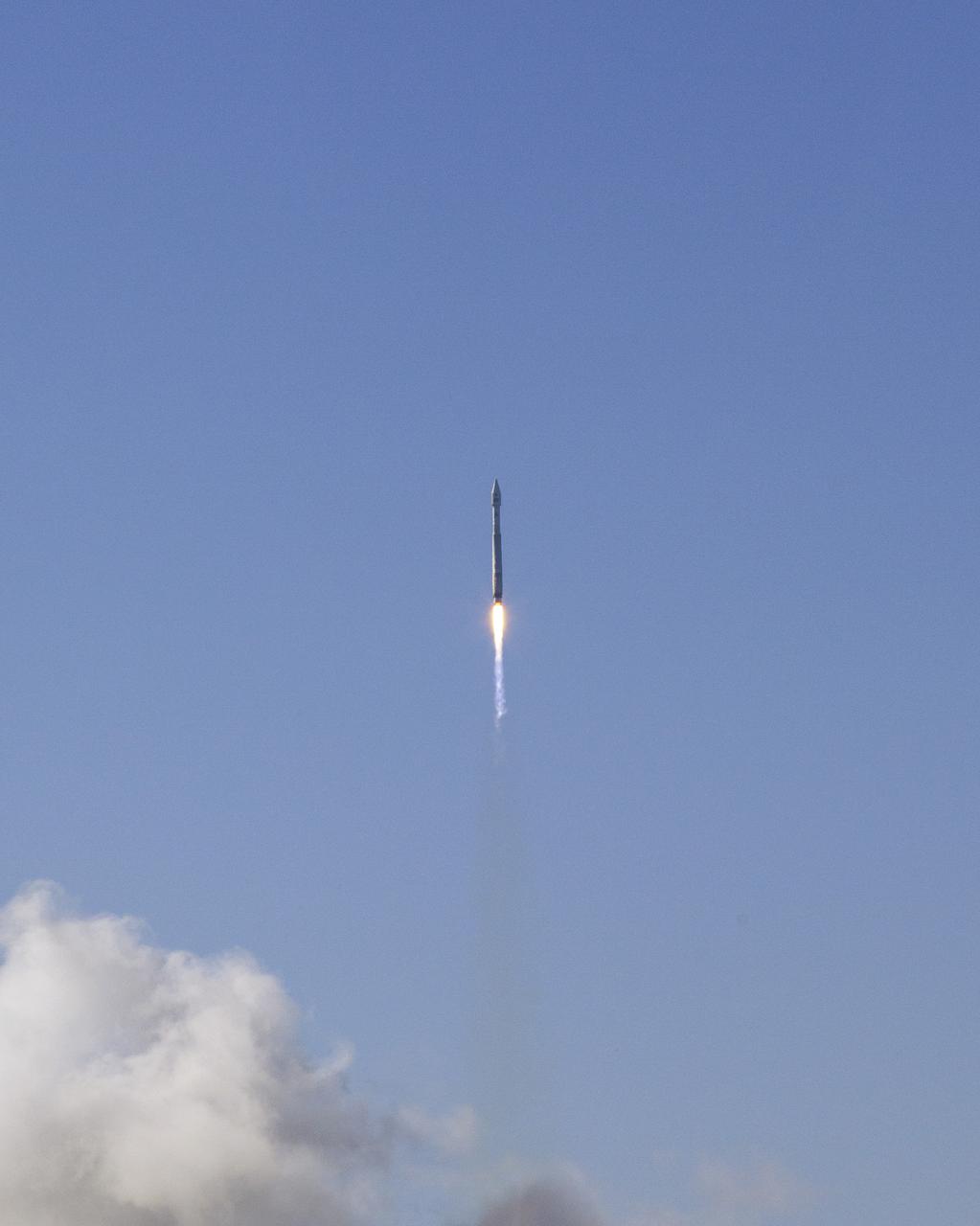
VANDENBERG AFB, Calif. -- The Landsat Data Continuity Mission spacecraft lifted off at 1:02 p.m. EST, 10:02 a.m. PST) atop a United Launch Alliance Atlas V rocket from Space Launch Complex 3 at California's Vandenberg Air Force Base. The Landsat Data Continuity Mission LDCM is the future of Landsat satellites. It will continue to obtain valuable data and imagery to be used in agriculture, education, business, science, and government. The Landsat Program provides repetitive acquisition of high resolution multispectral data of the Earth's surface on a global basis. The data from the Landsat spacecraft constitute the longest record of the Earth's continental surfaces as seen from space. It is a record unmatched in quality, detail, coverage, and value. For more information, visit: http:__www.nasa.gov_mission_pages_landsat_main_index.html Photo credit: NASA_Kim Shiflett
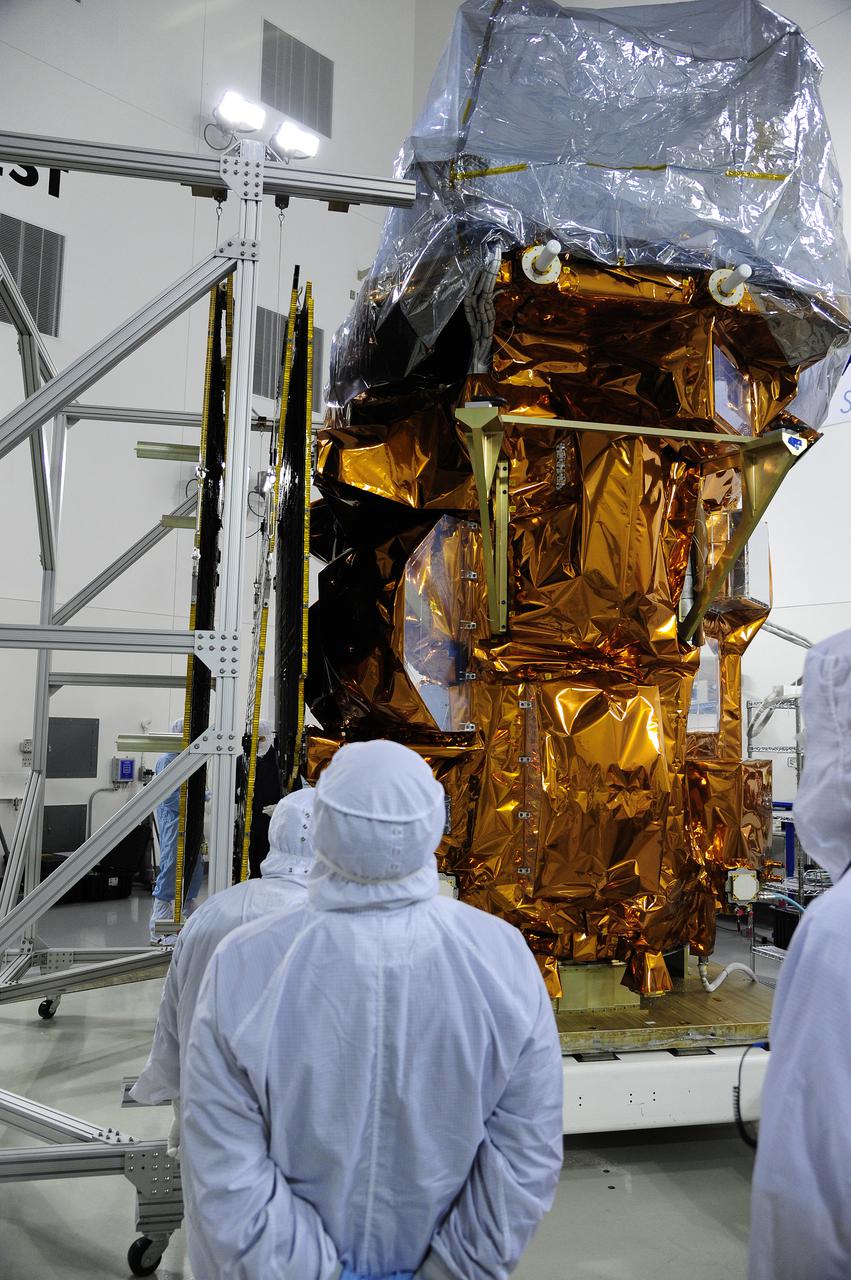
VANDENBERG AFB, Calif. -- In the Astrotech processing facility at Vandenberg Air Force Base, Calif., technicians test the solar arrays on NASA's Landsat Data Continuity Mission, or LDCM, satellite to ensure they will deploy properly in orbit. The Landsat Data Continuity Mission LDCM is the future of Landsat satellites. It will continue to obtain valuable data and imagery to be used in agriculture, education, business, science, and government. The Landsat Program provides repetitive acquisition of high resolution multispectral data of the Earth's surface on a global basis. The data from the Landsat spacecraft constitute the longest record of the Earth's continental surfaces as seen from space. It is a record unmatched in quality, detail, coverage, and value. Liftoff is planned for Feb. 11, 2013 aboard a United Launch Alliance Atlas V rocket. For more information, visit: http:__www.nasa.gov_mission_pages_landsat_main_index.html Photo credit: NASA
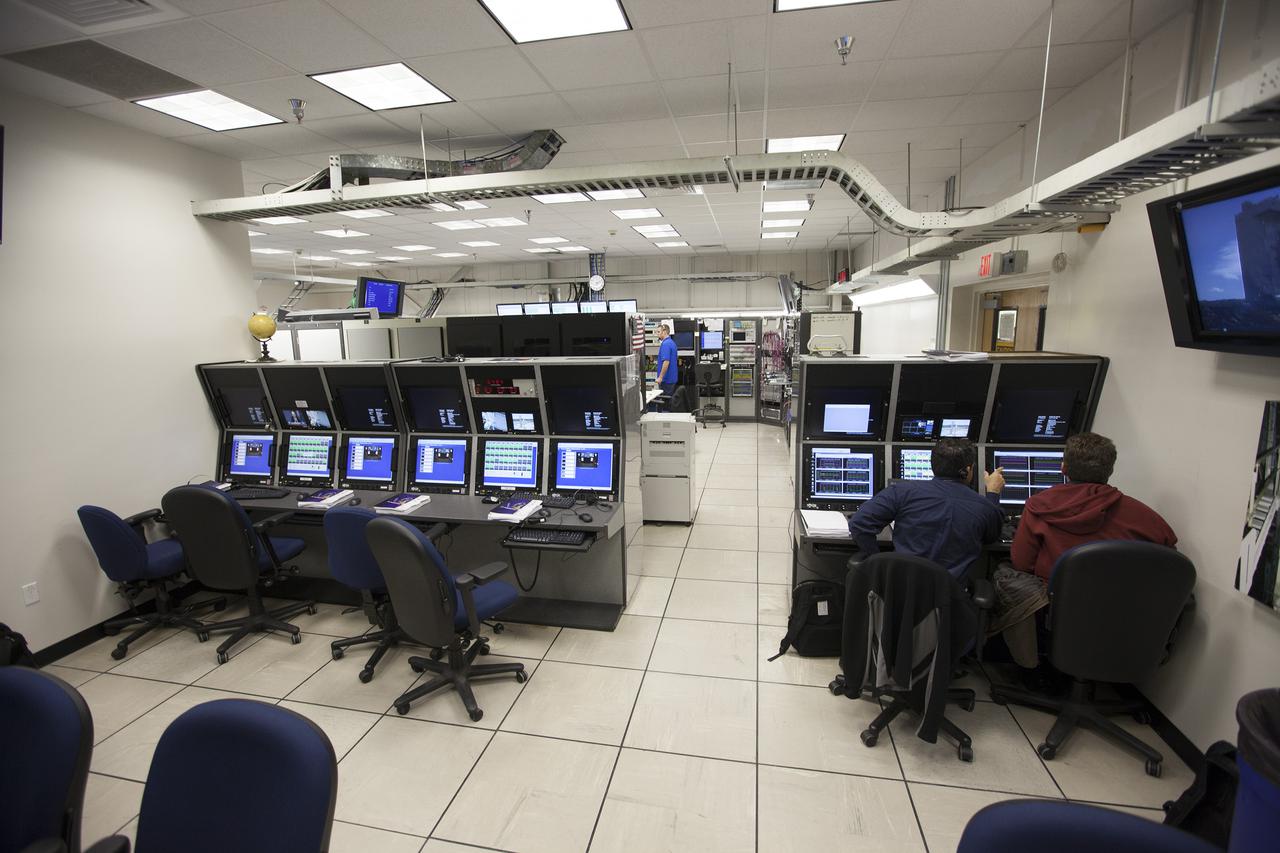
VANDENBERG AFB, Calif. -- From their positions in the telemetry laboratory at Vandenberg Air Force Base, engineers and technicians monitor the countdown for a United Launch Alliance Atlas V with the Landsat Data Continuity Mission, or LDCM, satellite prior to liftoff. The Landsat Data Continuity Mission, or LDCM, is the future of Landsat satellites. It will continue to obtain valuable data and imagery to be used in agriculture, education, business, science, and government. The Landsat Program provides repetitive acquisition of high resolution multispectral data of the Earth's surface on a global basis. The data from the Landsat spacecraft constitute the longest record of the Earth's continental surfaces as seen from space. It is a record unmatched in quality, detail, coverage, and value. Liftoff is planned for Feb. 11, 2013 aboard a United Launch Alliance Atlas V rocket. For more information, visit: http:__www.nasa.gov_mission_pages_landsat_main_index.html Photo credit: NASA_ Kim Shiflett
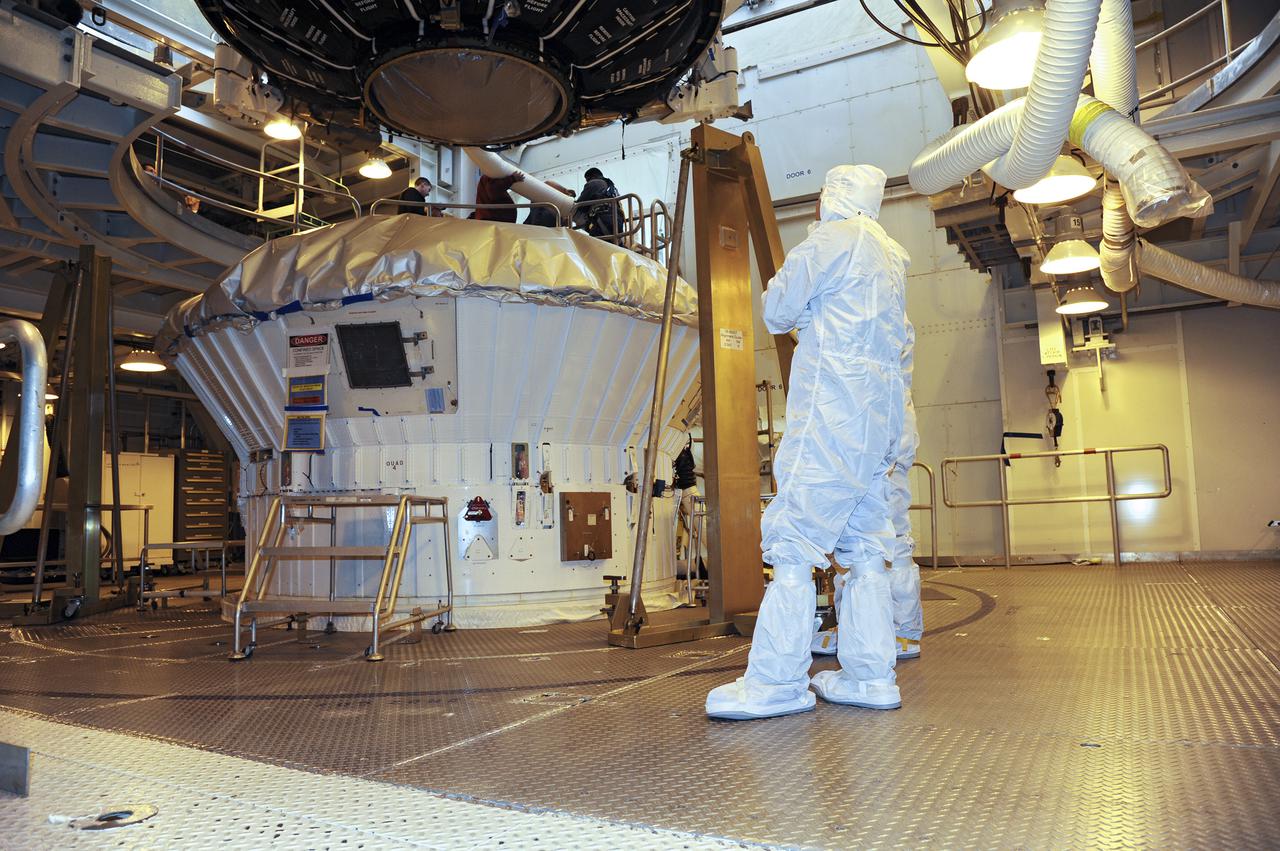
VANDENBERG AFB, Calif. -- Under the watchful eyes of technicians, the payload fairing containing the Landsat Data Continuity Mission, or LDCM, spacecraft has been lifted to the top of Space Launch Complex-3E at Vandenberg Air Force Base, Calif. where it is about to be mounted atop a United Launch Alliance Atlas V rocket. The Landsat Data Continuity Mission LDCM is the future of Landsat satellites. It will continue to obtain valuable data and imagery to be used in agriculture, education, business, science, and government. The Landsat Program provides repetitive acquisition of high resolution multispectral data of the Earth's surface on a global basis. The data from the Landsat spacecraft constitute the longest record of the Earth's continental surfaces as seen from space. It is a record unmatched in quality, detail, coverage, and value. Liftoff is planned for Feb. 11, 2013 aboard a United Launch Alliance Atlas V rocket. For more information, visit: http:__www.nasa.gov_mission_pages_landsat_main_index.html Photo credit: NASA
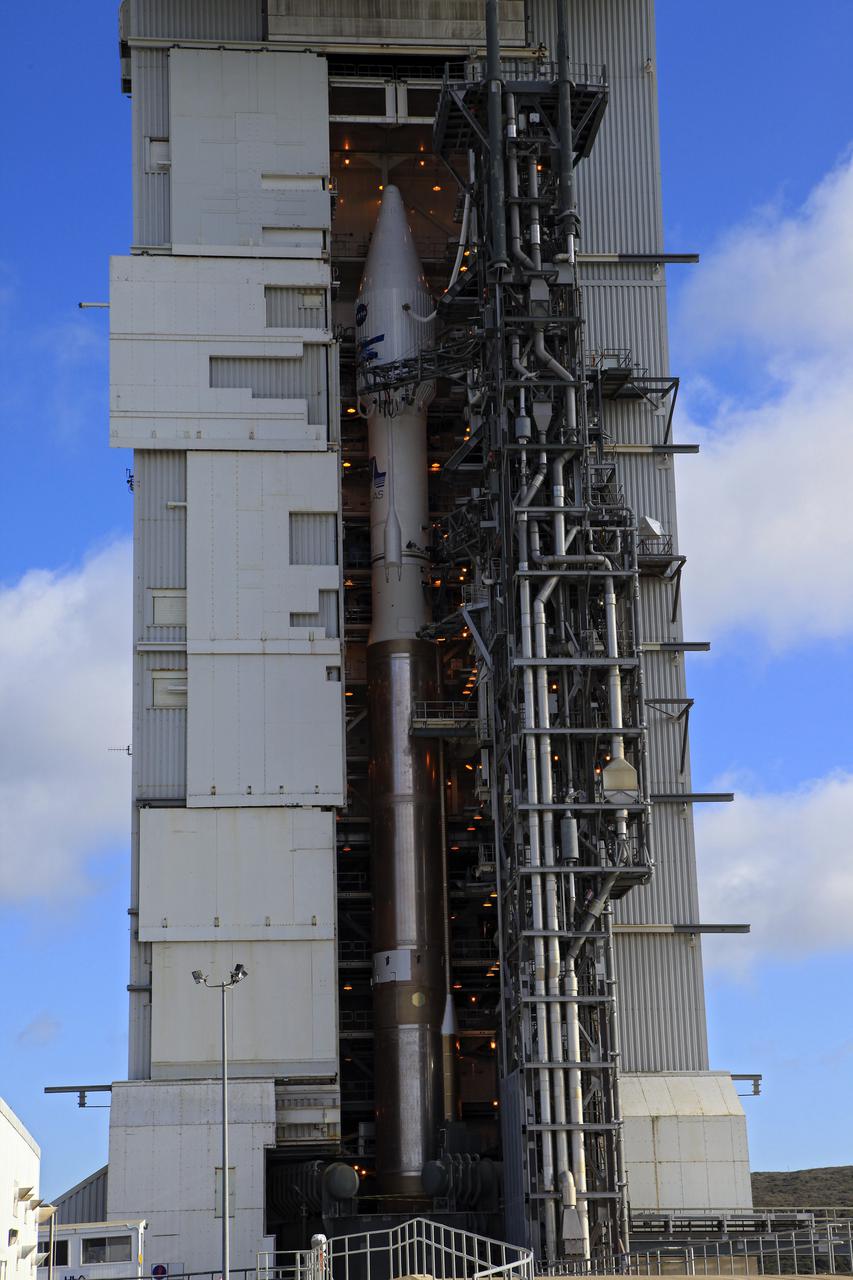
VANDENBERG AFB, Calif. -- At Vandenberg Air Force Base, Calif., NASA's Landsat Data Continuity Mission, or LDCM, satellite is mounted atop a United Launch Alliance Atlas V rocket in the gantry at Space Launch Complex 3E. The Landsat Data Continuity Mission LDCM is the future of Landsat satellites. It will continue to obtain valuable data and imagery to be used in agriculture, education, business, science, and government. The Landsat Program provides repetitive acquisition of high resolution multispectral data of the Earth's surface on a global basis. The data from the Landsat spacecraft constitute the longest record of the Earth's continental surfaces as seen from space. It is a record unmatched in quality, detail, coverage, and value. Liftoff is planned for Feb. 11, 2013 aboard a United Launch Alliance Atlas V rocket. For more information, visit: http:__www.nasa.gov_mission_pages_landsat_main_index.html Photo credit: NASA_Kim Shiflett
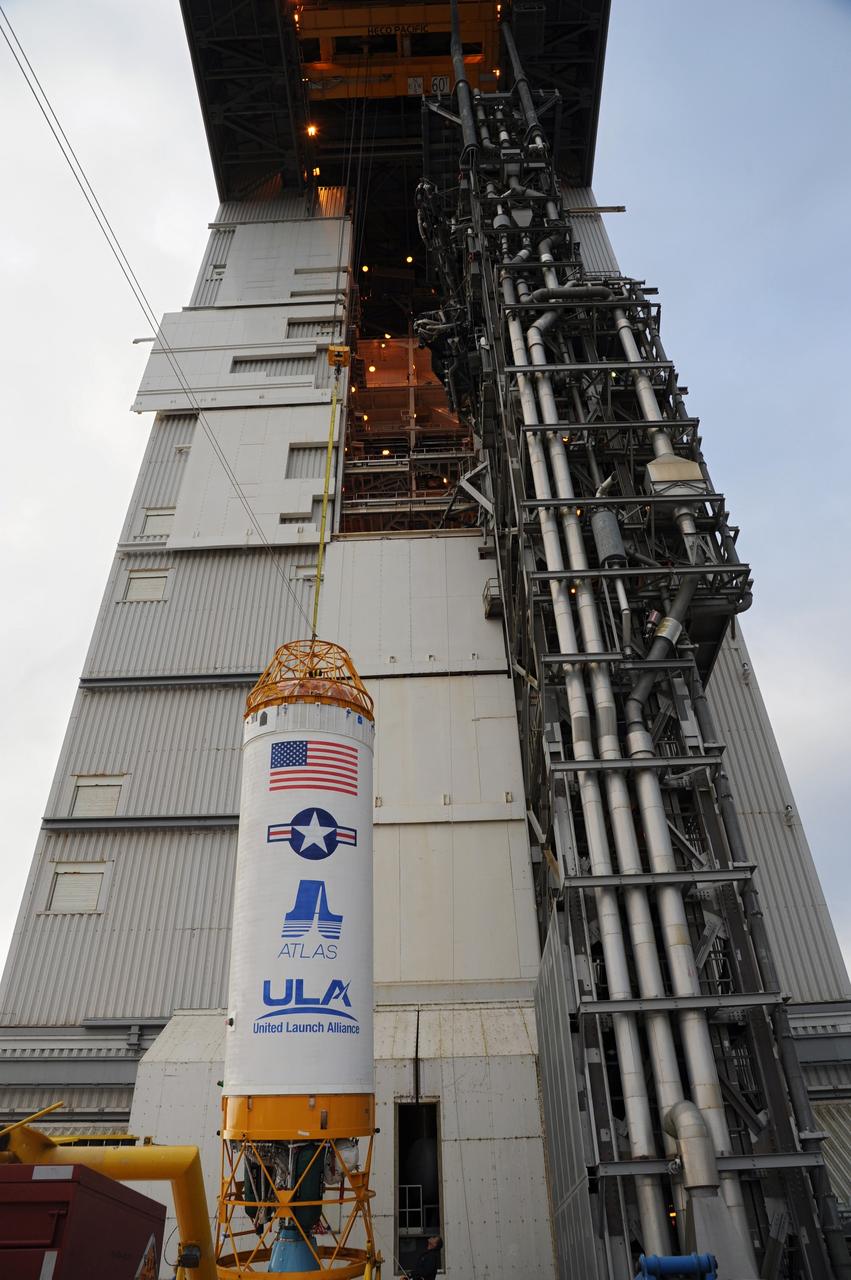
VANDENBERG AFB, Calif. – A Centaur upper stage is lifted onto the first stage booster of a United Launch Alliance Atlas V at the launch pad at Space Launch Complex-3E at Vandenberg Air Force Base, Calif. in preparation for the launch of the Landsat Data Continuity Mission. The Landsat Data Continuity Mission LDCM is the future of Landsat satellites. It will continue to obtain valuable data and imagery to be used in agriculture, education, business, science, and government. The Landsat Program provides repetitive acquisition of high resolution multispectral data of the Earth's surface on a global basis. The data from the Landsat spacecraft constitute the longest record of the Earth's continental surfaces as seen from space. It is a record unmatched in quality, detail, coverage, and value. Launch is planned for Feb. 2013. Photo credit: NASA/Roy Allison
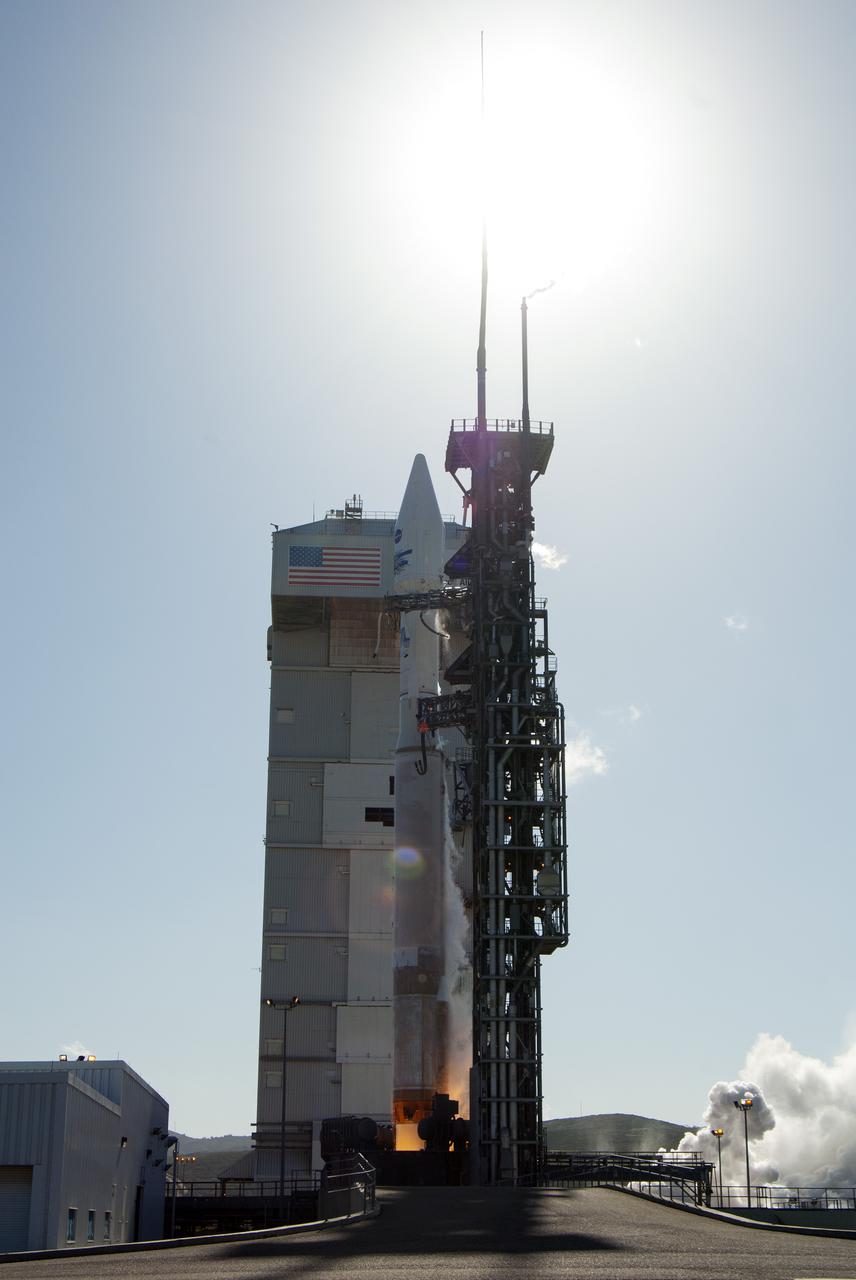
VANDENBERG AFB, Calif. -- The Landsat Data Continuity Mission spacecraft lifts off at 1:02 p.m. EST, 10:02 a.m. PST) atop a United Launch Alliance Atlas V rocket from Space Launch Complex 3 at California's Vandenberg Air Force Base. The Landsat Data Continuity Mission LDCM is the future of Landsat satellites. It will continue to obtain valuable data and imagery to be used in agriculture, education, business, science, and government. The Landsat Program provides repetitive acquisition of high resolution multispectral data of the Earth's surface on a global basis. The data from the Landsat spacecraft constitute the longest record of the Earth's continental surfaces as seen from space. It is a record unmatched in quality, detail, coverage, and value. For more information, visit: http:__www.nasa.gov_mission_pages_landsat_main_index.html Photo credit: NASA_Kim Shiflett
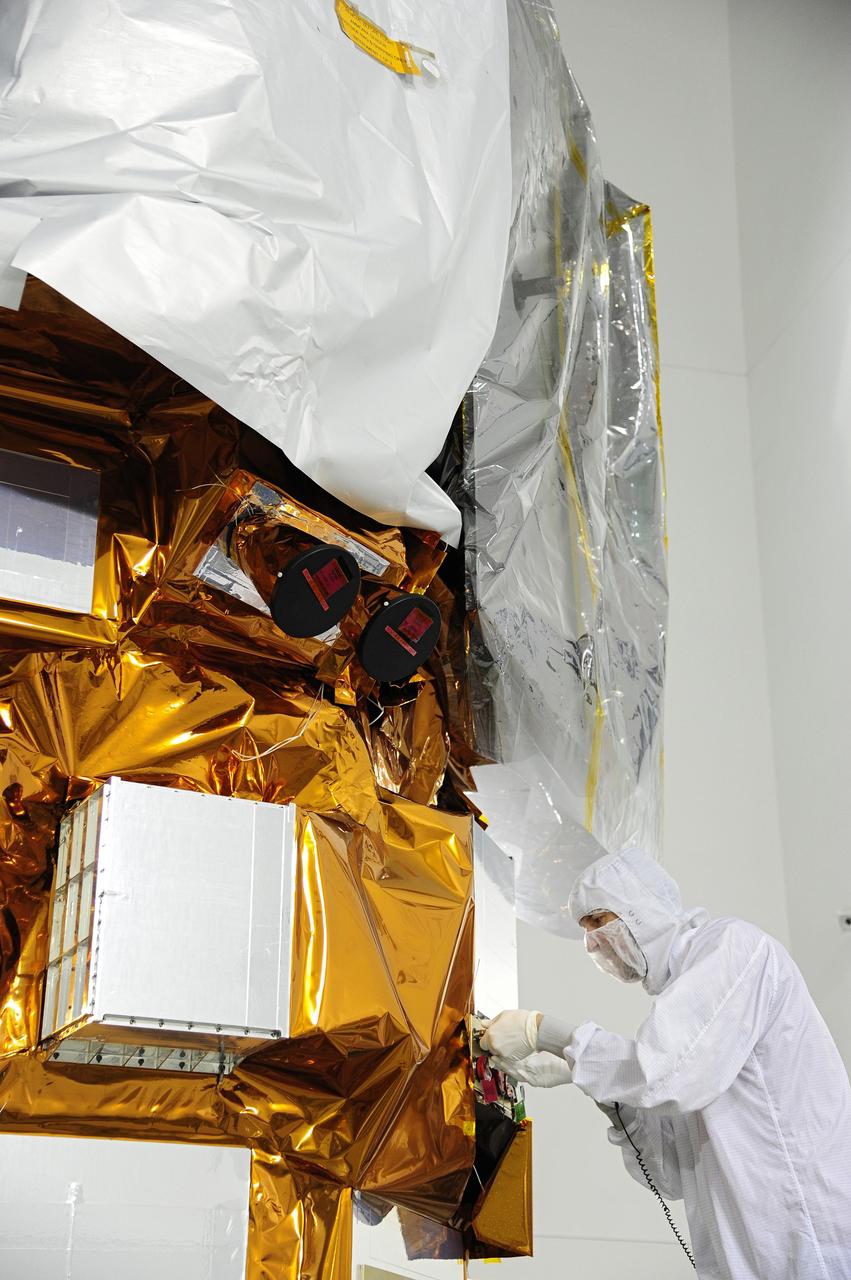
VANDENBERG AFB, Calif. – A technician performs thermal blanket closeouts on the fuel servicing valves on the Landsat Data Continuity Mission, or LDCM, spacecraft in the Astrotech processing facility at Vandenberg Air Force Base in Calif., following fueling operations. The Landsat Data Continuity Mission is the future of Landsat satellites. It will continue to obtain valuable data and imagery to be used in agriculture, education, business, science, and government. The Landsat Program provides repetitive acquisition of high resolution multispectral data of the Earth's surface on a global basis. The data from the Landsat spacecraft constitute the longest record of the Earth's continental surfaces as seen from space. It is a record unmatched in quality, detail, coverage, and value. Launch is planned for Feb. 11, 2013. For more information, visit: http://www.nasa.gov/mission_pages/landsat/main/index.html Photo credit: VAFB
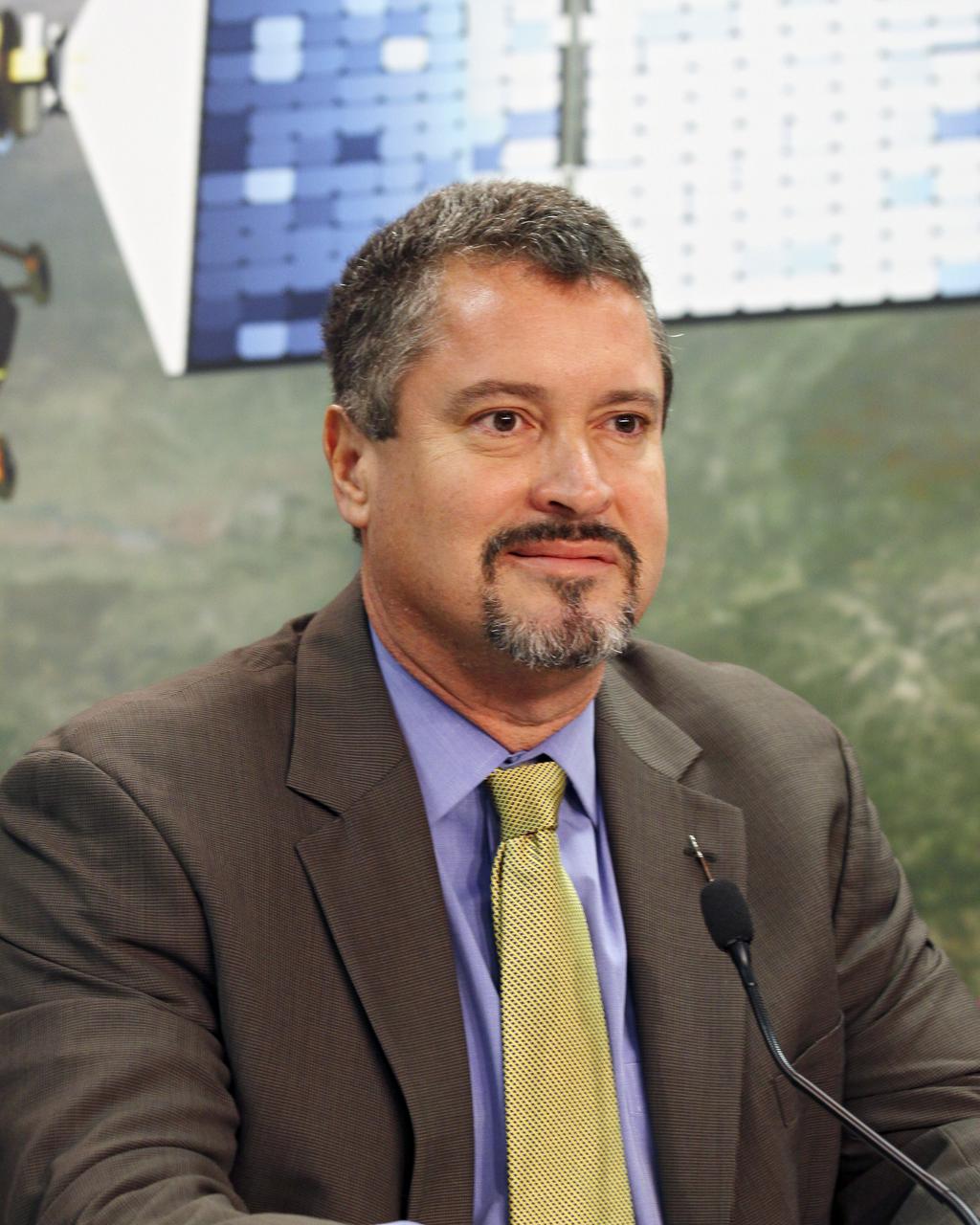
VANDENBERG AFB, Calif. -- NASA and contractor officials discussed NASA's readiness to launch the Landsat Data Continuity Mission, or LDCM, during a prelaunch news conference at Vandenberg Air Force Base, Calif. Participants included NASA Launch Director Omar Baez from Kennedy Space Center. The Landsat Data Continuity Mission LDCM is the future of Landsat satellites. It will continue to obtain valuable data and imagery to be used in agriculture, education, business, science, and government. The Landsat Program provides repetitive acquisition of high resolution multispectral data of the Earth's surface on a global basis. The data from the Landsat spacecraft constitute the longest record of the Earth's continental surfaces as seen from space. It is a record unmatched in quality, detail, coverage, and value. Liftoff is planned for Feb. 11, 2013 aboard a United Launch Alliance Atlas V rocket. For more information, visit: http:__www.nasa.gov_mission_pages_landsat_main_index.html Photo credit: NASA_Kim Shiflett
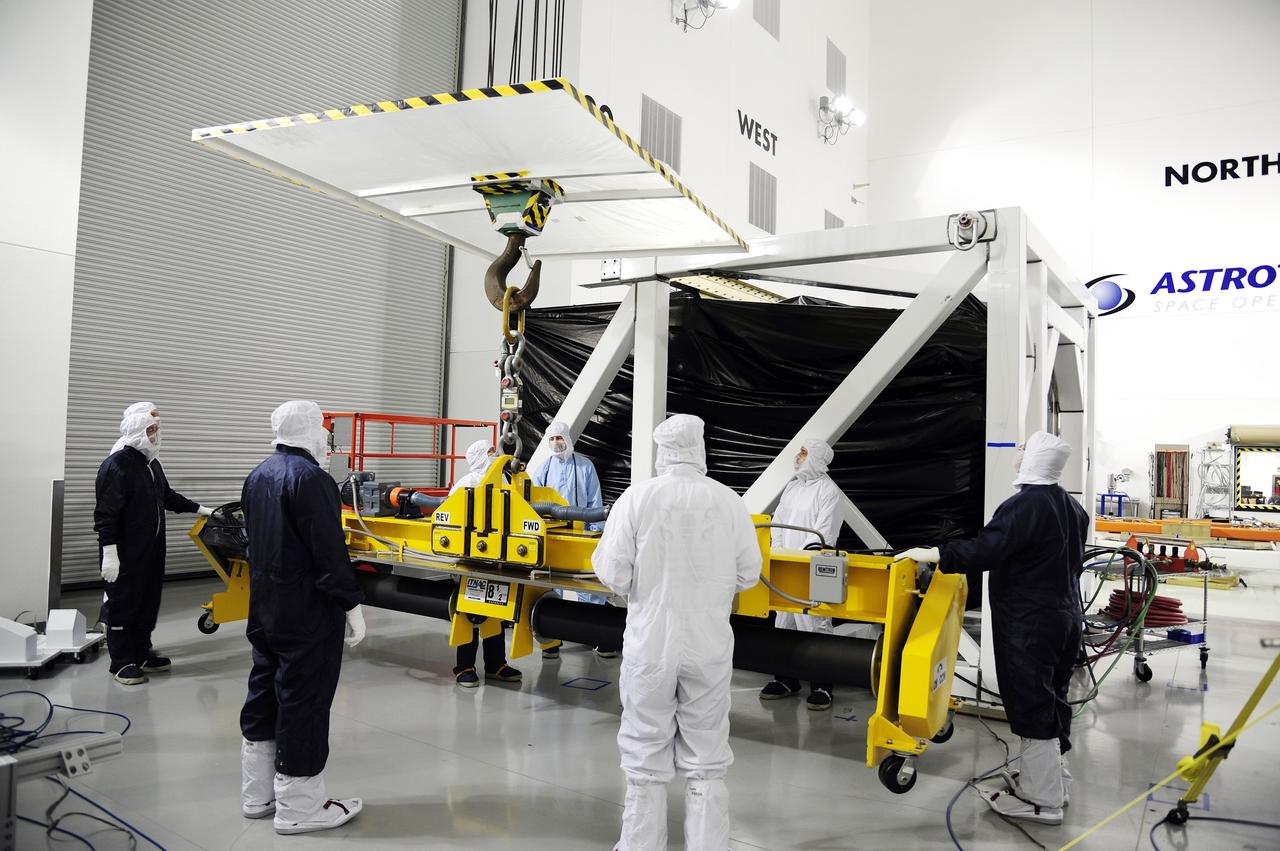
VANDENBERG AFB, Calif. -- Technicians unload NASA's Landsat Data Continuity Mission, or LDCM, satellite at the Astrotech processing facility at Vandenberg Air Force Base, Calif. The Landsat Data Continuity Mission LDCM is the future of Landsat satellites. It will continue to obtain valuable data and imagery to be used in agriculture, education, business, science, and government. The Landsat Program provides repetitive acquisition of high resolution multispectral data of the Earth's surface on a global basis. The data from the Landsat spacecraft constitute the longest record of the Earth's continental surfaces as seen from space. It is a record unmatched in quality, detail, coverage, and value. Launch is planned for Feb. 11, 2013. For more information, visit: http://www.nasa.gov/mission_pages/landsat/main/index.html Photo credit: NASA
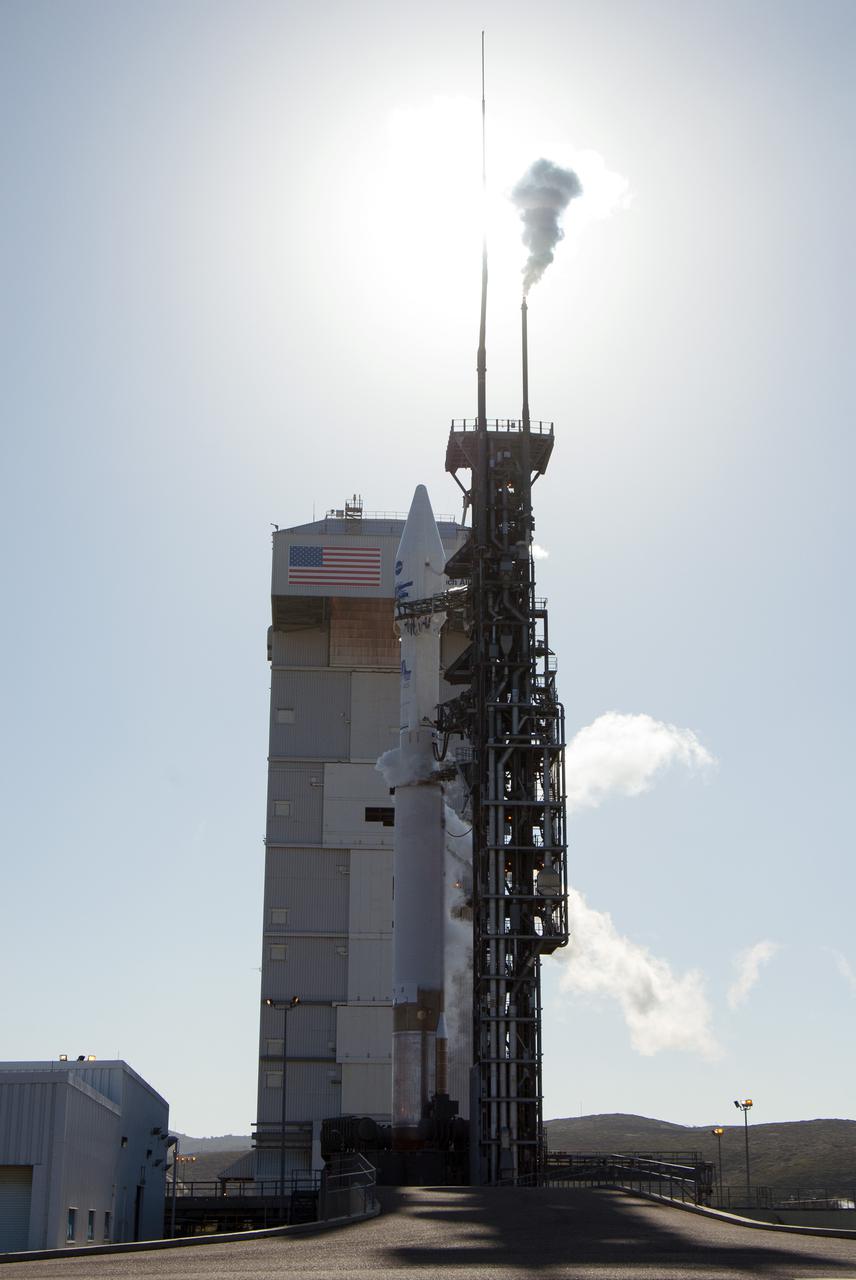
The Landsat Data Continuity Mission spacecraft is poised for lift off atop a United Launch Alliance Atlas V rocket from Space Launch Complex 3 at California's Vandenberg Air Force Base. The Landsat Data Continuity Mission LDCM is the future of Landsat satellites. It will continue to obtain valuable data and imagery to be used in agriculture, education, business, science, and government. The Landsat Program provides repetitive acquisition of high resolution multispectral data of the Earth's surface on a global basis. The data from the Landsat spacecraft constitute the longest record of the Earth's continental surfaces as seen from space. It is a record unmatched in quality, detail, coverage, and value. For more information, visit: http:__www.nasa.gov_mission_pages_landsat_main_index.html Photo credit: NASA_Kim Shiflett
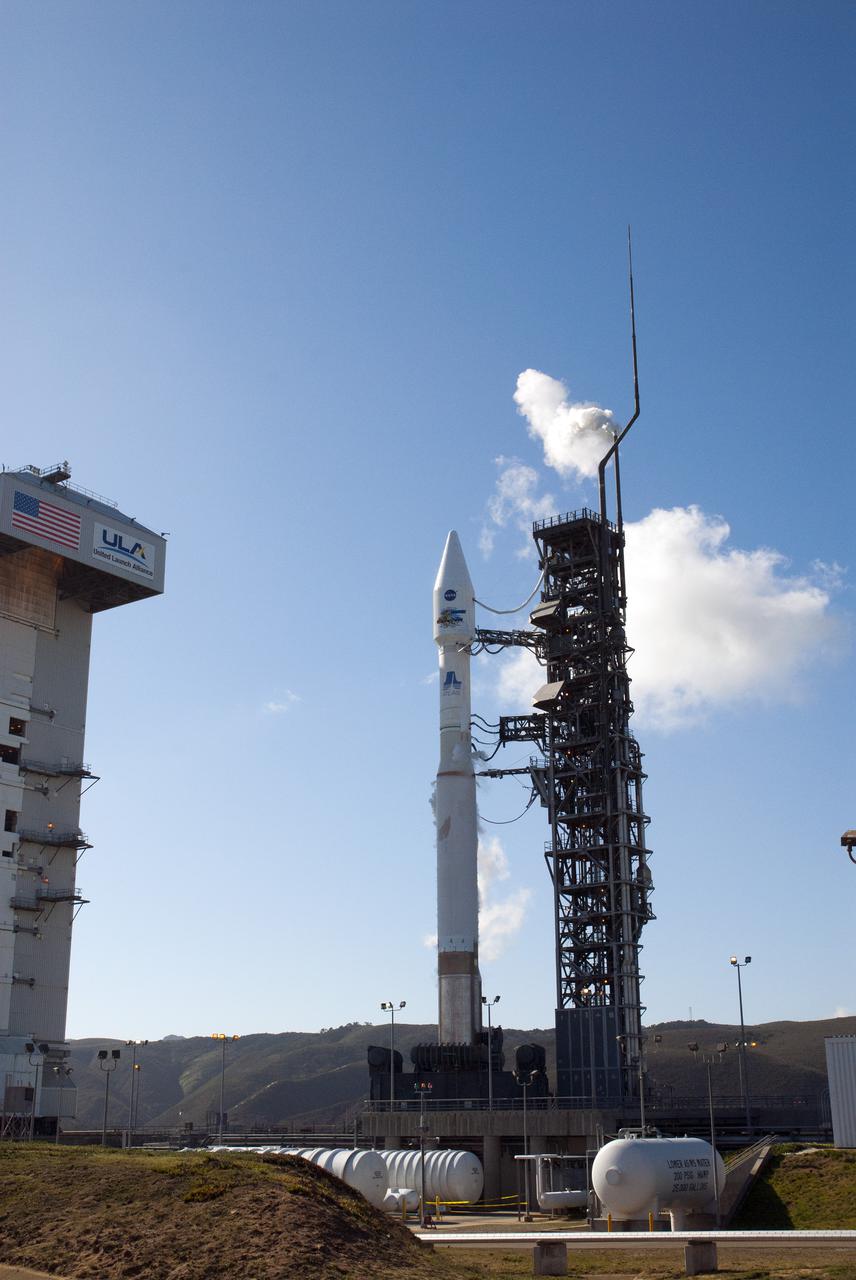
VANDENBERG AFB, Calif. -- The Landsat Data Continuity Mission spacecraft is poised for lift off atop a United Launch Alliance Atlas V rocket from Space Launch Complex 3 at California's Vandenberg Air Force Base. The Landsat Data Continuity Mission LDCM is the future of Landsat satellites. It will continue to obtain valuable data and imagery to be used in agriculture, education, business, science, and government. The Landsat Program provides repetitive acquisition of high resolution multispectral data of the Earth's surface on a global basis. The data from the Landsat spacecraft constitute the longest record of the Earth's continental surfaces as seen from space. It is a record unmatched in quality, detail, coverage, and value. For more information, visit: http:__www.nasa.gov_mission_pages_landsat_main_index.html Photo credit: NASA_Kim Shiflett

VANDENBERG AFB, Calif. -- NASA and contractor officials discussed NASA's readiness to launch the Landsat Data Continuity Mission, or LDCM, during a prelaunch news conference at Vandenberg Air Force Base, Calif. Participants included LDCM Project Manager Ken Schwer from NASA's Goddard Space Flight Center. The Landsat Data Continuity Mission LDCM is the future of Landsat satellites. It will continue to obtain valuable data and imagery to be used in agriculture, education, business, science, and government. The Landsat Program provides repetitive acquisition of high resolution multispectral data of the Earth's surface on a global basis. The data from the Landsat spacecraft constitute the longest record of the Earth's continental surfaces as seen from space. It is a record unmatched in quality, detail, coverage, and value. Liftoff is planned for Feb. 11, 2013 aboard a United Launch Alliance Atlas V rocket. For more information, visit: http:__www.nasa.gov_mission_pages_landsat_main_index.html Photo credit: NASA_Kim Shiflett
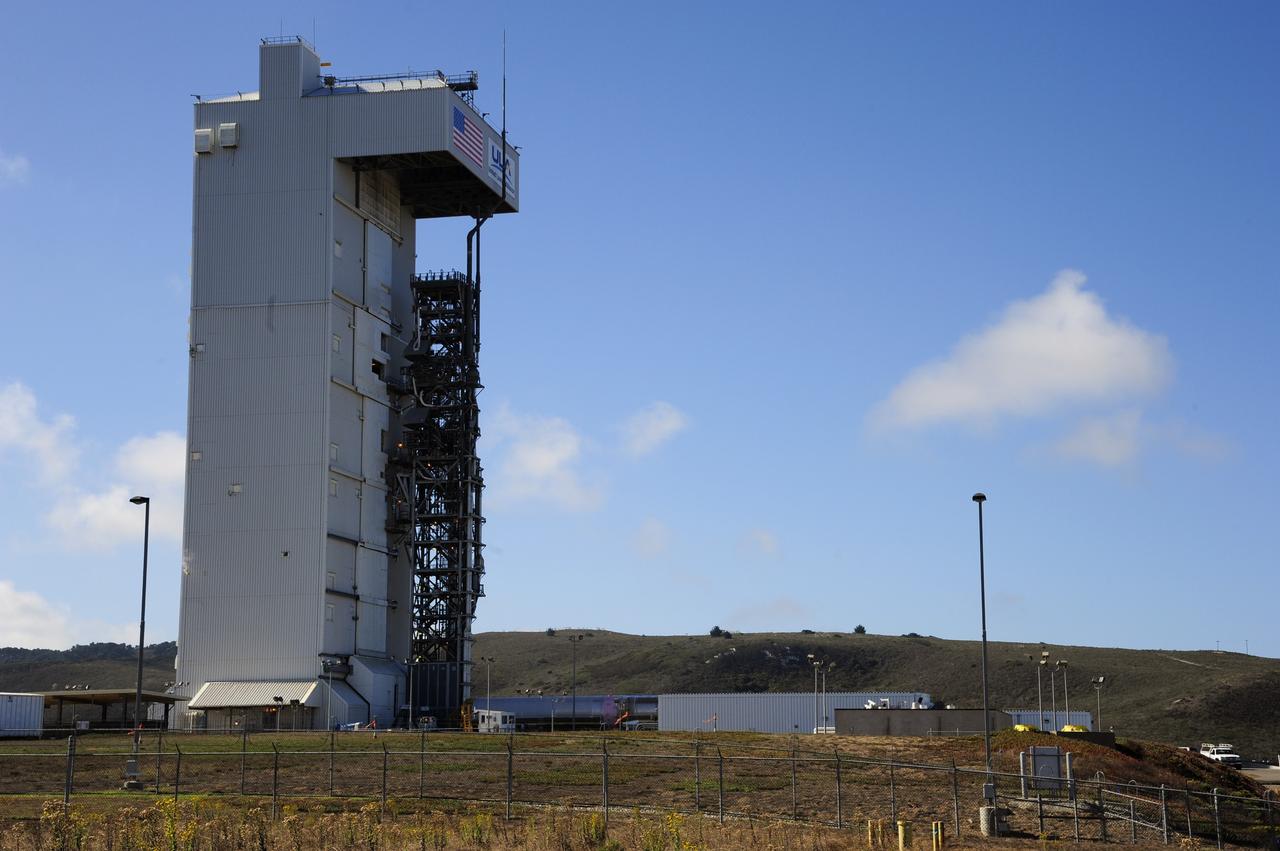
VANDENBERG AFB, Calif. – A truck moves the first stage booster of a United Launch Alliance Atlas V to Space Launch Complex-3E at Vandenberg Air Force Base, Calif. in preparation for the launch of the Landsat Data Continuity Mission. The Landsat Data Continuity Mission, or LDCM, is the future of Landsat satellites. It will continue to obtain valuable data and imagery to be used in agriculture, education, business, science, and government. The Landsat Program provides repetitive acquisition of high resolution multispectral data of the Earth's surface on a global basis. The data from the Landsat spacecraft constitute the longest record of the Earth's continental surfaces as seen from space. It is a record unmatched in quality, detail, coverage, and value. Launch is planned for Feb. 2013. Photo credit: NASA/Roy Allison
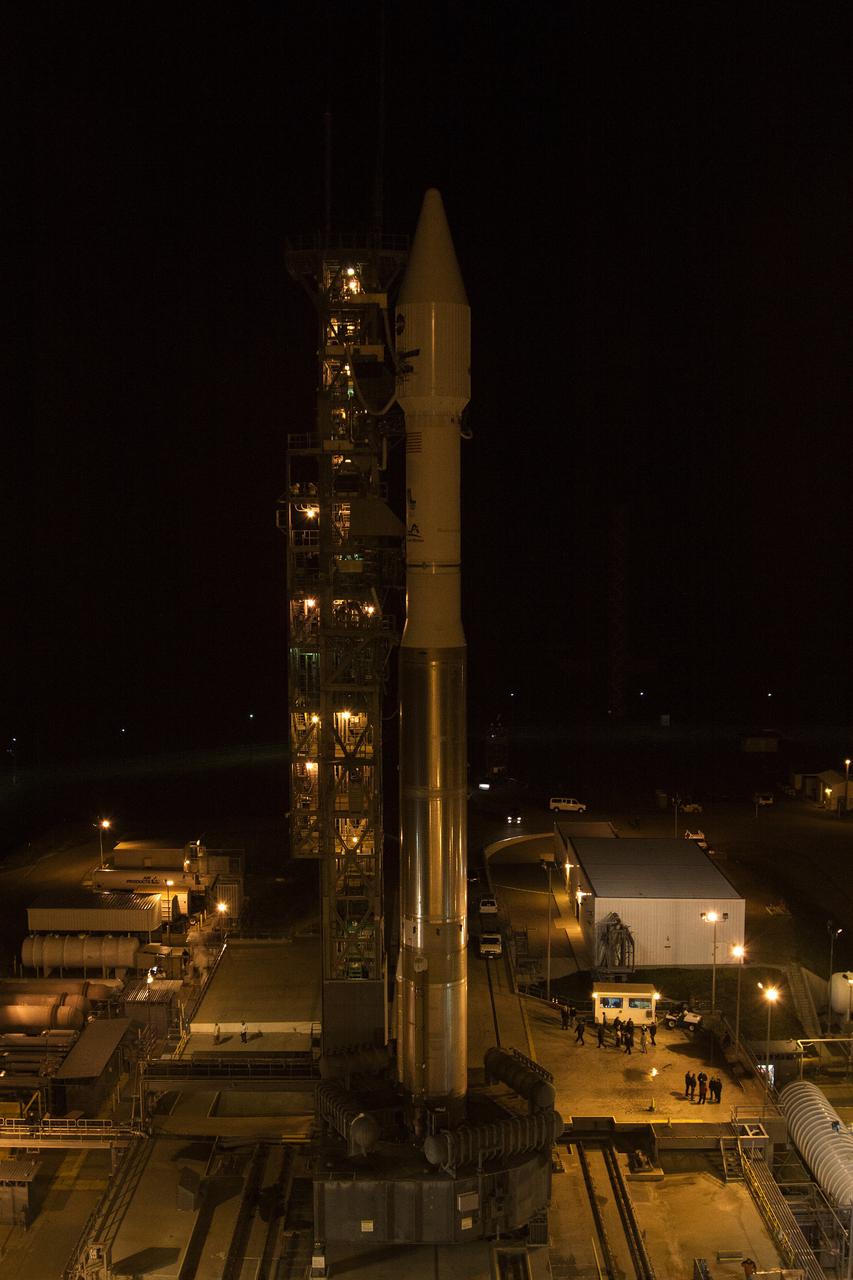
VANDENBERG AFB, Calif. -- At Vandenberg Air Force Base, Calif., NASA's Landsat Data Continuity Mission, or LDCM, satellite is mounted atop a United Launch Alliance Atlas V rocket poised for launch at Space Launch Complex 3E. The Landsat Data Continuity Mission LDCM is the future of Landsat satellites. It will continue to obtain valuable data and imagery to be used in agriculture, education, business, science, and government. The Landsat Program provides repetitive acquisition of high resolution multispectral data of the Earth's surface on a global basis. The data from the Landsat spacecraft constitute the longest record of the Earth's continental surfaces as seen from space. It is a record unmatched in quality, detail, coverage, and value. Liftoff is planned for Feb. 11, 2013 aboard a United Launch Alliance Atlas V rocket. For more information, visit: http:__www.nasa.gov_mission_pages_landsat_main_index.html Photo credit: NASA_Kim Shiflett

VANDENBERG AFB, Calif. -- Technicians unload and rotate NASA's Landsat Data Continuity Mission, or LDCM, satellite at the Astrotech processing facility at Vandenberg Air Force Base, Calif. The payload faring is seen on the left. The Landsat Data Continuity Mission LDCM is the future of Landsat satellites. It will continue to obtain valuable data and imagery to be used in agriculture, education, business, science, and government. The Landsat Program provides repetitive acquisition of high resolution multispectral data of the Earth's surface on a global basis. The data from the Landsat spacecraft constitute the longest record of the Earth's continental surfaces as seen from space. It is a record unmatched in quality, detail, coverage, and value. Launch is planned for Feb. 11, 2013. For more information, visit: http://www.nasa.gov/mission_pages/landsat/main/index.html Photo credit: NASA
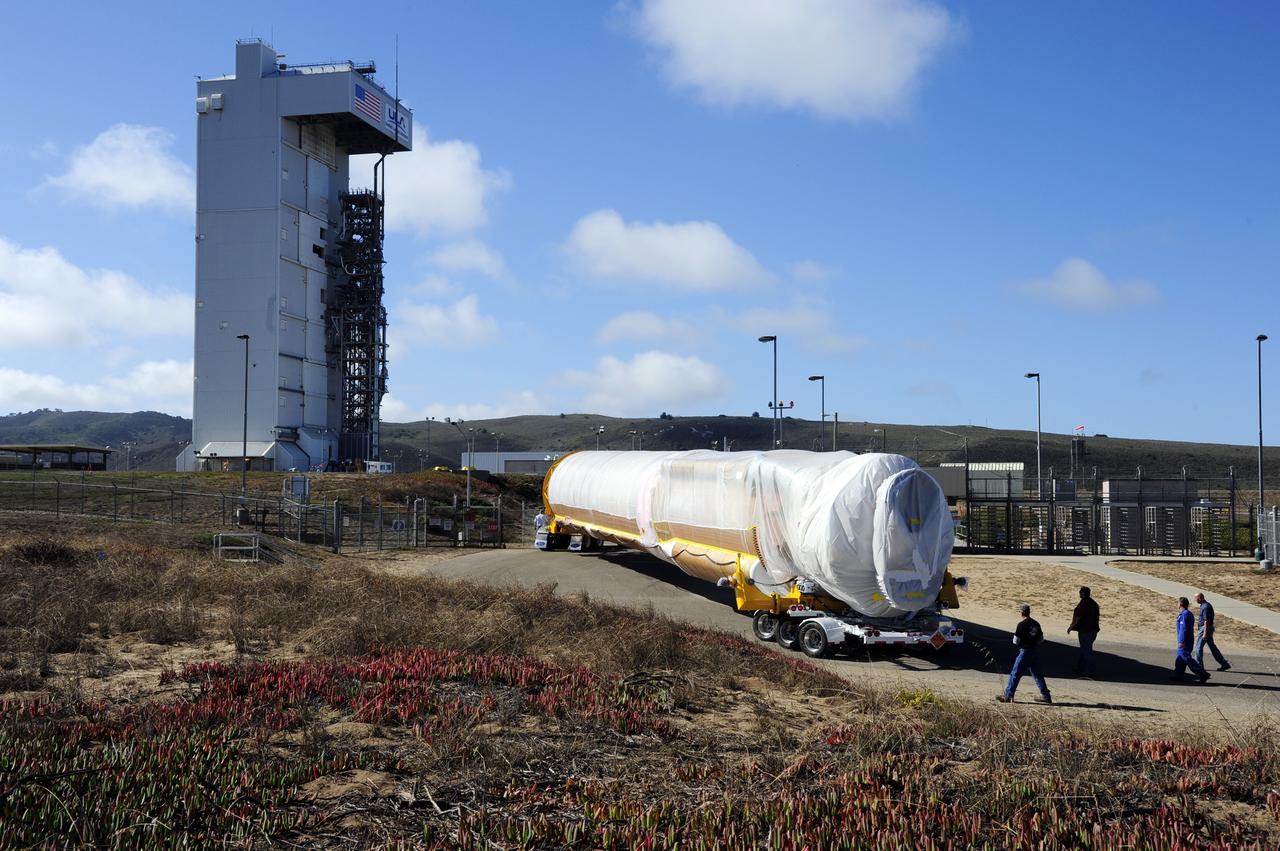
VANDENBERG AFB, Calif. – A truck moves the first stage booster of a United Launch Alliance Atlas V to Space Launch Complex-3E at Vandenberg Air Force Base, Calif. in preparation for the launch of the Landsat Data Continuity Mission. The Landsat Data Continuity Mission, or LDCM, is the future of Landsat satellites. It will continue to obtain valuable data and imagery to be used in agriculture, education, business, science, and government. The Landsat Program provides repetitive acquisition of high resolution multispectral data of the Earth's surface on a global basis. The data from the Landsat spacecraft constitute the longest record of the Earth's continental surfaces as seen from space. It is a record unmatched in quality, detail, coverage, and value. Launch is planned for Feb. 2013. Photo credit: NASA/Roy Allison
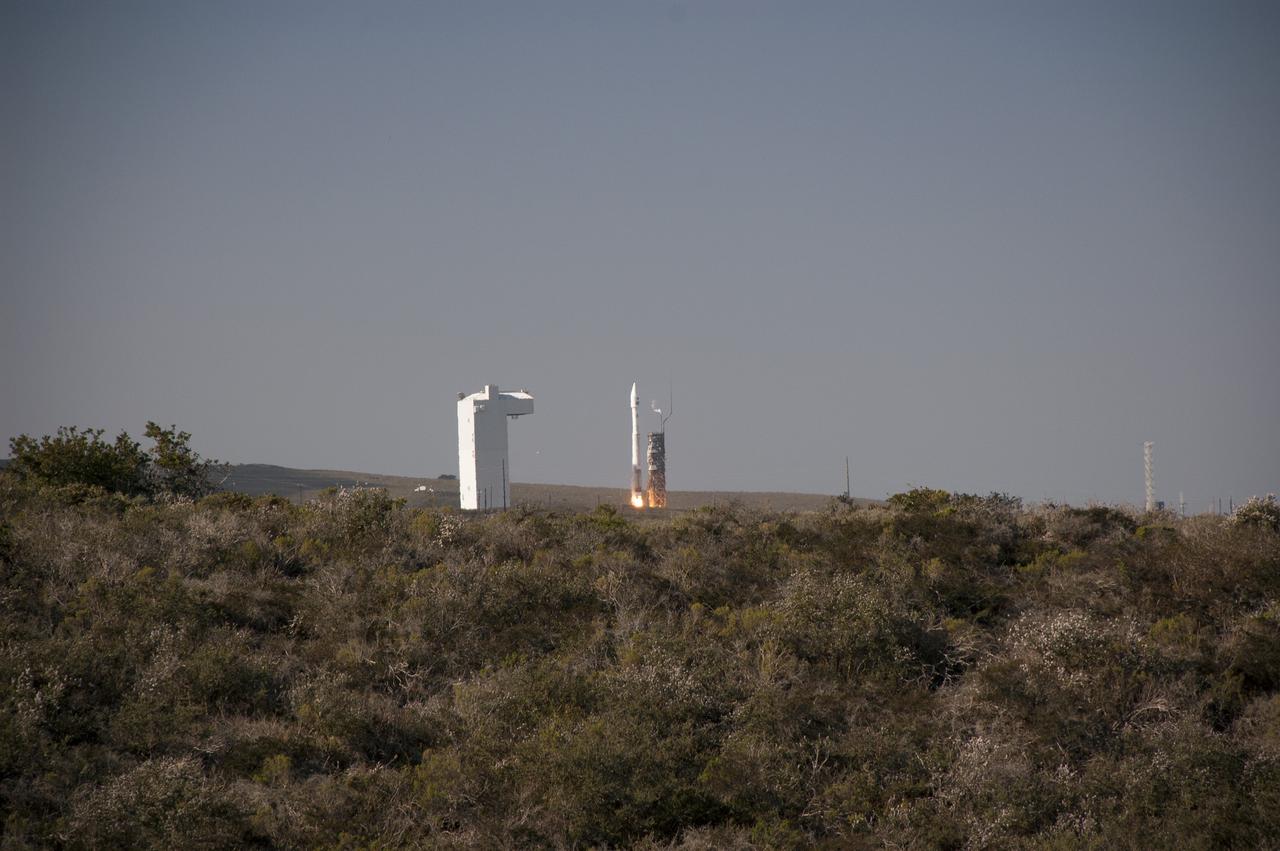
VANDENBERG AFB, Calif. -- The Landsat Data Continuity Mission spacecraft lifts off at 1:02 p.m. EST, 10:02 a.m. PST) atop a United Launch Alliance Atlas V rocket from Space Launch Complex 3 at California's Vandenberg Air Force Base. The Landsat Data Continuity Mission LDCM is the future of Landsat satellites. It will continue to obtain valuable data and imagery to be used in agriculture, education, business, science, and government. The Landsat Program provides repetitive acquisition of high resolution multispectral data of the Earth's surface on a global basis. The data from the Landsat spacecraft constitute the longest record of the Earth's continental surfaces as seen from space. It is a record unmatched in quality, detail, coverage, and value. For more information, visit: http:__www.nasa.gov_mission_pages_landsat_main_index.html Photo credit: NASA_Ben Smegelsky
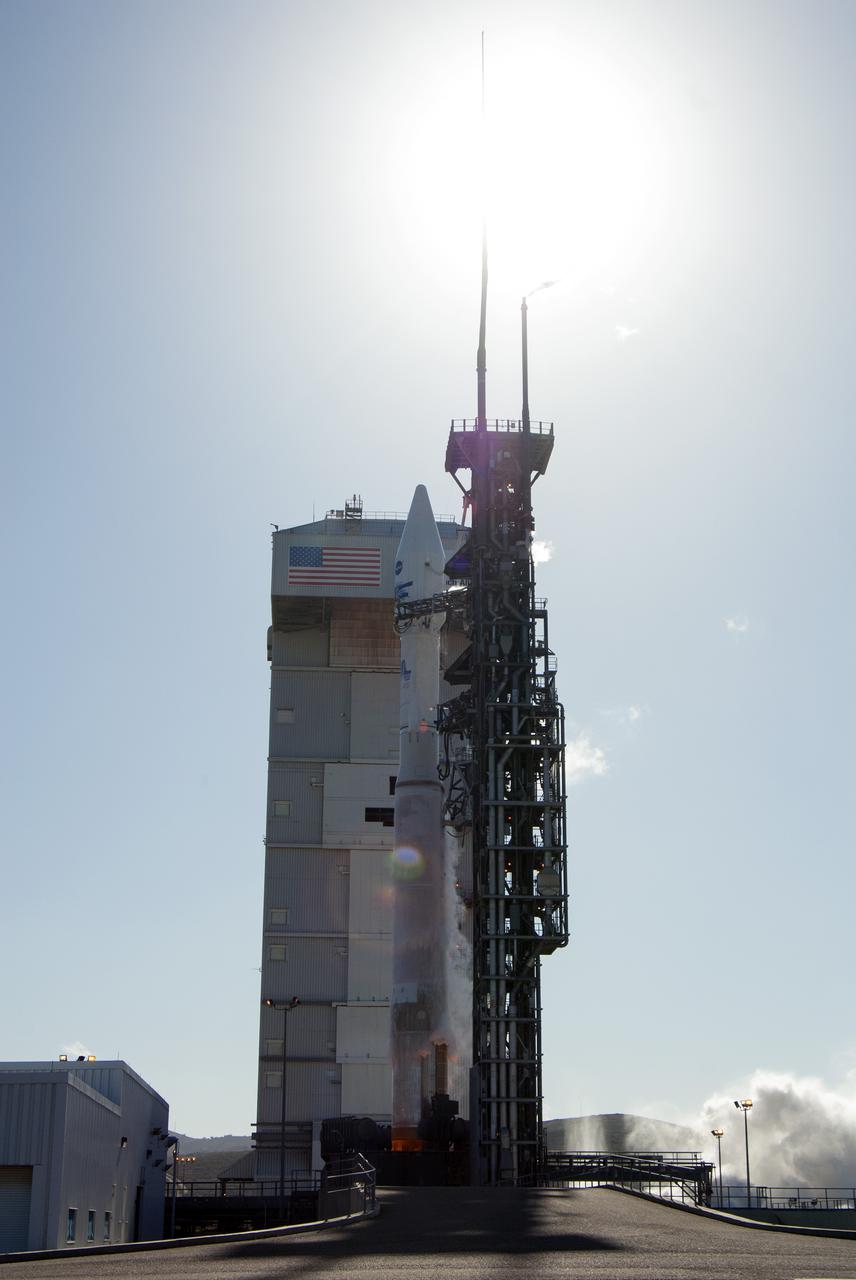
VANDENBERG AFB, Calif. -- The Landsat Data Continuity Mission spacecraft lifts off at 1:02 p.m. EST, 10:02 a.m. PST) atop a United Launch Alliance Atlas V rocket from Space Launch Complex 3 at California's Vandenberg Air Force Base. The Landsat Data Continuity Mission LDCM is the future of Landsat satellites. It will continue to obtain valuable data and imagery to be used in agriculture, education, business, science, and government. The Landsat Program provides repetitive acquisition of high resolution multispectral data of the Earth's surface on a global basis. The data from the Landsat spacecraft constitute the longest record of the Earth's continental surfaces as seen from space. It is a record unmatched in quality, detail, coverage, and value. For more information, visit: http:__www.nasa.gov_mission_pages_landsat_main_index.html Photo credit: NASA_Kim Shiflett
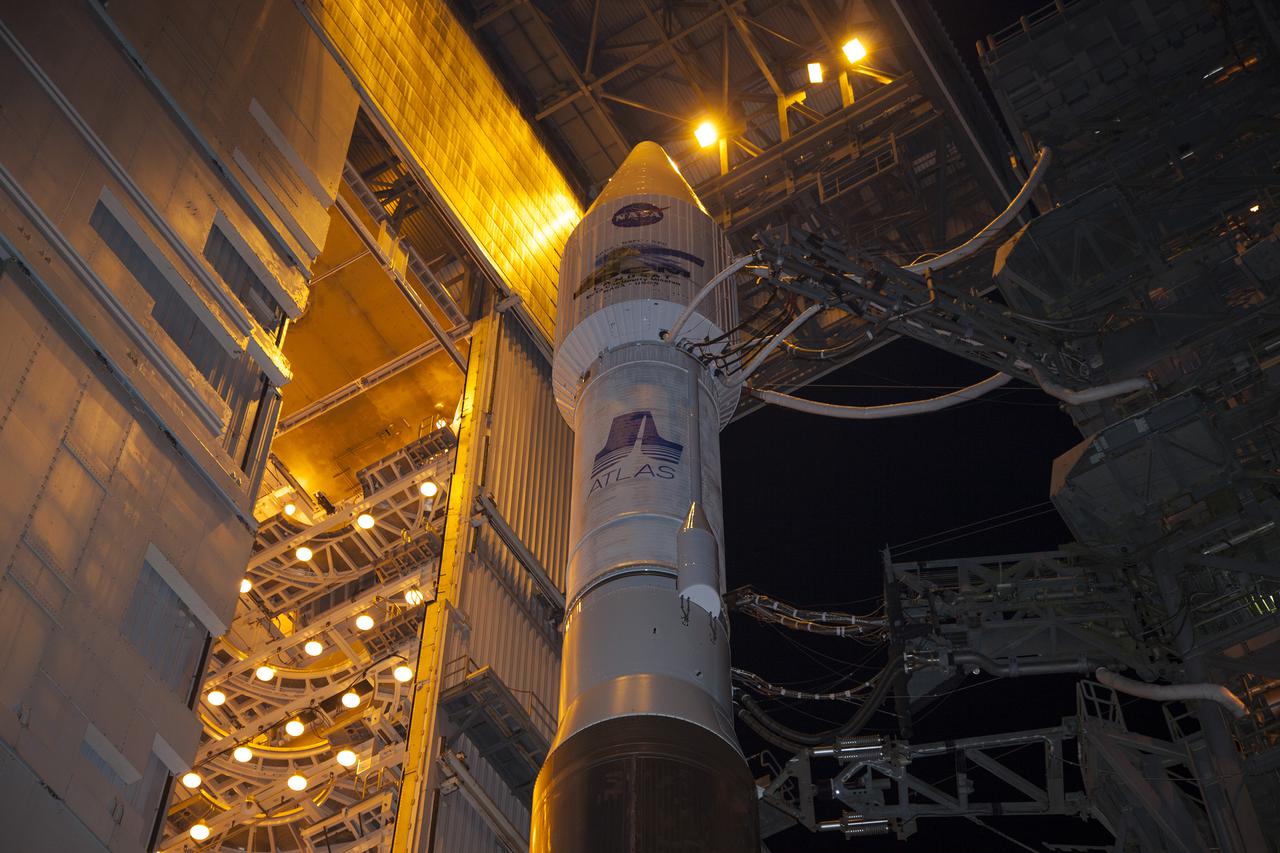
VANDENBERG AFB, Calif. -- At Vandenberg Air Force Base, Calif., the gantry at Space Launch Complex 3E rolls back from NASA's Landsat Data Continuity Mission, or LDCM, satellite mounted atop a United Launch Alliance Atlas V rocket. The Landsat Data Continuity Mission LDCM is the future of Landsat satellites. It will continue to obtain valuable data and imagery to be used in agriculture, education, business, science, and government. The Landsat Program provides repetitive acquisition of high resolution multispectral data of the Earth's surface on a global basis. The data from the Landsat spacecraft constitute the longest record of the Earth's continental surfaces as seen from space. It is a record unmatched in quality, detail, coverage, and value. Liftoff is planned for Feb. 11, 2013 aboard a United Launch Alliance Atlas V rocket. For more information, visit: http:__www.nasa.gov_mission_pages_landsat_main_index.html Photo credit: NASA_Kim Shiflett
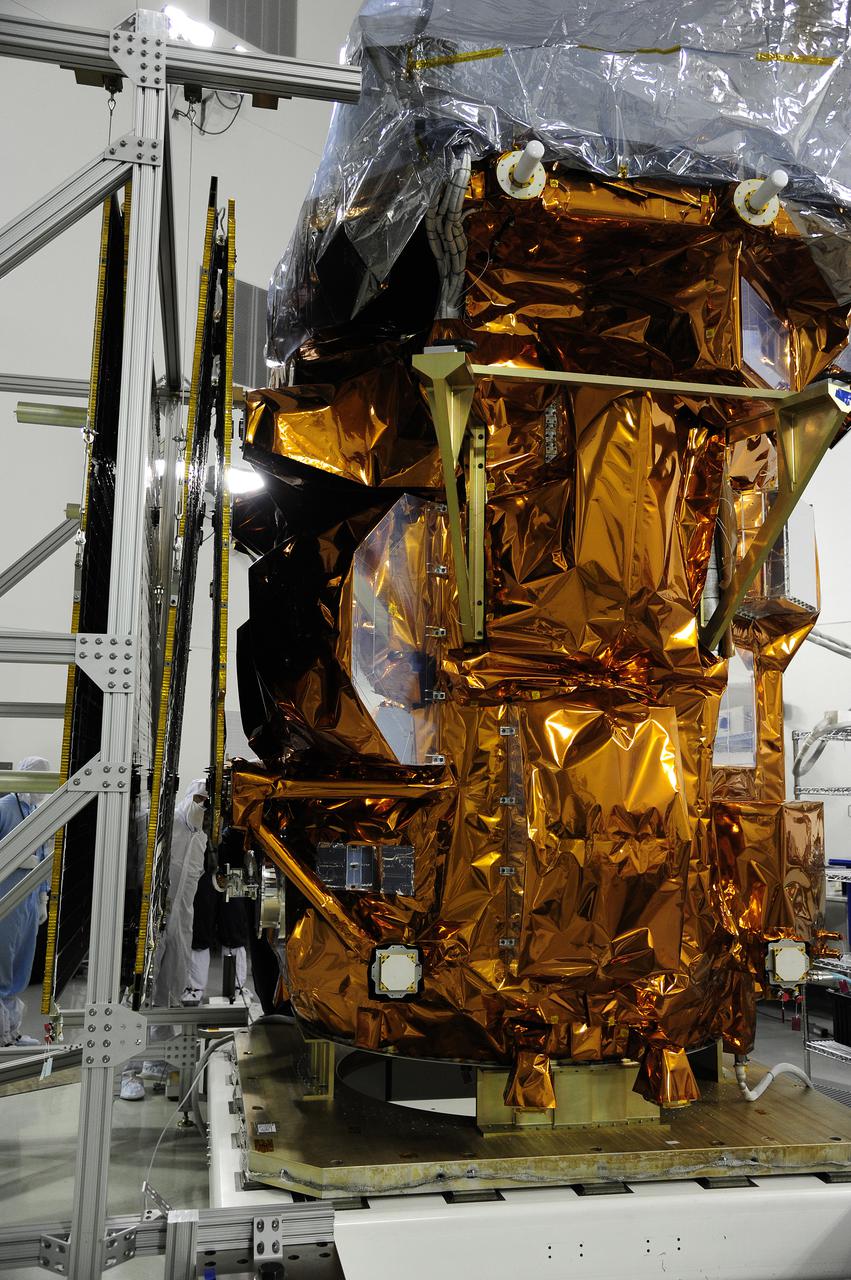
VANDENBERG AFB, Calif. -- In the Astrotech processing facility at Vandenberg Air Force Base, Calif., the solar arrays are being tested on NASA's Landsat Data Continuity Mission, or LDCM, satellite. The Landsat Data Continuity Mission LDCM is the future of Landsat satellites. It will continue to obtain valuable data and imagery to be used in agriculture, education, business, science, and government. The Landsat Program provides repetitive acquisition of high resolution multispectral data of the Earth's surface on a global basis. The data from the Landsat spacecraft constitute the longest record of the Earth's continental surfaces as seen from space. It is a record unmatched in quality, detail, coverage, and value. Liftoff is planned for Feb. 11, 2013 aboard a United Launch Alliance Atlas V rocket. For more information, visit: http:__www.nasa.gov_mission_pages_landsat_main_index.html Photo credit: NASA
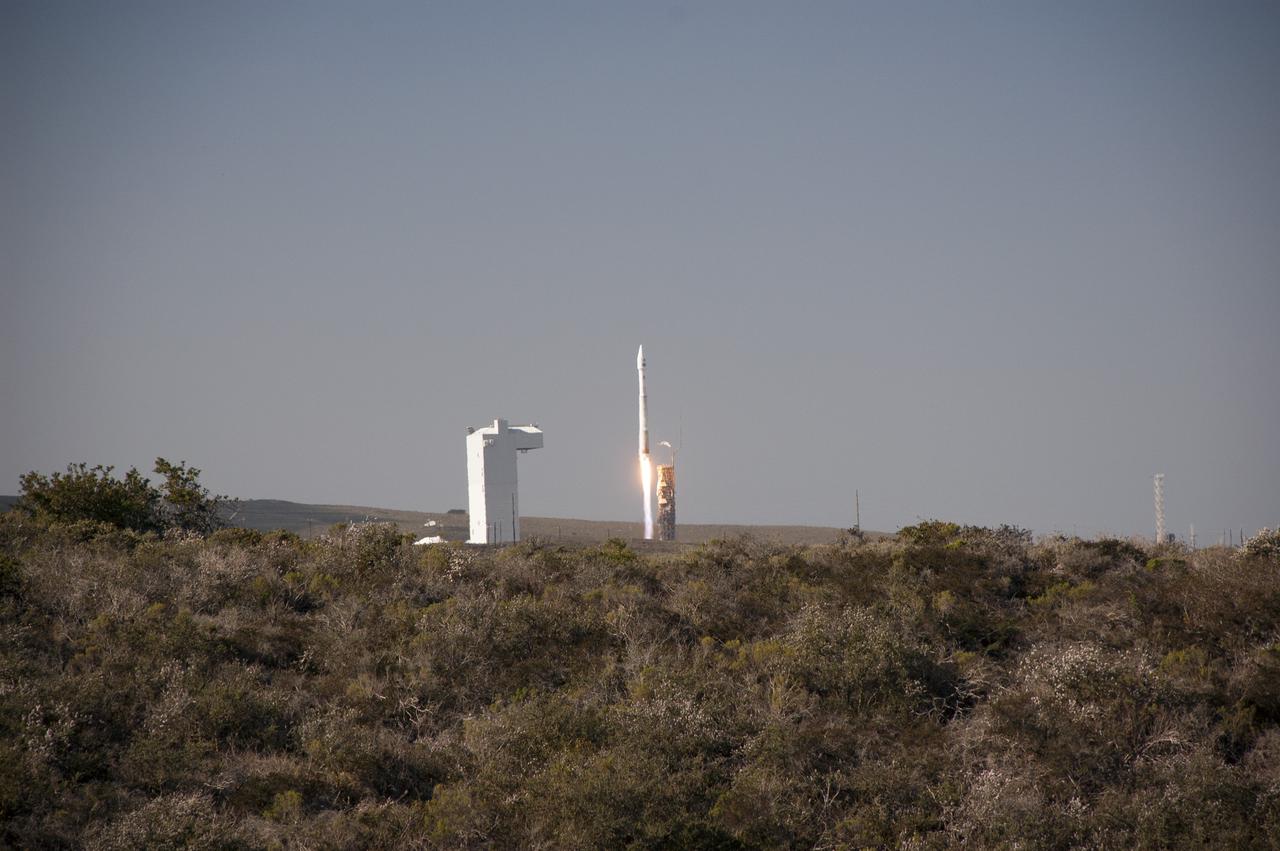
VANDENBERG AFB, Calif. -- The Landsat Data Continuity Mission spacecraft lifts off at 1:02 p.m. EST, 10:02 a.m. PST) atop a United Launch Alliance Atlas V rocket from Space Launch Complex 3 at California's Vandenberg Air Force Base. The Landsat Data Continuity Mission LDCM is the future of Landsat satellites. It will continue to obtain valuable data and imagery to be used in agriculture, education, business, science, and government. The Landsat Program provides repetitive acquisition of high resolution multispectral data of the Earth's surface on a global basis. The data from the Landsat spacecraft constitute the longest record of the Earth's continental surfaces as seen from space. It is a record unmatched in quality, detail, coverage, and value. For more information, visit: http:__www.nasa.gov_mission_pages_landsat_main_index.html Photo credit: NASA_Ben Smegelsky

VANDENBERG AFB, Calif. – A Centaur upper stage is lifted onto the first stage booster of a United Launch Alliance Atlas V at the launch pad at Space Launch Complex-3E at Vandenberg Air Force Base, Calif. in preparation for the launch of the Landsat Data Continuity Mission. The Landsat Data Continuity Mission LDCM is the future of Landsat satellites. It will continue to obtain valuable data and imagery to be used in agriculture, education, business, science, and government. The Landsat Program provides repetitive acquisition of high resolution multispectral data of the Earth's surface on a global basis. The data from the Landsat spacecraft constitute the longest record of the Earth's continental surfaces as seen from space. It is a record unmatched in quality, detail, coverage, and value. Launch is planned for Feb. 2013. Photo credit: NASA/Roy Allison
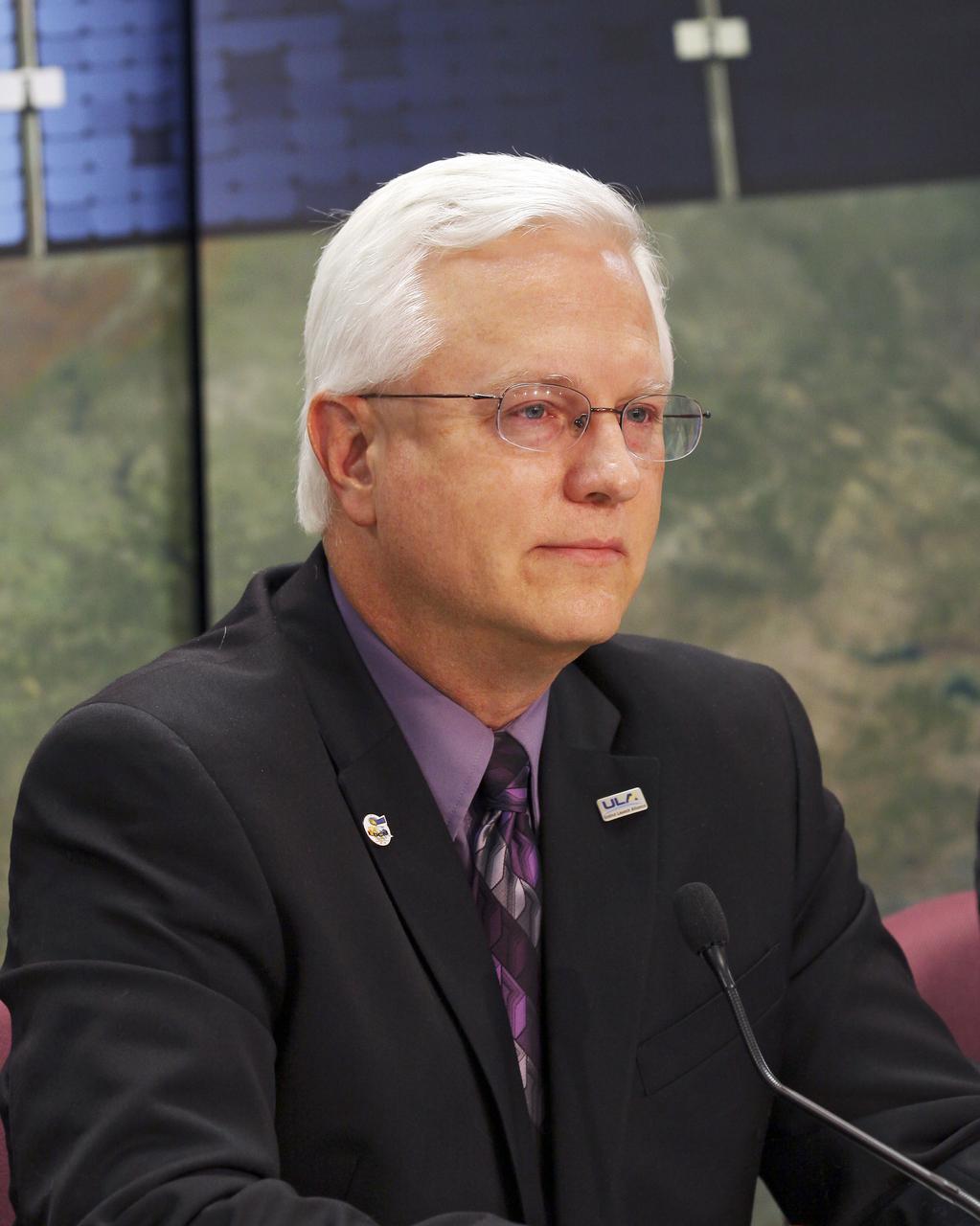
VANDENBERG AFB, Calif. -- NASA and contractor officials discussed NASA's readiness to launch the Landsat Data Continuity Mission, or LDCM, during a prelaunch news conference at Vandenberg Air Force Base, Calif. Participants included United Launch Alliance Program Manager for NASA Missions Vernon Thorp. The Landsat Data Continuity Mission LDCM is the future of Landsat satellites. It will continue to obtain valuable data and imagery to be used in agriculture, education, business, science, and government. The Landsat Program provides repetitive acquisition of high resolution multispectral data of the Earth's surface on a global basis. The data from the Landsat spacecraft constitute the longest record of the Earth's continental surfaces as seen from space. It is a record unmatched in quality, detail, coverage, and value. Liftoff is planned for Feb. 11, 2013 aboard a United Launch Alliance Atlas V rocket. For more information, visit: http:__www.nasa.gov_mission_pages_landsat_main_index.html Photo credit: NASA_Kim Shiflett

VANDENBERG AFB, Calif. -- George Diller of NASA Public Affairs moderated a prelaunch news conference at Vandenberg Air Force Base, Calif. during which NASA and contractor officials discussed NASA's readiness to launch the Landsat Data Continuity Mission, or LDCM. The Landsat Data Continuity Mission LDCM is the future of Landsat satellites. It will continue to obtain valuable data and imagery to be used in agriculture, education, business, science, and government. The Landsat Program provides repetitive acquisition of high resolution multispectral data of the Earth's surface on a global basis. The data from the Landsat spacecraft constitute the longest record of the Earth's continental surfaces as seen from space. It is a record unmatched in quality, detail, coverage, and value. Liftoff is planned for Feb. 11, 2013 aboard a United Launch Alliance Atlas V rocket. For more information, visit: http:__www.nasa.gov_mission_pages_landsat_main_index.html Photo credit: NASA_Kim Shiflett
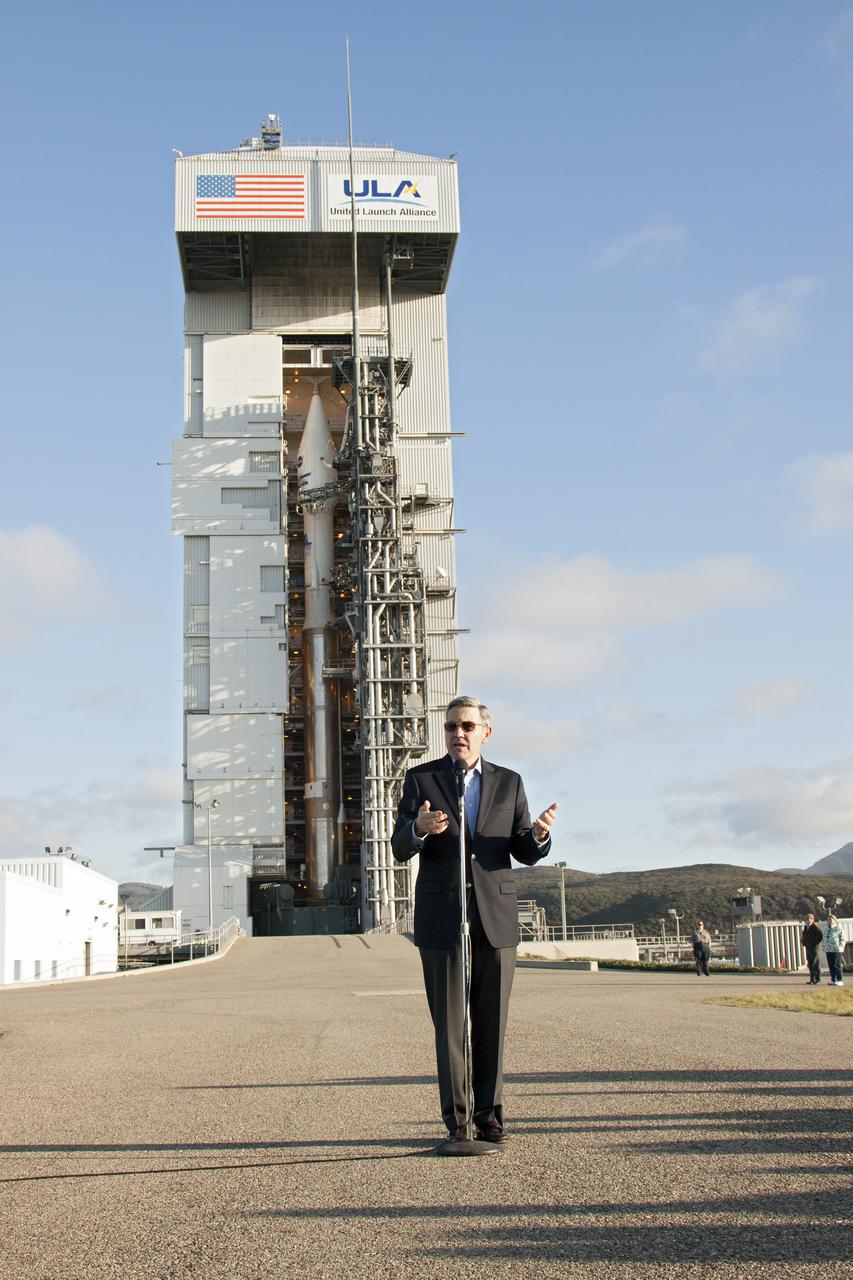
VANDENBERG AFB, Calif. -- At Space Launch Complex 3E at Vandenberg Air Force Base, Kennedy Space Center Director Bob Cabana discusses the Landsat Data Continuity Mission, or LDCM, satellite mission with NASA social media followers. The Landsat Data Continuity Mission LDCM is the future of Landsat satellites. It will continue to obtain valuable data and imagery to be used in agriculture, education, business, science, and government. The Landsat Program provides repetitive acquisition of high resolution multispectral data of the Earth's surface on a global basis. The data from the Landsat spacecraft constitute the longest record of the Earth's continental surfaces as seen from space. It is a record unmatched in quality, detail, coverage, and value. Liftoff is planned for Feb. 11, 2013 aboard a United Launch Alliance Atlas V rocket. For more information, visit: http:__www.nasa.gov_mission_pages_landsat_main_index.html Photo credit: NASA_Kim Shiflett
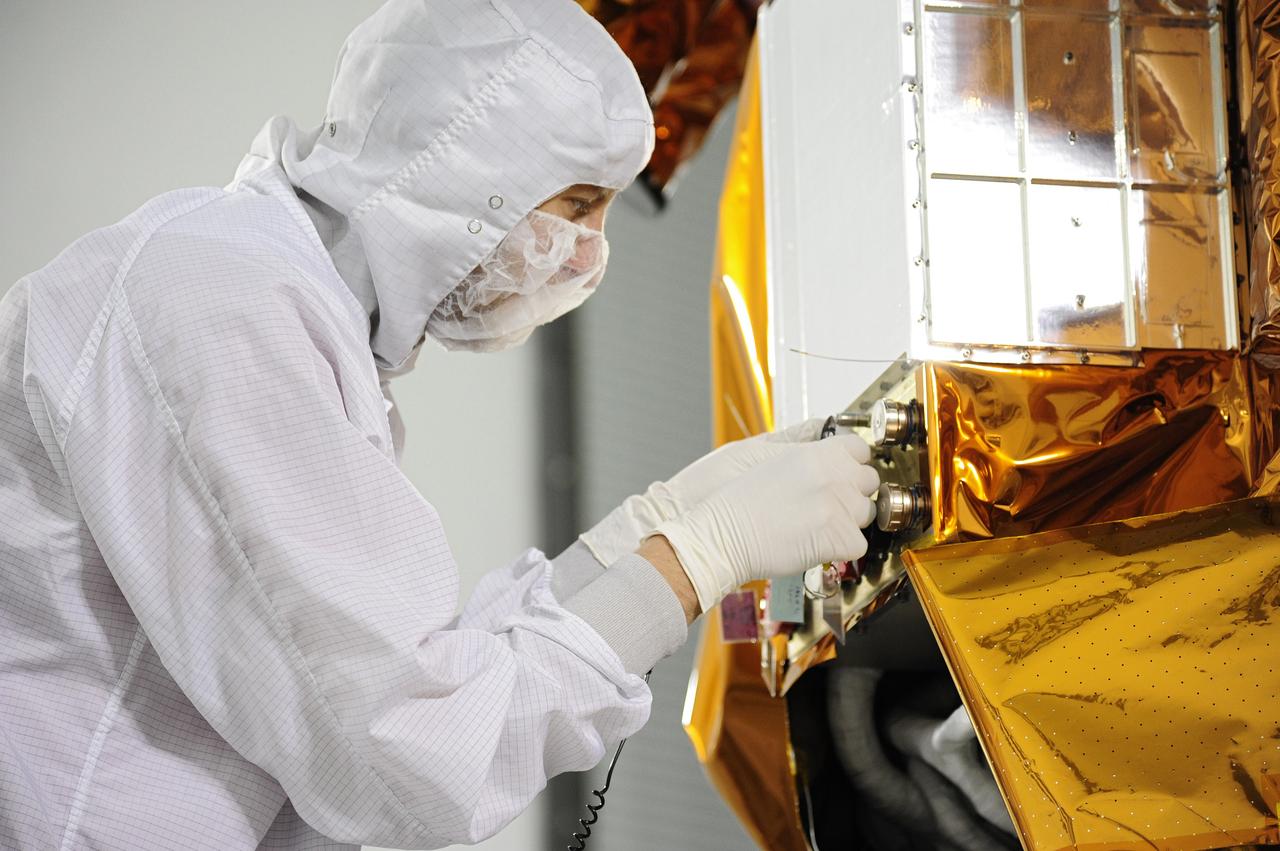
VANDENBERG AFB, Calif. – Technicians perform thermal blanket closeouts on the fuel servicing valves on the Landsat Data Continuity Mission, or LDCM, spacecraft in the Astrotech processing facility at Vandenberg Air Force Base in Calif., following fueling operations. The Landsat Data Continuity Mission is the future of Landsat satellites. It will continue to obtain valuable data and imagery to be used in agriculture, education, business, science, and government. The Landsat Program provides repetitive acquisition of high resolution multispectral data of the Earth's surface on a global basis. The data from the Landsat spacecraft constitute the longest record of the Earth's continental surfaces as seen from space. It is a record unmatched in quality, detail, coverage, and value. Launch is planned for Feb. 11, 2013. For more information, visit: http://www.nasa.gov/mission_pages/landsat/main/index.html Photo credit: VAFB
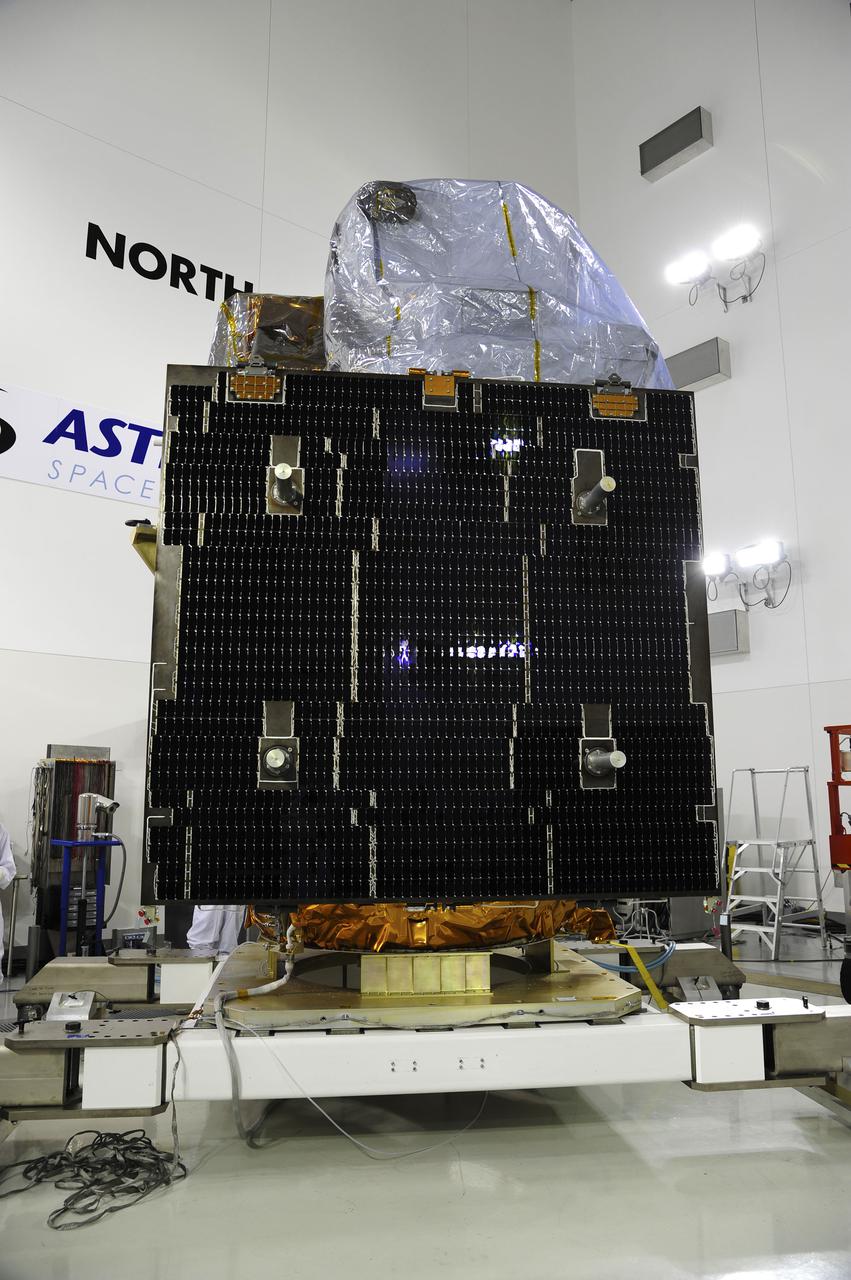
VANDENBERG AFB, Calif. -- At the Astrotech processing facility at Vandenberg Air Force Base, Calif., NASA's Landsat Data Continuity Mission, or LDCM, satellite is undergoing close-outs prior to encapsulation in the payload fairing. The Landsat Data Continuity Mission LDCM is the future of Landsat satellites. It will continue to obtain valuable data and imagery to be used in agriculture, education, business, science, and government. The Landsat Program provides repetitive acquisition of high resolution multispectral data of the Earth's surface on a global basis. The data from the Landsat spacecraft constitute the longest record of the Earth's continental surfaces as seen from space. It is a record unmatched in quality, detail, coverage, and value. Liftoff is planned for Feb. 11, 2013 aboard a United Launch Alliance Atlas V rocket. For more information, visit: http:__www.nasa.gov_mission_pages_landsat_main_index.html Photo credit: NASA
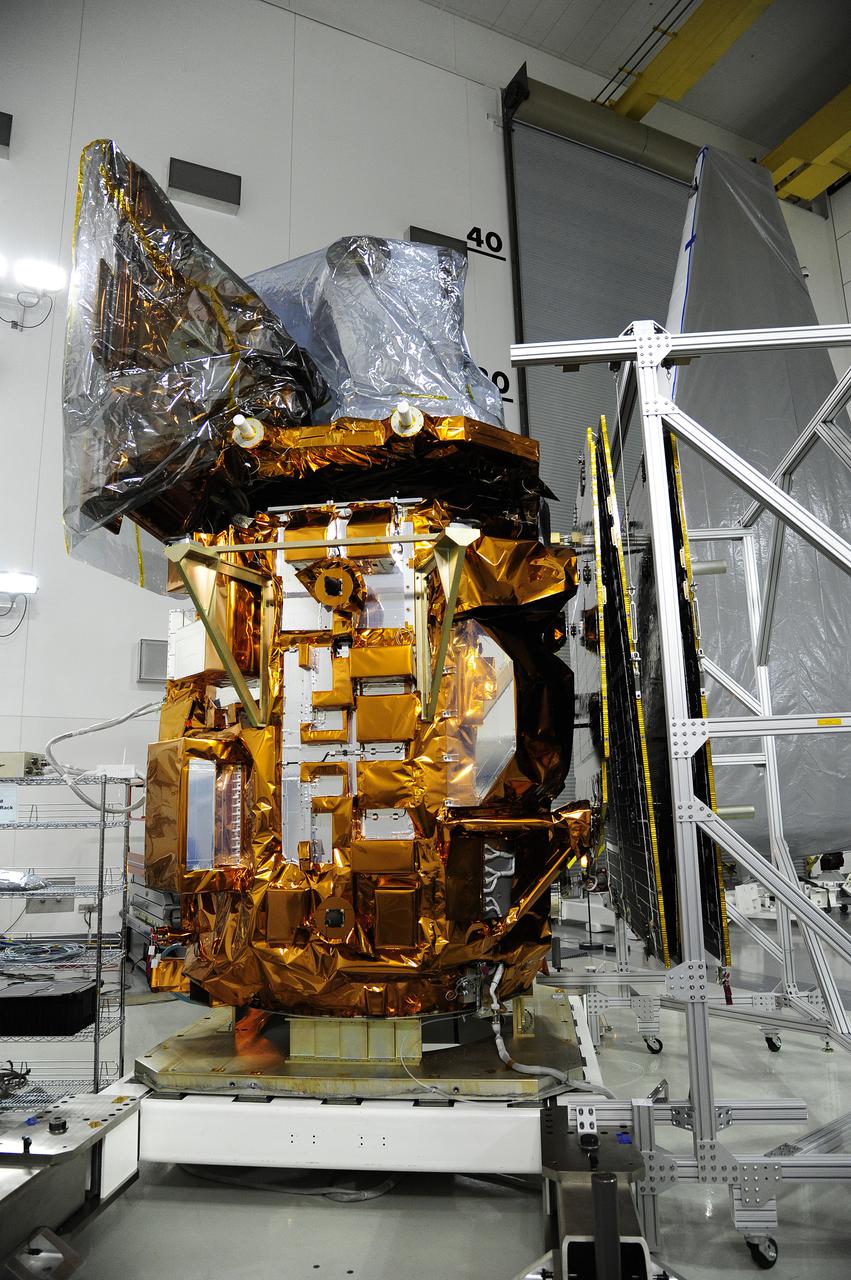
VANDENBERG AFB, Calif. -- In the Astrotech processing facility at Vandenberg Air Force Base, Calif., solar arrays are being tested on NASA's Landsat Data Continuity Mission, or LDCM, satellite. The Landsat Data Continuity Mission LDCM is the future of Landsat satellites. It will continue to obtain valuable data and imagery to be used in agriculture, education, business, science, and government. The Landsat Program provides repetitive acquisition of high resolution multispectral data of the Earth's surface on a global basis. The data from the Landsat spacecraft constitute the longest record of the Earth's continental surfaces as seen from space. It is a record unmatched in quality, detail, coverage, and value. Liftoff is planned for Feb. 11, 2013 aboard a United Launch Alliance Atlas V rocket. For more information, visit: http:__www.nasa.gov_mission_pages_landsat_main_index.html Photo credit: NASA
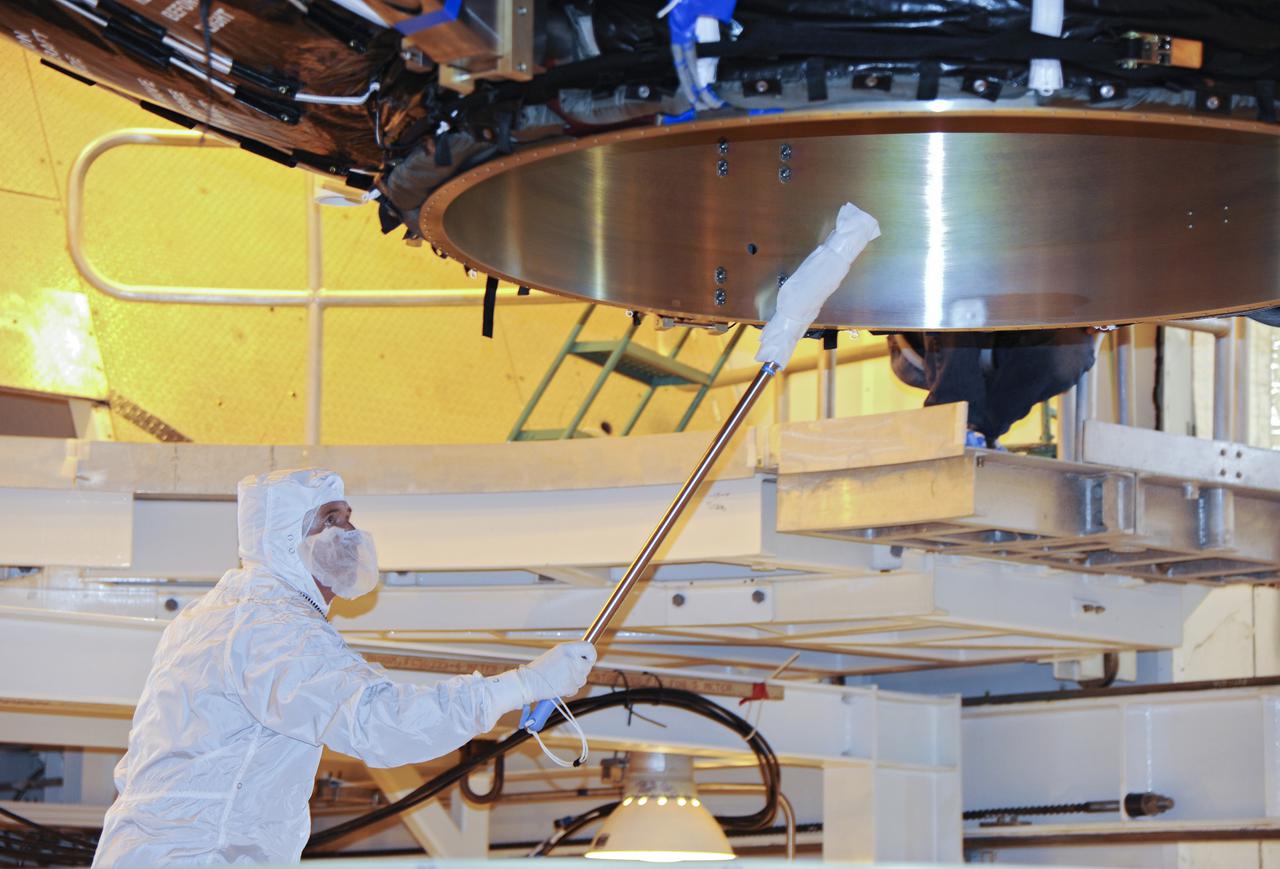
VANDENBERG AFB, Calif. -- A technician ensures no contaminants on the payload fairing or the Landsat Data Continuity Mission, or LDCM, spacecraft about to be mounted atop a United Launch Alliance Atlas V rocket at Space Launch Complex-3E at Vandenberg Air Force Base, Calif. The Landsat Data Continuity Mission LDCM is the future of Landsat satellites. It will continue to obtain valuable data and imagery to be used in agriculture, education, business, science, and government. The Landsat Program provides repetitive acquisition of high resolution multispectral data of the Earth's surface on a global basis. The data from the Landsat spacecraft constitute the longest record of the Earth's continental surfaces as seen from space. It is a record unmatched in quality, detail, coverage, and value. Liftoff is planned for Feb. 11, 2013 aboard a United Launch Alliance Atlas V rocket. For more information, visit: http:__www.nasa.gov_mission_pages_landsat_main_index.html Photo credit: NASA
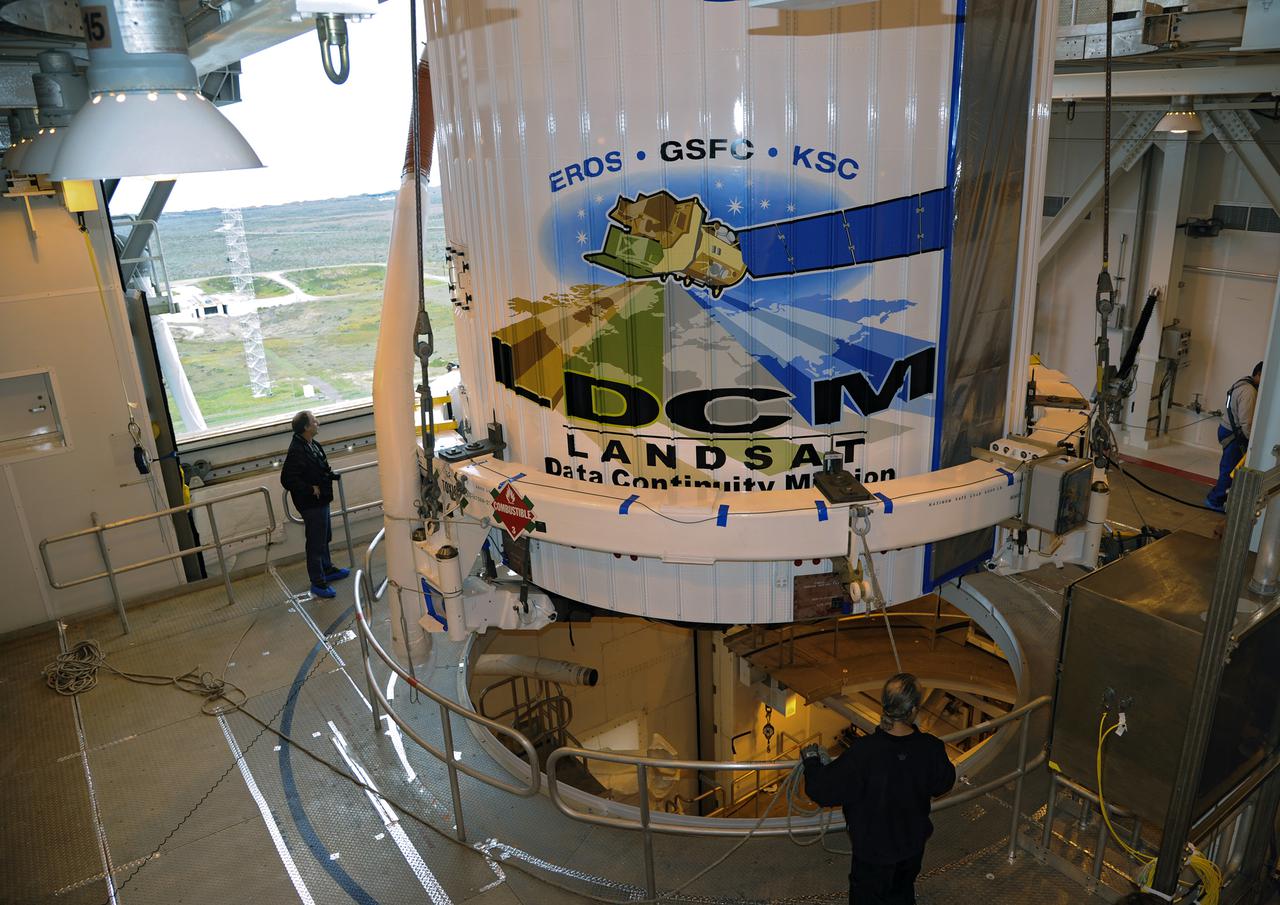
VANDENBERG AFB, Calif. -- The payload fairing containing the Landsat Data Continuity Mission, or LDCM, spacecraft has been lifted to the top of Space Launch Complex-3E at Vandenberg Air Force Base, Calif. where it is about to be mounted atop a United Launch Alliance Atlas V rocket. The Landsat Data Continuity Mission LDCM is the future of Landsat satellites. It will continue to obtain valuable data and imagery to be used in agriculture, education, business, science, and government. The Landsat Program provides repetitive acquisition of high resolution multispectral data of the Earth's surface on a global basis. The data from the Landsat spacecraft constitute the longest record of the Earth's continental surfaces as seen from space. It is a record unmatched in quality, detail, coverage, and value. Liftoff is planned for Feb. 11, 2013 aboard a United Launch Alliance Atlas V rocket. For more information, visit: http:__www.nasa.gov_mission_pages_landsat_main_index.html Photo credit: NASA
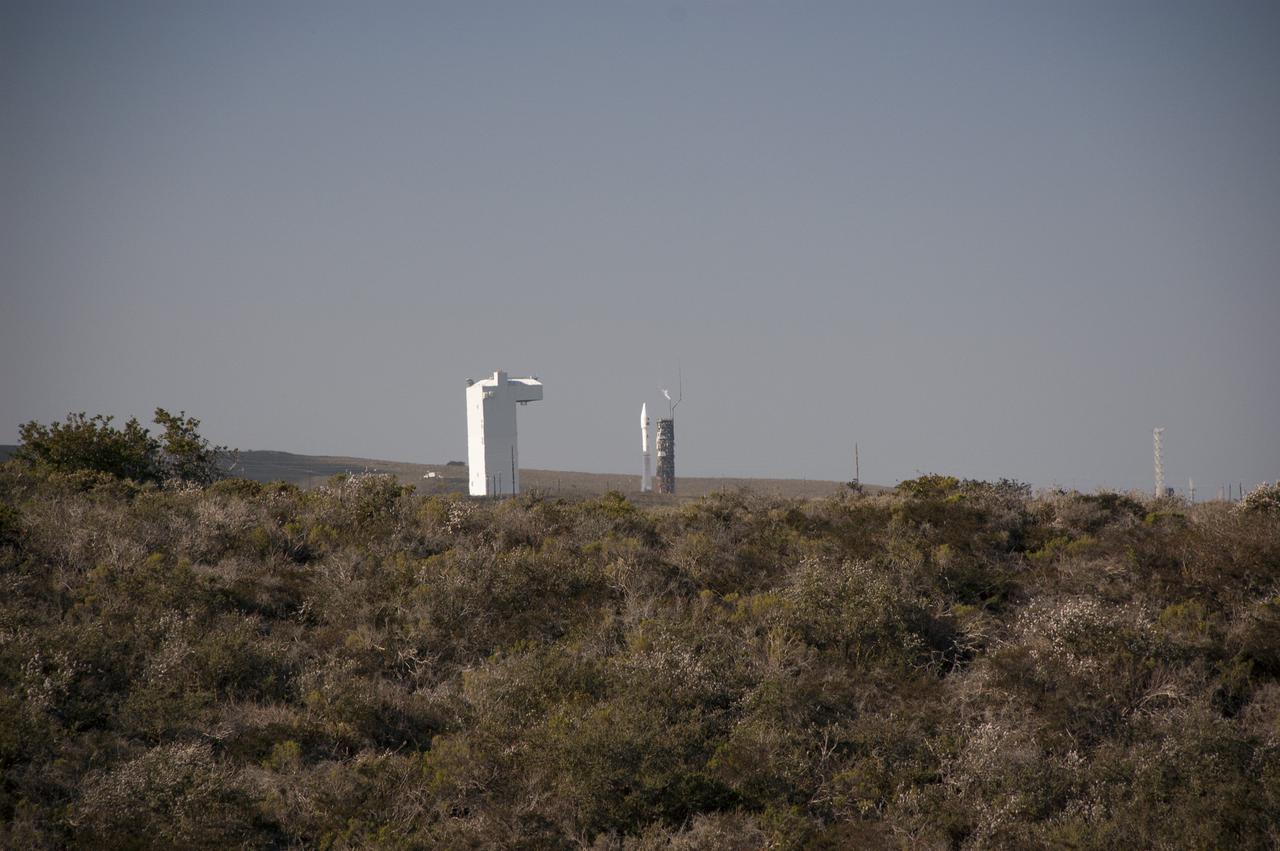
VANDENBERG AFB, Calif. -- The Landsat Data Continuity Mission spacecraft is poised for lift off atop a United Launch Alliance Atlas V rocket from Space Launch Complex 3 at California's Vandenberg Air Force Base. The Landsat Data Continuity Mission LDCM is the future of Landsat satellites. It will continue to obtain valuable data and imagery to be used in agriculture, education, business, science, and government. The Landsat Program provides repetitive acquisition of high resolution multispectral data of the Earth's surface on a global basis. The data from the Landsat spacecraft constitute the longest record of the Earth's continental surfaces as seen from space. It is a record unmatched in quality, detail, coverage, and value. For more information, visit: http:__www.nasa.gov_mission_pages_landsat_main_index.html Photo credit: NASA_Ben Smegelsky
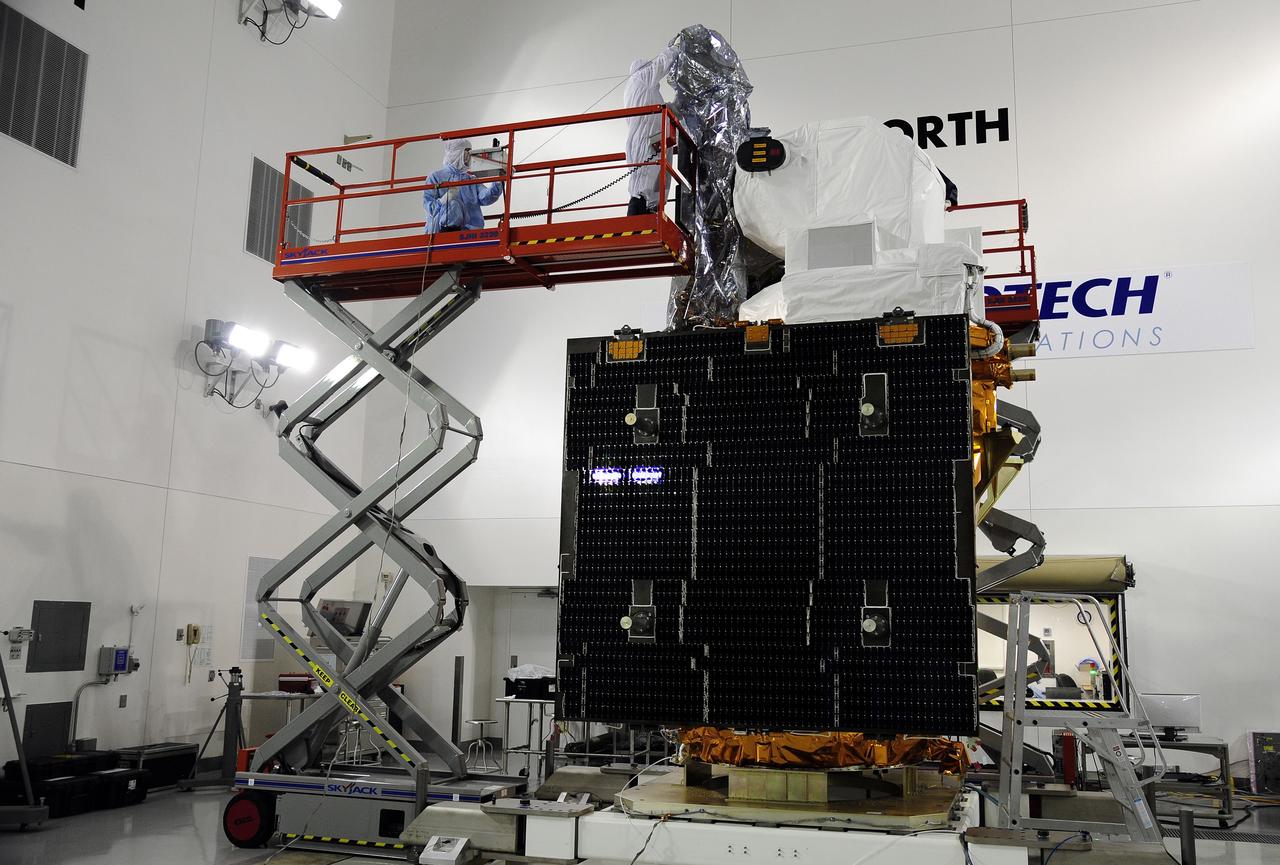
VANDENBERG AFB, Calif. -- Technicians inspect NASA's Landsat Data Continuity Mission, or LDCM, satellite at the Astrotech processing facility at Vandenberg Air Force Base, Calif. The Landsat Data Continuity Mission LDCM is the future of Landsat satellites. It will continue to obtain valuable data and imagery to be used in agriculture, education, business, science, and government. The Landsat Program provides repetitive acquisition of high resolution multispectral data of the Earth's surface on a global basis. The data from the Landsat spacecraft constitute the longest record of the Earth's continental surfaces as seen from space. It is a record unmatched in quality, detail, coverage, and value. Launch is planned for Feb. 11, 2013. For more information, visit: http://www.nasa.gov/mission_pages/landsat/main/index.html Photo credit: NASA
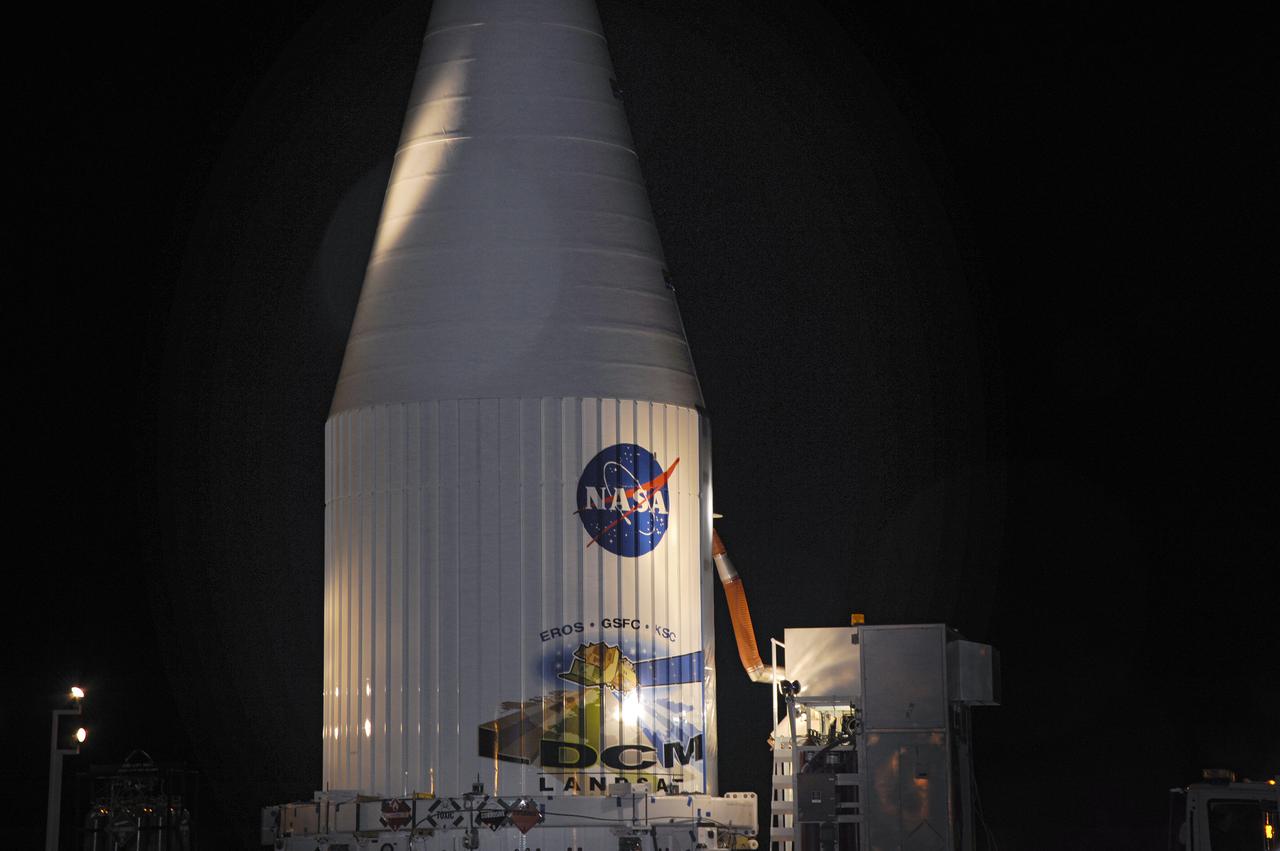
VANDENBERG AFB, Calif. -- The payload fairing containing the Landsat Data Continuity Mission, or LDCM, spacecraft is mounted atop a United Launch Alliance Atlas V rocket at Space Launch Complex-3E at Vandenberg Air Force Base, Calif. The Landsat Data Continuity Mission LDCM is the future of Landsat satellites. It will continue to obtain valuable data and imagery to be used in agriculture, education, business, science, and government. The Landsat Program provides repetitive acquisition of high resolution multispectral data of the Earth's surface on a global basis. The data from the Landsat spacecraft constitute the longest record of the Earth's continental surfaces as seen from space. It is a record unmatched in quality, detail, coverage, and value. Liftoff is planned for Feb. 11, 2013 aboard a United Launch Alliance Atlas V rocket. For more information, visit: http:__www.nasa.gov_mission_pages_landsat_main_index.html Photo credit: NASA

VANDENBERG AFB, Calif. -- NASA and contractor officials discussed NASA's readiness to launch the Landsat Data Continuity Mission, or LDCM, during a prelaunch news conference at Vandenberg Air Force Base, Calif. Participants included 1st Lt. Jennifer Kelley, launch weather officer for the 30th Operations Support Squadron at Vandenberg. The Landsat Data Continuity Mission LDCM is the future of Landsat satellites. It will continue to obtain valuable data and imagery to be used in agriculture, education, business, science, and government. The Landsat Program provides repetitive acquisition of high resolution multispectral data of the Earth's surface on a global basis. The data from the Landsat spacecraft constitute the longest record of the Earth's continental surfaces as seen from space. It is a record unmatched in quality, detail, coverage, and value. Liftoff is planned for Feb. 11, 2013 aboard a United Launch Alliance Atlas V rocket. For more information, visit: http:__www.nasa.gov_mission_pages_landsat_main_index.html Photo credit: NASA_Kim Shiflett

VANDENBERG AFB, Calif. -- At Vandenberg Air Force Base, Calif., NASA social media followers pose for a group photo. In the background, the satellite is mounted atop a United Launch Alliance Atlas V rocket in the gantry at Space Launch Complex 3E. The Landsat Data Continuity Mission LDCM is the future of Landsat satellites. It will continue to obtain valuable data and imagery to be used in agriculture, education, business, science, and government. The Landsat Program provides repetitive acquisition of high resolution multispectral data of the Earth's surface on a global basis. The data from the Landsat spacecraft constitute the longest record of the Earth's continental surfaces as seen from space. It is a record unmatched in quality, detail, coverage, and value. Liftoff is planned for Feb. 11, 2013 aboard a United Launch Alliance Atlas V rocket. For more information, visit: http:__www.nasa.gov_mission_pages_landsat_main_index.html Photo credit: NASA_Kim Shiflett
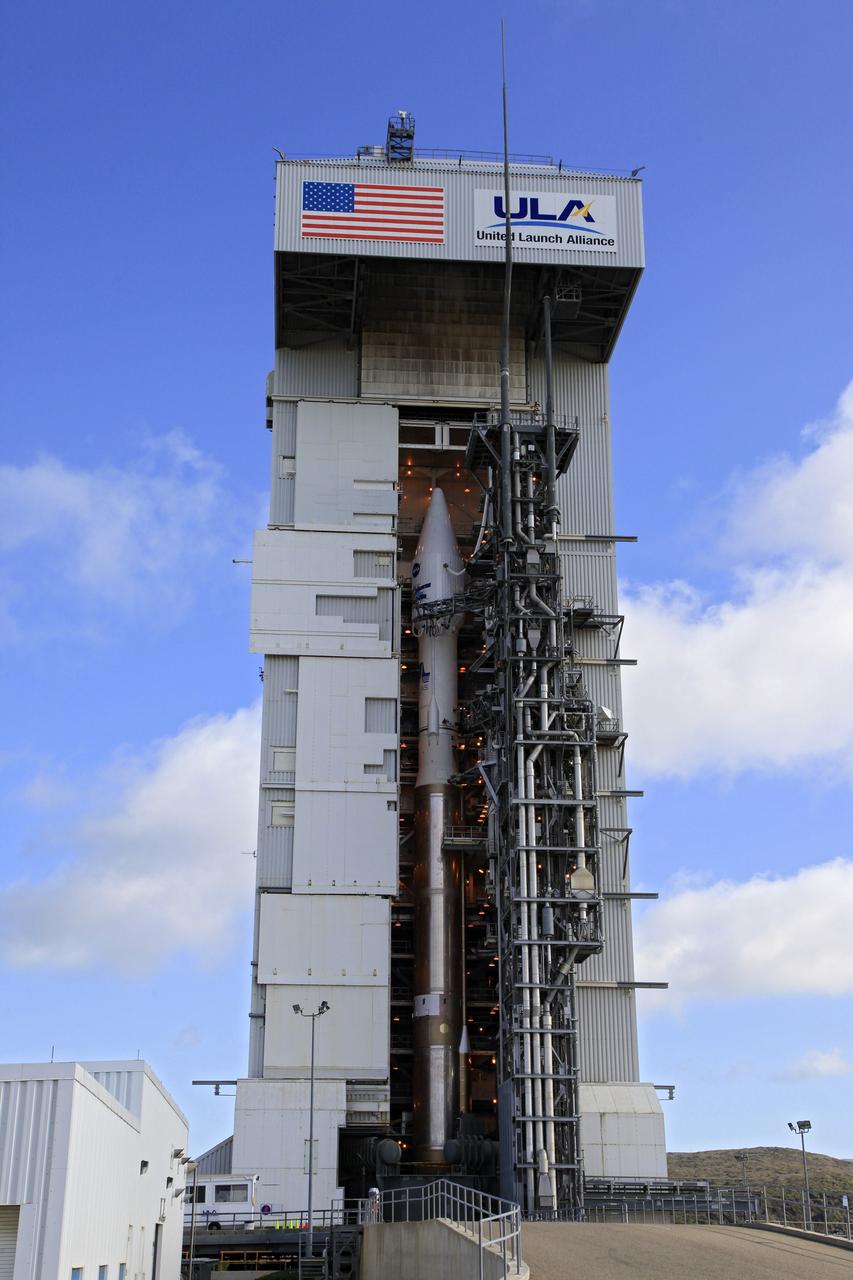
VANDENBERG AFB, Calif. -- At Vandenberg Air Force Base, Calif., NASA's Landsat Data Continuity Mission, or LDCM, satellite is mounted atop a United Launch Alliance Atlas V rocket in the gantry at Space Launch Complex 3E. The Landsat Data Continuity Mission LDCM is the future of Landsat satellites. It will continue to obtain valuable data and imagery to be used in agriculture, education, business, science, and government. The Landsat Program provides repetitive acquisition of high resolution multispectral data of the Earth's surface on a global basis. The data from the Landsat spacecraft constitute the longest record of the Earth's continental surfaces as seen from space. It is a record unmatched in quality, detail, coverage, and value. Liftoff is planned for Feb. 11, 2013 aboard a United Launch Alliance Atlas V rocket. For more information, visit: http://www.nasa.gov/mission_pages/landsat/main/index.html Photo credit: NASA/Kim Shiflett
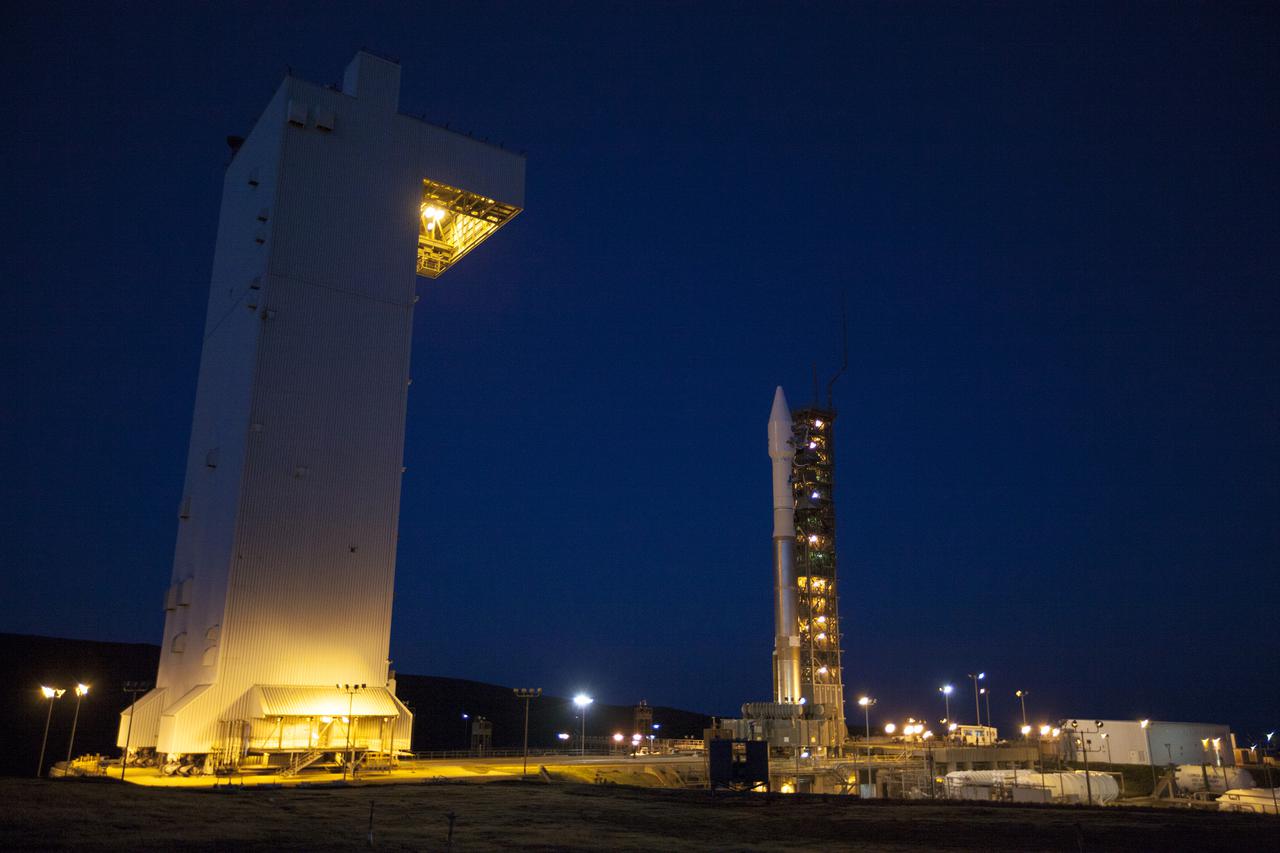
VANDENBERG AFB, Calif. -- At Vandenberg Air Force Base, Calif., the gantry at Space Launch Complex 3E rolls back from NASA's Landsat Data Continuity Mission, or LDCM, satellite mounted atop a United Launch Alliance Atlas V rocket. The Landsat Data Continuity Mission LDCM is the future of Landsat satellites. It will continue to obtain valuable data and imagery to be used in agriculture, education, business, science, and government. The Landsat Program provides repetitive acquisition of high resolution multispectral data of the Earth's surface on a global basis. The data from the Landsat spacecraft constitute the longest record of the Earth's continental surfaces as seen from space. It is a record unmatched in quality, detail, coverage, and value. Liftoff is planned for Feb. 11, 2013 aboard a United Launch Alliance Atlas V rocket. For more information, visit: http:__www.nasa.gov_mission_pages_landsat_main_index.html Photo credit: NASA_Kim Shiflett
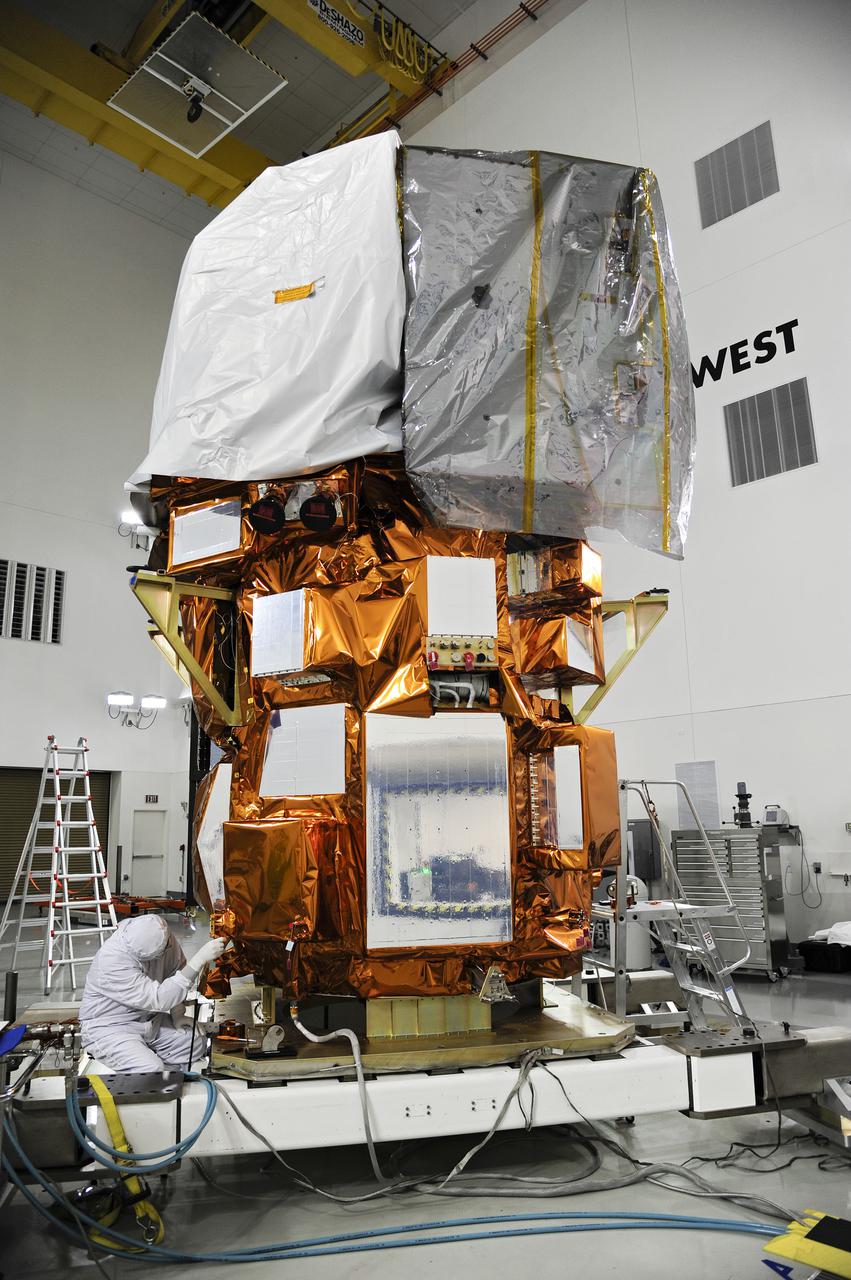
VANDENBERG AFB, Calif. -- At the Astrotech processing facility at Vandenberg Air Force Base, Calif., technicians perform close-out inspections on NASA's Landsat Data Continuity Mission, or LDCM, satellite. The Landsat Data Continuity Mission LDCM is the future of Landsat satellites. It will continue to obtain valuable data and imagery to be used in agriculture, education, business, science, and government. The Landsat Program provides repetitive acquisition of high resolution multispectral data of the Earth's surface on a global basis. The data from the Landsat spacecraft constitute the longest record of the Earth's continental surfaces as seen from space. It is a record unmatched in quality, detail, coverage, and value. Liftoff is planned for Feb. 11, 2013 aboard a United Launch Alliance Atlas V rocket. For more information, visit: http:__www.nasa.gov_mission_pages_landsat_main_index.html Photo credit: NASA

VANDENBERG AFB, Calif. -- NASA and contractor officials discussed NASA's readiness to launch the Landsat Data Continuity Mission, or LDCM, during a prelaunch news conference at Vandenberg Air Force Base, Calif. Participants included LDCM program executive David Jarrett from NASA Headquarters. The Landsat Data Continuity Mission LDCM is the future of Landsat satellites. It will continue to obtain valuable data and imagery to be used in agriculture, education, business, science, and government. The Landsat Program provides repetitive acquisition of high resolution multispectral data of the Earth's surface on a global basis. The data from the Landsat spacecraft constitute the longest record of the Earth's continental surfaces as seen from space. It is a record unmatched in quality, detail, coverage, and value. Liftoff is planned for Feb. 11, 2013 aboard a United Launch Alliance Atlas V rocket. For more information, visit: http:__www.nasa.gov_mission_pages_landsat_main_index.html Photo credit: NASA_Kim Shiflett
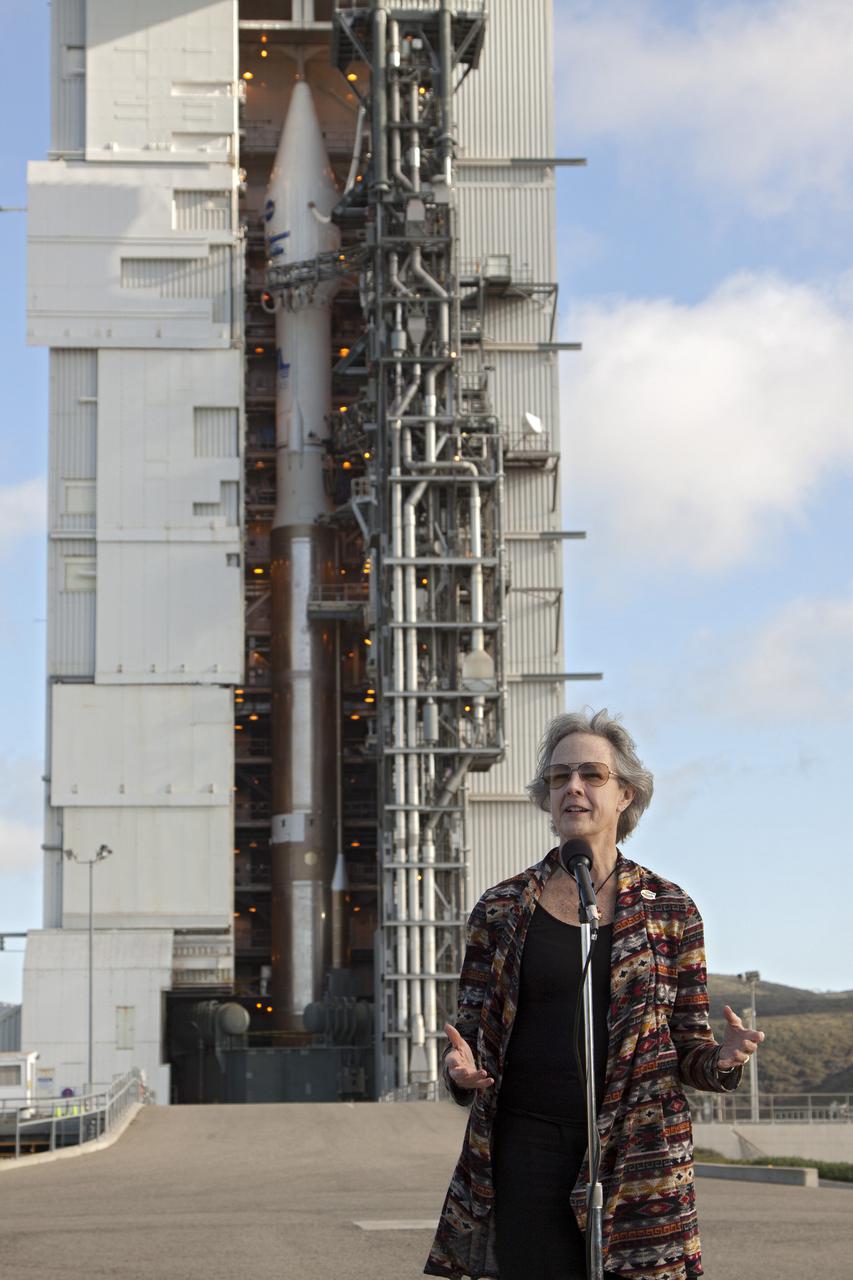
VANDENBERG AFB, Calif. -- At Space Launch Complex 3E at Vandenberg Air Force Base, Anne Castle, assistant secretary for Water and Science, U.S. Department of the Interior, discuss the Landsat Data Continuity Mission, or LDCM, satellite mission with NASA social media followers. The Landsat Data Continuity Mission LDCM is the future of Landsat satellites. It will continue to obtain valuable data and imagery to be used in agriculture, education, business, science, and government. The Landsat Program provides repetitive acquisition of high resolution multispectral data of the Earth's surface on a global basis. The data from the Landsat spacecraft constitute the longest record of the Earth's continental surfaces as seen from space. It is a record unmatched in quality, detail, coverage, and value. Liftoff is planned for Feb. 11, 2013 aboard a United Launch Alliance Atlas V rocket. For more information, visit: http:__www.nasa.gov_mission_pages_landsat_main_index.html Photo credit: NASA_Kim Shiflett
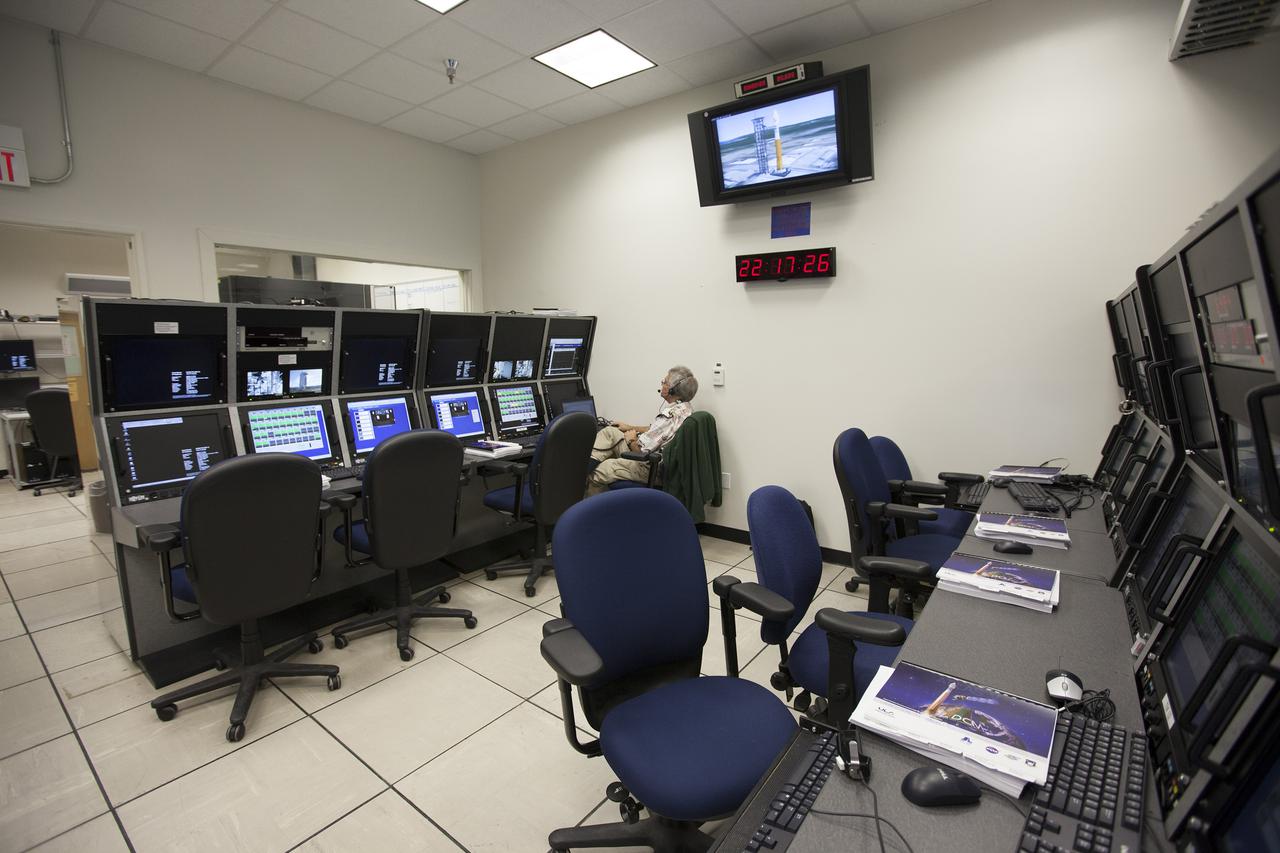
VANDENBERG AFB, Calif. -- From their positions in the telemetry laboratory at Vandenberg Air Force Base, engineers and technicians monitor the countdown for a United Launch Alliance Atlas V with the Landsat Data Continuity Mission, or LDCM, satellite prior to liftoff. The Landsat Data Continuity Mission, or LDCM, is the future of Landsat satellites. It will continue to obtain valuable data and imagery to be used in agriculture, education, business, science, and government. The Landsat Program provides repetitive acquisition of high resolution multispectral data of the Earth's surface on a global basis. The data from the Landsat spacecraft constitute the longest record of the Earth's continental surfaces as seen from space. It is a record unmatched in quality, detail, coverage, and value. Liftoff is planned for Feb. 11, 2013 aboard a United Launch Alliance Atlas V rocket. For more information, visit: http:__www.nasa.gov_mission_pages_landsat_main_index.html Photo credit: NASA_ Kim Shiflett
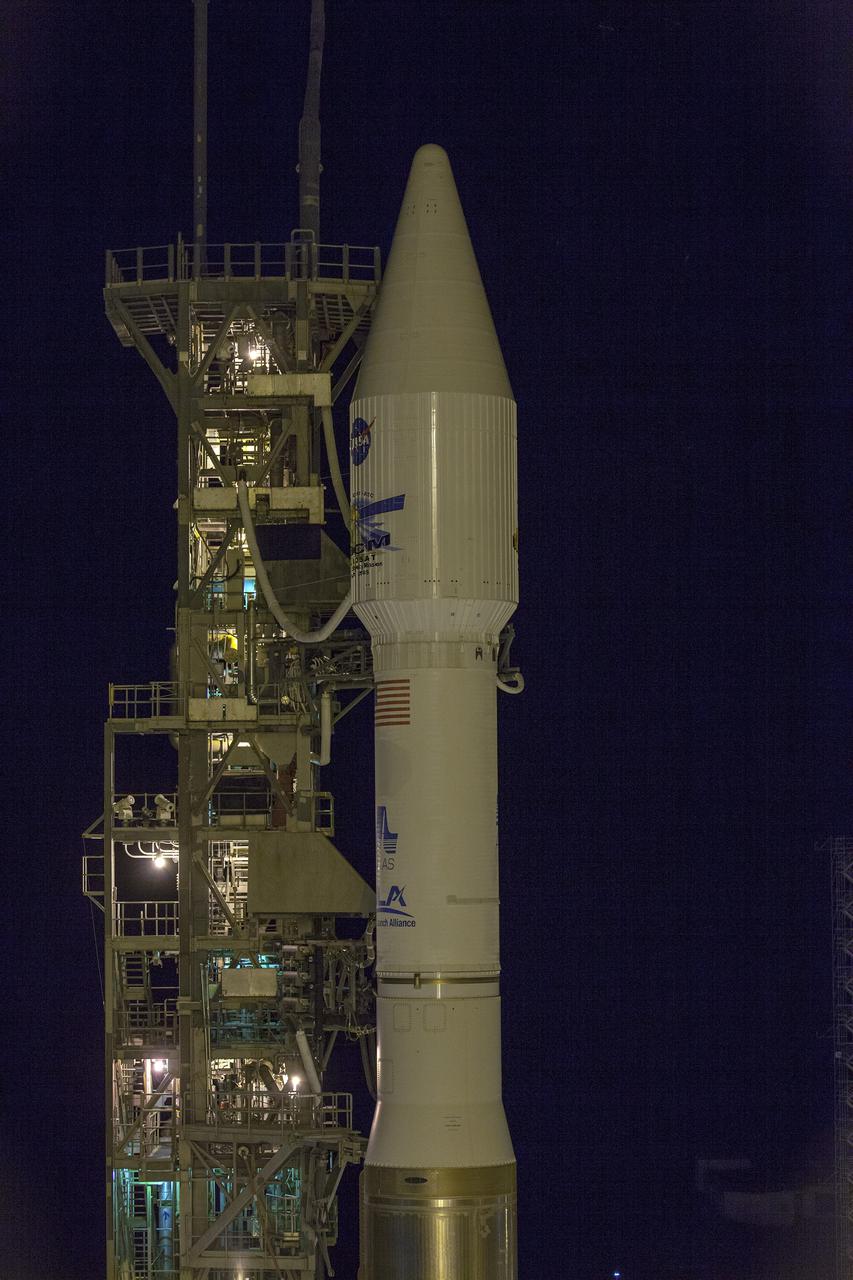
VANDENBERG AFB, Calif. -- At Vandenberg Air Force Base, Calif., NASA's Landsat Data Continuity Mission, or LDCM, satellite is mounted atop a United Launch Alliance Atlas V rocket at Space Launch Complex 3E. The Landsat Data Continuity Mission LDCM is the future of Landsat satellites. It will continue to obtain valuable data and imagery to be used in agriculture, education, business, science, and government. The Landsat Program provides repetitive acquisition of high resolution multispectral data of the Earth's surface on a global basis. The data from the Landsat spacecraft constitute the longest record of the Earth's continental surfaces as seen from space. It is a record unmatched in quality, detail, coverage, and value. Liftoff is planned for Feb. 11, 2013 aboard a United Launch Alliance Atlas V rocket. For more information, visit: http:__www.nasa.gov_mission_pages_landsat_main_index.html Photo credit: NASA_Kim Shiflett
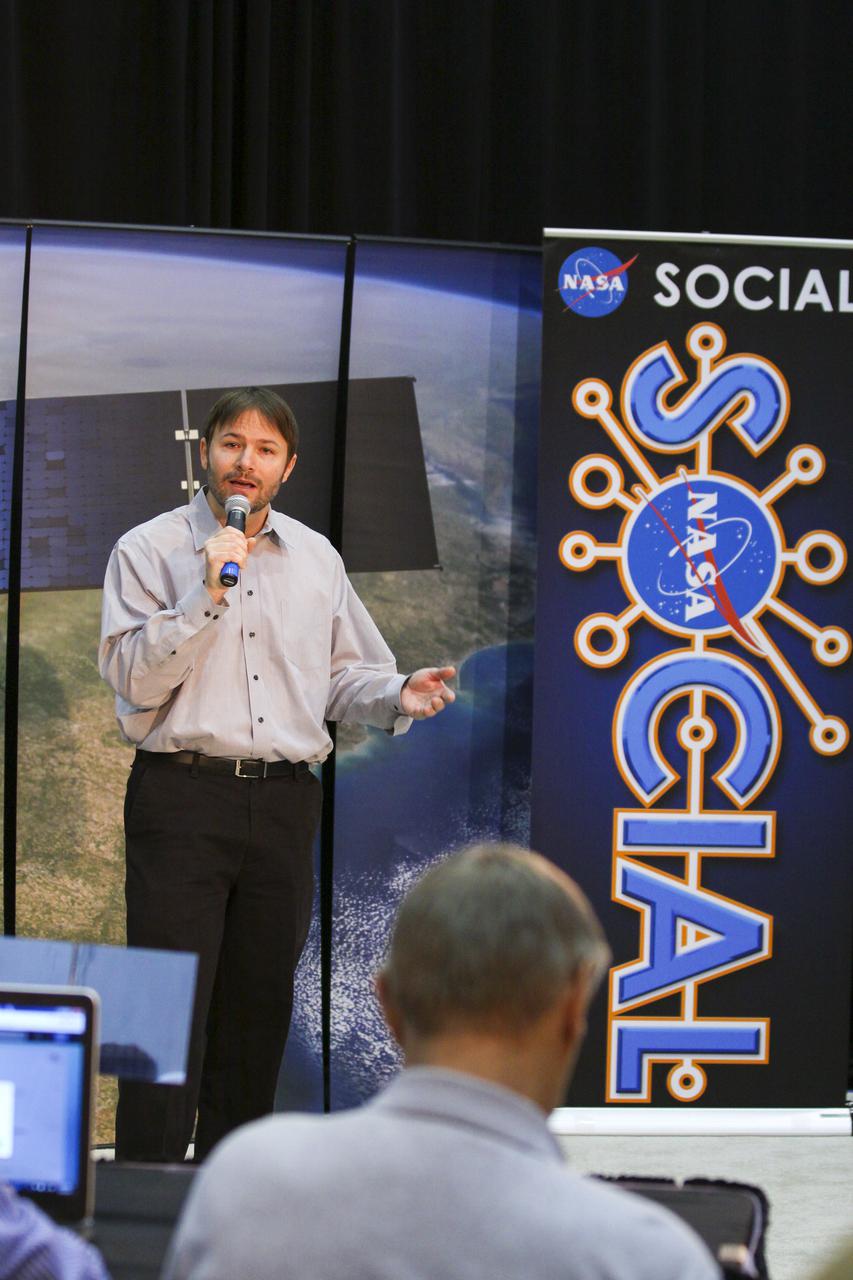
VANDENBERG AFB, Calif. -- John Yembrick, social media manager for NASA, speaks to NASA social media followers at Vandenberg Air Force Base, Calif., prior to the launch of the agency's Landsat Data Continuity Mission, or LDCM, satellite. The Landsat Data Continuity Mission LDCM is the future of Landsat satellites. It will continue to obtain valuable data and imagery to be used in agriculture, education, business, science, and government. The Landsat Program provides repetitive acquisition of high resolution multispectral data of the Earth's surface on a global basis. The data from the Landsat spacecraft constitute the longest record of the Earth's continental surfaces as seen from space. It is a record unmatched in quality, detail, coverage, and value. Liftoff is planned for Feb. 11, 2013 aboard a United Launch Alliance Atlas V rocket. For more information, visit: http:__www.nasa.gov_mission_pages_landsat_main_index.html Photo credit: NASA_Kim Shiflett
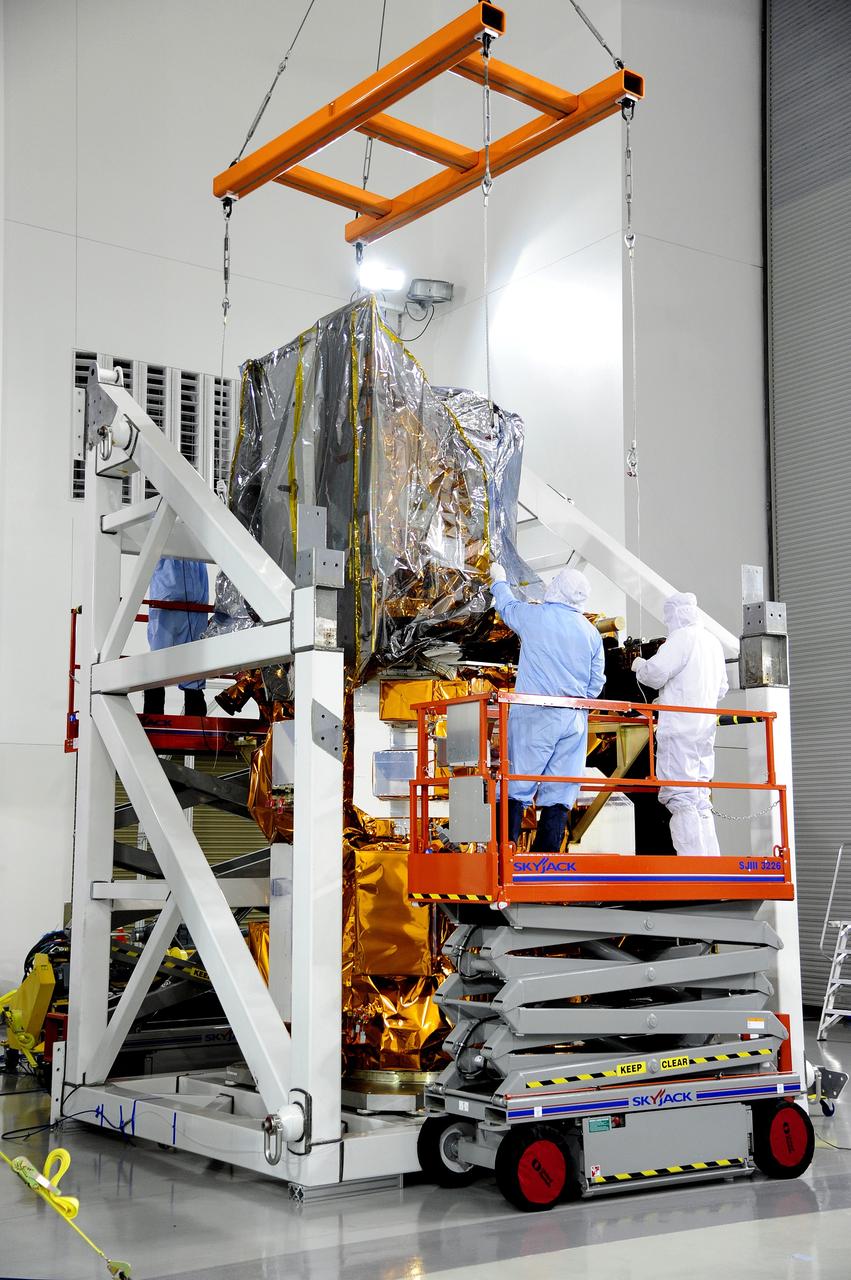
VANDENBERG AFB, Calif.-- Technicians unload NASA's Landsat Data Continuity Mission, or LDCM, satellite at the Astrotech processing facility at Vandenberg Air Force Base, Calif. The Landsat Data Continuity Mission LDCM is the future of Landsat satellites. It will continue to obtain valuable data and imagery to be used in agriculture, education, business, science, and government. The Landsat Program provides repetitive acquisition of high resolution multispectral data of the Earth's surface on a global basis. The data from the Landsat spacecraft constitute the longest record of the Earth's continental surfaces as seen from space. It is a record unmatched in quality, detail, coverage, and value. Launch is planned for Feb. 11, 2013. For more information, visit: http://www.nasa.gov/mission_pages/landsat/main/index.html Photo credit: NASA
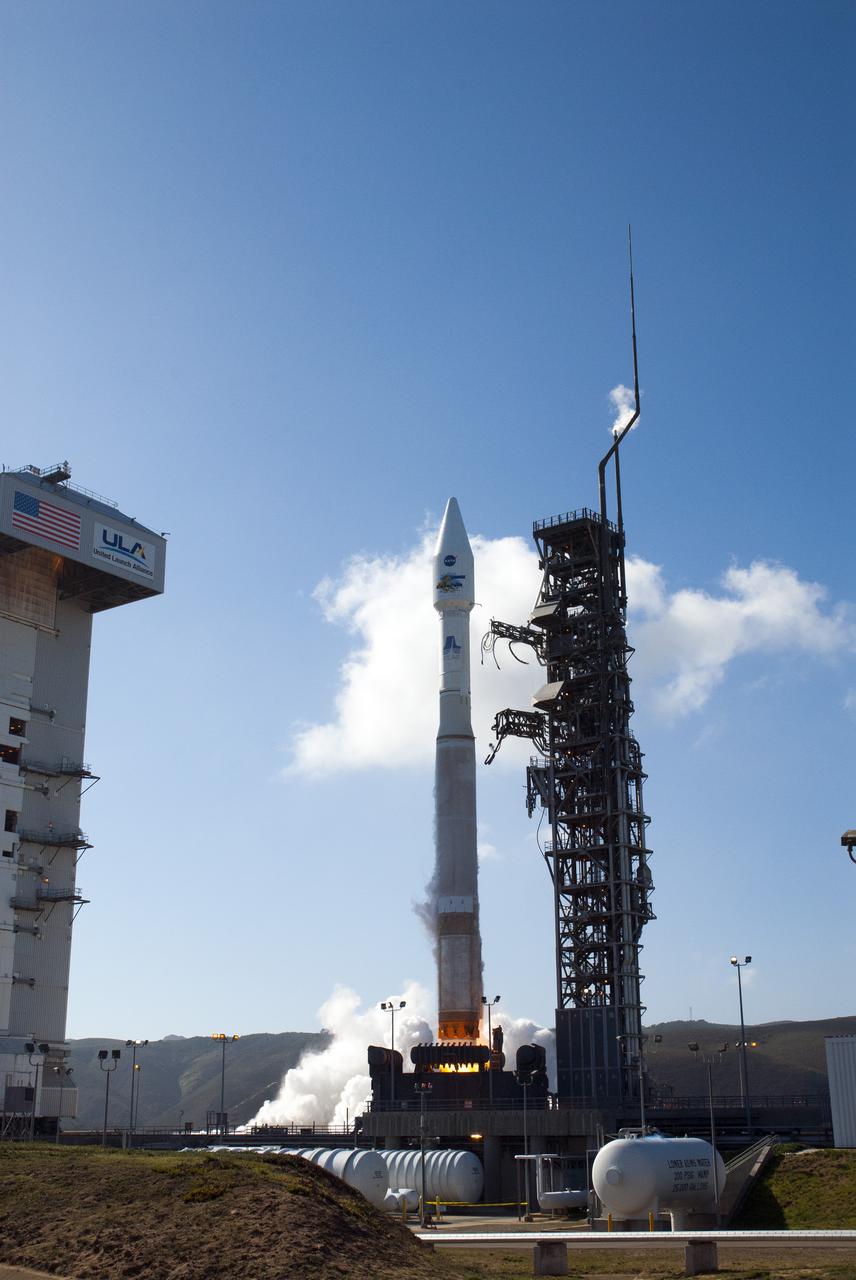
VANDENBERG AFB, Calif. -- The Landsat Data Continuity Mission spacecraft lifts off at 1:02 p.m. EST, 10:02 a.m. PST) atop a United Launch Alliance Atlas V rocket from Space Launch Complex 3 at California's Vandenberg Air Force Base. The Landsat Data Continuity Mission LDCM is the future of Landsat satellites. It will continue to obtain valuable data and imagery to be used in agriculture, education, business, science, and government. The Landsat Program provides repetitive acquisition of high resolution multispectral data of the Earth's surface on a global basis. The data from the Landsat spacecraft constitute the longest record of the Earth's continental surfaces as seen from space. It is a record unmatched in quality, detail, coverage, and value. For more information, visit: http:__www.nasa.gov_mission_pages_landsat_main_index.html Photo credit: NASA_Kim Shiflett
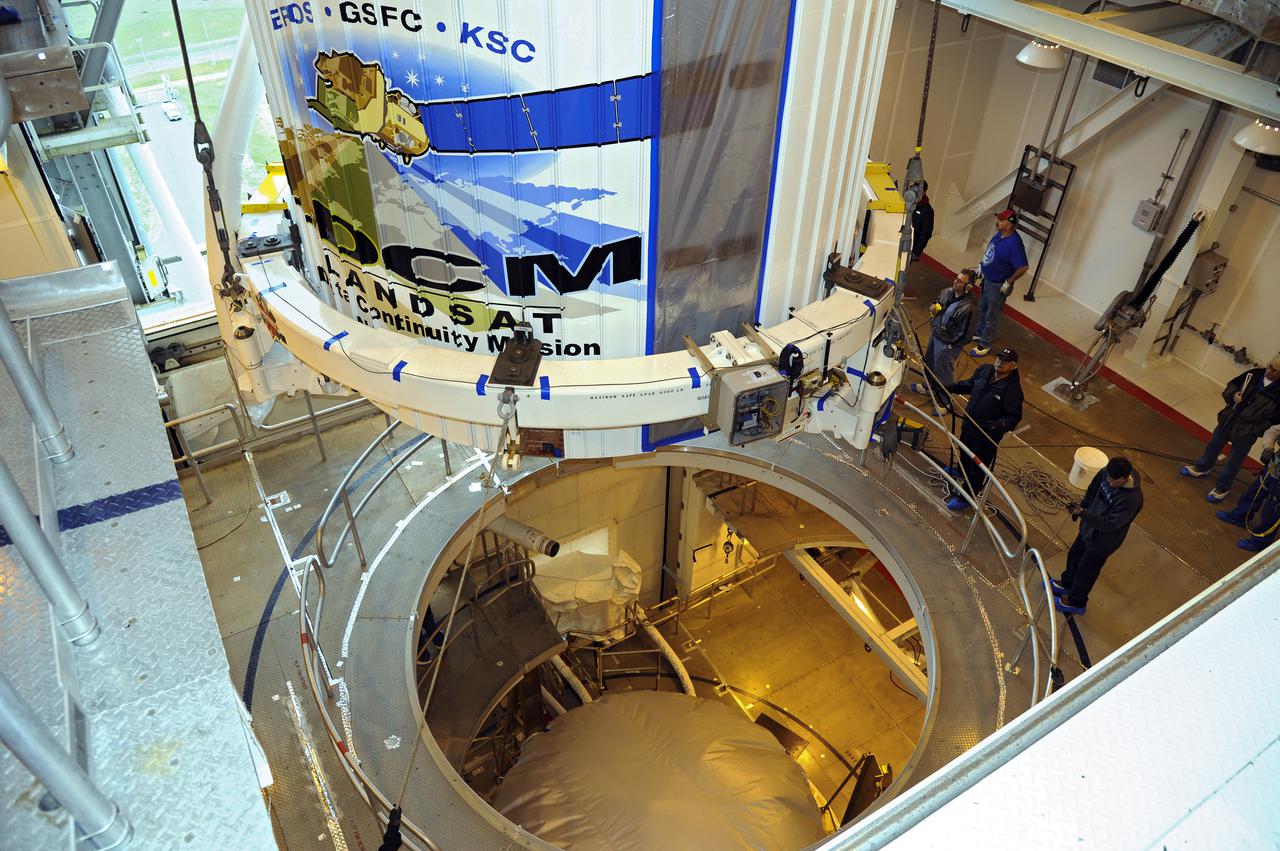
VANDENBERG AFB, Calif. -- The payload fairing containing the Landsat Data Continuity Mission, or LDCM, spacecraft has been lifted to the top of Space Launch Complex-3E at Vandenberg Air Force Base, Calif. where it is about to be mounted atop a United Launch Alliance Atlas V rocket. The Landsat Data Continuity Mission LDCM is the future of Landsat satellites. It will continue to obtain valuable data and imagery to be used in agriculture, education, business, science, and government. The Landsat Program provides repetitive acquisition of high resolution multispectral data of the Earth's surface on a global basis. The data from the Landsat spacecraft constitute the longest record of the Earth's continental surfaces as seen from space. It is a record unmatched in quality, detail, coverage, and value. Liftoff is planned for Feb. 11, 2013 aboard a United Launch Alliance Atlas V rocket. For more information, visit: http:__www.nasa.gov_mission_pages_landsat_main_index.html Photo credit: NASA
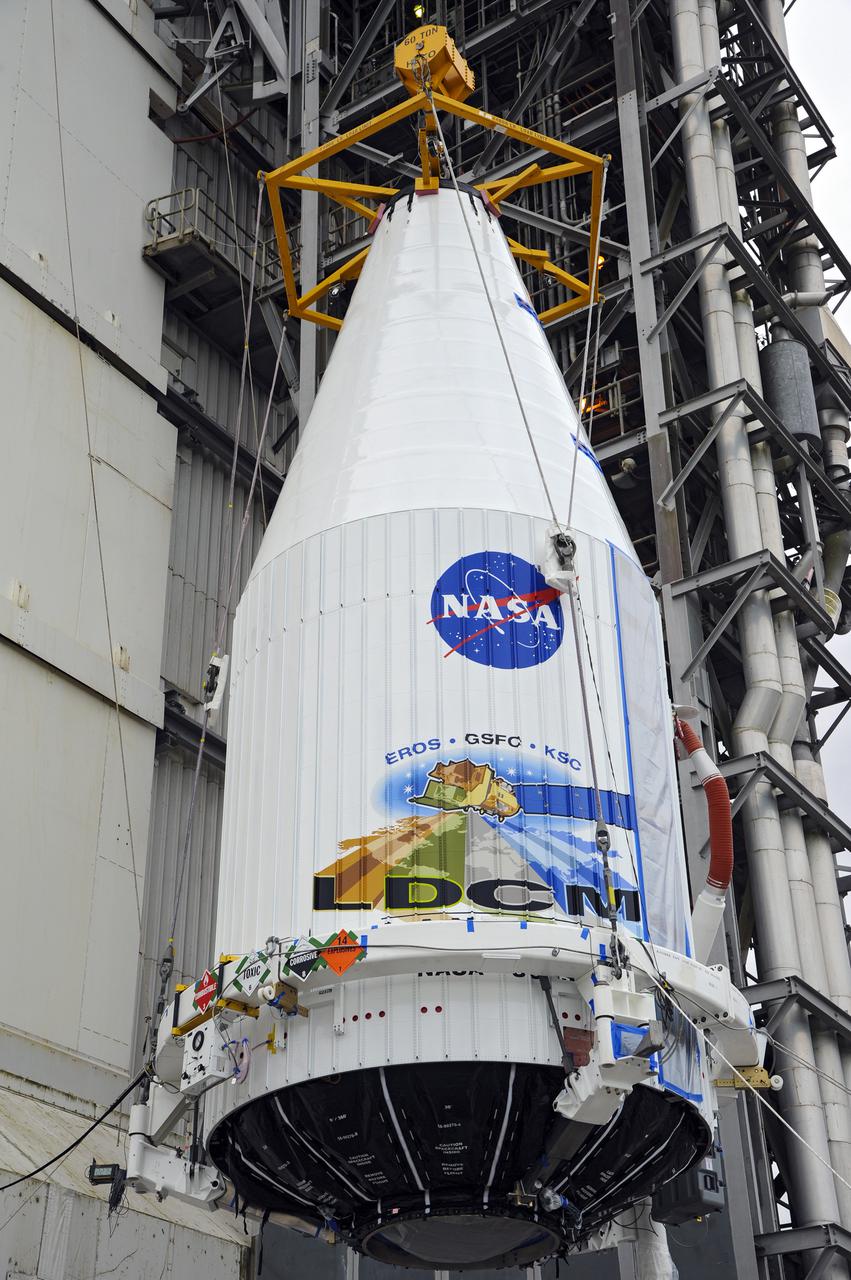
VANDENBERG AFB, Calif. -- The payload fairing containing the Landsat Data Continuity Mission, or LDCM, spacecraft is lifted to the top of Space Launch Complex-3E at Vandenberg Air Force Base, Calif. where it will be mounted atop a United Launch Alliance Atlas V rocket. The Landsat Data Continuity Mission LDCM is the future of Landsat satellites. It will continue to obtain valuable data and imagery to be used in agriculture, education, business, science, and government. The Landsat Program provides repetitive acquisition of high resolution multispectral data of the Earth's surface on a global basis. The data from the Landsat spacecraft constitute the longest record of the Earth's continental surfaces as seen from space. It is a record unmatched in quality, detail, coverage, and value. Liftoff is planned for Feb. 11, 2013 aboard a United Launch Alliance Atlas V rocket. For more information, visit: http:__www.nasa.gov_mission_pages_landsat_main_index.html Photo credit: NASA
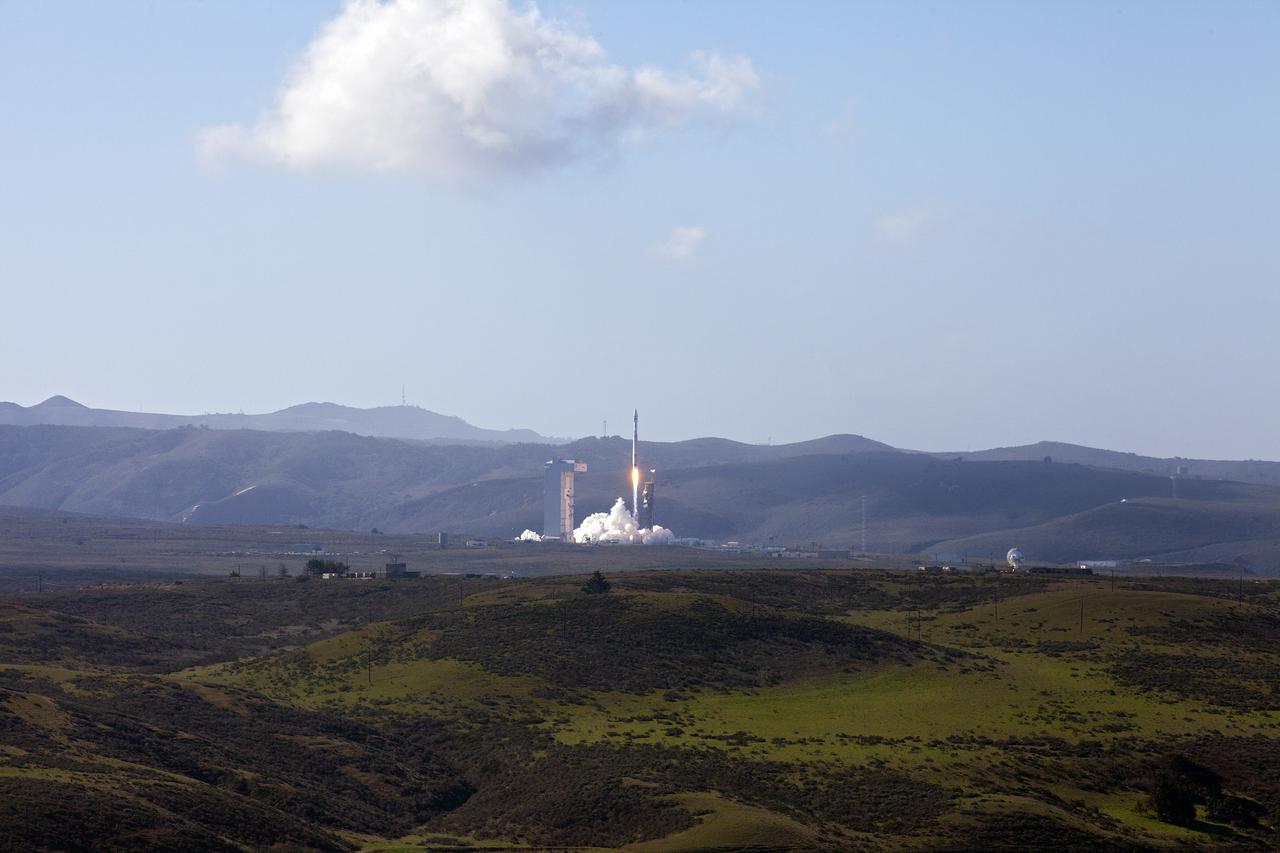
VANDENBERG AFB, Calif. -- The Landsat Data Continuity Mission spacecraft lifted off at 1:02 p.m. EST, 10:02 a.m. PST) atop a United Launch Alliance Atlas V rocket from Space Launch Complex 3 at California's Vandenberg Air Force Base. The Landsat Data Continuity Mission LDCM is the future of Landsat satellites. It will continue to obtain valuable data and imagery to be used in agriculture, education, business, science, and government. The Landsat Program provides repetitive acquisition of high resolution multispectral data of the Earth's surface on a global basis. The data from the Landsat spacecraft constitute the longest record of the Earth's continental surfaces as seen from space. It is a record unmatched in quality, detail, coverage, and value. For more information, visit: http:__www.nasa.gov_mission_pages_landsat_main_index.html Photo credit: NASA_Kim Shiflett
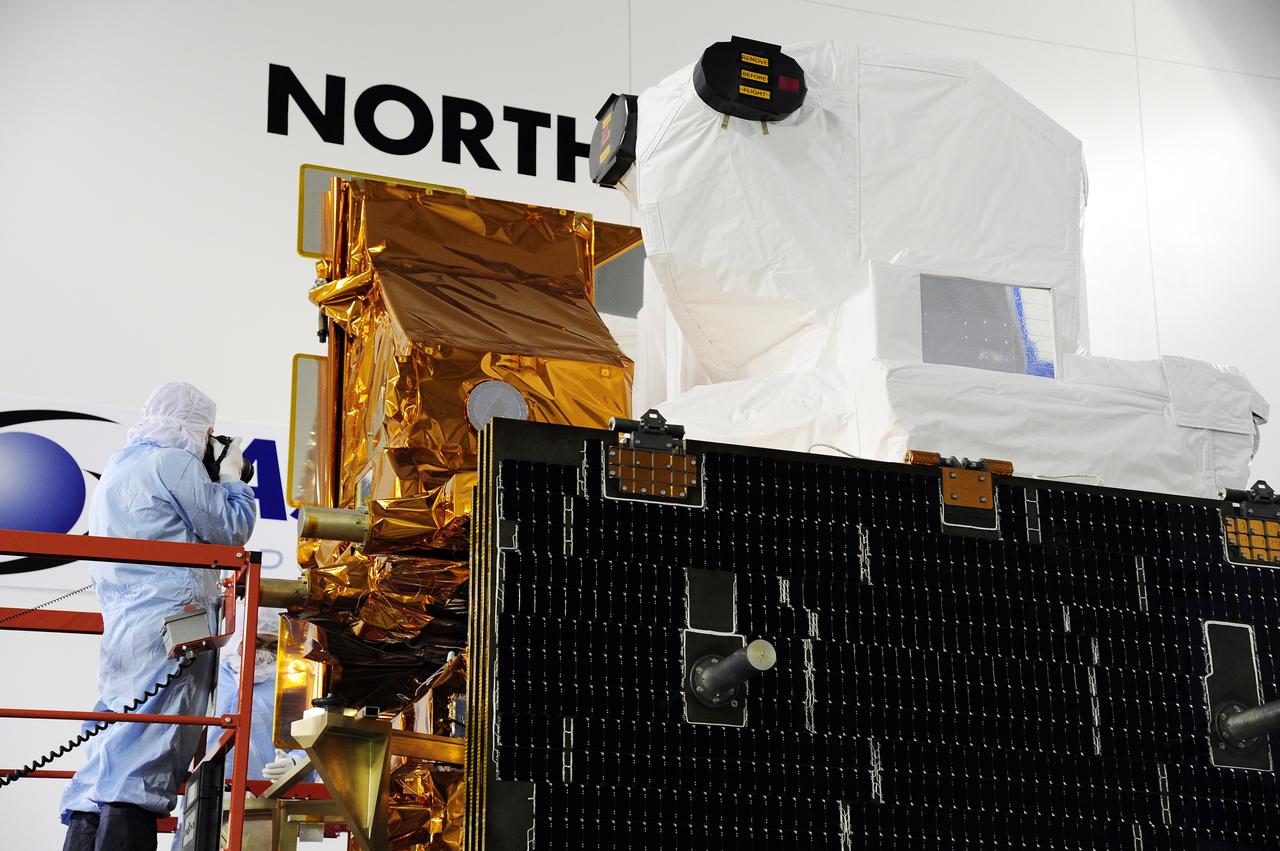
VANDENBERG AFB, Calif. -- A Technician photographs a component on NASA's Landsat Data Continuity Mission, or LDCM, satellite during inspection at the Astrotech processing facility at Vandenberg Air Force Base, Calif. The solar arrays are in the foreground. The Landsat Data Continuity Mission LDCM is the future of Landsat satellites. It will continue to obtain valuable data and imagery to be used in agriculture, education, business, science, and government. The Landsat Program provides repetitive acquisition of high resolution multispectral data of the Earth's surface on a global basis. The data from the Landsat spacecraft constitute the longest record of the Earth's continental surfaces as seen from space. It is a record unmatched in quality, detail, coverage, and value. Launch is planned for Feb. 11, 2013. For more information, visit: http://www.nasa.gov/mission_pages/landsat/main/index.html Photo credit: NASA
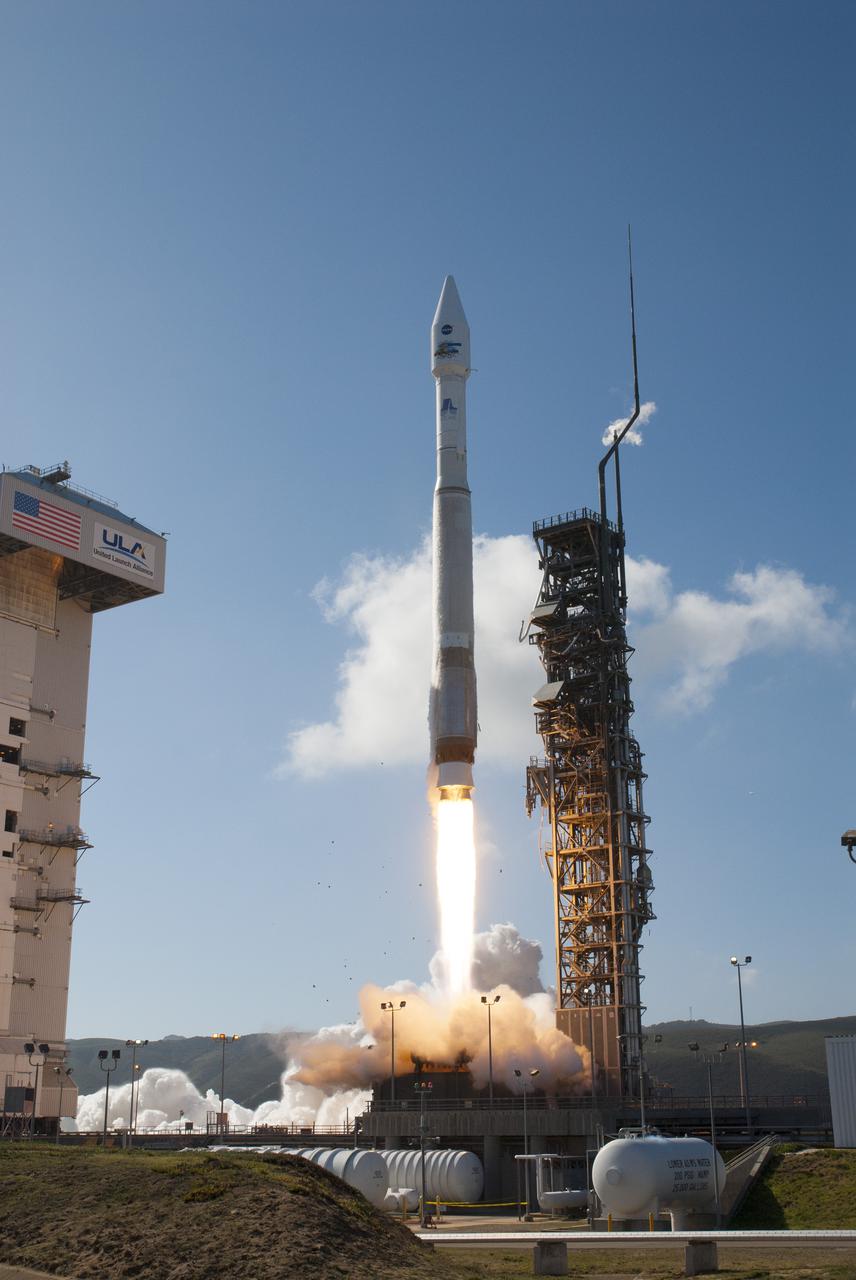
VANDENBERG AFB, Calif. -- The Landsat Data Continuity Mission spacecraft lifts off at 1:02 p.m. EST, 10:02 a.m. PST) atop a United Launch Alliance Atlas V rocket from Space Launch Complex 3 at California's Vandenberg Air Force Base. The Landsat Data Continuity Mission LDCM is the future of Landsat satellites. It will continue to obtain valuable data and imagery to be used in agriculture, education, business, science, and government. The Landsat Program provides repetitive acquisition of high resolution multispectral data of the Earth's surface on a global basis. The data from the Landsat spacecraft constitute the longest record of the Earth's continental surfaces as seen from space. It is a record unmatched in quality, detail, coverage, and value. For more information, visit: http:__www.nasa.gov_mission_pages_landsat_main_index.html Photo credit: NASA_Kim Shiflett
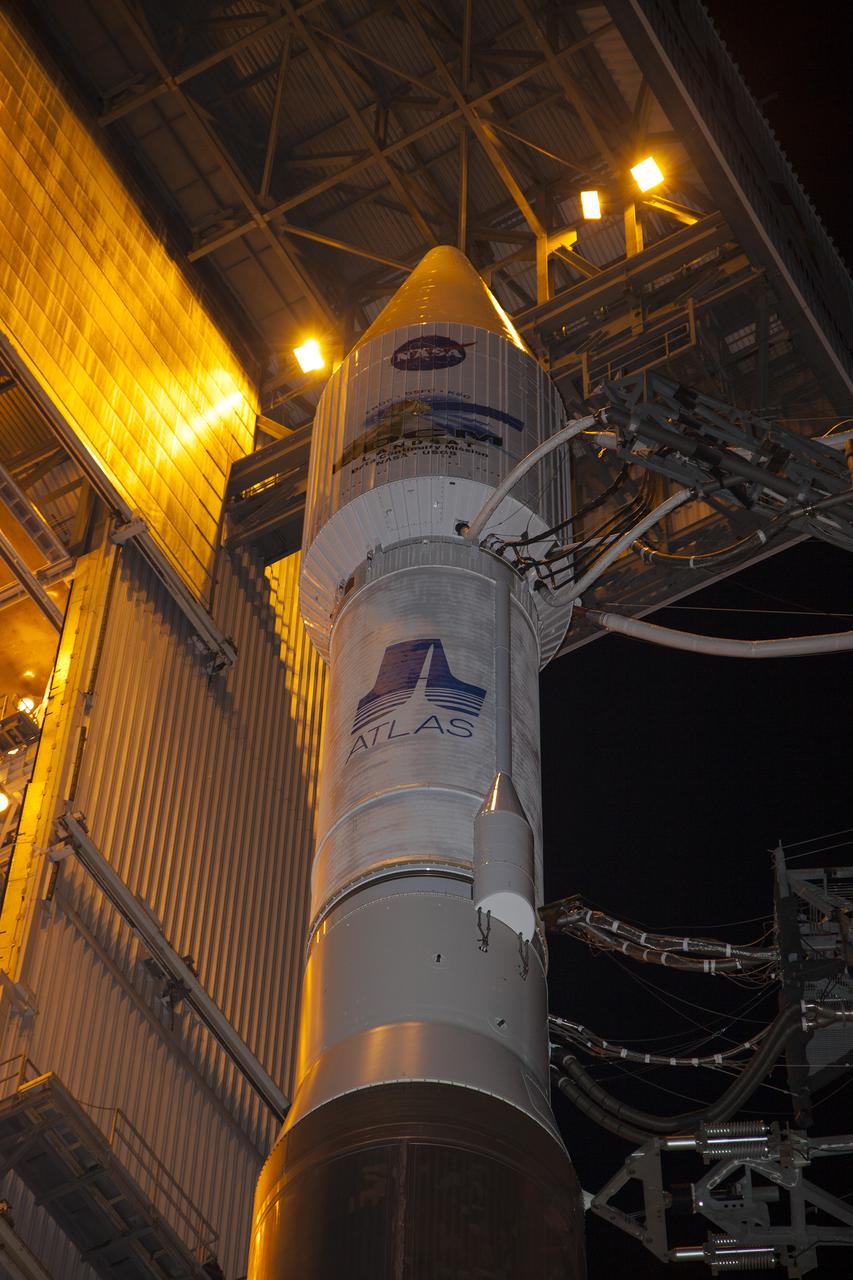
VANDENBERG AFB, Calif. -- At Vandenberg Air Force Base, Calif., the gantry at Space Launch Complex 3E rolls back from NASA's Landsat Data Continuity Mission, or LDCM, satellite mounted atop a United Launch Alliance Atlas V rocket. The Landsat Data Continuity Mission LDCM is the future of Landsat satellites. It will continue to obtain valuable data and imagery to be used in agriculture, education, business, science, and government. The Landsat Program provides repetitive acquisition of high resolution multispectral data of the Earth's surface on a global basis. The data from the Landsat spacecraft constitute the longest record of the Earth's continental surfaces as seen from space. It is a record unmatched in quality, detail, coverage, and value. Liftoff is planned for Feb. 11, 2013 aboard a United Launch Alliance Atlas V rocket. For more information, visit: http:__www.nasa.gov_mission_pages_landsat_main_index.html Photo credit: NASA_Kim Shiflett
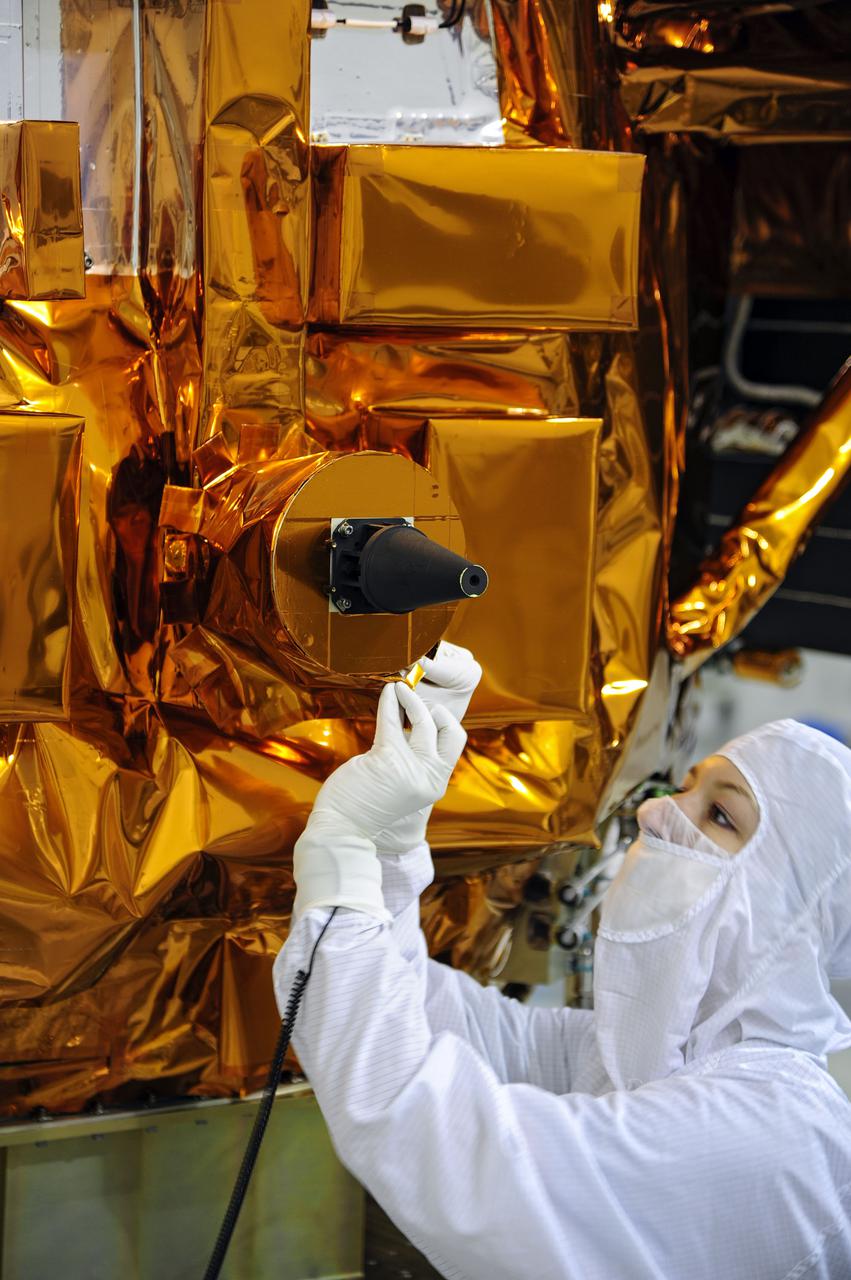
VANDENBERG AFB, Calif. -- At the Astrotech processing facility at Vandenberg Air Force Base, Calif., technicians perform close-out inspections on NASA's Landsat Data Continuity Mission, or LDCM, satellite. The Landsat Data Continuity Mission LDCM is the future of Landsat satellites. It will continue to obtain valuable data and imagery to be used in agriculture, education, business, science, and government. The Landsat Program provides repetitive acquisition of high resolution multispectral data of the Earth's surface on a global basis. The data from the Landsat spacecraft constitute the longest record of the Earth's continental surfaces as seen from space. It is a record unmatched in quality, detail, coverage, and value. Liftoff is planned for Feb. 11, 2013 aboard a United Launch Alliance Atlas V rocket. For more information, visit: http:__www.nasa.gov_mission_pages_landsat_main_index.html Photo credit: NASA
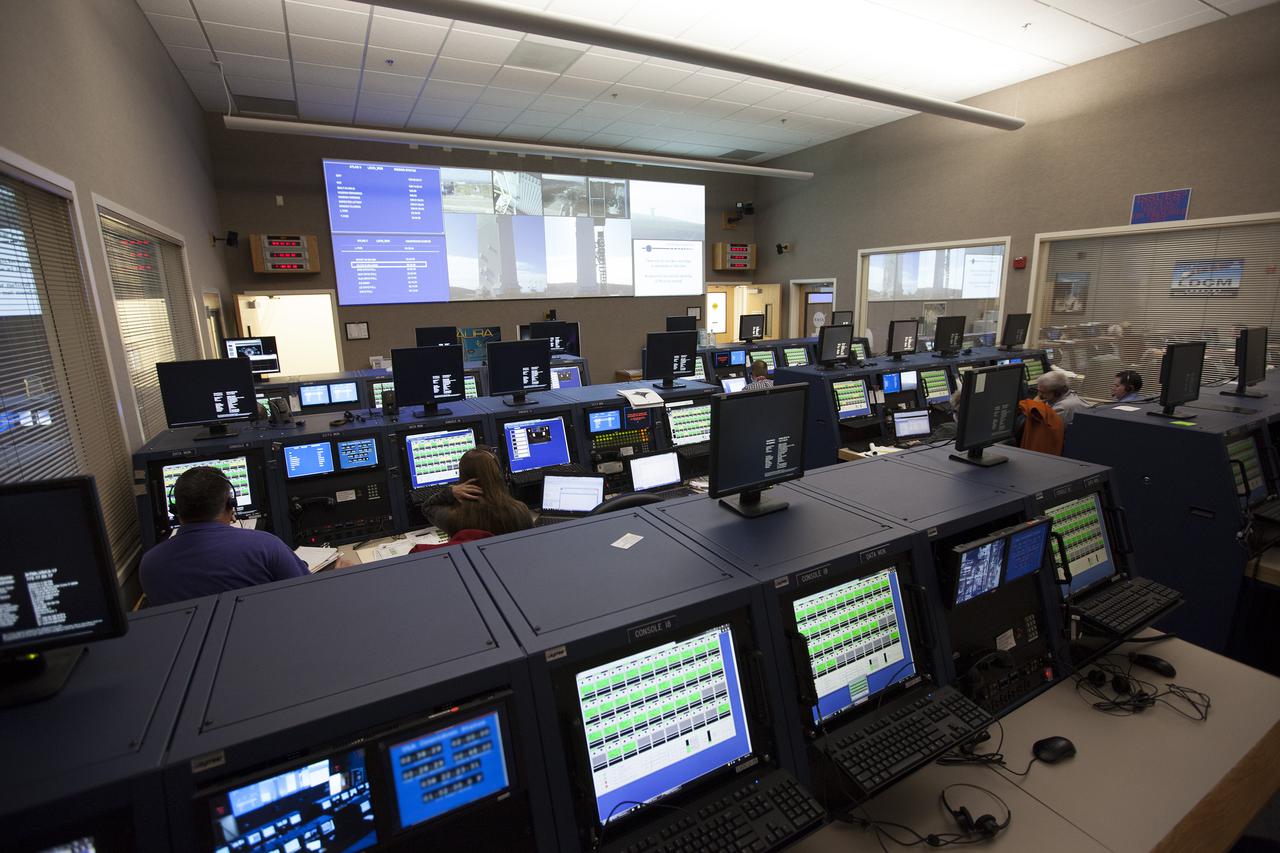
VANDENBERG AFB, Calif. -- From their consoles in the NASA Launch Vehicle Data Center at Vandenberg Air Force Base, engineers monitor the countdown for a United Launch Alliance Atlas V with the Landsat Data Continuity Mission, or LDCM, satellite prior to liftoff. The Landsat Data Continuity Mission, or LDCM, is the future of Landsat satellites. It will continue to obtain valuable data and imagery to be used in agriculture, education, business, science, and government. The Landsat Program provides repetitive acquisition of high resolution multispectral data of the Earth's surface on a global basis. The data from the Landsat spacecraft constitute the longest record of the Earth's continental surfaces as seen from space. It is a record unmatched in quality, detail, coverage, and value. Liftoff is planned for Feb. 11, 2013 aboard a United Launch Alliance Atlas V rocket. For more information, visit: http:__www.nasa.gov_mission_pages_landsat_main_index.html Photo credit: NASA_ Kim Shiflett
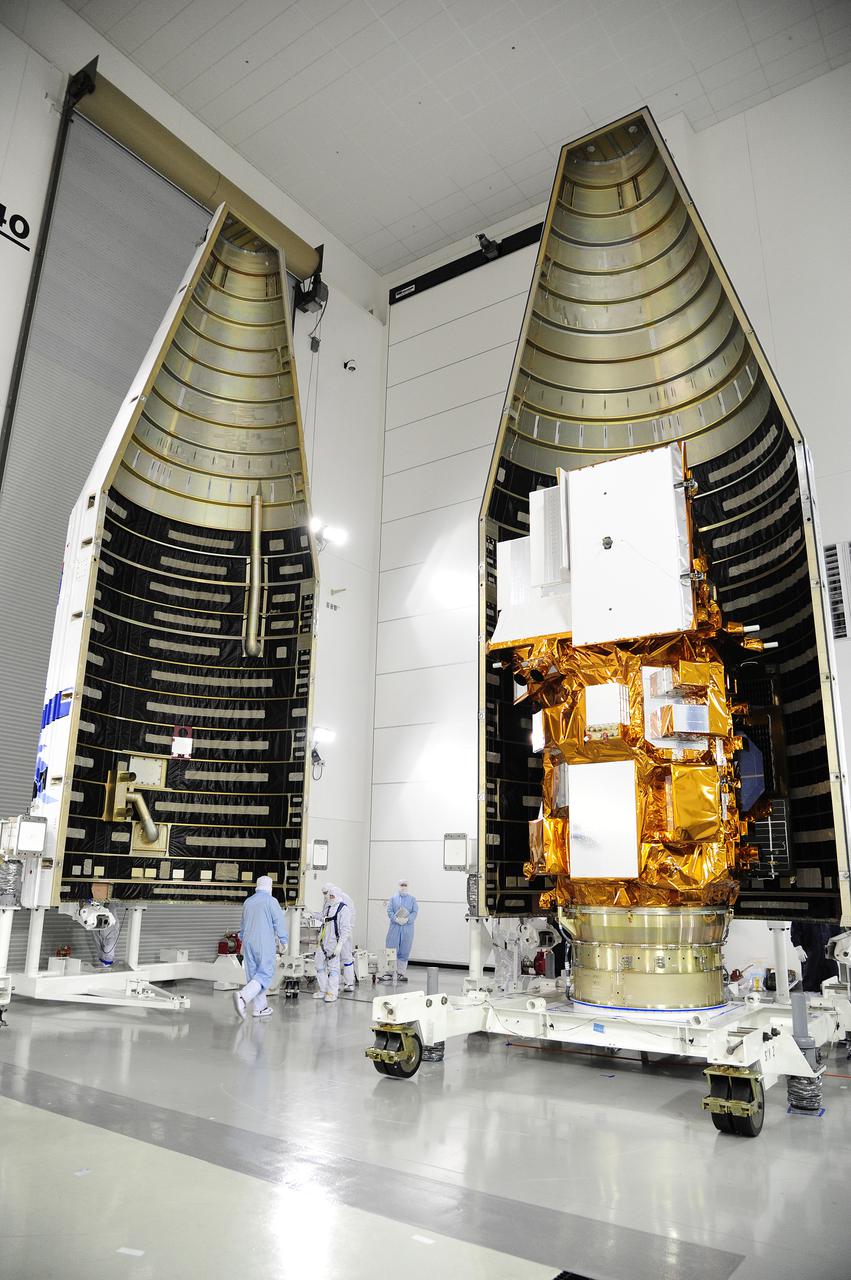
VANDENBERG AFB, Calif. -- Technicians encapsulate the NASA's Landsat Data Continuity Mission, or LDCM, satellite in its payload fairing at the Astrotech processing facility at Vandenberg Air Force Base, Calif. The Landsat Data Continuity Mission LDCM is the future of Landsat satellites. It will continue to obtain valuable data and imagery to be used in agriculture, education, business, science, and government. The Landsat Program provides repetitive acquisition of high resolution multispectral data of the Earth's surface on a global basis. The data from the Landsat spacecraft constitute the longest record of the Earth's continental surfaces as seen from space. It is a record unmatched in quality, detail, coverage, and value. Liftoff is planned for Feb. 11, 2013 aboard a United Launch Alliance Atlas V rocket. For more information, visit: http:__www.nasa.gov_mission_pages_landsat_main_index.html Photo credit: NASA
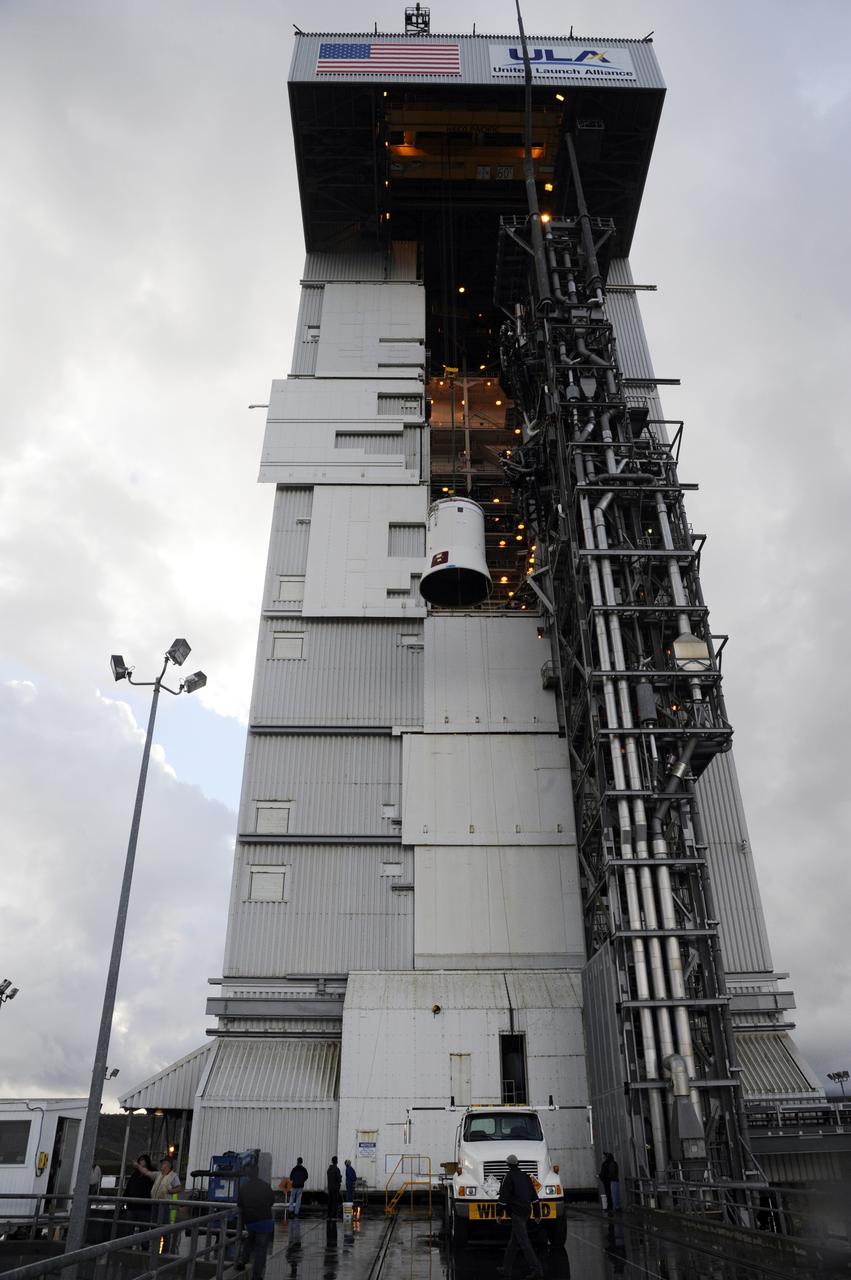
VANDENBERG AFB, Calif. – The interstage booster segment is lifted onto the first stage booster of a United Launch Alliance Atlas V at the launch pad at Space Launch Complex-3E at Vandenberg Air Force Base, Calif. in preparation for the launch of the Landsat Data Continuation Mission. The Landsat Data Continuity Mission LDCM is the future of Landsat satellites. It will continue to obtain valuable data and imagery to be used in agriculture, education, business, science, and government. The Landsat Program provides repetitive acquisition of high resolution multispectral data of the Earth's surface on a global basis. The data from the Landsat spacecraft constitute the longest record of the Earth's continental surfaces as seen from space. It is a record unmatched in quality, detail, coverage, and value. Launch is planned for Feb. 2013. Photo credit: NASA/Roy Allison
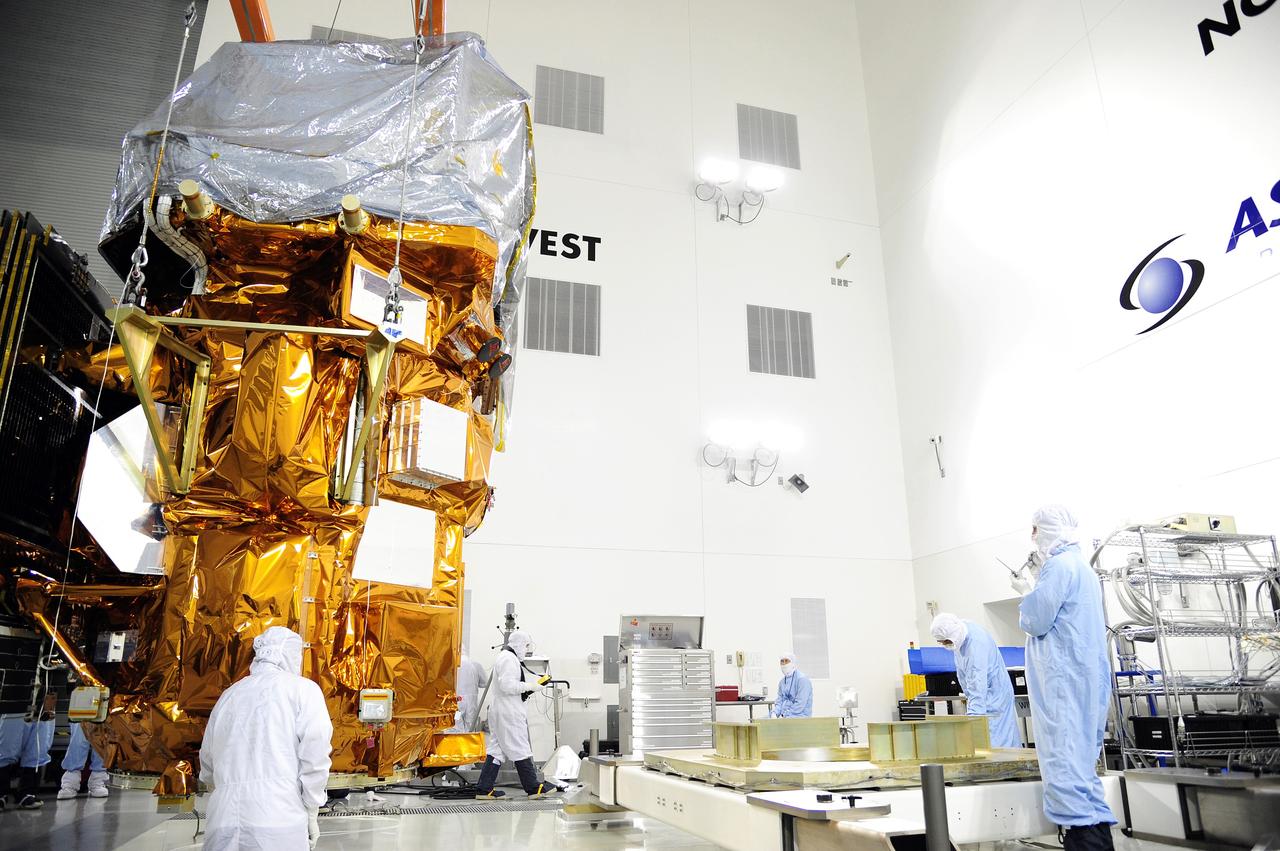
VANDENBERG AFB, Calif.-- Technicians begin checkout of NASA's Landsat Data Continuity Mission, or LDCM, satellite at the Astrotech processing facility at Vandenberg Air Force Base, Calif. The Landsat Data Continuity Mission LDCM is the future of Landsat satellites. It will continue to obtain valuable data and imagery to be used in agriculture, education, business, science, and government. The Landsat Program provides repetitive acquisition of high resolution multispectral data of the Earth's surface on a global basis. The data from the Landsat spacecraft constitute the longest record of the Earth's continental surfaces as seen from space. It is a record unmatched in quality, detail, coverage, and value. Launch is planned for Feb. 11, 2013. For more information, visit: http://www.nasa.gov/mission_pages/landsat/main/index.html Photo credit: NASA
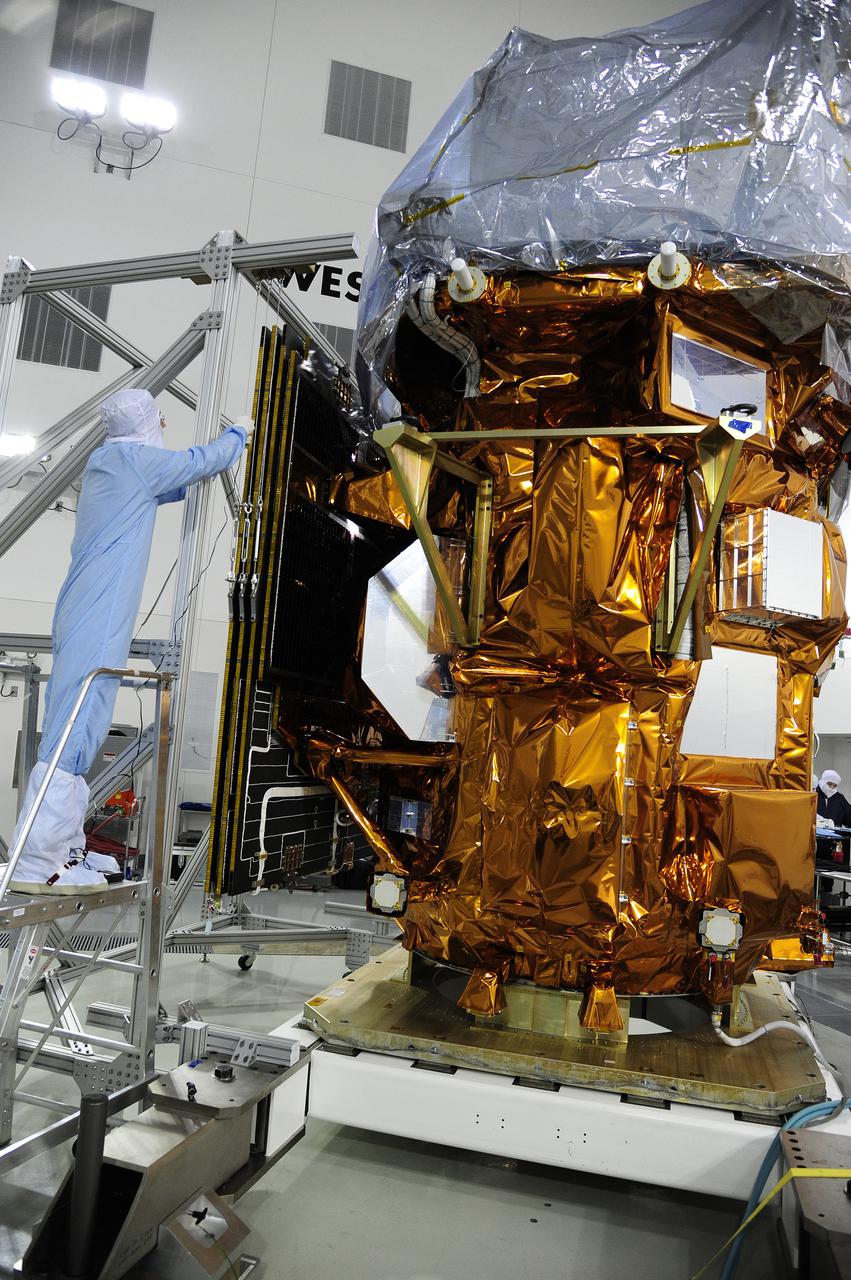
VANDENBERG AFB, Calif. -- In the Astrotech processing facility at Vandenberg Air Force Base, Calif., a technician tests the solar arrays on NASA's Landsat Data Continuity Mission, or LDCM, satellite to ensure they will deploy properly in orbit. The Landsat Data Continuity Mission LDCM is the future of Landsat satellites. It will continue to obtain valuable data and imagery to be used in agriculture, education, business, science, and government. The Landsat Program provides repetitive acquisition of high resolution multispectral data of the Earth's surface on a global basis. The data from the Landsat spacecraft constitute the longest record of the Earth's continental surfaces as seen from space. It is a record unmatched in quality, detail, coverage, and value. Liftoff is planned for Feb. 11, 2013 aboard a United Launch Alliance Atlas V rocket. For more information, visit: http:__www.nasa.gov_mission_pages_landsat_main_index.html Photo credit: NASA
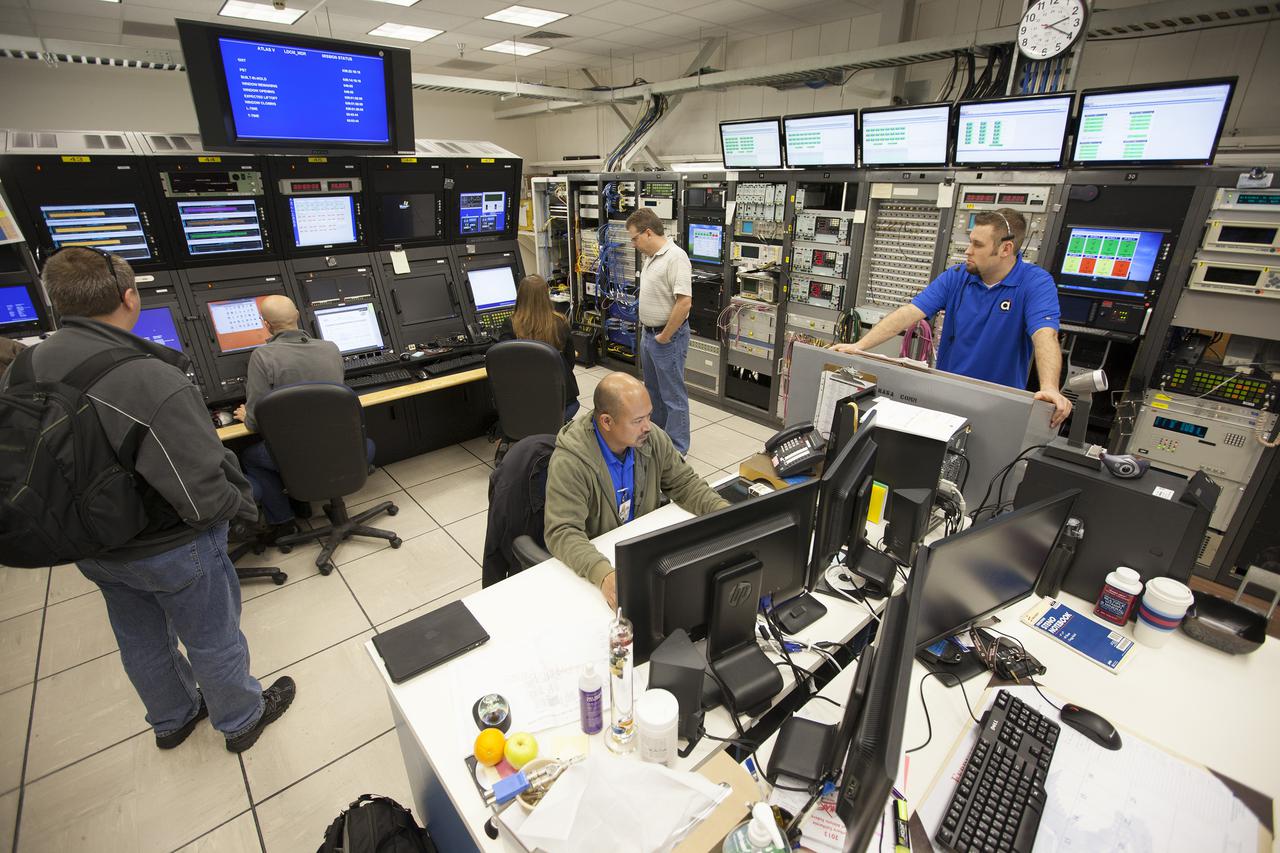
VANDENBERG AFB, Calif. -- From their positions in the telemetry laboratory at Vandenberg Air Force Base, engineers and technicians monitor the countdown for a United Launch Alliance Atlas V with the Landsat Data Continuity Mission, or LDCM, satellite prior to liftoff. The Landsat Data Continuity Mission, or LDCM, is the future of Landsat satellites. It will continue to obtain valuable data and imagery to be used in agriculture, education, business, science, and government. The Landsat Program provides repetitive acquisition of high resolution multispectral data of the Earth's surface on a global basis. The data from the Landsat spacecraft constitute the longest record of the Earth's continental surfaces as seen from space. It is a record unmatched in quality, detail, coverage, and value. Liftoff is planned for Feb. 11, 2013 aboard a United Launch Alliance Atlas V rocket. For more information, visit: http:__www.nasa.gov_mission_pages_landsat_main_index.html Photo credit: NASA_ Kim Shiflett
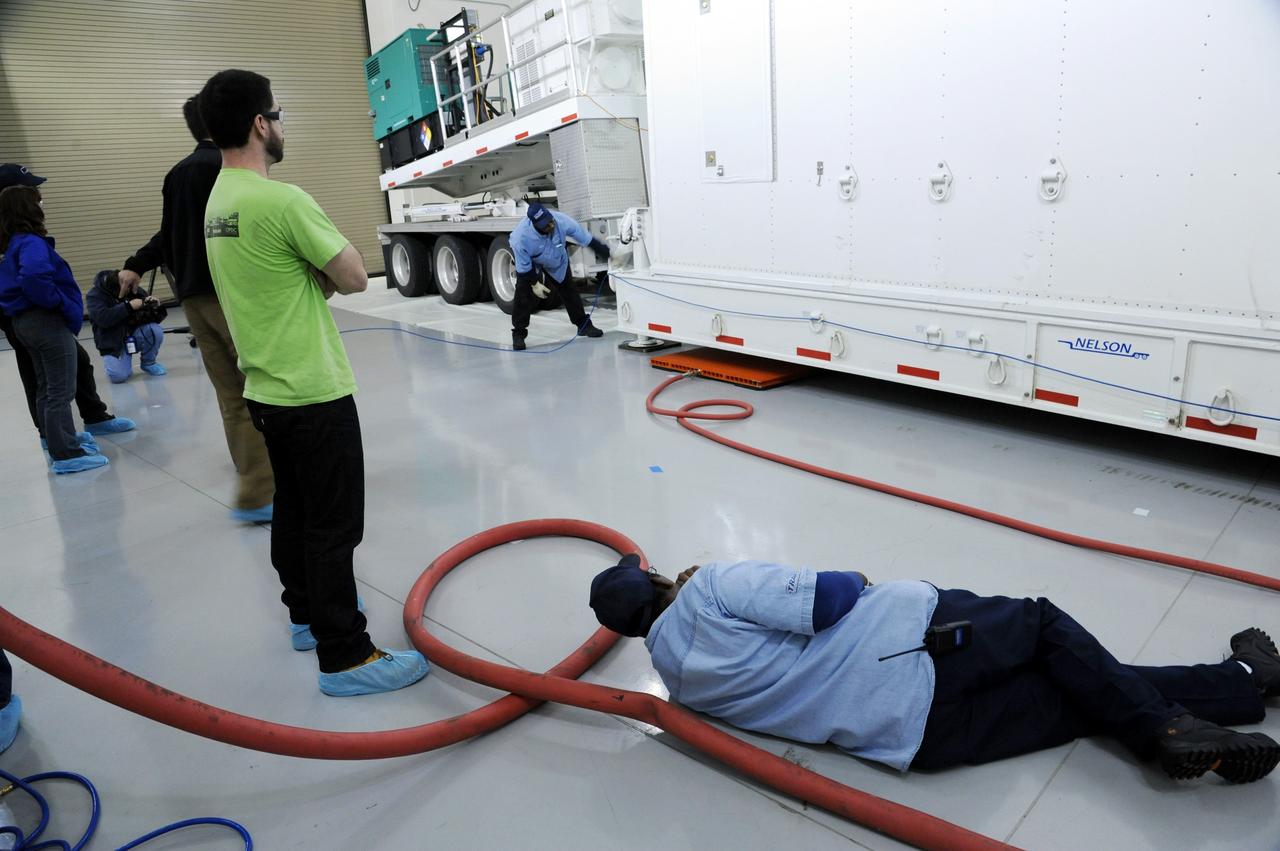
VANDENBERG AFB, Calif.-- Technicians monitor activity as the transport container delivering NASA's Landsat Data Continuity Mission, or LDCM, satellite is lowered to the floor at the prelaunch processing facility at Vandenberg Air Force Base, Calif. The Landsat Data Continuity Mission LDCM is the future of Landsat satellites. It will continue to obtain valuable data and imagery to be used in agriculture, education, business, science, and government. The Landsat Program provides repetitive acquisition of high resolution multispectral data of the Earth's surface on a global basis. The data from the Landsat spacecraft constitute the longest record of the Earth's continental surfaces as seen from space. It is a record unmatched in quality, detail, coverage, and value. Launch is planned for Feb. 11, 2013. For more information, visit: http://www.nasa.gov/mission_pages/landsat/main/index.html Photo credit: NASA
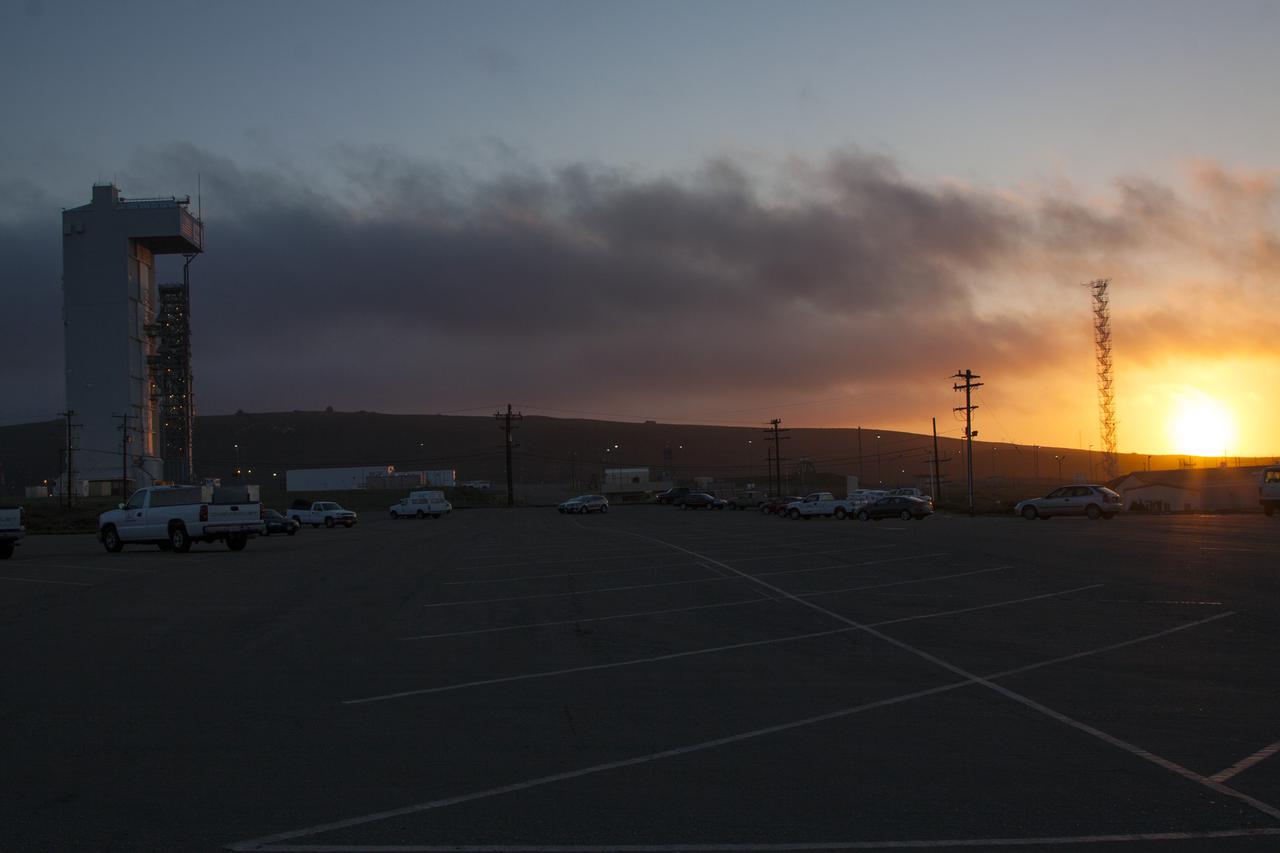
VANDENBERG AFB, Calif. -- The sun sets in the west behind Space Launch Complex 3 at Vandenberg Air Force Base where preparations continue for the launch of the Landsat Data Continuity Mission, or LDCM, satellite atop an Atlas V rocket. The Landsat Data Continuity Mission LDCM is the future of Landsat satellites. It will continue to obtain valuable data and imagery to be used in agriculture, education, business, science, and government. The Landsat Program provides repetitive acquisition of high resolution multispectral data of the Earth's surface on a global basis. The data from the Landsat spacecraft constitute the longest record of the Earth's continental surfaces as seen from space. It is a record unmatched in quality, detail, coverage, and value. Liftoff is planned for Feb. 11, 2013 aboard a United Launch Alliance Atlas V rocket. For more information, visit: http:__www.nasa.gov_mission_pages_landsat_main_index.html Photo credit: NASA_ Ben Smegelsky
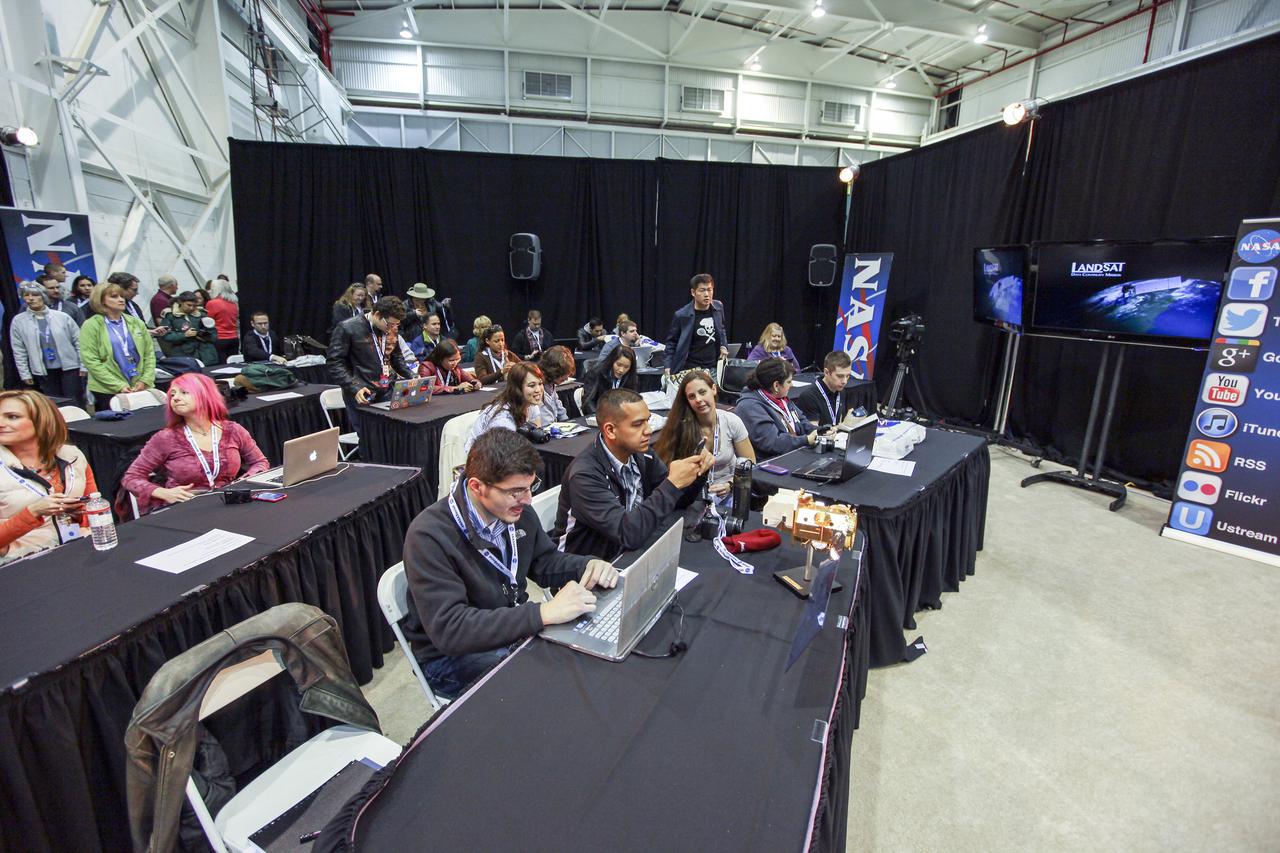
VANDENBERG AFB, Calif. -- NASA social media followers at Vandenberg Air Force Base, Calif., listen to speakers describing the agency's Landsat Data Continuity Mission, or LDCM, satellite. The Landsat Data Continuity Mission LDCM is the future of Landsat satellites. It will continue to obtain valuable data and imagery to be used in agriculture, education, business, science, and government. The Landsat Program provides repetitive acquisition of high resolution multispectral data of the Earth's surface on a global basis. The data from the Landsat spacecraft constitute the longest record of the Earth's continental surfaces as seen from space. It is a record unmatched in quality, detail, coverage, and value. Liftoff is planned for Feb. 11, 2013 aboard a United Launch Alliance Atlas V rocket. For more information, visit: http:__www.nasa.gov_mission_pages_landsat_main_index.html Photo credit: NASA_Kim Shiflett
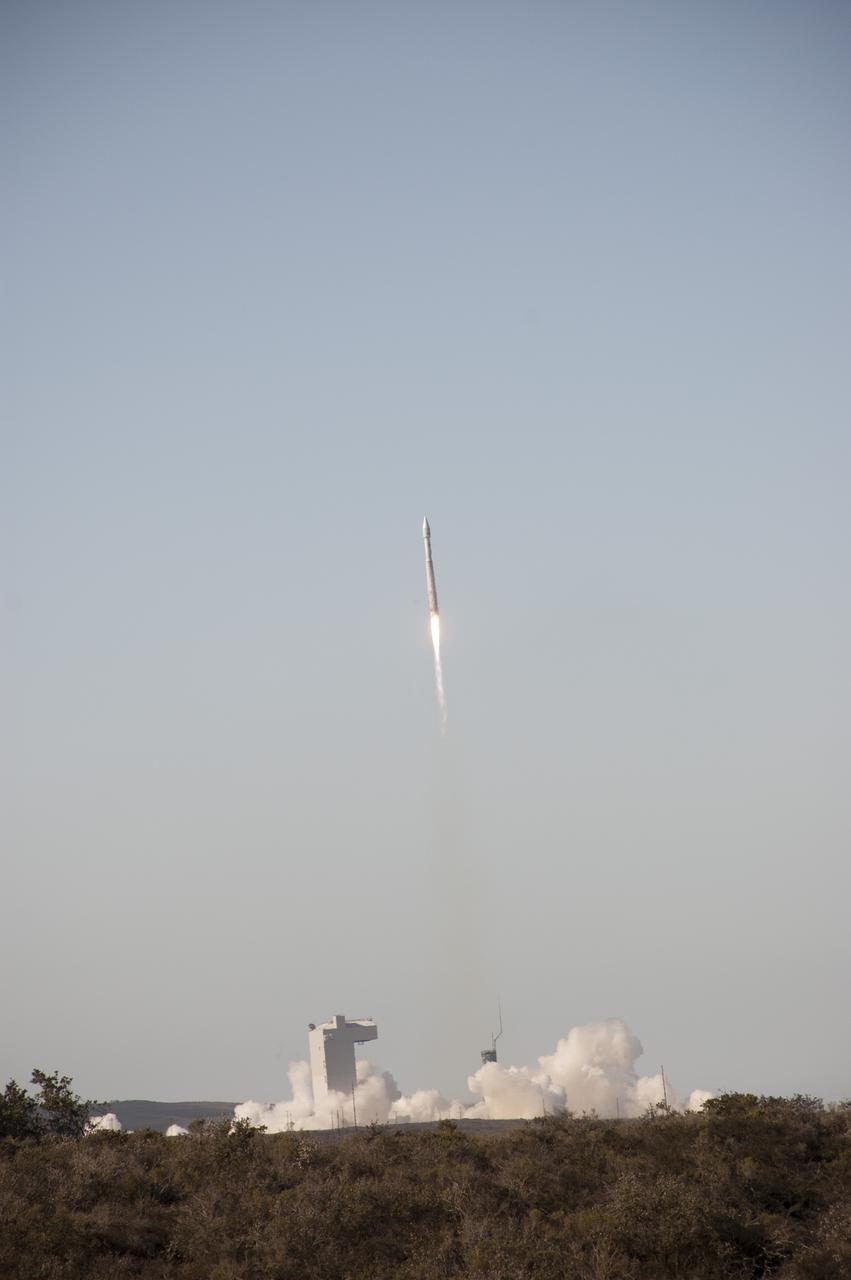
VANDENBERG AFB, Calif. -- The Landsat Data Continuity Mission spacecraft lifts off at 1:02 p.m. EST, 10:02 a.m. PST) atop a United Launch Alliance Atlas V rocket from Space Launch Complex 3 at California's Vandenberg Air Force Base. The Landsat Data Continuity Mission LDCM is the future of Landsat satellites. It will continue to obtain valuable data and imagery to be used in agriculture, education, business, science, and government. The Landsat Program provides repetitive acquisition of high resolution multispectral data of the Earth's surface on a global basis. The data from the Landsat spacecraft constitute the longest record of the Earth's continental surfaces as seen from space. It is a record unmatched in quality, detail, coverage, and value. For more information, visit: http:__www.nasa.gov_mission_pages_landsat_main_index.html Photo credit: NASA_Ben Smegelsky
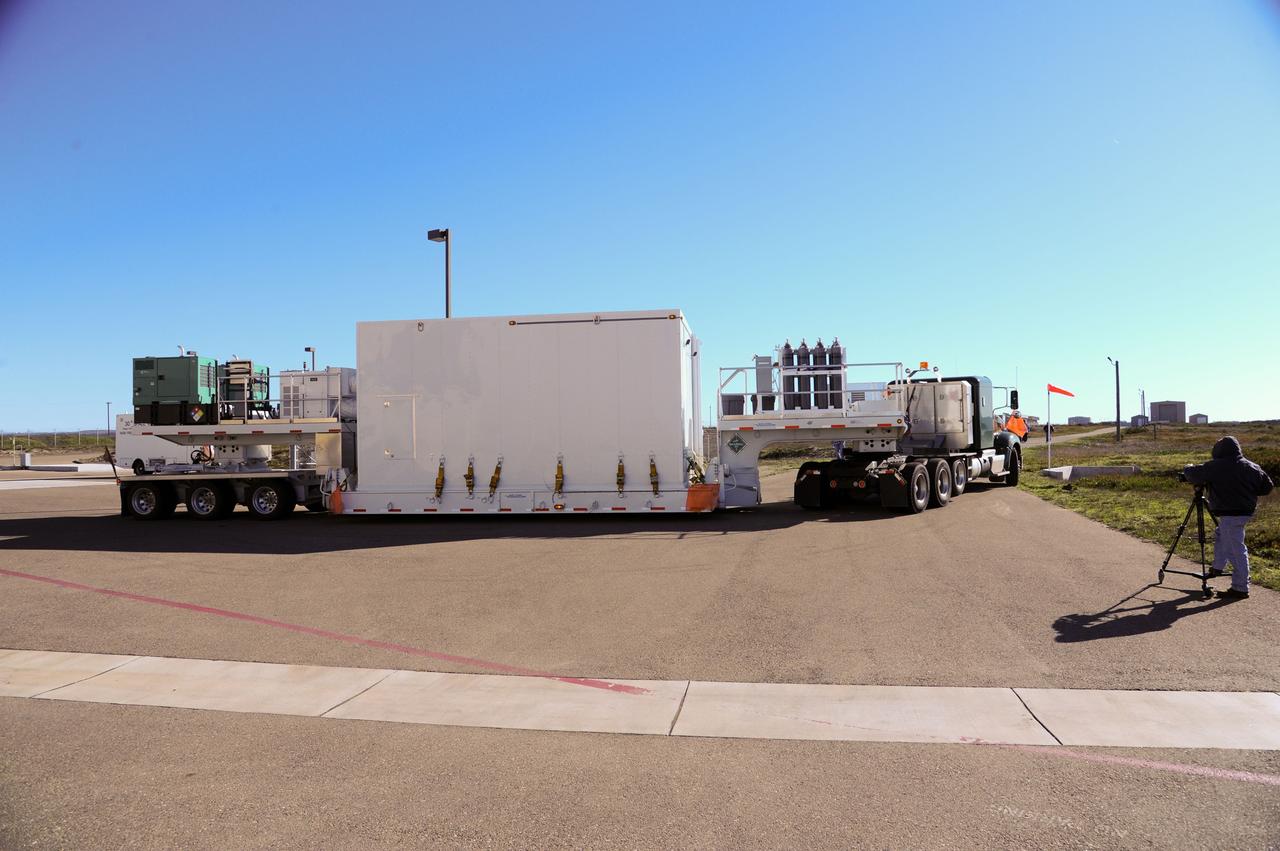
VANDENBERG AFB, Calif.-- NASA's Landsat Data Continuity Mission, or LDCM, satellite arrives by transport truck at Vandenberg Air Force Base, Calif. for prelaunch processing. The Landsat Data Continuity Mission LDCM is the future of Landsat satellites. It will continue to obtain valuable data and imagery to be used in agriculture, education, business, science, and government. The Landsat Program provides repetitive acquisition of high resolution multispectral data of the Earth's surface on a global basis. The data from the Landsat spacecraft constitute the longest record of the Earth's continental surfaces as seen from space. It is a record unmatched in quality, detail, coverage, and value. Launch is planned for Feb. 11, 2013. For more information, visit: http://www.nasa.gov/mission_pages/landsat/main/index.html Photo credit: NASA
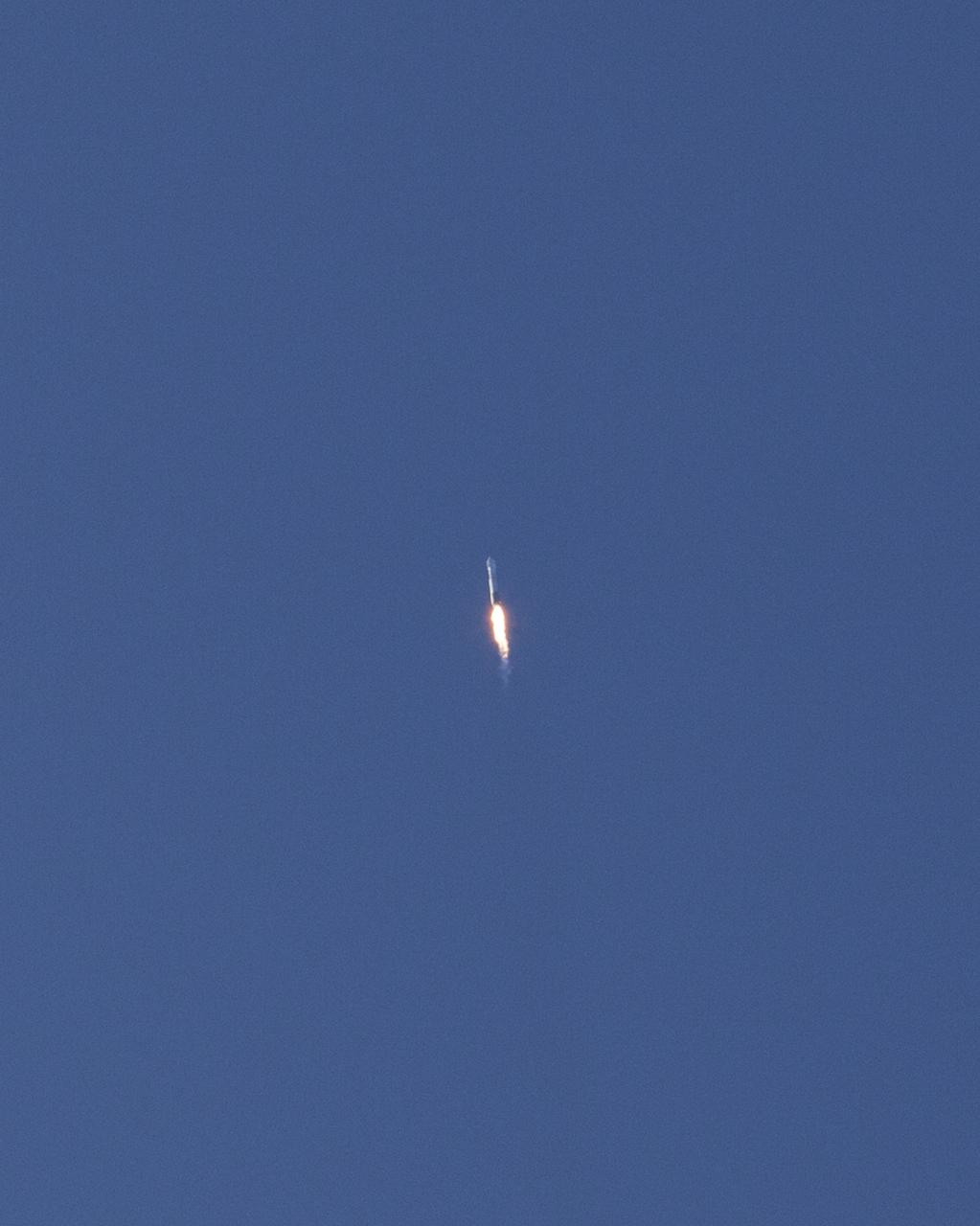
VANDENBERG AFB, Calif. -- The Landsat Data Continuity Mission spacecraft lifted off at 1:02 p.m. EST, 10:02 a.m. PST) atop a United Launch Alliance Atlas V rocket from Space Launch Complex 3 at California's Vandenberg Air Force Base. The Landsat Data Continuity Mission LDCM is the future of Landsat satellites. It will continue to obtain valuable data and imagery to be used in agriculture, education, business, science, and government. The Landsat Program provides repetitive acquisition of high resolution multispectral data of the Earth's surface on a global basis. The data from the Landsat spacecraft constitute the longest record of the Earth's continental surfaces as seen from space. It is a record unmatched in quality, detail, coverage, and value. For more information, visit: http:__www.nasa.gov_mission_pages_landsat_main_index.html Photo credit: NASA_Kim Shiflett