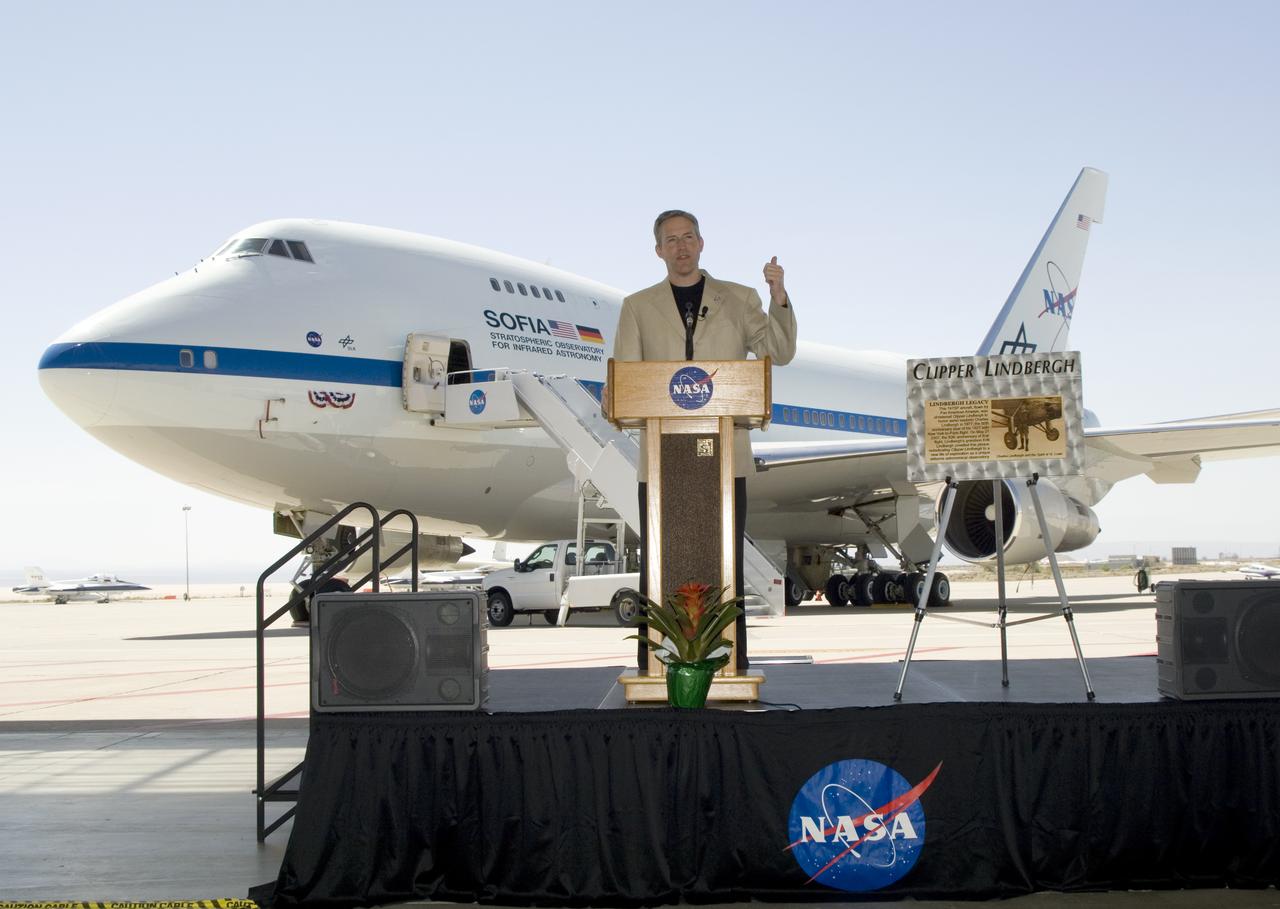
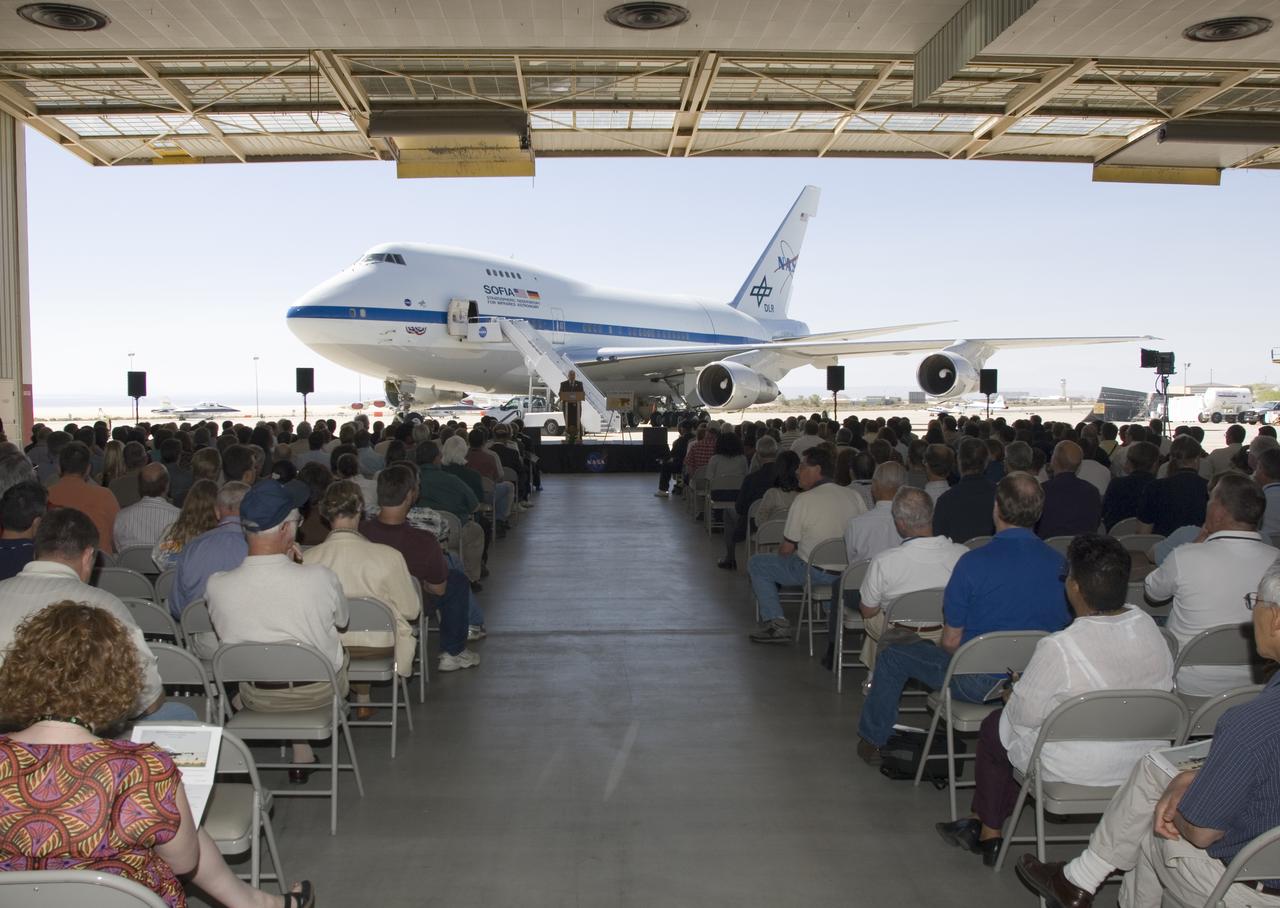
More than 250 VIPs, news media and guests joined NASA, DLR, USRA and other SOFIA staff for the debut of the airborne observatory at NASA DFRC on June 27, 2007.
More than 250 VIPs, news media and guests joined NASA, DLR, USRA and other SOFIA staff for the debut of the airborne observatory at NASA DFRC on June 27, 2007
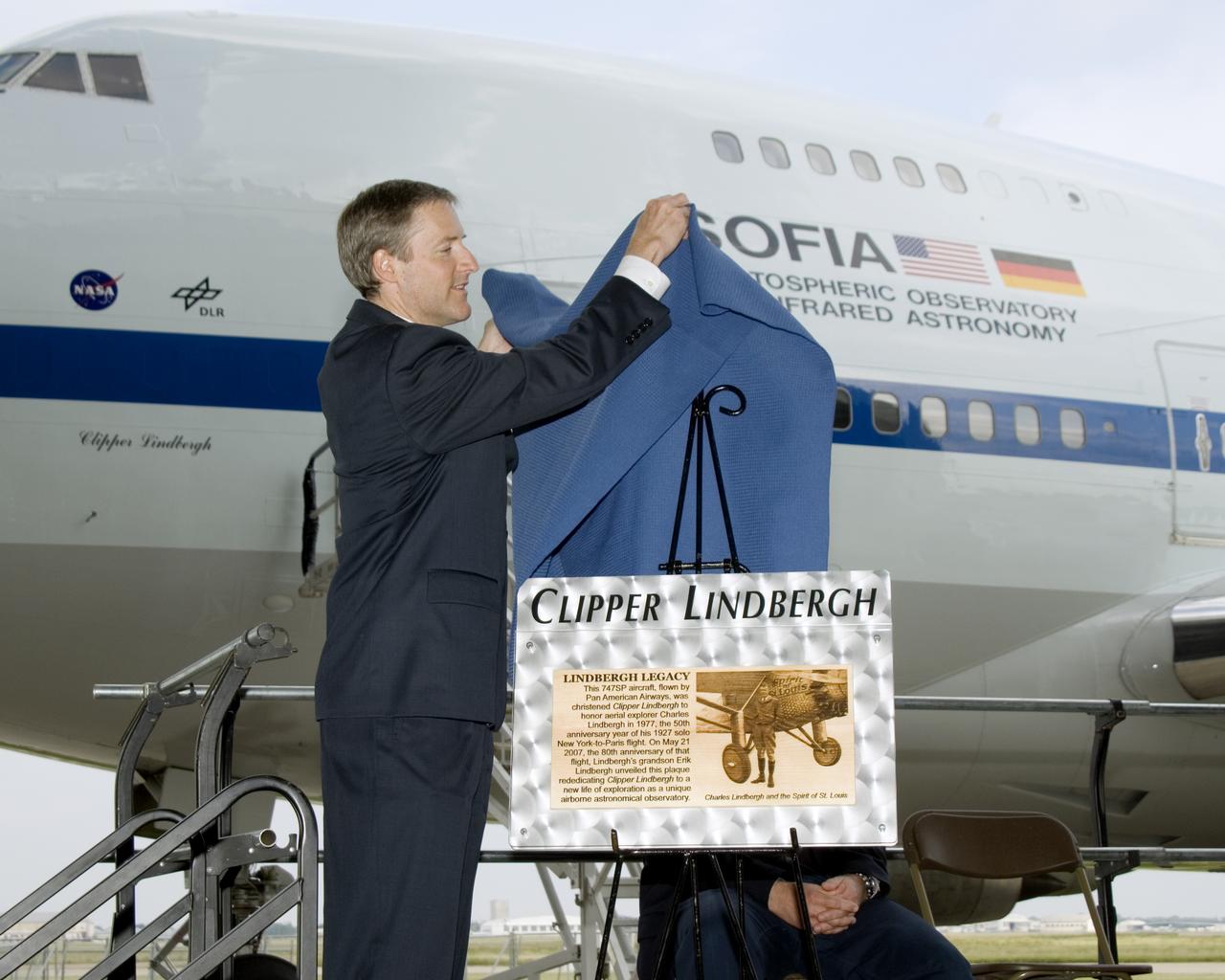
Erik Lindbergh, grandson of famed aviator Charles Lindbergh, yanks the bunting to reveal the Clipper Lindbergh name on NASA's SOFIA Boeing 747SP on June 27, 2007. More than 250 VIPs, news media and guests joined NASA, DLR, USRA and other SOFIA staff for the debut of the airborne observatory at NASA Dryden.
Erik Lindbergh, grandson of famed aviator Charles Lindbergh, yanks the bunting to reveal the Clipper Lindbergh name on NASA's SOFIA 747SP on June 27, 2007
Cindy Barnes of University Space Research Association (USRA) at NASA's Marshall Space Flight Center pipettes a protein solution in preparation to grow crystals as part of NASA's structural biology program. Research on Earth helps scientists define conditions and specimens they will use in space experiments.
Microgravity
SCI2016_0001: SOFIA/GREAT [O I] spectrum at 4.7 THz (63 μm) superimposed on a picture of Mars. Absorption line depth is approximately 10% of the continuum. The abundance of atomic oxygen computed from the data is less than expected from the Forget et al. 1999 global circulation & photochemical model. Credit: SOFIA/GREAT spectrum: NASA/DLR/USRA/DSI/MPIfR/GREAT Consortium/MPIfS/Rezac et al. 2015; Mars image: NASA
SOFIA Science Imagery
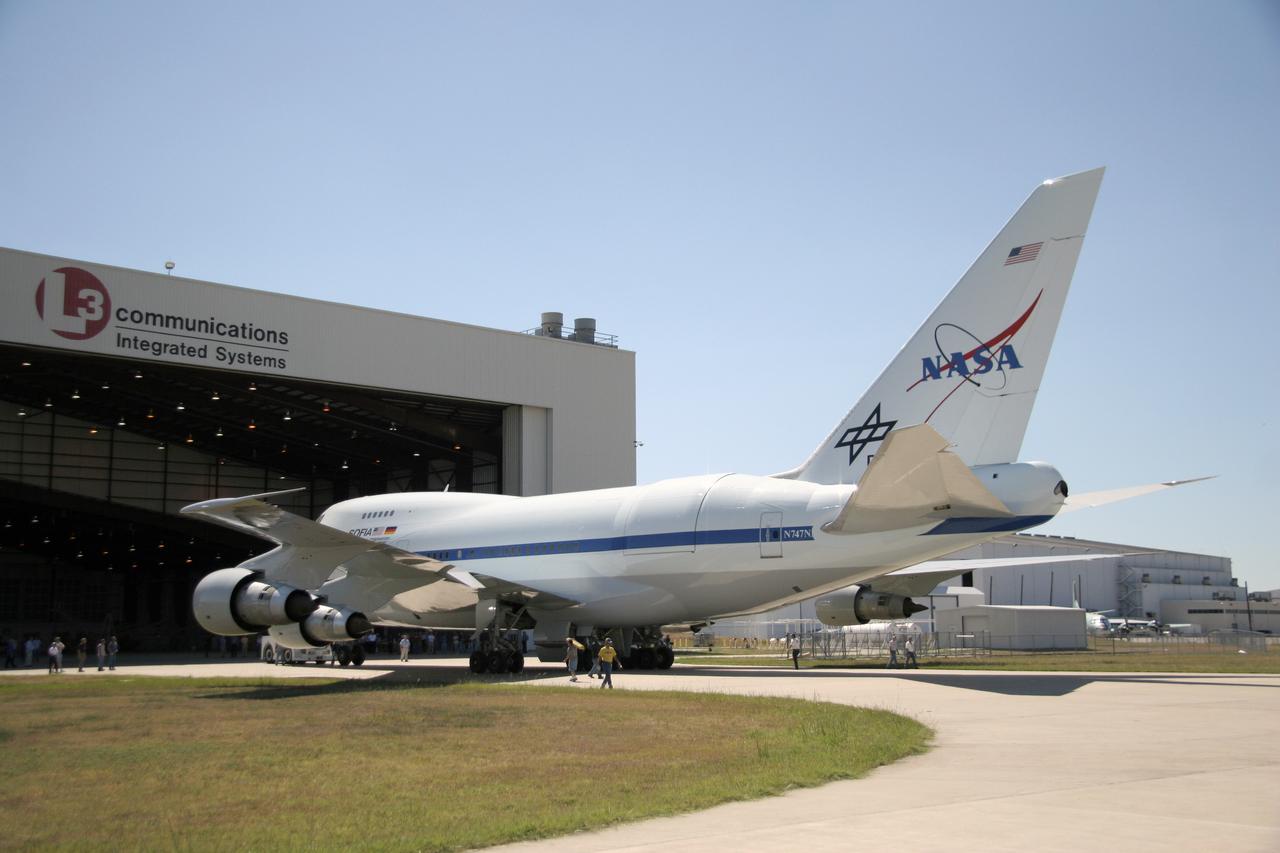
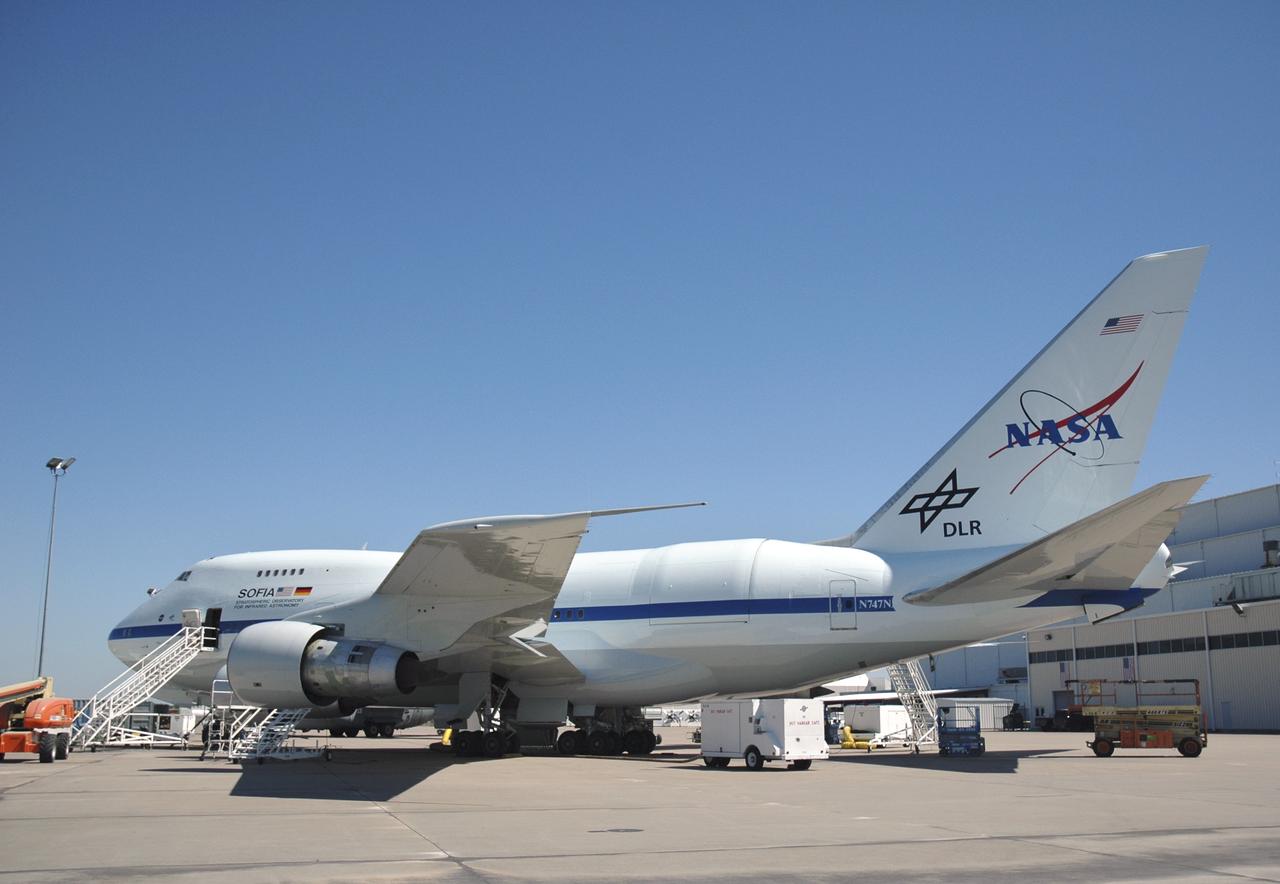
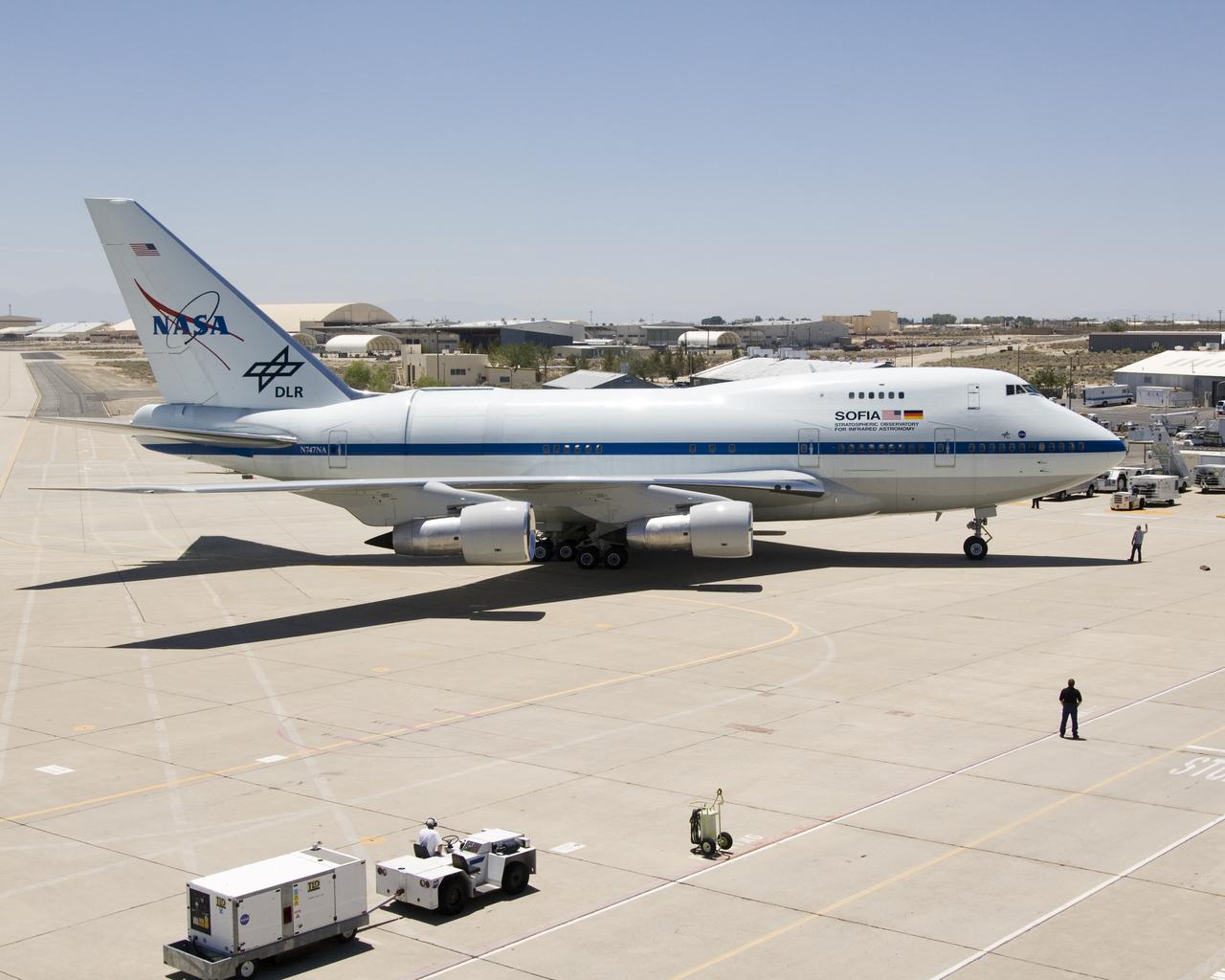
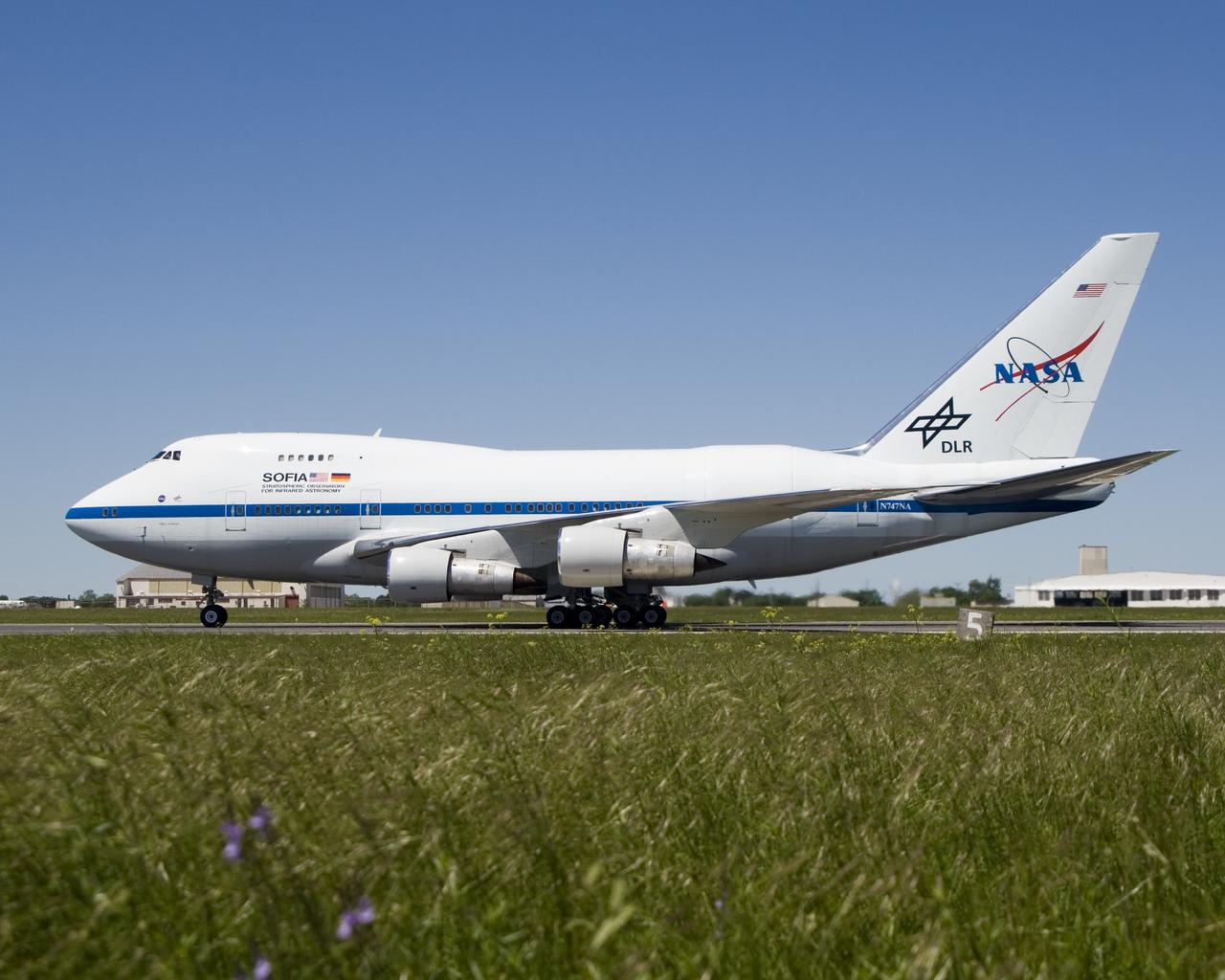
NASA's freshly painted Stratospheric Observatory for Infrared Astronomy (SOFIA) 747SP aircraft sits outside a hangar at L-3 Communications Integrated Systems' facility in Waco, Texas. The observatory, which features a German-built 100-inch (2.5 meter) diameter infrared telescope weighing 20 tons, is approaching the flight test phase as part of a joint program by NASA and DLR Deutsches Zentrum fuer Luft- und Raumfahrt (German Aerospace Center). SOFIA's science and mission operations are being planned jointly by Universities Space Research Association (USRA) and the Deutsches SOFIA Institut (DSI). Once operational, SOFIA will be the world's primary infrared observatory during a mission lasting up to 20 years, as well as an outstanding laboratory for developing and testing instrumentation and detector technology.
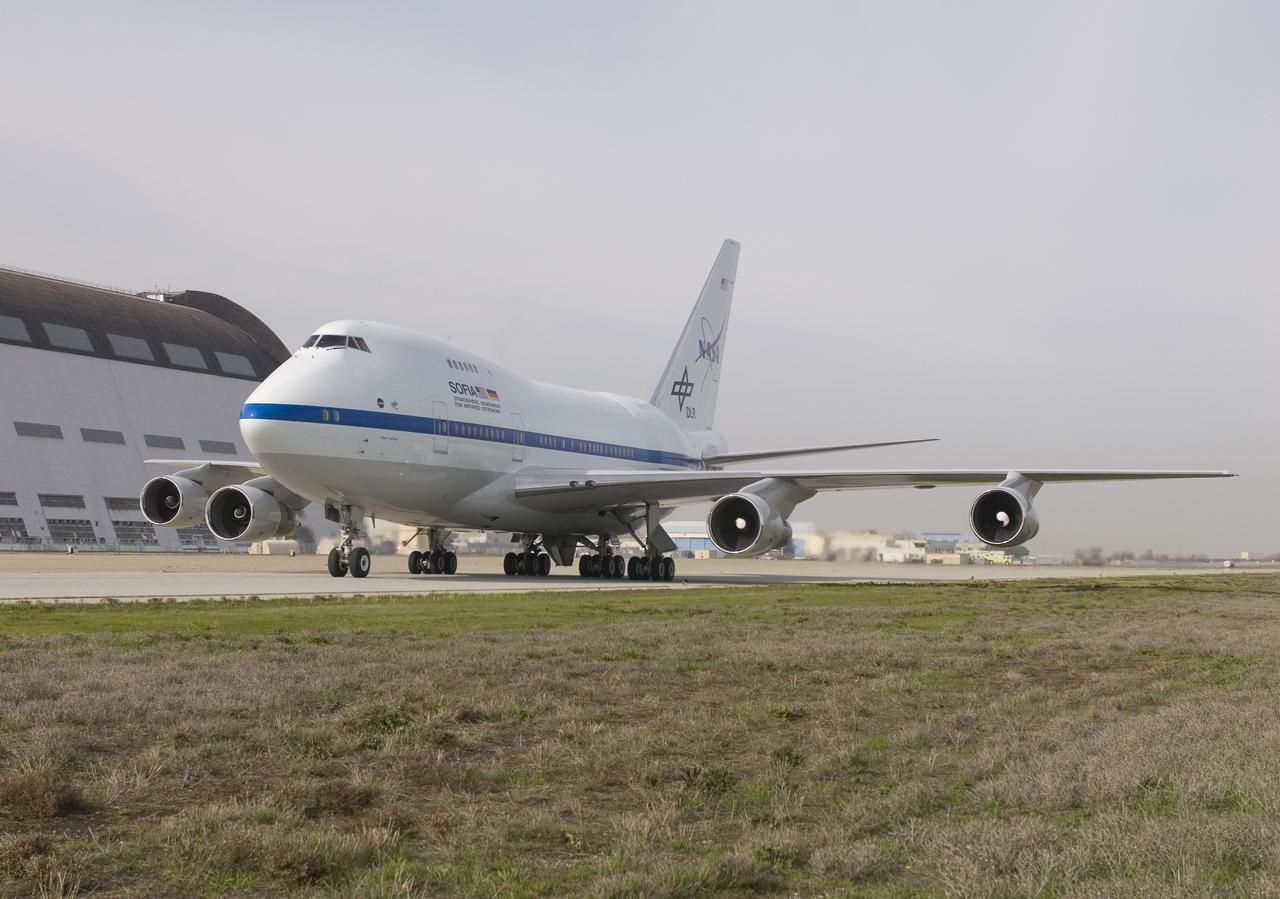
NASA's newly painted Stratospheric Observatory for Infrared Astronomy 747SP is pushed back from L-3 Communications' Integrated Systems hangar in Waco, Texas
NASA's freshly painted Stratospheric Observatory for Infrared Astronomy (SOFIA) 747SP is shown at L-3 Communications Integrated Systems' facility in Waco, Texas, where major modifications and installation was performed. The observatory, which features a German-built 100-inch (2.5 meter) diameter infrared telescope weighing 20 tons, is approaching the flight test phase as part of a joint program by NASA and DLR Deutsches Zentrum fuer Luft- und Raumfahrt (German Aerospace Center). SOFIA's science and mission operations are being planned jointly by Universities Space Research Association (USRA) and the Deutsches SOFIA Institut (DSI). Once operational, SOFIA will be the world's primary infrared observatory during a mission lasting up to 20 years, as well as an outstanding laboratory for developing and testing instrumentation and detector technology.
NASA's Stratospheric Observatory for Infrared Astronomy 747SP shows off its new blue-and-white livery at L-3 Communications' Integrated Systems in Waco, Texas
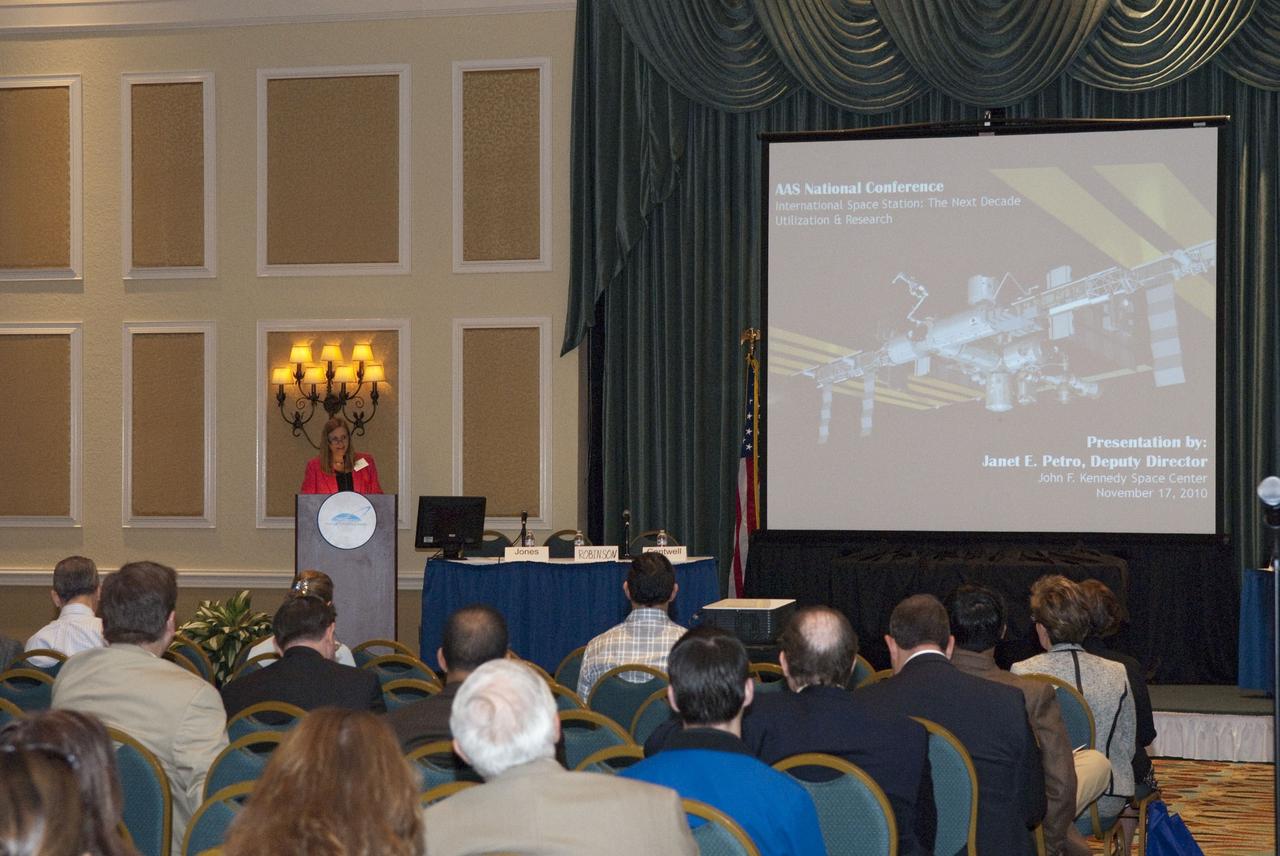
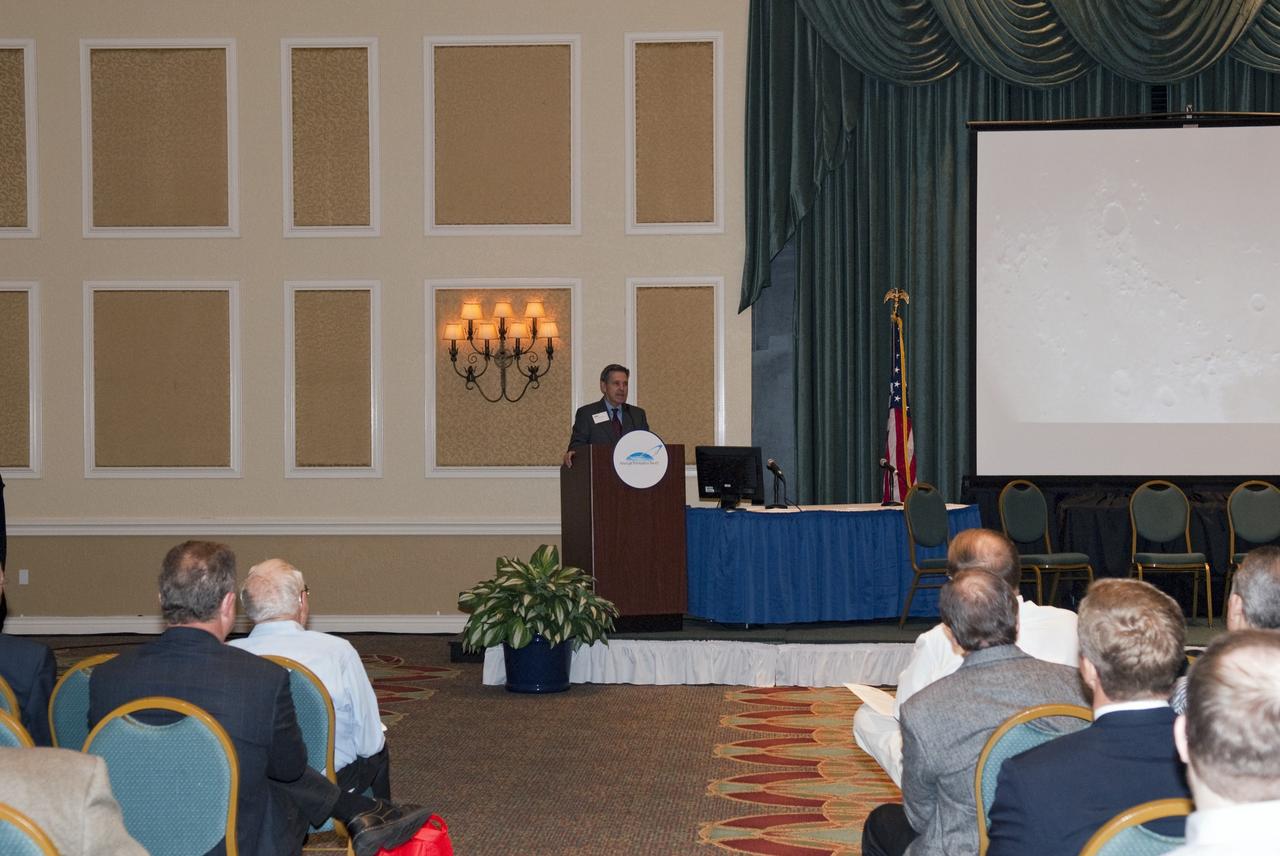
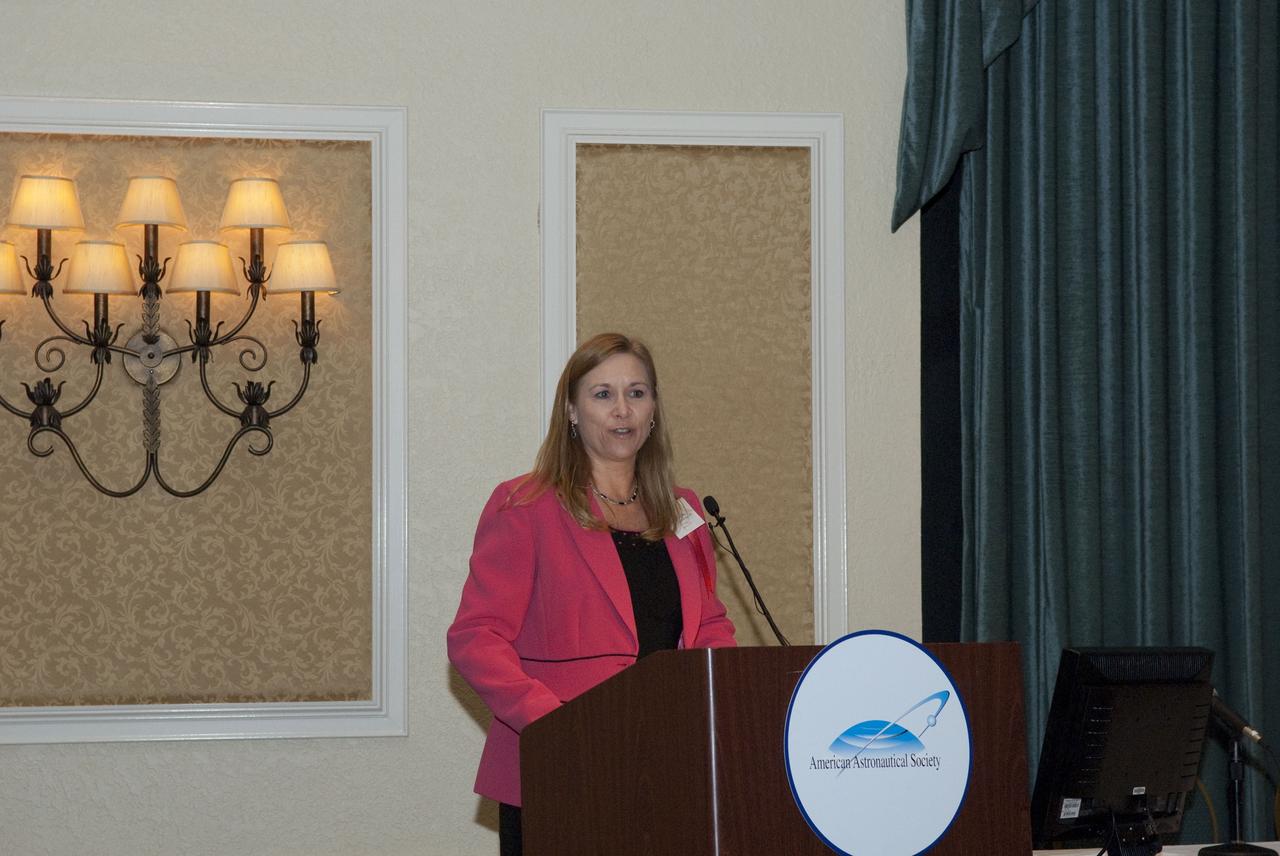
CAPE CANAVERAL, Fla. -- Kennedy Space Center Deputy Director Janet Petro addresses attendees of the American Astronautical Society's 2010 National Conference held at the Radisson Resort at the Port in Cape Canaveral, Fla.       This year's conference was titled: International Space Station: The Next Decade - Utilization and Research. The conference was organized with the support of Kennedy and sponsored by The Boeing Company, Honeywell International Inc., Northrop Grumman Corp., Space Florida and the Universities Space Research Association (USRA). Photo credit: NASA/Jim Grossmann
KSC-2010-5716
CAPE CANAVERAL, Fla. -- NASA Kennedy Space Center Director Bob Cabana addresses attendees of the  American Astronautical Society's 2010 National Conference at the Radisson Resort at the Port. The focus of the conference is the next 10 years of utilization and research aboard the International Space Station.    The conference was organized with the support of Kennedy and sponsored by The Boeing Company, Honeywell International Inc., Northrop Grumman Corp., Space Florida and the Universities Space Research Association (USRA).  Photo credit: NASA/Jim Grossmann
KSC-2010-5673
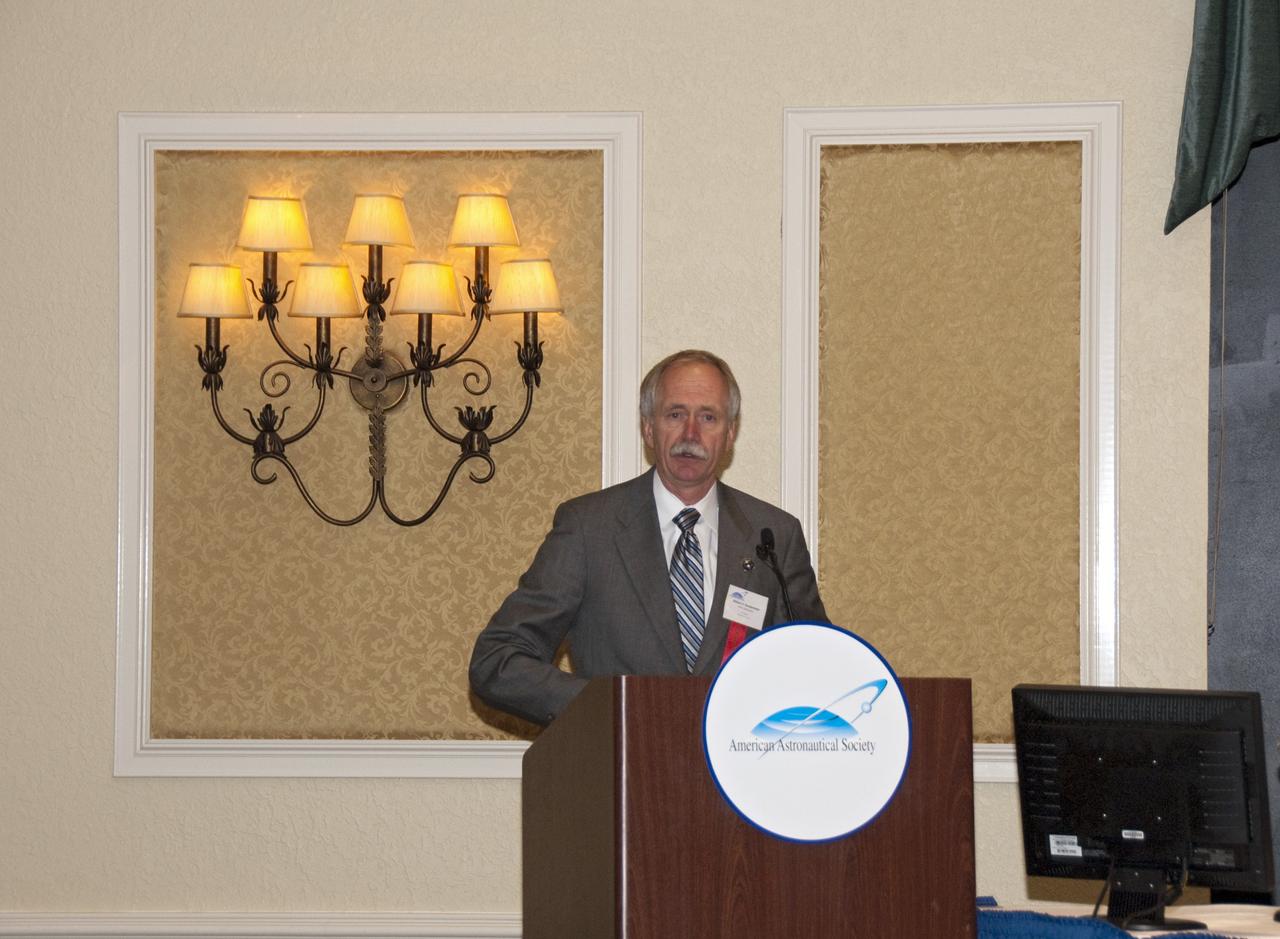
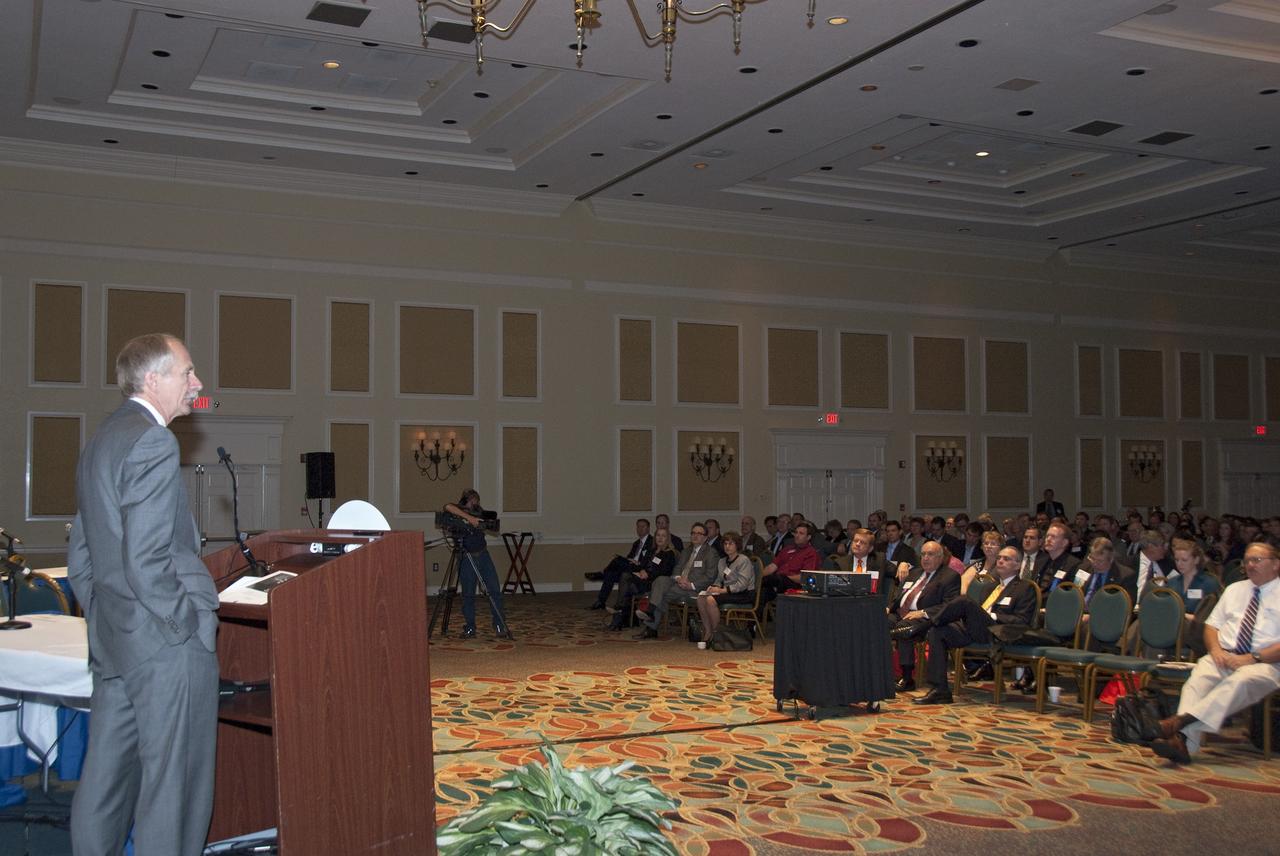
CAPE CANAVERAL, Fla. -- NASA Associate Administrator for Space Operations Bill Gerstenmaier addresses attendees of the American Astronautical Society's 2010 National Conference at the Radisson Resort at the Port. The focus of the conference is the next 10 years of utilization and research aboard the International Space Station.      The conference was organized with the support of Kennedy and sponsored by The Boeing Company, Honeywell International Inc., Northrop Grumman Corp., Space Florida and the Universities Space Research Association (USRA).  Photo credit: NASA/Jim Grossmann
KSC-2010-5675
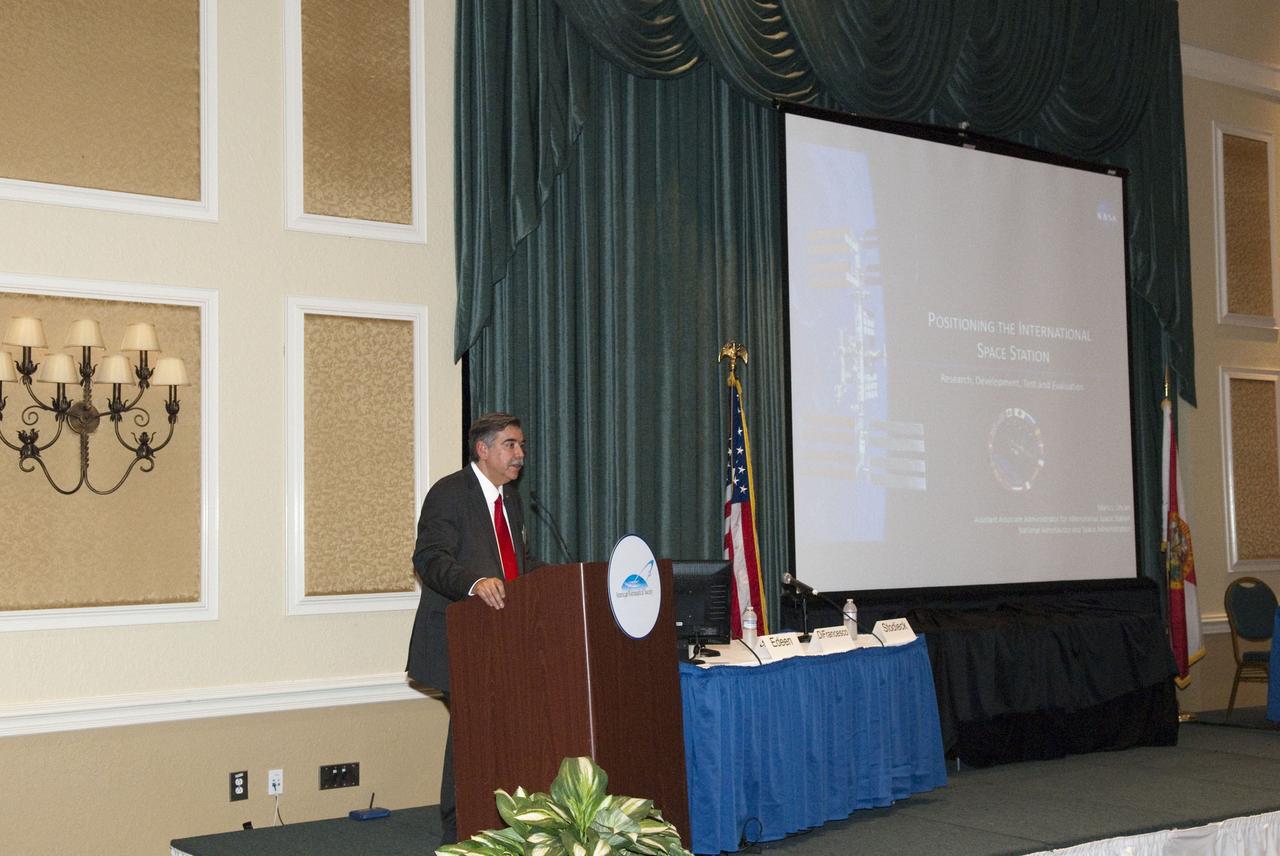
CAPE CANAVERAL, Fla. -- NASA International Space Station Assistant Associate Administrator Mark Uhran addresses attendees of the American Astronautical Society's 2010 National Conference, held at the Radisson Resort at the Port in Cape Canaveral, Fla.         This year's conference was titled: International Space Station: The Next Decade - Utilization and Research. The conference was organized with the support of Kennedy and sponsored by The Boeing Company, Honeywell International Inc., Northrop Grumman Corp., Space Florida and the Universities Space Research Association (USRA). Photo credit: NASA/Jim Grossmann
KSC-2010-5714
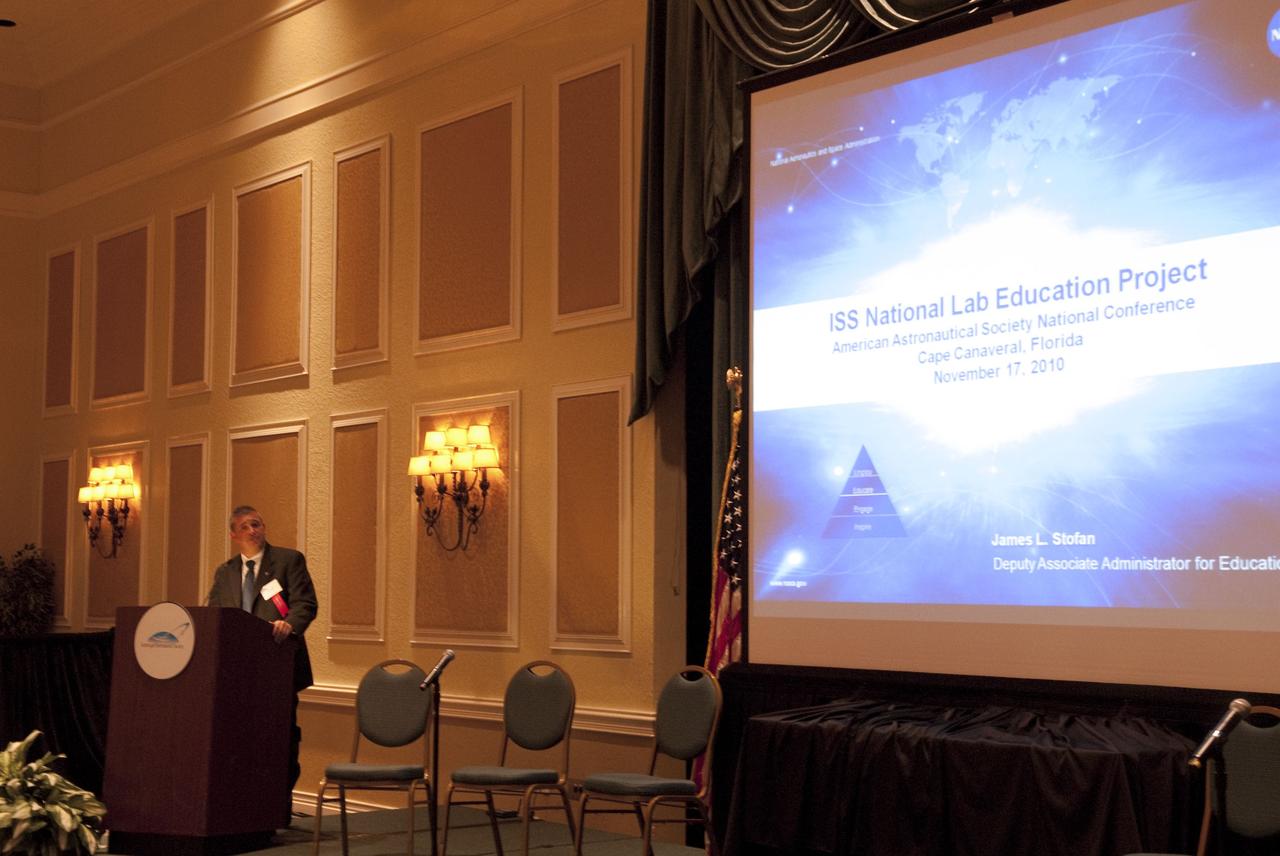
CAPE CANAVERAL, Fla. -- NASA Deputy Associate Administrator for Education James Stofan, addresses attendees of the American Astronautical Society's 2010 National Conference held at the Radisson Resort at the Port in Cape Canaveral, Fla.        This year's conference was titled: International Space Station: The Next Decade - Utilization and Research. The conference was organized with the support of Kennedy and sponsored by The Boeing Company, Honeywell International Inc., Northrop Grumman Corp., Space Florida and the Universities Space Research Association (USRA). Photo credit: NASA/Jim Grossmann
KSC-2010-5719
CAPE CANAVERAL, Fla. -- Kennedy Space Center Deputy Director Janet Petro addresses attendees of the American Astronautical Society's 2010 National Conference held at the Radisson Resort at the Port in Cape Canaveral, Fla.       This year's conference was titled: International Space Station: The Next Decade - Utilization and Research. The conference was organized with the support of Kennedy and sponsored by The Boeing Company, Honeywell International Inc., Northrop Grumman Corp., Space Florida and the Universities Space Research Association (USRA). Photo credit: NASA/Jim Grossmann
KSC-2010-5717
CAPE CANAVERAL, Fla. -- NASA Kennedy Space Center Director Bob Cabana addresses attendees of the  American Astronautical Society's 2010 National Conference at the Radisson Resort at the Port. The focus of the conference is the next 10 years of utilization and research aboard the International Space Station.        The conference was organized with the support of Kennedy and sponsored by The Boeing Company, Honeywell International Inc., Northrop Grumman Corp., Space Florida and the Universities Space Research Association (USRA).  Photo credit: NASA/Jim Grossmann
KSC-2010-5674
CAPE CANAVERAL, Fla. -- NASA Associate Administrator for Space Operations Bill Gerstenmaier addresses attendees of the American Astronautical Society's 2010 National Conference at the Radisson Resort at the Port. The focus of the conference is the next 10 years of utilization and research aboard the International Space Station.    The conference was organized with the support of Kennedy and sponsored by The Boeing Company, Honeywell International Inc., Northrop Grumman Corp., Space Florida and the Universities Space Research Association (USRA).  Photo credit: NASA/Jim Grossmann
KSC-2010-5676
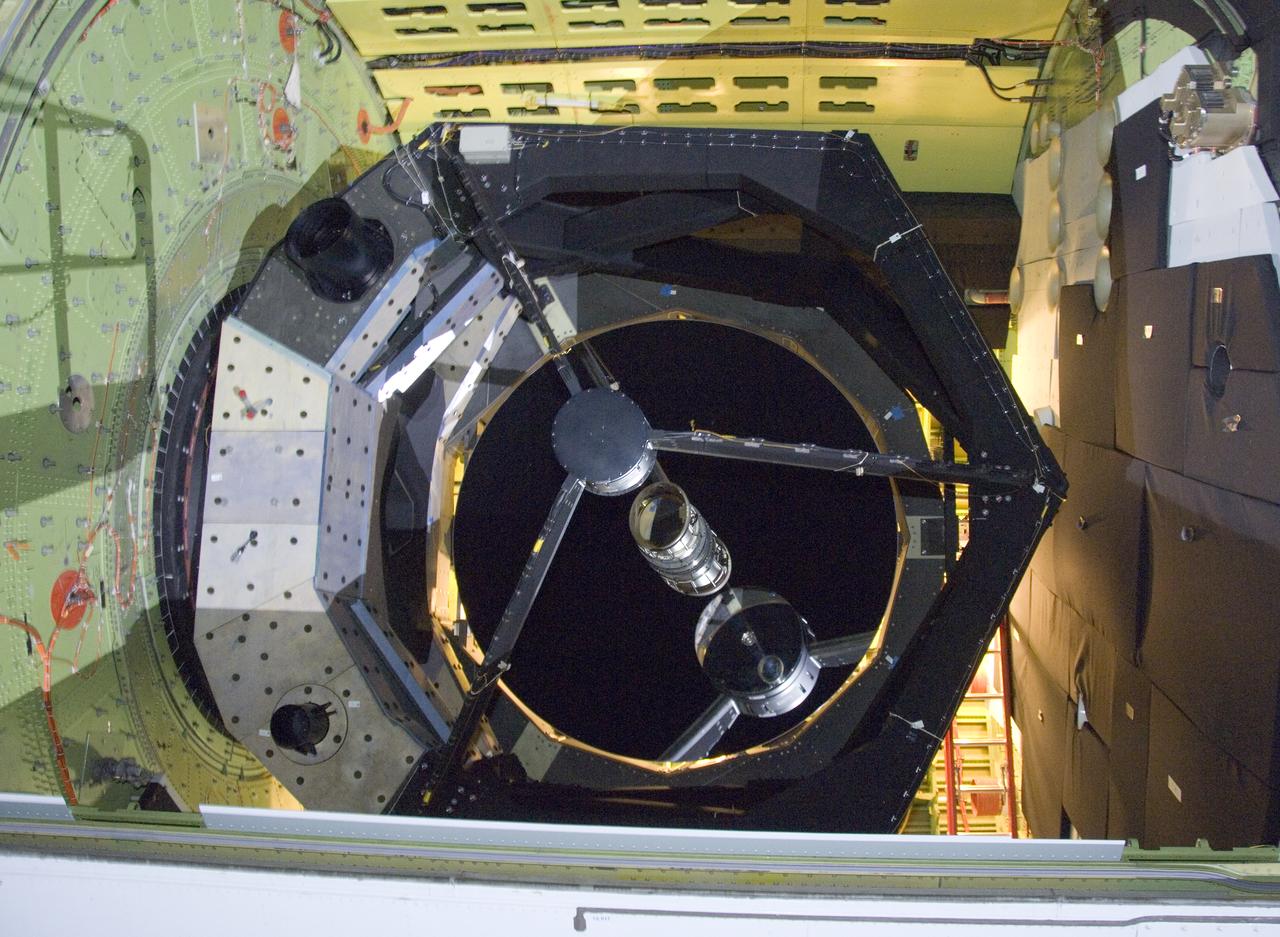
The German-built 100-inch telescope that is the heart of NASA's Stratospheric Observatory for Infrared Astronomy is nestled in the SOFIA 747's rear fuselage.
The German-built 100-inch telescope that is the heart of NASA's Stratospheric Observatory for Infrared Astronomy is nestled in the SOFIA 747's rear fuselage
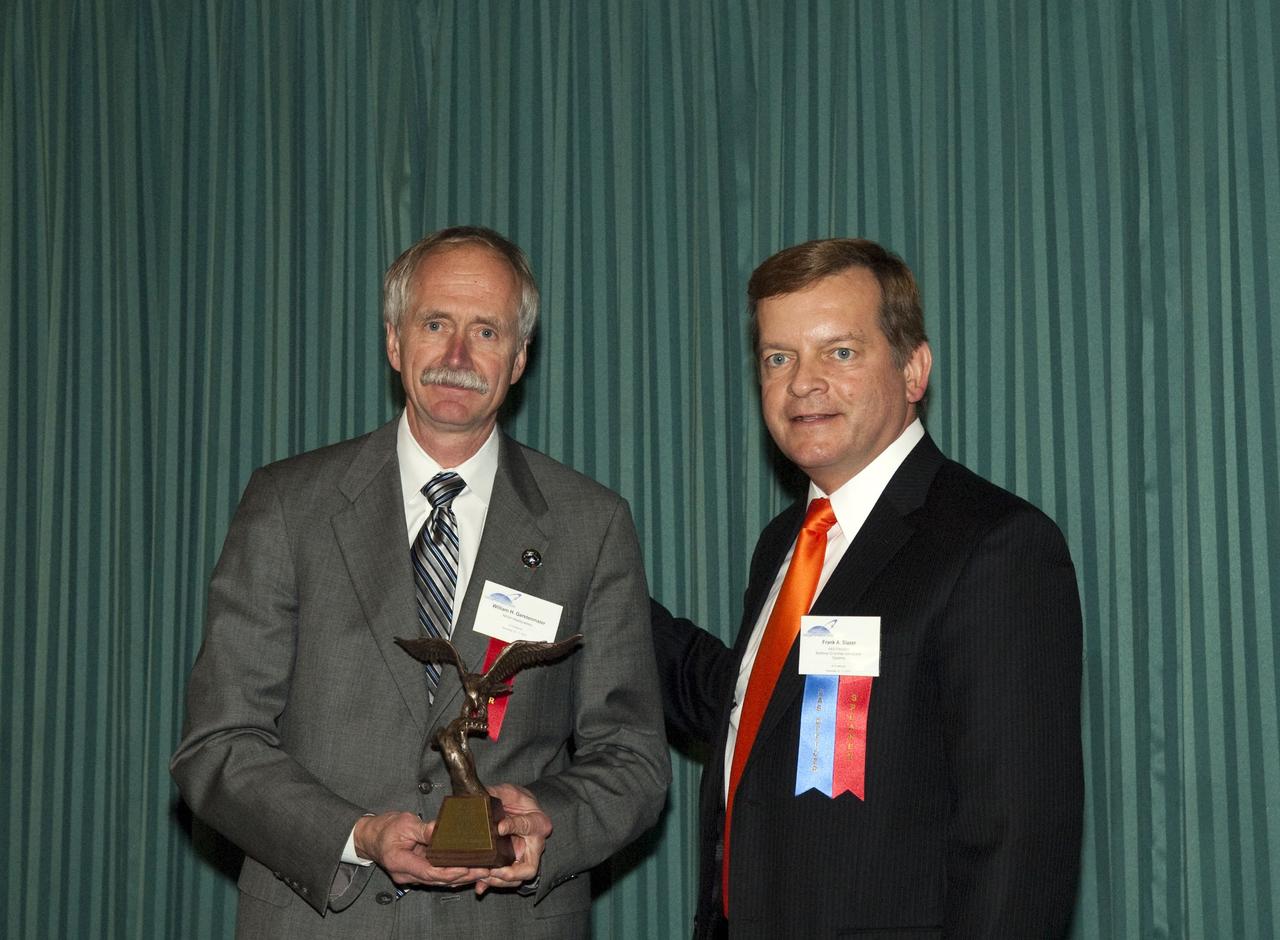
CAPE CANAVERAL, Fla. -- After being presented with the 2010 Space Flight award from the American Astronautical Society, NASA Associate Administrator for Space Operations Bill Gerstenmaier and Northrop Grumman/American Astronautical Society President Frank Slazer pose for a photo at the American Astronautical Society's 2010 National Conference held at the Radisson Resort at the Port in Cape Canaveral, Fla.          This year's conference was titled: International Space Station: The Next Decade - Utilization and Research. The conference was organized with the support of Kennedy and sponsored by The Boeing Company, Honeywell International Inc., Northrop Grumman Corp., Space Florida and the Universities Space Research Association (USRA). Photo credit: NASA/Jim Grossmann
KSC-2010-5711
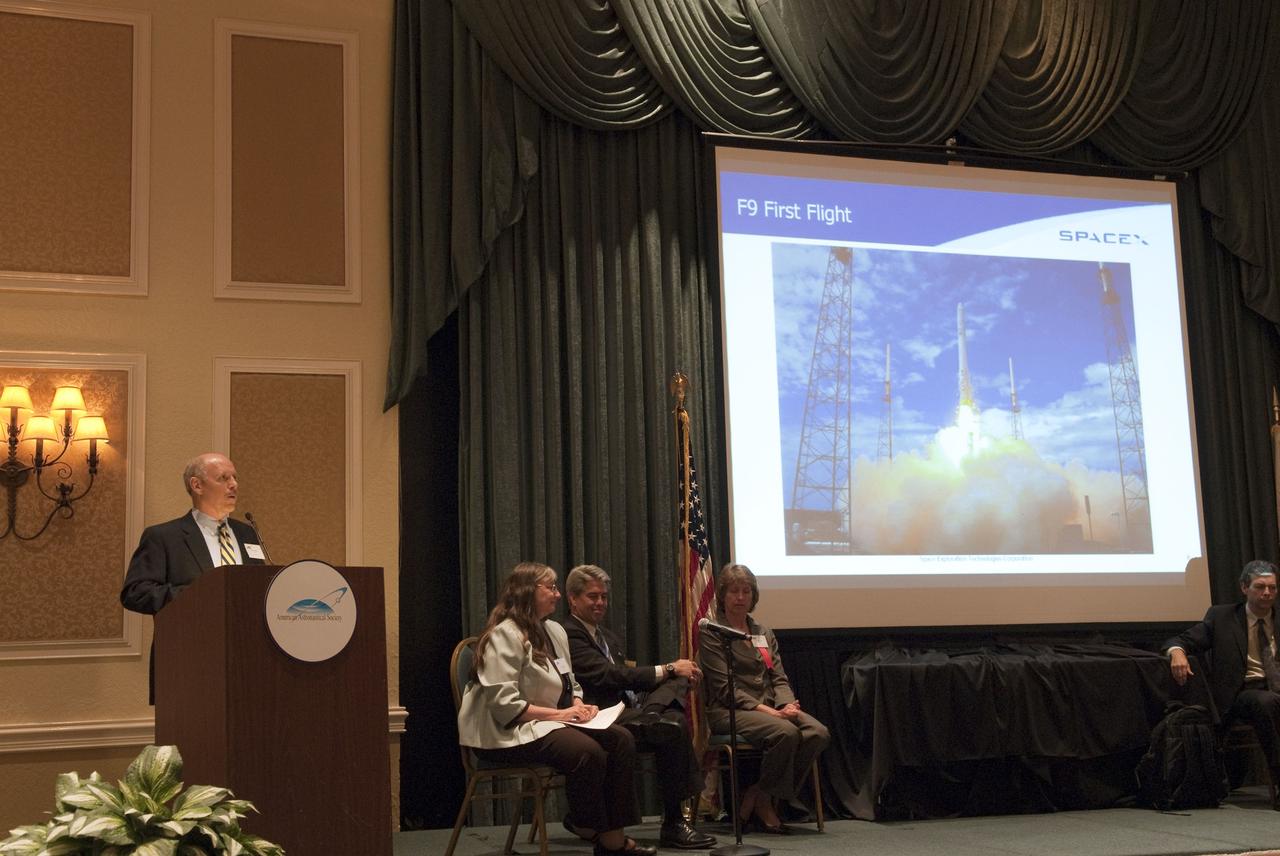
CAPE CANAVERAL, Fla. -- SpaceX Vice President of Mission Assurance and Astronaut Safety Ken Bowersox addresses attendees of the American Astronautical Society's 2010 National Conference held at the Radisson Resort at the Port in Cape Canaveral, Fla. Also on stage (left to right) are, NASA Deputy Associate Administrator of Space Operations Mission Directorate Lynn Cline; NASA Program Integration Manager at Johnson Space Center, Jeff Arend; Lockheed Martin Information Systems & Global Services Program Director Therese Thrift and NASA Commercial Resupply Program Deputy Manager at Johnson Space Center Ford Dillon.    This year's conference was titled: International Space Station: The Next Decade - Utilization and Research. The conference was organized with the support of Kennedy and sponsored by The Boeing Company, Honeywell International Inc., Northrop Grumman Corp., Space Florida and the Universities Space Research Association (USRA). Photo credit: NASA/Jim Grossmann
KSC-2010-5720
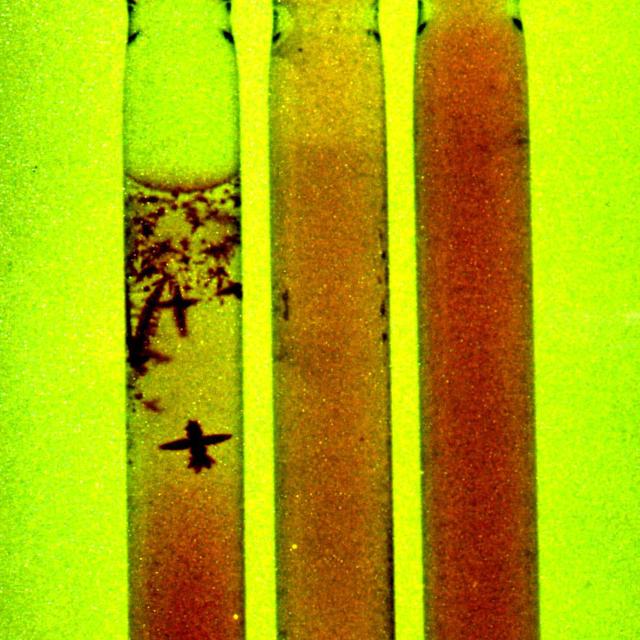
Dr. Alexander Chernov, of the Universities Space Research Association (USRA) and based at Marshall Space Flight Center, is investigating why protein crystals grown in space are, in about 20 percent of cases, better-ordered than those grown on the ground. They are testing the idea that the amount of impurities trapped by space-grown crystals may be different than the amount trapped by crystals grown on Earth because convection is negligible in microgravity. The concentrations or impurities in many space-grown crystals turned out to be several times lower than that in the terrestrial ones, sometimes below the detection limit. The ground-based experiment also showed that the amount of impurities per unit volume of the crystals was usually higher than the amount per unit volume of the solution. This means that a growing crystal actually purifies the solution in its immediate vicinity. Here, an impurity depletion zone is created around apoferritin crystals grown in gel, imitating microgravity conditions.
Microgravity
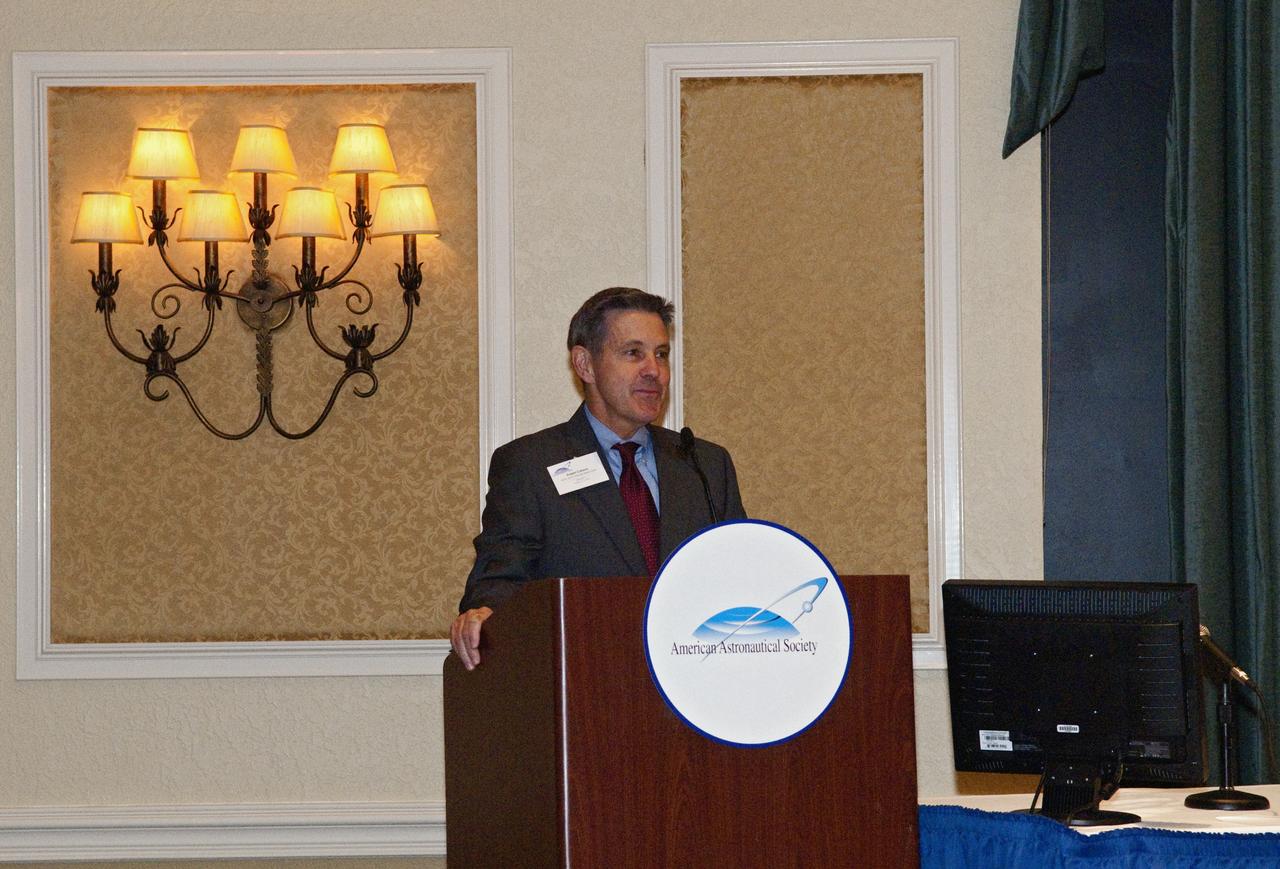
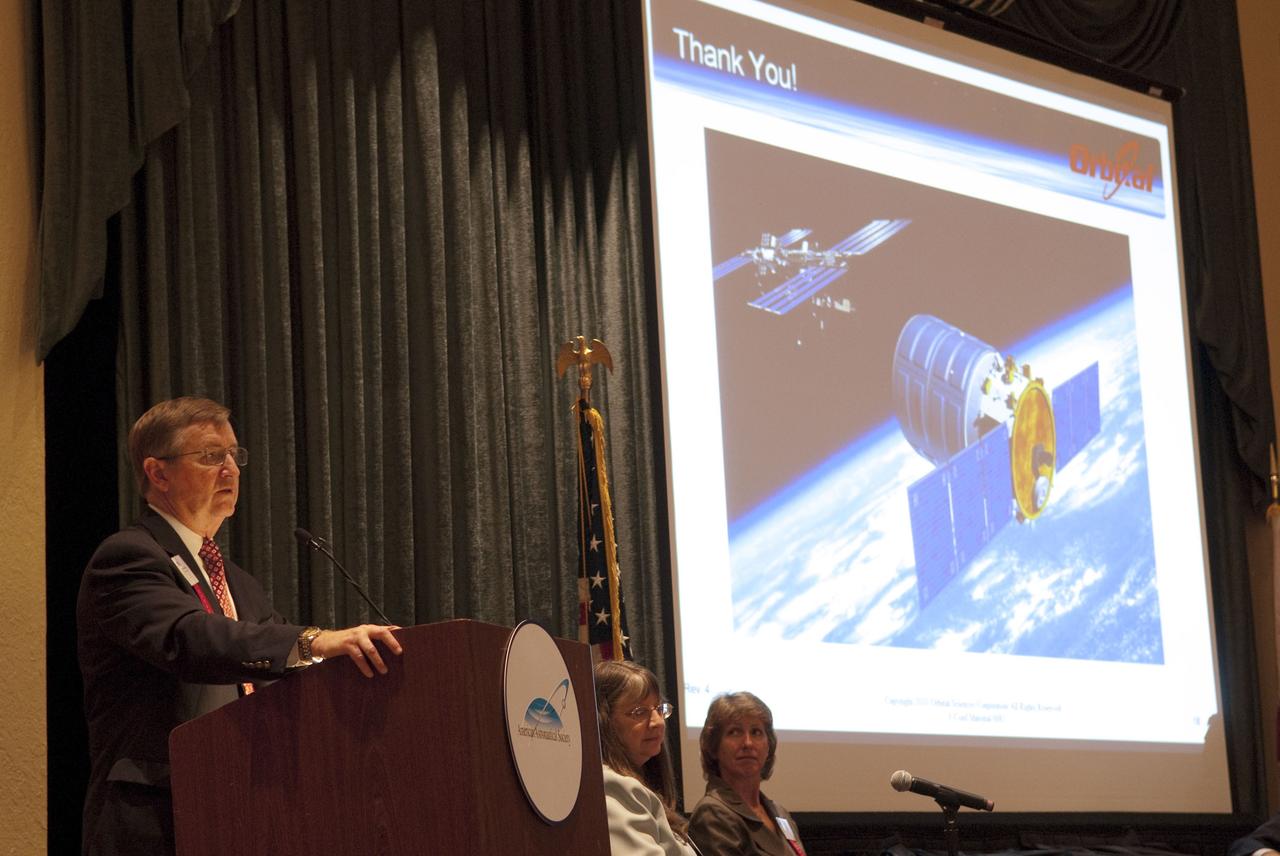
CAPE CANAVERAL, Fla. -- Senior Vice President and Deputy General Manager of Orbital Sciences Corp. Frank Culbertson Jr. addresses attendees of the American Astronautical Society's 2010 National Conference held at the Radisson Resort at the Port in Cape Canaveral, Fla. as NASA Deputy Associate Administrator of Space Operations Mission Directorate Lynn Cline and Lockheed Martin Information Systems & Global Services Program Director, Therese Thrift look on.  This year's conference was titled: International Space Station: The Next Decade - Utilization and Research. The conference was organized with the support of Kennedy and sponsored by The Boeing Company, Honeywell International Inc., Northrop Grumman Corp., Space Florida and the Universities Space Research Association (USRA). Photo credit: NASA/Jim Grossmann
KSC-2010-5721
SCI2012_0003: SOFIA mid-infrared image of the planetary nebula Minkowski 2-9 (M2-9), also known as the Butterfly Nebula, compared with a visual-wavelength Hubble Space Telescope image at the same scale and orientation. The nebula is composed of two lobes of gas & dust expelled from a dying star with about the mass of our Sun that is seen at the center of the lobes. The HST image shows mostly ionized gas in the lobes whereas the SOFIA image shows mostly solid grains condensing in the gas. The SOFIA data were obtained during SOFIA's Early Science program in 2011 by a Guest Investigator team led by Michael Werner of Caltech/JPL using the FORCAST camera (P.I.Terry Herter, Cornell University). Credit: SOFIA image, RGB = 37, 24, 20 microns; NASA/DLR/USRA/DSI/FORCAST team/M. Werner et al./A. Helton,  J. Rho; HST image: NASA/ESA/NSF/AURA/Hubble Heritage Team/STScI/B. Balick, V. Icke, G. Mellema
SOFIA Science Imagery
CAPE CANAVERAL, Fla. -- Japan Aerospace Exploration Agency and International Space Station Program Manager Tetsuro Yokoyama addresses attendees of the American Astronautical Society's 2010 National Conference held at the Radisson Resort at the Port in Cape Canaveral, Fla. The panel of speakers seated from left to right are, International Space Services President James Zimmerman; International Space Station Program Manager Michael Suffredini; Canadian Space Agency Director of Space Exploration Operations and Infrastructure  Pierre Jean; European Space Agency Directorate of Human Spaceflight and International Space Station Programme Department Bernado Patti and Roskosmos Piloted Space Programs Department Director Alexey Krasnov.            This year's conference was titled: International Space Station: The Next Decade - Utilization and Research. The conference was organized with the support of Kennedy and sponsored by The Boeing Company, Honeywell International Inc., Northrop Grumman Corp., Space Florida and the Universities Space Research Association (USRA). Photo credit: NASA/Jim Grossmann
KSC-2010-5709
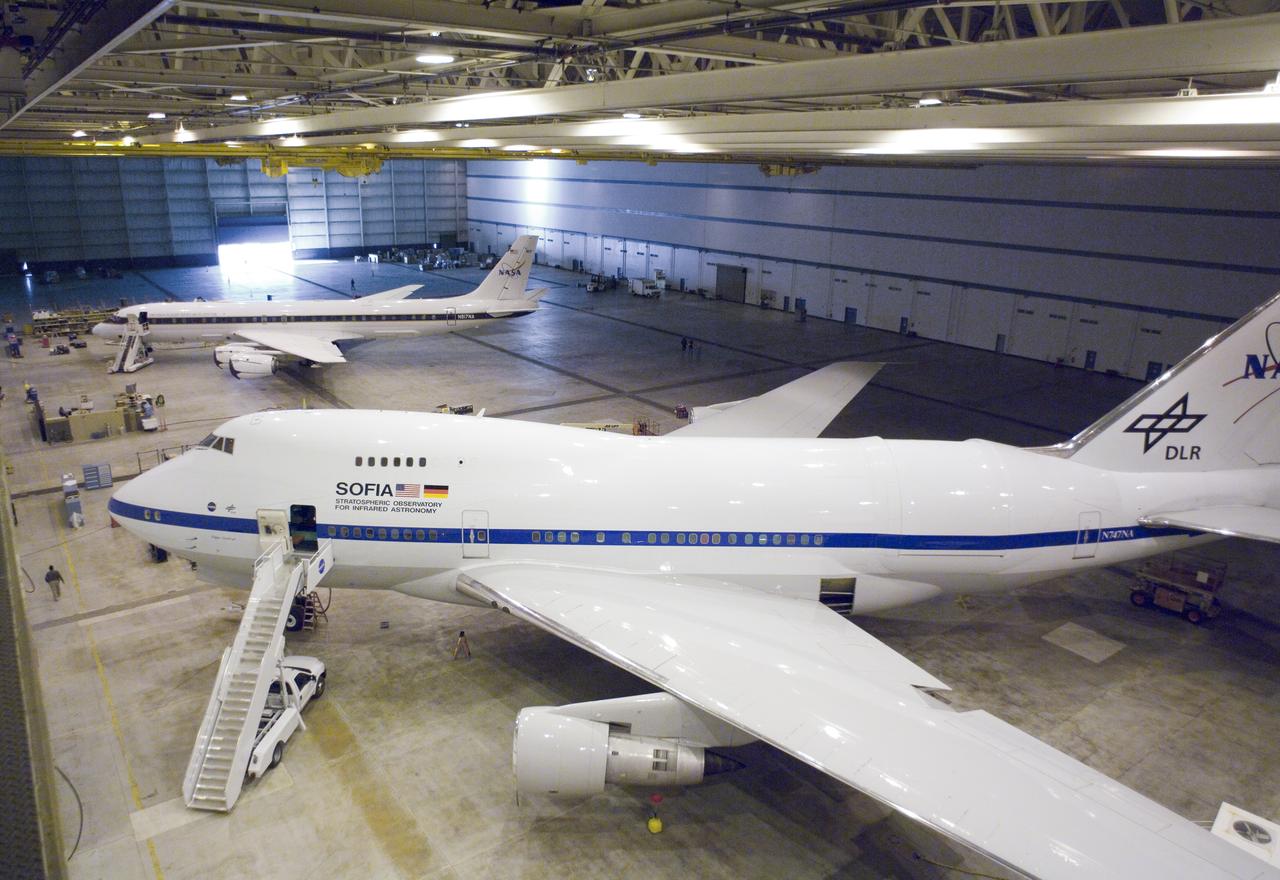
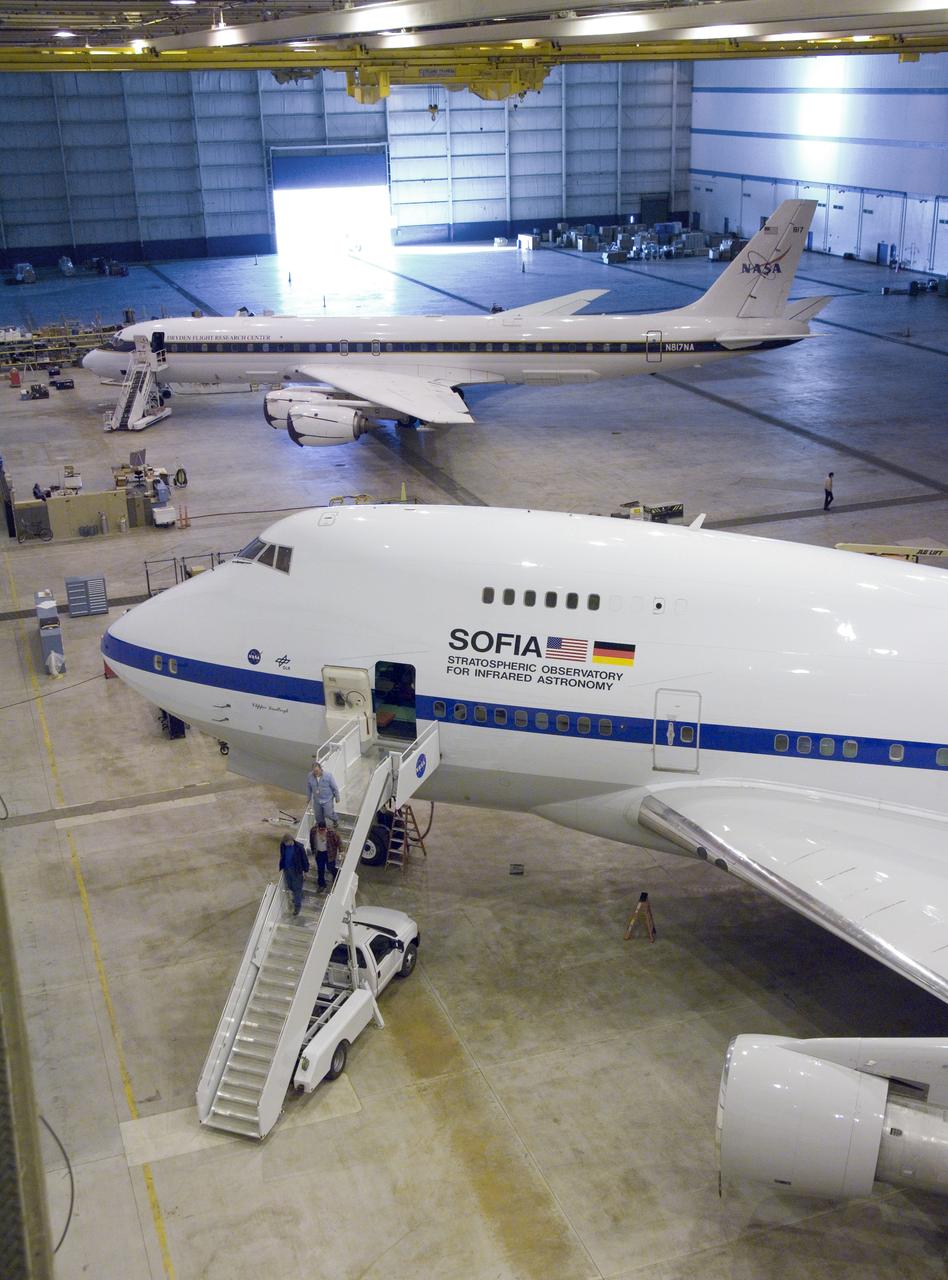
Two large science aircraft, a DC-8 flying laboratory and the SOFIA 747SP, are based at NASA's Dryden Aircraft Operations Facility in Palmdale, Calif.
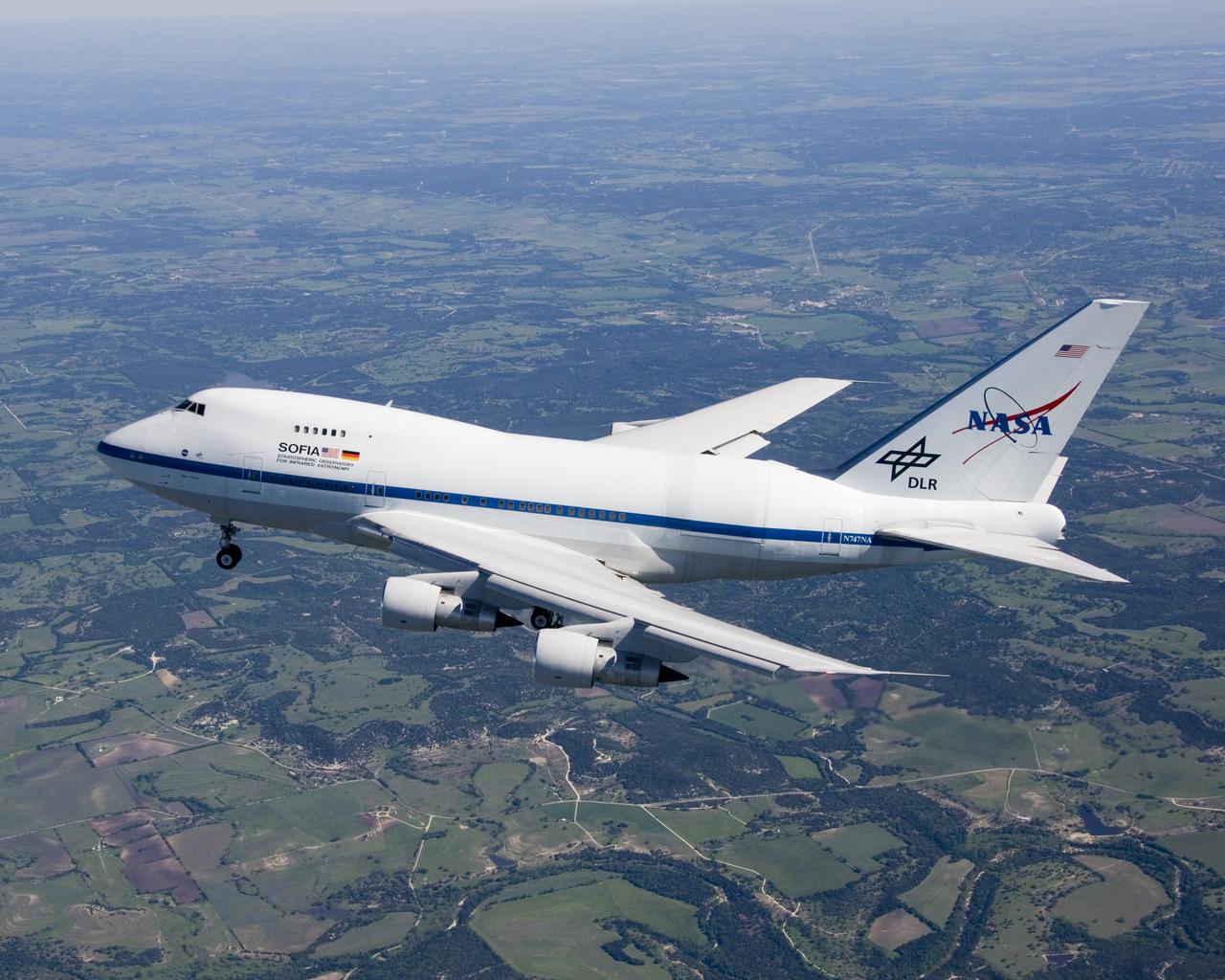
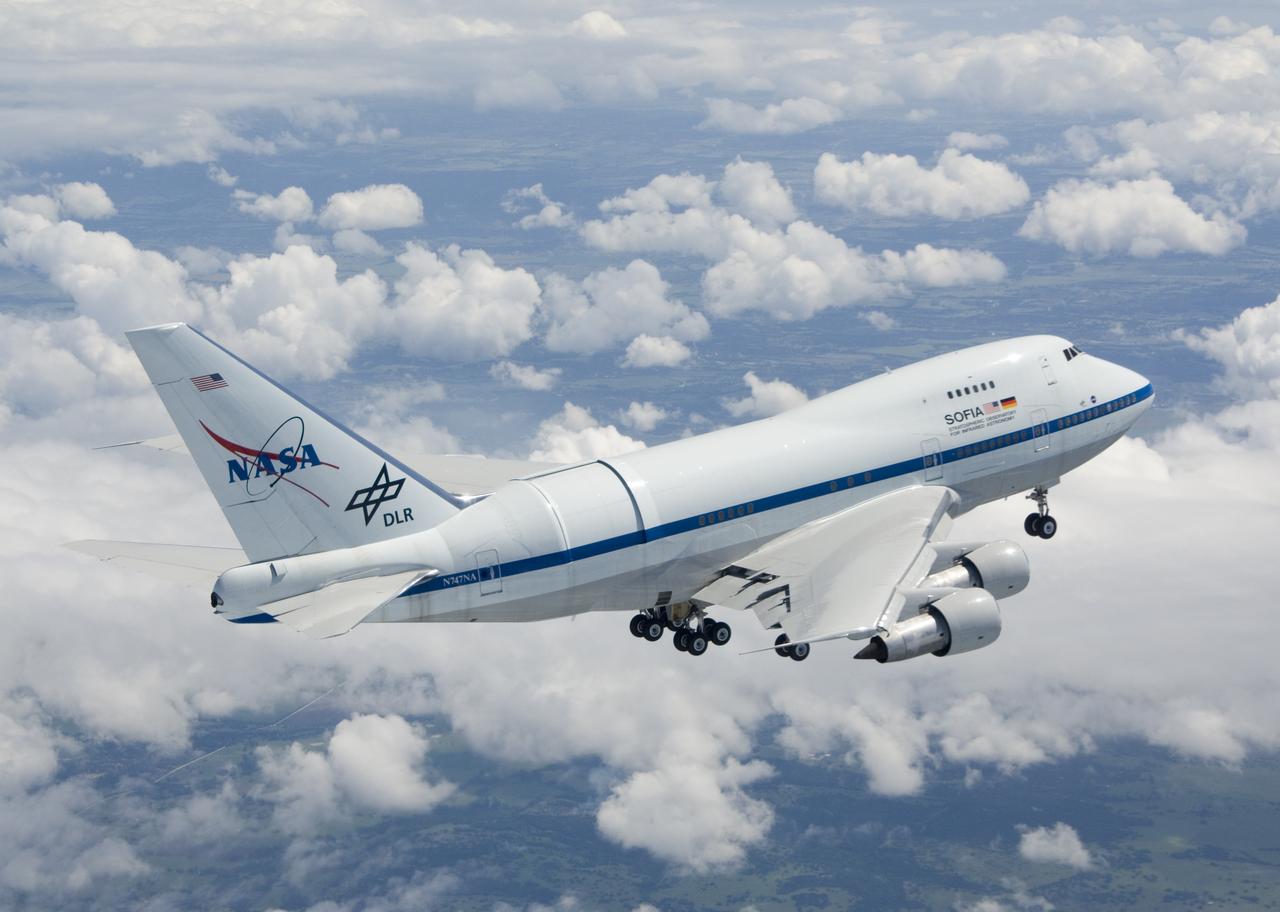
NASA's Boeing 747SP SOFIA airborne observatory soars over a bed of puffy clouds during its second checkout flight over the Texas countryside on May 10, 2007.
NASA's Boeing 747SP SOFIA airborne observatory soars over a bed of puffy clouds during its second checkout flight over the Texas countryside on May 10, 2007
NASA's Stratospheric Observatory for Infrared Astronomy (SOFIA) Boeing 747SP flies over NASA's Dryden Flight Research Center after a ferry flight from Waco, Texas. NASA's Stratospheric Observatory for Infrared Astronomy, or SOFIA, arrived at NASA's Dryden Flight Research Center at Edwards Air Force Base, Calif. on May 31, 2007. The heavily modified Boeing 747SP was ferried to Dryden from Waco, Texas, where L-3 Communications Integrated Systems installed a German-built 2.5-meter infrared telescope and made other major modifications over the past several years. SOFIA is scheduled to undergo installation and integration of mission systems and a multi-phase flight test program at Dryden over the next three years that is expected to lead to a full operational capability to conduct astronomy missions in about 2010. During its expected 20-year lifetime, SOFIA will be capable of "Great Observatory" class astronomical science, providing astronomers with access to the visible, infrared and sub-millimeter spectrum with optimized performance in the mid-infrared to sub-millimeter range.
NASA's Stratospheric Observatory for Infrared Astronomy (SOFIA) Boeing 747SP flies over NASA DFRC after a ferry flight from Waco, Texas
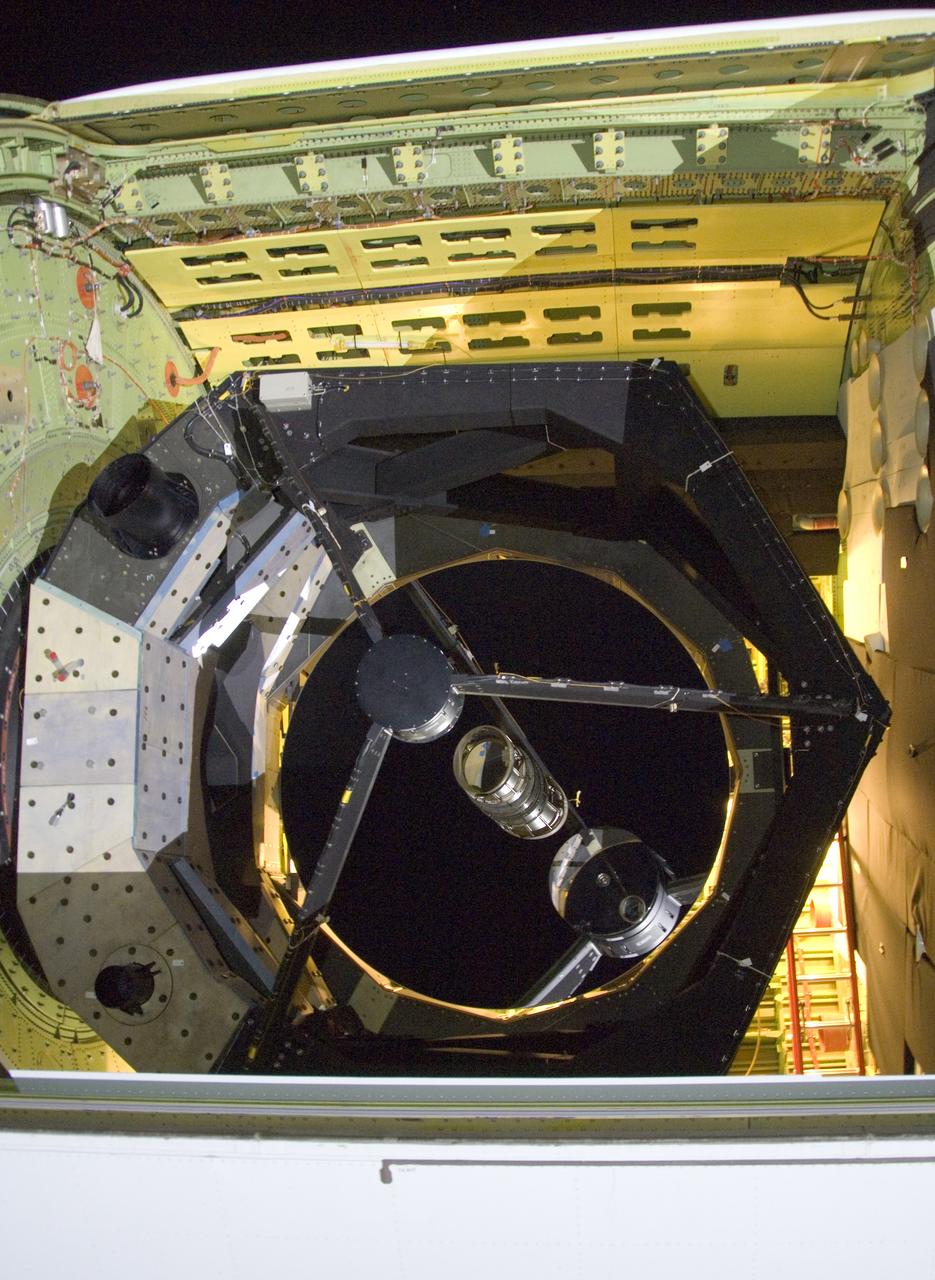
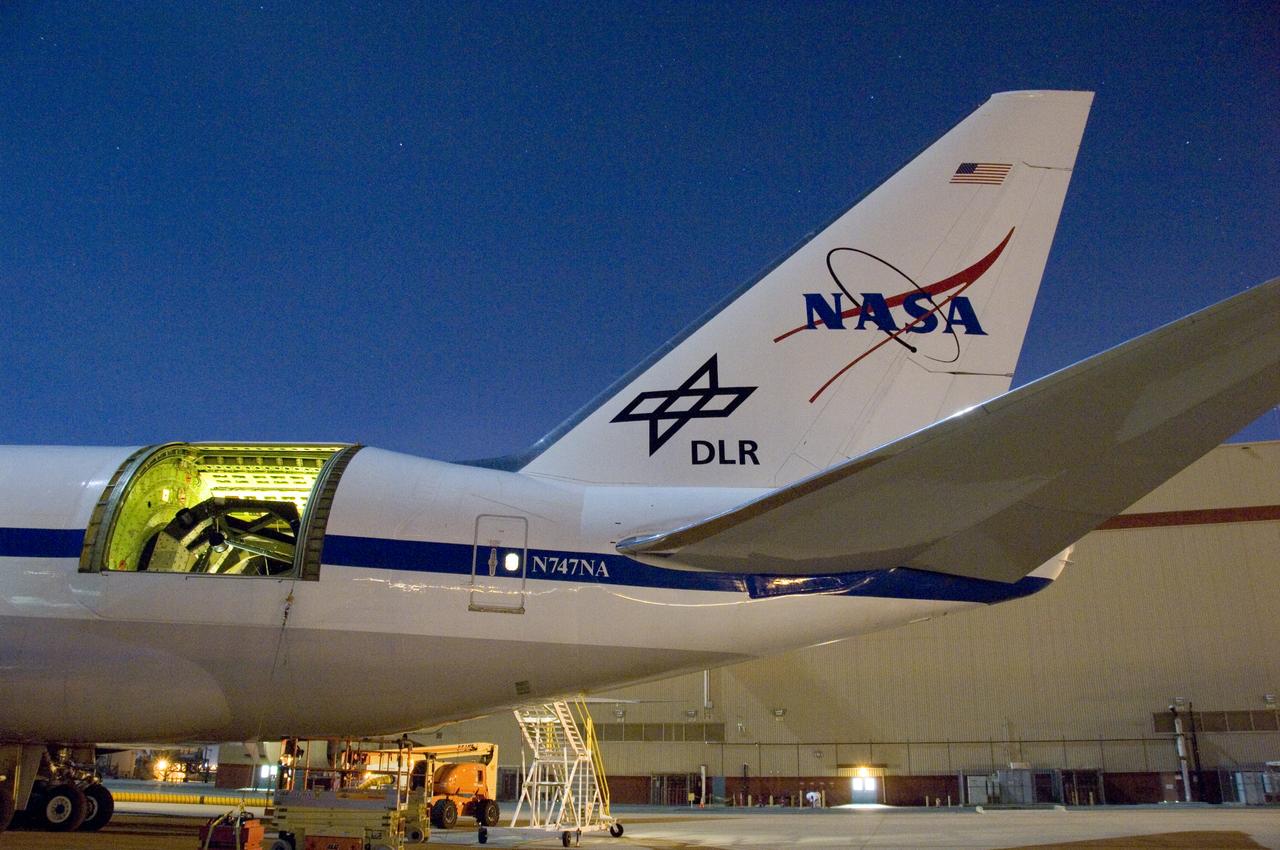
he SOFIA airborne observatory's 2.5-meter infrared telescope peers out from its cavity in the SOFIA rear fuselage during nighttime line operations testing.
he SOFIA airborne observatory's 2.5-meter infrared telescope peers out from its cavity in the SOFIA rear fuselage during nighttime line operations testing
NASA's highly modified Boeing 747SP SOFIA observatory banks low over the Texas countryside as it heads for landing at Waco to conclude its second check flight.
NASA's highly modified Boeing 747SP SOFIA observatory banks low over the Texas countryside as it heads for landing at Waco to conclude its second check flight
Logos of NASA and the German Aerospace Center (DLR) are displayed prominently on the tail of the Stratospheric Observatory for Infrared Astronomy (SOFIA) 747SP.
Logos of NASA and the German Aerospace Center (DLR) are displayed prominently on the tail of the Stratospheric Observatory for Infrared Astronomy (SOFIA) 747SP
Erik Lindbergh, grandson of famed aviator Charles Lindbergh, rededicated the SOFIA Boeing 747SP as the Clipper Lindbergh at NASA Dryden on June 27, 2007.
Erik Lindbergh, grandson of famed aviator Charles Lindbergh, rededicated the SOFIA Boeing 747SP as the Clipper Lindbergh at NASA Dryden on June 27, 2007
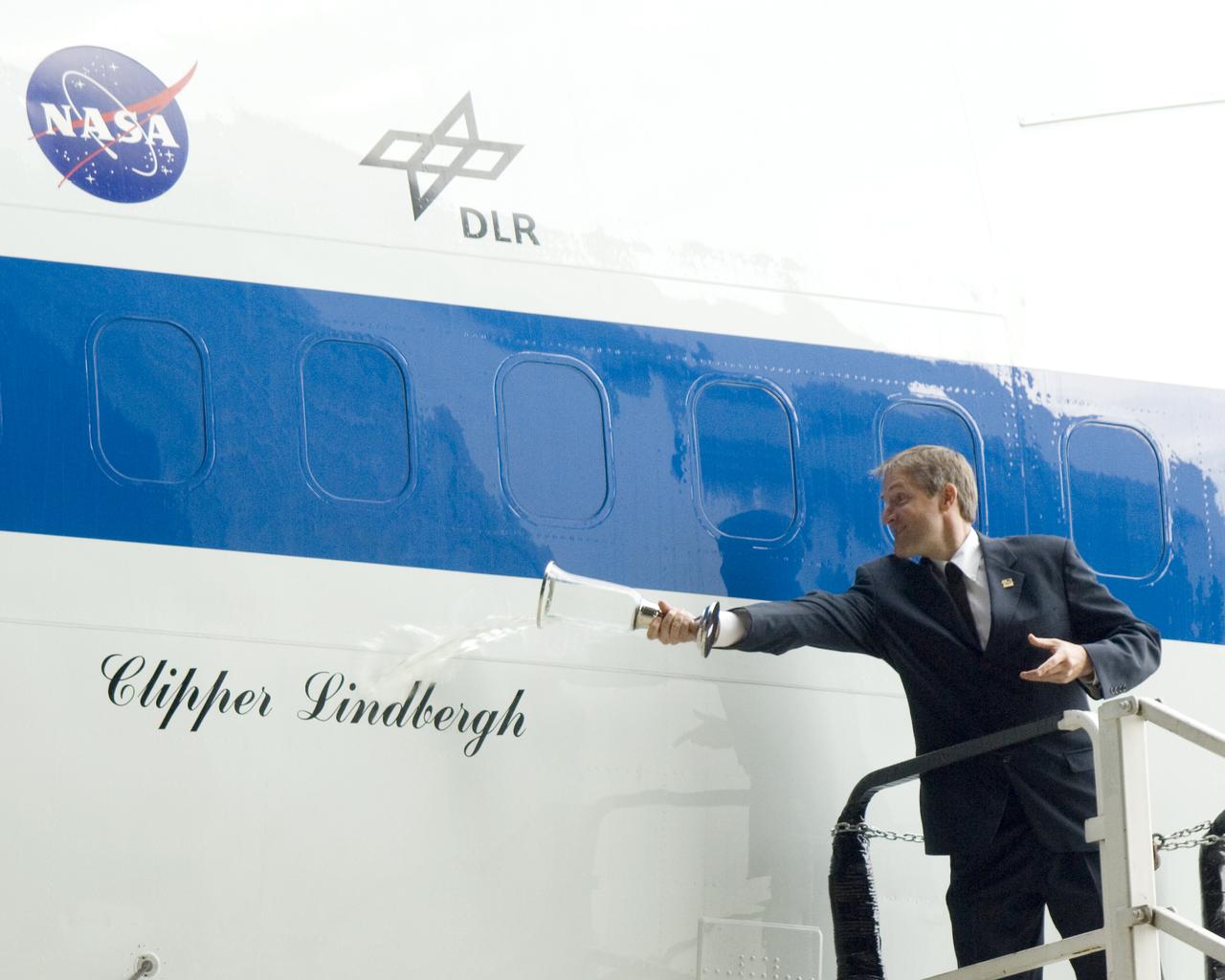
Erik Lindbergh christens NASA's 747 Clipper Lindbergh, the Stratospheric Observatory for Infrared Astronomy, with a special commemorative concoction representing local, NASA, and industry partners. The liquid consisted of a small amount of California wine representing NASA Dryden where the aircraft will be stationed, a small amount of Dr. Pepper (a Waco, TX invention), a quantity of French bottled water (to symbolize Charles Lindbergh's flight to Paris on this date), and a dash of German beer to represent the SOFIA German industry partners.
Erik Lindbergh christens NASA's 747 Clipper Lindbergh with a special commemorative concoction representing local, NASA, and industry partners
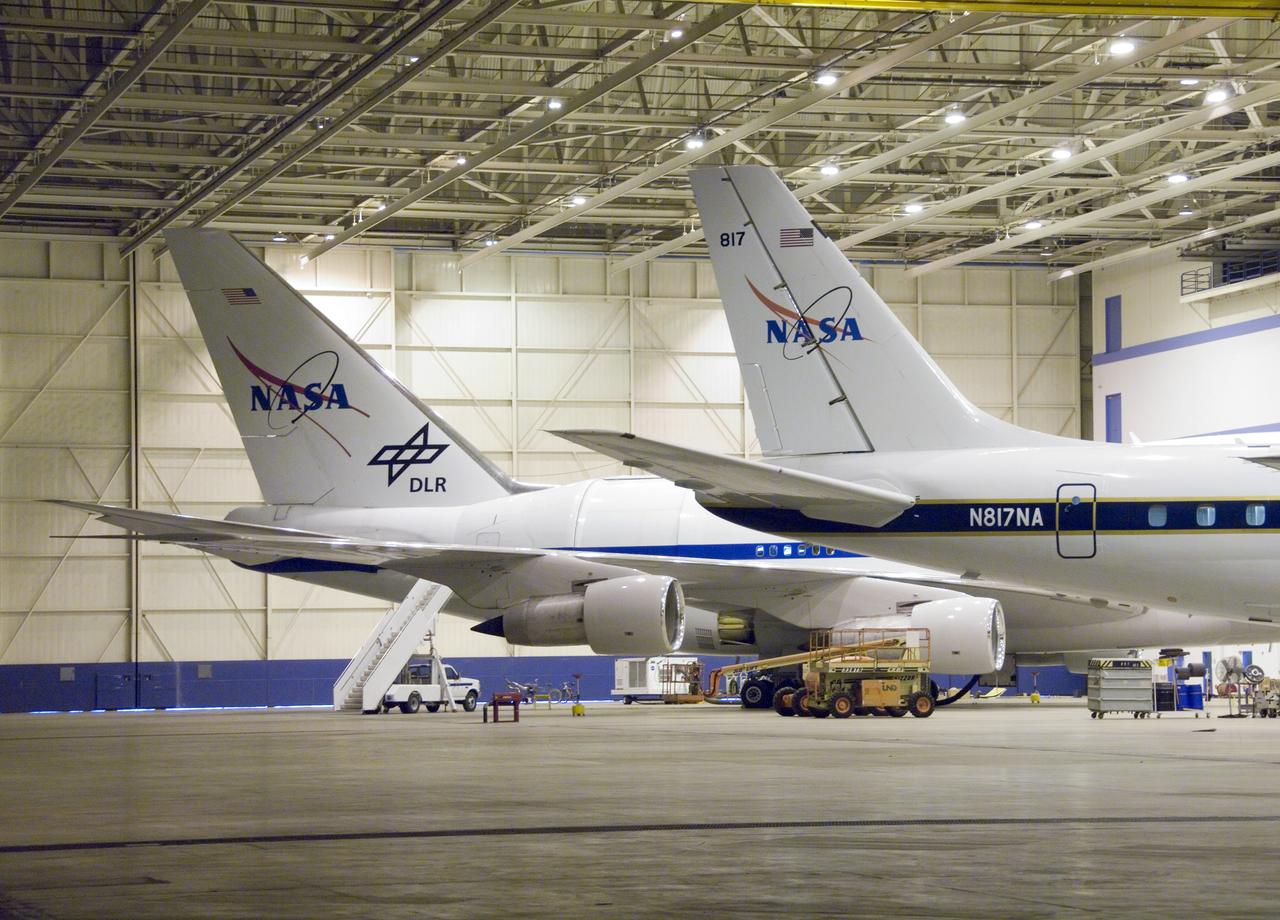
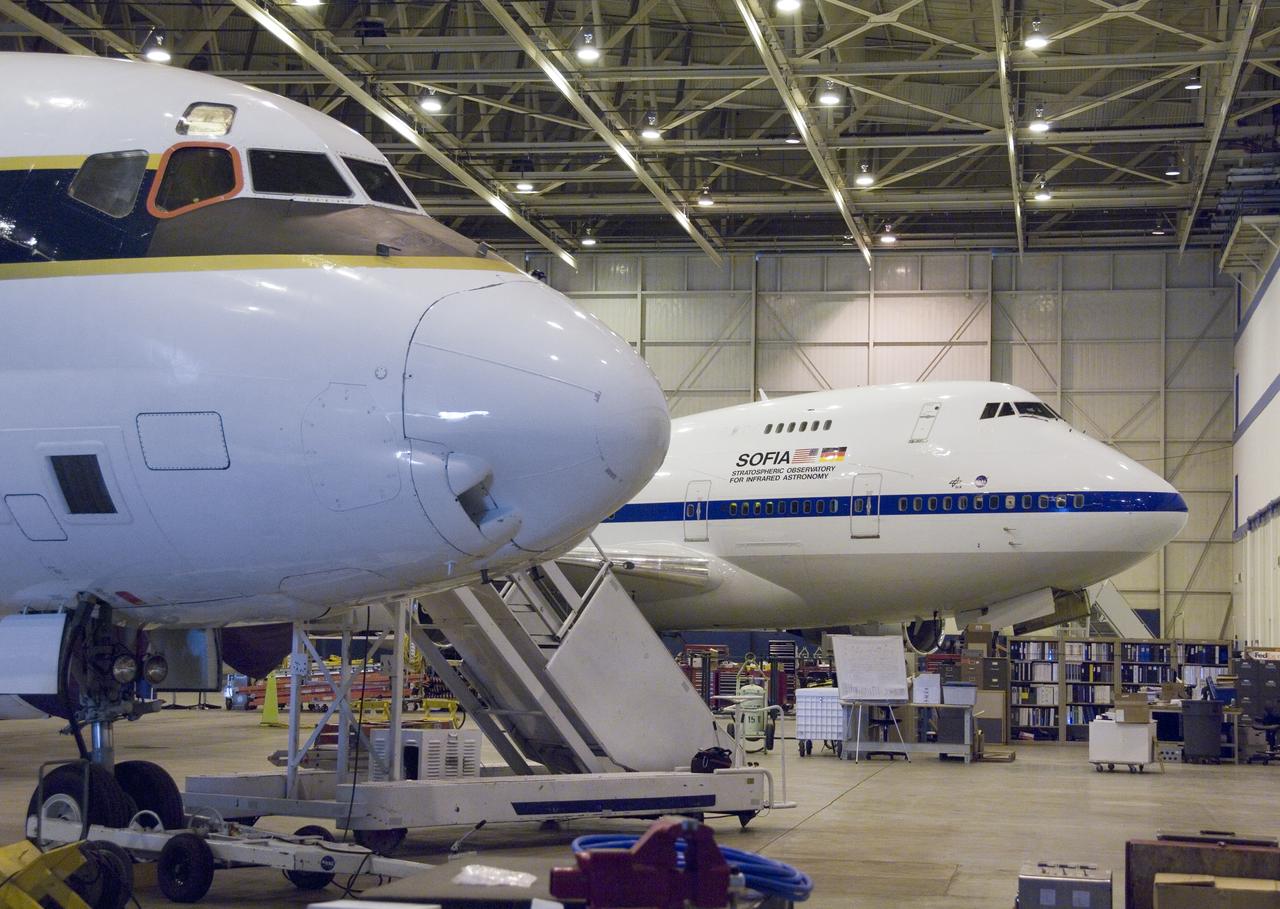
NASA'S SOFIA infrared observatory 747SP (front) and DC-8 flying laboratory (rear) are now housed at the Dryden Aircraft Operations Facility in Palmdale, Calif.
NASA's Stratospheric Observatory for Infrared Astronomy, or SOFIA, arrived at NASA's Dryden Flight Research Center at Edwards Air Force Base, Calif. on May 31, 2007. The heavily modified Boeing 747SP was ferried to Dryden from Waco, Texas, where L-3 Communications Integrated Systems installed a German-built 2.5-meter infrared telescope and made other major modifications over the past several years. SOFIA is scheduled to undergo installation and integration of mission systems and a multi-phase flight test program at Dryden over the next three years that is expected to lead to a full operational capability to conduct astronomy missions in about 2010. During its expected 20-year lifetime, SOFIA will be capable of "Great Observatory" class astronomical science, providing astronomers with access to the visible, infrared and sub-millimeter spectrum with optimized performance in the mid-infrared to sub-millimeter range.
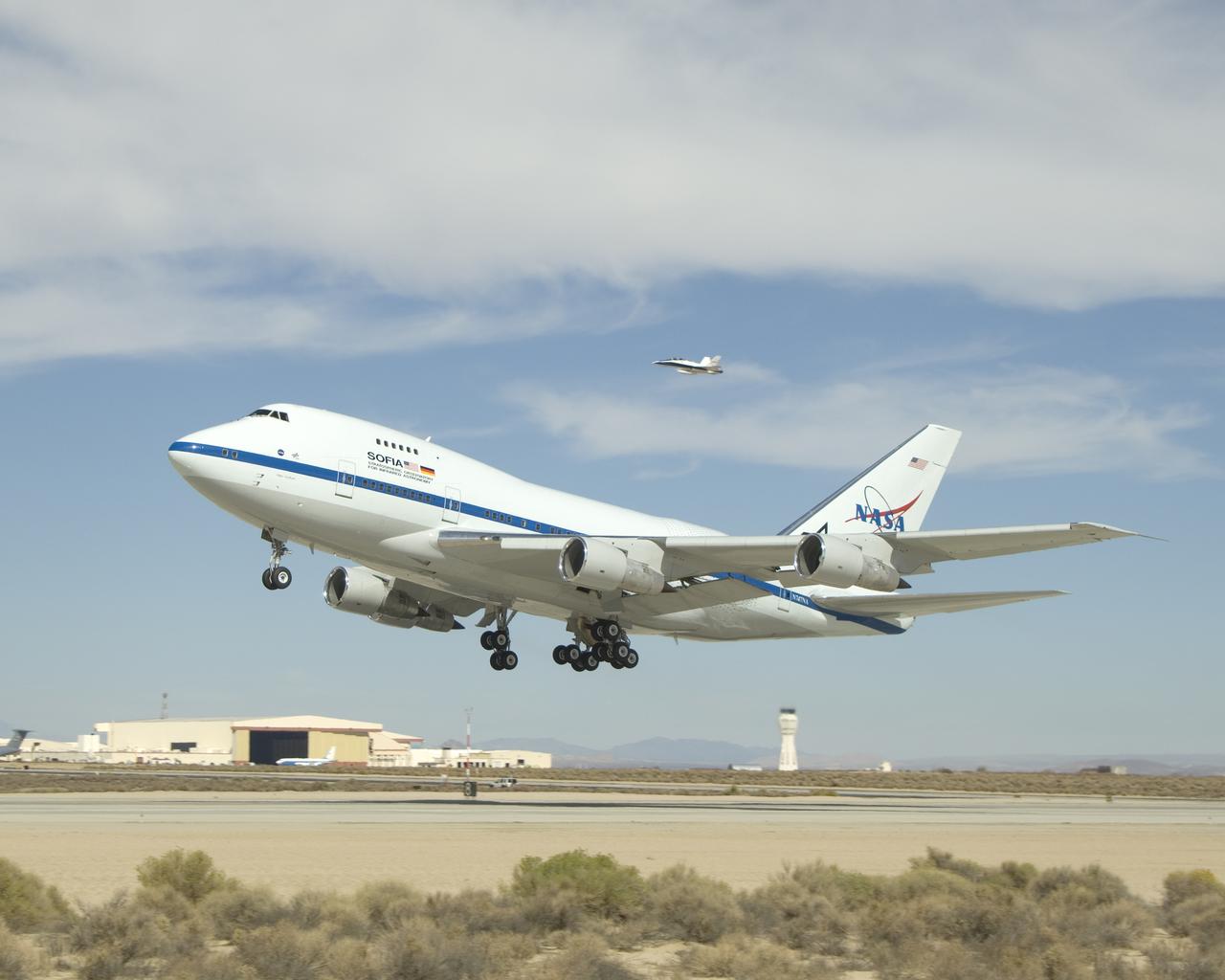
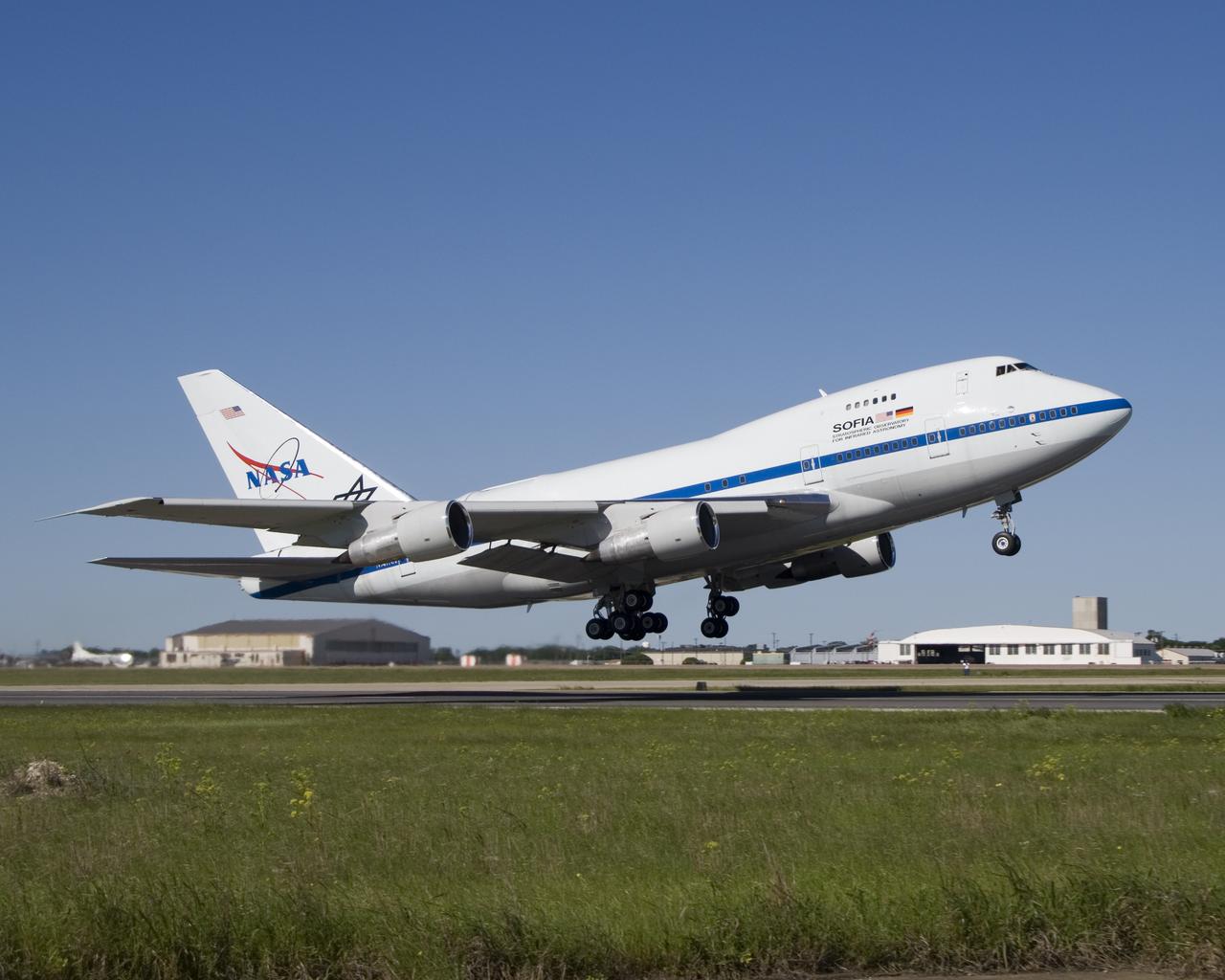
NASA's SOFIA infrared observatory in flight for the first of a series of test flights to verify the flight performance of the highly modified Boeing 747SP
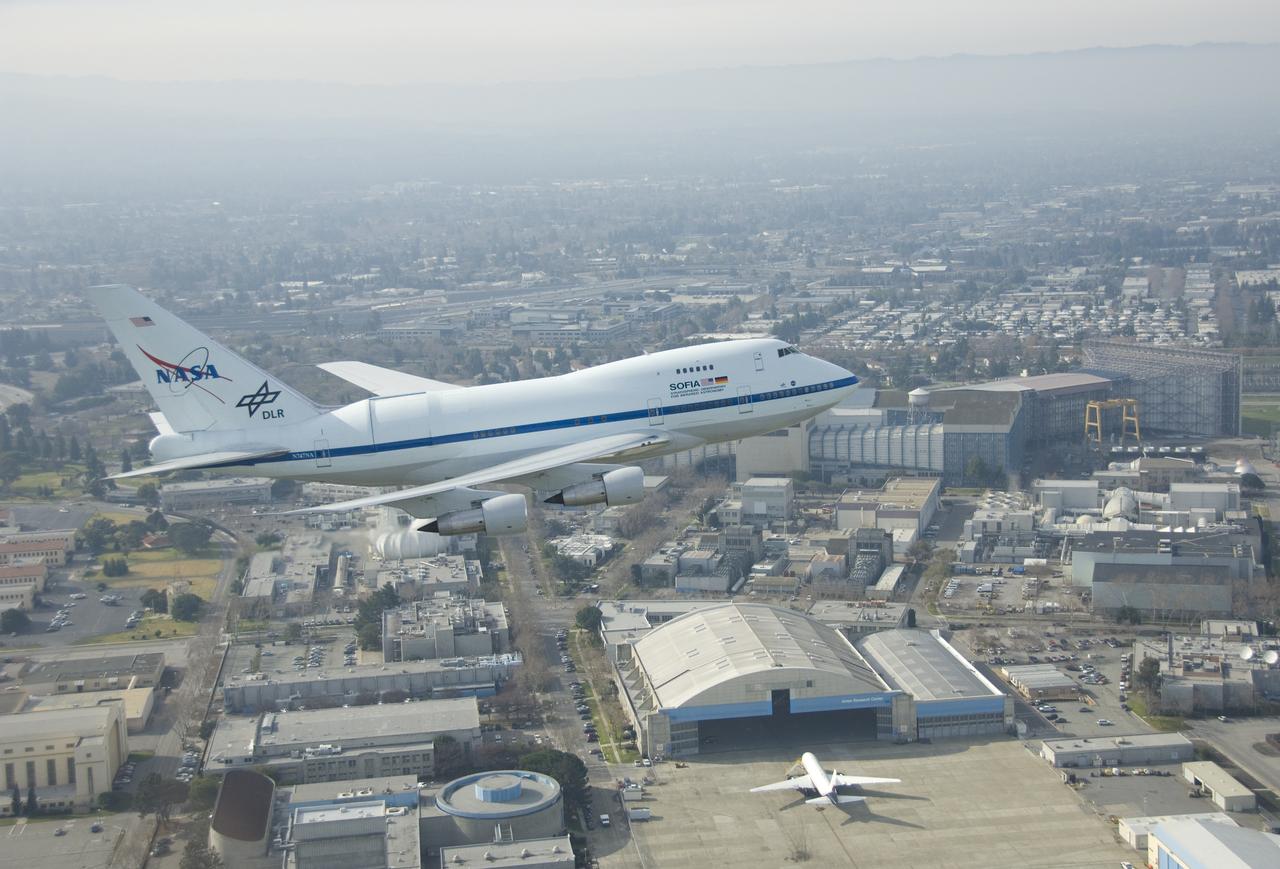
NASA's SOFIA flying observatory makes a low pass over NASA Ames Research Center prior to landing at Moffett Field for a brief visit on Jan. 14, 2008.
NASA's SOFIA flying observatory makes a low pass over NASA Ames Research Center prior to landing at Moffett Field for a brief visit on Jan. 14, 2008
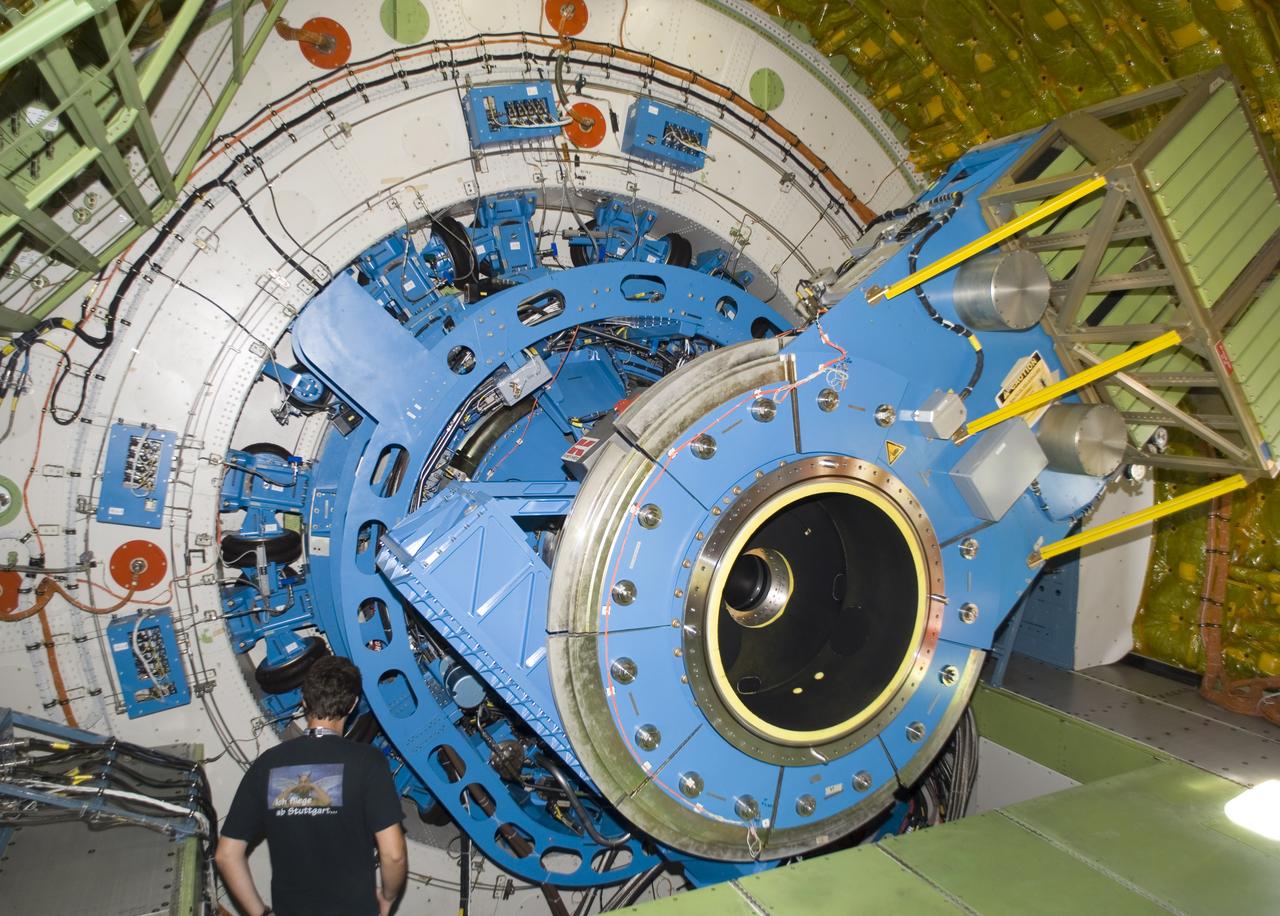
Technicians check out the mounting structure of the 20-metric-ton infrared telescope installed in NASA's Stratospheric Observatory for Infrared Astronomy (SOFIA).
Technicians check out the mounting structure of the infrared telescope installed in NASA's Stratospheric Observatory for Infrared Astronomy (SOFIA)
NASA's SOFIA airborne observatory lands at Edwards AFB after being flown from Waco, Texas to NASA Dryden for systems installation, integration and flight test. NASA's Stratospheric Observatory for Infrared Astronomy, or SOFIA, arrived at NASA's Dryden Flight Research Center at Edwards Air Force Base, Calif. on May 31, 2007. The heavily modified Boeing 747SP was ferried to Dryden from Waco, Texas, where L-3 Communications Integrated Systems installed a German-built 2.5-meter infrared telescope and made other major modifications over the past several years. SOFIA is scheduled to undergo installation and integration of mission systems and a multi-phase flight test program at Dryden over the next three years that is expected to lead to a full operational capability to conduct astronomy missions in about 2010. During its expected 20-year lifetime, SOFIA will be capable of "Great Observatory" class astronomical science, providing astronomers with access to the visible, infrared and sub-millimeter spectrum with optimized performance in the mid-infrared to sub-millimeter range.
NASA's SOFIA airborne observatory lands at Edwards AFB after being flown from Waco, Texas to NASA Dryden for systems installation, integration and flight test
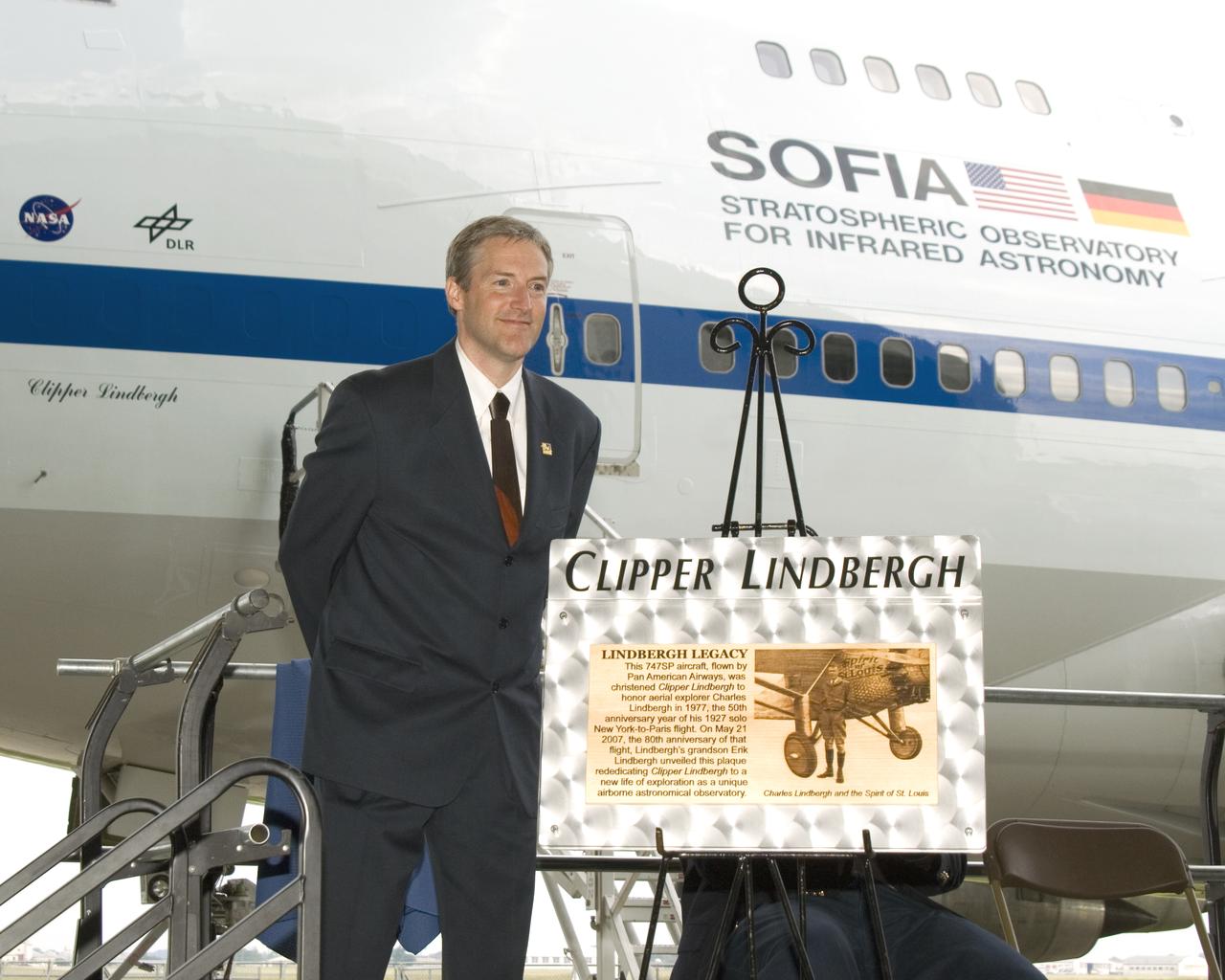
Erik Lindbergh, grandson of aviator Charles Lindbergh, unveiled a plaque commemorating his grandfather on the 80th anniversary of Charles Lindbergh's transatlantic flight. The event was a dedication of the 747 Clipper Lindbergh, a NASA airborne infrared observatory that is beginning test flights in preparation for conducting world-class airborne astronomy. The project is known as the Stratospheric Observatory for Infrared Astronomy, or SOFIA.
Erik Lindbergh unveils a plaque commemorating his grandfather to dedicate the 747 Clipper Lindbergh, a NASA airborne infrared observatory known as SOFIA
The 2.5-meter infrared telescope peers out from its cavity in the SOFIA airborne observatory during nighttime line operations testing at Palmdale, Calif.
The cavernous expanse of the Dryden Aircraft Operations Facility in Palmdale, Calif., now houses NASA's DC-8 science laboratory and SOFIA infrared observatory.
The cavernous expanse of the Dryden Aircraft Operations Facility in Palmdale, Calif., now houses NASA's DC-8 science laboratory and SOFIA infrared observatory
The SOFIA airborne observatory's 2.5-meter infrared telescope peers out from its cavity in the SOFIA rear fuselage during nighttime line operations testing.
The SOFIA airborne observatory's 2.5-meter infrared telescope peers out from its cavity in the SOFIA rear fuselage during nighttime line operations testing
Erik Lindbergh, grandson of aviator Charles Lindbergh, unveiled a plaque commemorating his grandfather on the 80th anniversary of Charles Lindbergh's transatlantic flight. The event was a dedication of the 747 Clipper Lindbergh, a NASA airborne infrared observatory that is beginning test flights in preparation for conducting world-class airborne astronomy. The project is known as the Stratospheric Observatory for Infrared Astronomy, or SOFIA.
Erik Lindbergh unveils a plaque commemorating his grandfather to dedicate the 747 Clipper Lindbergh, a NASA airborne infrared observatory known as SOFIA
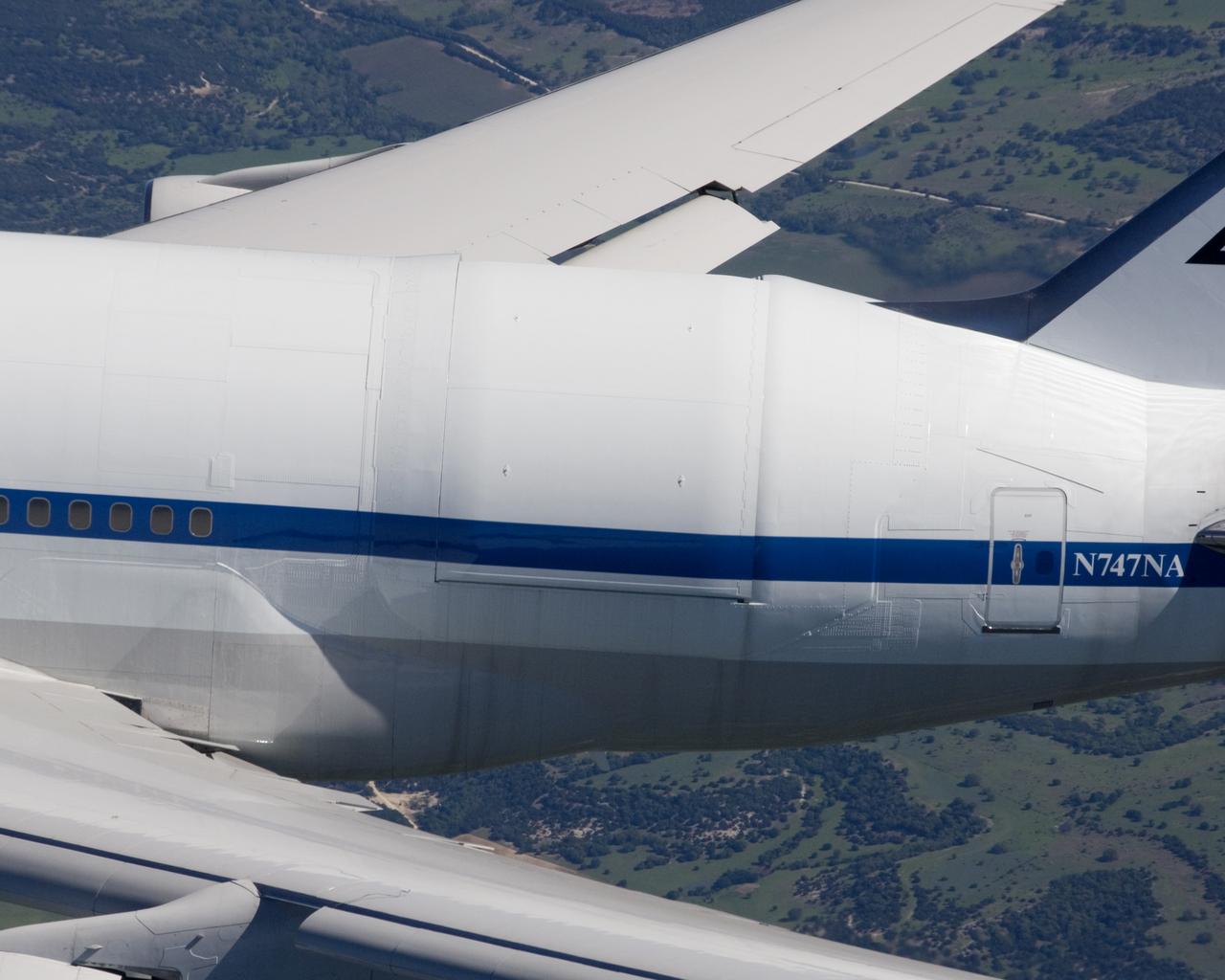
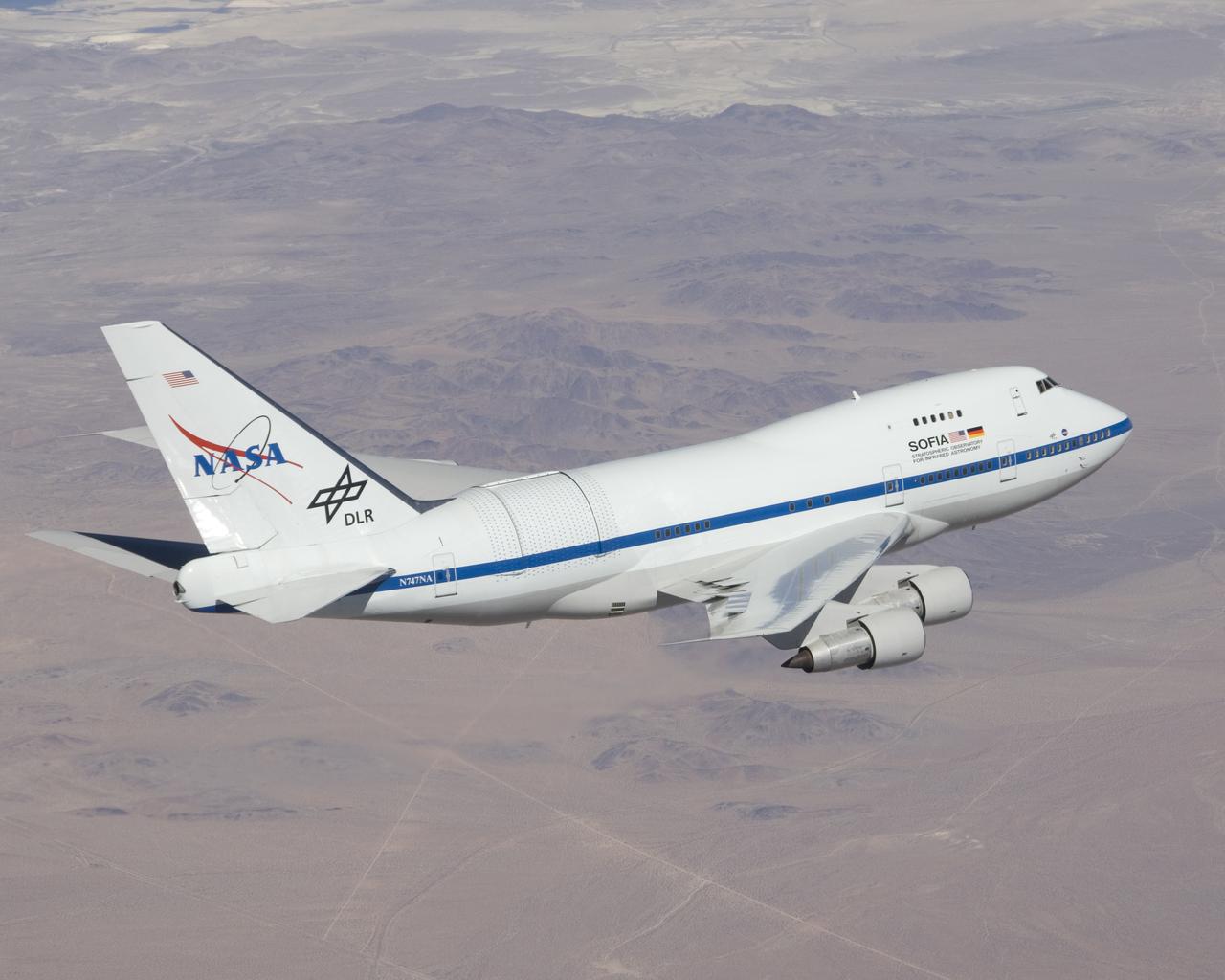
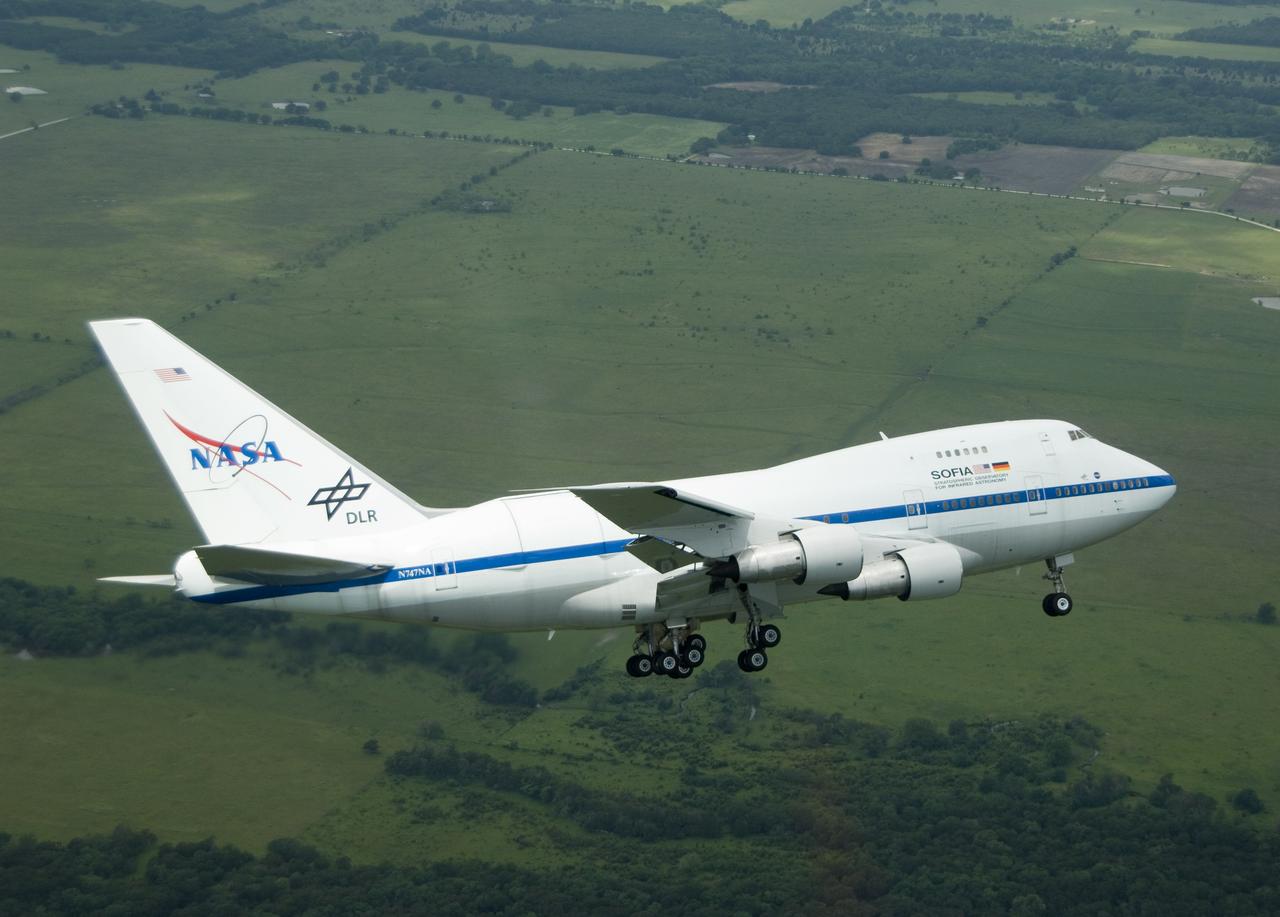
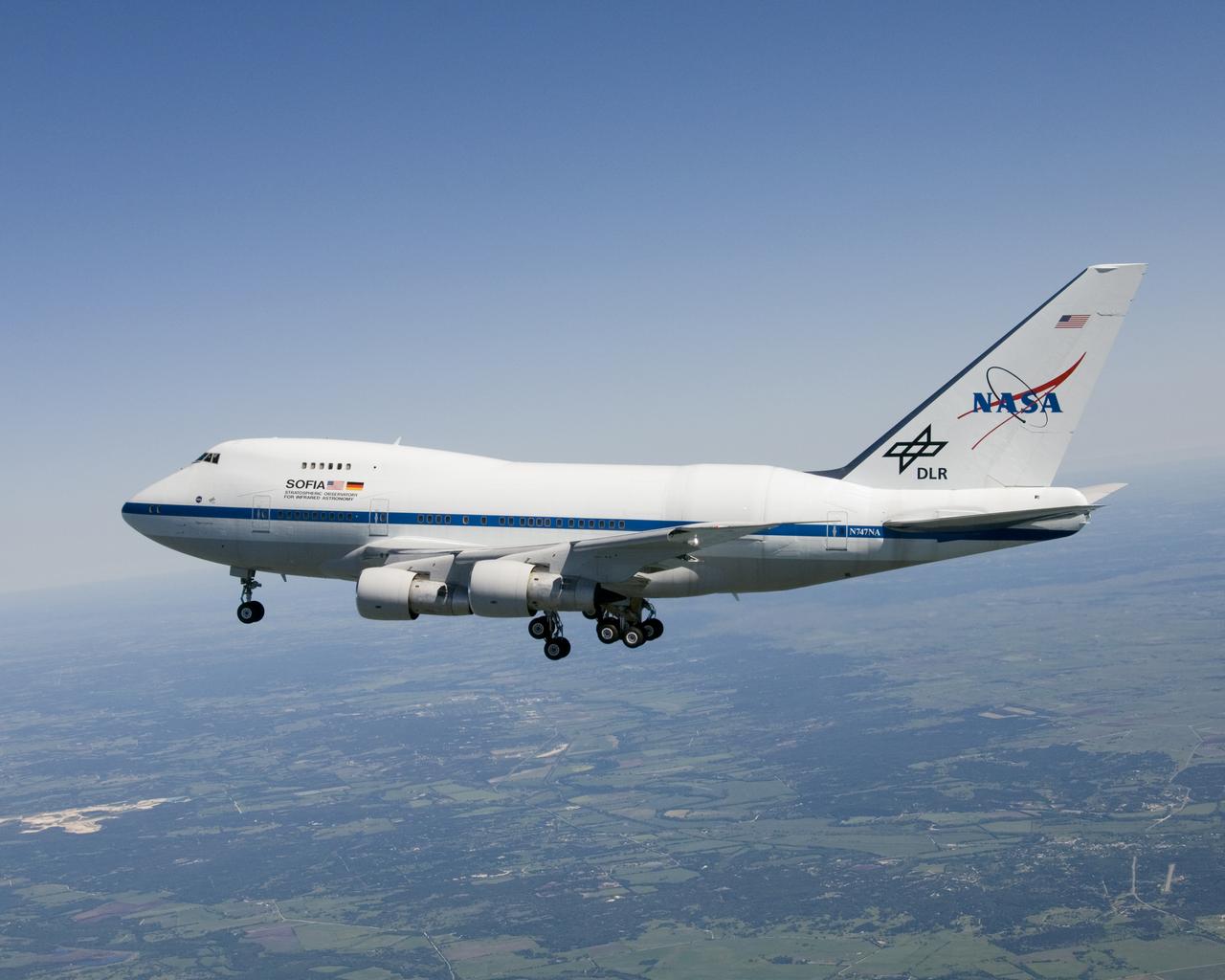
Christened "Clipper Lindbergh" when it flew for Pan American Airways in the 1970s, the SOFIA 747SP shows evidence of modification to its aft fuselage contours to accommodate a 16-foot-tall opening for a 45,000-pound infrared telescope. This inflight photo was taken on SOFIA's first flight since its modification to become an airborne observatory.
This inflight photo was taken during the first flight of the NASA and German Aerospace Center SOFIA airborne infrared observatory 747SP on April 26, 2007
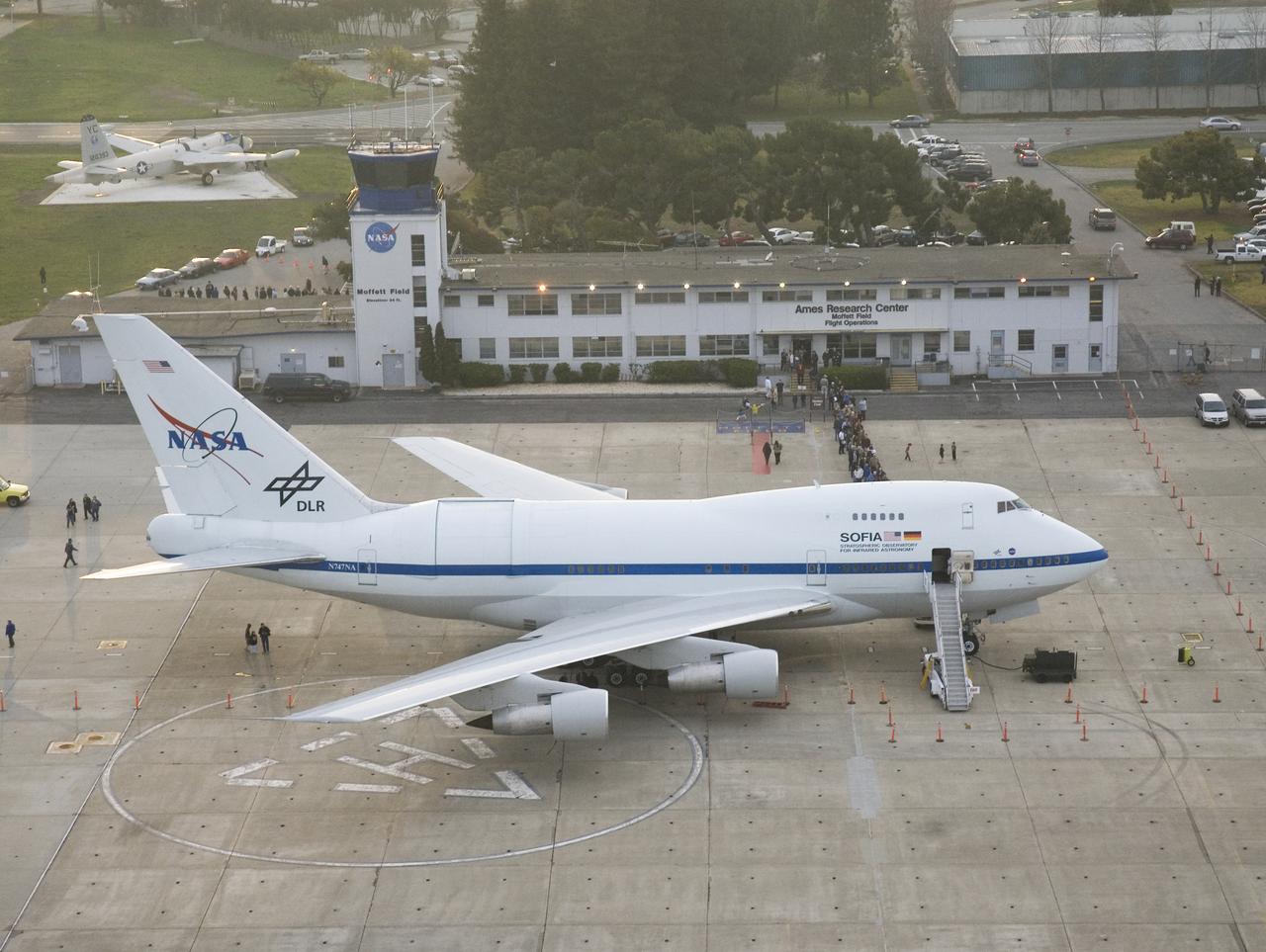
Thousands of NASA Ames employees and their families toured NASA's SOFIA flying observatory during its first visit to NASA Ames Research Center, Jan. 14, 2008.
Thousands of NASA Ames employees and their families toured NASA's SOFIA flying observatory during its first visit to NASA Ames Research Center, Jan. 14, 2008
NASA's SOFIA airborne observatory taxis past Hangar 1, the 1930s-era dirigible hangar at Moffett Field, during its first visit to NASA Ames Research Center.
NASA's SOFIA airborne observatory taxis past Hangar 1, the 1930s-era dirigible hangar at Moffett Field, during its first visit to NASA Ames Research Center
A technician examines the instrument mounting structure and bulkhead of the German-built infrared telescope installed in NASA's SOFIA airborne observatory.
A technician examines the instrument mounting structure and bulkhead of the German-built infrared telescope installed in NASA's SOFIA airborne observatory
NASA's Stratospheric Observatory for Infrared Astronomy (SOFIA) was airborne for almost two hours during its first check flight at Waco, Texas on April 26, 2007.
NASA's Stratospheric Observatory for Infrared Astronomy (SOFIA) was airborne for almost two hours during its first check flight at Waco, Texas on April 26, 2007
NASA's Stratospheric Observatory for Infrared Astronomy, or SOFIA, arrived at NASA's Dryden Flight Research Center at Edwards Air Force Base, Calif. on May 31, 2007. The heavily modified Boeing 747SP was ferried to Dryden from Waco, Texas, where L-3 Communications Integrated Systems installed a German-built 2.5-meter infrared telescope and made other major modifications over the past several years. SOFIA is scheduled to undergo installation and integration of mission systems and a multi-phase flight test program at Dryden over the next three years that is expected to lead to a full operational capability to conduct astronomy missions in about 2010. During its expected 20-year lifetime, SOFIA will be capable of "Great Observatory" class astronomical science, providing astronomers with access to the visible, infrared and sub-millimeter spectrum with optimized performance in the mid-infrared to sub-millimeter range.
NASA's SOFIA infrared observatory lifts off on the first of a series of test flights to verify the flight performance of the highly modified Boeing 747SP
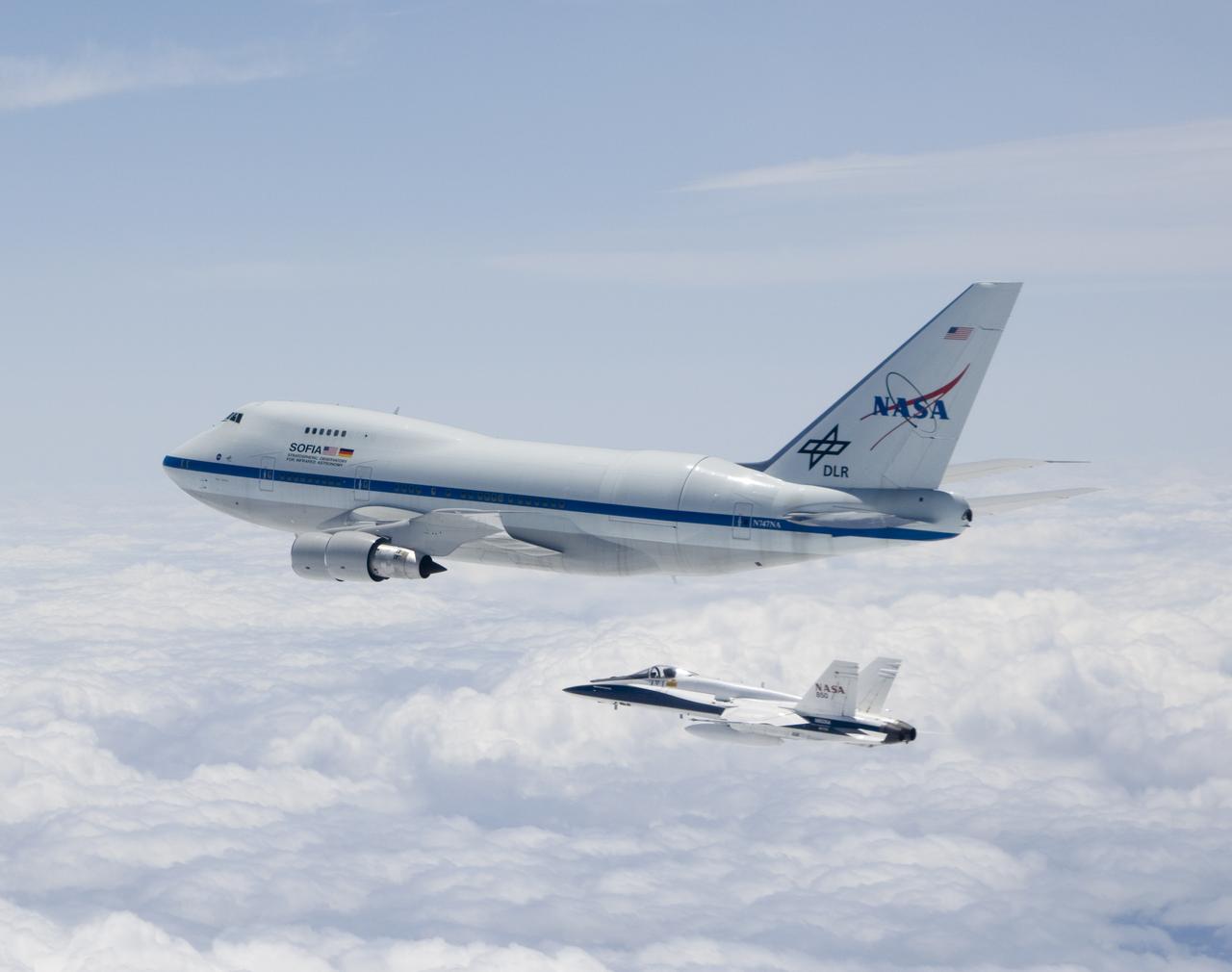
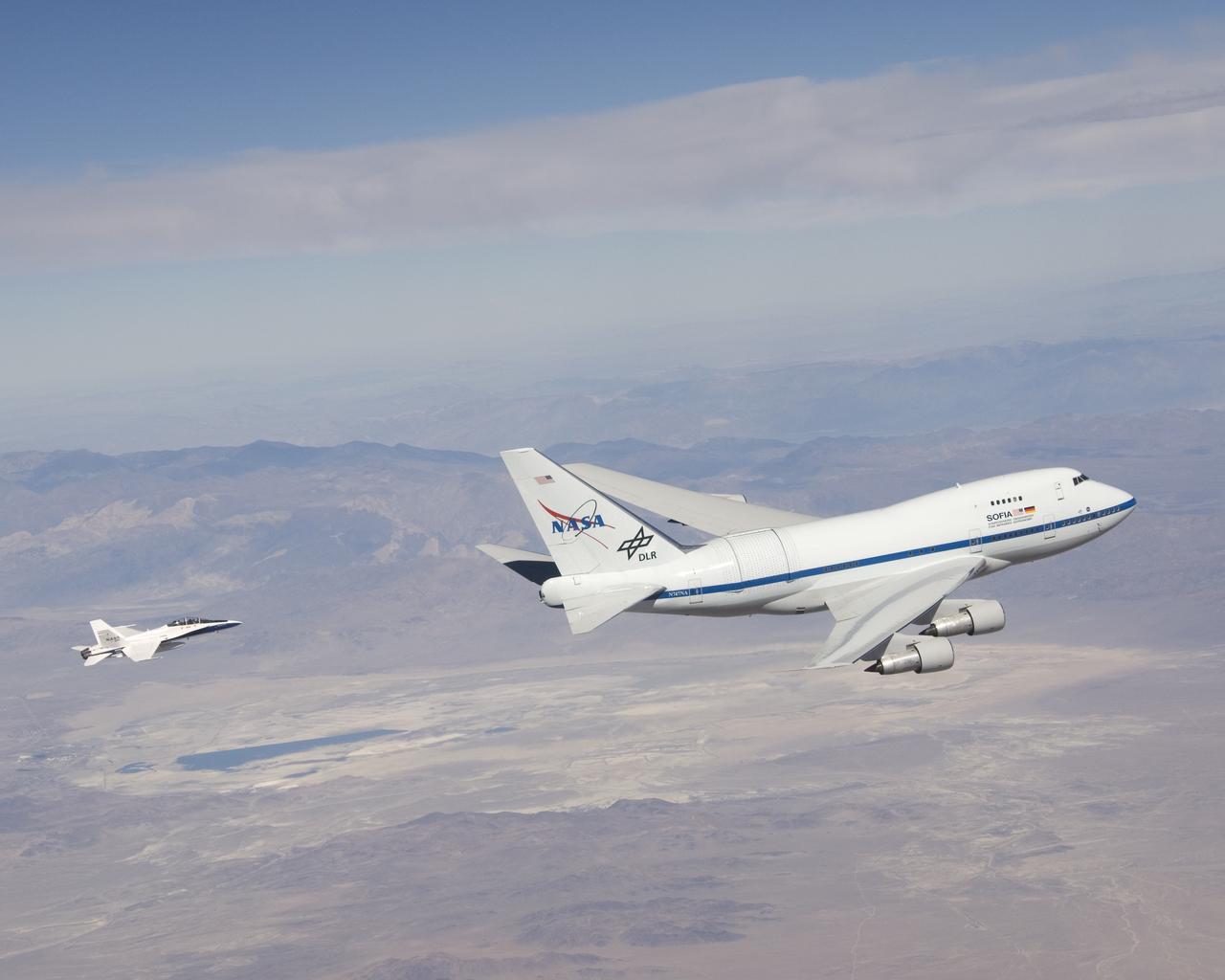
NASA's SOFIA airborne observatory is shadowed by a NASA F/A-18 safety chase aircraft during its second checkout flight near Waco, Texas on May 10, 2007.
NASA's SOFIA airborne observatory is shadowed by a NASA F/A-18 safety chase aircraft during its second checkout flight near Waco, Texas on May 10, 2007
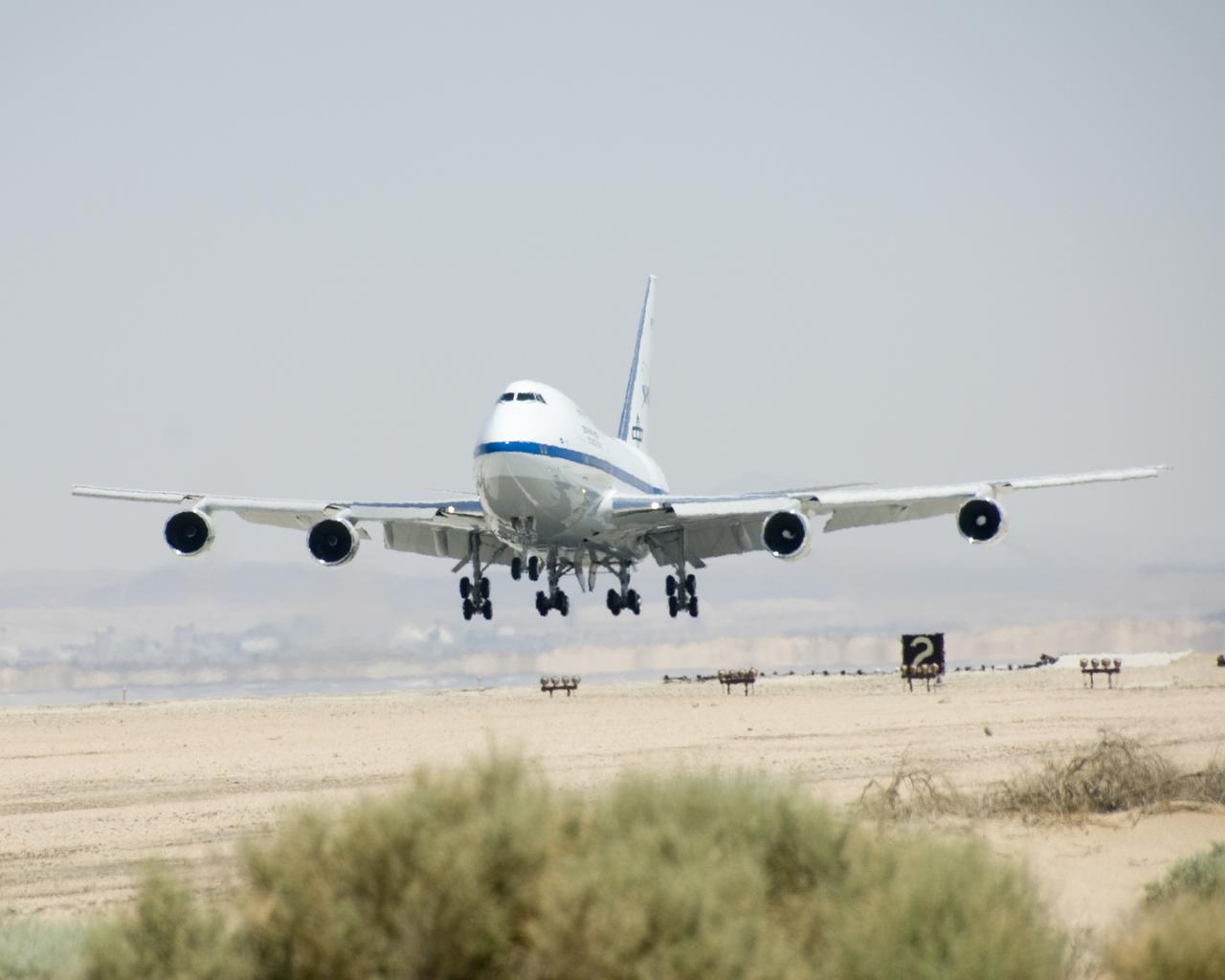
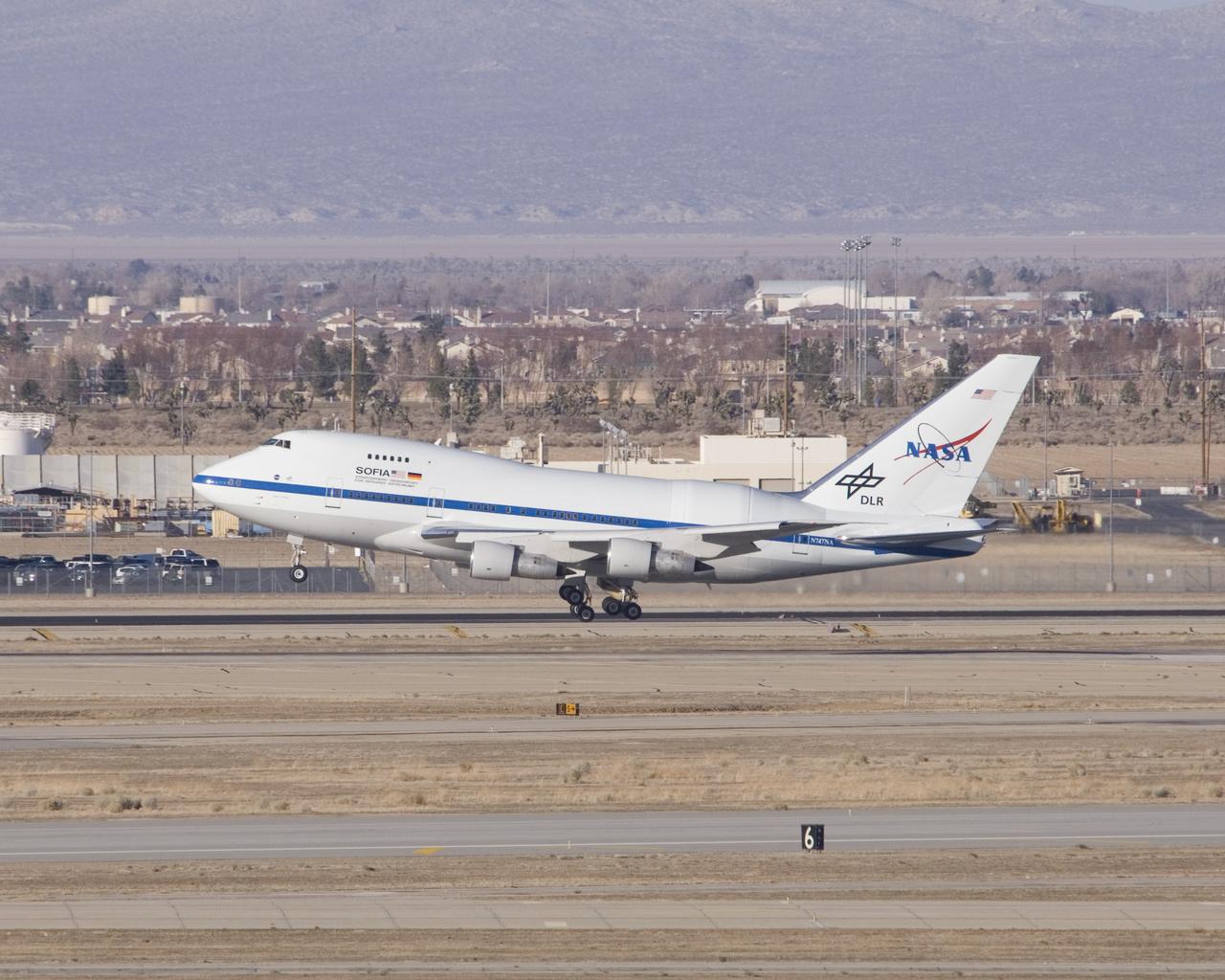
NASA's Stratospheric Observatory for Infrared Astronomy (SOFIA) Boeing 747SP flares for landing at Edwards AFB after a ferry flight from Waco, Texas. NASA's Stratospheric Observatory for Infrared Astronomy, or SOFIA, arrived at NASA's Dryden Flight Research Center at Edwards Air Force Base, Calif. on May 31, 2007. The heavily modified Boeing 747SP was ferried to Dryden from Waco, Texas, where L-3 Communications Integrated Systems installed a German-built 2.5-meter infrared telescope and made other major modifications over the past several years. SOFIA is scheduled to undergo installation and integration of mission systems and a multi-phase flight test program at Dryden over the next three years that is expected to lead to a full operational capability to conduct astronomy missions in about 2010. During its expected 20-year lifetime, SOFIA will be capable of "Great Observatory" class astronomical science, providing astronomers with access to the visible, infrared and sub-millimeter spectrum with optimized performance in the mid-infrared to sub-millimeter range.
NASA's Stratospheric Observatory for Infrared Astronomy (SOFIA) Boeing 747SP flares for landing at Edwards AFB after a ferry flight from Waco, Texas
Christened "Clipper Lindbergh" when it flew for Pan American Airways in the 1970s, the SOFIA 747SP shows evidence of modification to its aft fuselage contours to accommodate a 16-foot-tall opening for a 45,000-pound infrared telescope. This inflight photo was taken on SOFIA's first flight since its modification to become an airborne observatory.
This inflight photo was taken during the first flight of the NASA and German Aerospace Center SOFIA airborne infrared observatory 747SP on April 26, 2007
NASA's SOFIA 747SP shows evidence of modification to its aft fuselage contours to accommodate a 16-foot-tall cavity door for its 45,000-pound infrared telescope.
NASA's SOFIA 747SP shows evidence of modification to its aft fuselage contours to accommodate a 16-foot-tall cavity door for its 45,000-pound infrared telescope
The Dryden Aircraft Operations Facility in Palmdale, Calif., is now home to two large science aircraft, NASA's SOFIA observatory and a DC-8 science laboratory.
The Dryden Aircraft Operations Facility in Palmdale, Calif., is now home to two large science aircraft, NASA's SOFIA observatory and a DC-8 science laboratory
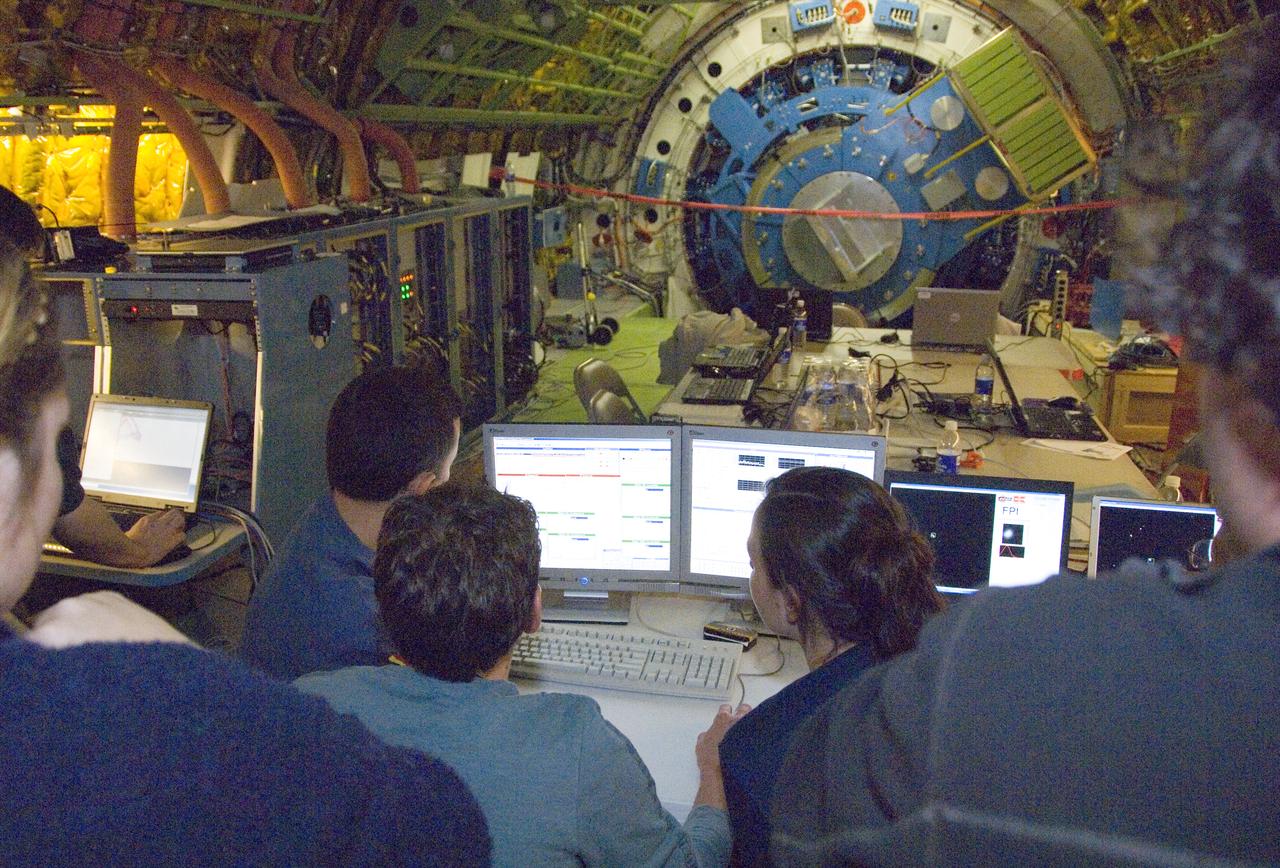
Scientists carefully examine data being received during nighttime line operations testing of the SOFIA airborne observatory's 2.5-meter infrared telescope.
Scientists carefully examine data being received during nighttime line operations testing of the SOFIA airborne observatory's 2.5-meter infrared telescope
NASA's Stratospheric Observatory for Infrared Astronomy is silhouetted against the sky as it soars on its second check flight near Waco, Texas on May 10, 2007.
NASA's Stratospheric Observatory for Infrared Astronomy is silhouetted against the sky as it soars on its second check flight near Waco, Texas on May 10, 2007
With landing gear extended, the NASA/DLR Stratospheric Observatory for Infared Astronomy (SOFIA) 747SP cruises over central Texas on its first checkout flight.
With landing gear extended, the NASA/DLR Stratospheric Observatory for Infared Astronomy (SOFIA) 747SP cruises over central Texas on its first checkout flight
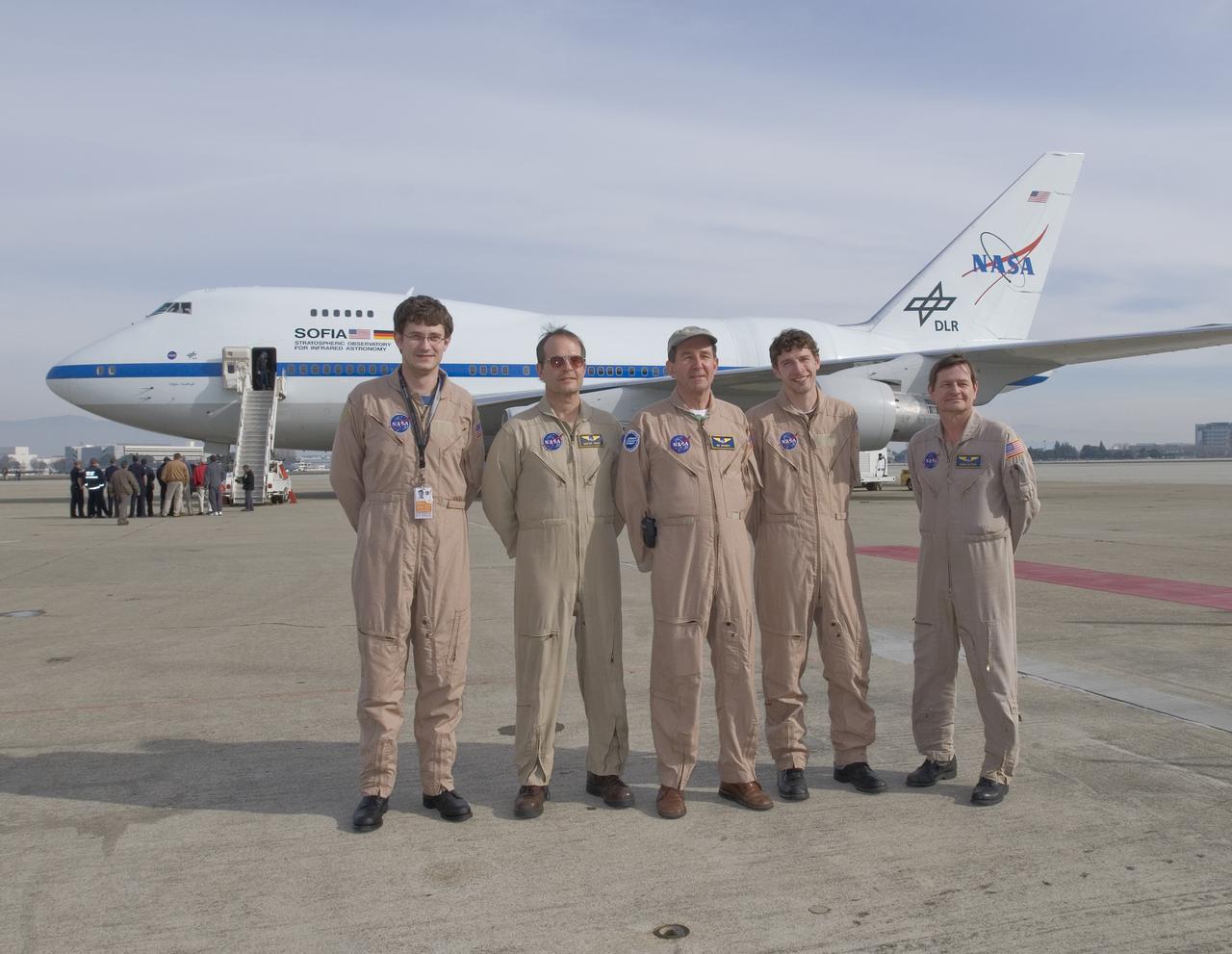
The flight crew of NASA's SOFIA airborne observatory and DLR telescope engineers who operated the system during its visit to NASA Ames Research Center on Jan. 14, 2008 included (from left), DLR telescope engineer Ulli Lampater, flight engineer Marty Trout, pilot Bill Brockett, telescope engineer Andres Reinacher and pilot Frank Batteas.
The flight crew of NASA's SOFIA airborne observatory includes (from left), Ulli Lampater Marty Trout, Bill Brockett Andres Reinacher and Frank Batteas.
NASA's SOFIA 747SP bearing a German-built 2.5-meter infrared telescope in its rear fuselage taxis up to NASA Dryden's ramp after a ferry flight from Waco, Texas. NASA's Stratospheric Observatory for Infrared Astronomy, or SOFIA, arrived at NASA's Dryden Flight Research Center at Edwards Air Force Base, Calif. on May 31, 2007. The heavily modified Boeing 747SP was ferried to Dryden from Waco, Texas, where L-3 Communications Integrated Systems installed a German-built 2.5-meter infrared telescope and made other major modifications over the past several years. SOFIA is scheduled to undergo installation and integration of mission systems and a multi-phase flight test program at Dryden over the next three years that is expected to lead to a full operational capability to conduct astronomy missions in about 2010. During its expected 20-year lifetime, SOFIA will be capable of "Great Observatory" class astronomical science, providing astronomers with access to the visible, infrared and sub-millimeter spectrum with optimized performance in the mid-infrared to sub-millimeter range.
NASA's SOFIA 747SP bearing a German-built 2.5-meter infrared telescope in its rear fuselage taxis up to NASA Dryden's ramp after a ferry flight from Waco, TX
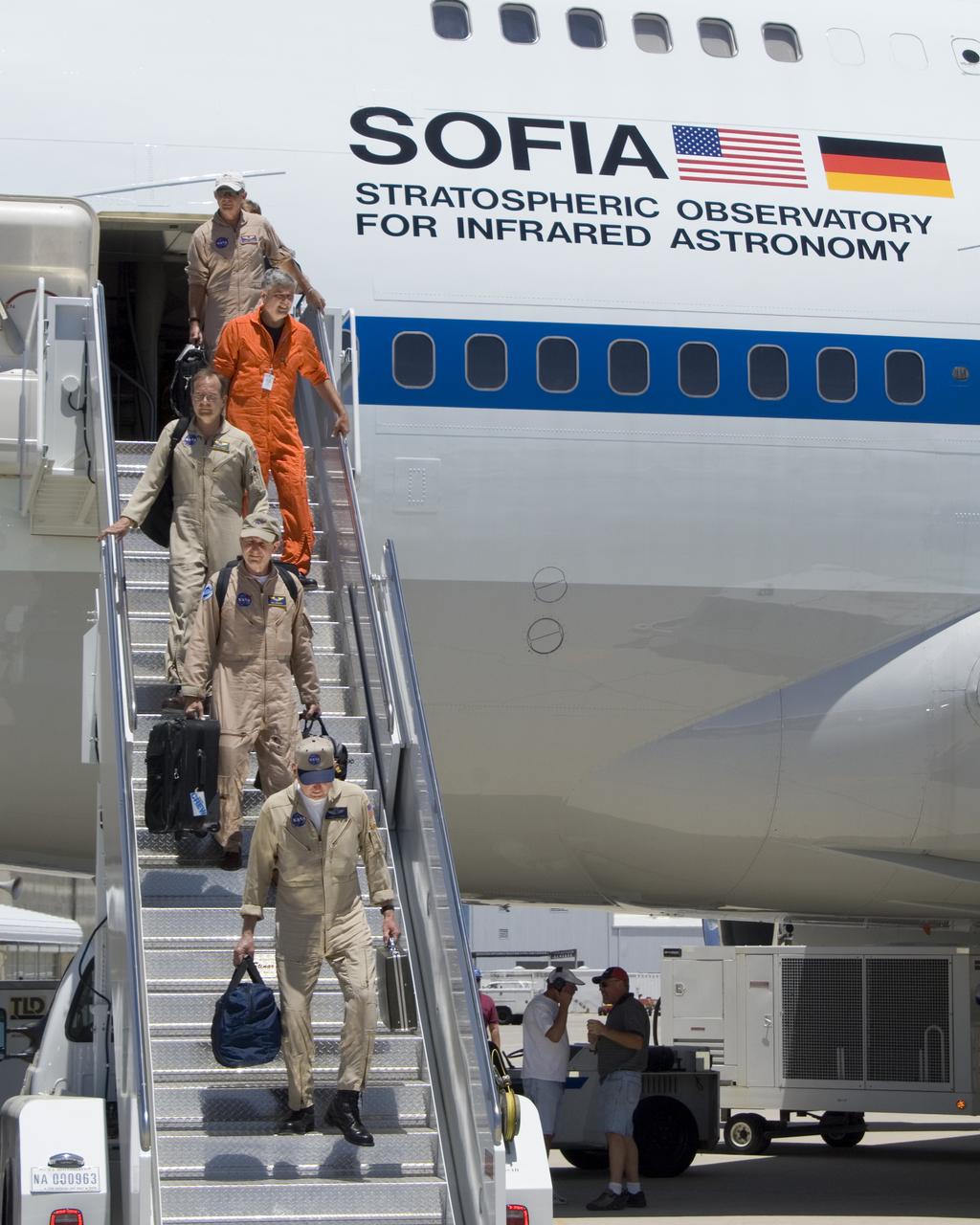
The SOFIA flight crew, consisting of Co-pilot Gordon Fullerton; DFRC, Pilot Bill Brocket; DFRC, Test Conductor Marty Trout; DFRC, Test Engineer Don Stonebrook; L-3, and Flight Engineer Larry Larose; JSC, descend the stairs after ferrying the 747SP airborne observatory from Waco, Texas, to its new home at NASA's Dryden Flight Research Center in California. NASA's Stratospheric Observatory for Infrared Astronomy, or SOFIA, arrived at NASA's Dryden Flight Research Center at Edwards Air Force Base, Calif. on May 31, 2007. The heavily modified Boeing 747SP was ferried to Dryden from Waco, Texas, where L-3 Communications Integrated Systems installed a German-built 2.5-meter infrared telescope and made other major modifications over the past several years. SOFIA is scheduled to undergo installation and integration of mission systems and a multi-phase flight test program at Dryden over the next three years that is expected to lead to a full operational capability to conduct astronomy missions in about 2010. During its expected 20-year lifetime, SOFIA will be capable of "Great Observatory" class astronomical science, providing astronomers with access to the visible, infrared and sub-millimeter spectrum with optimized performance in the mid-infrared to sub-millimeter range.
The SOFIA flight crew descends the stairs after ferrying the 747SP airborne observatory from Waco, TX, to NASA's Dryden Flight Research Center in California
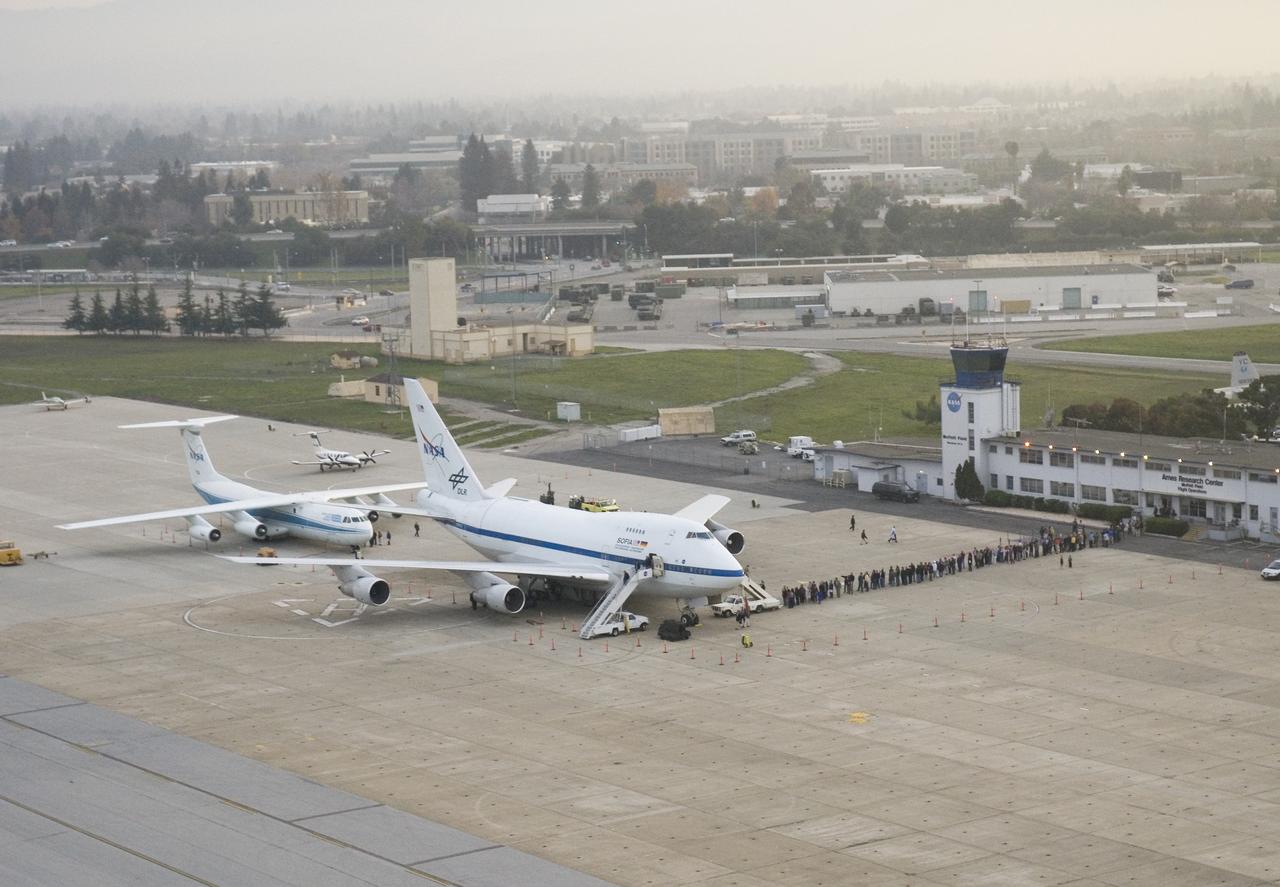
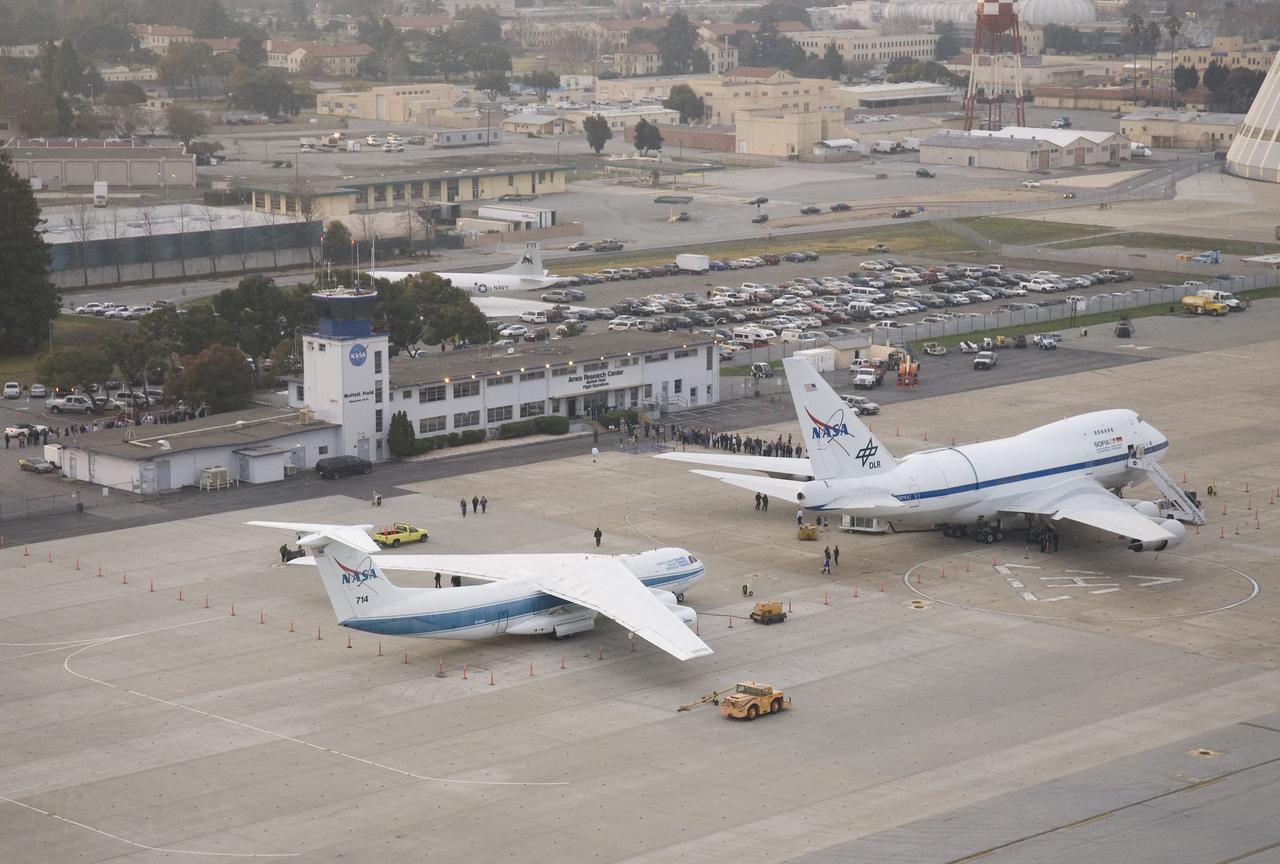
NASA's new SOFIA observatory shared the ramp with its predecessor, the now-retired Kuiper Airborne Observatory, during open house at NASA Ames Research Center.
NASA's new SOFIA observatory shared the ramp with its predecessor, the now-retired Kuiper Airborne Observatory, during open house at NASA Ames Research Center
NASA's Stratospheric Observatory for Infrared Astronomy, or SOFIA, arrived at NASA's Dryden Flight Research Center at Edwards Air Force Base, Calif. on May 31, 2007. The heavily modified Boeing 747SP was ferried to Dryden from Waco, Texas, where L-3 Communications Integrated Systems installed a German-built 2.5-meter infrared telescope and made other major modifications over the past several years. SOFIA is scheduled to undergo installation and integration of mission systems and a multi-phase flight test program at Dryden over the next three years that is expected to lead to a full operational capability to conduct astronomy missions in about 2010. During its expected 20-year lifetime, SOFIA will be capable of "Great Observatory" class astronomical science, providing astronomers with access to the visible, infrared and sub-millimeter spectrum with optimized performance in the mid-infrared to sub-millimeter range.
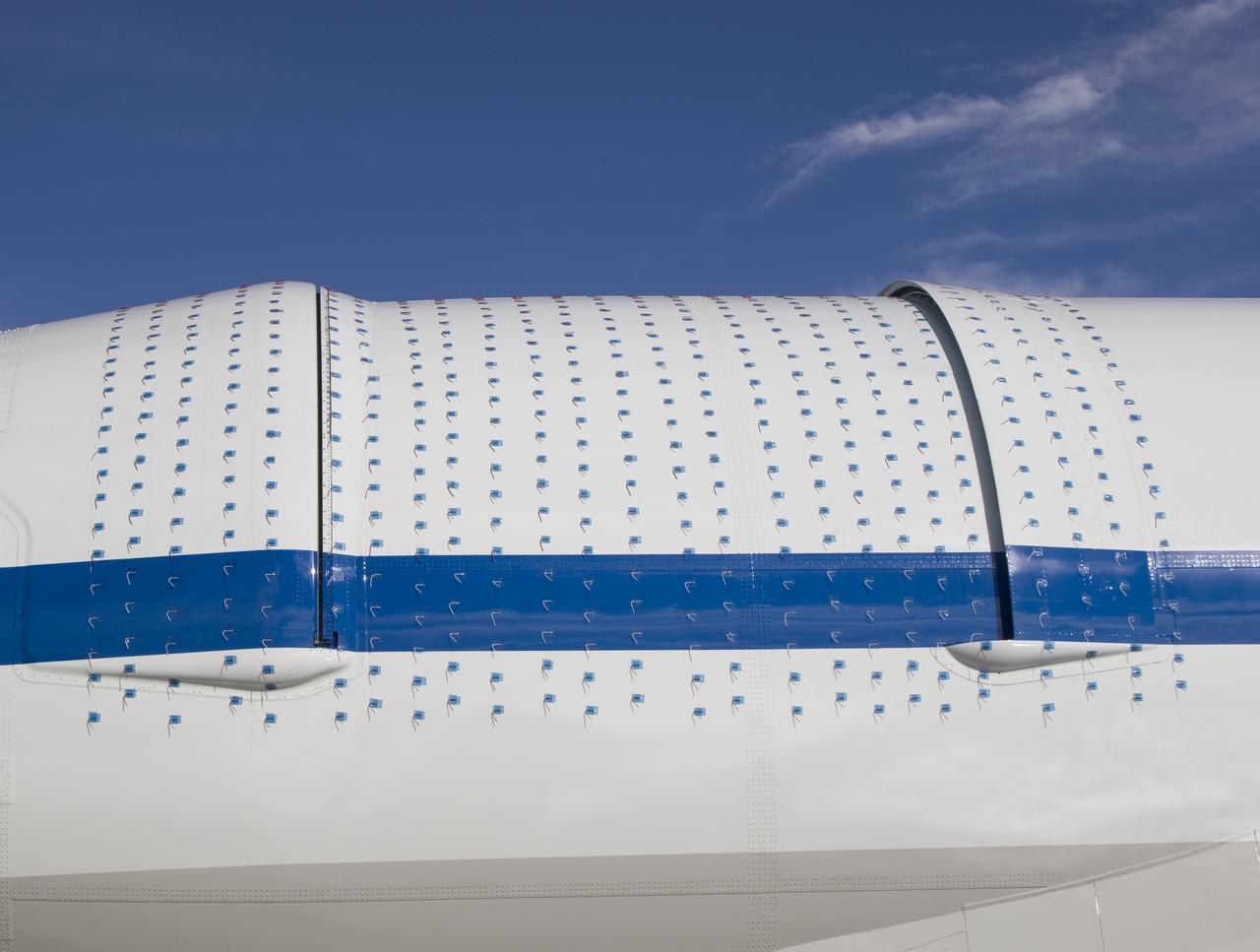
Tiny two-inch string tufts blanket the telescope cavity door and related fairings to aid visual monitoring of airflow patterns during SOFIA 747SP flight tests
NASA's now-retired Kuiper Airborne Observatory shared the limelight with its successor, the SOFIA observatory, during an open house at Ames Research Center.
NASA's now-retired Kuiper Airborne Observatory shared the limelight with its successor, the SOFIA observatory, during an open house at Ames Research Center
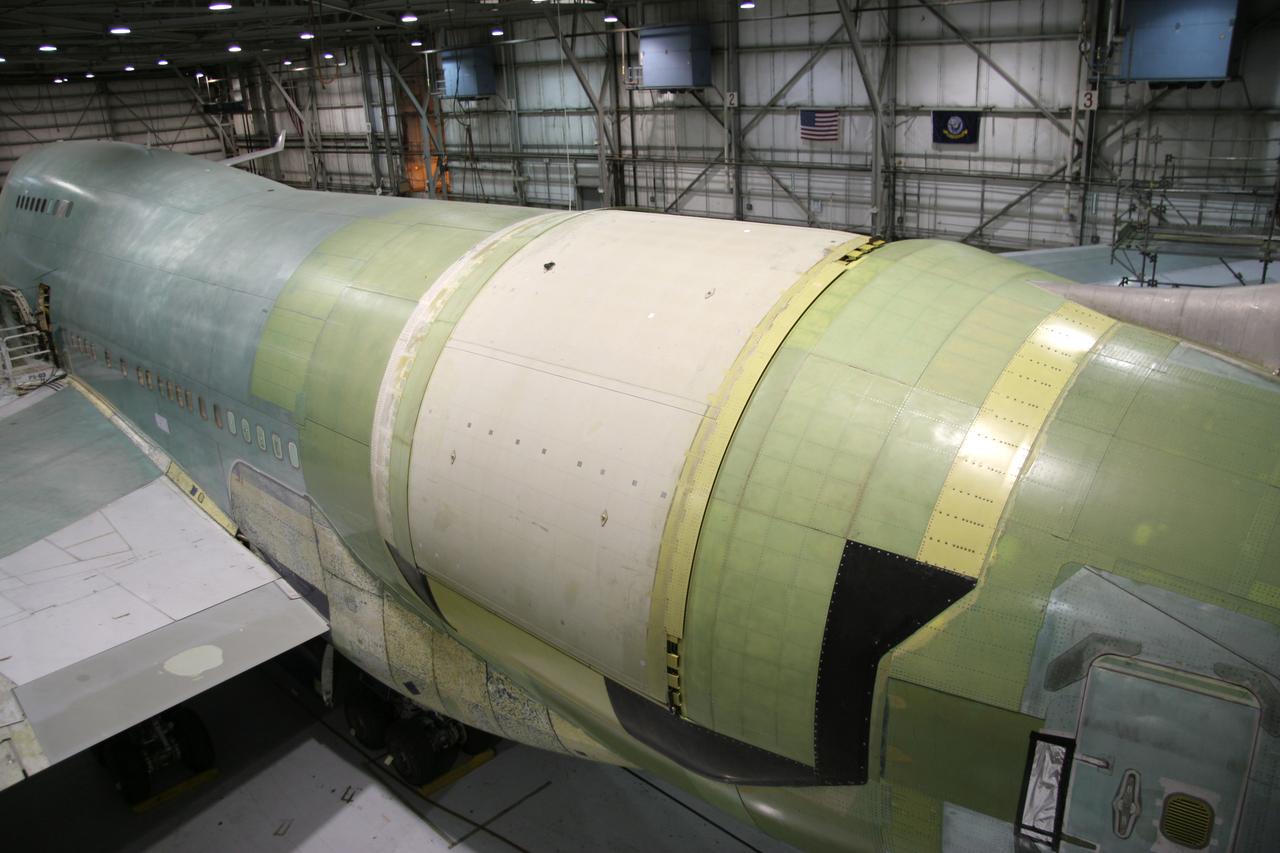
A rotating external door (white) was installed over the telescope cavity in the rear fuselage of NASA's SOFIA Boeing 747SP during modifications in Waco, Texas.
A rotating external door (white) was installed over the telescope cavity in the rear fuselage of NASA's SOFIA Boeing 747SP during modifications in Waco, Texas
NASA's Stratospheric Observatory for Infrared Astronomy touches down at Moffett Field, Calif., for its first visit to NASA Ames Research Center, Jan. 14, 2008.
NASA's Stratospheric Observatory for Infrared Astronomy touches down at Moffett Field, Calif., for its first visit to NASA Ames Research Center, Jan. 14, 2008
The NASA and German Aerospace Center SOFIA airborne infrared observatory took flight for the first time April 26, 2007, from its modification center in Waco, Texas.
The NASA and German Aerospace Center SOFIA airborne infrared observatory took flight for the first time April 26, 2007, from its modification center in Waco, TX
NASA's SOFIA infrared observatory 747SP is shadowed by a NASA F/A-18 during a flyby at its new home, the Dryden Aircraft Operations Facility in Palmdale, Calif.
NASA's SOFIA infrared observatory 747SP is shadowed by a NASA F-18 during a flyby at its new home, the Dryden Aircraft Operations Facility in Palmdale, Calif
NASA's modified Boeing 747SP SOFIA airborne observatory taxis along the runway at Waco, Texas after completing its first checkout flight on April 26, 2007.
NASA's modified Boeing 747SP SOFIA airborne observatory taxis along the runway at Waco, Texas after completing its first checkout flight on April 26, 2007
NASA's Stratospheric Observatory for Infrared Astronomy, or SOFIA, arrived at NASA's Dryden Flight Research Center at Edwards Air Force Base, Calif. on May 31, 2007. The heavily modified Boeing 747SP was ferried to Dryden from Waco, Texas, where L-3 Communications Integrated Systems installed a German-built 2.5-meter infrared telescope and made other major modifications over the past several years. SOFIA is scheduled to undergo installation and integration of mission systems and a multi-phase flight test program at Dryden over the next three years that is expected to lead to a full operational capability to conduct astronomy missions in about 2010. During its expected 20-year lifetime, SOFIA will be capable of "Great Observatory" class astronomical science, providing astronomers with access to the visible, infrared and sub-millimeter spectrum with optimized performance in the mid-infrared to sub-millimeter range.
NASA's SOFIA infrared observatory and F/A-18 safety chase during the first series of test flights to verify the flight performance of the modified Boeing 747SP
NASA's SOFIA infrared observatory touches down at Air Force Plant 42 in Palmdale, Calif., as it arrives at its new home, the Dryden Aircraft Operations Facility.
NASA's SOFIA infrared observatory touches down at Air Force Plant 42 in Palmdale, CA, as it arrives at its new home, the Dryden Aircraft Operations Facility
Researchers using NASA Stratospheric Observatory for Infrared Astronomy SOFIA have captured infrared images of the last exhalations of a dying sun-like star. This image is of the planetary Nebula M2-9.
NASA SOFIA Captures Images of the Planetary Nebula M2-9
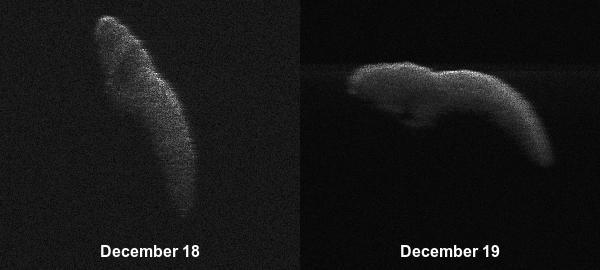
These two radar images of near-Earth asteroid 2003 SD220 were obtained on Dec. 18 and 19 by coordinating observations with the Arecibo Observatory's 1,000-foot (305-meter) antenna in Puerto Rico and the National Science Foundation's (NSF) 330-foot (100-meter) Green Bank Telescope in West Virginia. The radar images reveal the asteroid is at least one mile (1.6 kilometers) long.  https://photojournal.jpl.nasa.gov/catalog/PIA22969
Asteroid 2003 SD220
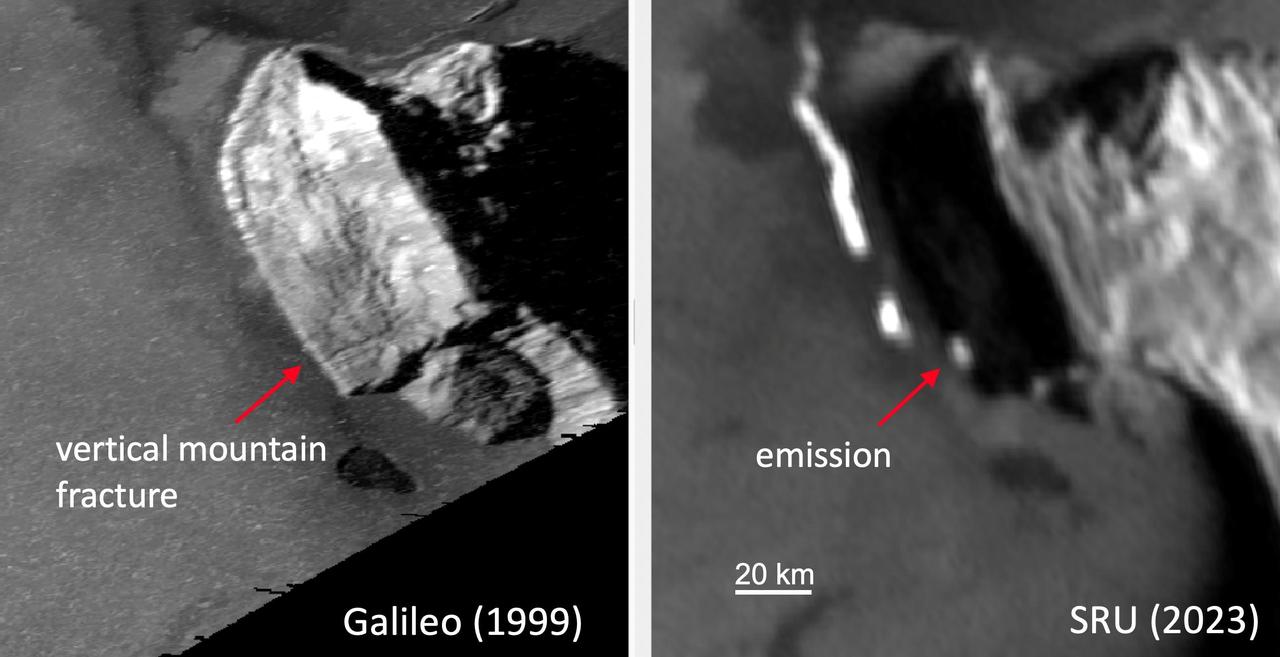
While imaging Io's night side under illumination from Jupiter-shine on Dec. 30, 2023, the Stellar Reference Unit (SRU) on NASA's Juno spacecraft observed an unprecedented glow from active lava at the base of a mountain on Io (red arrow, right panel). The thermal emission signature was located at the base of the western flank of South Zal Mons. Sunlit imagery of the region by captured by NASA's Galileo mission circa 1999 (at left) shows a vertical mountain fracture running from the top of the mountain to the location of the SRU-observed "glow" (red arrow, left panel). One hypothesis is that an extension of the mountain fracture created a fissure vent that allows lava to escape to the surface at this location.  https://photojournal.jpl.nasa.gov/catalog/PIA26522
NASA's Juno Sees Glowing Lava on Io
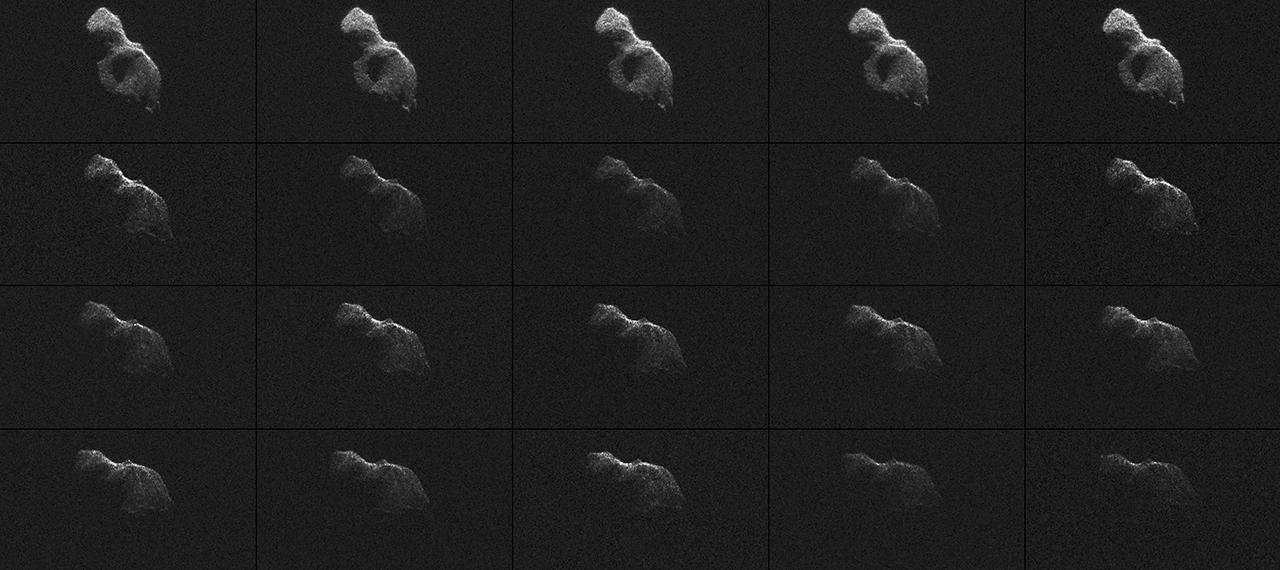
NASA scientists used Earth-based radar to produce these sharp views -- an image montage and a movie sequence -- of the asteroid designated 2014 HQ124 on June 8, 2014.
Radar Images of Asteroid 2014 HQ124
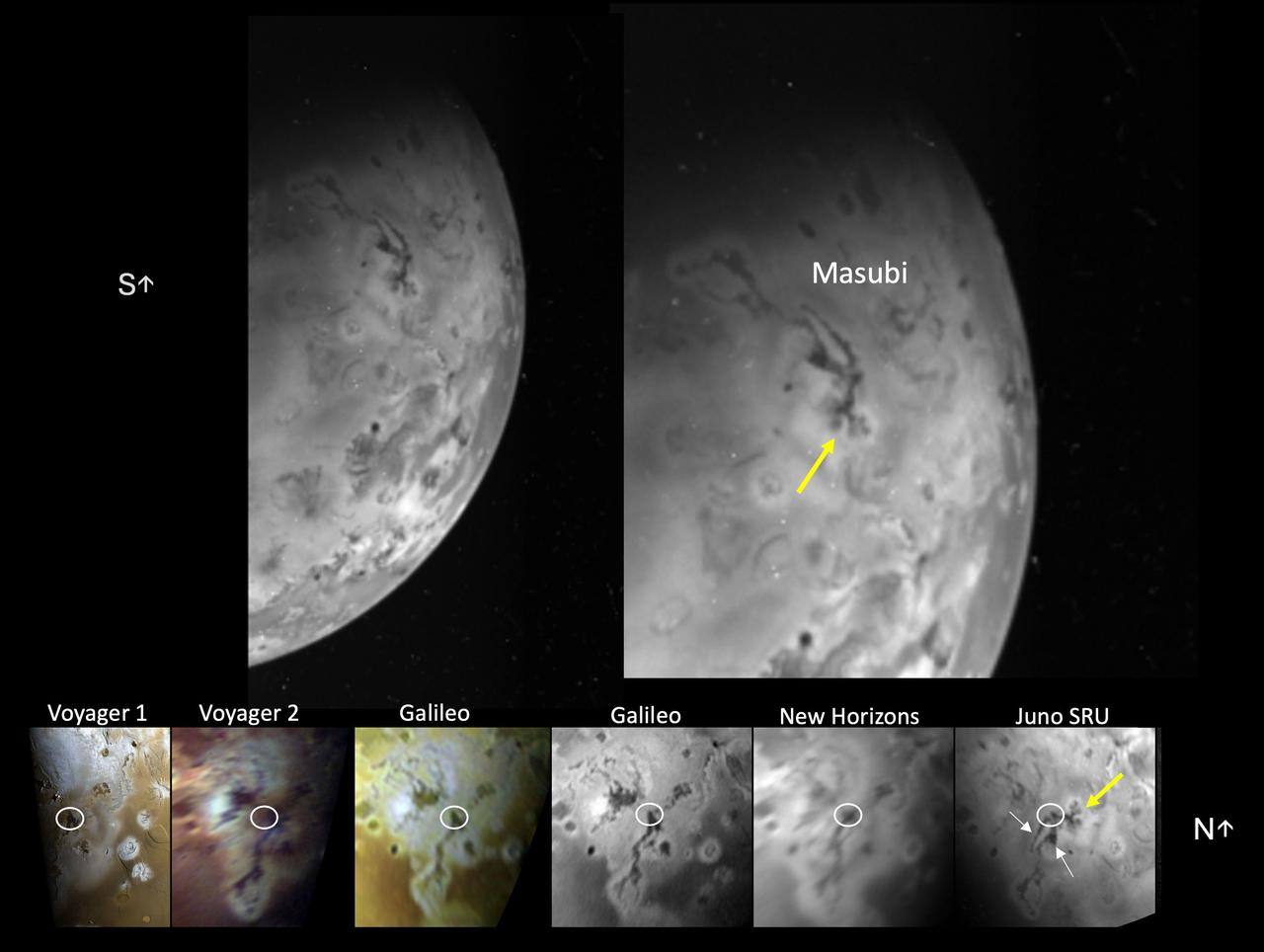
The Stellar Reference Unit (SRU) on NASA's Juno spacecraft collected this visible wavelength image of Io's night side while the surface was illuminated by Jupiter-shine on April 4, 2024.  The image features the large compound flow field, Masubi, located on Io's southern hemisphere. Masubi was first observed by NASA's Voyager 1 in 1979 and has continued to expand ever since. A co-registered time sequence of Masubi observations covering 45 years is shown in the bottom panel. The location of the plume first observed by Galileo is circled in white in each image of the time sequence. The SRU observed even further expansion of pre-existing flows (white arrows) and two new flows with multiple lobes (yellow arrow). As of April 4, 2024, Masubi's total compound flow length is about 994 miles (1,600 kilometers), making it the longest currently active lava flow in the solar system.  https://photojournal.jpl.nasa.gov/catalog/PIA26524
NASA's Juno Sees Changes at Masubi
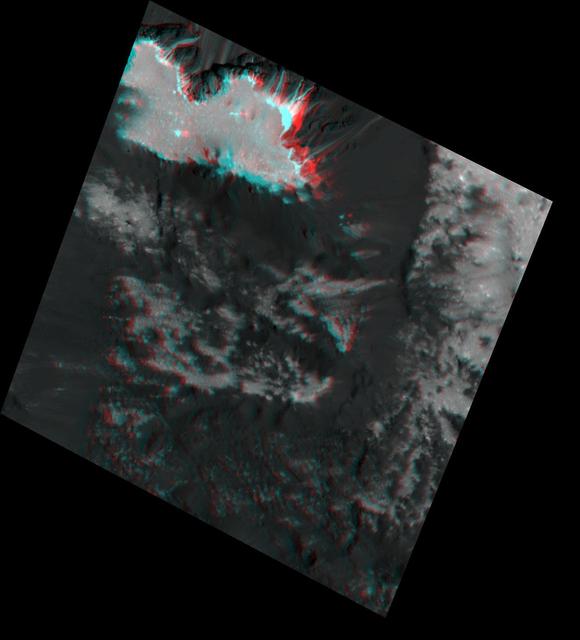
This black-and-white visible wavelength (450-1,100 nm) image of Io's surface was taken by the Stellar Reference Unit (SRU) aboard NASA's Juno spacecraft during a close flyby of the volcanic moon on Dec. 30, 2023.  The image was taken from a distance of about 932 miles (1,500 kilometers) over the night side of Io in a region dimly illuminated by Jupiter-shine. It is Juno's highest resolution image of Io, at about half- to three-quarters of a mile (895 to 1,230 meters) per pixel. The image covers the Zal Montes-Patera complex (the two mountains and large dark patera at the center of the image) and the western portion of the Tonatiuh eruptive center (at left edge of left image and top edge of right image). The left panel is the raw SRU image, and the right panel shows the image projected onto the surface of Io with north up.  The image reveals fresh new lava flows at Zal Patera (the large dark patera between the two mountains) with possible jets of sulfur dioxide gas at the flow fronts. The SRU's sensitivity at near-infrared wavelengths enabled detection of thermal emission signatures from multiple active lava breakouts in Zal Patera and at the base of South Zal Mons (the lower mountain in the image at right). An unprecedented elongated, curved emission feature is observed to the west of South Zal Mons and is suspected to be an active lava channel.  The image also captures the first high-resolution view of Tonatiuh's geomorphology. The SRU observes a fresh (dark) crenulated lava flow at Tonatiuh (left edge of left image and top edge of right image), showing that this volcano's flows are consistent with an insulated Promethean-style compound flow field. The lava flow is 98 by 11 miles (158 by 18 kilometers).  The SRU collects images of star fields to provide star positions used for attitude determination. Designed for low-light conditions, the camera has proved itself a valuable science tool, discovering shallow lightning in Jupiter's atmosphere, imaging the planet's enigmatic ring system, finding hints of recent surface activity on Europa, and now providing a view of Io's volcanoes in action.  https://photojournal.jpl.nasa.gov/catalog/PIA26489
NASA's Juno Sees Fresh Lava Flows at Zal Patera
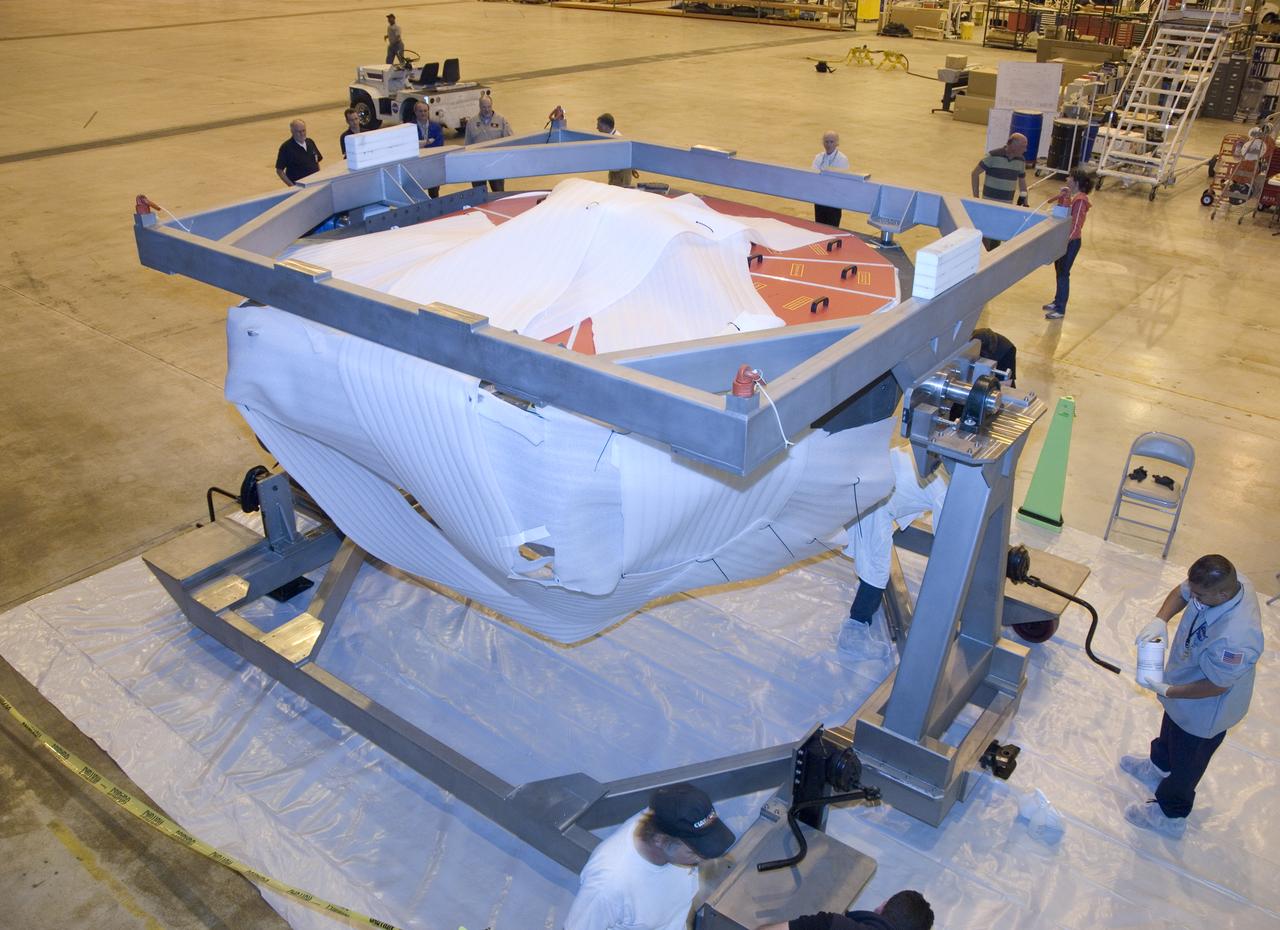
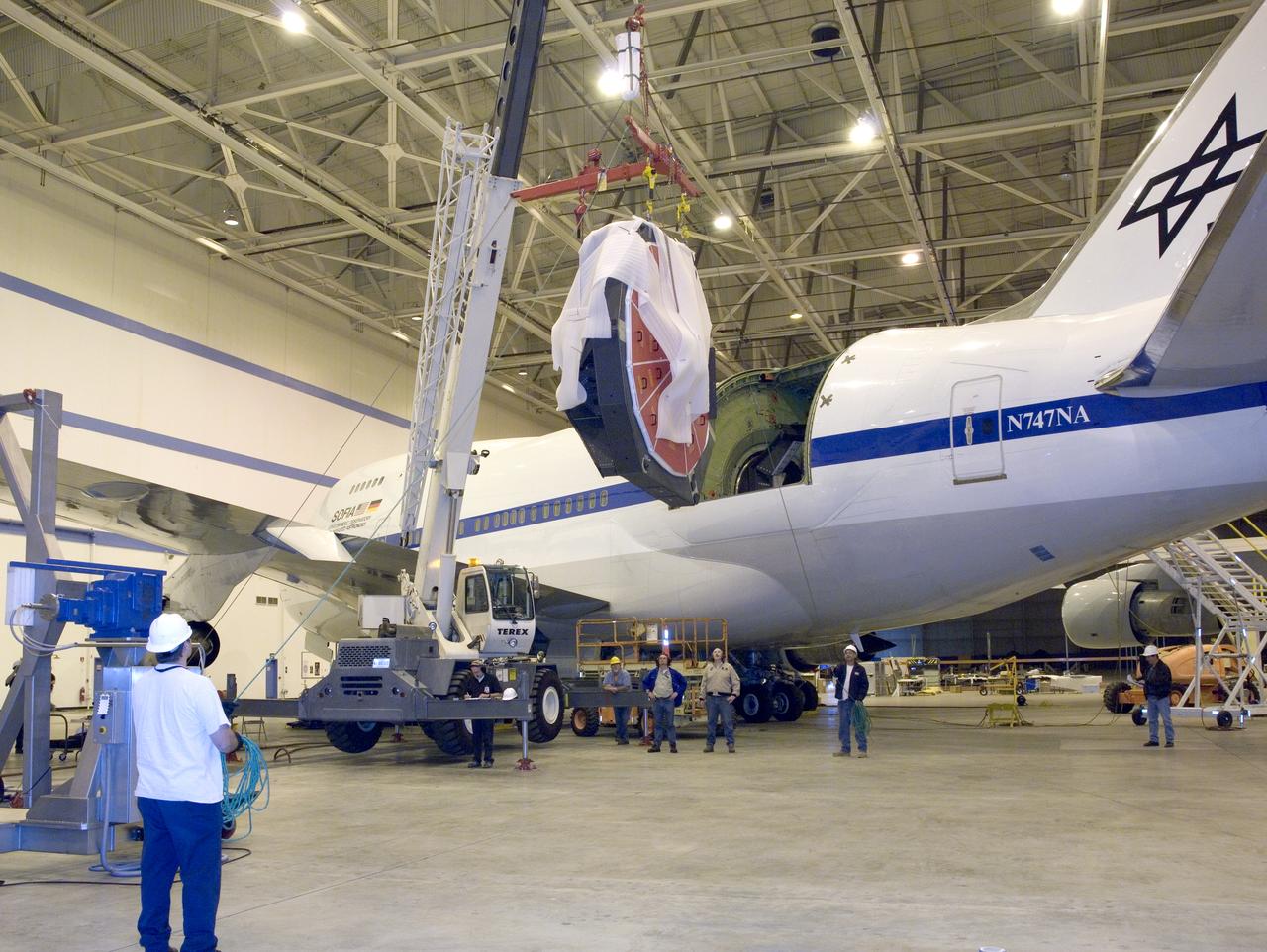
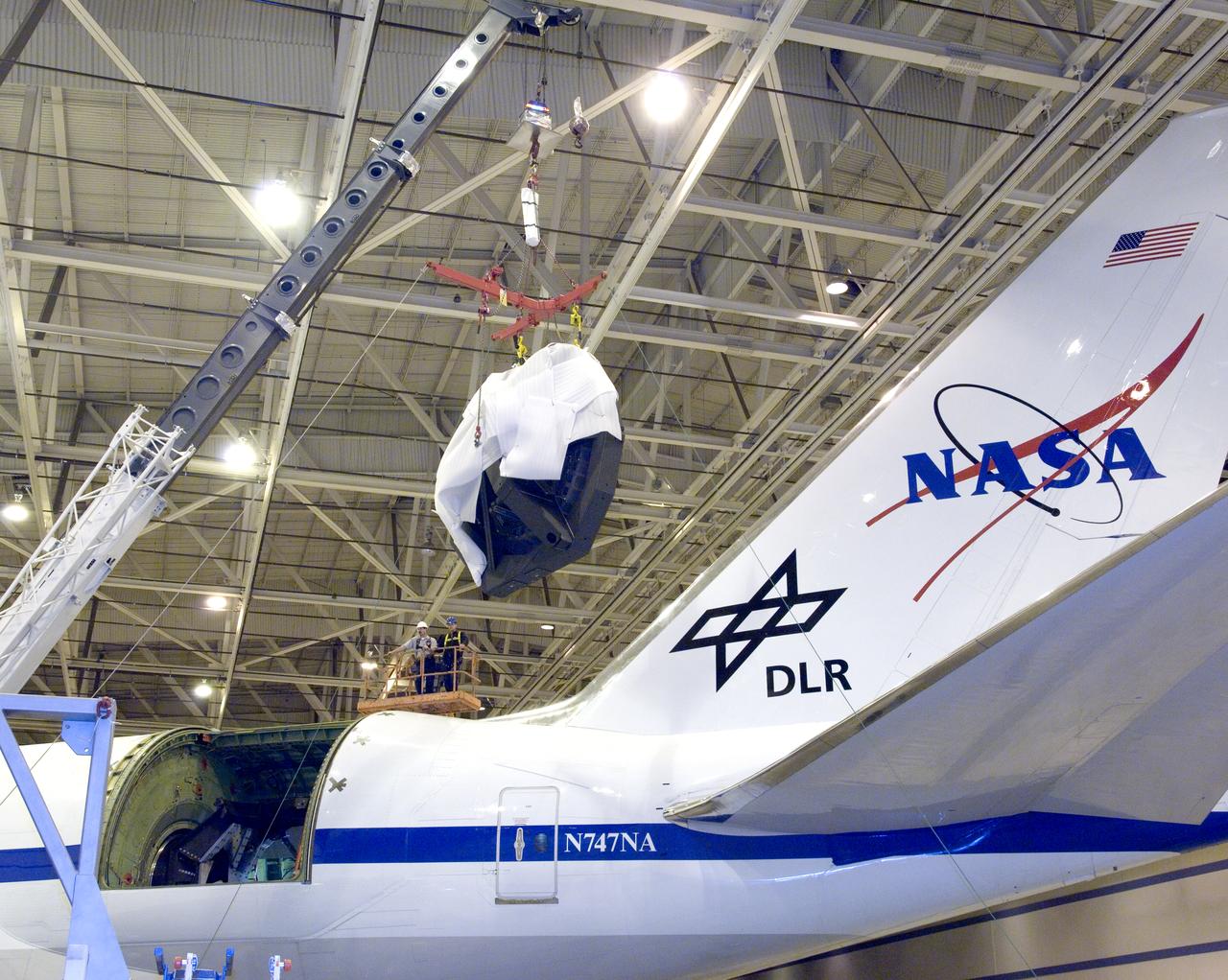
Technicians at the NASA Dryden Aircraft Operations Facility in Palmdale, Calif., removed the German-built primary mirror assembly from the Stratospheric Observatory for Infrared Astronomy, or SOFIA, April 18, 2008 in preparation for the final finish coating of the mirror. A precision crane lifted the more than two-ton mirror assembly from its cavity in the rear fuselage of the highly modified Boeing 747SP. The assembly was then secured in its transport dolly and moved to a clean room where it was prepared for shipment to NASA Ames Research Center at Moffett Field near Mountain View, Calif. where it would receive its aluminized finish coating before being re-installed in the SOFIA aircraft.
Technicians with ropes carefully guide the primary mirror assembly as a crane slowly moves it toward its transport cradle after removal from the SOFIA aircraft
The SOFIA telescope team collected baseline operational measurements during several nights of characterization testing in March 2008 while the SOFIA 747SP aircraft that houses the German-built infrared telescope was parked on an unlit ramp next to its hangar at the NASA Dryden Flight Operations Facility in Palmdale, Calif. The primary celestial target was Polaris, the North Star. The activity provided the team with a working knowledge of how telescope operating systems interact and the experience of tracking celestial targets from the ground.
NASA's SOFIA flying observatory was captured in striking relief during nighttime telescope characterization tests in Palmdale, Calif., in March 2008
The SOFIA telescope team collected baseline operational measurements during several nights of characterization testing in March 2008 while the SOFIA 747SP aircraft that houses the German-built infrared telescope was parked on an unlit ramp next to its hangar at the NASA Dryden Flight Operations Facility in Palmdale, Calif. The primary celestial target was Polaris, the North Star. The activity provided the team with a working knowledge of how telescope operating systems interact and the experience of tracking celestial targets from the ground.
Scientists and telescope operators focus on data readouts set up inside NASA's SOFIA airborne observatory during telescope characterization tracking tests
The SOFIA telescope team collected baseline operational measurements during several nights of characterization testing in March 2008 while the SOFIA 747SP aircraft that houses the German-built infrared telescope was parked on an unlit ramp next to its hangar at the NASA Dryden Flight Operations Facility in Palmdale, Calif. The primary celestial target was Polaris, the North Star. The activity provided the team with a working knowledge of how telescope operating systems interact and the experience of tracking celestial targets from the ground.
The 2.5-meter infrared telescope in the rear fuselage of NASA's SOFIA flying observatory tracked the star Polaris during characterization tests in March 2008
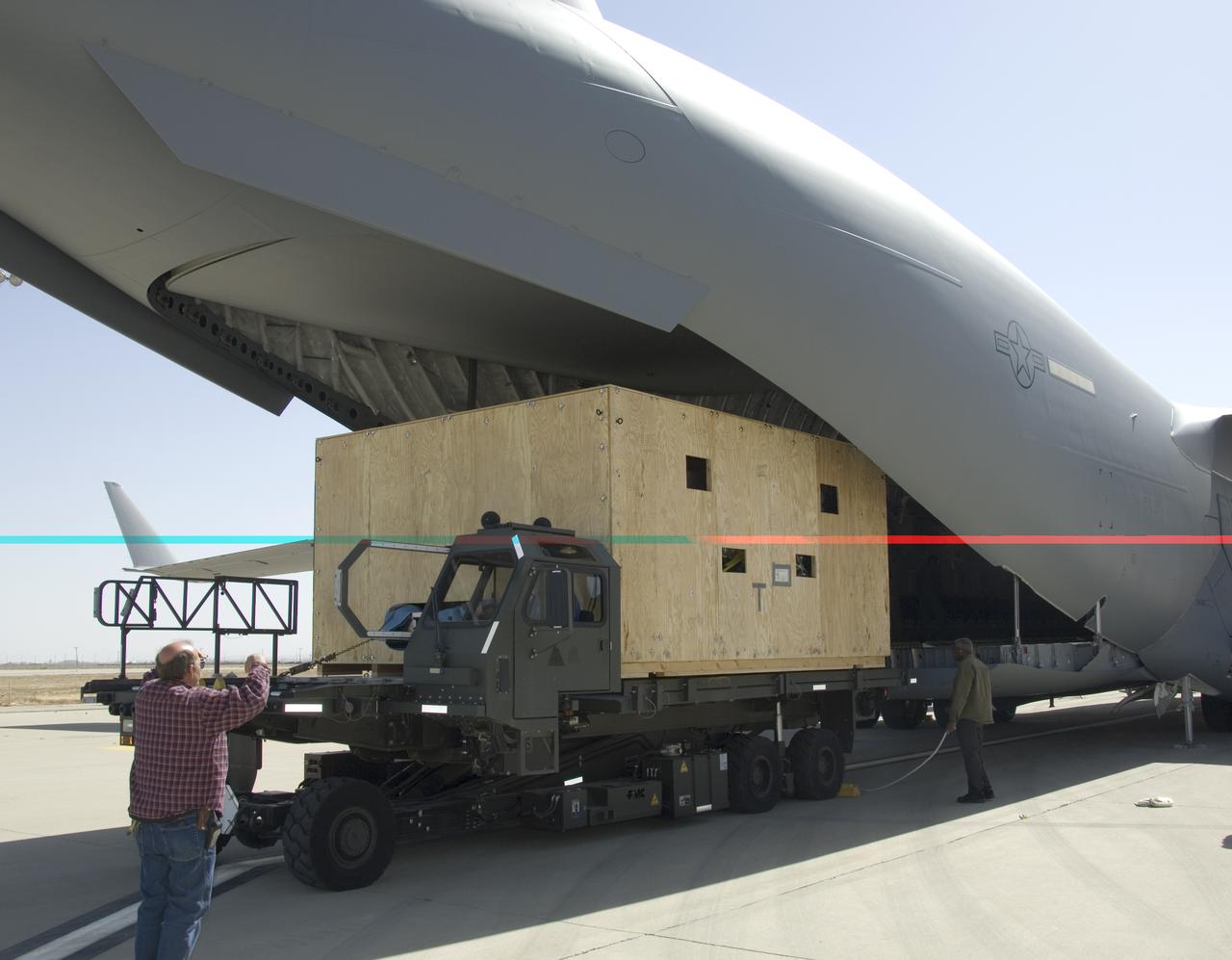
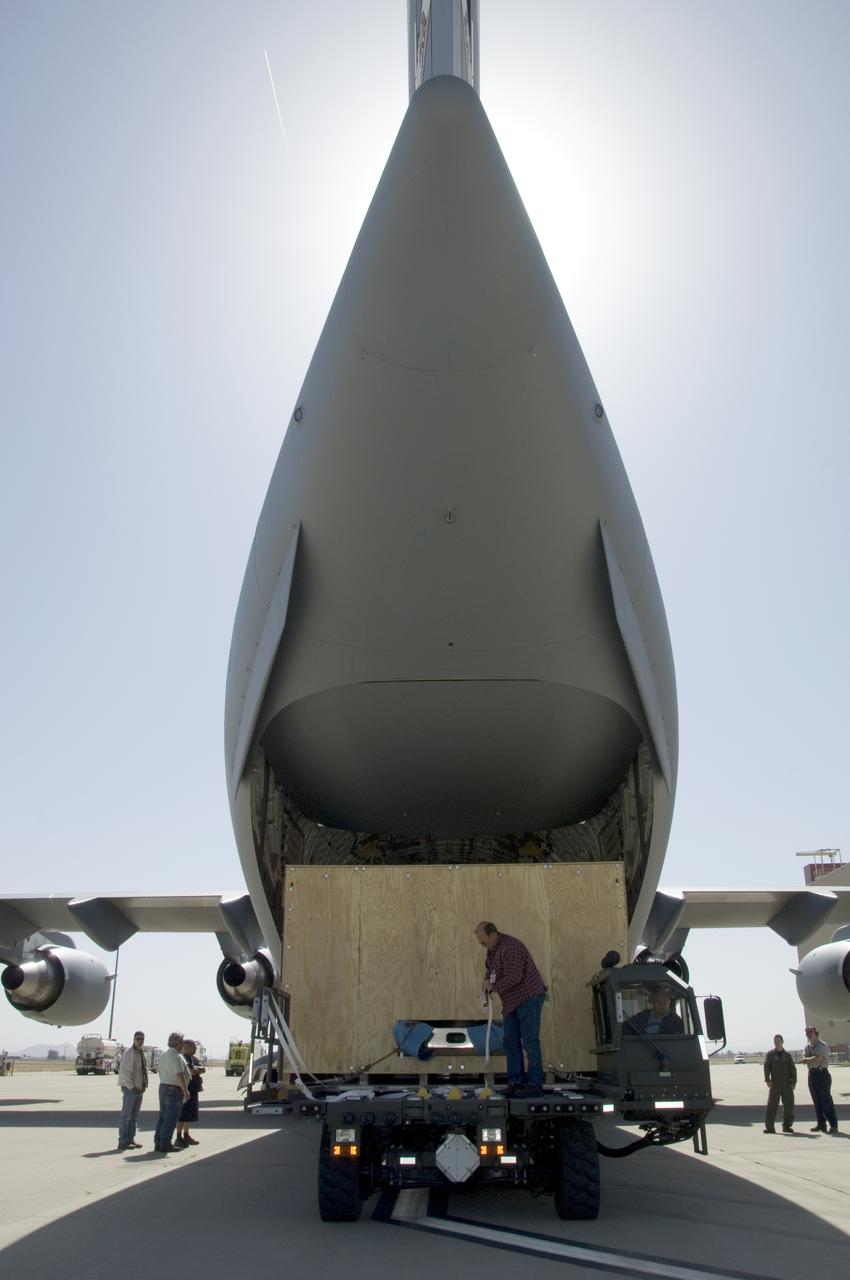
Technicians at NASA's Dryden Aircraft Operations Facility in Palmdale, Calif., loaded the German-built primary mirror assembly of the Stratospheric Observatory for Infrared Astronomy, or SOFIA, onto an Air Force C-17 for shipment to NASA's Ames Research Center on May 1, 2008. In preparation for the final finish coating of the mirror, the more than two-ton mirror assembly had been removed from its cavity in the rear fuselage of the highly modified SOFIA Boeing 747SP two weeks earlier. After arrival at NASA Ames at Moffett Field near Mountain View, Calif., the mirror would receive its aluminized finish coating before being re-installed in the SOFIA aircraft.
Ground crewmen prepare to load the crated SOFIA primary mirror assembly into an Air Force C-17 for shipment to NASA Ames Research Center for finish coating
The SOFIA telescope team collected baseline operational measurements during several nights of characterization testing in March 2008 while the SOFIA 747SP aircraft that houses the German-built infrared telescope was parked on an unlit ramp next to its hangar at the NASA Dryden Flight Operations Facility in Palmdale, Calif. The primary celestial target was Polaris, the North Star. The activity provided the team with a working knowledge of how telescope operating systems interact and the experience of tracking celestial targets from the ground.
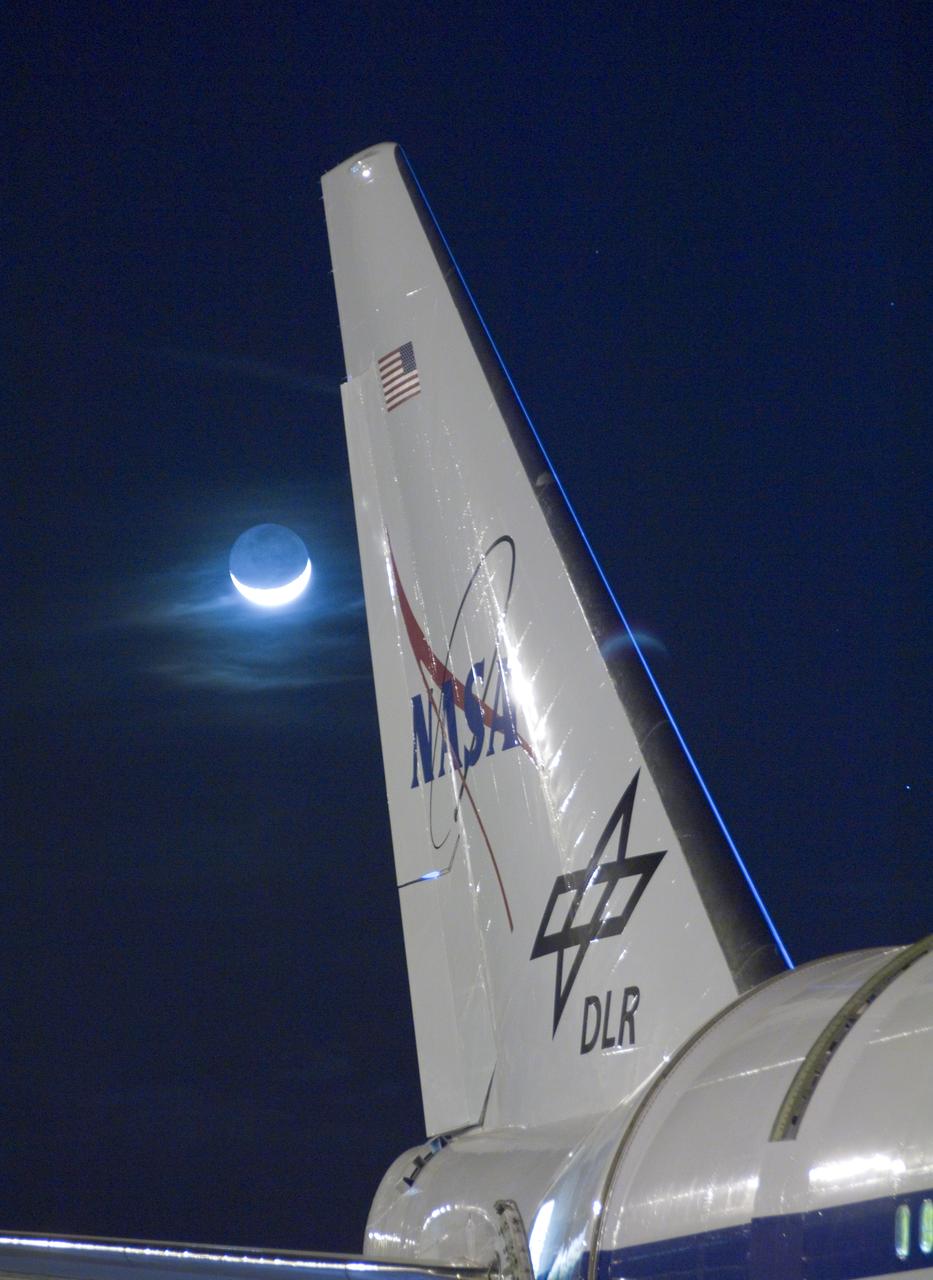
Wispy clouds are illuminated by a bright quarter moon behind the tail of NASA's SOFIA flying observatory during telescope characterization testing in 2008
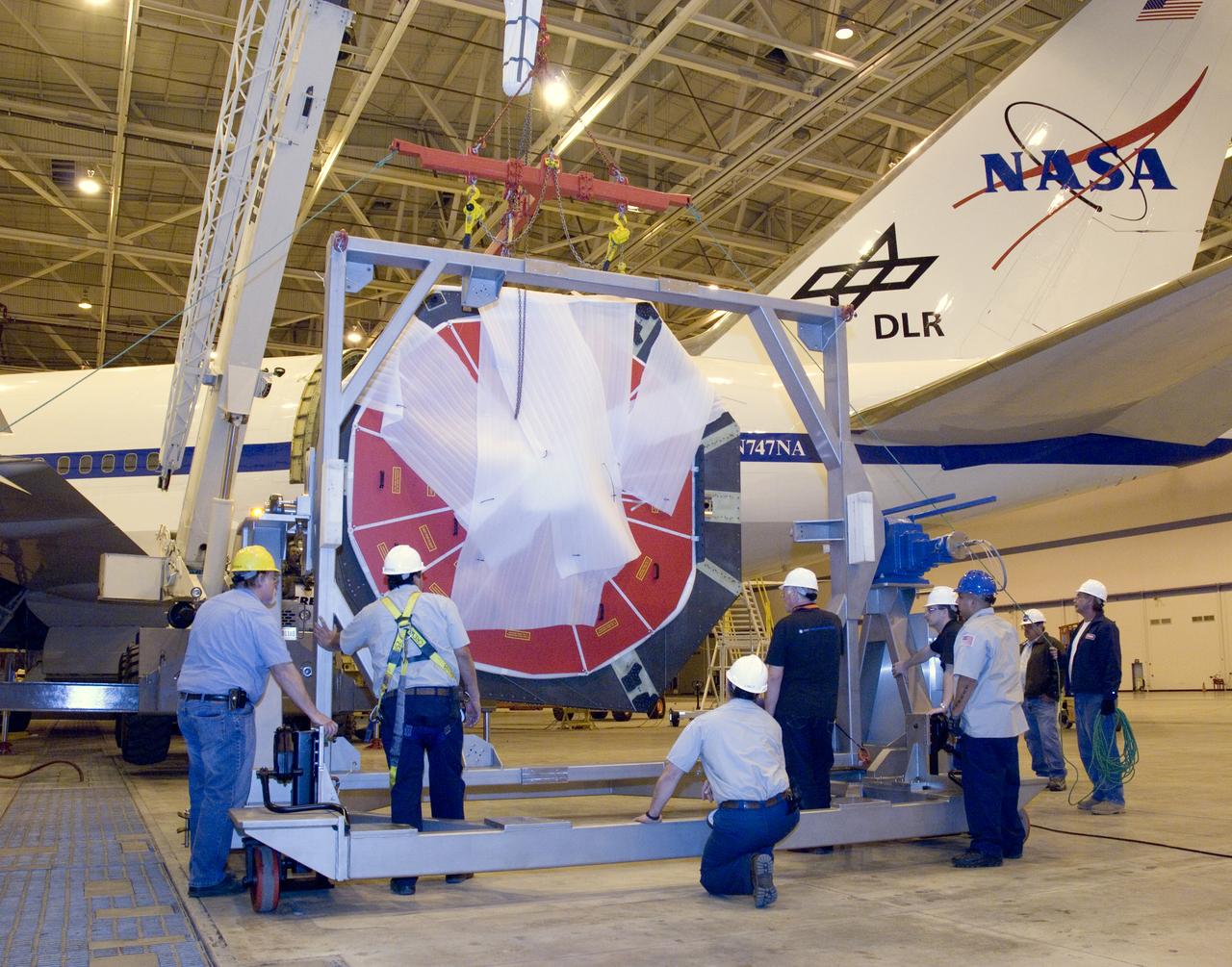
Technicians carefully maneuver a spreader bar into place before removing the telescope aperture assembly from NASA's SOFIA infrared observatory Boeing 747SP.
Technicians carefully maneuver a spreader bar into place before removing the telescope aperture assembly from NASA's SOFIA infrared observatory Boeing 747SP
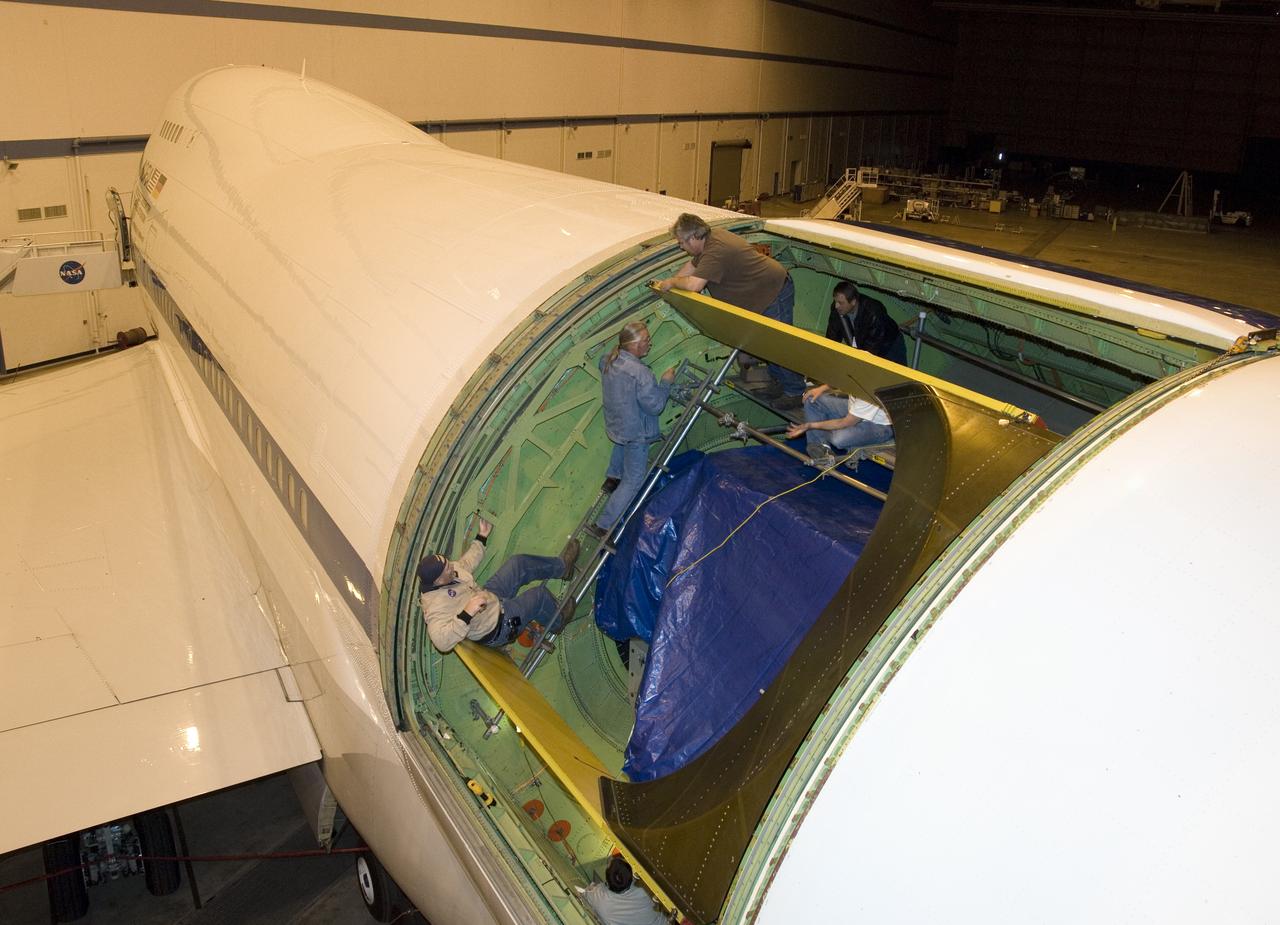
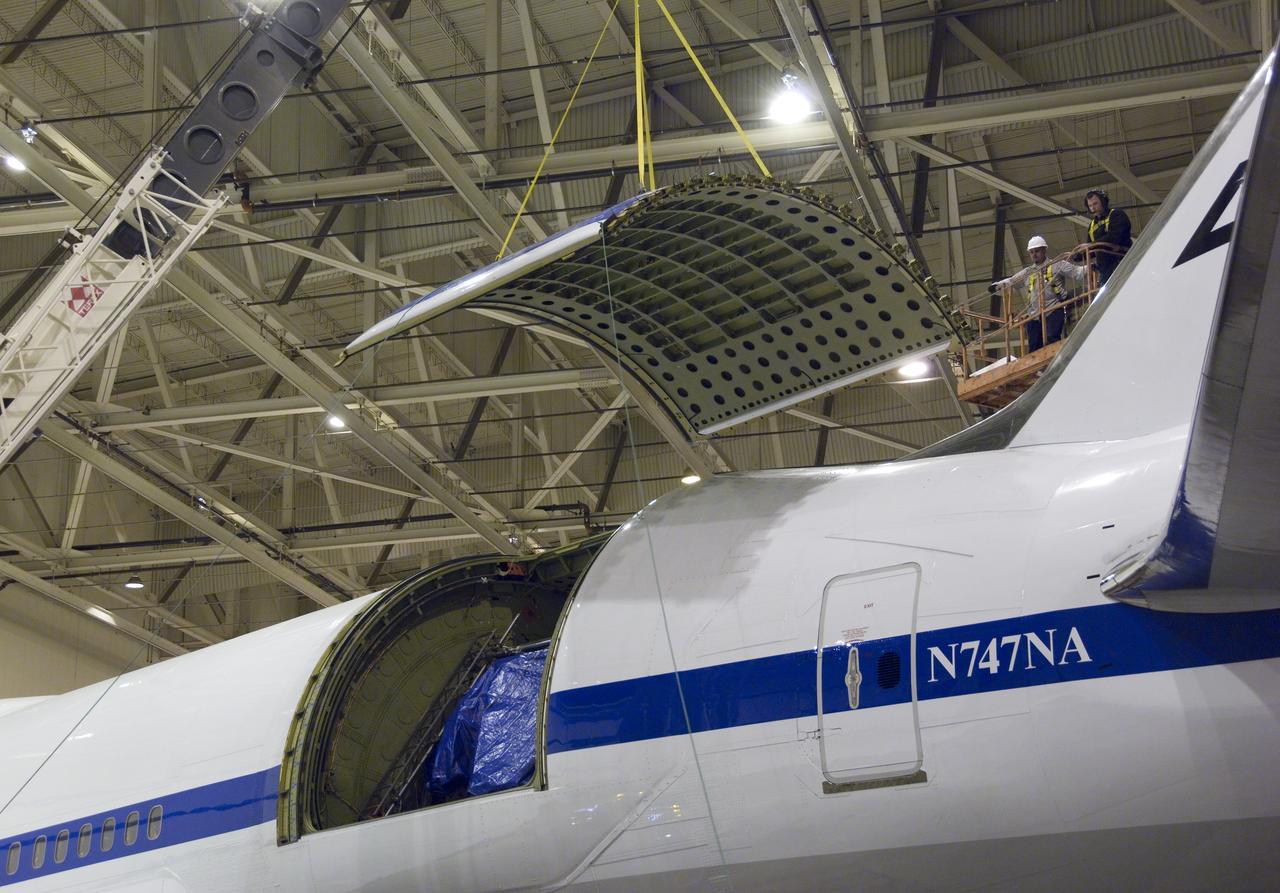
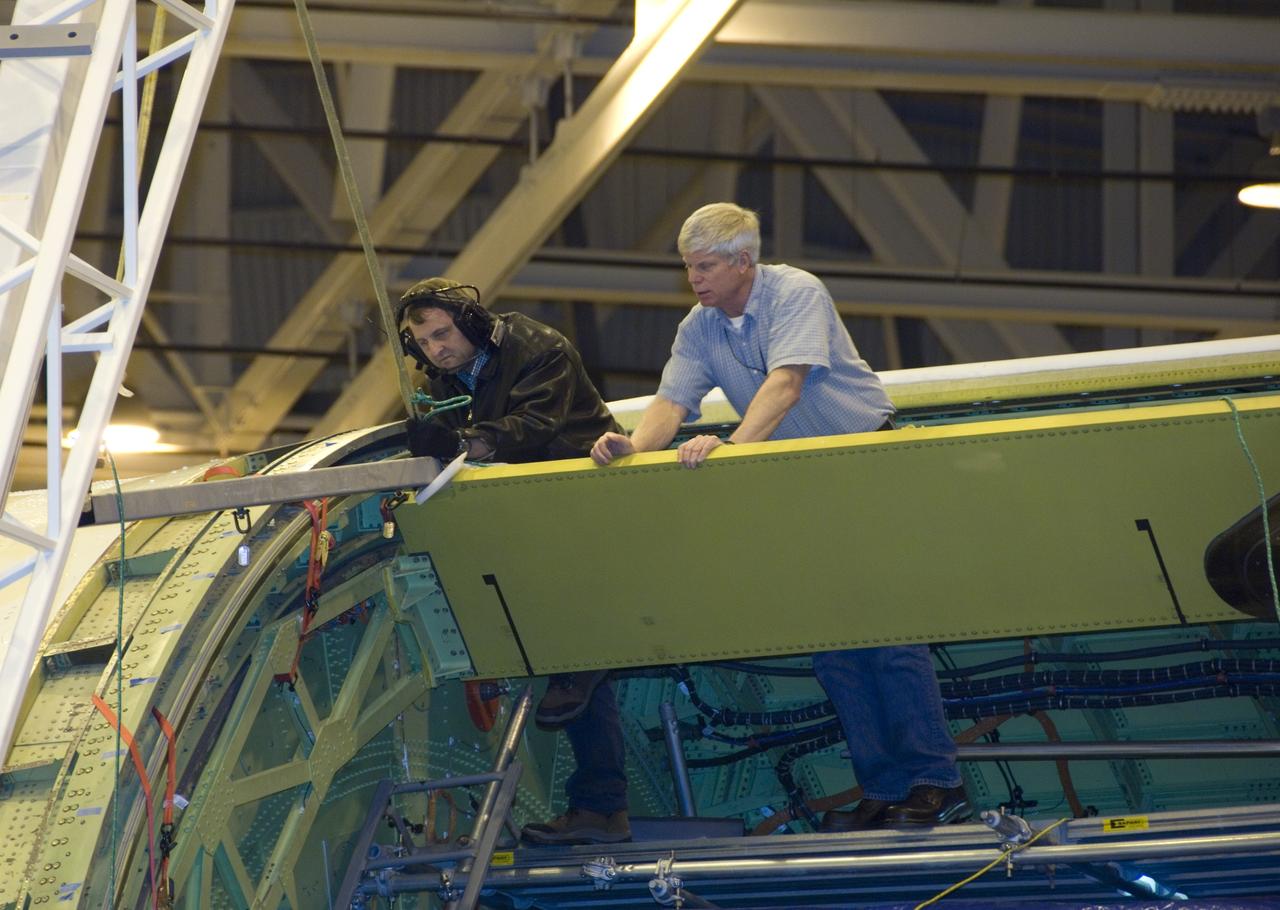
Technicians guide removal of the upper rigid door assembly that covers the telescope cavity on NASA's SOFIA 747SP in preparation for primary mirror removal.
Technicians guide removal of the upper rigid door assembly that covers the telescope cavity on NASA's SOFIA 747SP in preparation for primary mirror removal
The SOFIA telescope team collected baseline operational measurements during several nights of characterization testing in March 2008 while the SOFIA 747SP aircraft that houses the German-built infrared telescope was parked on an unlit ramp next to its hangar at the NASA Dryden Flight Operations Facility in Palmdale, Calif. The primary celestial target was Polaris, the North Star. The activity provided the team with a working knowledge of how telescope operating systems interact and the experience of tracking celestial targets from the ground.
This backlit photo of SOFIA's infrared telescope during characterization testing shows the cell-like construction of the telescope's 2.5-meter primary mirror
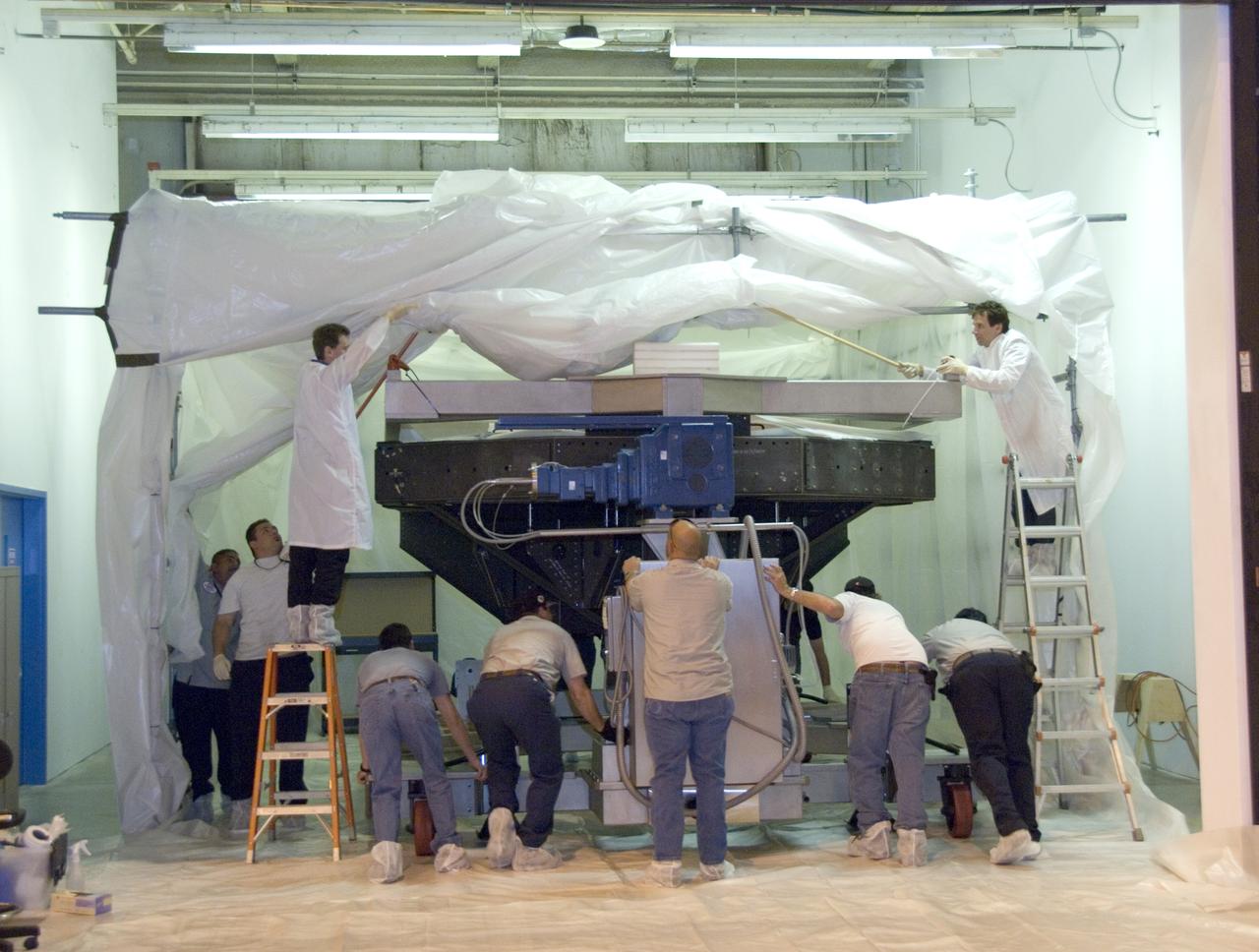
Technicians at the NASA Dryden Aircraft Operations Facility in Palmdale, Calif., removed the German-built primary mirror assembly from the Stratospheric Observatory for Infrared Astronomy, or SOFIA, April 18, 2008 in preparation for the final finish coating of the mirror. A precision crane lifted the more than two-ton mirror assembly from its cavity in the rear fuselage of the highly modified Boeing 747SP. The assembly was then secured in its transport dolly and moved to a clean room where it was prepared for shipment to NASA Ames Research Center at Moffett Field near Mountain View, Calif. where it would receive its aluminized finish coating before being re-installed in the SOFIA aircraft.
Technicians carefully guide SOFIA's primary mirror assembly on its transport cradle into a clean room where it is being prepared for shipment to NASA Ames
Technicians at NASA's Dryden Aircraft Operations Facility in Palmdale, Calif., loaded the German-built primary mirror assembly of the Stratospheric Observatory for Infrared Astronomy, or SOFIA, onto an Air Force C-17 for shipment to NASA's Ames Research Center on May 1, 2008. In preparation for the final finish coating of the mirror, the more than two-ton mirror assembly had been removed from its cavity in the rear fuselage of the highly modified SOFIA Boeing 747SP two weeks earlier. After arrival at NASA Ames at Moffett Field near Mountain View, Calif., the mirror would receive its aluminized finish coating before being re-installed in the SOFIA aircraft.
A NASA Technician directs loading of the crated SOFIA primary mirror assembly into a C-17 for shipment to NASA Ames Research Center for finish coating
Technicians carefully disassemble portions of the aperture mounting assembly from NASA's SOFIA aircraft in preparation for removal of the telescope.
Technicians carefully disassemble portions of the aperture mounting assembly from NASA's SOFIA aircraft in preparation for removal of the telescope
Technicians at the NASA Dryden Aircraft Operations Facility in Palmdale, Calif., removed the German-built primary mirror assembly from the Stratospheric Observatory for Infrared Astronomy, or SOFIA, April 18, 2008 in preparation for the final finish coating of the mirror. A precision crane lifted the more than two-ton mirror assembly from its cavity in the rear fuselage of the highly modified Boeing 747SP. The assembly was then secured in its transport dolly and moved to a clean room where it was prepared for shipment to NASA Ames Research Center at Moffett Field near Mountain View, Calif. where it would receive its aluminized finish coating before being re-installed in the SOFIA aircraft.
Technicians position the transport cradle as a crane lowers SOFIA's primary mirror assembly into place prior to finish coating of the mirror at NASA Ames
The SOFIA telescope team collected baseline operational measurements during several nights of characterization testing in March 2008 while the SOFIA 747SP aircraft that houses the German-built infrared telescope was parked on an unlit ramp next to its hangar at the NASA Dryden Flight Operations Facility in Palmdale, Calif. The primary celestial target was Polaris, the North Star. The activity provided the team with a working knowledge of how telescope operating systems interact and the experience of tracking celestial targets from the ground.
As SOFIA's large telescope assembly slowly rotates, scientists and telescope operators review data readouts and imagery on their monitors during tracking tests
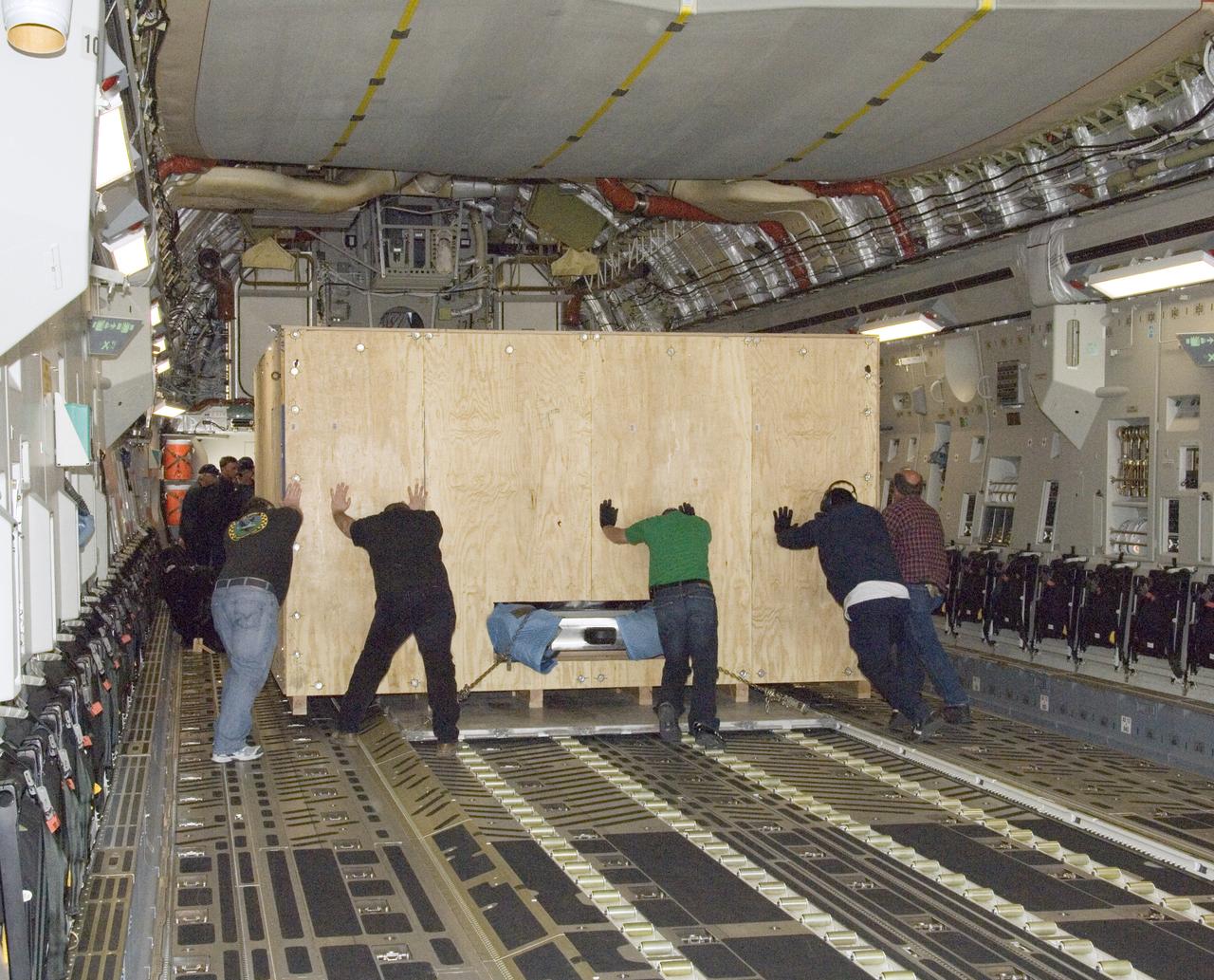
Technicians at NASA's Dryden Aircraft Operations Facility in Palmdale, Calif., loaded the German-built primary mirror assembly of the Stratospheric Observatory for Infrared Astronomy, or SOFIA, onto an Air Force C-17 for shipment to NASA's Ames Research Center on May 1, 2008. In preparation for the final finish coating of the mirror, the more than two-ton mirror assembly had been removed from its cavity in the rear fuselage of the highly modified SOFIA Boeing 747SP two weeks earlier. After arrival at NASA Ames at Moffett Field near Mountain View, Calif., the mirror would receive its aluminized finish coating before being re-installed in the SOFIA aircraft.
Ground crewmen shove the more than two-ton SOFIA primary mirror assembly in its transport crate into a C-17's cavernous cargo bay for shipment to NASA Ames
Technicians at the NASA Dryden Aircraft Operations Facility in Palmdale, Calif., removed the German-built primary mirror assembly from the Stratospheric Observatory for Infrared Astronomy, or SOFIA, April 18, 2008 in preparation for the final finish coating of the mirror. A precision crane lifted the more than two-ton mirror assembly from its cavity in the rear fuselage of the highly modified Boeing 747SP. The assembly was then secured in its transport dolly and moved to a clean room where it was prepared for shipment to NASA Ames Research Center at Moffett Field near Mountain View, Calif. where it would receive its aluminized finish coating before being re-installed in the SOFIA aircraft.
The SOFIA primary mirror assembly is cautiously lifted from its cavity in the modified 747 by a crane in preparation for finish coating operations at NASA Ames
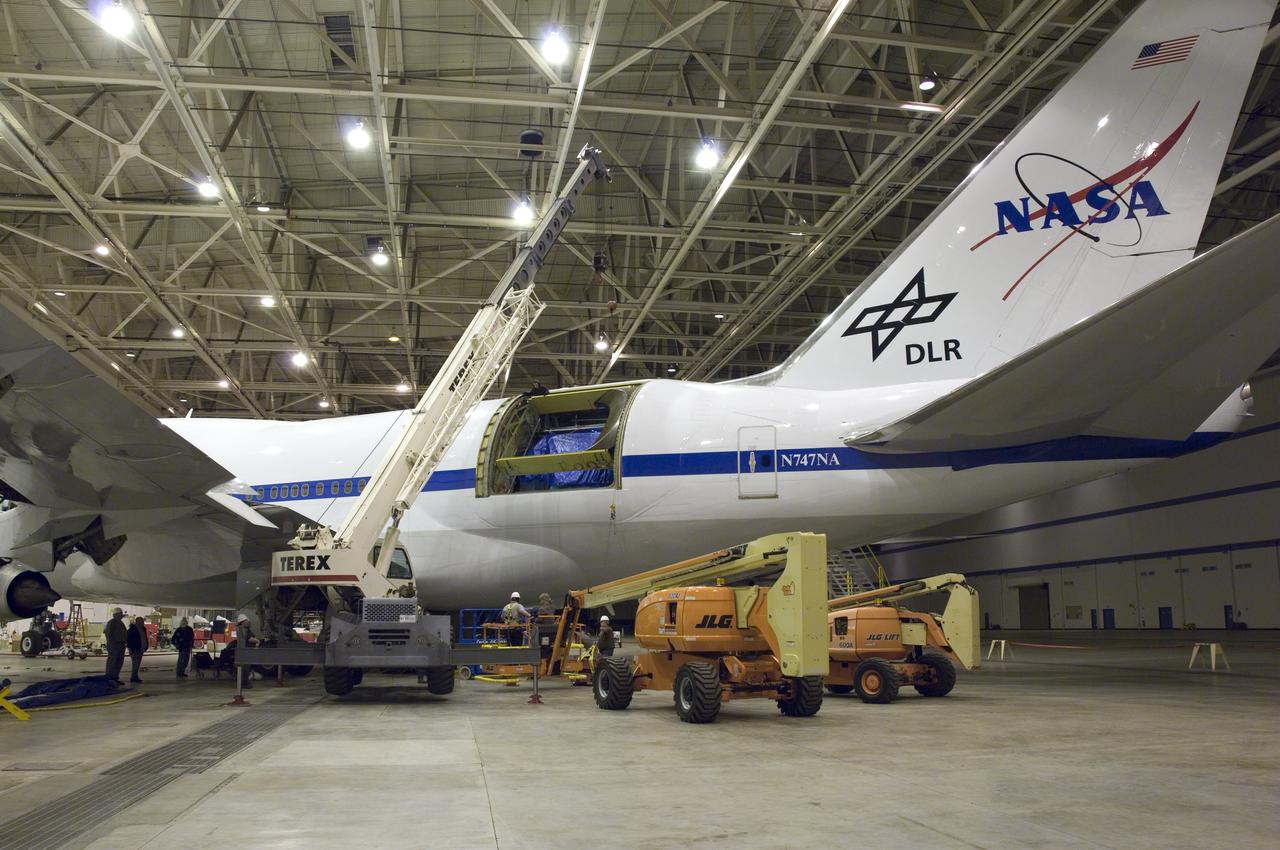
A large mobile crane and hi-lift are maneuvered into place for removal of the aperture assembly and cavity doors from NASA's SOFIA observatory aircraft.
A large mobile crane and hi-lift are maneuvered into place for removal of the aperture assembly and cavity doors from NASA's SOFIA observatory aircraft
Technicians at the NASA Dryden Aircraft Operations Facility in Palmdale, Calif., removed the German-built primary mirror assembly from the Stratospheric Observatory for Infrared Astronomy, or SOFIA, April 18, 2008 in preparation for the final finish coating of the mirror. A precision crane lifted the more than two-ton mirror assembly from its cavity in the rear fuselage of the highly modified Boeing 747SP. The assembly was then secured in its transport dolly and moved to a clean room where it was prepared for shipment to NASA Ames Research Center at Moffett Field near Mountain View, Calif. where it would receive its aluminized finish coating before being re-installed in the SOFIA aircraft.
SOFIA's primary mirror assembly is cradled on its dolly as technicians prepare to move it into a "clean room" at NASA Dryden's Aircraft Operations Facility
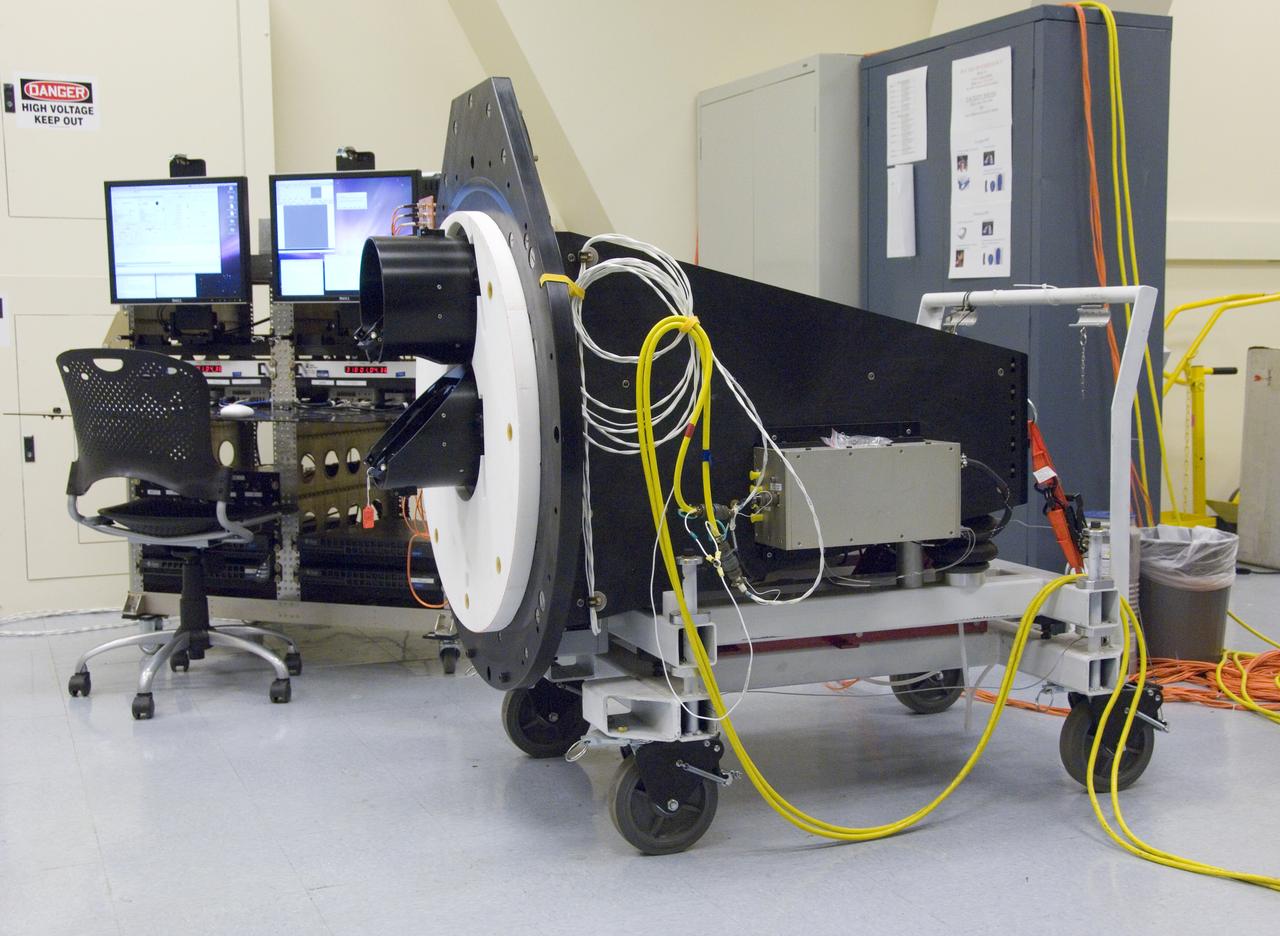
The Lowell Observatory's High-speed Imaging Photometer for Occultation rests on its dolly in the lab prior to installation on the SOFIA airborne observatory.
The Lowell Observatory's High-speed Imaging Photometer for Occultation rests on its dolly in the lab prior to installation on the SOFIA airborne observatory
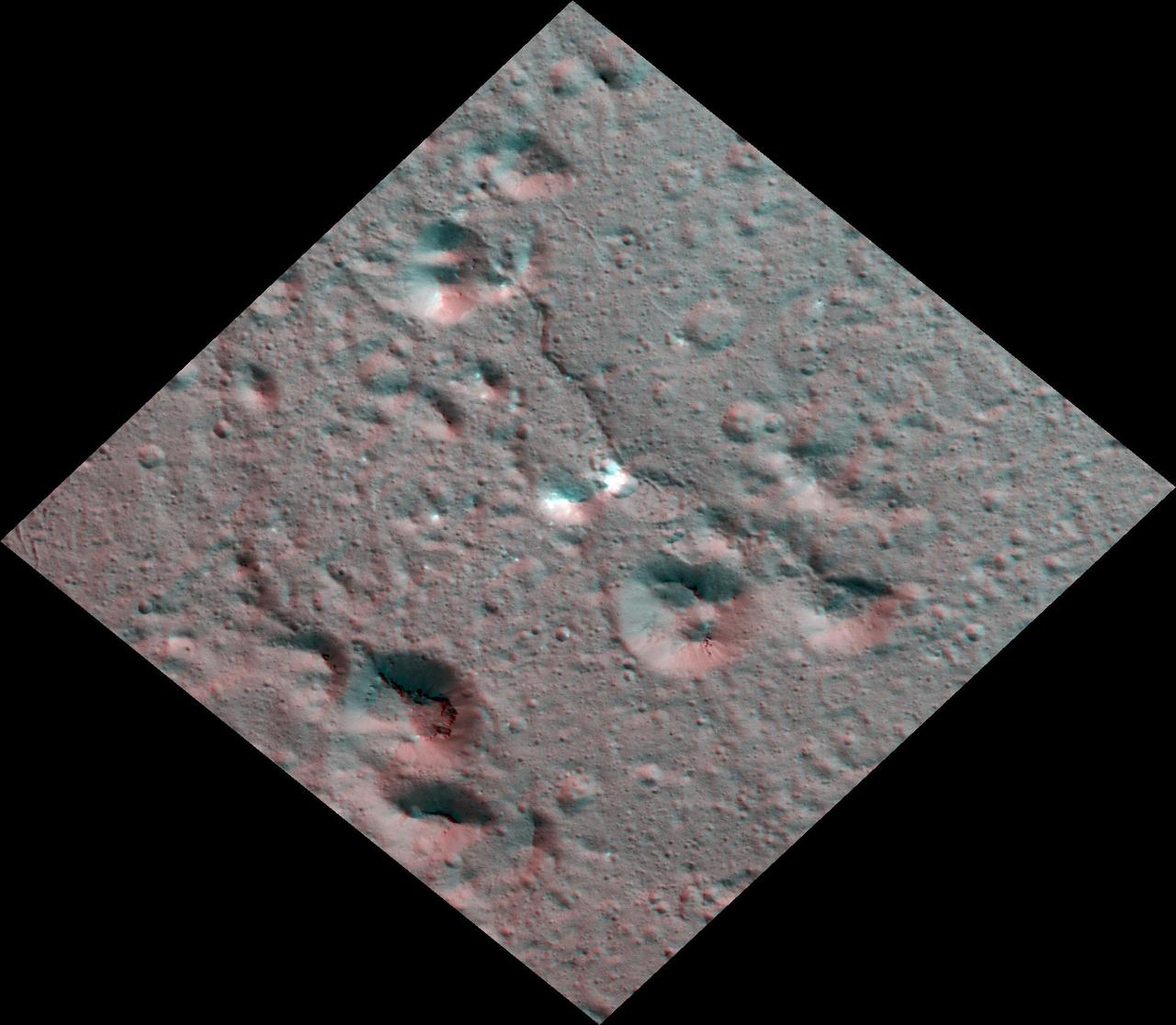
The Dawn spacecraft captured these stereo images of Occator Crater on the dwarf planet Ceres in 2018. Framing camera images were used to construct this anaglyph view (which requires red-blue stereo glasses for viewing) of part of the southeastern floor of the crater. This area is approximately 3 miles (5 kilometers) wide and is entirely within the large impact melt deposit formed there during the impact process. The low bright mounds and pits were probably formed by brine that moved to the surface to form surface vents and surface domes during freezing. The spatial resolution of the stereo images is about 11 feet (3.5 meters) per pixel. Occator crater, named after the Roman god of the agricultural practice of harrowing, is about 57 miles (92 kilometers) in diameter.  The conclusion of Dawn's mission operations was Oct. 31, 2018, when the spacecraft depleted its hydrazine used for attitude control.  This image was produced by Dr. Paul Schenk at the Lunar and Planetary Institute in Houston.  https://photojournal.jpl.nasa.gov/catalog/PIA24062
Dawn Stereo Anaglyph of Hydrothermal Pits and Domes in Occator Crater, Ceres
This view across the southeastern floor of the large Occator Crater on the dwarf planet Ceres, in the main asteroid belt between Mars and Jupiter, is based on images obtained during NASA's Dawn spacecraft second extended mission in 2018. The southern rim in the distance rises 2 miles (3.5 kilometers) above the floor. These images were obtained from altitudes between 22 and 31 miles (35 and 50 kilometers.)  Occator Crater is 57 miles (92 kilometers) across. Bright pits and mounds in the foreground were formed by salty liquid released during the freezing of the water-rich floor, following the crater-forming impact about 20 million years ago. These features are a few miles across. This area shown here is 6 miles (about 10 kilometers) wide in the foreground and 12 miles (about 20 kilometers) in the background.  This image was produced by Paul Schenk at the Lunar and Planetary Institute in Houston.  https://photojournal.jpl.nasa.gov/catalog/PIA24022
Close-up of Occator Crater
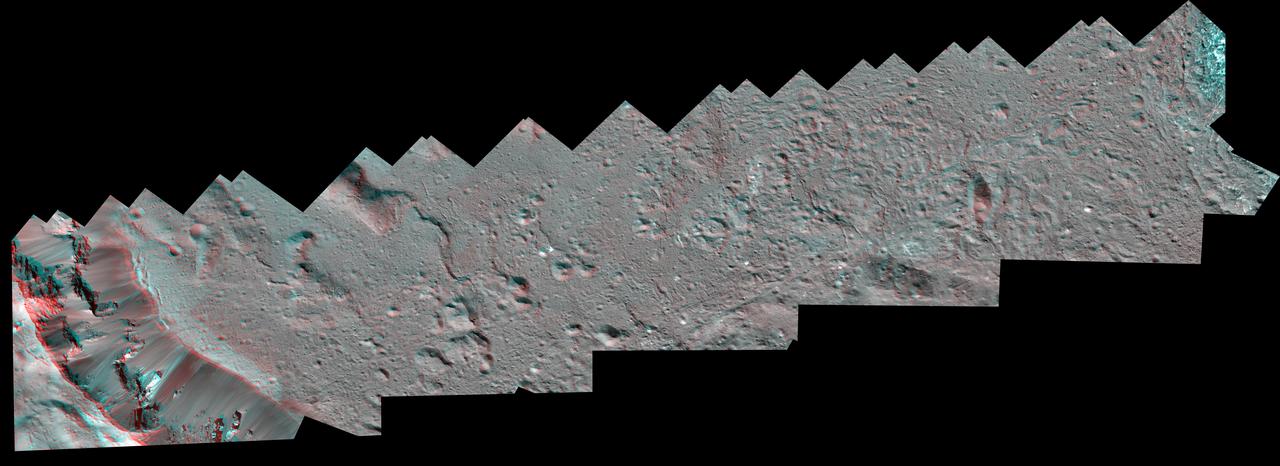
The Dawn spacecraft captured these stereo views of Occator Crater on the dwarf planet Ceres in 2018. More than 70 framing camera images were used to construct this anaglyph view (which requires red-blue stereo glasses for viewing) of the southeastern floor of the crater, including the rim at far left in this view. This area is largely covered with impact melt and features a variety of pits and low mounds, some of which are related to impact debris but others to subsurface brine seepage and deposition. The spatial resolution of the stereo images is about 11 feet (3.5 meters) per pixel. Occator Crater, named after the Roman god of the agricultural practice of harrowing, is about 57 miles (92 kilometers) in diameter.  The conclusion of Dawn's mission operations was Oct. 31, 2018, when the spacecraft depleted its hydrazine used for attitude control.  This image was produced by Dr. Paul Schenk at the Lunar and Planetary Institute in Houston.  https://photojournal.jpl.nasa.gov/catalog/PIA24061
Dawn Stereo Anaglyph of Southeast Floor and Rim of Occator Crater, Ceres
The Dawn spacecraft captured these stereo images of Occator Crater on the dwarf planet Ceres in 2018. This view is part of a mosaic of about 50 framing camera images used to construct this anaglyph view (which requires red-blue stereo glasses for viewing) of part of the eastern floor of the crater. This area is approximately 5 miles (8.5 kilometers) wide and features bright carbonate deposits of the Vinalia Faculae formation on top of the ropey textured lobate floor impact melt deposit. Stereo views of Vinalia Faculae illustrate the complex relationship between the thin carbonates and the underlying impact deposits. The spatial resolution of the stereo images is about 11 feet (3.5 meters) per pixel. Occator crater, named after the Roman god of the agricultural practice of harrowing, is about 57 miles (92 kilometers) in diameter.  The conclusion of Dawn's mission operations was Oct. 31, 2018, when the spacecraft depleted its hydrazine used for attitude control.  This image was produced by Dr. Paul Schenk at the Lunar and Planetary Institute in Houston.  https://photojournal.jpl.nasa.gov/catalog/PIA24063
Dawn Stereo Anaglyph of Hydrothermal Deposits at Occator Crater, Ceres
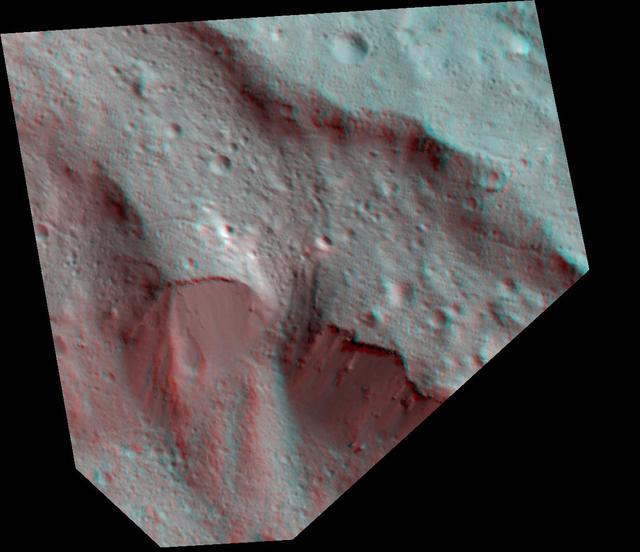
The Dawn spacecraft captured these stereo images of Occator crater on the dwarf planet Ceres in 2018. Framing camera images were used to construct this anaglyph view (which requires red-blue stereo glasses for viewing) of part of the northeastern rim of the crater. This area is approximately 4 miles (7 kilometers) wide and features a thin mantling layer of impact melt draped over faulted terrace blocks. Impact melt flowed through a gap in the blocks in the center of the frame. The spatial resolution of the stereo images is about 11 feet (3.5 meters) per pixel. Occator Crater, named after the Roman god of the agricultural practice of harrowing, is about 57 miles (92 kilometers) in diameter.  The conclusion of Dawn's mission operations was Oct. 31, 2018, when the spacecraft depleted its hydrazine used for attitude control.  This image was produced by Dr. Paul Schenk at the Lunar and Planetary Institute in Houston.  https://photojournal.jpl.nasa.gov/catalog/PIA24064
Dawn Stereo Anaglyph of Impact Melt Deposits at Occator Crater, Ceres
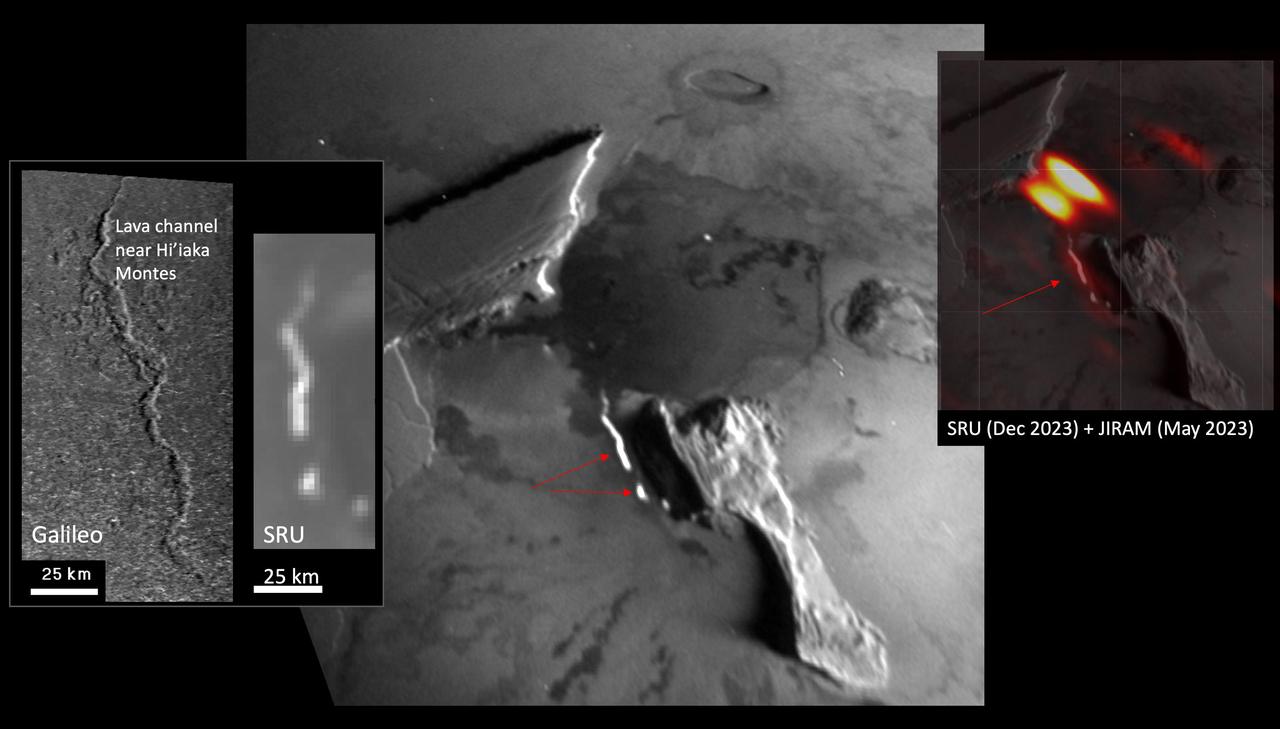
The Stellar Reference Unit (SRU) on NASA's Juno spacecraft made this first-of-a-kind observation on Dec. 30, 2023, of an elongated, 40-mile-long (65-kilometer-long), curvy thermal emission feature and a shorter linear emission segment to the west of South Zal Mons. The resolution is 0.6 miles (1 kilometer) per pixel.  The feature is suspected to be an active lava channel, given the similarity of its morphology to that of the two previously identified lava channels on Io. The shape of the Ionian lava channel near Hi'iaka Montes is compared to the SRU emission feature in the left panel. Juno's infrared camera, JIRAM, observed a long thermal emission "hot spot" at lower resolution (19 miles, or 30 kilometers, per pixel) in May 2023 at the same location (JIRAM infrared data is overlaid on the SRU image in the right panel, illustrating the overlap).  https://photojournal.jpl.nasa.gov/catalog/PIA26523
NASA's Juno Captures Lava Channel Thermal Emissions at Zal Patera
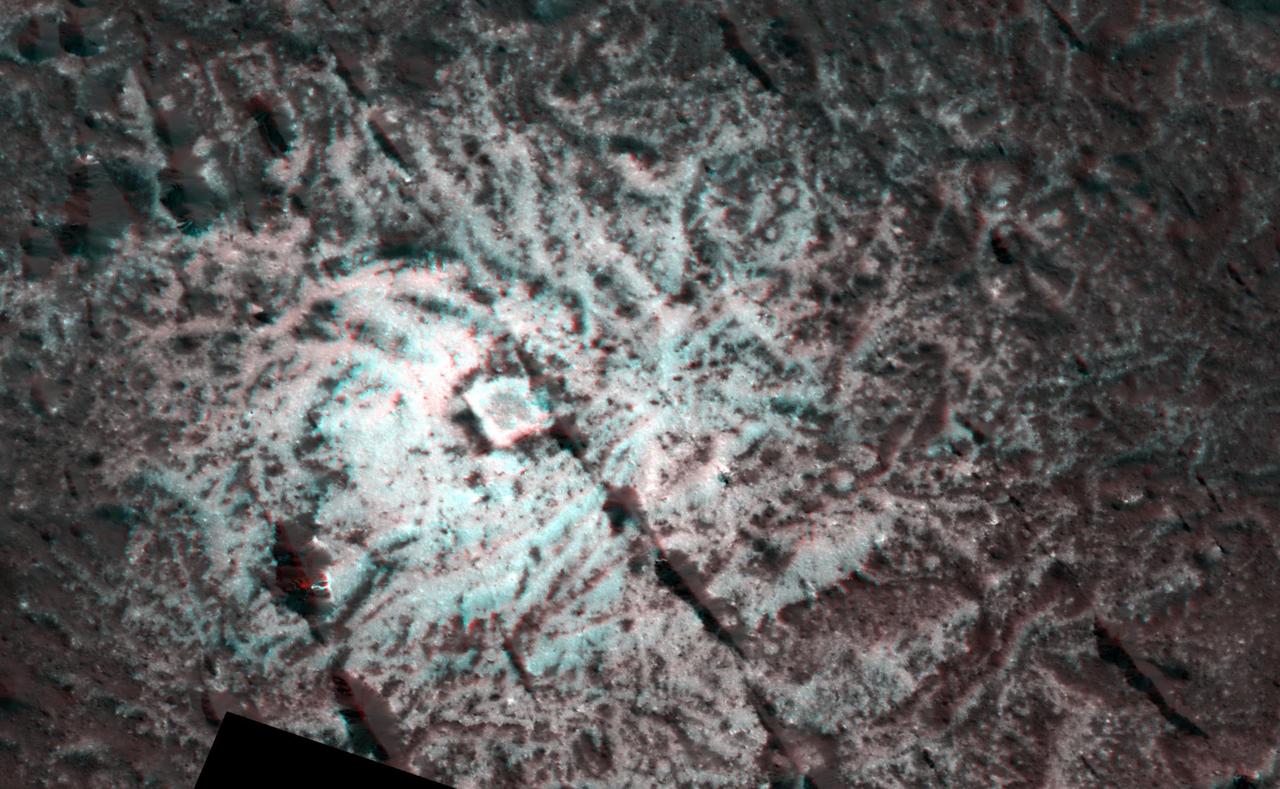
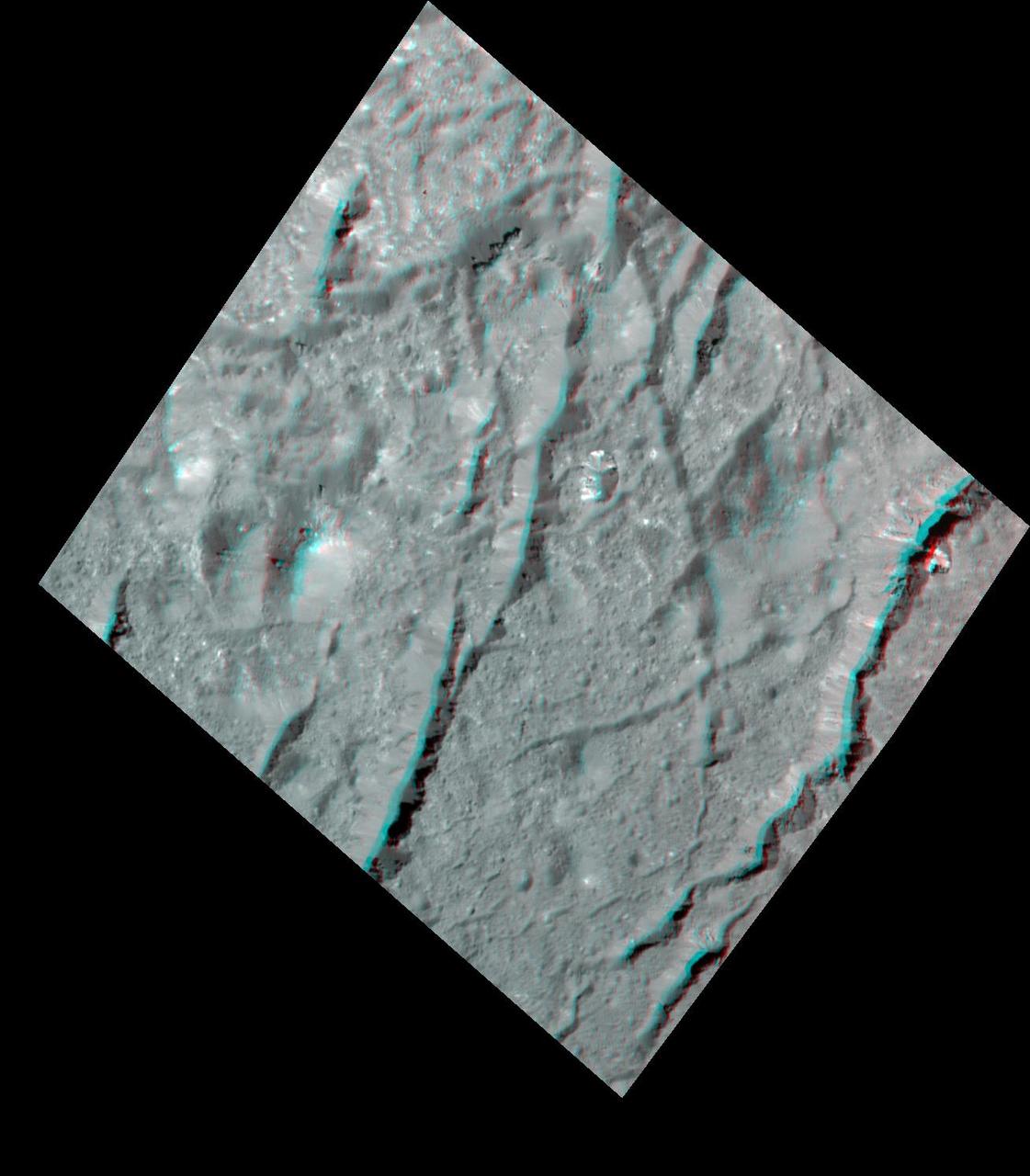
Scientists created this stereo view, called an anaglyph, with two images of the same part of Ceres's surface taken by Dawn on different orbits and from different viewing angles. The images were artificially colored and combined so that when viewed through glasses with a red filter on the left and blue on the right, they provide a 3-D view.  The images used in this anaglyph were obtained by NASA's Dawn spacecraft from an altitude of about 21 miles (34 kilometers).  The center of this picture is located at about 20.4 degrees north latitude and 239.9 degrees east longitude.  https://photojournal.jpl.nasa.gov/catalog/PIA22863
Bright and Dark Pattern on Occator Crater's Floor (3-D)
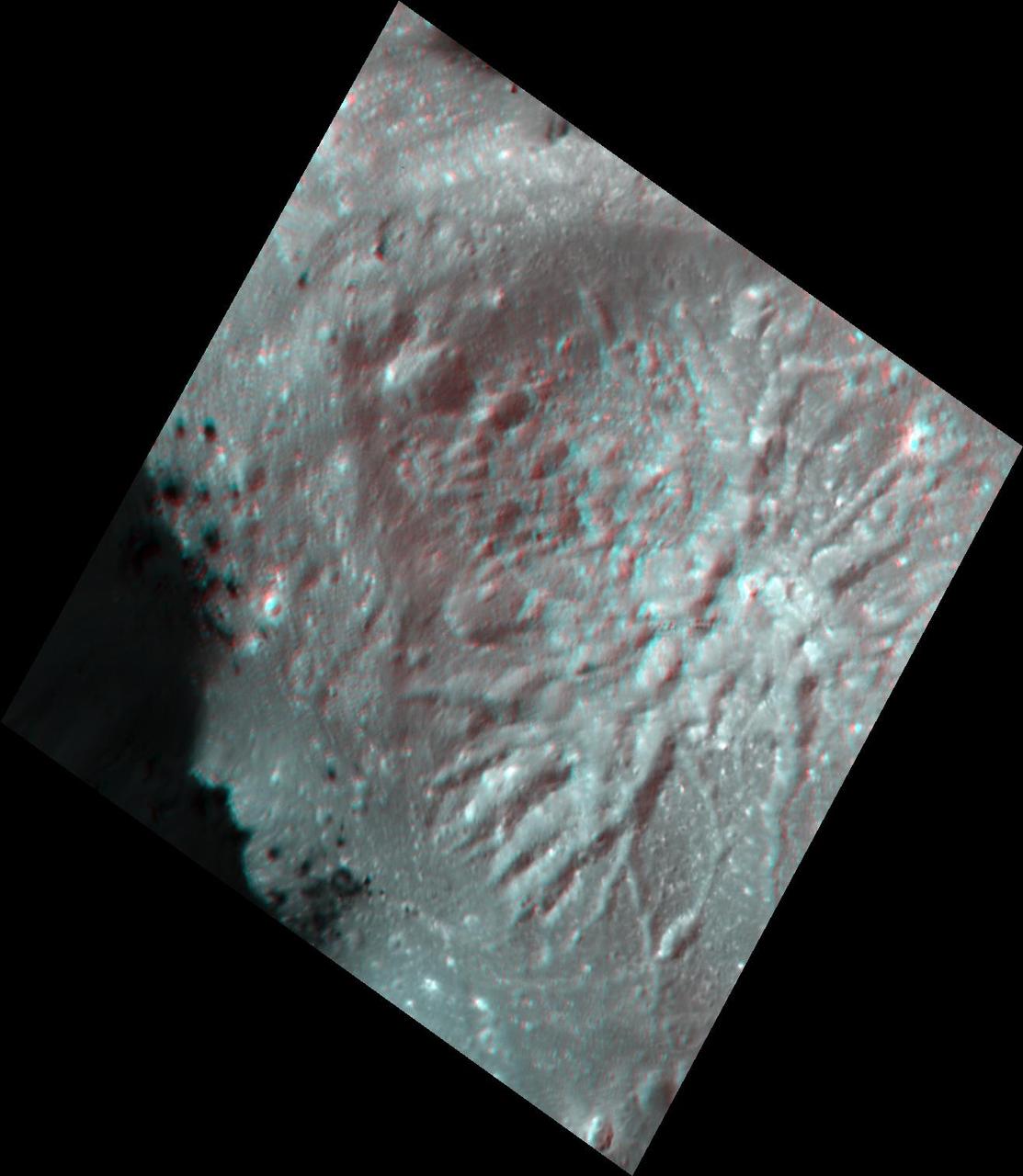
Scientists created this stereo view, called an anaglyph, with two images of the same part of Ceres's surface taken by Dawn on different orbits and from different viewing angles. The images were artificially colored and combined so that when viewed through glasses with a red filter on the left and blue on the right, they provide a 3-D view.  The images used in this anaglyph were obtained by NASA's Dawn spacecraft from an altitude of about 38 miles (61 kilometers).  The center of this image is located at about 22.3 degrees north latitude and 240.3 degrees east longitude.  https://photojournal.jpl.nasa.gov/catalog/PIA22865
Lava Flows on the Floor of Occator Crater (3-D)
Scientists created this stereo view, called an anaglyph, with two images of the same part of Ceres's surface taken by Dawn on different orbits and from different viewing angles. The images were artificially colored and combined so that when viewed through glasses with a red filter on the left and blue on the right, they provide a 3-D view.  The images used for this anaglyph were obtained by NASA's Dawn spacecraft from an altitude of about 21 miles (34 kilometers).  The center of this image is located at about 19.6 degrees north latitude and 239.5 degrees east longitude.  https://photojournal.jpl.nasa.gov/catalog/PIA22866
Cerealia Facula Pit and Dome in 3-D