
During Underway Recovery Test 6, Kennedy Space Center's NASA Recovery Team spent a week aboard the USS Anchorage where they and the U.S. Navy tested procedures and ground support equipment to improve recovery procedures and hardware ahead of Orion's next flight, Exploration Mission-1, when it splashes down in the Pacific Ocean. The Orion test article sits inside the well deck of the USS Anchorage after a successful recovery test.
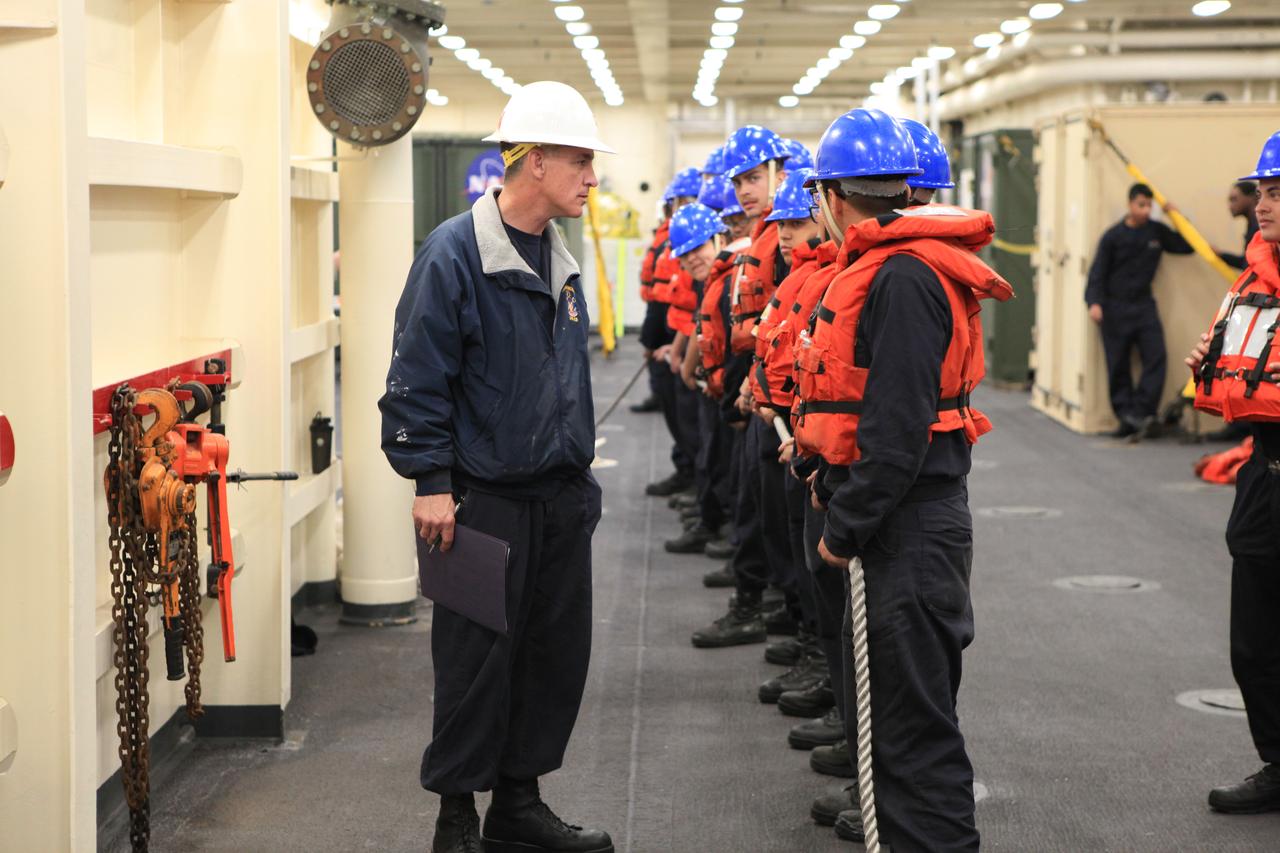
Chief Warrant Officer Ferrari from the USS Anchorage inspects the Deck Department as they prepare to bring in “Oscar,” a dummy used for man overboard drills. During Underway Recovery Test 6, the USS Anchorage’s man overboard drill gave Kennedy Space Center’s NASA Recovery Team a glimpse of one way an astronaut could be brought from a small boat onto the ship using a stretcher. Once the Orion capsule splashes down in the Pacific Ocean, astronauts can choose to stay in the capsule until it is pulled into the well deck of the Navy vessel, or have a diver retrieve them first and then get the capsule later.
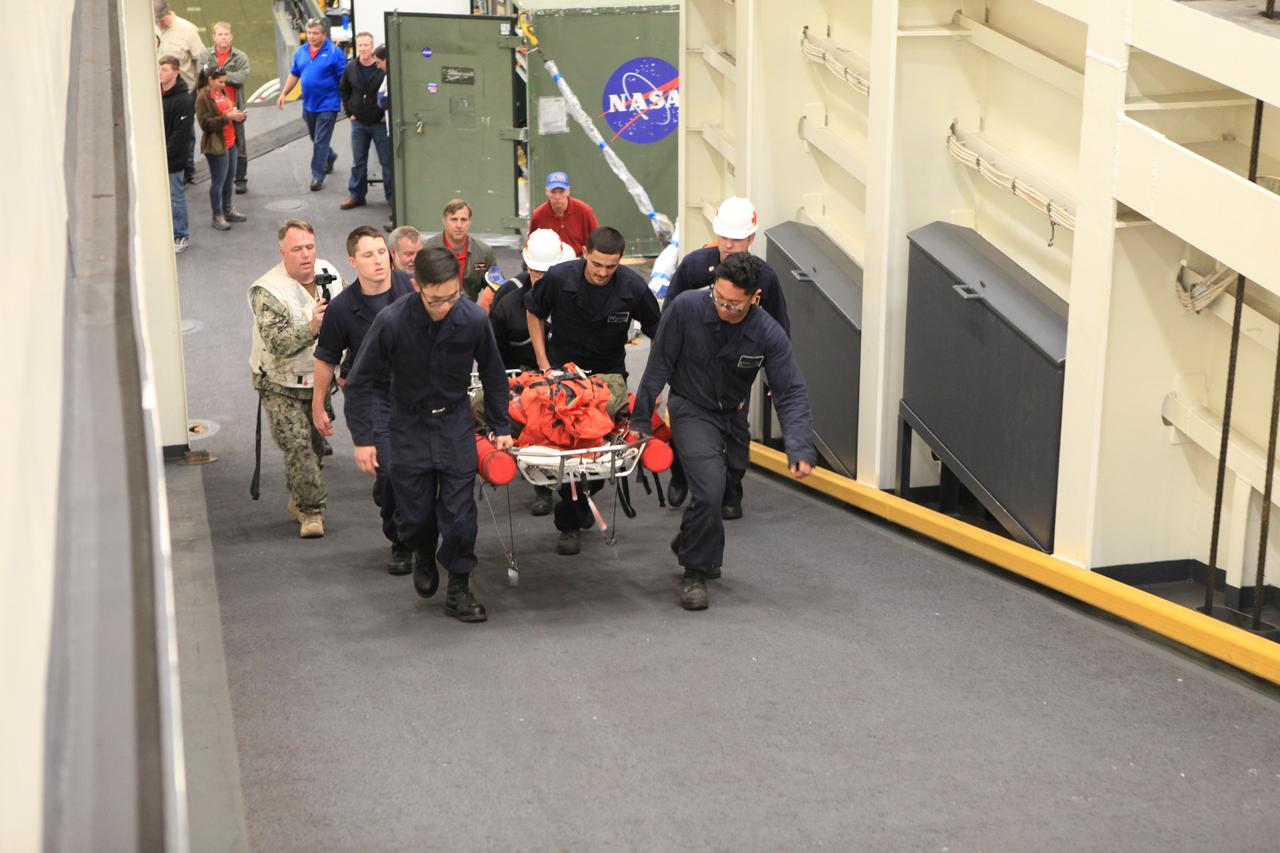
Sailors from the USS Anchorage simulate “Oscar,” a dummy used for man overboard drills, to the medical unit. During Underway Recovery Test 6, the USS Anchorage’s man overboard drill gave Kennedy Space Center’s NASA Recovery Team a glimpse of one way an astronaut could be brought from a small boat onto the ship using a stretcher. Once the Orion capsule splashes down in the Pacific Ocean, astronauts can choose to stay in the capsule until it is pulled into the well deck of the Navy vessel, or have a diver retrieve them in the open water and then get the capsule later.
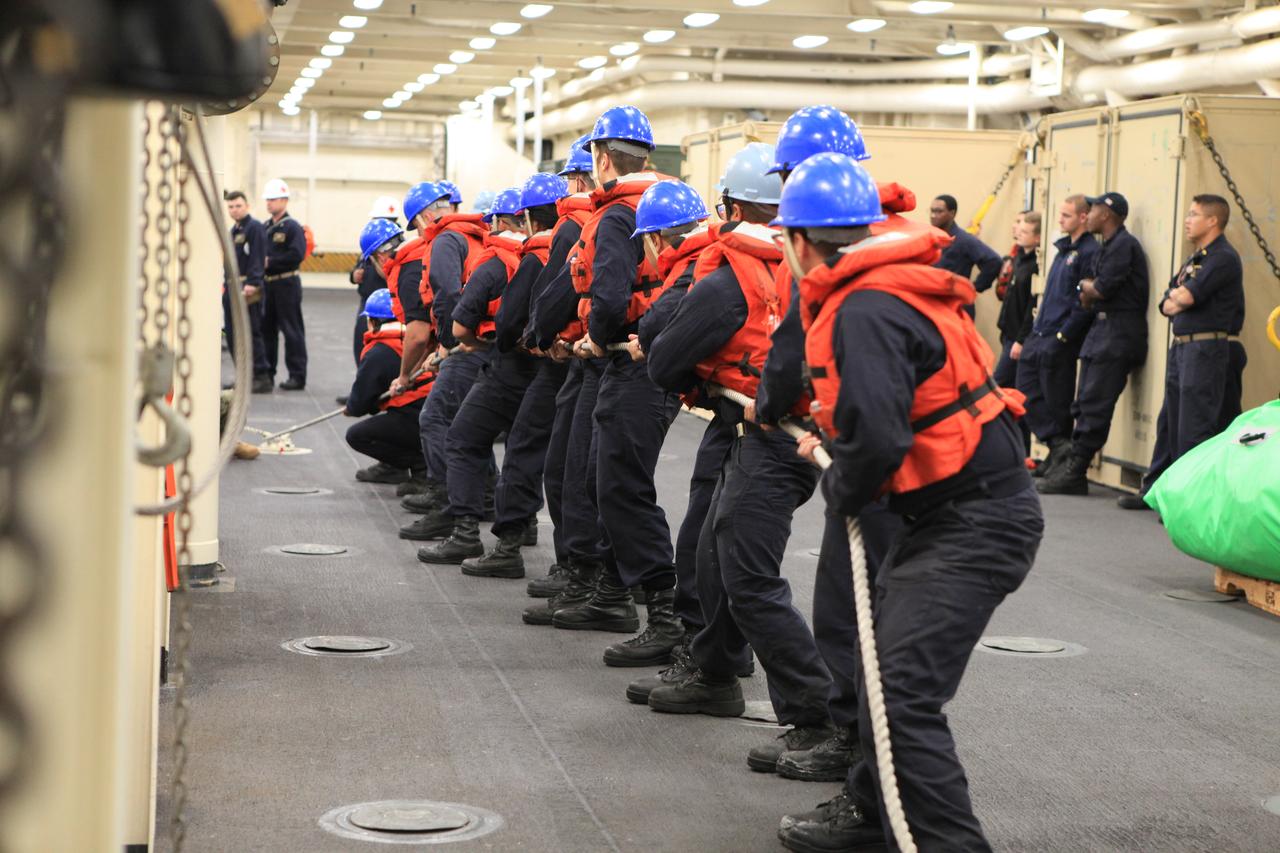
USS Anchorage’s Deck Department is heaving around the line as they bring up “Oscar,” a dummy used for man overboard drills. During Underway Recovery Test 6, the USS Anchorage’s man overboard drill gave Kennedy Space Center’s NASA Recovery Team a glimpse of one way an astronaut could be brought from a small boat onto the ship using a stretcher. Once the Orion capsule splashes down in the Pacific Ocean, astronauts can choose to stay in the capsule until it is pulled into the well deck of the Navy vessel, or have a diver retrieve them first and then get the capsule later.
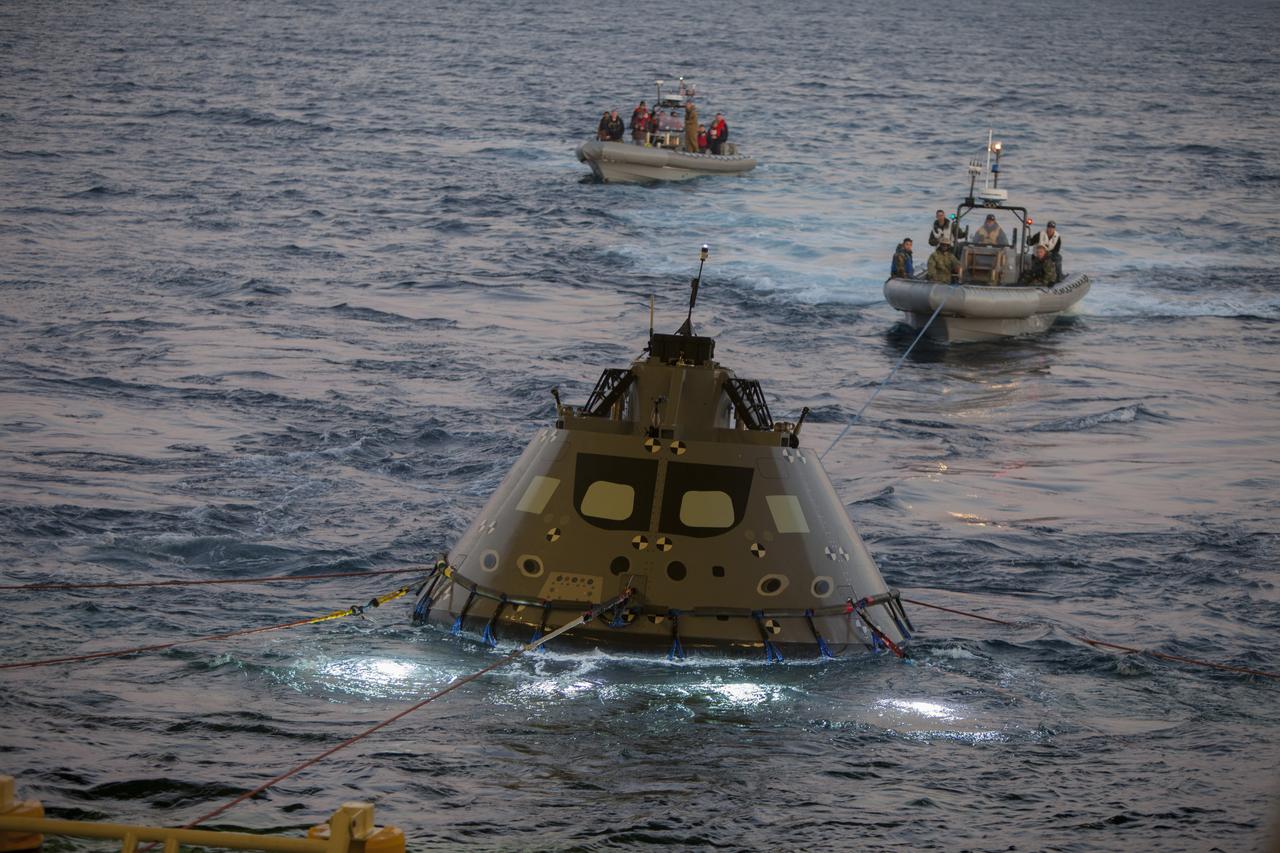
During Underway Recovery Test 6, Kennedy Space Center's NASA Recovery Team spent a week aboard the USS Anchorage where they and the U.S. Navy tested procedures and ground support equipment to improve recovery procedures and hardware ahead of Orion's next flight, Exploration Mission-1, when it splashes down in the Pacific Ocean.
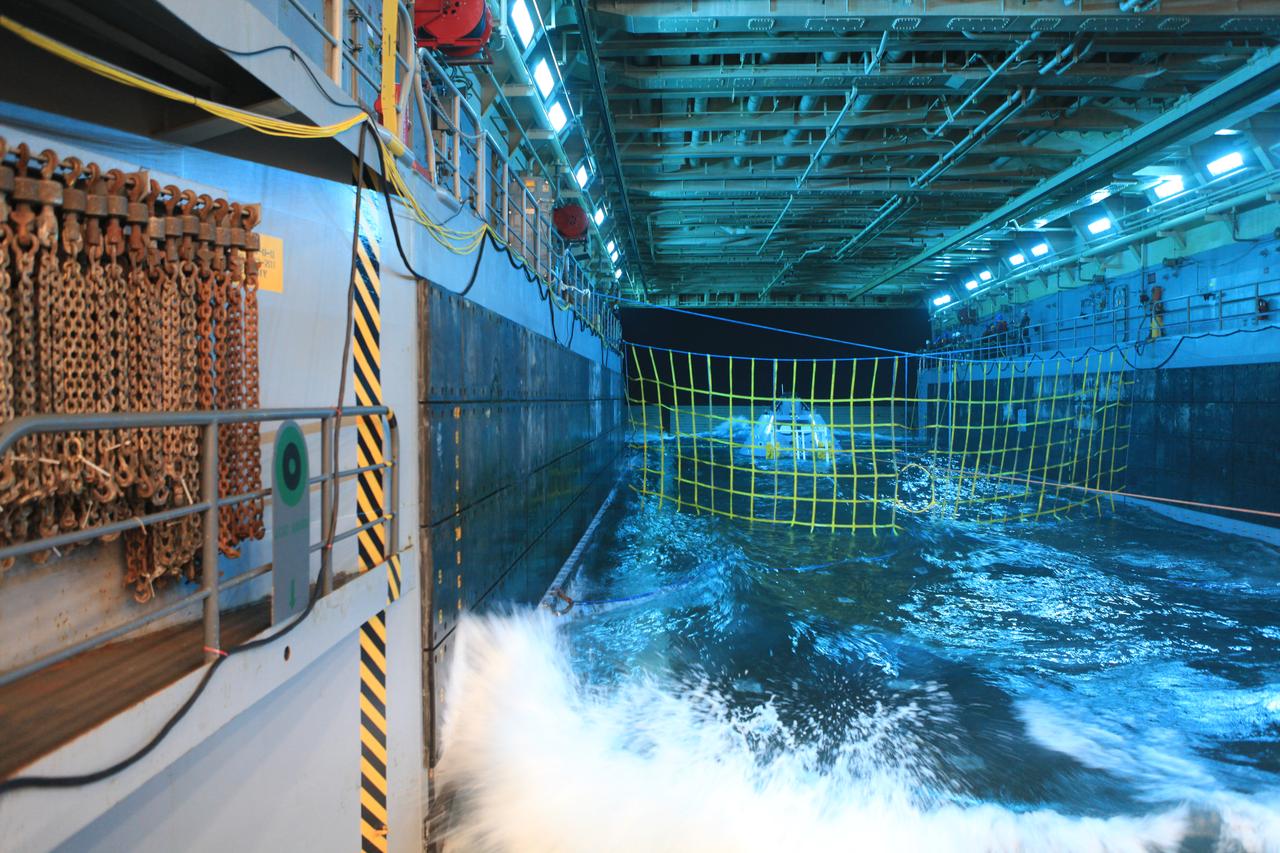
A test article of Orion floats in 6-feet of water in the well deck of the USS Anchorage. The NASA Recovery Team from Kennedy Space Center is working with the U.S. Navy to improve recovery procedures and hardware ahead of Orion’s next flight, Exploration Mission-1, when it splashes down in the Pacific Ocean.
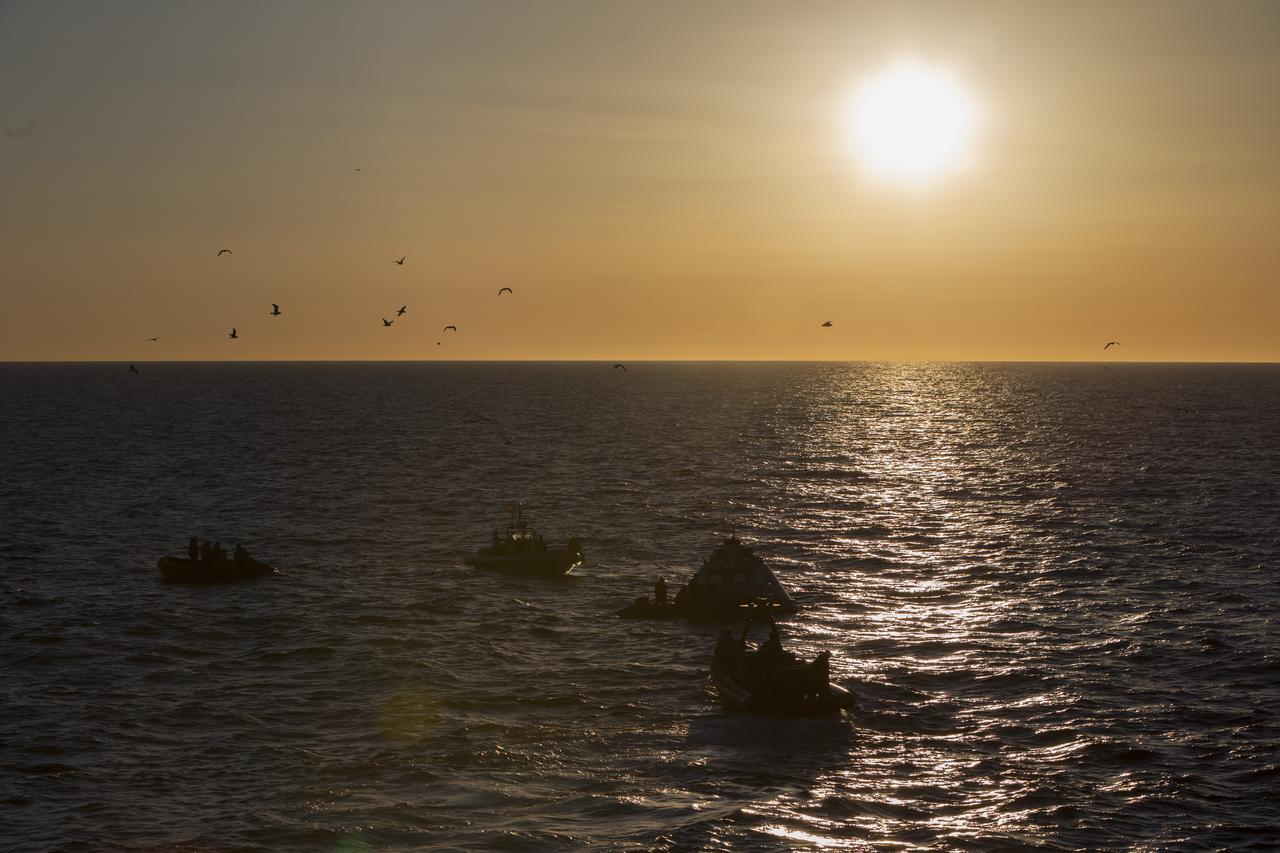
During Underway Recovery Test 6, Kennedy Space Center's NASA Recovery Team spent a week aboard the USS Anchorage where they and the U.S. Navy tested procedures and ground support equipment to improve recovery procedures and hardware ahead of Orion's next flight, Exploration Mission-1, when it splashes down in the Pacific Ocean.
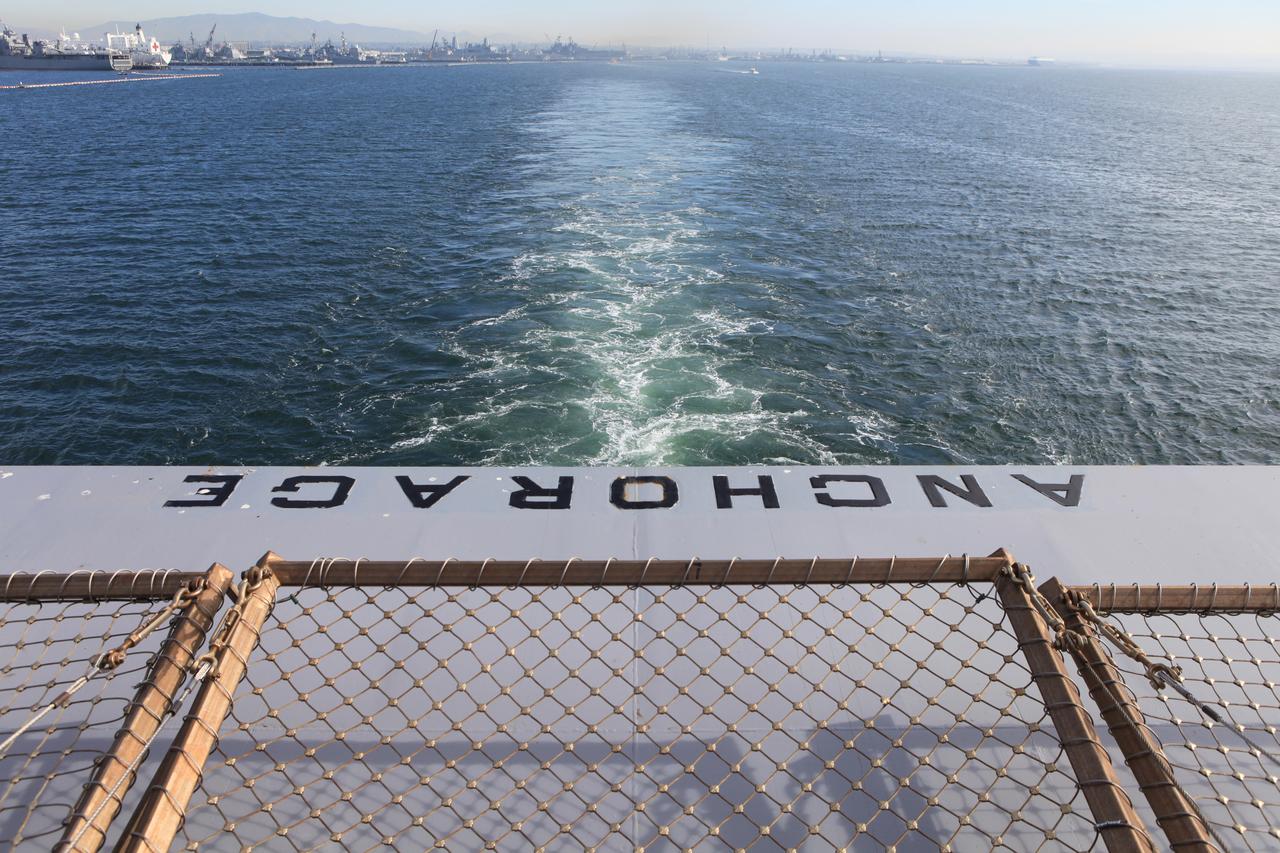
The USS Anchorage leaves Naval Base San Diego for a multi-day Underway Recovery Test with NASA. The NASA Recovery Team from Kennedy Space Center and the U.S. Navy are working together to hone recovery procedures and hardware ahead of Orion’s next flight, Exploration Mission-1, when it splashes down in the Pacific Ocean.
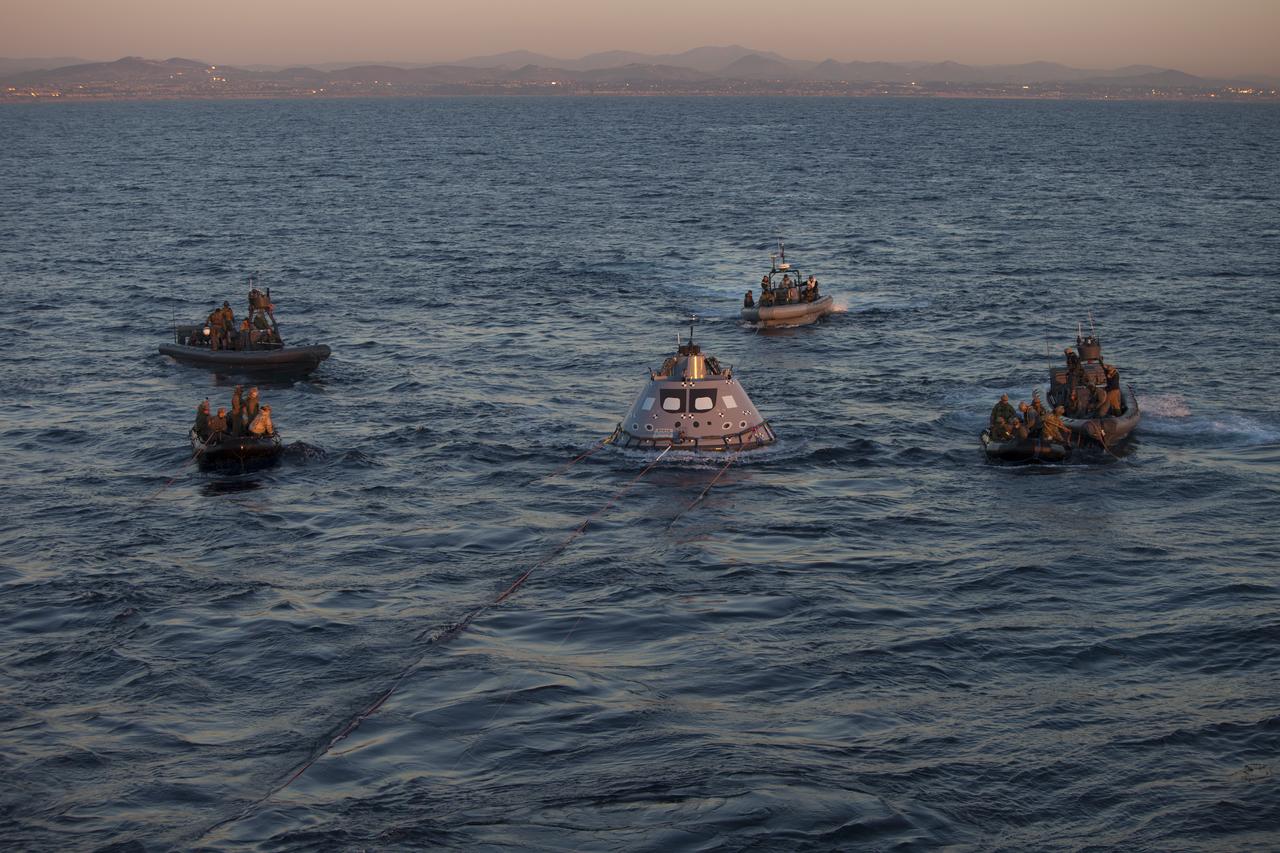
During Underway Recovery Test 6, Kennedy Space Center's NASA Recovery Team spent a week aboard the USS Anchorage where they and the U.S. Navy tested procedures and ground support equipment to improve recovery procedures and hardware ahead of Orion's next flight, Exploration Mission-1, when it splashes down in the Pacific Ocean.
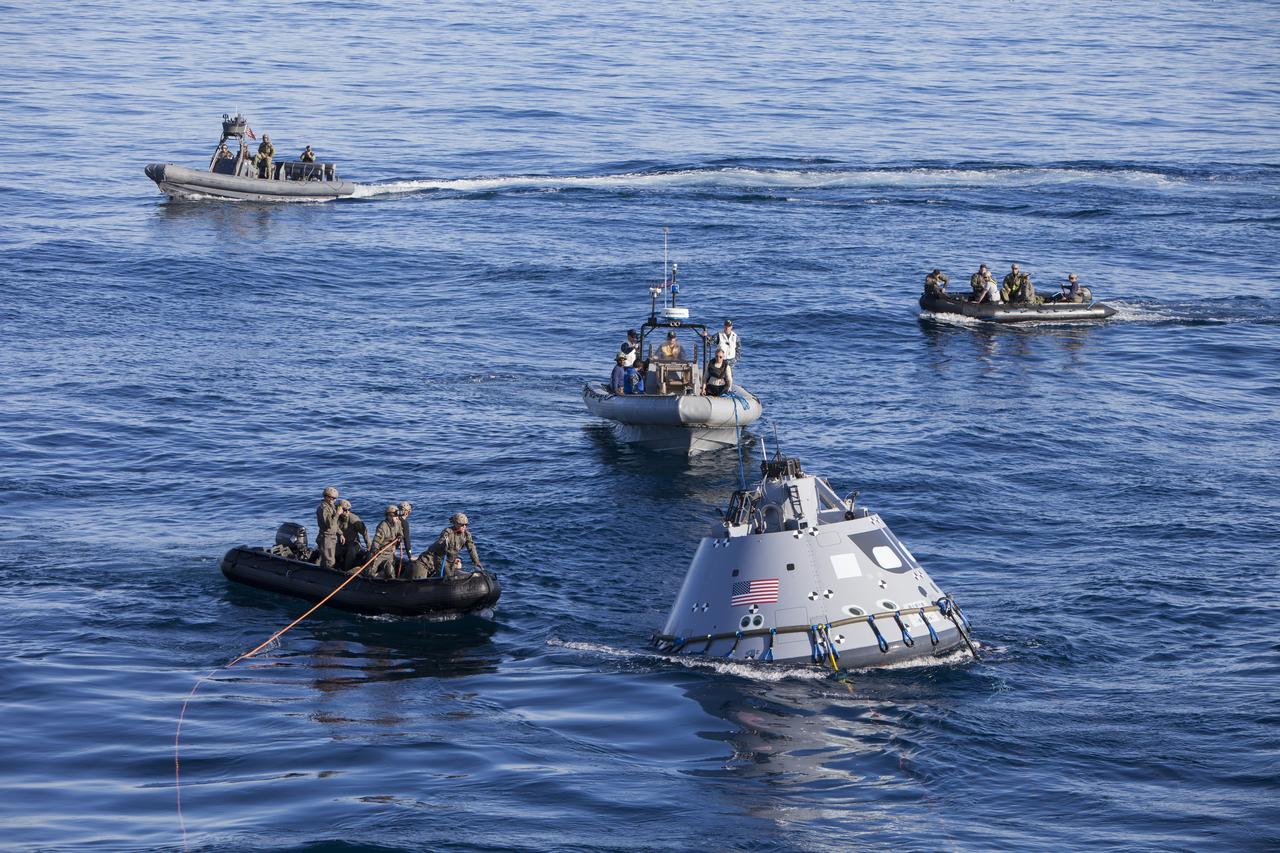
Teams from the U.S. Navy’s Explosive Ordnance Disposal Mobile Unit 3, the Special Boat Unit, the USS Anchorage and the USS New Orleans work together to connect tending lines to the Orion test article off the coast of San Diego. Kennedy Space Center’s NASA Recovery Team works with the U.S. Navy to improve recovery procedures and hardware ahead of Orion's next flight, Exploration Mission-1, when it splashes down in the Pacific Ocean.
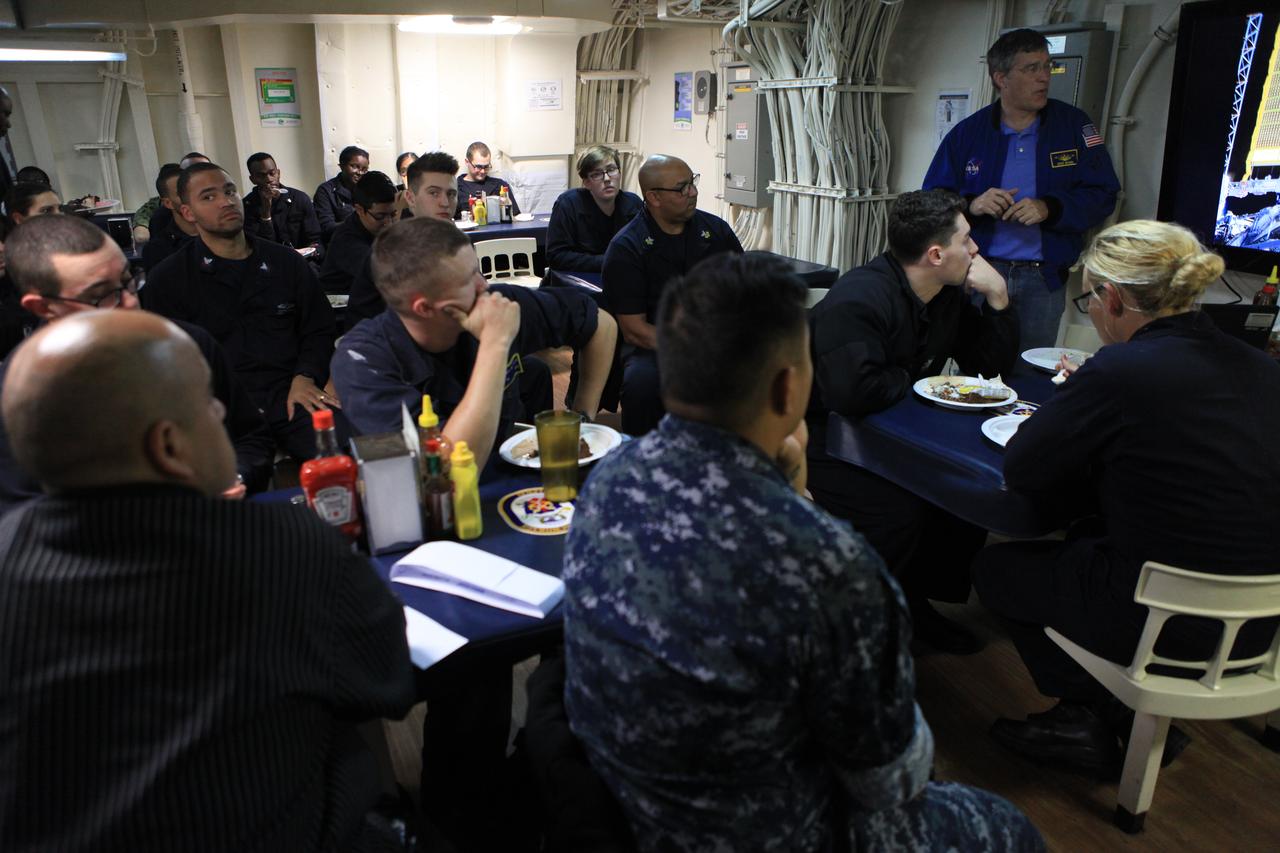
During Underway Recovery Test 6, NASA astronaut Stephen Bowen talks with sailors about the correlations between his Navy and NASA experiences. Bowen is aboard USS Anchorage as Kennedy Space Center’s NASA Recovery Team works with the U.S. Navy to improve recovery procedures and hardware ahead of Orion's next flight, Exploration Mission-1, when it splashes down in the Pacific Ocean.
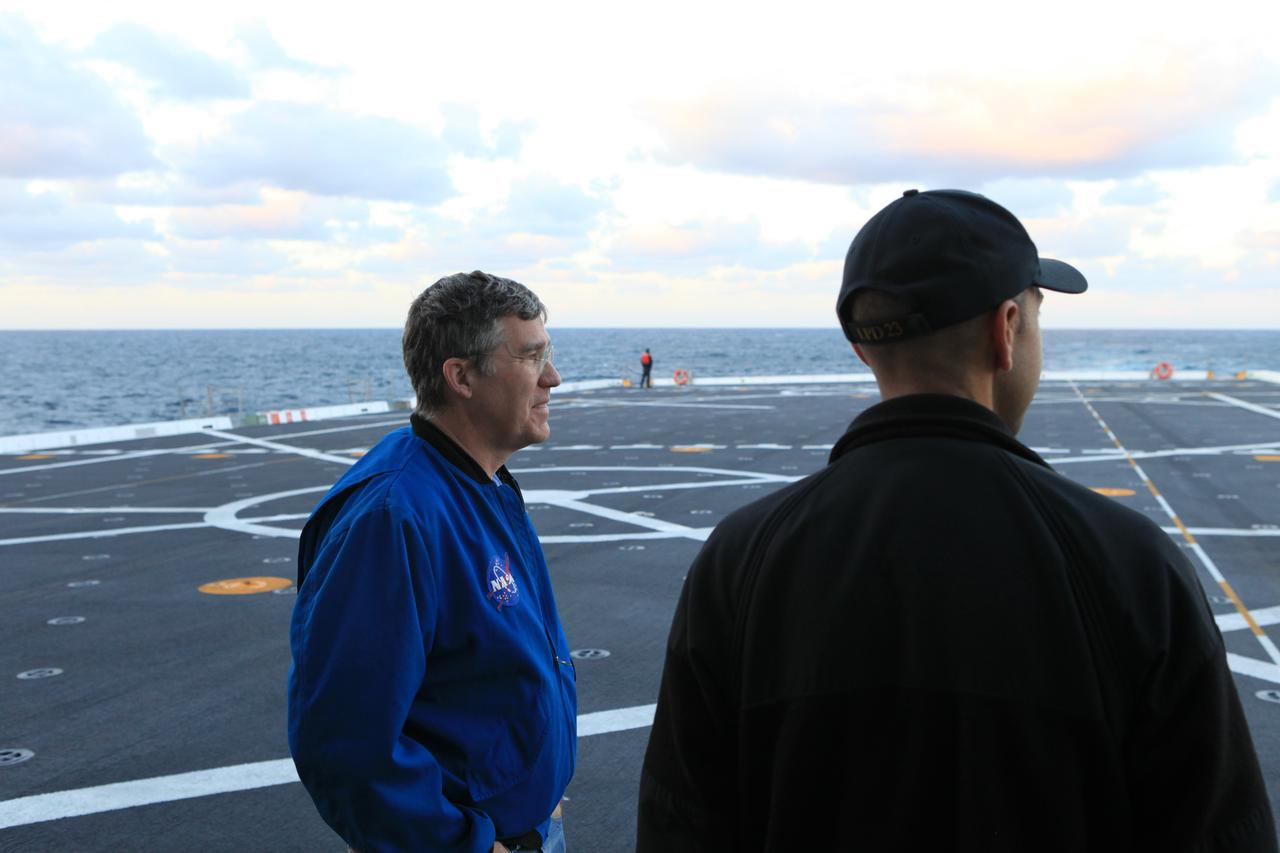
Astronaut Stephen Bowen checks out the choppy sea conditions as part of Underway Recovery Test 6 aboard the USS Anchorage. Bowen is an observer of the testing—giving an astronaut’s perspective to Kennedy Space Center’s NASA Recovery Team. The purpose of testing is to perfect recovery efforts to minimize impact to astronauts like Bowen once they have splashed down in the Pacific Ocean inside the Orion capsule.
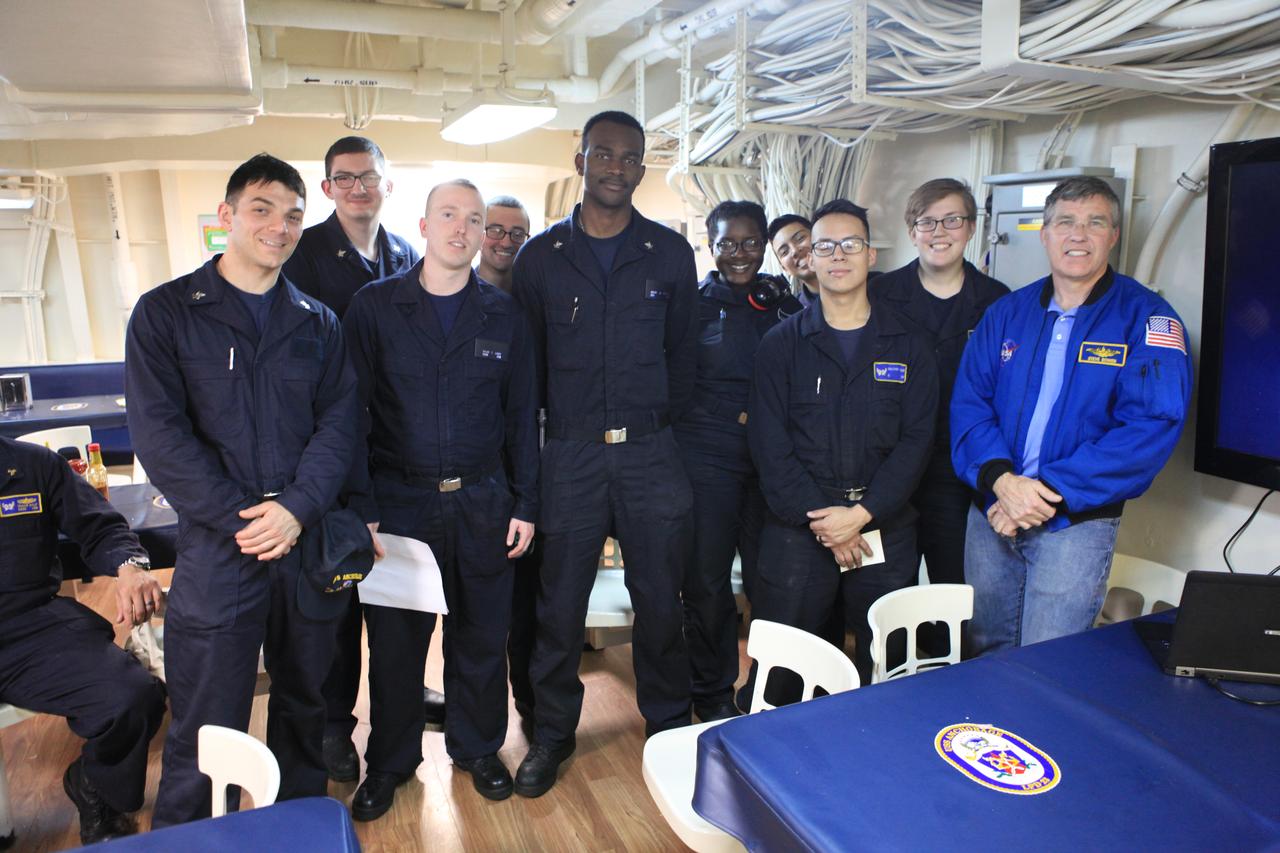
During Underway Recovery Test 6, NASA astronaut Stephen Bowen talks with sailors about the correlations between his Navy and NASA experiences. Bowen is aboard USS Anchorage as Kennedy Space Center’s NASA Recovery Team works with the U.S. Navy to improve recovery procedures and hardware ahead of Orion's next flight, Exploration Mission-1, when it splashes down in the Pacific Ocean.
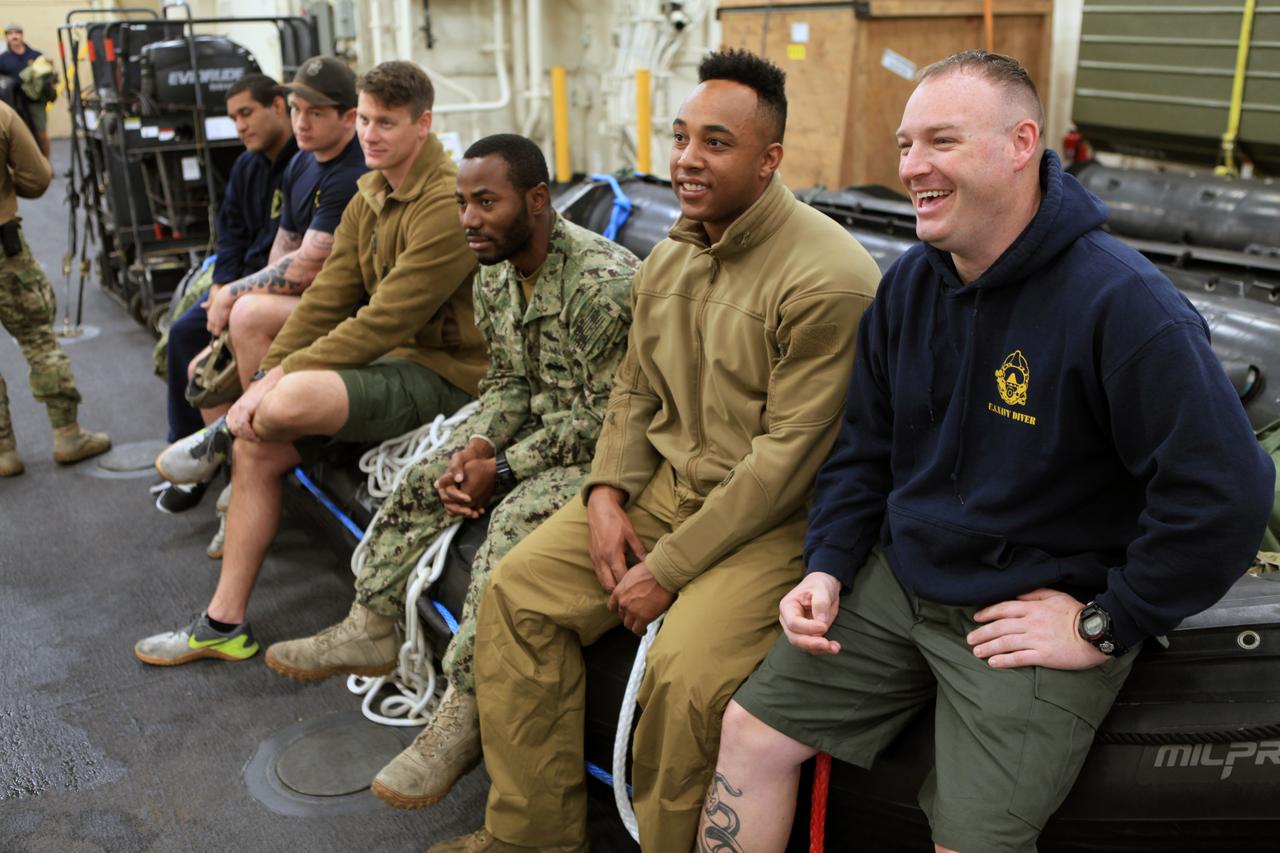
Navy diver Michael Tuft (far right) and his team wait to be called for their part in Underway Recovery Test 6 aboard the USS Anchorage. The divers will be the first people astronauts aboard the Orion spacecraft see when they splash down in the Pacific Ocean after Exploration Mission-2. The testing with the NASA Recovery Team and the U.S. Navy will provide important data that is being used to improve recovery procedures and hardware ahead of Orion's next flight, Exploration Mission-1, when it splashes down in the Pacific Ocean.
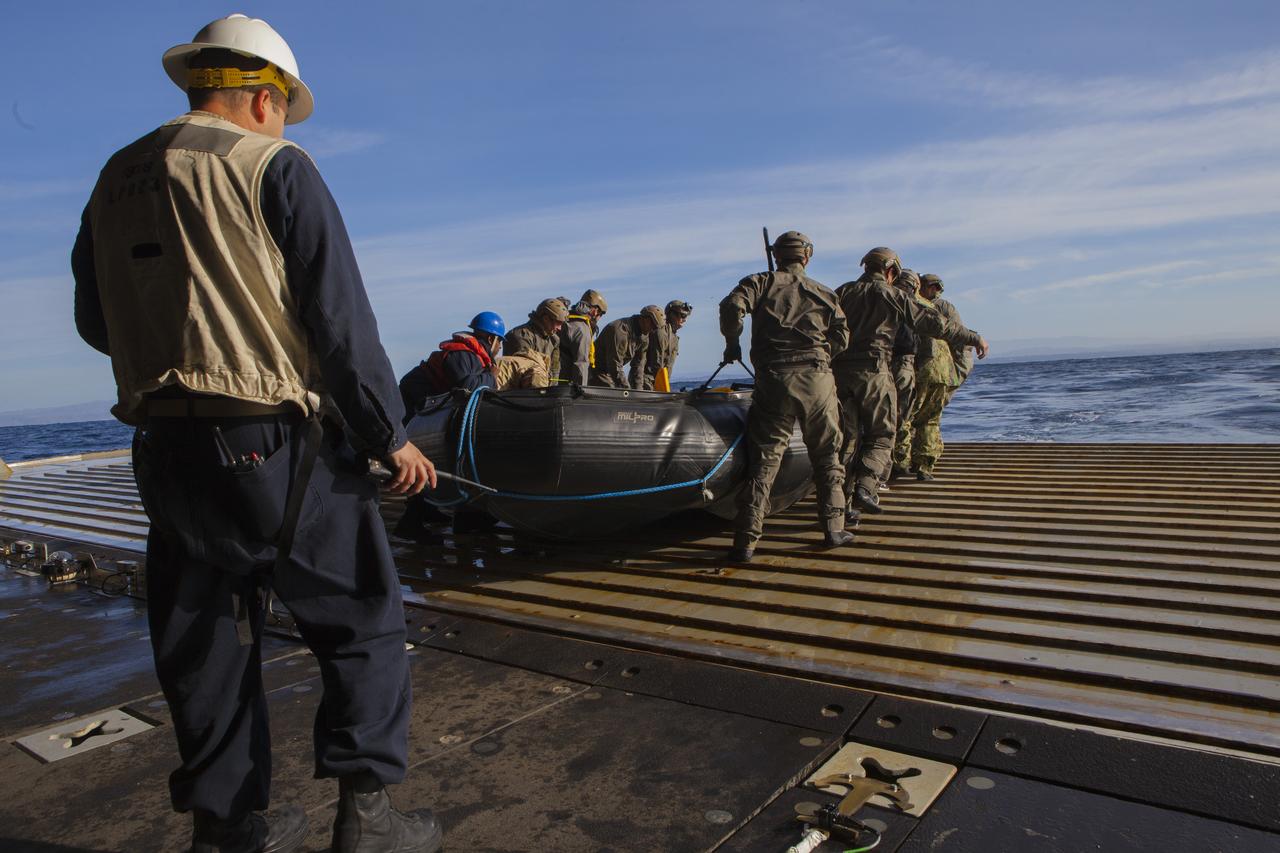
Chief Warrant Officer Ferrari from the USS Anchorage watches over members of the U.S. Navy’s Mobile Diving Salvage Co. 3-1 as they set off to sea to recover the Orion test capsule during Underway Recovery Test 6 off the coast of San Diego. Kennedy Space Center’s NASA Recovery Team works with the U.S. Navy to improve recovery procedures and hardware ahead of Orion's next flight, Exploration Mission-1, when it splashes down in the Pacific Ocean.
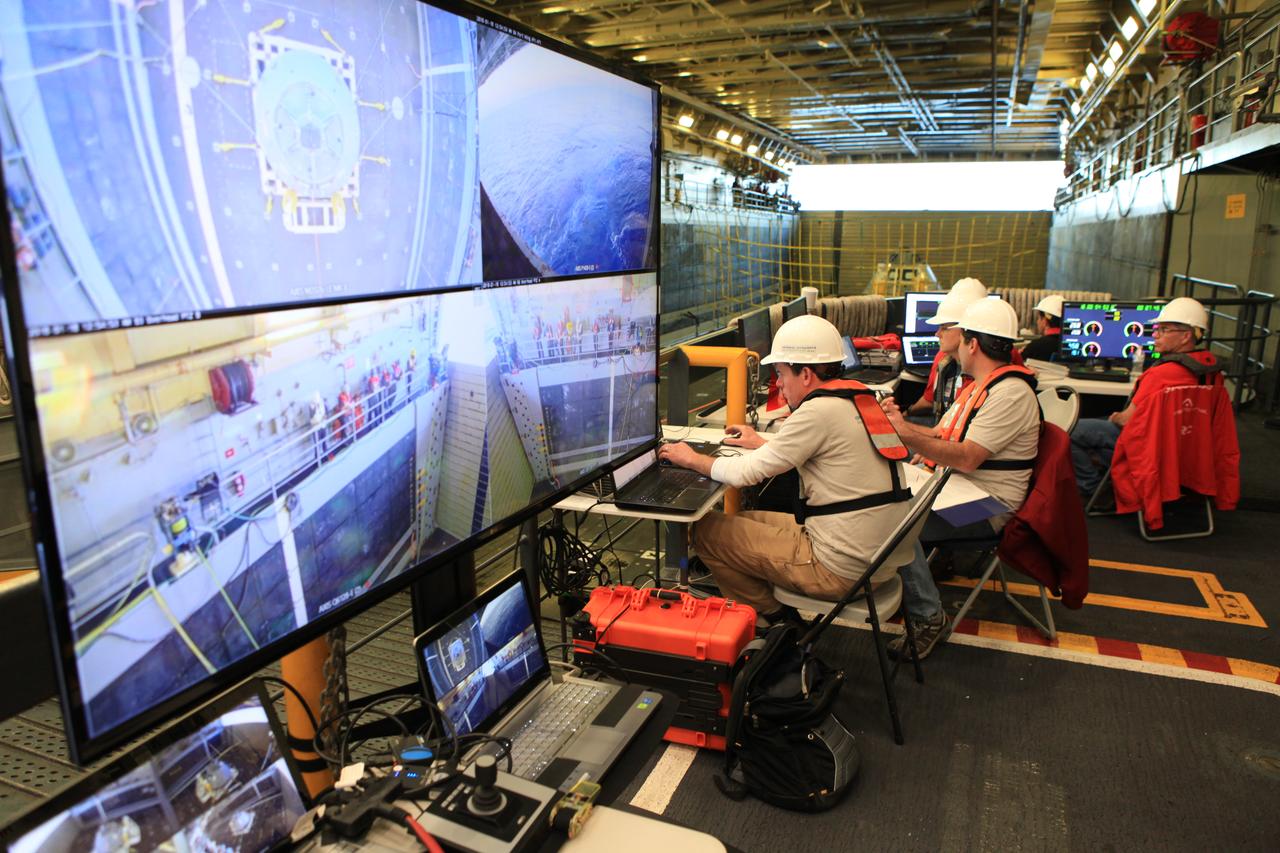
Members of the Wave Monitoring System check their data during the Underway Recovery Test 6, or URT-6, aboard the USS Anchorage. The testing with Kennedy Space Center’s NASA Recovery Team and the U.S. Navy will provide important data that is being used to improve recovery procedures and hardware ahead of Orion’s next flight, Exploration Mission-1, when it splashes down in the Pacific Ocean.

The USS Anchorage sails toward sunrise while Kennedy Space Center’s NASA Recovery Team prepares for another day of testing as part of Underway Recovery Test 6. The testing with the NASA Recovery Team and the U.S. Navy will provide important data that is being used to improve recovery procedures and hardware ahead of Orion's next flight, Exploration Mission-1, when it splashes down in the Pacific Ocean.
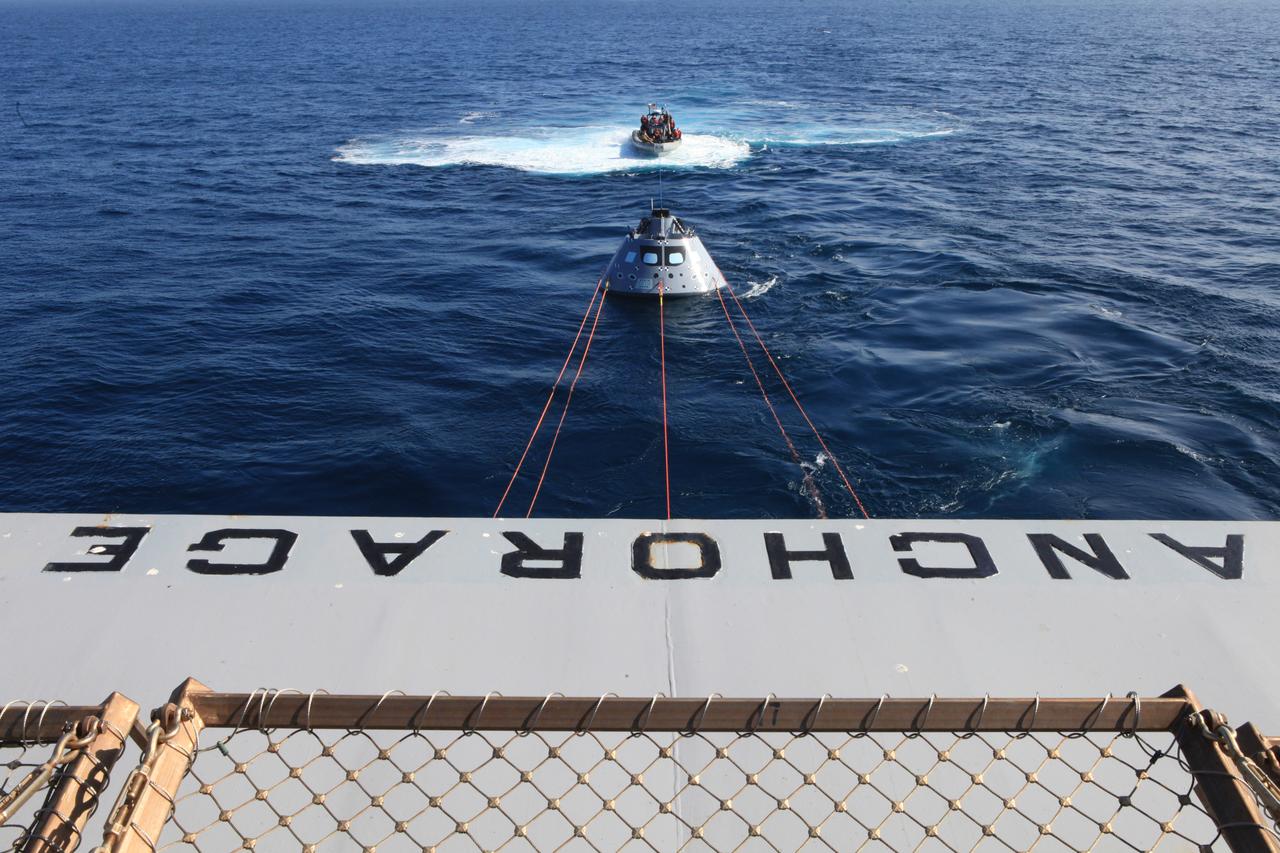
Off the rear of the USS Anchorage, the Orion test article is pulled in by a winch line at the rear of the USS Anchorage’s well deck that brings the capsule into the ship, along with four manned LLAMAs (Line Load Attenuation Mechanism Assembly) that control the capsule’s side-to-side movement and a tending line attached to a rigid hull inflatable boat for controlling Orion’s movement behind the ship. The Underway Recovery Test 6 (URT-6) is spearheaded by Kennedy Space Center's NASA Recovery Team. In partnership with the U.S. Navy, the testing will provide important data that is being used to improve recovery procedures and hardware ahead of Orion's next flight, Exploration Mission-1, when it splashes down in the Pacific Ocean.
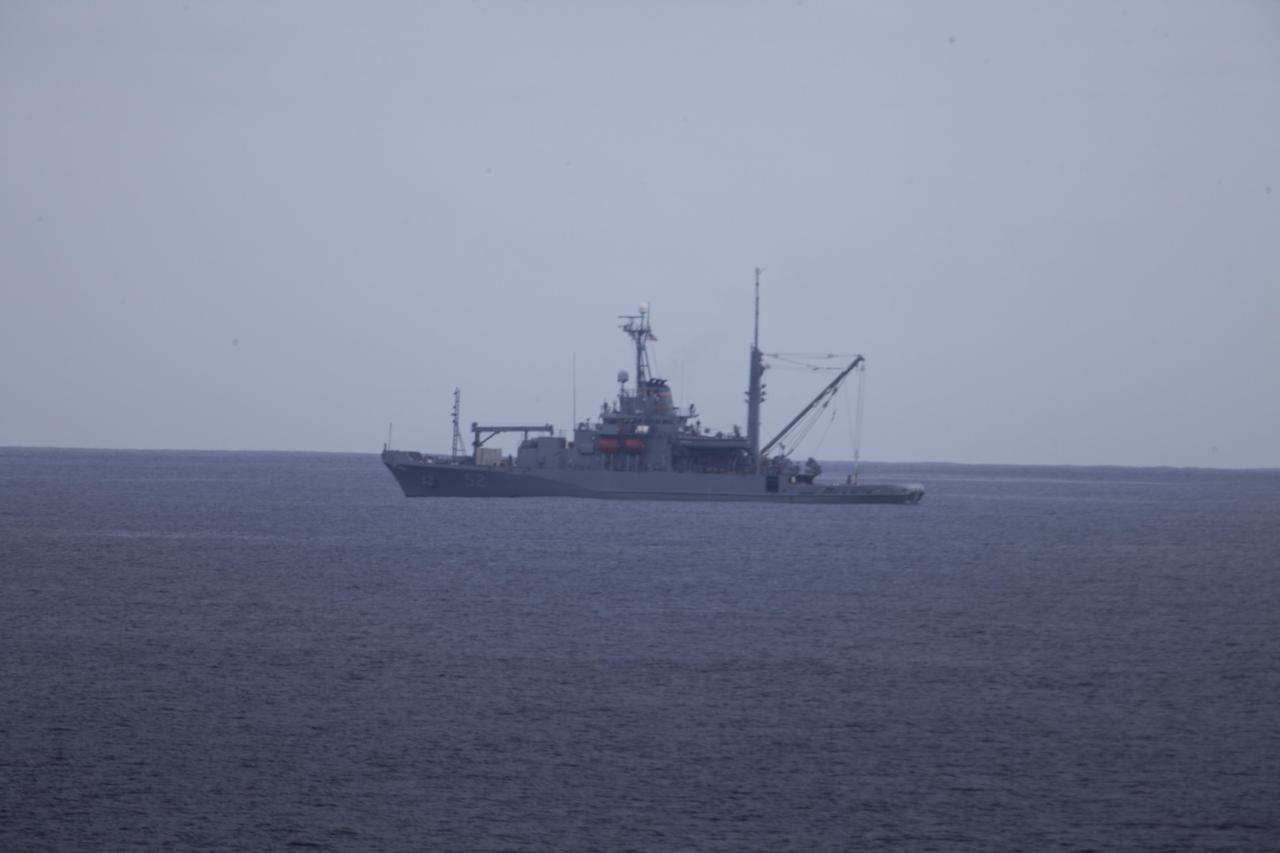
On the third day of preparations for recovery of Orion after its splashdown in the Pacific Ocean, the USNS Salvor is in the Pacific Ocean, nearby the USS Anchorage, about 600 miles off the coast of Baja, California. The Salvor will be used to recover Orion in the event that the spacecraft cannot be recovered using the well deck of the USS Anchorage. NASA, Lockheed Martin and U.S. Navy personnel are preparing for recovery of the crew module, forward bay cover and parachutes after the spacecraft's return from space and splashdown in the Pacific Ocean. The Ground Systems Development and Operations Program is leading the recovery efforts.
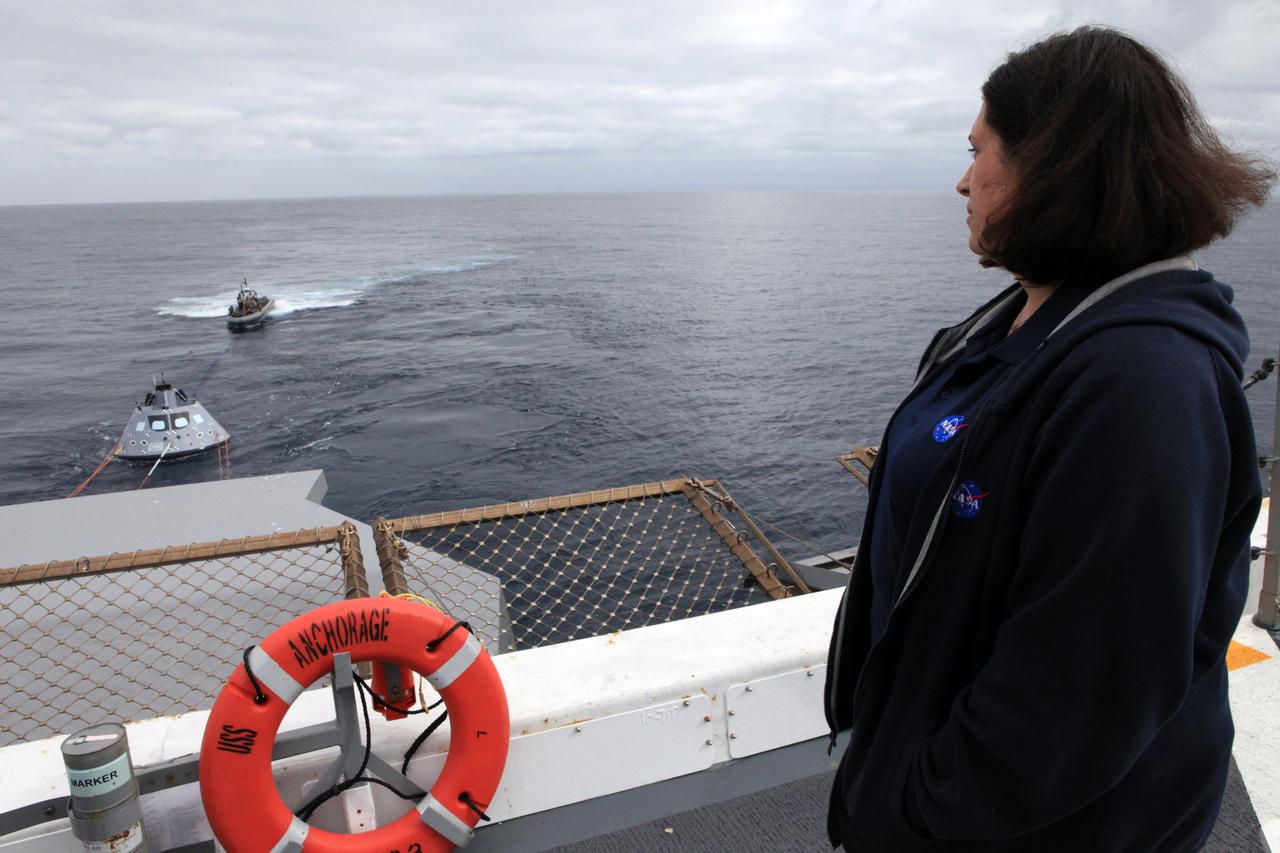
NASA Recovery Director Melissa Jones watches part of Underway Recovery Test 6, from the flight deck of the USS Anchorage. During this portion, the Orion test article is intentionally subjected to an increased sea state as the NASA Recovery Team works hard to keep control of the spacecraft. The testing with Kennedy Space Center's NASA Recovery Team and the U.S. Navy will provide important data that is being used to improve recovery procedures and hardware ahead of Orion's next flight, Exploration Mission-1, when it splashes down in the Pacific Ocean.

As part of Underway Recovery Test 6, the Orion test article is pulled in by a winch line at the rear of the USS Anchorage’s well deck that brings the capsule into the ship, along with four manned LLAMAs (Line Load Attenuation Mechanism Assembly) that control the capsule’s side-to-side movement and a tending line attached to a rigid hull inflatable boat for controlling Orion’s movement behind the ship. The testing with Kennedy Space Center's NASA Recovery Team and the U.S. Navy will provide important data that is being used to improve recovery procedures and hardware ahead of Orion's next flight, Exploration Mission-1, when it splashes down in the Pacific Ocean.
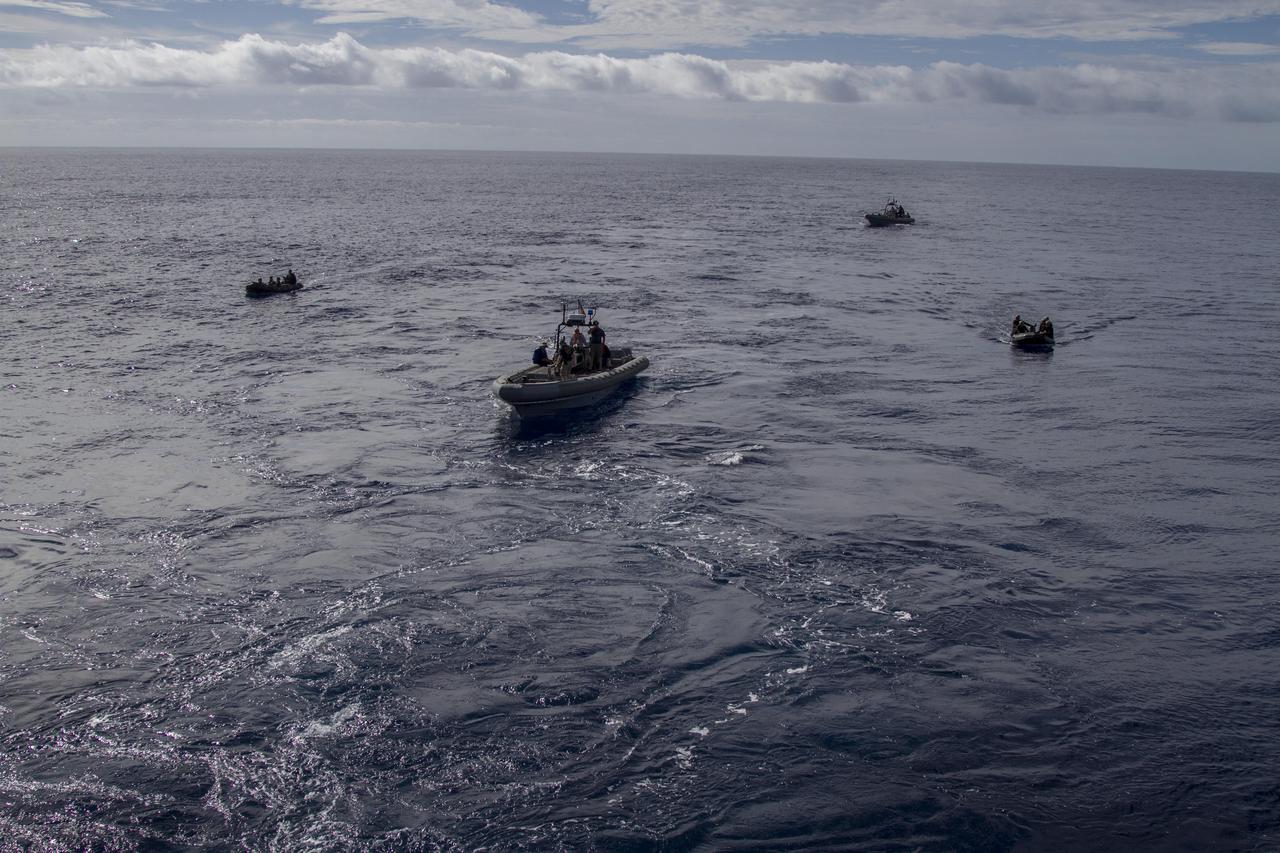
On the third day of preparations for recovery of Orion, U.S. Navy divers in two rigid hull inflatable boats and two Zodiac boats practice recovery procedures nearby the USS Anchorage in the Pacific Ocean about 600 miles off the coast of Baja, California. NASA, Lockheed Martin and U.S. Navy personnel are preparing for recovery of the Orion crew module, forward bay cover and parachutes after its return from space and splashdown in the Pacific Ocean. The Ground Systems Development and Operations Program is leading the recovery efforts.
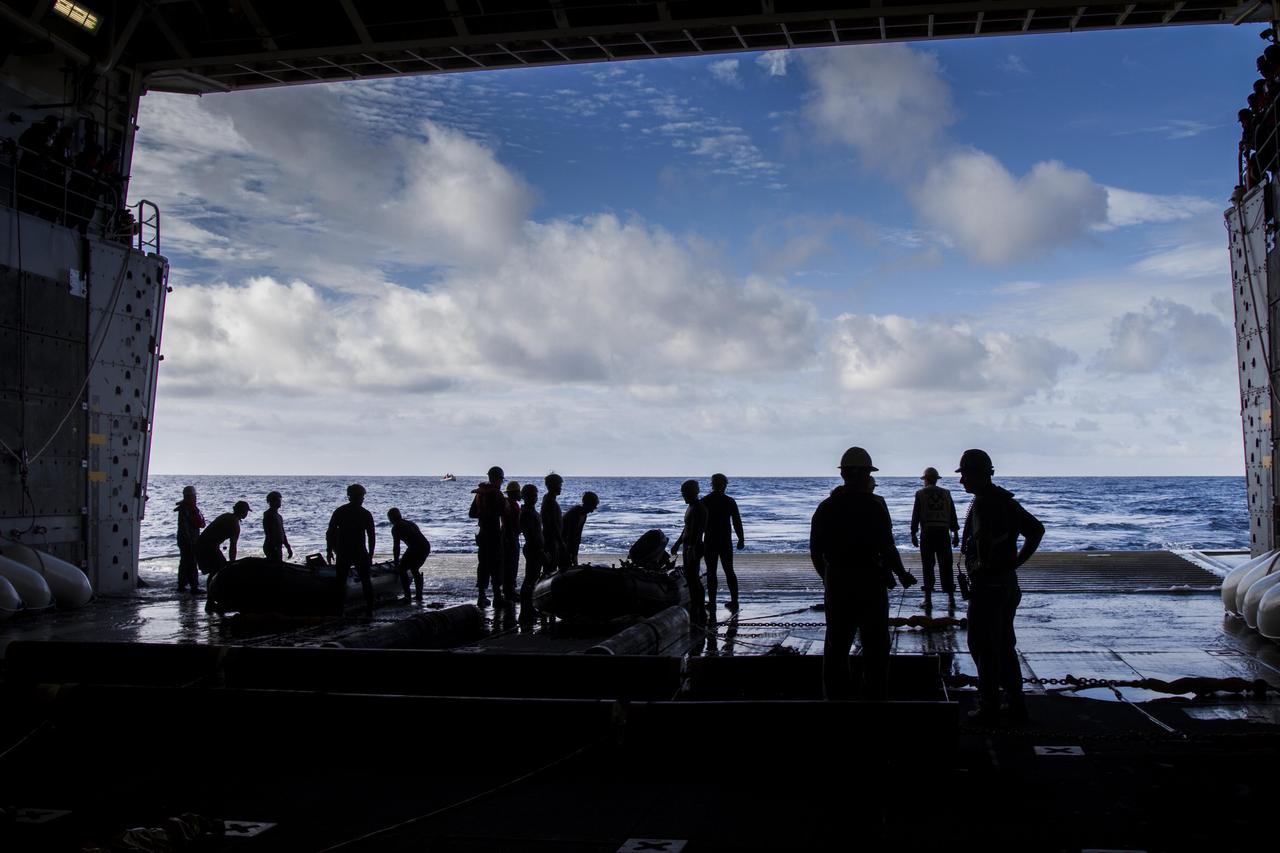
On the third day of preparations for recovery of Orion after its splashdown in the Pacific Ocean, U.S. Navy Divers prepare to embark from the well deck of the USS Anchorage in two rigid hull Zodiac boats about 600 miles off the coast of Baja, California. NASA, Lockheed Martin and U.S. Navy personnel are preparing for recovery of the crew module, forward bay cover and parachutes on its return from space and splashdown in the Pacific Ocean. The Ground Systems Development and Operations Program is leading the recovery efforts.
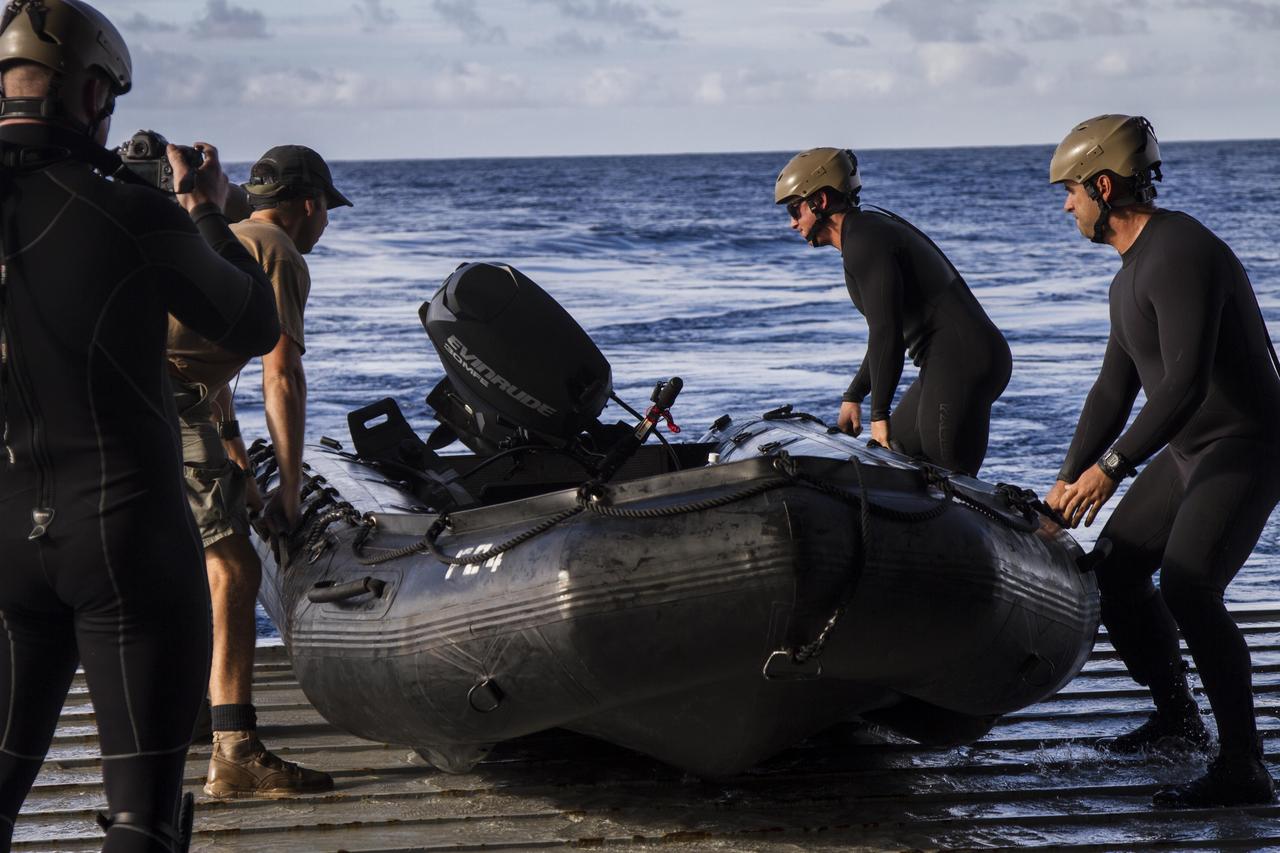
On the third day of preparations for recovery of Orion after its splashdown in the Pacific Ocean, U.S. Navy Divers prepare to embark from the well deck of the USS Anchorage in a rigid hull Zodiac boat about 600 miles off the coast of Baja, California. NASA, Lockheed Martin and U.S. Navy personnel are preparing for recovery of the crew module, forward bay cover and parachutes on its return from space and splashdown in the Pacific Ocean. The Ground Systems Development and Operations Program is leading the recovery efforts.
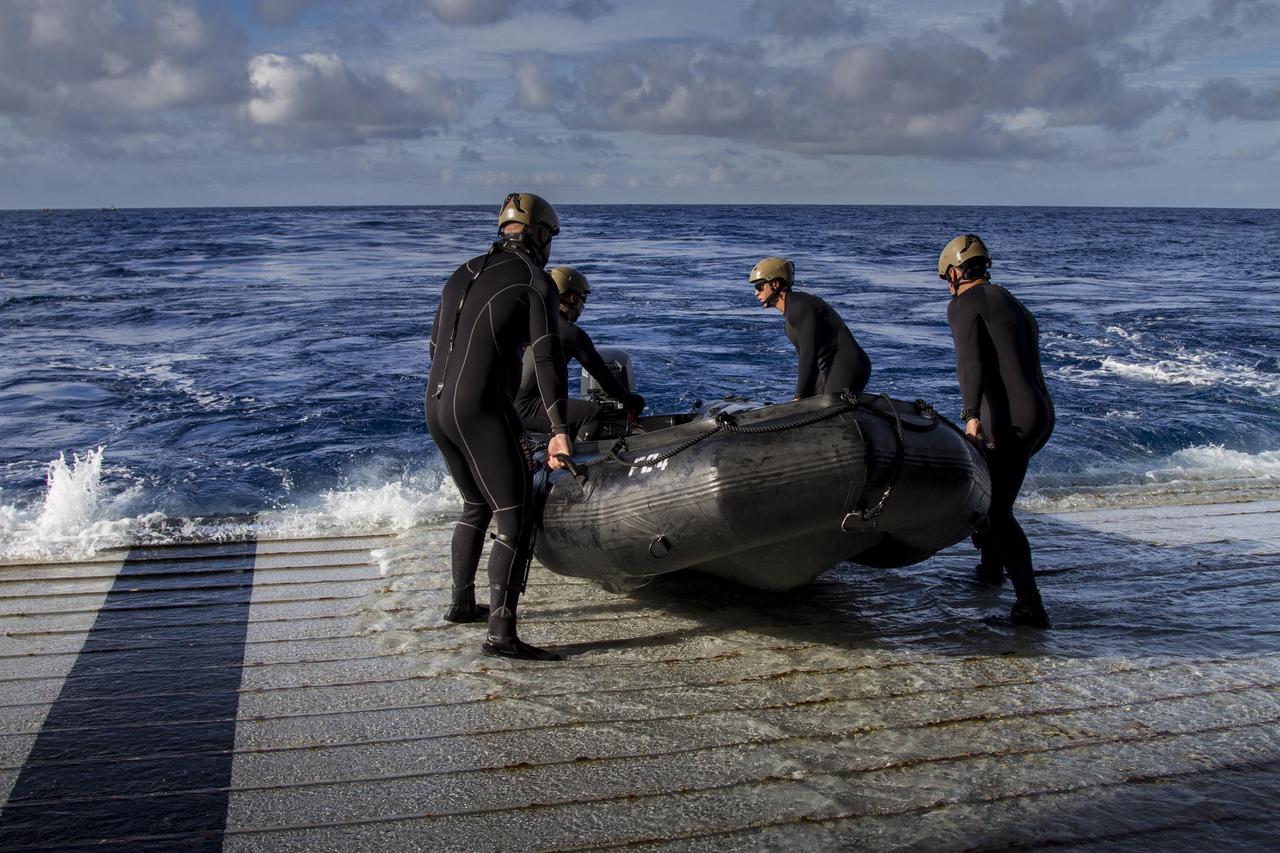
On the third day of preparations for recovery of Orion after its splashdown in the Pacific Ocean, U.S. Navy Divers prepare to embark from the well deck of the USS Anchorage in a rigid hull Zodiac boat about 600 miles off the coast of Baja, California. NASA, Lockheed Martin and U.S. Navy personnel are preparing for recovery of the crew module, forward bay cover and parachutes on its return from space and splashdown in the Pacific Ocean. The Ground Systems Development and Operations Program is leading the recovery efforts.
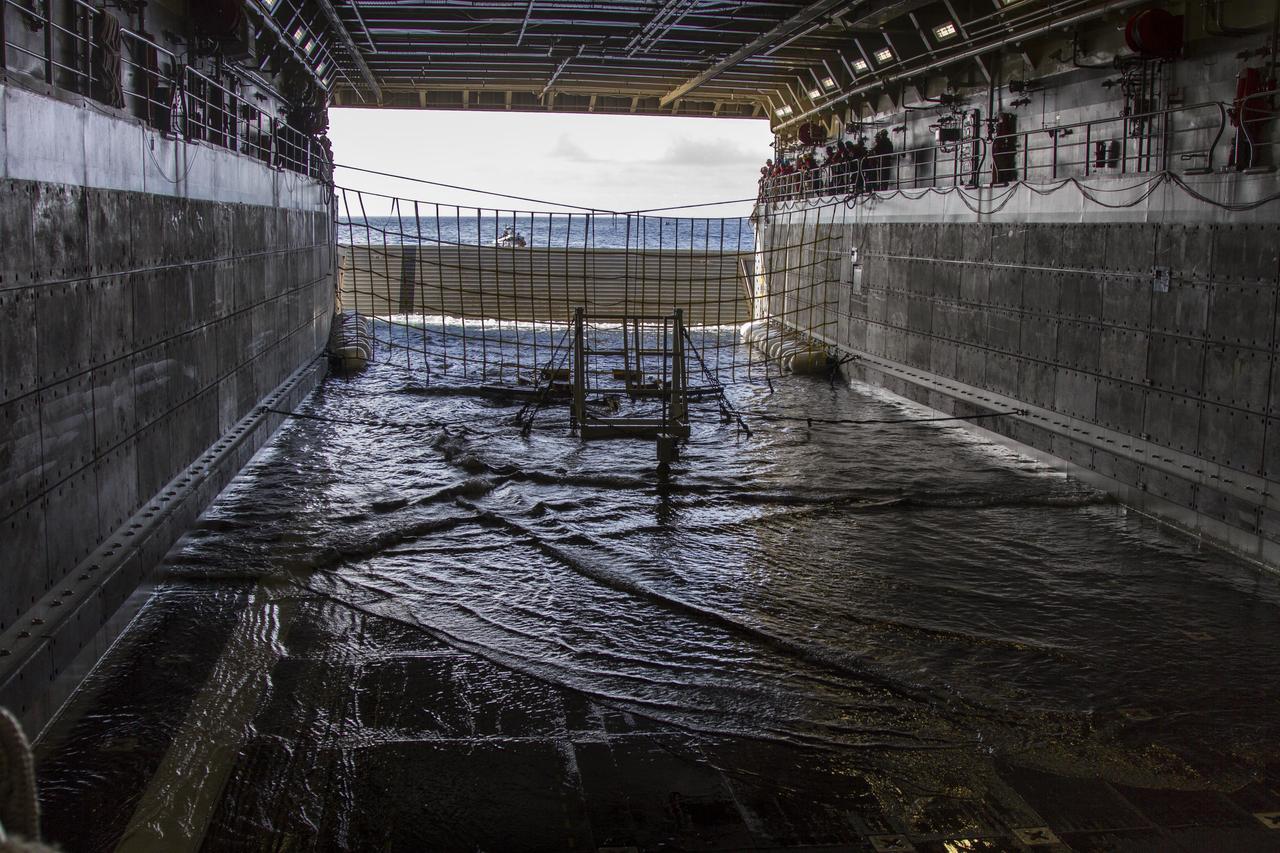
On the third day of preparations for recovery of Orion after its splashdown in the Pacific Ocean, the well deck of the USS Anchorage has been filled with water and recovery hardware is in place. The ship is about 600 miles off the coast of Baja, California. NASA, Lockheed Martin and U.S. Navy personnel are preparing for recovery of the crew module, forward bay cover and parachutes on its return from space and splashdown in the Pacific Ocean. The Ground Systems Development and Operations Program is leading the recovery efforts.

On the third day of preparations for recovery of Orion, pilots in two H60-S Seahawk helicopters practice take-off and search from the deck of the USS Anchorage in the Pacific Ocean about 600 miles off the coast of Baja, California. NASA, Lockheed Martin and U.S. Navy personnel are preparing to recover the Orion crew module, forward bay cover and parachutes after the spacecraft's return from space and splashdown in the Pacific Ocean. The Ground Systems Development and Operations Program is leading the recovery efforts.
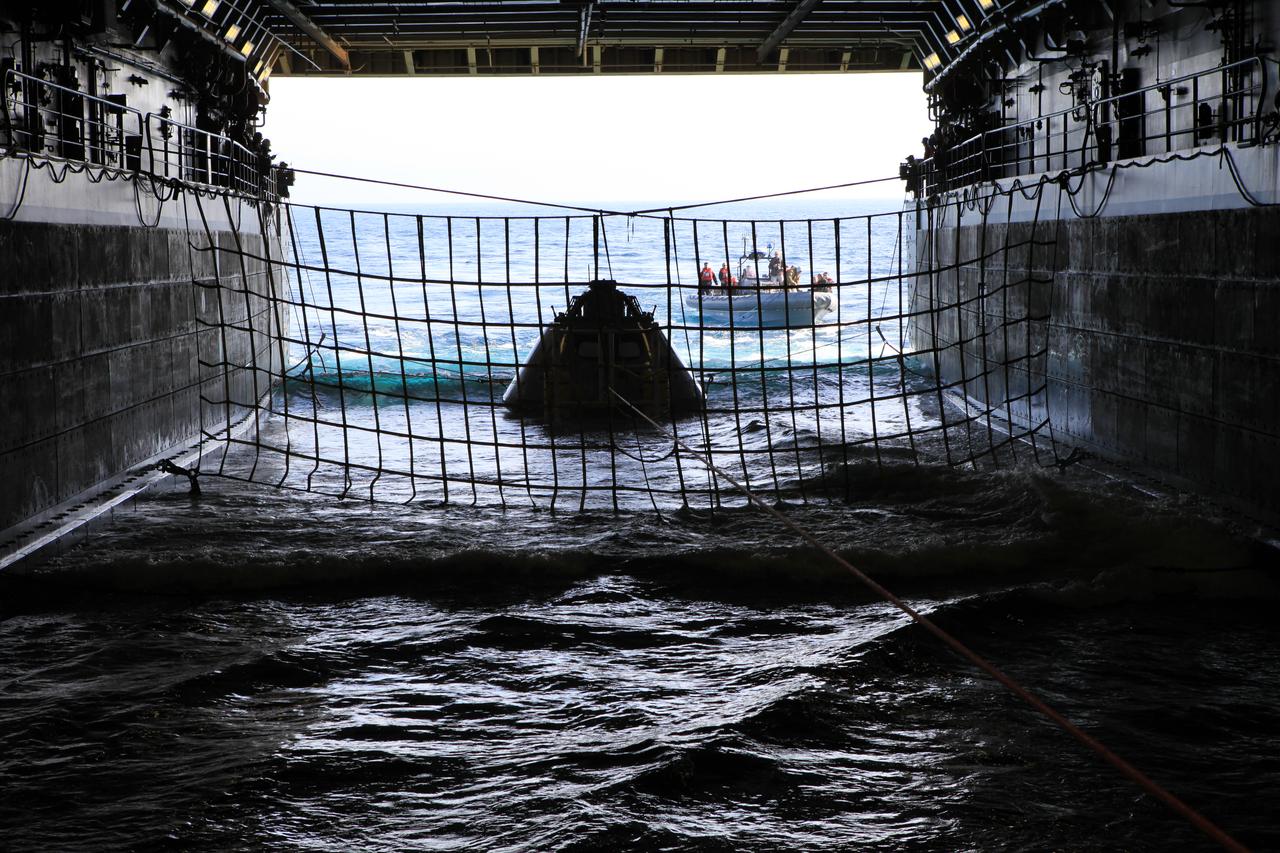
As part of Underway Recovery Test 6, the Orion test article is pulled in by a winch line at the rear of the USS Anchorage’s well deck that brings the capsule into the ship, along with four manned LLAMAs (Line Load Attenuation Mechanism Assembly) that control the capsule’s side-to-side movement and a tending line attached to a rigid hull inflatable boat for controlling Orion’s movement behind the ship. The testing with Kennedy Space Center's NASA Recovery Team and the U.S. Navy will provide important data that is being used to improve recovery procedures and hardware ahead of Orion's next flight, Exploration Mission-1, when it splashes down in the Pacific Ocean.
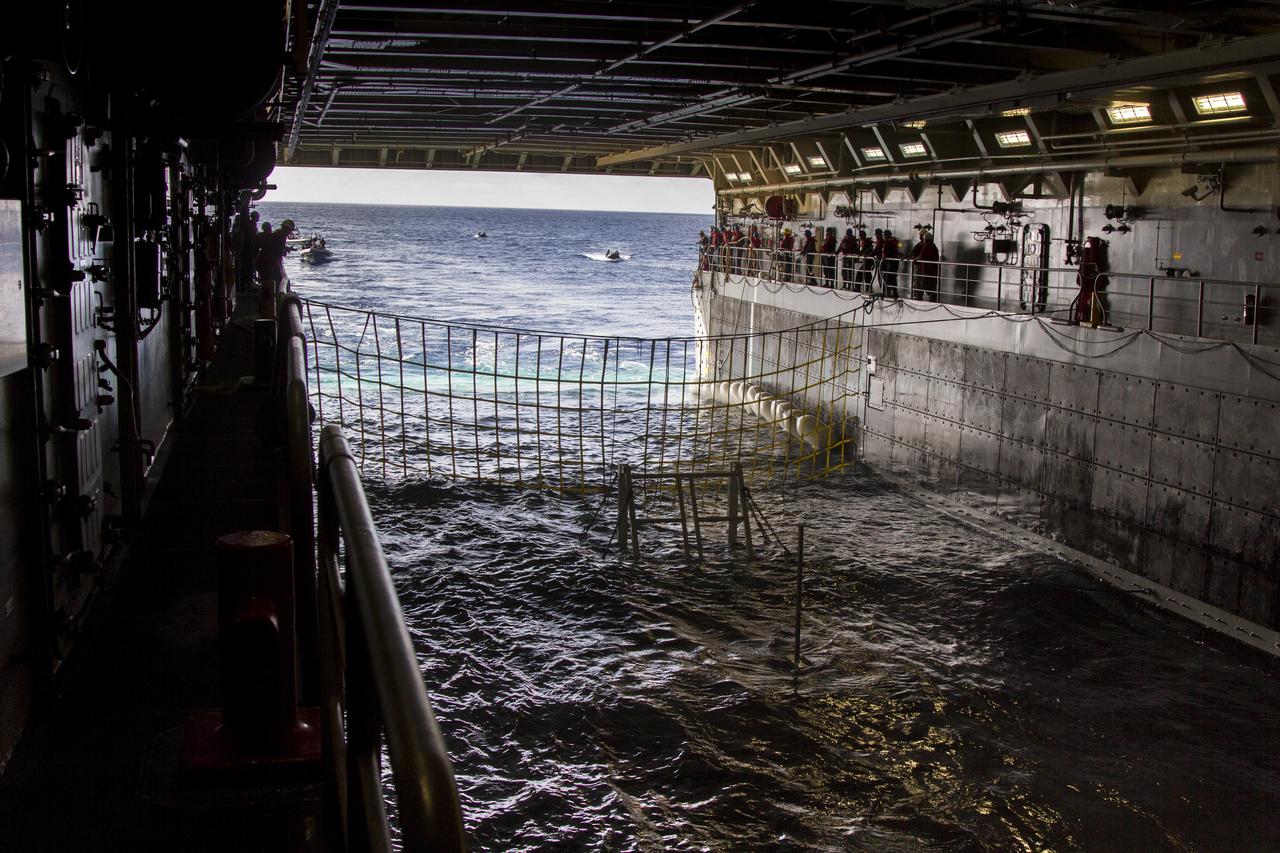
On the third day of preparations for recovery of Orion after its splashdown in the Pacific Ocean, the well deck of the USS Anchorage has been filled with water and recovery hardware is in place. U.S. Navy divers have embarked from ship to practice recovery procedures in rigid hull inflatable boats and Zodiac boats. NASA, Lockheed Martin and U.S. Navy personnel are preparing for recovery of the crew module, forward bay cover and parachutes on its return from space and splashdown in the Pacific Ocean. The Ground Systems Development and Operations Program is leading the recovery efforts.
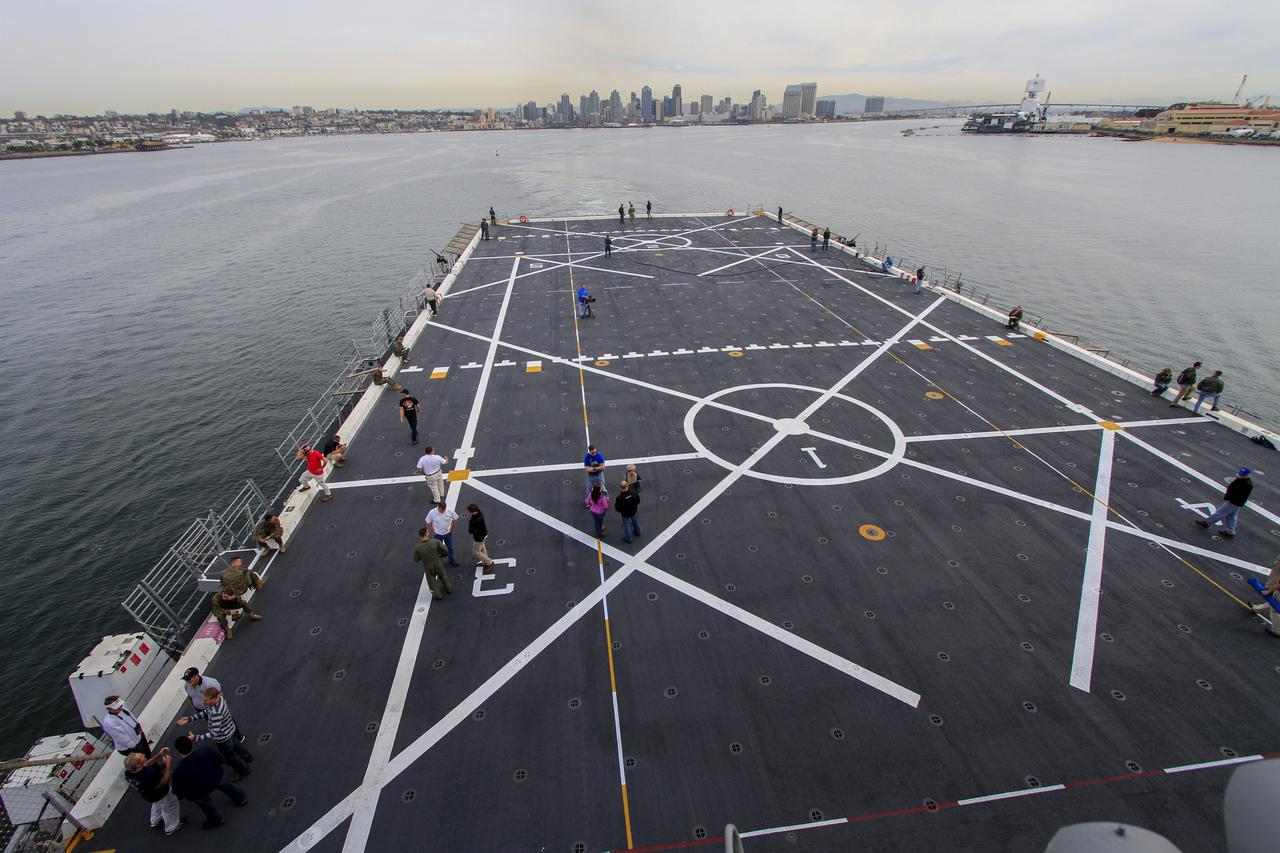
NASA and U.S. Navy personnel are on the deck of the USS Anchorage as the ship departs Naval Base San Diego and heads out to sea in the Pacific Ocean. NASA and the U.S. Navy are making preparations ahead of Orion's flight test for recovery of the crew module, forward bay cover and parachutes on its return from space and splashdown in the Pacific Ocean. The Ground Systems Development and Operations Program is leading the recovery efforts.
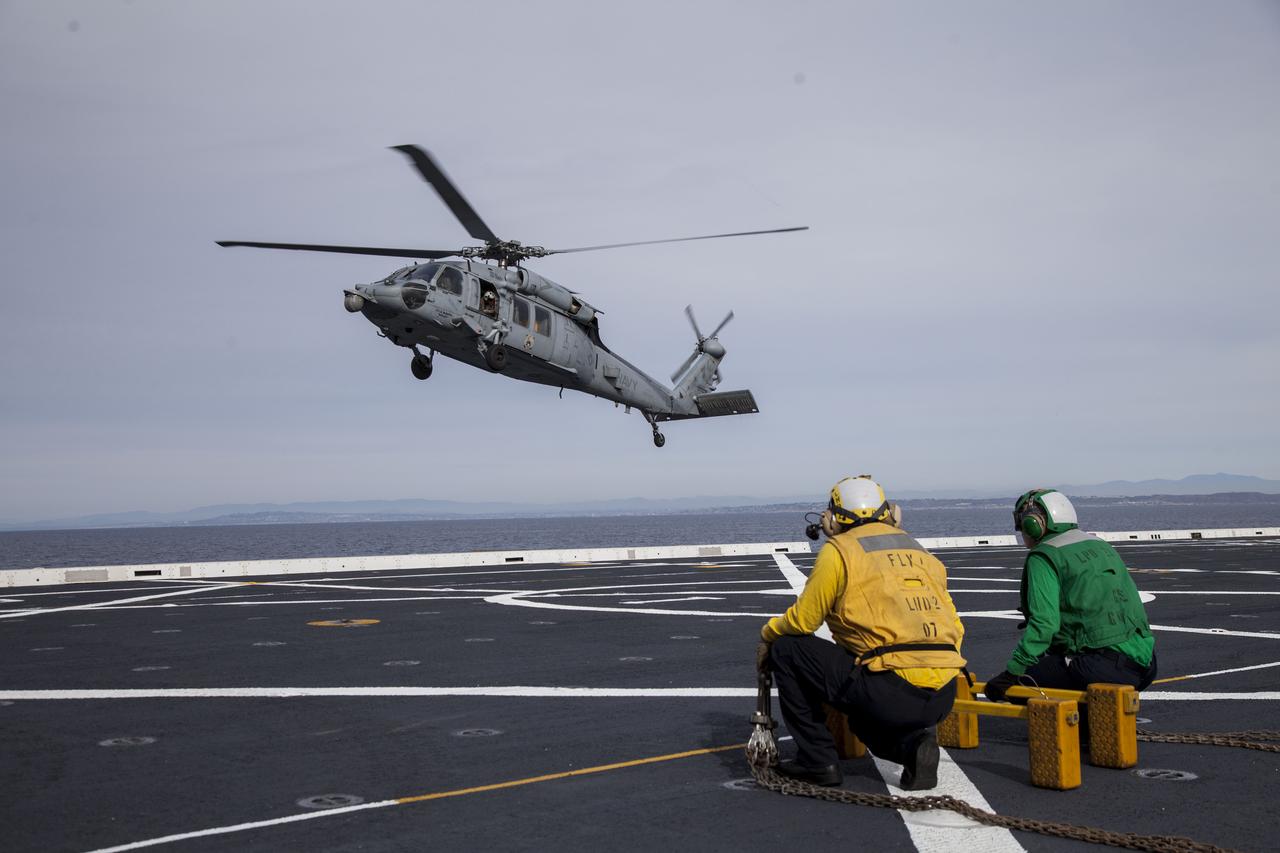
An H60-S Seahawk helicopter lands on the deck of the USS Anchorage in the Pacific Ocean off the coast of California. NASA and the U.S. Navy are heading out to sea ahead of Orion's flight test to prepare for recovery of the crew module, forward bay cover and parachutes on its return from space and splashdown in the Pacific Ocean. The Ground Systems Development and Operations Program is leading the recovery efforts.
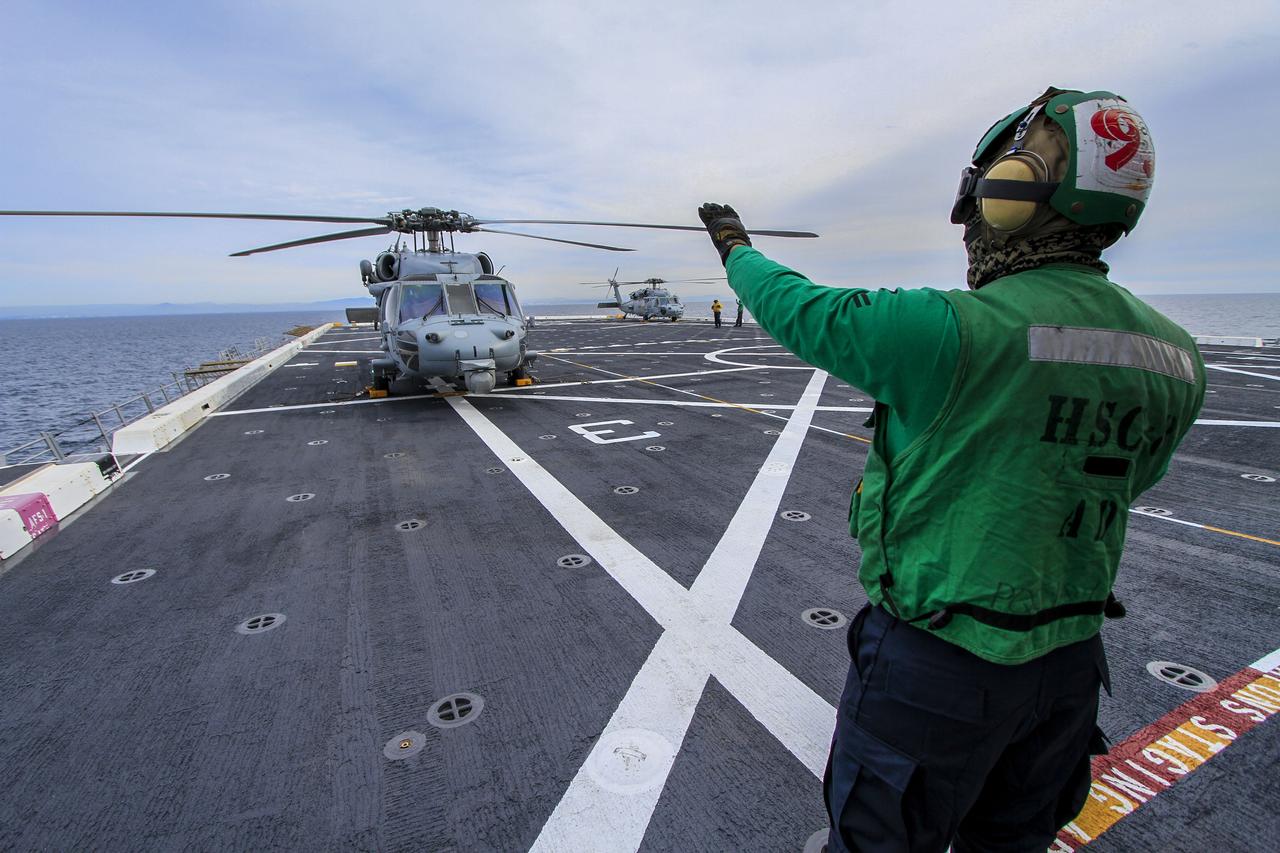
A member of the Helicopter Sea Combat Squadron 8 signals to the pilot in an H60-S Seahawk helicopter on the deck of the USS Anchorage as the ship departs Naval Base San Diego in California for the open waters of the Pacific Ocean. NASA and the U.S. Navy are making preparations ahead of Orion's flight test for recovery of the crew module, forward bay cover and parachutes on its return from space and splashdown in the Pacific Ocean. The Ground Systems Development and Operations Program is leading the recovery efforts.
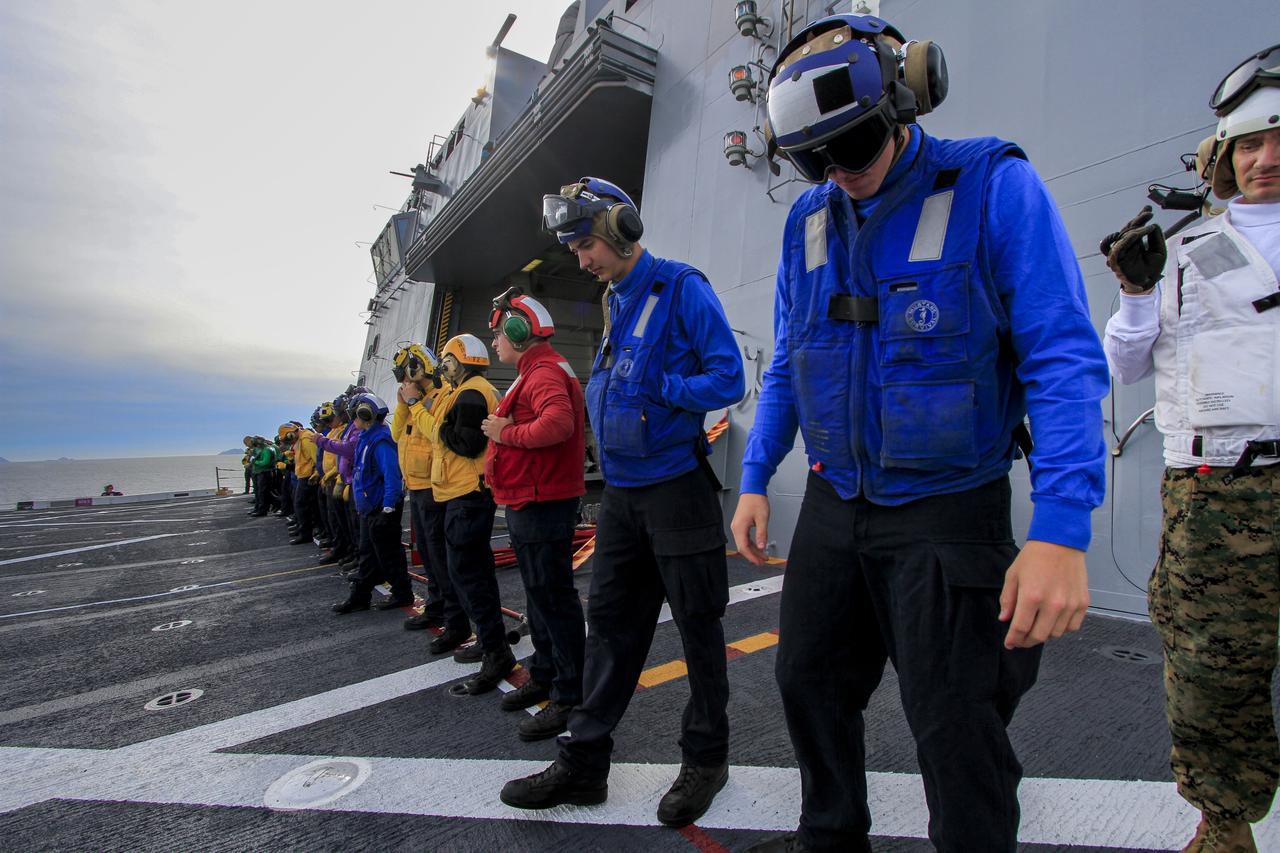
Helicopter Sea Combat Squadron 8 personnel review procedures on the deck of the USS Anchorage as the ship departs Naval Base San Diego in California for the open waters of the Pacific Ocean. NASA and the U.S. Navy are making preparations ahead of Orion's flight test for recovery of the crew module, forward bay cover and parachutes on its return from space and splashdown in the Pacific Ocean. The Ground Systems Development and Operations Program is leading the recovery efforts.
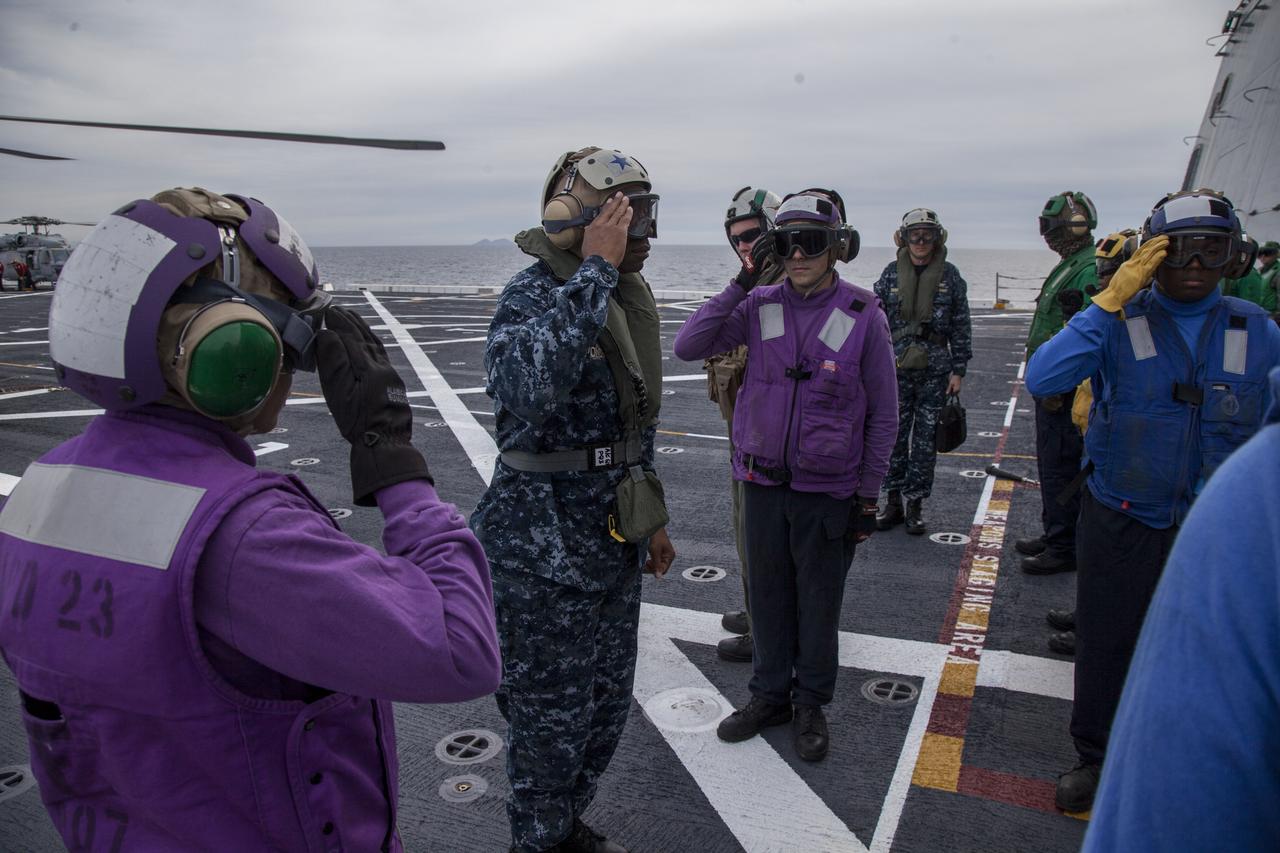
U.S. Navy and Helicopter Sea Combat Squadron 8 salute Rear Admiral Fernandez L. "Frank" Ponds, Commander, Expeditionary Strike Group 3 during his visit on the deck of the USS Anchorage near Naval Base San Diego in California. The ship is heading out to sea in the Pacific Ocean. NASA and the U.S. Navy are making preparations ahead of Orion's flight test for recovery of the crew module, forward bay cover and parachutes on its return from space and splashdown in the Pacific Ocean. The Ground Systems Development and Operations Program is leading the recovery efforts.
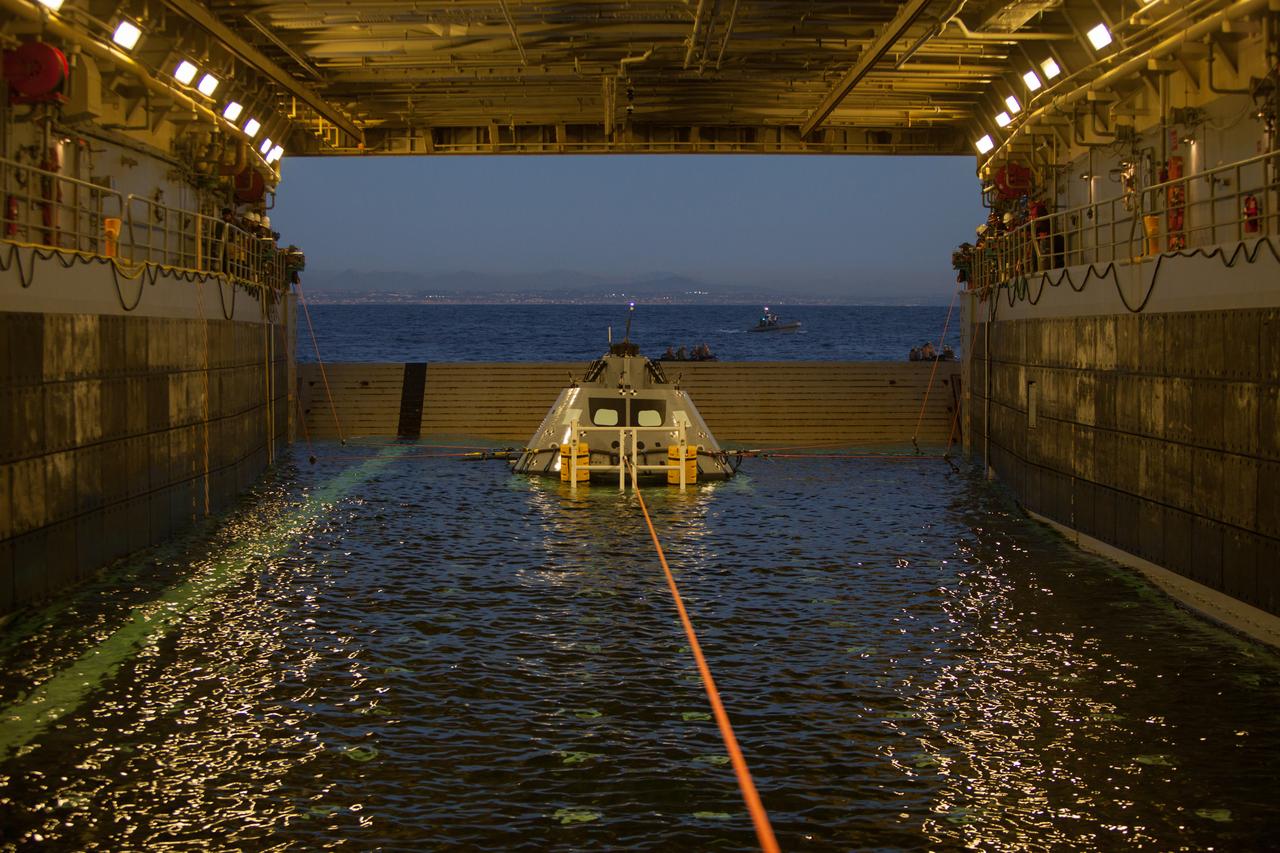
During Underway Recovery Test 6 on Jan. 22, 2018, Kennedy Space Center's NASA Recovery Team spent a week aboard the USS Anchorage where they and the U.S. Navy tested procedures and ground support equipment to improve recovery procedures and hardware ahead of Orion's next flight, Artemis I, when it splashes down in the Pacific Ocean. The Orion test article sits inside the well deck of the USS Anchorage after a successful recovery test.
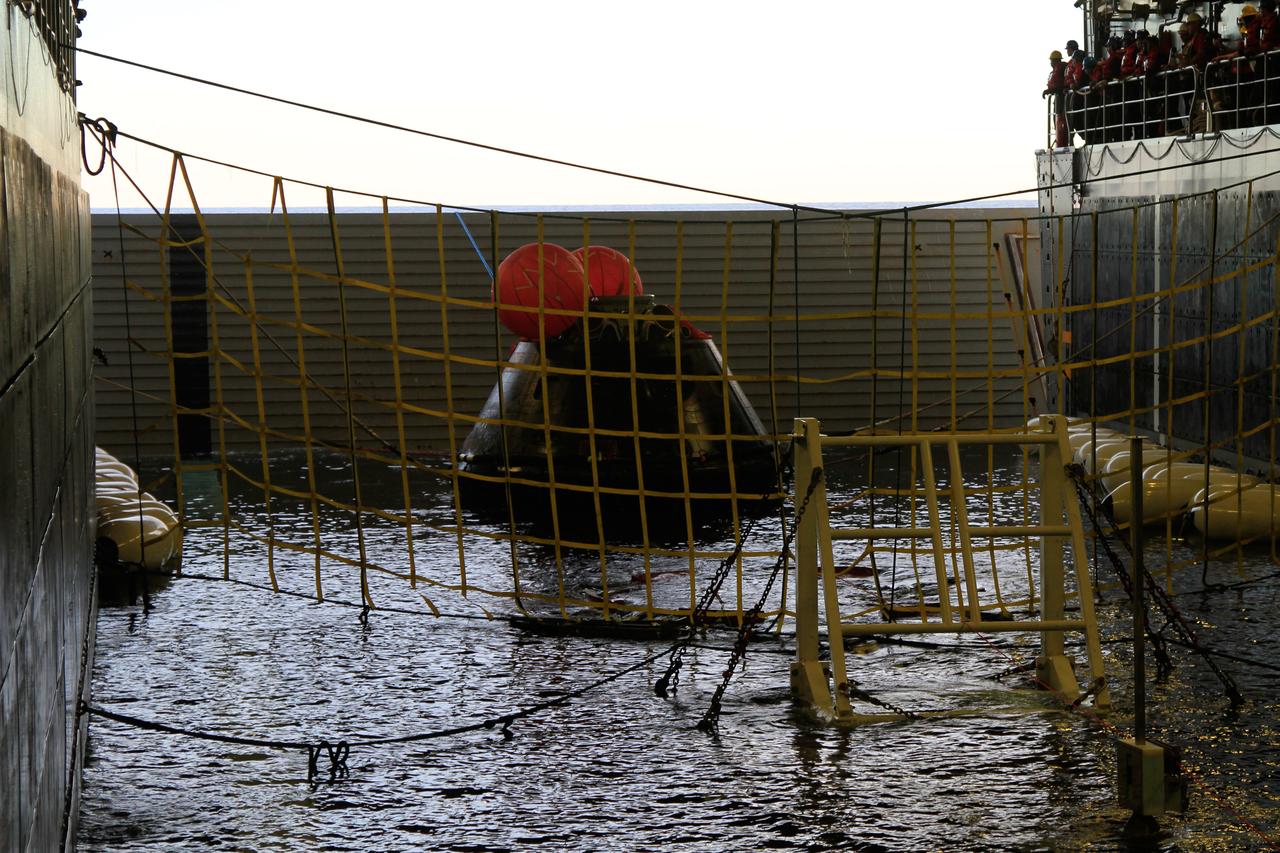
NASA’s Orion spacecraft is pulled safely into the well deck of the U.S. Navy’s USS Anchorage, following its splashdown in the Pacific Ocean. Orion launched into space on a two-orbit, 4.5-test flight at 7:05 am EST on Dec. 5, and returned safely to Earth, where a combined team from NASA, the Navy and Orion prime contractor Lockheed Martin retrieved it for return to shore. Over the next several days, the team will perform an initial check out of Orion while the Anchorage transports the spacecraft back to shore. It is expected to be off loaded at Naval Base San Diego on Monday. Part of Batch image transfer from Flickr.
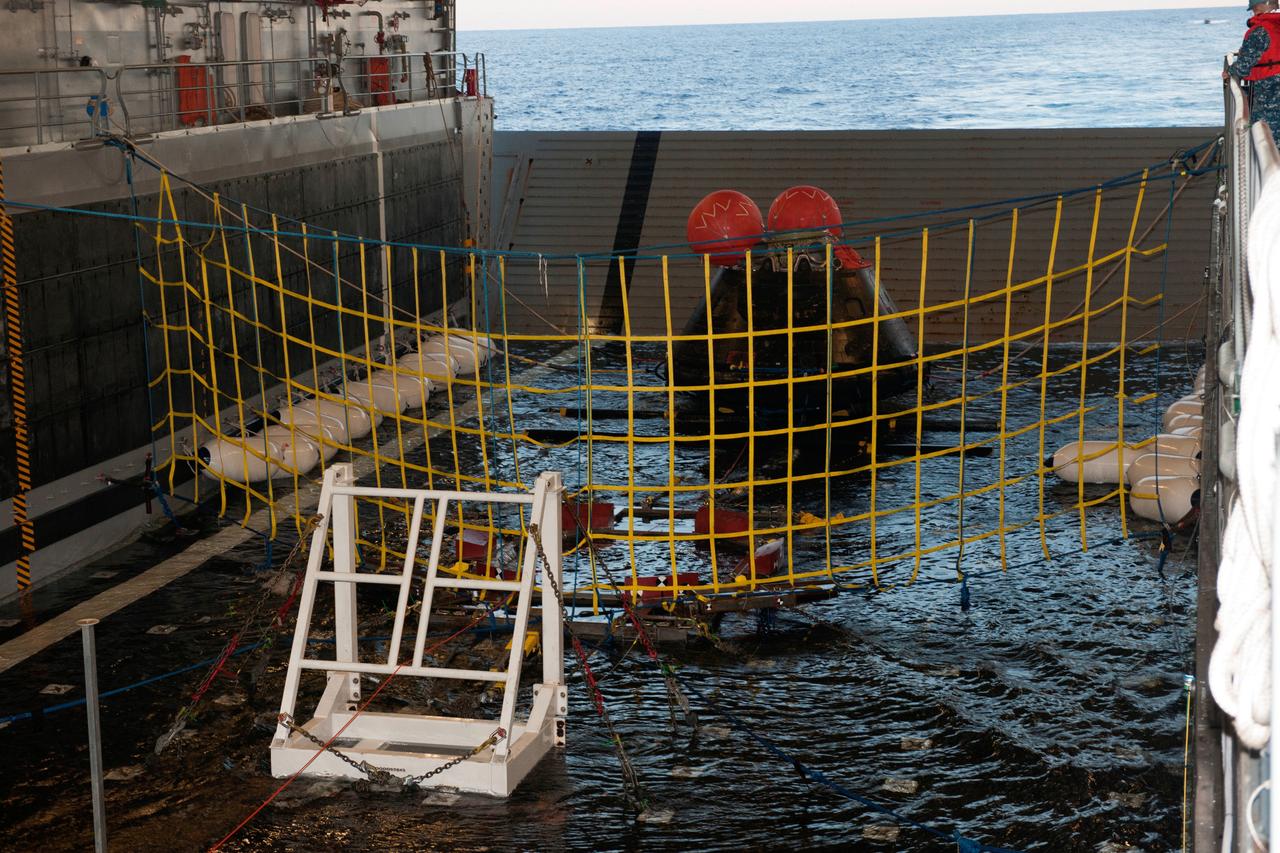
NASA’s Orion spacecraft is pulled safely into the well deck of the U.S. Navy’s USS Anchorage, following its splashdown in the Pacific Ocean. Orion launched into space on a two-orbit, 4.5-test flight at 7:05 am EST on Dec. 5, and returned safely to Earth, where a combined team from NASA, the Navy and Orion prime contractor Lockheed Martin retrieved it for return to shore. It's now being transported back to shore on board the Anchorage. It is expected to be off loaded at Naval Base San Diego on Monday. Part of Batch image transfer from Flickr.
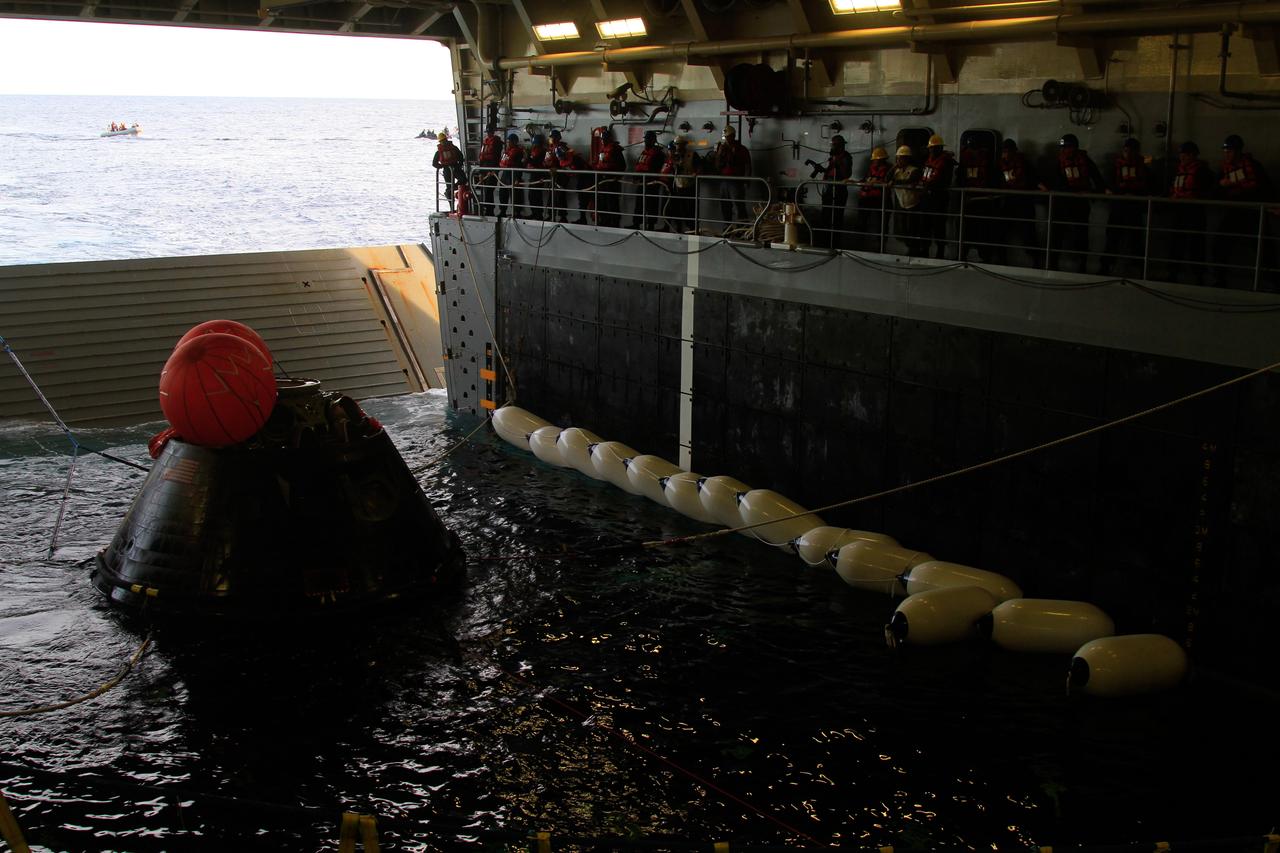
NASA’s Orion spacecraft is pulled safely into the well deck of the U.S. Navy’s USS Anchorage, following its splashdown in the Pacific Ocean. Orion launched into space on a two-orbit, 4.5-test flight at 7:05 am EST on Dec. 5, and returned safely to Earth, where a combined team from NASA, the Navy and Orion prime contractor Lockheed Martin retrieved it for return to shore. Over the next several days, the team will perform an initial check out of Orion while the Anchorage transports the spacecraft back to shore. It is expected to be off loaded at Naval Base San Diego on Monday. Part of Batch image transfer from Flickr.
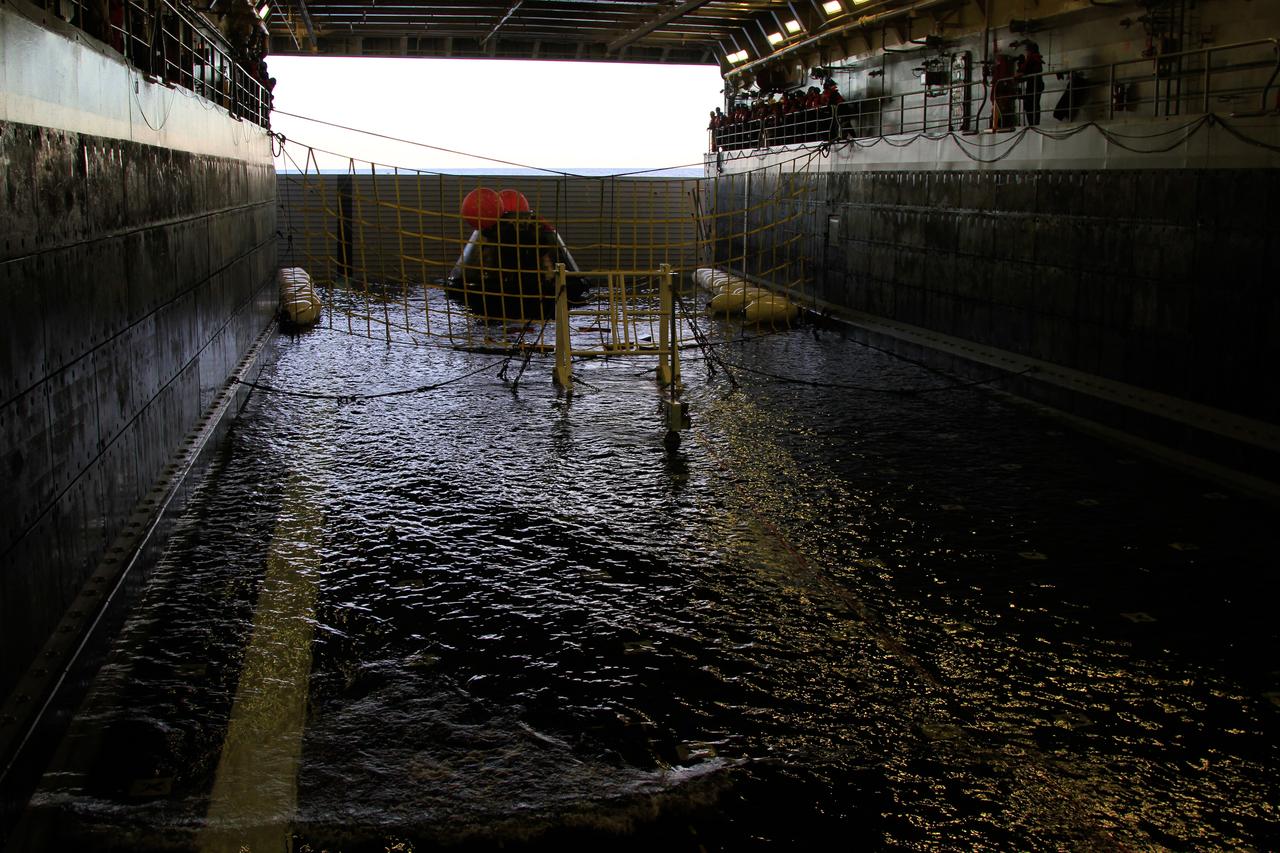
NASA’s Orion spacecraft is pulled safely into the well deck of the U.S. Navy’s USS Anchorage, following its splashdown in the Pacific Ocean. Orion launched into space on a two-orbit, 4.5-test flight at 7:05 am EST on Dec. 5, and returned safely to Earth, where a combined team from NASA, the Navy and Orion prime contractor Lockheed Martin retrieved it for return to shore. Over the next several days, the team will perform an initial check out of Orion while the Anchorage transports the spacecraft back to shore. It is expected to be off loaded at Naval Base San Diego on Monday. Part of Batch image transfer from Flickr.
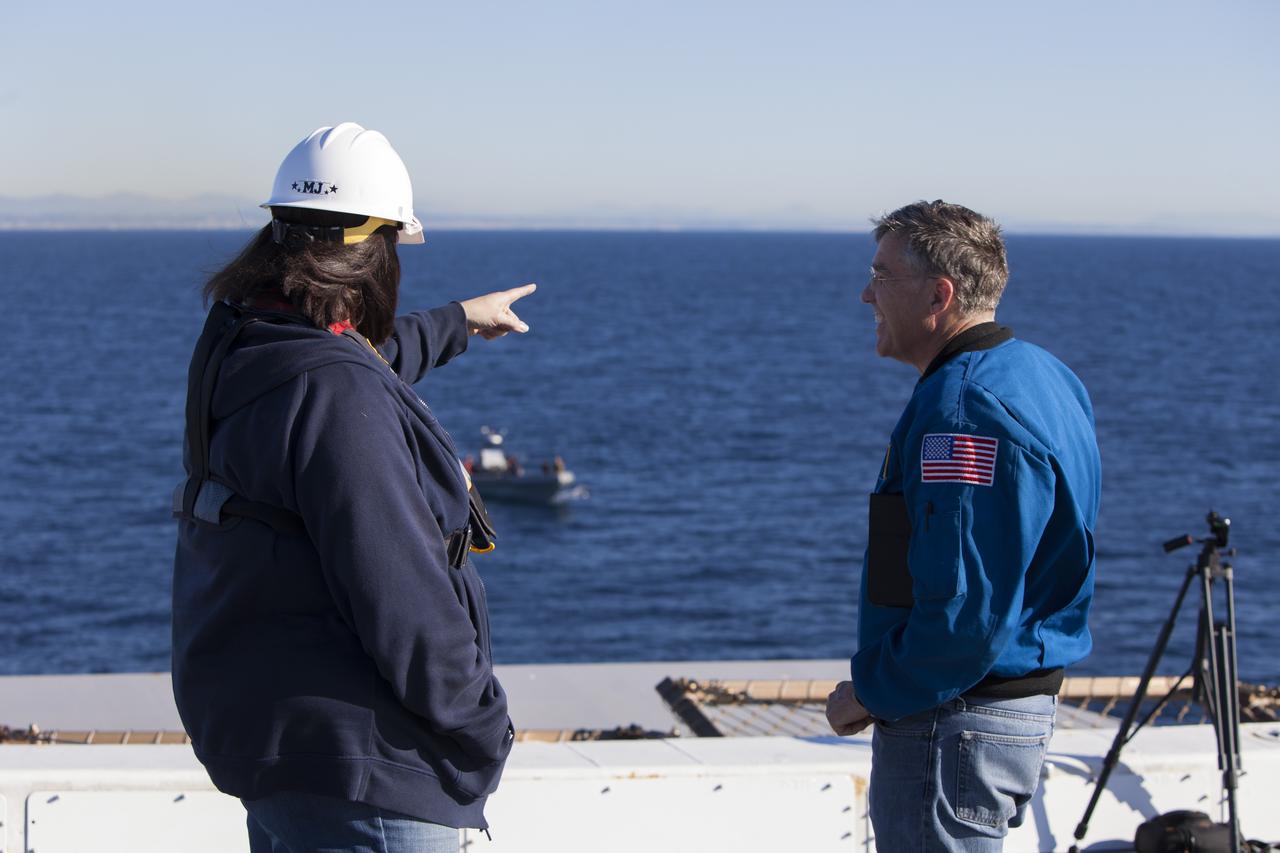
During Underway Recovery Test 6, NASA Recovery Director Melissa Jones and astronaut Stephen Bowen discuss how the recovery operations of Orion might impact astronauts onboard after spending weeks in microgravity. The testing with Kennedy Space Center's NASA Recovery Team and the U.S. Navy will provide important data that is being used to improve recovery procedures and hardware ahead of Orion's next flight, Exploration Mission-1, when it splashes down in the Pacific Ocean.
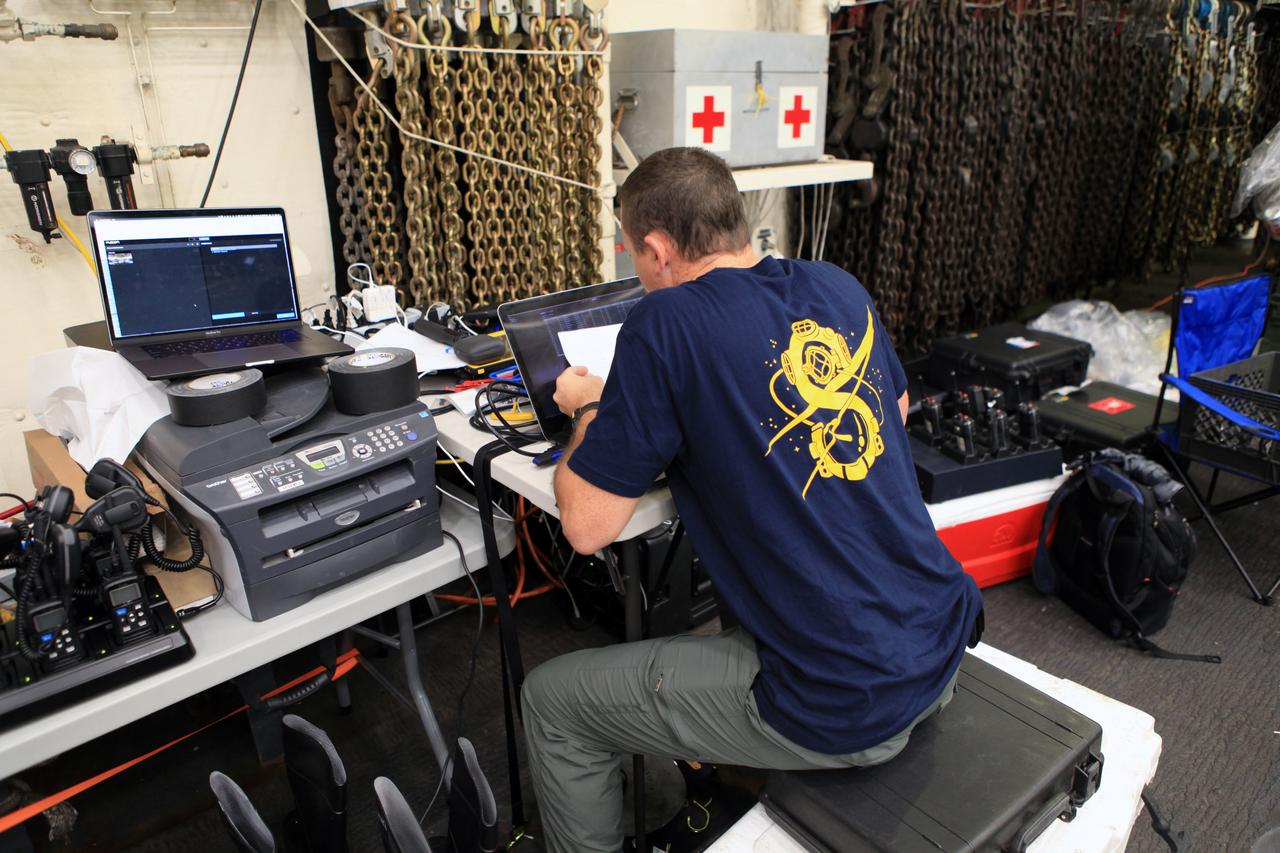
Jamie Peer, part of Kennedy Space Center’s NASA Recovery Team analyzes data from the previous day’s testing as part of Underway Recovery Test 6. The testing with the NASA Recovery Team and the U.S. Navy will provide important data that is being used to improve recovery procedures and hardware ahead of Orion's next flight, Exploration Mission-1, when it splashes down in the Pacific Ocean.
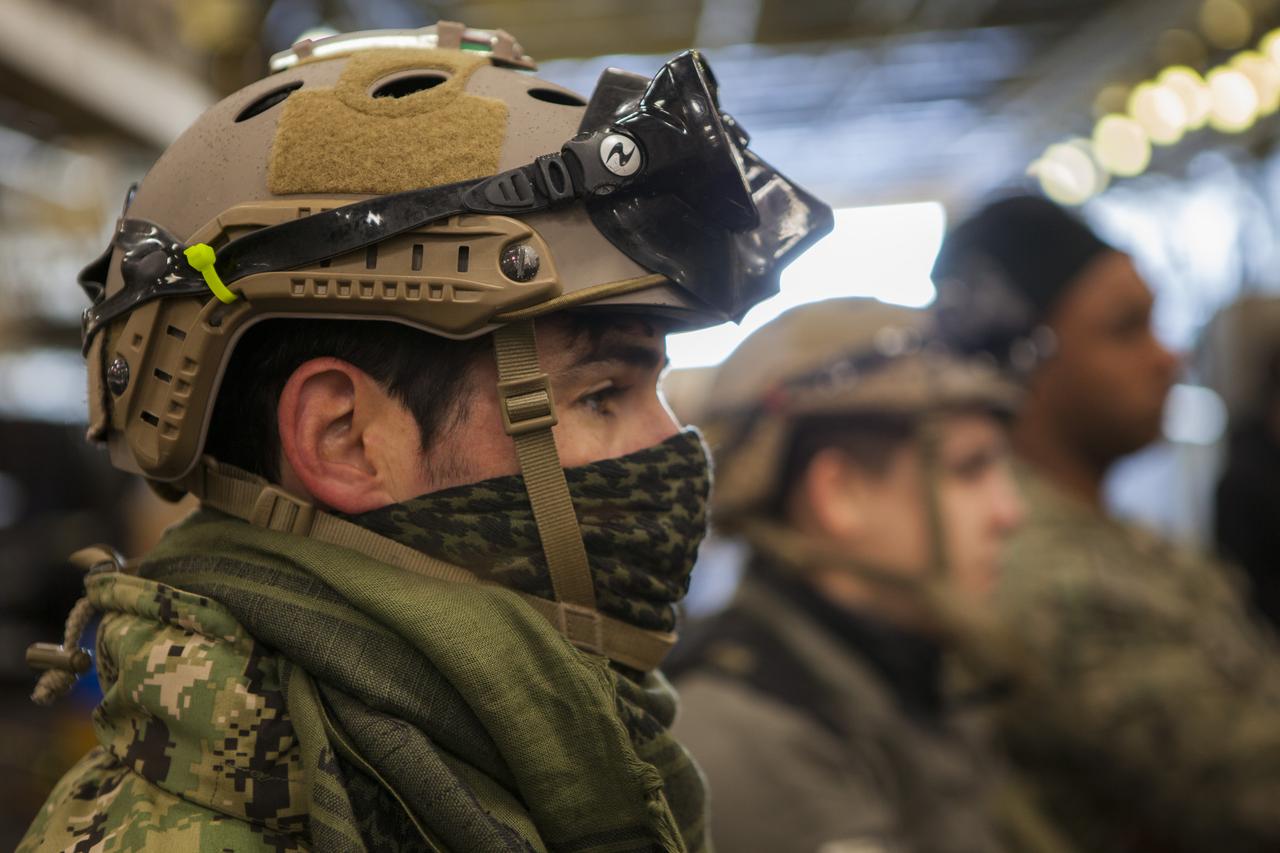
Navy Diver 2nd Class Laethem and his fellow divers get briefed before heading out to sea to recover the Orion test article during Underway Recovery Test 6 off the coast of San Diego. Kennedy Space Center’s NASA Recovery Team works with the U.S. Navy to improve recovery procedures and hardware ahead of Orion's next flight, Exploration Mission-1, when it splashes down in the Pacific Ocean.
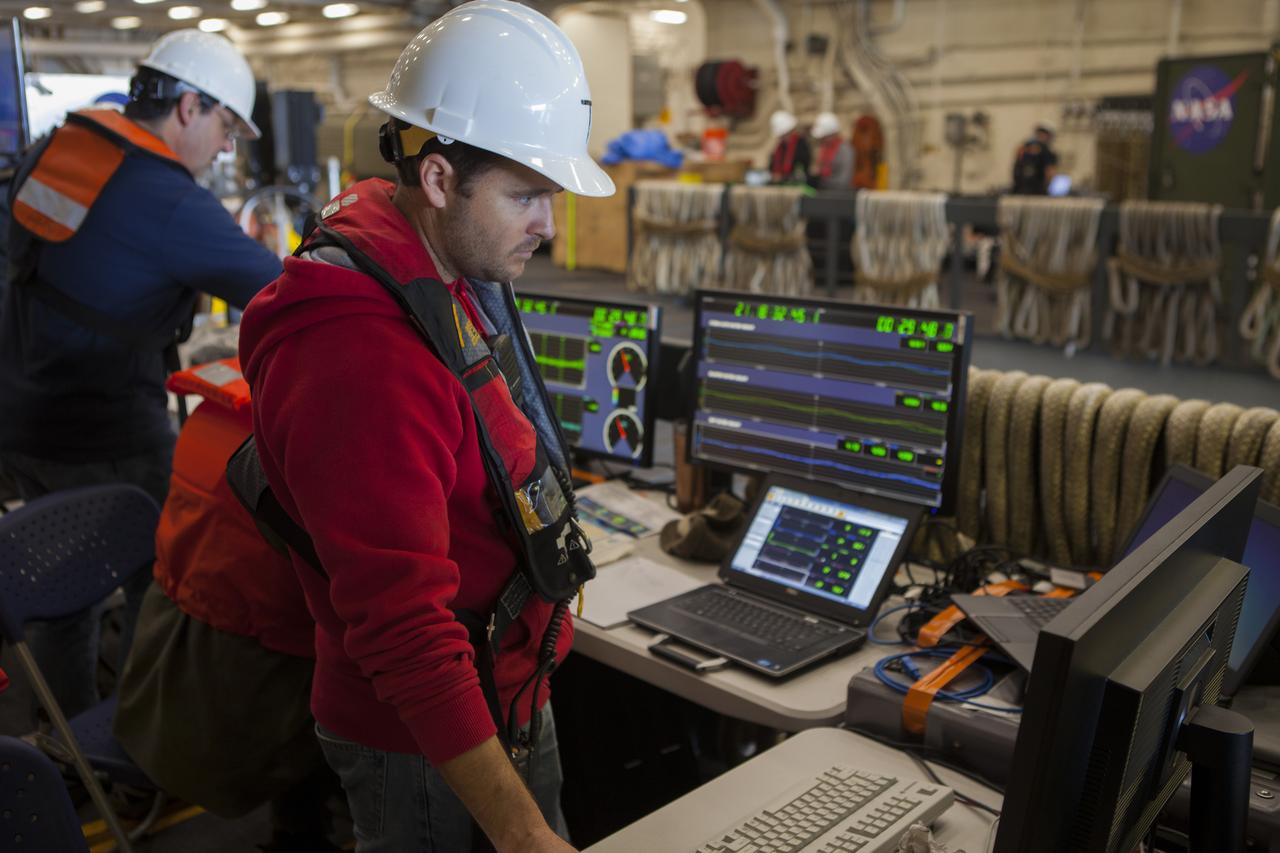
Lead Instrumentation Engineer Kevin Taylor keeps an eye on the load levels during Underway Recovery Test 6 operations off the coast of San Diego. Kennedy Space Center’s NASA Recovery Team works with the U.S. Navy to improve recovery procedures and hardware ahead of Orion's next flight, Exploration Mission-1, when it splashes down in the Pacific Ocean.
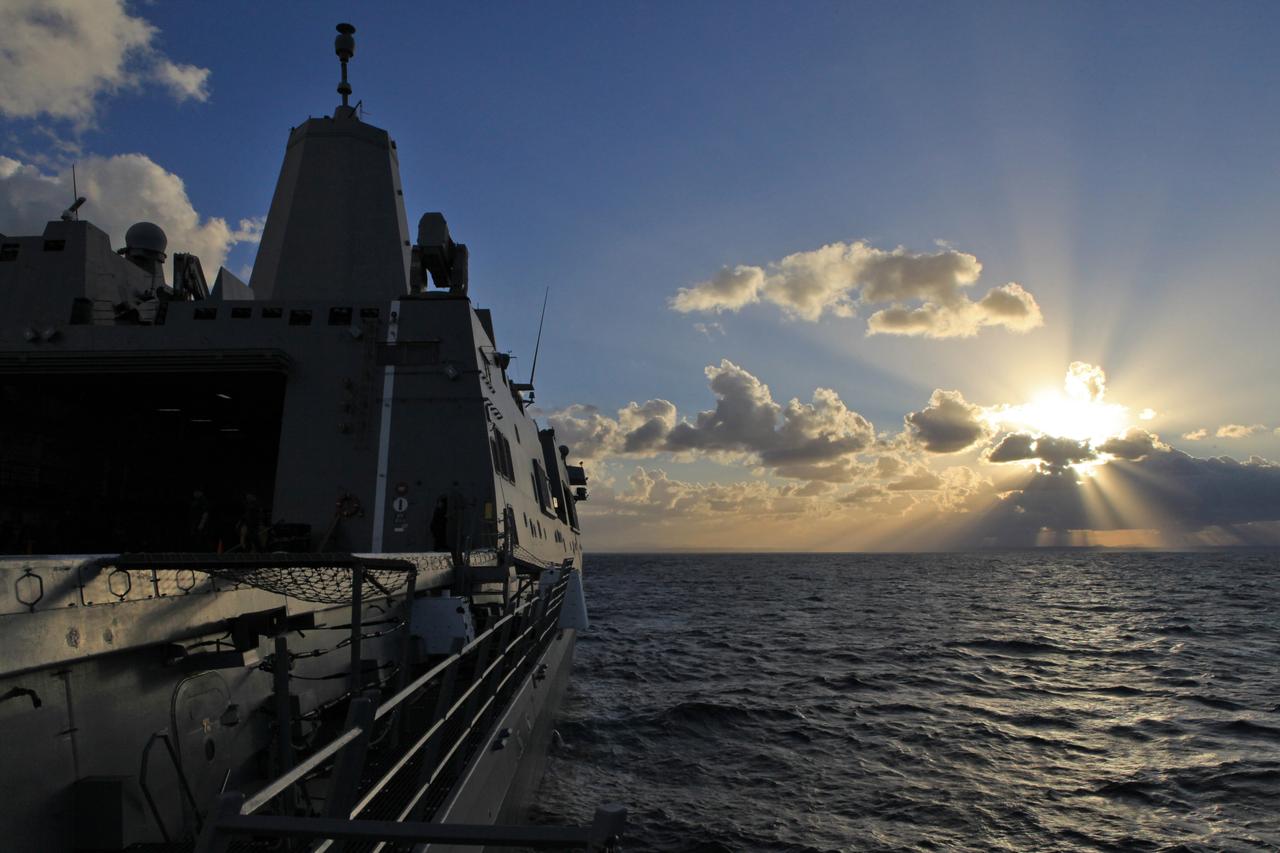
The USS Anchorage sails toward sunrise while Kennedy Space Center’s NASA Recovery Team prepares for another day of testing as part of Underway Recovery Test 6 on Jan. 20, 2018. The testing with the NASA Recovery Team and the U.S. Navy will provide important data that is being used to improve recovery procedures and hardware ahead of Orion's next flight, Artemis I, when it splashes down in the Pacific Ocean.
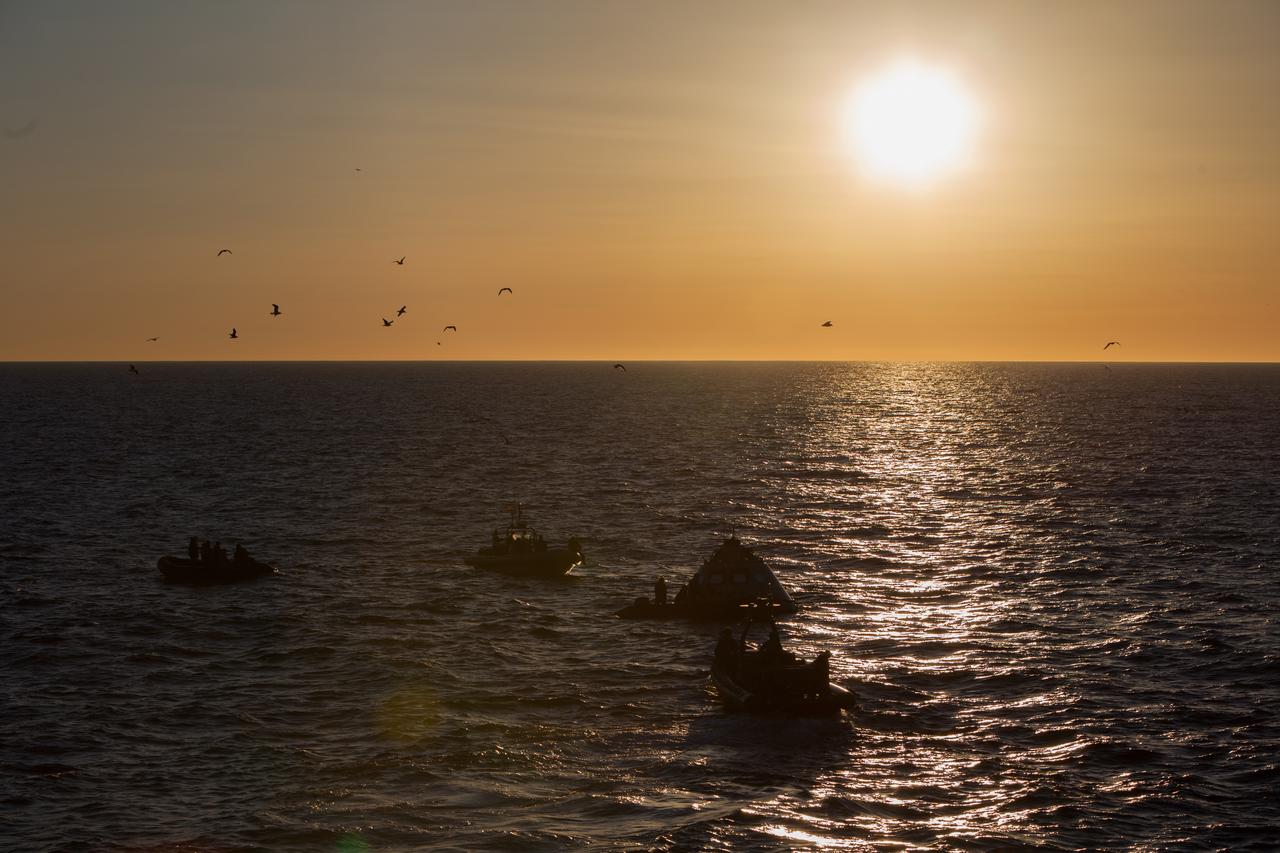
During Underway Recovery Test 6 on Jan. 22, 2018, Kennedy Space Center's NASA Recovery Team spent a week aboard the USS Anchorage where they and the U.S. Navy tested procedures and ground support equipment to improve recovery procedures and hardware ahead of Orion's next flight, Artemis I, when it splashes down in the Pacific Ocean.
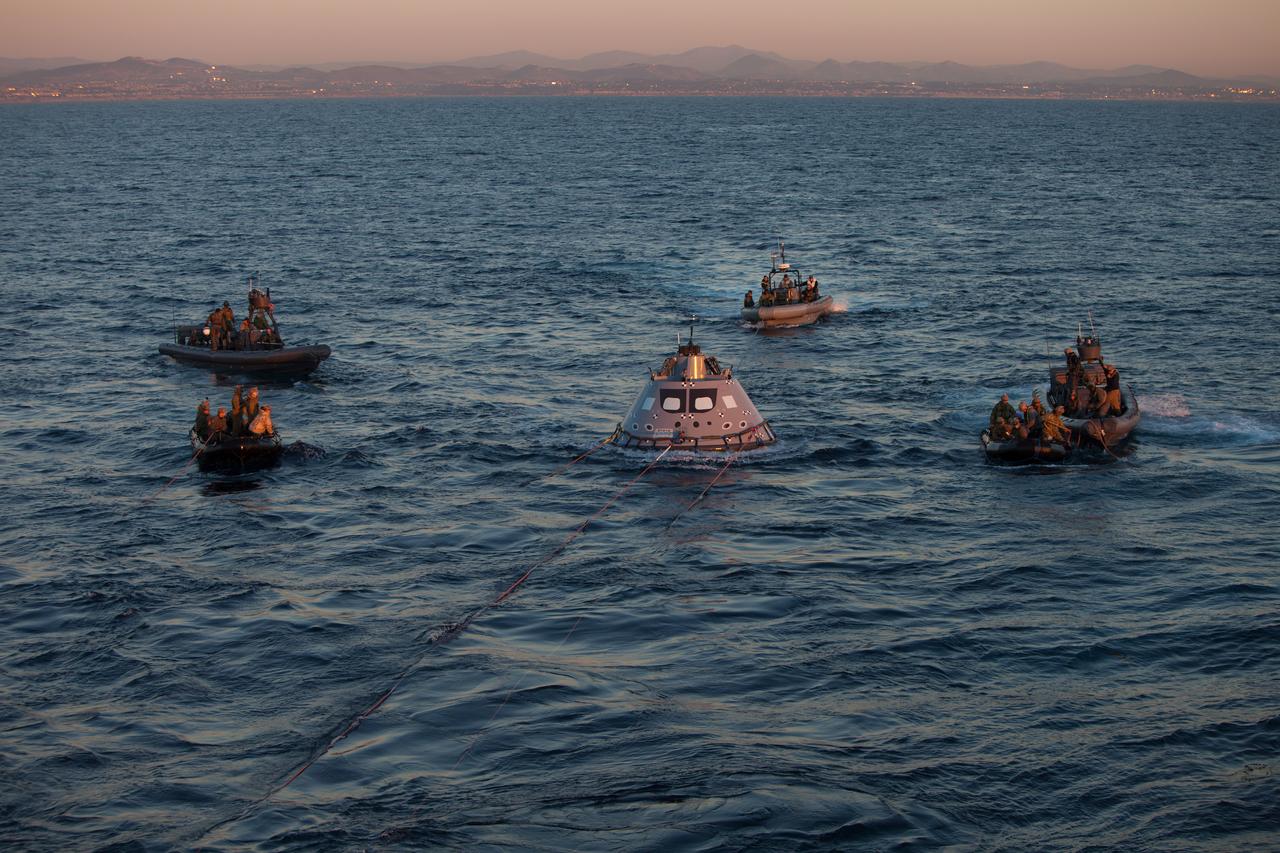
During Underway Recovery Test 6 on Jan. 22, 2018, Kennedy Space Center's NASA Recovery Team spent a week aboard the USS Anchorage where they and the U.S. Navy tested procedures and ground support equipment to improve recovery procedures and hardware ahead of Orion's next flight, Artemis I, when it splashes down in the Pacific Ocean.

During Underway Recovery Test 6 on Jan. 22, 2018, Kennedy Space Center's NASA Recovery Team spent a week aboard the USS Anchorage where they and the U.S. Navy tested procedures and ground support equipment to improve recovery procedures and hardware ahead of Orion's next flight, Artemis I, when it splashes down in the Pacific Ocean.
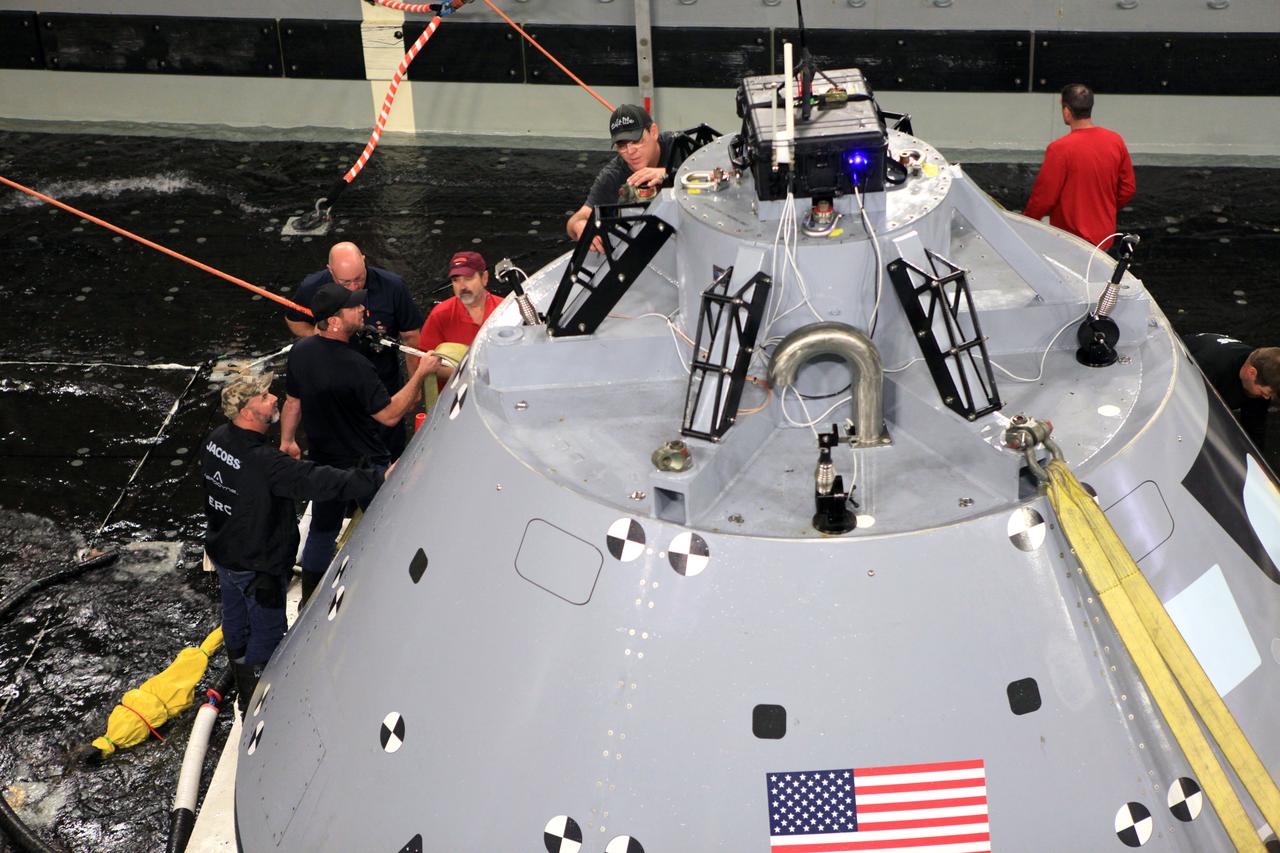
After a day of working with the Orion test article under rough seas, the NASA Recovery Team inspects the capsule and their lines. As part of Underway Recovery Test 6, the Orion test article was intentionally subjected to an increased sea state to ensure the team could control the spacecraft under all possible scenarios. The testing with Kennedy Space Center's NASA Recovery Team and the U.S. Navy will provide important data that is being used to improve recovery procedures and hardware ahead of Orion's next flight, Exploration Mission-1, when it splashes down in the Pacific Ocean.

NASA astronaut Stephen Bowen gets a birds-eye view of the rough seas during part of Underway Recovery Test 6. Bowen is watching the testing so he can provide the team with an astronaut’s perspective. The testing with Kennedy Space Center's NASA Recovery Team and the U.S. Navy will provide important data that is being used to improve recovery procedures and hardware ahead of Orion's next flight, Exploration Mission-1, when it splashes down in the Pacific Ocean.
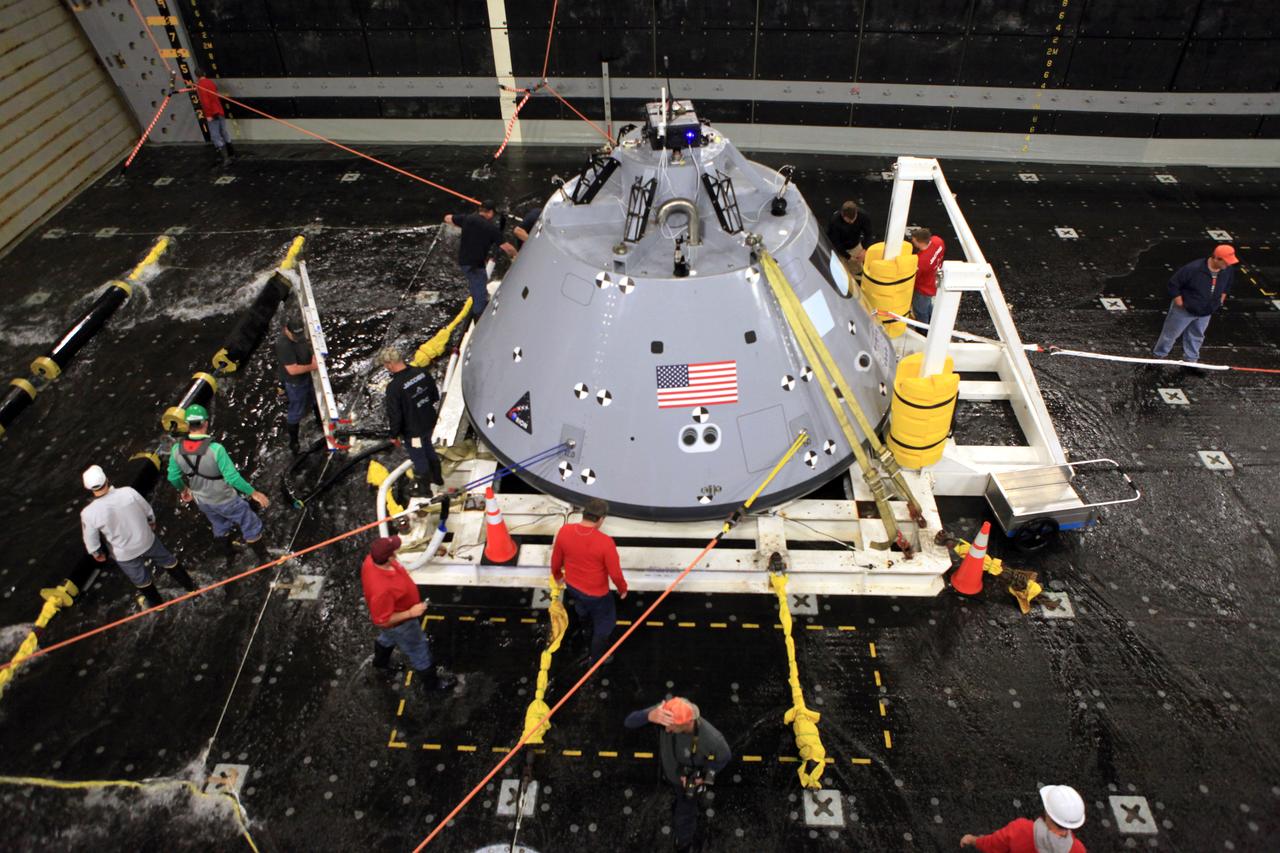
After a day of working with the Orion test article under rough seas, the NASA Recovery Team inspects the capsule and their lines. As part of Underway Recovery Test 6, the Orion test article was intentionally subjected to an increased sea state to ensure the team could control the spacecraft under all possible scenarios. The testing with Kennedy Space Center's NASA Recovery Team and the U.S. Navy will provide important data that is being used to improve recovery procedures and hardware ahead of Orion's next flight, Exploration Mission-1, when it splashes down in the Pacific Ocean.
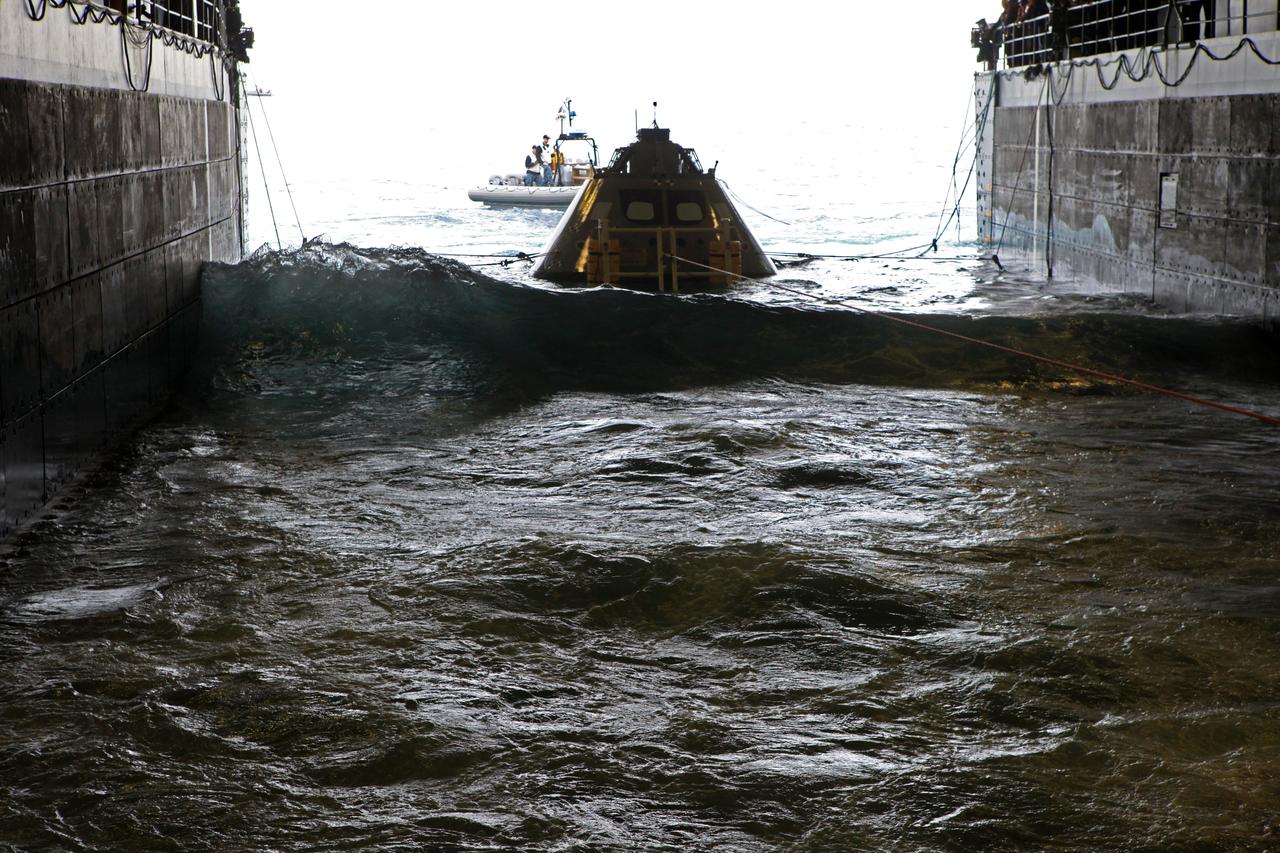
As part of Underway Recovery Test 6, the Orion test article is intentionally subjected to an increased sea state as the NASA Recovery Team works hard to keep control of the spacecraft. The testing with Kennedy Space Center's NASA Recovery Team and the U.S. Navy will provide important data that is being used to improve recovery procedures and hardware ahead of Orion's next flight, Exploration Mission-1, when it splashes down in the Pacific Ocean.
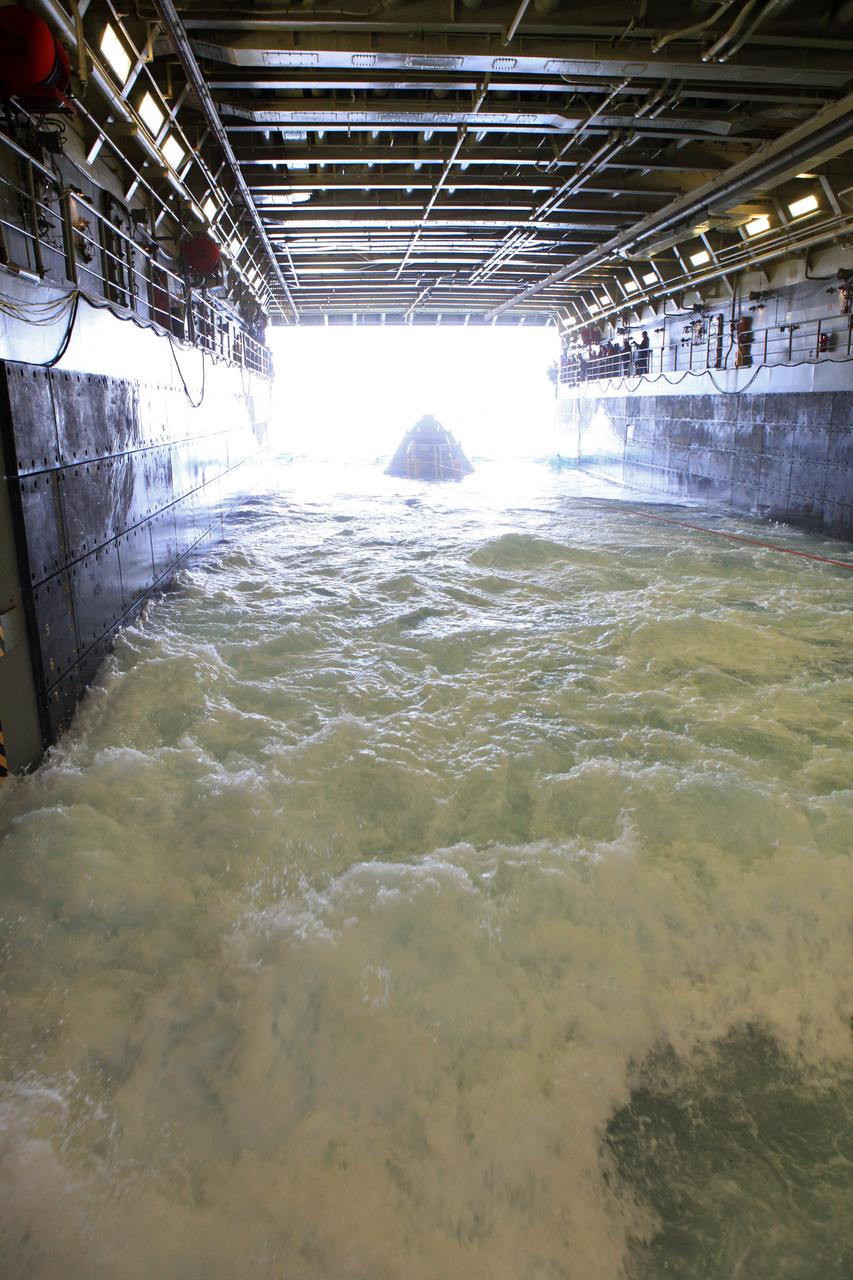
As part of Underway Recovery Test 6, the Orion test article is intentionally subjected to an increased sea state as the NASA Recovery Team works hard to keep control of the spacecraft. The testing with Kennedy Space Center's NASA Recovery Team and the U.S. Navy will provide important data that is being used to improve recovery procedures and hardware ahead of Orion's next flight, Exploration Mission-1, when it splashes down in the Pacific Ocean.
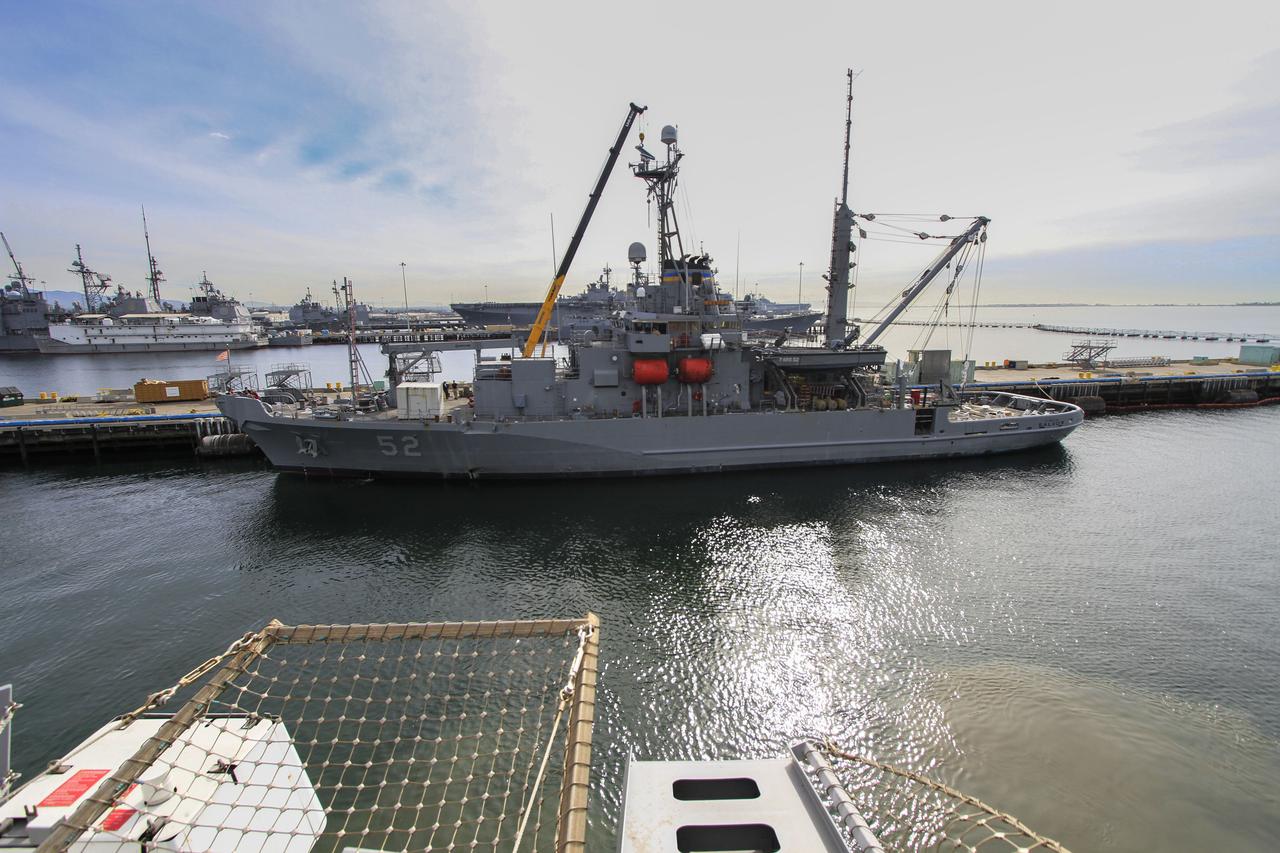
The USNS Salvor, a safeguard-class rescue and salvage ship, is docked at Naval Base San Diego in California. The ship will head out to sea along with the USS Anchorage ahead of Orion's first flight test. NASA and U.S. Navy personnel are making preparations ahead of Orion's flight test for recovery of the crew module, forward bay cover and parachutes on its return from space and splashdown in the Pacific Ocean. If needed, the Salvor would be used for an alternate recovery method. Ground Systems Development and Operations Program is leading the recovery efforts.
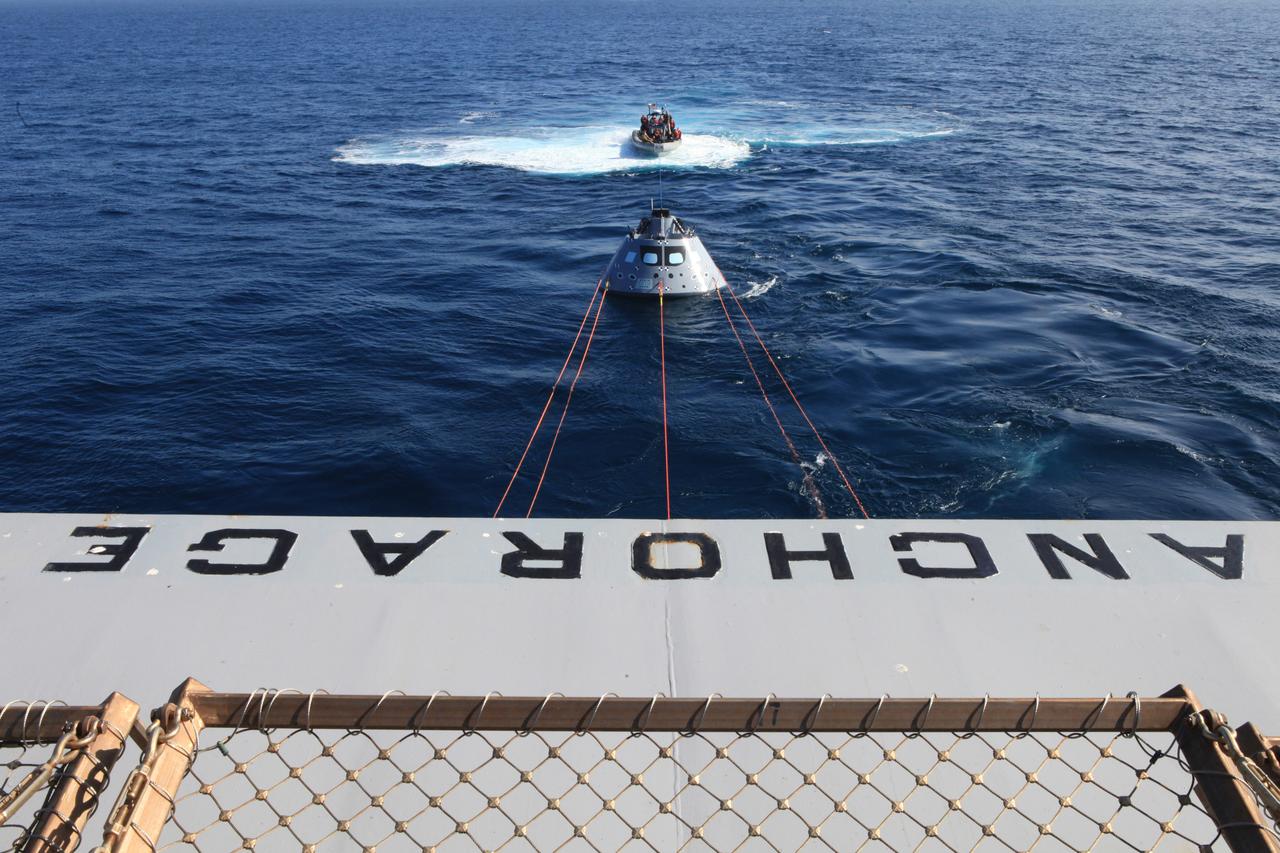
Off the rear of the USS Anchorage on Jan. 18, 2018, the Orion test article is pulled in by a winch line at the rear of the USS Anchorage’s well deck that brings the capsule into the ship, along with four manned LLAMAs (Line Load Attenuation Mechanism Assembly) that control the capsule’s side-to-side movement and a tending line attached to a rigid hull inflatable boat for controlling Orion’s movement behind the ship. The Underway Recovery Test 6 (URT-6) is spearheaded by Kennedy Space Center's NASA Recovery Team. In partnership with the U.S. Navy, the testing will provide important data that is being used to improve recovery procedures and hardware ahead of Orion's next flight, Artemis I, when it splashes down in the Pacific Ocean.
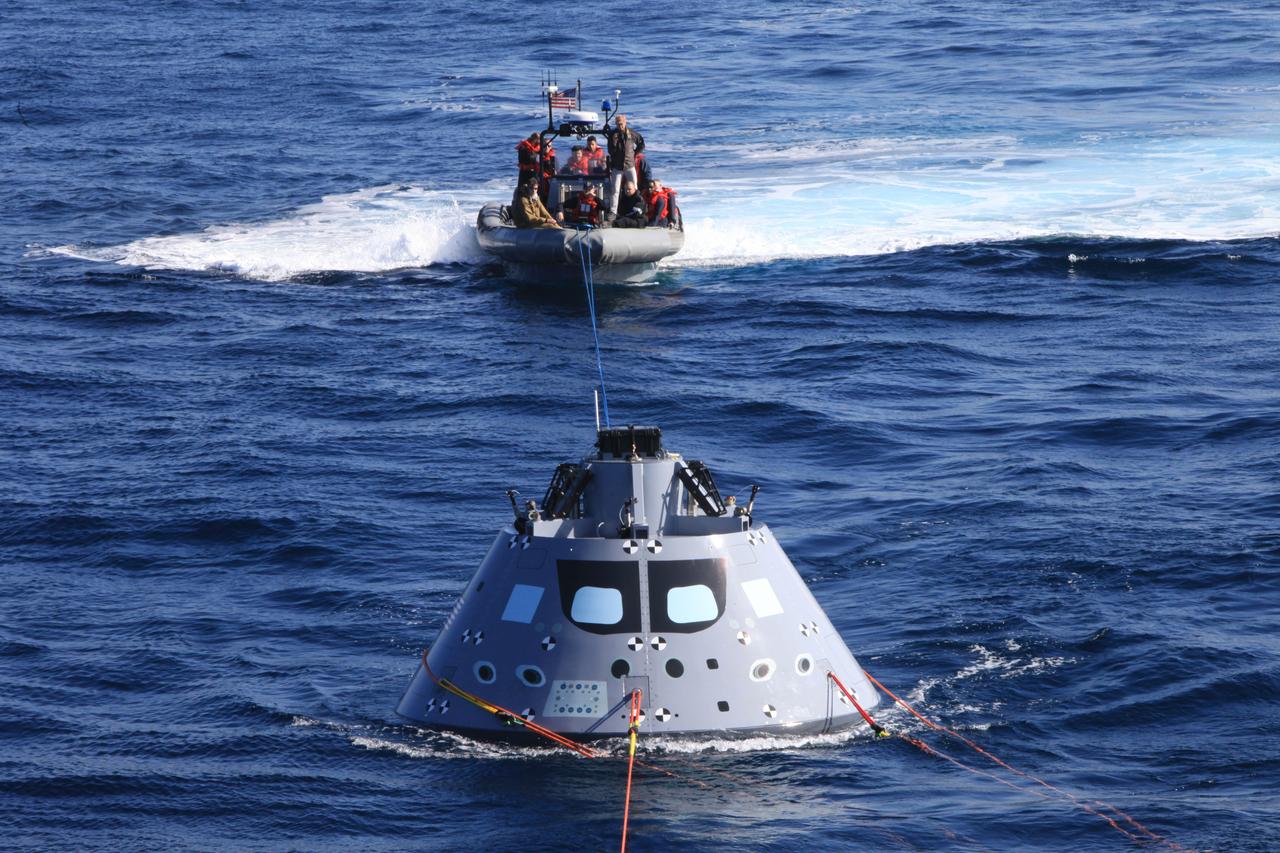
As part of Underway Recovery Test 6 on Jan. 18, 2018, the Orion test article is pulled in by a winch line at the rear of the USS Anchorage’s well deck that brings the capsule into the ship, along with four manned LLAMAs (Line Load Attenuation Mechanism Assembly) that control the capsule’s side-to-side movement and a tending line attached to a rigid hull inflatable boat for controlling Orion’s movement behind the ship. The testing with Kennedy Space Center's NASA Recovery Team and the U.S. Navy will provide important data that is being used to improve recovery procedures and hardware ahead of Orion's next flight, Artemis I, when it splashes down in the Pacific Ocean.
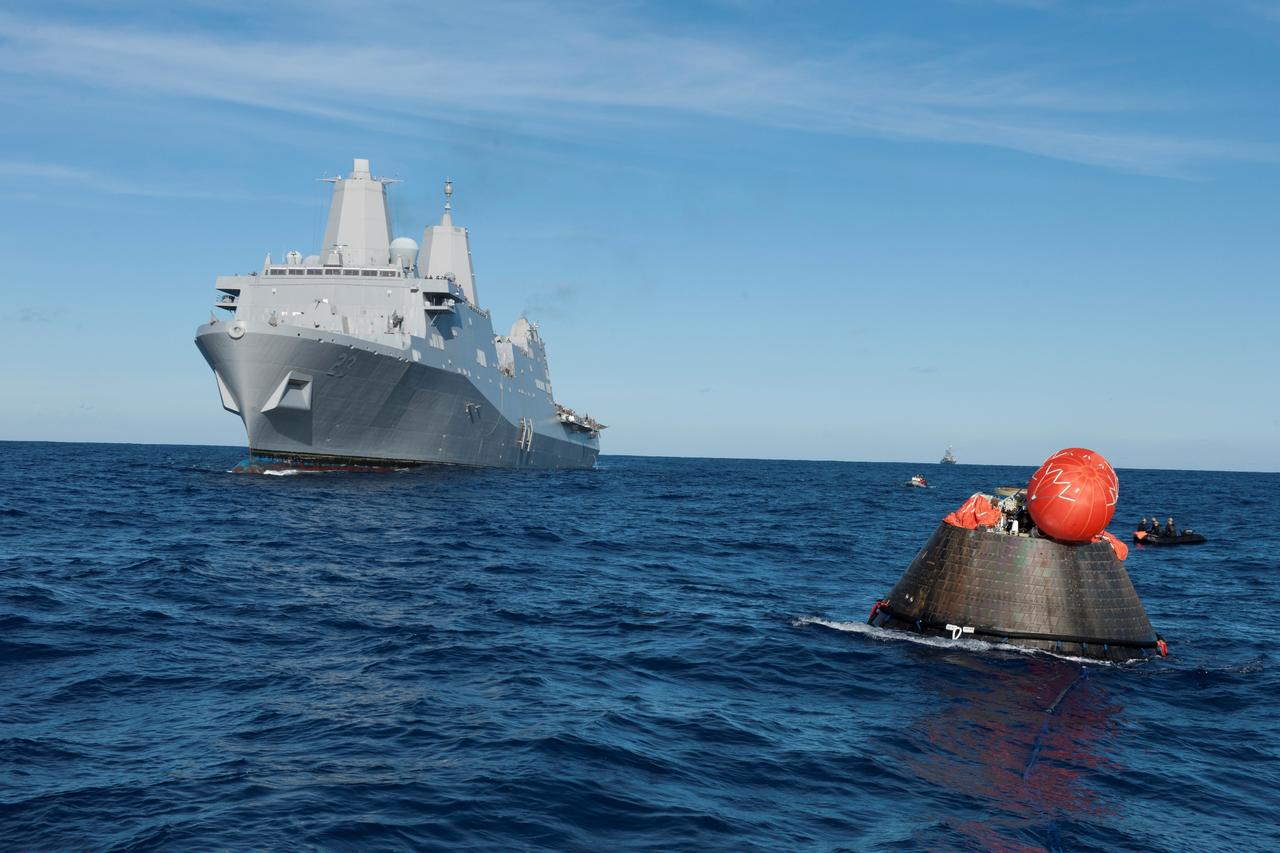
NASA's Orion spacecraft floats in the Pacific Ocean after splashdown from its first flight test in Earth orbit. The USS Anchorage is nearby. NASA, the U.S. Navy and Lockheed Martin are coordinating efforts to recover Orion and secure the spacecraft in the well deck of the USS Anchorage. Orion completed a two-orbit, four-and-a-half hour mission, to test systems critical to crew safety, including the launch abort system, the heat shield and the parachute system. The Ground Systems Development and Operations Program is leading the recovery efforts.
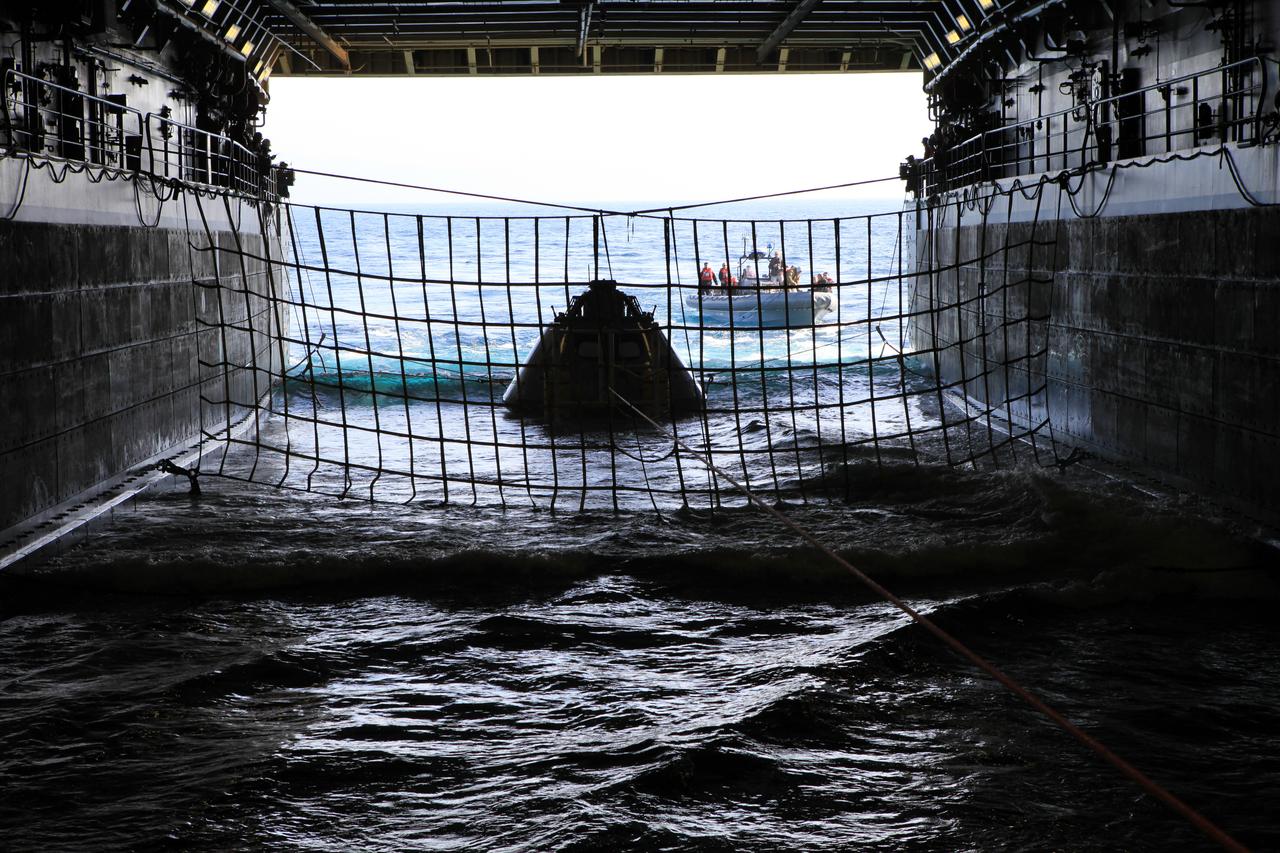
As part of Underway Recovery Test 6 on Jan. 18, 2018, the Orion test article is pulled in by a winch line at the rear of the USS Anchorage’s well deck that brings the capsule into the ship, along with four manned LLAMAs (Line Load Attenuation Mechanism Assembly) that control the capsule’s side-to-side movement and a tending line attached to a rigid hull inflatable boat for controlling Orion’s movement behind the ship. The testing with Kennedy Space Center's NASA Recovery Team and the U.S. Navy will provide important data that is being used to improve recovery procedures and hardware ahead of Orion's next flight, Artemis I, when it splashes down in the Pacific Ocean.
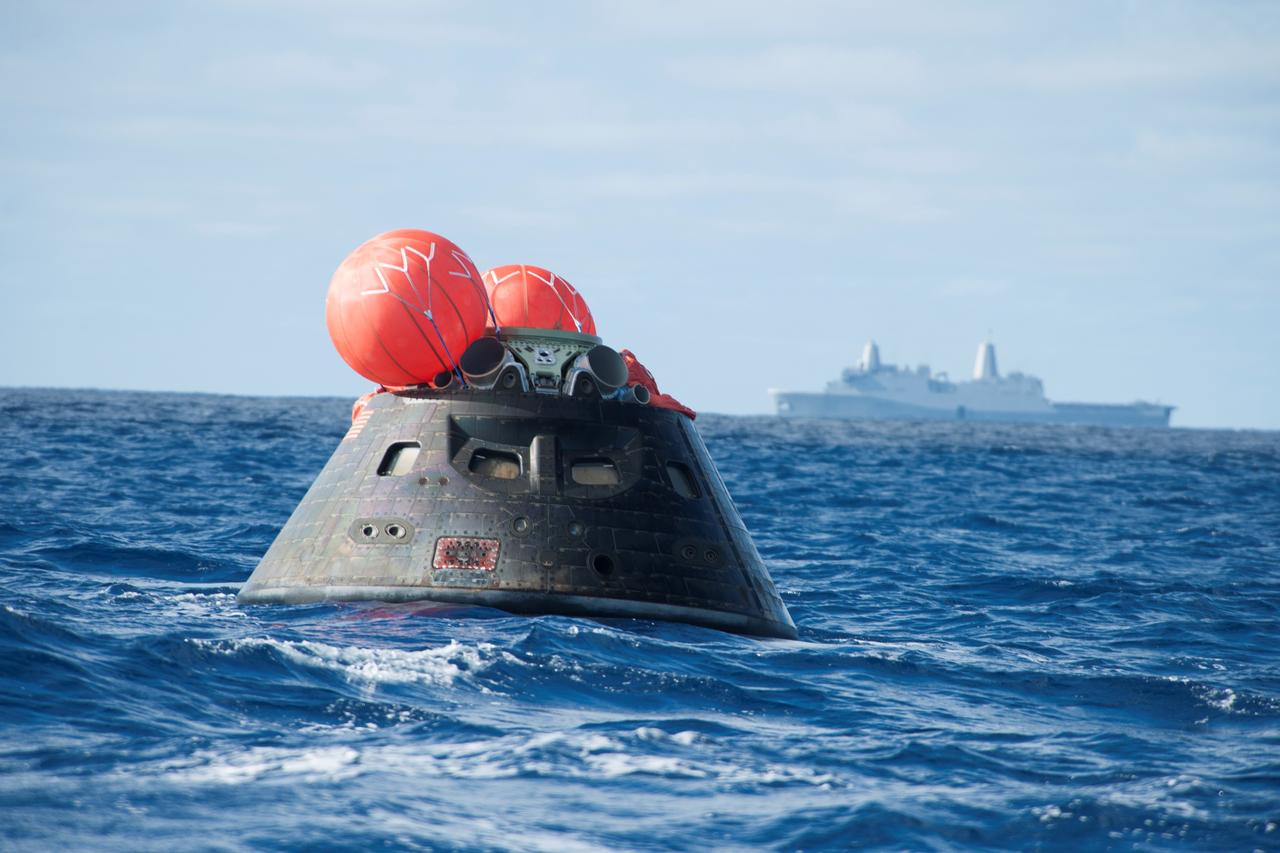
NASA's Orion spacecraft floats in the Pacific Ocean after splashdown from its first flight test in Earth orbit. An H60-S Seahawk helicopter hovers above to communicate the spacecraft's location back to the USS Anchorage. NASA, the U.S. Navy and Lockheed Martin are coordinating efforts to recover Orion and secure the spacecraft in the well deck of the USS Anchorage. Orion completed a two-orbit, four-and-a-half hour mission, to test systems critical to crew safety, including the launch abort system, the heat shield and the parachute system. The Ground Systems Development and Operations Program is leading the recovery efforts.
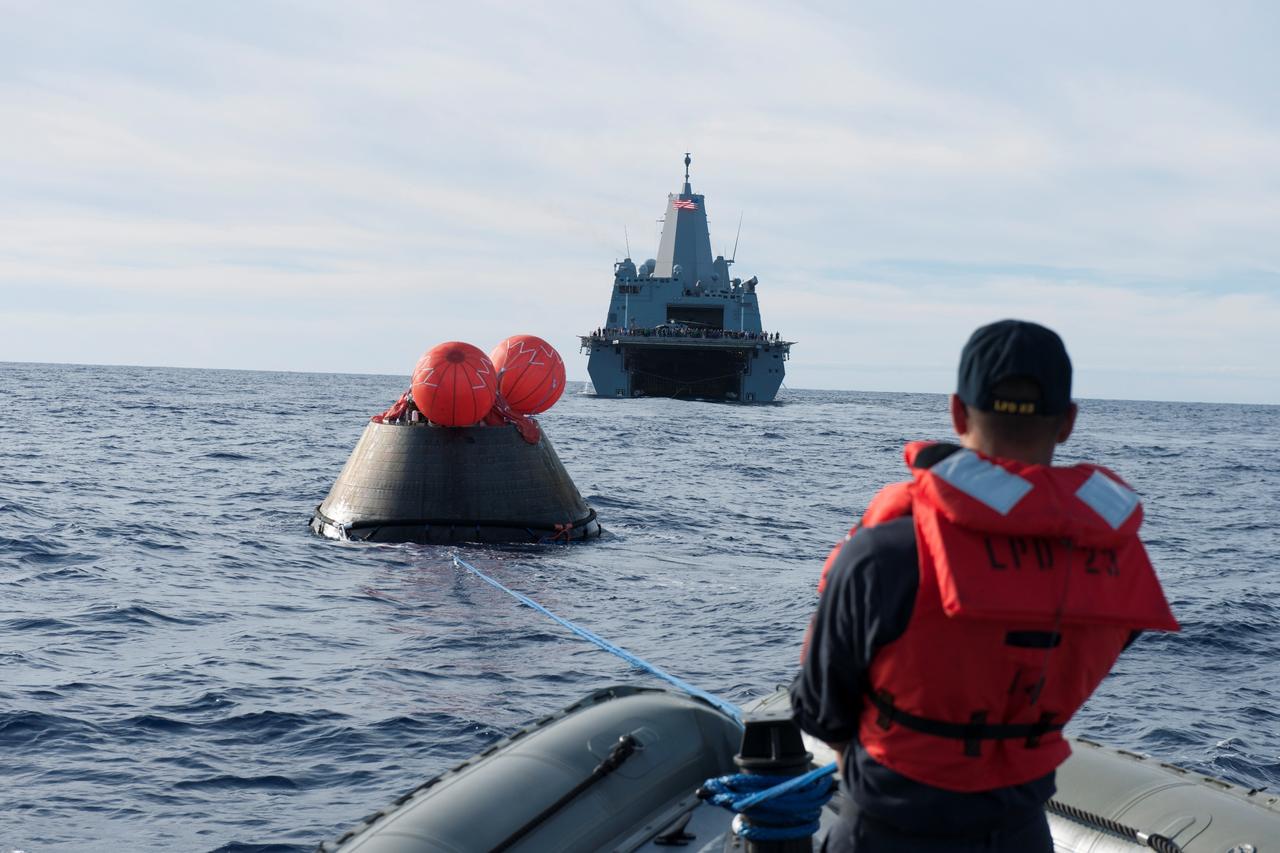
U.S. Navy personnel aboard a rigid hull inflatable boat help recover NASA's Orion spacecraft following its splashdown in the Pacific Ocean after its first flight test in Earth orbit. The USS Anchorage is in the background. NASA, the U.S. Navy and Lockheed Martin are coordinating efforts to recover Orion and secure the spacecraft in the well deck of the USS Anchorage. Orion completed a two-orbit, four-and-a-half hour mission, to test systems critical to crew safety, including the launch abort system, the heat shield and the parachute system. The Ground Systems Development and Operations Program is leading the recovery efforts.
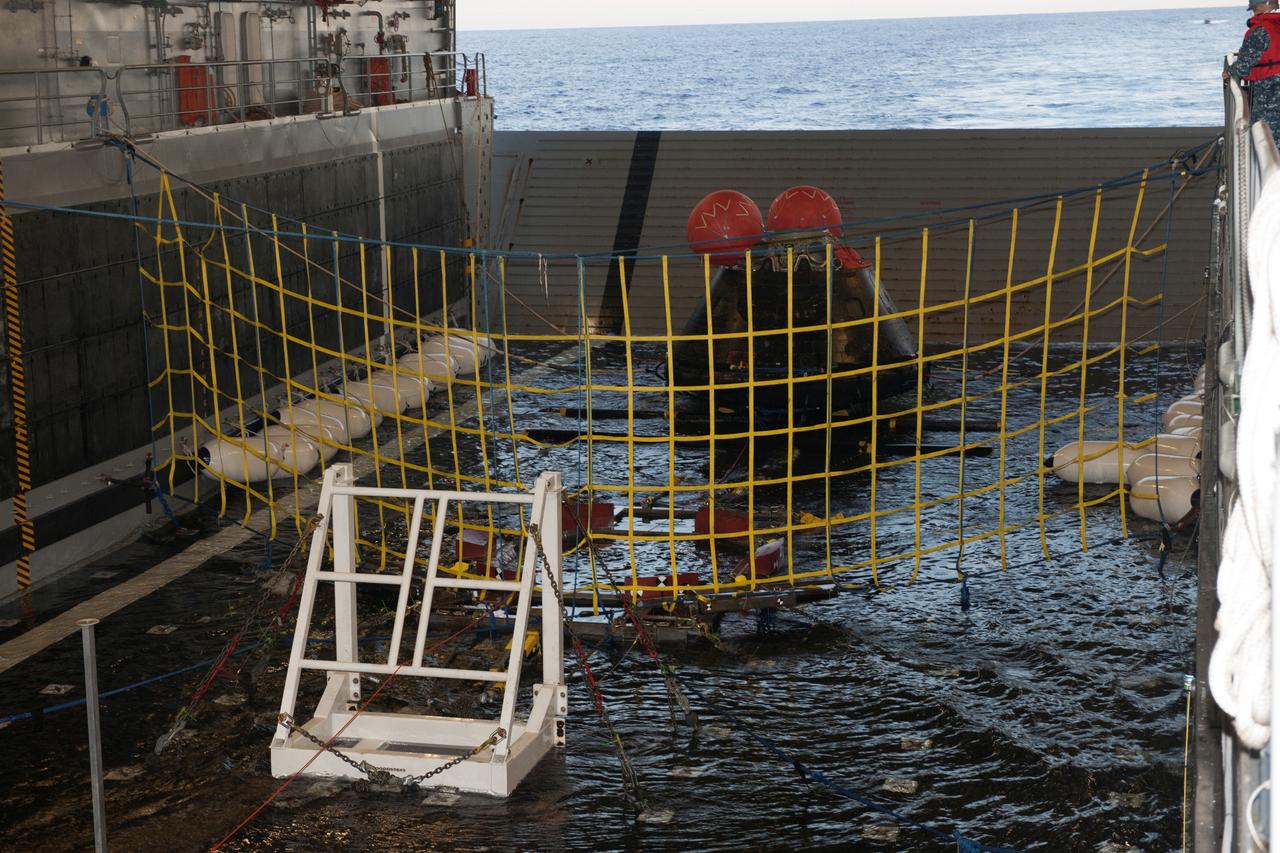
NASA's Orion spacecraft is on rubber bumpers in the flooded well deck of the USS Anchorage in the Pacific Ocean about 600 miles off the coast of San Diego, California. Orion splashed down after its first flight test in Earth orbit. NASA, the U.S. Navy and Lockheed Martin are coordinating efforts to recover Orion and secure the spacecraft in the well deck of the USS Anchorage. Orion completed a two-orbit, four-and-a-half hour mission, to test systems critical to crew safety, including the launch abort system, the heat shield and the parachute system. The Ground Systems Development and Operations Program is leading the recovery efforts.
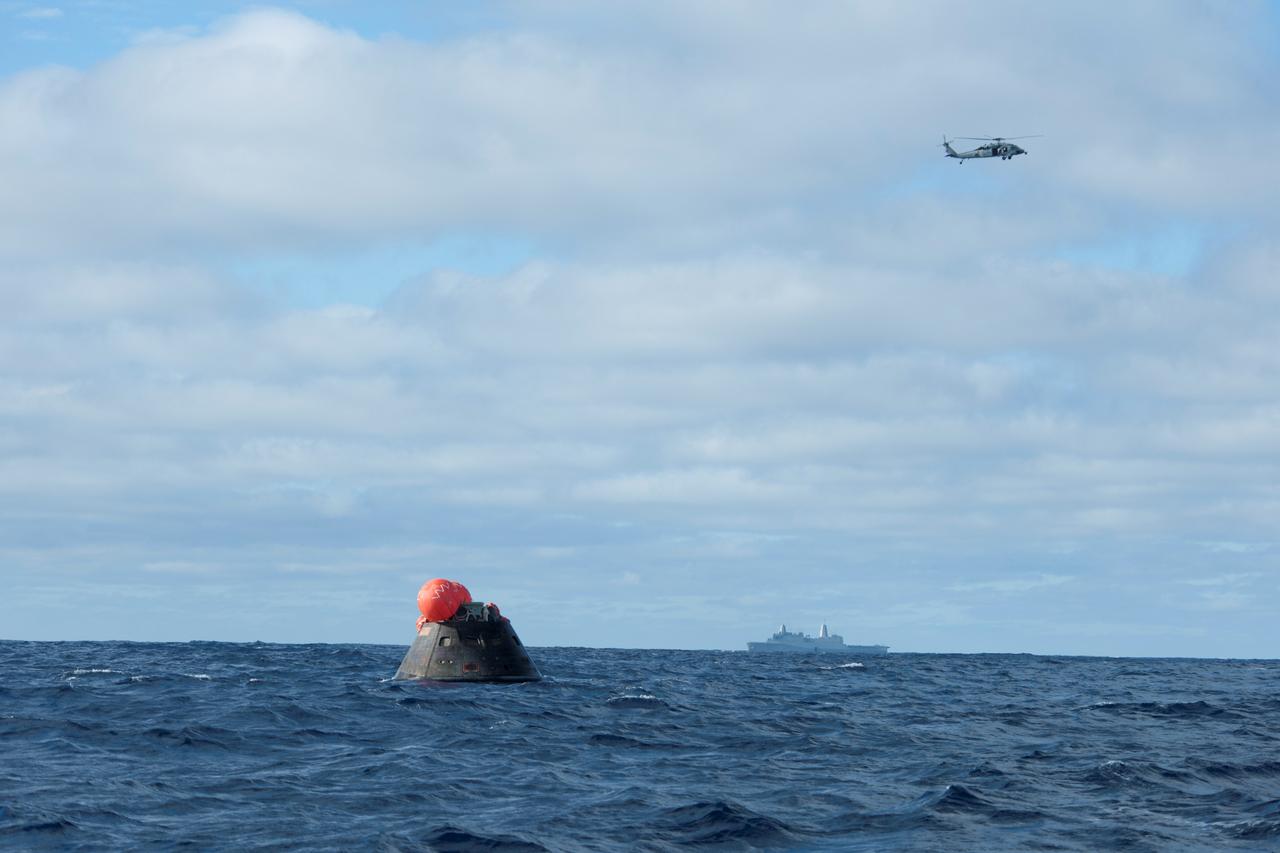
NASA's Orion spacecraft floats in the Pacific Ocean after splashdown from its first flight test in Earth orbit. An H60-S Seahawk helicopter hovers above to communicate the spacecraft's location back to the USS Anchorage, in the distance. NASA, the U.S. Navy and Lockheed Martin are coordinating efforts to recover Orion and secure the spacecraft in the well deck of the USS Anchorage. Orion completed a two-orbit, four-and-a-half hour mission, to test systems critical to crew safety, including the launch abort system, the heat shield and the parachute system. The Ground Systems Development and Operations Program is leading the recovery efforts.
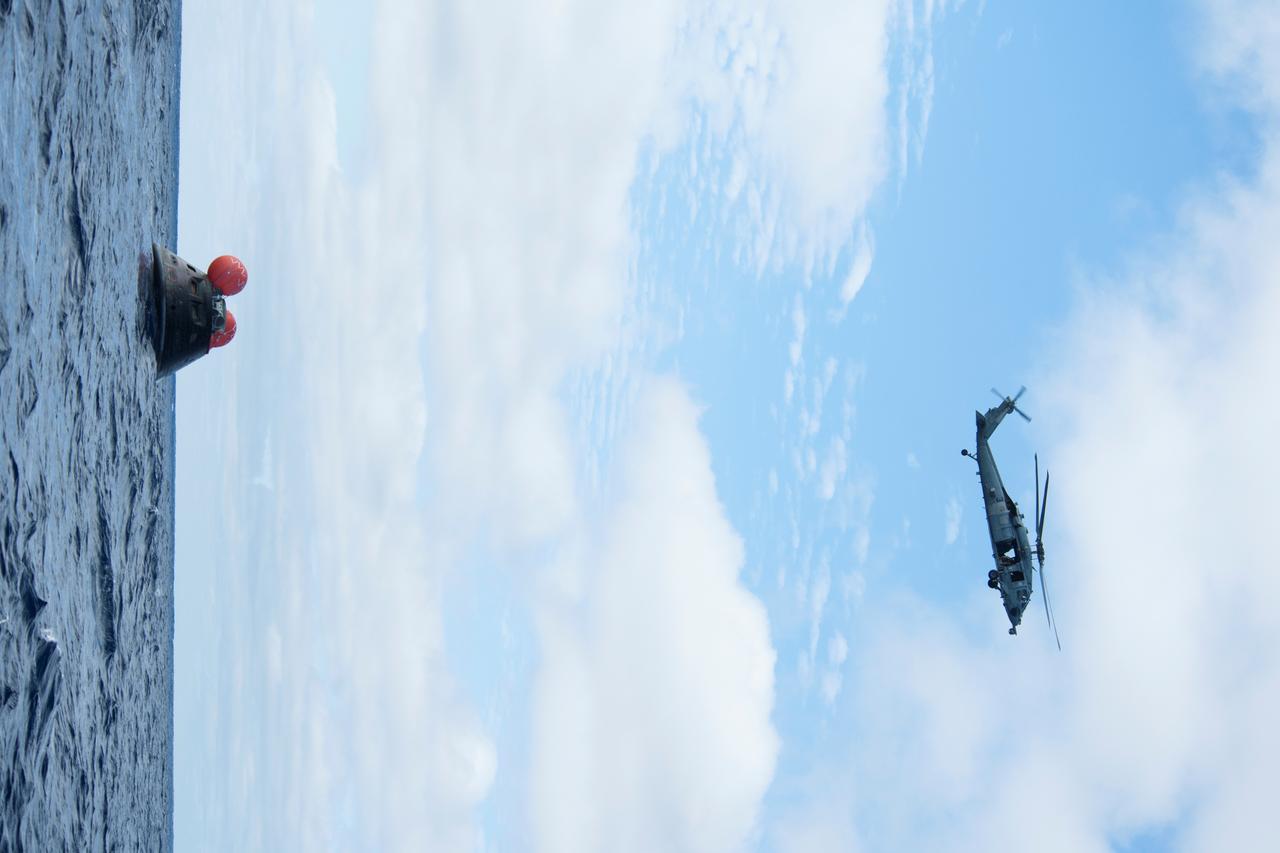
NASA's Orion spacecraft floats in the Pacific Ocean after splashdown from its first flight test in Earth orbit. An H60-S Seahawk helicopter hovers above to communicate the spacecraft's location back to the USS Anchorage. NASA, the U.S. Navy and Lockheed Martin are coordinating efforts to recover Orion and secure the spacecraft in the well deck of the USS Anchorage. Orion completed a two-orbit, four-and-a-half hour mission, to test systems critical to crew safety, including the launch abort system, the heat shield and the parachute system. The Ground Systems Development and Operations Program is leading the recovery efforts.
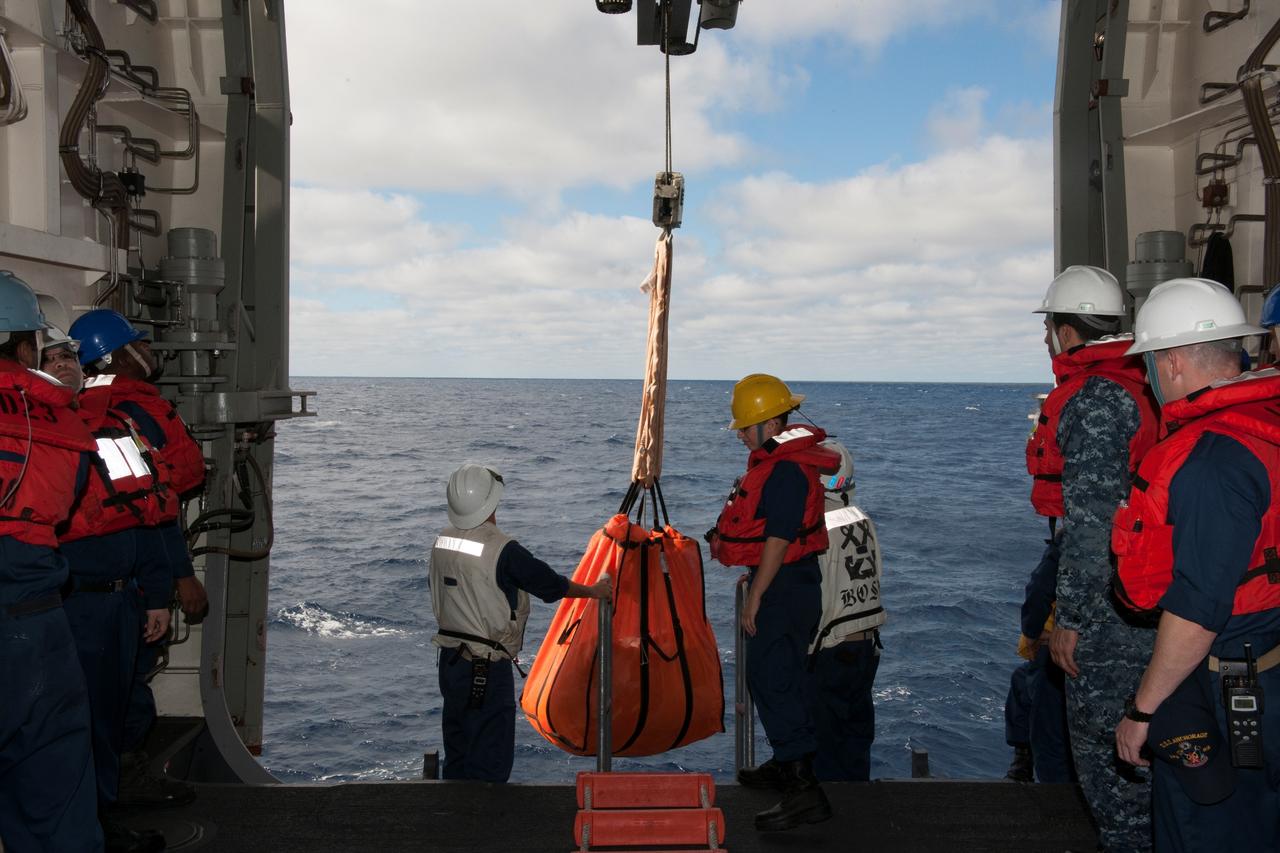
U.S. Navy personnel aboard the USS Anchorage prepare for recovery of NASA's Orion spacecraft from the Pacific Ocean about 600 miles off the coast of San Diego, California. Orion splashed down after its first flight test in Earth orbit. NASA, the U.S. Navy and Lockheed Martin are coordinating efforts to recover Orion and secure the spacecraft in the well deck of the USS Anchorage. Orion completed a two-orbit, four-and-a-half hour mission, to test systems critical to crew safety, including the launch abort system, the heat shield and the parachute system. The Ground Systems Development and Operations Program is leading the recovery efforts.
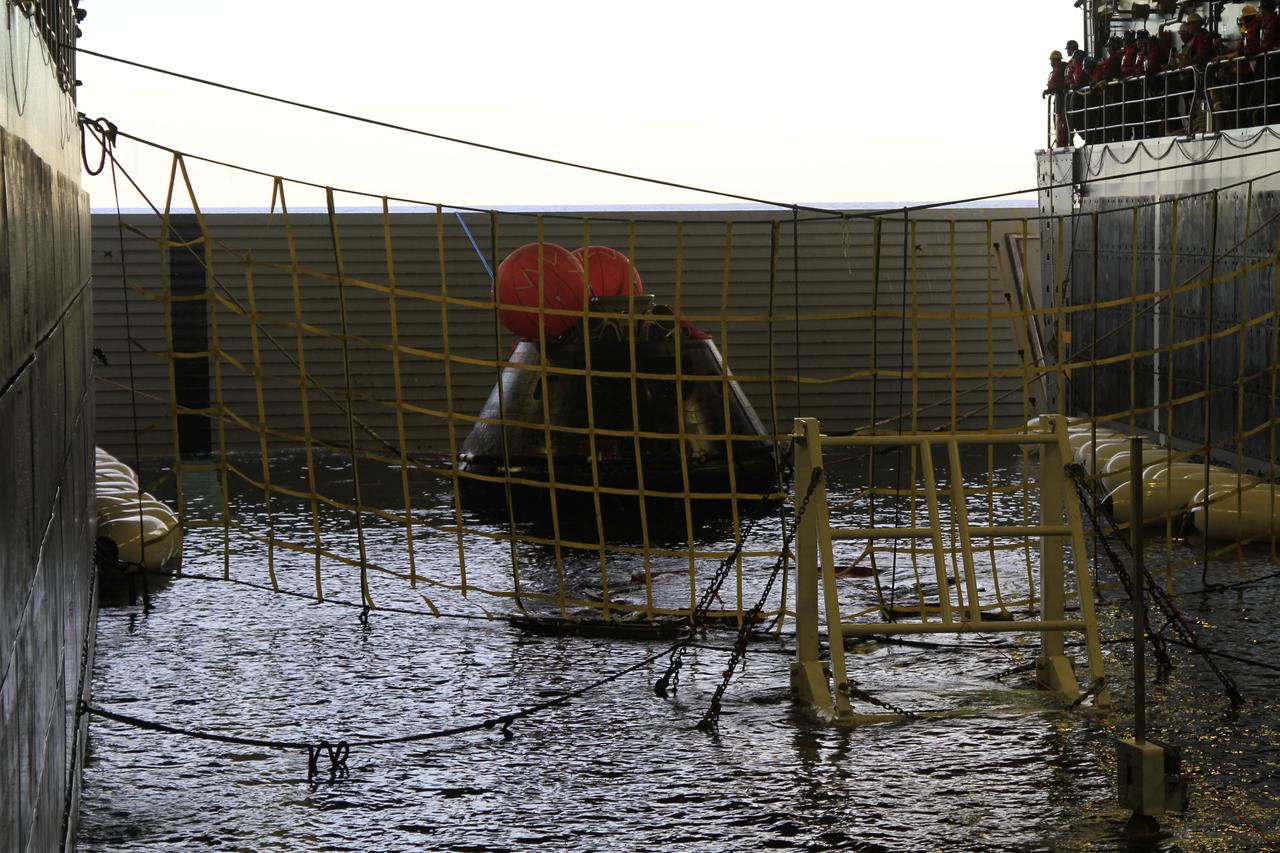
NASA's Orion spacecraft has been recovered inside the flooded well deck of the USS Anchorage in the Pacific Ocean about 600 miles off the coast of San Diego, California. After lifting off at 7:05 a.m. EST atop a Delta IV Heavy rocket from Space Launch Complex 37 at Cape Canaveral Air Force Station in Florida, Orion completed a two-orbit, four-and-a-half hour mission to test systems critical to crew safety, including the launch abort system, the heat shield and the parachute system. NASA, the U.S. Navy and Lockheed Martin coordinated efforts to recover Orion after splashdown. The Ground Systems Development and Operations Program is leading the recovery efforts.
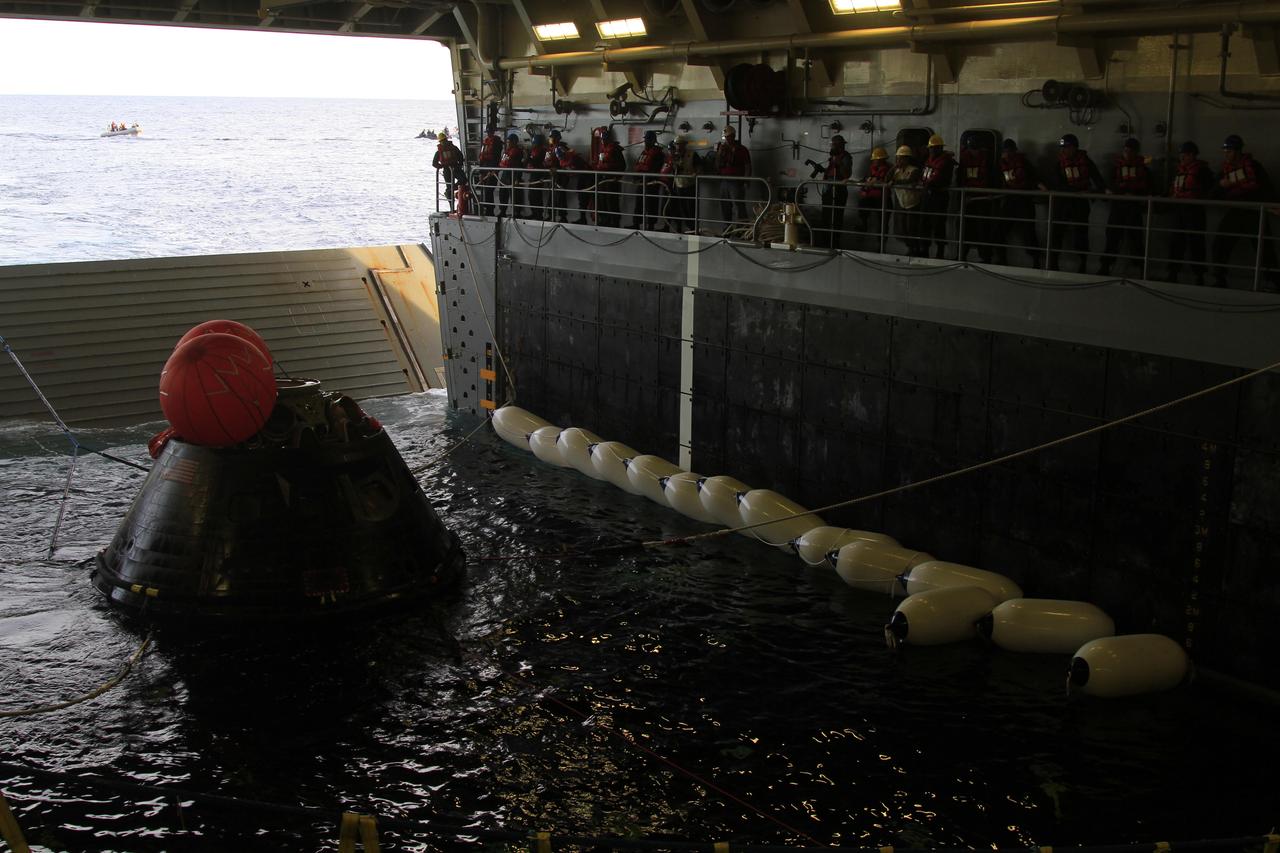
NASA's Orion spacecraft is secured with tether lines inside the flooded well deck of the USS Anchorage in the Pacific Ocean about 600 miles off the coast of San Diego, California. After lifting off at 7:05 a.m. EST atop a Delta IV Heavy rocket from Space Launch Complex 37 at Cape Canaveral Air Force Station in Florida, Orion completed a two-orbit, four-and-a-half hour mission to test systems critical to crew safety, including the launch abort system, the heat shield and the parachute system. NASA, the U.S. Navy and Lockheed Martin coordinated efforts to recover Orion after splashdown. The Ground Systems Development and Operations Program is leading the recovery efforts.
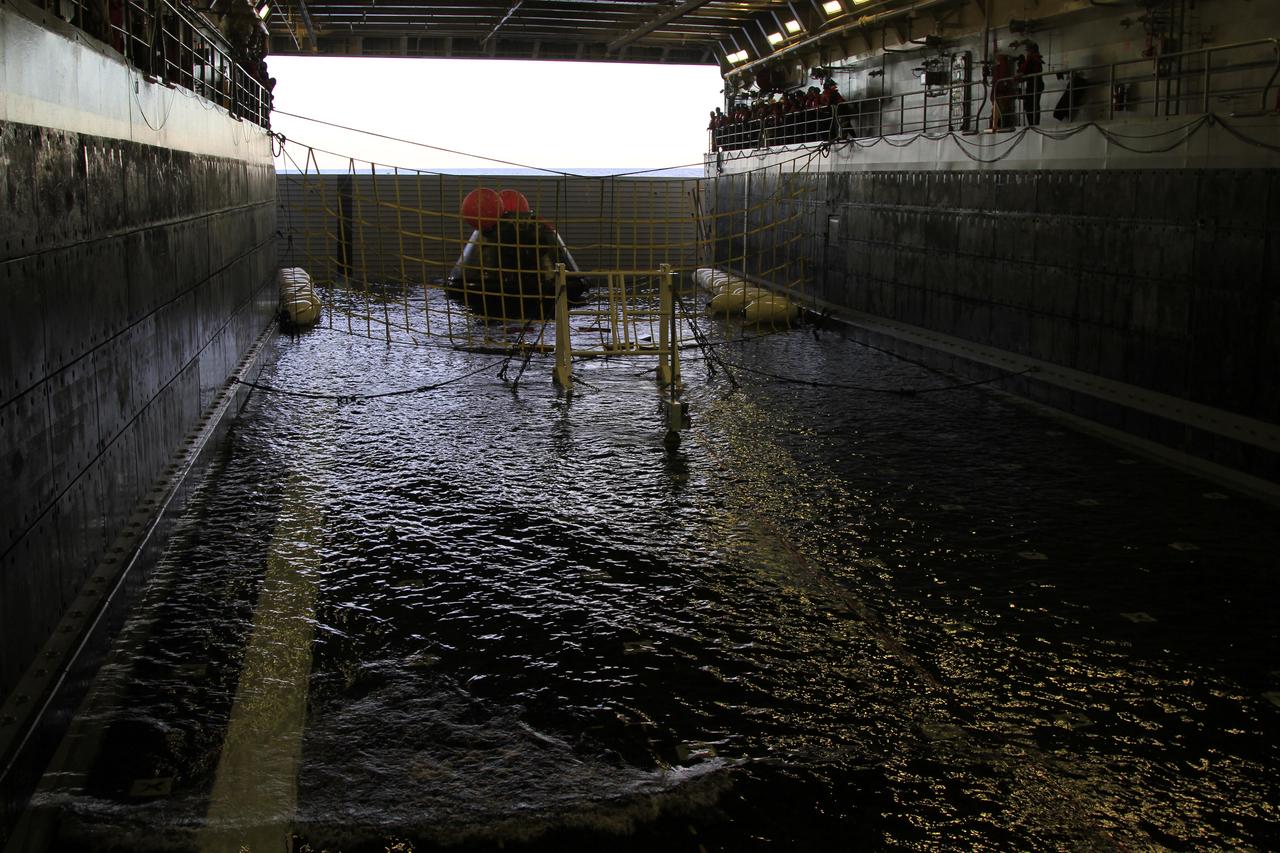
After splashdown, NASA's Orion spacecraft has been recovered and is positioned on rubber "speed bumps" inside the flooded well deck of the USS Anchorage in the Pacific Ocean about 600 miles off the coast of San Diego, California. After lifting off at 7:05 a.m. EST atop a Delta IV Heavy rocket from Space Launch Complex 37 at Cape Canaveral Air Force Station in Florida, Orion completed a two-orbit, four-and-a-half hour mission to test systems critical to crew safety, including the launch abort system, the heat shield and the parachute system. NASA, the U.S. Navy and Lockheed Martin coordinated efforts to recover Orion after splashdown. The Ground Systems Development and Operations Program is leading the recovery efforts.
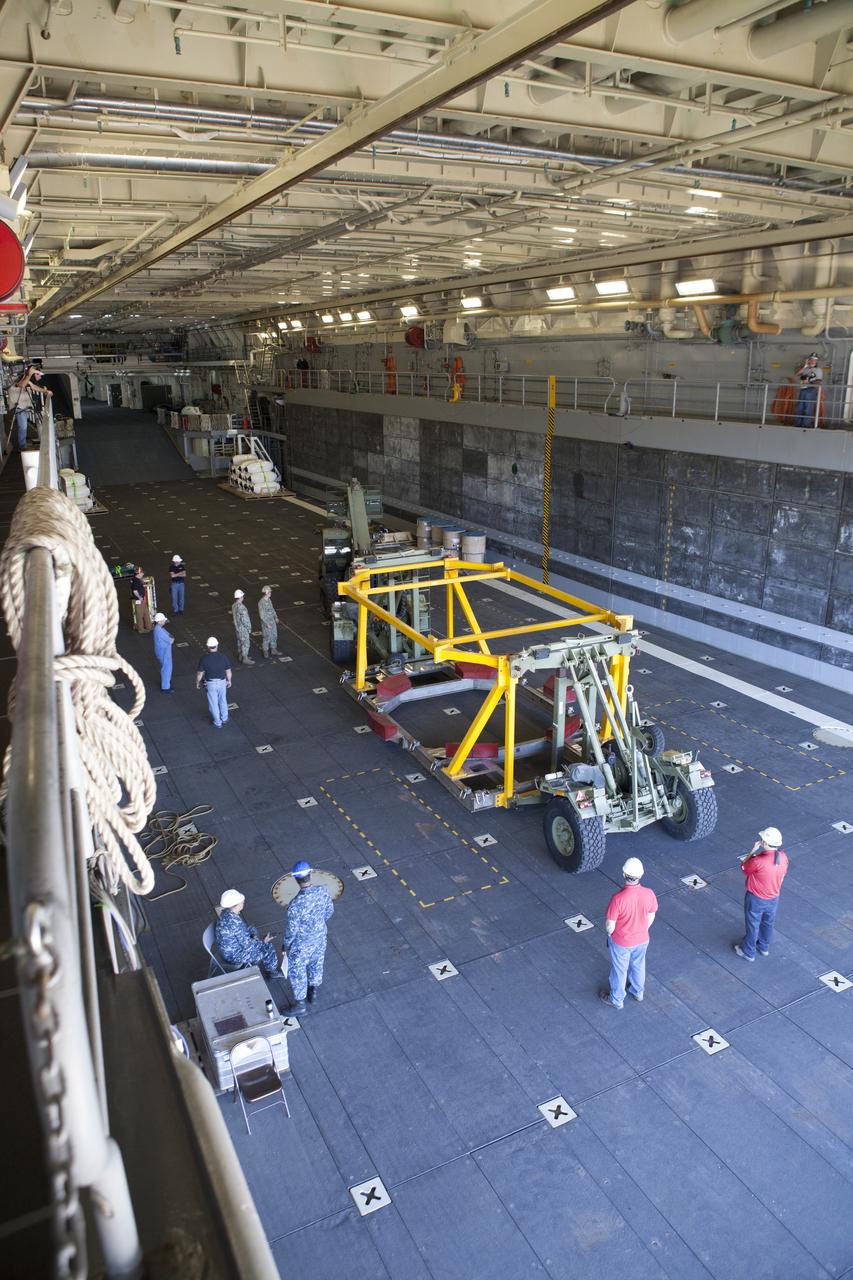
The Orion crew module recovery fixture has been loaded into the well deck of the USS Anchorage at Naval Base San Diego in California. The equipment will be used during recovery of the Orion crew module after its first flight test. Before launch of Orion on a Delta IV Heavy rocket from Cape Canaveral Air Force Station in Florida, NASA, Lockheed Martin and U.S. Navy personnel will head out to sea in the USS Anchorage and the USNS Salvor, a salvage ship, and wait for splashdown of the Orion crew module in the Pacific Ocean. The Ground Systems Development and Operations Program will lead the recovery efforts. Orion is the exploration spacecraft designed to carry astronauts to destinations not yet explored by humans, including an asteroid and Mars. It will have emergency abort capability, sustain the crew during space travel and provide safe re-entry from deep space return velocities. The first unpiloted flight test of Orion is scheduled to launch in December atop a United Launch Alliance Delta IV Heavy rocket and in 2018 on NASA’s Space Launch System rocket.
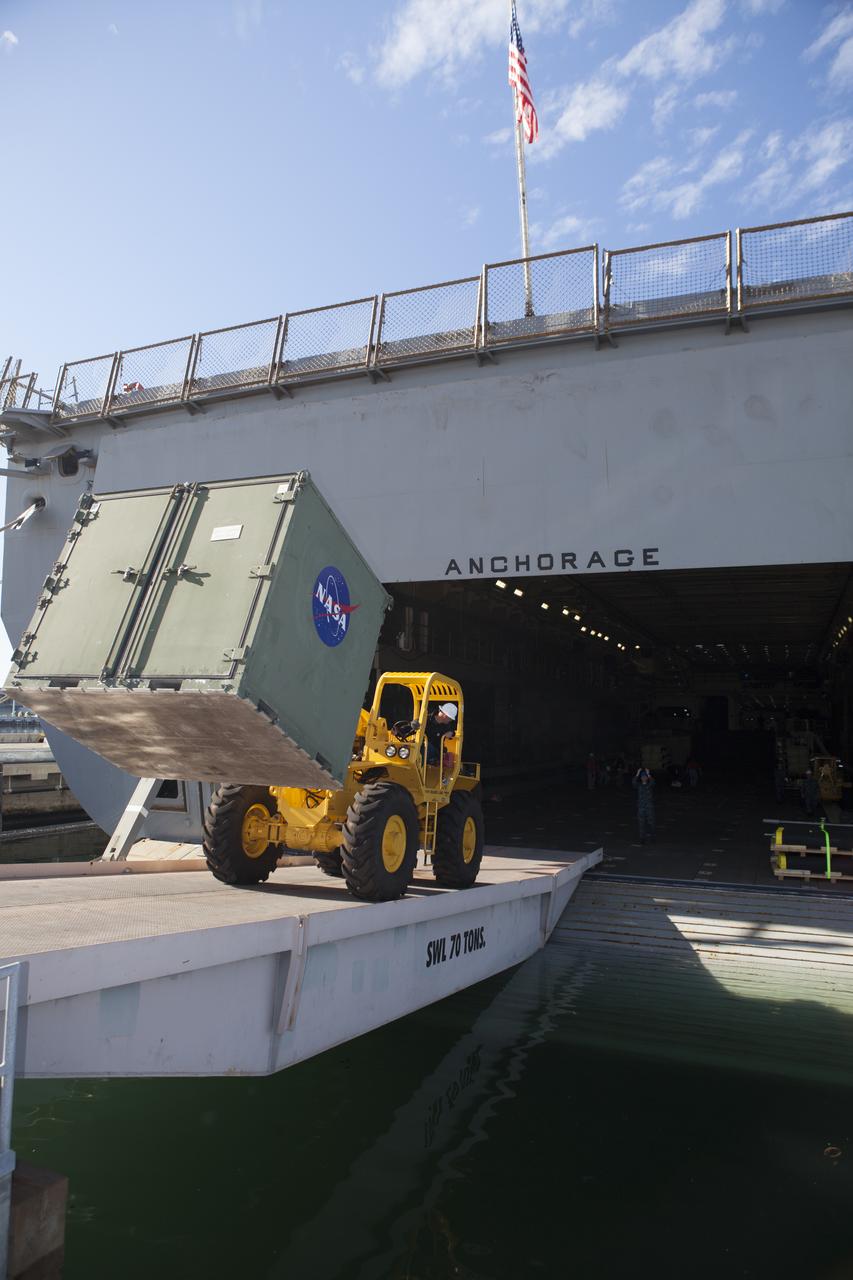
A forklift is used to carry ground support equipment into the well deck of the USS Anchorage at Naval Base San Diego in California. The equipment will be used during recovery of the Orion crew module after its first flight test. Before launch of Orion on a Delta IV Heavy rocket from Cape Canaveral Air Force Station in Florida, NASA, Lockheed Martin and U.S. Navy personnel will head out to sea in the USS Anchorage and the USNS Salvor, a salvage ship, and wait for splashdown of the Orion crew module in the Pacific Ocean. The Ground Systems Development and Operations Program will lead the recovery efforts. Orion is the exploration spacecraft designed to carry astronauts to destinations not yet explored by humans, including an asteroid and Mars. It will have emergency abort capability, sustain the crew during space travel and provide safe re-entry from deep space return velocities. The first unpiloted flight test of Orion is scheduled to launch in December atop a United Launch Alliance Delta IV Heavy rocket and in 2018 on NASA’s Space Launch System rocket.
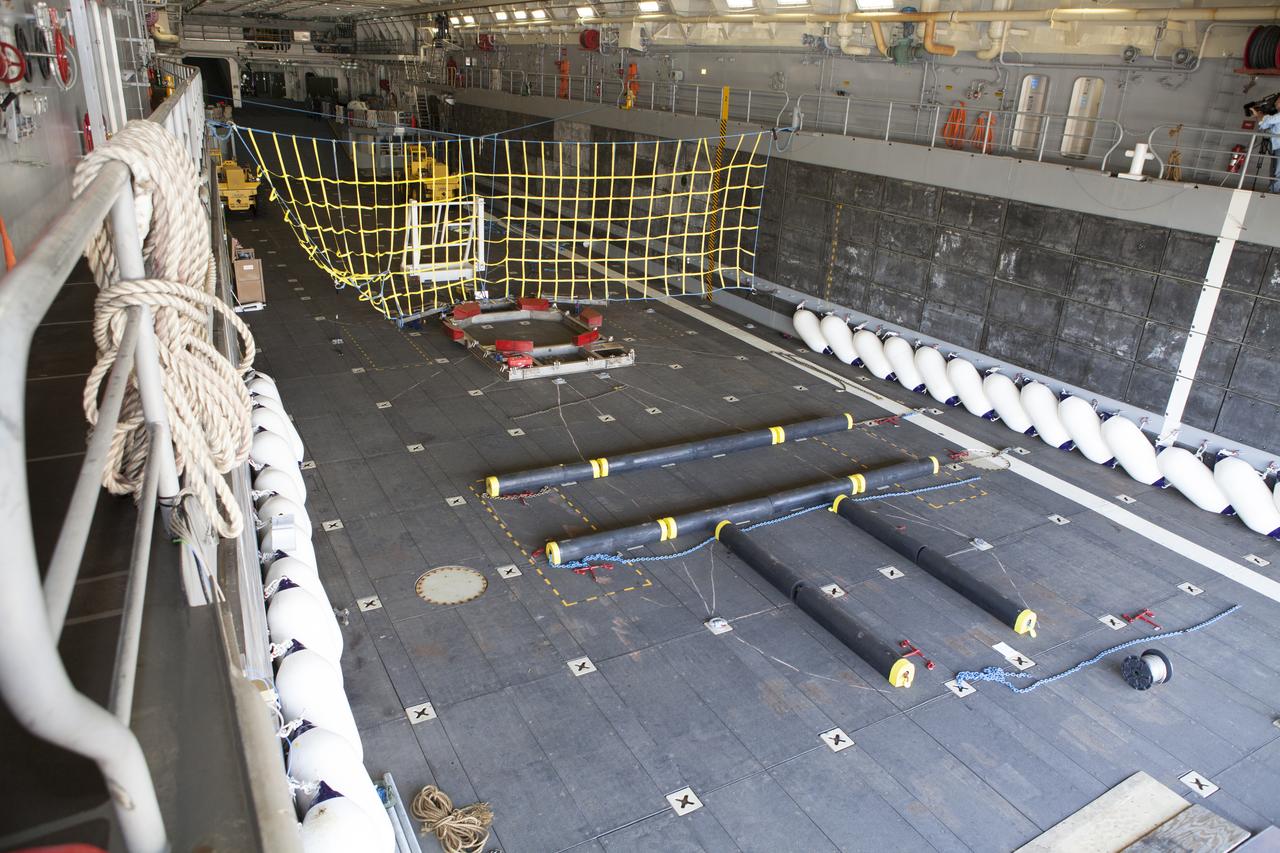
The Orion handling fixture, special bumpers and other ground support equipment are secured in the well deck of the USS Anchorage at Naval Base San Diego in California. The equipment will be used during recovery of the Orion crew module after its first flight test. Before launch of Orion on a Delta IV Heavy rocket from Cape Canaveral Air Force Station in Florida, NASA, Lockheed Martin and U.S. Navy personnel will head out to sea in the USS Anchorage and the USNS Salvor, a salvage ship, and wait for splashdown of the Orion crew module in the Pacific Ocean. The Ground Systems Development and Operations Program will lead the recovery efforts. Orion is the exploration spacecraft designed to carry astronauts to destinations not yet explored by humans, including an asteroid and Mars. It will have emergency abort capability, sustain the crew during space travel and provide safe re-entry from deep space return velocities. The first unpiloted flight test of Orion is scheduled to launch in December atop a United Launch Alliance Delta IV Heavy rocket and in 2018 on NASA’s Space Launch System rocket.
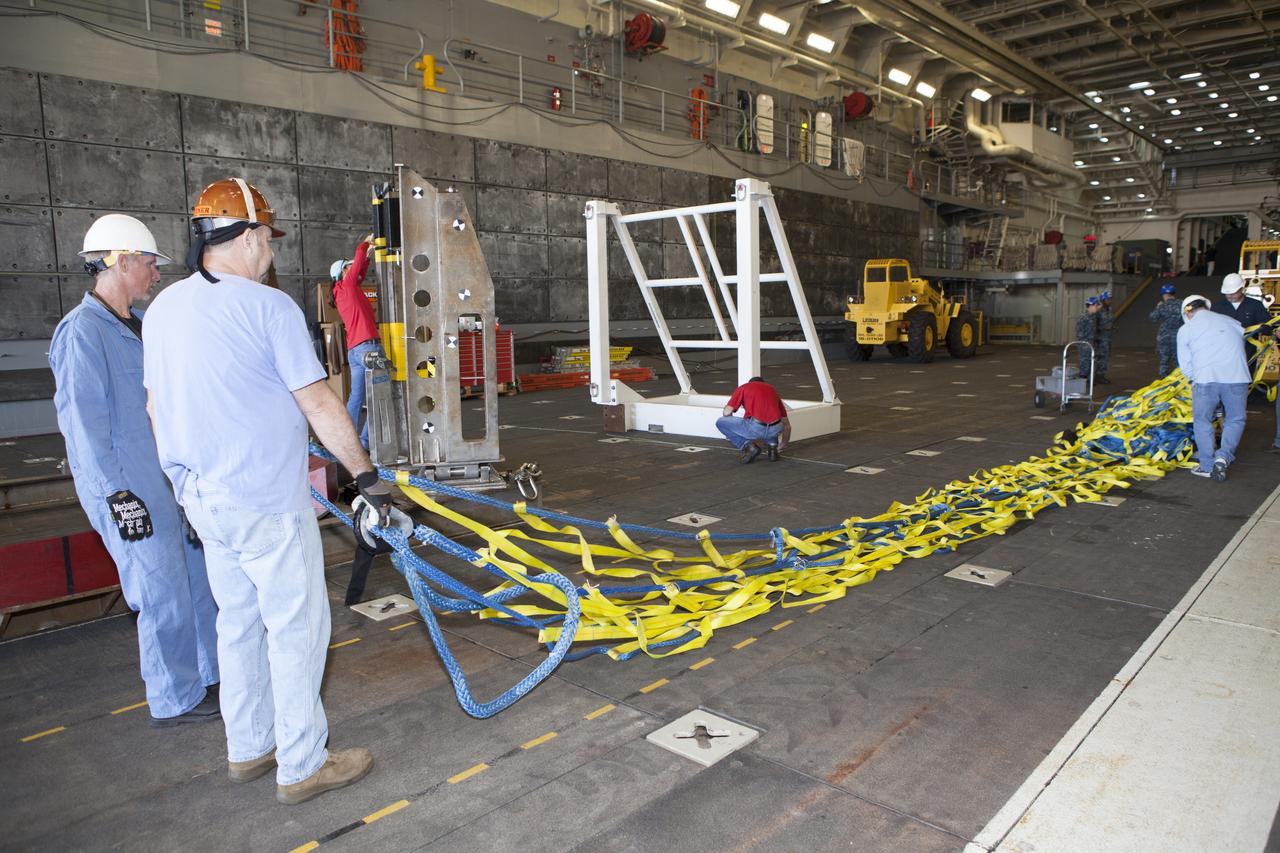
Ground support equipment is being secured in the well deck of the USS Anchorage at Naval Base San Diego in California. The equipment will be used during recovery of the Orion crew module after its first flight test. Before launch of Orion on a Delta IV Heavy rocket from Cape Canaveral Air Force Station in Florida, NASA, Lockheed Martin and U.S. Navy personnel will head out to sea in the USS Anchorage and the USNS Salvor, a salvage ship, and wait for splashdown of the Orion crew module in the Pacific Ocean. The Ground Systems Development and Operations Program will lead the recovery efforts. Orion is the exploration spacecraft designed to carry astronauts to destinations not yet explored by humans, including an asteroid and Mars. It will have emergency abort capability, sustain the crew during space travel and provide safe re-entry from deep space return velocities. The first unpiloted flight test of Orion is scheduled to launch in December atop a United Launch Alliance Delta IV Heavy rocket and in 2018 on NASA’s Space Launch System rocket.
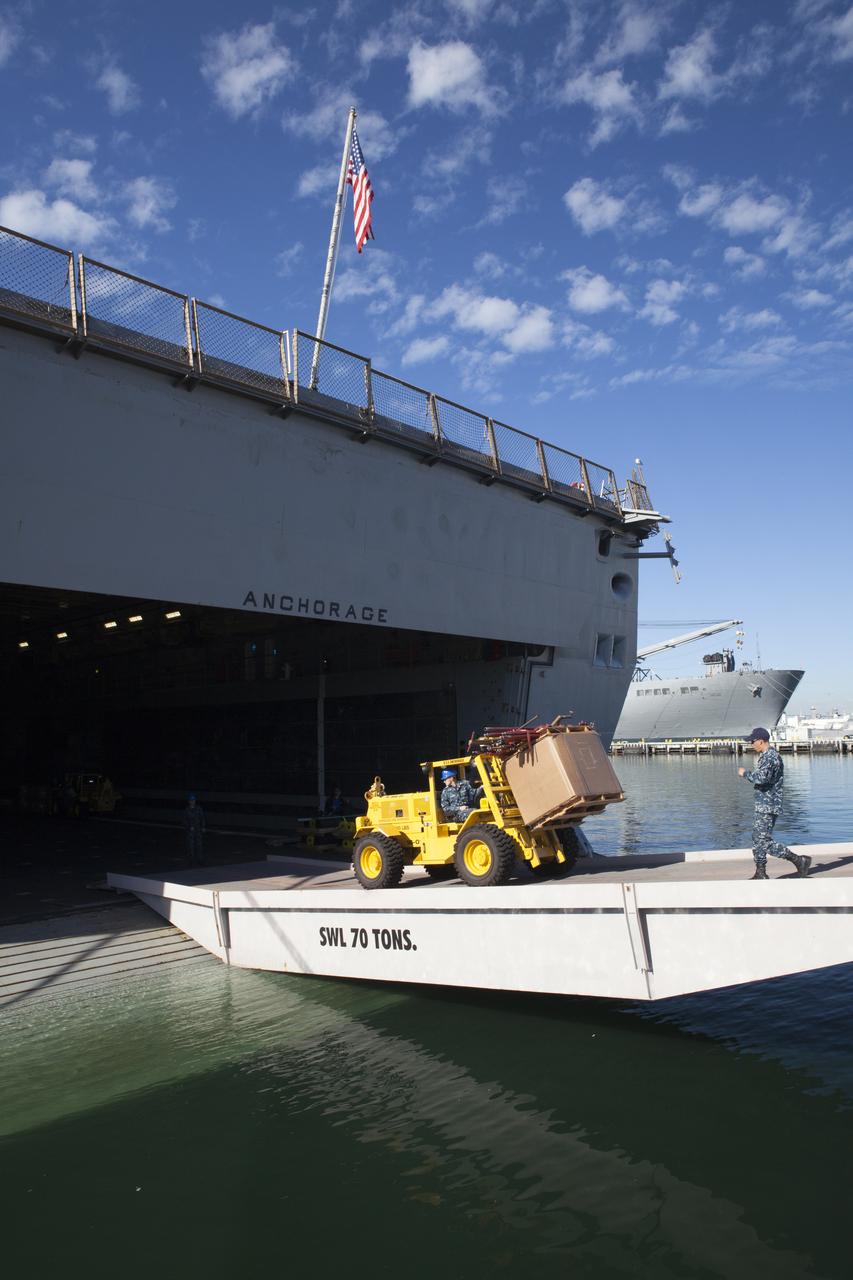
A forklift is used to carry ground support equipment into the well deck of the USS Anchorage at Naval Base San Diego in California. The equipment will be used during recovery of the Orion crew module after its first flight test. Before launch of Orion on a Delta IV Heavy rocket from Cape Canaveral Air Force Station in Florida, NASA, Lockheed Martin and U.S. Navy personnel will head out to sea in the USS Anchorage and the USNS Salvor, a salvage ship, and wait for splashdown of the Orion crew module in the Pacific Ocean. The Ground Systems Development and Operations Program will lead the recovery efforts. Orion is the exploration spacecraft designed to carry astronauts to destinations not yet explored by humans, including an asteroid and Mars. It will have emergency abort capability, sustain the crew during space travel and provide safe re-entry from deep space return velocities. The first unpiloted flight test of Orion is scheduled to launch in December atop a United Launch Alliance Delta IV Heavy rocket and in 2018 on NASA’s Space Launch System rocket.
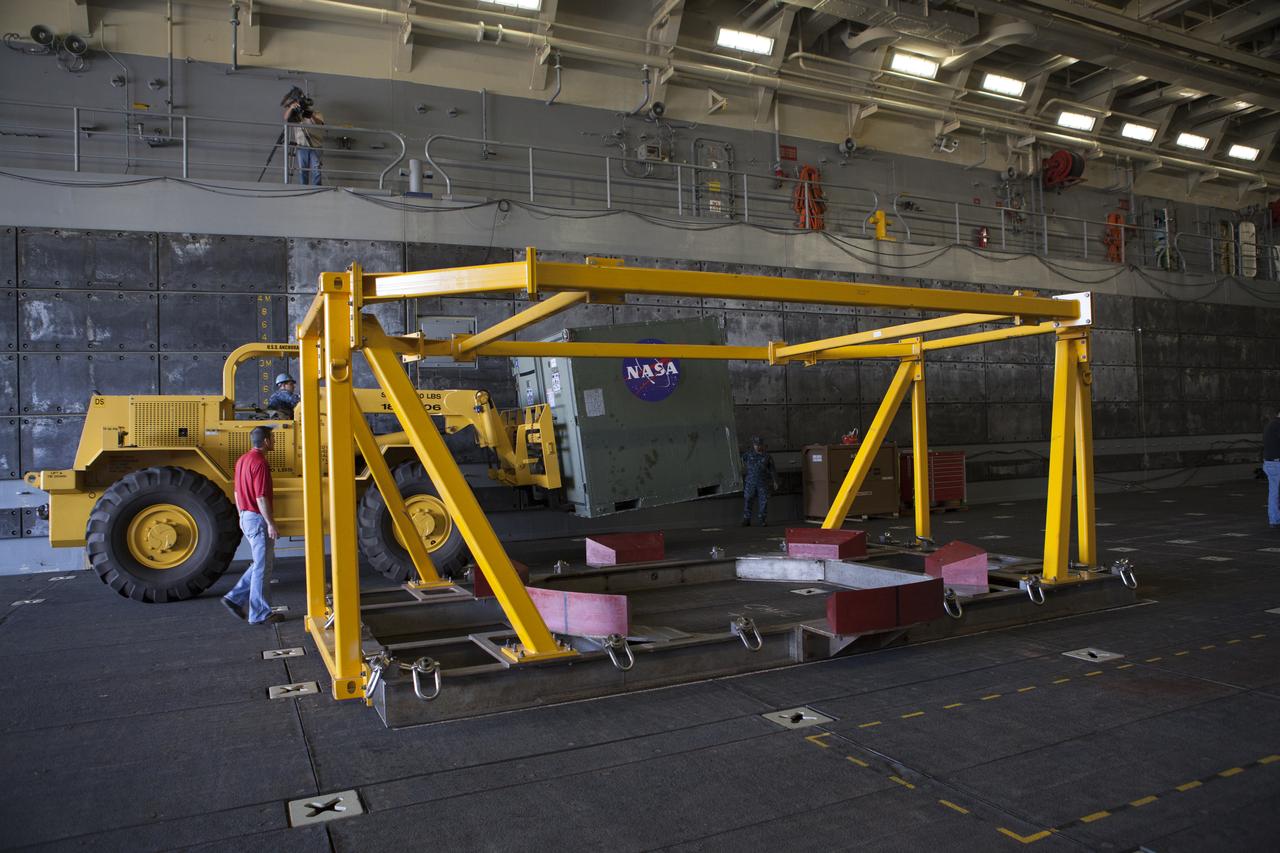
The Orion crew module recovery fixture and other ground support equipment have been loaded into the well deck of the USS Anchorage at Naval Base San Diego in California. The equipment will be used during recovery of the Orion crew module after its first flight test. Before launch of Orion on a Delta IV Heavy rocket from Cape Canaveral Air Force Station in Florida, NASA, Lockheed Martin and U.S. Navy personnel will head out to sea in the USS Anchorage and the USNS Salvor, a salvage ship, and wait for splashdown of the Orion crew module in the Pacific Ocean. The Ground Systems Development and Operations Program will lead the recovery efforts. Orion is the exploration spacecraft designed to carry astronauts to destinations not yet explored by humans, including an asteroid and Mars. It will have emergency abort capability, sustain the crew during space travel and provide safe re-entry from deep space return velocities. The first unpiloted flight test of Orion is scheduled to launch in December atop a United Launch Alliance Delta IV Heavy rocket and in 2018 on NASA’s Space Launch System rocket.
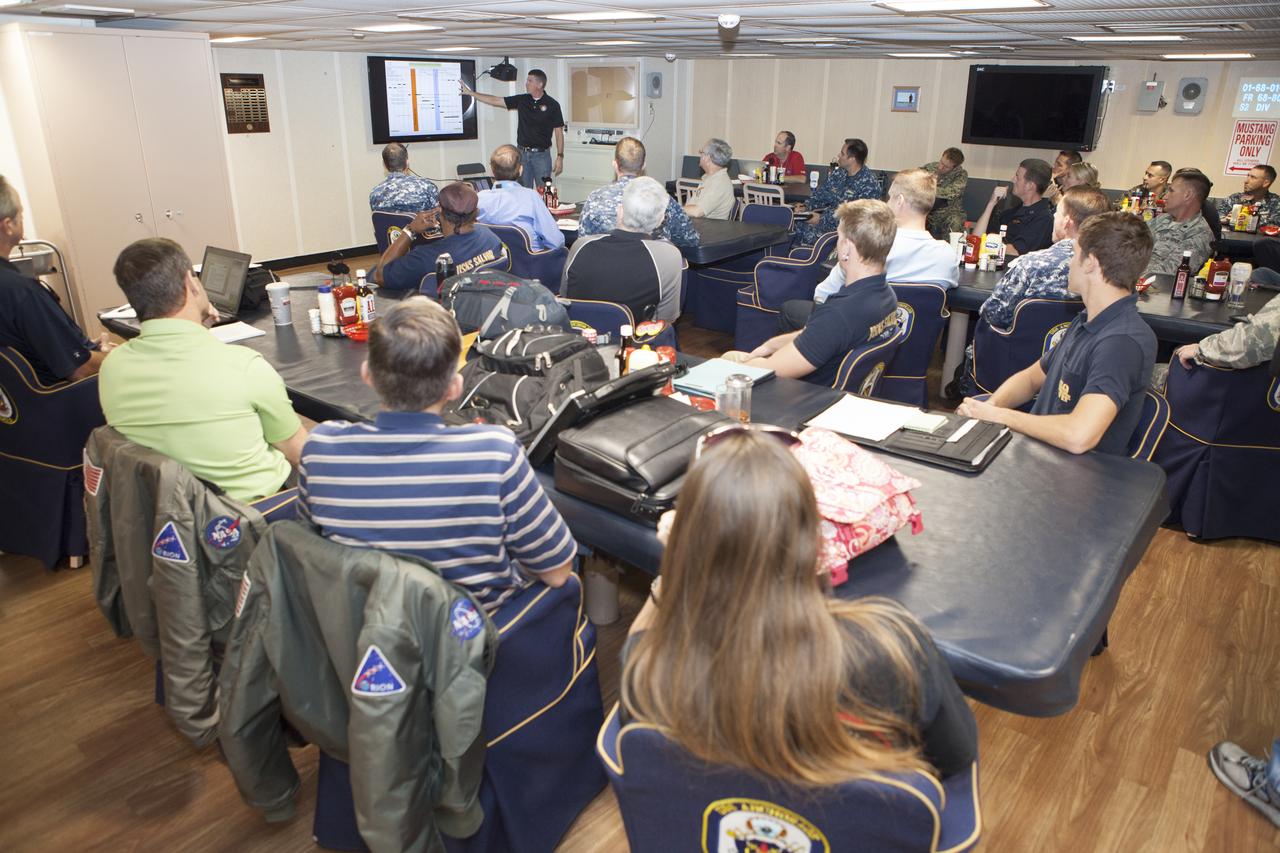
NASA Orion Recovery Director Jeremy Graeber, with the Ground Systems Development and Operations Program at Kennedy Space Center in Florida, reviews Orion recovery procedures with NASA, Lockheed Martin and U.S. Navy personnel aboard the USS Anchorage at Naval Base San Diego in California. Before the launch of Orion on its first flight test atop a Delta IV Heavy rocket from Cape Canaveral Air Force Station in Florida, NASA, Lockheed Martin and the U.S. Navy personnel will head out to sea in the USS Anchorage and the USNS Salvor, a salvage ship, and wait for splashdown of the Orion crew module in the Pacific Ocean. The GSDO Program will lead the recovery efforts. Orion is the exploration spacecraft designed to carry astronauts to destinations not yet explored by humans, including an asteroid and Mars. It will have emergency abort capability, sustain the crew during space travel and provide safe re-entry from deep space return velocities. The first unpiloted flight test of Orion is scheduled to launch in December atop a United Launch Alliance Delta IV Heavy rocket and in 2018 on NASA’s Space Launch System rocket.
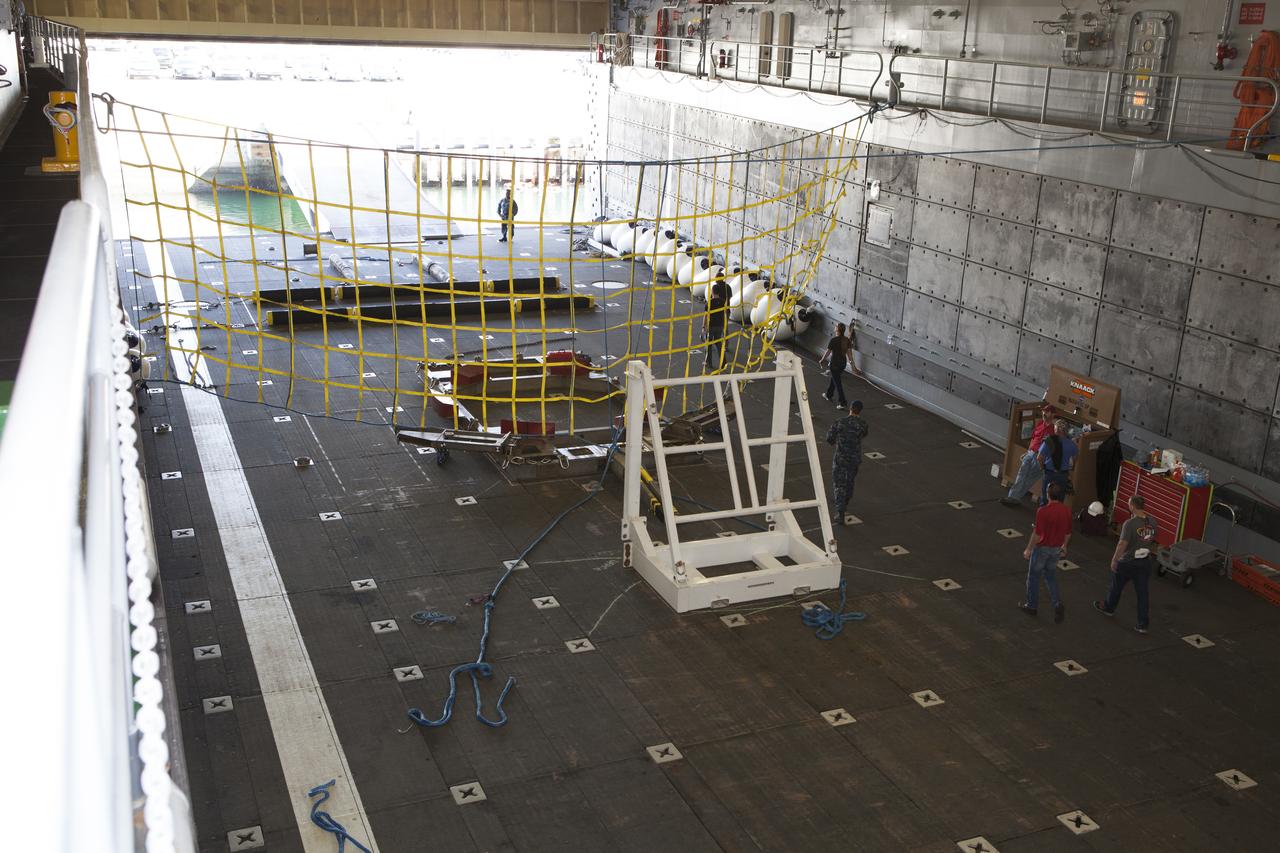
The Orion handling fixture and other ground support equipment is secured in the well deck of the USS Anchorage at Naval Base San Diego in California. The equipment will be used during recovery of the Orion crew module after its first flight test. Before launch of Orion on a Delta IV Heavy rocket from Cape Canaveral Air Force Station in Florida, NASA, Lockheed Martin and U.S. Navy personnel will head out to sea in the USS Anchorage and the USNS Salvor, a salvage ship, and wait for splashdown of the Orion crew module in the Pacific Ocean. The Ground Systems Development and Operations Program will lead the recovery efforts. Orion is the exploration spacecraft designed to carry astronauts to destinations not yet explored by humans, including an asteroid and Mars. It will have emergency abort capability, sustain the crew during space travel and provide safe re-entry from deep space return velocities. The first unpiloted flight test of Orion is scheduled to launch in December atop a United Launch Alliance Delta IV Heavy rocket and in 2018 on NASA’s Space Launch System rocket.
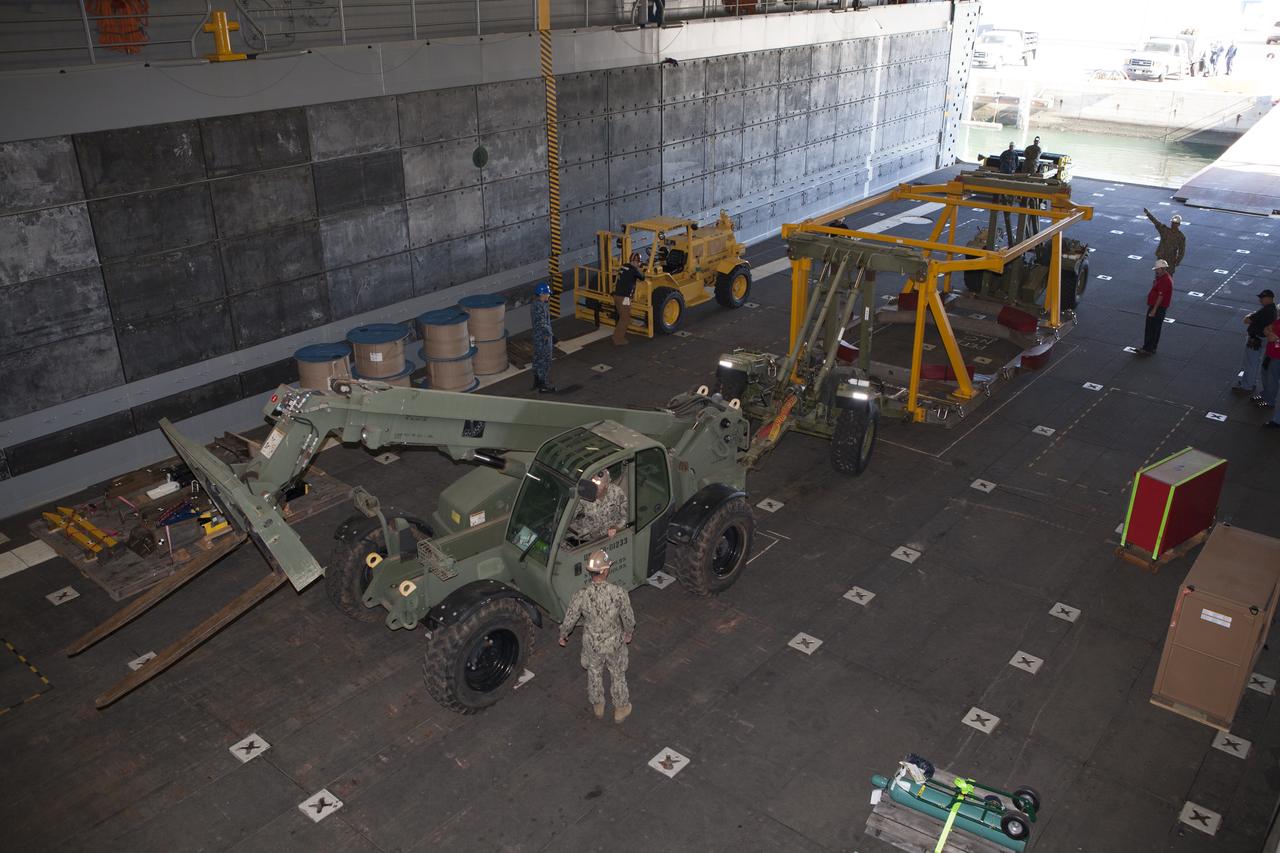
The Orion crew module recovery fixture is being loaded into the well deck of the USS Anchorage at Naval Base San Diego in California. The equipment will be used during recovery of the Orion crew module after its first flight test. Before launch of Orion on a Delta IV Heavy rocket from Cape Canaveral Air Force Station in Florida, NASA, Lockheed Martin and U.S. Navy personnel will head out to sea in the USS Anchorage and the USNS Salvor, a salvage ship, and wait for splashdown of the Orion crew module in the Pacific Ocean. The Ground Systems Development and Operations Program will lead the recovery efforts. Orion is the exploration spacecraft designed to carry astronauts to destinations not yet explored by humans, including an asteroid and Mars. It will have emergency abort capability, sustain the crew during space travel and provide safe re-entry from deep space return velocities. The first unpiloted flight test of Orion is scheduled to launch in December atop a United Launch Alliance Delta IV Heavy rocket and in 2018 on NASA’s Space Launch System rocket.
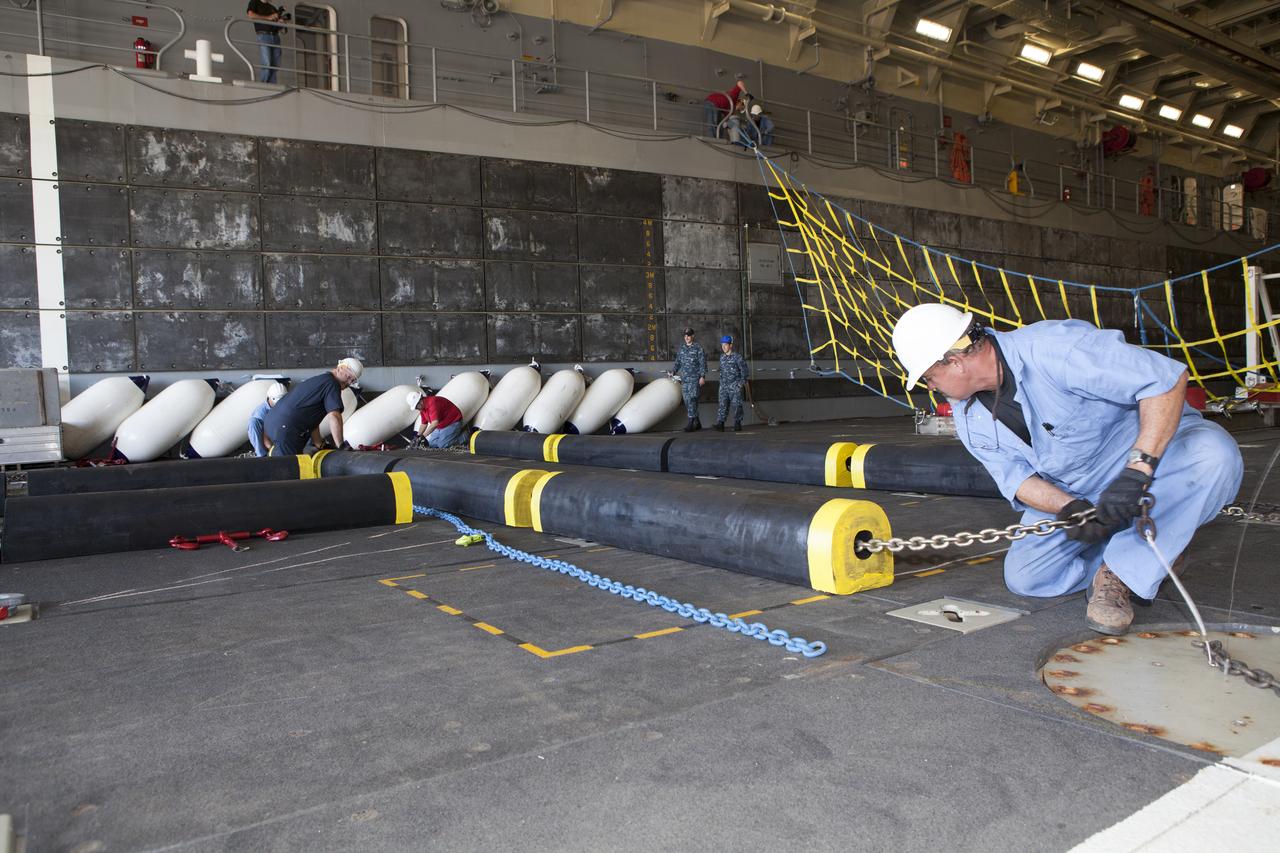
Ground support equipment is being secured in the well deck of the USS Anchorage at Naval Base San Diego in California. The equipment will be used during recovery of the Orion crew module after its first flight test. Before launch of Orion on a Delta IV Heavy rocket from Cape Canaveral Air Force Station in Florida, NASA, Lockheed Martin and U.S. Navy personnel will head out to sea in the USS Anchorage and the USNS Salvor, a salvage ship, and wait for splashdown of the Orion crew module in the Pacific Ocean. The Ground Systems Development and Operations Program will lead the recovery efforts. Orion is the exploration spacecraft designed to carry astronauts to destinations not yet explored by humans, including an asteroid and Mars. It will have emergency abort capability, sustain the crew during space travel and provide safe re-entry from deep space return velocities. The first unpiloted flight test of Orion is scheduled to launch in December atop a United Launch Alliance Delta IV Heavy rocket and in 2018 on NASA’s Space Launch System rocket.
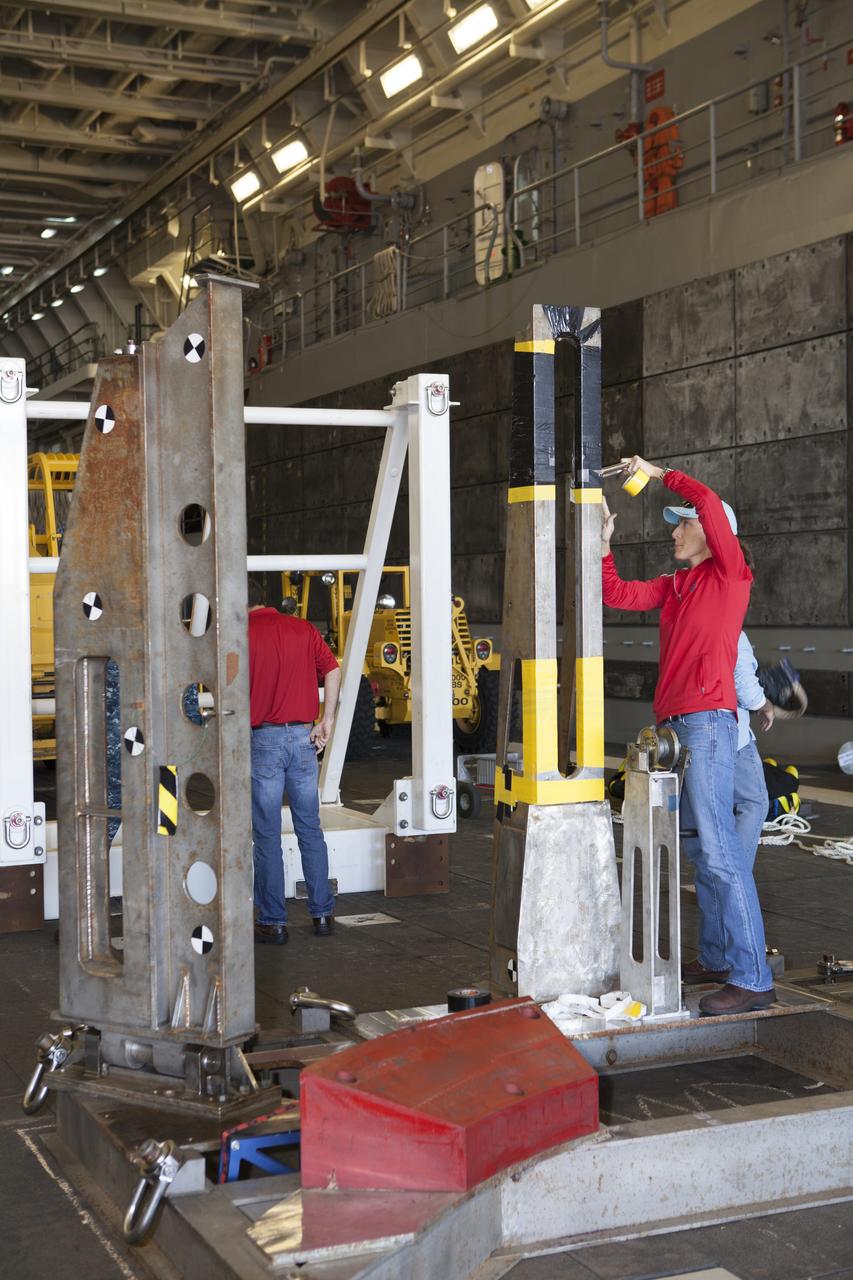
Ground support equipment is being secured in the well deck of the USS Anchorage at Naval Base San Diego in California. The equipment will be used during recovery of the Orion crew module after its first flight test. Before launch of Orion on a Delta IV Heavy rocket from Cape Canaveral Air Force Station in Florida, NASA, Lockheed Martin and U.S. Navy personnel will head out to sea in the USS Anchorage and the USNS Salvor, a salvage ship, and wait for splashdown of the Orion crew module in the Pacific Ocean. The Ground Systems Development and Operations Program will lead the recovery efforts. Orion is the exploration spacecraft designed to carry astronauts to destinations not yet explored by humans, including an asteroid and Mars. It will have emergency abort capability, sustain the crew during space travel and provide safe re-entry from deep space return velocities. The first unpiloted flight test of Orion is scheduled to launch in December atop a United Launch Alliance Delta IV Heavy rocket and in 2018 on NASA’s Space Launch System rocket.
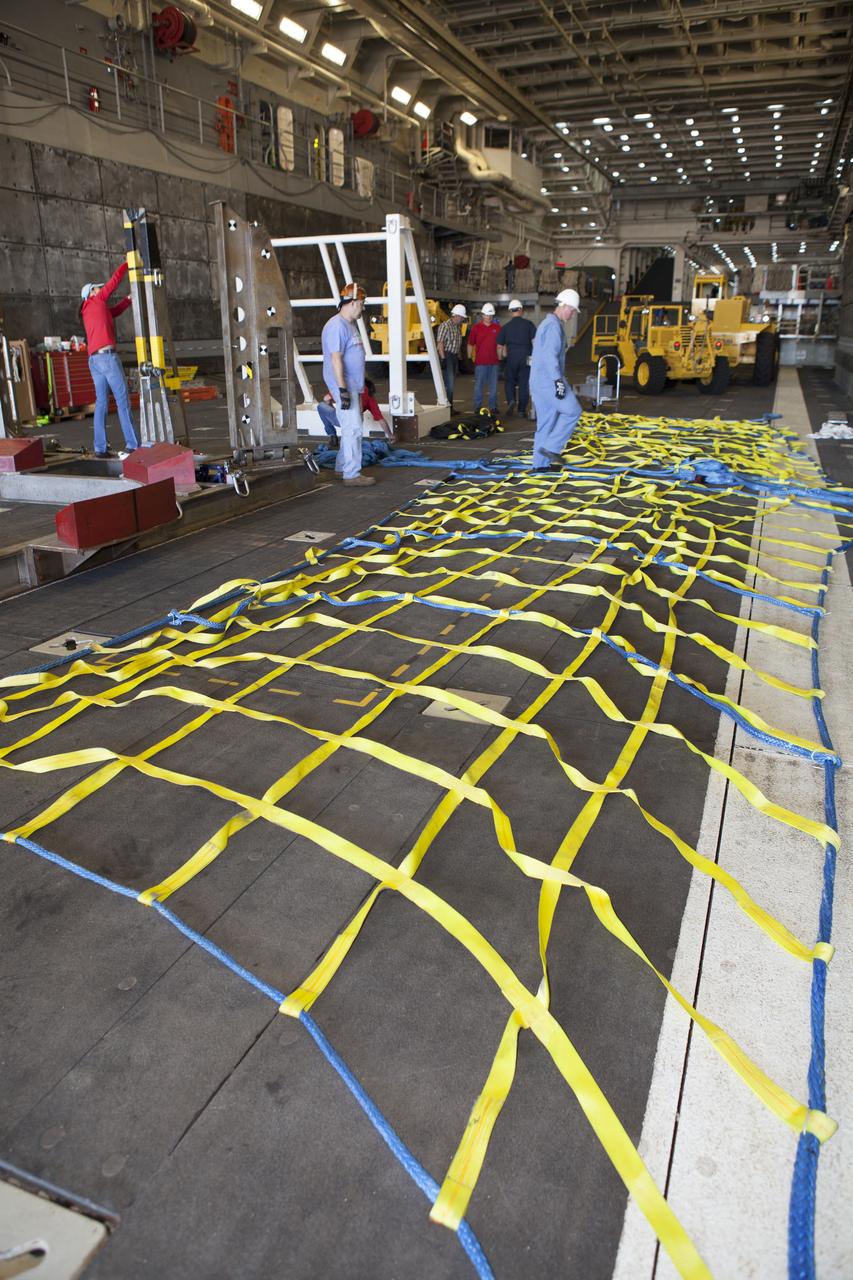
Ground support equipment is being secured in the well deck of the USS Anchorage at Naval Base San Diego in California. The equipment will be used during recovery of the Orion crew module after its first flight test. Before launch of Orion on a Delta IV Heavy rocket from Cape Canaveral Air Force Station in Florida, NASA, Lockheed Martin and U.S. Navy personnel will head out to sea in the USS Anchorage and the USNS Salvor, a salvage ship, and wait for splashdown of the Orion crew module in the Pacific Ocean. The Ground Systems Development and Operations Program will lead the recovery efforts. Orion is the exploration spacecraft designed to carry astronauts to destinations not yet explored by humans, including an asteroid and Mars. It will have emergency abort capability, sustain the crew during space travel and provide safe re-entry from deep space return velocities. The first unpiloted flight test of Orion is scheduled to launch in December atop a United Launch Alliance Delta IV Heavy rocket and in 2018 on NASA’s Space Launch System rocket.
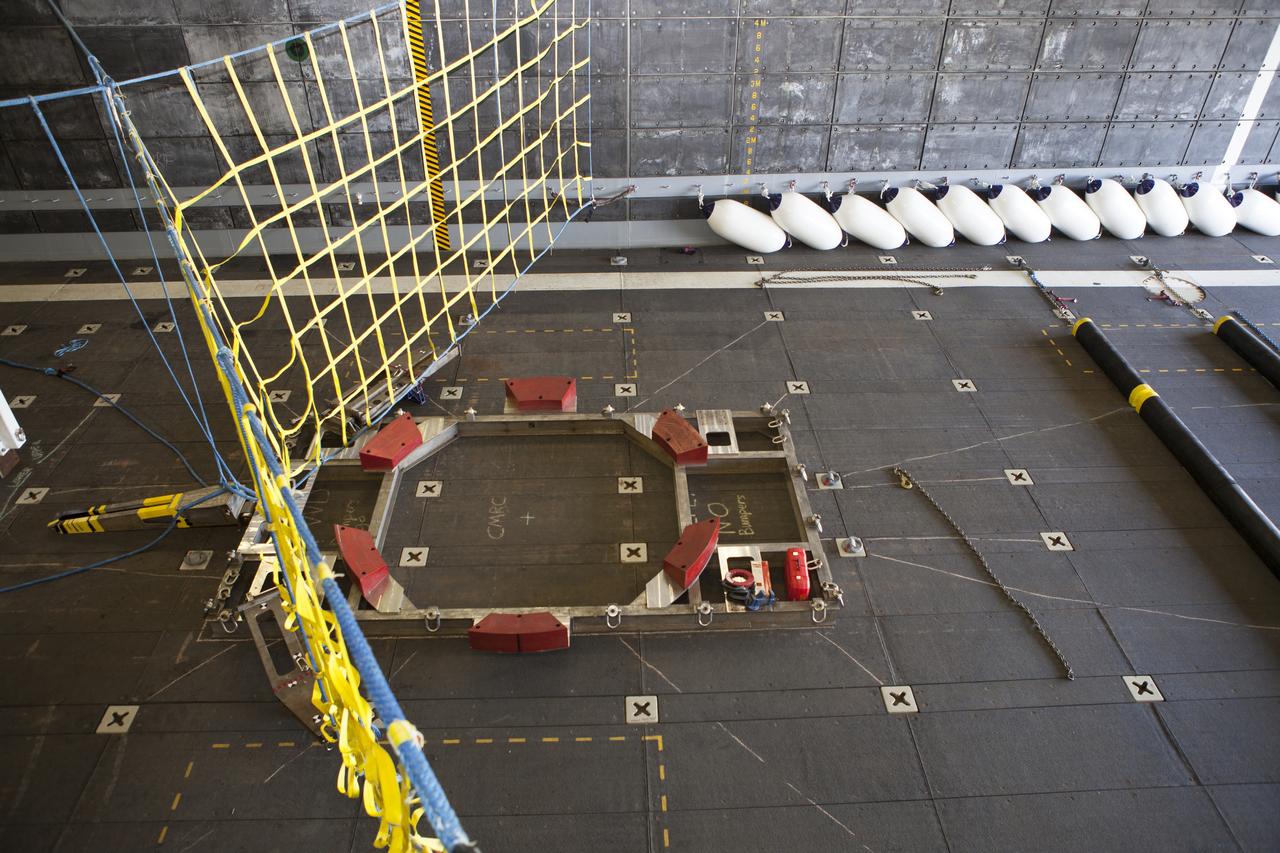
Ground support equipment is secured in the well deck of the USS Anchorage at Naval Base San Diego in California. The equipment will be used during recovery of the Orion crew module after its first flight test. Before launch of Orion on a Delta IV Heavy rocket from Cape Canaveral Air Force Station in Florida, NASA, Lockheed Martin and U.S. Navy personnel will head out to sea in the USS Anchorage and the USNS Salvor, a salvage ship, and wait for splashdown of the Orion crew module in the Pacific Ocean. The Ground Systems Development and Operations Program will lead the recovery efforts. Orion is the exploration spacecraft designed to carry astronauts to destinations not yet explored by humans, including an asteroid and Mars. It will have emergency abort capability, sustain the crew during space travel and provide safe re-entry from deep space return velocities. The first unpiloted flight test of Orion is scheduled to launch in December atop a United Launch Alliance Delta IV Heavy rocket and in 2018 on NASA’s Space Launch System rocket.
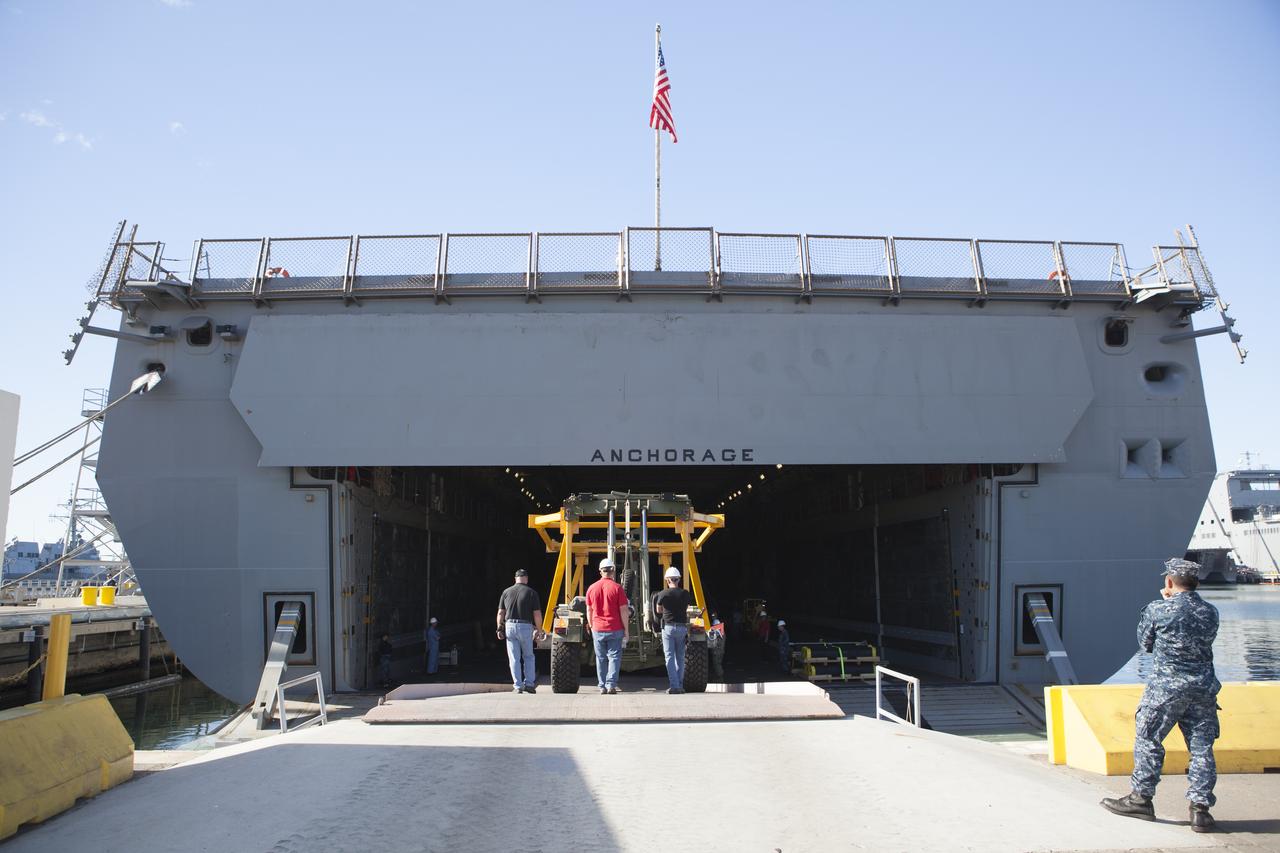
Ground support equipment is being loaded into the well deck of the USS Anchorage at Naval Base San Diego in California. The equipment will be used during recovery of the Orion crew module after its first flight test. Before launch of Orion on a Delta IV Heavy rocket from Cape Canaveral Air Force Station in Florida, NASA, Lockheed Martin and U.S. Navy personnel will head out to sea in the USS Anchorage and the USNS Salvor, a salvage ship, and wait for splashdown of the Orion crew module in the Pacific Ocean. The Ground Systems Development and Operations Program will lead the recovery efforts. Orion is the exploration spacecraft designed to carry astronauts to destinations not yet explored by humans, including an asteroid and Mars. It will have emergency abort capability, sustain the crew during space travel and provide safe re-entry from deep space return velocities. The first unpiloted flight test of Orion is scheduled to launch in December atop a United Launch Alliance Delta IV Heavy rocket and in 2018 on NASA’s Space Launch System rocket.
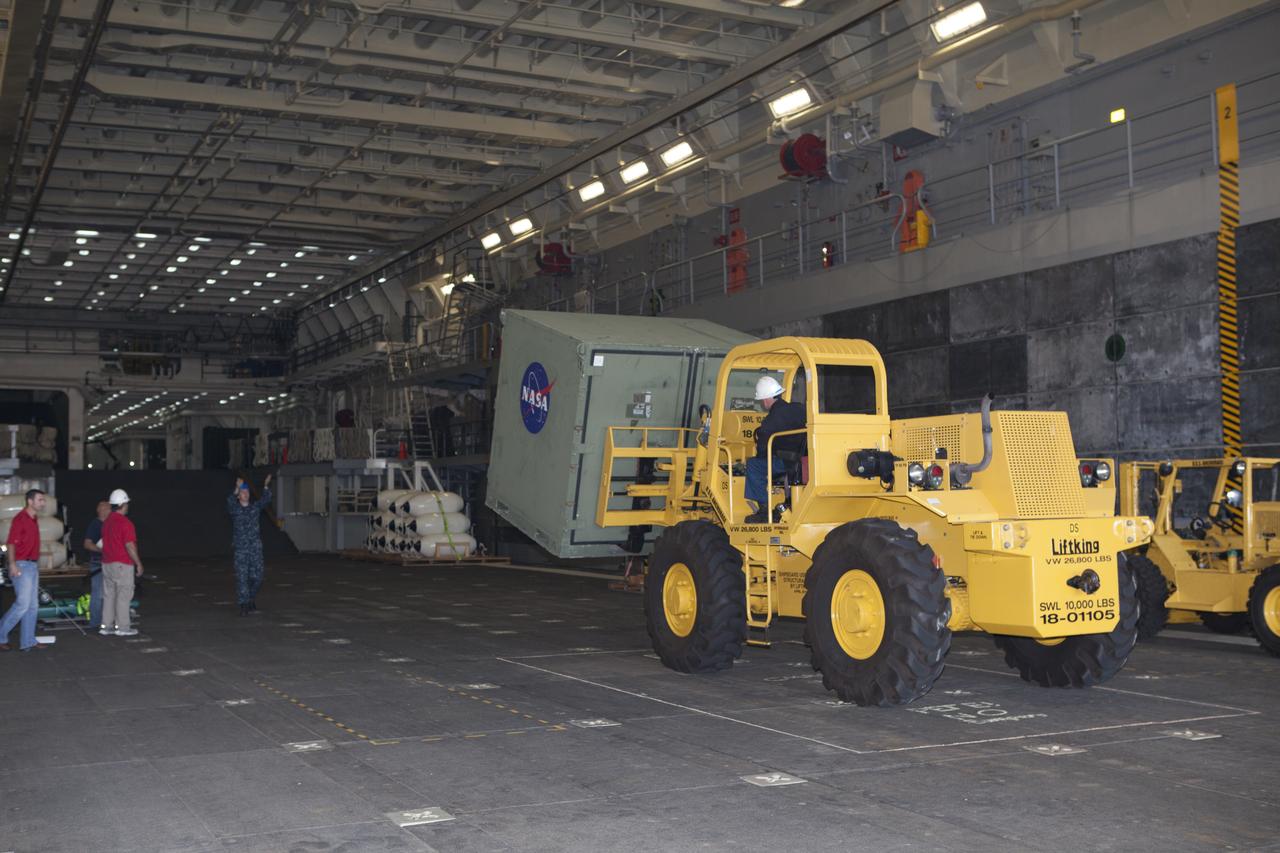
A forklift is used to carry ground support equipment into the well deck of the USS Anchorage at Naval Base San Diego in California. The equipment will be used during recovery of the Orion crew module after its first flight test. Before launch of Orion on a Delta IV Heavy rocket from Cape Canaveral Air Force Station in Florida, NASA, Lockheed Martin and U.S. Navy personnel will head out to sea in the USS Anchorage and the USNS Salvor, a salvage ship, and wait for splashdown of the Orion crew module in the Pacific Ocean. The Ground Systems Development and Operations Program will lead the recovery efforts. Orion is the exploration spacecraft designed to carry astronauts to destinations not yet explored by humans, including an asteroid and Mars. It will have emergency abort capability, sustain the crew during space travel and provide safe re-entry from deep space return velocities. The first unpiloted flight test of Orion is scheduled to launch in December atop a United Launch Alliance Delta IV Heavy rocket and in 2018 on NASA’s Space Launch System rocket.
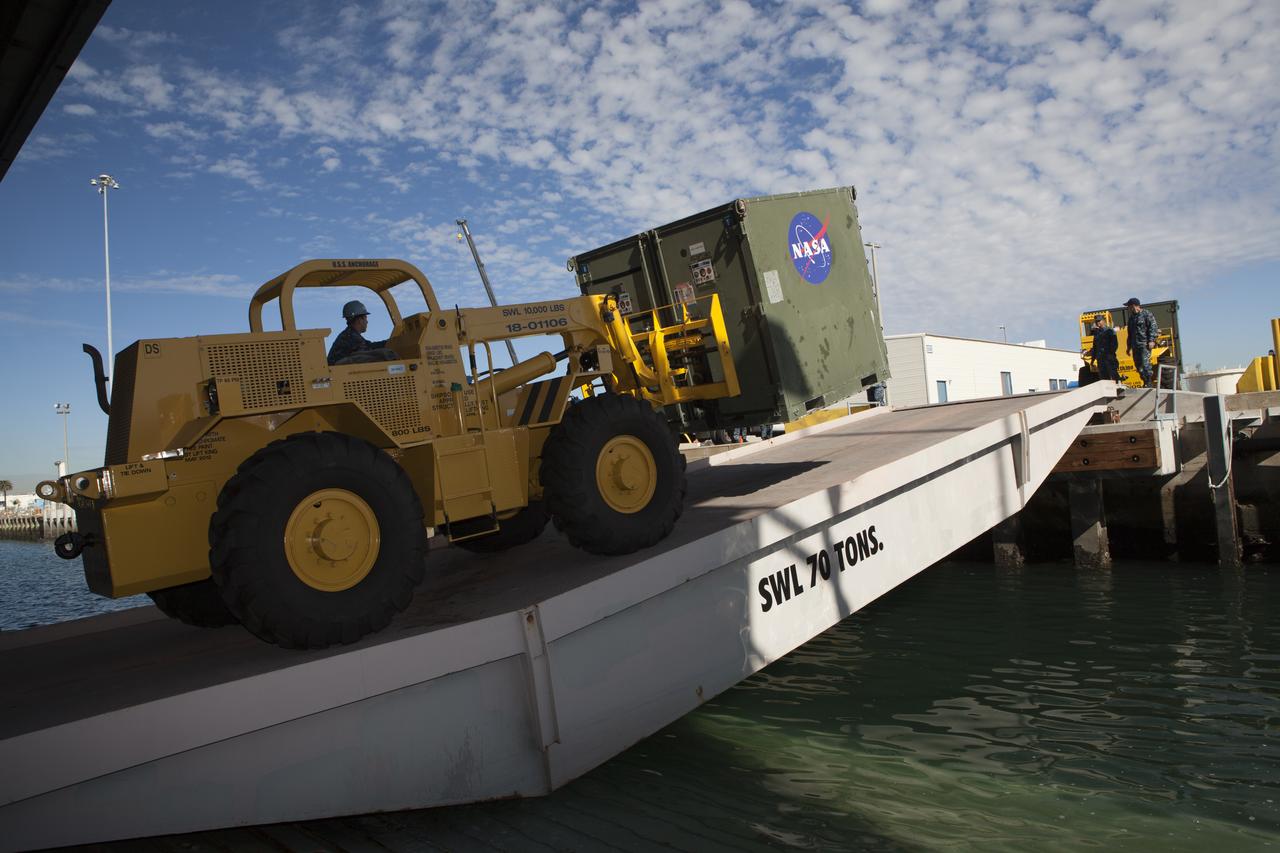
A forklift is used to carry ground support equipment into the well deck of the USS Anchorage at Naval Base San Diego in California. The equipment will be used during recovery of the Orion crew module after its first flight test. Before launch of Orion on a Delta IV Heavy rocket from Cape Canaveral Air Force Station in Florida, NASA, Lockheed Martin and U.S. Navy personnel will head out to sea in the USS Anchorage and the USNS Salvor, a salvage ship, and wait for splashdown of the Orion crew module in the Pacific Ocean. The Ground Systems Development and Operations Program will lead the recovery efforts. Orion is the exploration spacecraft designed to carry astronauts to destinations not yet explored by humans, including an asteroid and Mars. It will have emergency abort capability, sustain the crew during space travel and provide safe re-entry from deep space return velocities. The first unpiloted flight test of Orion is scheduled to launch in December atop a United Launch Alliance Delta IV Heavy rocket and in 2018 on NASA’s Space Launch System rocket.
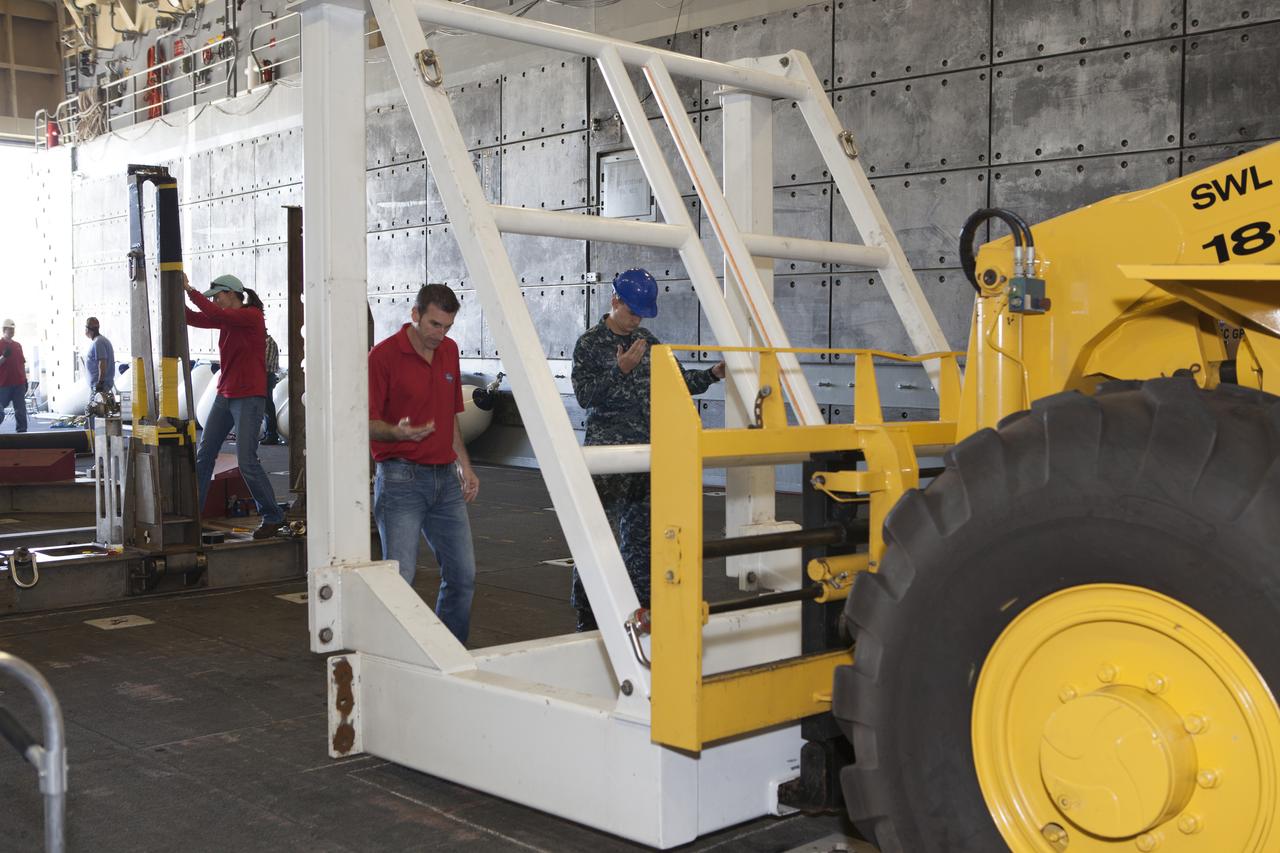
A forklift is used to set the Orion handling fixture down in the well deck of the USS Anchorage at Naval Base San Diego in California. The fixture and other ground support equipment will be used during recovery of the Orion crew module after its first flight test. Before launch of Orion on a Delta IV Heavy rocket from Cape Canaveral Air Force Station in Florida, NASA, Lockheed Martin and U.S. Navy personnel will head out to sea in the USS Anchorage and the USNS Salvor, a salvage ship, and wait for splashdown of the Orion crew module in the Pacific Ocean. The Ground Systems Development and Operations Program will lead the recovery efforts. Orion is the exploration spacecraft designed to carry astronauts to destinations not yet explored by humans, including an asteroid and Mars. It will have emergency abort capability, sustain the crew during space travel and provide safe re-entry from deep space return velocities. The first unpiloted flight test of Orion is scheduled to launch in December atop a United Launch Alliance Delta IV Heavy rocket and in 2018 on NASA’s Space Launch System rocket.
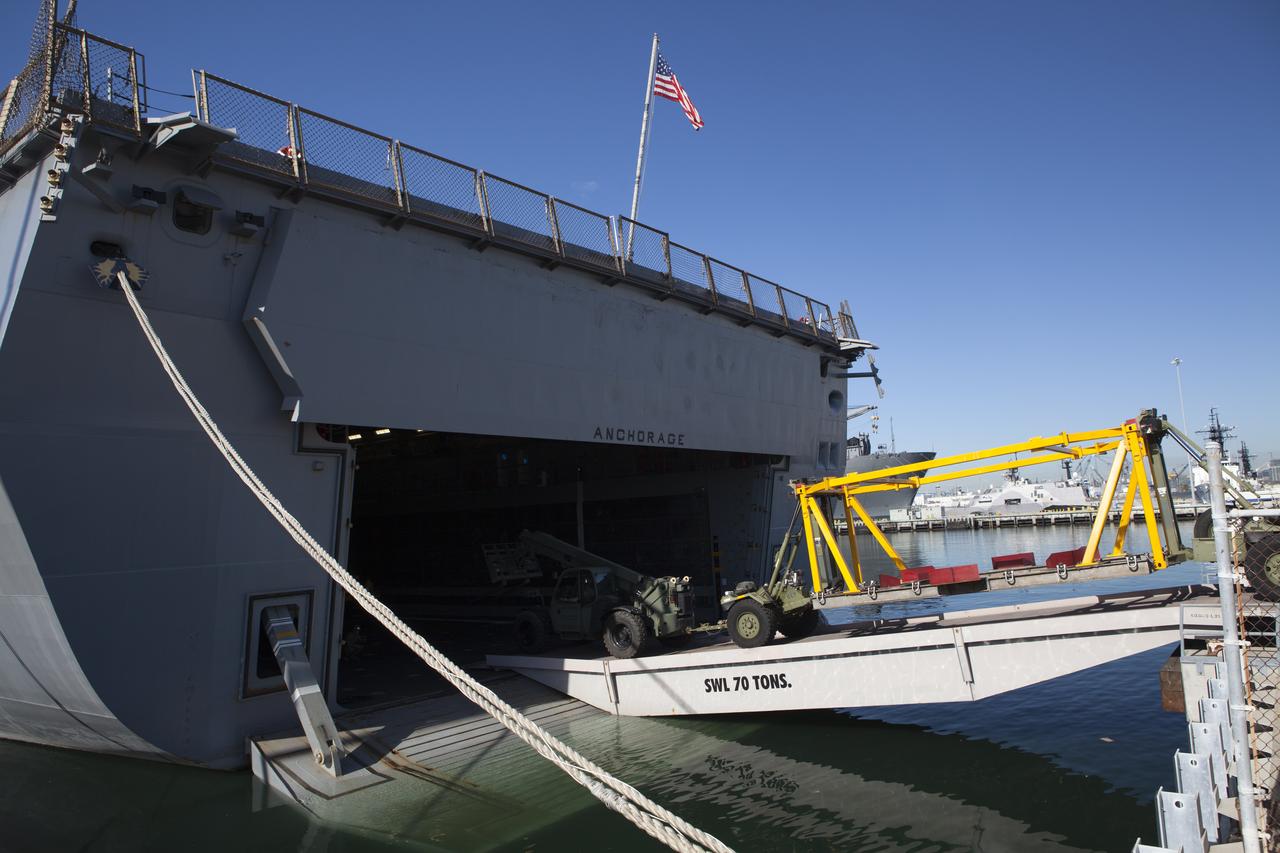
Ground support equipment is being loaded into the well deck of the USS Anchorage at Naval Base San Diego in California. The equipment will be used during recovery of the Orion crew module after its first flight test. Before launch of Orion on a Delta IV Heavy rocket from Cape Canaveral Air Force Station in Florida, NASA, Lockheed Martin and U.S. Navy personnel will head out to sea in the USS Anchorage and the USNS Salvor, a salvage ship, and wait for splashdown of the Orion crew module in the Pacific Ocean. The Ground Systems Development and Operations Program will lead the recovery efforts. Orion is the exploration spacecraft designed to carry astronauts to destinations not yet explored by humans, including an asteroid and Mars. It will have emergency abort capability, sustain the crew during space travel and provide safe re-entry from deep space return velocities. The first unpiloted flight test of Orion is scheduled to launch in December atop a United Launch Alliance Delta IV Heavy rocket and in 2018 on NASA’s Space Launch System rocket.
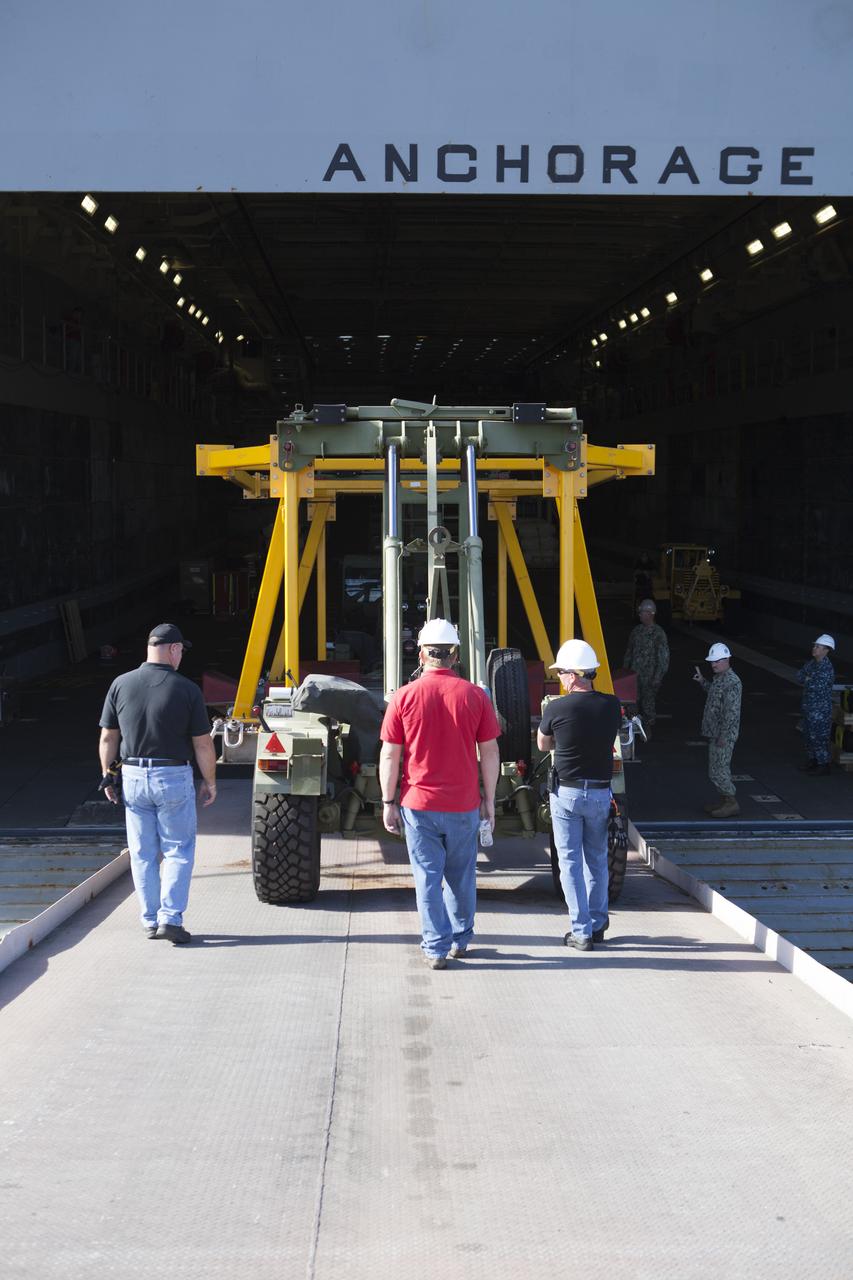
The Orion crew module recovery fixture is being loaded into the well deck of the USS Anchorage at Naval Base San Diego in California. The equipment will be used during recovery of the Orion crew module after its first flight test. Before launch of Orion on a Delta IV Heavy rocket from Cape Canaveral Air Force Station in Florida, NASA, Lockheed Martin and U.S. Navy personnel will head out to sea in the USS Anchorage and the USNS Salvor, a salvage ship, and wait for splashdown of the Orion crew module in the Pacific Ocean. The Ground Systems Development and Operations Program will lead the recovery efforts. Orion is the exploration spacecraft designed to carry astronauts to destinations not yet explored by humans, including an asteroid and Mars. It will have emergency abort capability, sustain the crew during space travel and provide safe re-entry from deep space return velocities. The first unpiloted flight test of Orion is scheduled to launch in December atop a United Launch Alliance Delta IV Heavy rocket and in 2018 on NASA’s Space Launch System rocket.
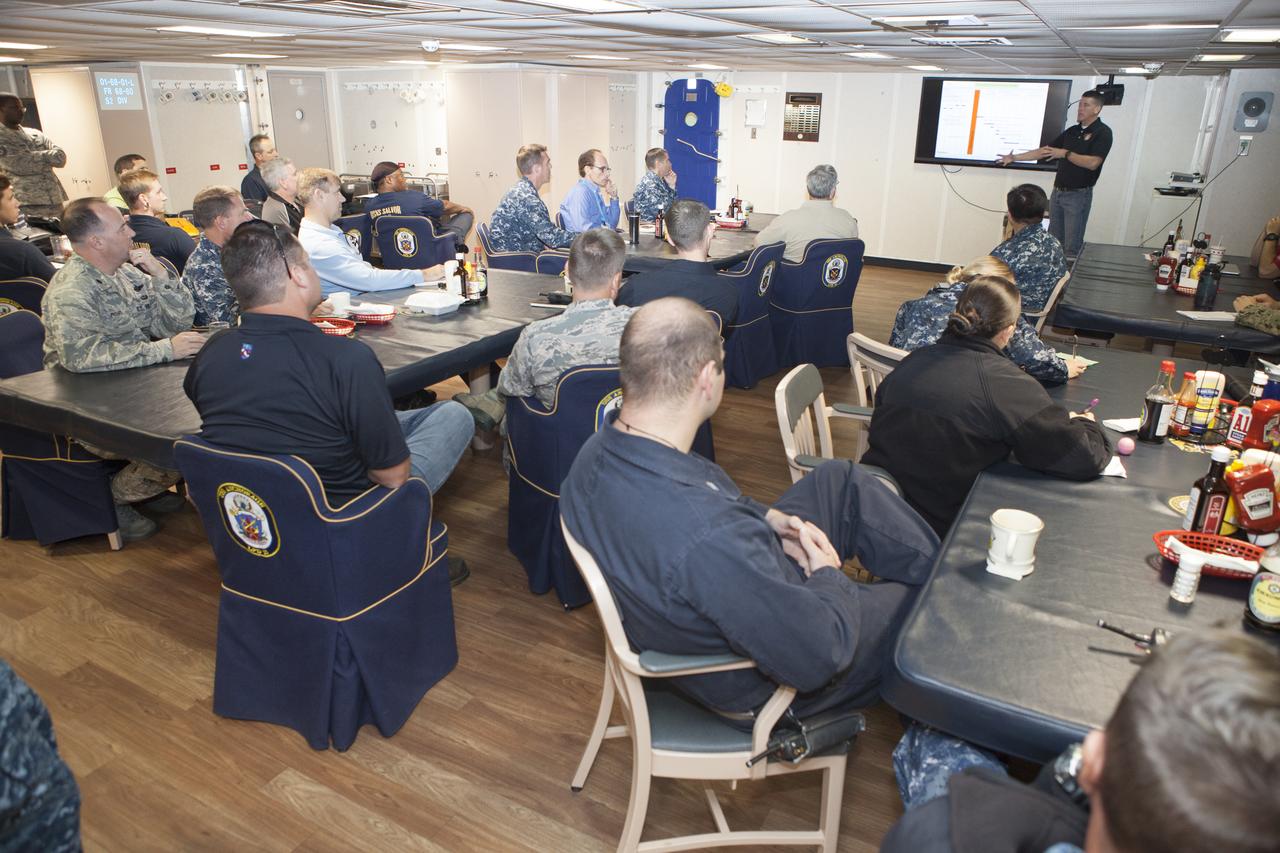
NASA Orion Recovery Director Jeremy Graeber, with the Ground Systems Development and Operations Program at Kennedy Space Center in Florida, reviews Orion recovery procedures with NASA, Lockheed Martin and U.S. Navy personnel aboard the USS Anchorage at Naval Base San Diego in California. Before the launch of Orion on its first flight test atop a Delta IV Heavy rocket from Cape Canaveral Air Force Station in Florida, NASA, Lockheed Martin and U.S. Navy personnel will head out to sea in the USS Anchorage and the USNS Salvor, a salvage ship, and wait for splashdown of the Orion crew module in the Pacific Ocean. The GSDO Program will lead the recovery efforts. Orion is the exploration spacecraft designed to carry astronauts to destinations not yet explored by humans, including an asteroid and Mars. It will have emergency abort capability, sustain the crew during space travel and provide safe re-entry from deep space return velocities. The first unpiloted flight test of Orion is scheduled to launch in December atop a United Launch Alliance Delta IV Heavy rocket and in 2018 on NASA’s Space Launch System rocket.
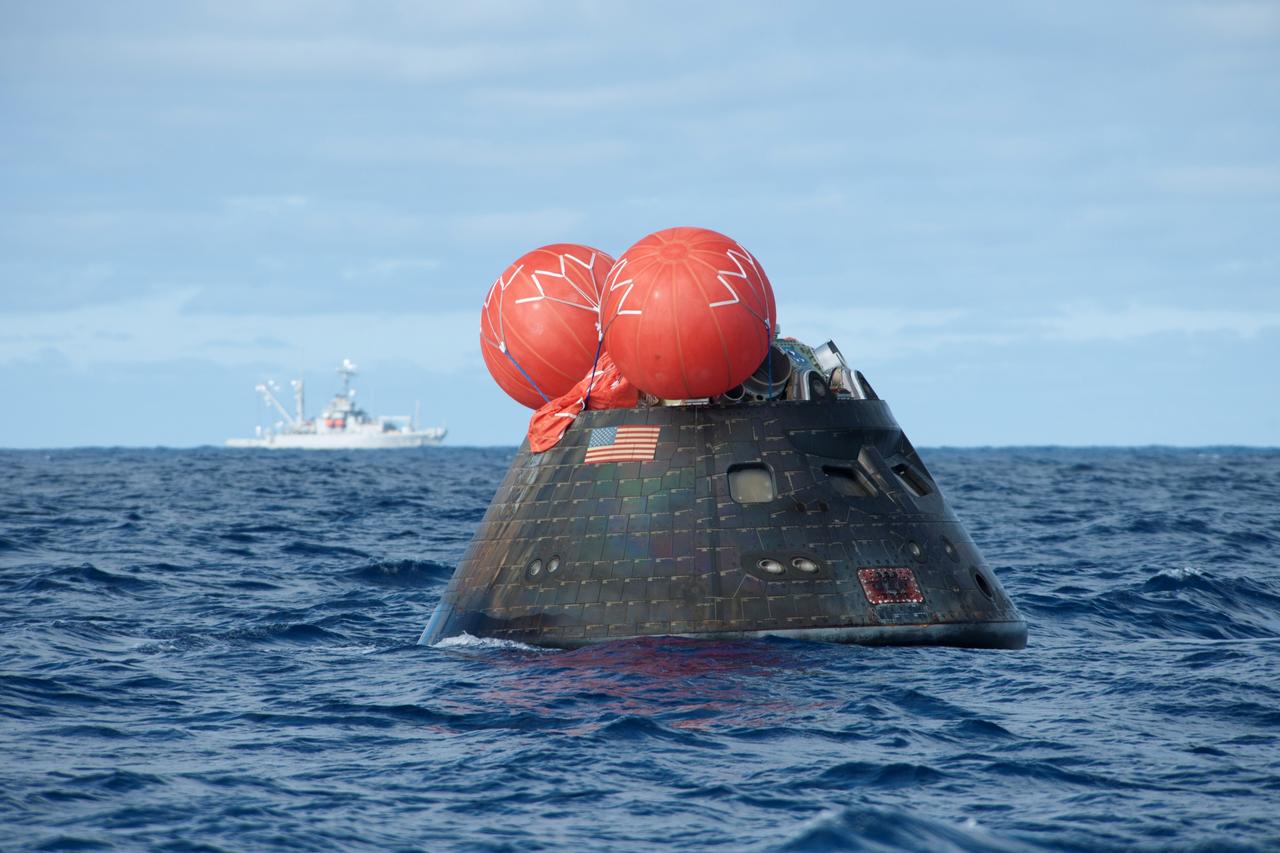
NASA's Orion spacecraft floats in the Pacific Ocean after splashdown from its first flight test in Earth orbit. In the background is the USNS Salvor. This U.S. Navy salvage ship was there as a backup in case it was needed. NASA, the U.S. Navy and Lockheed Martin are coordinating efforts to recover Orion and secure the spacecraft in the well deck of the USS Anchorage. Orion completed a two-orbit, four-and-a-half hour mission, to test systems critical to crew safety, including the launch abort system, the heat shield and the parachute system. The Ground Systems Development and Operations Program is leading the recovery efforts.
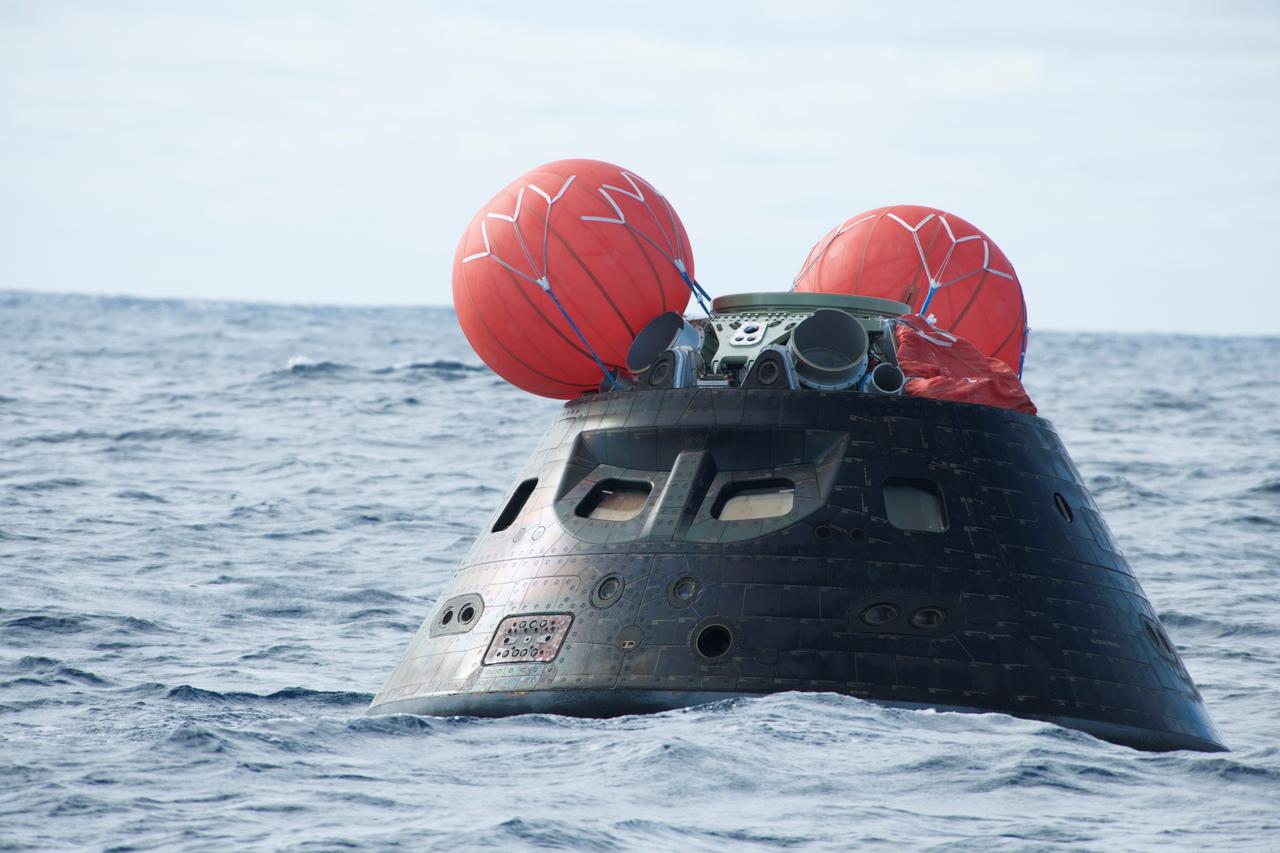
NASA's Orion spacecraft floats in the Pacific Ocean after splashdown from its first flight test in Earth orbit. The spacecraft completed a two-orbit, four-and-a-half-hour mission in Earth orbit. NASA, the U.S. Navy and Lockheed Martin are coordinating efforts to recover Orion, the forward bay cover and main parachutes. Orion will be towed in and secure in the well deck of the nearby USS Anchorage. Orion's mission tested systems critical to crew safety, including the launch abort system, the heat shield and the parachute system. The Ground Systems Development and Operations Program is leading the recovery efforts.
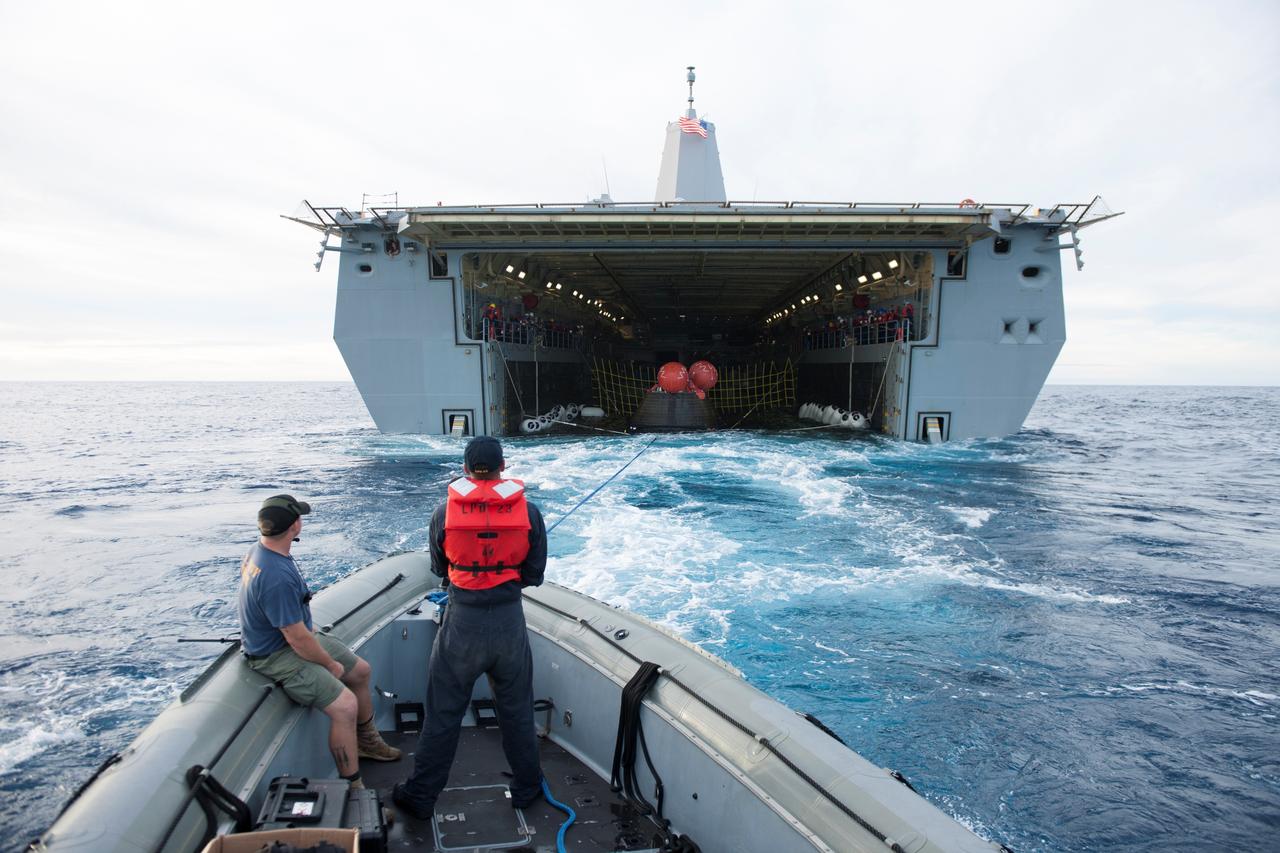
U.S. Navy personnel aboard a rigid hull inflatable boat help recover NASA's Orion spacecraft following its splashdown in the Pacific Ocean after its first flight test in Earth orbit. Orion is towed into the flooded well deck of the USS Anchorage. NASA, the U.S. Navy and Lockheed Martin coordinated efforts to recover Orion, the forward bay cover and main parachutes. Orion completed a two-orbit, four-and-a-half hour mission, to test systems critical to crew safety, including the launch abort system, the heat shield and the parachute system. The Ground Systems Development and Operations Program is leading the recovery efforts.
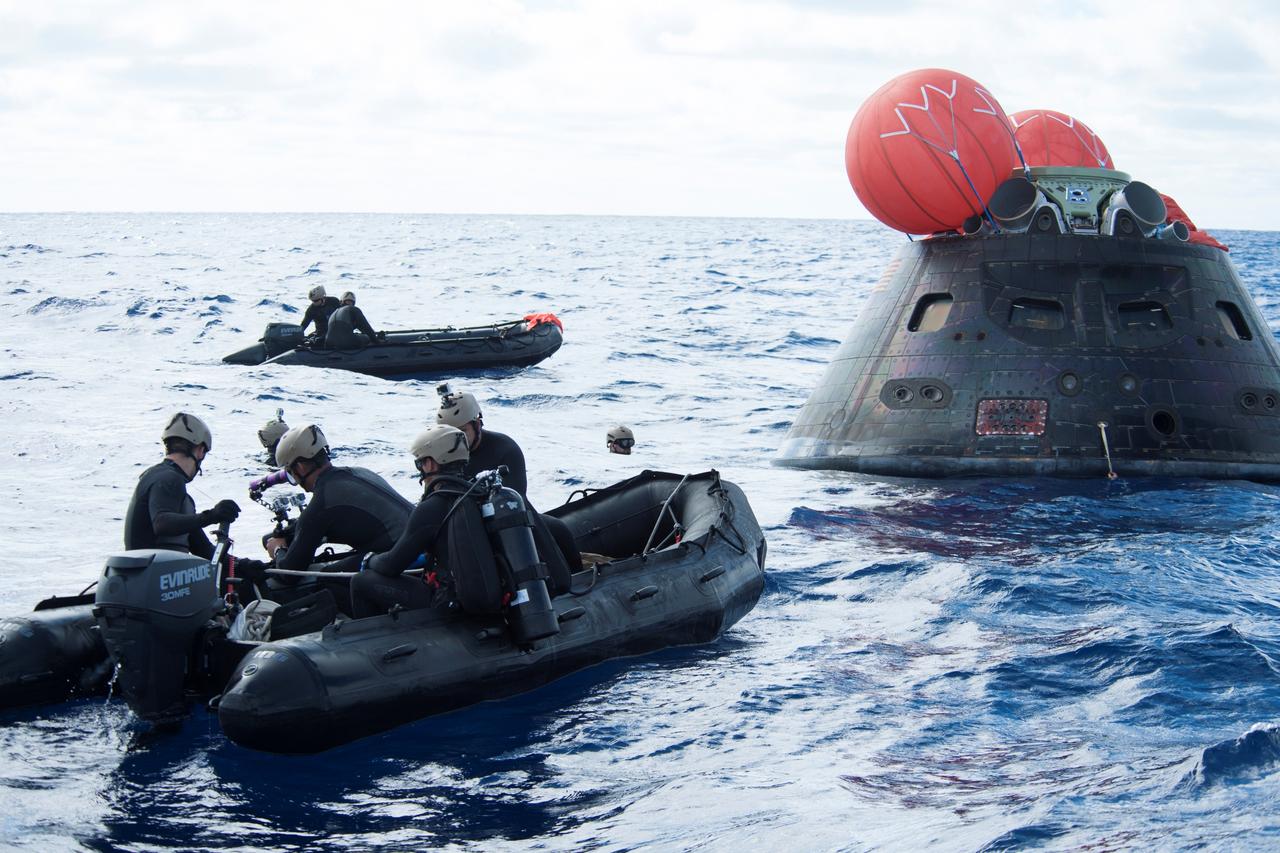
NASA's Orion spacecraft splashed down in the Pacific Ocean after its first flight test atop a Delta IV Heavy rocket from Space Launch Complex 37 at Cape Canaveral Air Force Station in Florida. U.S. Navy divers in Zodiac boats prepare to recover Orion and tow her in to the well deck of the USS Anchorage. NASA's Orion spacecraft completed a two-orbit, four-and-a-half hour mission to test systems critical to crew safety, including the launch abort system, the heat shield and the parachute system. The Ground Systems Development and Operations Program is leading the recovery efforts.
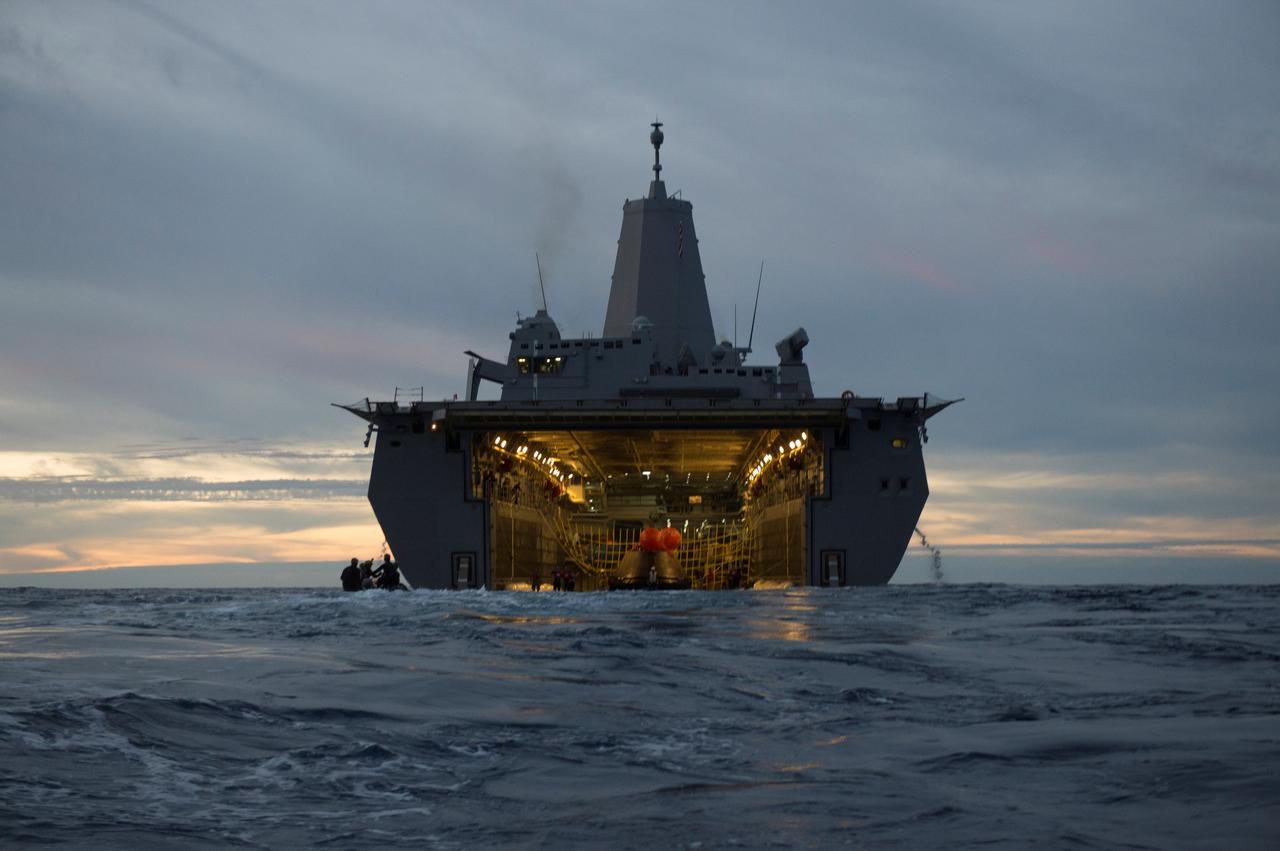
The Orion crew module is recovered after splashdown in the Pacific Ocean about 600 miles off the coast of San Diego, California. NASA, the U.S. Navy and Lockheed Martin coordinated efforts to recover Orion and secure the spacecraft inside the well deck of the USS Anchorage. After lifting off at 7:05 a.m. EST atop a Delta IV Heavy rocket from Space Launch Complex 37 at Cape Canaveral Air Force Station in Florida, NASA's Orion spacecraft completed a two-orbit, four-and-a-half hour mission to test systems critical to crew safety, including the launch abort system, the heat shield and the parachute system. The Ground Systems Development and Operations Program is leading the recovery efforts.

The Orion boilerplate test vehicle is in the water-filled well deck of the USS Anchorage during the first day of Underway Recovery Test 3 in the Pacific Ocean. NASA, Lockheed Martin and U.S. Navy personnel are conducting the recovery test to prepare for recovery of the Orion crew module on its return from a deep space mission. The test allows the teams to demonstrate and evaluate the recovery processes, procedures, hardware and personnel in open waters. The Ground Systems Development and Operations Program is conducting the underway recovery tests. Orion is the exploration spacecraft designed to carry astronauts to destinations not yet explored by humans, including an asteroid and Mars. It will have emergency abort capability, sustain the crew during space travel and provide safe re-entry from deep space return velocities. The first unpiloted test flight of Orion is scheduled to launch in 2014 atop a United Launch Alliance Delta IV Heavy rocket and in 2018 on NASA’s Space Launch System rocket.
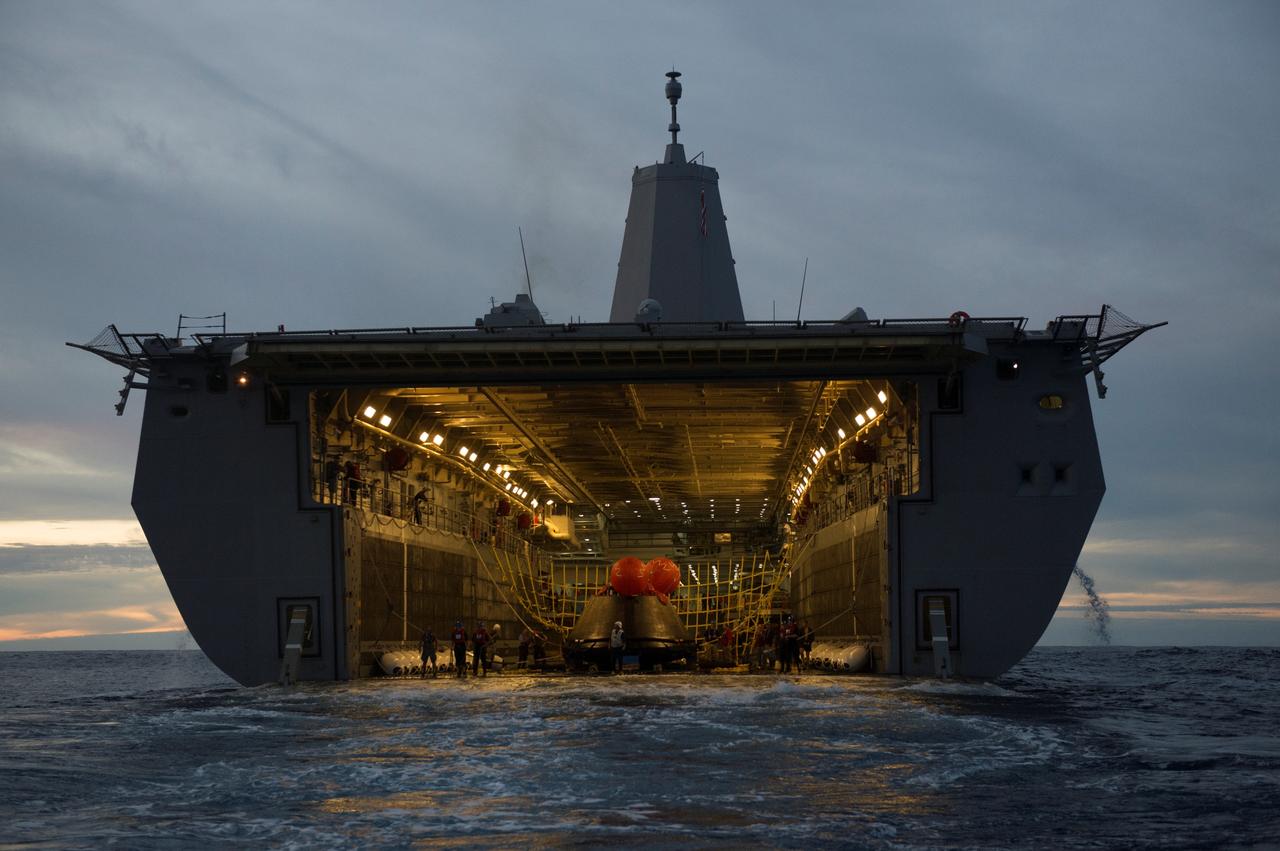
The Orion crew module is recovered after splashdown in the Pacific Ocean about 600 miles off the coast of San Diego, California. NASA, the U.S. Navy and Lockheed Martin coordinated efforts to recover Orion and secure the spacecraft inside the well deck of the USS Anchorage. After lifting off at 7:05 a.m. EST atop a Delta IV Heavy rocket from Space Launch Complex 37 at Cape Canaveral Air Force Station in Florida, NASA's Orion spacecraft completed a two-orbit, four-and-a-half hour mission to test systems critical to crew safety, including the launch abort system, the heat shield and the parachute system. The Ground Systems Development and Operations Program is leading the recovery efforts.
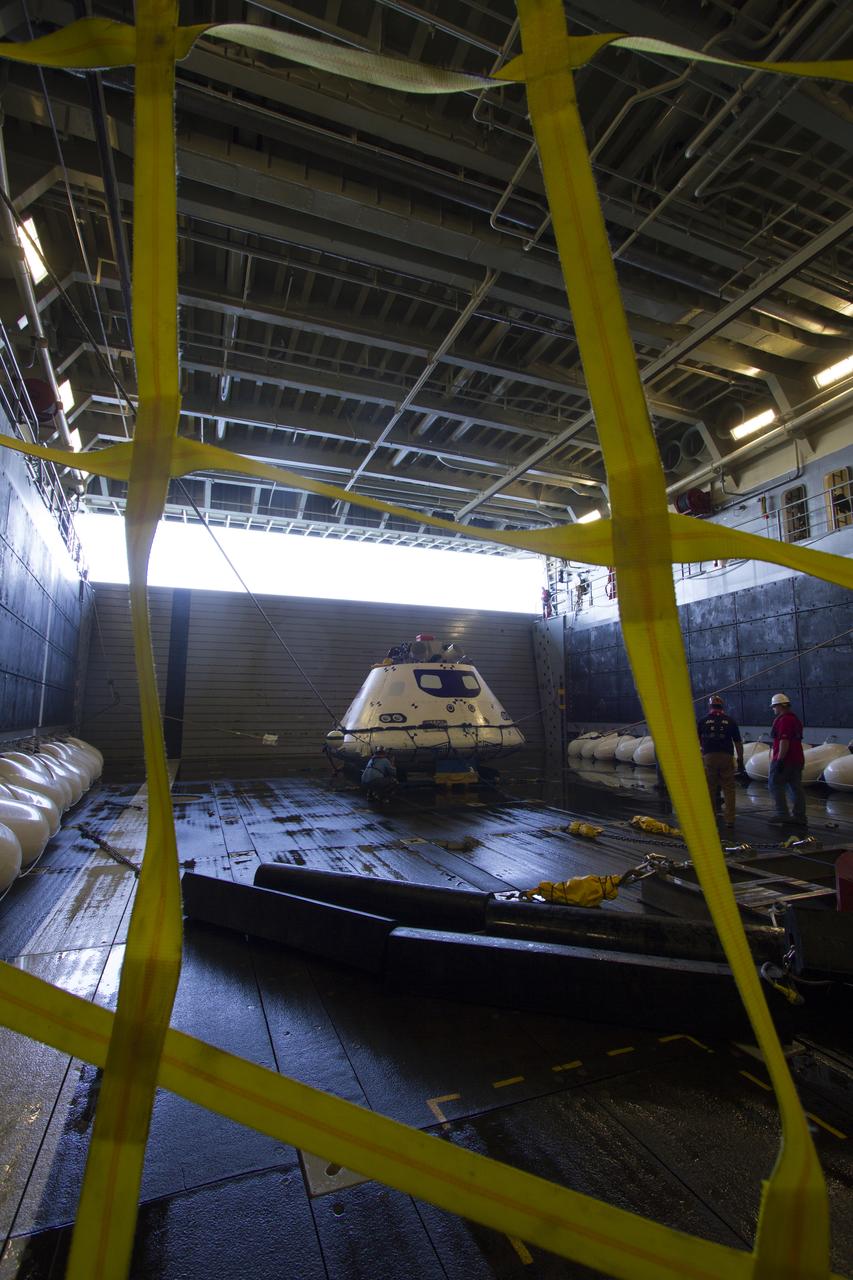
The Orion boilerplate test vehicle is secured in the well deck of the USS Anchorage during the first day of Underway Recovery Test 3 in the Pacific Ocean. NASA, Lockheed Martin and U.S. Navy personnel are conducting the recovery test to prepare for recovery of the Orion crew module on its return from a deep space mission. The test allows the teams to demonstrate and evaluate the recovery processes, procedures, hardware and personnel in open waters. The Ground Systems Development and Operations Program is conducting the underway recovery tests. Orion is the exploration spacecraft designed to carry astronauts to destinations not yet explored by humans, including an asteroid and Mars. It will have emergency abort capability, sustain the crew during space travel and provide safe re-entry from deep space return velocities. The first unpiloted test flight of Orion is scheduled to launch in 2014 atop a United Launch Alliance Delta IV Heavy rocket and in 2018 on NASA’s Space Launch System rocket.
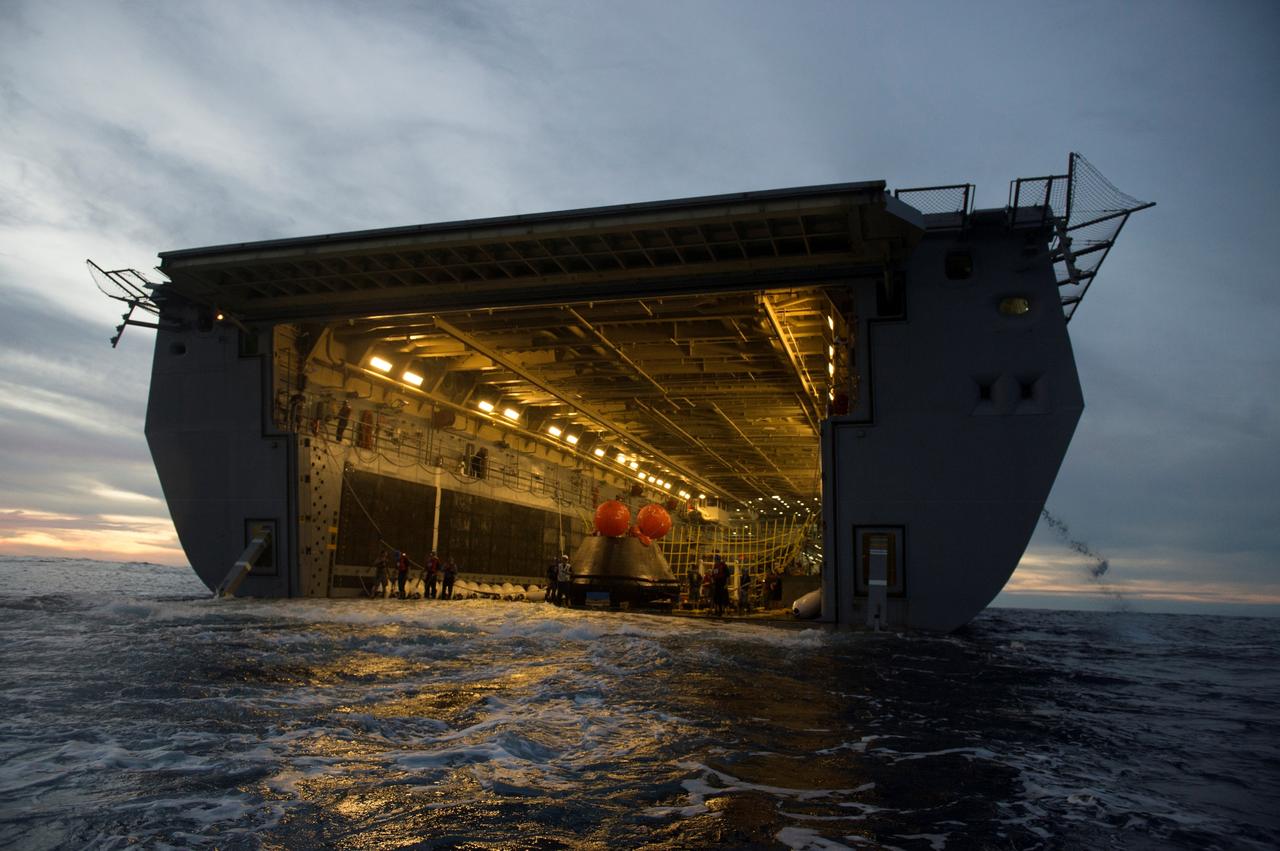
The Orion crew module is recovered after splashdown in the Pacific Ocean about 600 miles off the coast of San Diego, California. NASA, the U.S. Navy and Lockheed Martin coordinated efforts to recover Orion and secure the spacecraft inside the well deck of the USS Anchorage. After lifting off at 7:05 a.m. EST atop a Delta IV Heavy rocket from Space Launch Complex 37 at Cape Canaveral Air Force Station in Florida, NASA's Orion spacecraft completed a two-orbit, four-and-a-half hour mission to test systems critical to crew safety, including the launch abort system, the heat shield and the parachute system. The Ground Systems Development and Operations Program is leading the recovery efforts.
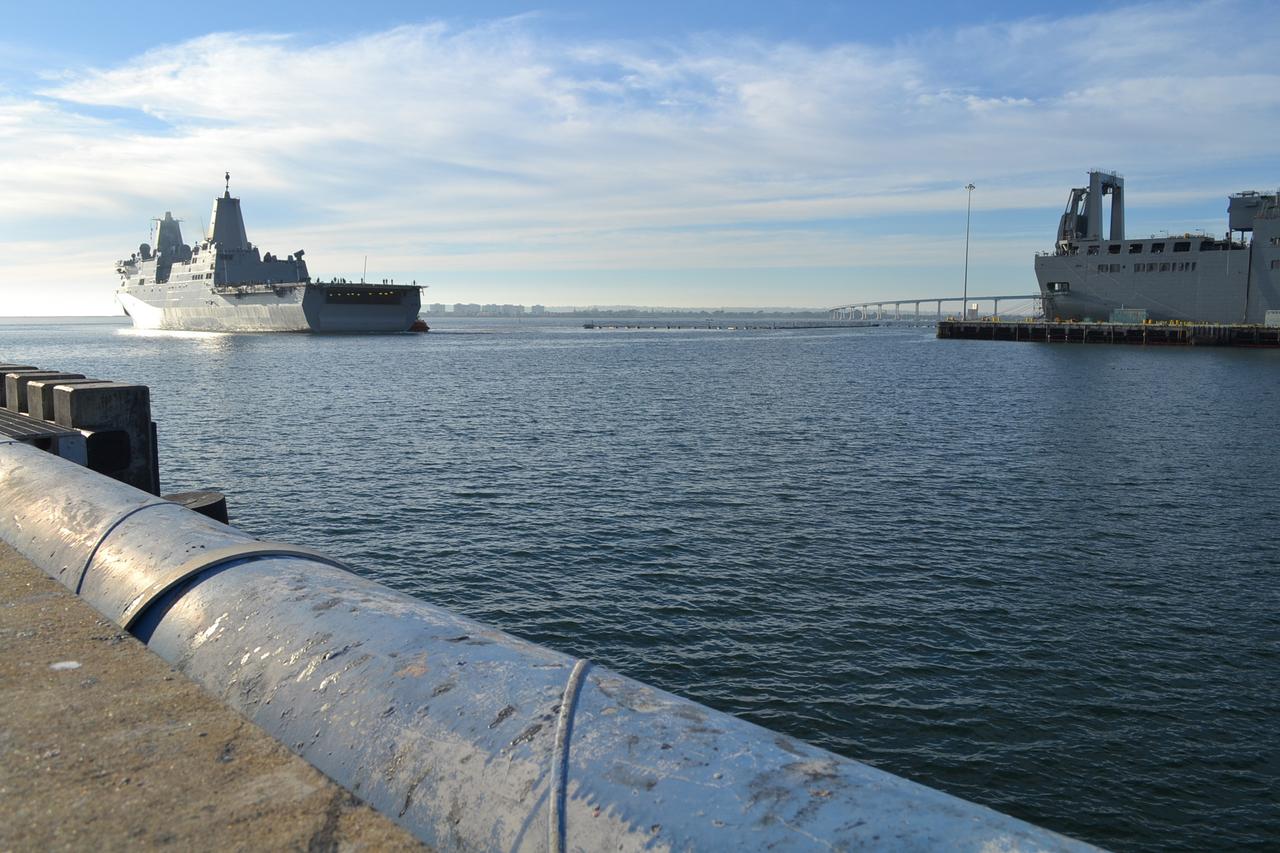
The USS Anchorage, carrying the Orion crew module, arrives in San Diego on Dec. 8, 2014. The Orion spacecraft successfully completed the first flight last week, traveling to an altitude of 3600 miles and returning to Earth at 20,000 miles per hour. The Navy and NASA team on board the USS Anchorage recovered Orion in the Pacific Ocean after splashdown. Part of Batch image transfer from Flickr.
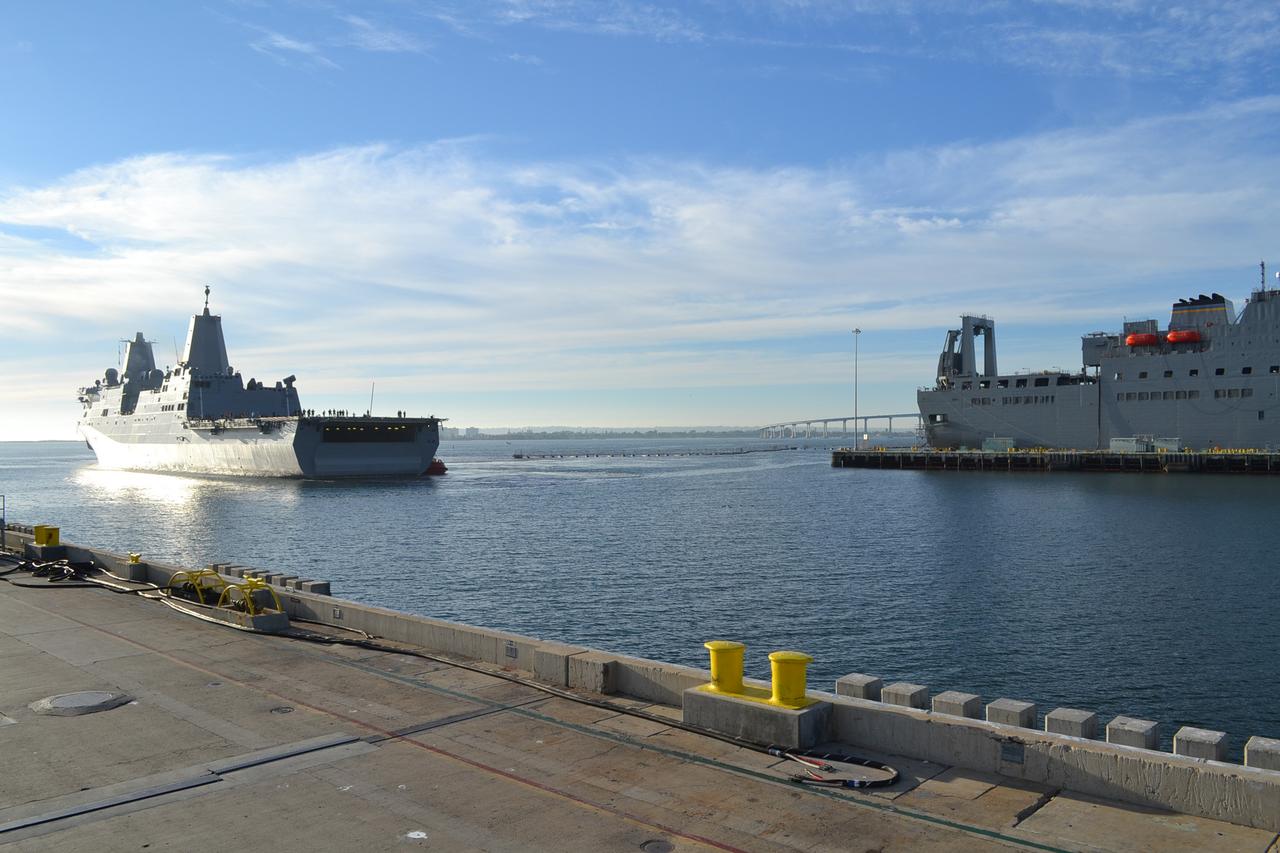
The USS Anchorage, carrying the Orion crew module, arrives in San Diego on Dec. 8, 2014. The Orion spacecraft successfully completed the first flight last week, traveling to an altitude of 3600 miles and returning to Earth at 20,000 miles per hour. The Navy and NASA team on board the USS Anchorage recovered Orion in the Pacific Ocean after splashdown. Part of Batch image transfer from Flickr.
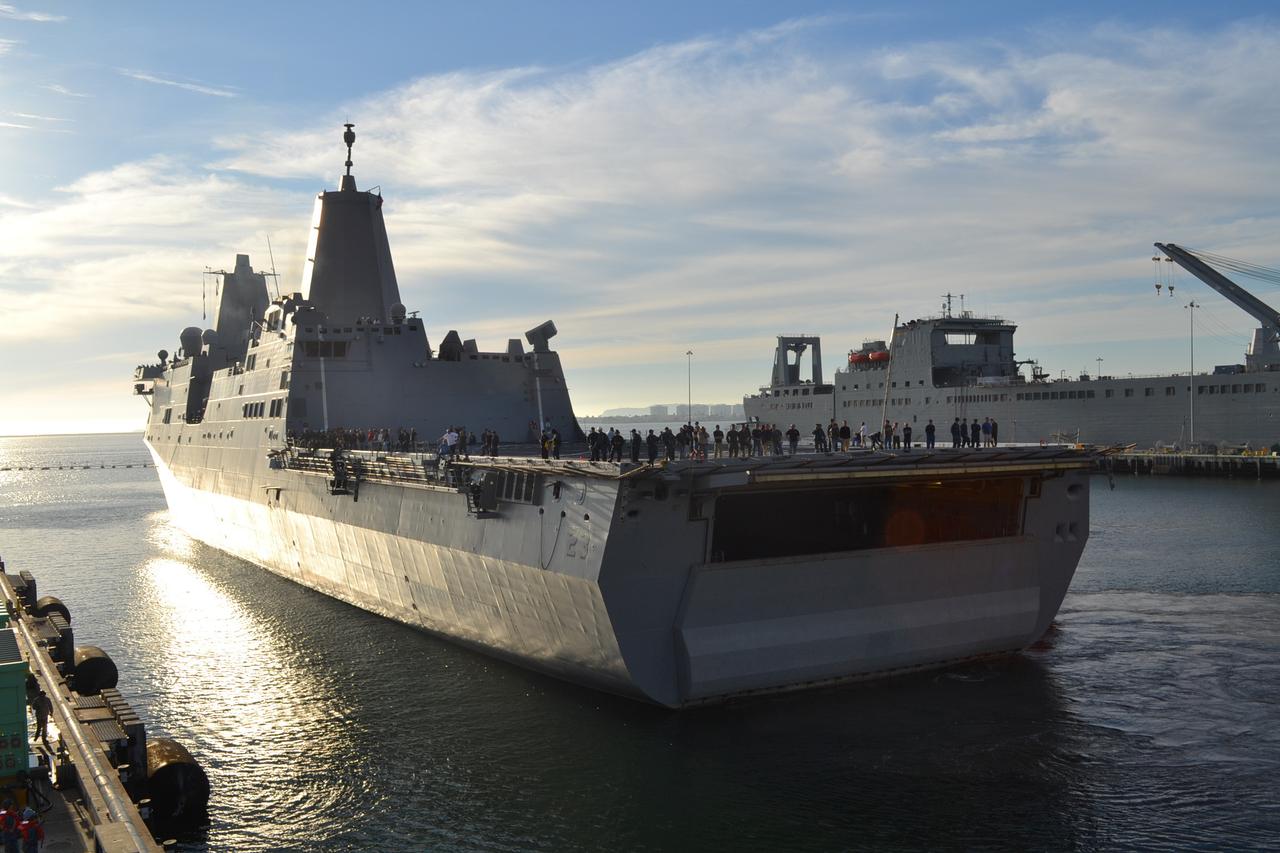
The USS Anchorage, carrying the Orion crew module, arrives in San Diego on Dec. 8, 2014. The Orion spacecraft successfully completed the first flight last week, traveling to an altitude of 3600 miles and returning to Earth at 20,000 miles per hour. The Navy and NASA team on board the USS Anchorage recovered Orion in the Pacific Ocean after splashdown. Part of Batch image transfer from Flickr.
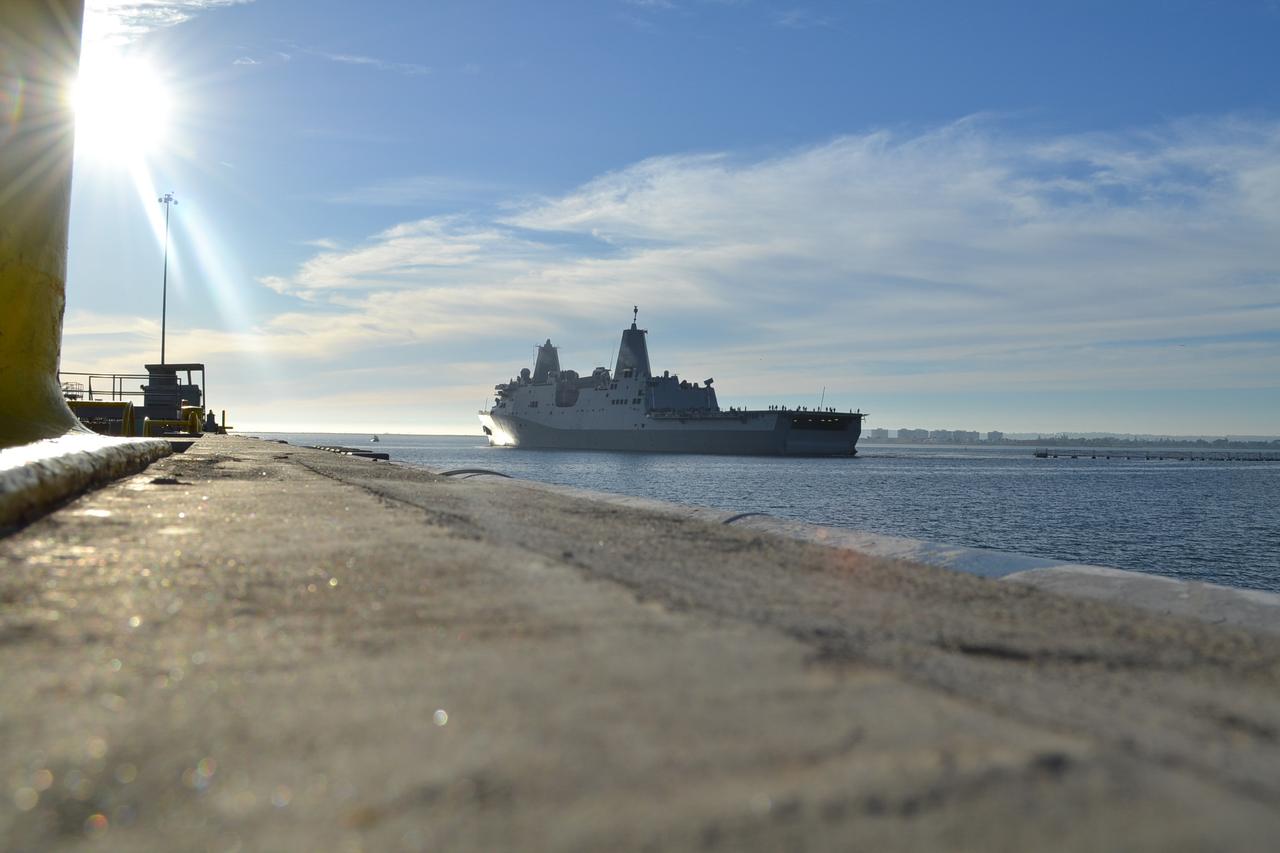
The USS Anchorage, carrying the Orion crew module, arrives in San Diego on Dec. 8, 2014. The Orion spacecraft successfully completed the first flight last week, traveling to an altitude of 3600 miles and returning to Earth at 20,000 miles per hour. The Navy and NASA team on board the USS Anchorage recovered Orion in the Pacific Ocean after splashdown. Part of Batch image transfer from Flickr.
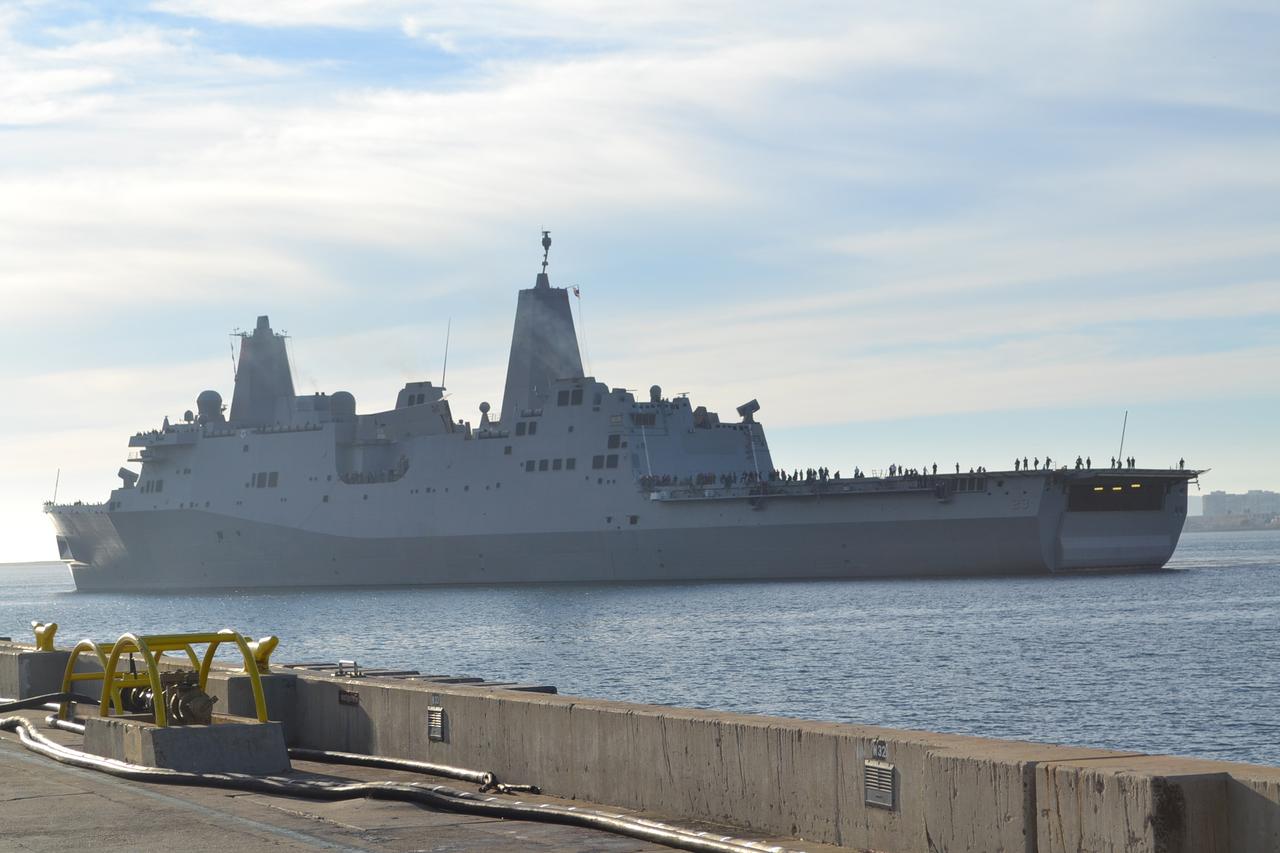
The USS Anchorage, carrying the Orion crew module, arrives in San Diego on Dec. 8, 2014. The Orion spacecraft successfully completed the first flight last week, traveling to an altitude of 3600 miles and returning to Earth at 20,000 miles per hour. The Navy and NASA team on board the USS Anchorage recovered Orion in the Pacific Ocean after splashdown. Part of Batch image transfer from Flickr.