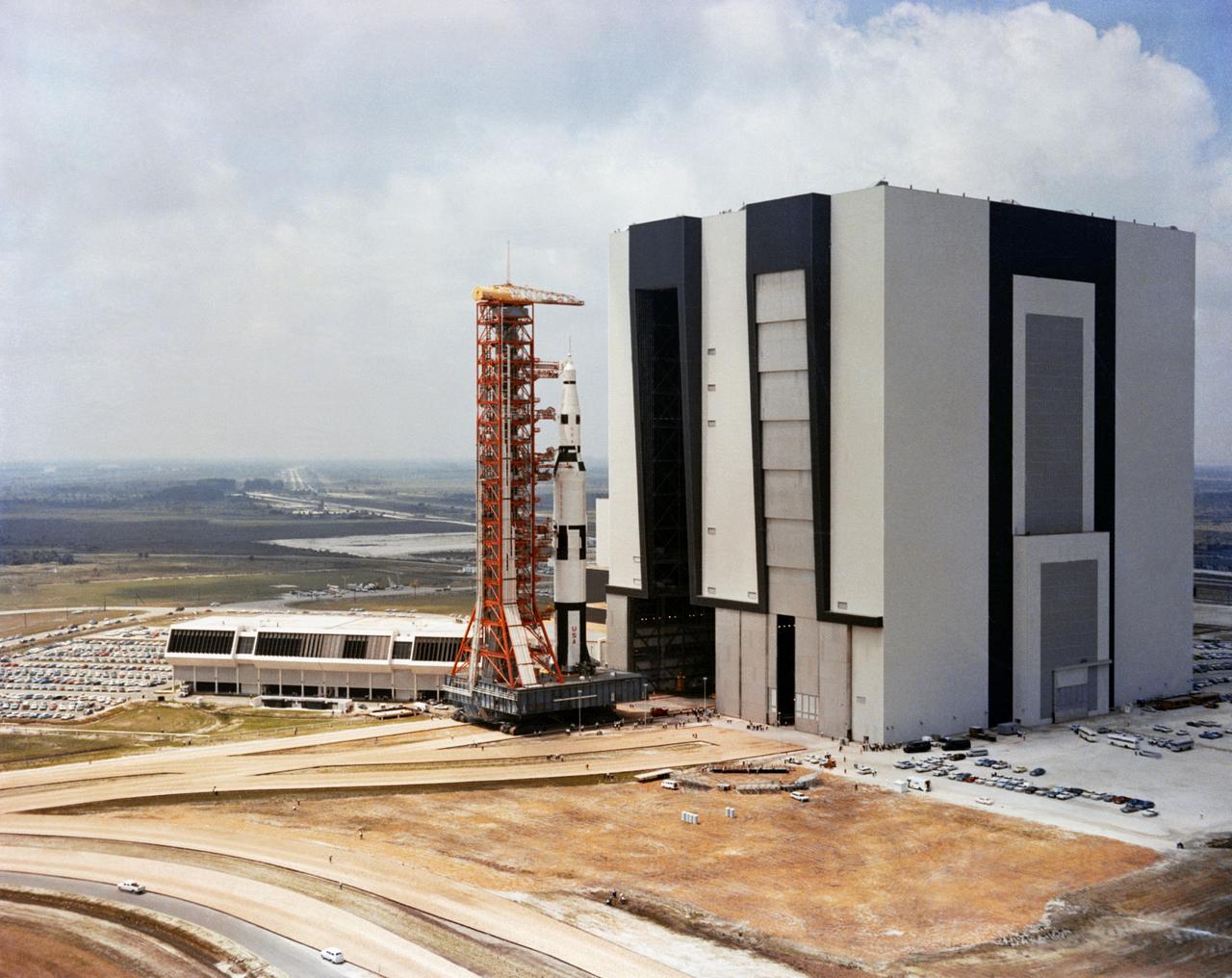
An Apollo/Saturn V facilities Test Vehicle and Launch Umbilical Tower (LUT) atop a crawler-transporter move from the Vehicle Assembly Building (VAB) on the way to Pad A. This test vehicle, designated the Apollo/Saturn 500-F, is being used to verify launch facilities, train launch crews, and develop test and checkout procedures.
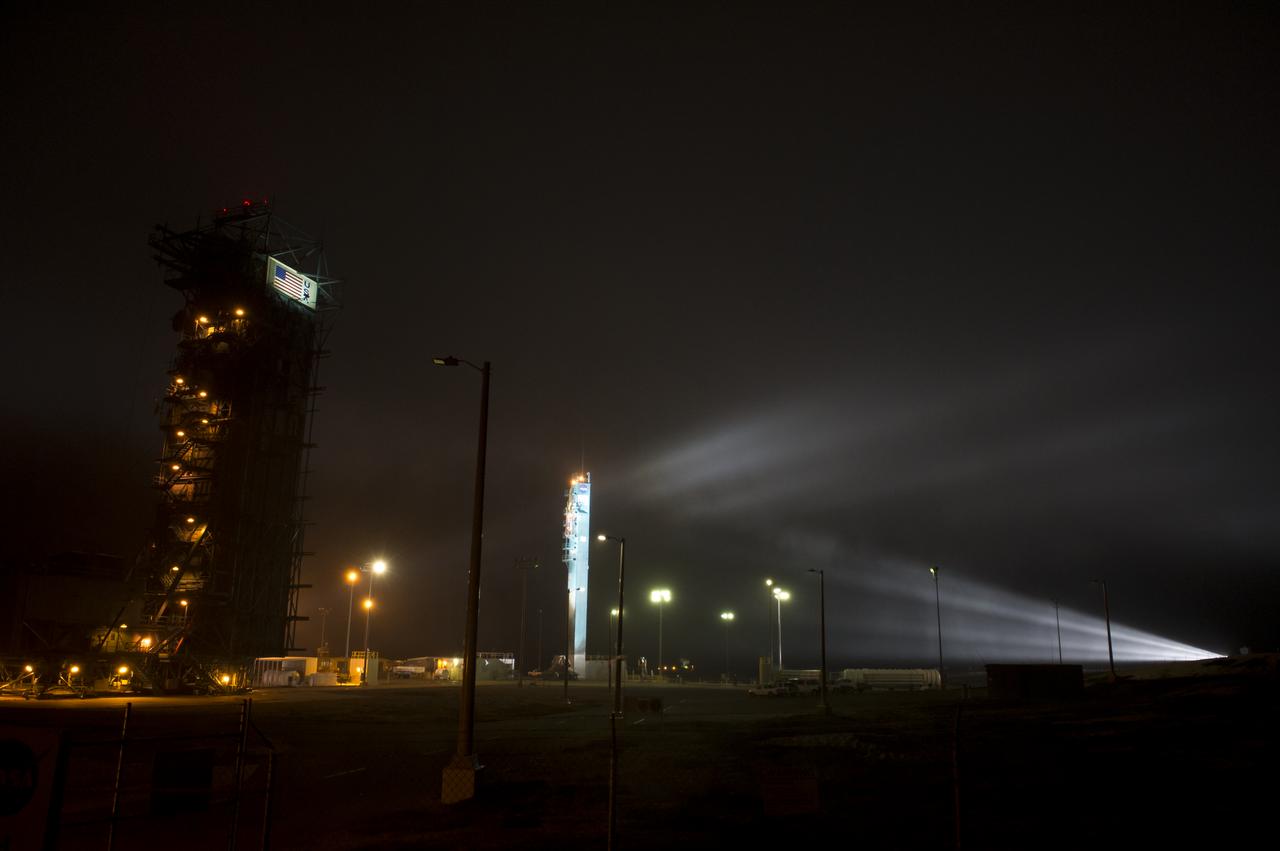
Lights shine on the umbilical tower shortly after a United Launch Alliance Delta II rocket launched with the Orbiting Carbon Observatory-2 (OCO-2)satellite onboard from Space Launch Complex 2 at Vandenberg Air Force Base, Calif. on Wednesday, July 2, 2014. OCO-2 will measure the global distribution of carbon dioxide, the leading human-produced greenhouse gas driving changes in Earth’s climate. Photo Credit: (NASA/Bill Ingalls)
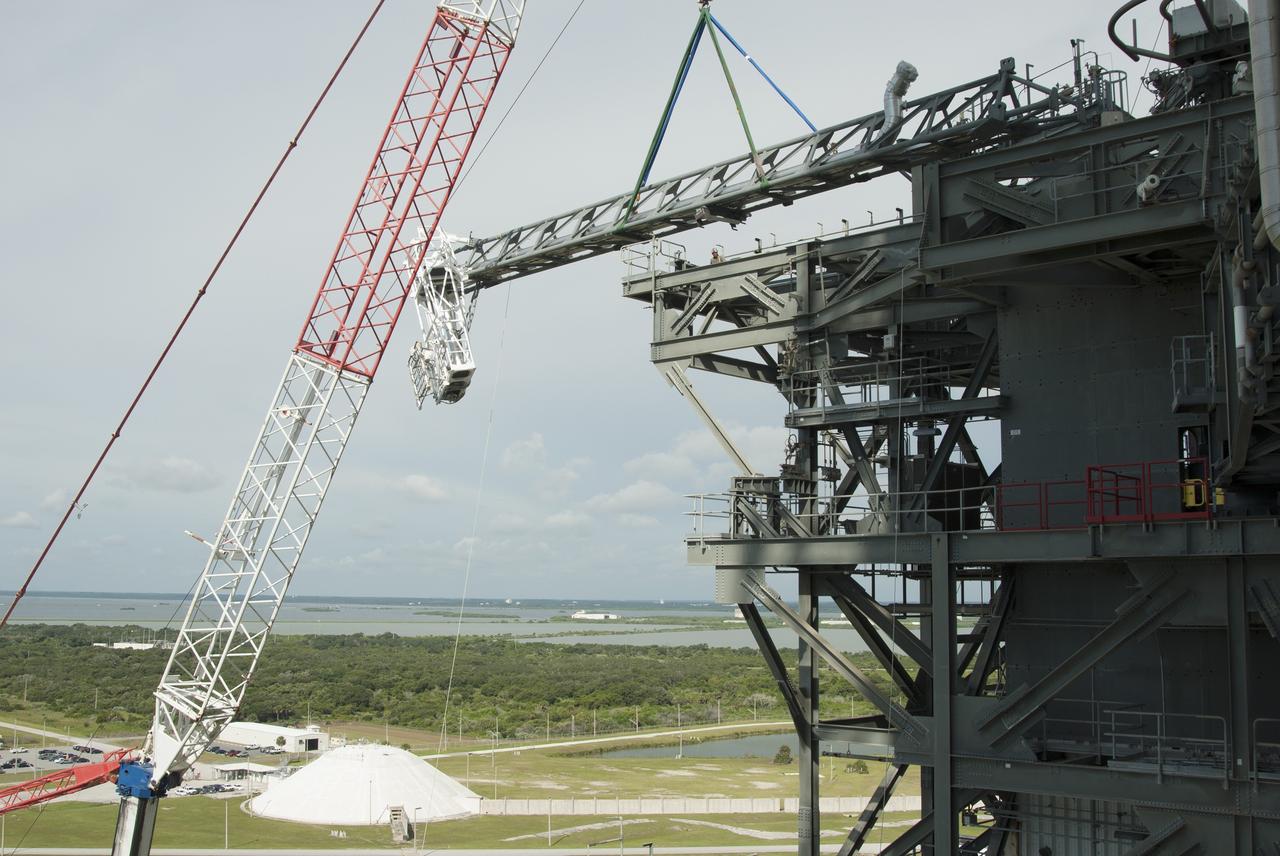
Construction workers and crane specialists high up on the mobile launcher tower monitor the progress as a crane positions the bracket for the Orion Service Module Umbilical (OSMU) for installation on the mobile launcher tower at NASA's Kennedy Space Center in Florida. The tower will be equipped with a number of lines, called umbilicals, that will connect to the Space Launch System rocket and Orion spacecraft for Exploration Mission-1 (EM-1). The OSMU will be located high on the mobile launcher tower and, prior to launch, will transfer liquid coolant for the electronics and air for the Environmental Control System to the Orion service module that houses these critical systems to support the spacecraft. EM-1 is scheduled to launch in 2018. The Ground Systems Development and Operations Program is overseeing installation of the umbilicals.
Preparations are underway to lift the Orion Service Module Umbilical (OSMU) up for installation on the mobile launcher tower at NASA's Kennedy Space Center in Florida. The mobile launcher tower will be equipped with a number of lines, called umbilicals, that will connect to the Space Launch System rocket and Orion spacecraft for Exploration Mission-1 (EM-1). The OSMU will be located high on the mobile launcher tower and, prior to launch, will transfer liquid coolant for the electronics and air for the Environmental Control System to the Orion service module that houses these critical systems to support the spacecraft. EM-1 is scheduled to launch in 2018. The Ground Systems Development and Operations Program is overseeing installation of the umbilicals.
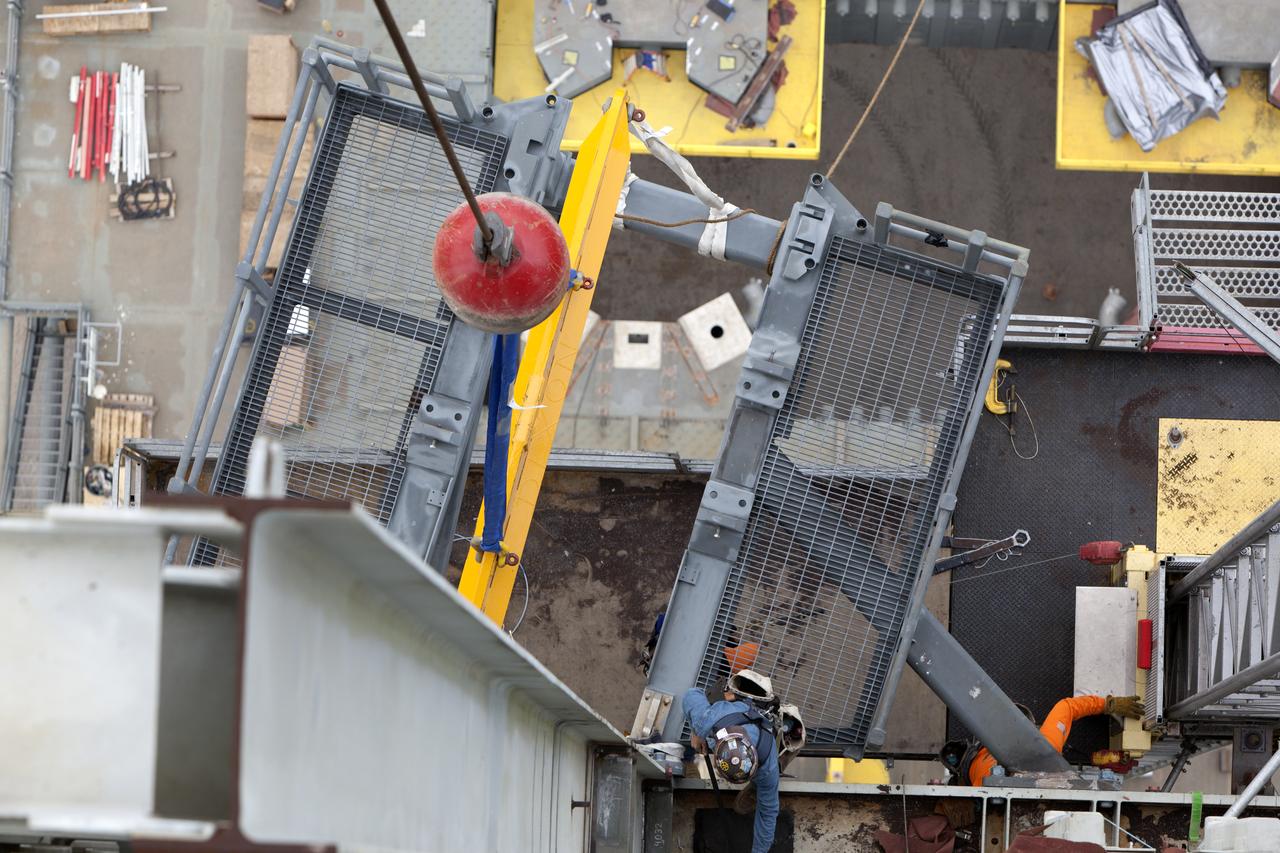
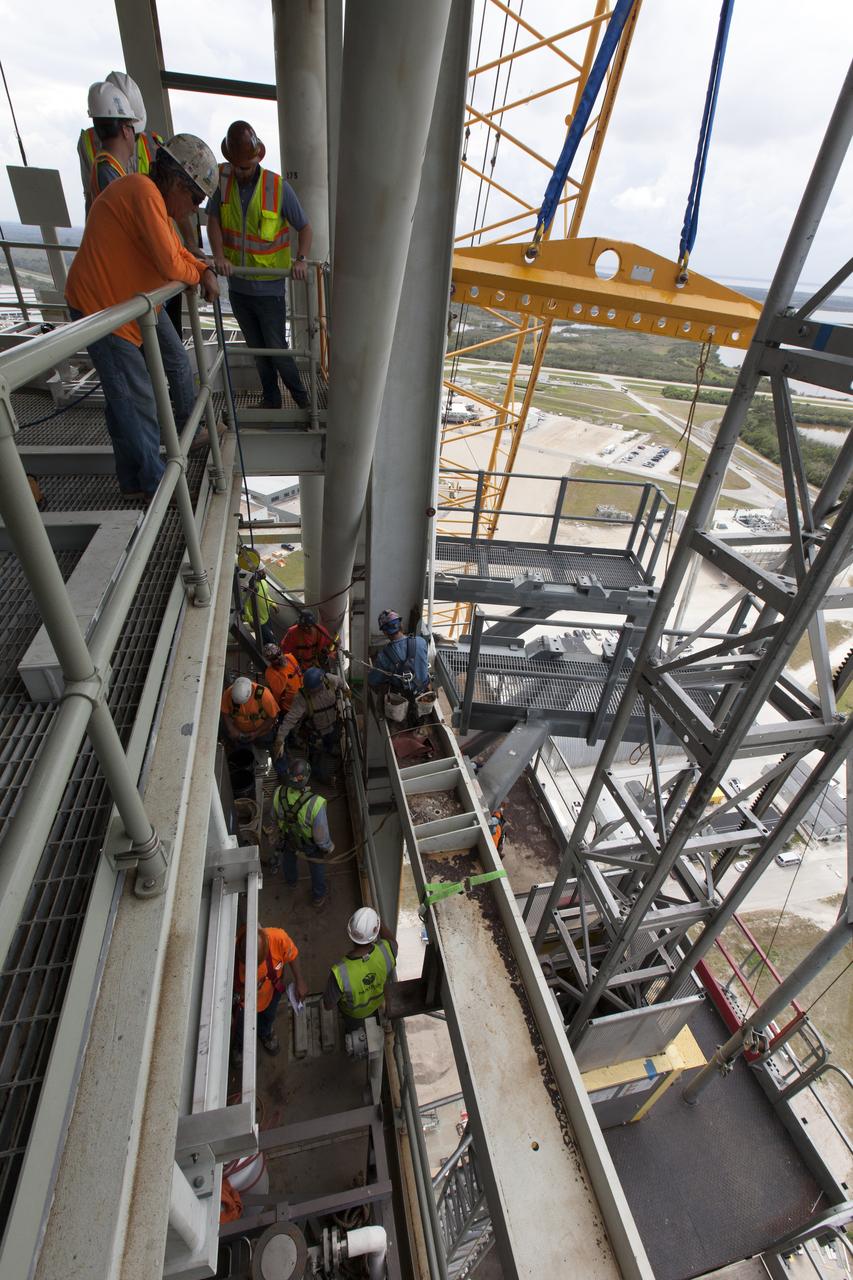
In this view looking down from high up on the mobile launcher, a crane positions the bracket for the Orion Service Module Umbilical (OSMU) for installation on the mobile launcher tower at NASA's Kennedy Space Center in Florida. The mobile launcher tower will be equipped with a number of lines, called umbilicals, that will connect to the Space Launch System rocket and Orion spacecraft for Exploration Mission-1 (EM-1). The OSMU will be located high on the mobile launcher tower and, prior to launch, will transfer liquid coolant for the electronics and air for the Environmental Control System to the Orion service module that houses these critical systems to support the spacecraft. EM-1 is scheduled to launch in 2018. The Ground Systems Development and Operations Program is overseeing installation of the umbilicals.
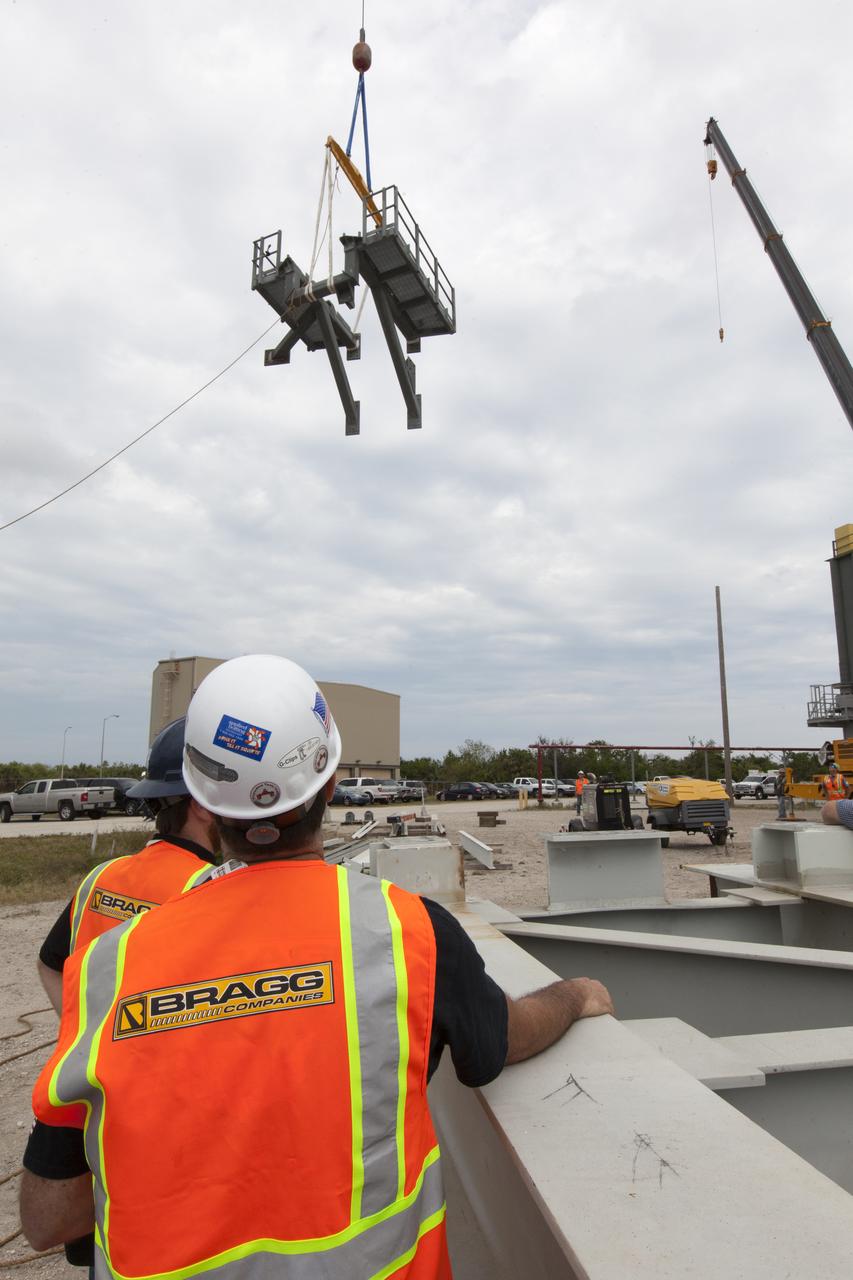
Crane specialists monitor the progress as the bracket for the Orion Service Module Umbilical (OSMU) is lifted up for installation on the mobile launcher tower at NASA's Kennedy Space Center in Florida. The mobile launcher tower will be equipped with a number of lines, called umbilicals, that will connect to the Space Launch System rocket and Orion spacecraft for Exploration Mission-1 (EM-1). The OSMU will be located high on the mobile launcher tower and, prior to launch, will transfer liquid coolant for the electronics and air for the Environmental Control System to the Orion service module that houses these critical systems to support the spacecraft. EM-1 is scheduled to launch in 2018. The Ground Systems Development and Operations Program is overseeing installation of the umbilicals.
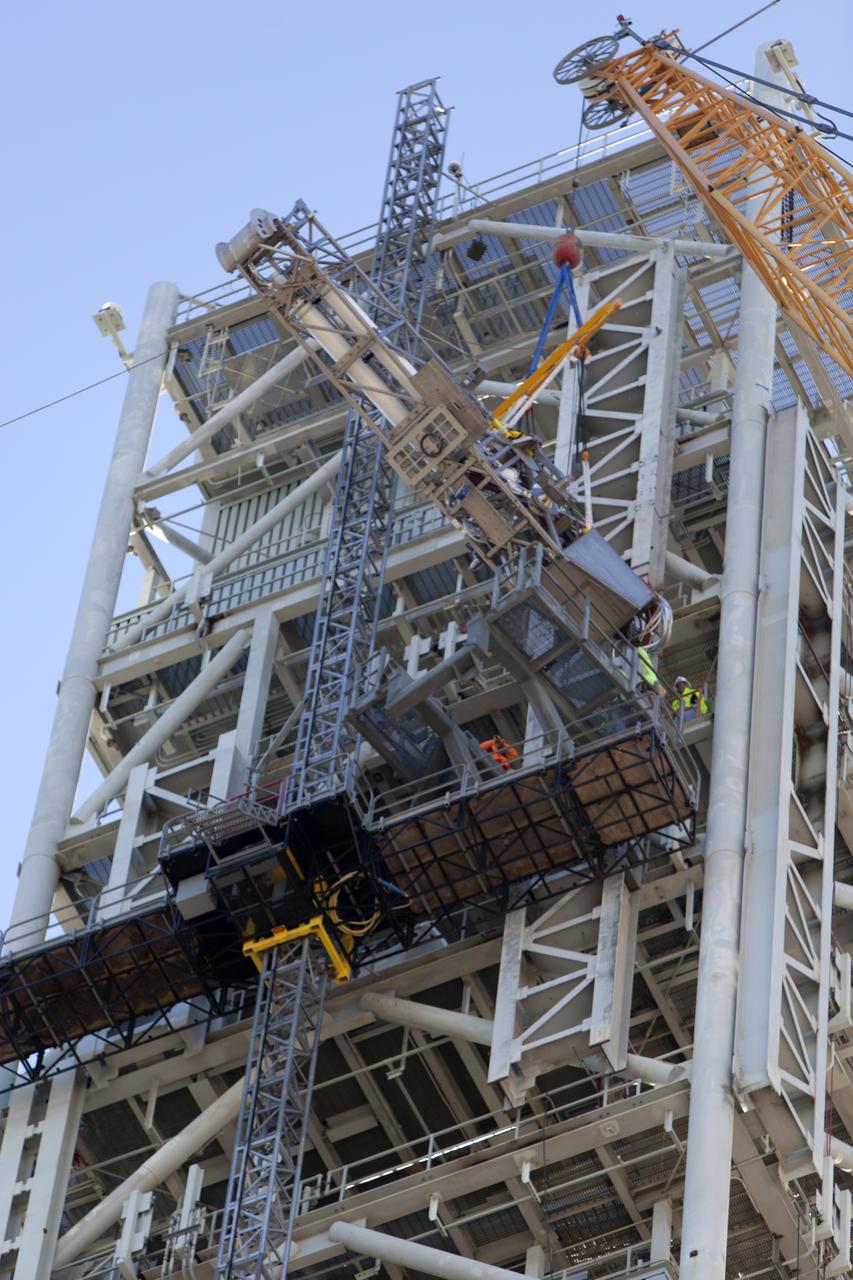
A crane and rigging are used to lift the Orion Service Module Umbilical (OSMU) high up for installation on the mobile launcher tower at NASA's Kennedy Space Center in Florida. The mobile launcher tower will be equipped with a number of lines, called umbilicals, that will connect to the Space Launch System rocket and Orion spacecraft for Exploration Mission-1 (EM-1). The OSMU will be located high on the mobile launcher tower and, prior to launch, will transfer liquid coolant for the electronics and air for the Environmental Control System to the Orion service module that houses these critical systems to support the spacecraft. EM-1 is scheduled to launch in 2018. The Ground Systems Development and Operations Program is overseeing installation of the umbilicals.
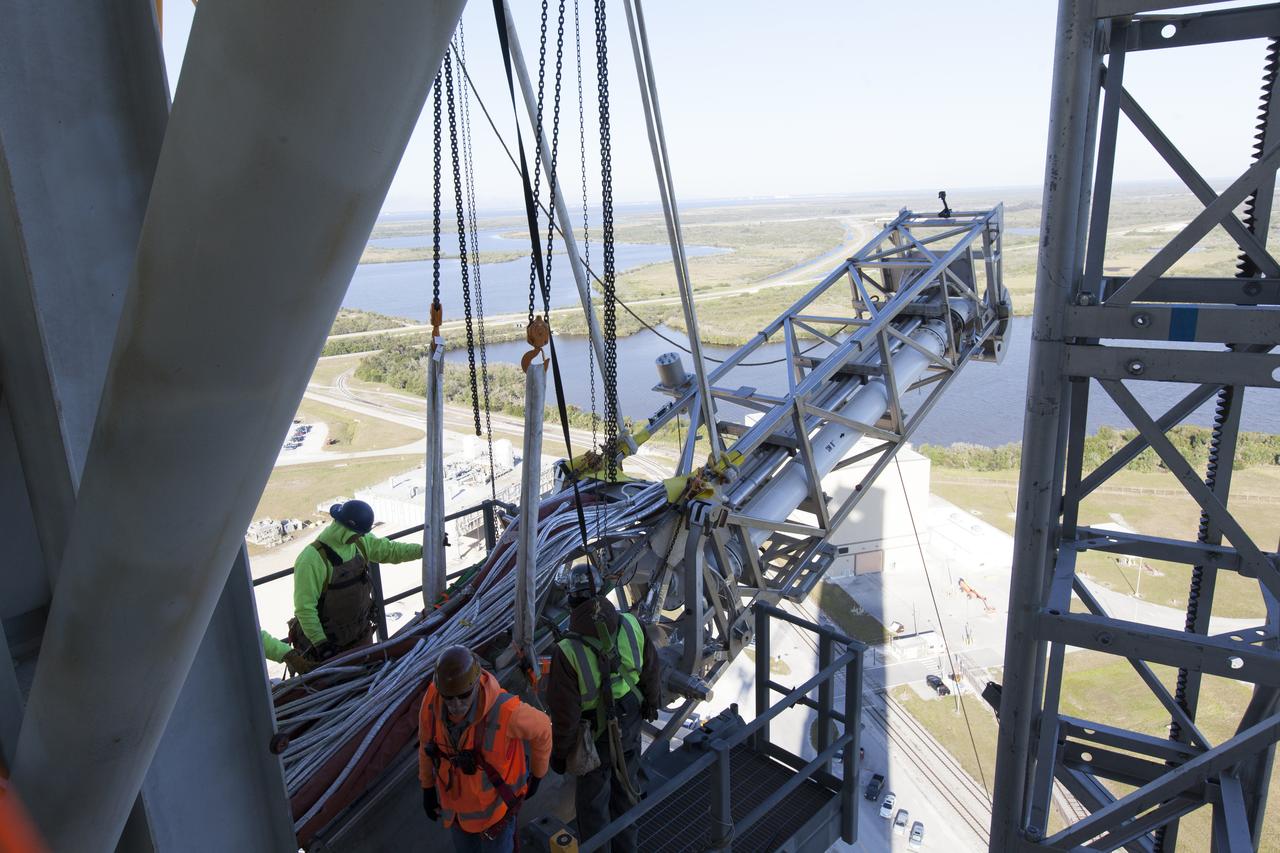
Construction workers assist as a crane and rigging are used to position the Orion Service Module Umbilical (OSMU) for installation high up on the mobile launcher tower at NASA's Kennedy Space Center in Florida. The mobile launcher tower will be equipped with a number of lines, called umbilicals, that will connect to the Space Launch System rocket and Orion spacecraft for Exploration Mission-1 (EM-1). The OSMU will be located high on the mobile launcher tower and, prior to launch, will transfer liquid coolant for the electronics and air for the Environmental Control System to the Orion service module that houses these critical systems to support the spacecraft. EM-1 is scheduled to launch in 2018. The Ground Systems Development and Operations Program is overseeing installation of the umbilicals.
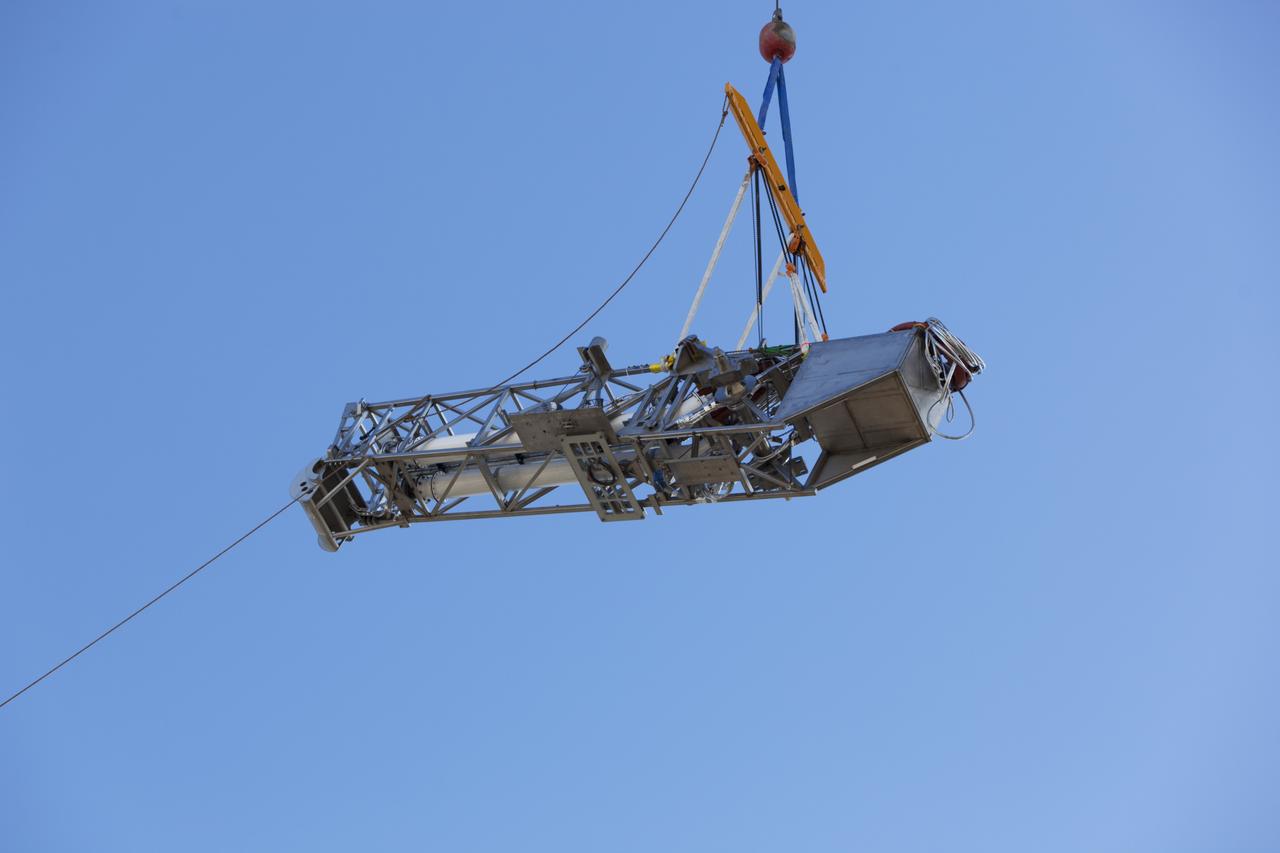
Seeming to hang in midair, the Orion Service Module Umbilical (OSMU) is lifted high up by crane for installation on the mobile launcher tower at NASA's Kennedy Space Center in Florida. The mobile launcher tower will be equipped with a number of lines, called umbilicals, that will connect to the Space Launch System rocket and Orion spacecraft for Exploration Mission-1 (EM-1). The OSMU will be located high on the mobile launcher tower and, prior to launch, will transfer liquid coolant for the electronics and air for the Environmental Control System to the Orion service module that houses these critical systems to support the spacecraft. EM-1 is scheduled to launch in 2018. The Ground Systems Development and Operations Program is overseeing installation of the umbilicals.
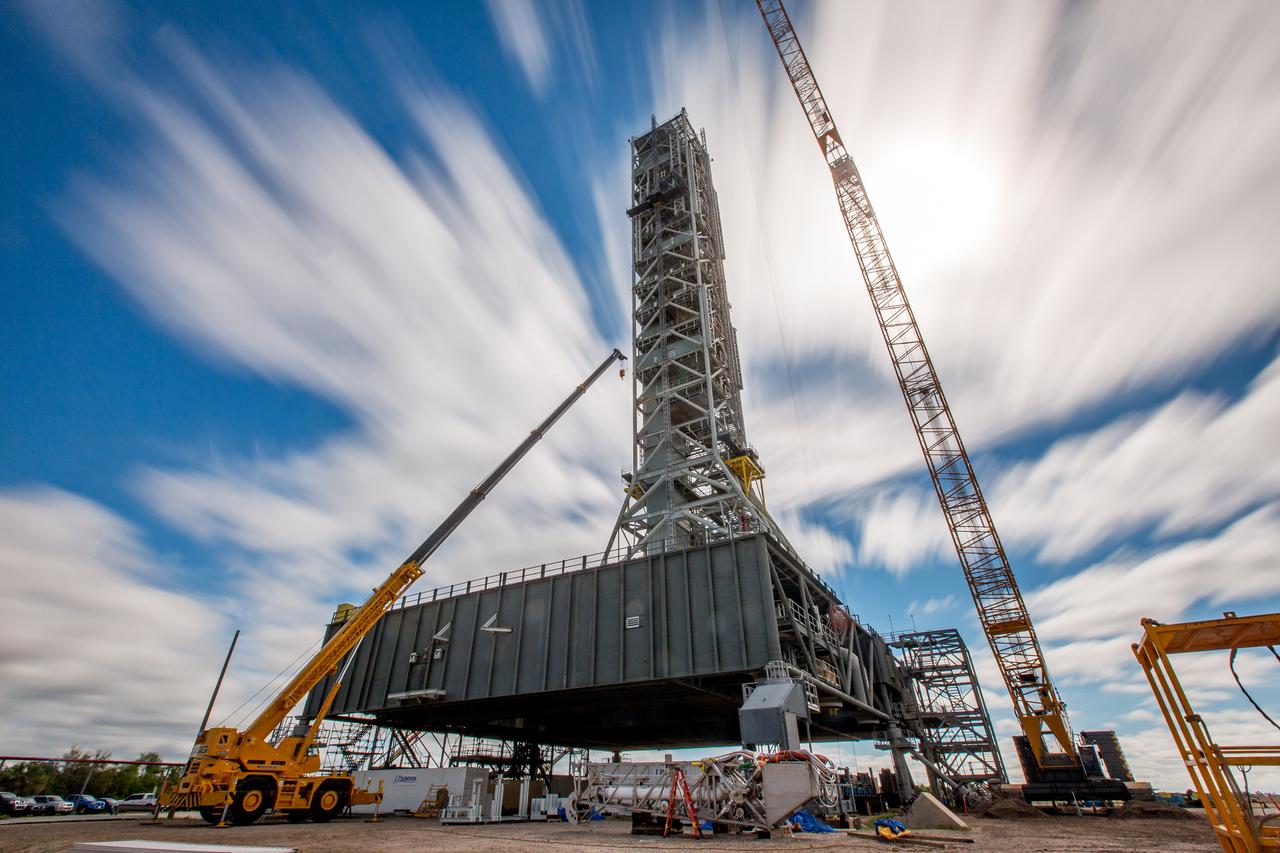
A long-exposure view of the mobile launcher at NASA's Kennedy Space Center in Florida. Cranes and rigging are being used to lift the bracket for the Orion Service Module Umbilical (OSMU) up for installation on the mobile launcher tower. The tower will be equipped with a number of lines, called umbilicals, that will connect to the Space Launch System rocket and Orion spacecraft for Exploration Mission-1 (EM-1). The OSMU will be located high on the mobile launcher tower and, prior to launch, will transfer liquid coolant for the electronics and air for the Environmental Control System to the Orion service module that houses these critical systems to support the spacecraft. EM-1 is scheduled to launch in 2018. The Ground Systems Development and Operations Program is overseeing installation of the umbilicals.
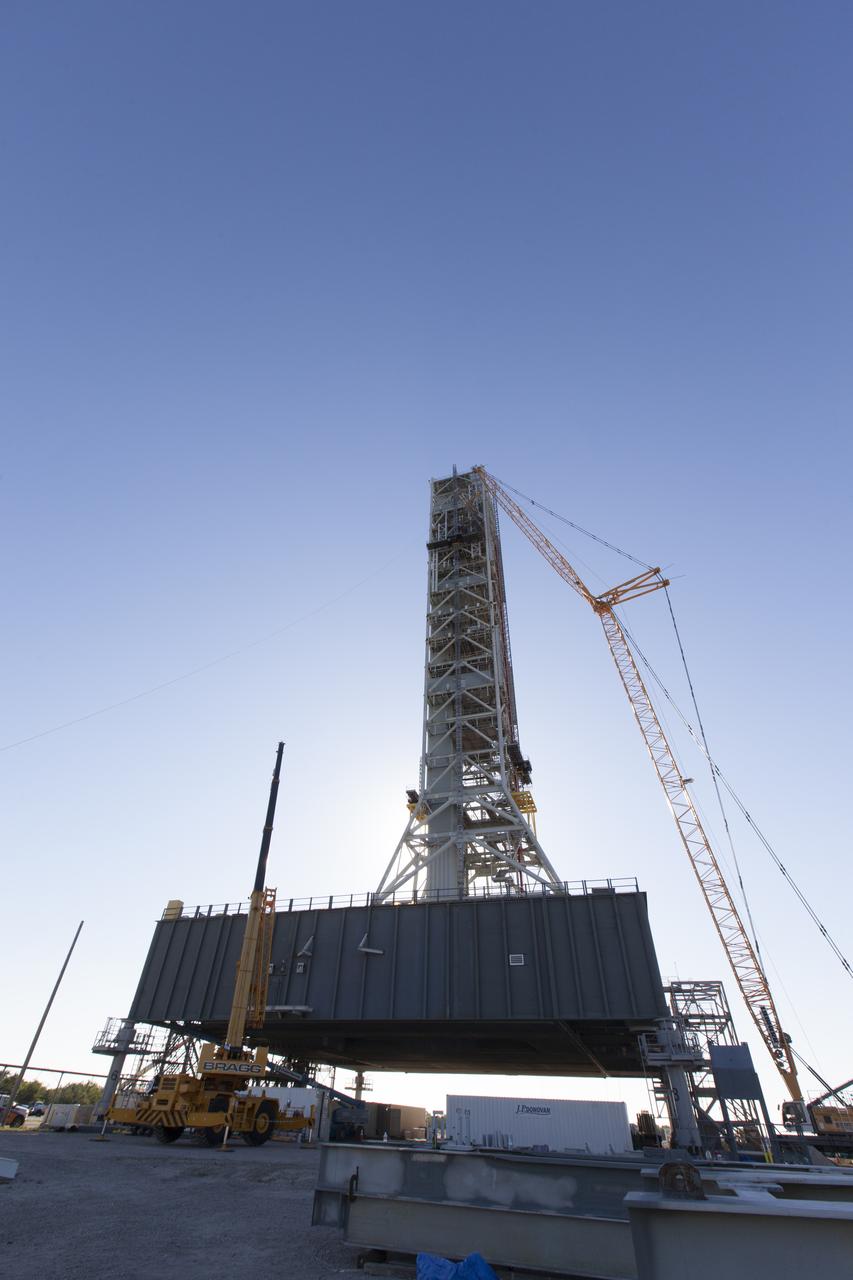
A crane and rigging are used to position the Orion Service Module Umbilical (OSMU) for installation high up on the mobile launcher tower at NASA's Kennedy Space Center in Florida. The mobile launcher tower will be equipped with a number of lines, called umbilicals, that will connect to the Space Launch System rocket and Orion spacecraft for Exploration Mission-1 (EM-1). The OSMU will be located high on the mobile launcher tower and, prior to launch, will transfer liquid coolant for the electronics and air for the Environmental Control System to the Orion service module that houses these critical systems to support the spacecraft. EM-1 is scheduled to launch in 2018. The Ground Systems Development and Operations Program is overseeing installation of the umbilicals.
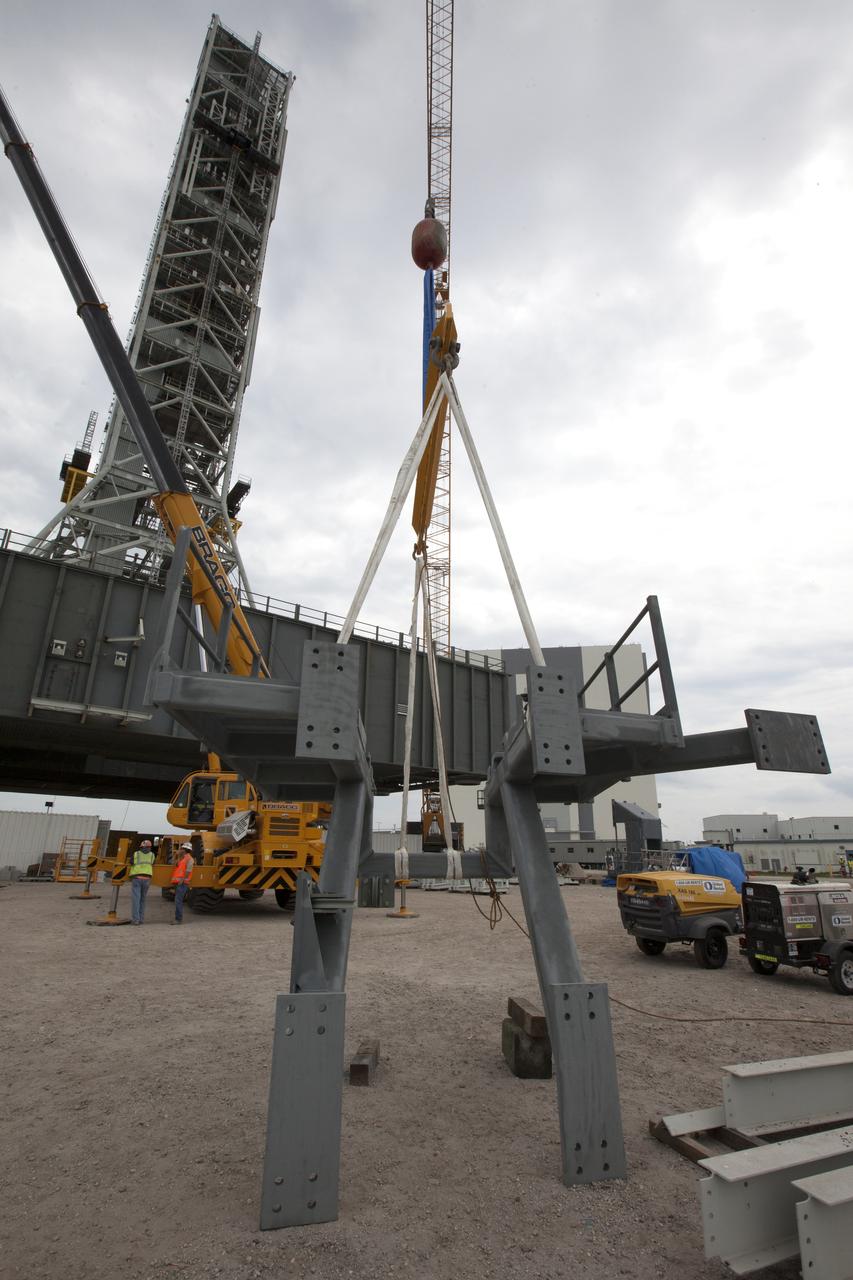
Preparations are underway to lift the bracket for the Orion Service Module Umbilical (OSMU) up for installation on the mobile launcher tower at NASA's Kennedy Space Center in Florida. The mobile launcher tower will be equipped with a number of lines, called umbilicals, that will connect to the Space Launch System rocket and Orion spacecraft for Exploration Mission-1 (EM-1). The OSMU will be located high on the mobile launcher tower and, prior to launch, will transfer liquid coolant for the electronics and air for the Environmental Control System to the Orion service module that houses these critical systems to support the spacecraft. EM-1 is scheduled to launch in 2018. The Ground Systems Development and Operations Program is overseeing installation of the umbilicals.
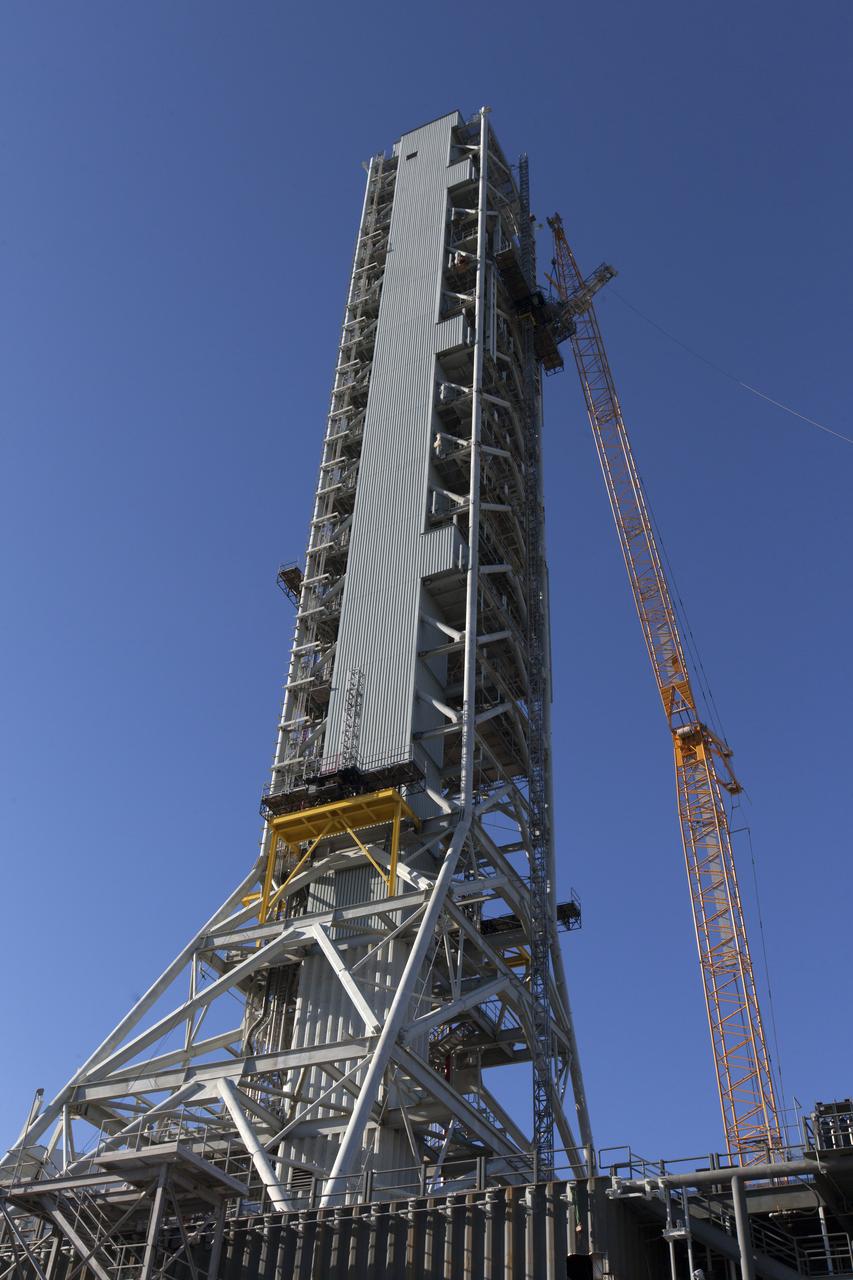
A crane and rigging are used to position the Orion Service Module Umbilical (OSMU) for installation high up on the mobile launcher tower at NASA's Kennedy Space Center in Florida. The mobile launcher tower will be equipped with a number of lines, called umbilicals, that will connect to the Space Launch System rocket and Orion spacecraft for Exploration Mission-1 (EM-1). The OSMU will be located high on the mobile launcher tower and, prior to launch, will transfer liquid coolant for the electronics and air for the Environmental Control System to the Orion service module that houses these critical systems to support the spacecraft. EM-1 is scheduled to launch in 2018. The Ground Systems Development and Operations Program is overseeing installation of the umbilicals.
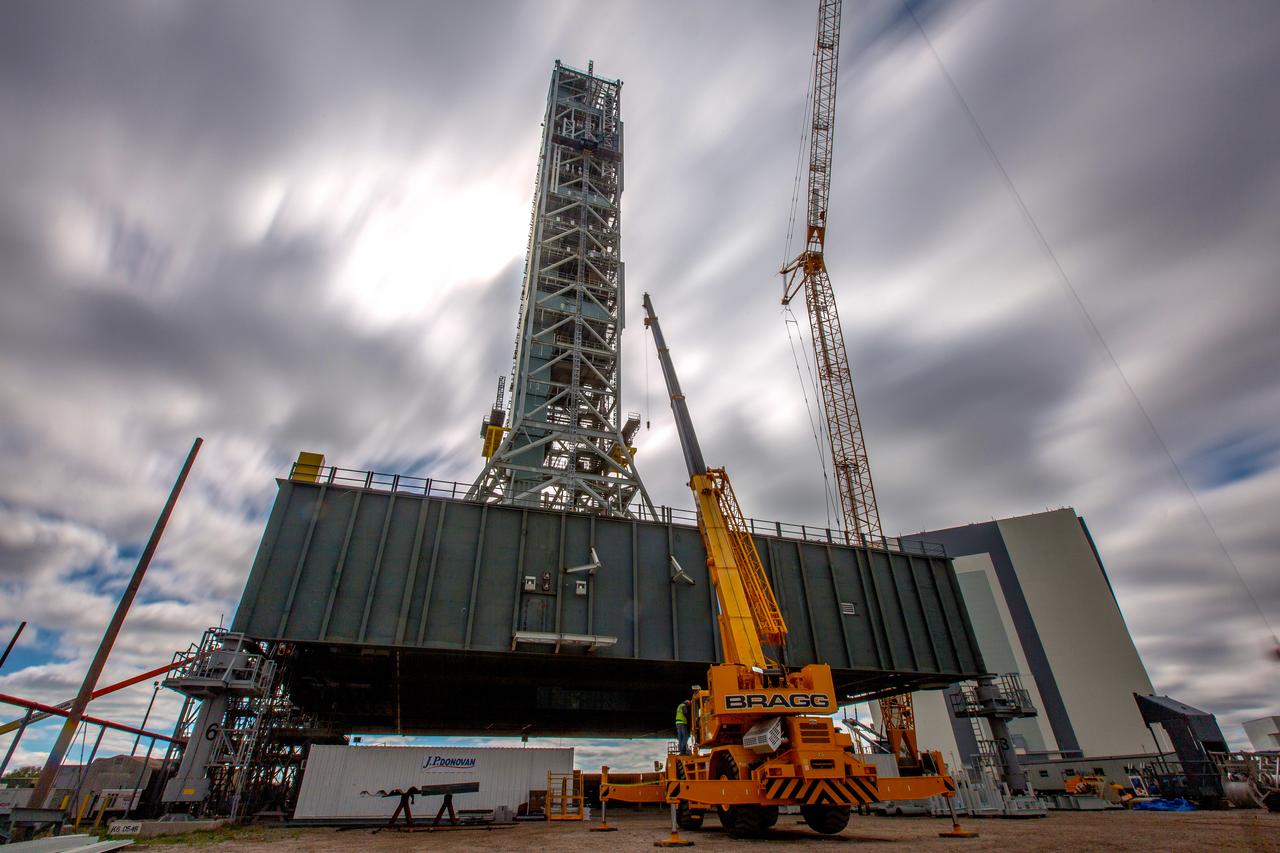
A long-exposure view of the mobile launcher at NASA's Kennedy Space Center in Florida. Cranes and rigging are being used to lift the bracket for the Orion Service Module Umbilical (OSMU) up for installation on the mobile launcher tower. The tower will be equipped with a number of lines, called umbilicals, that will connect to the Space Launch System rocket and Orion spacecraft for Exploration Mission-1 (EM-1). The OSMU will be located high on the mobile launcher tower and, prior to launch, will transfer liquid coolant for the electronics and air for the Environmental Control System to the Orion service module that houses these critical systems to support the spacecraft. EM-1 is scheduled to launch in 2018. The Ground Systems Development and Operations Program is overseeing installation of the umbilicals.
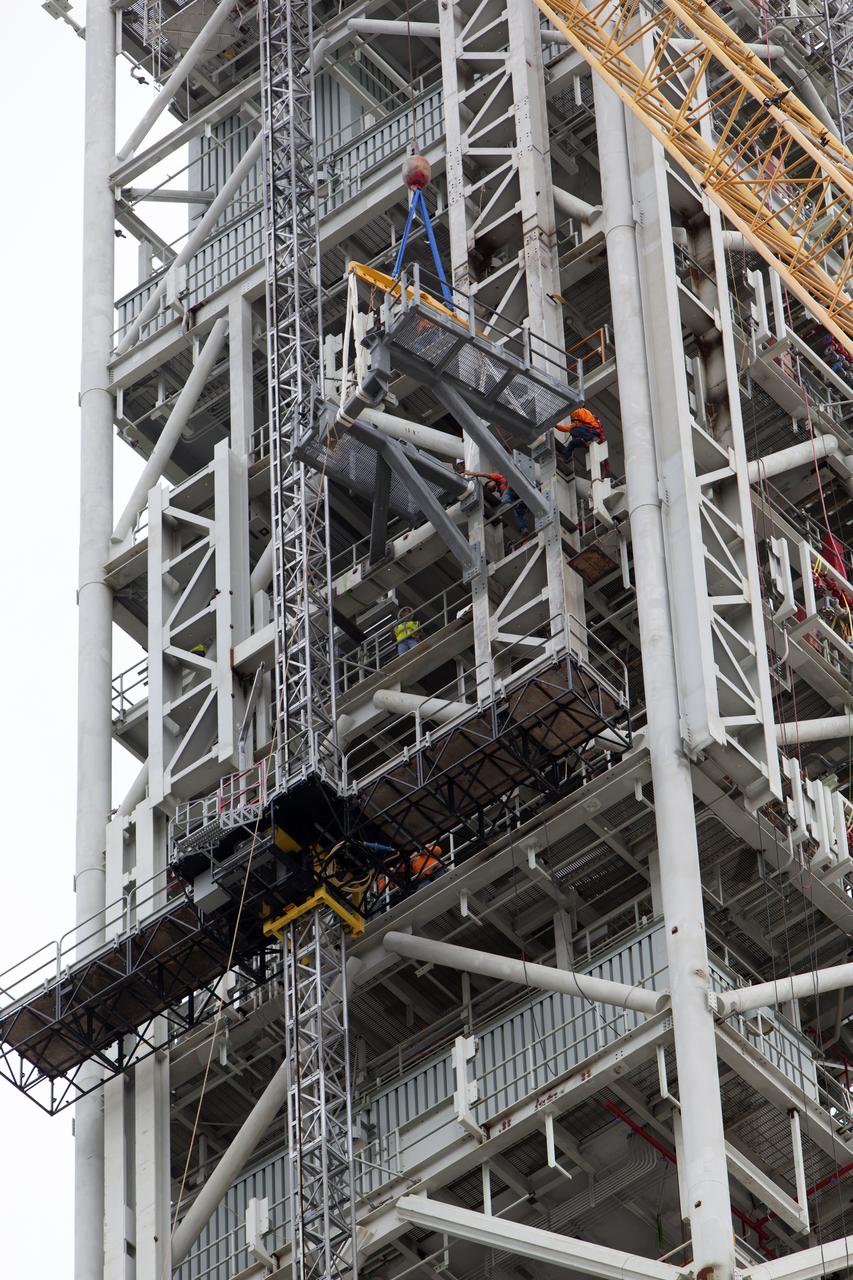
A crane positions the bracket for the Orion Service Module Umbilical (OSMU) for installation on the mobile launcher tower at NASA's Kennedy Space Center in Florida. The mobile launcher tower will be equipped with a number of lines, called umbilicals, that will connect to the Space Launch System rocket and Orion spacecraft for Exploration Mission-1 (EM-1). The OSMU will be located high on the mobile launcher tower and, prior to launch, will transfer liquid coolant for the electronics and air for the Environmental Control System to the Orion service module that houses these critical systems to support the spacecraft. EM-1 is scheduled to launch in 2018. The Ground Systems Development and Operations Program is overseeing installation of the umbilicals.
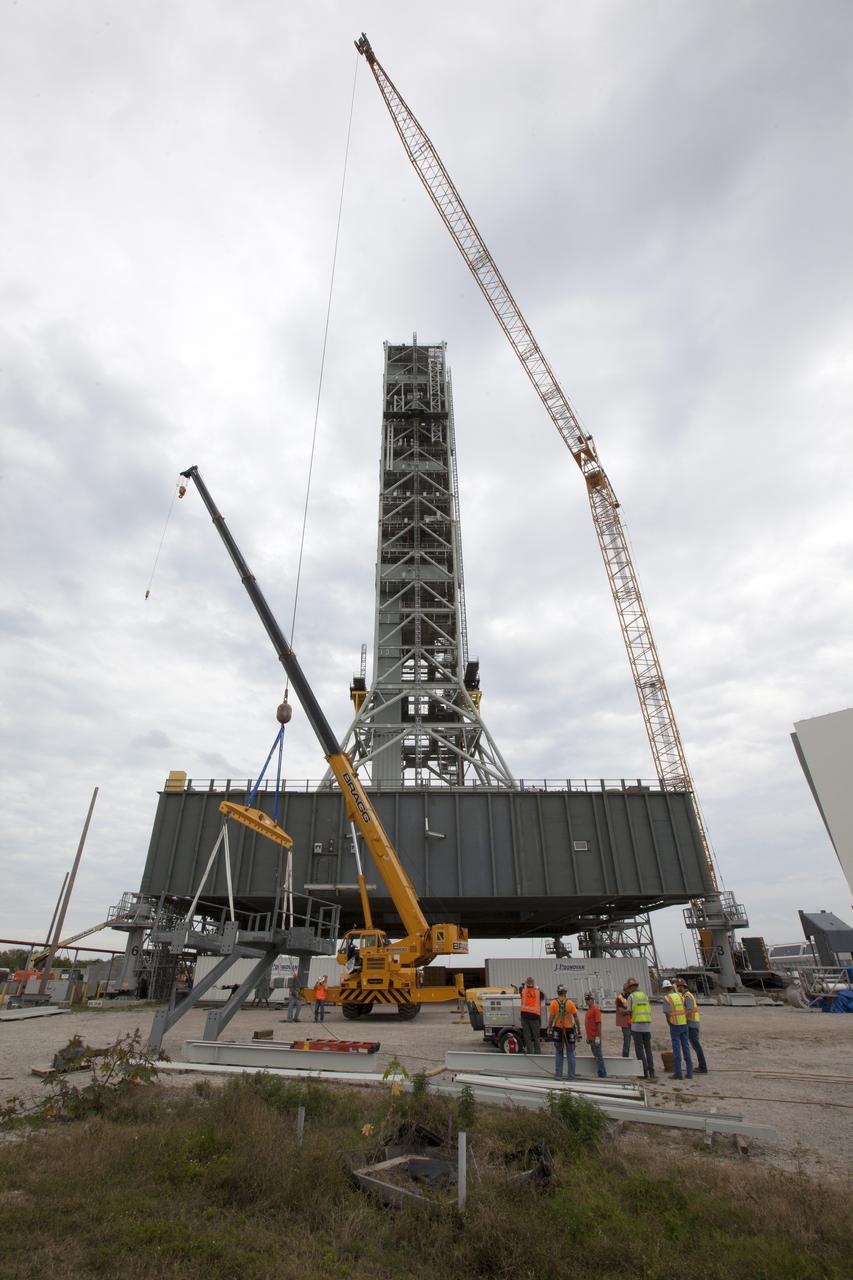
Preparations are underway to lift the bracket for the Orion Service Module Umbilical (OSMU) up for installation on the mobile launcher tower at NASA's Kennedy Space Center in Florida. The mobile launcher tower will be equipped with a number of lines, called umbilicals, that will connect to the Space Launch System rocket and Orion spacecraft for Exploration Mission-1 (EM-1). The OSMU will be located high on the mobile launcher tower and, prior to launch, will transfer liquid coolant for the electronics and air for the Environmental Control System to the Orion service module that houses these critical systems to support the spacecraft. EM-1 is scheduled to launch in 2018. The Ground Systems Development and Operations Program is overseeing installation of the umbilicals.

A crane and rigging are used to lift the Orion Service Module Umbilical (OSMU) up for installation on the mobile launcher tower at NASA's Kennedy Space Center in Florida. The mobile launcher tower will be equipped with a number of lines, called umbilicals, that will connect to the Space Launch System rocket and Orion spacecraft for Exploration Mission-1 (EM-1). The OSMU will be located high on the mobile launcher tower and, prior to launch, will transfer liquid coolant for the electronics and air for the Environmental Control System to the Orion service module that houses these critical systems to support the spacecraft. EM-1 is scheduled to launch in 2018. The Ground Systems Development and Operations Program is overseeing installation of the umbilicals.
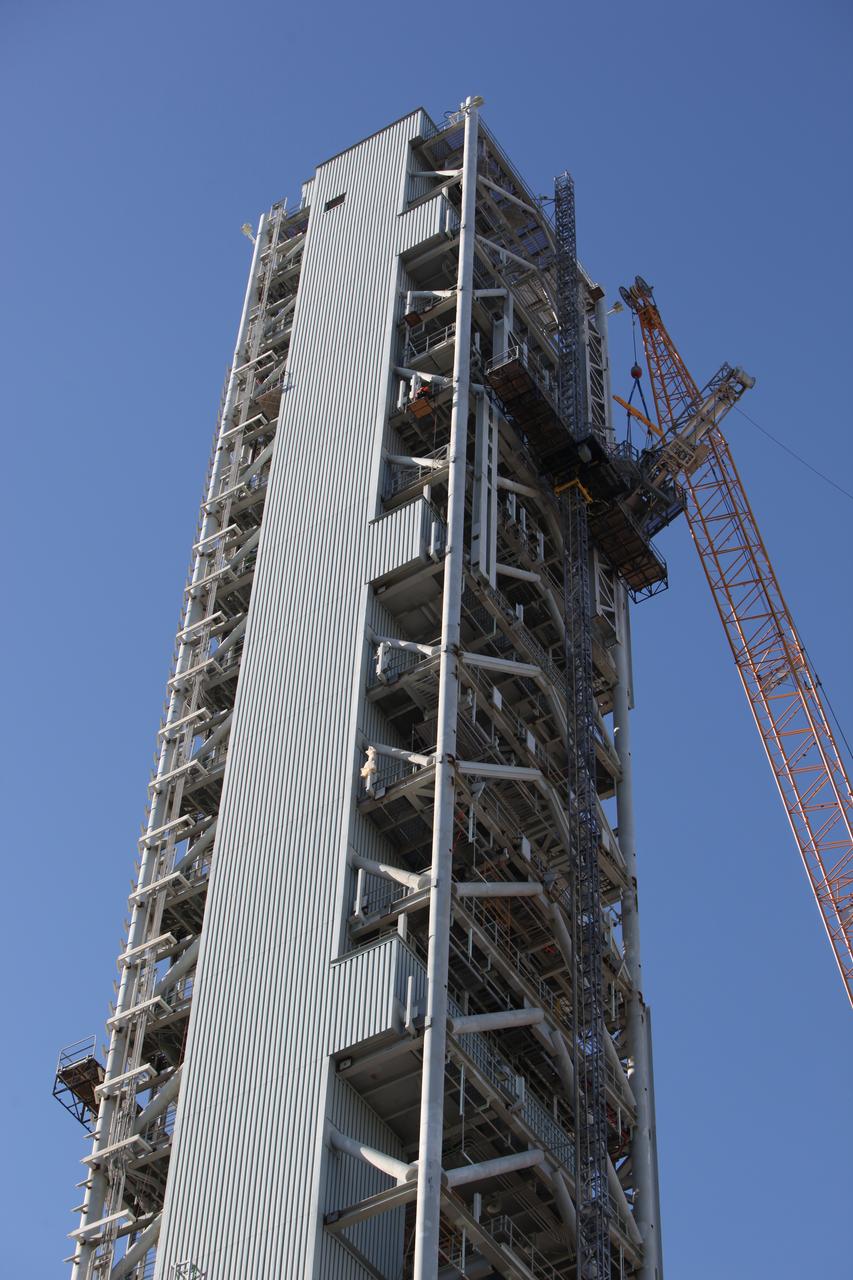
A crane and rigging are used to position the Orion Service Module Umbilical (OSMU) for installation high up on the mobile launcher tower at NASA's Kennedy Space Center in Florida. The mobile launcher tower will be equipped with a number of lines, called umbilicals, that will connect to the Space Launch System rocket and Orion spacecraft for Exploration Mission-1 (EM-1). The OSMU will be located high on the mobile launcher tower and, prior to launch, will transfer liquid coolant for the electronics and air for the Environmental Control System to the Orion service module that houses these critical systems to support the spacecraft. EM-1 is scheduled to launch in 2018. The Ground Systems Development and Operations Program is overseeing installation of the umbilicals.
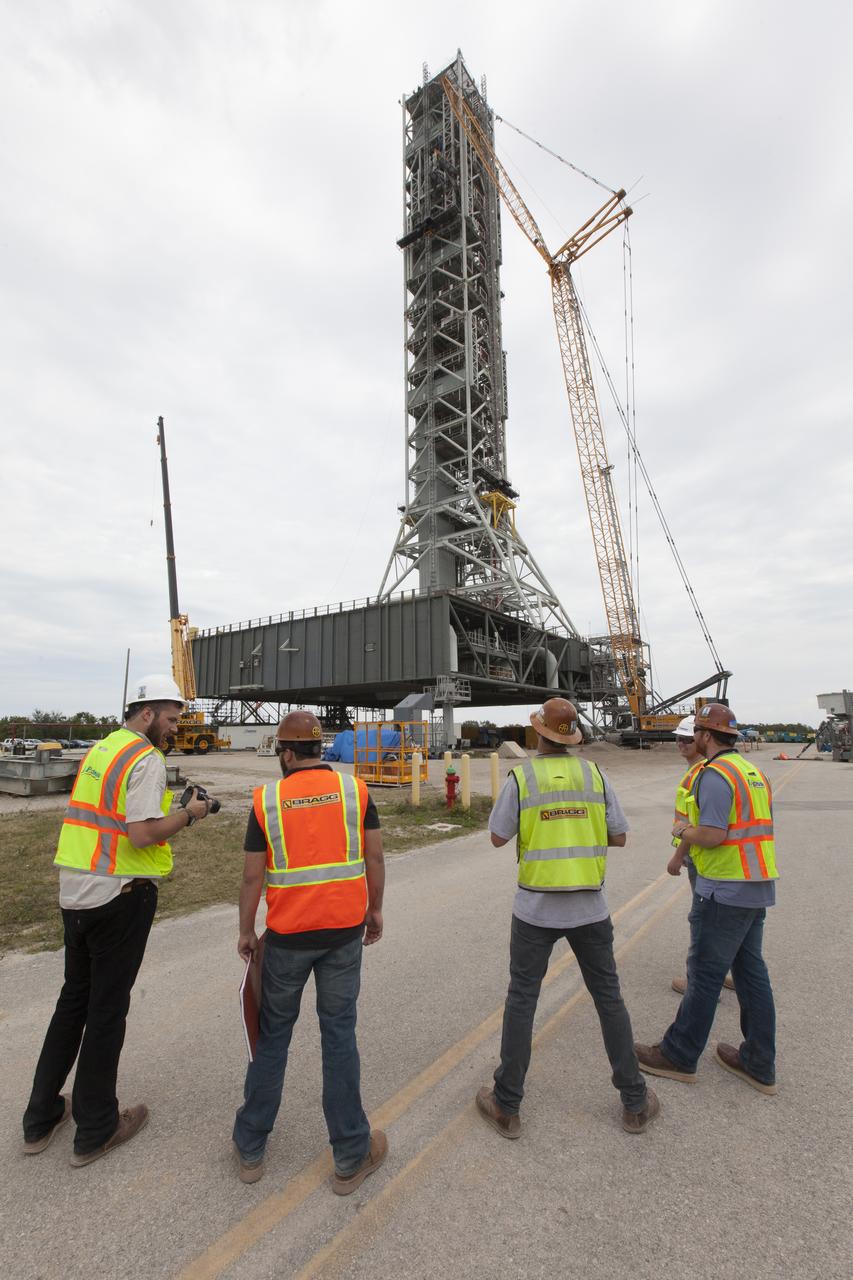
Crane specialists monitor the progress as the bracket for the Orion Service Module Umbilical (OSMU) is lifted high up for installation on the mobile launcher tower at NASA's Kennedy Space Center in Florida. The mobile launcher tower will be equipped with a number of lines, called umbilicals, that will connect to the Space Launch System rocket and Orion spacecraft for Exploration Mission-1 (EM-1). The OSMU will be located high on the mobile launcher tower and, prior to launch, will transfer liquid coolant for the electronics and air for the Environmental Control System to the Orion service module that houses these critical systems to support the spacecraft. EM-1 is scheduled to launch in 2018. The Ground Systems Development and Operations Program is overseeing installation of the umbilicals.
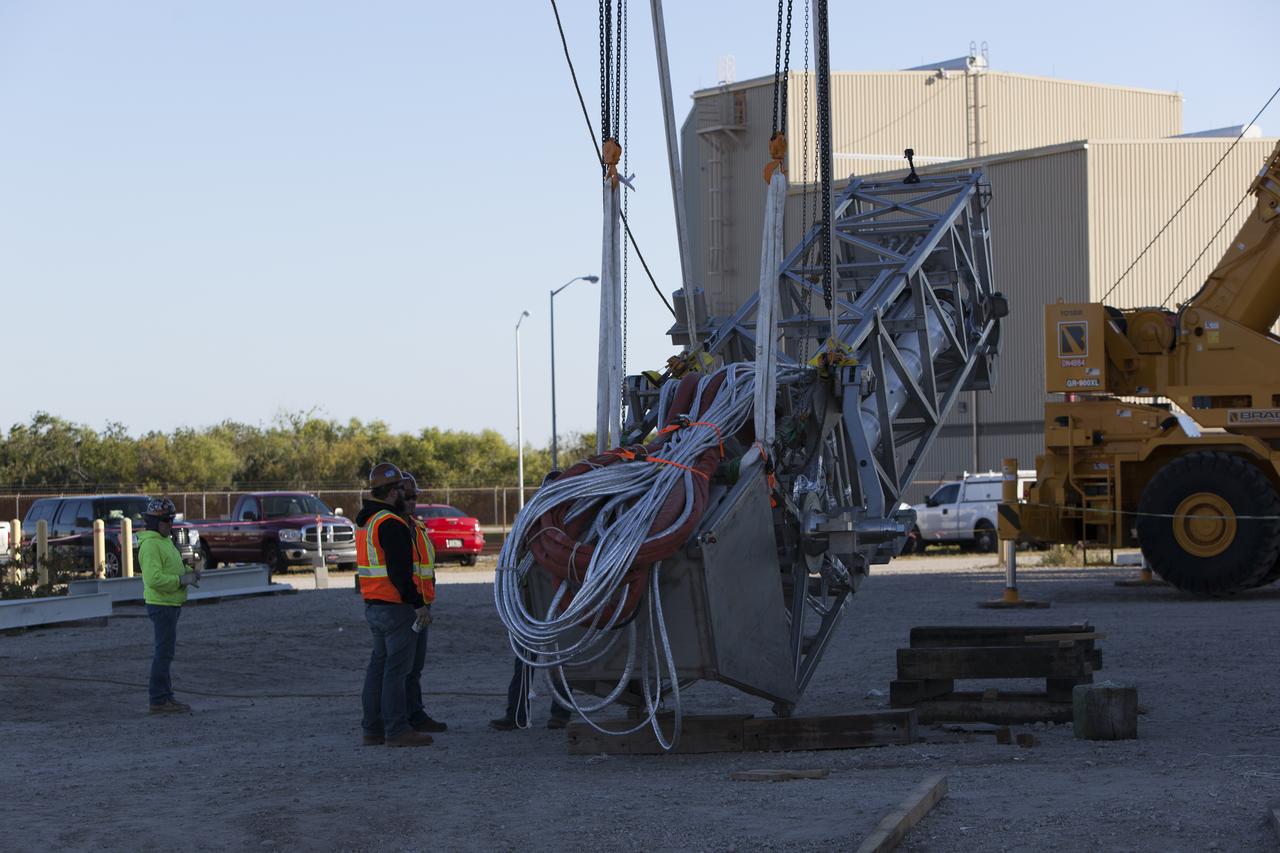
Preparations are underway to lift the Orion Service Module Umbilical (OSMU) up for installation on the mobile launcher tower at NASA's Kennedy Space Center in Florida. The mobile launcher tower will be equipped with a number of lines, called umbilicals, that will connect to the Space Launch System rocket and Orion spacecraft for Exploration Mission-1 (EM-1). The OSMU will be located high on the mobile launcher tower and, prior to launch, will transfer liquid coolant for the electronics and air for the Environmental Control System to the Orion service module that houses these critical systems to support the spacecraft. EM-1 is scheduled to launch in 2018. The Ground Systems Development and Operations Program is overseeing installation of the umbilicals.
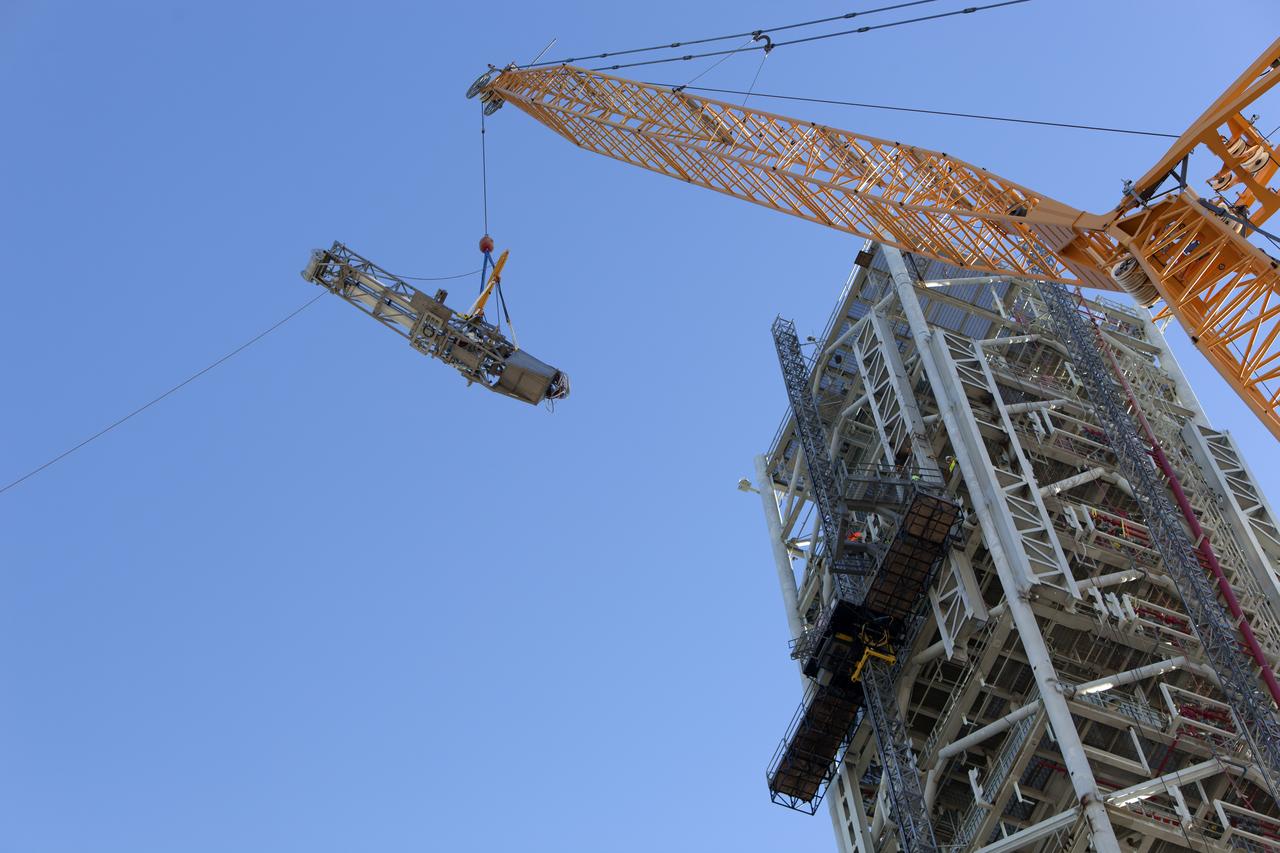
A crane and rigging are used to lift the Orion Service Module Umbilical (OSMU) high up for installation on the mobile launcher tower at NASA's Kennedy Space Center in Florida. The mobile launcher tower will be equipped with a number of lines, called umbilicals, that will connect to the Space Launch System rocket and Orion spacecraft for Exploration Mission-1 (EM-1). The OSMU will be located high on the mobile launcher tower and, prior to launch, will transfer liquid coolant for the electronics and air for the Environmental Control System to the Orion service module that houses these critical systems to support the spacecraft. EM-1 is scheduled to launch in 2018. The Ground Systems Development and Operations Program is overseeing installation of the umbilicals.
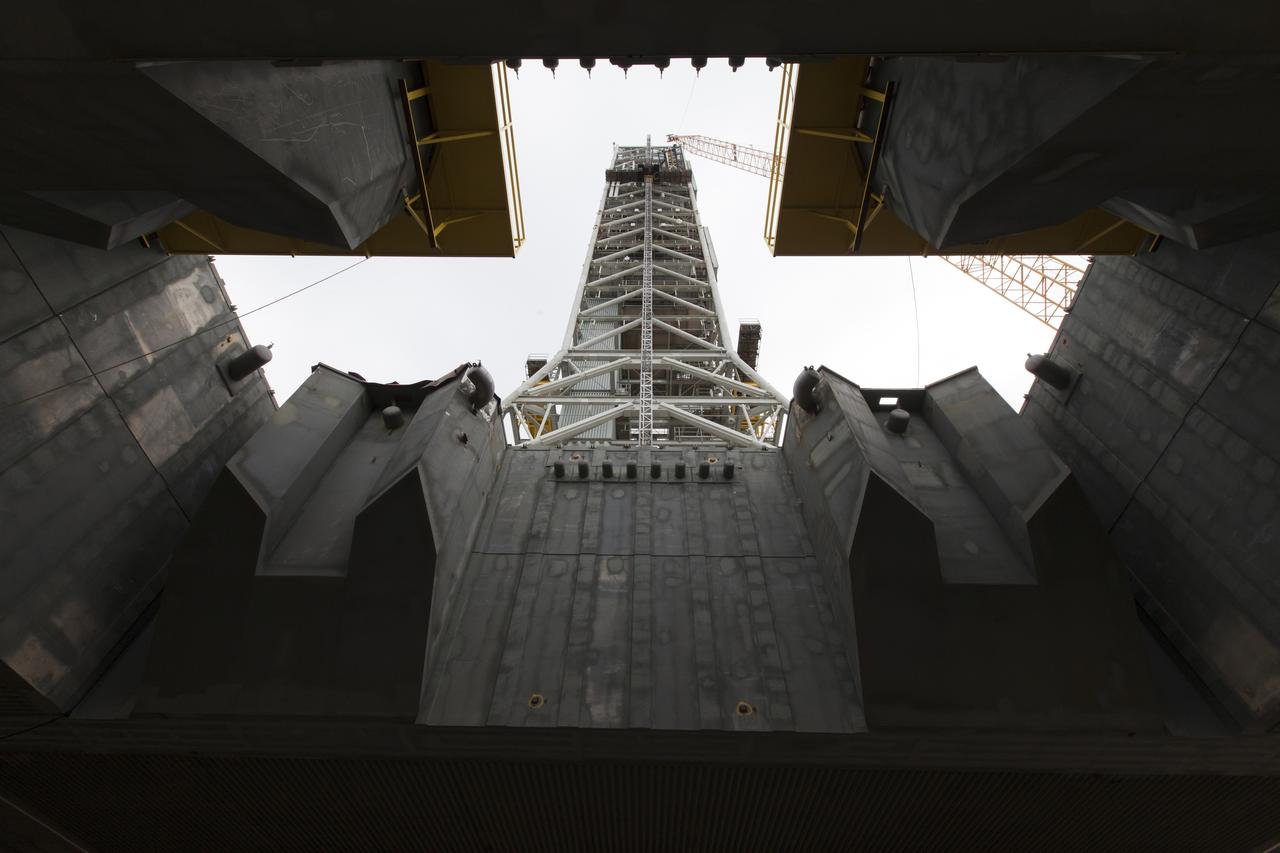
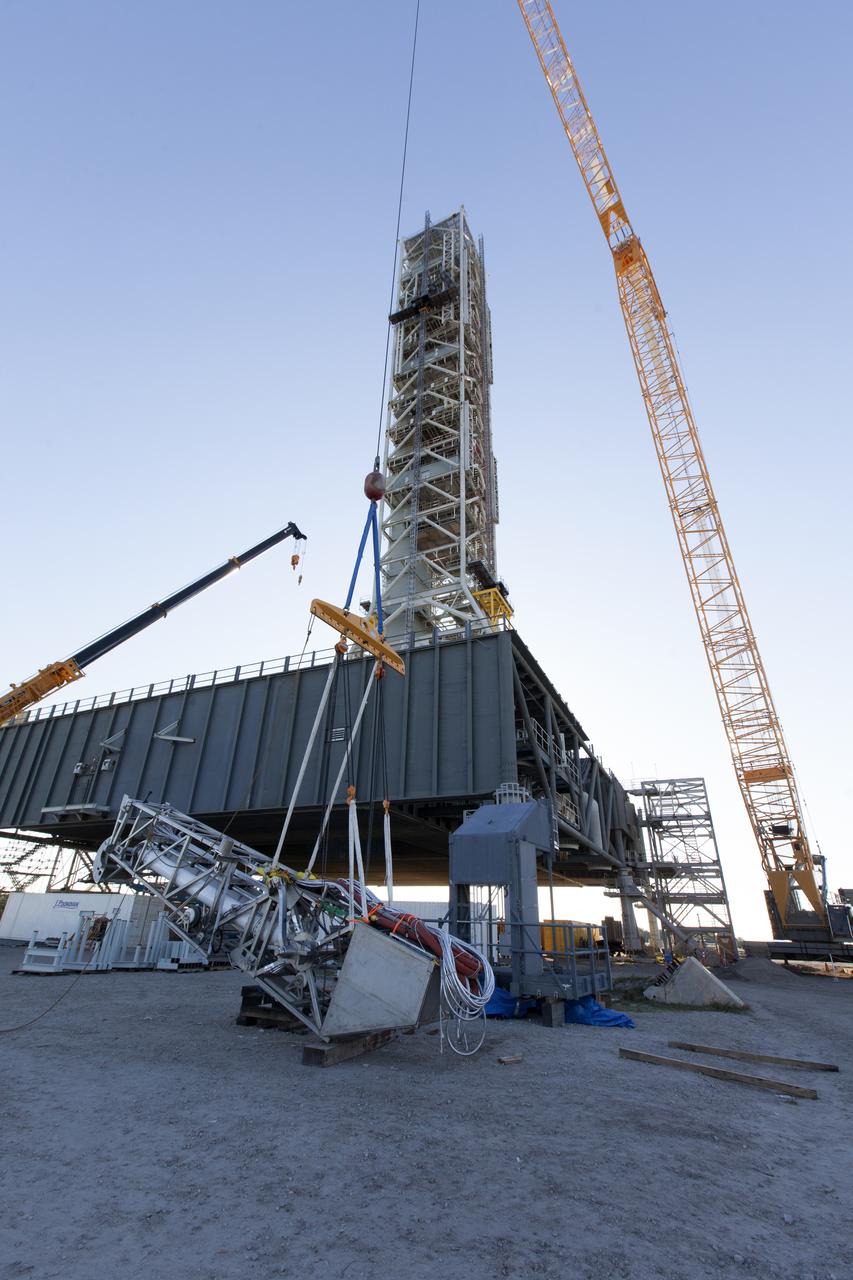
A view from below the mobile launcher shows a crane positioning the bracket for the Orion Service Module Umbilical (OSMU) high up for installation on the mobile launcher tower at NASA's Kennedy Space Center in Florida. The mobile launcher tower will be equipped with a number of lines, called umbilicals, that will connect to the Space Launch System rocket and Orion spacecraft for Exploration Mission-1 (EM-1). The OSMU will be located high on the mobile launcher tower and, prior to launch, will transfer liquid coolant for the electronics and air for the Environmental Control System to the Orion service module that houses these critical systems to support the spacecraft. EM-1 is scheduled to launch in 2018. The Ground Systems Development and Operations Program is overseeing installation of the umbilicals.

A long-exposure view of the mobile launcher at NASA's Kennedy Space Center in Florida. Cranes and rigging are being used to lift the bracket for the Orion Service Module Umbilical (OSMU) up for installation on the mobile launcher tower. The tower will be equipped with a number of lines, called umbilicals, that will connect to the Space Launch System rocket and Orion spacecraft for Exploration Mission-1 (EM-1). The OSMU will be located high on the mobile launcher tower and, prior to launch, will transfer liquid coolant for the electronics and air for the Environmental Control System to the Orion service module that houses these critical systems to support the spacecraft. EM-1 is scheduled to launch in 2018. The Ground Systems Development and Operations Program is overseeing installation of the umbilicals.
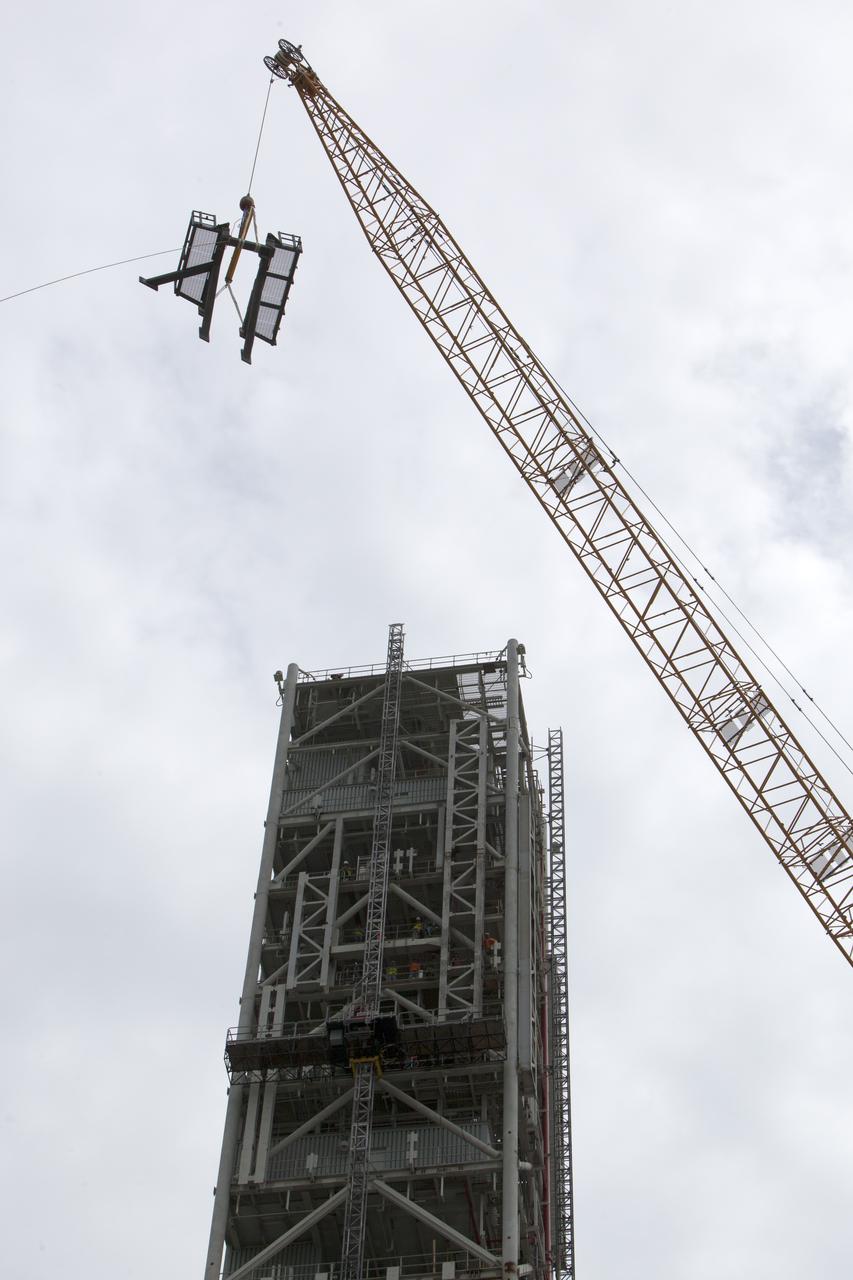
A crane lifts the bracket for the Orion Service Module Umbilical (OSMU) high up for installation on the mobile launcher tower at NASA's Kennedy Space Center in Florida. The mobile launcher tower will be equipped with a number of lines, called umbilicals, that will connect to the Space Launch System rocket and Orion spacecraft for Exploration Mission-1 (EM-1). The OSMU will be located high on the mobile launcher tower and, prior to launch, will transfer liquid coolant for the electronics and air for the Environmental Control System to the Orion service module that houses these critical systems to support the spacecraft. EM-1 is scheduled to launch in 2018. The Ground Systems Development and Operations Program is overseeing installation of the umbilicals.

A crane and rigging are used to lift the Orion Service Module Umbilical (OSMU) high up for installation on the mobile launcher tower at NASA's Kennedy Space Center in Florida. The mobile launcher tower will be equipped with a number of lines, called umbilicals, that will connect to the Space Launch System rocket and Orion spacecraft for Exploration Mission-1 (EM-1). The OSMU will be located high on the mobile launcher tower and, prior to launch, will transfer liquid coolant for the electronics and air for the Environmental Control System to the Orion service module that houses these critical systems to support the spacecraft. EM-1 is scheduled to launch in 2018. The Ground Systems Development and Operations Program is overseeing installation of the umbilicals.
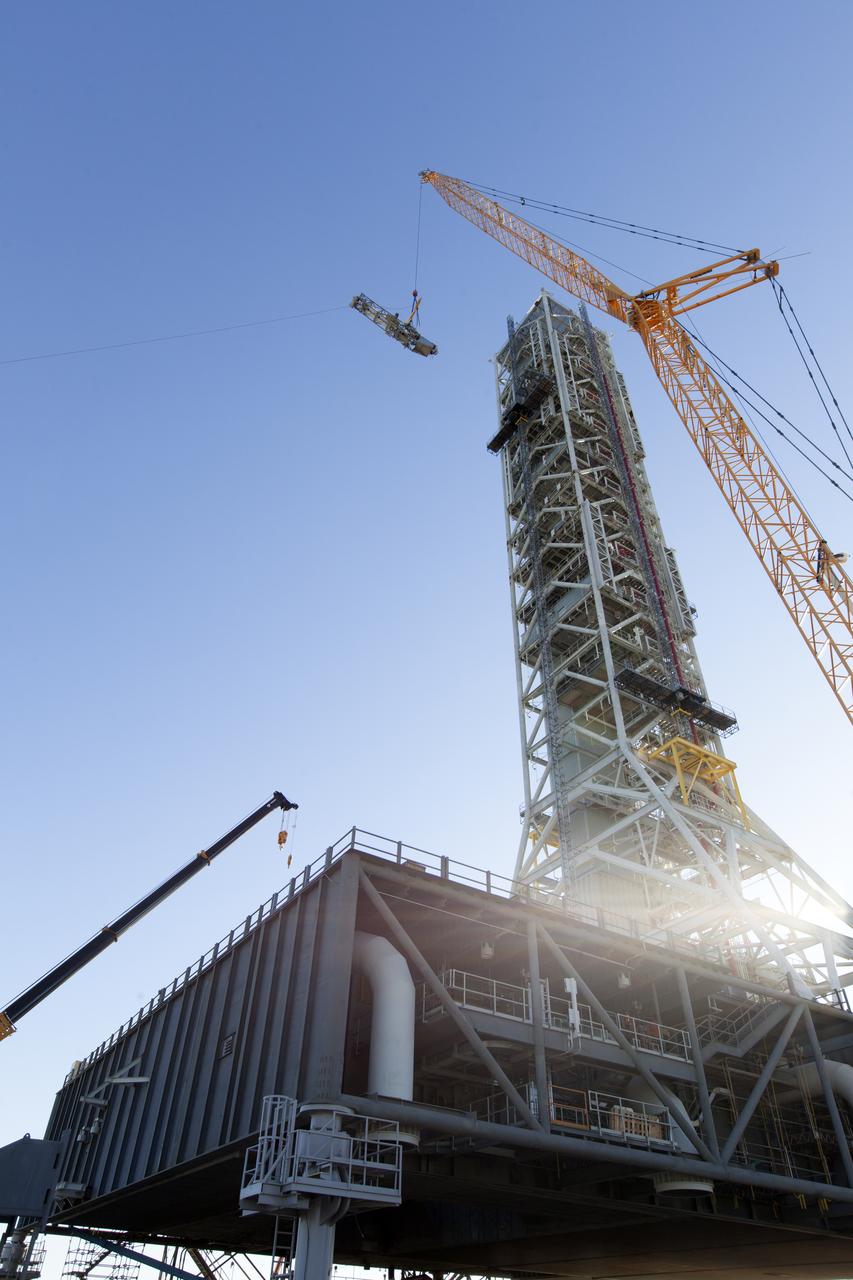
A crane lifts the Orion Service Module Umbilical (OSMU) high up for installation on the mobile launcher tower at NASA's Kennedy Space Center in Florida. The mobile launcher tower will be equipped with a number of lines, called umbilicals, that will connect to the Space Launch System rocket and Orion spacecraft for Exploration Mission-1 (EM-1). The OSMU will be located high on the mobile launcher tower and, prior to launch, will transfer liquid coolant for the electronics and air for the Environmental Control System to the Orion service module that houses these critical systems to support the spacecraft. EM-1 is scheduled to launch in 2018. The Ground Systems Development and Operations Program is overseeing installation of the umbilicals.
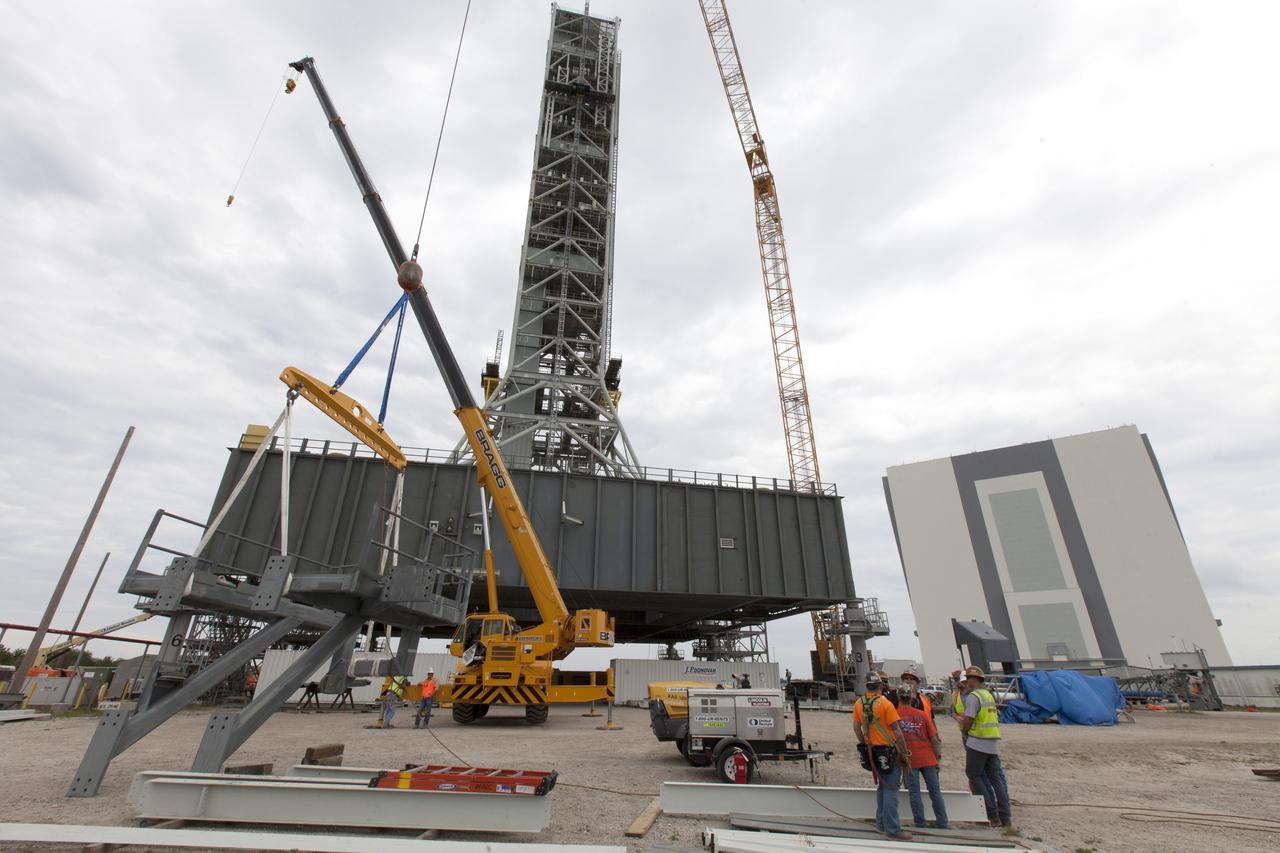
Preparations are underway to lift the bracket for the Orion Service Module Umbilical (OSMU) up for installation on the mobile launcher tower at NASA's Kennedy Space Center in Florida. The mobile launcher tower will be equipped with a number of lines, called umbilicals, that will connect to the Space Launch System rocket and Orion spacecraft for Exploration Mission-1 (EM-1). The OSMU will be located high on the mobile launcher tower and, prior to launch, will transfer liquid coolant for the electronics and air for the Environmental Control System to the Orion service module that houses these critical systems to support the spacecraft. EM-1 is scheduled to launch in 2018. The Ground Systems Development and Operations Program is overseeing installation of the umbilicals.
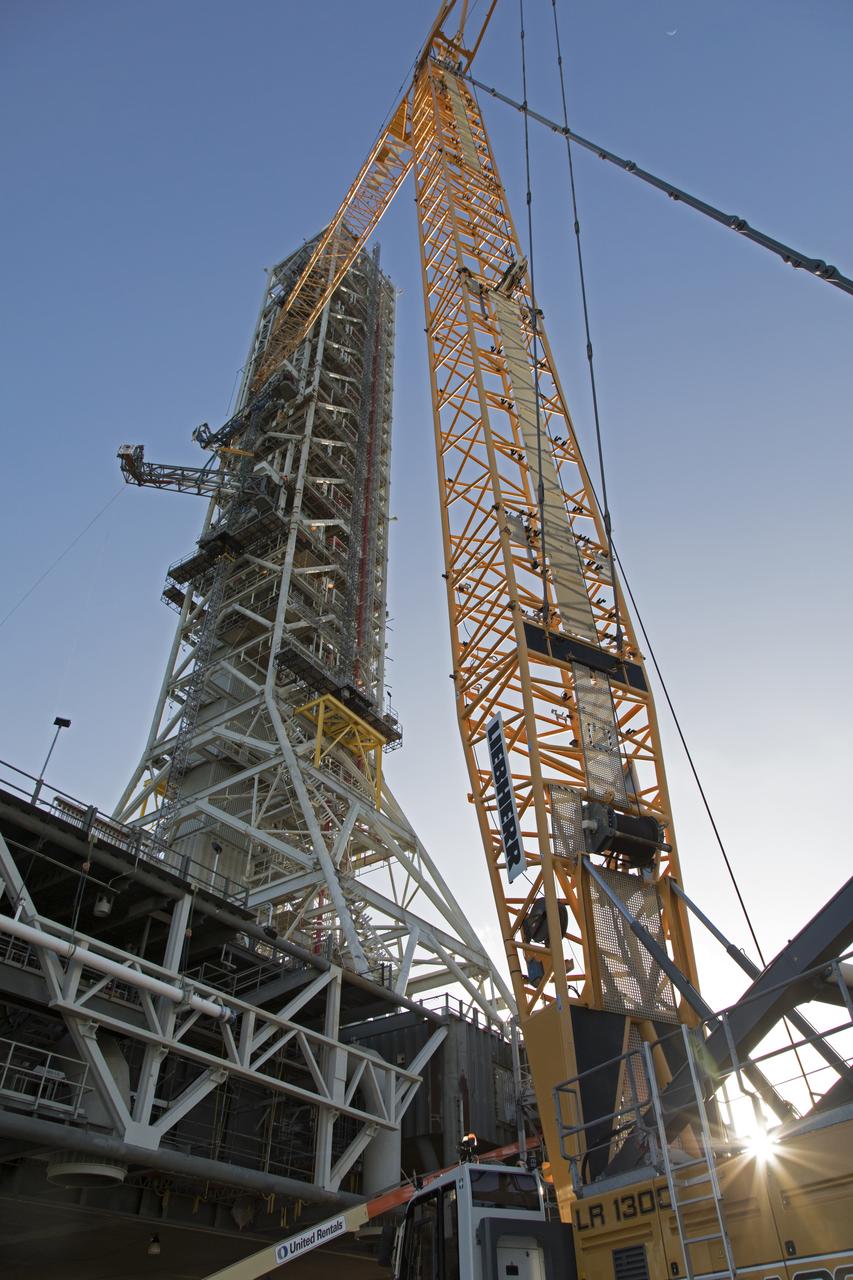
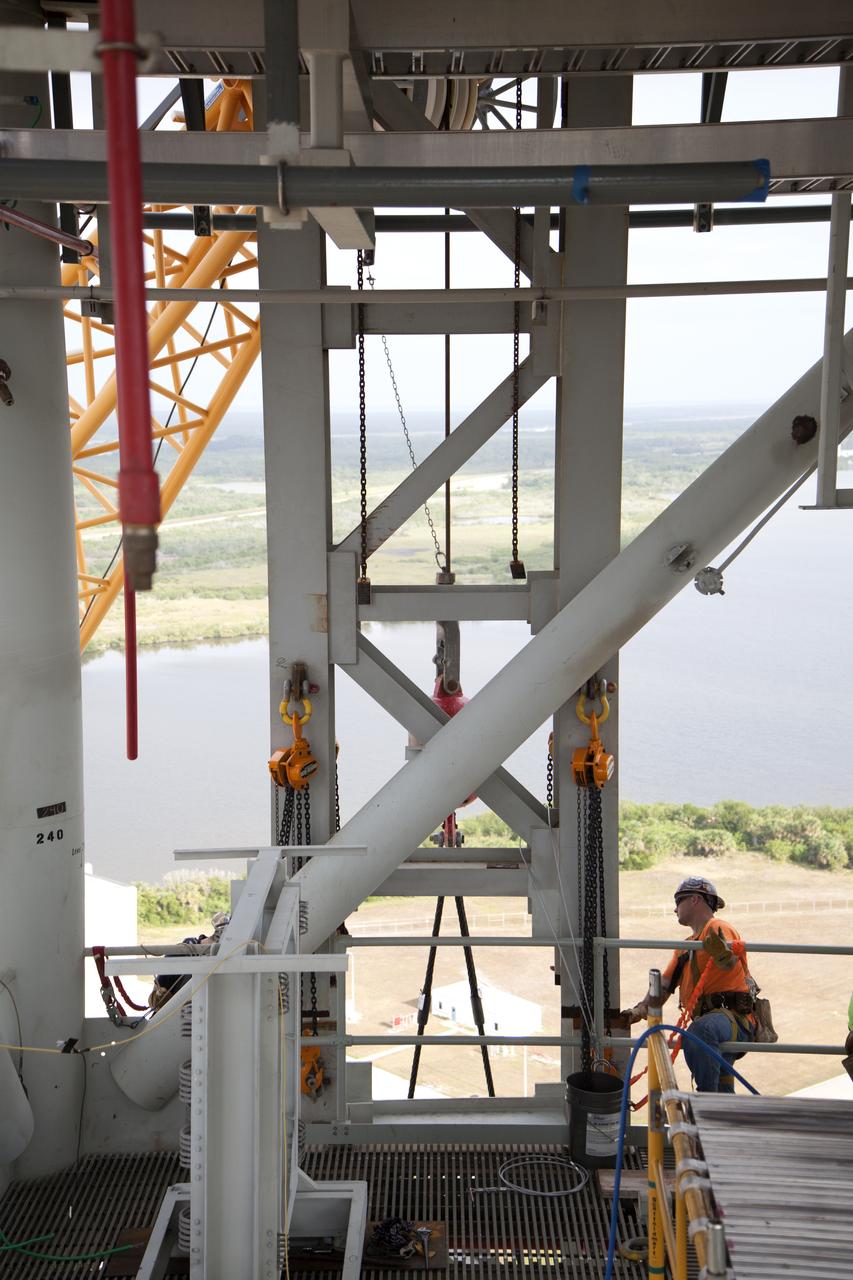
High up on the mobile launcher (ML) tower at NASA's Kennedy Space Center in Florida, construction workers assist as a crane moves the Core Stage Inter-tank Umbilical (CSITU) into place for a fit check of the attachment hardware. The CSITU will be located at about the 140-foot level of the ML tower. The umbilical will be lowered down and installed permanently on the ML at a later date. The CSITU is a swing-arm umbilical that will connect to the Space Launch System core stage inter-tank. It will provide conditioned air, pressurized gases and power and data connection to the core stage. The Ground Systems Development and Operations Program is overseeing installation of the umbilicals.
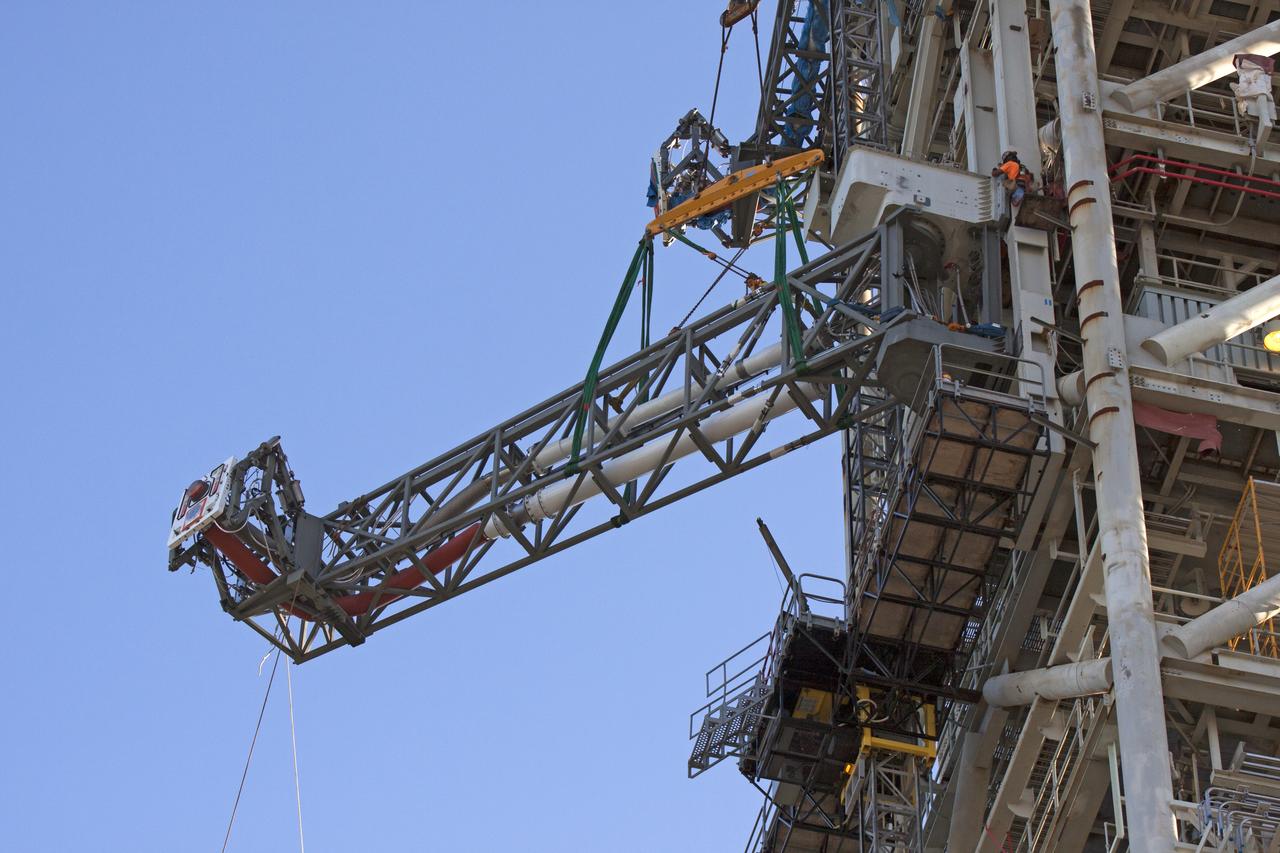
High up on the mobile launcher (ML) tower at NASA's Kennedy Space Center in Florida, construction workers assist as a crane moves the Core Stage Inter-tank Umbilical (CSITU) into place for a fit check of the attachment hardware. The CSITU will be located at about the 140-foot level of the ML tower. The umbilical will be lowered down and installed permanently on the ML at a later date. The CSITU is a swing-arm umbilical that will connect to the Space Launch System core stage inter-tank. It will provide conditioned air, pressurized gases and power and data connection to the core stage. The Ground Systems Development and Operations Program is overseeing installation of the umbilicals.

KENNEDY SPACE CENTER, FLA. -- Aerial view of Launcher Umbilical Towers, Merritt Island Launch Area (MILA).
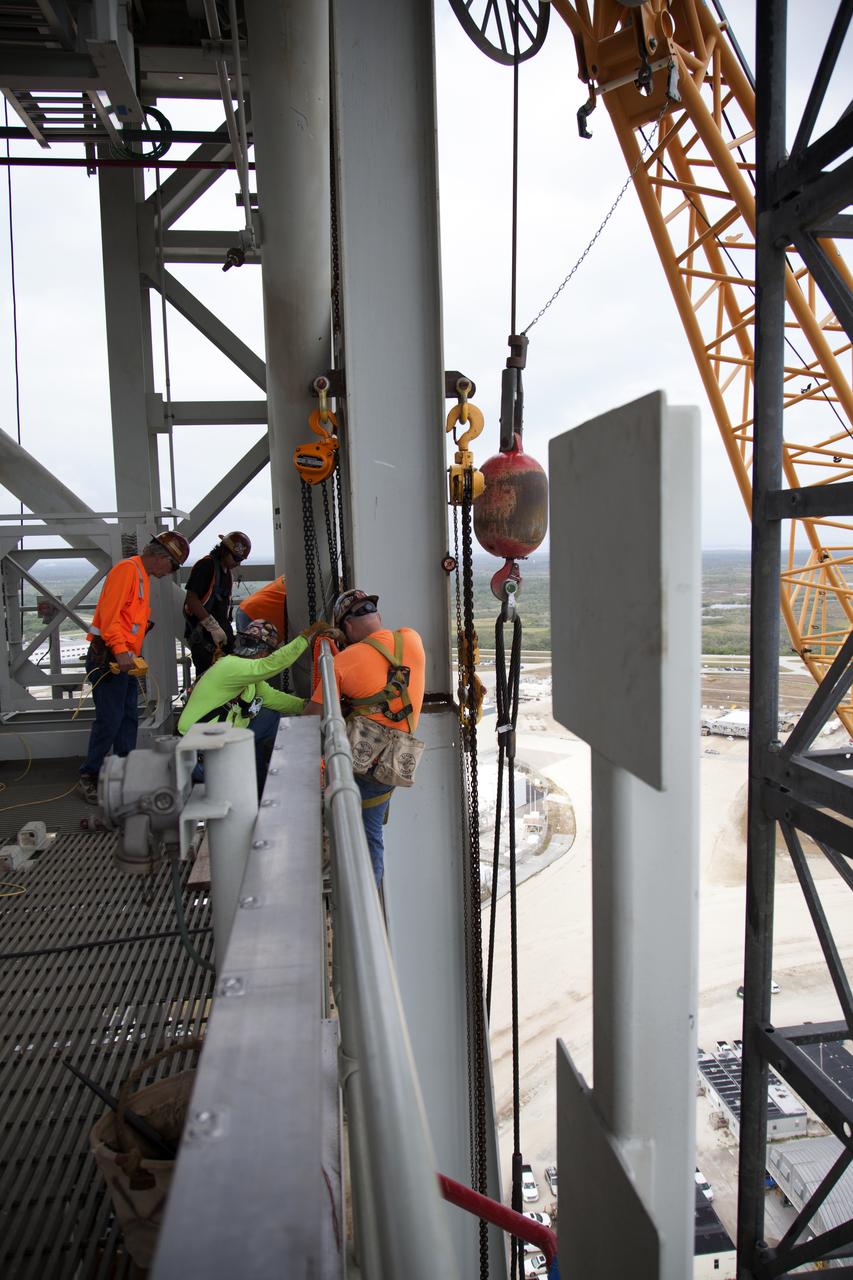
Construction workers assist as a crane lifts the Core Stage Forward Skirt Umbilical into position for installation on the mobile launcher tower at NASA's Kennedy Space Center in Florida. The mobile launcher tower will be equipped with a number of lines, called umbilicals that will connect to the Space Launch System (SLS) rocket and Orion spacecraft for Exploration Mission-1 (EM-1). The CSFSU will be located at about the 180-foot level on the tower, above the liquid oxygen tank. The CSFSU is an umbilical that will swing into position to provide connections to the core stage forward skirt of the SLS rocket, and then swing away before launch. Its main purpose is to provide conditioned air/GN2 to the SLS core stage forward skirt cavity. The Ground Systems Development and Operations Program is overseeing installation of the umbilicals.
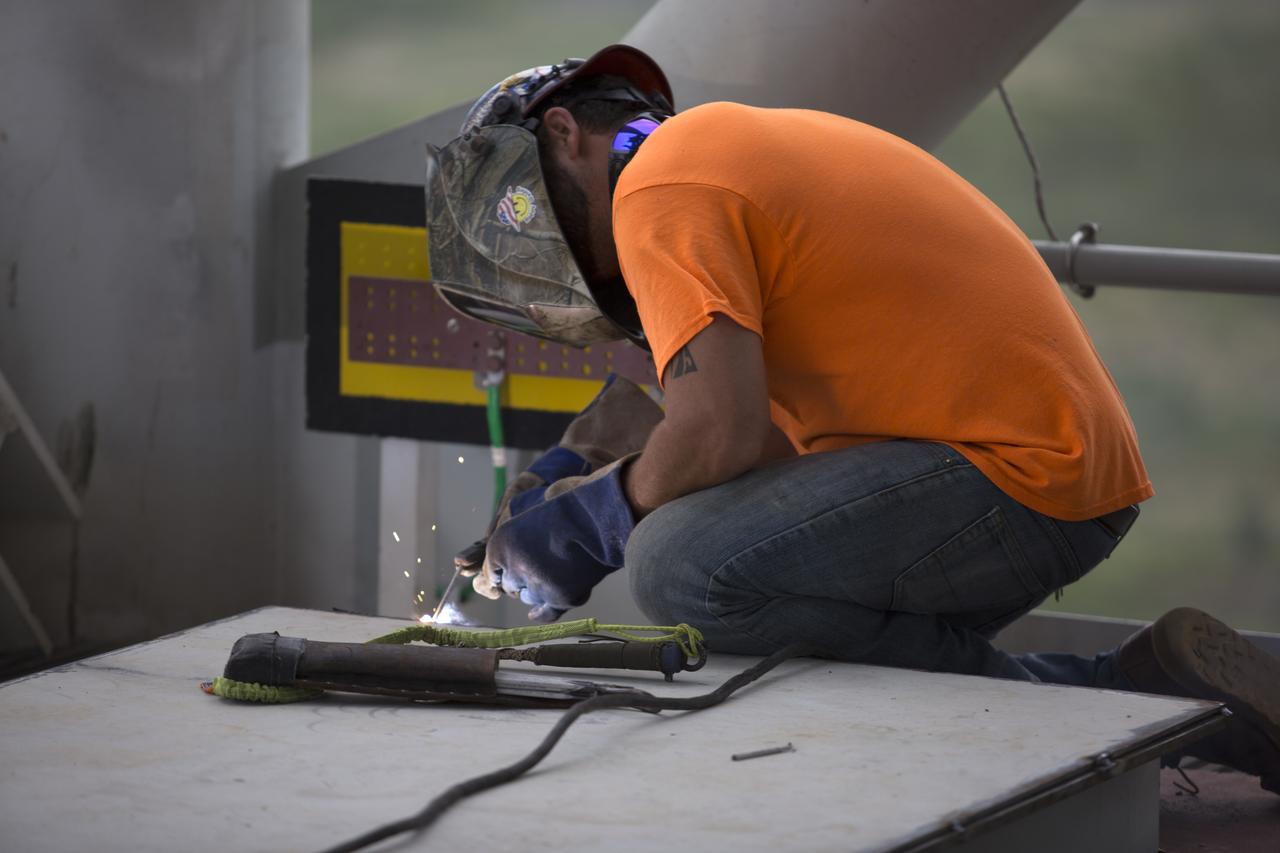
A construction worker welds a metal part during installation of the Core Stage Forward Skirt Umbilical on the mobile launcher tower at NASA's Kennedy Space Center in Florida. The mobile launcher tower will be equipped with a number of lines, called umbilicals that will connect to the Space Launch System (SLS) rocket and Orion spacecraft for Exploration Mission-1 (EM-1). The CSFSU will be located at about the 180-foot level on the tower, above the liquid oxygen tank. The CSFSU is an umbilical that will swing into position to provide connections to the core stage forward skirt of the SLS rocket, and then swing away before launch. Its main purpose is to provide conditioned air/GN2 to the SLS core stage forward skirt cavity. The Ground Systems Development and Operations Program is overseeing installation of the umbilicals.
Construction workers assist as a crane lifts the Core Stage Forward Skirt Umbilical up for installation on the mobile launcher tower at NASA's Kennedy Space Center in Florida. The mobile launcher tower will be equipped with a number of lines, called umbilicals that will connect to the Space Launch System (SLS) rocket and Orion spacecraft for Exploration Mission-1 (EM-1). The CSFSU will be located at about the 180-foot level on the tower, above the liquid oxygen tank. The CSFSU is an umbilical that will swing into position to provide connections to the core stage forward skirt of the SLS rocket, and then swing away before launch. Its main purpose is to provide conditioned air/GN2 to the SLS core stage forward skirt cavity. The Ground Systems Development and Operations Program is overseeing installation of the umbilicals.
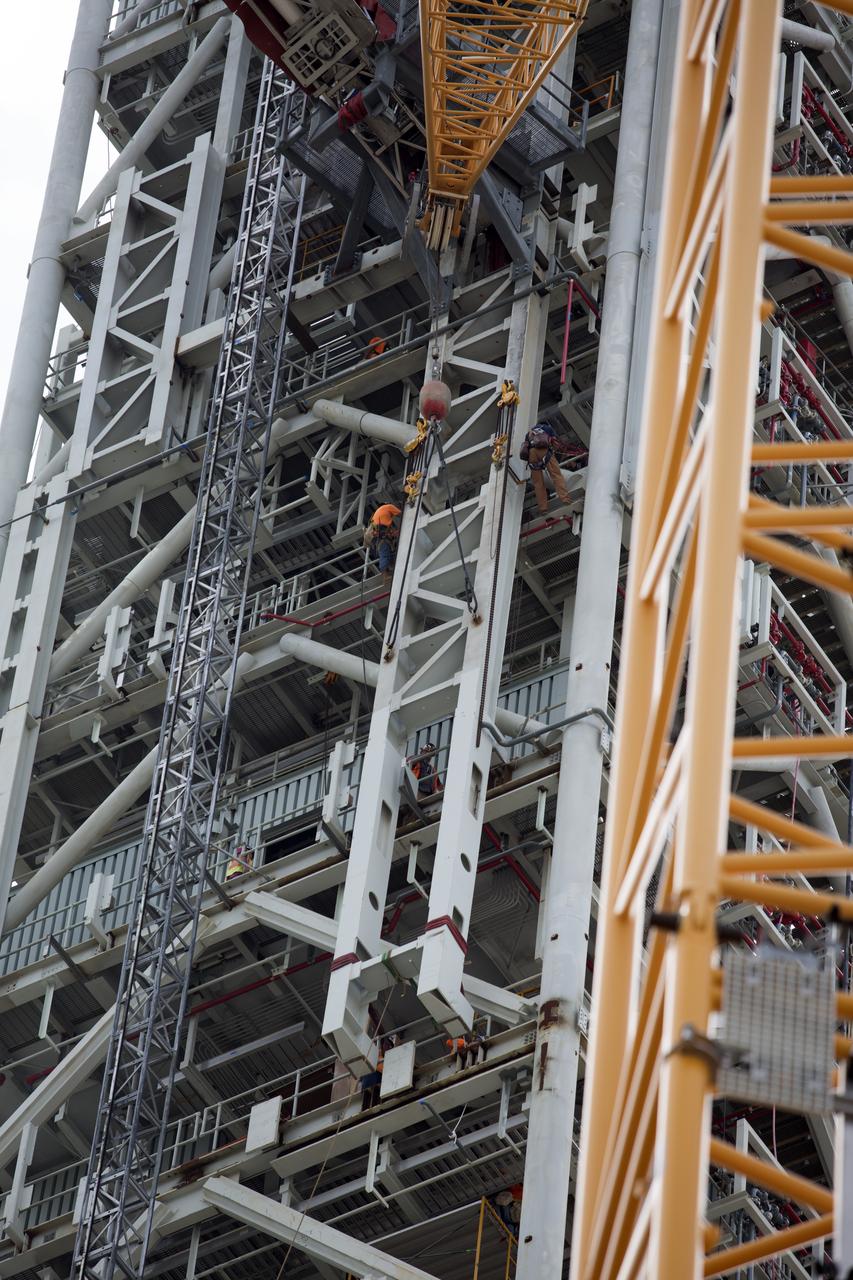
Construction workers assist as a crane lifts the Core Stage Forward Skirt Umbilical into position for installation on the mobile launcher tower at NASA's Kennedy Space Center in Florida. The mobile launcher tower will be equipped with a number of lines, called umbilicals that will connect to the Space Launch System (SLS) rocket and Orion spacecraft for Exploration Mission-1 (EM-1). The CSFSU will be located at about the 180-foot level on the tower, above the liquid oxygen tank. The CSFSU is an umbilical that will swing into position to provide connections to the core stage forward skirt of the SLS rocket, and then swing away before launch. Its main purpose is to provide conditioned air/GN2 to the SLS core stage forward skirt cavity. The Ground Systems Development and Operations Program is overseeing installation of the umbilicals.
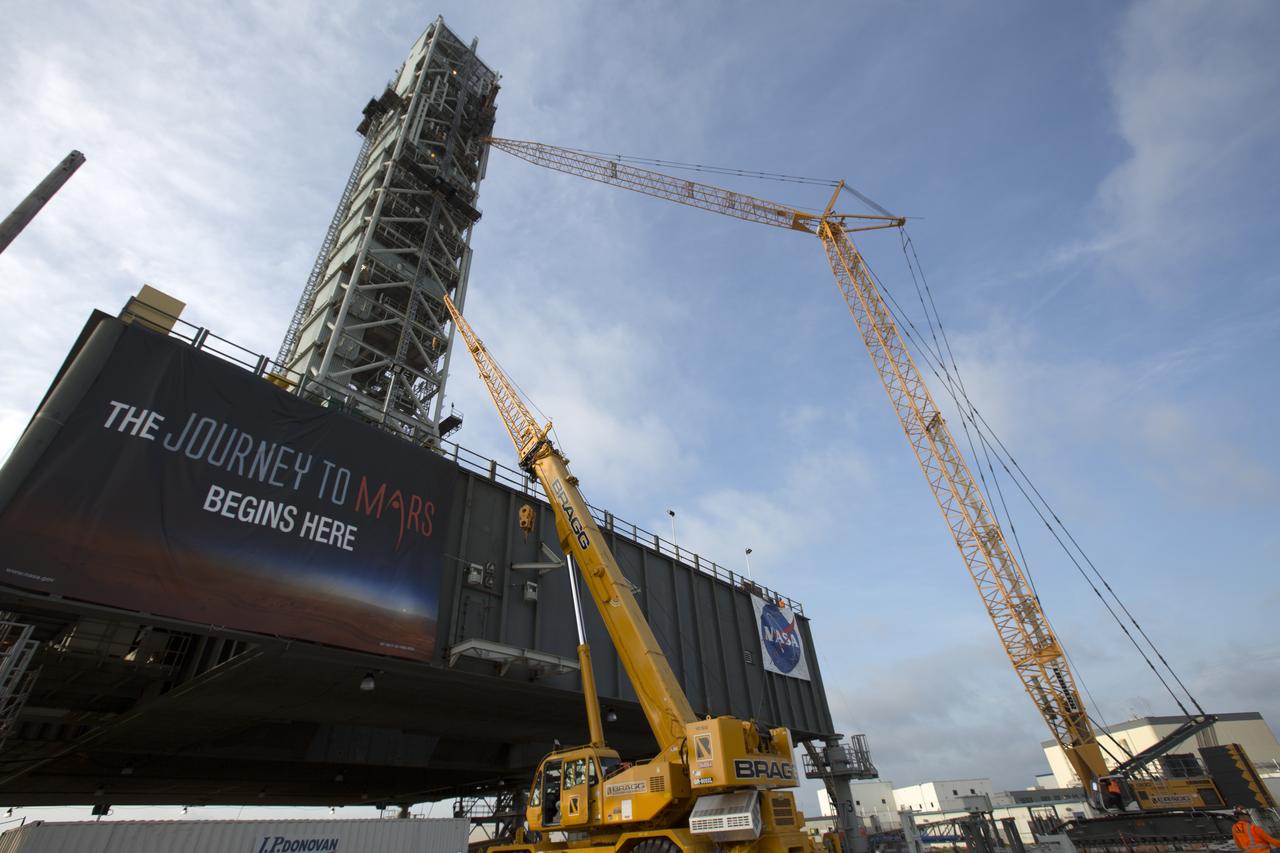
Cranes and rigging are being used to lift up the Core Stage Forward Skirt Umbilical (CSFSU) for installation on the mobile launcher tower at NASA's Kennedy Space Center in Florida. The mobile launcher tower will be equipped with a number of lines, called umbilicals that will connect to the Space Launch System (SLS) rocket and Orion spacecraft for Exploration Mission-1 (EM-1). The CSFSU will be located at about the 180-foot level on the tower, above the liquid oxygen tank. The CSFSU is an umbilical that will swing into position to provide connections to the core stage forward skirt of the SLS rocket, and then swing away before launch. Its main purpose is to provide conditioned air/GN2 to the SLS core stage forward skirt cavity. The Ground Systems Development and Operations Program is overseeing installation of the umbilicals.
Cranes and rigging are being used to lift up the Core Stage Forward Skirt Umbilical (CSFSU) for installation on the mobile launcher tower at NASA's Kennedy Space Center in Florida. The mobile launcher tower will be equipped with a number of lines, called umbilicals that will connect to the Space Launch System (SLS) rocket and Orion spacecraft for Exploration Mission-1 (EM-1). The CSFSU will be located at about the 180-foot level on the tower, above the liquid oxygen tank. The CSFSU is an umbilical that will swing into position to provide connections to the core stage forward skirt of the SLS rocket, and then swing away before launch. Its main purpose is to provide conditioned air/GN2 to the SLS core stage forward skirt cavity. The Ground Systems Development and Operations Program is overseeing installation of the umbilicals.
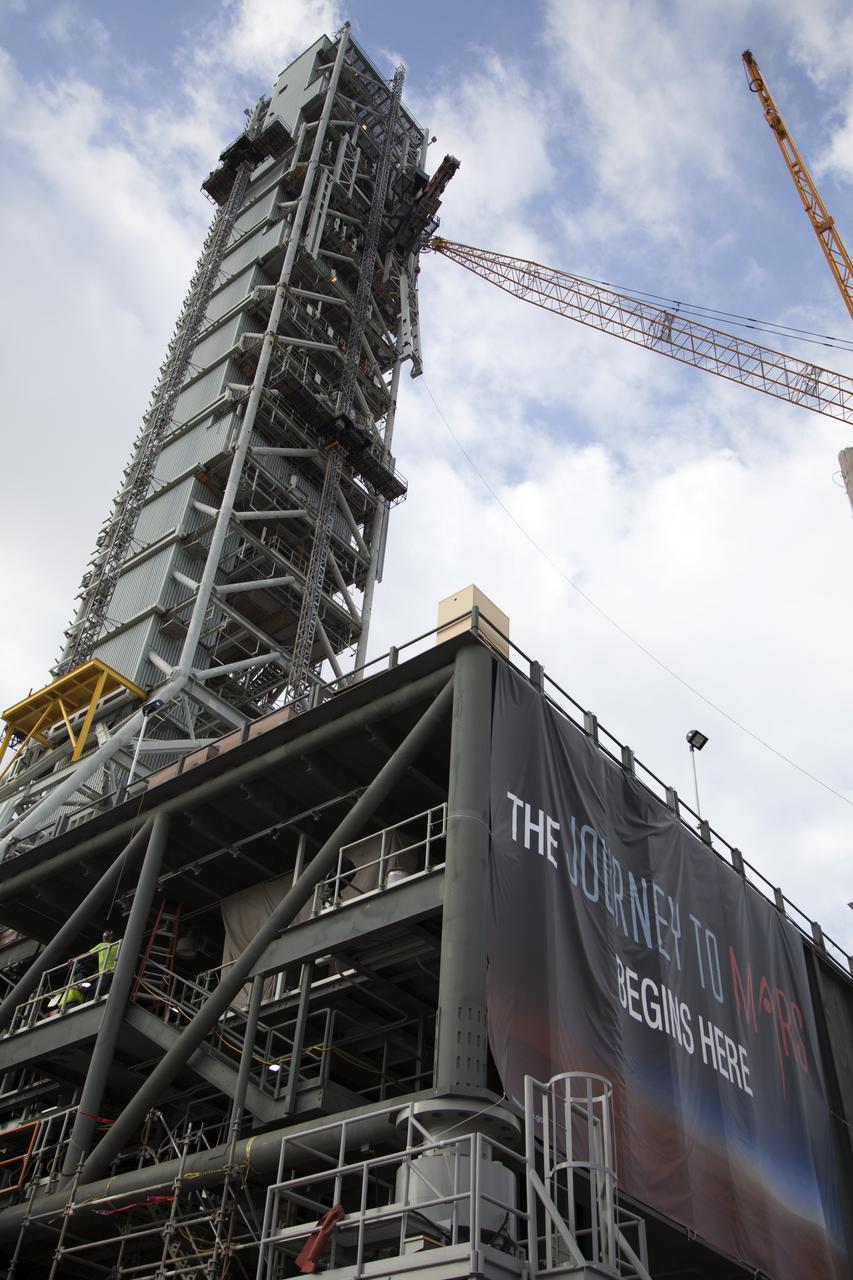
Cranes and rigging are being used to lift up the Core Stage Forward Skirt Umbilical (CSFSU) for installation on the mobile launcher tower at NASA's Kennedy Space Center in Florida. The mobile launcher tower will be equipped with a number of lines, called umbilicals that will connect to the Space Launch System (SLS) rocket and Orion spacecraft for Exploration Mission-1 (EM-1). The CSFSU will be located at about the 180-foot level on the tower, above the liquid oxygen tank. The CSFSU is an umbilical that will swing into position to provide connections to the core stage forward skirt of the SLS rocket, and then swing away before launch. Its main purpose is to provide conditioned air/GN2 to the SLS core stage forward skirt cavity. The Ground Systems Development and Operations Program is overseeing installation of the umbilicals.
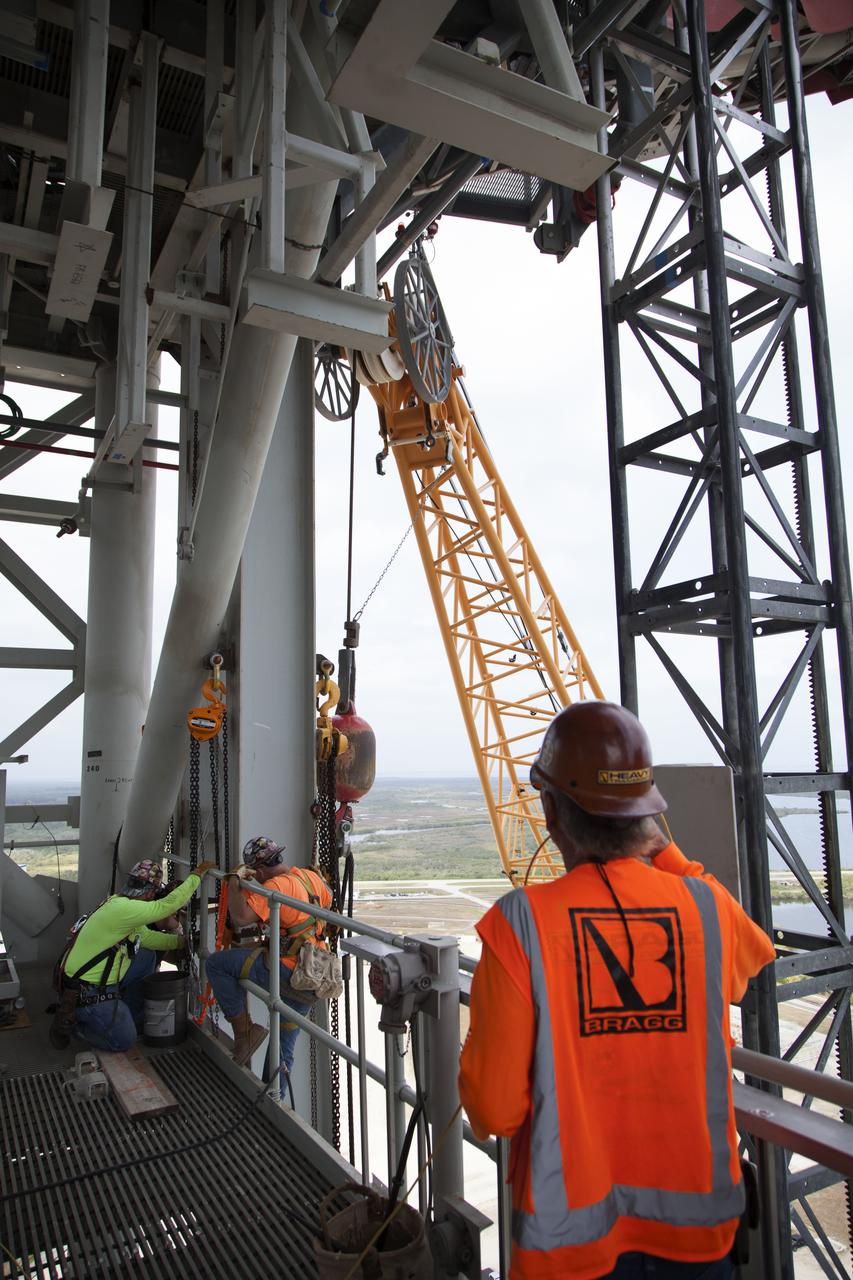
Construction workers assist as a crane lifts the Core Stage Forward Skirt Umbilical up for installation on the mobile launcher tower at NASA's Kennedy Space Center in Florida. The mobile launcher tower will be equipped with a number of lines, called umbilicals that will connect to the Space Launch System (SLS) rocket and Orion spacecraft for Exploration Mission-1 (EM-1). The CSFSU will be located at about the 180-foot level on the tower, above the liquid oxygen tank. The CSFSU is an umbilical that will swing into position to provide connections to the core stage forward skirt of the SLS rocket, and then swing away before launch. Its main purpose is to provide conditioned air/GN2 to the SLS core stage forward skirt cavity. The Ground Systems Development and Operations Program is overseeing installation of the umbilicals.
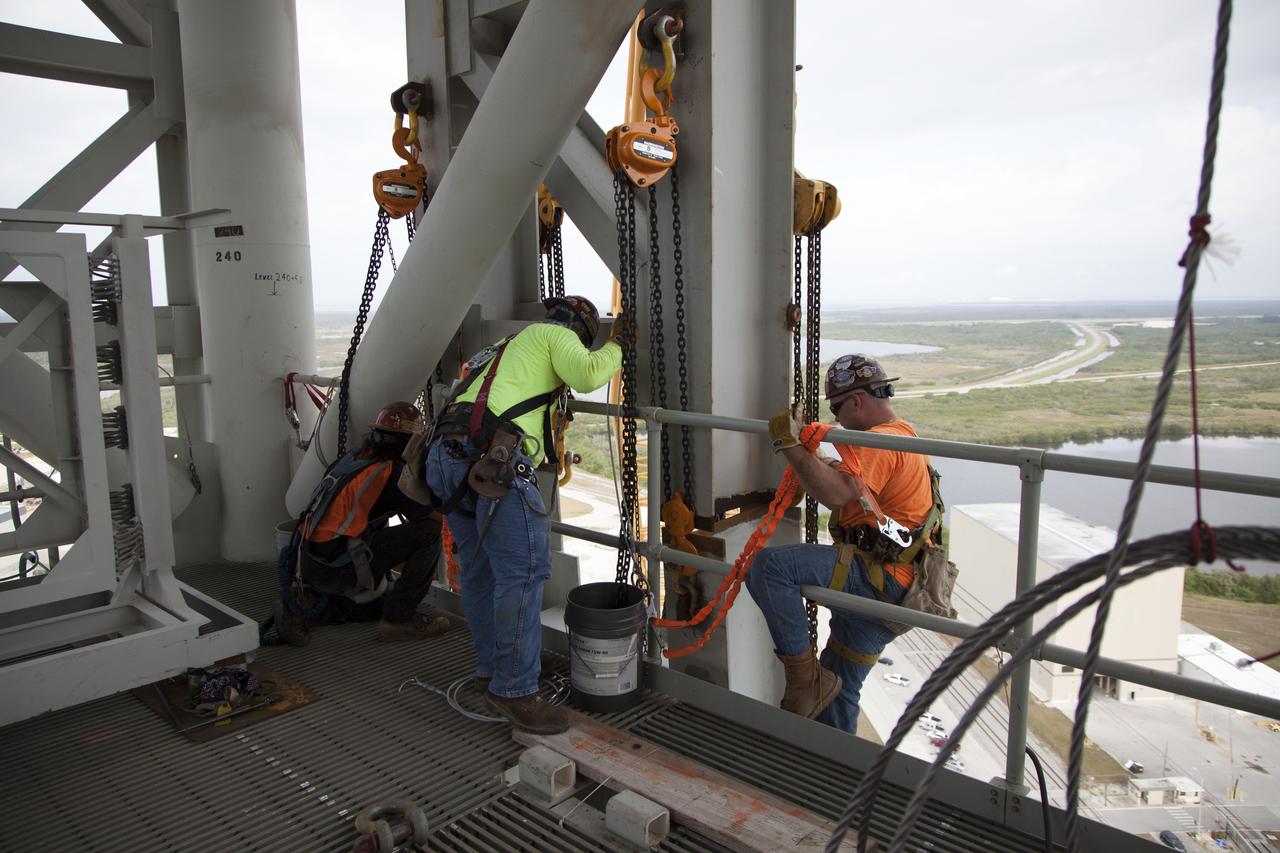
Construction workers assist as a crane lifts the Core Stage Forward Skirt Umbilical up for installation on the mobile launcher tower at NASA's Kennedy Space Center in Florida. The mobile launcher tower will be equipped with a number of lines, called umbilicals that will connect to the Space Launch System (SLS) rocket and Orion spacecraft for Exploration Mission-1 (EM-1). The CSFSU will be located at about the 180-foot level on the tower, above the liquid oxygen tank. The CSFSU is an umbilical that will swing into position to provide connections to the core stage forward skirt of the SLS rocket, and then swing away before launch. Its main purpose is to provide conditioned air/GN2 to the SLS core stage forward skirt cavity. The Ground Systems Development and Operations Program is overseeing installation of the umbilicals.
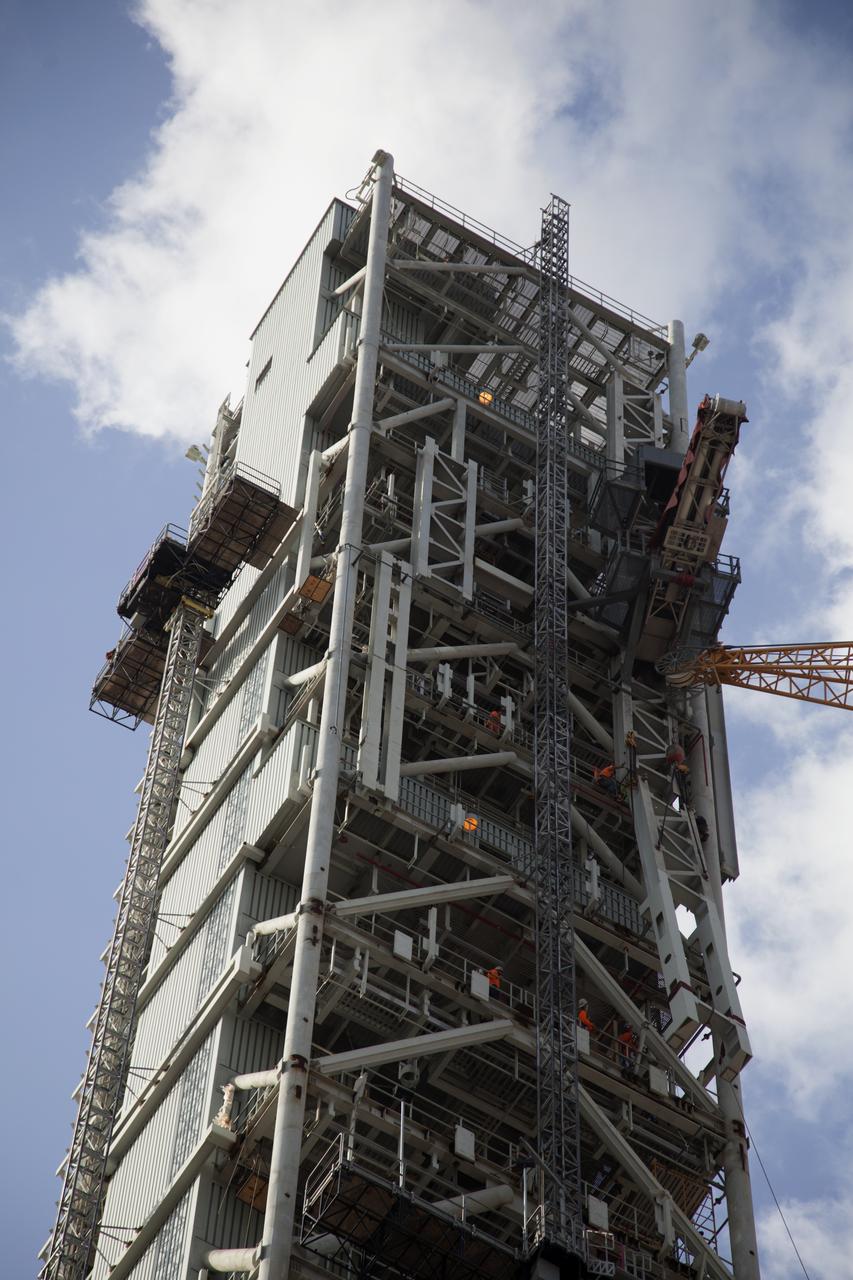
Cranes and rigging are being used to lift up the Core Stage Forward Skirt Umbilical (CSFSU) for installation on the mobile launcher tower at NASA's Kennedy Space Center in Florida. The mobile launcher tower will be equipped with a number of lines, called umbilicals that will connect to the Space Launch System (SLS) rocket and Orion spacecraft for Exploration Mission-1 (EM-1). The CSFSU will be located at about the 180-foot level on the tower, above the liquid oxygen tank. The CSFSU is an umbilical that will swing into position to provide connections to the core stage forward skirt of the SLS rocket, and then swing away before launch. Its main purpose is to provide conditioned air/GN2 to the SLS core stage forward skirt cavity. The Ground Systems Development and Operations Program is overseeing installation of the umbilicals.
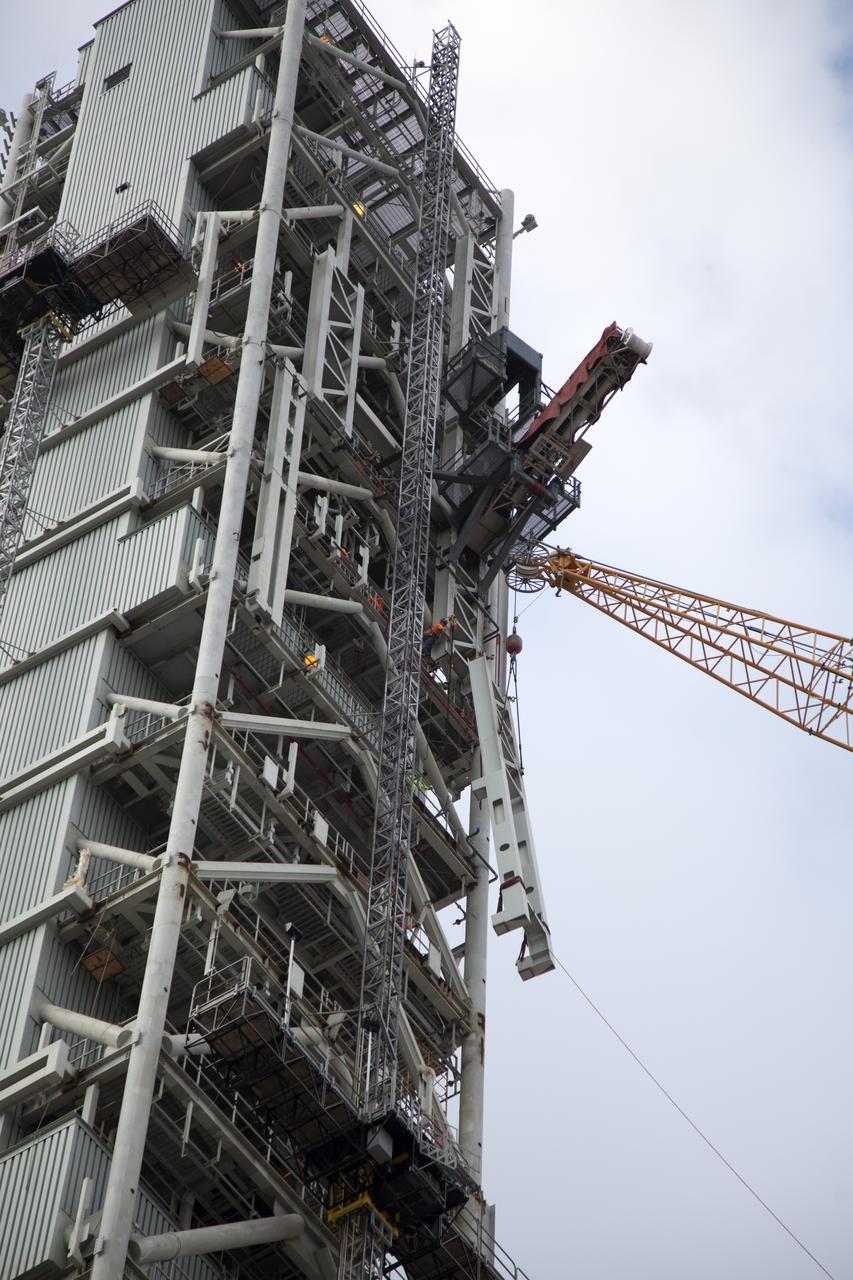
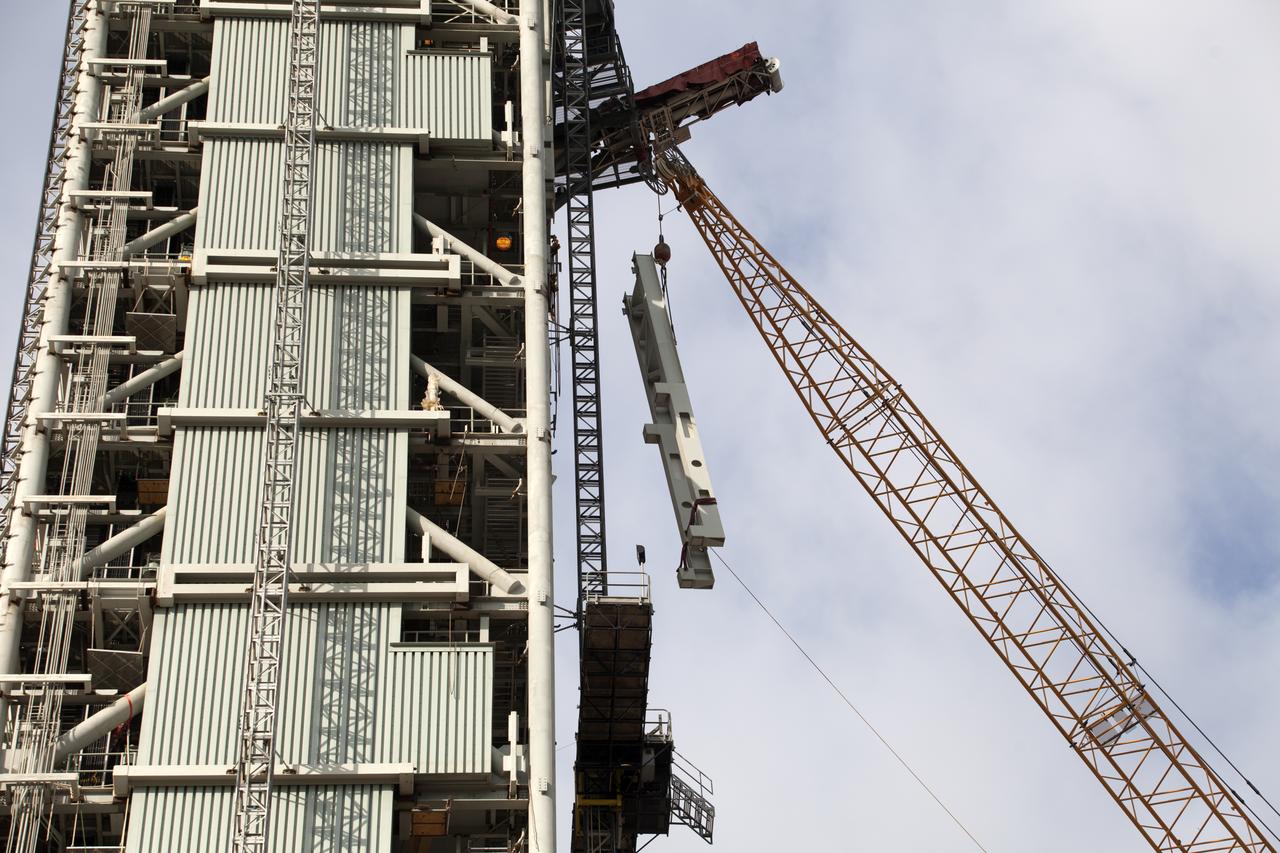
Seeming to hang in midair, the Core Stage Forward Skirt Umbilical (CSFSU) is lifted high up by crane for installation on the mobile launcher tower at NASA's Kennedy Space Center in Florida. The mobile launcher tower will be equipped with a number of lines, called umbilicals that will connect to the Space Launch System rocket and Orion spacecraft for Exploration Mission-1 (EM-1). The CSFSU will be located at about the 180-foot level on the tower, above the liquid oxygen tank. The CSFSU is an umbilical that will swing into position to provide connections to the core stage forward skirt of the SLS rocket, and then swing away before launch. Its main purpose is to provide conditioned air/GN2 to the SLS core stage forward skirt cavity. The Ground Systems Development and Operations Program is overseeing installation of the umbilicals.
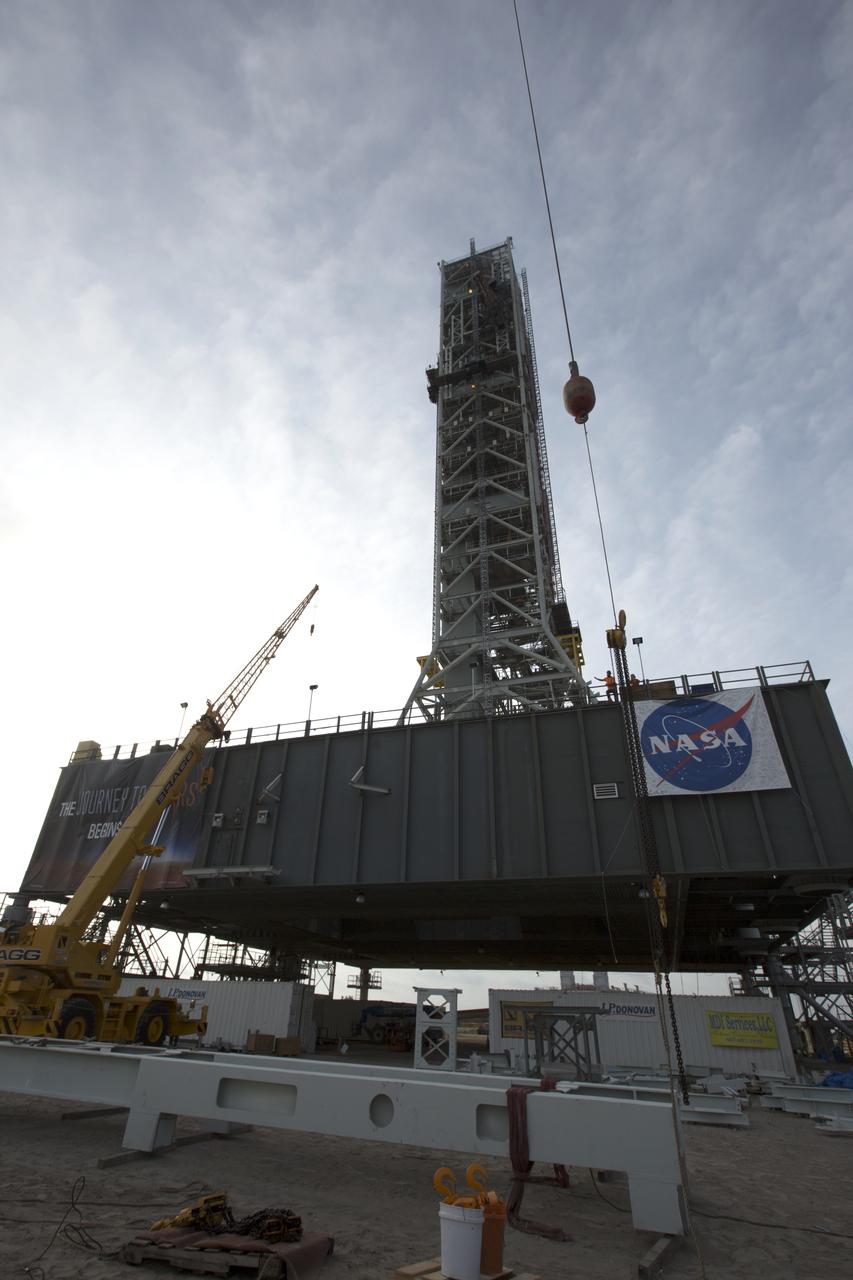
A crane has been attached to the Core Stage Forward Skirt Umbilical (CSFSU) to lift it up for installation on the mobile launcher tower at NASA's Kennedy Space Center in Florida. The mobile launcher tower will be equipped with a number of lines, called umbilicals that will connect to the Space Launch System (SLS) rocket and Orion spacecraft for Exploration Mission-1 (EM-1). The CSFSU will be located at about the 180-foot level on the tower, above the liquid oxygen tank. The CSFSU is an umbilical that will swing into position to provide connections to the core stage forward skirt of the SLS rocket, and then swing away before launch. Its main purpose is to provide conditioned air/GN2 to the SLS core stage forward skirt cavity. The Ground Systems Development and Operations Program is overseeing installation of the umbilicals.
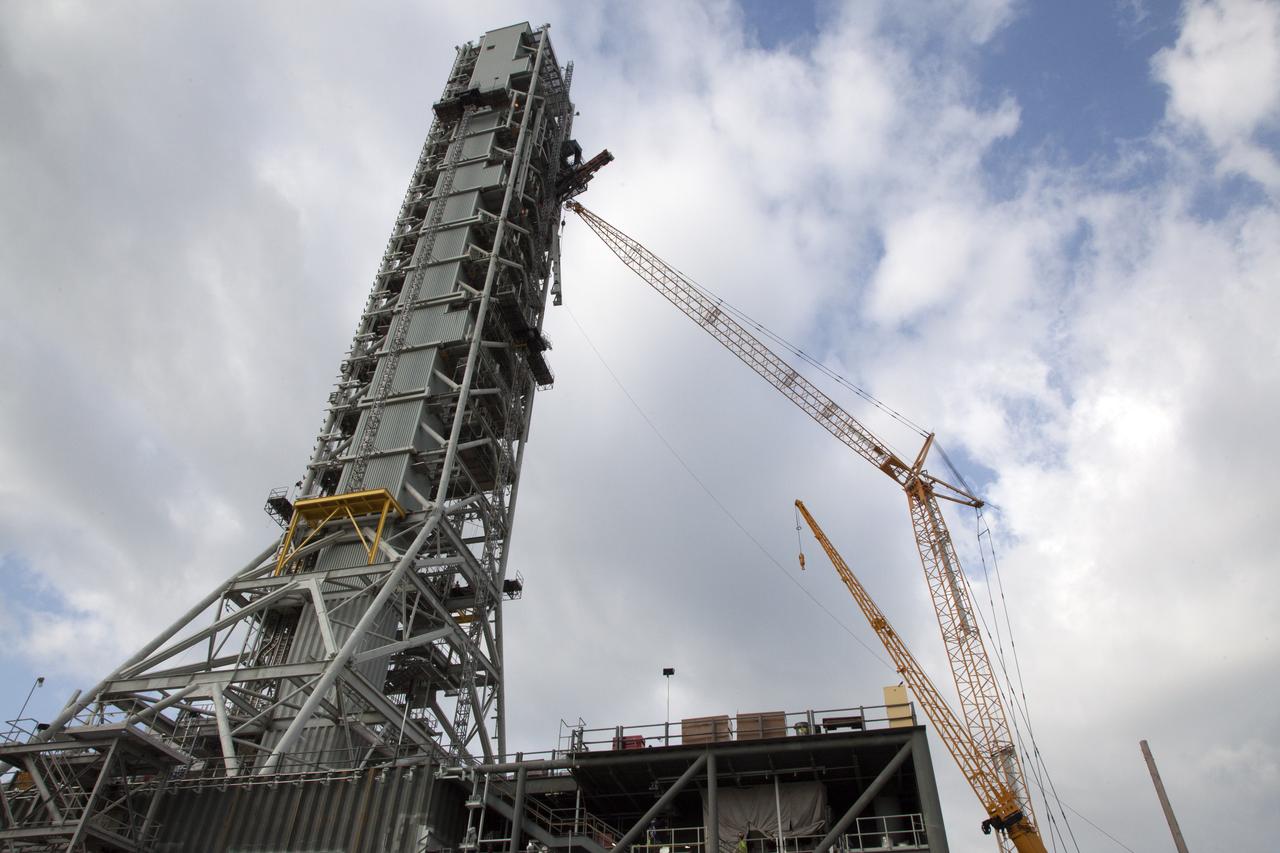
Cranes and rigging are being used to lift up the Core Stage Forward Skirt Umbilical (CSFSU) for installation on the mobile launcher tower at NASA's Kennedy Space Center in Florida. The mobile launcher tower will be equipped with a number of lines, called umbilicals that will connect to the Space Launch System (SLS) rocket and Orion spacecraft for Exploration Mission-1 (EM-1). The CSFSU will be located at about the 180-foot level on the tower, above the liquid oxygen tank. The CSFSU is an umbilical that will swing into position to provide connections to the core stage forward skirt of the SLS rocket, and then swing away before launch. Its main purpose is to provide conditioned air/GN2 to the SLS core stage forward skirt cavity. The Ground Systems Development and Operations Program is overseeing installation of the umbilicals.
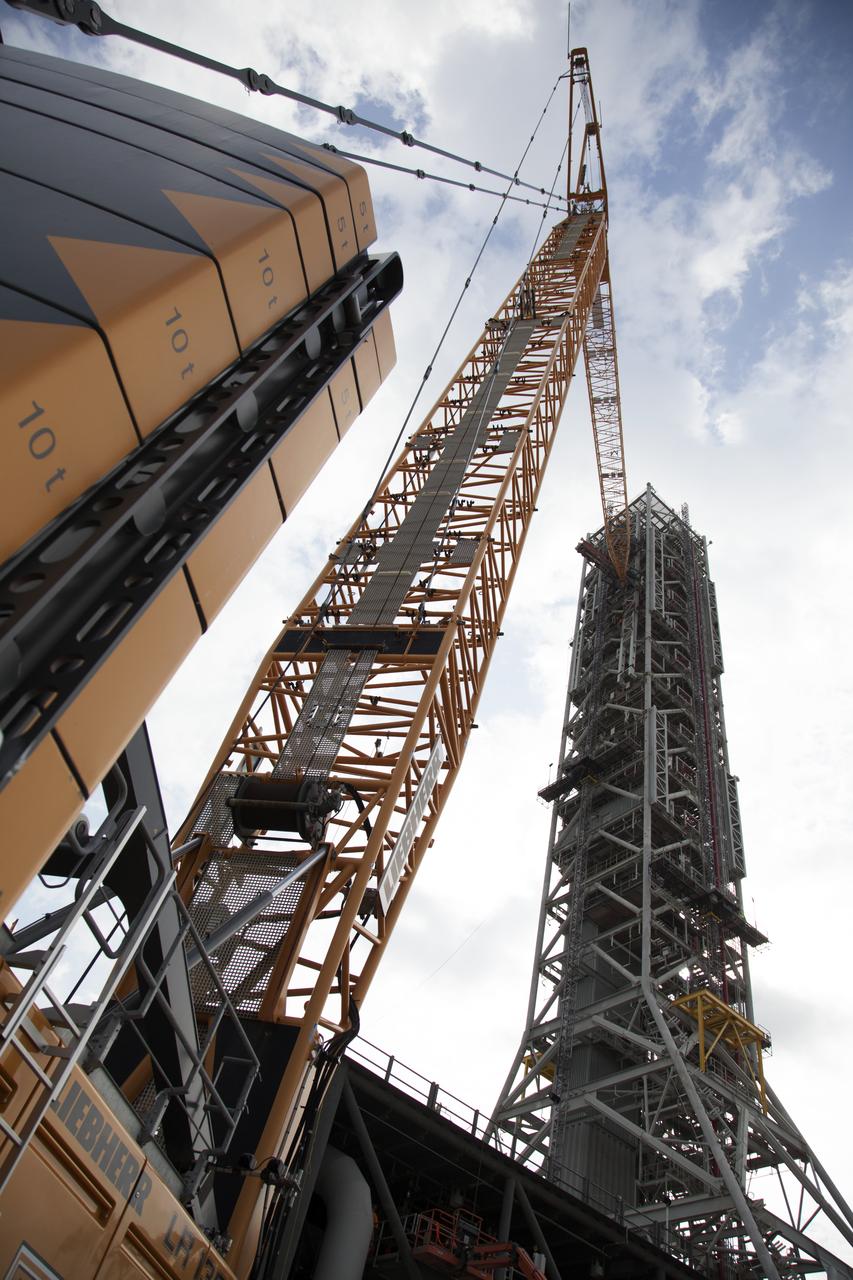
Cranes and rigging are being used to lift the Core Stage Forward Skirt Umbilical (CSFSU) into position for installation on the mobile launcher tower at NASA's Kennedy Space Center in Florida. The mobile launcher tower will be equipped with a number of lines, called umbilicals that will connect to the Space Launch System (SLS) rocket and Orion spacecraft for Exploration Mission-1 (EM-1). The CSFSU will be located at about the 180-foot level on the tower, above the liquid oxygen tank. The CSFSU is an umbilical that will swing into position to provide connections to the core stage forward skirt of the SLS rocket, and then swing away before launch. Its main purpose is to provide conditioned air/GN2 to the SLS core stage forward skirt cavity. The Ground Systems Development and Operations Program is overseeing installation of the umbilicals.
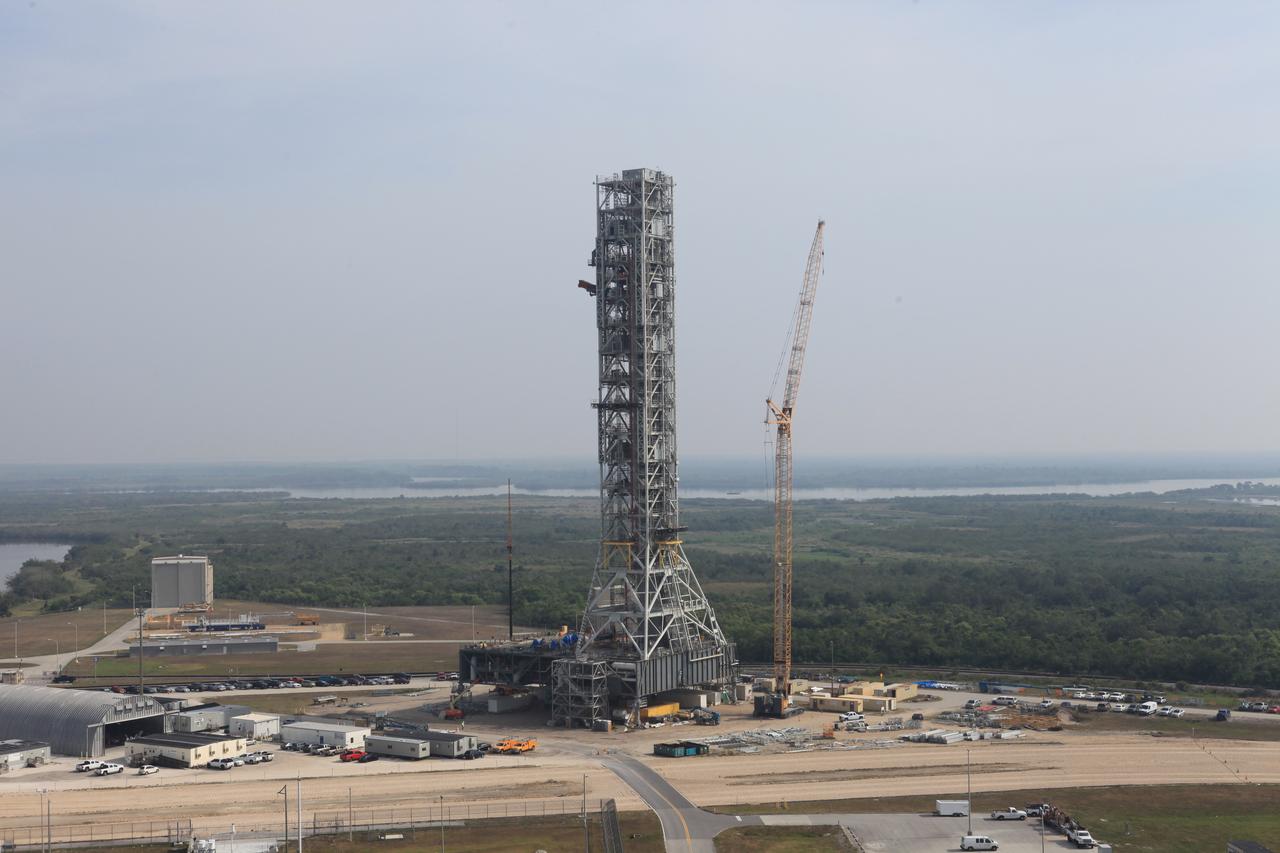
A view of the mobile launcher (ML) taken from the "eyebrow" of the nearby Vehicle Assembly Building at NASA's Kennedy Space Center in Florida. The ML tower will be equipped with a number of lines, called umbilicals that will connect to the Space Launch System rocket and Orion spacecraft for Exploration Mission-1 (EM-1). The Orion Service Module Umbilical and Core State Forward Skirt Umbilical were recently installed on the ML. The Ground Systems Development and Operations Program is overseeing installation of the umbilicals.
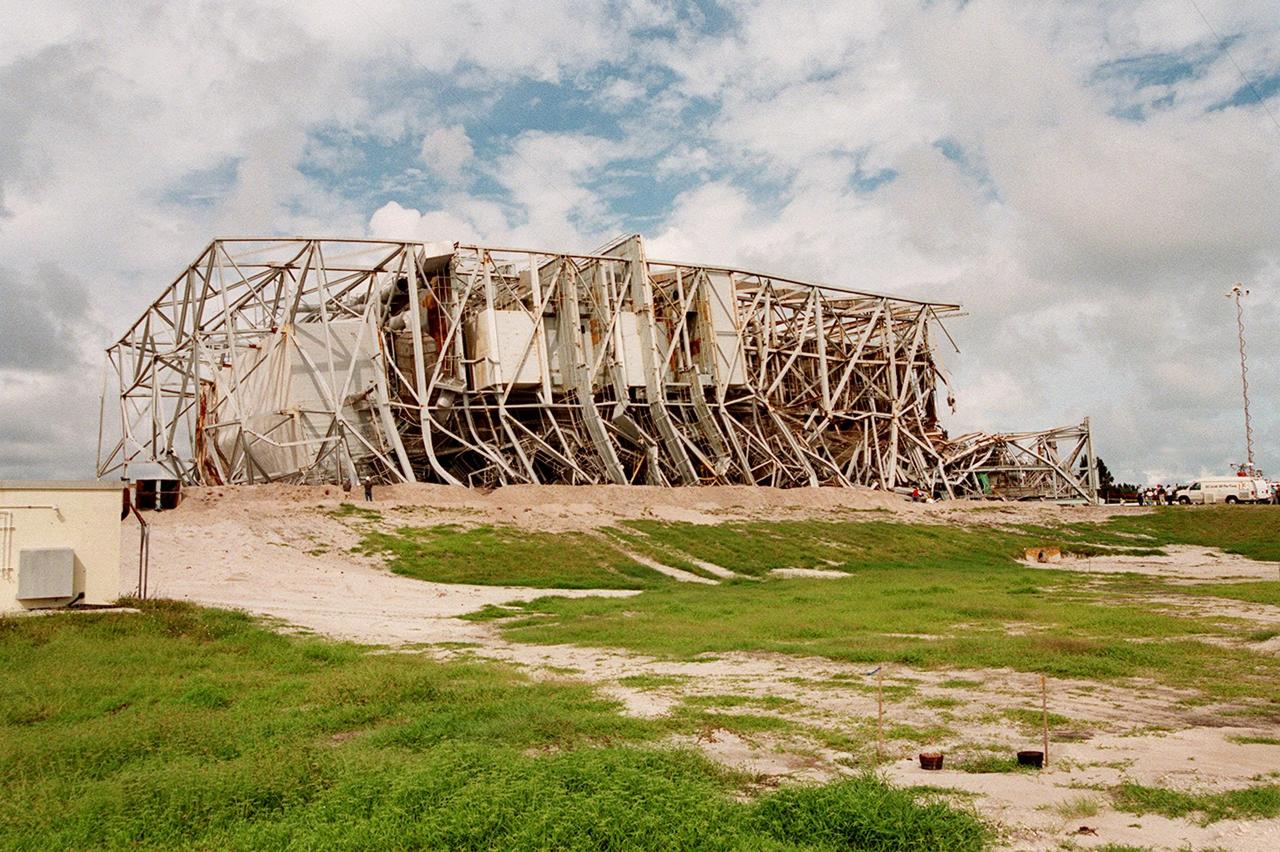
KENNEDY SPACE CENTER, FLA. -- Live TV trucks (far right) from local channels merge at the site of the fallen Mobile Service Tower (MST) and umbilical tower nearby after their demolition. The towers were demolished to make room for Lockheed Martin's 14-acre Vehicle Integration Facility (VIF), under construction. Weighing two million pounds, the umbilical tower was approximately 200 feet high. The taller 300-foot MST weighed five million pounds. About 200 pounds of linear-shaped charges were used to bring down the towers so that the materials can be recycled. The implosion and removal of the tower debris is expected to be completed in two months. The VIF will be used for Lockheed Martin's Atlas V Launch System.
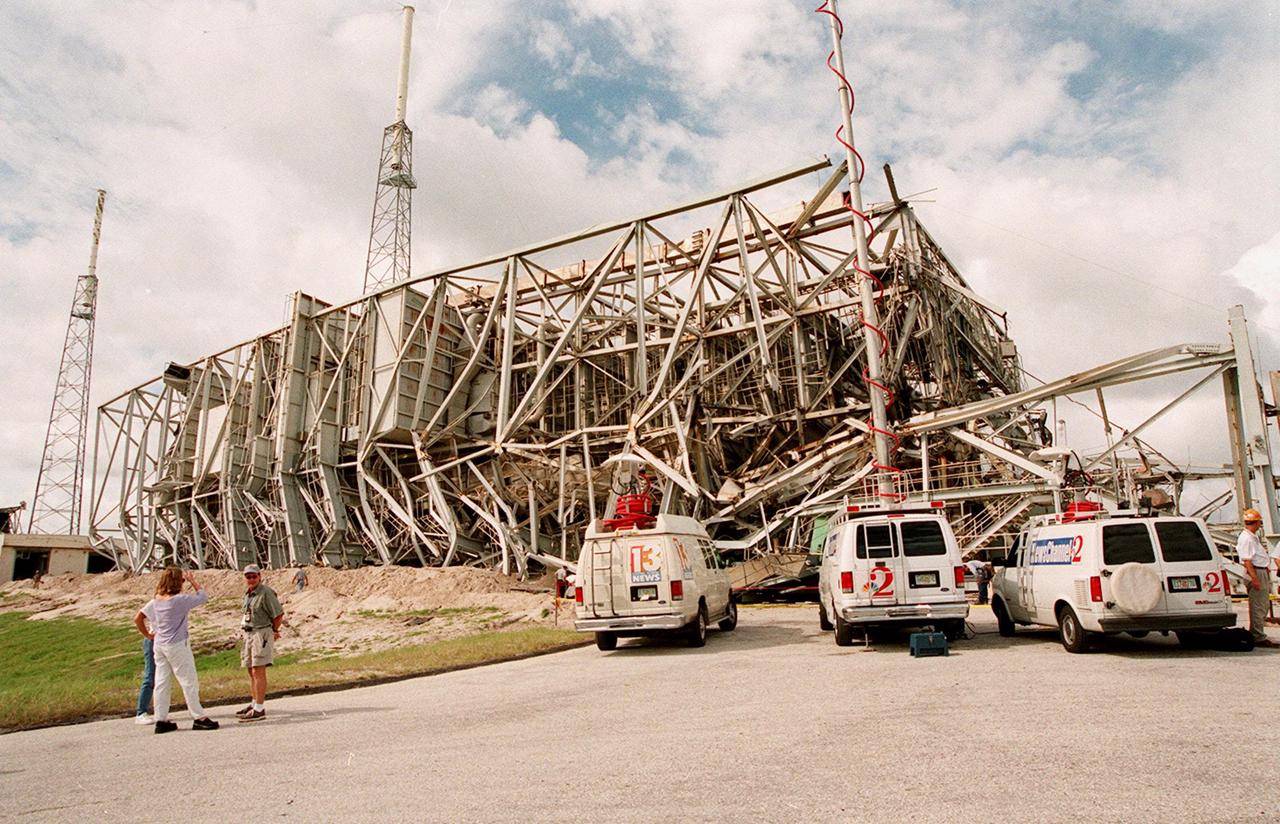
KENNEDY SPACE CENTER, FLA. -- Live TV trucks from local channels merge at the site of the fallen Mobile Service Tower (MST) and umbilical tower nearby after their demolition. The towers were demolished to make room for Lockheed Martin's 14-acre Vehicle Integration Facility (VIF), under construction. Weighing two million pounds, the umbilical tower was approximately 200 feet high. The taller 300-foot MST weighed five million pounds. About 200 pounds of linear-shaped charges were used to bring down the towers so that the materials can be recycled. The implosion and removal of the tower debris is expected to be completed in two months. The VIF will be used for Lockheed Martin's Atlas V Launch System.
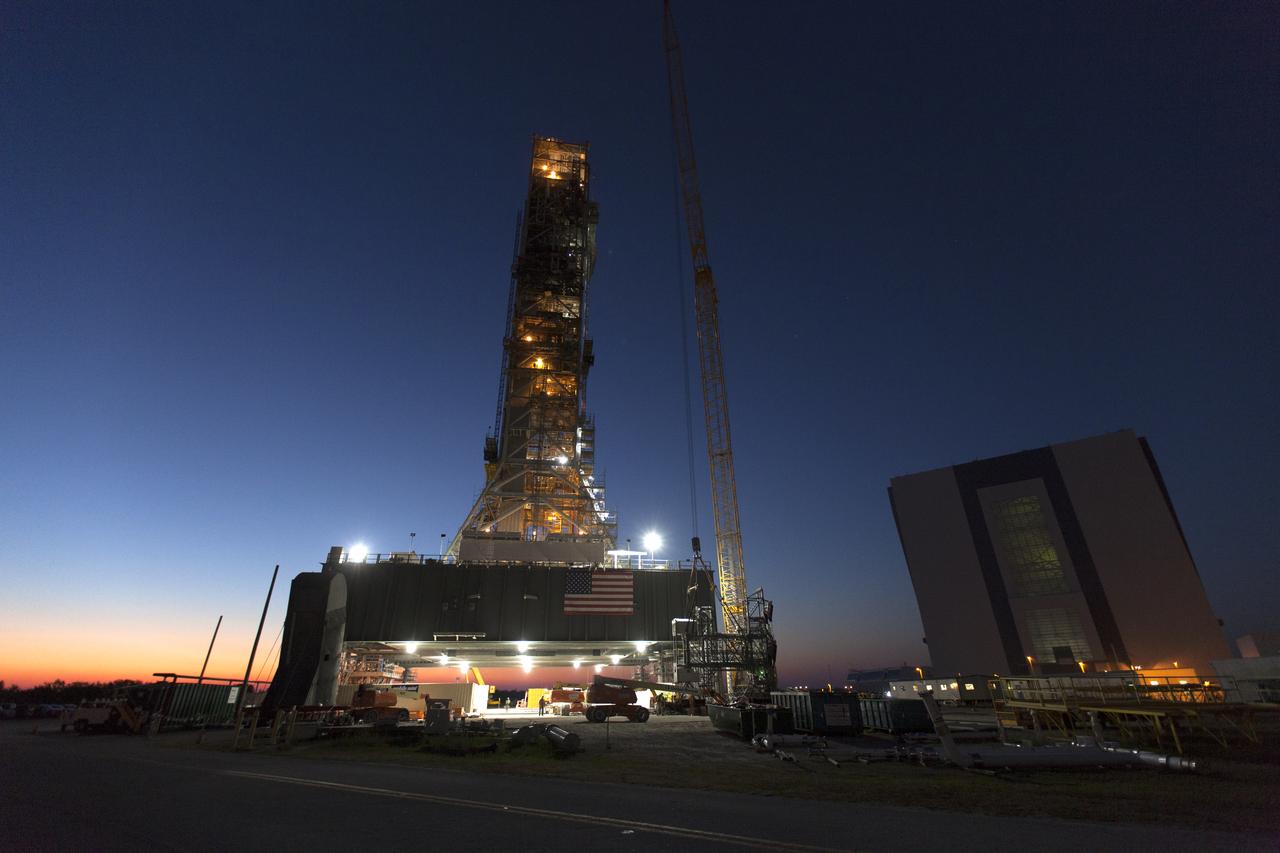
The mobile launcher (ML) tower is lit up before early morning sunrise at NASA's Kennedy Space Center in Florida. Preparations are underway to lift and install the Interim Cryogenic Propulsion Stage Umbilical (ICPSU) at about the 240-foot-level on the tower. The last of the large umbilicals to be installed, the ICPSU will provide super-cooled hydrogen and liquid oxygen to the Space Launch System (SLS) rocket's interim cryogenic propulsion stage, or upper stage, at T-0 for Exploration Mission-1. The umbilical will supply fuel, oxidizer, gaseous helium, hazardous gas leak detection, electrical commodities and environment control systems to the upper stage of the SLS rocket during launch. Exploration Ground Systems is overseeing installation of the umbilicals on the ML.
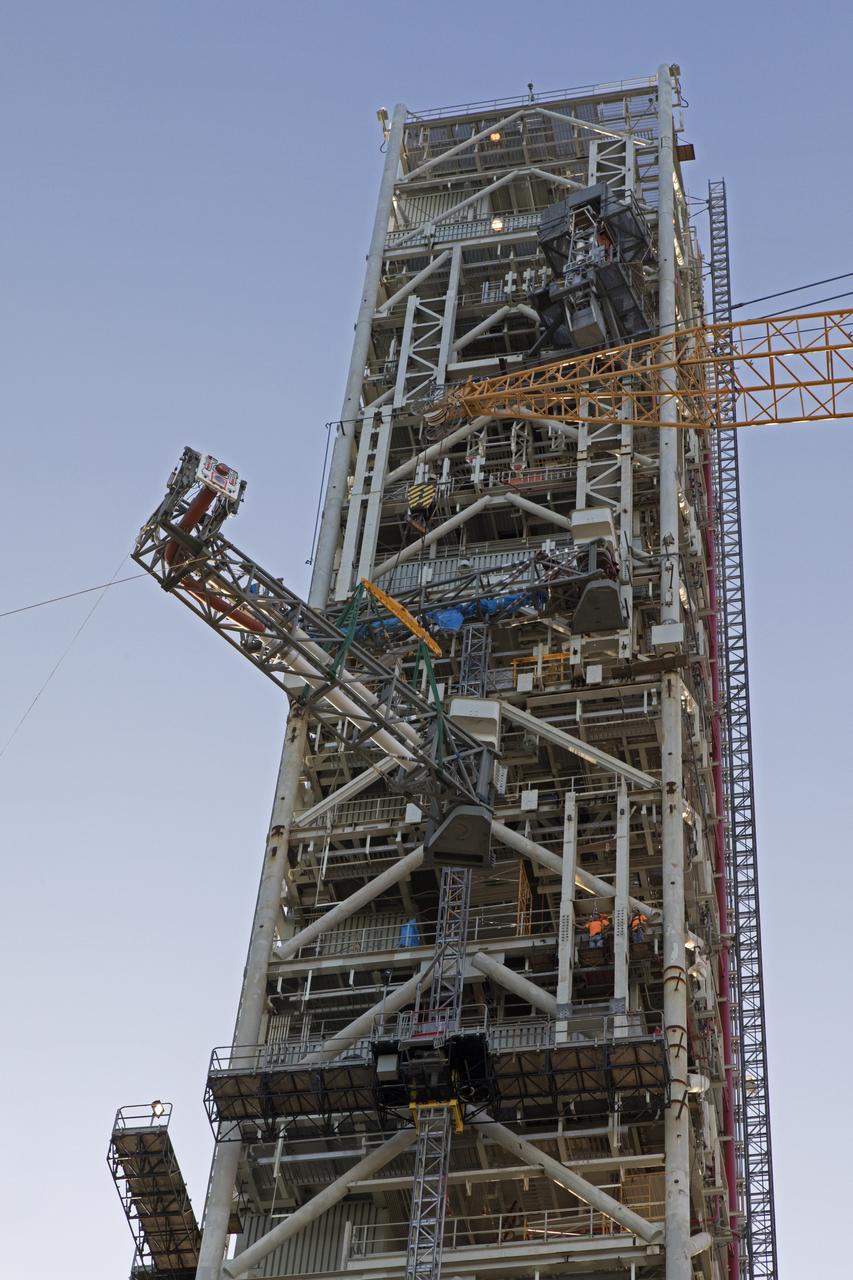
A heavy-lift crane moves the Core Stage Inter-tank Umbilical (CSITU) up to about the 140-foot level of the mobile launcher (ML) tower at NASA's Kennedy Space Center in Florida. The CSITU is moved into place for a fit check of the attachment hardware. The umbilical will be lowered down and installed permanently on the ML at a later date. The CSITU is a swing-arm umbilical that will connect to the Space Launch System core stage inter-tank. It will provide conditioned air, pressurized gases and power and data connection to the core stage. The Ground Systems Development and Operations Program is overseeing installation of the umbilicals.
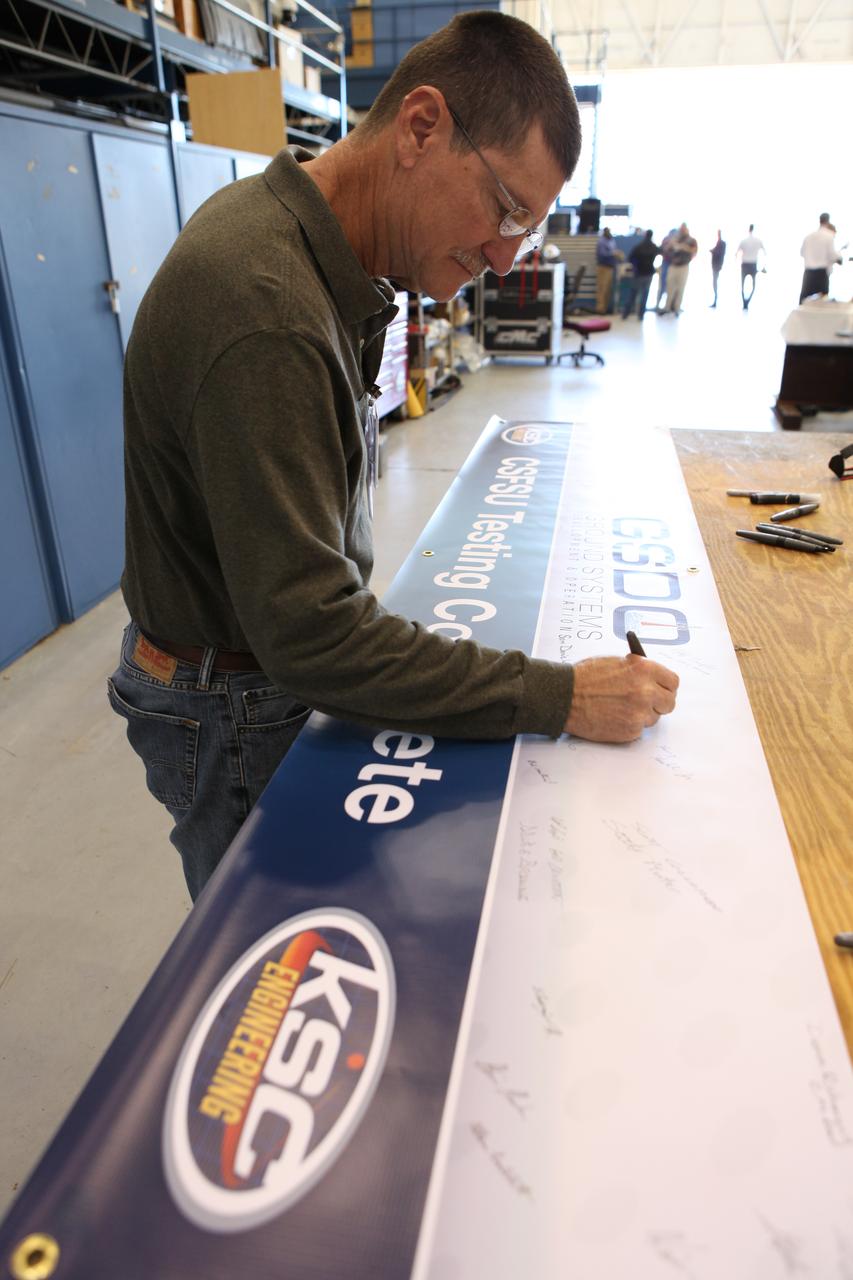
A NASA technician signs the banner inside a support building at the Launch Equipment Test Facility at Kennedy Space Center in Florida. Testing of the Core Stage Forward Skirt Umbilical (CSFSU) for NASA's Space Launch System is complete and the umbilical has been transported to the mobile launcher area. The umbilical will be prepared for installation on the tower of the mobile launcher. The CSFSU will be mated to the core stage forward skirt to provide commodities to the SLS rocket, and then disconnect and swing away before launch. Its main purpose is to provide conditioned air and gaseous nitrogen to the SLS Core Stage Forward Skirt. The center’s Engineering Directorate and the Ground Systems Development and Operations Program are overseeing processing and testing of the umbilicals.
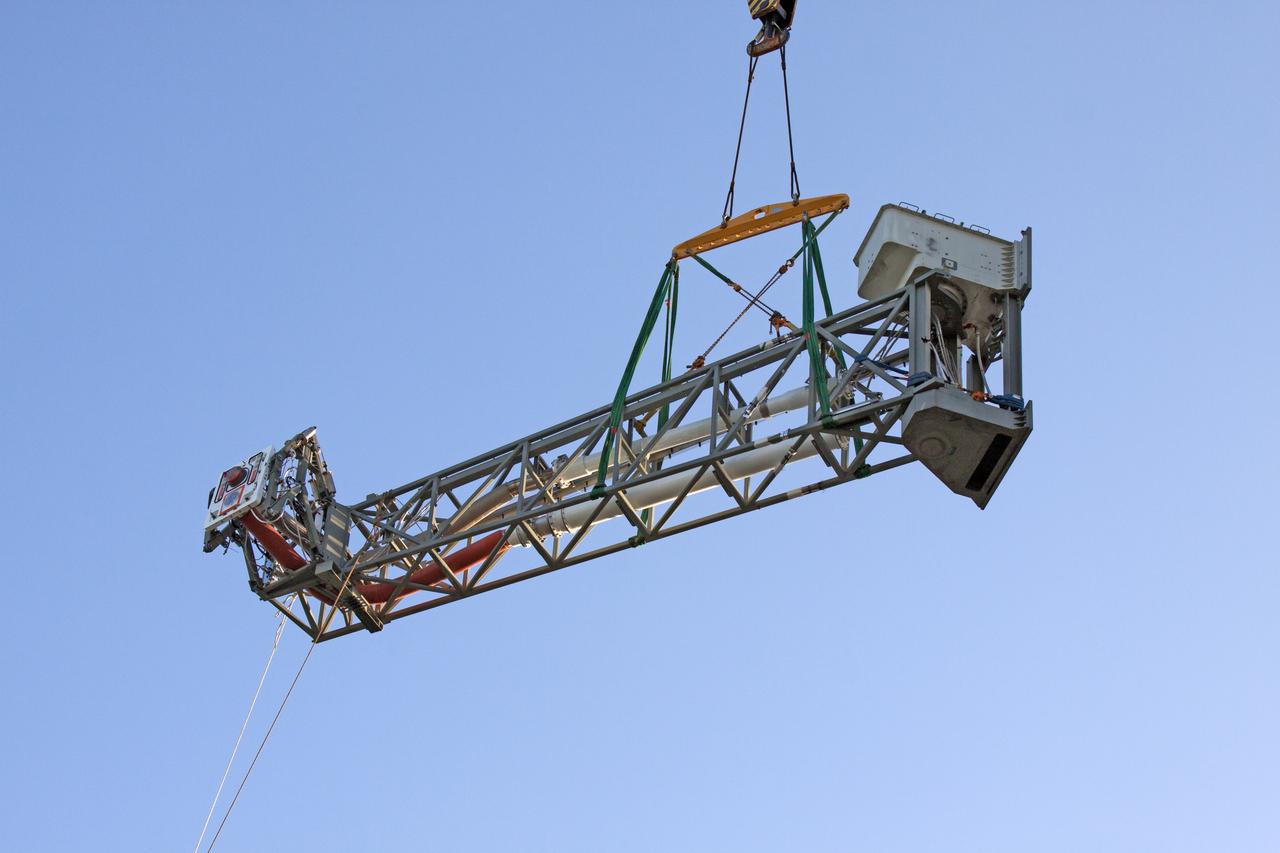
Seeming to hang in midair, the Core Stage Inter-tank Umbilical (CSITU) is lifted by crane and rigging up to about the 140-foot level of the mobile launcher (ML) tower at NASA's Kennedy Space Center in Florida. The CSITU will be moved into place for a fit check of the attachment hardware. The umbilical will be lowered down and installed permanently on the ML at a later date. The CSITU is a swing-arm umbilical that will connect to the Space Launch System core stage inter-tank. It will provide conditioned air, pressurized gases and power and data connection to the core stage. The Ground Systems Development and Operations Program is overseeing installation of the umbilicals.

A heavy-lift crane and rigging are used to lift the Core Stage Inter-tank Umbilical (CSITU) up to about the 140-foot level of the mobile launcher (ML) tower at NASA's Kennedy Space Center in Florida. The CSITU will be moved into place for a fit check of the attachment hardware. The umbilical will be lowered down and installed permanently on the ML at a later date. The CSITU is a swing-arm umbilical that will connect to the Space Launch System core stage inter-tank. It will provide conditioned air, pressurized gases and power and data connection to the core stage. The Ground Systems Development and Operations Program is overseeing installation of the umbilicals.
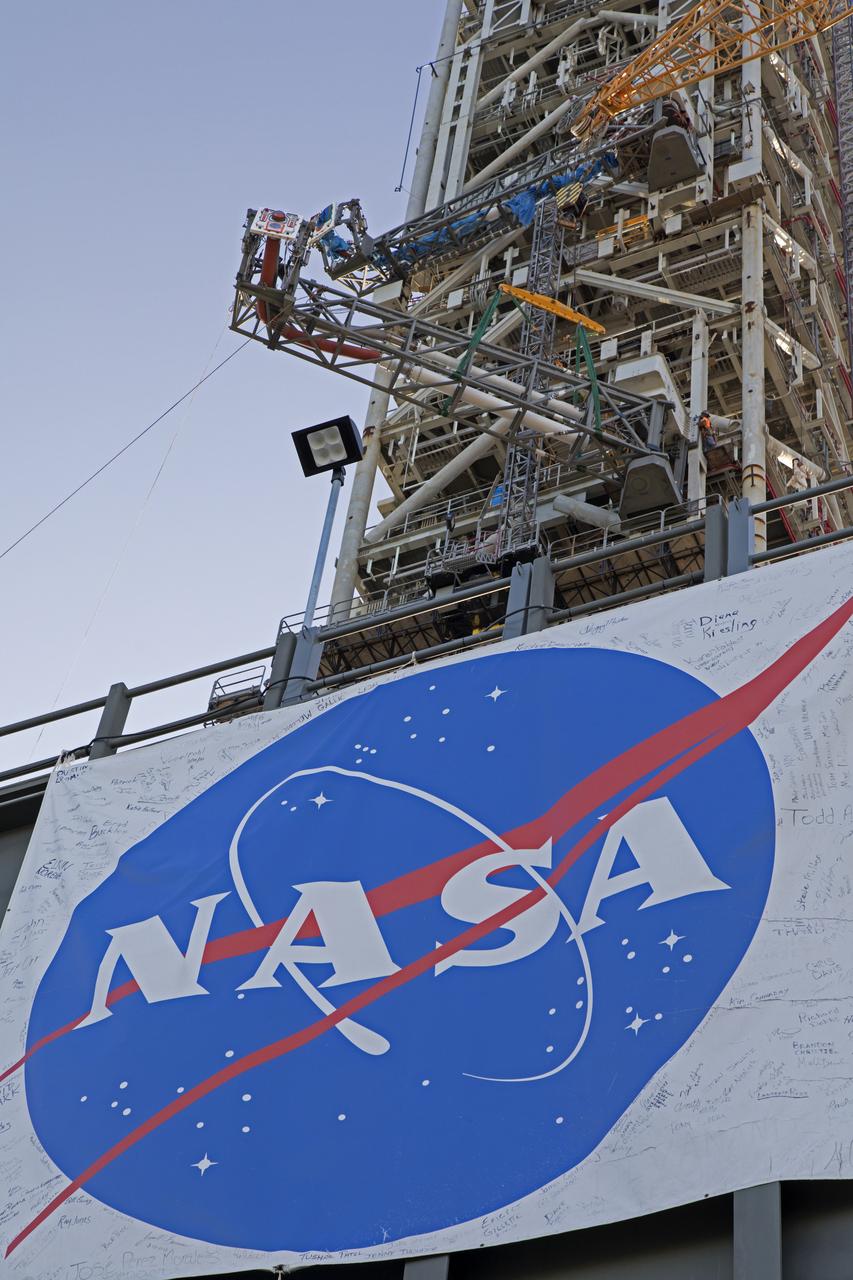
A heavy-lift crane moves the Core Stage Inter-tank Umbilical (CSITU) up to about the 140-foot level of the mobile launcher (ML) tower at NASA's Kennedy Space Center in Florida. The CSITU is moved into place for a fit check of the attachment hardware. The umbilical will be lowered down and installed permanently on the ML at a later date. The CSITU is a swing-arm umbilical that will connect to the Space Launch System core stage inter-tank. It will provide conditioned air, pressurized gases and power and data connection to the core stage. The Ground Systems Development and Operations Program is overseeing installation of the umbilicals.
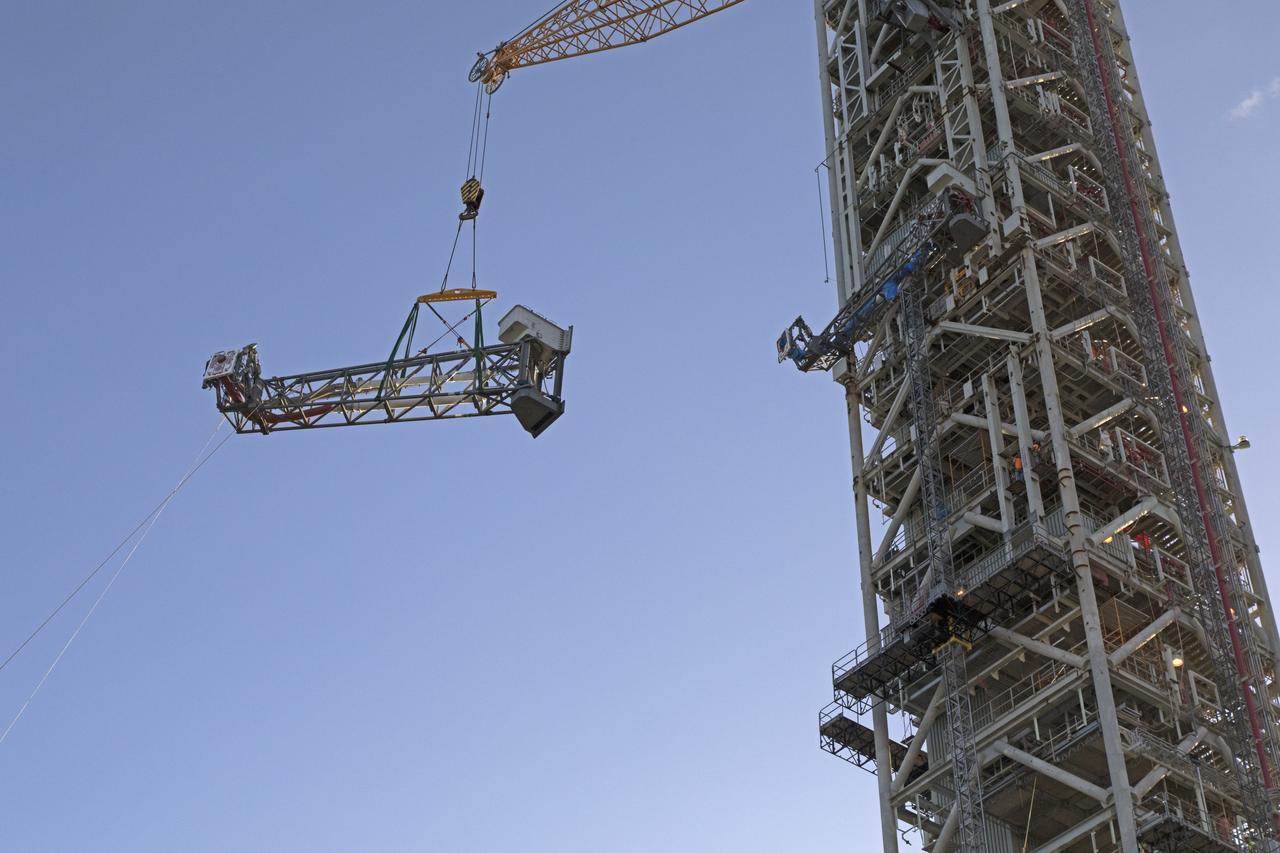
A heavy-lift crane and rigging are used to lift the Core Stage Inter-tank Umbilical (CSITU) up to about the 140-foot level of the mobile launcher (ML) tower at NASA's Kennedy Space Center in Florida. The CSITU will be moved into place for a fit check of the attachment hardware. The umbilical will be lowered down and installed permanently on the ML at a later date. The CSITU is a swing-arm umbilical that will connect to the Space Launch System core stage inter-tank. It will provide conditioned air, pressurized gases and power and data connection to the core stage. The Ground Systems Development and Operations Program is overseeing installation of the umbilicals.
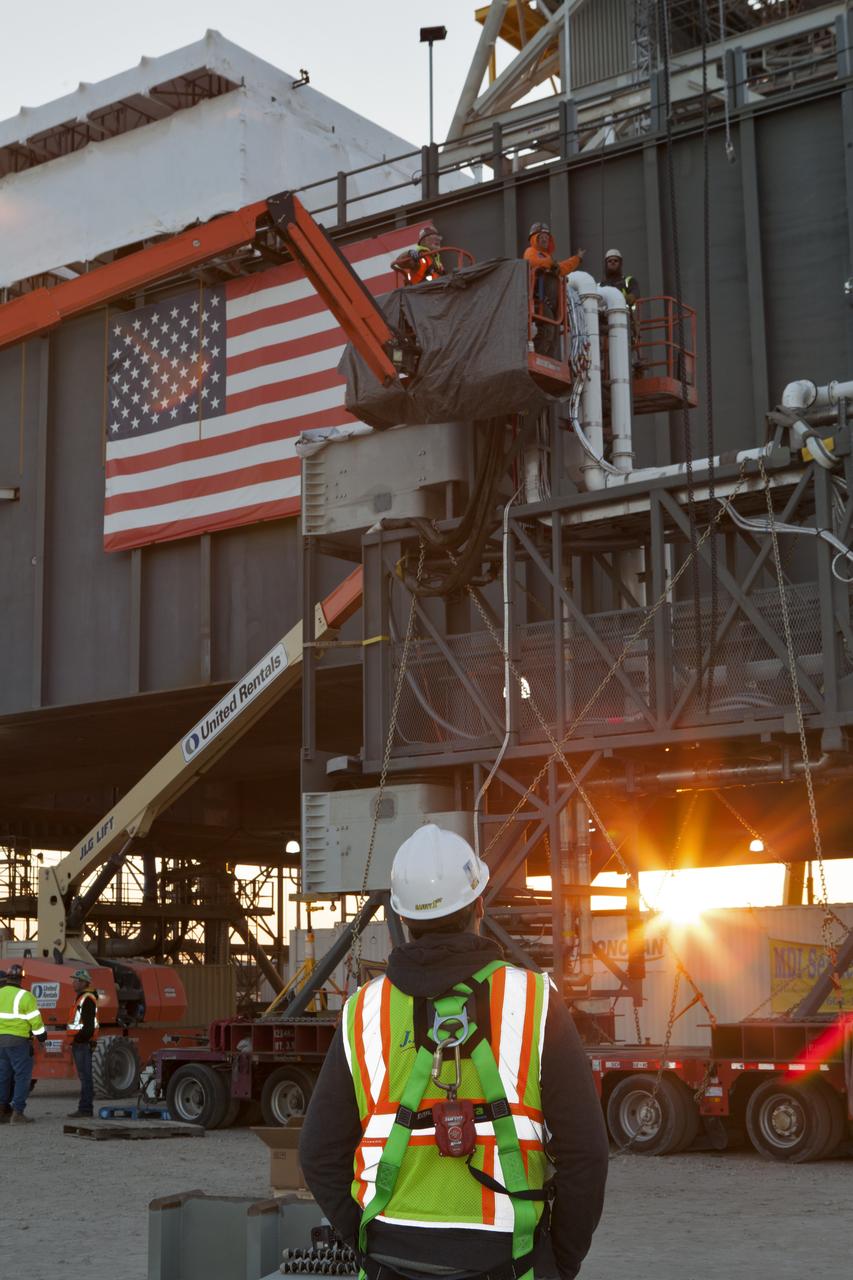
Construction workers with JP Donovan assist with preparations to lift and install the Interim Cryogenic Propulsion Stage Umbilical on the tower of the mobile launcher at NASA's Kennedy Space Center in Florida. The last of the large umbilicals to be installed, the ICPSU will provide super-cooled hydrogen and liquid oxygen to the Space Launch System (SLS) rocket's interim cryogenic propulsion stage, or upper stage, at T-0 for Exploration Mission-1. The umbilical is located at about the 240-foot-level of the mobile launcher and will supply fuel, oxidizer, gaseous helium, hazardous gas leak detection, electrical commodities and environment control systems to the upper stage of the SLS rocket during launch. Exploration Ground Systems is overseeing installation of the umbilicals on the ML.
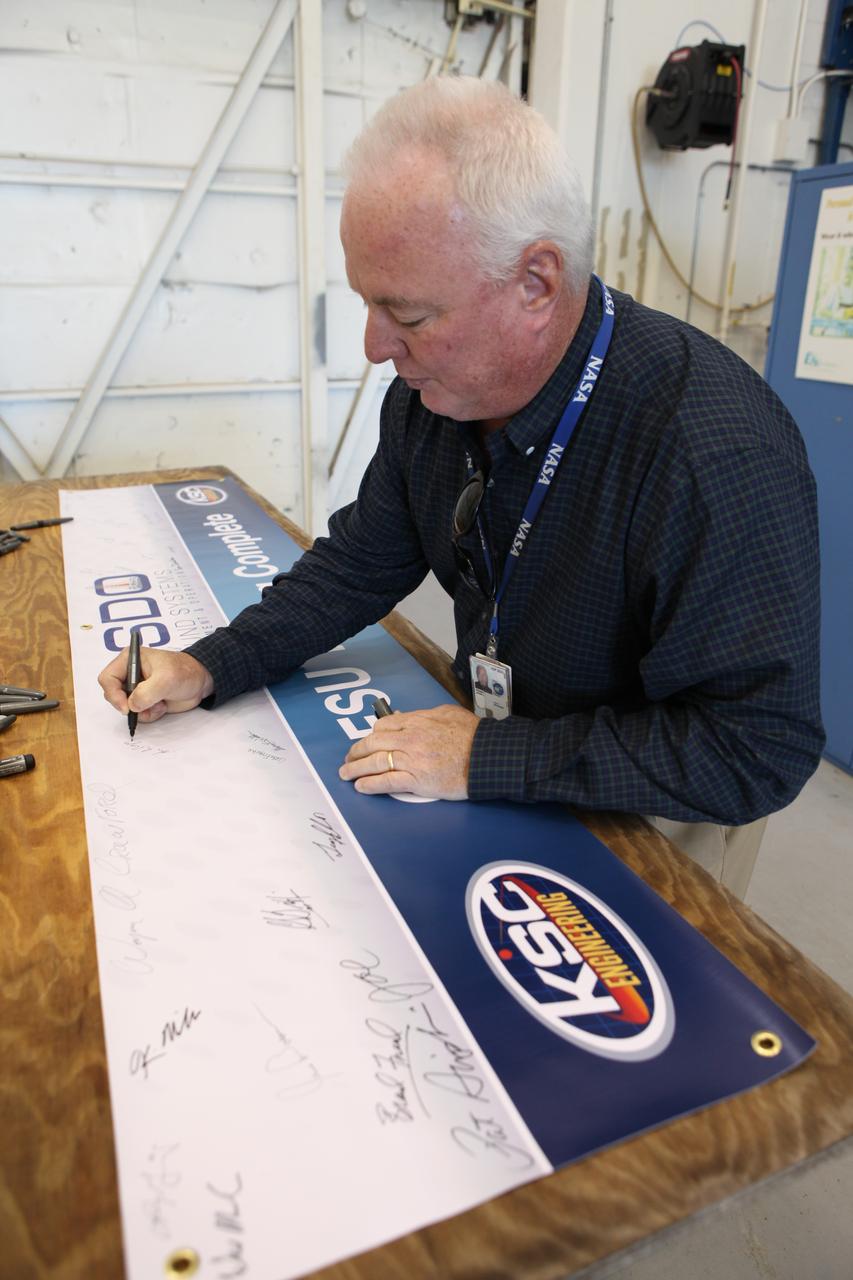
A NASA engineer signs the banner inside a support building at the Launch Equipment Test Facility at Kennedy Space Center in Florida. Testing of the Core Stage Forward Skirt Umbilical (CSFSU) for NASA's Space Launch System is complete and the umbilical has been transported to the mobile launcher area. The umbilical will be prepared for installation on the tower of the mobile launcher. The CSFSU will be mated to the core stage forward skirt to provide commodities to the SLS rocket, and then disconnect and swing away before launch. Its main purpose is to provide conditioned air and gaseous nitrogen to the SLS Core Stage Forward Skirt. The center’s Engineering Directorate and the Ground Systems Development and Operations Program are overseeing processing and testing of the umbilicals.
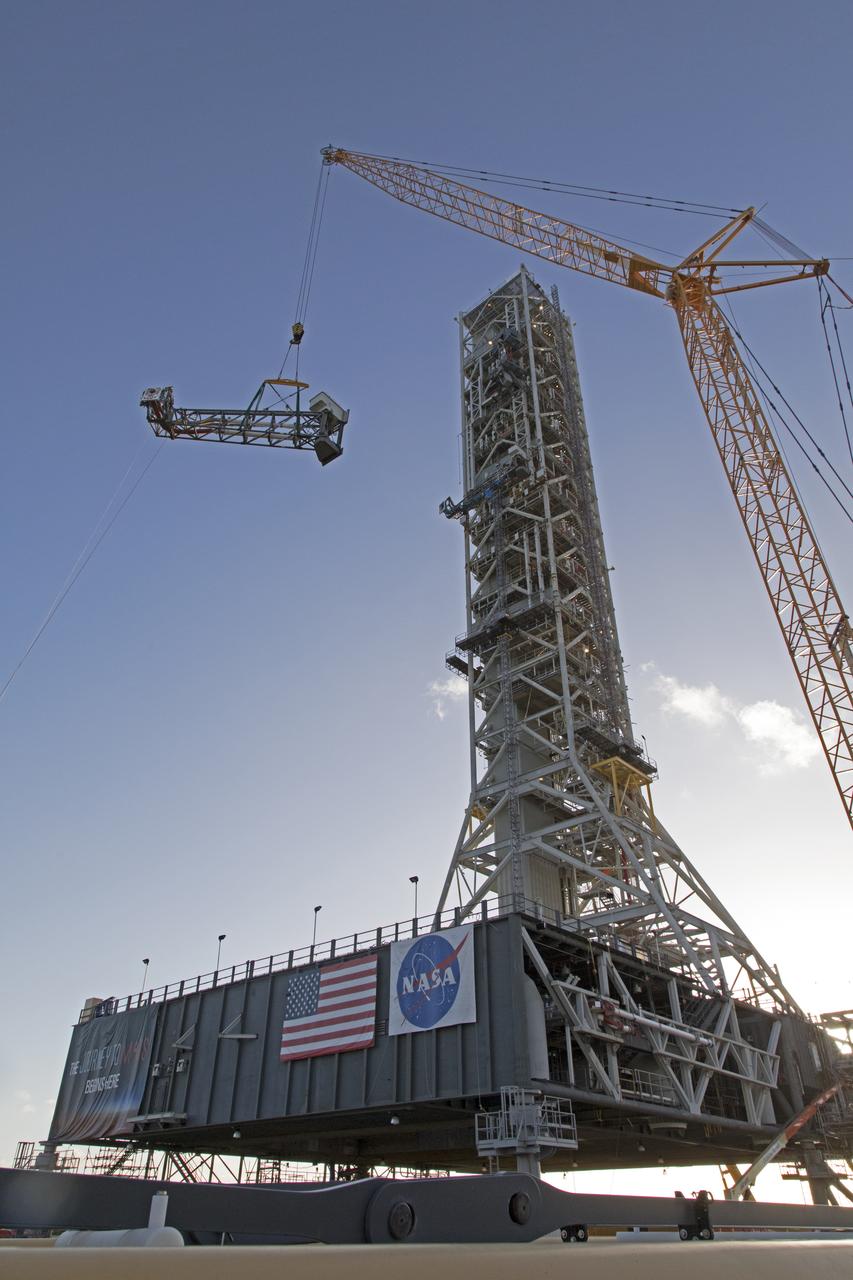
A heavy-lift crane and rigging are used to lift the Core Stage Inter-tank Umbilical (CSITU) up to about the 140-foot level of the mobile launcher (ML) tower at NASA's Kennedy Space Center in Florida. The CSITU will be moved into place for a fit check of the attachment hardware. The umbilical will be lowered down and installed permanently on the ML at a later date. The CSITU is a swing-arm umbilical that will connect to the Space Launch System core stage inter-tank. It will provide conditioned air, pressurized gases and power and data connection to the core stage. The Ground Systems Development and Operations Program is overseeing installation of the umbilicals.
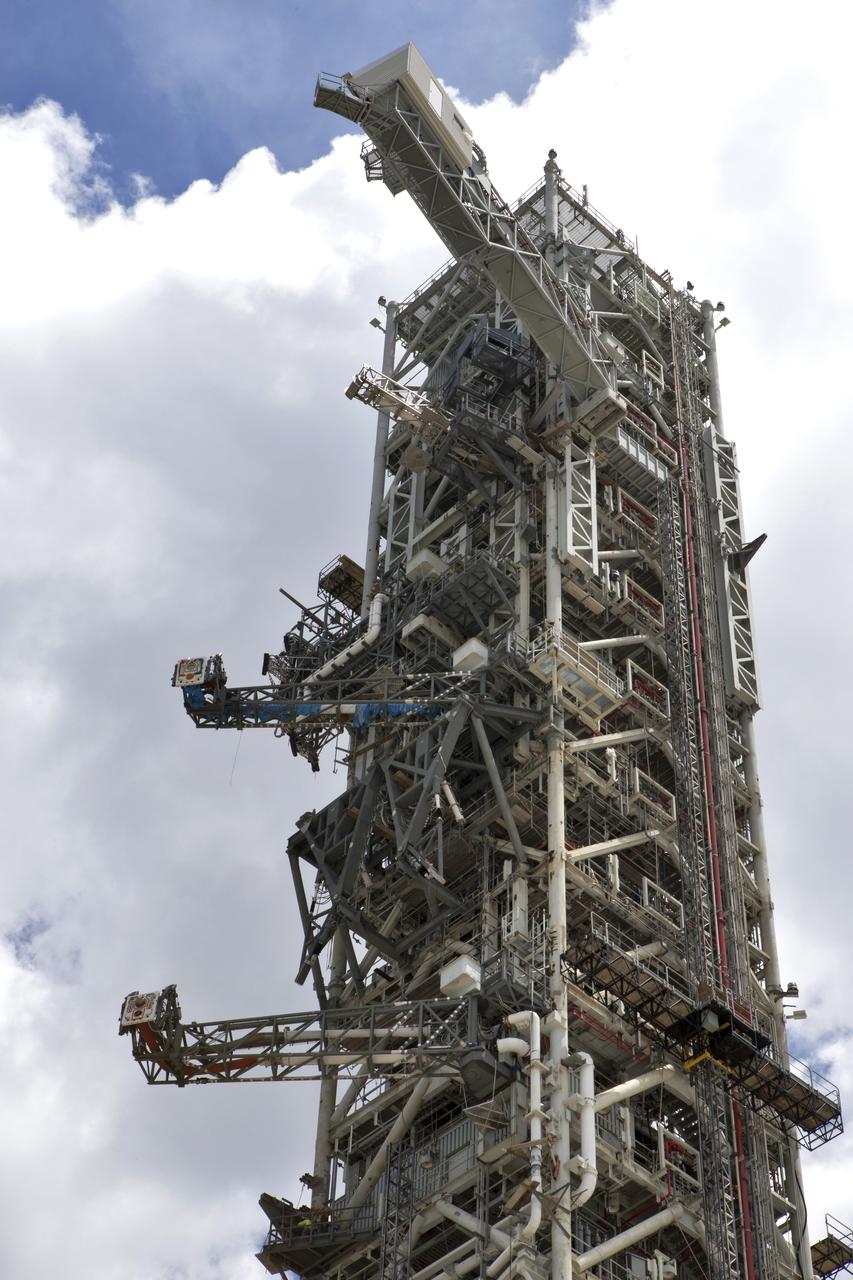
A swing test of the Orion crew access arm, topmost umbilical, is in progress on the mobile launcher at NASA's Kennedy Space Center in Florida, on Aug. 21, 2018. The crew access arm is located at about the 274-foot level on the mobile launcher tower. It will rotate from its retracted position and interface with the Orion crew hatch location to provide entry to the Orion crew module. Exploration Ground Systems extended all of the launch umbilicals on the ML tower to test their functionality before the mobile launcher, atop crawler-transporter 2, is moved to Launch Pad 39B and the Vehicle Assembly Building.
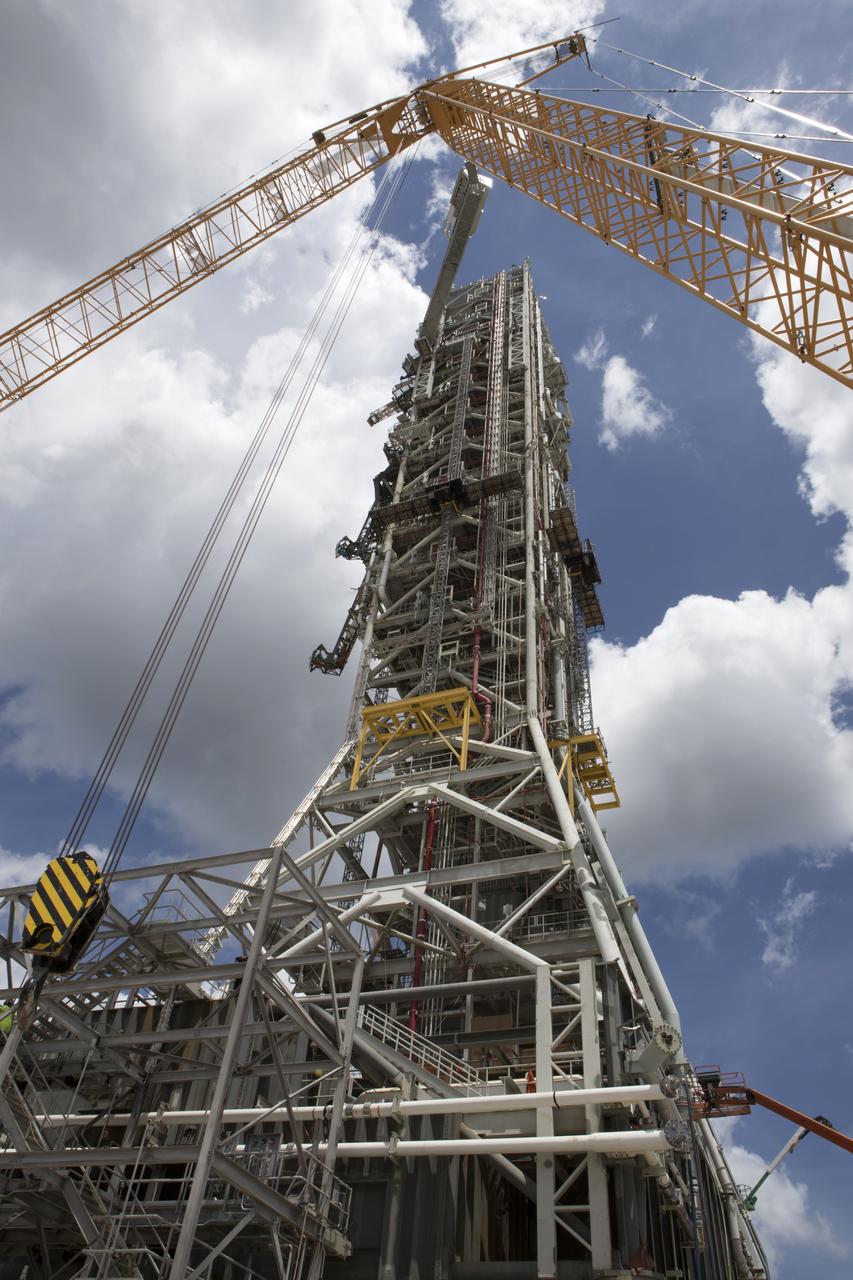
A swing test of the Orion crew access arm, topmost umbilical, is in progress on the mobile launcher at NASA's Kennedy Space Center in Florida, on Aug. 21, 2018. The crew access arm is located at about the 274-foot level on the mobile launcher tower. It will rotate from its retracted position and interface with the Orion crew hatch location to provide entry to the Orion crew module. Exploration Ground Systems extended all of the launch umbilicals on the ML tower to test their functionality before the mobile launcher, atop crawler-transporter 2, is moved to Launch Pad 39B and the Vehicle Assembly Building.
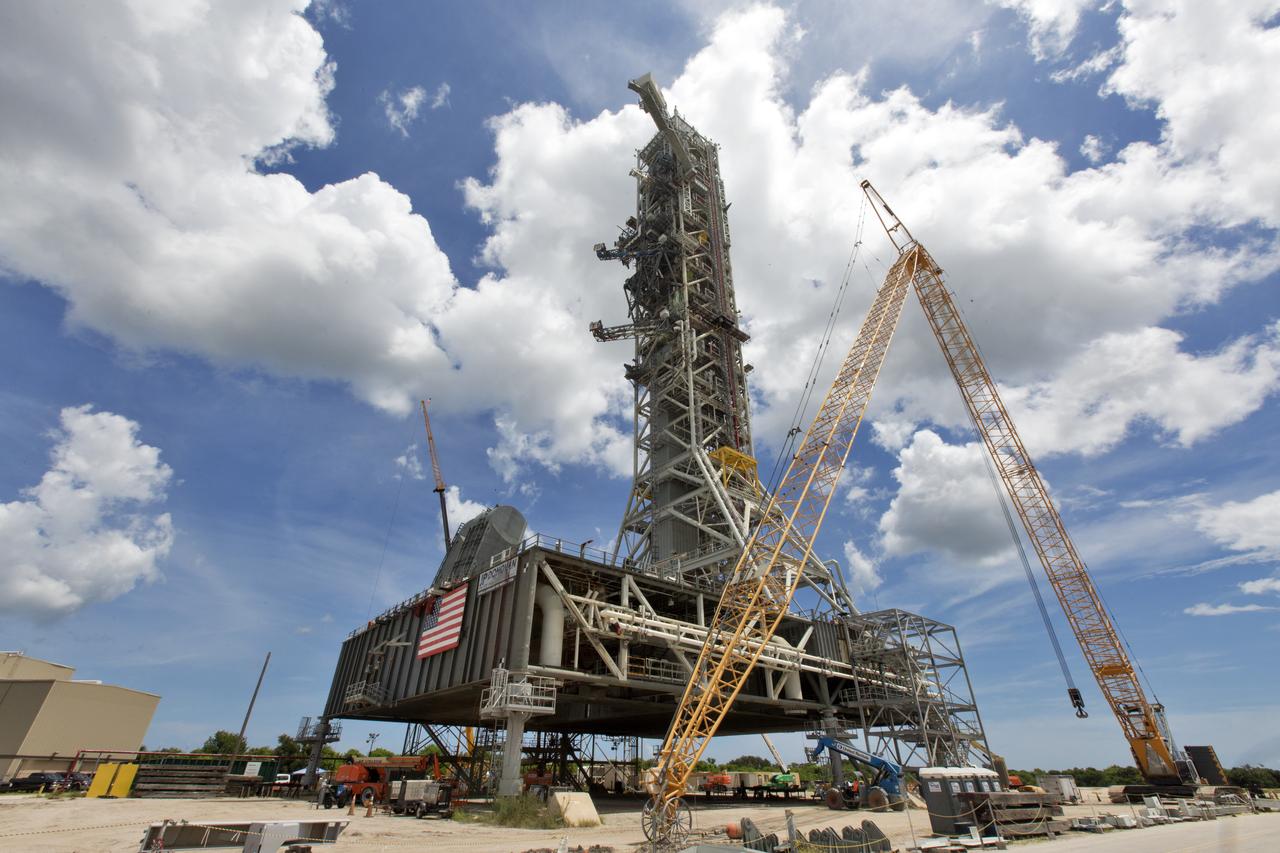
A swing test of the Orion crew access arm, topmost umbilical, is in progress on the mobile launcher at NASA's Kennedy Space Center in Florida, on Aug. 21, 2018. The crew access arm is located at about the 274-foot level on the mobile launcher tower. It will rotate from its retracted position and interface with the Orion crew hatch location to provide entry to the Orion crew module. Exploration Ground Systems extended all of the launch umbilicals on the ML tower to test their functionality before the mobile launcher, atop crawler-transporter 2, is moved to Launch Pad 39B and the Vehicle Assembly Building.
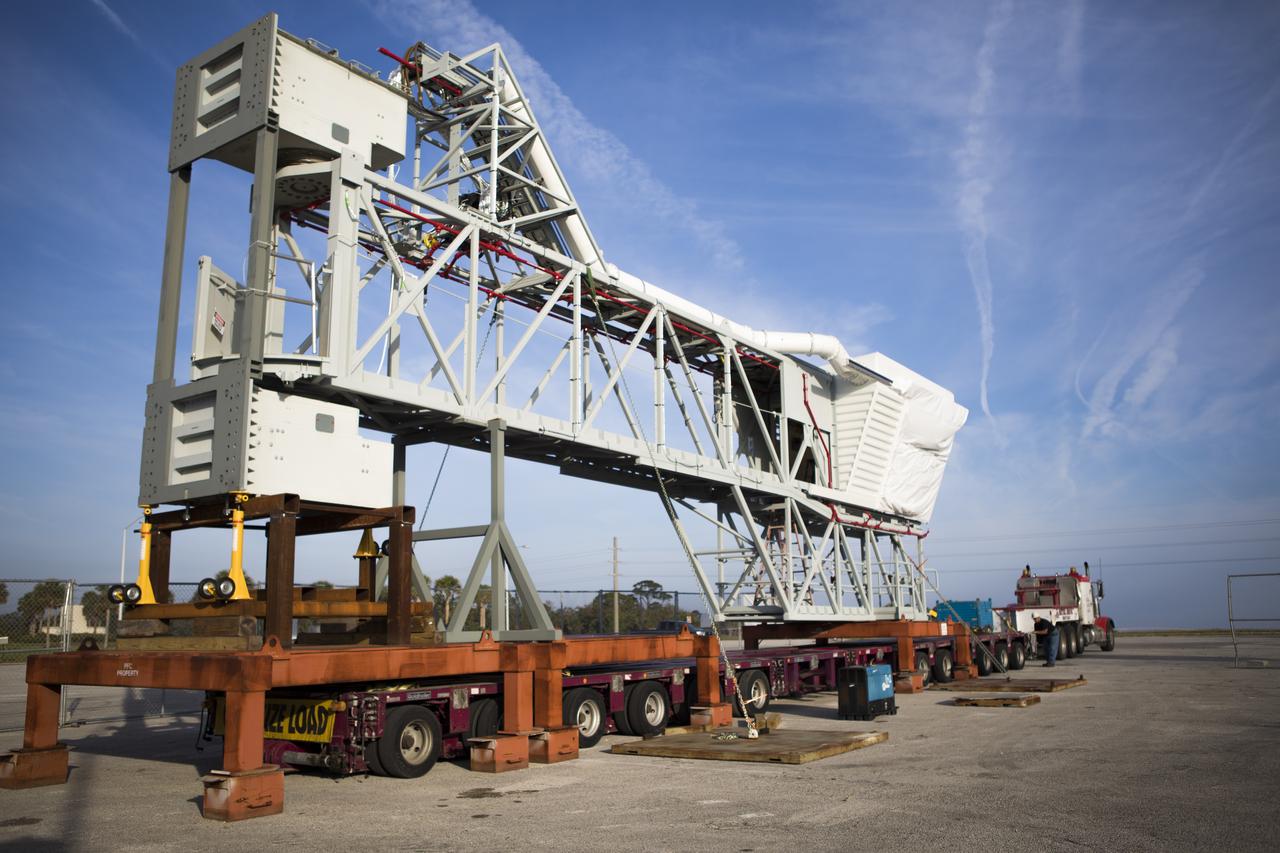
The Orion crew access arm, secured on a stand, is being prepared for its move from a storage location at NASA's Kennedy Space Center in Florida, to the mobile launcher (ML) tower near the Vehicle Assembly Building at the center. The crew access arm will be installed at about the 274-foot level on the tower. It will rotate from its retracted position and interface with the Orion crew hatch location to provide entry to the Orion crew module. The Ground Systems Development and Operations Program is overseeing installation of umbilicals and launch accessories on the ML tower.
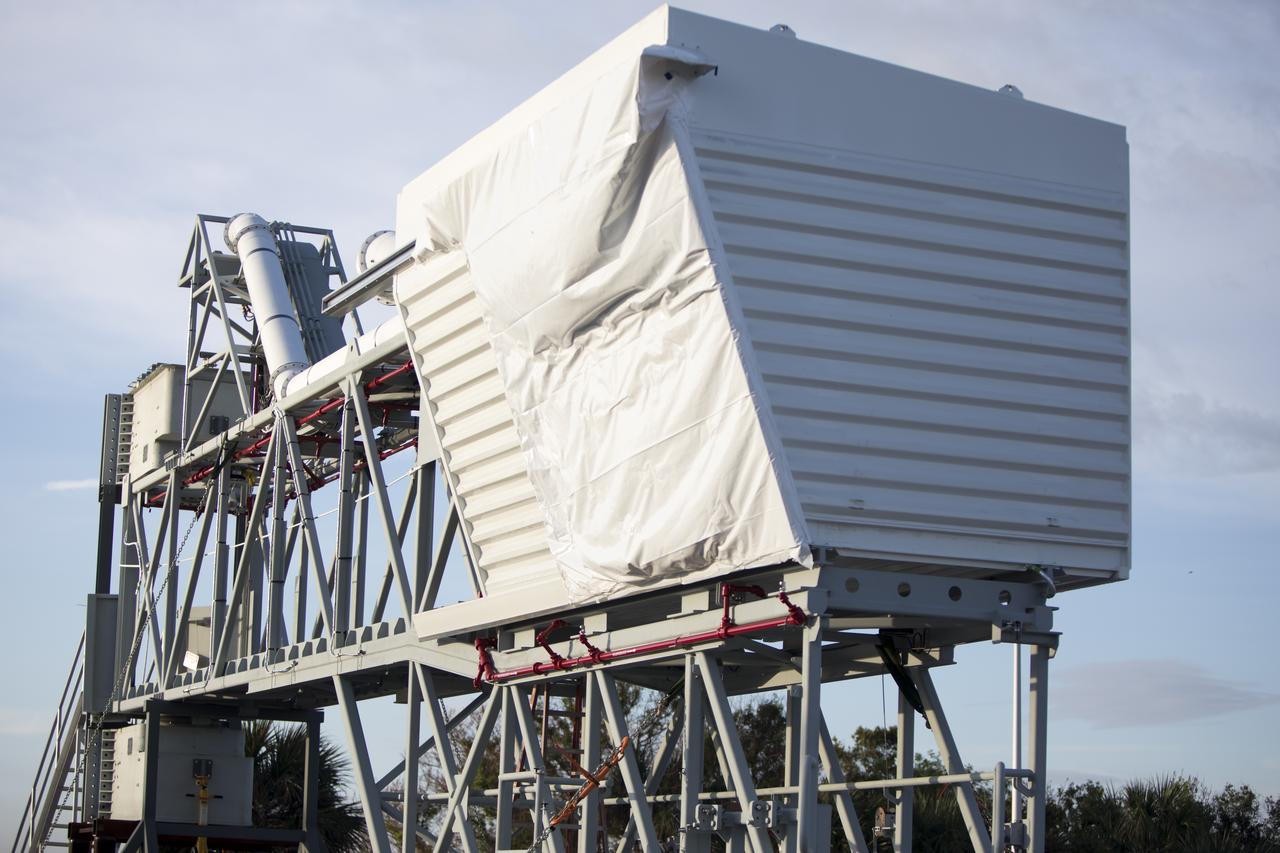
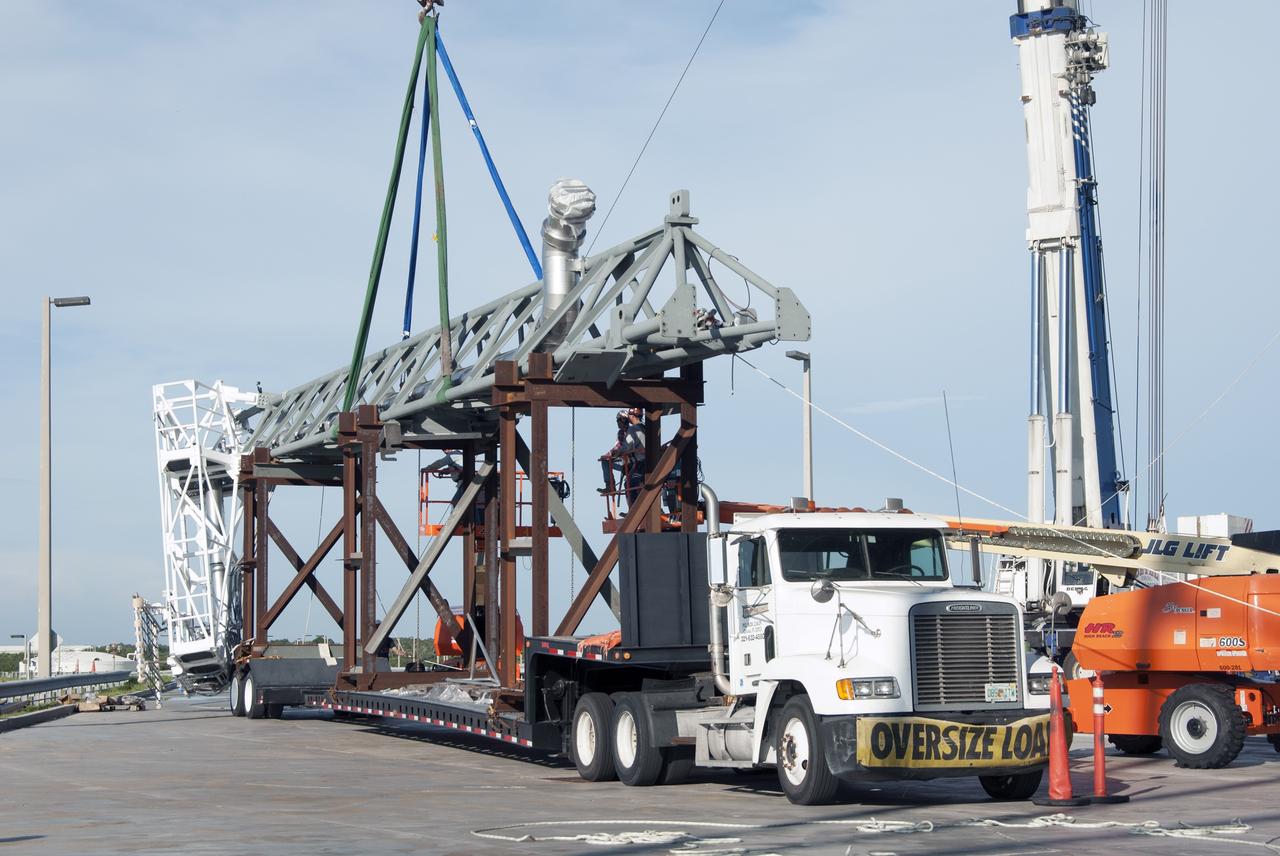
The Orion crew access arm is secured in a storage location at NASA's Kennedy Space Center in Florida. The access arm will be prepared for its move to the mobile launcher (ML) tower near the Vehicle Assembly Building at the center. The crew access arm will be installed at about the 274-foot level on the tower. It will rotate from its retracted position and interface with the Orion crew hatch location to provide entry to the Orion crew module. The Ground Systems Development and Operations Program is overseeing installation of umbilicals and launch accessories on the ML tower.
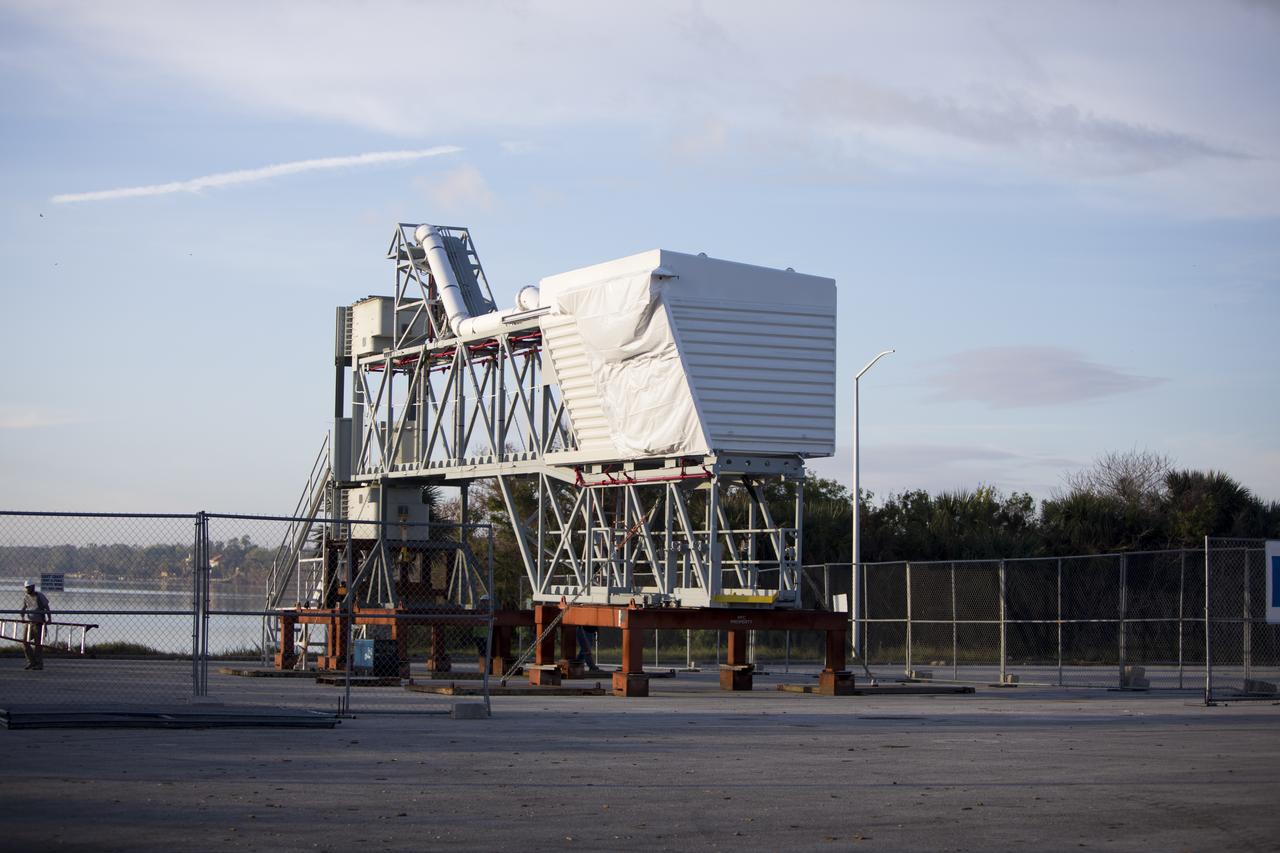
The Orion crew access arm is secured in a storage location at NASA's Kennedy Space Center in Florida. The access arm will be prepared for its move to the mobile launcher (ML) tower near the Vehicle Assembly Building at the center. The crew access arm will be installed at about the 274-foot level on the tower. It will rotate from its retracted position and interface with the Orion crew hatch location to provide entry to the Orion crew module. The Ground Systems Development and Operations Program is overseeing installation of umbilicals and launch accessories on the ML tower.
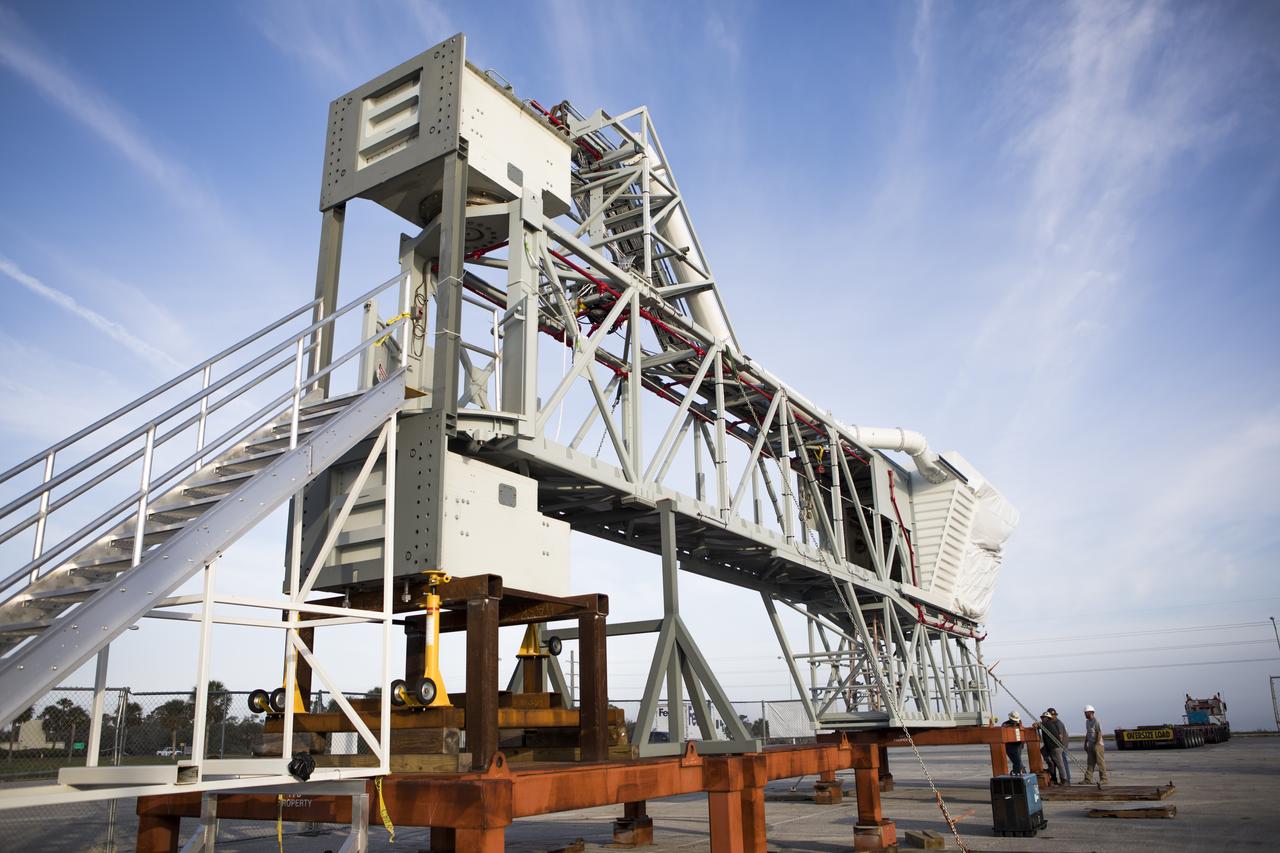
The Orion crew access arm, secured on a stand, is being prepared for its move from a storage location at NASA's Kennedy Space Center in Florida, to the mobile launcher (ML) tower near the Vehicle Assembly Building at the center. The crew access arm will be installed at about the 274-foot level on the tower. It will rotate from its retracted position and interface with the Orion crew hatch location to provide entry to the Orion crew module. The Ground Systems Development and Operations Program is overseeing installation of umbilicals and launch accessories on the ML tower.

KENNEDY SPACE CENTER, FLA. -- Workers are dwarfed by the fallen 300-foot, five-million-pound Mobile Service Tower (MST) on Launch Complex 41, Cape Canaveral Air Force Station. The MST and a 200-foot-high umbilical tower nearby were demolished to make room for Lockheed Martin's 14-acre Vehicle Integration Facility (VIF), under construction. Only lightning protection towers remain standing at the site. About 200 pounds of linear-shaped charges were used to bring down the towers so that the materials can be recycled. The implosion and removal of the tower debris is expected to be completed in two months. The VIF will be used for Lockheed Martin's Atlas V Launch System.
CAPE CANAVERAL, Fla. – The umbilical swing arm for Exploration Flight Test 1, or EFT-1, is being prepared to be lifted by crane and attached to the fixed umbilical tower at Space Launch Complex 37 at Cape Canaveral Air Force Station in Florida. The swing arm is the uppermost of three swing arms that will be attached to the fixed umbilical tower. The swing arm will carry umbilicals that will be mated to Orion's launch abort system and environmental control system. During launch, the umbilicals will pull away from Orion and the United Launch Alliance Delta IV Heavy rocket at T-0. During the EFT-1 mission, Orion will travel farther into space than any human spacecraft has gone in more than 40 years. The data gathered during the flight will influence design decisions, validate existing computer models and innovative new approaches to space systems development, as well as reduce overall mission risks and costs for later Orion flights. Liftoff of Orion on its first flight test is planned for fall 2014. Photo credit: NASA/Jim Grossmann
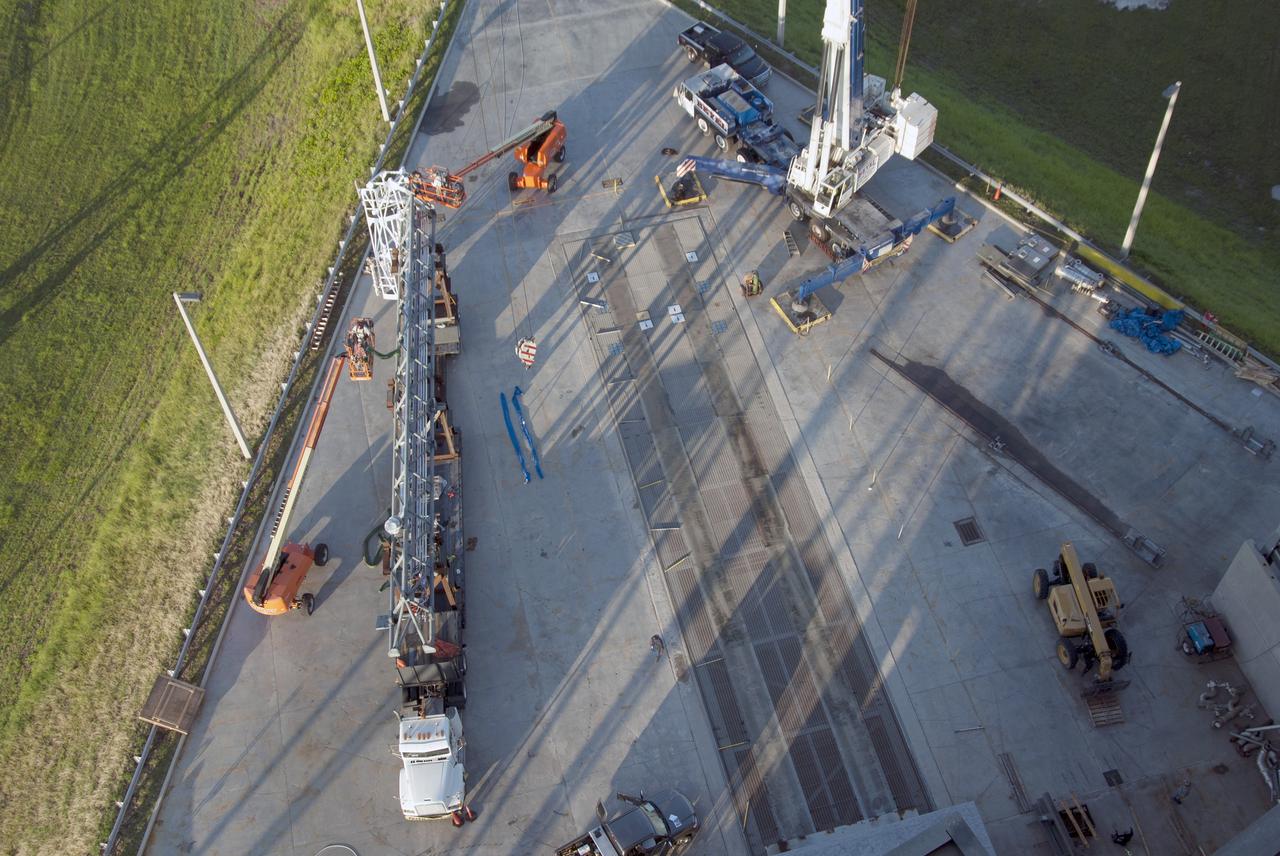
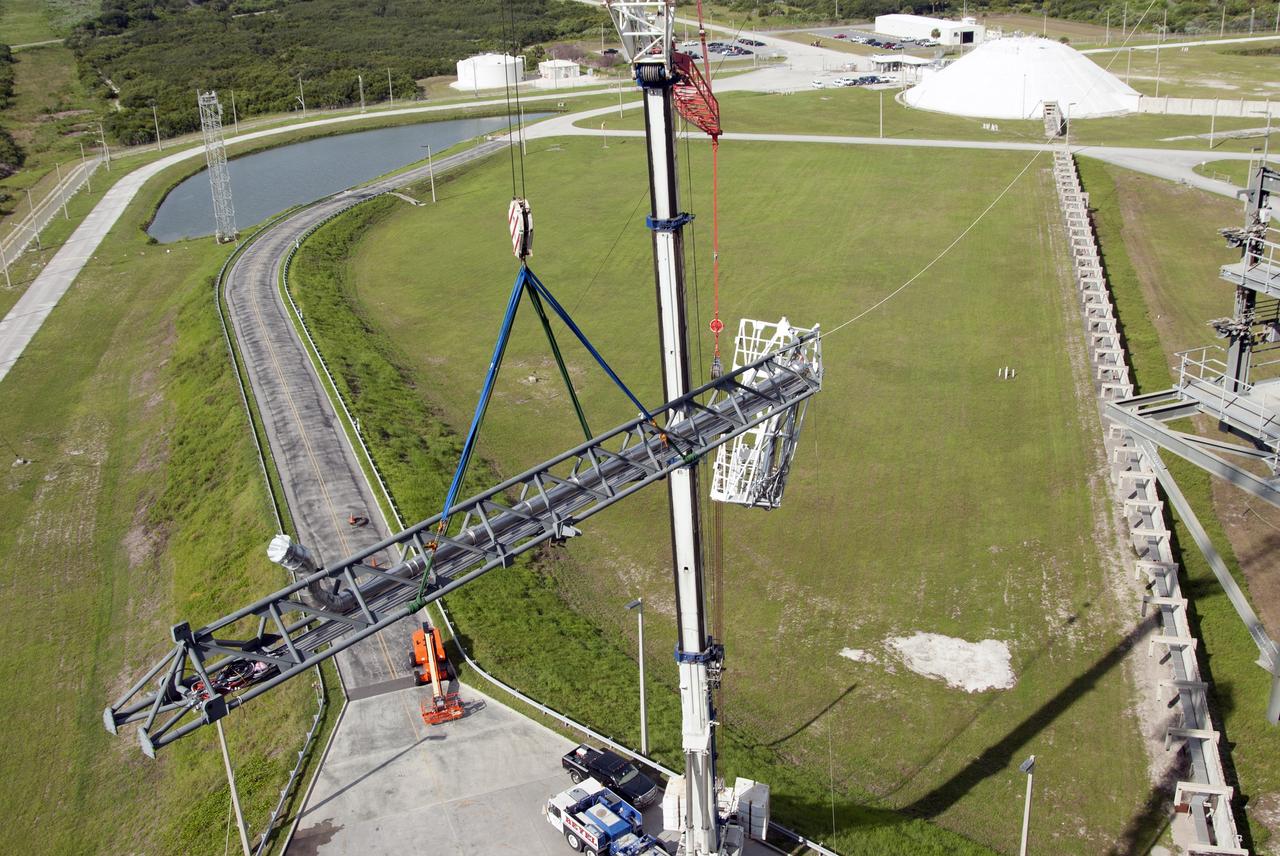
CAPE CANAVERAL, Fla. – In this view from above at Space Launch Complex 37 at Cape Canaveral Air Force Station in Florida, the umbilical swing arm for Exploration Flight Test 1, or EFT-1, is being prepared to be lifted by crane and attached to the fixed umbilical tower on the launch pad. The swing arm is the uppermost of three swing arms that will be attached to the fixed umbilical tower. The swing arm will carry umbilicals that will be mated to Orion's launch abort system and environmental control system. During launch, the umbilicals will pull away from Orion and the United Launch Alliance Delta IV Heavy rocket at T-0. During the EFT-1 mission, Orion will travel farther into space than any human spacecraft has gone in more than 40 years. The data gathered during the flight will influence design decisions, validate existing computer models and innovative new approaches to space systems development, as well as reduce overall mission risks and costs for later Orion flights. Liftoff of Orion on its first flight test is planned for fall 2014. Photo credit: NASA/Jim Grossmann
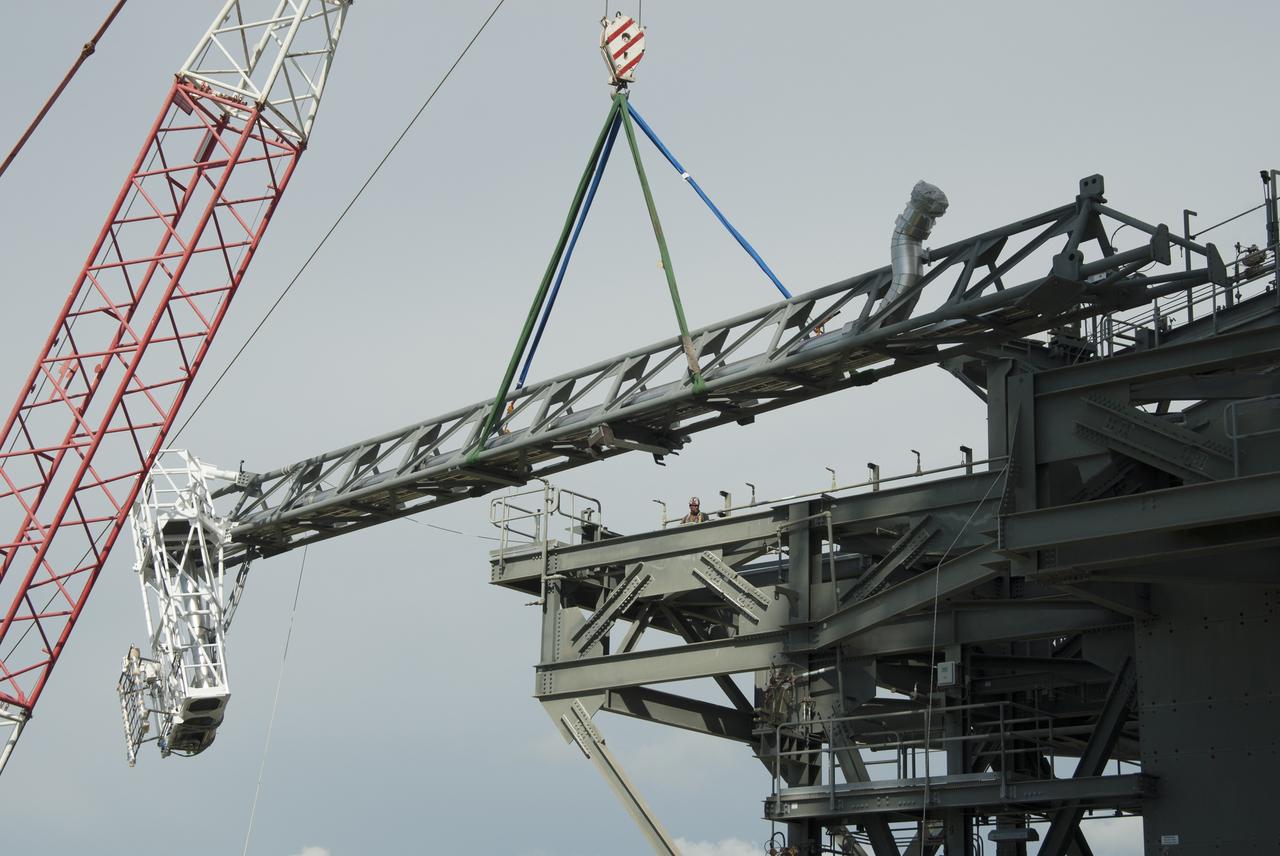
CAPE CANAVERAL, Fla. – A crane brings the umbilical swing arm for Exploration Flight Test 1, or EFT-1, closer for installation on the fixed umbilical tower at Space Launch Complex 37 at Cape Canaveral Air Force Station in Florida. The swing arm is the uppermost of three swing arms that will be attached to the fixed umbilical tower. The swing arm will carry umbilicals that will be mated to Orion's launch abort system and environmental control system. During launch, the umbilicals will pull away from Orion and the United Launch Alliance Delta IV Heavy rocket at T-0. During the EFT-1 mission, Orion will travel farther into space than any human spacecraft has gone in more than 40 years. The data gathered during the flight will influence design decisions, validate existing computer models and innovative new approaches to space systems development, as well as reduce overall mission risks and costs for later Orion flights. Liftoff of Orion on its first flight test is planned for fall 2014. Photo credit: NASA/Jim Grossmann
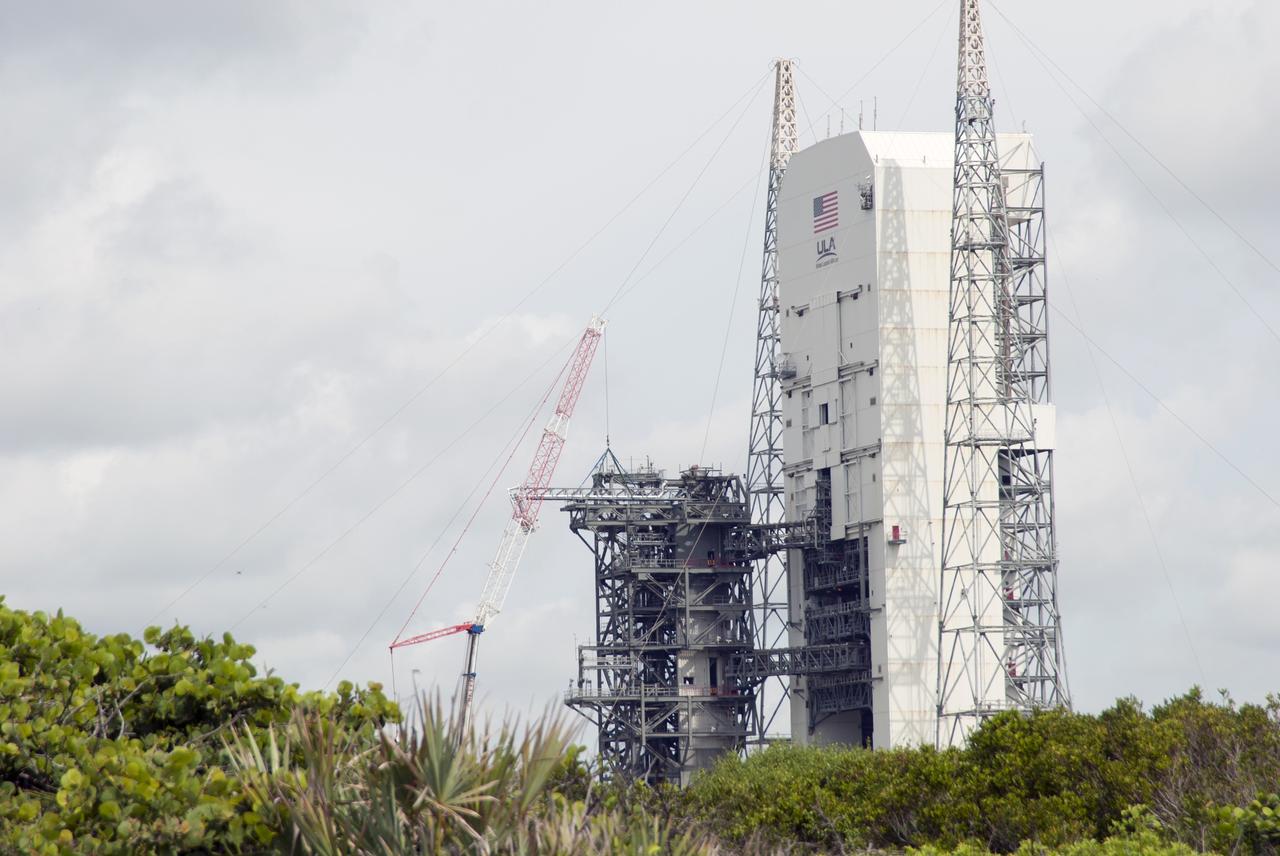
CAPE CANAVERAL, Fla. – A crane brings the umbilical swing arm for Exploration Flight Test 1, or EFT-1, closer for installation on the fixed umbilical tower at Space Launch Complex 37 at Cape Canaveral Air Force Station in Florida. The swing arm is the uppermost of three swing arms that will be attached to the fixed umbilical tower. The swing arm will carry umbilicals that will be mated to Orion's launch abort system and environmental control system. During launch, the umbilicals will pull away from Orion and the United Launch Alliance Delta IV Heavy rocket at T-0. During the EFT-1 mission, Orion will travel farther into space than any human spacecraft has gone in more than 40 years. The data gathered during the flight will influence design decisions, validate existing computer models and innovative new approaches to space systems development, as well as reduce overall mission risks and costs for later Orion flights. Liftoff of Orion on its first flight test is planned for fall 2014. Photo credit: NASA/Jim Grossmann
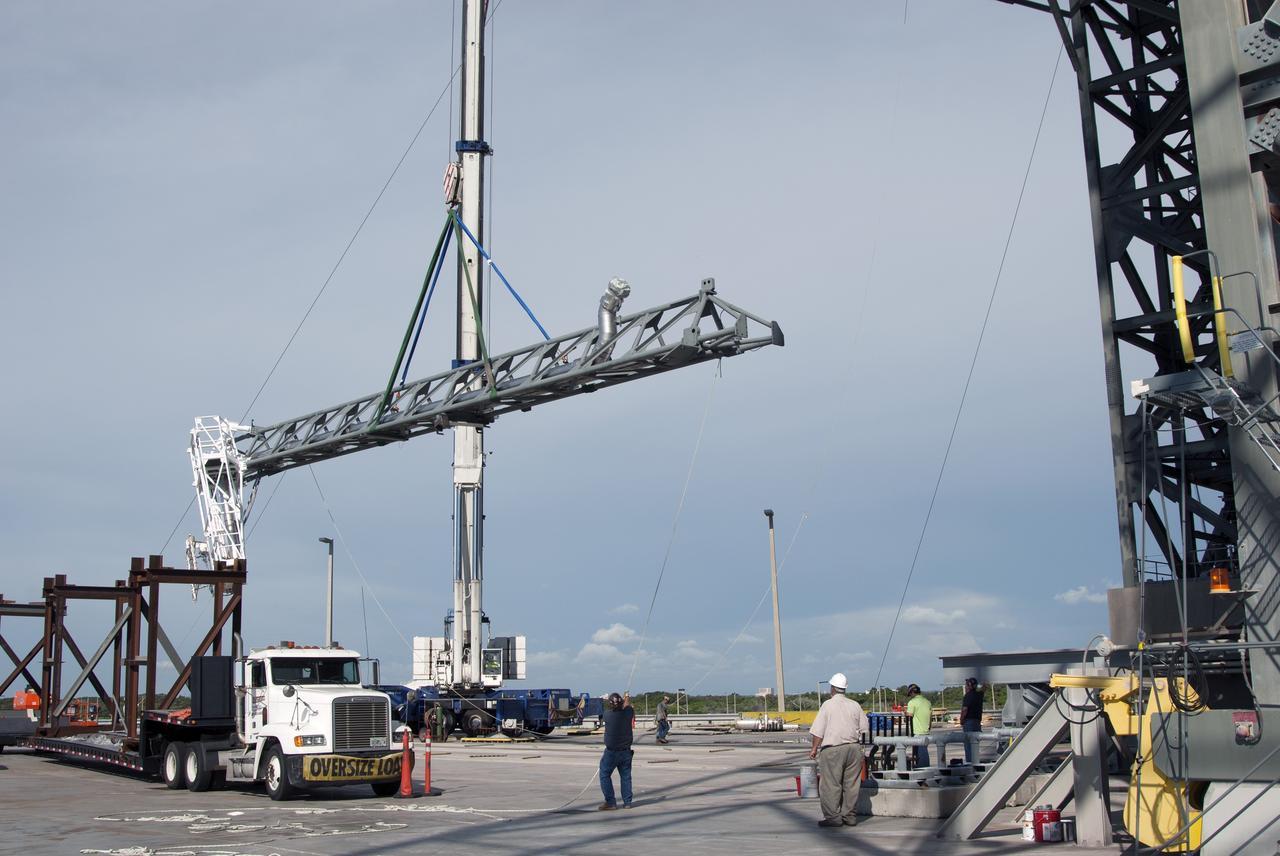
CAPE CANAVERAL, Fla. – The umbilical swing arm for Exploration Flight Test 1, or EFT-1, is lifted by crane for installation on the fixed umbilical tower at Space Launch Complex 37 at Cape Canaveral Air Force Station in Florida. The swing arm is the uppermost of three swing arms that will be attached to the fixed umbilical tower. The swing arm will carry umbilicals that will be mated to Orion's launch abort system and environmental control system. During launch, the umbilicals will pull away from Orion and the United Launch Alliance Delta IV Heavy rocket at T-0. During the EFT-1 mission, Orion will travel farther into space than any human spacecraft has gone in more than 40 years. The data gathered during the flight will influence design decisions, validate existing computer models and innovative new approaches to space systems development, as well as reduce overall mission risks and costs for later Orion flights. Liftoff of Orion on its first flight test is planned for fall 2014. Photo credit: NASA/Jim Grossmann
CAPE CANAVERAL, Fla. – The umbilical swing arm for Exploration Flight Test 1, or EFT-1, is lifted by crane for installation on the fixed umbilical tower at Space Launch Complex 37 at Cape Canaveral Air Force Station in Florida. The swing arm is the uppermost of three swing arms that will be attached to the fixed umbilical tower. The swing arm will carry umbilicals that will be mated to Orion's launch abort system and environmental control system. During launch, the umbilicals will pull away from Orion and the United Launch Alliance Delta IV Heavy rocket at T-0. During the EFT-1 mission, Orion will travel farther into space than any human spacecraft has gone in more than 40 years. The data gathered during the flight will influence design decisions, validate existing computer models and innovative new approaches to space systems development, as well as reduce overall mission risks and costs for later Orion flights. Liftoff of Orion on its first flight test is planned for fall 2014. Photo credit: NASA/Jim Grossmann
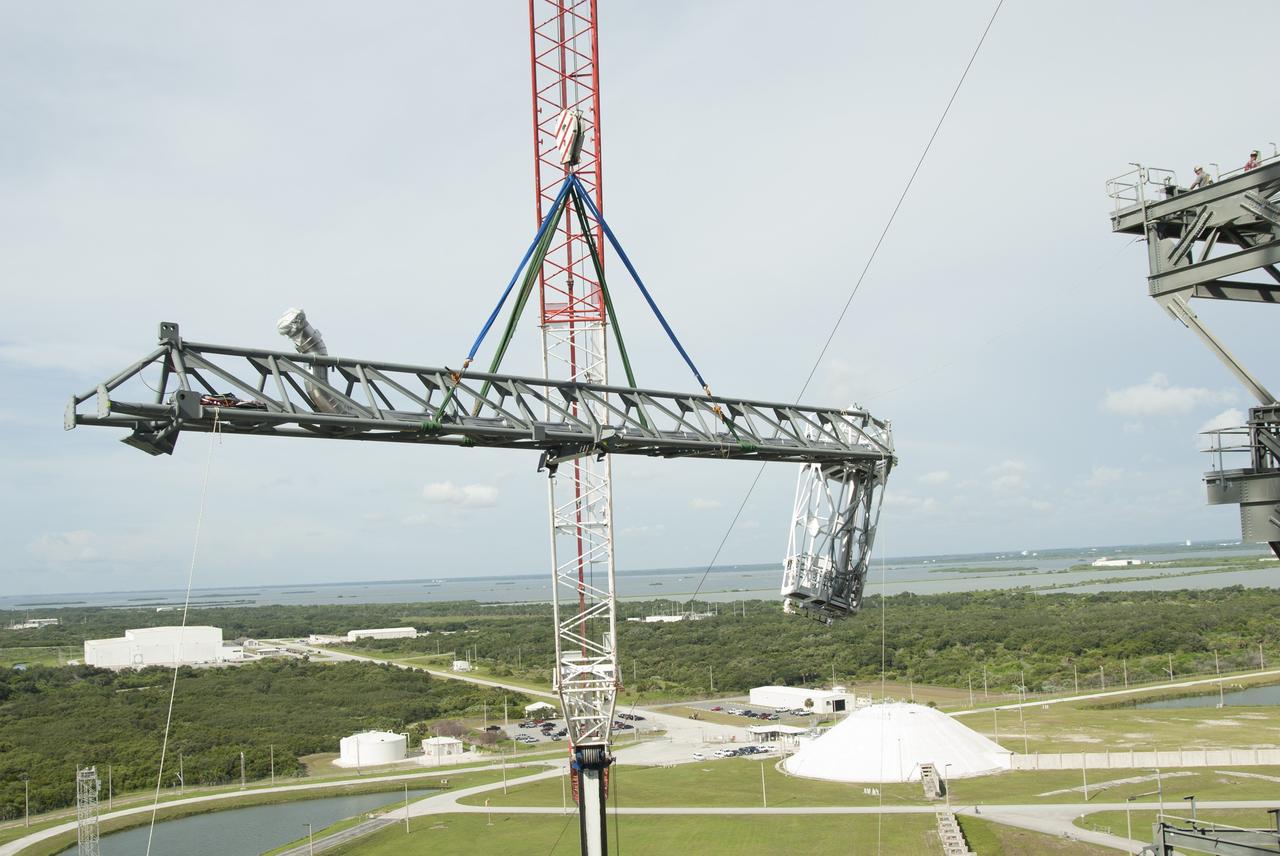
CAPE CANAVERAL, Fla. – The umbilical swing arm for Exploration Flight Test 1, or EFT-1, is lifted high by crane for installation on the fixed umbilical tower at Space Launch Complex 37 at Cape Canaveral Air Force Station in Florida. The swing arm is the uppermost of three swing arms that will be attached to the fixed umbilical tower. The swing arm will carry umbilicals that will be mated to Orion's launch abort system and environmental control system. During launch, the umbilicals will pull away from Orion and the United Launch Alliance Delta IV Heavy rocket at T-0. During the EFT-1 mission, Orion will travel farther into space than any human spacecraft has gone in more than 40 years. The data gathered during the flight will influence design decisions, validate existing computer models and innovative new approaches to space systems development, as well as reduce overall mission risks and costs for later Orion flights. Liftoff of Orion on its first flight test is planned for fall 2014. Photo credit: NASA/Jim Grossmann
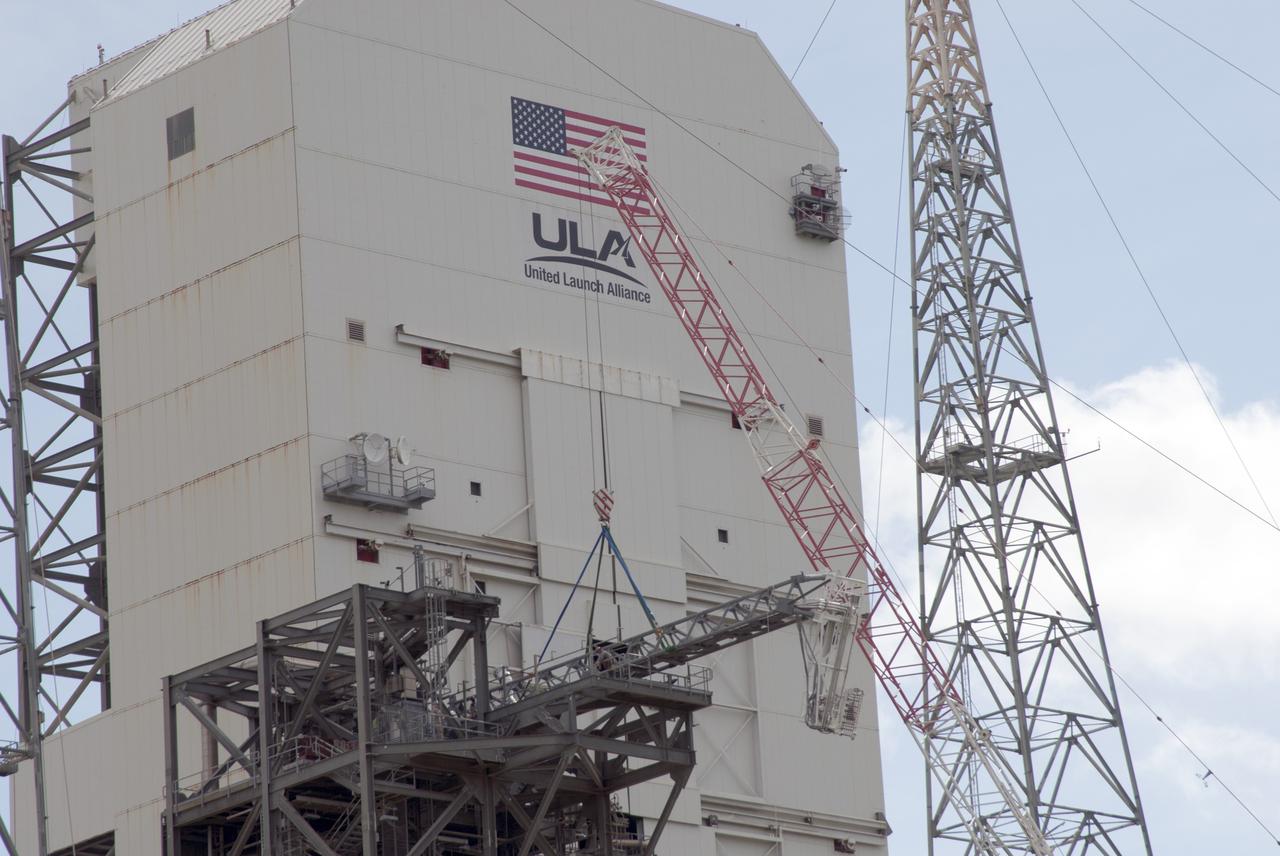
CAPE CANAVERAL, Fla. – A crane brings the umbilical swing arm for Exploration Flight Test 1, or EFT-1, closer for installation on the fixed umbilical tower at Space Launch Complex 37 at Cape Canaveral Air Force Station in Florida. The swing arm is the uppermost of three swing arms that will be attached to the fixed umbilical tower. The swing arm will carry umbilicals that will be mated to Orion's launch abort system and environmental control system. During launch, the umbilicals will pull away from Orion and the United Launch Alliance Delta IV Heavy rocket at T-0. During the EFT-1 mission, Orion will travel farther into space than any human spacecraft has gone in more than 40 years. The data gathered during the flight will influence design decisions, validate existing computer models and innovative new approaches to space systems development, as well as reduce overall mission risks and costs for later Orion flights. Liftoff of Orion on its first flight test is planned for fall 2014. Photo credit: NASA/Jim Grossmann
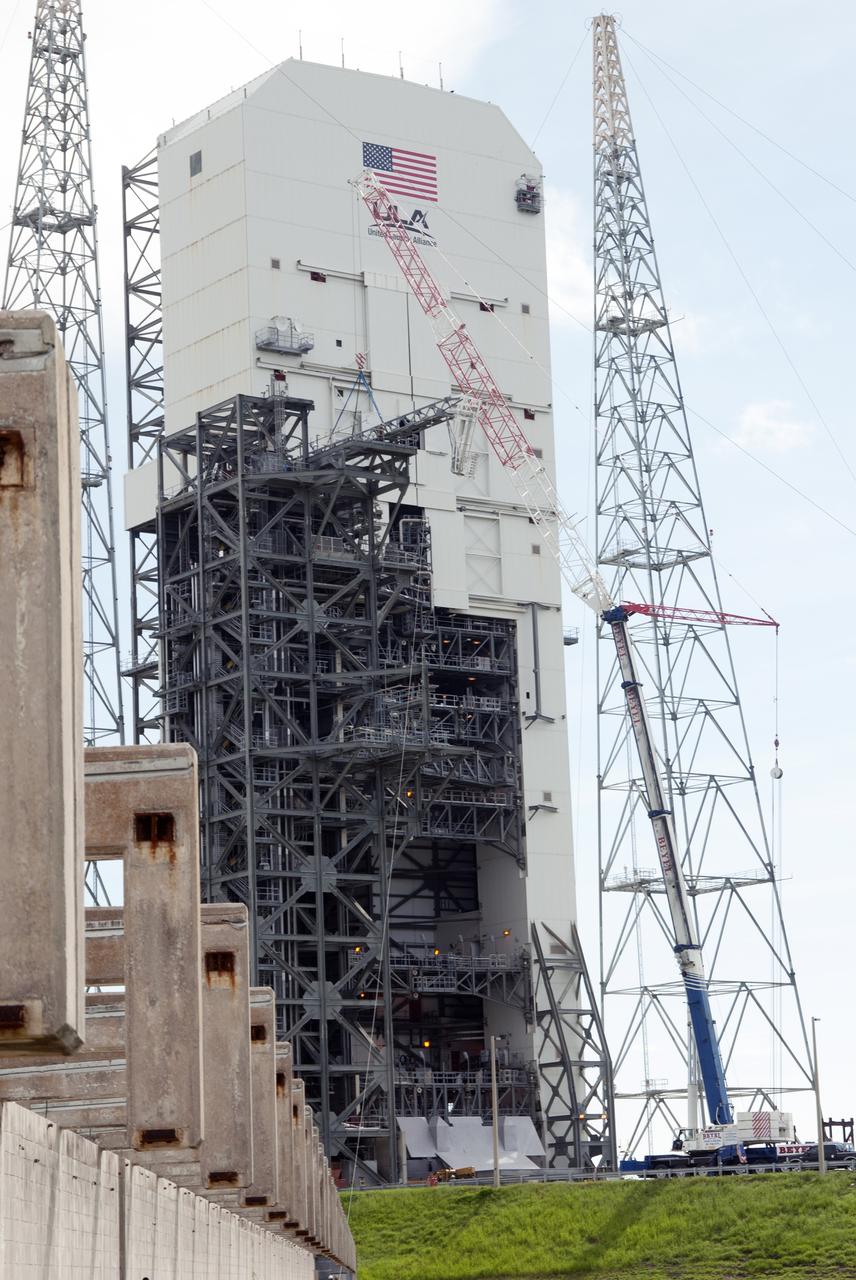
CAPE CANAVERAL, Fla. – A crane brings the umbilical swing arm for Exploration Flight Test 1, or EFT-1, closer for installation on the fixed umbilical tower at Space Launch Complex 37 at Cape Canaveral Air Force Station in Florida. The swing arm is the uppermost of three swing arms that will be attached to the fixed umbilical tower. The swing arm will carry umbilicals that will be mated to Orion's launch abort system and environmental control system. During launch, the umbilicals will pull away from Orion and the United Launch Alliance Delta IV Heavy rocket at T-0. During the EFT-1 mission, Orion will travel farther into space than any human spacecraft has gone in more than 40 years. The data gathered during the flight will influence design decisions, validate existing computer models and innovative new approaches to space systems development, as well as reduce overall mission risks and costs for later Orion flights. Liftoff of Orion on its first flight test is planned for fall 2014. Photo credit: NASA/Jim Grossmann

CAPE CANAVERAL, Fla. – A crane brings the umbilical swing arm for Exploration Flight Test 1, or EFT-1, closer for installation on the fixed umbilical tower at Space Launch Complex 37 at Cape Canaveral Air Force Station in Florida. The swing arm is the uppermost of three swing arms that will be attached to the fixed umbilical tower. The swing arm will carry umbilicals that will be mated to Orion's launch abort system and environmental control system. During launch, the umbilicals will pull away from Orion and the United Launch Alliance Delta IV Heavy rocket at T-0. During the EFT-1 mission, Orion will travel farther into space than any human spacecraft has gone in more than 40 years. The data gathered during the flight will influence design decisions, validate existing computer models and innovative new approaches to space systems development, as well as reduce overall mission risks and costs for later Orion flights. Liftoff of Orion on its first flight test is planned for fall 2014. Photo credit: NASA/Jim Grossmann
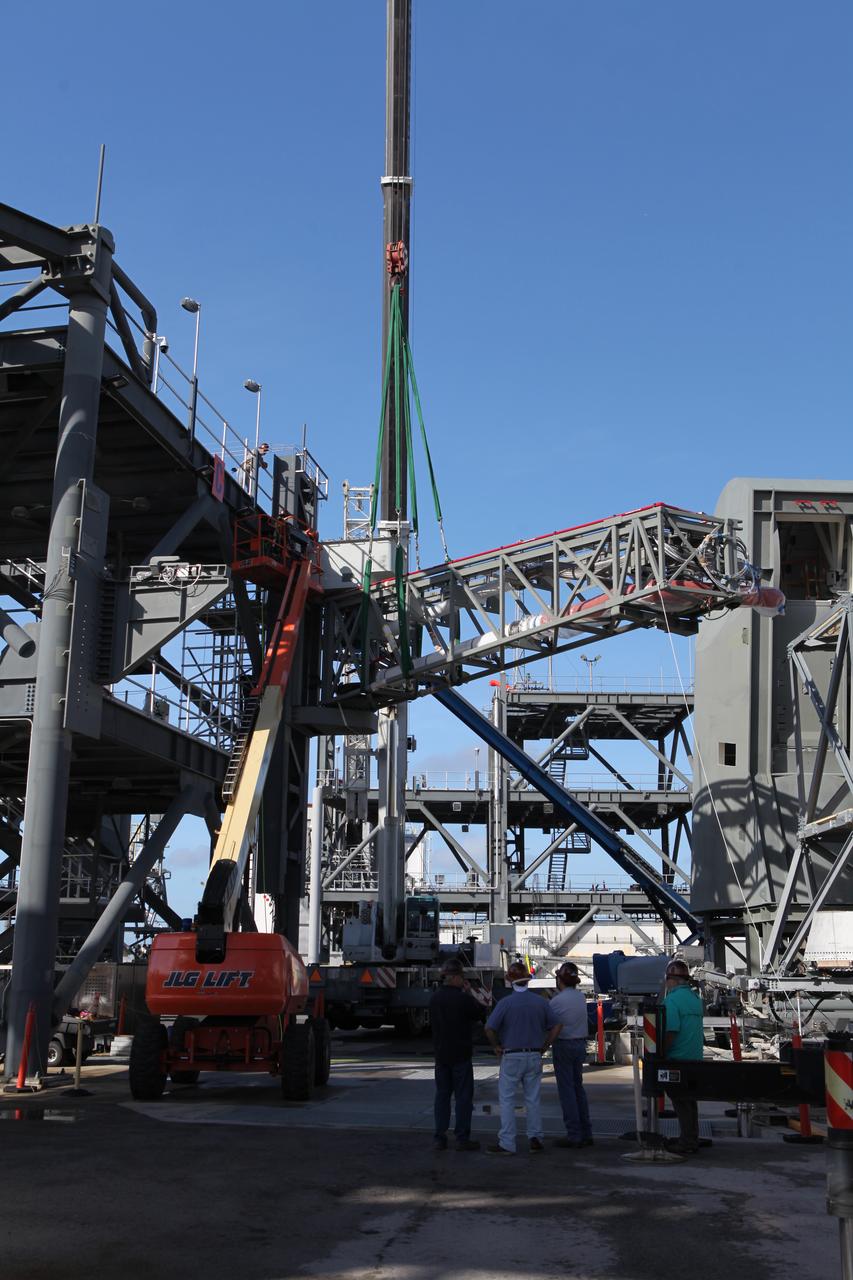
CAPE CANAVERAL, Fla. – A crane brings the umbilical swing arm for Exploration Flight Test 1, or EFT-1, closer for installation on the fixed umbilical tower at Space Launch Complex 37 at Cape Canaveral Air Force Station in Florida. The swing arm is the uppermost of three swing arms that will be attached to the fixed umbilical tower. The swing arm will carry umbilicals that will be mated to Orion's launch abort system and environmental control system. During launch, the umbilicals will pull away from Orion and the United Launch Alliance Delta IV Heavy rocket at T-0. During the EFT-1 mission, Orion will travel farther into space than any human spacecraft has gone in more than 40 years. The data gathered during the flight will influence design decisions, validate existing computer models and innovative new approaches to space systems development, as well as reduce overall mission risks and costs for later Orion flights. Liftoff of Orion on its first flight test is planned for fall 2014. Photo credit: NASA/Jim Grossmann
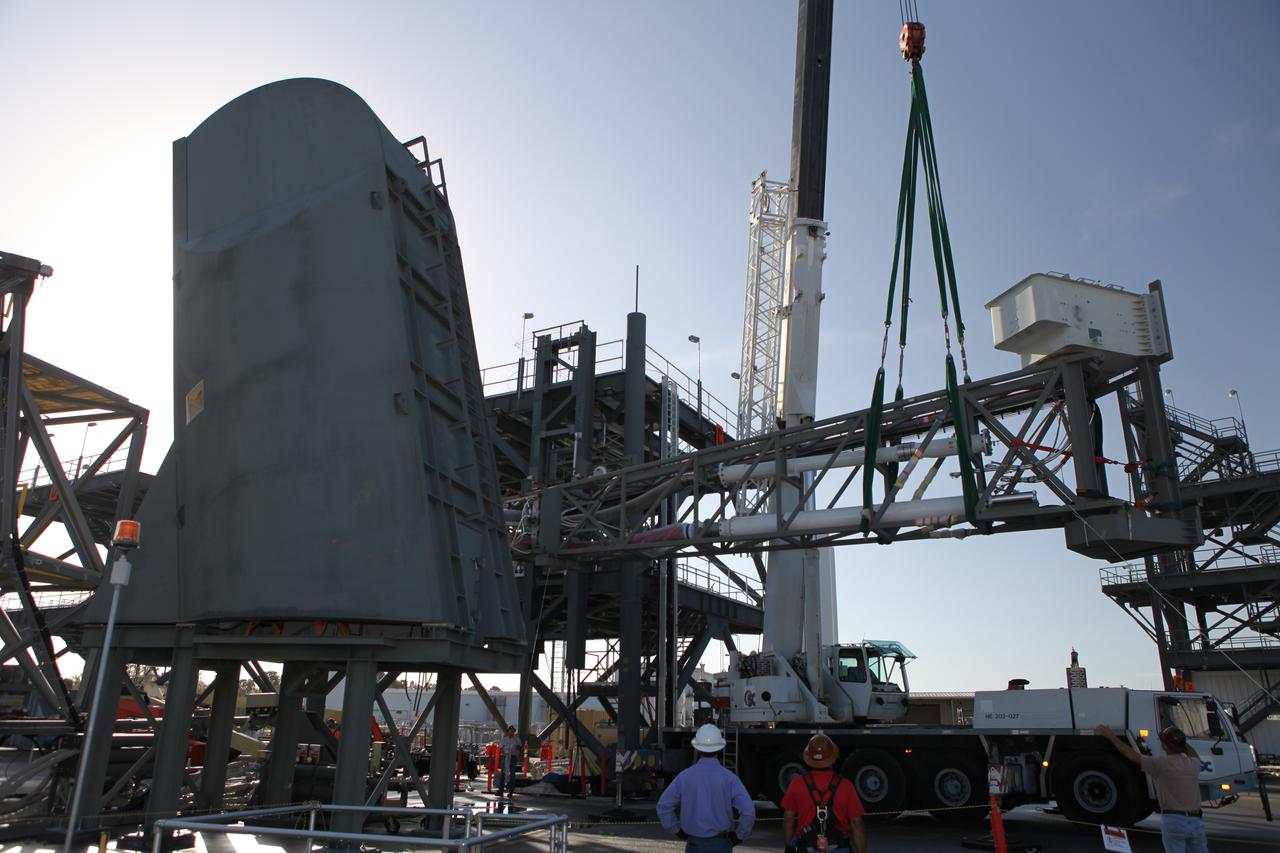
A crane moves the Core State Inter-tank Umbilical (CSITU) for NASA's Space Launch System (SLS) closer for attachment to the "C" tower of the Vehicle Motion Simulator 2 test fixture at the Launch Equipment Test Facility at the agency's Kennedy Space Center in Florida. The umbilical will undergo a series of tests to confirm it is functioning properly and ready to support the SLS rocket for launch. The CSITU is a swing arm umbilical that will connect to the SLS core stage inter-tank. The umbilical's main function is to vent gaseous hydrogen from the core stage. The arm also provides conditioned air, pressurized gases, and power and data connection to the core stage. The center’s Engineering Directorate and the Ground Systems Development and Operations Program are overseeing processing and testing of the umbilicals.
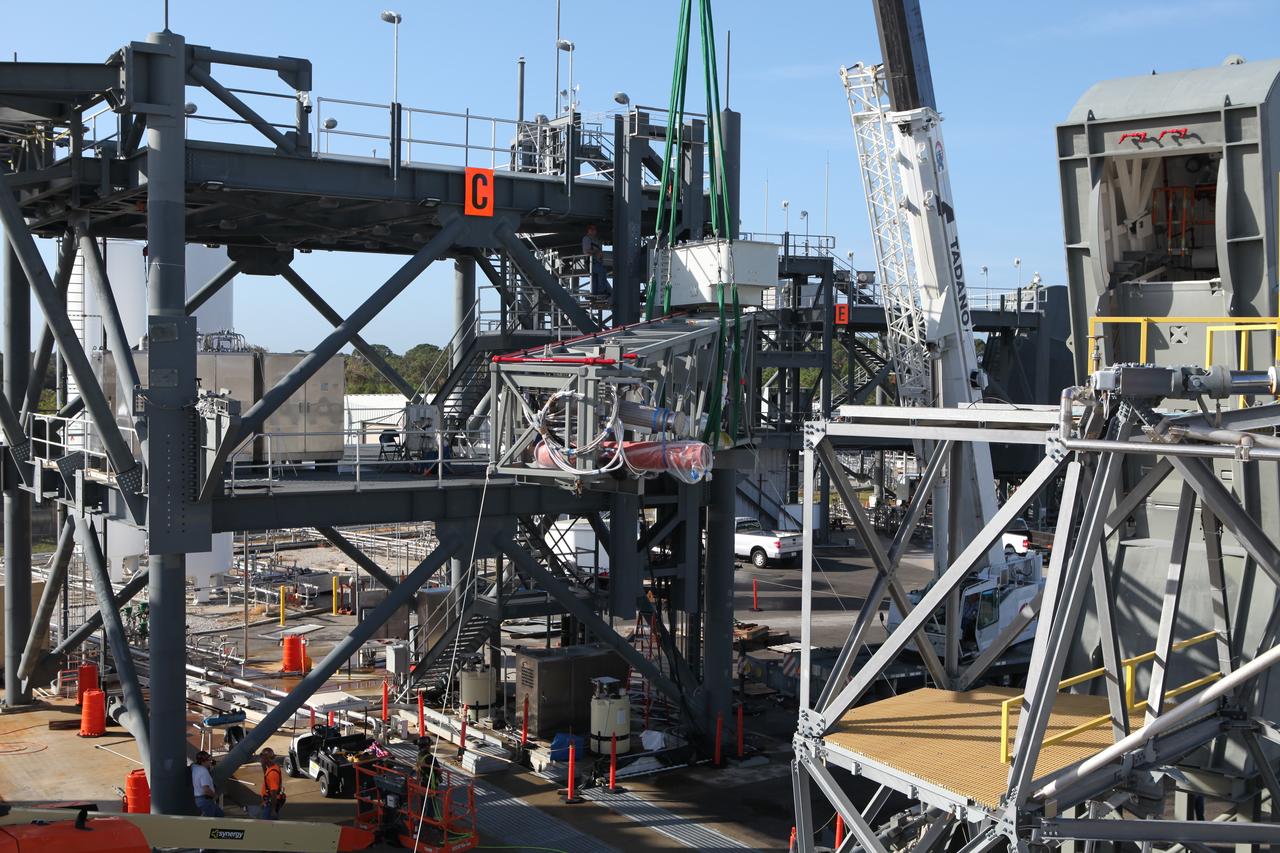
A crane is used to lift the Core State Inter-tank Umbilical (CSITU) for NASA's Space Launch System (SLS) at the Launch Equipment Test Facility at the agency's Kennedy Space Center in Florida. The CSITU will be attached to the "C" tower of the Vehicle Motion Simulator 2 test fixture. The umbilical will undergo a series of tests to confirm it is functioning properly and ready to support the SLS rocket for launch. The CSITU is a swing arm umbilical that will connect to the SLS core stage inter-tank. The umbilical's main function is to vent gaseous hydrogen from the core stage. The arm also provides conditioned air, pressurized gases, and power and data connection to the core stage. The center’s Engineering Directorate and the Ground Systems Development and Operations Program are overseeing processing and testing of the umbilicals.
A crane lifts the Core State Inter-tank Umbilical (CSITU) for NASA's Space Launch System (SLS) at the Launch Equipment Test Facility at the agency's Kennedy Space Center in Florida. The CSITU will be attached to the "C" tower of the Vehicle Motion Simulator 2 test fixture. The umbilical will undergo a series of tests to confirm it is functioning properly and ready to support the SLS rocket for launch. The CSITU is a swing arm umbilical that will connect to the SLS core stage inter-tank. The umbilical's main function is to vent gaseous hydrogen from the core stage. The arm also provides conditioned air, pressurized gases, and power and data connection to the core stage. The center’s Engineering Directorate and the Ground Systems Development and Operations Program are overseeing processing and testing of the umbilicals.
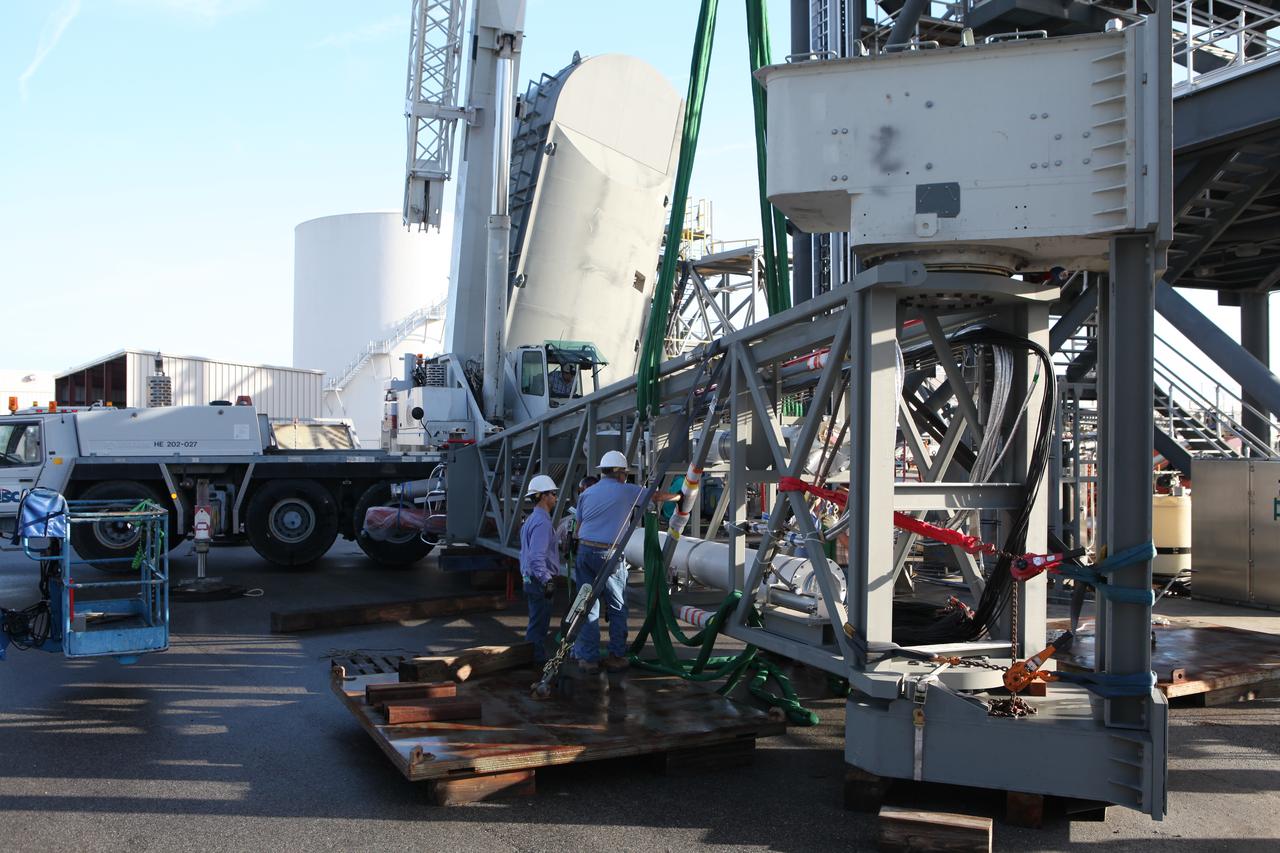
The Core State Inter-tank Umbilical (CSITU) for NASA's Space Launch System (SLS) arrives at the Launch Equipment Test Facility at the agency's Kennedy Space Center in Florida. The CSITU will be attached to the "C" tower of the Vehicle Motion Simulator 2 test fixture. The umbilical will undergo a series of tests to confirm it is functioning properly and ready to support the SLS rocket for launch. The CSITU is a swing arm umbilical that will connect to the SLS core stage inter-tank. The umbilical's main function is to vent gaseous hydrogen from the core stage. The arm also provides conditioned air, pressurized gases, and power and data connection to the core stage. The center’s Engineering Directorate and the Ground Systems Development and Operations Program are overseeing processing and testing of the umbilicals.
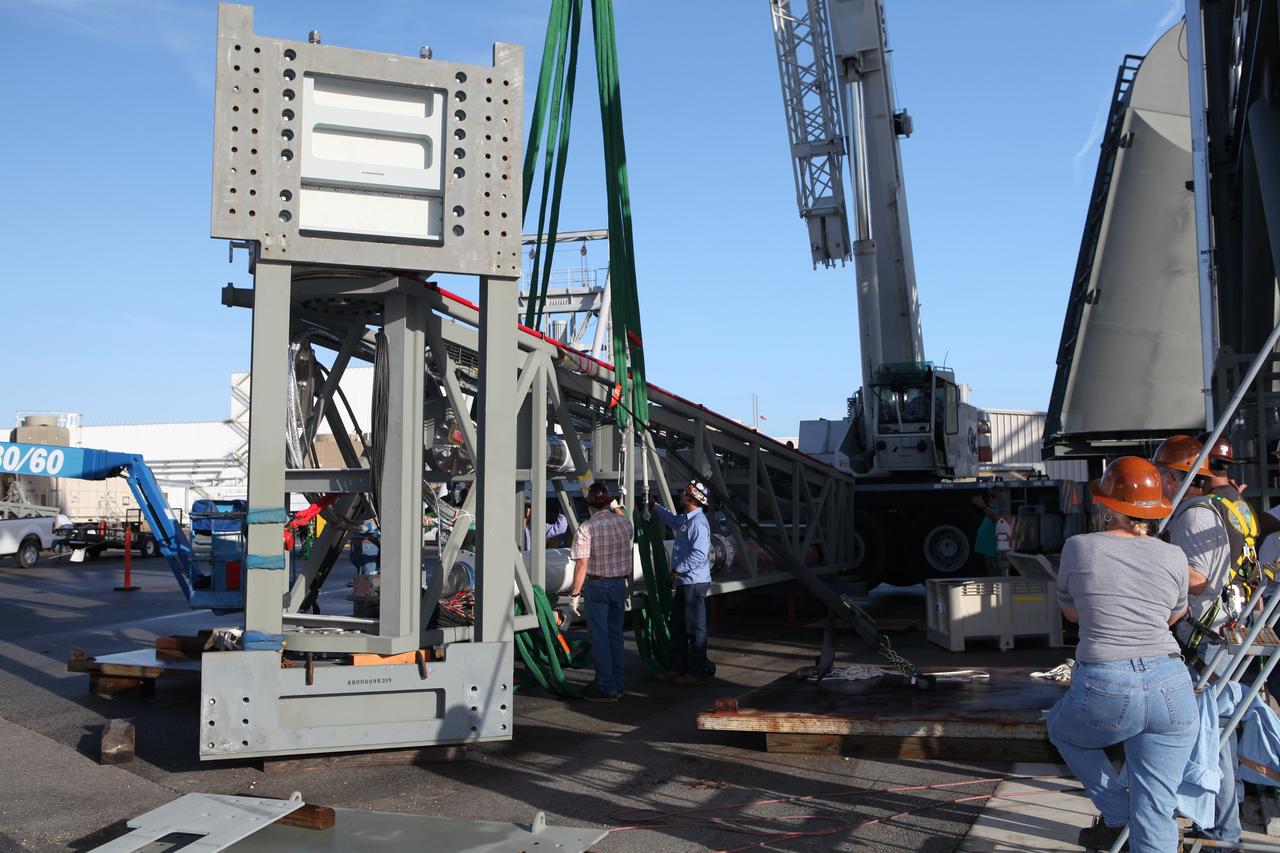
Efforts are underway to lift the Core State Inter-tank Umbilical (CSITU) for NASA's Space Launch System (SLS) at the Launch Equipment Test Facility at the agency's Kennedy Space Center in Florida. The CSITU will be attached to the "C" tower of the Vehicle Motion Simulator 2 test fixture. The umbilical will undergo a series of tests to confirm it is functioning properly and ready to support the SLS rocket for launch. The CSITU is a swing arm umbilical that will connect to the SLS core stage inter-tank. The umbilical's main function is to vent gaseous hydrogen from the core stage. The arm also provides conditioned air, pressurized gases, and power and data connection to the core stage. The center’s Engineering Directorate and the Ground Systems Development and Operations Program are overseeing processing and testing of the umbilicals.
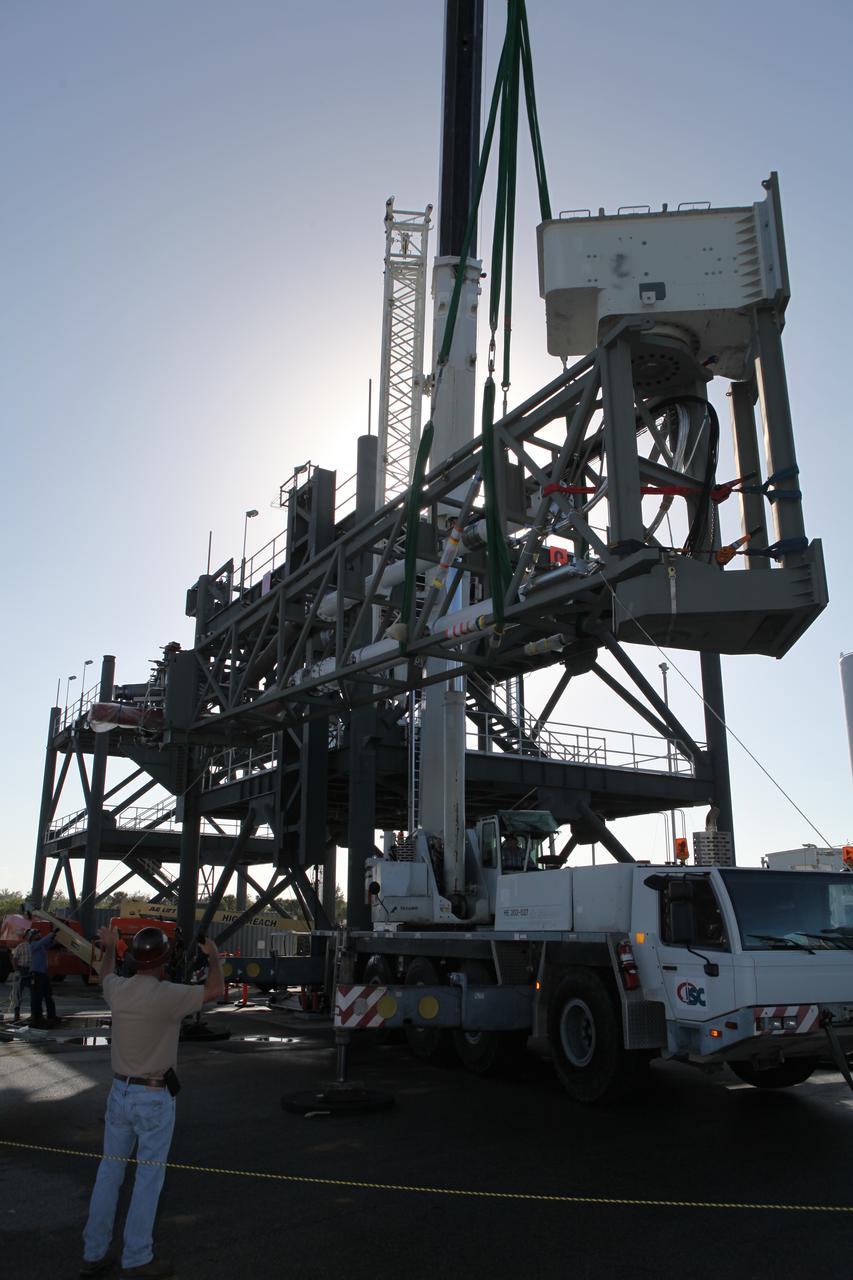
A crane is used to lift the Core State Inter-tank Umbilical (CSITU) for NASA's Space Launch System (SLS) at the Launch Equipment Test Facility at the agency's Kennedy Space Center in Florida. The CSITU will be attached to the "C" tower of the Vehicle Motion Simulator 2 test fixture. The umbilical will undergo a series of tests to confirm it is functioning properly and ready to support the SLS rocket for launch. The CSITU is a swing arm umbilical that will connect to the SLS core stage inter-tank. The umbilical's main function is to vent gaseous hydrogen from the core stage. The arm also provides conditioned air, pressurized gases, and power and data connection to the core stage. The center’s Engineering Directorate and the Ground Systems Development and Operations Program are overseeing processing and testing of the umbilicals.
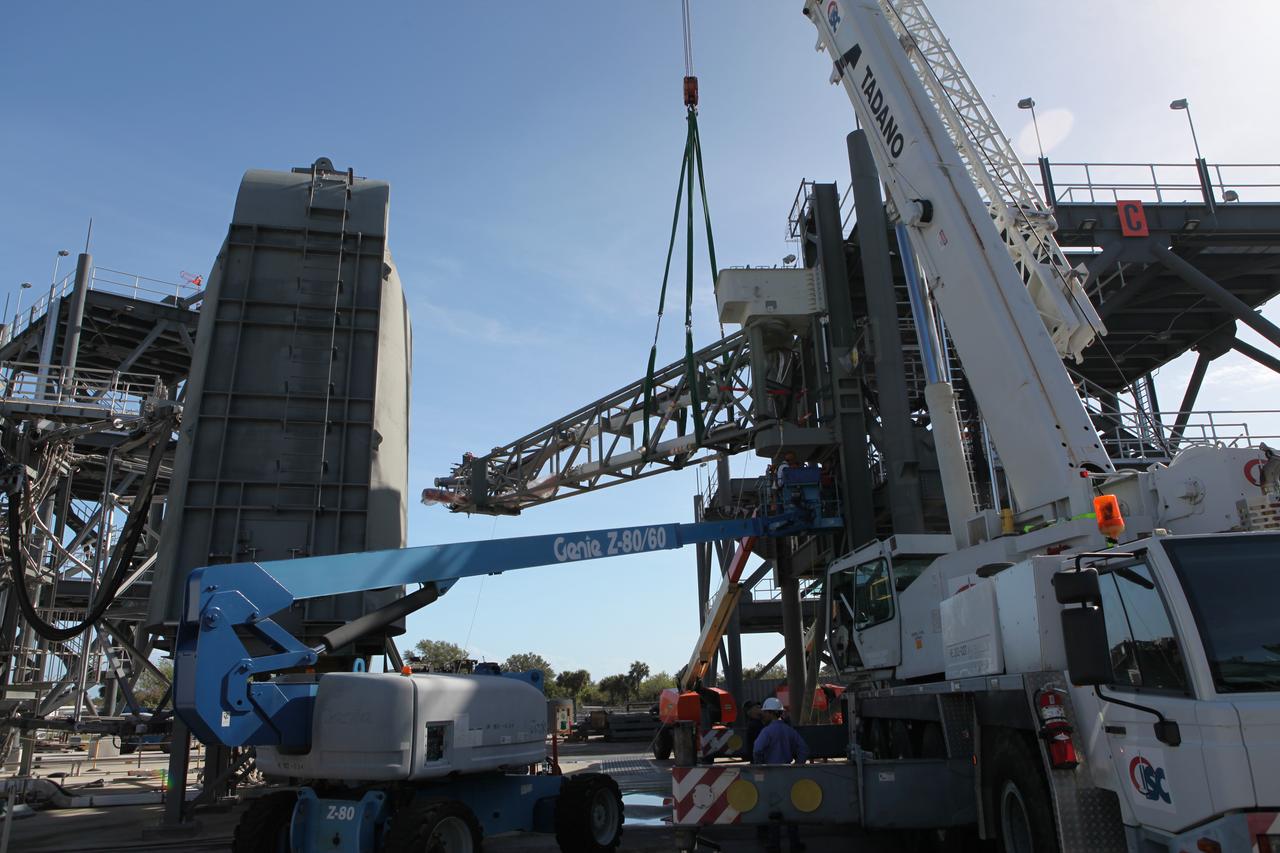
The Core State Inter-tank Umbilical (CSITU) for NASA's Space Launch System (SLS) is attached to the "C" tower of the Vehicle Motion Simulator 2 test fixture at the Launch Equipment Test Facility at the agency's Kennedy Space Center in Florida. The umbilical will undergo a series of tests to confirm it is functioning properly and ready to support the SLS rocket for launch. The CSITU is a swing arm umbilical that will connect to the SLS core stage inter-tank. The umbilical's main function is to vent gaseous hydrogen from the core stage. The arm also provides conditioned air, pressurized gases, and power and data connection to the core stage. The center’s Engineering Directorate and the Ground Systems Development and Operations Program are overseeing processing and testing of the umbilicals.

A crane is used to lift the Core State Inter-tank Umbilical (CSITU) for NASA's Space Launch System (SLS) at the Launch Equipment Test Facility at the agency's Kennedy Space Center in Florida. The CSITU will be attached to the "C" tower of the Vehicle Motion Simulator 2 test fixture. The umbilical will undergo a series of tests to confirm it is functioning properly and ready to support the SLS rocket for launch. The CSITU is a swing arm umbilical that will connect to the SLS core stage inter-tank. The umbilical's main function is to vent gaseous hydrogen from the core stage. The arm also provides conditioned air, pressurized gases, and power and data connection to the core stage. The center’s Engineering Directorate and the Ground Systems Development and Operations Program are overseeing processing and testing of the umbilicals.
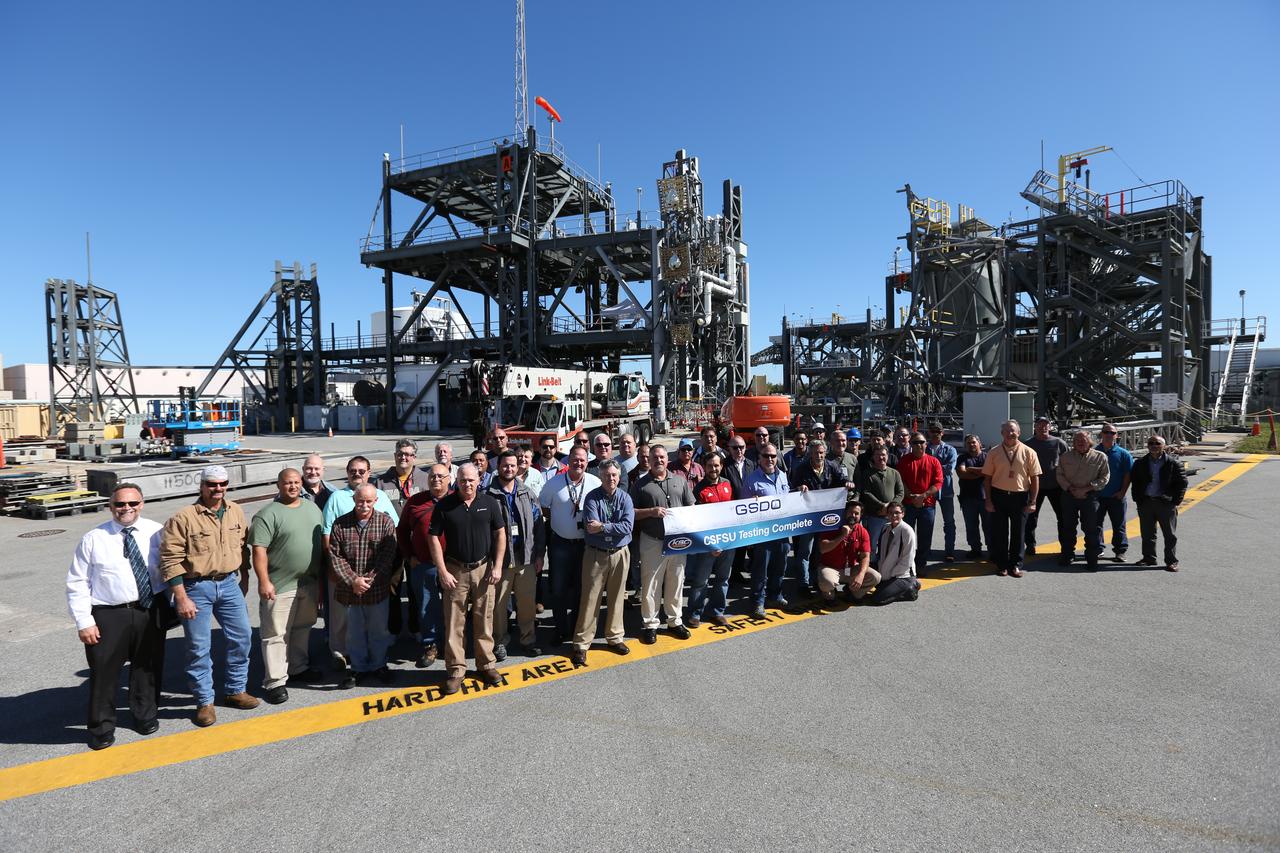
The test team holds a signed banner at the Launch Equipment Test Facility at Kennedy Space Center in Florida. Behind them are some of the test structures used to test the launch umbilicals. Testing of the Core Stage Forward Skirt Umbilical (CSFSU) for NASA's Space Launch System is complete and the umbilical has been transported to the mobile launcher area. The umbilical will be prepared for installation on the tower of the mobile launcher. The CSFSU will be mated to the core stage forward skirt to provide commodities to the SLS rocket, and then disconnect and swing away before launch. Its main purpose is to provide conditioned air and gaseous nitrogen to the SLS Core Stage Forward Skirt. The center’s Engineering Directorate and the Ground Systems Development and Operations Program are overseeing processing and testing of the umbilicals.
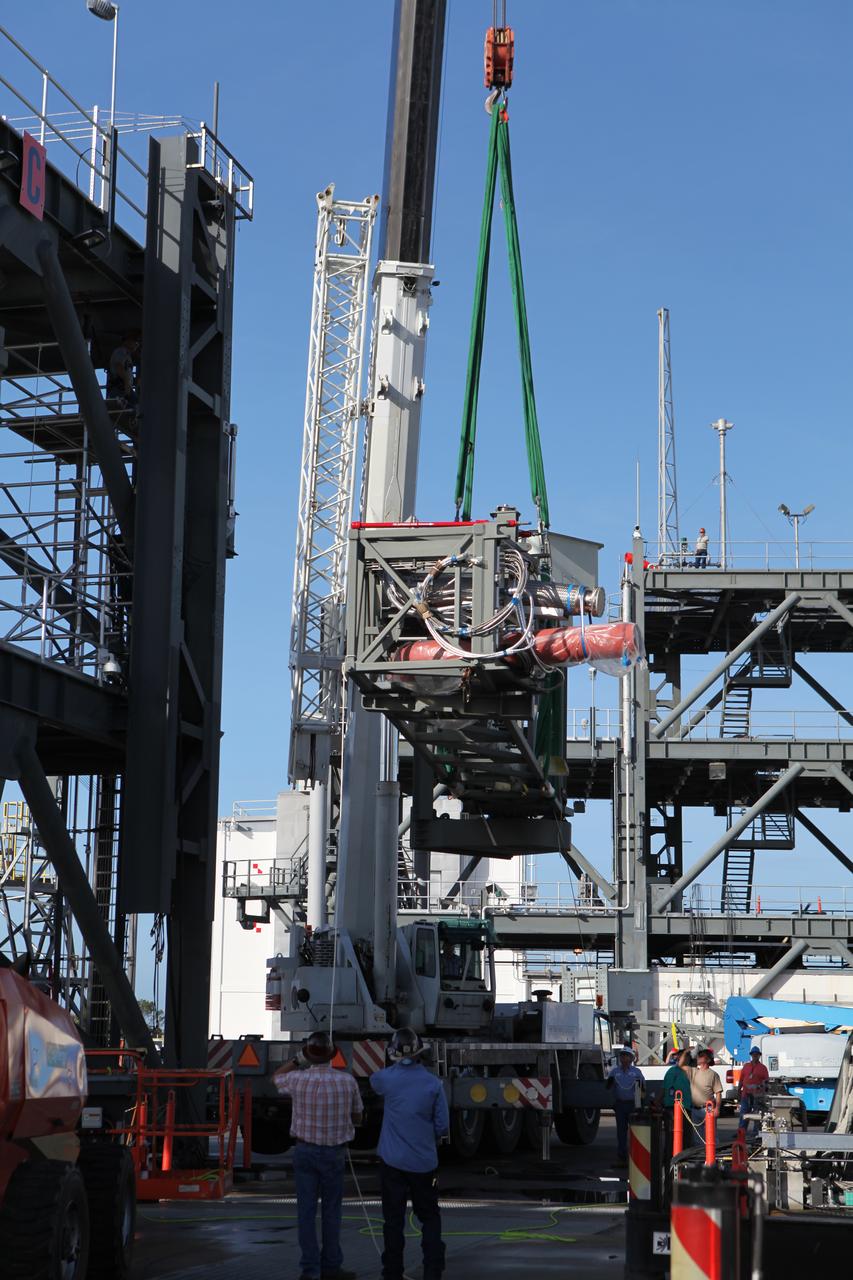
A crane is used to lift the Core State Inter-tank Umbilical (CSITU) for NASA's Space Launch System (SLS) at the Launch Equipment Test Facility at the agency's Kennedy Space Center in Florida. The CSITU will be attached to the "C" tower of the Vehicle Motion Simulator 2 test fixture. The umbilical will undergo a series of tests to confirm it is functioning properly and ready to support the SLS rocket for launch. The CSITU is a swing arm umbilical that will connect to the SLS core stage inter-tank. The umbilical's main function is to vent gaseous hydrogen from the core stage. The arm also provides conditioned air, pressurized gases, and power and data connection to the core stage. The center’s Engineering Directorate and the Ground Systems Development and Operations Program are overseeing processing and testing of the umbilicals.
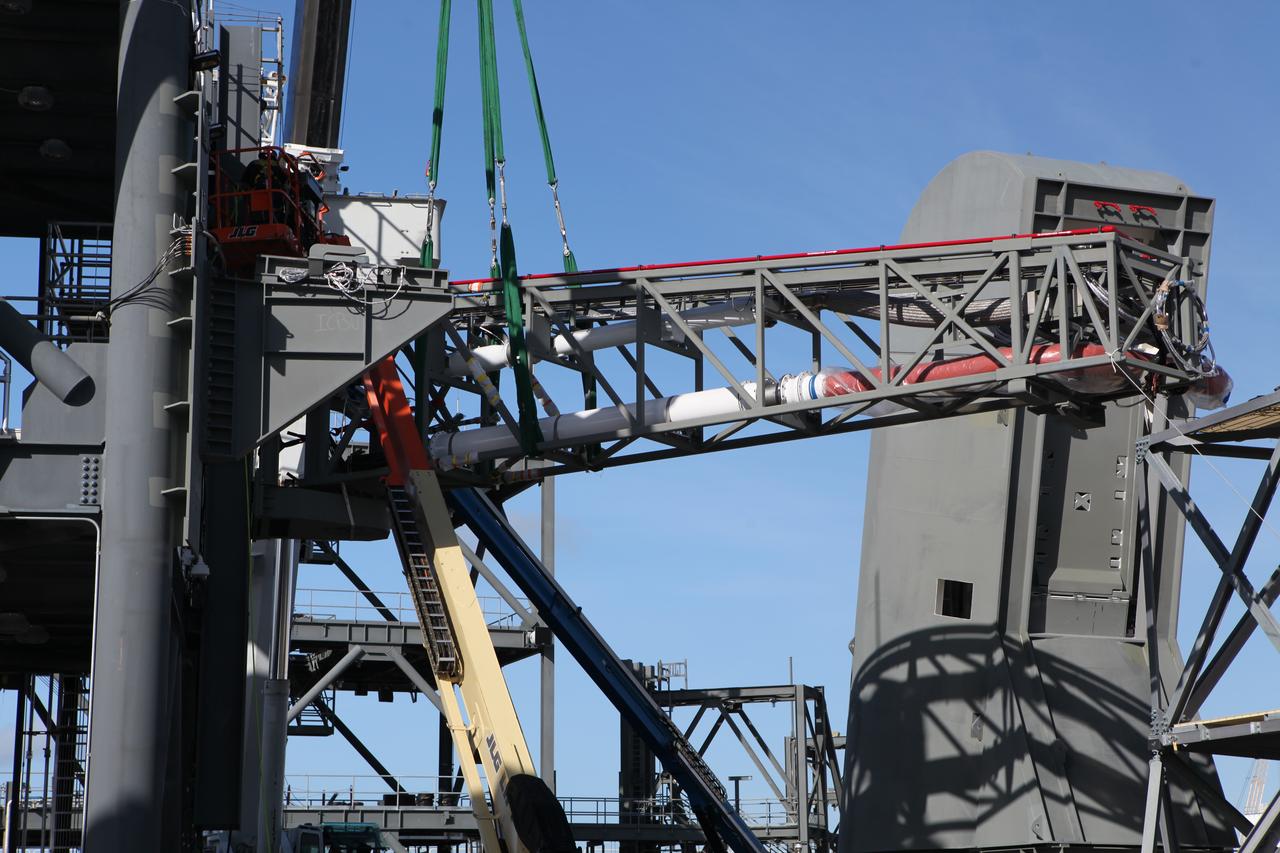
A crane moves the Core State Inter-tank Umbilical (CSITU) for NASA's Space Launch System (SLS) closer for attachment to the "C" tower of the Vehicle Motion Simulator 2 test fixture at the Launch Equipment Test Facility at the agency's Kennedy Space Center in Florida. The umbilical will undergo a series of tests to confirm it is functioning properly and ready to support the SLS rocket for launch. The CSITU is a swing arm umbilical that will connect to the SLS core stage inter-tank. The umbilical's main function is to vent gaseous hydrogen from the core stage. The arm also provides conditioned air, pressurized gases, and power and data connection to the core stage. The center’s Engineering Directorate and the Ground Systems Development and Operations Program are overseeing processing and testing of the umbilicals.
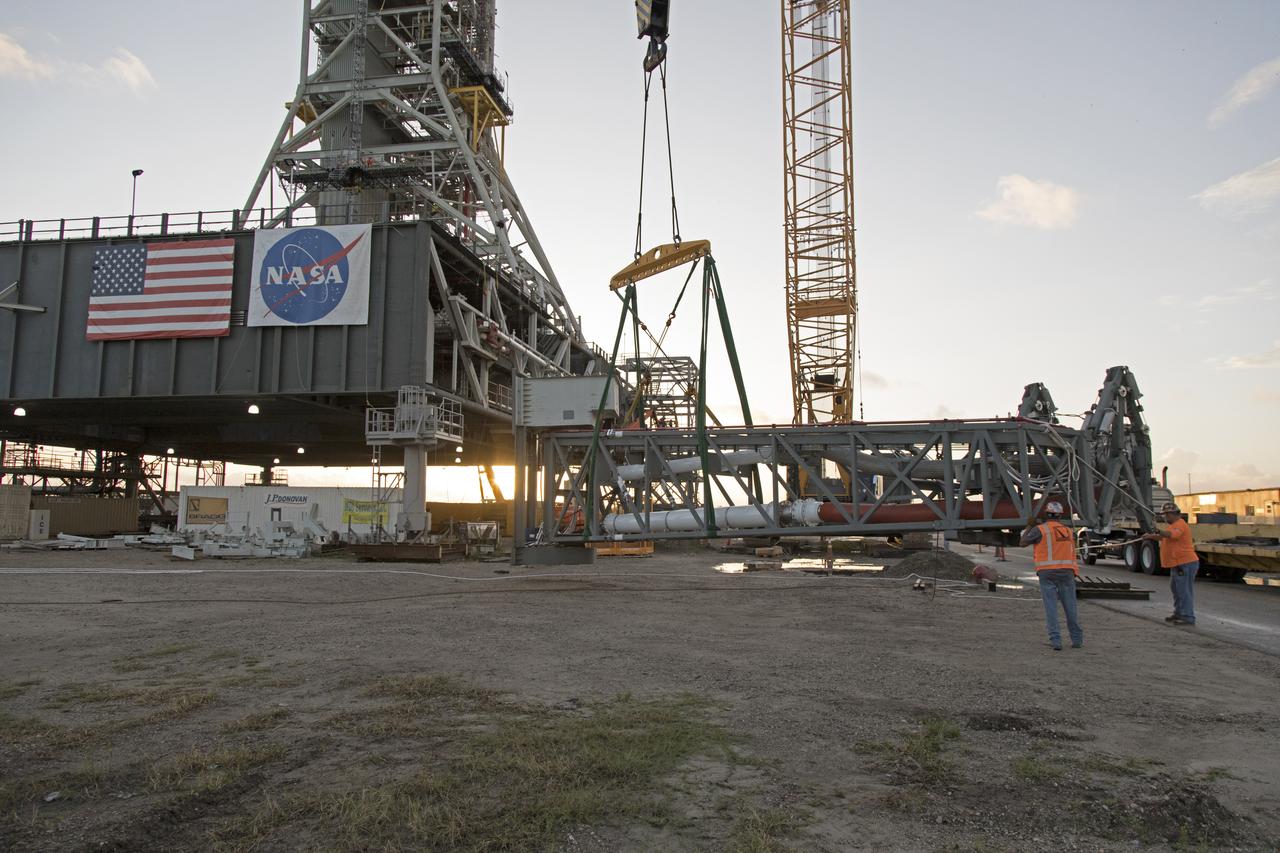
A heavy-lift crane has been attached to the Core Stage Inter-tank Umbilical (CSITU) to lift it up from a flatbed truck near the Vehicle Assembly Building at NASA's Kennedy Space Center in Florida. The CSITU will be lifted up to about the 140-foot level of the mobile launcher (ML) tower for a fit check of the attachment hardware. It will be lowered down and installed permanently on the ML at a later date. The CSITU is a swing-arm umbilical that will connect to the Space Launch System core stage inter-tank. It will provide conditioned air, pressurized gases and power and data connection to the core stage. The Ground Systems Development and Operations Program is overseeing installation of the umbilicals.
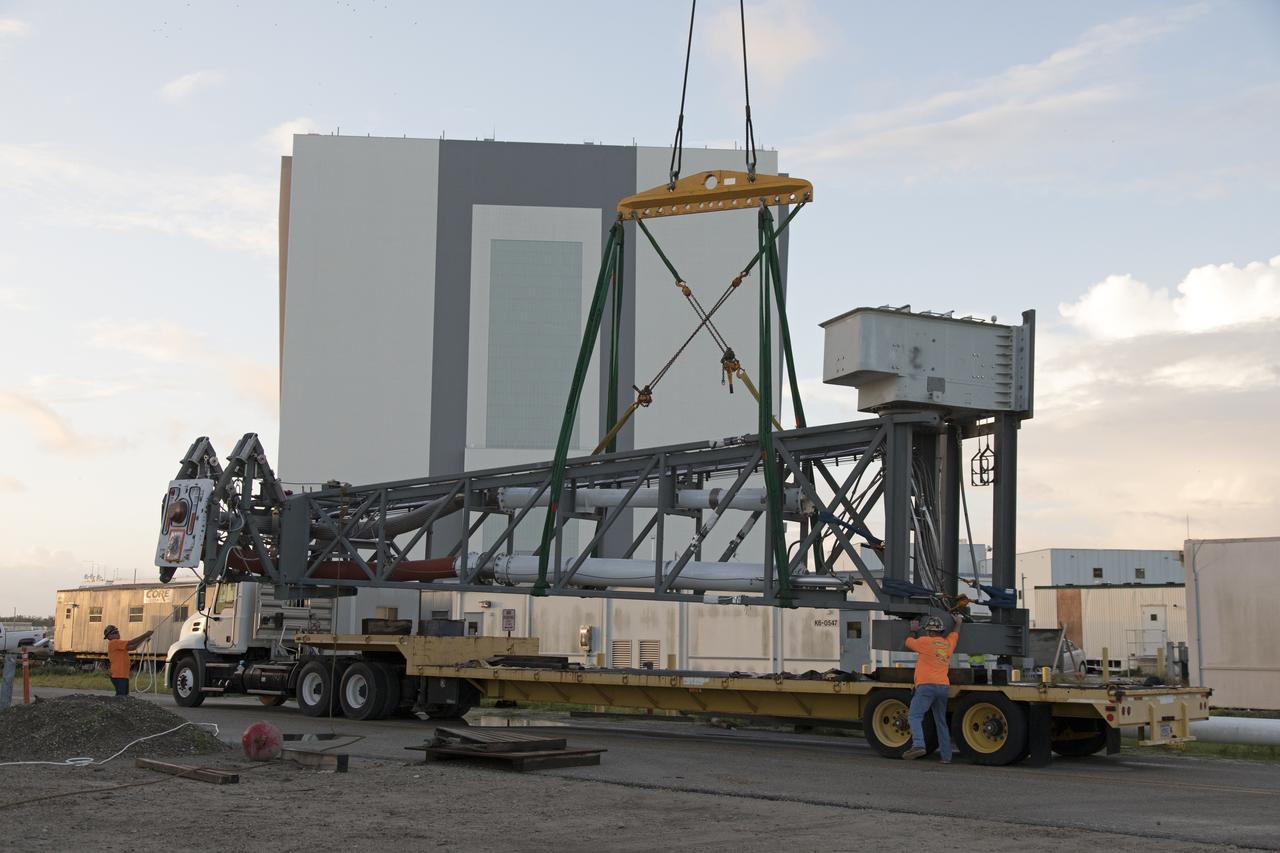
A heavy-lift crane has been attached to the Core Stage Inter-tank Umbilical (CSITU) to lift it up from a flatbed truck near the Vehicle Assembly Building at NASA's Kennedy Space Center in Florida. The CSITU will be lifted up to about the 140-foot level of the mobile launcher (ML) tower for a fit check of the attachment hardware. It will be lowered down and installed permanently on the ML at a later date. The CSITU is a swing-arm umbilical that will connect to the Space Launch System core stage inter-tank. It will provide conditioned air, pressurized gases and power and data connection to the core stage. The Ground Systems Development and Operations Program is overseeing installation of the umbilicals.
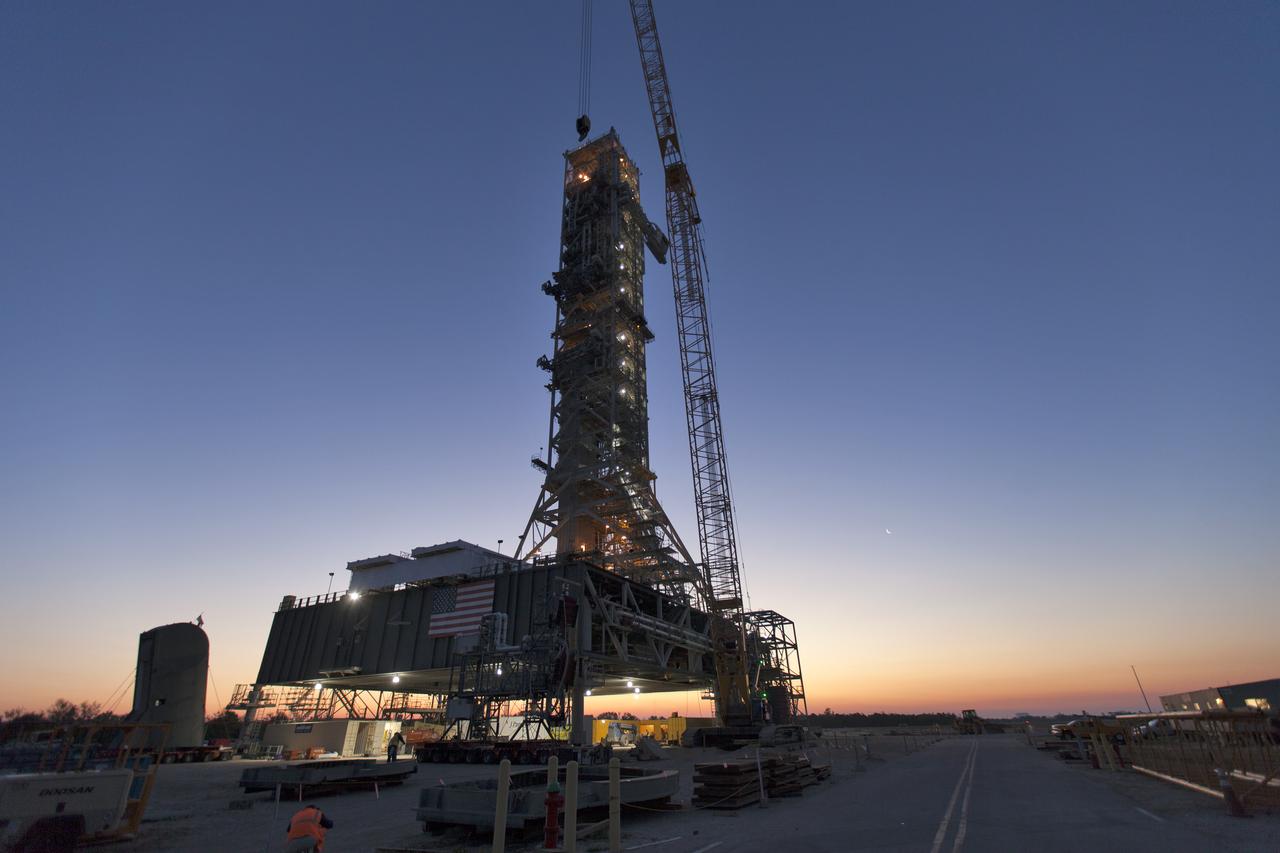
A colorful sunrise serves as the backdrop for the mobile launcher (ML) at NASA's Kennedy Space Center in Florida. Several launch umbilicals have been installed on the ML tower. Exploration Ground Systems is overseeing installation of umbilicals and launch accessories on the ML to prepare for the first integrated test flight of the Orion spacecraft on the agency's Space Launch System rocket on Exploration Mission-1.
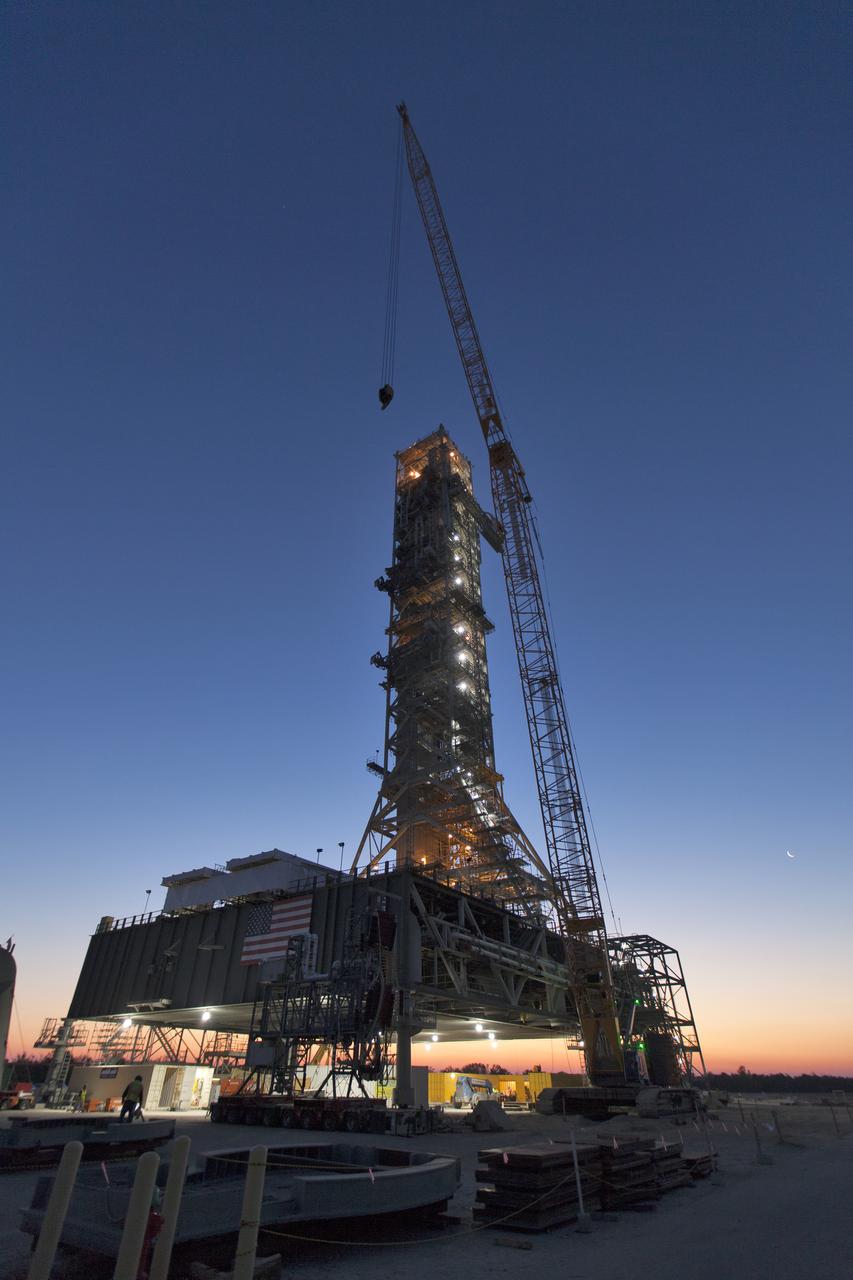
A colorful sunrise serves as the backdrop for the mobile launcher (ML) at NASA's Kennedy Space Center in Florida. Several launch umbilicals have been installed on the ML tower. Exploration Ground Systems is overseeing installation of umbilicals and launch accessories on the ML to prepare for the first integrated test flight of the Orion spacecraft on the agency's Space Launch System rocket on Exploration Mission-1.

A sliver of the Moon is visible just before sunrise at NASA's Kennedy Space Center in Florida. In view is one of the steel structures of the mobile launcher (ML). Several launch umbilicals have been installed on the ML tower. Exploration Ground Systems is overseeing installation of umbilicals and launch accessories on the ML to prepare for the first integrated test flight of the Orion spacecraft on the agency's Space Launch System rocket on Exploration Mission-1.
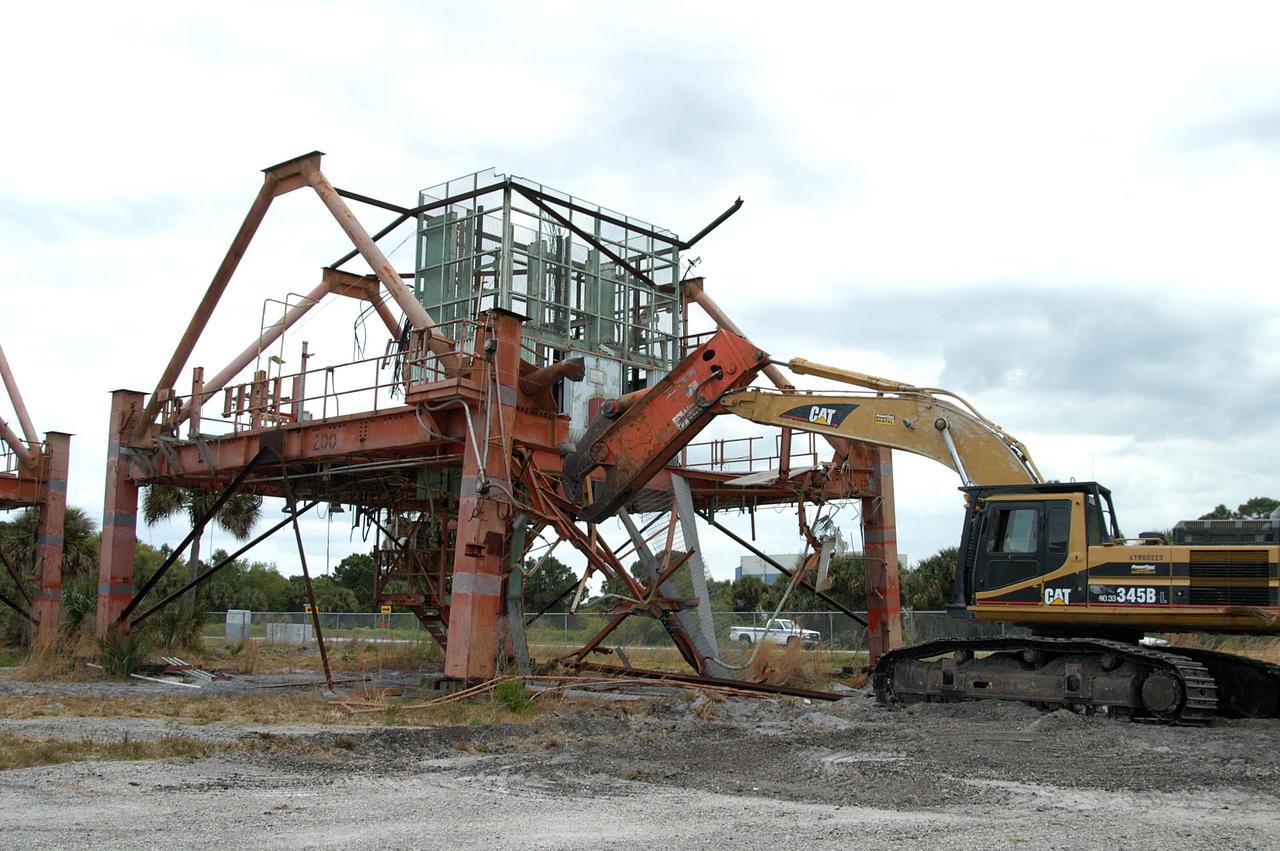
KENNEDY SPACE CENTER, FLA. -- Launch Umbilical Tower No. 1 (LUT-1), stored in the Industrial Area of KSC, is being demolished using a Caterpillar excavator and 48-inch shear attachment. Seen is the base of tower; the upright tower extended more than 398 feet above the launch pad. The LUT-1 was part of the launch system used for Apollo-Saturn V, launching Apollo 8, Apollo 11, Skylab manned missions and the Apollo-Soyuz Test Project. The shear being used for demolition is one used in the deconstruction of the Twin Towers in New York City after 9/11.
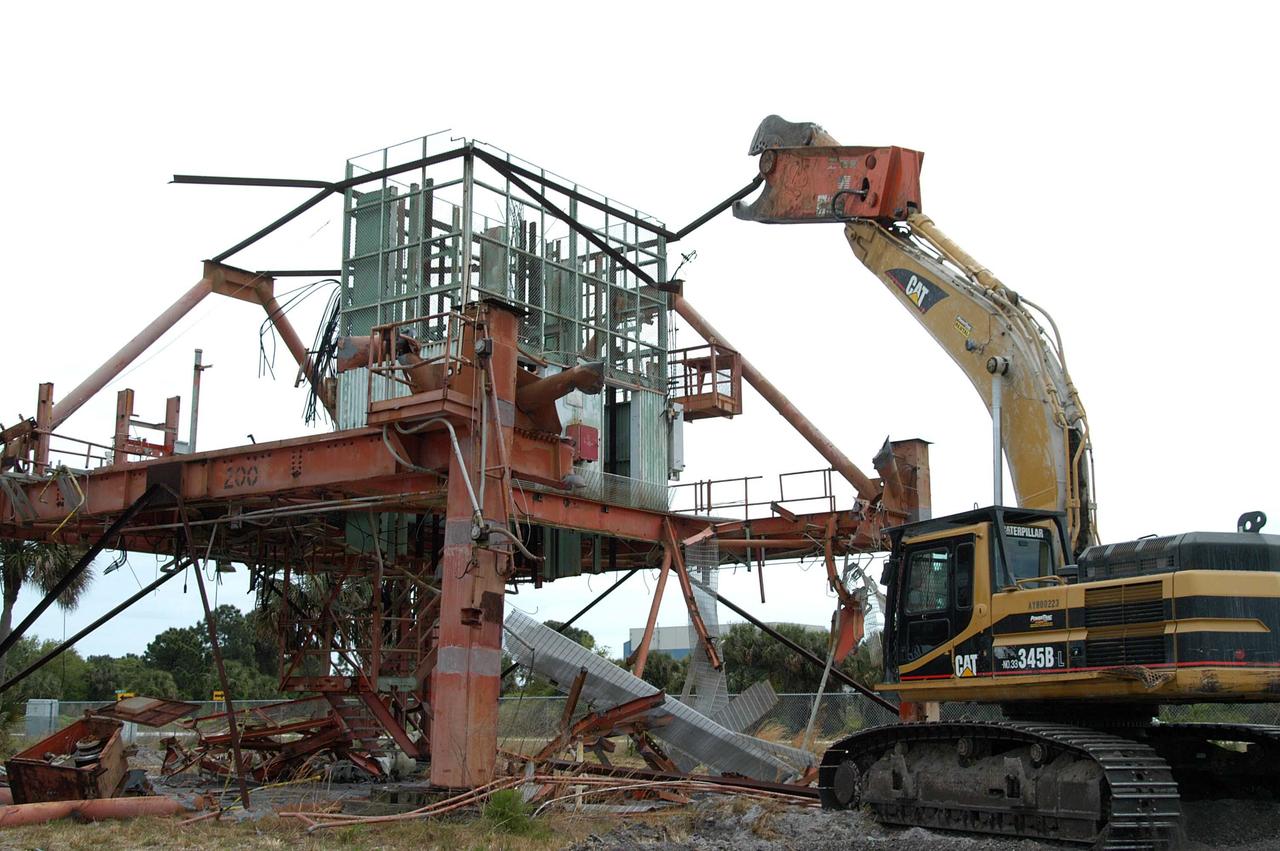
KENNEDY SPACE CENTER, FLA. -- Launch Umbilical Tower No. 1 (LUT-1) stored in the Industrial Area of KSC is being demolished with a Caterpillar excavator and 48-inch shear attachment. Seen is the base of tower; the upright tower extended more than 398 feet above the launch pad. The LUT-1 was part of the launch system used for Apollo-Saturn V, launching Apollo 8, Apollo 11, Skylab manned missions and the Apollo-Soyuz Test Project. The shear is one used in the deconstruction of the Twin Towers in New York City after 9/11.
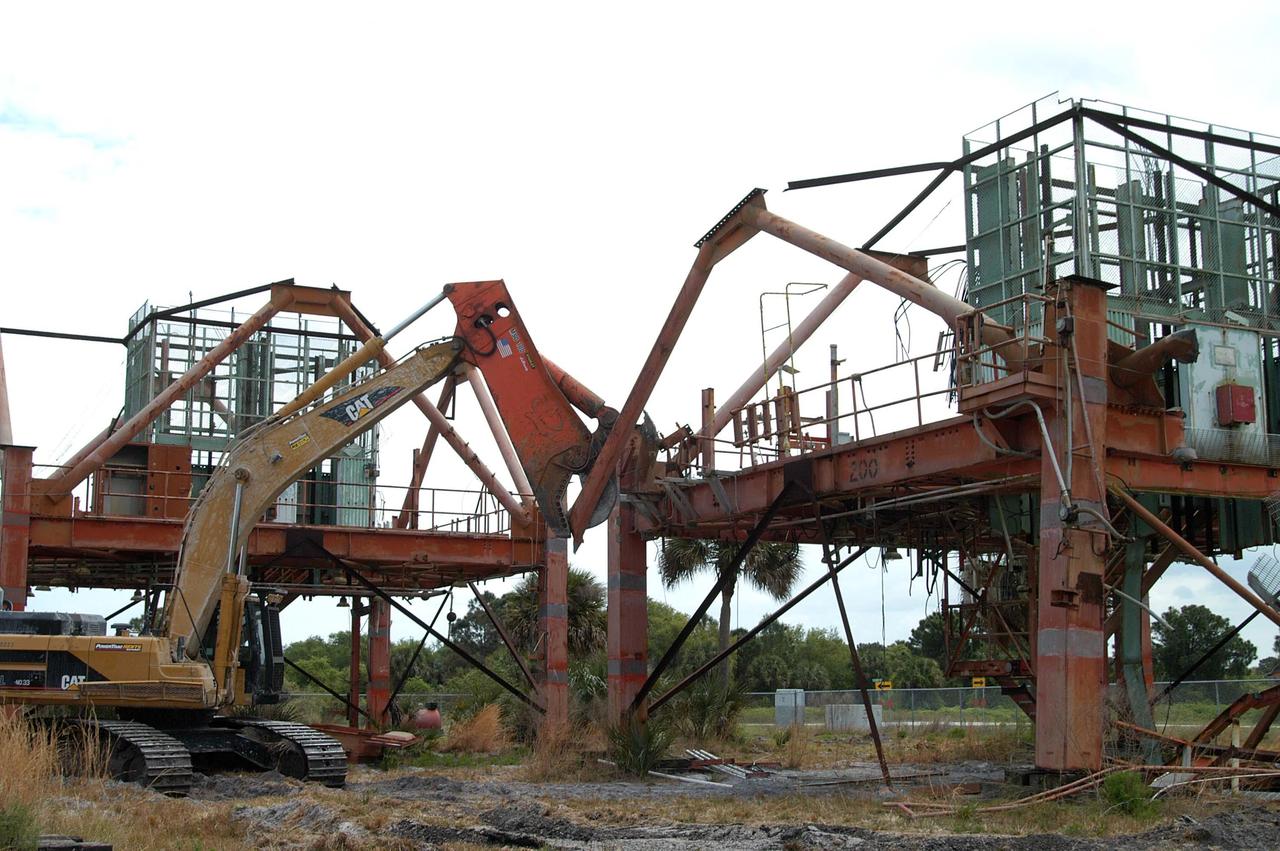
KENNEDY SPACE CENTER, FLA. -- - Launch Umbilical Tower No. 1 (LUT-1) stored in the Industrial Area of KSC is being demolished with a Caterpillar excavator and 48-inch shear attachment. Seen is the base of tower; the upright tower extended more than 398 feet above the launch pad. The LUT-1 was part of the launch system used for Apollo-Saturn V, launching Apollo 8, Apollo 11, Skylab manned missions and the Apollo-Soyuz Test Project. The shear is one used in the deconstruction of the Twin Towers in New York City after 9/11.
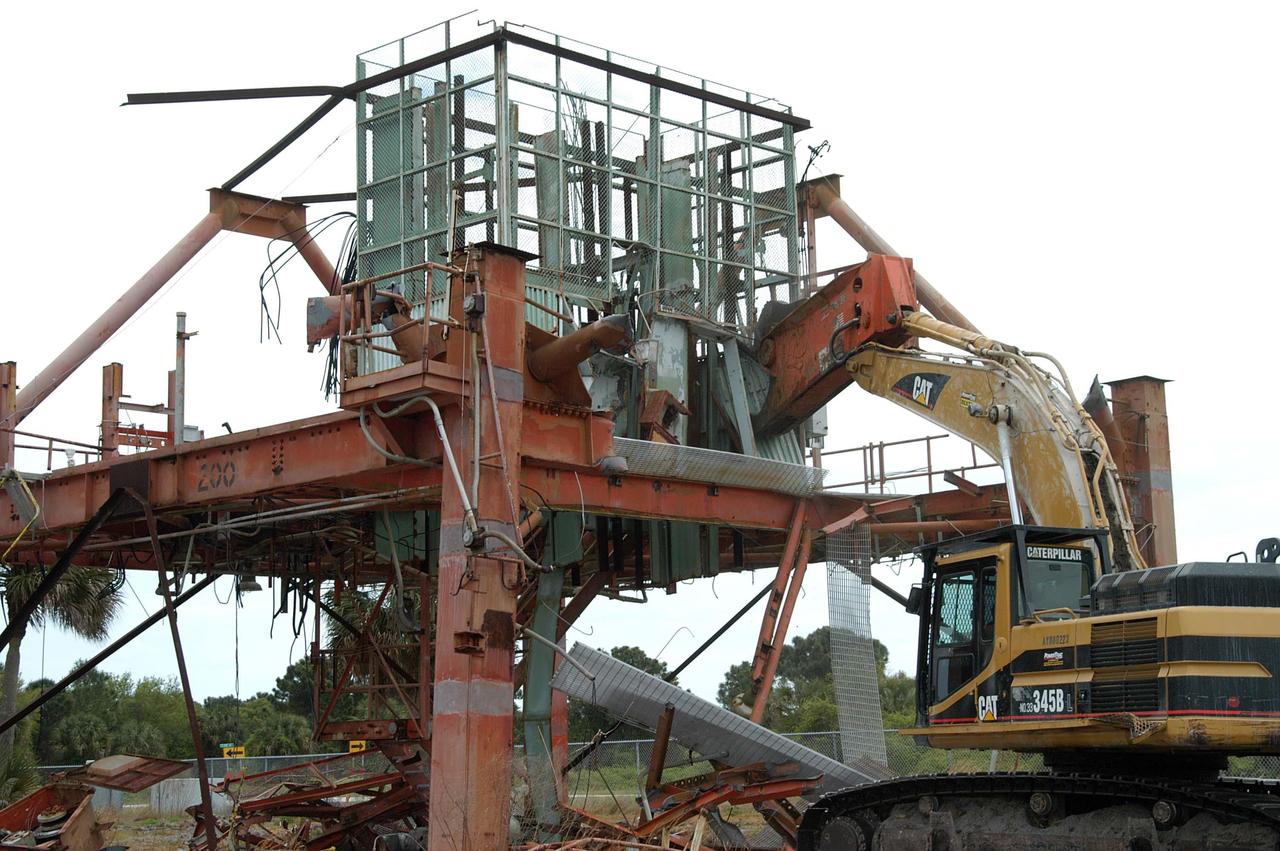
KENNEDY SPACE CENTER, FLA. -- Launch Umbilical Tower No. 1 (LUT-1) stored in the Industrial Area of KSC is being demolished with the Caterpillar excavator and 48-inch shear attachment. Seen is the base of tower; the upright tower extended more than 398 feet above the launch pad. The LUT-1 was part of the launch system used for Apollo-Saturn V, launching Apollo 8, Apollo 11, Skylab manned missions and the Apollo-Soyuz Test Project. The shear is one used in the deconstruction of the Twin Towers in New York City after 9/11.

KENNEDY SPACE CENTER, FLA. -- Launch Umbilical Tower No. 1 (LUT-1) stored in the Industrial Area of KSC is being demolished with a Caterpillar excavator and 48-inch shear attachment. Seen is the base of tower; the upright tower extended more than 398 feet above the launch pad. The LUT-1 was part of the launch system used for Apollo-Saturn V, launching Apollo 8, Apollo 11, Skylab manned missions and the Apollo-Soyuz Test Project. The shear is one used in the deconstruction of the Twin Towers in New York City after 9/11.
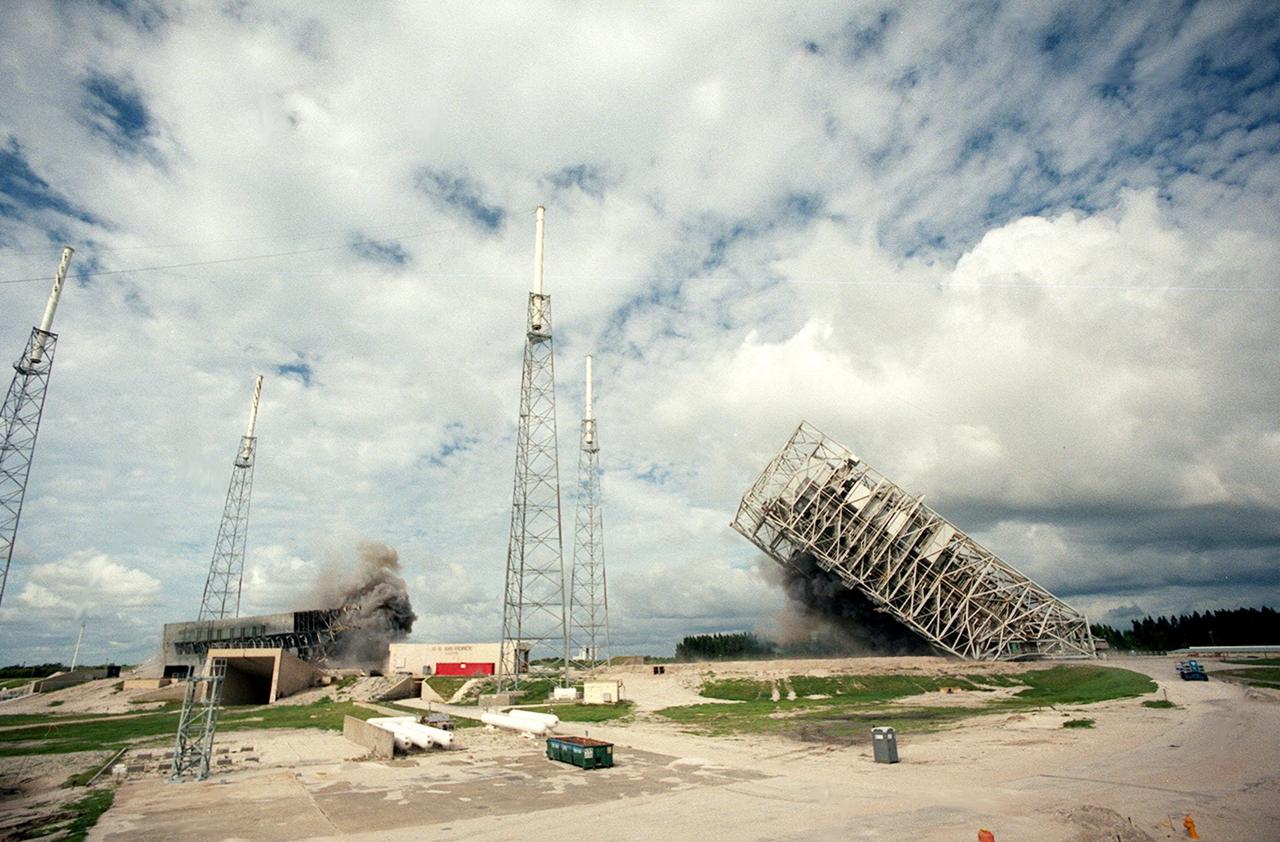
KENNEDY SPACE CENTER, FLA. — Two 34-year-old towers on Launch Complex 41, Cape Canaveral Air Station, fall to the ground amid the black smoke from explosives set to topple them. Weighing two million pounds, the umbilical tower (left) was approximately 200 feet high. The taller 300-foot Mobile Service Tower (right), still falling, weighs five million pounds. About 200 pounds of linear-shaped charges were used to topple the towers so that the materials can be recycled. Adjacent to the towers are lightning protection structures, which will remain on the site. The towers are being demolished to make room for Lockheed Martin's 14-acre Vehicle Integration Facility (VIF), under construction. The implosion and removal of the tower debris is expected to be completed in two months. The VIF will be used for Lockheed Martin's Atlas V Launch System.
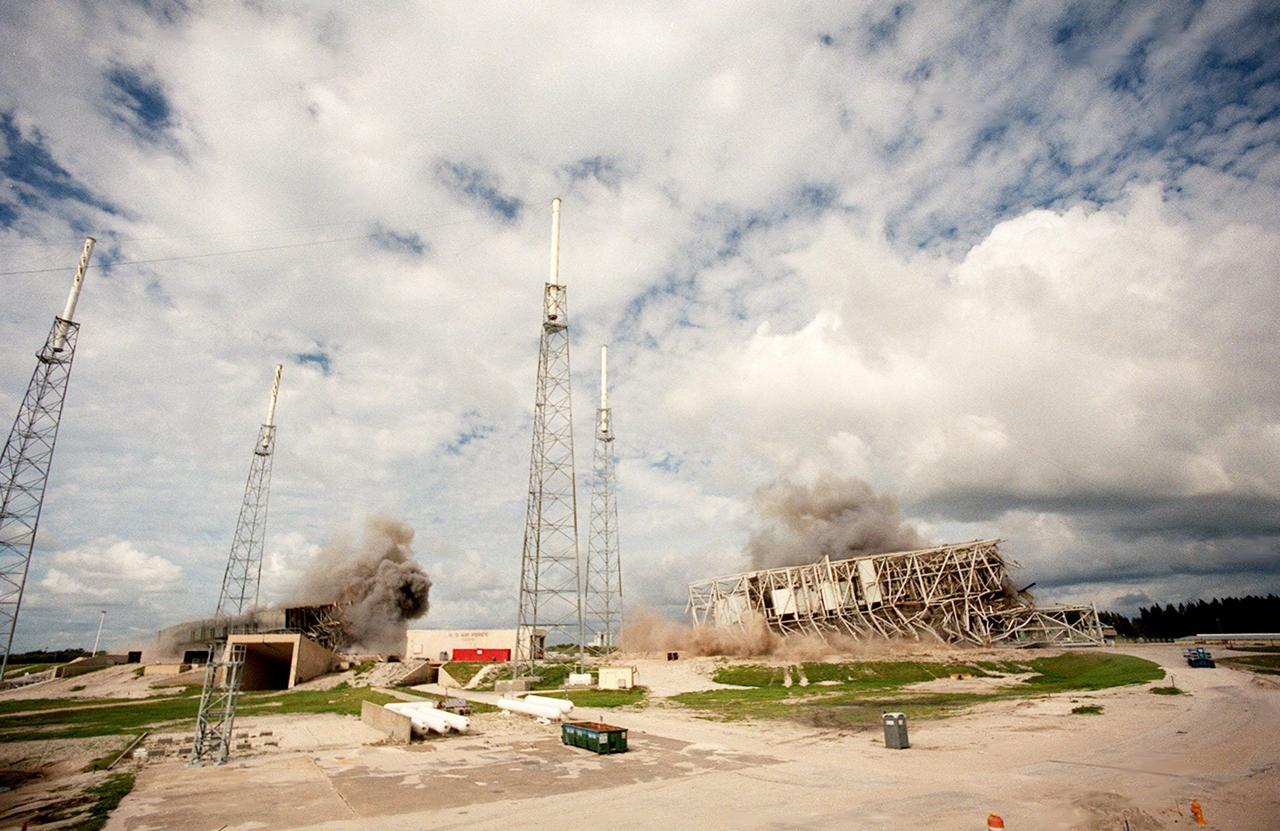
KENNEDY SPACE CENTER, FLA. — Two 34-year-old towers on Launch Complex 41, Cape Canaveral Air Station, lie on the ground amid the black smoke from explosives set to topple them. Weighing two million pounds, the umbilical tower (left) was approximately 200 feet high. The taller 300-foot Mobile Service Tower (right) weighs five million pounds. About 200 pounds of linear-shaped charges were used to topple the towers so that the materials can be recycled. Adjacent to the towers are lightning protection structures, which will remain on the site. The towers are being demolished to make room for Lockheed Martin's 14-acre Vehicle Integration Facility (VIF), under construction. The implosion and removal of the tower debris is expected to be completed in two months. The VIF will be used for Lockheed Martin's Atlas V Launch System.
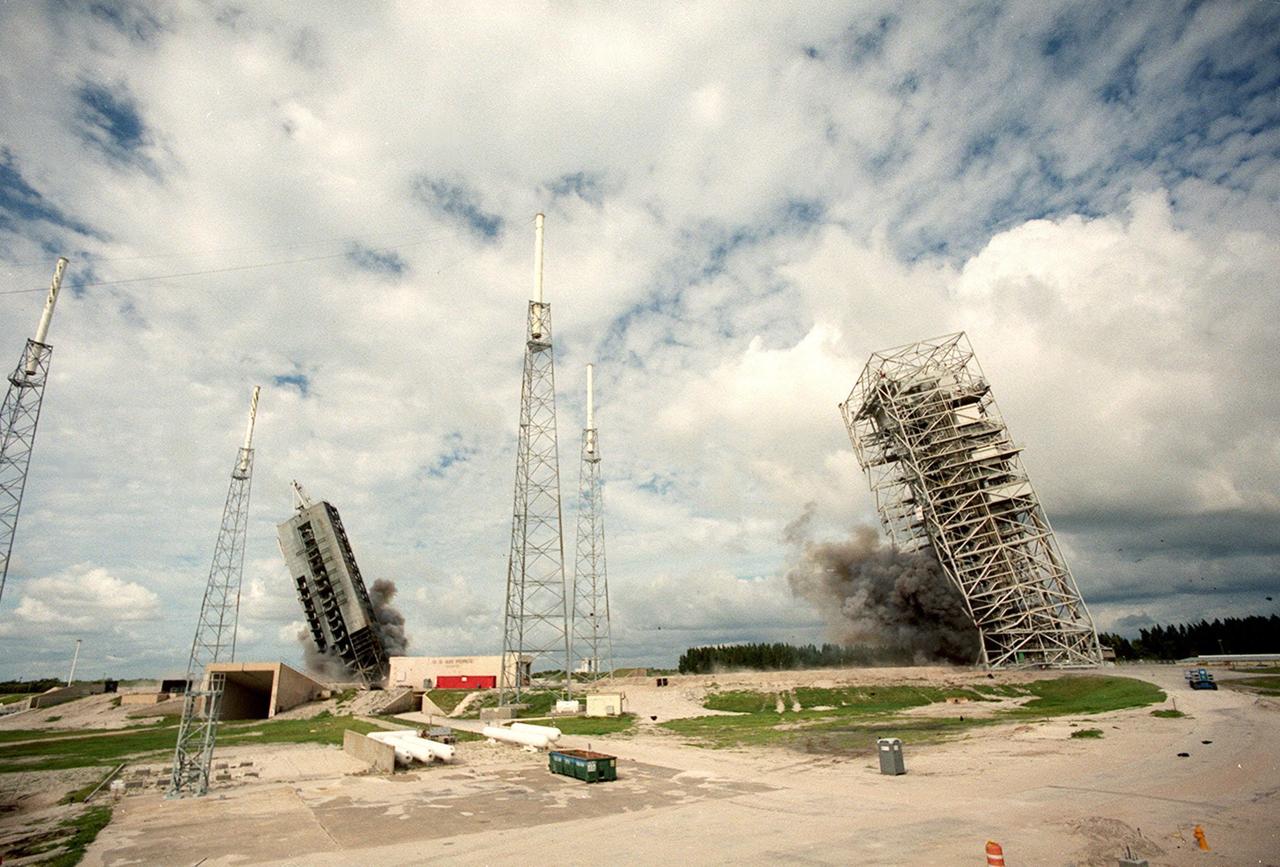
KENNEDY SPACE CENTER, FLA. — Two 34-year-old towers on Launch Complex 41, Cape Canaveral Air Station, fall to the ground amid the black smoke from explosives set to topple them. Weighing two million pounds, the umbilical tower (left) was approximately 200 feet high. The taller 300-foot Mobile Service Tower (right) weighs five million pounds. About 200 pounds of linear-shaped charges were used to topple the towers so that the materials can be recycled. Adjacent to the towers are lightning protection structures, which will remain on the site. The towers are being demolished to make room for Lockheed Martin's 14-acre Vehicle Integration Facility (VIF), under construction. The implosion and removal of the tower debris is expected to be completed in two months. The VIF will be used for Lockheed Martin's Atlas V Launch System.