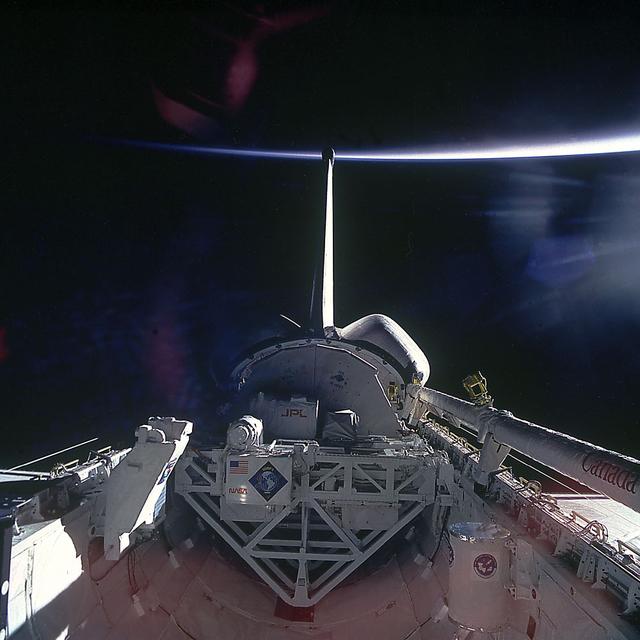
This is a Space Shuttle Columbia (STS-52) onboard photograph of the United States Microgravity Payload-1 (USMP-1) in the cargo bay. The USMP program is a series of missions developed by NASA to provide scientists with the opportunity to conduct research in the unique microgravity environment of the Space Shuttle's payload bay. The USMP-1 mission was designed for microgravity experiments that do not require the hands-on environment of the Spacelab. Science teams on the ground would remotely command and monitor instruments and analyze data from work stations at NASA's Spacelab Mission Operation Control facility at the Marshall Space Flight Center (MSFC). The USMP-1 payload carried three investigations: two studied basic fluid and metallurgical processes in microgravity, and the third would characterize the microgravity environment onboard the Space Shuttle. The three experiments that made up USMP-1 were the Lambda Point Experiment, the Space Acceleration Measurement System, and the Materials for the Study of Interesting Phenomena of Solidification Earth and in Orbit (MEPHISTO). The three experiments were mounted on two cornected Mission Peculiar Equipment Support Structures (MPESS) mounted in the orbiter's cargo bay. The USMP program was managed by the MSFC and the MPESS was developed by the MSFC.
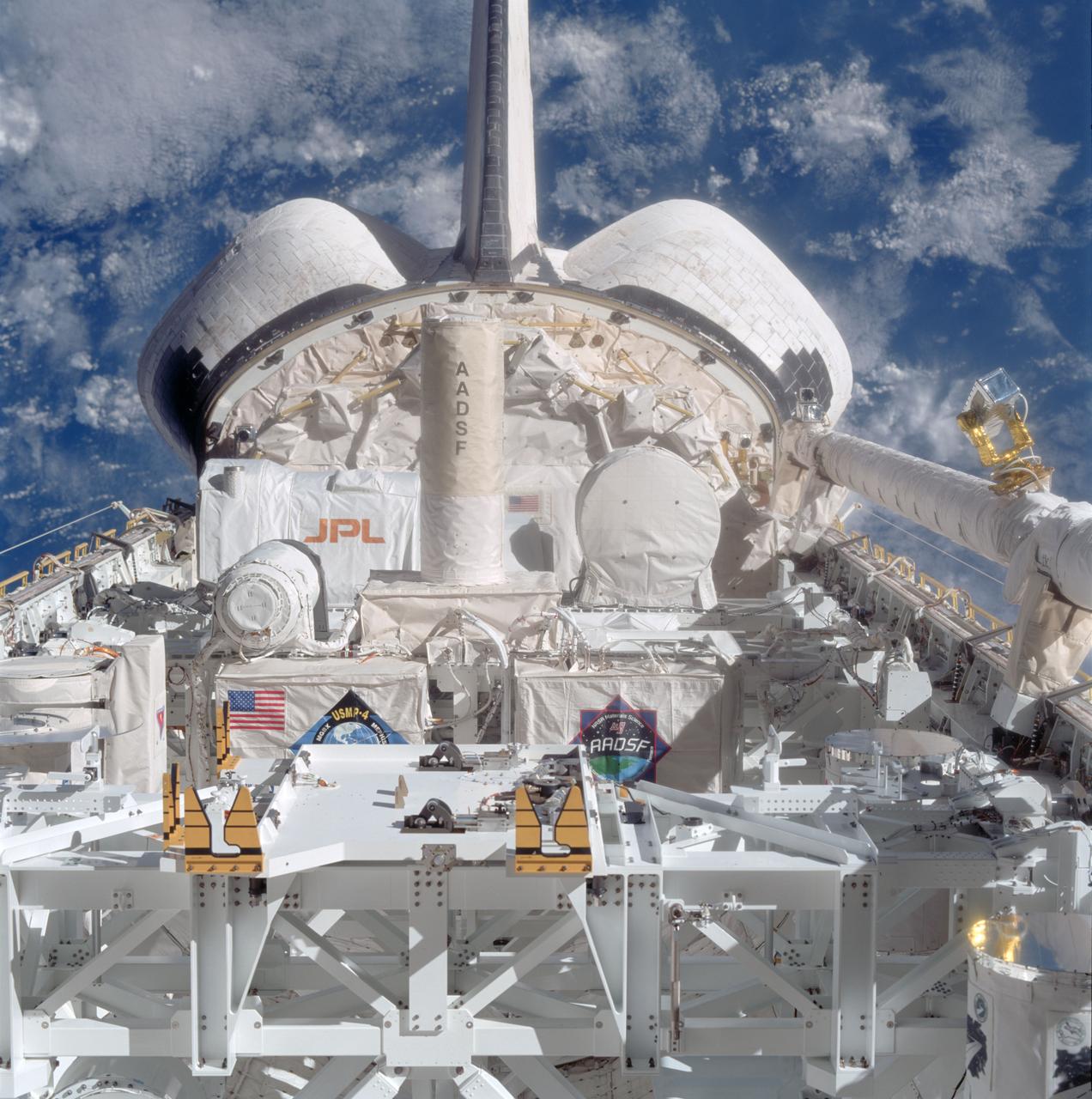
STS087-706-022 (19 November - 5 December 1997) --- This picture of the Space Shuttle Columbia's cargo bay, taken through the aft flight deck windows with a handheld 70mm camera, shows the United States Microgravity Payload 4 (USMP-4) mission's payloads.

In preparation for Space Shuttle Mission STS-87, the United States Microgravity Payload-4 undergoes final processing in the Space Station Processing Facility before its move to Launch Complex 39B. STS-87 will be the fourth flight of the United States Microgravity Payload and the Spartan-201 deployable satellite
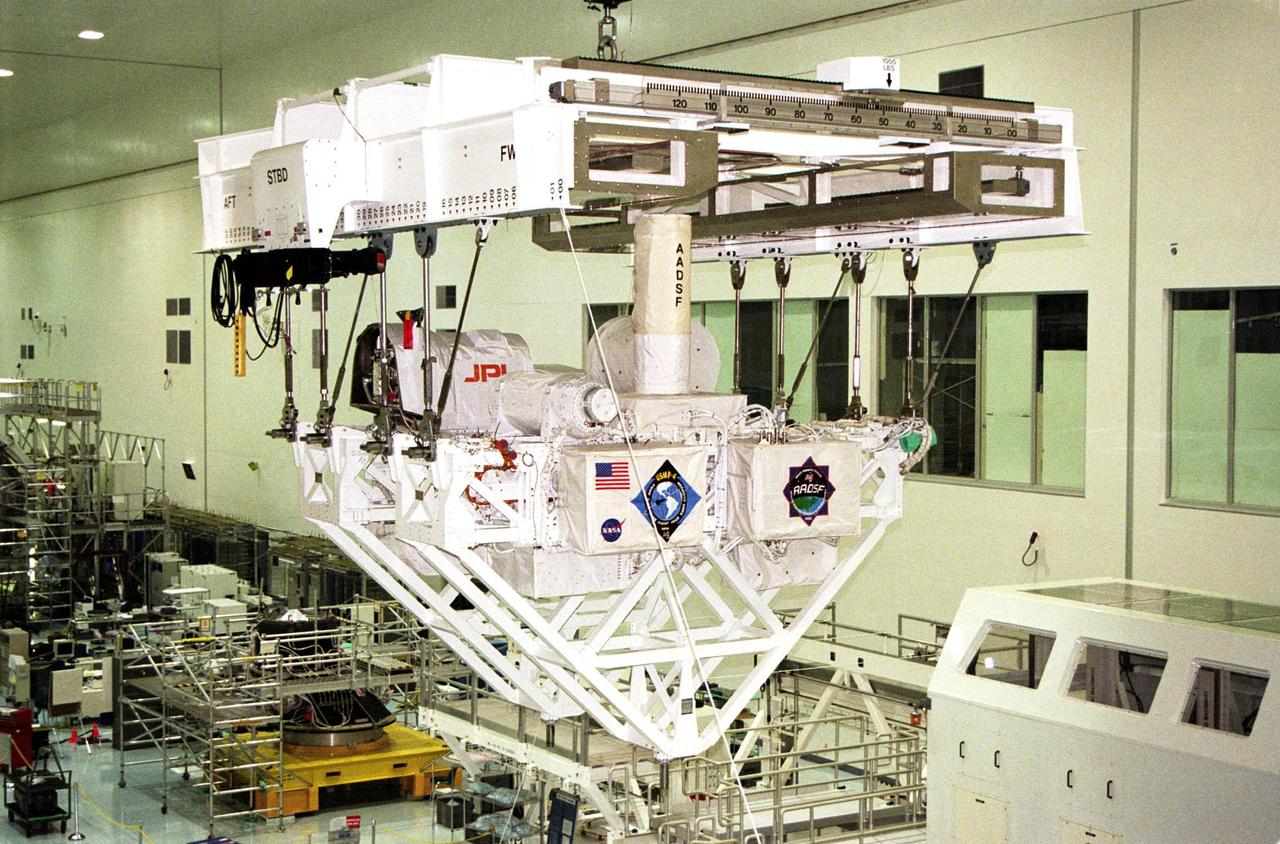
In preparation for Space Shuttle Mission STS-87, the United States Microgravity Payload-4 undergoes final processing in the Space Station Processing Facility before its move to Launch Complex 39B. STS-87 will be the fourth flight of the United States Microgravity Payload and the Spartan-201 deployable satellite

In preparation for Space Shuttle Mission STS-87, the United States Microgravity Payload-4 undergoes final processing in the Space Station Processing Facility before its move to Launch Complex 39B. STS-87 will be the fourth flight of the United States Microgravity Payload and the Spartan-201 deployable satellite
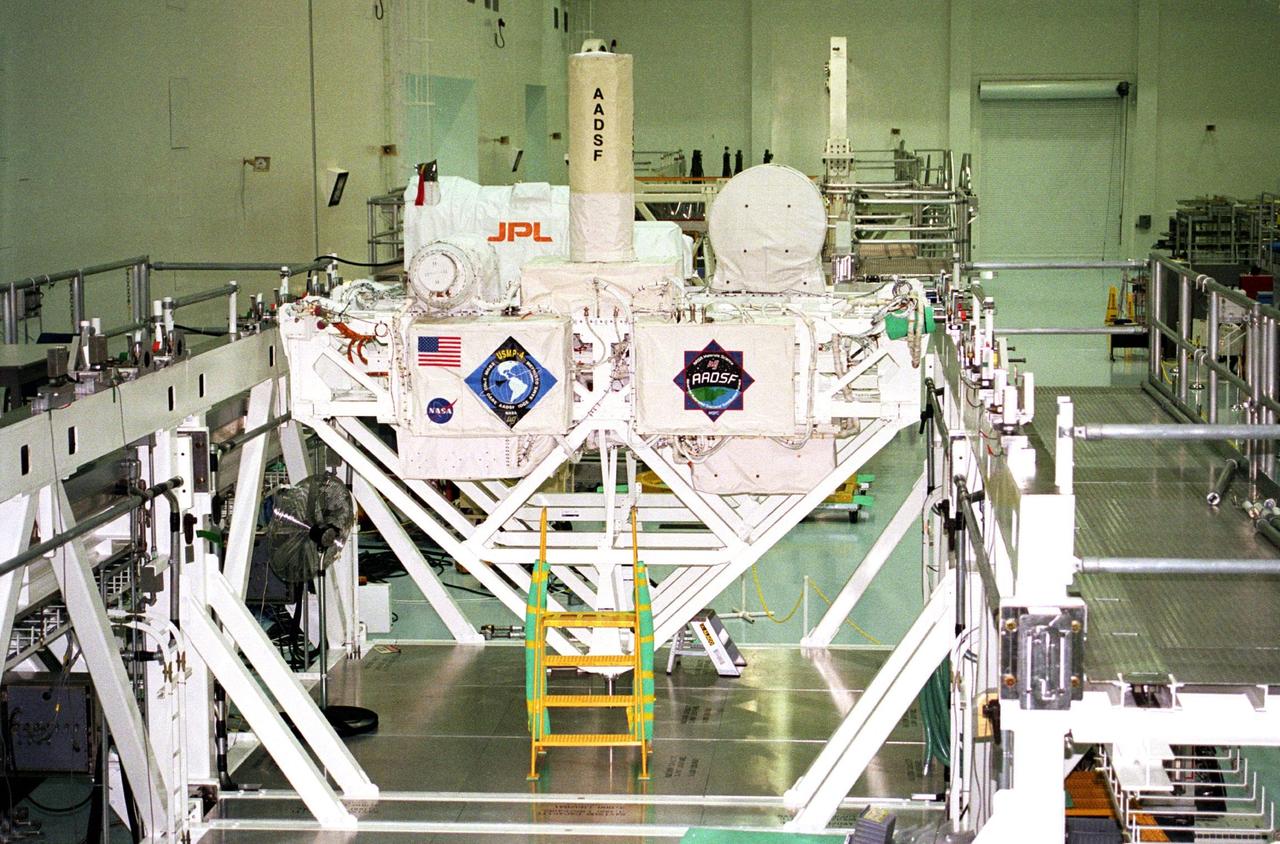
In preparation for Space Shuttle Mission STS-87, the United States Microgravity Payload-4 undergoes final processing in the Space Station Processing Facility before its move to Launch Complex 39B. STS-87 will be the fourth flight of the United States Microgravity Payload and the Spartan-201 deployable satellite
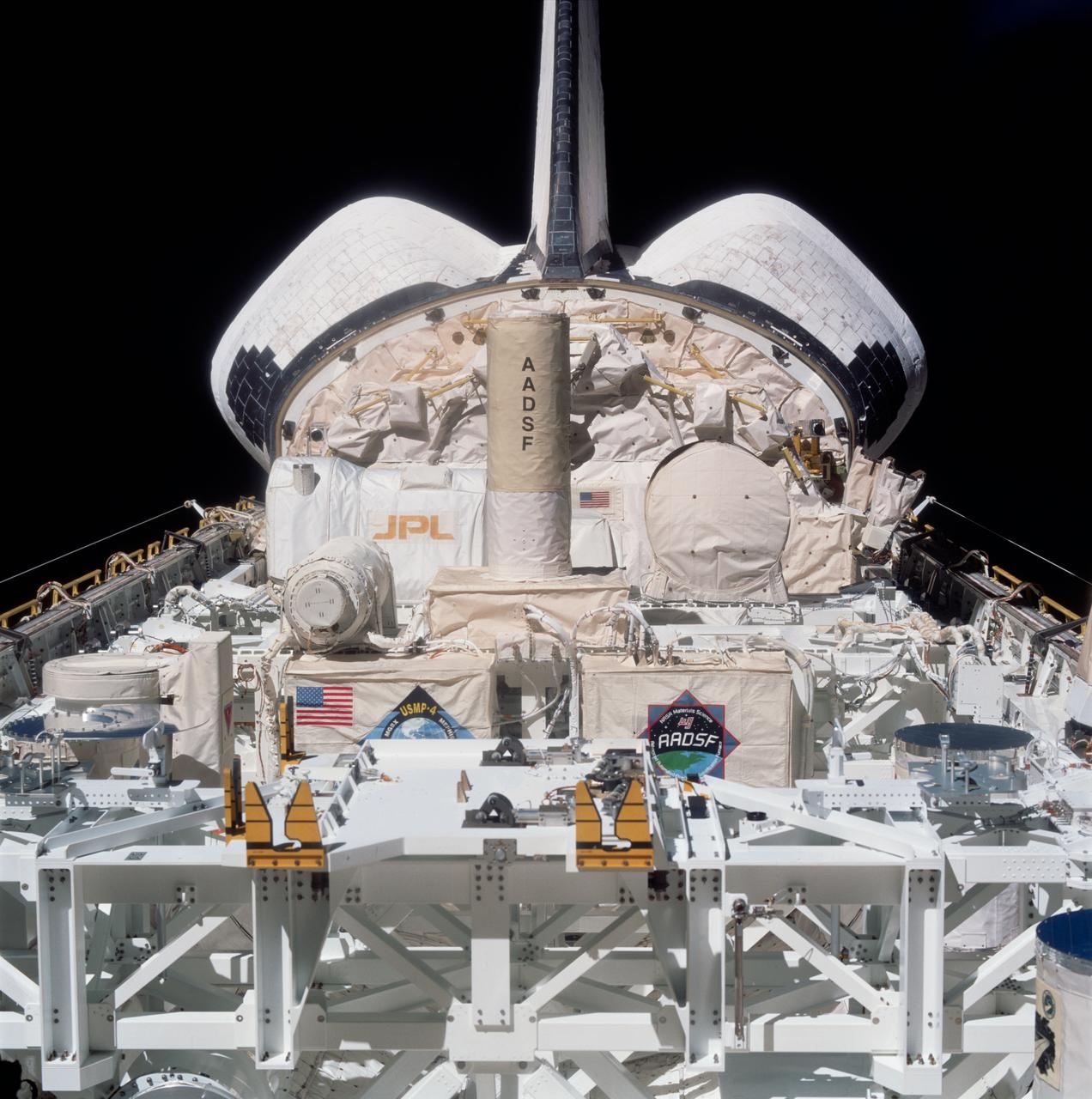
STS087-752-023 (19 November – 5 December 1997) --- This picture of Columbia's cargo bay, taken through the aft flight deck windows with a handheld 70mm camera, shows the U.S. Microgravity Payload (USMP-4) mission's cargo.
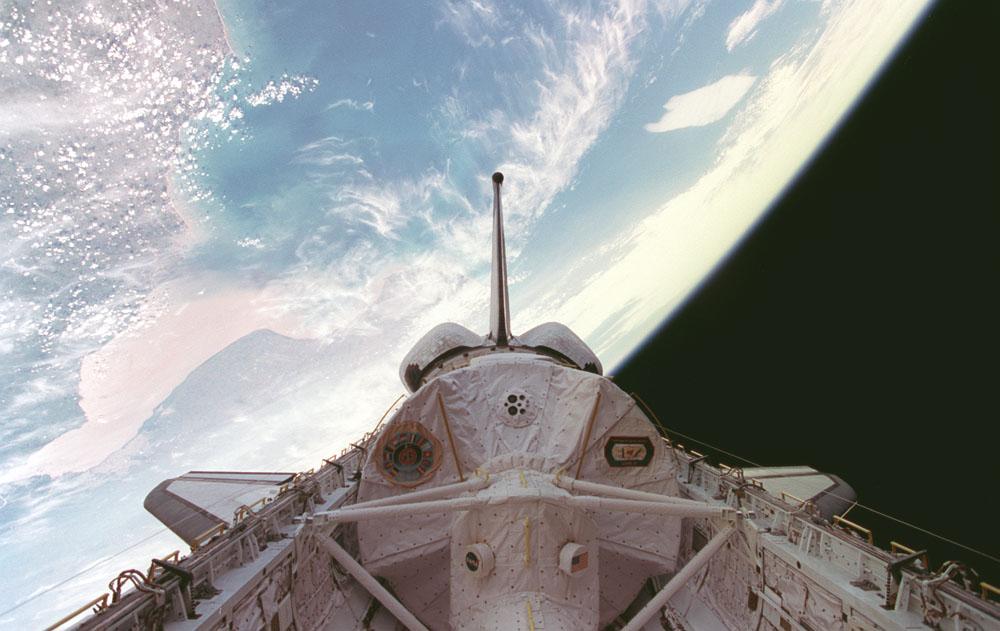
Onboard photo of space shuttle Columbia (STS-73) cargo bay payload - the United States Microgravity Laboratory-2 (USML-2) with an earthview.
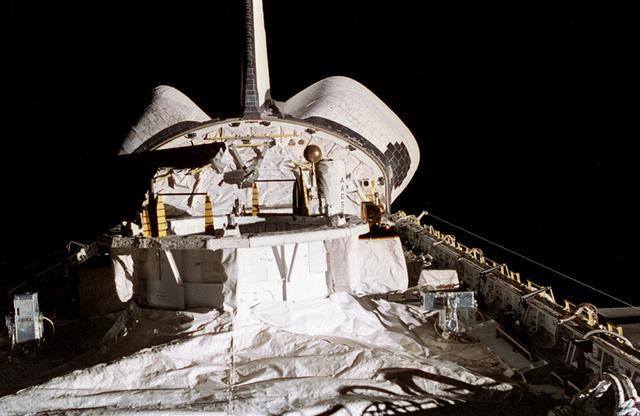
Onboard photo of space shuttle Columbia's (STS-75) open cargo bay carrying the United States Microgravity Payload-3 (USMP-3) at night.
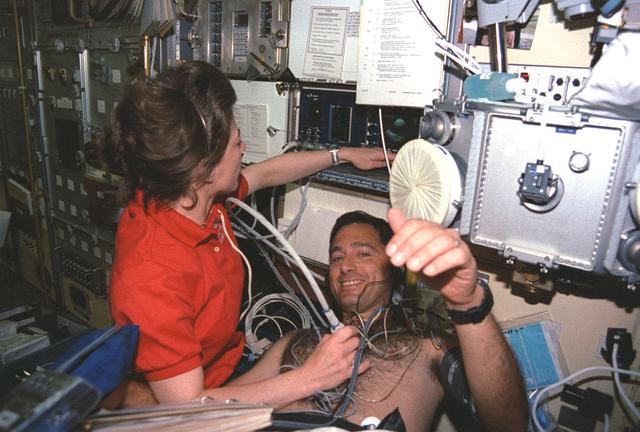
Onboard Space Shuttle Columbia (STS-50) payload commander Bornie Dunbar performs life science experiments on crewmember payload specialist Lawrence Delucas in the United States Microgravity Laboratory (USML-1) science module.
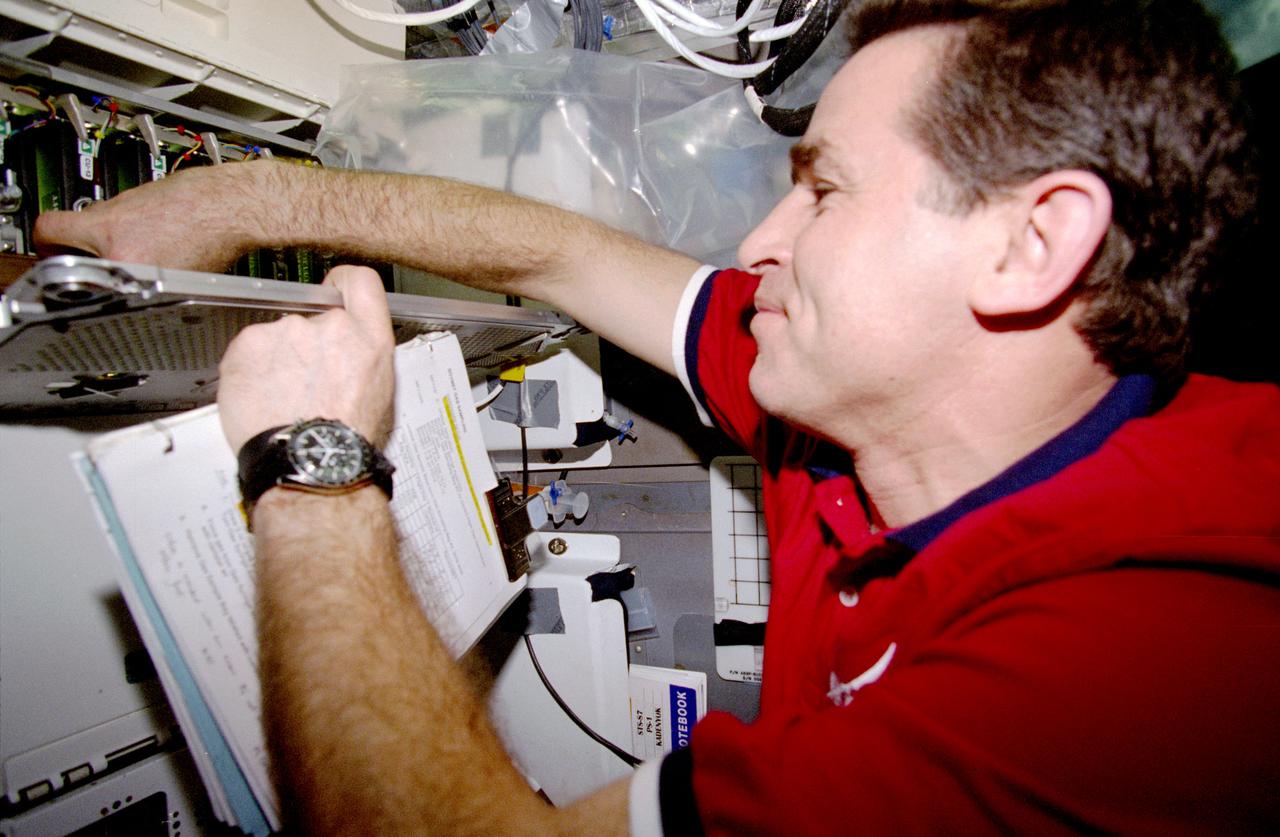
STS087-385-005 (19 November - 5 December 1997) --- Leonid Kadenyuk, Ukrainian payload specialist, retrieves a plant specimen from the plant growth facility on the mid-deck of the Earth-orbiting Space Shuttle Columbia. Kadenyuk and five United States astronauts went on to spend 16-days in Earth-orbit in support of the United States Microgravity Payload (USMP-4) mission.
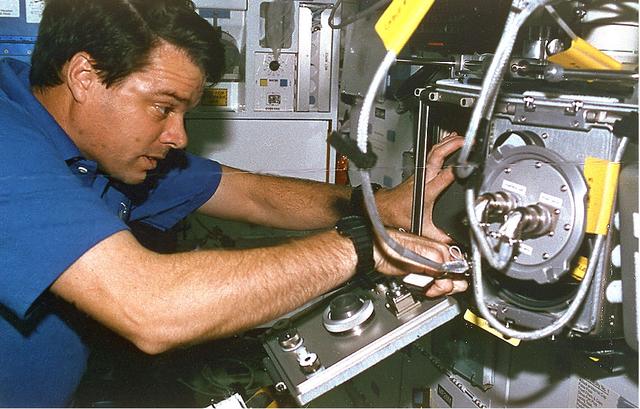
Onboard Space Shuttle Columbia (STS-87) Mission Commander Kevin R. Kregel sets up the mid-deck glove box during early hours of the 16-day United States Microgravity Payload 4 (USMP-4) mission. Kregel was joined by four other astronauts and a Ukrainian payload specialist for the mission.
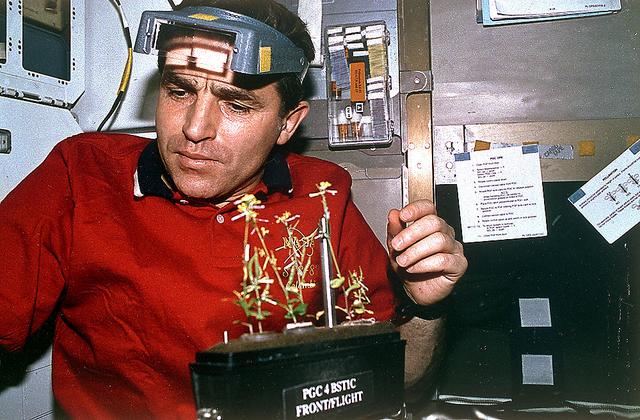
Onboard Space Shuttle Columbia (STS-87) mid-deck, Leonid Kadenyuk, Ukrainian payload specialist, works with the Brassica rapa plants being grown for the Collaborative Ukrainian Experiment (CUE). Kadenyuk joined five astronauts for 16-days in Earth-orbit in support of the United States Microgravity Payload 4 (USMP-4) mission.
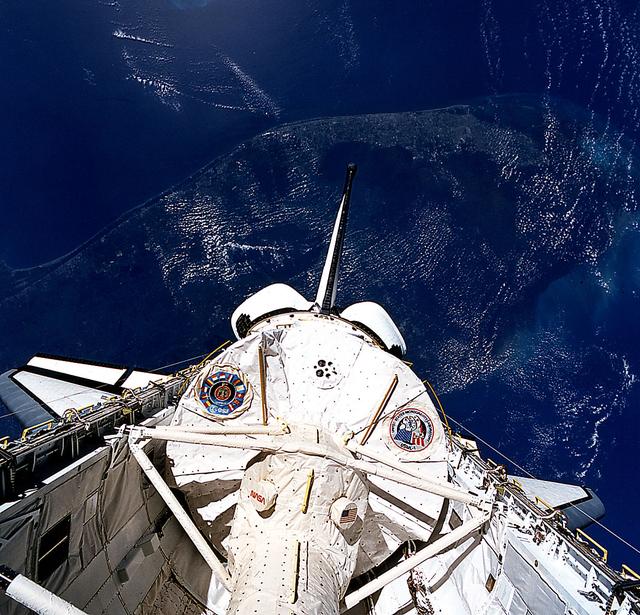
Space Shuttle Columbia (STS-50) onboard photo of the United States Microgravity Laboratory (USML-1) module in payload bay in this scene over the southern two-thirds of the Florida peninsula. Kennedy Space Center (KSC) can be seen just above Columbia's starboard wing.
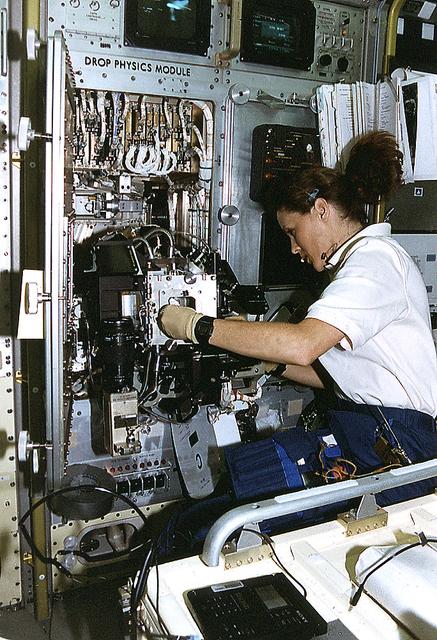
Onboard Space Shuttle Columbia (STS-73) Payload Commander Kathryn Thornton works with the Drop Physics Module (DPM) in the United States Microgravity Laboratory 2 (USML-2) Spacelab Science Module cleaning the experiment chamber of the DPM.
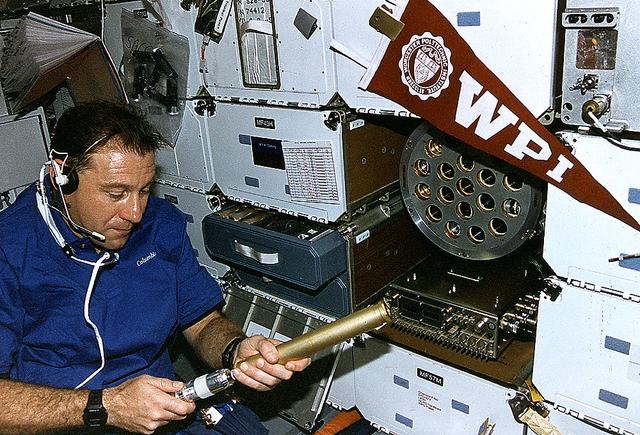
Onboard Space Shuttle Columbia (STS-73) Payload Specialist Albert Sacco loads autoclaves using a power screwdriver into the Zeolite Crystal Growth (ZCG) experiment in the middeck for the United States Microgravity Laboratory 2 (USML-2) Spacelab mission.

KENNEDY SPACE CENTER, Fla. -- In preparation for Space Shuttle Mission STS-87, Columbia rolls out to Launch Complex 39B atop the crawler-transporter. STS-87 will be the fourth flight of the United States Microgravity Payload and the Spartan-201 deployable satellite. Launch is tentatively scheduled for Nov. 19
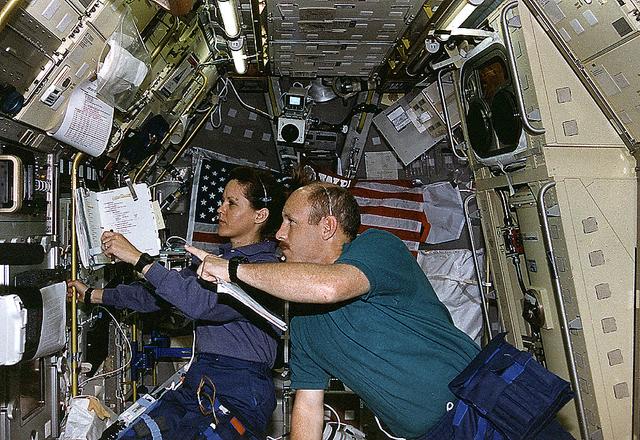
Onboard Space Shuttle Columbia (STS-73) Payload Commander Kathryn Thornton and Commander Ken Bowersox discuss the Drop Physics Module (DPM) experiment in the United States Microgravity Laboratory 2 (USML-2) spacelab science module.
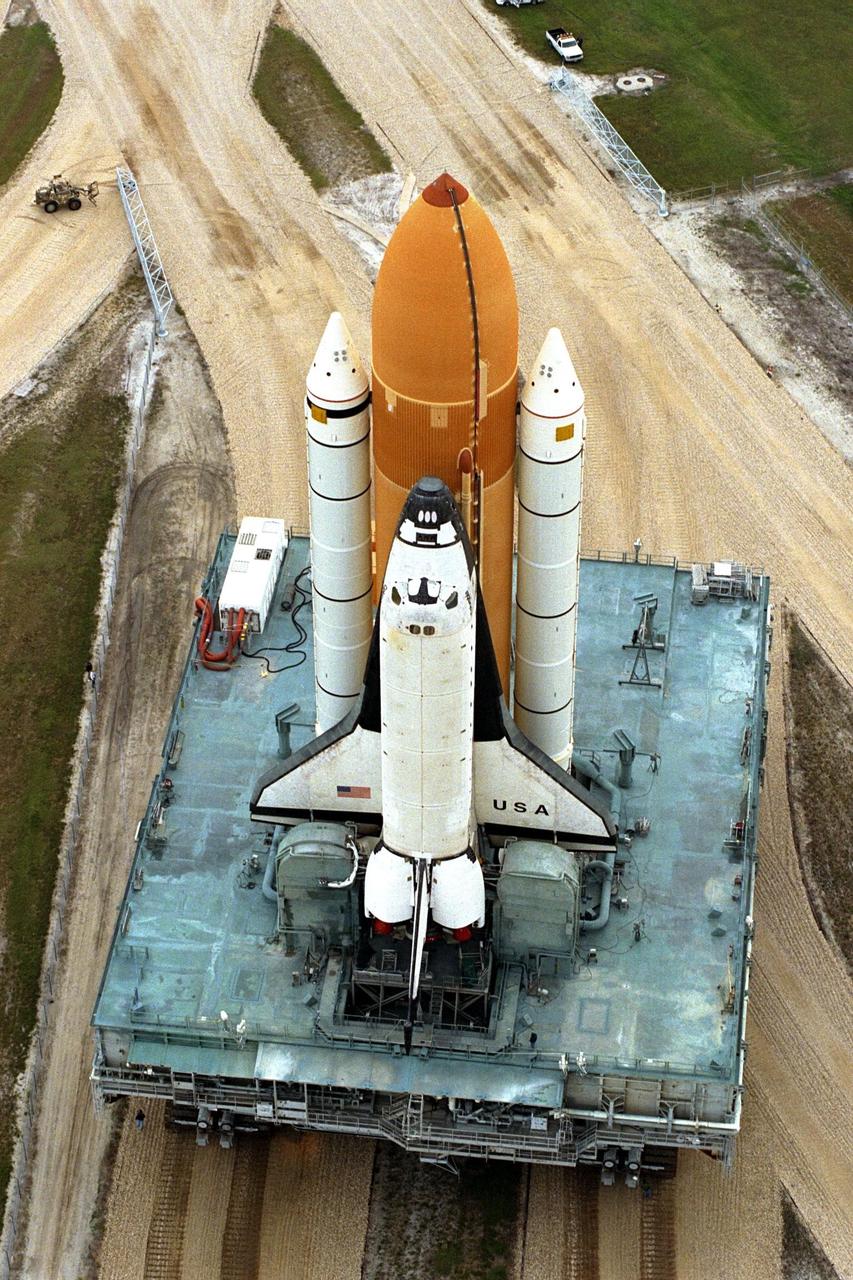
In preparation for Space Shuttle Mission STS-87, Columbia rolls out to Launch Complex 39B atop the crawler-transporter. STS-87 will be the fourth flight of the United States Microgravity Payload and the Spartan-201 deployable satellite. Launch is tentatively scheduled for Nov. 19

In preparation for Space Shuttle Mission STS-87, Columbia rolls out to Launch Complex 39B atop the crawler-transporter. STS-87 will be the fourth flight of the United States Microgravity Payload and the Spartan-201 deployable satellite. Launch is tentatively scheduled for Nov. 19
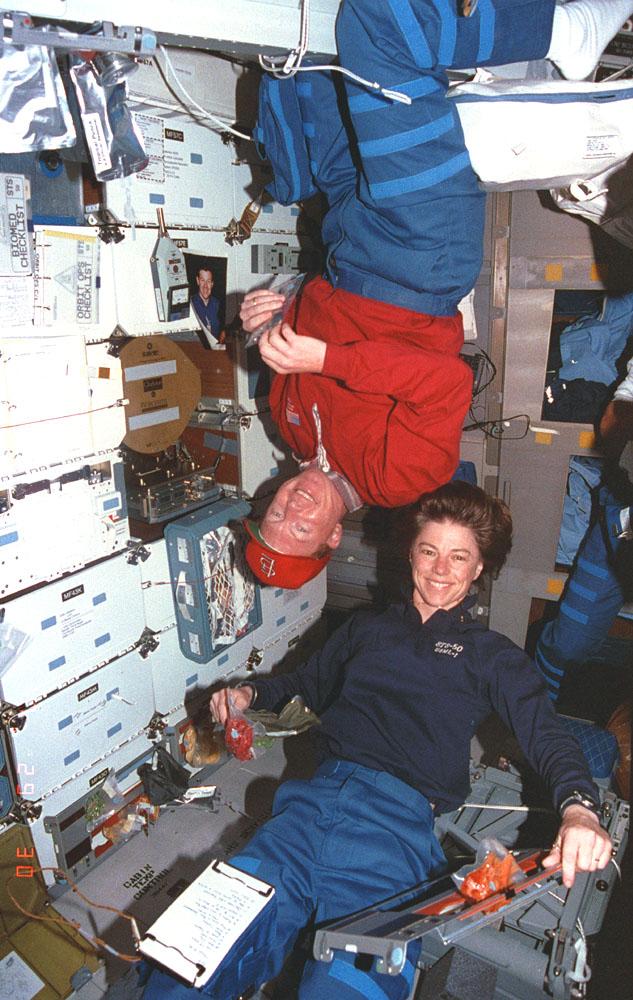
Onboard Space Shuttle Columbia (STS-50) all work and no play make commander Richard (Dick) Richards and payload commander Bornie Dunbar take a break from their work in the United States Microgravity Laboratory (USML-1) responsibilities.
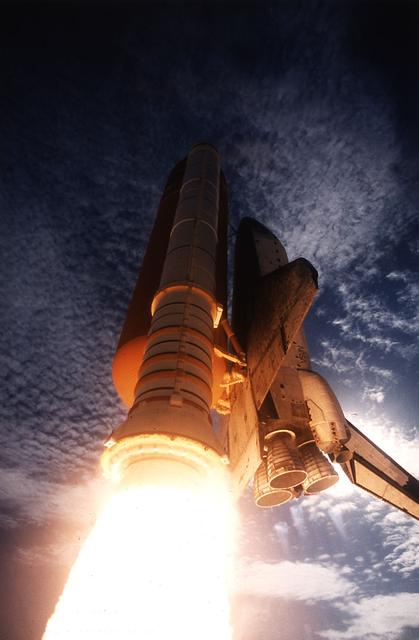
A unique view of the Space Shuttle Columbia (STS-73) moments after bursting into Earth's atmosphere on its way toward space. Onboard the orbiter is the United States Microgravity Laboratory 2 (USML-2), a Marshall managed payload, where Columbia's seven member crew will perform experiments while in orbit.
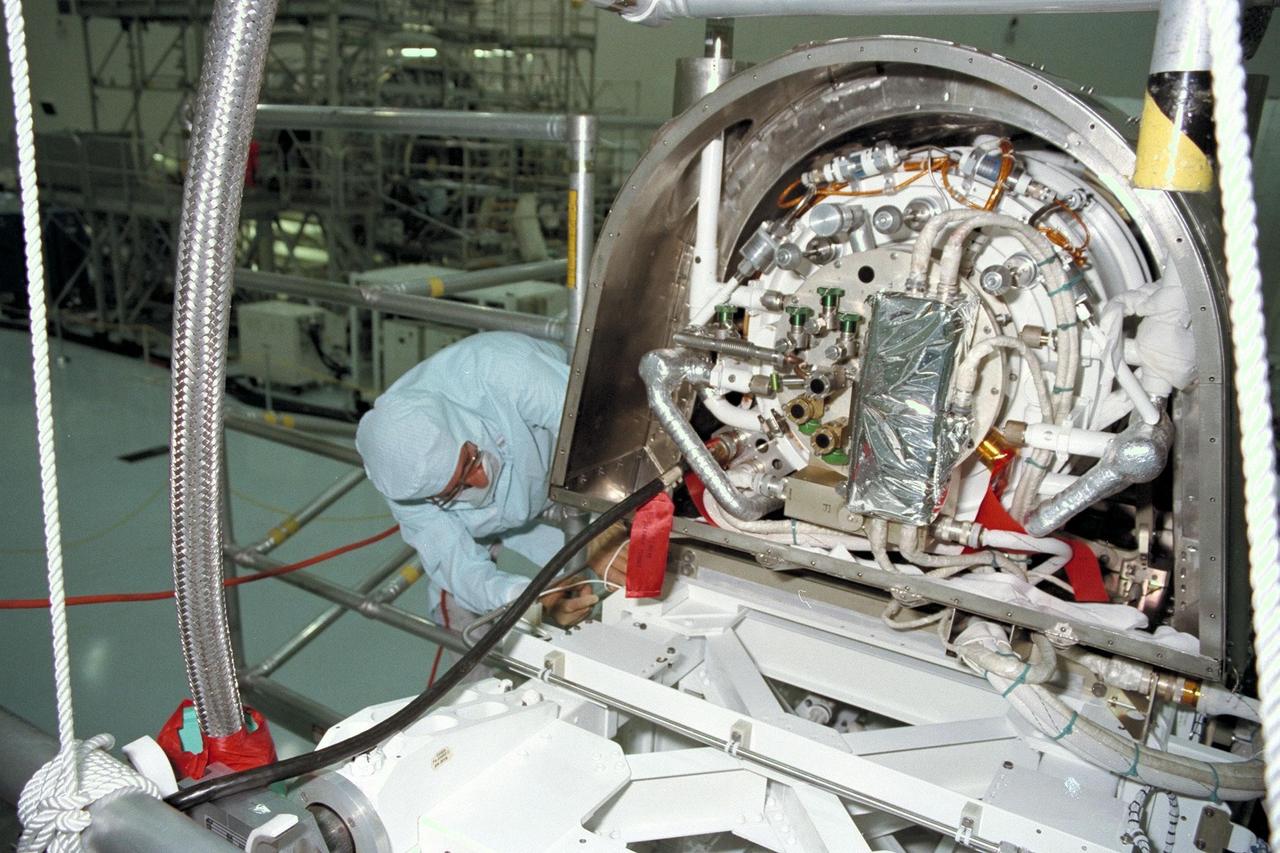
United States Microgravity Payload-4 (USMP-4) experiments are prepared to be flown on Space Shuttle mission STS-87 in the Space Station Processing Facility at Kennedy Space Center (KSC). Here, a technician is monitoring the Confined Helium Experiment, or CHeX, that will use microgravity to study one of the basic influences on the behavior and properties of materials by using liquid helium confined between silicon disks. CHeX and several other experiments are scheduled for launch aboard STS-87 on Nov. 19 from KSC
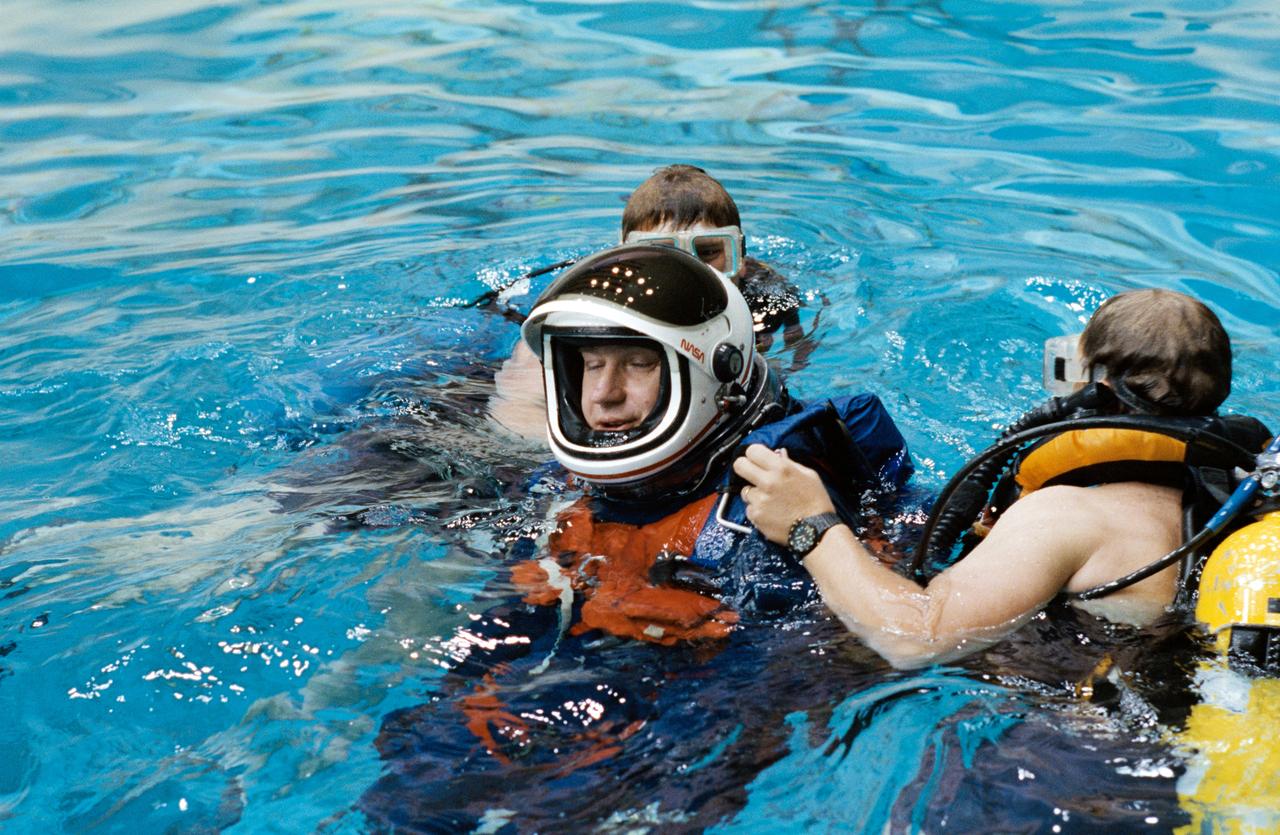
S92-32108 (May 1992) --- Payload specialist Albert Sacco Jr. uses a one-person life raft during emergency bailout training exercises in the Johnson Space Center?s (JSC) Weightless Environment Training Facility (WET-F). Sacco is an alternate payload specialist for the United States Microgravity Laboratory (USML-1) mission, scheduled for launch later this year. EDITOR?S NOTE: Sacco was later named as prime crew payload specialist for the USML-2 mission (STS-73), scheduled for 1995.
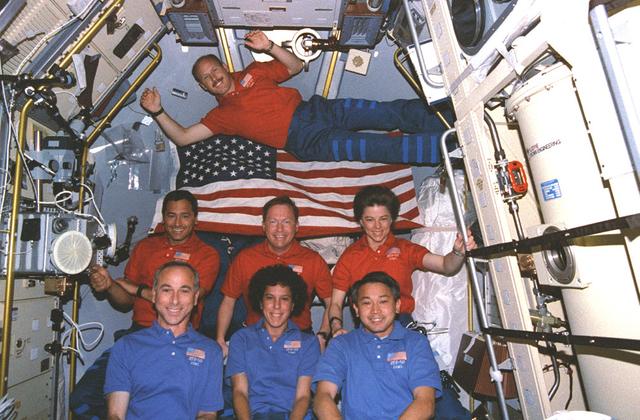
Onboard Space Shuttle Columbia (STS-50) crewmembers rally around the American flag in the United States Microgravity Laboratory-1 (USML-1). Pictured are (from top, left to right) pilot Kerneth D. Bowersox; payload specialist Lawrence J. Delucas; commander Richard N. Richards; payload commander Bonnie J. Dunbar; mission specialists Carl J. Meade and Ellen S. Baker; and payload specialist Eugene H. Trinh.
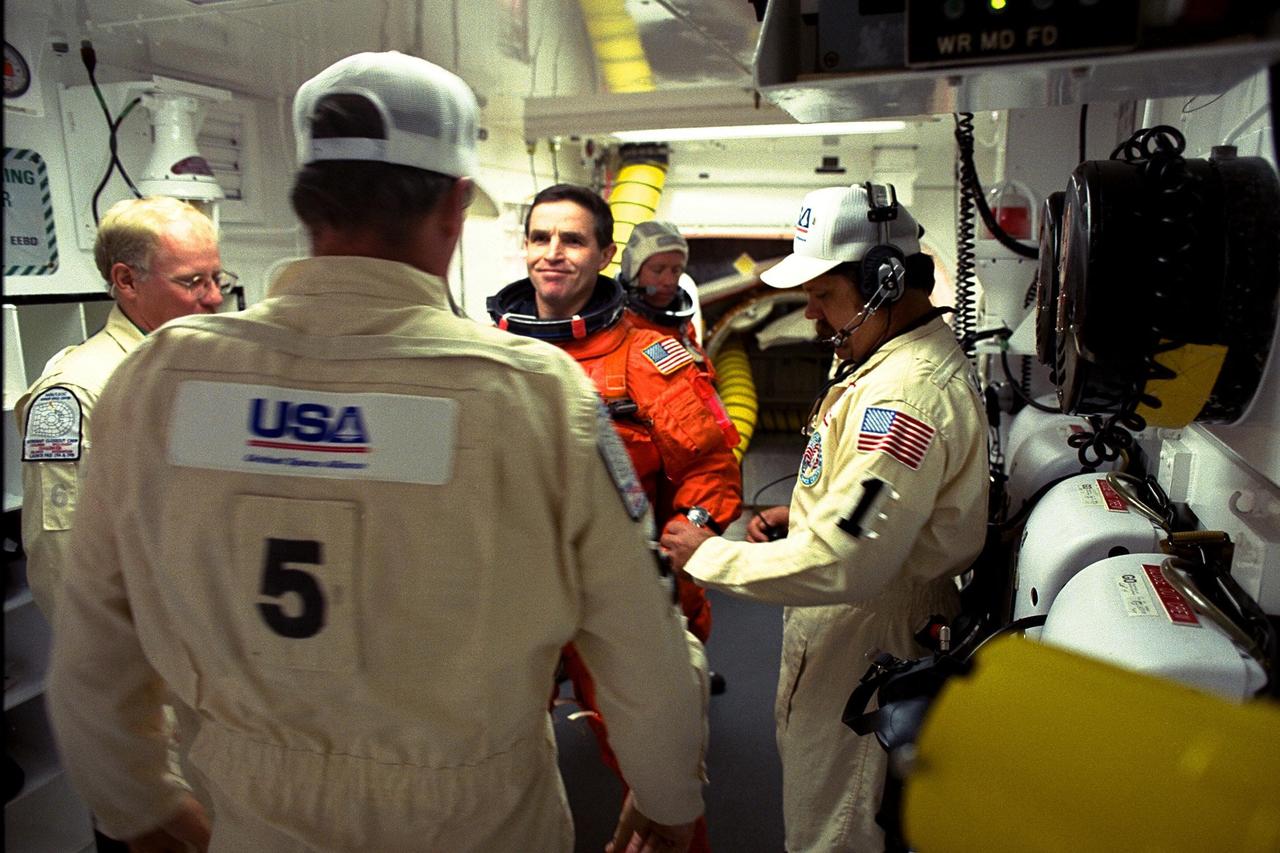
STS-87 Payload Specialist Leonid Kadenyuk of the National Space Agency of Ukraine is assisted with final preparations before launch in the white room at Launch Pad 39B by Danny Wyatt, NASA quality assurance specialist, at left; George Schram, USA mechanical technician, facing Kadenyuk; and Travis Thompson, USA orbiter vehicle closeout chief, at right. STS-87 is the fourth flight of the United States Microgravity Payload and Spartan-201. The 16-day mission will include the Collaborative Ukrainian Experiment (CUE), a collection of 10 plant space biology experiments that will fly in Columbia’s middeck and will feature an educational component that involves evaluating the effects of microgravity on Brassica rapa seedlings
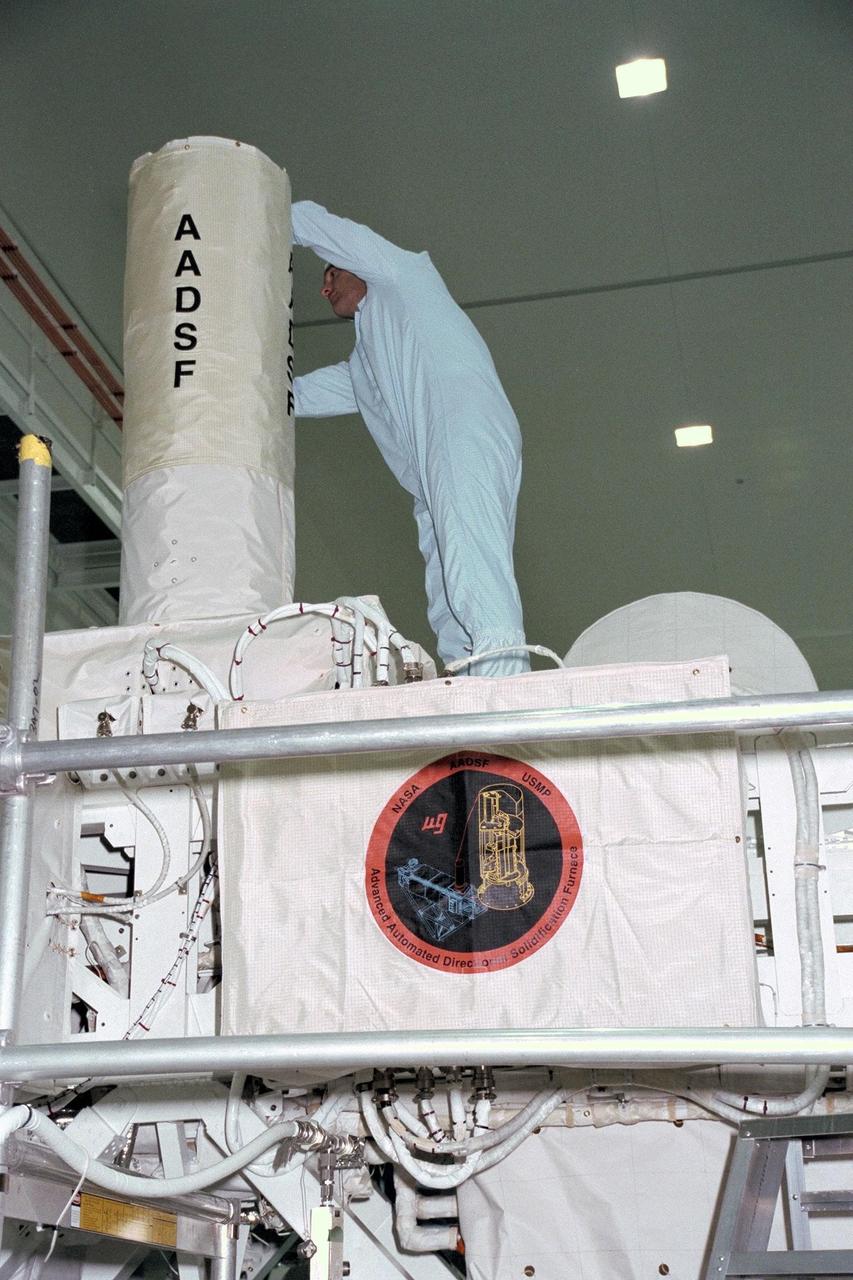
United States Microgravity Payload-4 (USMP-4) experiments are prepared to be flown on Space Shuttle mission STS-87 in the Space Station Processing Facility at Kennedy Space Center (KSC). A technician is working on the Advanced Automated Directional Solidification Furnace (AADSF), which will be used by researchers to study the solidification of semiconductor materials in microgravity. Scientists will be able to better understand how microgravity influences the solidification process of these materials and develop better methods for controlling that process during future Space flights and Earth-based production. All STS-87 experiments are scheduled for launch on Nov. 19 from KSC
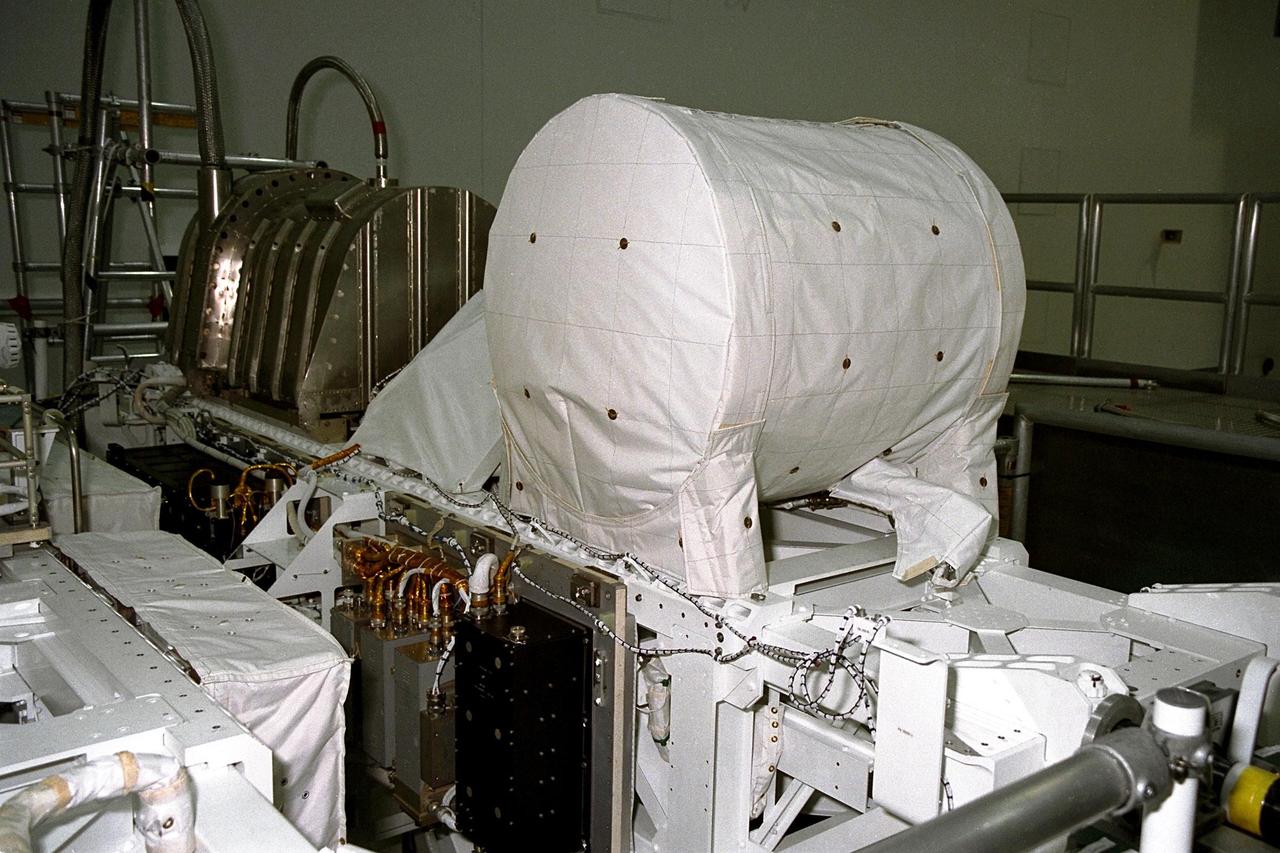
United States Microgravity Payload-4 (USMP-4) experiments are prepared to be flown on Space Shuttle mission STS-87 in the Space Station Processing Facility at Kennedy Space Center (KSC). Seen in the foreground at right is the Isothermal Dendritic Growth Experiment (IDGE), which will be used to study the dendritic solidification of molten materials in the microgravity environment. The metallic breadbox-like structure behind the IDGE is the Confined Helium Experiment (CHeX) that will study one of the basic influences on the behavior and properties of materials by using liquid helium confined between solid surface, and microgravity. These experiments are scheduled for launch aboard STS-87 on Nov. 19 from KSC
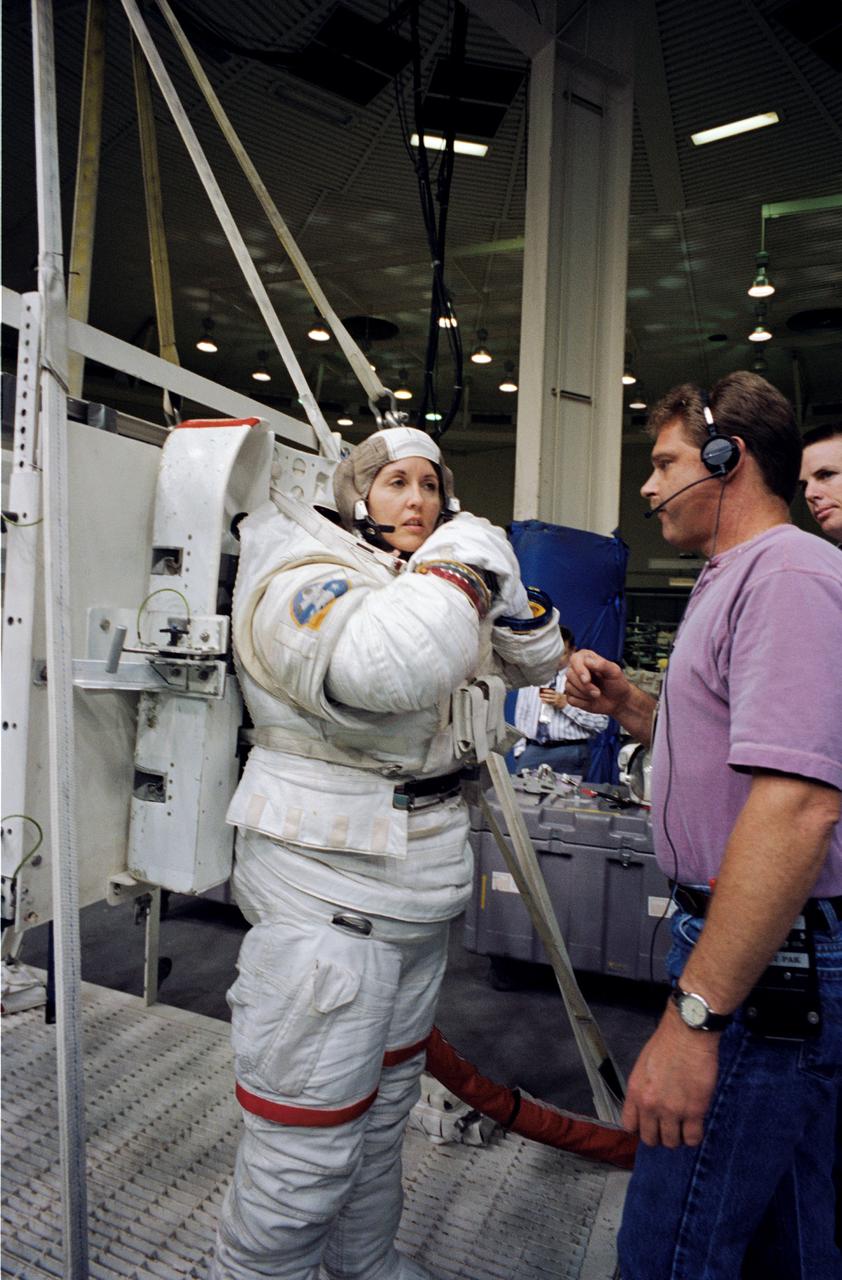
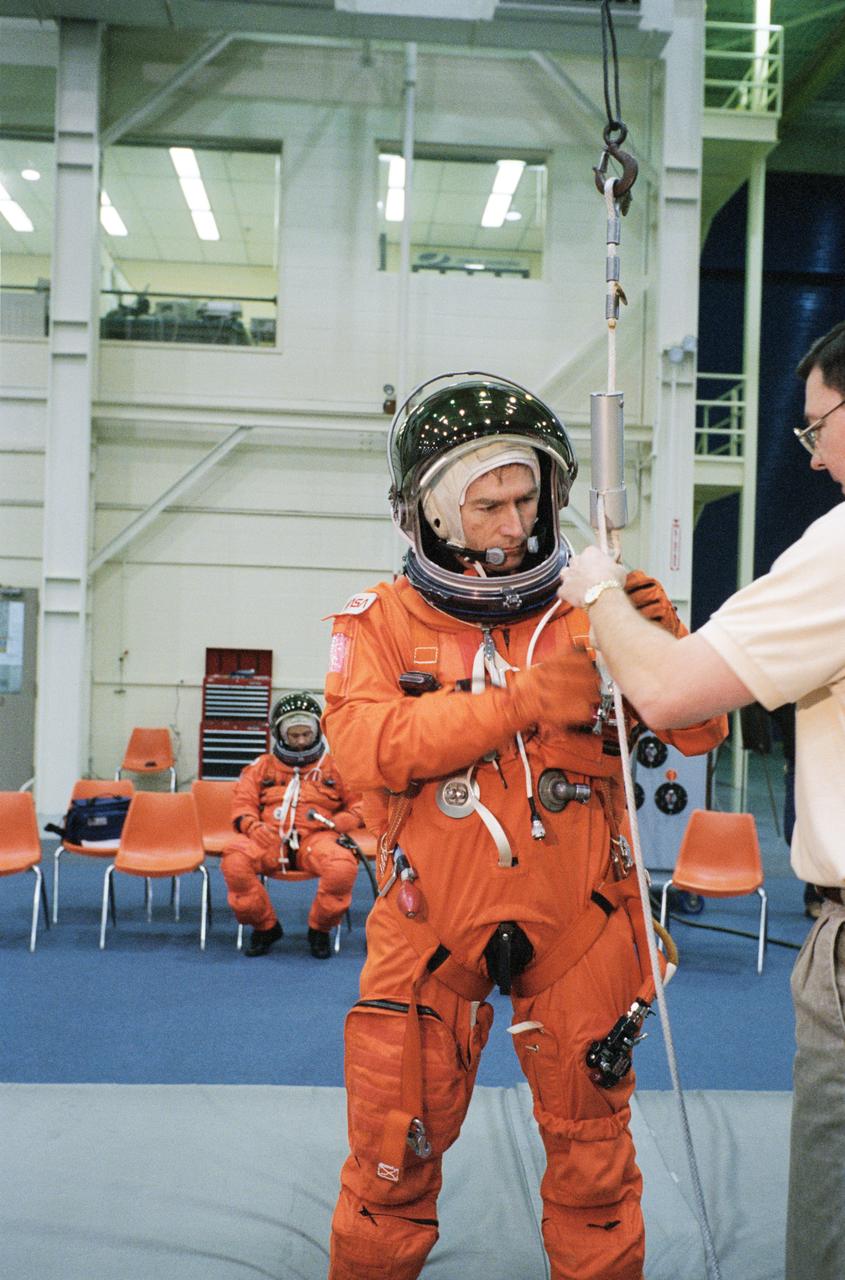
Astronaut Kathryn Thornton, payload commander for the STS-73 mission, attired in a high fidelity training version of the Extravehicular Mobility Unit (EMU) space suit, prepares to go underwater in the Johnson Space Center’s (JSC) Weightless Environment Training Facility (WET-F). The STS-73 mission was the second flight of the United States Microgravity Laboratory (USML-2), managed by scientists and engineers from the Marshall Space Flight Center.
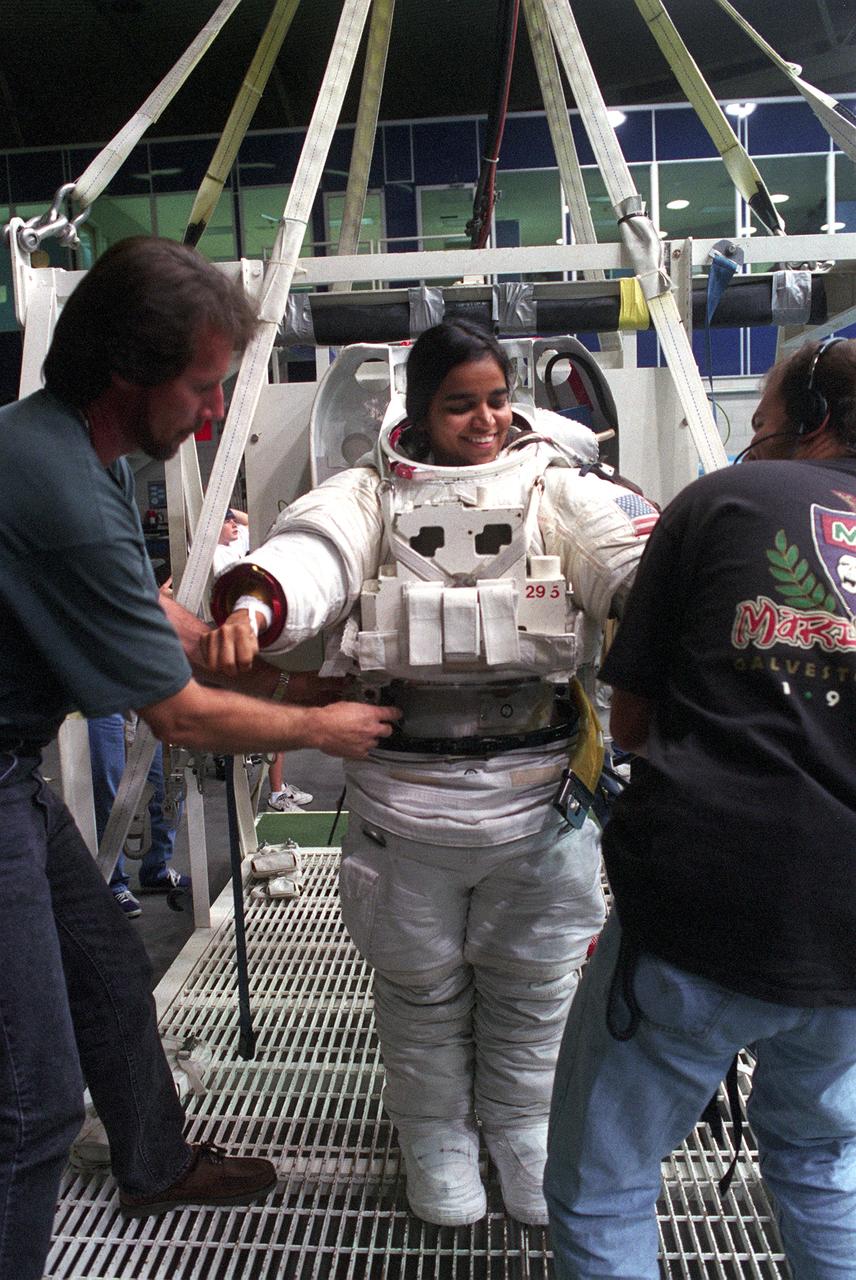
Astronaut and mission specialist Kalpana Chawla, receives assistance in donning a training version of the Extravehicular Mobility Unit (EMU) space suit, prior to an underwater training session in the Neutral Buoyancy Laboratory (NBL) near Johnson Space Center. This particular training was in preparation for the STS-87 mission. The Space Shuttle Columbia (STS-87) was the fourth flight of the United States Microgravity Payload (USMP-4) and Spartan-201 satellite, both managed by scientists and engineers from the Marshall Space Flight Center.
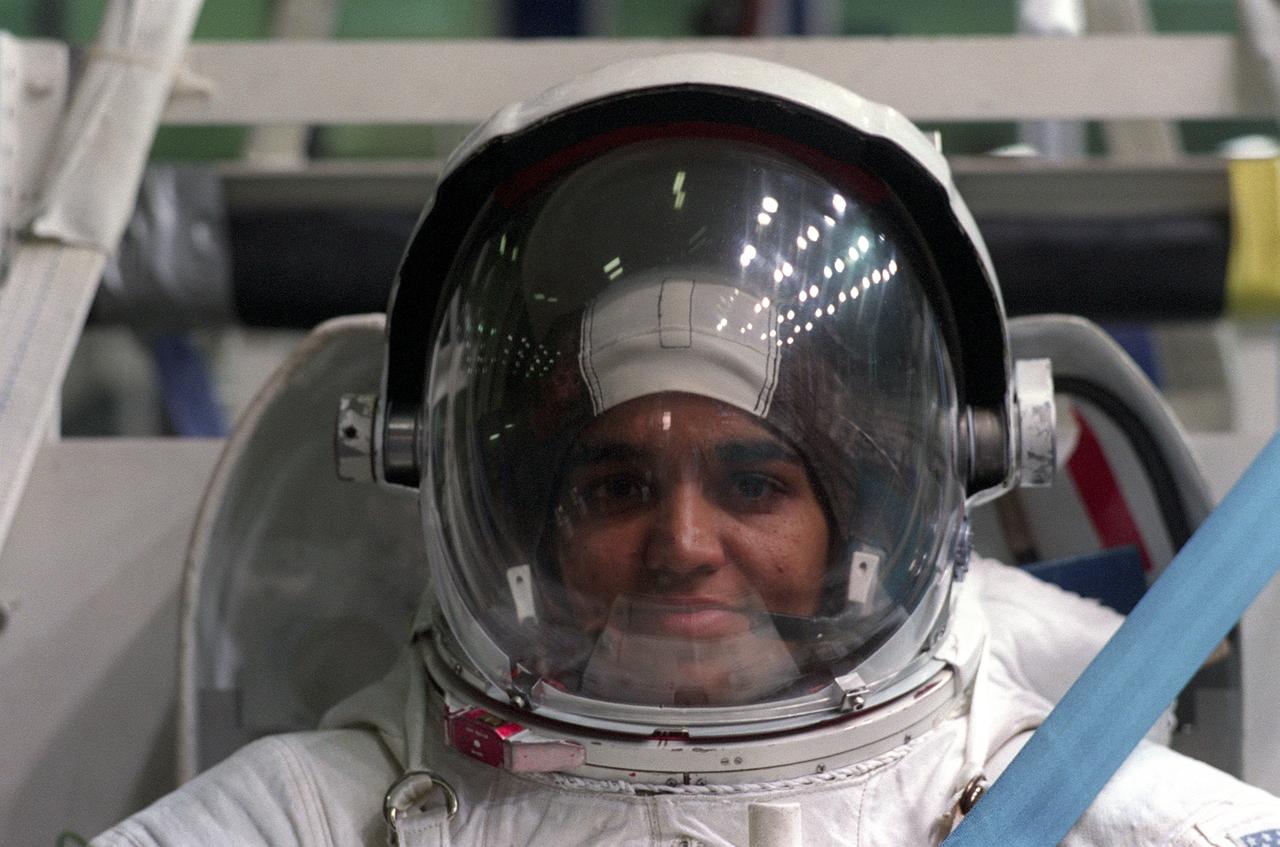
Attired in a training version of the Extravehicular Mobility Unit (EMU) space suit, astronaut and mission specialist Kalpana Chawla, prepares to go underwater in the Neutral Buoyancy Laboratory (NBL) near Johnson Space Center. This particular training was in preparation for the STS-87 mission. The Space Shuttle Columbia (STS-87) was the fourth flight of the United States Microgravity Payload (USMP-4) and Spartan-201 satellite, both managed by scientists and engineers from the Marshall Space Flight Center.
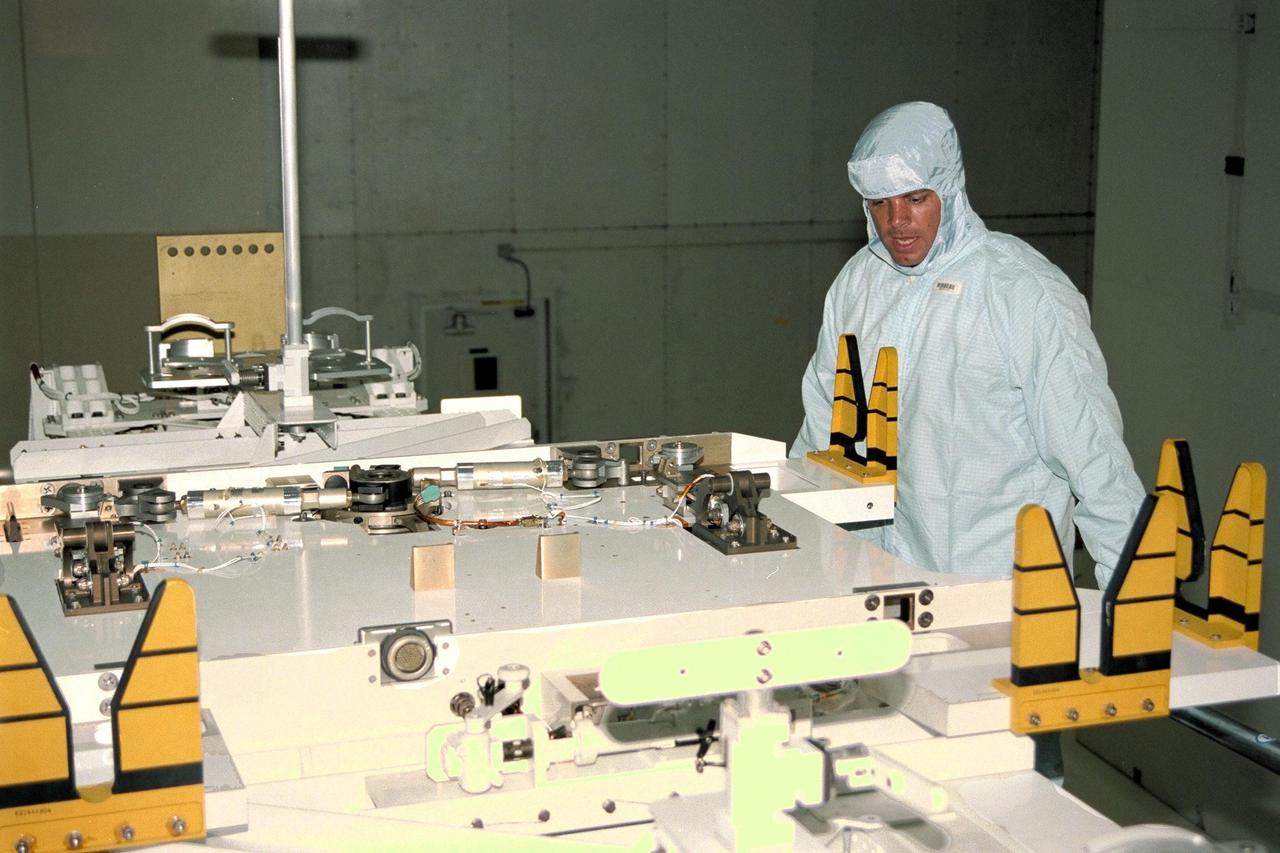
STS-87 Commander Kevin Kregel participates in the Crew Equipment Integration Test (CEIT) in Kennedy Space Center’s (KSC's) Vertical Processing Facility. The CEIT gives astronauts an opportunity to get a hands-on look at the payloads with which they will be working on-orbit. STS-87 will be the fourth United States Microgravity Payload and flight of the Spartan-201 deployable satellite. STS-87 is scheduled for a Nov. 19 liftoff from KSC
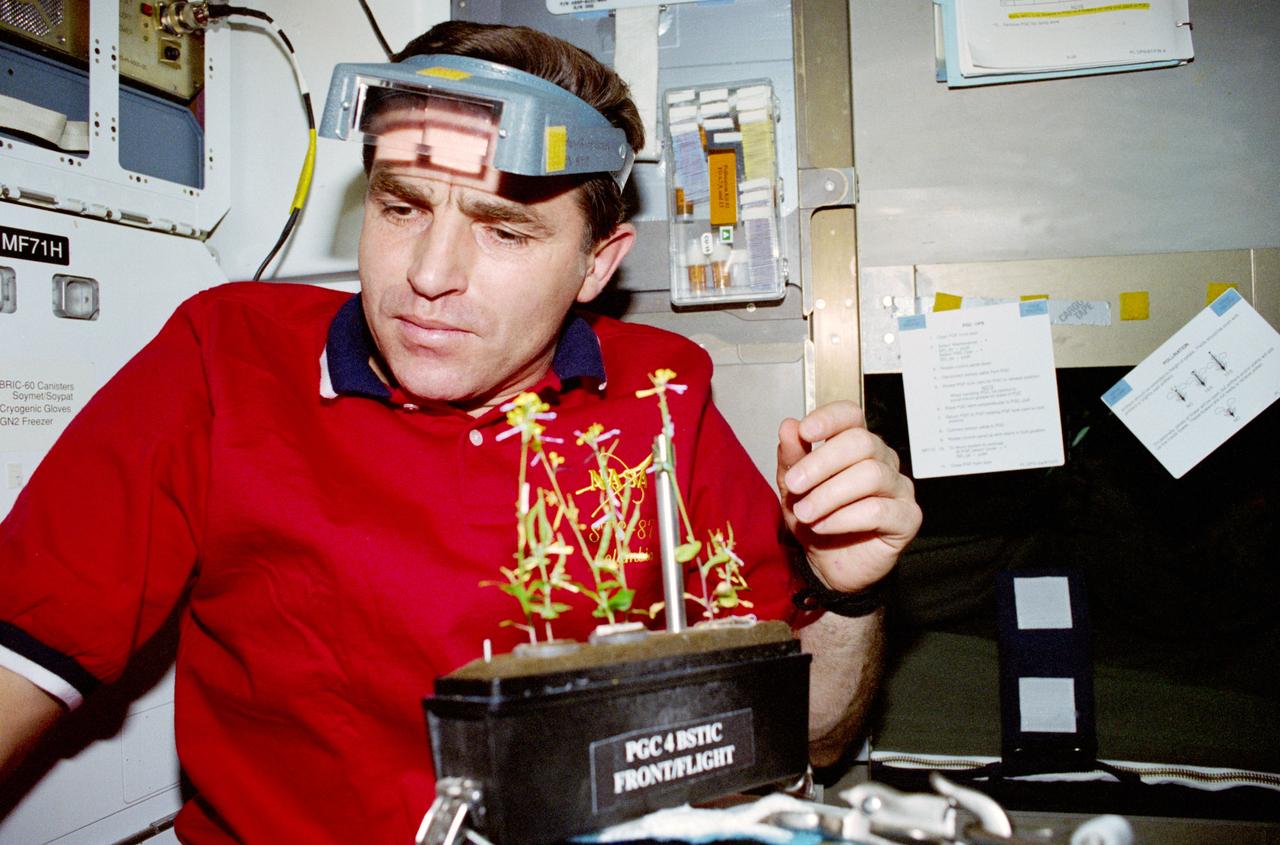
STS087-332-034 (19 November – 5 December 1997) --- On the Space Shuttle Columbia's middeck, Leonid Kadenyuk, Ukrainian payload specialist, works with the Brassica Rapa plants being grown for the Collaborative Ukrainian Experiment (CUE). Leonid Kadenyuk joined five astronauts for 16-days in Earth-orbit in support of the United States Microgravity Payload 4 (USMP-4) mission.
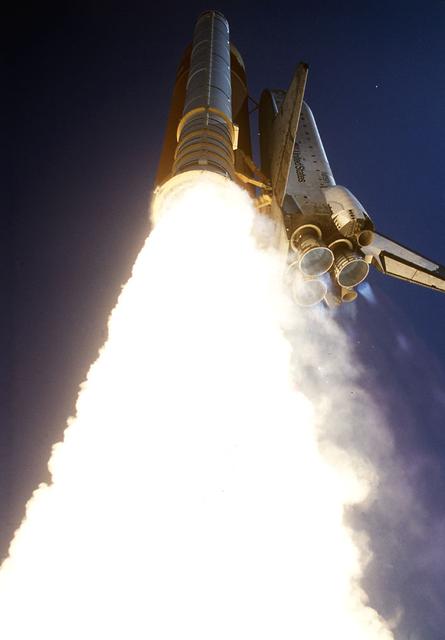
The Space Shuttle Columbia (STS-52) thunders off Launch Pad 39B, embarking on a 10-day flight and carrying a crew of six who will deploy the Laser Geodynamic Satellite II (LAGEOS). LAGEOS is a spherical passive satellite covered with reflectors which are illuminated by ground-based lasers to determine precise measurements of the Earth's crustal movements. The other major payload on this mission is the United States Microgravity Payload 1 (USMP-1), where experiments will be conducted by crew members while in low earth orbit (LEO).
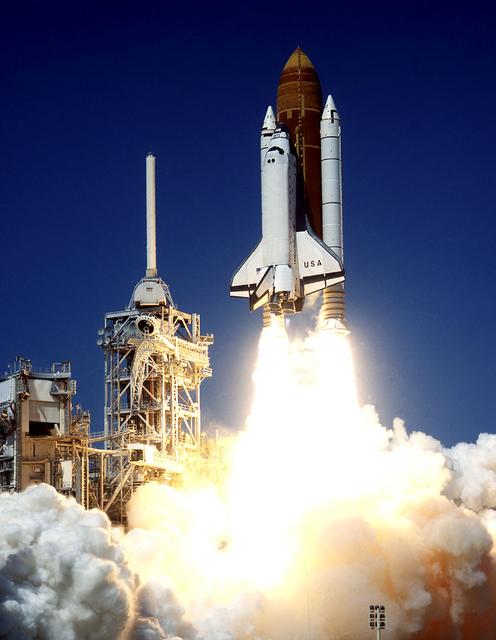
The Space Shuttle Columbia (STS-52) thunders off Launch Pad 39B, embarking on a 10-day flight and carrying a crew of six who will deploy the Laser Geodynamic Satellite II (LAGEOS). LAGEOS is a spherical passive satellite covered with reflectors which are illuminated by ground-based lasers to determine precise measurements of the Earth's crustal movements. The other major payload on this mission is the United States Microgravity Payload 1 (USMP-1), where experiments will be conducted by crew members while in low earth orbit (LEO).
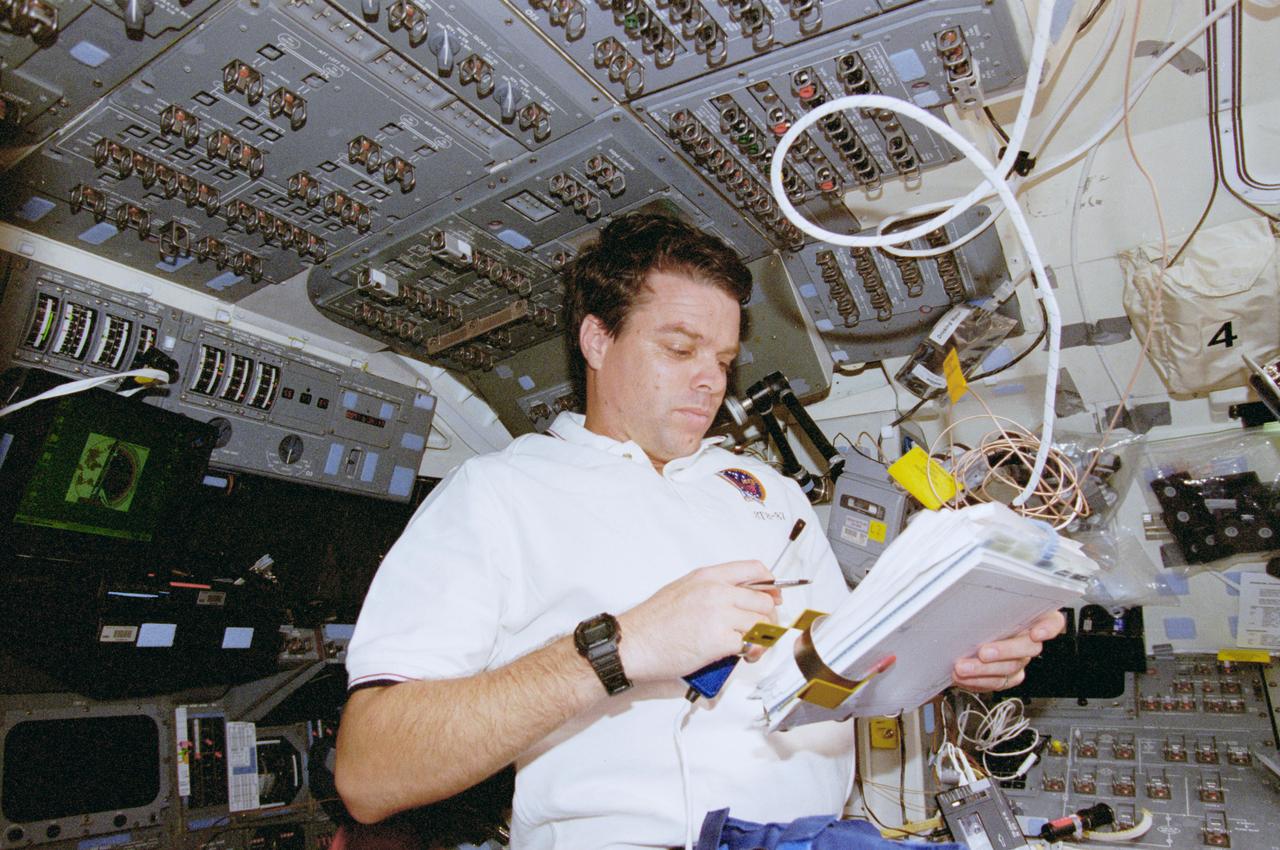
STS087-352-008 (19 November - 5 December 1997) --- Astronaut Kevin R. Kregel, mission commander, looks over the mission flight plan on the forward flight deck of the Space Shuttle Columbia. Kregel was accompanied by four other astronauts and a Ukrainian payload specialist for 16-days in space in support of the United States Microgravity Payload (USMP-4) mission.
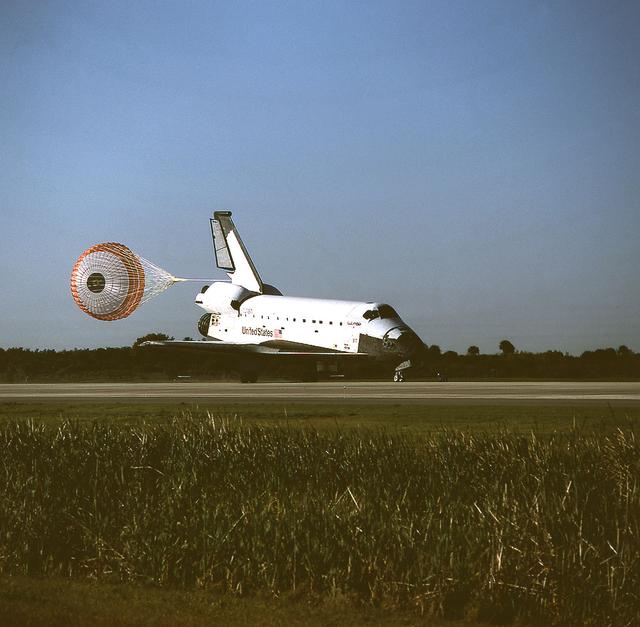
Space Shuttle Columbia (STS-62) comes to a graceful halt with the help of a parachute after a 14-day mission. The five member crew performed materials processing experiments on the United States Microgravity Payload 2 (USMP-2), and also conducted experiments designed to enable or extend space flight technology aboard the Office of Aeornautics and Space Technology 2 payload (OAST-2).
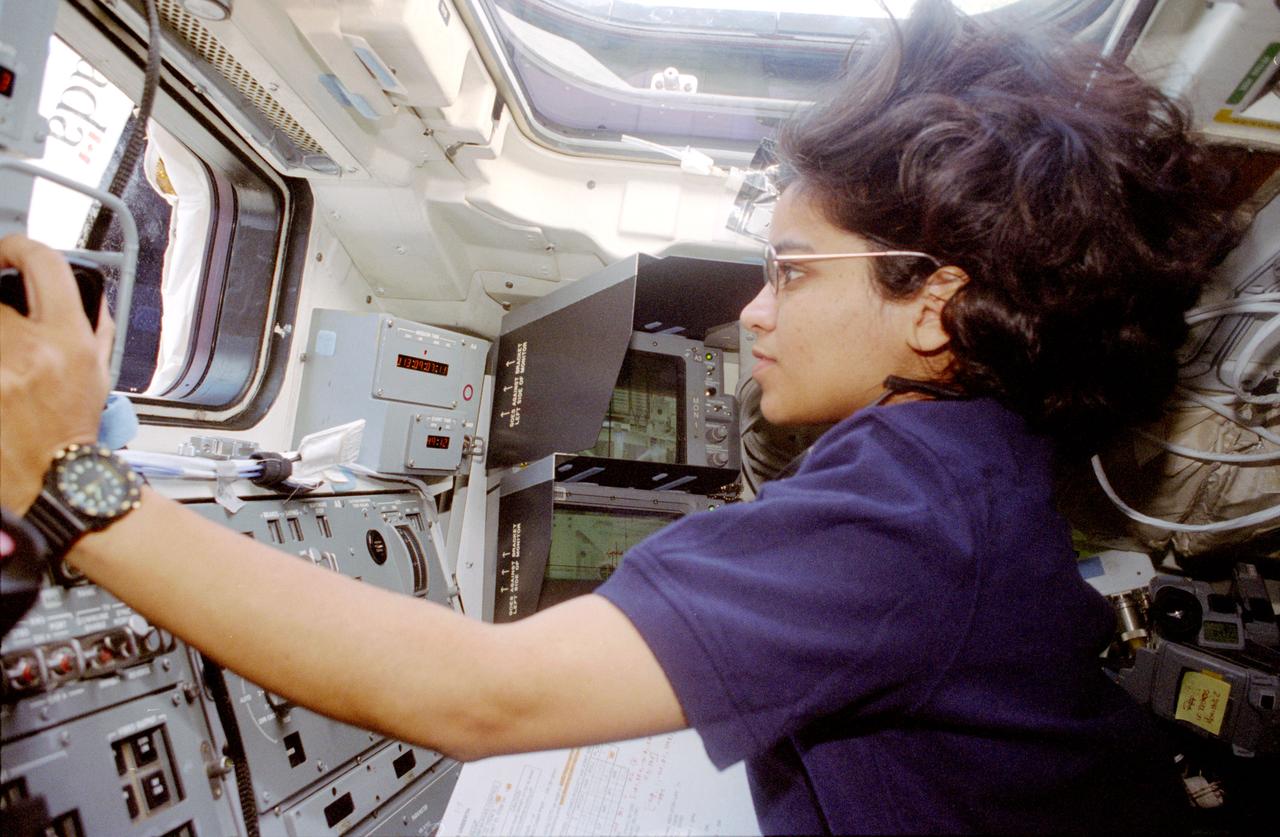
STS087-357-019 (19 November - 5 December 1997) --- Astronaut Kalpana Chawla, mission specialist, operates Columbia's Remote Manipulator System (RMS) on the aft flight deck during operations with the Spartan 201 satellite. Chawla joined four other astronauts and a Ukrainian payload specialist for 16-days of research in Earth-orbit in support of the United States Microgravity Payload 4 (USMP-4) mission.
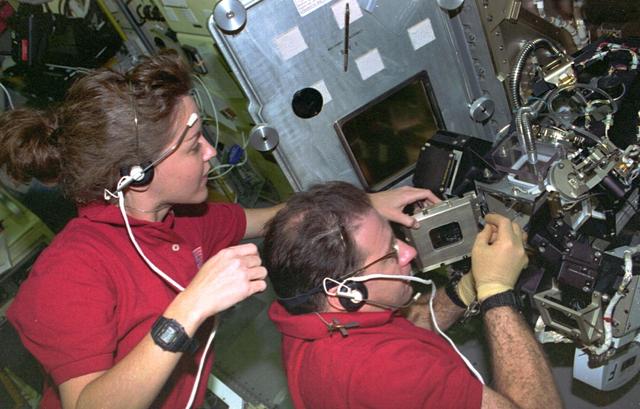
STS073-108-005 (20 October-5 November 1995) --- Two members of the crew perform an in-flight maintenance on the Drop Physics Module (DPM) in the science module aboard the Earth-orbiting Space Shuttle Columbia. Payload commander Kathryn C. Thornton and payload specialist Albert Sacco Jr. were part of a seven-member crew that spent 16 full days in space in support of the United States Microgravity Laboratory (USML-2) mission.
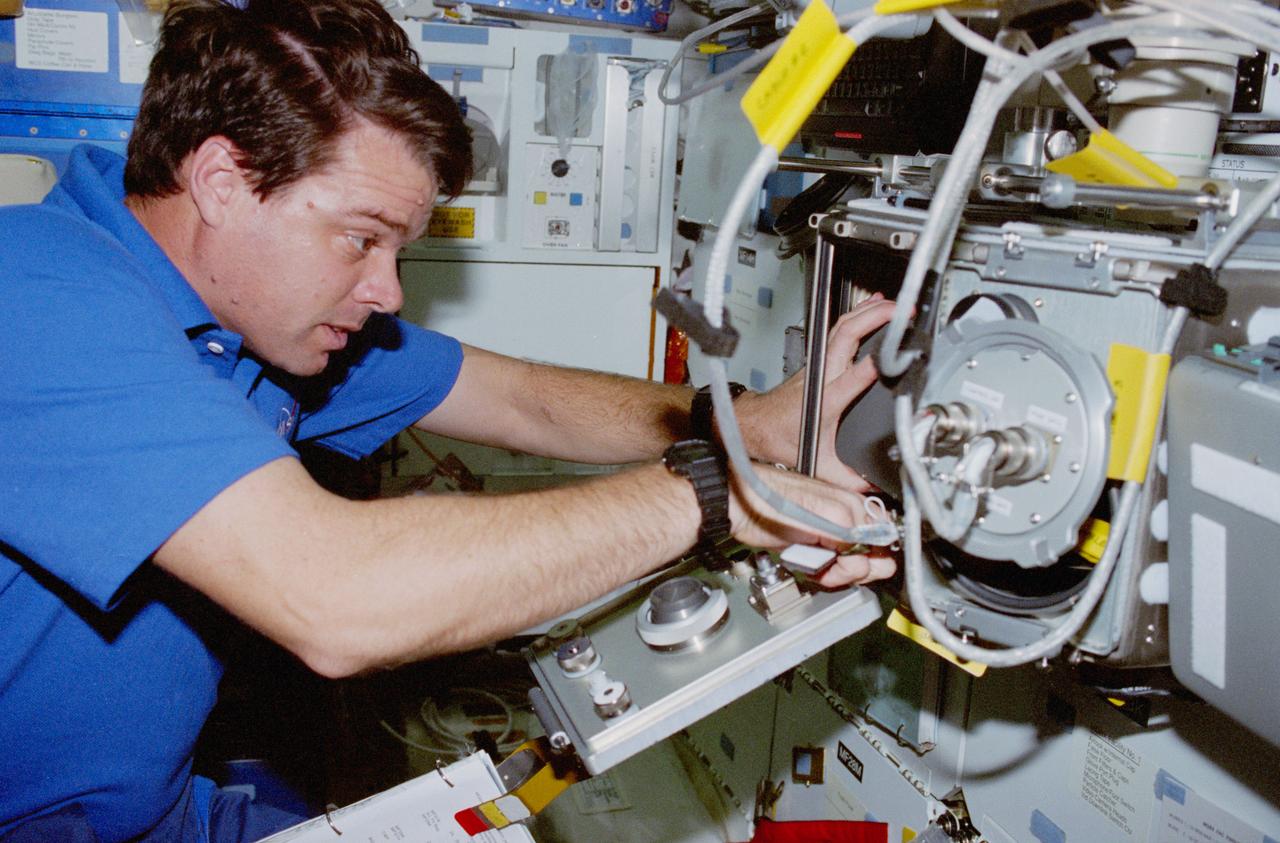
STS087-385-029 (19 November – 5 December 1997) --- Astronaut Kevin R. Kregel, mission commander, sets up the middeck glove box onboard the Space Shuttle Columbia during early hours of the 16-day United States Microgravity Payload 4 (USMP-4) mission. Kevin R. Kregel was joined by four other astronauts and a Ukrainian payload specialist for the mission.
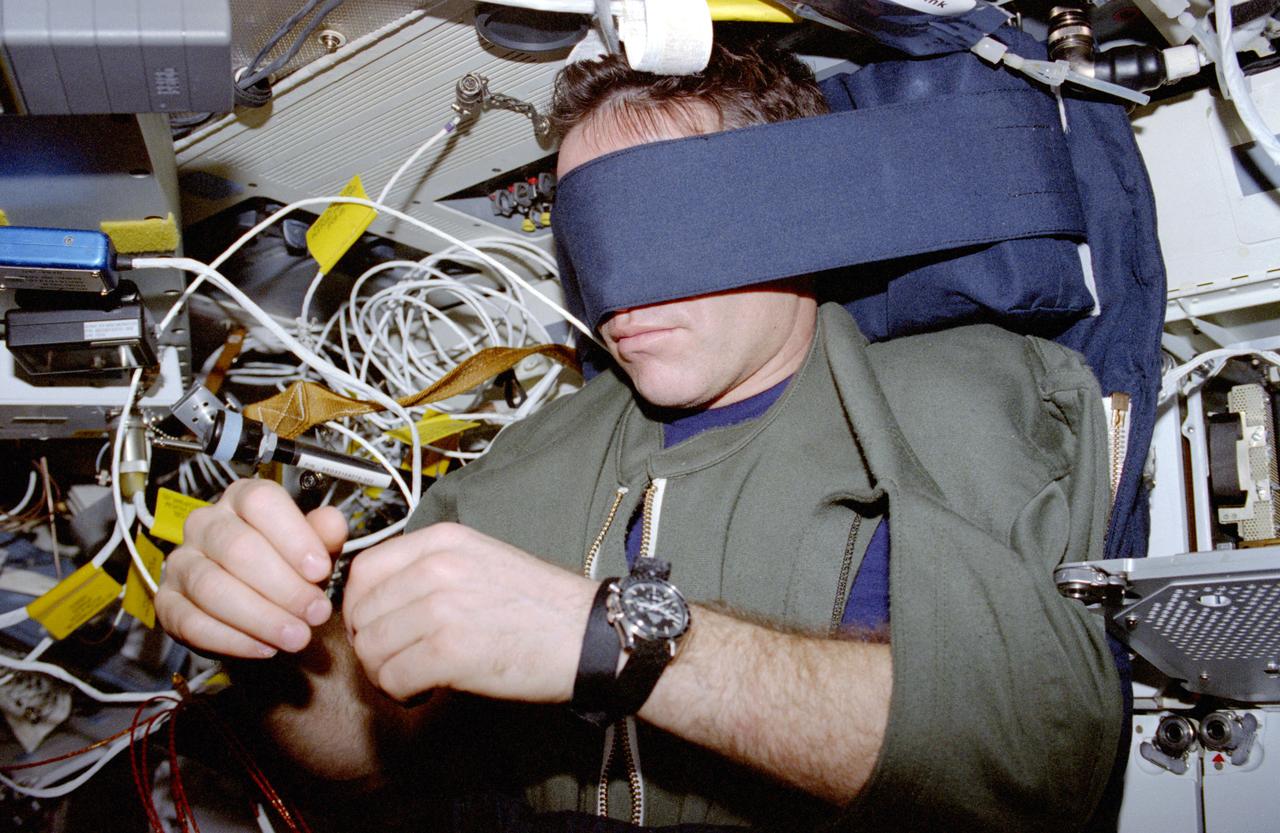
STS087-323-030 (19 November – 5 December 1997) --- Ukrainian payload specialist Leonid K. Kadenyuk blocks out the world and much more as he sleeps on the mid-deck of the Earth-orbiting Space Shuttle Columbia. Kadenyuk joined five NASA astronauts for 16 days aboard Columbia in support of the United States Microgravity Payload (USMP) mission.
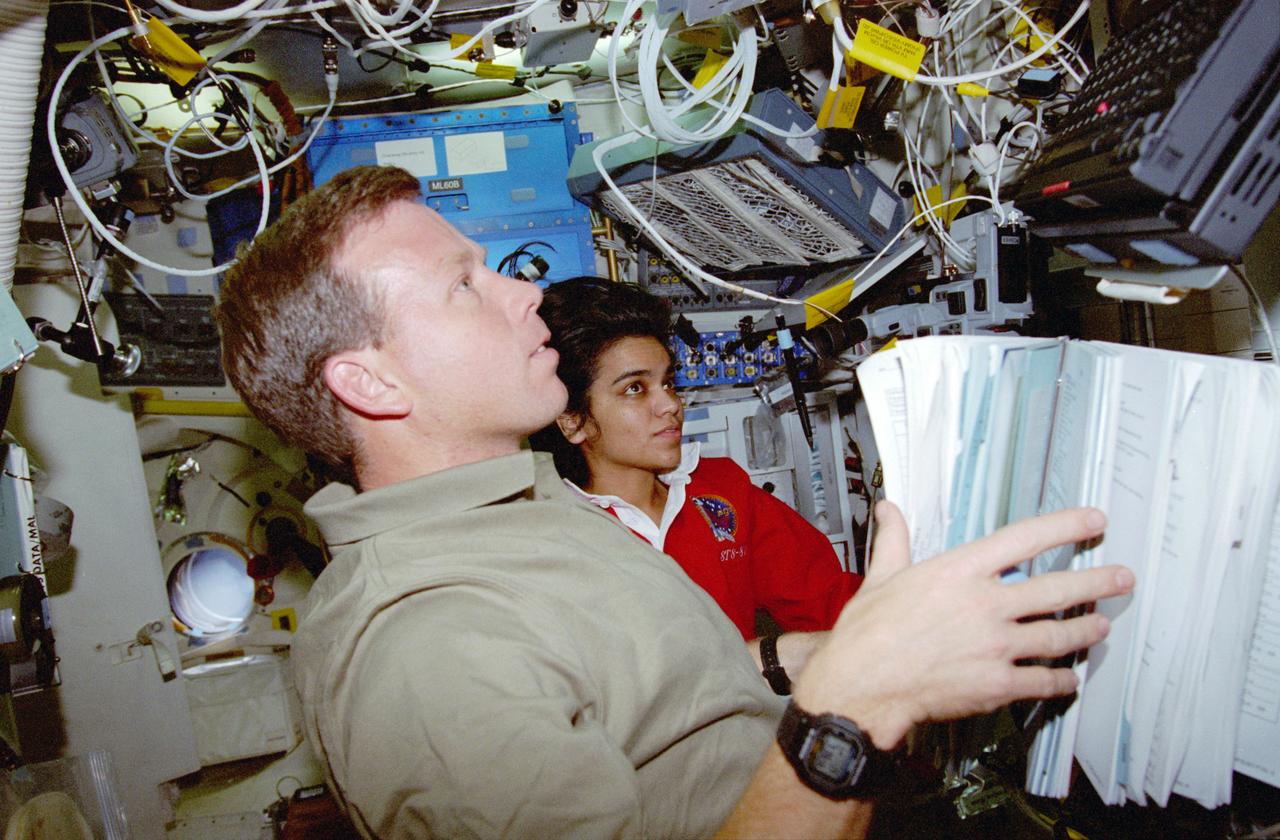
STS087-334-023 (19 November – 5 December 1997) --- On the Space Shuttle Columbia's middeck, astronauts Steven W. Lindsey, pilot, and Kalpana Chawla, mission specialist, check on an experiment in the middeck glove box. The two were joined by three other astronauts and a Ukrainian payload specialist for 16-days in Earth-orbit in support of the United States Microgravity Payload 4 (USMP-4) mission.
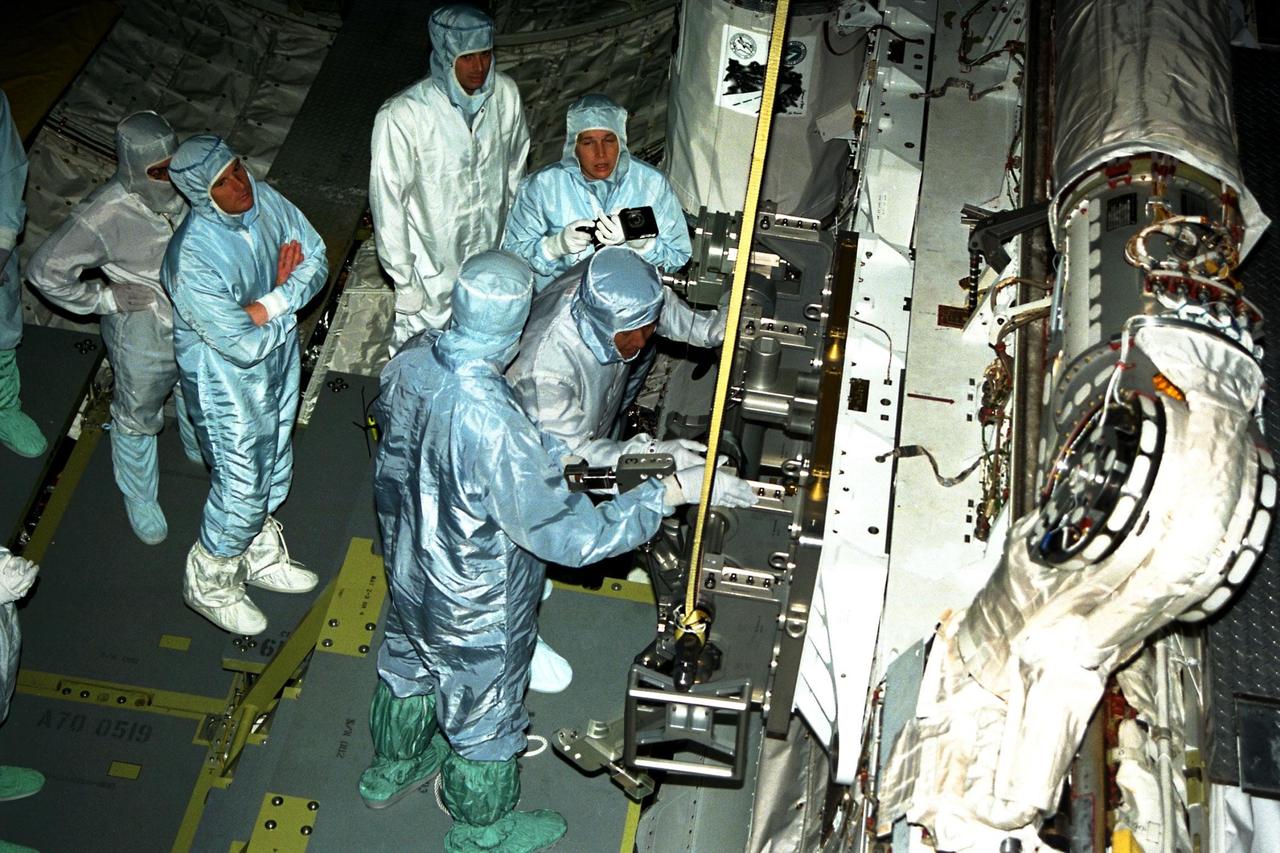
STS-87 astronaut crew members participate in the Crew Equipment Integration Test (CEIT) at Kennedy Space Center (KSC). The CEIT gives astronauts an opportunity to get a hands-on look at the payloads with which they will be working on-orbit. STS-87 will be the fourth United States Microgravity Payload and flight of the Spartan-201 deployable satellite. STS-87 is scheduled for a Nov. 19 liftoff from KSC

STS073-E-5003 (23 Oct. 1995) --- Astronaut Kathryn C. Thornton, STS-73 payload commander, works at the Drop Physics Module (DPM) on the portside of the science module aboard the Space Shuttle Columbia in Earth orbit. Payload specialist Albert Sacco Jr. conducts an experiment at the Glovebox. This frame was exposed with the color Electronic Still Camera (ESC) assigned to the 16-day United States Microgravity Laboratory (USML-2) mission.
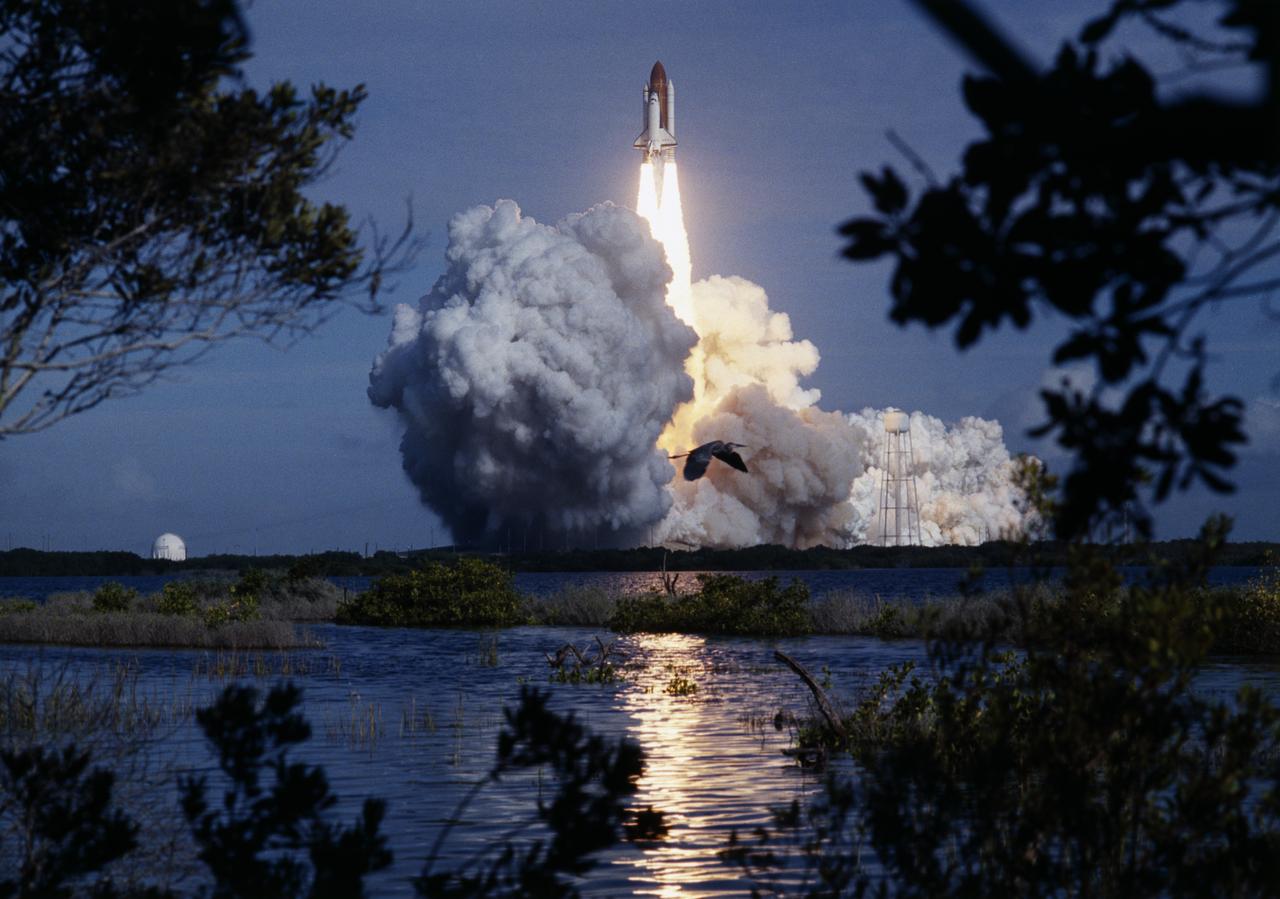
A Great Blue Heron seems oblivious to the tremendous spectacle of light and sound generated by a Shuttle liftoff, as the Space Shuttle Columbia (STS-73) soars skyward from Launch Pad 39B. Columbia's seven member crew's mission included continuing experimentation in the Marshall managed payloads including the United States Microgravity Laboratory 2 (USML-2) and the keel-mounted accelerometer that characterizes the very low frequency acceleration environment of the orbiter payload bay during space flight, known as the Orbital Acceleration Research Experiment (OARE).
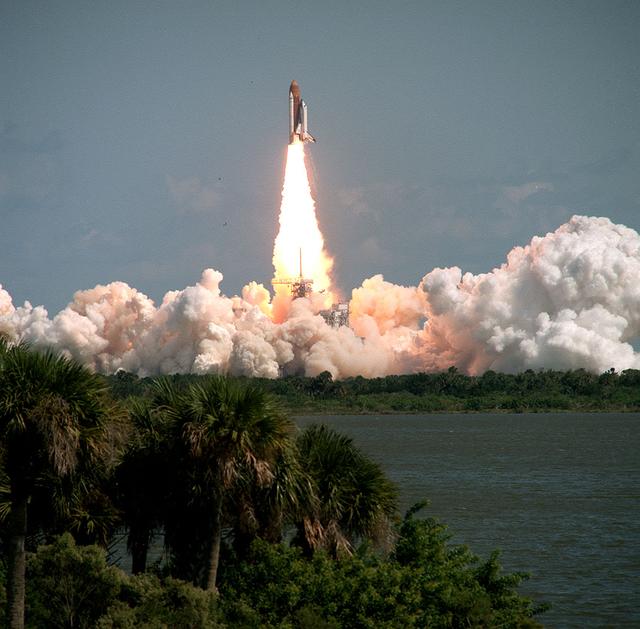
The Space Shuttle Columbia (STS-52) thunders off Launch Pad 39B, embarking on a 10-day flight and carrying a crew of six who will deploy the Laser Geodynamic Satellite II (LAGEOS). LAGEOS is a spherical passive satellite covered with reflectors which are illuminated by ground-based lasers to determine precise measurements of the Earth's crustal movements. The other major payload on this mission is the United States Microgravity Payload 1 (USMP-1), where experiments will be conducted by crew members while in low earth orbit (LEO).
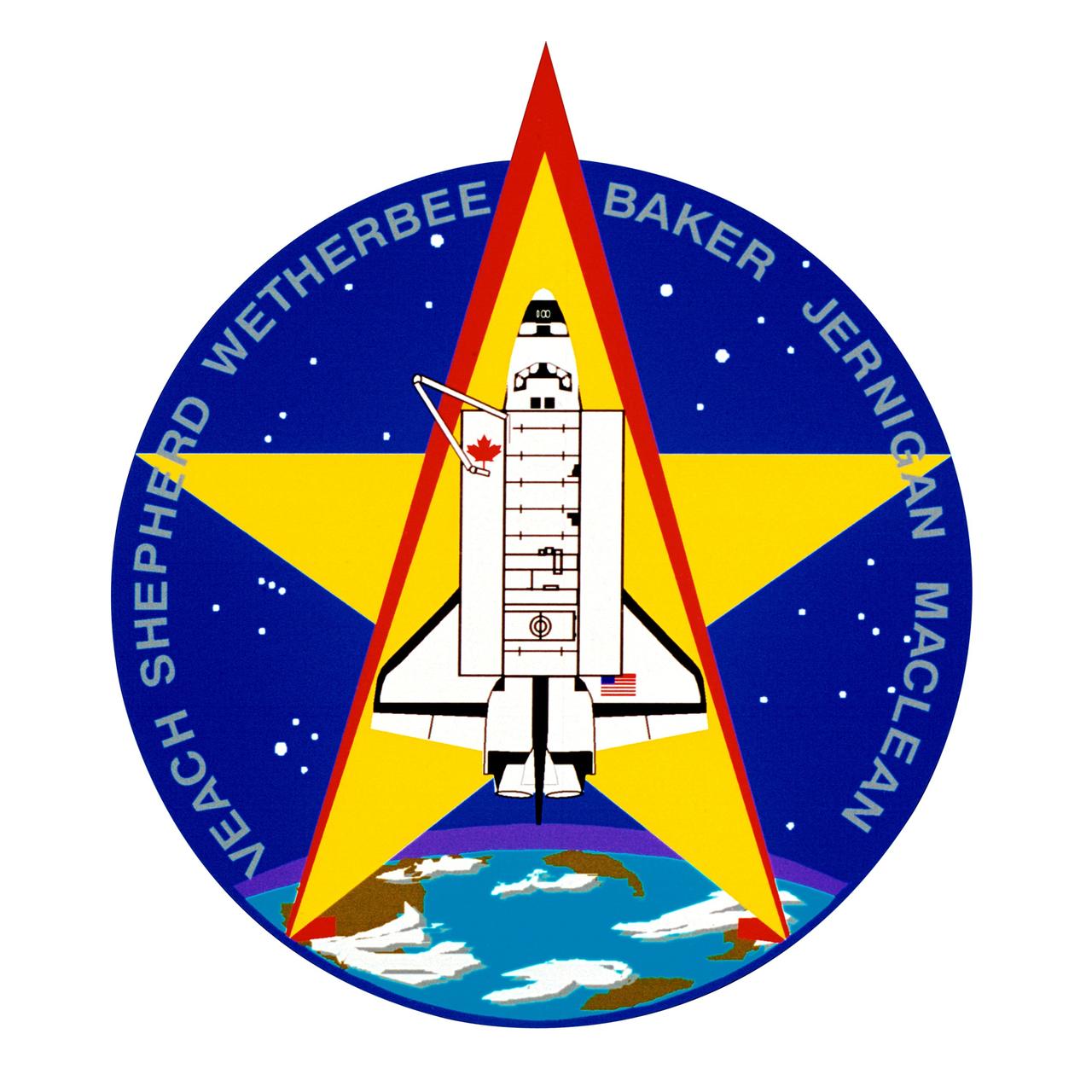
STS052-S-001 (July 1992) --- The insignia, designed by the STS-52 crew members, features a large gold star to symbolize the crew's mission on the frontiers of space. A gold star is often used to symbolize the frontier period of the American West. The red star in the shape of the Greek letter lambda represents both the laser measurements to be taken from the Laser Geodynamic Satellite (LAGEOS II) and the Lambda Point Experiment, which is part of the United States Microgravity Payload (USMP-1). The LAGEOS II is a joint Italian\United States satellite project intended to further our understanding of global plate tectonics. The USMP-1 is a microgravity facility which has French and United States experiments designed to test the theory of cooperative phase transitions and to study the solid\liquid interface of a metallic alloy in the low gravity environment. The Remote Manipulator System (RMS) and maple leaf are emblematic of the Canadian payload specialist who will conduct a series of Canadian flight experiments (CANEX-2), including the Space Vision System test. The NASA insignia design for space shuttle flights is reserved for use by the astronauts and for other official use as the NASA Administrator may authorize. Public availability has been approved only in the form of illustrations by the various news media. When and if there is any change in this policy, which we do not anticipate, it will be publicly announced. Photo credit: NASA

STS073-S-002 (July 1995) --- These five astronauts and two United States Microgravity Laboratory (USML) payload specialists pause from a rigid training schedule for the STS-73 crew portrait. On the front row, left to right, are Albert Sacco Jr., payload specialist; Kent V. Rominger, pilot; Michael E. Lopez-Alegria, mission specialist. On the back row are, left to right, Catherine G. Coleman, mission specialist; Kenneth D. Bowersox, commander; Fred W. Leslie, payload specialist; and Kathryn C. Thornton, payload commander.
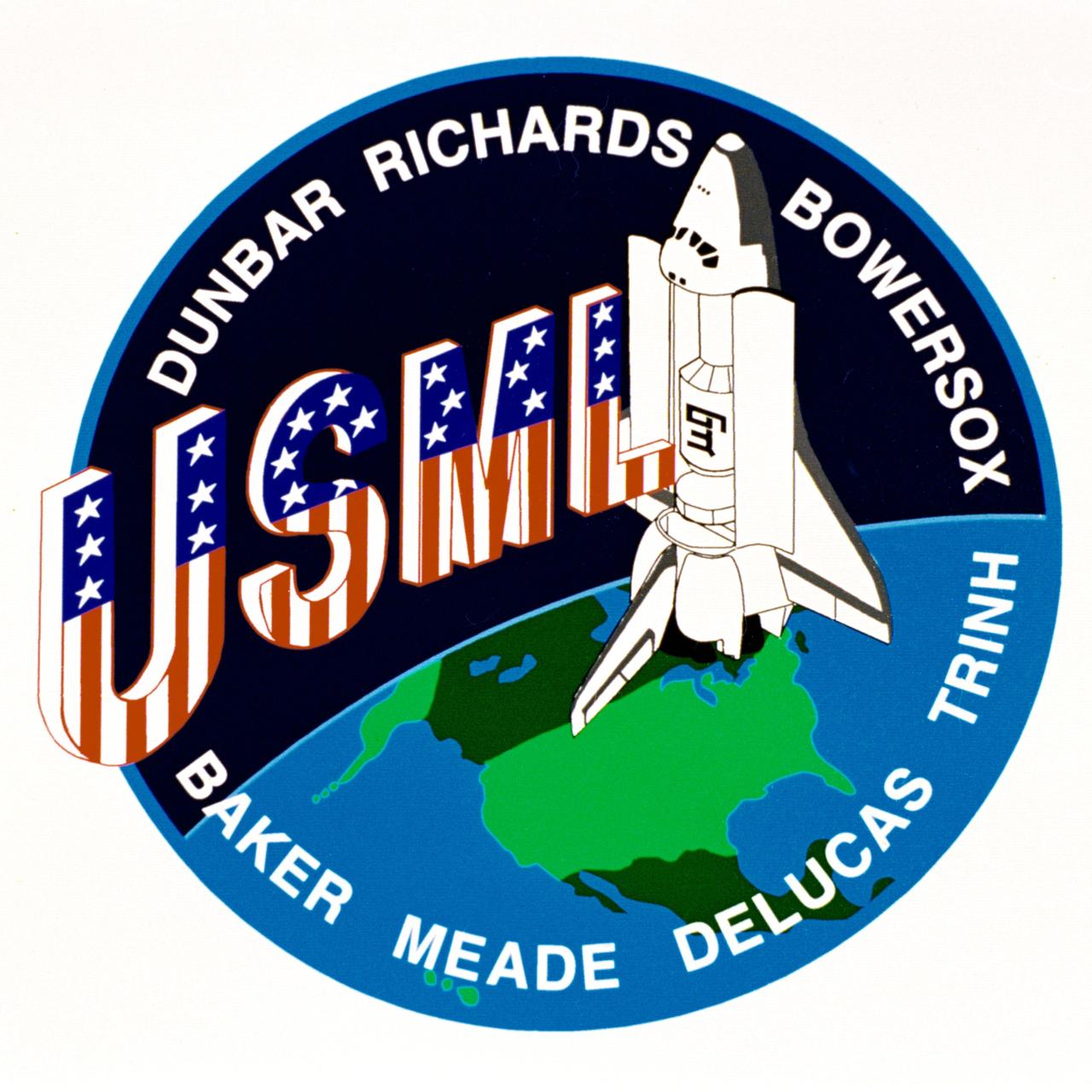
STS050-S-001 (January 1992) --- Designed by the flight crew, the insignia for the United States Microgravity Laboratory (USML-1), captures a space shuttle traveling above Earth while trailing the USML banner. The orbiter is oriented vertically in a typical attitude for microgravity science and in this position represents the numeral 1 in the mission's abbreviated title. This flight represents the first in a series of USML flights on which the primary objective is microgravity science, planned and executed through the combined efforts of the United States of America's government, industry and academia. Visible in the payload bay are the Spacelab module, and the extended duration orbiter "cryo" pallet which will be making its first flight. The small g and Greek letter mu on the Spacelab module symbolize the microgravity environment being used for research in the areas of materials science and fluid physics. The large block letter U extends outside the patch perimeter, symbolizing the potential for the experiments on this flight to expand the current boundaries of knowledge in microgravity science. The Stars and Stripes of the USML block letters and the United States landmass in the Earth scene below reflect the crew's pride in the United States origin of all onboard experiments. The NASA insignia design for space shuttle flights is reserved for use by the astronauts and for other official use as the NASA Administrator may authorize. Public availability has been approved only in the forms of illustrations by the various news media. When and if there is any change in this policy, which is not anticipated, the change will be publicly announced. Photo credit: NASA

These five astronauts and two United States Microgravity Laboratory (USML) payload specialists pause from a rigid training schedule for the STS-73 crew portrait. On the front row, left to right, are Albert Sacco Jr., payload specialist; Kent V. Rominger, pilot; and Michael E. Lopez-Alegria, mission specialist. On the back row are, left to right, Catherine G. Coleman, mission specialist; Kenneth D. Bowersox, commander; Fred W. Leslie, payload specialist; and Kathryn C. Thornton, payload commander. The STS-073 crew launched aboard the Space Shuttle Columbia on October 20, 1995 at 9:53:00.069 am (EDT). The mission served as the second flight of the Microgravity Laboratory (USML-2).
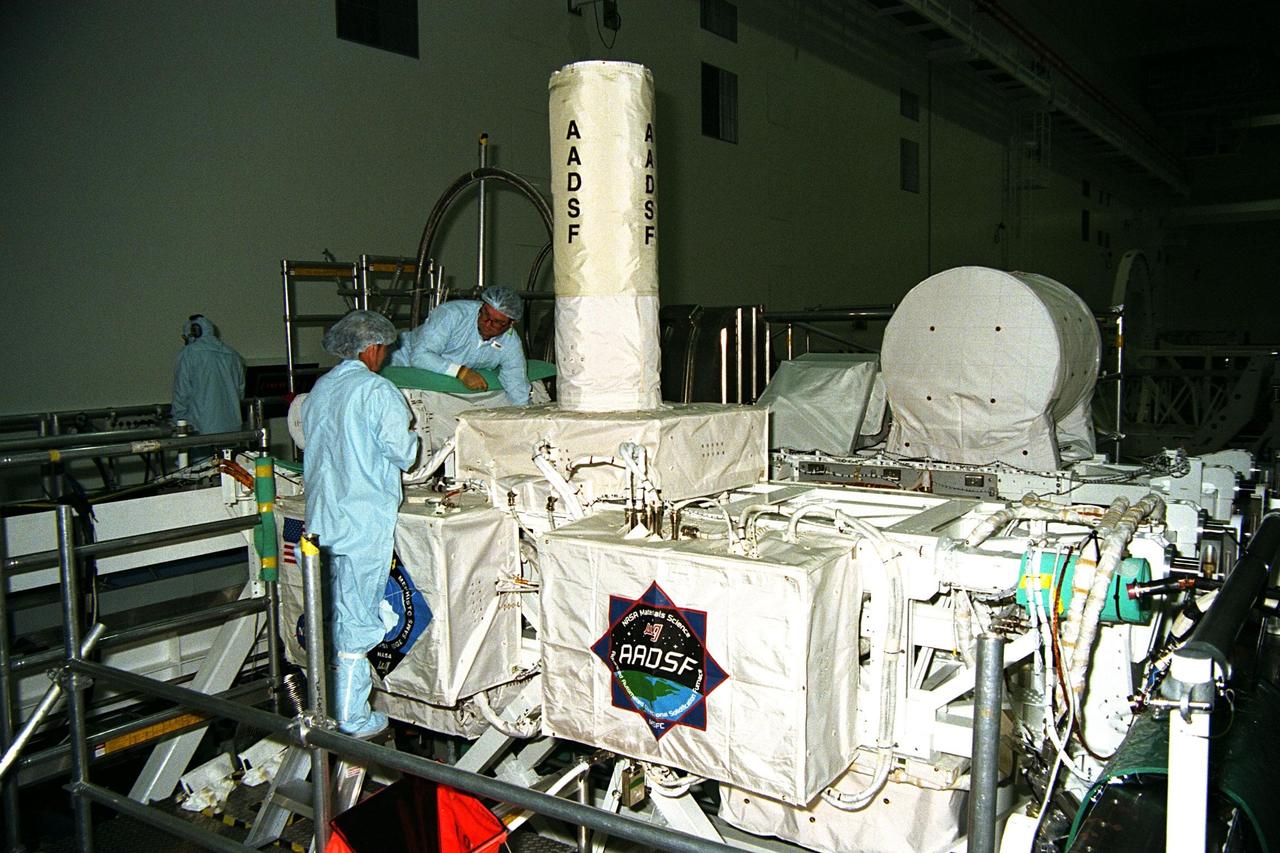
Technicians are monitoring experiments on the United States Microgravity Payload-4 (USMP-4) in preparation for its scheduled launch aboard STS-87 on Nov. 19 from Kennedy Space Center (KSC). USMP-4 experiments are prepared in the Space Station Processing Facility at KSC. The large white vertical cylinder in the center of the photo is the Advanced Automated Directional Solidification Furnace (AADSF), which is a sophisticated materials science facility used for studying a common method of processing semiconductor crystals called directional solidification. The white horizontal tube to the right is the Isothermal Dendritic Growth Experiment (IDGE), which will be used to study the dendritic solidification of molten materials in the microgravity environment
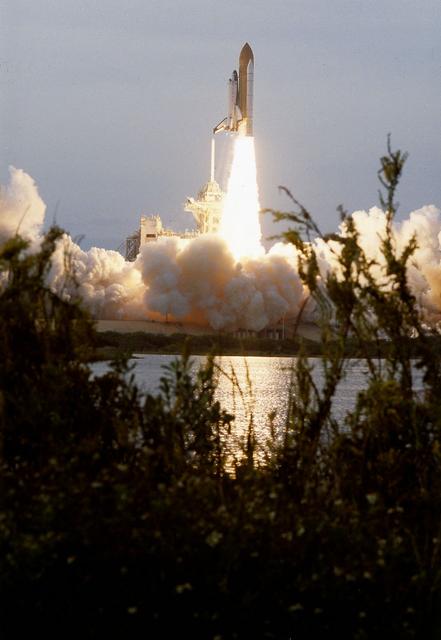
Like a rising sun lighting up the afternoon sky, the Space Shuttle Columbia (STS-87) soared from Launch Pad 39B on the fourth flight of the United States Microgravity Payload (USMP-4) and Spartan-201 satellite which were managed by scientists and engineers from the Marshall Space Flight Center. During the 16-day mission, the crew oversaw experiments in microgravity; deployed and retrieved a solar satellite; and tested a new experimental camera, the AERCam Sprint. Two crew members, Dr. Takao Doi and Winston Scott also performed a spacewalk to practice International Space Station maneuvers.
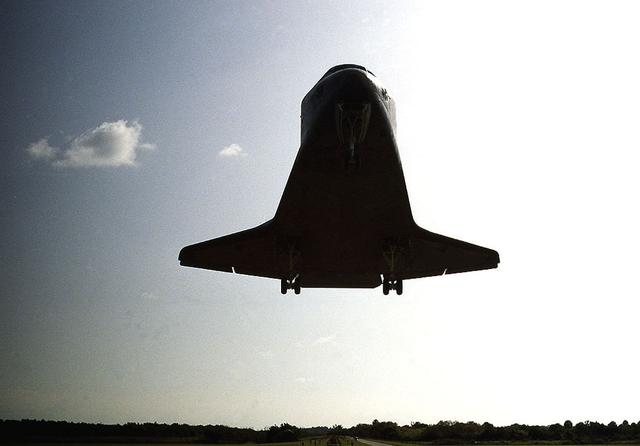
Aligned straight on with the red approach lights, the Orbiter Columbia (STS-52) glides toward Runway 33 of Kennedy Space Center's (KSC) Shuttle Landing Facility. The six member crew successfully completed deployment of the Laser Geodynamic Satellite II (LAGEOS), which is a spherical passive satellite covered with reflectors which are illuminated by ground-based lasers to determine precise measurements of the Earth's crustal movements. The crew also completed a series of materials processing experiments in the microgravity environment aboard the United States Microgravity Payload 1 (USMP-1) carried in the orbiter's cargo bay.
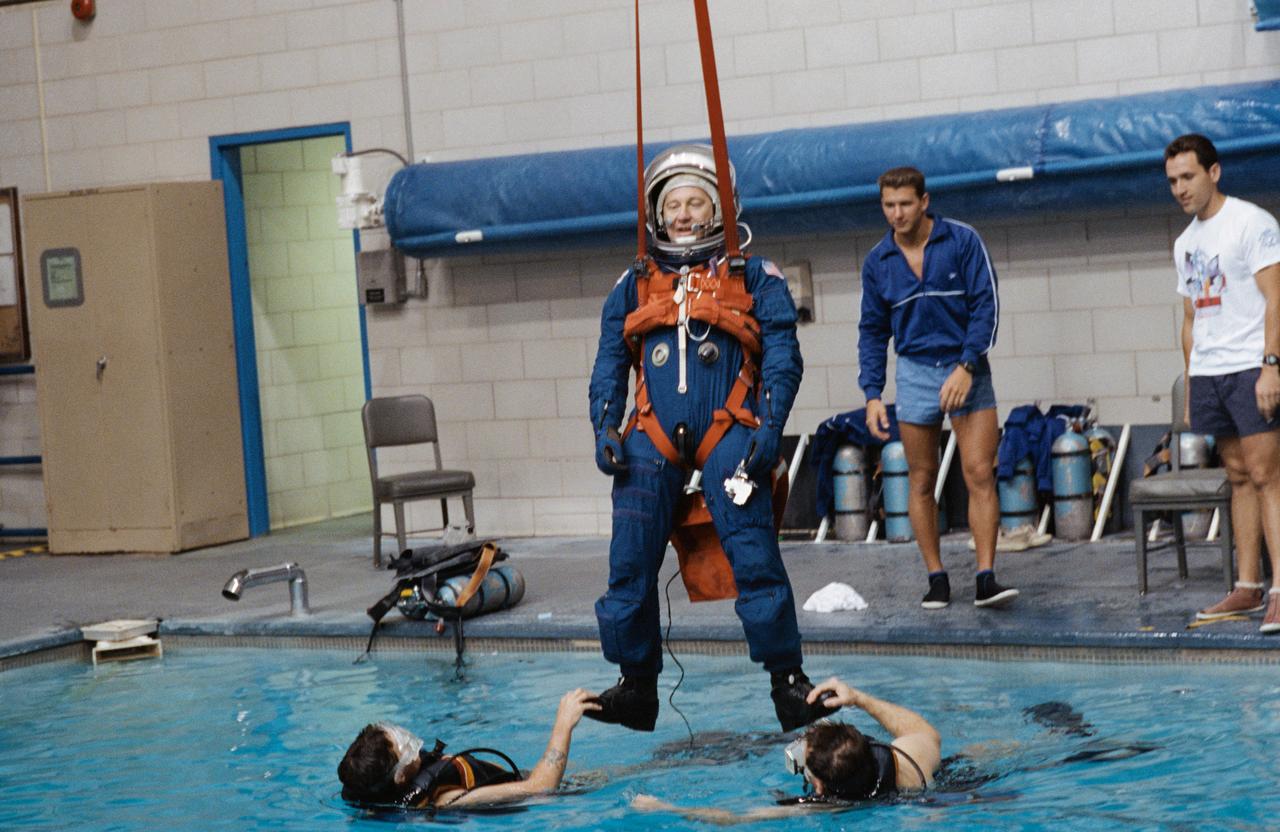
S92-32111 (May 1992) --- Payload specialist Albert Sacco Jr. is assisted by two SCUBA-equipped divers as he hangs by his parachute harness during emergency bailout training exercises in the Johnson Space Center?s (JSC) Weightless Environment Training Facility (WET-F). Sacco is an alternate payload specialist for the United States Microgravity Laboratory (USML-1) mission, scheduled for launch later this year. EDITOR?S NOTE: Sacco was later named as prime crew payload specialist for the USML-2 mission (STS-73), scheduled for 1995.
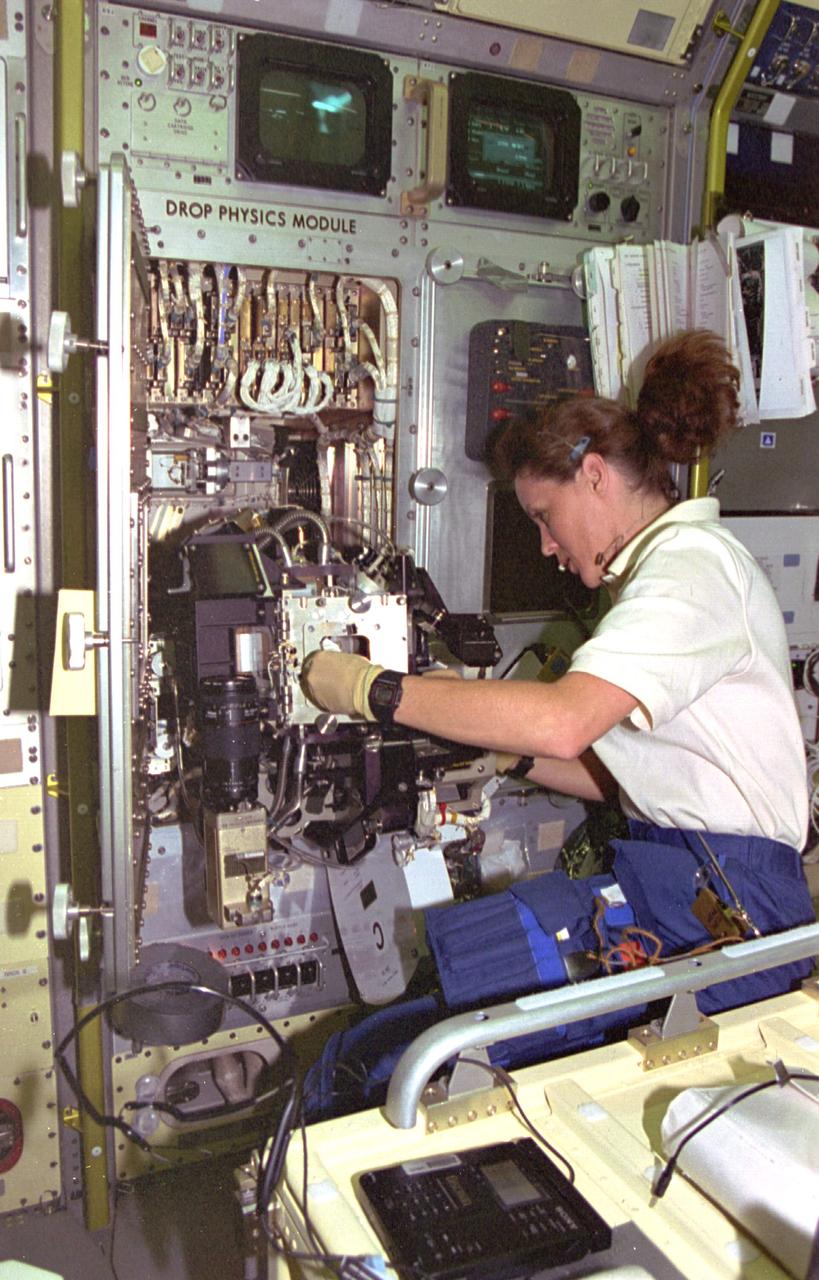
STS073-143-026 (20 October-5 November 1995) --- Astronaut Kathryn C. Thornton, STS-73 payload commander for the United States Microgravity Laboratory (USML-2), explores the inner workings of the Drop Physics Module (DPM). Thornton was joined by four other NASA astronauts and two guest researchers for almost 16 days of research aboard the Space Shuttle Columbia in Earth-orbit.

STS-87 Mission Specialist Winston Scott is assisted with his ascent and re-entry flight suit in the white room at Launch Pad 39B by Danny Wyatt, NASA quality assurance specialist. STS-87 is the fourth flight of the United States Microgravity Payload and Spartan-201. Scott is scheduled to perform an extravehicular activity spacewalk with Mission Specialist Takao Doi, Ph.D., of the National Space Development Agency of Japan, during STS-87. Scott also performed a spacewalk on the STS-72 mission
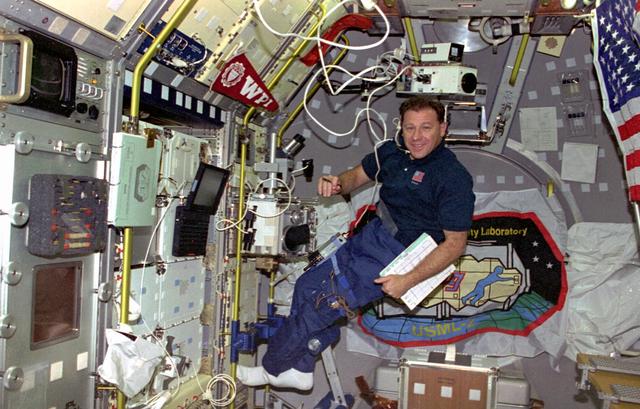
S95-09157 (27 Apr. 1995) --- Payload specialist Fred W. Leslie has just translated from the top of a Shuttle mockup-trainer using a Sky-genie device during emergency egress training with his six STS-73 crew mates. He is assisted here by Scott Gill, a member of the STS-73 training staff. The seven will fly aboard the Space Shuttle Columbia later this year to support the United States Microgravity Laboratory (USML-2) mission.
STS073-106-001 (20 October-5 November 1995) --- Payload specialist Albert Sacco Jr. takes direction from a crew mate out of frame onboard the United States Microgravity Laboratory (USML-2) science module in the cargo bay of the Space Shuttle Columbia. Sacco was about to check out an experiment in a glovebox, which represented one of the busier areas during the 16-day USML-2 flight.
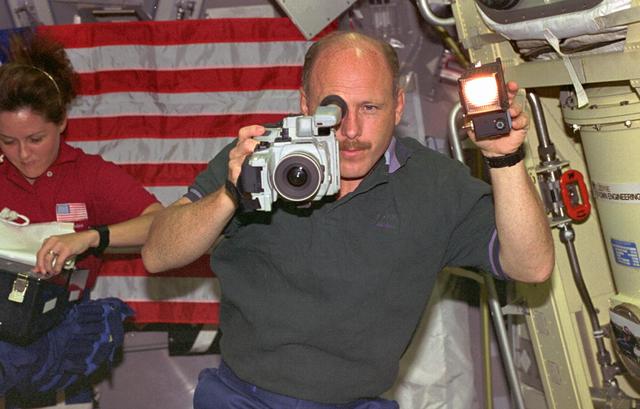
STS073-230-014 (20 October - 5 November 1995) --- Astronaut Kenneth D. Bowersox, STS-73 mission commander, uses a camcorder to record United States Microgravity Laboratory 2 (USML-2) activities onboard the Space Shuttle Columbia. Nearby, astronaut Kathryn C. Thornton, payload commander, prepares to open a supply chest to support one of many science experiments conducted by the seven-member crew during the 16-day USML-2 flight.
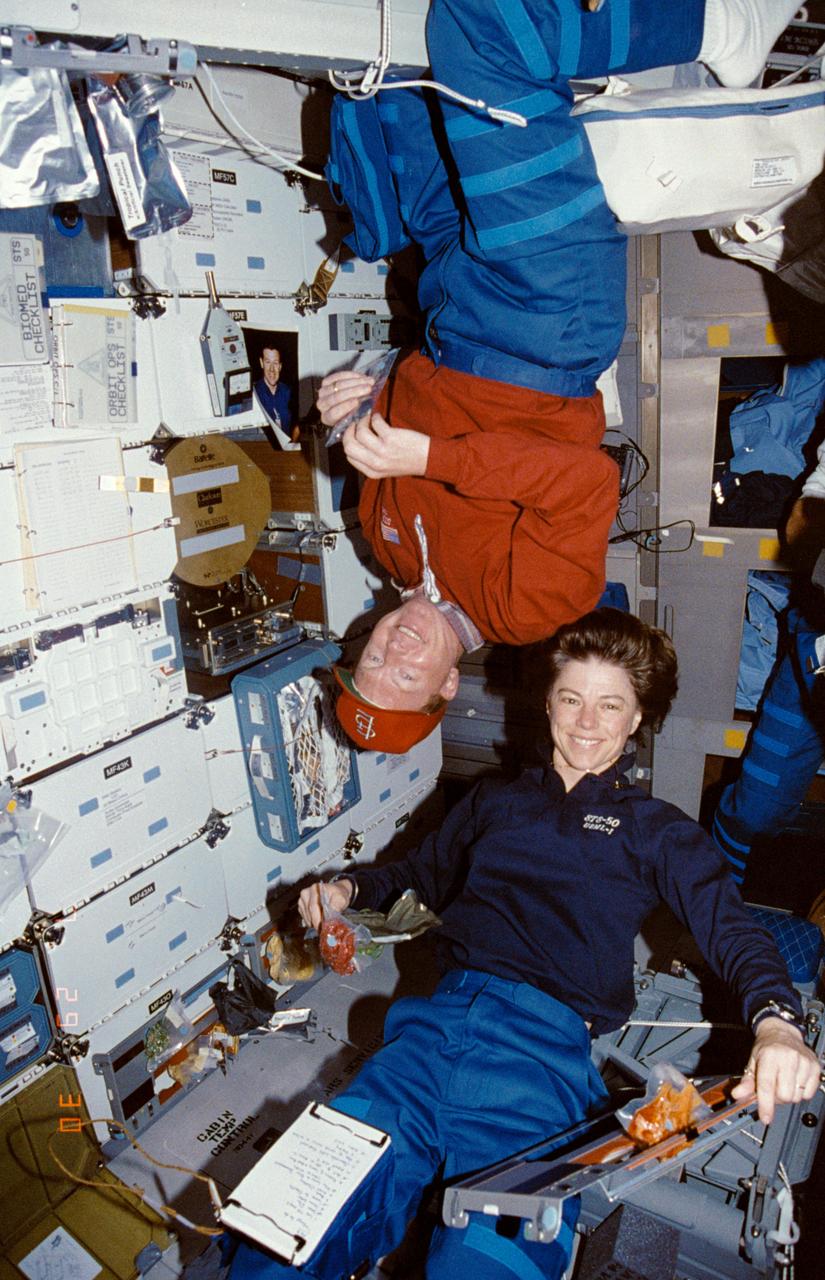
STS050-25-024 (25 June-9 July 1992) --- Astronauts Richard N. Richards and Bonnie J. Dunbar, momentarily on leave from the United States Microgravity Laboratory (USML-1) science module, share a meal on the middeck of the Earth-orbiting Space Shuttle Columbia. Richards is mission commander, and Dunbar is payload commander on the record-setting 14-day mission. Near Richards' head is the Astroculture experiment.
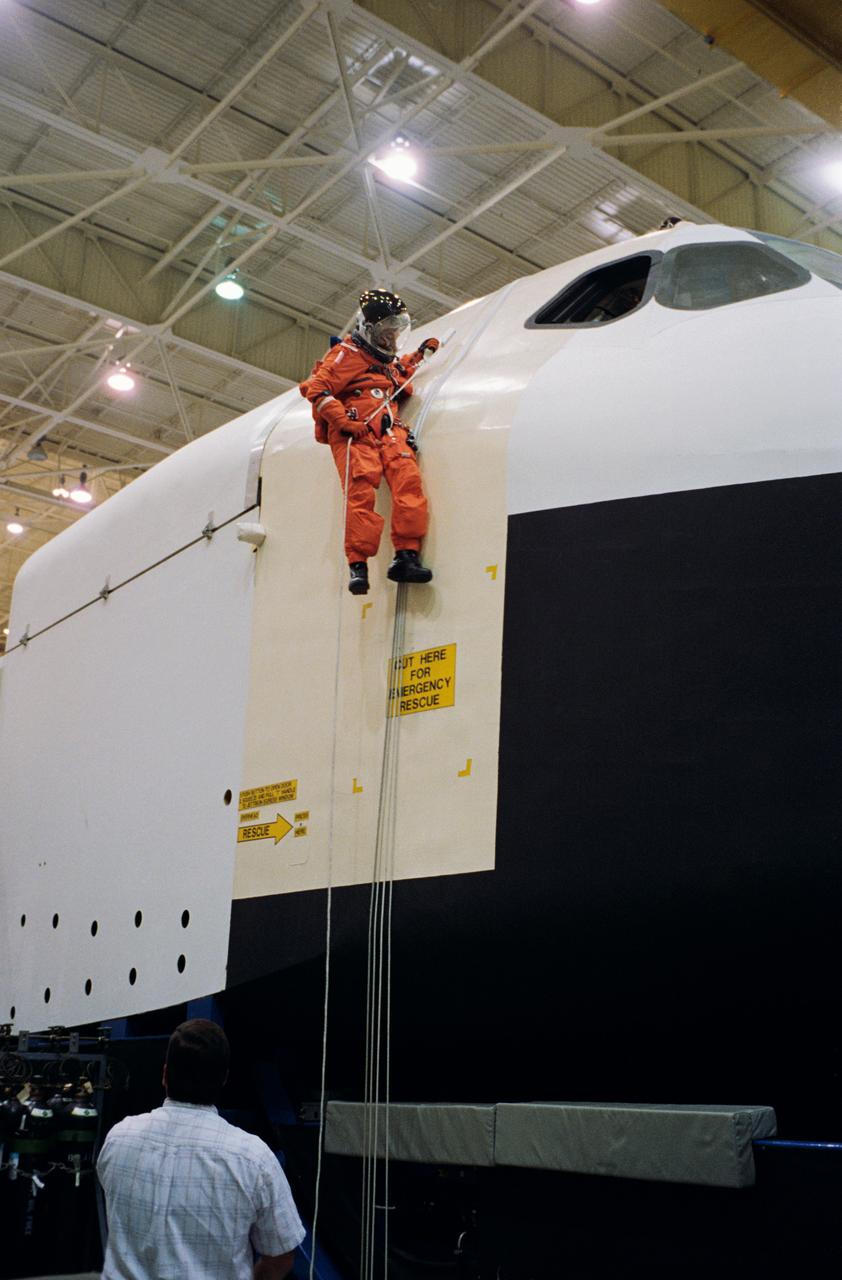
S95-09163 (27 Apr. 1995) --- Payload specialist Albert Sacco Jr. rappels from the top of a Shuttle mockup-trainer using a Sky-genie device during emergency egress training with his six STS-73 crew mates. The seven will fly aboard the Space Shuttle Columbia later this year to support the United States Microgravity Laboratory (USML-2) mission.
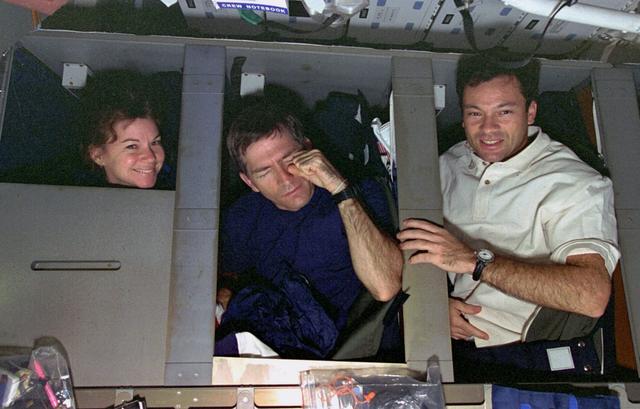
STS073-351-035 (20 October - 5 November 1995) --- Three crew members are captured on camera at the end of their sleep shift on the middeck of the Earth-orbiting Space Shuttle Columbia. Pictured are (left to right) astronaut Catherine G. Coleman, mission specialist; payload specialist Fred W. Leslie and astronaut Michael E. Lopez-Alegria, mission specialist. The trio joined four other crewmembers for 16 days of in-space research in support of the United States Microgravity Laboratory (USML-2) mission.
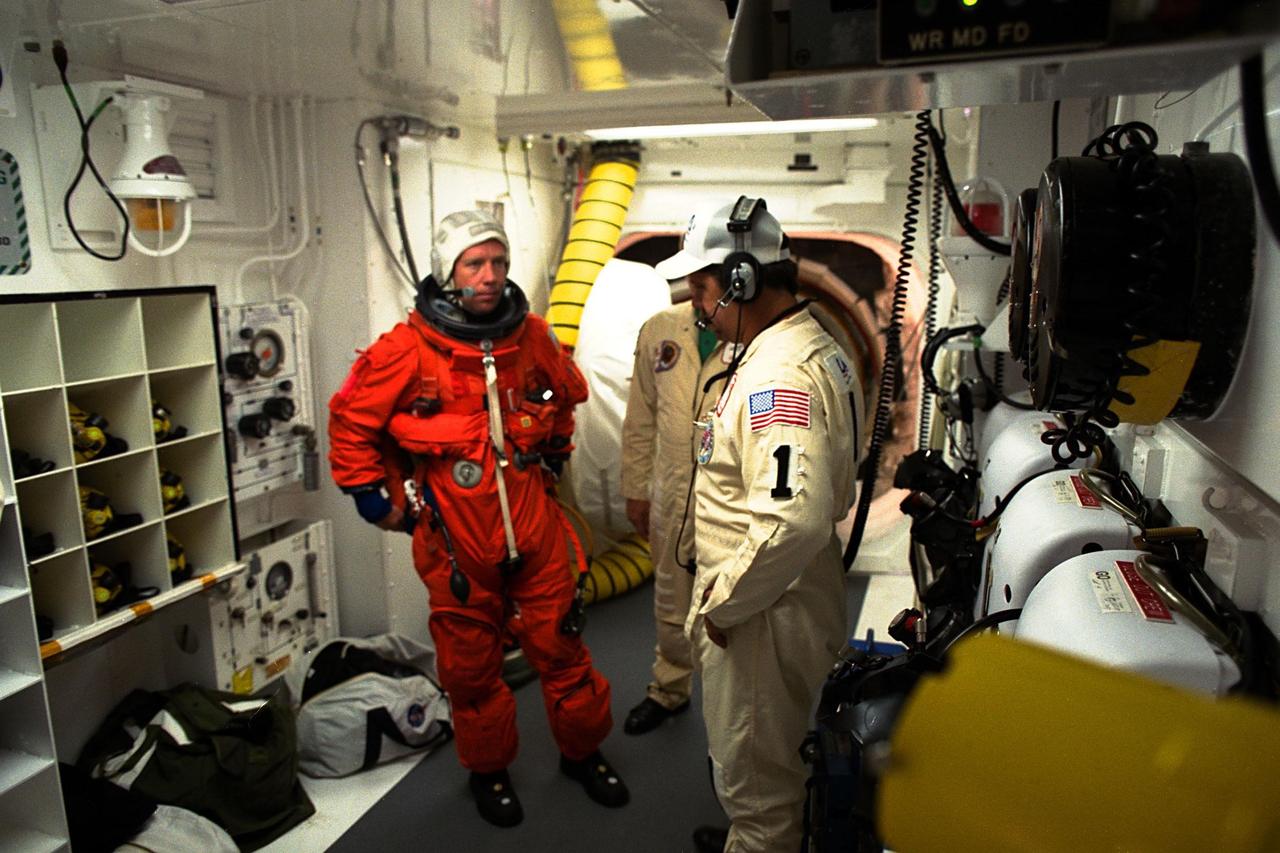
STS-87 Pilot Steven Lindsey is inspected before launch in his ascent and re-entry flight suit in the white room at Launch Pad 39B by Travis Thompson, USA orbiter vehicle closeout chief. STS-87 is the fourth flight of the United States Microgravity Payload and Spartan-201. Although this is his first Shuttle flight, Lindsey has logged more than 2,700 hours of flying time in 49 different types of aircraft
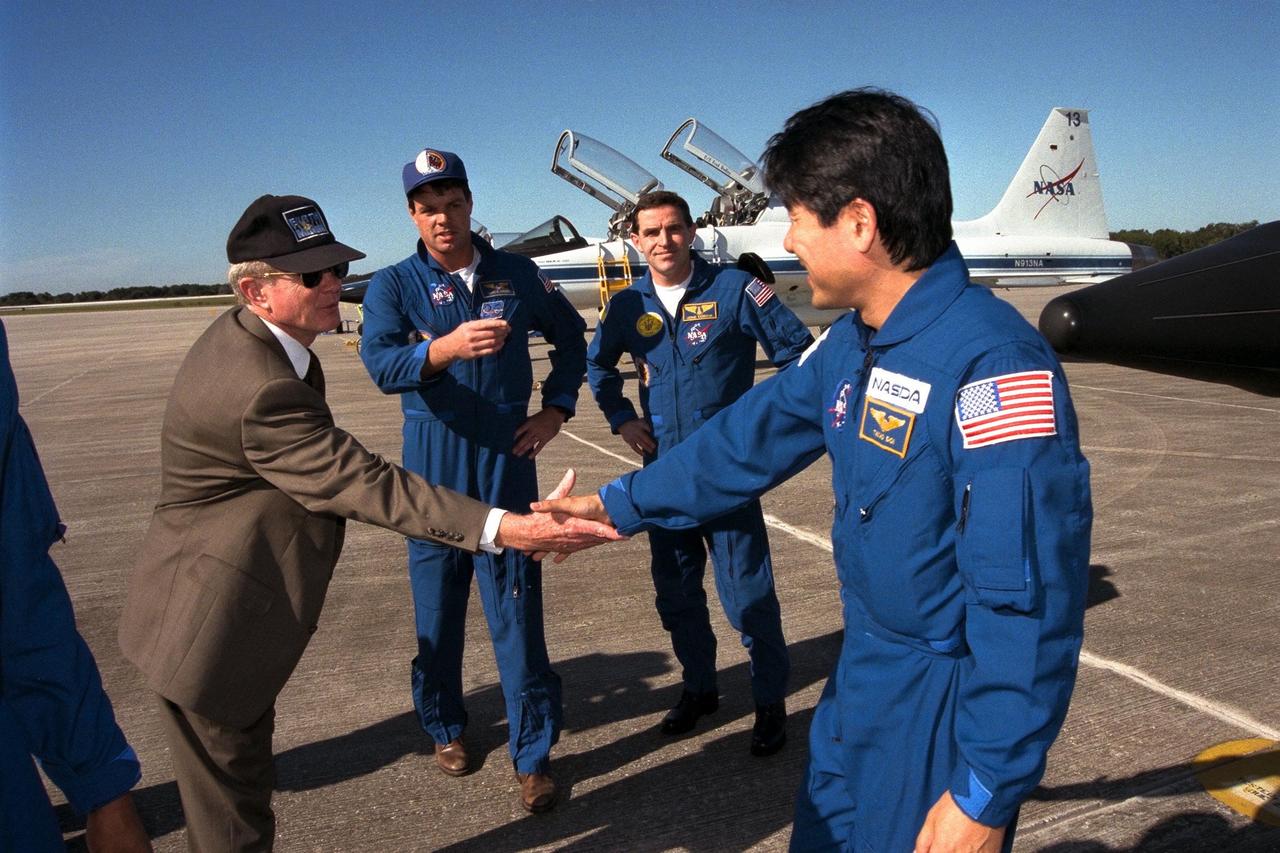
In preparation for Space Shuttle Mission STS-87, the crew arrives at the Kennedy Space Center Shuttle Landing Facility to participate in the Terminal Countdown Demonstration Test (TCDT) for their mission. The TCDT is a dress rehearsal for launch. STS-87 will be the fourth flight of the United States Microgravity Payload and the Spartan-201 deployable satellite. Launch is targeted for Nov. 19
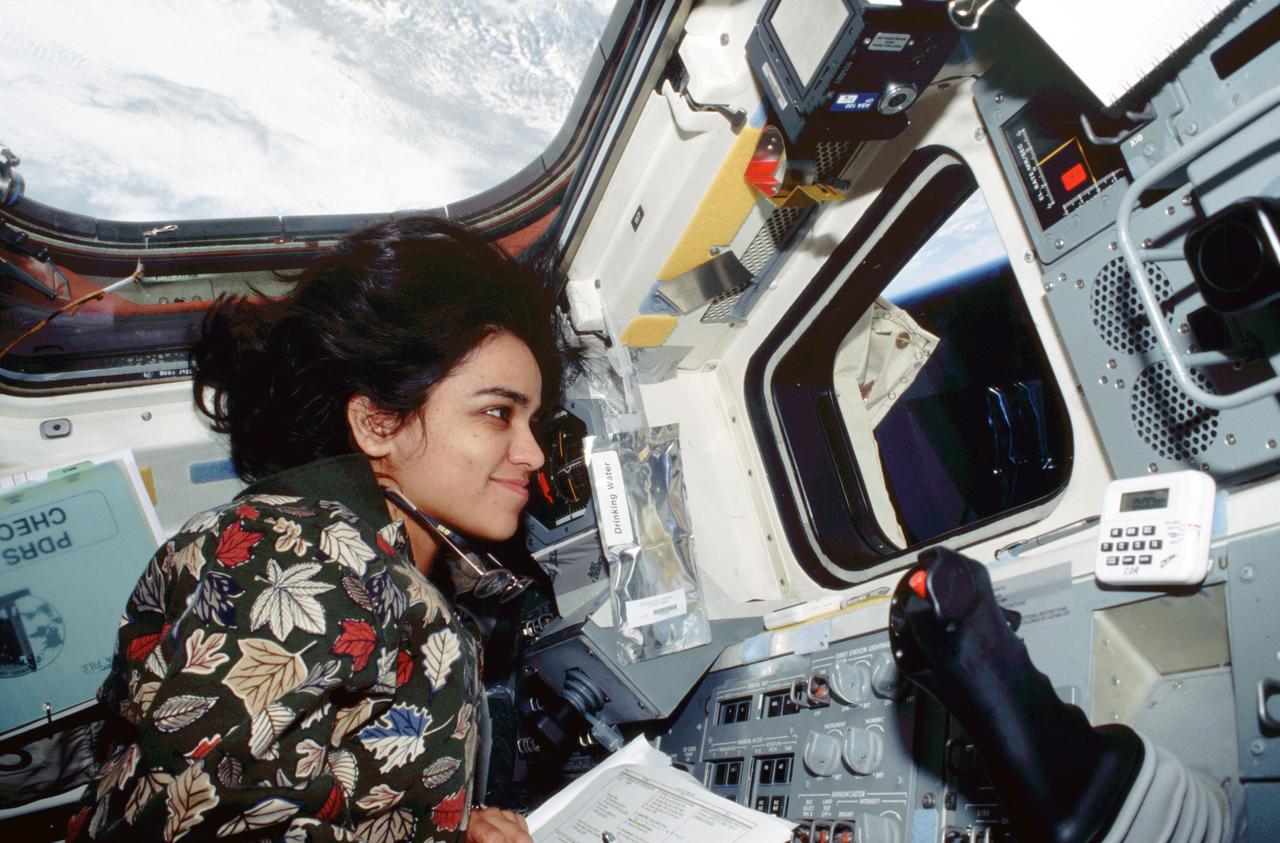
STS087-308-023 (19 November – 5 December 1997) --- Astronaut Kalpana Chawla, mission specialist, monitors the Extravehicular Activity (EVA) of fellow astronauts Winston E. Scott and Takao Doi from her temporary station on the Space Shuttle Columbia’s aft flight deck. Chawla controlled Columbia's Remote Manipulator System (RMS) at this station. Chawla (from her in-cabin post), Doi and Scott shared duties in two separate sessions of EVA during the 16-day United States Microgravity Payload (USMP) mission.

STS-87 Mission Specialist Kalpana Chawla, Ph.D., is assisted with her ascent and re-entry flight suit in the white room at Launch Pad 39B by Danny Wyatt, NASA quality assurance specialist. Kneeing before Dr. Chawla to assist her is George Schram, USA mechanical technician, as Dr. Chawla prepares to enter the Space Shuttle orbiter Columbia on launch day. STS-87 is the fourth flight of the United States Microgravity Payload and Spartan-201

In preparation for Space Shuttle Mission STS-87, the orbiter Columbia is lifted into high bay 3 in the Vehicle Assembly Building. The orbiter will be mated to the <a href="http://www-pao.ksc.nasa.gov/kscpao/nasafact/count3.htm#et">external tank</a> and <a href="http://www-pao.ksc.nasa.gov/kscpao/nasafact/ships.htm#srbs">solid rocket boosters</a> over the weekend and is slated to roll out to Pad 39B on Wednesday. STS-87 will be the fourth flight of the United States Microgravity Payload and the Spartan-201 deployable satellite
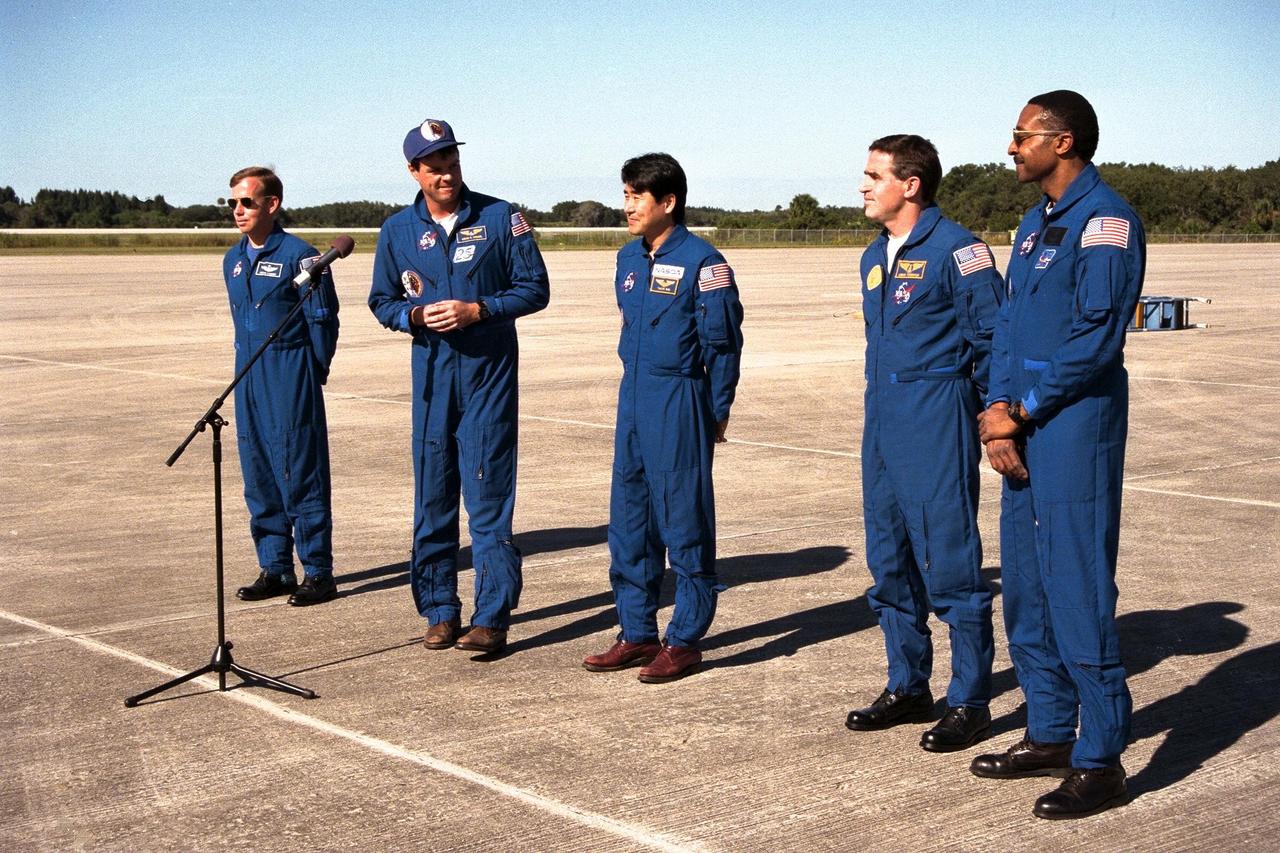
In preparation for Space Shuttle Mission STS-87, the crew arrives at the Kennedy Space Center Shuttle Landing Facility to participate in the Terminal Countdown Demonstration Test (TCDT) for their mission. The TCDT is a dress rehearsal for launch. STS-87 will be the fourth flight of the United States Microgravity Payload and the Spartan-201 deployable satellite. Launch is targeted for Nov. 19
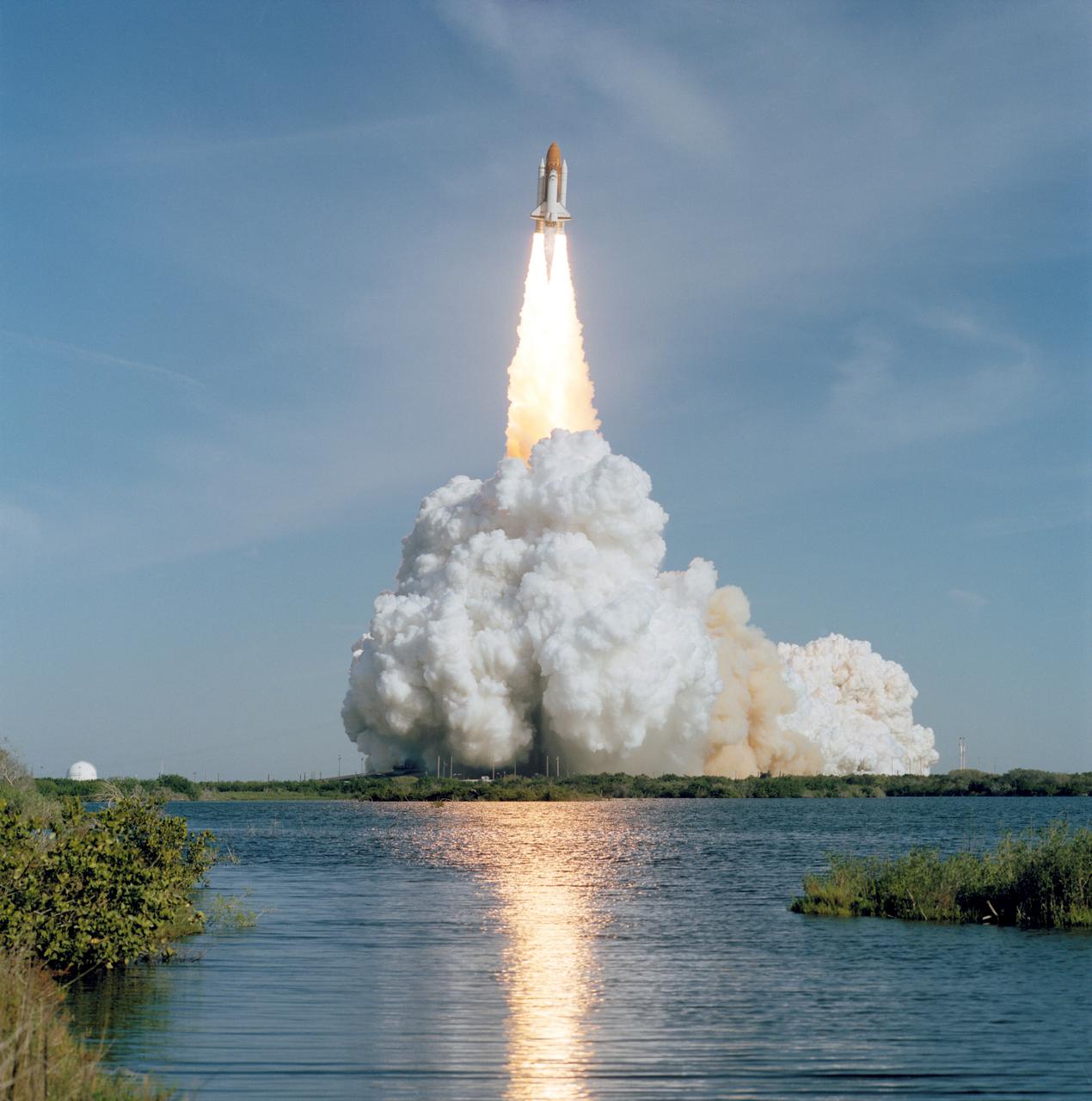
STS062-S-053 (4 March 1994) --- Carrying a crew of five veteran NASA astronauts and the United States Microgravity Payload (USMP), the Space Shuttle Columbia heads toward its sixteenth mission in Earth-orbit. Launch occurred at 8:53 a.m. (EST), March 4, 1994. Onboard were astronauts John H. Casper, Andrew M. Allen, Marsha S. Ivins, Charles D. (Sam) Gemar and Pierre J. Thuot.
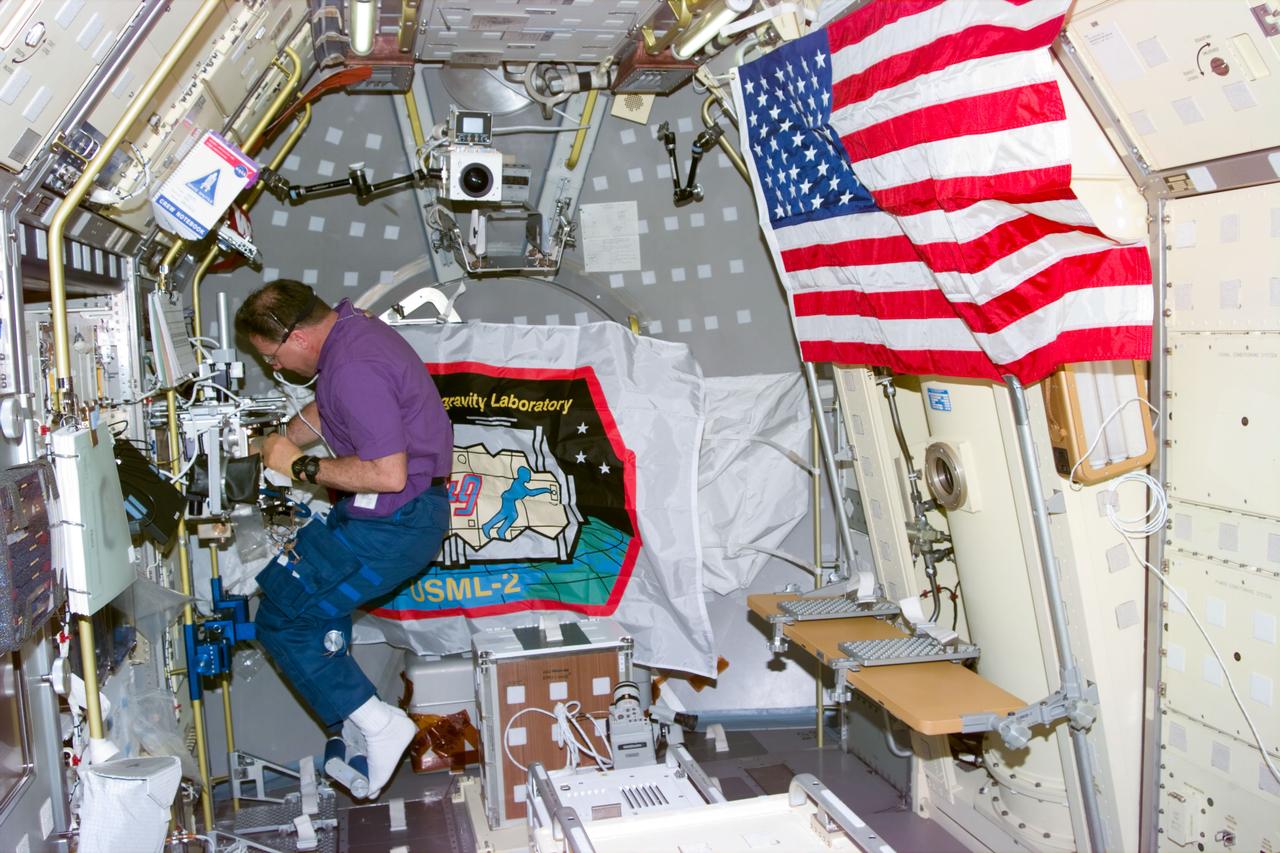
STS073-E-5024 (23 Oct. 1995)--- Albert Sacco Jr., STS-73 payload specialist, works in the Glovebox on the portside of the science module aboard the space shuttle Columbia in Earth orbit. This frame was exposed with the color Electronic Still Camera (ESC) assigned to the scheduled 16-day United States Microgravity Laboratory (USML-2) mission.
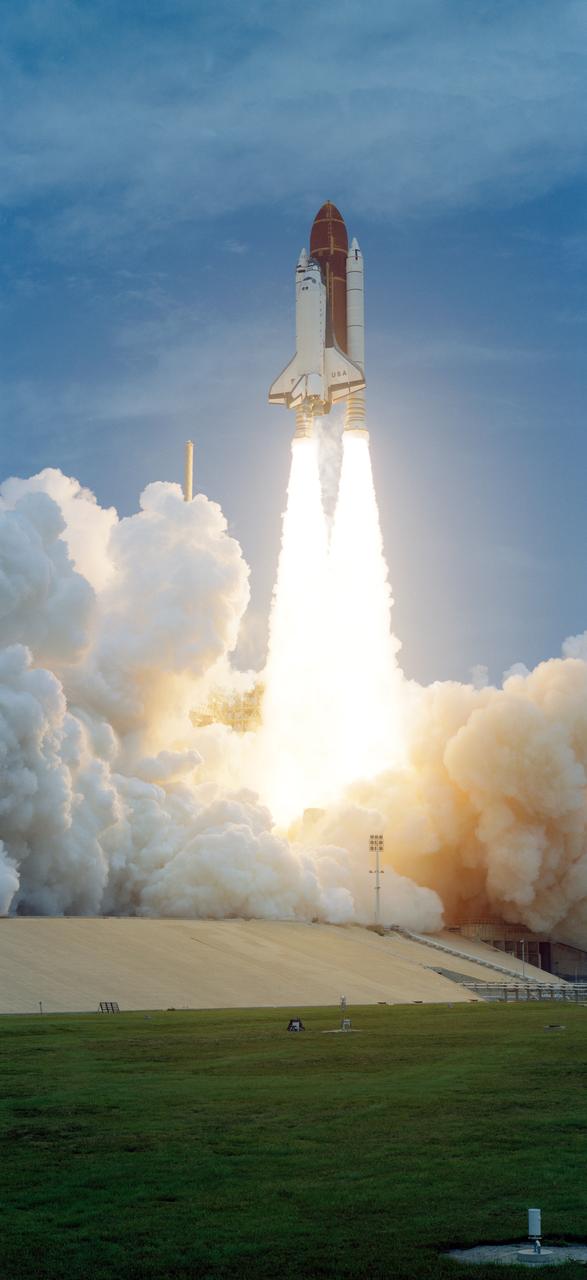
STS050-S-038 (25 June 1992) --- The Space Shuttle Columbia, NASA's first Extended Duration Orbiter (EDO), lifts off on its way toward a scheduled record 13-day mission in Earth-orbit. Liftoff occurred at 12:12:23:0534 p.m. (EDT) on June 25, 1992. Five NASA astronauts and two scientists/payload specialists are aboard. The seven will divide into two shifts to support United States Microgravity Laboratory (USML) research.
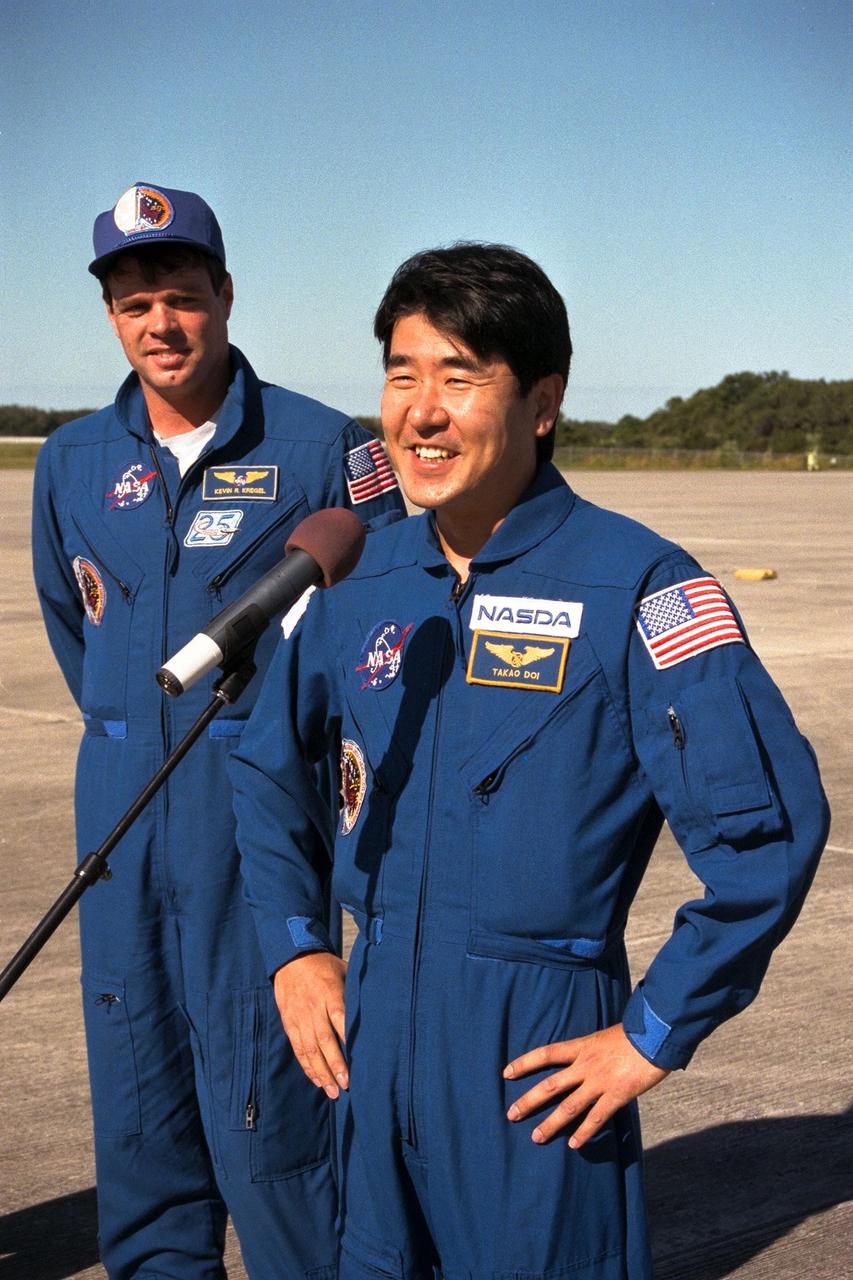
In preparation for Space Shuttle Mission STS-87, the crew arrives at the Kennedy Space Center Shuttle Landing Facility to participate in the Terminal Countdown Demonstration Test (TCDT) for their mission. The TCDT is a dress rehearsal for launch. STS-87 will be the fourth flight of the United States Microgravity Payload and the Spartan-201 deployable satellite. Launch is targeted for Nov. 19

STS050-02-023 (25 June-9 July 1992) --- Astronaut Bonnie J. Dunbar, payload commander, unstows United States Microgravity Laboratory 1 (USML-1) experiment paraphernalia in early stages of the mission. The Multipurpose Glove Box (MPGB) is at upper left. And, at right center, is the Space Station design foot restraint, making its first flight aboard a Space Shuttle on the record-setting 14-day mission.
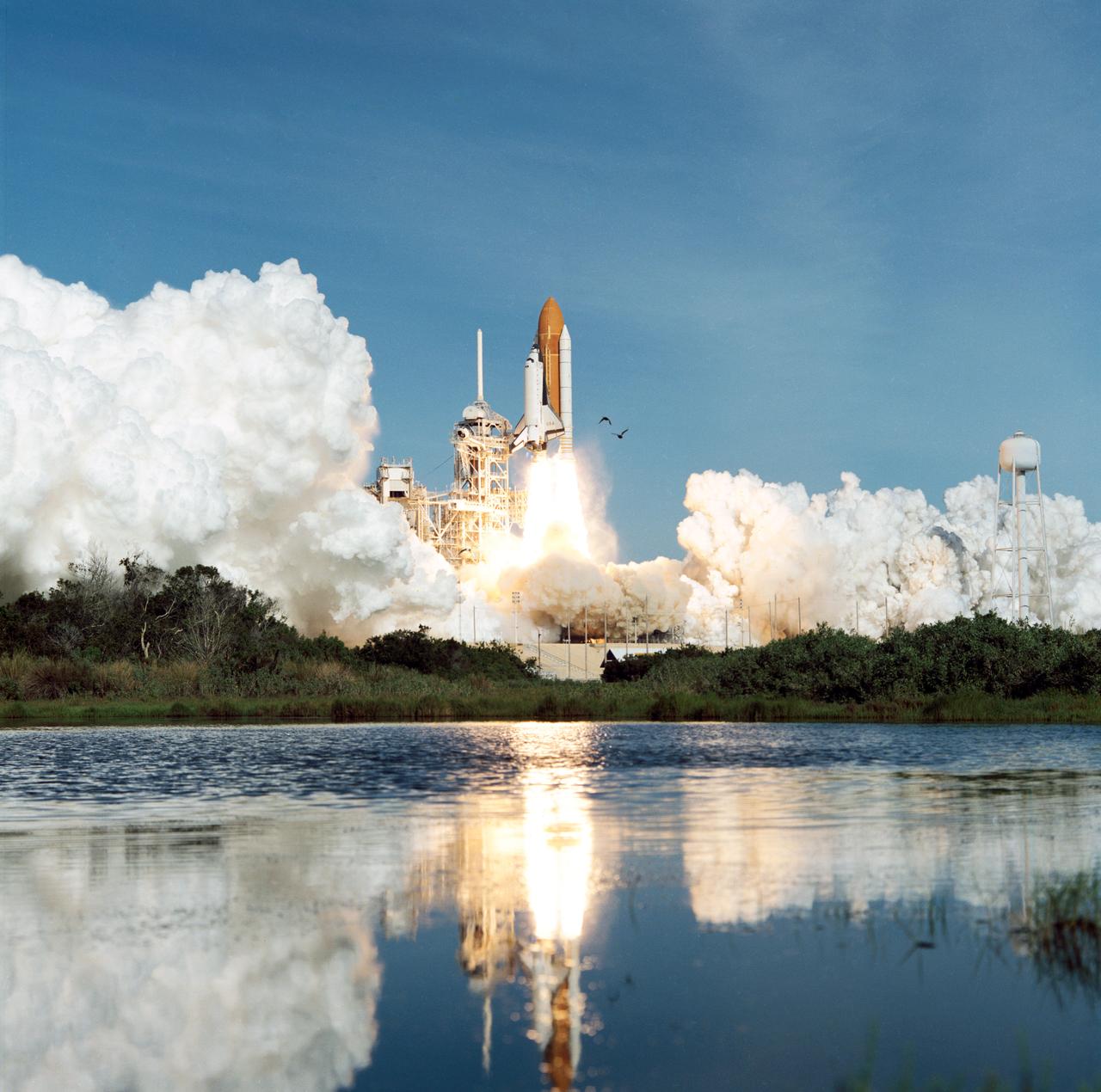
STS062-S-051 (4 March 1994) --- Five veteran astronauts and the United States Microgravity Payload (USMP) are ushered into space via the sixteenth launch of Space Shuttle Columbia. Launch occurred at 8:53 a.m. (EST), March 4, 1994. Onboard were astronauts John H. Casper, Andrew M. Allen, Marsha S. Ivins, Charles D. (Sam) Gemar and Pierre J. Thuot.
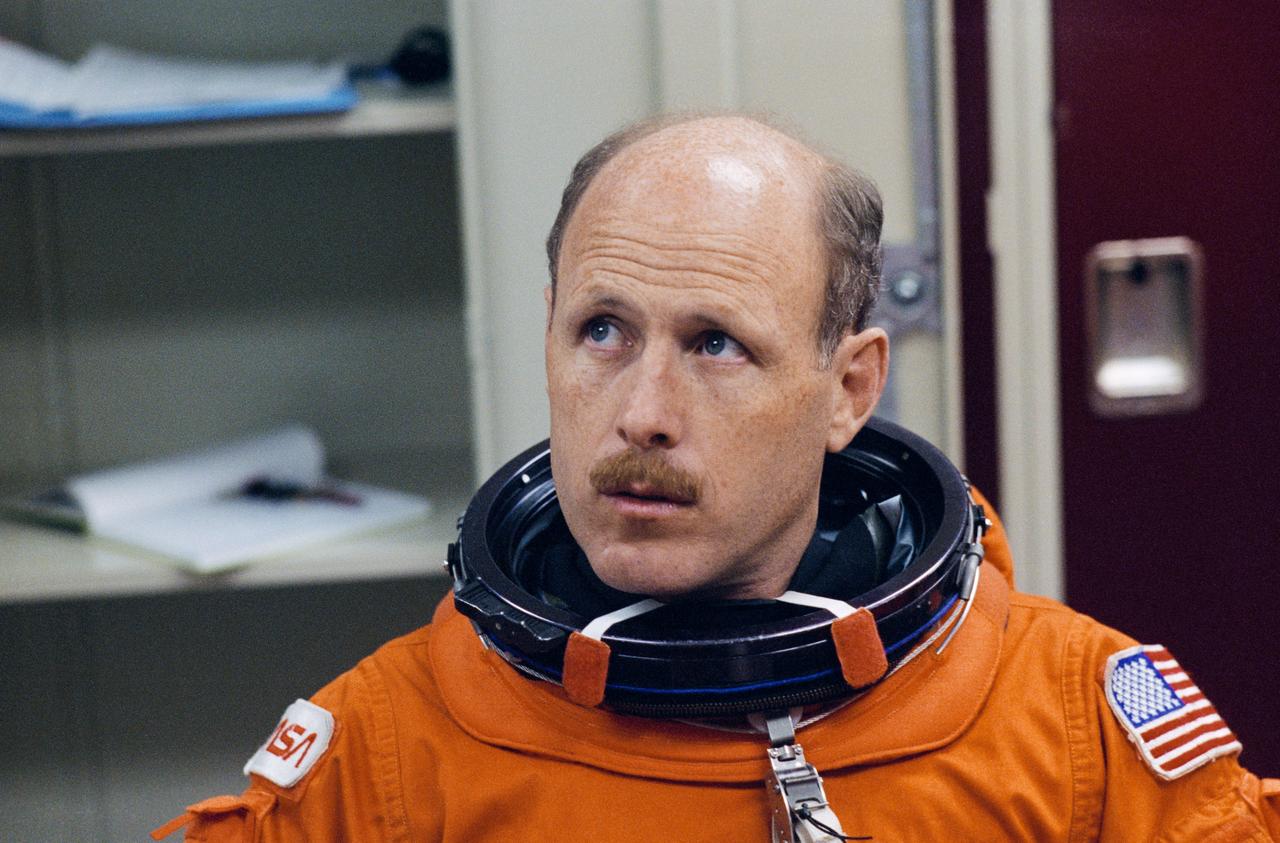
S95-09132 (27 Apr. 1995) --- As he watches one his STS-73 crew mates rappel from the top of a ?troubled Shuttle,? astronaut Kenneth D. Bowersox, mission commander, prepares to participate in an emergency egress training session in the Johnson Space Center?s (JSC) Systems Integration Facility. Five astronauts and two payload specialists from the private sector will fly aboard the Space Shuttle Columbia later this year to support the United States Microgravity Laboratory (USML-2) mission.
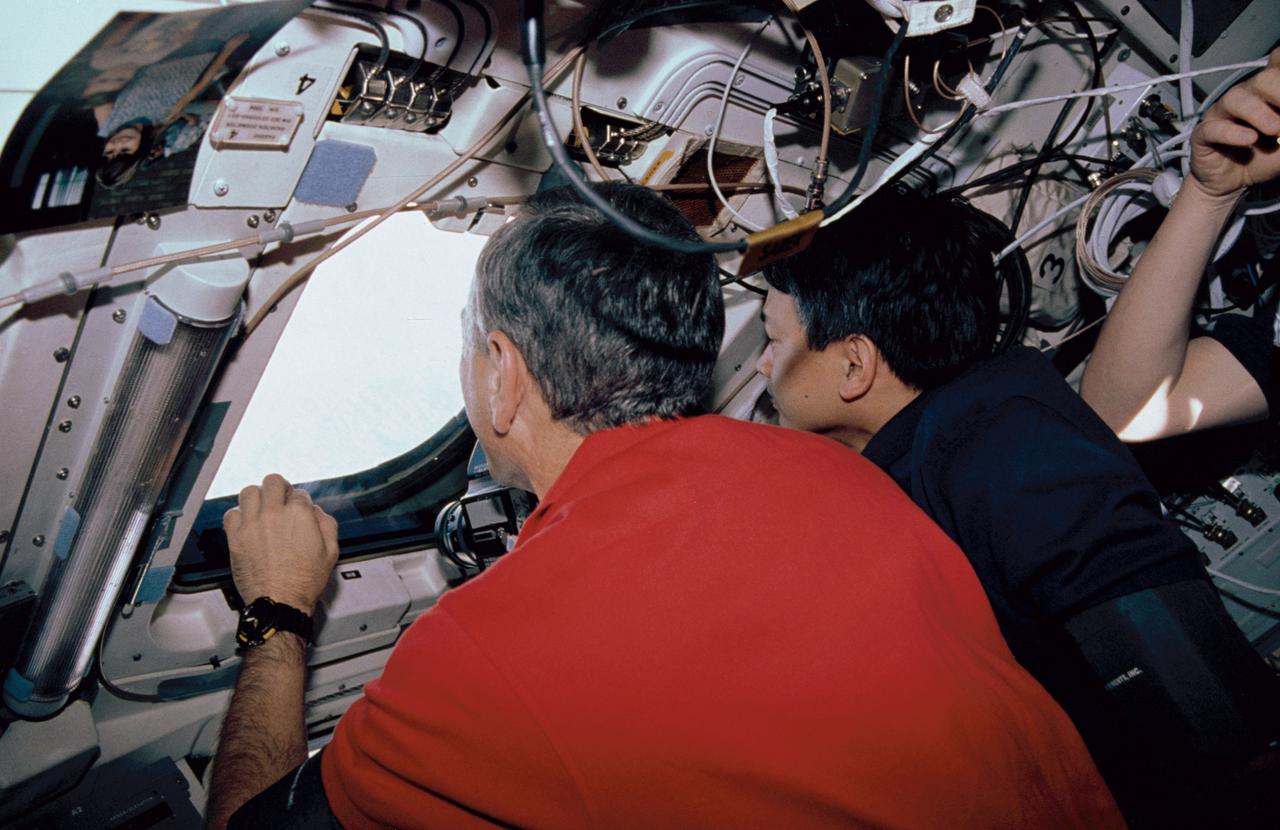
STS050-06-011 (25 June-9 July 1992) --- Astronaut Carl J. Meade (left), mission specialist, and Eugene H. Trinh, payload specialist, share a view through one of the Space Shuttle Columbia's aft flight deck windows during a break in photography of Earth. The two were among seven crew members who shared 14 record-setting days aboard the Space Shuttle supporting the United States Microgravity Laboratory (USML-1) mission.
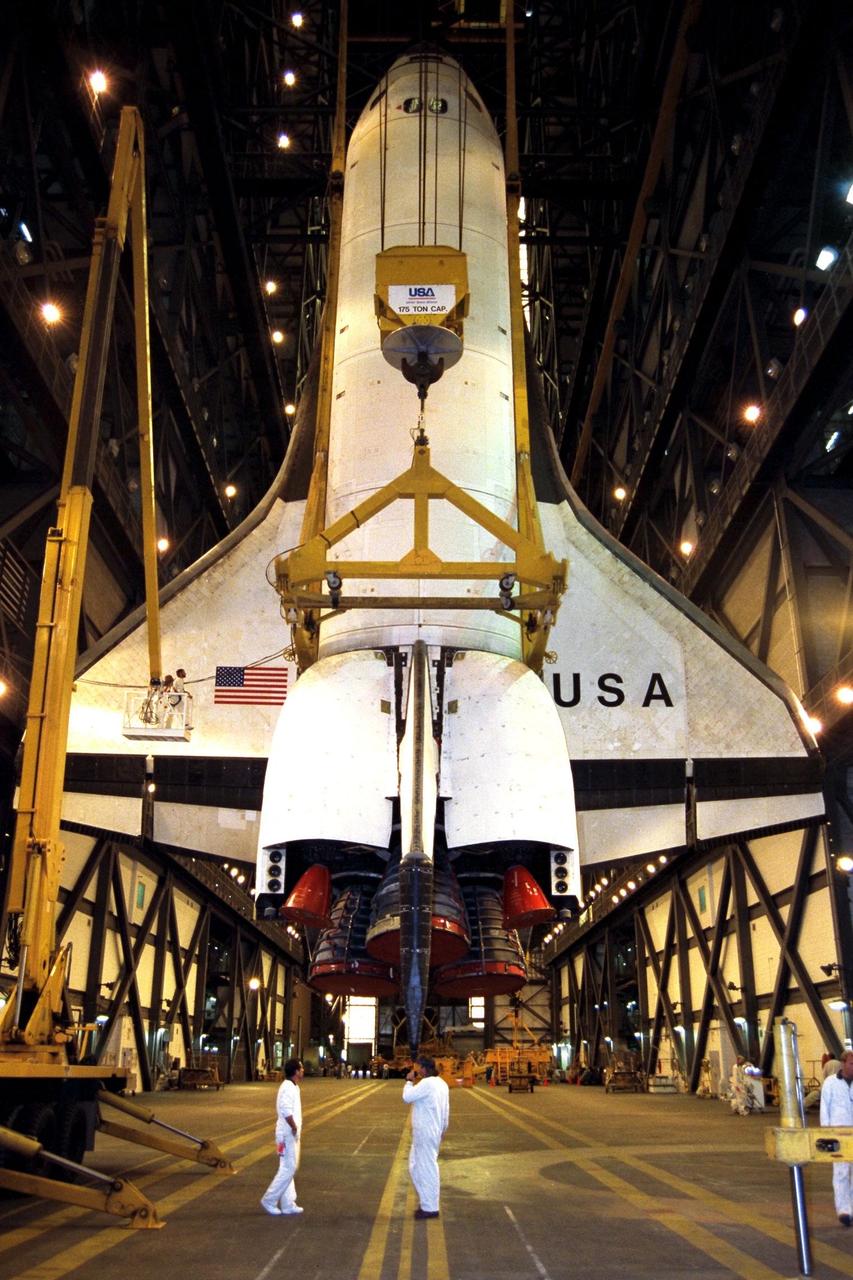
In preparation for Space Shuttle Mission STS-87, the orbiter Columbia is lifted into high bay 3 in the Vehicle Assembly Building. The orbiter will be mated to the <a href="http://www-pao.ksc.nasa.gov/kscpao/nasafact/count3.htm#et">external tank</a> and <a href="http://www-pao.ksc.nasa.gov/kscpao/nasafact/ships.htm#srbs">solid rocket boosters</a> over the weekend and is slated to roll out to Pad 39B on Wednesday. STS-87 will be the fourth flight of the United States Microgravity Payload and the Spartan-201 deployable satellite
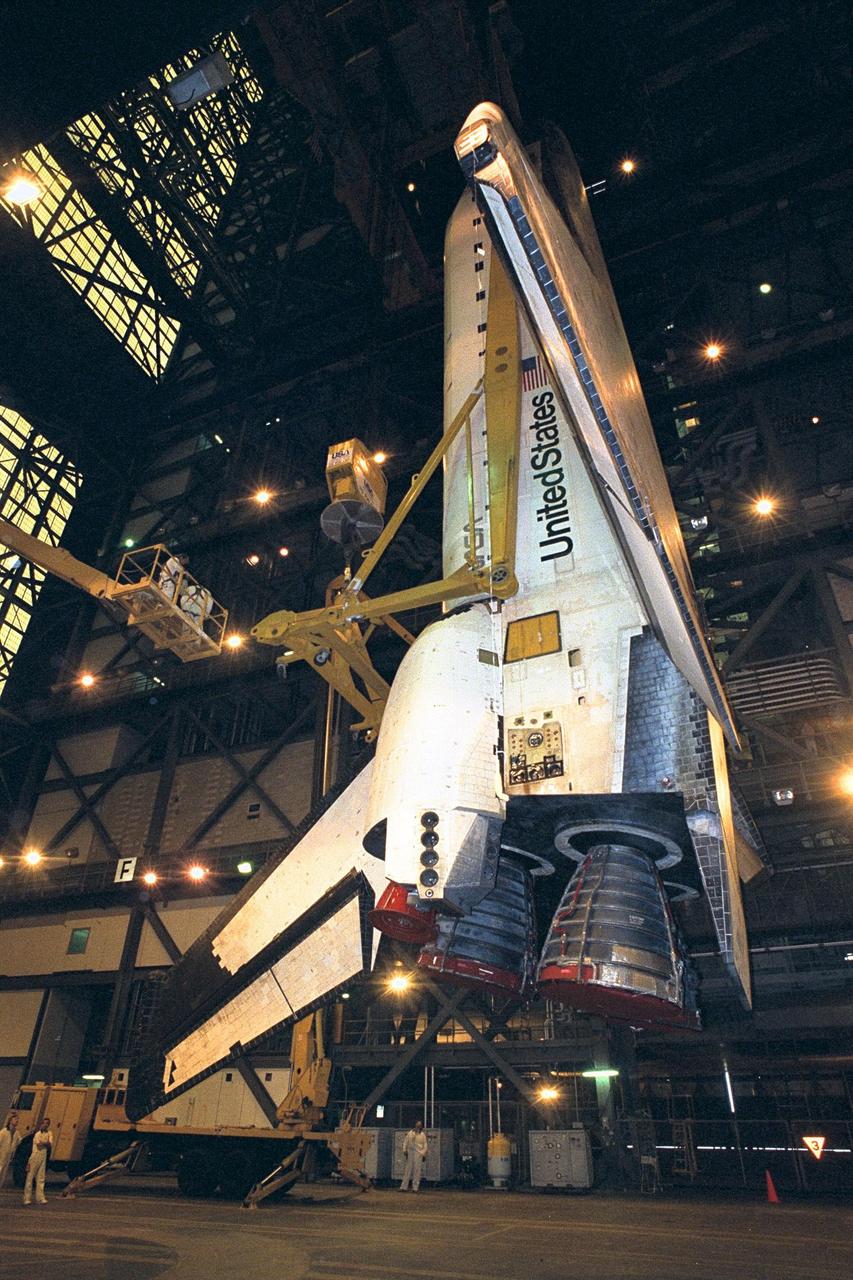
In preparation for Space Shuttle Mission STS-87, the orbiter Columbia is lifted into high bay 3 in the Vehicle Assembly Building. The orbiter will be mated to the <a href="http://www-pao.ksc.nasa.gov/kscpao/nasafact/count3.htm#et">external tank</a> and <a href="http://www-pao.ksc.nasa.gov/kscpao/nasafact/ships.htm#srbs">solid rocket boosters</a> over the weekend and is slated to roll out to Pad 39B on Wednesday. STS-87 will be the fourth flight of the United States Microgravity Payload and the Spartan-201 deployable satellite
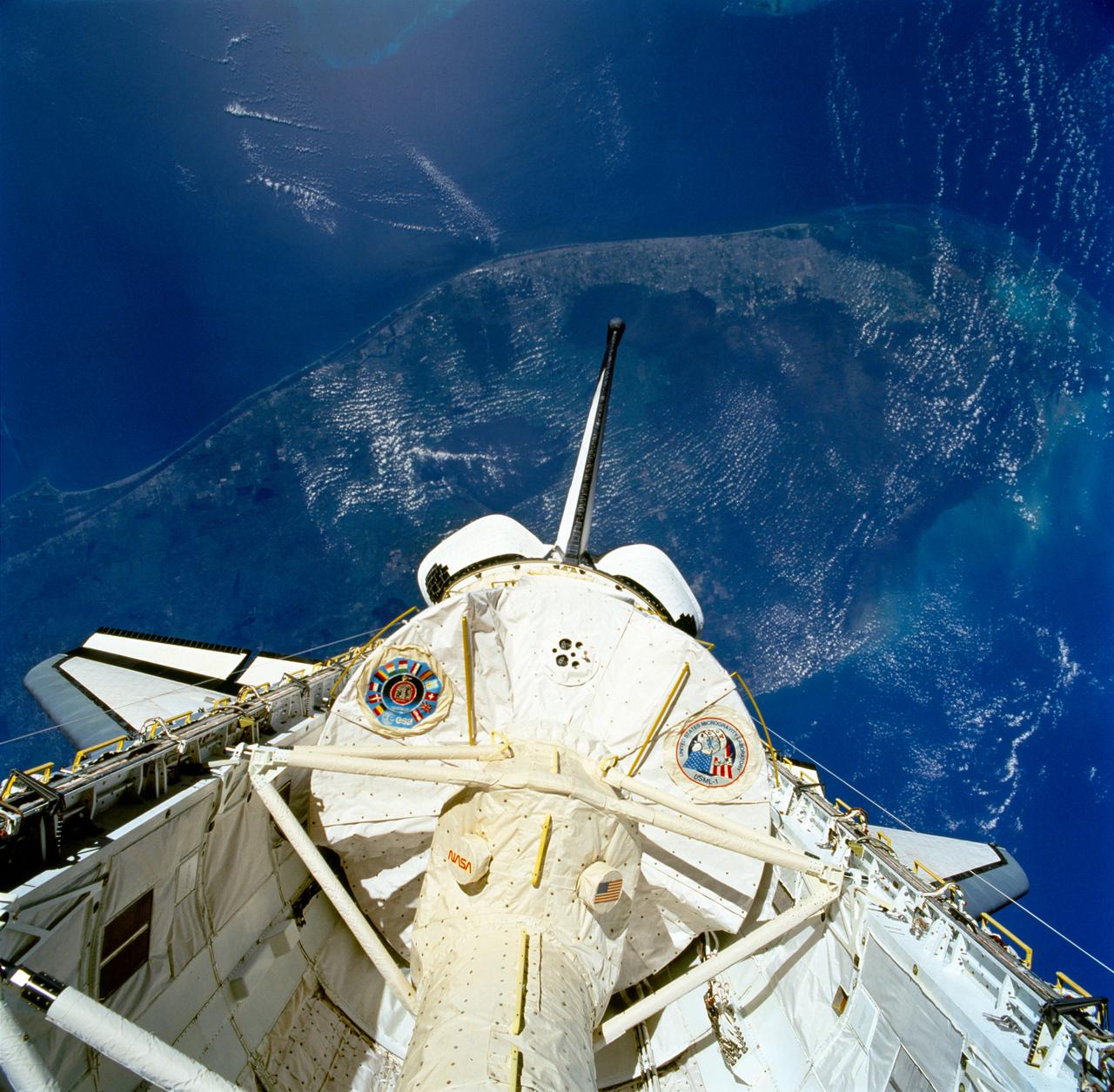
STS050-81-027 (25 June-9 July 1992) --- The first United States Microgravity Laboratory 1 (USML-1) module is pictured in the payload bay of the Earth-orbiting Space Shuttle Columbia in this scene over the southern two-thirds of the Florida peninsula. The Kennedy Space Center (KSC), where the mission began, can be seen just above Columbia's starboard wing. (Hold photo with number at left.)
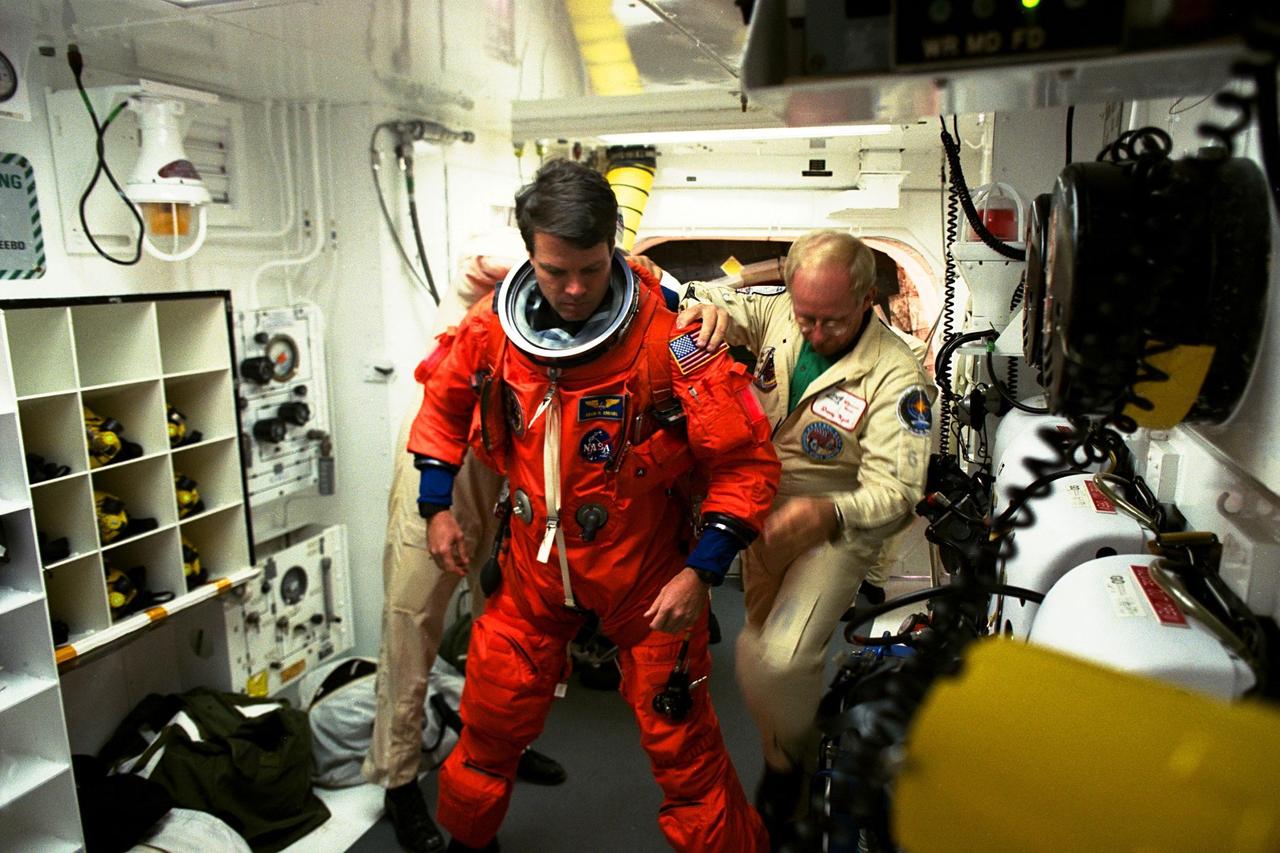
STS-87 Commander Kevin Kregel is assisted with his ascent and re-entry flight suit in the white room at Launch Pad 39B by Danny Wyatt, NASA quality assurance specialist. STS-87 is the fourth flight of the United States Microgravity Payload and Spartan-201. A veteran of two space flights (STS-70 and -78), Kregel has logged more than 618 hours in space
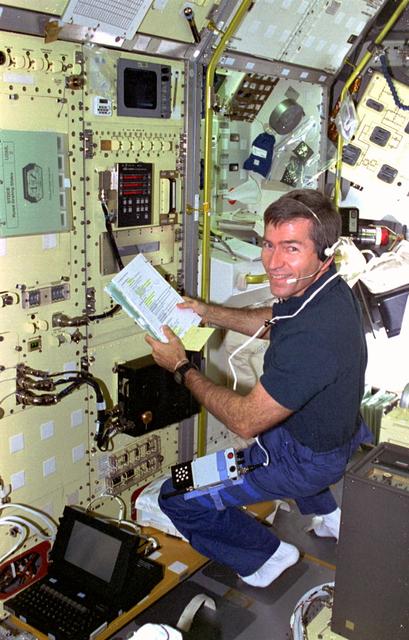
STS073-103-015 (20 October-5 November 1995) --- Payload specialist Fred W. Leslie works with the Surface Tension Driven Convection Experiment (STDCE) aboard the science module in the cargo bay of the Earth-orbiting Space Shuttle Columbia. Leslie joined another guest researcher and five NASA astronauts for 16 full days of in-space research in support of the United States Microgravity Laboratory (USML-2) mission.
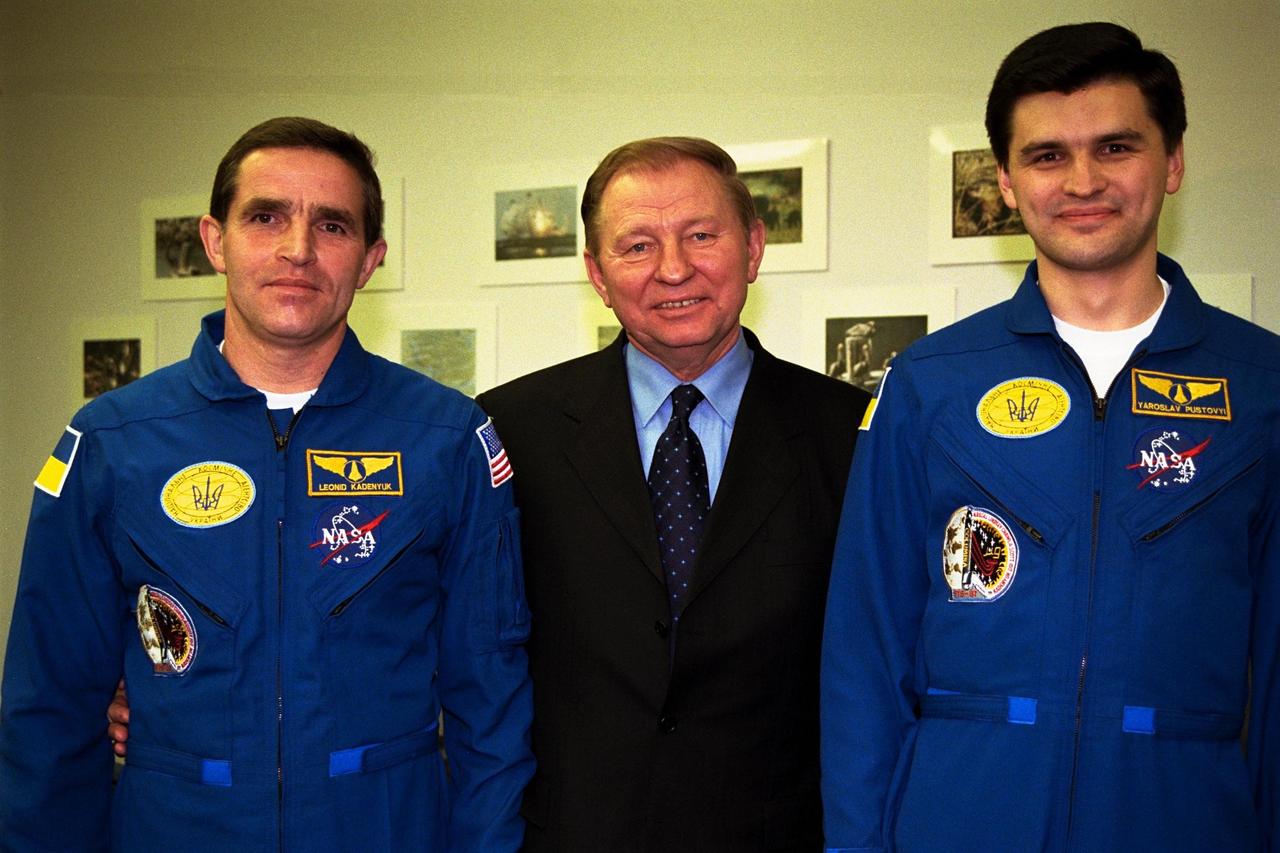
The president of the Ukraine, Leonid Kuchma, is flanked by Payload Specialist Leonid Kadenyuk, at left, and backup Payload Specialist Yaroslav Pustovyi, at right, both of the National Space Agency of Ukraine, during prelaunch activities leading up to the scheduled Nov. 19 launch of STS-87. STS-87 will be the fourth flight of the United States Microgravity Payload and the Spartan-201 deployable satellite. During the mission, Kadenyuk will pollinate Brassica rapa plants as part of the Collaborative Ukrainian Experiment, or CUE, aboard Columbia during its 16-day mission. The CUE experiment is a collection of 10 plant space biology experiments that will fly in Columbia's middeck and will feature an educational component that involves evaluating the effects of microgravity on Brassica rapa seedlings. Students in Ukrainian and American schools will participate in the same experiment with Kadenyuk in space. Kadenyuk will be flying his first Shuttle mission on STS-87
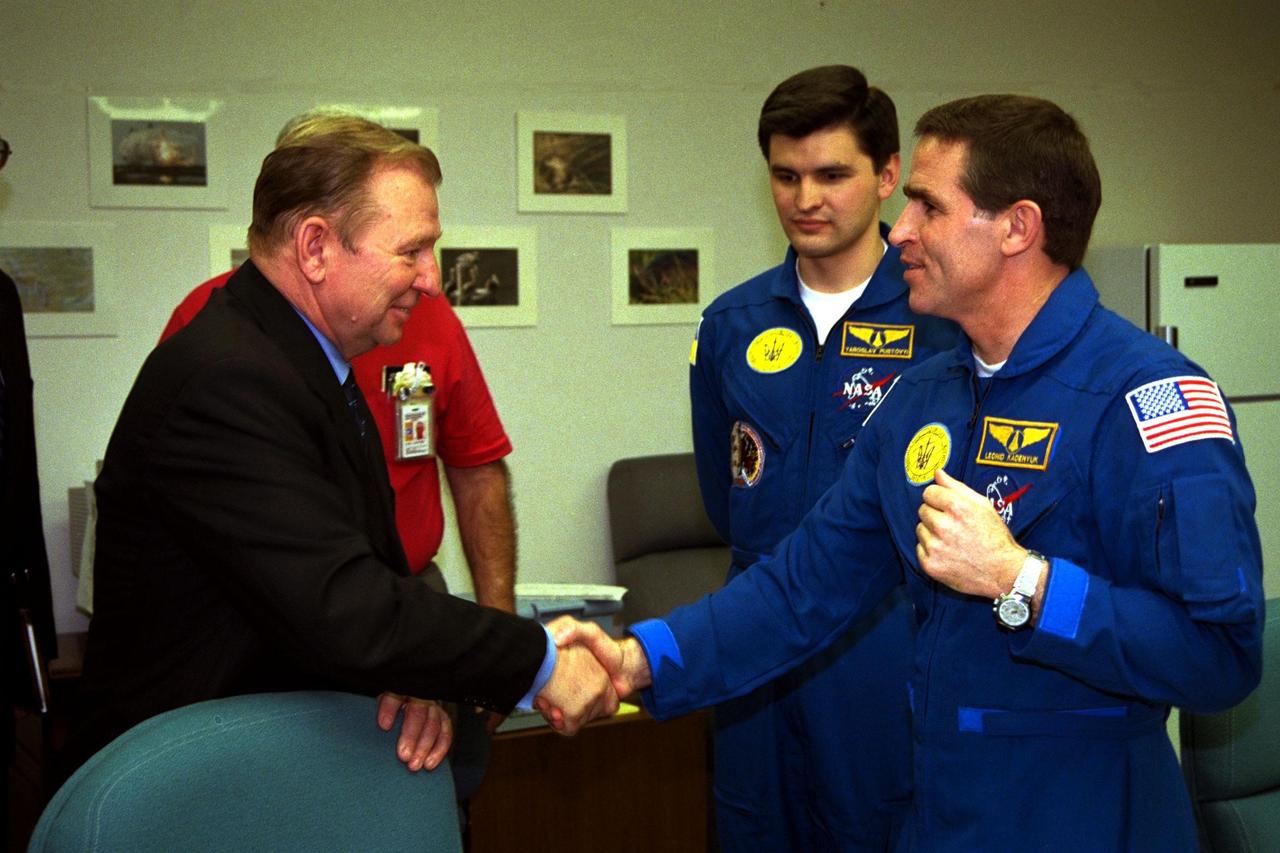
The president of the Ukraine, Leonid Kuchma, shakes hands with Payload Specialist Leonid Kadenyuk, at right, as backup Payload Specialist Yaroslav Pustovyi, both of the National Space Agency of Ukraine, looks on during prelaunch activities leading up to the scheduled Nov. 19 launch of STS-87. STS-87 will be the fourth flight of the United States Microgravity Payload and the Spartan-201 deployable satellite. During the mission, Kadenyuk will pollinate Brassica rapa plants as part of the Collaborative Ukrainian Experiment, or CUE, aboard Columbia during its 16-day mission. The CUE experiment is a collection of 10 plant space biology experiments that will fly in Columbia's middeck and will feature an educational component that involves evaluating the effects of microgravity on Brassica rapa seedlings. Students in Ukrainian and American schools will participate in the same experiment with Kadenyuk in space. Kadenyuk will be flying his first Shuttle mission on STS-87
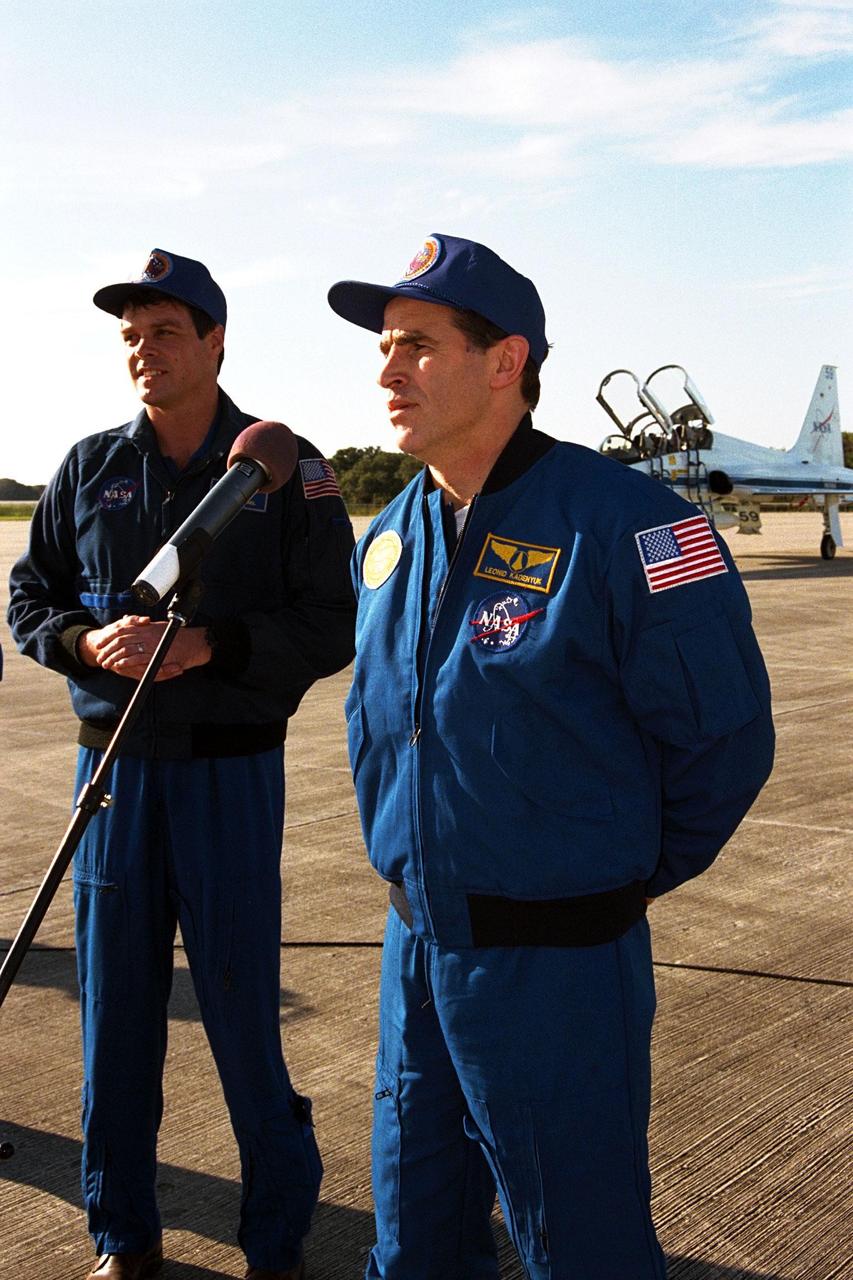
As STS-87 Commander Kevin Kregel looks on, Payload Specialist Leonid Kadenyuk of the National Space Agency of Ukraine addresses members of the press and media at Kennedy Space Center's Shuttle Landing Facility after arriving for the final prelaunch activities leading up to the scheduled Nov. 19 liftoff. Other STS-87 crew members not pictured are Pilot Steven Lindsey; and Mission Specialists Kalpana Chawla, Ph.D.; Takao Doi, Ph.D., of the National Space Development Agency of Japan; and Winston Scott. STS-87 will be the fourth flight of the United States Microgravity Payload and the Spartan-201 deployable satellite
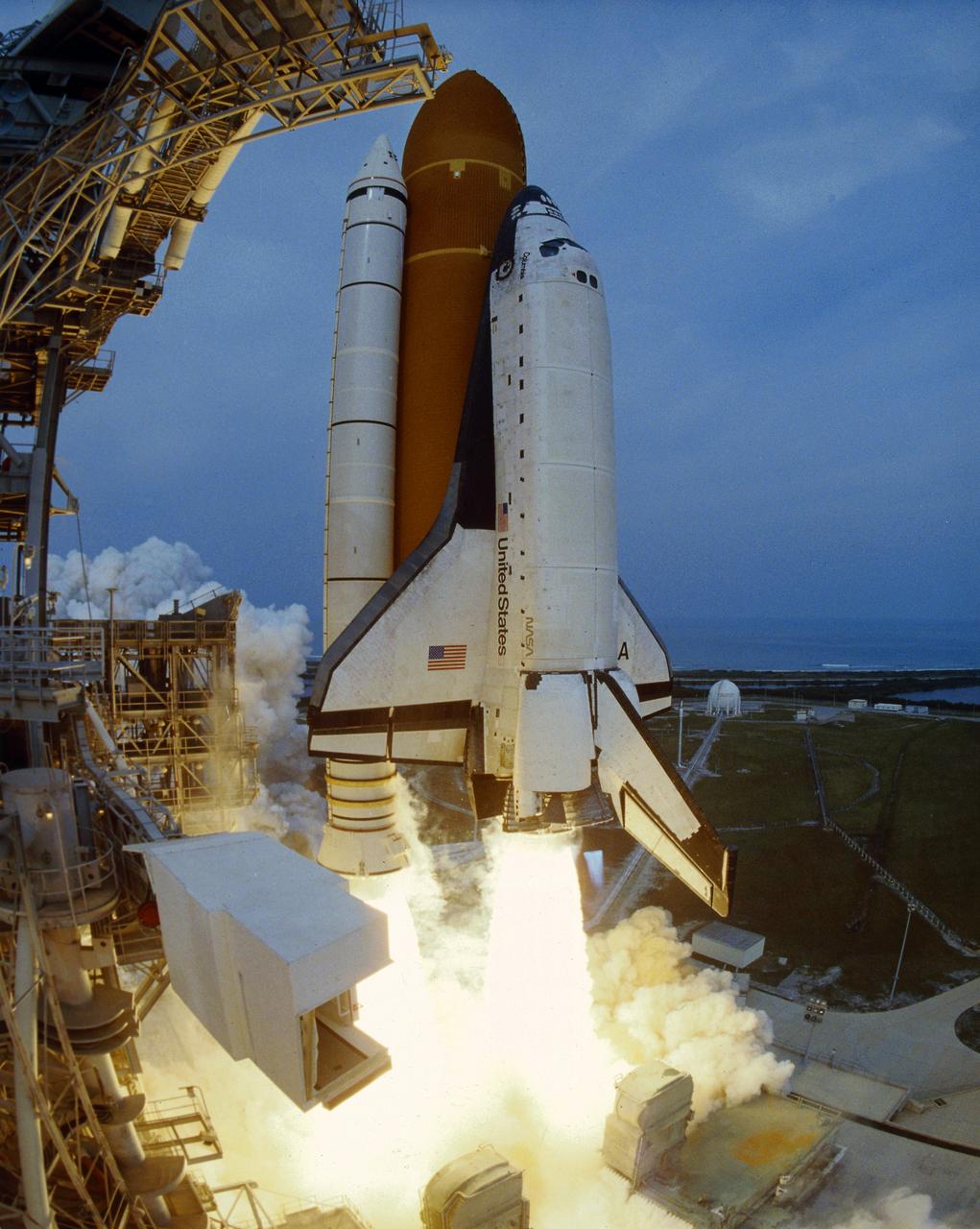
The Space Shuttle Columbia (STS-75) cleared the tower following an on-time liftoff from Launch Pad 39B. Visible at lower left is the white room on the orbiter access arm through which the flight crew entered the orbiter earlier. Columbia's mission lasted 14 days and included retesting of the Tethered Satellite System (TSS-1R) and the third flight of the United States Microgravity Payload (USMP-3), both of which are managed by scientist at Marshall Space Flight Center. Included in Columbia's flight crew were members of the European Space Agency (ESA) and the Italian Space Agency (ASI), Mission Specialists Maurizio Cheli, Claude Nicollier and Payload Specialist Umberto Guidoni, respectively.
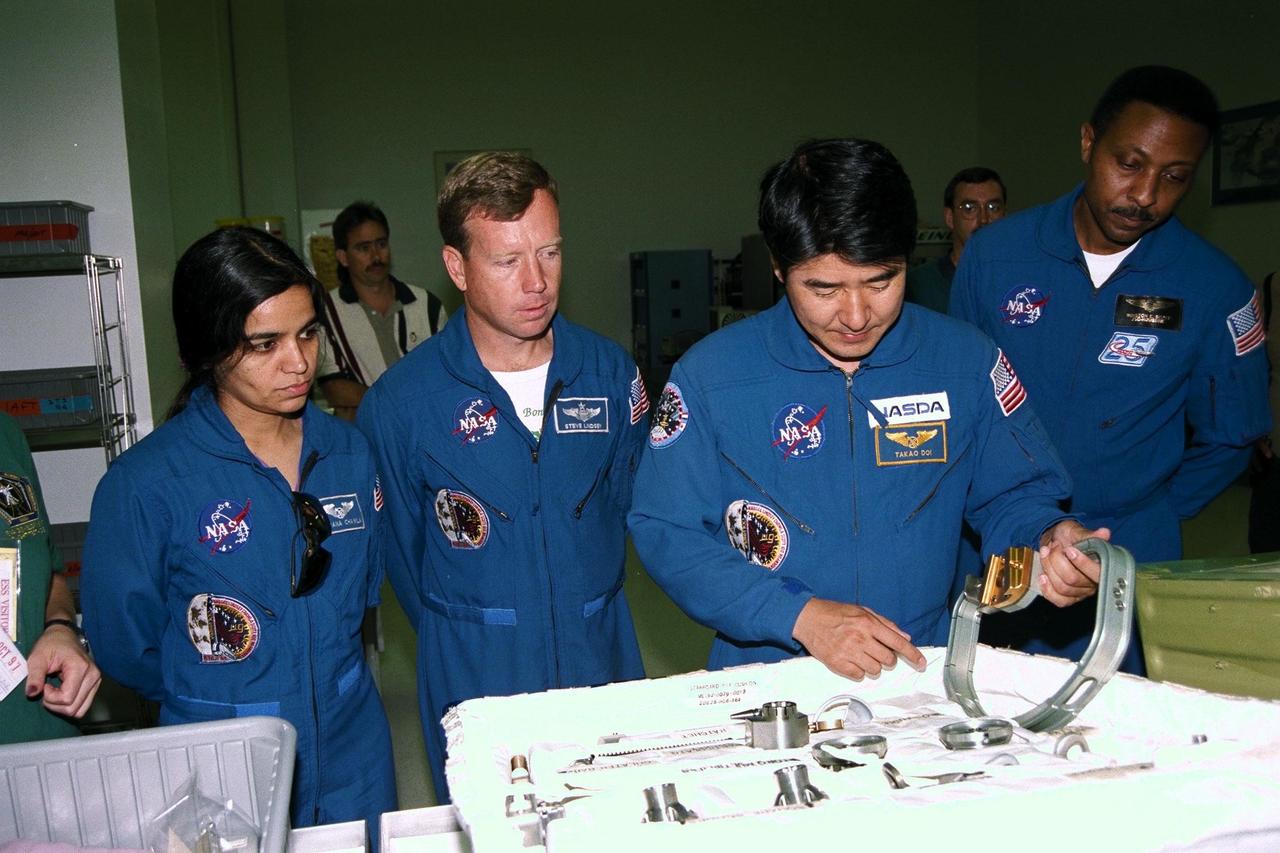
STS-87 astronaut crew members participate in the Crew Equipment Integration Test (CEIT) in Kennedy Space Center’s (KSC's) Vertical Processing Facility. From left are Mission Specialist Kalpana Chawla, Ph.D.; Pilot Steven Lindsey; Mission Specialist Takao Doi , Ph.D., of the National Space Development Agency of Japan; and Mission Specialist Winston Scott. The CEIT gives astronauts an opportunity to get a hands-on look at the payloads with which they will be working onorbit. STS-87 will be the fourth United States Microgravity Payload and flight of the Spartan-201 deployable satellite. During the STS-87 mission, scheduled for a Nov. 19 liftoff from KSC, Dr. Doi and Scott will both perform spacewalks
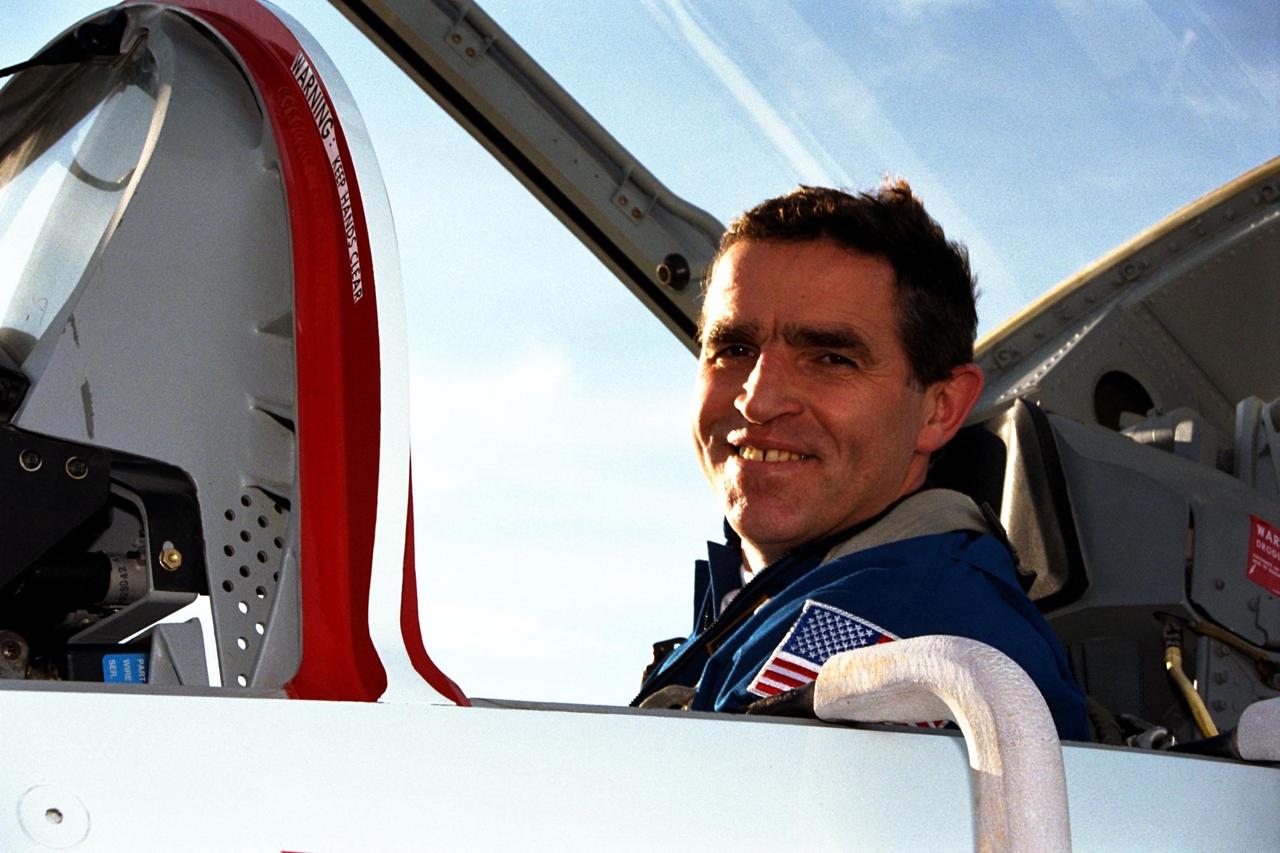
STS-87 Payload Specialist Leonid Kadenyuk of the National Space Agency of Ukraine arrives at Kennedy Space Center's Shuttle Landing Facility aboard a T-38 jet for the final prelaunch activities leading up to the scheduled Nov. 19 liftoff. The other STS-87 crew members are Commander Kevin Kregel; Pilot Steven Lindsey; and Mission Specialists Kalpana Chawla, Ph.D.; Takao Doi, Ph.D., of the National Space Development Agency of Japan; and Winston Scott. STS-87 will be the fourth flight of the United States Microgravity Payload and the Spartan-201 deployable satellite
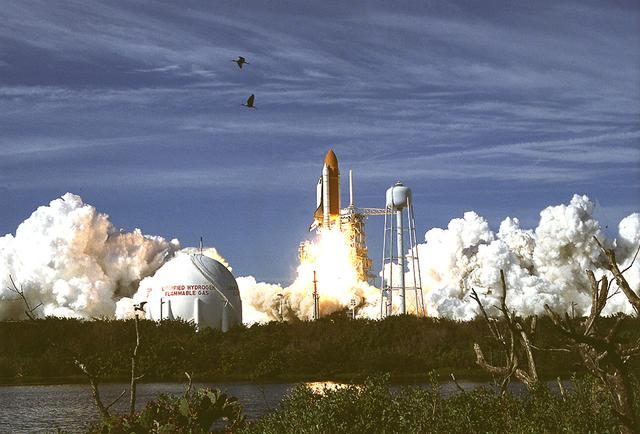
Clear skies, tranquil winds, and a brilliant morning sun mark the ontime liftoff of Space Shuttle Columbia (STS-62) from Launch Pad 39B. Columbia began the 61st Space Shuttle flight, which was a 14-day extended duration flight. On board, five veteran crew members performed materials processing experiments on the United States Microgravity Payload 2 (USMP-2), and also conducted experiments designed to enable or extend space flight technology aboard the Office of Aeornautics and Space Technology 2 payload (OAST-2).
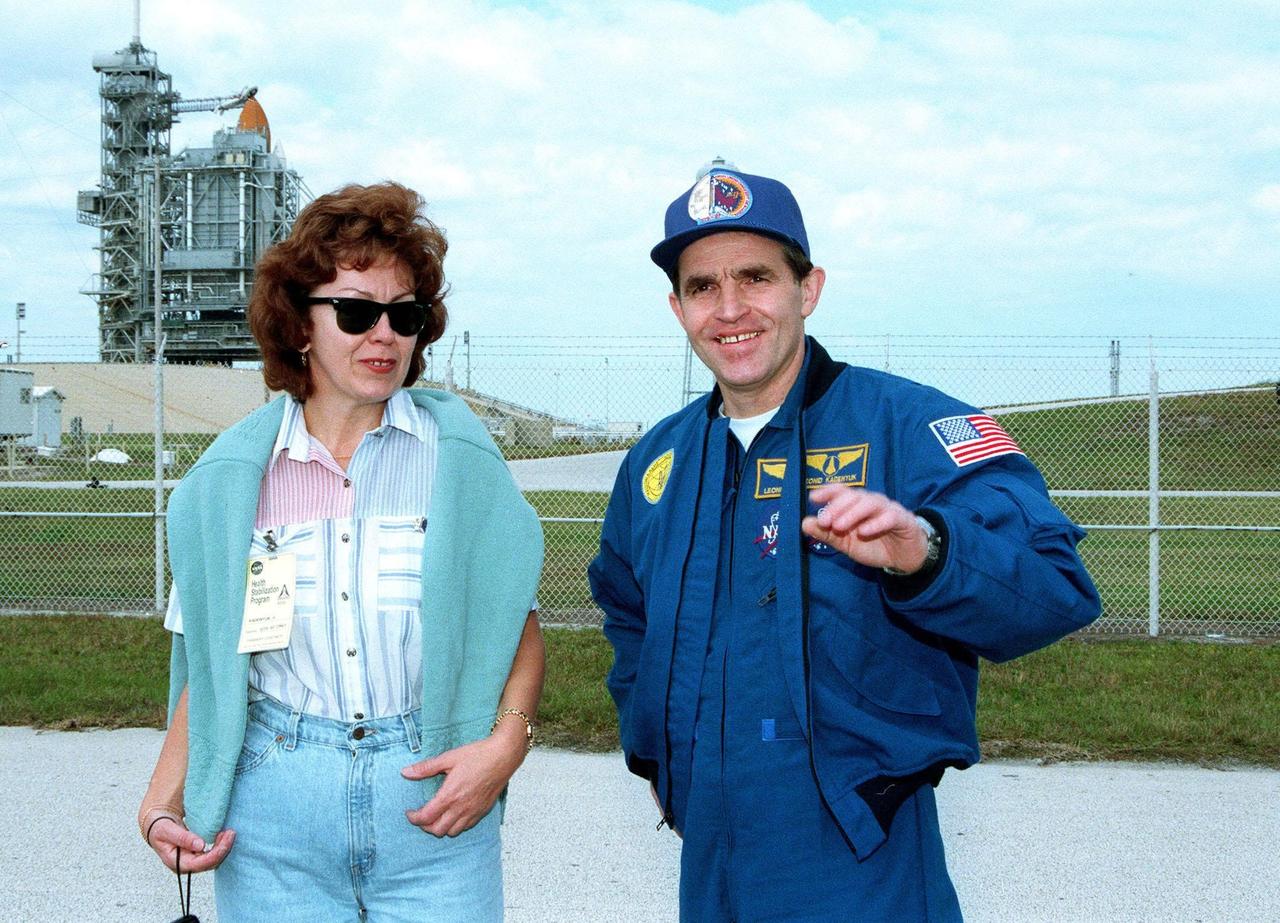
STS-87 Payload Specialist Leonid Kadenyuk of the National Space Agency of Ukraine poses with his wife, Vera Kadenyuk, in front of Kennedy Space Center's Launch Pad 39B during final prelaunch activities leading up to the scheduled Nov. 19 liftoff. The other STS-87 crew members are Commander Kevin Kregel; Pilot Steven Lindsey; and Mission Specialists Kalpana Chawla, Ph.D.; Winston Scott; and Takao Doi, Ph.D., National Space Development Agency of Japan. STS-87 will be the fourth flight of the United States Microgravity Payload and the Spartan-201 deployable satellite
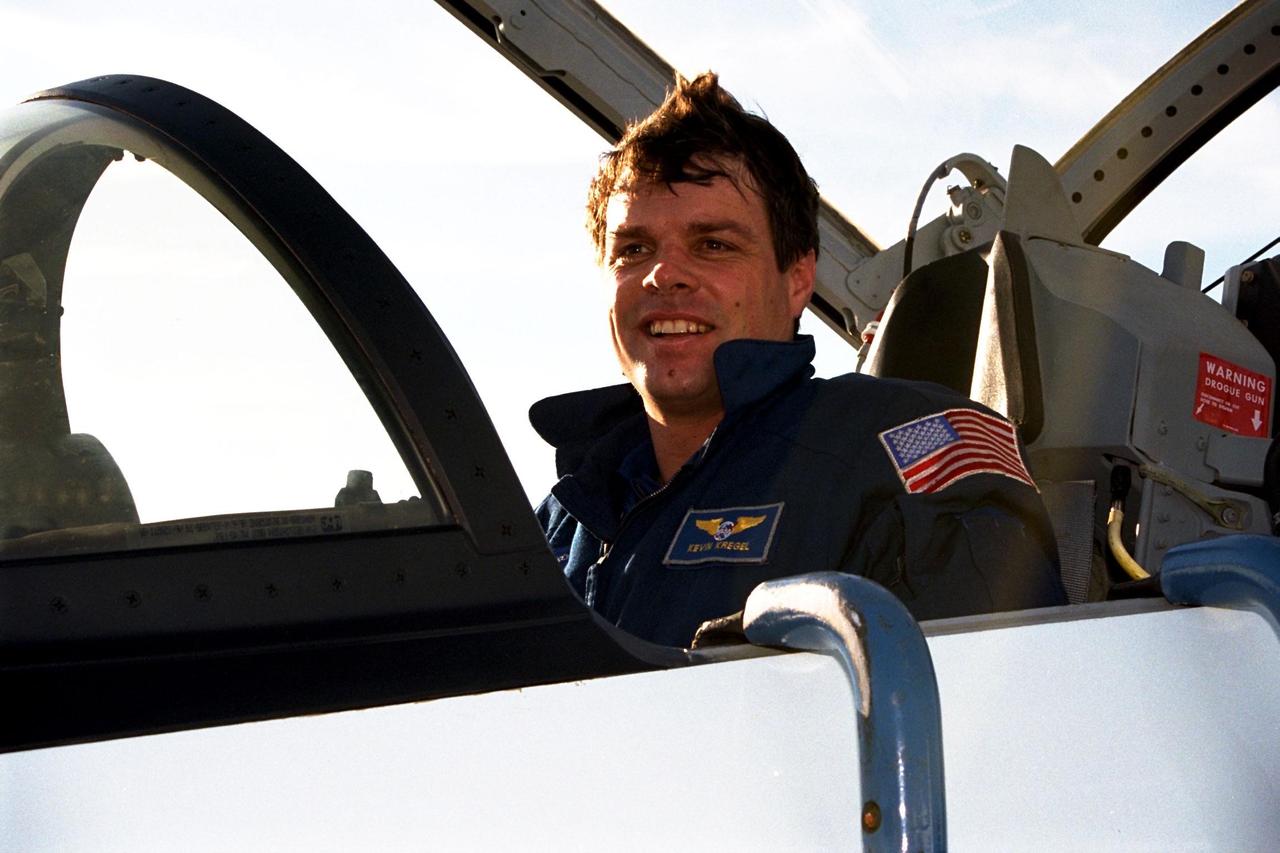
STS-87 Commander Kevin Kregel arrives at Kennedy Space Center's Shuttle Landing Facility aboard a T-38 jet for the final prelaunch activities leading up to the scheduled Nov. 19 liftoff. The other STS-87 crew members are Pilot Steven Lindsey; Mission Specialists Kalpana Chawla, Ph.D.; Takao Doi, Ph.D., of the National Space Development Agency of Japan; and Winston Scott; and Payload Specialist Leonid Kadenyuk of the National Space Agency of Ukraine. STS-87 will be the fourth flight of the United States Microgravity Payload and the Spartan-201 deployable satellite
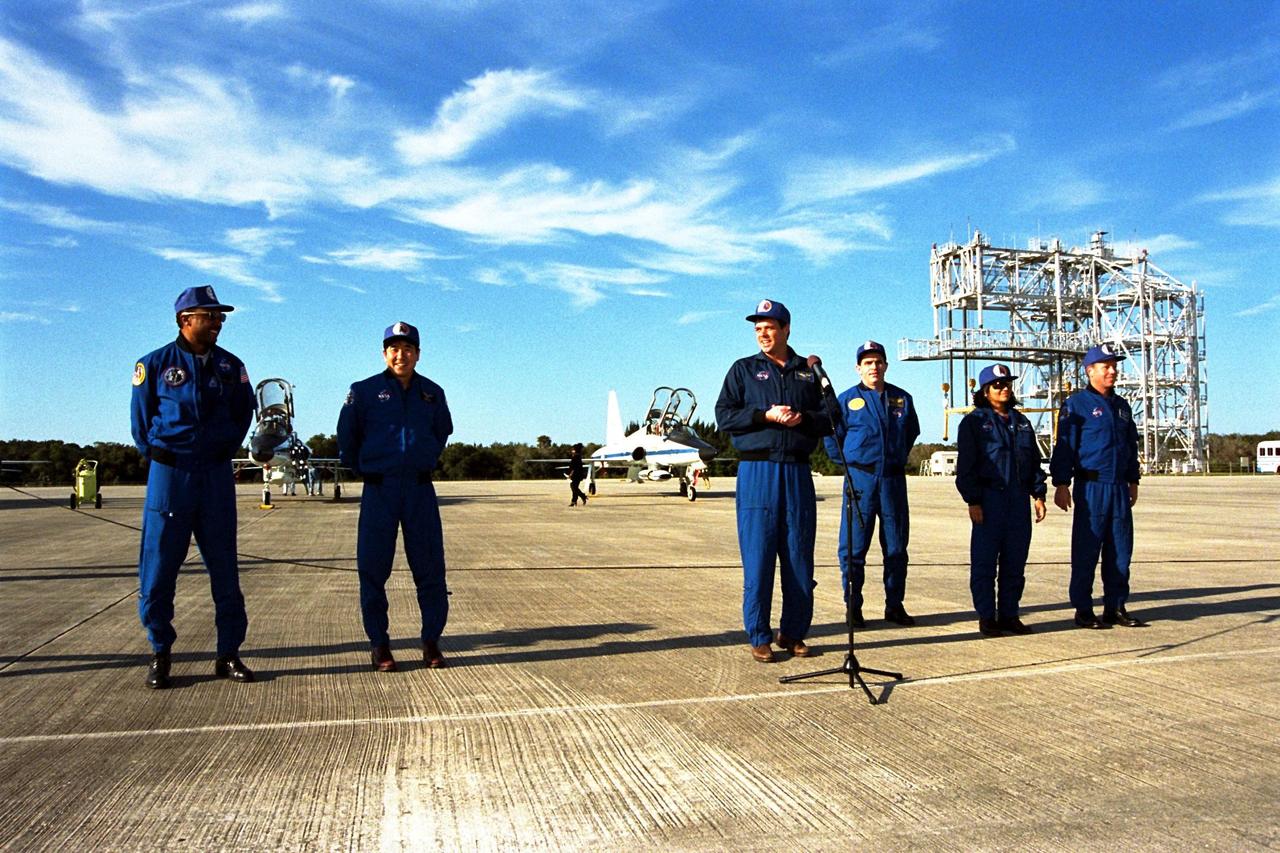
STS-87 Commander Kevin Kregel addresses members of the press and media at Kennedy Space Center's Shuttle Landing Facility after arriving for the final prelaunch activities leading up to the scheduled Nov. 19 liftoff. The STS-87 crew members are, from left to right, Mission Specialists Winston Scott and Takao Doi, Ph.D., of the National Space Development Agency of Japan; Commander Kevin Kregel; Payload Specialist Leonid Kadenyuk of the National Space Agency of Ukraine; Mission Specialist Kalpana Chawla, Ph.D.; and Pilot Steven Lindsey. STS-87 will be the fourth flight of the United States Microgravity Payload and the Spartan-201 deployable satellite
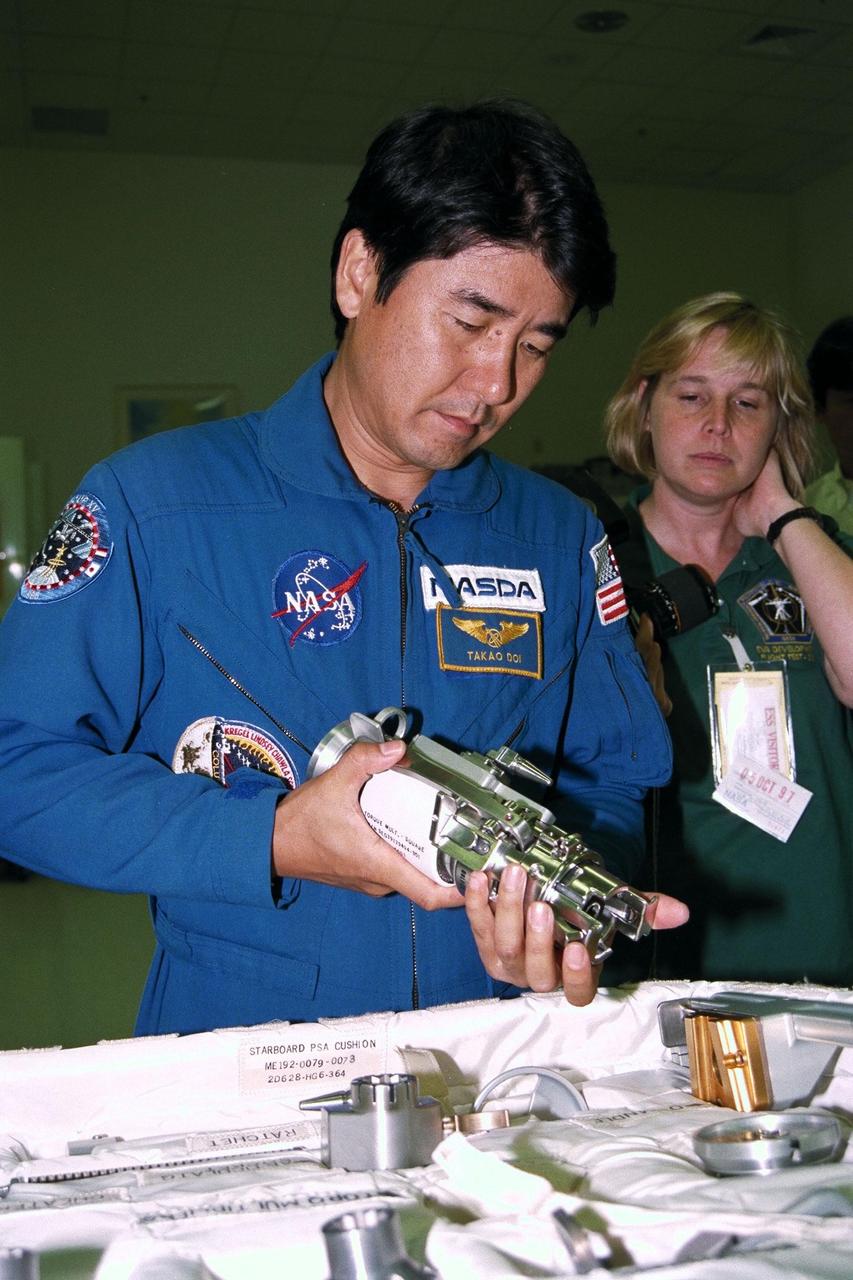
STS-87 Mission Specialist Takao Doi , Ph.D., of the National Space Development Agency of Japan, participates in the Crew Equipment Integration Test (CEIT) in Kennedy Space Center’s (KSC's) Vertical Processing Facility. Glenda Laws, the extravehicular activity (EVA) coordinator, Johnson Space Center, stands behind Dr. Doi. The CEIT gives astronauts an opportunity to get a hands-on look at the payloads with which they will be working on-orbit. STS-87 will be the fourth United States Microgravity Payload and flight of the Spartan-201 deployable satellite. During the mission, Dr. Doi will be the first Japanese astronaut to perform a spacewalk. STS-87 is scheduled for a Nov. 19 liftoff from KSC
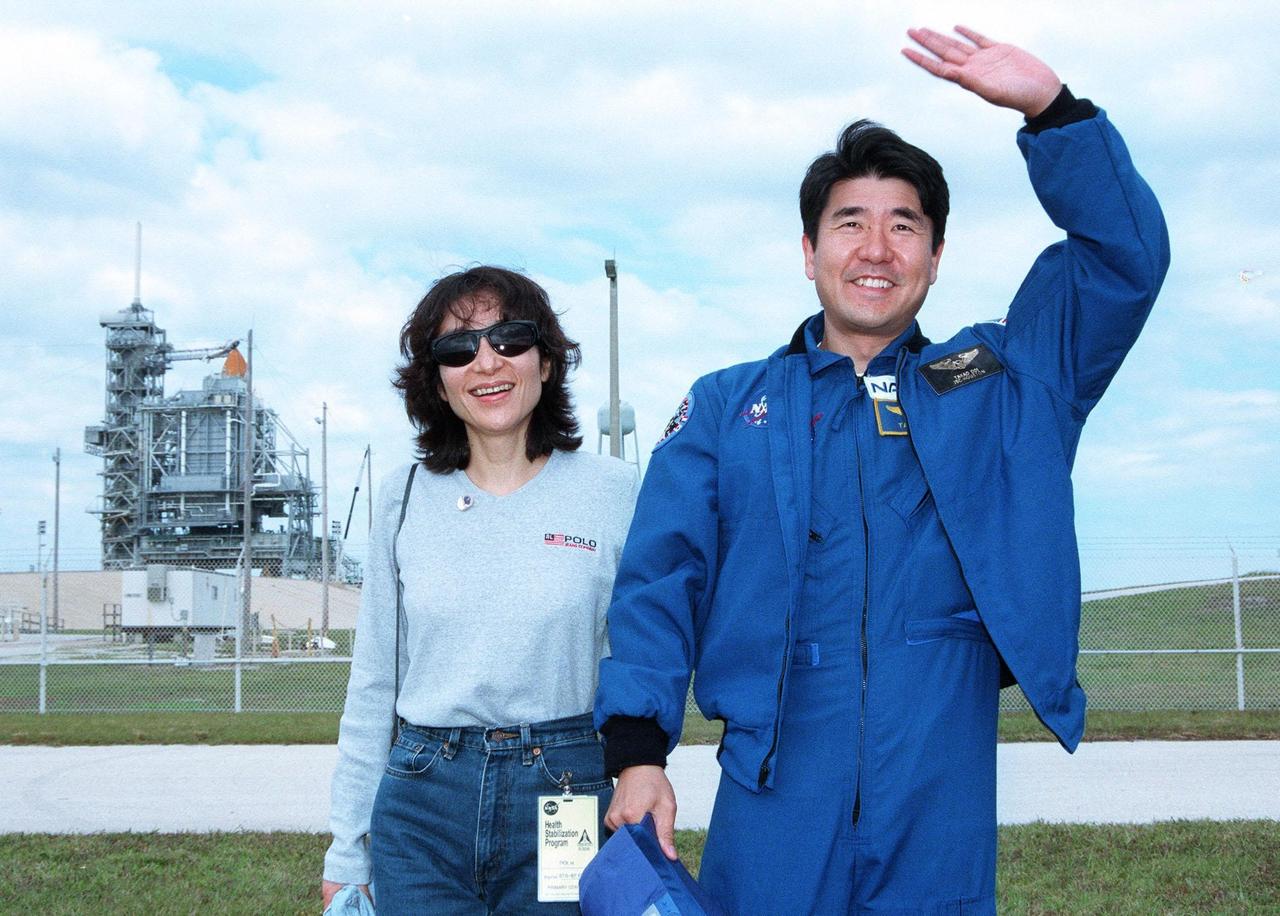
STS-87 Mission Specialist Takao Doi, Ph.D., of the National Space Development Agency of Japan poses with his wife, Hitomi Doi, in front of Kennedy Space Center's Launch Pad 39B during final prelaunch activities leading up to the scheduled Nov. 19 liftoff. The other STS-87 crew members are Commander Kevin Kregel; Pilot Steven Lindsey; Mission Specialists Kalpana Chawla, Ph.D., and Winston Scott; and Payload Specialist Leonid Kadenyuk of the National Space Agency of Ukraine. STS-87 will be the fourth flight of the United States Microgravity Payload and the Spartan-201 deployable satellite
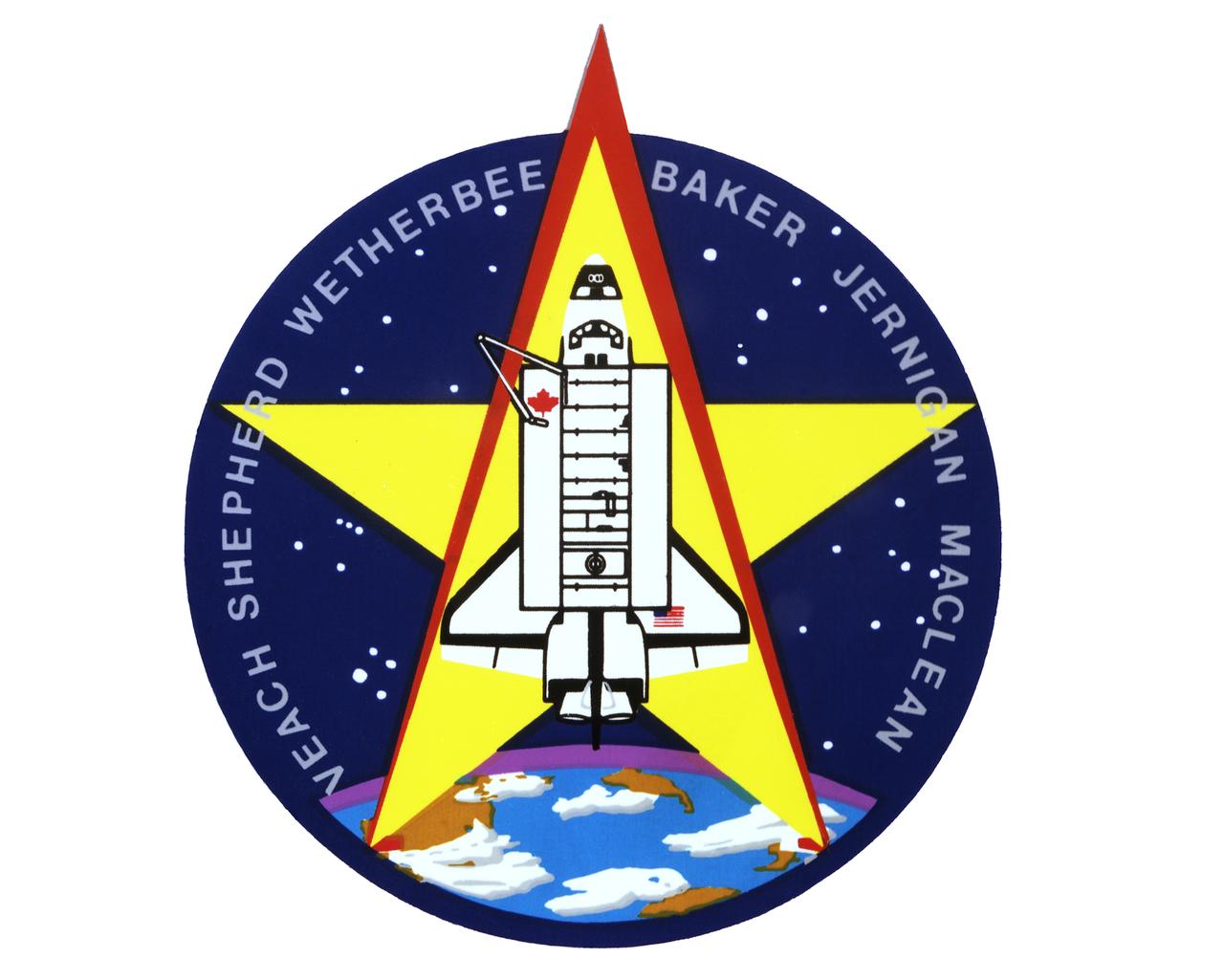
The STS-52 insignia, designed by the mission’s crew members, features a large gold star to symbolize the crew's mission on the frontiers of space. A gold star is often used to symbolize the frontier period of the American West. The red star in the shape of the Greek letter lambda represents both the laser measurements taken from the Laser Geodynamic Satellite (LAGEOS II) and the Lambda Point Experiment, which was part of the United States Microgravity Payload (USMP-l). The remote manipulator and maple leaf are emblematic of the Canadian payload specialist who conducted a series of Canadian flight experiments (CANEX-2), including the Space Vision System test.
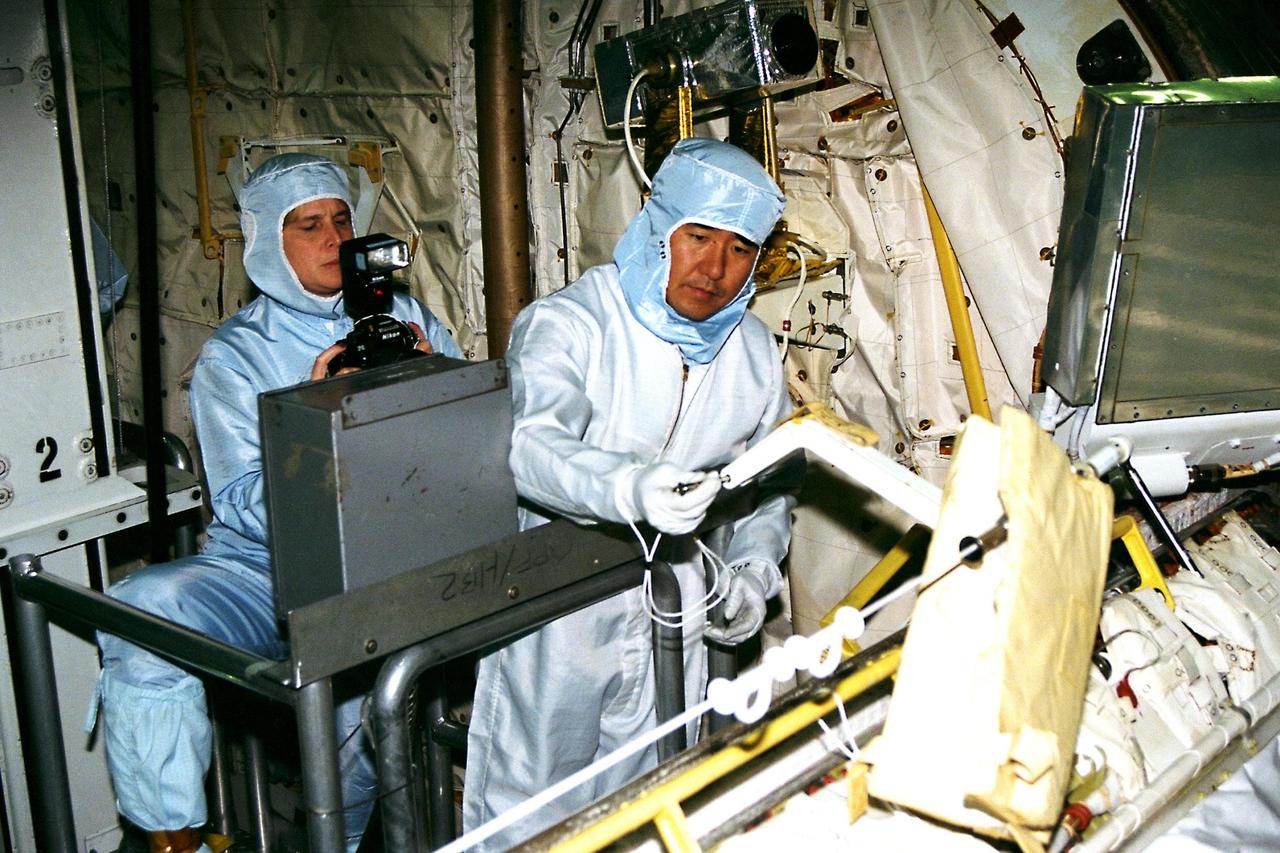
STS-87 Mission Specialist Takao Doi , Ph.D., of the National Space Development Agency of Japan, participates in the Crew Equipment Integration Test (CEIT) at Kennedy Space Center (KSC). Glenda Laws, the extravehicular activity (EVA) coordinator, Johnson Space Center, stands behind Dr. Doi. The CEIT gives astronauts an opportunity to get a hands-on look at the payloads with which they will be working on-orbit. STS-87 will be the fourth United States Microgravity Payload and flight of the Spartan-201 deployable satellite. During the mission, Dr. Doi will be the first Japanese astronaut to perform a spacewalk. STS-87 is scheduled for a Nov. 19 liftoff from KSC
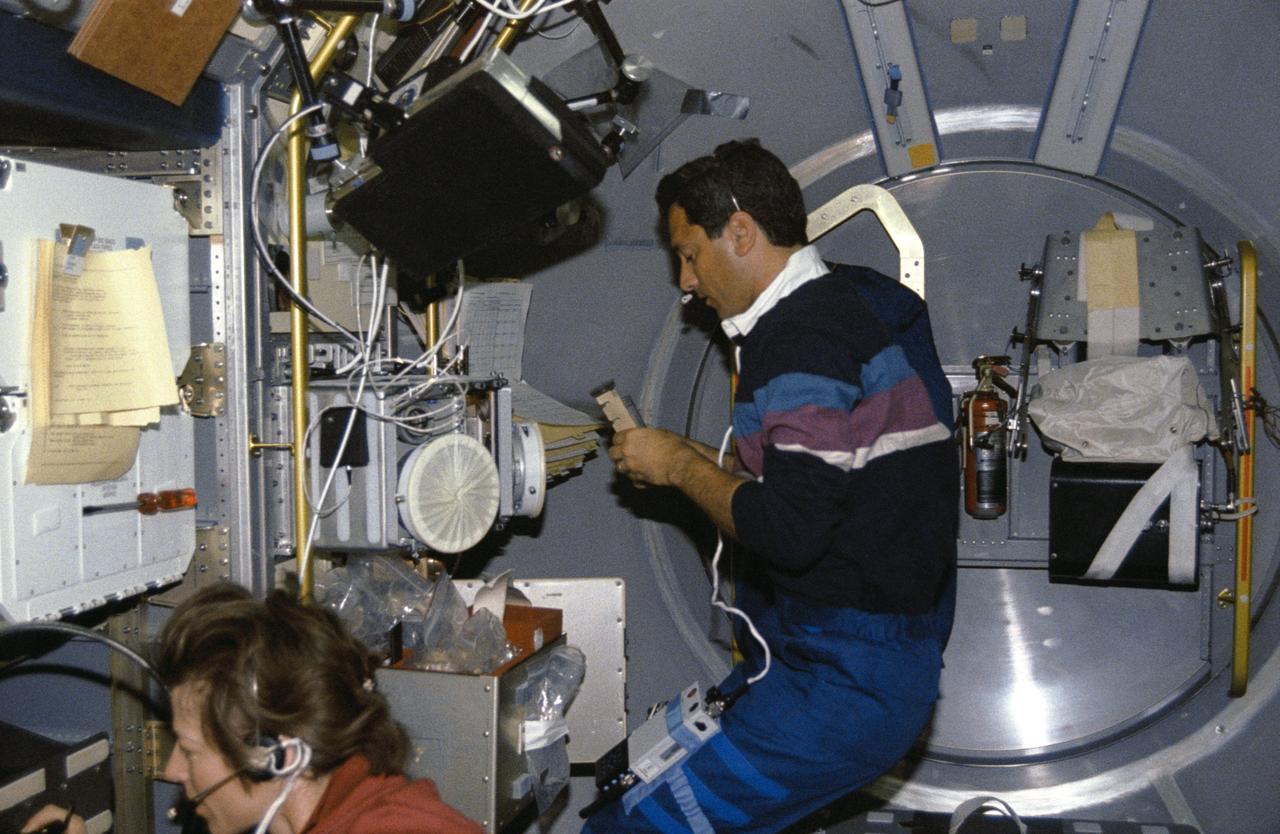
STS050-254-007 (25 June-9 July 1992) --- Lawrence J. DeLucas, payload specialist, handles a Protein Crystal Growth (PCG) sample at the multipurpose glovebox aboard the Earth-orbiting Space Shuttle Columbia. Astronaut Bonnie J. Dunbar, payload commander, communicates with ground controllers about the Solid Surface Combustion Experiment (SSCE), one of the United States Microgravity Laboratory 1’s (USML-1) three experiments on Rack 10. Five other crew members joined the pair for a record-setting 14-days of scientific data gathering.
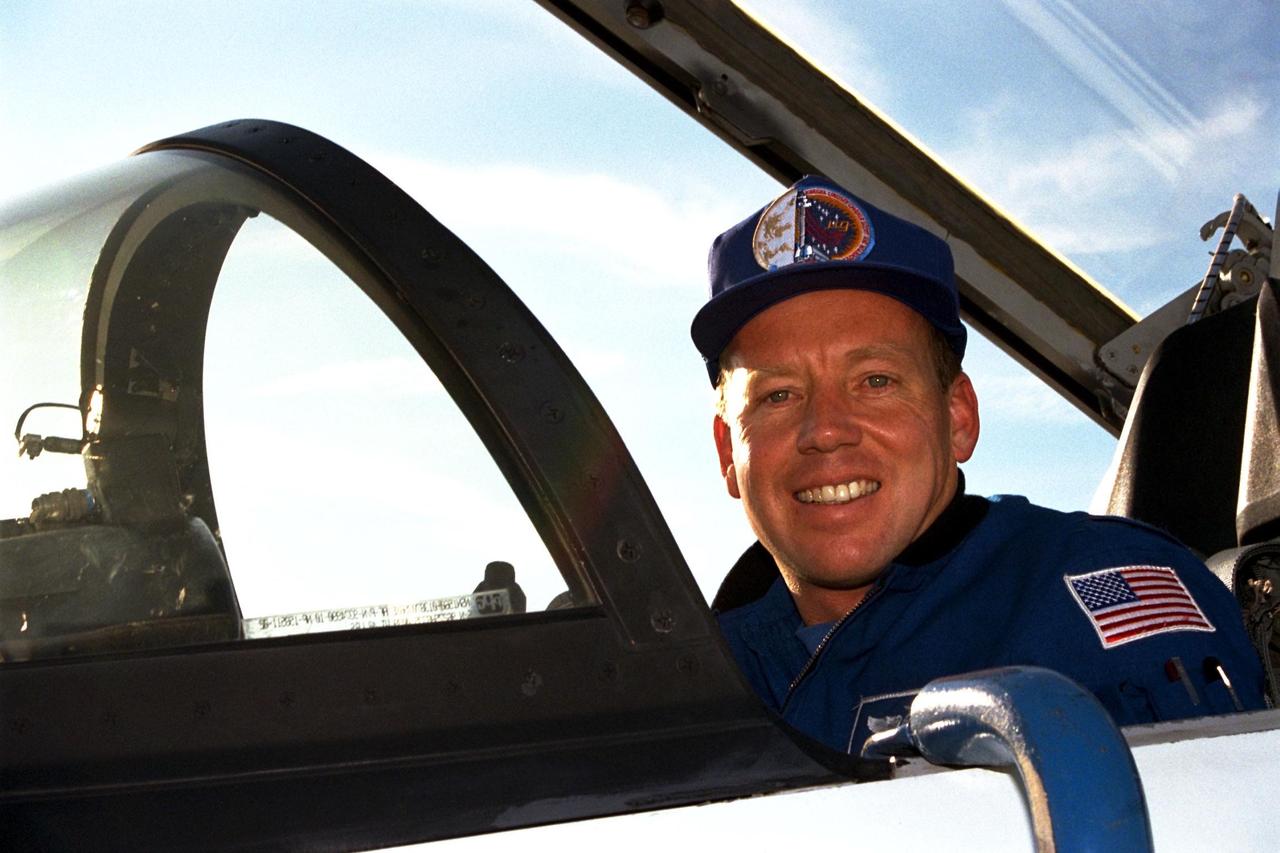
STS-87 Pilot Steven Lindsey arrives at Kennedy Space Center's Shuttle Landing Facility aboard a T-38 jet for the final prelaunch activities leading up to the scheduled Nov. 19 liftoff. The other STS-87 crew members are Commander Kevin Kregel; Mission Specialists Kalpana Chawla, Ph.D.; Takao Doi, Ph.D., of the National Space Development Agency of Japan; and Winston Scott; and Payload Specialist Leonid Kadenyuk of the National Space Agency of Ukraine. STS-87 will be the fourth flight of the United States Microgravity Payload and the Spartan-201 deployable satellite
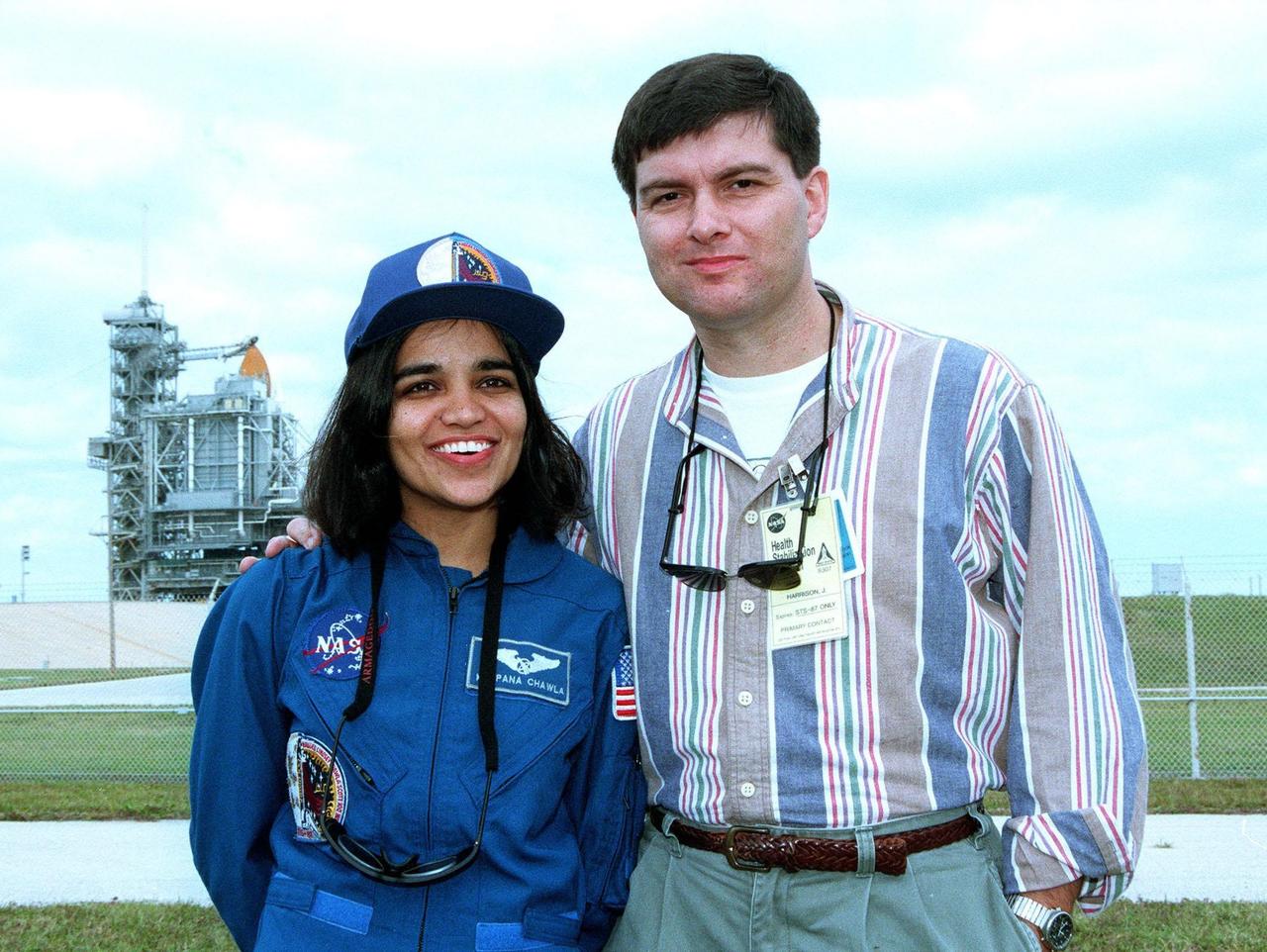
STS-87 Mission Specialist Kalpana Chawla, Ph.D., poses with her husband, Jean-Pierre Harrison, in front of Kennedy Space Center's Launch Pad 39B during final prelaunch activities leading up to the scheduled Nov. 19 liftoff. The other STS-87 crew members are Commander Kevin Kregel; Pilot Steven Lindsey; Mission Specialists Winston Scott and Takao Doi, Ph.D., of the National Space Development Agency of Japan; and Payload Specialist Leonid Kadenyuk of the National Space Agency of Ukraine. STS-87 will be the fourth flight of the United States Microgravity Payload and the Spartan-201 deployable satellite
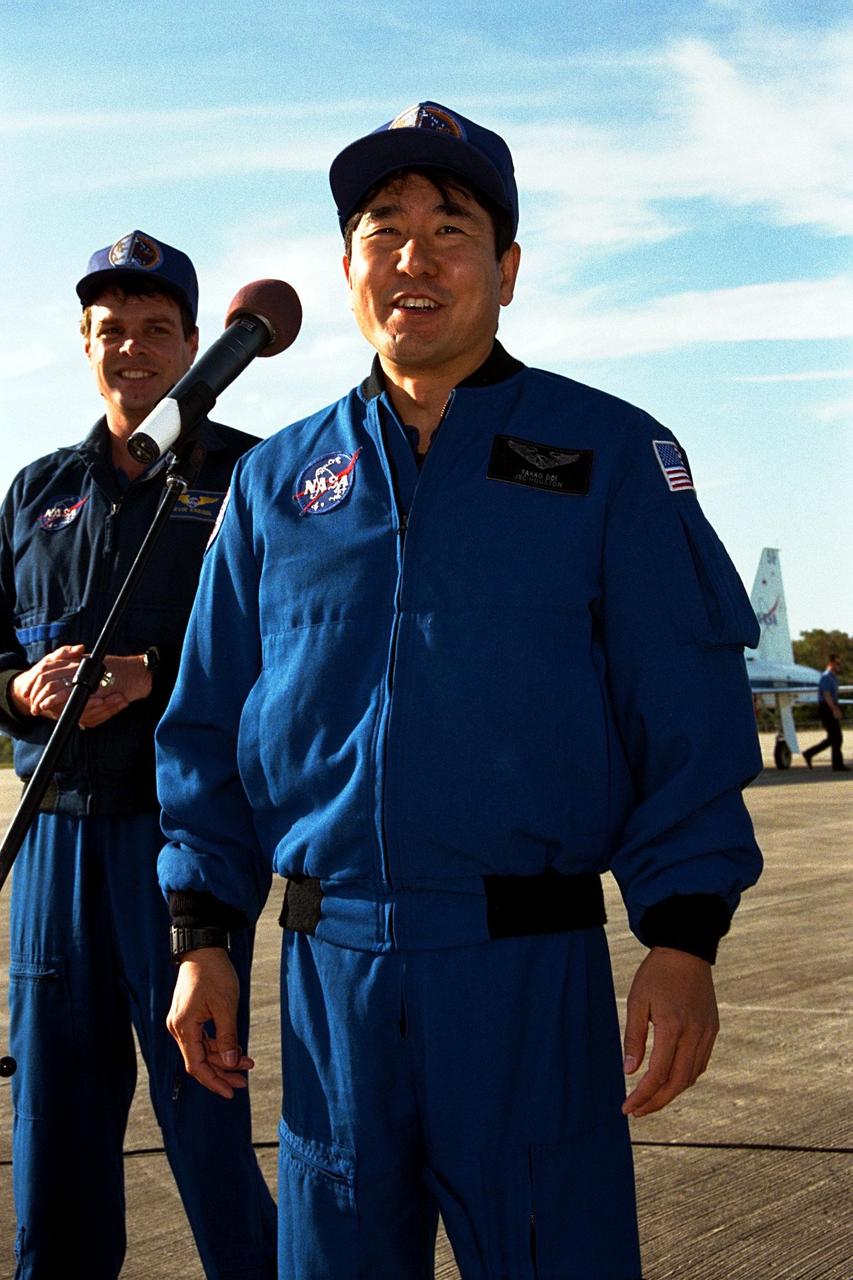
As STS-87 Commander Kevin Kregel looks on, Mission Specialist Takao Doi, Ph.D., of the National Space Development Agency of Japan addresses members of the press and media at Kennedy Space Center's Shuttle Landing Facility after arriving for the final prelaunch activities leading up to the scheduled Nov. 19 liftoff. Other STS-87 crew members not pictured are Pilot Steven Lindsey; Mission Specialists Kalpana Chawla, Ph.D., and Winston Scott; and Payload Specialist Leonid Kadenyuk of the National Space Agency of Ukraine. STS-87 will be the fourth flight of the United States Microgravity Payload and the Spartan-201 deployable satellite
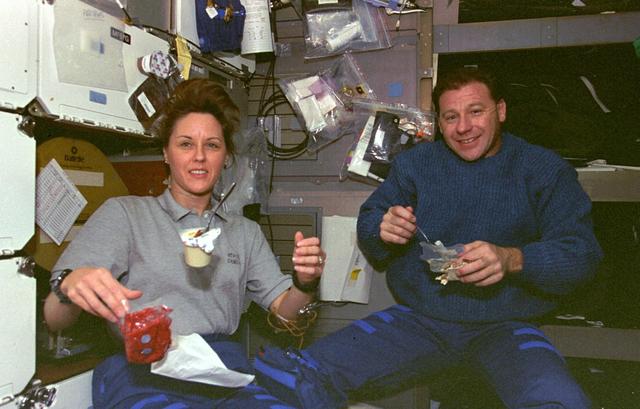
STS073-356-024 (20 October - 5 November 1995) --- Payload specialist Albert Sacco Jr. joins astronaut Kathryn C. Thornton, payload commander, for mealtime on the middeck of the Earth-orbiting Space Shuttle Columbia. Thornton is about to open a packet of strawberries, while a can of vanilla pudding floats before her. Sacco is about to grab a spoonful of rice pilaf while holding a peanut butter and jelly sandwich on a tortilla. The two were joined by five other crewmembers in support of 16-days' in-space research in support of the United States Microgravity Laboratory (USML-2) mission.