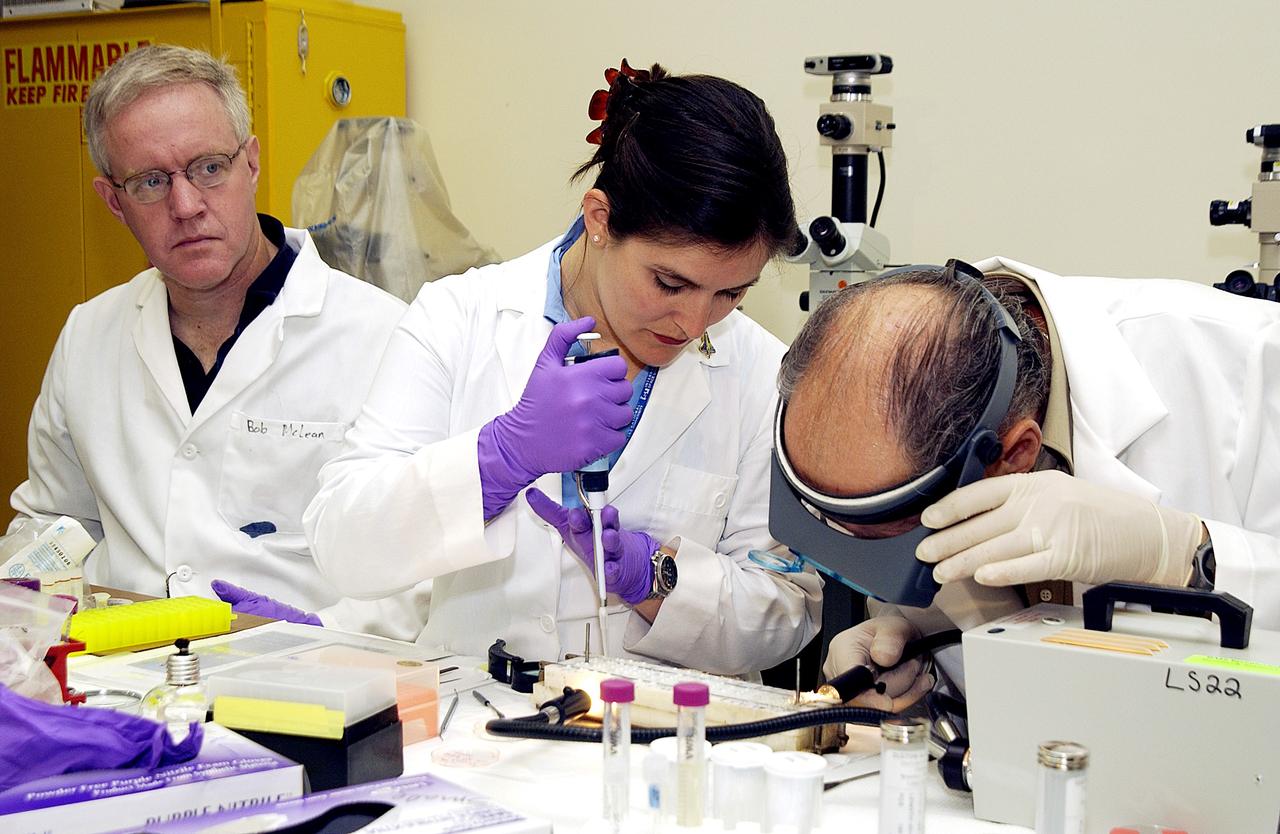
KENNEDY SPACE CENTER, FLA. - From left, Bob McLean, Southwest Texas State University; Valerie Cassanto, Instrumentation Technology Associates, Inc.; and Dennis Morrison, NASA Johnson Space Center, process one of the experiments carried on mission STS-107. Several experiments were found during the search for Columbia debris. Included in the Commercial ITA Biomedical Experiments payload on mission STS-107 are urokinase cancer research, microencapsulation of drugs, the Growth of Bacterial Biofilm on Surfaces during Spaceflight (GOBBSS), and tin crystal formation.
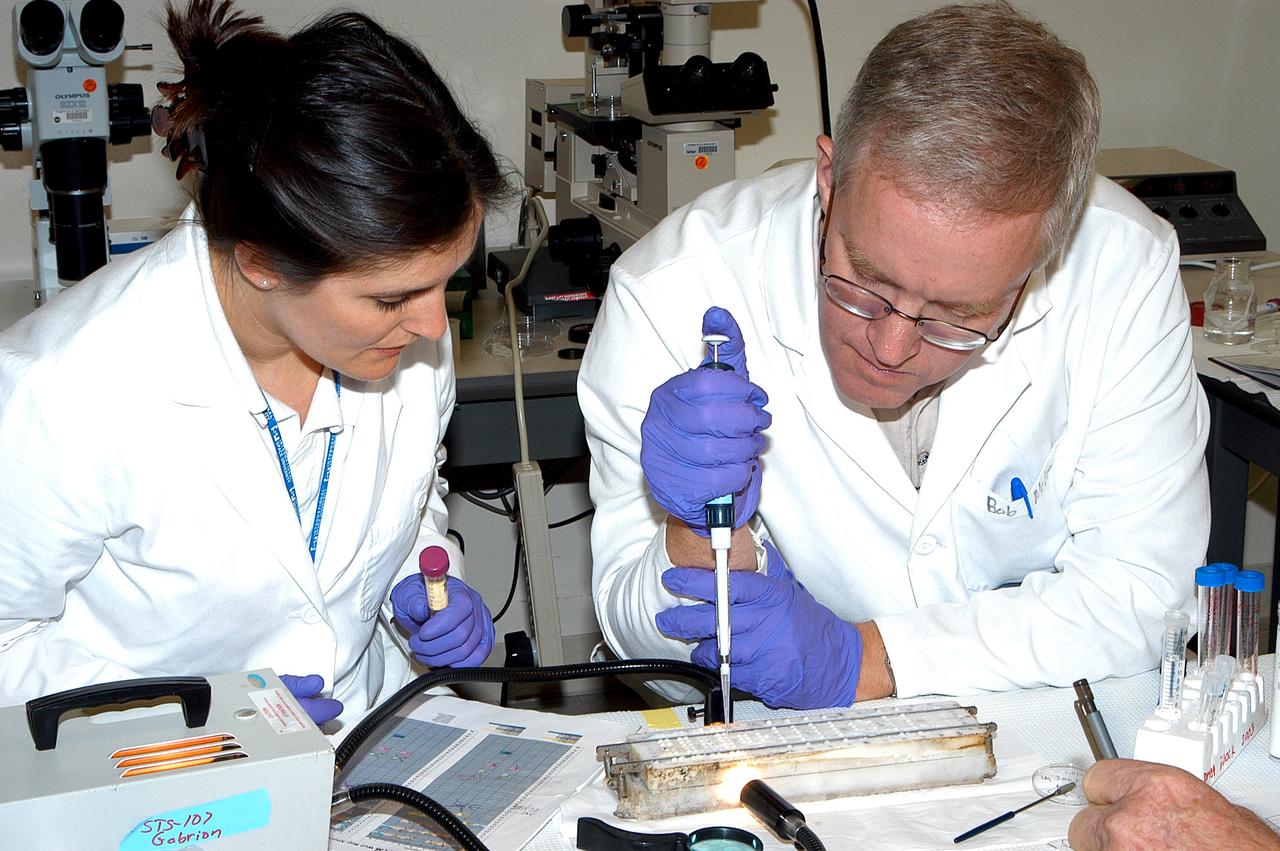
KENNEDY SPACE CENTER, FLA. - Valerie Cassanto, with Instrumentation Technology Associates, Inc., and Bob McLean, from the Southwest Texas State University, work on an experiment found during the search for Columbia debris. Included in the Commercial ITA Biomedical Experiments payload on mission STS-107 are urokinase cancer research, microencapsulation of drugs, the Growth of Bacterial Biofilm on Surfaces during Spaceflight (GOBBSS), and tin crystal formation.
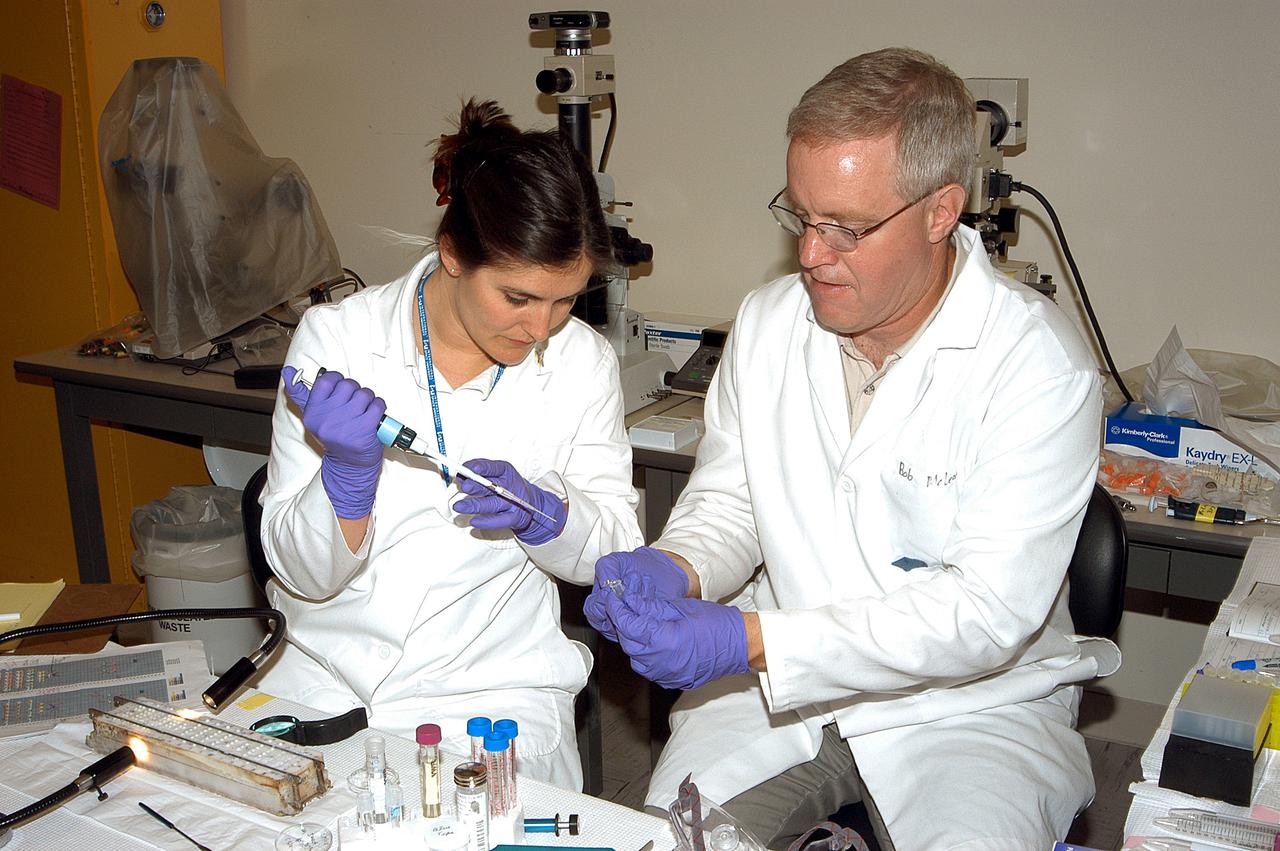
KENNEDY SPACE CENTER, FLA. - Valerie Cassanto, with Instrumentation Technology Associates, Inc., and Bob McLean, from the Southwest Texas State University, transfer to a new container material from one of the experiments carried on mission STS-107. Several experiments were found during the search for Columbia debris. Included in the Commercial ITA Biomedical Experiments payload on mission STS-107 are urokinase cancer research, microencapsulation of drugs, the Growth of Bacterial Biofilm on Surfaces during Spaceflight (GOBBSS), and tin crystal formation.

KENNEDY SPACE CENTER, FLA. - From left, Bob McLean, Southwest Texas State University, and Valerie Cassanto, Instrumentation Technology Associates, Inc., study one of the experiments carried on mission STS-107. Several experiments were found during the search for Columbia debris. Included in the Commercial ITA Biomedical Experiments payload on mission STS-107 are urokinase cancer research, microencapsulation of drugs, the Growth of Bacterial Biofilm on Surfaces during Spaceflight (GOBBSS), and tin crystal formation.
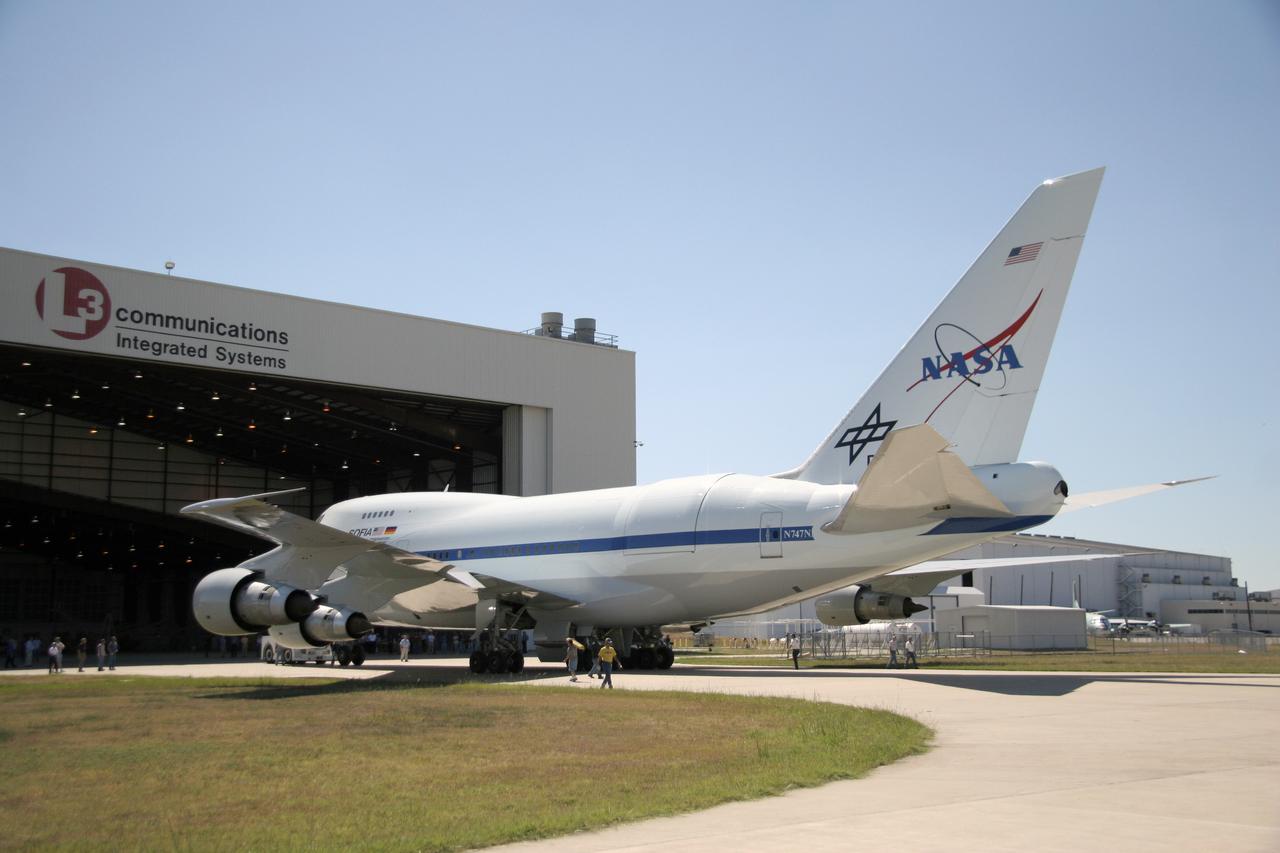
NASA's freshly painted Stratospheric Observatory for Infrared Astronomy (SOFIA) 747SP aircraft sits outside a hangar at L-3 Communications Integrated Systems' facility in Waco, Texas. The observatory, which features a German-built 100-inch (2.5 meter) diameter infrared telescope weighing 20 tons, is approaching the flight test phase as part of a joint program by NASA and DLR Deutsches Zentrum fuer Luft- und Raumfahrt (German Aerospace Center). SOFIA's science and mission operations are being planned jointly by Universities Space Research Association (USRA) and the Deutsches SOFIA Institut (DSI). Once operational, SOFIA will be the world's primary infrared observatory during a mission lasting up to 20 years, as well as an outstanding laboratory for developing and testing instrumentation and detector technology.
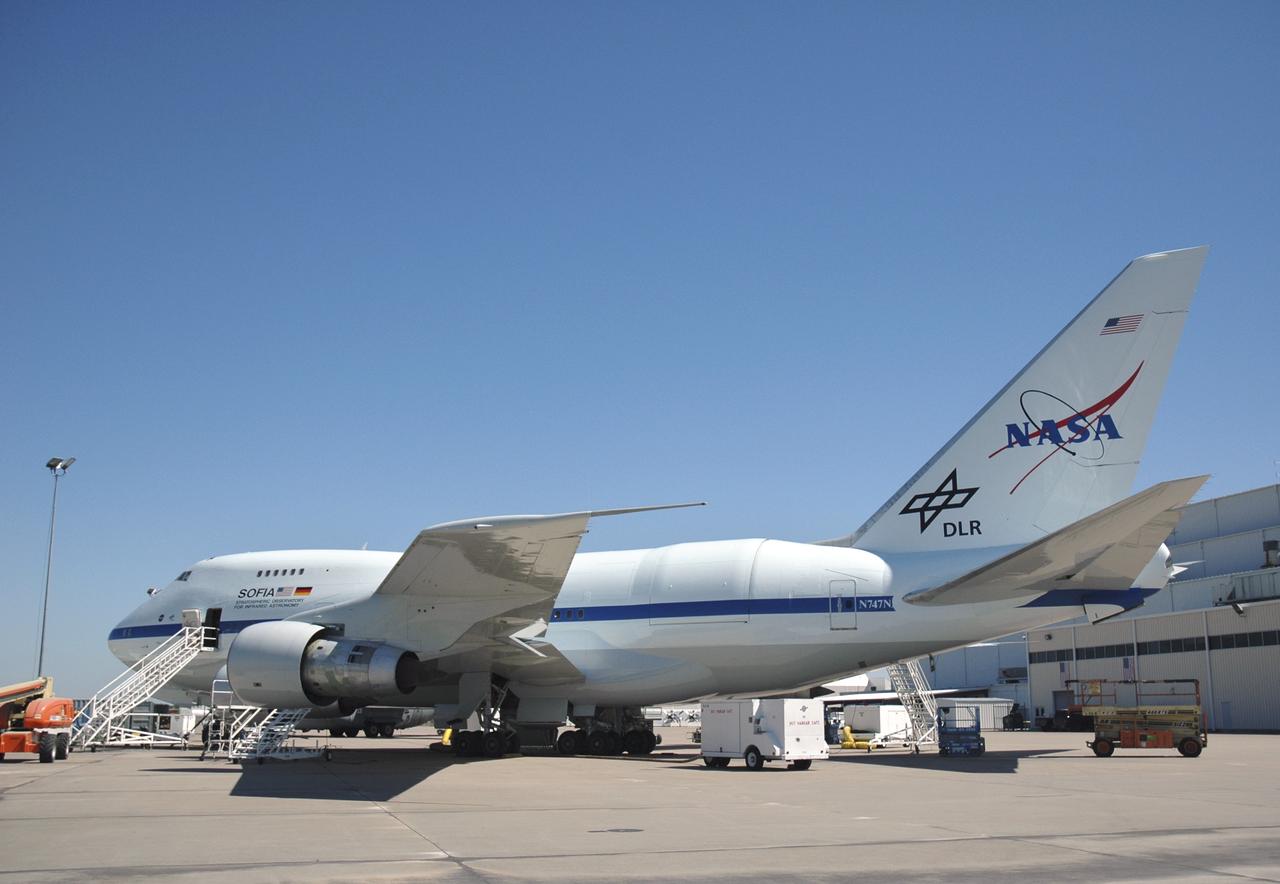
NASA's freshly painted Stratospheric Observatory for Infrared Astronomy (SOFIA) 747SP is shown at L-3 Communications Integrated Systems' facility in Waco, Texas, where major modifications and installation was performed. The observatory, which features a German-built 100-inch (2.5 meter) diameter infrared telescope weighing 20 tons, is approaching the flight test phase as part of a joint program by NASA and DLR Deutsches Zentrum fuer Luft- und Raumfahrt (German Aerospace Center). SOFIA's science and mission operations are being planned jointly by Universities Space Research Association (USRA) and the Deutsches SOFIA Institut (DSI). Once operational, SOFIA will be the world's primary infrared observatory during a mission lasting up to 20 years, as well as an outstanding laboratory for developing and testing instrumentation and detector technology.

Cindy Barnes of University Space Research Association (USRA) at NASA's Marshall Space Flight Center pipettes a protein solution in preparation to grow crystals as part of NASA's structural biology program. Research on Earth helps scientists define conditions and specimens they will use in space experiments.
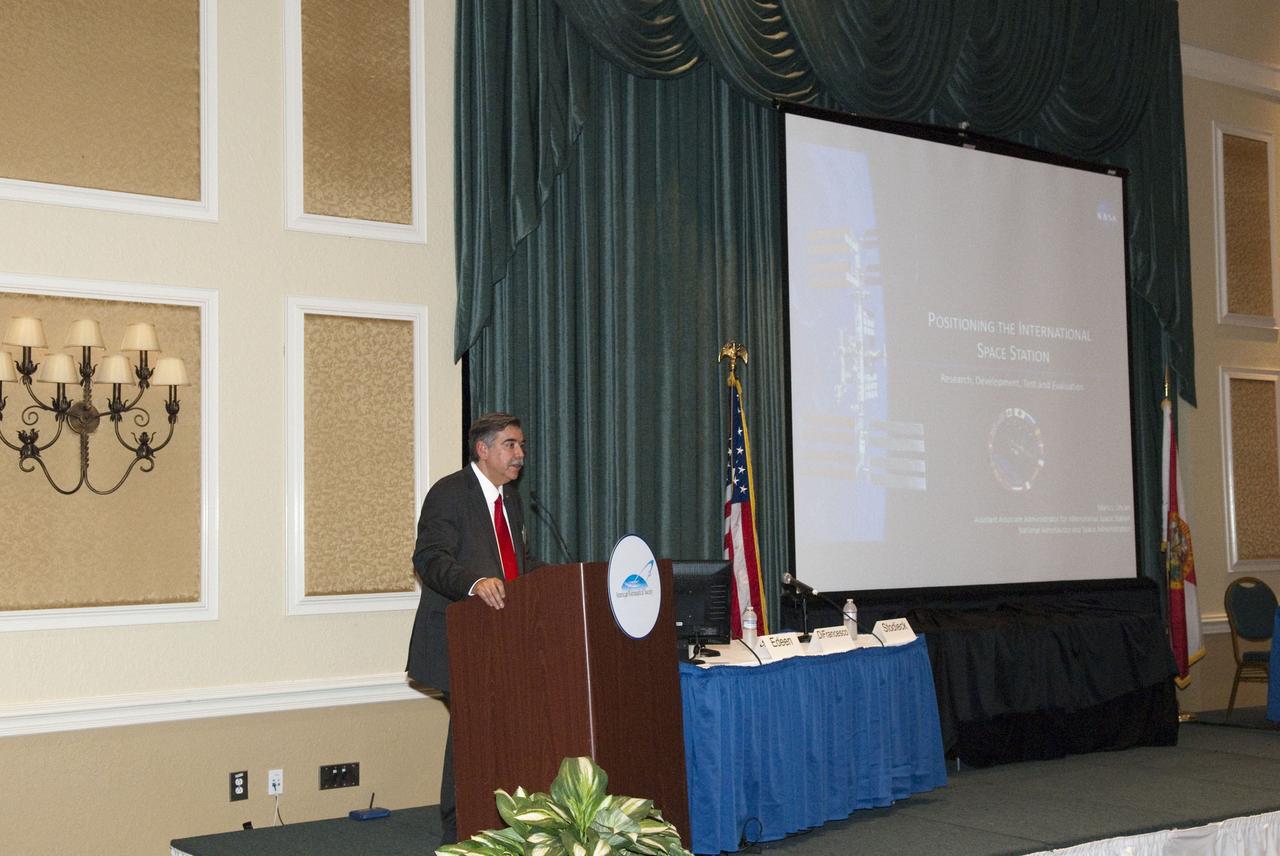
CAPE CANAVERAL, Fla. -- NASA International Space Station Assistant Associate Administrator Mark Uhran addresses attendees of the American Astronautical Society's 2010 National Conference, held at the Radisson Resort at the Port in Cape Canaveral, Fla. This year's conference was titled: International Space Station: The Next Decade - Utilization and Research. The conference was organized with the support of Kennedy and sponsored by The Boeing Company, Honeywell International Inc., Northrop Grumman Corp., Space Florida and the Universities Space Research Association (USRA). Photo credit: NASA/Jim Grossmann
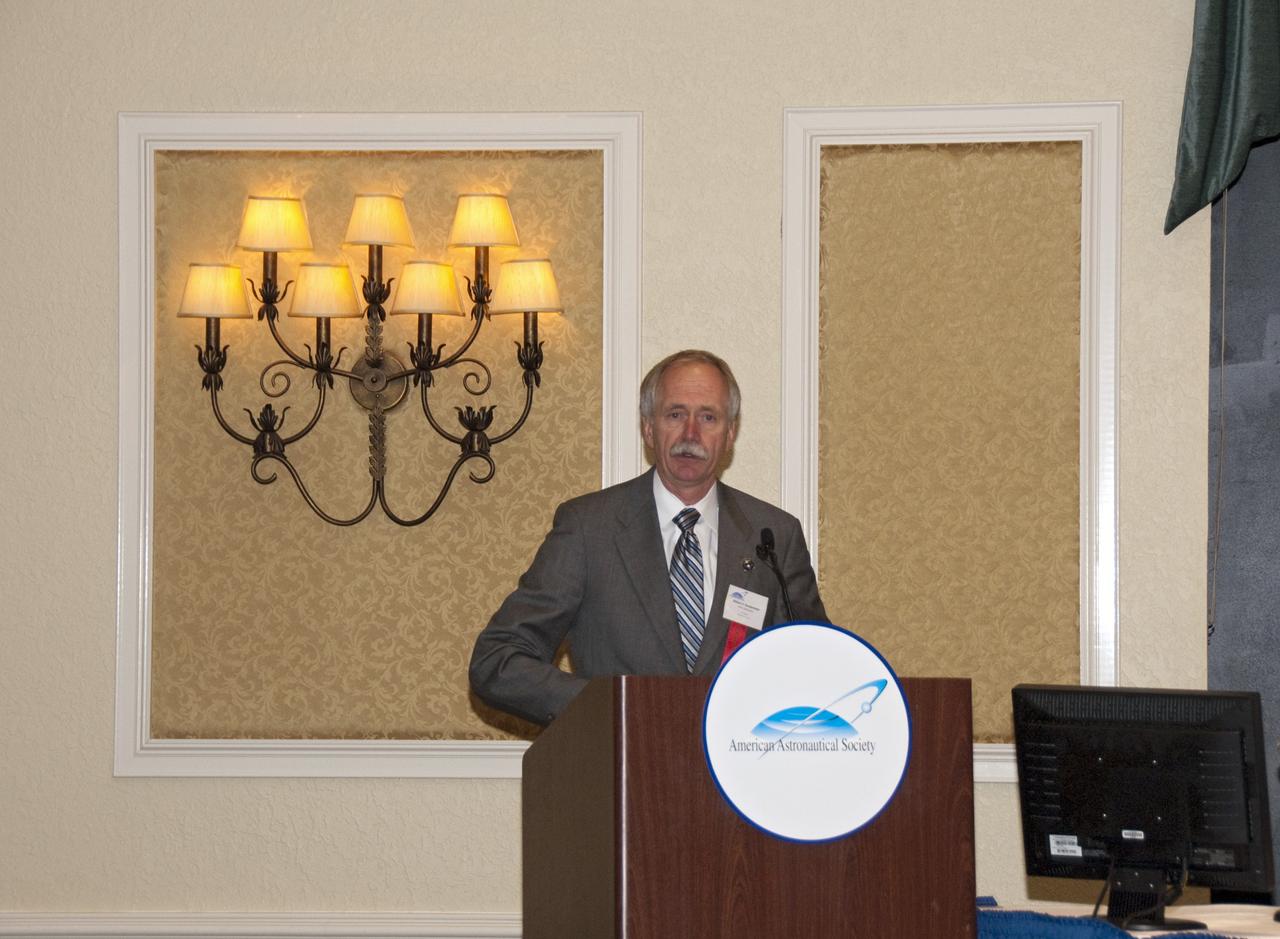
CAPE CANAVERAL, Fla. -- NASA Associate Administrator for Space Operations Bill Gerstenmaier addresses attendees of the American Astronautical Society's 2010 National Conference at the Radisson Resort at the Port. The focus of the conference is the next 10 years of utilization and research aboard the International Space Station. The conference was organized with the support of Kennedy and sponsored by The Boeing Company, Honeywell International Inc., Northrop Grumman Corp., Space Florida and the Universities Space Research Association (USRA). Photo credit: NASA/Jim Grossmann
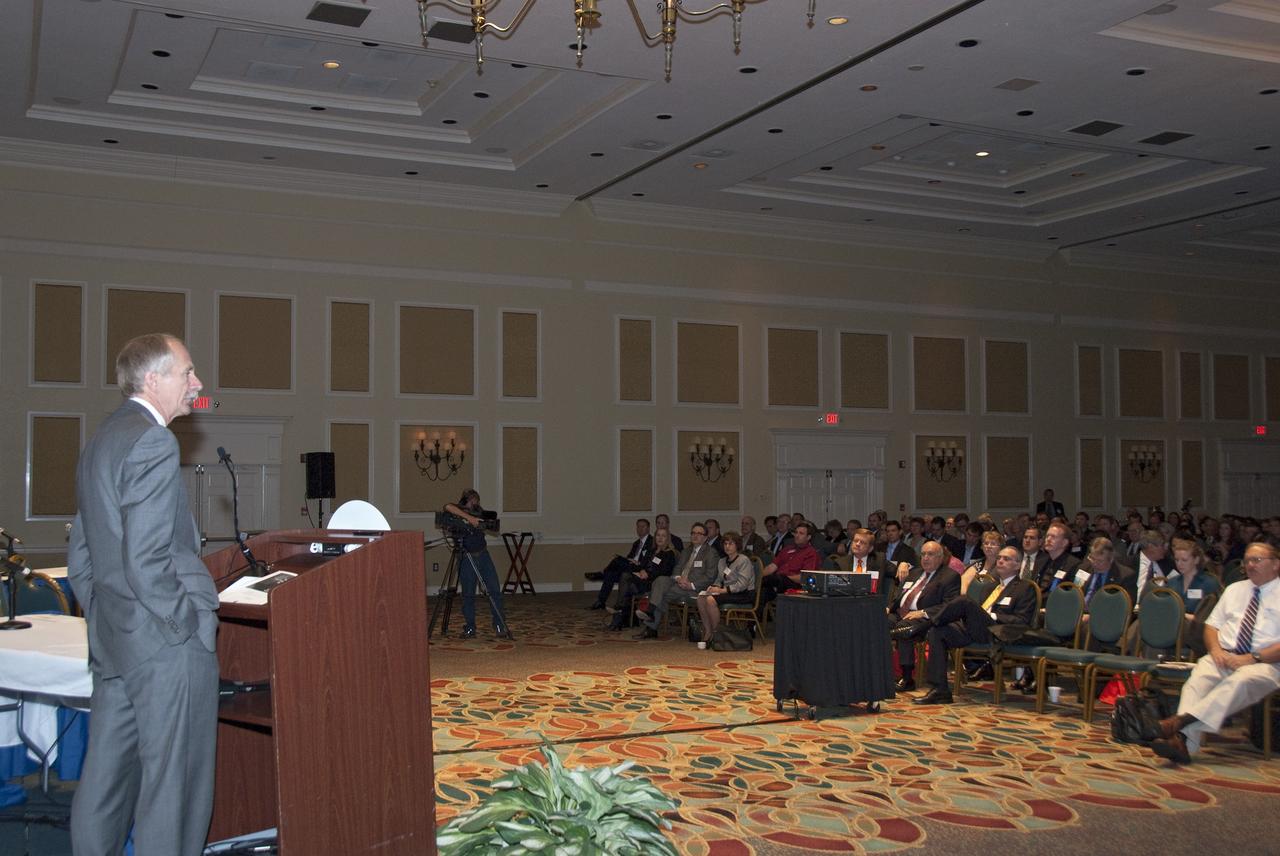
CAPE CANAVERAL, Fla. -- NASA Associate Administrator for Space Operations Bill Gerstenmaier addresses attendees of the American Astronautical Society's 2010 National Conference at the Radisson Resort at the Port. The focus of the conference is the next 10 years of utilization and research aboard the International Space Station. The conference was organized with the support of Kennedy and sponsored by The Boeing Company, Honeywell International Inc., Northrop Grumman Corp., Space Florida and the Universities Space Research Association (USRA). Photo credit: NASA/Jim Grossmann
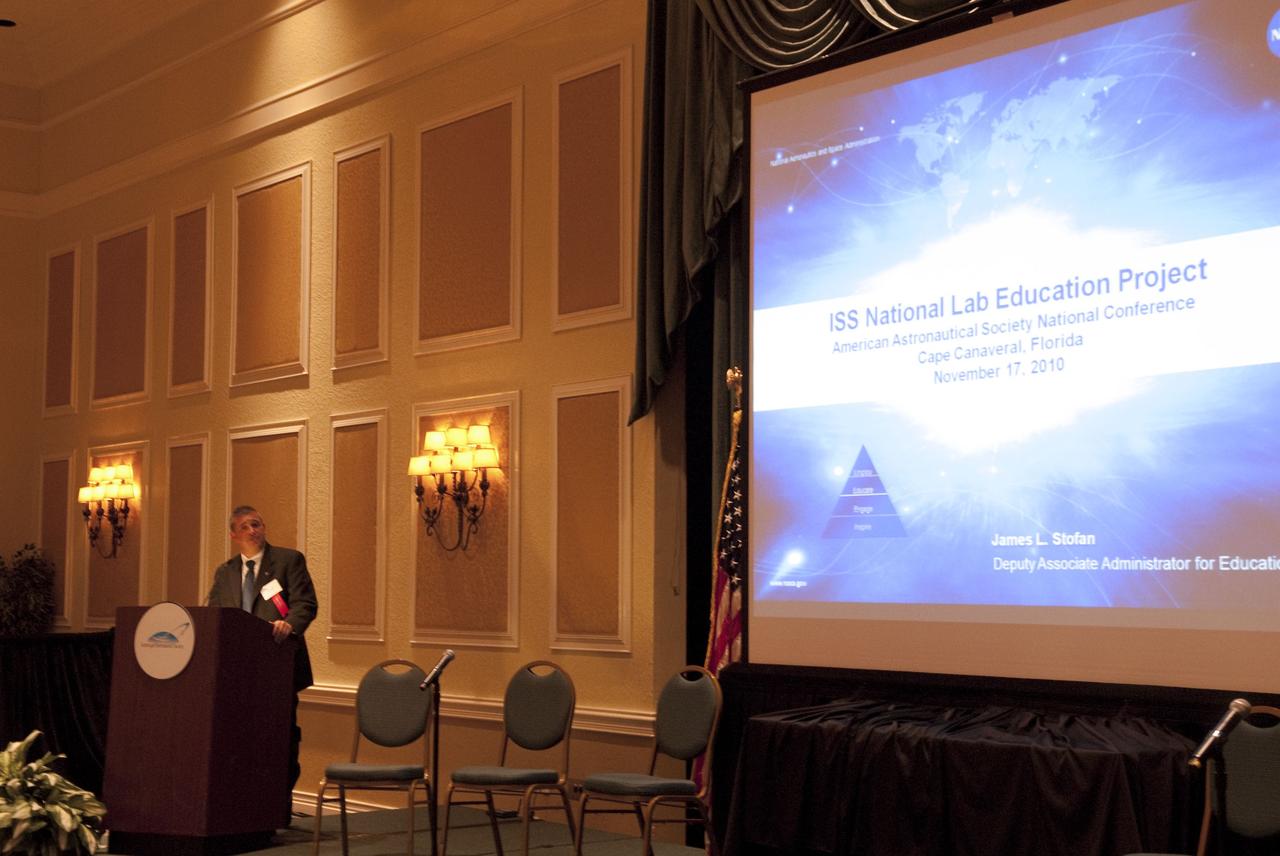
CAPE CANAVERAL, Fla. -- NASA Deputy Associate Administrator for Education James Stofan, addresses attendees of the American Astronautical Society's 2010 National Conference held at the Radisson Resort at the Port in Cape Canaveral, Fla. This year's conference was titled: International Space Station: The Next Decade - Utilization and Research. The conference was organized with the support of Kennedy and sponsored by The Boeing Company, Honeywell International Inc., Northrop Grumman Corp., Space Florida and the Universities Space Research Association (USRA). Photo credit: NASA/Jim Grossmann
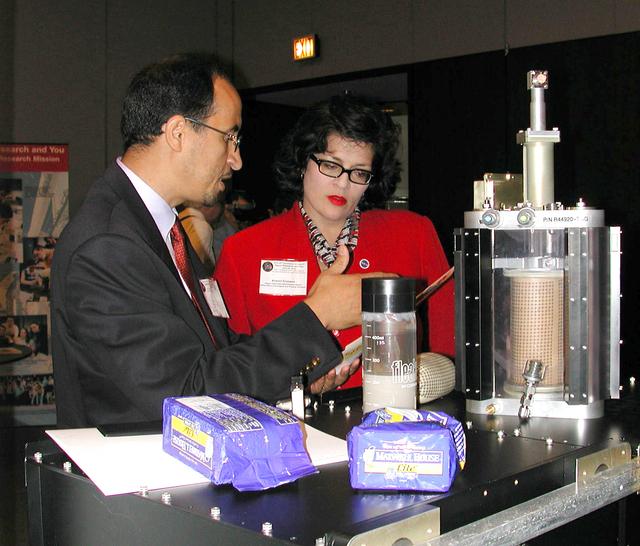
Khalid Alshibli of Louisiana State University, project scientist for the Mechanics of Granular Materials (MGM-III) experiment, explains the MGM experiment to Kristen Erickson, acting deputy associate administrator in NASA's Office of Biological and Physical Research. A training model of the test cell is at right. The activity was part of the Space Research and You education event held by NASA's Office of Biological and Physical Research on June 25, 2002, in Arlington, VA, to highlight the research that will be conducted on STS-107.
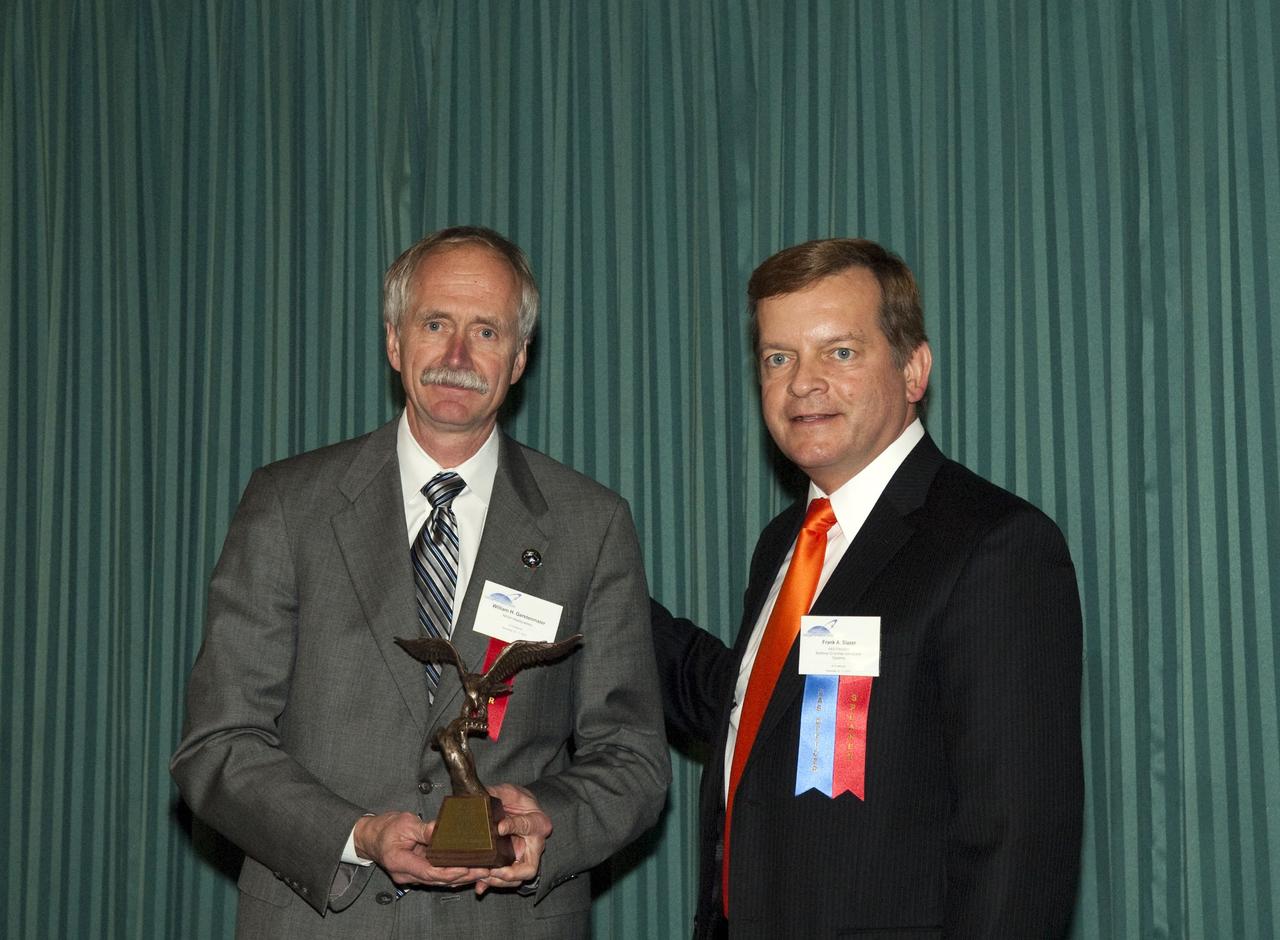
CAPE CANAVERAL, Fla. -- After being presented with the 2010 Space Flight award from the American Astronautical Society, NASA Associate Administrator for Space Operations Bill Gerstenmaier and Northrop Grumman/American Astronautical Society President Frank Slazer pose for a photo at the American Astronautical Society's 2010 National Conference held at the Radisson Resort at the Port in Cape Canaveral, Fla. This year's conference was titled: International Space Station: The Next Decade - Utilization and Research. The conference was organized with the support of Kennedy and sponsored by The Boeing Company, Honeywell International Inc., Northrop Grumman Corp., Space Florida and the Universities Space Research Association (USRA). Photo credit: NASA/Jim Grossmann
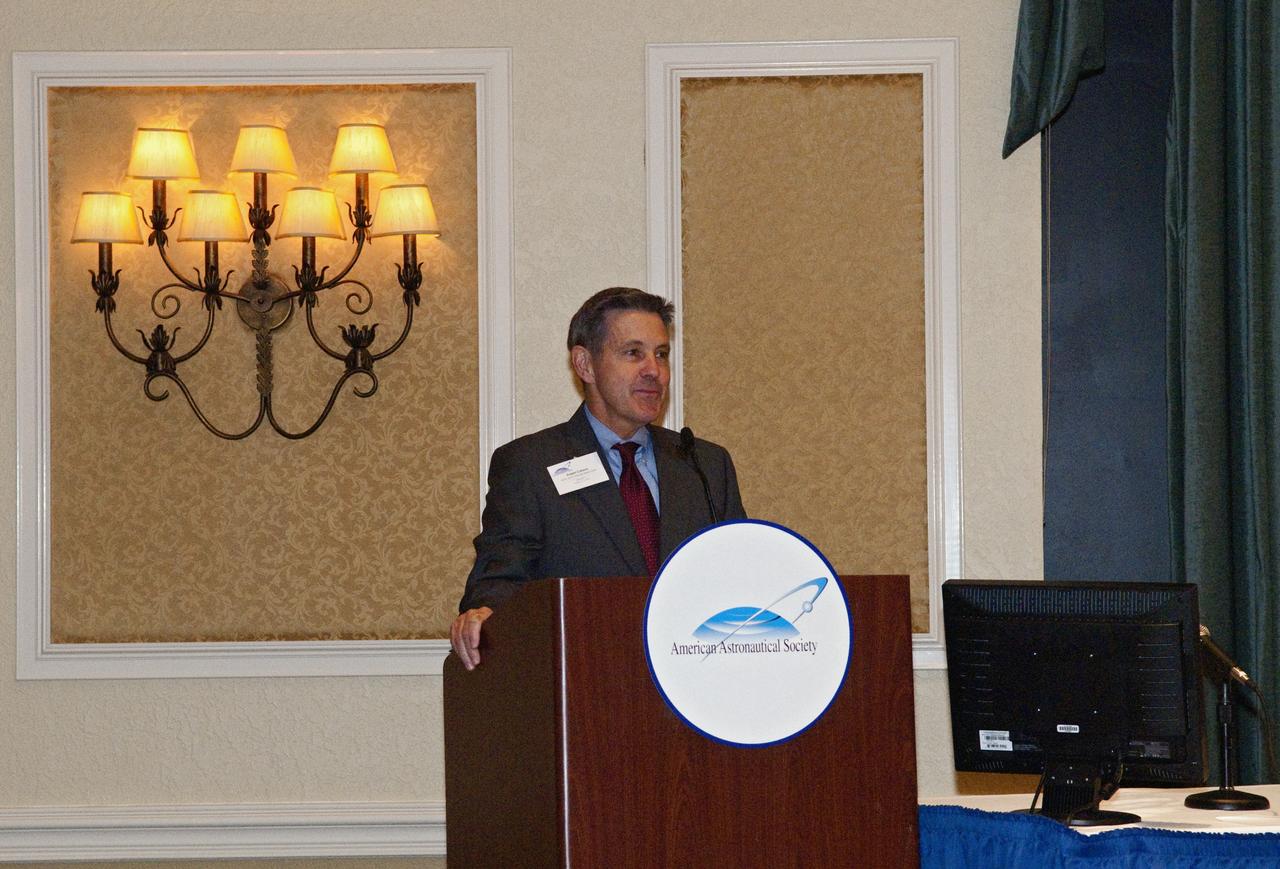
CAPE CANAVERAL, Fla. -- NASA Kennedy Space Center Director Bob Cabana addresses attendees of the American Astronautical Society's 2010 National Conference at the Radisson Resort at the Port. The focus of the conference is the next 10 years of utilization and research aboard the International Space Station. The conference was organized with the support of Kennedy and sponsored by The Boeing Company, Honeywell International Inc., Northrop Grumman Corp., Space Florida and the Universities Space Research Association (USRA). Photo credit: NASA/Jim Grossmann
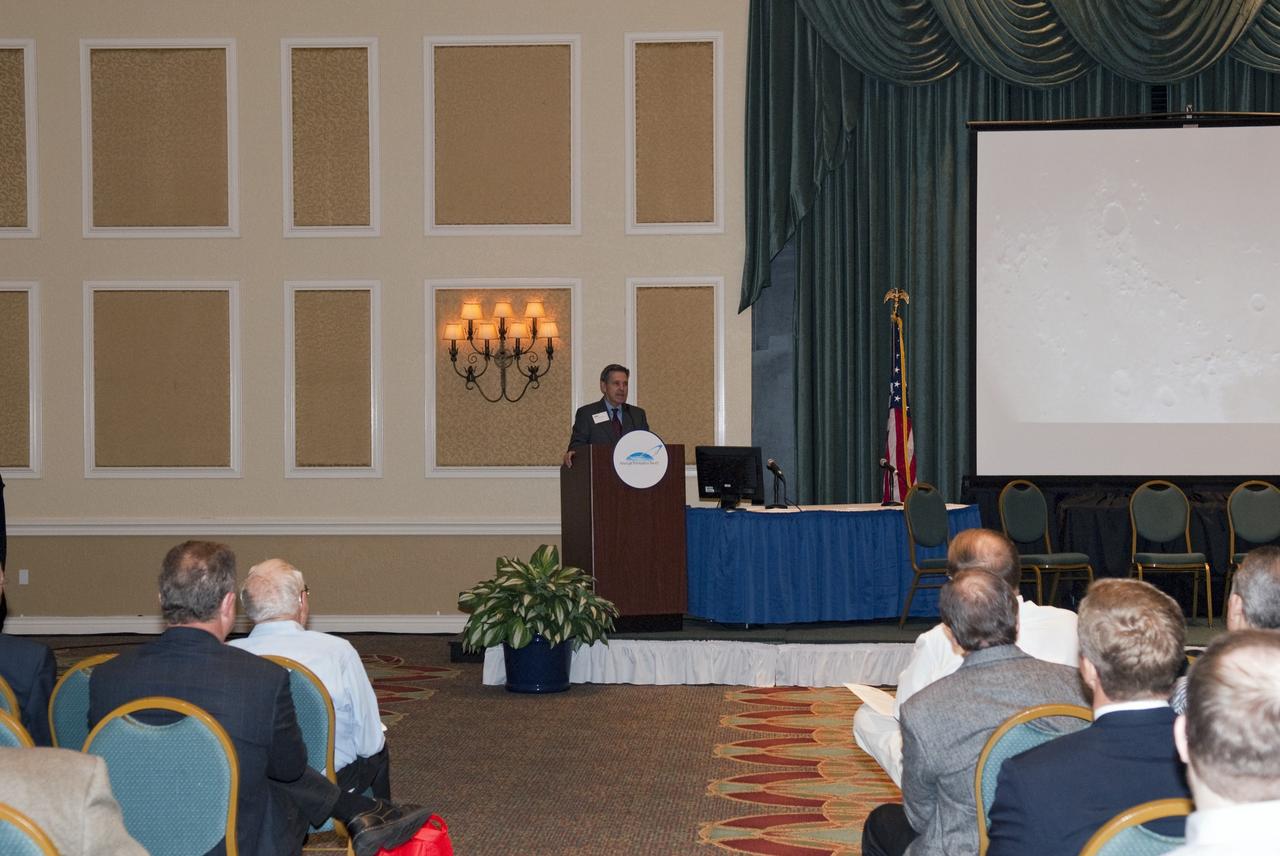
CAPE CANAVERAL, Fla. -- NASA Kennedy Space Center Director Bob Cabana addresses attendees of the American Astronautical Society's 2010 National Conference at the Radisson Resort at the Port. The focus of the conference is the next 10 years of utilization and research aboard the International Space Station. The conference was organized with the support of Kennedy and sponsored by The Boeing Company, Honeywell International Inc., Northrop Grumman Corp., Space Florida and the Universities Space Research Association (USRA). Photo credit: NASA/Jim Grossmann
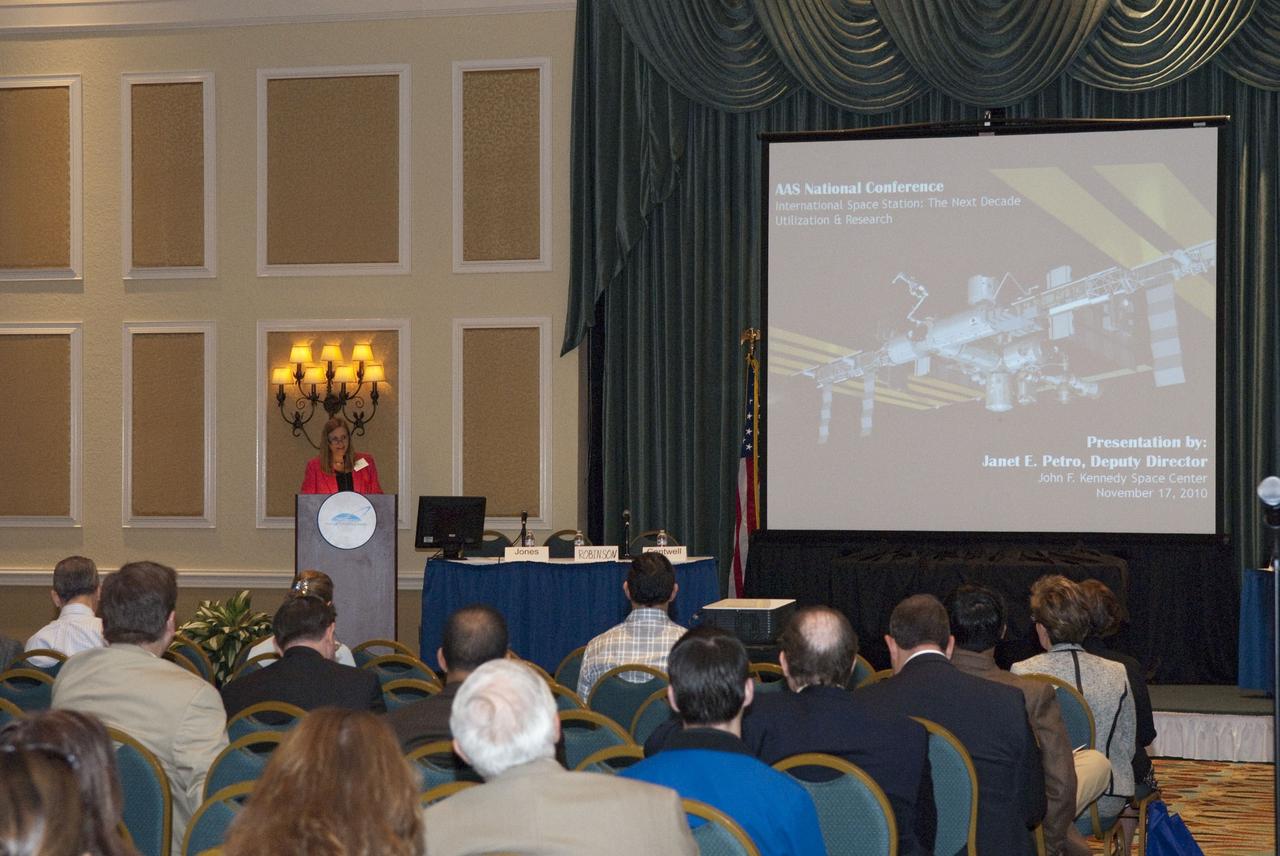
CAPE CANAVERAL, Fla. -- Kennedy Space Center Deputy Director Janet Petro addresses attendees of the American Astronautical Society's 2010 National Conference held at the Radisson Resort at the Port in Cape Canaveral, Fla. This year's conference was titled: International Space Station: The Next Decade - Utilization and Research. The conference was organized with the support of Kennedy and sponsored by The Boeing Company, Honeywell International Inc., Northrop Grumman Corp., Space Florida and the Universities Space Research Association (USRA). Photo credit: NASA/Jim Grossmann
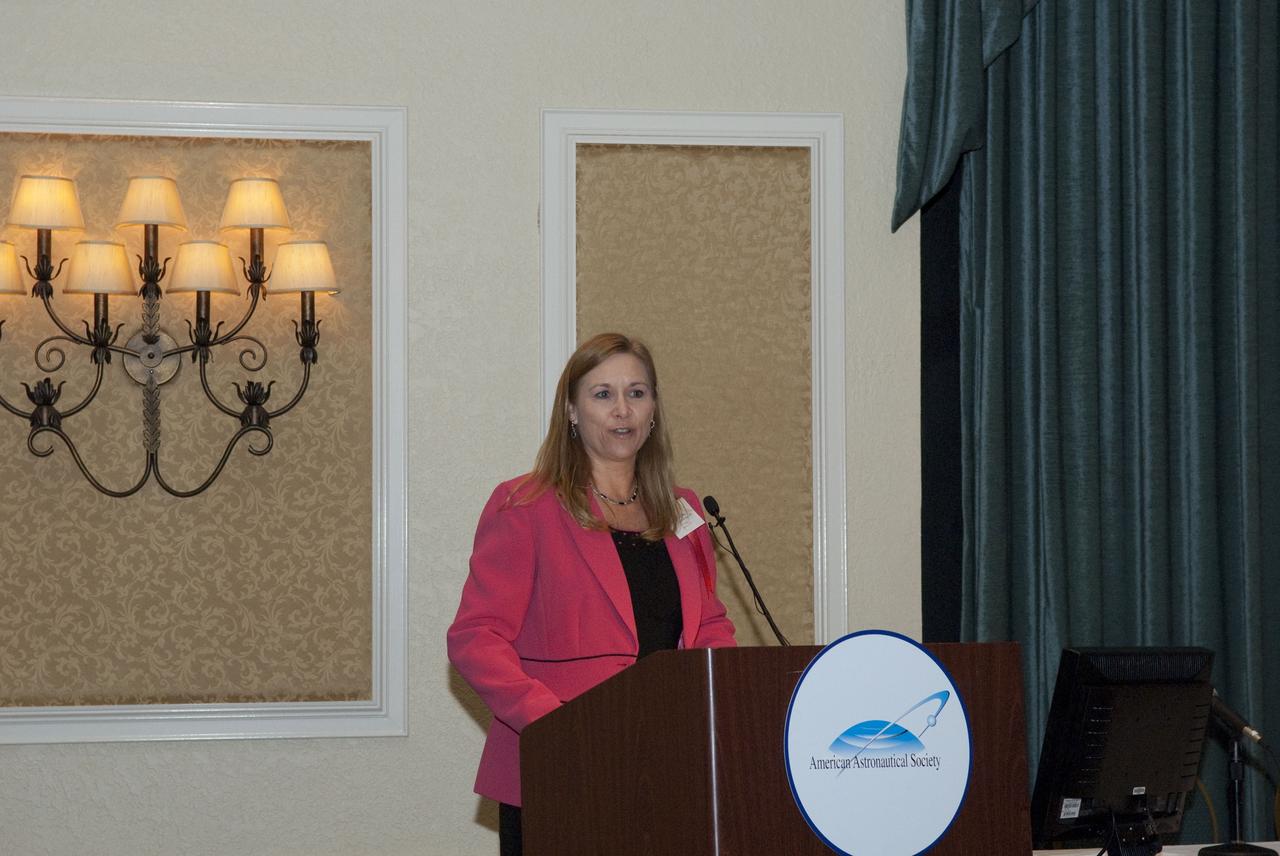
CAPE CANAVERAL, Fla. -- Kennedy Space Center Deputy Director Janet Petro addresses attendees of the American Astronautical Society's 2010 National Conference held at the Radisson Resort at the Port in Cape Canaveral, Fla. This year's conference was titled: International Space Station: The Next Decade - Utilization and Research. The conference was organized with the support of Kennedy and sponsored by The Boeing Company, Honeywell International Inc., Northrop Grumman Corp., Space Florida and the Universities Space Research Association (USRA). Photo credit: NASA/Jim Grossmann
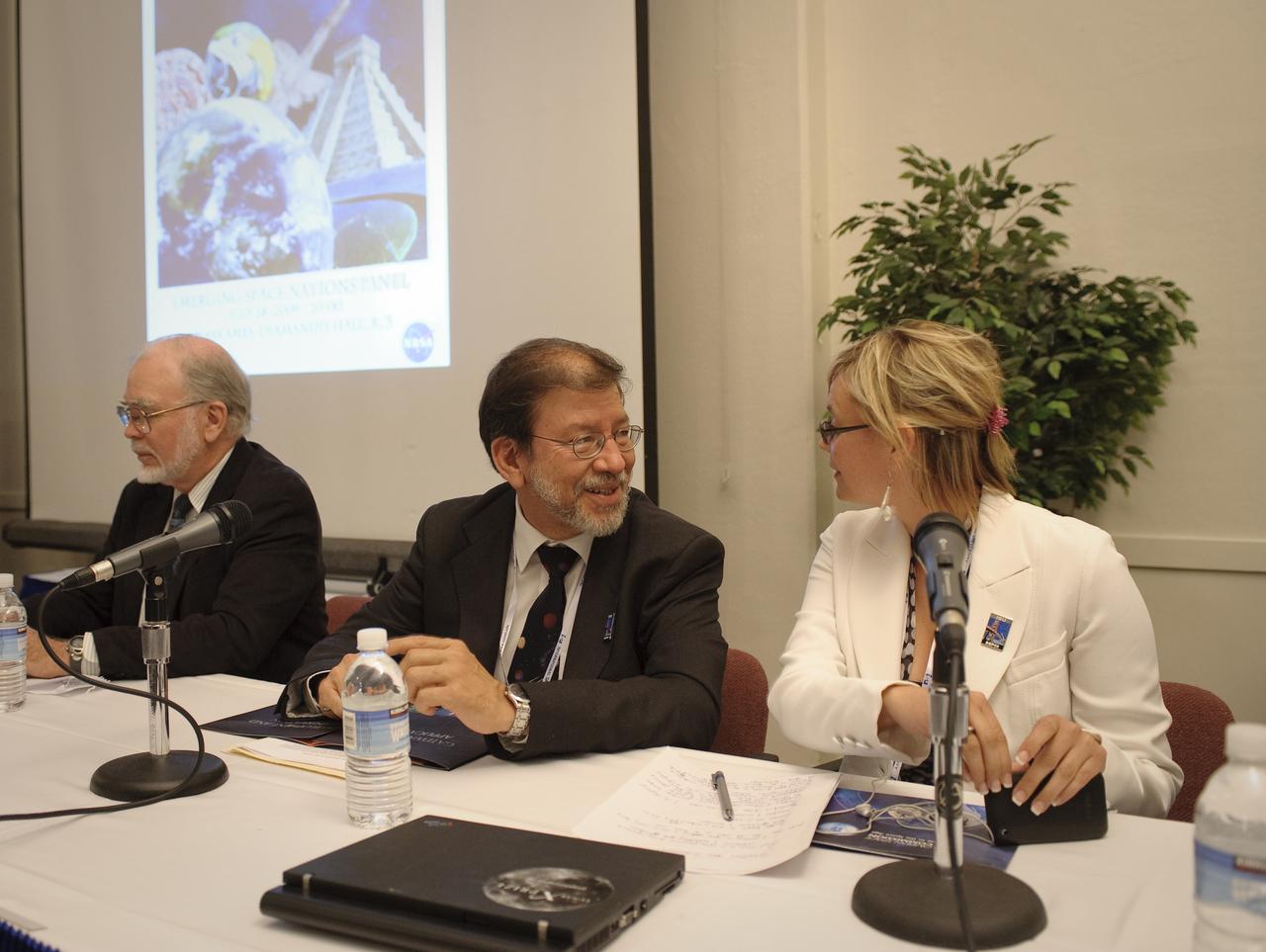
International Space University (ISU) and Singularity University (SU) Emerging Space Nations Panel held at NASA's Ames Research Center 2009 host site. (From let to right) The panel moderator, Ray Williamson, ISU SSP09 distinguished lecturer and exectuive director of the Secure World Foundation and panelsists Sergio Camacho, secretary genreal, Regional Center for Space Science and Tecnology Education fo rLatin America and the Caribbean, and Nicole Jordan, associate liaison for space prizes for the X Prize Foundation, Playa Vista, Calif., prepare before the discussion begins.
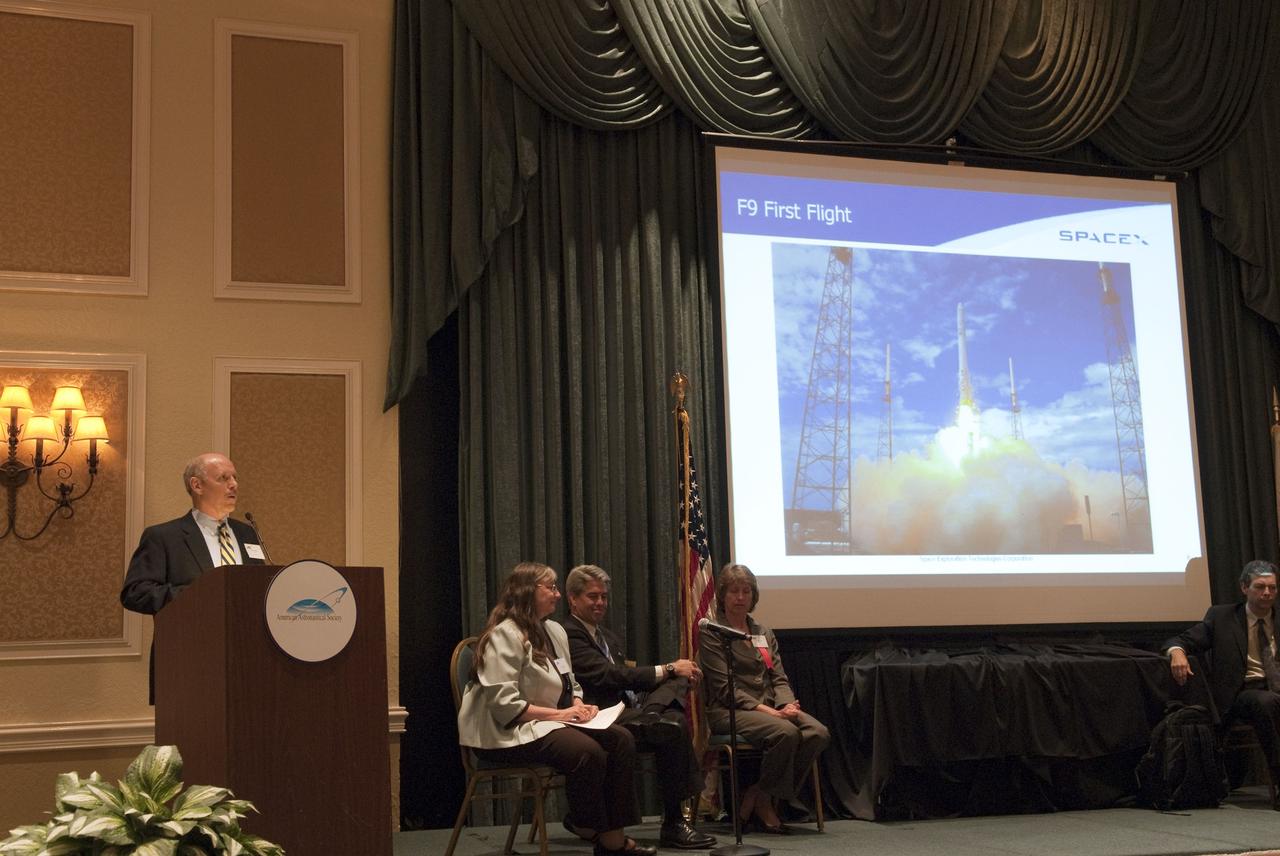
CAPE CANAVERAL, Fla. -- SpaceX Vice President of Mission Assurance and Astronaut Safety Ken Bowersox addresses attendees of the American Astronautical Society's 2010 National Conference held at the Radisson Resort at the Port in Cape Canaveral, Fla. Also on stage (left to right) are, NASA Deputy Associate Administrator of Space Operations Mission Directorate Lynn Cline; NASA Program Integration Manager at Johnson Space Center, Jeff Arend; Lockheed Martin Information Systems & Global Services Program Director Therese Thrift and NASA Commercial Resupply Program Deputy Manager at Johnson Space Center Ford Dillon. This year's conference was titled: International Space Station: The Next Decade - Utilization and Research. The conference was organized with the support of Kennedy and sponsored by The Boeing Company, Honeywell International Inc., Northrop Grumman Corp., Space Florida and the Universities Space Research Association (USRA). Photo credit: NASA/Jim Grossmann
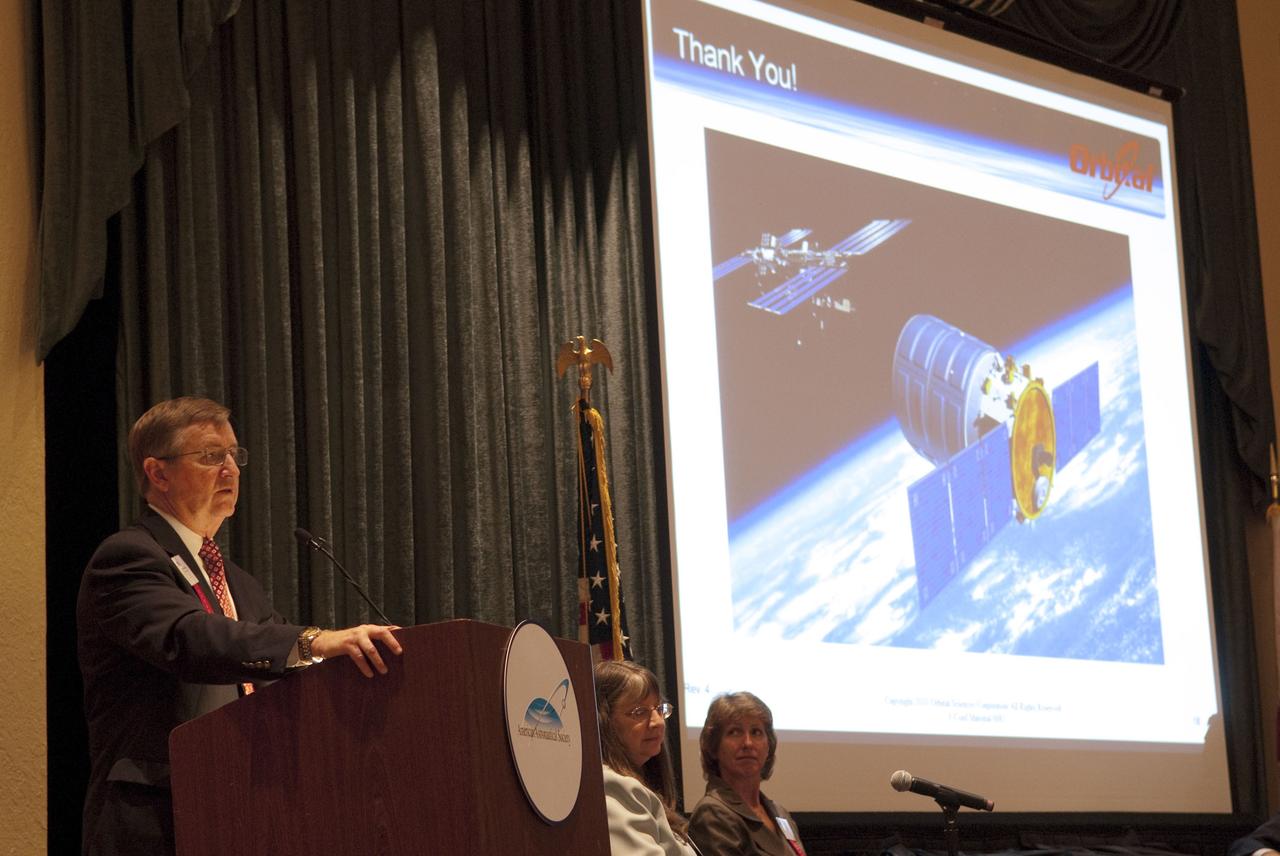
CAPE CANAVERAL, Fla. -- Senior Vice President and Deputy General Manager of Orbital Sciences Corp. Frank Culbertson Jr. addresses attendees of the American Astronautical Society's 2010 National Conference held at the Radisson Resort at the Port in Cape Canaveral, Fla. as NASA Deputy Associate Administrator of Space Operations Mission Directorate Lynn Cline and Lockheed Martin Information Systems & Global Services Program Director, Therese Thrift look on. This year's conference was titled: International Space Station: The Next Decade - Utilization and Research. The conference was organized with the support of Kennedy and sponsored by The Boeing Company, Honeywell International Inc., Northrop Grumman Corp., Space Florida and the Universities Space Research Association (USRA). Photo credit: NASA/Jim Grossmann
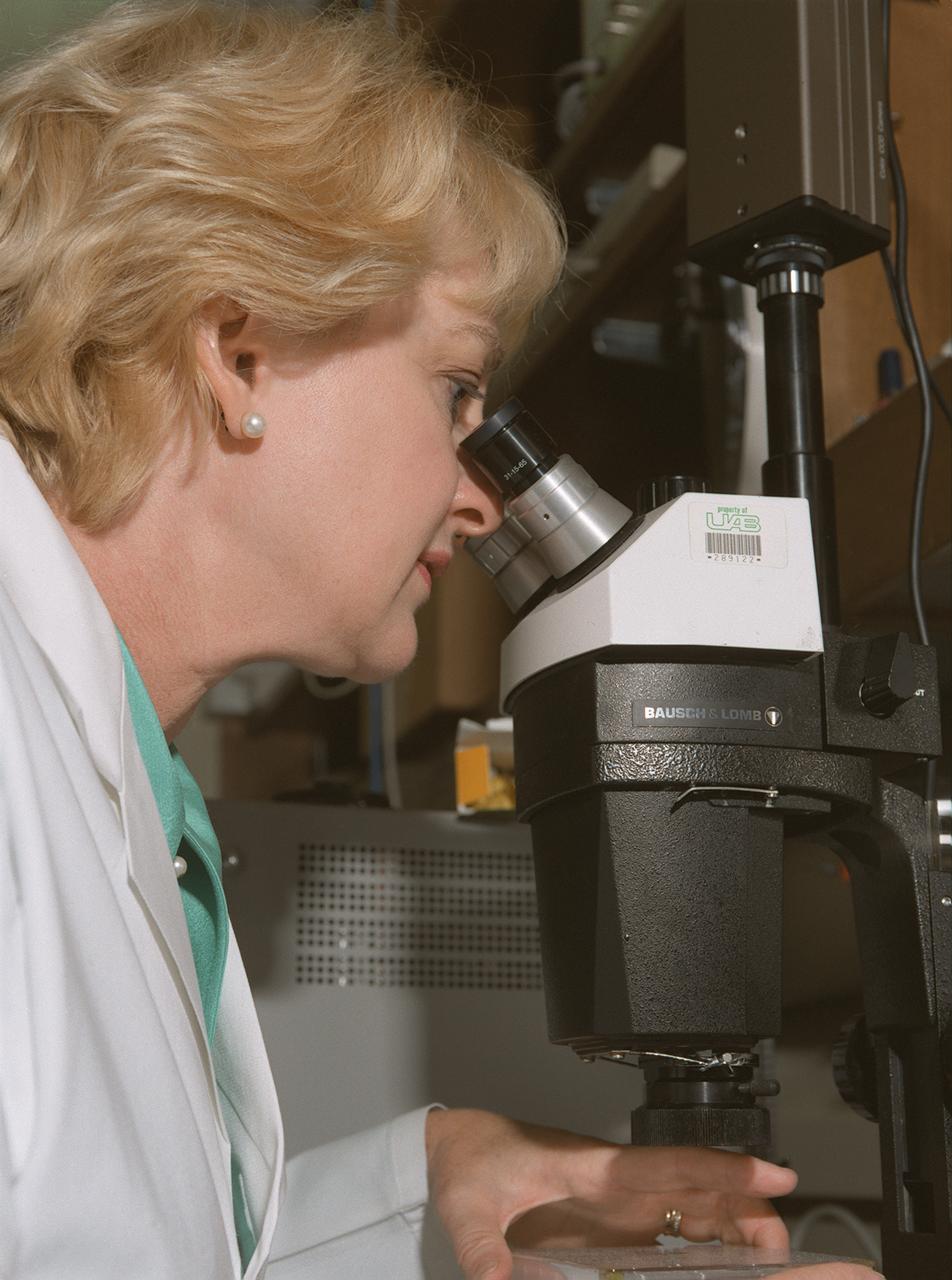
Diabetic patients may someday reduce their insulin injections and lead more normal lives because of new insights gained through irnovative space research in which insulin crystals were grown on the Space Shuttle. Results from a 1994 insulin crystal growth experiment in space are leading to a new understanding of protein insulin. Lack of insulin is the cause of diabetes, a desease that accounts for one-seventh of the nation's health care costs. Dr. Marianna Long, associate director of the Center of Macromolecular Crystallography at the University of Alabama at Birmingham, is a co-investigator on the research. Photo credit: NASA/Marshall Space Flight Center (MSFC)
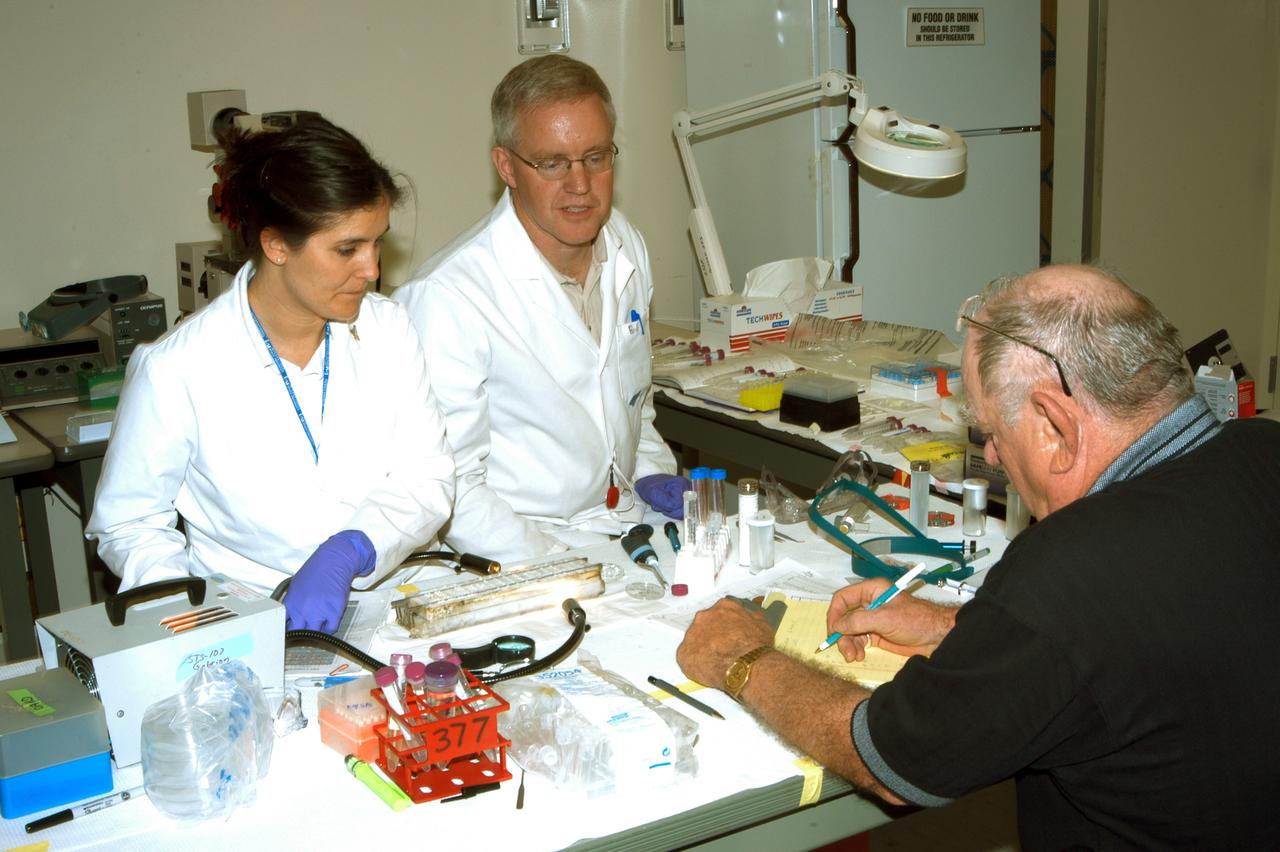
KENNEDY SPACE CENTER, FLA. - Valerie Cassanto and Bob McLean talk to a reporter about experiments found during the search for Columbia debris. Cassanto is with Instrumentation Technology Associates Inc. and McLean is with the Southwest Texas State University. Included in the Commercial ITA Biomedical Experiments payload on mission STS-107 are urokinase cancer research, microencapsulation of drugs, the Growth of Bacterial Biofilm on Surfaces during Spaceflight (GOBBSS), and tin crystal formation.
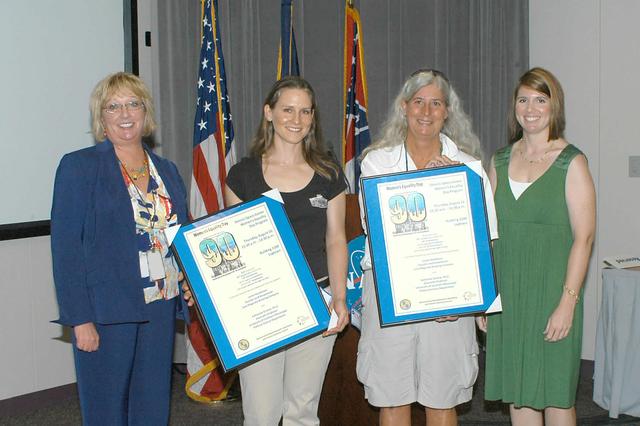
NASA's John C. Stennis Space Center celebrated Women's Equality Day with a program featuring presentations from a pair of area women - Leslie Henderson, founder and brewmaster of Lazy Magnolia Brewing Co. in Kiln, Miss., and Kathanne Greene, associate professor of political science at the University of Southern Mississippi in Hattiesburg. Shown are (l to r): Jo Ann Larson, Stennis Equal Opportunity officer; Henderson; Greene; and Shannon Breland, public affairs officer for the Naval Research Laboratory at Stennis and a member of the Stennis Diversity Council.
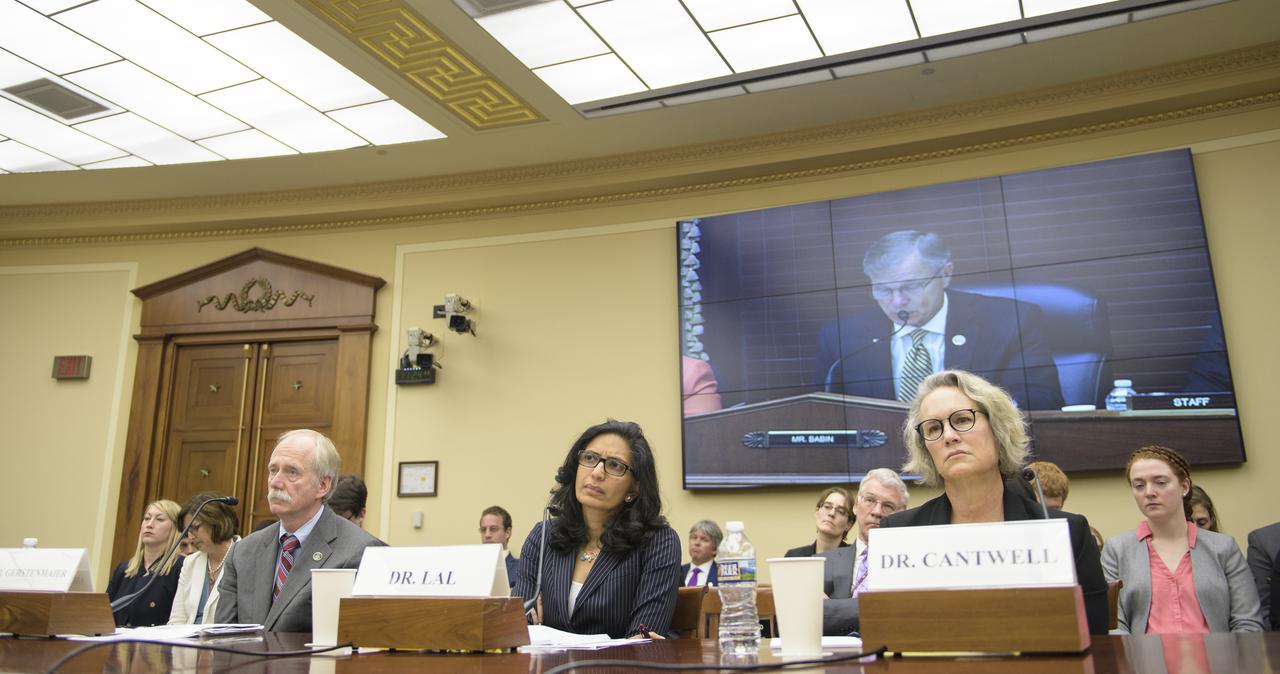
NASA Associate Administrator for the Human Exploration and Operations Mission Directorate William Gerstenmaier, left, Dr. Bhavya Lal, a researcher at the Institute for Defense Analysis's Science and Technology Policy Institute, center, and Dr. Elizabeth Cantwell, chief executive officer at the Arizona State University Research Enterprise, right, listen as Rep. Brian Babin, R-Texas, is seen on screen as he delivers an opening statement during a House Committee on Science, Space, and Technology hearing titled "America's Human Presence in Low-Earth Orbit" on Thursday, May 17, 2018 in the Rayburn House Office Building in Washington. Photo Credit: (NASA/Joel Kowsky)
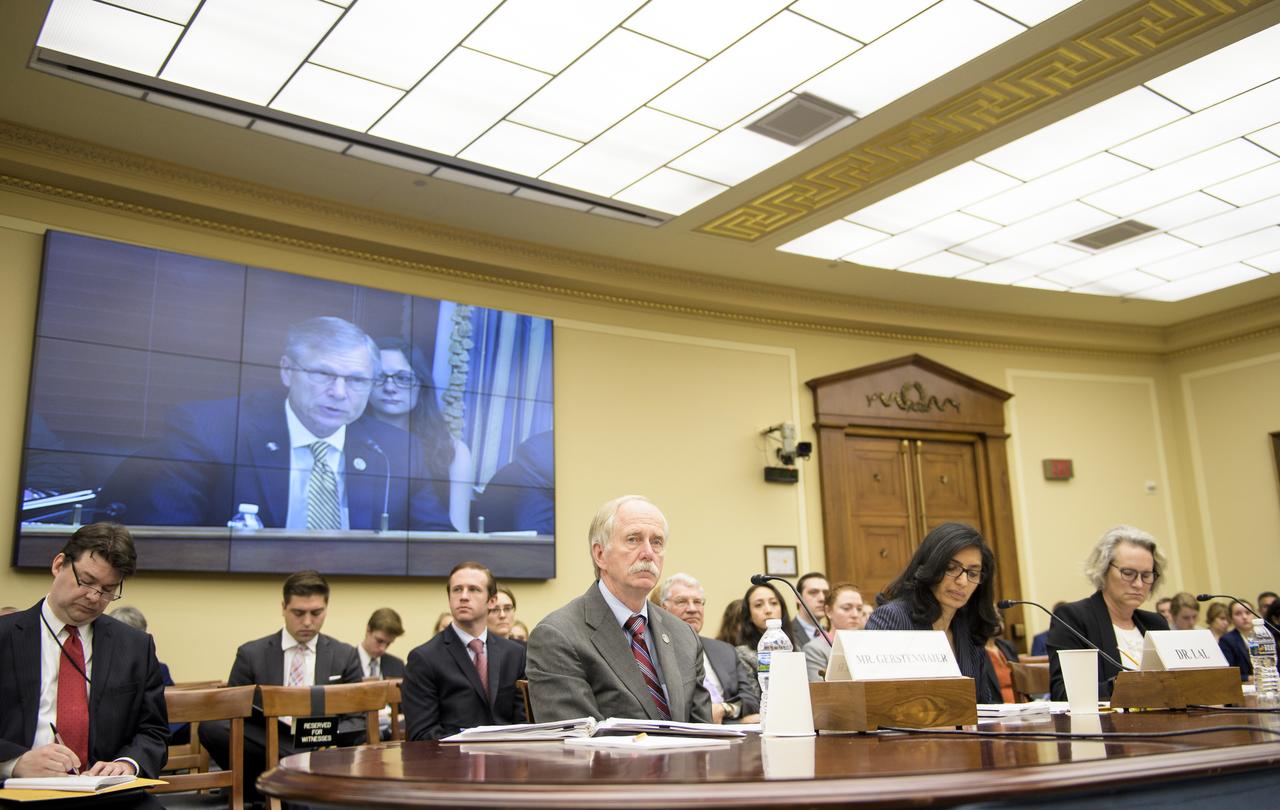
NASA Associate Administrator for the Human Exploration and Operations Mission Directorate William Gerstenmaier, left, Dr. Bhavya Lal, a researcher at the Institute for Defense Analysis's Science and Technology Policy Institute, center, and Dr. Elizabeth Cantwell, chief executive officer at the Arizona State University Research Enterprise, right, listen as Rep. Brian Babin, R-Texas, is seen on screen as he delivers an opening statement during a House Committee on Science, Space, and Technology hearing titled "America's Human Presence in Low-Earth Orbit" on Thursday, May 17, 2018 in the Rayburn House Office Building in Washington. Photo Credit: (NASA/Joel Kowsky)

NMTSat is a student-built satellite built by undergraduate and graduates students primarily from New Mexico Tech. NMTSat is designed to operate five sensors in four experiments in space for 3 months of data collection. The experiments will provide data on earth’s magnetic field, high altitude plasma density, atmospheric weather measurements, and an optical beacon experiment. Approximately 50 students have contributed to NMTSat and its design not including the students and groups who have developed the science instruments. NMTSat CubeSat is providing the opportunity for these science experiments to be conducted on orbit and demonstrates the collaborative nature of the Educational Launch of Nano Satellite (ELaNa) Program at NASA. The instruments have been contributed by New Mexico Tech, Turabo University in Puerto Rico, Los Alamos National Laboratory, and Atmospheric and Space Technology Research Associates (ASTRA) in Boulder, CO. Dr. Anders M. Jorgensen, Associate Professor at New Mexico Tech is the PI and Dr. Hien Vo from Vietnamese-German University in Ho Chi Minh University in Vietnam is a Co-Investigator. NMTSat is funded by the New Mexico NASA EPSCoR program as well as New Mexico Tech.

NMTSat is a student-built satellite built by undergraduate and graduates students primarily from New Mexico Tech. NMTSat is designed to operate five sensors in four experiments in space for 3 months of data collection. The experiments will provide data on earth’s magnetic field, high altitude plasma density, atmospheric weather measurements, and an optical beacon experiment. Approximately 50 students have contributed to NMTSat and its design not including the students and groups who have developed the science instruments. NMTSat CubeSat is providing the opportunity for these science experiments to be conducted on orbit and demonstrates the collaborative nature of the Educational Launch of Nano Satellite (ELaNa) Program at NASA. The instruments have been contributed by New Mexico Tech, Turabo University in Puerto Rico, Los Alamos National Laboratory, and Atmospheric and Space Technology Research Associates (ASTRA) in Boulder, CO. Dr. Anders M. Jorgensen, Associate Professor at New Mexico Tech is the PI and Dr. Hien Vo from Vietnamese-German University in Ho Chi Minh University in Vietnam is a Co-Investigator. NMTSat is funded by the New Mexico NASA EPSCoR program as well as New Mexico Tech.

NMTSat is a student-built satellite built by undergraduate and graduates students primarily from New Mexico Tech. NMTSat is designed to operate five sensors in four experiments in space for 3 months of data collection. The experiments will provide data on earth’s magnetic field, high altitude plasma density, atmospheric weather measurements, and an optical beacon experiment. Approximately 50 students have contributed to NMTSat and its design not including the students and groups who have developed the science instruments. NMTSat CubeSat is providing the opportunity for these science experiments to be conducted on orbit and demonstrates the collaborative nature of the Educational Launch of Nano Satellite (ELaNa) Program at NASA. The instruments have been contributed by New Mexico Tech, Turabo University in Puerto Rico, Los Alamos National Laboratory, and Atmospheric and Space Technology Research Associates (ASTRA) in Boulder, CO. Dr. Anders M. Jorgensen, Associate Professor at New Mexico Tech is the PI and Dr. Hien Vo from Vietnamese-German University in Ho Chi Minh University in Vietnam is a Co-Investigator. NMTSat is funded by the New Mexico NASA EPSCoR program as well as New Mexico Tech.
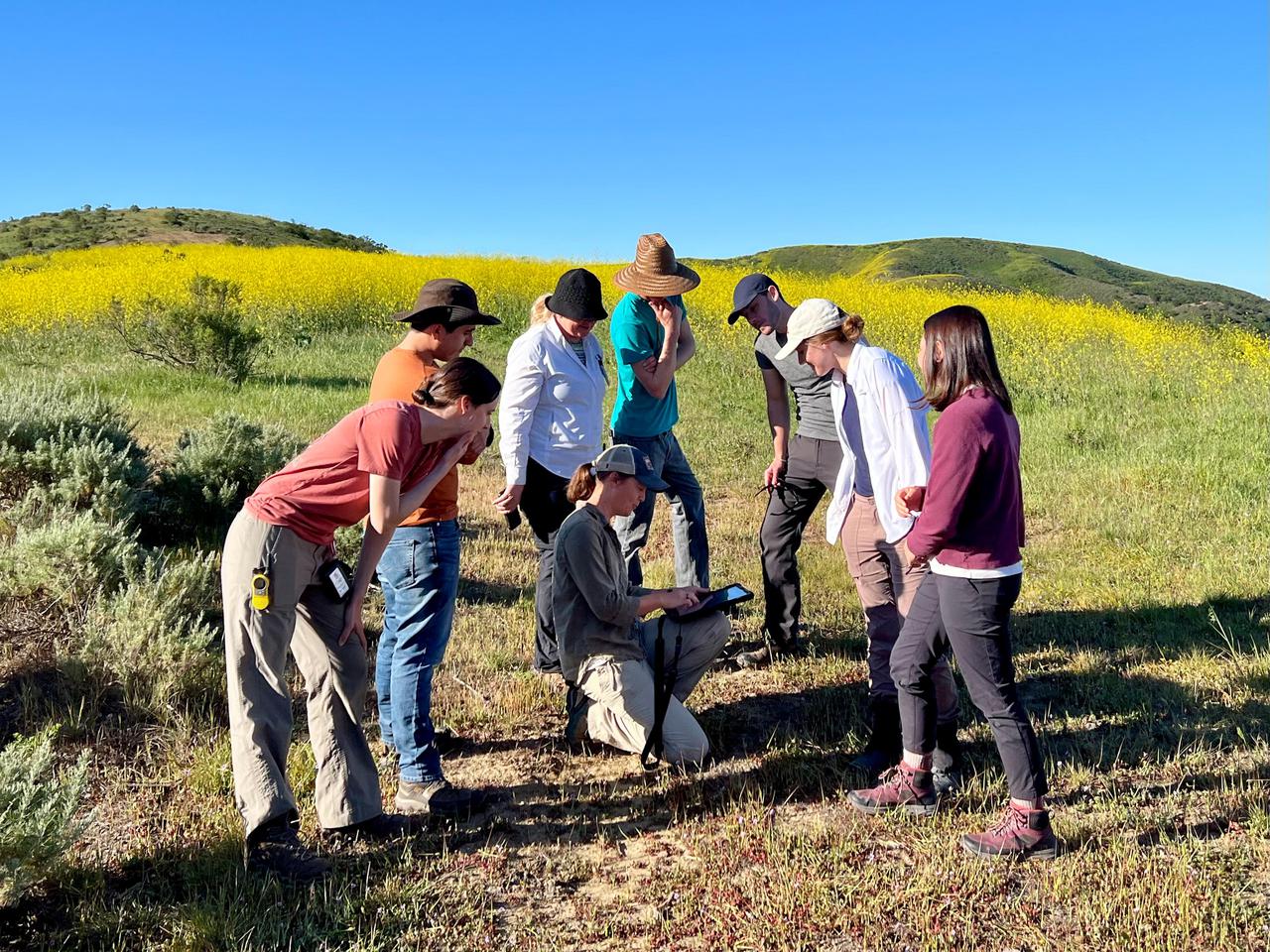
Dana Chadwick, a scientist in the water and ecosystems group at NASA's Jet Propulsion Laboratory, center, advises a field team of researchers from JPL; University of Wisconsin, Madison (UWM); University of California, Los Angeles (UCLA); University of Maryland, Baltimore County (UMBC); and University of California, Santa Barbara (UCSB) on vegetation-sampling locations at the Jack and Laura Dangermond Preserve in Santa Barbara County, California, on March 24, 2022. Chadwick and the team are working on the Surface Biology and Geology High-Frequency Time Series (SHIFT) campaign, which is jointly led by JPL, UCSB, and The Nature Conservancy. Chadwick is surrounded by, from left: Natalie Queally, a forest and wildlife ecology graduate student at UWM; Francisco Ochoa, a geography graduate student at UCLA; Petya Campbell, a research associate professor at UMBC and a research associate at NASA's Goddard Space Flight Center; Brendan Heberlein, a research intern at UWM; Renato Braghiere, a postdoctoral research scientist at JPL; Cassandra Nickles, a postdoctoral fellow at JPL; and Clare Saiki, a doctoral student at UCSB. Operating between late February and late May 2022, SHIFT combines the ability of airborne science instruments to gather data over widespread areas with the more concentrated observations scientists conduct in the field to study the functional characteristics, health, and resilience of plant communities. The sampling and analysis done by researchers on the ground and in the ocean is intended to validate data taken by AVIRIS-NG (Airborne Visible/Infrared Imaging Spectrometer-Next Generation). The instrument, designed at JPL, is collecting spectral data of vegetation it observes during weekly flights in an aircraft over a 640-square-mile (1,656-square-kilometer) study area in Santa Barbara County and coastal Pacific waters. The campaign is a pathfinder for NASA's proposed Surface Biology and Geology (SBG) mission. SHIFT will help scientists design data collection and processing algorithms for that mission, which would launch no earlier than 2028. The SHIFT data is also intended to support the research and conservation objectives of The Nature Conservancy, which owns the Dangermond Preserve, and UCSB, which operates the Sedgwick Reserve, another nature preserve within the study area. More than 60 scientists from institutions around the U.S. have indicated they intend to use the SHIFT data in their research. https://photojournal.jpl.nasa.gov/catalog/PIA25141
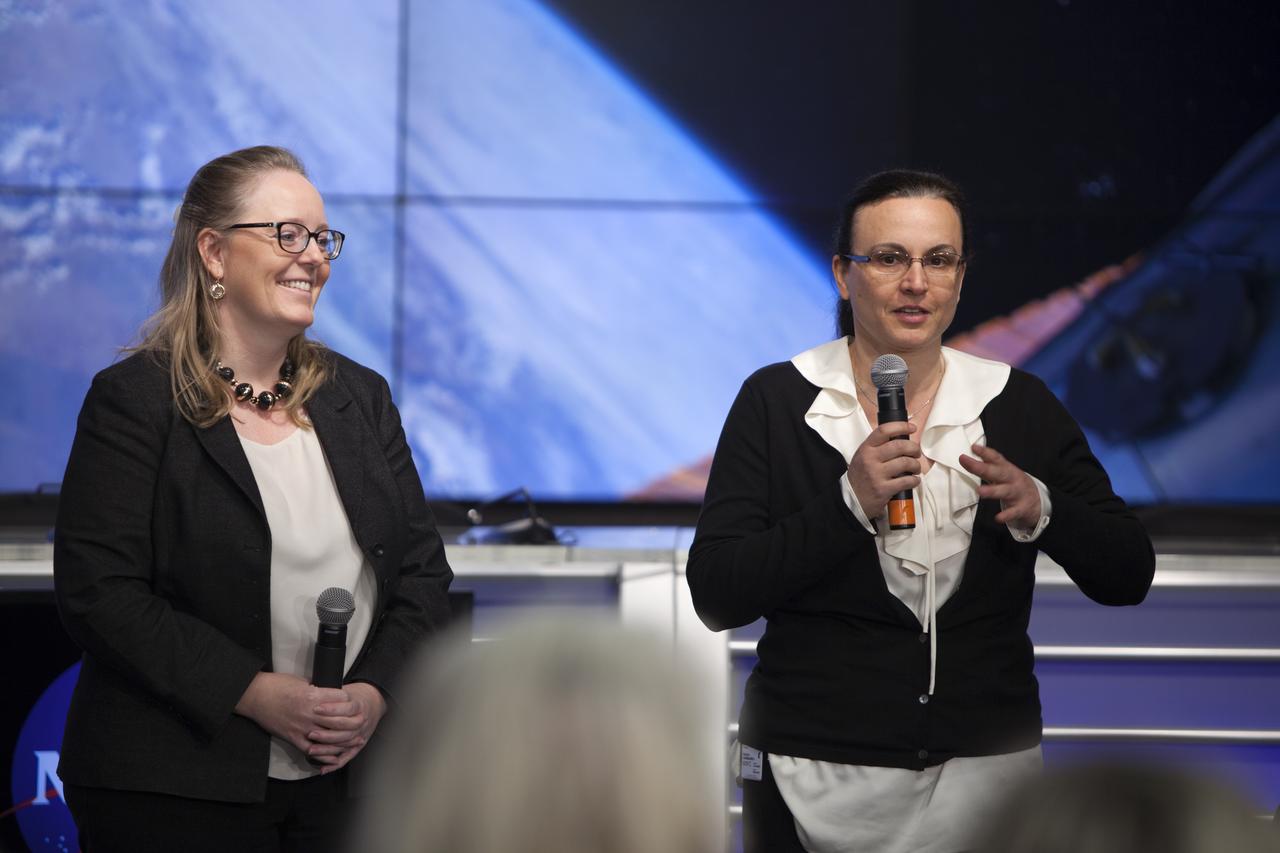
Dr. Melissa Kacena, associate professor of orthopedic surgery at Indiana University, left, and Dr. Rasha Hammamieh, director of Integrative Systems Biology for the US Army Medical Research and Materiel Command at Fort Detrick, Maryland, speak to members of social media in the Kennedy Space Center’s Press Site auditorium. The briefing focused on studies on the effects of microgravity on tissue regeneration planned for the International Space Station following the arrival of a Dragon spacecraft. The Dragon is scheduled to be launched from Kennedy’s Launch Complex 39A on Feb. 18 atop a SpaceX Falcon 9 rocket on the company's 10th Commercial Resupply Services mission to the space station.
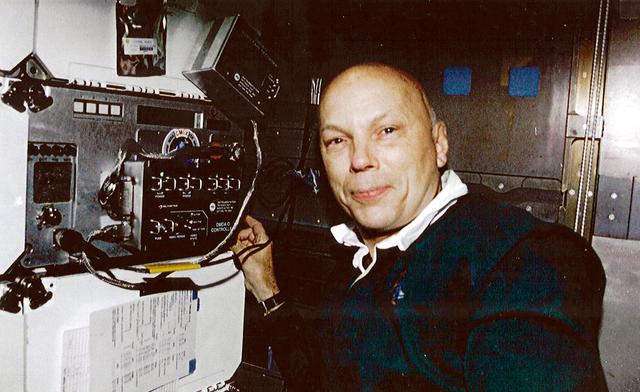
Experiments to seek solutions for a range of biomedical issues are at the heart of several investigations that will be hosted by the Commercial Instrumentation Technology Associates (ITA), Inc. The biomedical experiments CIBX-2 payload is unique, encompassing more than 20 separate experiments including cancer research, commercial experiments, and student hands-on experiments from 10 schools as part of ITA's ongoing University Among the stars program. Here, Astronaut Story Musgrave activates the CMIX-5 (Commercial MDA ITA experiment) payload in the Space Shuttle mid deck during the STS-80 mission in 1996 which is similar to CIBX-2. The experiments are sponsored by NASA's Space Product Development Program (SPD).
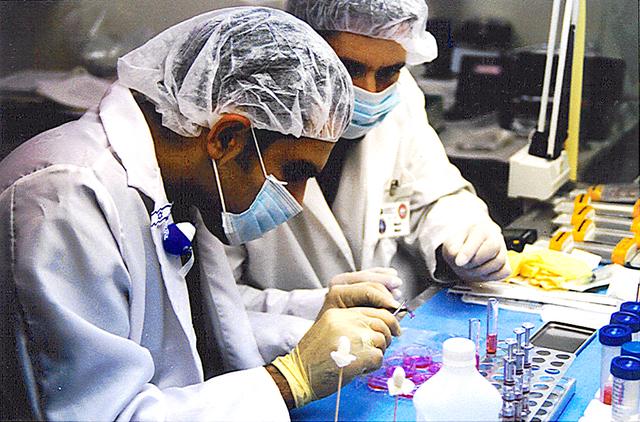
Experiments to seek solutions for a range of biomedical issues are at the heart of several investigations that will be hosted by the Commercial Instrumentation Technology Associates (ITA), Inc. Biomedical Experiments (CIBX-2) payload. CIBX-2 is unique, encompassing more than 20 separate experiments including cancer research, commercial experiments, and student hands-on experiments from 10 schools as part of ITA's ongoing University Among the Stars program. Student Marnix Aklian and ITA's Mark Bem prepare biological samples for flight as part of ITA's hands-on student outreach program on STS-95. Similar activities are a part of the CIBX-2 payload. The experiments are sponsored by NASA's Space Product Development Program (SPD).
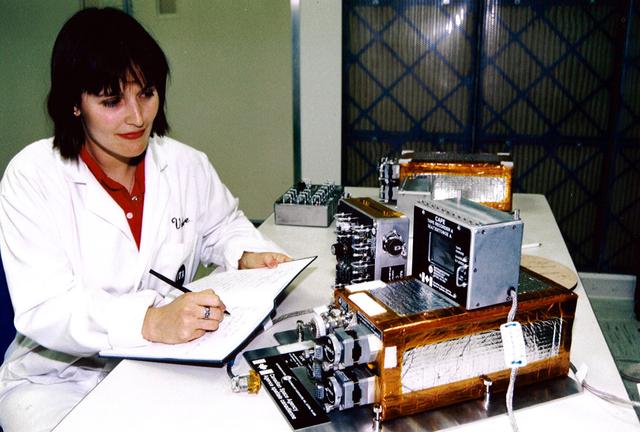
Experiments to seek solutions for a range of biomedical issues are at the heart of several investigations that will be hosted by the Commercial Instrumentation Technology Associates (ITA), Inc. Biomedical Experiments (CIBX-2) payload. CIBX-2 is unique, encompassing more than 20 separate experiments including cancer research, commercial experiments, and student hands-on experiments from 10 schools as part of ITA's ongoing University Among the Stars program. Valerie Cassanto of ITA checks the Canadian Protein Crystallization Experiment (CAPE) carried by STS-86 to Mir in 1997. The experiments are sponsored by NASA's Space Product Development Program (SPD).
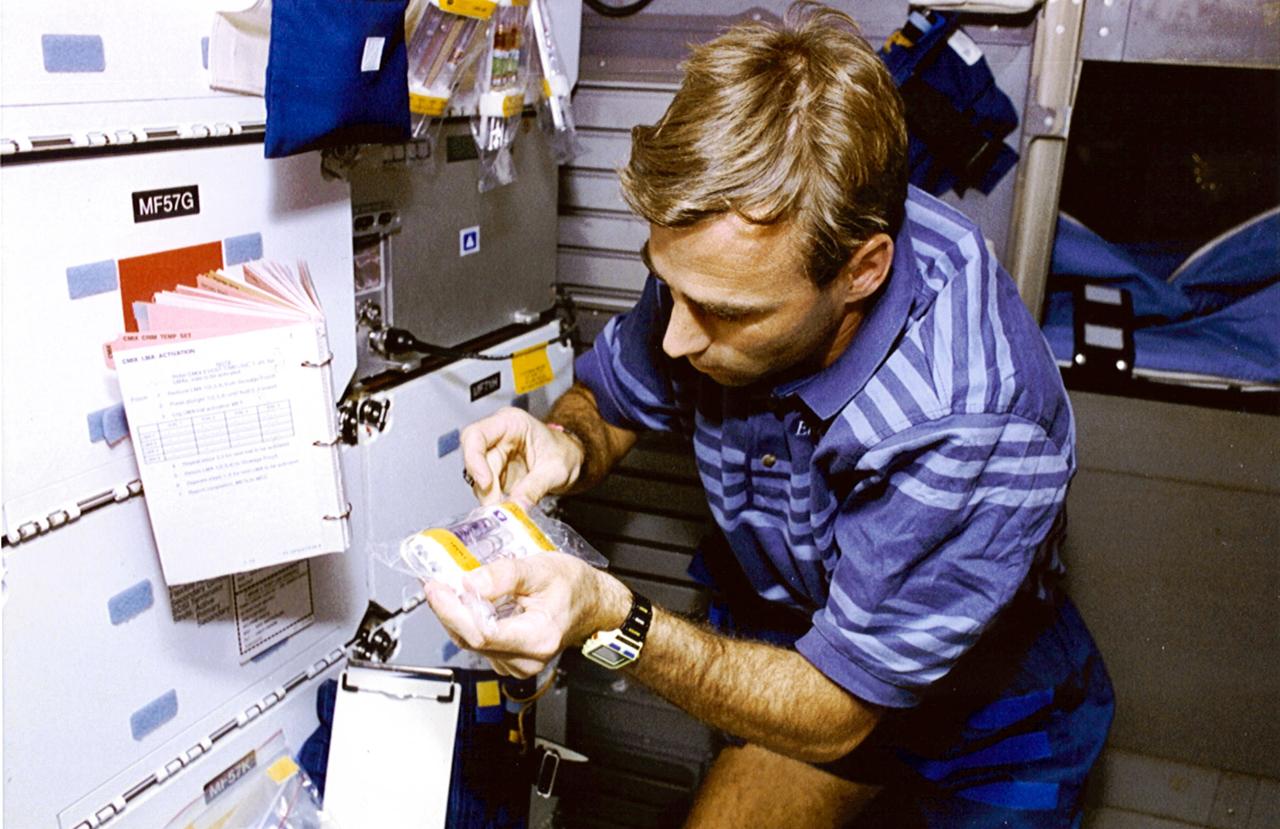
Experiments to seek solutions for a range of biomedical issues are at the heart of several investigations that will be hosted by the Commercial Instrumentation Technology Associates (ITA), Inc. Biomedical Experiments (CIBX-2) payload. CIBX-2 is unique, encompassing more than 20 separate experiments including cancer research, commercial experiments, and student hands-on experiments from 10 schools as part of ITA's ongoing University Among the Stars program. Astronaut William G. Gregory activates Liquids Mixing Apparatus (LMA) vials during STS-67. Other LMAs hang at top on the face of the middeck locker array. The experiments are sponsored under NASA's Space Product Development Program (SPD).
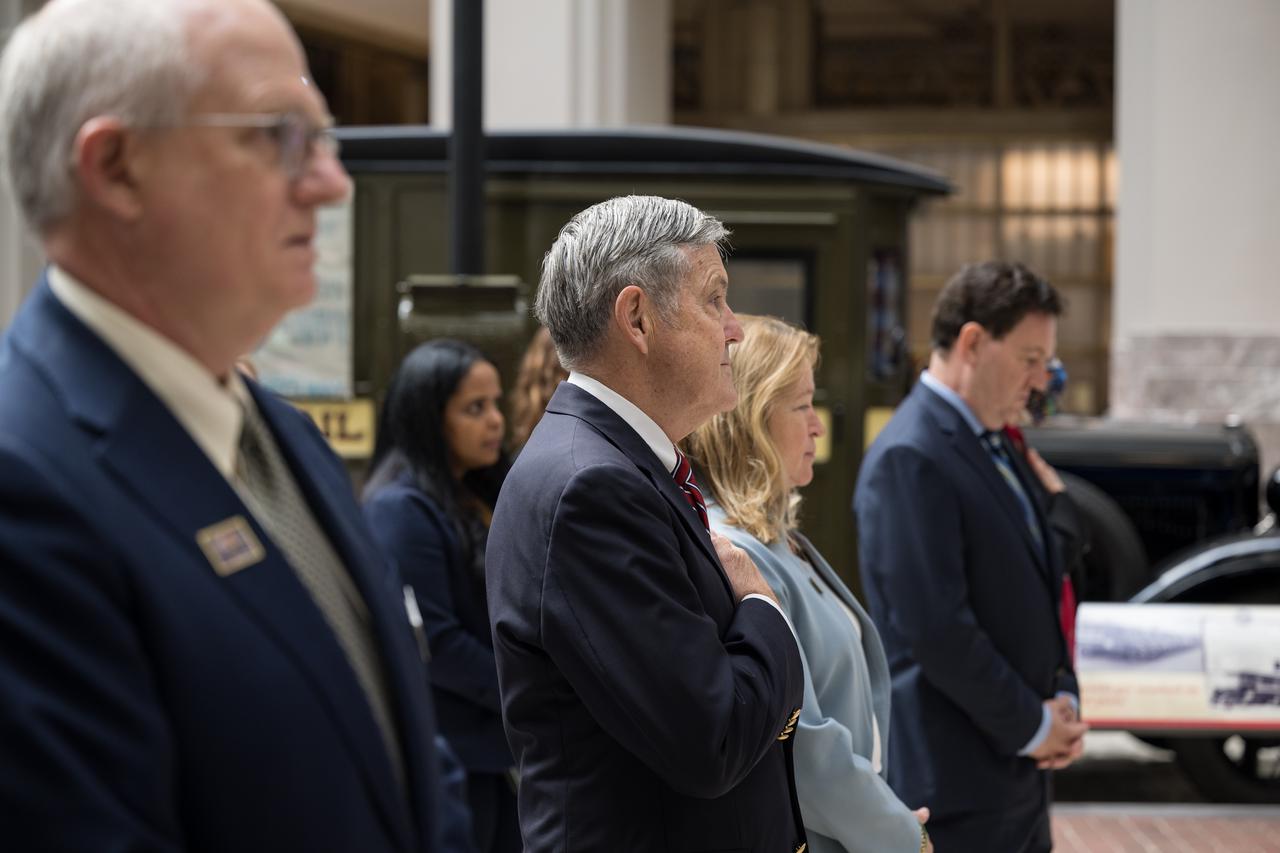
NASA Associate Administrator and former astronaut, Bob Cabana, second from left, and Smithsonian Institution Under Secretary for Service and Research, Ellen Stofan, third from left, are seen during the singing of the national anthem at the first-day-of-issue event for the United States Postal Service’s new stamp celebrating NASA’s James Webb Space Telescope (JWST) on Thursday, Sept. 8, 2022, at the Smithsonian’s National Postal Museum in Washington. The stamp, which features an illustration of the observatory, honors Webb’s mission to explore the unknown in our universe – solving mysteries in our solar system, looking beyond to distant worlds around other stars, and probing the structures and origins of our universe and our place in it. Photo Credit: (NASA/Aubrey Gemignani)

NASA image release June 6, 2010 Like a July 4 fireworks display a young, glittering collection of stars looks like an aerial burst. The cluster is surrounded by clouds of interstellar gas and dust - the raw material for new star formation. The nebula, located 20,000 light-years away in the constellation Carina, contains a central cluster of huge, hot stars, called NGC 3603. This environment is not as peaceful as it looks. Ultraviolet radiation and violent stellar winds have blown out an enormous cavity in the gas and dust enveloping the cluster, providing an unobstructed view of the cluster. Most of the stars in the cluster were born around the same time but differ in size, mass, temperature, and color. The course of a star's life is determined by its mass, so a cluster of a given age will contain stars in various stages of their lives, giving an opportunity for detailed analyses of stellar life cycles. NGC 3603 also contains some of the most massive stars known. These huge stars live fast and die young, burning through their hydrogen fuel quickly and ultimately ending their lives in supernova explosions. Star clusters like NGC 3603 provide important clues to understanding the origin of massive star formation in the early, distant universe. Astronomers also use massive clusters to study distant starbursts that occur when galaxies collide, igniting a flurry of star formation. The proximity of NGC 3603 makes it an excellent lab for studying such distant and momentous events. This Hubble Space Telescope image was captured in August 2009 and December 2009 with the Wide Field Camera 3 in both visible and infrared light, which trace the glow of sulfur, hydrogen, and iron. The Hubble Space Telescope is a project of international cooperation between NASA and the European Space Agency. NASA’s Goddard Space Flight Center manages the telescope. The Space Telescope Science Institute (STScI) conducts Hubble science operations. STScI is operated for NASA by the Association of Universities for Research in Astronomy, Inc. in Washington, D.C. Credit: NASA, ESA, R. O'Connell (University of Virginia), F. Paresce (National Institute for Astrophysics, Bologna, Italy), E. Young (Universities Space Research Association/Ames Research Center), the WFC3 Science Oversight Committee, and the Hubble Heritage Team (STScI/AURA) <b><a href="http://www.nasa.gov/centers/goddard/home/index.html" rel="nofollow">NASA Goddard Space Flight Center</a></b> is home to the nation's largest organization of combined scientists, engineers and technologists that build spacecraft, instruments and new technology to study the Earth, the sun, our solar system, and the universe.
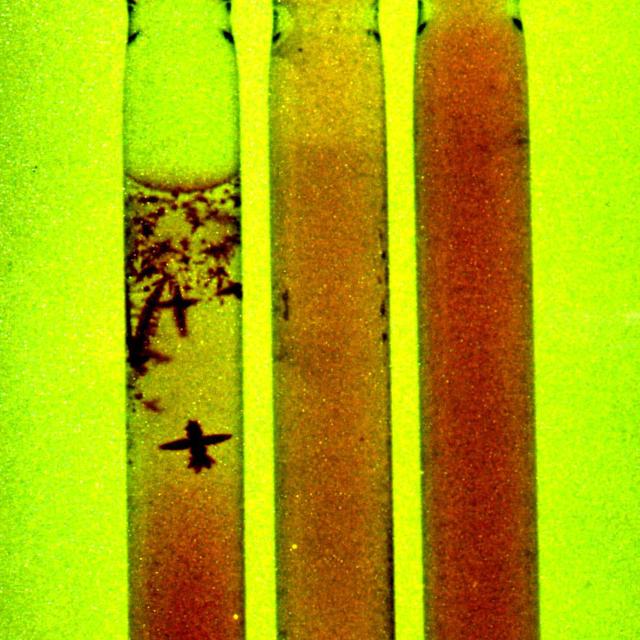
Dr. Alexander Chernov, of the Universities Space Research Association (USRA) and based at Marshall Space Flight Center, is investigating why protein crystals grown in space are, in about 20 percent of cases, better-ordered than those grown on the ground. They are testing the idea that the amount of impurities trapped by space-grown crystals may be different than the amount trapped by crystals grown on Earth because convection is negligible in microgravity. The concentrations or impurities in many space-grown crystals turned out to be several times lower than that in the terrestrial ones, sometimes below the detection limit. The ground-based experiment also showed that the amount of impurities per unit volume of the crystals was usually higher than the amount per unit volume of the solution. This means that a growing crystal actually purifies the solution in its immediate vicinity. Here, an impurity depletion zone is created around apoferritin crystals grown in gel, imitating microgravity conditions.
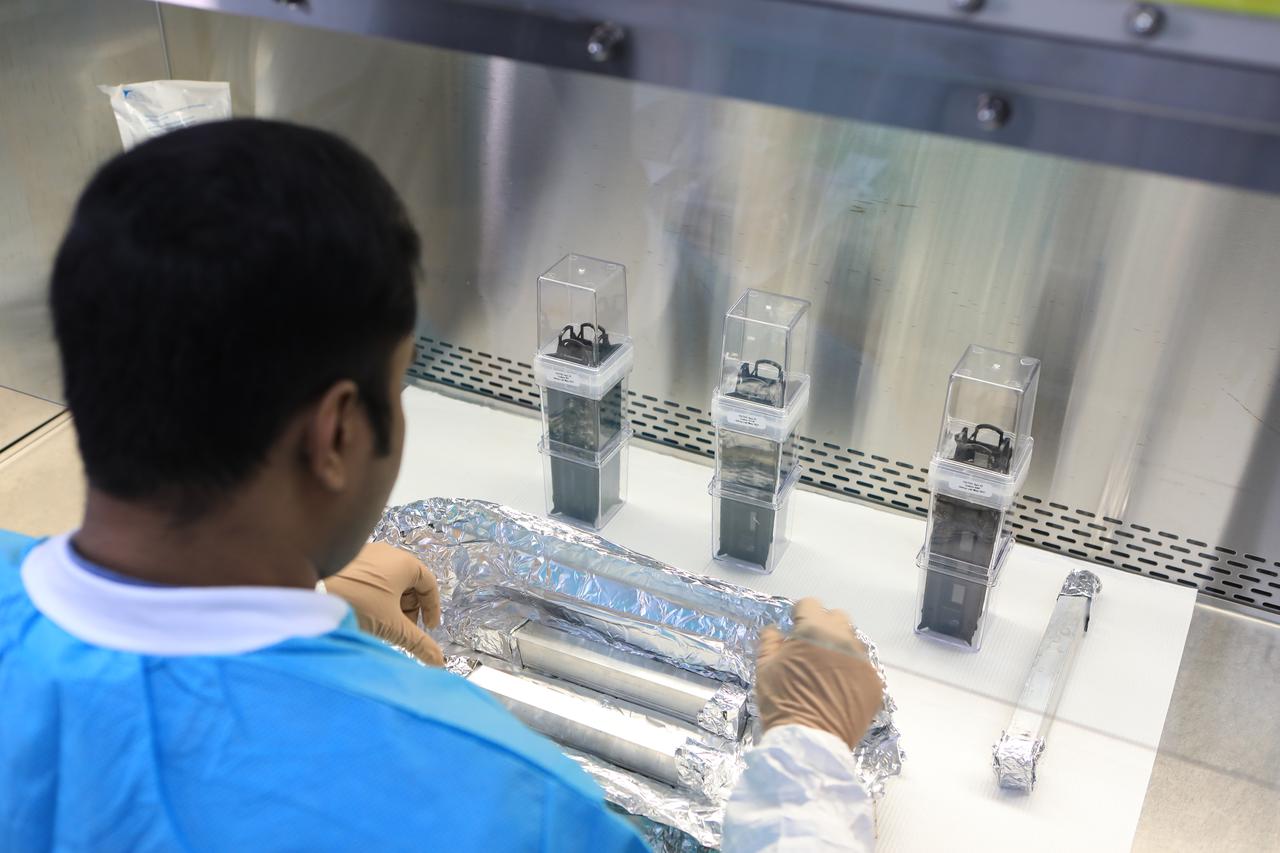
Dr. Arko Bakshi, a research associate with the Department of Botany at the University of Wisconsin, Madison, adds nutrient gel to Target Veggie Chambers, or TVCs, inside a laboratory in the Space Station Processing Facility at Kennedy Space Center in Florida on May 28, 2021. Bakshi waited until the gel solidified and then planted cotton seeds in it as part of the Targeting Improved Cotton Through Orbital Cultivation (TICTOC) experiment, which will launch to the International Space Station aboard SpaceX’s 22nd commercial resupply services mission. TICTOC will investigate how environmental factors and genes control development of roots in the absence of gravity. Liftoff of the SpaceX Falcon 9 rocket and Dragon capsule is scheduled for 1:29 p.m. EDT Thursday, June 3, 2021, from Launch Complex 39A at Kennedy Space Center.
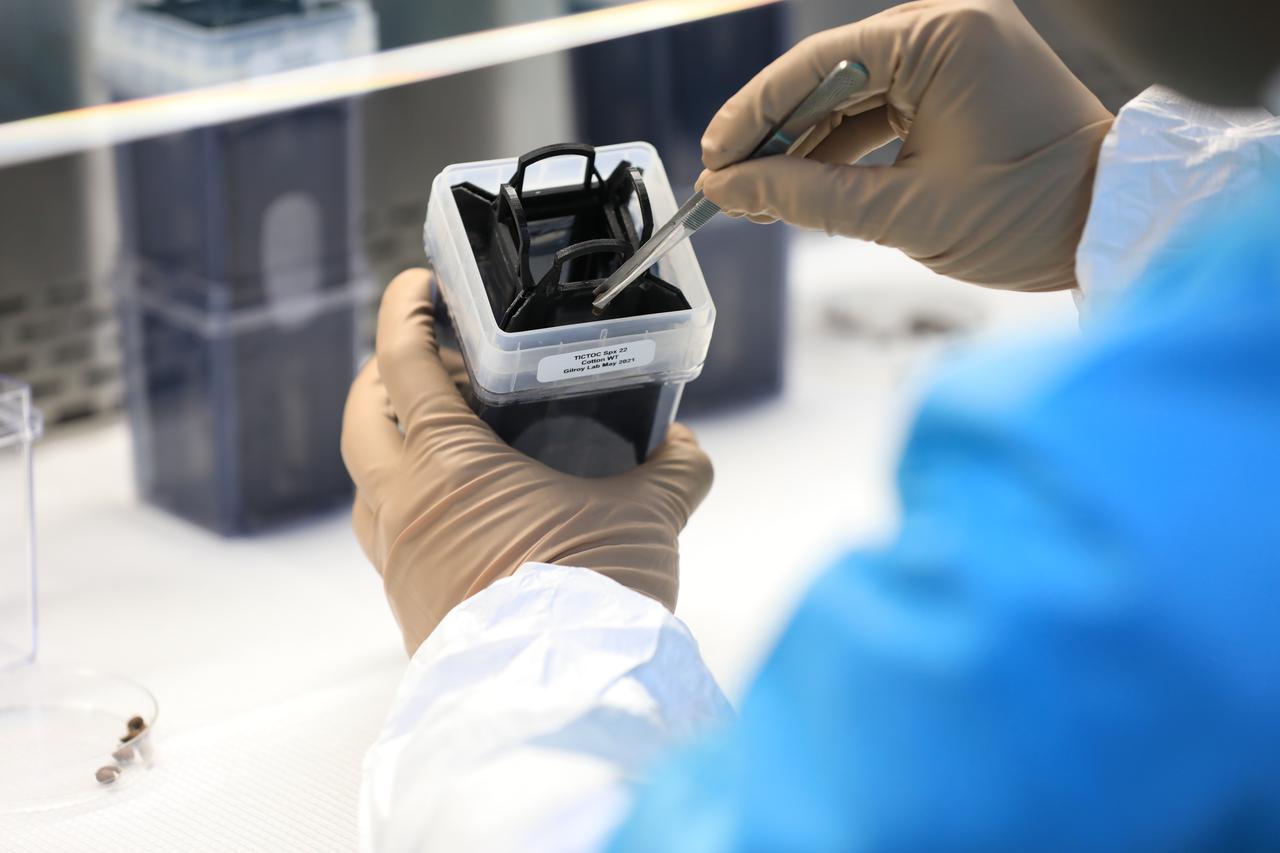
Dr. Arko Bakshi, a research associate with the Department of Botany at the University of Wisconsin, Madison, adds nutrient gel to Target Veggie Chambers, or TVCs, inside a laboratory in the Space Station Processing Facility at Kennedy Space Center in Florida on May 28, 2021. Bakshi waited until the gel solidified and then planted cotton seeds in it as part of the Targeting Improved Cotton Through Orbital Cultivation (TICTOC) experiment, which will launch to the International Space Station aboard SpaceX’s 22nd commercial resupply services mission. TICTOC will investigate how environmental factors and genes control development of roots in the absence of gravity. Liftoff of the SpaceX Falcon 9 rocket and Dragon capsule is scheduled for 1:29 p.m. EDT Thursday, June 3, 2021, from Launch Complex 39A at Kennedy Space Center.
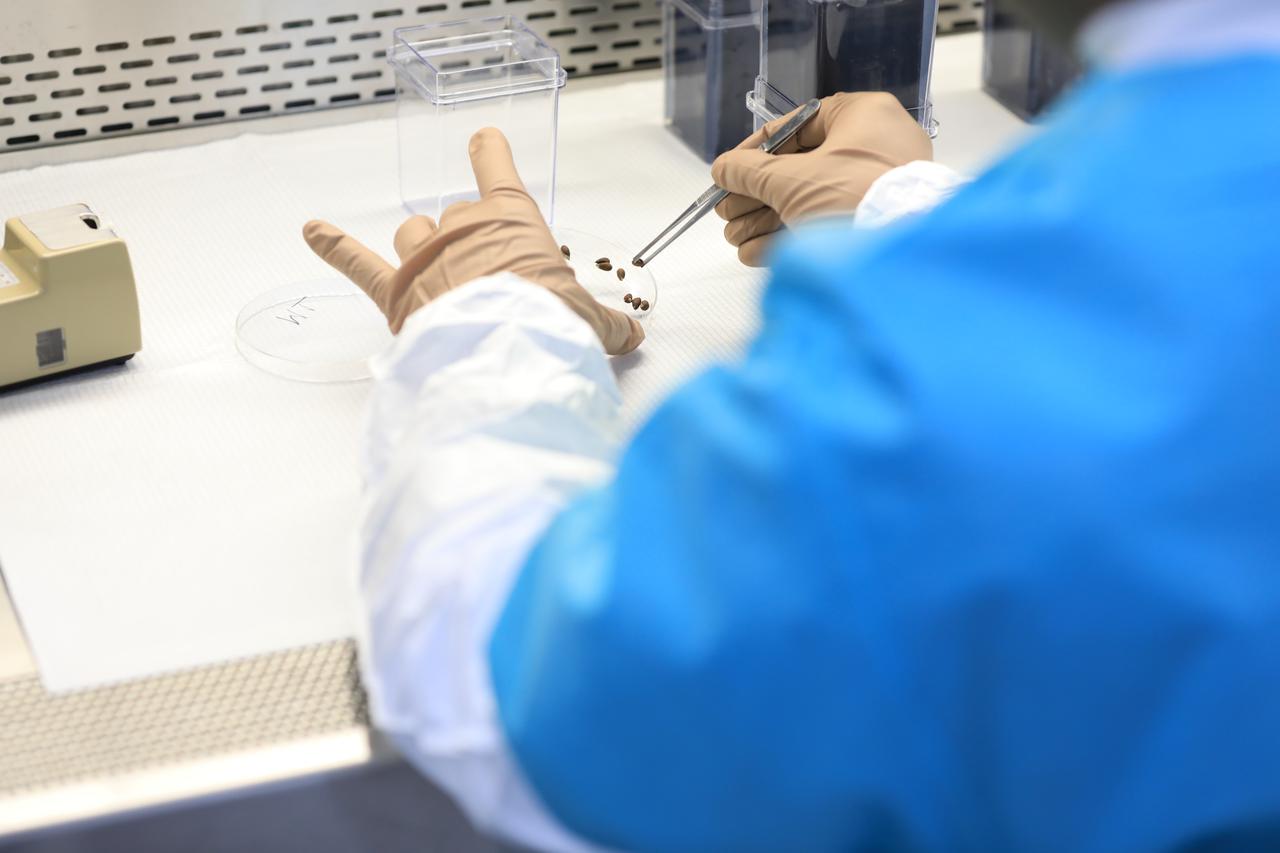
Dr. Arko Bakshi, a research associate with the Department of Botany at the University of Wisconsin, Madison, adds nutrient gel to Target Veggie Chambers, or TVCs, inside a laboratory in the Space Station Processing Facility at Kennedy Space Center in Florida on May 28, 2021. Bakshi waited until the gel solidified and then planted cotton seeds in it as part of the Targeting Improved Cotton Through Orbital Cultivation (TICTOC) experiment, which will launch to the International Space Station aboard SpaceX’s 22nd commercial resupply services mission. TICTOC will investigate how environmental factors and genes control development of roots in the absence of gravity. Liftoff of the SpaceX Falcon 9 rocket and Dragon capsule is scheduled for 1:29 p.m. EDT Thursday, June 3, 2021, from Launch Complex 39A at Kennedy Space Center.
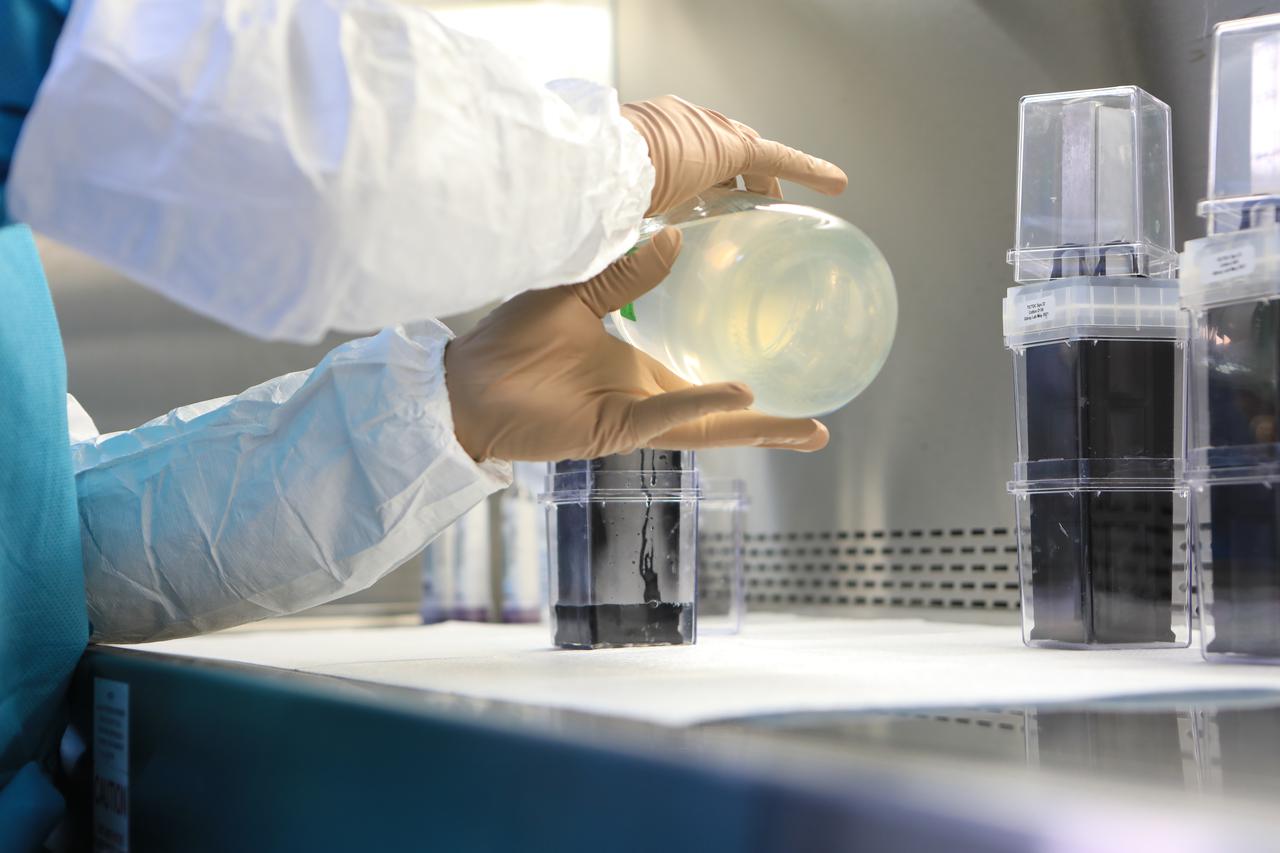
Dr. Arko Bakshi, a research associate with the Department of Botany at the University of Wisconsin, Madison, adds nutrient gel to Target Veggie Chambers, or TVCs, inside a laboratory in the Space Station Processing Facility at Kennedy Space Center in Florida on May 28, 2021. Bakshi waited until the gel solidified and then planted cotton seeds in it as part of the Targeting Improved Cotton Through Orbital Cultivation (TICTOC) experiment, which will launch to the International Space Station aboard SpaceX’s 22nd commercial resupply services mission. TICTOC will investigate how environmental factors and genes control development of roots in the absence of gravity. Liftoff of the SpaceX Falcon 9 rocket and Dragon capsule is scheduled for 1:29 p.m. EDT Thursday, June 3, 2021, from Launch Complex 39A at Kennedy Space Center.
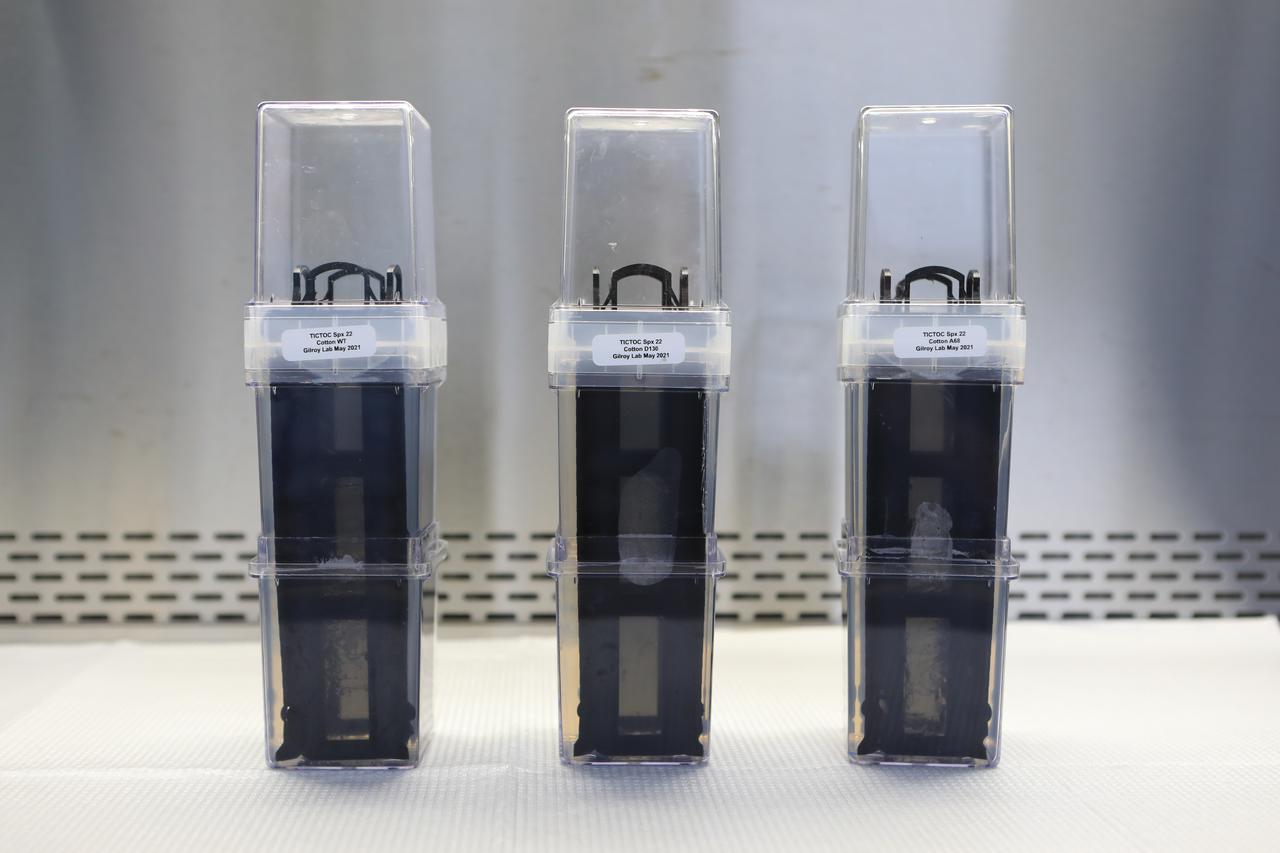
Several Target Veggie Chambers, or TVCs, are in view inside a laboratory in the Space Station Processing Facility at NASA’s Kennedy Space Center in Florida on May 28, 2021. A nutrient gel has been added to them, and when the gel solidified, Dr. Arko Bakshi, a research associate with the Department of Botany at the University of Wisconsin, Madison, planted cotton seeds in them as part of the Targeting Improved Cotton Through Orbital Cultivation (TICTOC) experiment, which will launch to the International Space Station aboard SpaceX’s 22nd commercial resupply services mission. TICTOC will investigate how environmental factors and genes control development of roots in the absence of gravity. Liftoff of the SpaceX Falcon 9 rocket and Dragon capsule is scheduled for 1:29 p.m. EDT Thursday, June 3, 2021, from Launch Complex 39A at Kennedy Space Center.
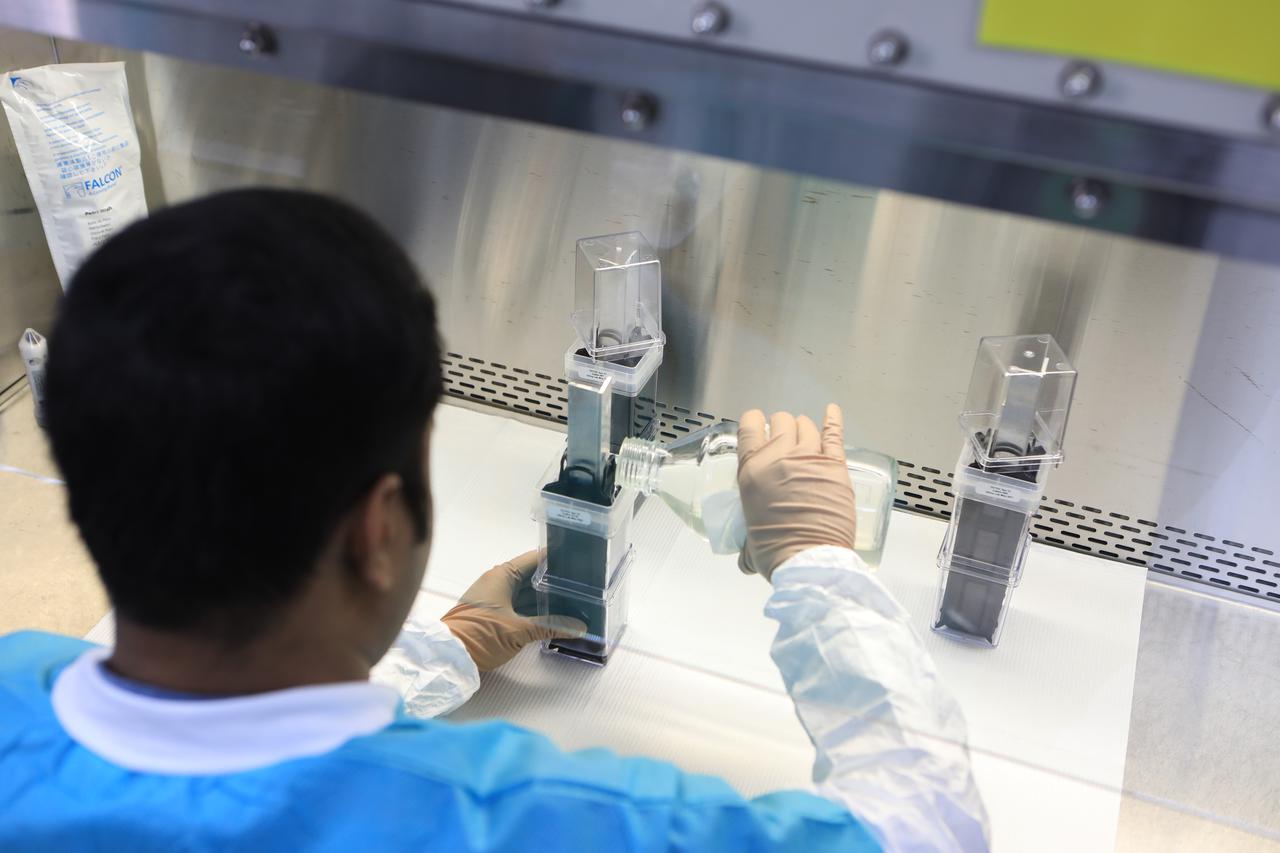
Dr. Arko Bakshi, a research associate with the Department of Botany at the University of Wisconsin, Madison, adds nutrient gel to Target Veggie Chambers, or TVCs, inside a laboratory in the Space Station Processing Facility at Kennedy Space Center in Florida on May 28, 2021. Bakshi waited until the gel solidified and then planted cotton seeds in it as part of the Targeting Improved Cotton Through Orbital Cultivation (TICTOC) experiment, which will launch to the International Space Station aboard SpaceX’s 22nd commercial resupply services mission. TICTOC will investigate how environmental factors and genes control development of roots in the absence of gravity. Liftoff of the SpaceX Falcon 9 rocket and Dragon capsule is scheduled for 1:29 p.m. EDT Thursday, June 3, 2021, from Launch Complex 39A at Kennedy Space Center.
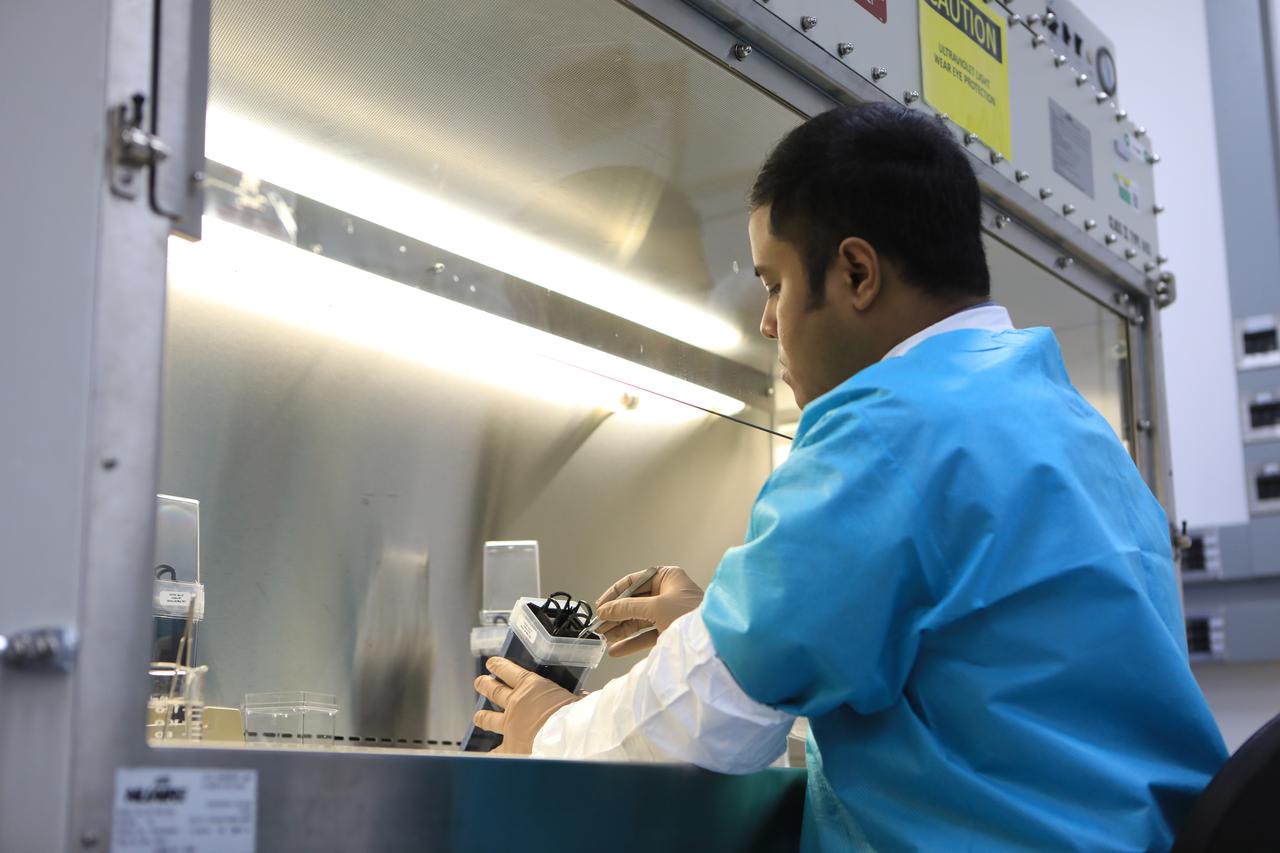
Dr. Arko Bakshi, a research associate with the Department of Botany at the University of Wisconsin, Madison, adds nutrient gel to Target Veggie Chambers, or TVCs, inside a laboratory in the Space Station Processing Facility at Kennedy Space Center in Florida on May 28, 2021. Bakshi waited until the gel solidified and then planted cotton seeds in it as part of the Targeting Improved Cotton Through Orbital Cultivation (TICTOC) experiment, which will launch to the International Space Station aboard SpaceX’s 22nd commercial resupply services mission. TICTOC will investigate how environmental factors and genes control development of roots in the absence of gravity. Liftoff of the SpaceX Falcon 9 rocket and Dragon capsule is scheduled for 1:29 p.m. EDT Thursday, June 3, 2021, from Launch Complex 39A at Kennedy Space Center.
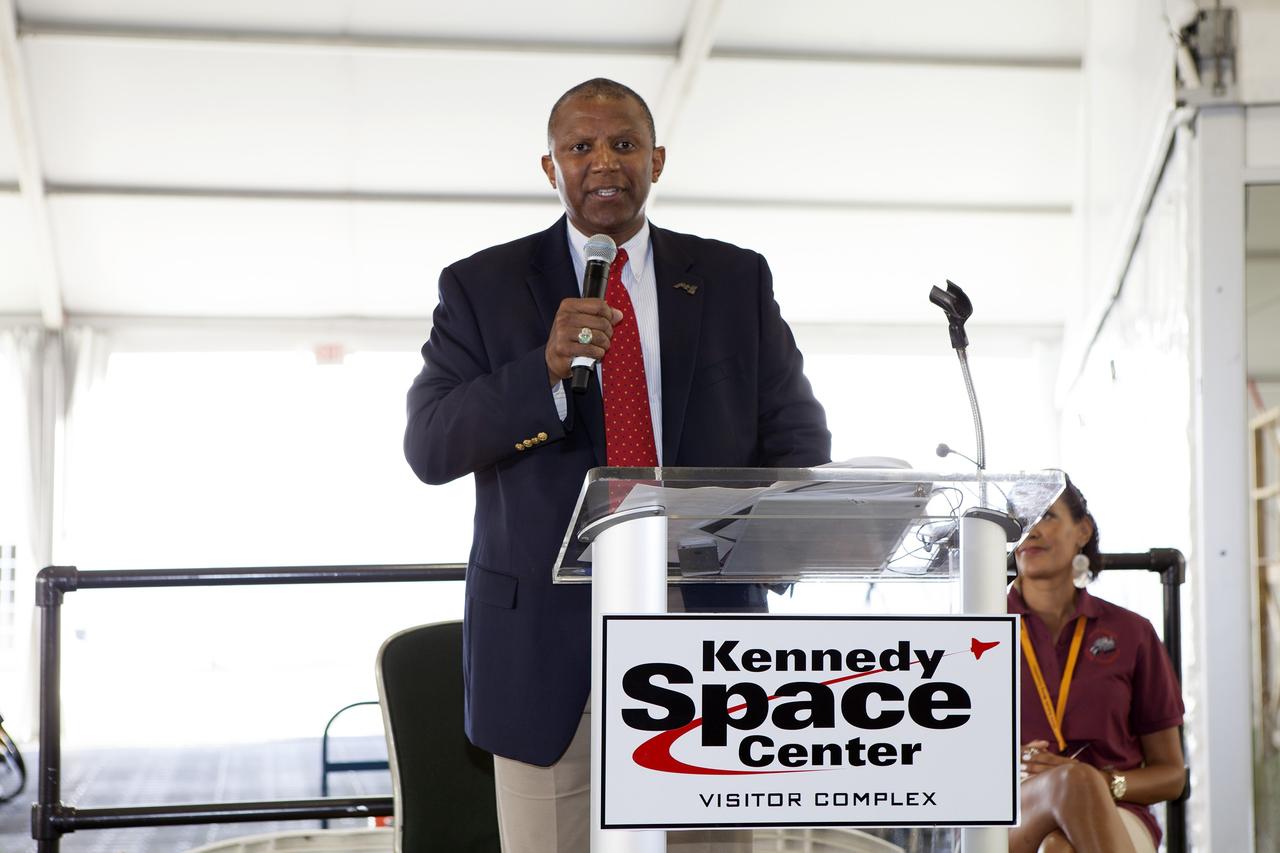
CAPE CANAVERAL, Fla. – Kelvin Manning, associate director of Kennedy Space Center, speaks to the college and university teams during the opening ceremony of NASA’s 2014 Robotics Mining Competition at the Kennedy Space Center Visitor Complex in Florida. More than 35 teams from around the U.S. have designed and built remote-controlled robots for the mining competition. The competition is a NASA Human Exploration and Operations Mission Directorate project designed to engage and retain students in science, technology, engineering and mathematics, or STEM, fields by expanding opportunities for student research and design. Teams use their remote-controlled robotics to maneuver and dig in a supersized sandbox filled with a crushed material that has characteristics similar to Martian soil. The objective of the challenge is to see which team’s robot can collect and move the most regolith within a specified amount of time. For more information, visit www.nasa.gov/nasarmc. Photo credit: NASA/Frankie Martin
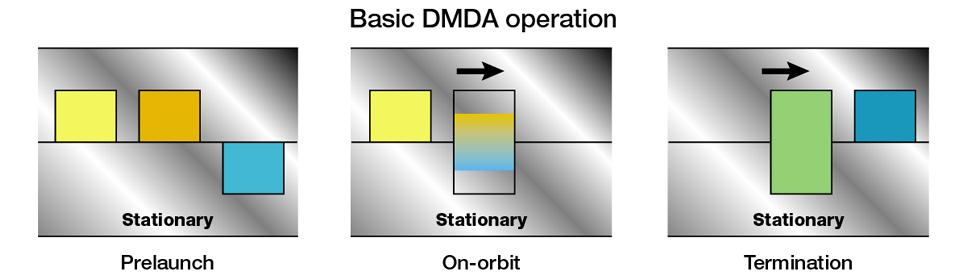
Experiments to seek solutions for a range of biomedical issues are at the heart of several investigations that will be hosted by the Commercial Instrumentation Technology Associates (ITA), Inc. Biomedical Experiments (CIBX-2) payload. CIBX-2 is unique, encompassing more than 20 separate experiments including cancer research, commercial experiments, and student hands-on experiments from 10 schools as part of ITA's ongoing University Among the Stars program. This drawing depicts a cross-section of a set of Dual-Materials Dispersion Apparatus (DMDA) specimen wells, one of which can include a reverse osmosis membrane to dewater a protein solution and thus cause crystallization. Depending on individual needs, two or three wells may be used, the membrane may be absent, or other proprietary enhancements may be present. The experiments are sponsored by NASA's Space Product Development Program (SPD).
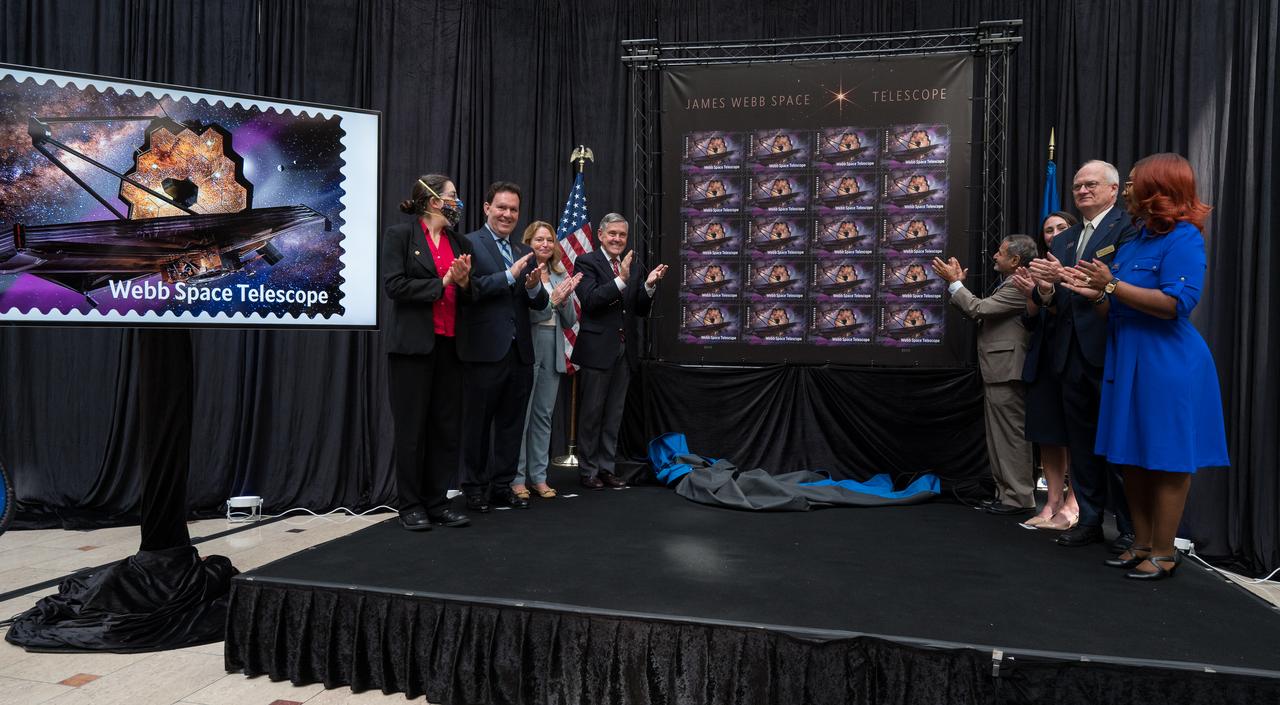
From left to right, NASA’s Goddard Space Flight Center Webb Deputy Observatory Project Scientist, Erin Smith, NASA’s Goddard Space Flight Center Webb Optical Telescope Element Manager, Lee Feinberg, Smithsonian Institution Under Secretary for Service and Research, Ellen Stofan, NASA Associate Administrator and former astronaut Bob Cabana, United States Postal Service Vice Chairman, Board of Governors, Anton Hajjar, NASA public affairs specialist Alice Fisher, National Postal Museum Deputy Director, Toby Mensforth, and Lisa Whitehead, USPS, applaud after unveiling the United States Postal Service’s new stamp celebrating NASA’s James Webb Space Telescope (JWST) at the first-day-of-issue event on Thursday, Sept. 8, 2022, at the Smithsonian’s National Postal Museum in Washington. The stamp, which features an illustration of the observatory, honors Webb’s mission to explore the unknown in our universe – solving mysteries in our solar system, looking beyond to distant worlds around other stars, and probing the structures and origins of our universe and our place in it. Photo Credit: (NASA/Aubrey Gemignani)
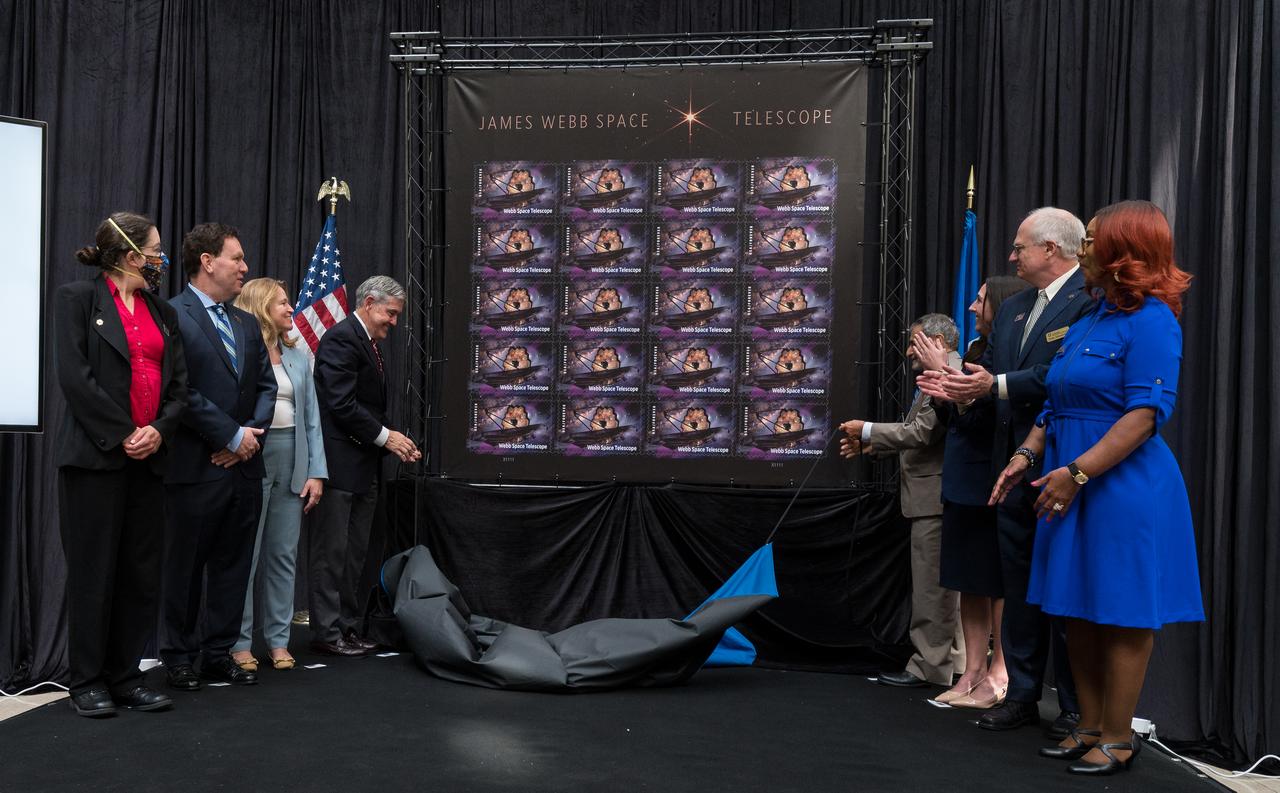
From left to right, NASA’s Goddard Space Flight Center Webb Deputy Observatory Project Scientist, Erin Smith, NASA’s Goddard Space Flight Center Webb Optical Telescope Element Manager, Lee Feinberg, Smithsonian Institution Under Secretary for Service and Research, Ellen Stofan, NASA Associate Administrator and former astronaut Bob Cabana, United States Postal Service Vice Chairman, Board of Governors, Anton Hajjar, NASA public affairs specialist Alice Fisher, National Postal Museum Deputy Director, Toby Mensforth, and Lisa Whitehead, USPS, unveil the United States Postal Service’s new stamp celebrating NASA’s James Webb Space Telescope (JWST) at the first-day-of-issue event on Thursday, Sept. 8, 2022, at the Smithsonian’s National Postal Museum in Washington. The stamp, which features an illustration of the observatory, honors Webb’s mission to explore the unknown in our universe – solving mysteries in our solar system, looking beyond to distant worlds around other stars, and probing the structures and origins of our universe and our place in it. Photo Credit: (NASA/Aubrey Gemignani)
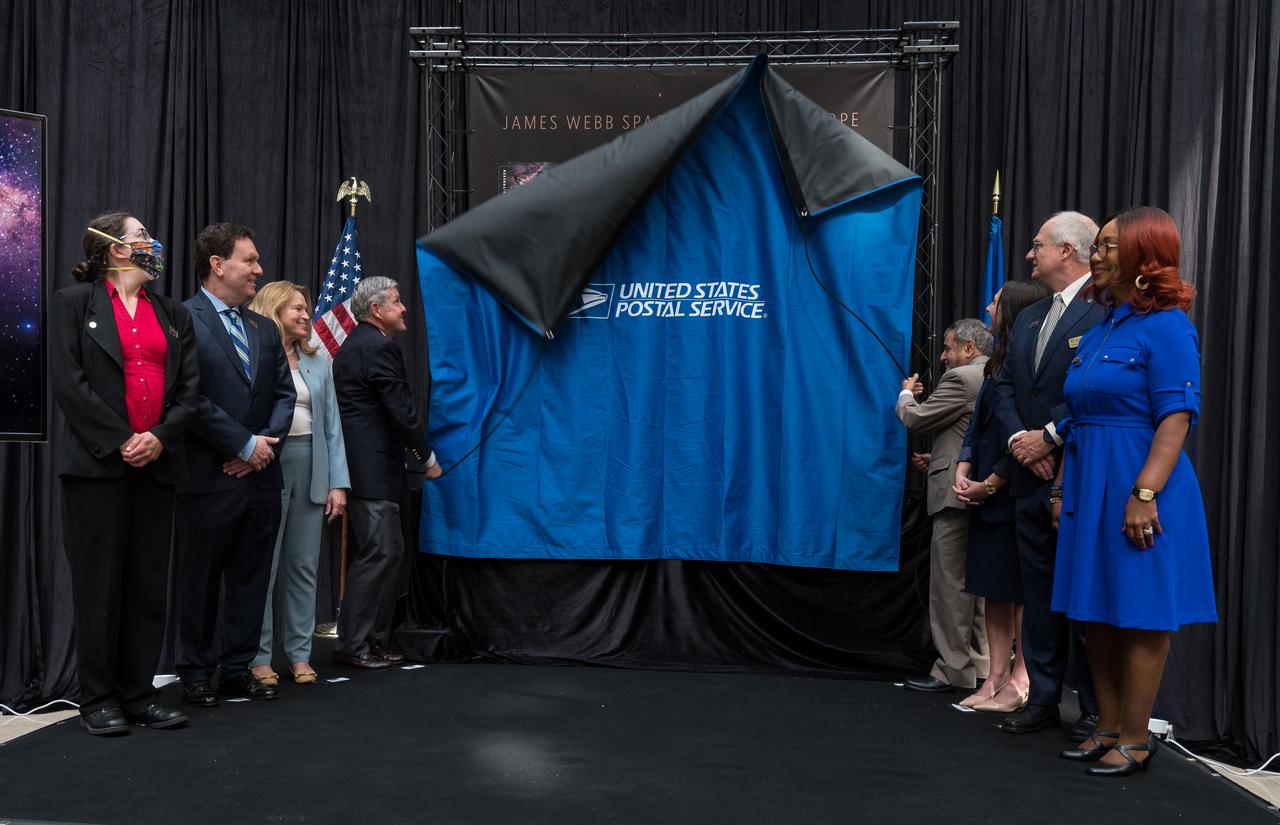
From left to right, NASA’s Goddard Space Flight Center Webb Deputy Observatory Project Scientist, Erin Smith, NASA’s Goddard Space Flight Center Webb Optical Telescope Element Manager, Lee Feinberg, Smithsonian Institution Under Secretary for Service and Research, Ellen Stofan, NASA Associate Administrator and former astronaut Bob Cabana, United States Postal Service Vice Chairman, Board of Governors, Anton Hajjar, NASA public affairs specialist Alice Fisher, National Postal Museum Deputy Director, Toby Mensforth, and Lisa Whitehead, USPS, unveil the United States Postal Service’s new stamp celebrating NASA’s James Webb Space Telescope (JWST) at the first-day-of-issue event on Thursday, Sept. 8, 2022, at the Smithsonian’s National Postal Museum in Washington. The stamp, which features an illustration of the observatory, honors Webb’s mission to explore the unknown in our universe – solving mysteries in our solar system, looking beyond to distant worlds around other stars, and probing the structures and origins of our universe and our place in it. Photo Credit: (NASA/Aubrey Gemignani)
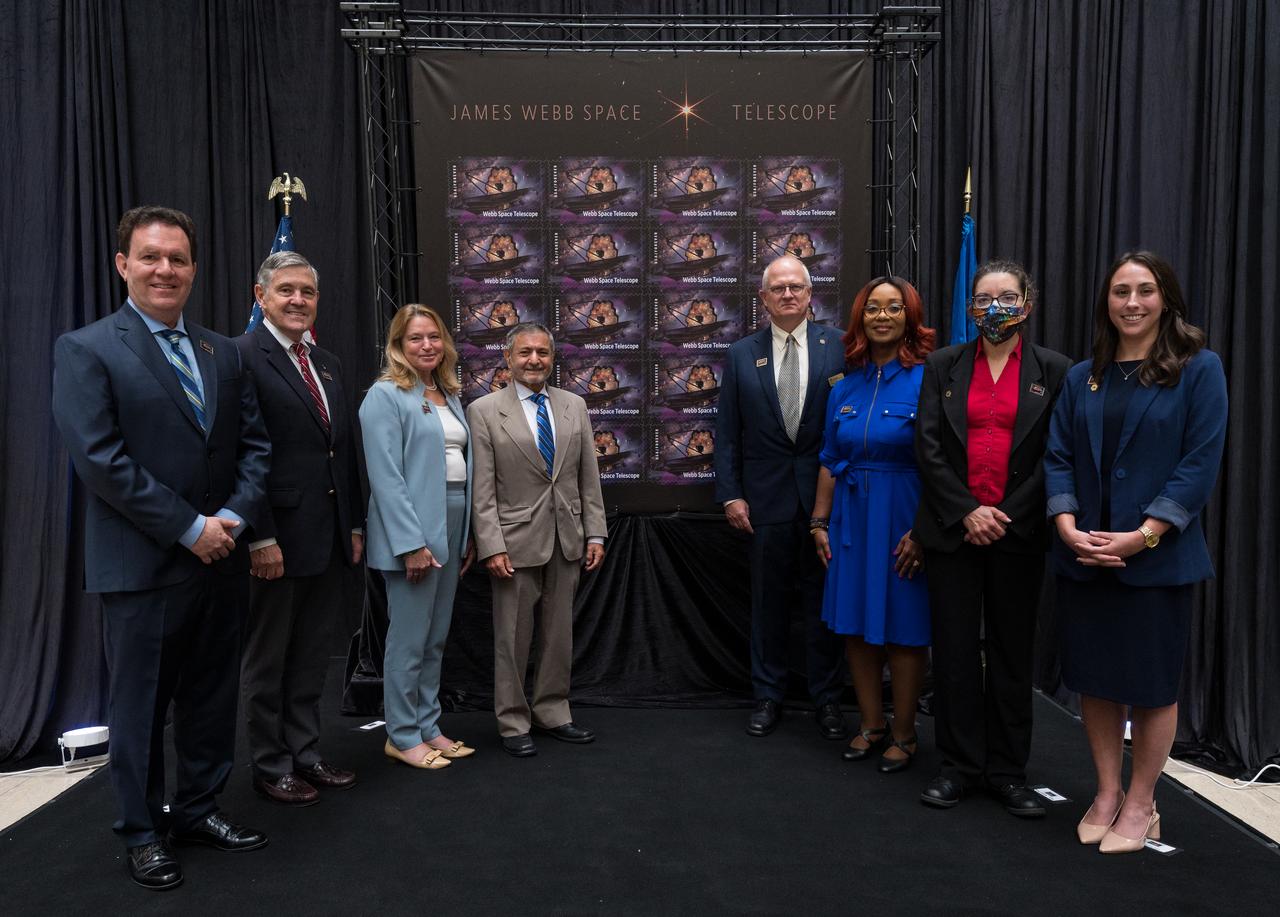
From left to right, NASA’s Goddard Space Flight Center Webb Optical Telescope Element Manager, Lee Feinberg, NASA Associate Administrator and former astronaut Bob Cabana, Smithsonian Institution Under Secretary for Service and Research, Ellen Stofan, United States Postal Service Vice Chairman, Board of Governors, Anton Hajjar, National Postal Museum Deputy Director Toby Mensforth, Lisa Whitehead, USPS, NASA’s Goddard Space Flight Center Webb Deputy Observatory Project Scientist, Erin Smith, and NASA public affairs specialist, Alice Fisher, pose for a photo at the conclusion of the first-day-of-issue event for the United States Postal Service’s new stamp celebrating NASA’s James Webb Space Telescope (JWST) on Thursday, Sept. 8, 2022, at the Smithsonian’s National Postal Museum in Washington. The stamp, which features an illustration of the observatory, honors Webb’s mission to explore the unknown in our universe – solving mysteries in our solar system, looking beyond to distant worlds around other stars, and probing the structures and origins of our universe and our place in it. Photo Credit: (NASA/Aubrey Gemignani)

CAPE CANAVERAL, Fla. -- Japan Aerospace Exploration Agency and International Space Station Program Manager Tetsuro Yokoyama addresses attendees of the American Astronautical Society's 2010 National Conference held at the Radisson Resort at the Port in Cape Canaveral, Fla. The panel of speakers seated from left to right are, International Space Services President James Zimmerman; International Space Station Program Manager Michael Suffredini; Canadian Space Agency Director of Space Exploration Operations and Infrastructure Pierre Jean; European Space Agency Directorate of Human Spaceflight and International Space Station Programme Department Bernado Patti and Roskosmos Piloted Space Programs Department Director Alexey Krasnov. This year's conference was titled: International Space Station: The Next Decade - Utilization and Research. The conference was organized with the support of Kennedy and sponsored by The Boeing Company, Honeywell International Inc., Northrop Grumman Corp., Space Florida and the Universities Space Research Association (USRA). Photo credit: NASA/Jim Grossmann
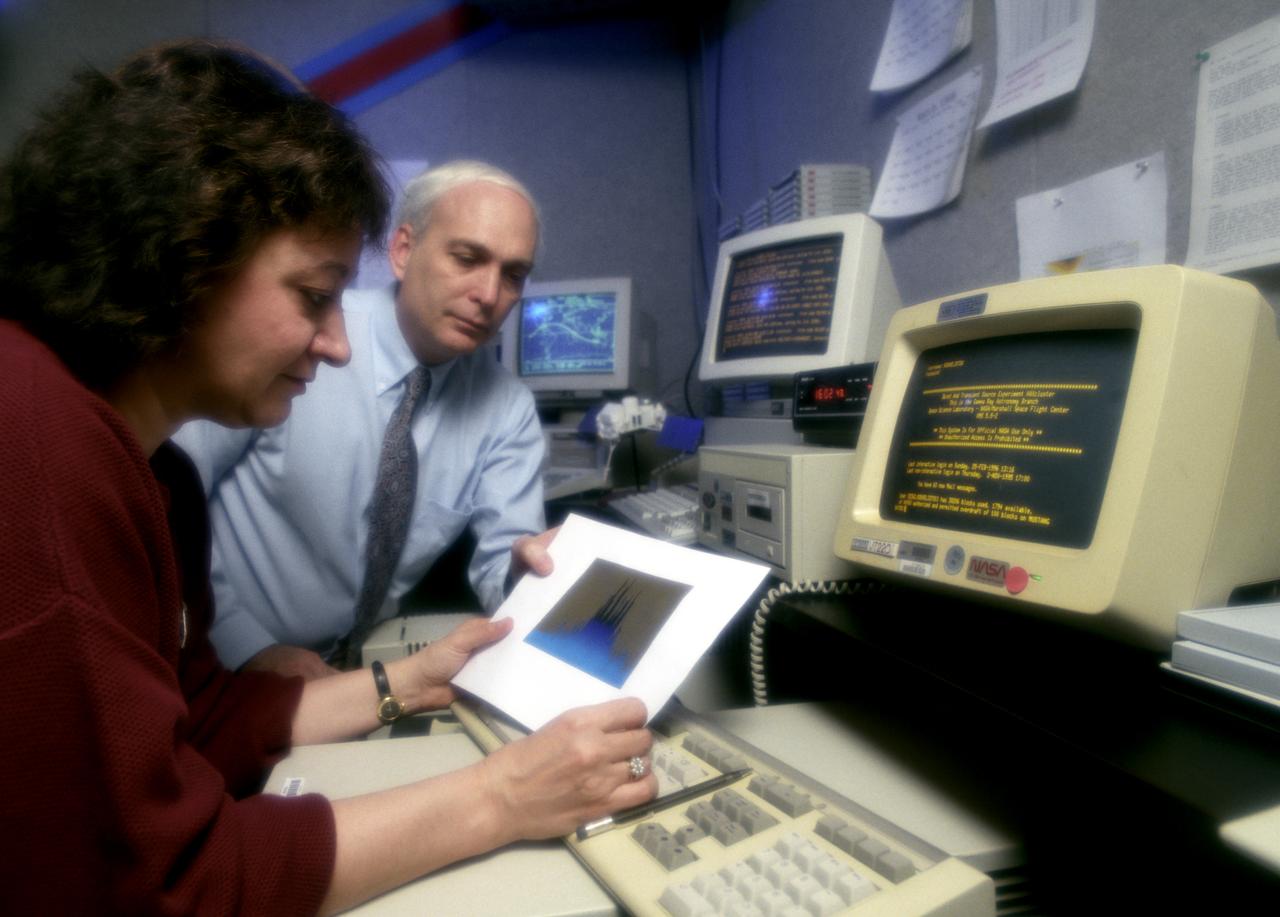
In this photograph, Dr. Gerald Fishman of the Marshall Space Flight Center (MSFC), a principal investigator of the Compton Gamma-Ray Observatory's (GRO's) instrument, the Burst and Transient Source Experiment (BATSE), and Dr. Chryssa Kouveliotou of Universities Space Research Associates review data from the BATSE. For nearly 9 years, GRO's Burst and Transient Source Experiment (BATSE), designed and built by the Marshall Space Flight Center, kept a blinking watch on the universe to alert scientist to the invisible, mysterious gamma-ray bursts. By studying gamma-rays from objects like black holes, pulsars, quasars, neutron stars, and other exotic objects, scientists could discover clues to the birth, evolution, and death of stars, galaxies, and the universe. The gamma-ray instrument was one of four major science instruments aboard the Compton. It consisted of eight detectors, or modules, located at each corner of the rectangular satellite to simultaneously scan the entire universe for bursts of gamma-rays ranging in duration from fractions of a second to minutes. Because gamma-rays are so powerful, they pass through conventional telescope mirrors. Instead of a mirror, the heart of each BATSE module was a large, flat, transparent crystal that generated a tiny flash of light when struck by a gamma-ray. With an impressive list of discoveries and diverse accomplishments, BATSE could claim to have rewritten astronomy textbooks. Launched aboard the Space Shuttle Orbiter Atlantis during the STS-35 mission in April 1991, the GRO reentered the Earth's atmosphere and ended its successful 9-year mission in June 2000.
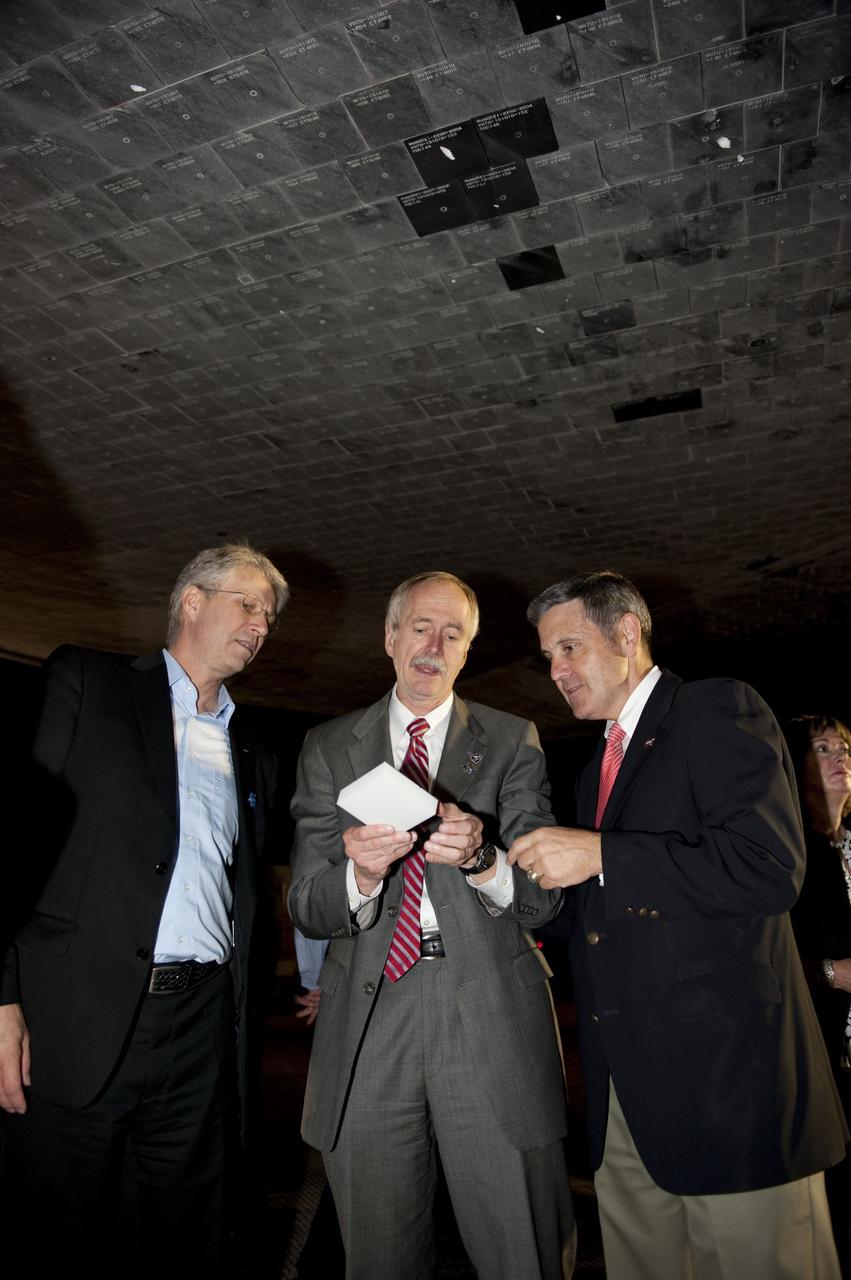
CAPE CANAVERAL, Fla. -- European Space Agency Director of Human Spaceflight Thomas Reiter, left, Associate Administrator for Space Operations Bill Gerstenmaier, and NASA Kennedy Space Center Director Bob Cabana check out a heat shield tile that protected space shuttle Endeavour on its successful trip home. Endeavour's final return from space completed the 16-day, 6.5-million-mile STS-134 mission. Main gear touchdown on the Shuttle Landing Facility's Runway 15 was at 2:34:51 a.m. EDT, followed by nose gear touchdown at 2:35:04 a.m., and wheelstop at 2:35:36 a.m. STS-134 delivered the Alpha Magnetic Spectrometer-2 (AMS) and the Express Logistics Carrier-3 (ELC-3) to the International Space Station. AMS will help researchers understand the origin of the universe and search for evidence of dark matter, strange matter and antimatter from the station. ELC-3 carried spare parts that will sustain station operations once the shuttles are retired from service. STS-134 was the 25th and final flight for Endeavour, which spent 299 days in space, orbited Earth 4,671 times and traveled 122,883,151 miles. Photo credit: NASA/Kim Shiflett
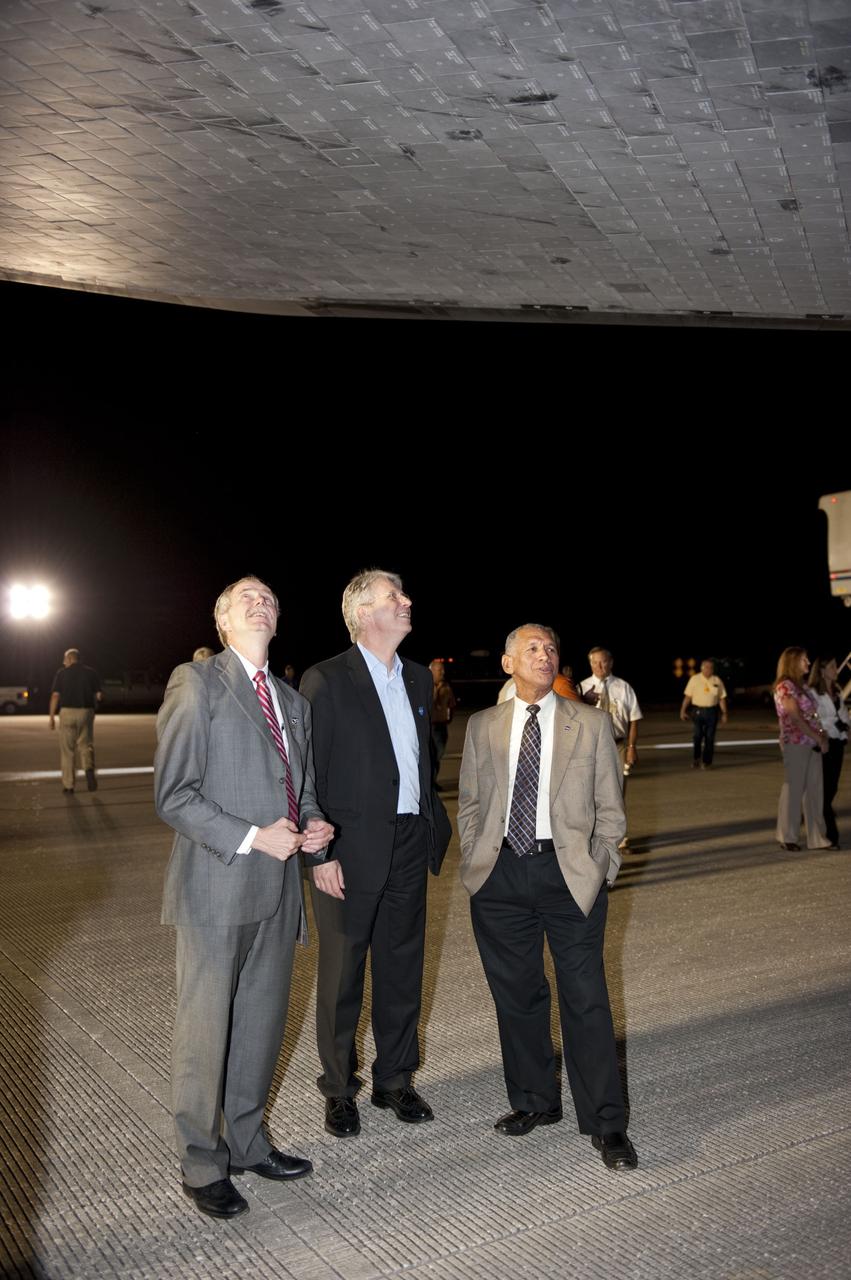
CAPE CANAVERAL, Fla. -- Associate Administrator for Space Operations Bill Gerstenmaier, left, European Space Agency Director of Human Spaceflight Thomas Reiter and NASA Administrator Charlie Bolden chat underneath the belly of space shuttle Endeavour following the vehicle's successful trip home to NASA's Kennedy Space Center in Florida. Endeavour's final return from space completed the 16-day, 6.5-million-mile STS-134 mission. Main gear touchdown on the Shuttle Landing Facility's Runway 15 was at 2:34:51 a.m. EDT, followed by nose gear touchdown at 2:35:04 a.m., and wheelstop at 2:35:36 a.m. STS-134 delivered the Alpha Magnetic Spectrometer-2 (AMS) and the Express Logistics Carrier-3 (ELC-3) to the International Space Station. AMS will help researchers understand the origin of the universe and search for evidence of dark matter, strange matter and antimatter from the station. ELC-3 carried spare parts that will sustain station operations once the shuttles are retired from service. STS-134 was the 25th and final flight for Endeavour, which spent 299 days in space, orbited Earth 4,671 times and traveled 122,883,151 miles. Photo credit: NASA/Kim Shiflett
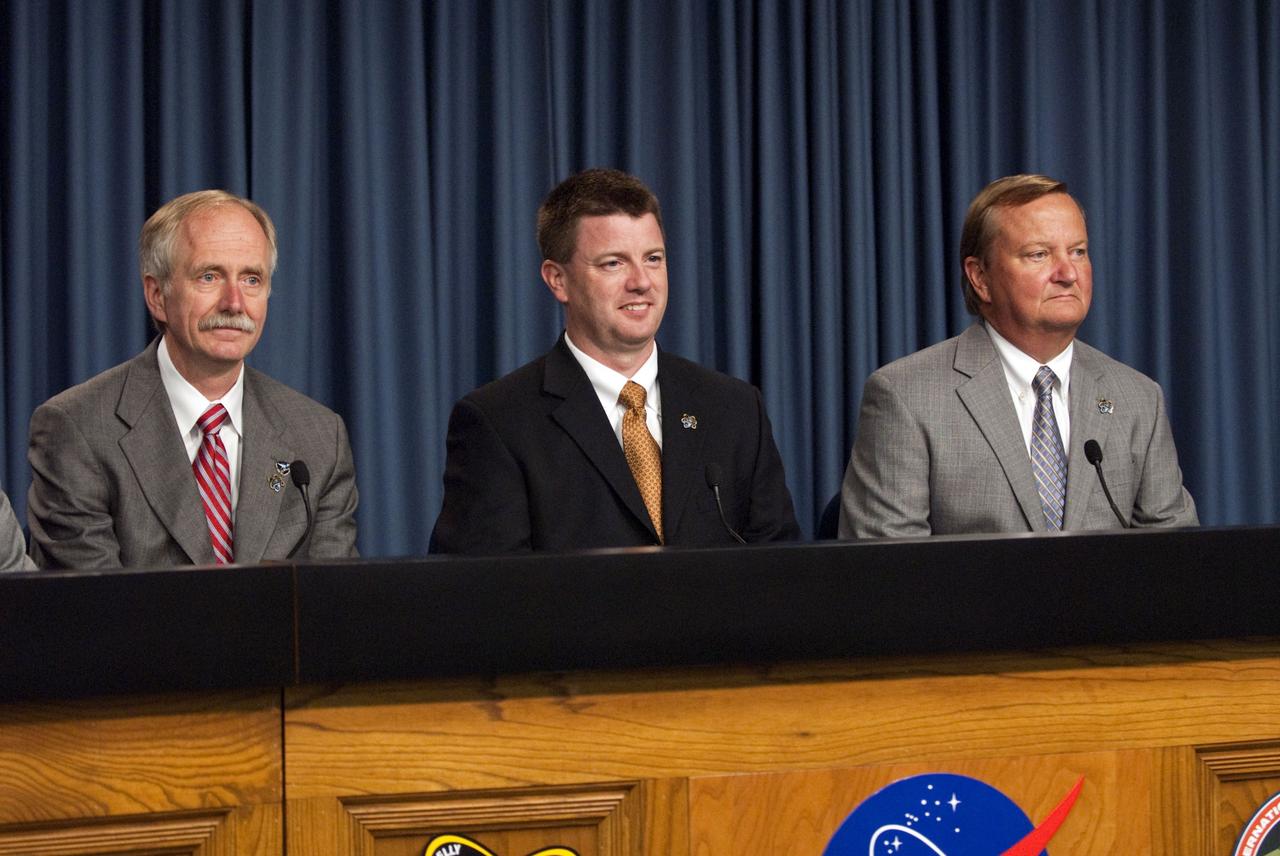
CAPE CANAVERAL, Fla. -- In the Press Site auditorium at NASA's Kennedy Space Center in Florida, NASA managers brief media after space shuttle Endeavour's successful landing and conclusion of its STS-134 and final mission. From left are, Associate Administrator for Space Operations Bill Gerstenmaier, Space Shuttle Program Launch Integration Manager Mike Moses; and Shuttle Launch Director Mike Leinbach. Endeavour and its crew delivered the Alpha Magnetic Spectrometer-2 (AMS) and the Express Logistics Carrier-3 (ELC-3) to the International Space Station. AMS will help researchers understand the origin of the universe and search for evidence of dark matter, strange matter and antimatter from the station. ELC-3 carried spare parts that will sustain station operations once the shuttles are retired from service. STS-134 was the 25th and final flight for Endeavour, which spent 299 days in space, orbited Earth 4,671 times and traveled 122,883,151 miles. Photo credit: NASA/Kim Shiflett
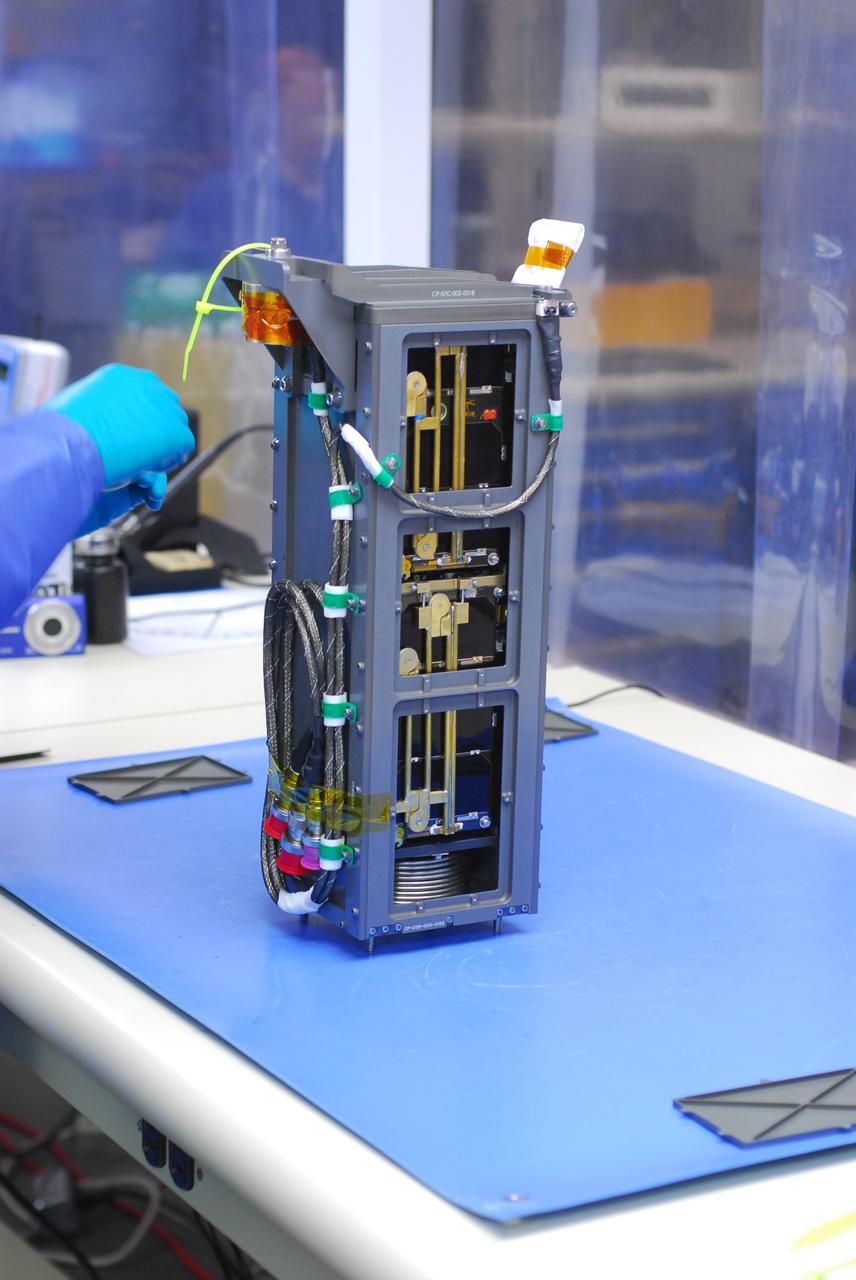
The Dynamic Ionosphere Cubesat Experiment DICE is prepared for launch aboard the Delta II rocket that will carry NASA’s National Polar-orbiting Operational Environmental Satellite System Preparatory Project NPP spacecraft. DICE is a National Science Foundation Project conducted by Utah State University in conjunction with the Atmospheric and Space Technology Research Associates ASTRA. NPP represents a critical first step in building the next-generation of Earth-observing satellites. NPP will carry the first of the new sensors developed for this satellite fleet, now known as the Joint Polar Satellite System JPSS, to be launched in 2016. NPP is the bridge between NASA's Earth Observing System EOS satellites and the forthcoming series of JPSS satellites. The mission will test key technologies and instruments for the JPSS missions. NPP is targeted to launch Oct. 28 from Space Launch Complex-2 aboard a United Launch Alliance Delta II rocket. For more information, visit http://www.nasa.gov/NPP. Photo credit: NASA/VAFB
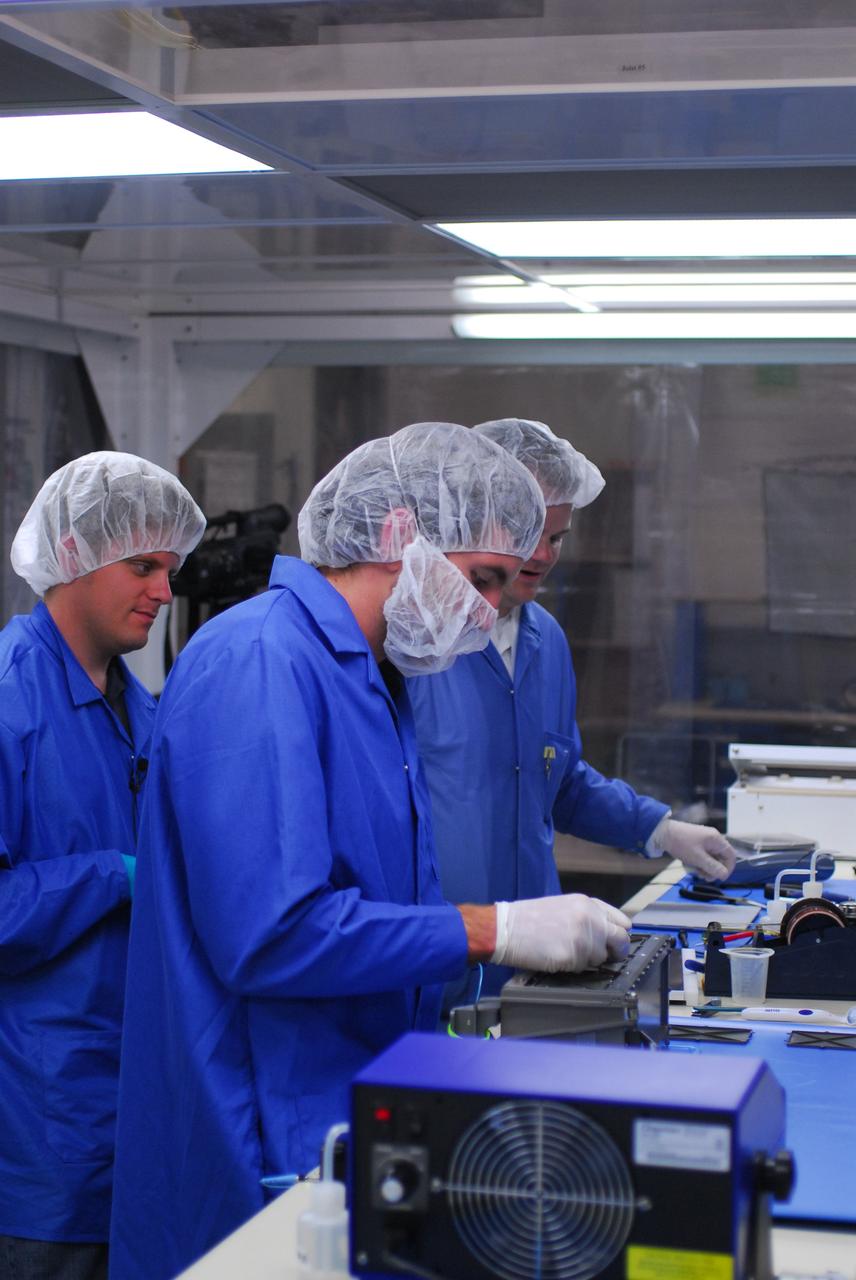
The Dynamic Ionosphere Cubesat Experiment DICE is prepared for launch aboard the Delta II rocket that will carry NASA’s National Polar-orbiting Operational Environmental Satellite System Preparatory Project NPP spacecraft. DICE is a National Science Foundation Project conducted by Utah State University in conjunction with the Atmospheric and Space Technology Research Associates ASTRA. NPP represents a critical first step in building the next-generation of Earth-observing satellites. NPP will carry the first of the new sensors developed for this satellite fleet, now known as the Joint Polar Satellite System JPSS, to be launched in 2016. NPP is the bridge between NASA's Earth Observing System EOS satellites and the forthcoming series of JPSS satellites. The mission will test key technologies and instruments for the JPSS missions. NPP is targeted to launch Oct. 28 from Space Launch Complex-2 aboard a United Launch Alliance Delta II rocket. For more information, visit http://www.nasa.gov/NPP. Photo credit: NASA/VAFB
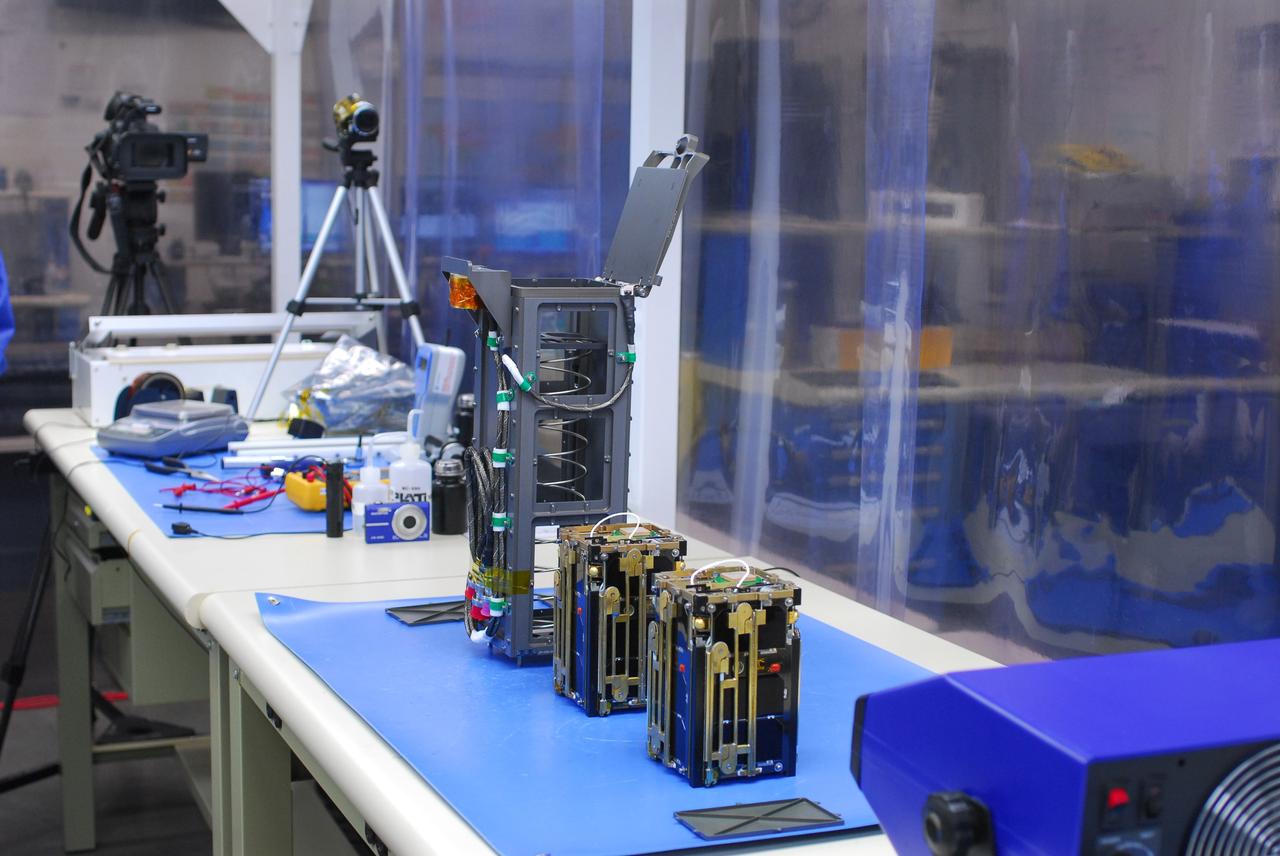
The Dynamic Ionosphere Cubesat Experiment DICE is prepared for launch aboard the Delta II rocket that will carry NASA’s National Polar-orbiting Operational Environmental Satellite System Preparatory Project NPP spacecraft. DICE is a National Science Foundation Project conducted by Utah State University in conjunction with the Atmospheric and Space Technology Research Associates ASTRA. NPP represents a critical first step in building the next-generation of Earth-observing satellites. NPP will carry the first of the new sensors developed for this satellite fleet, now known as the Joint Polar Satellite System JPSS, to be launched in 2016. NPP is the bridge between NASA's Earth Observing System EOS satellites and the forthcoming series of JPSS satellites. The mission will test key technologies and instruments for the JPSS missions. NPP is targeted to launch Oct. 28 from Space Launch Complex-2 aboard a United Launch Alliance Delta II rocket. For more information, visit http://www.nasa.gov/NPP. Photo credit: NASA/VAFB
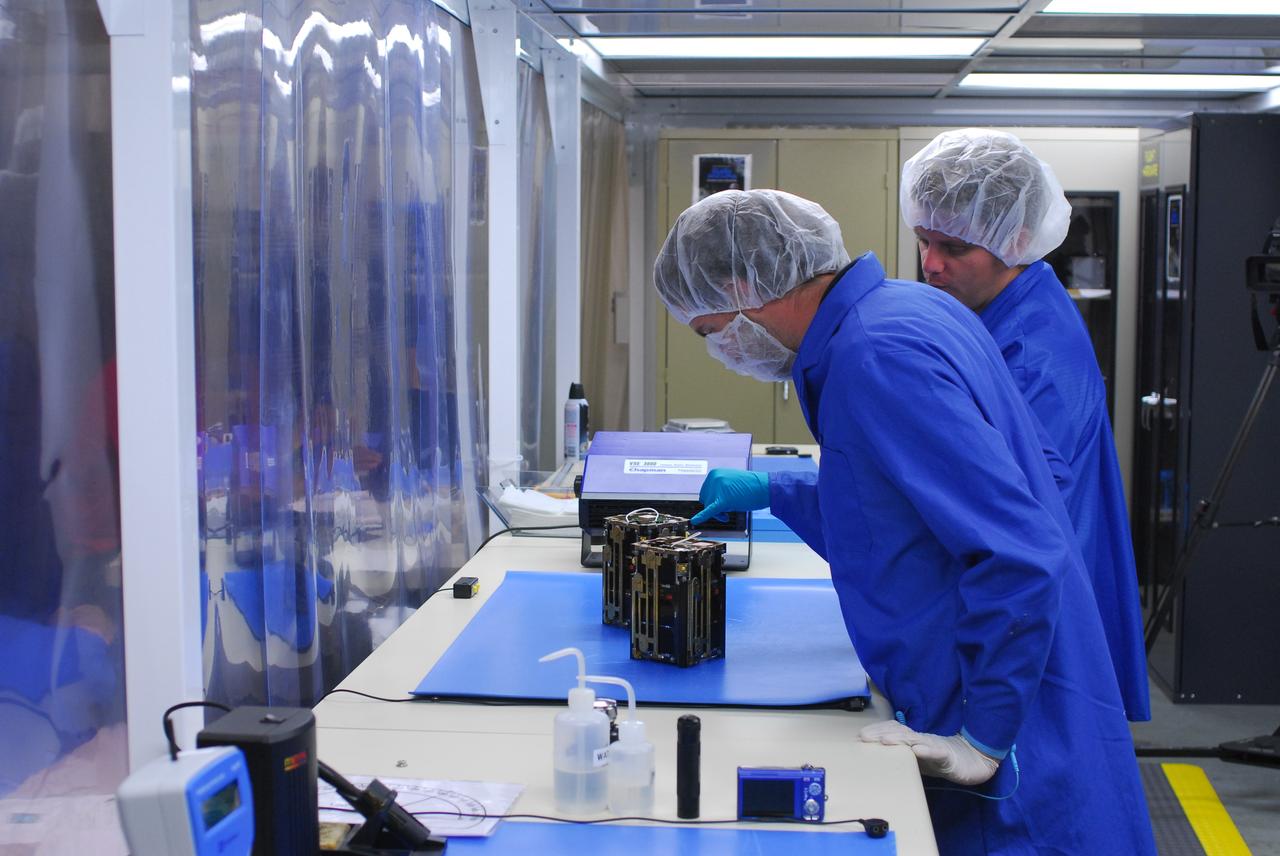
The Dynamic Ionosphere Cubesat Experiment DICE is prepared for launch aboard the Delta II rocket that will carry NASA’s National Polar-orbiting Operational Environmental Satellite System Preparatory Project NPP spacecraft. DICE is a National Science Foundation Project conducted by Utah State University in conjunction with the Atmospheric and Space Technology Research Associates ASTRA. NPP represents a critical first step in building the next-generation of Earth-observing satellites. NPP will carry the first of the new sensors developed for this satellite fleet, now known as the Joint Polar Satellite System JPSS, to be launched in 2016. NPP is the bridge between NASA's Earth Observing System EOS satellites and the forthcoming series of JPSS satellites. The mission will test key technologies and instruments for the JPSS missions. NPP is targeted to launch Oct. 28 from Space Launch Complex-2 aboard a United Launch Alliance Delta II rocket. For more information, visit http://www.nasa.gov/NPP. Photo credit: NASA/VAFB
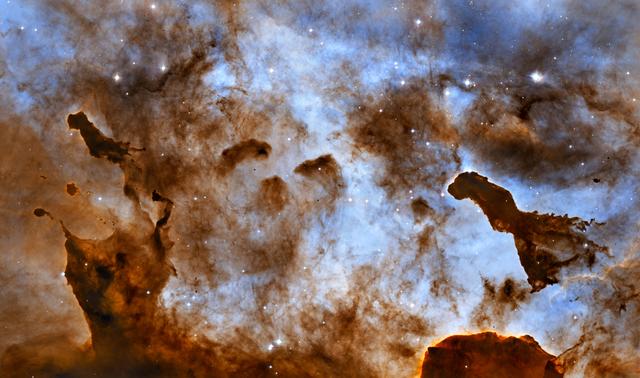
NASA image release September 16, 2010 Enjoying a frozen treat on a hot summer day can leave a sticky mess as it melts in the Sun and deforms. In the cold vacuum of space, there is no edible ice cream, but there is radiation from massive stars that is carving away at cold molecular clouds, creating bizarre, fantasy-like structures. These one-light-year-tall pillars of cold hydrogen and dust, imaged by the Hubble Space Telescope, are located in the Carina Nebula. Violent stellar winds and powerful radiation from massive stars are sculpting the surrounding nebula. Inside the dense structures, new stars may be born. This image of dust pillars in the Carina Nebula is a composite of 2005 observations taken of the region in hydrogen light (light emitted by hydrogen atoms) along with 2010 observations taken in oxygen light (light emitted by oxygen atoms), both times with Hubble's Advanced Camera for Surveys. The immense Carina Nebula is an estimated 7,500 light-years away in the southern constellation Carina. The Hubble Space Telescope is a project of international cooperation between NASA and the European Space Agency. NASA's Goddard Space Flight Center manages the telescope. The Space Telescope Science Institute (STScI) conducts Hubble science operations. STScI is operated for NASA by the Association of Universities for Research in Astronomy, Inc. in Washington, D.C. <b><a href="http://www.nasa.gov/centers/goddard/home/index.html" rel="nofollow">NASA Goddard Space Flight Center</a></b> is home to the nation's largest organization of combined scientists, engineers and technologists that build spacecraft, instruments and new technology to study the Earth, the sun, our solar system, and the universe. <b>Follow us on <a href="http://twitter.com/NASA_GoddardPix" rel="nofollow">Twitter</a></b> <b>Join us on <a href="http://www.facebook.com/pages/Greenbelt-MD/NASA-Goddard/395013845897?ref=tsd" rel="nofollow">Facebook</a></b>
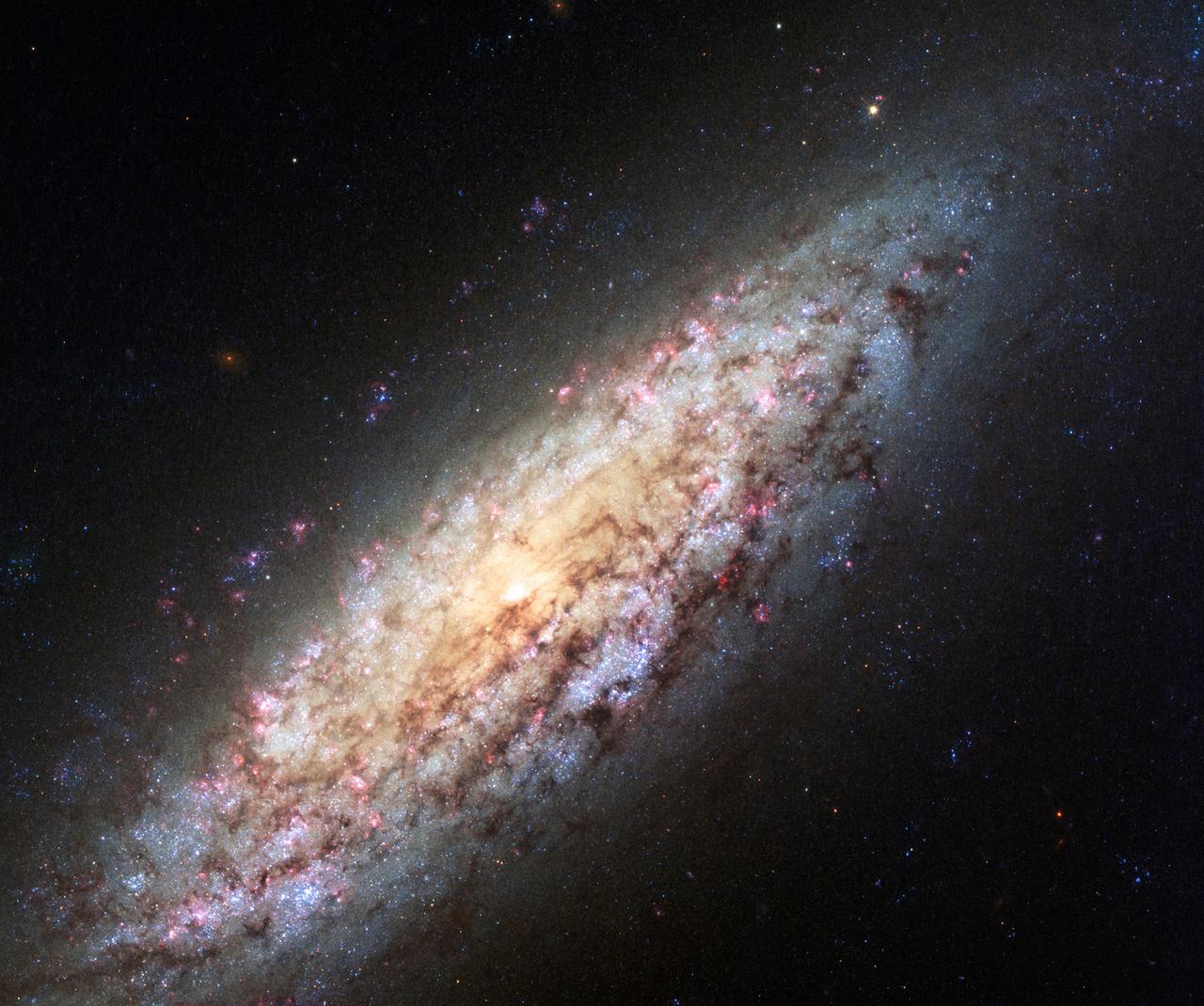
Most galaxies are clumped together in groups or clusters. A neighboring galaxy is never far away. But this galaxy, known as NGC 6503, has found itself in a lonely position, at the edge of a strangely empty patch of space called the Local Void. The Local Void is a huge stretch of space that is at least 150 million light-years across. It seems completely empty of stars or galaxies. The galaxy’s odd location on the edge of this never-land led stargazer Stephen James O’Meara to dub it the “Lost-In-Space galaxy” in his 2007 book, Hidden Treasures. NGC 6503 is 18 million light-years away from us in the northern circumpolar constellation of Draco. NGC 6503 spans some 30,000 light-years, about a third of the size of the Milky Way. This Hubble Space Telescope image shows NGC 6503 in striking detail and with a rich set of colors. Bright red patches of gas can be seen scattered through its swirling spiral arms, mixed with bright blue regions that contain newly forming stars. Dark brown dust lanes snake across the galaxy’s bright arms and center, giving it a mottled appearance. The Hubble Advanced Camera for Surveys data for NGC 6503 were taken in April 2003, and the Wide Field Camera 3 data were taken in August 2013. The Hubble Space Telescope is a project of international cooperation between NASA and the European Space Agency. NASA’s Goddard Space Flight Center in Greenbelt, Maryland, manages the telescope. The Space Telescope Science Institute (STScI) in Baltimore conducts Hubble science operations. STScI is operated for NASA by the Association of Universities for Research in Astronomy, Inc., in Washington, D.C. Photo Credit: NASA, ESA, D. Calzetti (University of Massachusetts), H. Ford (Johns Hopkins University), and the Hubble Heritage Team <b><a href="http://www.nasa.gov/audience/formedia/features/MP_Photo_Guidelines.html" rel="nofollow">NASA image use policy.</a></b> <b><a href="http://www.nasa.gov/centers/goddard/home/index.html" rel="nofollow">NASA Goddard Space Flight Center</a></b> enables NASA’s mission through four scientific endeavors: Earth Science, Heliophysics, Solar System Exploration, and Astrophysics. Goddard plays a leading role in NASA’s accomplishments by contributing compelling scientific knowledge to advance the Agency’s mission. <b>Follow us on <a href="http://twitter.com/NASAGoddardPix" rel="nofollow">Twitter</a></b> <b>Like us on <a href="http://www.facebook.com/pages/Greenbelt-MD/NASA-Goddard/395013845897?ref=tsd" rel="nofollow">Facebook</a></b> <b>Find us on <a href="http://instagrid.me/nasagoddard/?vm=grid" rel="nofollow">Instagram</a></b>

Just in time for the release of the movie “Star Wars Episode VII: The Force Awakens,” NASA’s Hubble Space Telescope has photographed what looks like a cosmic, double-bladed lightsaber. In the center of the image, partially obscured by a dark, Jedi-like cloak of dust, a newborn star shoots twin jets out into space as a sort of birth announcement to the universe. “Science fiction has been an inspiration to generations of scientists and engineers, and the film series Star Wars is no exception,” said John Grunsfeld, astronaut and associate administrator for the NASA Science Mission directorate. “There is no stronger case for the motivational power of real science than the discoveries that come from the Hubble Space Telescope as it unravels the mysteries of the universe." This celestial lightsaber does not lie in a galaxy far, far away, but rather inside our home galaxy, the Milky Way. It’s inside a turbulent birthing ground for new stars known as the Orion B molecular cloud complex, located 1,350 light-years away. When stars form within giant clouds of cool molecular hydrogen, some of the surrounding material collapses under gravity to form a rotating, flattened disk encircling the newborn star. Though planets will later congeal in the disk, at this early stage the protostar is feeding on the disk with a Jabba-like appetite. Gas from the disk rains down onto the protostar and engorges it. Superheated material spills away and is shot outward from the star in opposite directions along an uncluttered escape route — the star’s rotation axis. Shock fronts develop along the jets and heat the surrounding gas to thousands of degrees Fahrenheit. The jets collide with the surrounding gas and dust and clear vast spaces, like a stream of water plowing into a hill of sand. The shock fronts form tangled, knotted clumps of nebulosity and are collectively known as Herbig-Haro (HH) objects. The prominent HH object shown in this image is HH 24. Just to the right of the cloaked star, a couple of bright points are young stars peeking through and showing off their own faint lightsabers — including one that has bored a tunnel through the cloud towards the upper-right side of the picture. Overall, just a handful of HH jets have been spotted in this region in visible light, and about the same number in the infrared. Hubble’s observations for this image were performed in infrared light, which enabled the telescope to peer through the gas and dust cocooning the newly forming stars and capture a clear view of the HH objects. These young stellar jets are ideal targets for NASA’s upcoming James Webb Space Telescope, which will have even greater infrared wavelength vision to see deeper into the dust surrounding newly forming stars. The Hubble Space Telescope is a project of international cooperation between NASA and the European Space Agency. NASA’s Goddard Space Flight Center in Greenbelt, Maryland, manages the telescope. The Space Telescope Science Institute (STScI) in Baltimore, Maryland, conducts Hubble science operations. STScI is operated for NASA by the Association of Universities for Research in Astronomy, in Washington, D.C. Credits: NASA/ESA <b><a href="http://www.nasa.gov/audience/formedia/features/MP_Photo_Guidelines.html" rel="nofollow">NASA image use policy.</a></b> <b><a href="http://www.nasa.gov/centers/goddard/home/index.html" rel="nofollow">NASA Goddard Space Flight Center</a></b> enables NASA’s mission through four scientific endeavors: Earth Science, Heliophysics, Solar System Exploration, and Astrophysics. Goddard plays a leading role in NASA’s accomplishments by contributing compelling scientific knowledge to advance the Agency’s mission. <b>Follow us on <a href="http://twitter.com/NASAGoddardPix" rel="nofollow">Twitter</a></b> <b>Like us on <a href="http://www.facebook.com/pages/Greenbelt-MD/NASA-Goddard/395013845897?ref=tsd" rel="nofollow">Facebook</a></b> <b>Find us on <a href="http://instagrid.me/nasagoddard/?vm=grid" rel="nofollow">Instagram</a></b>

Image release September 2, 2010 ABOUT THIS IMAGE: This image shows the entire region around supernova 1987A. The most prominent feature in the image is a ring with dozens of bright spots. A shock wave of material unleashed by the stellar blast is slamming into regions along the ring's inner regions, heating them up, and causing them to glow. The ring, about a light-year across, was probably shed by the star about 20,000 years before it exploded. An international team of astronomers using the Hubble Space Telescope reports a significant brightening of the emissions from Supernova 1987A. The results, which appear in this week's Science magazine, are consistent with theoretical predictions about how supernovae interact with their immediate galactic environment. The team observed the supernova remnant in optical, ultraviolet, and near-infrared light. They studied the interaction between the ejecta from the stellar explosion and a glowing 6-trillion-mile-diameter ring of gas encircling the supernova remnant. The gas ring was probably shed some 20,000 years before the supernova exploded. Shock waves resulting from the impact of the ejecta onto the ring have brightened 30 to 40 pearl-like "hot spots" in the ring. These blobs likely will grow and merge together in the coming years to form a continuous, glowing circle. "We are seeing the effect a supernova can have in the surrounding galaxy, including how the energy deposited by these stellar explosions changes the dynamics and chemistry of the environment," said University of Colorado at Boulder Research Associate Kevin France of the Center for Astrophysics and Space Astronomy. "We can use these new data to understand how supernova processes regulate the evolution of galaxies." Discovered in 1987, Supernova 1987A is the closest exploding star to Earth to be detected since 1604 and it resides in the nearby Large Magellanic Cloud, a dwarf galaxy adjacent to our own Milky Way Galaxy. Credit: NASA, ESA, K. France (University of Colorado, Boulder), and P. Challis and R. Kirshner (Harvard-Smithsonian Center for Astrophysics) <b><a href="http://www.nasa.gov/centers/goddard/home/index.html" rel="nofollow">NASA Goddard Space Flight Center</a></b> is home to the nation's largest organization of combined scientists, engineers and technologists that build spacecraft, instruments and new technology to study the Earth, the sun, our solar system, and the universe. <b>Follow us on <a href="http://twitter.com/NASA_GoddardPix" rel="nofollow">Twitter</a></b> <b>Join us on <a href="http://www.facebook.com/pages/Greenbelt-MD/NASA-Goddard/395013845897?ref=tsd" rel="nofollow">Facebook</a></b>
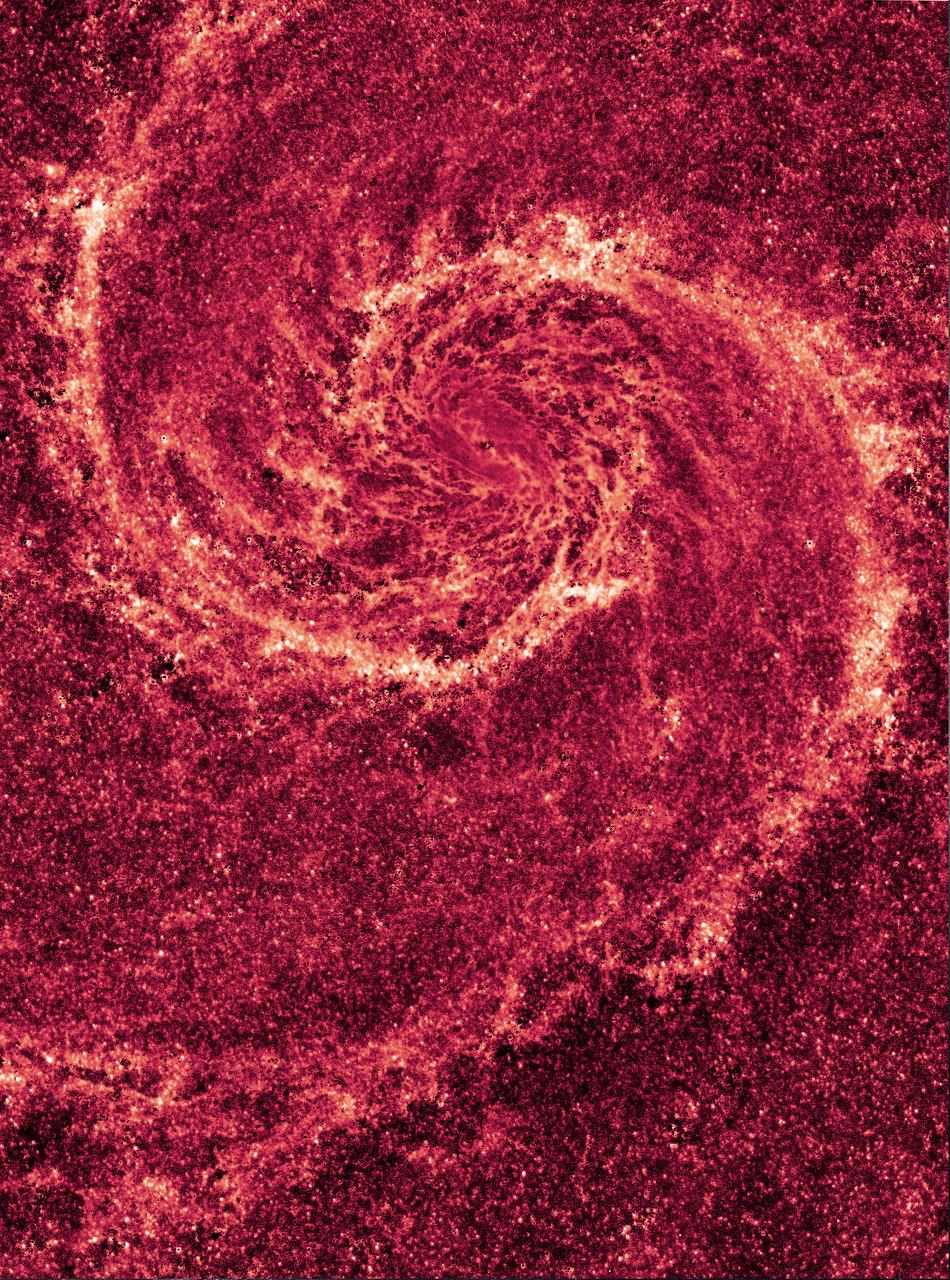
NASA image release January 13, 2011 <b><a href="http://www.flickr.com/photos/gsfc/5352962836">These images</a></b> by NASA's Hubble Space Telescope show off two dramatically different face-on views of the spiral galaxy M51, dubbed the Whirlpool Galaxy. <b><a href="http://www.flickr.com/photos/gsfc/5352955200/">The image here,</a></b> taken in visible light, highlights the attributes of a typical spiral galaxy, including graceful, curving arms, pink star-forming regions, and brilliant blue strands of star clusters. <b>In the image above,</b> most of the starlight has been removed, revealing the Whirlpool's skeletal dust structure, as seen in near-infrared light. This new image is the sharpest view of the dense dust in M51. The narrow lanes of dust revealed by Hubble reflect the galaxy's moniker, the Whirlpool Galaxy, as if they were swirling toward the galaxy's core. To map the galaxy's dust structure, researchers collected the galaxy's starlight by combining images taken in visible and near-infrared light. The visible-light image captured only some of the light; the rest was obscured by dust. The near-infrared view, however, revealed more starlight because near-infrared light penetrates dust. The researchers then subtracted the total amount of starlight from both images to see the galaxy's dust structure. The red color in the near-infrared image traces the dust, which is punctuated by hundreds of tiny clumps of stars, each about 65 light-years wide. These stars have never been seen before. The star clusters cannot be seen in visible light because dense dust enshrouds them. The image reveals details as small as 35 light-years across. Astronomers expected to see large dust clouds, ranging from about 100 light-years to more than 300 light-years wide. Instead, most of the dust is tied up in smooth and diffuse dust lanes. An encounter with another galaxy may have prevented giant clouds from forming. Probing a galaxy's dust structure serves as an important diagnostic tool for astronomers, providing invaluable information on how the gas and dust collapse to form stars. Although Hubble is providing incisive views of the internal structure of galaxies such as M51, the planned James Webb Space Telescope (JWST) is expected to produce even crisper images. Researchers constructed the image by combining visible-light exposures from Jan. 18 to 22, 2005, with the Advanced Camera for Surveys (ACS), and near-infrared light pictures taken in December 2005 with the Near Infrared Camera and Multi-Object Spectrometer (NICMOS). The Hubble Space Telescope is a project of international cooperation between NASA and the European Space Agency. NASA's Goddard Space Flight Center manages the telescope. The Space Telescope Science Institute (STScI) conducts Hubble science operations. STScI is operated for NASA by the Association of Universities for Research in Astronomy, Inc., in Washington, D.C. <b><a href="http://www.nasa.gov/centers/goddard/home/index.html" rel="nofollow">NASA Goddard Space Flight Center</a></b> enables NASA’s mission through four scientific endeavors: Earth Science, Heliophysics, Solar System Exploration, and Astrophysics. Goddard plays a leading role in NASA’s accomplishments by contributing compelling scientific knowledge to advance the Agency’s mission. <b>Follow us on <a href="http://twitter.com/NASA_GoddardPix" rel="nofollow">Twitter</a></b> <b>Join us on <a href="http://www.facebook.com/pages/Greenbelt-MD/NASA-Goddard/395013845897?ref=tsd" rel="nofollow">Facebook</a></b> Credit: NASA, ESA, M. Regan and B. Whitmore (STScI), and R. Chandar (University of Toledo)
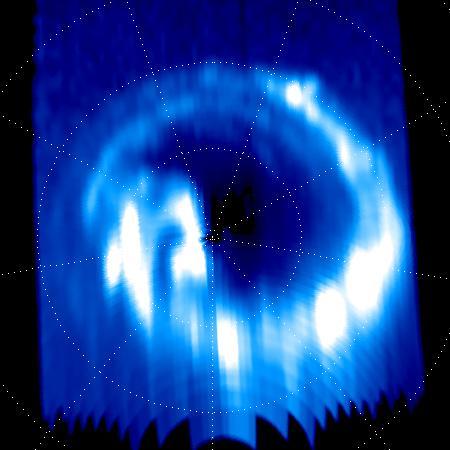
On Sept. 14, 2017, one day before making its final plunge into Saturn's atmosphere, NASA's Cassini spacecraft used its Ultraviolet Imaging Spectrograph, or UVIS, instrument to capture this final view of ultraviolet auroral emissions in the planet's north polar region. The view is centered on the north pole of Saturn, with lines of latitude visible for 80, 70 and 60 degrees. Lines of longitude are spaced 40 degrees apart. The planet's day side is at bottom, while the night side is at top. A sequence of images from this observation has also been assembled into a movie sequence. The last image in the movie was taken about an hour before the still image, which was the actual final UVIS auroral image. Auroral emissions are generated by charged particles traveling along the invisible lines of Saturn's magnetic field. These particles precipitate into the atmosphere, releasing light when they strike gas molecules there. Several individual auroral structures are visible here, despite that this UVIS view was acquired at a fairly large distance from the planet (about 424,000 miles or 683,000 kilometers). Each of these features is connected to a particular phenomenon in Saturn's magnetosphere. For instance, it is possible to identify auroral signatures here that are related to the injection of hot plasma from the dayside magnetosphere, as well as auroral features associated with a change in the magnetic field's shape on the magnetosphere's night side. Several possible scenarios have been postulated over the years to explain Saturn's changing auroral emissions, but researchers are still far from a complete understanding of this complicated puzzle. Researchers will continue to analyze the hundreds of image sequences UVIS obtained of Saturn's auroras during Cassini's 13-year mission, with many new discoveries likely to be made. This image and movie sequence were produced by the Laboratory for Planetary and Atmospheric Physics (LPAP) of the STAR Institute of the University of Liege in Belgium, in collaboration with the UVIS Team. The animation is available at https://photojournal.jpl.nasa.gov/catalog/PIA21899
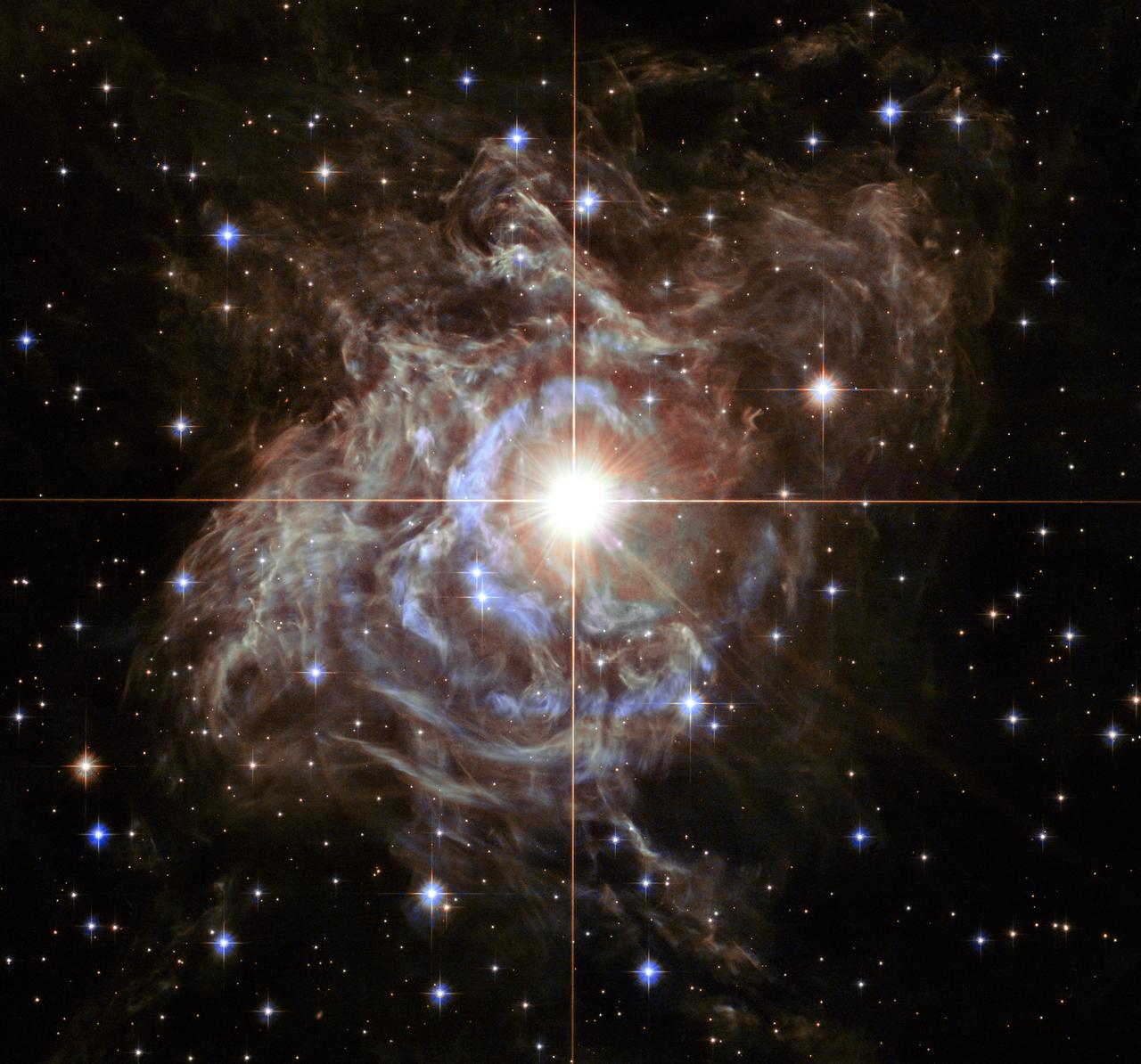
This festive NASA Hubble Space Telescope image resembles a holiday wreath made of sparkling lights. The bright southern hemisphere star RS Puppis, at the center of the image, is swaddled in a gossamer cocoon of reflective dust illuminated by the glittering star. The super star is ten times more massive than our sun and 200 times larger. RS Puppis rhythmically brightens and dims over a six-week cycle. It is one of the most luminous in the class of so-called Cepheid variable stars. Its average intrinsic brightness is 15,000 times greater than our sun’s luminosity. The nebula flickers in brightness as pulses of light from the Cepheid propagate outwards. Hubble took a series of photos of light flashes rippling across the nebula in a phenomenon known as a "light echo." Even though light travels through space fast enough to span the gap between Earth and the moon in a little over a second, the nebula is so large that reflected light can actually be photographed traversing the nebula. By observing the fluctuation of light in RS Puppis itself, as well as recording the faint reflections of light pulses moving across the nebula, astronomers are able to measure these light echoes and pin down a very accurate distance. The distance to RS Puppis has been narrowed down to 6,500 light-years (with a margin of error of only one percent). The Hubble Space Telescope is a project of international cooperation between NASA and the European Space Agency. NASA's Goddard Space Flight Center in Greenbelt, Md., manages the telescope. The Space Telescope Science Institute (STScI) in Baltimore, Md., conducts Hubble science operations. STScI is operated by the Association of Universities for Research in Astronomy, Inc., in Washington, D.C. Acknowledgment: H. Bond (STScI and Pennsylvania State University) <b><a href="http://www.nasa.gov/audience/formedia/features/MP_Photo_Guidelines.html" rel="nofollow">NASA image use policy.</a></b> <b><a href="http://www.nasa.gov/centers/goddard/home/index.html" rel="nofollow">NASA Goddard Space Flight Center</a></b> enables NASA’s mission through four scientific endeavors: Earth Science, Heliophysics, Solar System Exploration, and Astrophysics. Goddard plays a leading role in NASA’s accomplishments by contributing compelling scientific knowledge to advance the Agency’s mission. <b>Follow us on <a href="http://twitter.com/NASA_GoddardPix" rel="nofollow">Twitter</a></b> <b>Like us on <a href="http://www.facebook.com/pages/Greenbelt-MD/NASA-Goddard/395013845897?ref=tsd" rel="nofollow">Facebook</a></b> <b>Find us on <a href="http://instagram.com/nasagoddard?vm=grid" rel="nofollow">Instagram</a></b>
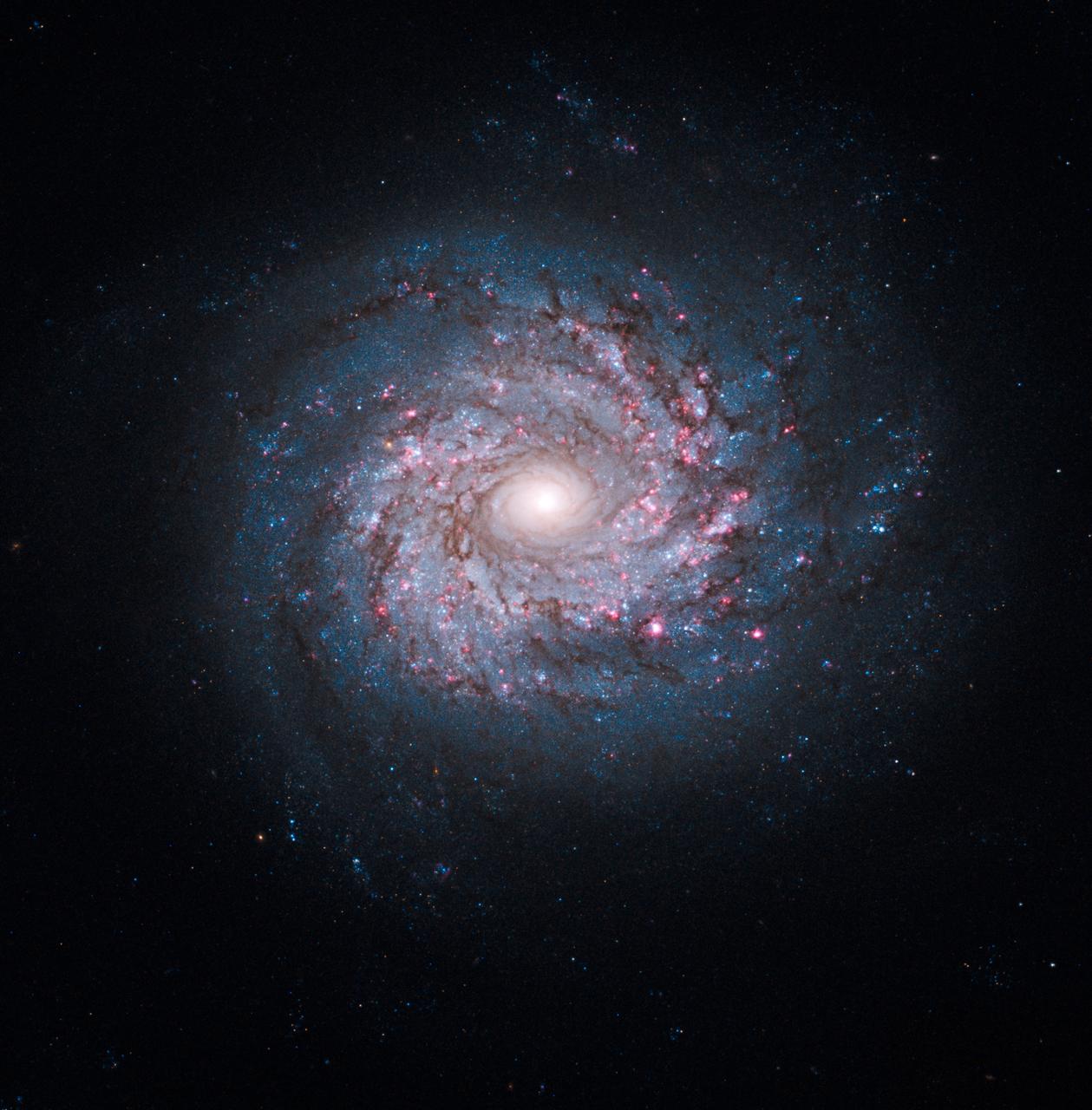
NASA image release October 19, 2010 Though the universe is chock full of spiral-shaped galaxies, no two look exactly the same. This face-on spiral galaxy, called NGC 3982, is striking for its rich tapestry of star birth, along with its winding arms. The arms are lined with pink star-forming regions of glowing hydrogen, newborn blue star clusters, and obscuring dust lanes that provide the raw material for future generations of stars. The bright nucleus is home to an older population of stars, which grow ever more densely packed toward the center. NGC 3982 is located about 68 million light-years away in the constellation Ursa Major. The galaxy spans about 30,000 light-years, one-third of the size of our Milky Way galaxy. This color image is composed of exposures taken by the Hubble Space Telescope's Wide Field Planetary Camera 2 (WFPC2), the Advanced Camera for Surveys (ACS), and the Wide Field Camera 3 (WFC3). The observations were taken between March 2000 and August 2009. The rich color range comes from the fact that the galaxy was photographed invisible and near-infrared light. Also used was a filter that isolates hydrogen emission that emanates from bright star-forming regions dotting the spiral arms. The Hubble Space Telescope is a project of international cooperation between NASA and the European Space Agency. NASA's Goddard Space Flight Center manages the telescope. The Space Telescope Science Institute (STScI) conducts Hubble science operations. STScI is operated for NASA by the Association of Universities for Research in Astronomy, Inc. in Washington, D.C. Credit: NASA, ESA, and the Hubble Heritage Team (STScI/AURA) Acknowledgment: A. Riess (STScI) <b><a href="http://www.nasa.gov/centers/goddard/home/index.html" rel="nofollow">NASA Goddard Space Flight Center</a></b> enables NASA’s mission through four scientific endeavors: Earth Science, Heliophysics, Solar System Exploration, and Astrophysics. Goddard plays a leading role in NASA’s accomplishments by contributing compelling scientific knowledge to advance the Agency’s mission. <b>Follow us on <a href="http://twitter.com/NASA_GoddardPix" rel="nofollow">Twitter</a></b> <b>Join us on <a href="http://www.facebook.com/pages/Greenbelt-MD/NASA-Goddard/395013845897?ref=tsd" rel="nofollow">Facebook</a></b>
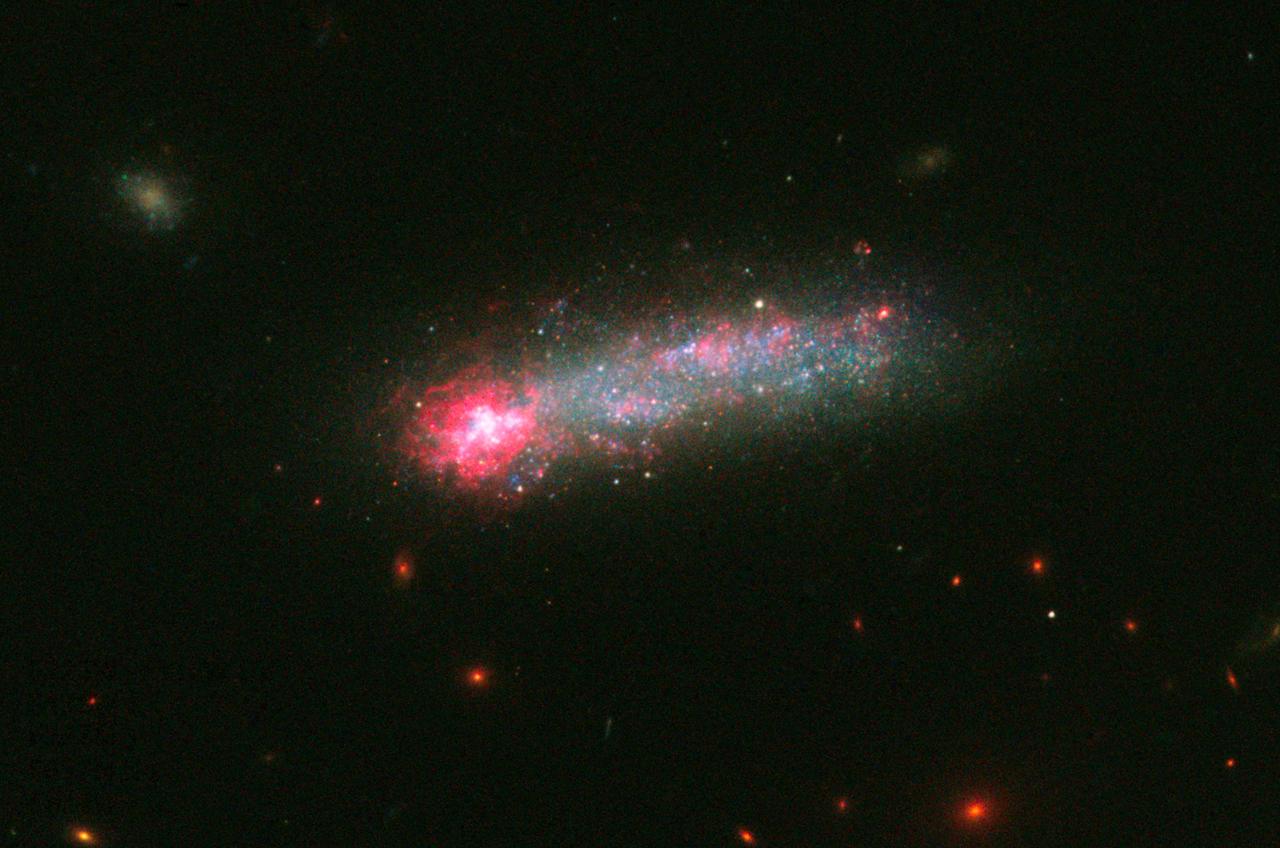
Fireworks shows are not just confined to Earth’s skies. NASA’s Hubble Space Telescope has captured a spectacular fireworks display in a small, nearby galaxy, which resembles a July 4th skyrocket. A firestorm of star birth is lighting up one end of the diminutive galaxy Kiso 5639. The dwarf galaxy is shaped like a flattened pancake, but because it is tilted edge-on, it resembles a skyrocket, with a brilliant blazing head and a long, star-studded tail. Kiso 5639 is a rare, nearby example of elongated galaxies that occur in abundance at larger distances, where we observe the universe during earlier epochs. Astronomers suggest that the frenzied star birth is sparked by intergalactic gas raining on one end of the galaxy as it drifts through space. “I think Kiso 5639 is a beautiful, up-close example of what must have been common long ago,” said lead researcher Debra Elmegreen of Vassar College, in Poughkeepsie, New York. “The current thinking is that galaxies in the early universe grow from accreting gas from the surrounding neighborhood. It’s a stage that galaxies, including our Milky Way, must go through as they are growing up.” Observations of the early universe, such as Hubble’s Ultra-Deep Field, reveal that about 10 percent of all galaxies have these elongated shapes, and are collectively called “tadpoles.” But studies of the nearby universe have turned up only a few of these unusual galaxies, including Kiso 5639. The development of the nearby star-making tadpole galaxies, however, has lagged behind that of their peers, which have spent billions of years building themselves up into many of the spiral galaxies seen today. Elmegreen used Hubble’s Wide Field Camera 3 to conduct a detailed imaging study of Kiso 5639. The images in different filters reveal information about an object by dissecting its light into its component colors. Hubble’s crisp resolution helped Elmegreen and her team analyze the giant star-forming clumps in Kiso 5639 and determine the masses and ages of the star clusters. The international team of researchers selected Kiso 5639 from a spectroscopic survey of 10 nearby tadpole galaxies, observed with the Grand Canary Telescope in La Palma, Spain, by Jorge Sanchez Almeida and collaborators at the Instituto de Astrofisica de Canarias. The observations revealed that in most of those galaxies, including Kiso 5639, the gas composition is not uniform. The bright gas in the galaxy’s head contains fewer heavier elements (collectively called “metals”), such as carbon and oxygen, than the rest of the galaxy. Stars consist mainly of hydrogen and helium, but cook up other “heavier” elements. When the stars die, they release their heavy elements and enrich the surrounding gas. “The metallicity suggests that there has to be rather pure gas, composed mostly of hydrogen, coming into the star-forming part of the galaxy, because intergalactic space contains more pristine hydrogen-rich gas,” Elmegreen explained. “Otherwise, the starburst region should be as rich in heavy elements as the rest of the galaxy.” Hubble offers a detailed view of the galaxy’s star-making frenzy. The telescope uncovered several dozen clusters of stars in the galaxy’s star-forming head, which spans 2,700 light-years across. These clusters have an average age of less than 1 million years and masses that are three to six times larger than those in the rest of the galaxy. Other star formation is taking place throughout the galaxy but on a much smaller scale. Star clusters in the rest of the galaxy are between several million to a few billion years old. “There is much more star formation going on in the head than what you would expect in such a tiny galaxy,” said team member Bruce Elmegreen of IBM’s Thomas J. Watson’s Research Center, in Yorktown Heights, New York. “And we think the star formation is triggered by the ongoing accretion of metal-poor gas onto a part of an otherwise quiescent dwarf galaxy.” Hubble also revealed giant holes peppered throughout the galaxy’s starburst head. These cavities give the galaxy’s head a Swiss-cheese appearance because numerous supernova detonations – like firework aerial bursts – have carved out holes of rarified superheated gas. The galaxy, located 82 million light-years away, has taken billions of years to develop because it has been drifting through an isolated “desert” in the universe, devoid of much gas. What triggered the starburst in such a backwater galaxy? Based on simulations by Daniel Ceverino of the Center for Astronomy at Heidelberg University in Germany, and other team members, the observations suggest that less than 1 million years ago, Kiso 5639’s leading edge encountered a filament of gas. The filament dropped a large clump of matter onto the galaxy, stoking the vigorous star birth. Debra Elmegreen expects that in the future other parts of the galaxy will join in the star-making fireworks show. “Galaxies rotate, and as Kiso 5639 continues to spin, another part of the galaxy may receive an infusion of new gas from this filament, instigating another round of star birth,” she said. The team’s results have been accepted for publication in The Astrophysical Journal. Other team members include Casiana Munoz-Tunon and Mercedes Filho (Instituto de Astrofísica de Canarias, Canary Islands), Jairo Mendez-Abreu (University of St. Andrews, United Kingdom), John Gallagher (University of Wisconsin-Madison), and Marc Rafelski (NASA's Goddard Space Flight Center, Greenbelt, Maryland). The Hubble Space Telescope is a project of international cooperation between NASA and the European Space Agency. NASA's Goddard Space Flight Center in Greenbelt, Maryland, manages the telescope. The Space Telescope Science Institute (STScI) in Baltimore, Maryland, conducts Hubble science operations. STScI is operated for NASA by the Association of Universities for Research in Astronomy in Washington, D.C. For images and more information about Kiso 5639 and Hubble, visit: <a href="http://hubblesite.org/news/2016/23" rel="nofollow">hubblesite.org/news/2016/23</a> <a href="http://www.nasa.gov/hubble" rel="nofollow">www.nasa.gov/hubble</a> Image credit: NASA, ESA, and D. Elmegreen (Vassar College) <b><a href="http://www.nasa.gov/audience/formedia/features/MP_Photo_Guidelines.html" rel="nofollow">NASA image use policy.</a></b> <b><a href="http://www.nasa.gov/centers/goddard/home/index.html" rel="nofollow">NASA Goddard Space Flight Center</a></b> enables NASA’s mission through four scientific endeavors: Earth Science, Heliophysics, Solar System Exploration, and Astrophysics. Goddard plays a leading role in NASA’s accomplishments by contributing compelling scientific knowledge to advance the Agency’s mission. <b>Follow us on <a href="http://twitter.com/NASAGoddardPix" rel="nofollow">Twitter</a></b> <b>Like us on <a href="http://www.facebook.com/pages/Greenbelt-MD/NASA-Goddard/395013845897?ref=tsd" rel="nofollow">Facebook</a></b> <b>Find us on <a href="http://instagrid.me/nasagoddard/?vm=grid" rel="nofollow">Instagram</a></b>

Fireworks shows are not just confined to Earth’s skies. NASA’s Hubble Space Telescope has captured a spectacular fireworks display in a small, nearby galaxy, which resembles a July 4th skyrocket. A firestorm of star birth is lighting up one end of the diminutive galaxy Kiso 5639. The dwarf galaxy is shaped like a flattened pancake, but because it is tilted edge-on, it resembles a skyrocket, with a brilliant blazing head and a long, star-studded tail. Kiso 5639 is a rare, nearby example of elongated galaxies that occur in abundance at larger distances, where we observe the universe during earlier epochs. Astronomers suggest that the frenzied star birth is sparked by intergalactic gas raining on one end of the galaxy as it drifts through space. “I think Kiso 5639 is a beautiful, up-close example of what must have been common long ago,” said lead researcher Debra Elmegreen of Vassar College, in Poughkeepsie, New York. “The current thinking is that galaxies in the early universe grow from accreting gas from the surrounding neighborhood. It’s a stage that galaxies, including our Milky Way, must go through as they are growing up.” Observations of the early universe, such as Hubble’s Ultra-Deep Field, reveal that about 10 percent of all galaxies have these elongated shapes, and are collectively called “tadpoles.” But studies of the nearby universe have turned up only a few of these unusual galaxies, including Kiso 5639. The development of the nearby star-making tadpole galaxies, however, has lagged behind that of their peers, which have spent billions of years building themselves up into many of the spiral galaxies seen today. Elmegreen used Hubble’s Wide Field Camera 3 to conduct a detailed imaging study of Kiso 5639. The images in different filters reveal information about an object by dissecting its light into its component colors. Hubble’s crisp resolution helped Elmegreen and her team analyze the giant star-forming clumps in Kiso 5639 and determine the masses and ages of the star clusters. The international team of researchers selected Kiso 5639 from a spectroscopic survey of 10 nearby tadpole galaxies, observed with the Grand Canary Telescope in La Palma, Spain, by Jorge Sanchez Almeida and collaborators at the Instituto de Astrofisica de Canarias. The observations revealed that in most of those galaxies, including Kiso 5639, the gas composition is not uniform. The bright gas in the galaxy’s head contains fewer heavier elements (collectively called “metals”), such as carbon and oxygen, than the rest of the galaxy. Stars consist mainly of hydrogen and helium, but cook up other “heavier” elements. When the stars die, they release their heavy elements and enrich the surrounding gas. “The metallicity suggests that there has to be rather pure gas, composed mostly of hydrogen, coming into the star-forming part of the galaxy, because intergalactic space contains more pristine hydrogen-rich gas,” Elmegreen explained. “Otherwise, the starburst region should be as rich in heavy elements as the rest of the galaxy.” Hubble offers a detailed view of the galaxy’s star-making frenzy. The telescope uncovered several dozen clusters of stars in the galaxy’s star-forming head, which spans 2,700 light-years across. These clusters have an average age of less than 1 million years and masses that are three to six times larger than those in the rest of the galaxy. Other star formation is taking place throughout the galaxy but on a much smaller scale. Star clusters in the rest of the galaxy are between several million to a few billion years old. “There is much more star formation going on in the head than what you would expect in such a tiny galaxy,” said team member Bruce Elmegreen of IBM’s Thomas J. Watson’s Research Center, in Yorktown Heights, New York. “And we think the star formation is triggered by the ongoing accretion of metal-poor gas onto a part of an otherwise quiescent dwarf galaxy.” Hubble also revealed giant holes peppered throughout the galaxy’s starburst head. These cavities give the galaxy’s head a Swiss-cheese appearance because numerous supernova detonations – like firework aerial bursts – have carved out holes of rarified superheated gas. The galaxy, located 82 million light-years away, has taken billions of years to develop because it has been drifting through an isolated “desert” in the universe, devoid of much gas. What triggered the starburst in such a backwater galaxy? Based on simulations by Daniel Ceverino of the Center for Astronomy at Heidelberg University in Germany, and other team members, the observations suggest that less than 1 million years ago, Kiso 5639’s leading edge encountered a filament of gas. The filament dropped a large clump of matter onto the galaxy, stoking the vigorous star birth. Debra Elmegreen expects that in the future other parts of the galaxy will join in the star-making fireworks show. “Galaxies rotate, and as Kiso 5639 continues to spin, another part of the galaxy may receive an infusion of new gas from this filament, instigating another round of star birth,” she said. The team’s results have been accepted for publication in The Astrophysical Journal. Other team members include Casiana Munoz-Tunon and Mercedes Filho (Instituto de Astrofísica de Canarias, Canary Islands), Jairo Mendez-Abreu (University of St. Andrews, United Kingdom), John Gallagher (University of Wisconsin-Madison), and Marc Rafelski (NASA's Goddard Space Flight Center, Greenbelt, Maryland). The Hubble Space Telescope is a project of international cooperation between NASA and the European Space Agency. NASA's Goddard Space Flight Center in Greenbelt, Maryland, manages the telescope. The Space Telescope Science Institute (STScI) in Baltimore, Maryland, conducts Hubble science operations. STScI is operated for NASA by the Association of Universities for Research in Astronomy in Washington, D.C.

For the 26th birthday of NASA’s Hubble Space Telescope, astronomers are highlighting a Hubble image of an enormous bubble being blown into space by a super-hot, massive star. The Hubble image of the Bubble Nebula, or NGC 7635, was chosen to mark the 26th anniversary of the launch of Hubble into Earth orbit by the STS-31 space shuttle crew on April 24, 1990 “As Hubble makes its 26th revolution around our home star, the sun, we celebrate the event with a spectacular image of a dynamic and exciting interaction of a young star with its environment. The view of the Bubble Nebula, crafted from WFC-3 images, reminds us that Hubble gives us a front row seat to the awe inspiring universe we live in,” said John Grunsfeld, Hubble astronaut and associate administrator of NASA’s Science Mission Directorate at NASA Headquarters, in Washington, D.C. The Bubble Nebula is seven light-years across—about one-and-a-half times the distance from our sun to its nearest stellar neighbor, Alpha Centauri, and resides 7,100 light-years from Earth in the constellation Cassiopeia. The seething star forming this nebula is 45 times more massive than our sun. Gas on the star gets so hot that it escapes away into space as a “stellar wind” moving at over four million miles per hour. This outflow sweeps up the cold, interstellar gas in front of it, forming the outer edge of the bubble much like a snowplow piles up snow in front of it as it moves forward. As the surface of the bubble's shell expands outward, it slams into dense regions of cold gas on one side of the bubble. This asymmetry makes the star appear dramatically off-center from the bubble, with its location in the 10 o’clock position in the Hubble view. Dense pillars of cool hydrogen gas laced with dust appear at the upper left of the picture, and more “fingers” can be seen nearly face-on, behind the translucent bubble. The gases heated to varying temperatures emit different colors: oxygen is hot enough to emit blue light in the bubble near the star, while the cooler pillars are yellow from the combined light of hydrogen and nitrogen. The pillars are similar to the iconic columns in the “Pillars of Creation” Eagle Nebula. As seen with the structures in the Eagle Nebula, the Bubble Nebula pillars are being illuminated by the strong ultraviolet radiation from the brilliant star inside the bubble. The Bubble Nebula was discovered in 1787 by William Herschel, a prominent British astronomer. It is being formed by a proto-typical Wolf-Rayet star, BD +60º2522, an extremely bright, massive, and short-lived star that has lost most of its outer hydrogen and is now fusing helium into heavier elements. The star is about four million years old, and in 10 million to 20 million years, it will likely detonate as a supernova. Hubble’s Wide Field Camera-3 imaged the nebula in visible light with unprecedented clarity in February 2016. The colors correspond to blue for oxygen, green for hydrogen, and red for nitrogen. This information will help astronomers understand the geometry and dynamics of this complex system. The Bubble Nebula is one of only a handful of astronomical objects that have been observed with several different instruments onboard Hubble. Hubble also imaged it with the Wide Field Planetary Camera (WFPC) in September 1992, and with Wide Field Planetary Camera-2 (WFPC2) in April 1999. The Hubble Space Telescope is a project of international cooperation between NASA and the European Space Agency. NASA's Goddard Space Flight Center in Greenbelt, Maryland, manages the telescope. The Space Telescope Science Institute (STScI) in Baltimore, Maryland, conducts Hubble science operations. STScI is operated for NASA by the Association of Universities for Research in Astronomy in Washington, D.C. Credit: NASA, ESA, and the Hubble Heritage Team (STScI/AURA)

For the 26th birthday of NASA’s Hubble Space Telescope, astronomers are highlighting a Hubble image of an enormous bubble being blown into space by a super-hot, massive star. The Hubble image of the Bubble Nebula, or NGC 7635, was chosen to mark the 26th anniversary of the launch of Hubble into Earth orbit by the STS-31 space shuttle crew on April 24, 1990 “As Hubble makes its 26th revolution around our home star, the sun, we celebrate the event with a spectacular image of a dynamic and exciting interaction of a young star with its environment. The view of the Bubble Nebula, crafted from WFC-3 images, reminds us that Hubble gives us a front row seat to the awe inspiring universe we live in,” said John Grunsfeld, Hubble astronaut and associate administrator of NASA’s Science Mission Directorate at NASA Headquarters, in Washington, D.C. The Bubble Nebula is seven light-years across—about one-and-a-half times the distance from our sun to its nearest stellar neighbor, Alpha Centauri, and resides 7,100 light-years from Earth in the constellation Cassiopeia. The seething star forming this nebula is 45 times more massive than our sun. Gas on the star gets so hot that it escapes away into space as a “stellar wind” moving at over four million miles per hour. This outflow sweeps up the cold, interstellar gas in front of it, forming the outer edge of the bubble much like a snowplow piles up snow in front of it as it moves forward. As the surface of the bubble's shell expands outward, it slams into dense regions of cold gas on one side of the bubble. This asymmetry makes the star appear dramatically off-center from the bubble, with its location in the 10 o’clock position in the Hubble view. Dense pillars of cool hydrogen gas laced with dust appear at the upper left of the picture, and more “fingers” can be seen nearly face-on, behind the translucent bubble. The gases heated to varying temperatures emit different colors: oxygen is hot enough to emit blue light in the bubble near the star, while the cooler pillars are yellow from the combined light of hydrogen and nitrogen. The pillars are similar to the iconic columns in the “Pillars of Creation” Eagle Nebula. As seen with the structures in the Eagle Nebula, the Bubble Nebula pillars are being illuminated by the strong ultraviolet radiation from the brilliant star inside the bubble. The Bubble Nebula was discovered in 1787 by William Herschel, a prominent British astronomer. It is being formed by a proto-typical Wolf-Rayet star, BD +60º2522, an extremely bright, massive, and short-lived star that has lost most of its outer hydrogen and is now fusing helium into heavier elements. The star is about four million years old, and in 10 million to 20 million years, it will likely detonate as a supernova. Hubble’s Wide Field Camera-3 imaged the nebula in visible light with unprecedented clarity in February 2016. The colors correspond to blue for oxygen, green for hydrogen, and red for nitrogen. This information will help astronomers understand the geometry and dynamics of this complex system. The Bubble Nebula is one of only a handful of astronomical objects that have been observed with several different instruments onboard Hubble. Hubble also imaged it with the Wide Field Planetary Camera (WFPC) in September 1992, and with Wide Field Planetary Camera-2 (WFPC2) in April 1999. The Hubble Space Telescope is a project of international cooperation between NASA and the European Space Agency. NASA's Goddard Space Flight Center in Greenbelt, Maryland, manages the telescope. The Space Telescope Science Institute (STScI) in Baltimore, Maryland, conducts Hubble science operations. STScI is operated for NASA by the Association of Universities for Research in Astronomy in Washington, D.C. Credit: NASA, ESA, and the Hubble Heritage Team (STScI/AURA)
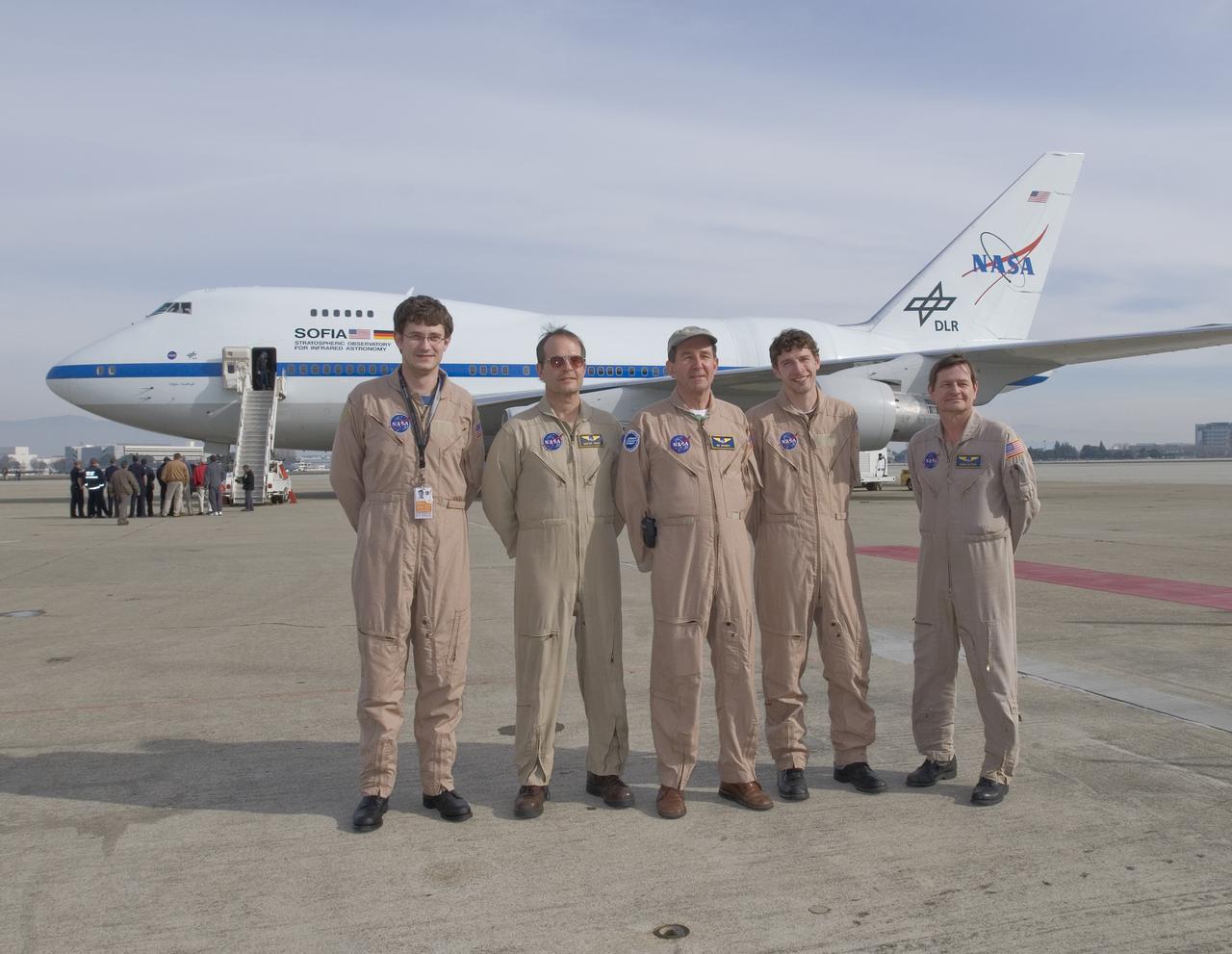
The flight crew of NASA's SOFIA airborne observatory and DLR telescope engineers who operated the system during its visit to NASA Ames Research Center on Jan. 14, 2008 included (from left), DLR telescope engineer Ulli Lampater, flight engineer Marty Trout, pilot Bill Brockett, telescope engineer Andres Reinacher and pilot Frank Batteas.
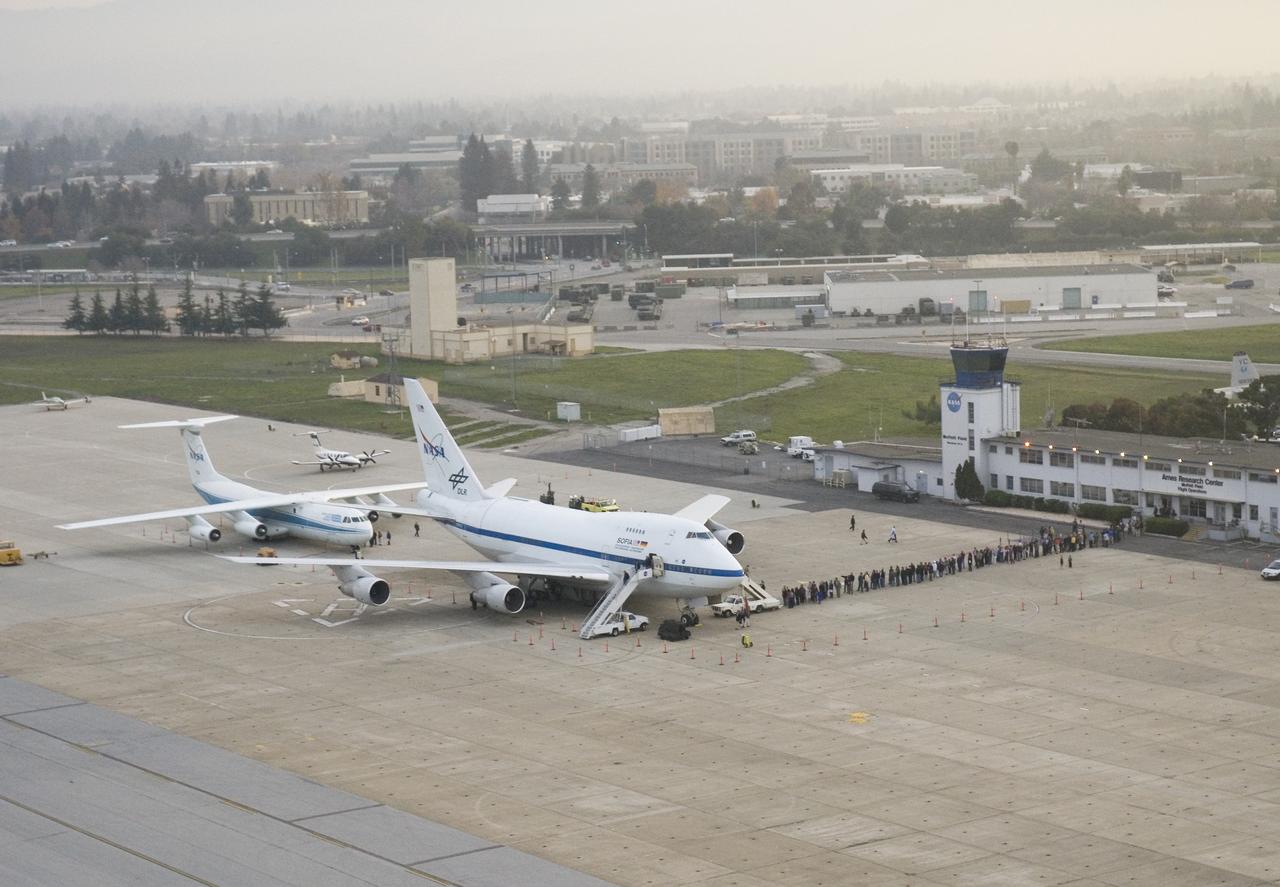
NASA's new SOFIA observatory shared the ramp with its predecessor, the now-retired Kuiper Airborne Observatory, during open house at NASA Ames Research Center.

NASA's Stratospheric Observatory for Infrared Astronomy touches down at Moffett Field, Calif., for its first visit to NASA Ames Research Center, Jan. 14, 2008.
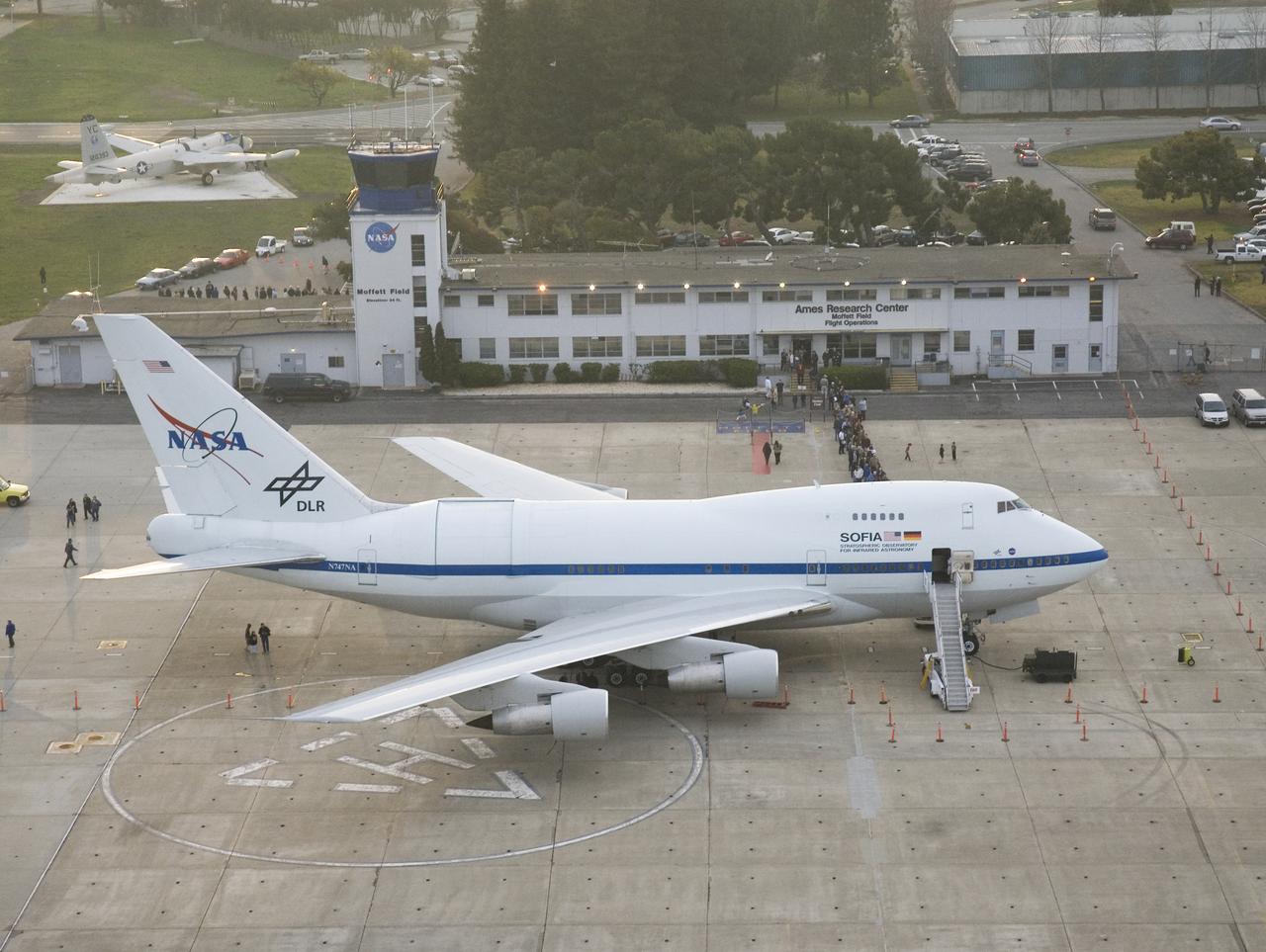
Thousands of NASA Ames employees and their families toured NASA's SOFIA flying observatory during its first visit to NASA Ames Research Center, Jan. 14, 2008.

NASA's SOFIA infrared observatory 747SP is shadowed by a NASA F/A-18 during a flyby at its new home, the Dryden Aircraft Operations Facility in Palmdale, Calif.
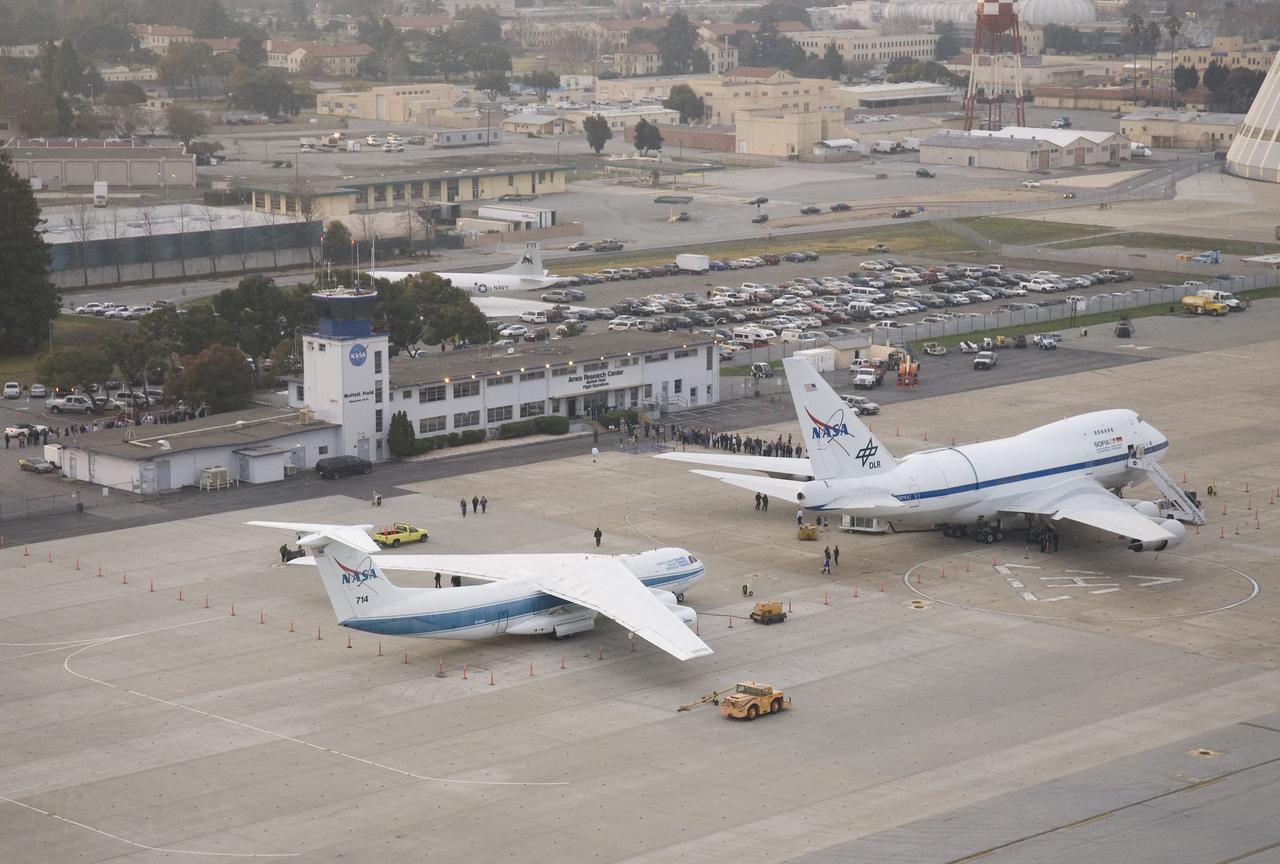
NASA's now-retired Kuiper Airborne Observatory shared the limelight with its successor, the SOFIA observatory, during an open house at Ames Research Center.
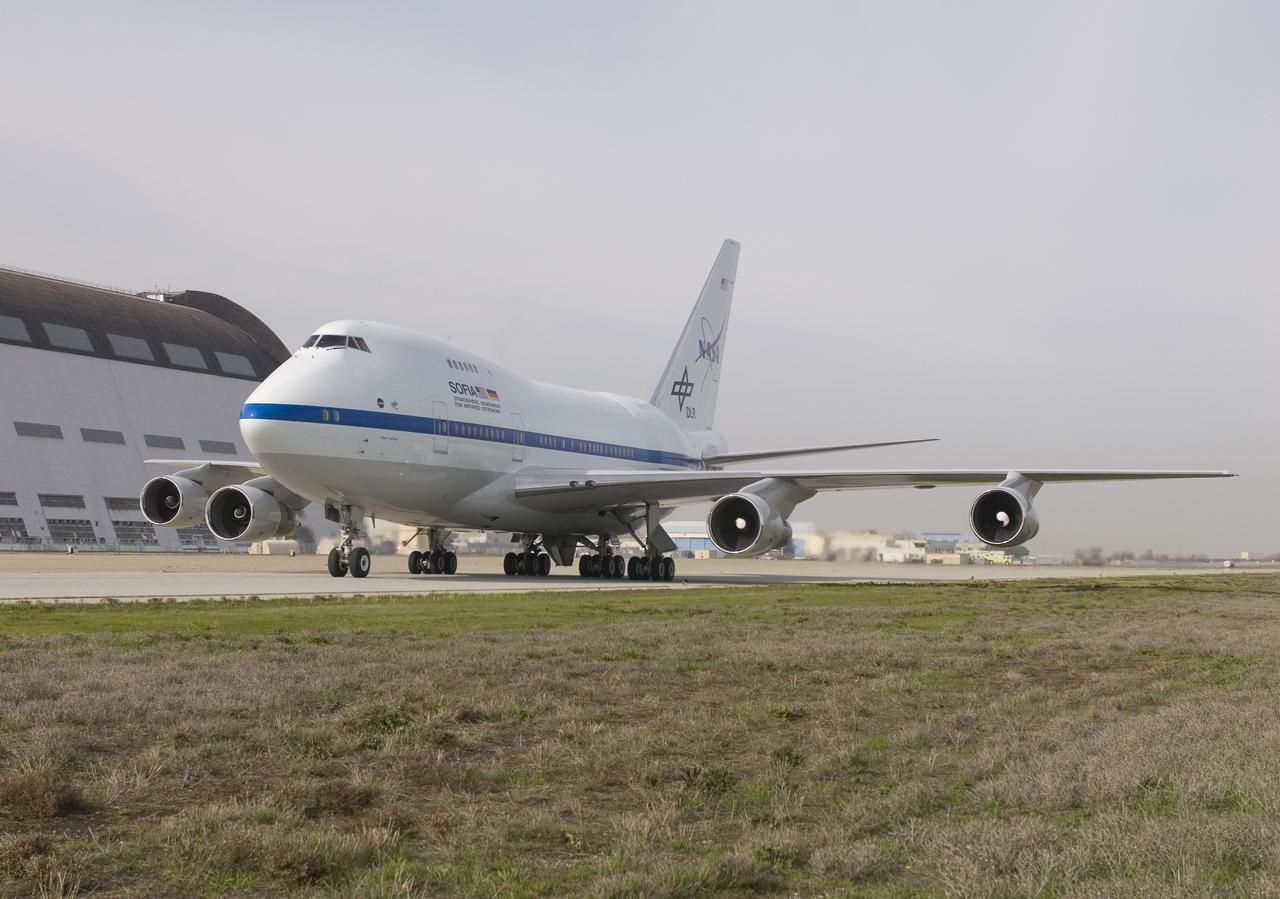
NASA's SOFIA airborne observatory taxis past Hangar 1, the 1930s-era dirigible hangar at Moffett Field, during its first visit to NASA Ames Research Center.
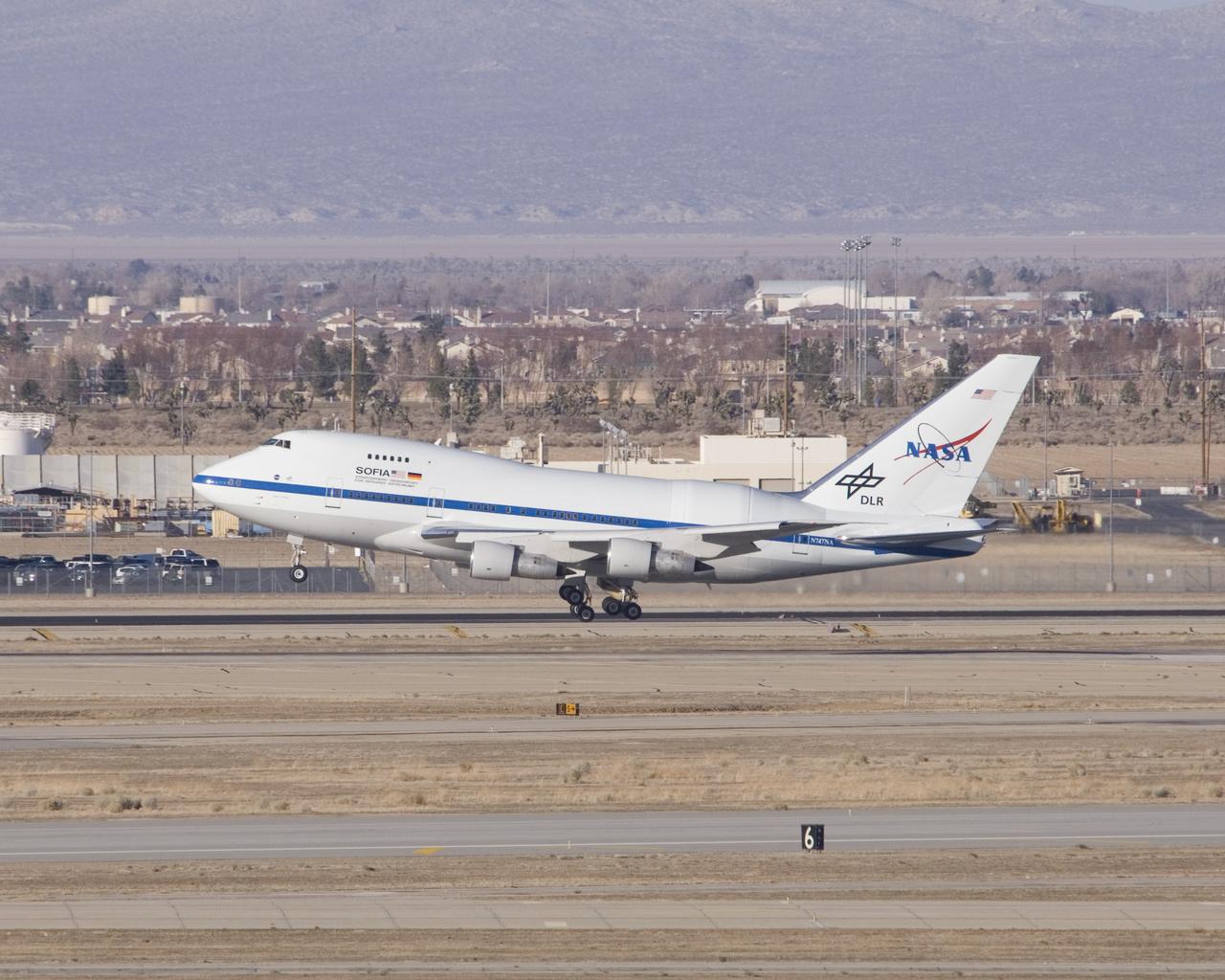
NASA's SOFIA infrared observatory touches down at Air Force Plant 42 in Palmdale, Calif., as it arrives at its new home, the Dryden Aircraft Operations Facility.

NASA image release January 13, 2011 <b><a href="http://www.flickr.com/photos/gsfc/5352962836">These images</a></b> by NASA's Hubble Space Telescope show off two dramatically different face-on views of the spiral galaxy M51, dubbed the Whirlpool Galaxy. <b>The image above,</b> taken in visible light, highlights the attributes of a typical spiral galaxy, including graceful, curving arms, pink star-forming regions, and brilliant blue strands of star clusters. <b><a href="http://www.flickr.com/photos/gsfc/5352344517">In the image here,</a></b> most of the starlight has been removed, revealing the Whirlpool's skeletal dust structure, as seen in near-infrared light. This new image is the sharpest view of the dense dust in M51. The narrow lanes of dust revealed by Hubble reflect the galaxy's moniker, the Whirlpool Galaxy, as if they were swirling toward the galaxy's core. To map the galaxy's dust structure, researchers collected the galaxy's starlight by combining images taken in visible and near-infrared light. The visible-light image captured only some of the light; the rest was obscured by dust. The near-infrared view, however, revealed more starlight because near-infrared light penetrates dust. The researchers then subtracted the total amount of starlight from both images to see the galaxy's dust structure. The red color in the near-infrared image traces the dust, which is punctuated by hundreds of tiny clumps of stars, each about 65 light-years wide. These stars have never been seen before. The star clusters cannot be seen in visible light because dense dust enshrouds them. The image reveals details as small as 35 light-years across. Astronomers expected to see large dust clouds, ranging from about 100 light-years to more than 300 light-years wide. Instead, most of the dust is tied up in smooth and diffuse dust lanes. An encounter with another galaxy may have prevented giant clouds from forming. Probing a galaxy's dust structure serves as an important diagnostic tool for astronomers, providing invaluable information on how the gas and dust collapse to form stars. Although Hubble is providing incisive views of the internal structure of galaxies such as M51, the planned James Webb Space Telescope (JWST) is expected to produce even crisper images. Researchers constructed the image by combining visible-light exposures from Jan. 18 to 22, 2005, with the Advanced Camera for Surveys (ACS), and near-infrared light pictures taken in December 2005 with the Near Infrared Camera and Multi-Object Spectrometer (NICMOS). Credit: NASA, ESA, S. Beckwith (STScI), and the Hubble Heritage Team (STScI/AURA) The Hubble Space Telescope is a project of international cooperation between NASA and the European Space Agency. NASA's Goddard Space Flight Center manages the telescope. The Space Telescope Science Institute (STScI) conducts Hubble science operations. STScI is operated for NASA by the Association of Universities for Research in Astronomy, Inc., in Washington, D.C. <b><a href="http://www.nasa.gov/centers/goddard/home/index.html" rel="nofollow">NASA Goddard Space Flight Center</a></b> enables NASA’s mission through four scientific endeavors: Earth Science, Heliophysics, Solar System Exploration, and Astrophysics. Goddard plays a leading role in NASA’s accomplishments by contributing compelling scientific knowledge to advance the Agency’s mission. <b>Follow us on <a href="http://twitter.com/NASA_GoddardPix" rel="nofollow">Twitter</a></b> <b>Join us on <a href="http://www.facebook.com/pages/Greenbelt-MD/NASA-Goddard/395013845897?ref=tsd" rel="nofollow">Facebook</a></b>
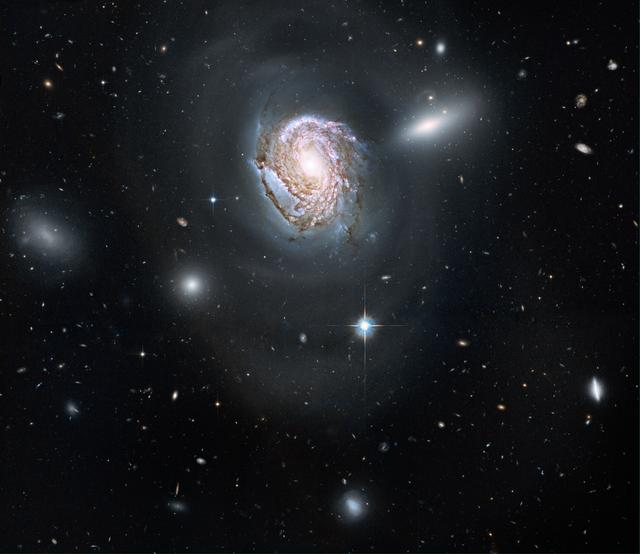
NASA image release August 10, 2010 A long-exposure Hubble Space Telescope image shows a majestic face-on spiral galaxy located deep within the Coma Cluster of galaxies, which lies 320 million light-years away in the northern constellation Coma Berenices. The galaxy, known as NGC 4911, contains rich lanes of dust and gas near its center. These are silhouetted against glowing newborn star clusters and iridescent pink clouds of hydrogen, the existence of which indicates ongoing star formation. Hubble has also captured the outer spiral arms of NGC 4911, along with thousands of other galaxies of varying sizes. The high resolution of Hubble's cameras, paired with considerably long exposures, made it possible to observe these faint details. NGC 4911 and other spirals near the center of the cluster are being transformed by the gravitational tug of their neighbors. In the case of NGC 4911, wispy arcs of the galaxy's outer spiral arms are being pulled and distorted by forces from a companion galaxy (NGC 4911A), to the upper right. The resultant stripped material will eventually be dispersed throughout the core of the Coma Cluster, where it will fuel the intergalactic populations of stars and star clusters. The Coma Cluster is home to almost 1,000 galaxies, making it one of the densest collections of galaxies in the nearby universe. It continues to transform galaxies at the present epoch, due to the interactions of close-proximity galaxy systems within the dense cluster. Vigorous star formation is triggered in such collisions. Galaxies in this cluster are so densely packed that they undergo frequent interactions and collisions. When galaxies of nearly equal masses merge, they form elliptical galaxies. Merging is more likely to occur in the center of the cluster where the density of galaxies is higher, giving rise to more elliptical galaxies. This natural-color Hubble image, which combines data obtained in 2006, 2007, and 2009 from the Wide Field Planetary Camera 2 and the Advanced Camera for Surveys, required 28 hours of exposure time. The Hubble Space Telescope is a project of international cooperation between NASA and the European Space Agency. NASA's Goddard Space Flight Center manages the telescope. The Space Telescope Science Institute (STScI) conducts Hubble science operations. STScI is operated for NASA by the Association of Universities for Research in Astronomy, Inc. in Washington, D.C. Credit: NASA, ESA, and the Hubble Heritage Team (STScI/AURA) Acknowledgment: K. Cook (Lawrence Livermore National Laboratory) To learn more about Hubble go to: <a href="http://www.nasa.gov/mission_pages/hubble/main/index.html" rel="nofollow">www.nasa.gov/mission_pages/hubble/main/index.html</a> <b><a href="http://www.nasa.gov/centers/goddard/home/index.html" rel="nofollow">NASA Goddard Space Flight Center</a></b> is home to the nation's largest organization of combined scientists, engineers and technologists that build spacecraft, instruments and new technology to study the Earth, the sun, our solar system, and the universe. <b>Follow us on <a href="http://twitter.com/NASA_GoddardPix" rel="nofollow">Twitter</a></b> <b>Join us on <a href="http://www.facebook.com/pages/Greenbelt-MD/NASA-Goddard/395013845897?ref=tsd" rel="nofollow">Facebook</a><b></b></b>
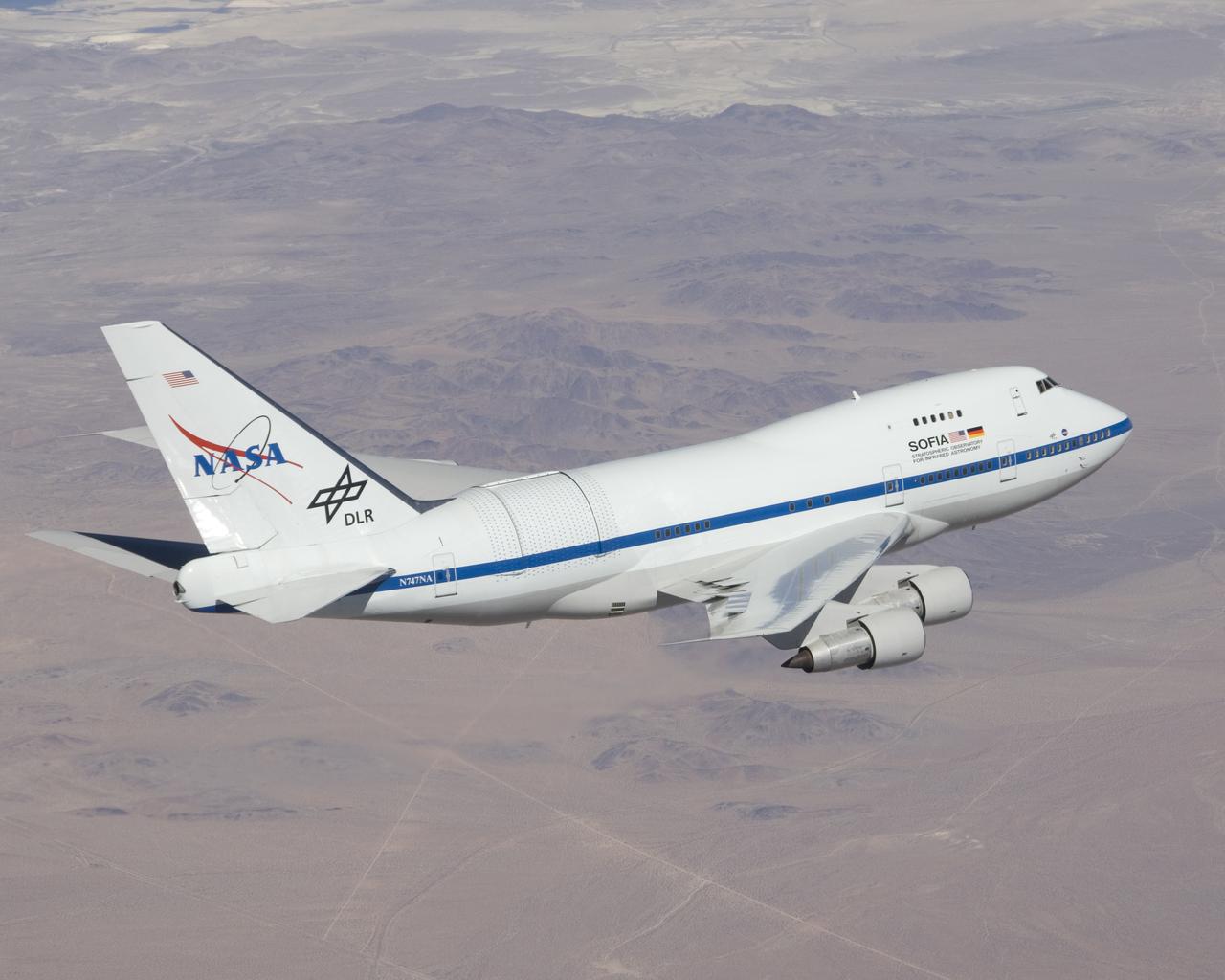
NASA's Stratospheric Observatory for Infrared Astronomy, or SOFIA, arrived at NASA's Dryden Flight Research Center at Edwards Air Force Base, Calif. on May 31, 2007. The heavily modified Boeing 747SP was ferried to Dryden from Waco, Texas, where L-3 Communications Integrated Systems installed a German-built 2.5-meter infrared telescope and made other major modifications over the past several years. SOFIA is scheduled to undergo installation and integration of mission systems and a multi-phase flight test program at Dryden over the next three years that is expected to lead to a full operational capability to conduct astronomy missions in about 2010. During its expected 20-year lifetime, SOFIA will be capable of "Great Observatory" class astronomical science, providing astronomers with access to the visible, infrared and sub-millimeter spectrum with optimized performance in the mid-infrared to sub-millimeter range.
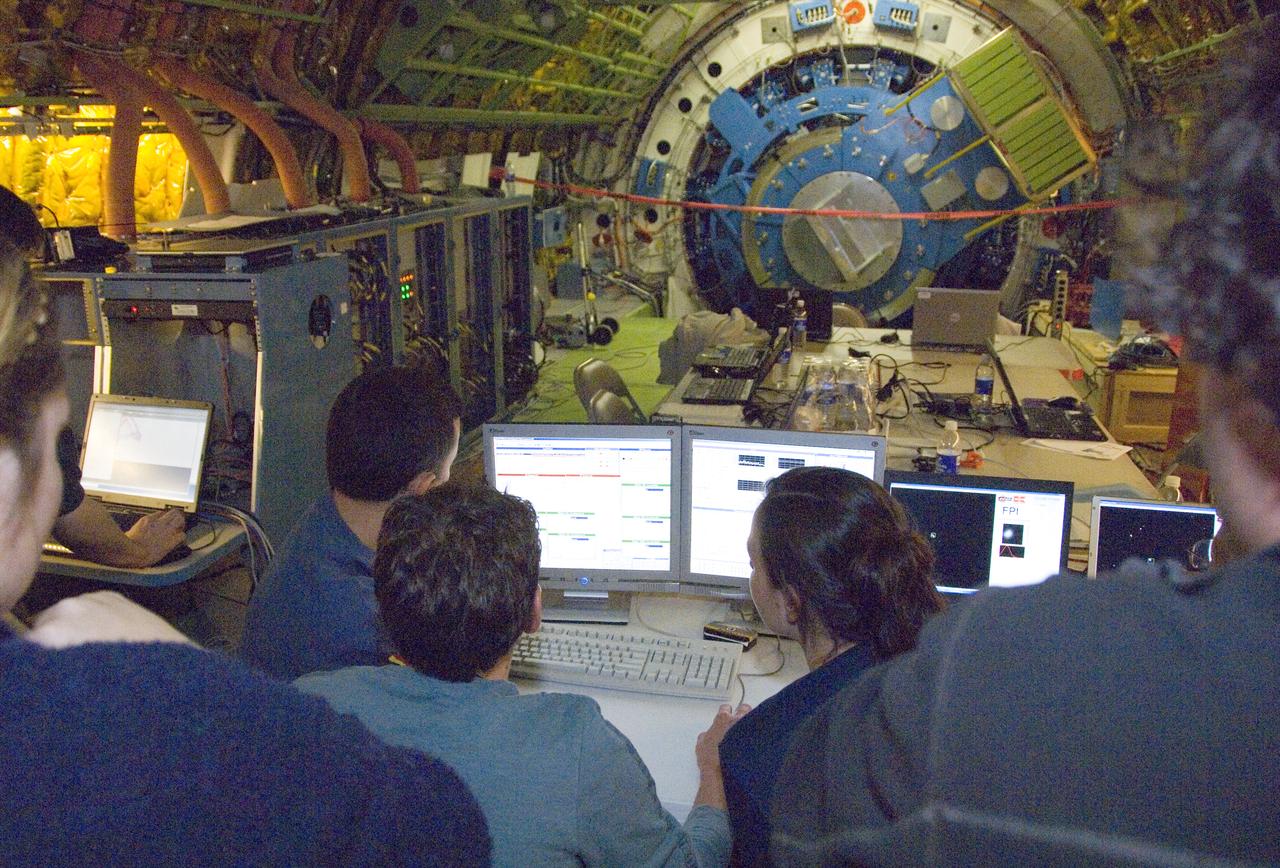
Scientists carefully examine data being received during nighttime line operations testing of the SOFIA airborne observatory's 2.5-meter infrared telescope.
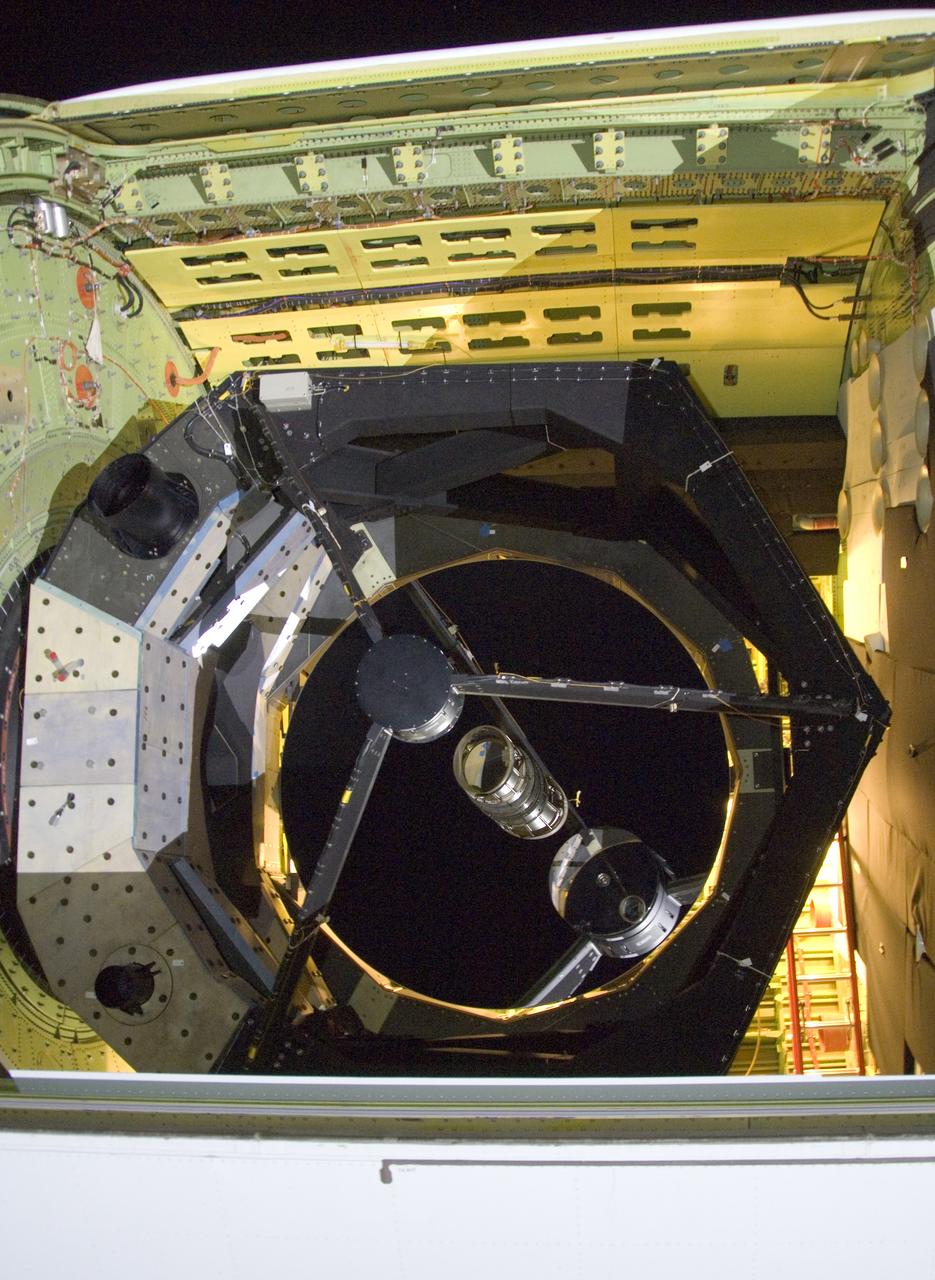
he SOFIA airborne observatory's 2.5-meter infrared telescope peers out from its cavity in the SOFIA rear fuselage during nighttime line operations testing.
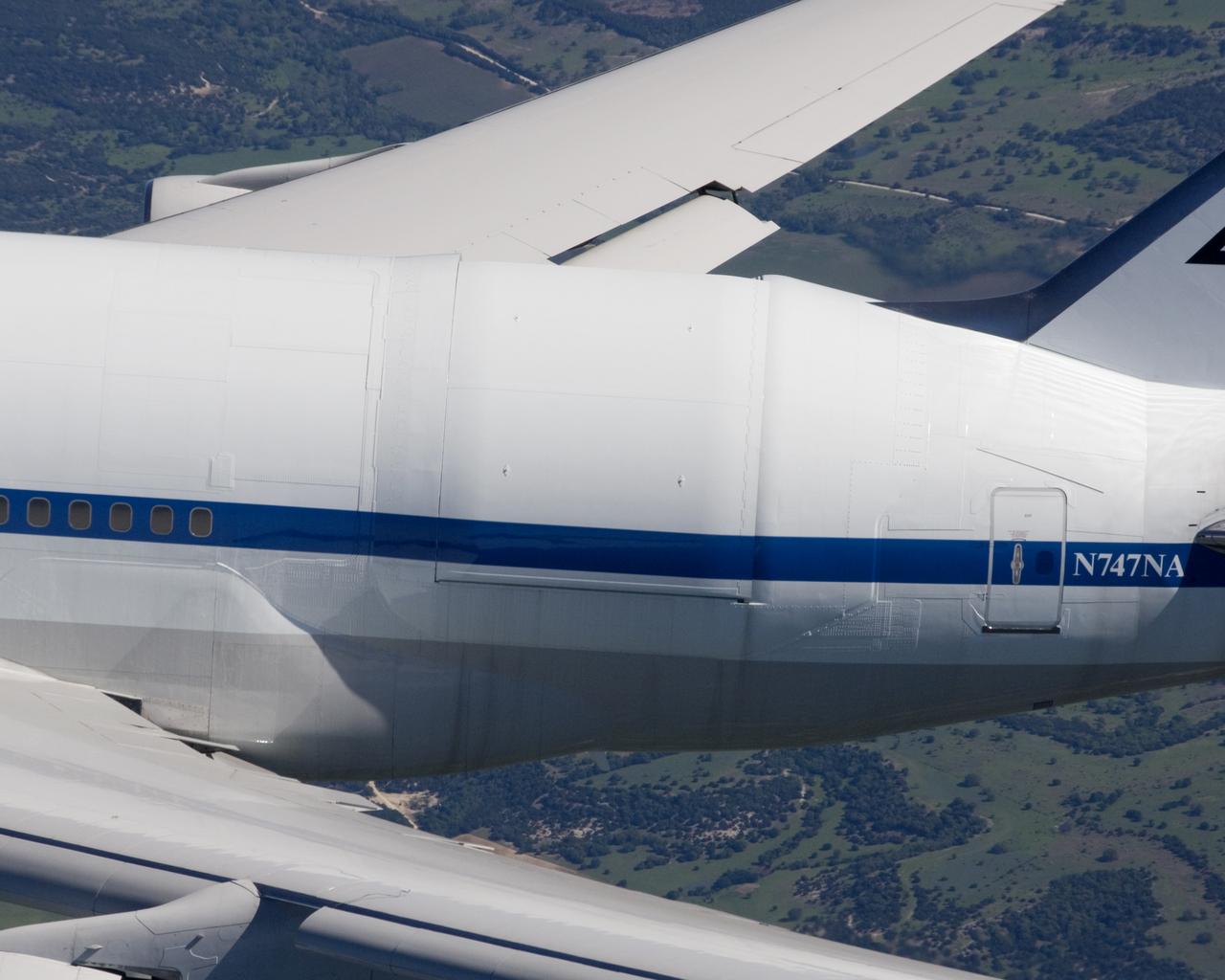
NASA's SOFIA 747SP shows evidence of modification to its aft fuselage contours to accommodate a 16-foot-tall cavity door for its 45,000-pound infrared telescope.
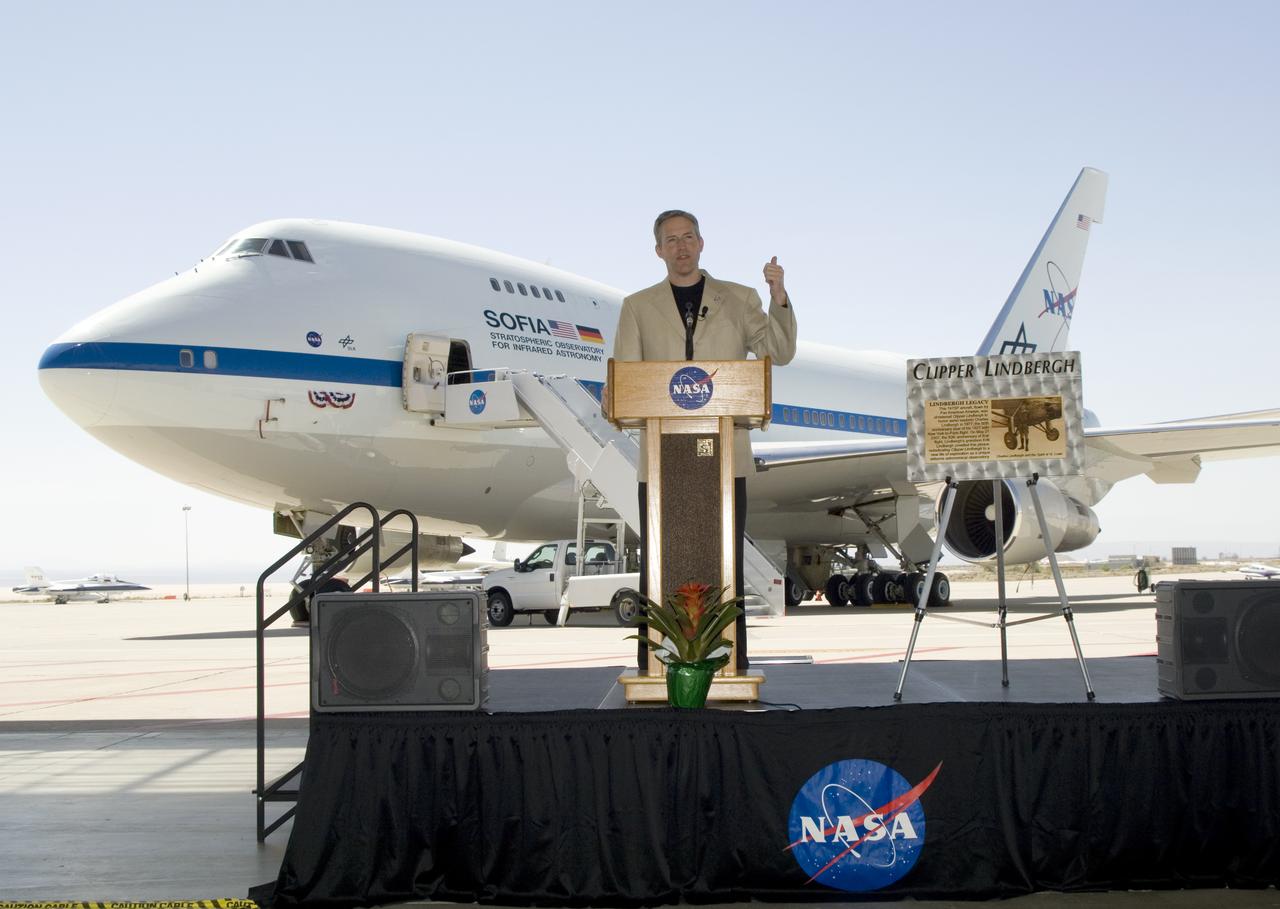
Erik Lindbergh, grandson of famed aviator Charles Lindbergh, rededicated the SOFIA Boeing 747SP as the Clipper Lindbergh at NASA Dryden on June 27, 2007.

NASA's Stratospheric Observatory for Infrared Astronomy (SOFIA) Boeing 747SP flies over NASA's Dryden Flight Research Center after a ferry flight from Waco, Texas. NASA's Stratospheric Observatory for Infrared Astronomy, or SOFIA, arrived at NASA's Dryden Flight Research Center at Edwards Air Force Base, Calif. on May 31, 2007. The heavily modified Boeing 747SP was ferried to Dryden from Waco, Texas, where L-3 Communications Integrated Systems installed a German-built 2.5-meter infrared telescope and made other major modifications over the past several years. SOFIA is scheduled to undergo installation and integration of mission systems and a multi-phase flight test program at Dryden over the next three years that is expected to lead to a full operational capability to conduct astronomy missions in about 2010. During its expected 20-year lifetime, SOFIA will be capable of "Great Observatory" class astronomical science, providing astronomers with access to the visible, infrared and sub-millimeter spectrum with optimized performance in the mid-infrared to sub-millimeter range.
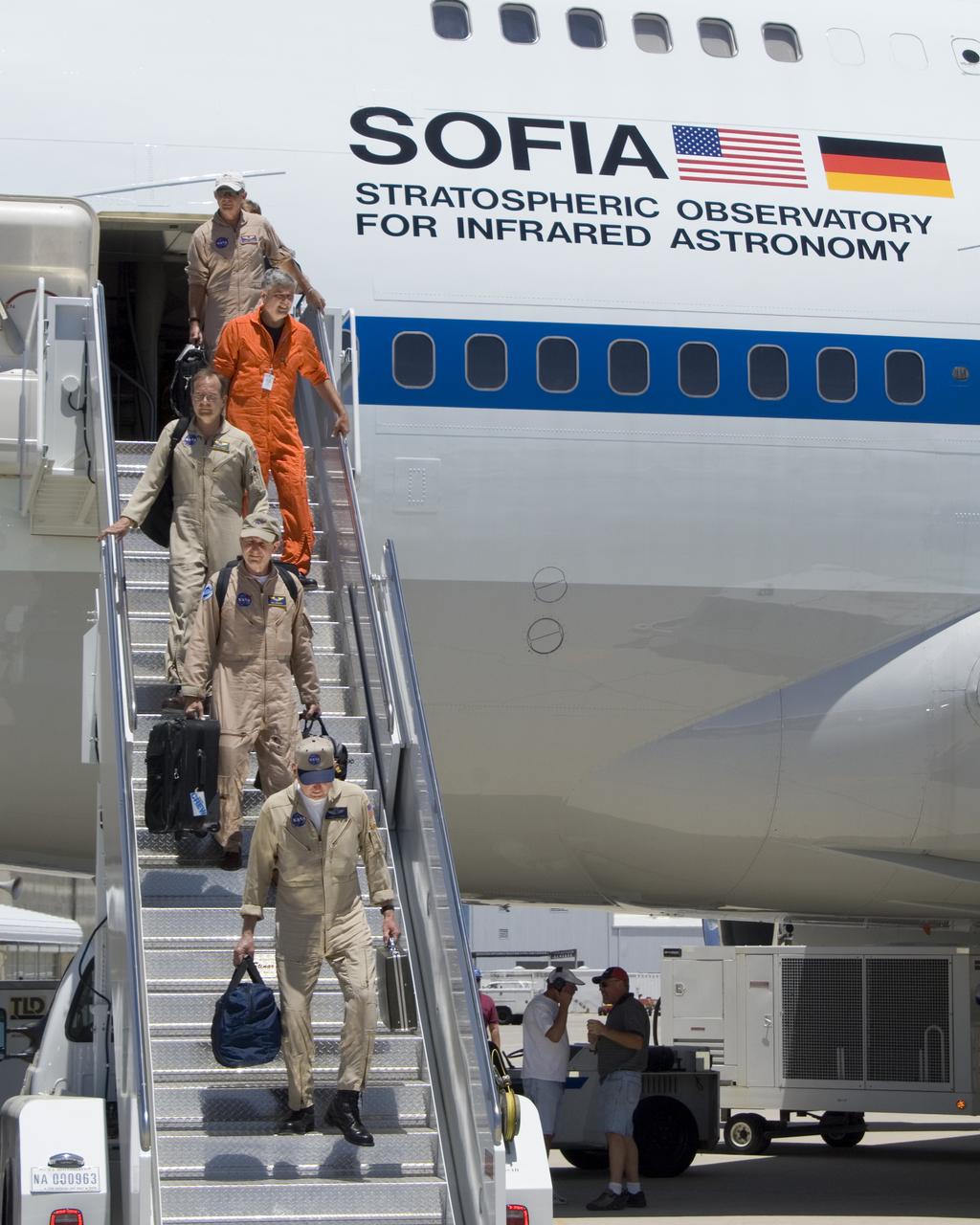
The SOFIA flight crew, consisting of Co-pilot Gordon Fullerton; DFRC, Pilot Bill Brocket; DFRC, Test Conductor Marty Trout; DFRC, Test Engineer Don Stonebrook; L-3, and Flight Engineer Larry Larose; JSC, descend the stairs after ferrying the 747SP airborne observatory from Waco, Texas, to its new home at NASA's Dryden Flight Research Center in California. NASA's Stratospheric Observatory for Infrared Astronomy, or SOFIA, arrived at NASA's Dryden Flight Research Center at Edwards Air Force Base, Calif. on May 31, 2007. The heavily modified Boeing 747SP was ferried to Dryden from Waco, Texas, where L-3 Communications Integrated Systems installed a German-built 2.5-meter infrared telescope and made other major modifications over the past several years. SOFIA is scheduled to undergo installation and integration of mission systems and a multi-phase flight test program at Dryden over the next three years that is expected to lead to a full operational capability to conduct astronomy missions in about 2010. During its expected 20-year lifetime, SOFIA will be capable of "Great Observatory" class astronomical science, providing astronomers with access to the visible, infrared and sub-millimeter spectrum with optimized performance in the mid-infrared to sub-millimeter range.
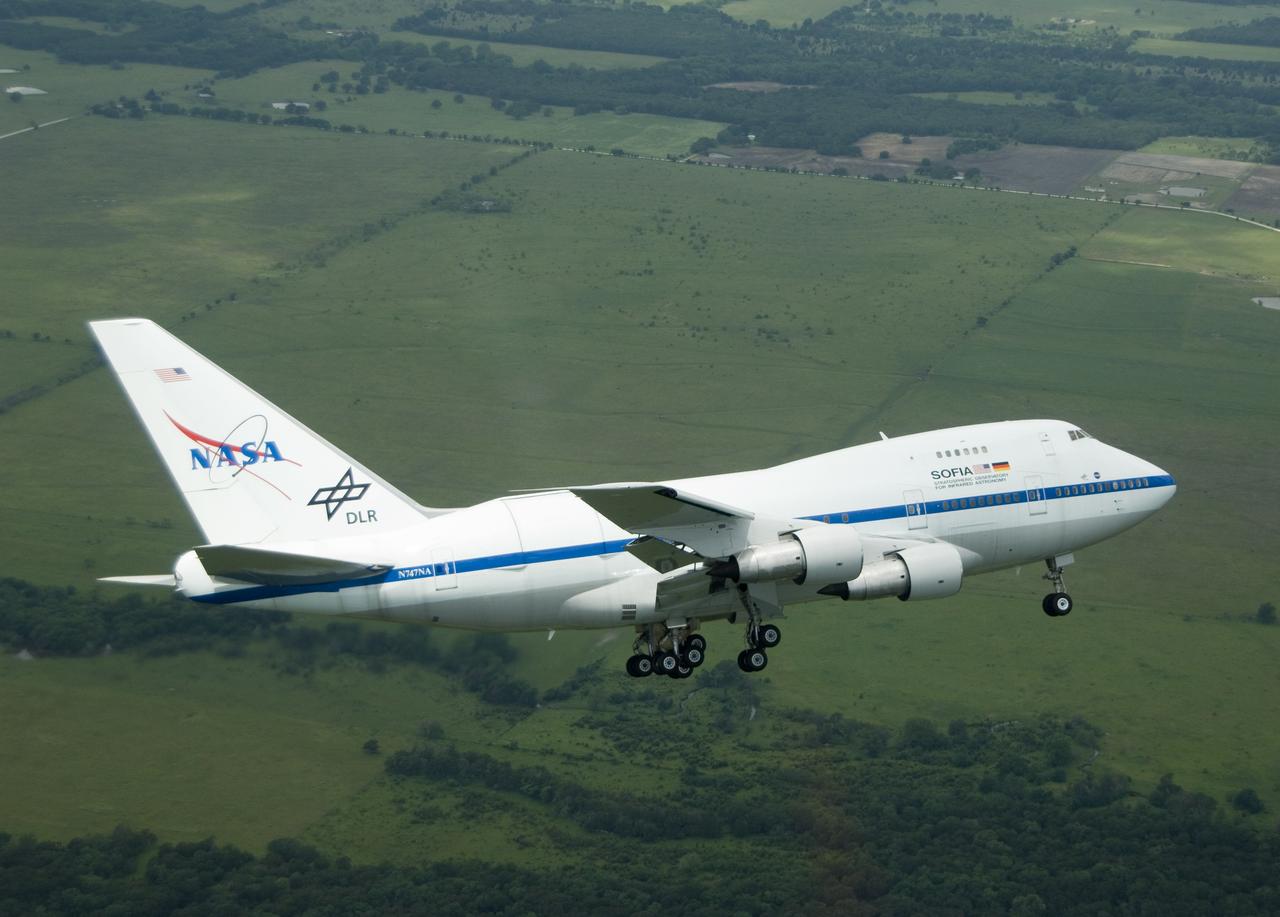
NASA's highly modified Boeing 747SP SOFIA observatory banks low over the Texas countryside as it heads for landing at Waco to conclude its second check flight.
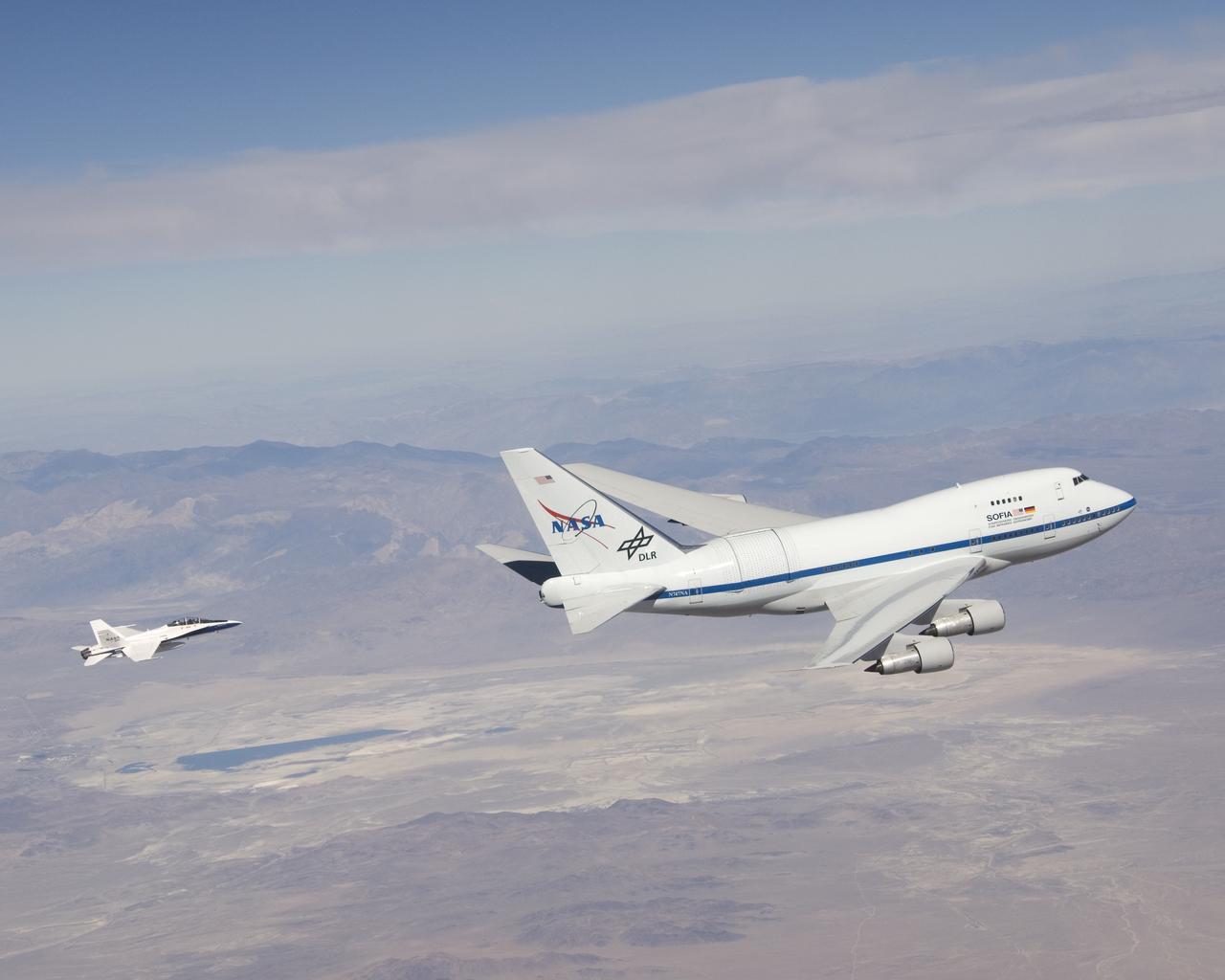
NASA's Stratospheric Observatory for Infrared Astronomy, or SOFIA, arrived at NASA's Dryden Flight Research Center at Edwards Air Force Base, Calif. on May 31, 2007. The heavily modified Boeing 747SP was ferried to Dryden from Waco, Texas, where L-3 Communications Integrated Systems installed a German-built 2.5-meter infrared telescope and made other major modifications over the past several years. SOFIA is scheduled to undergo installation and integration of mission systems and a multi-phase flight test program at Dryden over the next three years that is expected to lead to a full operational capability to conduct astronomy missions in about 2010. During its expected 20-year lifetime, SOFIA will be capable of "Great Observatory" class astronomical science, providing astronomers with access to the visible, infrared and sub-millimeter spectrum with optimized performance in the mid-infrared to sub-millimeter range.
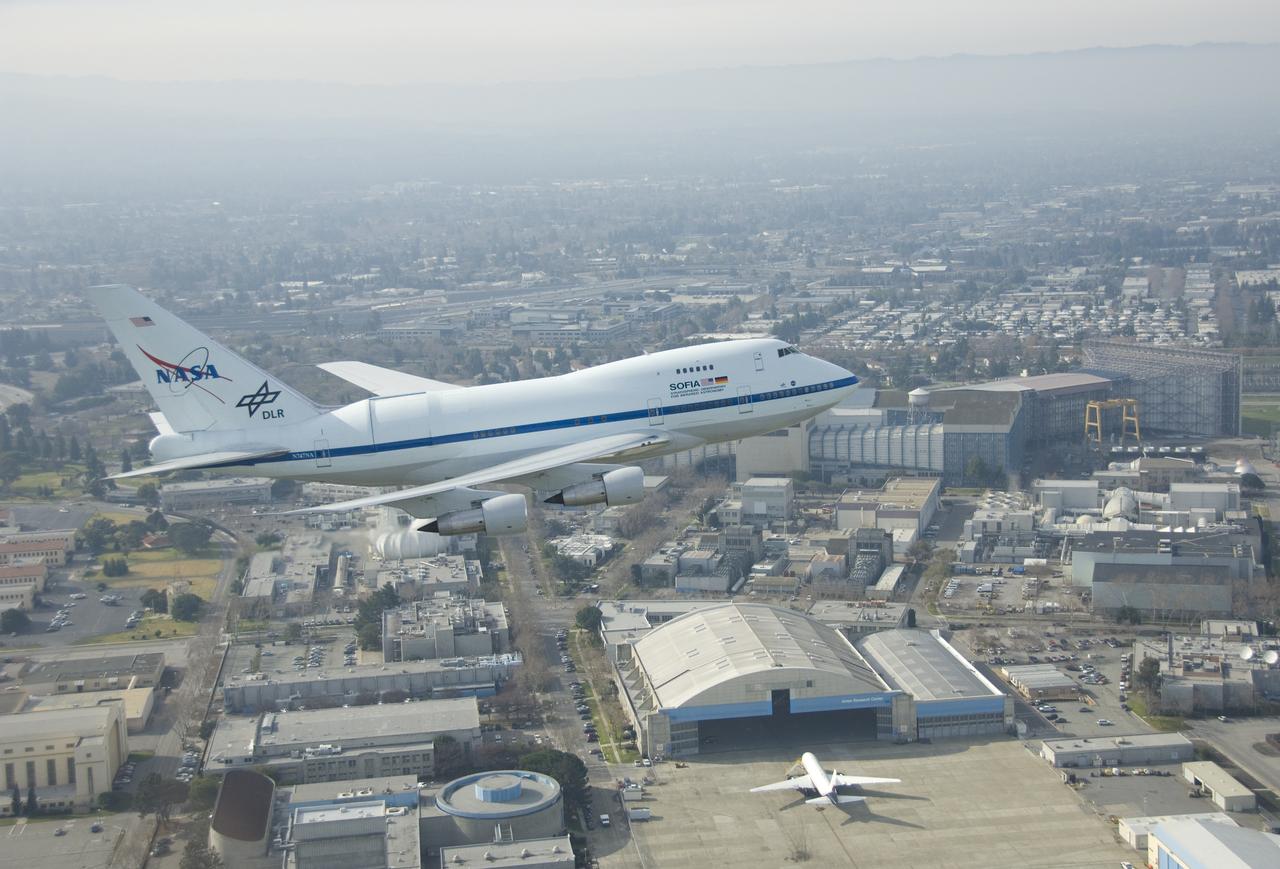
NASA's SOFIA flying observatory makes a low pass over NASA Ames Research Center prior to landing at Moffett Field for a brief visit on Jan. 14, 2008.

With landing gear extended, the NASA/DLR Stratospheric Observatory for Infared Astronomy (SOFIA) 747SP cruises over central Texas on its first checkout flight.
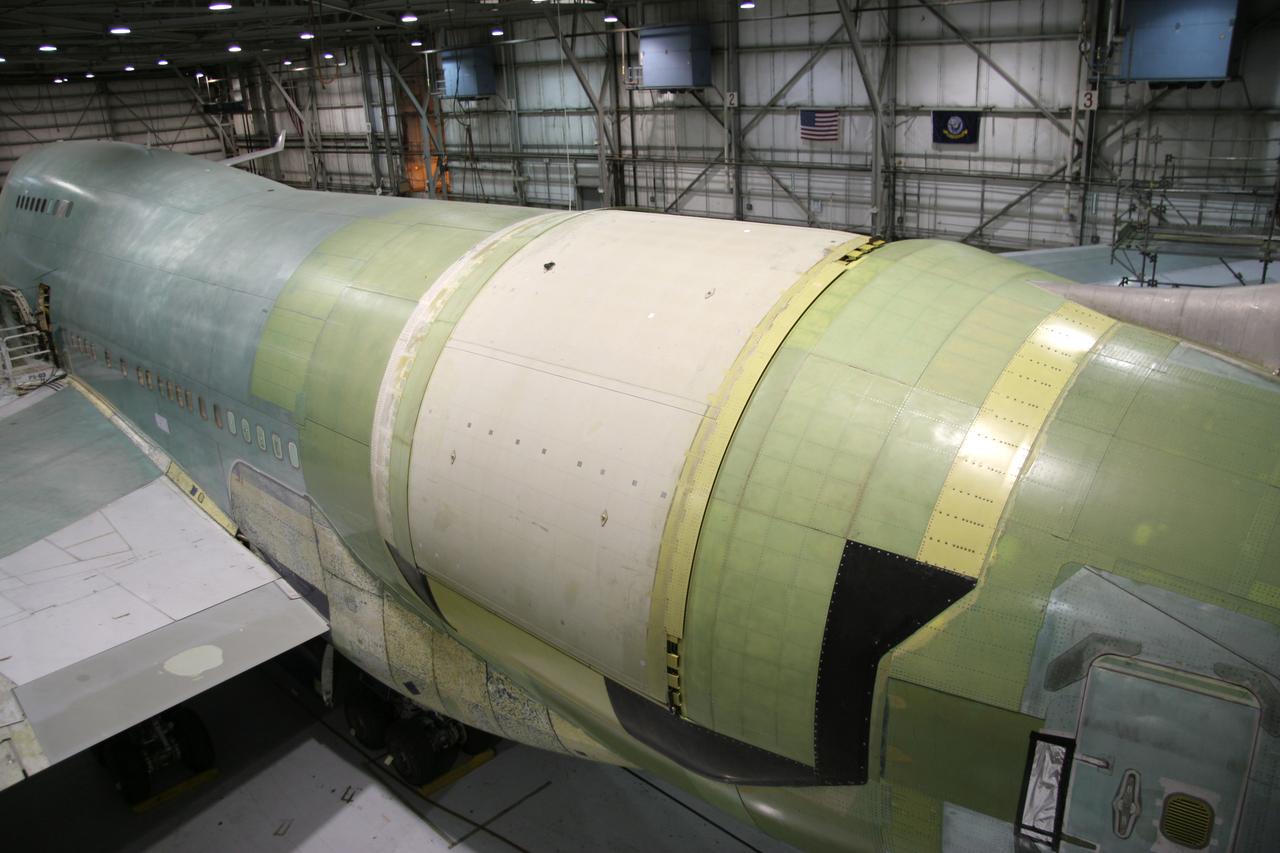
A rotating external door (white) was installed over the telescope cavity in the rear fuselage of NASA's SOFIA Boeing 747SP during modifications in Waco, Texas.
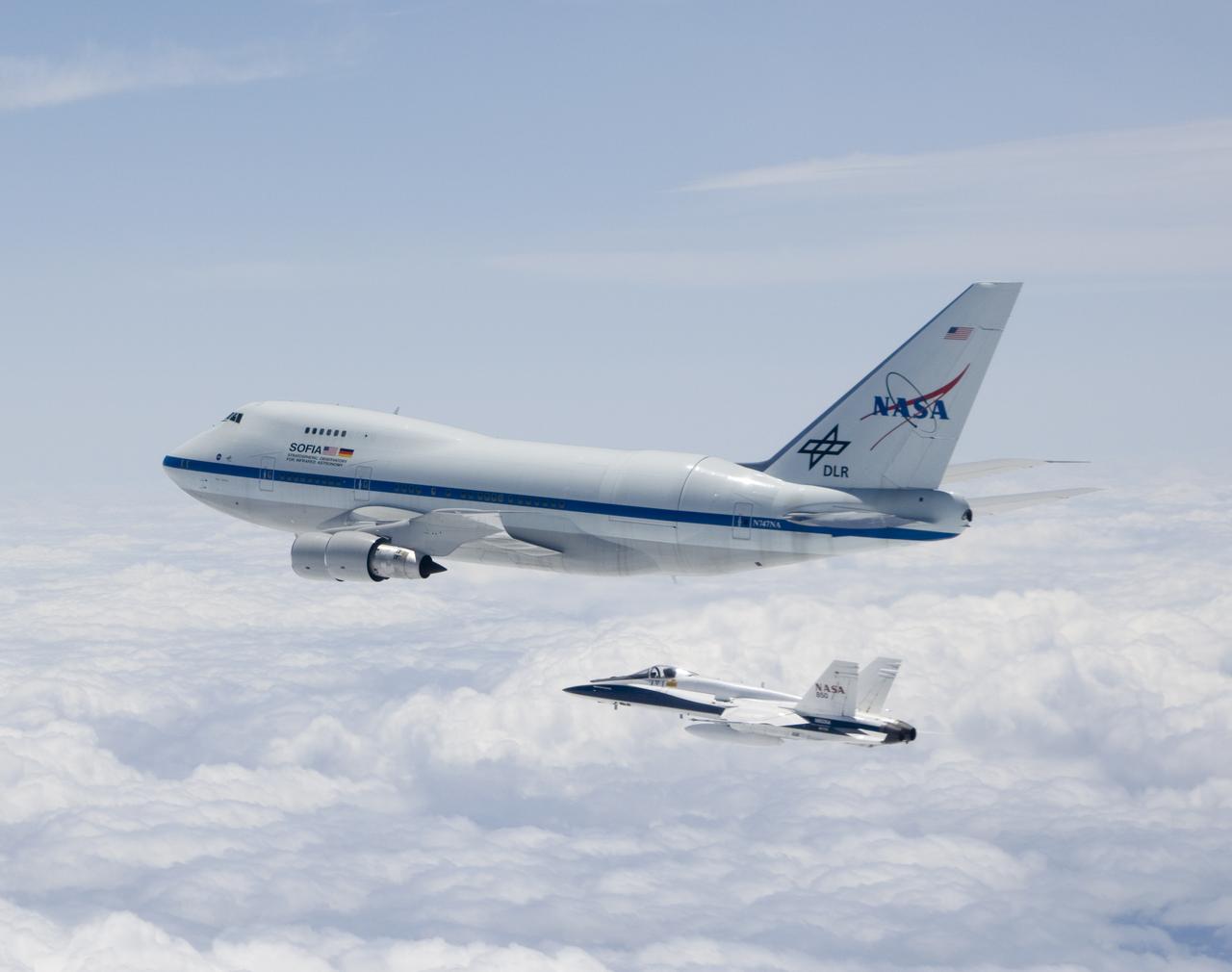
NASA's SOFIA airborne observatory is shadowed by a NASA F/A-18 safety chase aircraft during its second checkout flight near Waco, Texas on May 10, 2007.

Erik Lindbergh, grandson of famed aviator Charles Lindbergh, yanks the bunting to reveal the Clipper Lindbergh name on NASA's SOFIA Boeing 747SP on June 27, 2007. More than 250 VIPs, news media and guests joined NASA, DLR, USRA and other SOFIA staff for the debut of the airborne observatory at NASA Dryden.
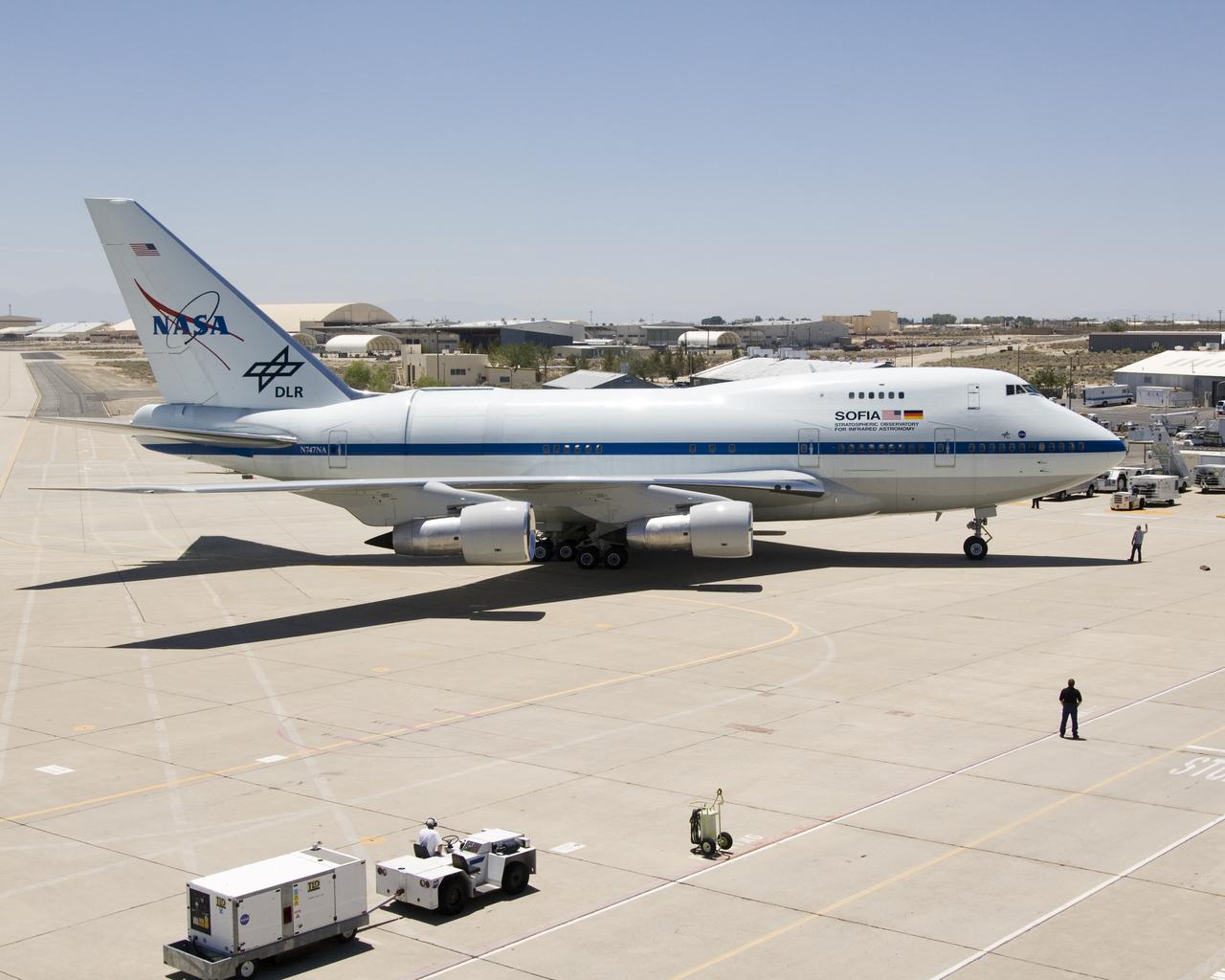
NASA's SOFIA 747SP bearing a German-built 2.5-meter infrared telescope in its rear fuselage taxis up to NASA Dryden's ramp after a ferry flight from Waco, Texas. NASA's Stratospheric Observatory for Infrared Astronomy, or SOFIA, arrived at NASA's Dryden Flight Research Center at Edwards Air Force Base, Calif. on May 31, 2007. The heavily modified Boeing 747SP was ferried to Dryden from Waco, Texas, where L-3 Communications Integrated Systems installed a German-built 2.5-meter infrared telescope and made other major modifications over the past several years. SOFIA is scheduled to undergo installation and integration of mission systems and a multi-phase flight test program at Dryden over the next three years that is expected to lead to a full operational capability to conduct astronomy missions in about 2010. During its expected 20-year lifetime, SOFIA will be capable of "Great Observatory" class astronomical science, providing astronomers with access to the visible, infrared and sub-millimeter spectrum with optimized performance in the mid-infrared to sub-millimeter range.
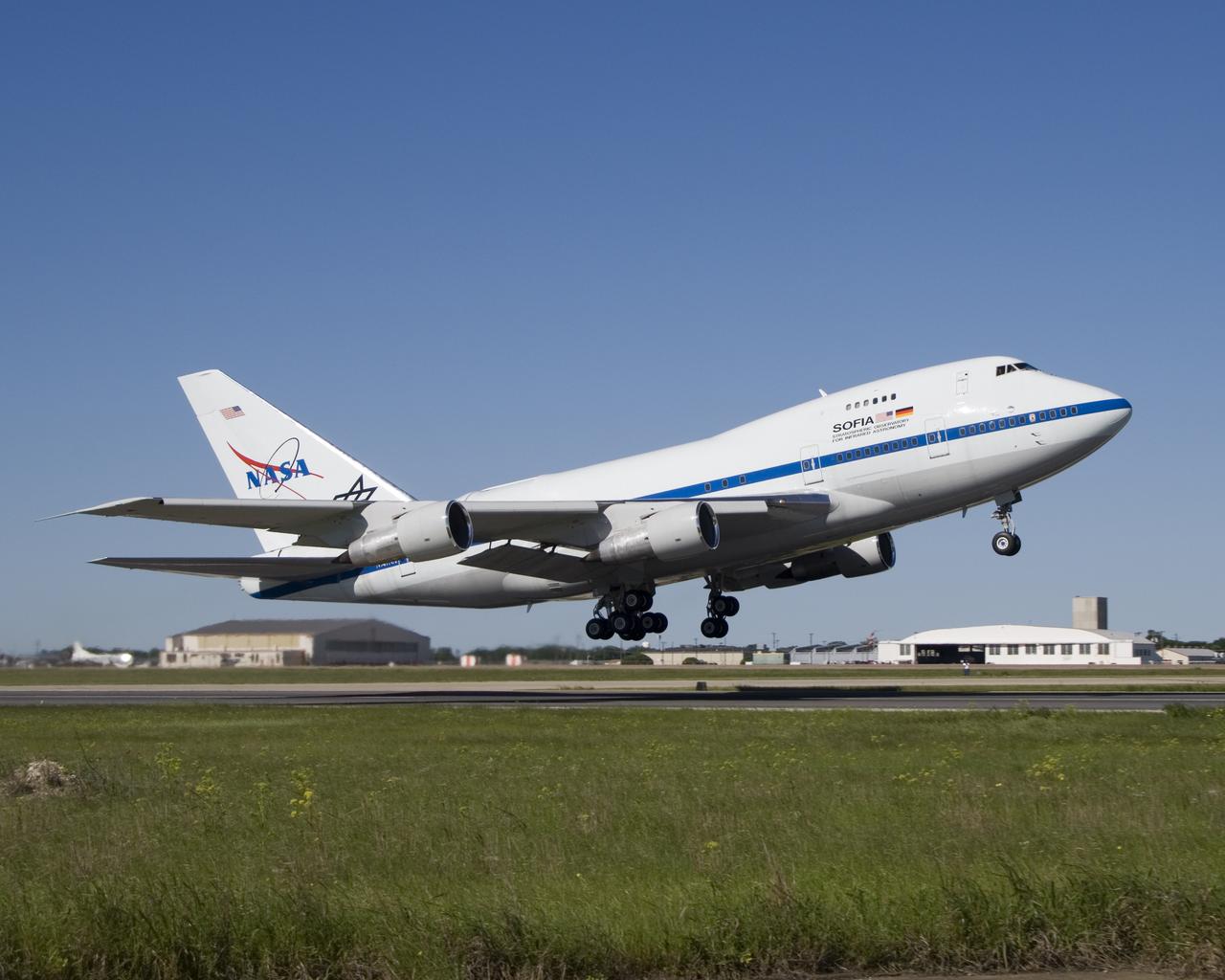
The NASA and German Aerospace Center SOFIA airborne infrared observatory took flight for the first time April 26, 2007, from its modification center in Waco, Texas.
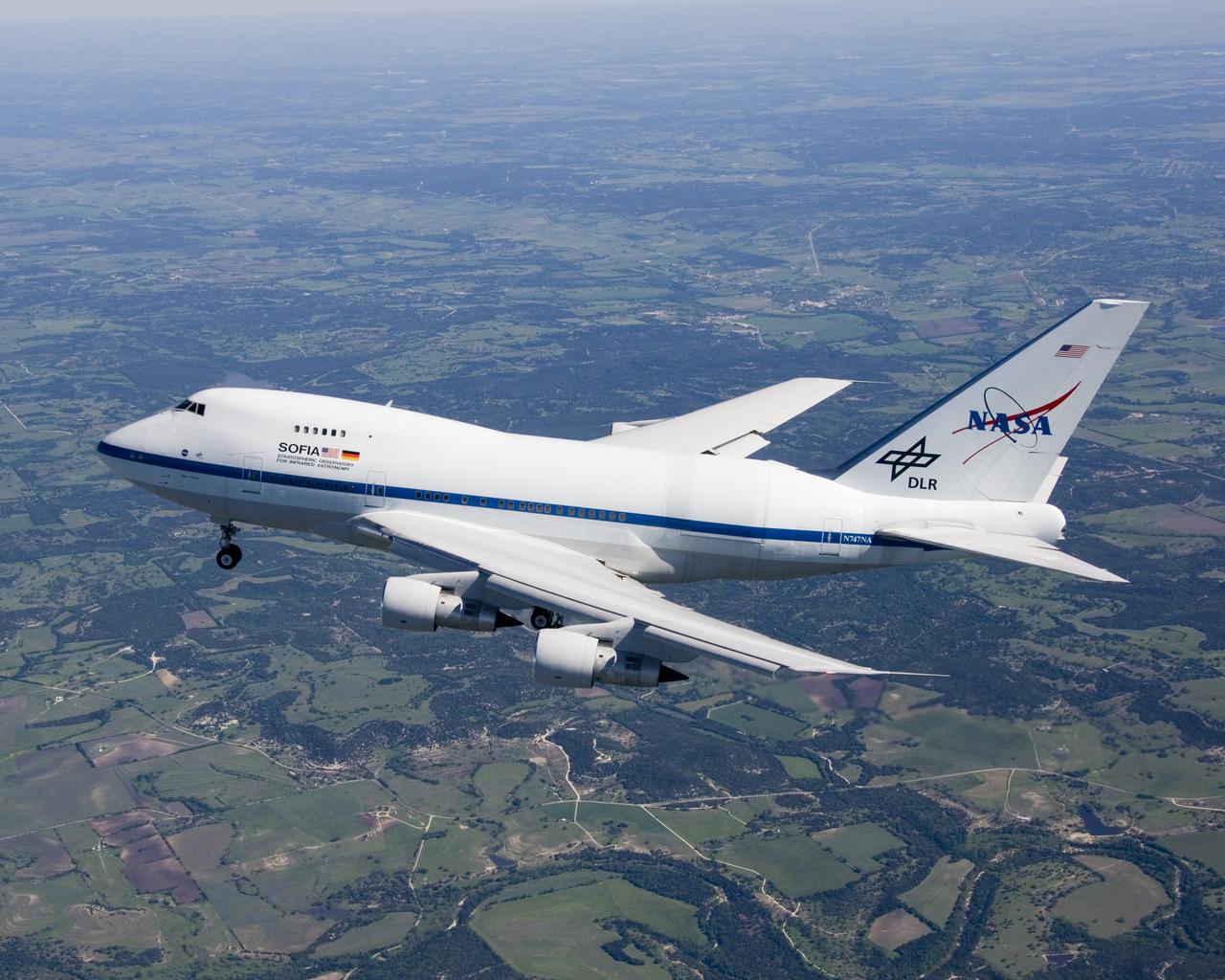
Christened "Clipper Lindbergh" when it flew for Pan American Airways in the 1970s, the SOFIA 747SP shows evidence of modification to its aft fuselage contours to accommodate a 16-foot-tall opening for a 45,000-pound infrared telescope. This inflight photo was taken on SOFIA's first flight since its modification to become an airborne observatory.
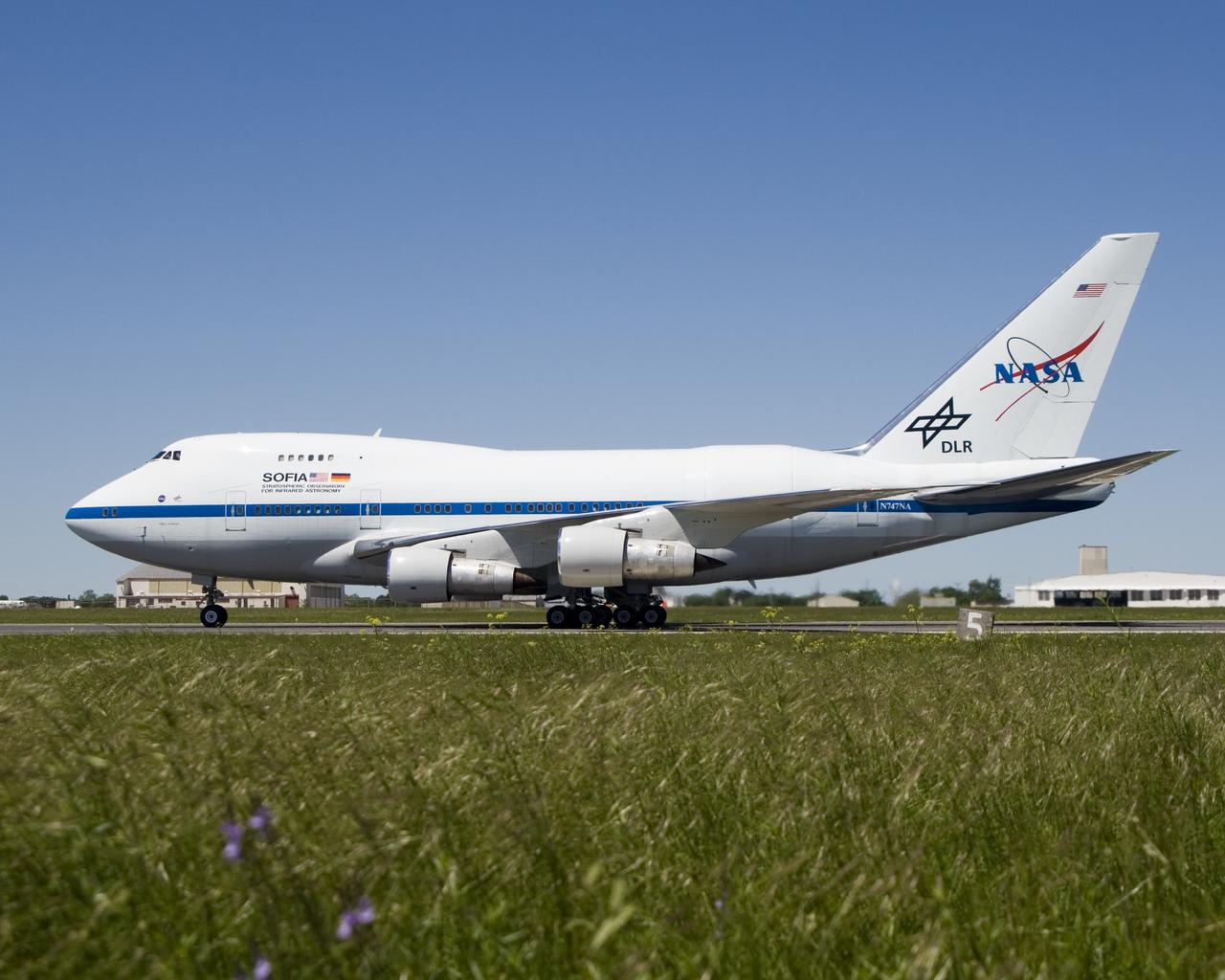
NASA's modified Boeing 747SP SOFIA airborne observatory taxis along the runway at Waco, Texas after completing its first checkout flight on April 26, 2007.

NASA's SOFIA airborne observatory lands at Edwards AFB after being flown from Waco, Texas to NASA Dryden for systems installation, integration and flight test. NASA's Stratospheric Observatory for Infrared Astronomy, or SOFIA, arrived at NASA's Dryden Flight Research Center at Edwards Air Force Base, Calif. on May 31, 2007. The heavily modified Boeing 747SP was ferried to Dryden from Waco, Texas, where L-3 Communications Integrated Systems installed a German-built 2.5-meter infrared telescope and made other major modifications over the past several years. SOFIA is scheduled to undergo installation and integration of mission systems and a multi-phase flight test program at Dryden over the next three years that is expected to lead to a full operational capability to conduct astronomy missions in about 2010. During its expected 20-year lifetime, SOFIA will be capable of "Great Observatory" class astronomical science, providing astronomers with access to the visible, infrared and sub-millimeter spectrum with optimized performance in the mid-infrared to sub-millimeter range.