
MODEL OF UPPER STAGES OF APOLLO

Illustration of the SLS Exploration Upper Stage, or EUS. This configuration of the rocket, with the Exploration Upper Stage, will provide in-space propulsion to send astronauts in NASA’s Orion spacecraft and heavy cargo on a precise trajectory to the Moon. The evolution of the rocket to SLS Block 1B configuration with EUS enables SLS to launch 40% more cargo to the Moon along with the crew. Manufacturing both the core stage and Exploration Upper Stage is a collaborative effort between NASA and Boeing, the lead contractor for EUS and the SLS core stage. SLS is the only rocket that can send Orion, astronauts, and supplies to the Moon in a single mission. The SLS rocket, NASA’s Orion spacecraft, Gateway, and human landing system are part of NASA’s backbone for deep space exploration. Under the Artemis program, NASA is working to land the first woman and the next man on the Moon to pave the way for sustainable exploration at the Moon and future missions to Mars. (NASA)

Illustration of the SLS Exploration Upper Stage, or EUS. The Exploration Upper Stage will be used on the second configuration of the SLS rocket, known as Block 1B, and will provide in-space propulsion to send astronauts in NASA’s Orion spacecraft and heavy cargo on a precise trajectory to the Moon. The evolution of the rocket to SLS Block 1B configuration with EUS enables SLS to launch 40% more cargo to the Moon along with the crew. Manufacturing both the core stage and Exploration Upper Stage is a collaborative effort between NASA and Boeing, the lead contractor for EUS and the SLS core stage. SLS is the only rocket that can send Orion, astronauts, and supplies to the Moon in a single mission. The SLS rocket, NASA’s Orion spacecraft, Gateway, and human landing system are part of NASA’s backbone for deep space exploration. Under the Artemis program, NASA is working to land the first woman and the next man on the Moon to pave the way for sustainable exploration at the Moon and future missions to Mars. (NASA)
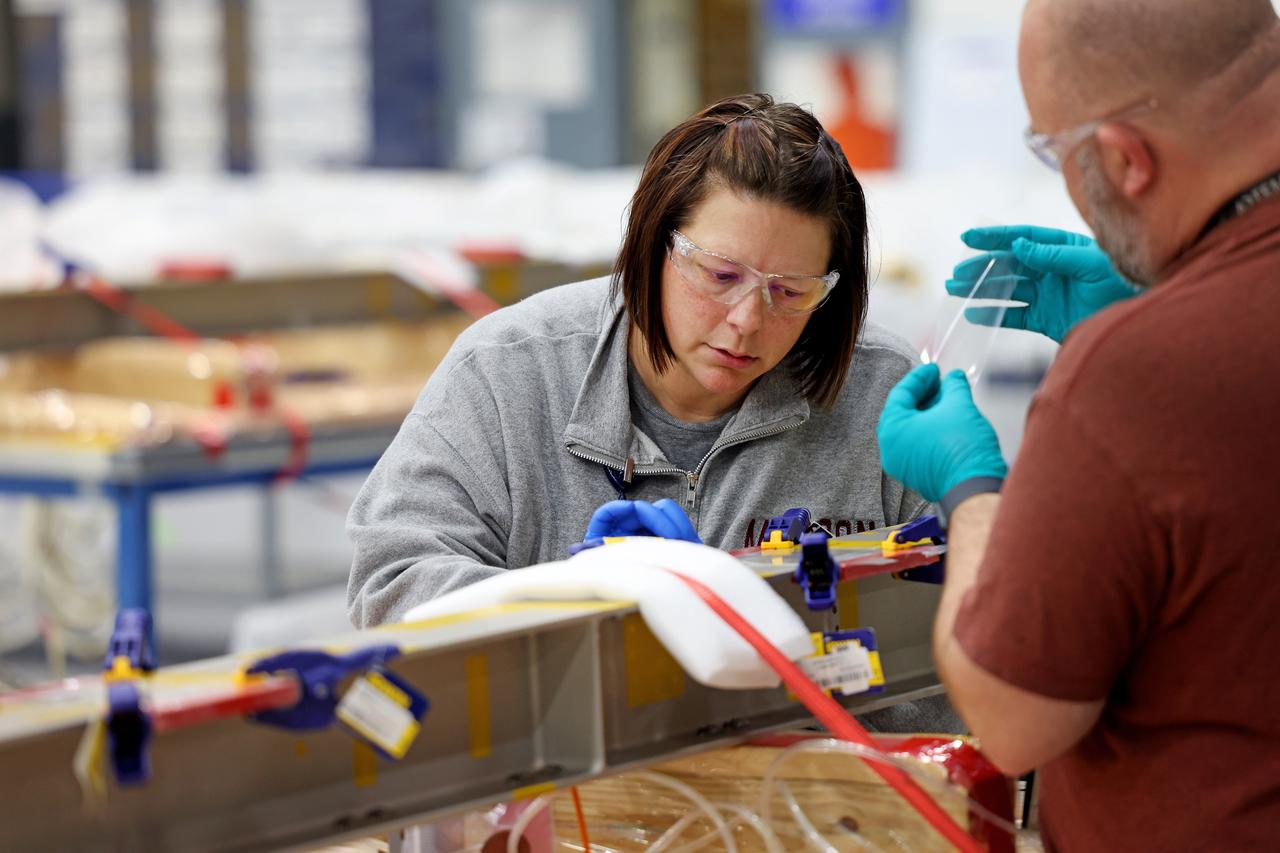
Technicians at NASA’s Michoud Assembly Facility in New Orleans on Feb. 22 prepare elements that will form part of the midbody for the future exploration upper stage for the SLS (Space Launch System) rocket. The midbody struts, or V-struts, will create the midbody’s cage-like outer structure to connect the upper stage’s larger liquid hydrogen tank to its smaller liquid oxygen tank. Manufacturing flight and test hardware for the future SLS upper stage is a collaborative effort between NASA and Boeing, the lead contractor for EUS and the SLS core stage. Beginning with Artemis IV, SLS will evolve to its more powerful Block 1B configuration with the advanced exploration upper stage that gives the rocket the capability to launch 40% more to the Moon along with Artemis astronauts inside NASA’s Orion spacecraft. The evolved in-space stage for SLS will use a combination of liquid oxygen and liquid hydrogen propellants to help power the engines to send large cargo and crew inside Orion to the Moon. Image credit: NASA/Michael DeMocker

Technicians at NASA’s Michoud Assembly Facility in New Orleans on Feb. 22 prepare elements that will form part of the midbody for the future exploration upper stage for the SLS (Space Launch System) rocket. The midbody struts, or V-struts, will create the midbody’s cage-like outer structure to connect the upper stage’s larger liquid hydrogen tank to its smaller liquid oxygen tank. Manufacturing flight and test hardware for the future SLS upper stage is a collaborative effort between NASA and Boeing, the lead contractor for EUS and the SLS core stage. Beginning with Artemis IV, SLS will evolve to its more powerful Block 1B configuration with the advanced exploration upper stage that gives the rocket the capability to launch 40% more to the Moon along with Artemis astronauts inside NASA’s Orion spacecraft. The evolved in-space stage for SLS will use a combination of liquid oxygen and liquid hydrogen propellants to help power the engines to send large cargo and crew inside Orion to the Moon. Image credit: NASA/Michael DeMocker
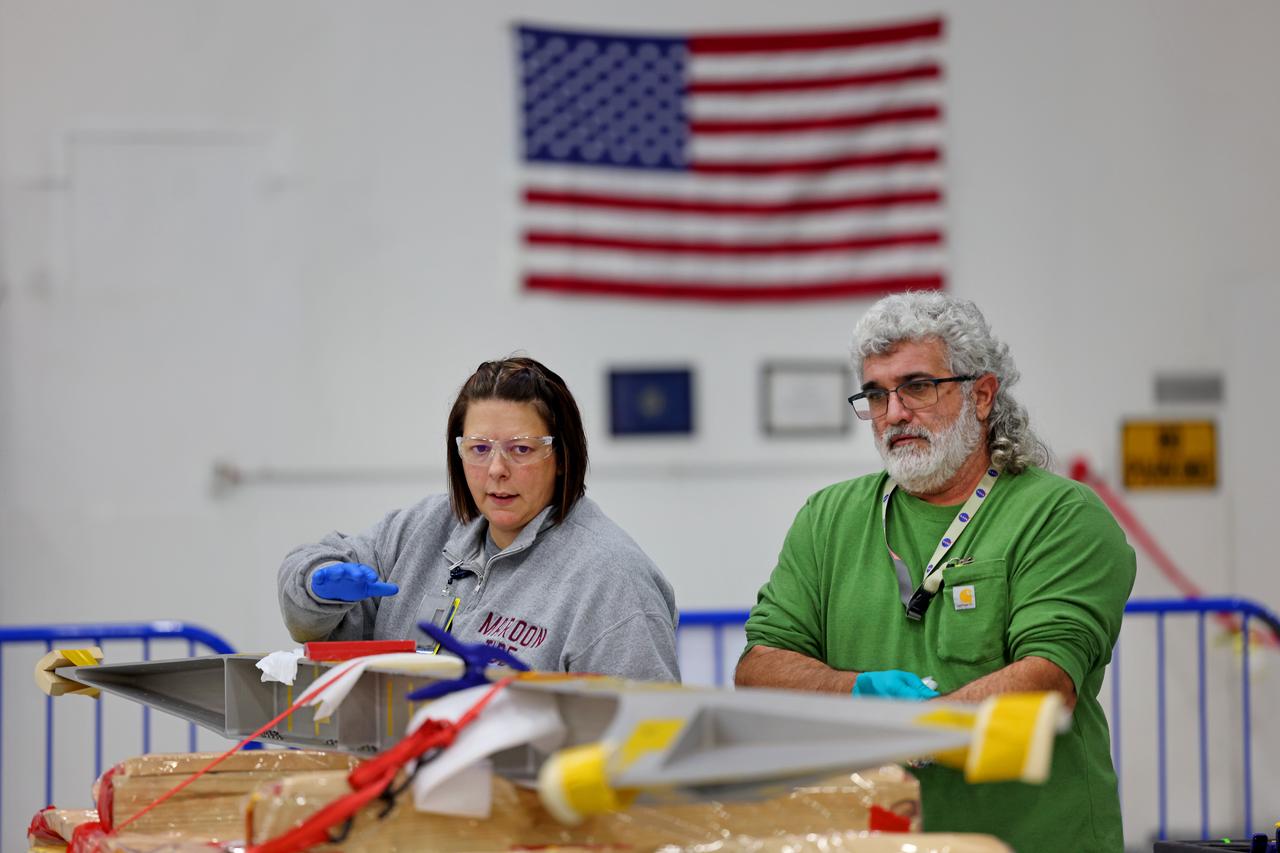
Technicians at NASA’s Michoud Assembly Facility in New Orleans on Feb. 22 prepare elements that will form part of the midbody for the future exploration upper stage for the SLS (Space Launch System) rocket. The midbody struts, or V-struts, will create the midbody’s cage-like outer structure to connect the upper stage’s larger liquid hydrogen tank to its smaller liquid oxygen tank. Manufacturing flight and test hardware for the future SLS upper stage is a collaborative effort between NASA and Boeing, the lead contractor for EUS and the SLS core stage. Beginning with Artemis IV, SLS will evolve to its more powerful Block 1B configuration with the advanced exploration upper stage that gives the rocket the capability to launch 40% more to the Moon along with Artemis astronauts inside NASA’s Orion spacecraft. The evolved in-space stage for SLS will use a combination of liquid oxygen and liquid hydrogen propellants to help power the engines to send large cargo and crew inside Orion to the Moon. Image credit: NASA/Michael DeMocker
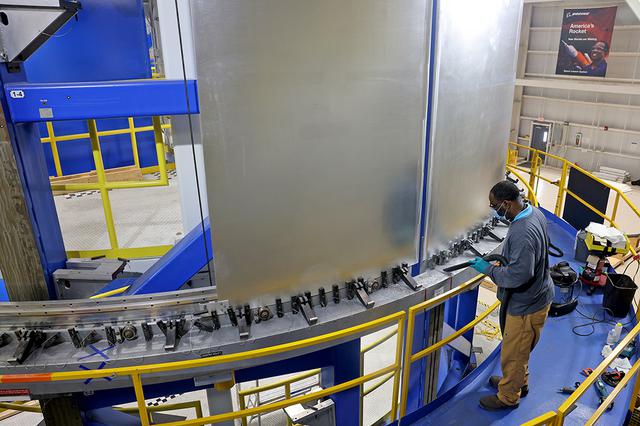
EUS panel test weld at the VXC in Building 115 at the Michoud Assembly Facility on Tuesday, February 9, 2021. Technicians are manufacturing and testing the first in a series of initial weld confidence articles for the Exploration Upper Stage (EUS) for future flights of NASA’s Space Launch System (SLS) rocket at the agency’s Michoud Assembly Facility in New Orleans. The Exploration Upper Stage will be used on the second configuration of the SLS rocket, known as Block 1B, and will provide in-space propulsion to send astronauts in NASA’s Orion spacecraft and heavy cargo on a precise trajectory to the Moon. The Exploration Upper Stage weld confidence panels are first produced in the Vertical Weld Center at Michoud, then small sections of the panels are removed for mechanical testing and analysis in another area of the factory. Teams use weld confidence articles to verify welding procedures, interfaces between the tooling and hardware, and the structural integrity of the welds. Testing of the EUS weld confidence articles will help engineers and technicians validate welding parameters for manufacturing EUS hardware. The first three SLS flights of NASA’s Artemis program will use an interim cryogenic propulsion stage with one RL10 engine to send Orion to the Moon. The SLS Exploration Upper Stage for flights beyond Artemis III has larger propellant tanks and four RL10 engines. The evolution of the rocket to SLS Block 1B configuration with EUS enables SLS to launch 40% more cargo to the Moon along with the crew. Manufacturing the Exploration Upper Stage is a collaborative effort between NASA and Boeing, the lead contractor for EUS and the SLS core stage. SLS is the only rocket that can send Orion, astronauts, and supplies to the Moon in a single mission. The SLS rocket, NASA’s Orion spacecraft, Gateway, and human landing system are part of NASA’s backbone for deep space exploration. Under the Artemis program, NASA is working to land the first woman and the next man on the Moon to pave the way for sustainable exploration at the Moon and future missions to Mars. (NASA)
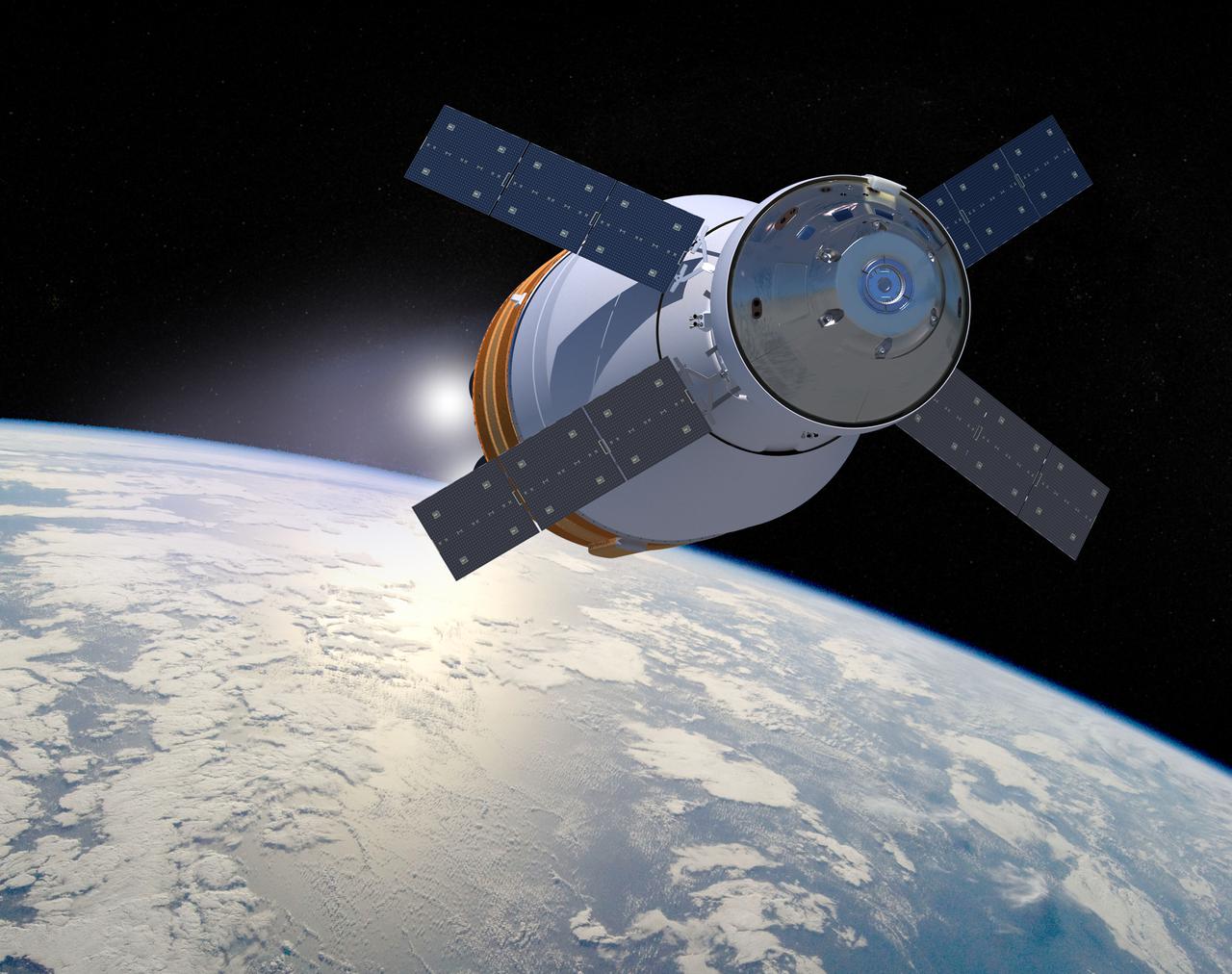
Seen here is an image of the SLS Exploration Upper Stage with the Orion Space craft on its way to a deep space mission. The Exploration Upper Stage will be used on the second configuration of the SLS rocket, known as Block 1B, and will provide in-space propulsion to send astronauts in NASA’s Orion spacecraft and heavy cargo on a precise trajectory to the Moon. The evolution of the rocket to SLS Block 1B configuration with EUS enables SLS to launch 40% more cargo to the Moon along with the crew. Manufacturing both the core stage and Exploration Upper Stage is a collaborative effort between NASA and Boeing, the lead contractor for EUS and the SLS core stage. SLS is the only rocket that can send Orion, astronauts, and supplies to the Moon in a single mission. The SLS rocket, NASA’s Orion spacecraft, Gateway, and human landing system are part of NASA’s backbone for deep space exploration. Under the Artemis program, NASA is working to land the first woman and the next man on the Moon to pave the way for sustainable exploration at the Moon and future missions to Mars. (NASA)
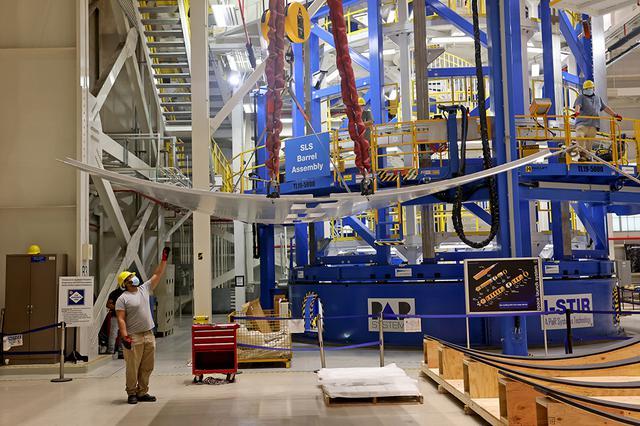
Lift of three EUS test panels in VWC at Michoud Assembly Facility on Thursday, February 11, 2021. Technicians are manufacturing and testing the first in a series of initial weld confidence articles for the Exploration Upper Stage (EUS) for future flights of NASA’s Space Launch System (SLS) rocket at the agency’s Michoud Assembly Facility in New Orleans. The Exploration Upper Stage will be used on the second configuration of the SLS rocket, known as Block 1B, and will provide in-space propulsion to send astronauts in NASA’s Orion spacecraft and heavy cargo on a precise trajectory to the Moon. The Exploration Upper Stage weld confidence panels are first produced in the Vertical Weld Center at Michoud, then small sections of the panels are removed for mechanical testing and analysis in another area of the factory. Teams use weld confidence articles to verify welding procedures, interfaces between the tooling and hardware, and the structural integrity of the welds. Testing of the EUS weld confidence articles will help engineers and technicians validate welding parameters for manufacturing EUS hardware. The first three SLS flights of NASA’s Artemis program will use an interim cryogenic propulsion stage with one RL10 engine to send Orion to the Moon. The SLS Exploration Upper Stage for flights beyond Artemis III has larger propellant tanks and four RL10 engines. The evolution of the rocket to SLS Block 1B configuration with EUS enables SLS to launch 40% more cargo to the Moon along with the crew. Manufacturing the Exploration Upper Stage is a collaborative effort between NASA and Boeing, the lead contractor for EUS and the SLS core stage. SLS is the only rocket that can send Orion, astronauts, and supplies to the Moon in a single mission. The SLS rocket, NASA’s Orion spacecraft, Gateway, and human landing system are part of NASA’s backbone for deep space exploration. Under the Artemis program, NASA is working to land the first woman and the next man on the Moon to pave the way for sustainable exploration at the Moon and future missions to Mars. (NASA)
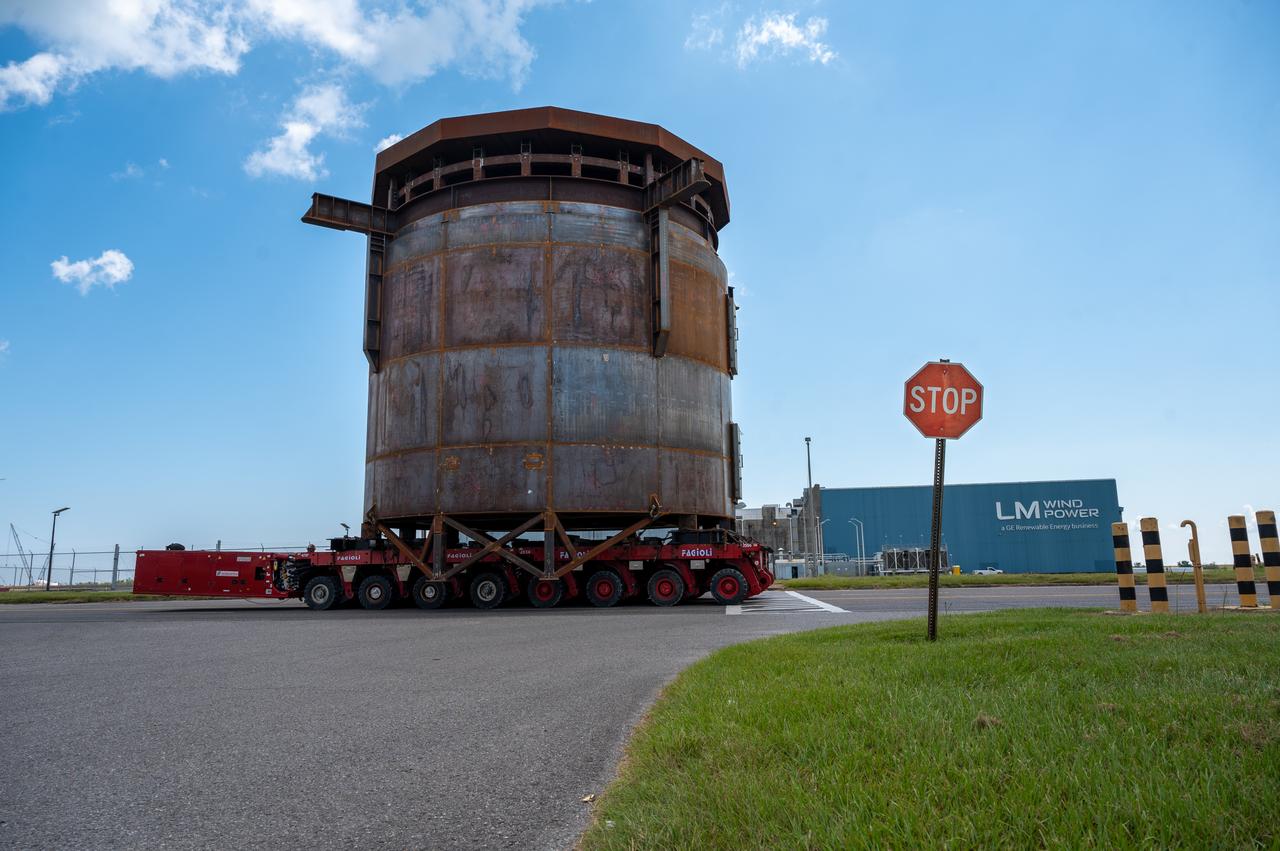
Move crews at NASA’s Michoud Assembly Facility in New Orleans guide the Inter-Stage Simulator (ISS) to the Michoud deep water port on Monday, Sept. 19 in preparation for transportation by barge to the agency’s Stennis Space Center near Bay St. Louis, Mississippi. Once it arrives at Stennis, the simulator will be lifted into the B2 Test Stand, where it holds the Exploration Upper Stage (EUS) in place and acts as a thrust takeout. ISS protects the lower portion of the EUS from environmental elements during its Green Run tests. The term “green” refers to the new hardware, and “run” refers to operation all the components together for the first time. During tanking and launch for its future mission, the lower portion is shrouded in a flight interstage. EUS is part of the SLS Block 1B configuration. The more powerful configuration of the SLS rocket will provide in-space propulsion to send astronauts in NASA’s Orion spacecraft and 40% more cargo mass on a precise trajectory to the Moon. Through the Artemis missions, NASA will land the first woman and the first person of color on the Moon to pave the way for a sustainable presence on the Moon and future missions beyond.
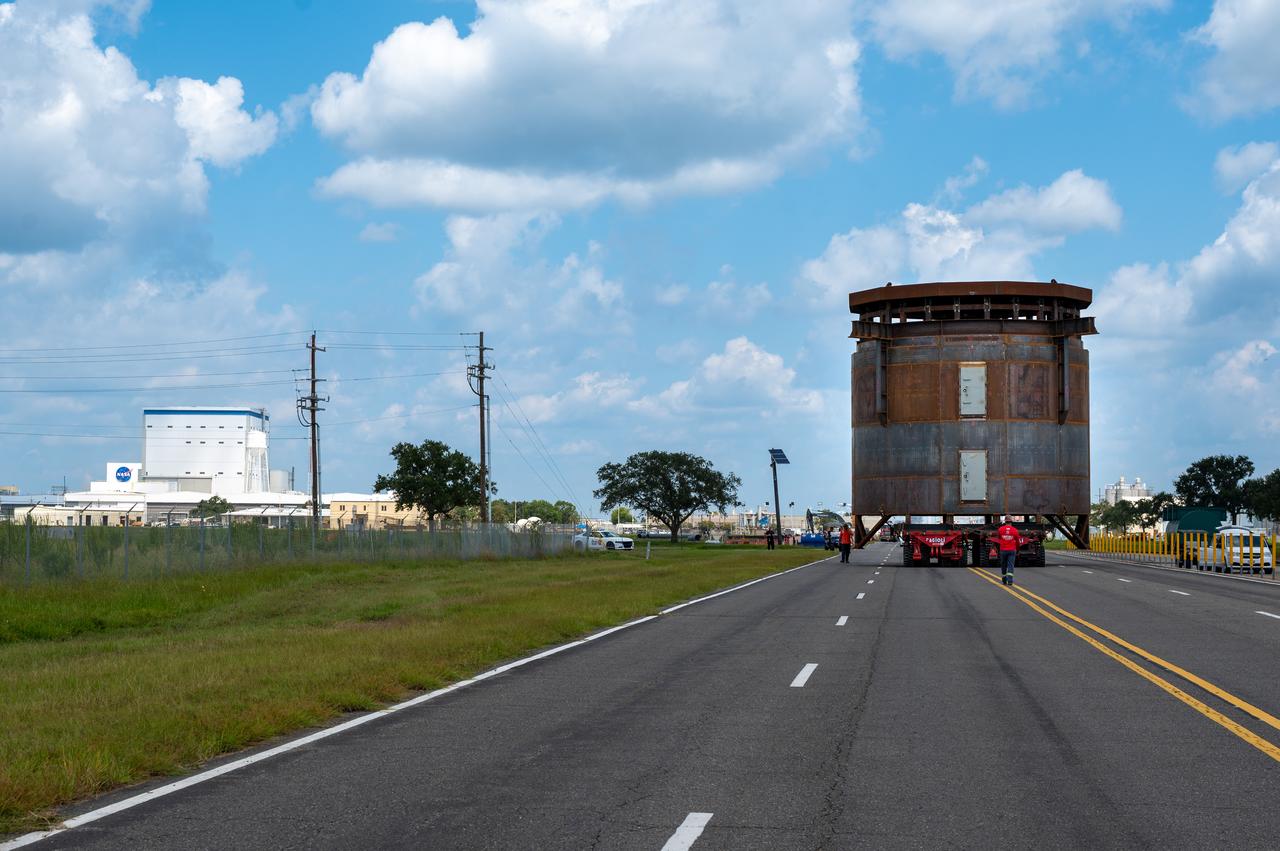
Move crews at NASA’s Michoud Assembly Facility in New Orleans guide the Inter-Stage Simulator (ISS) to the Michoud deep water port on Monday, Sept. 19 in preparation for transportation by barge to the agency’s Stennis Space Center near Bay St. Louis, Mississippi. Crews will lift the simulator into the B2 Test Stand at Stennis, where it holds the Exploration Upper Stage (EUS) in place and acts as a thrust takeout. ISS protects the lower portion of the EUS from environmental elements during its Green Run tests. The term “green” refers to the new hardware, and “run” refers to operation all the components together for the first time. During tanking and launch for its future mission, the lower portion is shrouded in a flight interstage. EUS is part of the SLS Block 1B configuration. The more powerful configuration of the SLS rocket will provide in-space propulsion to send astronauts in NASA’s Orion spacecraft and 40% more cargo mass on a precise trajectory to the Moon. Through the Artemis missions, NASA will land the first woman and the first person of color on the Moon to pave the way for a sustainable presence on the Moon and future missions beyond.
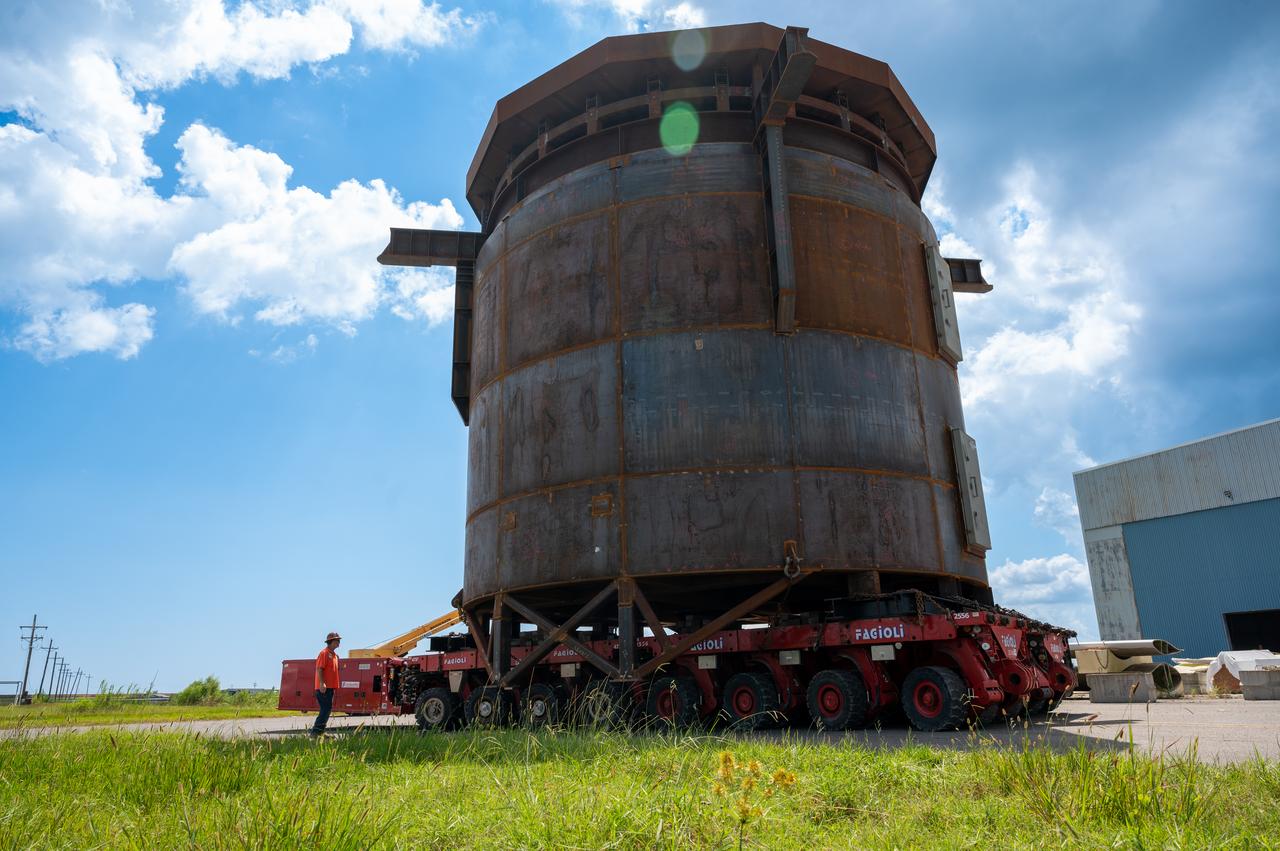
Move crews at NASA’s Michoud Assembly Facility in New Orleans guide the Inter-Stage Simulator (ISS) to the Michoud deep water port on Monday, Sept. 19 in preparation for transportation by barge to the agency’s Stennis Space Center near Bay St. Louis, Mississippi. Once it arrives at Stennis, the simulator will be lifted into the B2 Test Stand, where it holds the Exploration Upper Stage (EUS) in place and acts as a thrust takeout. ISS protects the lower portion of the EUS from environmental elements during its Green Run tests. The term “green” refers to the new hardware, and “run” refers to operation all the components together for the first time. During tanking and launch for its future mission, the lower portion is shrouded in a flight interstage. EUS is part of the SLS Block 1B configuration. The more powerful configuration of the SLS rocket will provide in-space propulsion to send astronauts in NASA’s Orion spacecraft and 40% more cargo mass on a precise trajectory to the Moon. Through the Artemis missions, NASA will land the first woman and the first person of color on the Moon to pave the way for a sustainable presence on the Moon and future missions beyond.
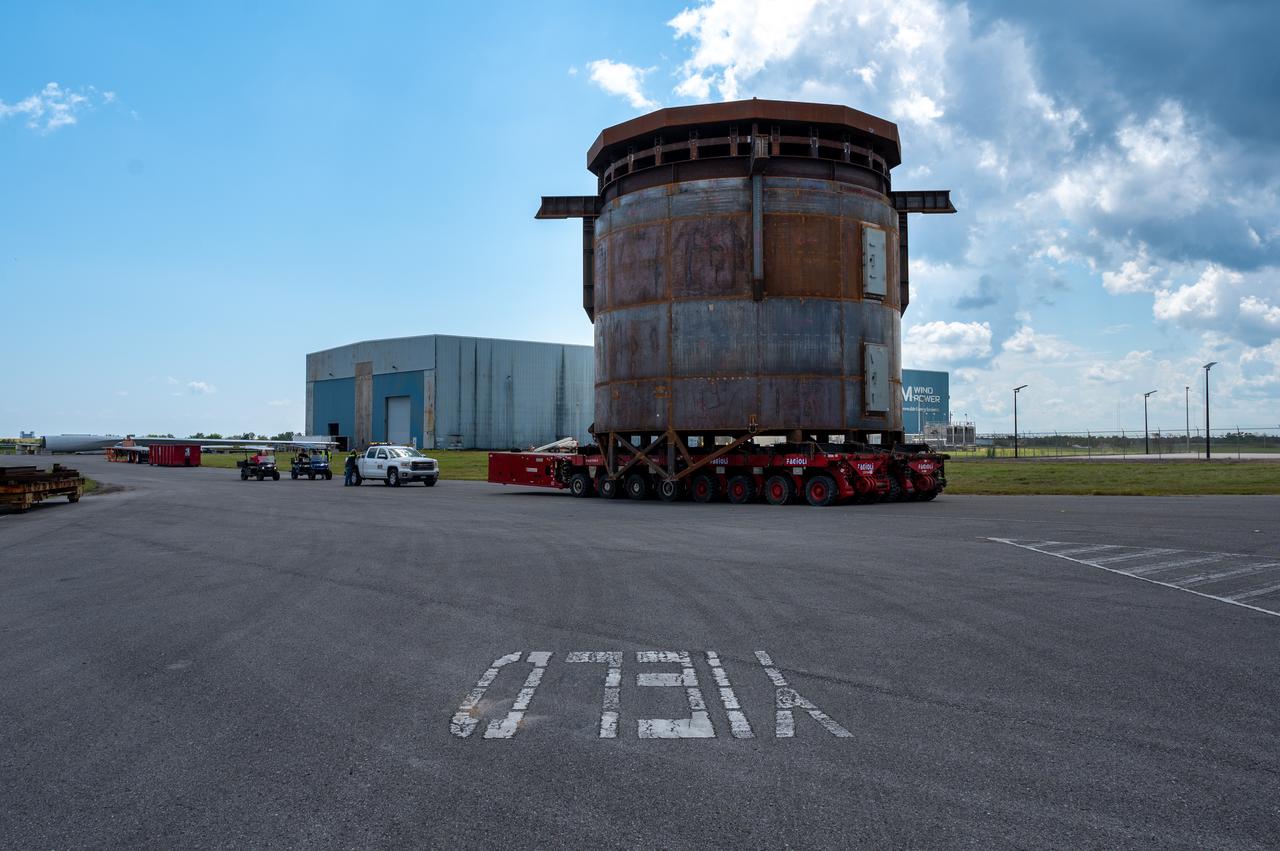
Move crews at NASA’s Michoud Assembly Facility in New Orleans guide the Inter-Stage Simulator (ISS) to the Michoud deep water port on Monday, Sept. 19 in preparation for transportation by barge to the agency’s Stennis Space Center near Bay St. Louis, Mississippi. Crews will lift the simulator into the B2 Test Stand at Stennis, where it holds the Exploration Upper Stage (EUS) in place and acts as a thrust takeout. ISS protects the lower portion of the EUS from environmental elements during its Green Run tests. The term “green” refers to the new hardware, and “run” refers to operation all the components together for the first time. During tanking and launch for its future mission, the lower portion is shrouded in a flight interstage. EUS is part of the SLS Block 1B configuration. The more powerful configuration of the SLS rocket will provide in-space propulsion to send astronauts in NASA’s Orion spacecraft and 40% more cargo mass on a precise trajectory to the Moon. Through the Artemis missions, NASA will land the first woman and the first person of color on the Moon to pave the way for a sustainable presence on the Moon and future missions beyond.
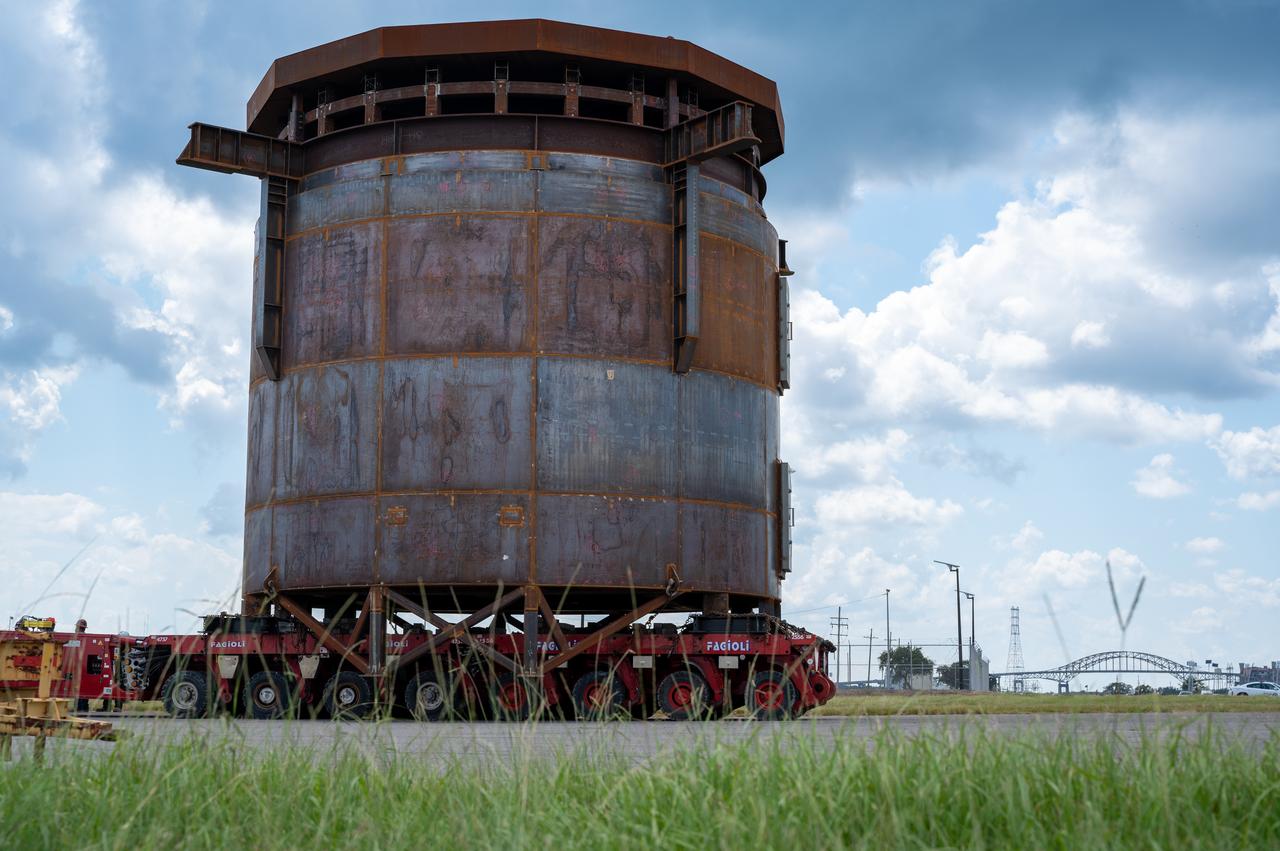
Move crews at NASA’s Michoud Assembly Facility in New Orleans guide the Inter-Stage Simulator (ISS) to the Michoud deep water port on Monday, Sept. 19 in preparation for transportation by barge to the agency’s Stennis Space Center near Bay St. Louis, Mississippi. Once it arrives at Stennis, the simulator will be lifted into the B2 Test Stand, where it holds the Exploration Upper Stage (EUS) in place and acts as a thrust takeout. ISS protects the lower portion of the EUS from environmental elements during its Green Run tests. The term “green” refers to the new hardware, and “run” refers to operation all the components together for the first time. During tanking and launch for its future mission, the lower portion is shrouded in a flight interstage. EUS is part of the SLS Block 1B configuration. The more powerful configuration of the SLS rocket will provide in-space propulsion to send astronauts in NASA’s Orion spacecraft and 40% more cargo mass on a precise trajectory to the Moon. Through the Artemis missions, NASA will land the first woman and the first person of color on the Moon to pave the way for a sustainable presence on the Moon and future missions beyond.
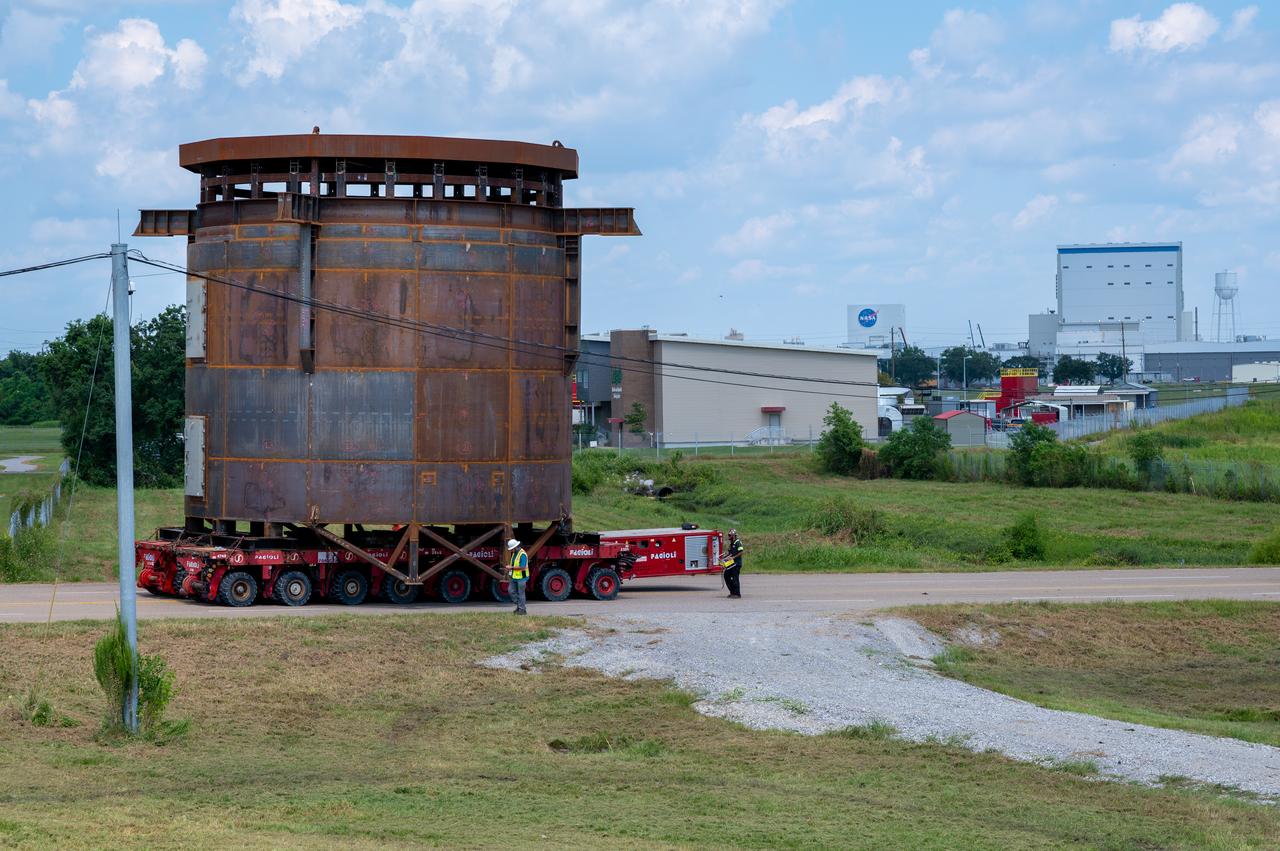
Move crews at NASA’s Michoud Assembly Facility in New Orleans guide the Inter-Stage Simulator (ISS) to the Michoud deep water port on Monday, Sept. 19 in preparation for transportation by barge to the agency’s Stennis Space Center near Bay St. Louis, Mississippi. Once it arrives at Stennis, the simulator will be lifted into the B2 Test Stand, where it holds the Exploration Upper Stage (EUS) in place and acts as a thrust takeout. ISS protects the lower portion of the EUS from environmental elements during its Green Run tests. The term “green” refers to the new hardware, and “run” refers to operation all the components together for the first time. During tanking and launch for its future mission, the lower portion is shrouded in a flight interstage. EUS is part of the SLS Block 1B configuration. The more powerful configuration of the SLS rocket will provide in-space propulsion to send astronauts in NASA’s Orion spacecraft and 40% more cargo mass on a precise trajectory to the Moon. Through the Artemis missions, NASA will land the first woman and the first person of color on the Moon to pave the way for a sustainable presence on the Moon and future missions beyond.

Move crews at NASA’s Michoud Assembly Facility in New Orleans guide the Inter-Stage Simulator (ISS) to the Michoud deep water port on Monday, Sept. 19 in preparation for transportation by barge to the agency’s Stennis Space Center near Bay St. Louis, Mississippi. Once it arrives at Stennis, the simulator will be lifted into the B2 Test Stand, where it holds the Exploration Upper Stage (EUS) in place and acts as a thrust takeout. ISS protects the lower portion of the EUS from environmental elements during its Green Run tests. The term “green” refers to the new hardware, and “run” refers to operation all the components together for the first time. During tanking and launch for its future mission, the lower portion is shrouded in a flight interstage. EUS is part of the SLS Block 1B configuration. The more powerful configuration of the SLS rocket will provide in-space propulsion to send astronauts in NASA’s Orion spacecraft and 40% more cargo mass on a precise trajectory to the Moon. Through the Artemis missions, NASA will land the first woman and the first person of color on the Moon to pave the way for a sustainable presence on the Moon and future missions beyond.
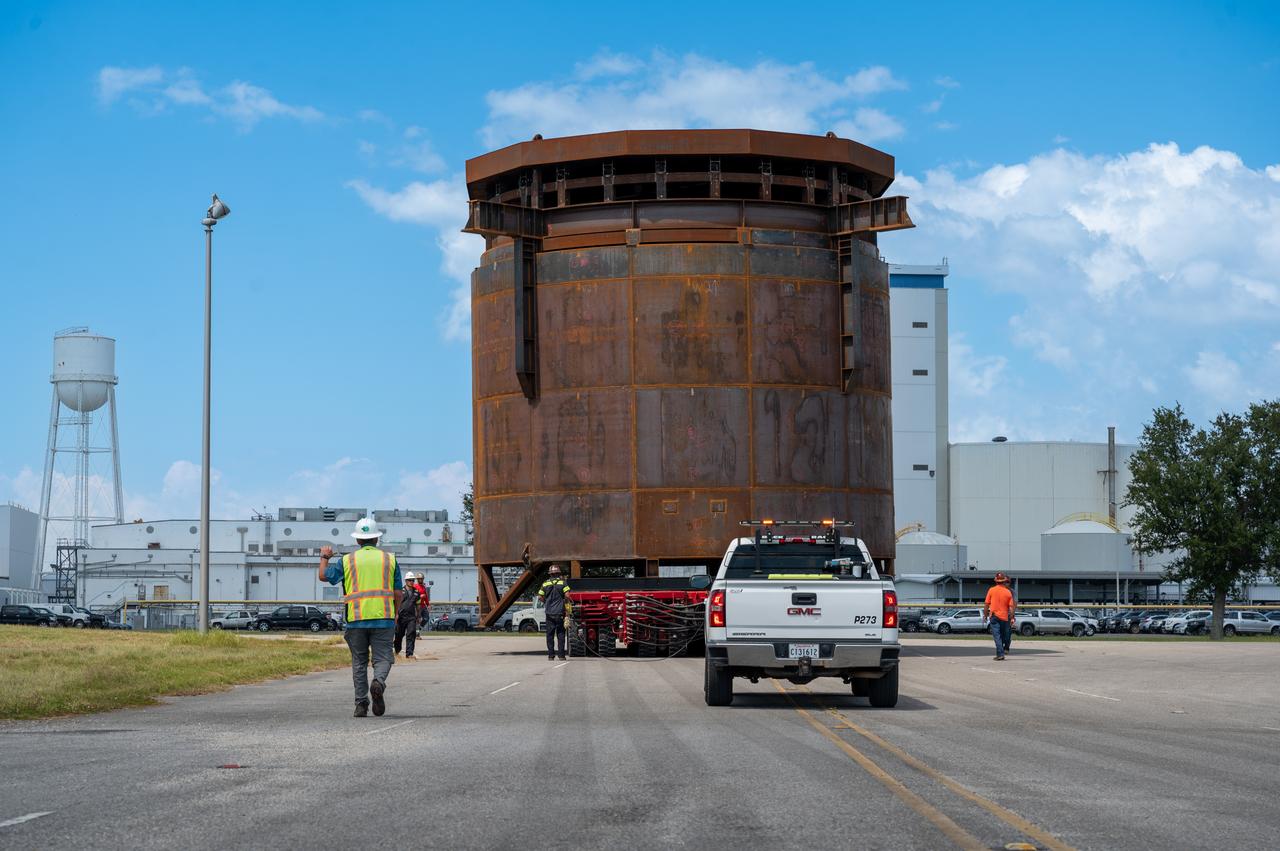
Move crews at NASA’s Michoud Assembly Facility in New Orleans guide the Inter-Stage Simulator (ISS) to the Michoud deep water port on Monday, Sept. 19 in preparation for transportation by barge to the agency’s Stennis Space Center near Bay St. Louis, Mississippi. Once it arrives at Stennis, the simulator will be lifted into the B2 Test Stand, where it holds the Exploration Upper Stage (EUS) in place and acts as a thrust takeout. ISS protects the lower portion of the EUS from environmental elements during its Green Run tests. The term “green” refers to the new hardware, and “run” refers to operation all the components together for the first time. During tanking and launch for its future mission, the lower portion is shrouded in a flight interstage. EUS is part of the SLS Block 1B configuration. The more powerful configuration of the SLS rocket will provide in-space propulsion to send astronauts in NASA’s Orion spacecraft and 40% more cargo mass on a precise trajectory to the Moon. Through the Artemis missions, NASA will land the first woman and the first person of color on the Moon to pave the way for a sustainable presence on the Moon and future missions beyond.
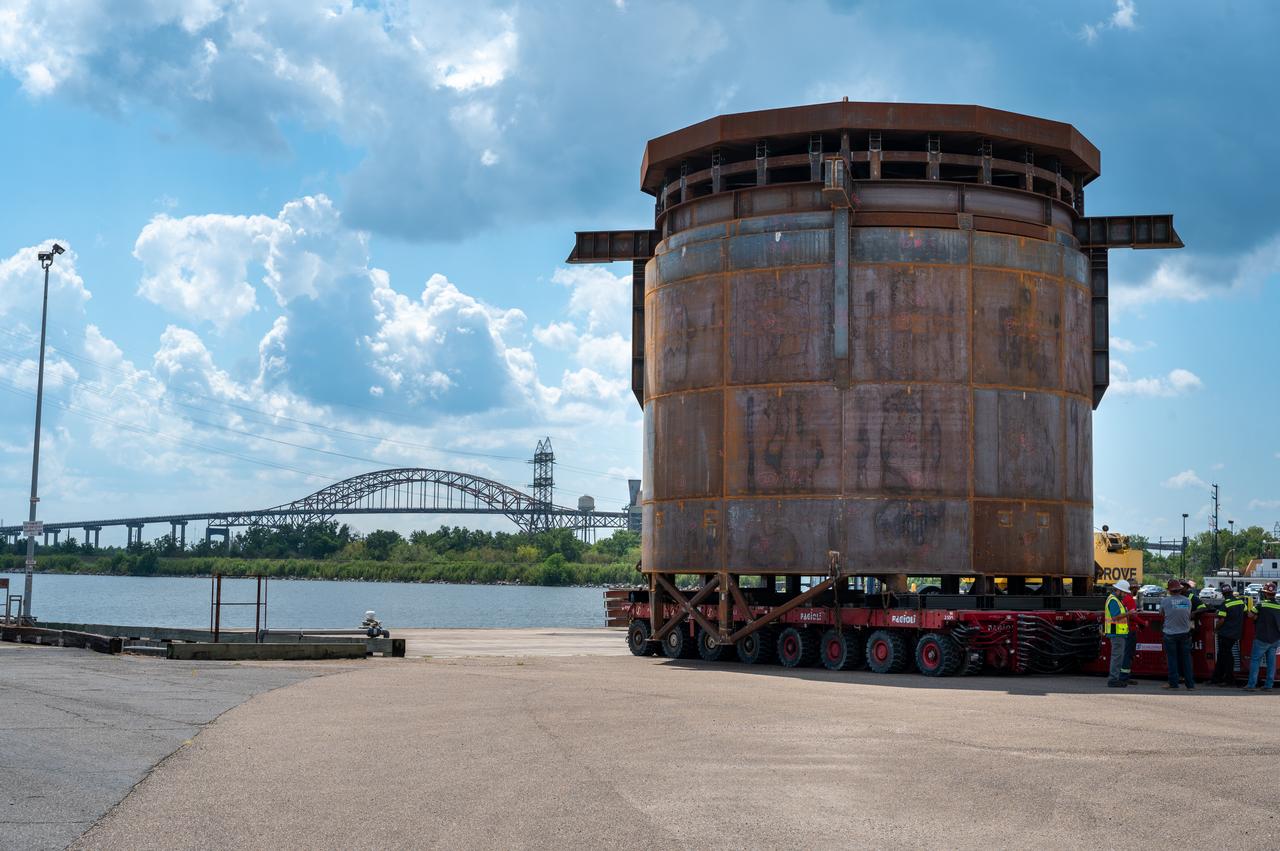
Move crews at NASA’s Michoud Assembly Facility in New Orleans guide the Inter-Stage Simulator (ISS) to the Michoud deep water port on Monday, Sept. 19 in preparation for transportation by barge to the agency’s Stennis Space Center near Bay St. Louis, Mississippi. Crews will lift the simulator into the B2 Test Stand at Stennis, where it holds the Exploration Upper Stage (EUS) in place and acts as a thrust takeout. ISS protects the lower portion of the EUS from environmental elements during its Green Run tests. The term “green” refers to the new hardware, and “run” refers to operation all the components together for the first time. During tanking and launch for its future mission, the lower portion is shrouded in a flight interstage. EUS is part of the SLS Block 1B configuration. The more powerful configuration of the SLS rocket will provide in-space propulsion to send astronauts in NASA’s Orion spacecraft and 40% more cargo mass on a precise trajectory to the Moon. Through the Artemis missions, NASA will land the first woman and the first person of color on the Moon to pave the way for a sustainable presence on the Moon and future missions beyond.

Move crews at NASA’s Michoud Assembly Facility in New Orleans guide the Inter-Stage Simulator (ISS) to the Michoud deep water port on Monday, Sept. 19 in preparation for transportation by barge to the agency’s Stennis Space Center near Bay St. Louis, Mississippi. Crews will lift the simulator into the B2 Test Stand at Stennis, where it holds the Exploration Upper Stage (EUS) in place and acts as a thrust takeout. ISS protects the lower portion of the EUS from environmental elements during its Green Run tests. The term “green” refers to the new hardware, and “run” refers to operation all the components together for the first time. During tanking and launch for its future mission, the lower portion is shrouded in a flight interstage. EUS is part of the SLS Block 1B configuration. The more powerful configuration of the SLS rocket will provide in-space propulsion to send astronauts in NASA’s Orion spacecraft and 40% more cargo mass on a precise trajectory to the Moon. Through the Artemis missions, NASA will land the first woman and the first person of color on the Moon to pave the way for a sustainable presence on the Moon and future missions beyond.
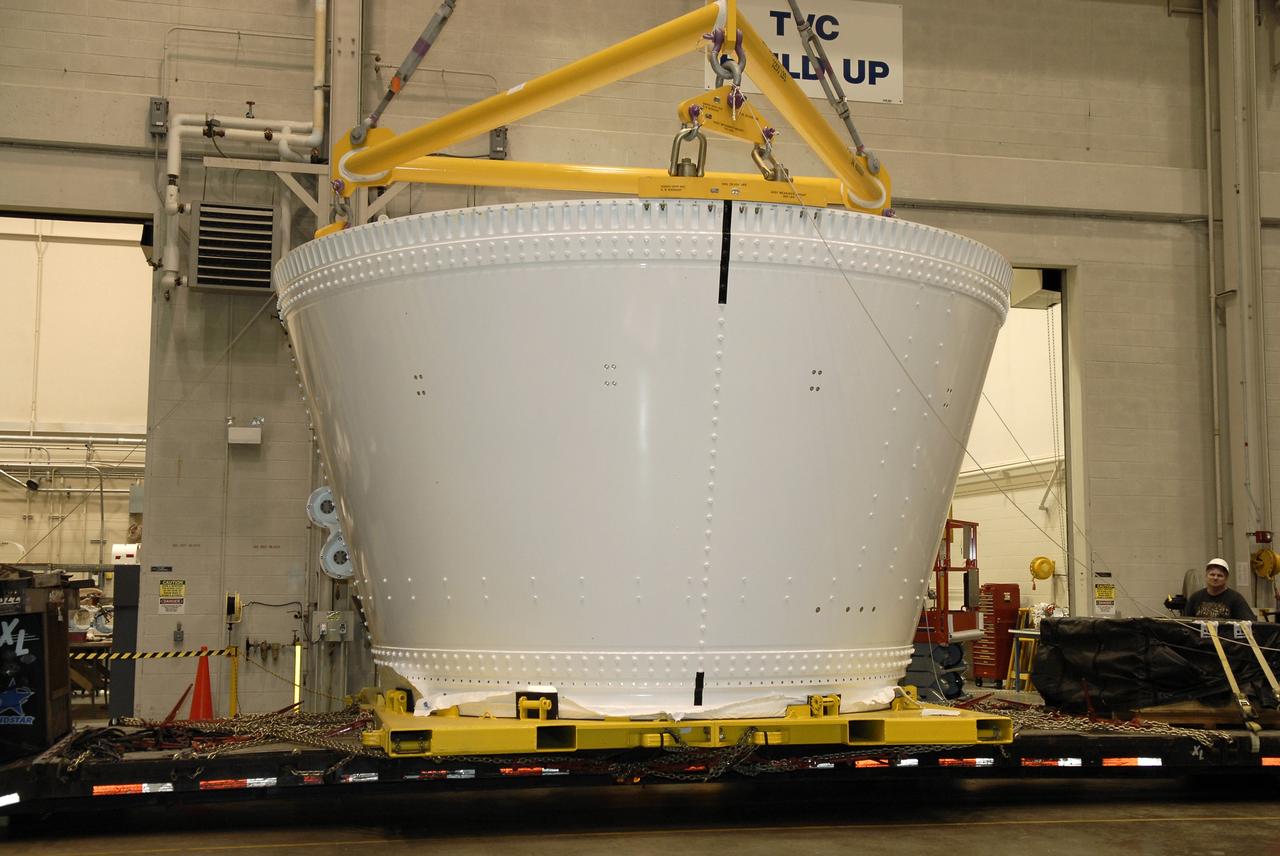
CAPE CANAVERAL, Fla. – In the Assembly and Refurbishment Facility, or ARF, at NASA's Kennedy Space Center, an overhead crane is attached to the frustum for the Ares I-X test rocket. The frustum is the last manufactured section of the Ares I-X. The frustum will be moved from the transporter to supports on the floor. Resembling a giant funnel, the frustum's function is to transition the primary flight loads from the rocket's upper stage to the first stage. The frustum is located between the forward skirt extension and the upper stage of the Ares I-X. The frustum will be integrated with the forward skirt and forward skirt extension, which already are in the ARF. That will complete the forward assembly. The assembly then will be moved to the Vehicle Assembly Building for stacking operations, which are scheduled to begin in April. Photo credit: NASA/Kim Shiflett
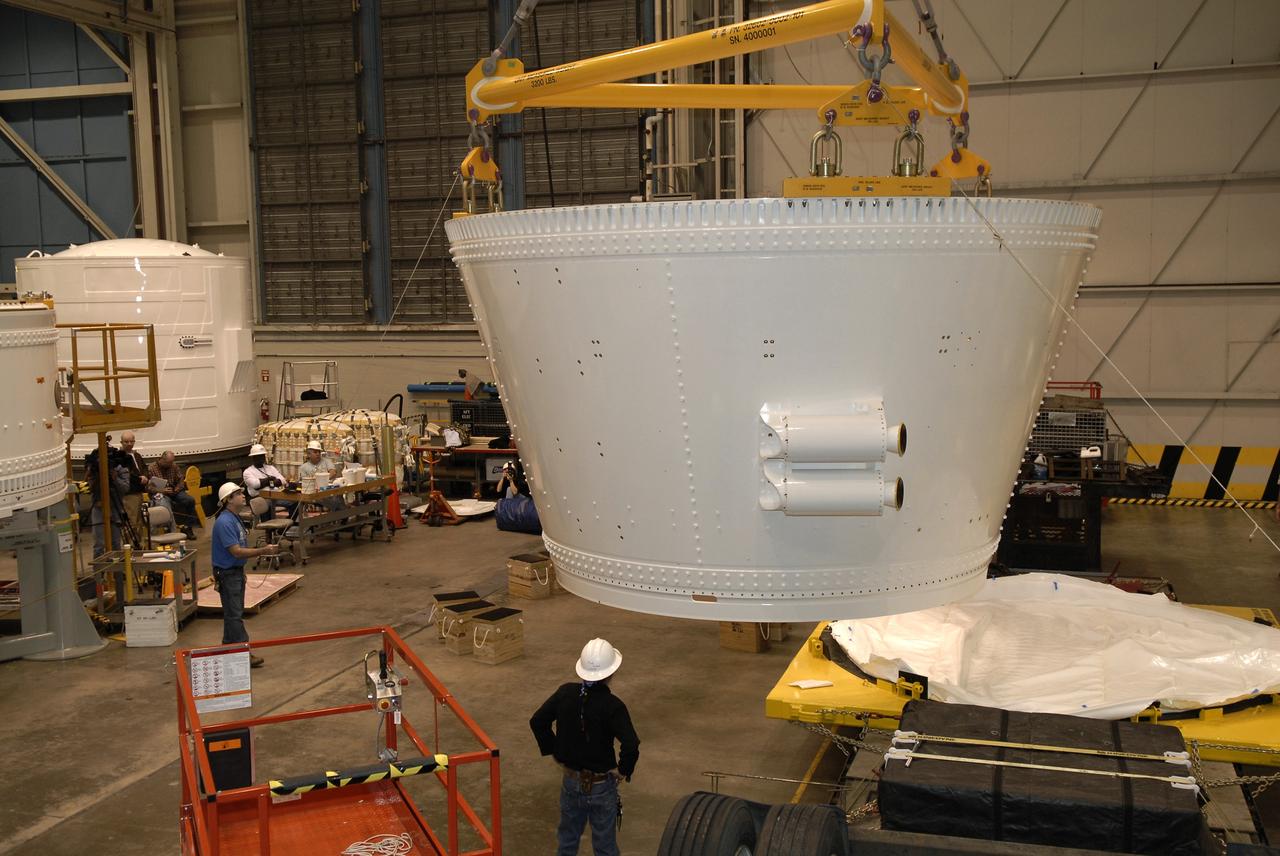
CAPE CANAVERAL, Fla. – In the Assembly and Refurbishment Facility, or ARF, at NASA's Kennedy Space Center, an overhead crane lifts the frustum for the Ares I-X test rocket from its transporter. The frustum is the last manufactured section of the Ares I-X. The frustum will be moved from the transporter to supports on the floor. Resembling a giant funnel, the frustum's function is to transition the primary flight loads from the rocket's upper stage to the first stage. The frustum is located between the forward skirt extension and the upper stage of the Ares I-X. The frustum will be integrated with the forward skirt and forward skirt extension, which already are in the ARF. That will complete the forward assembly. The assembly then will be moved to the Vehicle Assembly Building for stacking operations, which are scheduled to begin in April. Photo credit: NASA/Kim Shiflett
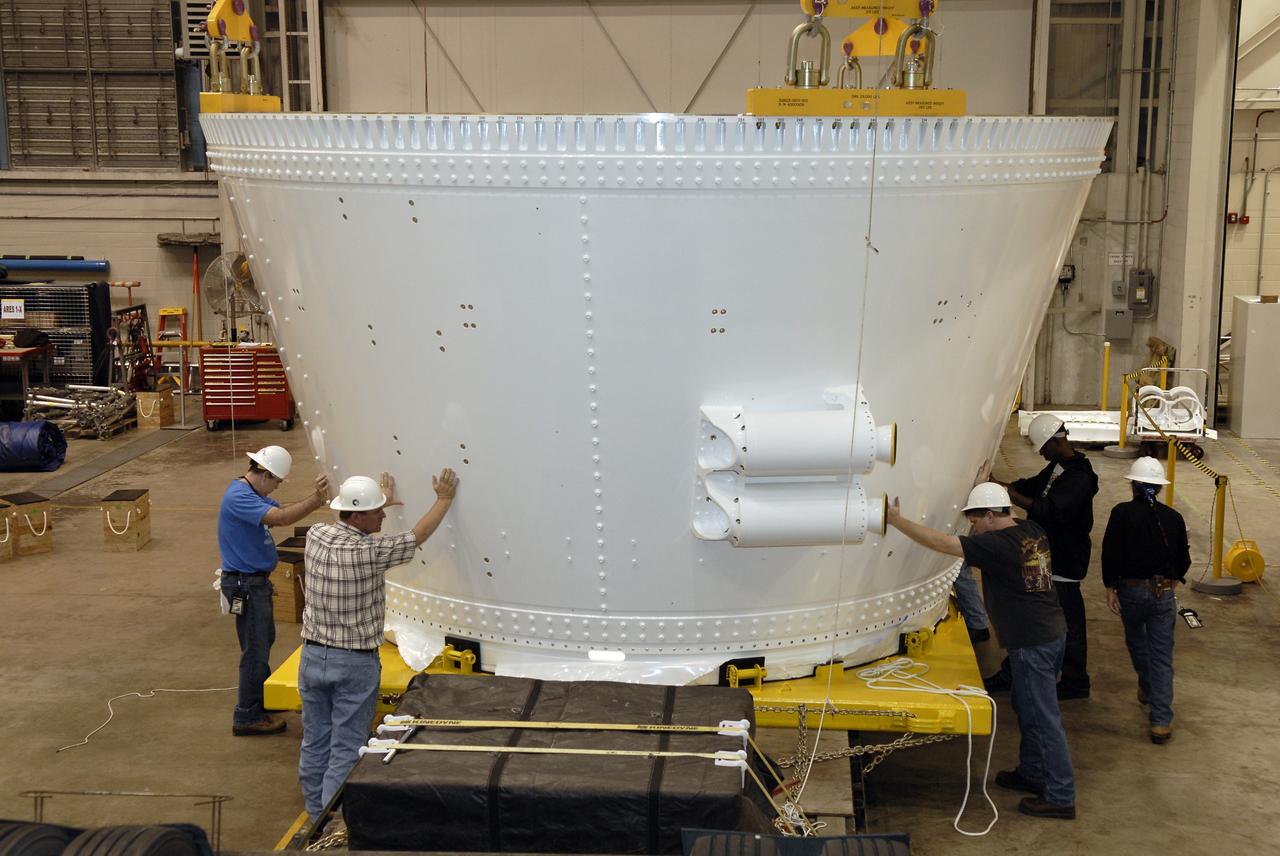
CAPE CANAVERAL, Fla. – In the Assembly and Refurbishment Facility, or ARF, at NASA's Kennedy Space Center, workers help guide the frustum as a cable lifts it from the transporter. The last manufactured section of the Ares I-X test rocket, the frustum will be moved from the transporter to supports on the floor. Resembling a giant funnel, the frustum's function is to transition the primary flight loads from the rocket's upper stage to the first stage. The frustum is located between the forward skirt extension and the upper stage of the Ares I-X. The frustum will be integrated with the forward skirt and forward skirt extension, which already are in the ARF. That will complete the forward assembly. The assembly then will be moved to the Vehicle Assembly Building for stacking operations, which are scheduled to begin in April. Photo credit: NASA/Kim Shiflett
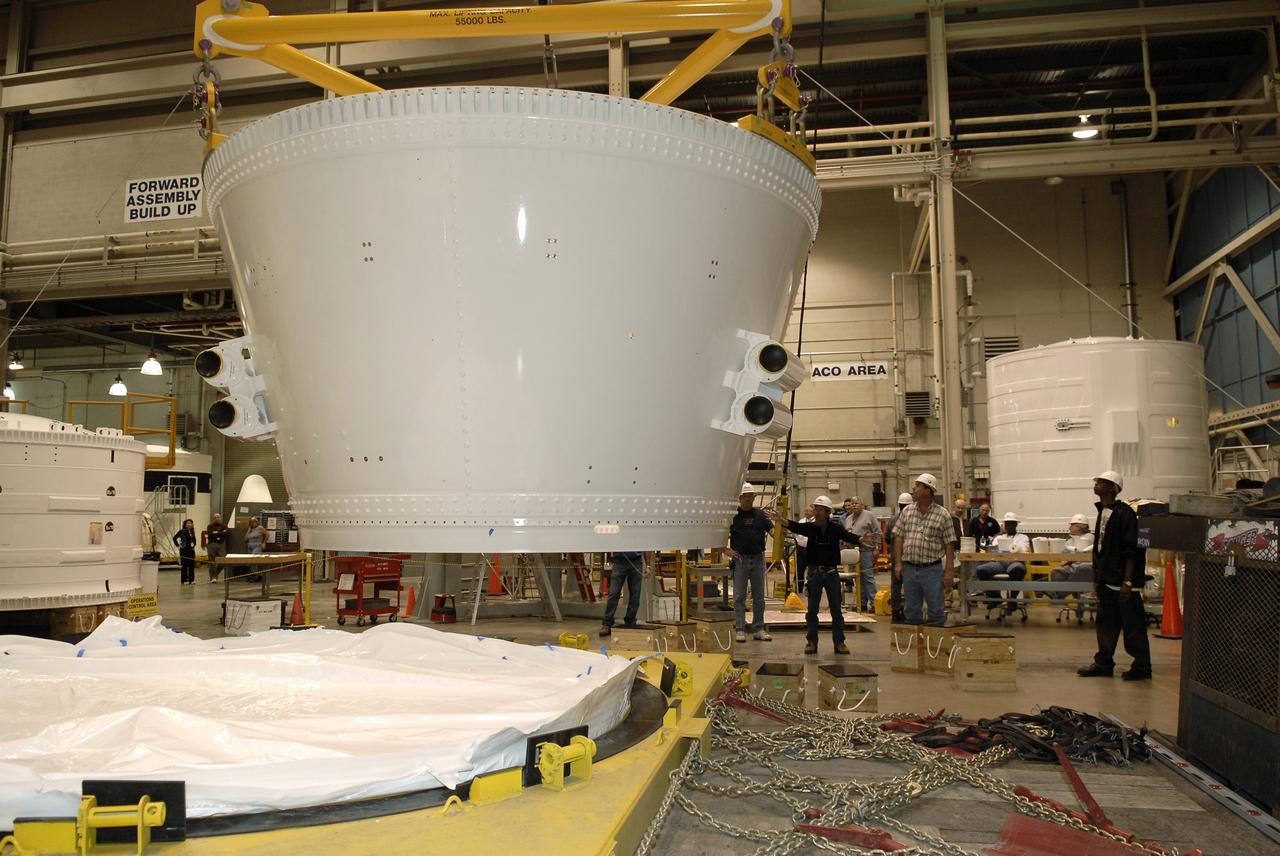
CAPE CANAVERAL, Fla. – In the Assembly and Refurbishment Facility, or ARF, at NASA's Kennedy Space Center, an overhead crane lifts the frustum for the Ares I-X test rocket from its transporter. The frustum is the last manufactured section of the Ares I-X. The frustum will be moved from the transporter to supports on the floor. Resembling a giant funnel, the frustum's function is to transition the primary flight loads from the rocket's upper stage to the first stage. The frustum is located between the forward skirt extension and the upper stage of the Ares I-X. The frustum will be integrated with the forward skirt and forward skirt extension, which already are in the ARF. That will complete the forward assembly. The assembly then will be moved to the Vehicle Assembly Building for stacking operations, which are scheduled to begin in April. Photo credit: NASA/Kim Shiflett
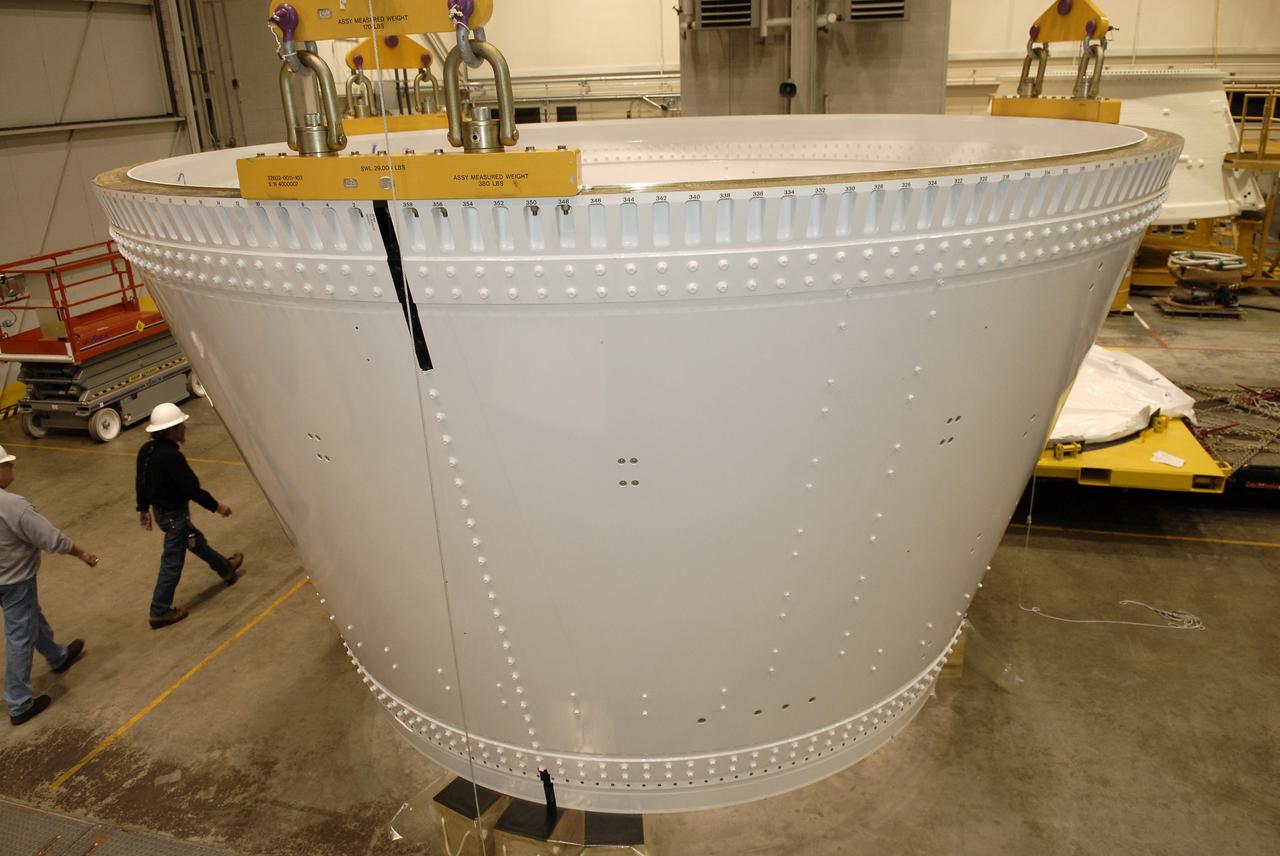
CAPE CANAVERAL, Fla. – In the Assembly and Refurbishment Facility, or ARF, at NASA's Kennedy Space Center, an overhead crane lowers the frustum for the Ares I-X test rocket onto supports on the floor. The frustum is the last manufactured section of the Ares I-X. Resembling a giant funnel, the frustum's function is to transition the primary flight loads from the rocket's upper stage to the first stage. The frustum is located between the forward skirt extension and the upper stage of the Ares I-X. The frustum will be integrated with the forward skirt and forward skirt extension, which already are in the ARF. That will complete the forward assembly. The assembly then will be moved to the Vehicle Assembly Building for stacking operations, which are scheduled to begin in April. Photo credit: NASA/Kim Shiflett
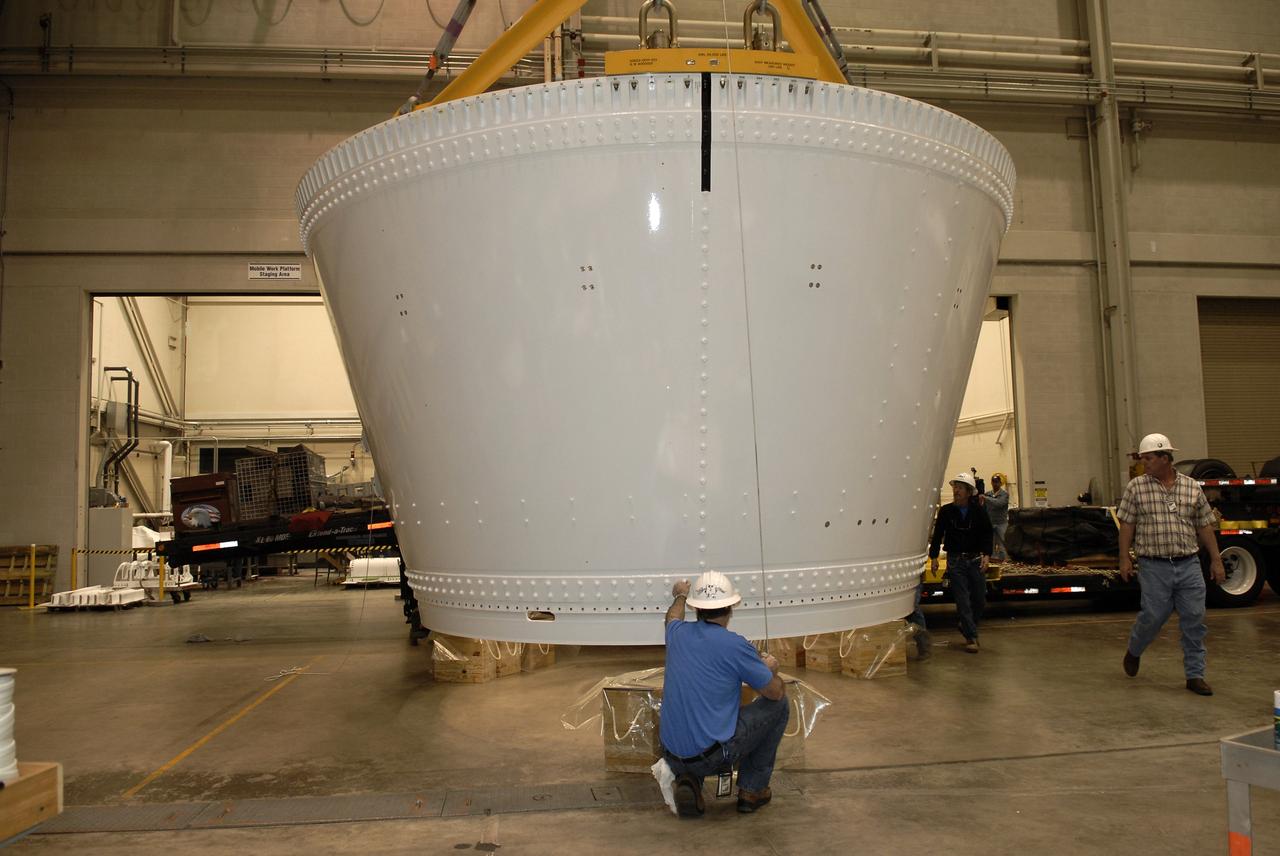
CAPE CANAVERAL, Fla. – In the Assembly and Refurbishment Facility, or ARF, at NASA's Kennedy Space Center, an overhead crane lowers the frustum for the Ares I-X test rocket onto supports on the floor. The frustum is the last manufactured section of the Ares I-X. Resembling a giant funnel, the frustum's function is to transition the primary flight loads from the rocket's upper stage to the first stage. The frustum is located between the forward skirt extension and the upper stage of the Ares I-X. The frustum will be integrated with the forward skirt and forward skirt extension, which already are in the ARF. That will complete the forward assembly. The assembly then will be moved to the Vehicle Assembly Building for stacking operations, which are scheduled to begin in April. Photo credit: NASA/Kim Shiflett
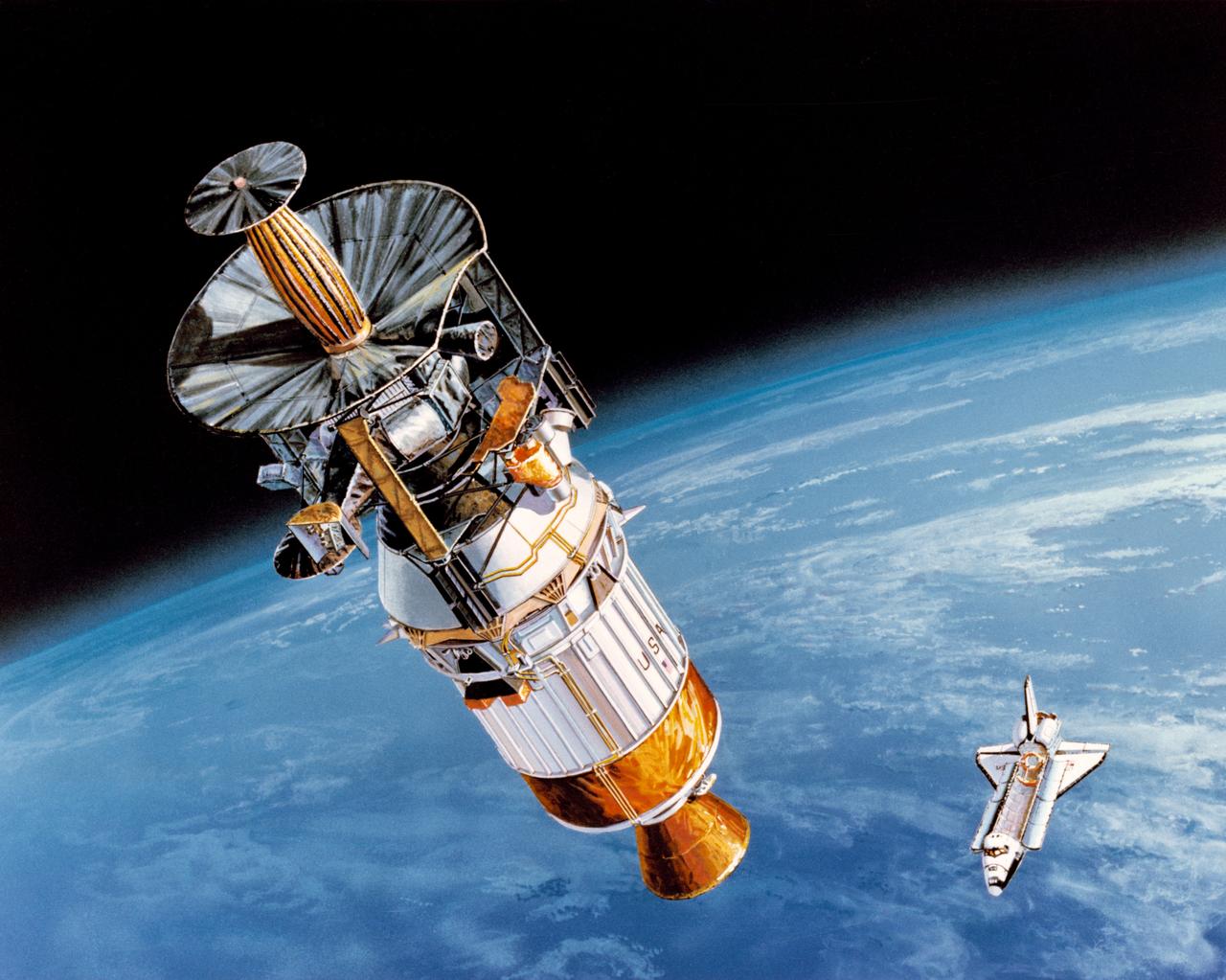
S89-42940 (April 1989) --- In this artist's rendition, the Galileo spacecraft is being boosted into its inter-planetary trajectory by the Inertial Upper Stage (IUS) rocket. The Space Shuttle Atlantis, which is scheduled to take Galileo and the IUS from Earth's surface into space, is depicted against the curve of Earth. Galileo will be placed on a trajectory to Venus, from which it will return to Earth at higher velocity and then gain still more energy in two gravity-assist passes, until it has enough velocity to reach Jupiter. Passing Venus, it will take scientific data using instruments designed for observing Jupiter; later, it will make measurements at Earth and the moon, crossing above the moon's north pole in the second pass. Between the two Earth passes, it will edge into the asteroid belt, beyond Mars' orbit; there, the first close-up observation of an asteroid is planned. Crossing the belt later, another asteroid flyby is possible.

These images show technicians at NASA’s Michoud Assembly Facility in New Orleans removing a weld-confidence article from a robotic welding tool in December 2023. This article features pieces of a liquid hydrogen tank dome that were welded as a test to make sure the dome used for flight will be welded correctly. The dome will be part of the new, four-engine EUS (exploration upper stage) for NASA’s SLS (Space Launch System) rocket. EUS will be used for the Artemis IV lunar mission, replacing the single-engine interim cryogenic propulsion stage (ICPS) used for the first three Artemis missions. The evolved in-space stage will use a combination of liquid oxygen and liquid hydrogen propellants to help power the engines to send large cargo and crew inside NASA’s Orion spacecraft to the Moon. The weld-confidence article pictured here will not be used for flight but is instead helping teams prepare and certify the procedures needed to manufacture flight hardware. NASA is working to land the first woman and person of color on the Moon under Artemis. SLS is part of NASA’s backbone for deep space exploration, along with the Orion spacecraft, advanced spacesuits and rovers, the Gateway in orbit around the Moon, and commercial human landing systems. SLS is the only rocket that can send Orion, astronauts, and supplies to the Moon in a single launch.

These images show technicians at NASA’s Michoud Assembly Facility in New Orleans removing a weld-confidence article from a robotic welding tool in December 2023. This article features pieces of a liquid hydrogen tank dome that were welded as a test to make sure the dome used for flight will be welded correctly. The dome will be part of the new, four-engine EUS (exploration upper stage) for NASA’s SLS (Space Launch System) rocket. EUS will be used for the Artemis IV lunar mission, replacing the single-engine interim cryogenic propulsion stage (ICPS) used for the first three Artemis missions. The evolved in-space stage will use a combination of liquid oxygen and liquid hydrogen propellants to help power the engines to send large cargo and crew inside NASA’s Orion spacecraft to the Moon. The weld-confidence article pictured here will not be used for flight but is instead helping teams prepare and certify the procedures needed to manufacture flight hardware. NASA is working to land the first woman and person of color on the Moon under Artemis. SLS is part of NASA’s backbone for deep space exploration, along with the Orion spacecraft, advanced spacesuits and rovers, the Gateway in orbit around the Moon, and commercial human landing systems. SLS is the only rocket that can send Orion, astronauts, and supplies to the Moon in a single launch.

These images show technicians at NASA’s Michoud Assembly Facility in New Orleans removing a weld-confidence article from a robotic welding tool in December 2023. This article features pieces of a liquid hydrogen tank dome that were welded as a test to make sure the dome used for flight will be welded correctly. The dome will be part of the new, four-engine EUS (exploration upper stage) for NASA’s SLS (Space Launch System) rocket. EUS will be used for the Artemis IV lunar mission, replacing the single-engine interim cryogenic propulsion stage (ICPS) used for the first three Artemis missions. The evolved in-space stage will use a combination of liquid oxygen and liquid hydrogen propellants to help power the engines to send large cargo and crew inside NASA’s Orion spacecraft to the Moon. The weld-confidence article pictured here will not be used for flight but is instead helping teams prepare and certify the procedures needed to manufacture flight hardware. NASA is working to land the first woman and person of color on the Moon under Artemis. SLS is part of NASA’s backbone for deep space exploration, along with the Orion spacecraft, advanced spacesuits and rovers, the Gateway in orbit around the Moon, and commercial human landing systems. SLS is the only rocket that can send Orion, astronauts, and supplies to the Moon in a single launch.

These images show technicians at NASA’s Michoud Assembly Facility in New Orleans removing a weld-confidence article from a robotic welding tool in December 2023. This article features pieces of a liquid hydrogen tank dome that were welded as a test to make sure the dome used for flight will be welded correctly. The dome will be part of the new, four-engine EUS (exploration upper stage) for NASA’s SLS (Space Launch System) rocket. EUS will be used for the Artemis IV lunar mission, replacing the single-engine interim cryogenic propulsion stage (ICPS) used for the first three Artemis missions. The evolved in-space stage will use a combination of liquid oxygen and liquid hydrogen propellants to help power the engines to send large cargo and crew inside NASA’s Orion spacecraft to the Moon. The weld-confidence article pictured here will not be used for flight but is instead helping teams prepare and certify the procedures needed to manufacture flight hardware. NASA is working to land the first woman and person of color on the Moon under Artemis. SLS is part of NASA’s backbone for deep space exploration, along with the Orion spacecraft, advanced spacesuits and rovers, the Gateway in orbit around the Moon, and commercial human landing systems. SLS is the only rocket that can send Orion, astronauts, and supplies to the Moon in a single launch.

These images show technicians at NASA’s Michoud Assembly Facility in New Orleans removing a weld-confidence article from a robotic welding tool in December 2023. This article features pieces of a liquid hydrogen tank dome that were welded as a test to make sure the dome used for flight will be welded correctly. The dome will be part of the new, four-engine EUS (exploration upper stage) for NASA’s SLS (Space Launch System) rocket. EUS will be used for the Artemis IV lunar mission, replacing the single-engine interim cryogenic propulsion stage (ICPS) used for the first three Artemis missions. The evolved in-space stage will use a combination of liquid oxygen and liquid hydrogen propellants to help power the engines to send large cargo and crew inside NASA’s Orion spacecraft to the Moon. The weld-confidence article pictured here will not be used for flight but is instead helping teams prepare and certify the procedures needed to manufacture flight hardware. NASA is working to land the first woman and person of color on the Moon under Artemis. SLS is part of NASA’s backbone for deep space exploration, along with the Orion spacecraft, advanced spacesuits and rovers, the Gateway in orbit around the Moon, and commercial human landing systems. SLS is the only rocket that can send Orion, astronauts, and supplies to the Moon in a single launch.
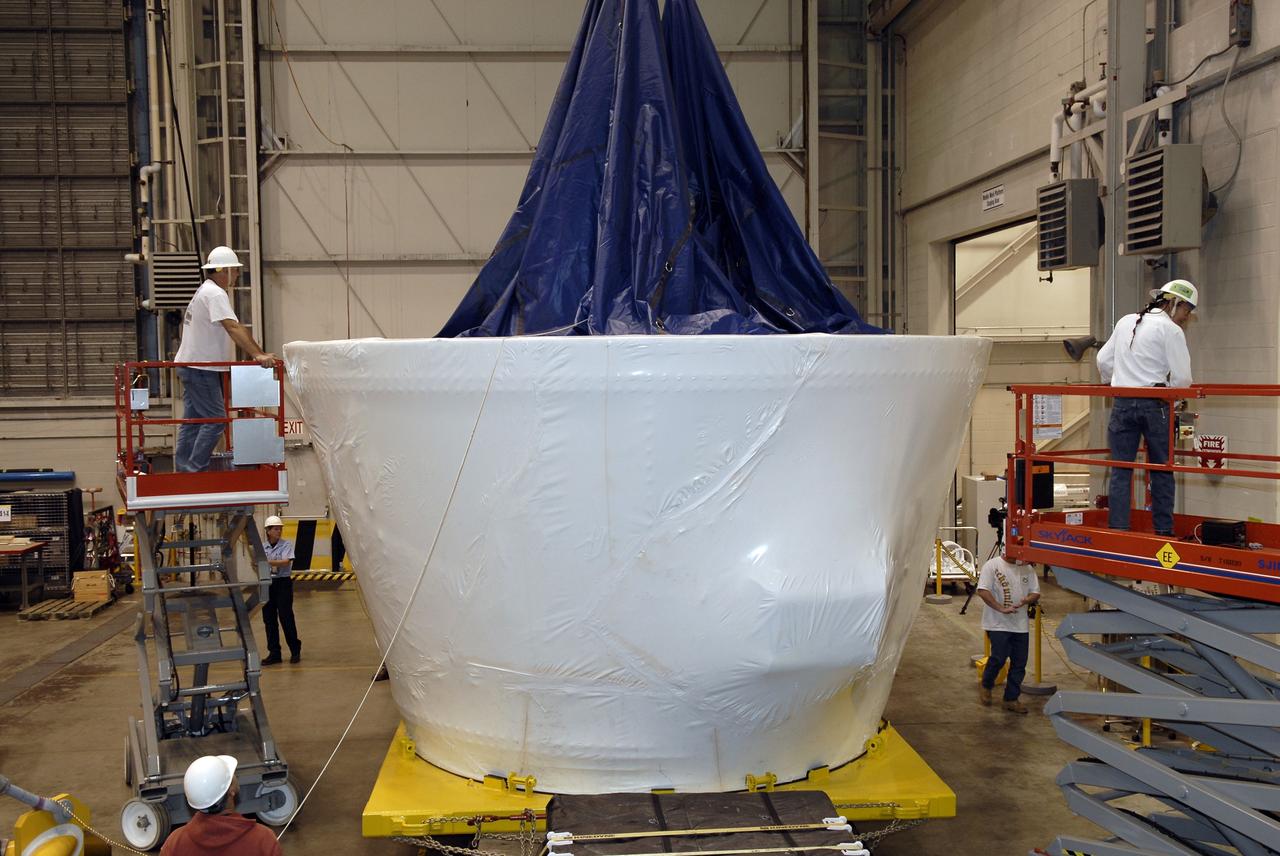
CAPE CANAVERAL, Fla. – In the Assembly and Refurbishment Facility of NASA's Kennedy Space Center, workers remove the cover from the frustum, the last newly manufactured section of the Ares I-X test rocket. Resembling a giant funnel, the frustum's function is to transition the primary flight loads from the rocket's upper stage to the first stage. The frustum is located between the forward skirt extension and the upper stage of the Ares I-X. Weighing in at approximately 13,000 pounds, the 10-foot-long section is composed of two aluminum rings attached to a truncated conic section. The large diameter of the cone is 18 feet and the small diameter is 12 feet. The cone is 1.25 inches thick. The frustum will be integrated with the forward skirt and forward skirt extension, which already are in the Assembly and Refurbishment Facility. That will complete the forward assembly. The assembly then will be moved to the Vehicle Assembly Building for stacking operations, which are scheduled to begin in April. Manufactured by Major Tool and Machine Inc. in Indiana under a subcontract with Alliant Techsystems Inc., or ATK, the Ares I-X is targeted to launch in the summer of 2009. The flight will provide NASA with an early opportunity to test and prove hardware, facilities and ground operations associated with the Ares I launch vehicle. The flight test also will bring NASA a step closer to its exploration goals of sending humans to the moon and destinations beyond. Photo credit: NASA/Kim Shiflett
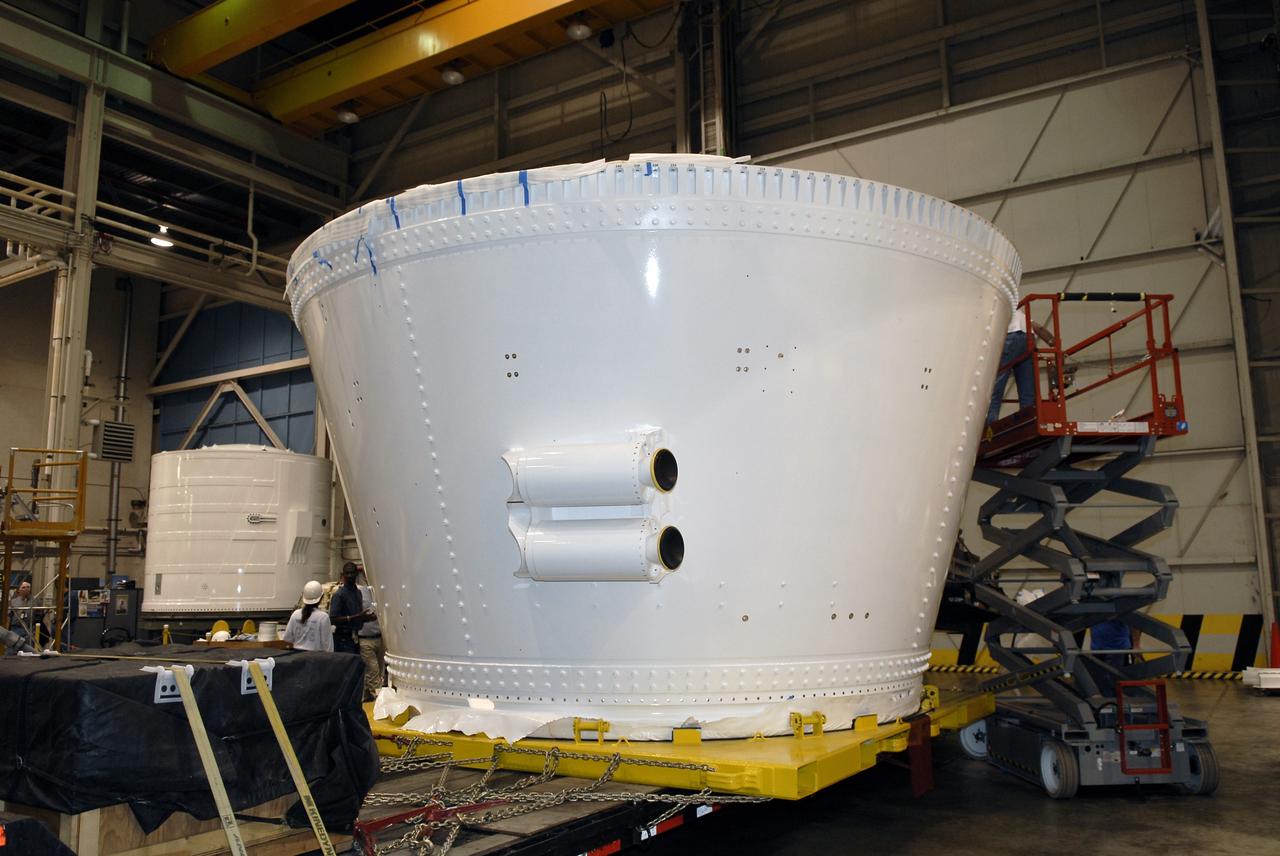
CAPE CANAVERAL, Fla. – In the Assembly and Refurbishment Facility of NASA's Kennedy Space Center, the last newly manufactured section of the Ares I-X test rocket, the frustum, is revealed after removal of the shipping covers. Resembling a giant funnel, the frustum's function is to transition the primary flight loads from the rocket's upper stage to the first stage. The frustum is located between the forward skirt extension and the upper stage of the Ares I-X. Weighing in at approximately 13,000 pounds, the 10-foot-long section is composed of two aluminum rings attached to a truncated conic section. The large diameter of the cone is 18 feet and the small diameter is 12 feet. The cone is 1.25 inches thick. The frustum will be integrated with the forward skirt and forward skirt extension, which already are in the Assembly and Refurbishment Facility. That will complete the forward assembly. The assembly then will be moved to the Vehicle Assembly Building for stacking operations, which are scheduled to begin in April. Manufactured by Major Tool and Machine Inc. in Indiana under a subcontract with Alliant Techsystems Inc., or ATK, the Ares I-X is targeted to launch in the summer of 2009. The flight will provide NASA with an early opportunity to test and prove hardware, facilities and ground operations associated with the Ares I launch vehicle. The flight test also will bring NASA a step closer to its exploration goals of sending humans to the moon and destinations beyond. Photo credit: NASA/Kim Shiflett
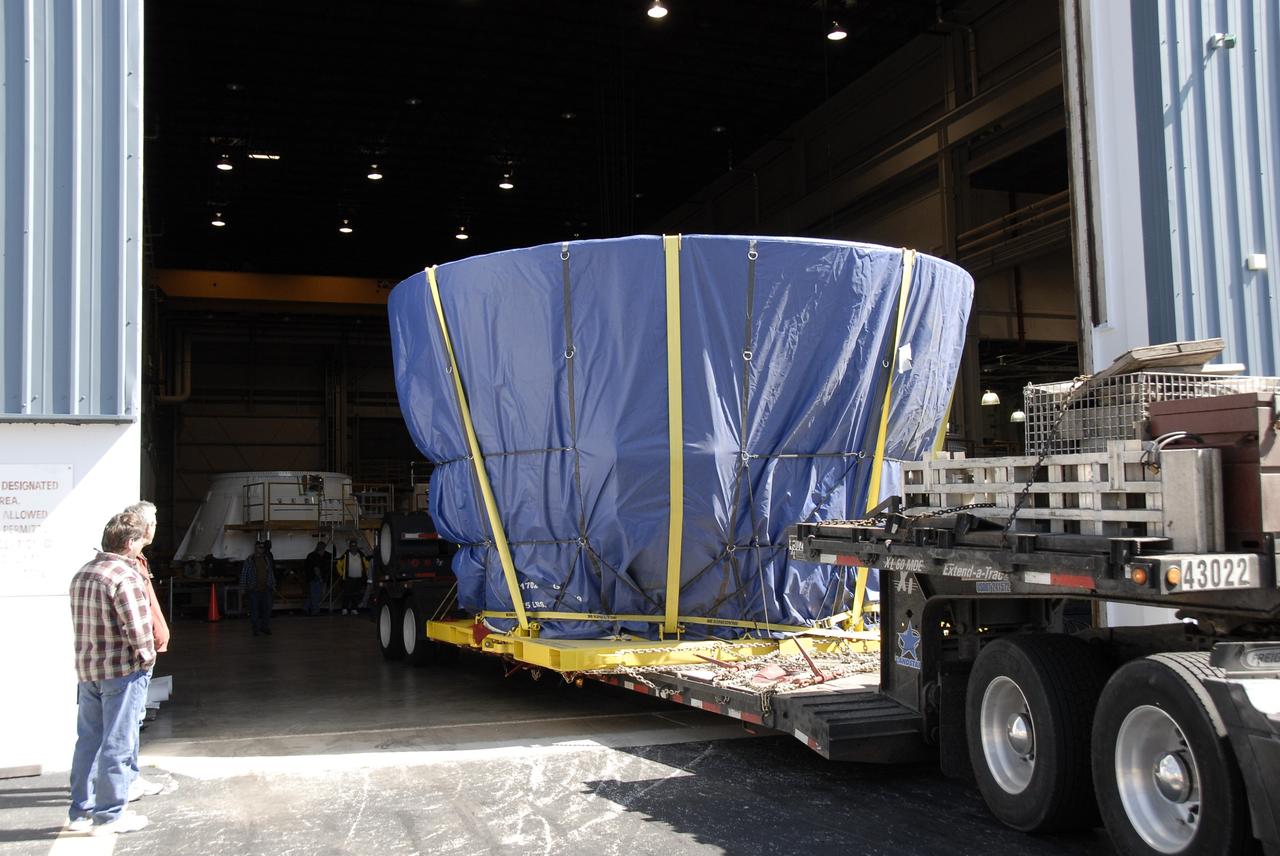
CAPE CANAVERAL, Fla. – The last newly manufactured section of the Ares I-X test rocket, the frustum, is offloaded in the Assembly and Refurbishment Facility of NASA's Kennedy Space Center. Resembling a giant funnel, the frustum's function is to transition the primary flight loads from the rocket's upper stage to the first stage. The frustum is located between the forward skirt extension and the upper stage of the Ares I-X. Weighing in at approximately 13,000 pounds, the 10-foot-long section is composed of two aluminum rings attached to a truncated conic section. The large diameter of the cone is 18 feet and the small diameter is 12 feet. The cone is 1.25 inches thick. The frustum will be integrated with the forward skirt and forward skirt extension, which already are in the Assembly and Refurbishment Facility. That will complete the forward assembly. The assembly then will be moved to the Vehicle Assembly Building for stacking operations, which are scheduled to begin in April. Manufactured by Major Tool and Machine Inc. in Indiana under a subcontract with Alliant Techsystems Inc., or ATK, the Ares I-X is targeted to launch in the summer of 2009. The flight will provide NASA with an early opportunity to test and prove hardware, facilities and ground operations associated with the Ares I launch vehicle. The flight test also will bring NASA a step closer to its exploration goals of sending humans to the moon and destinations beyond. Photo credit: NASA/Kim Shiflett
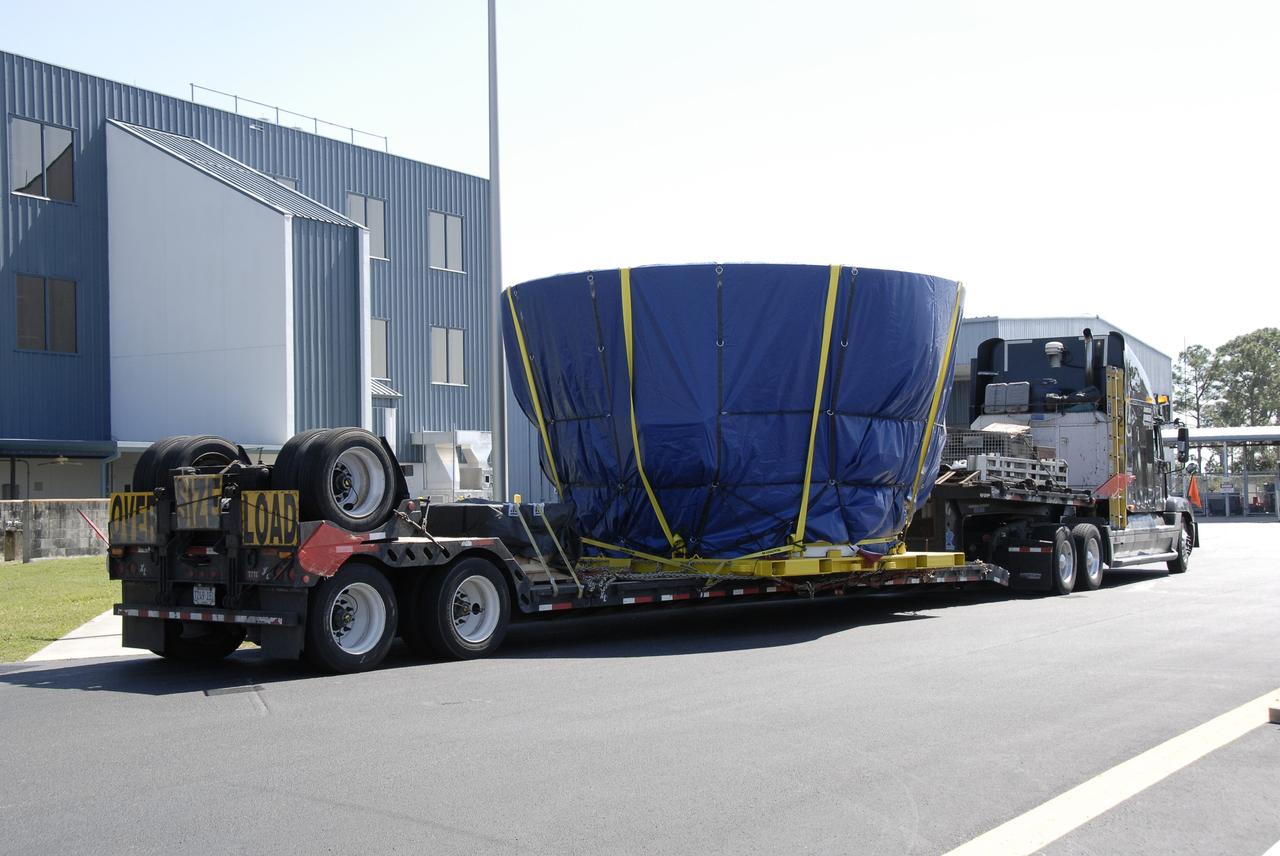
CAPE CANAVERAL, Fla. – The last newly manufactured section of the Ares I-X test rocket, the frustum, arrives at the Assembly and Refurbishment Facility of NASA's Kennedy Space Center. Resembling a giant funnel, the frustum's function is to transition the primary flight loads from the rocket's upper stage to the first stage. The frustum is located between the forward skirt extension and the upper stage of the Ares I-X. Weighing in at approximately 13,000 pounds, the 10-foot-long section is composed of two aluminum rings attached to a truncated conic section. The large diameter of the cone is 18 feet and the small diameter is 12 feet. The cone is 1.25 inches thick. The frustum will be integrated with the forward skirt and forward skirt extension, which already are in the Assembly and Refurbishment Facility. That will complete the forward assembly. The assembly then will be moved to the Vehicle Assembly Building for stacking operations, which are scheduled to begin in April. Manufactured by Major Tool and Machine Inc. in Indiana under a subcontract with Alliant Techsystems Inc., or ATK, the Ares I-X is targeted to launch in the summer of 2009. The flight will provide NASA with an early opportunity to test and prove hardware, facilities and ground operations associated with the Ares I launch vehicle. The flight test also will bring NASA a step closer to its exploration goals of sending humans to the moon and destinations beyond. Photo credit: NASA/Kim Shiflett

CAPE CANAVERAL, Fla. – In the Assembly and Refurbishment Facility of NASA's Kennedy Space Center, workers remove the cover from the frustum, the last newly manufactured section of the Ares I-X test rocket. Resembling a giant funnel, the frustum's function is to transition the primary flight loads from the rocket's upper stage to the first stage. The frustum is located between the forward skirt extension and the upper stage of the Ares I-X. Weighing in at approximately 13,000 pounds, the 10-foot-long section is composed of two aluminum rings attached to a truncated conic section. The large diameter of the cone is 18 feet and the small diameter is 12 feet. The cone is 1.25 inches thick. The frustum will be integrated with the forward skirt and forward skirt extension, which already are in the Assembly and Refurbishment Facility. That will complete the forward assembly. The assembly then will be moved to the Vehicle Assembly Building for stacking operations, which are scheduled to begin in April. Manufactured by Major Tool and Machine Inc. in Indiana under a subcontract with Alliant Techsystems Inc., or ATK, the Ares I-X is targeted to launch in the summer of 2009. The flight will provide NASA with an early opportunity to test and prove hardware, facilities and ground operations associated with the Ares I launch vehicle. The flight test also will bring NASA a step closer to its exploration goals of sending humans to the moon and destinations beyond. Photo credit: NASA/Kim Shiflett
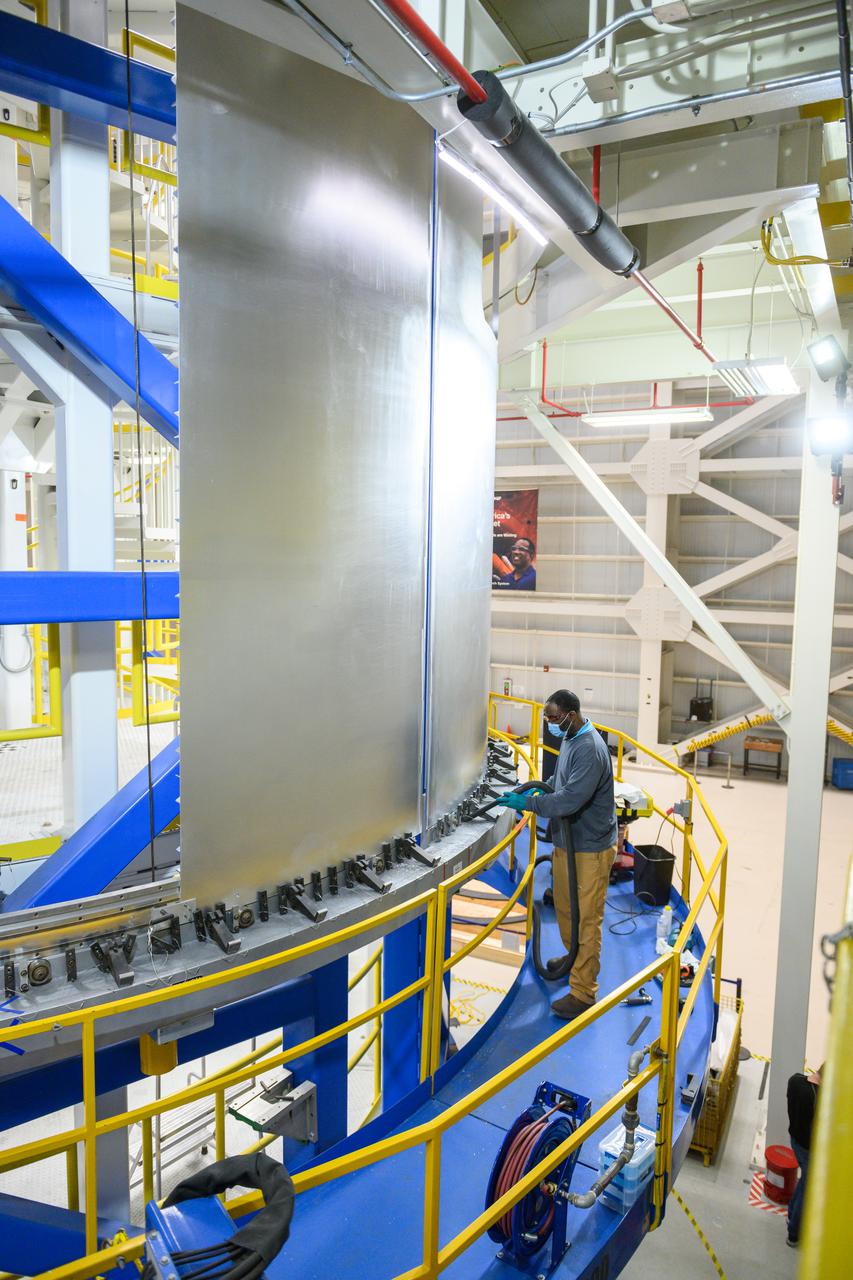
Technicians are manufacturing and testing the first in a series of initial weld confidence articles for the Exploration Upper Stage (EUS) for future flights of NASA’s Space Launch System (SLS) rocket at the agency’s Michoud Assembly Facility in New Orleans. The Exploration Upper Stage will be used on the second configuration of the SLS rocket, known as Block 1B, and will provide in-space propulsion to send astronauts in NASA’s Orion spacecraft and heavy cargo on a precise trajectory to the Moon. The Exploration Upper Stage weld confidence panels are first produced in the Vertical Weld Center at Michoud, then small sections of the panels are removed for mechanical testing and analysis in another area of the factory. Teams use weld confidence articles to verify welding procedures, interfaces between the tooling and hardware, and the structural integrity of the welds. Testing of the EUS weld confidence articles will help engineers and technicians validate welding parameters for manufacturing EUS hardware. The first three SLS flights of NASA’s Artemis program will use an interim cryogenic propulsion stage with one RL10 engine to send Orion to the Moon. The SLS Exploration Upper Stage for flights beyond Artemis III has larger propellant tanks and four RL10 engines. The evolution of the rocket to SLS Block 1B configuration with EUS enables SLS to launch 40% more cargo to the Moon along with the crew. Manufacturing the Exploration Upper Stage is a collaborative effort between NASA and Boeing, the lead contractor for EUS and the SLS core stage. SLS is the only rocket that can send Orion, astronauts, and supplies to the Moon in a single mission. The SLS rocket, NASA’s Orion spacecraft, Gateway, and human landing system are part of NASA’s backbone for deep space exploration. Under the Artemis program, NASA is working to land the first woman and the next man on the Moon to pave the way for sustainable exploration at the Moon and future missions to Mars. (NASA)
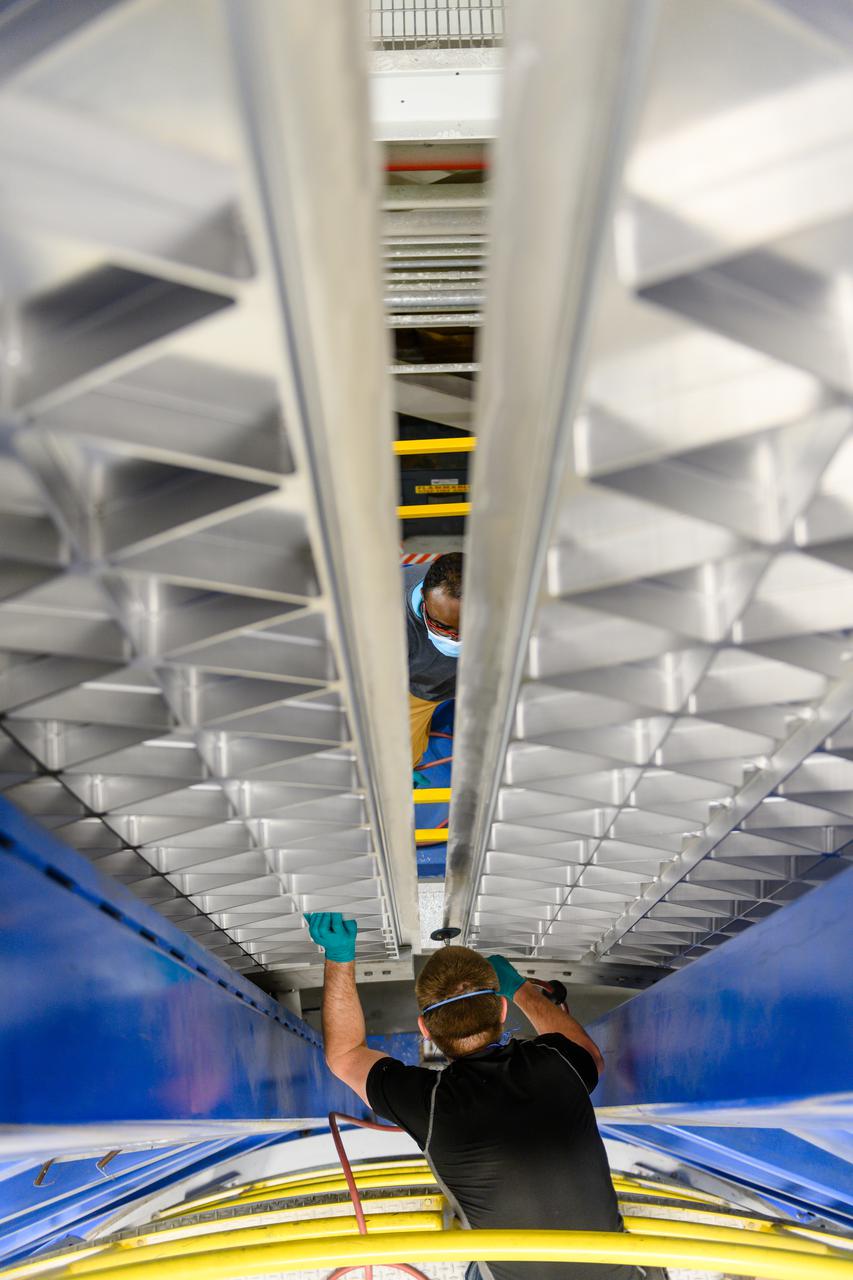
Technicians are manufacturing and testing the first in a series of initial weld confidence articles for the Exploration Upper Stage (EUS) for future flights of NASA’s Space Launch System (SLS) rocket at the agency’s Michoud Assembly Facility in New Orleans. The Exploration Upper Stage will be used on the second configuration of the SLS rocket, known as Block 1B, and will provide in-space propulsion to send astronauts in NASA’s Orion spacecraft and heavy cargo on a precise trajectory to the Moon. The Exploration Upper Stage weld confidence panels are first produced in the Vertical Weld Center at Michoud, then small sections of the panels are removed for mechanical testing and analysis in another area of the factory. Teams use weld confidence articles to verify welding procedures, interfaces between the tooling and hardware, and the structural integrity of the welds. Testing of the EUS weld confidence articles will help engineers and technicians validate welding parameters for manufacturing EUS hardware. The first three SLS flights of NASA’s Artemis program will use an interim cryogenic propulsion stage with one RL10 engine to send Orion to the Moon. The SLS Exploration Upper Stage for flights beyond Artemis III has larger propellant tanks and four RL10 engines. The evolution of the rocket to SLS Block 1B configuration with EUS enables SLS to launch 40% more cargo to the Moon along with the crew. Manufacturing the Exploration Upper Stage is a collaborative effort between NASA and Boeing, the lead contractor for EUS and the SLS core stage. SLS is the only rocket that can send Orion, astronauts, and supplies to the Moon in a single mission. The SLS rocket, NASA’s Orion spacecraft, Gateway, and human landing system are part of NASA’s backbone for deep space exploration. Under the Artemis program, NASA is working to land the first woman and the next man on the Moon to pave the way for sustainable exploration at the Moon and future missions to Mars. (NASA)
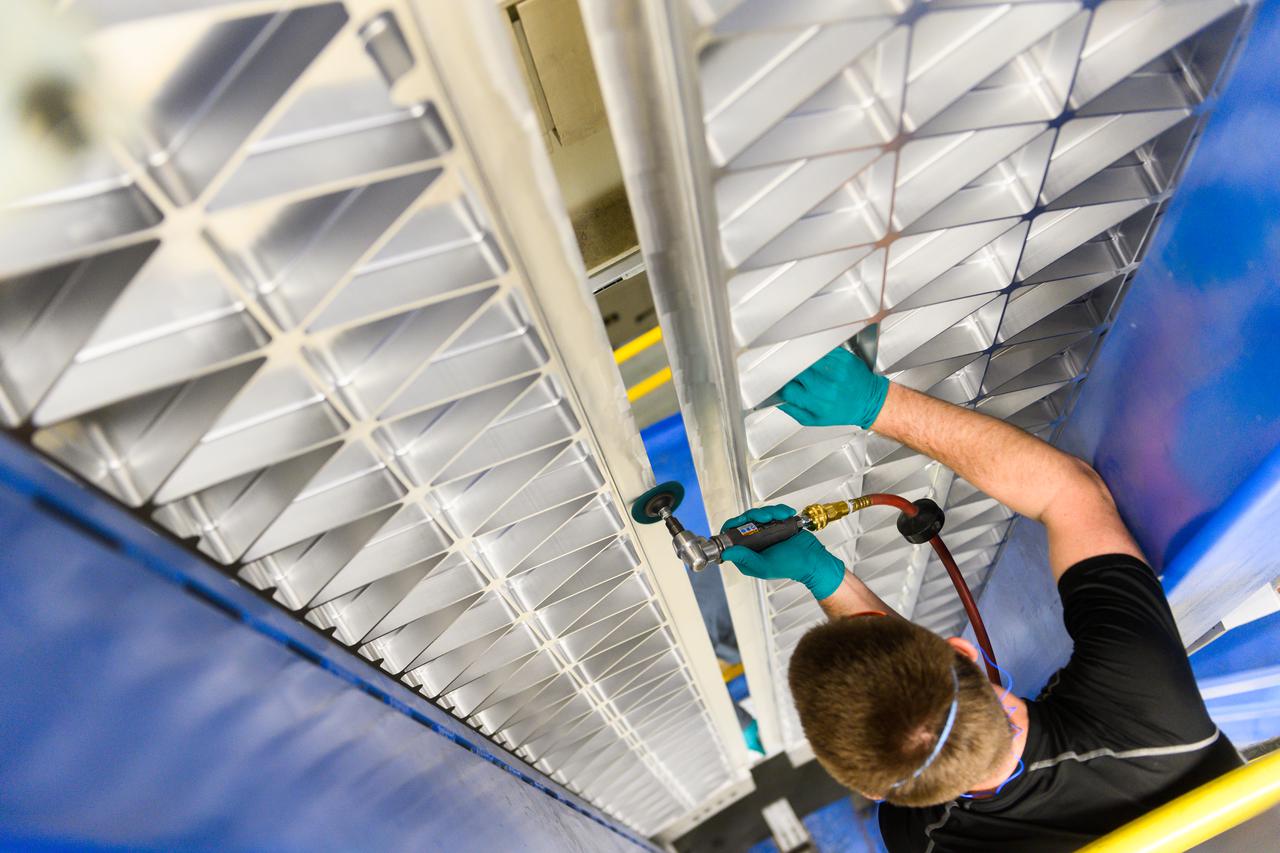
Technicians are manufacturing and testing the first in a series of initial weld confidence articles for the Exploration Upper Stage (EUS) for future flights of NASA’s Space Launch System (SLS) rocket at the agency’s Michoud Assembly Facility in New Orleans. The Exploration Upper Stage will be used on the second configuration of the SLS rocket, known as Block 1B, and will provide in-space propulsion to send astronauts in NASA’s Orion spacecraft and heavy cargo on a precise trajectory to the Moon. The Exploration Upper Stage weld confidence panels are first produced in the Vertical Weld Center at Michoud, then small sections of the panels are removed for mechanical testing and analysis in another area of the factory. Teams use weld confidence articles to verify welding procedures, interfaces between the tooling and hardware, and the structural integrity of the welds. Testing of the EUS weld confidence articles will help engineers and technicians validate welding parameters for manufacturing EUS hardware. The first three SLS flights of NASA’s Artemis program will use an interim cryogenic propulsion stage with one RL10 engine to send Orion to the Moon. The SLS Exploration Upper Stage for flights beyond Artemis III has larger propellant tanks and four RL10 engines. The evolution of the rocket to SLS Block 1B configuration with EUS enables SLS to launch 40% more cargo to the Moon along with the crew. Manufacturing the Exploration Upper Stage is a collaborative effort between NASA and Boeing, the lead contractor for EUS and the SLS core stage. SLS is the only rocket that can send Orion, astronauts, and supplies to the Moon in a single mission. The SLS rocket, NASA’s Orion spacecraft, Gateway, and human landing system are part of NASA’s backbone for deep space exploration. Under the Artemis program, NASA is working to land the first woman and the next man on the Moon to pave the way for sustainable exploration at the Moon and future missions to Mars. (NASA)

EUS panel test weld at the VXC in Building 115 at the Michoud Assembly Facility on Tuesday, February 9, 2021. Technicians are manufacturing and testing the first in a series of initial weld confidence articles for the Exploration Upper Stage (EUS) for future flights of NASA’s Space Launch System (SLS) rocket at the agency’s Michoud Assembly Facility in New Orleans. The Exploration Upper Stage will be used on the second configuration of the SLS rocket, known as Block 1B, and will provide in-space propulsion to send astronauts in NASA’s Orion spacecraft and heavy cargo on a precise trajectory to the Moon. The Exploration Upper Stage weld confidence panels are first produced in the Vertical Weld Center at Michoud, then small sections of the panels are removed for mechanical testing and analysis in another area of the factory. Teams use weld confidence articles to verify welding procedures, interfaces between the tooling and hardware, and the structural integrity of the welds. Testing of the EUS weld confidence articles will help engineers and technicians validate welding parameters for manufacturing EUS hardware. The first three SLS flights of NASA’s Artemis program will use an interim cryogenic propulsion stage with one RL10 engine to send Orion to the Moon. The SLS Exploration Upper Stage for flights beyond Artemis III has larger propellant tanks and four RL10 engines. The evolution of the rocket to SLS Block 1B configuration with EUS enables SLS to launch 40% more cargo to the Moon along with the crew. Manufacturing the Exploration Upper Stage is a collaborative effort between NASA and Boeing, the lead contractor for EUS and the SLS core stage. SLS is the only rocket that can send Orion, astronauts, and supplies to the Moon in a single mission. The SLS rocket, NASA’s Orion spacecraft, Gateway, and human landing system are part of NASA’s backbone for deep space exploration. Under the Artemis program, NASA is working to land the first woman and the next man on the Moon to pave the way for sustainable exploration at the Moon and future missions to Mars. (NASA)
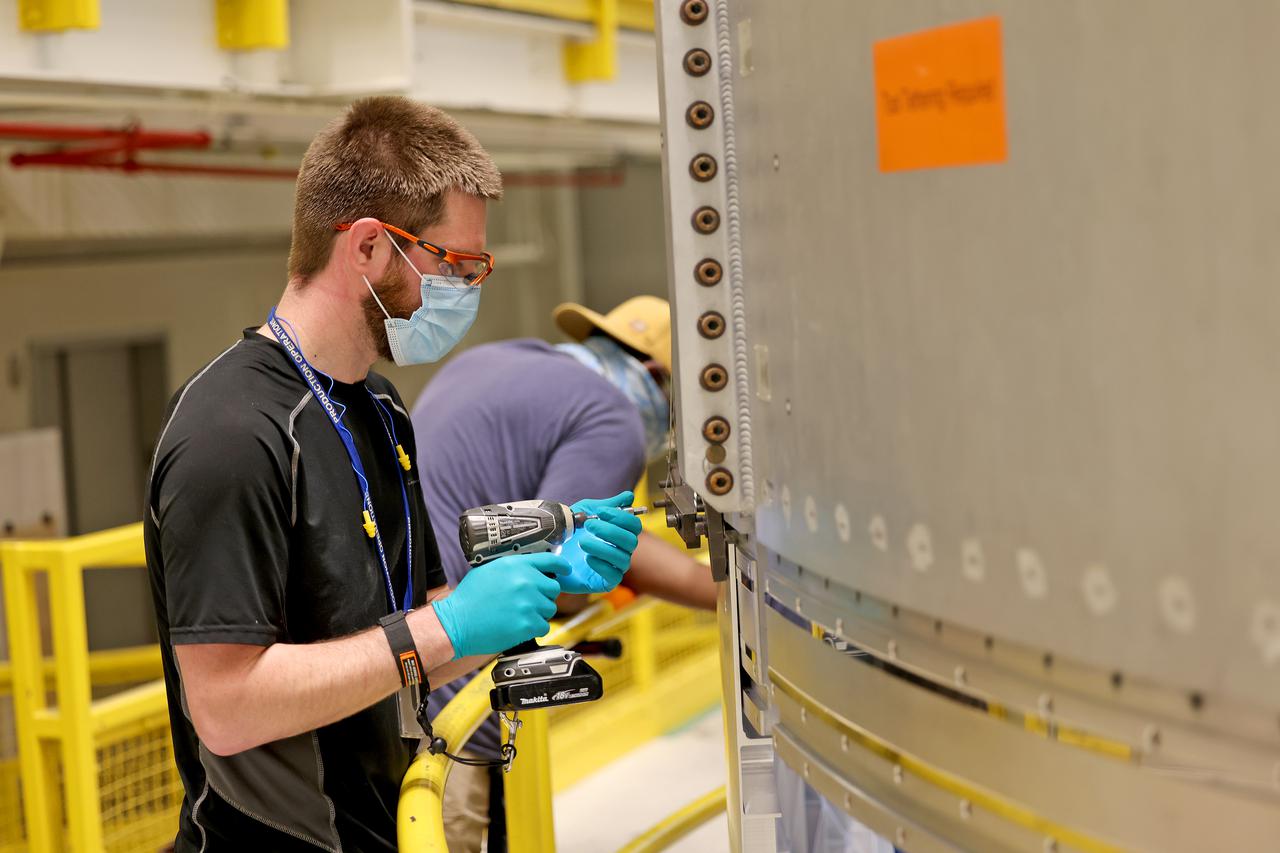
EUS panel test weld at the VXC in Building 115 at the Michoud Assembly Facility on Tuesday, February 9, 2021. Technicians are manufacturing and testing the first in a series of initial weld confidence articles for the Exploration Upper Stage (EUS) for future flights of NASA’s Space Launch System (SLS) rocket at the agency’s Michoud Assembly Facility in New Orleans. The Exploration Upper Stage will be used on the second configuration of the SLS rocket, known as Block 1B, and will provide in-space propulsion to send astronauts in NASA’s Orion spacecraft and heavy cargo on a precise trajectory to the Moon. The Exploration Upper Stage weld confidence panels are first produced in the Vertical Weld Center at Michoud, then small sections of the panels are removed for mechanical testing and analysis in another area of the factory. Teams use weld confidence articles to verify welding procedures, interfaces between the tooling and hardware, and the structural integrity of the welds. Testing of the EUS weld confidence articles will help engineers and technicians validate welding parameters for manufacturing EUS hardware. The first three SLS flights of NASA’s Artemis program will use an interim cryogenic propulsion stage with one RL10 engine to send Orion to the Moon. The SLS Exploration Upper Stage for flights beyond Artemis III has larger propellant tanks and four RL10 engines. The evolution of the rocket to SLS Block 1B configuration with EUS enables SLS to launch 40% more cargo to the Moon along with the crew. Manufacturing the Exploration Upper Stage is a collaborative effort between NASA and Boeing, the lead contractor for EUS and the SLS core stage. SLS is the only rocket that can send Orion, astronauts, and supplies to the Moon in a single mission. The SLS rocket, NASA’s Orion spacecraft, Gateway, and human landing system are part of NASA’s backbone for deep space exploration. Under the Artemis program, NASA is working to land the first woman and the next man on the Moon to pave the way for sustainable exploration at the Moon and future missions to Mars. (NASA)
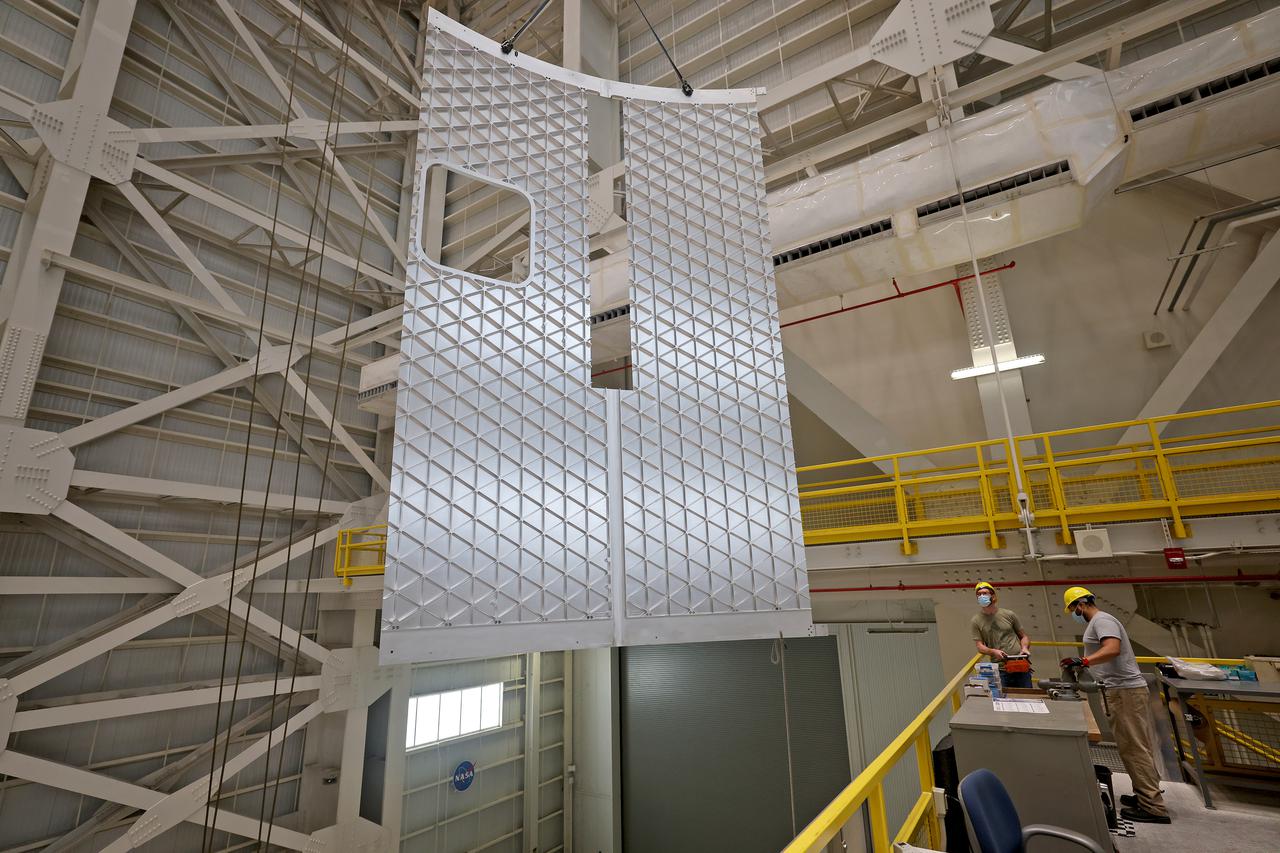
Lift of three EUS test panels in VWC at Michoud Assembly Facility on Thursday, February 11, 2021. Technicians are manufacturing and testing the first in a series of initial weld confidence articles for the Exploration Upper Stage (EUS) for future flights of NASA’s Space Launch System (SLS) rocket at the agency’s Michoud Assembly Facility in New Orleans. The Exploration Upper Stage will be used on the second configuration of the SLS rocket, known as Block 1B, and will provide in-space propulsion to send astronauts in NASA’s Orion spacecraft and heavy cargo on a precise trajectory to the Moon. The Exploration Upper Stage weld confidence panels are first produced in the Vertical Weld Center at Michoud, then small sections of the panels are removed for mechanical testing and analysis in another area of the factory. Teams use weld confidence articles to verify welding procedures, interfaces between the tooling and hardware, and the structural integrity of the welds. Testing of the EUS weld confidence articles will help engineers and technicians validate welding parameters for manufacturing EUS hardware. The first three SLS flights of NASA’s Artemis program will use an interim cryogenic propulsion stage with one RL10 engine to send Orion to the Moon. The SLS Exploration Upper Stage for flights beyond Artemis III has larger propellant tanks and four RL10 engines. The evolution of the rocket to SLS Block 1B configuration with EUS enables SLS to launch 40% more cargo to the Moon along with the crew. Manufacturing the Exploration Upper Stage is a collaborative effort between NASA and Boeing, the lead contractor for EUS and the SLS core stage. SLS is the only rocket that can send Orion, astronauts, and supplies to the Moon in a single mission. The SLS rocket, NASA’s Orion spacecraft, Gateway, and human landing system are part of NASA’s backbone for deep space exploration. Under the Artemis program, NASA is working to land the first woman and the next man on the Moon to pave the way for sustainable exploration at the Moon and future missions to Mars. (NASA)

Lift of three EUS test panels in VWC at Michoud Assembly Facility on Thursday, February 11, 2021. Technicians are manufacturing and testing the first in a series of initial weld confidence articles for the Exploration Upper Stage (EUS) for future flights of NASA’s Space Launch System (SLS) rocket at the agency’s Michoud Assembly Facility in New Orleans. The Exploration Upper Stage will be used on the second configuration of the SLS rocket, known as Block 1B, and will provide in-space propulsion to send astronauts in NASA’s Orion spacecraft and heavy cargo on a precise trajectory to the Moon. The Exploration Upper Stage weld confidence panels are first produced in the Vertical Weld Center at Michoud, then small sections of the panels are removed for mechanical testing and analysis in another area of the factory. Teams use weld confidence articles to verify welding procedures, interfaces between the tooling and hardware, and the structural integrity of the welds. Testing of the EUS weld confidence articles will help engineers and technicians validate welding parameters for manufacturing EUS hardware. The first three SLS flights of NASA’s Artemis program will use an interim cryogenic propulsion stage with one RL10 engine to send Orion to the Moon. The SLS Exploration Upper Stage for flights beyond Artemis III has larger propellant tanks and four RL10 engines. The evolution of the rocket to SLS Block 1B configuration with EUS enables SLS to launch 40% more cargo to the Moon along with the crew. Manufacturing the Exploration Upper Stage is a collaborative effort between NASA and Boeing, the lead contractor for EUS and the SLS core stage. SLS is the only rocket that can send Orion, astronauts, and supplies to the Moon in a single mission. The SLS rocket, NASA’s Orion spacecraft, Gateway, and human landing system are part of NASA’s backbone for deep space exploration. Under the Artemis program, NASA is working to land the first woman and the next man on the Moon to pave the way for sustainable exploration at the Moon and future missions to Mars. (NASA)
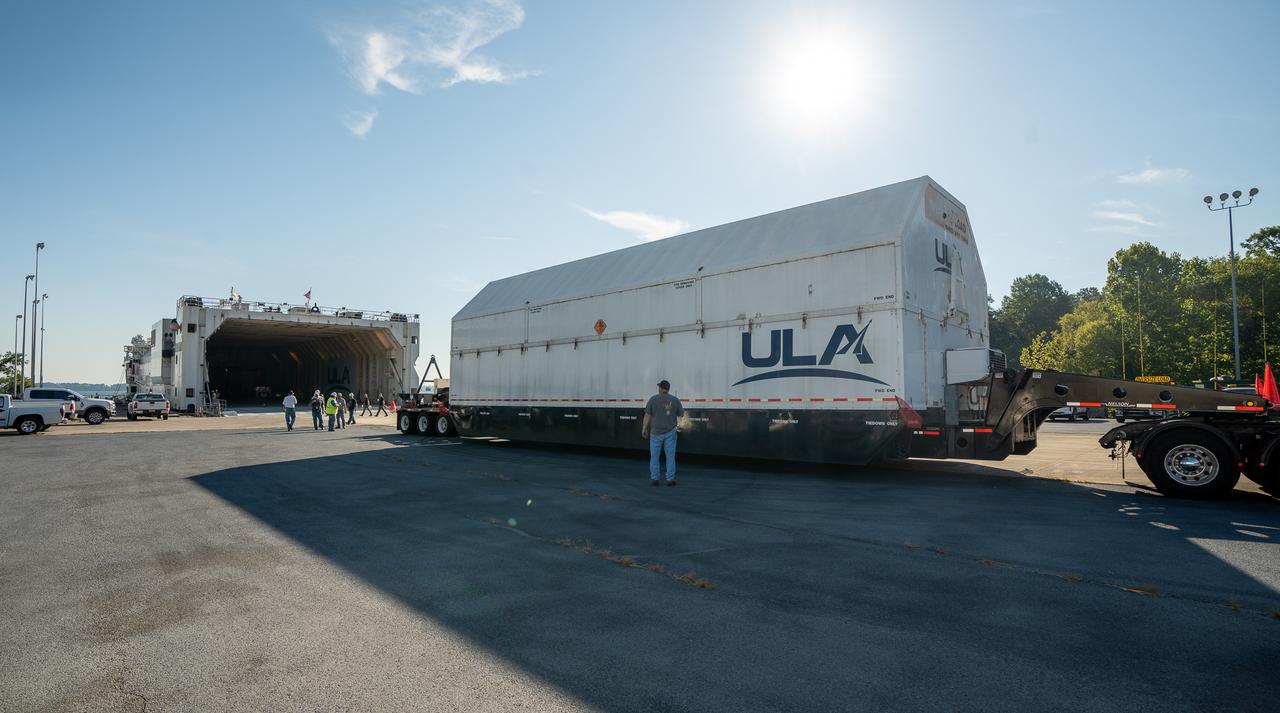
These images and videos show how crews in Alabama prepared the ICPS (interim cryogenic propulsion stage) for NASA’s SLS (Space Launch System) rocket for shipment to Florida between July 29-31. The ICPS in the photos and videos will help power NASA’s Artemis III mission to the Moon. The SLS upper stage is manufactured by United Launch Alliance at its facility in Decatur. Its RL10 engine is produced by Aerojet Rocketdyne, the SLS engines lead contractor, in West Palm Beach, Florida. ULA is working with Boeing, the SLS core stage and exploration upper stage lead contractor, to develop ICPS. ULA’s R/S RocketShip is transporting the flight hardware to its sister facility in Florida near NASA’s Kennedy Space Center for final checkouts. The ICPS for Artemis III is the last of its kind as SLS transitions to its next, more powerful Block 1B configuration with an upgraded upper stage beginning with Artemis IV. NASA is working to land the first woman and first person of color on the Moon under Artemis. SLS is part of NASA’s backbone for deep space exploration, along with Orion and the Gateway in orbit around the Moon. SLS is the only rocket that can send Orion, astronauts, and supplies to the Moon in a single mission.
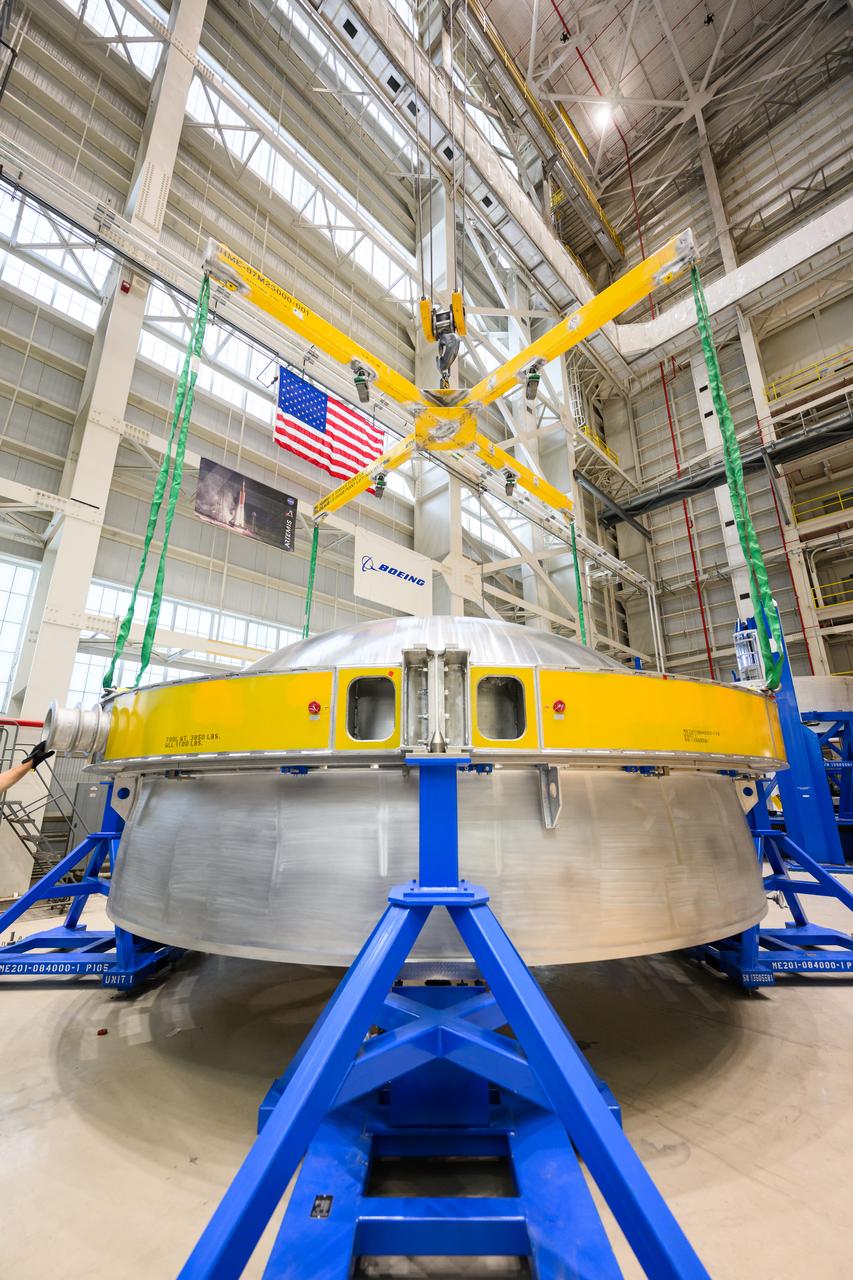
These images show technicians at NASA’s Michoud Assembly Facility in New Orleans lifting and installing the liquid oxygen dome weld confidence article for a future upper stage for NASA’s SLS (Space Launch System) rocket onto the LTAC (LOX Tank Assembly Center) in Building 115 at Michoud for the next phase of manufacturing in July 2023. The dome makes up a portion of the liquid oxygen tank weld confidence article for the EUS (exploration upper stage). Teams use weld confidence articles to verify welding procedures and structural integrity of the welds to manufacture structural test and flight versions of the hardware. EUS flight hardware is in early production at Michoud. The more powerful upper stage and its four RL10 engines will be used on the second configuration of the SLS rocket, known as Block 1B, and will provide in-space propulsion to send astronauts in NASA’s Orion spacecraft and heavy cargo on a precise trajectory to the Moon. NASA and Boeing, the lead contractor for the SLS core stage and EUS, are manufacturing SLS stages for Artemis II, III, IV, and V at the facility. NASA is working to land the first woman and first person of color on the Moon under Artemis. SLS is part of NASA’s backbone for deep space exploration, along with Orion and the Gateway in orbit around the Moon. SLS is the only rocket that can send Orion, astronauts, and supplies to the Moon in a single mission.
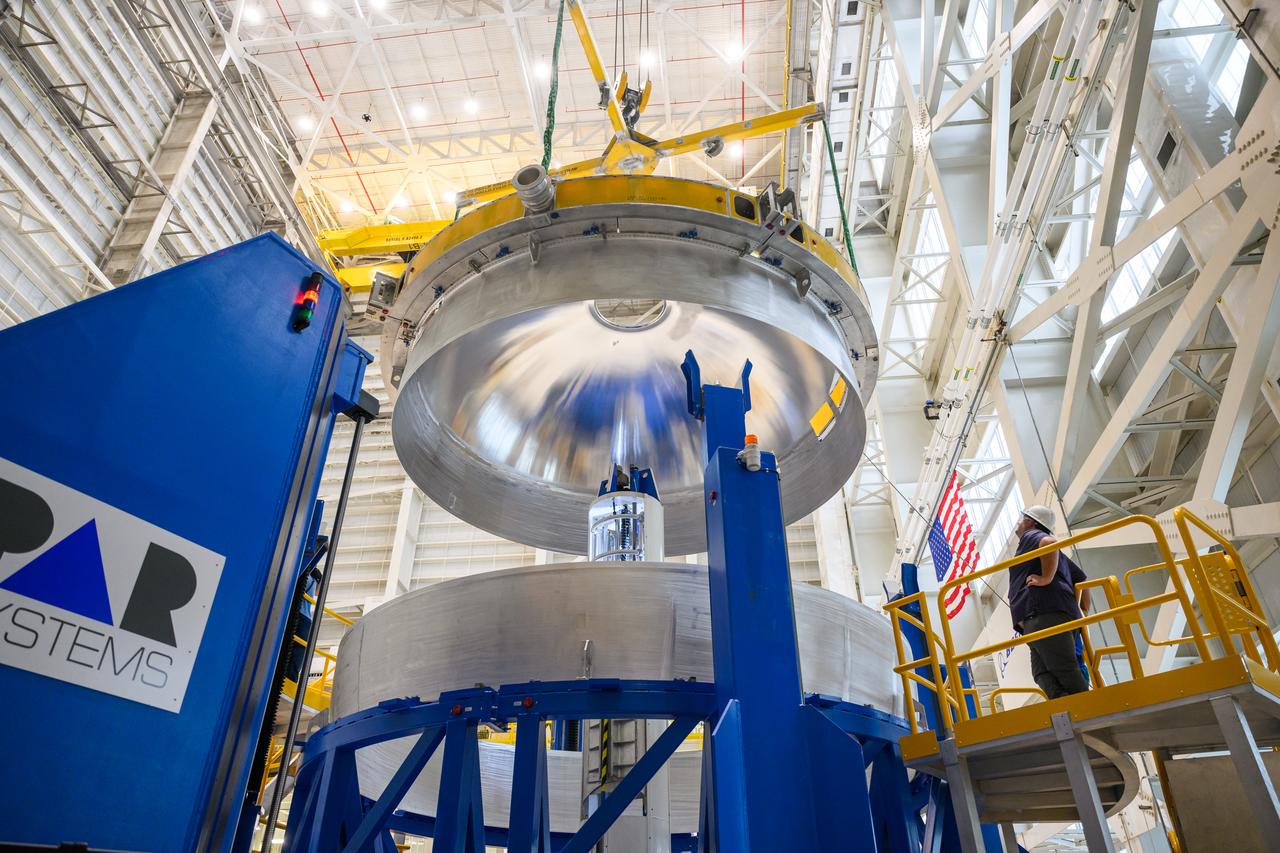
These images show technicians at NASA’s Michoud Assembly Facility in New Orleans lifting and installing the liquid oxygen dome weld confidence article for a future upper stage for NASA’s SLS (Space Launch System) rocket onto the LTAC (LOX Tank Assembly Center) in Building 115 at Michoud for the next phase of manufacturing in July 2023. The dome makes up a portion of the liquid oxygen tank weld confidence article for the EUS (exploration upper stage). Teams use weld confidence articles to verify welding procedures and structural integrity of the welds to manufacture structural test and flight versions of the hardware. EUS flight hardware is in early production at Michoud. The more powerful upper stage and its four RL10 engines will be used on the second configuration of the SLS rocket, known as Block 1B, and will provide in-space propulsion to send astronauts in NASA’s Orion spacecraft and heavy cargo on a precise trajectory to the Moon. NASA and Boeing, the lead contractor for the SLS core stage and EUS, are manufacturing SLS stages for Artemis II, III, IV, and V at the facility. NASA is working to land the first woman and first person of color on the Moon under Artemis. SLS is part of NASA’s backbone for deep space exploration, along with Orion and the Gateway in orbit around the Moon. SLS is the only rocket that can send Orion, astronauts, and supplies to the Moon in a single mission.
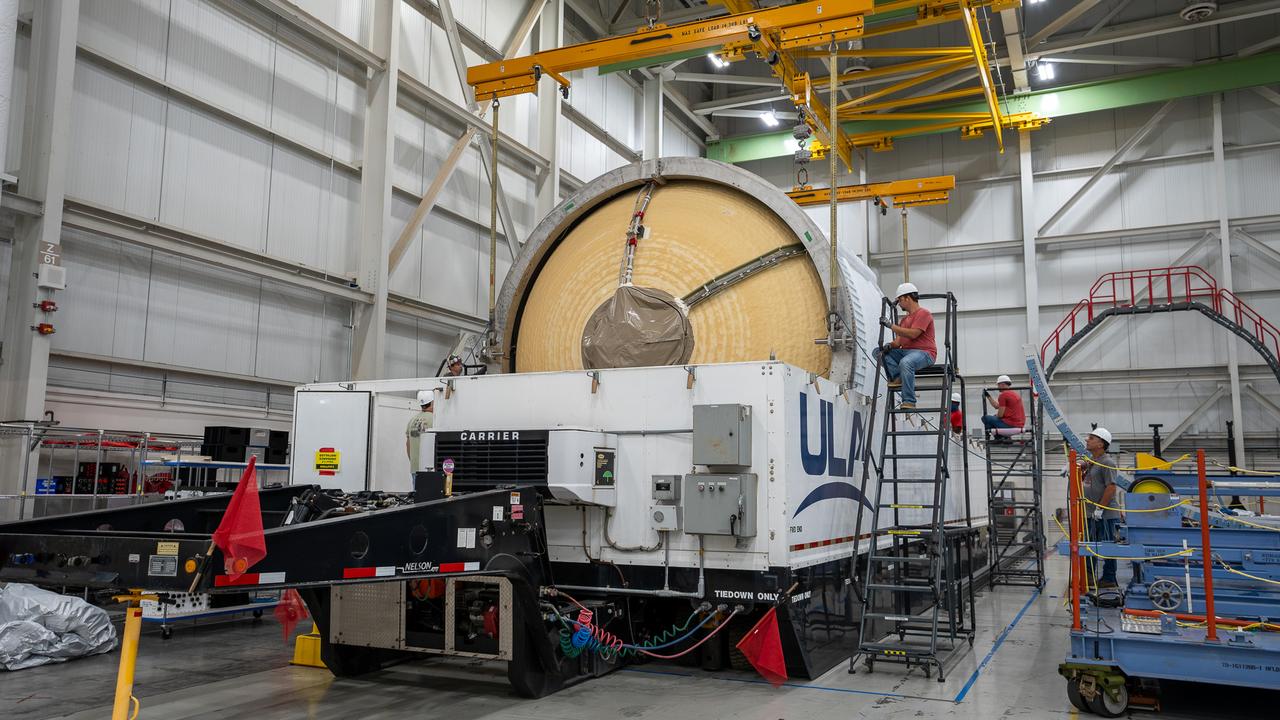
These images and videos show how crews in Alabama prepared the ICPS (interim cryogenic propulsion stage) for NASA’s SLS (Space Launch System) rocket for shipment to Florida between July 29-31. The ICPS in the photos and videos will help power NASA’s Artemis III mission to the Moon. The SLS upper stage is manufactured by United Launch Alliance at its facility in Decatur. Its RL10 engine is produced by Aerojet Rocketdyne, the SLS engines lead contractor, in West Palm Beach, Florida. ULA is working with Boeing, the SLS core stage and exploration upper stage lead contractor, to develop ICPS. ULA’s R/S RocketShip is transporting the flight hardware to its sister facility in Florida near NASA’s Kennedy Space Center for final checkouts. The ICPS for Artemis III is the last of its kind as SLS transitions to its next, more powerful Block 1B configuration with an upgraded upper stage beginning with Artemis IV. NASA is working to land the first woman and first person of color on the Moon under Artemis. SLS is part of NASA’s backbone for deep space exploration, along with Orion and the Gateway in orbit around the Moon. SLS is the only rocket that can send Orion, astronauts, and supplies to the Moon in a single mission.

These images and videos show how crews in Alabama prepared the ICPS (interim cryogenic propulsion stage) for NASA’s SLS (Space Launch System) rocket for shipment to Florida between July 29-31. The ICPS in the photos and videos will help power NASA’s Artemis III mission to the Moon. The SLS upper stage is manufactured by United Launch Alliance at its facility in Decatur. Its RL10 engine is produced by Aerojet Rocketdyne, the SLS engines lead contractor, in West Palm Beach, Florida. ULA is working with Boeing, the SLS core stage and exploration upper stage lead contractor, to develop ICPS. ULA’s R/S RocketShip is transporting the flight hardware to its sister facility in Florida near NASA’s Kennedy Space Center for final checkouts. The ICPS for Artemis III is the last of its kind as SLS transitions to its next, more powerful Block 1B configuration with an upgraded upper stage beginning with Artemis IV. NASA is working to land the first woman and first person of color on the Moon under Artemis. SLS is part of NASA’s backbone for deep space exploration, along with Orion and the Gateway in orbit around the Moon. SLS is the only rocket that can send Orion, astronauts, and supplies to the Moon in a single mission.
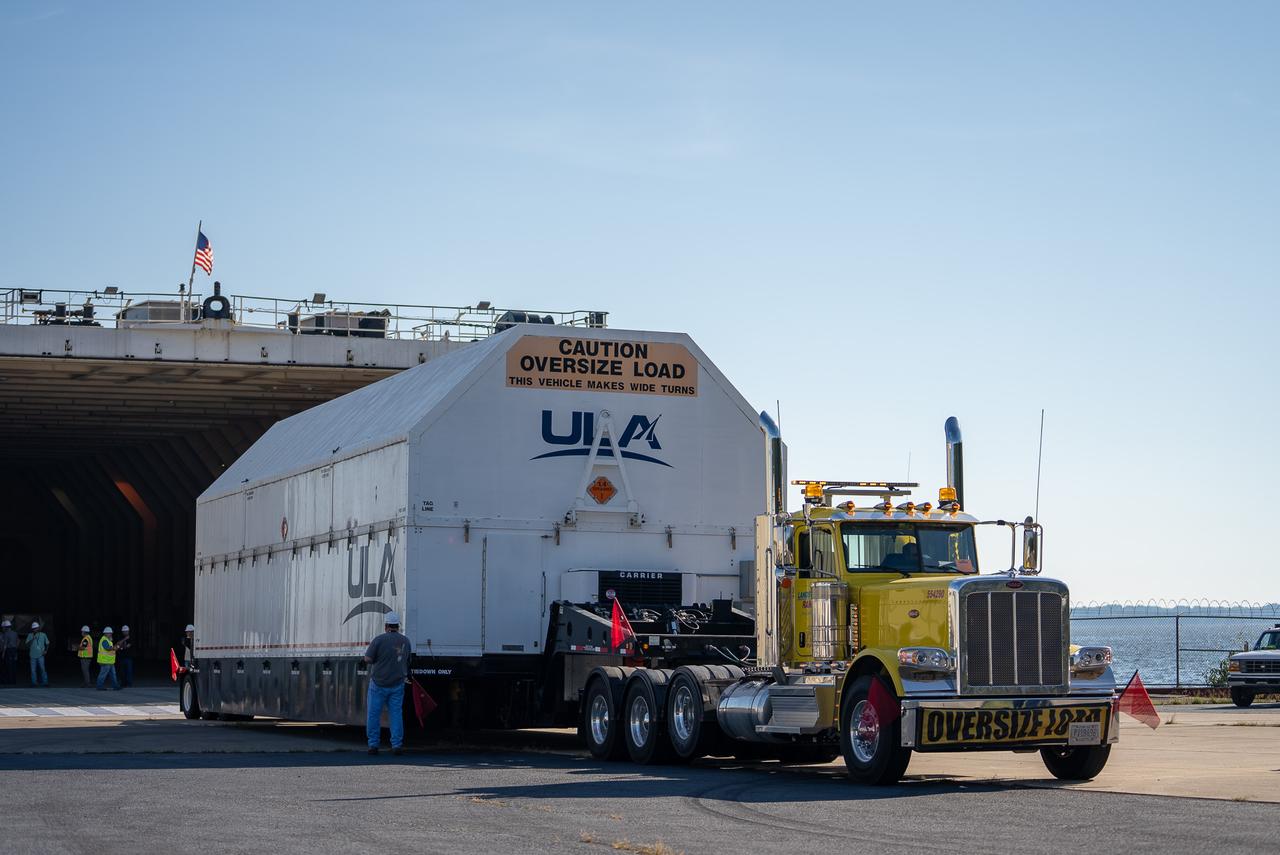
These images and videos show how crews in Alabama prepared the ICPS (interim cryogenic propulsion stage) for NASA’s SLS (Space Launch System) rocket for shipment to Florida between July 29-31. The ICPS in the photos and videos will help power NASA’s Artemis III mission to the Moon. The SLS upper stage is manufactured by United Launch Alliance at its facility in Decatur. Its RL10 engine is produced by Aerojet Rocketdyne, the SLS engines lead contractor, in West Palm Beach, Florida. ULA is working with Boeing, the SLS core stage and exploration upper stage lead contractor, to develop ICPS. ULA’s R/S RocketShip is transporting the flight hardware to its sister facility in Florida near NASA’s Kennedy Space Center for final checkouts. The ICPS for Artemis III is the last of its kind as SLS transitions to its next, more powerful Block 1B configuration with an upgraded upper stage beginning with Artemis IV. NASA is working to land the first woman and first person of color on the Moon under Artemis. SLS is part of NASA’s backbone for deep space exploration, along with Orion and the Gateway in orbit around the Moon. SLS is the only rocket that can send Orion, astronauts, and supplies to the Moon in a single mission.
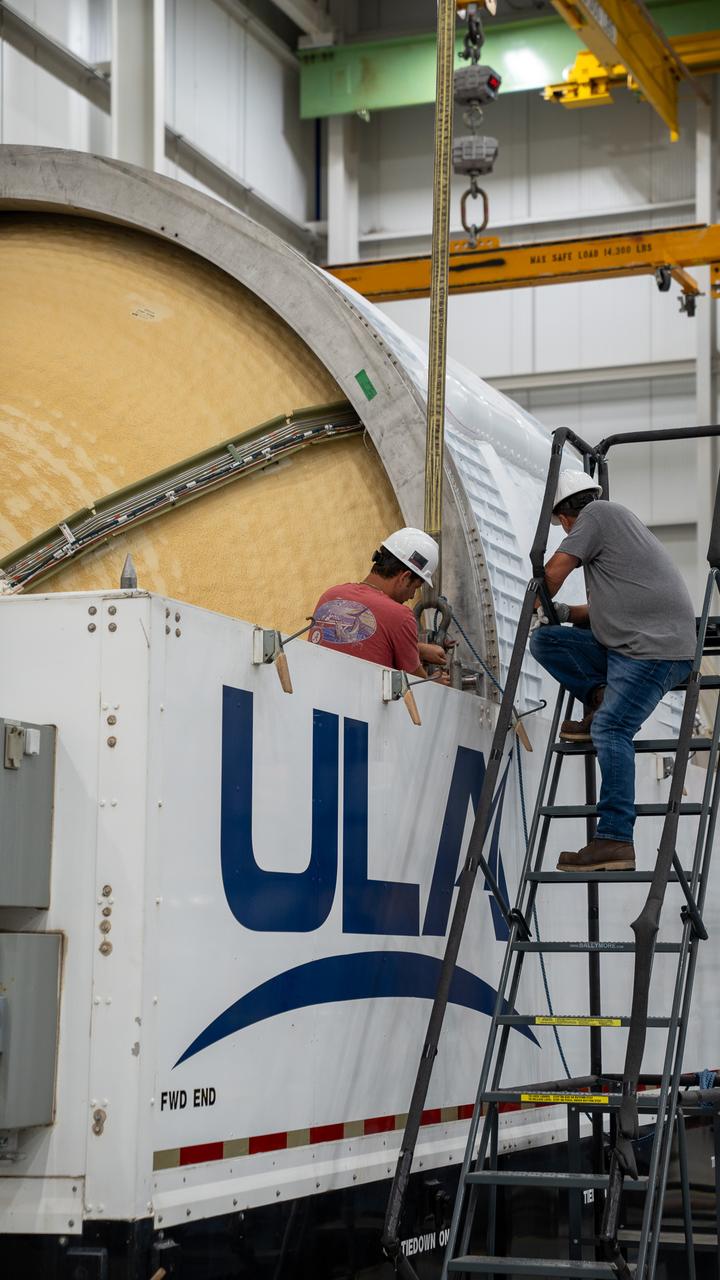
These images and videos show how crews in Alabama prepared the ICPS (interim cryogenic propulsion stage) for NASA’s SLS (Space Launch System) rocket for shipment to Florida between July 29-31. The ICPS in the photos and videos will help power NASA’s Artemis III mission to the Moon. The SLS upper stage is manufactured by United Launch Alliance at its facility in Decatur. Its RL10 engine is produced by Aerojet Rocketdyne, the SLS engines lead contractor, in West Palm Beach, Florida. ULA is working with Boeing, the SLS core stage and exploration upper stage lead contractor, to develop ICPS. ULA’s R/S RocketShip is transporting the flight hardware to its sister facility in Florida near NASA’s Kennedy Space Center for final checkouts. The ICPS for Artemis III is the last of its kind as SLS transitions to its next, more powerful Block 1B configuration with an upgraded upper stage beginning with Artemis IV. NASA is working to land the first woman and first person of color on the Moon under Artemis. SLS is part of NASA’s backbone for deep space exploration, along with Orion and the Gateway in orbit around the Moon. SLS is the only rocket that can send Orion, astronauts, and supplies to the Moon in a single mission.
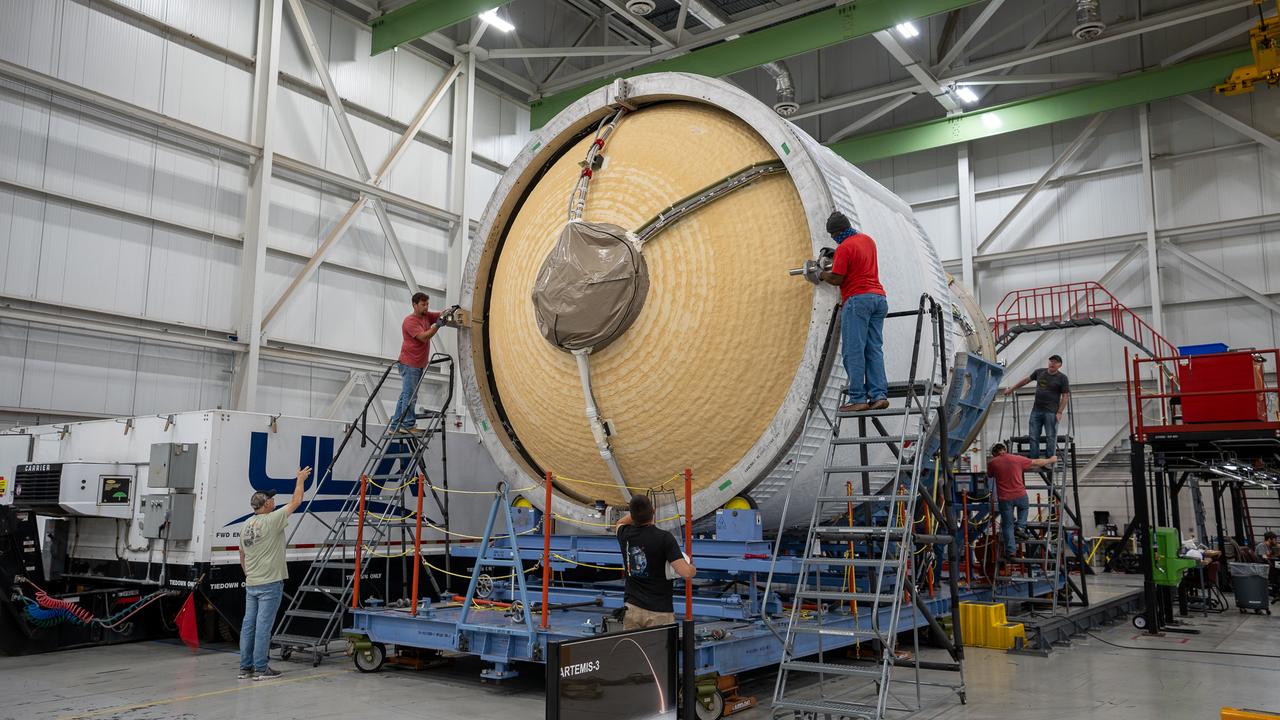
These images and videos show how crews in Alabama prepared the ICPS (interim cryogenic propulsion stage) for NASA’s SLS (Space Launch System) rocket for shipment to Florida between July 29-31. The ICPS in the photos and videos will help power NASA’s Artemis III mission to the Moon. The SLS upper stage is manufactured by United Launch Alliance at its facility in Decatur. Its RL10 engine is produced by Aerojet Rocketdyne, the SLS engines lead contractor, in West Palm Beach, Florida. ULA is working with Boeing, the SLS core stage and exploration upper stage lead contractor, to develop ICPS. ULA’s R/S RocketShip is transporting the flight hardware to its sister facility in Florida near NASA’s Kennedy Space Center for final checkouts. The ICPS for Artemis III is the last of its kind as SLS transitions to its next, more powerful Block 1B configuration with an upgraded upper stage beginning with Artemis IV. NASA is working to land the first woman and first person of color on the Moon under Artemis. SLS is part of NASA’s backbone for deep space exploration, along with Orion and the Gateway in orbit around the Moon. SLS is the only rocket that can send Orion, astronauts, and supplies to the Moon in a single mission.
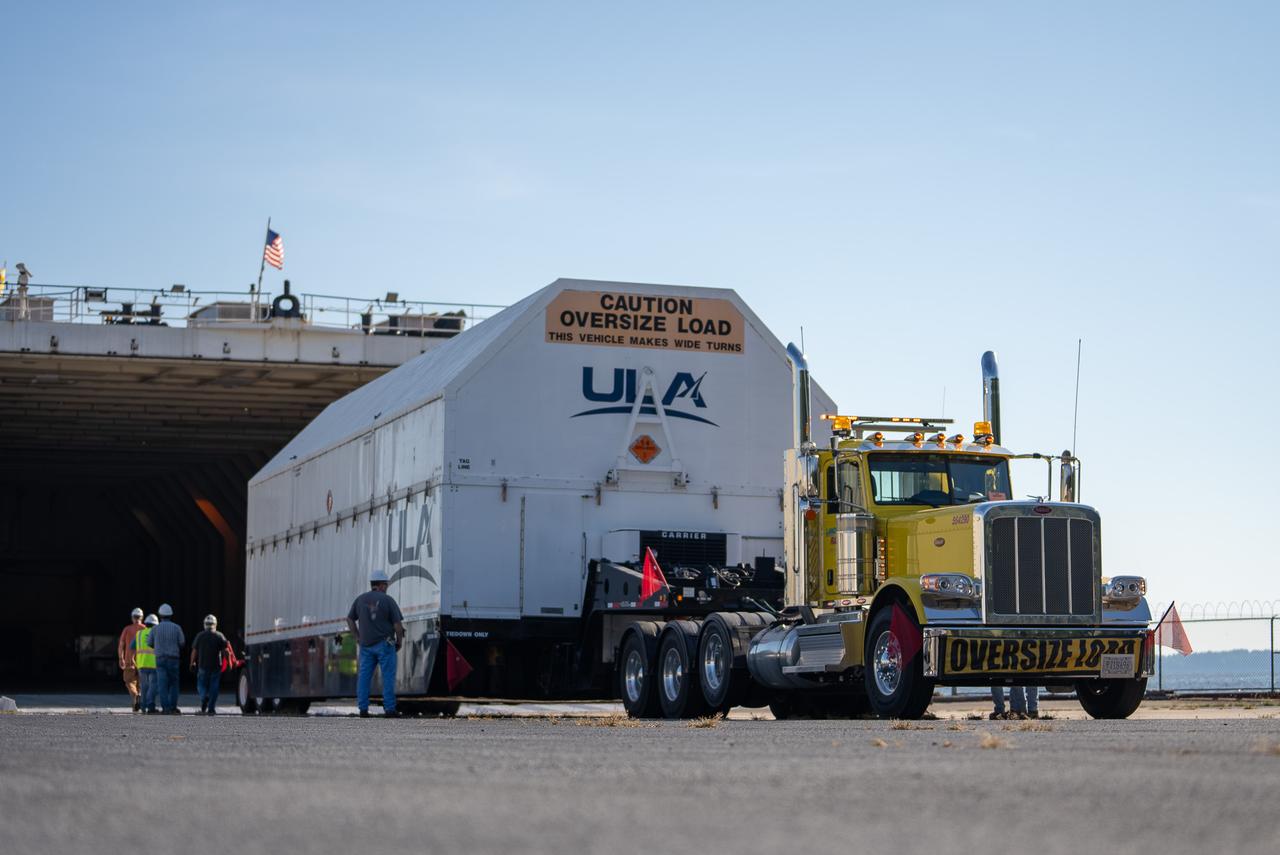
These images and videos show how crews in Alabama prepared the ICPS (interim cryogenic propulsion stage) for NASA’s SLS (Space Launch System) rocket for shipment to Florida between July 29-31. The ICPS in the photos and videos will help power NASA’s Artemis III mission to the Moon. The SLS upper stage is manufactured by United Launch Alliance at its facility in Decatur. Its RL10 engine is produced by Aerojet Rocketdyne, the SLS engines lead contractor, in West Palm Beach, Florida. ULA is working with Boeing, the SLS core stage and exploration upper stage lead contractor, to develop ICPS. ULA’s R/S RocketShip is transporting the flight hardware to its sister facility in Florida near NASA’s Kennedy Space Center for final checkouts. The ICPS for Artemis III is the last of its kind as SLS transitions to its next, more powerful Block 1B configuration with an upgraded upper stage beginning with Artemis IV. NASA is working to land the first woman and first person of color on the Moon under Artemis. SLS is part of NASA’s backbone for deep space exploration, along with Orion and the Gateway in orbit around the Moon. SLS is the only rocket that can send Orion, astronauts, and supplies to the Moon in a single mission.
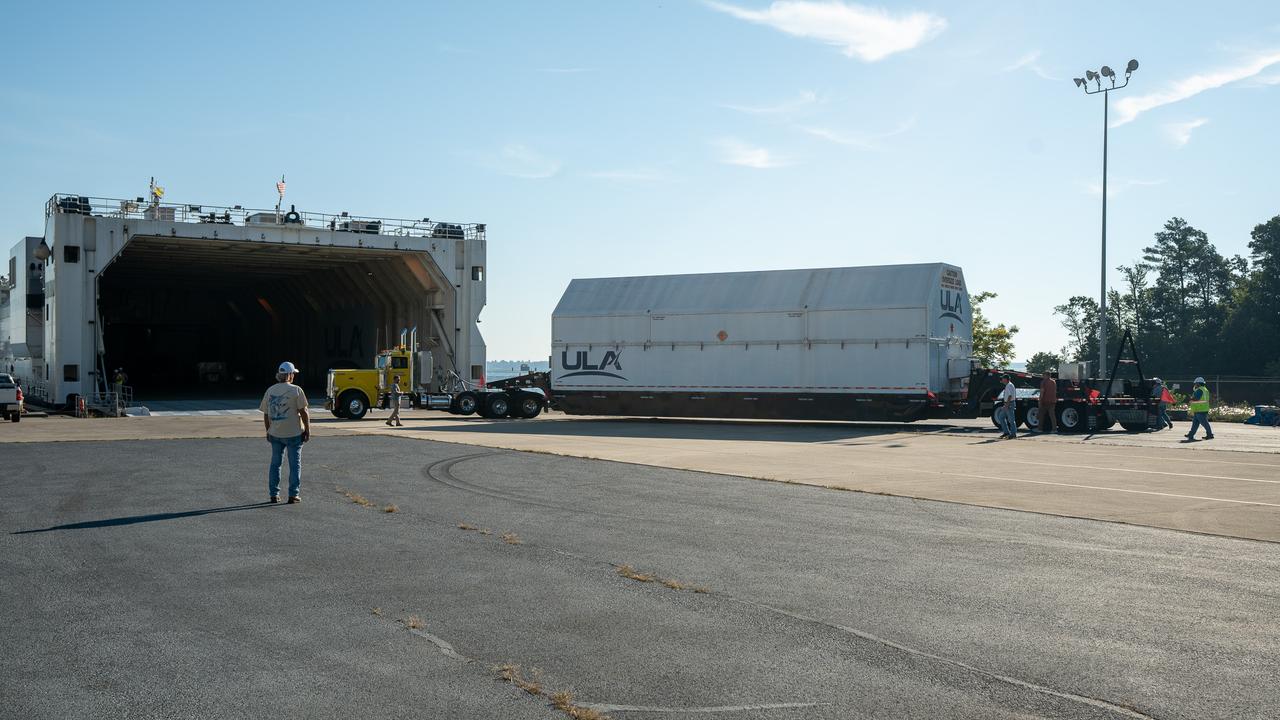
These images and videos show how crews in Alabama prepared the ICPS (interim cryogenic propulsion stage) for NASA’s SLS (Space Launch System) rocket for shipment to Florida between July 29-31. The ICPS in the photos and videos will help power NASA’s Artemis III mission to the Moon. The SLS upper stage is manufactured by United Launch Alliance at its facility in Decatur. Its RL10 engine is produced by Aerojet Rocketdyne, the SLS engines lead contractor, in West Palm Beach, Florida. ULA is working with Boeing, the SLS core stage and exploration upper stage lead contractor, to develop ICPS. ULA’s R/S RocketShip is transporting the flight hardware to its sister facility in Florida near NASA’s Kennedy Space Center for final checkouts. The ICPS for Artemis III is the last of its kind as SLS transitions to its next, more powerful Block 1B configuration with an upgraded upper stage beginning with Artemis IV. NASA is working to land the first woman and first person of color on the Moon under Artemis. SLS is part of NASA’s backbone for deep space exploration, along with Orion and the Gateway in orbit around the Moon. SLS is the only rocket that can send Orion, astronauts, and supplies to the Moon in a single mission.
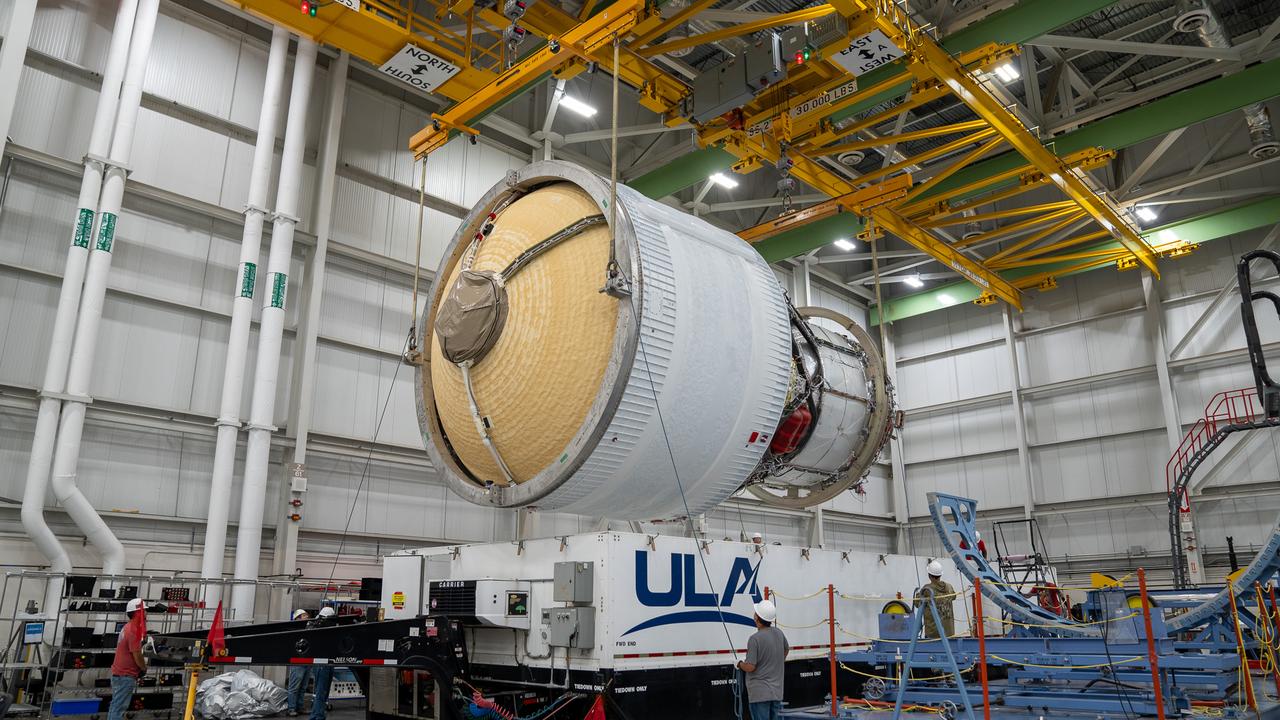
These images and videos show how crews in Alabama prepared the ICPS (interim cryogenic propulsion stage) for NASA’s SLS (Space Launch System) rocket for shipment to Florida between July 29-31. The ICPS in the photos and videos will help power NASA’s Artemis III mission to the Moon. The SLS upper stage is manufactured by United Launch Alliance at its facility in Decatur. Its RL10 engine is produced by Aerojet Rocketdyne, the SLS engines lead contractor, in West Palm Beach, Florida. ULA is working with Boeing, the SLS core stage and exploration upper stage lead contractor, to develop ICPS. ULA’s R/S RocketShip is transporting the flight hardware to its sister facility in Florida near NASA’s Kennedy Space Center for final checkouts. The ICPS for Artemis III is the last of its kind as SLS transitions to its next, more powerful Block 1B configuration with an upgraded upper stage beginning with Artemis IV. NASA is working to land the first woman and first person of color on the Moon under Artemis. SLS is part of NASA’s backbone for deep space exploration, along with Orion and the Gateway in orbit around the Moon. SLS is the only rocket that can send Orion, astronauts, and supplies to the Moon in a single mission.
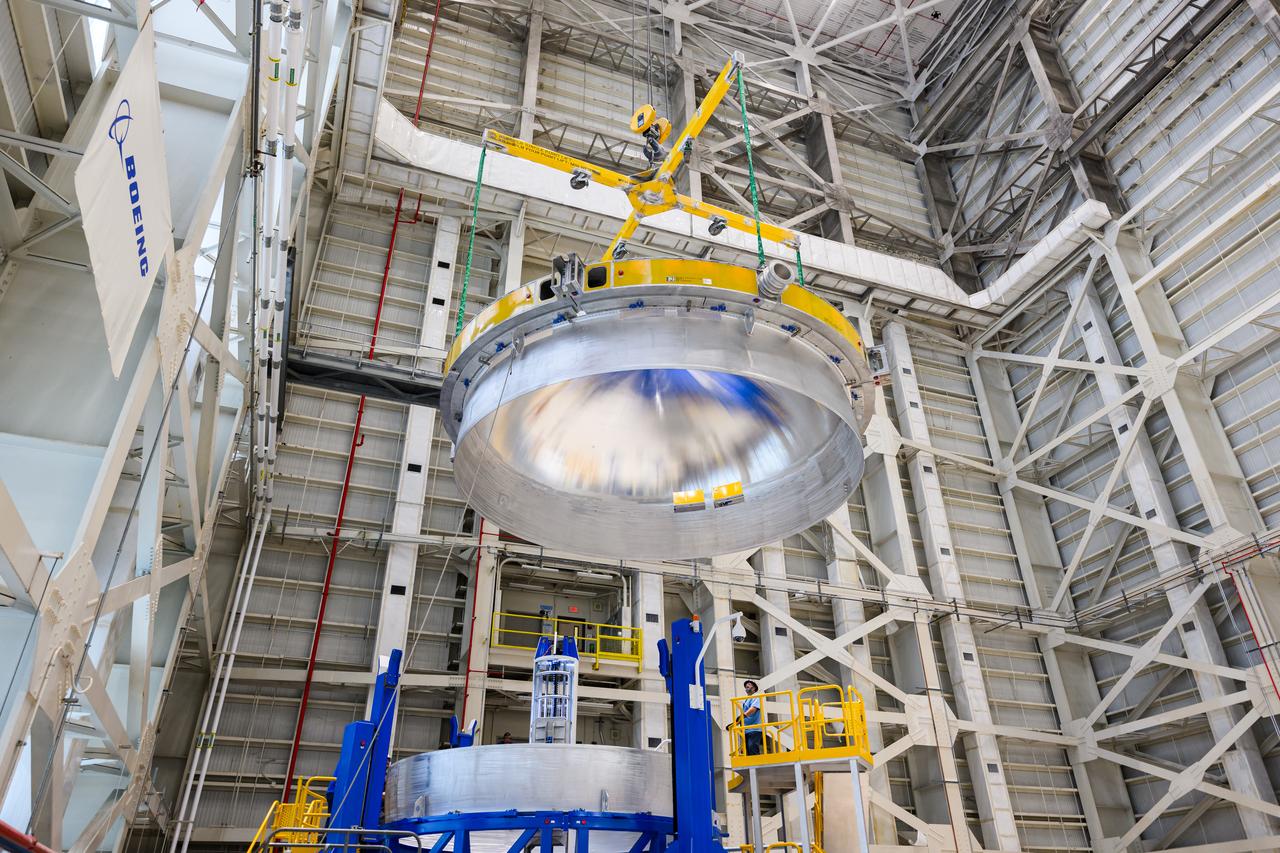
These images show technicians at NASA’s Michoud Assembly Facility in New Orleans lifting and installing the liquid oxygen dome weld confidence article for a future upper stage for NASA’s SLS (Space Launch System) rocket onto the LTAC (LOX Tank Assembly Center) in Building 115 at Michoud for the next phase of manufacturing in July 2023. The dome makes up a portion of the liquid oxygen tank weld confidence article for the EUS (exploration upper stage). Teams use weld confidence articles to verify welding procedures and structural integrity of the welds to manufacture structural test and flight versions of the hardware. EUS flight hardware is in early production at Michoud. The more powerful upper stage and its four RL10 engines will be used on the second configuration of the SLS rocket, known as Block 1B, and will provide in-space propulsion to send astronauts in NASA’s Orion spacecraft and heavy cargo on a precise trajectory to the Moon. NASA and Boeing, the lead contractor for the SLS core stage and EUS, are manufacturing SLS stages for Artemis II, III, IV, and V at the facility. NASA is working to land the first woman and first person of color on the Moon under Artemis. SLS is part of NASA’s backbone for deep space exploration, along with Orion and the Gateway in orbit around the Moon. SLS is the only rocket that can send Orion, astronauts, and supplies to the Moon in a single mission.
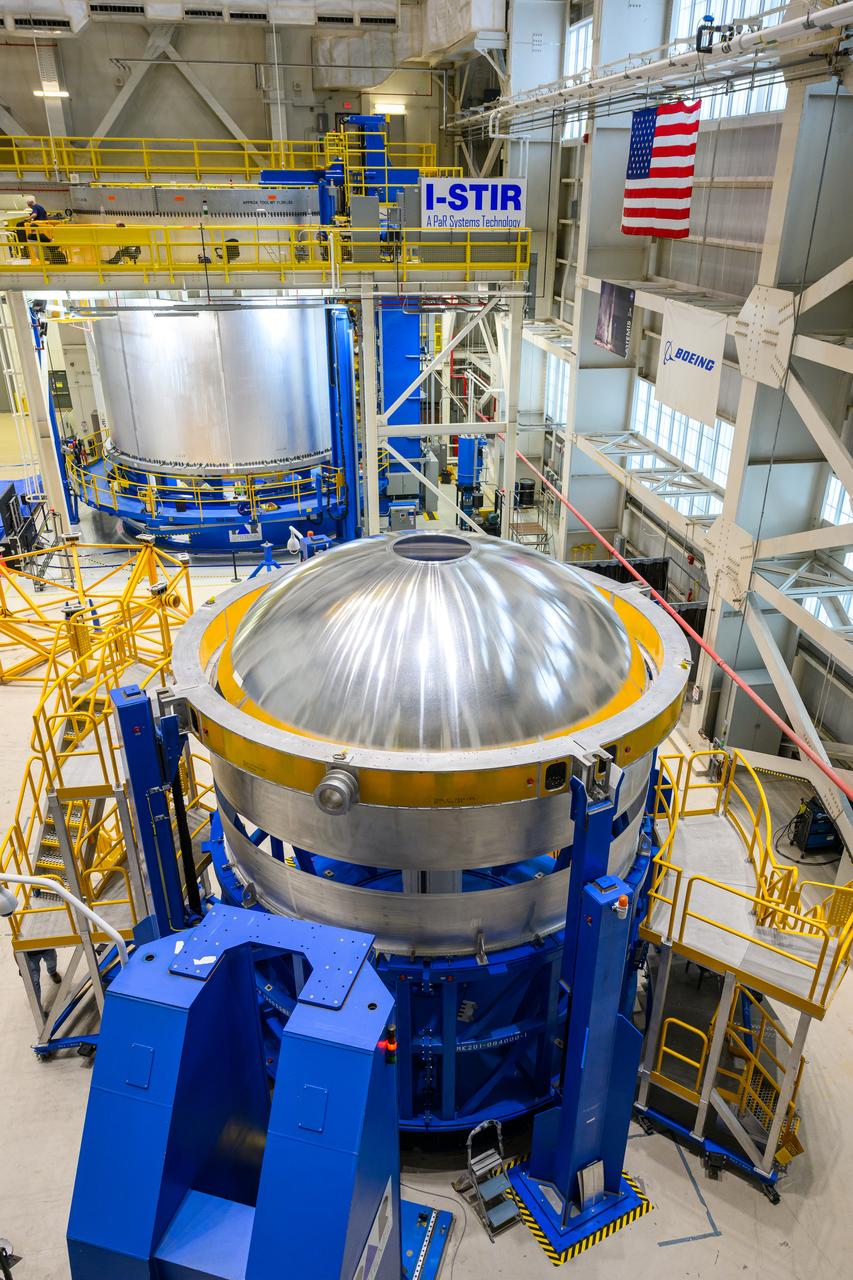
These images show technicians at NASA’s Michoud Assembly Facility in New Orleans lifting and installing the liquid oxygen dome weld confidence article for a future upper stage for NASA’s SLS (Space Launch System) rocket onto the LTAC (LOX Tank Assembly Center) in Building 115 at Michoud for the next phase of manufacturing in July 2023. The dome makes up a portion of the liquid oxygen tank weld confidence article for the EUS (exploration upper stage). Teams use weld confidence articles to verify welding procedures and structural integrity of the welds to manufacture structural test and flight versions of the hardware. EUS flight hardware is in early production at Michoud. The more powerful upper stage and its four RL10 engines will be used on the second configuration of the SLS rocket, known as Block 1B, and will provide in-space propulsion to send astronauts in NASA’s Orion spacecraft and heavy cargo on a precise trajectory to the Moon. NASA and Boeing, the lead contractor for the SLS core stage and EUS, are manufacturing SLS stages for Artemis II, III, IV, and V at the facility. NASA is working to land the first woman and first person of color on the Moon under Artemis. SLS is part of NASA’s backbone for deep space exploration, along with Orion and the Gateway in orbit around the Moon. SLS is the only rocket that can send Orion, astronauts, and supplies to the Moon in a single mission.

These images show technicians at NASA’s Michoud Assembly Facility in New Orleans lifting and installing the liquid oxygen dome weld confidence article for a future upper stage for NASA’s SLS (Space Launch System) rocket onto the LTAC (LOX Tank Assembly Center) in Building 115 at Michoud for the next phase of manufacturing in July 2023. The dome makes up a portion of the liquid oxygen tank weld confidence article for the EUS (exploration upper stage). Teams use weld confidence articles to verify welding procedures and structural integrity of the welds to manufacture structural test and flight versions of the hardware. EUS flight hardware is in early production at Michoud. The more powerful upper stage and its four RL10 engines will be used on the second configuration of the SLS rocket, known as Block 1B, and will provide in-space propulsion to send astronauts in NASA’s Orion spacecraft and heavy cargo on a precise trajectory to the Moon. NASA and Boeing, the lead contractor for the SLS core stage and EUS, are manufacturing SLS stages for Artemis II, III, IV, and V at the facility. NASA is working to land the first woman and first person of color on the Moon under Artemis. SLS is part of NASA’s backbone for deep space exploration, along with Orion and the Gateway in orbit around the Moon. SLS is the only rocket that can send Orion, astronauts, and supplies to the Moon in a single mission.
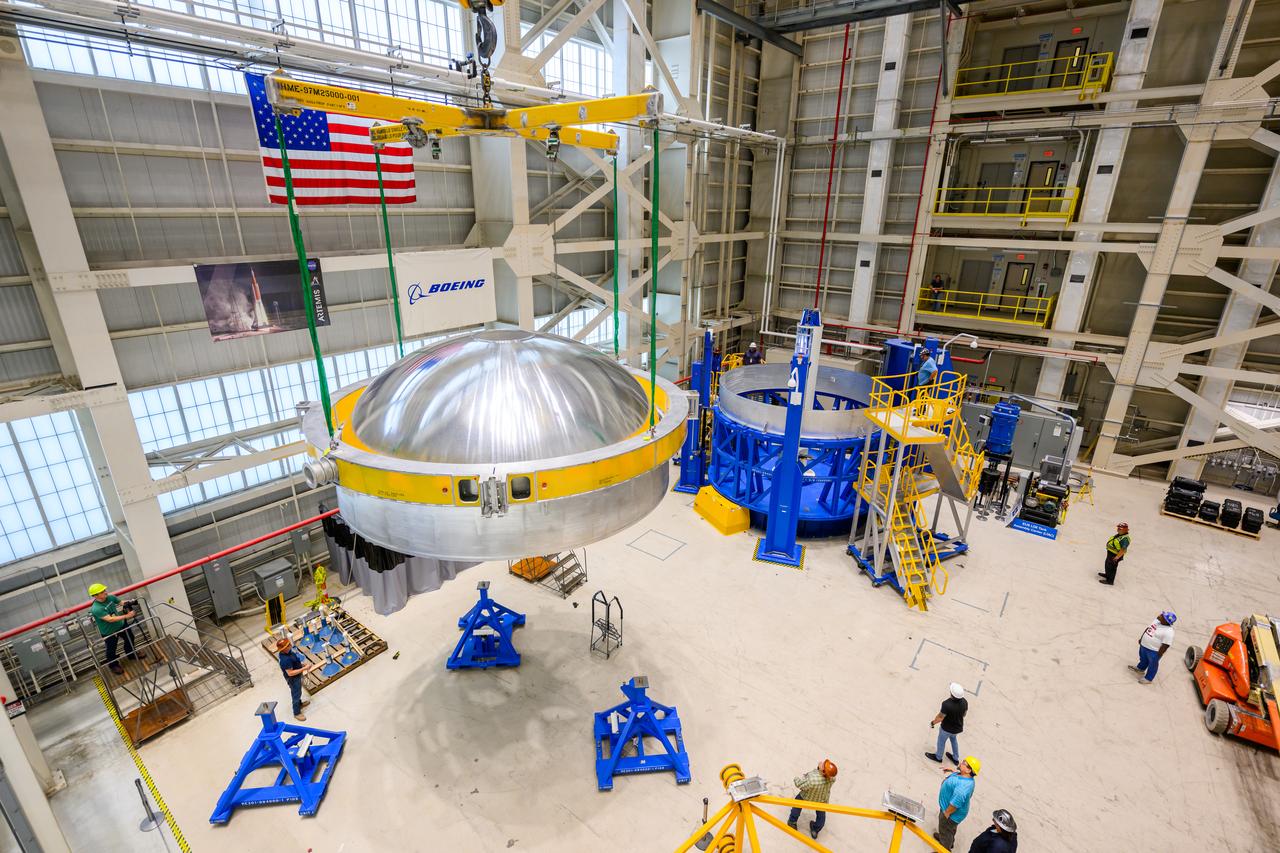
These images show technicians at NASA’s Michoud Assembly Facility in New Orleans lifting and installing the liquid oxygen dome weld confidence article for a future upper stage for NASA’s SLS (Space Launch System) rocket onto the LTAC (LOX Tank Assembly Center) in Building 115 at Michoud for the next phase of manufacturing in July 2023. The dome makes up a portion of the liquid oxygen tank weld confidence article for the EUS (exploration upper stage). Teams use weld confidence articles to verify welding procedures and structural integrity of the welds to manufacture structural test and flight versions of the hardware. EUS flight hardware is in early production at Michoud. The more powerful upper stage and its four RL10 engines will be used on the second configuration of the SLS rocket, known as Block 1B, and will provide in-space propulsion to send astronauts in NASA’s Orion spacecraft and heavy cargo on a precise trajectory to the Moon. NASA and Boeing, the lead contractor for the SLS core stage and EUS, are manufacturing SLS stages for Artemis II, III, IV, and V at the facility. NASA is working to land the first woman and first person of color on the Moon under Artemis. SLS is part of NASA’s backbone for deep space exploration, along with Orion and the Gateway in orbit around the Moon. SLS is the only rocket that can send Orion, astronauts, and supplies to the Moon in a single mission.
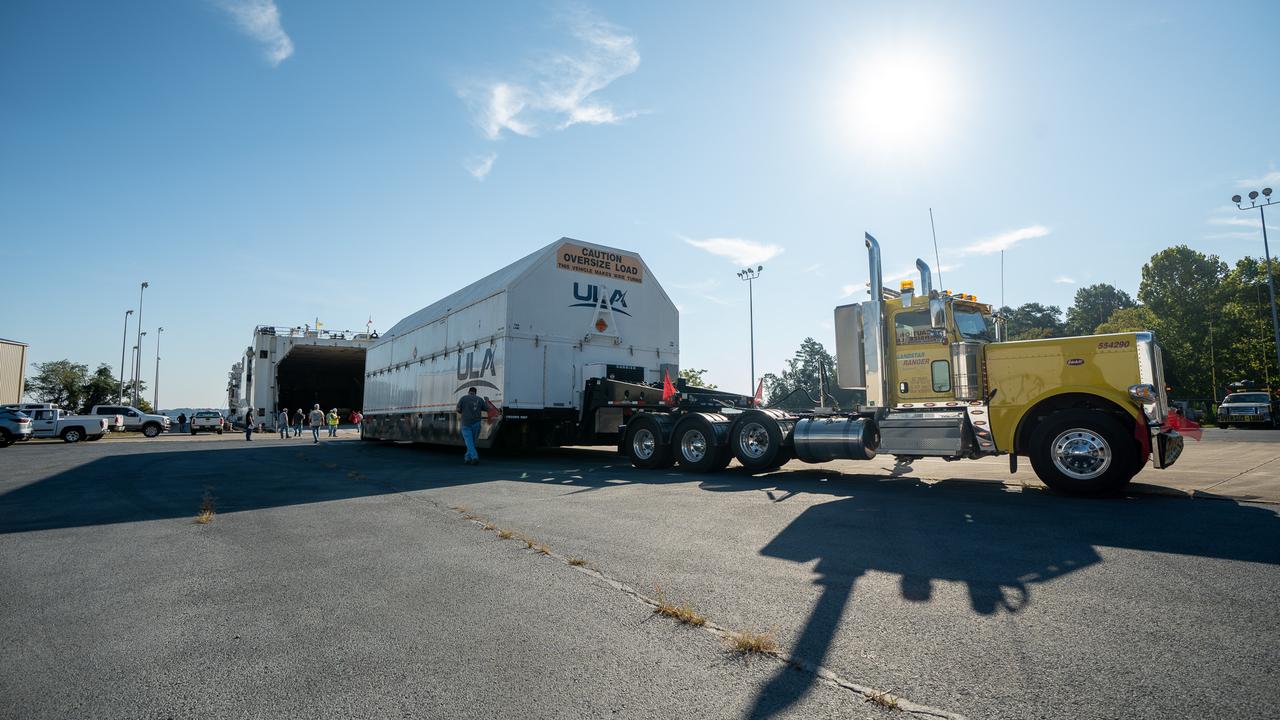
These images and videos show how crews in Alabama prepared the ICPS (interim cryogenic propulsion stage) for NASA’s SLS (Space Launch System) rocket for shipment to Florida between July 29-31. The ICPS in the photos and videos will help power NASA’s Artemis III mission to the Moon. The SLS upper stage is manufactured by United Launch Alliance at its facility in Decatur. Its RL10 engine is produced by Aerojet Rocketdyne, the SLS engines lead contractor, in West Palm Beach, Florida. ULA is working with Boeing, the SLS core stage and exploration upper stage lead contractor, to develop ICPS. ULA’s R/S RocketShip is transporting the flight hardware to its sister facility in Florida near NASA’s Kennedy Space Center for final checkouts. The ICPS for Artemis III is the last of its kind as SLS transitions to its next, more powerful Block 1B configuration with an upgraded upper stage beginning with Artemis IV. NASA is working to land the first woman and first person of color on the Moon under Artemis. SLS is part of NASA’s backbone for deep space exploration, along with Orion and the Gateway in orbit around the Moon. SLS is the only rocket that can send Orion, astronauts, and supplies to the Moon in a single mission.
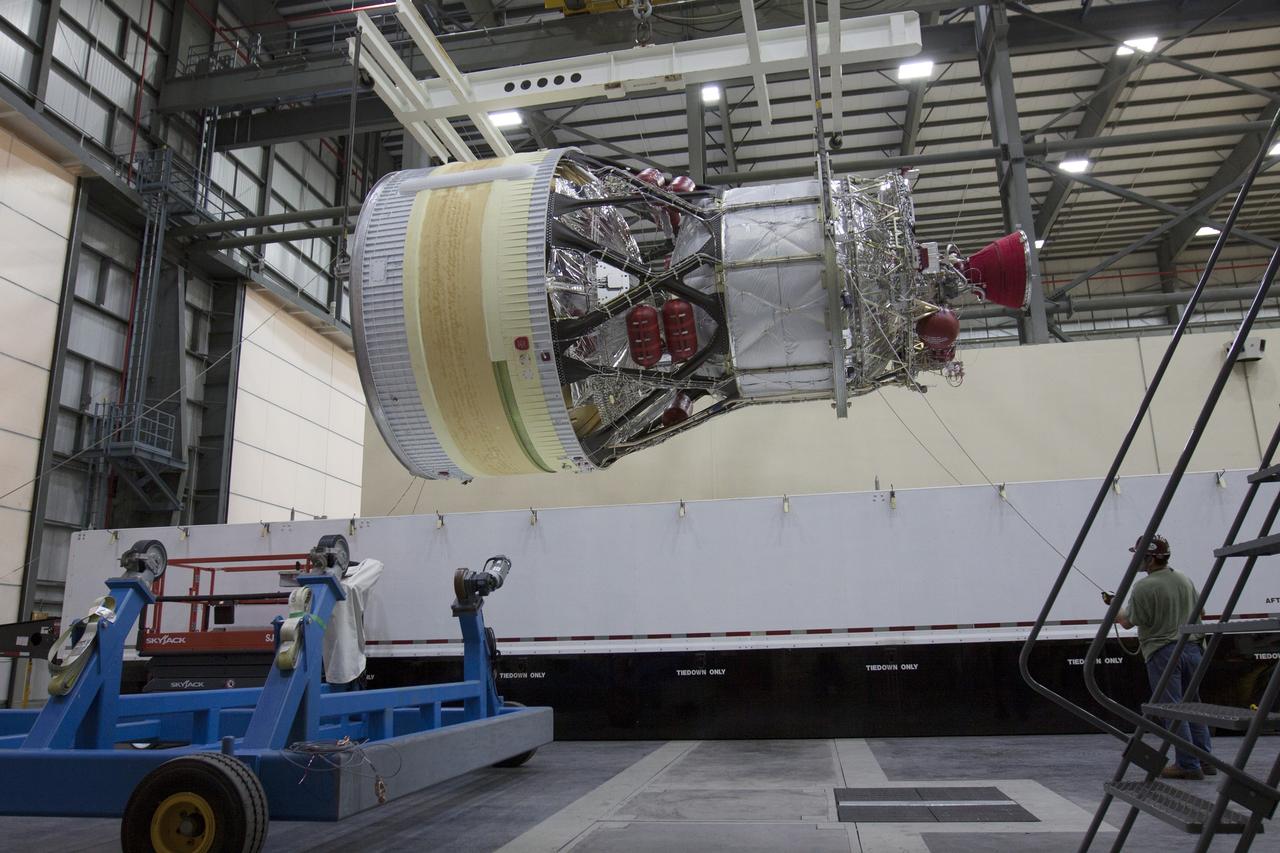
CAPE CANAVERAL, Fla. -- Inside the Horizontal Integration Facility, or HIF, at Space Launch Complex 37 on Cape Canaveral Air Force Station in Florida, the upper stage for the United Launch Alliance Delta IV Heavy for Exploration Flight Test-1, or EFT-1, is being removed from its transportation container. The upper stage, along with the port booster and spacecraft adapter arrived by barge at the U.S. Army Outpost wharf at Port Canaveral in Florida and were transported to the HIF. At the HIF, all three booster stages will be processed and checked out before being moved to the nearby launch pad and hoisted into position. The spacecraft adapter will connect Orion to the ULA Delta IV, and also will connect Orion to NASA's new rocket, the Space Launch System, on its first mission in 2017. During the EFT-1 mission, Orion will travel farther into space than any human spacecraft has gone in more than 40 years. The data gathered during the flight will influence design decisions, validate existing computer models and innovative new approaches to space systems development, as well as reduce overall mission risks and costs for later Orion flights. Liftoff of Orion on EFT-1 is planned for fall 2014. Photo credit: NASA/Kim Shiflett
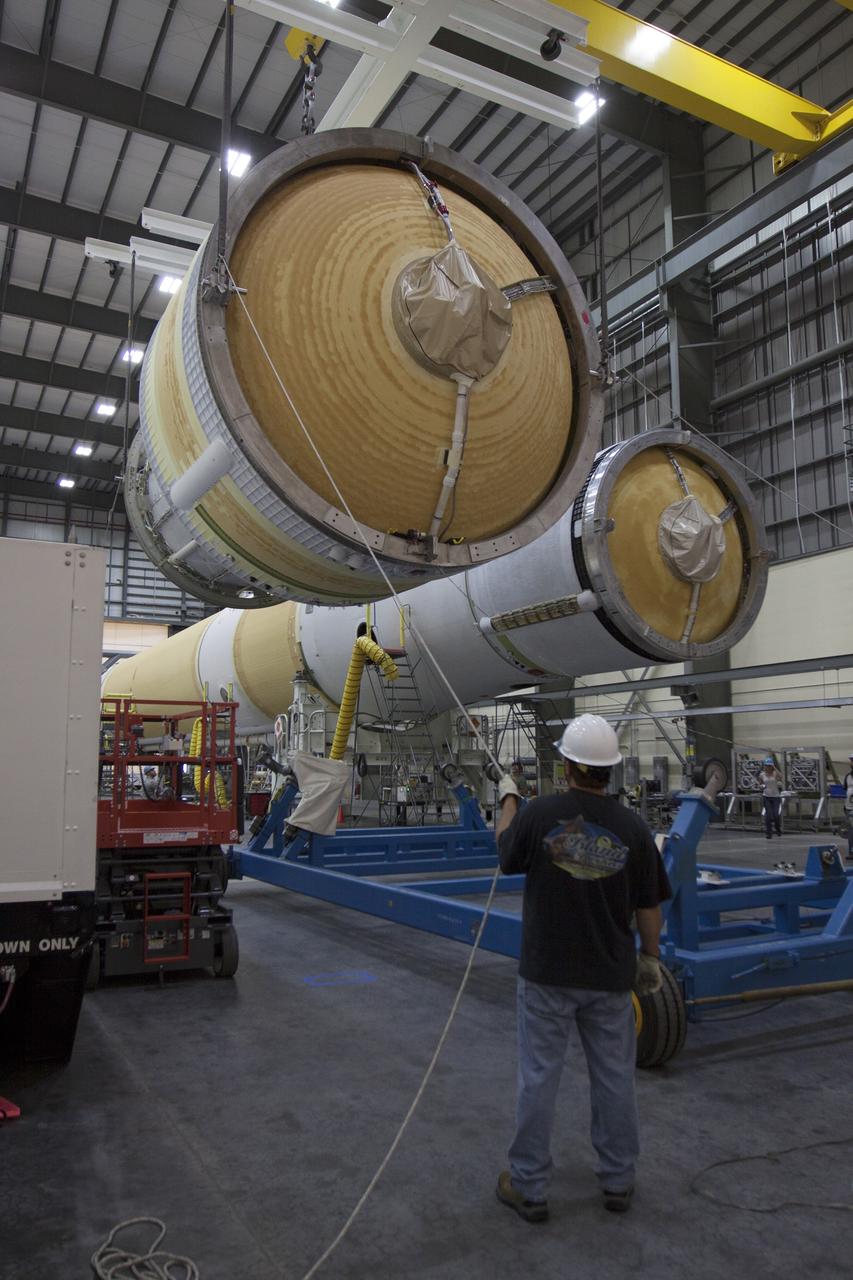
CAPE CANAVERAL, Fla. -- Inside the Horizontal Integration Facility, or HIF, at Space Launch Complex 37 on Cape Canaveral Air Force Station in Florida, the upper stage for the United Launch Alliance Delta IV Heavy for Exploration Flight Test-1, or EFT-1, has been removed from its transportation container and will be lowered onto a cradle. The upper stage, along with the port booster and spacecraft adapter arrived by barge at the U.S. Army Outpost wharf at Port Canaveral in Florida and were transported to the HIF. At the HIF, all three booster stages will be processed and checked out before being moved to the nearby launch pad and hoisted into position. The spacecraft adapter will connect Orion to the ULA Delta IV, and also will connect Orion to NASA's new rocket, the Space Launch System, on its first mission in 2017. During the EFT-1 mission, Orion will travel farther into space than any human spacecraft has gone in more than 40 years. The data gathered during the flight will influence design decisions, validate existing computer models and innovative new approaches to space systems development, as well as reduce overall mission risks and costs for later Orion flights. Liftoff of Orion on EFT-1 is planned for fall 2014. Photo credit: NASA/Kim Shiflett
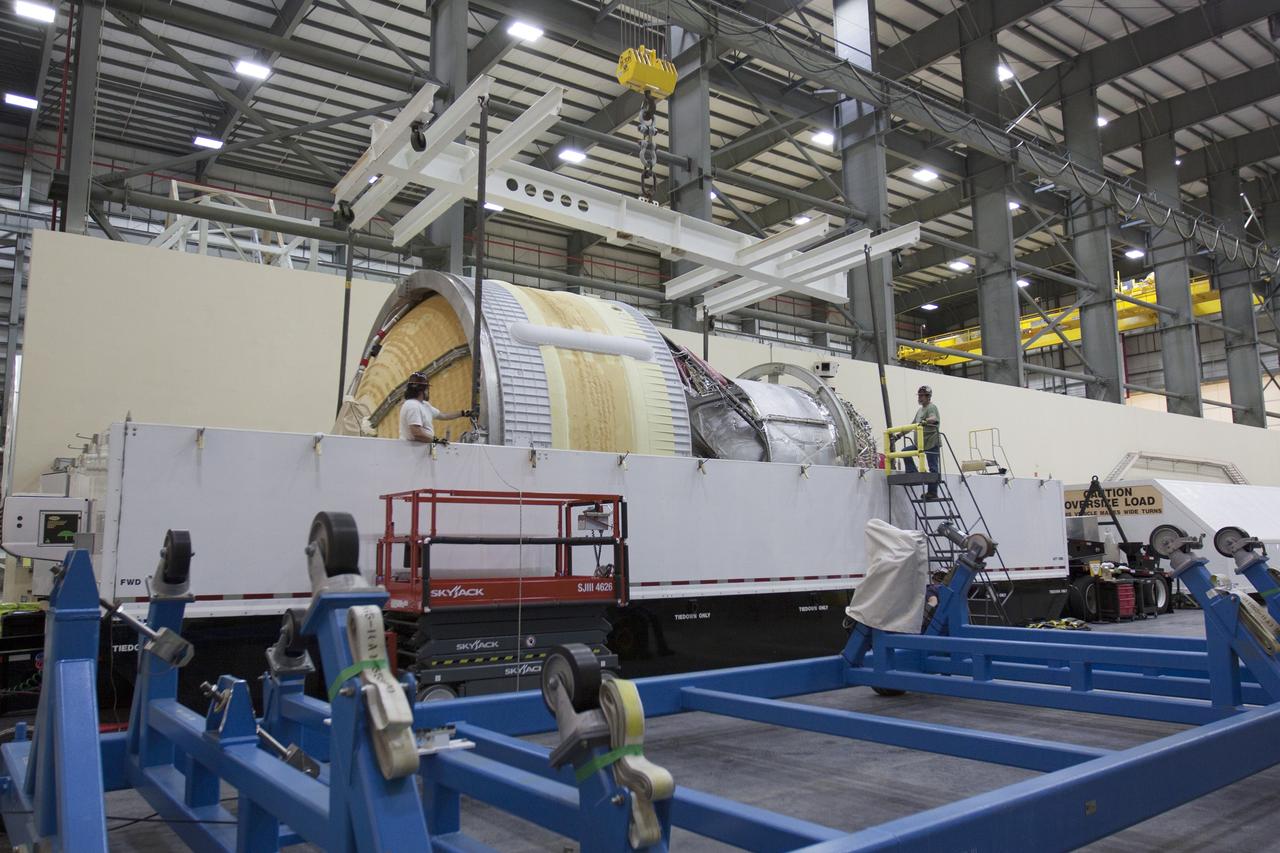
CAPE CANAVERAL, Fla. -- Inside the Horizontal Integration Facility, or HIF, at Space Launch Complex 37 on Cape Canaveral Air Force Station in Florida, the upper stage for the United Launch Alliance Delta IV Heavy for Exploration Flight Test-1, or EFT-1, is being prepared for removal from its transportation container. The upper stage, along with the port booster and spacecraft adapter arrived by barge at the U.S. Army Outpost wharf at Port Canaveral in Florida and were transported to the HIF. At the HIF, all three booster stages will be processed and checked out before being moved to the nearby launch pad and hoisted into position. The spacecraft adapter will connect Orion to the ULA Delta IV, and also will connect Orion to NASA's new rocket, the Space Launch System, on its first mission in 2017. During the EFT-1 mission, Orion will travel farther into space than any human spacecraft has gone in more than 40 years. The data gathered during the flight will influence design decisions, validate existing computer models and innovative new approaches to space systems development, as well as reduce overall mission risks and costs for later Orion flights. Liftoff of Orion on EFT-1 is planned for fall 2014. Photo credit: NASA/Kim Shiflett
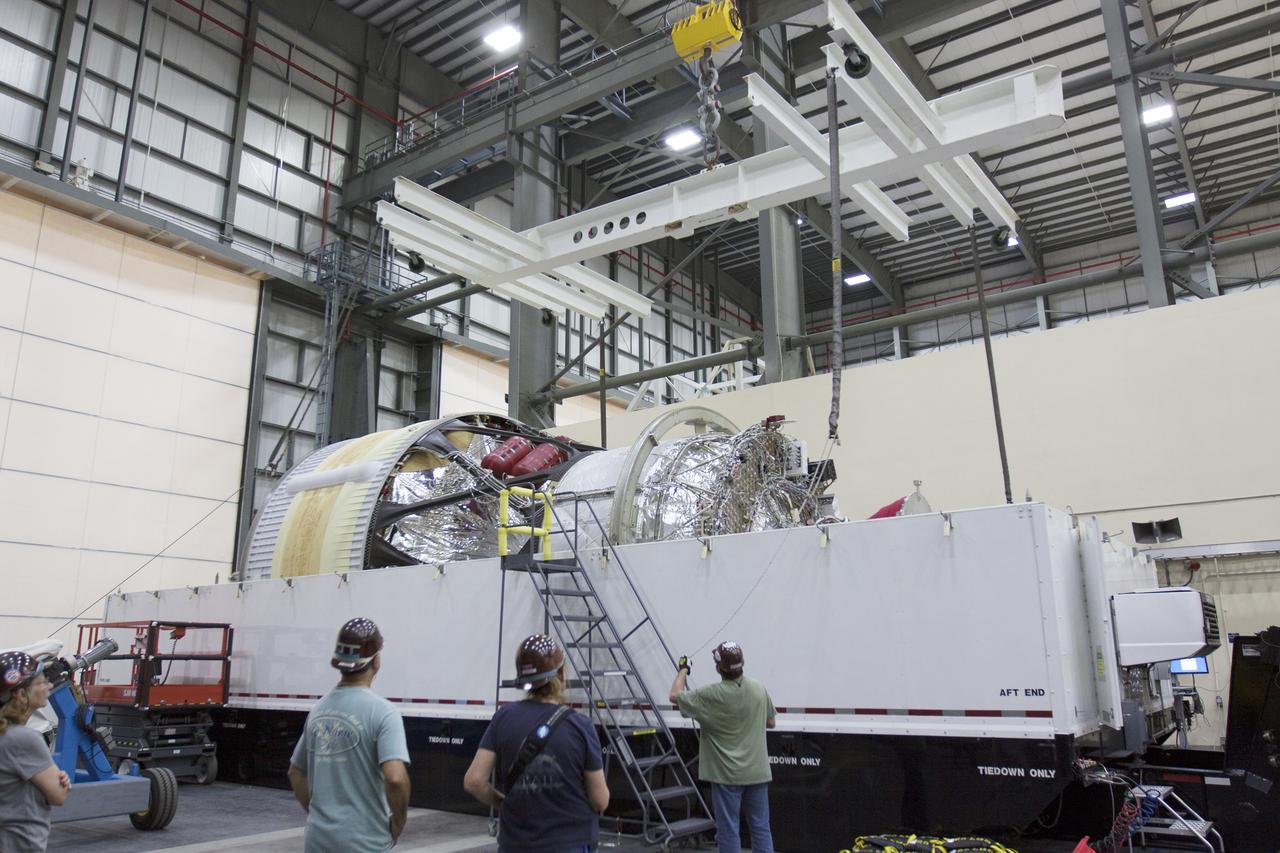
CAPE CANAVERAL, Fla. -- Inside the Horizontal Integration Facility, or HIF, at Space Launch Complex 37 on Cape Canaveral Air Force Station in Florida, the upper stage for the United Launch Alliance Delta IV Heavy for Exploration Flight Test-1, or EFT-1, is being prepared for removal from its transportation container. The upper stage, along with the port booster and spacecraft adapter arrived by barge at the U.S. Army Outpost wharf at Port Canaveral in Florida and were transported to the HIF. At the HIF, all three booster stages will be processed and checked out before being moved to the nearby launch pad and hoisted into position. The spacecraft adapter will connect Orion to the ULA Delta IV, and also will connect Orion to NASA's new rocket, the Space Launch System, on its first mission in 2017. During the EFT-1 mission, Orion will travel farther into space than any human spacecraft has gone in more than 40 years. The data gathered during the flight will influence design decisions, validate existing computer models and innovative new approaches to space systems development, as well as reduce overall mission risks and costs for later Orion flights. Liftoff of Orion on EFT-1 is planned for fall 2014. Photo credit: NASA/Kim Shiflett
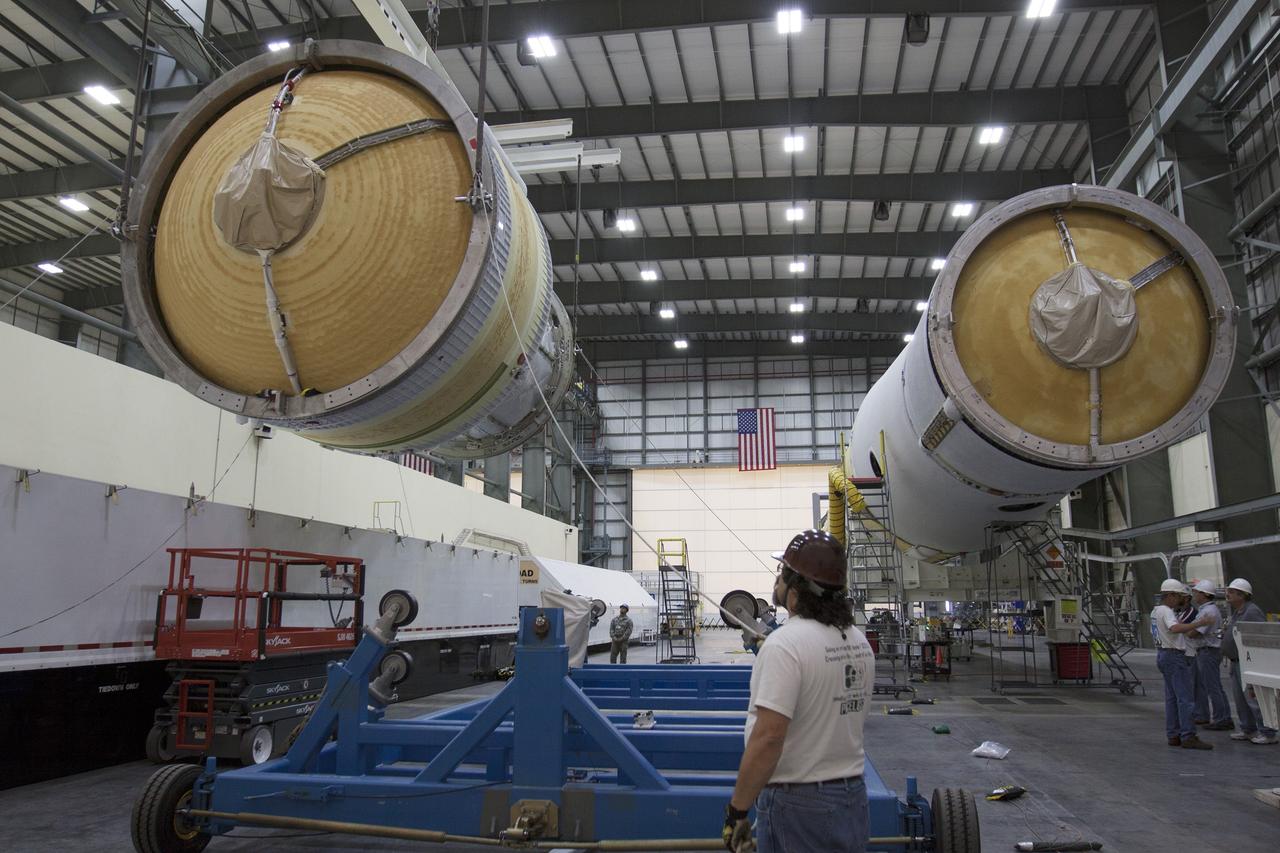
CAPE CANAVERAL, Fla. -- Inside the Horizontal Integration Facility, or HIF, at Space Launch Complex 37 on Cape Canaveral Air Force Station in Florida, the upper stage for the United Launch Alliance Delta IV Heavy for Exploration Flight Test-1, or EFT-1, has been removed from its transportation container and will be lowered onto a cradle. The upper stage, along with the port booster and spacecraft adapter arrived by barge at the U.S. Army Outpost wharf at Port Canaveral in Florida and were transported to the HIF. At the HIF, all three booster stages will be processed and checked out before being moved to the nearby launch pad and hoisted into position. The spacecraft adapter will connect Orion to the ULA Delta IV, and also will connect Orion to NASA's new rocket, the Space Launch System, on its first mission in 2017. During the EFT-1 mission, Orion will travel farther into space than any human spacecraft has gone in more than 40 years. The data gathered during the flight will influence design decisions, validate existing computer models and innovative new approaches to space systems development, as well as reduce overall mission risks and costs for later Orion flights. Liftoff of Orion on EFT-1 is planned for fall 2014. Photo credit: NASA/Kim Shiflett
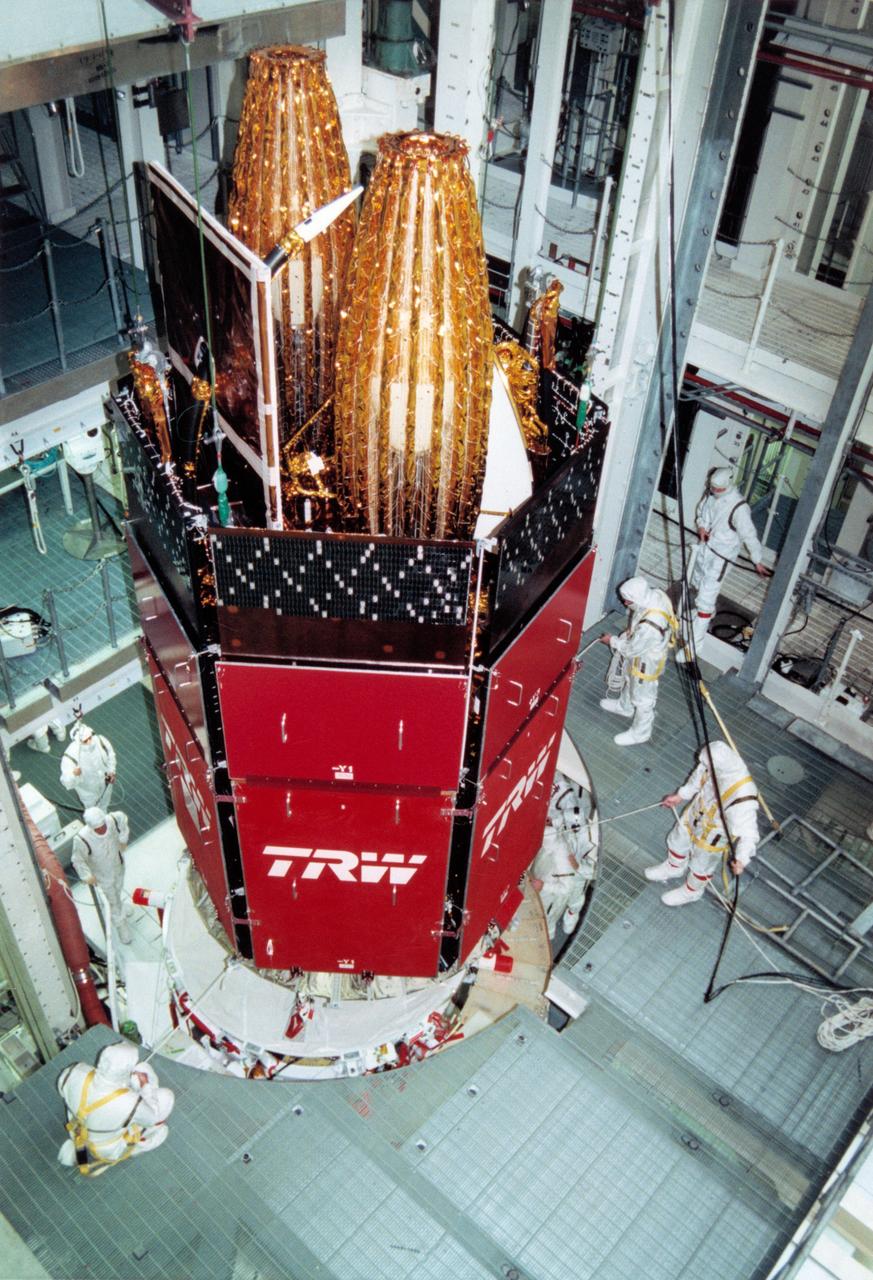
S95-08962 (12 APRIL 1995) --- Members of the Kennedy Space Center (KSC) Payload Processing Team hoist the Tracking and Data Relay Satellite (TDRS-G) into a work stand in the Vertical Processing Facility (VPF) for mating with its Inertial Upper Stage (IUS). After testing and final checkout, TDRS-G and the IUS will be transported to Launch Pad 39B and installed into the Space Shuttle Discovery's payload bay for launch on the STS-70 mission, scheduled for launch June 8, 1995.
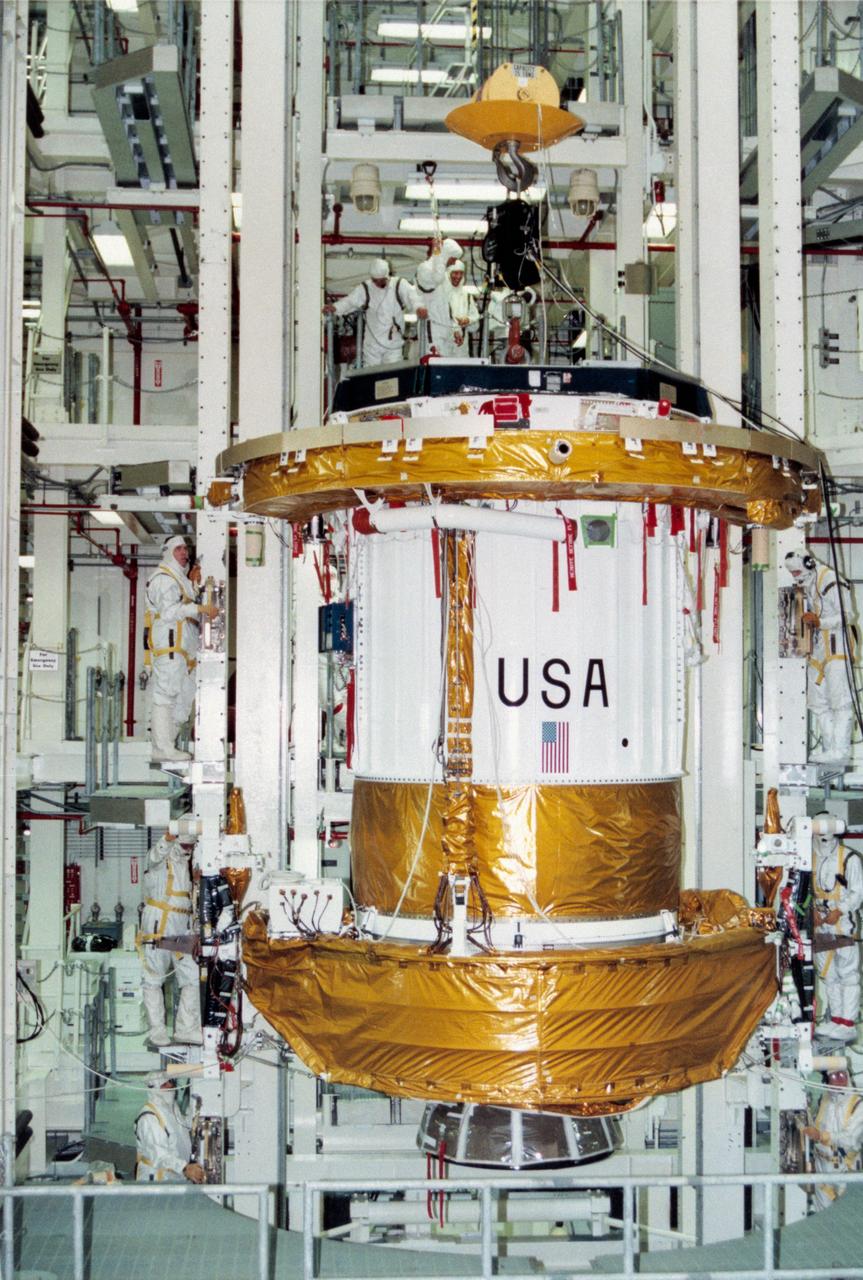
S95-08961 (4 APRIL 1995) --- Workers in the Vertical Processing Facility (VPF) oversee and control the lowering of the Inertial Upper Stage (IUS) booster into a work stand for preflight processing. The IUS will be attached to the Tracking and Data Relay Satellite (TDRS-G), which will be deployed by the Space Shuttle Discovery on the STS-70 mission. The IUS is scheduled to be mated to the TDRS satellite later in April. Liftoff of STS-70 is slated for no earlier than June 8, 1995.
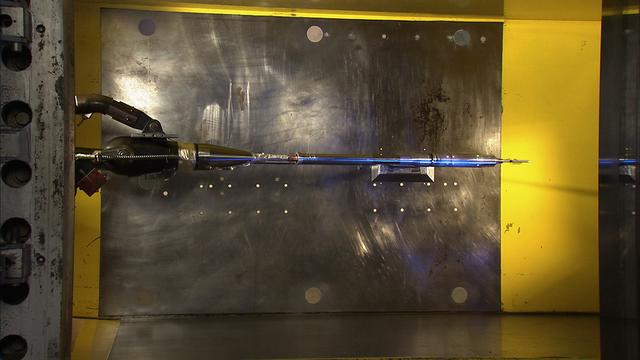
Under the goals of the Vision for Space Exploration, Ares I is a chief component of the cost-effective space transportation infrastructure being developed by NASA's Constellation Program. This transportation system will safely and reliably carry human explorers back to the moon, and then onward to Mars and other destinations in the solar system. The Ares I effort includes multiple project element teams at NASA centers and contract organizations around the nation, and is managed by the Exploration Launch Projects Office at NASA's Marshall Space Flight Center (MFSC). ATK Launch Systems near Brigham City, Utah, is the prime contractor for the first stage booster. ATK's subcontractor, United Space Alliance of Houston, is designing, developing and testing the parachutes at its facilities at NASA's Kennedy Space Center in Florida. NASA's Johnson Space Center in Houston hosts the Constellation Program and Orion Crew Capsule Project Office and provides test instrumentation and support personnel. Together, these teams are developing vehicle hardware, evolving proven technologies, and testing components and systems. Their work builds on powerful, reliable space shuttle propulsion elements and nearly a half-century of NASA space flight experience and technological advances. Ares I is an inline, two-stage rocket configuration topped by the Crew Exploration Vehicle, its service module, and a launch abort system. In this HD video image, an Ares I x-test involves the upper stage separating from the first stage. This particular test was conducted at the NASA Langley Research Center in July 2007. (Highest resolution available)
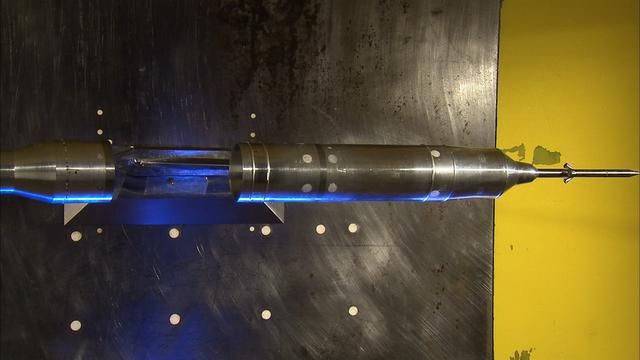
Under the goals of the Vision for Space Exploration, Ares I is a chief component of the cost-effective space transportation infrastructure being developed by NASA's Constellation Program. This transportation system will safely and reliably carry human explorers back to the moon, and then onward to Mars and other destinations in the solar system. The Ares I effort includes multiple project element teams at NASA centers and contract organizations around the nation, and is managed by the Exploration Launch Projects Office at NASA's Marshall Space Flight Center (MFSC). ATK Launch Systems near Brigham City, Utah, is the prime contractor for the first stage booster. ATK's subcontractor, United Space Alliance of Houston, is designing, developing and testing the parachutes at its facilities at NASA's Kennedy Space Center in Florida. NASA's Johnson Space Center in Houston hosts the Constellation Program and Orion Crew Capsule Project Office and provides test instrumentation and support personnel. Together, these teams are developing vehicle hardware, evolving proven technologies, and testing components and systems. Their work builds on powerful, reliable space shuttle propulsion elements and nearly a half-century of NASA space flight experience and technological advances. Ares I is an inline, two-stage rocket configuration topped by the Crew Exploration Vehicle, its service module, and a launch abort system. In this HD video image, an Ares I x-test involves the upper stage separating from the first stage. This particular test was conducted at the NASA Langley Research Center in July 2007. (Highest resolution available)
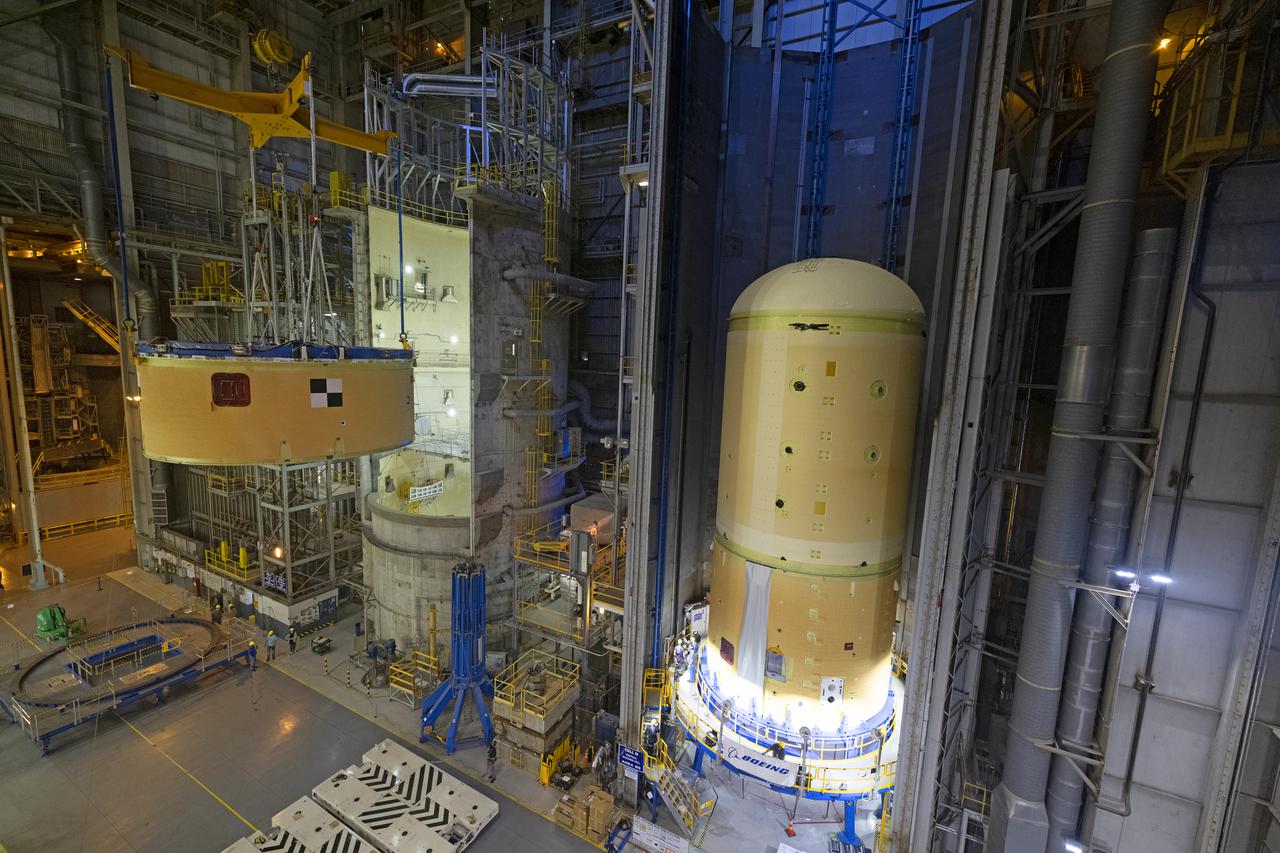
NASA’s Space Launch System (SLS) team fully stacked three hardware elements together May 24 to form the top of the rocket’s core stage for the Artemis II mission. NASA and core stage prime contractor Boeing connected the forward skirt with the liquid oxygen tank and intertank flight hardware inside an assembly area at NASA’s Michoud Assembly Facility in New Orleans. Teams had previously stacked the liquid oxygen tank and intertank on April 28. The joining of the three structures together is the first major assembly of core stage hardware for Artemis II, the first crewed Artemis mission and second flight of the SLS rocket. Next, technicians will work to complete outfitting and integrating the systems within the upper structure. At 66 feet tall, the upper part of the stage is just a fraction of the entire core stage. The fully-assembled, 212-foot-tall rocket stage consists of five hardware elements, including two liquid propellant tanks and four RS-25 engines. The liquid oxygen tank in the upper portion of the stage will hold 196,000 gallons of liquid oxygen cooled to minus 297 degrees Fahrenheit. Meanwhile, the forward skirt and intertank house avionics, flight computer, and electronic systems for the rocket stage. Together, the core stage and its four RS-25 engines will provide more than 2 million pounds of thrust to help send Artemis II astronauts beyond Earth’s orbit to lunar orbit. With Artemis, NASA will land the first woman and the first person of color on the Moon and establish sustainable exploration in preparation for missions to Mars. SLS and NASA’s Orion spacecraft, along with the commercial human landing system and the Gateway in orbit around the Moon, are NASA’s backbone for deep space exploration. SLS is the only rocket that can send Orion, astronauts, and supplies to the Moon in a single mission. Image credit: NASA/Michael DeMocker

NASA’s Space Launch System (SLS) team fully stacked three hardware elements together May 24 to form the top of the rocket’s core stage for the Artemis II mission. NASA and core stage prime contractor Boeing connected the forward skirt with the liquid oxygen tank and intertank flight hardware inside an assembly area at NASA’s Michoud Assembly Facility in New Orleans. Teams had previously stacked the liquid oxygen tank and intertank on April 28. The joining of the three structures together is the first major assembly of core stage hardware for Artemis II, the first crewed Artemis mission and second flight of the SLS rocket. Next, technicians will work to complete outfitting and integrating the systems within the upper structure. At 66 feet tall, the upper part of the stage is just a fraction of the entire core stage. The fully-assembled, 212-foot-tall rocket stage consists of five hardware elements, including two liquid propellant tanks and four RS-25 engines. The liquid oxygen tank in the upper portion of the stage will hold 196,000 gallons of liquid oxygen cooled to minus 297 degrees Fahrenheit. Meanwhile, the forward skirt and intertank house avionics, flight computer, and electronic systems for the rocket stage. Together, the core stage and its four RS-25 engines will provide more than 2 million pounds of thrust to help send Artemis II astronauts beyond Earth’s orbit to lunar orbit. With Artemis, NASA will land the first woman and the first person of color on the Moon and establish sustainable exploration in preparation for missions to Mars. SLS and NASA’s Orion spacecraft, along with the commercial human landing system and the Gateway in orbit around the Moon, are NASA’s backbone for deep space exploration. SLS is the only rocket that can send Orion, astronauts, and supplies to the Moon in a single mission. Image credit: NASA/Eric Bordelon
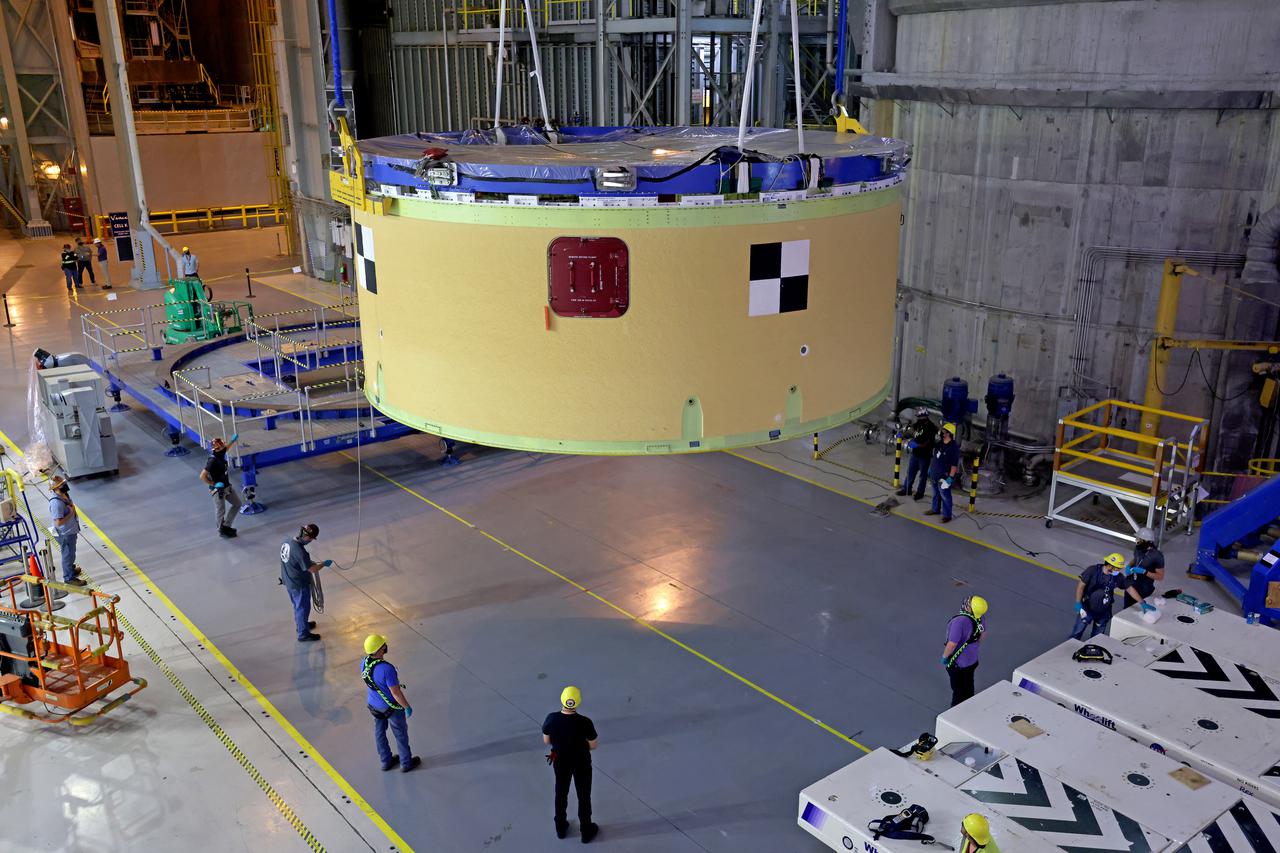
NASA’s Space Launch System (SLS) team fully stacked three hardware elements together May 24 to form the top of the rocket’s core stage for the Artemis II mission. NASA and core stage prime contractor Boeing connected the forward skirt with the liquid oxygen tank and intertank flight hardware inside an assembly area at NASA’s Michoud Assembly Facility in New Orleans. Teams had previously stacked the liquid oxygen tank and intertank on April 28. The joining of the three structures together is the first major assembly of core stage hardware for Artemis II, the first crewed Artemis mission and second flight of the SLS rocket. Next, technicians will work to complete outfitting and integrating the systems within the upper structure. At 66 feet tall, the upper part of the stage is just a fraction of the entire core stage. The fully-assembled, 212-foot-tall rocket stage consists of five hardware elements, including two liquid propellant tanks and four RS-25 engines. The liquid oxygen tank in the upper portion of the stage will hold 196,000 gallons of liquid oxygen cooled to minus 297 degrees Fahrenheit. Meanwhile, the forward skirt and intertank house avionics, flight computer, and electronic systems for the rocket stage. Together, the core stage and its four RS-25 engines will provide more than 2 million pounds of thrust to help send Artemis II astronauts beyond Earth’s orbit to lunar orbit. With Artemis, NASA will land the first woman and the first person of color on the Moon and establish sustainable exploration in preparation for missions to Mars. SLS and NASA’s Orion spacecraft, along with the commercial human landing system and the Gateway in orbit around the Moon, are NASA’s backbone for deep space exploration. SLS is the only rocket that can send Orion, astronauts, and supplies to the Moon in a single mission. Image credit: NASA/Michael DeMocker
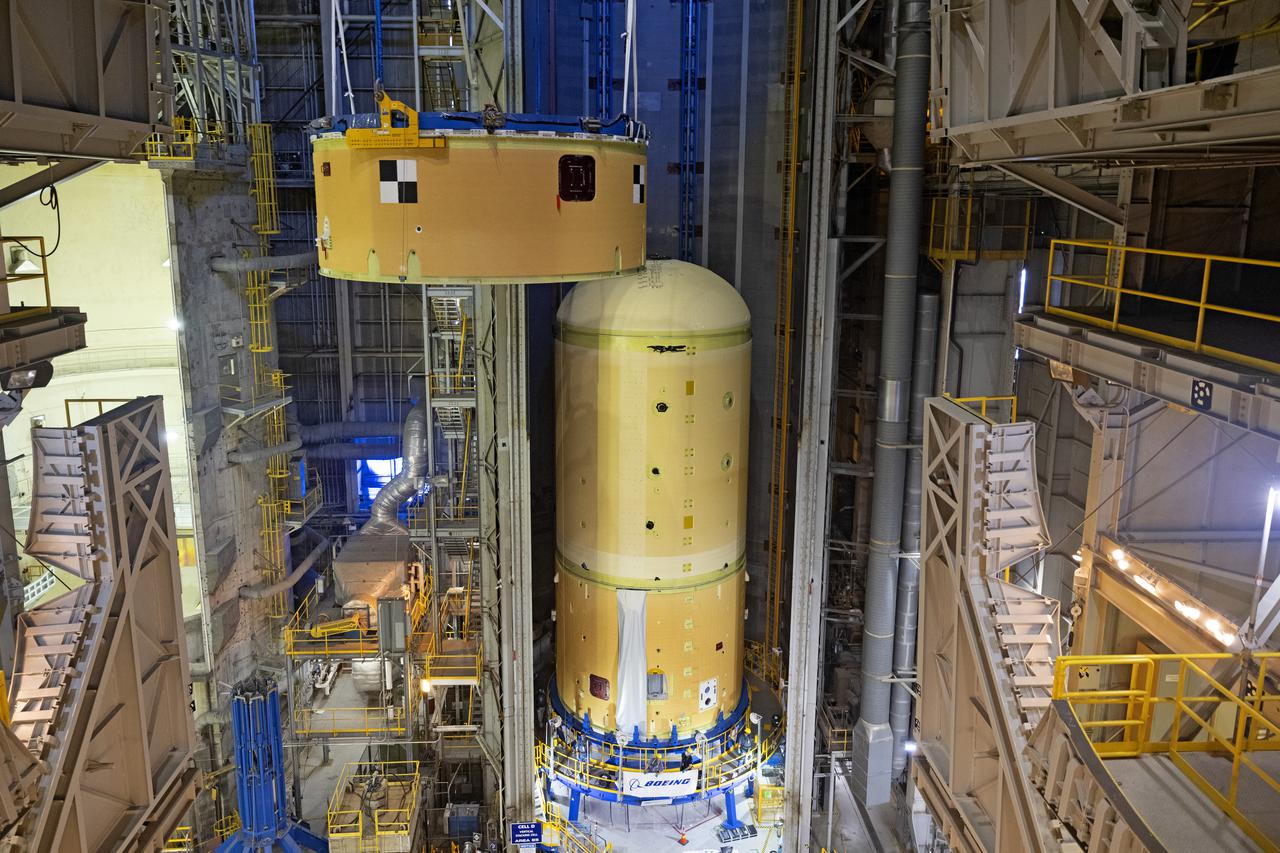
NASA’s Space Launch System (SLS) team fully stacked three hardware elements together May 24 to form the top of the rocket’s core stage for the Artemis II mission. NASA and core stage prime contractor Boeing connected the forward skirt with the liquid oxygen tank and intertank flight hardware inside an assembly area at NASA’s Michoud Assembly Facility in New Orleans. Teams had previously stacked the liquid oxygen tank and intertank on April 28. The joining of the three structures together is the first major assembly of core stage hardware for Artemis II, the first crewed Artemis mission and second flight of the SLS rocket. Next, technicians will work to complete outfitting and integrating the systems within the upper structure. At 66 feet tall, the upper part of the stage is just a fraction of the entire core stage. The fully-assembled, 212-foot-tall rocket stage consists of five hardware elements, including two liquid propellant tanks and four RS-25 engines. The liquid oxygen tank in the upper portion of the stage will hold 196,000 gallons of liquid oxygen cooled to minus 297 degrees Fahrenheit. Meanwhile, the forward skirt and intertank house avionics, flight computer, and electronic systems for the rocket stage. Together, the core stage and its four RS-25 engines will provide more than 2 million pounds of thrust to help send Artemis II astronauts beyond Earth’s orbit to lunar orbit. With Artemis, NASA will land the first woman and the first person of color on the Moon and establish sustainable exploration in preparation for missions to Mars. SLS and NASA’s Orion spacecraft, along with the commercial human landing system and the Gateway in orbit around the Moon, are NASA’s backbone for deep space exploration. SLS is the only rocket that can send Orion, astronauts, and supplies to the Moon in a single mission. Image credit: NASA/Michael DeMocker

NASA’s Space Launch System (SLS) team fully stacked three hardware elements together May 24 to form the top of the rocket’s core stage for the Artemis II mission. NASA and core stage prime contractor Boeing connected the forward skirt with the liquid oxygen tank and intertank flight hardware inside an assembly area at NASA’s Michoud Assembly Facility in New Orleans. Teams had previously stacked the liquid oxygen tank and intertank on April 28. The joining of the three structures together is the first major assembly of core stage hardware for Artemis II, the first crewed Artemis mission and second flight of the SLS rocket. Next, technicians will work to complete outfitting and integrating the systems within the upper structure. At 66 feet tall, the upper part of the stage is just a fraction of the entire core stage. The fully-assembled, 212-foot-tall rocket stage consists of five hardware elements, including two liquid propellant tanks and four RS-25 engines. The liquid oxygen tank in the upper portion of the stage will hold 196,000 gallons of liquid oxygen cooled to minus 297 degrees Fahrenheit. Meanwhile, the forward skirt and intertank house avionics, flight computer, and electronic systems for the rocket stage. Together, the core stage and its four RS-25 engines will provide more than 2 million pounds of thrust to help send Artemis II astronauts beyond Earth’s orbit to lunar orbit. With Artemis, NASA will land the first woman and the first person of color on the Moon and establish sustainable exploration in preparation for missions to Mars. SLS and NASA’s Orion spacecraft, along with the commercial human landing system and the Gateway in orbit around the Moon, are NASA’s backbone for deep space exploration. SLS is the only rocket that can send Orion, astronauts, and supplies to the Moon in a single mission. Image credit: NASA/Eric Bordelon
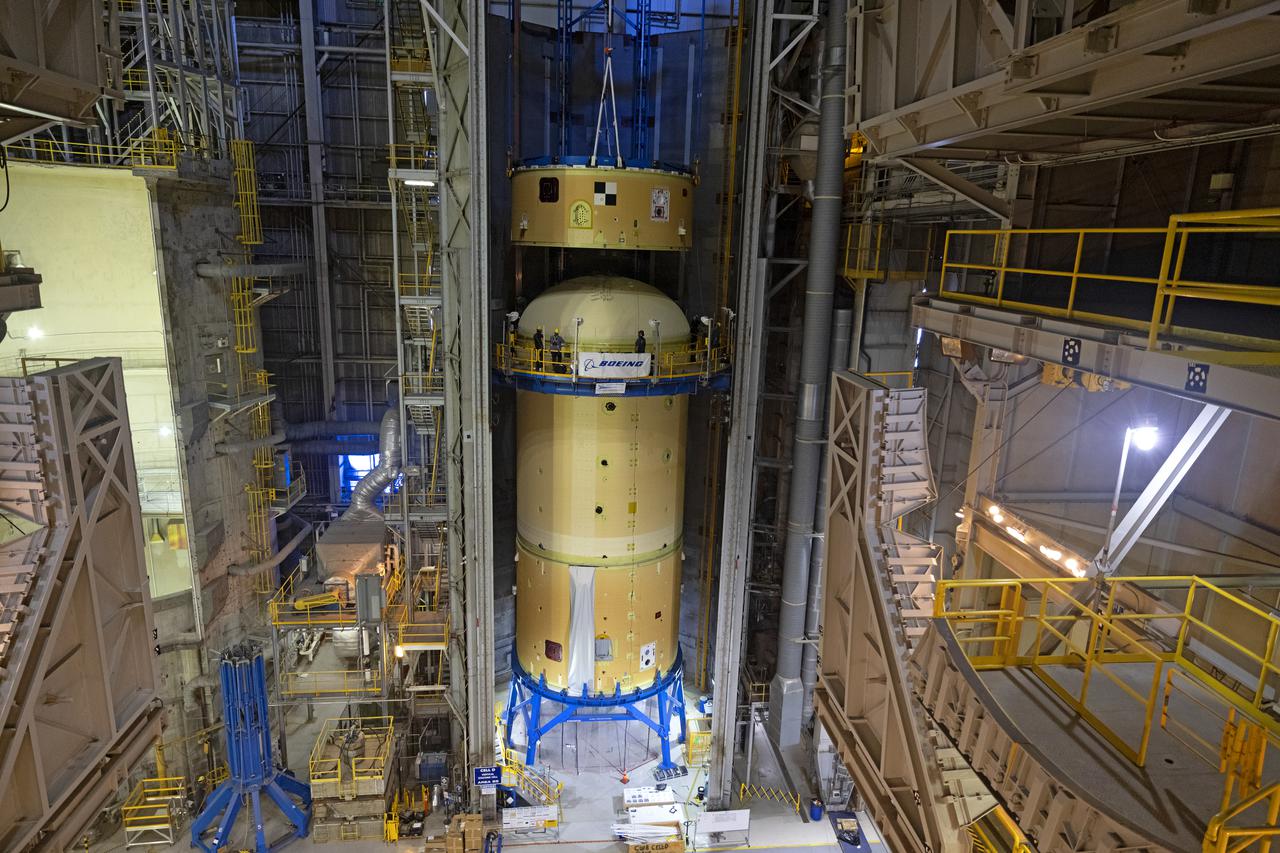
NASA’s Space Launch System (SLS) team fully stacked three hardware elements together May 24 to form the top of the rocket’s core stage for the Artemis II mission. NASA and core stage prime contractor Boeing connected the forward skirt with the liquid oxygen tank and intertank flight hardware inside an assembly area at NASA’s Michoud Assembly Facility in New Orleans. Teams had previously stacked the liquid oxygen tank and intertank on April 28. The joining of the three structures together is the first major assembly of core stage hardware for Artemis II, the first crewed Artemis mission and second flight of the SLS rocket. Next, technicians will work to complete outfitting and integrating the systems within the upper structure. At 66 feet tall, the upper part of the stage is just a fraction of the entire core stage. The fully-assembled, 212-foot-tall rocket stage consists of five hardware elements, including two liquid propellant tanks and four RS-25 engines. The liquid oxygen tank in the upper portion of the stage will hold 196,000 gallons of liquid oxygen cooled to minus 297 degrees Fahrenheit. Meanwhile, the forward skirt and intertank house avionics, flight computer, and electronic systems for the rocket stage. Together, the core stage and its four RS-25 engines will provide more than 2 million pounds of thrust to help send Artemis II astronauts beyond Earth’s orbit to lunar orbit. With Artemis, NASA will land the first woman and the first person of color on the Moon and establish sustainable exploration in preparation for missions to Mars. SLS and NASA’s Orion spacecraft, along with the commercial human landing system and the Gateway in orbit around the Moon, are NASA’s backbone for deep space exploration. SLS is the only rocket that can send Orion, astronauts, and supplies to the Moon in a single mission. Image credit: NASA/Michael DeMocker
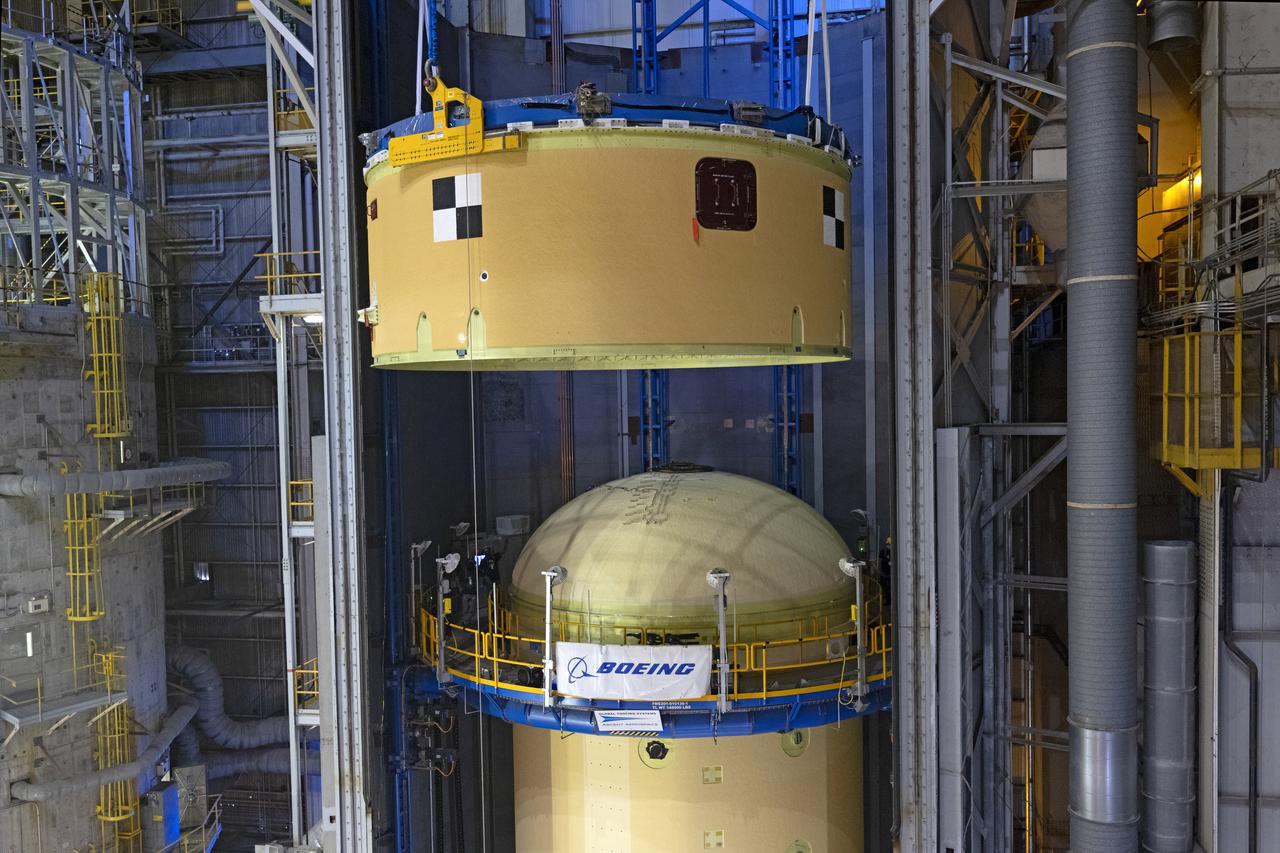
NASA’s Space Launch System (SLS) team fully stacked three hardware elements together May 24 to form the top of the rocket’s core stage for the Artemis II mission. NASA and core stage prime contractor Boeing connected the forward skirt with the liquid oxygen tank and intertank flight hardware inside an assembly area at NASA’s Michoud Assembly Facility in New Orleans. Teams had previously stacked the liquid oxygen tank and intertank on April 28. The joining of the three structures together is the first major assembly of core stage hardware for Artemis II, the first crewed Artemis mission and second flight of the SLS rocket. Next, technicians will work to complete outfitting and integrating the systems within the upper structure. At 66 feet tall, the upper part of the stage is just a fraction of the entire core stage. The fully-assembled, 212-foot-tall rocket stage consists of five hardware elements, including two liquid propellant tanks and four RS-25 engines. The liquid oxygen tank in the upper portion of the stage will hold 196,000 gallons of liquid oxygen cooled to minus 297 degrees Fahrenheit. Meanwhile, the forward skirt and intertank house avionics, flight computer, and electronic systems for the rocket stage. Together, the core stage and its four RS-25 engines will provide more than 2 million pounds of thrust to help send Artemis II astronauts beyond Earth’s orbit to lunar orbit. With Artemis, NASA will land the first woman and the first person of color on the Moon and establish sustainable exploration in preparation for missions to Mars. SLS and NASA’s Orion spacecraft, along with the commercial human landing system and the Gateway in orbit around the Moon, are NASA’s backbone for deep space exploration. SLS is the only rocket that can send Orion, astronauts, and supplies to the Moon in a single mission. Image credit: NASA/Michael DeMocker
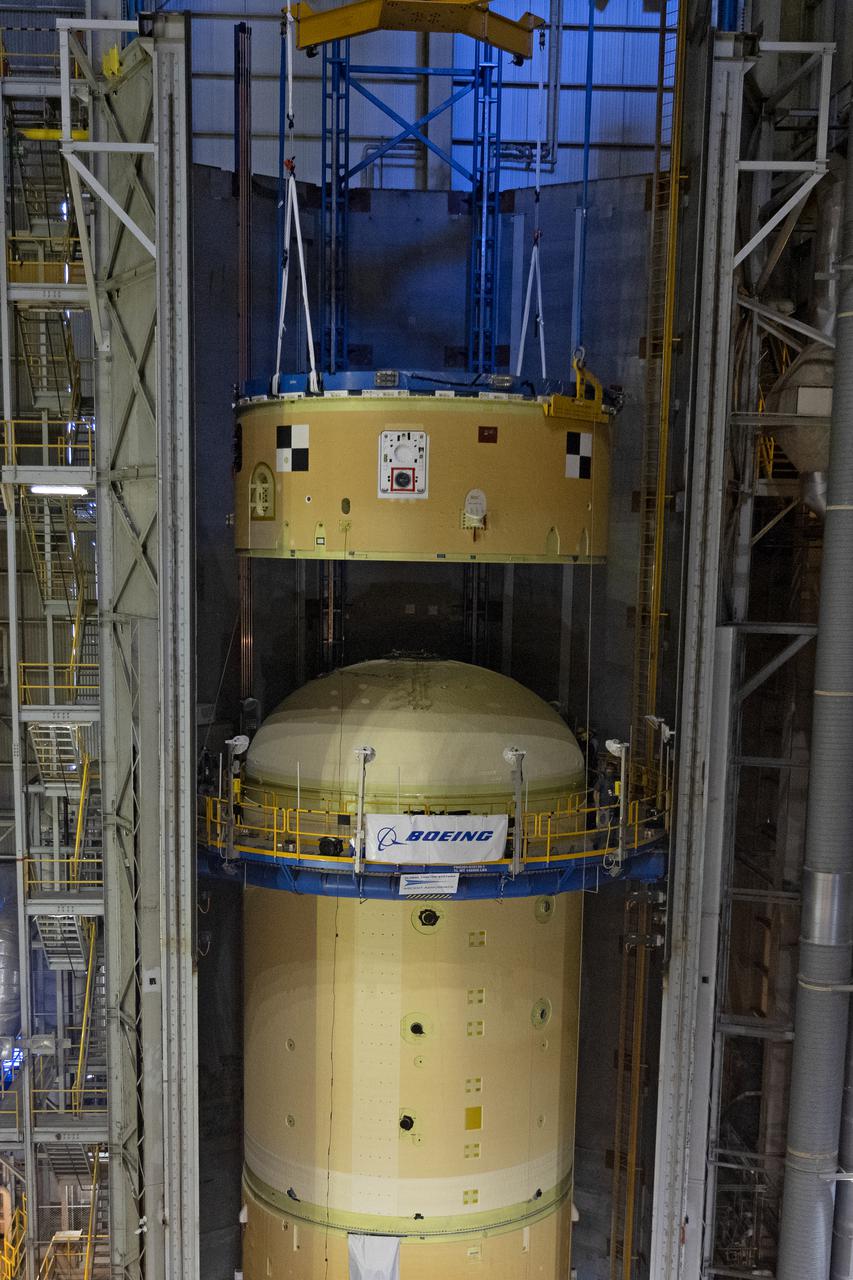
NASA’s Space Launch System (SLS) team fully stacked three hardware elements together May 24 to form the top of the rocket’s core stage for the Artemis II mission. NASA and core stage prime contractor Boeing connected the forward skirt with the liquid oxygen tank and intertank flight hardware inside an assembly area at NASA’s Michoud Assembly Facility in New Orleans. Teams had previously stacked the liquid oxygen tank and intertank on April 28. The joining of the three structures together is the first major assembly of core stage hardware for Artemis II, the first crewed Artemis mission and second flight of the SLS rocket. Next, technicians will work to complete outfitting and integrating the systems within the upper structure. At 66 feet tall, the upper part of the stage is just a fraction of the entire core stage. The fully-assembled, 212-foot-tall rocket stage consists of five hardware elements, including two liquid propellant tanks and four RS-25 engines. The liquid oxygen tank in the upper portion of the stage will hold 196,000 gallons of liquid oxygen cooled to minus 297 degrees Fahrenheit. Meanwhile, the forward skirt and intertank house avionics, flight computer, and electronic systems for the rocket stage. Together, the core stage and its four RS-25 engines will provide more than 2 million pounds of thrust to help send Artemis II astronauts beyond Earth’s orbit to lunar orbit. With Artemis, NASA will land the first woman and the first person of color on the Moon and establish sustainable exploration in preparation for missions to Mars. SLS and NASA’s Orion spacecraft, along with the commercial human landing system and the Gateway in orbit around the Moon, are NASA’s backbone for deep space exploration. SLS is the only rocket that can send Orion, astronauts, and supplies to the Moon in a single mission. Image credit: NASA/Michael DeMocker

NASA’s Space Launch System (SLS) team fully stacked three hardware elements together May 24 to form the top of the rocket’s core stage for the Artemis II mission. NASA and core stage prime contractor Boeing connected the forward skirt with the liquid oxygen tank and intertank flight hardware inside an assembly area at NASA’s Michoud Assembly Facility in New Orleans. Teams had previously stacked the liquid oxygen tank and intertank on April 28. The joining of the three structures together is the first major assembly of core stage hardware for Artemis II, the first crewed Artemis mission and second flight of the SLS rocket. Next, technicians will work to complete outfitting and integrating the systems within the upper structure. At 66 feet tall, the upper part of the stage is just a fraction of the entire core stage. The fully-assembled, 212-foot-tall rocket stage consists of five hardware elements, including two liquid propellant tanks and four RS-25 engines. The liquid oxygen tank in the upper portion of the stage will hold 196,000 gallons of liquid oxygen cooled to minus 297 degrees Fahrenheit. Meanwhile, the forward skirt and intertank house avionics, flight computer, and electronic systems for the rocket stage. Together, the core stage and its four RS-25 engines will provide more than 2 million pounds of thrust to help send Artemis II astronauts beyond Earth’s orbit to lunar orbit. With Artemis, NASA will land the first woman and the first person of color on the Moon and establish sustainable exploration in preparation for missions to Mars. SLS and NASA’s Orion spacecraft, along with the commercial human landing system and the Gateway in orbit around the Moon, are NASA’s backbone for deep space exploration. SLS is the only rocket that can send Orion, astronauts, and supplies to the Moon in a single mission. Image credit: NASA/Michael DeMocker
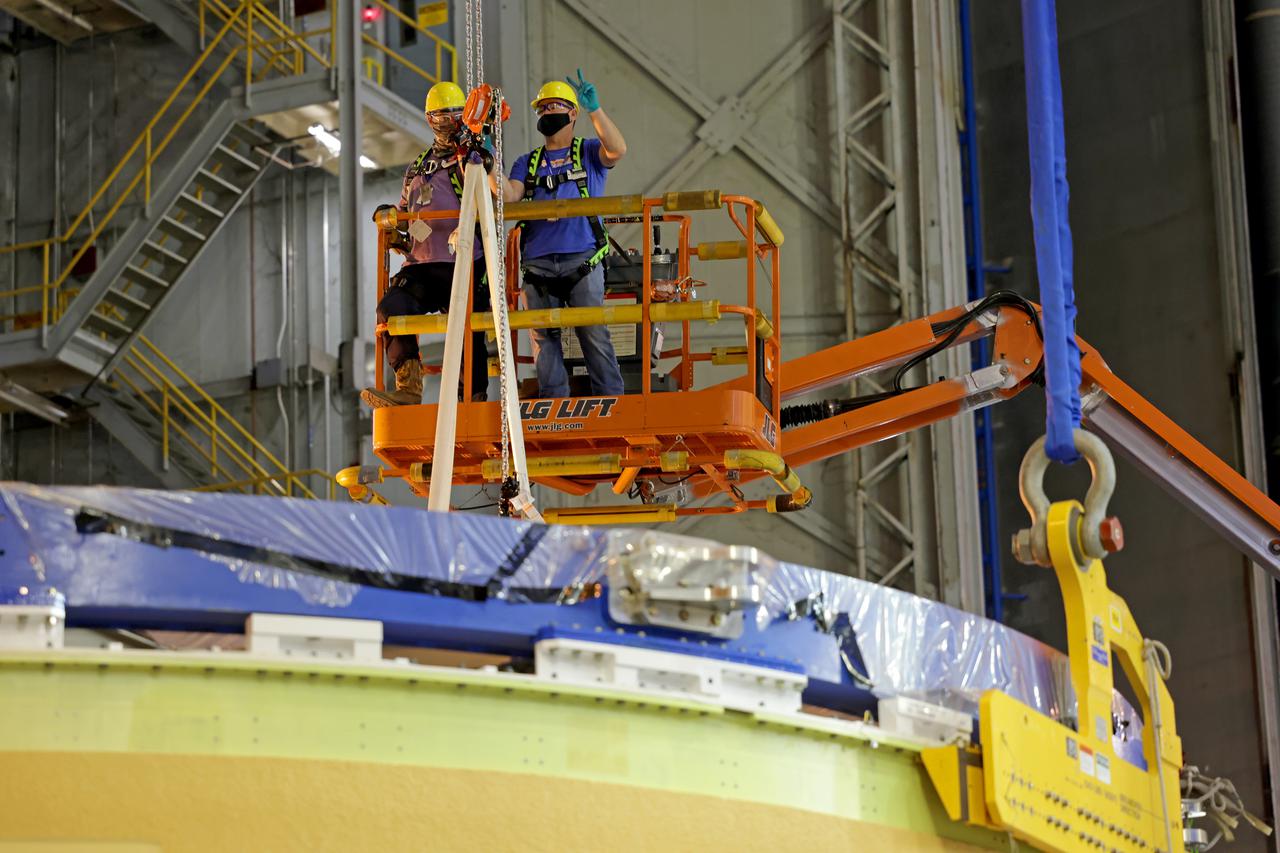
NASA’s Space Launch System (SLS) team fully stacked three hardware elements together May 24 to form the top of the rocket’s core stage for the Artemis II mission. NASA and core stage prime contractor Boeing connected the forward skirt with the liquid oxygen tank and intertank flight hardware inside an assembly area at NASA’s Michoud Assembly Facility in New Orleans. Teams had previously stacked the liquid oxygen tank and intertank on April 28. The joining of the three structures together is the first major assembly of core stage hardware for Artemis II, the first crewed Artemis mission and second flight of the SLS rocket. Next, technicians will work to complete outfitting and integrating the systems within the upper structure. At 66 feet tall, the upper part of the stage is just a fraction of the entire core stage. The fully-assembled, 212-foot-tall rocket stage consists of five hardware elements, including two liquid propellant tanks and four RS-25 engines. The liquid oxygen tank in the upper portion of the stage will hold 196,000 gallons of liquid oxygen cooled to minus 297 degrees Fahrenheit. Meanwhile, the forward skirt and intertank house avionics, flight computer, and electronic systems for the rocket stage. Together, the core stage and its four RS-25 engines will provide more than 2 million pounds of thrust to help send Artemis II astronauts beyond Earth’s orbit to lunar orbit. With Artemis, NASA will land the first woman and the first person of color on the Moon and establish sustainable exploration in preparation for missions to Mars. SLS and NASA’s Orion spacecraft, along with the commercial human landing system and the Gateway in orbit around the Moon, are NASA’s backbone for deep space exploration. SLS is the only rocket that can send Orion, astronauts, and supplies to the Moon in a single mission. Image credit: NASA/Michael DeMocker

NASA’s Space Launch System (SLS) team fully stacked three hardware elements together May 24 to form the top of the rocket’s core stage for the Artemis II mission. NASA and core stage prime contractor Boeing connected the forward skirt with the liquid oxygen tank and intertank flight hardware inside an assembly area at NASA’s Michoud Assembly Facility in New Orleans. Teams had previously stacked the liquid oxygen tank and intertank on April 28. The joining of the three structures together is the first major assembly of core stage hardware for Artemis II, the first crewed Artemis mission and second flight of the SLS rocket. Next, technicians will work to complete outfitting and integrating the systems within the upper structure. At 66 feet tall, the upper part of the stage is just a fraction of the entire core stage. The fully-assembled, 212-foot-tall rocket stage consists of five hardware elements, including two liquid propellant tanks and four RS-25 engines. The liquid oxygen tank in the upper portion of the stage will hold 196,000 gallons of liquid oxygen cooled to minus 297 degrees Fahrenheit. Meanwhile, the forward skirt and intertank house avionics, flight computer, and electronic systems for the rocket stage. Together, the core stage and its four RS-25 engines will provide more than 2 million pounds of thrust to help send Artemis II astronauts beyond Earth’s orbit to lunar orbit. With Artemis, NASA will land the first woman and the first person of color on the Moon and establish sustainable exploration in preparation for missions to Mars. SLS and NASA’s Orion spacecraft, along with the commercial human landing system and the Gateway in orbit around the Moon, are NASA’s backbone for deep space exploration. SLS is the only rocket that can send Orion, astronauts, and supplies to the Moon in a single mission. Image credit: NASA/Eric Bordelon
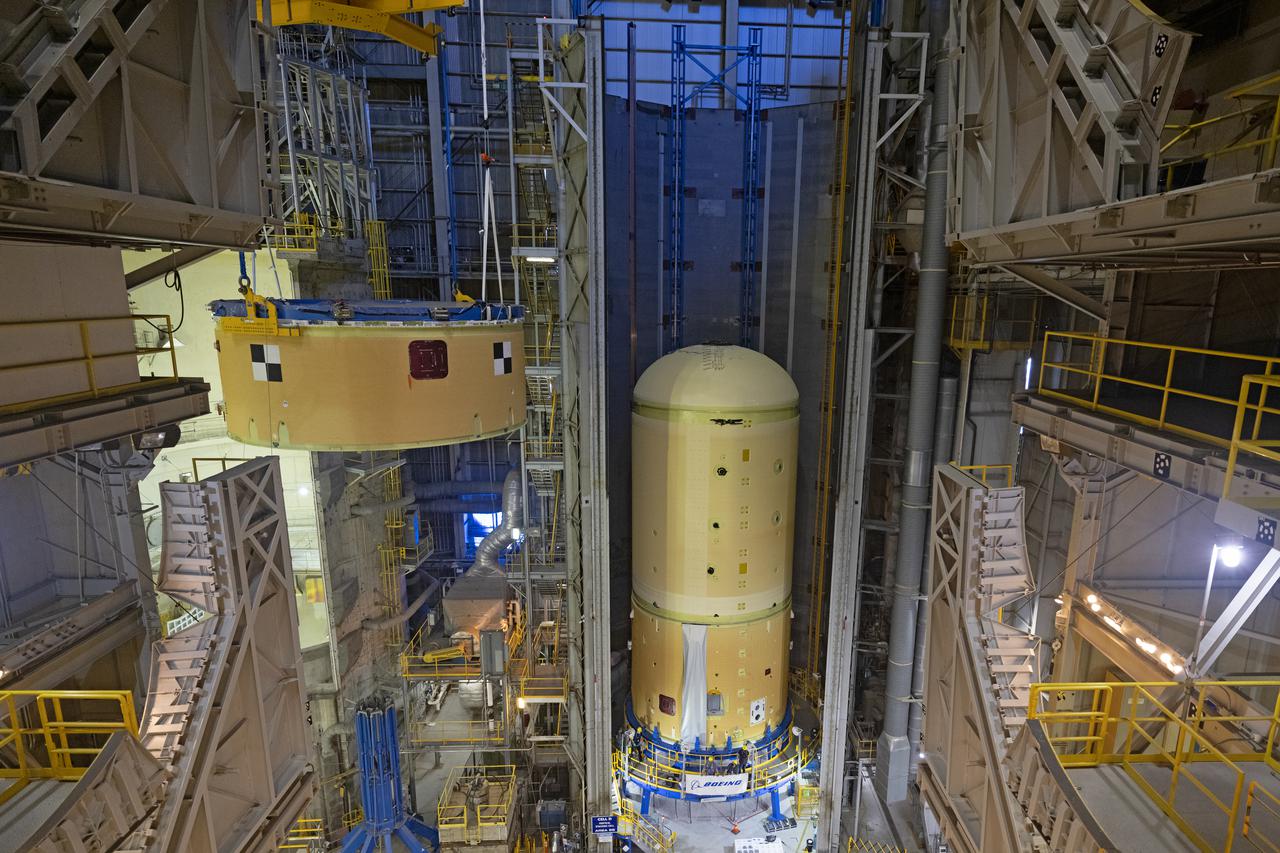
NASA’s Space Launch System (SLS) team fully stacked three hardware elements together May 24 to form the top of the rocket’s core stage for the Artemis II mission. NASA and core stage prime contractor Boeing connected the forward skirt with the liquid oxygen tank and intertank flight hardware inside an assembly area at NASA’s Michoud Assembly Facility in New Orleans. Teams had previously stacked the liquid oxygen tank and intertank on April 28. The joining of the three structures together is the first major assembly of core stage hardware for Artemis II, the first crewed Artemis mission and second flight of the SLS rocket. Next, technicians will work to complete outfitting and integrating the systems within the upper structure. At 66 feet tall, the upper part of the stage is just a fraction of the entire core stage. The fully-assembled, 212-foot-tall rocket stage consists of five hardware elements, including two liquid propellant tanks and four RS-25 engines. The liquid oxygen tank in the upper portion of the stage will hold 196,000 gallons of liquid oxygen cooled to minus 297 degrees Fahrenheit. Meanwhile, the forward skirt and intertank house avionics, flight computer, and electronic systems for the rocket stage. Together, the core stage and its four RS-25 engines will provide more than 2 million pounds of thrust to help send Artemis II astronauts beyond Earth’s orbit to lunar orbit. With Artemis, NASA will land the first woman and the first person of color on the Moon and establish sustainable exploration in preparation for missions to Mars. SLS and NASA’s Orion spacecraft, along with the commercial human landing system and the Gateway in orbit around the Moon, are NASA’s backbone for deep space exploration. SLS is the only rocket that can send Orion, astronauts, and supplies to the Moon in a single mission. Image credit: NASA/Michael DeMocker
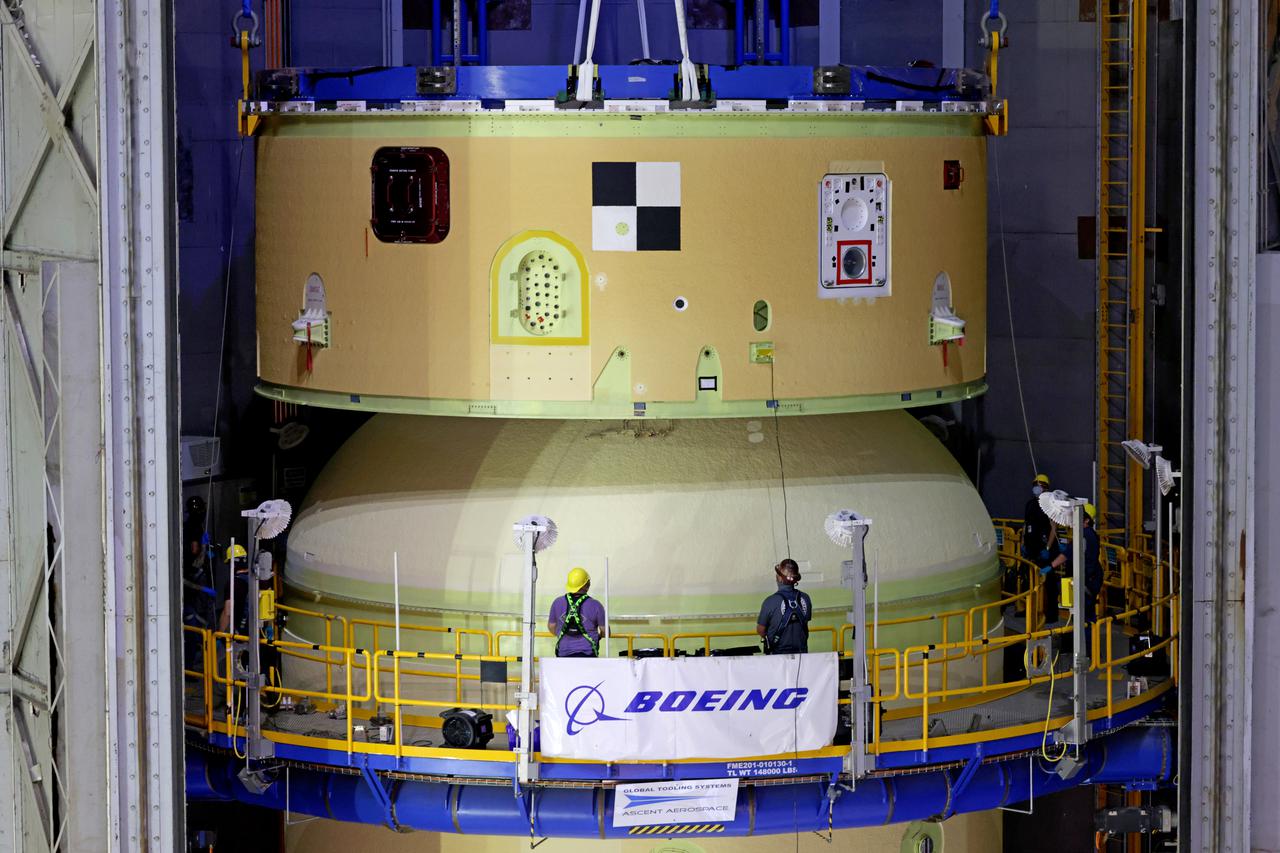
NASA’s Space Launch System (SLS) team fully stacked three hardware elements together May 24 to form the top of the rocket’s core stage for the Artemis II mission. NASA and core stage prime contractor Boeing connected the forward skirt with the liquid oxygen tank and intertank flight hardware inside an assembly area at NASA’s Michoud Assembly Facility in New Orleans. Teams had previously stacked the liquid oxygen tank and intertank on April 28. The joining of the three structures together is the first major assembly of core stage hardware for Artemis II, the first crewed Artemis mission and second flight of the SLS rocket. Next, technicians will work to complete outfitting and integrating the systems within the upper structure. At 66 feet tall, the upper part of the stage is just a fraction of the entire core stage. The fully-assembled, 212-foot-tall rocket stage consists of five hardware elements, including two liquid propellant tanks and four RS-25 engines. The liquid oxygen tank in the upper portion of the stage will hold 196,000 gallons of liquid oxygen cooled to minus 297 degrees Fahrenheit. Meanwhile, the forward skirt and intertank house avionics, flight computer, and electronic systems for the rocket stage. Together, the core stage and its four RS-25 engines will provide more than 2 million pounds of thrust to help send Artemis II astronauts beyond Earth’s orbit to lunar orbit. With Artemis, NASA will land the first woman and the first person of color on the Moon and establish sustainable exploration in preparation for missions to Mars. SLS and NASA’s Orion spacecraft, along with the commercial human landing system and the Gateway in orbit around the Moon, are NASA’s backbone for deep space exploration. SLS is the only rocket that can send Orion, astronauts, and supplies to the Moon in a single mission. Image credit: NASA/Michael DeMocker
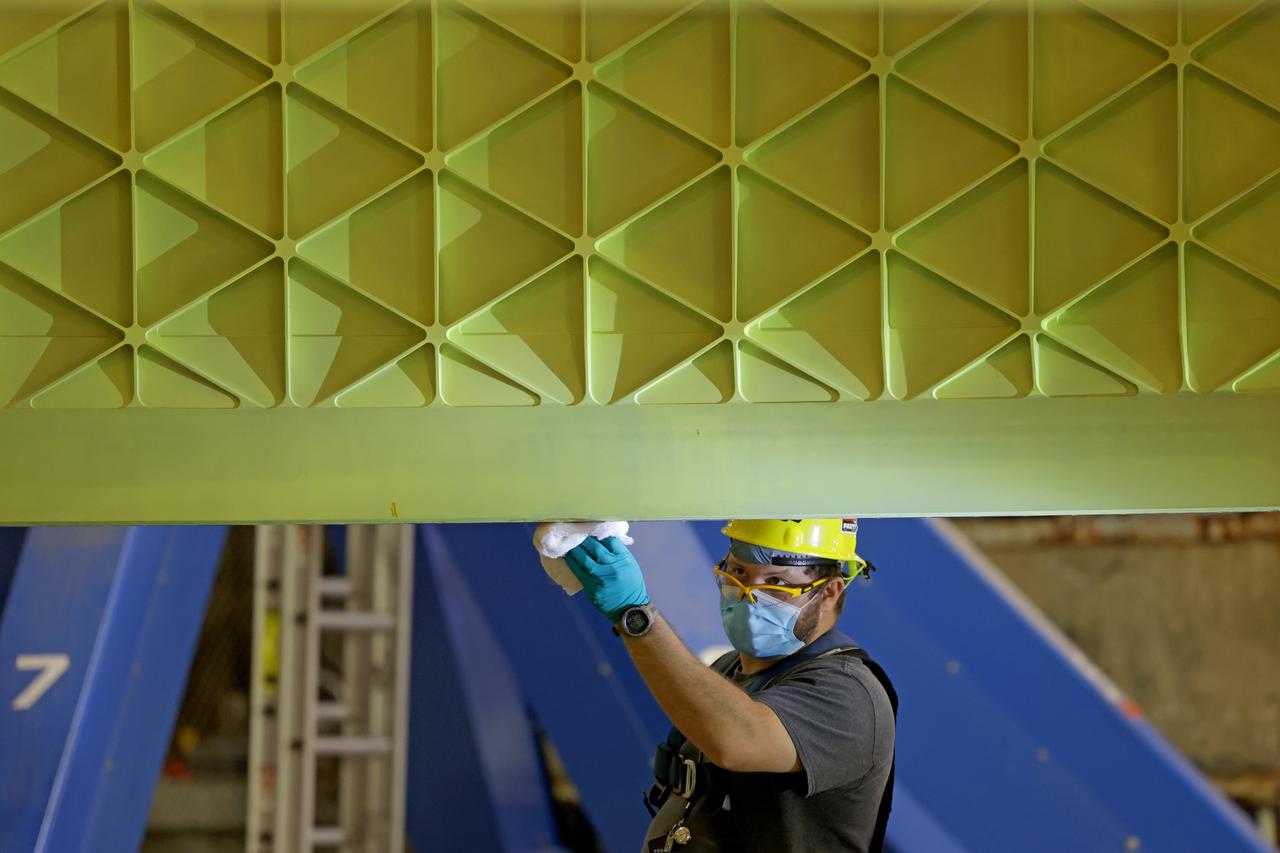
NASA’s Space Launch System (SLS) team fully stacked three hardware elements together May 24 to form the top of the rocket’s core stage for the Artemis II mission. NASA and core stage prime contractor Boeing connected the forward skirt with the liquid oxygen tank and intertank flight hardware inside an assembly area at NASA’s Michoud Assembly Facility in New Orleans. Teams had previously stacked the liquid oxygen tank and intertank on April 28. The joining of the three structures together is the first major assembly of core stage hardware for Artemis II, the first crewed Artemis mission and second flight of the SLS rocket. Next, technicians will work to complete outfitting and integrating the systems within the upper structure. At 66 feet tall, the upper part of the stage is just a fraction of the entire core stage. The fully-assembled, 212-foot-tall rocket stage consists of five hardware elements, including two liquid propellant tanks and four RS-25 engines. The liquid oxygen tank in the upper portion of the stage will hold 196,000 gallons of liquid oxygen cooled to minus 297 degrees Fahrenheit. Meanwhile, the forward skirt and intertank house avionics, flight computer, and electronic systems for the rocket stage. Together, the core stage and its four RS-25 engines will provide more than 2 million pounds of thrust to help send Artemis II astronauts beyond Earth’s orbit to lunar orbit. With Artemis, NASA will land the first woman and the first person of color on the Moon and establish sustainable exploration in preparation for missions to Mars. SLS and NASA’s Orion spacecraft, along with the commercial human landing system and the Gateway in orbit around the Moon, are NASA’s backbone for deep space exploration. SLS is the only rocket that can send Orion, astronauts, and supplies to the Moon in a single mission. Image credit: NASA/Michael DeMocker
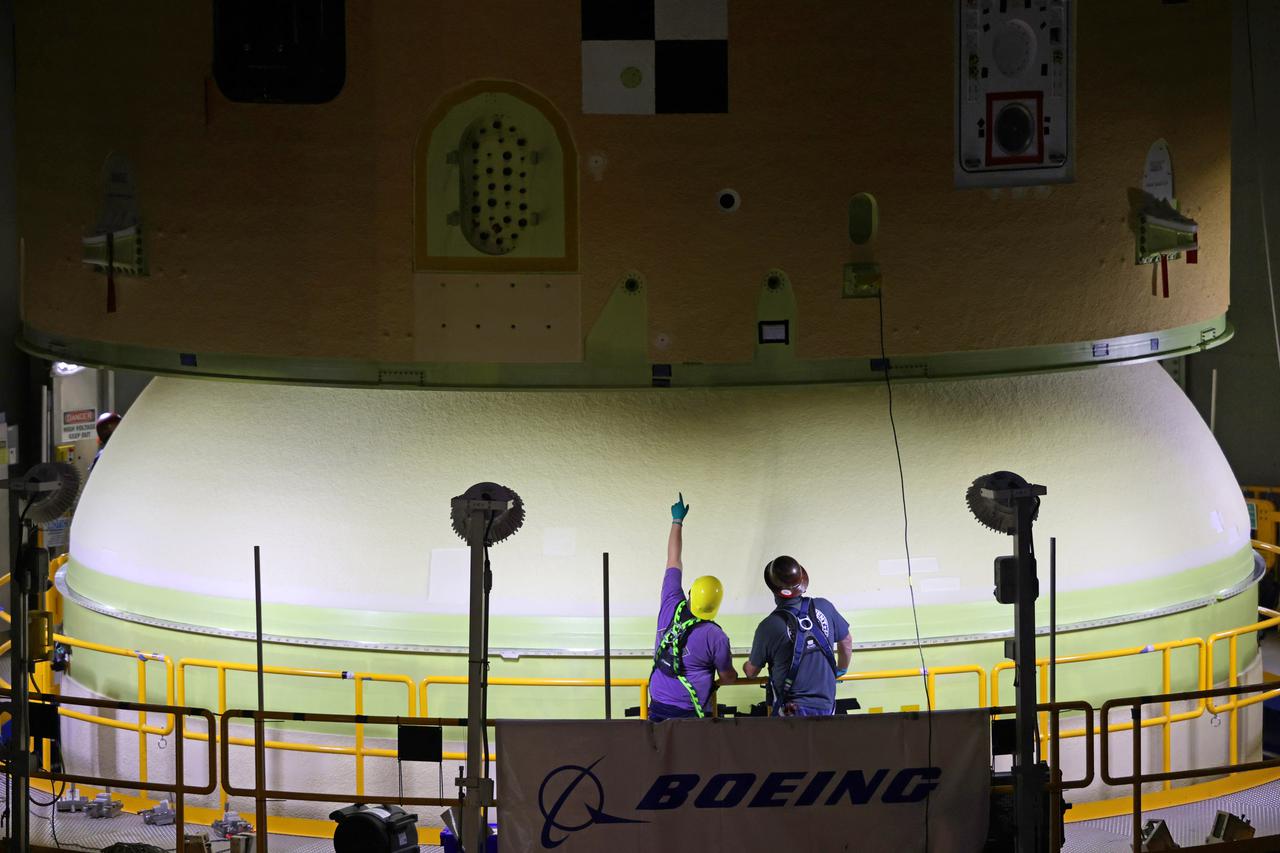
NASA’s Space Launch System (SLS) team fully stacked three hardware elements together May 24 to form the top of the rocket’s core stage for the Artemis II mission. NASA and core stage prime contractor Boeing connected the forward skirt with the liquid oxygen tank and intertank flight hardware inside an assembly area at NASA’s Michoud Assembly Facility in New Orleans. Teams had previously stacked the liquid oxygen tank and intertank on April 28. The joining of the three structures together is the first major assembly of core stage hardware for Artemis II, the first crewed Artemis mission and second flight of the SLS rocket. Next, technicians will work to complete outfitting and integrating the systems within the upper structure. At 66 feet tall, the upper part of the stage is just a fraction of the entire core stage. The fully-assembled, 212-foot-tall rocket stage consists of five hardware elements, including two liquid propellant tanks and four RS-25 engines. The liquid oxygen tank in the upper portion of the stage will hold 196,000 gallons of liquid oxygen cooled to minus 297 degrees Fahrenheit. Meanwhile, the forward skirt and intertank house avionics, flight computer, and electronic systems for the rocket stage. Together, the core stage and its four RS-25 engines will provide more than 2 million pounds of thrust to help send Artemis II astronauts beyond Earth’s orbit to lunar orbit. With Artemis, NASA will land the first woman and the first person of color on the Moon and establish sustainable exploration in preparation for missions to Mars. SLS and NASA’s Orion spacecraft, along with the commercial human landing system and the Gateway in orbit around the Moon, are NASA’s backbone for deep space exploration. SLS is the only rocket that can send Orion, astronauts, and supplies to the Moon in a single mission. Image credit: NASA/Michael DeMocker

NASA’s Space Launch System (SLS) team fully stacked three hardware elements together May 24 to form the top of the rocket’s core stage for the Artemis II mission. NASA and core stage prime contractor Boeing connected the forward skirt with the liquid oxygen tank and intertank flight hardware inside an assembly area at NASA’s Michoud Assembly Facility in New Orleans. Teams had previously stacked the liquid oxygen tank and intertank on April 28. The joining of the three structures together is the first major assembly of core stage hardware for Artemis II, the first crewed Artemis mission and second flight of the SLS rocket. Next, technicians will work to complete outfitting and integrating the systems within the upper structure. At 66 feet tall, the upper part of the stage is just a fraction of the entire core stage. The fully-assembled, 212-foot-tall rocket stage consists of five hardware elements, including two liquid propellant tanks and four RS-25 engines. The liquid oxygen tank in the upper portion of the stage will hold 196,000 gallons of liquid oxygen cooled to minus 297 degrees Fahrenheit. Meanwhile, the forward skirt and intertank house avionics, flight computer, and electronic systems for the rocket stage. Together, the core stage and its four RS-25 engines will provide more than 2 million pounds of thrust to help send Artemis II astronauts beyond Earth’s orbit to lunar orbit. With Artemis, NASA will land the first woman and the first person of color on the Moon and establish sustainable exploration in preparation for missions to Mars. SLS and NASA’s Orion spacecraft, along with the commercial human landing system and the Gateway in orbit around the Moon, are NASA’s backbone for deep space exploration. SLS is the only rocket that can send Orion, astronauts, and supplies to the Moon in a single mission. Image credit: NASA/Eric Bordelon

NASA’s Space Launch System (SLS) team fully stacked three hardware elements together May 24 to form the top of the rocket’s core stage for the Artemis II mission. NASA and core stage prime contractor Boeing connected the forward skirt with the liquid oxygen tank and intertank flight hardware inside an assembly area at NASA’s Michoud Assembly Facility in New Orleans. Teams had previously stacked the liquid oxygen tank and intertank on April 28. The joining of the three structures together is the first major assembly of core stage hardware for Artemis II, the first crewed Artemis mission and second flight of the SLS rocket. Next, technicians will work to complete outfitting and integrating the systems within the upper structure. At 66 feet tall, the upper part of the stage is just a fraction of the entire core stage. The fully-assembled, 212-foot-tall rocket stage consists of five hardware elements, including two liquid propellant tanks and four RS-25 engines. The liquid oxygen tank in the upper portion of the stage will hold 196,000 gallons of liquid oxygen cooled to minus 297 degrees Fahrenheit. Meanwhile, the forward skirt and intertank house avionics, flight computer, and electronic systems for the rocket stage. Together, the core stage and its four RS-25 engines will provide more than 2 million pounds of thrust to help send Artemis II astronauts beyond Earth’s orbit to lunar orbit. With Artemis, NASA will land the first woman and the first person of color on the Moon and establish sustainable exploration in preparation for missions to Mars. SLS and NASA’s Orion spacecraft, along with the commercial human landing system and the Gateway in orbit around the Moon, are NASA’s backbone for deep space exploration. SLS is the only rocket that can send Orion, astronauts, and supplies to the Moon in a single mission. Image credit: NASA/Michael DeMocker
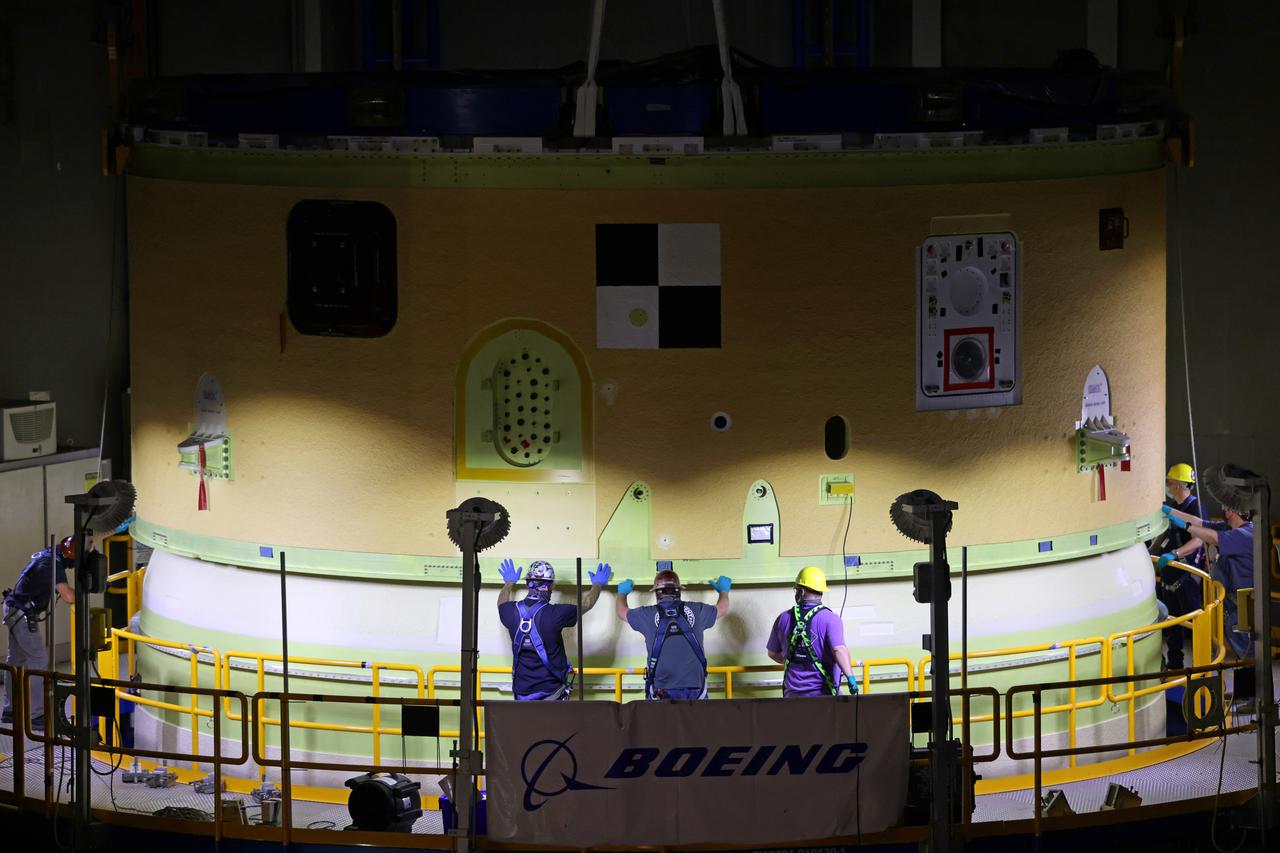
NASA’s Space Launch System (SLS) team fully stacked three hardware elements together May 24 to form the top of the rocket’s core stage for the Artemis II mission. NASA and core stage prime contractor Boeing connected the forward skirt with the liquid oxygen tank and intertank flight hardware inside an assembly area at NASA’s Michoud Assembly Facility in New Orleans. Teams had previously stacked the liquid oxygen tank and intertank on April 28. The joining of the three structures together is the first major assembly of core stage hardware for Artemis II, the first crewed Artemis mission and second flight of the SLS rocket. Next, technicians will work to complete outfitting and integrating the systems within the upper structure. At 66 feet tall, the upper part of the stage is just a fraction of the entire core stage. The fully-assembled, 212-foot-tall rocket stage consists of five hardware elements, including two liquid propellant tanks and four RS-25 engines. The liquid oxygen tank in the upper portion of the stage will hold 196,000 gallons of liquid oxygen cooled to minus 297 degrees Fahrenheit. Meanwhile, the forward skirt and intertank house avionics, flight computer, and electronic systems for the rocket stage. Together, the core stage and its four RS-25 engines will provide more than 2 million pounds of thrust to help send Artemis II astronauts beyond Earth’s orbit to lunar orbit. With Artemis, NASA will land the first woman and the first person of color on the Moon and establish sustainable exploration in preparation for missions to Mars. SLS and NASA’s Orion spacecraft, along with the commercial human landing system and the Gateway in orbit around the Moon, are NASA’s backbone for deep space exploration. SLS is the only rocket that can send Orion, astronauts, and supplies to the Moon in a single mission. Image credit: NASA/Michael DeMocker
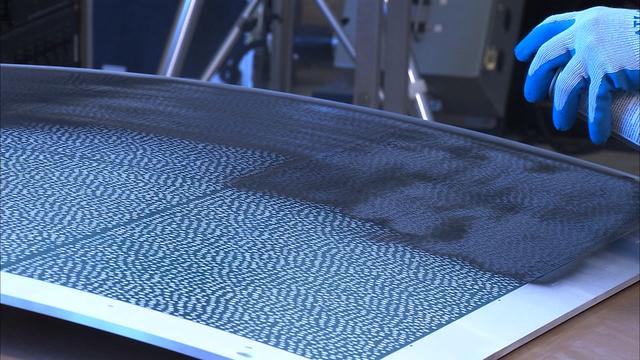
Under the goals of the Vision for Space Exploration, Ares I is a chief component of the cost-effective space transportation infrastructure being developed by NASA's Constellation Program. This transportation system will safely and reliably carry human explorers back to the moon, and then onward to Mars and other destinations in the solar system. The Ares I effort includes multiple project element teams at NASA centers and contract organizations around the nation, and is managed by the Exploration Launch Projects Office at NASA's Marshall Space Flight Center (MFSC). ATK Launch Systems near Brigham City, Utah, is the prime contractor for the first stage booster. ATK's subcontractor, United Space Alliance of Houston, is designing, developing and testing the parachutes at its facilities at NASA's Kennedy Space Center in Florida. NASA's Johnson Space Center in Houston hosts the Constellation Program and Orion Crew Capsule Project Office and provides test instrumentation and support personnel. Together, these teams are developing vehicle hardware, evolving proven technologies, and testing components and systems. Their work builds on powerful, reliable space shuttle propulsion elements and nearly a half-century of NASA space flight experience and technological advances. Ares I is an inline, two-stage rocket configuration topped by the Crew Exploration Vehicle, its service module, and a launch abort system. This HD video image depicts a manufactured aluminum panel, that will fabricate the Ares I upper stage barrel, undergoing a confidence panel test. In this test, the bent aluminum is stressed to breaking point and thoroughly examined. The panels are manufactured by AMRO Manufacturing located in El Monte, California. (Highest resolution available)
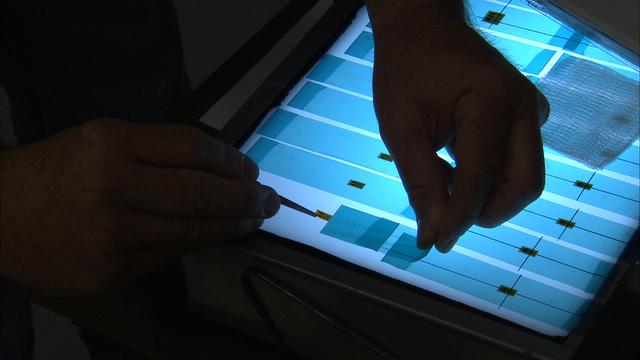
Under the goals of the Vision for Space Exploration, Ares I is a chief component of the cost-effective space transportation infrastructure being developed by NASA's Constellation Program. This transportation system will safely and reliably carry human explorers back to the moon, and then onward to Mars and other destinations in the solar system. The Ares I effort includes multiple project element teams at NASA centers and contract organizations around the nation, and is managed by the Exploration Launch Projects Office at NASA's Marshall Space Flight Center (MFSC). ATK Launch Systems near Brigham City, Utah, is the prime contractor for the first stage booster. ATK's subcontractor, United Space Alliance of Houston, is designing, developing and testing the parachutes at its facilities at NASA's Kennedy Space Center in Florida. NASA's Johnson Space Center in Houston hosts the Constellation Program and Orion Crew Capsule Project Office and provides test instrumentation and support personnel. Together, these teams are developing vehicle hardware, evolving proven technologies, and testing components and systems. Their work builds on powerful, reliable space shuttle propulsion elements and nearly a half-century of NASA space flight experience and technological advances. Ares I is an inline, two-stage rocket configuration topped by the Crew Exploration Vehicle, its service module, and a launch abort system. This HD video image depicts a manufactured aluminum panel, that will fabricate the Ares I upper stage barrel, undergoing a confidence panel test. In this test, bent aluminum is stressed to breaking point and thoroughly examined. The panels are manufactured by AMRO Manufacturing located in El Monte, California. (Highest resolution available)
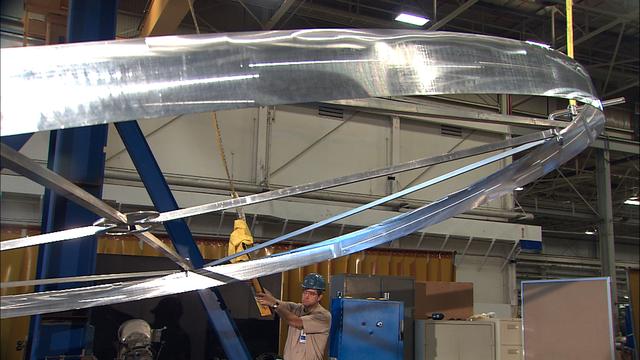
Under the goals of the Vision for Space Exploration, Ares I is a chief component of the cost-effective space transportation infrastructure being developed by NASA's Constellation Program. This transportation system will safely and reliably carry human explorers back to the moon, and then onward to Mars and other destinations in the solar system. The Ares I effort includes multiple project element teams at NASA centers and contract organizations around the nation, and is managed by the Exploration Launch Projects Office at NASA's Marshall Space Flight Center (MFSC). ATK Launch Systems near Brigham City, Utah, is the prime contractor for the first stage booster. ATK's subcontractor, United Space Alliance of Houston, is designing, developing and testing the parachutes at its facilities at NASA's Kennedy Space Center in Florida. NASA's Johnson Space Center in Houston hosts the Constellation Program and Orion Crew Capsule Project Office and provides test instrumentation and support personnel. Together, these teams are developing vehicle hardware, evolving proven technologies, and testing components and systems. Their work builds on powerful, reliable space shuttle propulsion elements and nearly a half-century of NASA space flight experience and technological advances. Ares I is an inline, two-stage rocket configuration topped by the Crew Exploration Vehicle, its service module, and a launch abort system. This HD video image depicts friction stir welding used in manufacturing aluminum panels that will fabricate the Ares I upper stage barrel. The aluminum panels are subjected to confidence panel tests during which the bent aluminum is stressed to breaking point and thoroughly examined. The panels are manufactured by AMRO Manufacturing located in El Monte, California. (Highest resolution available)
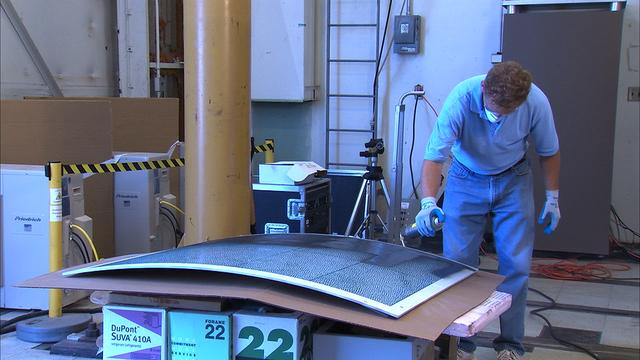
Under the goals of the Vision for Space Exploration, Ares I is a chief component of the cost-effective space transportation infrastructure being developed by NASA's Constellation Program. This transportation system will safely and reliably carry human explorers back to the moon, and then onward to Mars and other destinations in the solar system. The Ares I effort includes multiple project element teams at NASA centers and contract organizations around the nation, and is managed by the Exploration Launch Projects Office at NASA's Marshall Space Flight Center (MFSC). ATK Launch Systems near Brigham City, Utah, is the prime contractor for the first stage booster. ATK's subcontractor, United Space Alliance of Houston, is designing, developing and testing the parachutes at its facilities at NASA's Kennedy Space Center in Florida. NASA's Johnson Space Center in Houston hosts the Constellation Program and Orion Crew Capsule Project Office and provides test instrumentation and support personnel. Together, these teams are developing vehicle hardware, evolving proven technologies, and testing components and systems. Their work builds on powerful, reliable space shuttle propulsion elements and nearly a half-century of NASA space flight experience and technological advances. Ares I is an inline, two-stage rocket configuration topped by the Crew Exploration Vehicle, its service module, and a launch abort system. This HD video image depicts a manufactured aluminum panel that will be used to fabricate the Ares I upper stage barrel, undergoing a confidence panel test. In this test, the bent aluminum is stressed to breaking point and thoroughly examined. The panels are manufactured by AMRO Manufacturing located in El Monte, California.
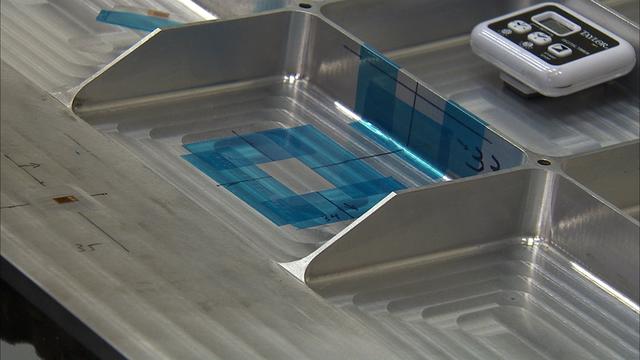
Under the goals of the Vision for Space Exploration, Ares I is a chief component of the cost-effective space transportation infrastructure being developed by NASA's Constellation Program. This transportation system will safely and reliably carry human explorers back to the moon, and then onward to Mars and other destinations in the solar system. The Ares I effort includes multiple project element teams at NASA centers and contract organizations around the nation, and is managed by the Exploration Launch Projects Office at NASA's Marshall Space Flight Center (MFSC). ATK Launch Systems near Brigham City, Utah, is the prime contractor for the first stage booster. ATK's subcontractor, United Space Alliance of Houston, is designing, developing and testing the parachutes at its facilities at NASA's Kennedy Space Center in Florida. NASA's Johnson Space Center in Houston hosts the Constellation Program and Orion Crew Capsule Project Office and provides test instrumentation and support personnel. Together, these teams are developing vehicle hardware, evolving proven technologies, and testing components and systems. Their work builds on powerful, reliable space shuttle propulsion elements and nearly a half-century of NASA space flight experience and technological advances. Ares I is an inline, two-stage rocket configuration topped by the Crew Exploration Vehicle, its service module, and a launch abort system. This HD video image depicts confidence testing of a manufactured aluminum panel that will fabricate the Ares I upper stage barrel. In this test, bent aluminum is stressed to breaking point and thoroughly examined. The panels are manufactured by AMRO Manufacturing located in El Monte, California. (Highest resolution available)
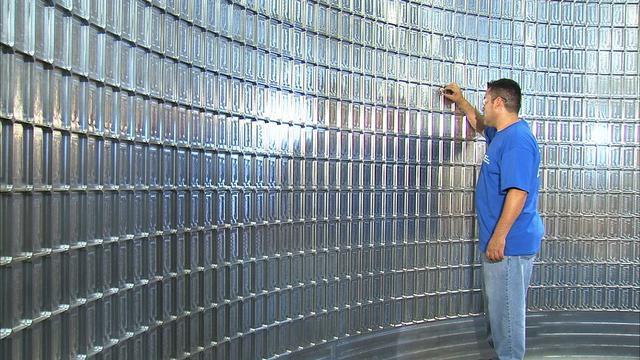
Under the goals of the Vision for Space Exploration, Ares I is a chief component of the cost-effective space transportation infrastructure being developed by NASA's Constellation Program. This transportation system will safely and reliably carry human explorers back to the moon, and then onward to Mars and other destinations in the solar system. The Ares I effort includes multiple project element teams at NASA centers and contract organizations around the nation, and is managed by the Exploration Launch Projects Office at NASA's Marshall Space Flight Center (MFSC). ATK Launch Systems near Brigham City, Utah, is the prime contractor for the first stage booster. ATK's subcontractor, United Space Alliance of Houston, is designing, developing and testing the parachutes at its facilities at NASA's Kennedy Space Center in Florida. NASA's Johnson Space Center in Houston hosts the Constellation Program and Orion Crew Capsule Project Office and provides test instrumentation and support personnel. Together, these teams are developing vehicle hardware, evolving proven technologies, and testing components and systems. Their work builds on powerful, reliable space shuttle propulsion elements and nearly a half-century of NASA space flight experience and technological advances. Ares I is an inline, two-stage rocket configuration topped by the Crew Exploration Vehicle, its service module, and a launch abort system. This HD video image depicts a manufactured panel that will be used for the Ares I upper stage barrel fabrication. The aluminum panels are manufacturing process demonstration articles that will undergo testing until perfected. The panels are built by AMRO Manufacturing located in El Monte, California. (Highest resolution available)
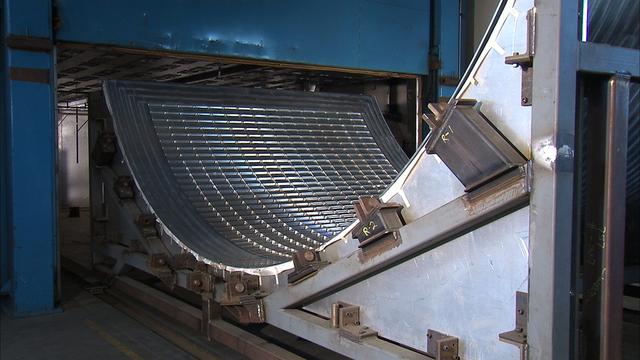
Under the goals of the Vision for Space Exploration, Ares I is a chief component of the cost-effective space transportation infrastructure being developed by NASA's Constellation Program. This transportation system will safely and reliably carry human explorers back to the moon, and then onward to Mars and other destinations in the solar system. The Ares I effort includes multiple project element teams at NASA centers and contract organizations around the nation, and is managed by the Exploration Launch Projects Office at NASA's Marshall Space Flight Center (MFSC). ATK Launch Systems near Brigham City, Utah, is the prime contractor for the first stage booster. ATK's subcontractor, United Space Alliance of Houston, is designing, developing and testing the parachutes at its facilities at NASA's Kennedy Space Center in Florida. NASA's Johnson Space Center in Houston hosts the Constellation Program and Orion Crew Capsule Project Office and provides test instrumentation and support personnel. Together, these teams are developing vehicle hardware, evolving proven technologies, and testing components and systems. Their work builds on powerful, reliable space shuttle propulsion elements and nearly a half-century of NASA space flight experience and technological advances. Ares I is an inline, two-stage rocket configuration topped by the Crew Exploration Vehicle, its service module, and a launch abort system. This HD video image depicts a manufactured aluminum panel that will be used to fabricate the Ares I upper stage barrel, undergoing a confidence panel test. In this test, the bent aluminum is stressed to breaking point and thoroughly examined. The panels are manufactured by AMRO Manufacturing located in El Monte, California. (Highest resolution available)
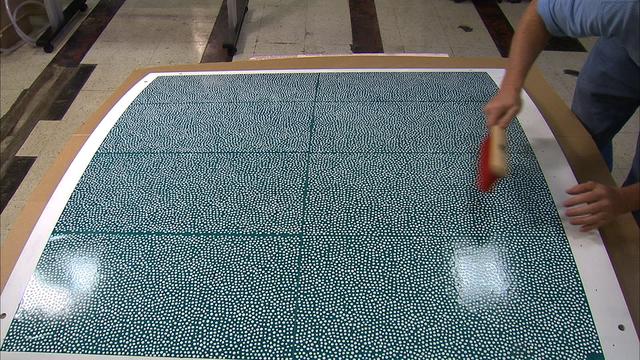
Under the goals of the Vision for Space Exploration, Ares I is a chief component of the cost-effective space transportation infrastructure being developed by NASA's Constellation Program. This transportation system will safely and reliably carry human explorers back to the moon, and then onward to Mars and other destinations in the solar system. The Ares I effort includes multiple project element teams at NASA centers and contract organizations around the nation, and is managed by the Exploration Launch Projects Office at NASA's Marshall Space Flight Center (MFSC). ATK Launch Systems near Brigham City, Utah, is the prime contractor for the first stage booster. ATK's subcontractor, United Space Alliance of Houston, is designing, developing and testing the parachutes at its facilities at NASA's Kennedy Space Center in Florida. NASA's Johnson Space Center in Houston hosts the Constellation Program and Orion Crew Capsule Project Office and provides test instrumentation and support personnel. Together, these teams are developing vehicle hardware, evolving proven technologies, and testing components and systems. Their work builds on powerful, reliable space shuttle propulsion elements and nearly a half-century of NASA space flight experience and technological advances. Ares I is an inline, two-stage rocket configuration topped by the Crew Exploration Vehicle, its service module, and a launch abort system. This HD video image, depicts a manufactured aluminum panel, that will be used to fabricate the Ares I upper stage barrel, undergoing a confidence panel test. In this test, the bent aluminum is stressed to breaking point and thoroughly examined. The panels are manufactured by AMRO Manufacturing located in El Monte, California. (Highest resolution available)
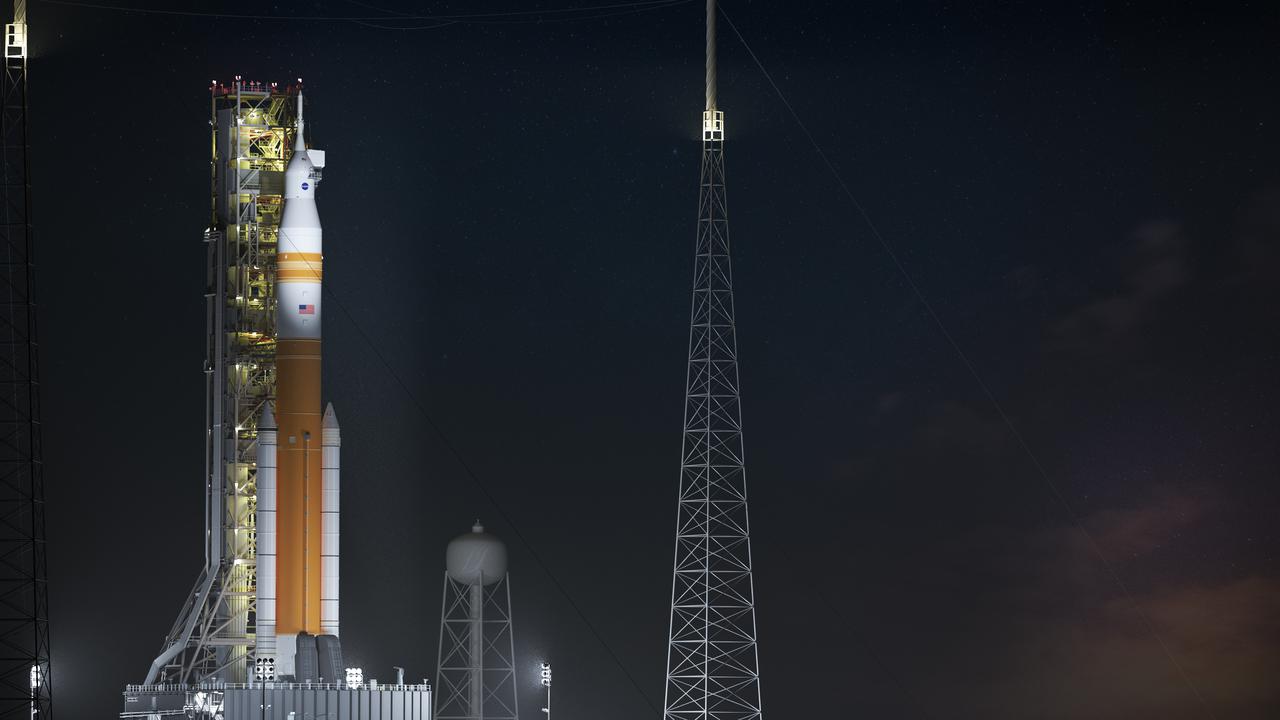
Illustration of nighttime scene of the evolved SLS Block 1B Crew variant on Pad 39B.. This configuration of the rocket, with the Exploration Upper Stage, will provide in-space propulsion to send astronauts in NASA’s Orion spacecraft and heavy cargo on a precise trajectory to the Moon. The evolution of the rocket to SLS Block 1B configuration with EUS enables SLS to launch 40% more cargo to the Moon along with the crew. Manufacturing both the core stage and Exploration Upper Stage is a collaborative effort between NASA and Boeing, the lead contractor for EUS and the SLS core stage. SLS is the only rocket that can send Orion, astronauts, and supplies to the Moon in a single mission. The SLS rocket, NASA’s Orion spacecraft, Gateway, and human landing system are part of NASA’s backbone for deep space exploration. Under the Artemis program, NASA is working to land the first woman and the next man on the Moon to pave the way for sustainable exploration at the Moon and future missions to Mars. (NASA)
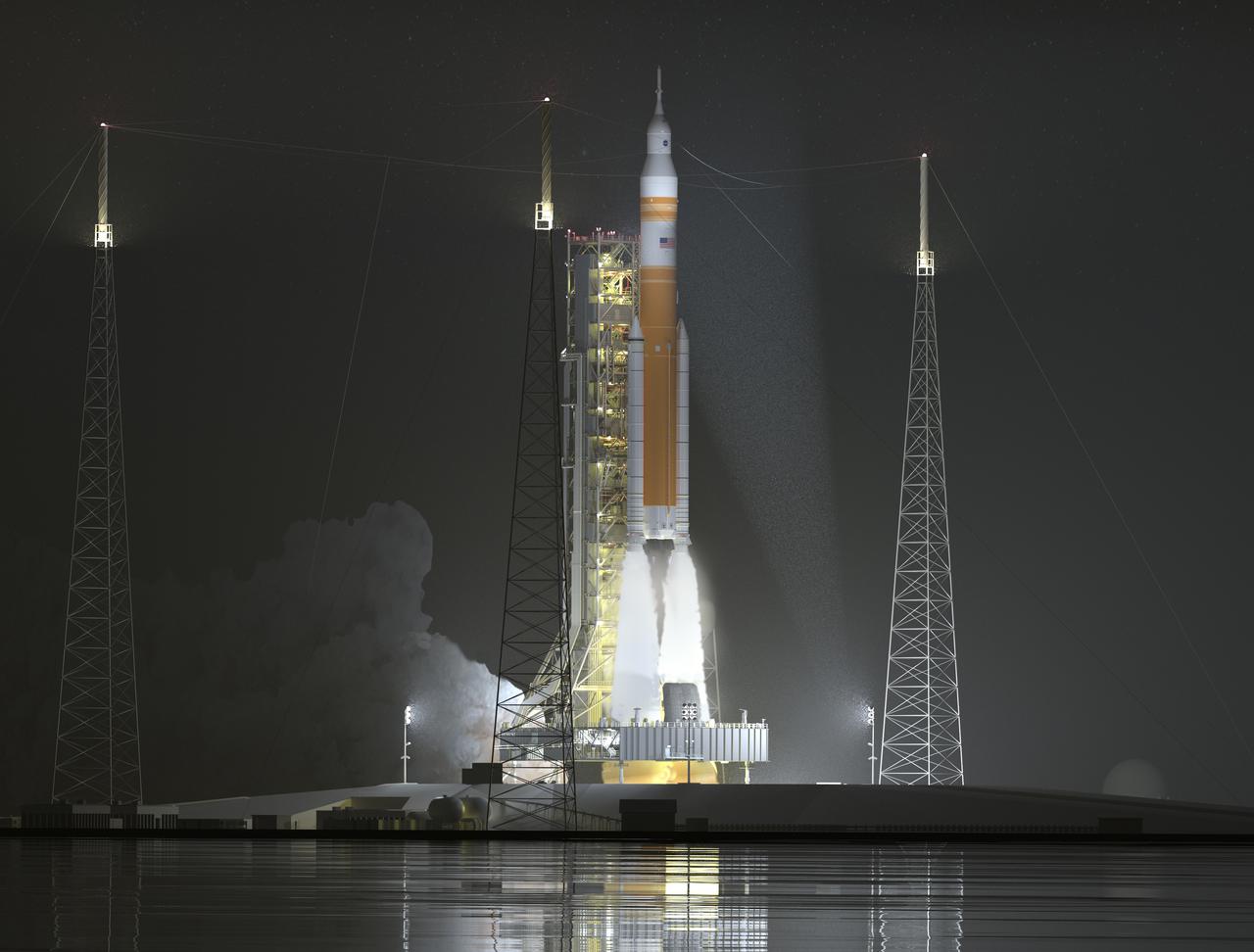
Illustration of the evolved SLS Block 1B Crew variant night launch. This configuration of the rocket, with the Exploration Upper Stage, will provide in-space propulsion to send astronauts in NASA’s Orion spacecraft and heavy cargo on a precise trajectory to the Moon. The evolution of the rocket to SLS Block 1B configuration with EUS enables SLS to launch 40% more cargo to the Moon along with the crew. Manufacturing both the core stage and Exploration Upper Stage is a collaborative effort between NASA and Boeing, the lead contractor for EUS and the SLS core stage. SLS is the only rocket that can send Orion, astronauts, and supplies to the Moon in a single mission. The SLS rocket, NASA’s Orion spacecraft, Gateway, and human landing system are part of NASA’s backbone for deep space exploration. Under the Artemis program, NASA is working to land the first woman and the next man on the Moon to pave the way for sustainable exploration at the Moon and future missions to Mars. (NASA) In album: B1B_Crew_SLS
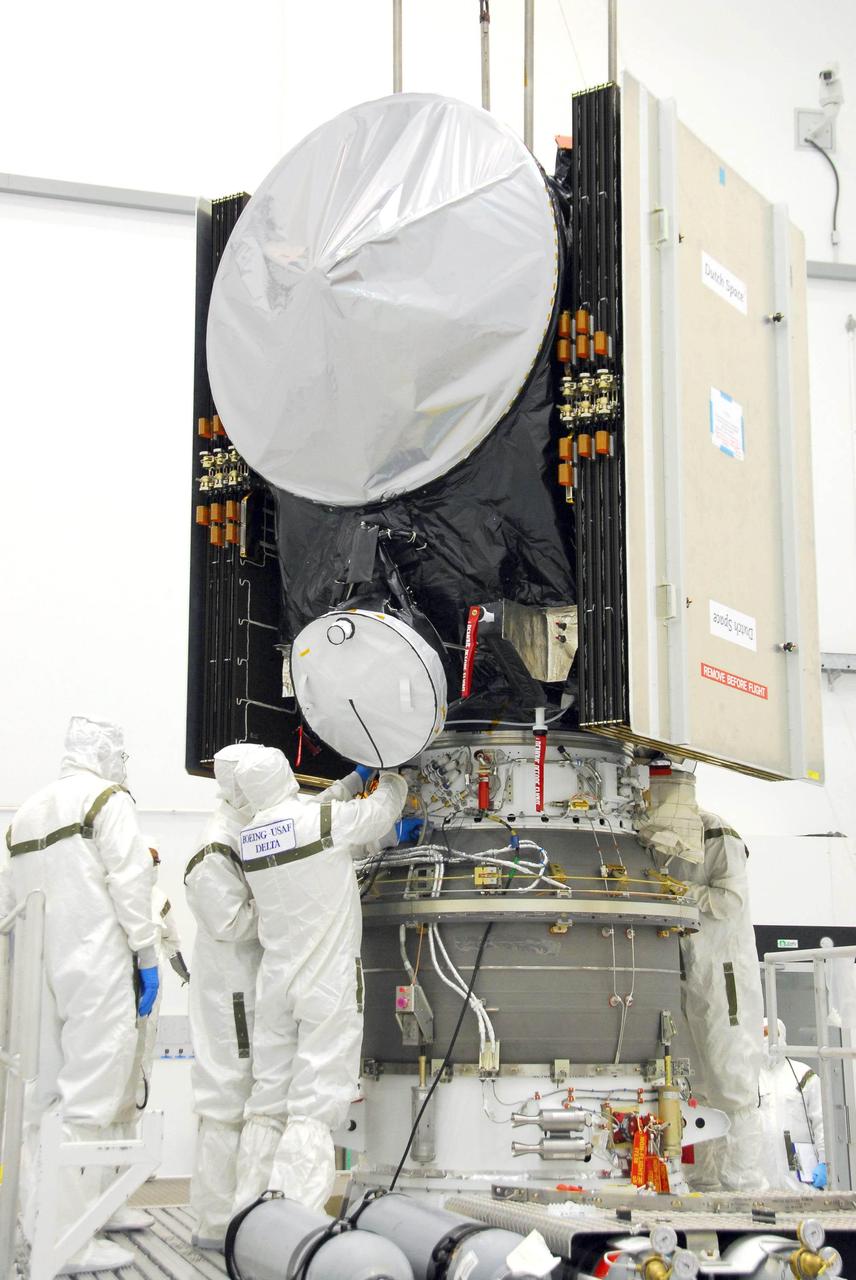
Workers secure the attachments of NASA Dawn spacecraft onto the upper stage booster.
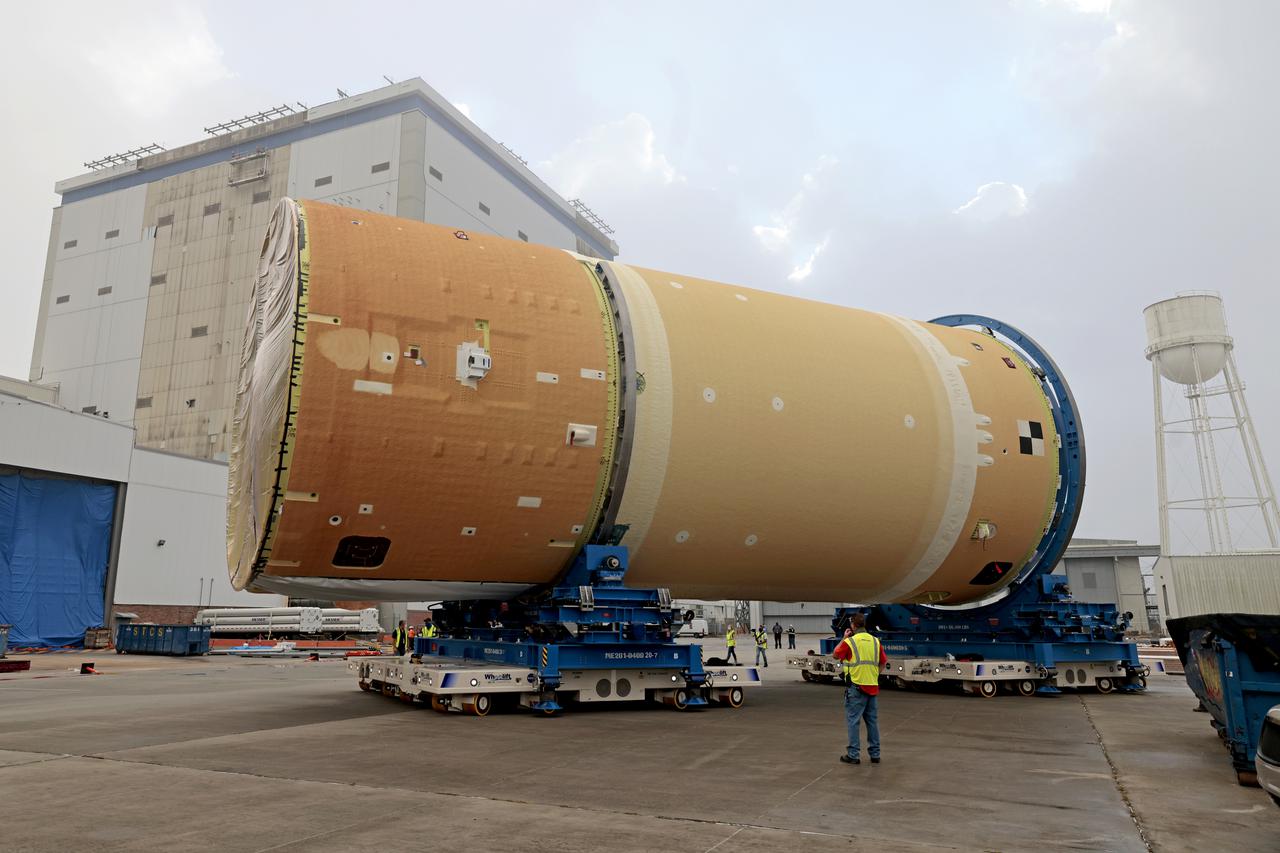
NASA has completed assembly of the upper, or forward, part of the core stage for the Space Launch System (SLS) rocket that will send the Artemis II crew on their lunar mission. Boeing, the lead core stage contractor, completed joining the forward part of the rocket, and then lifted it out of the assembly structure at NASA’s Michoud Assembly Facility in New Orleans. To construct this part of the core stage, the team first stacked three major parts of the stage—the forward skirt, the liquid oxygen tank, and the intertank. The forward skirt sits atop the rocket’s core stage, and it and the intertank are outfitted with the rocket’s flight computers and avionics systems that control SLS during launch and ascent. The liquid oxygen tank holds 196,000 gallons of liquid oxygen cooled to minus 297 degrees Fahrenheit. The entire upper part of the stage is around 66-feet tall. The fully-assembled, 212-foot-tall rocket stage consists of five hardware elements. As the team lifted it out of the assembly area, they completed a breakover maneuver, to put the forward assembly in a horizontal position. Then, they moved it to final assembly where the Artemis II liquid hydrogen tank is also undergoing outfitting. Here, teams will connect the liquid hydrogen tank to the upper part of the rocket and complete assembly of four of the five core stage parts. The last piece to be added will be the engine section, which is currently in a separate assembly area being outfitted with propulsion systems that connect to the engines. Image credit: NASA/Michael DeMocker
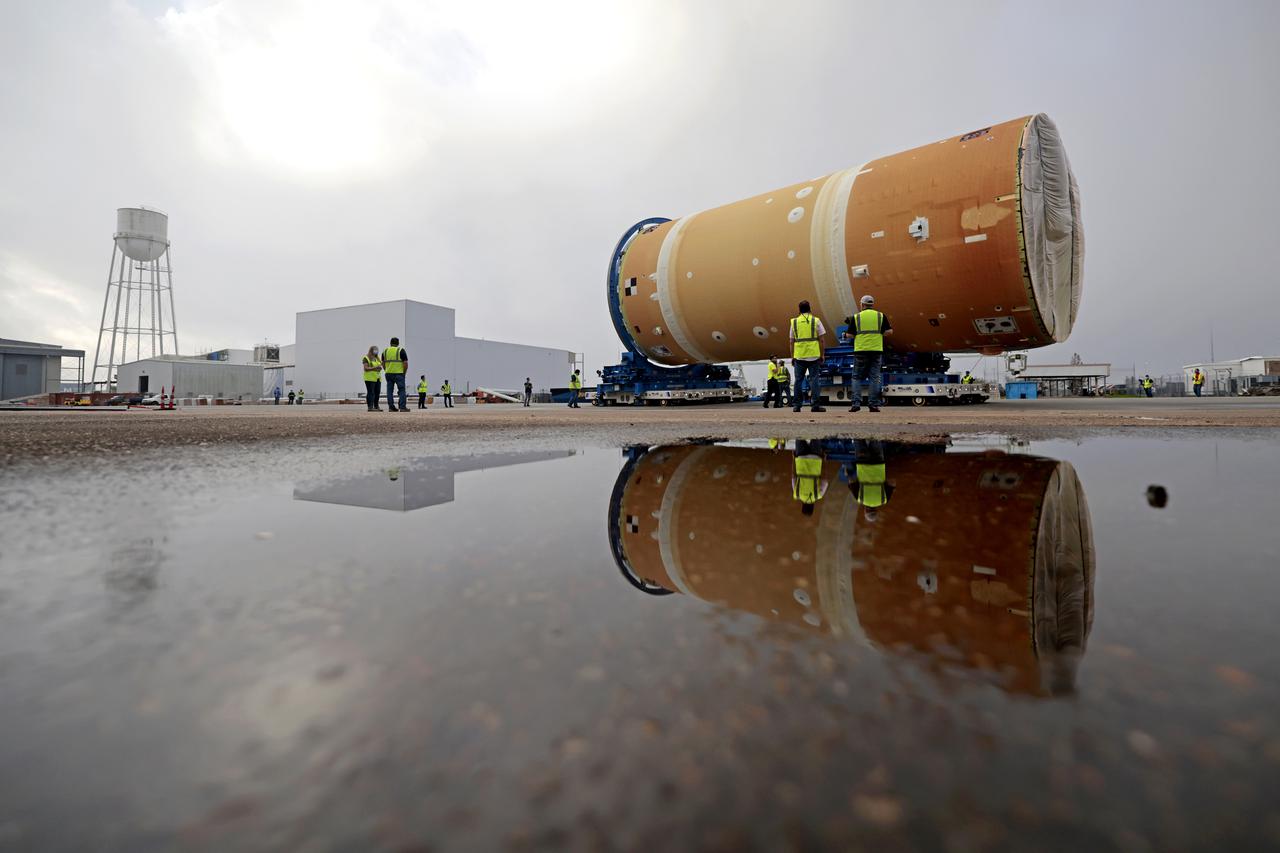
NASA has completed assembly of the upper, or forward, part of the core stage for the Space Launch System (SLS) rocket that will send the Artemis II crew on their lunar mission. Boeing, the lead core stage contractor, completed joining the forward part of the rocket, and then lifted it out of the assembly structure at NASA’s Michoud Assembly Facility in New Orleans. To construct this part of the core stage, the team first stacked three major parts of the stage—the forward skirt, the liquid oxygen tank, and the intertank. The forward skirt sits atop the rocket’s core stage, and it and the intertank are outfitted with the rocket’s flight computers and avionics systems that control SLS during launch and ascent. The liquid oxygen tank holds 196,000 gallons of liquid oxygen cooled to minus 297 degrees Fahrenheit. The entire upper part of the stage is around 66-feet tall. The fully-assembled, 212-foot-tall rocket stage consists of five hardware elements. As the team lifted it out of the assembly area, they completed a breakover maneuver, to put the forward assembly in a horizontal position. Then, they moved it to final assembly where the Artemis II liquid hydrogen tank is also undergoing outfitting. Here, teams will connect the liquid hydrogen tank to the upper part of the rocket and complete assembly of four of the five core stage parts. The last piece to be added will be the engine section, which is currently in a separate assembly area being outfitted with propulsion systems that connect to the engines. Image credit: NASA/Michael DeMocker
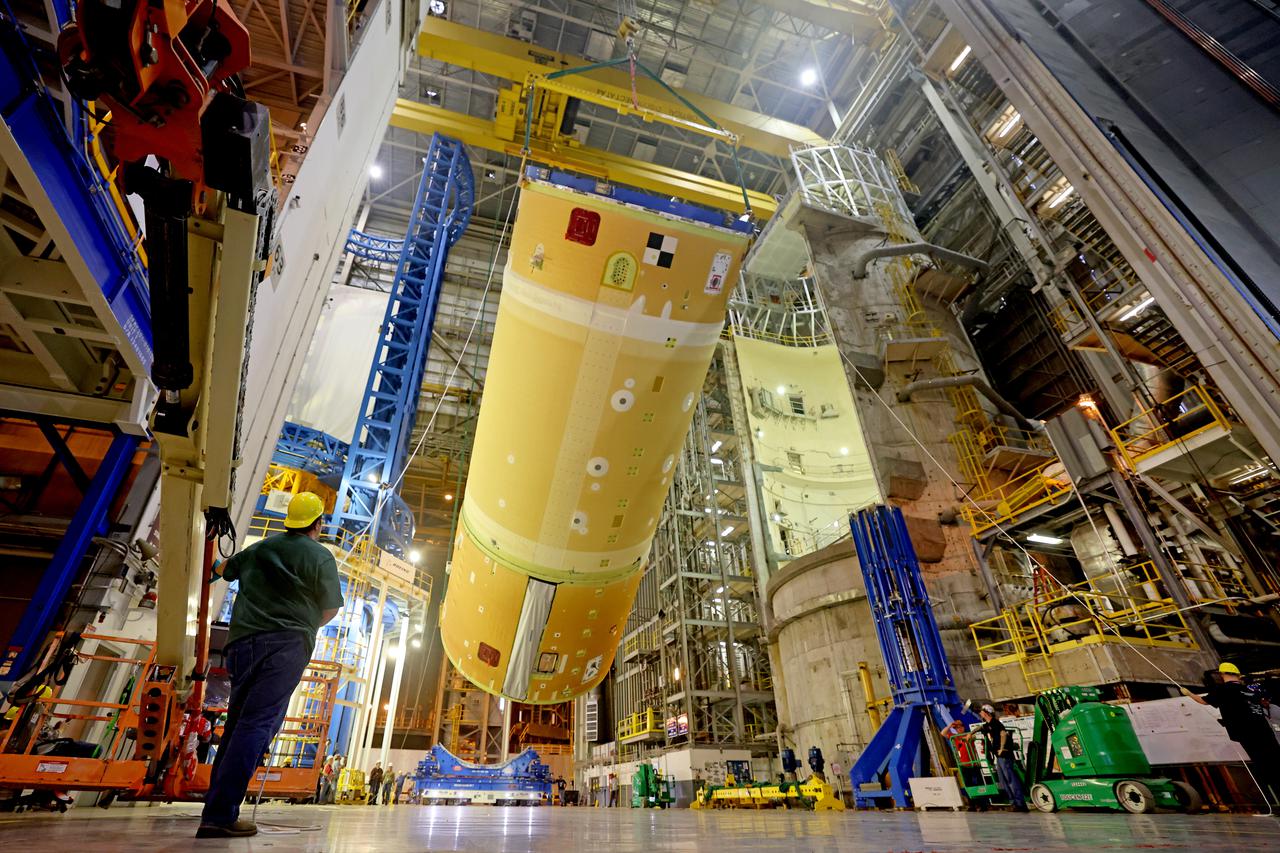
NASA has completed assembly of the upper, or forward, part of the core stage for the Space Launch System (SLS) rocket that will send the Artemis II crew on their lunar mission. Boeing, the lead core stage contractor, completed joining the forward part of the rocket, and then lifted it out of the assembly structure at NASA’s Michoud Assembly Facility in New Orleans. To construct this part of the core stage, the team first stacked three major parts of the stage—the forward skirt, the liquid oxygen tank, and the intertank. The forward skirt sits atop the rocket’s core stage, and it and the intertank are outfitted with the rocket’s flight computers and avionics systems that control SLS during launch and ascent. The liquid oxygen tank holds 196,000 gallons of liquid oxygen cooled to minus 297 degrees Fahrenheit. The entire upper part of the stage is around 66-feet tall. The fully-assembled, 212-foot-tall rocket stage consists of five hardware elements. As the team lifted it out of the assembly area, they completed a breakover maneuver, to put the forward assembly in a horizontal position. Then, they moved it to final assembly where the Artemis II liquid hydrogen tank is also undergoing outfitting. Here, teams will connect the liquid hydrogen tank to the upper part of the rocket and complete assembly of four of the five core stage parts. The last piece to be added will be the engine section, which is currently in a separate assembly area being outfitted with propulsion systems that connect to the engines. Image credit: NASA/Michael DeMocker