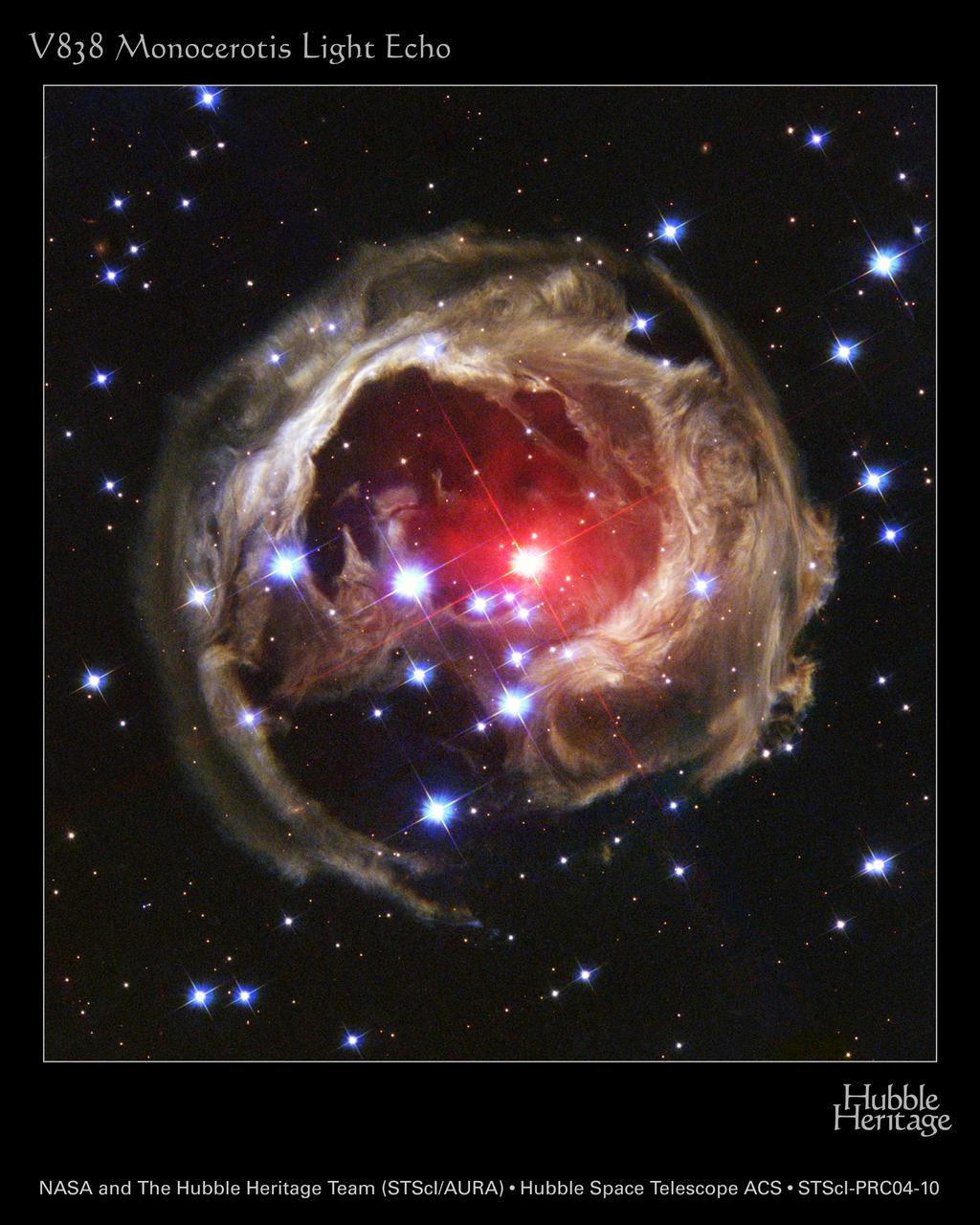
This photo, captured by the NASA Hubble Space Telescope's (HST) Advanced Camera for Surveys, is Hubble's latest view of an expanding halo of light around the distant star V838 Monocerotis, or V Mon, caused by an unusual stellar outburst that occurred back in January 2002. A burst of light from the bizarre star is spreading into space and reflecting off of surrounding circumstellar dust. As different parts are sequentially illuminated, the appearance of the dust changes. This effect is referred to as a "light echo". Located about 20,000 light-years away in the winter constellation Monoceros (the Unicorn), the star brightened to more than 600,000 times our Sun's luminosity. The light echo gives the illusion of contracting, until it finally disappears by the end of the decade.
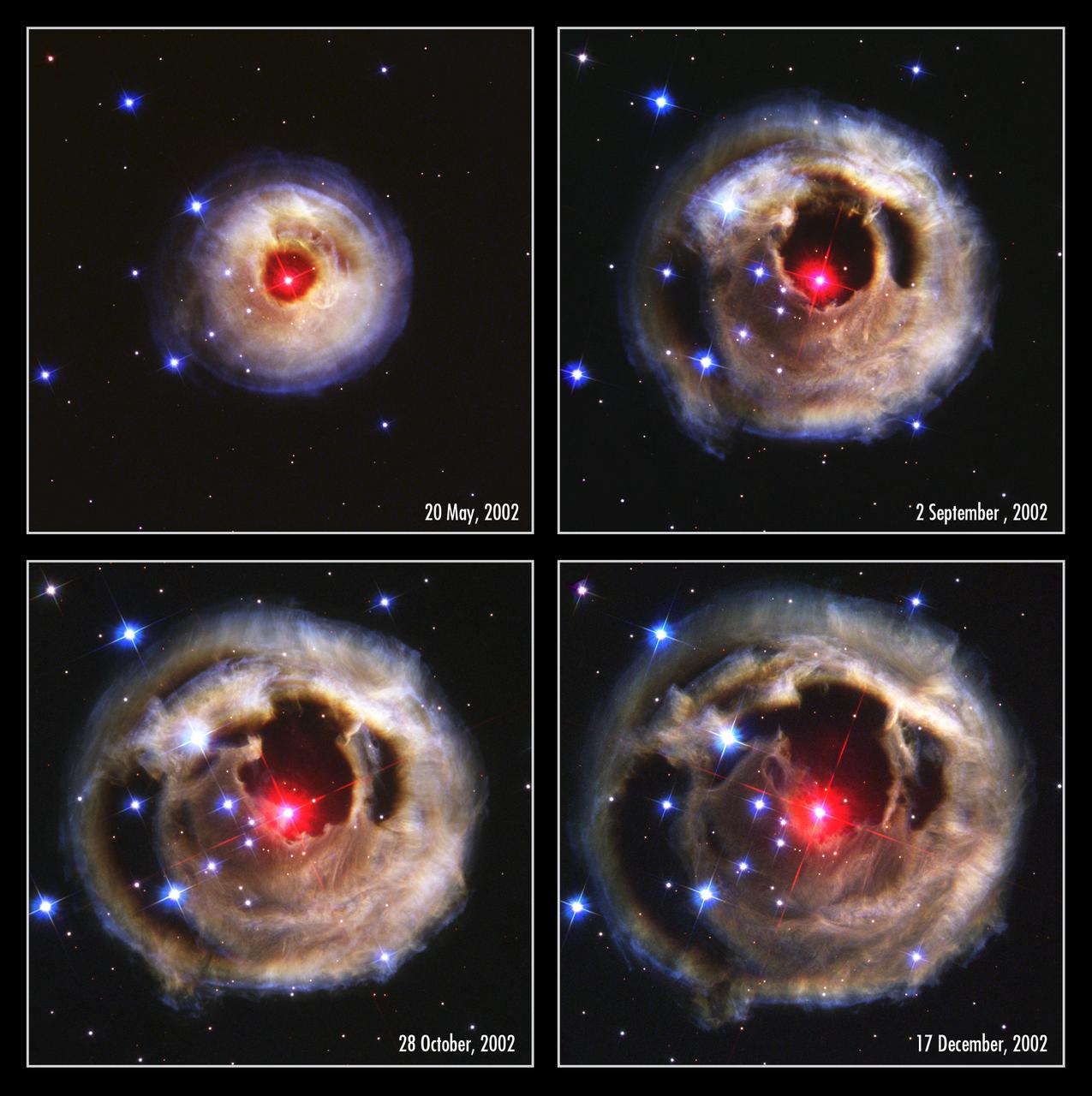
This series of photos, captured by the NASA Hubble Space Telescope's (HST) Advanced Camera for Surveys from May to December 2002, dramatically demonstrates the reverberation of light through space caused by an unusual stellar outburst in January 2002. A burst of light from the bizarre star is spreading into space and reflecting off of surrounding circumstellar dust. As different parts are sequentially illuminated, the appearance of the dust changes. This effect is referred to as a "light echo". The red star at the center of the eyeball like feature is the unusual erupting super giant called V838 Monocerotis, or V Mon, located about 20,000 light-years away in the winter constellation Monoceros (the Unicorn). During its outburst, the star brightened to more than 600,000 times our Sun's luminosity. The circular feature has now expanded to slightly larger than the angular size of Jupiter on the sky, and will continue to expand for several more years until the light from the back side of the nebula begins to arrive. The light echo will then give the illusion of contracting, until it finally disappears by the end of the decade.
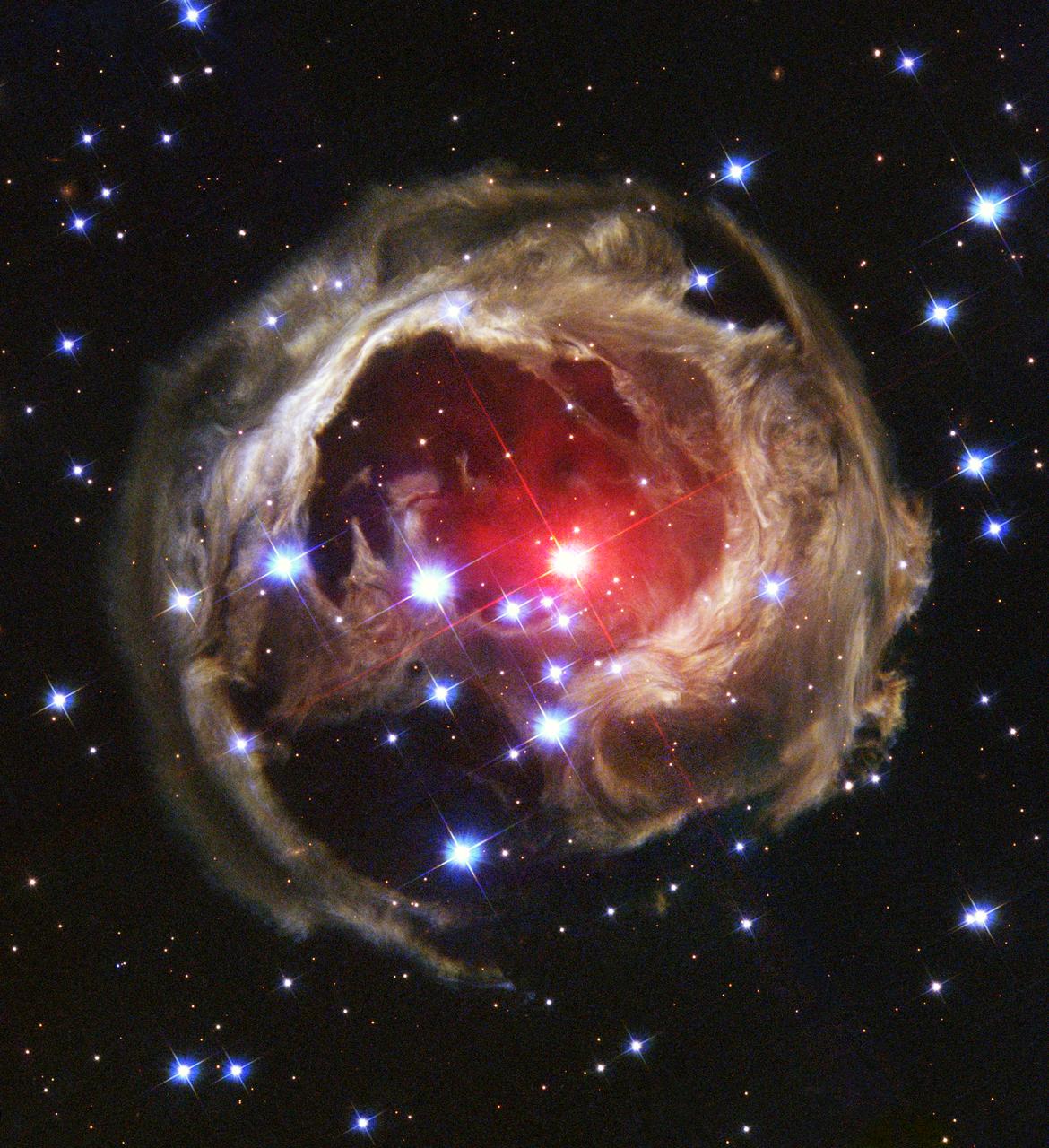
"Light Echo" Illuminates Dust Around Supergiant Star V838 Monocerotis (V838 Mon) Credit: NASA and The Hubble Heritage Team (AURA/STScI) The Hubble Space Telescope is a project of international cooperation between NASA and the European Space Agency. NASA's Goddard Space Flight Center manages the telescope. The Space Telescope Science Institute conducts Hubble science operations. Goddard is responsible for HST project management, including mission and science operations, servicing missions, and all associated development activities. To learn more about the Hubble Space Telescope go here: <a href="http://www.nasa.gov/mission_pages/hubble/main/index.html" rel="nofollow">www.nasa.gov/mission_pages/hubble/main/index.html</a> <b><a href="http://www.nasa.gov/centers/goddard/home/index.html" rel="nofollow">NASA Goddard Space Flight Center</a></b> is home to the nation's largest organization of combined scientists, engineers and technologists that build spacecraft, instruments and new technology to study the Earth, the sun, our solar system, and the universe. <b>Follow us on <a href="http://twitter.com/NASA_GoddardPix" rel="nofollow">Twitter</a></b> <b>Join us on <a href="http://www.facebook.com/pages/Greenbelt-MD/NASA-Goddard/395013845897?ref=tsd" rel="nofollow">Facebook</a><b> </b></b>