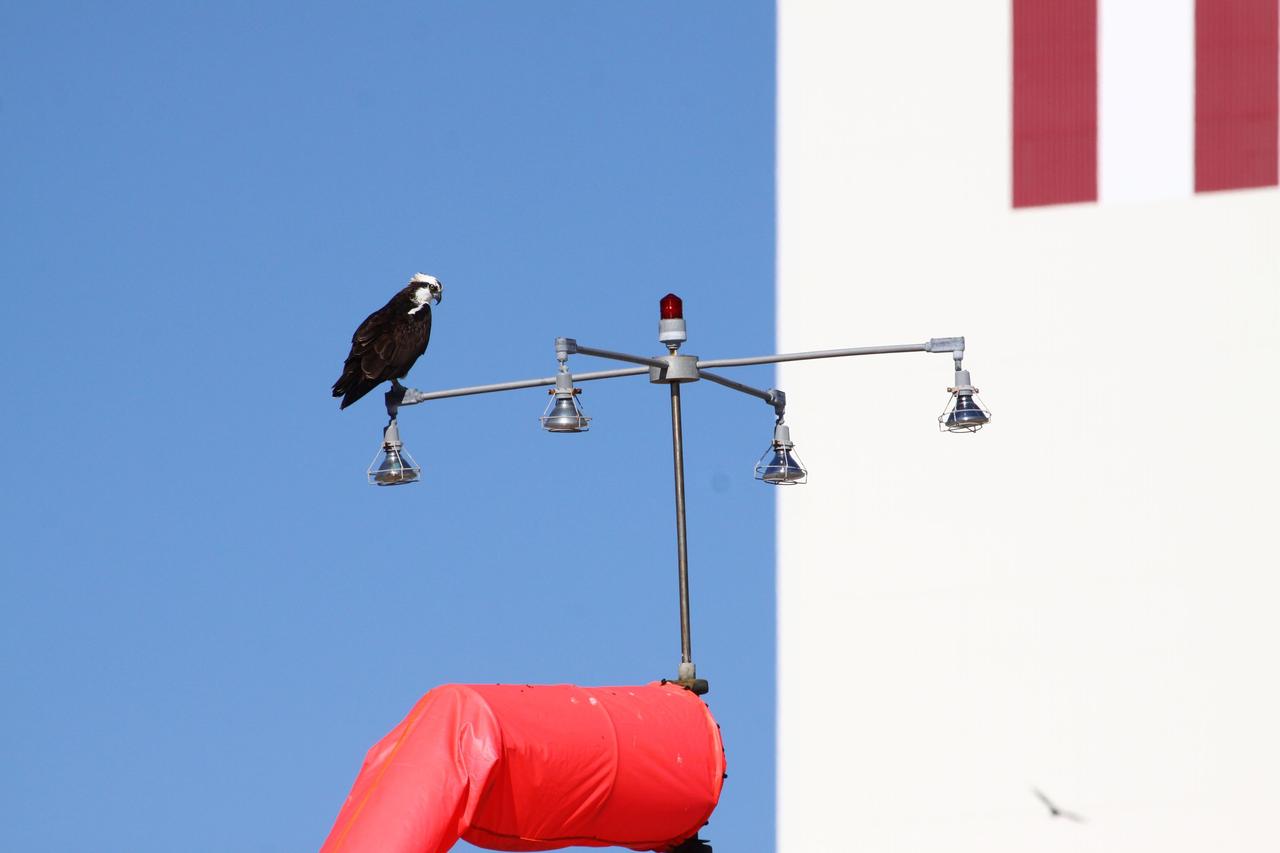
CAPE CANAVERAL, Fla. -- At NASA's Kennedy Space Center in Florida, an osprey is perched on a weather pole at a helicopter landing site near the Vehicle Assembly Building. Ospreys are a familiar sight at Kennedy because of its close proximity to ponds, lakes and coastal waters, which feed their appetite for fish. Kennedy coexists with the Merritt Island National Wildlife Refuge, habitat to more than 310 species of birds, 25 mammals, 117 fish and 65 amphibians and reptiles. Photo credit: NASA/Jack Pfaller

CAPE CANAVERAL, Fla. -- At NASA's Kennedy Space Center in Florida, an osprey is perched on a weather pole at a helicopter landing site near the Vehicle Assembly Building. Ospreys are a familiar sight at Kennedy because of its close proximity to ponds, lakes and coastal waters, which feed their appetite for fish. Kennedy coexists with the Merritt Island National Wildlife Refuge, habitat to more than 310 species of birds, 25 mammals, 117 fish and 65 amphibians and reptiles. Photo credit: NASA/Jack Pfaller
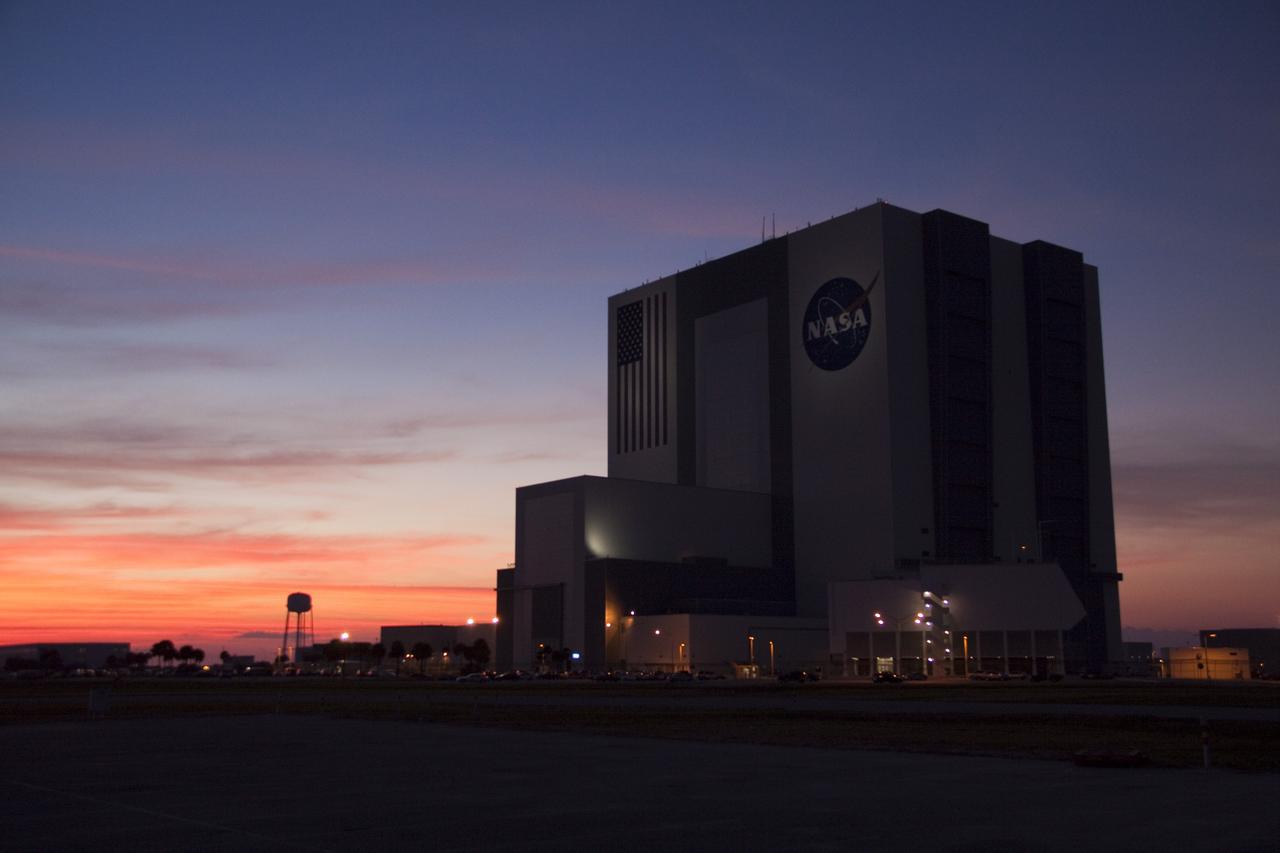
CAPE CANAVERAL, Fla. -- The night lights and Vehicle Assembly Building are silhouetted against the sunset sky over NASA's Kennedy Space Center in Florida. Photo Credit: NASA/Troy Cryder
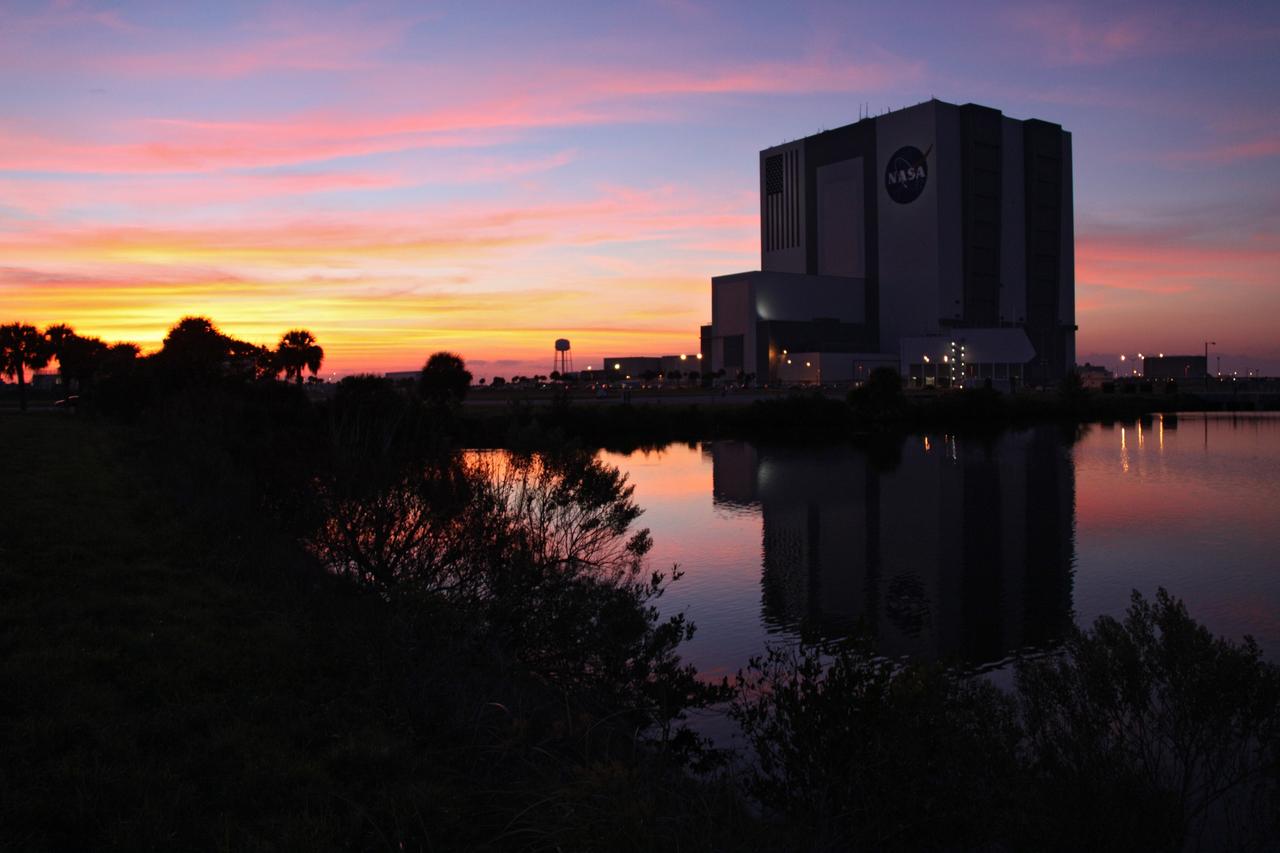
CAPE CANAVERAL, Fla. -- The dark water of the Turn Basin at NASA's Kennedy Space Center in Florida mirrors the night lights and Vehicle Assembly Building, silhouetted against the sunset sky. Photo Credit: NASA/Troy Cryder
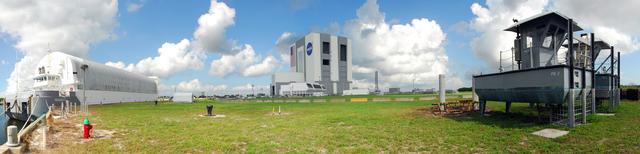
CAPE CANAVERAL, Fla. -- At NASA's Kennedy Space Center in Florida, the Pegasus barge, left, the Vehicle Assembly Building, center, and patrol boats, right, are seen from the Launch Complex 39 area. The barge carries space shuttle external fuel tanks from NASA's Michoud Assembly Facility in Louisiana to Kennedy and is towed by NASA's two solid rocket booster retrieval ships, Liberty Star and Freedom Star. Photo credit: NASA/Frankie Martin
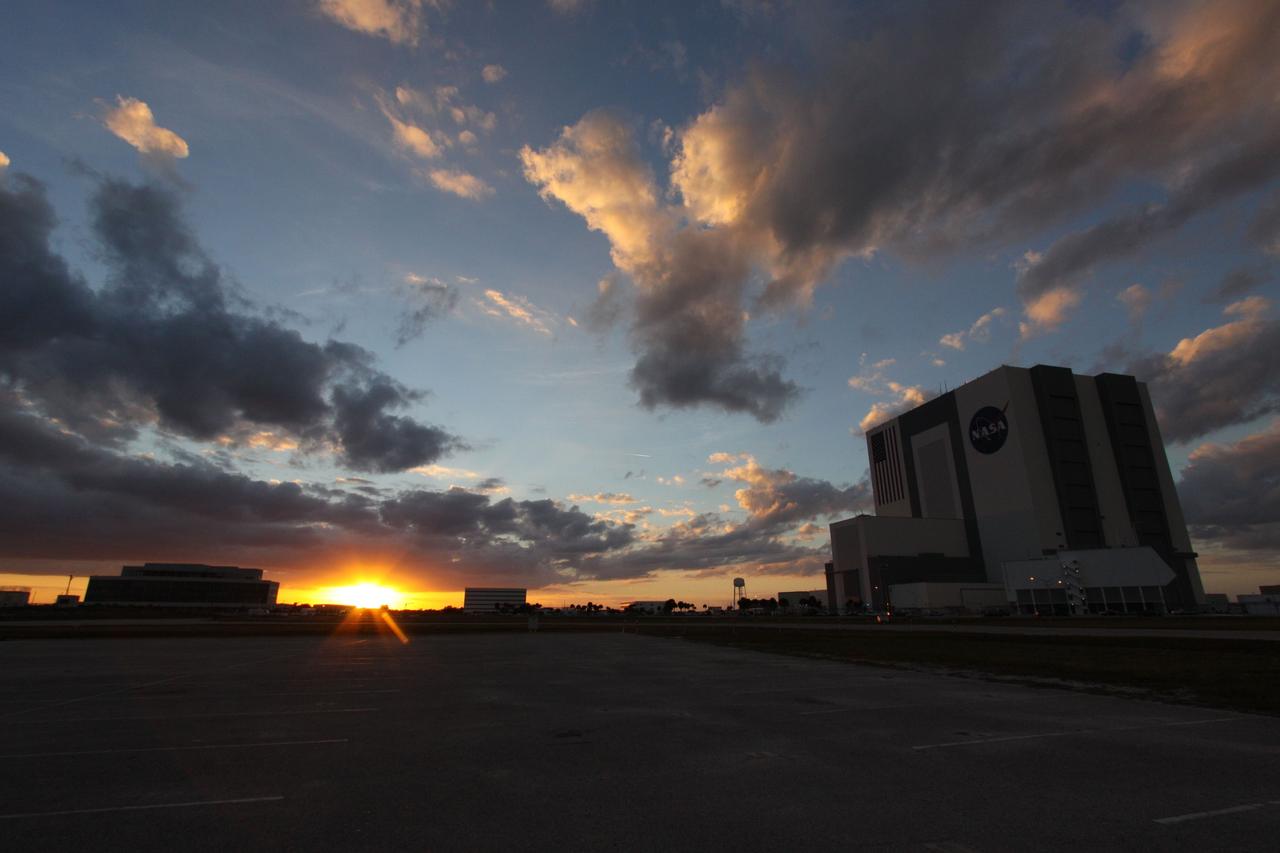
CAPE CANAVERAL, Fla. -- From the Press Site parking lot at NASA's Kennedy Space Center in Florida, the sun sets over the Launch Complex 39 area shadowing the Operations Support Building II, left, Operations Support Building I, Processing Control Center, Vehicle Assembly Building and Launch Control Center. Photo credit: NASA/Troy Cryder
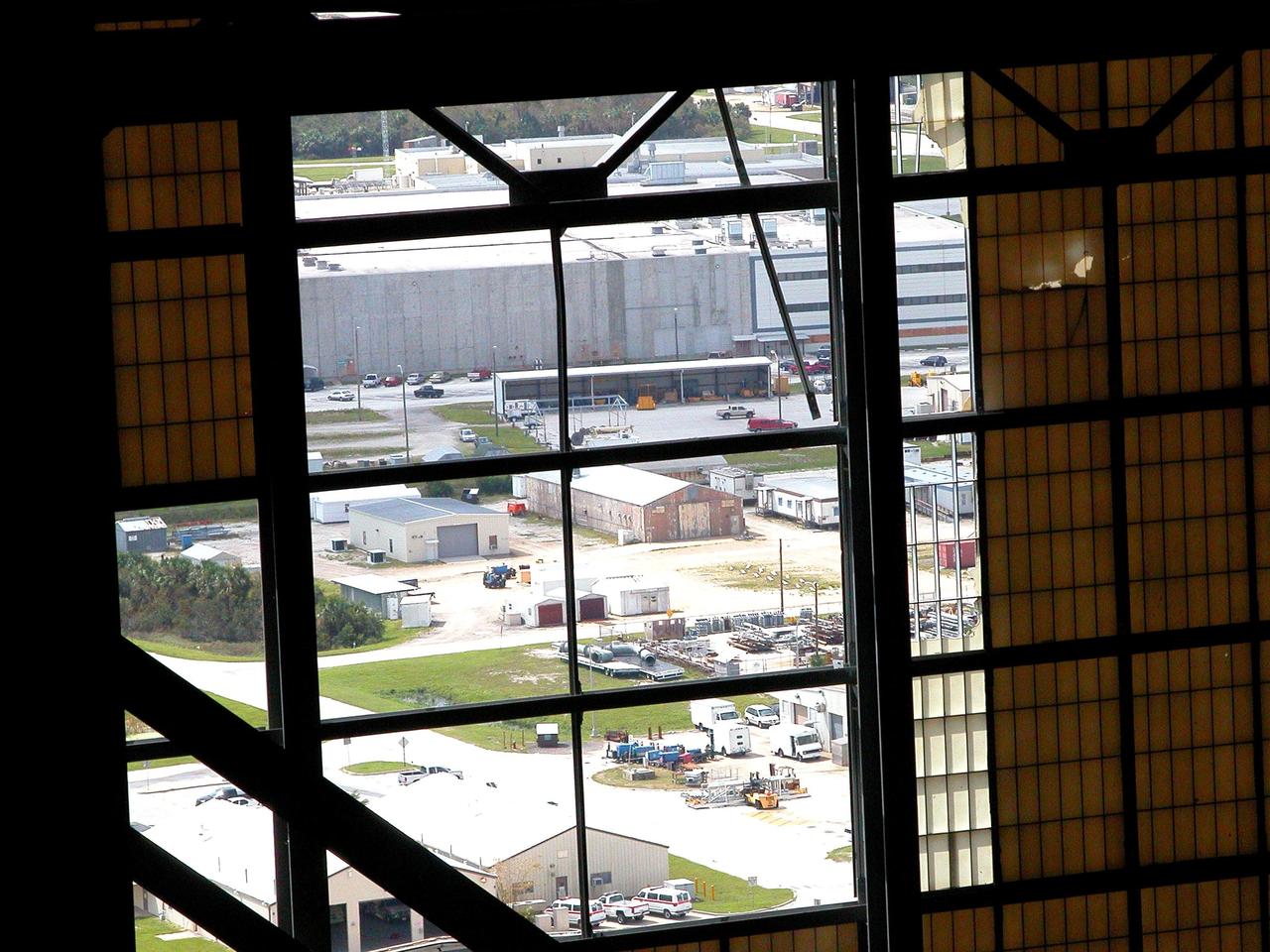
KENNEDY SPACE CENTER, FLA. - Launch Complex 39 facilities are now visible through the openings left by missing panels from the exterior walls of the Vehicle Assembly Building (VAB)following Hurricane Frances. The storm's path over Florida took it through Cape Canaveral and KSC property during Labor Day weekend. Located in the heart of Launch Complex 39, the VAB is used for the integration and stacking of Space Shuttle elements and for the checkout and storage of Space Shuttle External Tanks.
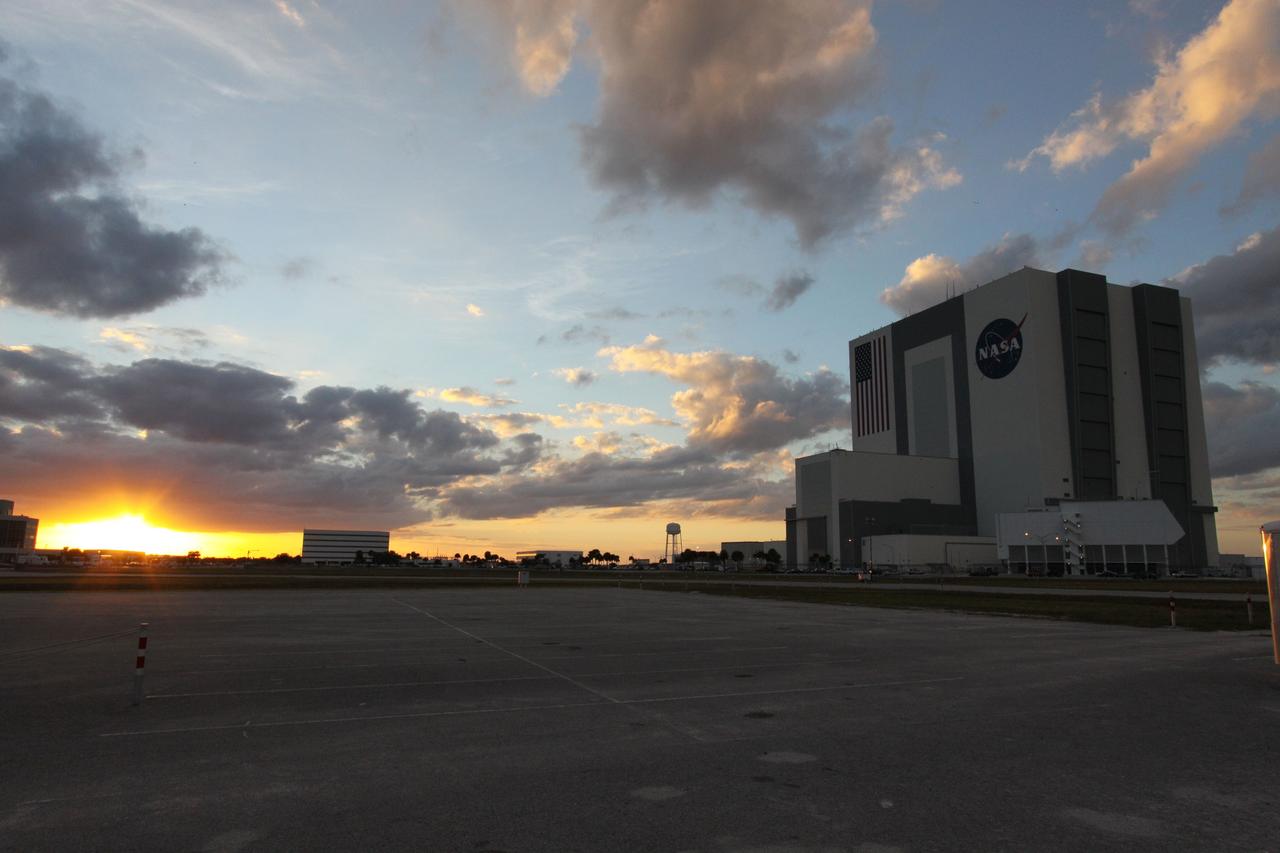
CAPE CANAVERAL, Fla. -- From the Press Site parking lot at NASA's Kennedy Space Center in Florida, the sun sets over the Launch Complex 39 area. At center, are the Operations Support Building I and Processing Control Center. At right, are the Vehicle Assembly Building and Launch Control Center. Photo credit: NASA/Troy Cryder
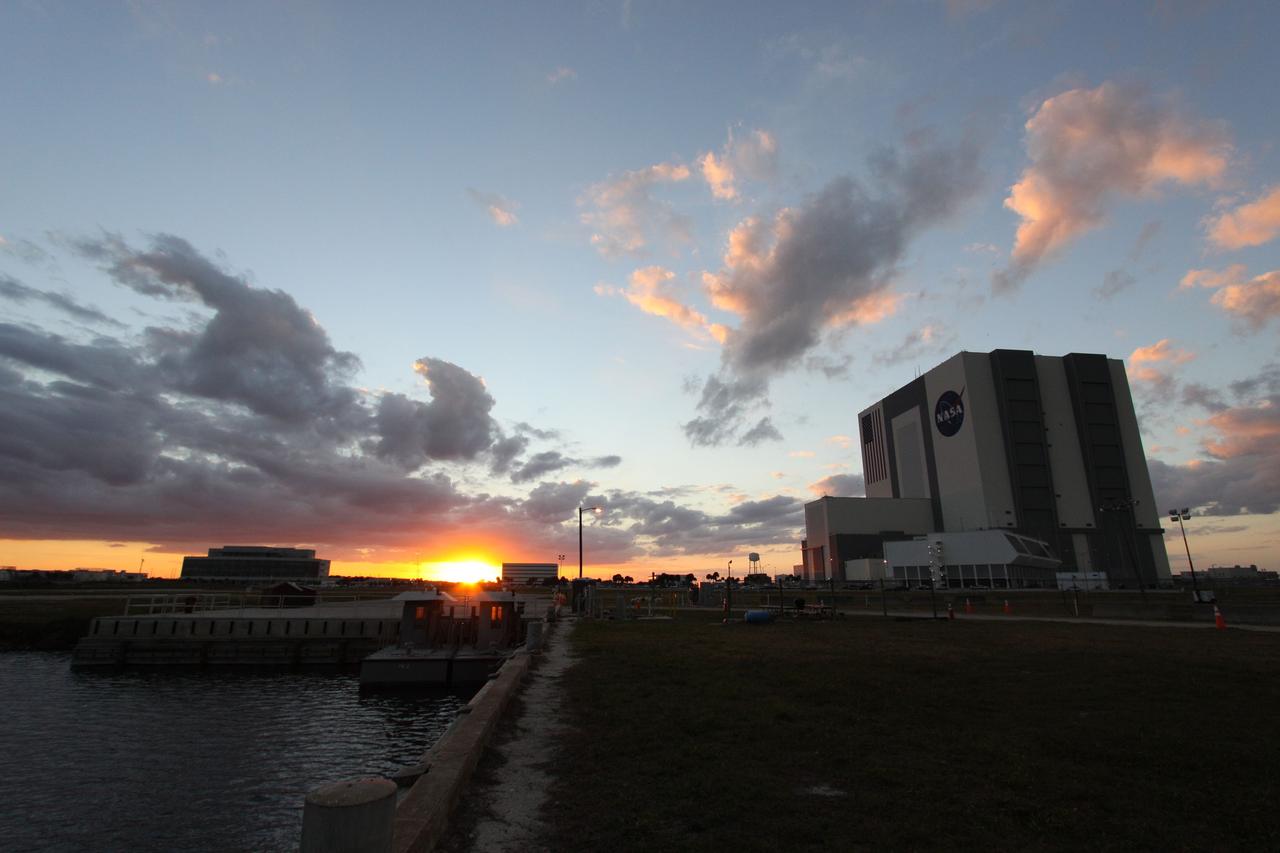
CAPE CANAVERAL, Fla. -- From the Turn Basin at NASA's Kennedy Space Center in Florida, the sun sets over the Launch Complex 39 area. The Operations Support Building II is at left, the Operations Support Building I is at center, and the mammoth Vehicle Assembly Building and Launch Control Center are to the right. Photo credit: NASA/Troy Cryder
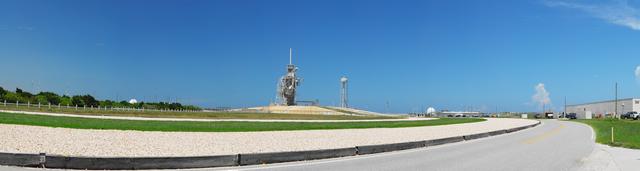
CAPE CANAVERAL, Fla. -- As NASA's Kennedy Space Center in Florida, Launch Pad 39A is seen from the Saturn Causeway. On launch day, space shuttle astronauts ride to their launch pad and spacecraft in NASA's silver Astrovan. Along the way, they pass the Vehicle Assembly Building, Launch Control Center and Press Site. Adjacent to the road is the crawlerway, which is the route shuttles take to Kennedy's Launch Complex 39 launch pads on top of a crawler-transporter. Photo credit: NASA/Frankie Martin
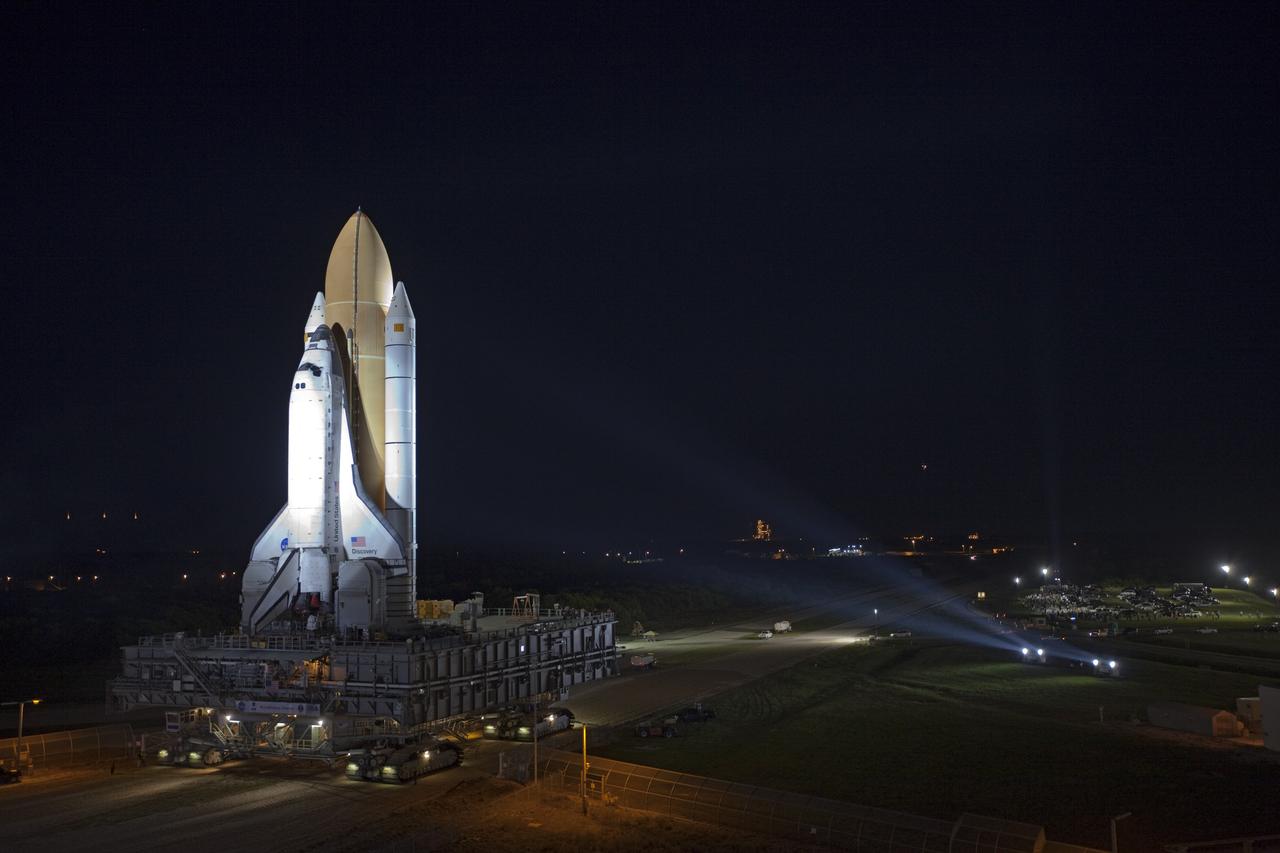
CAPE CANAVERAL, Fla. -- Bathed in bright xenon lights, space shuttle Discovery makes its nighttime trek, known as "rollout," from the Vehicle Assembly Building to Launch Pad 39A at NASA's Kennedy Space Center in Florida. It will take the shuttle, attached to its external fuel tank, twin solid rocket boosters and mobile launcher platform, about six hours to complete the move atop a crawler-transporter. Rollout sets the stage for Discovery's STS-133 crew to practice countdown and launch procedures during the Terminal Countdown Demonstration Test in mid-October. Targeted to liftoff Nov. 1, Discovery will take the Permanent Multipurpose Module (PMM) packed with supplies and critical spare parts, as well as Robonaut 2 (R2) to the International Space Station. Photo credit: NASA/Frankie Martin
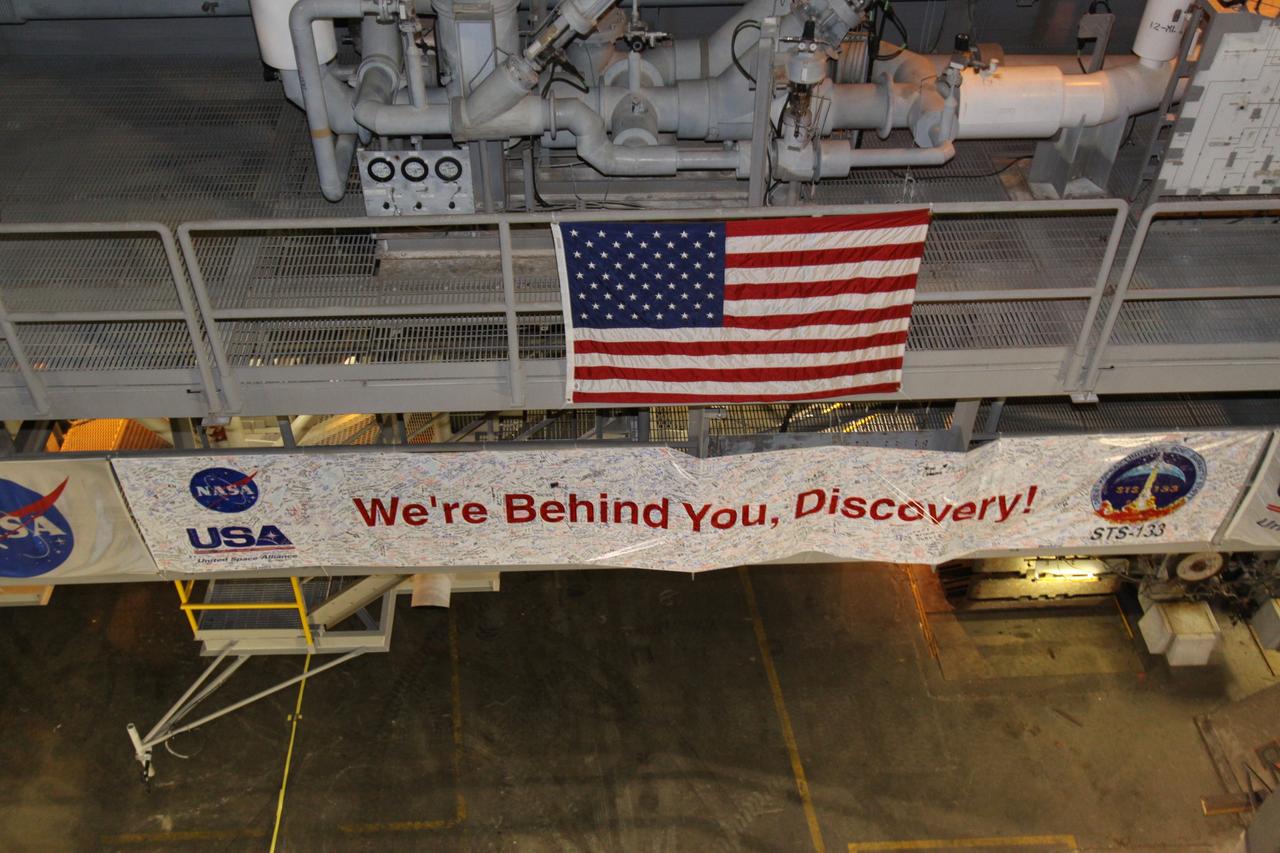
CAPE CANAVERAL, Fla. -- At NASA's Kennedy Space Center in Florida, an American flag and a sign supporting space shuttle Discovery with signatures of space center workers hang on its crawler-transporter mobile launcher as it begins the nighttime trek, known as "rollout," from the Vehicle Assembly Building to Launch Pad 39A. It will take the shuttle about six hours to complete the move. Rollout sets the stage for Discovery's STS-133 crew to practice countdown and launch procedures during the Terminal Countdown Demonstration Test in mid-October. Targeted to liftoff Nov. 1, Discovery will take the Permanent Multipurpose Module (PMM) packed with supplies and critical spare parts, as well as Robonaut 2 (R2) to the International Space Station. Photo credit: NASA/Jack Pfaller
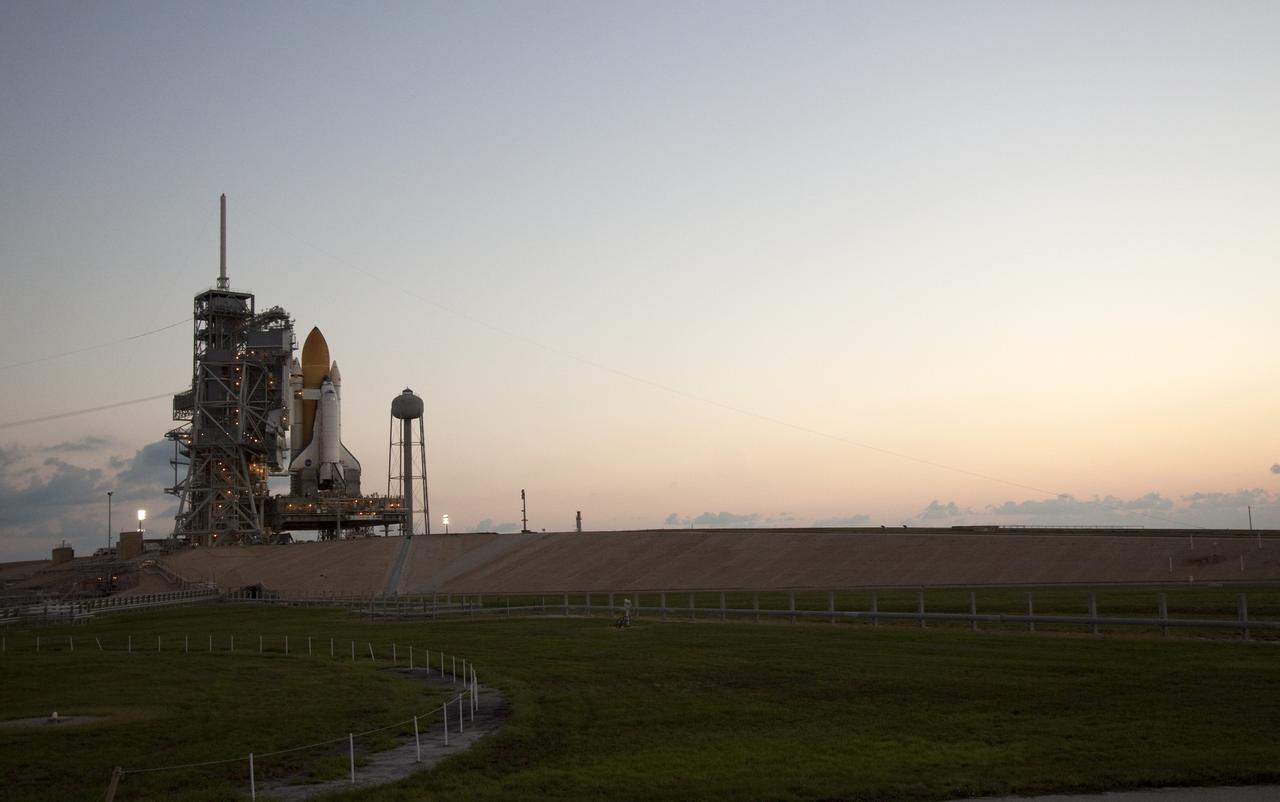
CAPE CANAVERAL, Fla. -- Space shuttle Discovery is attached to Launch Pad 39A as the sun rises over NASA's Kennedy Space Center in Florida. It took the spacecraft about six hours to make the journey, known as "rollout," from the Vehicle Assembly Building to the pad. Rollout sets the stage for Discovery's STS-133 crew to practice countdown and launch procedures during the Terminal Countdown Demonstration Test in mid-October. Targeted to liftoff Nov. 1, Discovery will take the Permanent Multipurpose Module (PMM) packed with supplies and critical spare parts, as well as Robonaut 2 (R2) to the International Space Station. Photo credit: NASA/Jack Pfaller
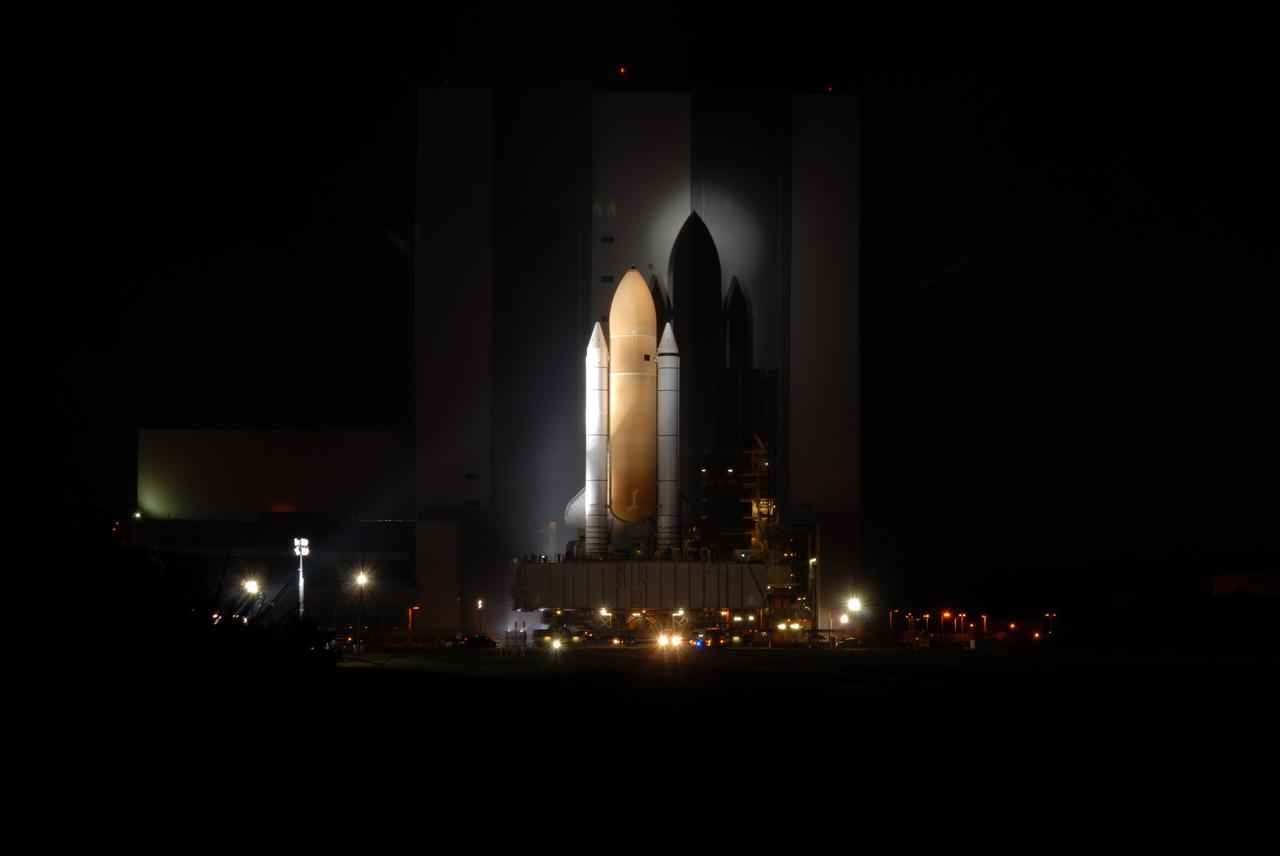
CAPE CANAVERAL, Fla. -- Bathed in bright xenon lights, space shuttle Discovery makes its nighttime trek, known as "rollout," from the Vehicle Assembly Building to Launch Pad 39A at NASA's Kennedy Space Center in Florida. It will take the shuttle, attached to its external fuel tank, twin solid rocket boosters and mobile launcher platform, about six hours to complete the move atop a crawler-transporter. Rollout sets the stage for Discovery's STS-133 crew to practice countdown and launch procedures during the Terminal Countdown Demonstration Test in mid-October. Targeted to liftoff Nov. 1, Discovery will take the Permanent Multipurpose Module (PMM) packed with supplies and critical spare parts, as well as Robonaut 2 (R2) to the International Space Station. Photo credit: NASA/Jim Grossmann
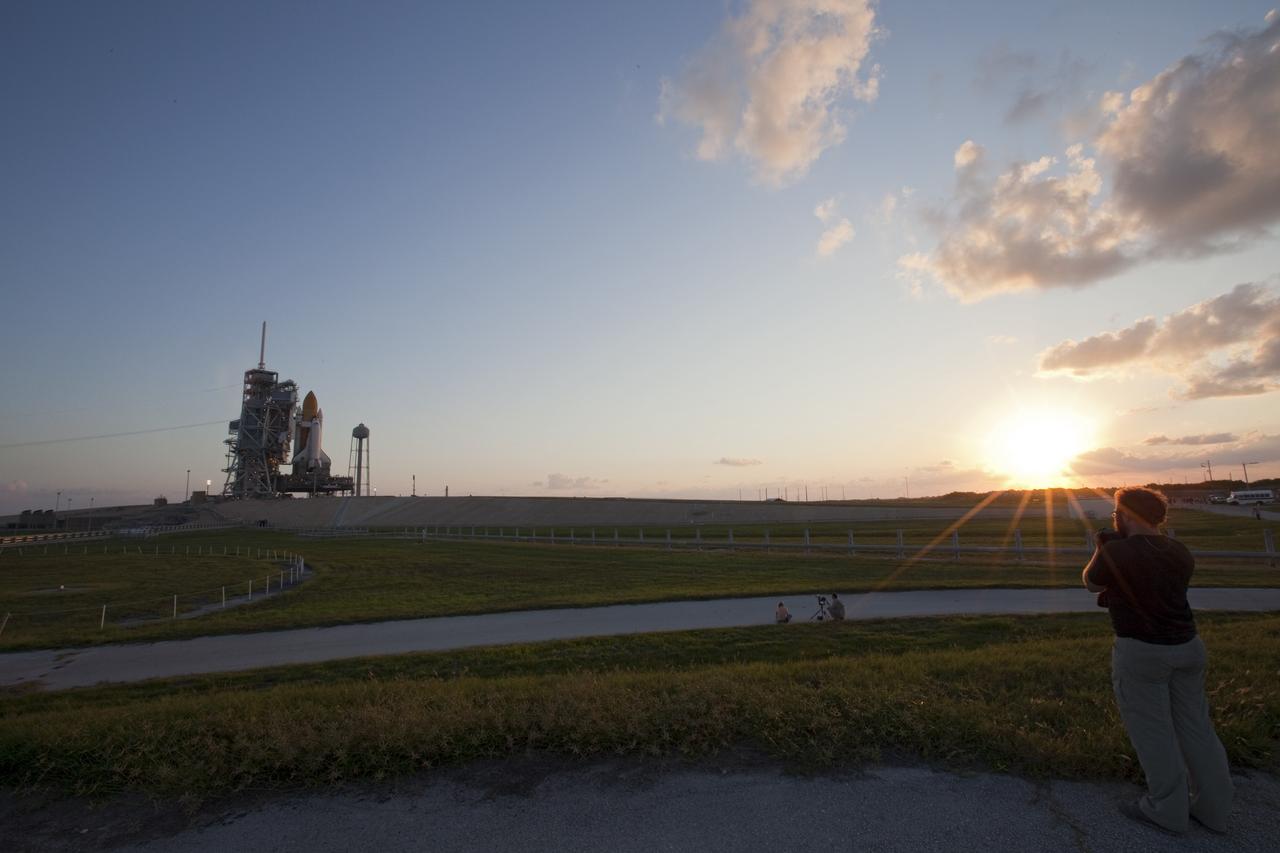
CAPE CANAVERAL, Fla. -- Space shuttle Discovery is attached to Launch Pad 39A as the sun rises over NASA's Kennedy Space Center in Florida. Later, the rotating service structure that protects the shuttle from the elements and provides access inside the vehicle will be moved into place. It took the spacecraft about six hours to make the journey, known as "rollout," from the Vehicle Assembly Building to the pad. Rollout sets the stage for Discovery's STS-133 crew to practice countdown and launch procedures during the Terminal Countdown Demonstration Test in mid-October. Targeted to liftoff Nov. 1, Discovery will take the Permanent Multipurpose Module (PMM) packed with supplies and critical spare parts, as well as Robonaut 2 (R2) to the International Space Station. Photo credit: NASA/Frankie Martin
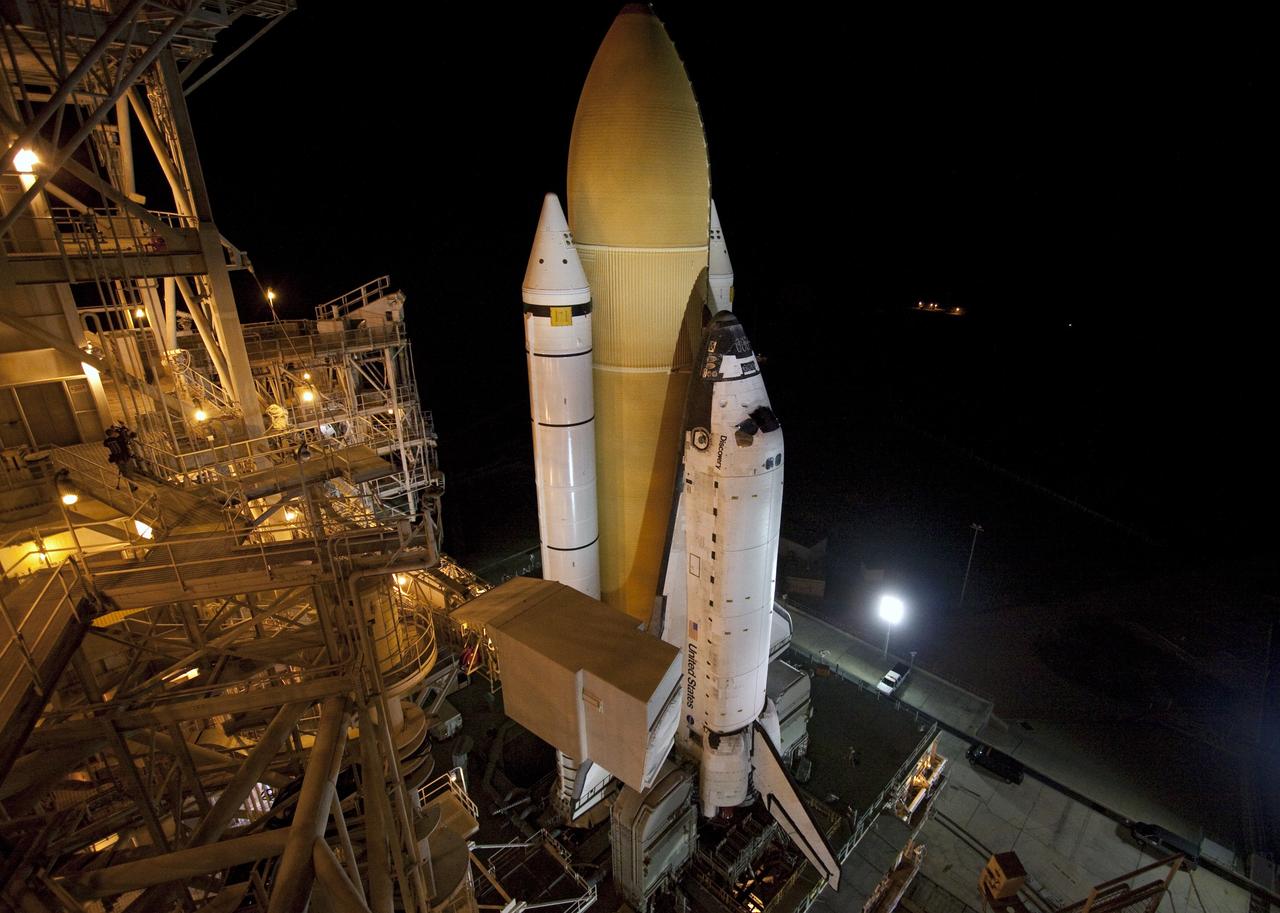
CAPE CANAVERAL, Fla. -- At NASA's Kennedy Space Center in Florida, space shuttle Discovery is attached to Launch Pad 39A, completing "rollout" from the Vehicle Assembly Building to Launch Pad 39A. It took the shuttle, attached to its external fuel tank, twin solid rocket boosters and mobile launcher platform, about six hours to complete the move atop a crawler-transporter. Rollout sets the stage for Discovery's STS-133 crew to practice countdown and launch procedures during the Terminal Countdown Demonstration Test in mid-October. Targeted to liftoff Nov. 1, Discovery will take the Permanent Multipurpose Module (PMM) packed with supplies and critical spare parts, as well as Robonaut 2 (R2) to the International Space Station. Photo credit: NASA/Jack Pfaller
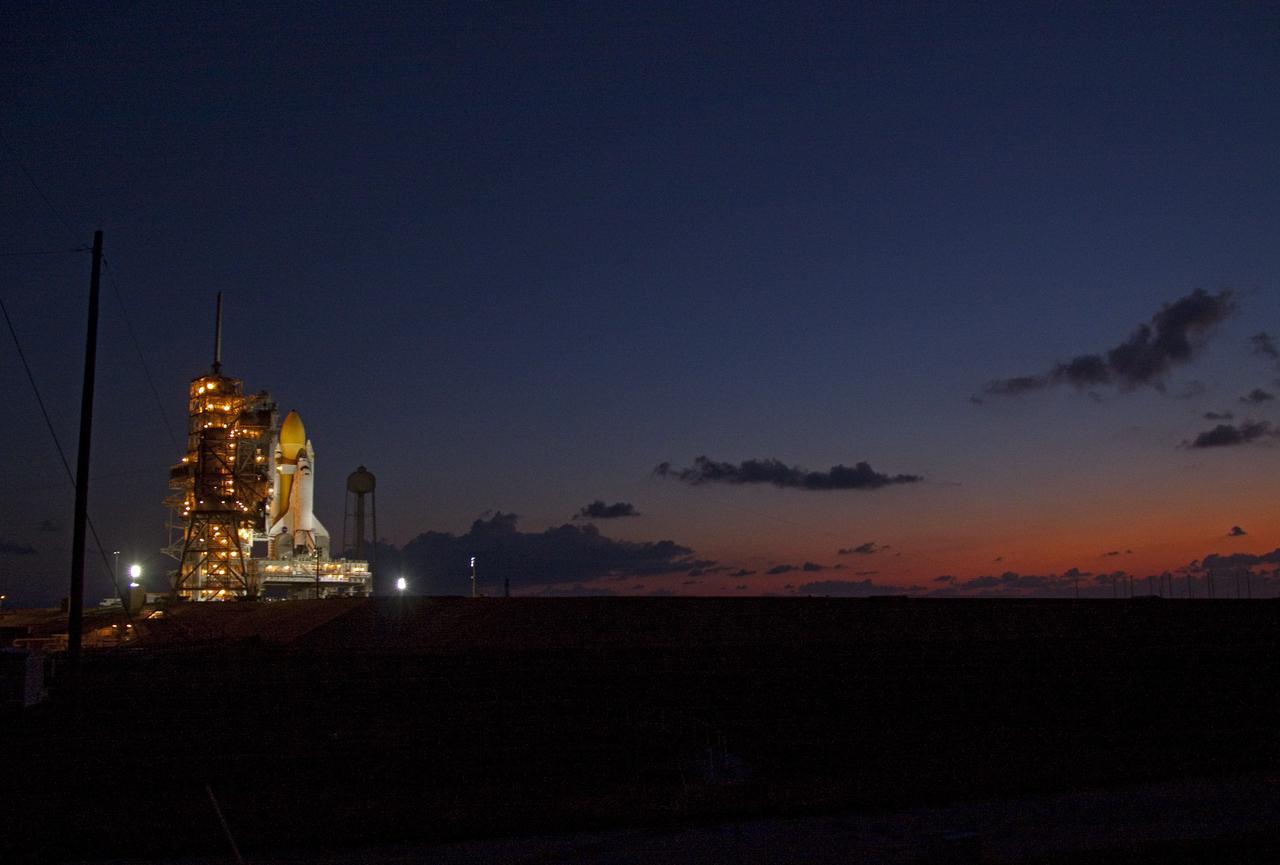
CAPE CANAVERAL, Fla. -- Space shuttle Discovery is attached to Launch Pad 39A as the sun rises over NASA's Kennedy Space Center in Florida. It took the spacecraft about six hours to make the journey, known as "rollout," from the Vehicle Assembly Building to the pad. Rollout sets the stage for Discovery's STS-133 crew to practice countdown and launch procedures during the Terminal Countdown Demonstration Test in mid-October. Targeted to liftoff Nov. 1, Discovery will take the Permanent Multipurpose Module (PMM) packed with supplies and critical spare parts, as well as Robonaut 2 (R2) to the International Space Station. Photo credit: NASA/Jack Pfaller
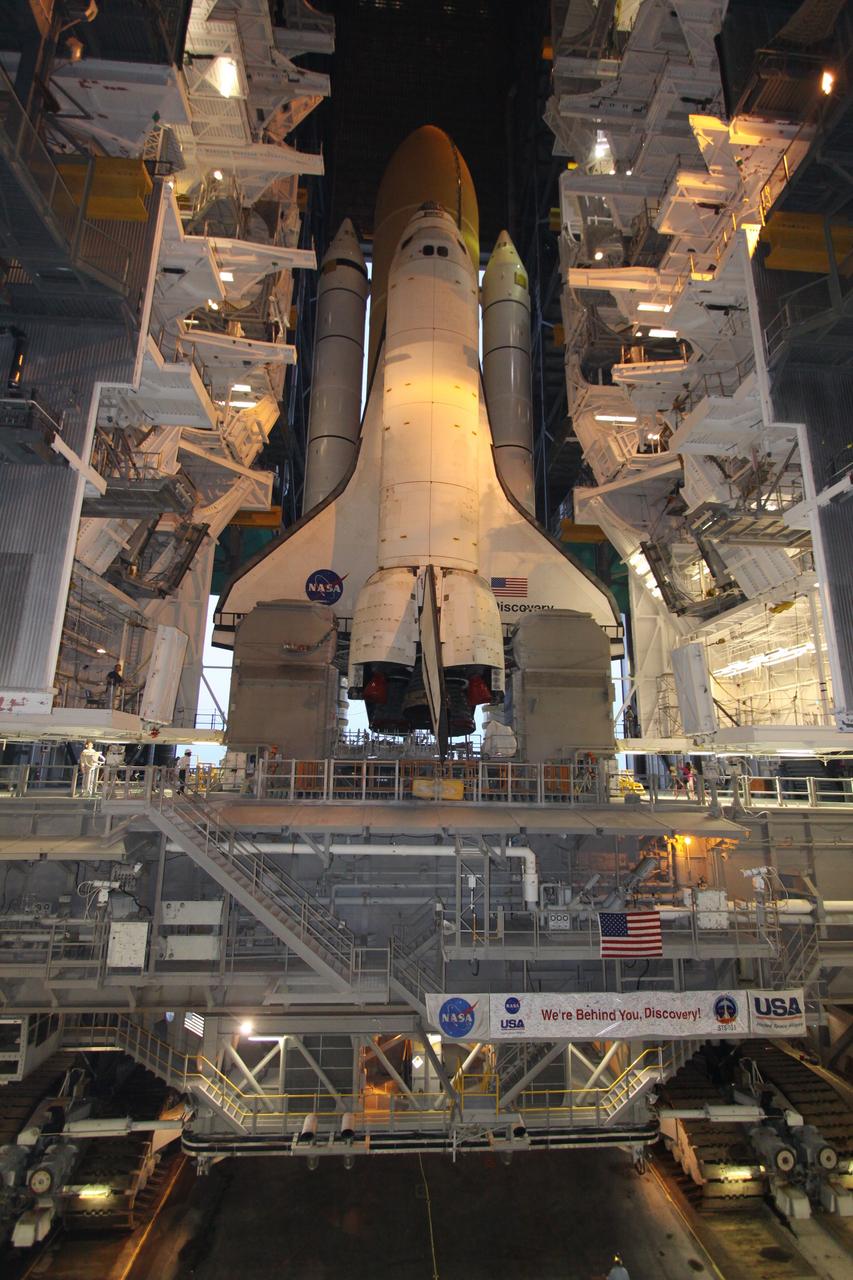
CAPE CANAVERAL, Fla. -- At NASA's Kennedy Space Center in Florida, space shuttle Discovery begins its nighttime trek, known as "rollout," from the Vehicle Assembly Building to Launch Pad 39A. It will take the shuttle, attached to its external fuel tank, twin solid rocket boosters and mobile launcher platform, about six hours to complete the move atop a crawler-transporter. Rollout sets the stage for Discovery's STS-133 crew to practice countdown and launch procedures during the Terminal Countdown Demonstration Test in mid-October. Targeted to liftoff Nov. 1, Discovery will take the Permanent Multipurpose Module (PMM) packed with supplies and critical spare parts, as well as Robonaut 2 (R2) to the International Space Station. Photo credit: NASA/Jack Pfaller

CAPE CANAVERAL, Fla. -- At NASA's Kennedy Space Center in Florida, the sun shines through Launch Pad 39A and hides space shuttle Discovery, which is secured to the pad structure. It took the spacecraft about six hours to make the journey, known as "rollout," from the Vehicle Assembly Building to the pad. Rollout sets the stage for Discovery's STS-133 crew to practice countdown and launch procedures during the Terminal Countdown Demonstration Test in mid-October. Targeted to liftoff Nov. 1, Discovery will take the Permanent Multipurpose Module (PMM) packed with supplies and critical spare parts, as well as Robonaut 2 (R2) to the International Space Station. Photo credit: NASA/Jack Pfaller
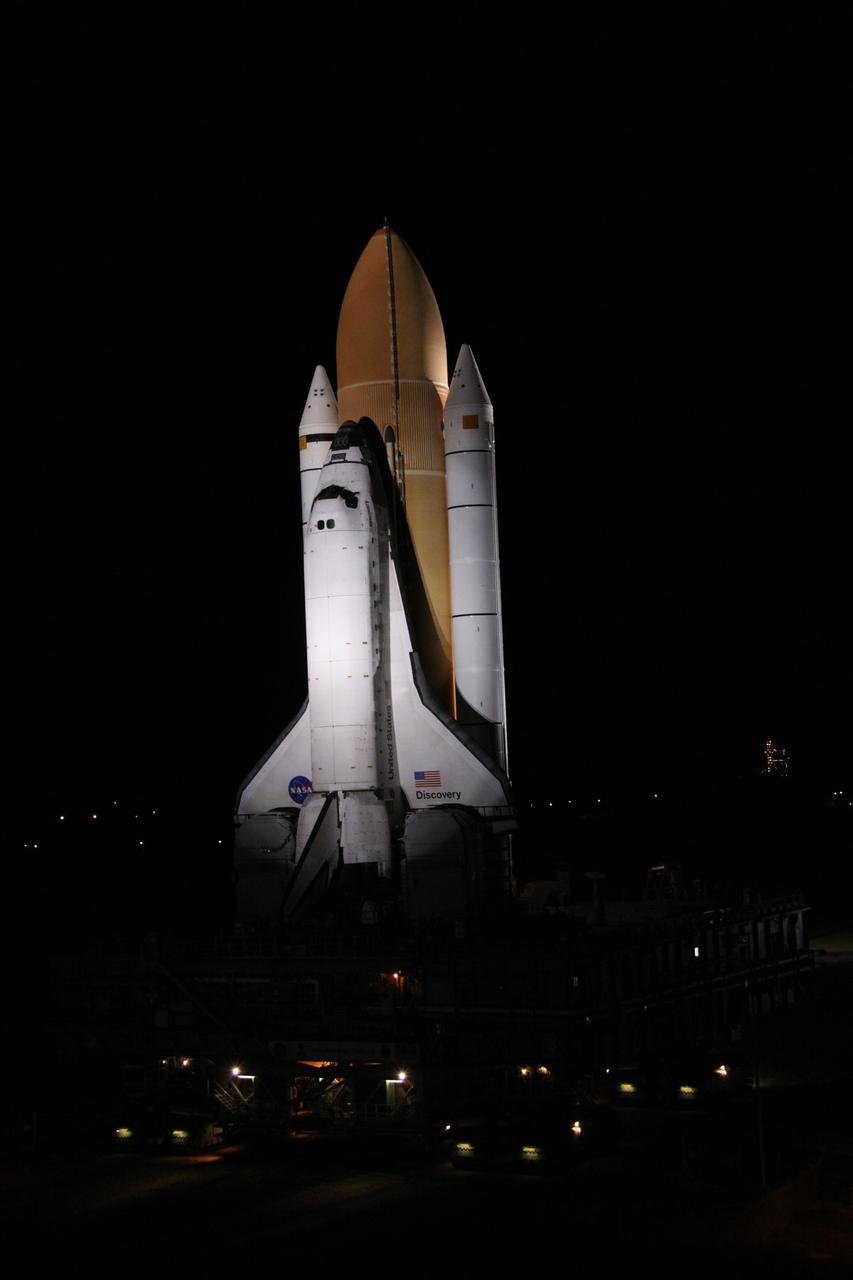
CAPE CANAVERAL, Fla. -- Bathed in bright xenon lights, space shuttle Discovery makes its nighttime trek, known as "rollout," from the Vehicle Assembly Building to Launch Pad 39A at NASA's Kennedy Space Center in Florida. It will take the shuttle, attached to its external fuel tank, twin solid rocket boosters and mobile launcher platform, about six hours to complete the move atop a crawler-transporter. Rollout sets the stage for Discovery's STS-133 crew to practice countdown and launch procedures during the Terminal Countdown Demonstration Test in mid-October. Targeted to liftoff Nov. 1, Discovery will take the Permanent Multipurpose Module (PMM) packed with supplies and critical spare parts, as well as Robonaut 2 (R2) to the International Space Station. Photo credit: NASA/Jack Pfaller
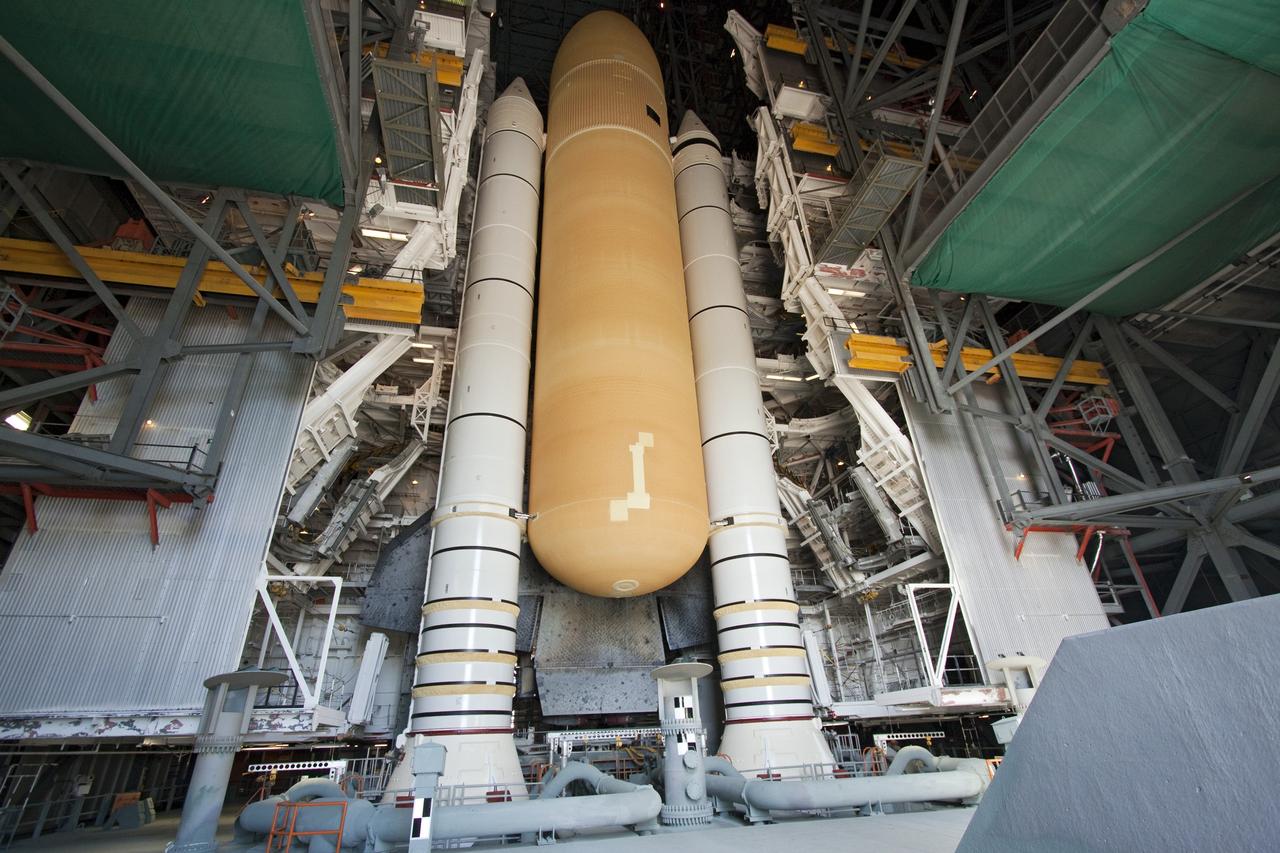
CAPE CANAVERAL, Fla. -- At NASA's Kennedy Space Center in Florida, space shuttle Discovery is ready for its nighttime trek, known as "rollout," from the Vehicle Assembly Building to Launch Pad 39A. It will take the shuttle, attached to its external fuel tank, twin solid rocket boosters and mobile launcher platform, about six hours to complete the move atop a crawler-transporter. Rollout sets the stage for Discovery's STS-133 crew to practice countdown and launch procedures during the Terminal Countdown Demonstration Test in mid-October. Targeted to liftoff Nov. 1, Discovery will take the Permanent Multipurpose Module (PMM) packed with supplies and critical spare parts, as well as Robonaut 2 (R2) to the International Space Station. Photo credit: NASA/Jack Pfaller
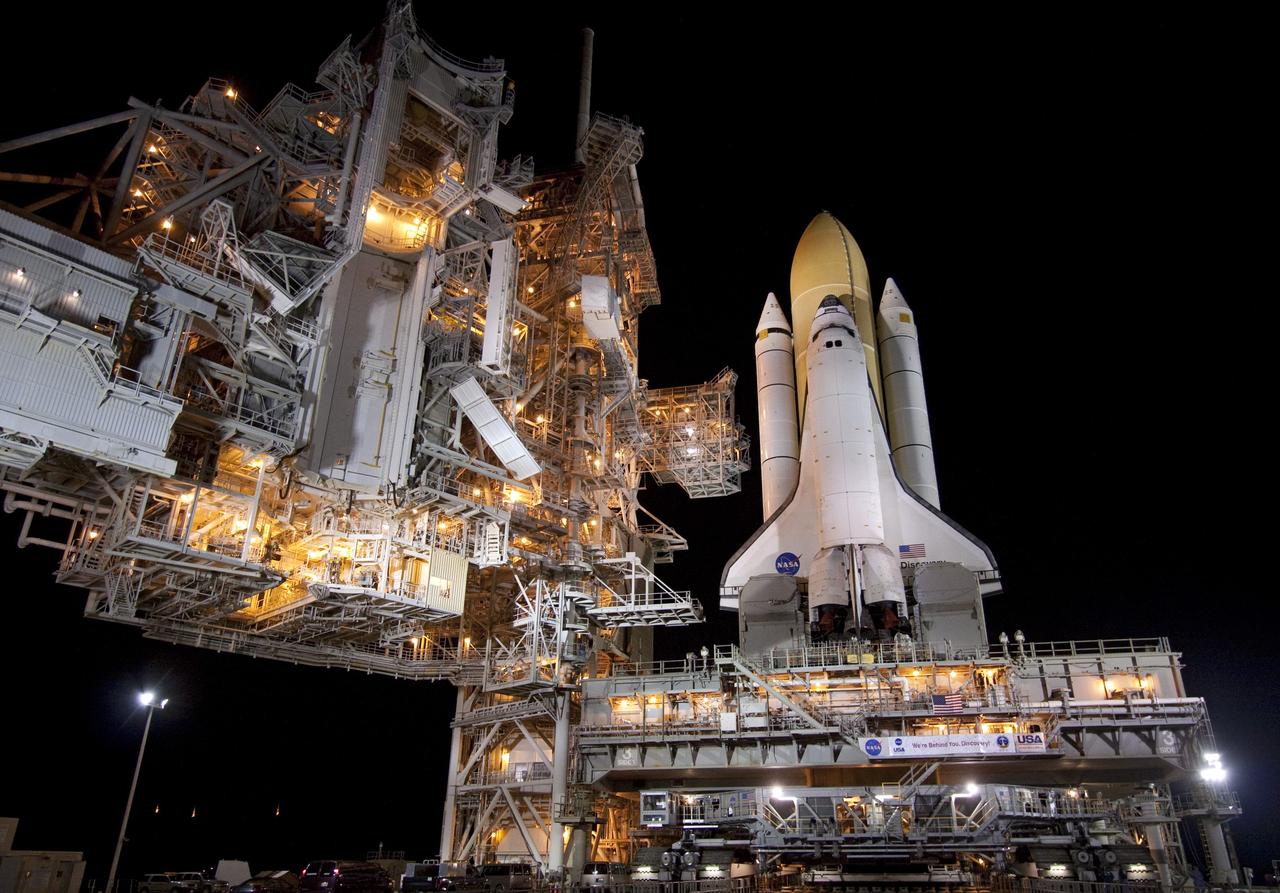
CAPE CANAVERAL, Fla. -- At NASA's Kennedy Space Center in Florida, space shuttle Discovery is attached to Launch Pad 39A, completing "rollout" from the Vehicle Assembly Building to Launch Pad 39A. It took the shuttle, attached to its external fuel tank, twin solid rocket boosters and mobile launcher platform, about six hours to complete the move atop a crawler-transporter. Rollout sets the stage for Discovery's STS-133 crew to practice countdown and launch procedures during the Terminal Countdown Demonstration Test in mid-October. Targeted to liftoff Nov. 1, Discovery will take the Permanent Multipurpose Module (PMM) packed with supplies and critical spare parts, as well as Robonaut 2 (R2) to the International Space Station. Photo credit: NASA/Jack Pfaller
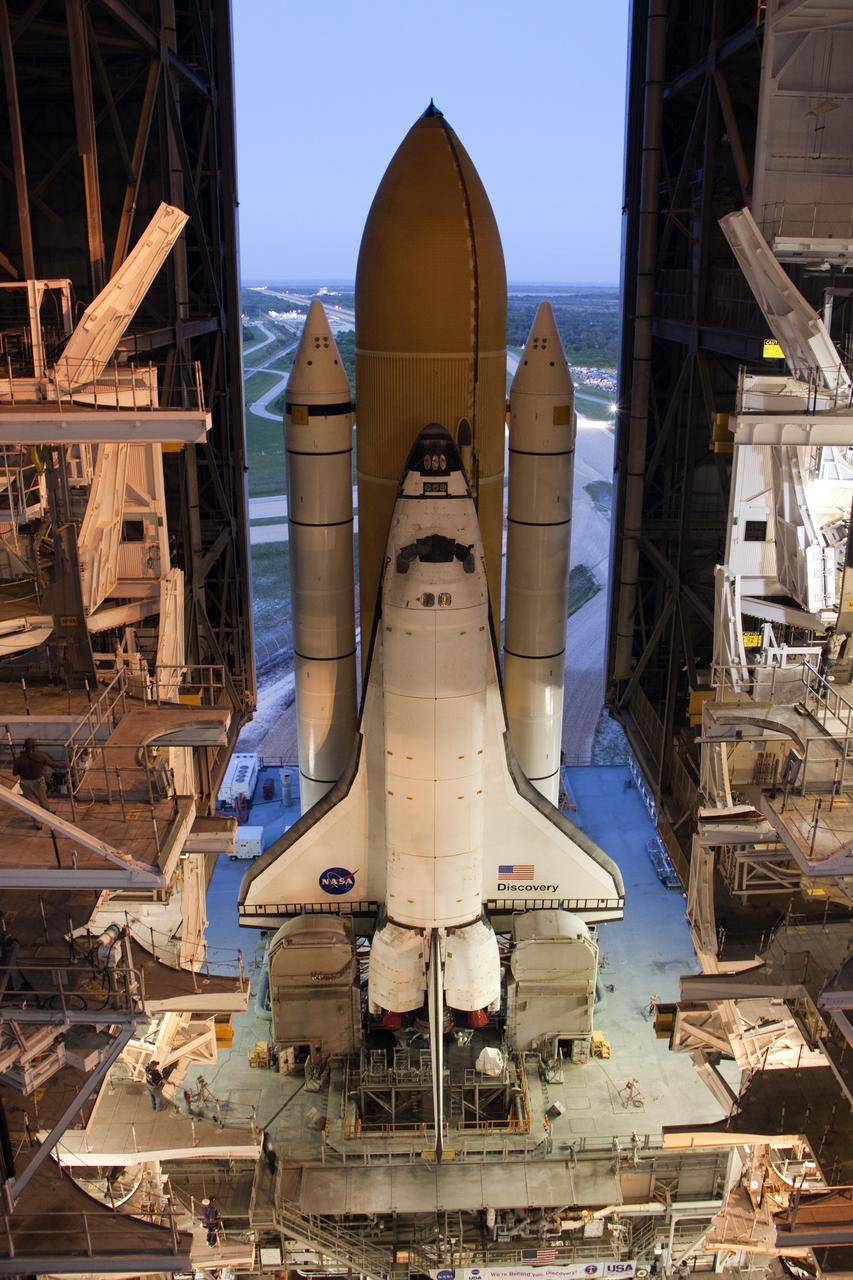
CAPE CANAVERAL, Fla. -- At NASA's Kennedy Space Center in Florida, space shuttle Discovery begins its nighttime trek, known as "rollout," from the Vehicle Assembly Building to Launch Pad 39A. It will take the shuttle, attached to its external fuel tank, twin solid rocket boosters and mobile launcher platform, about six hours to complete the move atop a crawler-transporter. Rollout sets the stage for Discovery's STS-133 crew to practice countdown and launch procedures during the Terminal Countdown Demonstration Test in mid-October. Targeted to liftoff Nov. 1, Discovery will take the Permanent Multipurpose Module (PMM) packed with supplies and critical spare parts, as well as Robonaut 2 (R2) to the International Space Station. Photo credit: NASA/Mic Miracle
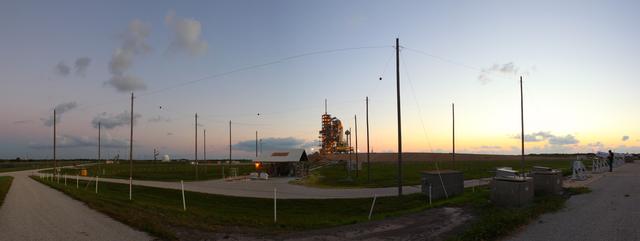
CAPE CANAVERAL, Fla. -- Space shuttle Discovery is attached to Launch Pad 39A as the sun rises over NASA's Kennedy Space Center in Florida. Later, the rotating service structure that protects the shuttle from the elements and provides access inside the vehicle will be moved into place. It took the spacecraft about six hours to make the journey, known as "rollout," from the Vehicle Assembly Building to the pad. Rollout sets the stage for Discovery's STS-133 crew to practice countdown and launch procedures during the Terminal Countdown Demonstration Test in mid-October. Targeted to liftoff Nov. 1, Discovery will take the Permanent Multipurpose Module (PMM) packed with supplies and critical spare parts, as well as Robonaut 2 (R2) to the International Space Station. Photo credit: NASA/Frankie Martin
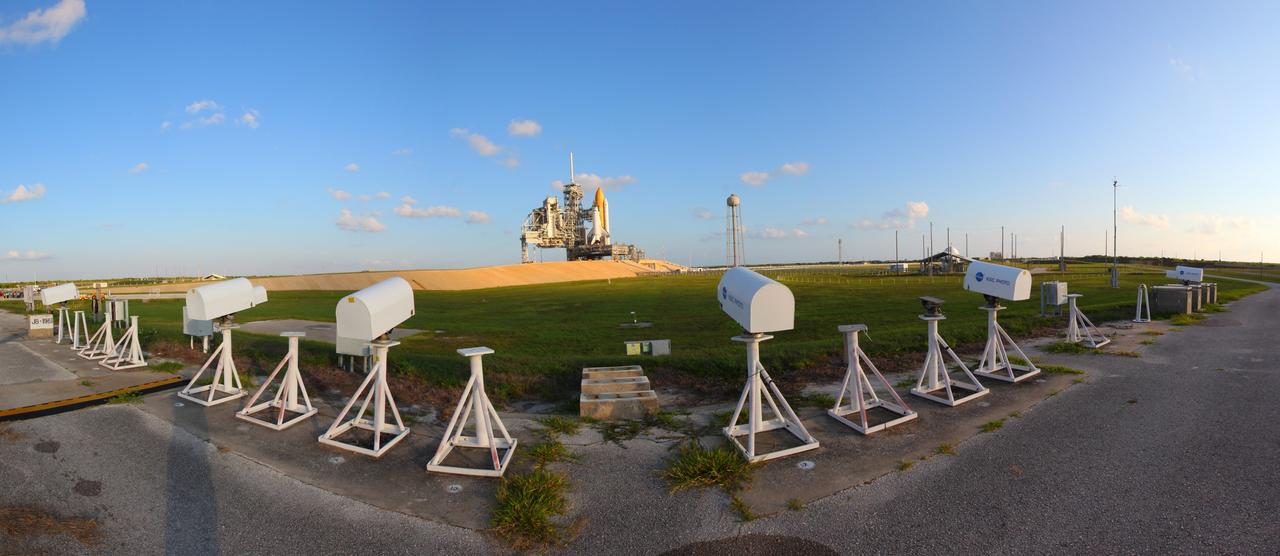
CAPE CANAVERAL, Fla. -- Space shuttle Discovery is attached to Launch Pad 39A at NASA's Kennedy Space Center in Florida. Later, the rotating service structure that protects the shuttle from the elements and provides access inside the vehicle will be moved into place. It took the spacecraft about six hours to make the journey, known as "rollout," from the Vehicle Assembly Building to the pad. Rollout sets the stage for Discovery's STS-133 crew to practice countdown and launch procedures during the Terminal Countdown Demonstration Test in mid-October. Targeted to liftoff Nov. 1, Discovery will take the Permanent Multipurpose Module (PMM) packed with supplies and critical spare parts, as well as Robonaut 2 (R2) to the International Space Station. Photo credit: NASA/Frankie Martin
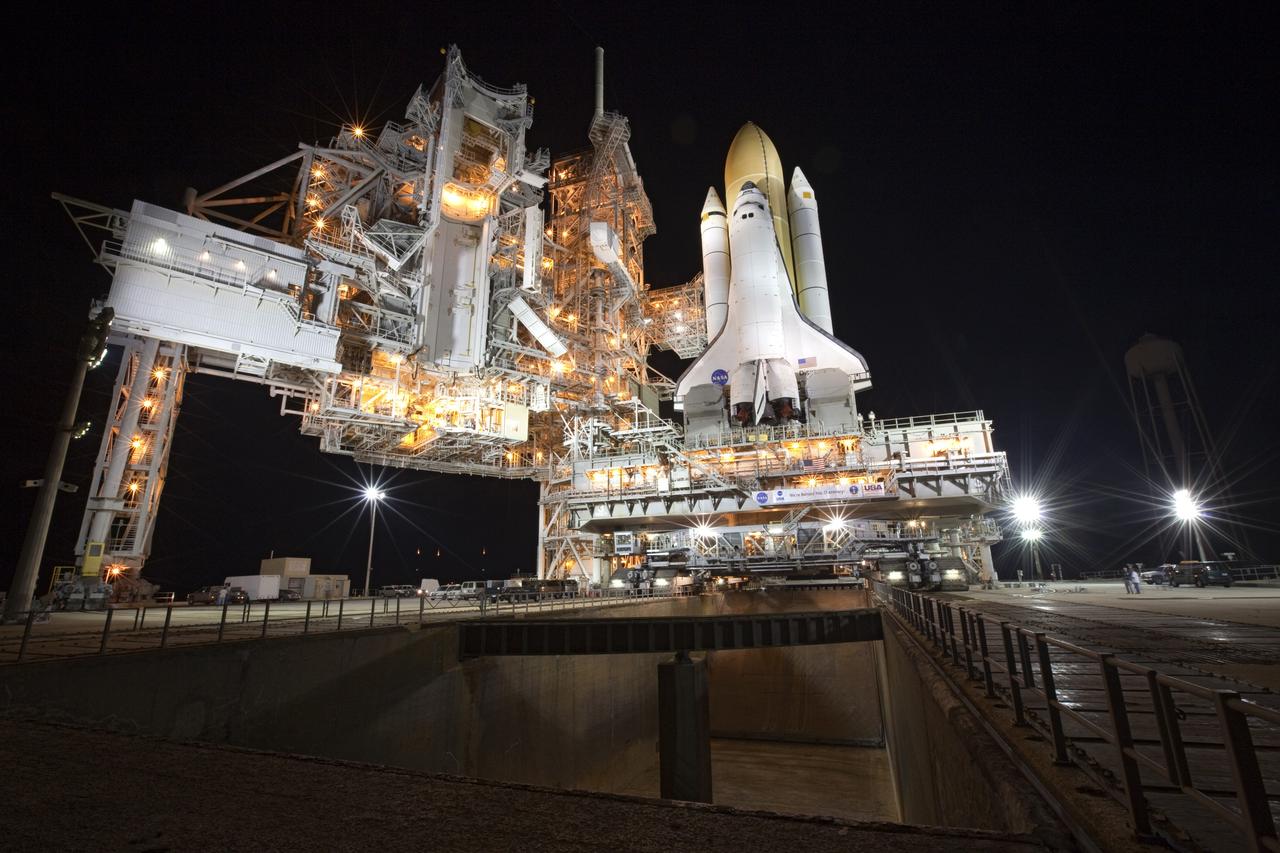
CAPE CANAVERAL, Fla. -- At NASA's Kennedy Space Center in Florida, space shuttle Discovery is attached to Launch Pad 39A, completing "rollout" from the Vehicle Assembly Building to Launch Pad 39A. It took the shuttle, attached to its external fuel tank, twin solid rocket boosters and mobile launcher platform, about six hours to complete the move atop a crawler-transporter. Rollout sets the stage for Discovery's STS-133 crew to practice countdown and launch procedures during the Terminal Countdown Demonstration Test in mid-October. Targeted to liftoff Nov. 1, Discovery will take the Permanent Multipurpose Module (PMM) packed with supplies and critical spare parts, as well as Robonaut 2 (R2) to the International Space Station. Photo credit: NASA/Frankie Martin
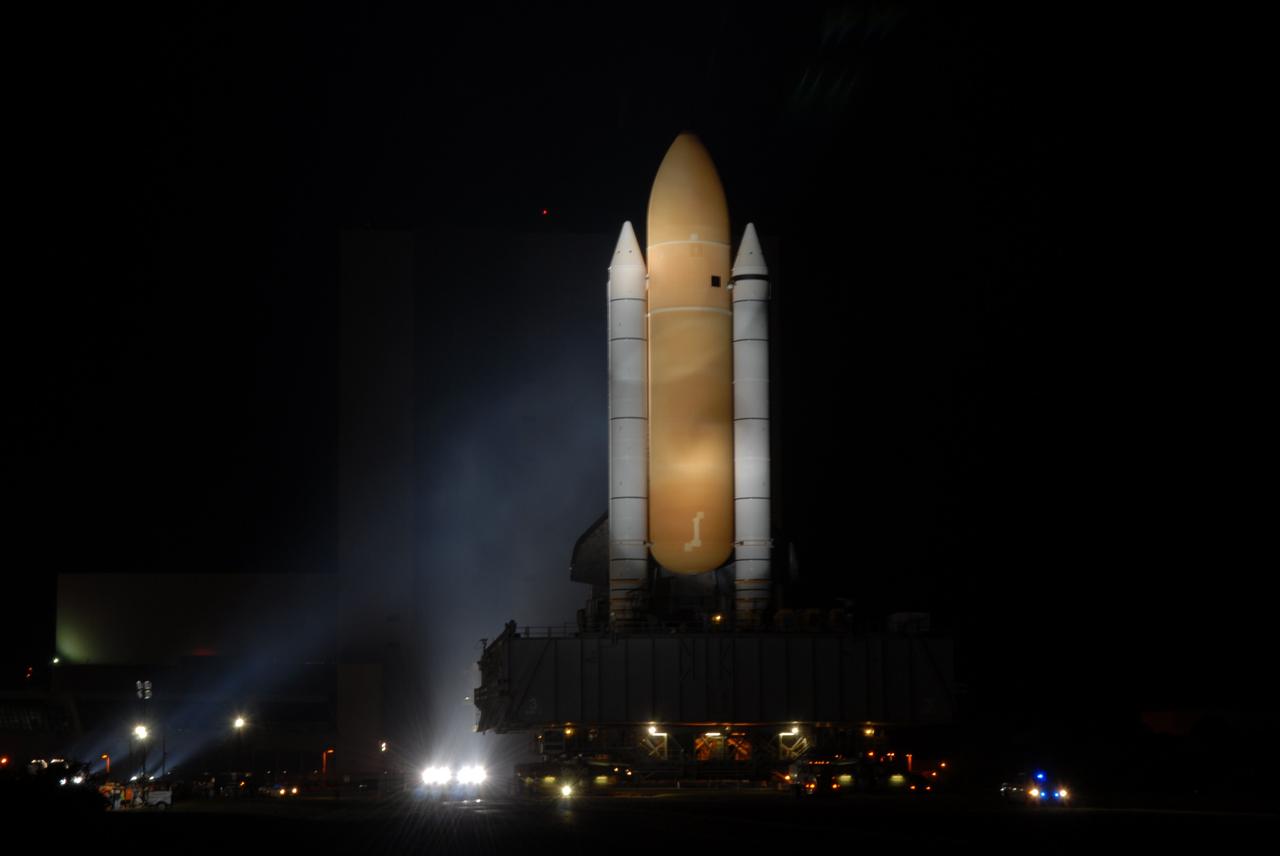
CAPE CANAVERAL, Fla. -- Bathed in bright xenon lights, space shuttle Discovery makes its nighttime trek, known as "rollout," from the Vehicle Assembly Building to Launch Pad 39A at NASA's Kennedy Space Center in Florida. It will take the shuttle, attached to its external fuel tank, twin solid rocket boosters and mobile launcher platform, about six hours to complete the move atop a crawler-transporter. Rollout sets the stage for Discovery's STS-133 crew to practice countdown and launch procedures during the Terminal Countdown Demonstration Test in mid-October. Targeted to liftoff Nov. 1, Discovery will take the Permanent Multipurpose Module (PMM) packed with supplies and critical spare parts, as well as Robonaut 2 (R2) to the International Space Station. Photo credit: NASA/Jim Grossmann
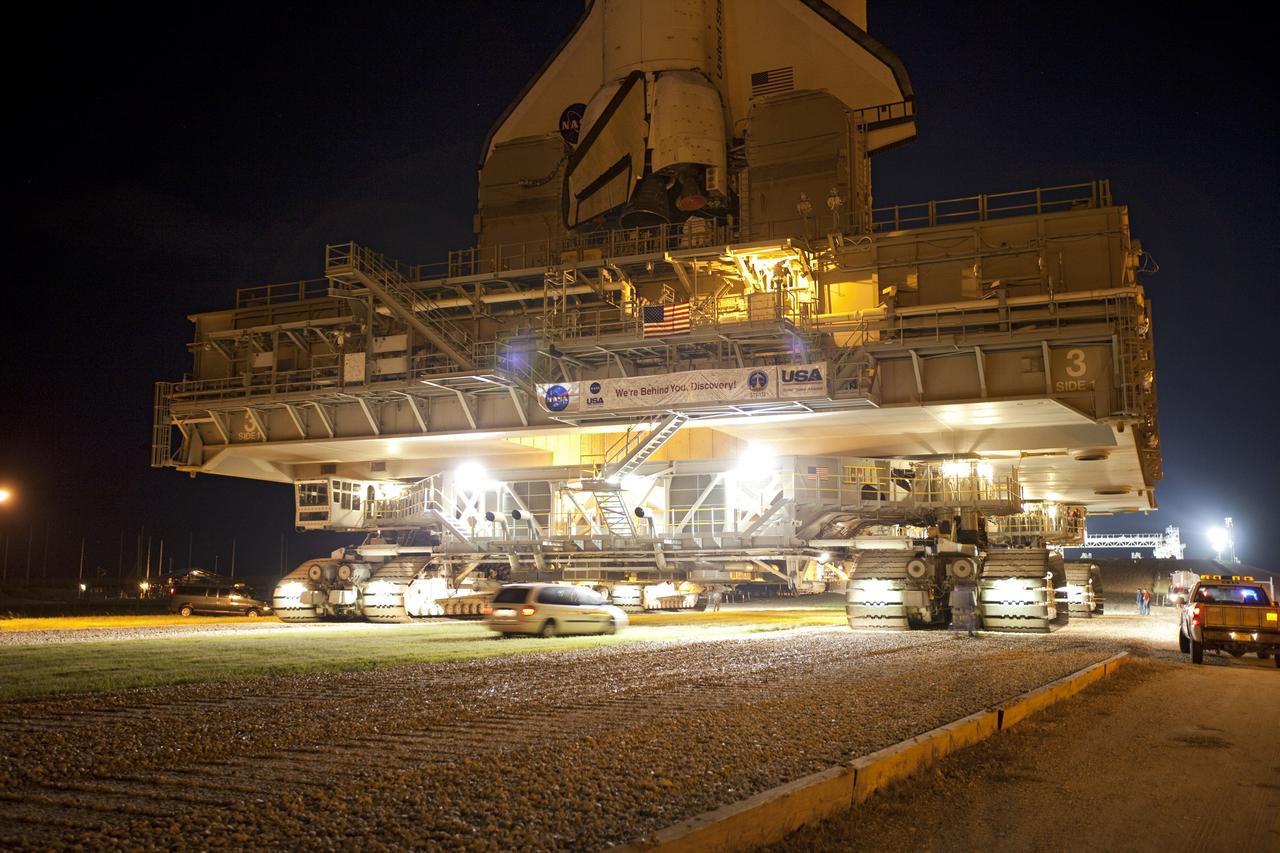
CAPE CANAVERAL, Fla. -- At NASA's Kennedy Space Center in Florida, space shuttle Discovery makes the last leg of its journey, known as "rollout," from the Vehicle Assembly Building to Launch Pad 39A. It took the shuttle, attached to its external fuel tank, twin solid rocket boosters and mobile launcher platform, about six hours to complete the move atop a crawler-transporter. Rollout sets the stage for Discovery's STS-133 crew to practice countdown and launch procedures during the Terminal Countdown Demonstration Test in mid-October. Targeted to liftoff Nov. 1, Discovery will take the Permanent Multipurpose Module (PMM) packed with supplies and critical spare parts, as well as Robonaut 2 (R2) to the International Space Station. Photo credit: NASA/Frankie Martin
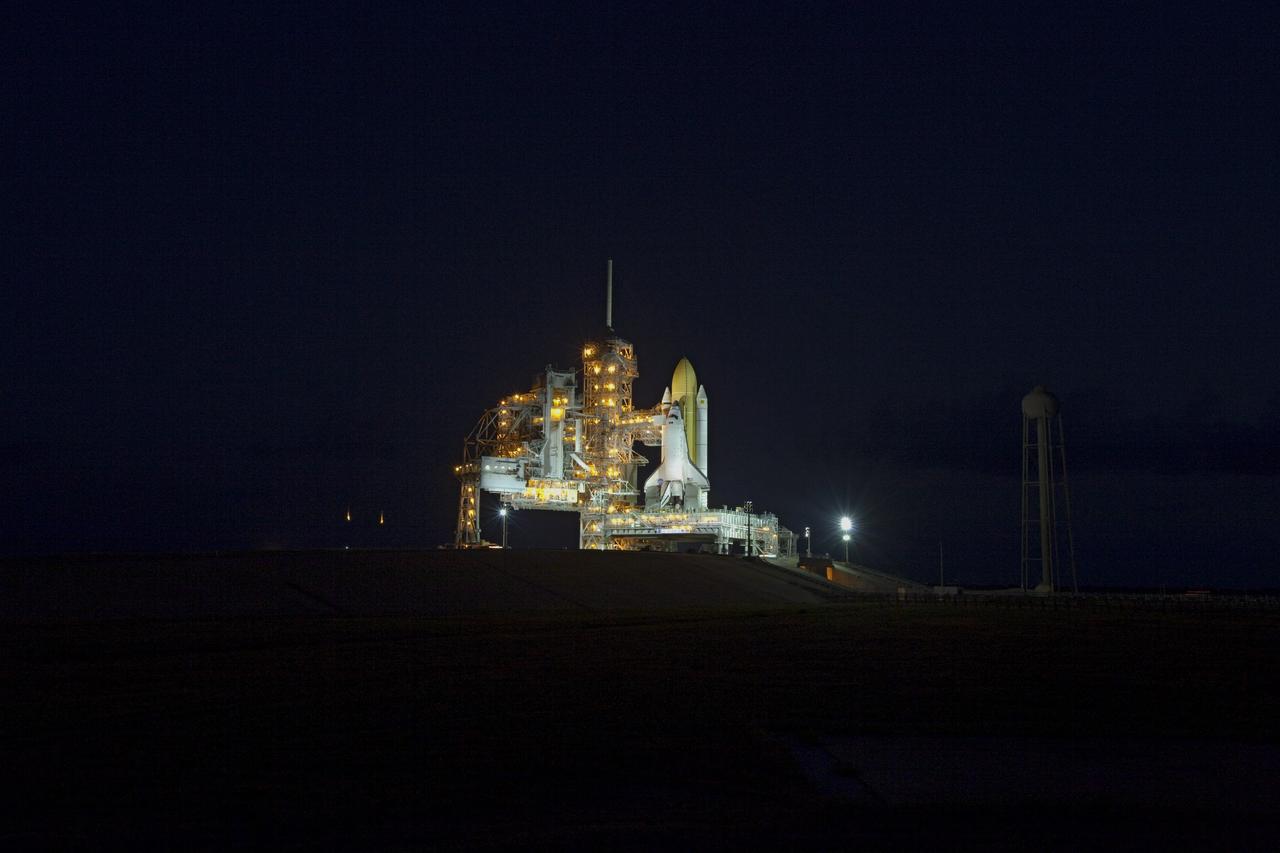
CAPE CANAVERAL, Fla. -- Just after sunset, space shuttle Discovery is attached to Launch Pad 39A at NASA's Kennedy Space Center in Florida. Meanwhile, workers prepare to move the rotating service structure, which protects the shuttle from the elements and provides access inside, into place. It took the spacecraft about six hours to make the journey, known as "rollout," from the Vehicle Assembly Building to the pad. Rollout sets the stage for Discovery's STS-133 crew to practice countdown and launch procedures during the Terminal Countdown Demonstration Test in mid-October. Targeted to liftoff Nov. 1, Discovery will take the Permanent Multipurpose Module (PMM) packed with supplies and critical spare parts, as well as Robonaut 2 (R2) to the International Space Station. Photo credit: NASA/Frankie Martin
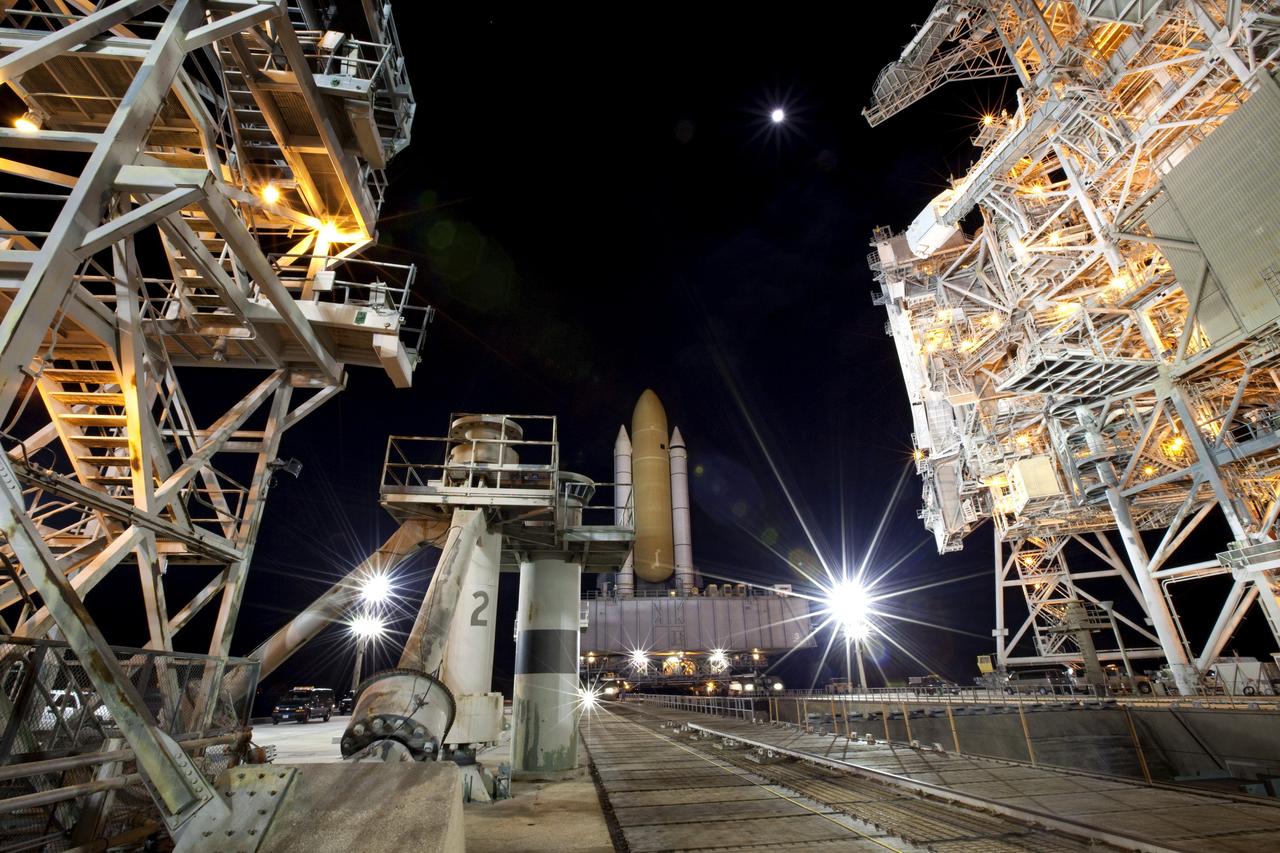
CAPE CANAVERAL, Fla. -- At NASA's Kennedy Space Center in Florida, space shuttle Discovery makes the last leg of its journey, known as "rollout," from the Vehicle Assembly Building to Launch Pad 39A. It took the shuttle, attached to its external fuel tank, twin solid rocket boosters and mobile launcher platform, about six hours to complete the move atop a crawler-transporter. Rollout sets the stage for Discovery's STS-133 crew to practice countdown and launch procedures during the Terminal Countdown Demonstration Test in mid-October. Targeted to liftoff Nov. 1, Discovery will take the Permanent Multipurpose Module (PMM) packed with supplies and critical spare parts, as well as Robonaut 2 (R2) to the International Space Station. Photo credit: NASA/Frankie Martin
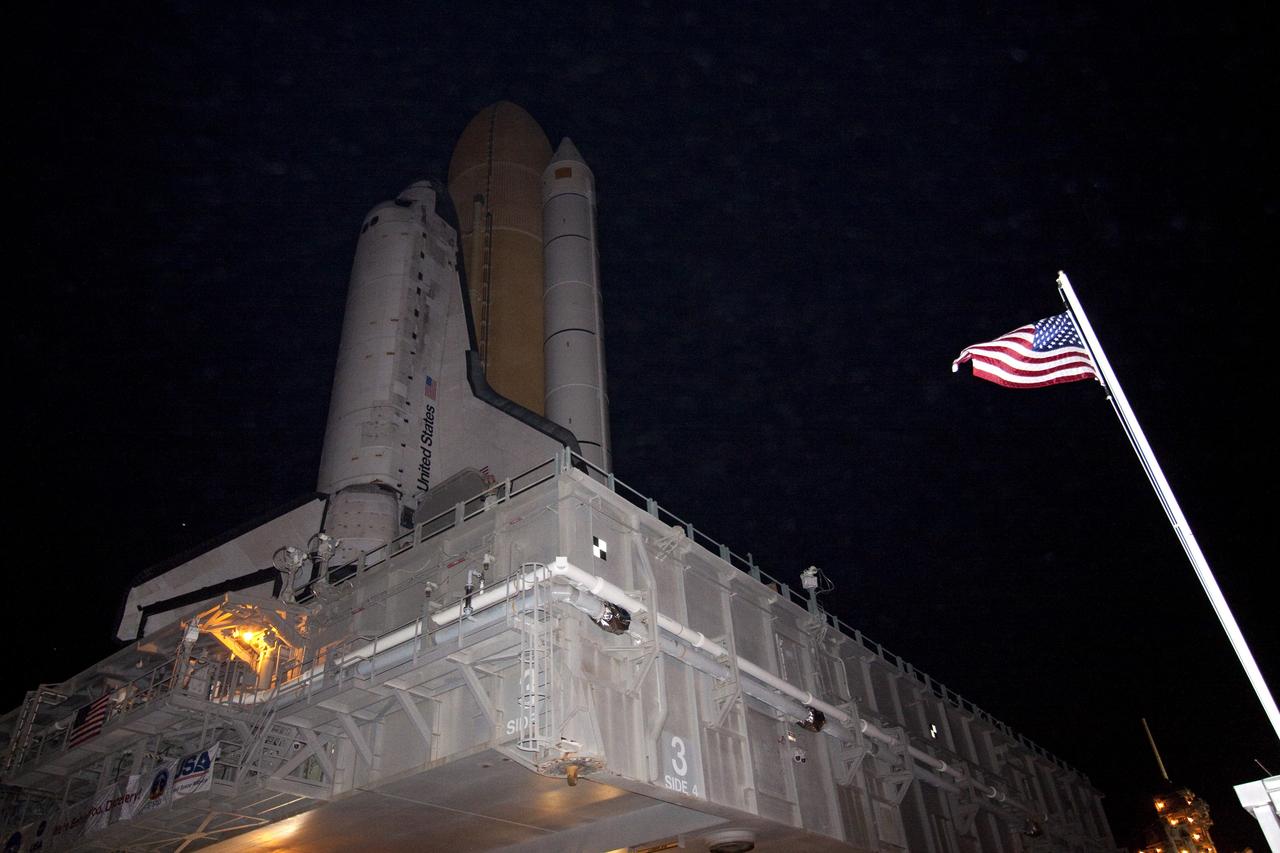
CAPE CANAVERAL, Fla. -- At NASA's Kennedy Space Center in Florida, the American flag is illuminated next to space shuttle Discovery as the spacecraft makes the last leg of its journey, known as "rollout," from the Vehicle Assembly Building to Launch Pad 39A. It took the shuttle, attached to its external fuel tank, twin solid rocket boosters and mobile launcher platform, about six hours to complete the move atop a crawler-transporter. Rollout sets the stage for Discovery's STS-133 crew to practice countdown and launch procedures during the Terminal Countdown Demonstration Test in mid-October. Targeted to liftoff Nov. 1, Discovery will take the Permanent Multipurpose Module (PMM) packed with supplies and critical spare parts, as well as Robonaut 2 (R2) to the International Space Station. Photo credit: NASA/Jack Pfaller

CAPE CANAVERAL, Fla. -- At NASA's Kennedy Space Center in Florida, space shuttle Discovery begins its nighttime trek, known as "rollout," from the Vehicle Assembly Building to Launch Pad 39A. It will take the shuttle, attached to its external fuel tank, twin solid rocket boosters and mobile launcher platform, about six hours to complete the move atop a crawler-transporter. Rollout sets the stage for Discovery's STS-133 crew to practice countdown and launch procedures during the Terminal Countdown Demonstration Test in mid-October. Targeted to liftoff Nov. 1, Discovery will take the Permanent Multipurpose Module (PMM) packed with supplies and critical spare parts, as well as Robonaut 2 (R2) to the International Space Station. Photo credit: NASA/Jack Pfaller
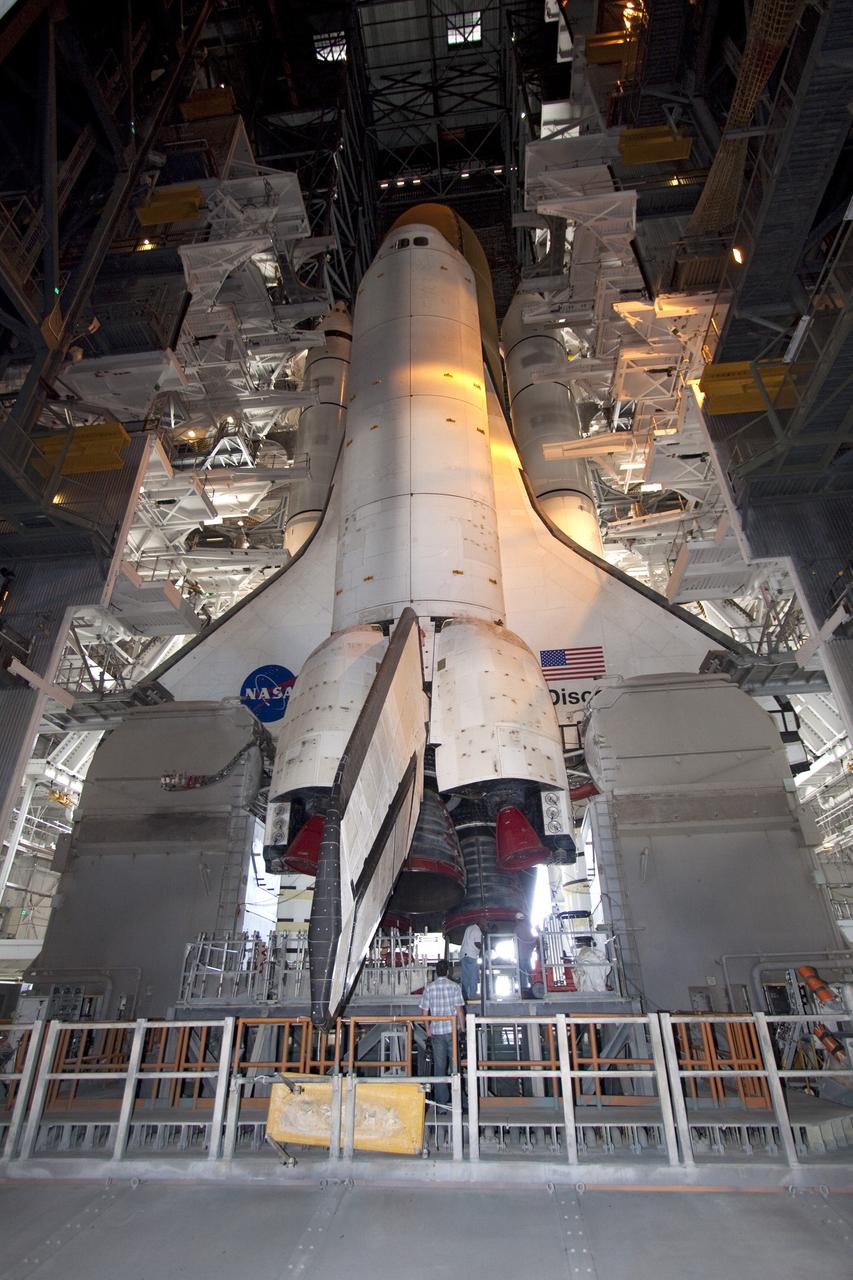
CAPE CANAVERAL, Fla. -- At NASA's Kennedy Space Center in Florida, space shuttle Discovery is ready for its nighttime trek, known as "rollout," from the Vehicle Assembly Building to Launch Pad 39A. It will take the shuttle, attached to its external fuel tank, twin solid rocket boosters and mobile launcher platform, about six hours to complete the move atop a crawler-transporter. Rollout sets the stage for Discovery's STS-133 crew to practice countdown and launch procedures during the Terminal Countdown Demonstration Test in mid-October. Targeted to liftoff Nov. 1, Discovery will take the Permanent Multipurpose Module (PMM) packed with supplies and critical spare parts, as well as Robonaut 2 (R2) to the International Space Station. Photo credit: NASA/Jack Pfaller
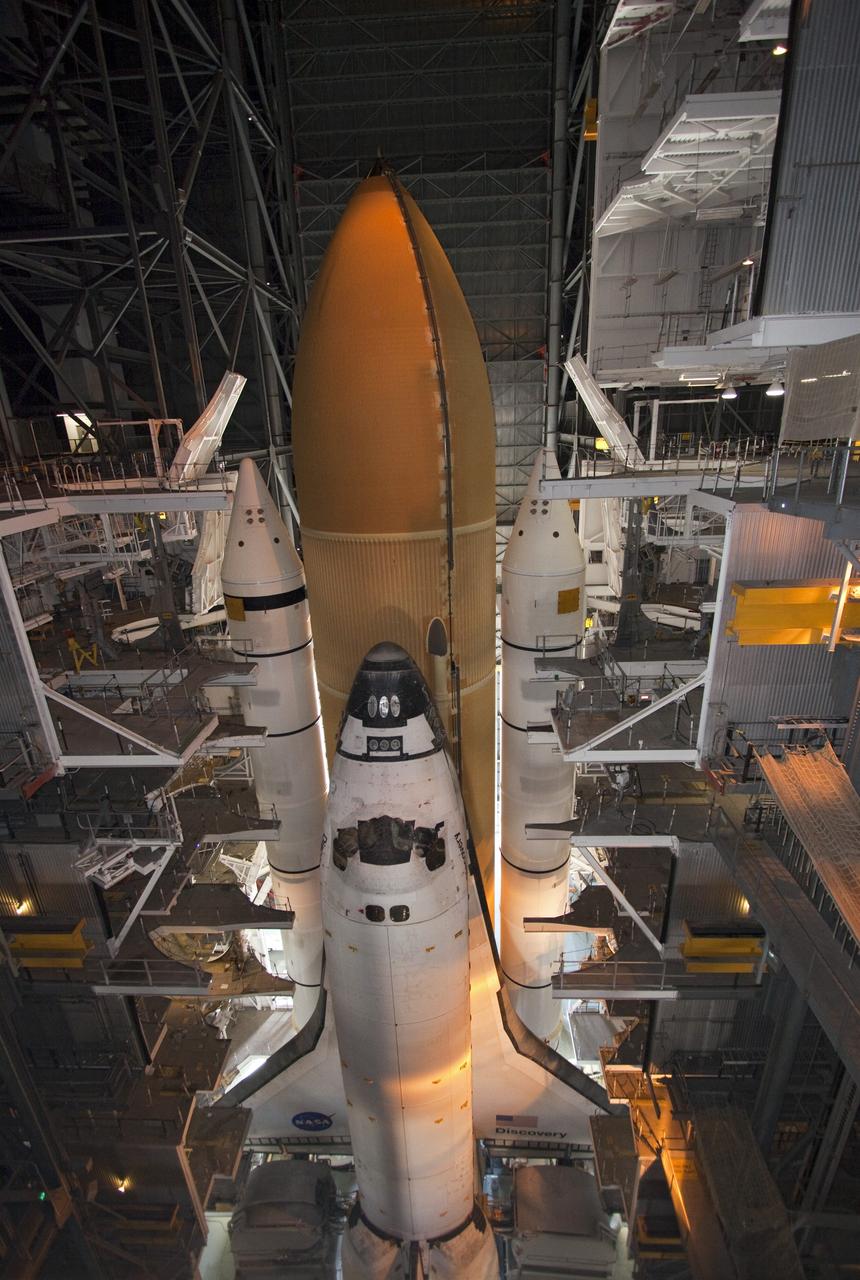
CAPE CANAVERAL, Fla. -- At NASA's Kennedy Space Center in Florida, space shuttle Discovery is ready for its nighttime trek, known as "rollout," from the Vehicle Assembly Building to Launch Pad 39A. It will take the shuttle, attached to its external fuel tank, twin solid rocket boosters and mobile launcher platform, about six hours to complete the move atop a crawler-transporter. Rollout sets the stage for Discovery's STS-133 crew to practice countdown and launch procedures during the Terminal Countdown Demonstration Test in mid-October. Targeted to liftoff Nov. 1, Discovery will take the Permanent Multipurpose Module (PMM) packed with supplies and critical spare parts, as well as Robonaut 2 (R2) to the International Space Station. Photo credit: NASA/Jack Pfaller
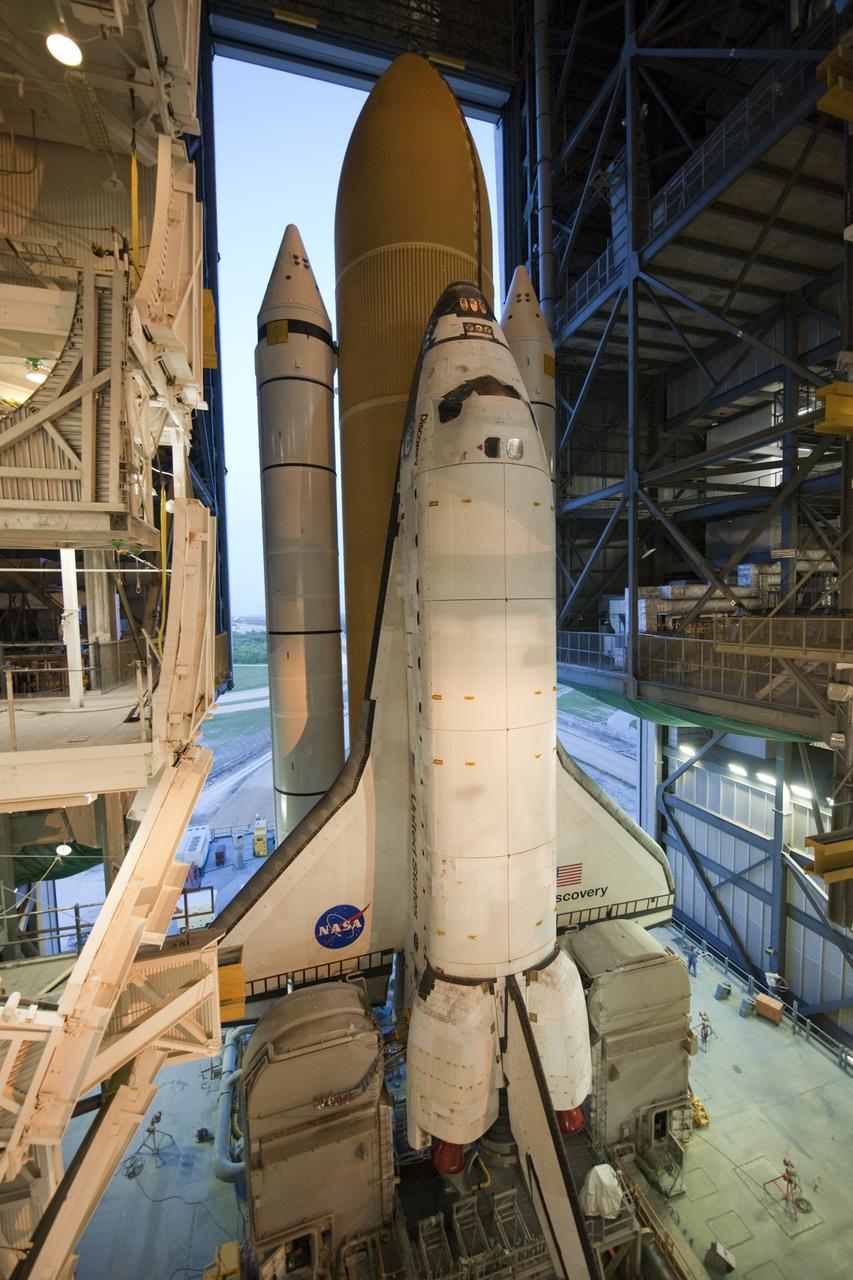
CAPE CANAVERAL, Fla. -- At NASA's Kennedy Space Center in Florida, space shuttle Discovery begins its nighttime trek, known as "rollout," from the Vehicle Assembly Building to Launch Pad 39A. It will take the shuttle, attached to its external fuel tank, twin solid rocket boosters and mobile launcher platform, about six hours to complete the move atop a crawler-transporter. Rollout sets the stage for Discovery's STS-133 crew to practice countdown and launch procedures during the Terminal Countdown Demonstration Test in mid-October. Targeted to liftoff Nov. 1, Discovery will take the Permanent Multipurpose Module (PMM) packed with supplies and critical spare parts, as well as Robonaut 2 (R2) to the International Space Station. Photo credit: NASA/Tony Gray
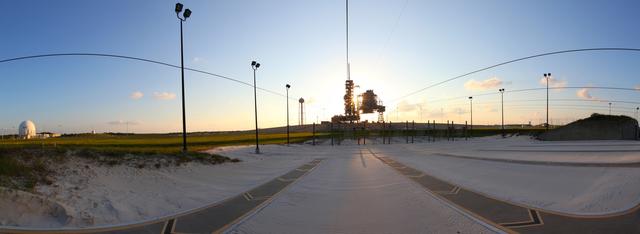
CAPE CANAVERAL, Fla. -- Space shuttle Discovery is attached to Launch Pad 39A as the sun rises over NASA's Kennedy Space Center in Florida. Later, the rotating service structure that protects the shuttle from the elements and provides access inside the vehicle will be moved into place. It took the spacecraft about six hours to make the journey, known as "rollout," from the Vehicle Assembly Building to the pad. Rollout sets the stage for Discovery's STS-133 crew to practice countdown and launch procedures during the Terminal Countdown Demonstration Test in mid-October. Targeted to liftoff Nov. 1, Discovery will take the Permanent Multipurpose Module (PMM) packed with supplies and critical spare parts, as well as Robonaut 2 (R2) to the International Space Station. Photo credit: NASA/Frankie Martin
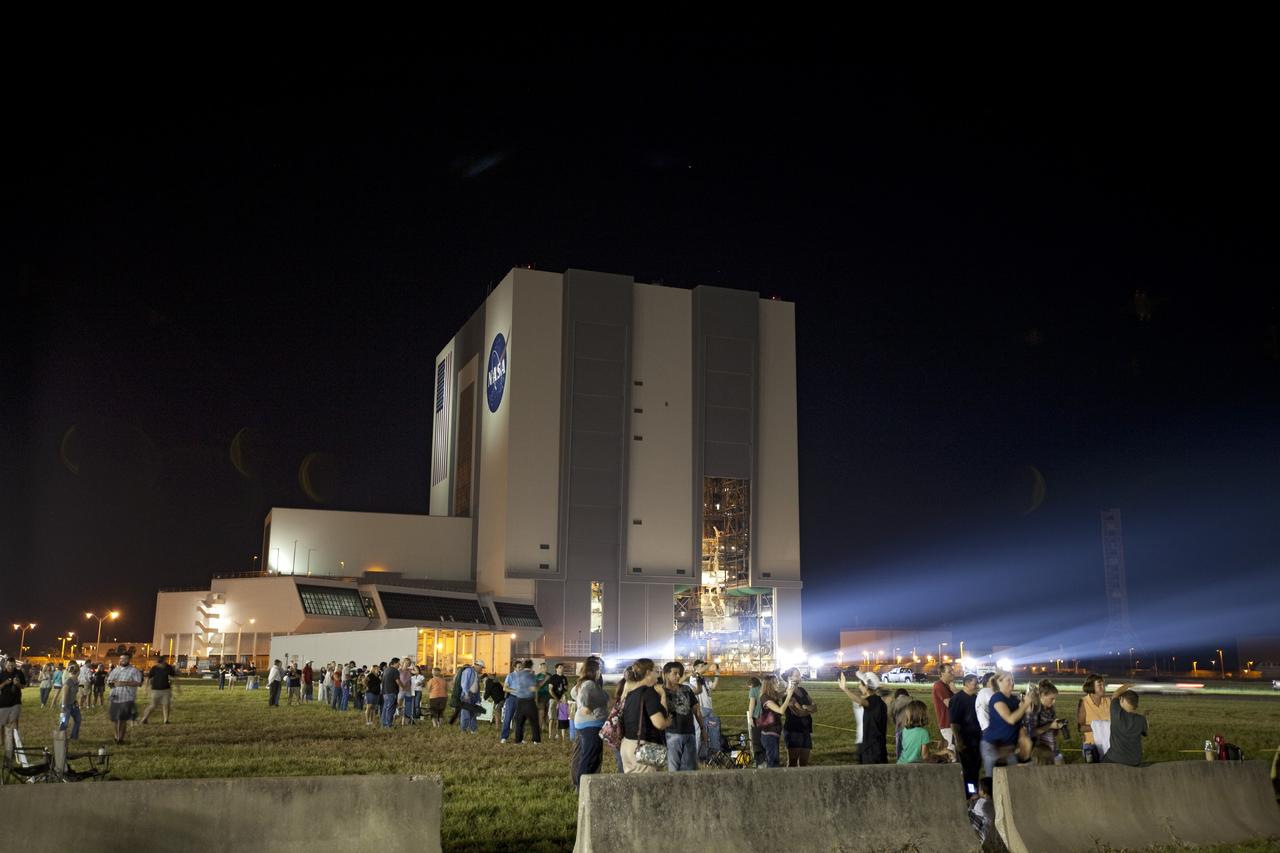
CAPE CANAVERAL, Fla. -- At NASA's Kennedy Space Center in Florida, workers and their friends and families watch as space shuttle Discovery begins its nighttime trek, known as "rollout," from the Vehicle Assembly Building to Launch Pad 39A. It will take the shuttle, attached to its external fuel tank, twin solid rocket boosters and mobile launcher platform, about six hours to complete the move atop a crawler-transporter. Rollout sets the stage for Discovery's STS-133 crew to practice countdown and launch procedures during the Terminal Countdown Demonstration Test in mid-October. Targeted to liftoff Nov. 1, Discovery will take the Permanent Multipurpose Module (PMM) packed with supplies and critical spare parts, as well as Robonaut 2 (R2) to the International Space Station. Photo credit: NASA/Frankie Martin

CAPE CANAVERAL, Fla. -- At NASA's Kennedy Space Center in Florida, space shuttle Discovery begins its nighttime trek, known as "rollout," from the Vehicle Assembly Building to Launch Pad 39A. It will take the shuttle, attached to its external fuel tank, twin solid rocket boosters and mobile launcher platform, about six hours to complete the move atop a crawler-transporter. Rollout sets the stage for Discovery's STS-133 crew to practice countdown and launch procedures during the Terminal Countdown Demonstration Test in mid-October. Targeted to liftoff Nov. 1, Discovery will take the Permanent Multipurpose Module (PMM) packed with supplies and critical spare parts, as well as Robonaut 2 (R2) to the International Space Station. Photo credit: NASA/Jack Pfaller
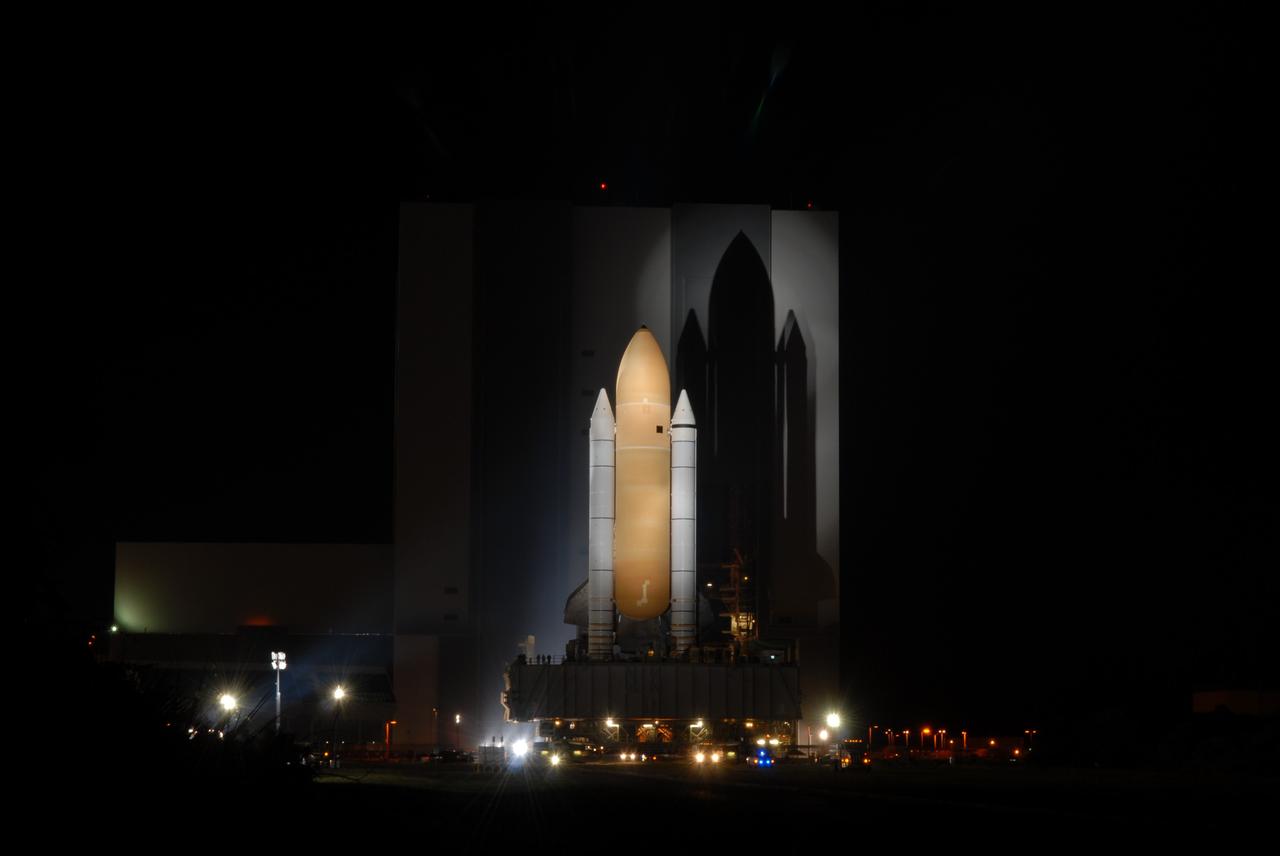
CAPE CANAVERAL, Fla. -- Bathed in bright xenon lights, space shuttle Discovery makes its nighttime trek, known as "rollout," from the Vehicle Assembly Building to Launch Pad 39A at NASA's Kennedy Space Center in Florida. It will take the shuttle, attached to its external fuel tank, twin solid rocket boosters and mobile launcher platform, about six hours to complete the move atop a crawler-transporter. Rollout sets the stage for Discovery's STS-133 crew to practice countdown and launch procedures during the Terminal Countdown Demonstration Test in mid-October. Targeted to liftoff Nov. 1, Discovery will take the Permanent Multipurpose Module (PMM) packed with supplies and critical spare parts, as well as Robonaut 2 (R2) to the International Space Station. Photo credit: NASA/Jim Grossmann
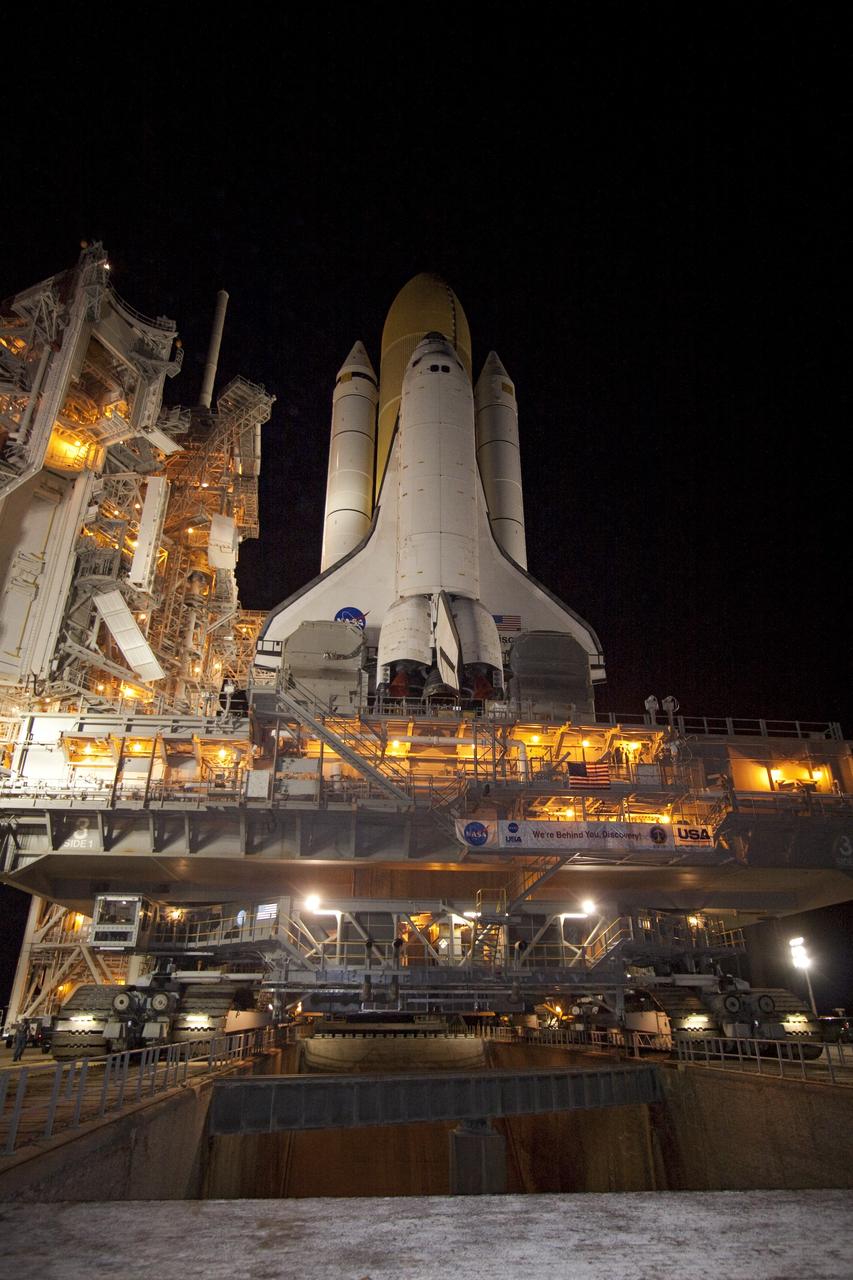
CAPE CANAVERAL, Fla. -- At NASA's Kennedy Space Center in Florida, space shuttle Discovery makes the last leg of its journey, known as "rollout," from the Vehicle Assembly Building to Launch Pad 39A. It took the shuttle, attached to its external fuel tank, twin solid rocket boosters and mobile launcher platform, about six hours to complete the move atop a crawler-transporter. Rollout sets the stage for Discovery's STS-133 crew to practice countdown and launch procedures during the Terminal Countdown Demonstration Test in mid-October. Targeted to liftoff Nov. 1, Discovery will take the Permanent Multipurpose Module (PMM) packed with supplies and critical spare parts, as well as Robonaut 2 (R2) to the International Space Station. Photo credit: NASA/Jack Pfaller

CAPE CANAVERAL, Fla. -- At NASA's Kennedy Space Center in Florida, a crawler-transporter is ready to carry space shuttle Discovery from the Vehicle Assembly Building to Launch Pad 39A in a move known as "rollout." It will take the shuttle, attached to its external fuel tank, twin solid rocket boosters and mobile launcher platform, about six hours to complete the move. Rollout sets the stage for Discovery's STS-133 crew to practice countdown and launch procedures during the Terminal Countdown Demonstration Test in mid-October. Targeted to liftoff Nov. 1, Discovery will take the Permanent Multipurpose Module (PMM) packed with supplies and critical spare parts, as well as Robonaut 2 (R2) to the International Space Station. Photo credit: NASA/Jack Pfaller
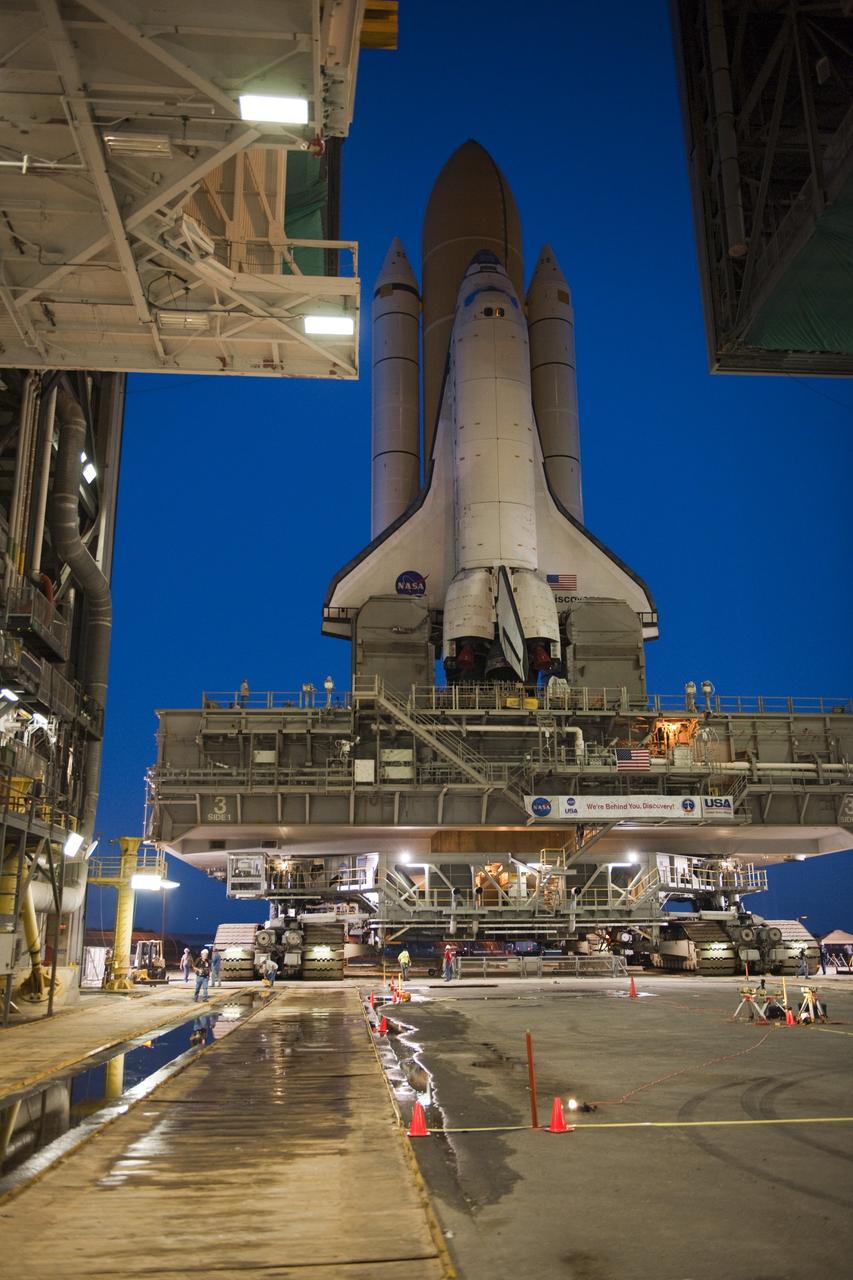
CAPE CANAVERAL, Fla. -- Space shuttle Discovery makes its nighttime trek, known as "rollout," from the Vehicle Assembly Building to Launch Pad 39A at NASA's Kennedy Space Center in Florida. It will take the shuttle, attached to its external fuel tank, twin solid rocket boosters and mobile launcher platform, about six hours to complete the move atop a crawler-transporter. Rollout sets the stage for Discovery's STS-133 crew to practice countdown and launch procedures during the Terminal Countdown Demonstration Test in mid-October. Targeted to liftoff Nov. 1, Discovery will take the Permanent Multipurpose Module (PMM) packed with supplies and critical spare parts, as well as Robonaut 2 (R2) to the International Space Station. Photo credit: NASA/Tony Gray
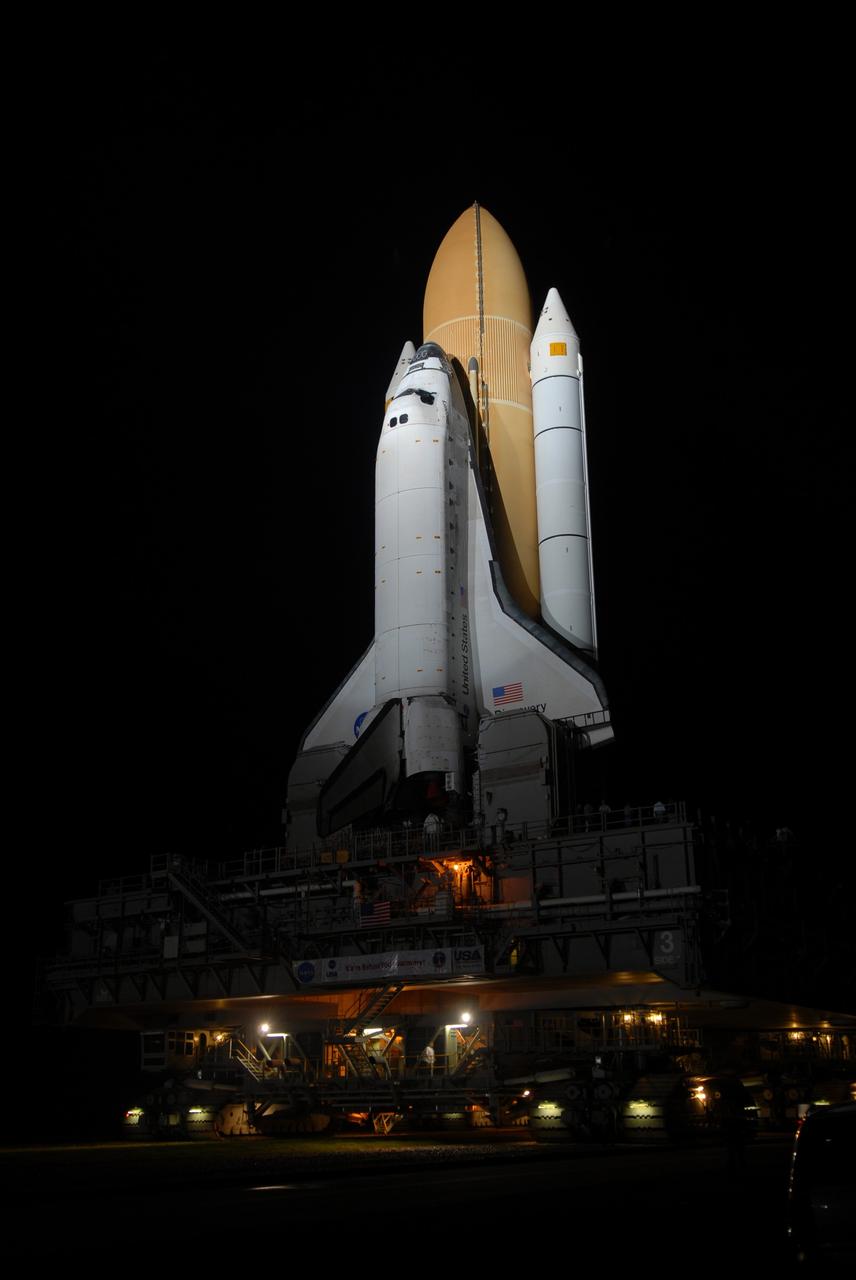
CAPE CANAVERAL, Fla. -- Bathed in bright xenon lights, space shuttle Discovery makes its nighttime trek, known as "rollout," from the Vehicle Assembly Building to Launch Pad 39A at NASA's Kennedy Space Center in Florida. It will take the shuttle, attached to its external fuel tank, twin solid rocket boosters and mobile launcher platform, about six hours to complete the move atop a crawler-transporter. Rollout sets the stage for Discovery's STS-133 crew to practice countdown and launch procedures during the Terminal Countdown Demonstration Test in mid-October. Targeted to liftoff Nov. 1, Discovery will take the Permanent Multipurpose Module (PMM) packed with supplies and critical spare parts, as well as Robonaut 2 (R2) to the International Space Station. Photo credit: NASA/Jim Grossmann
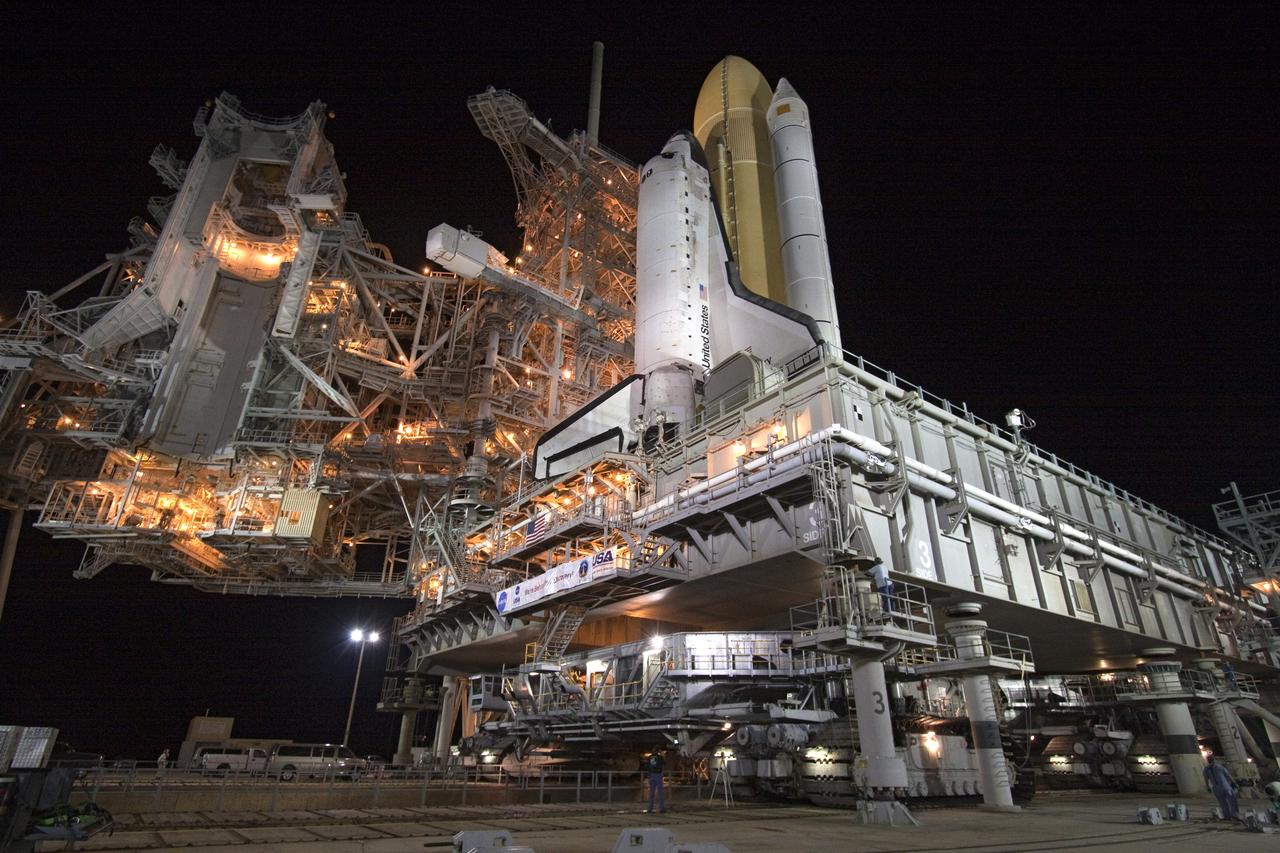
CAPE CANAVERAL, Fla. -- At NASA's Kennedy Space Center in Florida, space shuttle Discovery is attached to Launch Pad 39A, completing "rollout" from the Vehicle Assembly Building to Launch Pad 39A. It took the shuttle, attached to its external fuel tank, twin solid rocket boosters and mobile launcher platform, about six hours to complete the move atop a crawler-transporter. Rollout sets the stage for Discovery's STS-133 crew to practice countdown and launch procedures during the Terminal Countdown Demonstration Test in mid-October. Targeted to liftoff Nov. 1, Discovery will take the Permanent Multipurpose Module (PMM) packed with supplies and critical spare parts, as well as Robonaut 2 (R2) to the International Space Station. Photo credit: NASA/Jack Pfaller
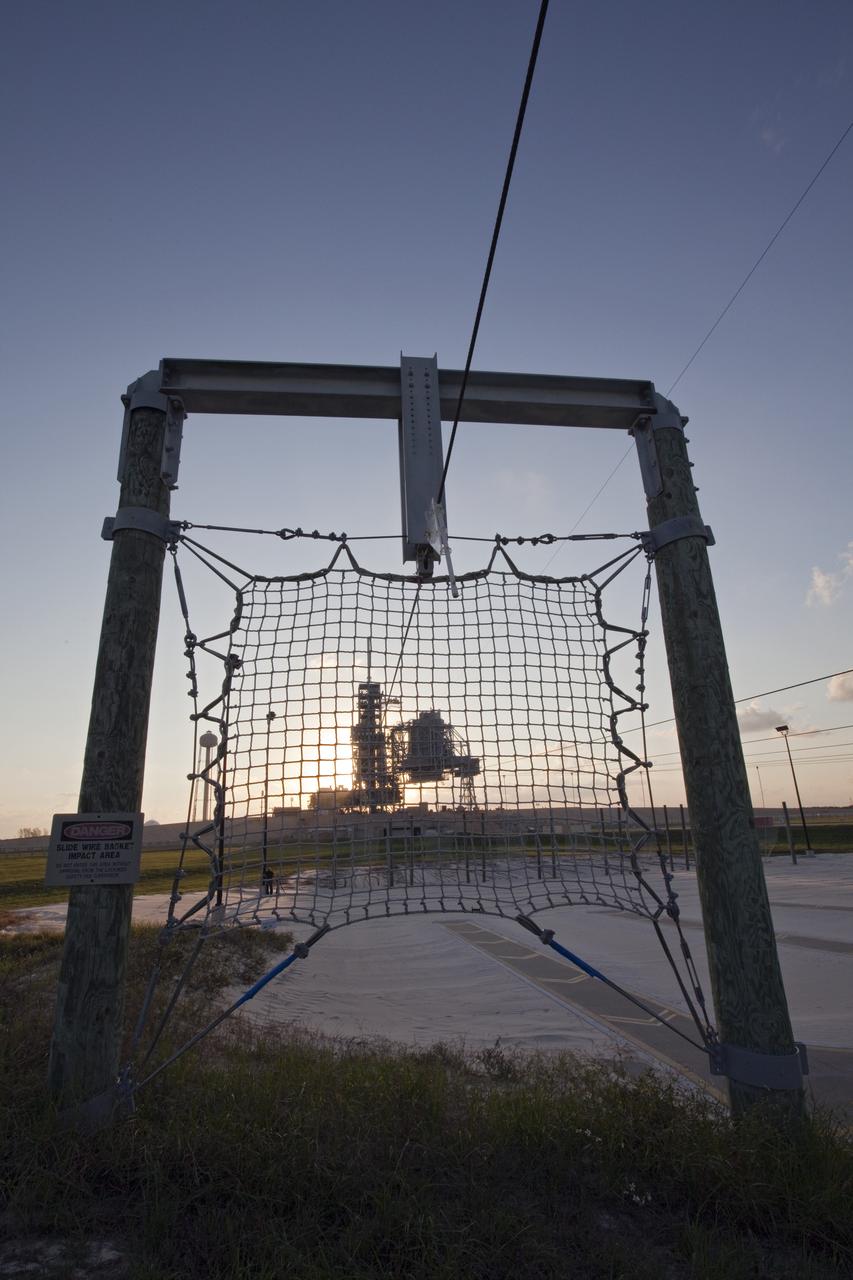
CAPE CANAVERAL, Fla. -- Launch Pad 39A, which is attached to space shuttle Discovery, is seen through a slide wire basket as the sun rises over NASA's Kennedy Space Center in Florida. Later, the rotating service structure that protects the shuttle from the elements and provides access inside the vehicle will be moved into place. It took the spacecraft about six hours to make the journey, known as "rollout," from the Vehicle Assembly Building to the pad. Rollout sets the stage for Discovery's STS-133 crew to practice countdown and launch procedures during the Terminal Countdown Demonstration Test in mid-October. Targeted to liftoff Nov. 1, Discovery will take the Permanent Multipurpose Module (PMM) packed with supplies and critical spare parts, as well as Robonaut 2 (R2) to the International Space Station. Photo credit: NASA/Frankie Martin
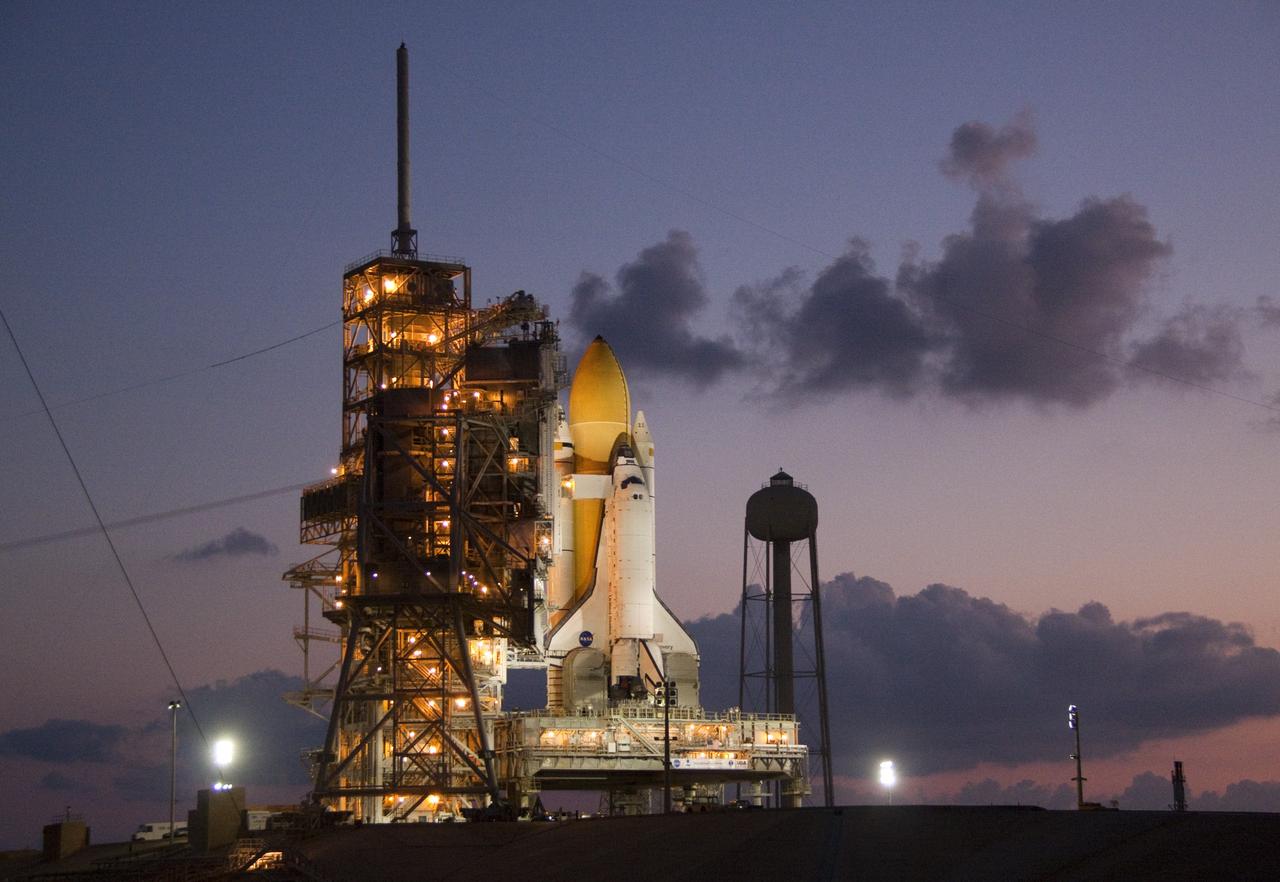
CAPE CANAVERAL, Fla. -- Space shuttle Discovery is attached to Launch Pad 39A as the sun rises over NASA's Kennedy Space Center in Florida. It took the spacecraft about six hours to make the journey, known as "rollout," from the Vehicle Assembly Building to the pad. Rollout sets the stage for Discovery's STS-133 crew to practice countdown and launch procedures during the Terminal Countdown Demonstration Test in mid-October. Targeted to liftoff Nov. 1, Discovery will take the Permanent Multipurpose Module (PMM) packed with supplies and critical spare parts, as well as Robonaut 2 (R2) to the International Space Station. Photo credit: NASA/Jack Pfaller

CAPE CANAVERAL, Fla. -- Space shuttle Discovery makes its nighttime trek, known as "rollout," from the Vehicle Assembly Building to Launch Pad 39A at NASA's Kennedy Space Center in Florida. It will take the shuttle, attached to its external fuel tank, twin solid rocket boosters and mobile launcher platform, about six hours to complete the move atop a crawler-transporter. Rollout sets the stage for Discovery's STS-133 crew to practice countdown and launch procedures during the Terminal Countdown Demonstration Test in mid-October. Targeted to liftoff Nov. 1, Discovery will take the Permanent Multipurpose Module (PMM) packed with supplies and critical spare parts, as well as Robonaut 2 (R2) to the International Space Station. Photo credit: NASA/Tony Gray
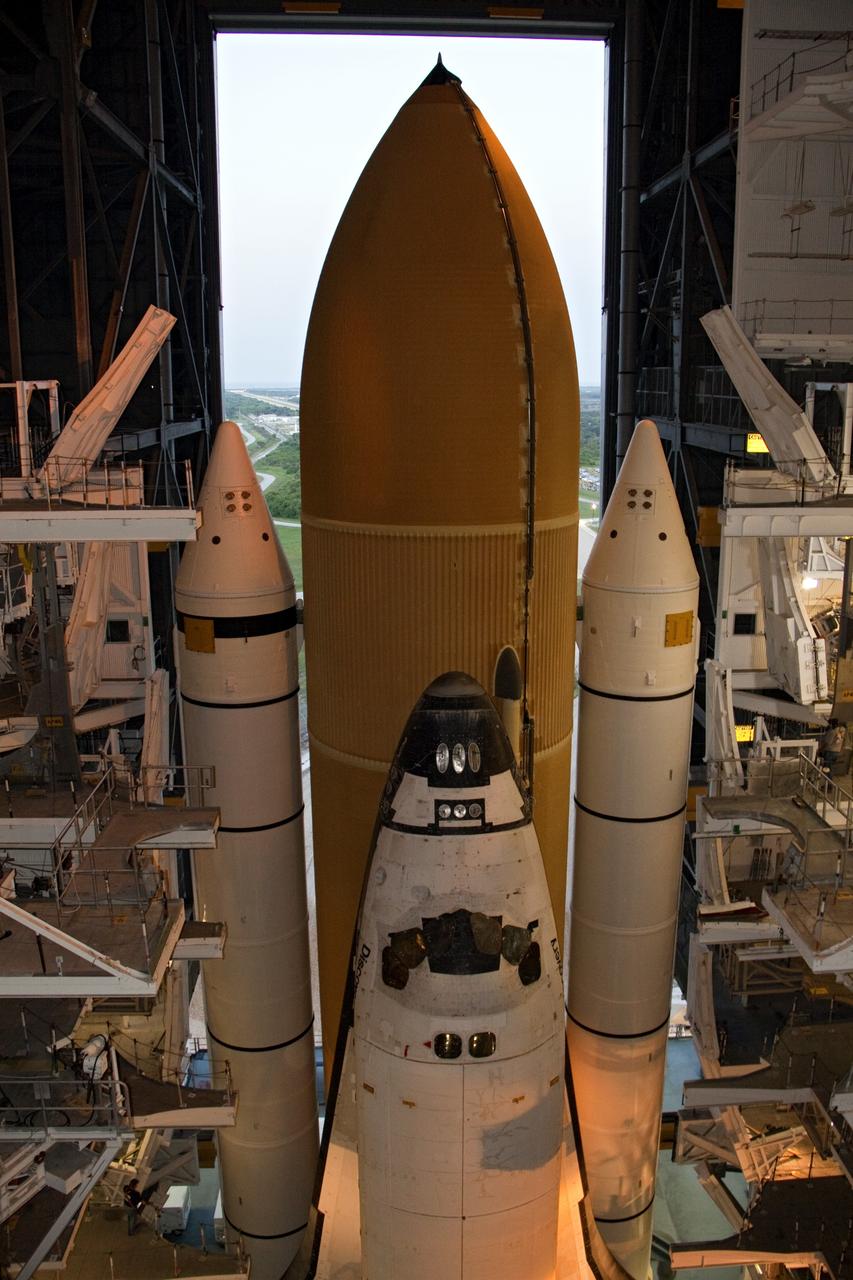
CAPE CANAVERAL, Fla. -- At NASA's Kennedy Space Center in Florida, space shuttle Discovery is ready for its nighttime trek, known as "rollout," from the Vehicle Assembly Building to Launch Pad 39A. It will take the shuttle, attached to its external fuel tank, twin solid rocket boosters and mobile launcher platform, about six hours to complete the move atop a crawler-transporter. Rollout sets the stage for Discovery's STS-133 crew to practice countdown and launch procedures during the Terminal Countdown Demonstration Test in mid-October. Targeted to liftoff Nov. 1, Discovery will take the Permanent Multipurpose Module (PMM) packed with supplies and critical spare parts, as well as Robonaut 2 (R2) to the International Space Station. Photo credit: NASA/Mic Miracle
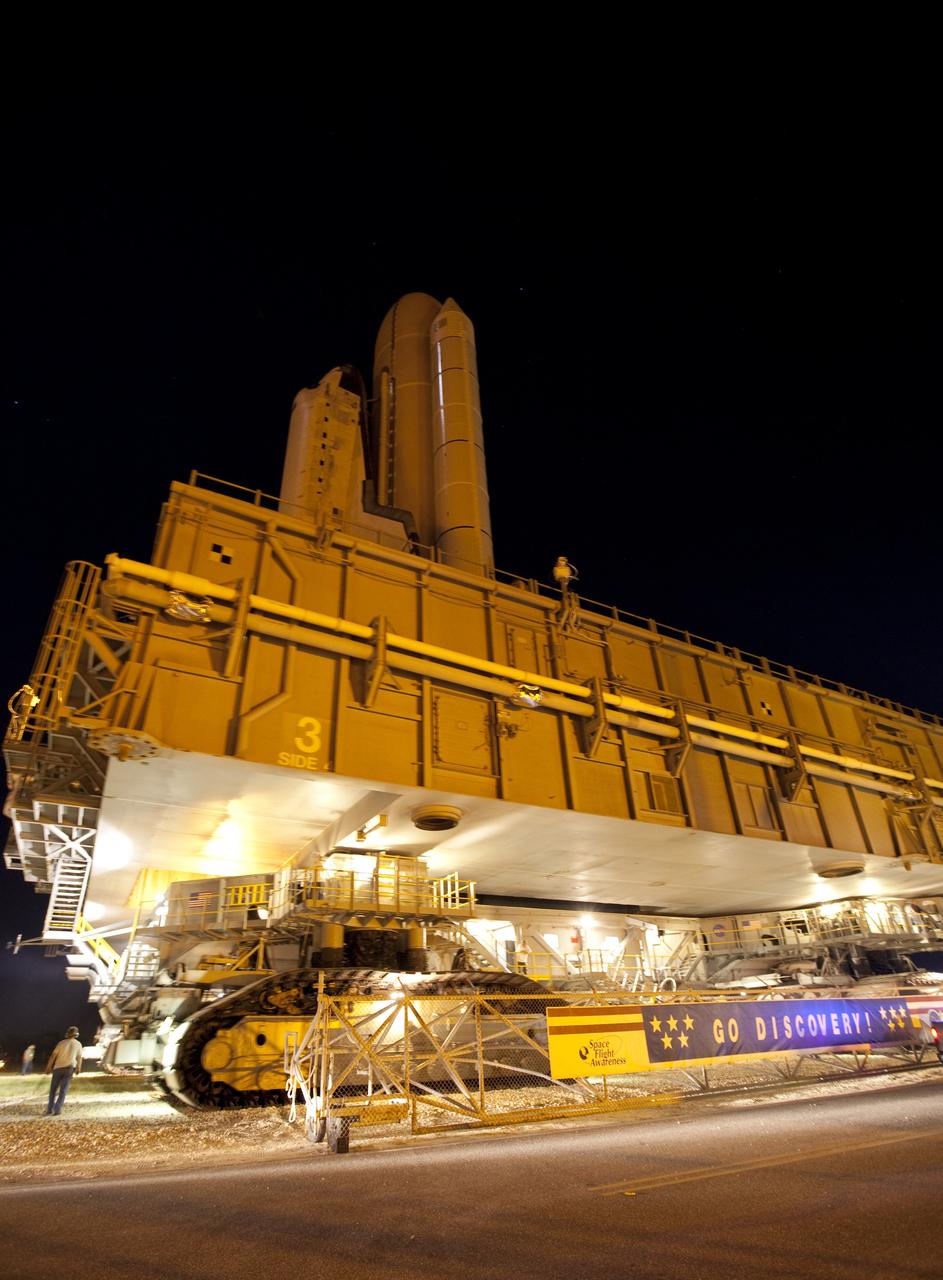
CAPE CANAVERAL, Fla. -- At NASA's Kennedy Space Center in Florida, space shuttle Discovery makes the last leg of its journey, known as "rollout," from the Vehicle Assembly Building to Launch Pad 39A. It took the shuttle, attached to its external fuel tank, twin solid rocket boosters and mobile launcher platform, about six hours to complete the move atop a crawler-transporter. Rollout sets the stage for Discovery's STS-133 crew to practice countdown and launch procedures during the Terminal Countdown Demonstration Test in mid-October. Targeted to liftoff Nov. 1, Discovery will take the Permanent Multipurpose Module (PMM) packed with supplies and critical spare parts, as well as Robonaut 2 (R2) to the International Space Station. Photo credit: NASA/Frankie Martin
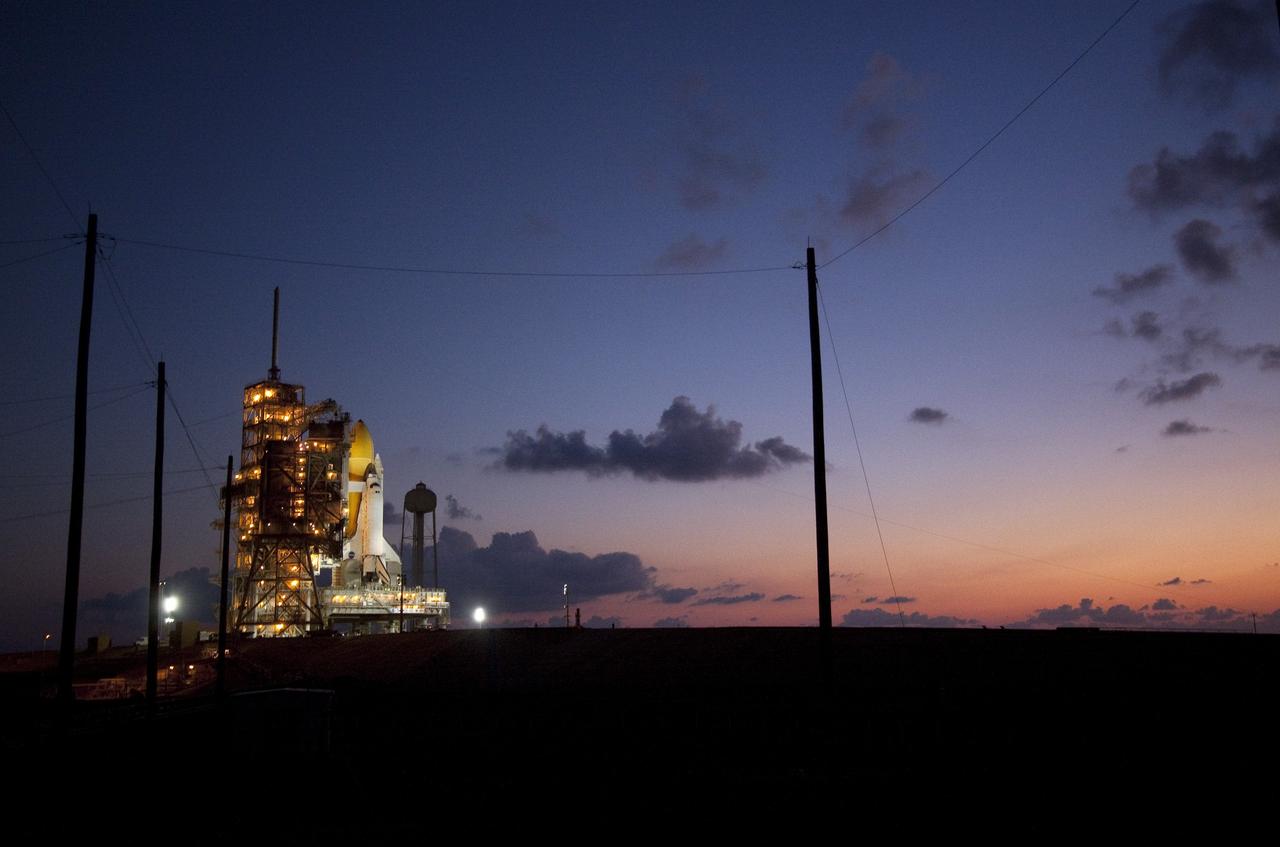
CAPE CANAVERAL, Fla. -- Space shuttle Discovery is attached to Launch Pad 39A as the sun rises over NASA's Kennedy Space Center in Florida. It took the spacecraft about six hours to make the journey, known as "rollout," from the Vehicle Assembly Building to the pad. Rollout sets the stage for Discovery's STS-133 crew to practice countdown and launch procedures during the Terminal Countdown Demonstration Test in mid-October. Targeted to liftoff Nov. 1, Discovery will take the Permanent Multipurpose Module (PMM) packed with supplies and critical spare parts, as well as Robonaut 2 (R2) to the International Space Station. Photo credit: NASA/Jack Pfaller
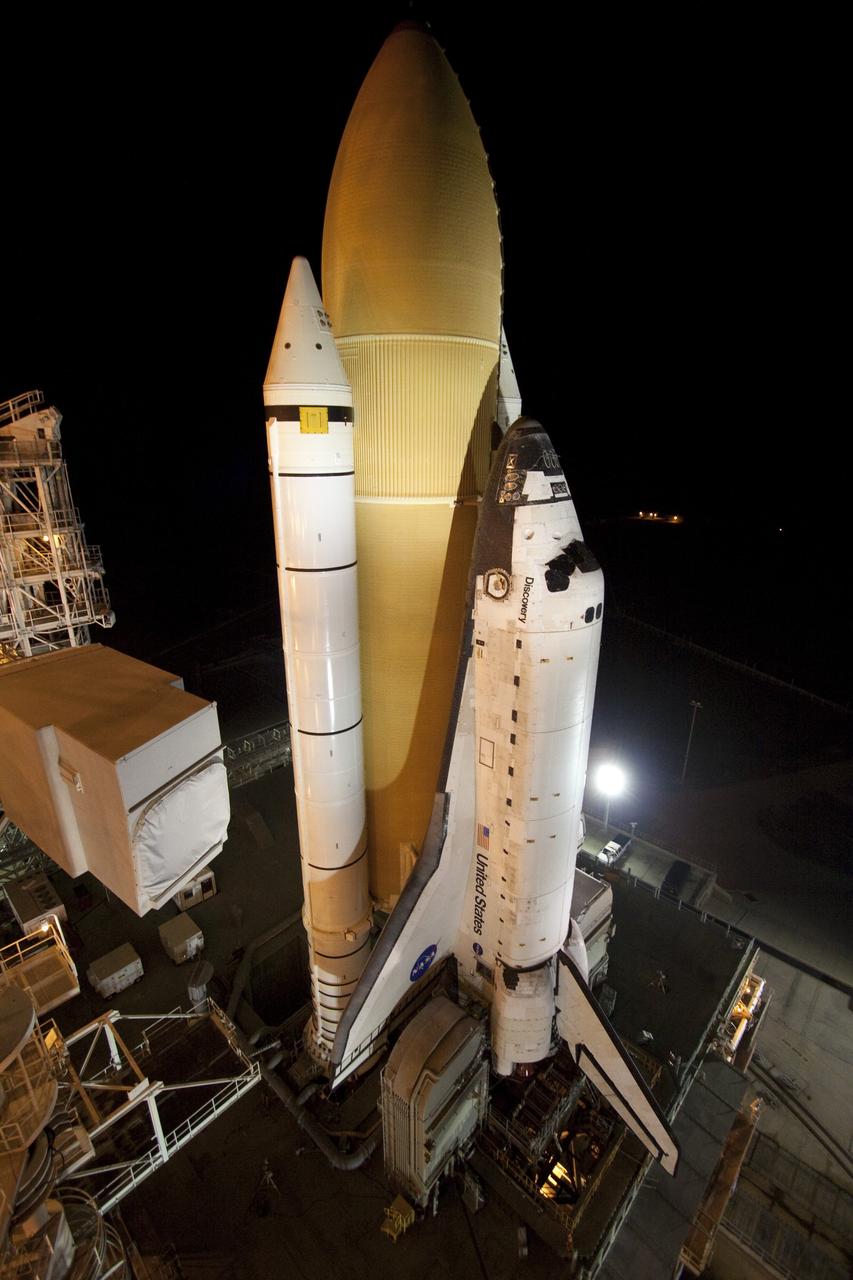
CAPE CANAVERAL, Fla. -- At NASA's Kennedy Space Center in Florida, space shuttle Discovery is attached to Launch Pad 39A, completing "rollout" from the Vehicle Assembly Building to Launch Pad 39A. It took the shuttle, attached to its external fuel tank, twin solid rocket boosters and mobile launcher platform, about six hours to complete the move atop a crawler-transporter. Rollout sets the stage for Discovery's STS-133 crew to practice countdown and launch procedures during the Terminal Countdown Demonstration Test in mid-October. Targeted to liftoff Nov. 1, Discovery will take the Permanent Multipurpose Module (PMM) packed with supplies and critical spare parts, as well as Robonaut 2 (R2) to the International Space Station. Photo credit: NASA/Jack Pfaller

CAPE CANAVERAL, Fla. -- At NASA's Kennedy Space Center in Florida, space shuttle Discovery begins its nighttime trek, known as "rollout," from the Vehicle Assembly Building to Launch Pad 39A. It will take the shuttle, attached to its external fuel tank, twin solid rocket boosters and mobile launcher platform, about six hours to complete the move atop a crawler-transporter. Rollout sets the stage for Discovery's STS-133 crew to practice countdown and launch procedures during the Terminal Countdown Demonstration Test in mid-October. Targeted to liftoff Nov. 1, Discovery will take the Permanent Multipurpose Module (PMM) packed with supplies and critical spare parts, as well as Robonaut 2 (R2) to the International Space Station. Photo credit: NASA/Jack Pfaller
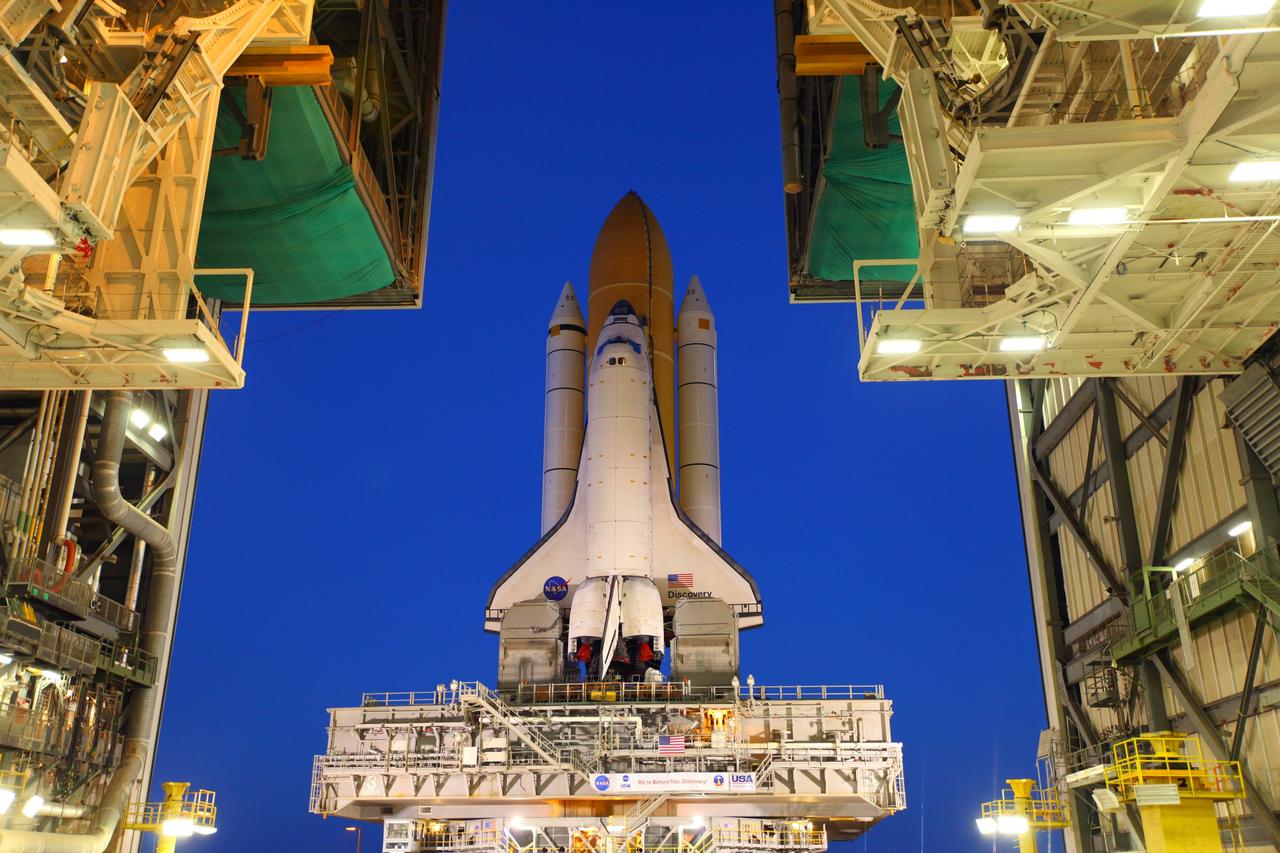
CAPE CANAVERAL, Fla. -- At NASA's Kennedy Space Center in Florida, space shuttle Discovery begins its nighttime trek, known as "rollout," from the Vehicle Assembly Building to Launch Pad 39A. It will take the shuttle, attached to its external fuel tank, twin solid rocket boosters and mobile launcher platform, about six hours to complete the move atop a crawler-transporter. Rollout sets the stage for Discovery's STS-133 crew to practice countdown and launch procedures during the Terminal Countdown Demonstration Test in mid-October. Targeted to liftoff Nov. 1, Discovery will take the Permanent Multipurpose Module (PMM) packed with supplies and critical spare parts, as well as Robonaut 2 (R2) to the International Space Station. Photo credit: NASA/Frankie Martin
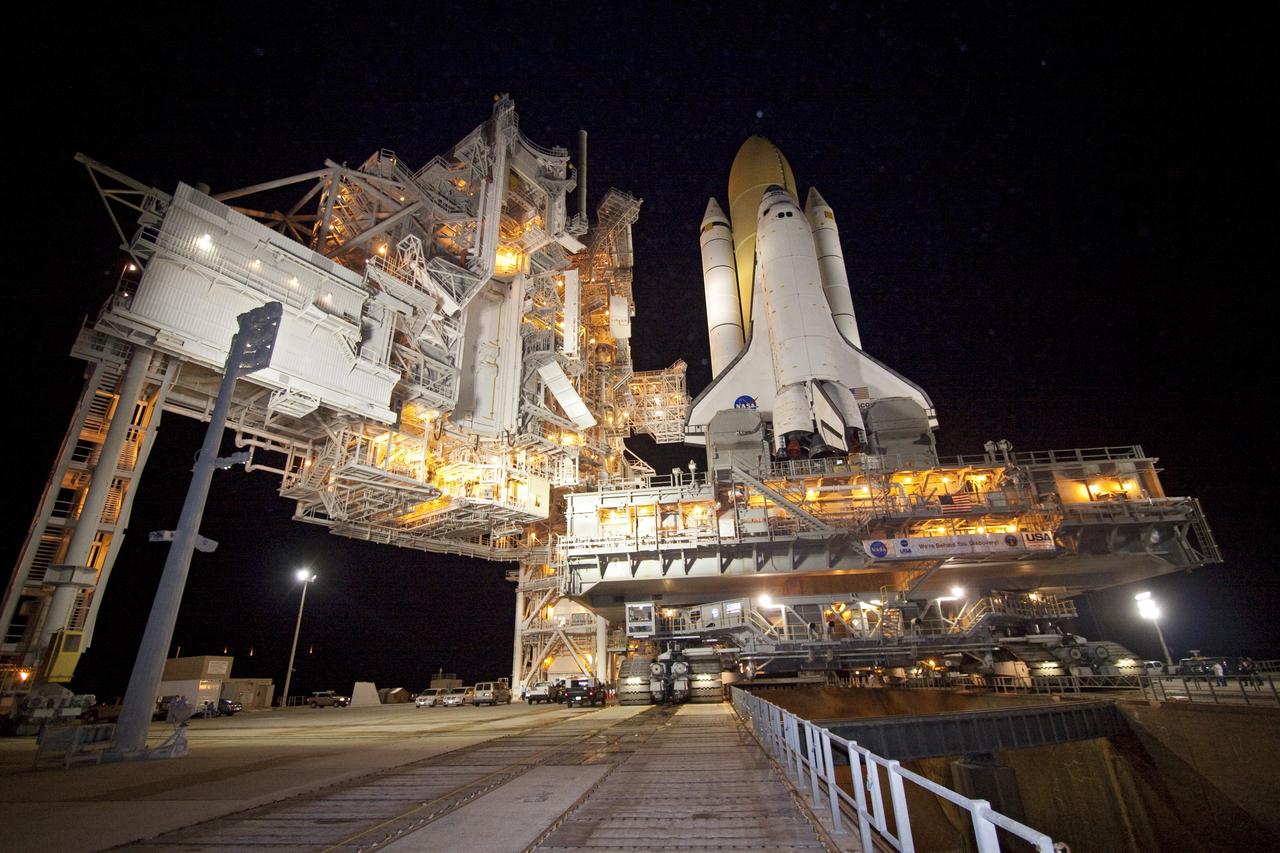
CAPE CANAVERAL, Fla. -- At NASA's Kennedy Space Center in Florida, space shuttle Discovery makes the last leg of its journey, known as "rollout," from the Vehicle Assembly Building to Launch Pad 39A. It took the shuttle, attached to its external fuel tank, twin solid rocket boosters and mobile launcher platform, about six hours to complete the move atop a crawler-transporter. Rollout sets the stage for Discovery's STS-133 crew to practice countdown and launch procedures during the Terminal Countdown Demonstration Test in mid-October. Targeted to liftoff Nov. 1, Discovery will take the Permanent Multipurpose Module (PMM) packed with supplies and critical spare parts, as well as Robonaut 2 (R2) to the International Space Station. Photo credit: NASA/Jack Pfaller
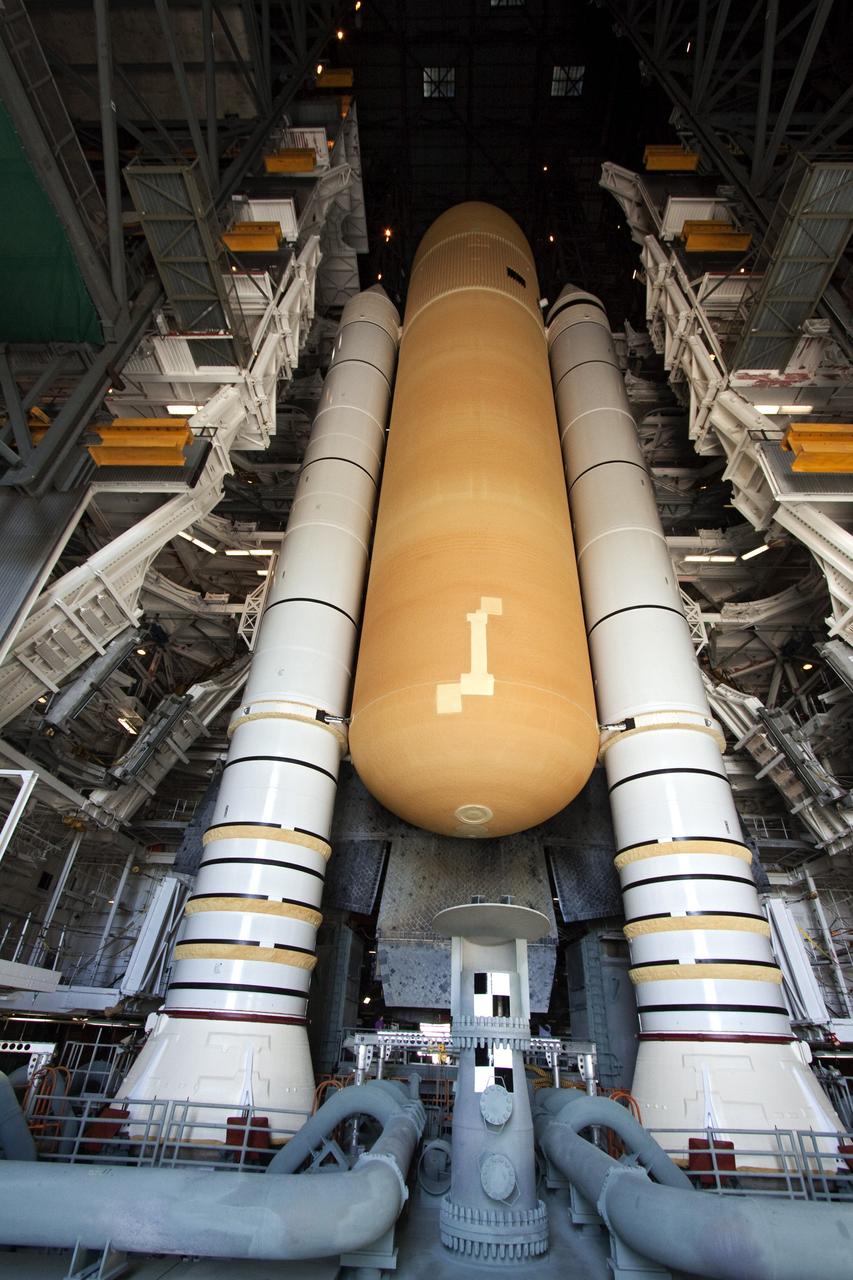
CAPE CANAVERAL, Fla. -- At NASA's Kennedy Space Center in Florida, space shuttle Discovery is ready for its nighttime trek, known as "rollout," from the Vehicle Assembly Building to Launch Pad 39A. It will take the shuttle, attached to its external fuel tank, twin solid rocket boosters and mobile launcher platform, about six hours to complete the move atop a crawler-transporter. Rollout sets the stage for Discovery's STS-133 crew to practice countdown and launch procedures during the Terminal Countdown Demonstration Test in mid-October. Targeted to liftoff Nov. 1, Discovery will take the Permanent Multipurpose Module (PMM) packed with supplies and critical spare parts, as well as Robonaut 2 (R2) to the International Space Station. Photo credit: NASA/Jack Pfaller
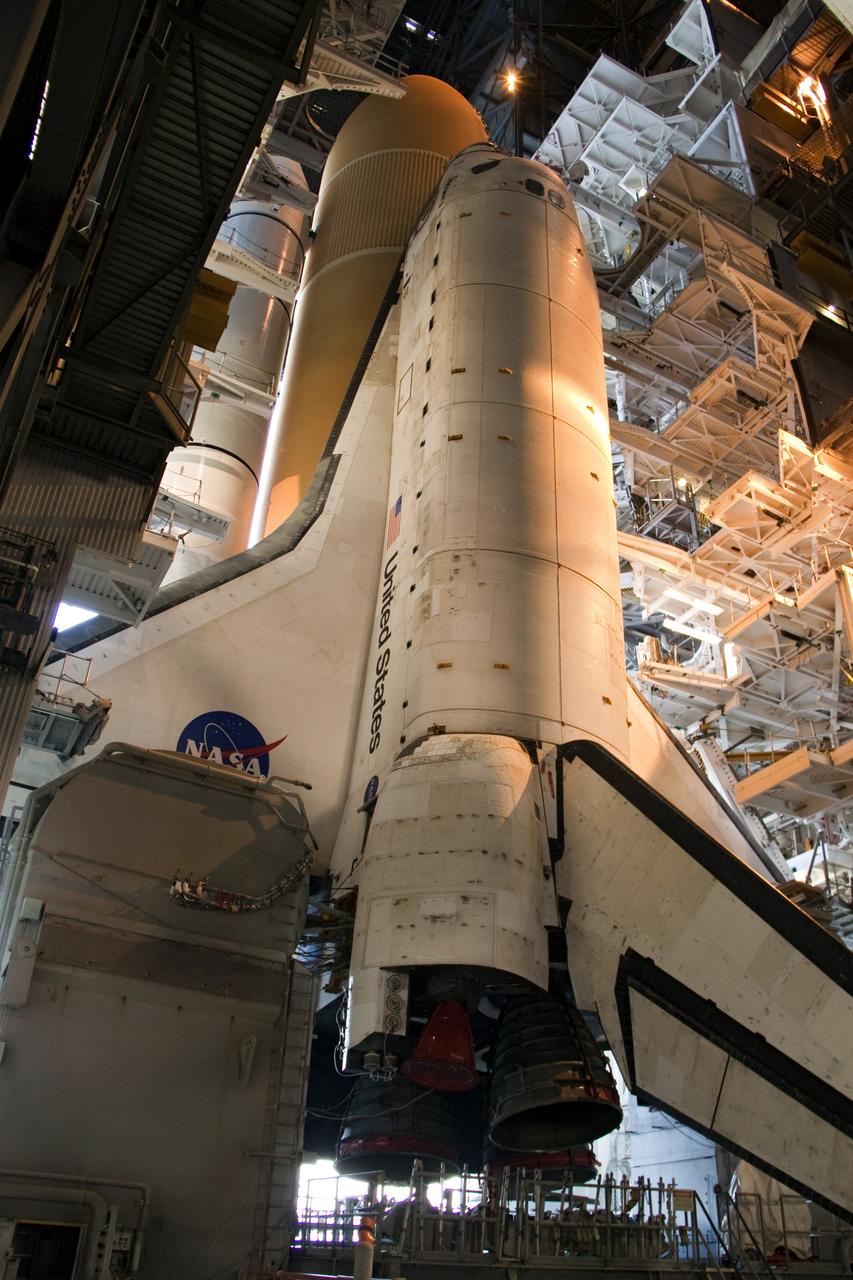
CAPE CANAVERAL, Fla. -- At NASA's Kennedy Space Center in Florida, space shuttle Discovery is prepared for its nighttime trek, known as "rollout," from the Vehicle Assembly Building to Launch Pad 39A. It will take the shuttle, attached to its external fuel tank, twin solid rocket boosters and mobile launcher platform, about six hours to complete the move atop a crawler-transporter. Rollout sets the stage for Discovery's STS-133 crew to practice countdown and launch procedures during the Terminal Countdown Demonstration Test in mid-October. Targeted to liftoff Nov. 1, Discovery will take the Permanent Multipurpose Module (PMM) packed with supplies and critical spare parts, as well as Robonaut 2 (R2) to the International Space Station. Photo credit: NASA/Mic Miracle
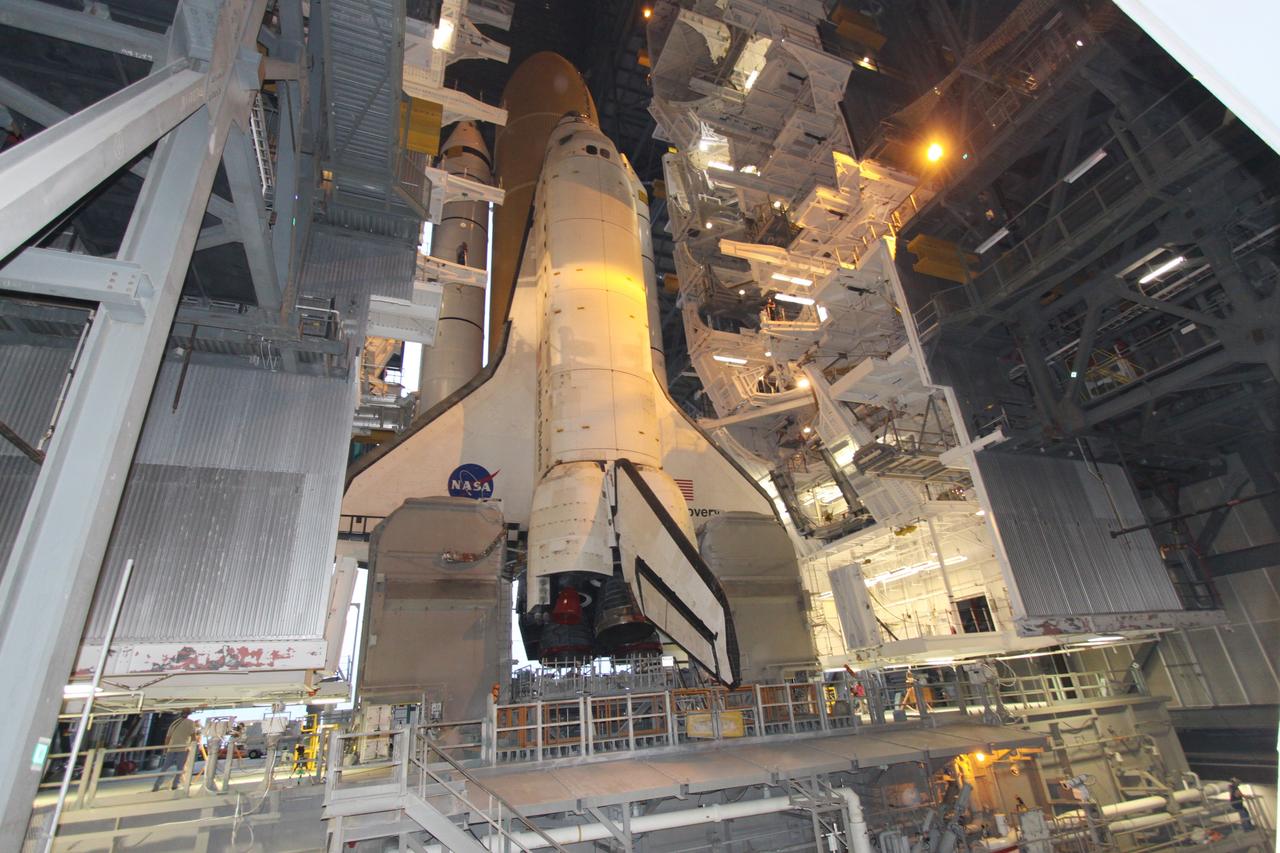
CAPE CANAVERAL, Fla. -- At NASA's Kennedy Space Center in Florida, space shuttle Discovery begins its nighttime trek, known as "rollout," from the Vehicle Assembly Building to Launch Pad 39A. It will take the shuttle, attached to its external fuel tank, twin solid rocket boosters and mobile launcher platform, about six hours to complete the move atop a crawler-transporter. Rollout sets the stage for Discovery's STS-133 crew to practice countdown and launch procedures during the Terminal Countdown Demonstration Test in mid-October. Targeted to liftoff Nov. 1, Discovery will take the Permanent Multipurpose Module (PMM) packed with supplies and critical spare parts, as well as Robonaut 2 (R2) to the International Space Station. Photo credit: NASA/Jack Pfaller
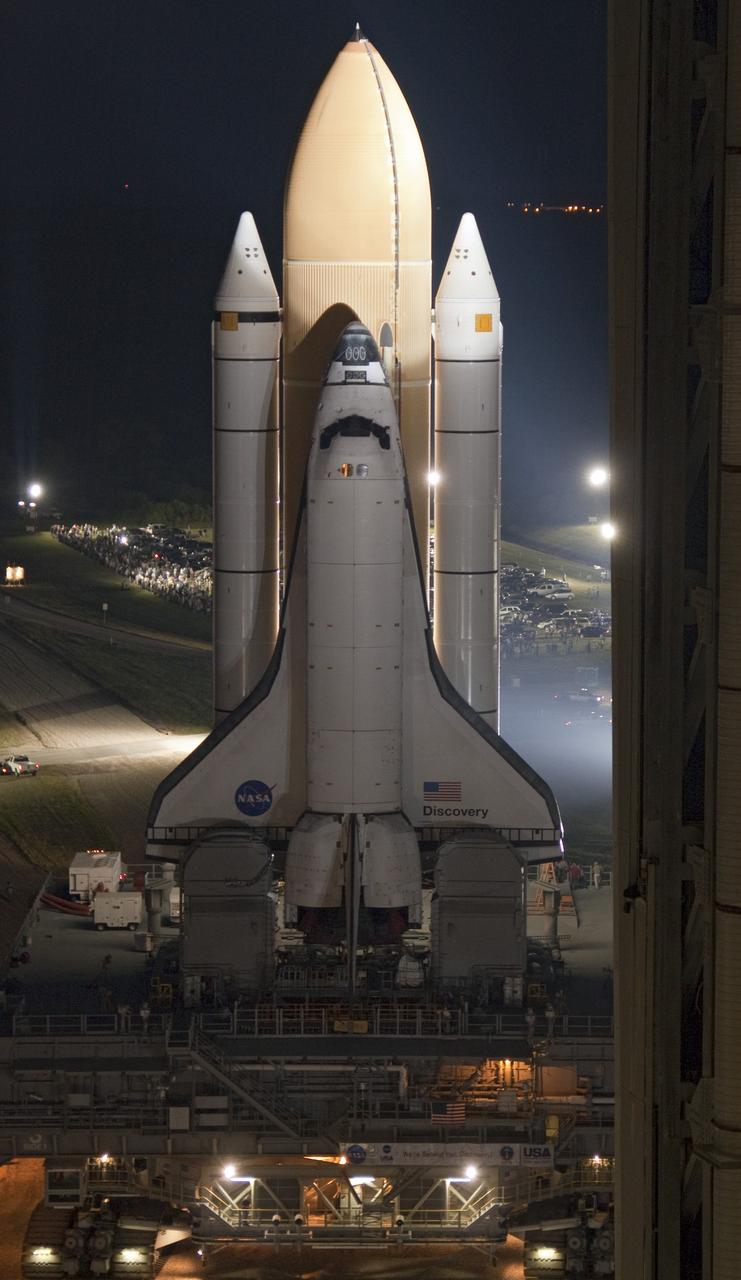
CAPE CANAVERAL, Fla. -- Bathed in bright xenon lights, space shuttle Discovery makes its nighttime trek, known as "rollout," from the Vehicle Assembly Building to Launch Pad 39A at NASA's Kennedy Space Center in Florida. It will take the shuttle, attached to its external fuel tank, twin solid rocket boosters and mobile launcher platform, about six hours to complete the move atop a crawler-transporter. Rollout sets the stage for Discovery's STS-133 crew to practice countdown and launch procedures during the Terminal Countdown Demonstration Test in mid-October. Targeted to liftoff Nov. 1, Discovery will take the Permanent Multipurpose Module (PMM) packed with supplies and critical spare parts, as well as Robonaut 2 (R2) to the International Space Station. Photo credit: NASA/Mic Miracle
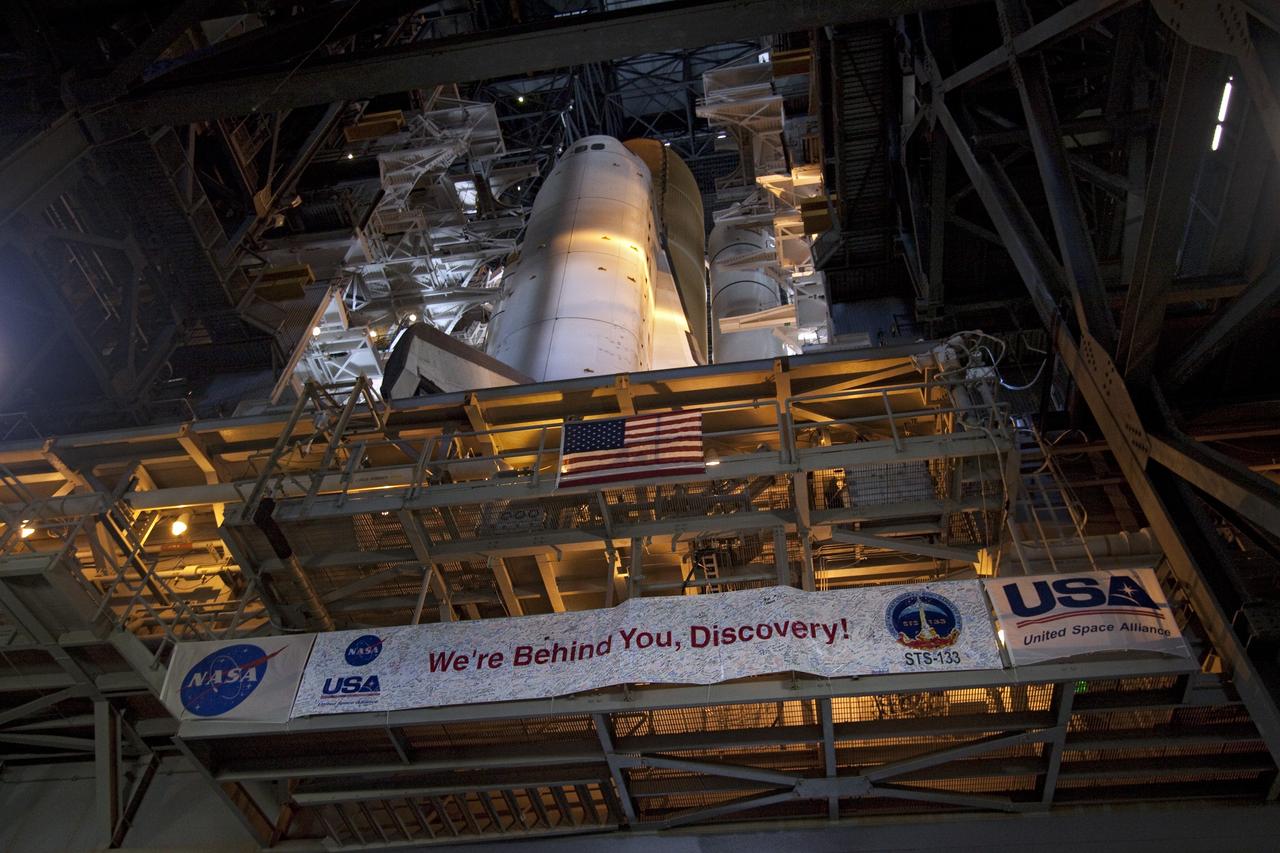
CAPE CANAVERAL, Fla. -- At NASA's Kennedy Space Center in Florida, space shuttle Discovery is ready for its nighttime trek, known as "rollout," from the Vehicle Assembly Building to Launch Pad 39A. It will take the shuttle, attached to its external fuel tank, twin solid rocket boosters and mobile launcher platform, about six hours to complete the move atop a crawler-transporter. Rollout sets the stage for Discovery's STS-133 crew to practice countdown and launch procedures during the Terminal Countdown Demonstration Test in mid-October. Targeted to liftoff Nov. 1, Discovery will take the Permanent Multipurpose Module (PMM) packed with supplies and critical spare parts, as well as Robonaut 2 (R2) to the International Space Station. Photo credit: NASA/Jack Pfaller
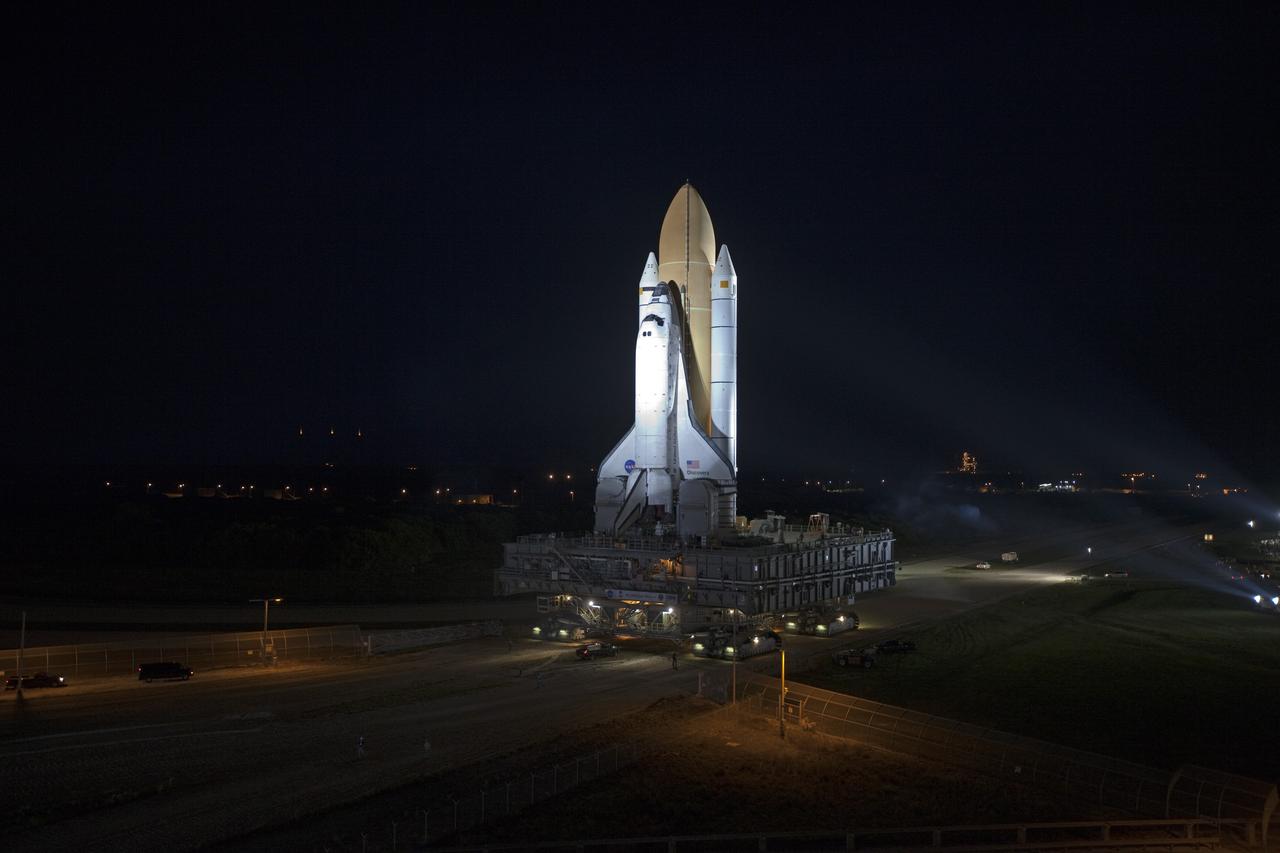
CAPE CANAVERAL, Fla. -- Bathed in bright xenon lights, space shuttle Discovery makes its nighttime trek, known as "rollout," from the Vehicle Assembly Building to Launch Pad 39A at NASA's Kennedy Space Center in Florida. It will take the shuttle, attached to its external fuel tank, twin solid rocket boosters and mobile launcher platform, about six hours to complete the move atop a crawler-transporter. Rollout sets the stage for Discovery's STS-133 crew to practice countdown and launch procedures during the Terminal Countdown Demonstration Test in mid-October. Targeted to liftoff Nov. 1, Discovery will take the Permanent Multipurpose Module (PMM) packed with supplies and critical spare parts, as well as Robonaut 2 (R2) to the International Space Station. Photo credit: NASA/Frankie Martin
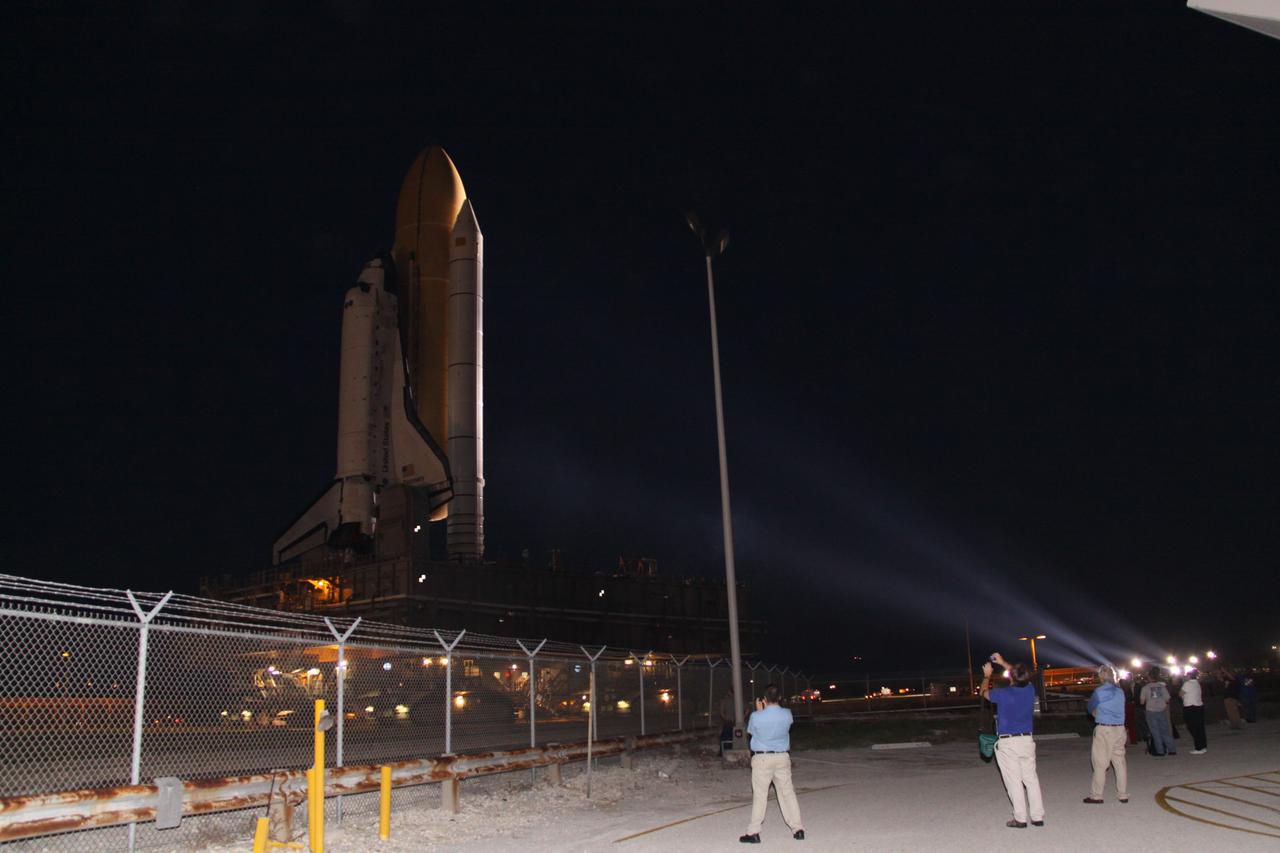
CAPE CANAVERAL, Fla. -- Bathed in bright xenon lights, space shuttle Discovery makes its nighttime trek, known as "rollout," from the Vehicle Assembly Building to Launch Pad 39A at NASA's Kennedy Space Center in Florida as employees snap photos. It will take the shuttle, attached to its external fuel tank, twin solid rocket boosters and mobile launcher platform, about six hours to complete the move atop a crawler-transporter. Rollout sets the stage for Discovery's STS-133 crew to practice countdown and launch procedures during the Terminal Countdown Demonstration Test in mid-October. Targeted to liftoff Nov. 1, Discovery will take the Permanent Multipurpose Module (PMM) packed with supplies and critical spare parts, as well as Robonaut 2 (R2) to the International Space Station. Photo credit: NASA/Jack Pfaller
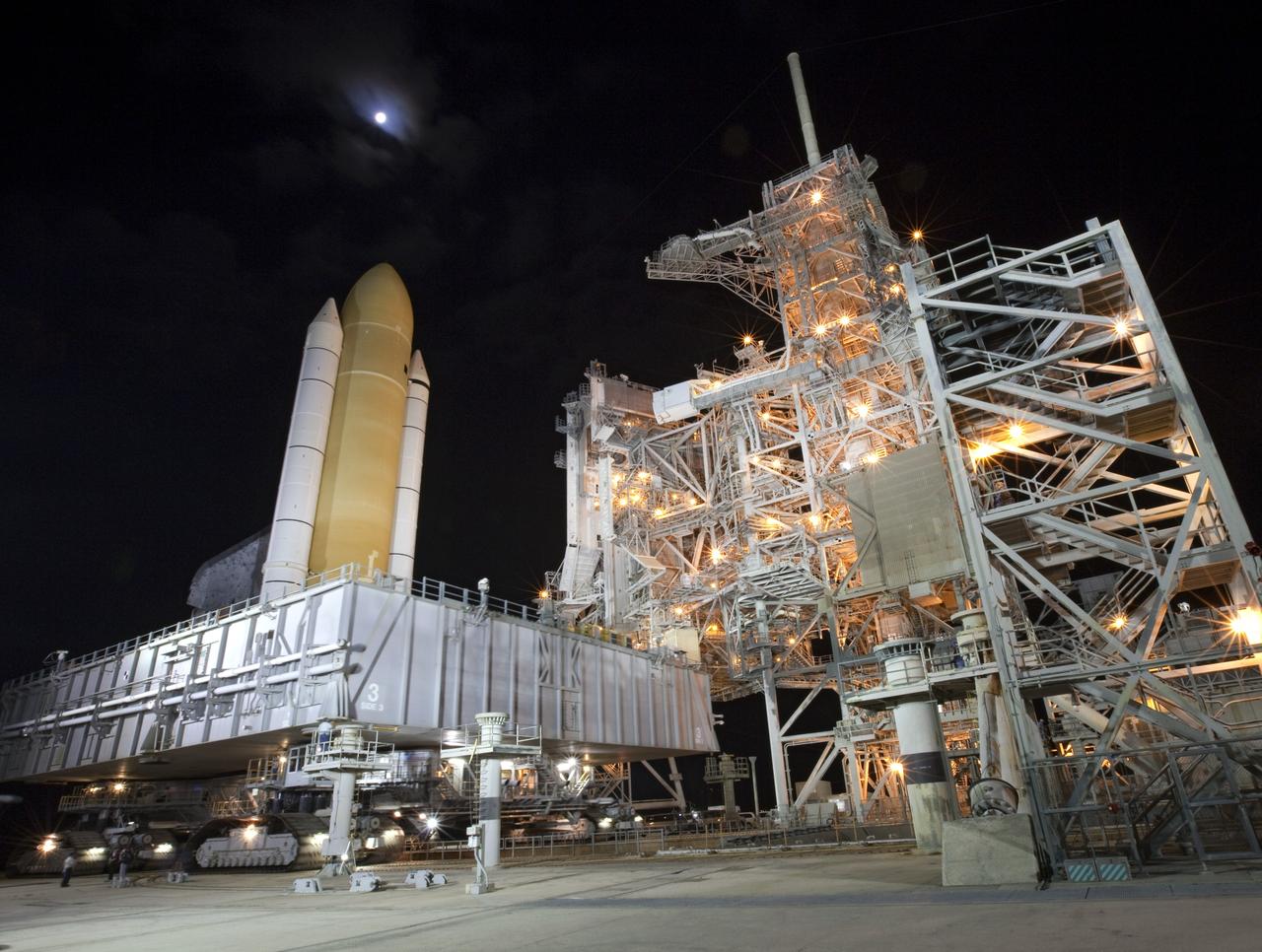
CAPE CANAVERAL, Fla. -- At NASA's Kennedy Space Center in Florida, space shuttle Discovery approaches Launch Pad 39A during "rollout" from the Vehicle Assembly Building to Launch Pad 39A. It took the shuttle, attached to its external fuel tank, twin solid rocket boosters and mobile launcher platform, about six hours to complete the move atop a crawler-transporter. Rollout sets the stage for Discovery's STS-133 crew to practice countdown and launch procedures during the Terminal Countdown Demonstration Test in mid-October. Targeted to liftoff Nov. 1, Discovery will take the Permanent Multipurpose Module (PMM) packed with supplies and critical spare parts, as well as Robonaut 2 (R2) to the International Space Station. Photo credit: NASA/Frankie Martin
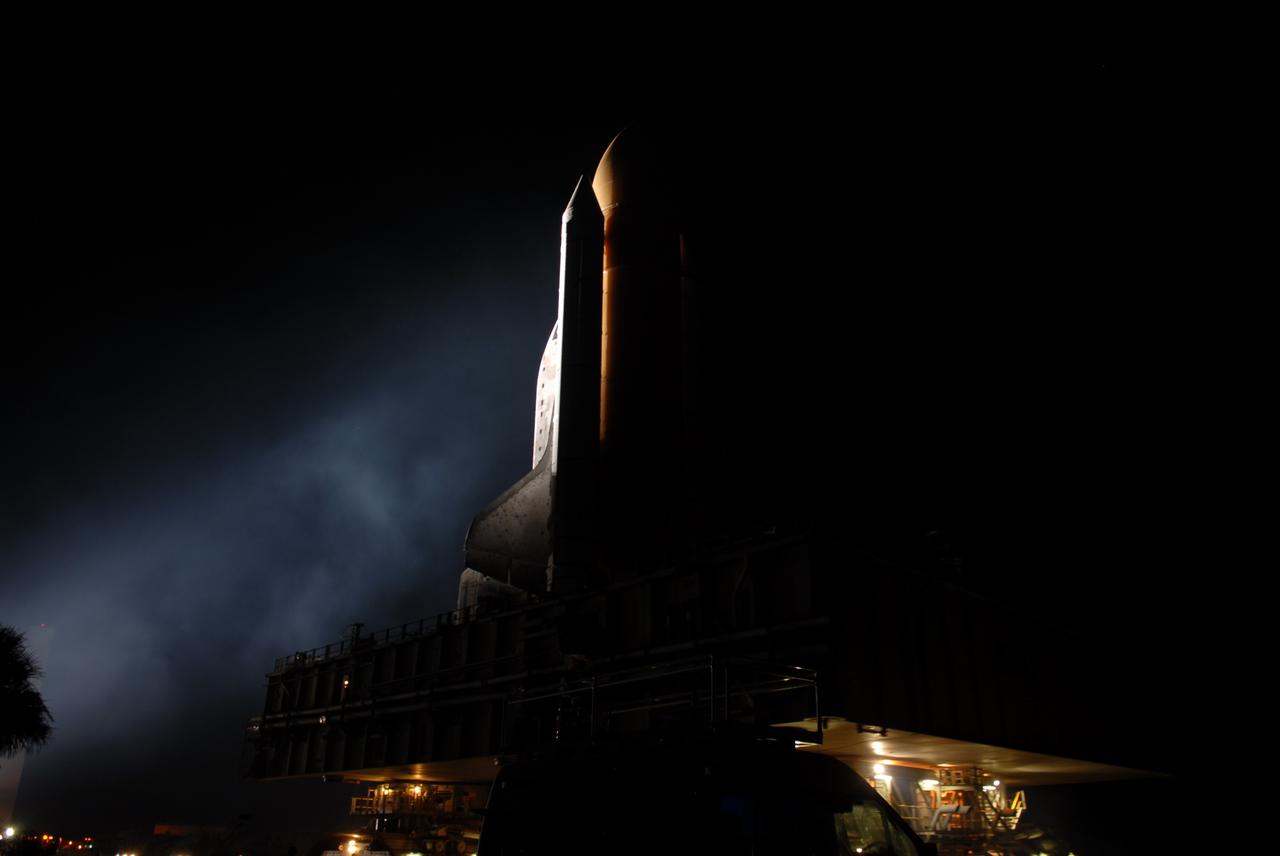
CAPE CANAVERAL, Fla. -- Bathed in bright xenon lights, space shuttle Discovery makes its nighttime trek, known as "rollout," from the Vehicle Assembly Building to Launch Pad 39A at NASA's Kennedy Space Center in Florida. It will take the shuttle, attached to its external fuel tank, twin solid rocket boosters and mobile launcher platform, about six hours to complete the move atop a crawler-transporter. Rollout sets the stage for Discovery's STS-133 crew to practice countdown and launch procedures during the Terminal Countdown Demonstration Test in mid-October. Targeted to liftoff Nov. 1, Discovery will take the Permanent Multipurpose Module (PMM) packed with supplies and critical spare parts, as well as Robonaut 2 (R2) to the International Space Station. Photo credit: NASA/Jim Grossmann
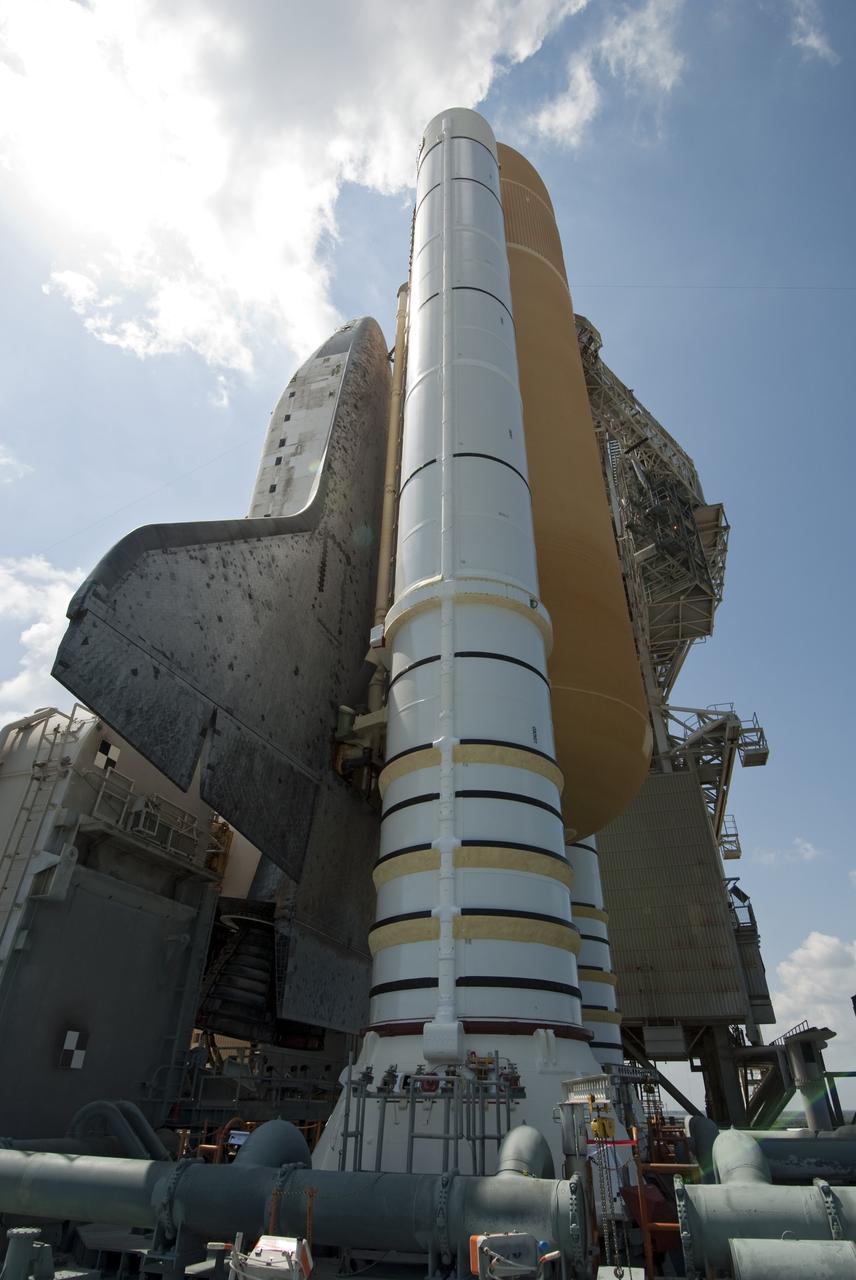
CAPE CANAVERAL, Fla. -- At NASA's Kennedy Space Center in Florida, space shuttle Discovery is visible on Launch Pad 39A before the rotating service structure, which protects it from the elements and provides access to the shuttle, is moved into place. It took the spacecraft about six hours to make the journey, known as "rollout," from the Vehicle Assembly Building to the pad. Rollout sets the stage for Discovery's STS-133 crew to practice countdown and launch procedures during the Terminal Countdown Demonstration Test in mid-October. Targeted to liftoff Nov. 1, Discovery will take the Permanent Multipurpose Module (PMM) packed with supplies and critical spare parts, as well as Robonaut 2 (R2) to the International Space Station. Photo credit: NASA/Jim Grossmann

CAPE CANAVERAL, Fla. -- Space shuttle Discovery is visible on Launch Pad 39A at NASA's Kennedy Space Center in Florida before the rotating service structure, which protects it from the elements, is moved into place. It took the spacecraft about six hours to make the journey, known as "rollout," from the Vehicle Assembly Building to the pad. Rollout sets the stage for Discovery's STS-133 crew to practice countdown and launch procedures during the Terminal Countdown Demonstration Test in mid-October. Targeted to liftoff Nov. 1, Discovery will take the Permanent Multipurpose Module (PMM) packed with supplies and critical spare parts, as well as Robonaut 2 (R2) to the International Space Station. Photo credit: NASA/Jack Pfaller
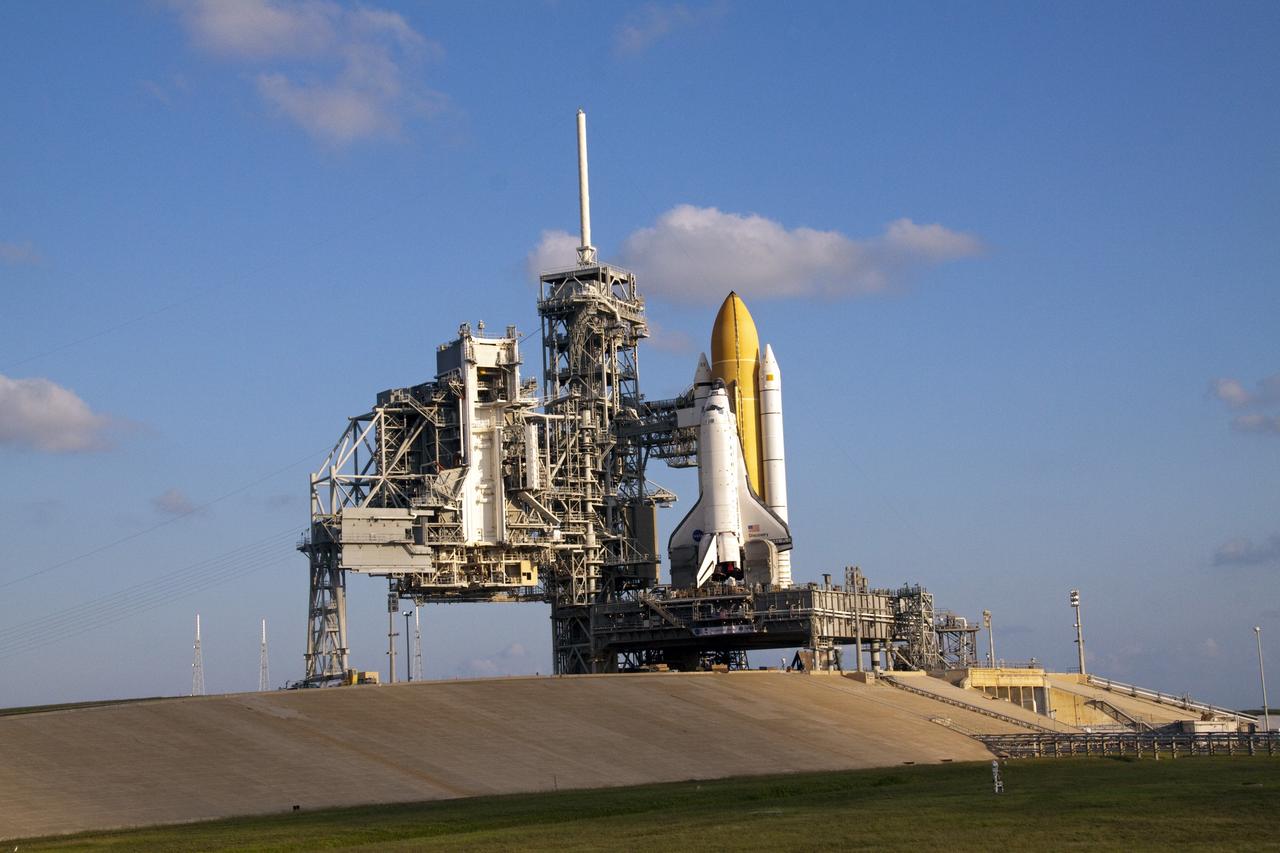
CAPE CANAVERAL, Fla. -- Space shuttle Discovery is visible on Launch Pad 39A at NASA's Kennedy Space Center in Florida before the rotating service structure, which protects it from the elements, is moved into place. It took the spacecraft about six hours to make the journey, known as "rollout," from the Vehicle Assembly Building to the pad. Rollout sets the stage for Discovery's STS-133 crew to practice countdown and launch procedures during the Terminal Countdown Demonstration Test in mid-October. Targeted to liftoff Nov. 1, Discovery will take the Permanent Multipurpose Module (PMM) packed with supplies and critical spare parts, as well as Robonaut 2 (R2) to the International Space Station. Photo credit: NASA/Jack Pfaller
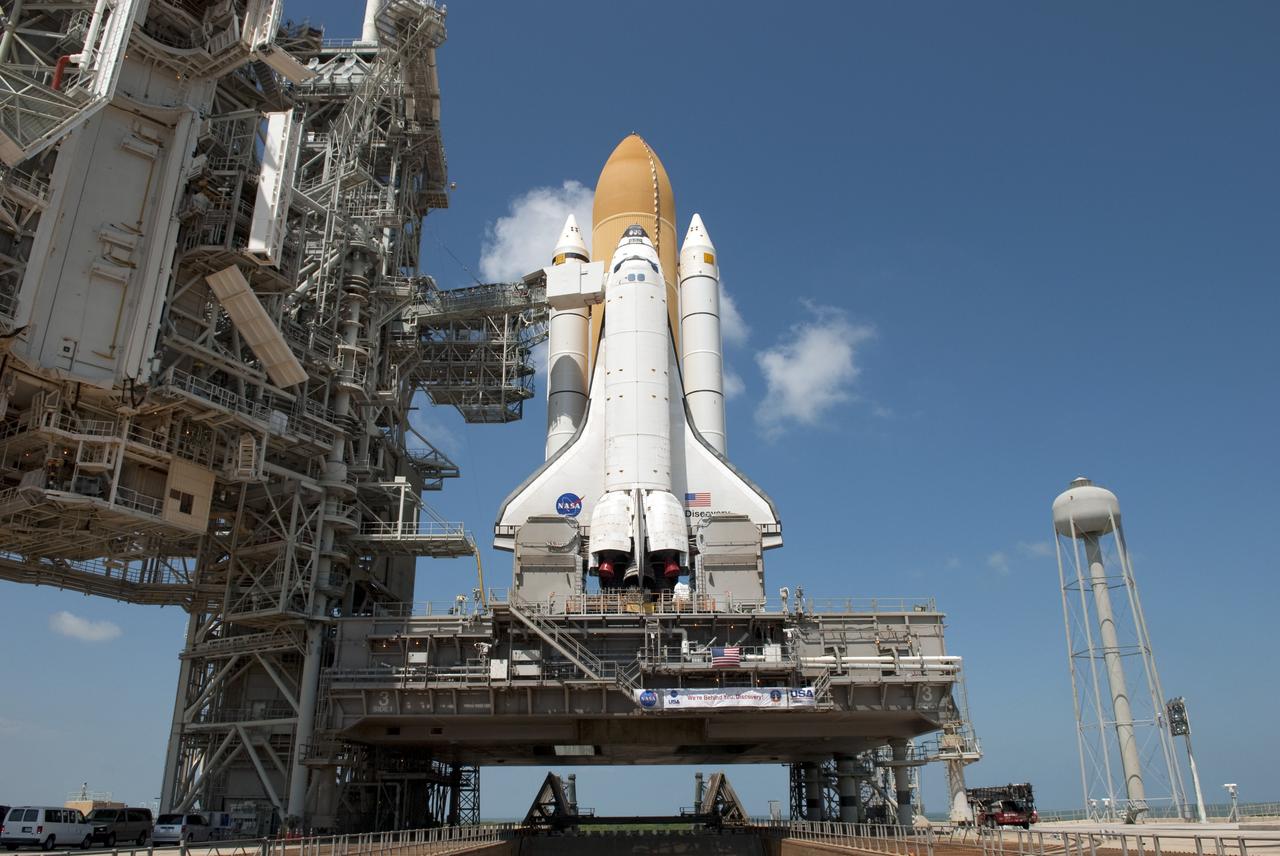
CAPE CANAVERAL, Fla. -- At NASA's Kennedy Space Center in Florida, space shuttle Discovery is visible on Launch Pad 39A before the rotating service structure, which protects it from the elements and provides access to the shuttle, is moved into place. It took the spacecraft about six hours to make the journey, known as "rollout," from the Vehicle Assembly Building to the pad. Rollout sets the stage for Discovery's STS-133 crew to practice countdown and launch procedures during the Terminal Countdown Demonstration Test in mid-October. Targeted to liftoff Nov. 1, Discovery will take the Permanent Multipurpose Module (PMM) packed with supplies and critical spare parts, as well as Robonaut 2 (R2) to the International Space Station. Photo credit: NASA/Jim Grossmann
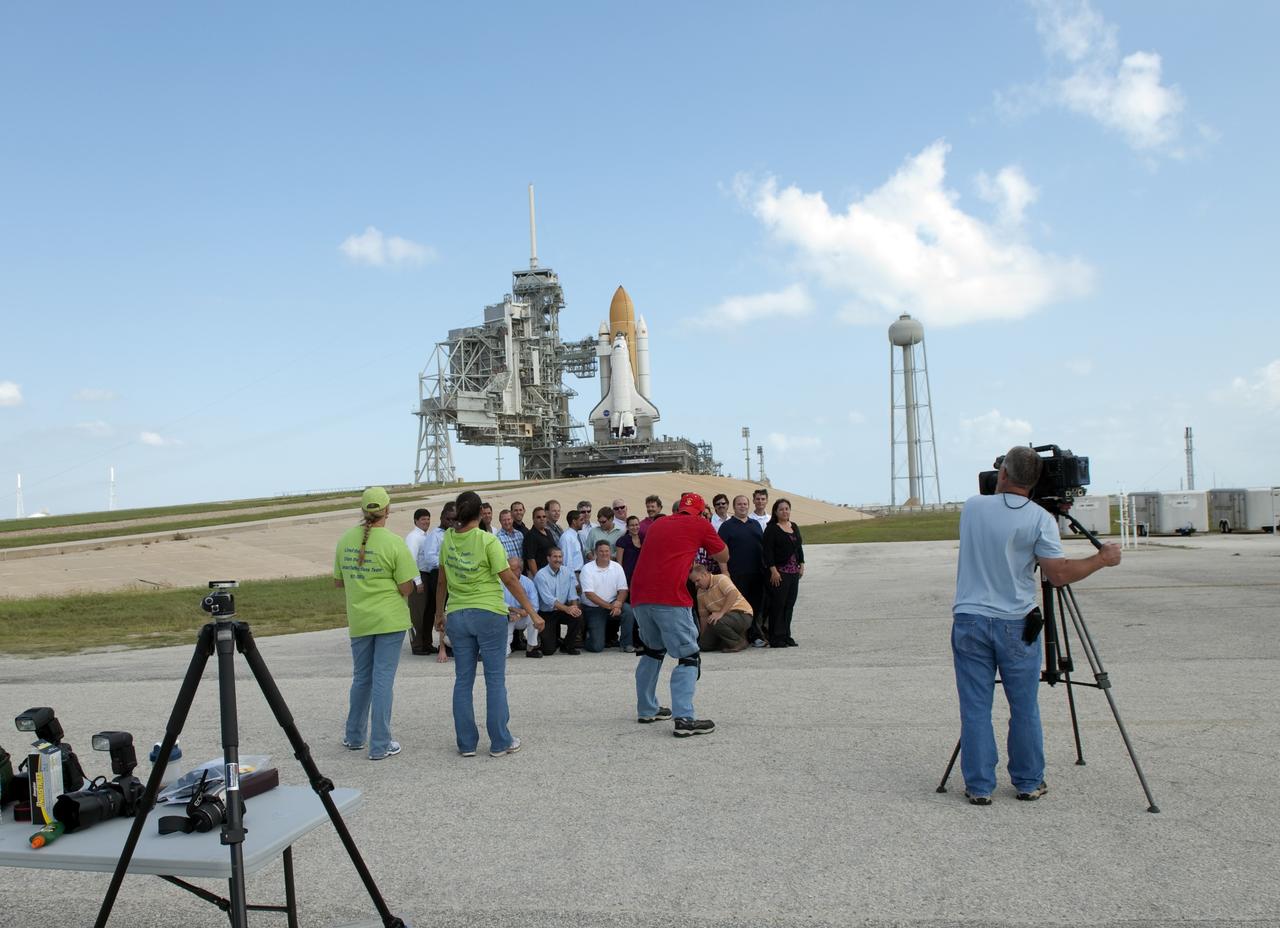
CAPE CANAVERAL, Fla. -- At NASA's Kennedy Space Center in Florida, space center workers pose for a group photo in front of space shuttle Discovery, which is visible on Launch Pad 39A. Later, the rotating service structure that protects the shuttle from the elements will be moved into place. It took the spacecraft about six hours to make the journey, known as "rollout," from the Vehicle Assembly Building to the pad. Rollout sets the stage for Discovery's STS-133 crew to practice countdown and launch procedures during the Terminal Countdown Demonstration Test in mid-October. Targeted to liftoff Nov. 1, Discovery will take the Permanent Multipurpose Module (PMM) packed with supplies and critical spare parts, as well as Robonaut 2 (R2) to the International Space Station. Photo credit: NASA/Jim Grossmann
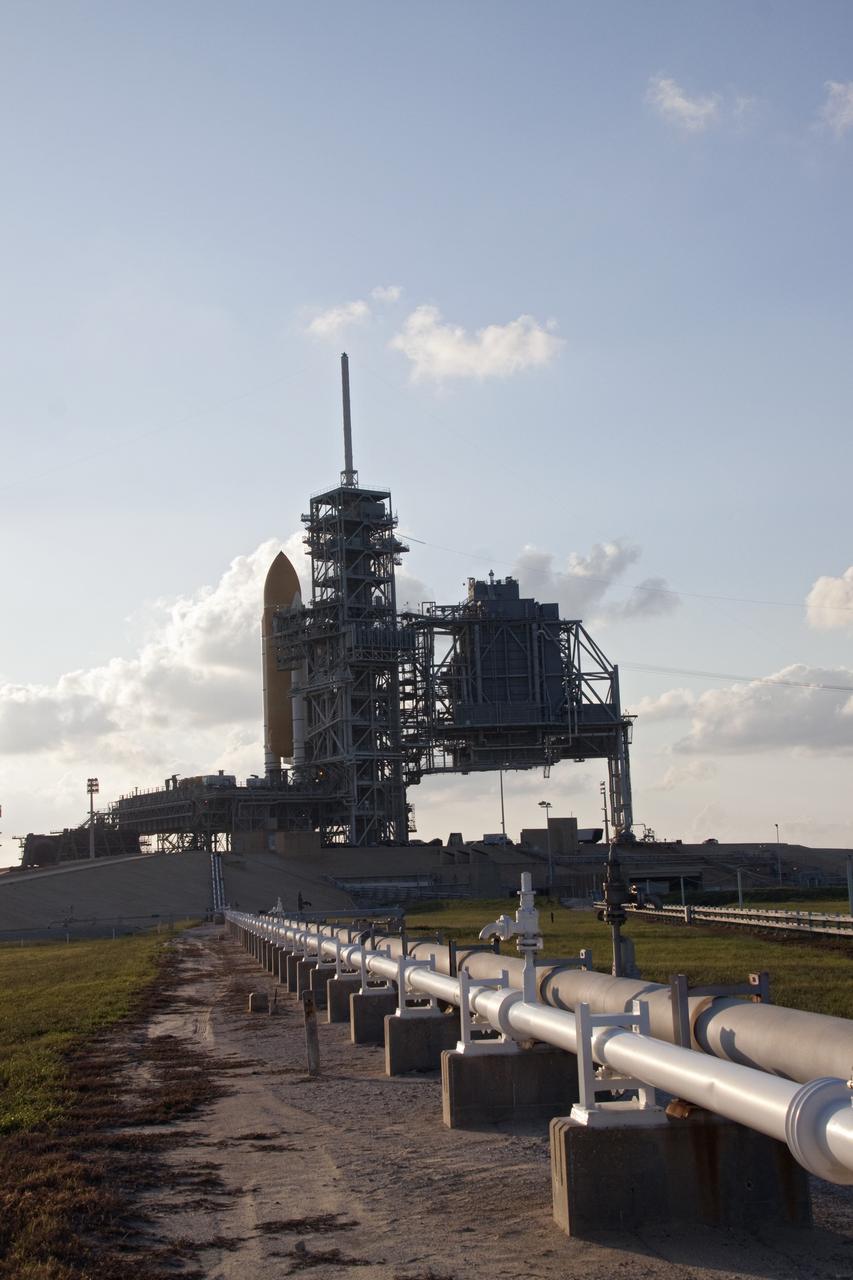
CAPE CANAVERAL, Fla. -- Space shuttle Discovery is visible on Launch Pad 39A at NASA's Kennedy Space Center in Florida before the rotating service structure, which protects it from the elements, is moved into place. It took the spacecraft about six hours to make the journey, known as "rollout," from the Vehicle Assembly Building to the pad. Rollout sets the stage for Discovery's STS-133 crew to practice countdown and launch procedures during the Terminal Countdown Demonstration Test in mid-October. Targeted to liftoff Nov. 1, Discovery will take the Permanent Multipurpose Module (PMM) packed with supplies and critical spare parts, as well as Robonaut 2 (R2) to the International Space Station. Photo credit: NASA/Jack Pfaller
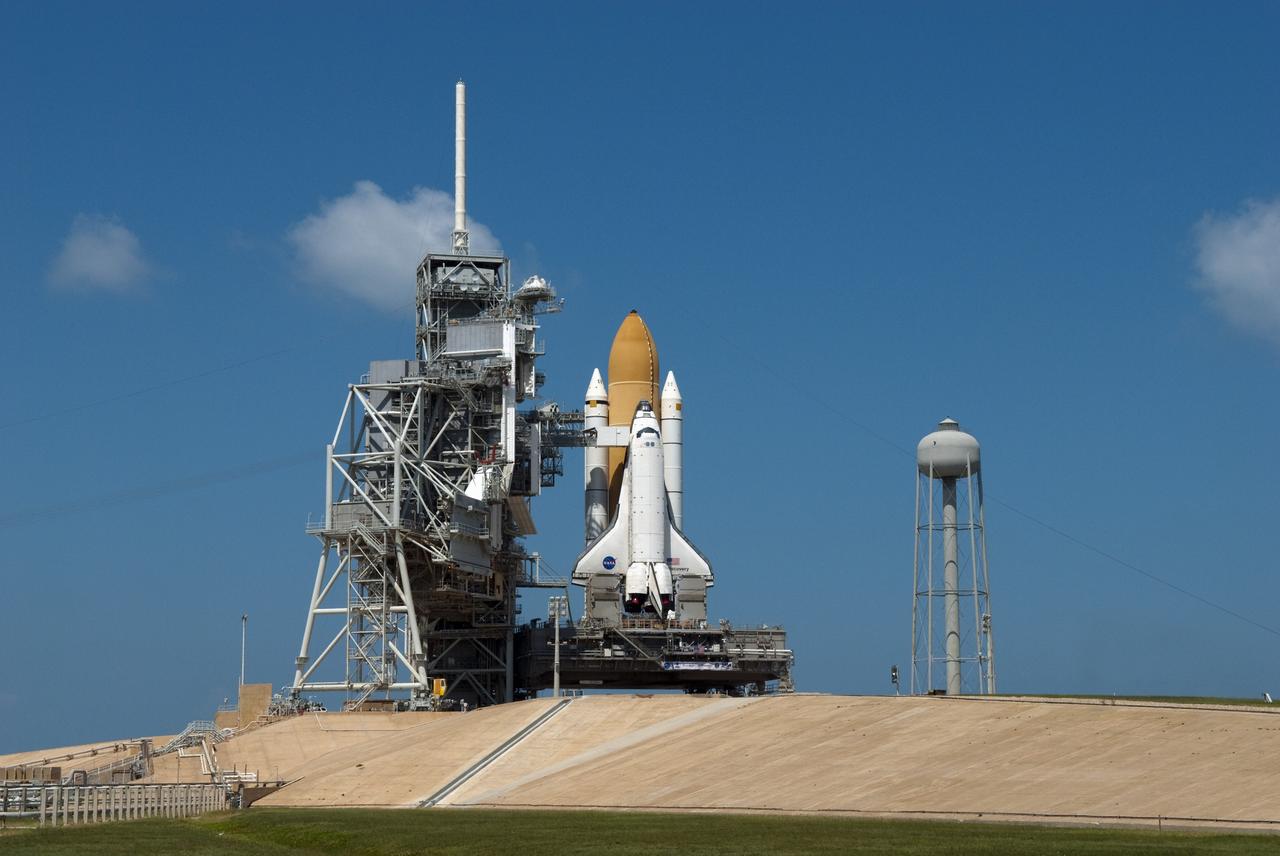
CAPE CANAVERAL, Fla. -- At NASA's Kennedy Space Center in Florida, space shuttle Discovery is visible on Launch Pad 39A before the rotating service structure, which protects it from the elements and provides access to the shuttle, is moved into place. It took the spacecraft about six hours to make the journey, known as "rollout," from the Vehicle Assembly Building to the pad. Rollout sets the stage for Discovery's STS-133 crew to practice countdown and launch procedures during the Terminal Countdown Demonstration Test in mid-October. Targeted to liftoff Nov. 1, Discovery will take the Permanent Multipurpose Module (PMM) packed with supplies and critical spare parts, as well as Robonaut 2 (R2) to the International Space Station. Photo credit: NASA/Jim Grossmann
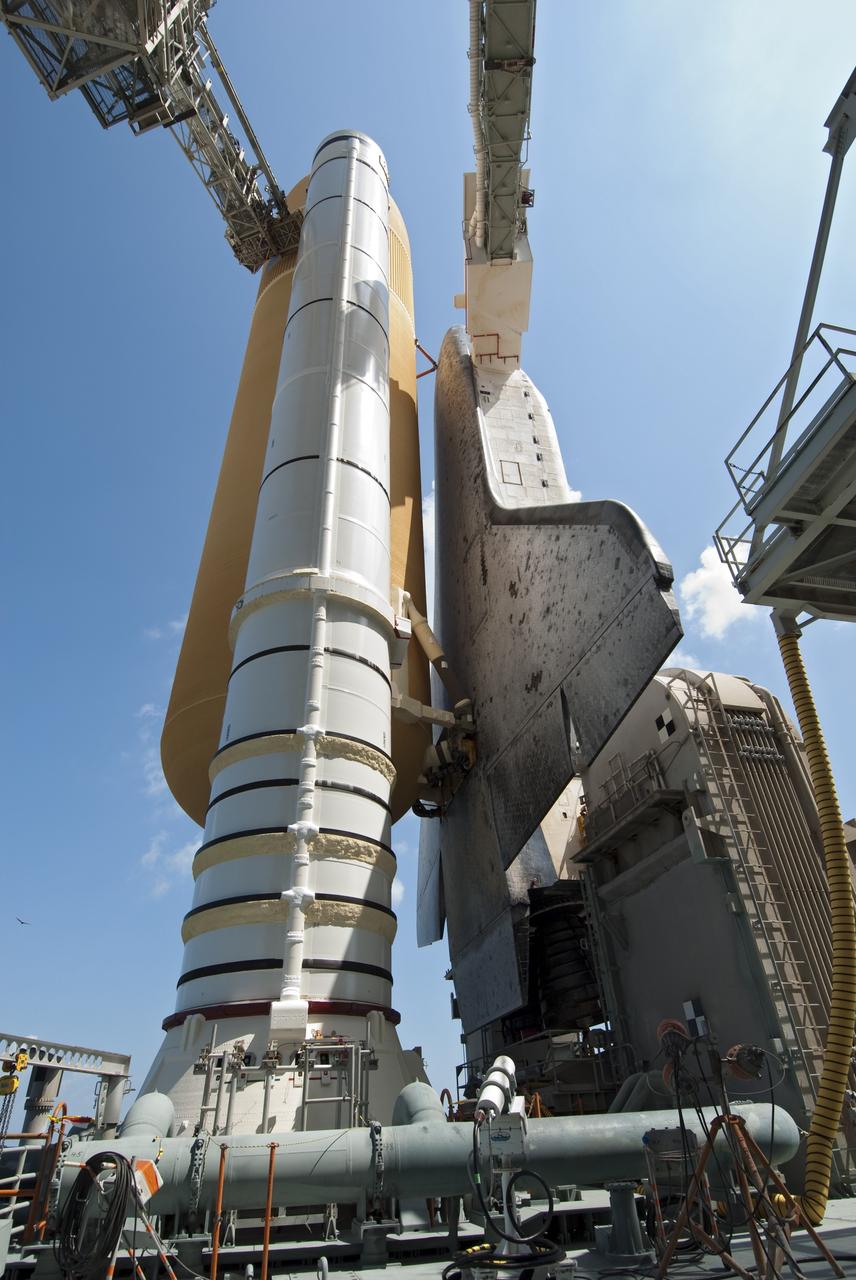
CAPE CANAVERAL, Fla. -- At NASA's Kennedy Space Center in Florida, space shuttle Discovery is visible on Launch Pad 39A before the rotating service structure, which protects it from the elements and provides access to the shuttle, is moved into place. It took the spacecraft about six hours to make the journey, known as "rollout," from the Vehicle Assembly Building to the pad. Rollout sets the stage for Discovery's STS-133 crew to practice countdown and launch procedures during the Terminal Countdown Demonstration Test in mid-October. Targeted to liftoff Nov. 1, Discovery will take the Permanent Multipurpose Module (PMM) packed with supplies and critical spare parts, as well as Robonaut 2 (R2) to the International Space Station. Photo credit: NASA/Jim Grossmann
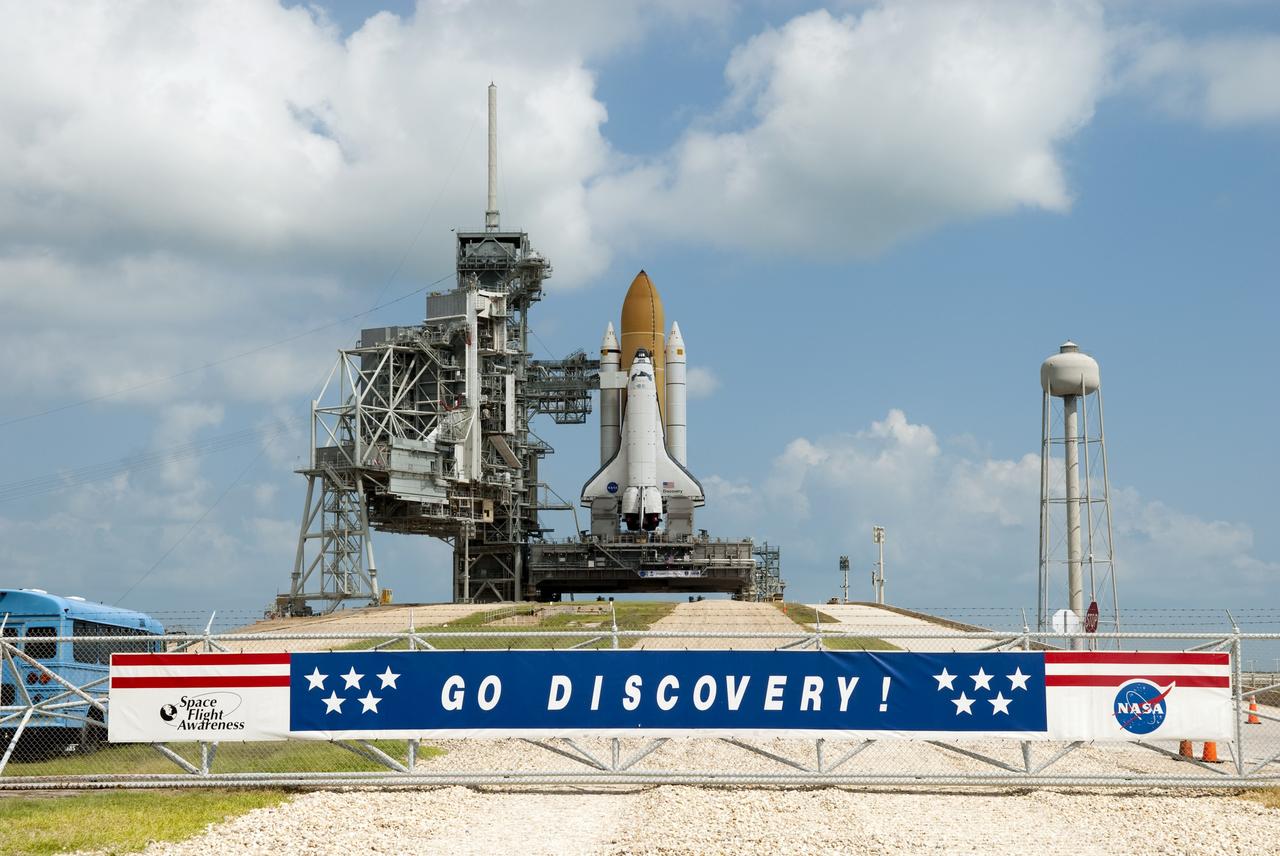
CAPE CANAVERAL, Fla. -- At NASA's Kennedy Space Center in Florida, space shuttle Discovery is visible on Launch Pad 39A and a sign supporting the vehicle hangs on the pad perimeter gate. Later, the rotating service structure that protects the shuttle from the elements will be moved into place. It took the spacecraft about six hours to make the journey, known as "rollout," from the Vehicle Assembly Building to the pad. Rollout sets the stage for Discovery's STS-133 crew to practice countdown and launch procedures during the Terminal Countdown Demonstration Test in mid-October. Targeted to liftoff Nov. 1, Discovery will take the Permanent Multipurpose Module (PMM) packed with supplies and critical spare parts, as well as Robonaut 2 (R2) to the International Space Station. Photo credit: NASA/Jim Grossmann

CAPE CANAVERAL, Fla. -- At NASA's Kennedy Space Center in Florida, space shuttle Discovery is visible on Launch Pad 39A before the rotating service structure, which protects it from the elements and provides access to the shuttle, is moved into place. The illusion of the crawler-transporter that carried the spacecraft from the Vehicle Assembly Building to the pad sits outside the perimeter gate. Rollout sets the stage for Discovery's STS-133 crew to practice countdown and launch procedures during the Terminal Countdown Demonstration Test in mid-October. Targeted to liftoff Nov. 1, Discovery will take the Permanent Multipurpose Module (PMM) packed with supplies and critical spare parts, as well as Robonaut 2 (R2) to the International Space Station. Photo credit: NASA/Jim Grossmann
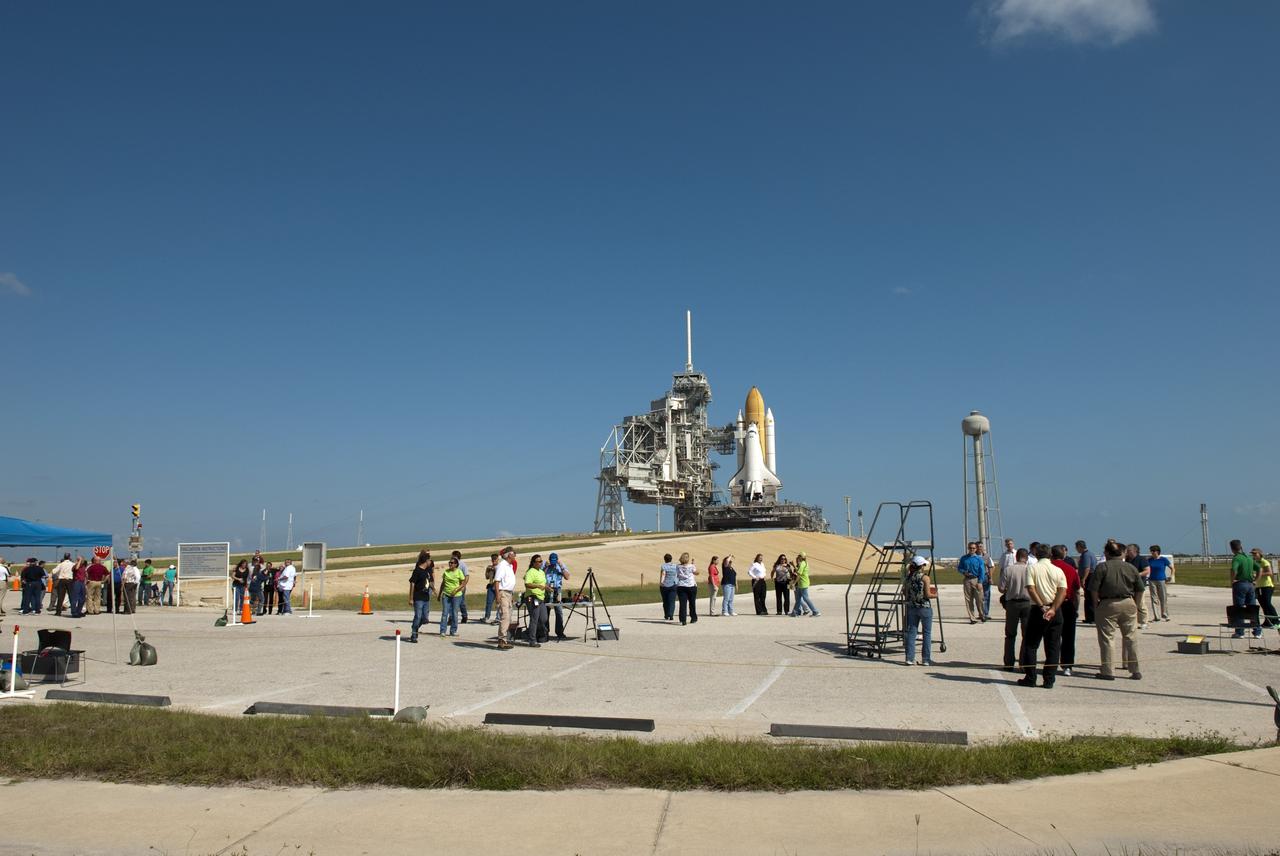
CAPE CANAVERAL, Fla. -- At NASA's Kennedy Space Center in Florida, space center employees snap photos and prepare to take group shots in front of space shuttle Discovery, which is visible on Launch Pad 39A. Later, the rotating service structure that protects the shuttle from the elements will be moved into place. It took the spacecraft about six hours to make the journey, known as "rollout," from the Vehicle Assembly Building to the pad. Rollout sets the stage for Discovery's STS-133 crew to practice countdown and launch procedures during the Terminal Countdown Demonstration Test in mid-October. Targeted to liftoff Nov. 1, Discovery will take the Permanent Multipurpose Module (PMM) packed with supplies and critical spare parts, as well as Robonaut 2 (R2) to the International Space Station. Photo credit: NASA/Jim Grossmann
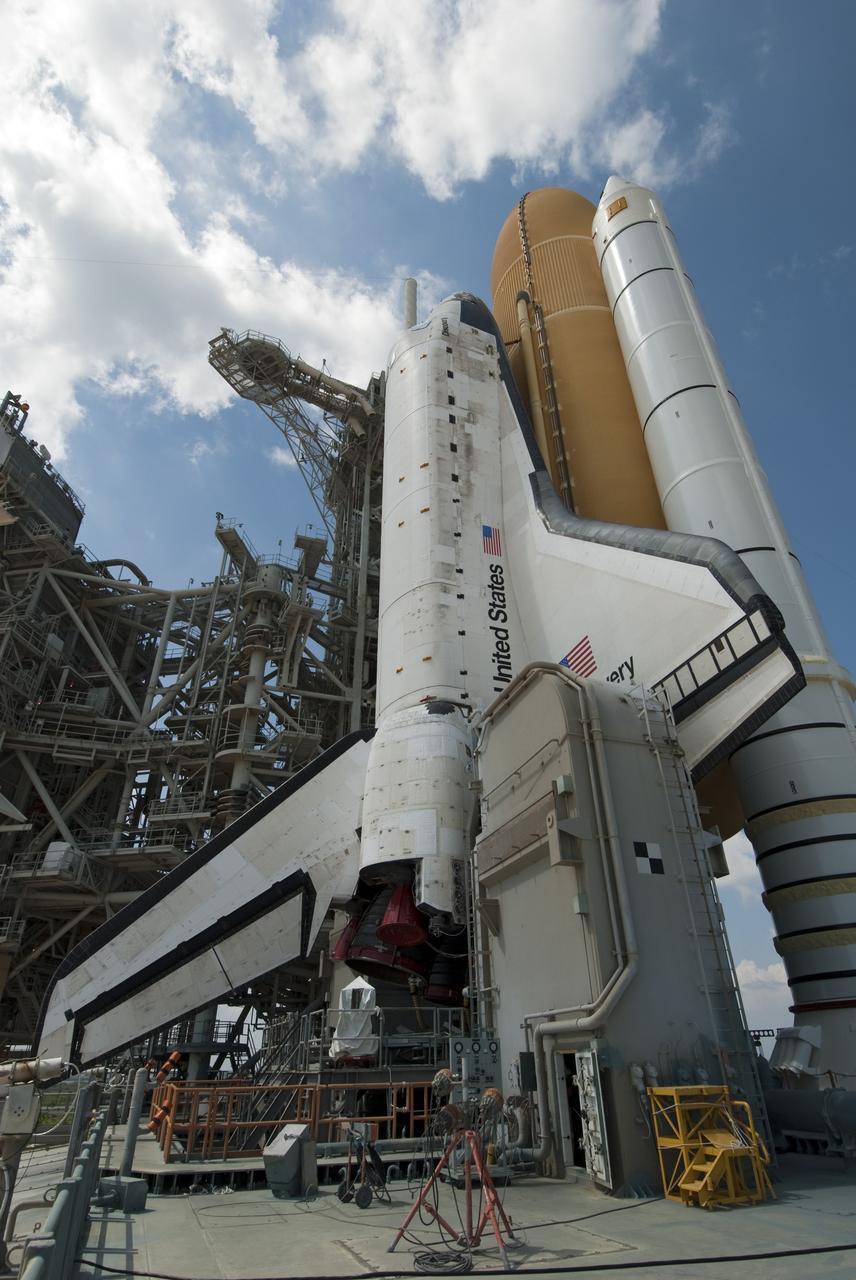
CAPE CANAVERAL, Fla. -- At NASA's Kennedy Space Center in Florida, space shuttle Discovery is visible on Launch Pad 39A before the rotating service structure, which protects it from the elements and provides access to the shuttle, is moved into place. It took the spacecraft about six hours to make the journey, known as "rollout," from the Vehicle Assembly Building to the pad. Rollout sets the stage for Discovery's STS-133 crew to practice countdown and launch procedures during the Terminal Countdown Demonstration Test in mid-October. Targeted to liftoff Nov. 1, Discovery will take the Permanent Multipurpose Module (PMM) packed with supplies and critical spare parts, as well as Robonaut 2 (R2) to the International Space Station. Photo credit: NASA/Jim Grossmann
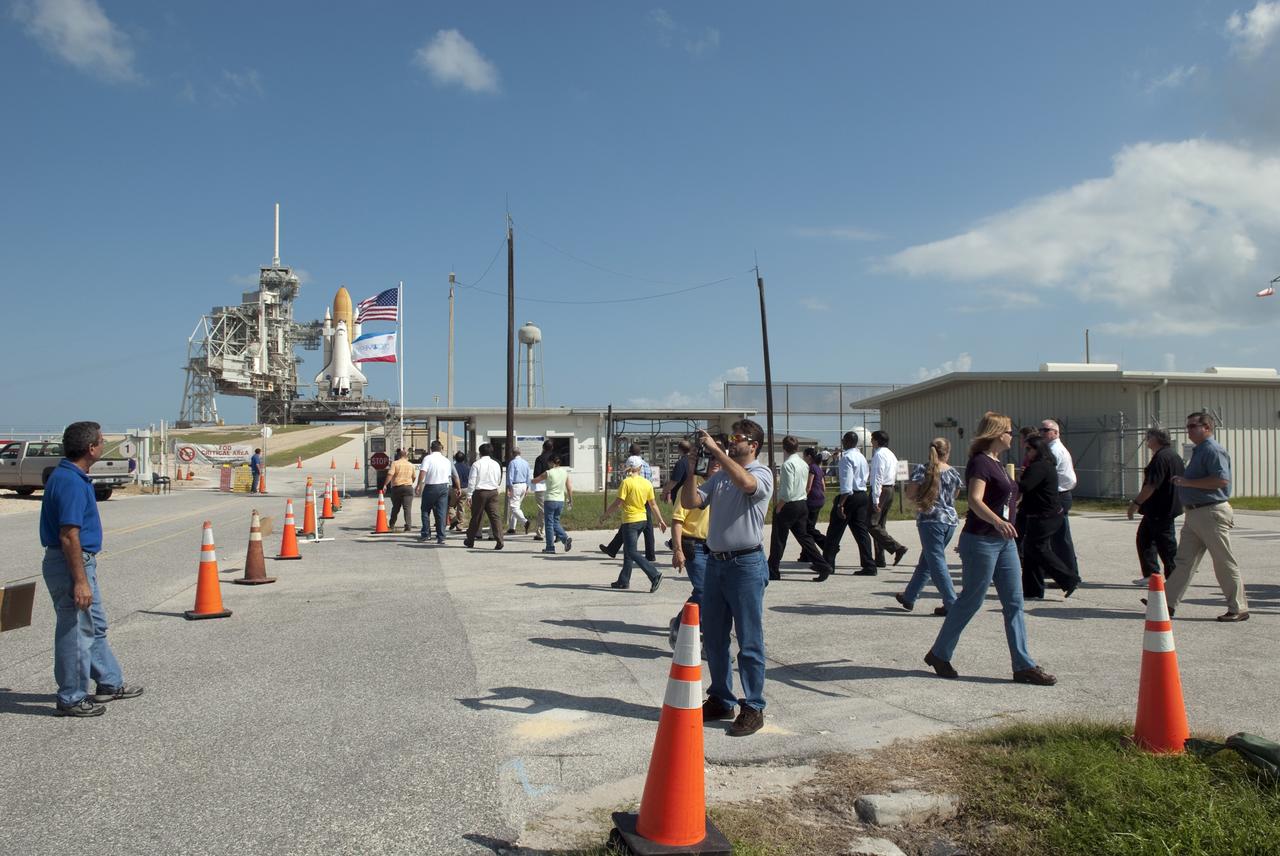
CAPE CANAVERAL, Fla. -- At NASA's Kennedy Space Center in Florida, space center employees snap photos and prepare to take group shots in front of space shuttle Discovery, which is visible on Launch Pad 39A. Later, the rotating service structure that protects the shuttle from the elements will be moved into place. It took the spacecraft about six hours to make the journey, known as "rollout," from the Vehicle Assembly Building to the pad. Rollout sets the stage for Discovery's STS-133 crew to practice countdown and launch procedures during the Terminal Countdown Demonstration Test in mid-October. Targeted to liftoff Nov. 1, Discovery will take the Permanent Multipurpose Module (PMM) packed with supplies and critical spare parts, as well as Robonaut 2 (R2) to the International Space Station. Photo credit: NASA/Jim Grossmann
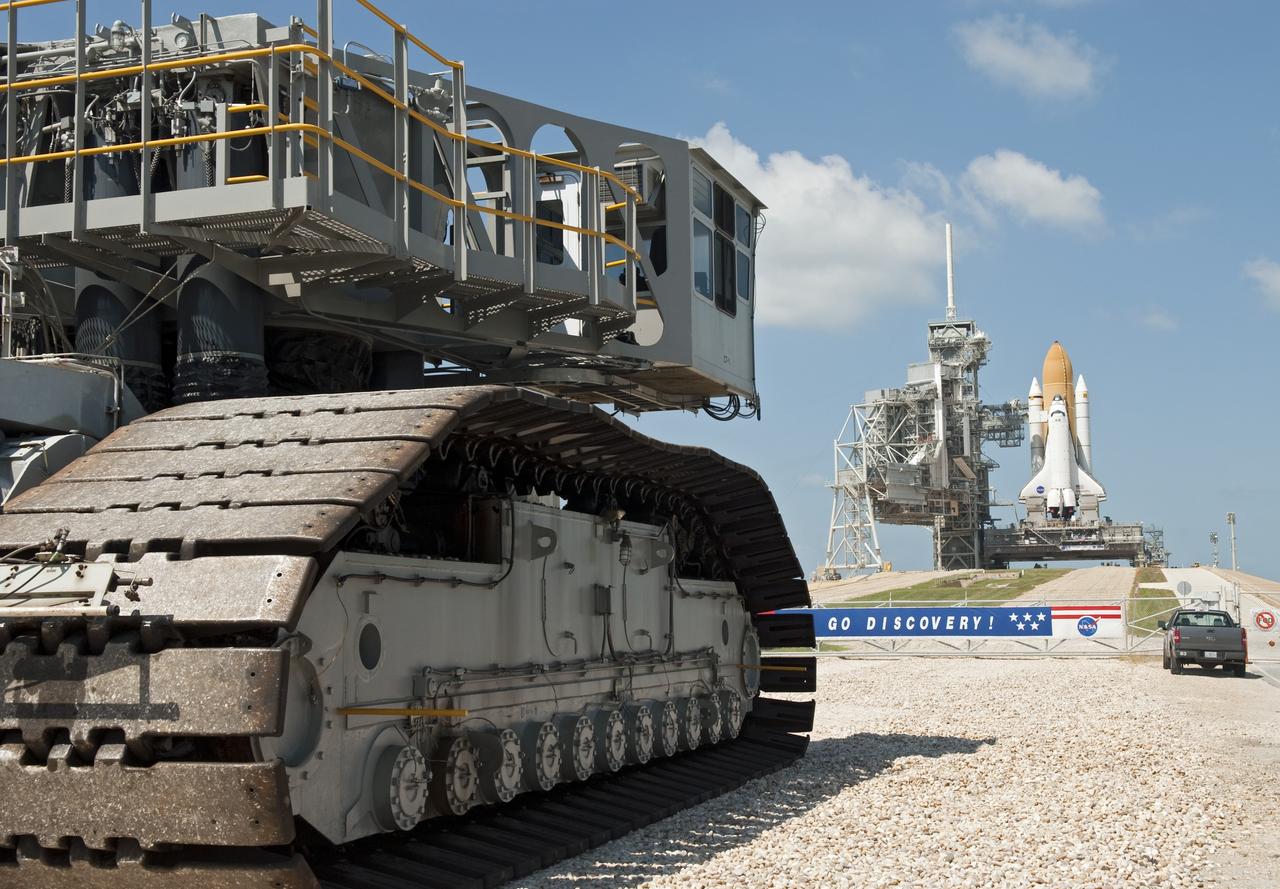
CAPE CANAVERAL, Fla. -- At NASA's Kennedy Space Center in Florida, the crawler-transporter that carried space shuttle Discovery from the Vehicle Assembly Building to Launch Pad 39A, moves toward the pad perimeter gate, giving the illusion that the shuttle is still on top, but smaller than it actually is. The move, called "rollout," sets the stage for Discovery's STS-133 crew to practice countdown and launch procedures during the Terminal Countdown Demonstration Test in mid-October. Targeted to liftoff Nov. 1, Discovery will take the Permanent Multipurpose Module (PMM) packed with supplies and critical spare parts, as well as Robonaut 2 (R2) to the International Space Station. Photo credit: NASA/Jim Grossmann
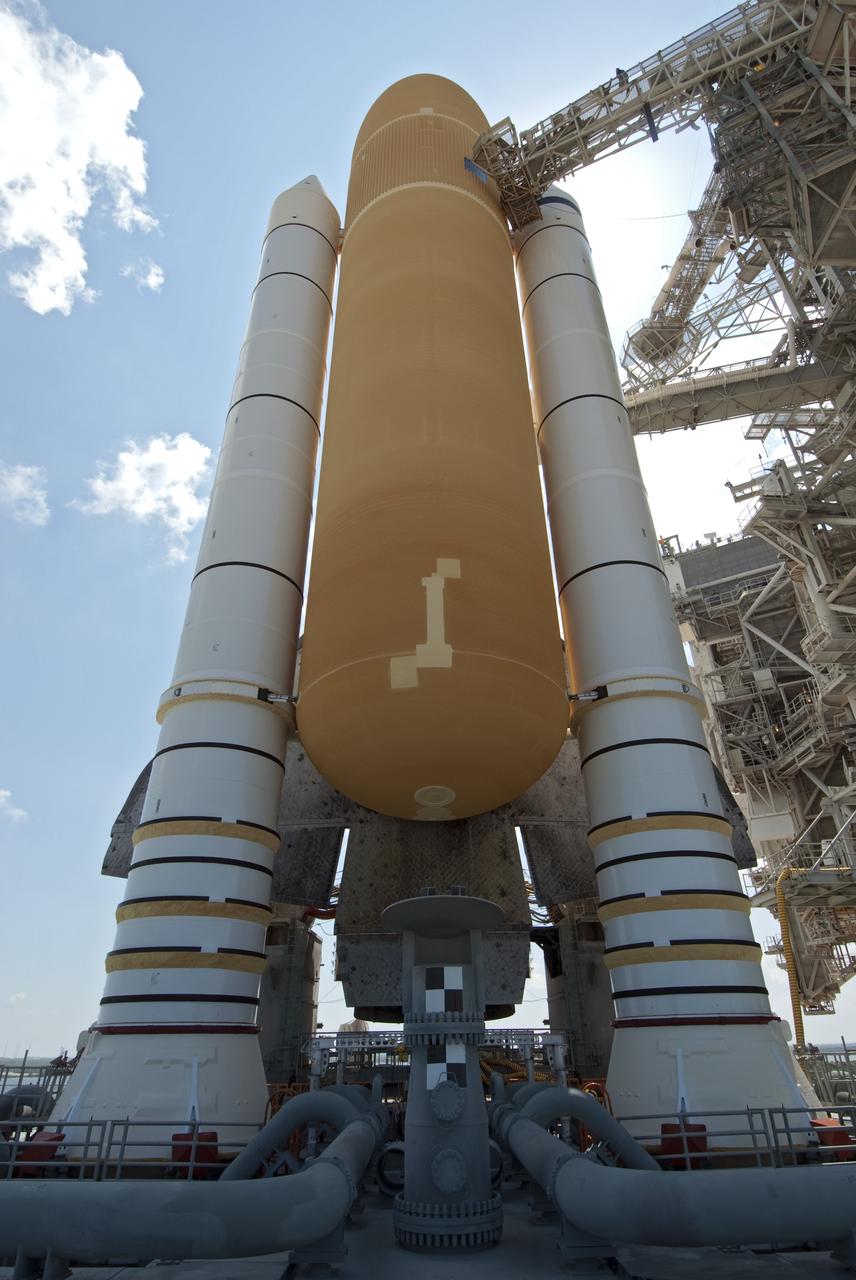
CAPE CANAVERAL, Fla. -- At NASA's Kennedy Space Center in Florida, space shuttle Discovery's external fuel tank and solid rocket boosters are visible on Launch Pad 39A before the rotating service structure, which protects the shuttle from the elements and provides access to the shuttle, is moved into place. It took the spacecraft about six hours to make the journey, known as "rollout," from the Vehicle Assembly Building to the pad. Rollout sets the stage for Discovery's STS-133 crew to practice countdown and launch procedures during the Terminal Countdown Demonstration Test in mid-October. Targeted to liftoff Nov. 1, Discovery will take the Permanent Multipurpose Module (PMM) packed with supplies and critical spare parts, as well as Robonaut 2 (R2) to the International Space Station. Photo credit: NASA/Jim Grossmann
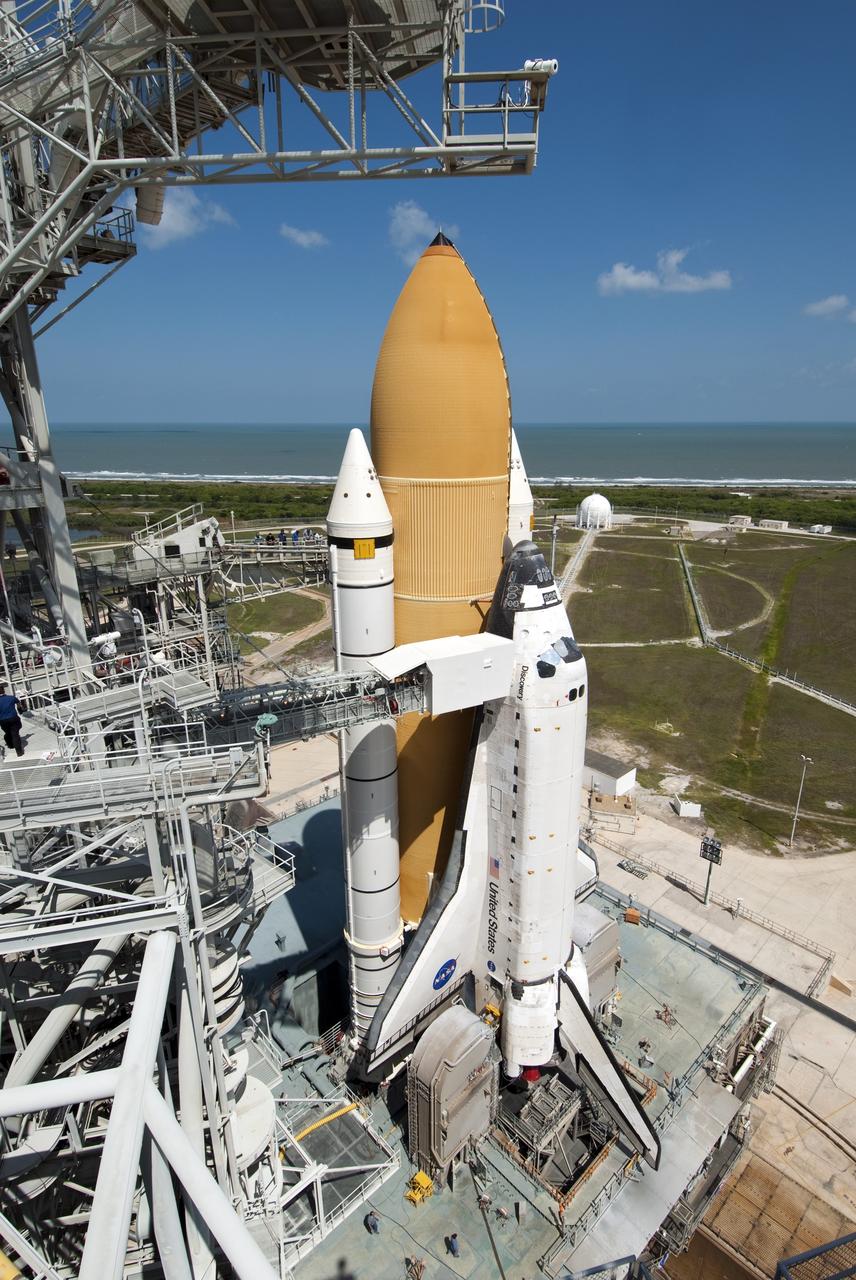
CAPE CANAVERAL, Fla. -- At NASA's Kennedy Space Center in Florida, space shuttle Discovery is visible on Launch Pad 39A before the rotating service structure, which protects it from the elements and provides access to the shuttle, is moved into place. It took the spacecraft about six hours to make the journey, known as "rollout," from the Vehicle Assembly Building to the pad. Rollout sets the stage for Discovery's STS-133 crew to practice countdown and launch procedures during the Terminal Countdown Demonstration Test in mid-October. Targeted to liftoff Nov. 1, Discovery will take the Permanent Multipurpose Module (PMM) packed with supplies and critical spare parts, as well as Robonaut 2 (R2) to the International Space Station. Photo credit: NASA/Jim Grossmann
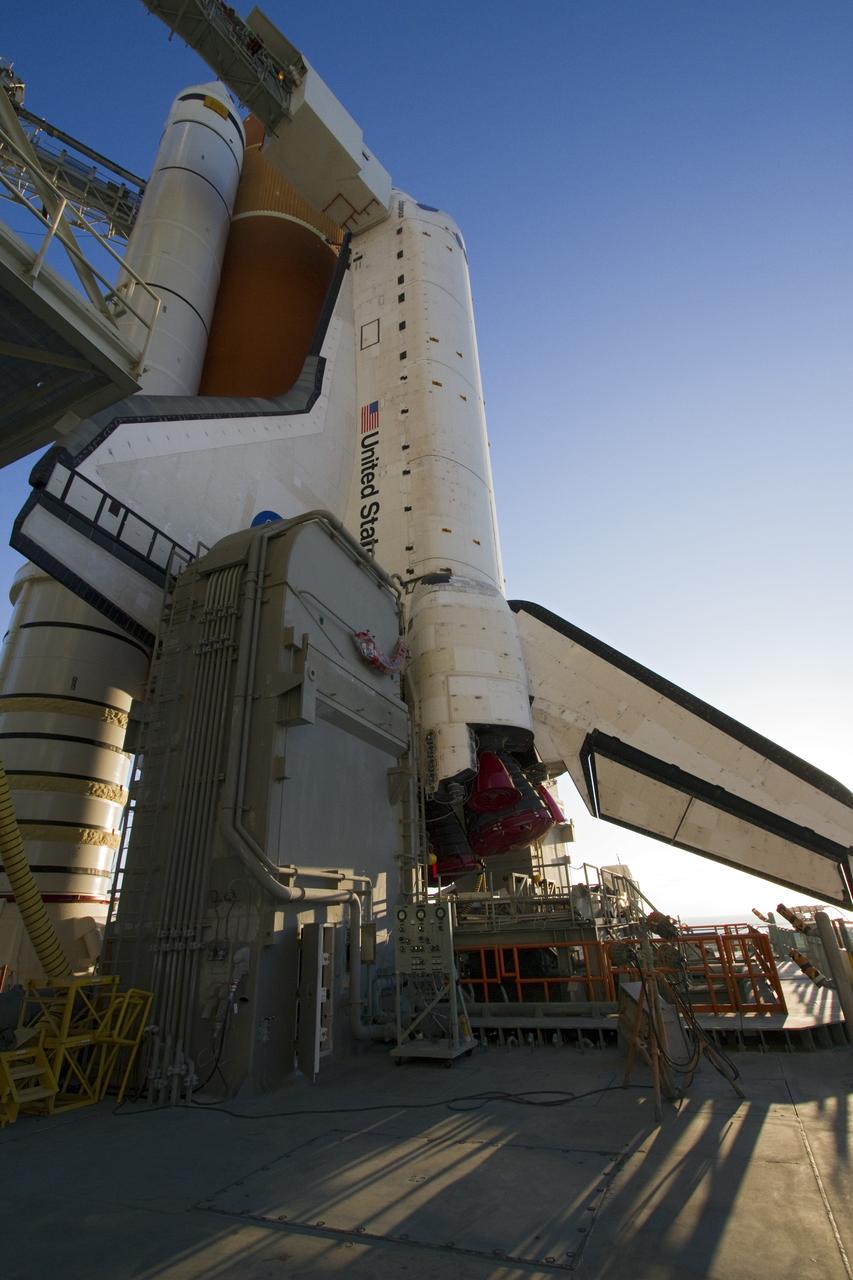
CAPE CANAVERAL, Fla. -- The orbiter access arm swings into position against space shuttle Endeavour following its arrival at Launch Pad 39A at NASA's Kennedy Space Center in Florida. Riding atop a crawler-transporter attached to its external fuel tank and solid rocket boosters, Endeavour's 3.4-mile trek, known as "rollout," began at the Vehicle Assembly Building at 7:56 p.m. EST March 10 and ended at 3:49 a.m. EST, nearly eight hours later. This is Endeavour's final scheduled rollout. Endeavour and its six-member crew will deliver the Express Logistics Carrier-3, Alpha Magnetic Spectrometer-2 (AMS), a high-pressure gas tank, additional spare parts for the Dextre robotic helper and micrometeoroid debris shields to the International Space Station on the shuttle's final spaceflight, STS-134. Launch is targeted for 7:48 p.m. EDT April 19. For more information, visit www.nasa.gov/mission_pages/shuttle/shuttlemissions/sts134/index.html. Photo credit: NASA/Jack Pfaller
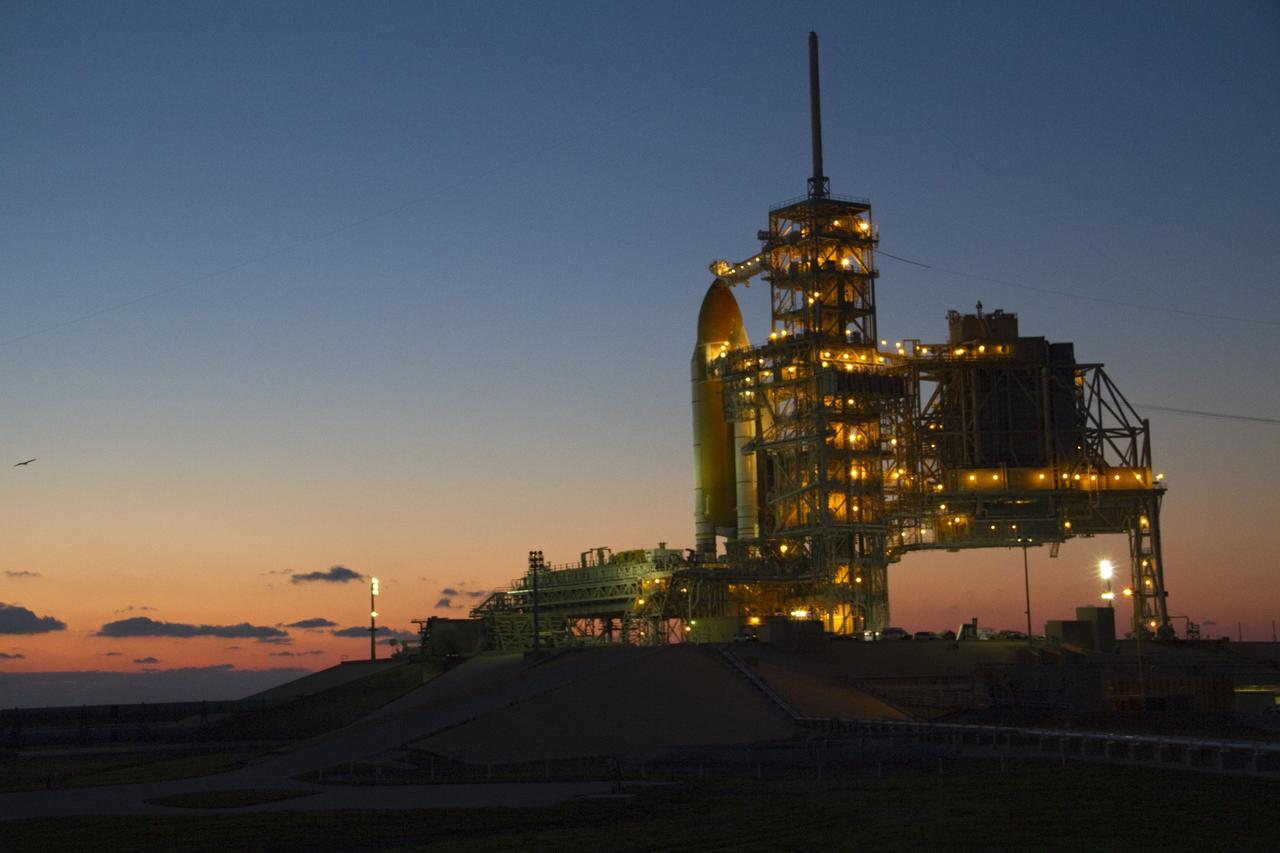
CAPE CANAVERAL, Fla. -- Sunrise over the Space Coast in Florida finds space shuttle Endeavour settling in on Launch Pad 39A at NASA's Kennedy Space Center. Riding atop a crawler-transporter attached to its external fuel tank and solid rocket boosters, Endeavour's 3.4-mile trek, known as "rollout," began at the Vehicle Assembly Building at 7:56 p.m. EST March 10 and ended at 3:49 a.m. EST, nearly eight hours later. This is Endeavour's final scheduled rollout. Endeavour and its six-member crew will deliver the Express Logistics Carrier-3, Alpha Magnetic Spectrometer-2 (AMS), a high-pressure gas tank, additional spare parts for the Dextre robotic helper and micrometeoroid debris shields to the International Space Station on the shuttle's final spaceflight, STS-134. Launch is targeted for 7:48 p.m. EDT April 19. For more information, visit www.nasa.gov/mission_pages/shuttle/shuttlemissions/sts134/index.html. Photo credit: NASA/Jack Pfaller
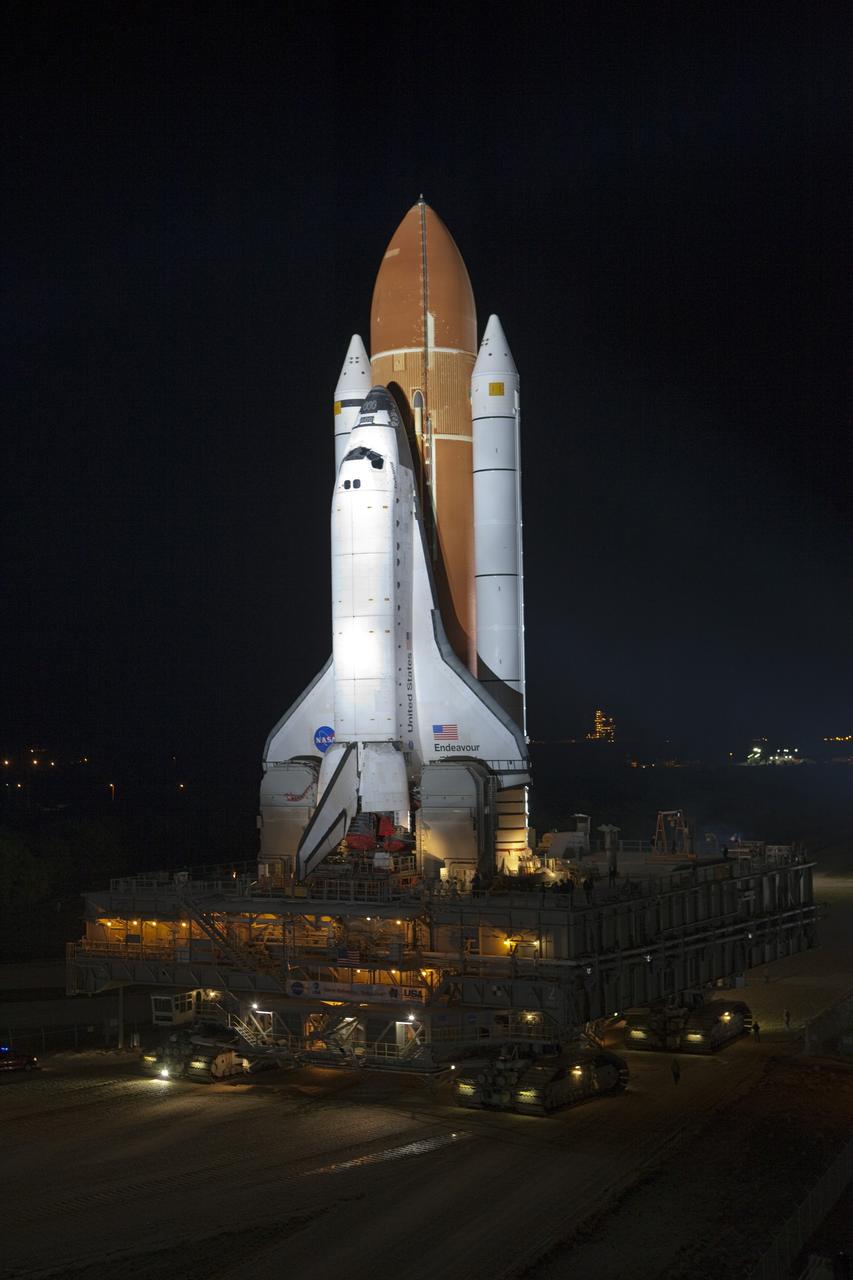
CAPE CANAVERAL, Fla. -- Bathed in xenon lights, space shuttle Endeavour begins its nighttime journey from the Vehicle Assembly Building to Launch Pad 39A, illuminated in the background, at NASA's Kennedy Space Center in Florida. Riding atop a crawler-transporter attached to its external fuel tank and solid rocket boosters, Endeavour's 3.4-mile trek, known as "rollout," began at 7:56 p.m. EST and will take about seven hours to complete. This is the final scheduled rollout for Endeavour. Endeavour and its six-member crew will deliver the Express Logistics Carrier-3, Alpha Magnetic Spectrometer-2 (AMS), a high-pressure gas tank, additional spare parts for the Dextre robotic helper and micrometeoroid debris shields to the International Space Station on the shuttle's final spaceflight, STS-134. Launch is targeted for 7:48 p.m. EDT April 19. For more information, visit www.nasa.gov/mission_pages/shuttle/shuttlemissions/sts134/index.html. Photo credit: NASA/Terry Zaperach
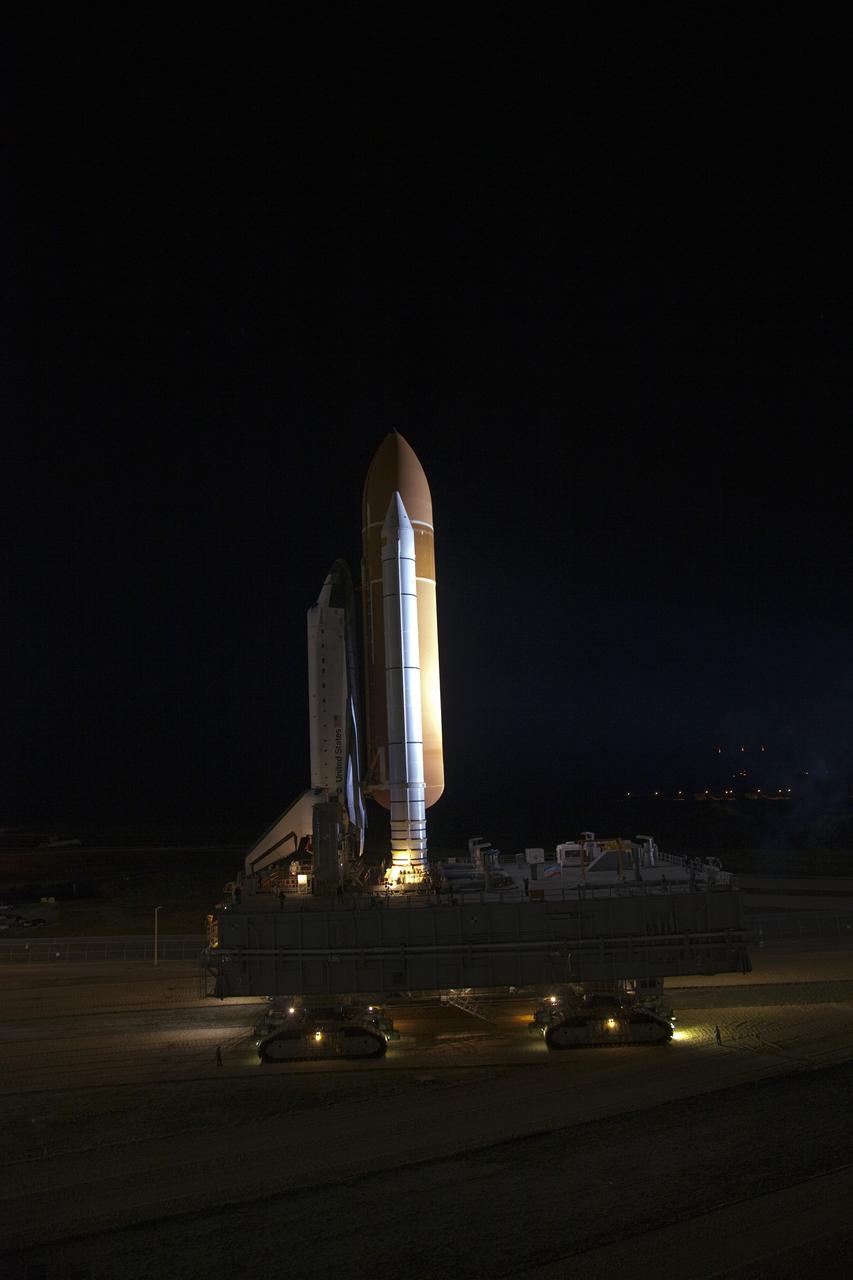
CAPE CANAVERAL, Fla. -- Space shuttle Endeavour, secured on its mobile launcher platform, pulls away from the Vehicle Assembly Building for its nighttime journey to Launch Pad 39A at NASA's Kennedy Space Center in Florida. Riding atop a crawler-transporter attached to its external fuel tank and solid rocket boosters, Endeavour's 3.4-mile trek, known as "rollout," began at 7:56 p.m. EST and will take about seven hours to complete. This is the final scheduled rollout for Endeavour. Endeavour and its six-member crew will deliver the Express Logistics Carrier-3, Alpha Magnetic Spectrometer-2 (AMS), a high-pressure gas tank, additional spare parts for the Dextre robotic helper and micrometeoroid debris shields to the International Space Station on the shuttle's final spaceflight, STS-134. Launch is targeted for 7:48 p.m. EDT April 19. For more information, visit www.nasa.gov/mission_pages/shuttle/shuttlemissions/sts134/index.html. Photo credit: NASA/Frankie Martin
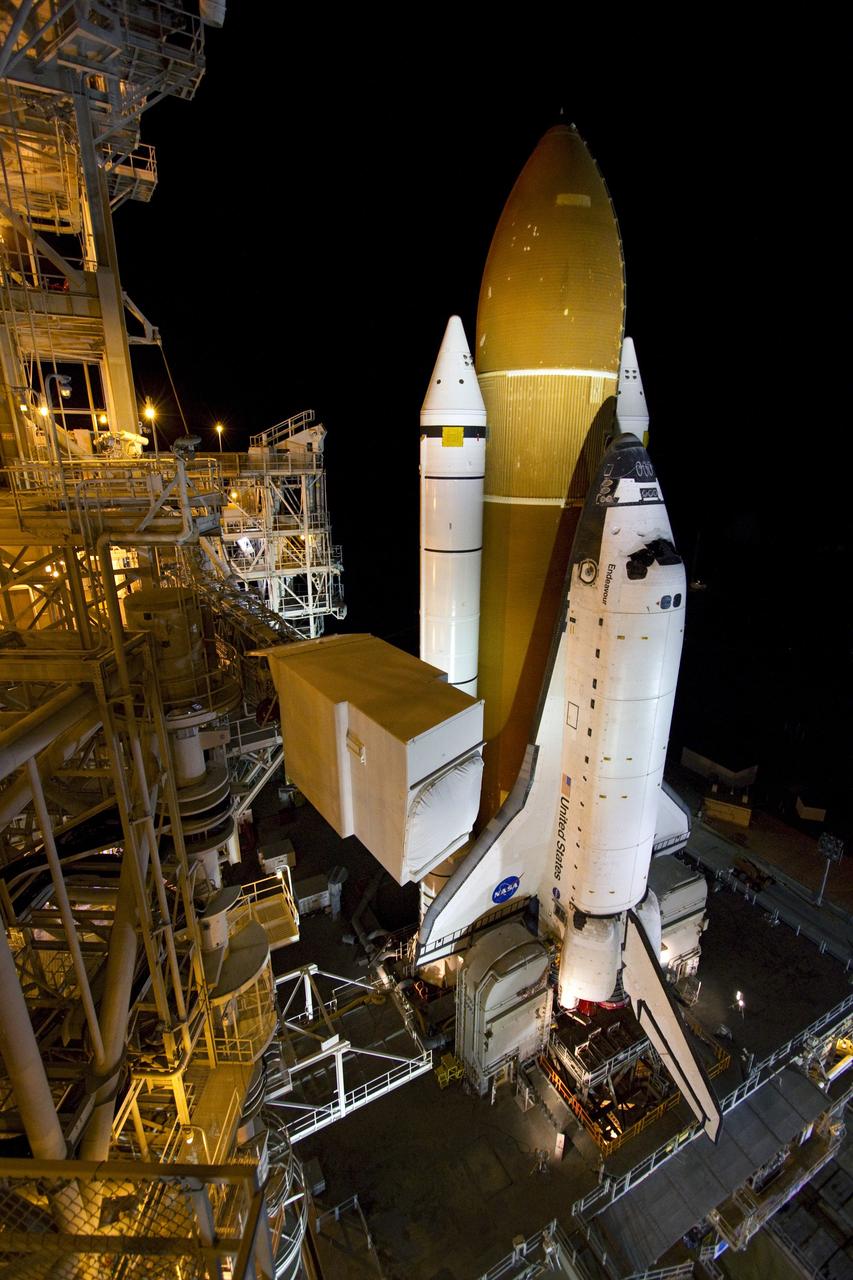
CAPE CANAVERAL, Fla. -- The orbiter access arm swings into position toward space shuttle Endeavour at Launch Pad 39A at NASA's Kennedy Space Center in Florida. Riding atop a crawler-transporter attached to its external fuel tank and solid rocket boosters, Endeavour's 3.4-mile trek, known as "rollout," began at the Vehicle Assembly Building at 7:56 p.m. EST March 10 and ended at 3:49 a.m. EST, nearly eight hours later. This is Endeavour's final scheduled rollout. Endeavour and its six-member crew will deliver the Express Logistics Carrier-3, Alpha Magnetic Spectrometer-2 (AMS), a high-pressure gas tank, additional spare parts for the Dextre robotic helper and micrometeoroid debris shields to the International Space Station on the shuttle's final spaceflight, STS-134. Launch is targeted for 7:48 p.m. EDT April 19. For more information, visit www.nasa.gov/mission_pages/shuttle/shuttlemissions/sts134/index.html. Photo credit: NASA/Jack Pfaller
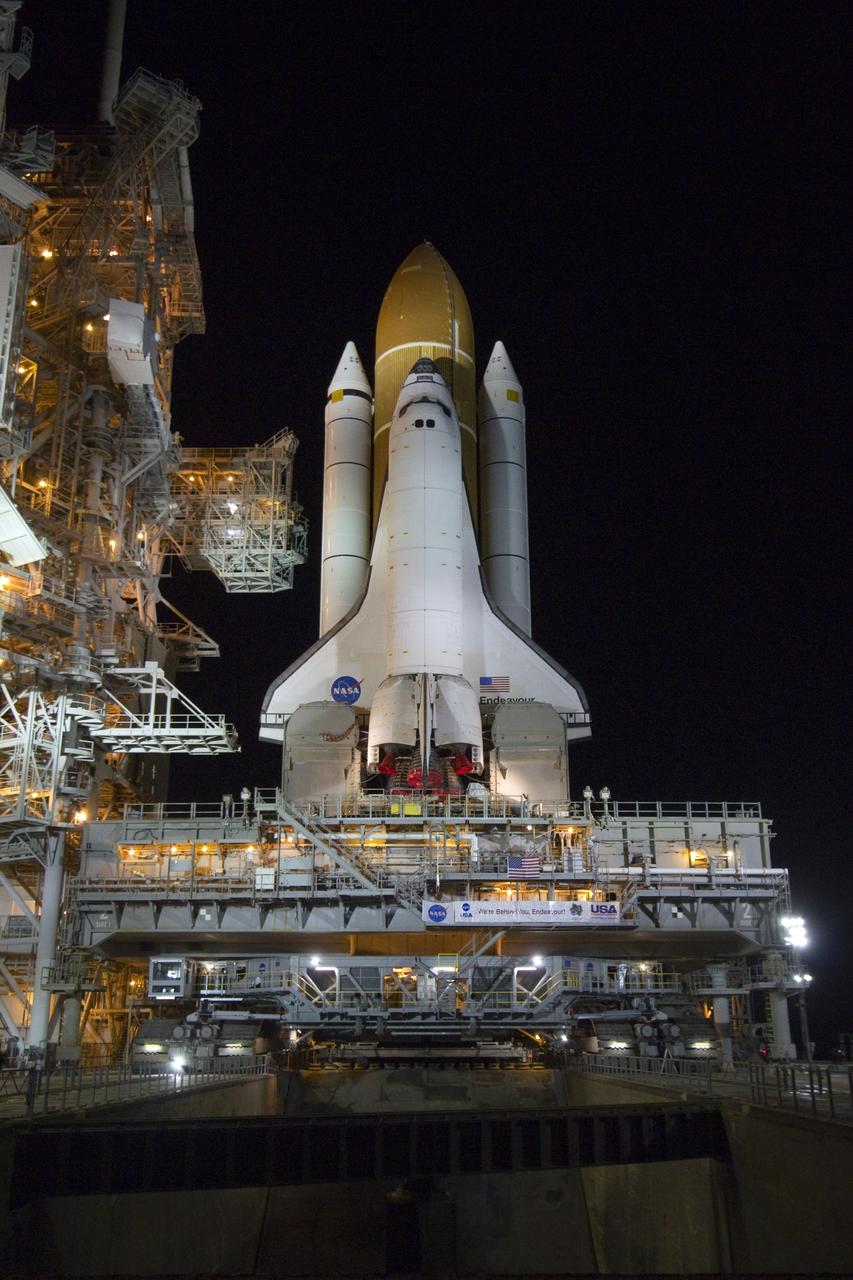
CAPE CANAVERAL, Fla. -- Work is under way to secure space shuttle Endeavour on the six permanent and four extensible pedestals at Launch Pad 39A at NASA's Kennedy Space Center in Florida. Riding atop a crawler-transporter attached to its external fuel tank and solid rocket boosters, Endeavour's 3.4-mile trek, known as "rollout," began at the Vehicle Assembly Building at 7:56 p.m. EST March 10 and ended at 3:49 a.m. EST, nearly eight hours later. This is Endeavour's final scheduled rollout. Endeavour and its six-member crew will deliver the Express Logistics Carrier-3, Alpha Magnetic Spectrometer-2 (AMS), a high-pressure gas tank, additional spare parts for the Dextre robotic helper and micrometeoroid debris shields to the International Space Station on the shuttle's final spaceflight, STS-134. Launch is targeted for 7:48 p.m. EDT April 19. For more information, visit www.nasa.gov/mission_pages/shuttle/shuttlemissions/sts134/index.html. Photo credit: NASA/Jack Pfaller
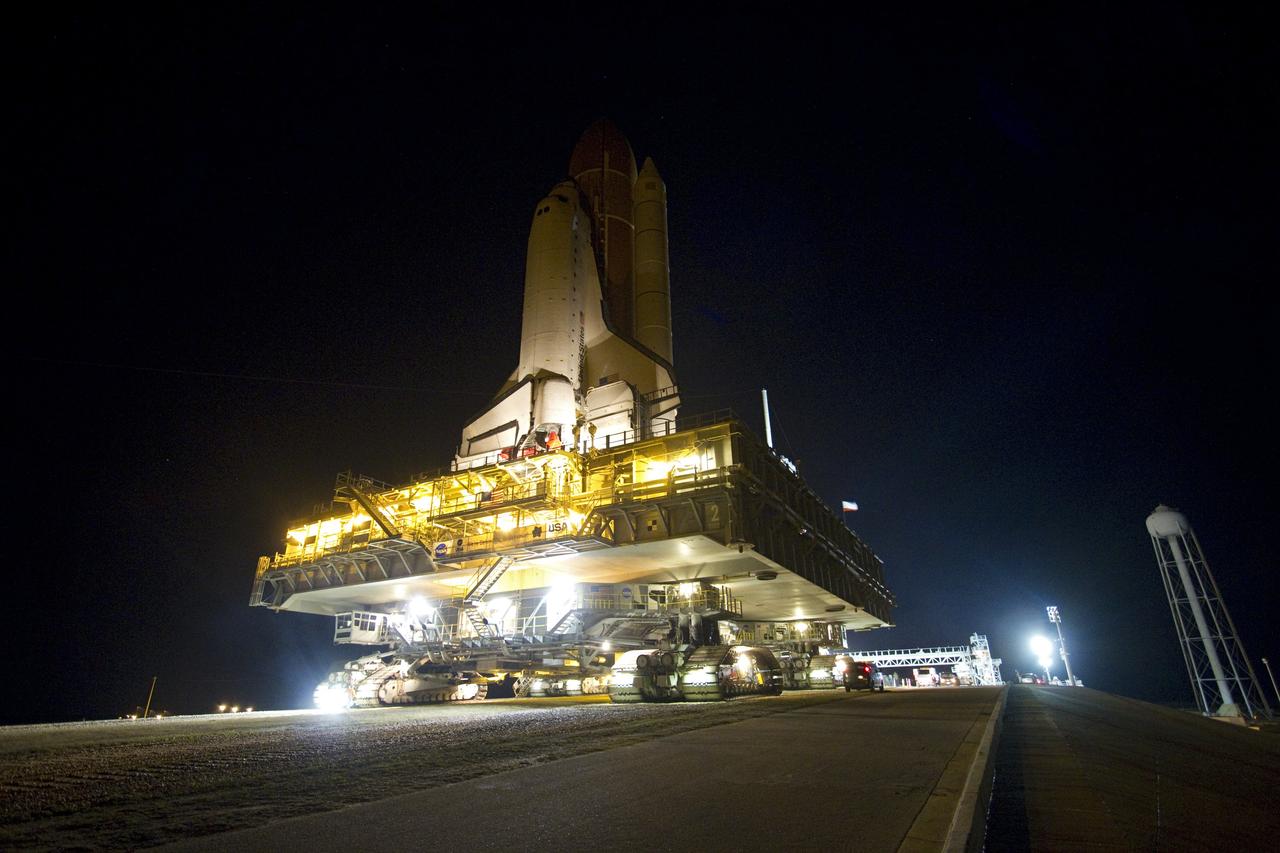
CAPE CANAVERAL, Fla. -- Space shuttle Endeavour navigates the crawlerway's five percent grade to the hardstand at the top of Launch Pad 39A at NASA's Kennedy Space Center in Florida. Riding atop a crawler-transporter attached to its external fuel tank and solid rocket boosters, Endeavour's 3.4-mile trek, known as "rollout," began at the Vehicle Assembly Building at 7:56 p.m. EST March 10 and ended at 3:49 a.m. EST, nearly eight hours later. This is Endeavour's final scheduled rollout. Endeavour and its six-member crew will deliver the Express Logistics Carrier-3, Alpha Magnetic Spectrometer-2 (AMS), a high-pressure gas tank, additional spare parts for the Dextre robotic helper and micrometeoroid debris shields to the International Space Station on the shuttle's final spaceflight, STS-134. Launch is targeted for 7:48 p.m. EDT April 19. For more information, visit www.nasa.gov/mission_pages/shuttle/shuttlemissions/sts134/index.html. Photo credit: NASA/Jack Pfaller
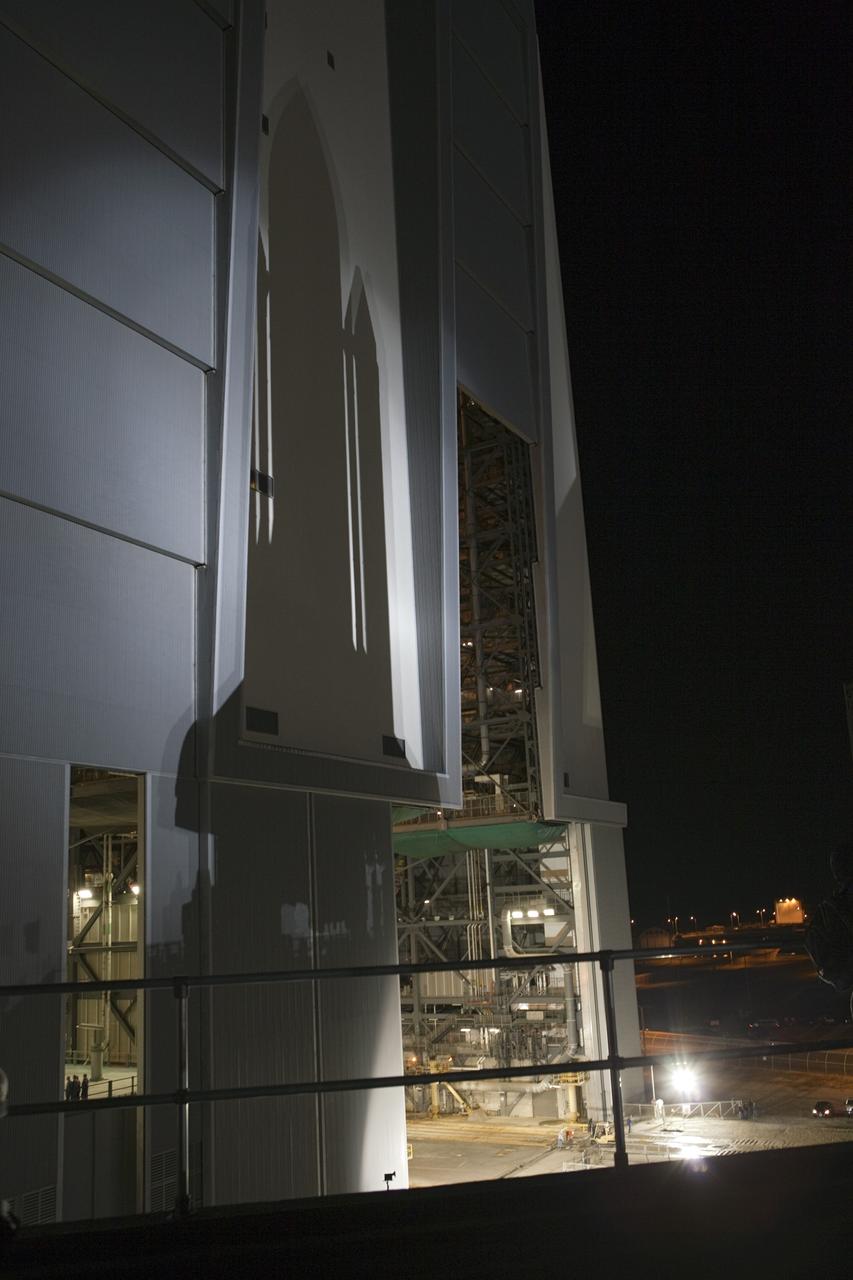
CAPE CANAVERAL, Fla. -- Space shuttle Endeavour, illuminated by xenon lights, casts a shadow on the Vehicle Assembly Building as it begins its nighttime journey to Launch Pad 39A at NASA's Kennedy Space Center in Florida. Riding atop a crawler-transporter attached to its external fuel tank and solid rocket boosters, Endeavour's 3.4-mile trek, known as "rollout," began at 7:56 p.m. EST and will take about seven hours to complete. This is the final scheduled rollout for Endeavour. Endeavour and its six-member crew will deliver the Express Logistics Carrier-3, Alpha Magnetic Spectrometer-2 (AMS), a high-pressure gas tank, additional spare parts for the Dextre robotic helper and micrometeoroid debris shields to the International Space Station on the shuttle's final spaceflight, STS-134. Launch is targeted for 7:48 p.m. EDT April 19. For more information, visit www.nasa.gov/mission_pages/shuttle/shuttlemissions/sts134/index.html. Photo credit: NASA/Terry Zaperach

CAPE CANAVERAL, Fla. -- The sun glints off space shuttle Endeavour following its arrival at Launch Pad 39A at NASA's Kennedy Space Center in Florida. Riding atop a crawler-transporter attached to its external fuel tank and solid rocket boosters, Endeavour's 3.4-mile trek, known as "rollout," began at the Vehicle Assembly Building at 7:56 p.m. EST March 10 and ended at 3:49 a.m. EST, nearly eight hours later. This is Endeavour's final scheduled rollout. Endeavour and its six-member crew will deliver the Express Logistics Carrier-3, Alpha Magnetic Spectrometer-2 (AMS), a high-pressure gas tank, additional spare parts for the Dextre robotic helper and micrometeoroid debris shields to the International Space Station on the shuttle's final spaceflight, STS-134. Launch is targeted for 7:48 p.m. EDT April 19. For more information, visit www.nasa.gov/mission_pages/shuttle/shuttlemissions/sts134/index.html. Photo credit: NASA/Jack Pfaller
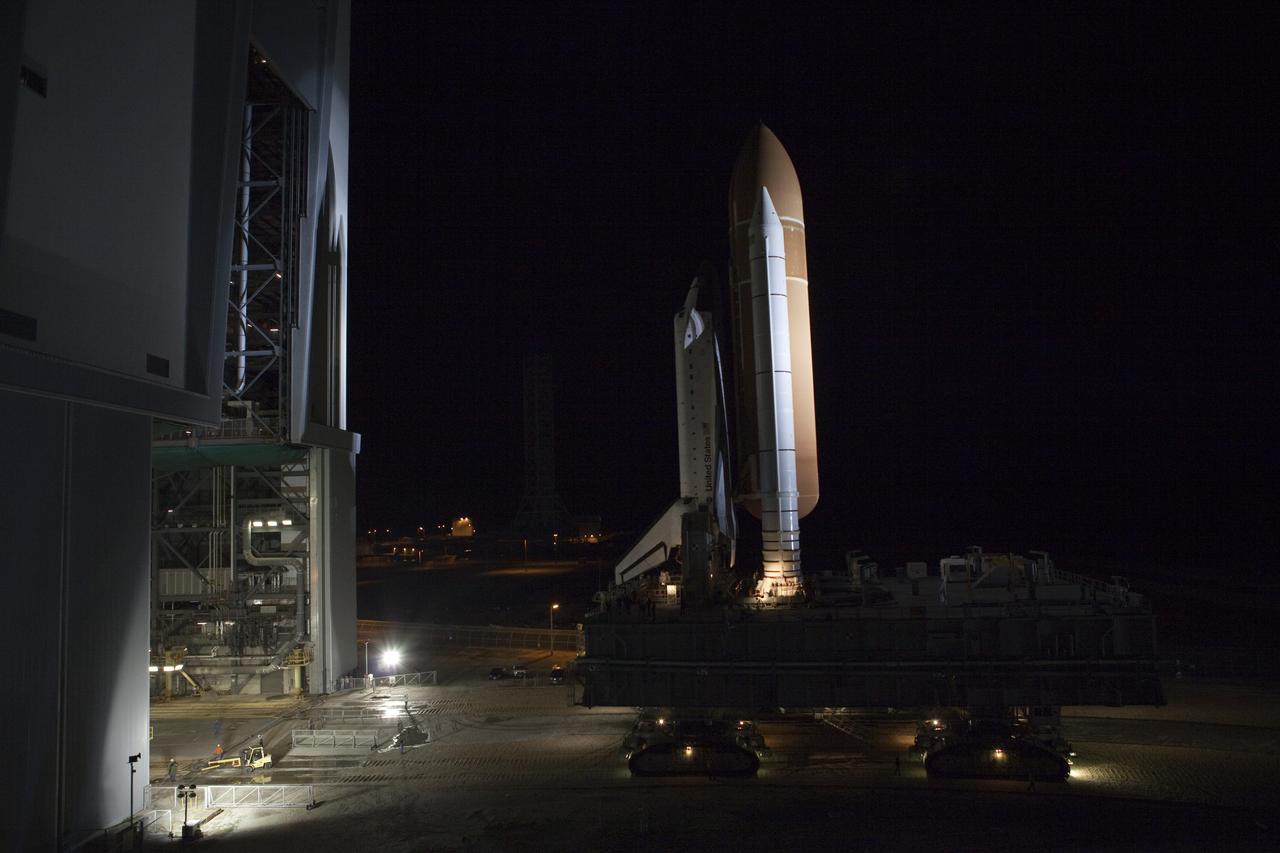
CAPE CANAVERAL, Fla. -- Space shuttle Endeavour moves through a high bay door of the Vehicle Assembly Building to begin its nighttime journey to Launch Pad 39A at NASA's Kennedy Space Center in Florida. Riding atop a crawler-transporter attached to its external fuel tank and solid rocket boosters, Endeavour's 3.4-mile trek, known as "rollout," began at 7:56 p.m. EST and will take about seven hours to complete. This is the final scheduled rollout for Endeavour. Endeavour and its six-member crew will deliver the Express Logistics Carrier-3, Alpha Magnetic Spectrometer-2 (AMS), a high-pressure gas tank, additional spare parts for the Dextre robotic helper and micrometeoroid debris shields to the International Space Station on the shuttle's final spaceflight, STS-134. Launch is targeted for 7:48 p.m. EDT April 19. For more information, visit www.nasa.gov/mission_pages/shuttle/shuttlemissions/sts134/index.html. Photo credit: NASA/Terry Zaperach

CAPE CANAVERAL, Fla. -- Bathed in xenon lights, space shuttle Endeavour moves along the crawlerway from the Vehicle Assembly Building to Launch Pad 39A, illuminated in the background, at NASA's Kennedy Space Center in Florida. Riding atop a crawler-transporter attached to its external fuel tank and solid rocket boosters, Endeavour's 3.4-mile trek, known as "rollout," began at 7:56 p.m. EST and will take about seven hours to complete. This is the final scheduled rollout for Endeavour. Endeavour and its six-member crew will deliver the Express Logistics Carrier-3, Alpha Magnetic Spectrometer-2 (AMS), a high-pressure gas tank, additional spare parts for the Dextre robotic helper and micrometeoroid debris shields to the International Space Station on the shuttle's final spaceflight, STS-134. Launch is targeted for 7:48 p.m. EDT April 19. For more information, visit www.nasa.gov/mission_pages/shuttle/shuttlemissions/sts134/index.html. Photo credit: NASA/Frankie Martin
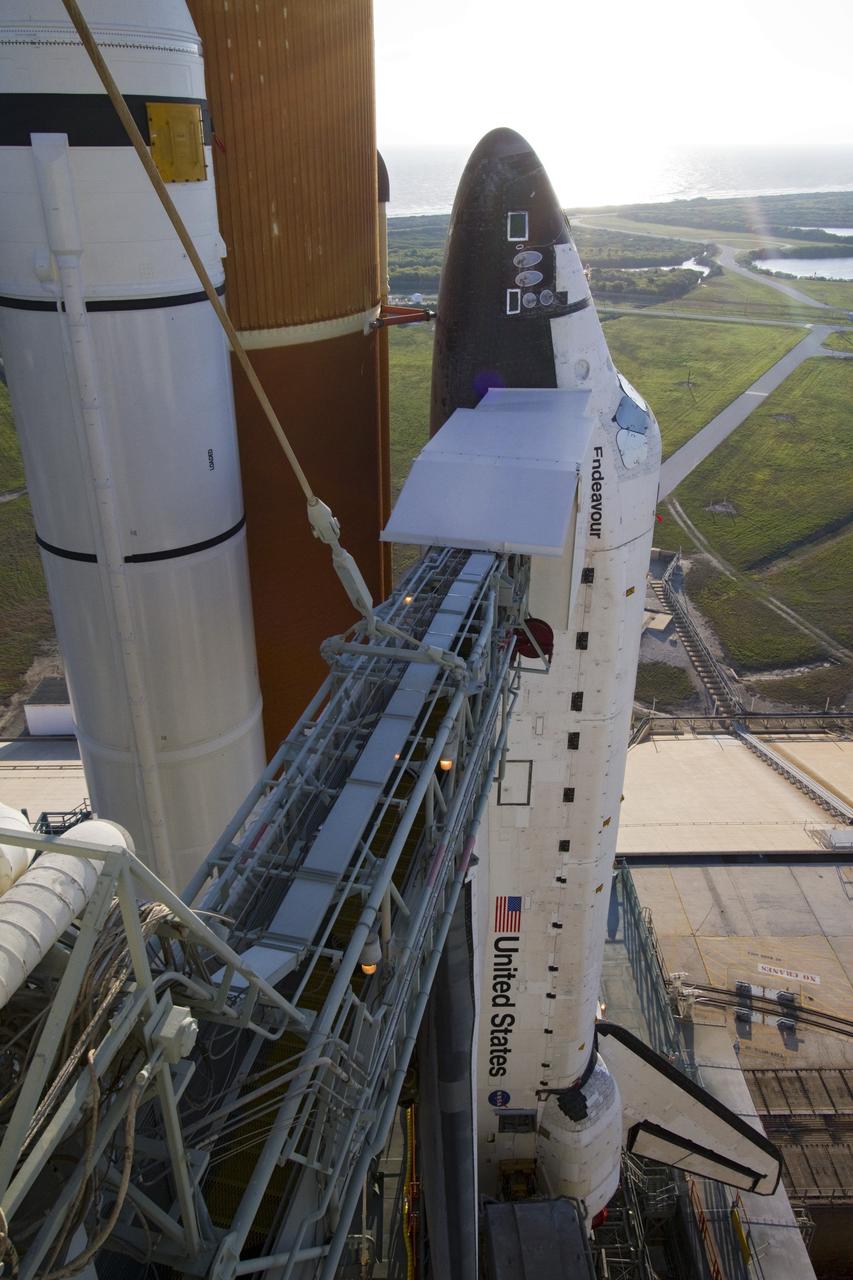
CAPE CANAVERAL, Fla. -- Space shuttle Endeavour is newly arrived at Launch Pad 39A near the Atlantic seashore at NASA's Kennedy Space Center in Florida. Riding atop a crawler-transporter attached to its external fuel tank and solid rocket boosters, Endeavour's 3.4-mile trek, known as "rollout," began at the Vehicle Assembly Building at 7:56 p.m. EST March 10 and ended at 3:49 a.m. EST, nearly eight hours later. This is Endeavour's final scheduled rollout. Endeavour and its six-member crew will deliver the Express Logistics Carrier-3, Alpha Magnetic Spectrometer-2 (AMS), a high-pressure gas tank, additional spare parts for the Dextre robotic helper and micrometeoroid debris shields to the International Space Station on the shuttle's final spaceflight, STS-134. Launch is targeted for 7:48 p.m. EDT April 19. For more information, visit www.nasa.gov/mission_pages/shuttle/shuttlemissions/sts134/index.html. Photo credit: NASA/Jack Pfaller
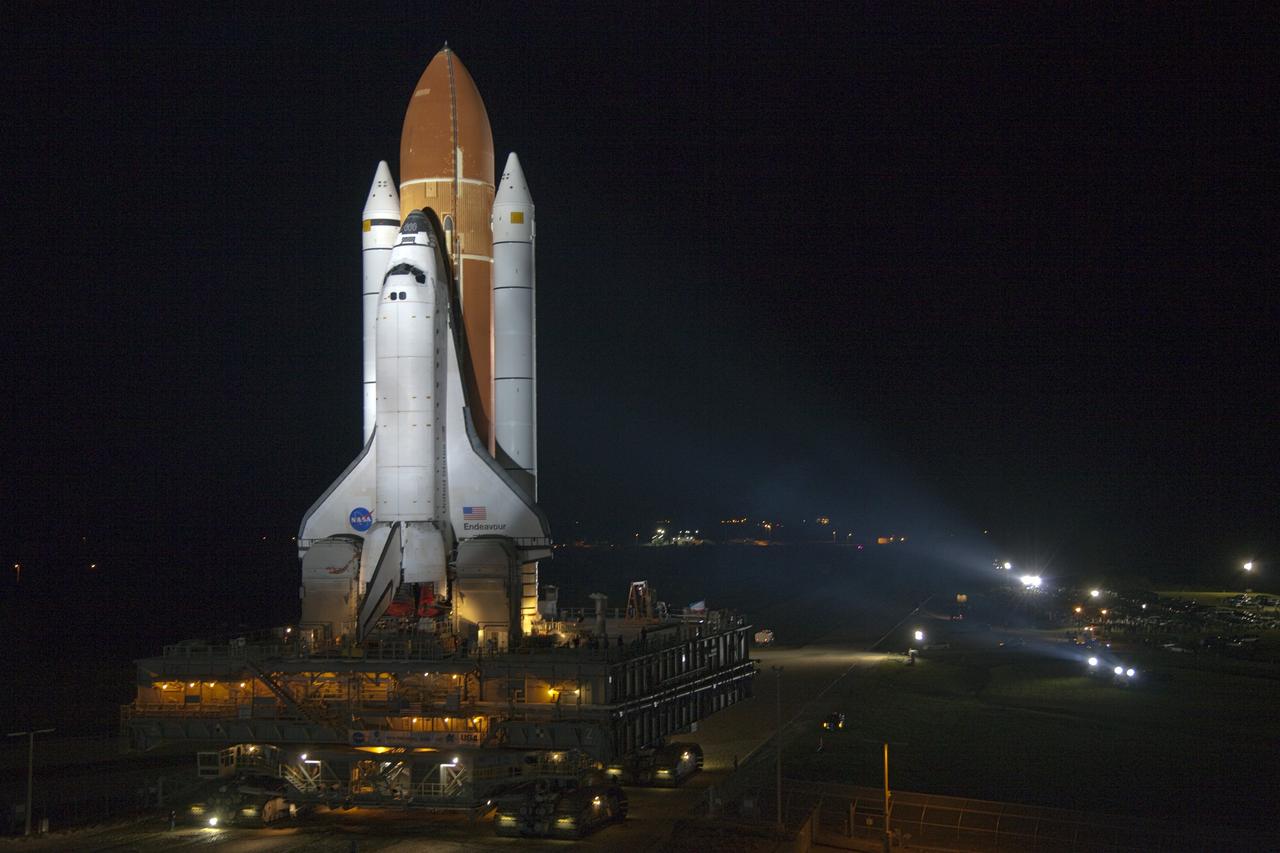
CAPE CANAVERAL, Fla. -- Bathed in xenon lights, space shuttle Endeavour makes its nighttime journey from the Vehicle Assembly Building to Launch Pad 39A at NASA's Kennedy Space Center in Florida. Riding atop a crawler-transporter attached to its external fuel tank and solid rocket boosters, Endeavour's 3.4-mile trek, known as "rollout," began at 7:56 p.m. EST and will take about seven hours to complete. This is the final scheduled rollout for Endeavour. Endeavour and its six-member crew will deliver the Express Logistics Carrier-3, Alpha Magnetic Spectrometer-2 (AMS), a high-pressure gas tank, additional spare parts for the Dextre robotic helper and micrometeoroid debris shields to the International Space Station on the shuttle's final spaceflight, STS-134. Launch is targeted for 7:48 p.m. EDT April 19. For more information, visit www.nasa.gov/mission_pages/shuttle/shuttlemissions/sts134/index.html. Photo credit: NASA/Frankie Martin
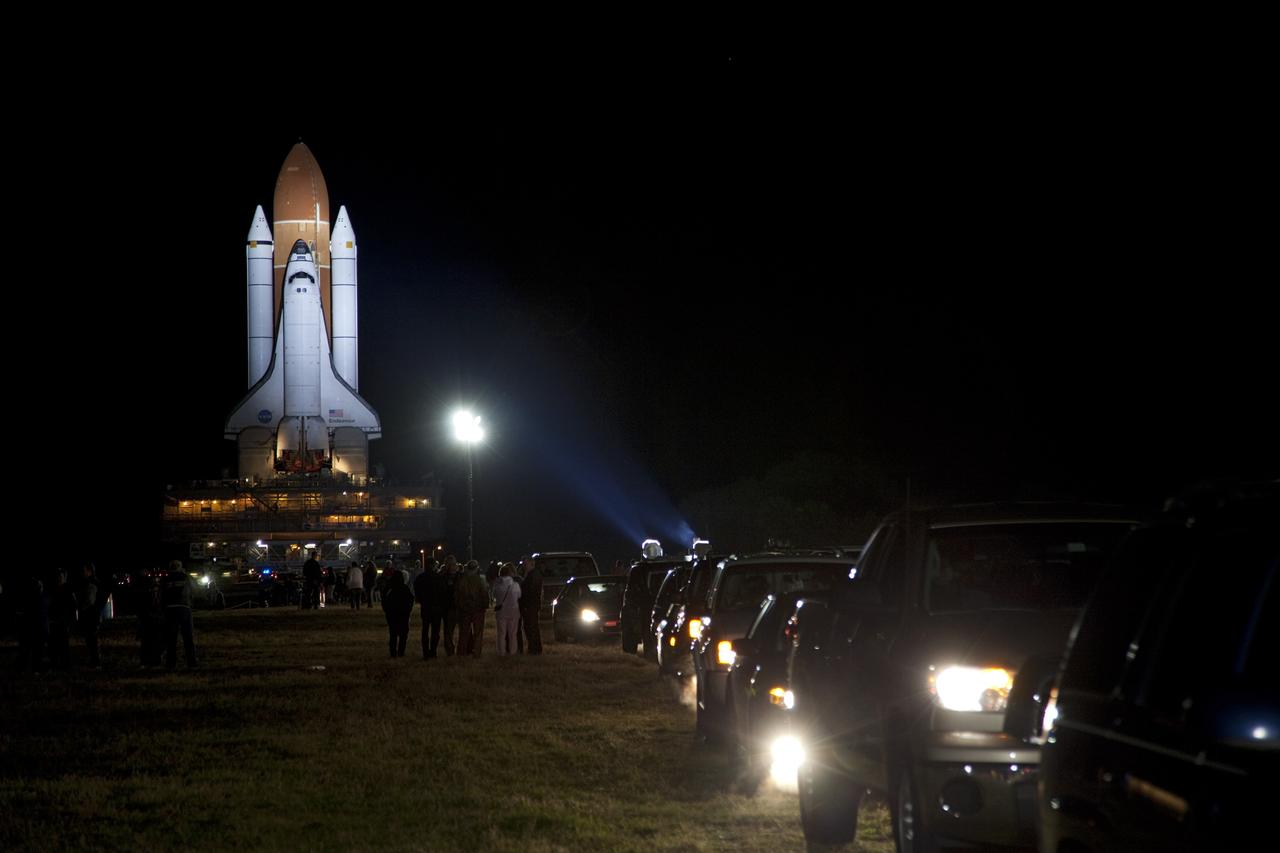
CAPE CANAVERAL, Fla. -- Employees and their friends and families are on hand to witness space shuttle Endeavour, illuminated by xenon lights, on its nighttime journey from the Vehicle Assembly Building to Launch Pad 39A at NASA's Kennedy Space Center in Florida. Riding atop a crawler-transporter attached to its external fuel tank and solid rocket boosters, Endeavour's 3.4-mile trek, known as "rollout," began at 7:56 p.m. EST and will take about seven hours to complete. This is the final scheduled rollout for Endeavour. Endeavour and its six-member crew will deliver the Express Logistics Carrier-3, Alpha Magnetic Spectrometer-2 (AMS), a high-pressure gas tank, additional spare parts for the Dextre robotic helper and micrometeoroid debris shields to the International Space Station on the shuttle's final spaceflight, STS-134. Launch is targeted for 7:48 p.m. EDT April 19. For more information, visit www.nasa.gov/mission_pages/shuttle/shuttlemissions/sts134/index.html. Photo credit: NASA/Frankie Martin
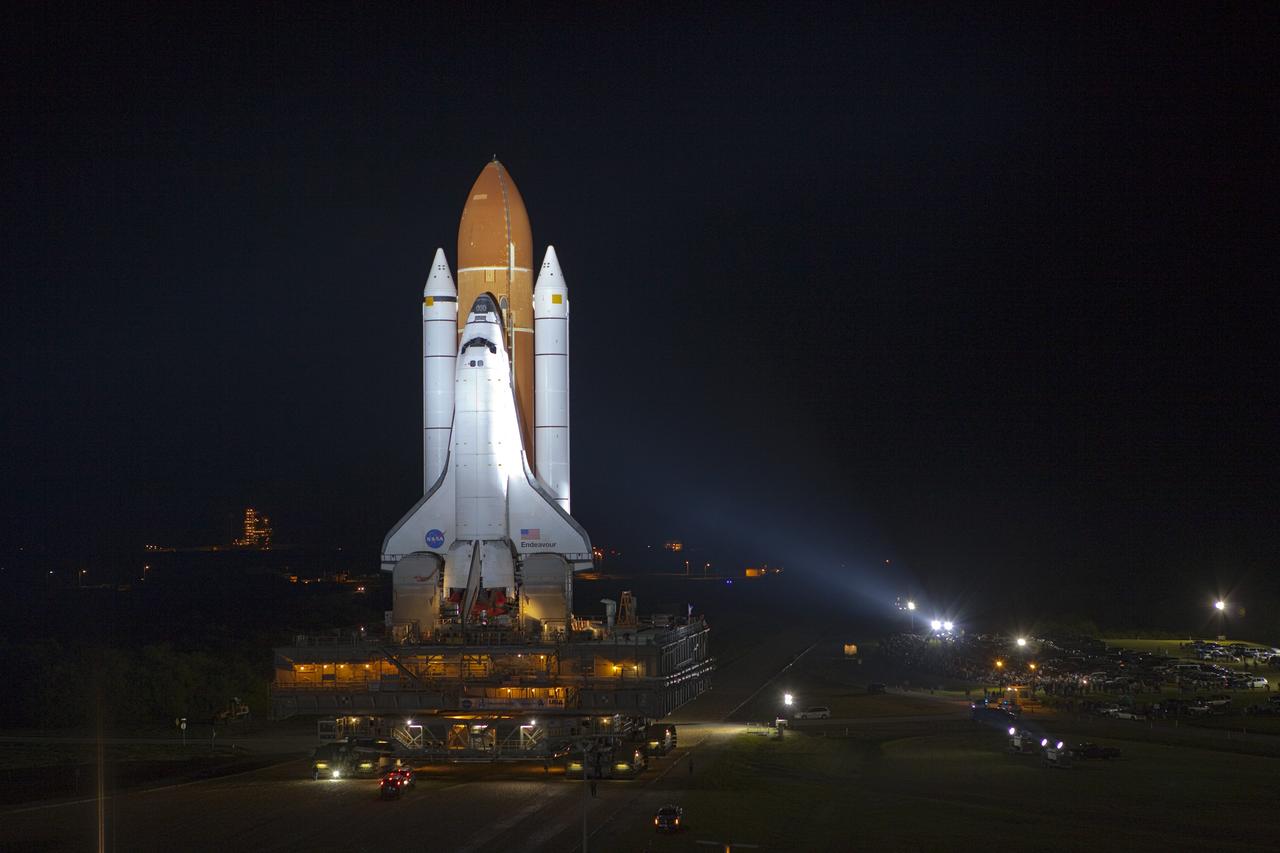
CAPE CANAVERAL, Fla. -- Bathed in xenon lights, space shuttle Endeavour moves along the crawlerway from the Vehicle Assembly Building to Launch Pad 39A, illuminated in the background, at NASA's Kennedy Space Center in Florida. Riding atop a crawler-transporter attached to its external fuel tank and solid rocket boosters, Endeavour's 3.4-mile trek, known as "rollout," began at 7:56 p.m. EST and will take about seven hours to complete. This is the final scheduled rollout for Endeavour. Endeavour and its six-member crew will deliver the Express Logistics Carrier-3, Alpha Magnetic Spectrometer-2 (AMS), a high-pressure gas tank, additional spare parts for the Dextre robotic helper and micrometeoroid debris shields to the International Space Station on the shuttle's final spaceflight, STS-134. Launch is targeted for 7:48 p.m. EDT April 19. For more information, visit www.nasa.gov/mission_pages/shuttle/shuttlemissions/sts134/index.html. Photo credit: NASA/Terry Zaperach
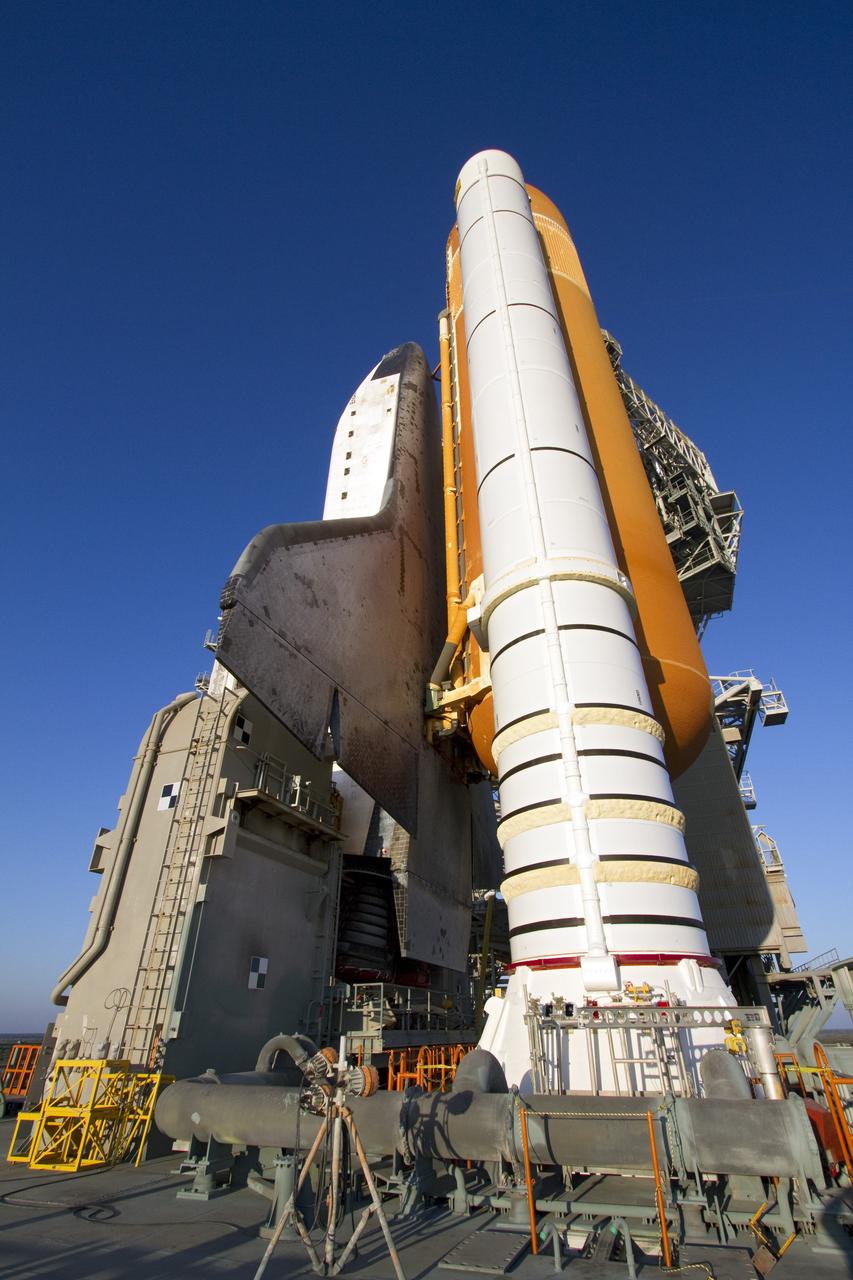
CAPE CANAVERAL, Fla. -- Four attach posts on each of two solid rocket boosters secure space shuttle Endeavour to its mobile launcher platform at Launch Pad 39A at NASA's Kennedy Space Center in Florida. Riding atop a crawler-transporter attached to its external fuel tank and solid rocket boosters, Endeavour's 3.4-mile trek, known as "rollout," began at the Vehicle Assembly Building at 7:56 p.m. EST March 10 and ended at 3:49 a.m. EST, nearly eight hours later. This is Endeavour's final scheduled rollout. Endeavour and its six-member crew will deliver the Express Logistics Carrier-3, Alpha Magnetic Spectrometer-2 (AMS), a high-pressure gas tank, additional spare parts for the Dextre robotic helper and micrometeoroid debris shields to the International Space Station on the shuttle's final spaceflight, STS-134. Launch is targeted for 7:48 p.m. EDT April 19. For more information, visit www.nasa.gov/mission_pages/shuttle/shuttlemissions/sts134/index.html. Photo credit: NASA/Jack Pfaller
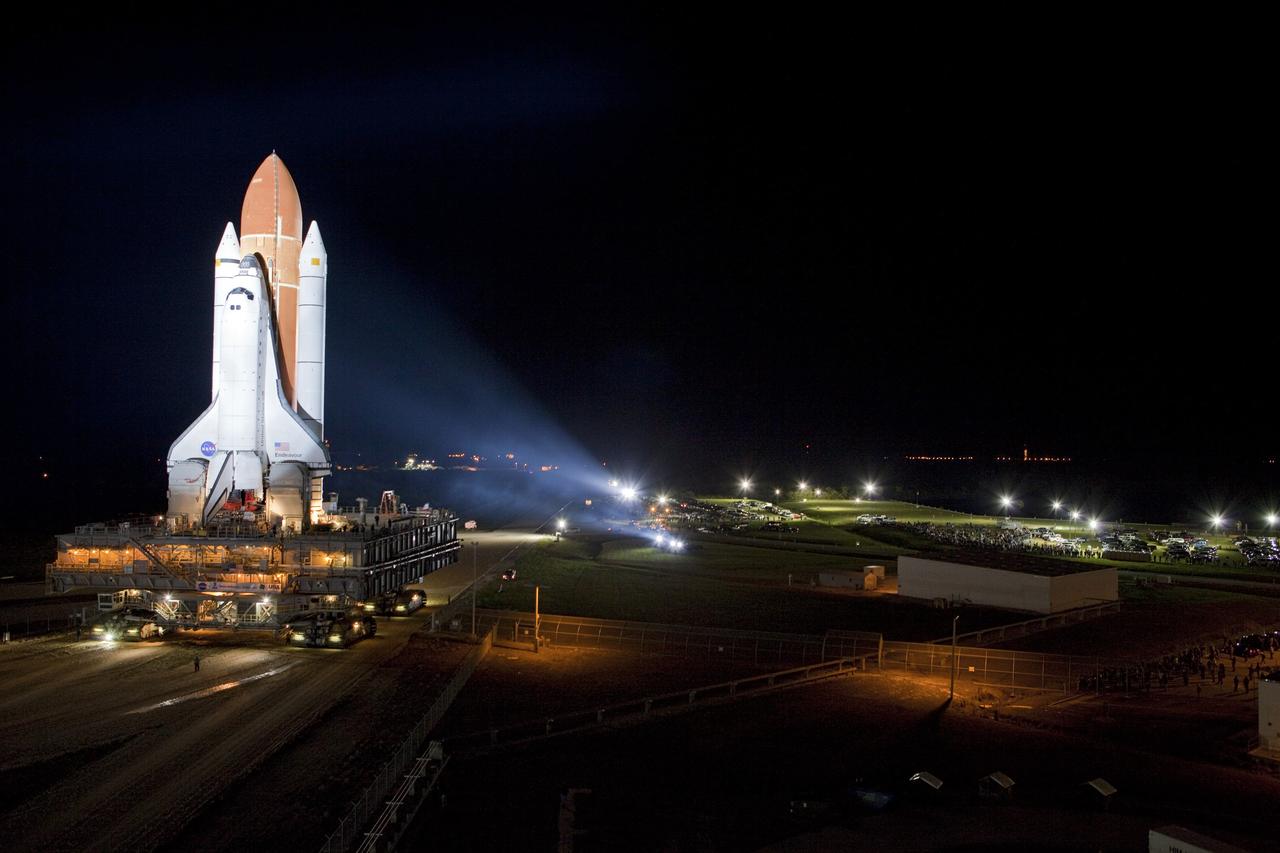
CAPE CANAVERAL, Fla. -- Space shuttle Endeavour basks in the xenon spotlights on its nighttime journey from the Vehicle Assembly Building to Launch Pad 39A at NASA's Kennedy Space Center in Florida. Riding atop a crawler-transporter attached to its external fuel tank and solid rocket boosters, Endeavour's 3.4-mile trek, known as "rollout," began at 7:56 p.m. EST and will take about seven hours to complete. This is the final scheduled rollout for Endeavour. Endeavour and its six-member crew will deliver the Express Logistics Carrier-3, Alpha Magnetic Spectrometer-2 (AMS), a high-pressure gas tank, additional spare parts for the Dextre robotic helper and micrometeoroid debris shields to the International Space Station on the shuttle's final spaceflight, STS-134. Launch is targeted for 7:48 p.m. EDT April 19. For more information, visit www.nasa.gov/mission_pages/shuttle/shuttlemissions/sts134/index.html. Photo credit: NASA/Terry Zaperach
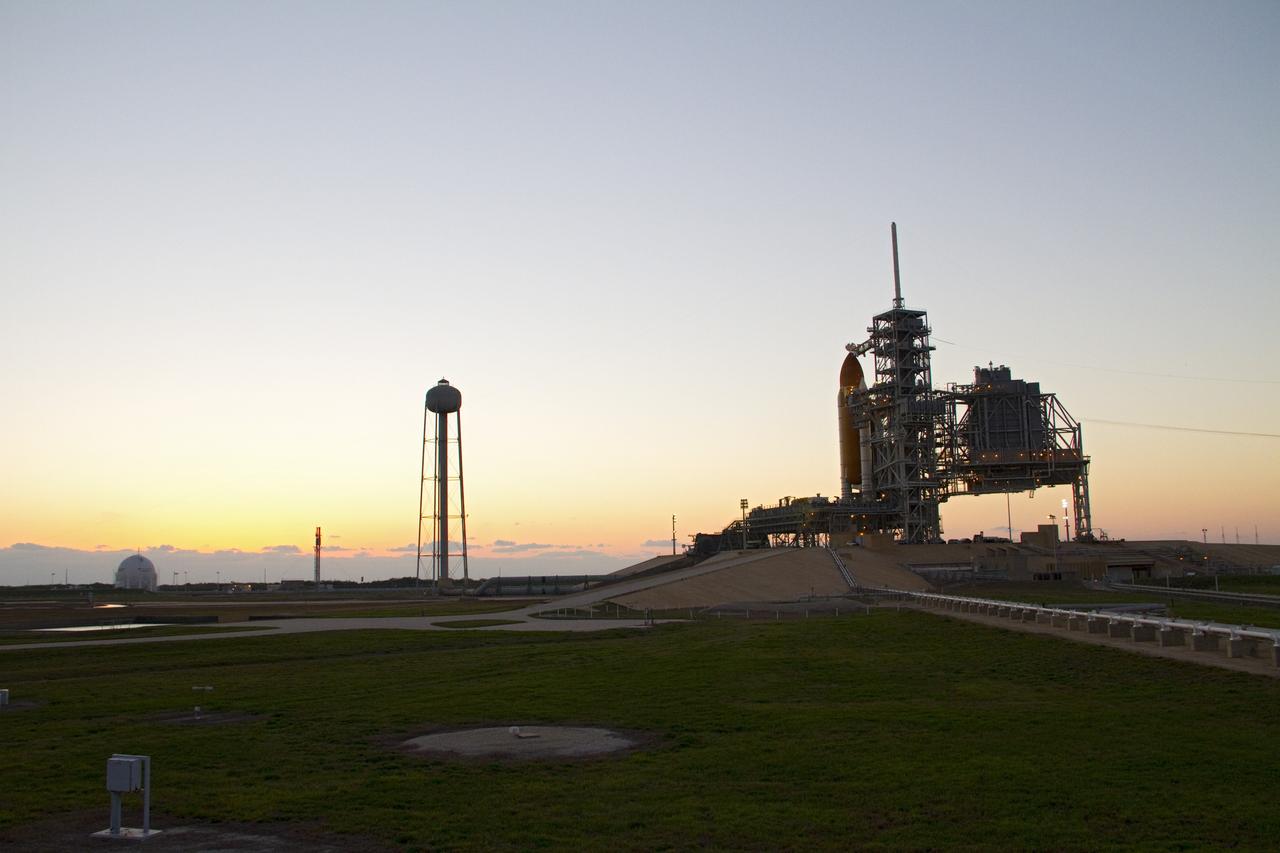
CAPE CANAVERAL, Fla. -- Processing of space shuttle Endeavour at Launch Pad 39A at NASA's Kennedy Space Center in Florida is under way as morning breaks. Riding atop a crawler-transporter attached to its external fuel tank and solid rocket boosters, Endeavour's 3.4-mile trek, known as "rollout," began at the Vehicle Assembly Building at 7:56 p.m. EST March 10 and ended at 3:49 a.m. EST, nearly eight hours later. This is Endeavour's final scheduled rollout. Endeavour and its six-member crew will deliver the Express Logistics Carrier-3, Alpha Magnetic Spectrometer-2 (AMS), a high-pressure gas tank, additional spare parts for the Dextre robotic helper and micrometeoroid debris shields to the International Space Station on the shuttle's final spaceflight, STS-134. Launch is targeted for 7:48 p.m. EDT April 19. For more information, visit www.nasa.gov/mission_pages/shuttle/shuttlemissions/sts134/index.html. Photo credit: NASA/Jack Pfaller
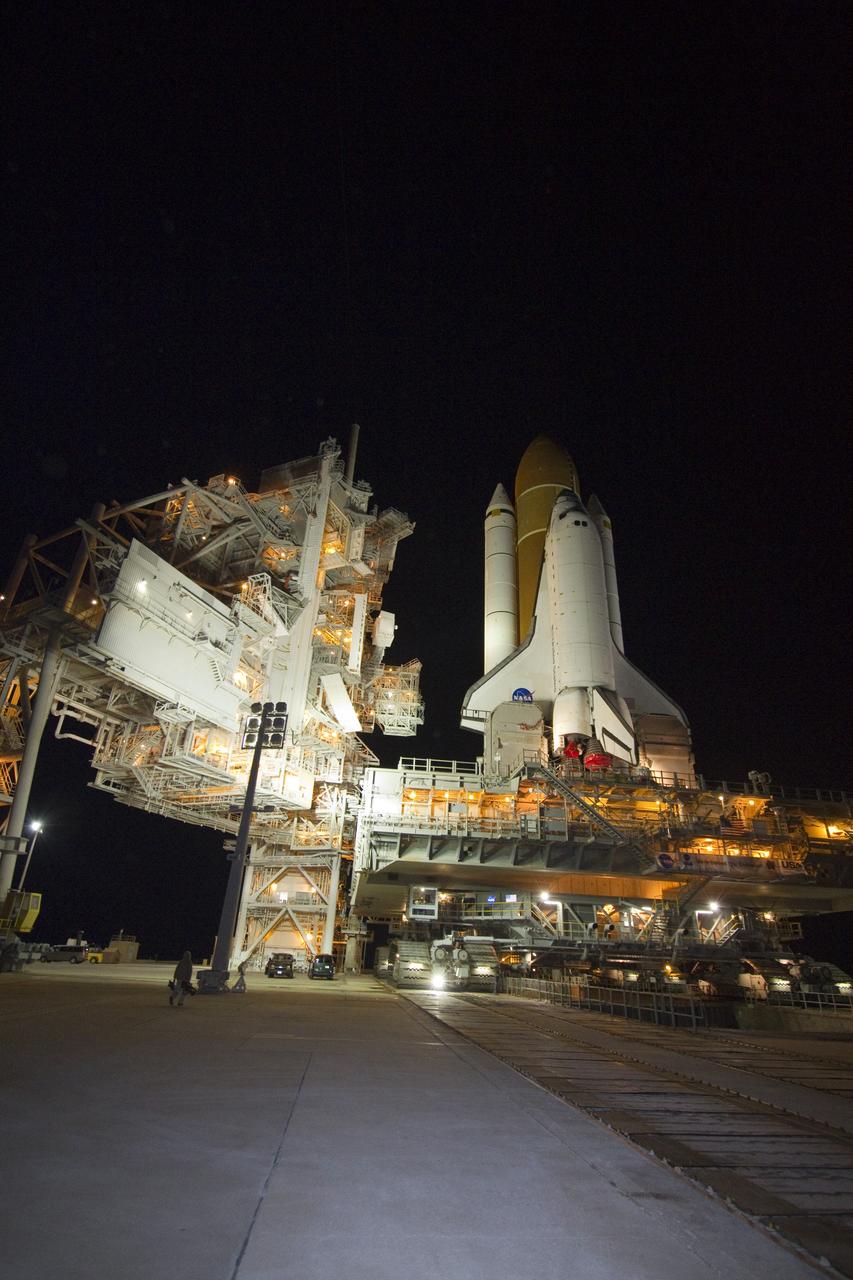
CAPE CANAVERAL, Fla. -- Space shuttle Endeavour is positioned over the flame trench at Launch Pad 39A at NASA's Kennedy Space Center in Florida. Riding atop a crawler-transporter attached to its external fuel tank and solid rocket boosters, Endeavour's 3.4-mile trek, known as "rollout," began at the Vehicle Assembly Building at 7:56 p.m. EST March 10 and ended at 3:49 a.m. EST, nearly eight hours later. This is Endeavour's final scheduled rollout. Endeavour and its six-member crew will deliver the Express Logistics Carrier-3, Alpha Magnetic Spectrometer-2 (AMS), a high-pressure gas tank, additional spare parts for the Dextre robotic helper and micrometeoroid debris shields to the International Space Station on the shuttle's final spaceflight, STS-134. Launch is targeted for 7:48 p.m. EDT April 19. For more information, visit www.nasa.gov/mission_pages/shuttle/shuttlemissions/sts134/index.html. Photo credit: NASA/Jack Pfaller

CAPE CANAVERAL, Fla. -- Early morning finds space shuttle Endeavour has moved into place beside the rotating and fixed service structures on Launch Pad 39A at NASA's Kennedy Space Center in Florida. Riding atop a crawler-transporter attached to its external fuel tank and solid rocket boosters, Endeavour's 3.4-mile trek, known as "rollout," began at the Vehicle Assembly Building at 7:56 p.m. EST March 10 and ended at 3:49 a.m. EST, nearly eight hours later. This is Endeavour's final scheduled rollout. Endeavour and its six-member crew will deliver the Express Logistics Carrier-3, Alpha Magnetic Spectrometer-2 (AMS), a high-pressure gas tank, additional spare parts for the Dextre robotic helper and micrometeoroid debris shields to the International Space Station on the shuttle's final spaceflight, STS-134. Launch is targeted for 7:48 p.m. EDT April 19. For more information, visit www.nasa.gov/mission_pages/shuttle/shuttlemissions/sts134/index.html. Photo credit: NASA/Jack Pfaller
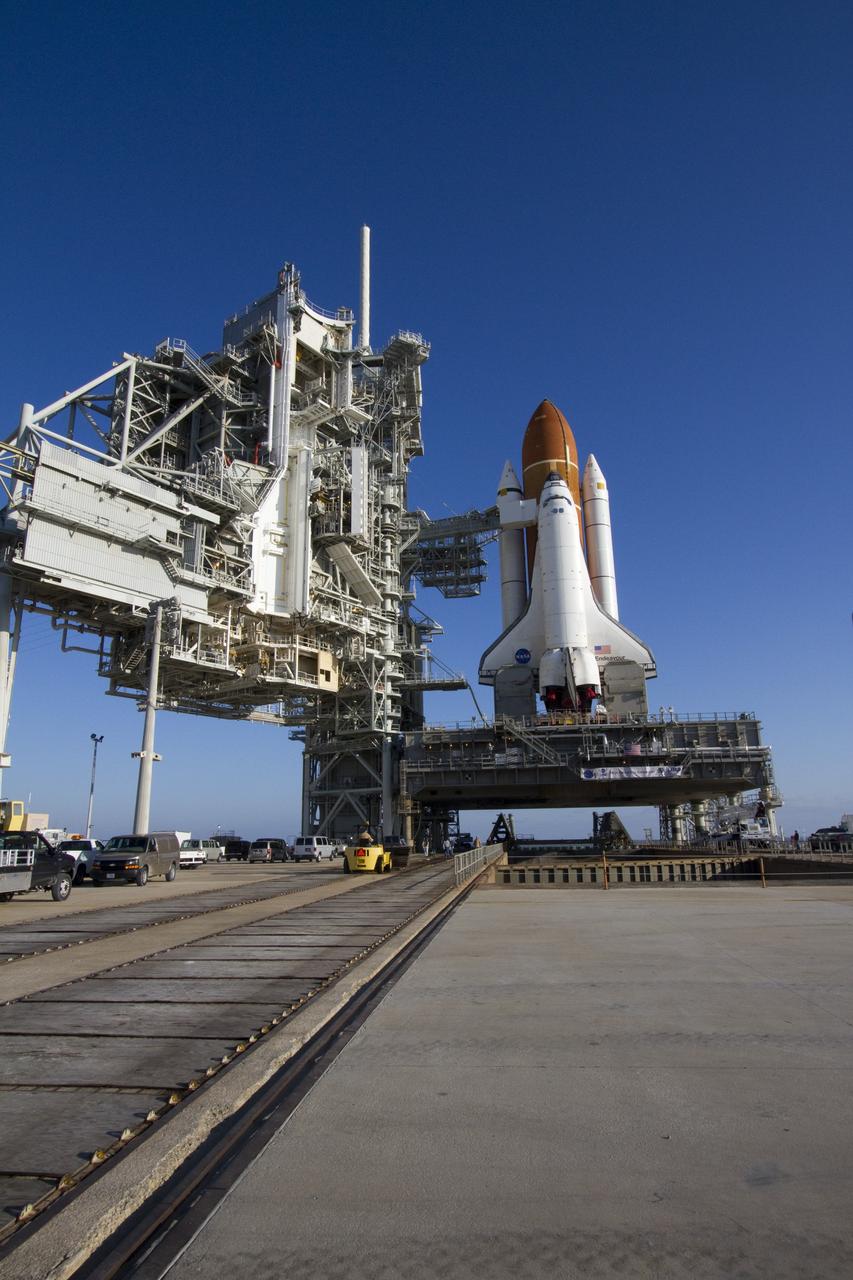
CAPE CANAVERAL, Fla. -- Space shuttle Endeavour stands ready for processing beside the rotating and fixed service structures on Launch Pad 39A at NASA's Kennedy Space Center in Florida. Riding atop a crawler-transporter attached to its external fuel tank and solid rocket boosters, Endeavour's 3.4-mile trek, known as "rollout," began at the Vehicle Assembly Building at 7:56 p.m. EST March 10 and ended at 3:49 a.m. EST, nearly eight hours later. This is Endeavour's final scheduled rollout. Endeavour and its six-member crew will deliver the Express Logistics Carrier-3, Alpha Magnetic Spectrometer-2 (AMS), a high-pressure gas tank, additional spare parts for the Dextre robotic helper and micrometeoroid debris shields to the International Space Station on the shuttle's final spaceflight, STS-134. Launch is targeted for 7:48 p.m. EDT April 19. For more information, visit www.nasa.gov/mission_pages/shuttle/shuttlemissions/sts134/index.html. Photo credit: NASA/Jack Pfaller