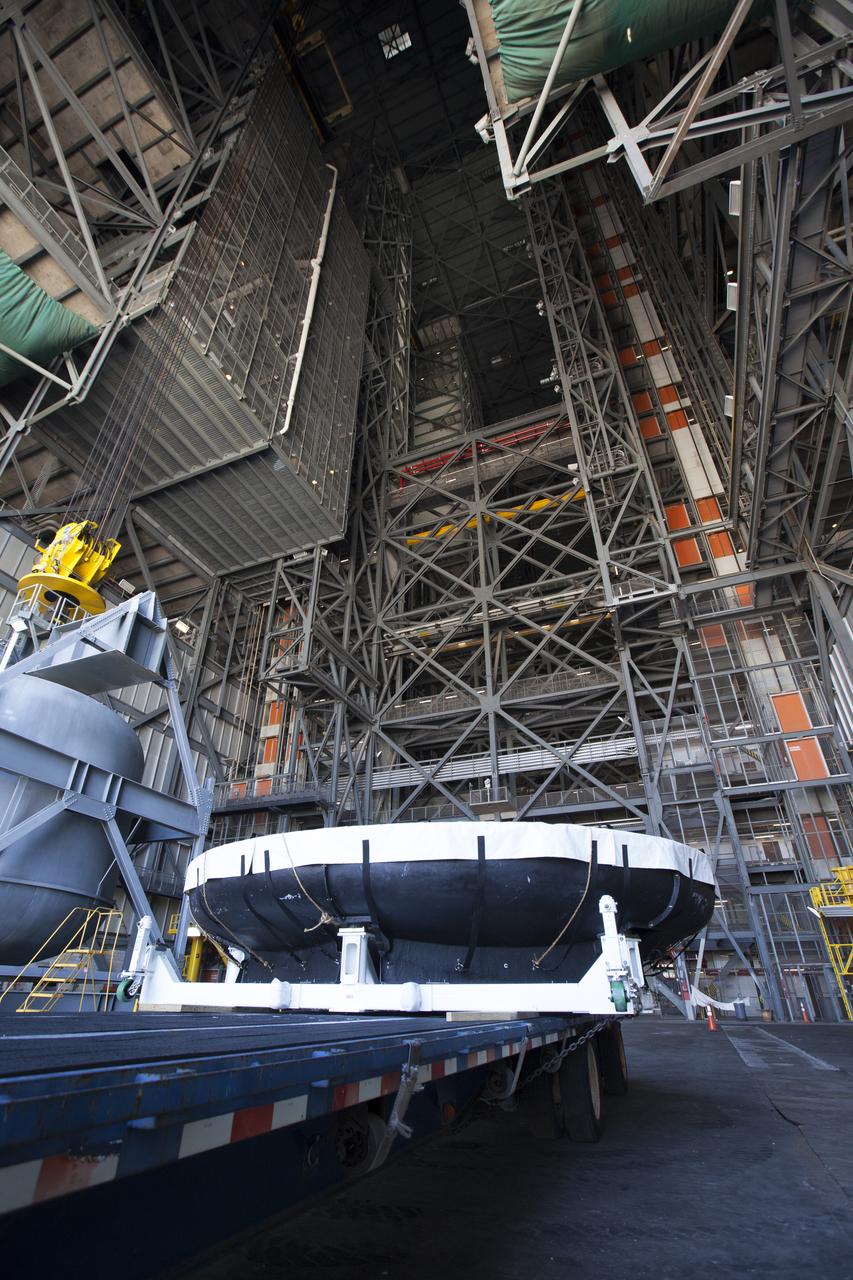
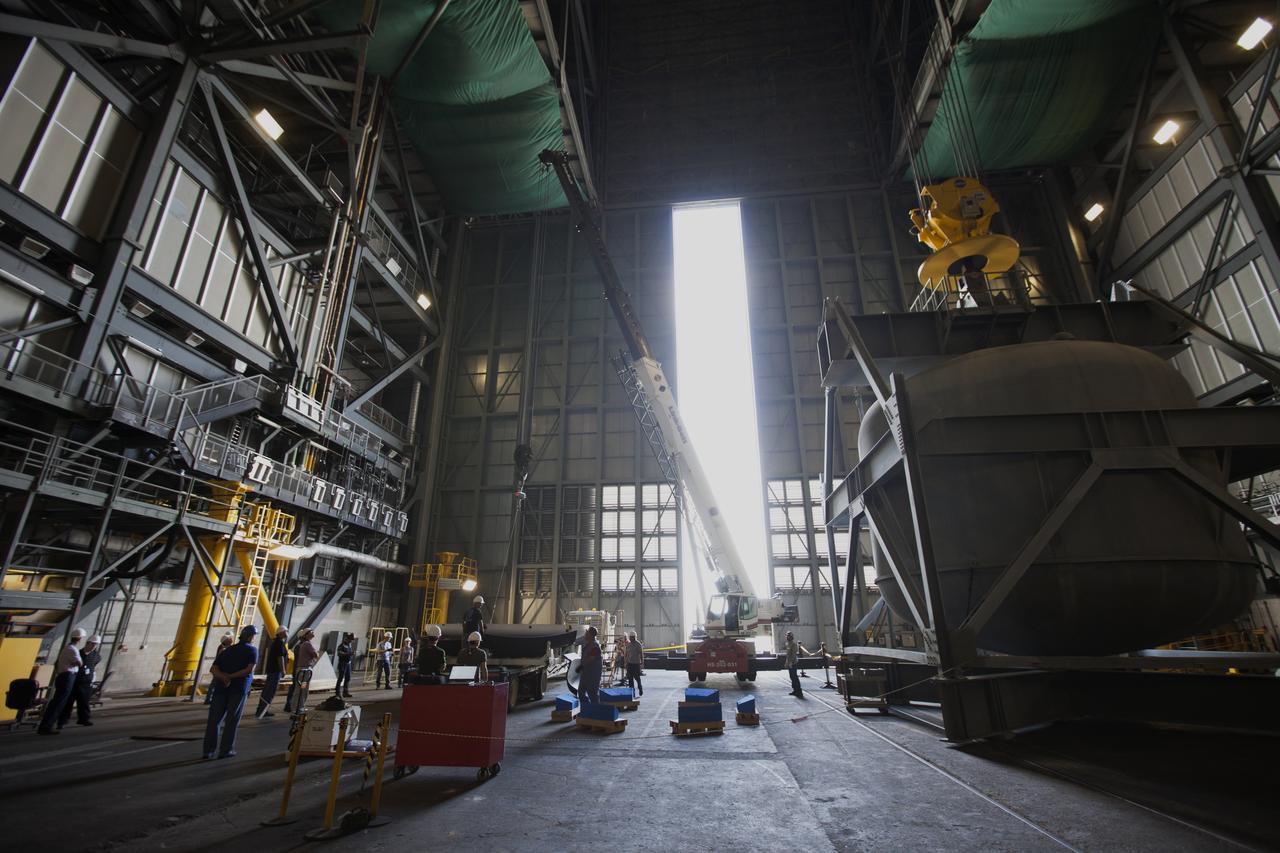
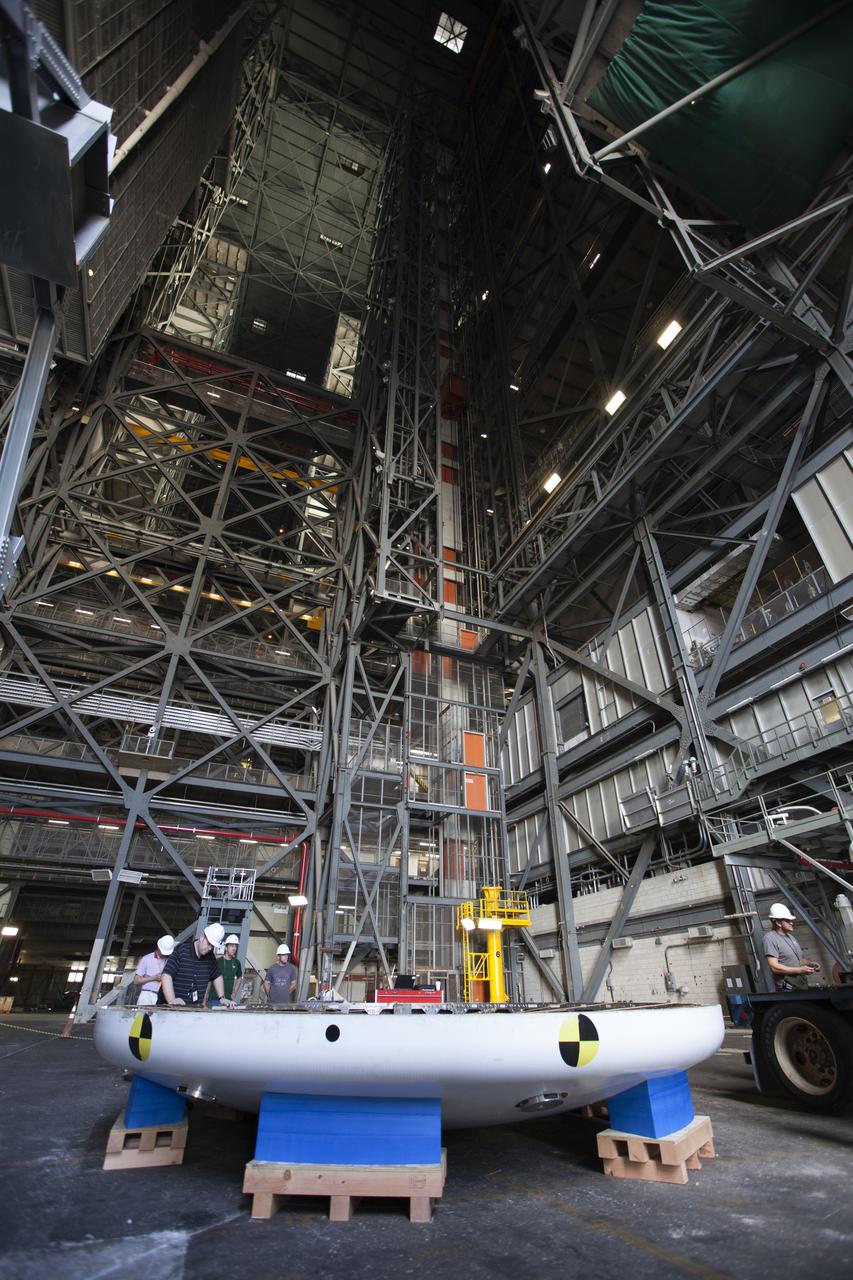
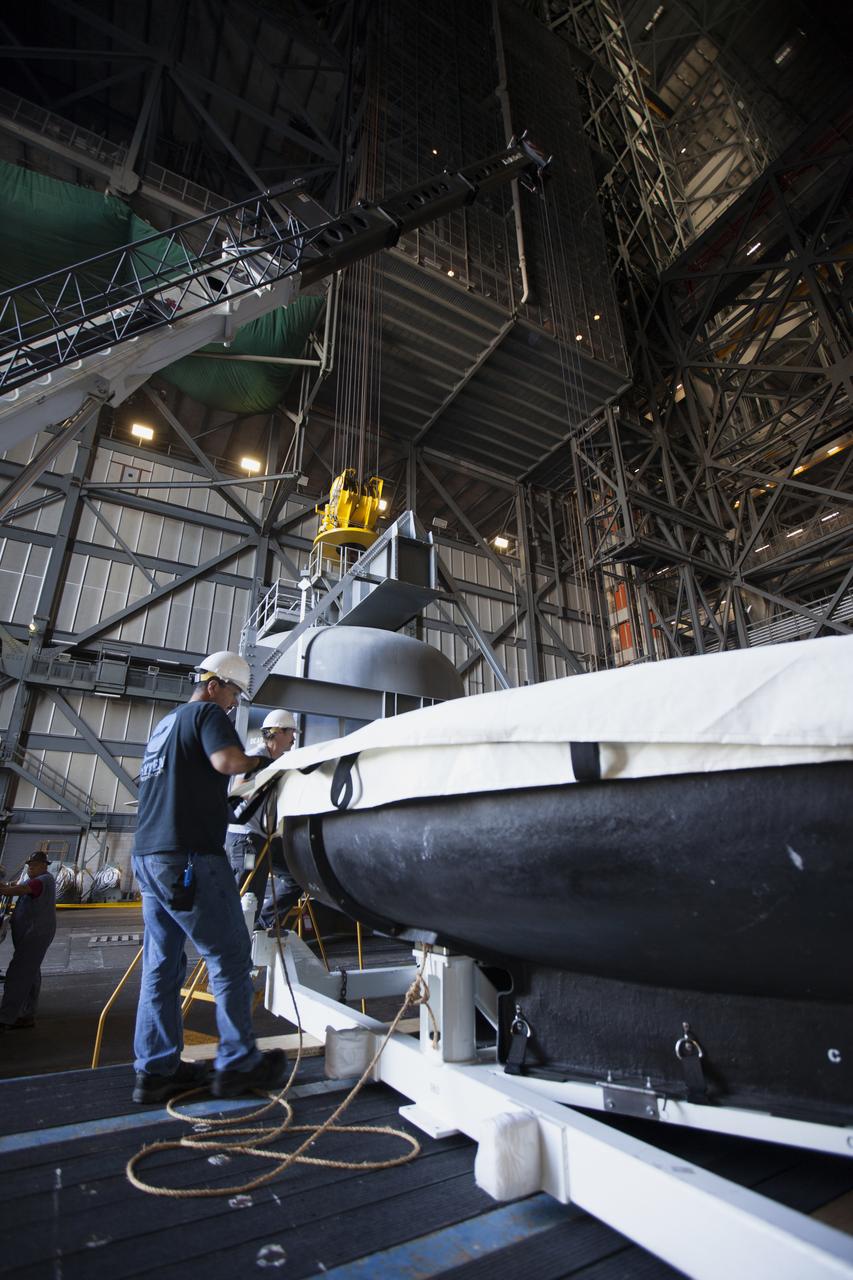
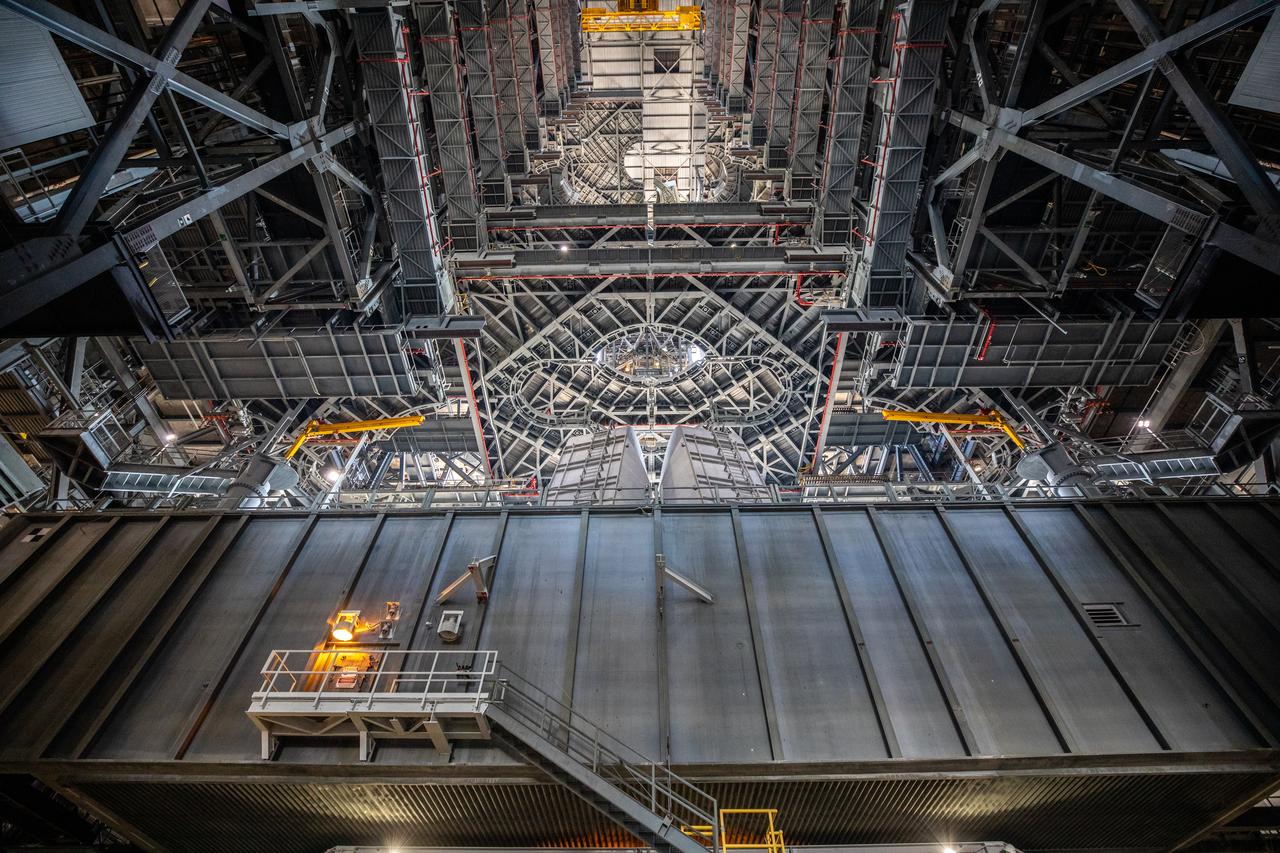
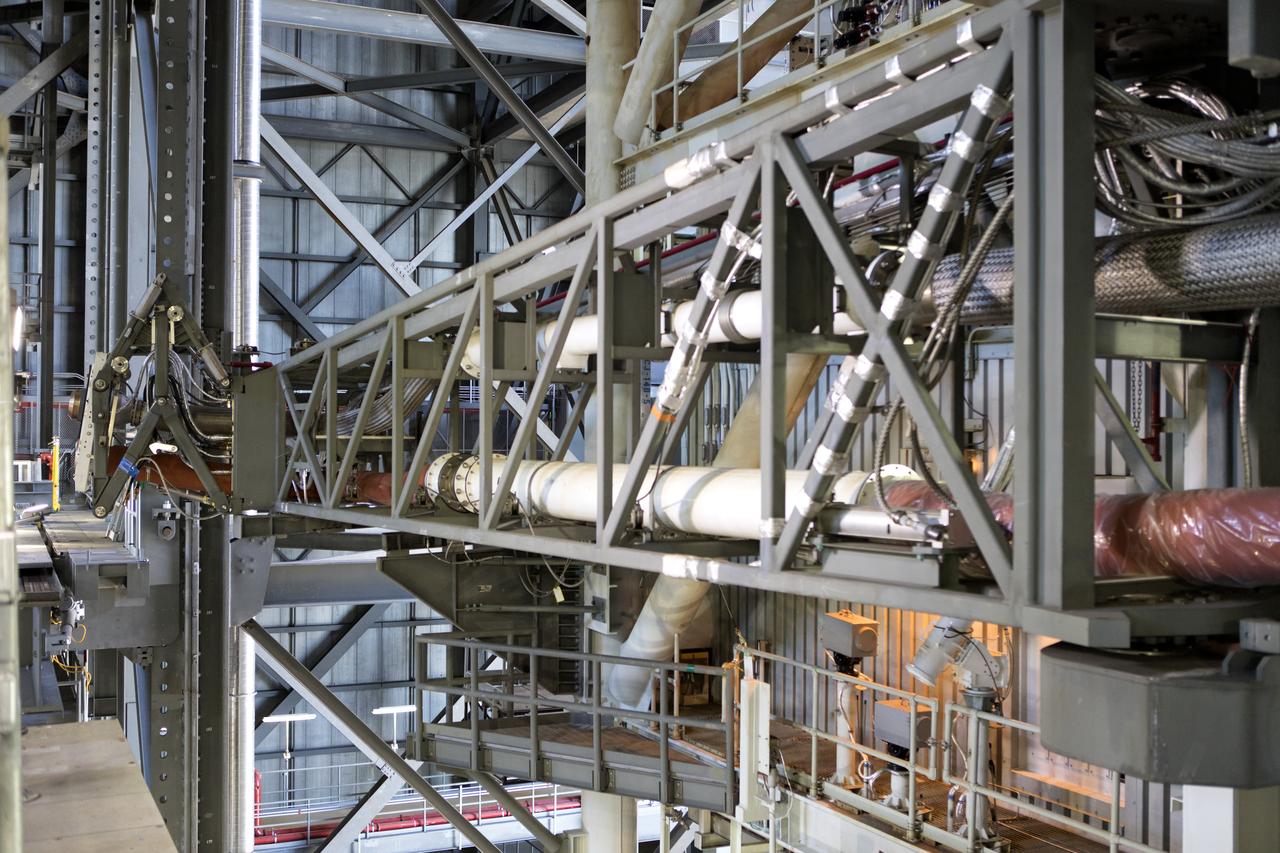
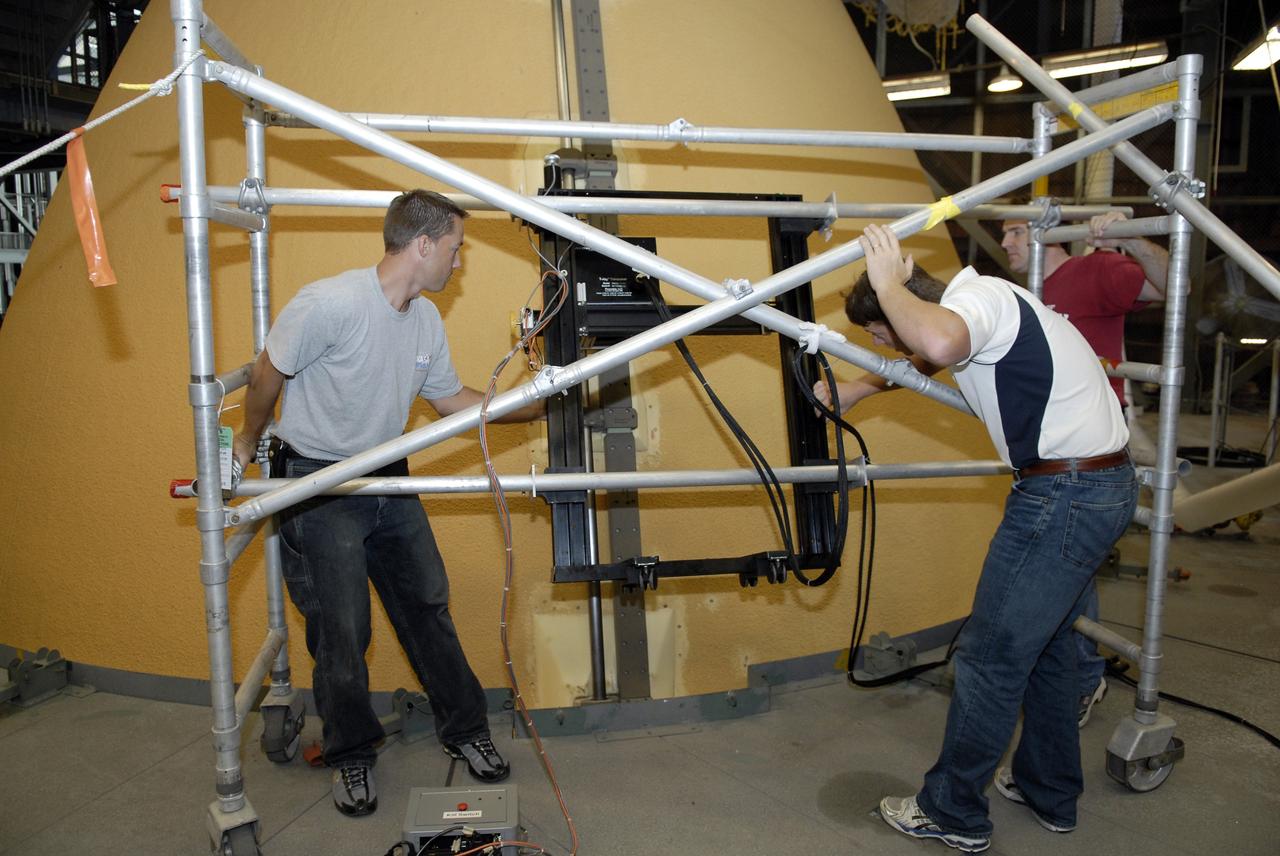
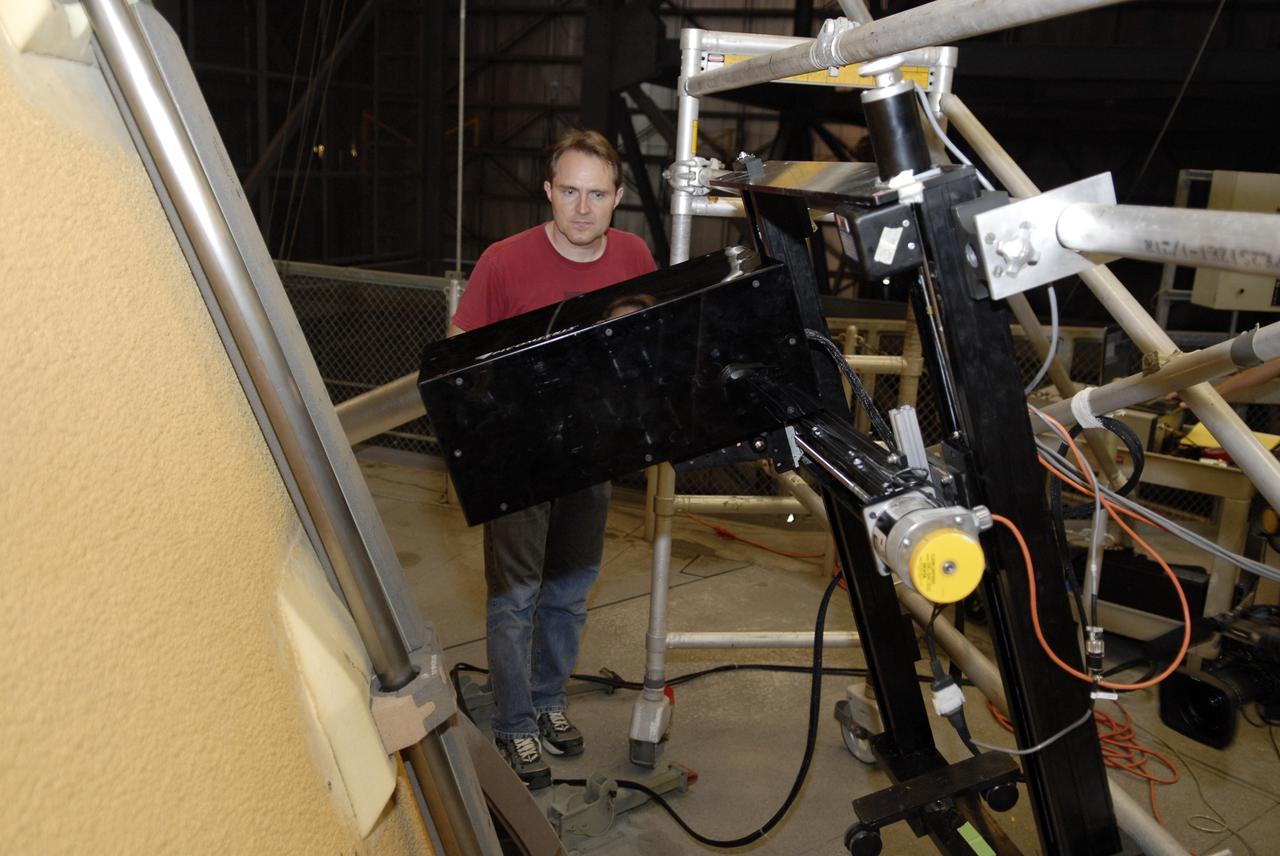
Preparations are underway to perform a preliminary swing test of the Core Stage Inter-tank Umbilical (CSITU) on the mobile launcher in High Bay 3 of the Vehicle Assembly Building on Feb. 22, 2019, at NASA's Kennedy Space Center in Florida. The CSITU is a swing-arm umbilical that will connect to the Space Launch System core stage inter-tank. It will provide conditioned air, pressurized gases and power and data connection to the core stage. The Exploration Ground Systems Program is overseeing installation of the umbilicals.
Mobile Launcher CSITU Swing Testing in VAB
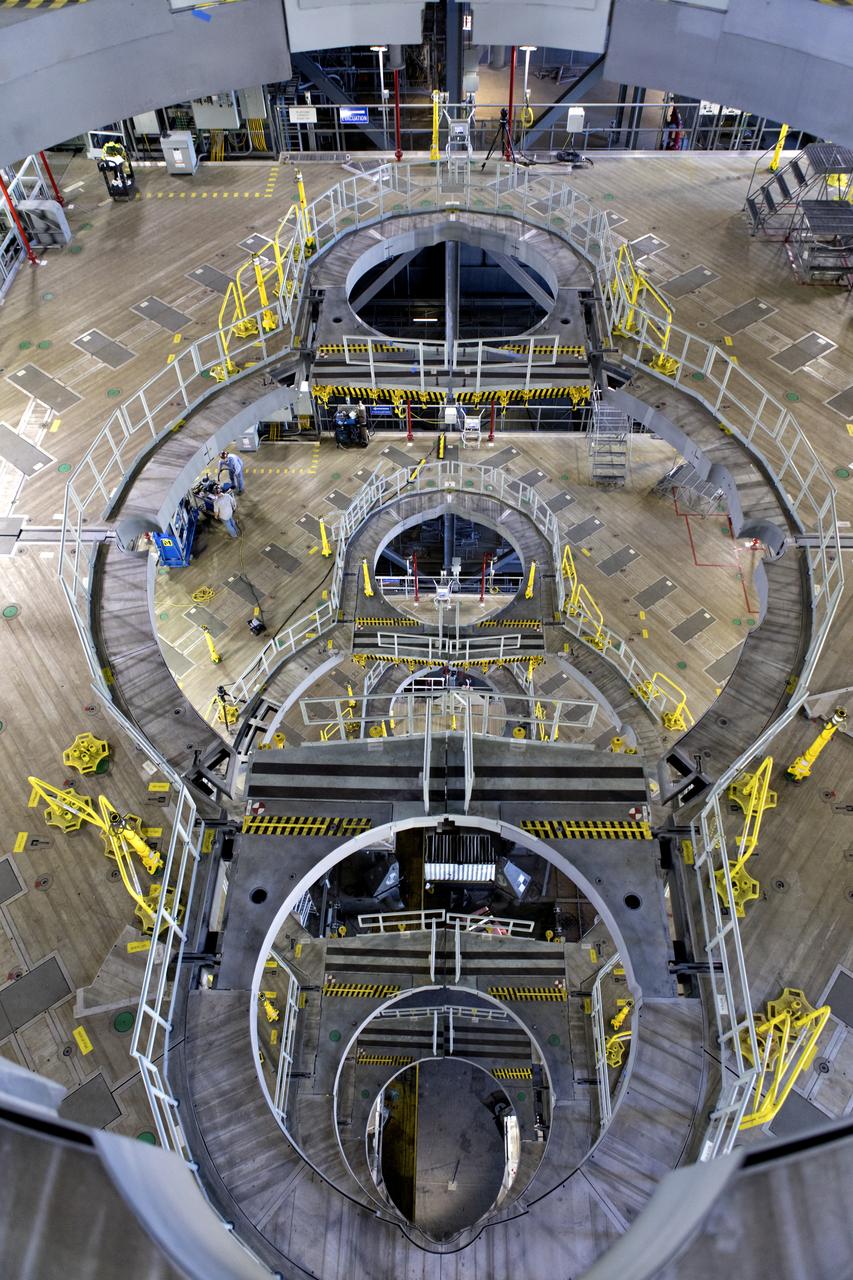
A view of the new work platforms in High Bay 3 of the Vehicle Assembly Building on Feb. 22, 2019, at NASA’s Kennedy Space Center in Florida. Preparations are underway to perform an initial swing test of the Core Stage Inter-tank Umbilical (CSITU) on the mobile launcher. The CSITU is a swing-arm umbilical that will connect to the Space Launch System core stage inter-tank. It will provide conditioned air, pressurized gases and power and data connection to the core stage. Exploration Ground Systems at Kennedy is conducting the swing test.
Mobile Launcher CSITU Swing Testing in VAB
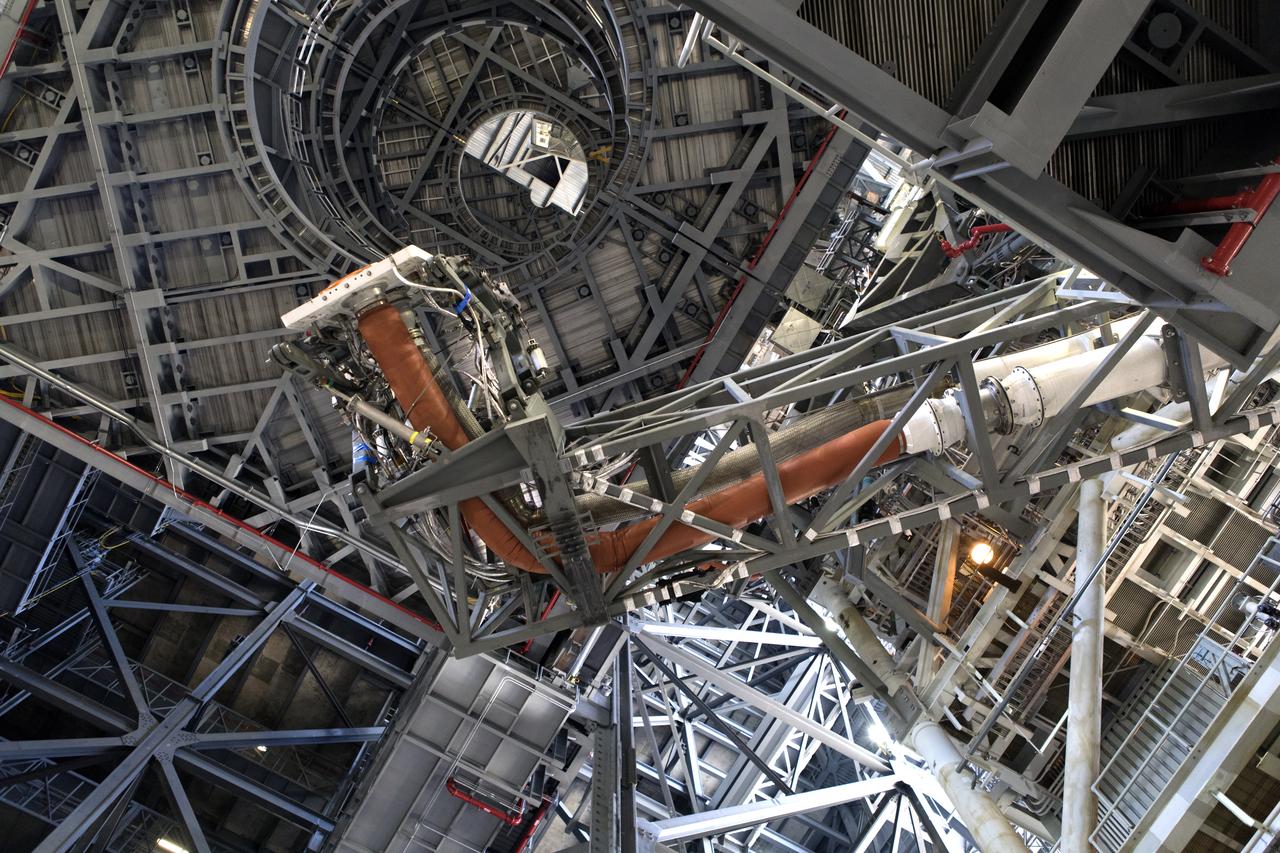
In this view looking up in High Bay 3 of the Vehicle Assembly Building at NASA’s Kennedy Space Center in Florida, a preliminary swing test is being performed on the Core Stage Inter-tank Umbilical (CSITU) on Feb. 22, 2019. The CSITU is a swing-arm umbilical that will connect to the Space Launch System core stage inter-tank. It will provide conditioned air, pressurized gases and power and data connection to the core stage. Exploration Ground Systems at Kennedy is conducting the swing test.
Mobile Launcher CSITU Swing Testing in VAB
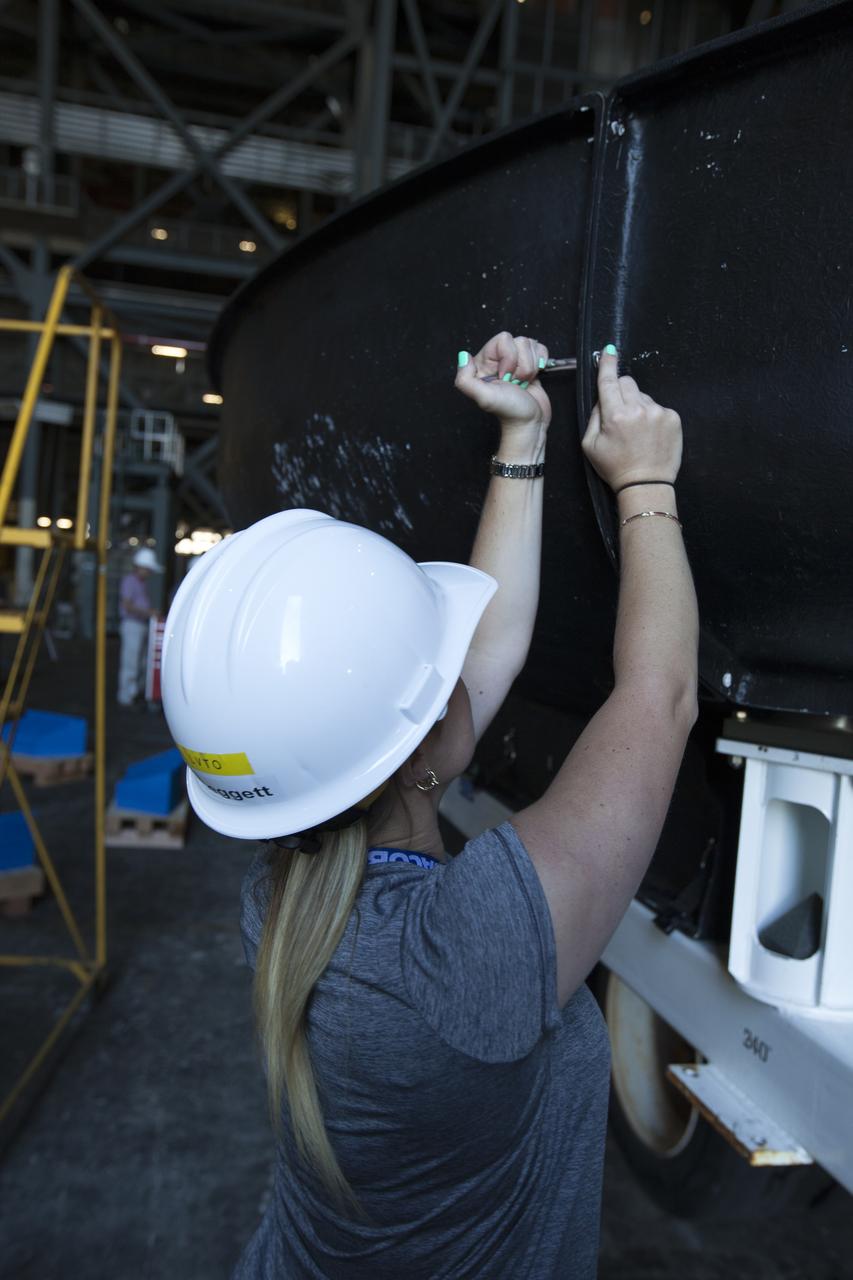
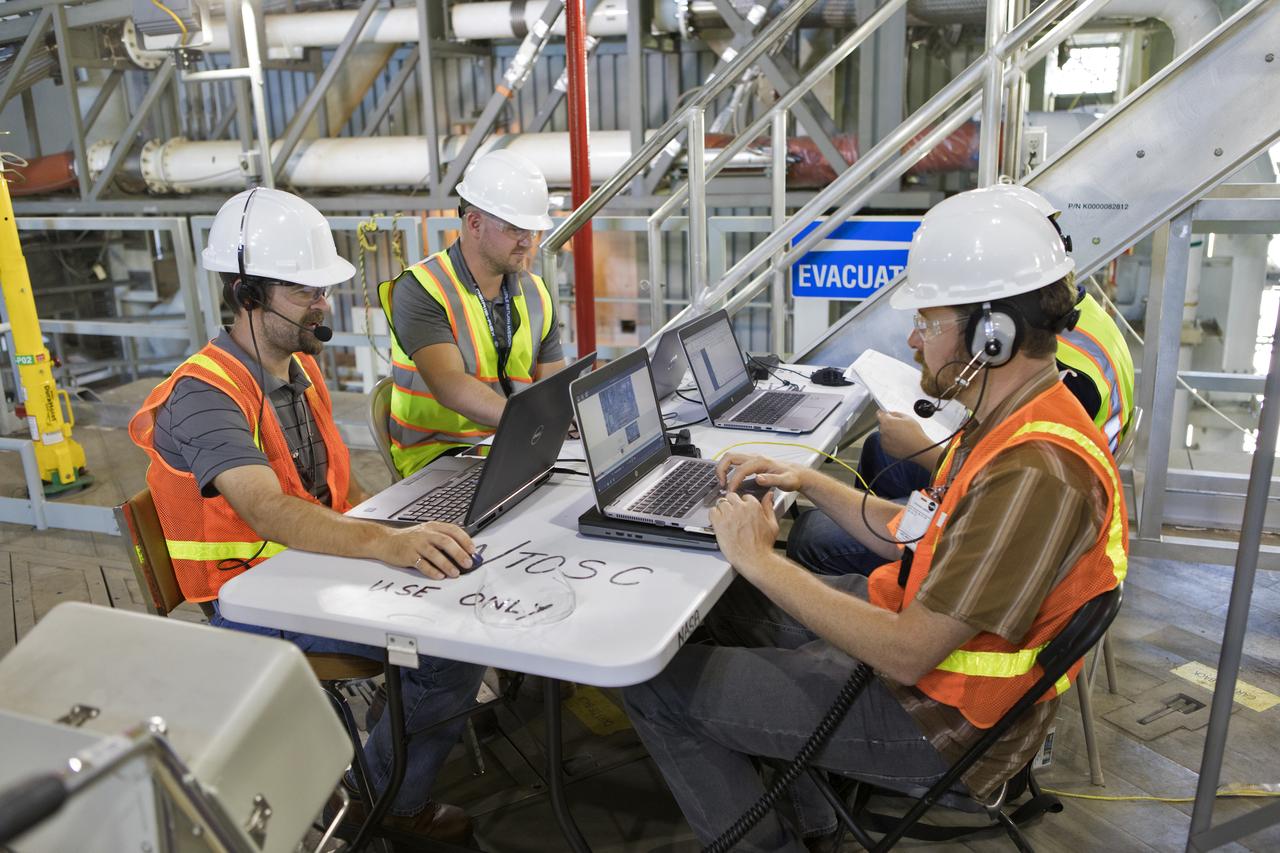
Technicians and engineers with Jacobs on the Test and Operations Support Contract, prepare for a swing test of the Core Stage Inter-tank Umbilical (CSITU) on the mobile launcher in High Bay 3 of the Vehicle Assembly Building on Feb. 22, 2019, at NASA's Kennedy Space Center in Florida. The CSITU is a swing-arm umbilical that will connect to the Space Launch System core stage inter-tank. It will provide conditioned air, pressurized gases and power and data connection to the core stage. Exploration Ground Systems at Kennedy is conducting the swing test.
Mobile Launcher CSITU Swing Testing in VAB
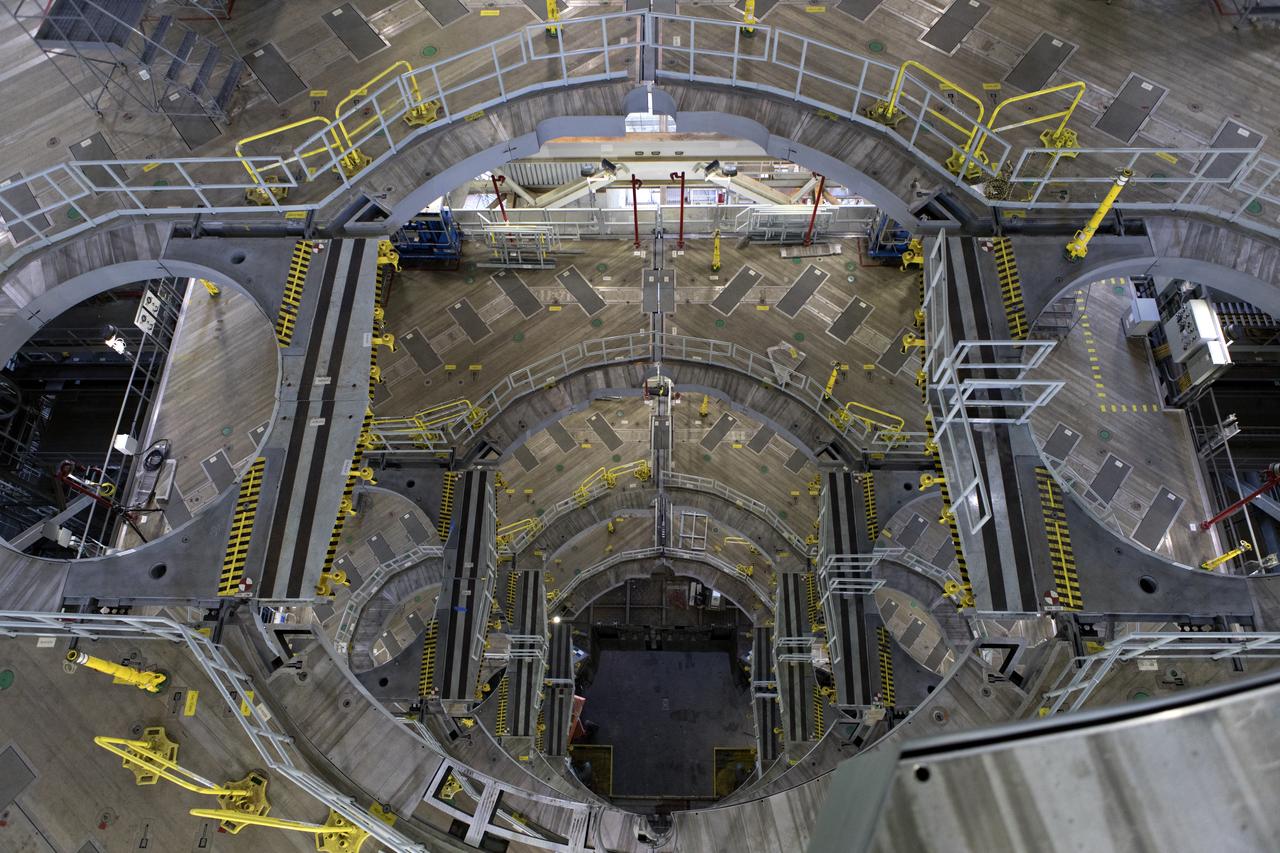
A view from above of new work platforms in High Bay 3 of the Vehicle Assembly Building on Feb. 22, 2019, at NASA’s Kennedy Space Center in Florida. Preparations are underway to perform an initial swing test of the Core Stage Inter-tank Umbilical (CSITU) on the mobile launcher. The CSITU is a swing-arm umbilical that will connect to the Space Launch System core stage inter-tank. It will provide conditioned air, pressurized gases and power and data connection to the core stage. Exploration Ground Systems at Kennedy is conducting the swing test.
Mobile Launcher CSITU Swing Testing in VAB
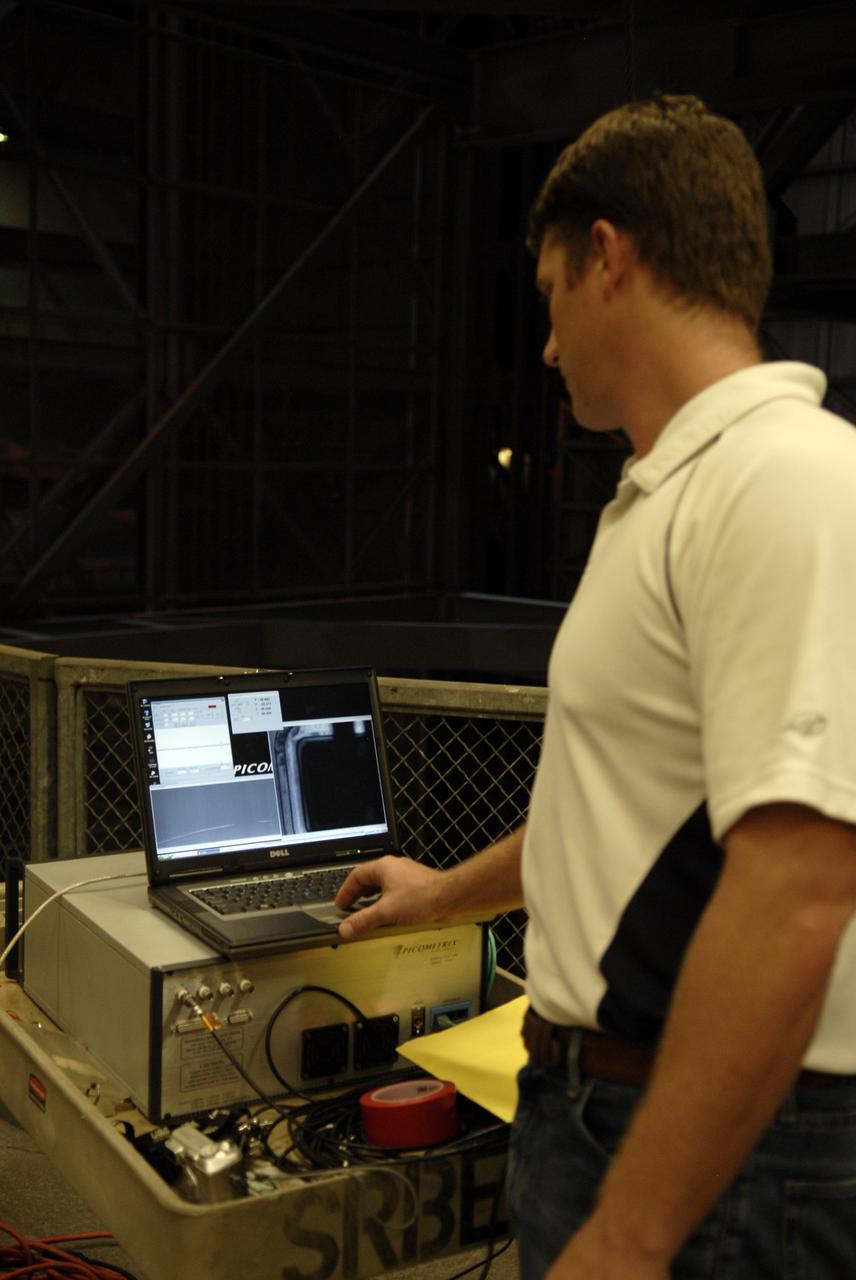
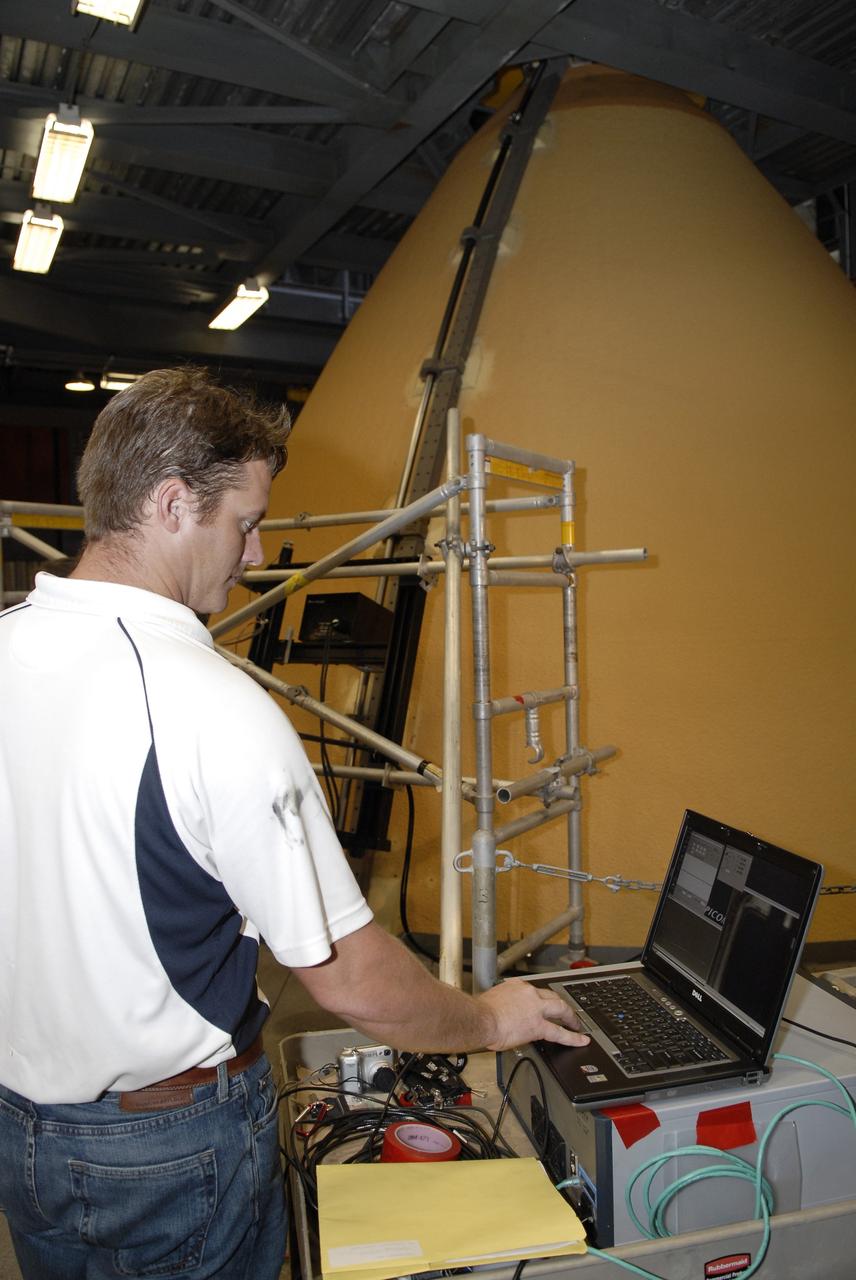
CAPE CANAVERAL, Fla. – In the Vehicle Assembly Building at NASA's Kennedy Space Center’s in Florida, a technician sets up equipment to support terahertz scans of five ice frost ramps on the external fuel tank, designated ET-133, for space shuttle Atlantis’ STS-129 mission.  The ice frost ramps are made from foam insulation and cover brackets that hold pressurization lines on the outside of the external tank. Terahertz scans are wave frequency analysis in the infrared band that can see through the foam insulation to help look for any voids or pockets where the foam is not bonded to the metal primer. The ramps being scanned were on the top part of the tank in the same area where foam came off during the last two shuttle launches. The data will be used to help assess whether foam on ET-132, the fuel tank attached to shuttle Discovery at Kennedy’s Launch Pad 39A, is fit for its flight on the STS-128 mission to the International Space Station. Photo credit: NASA/Kim Shiflett
KSC-2009-4649
CAPE CANAVERAL, Fla. – In the Vehicle Assembly Building at NASA's Kennedy Space Center’s in Florida, a technician conducts terahertz scans of five ice frost ramps on the external fuel tank, designated ET-133, for space shuttle Atlantis’ STS-129 mission.  The ice frost ramps are made from foam insulation and cover brackets that hold pressurization lines on the outside of the external tank. Terahertz scans are wave frequency analysis in the infrared band that can see through the foam insulation to help look for any voids or pockets where the foam is not bonded to the metal primer. The ramps being scanned were on the top part of the tank in the same area where foam came off during the last two shuttle launches. The data will be used to help assess whether foam on ET-132, the fuel tank attached to shuttle Discovery at Kennedy’s Launch Pad 39A, is fit for its flight on the STS-128 mission to the International Space Station. Photo credit: NASA/Kim Shiflett
KSC-2009-4651
CAPE CANAVERAL, Fla. – In the Vehicle Assembly Building at NASA's Kennedy Space Center’s in Florida, technicians set up equipment that will be used to conduct terahertz scans of five ice frost ramps on the external fuel tank, designated ET-133, for space shuttle Atlantis’ STS-129 mission.  The ice frost ramps are made from foam insulation and cover brackets that hold pressurization lines on the outside of the external tank. Terahertz scans are wave frequency analysis in the infrared band that can see through the foam insulation to help look for any voids or pockets where the foam is not bonded to the metal primer. The ramps being scanned were on the top part of the tank in the same area where foam came off during the last two shuttle launches. The data will be used to help assess whether foam on ET-132, the fuel tank attached to shuttle Discovery at Kennedy’s Launch Pad 39A, is fit for its flight on the STS-128 mission to the International Space Station. Photo credit: NASA/Kim Shiflett
KSC-2009-4648
CAPE CANAVERAL, Fla. – In the Vehicle Assembly Building at NASA's Kennedy Space Center’s in Florida, a technician conducts terahertz scans of five ice frost ramps on the external fuel tank, designated ET-133, for space shuttle Atlantis’ STS-129 mission.  The ice frost ramps are made from foam insulation and cover brackets that hold pressurization lines on the outside of the external tank. Terahertz scans are wave frequency analysis in the infrared band that can see through the foam insulation to help look for any voids or pockets where the foam is not bonded to the metal primer. The ramps being scanned were on the top part of the tank in the same area where foam came off during the last two shuttle launches. The data will be used to help assess whether foam on ET-132, the fuel tank attached to shuttle Discovery at Kennedy’s Launch Pad 39A, is fit for its flight on the STS-128 mission to the International Space Station. Photo credit: NASA/Kim Shiflett
KSC-2009-4650
CAPE CANAVERAL, Fla. – In the Vehicle Assembly Building at NASA's Kennedy Space Center’s in Florida, a technician prepares to conduct terahertz scans of five ice frost ramps on the external fuel tank, designated ET-133, for space shuttle Atlantis’ STS-129 mission.  The ice frost ramps are made from foam insulation and cover brackets that hold pressurization lines on the outside of the external tank. Terahertz scans are wave frequency analysis in the infrared band that can see through the foam insulation to help look for any voids or pockets where the foam is not bonded to the metal primer. The ramps being scanned were on the top part of the tank in the same area where foam came off during the last two shuttle launches. The data will be used to help assess whether foam on ET-132, the fuel tank attached to shuttle Discovery at Kennedy’s Launch Pad 39A, is fit for its flight on the STS-128 mission to the International Space Station. Photo credit: NASA/Kim Shiflett
KSC-2009-4647
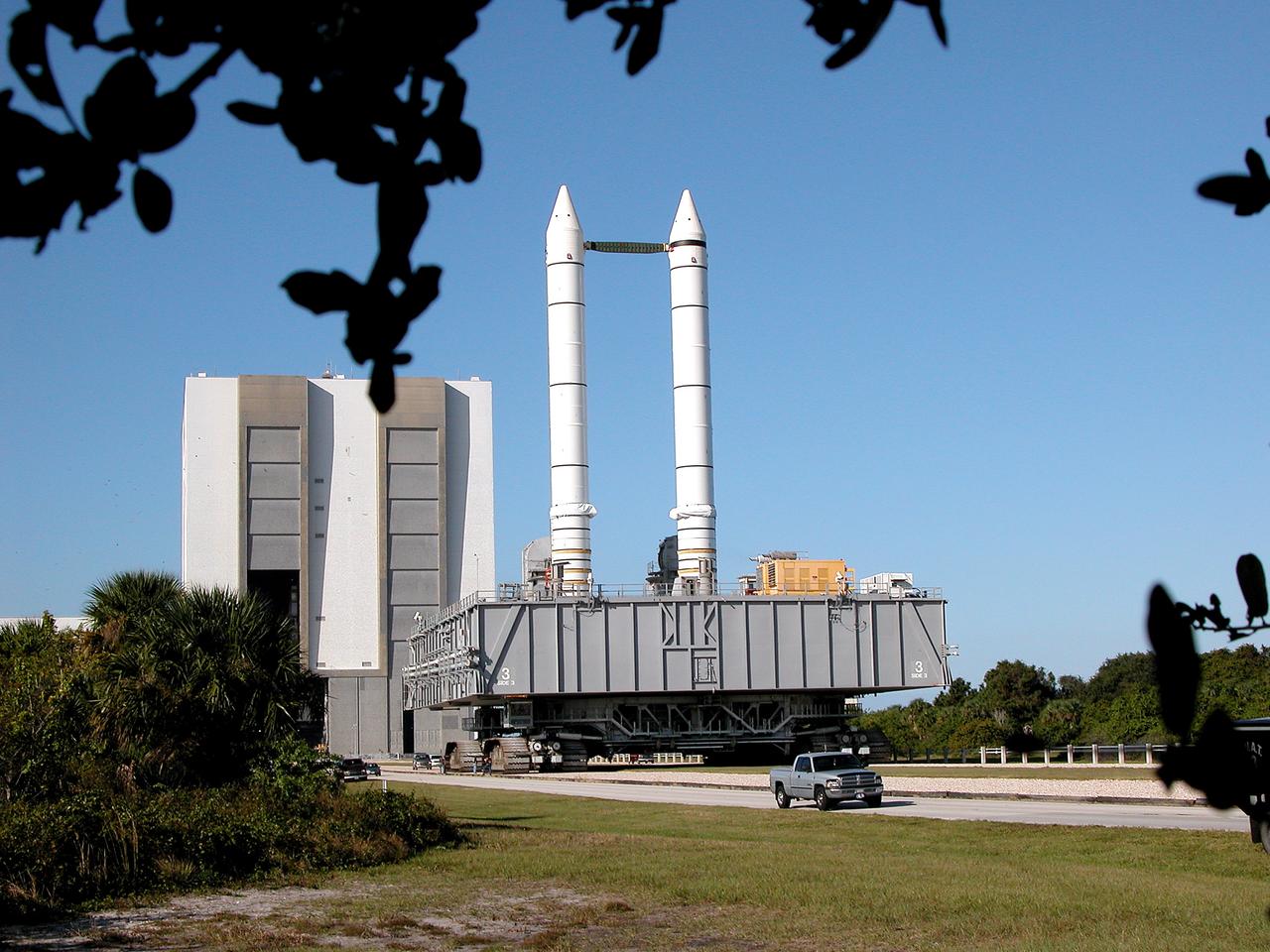
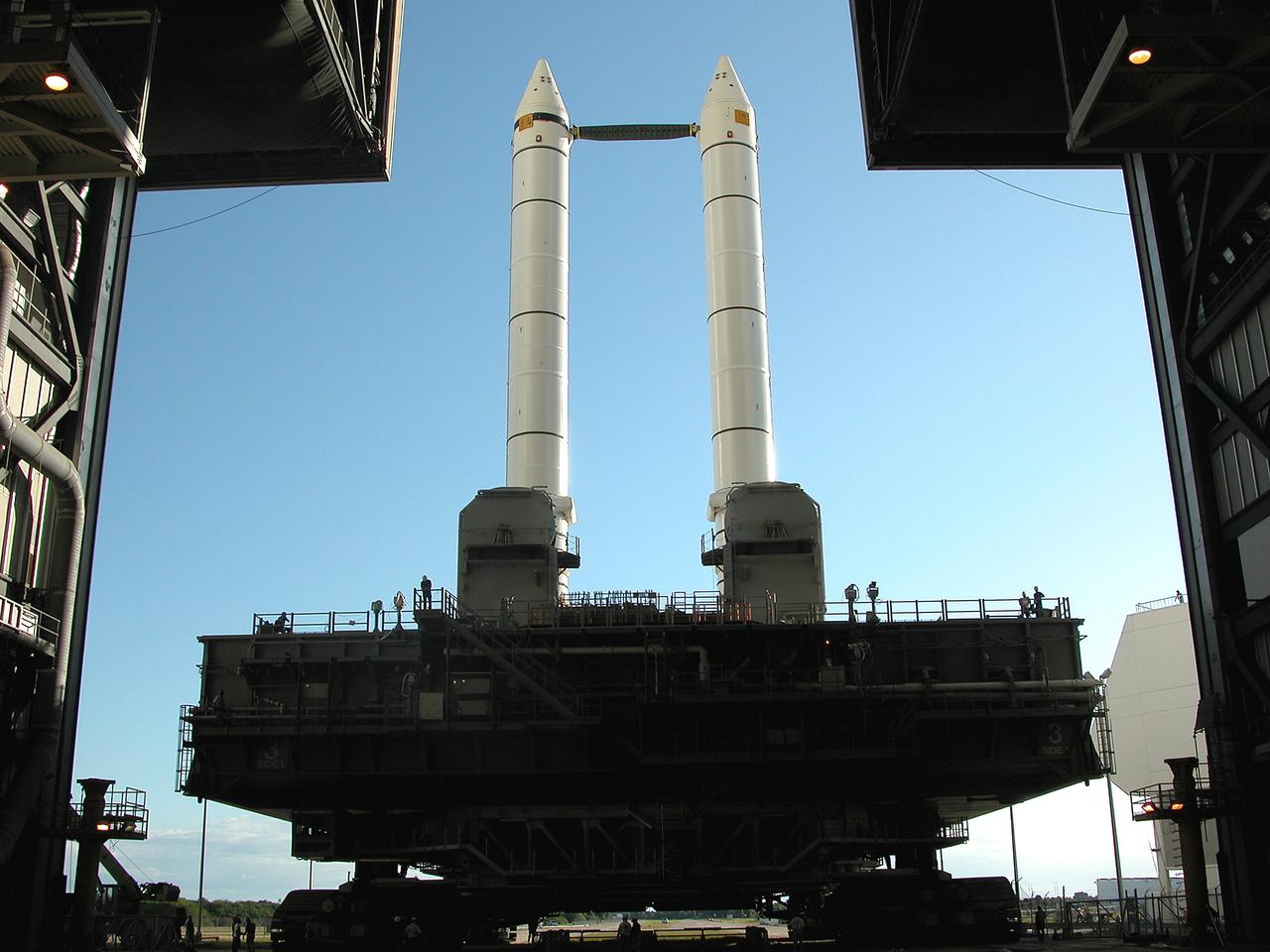
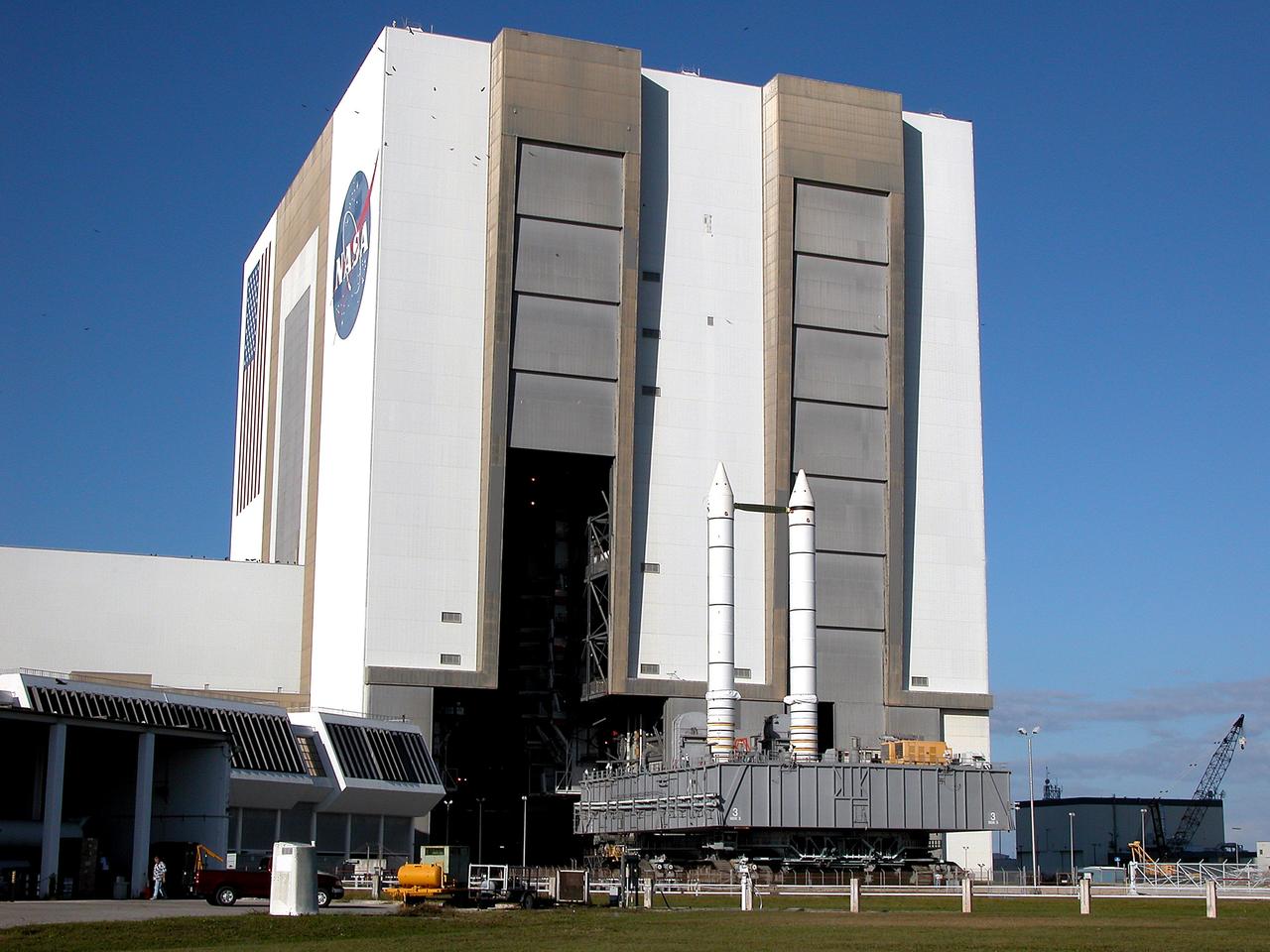
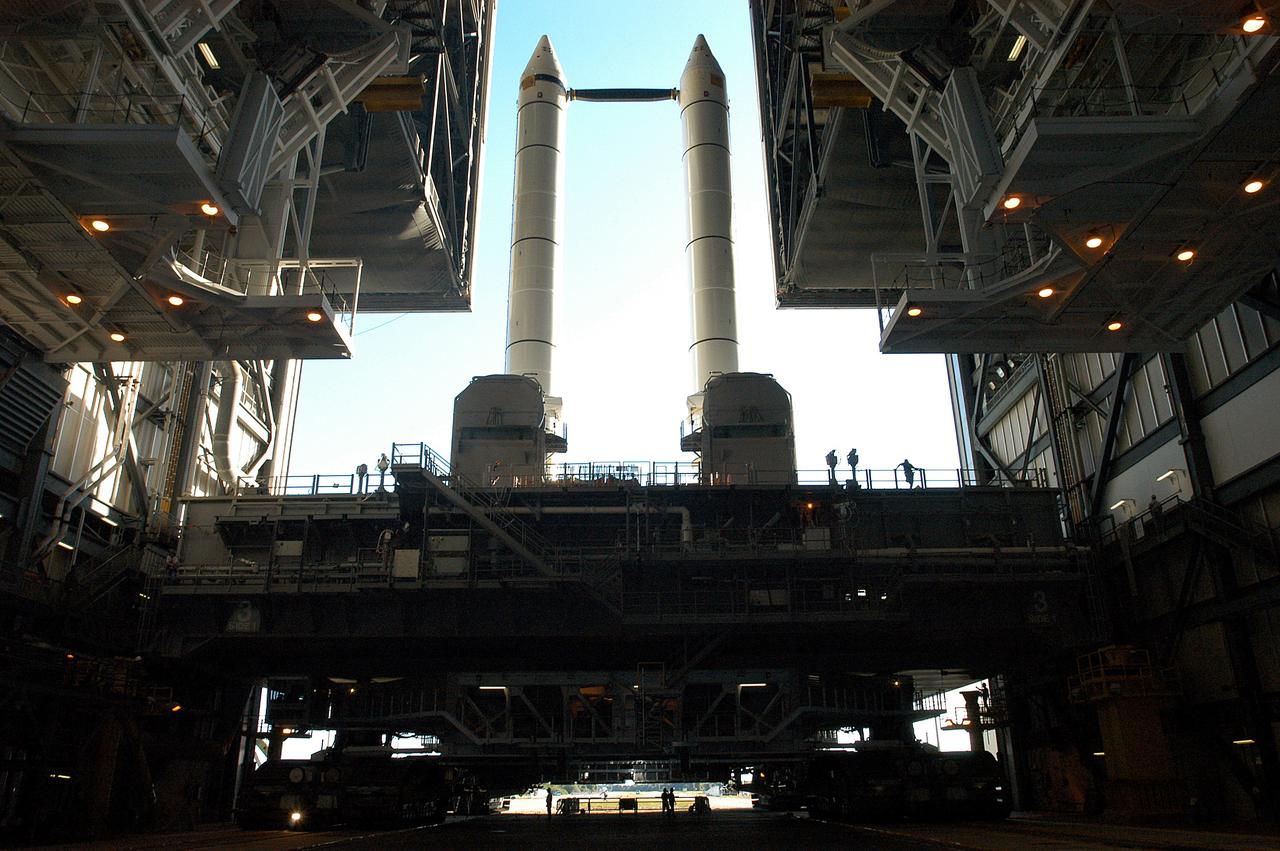
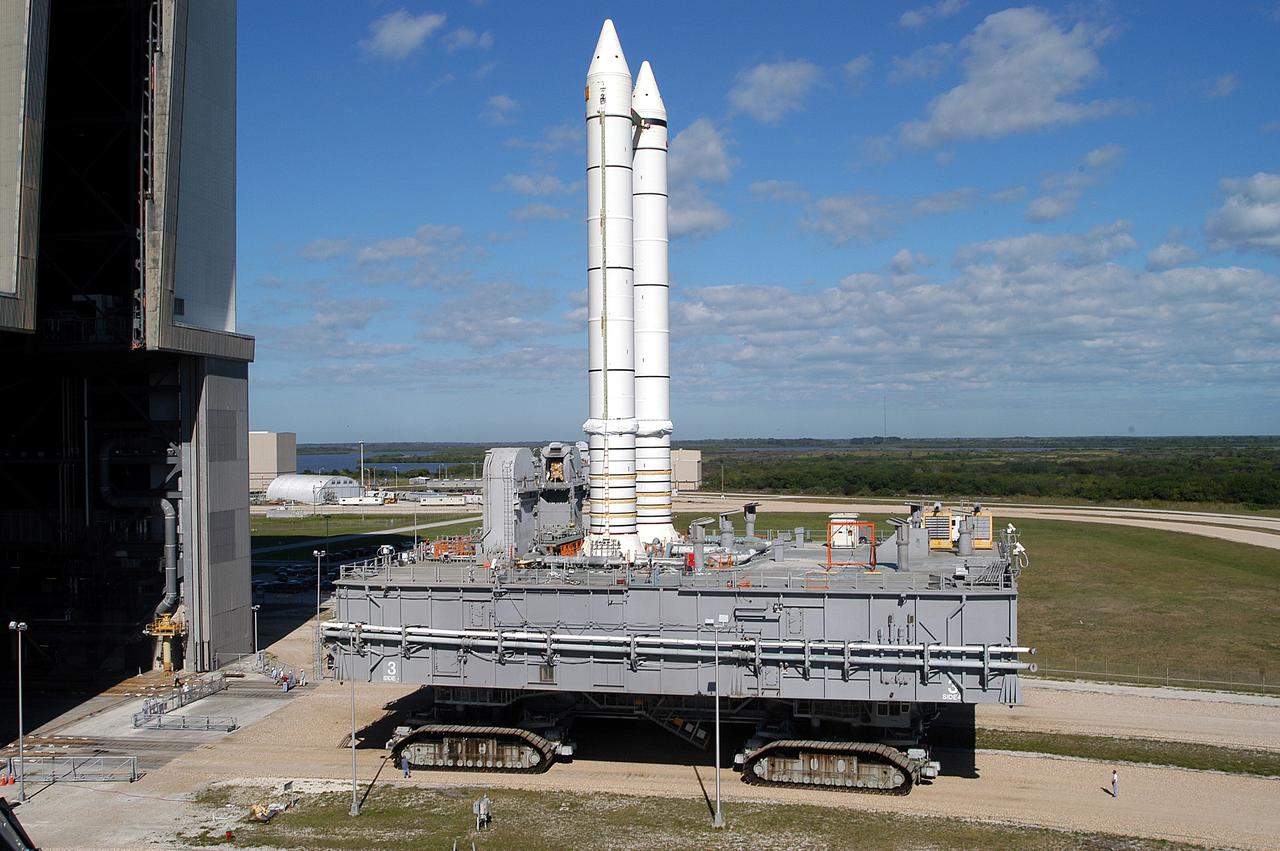
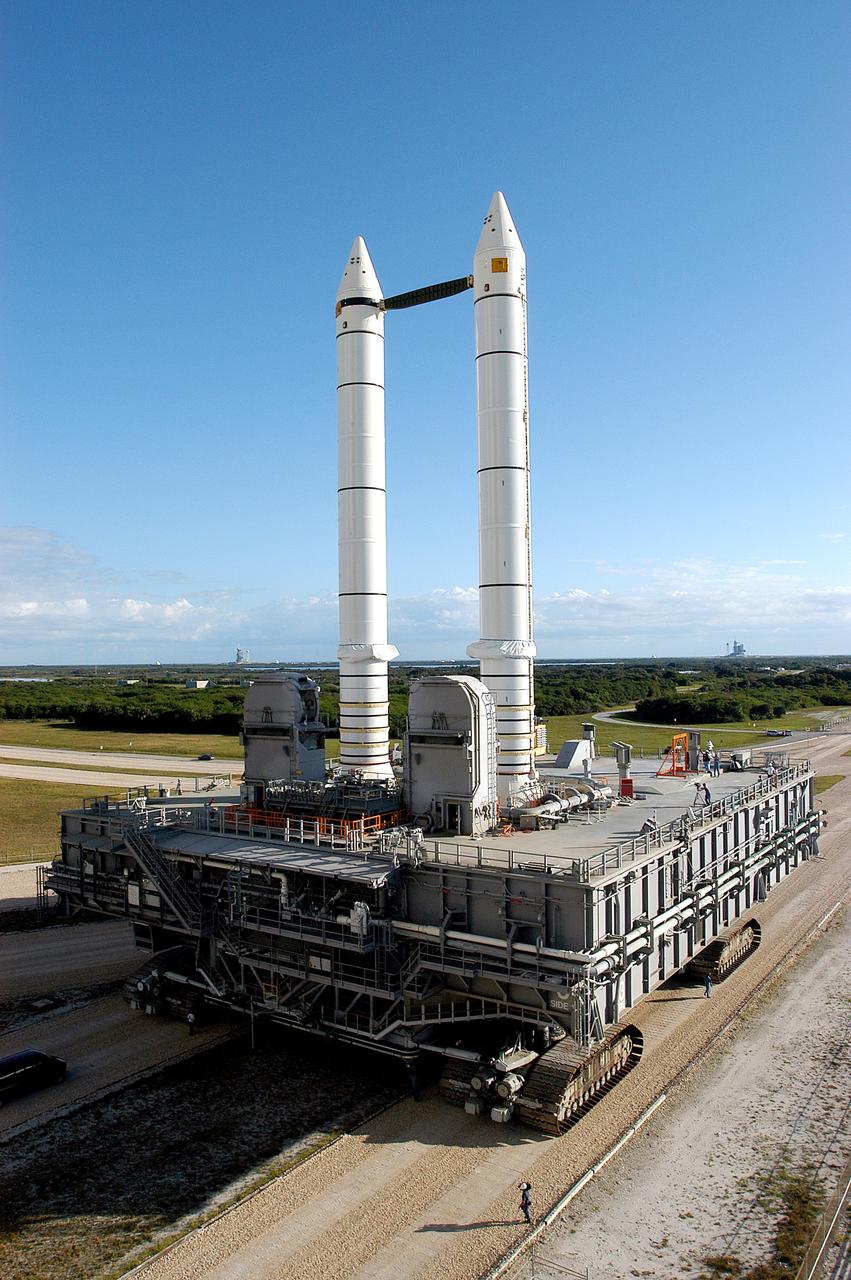
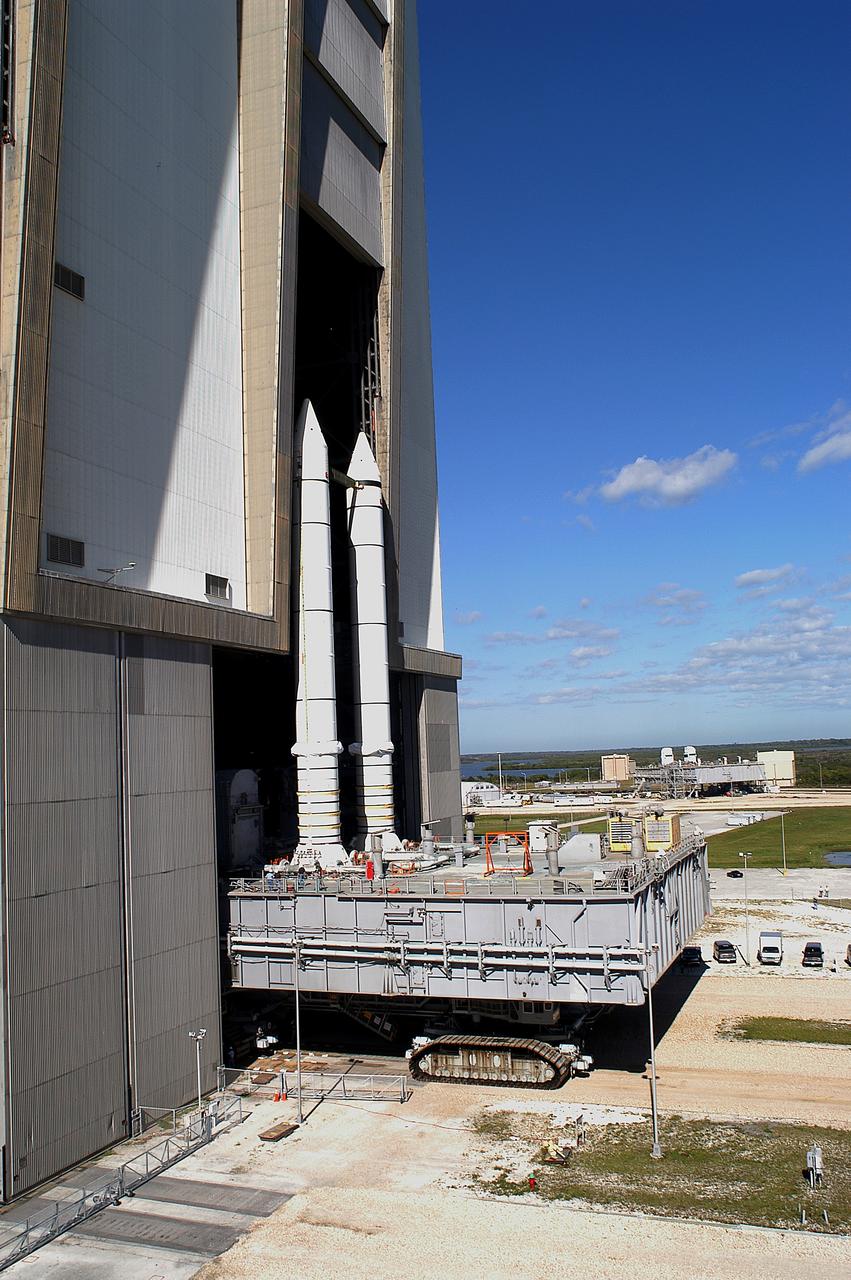
KENNEDY SPACE CENTER, FLA. -  The crawler transporter has slowly moved the Mobile Launcher Platform (MLP), carrying a set of twin solid rocket boosters, out of the Vehicle Assembly Building (VAB) in support of engineering analysis vibration tests on the crawler and MLP. The crawler is moving at various speeds up to 1 mph in an effort to achieve vibration data gathering goals as it leaves the VAB and then returns.  The boosters are braced at the top for stability.  The primary purpose of these rollout tests is to gather data to develop future maintenance requirements on the transport equipment and the flight hardware. Various parts of the MLP and crawler transporter have been instrumented with vibration data collection equipment.
KENNEDY SPACE CENTER, FLA. - The crawler transporter has slowly moved the Mobile Launcher Platform (MLP), carrying a set of twin solid rocket boosters, out of the Vehicle Assembly Building (VAB) in support of engineering analysis vibration tests on the crawler and MLP. The crawler is moving at various speeds up to 1 mph in an effort to achieve vibration data gathering goals as it leaves the VAB and then returns. The boosters are braced at the top for stability. The primary purpose of these rollout tests is to gather data to develop future maintenance requirements on the transport equipment and the flight hardware. Various parts of the MLP and crawler transporter have been instrumented with vibration data collection equipment.
KENNEDY SPACE CENTER, FLA. -  The crawler transporter slowly moves the Mobile Launcher Platform (MLP), carrying a set of twin solid rocket boosters, out of the Vehicle Assembly Building (VAB) in support of engineering analysis vibration tests on the crawler and MLP.   The crawler is moving at various speeds up to 1 mph in an effort to achieve vibration data gathering goals as it leaves the VAB and then returns.  The boosters are braced at the top for stability.  The primary purpose of these rollout tests is to gather data to develop future maintenance requirements on the transport equipment and the flight hardware. Various parts of the MLP and crawler transporter have been instrumented with vibration data collection equipment.
KENNEDY SPACE CENTER, FLA. - The crawler transporter slowly moves the Mobile Launcher Platform (MLP), carrying a set of twin solid rocket boosters, out of the Vehicle Assembly Building (VAB) in support of engineering analysis vibration tests on the crawler and MLP. The crawler is moving at various speeds up to 1 mph in an effort to achieve vibration data gathering goals as it leaves the VAB and then returns. The boosters are braced at the top for stability. The primary purpose of these rollout tests is to gather data to develop future maintenance requirements on the transport equipment and the flight hardware. Various parts of the MLP and crawler transporter have been instrumented with vibration data collection equipment.
KENNEDY SPACE CENTER, FLA. -   The crawler transporter is slowly moving the Mobile Launcher Platform (MLP), carrying a set of twin solid rocket boosters, out of the Vehicle Assembly Building (VAB) in support of engineering analysis vibration tests on the crawler and MLP. The crawler is moving at various speeds up to 1 mph in an effort to achieve vibration data gathering goals as it leaves the VAB and then returns.  The boosters are braced at the top for stability.  The primary purpose of these rollout tests is to gather data to develop future maintenance requirements on the transport equipment and the flight hardware. Various parts of the MLP and crawler transporter have been instrumented with vibration data collection equipment.
KENNEDY SPACE CENTER, FLA. - The crawler transporter is slowly moving the Mobile Launcher Platform (MLP), carrying a set of twin solid rocket boosters, out of the Vehicle Assembly Building (VAB) in support of engineering analysis vibration tests on the crawler and MLP. The crawler is moving at various speeds up to 1 mph in an effort to achieve vibration data gathering goals as it leaves the VAB and then returns. The boosters are braced at the top for stability. The primary purpose of these rollout tests is to gather data to develop future maintenance requirements on the transport equipment and the flight hardware. Various parts of the MLP and crawler transporter have been instrumented with vibration data collection equipment.
KENNEDY SPACE CENTER, FLA. -  The crawler transporter slowly moves the Mobile Launcher Platform (MLP), carrying a set of twin solid rocket boosters, away from the Vehicle Assembly Building (VAB) in support of engineering analysis vibration tests on the crawler and MLP.   The crawler is moving at various speeds up to 1 mph in an effort to achieve vibration data gathering goals as it leaves the VAB and then returns.  The boosters are braced at the top for stability.  The primary purpose of these rollout tests is to gather data to develop future maintenance requirements on the transport equipment and the flight hardware. Various parts of the MLP and crawler transporter have been instrumented with vibration data collection equipment.
KENNEDY SPACE CENTER, FLA. - The crawler transporter slowly moves the Mobile Launcher Platform (MLP), carrying a set of twin solid rocket boosters, away from the Vehicle Assembly Building (VAB) in support of engineering analysis vibration tests on the crawler and MLP. The crawler is moving at various speeds up to 1 mph in an effort to achieve vibration data gathering goals as it leaves the VAB and then returns. The boosters are braced at the top for stability. The primary purpose of these rollout tests is to gather data to develop future maintenance requirements on the transport equipment and the flight hardware. Various parts of the MLP and crawler transporter have been instrumented with vibration data collection equipment.
KENNEDY SPACE CENTER, FLA. -  The crawler transporter slowly moves the Mobile Launcher Platform (MLP), carrying a set of twin solid rocket boosters, away from the Vehicle Assembly Building (VAB) in support of engineering analysis vibration tests on the crawler and MLP.   The crawler is moving at various speeds up to 1 mph in an effort to achieve vibration data gathering goals as it leaves the VAB and then returns.  The boosters are braced at the top for stability.  The primary purpose of these rollout tests is to gather data to develop future maintenance requirements on the transport equipment and the flight hardware. Various parts of the MLP and crawler transporter have been instrumented with vibration data collection equipment.
KENNEDY SPACE CENTER, FLA. - The crawler transporter slowly moves the Mobile Launcher Platform (MLP), carrying a set of twin solid rocket boosters, away from the Vehicle Assembly Building (VAB) in support of engineering analysis vibration tests on the crawler and MLP. The crawler is moving at various speeds up to 1 mph in an effort to achieve vibration data gathering goals as it leaves the VAB and then returns. The boosters are braced at the top for stability. The primary purpose of these rollout tests is to gather data to develop future maintenance requirements on the transport equipment and the flight hardware. Various parts of the MLP and crawler transporter have been instrumented with vibration data collection equipment.
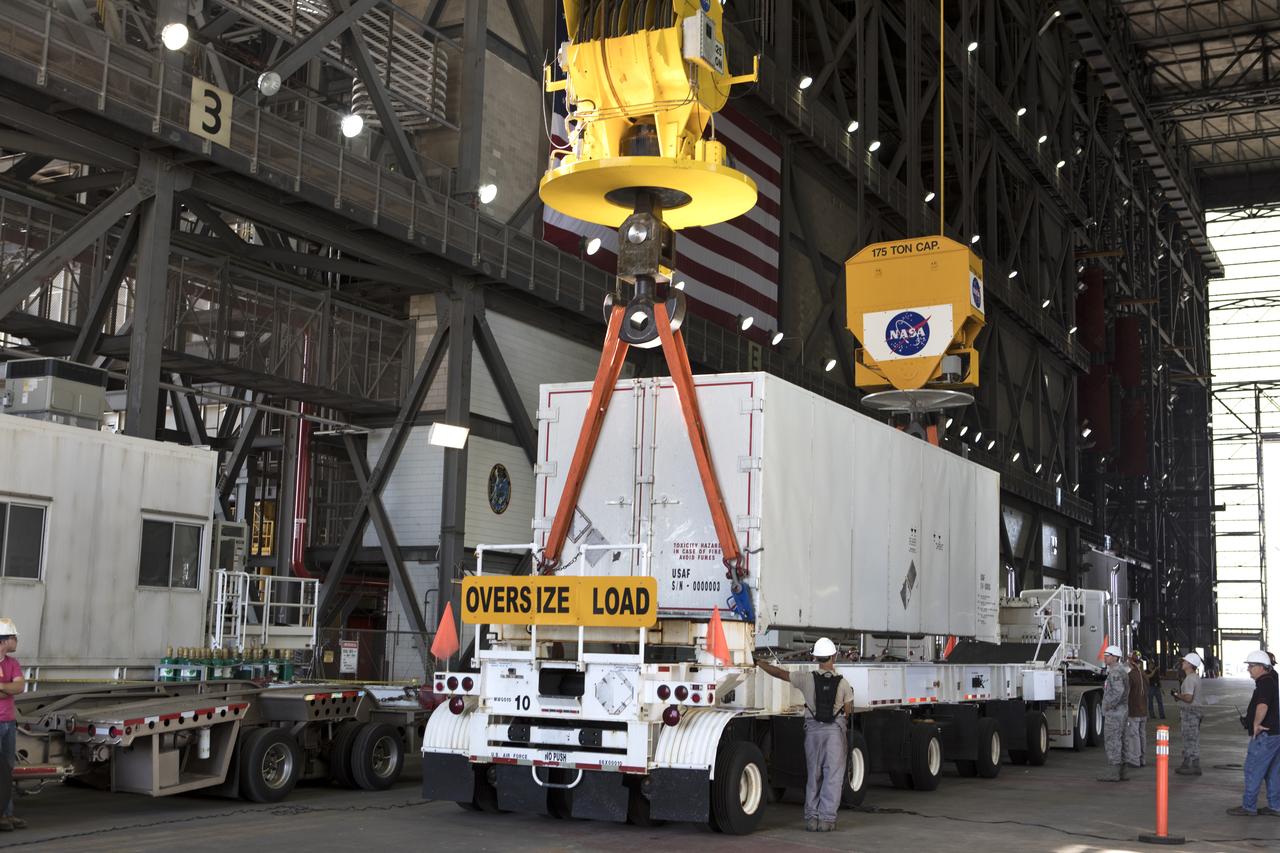
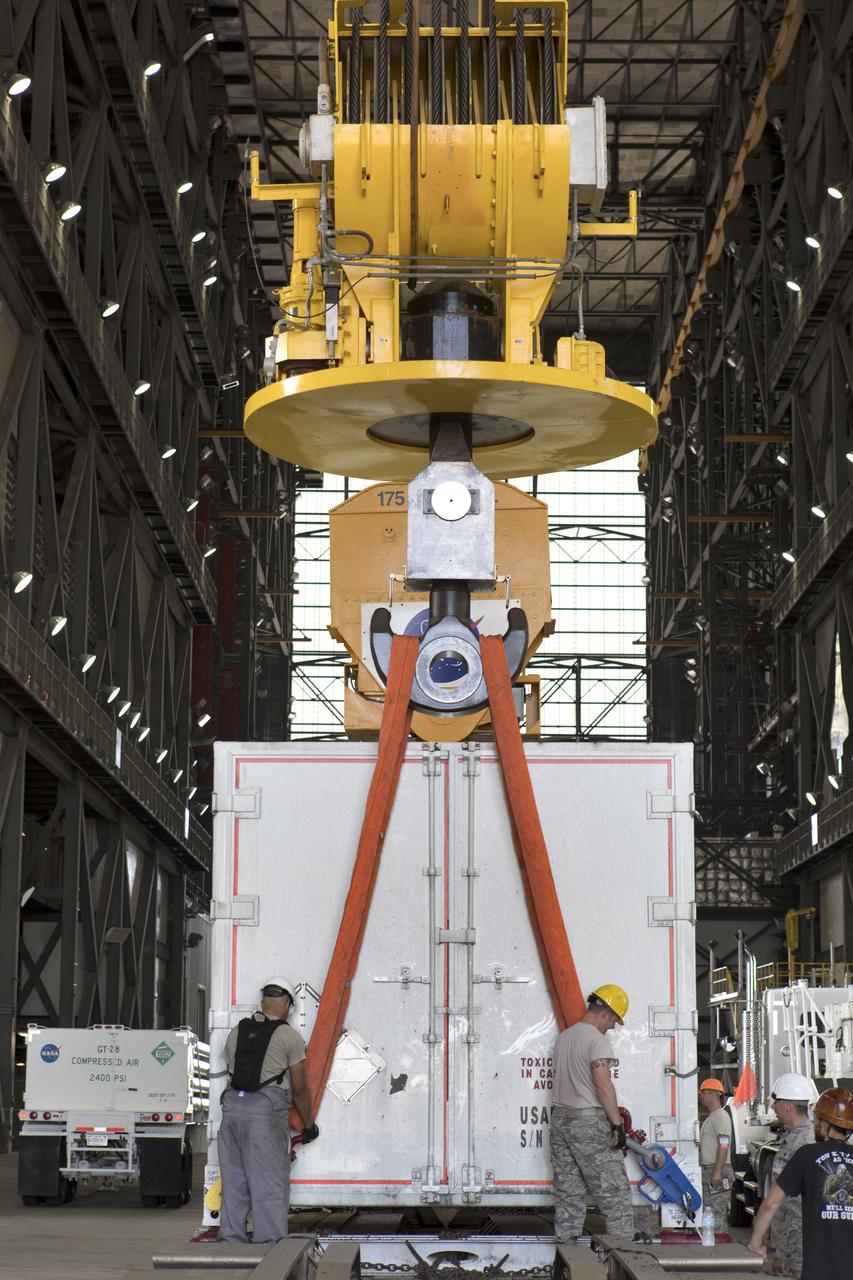
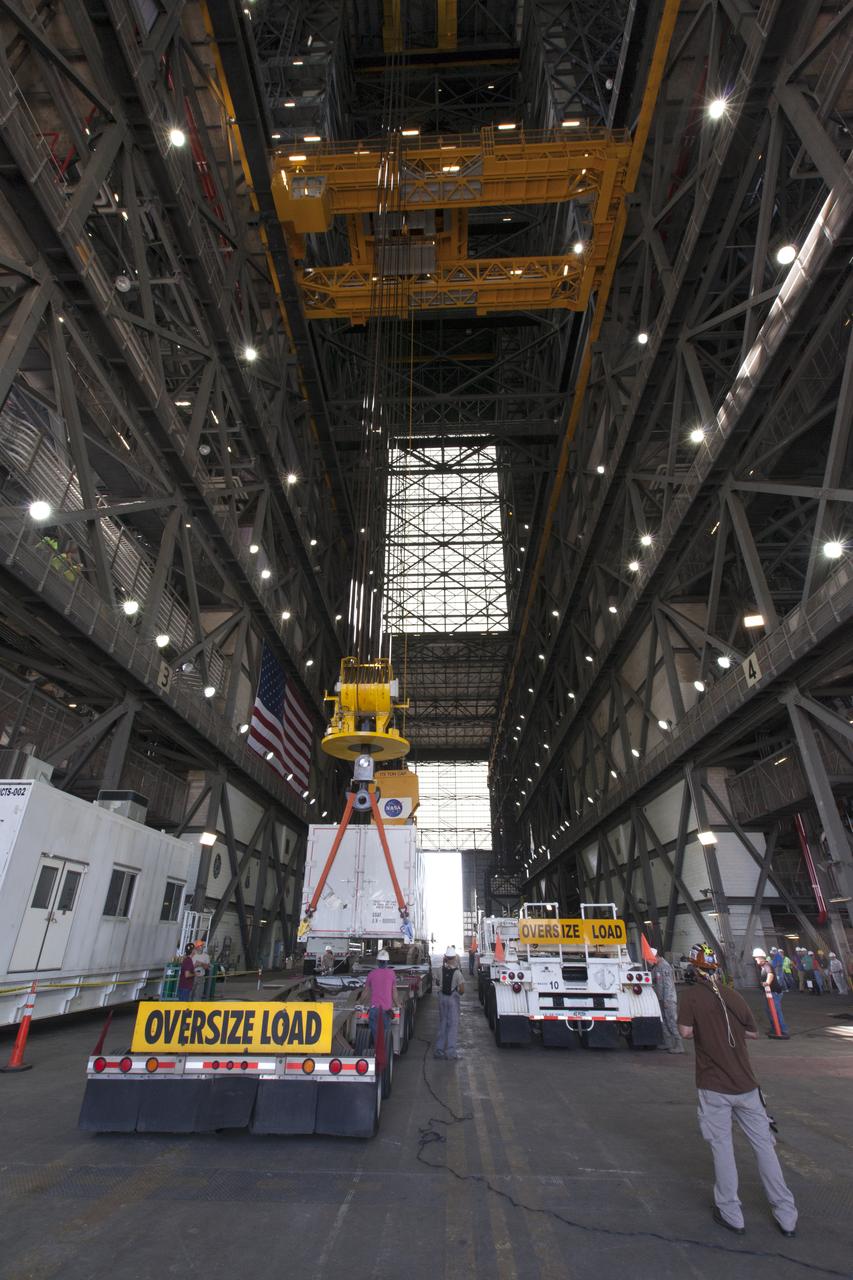
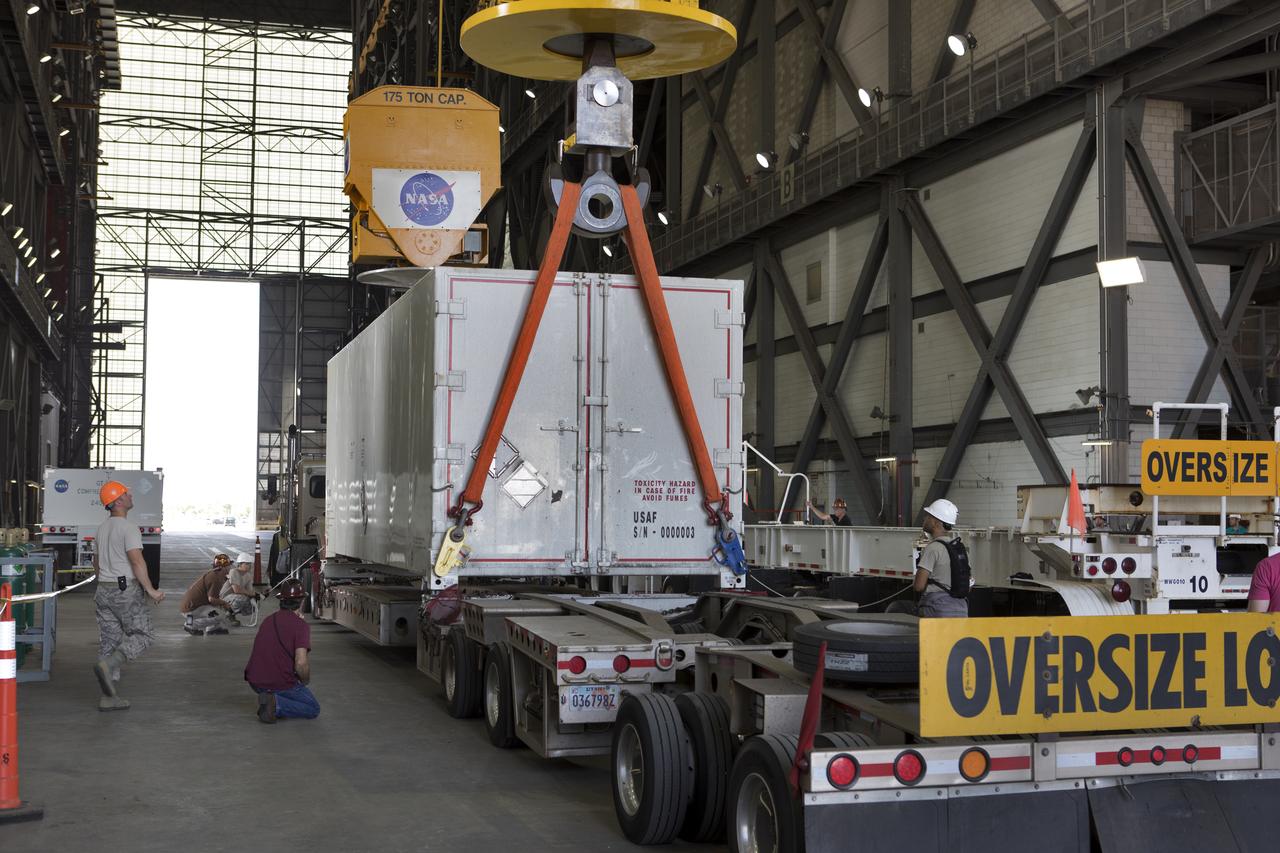
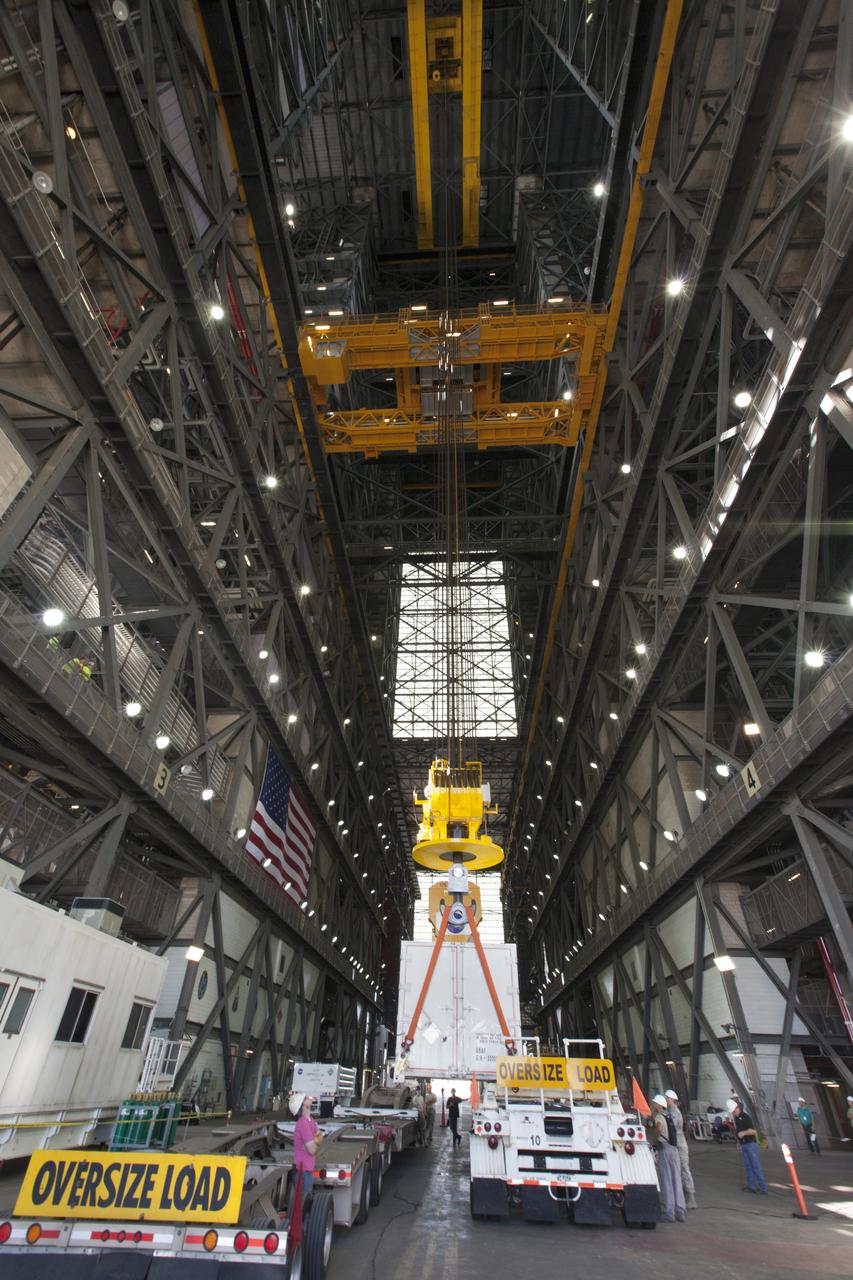
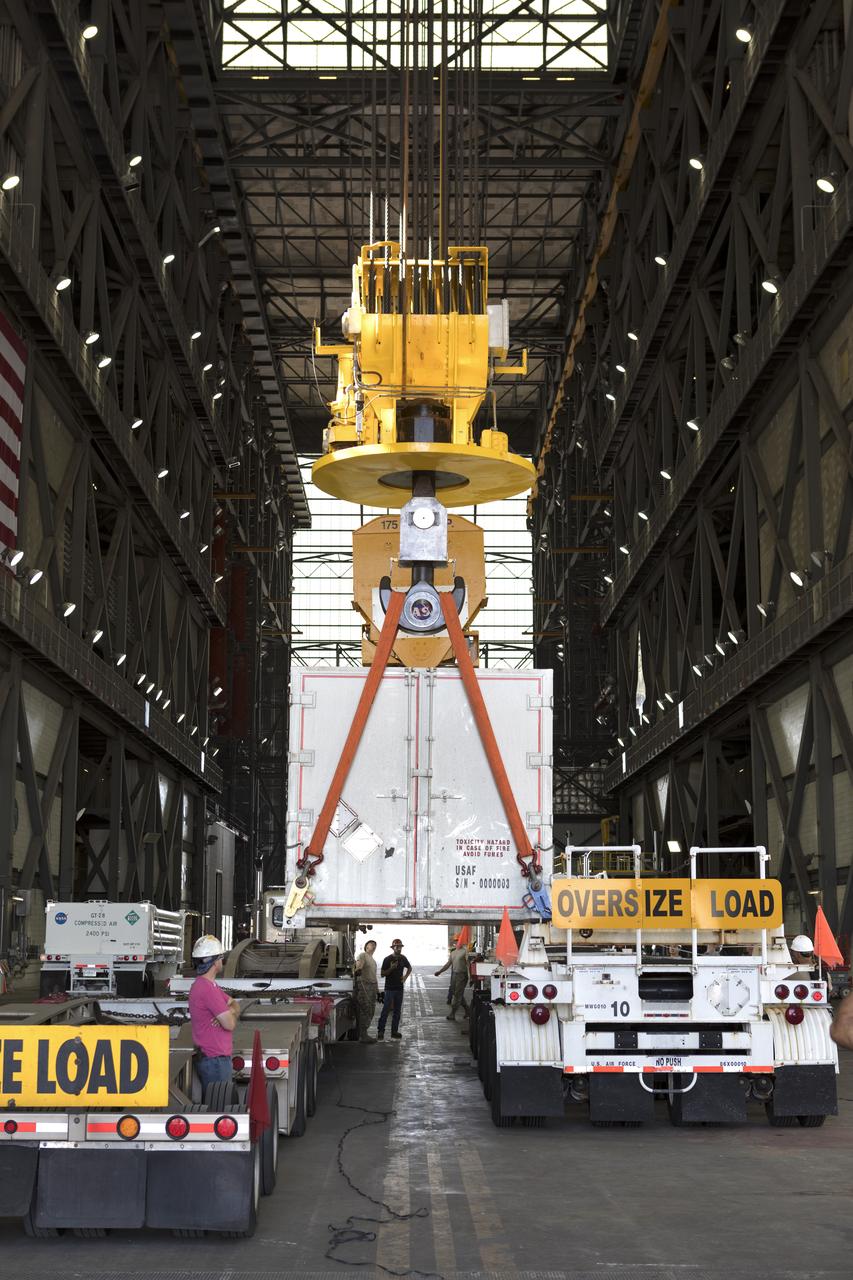
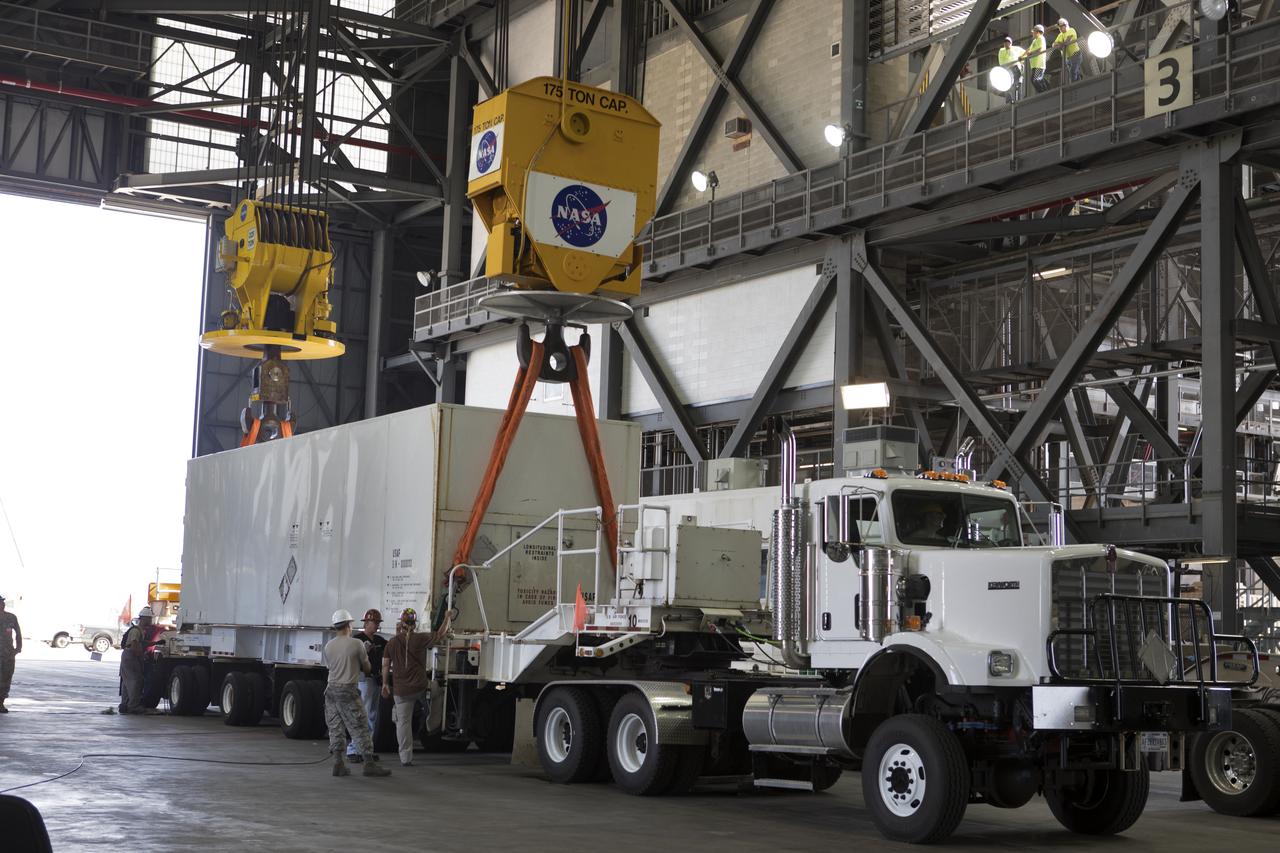
In the transfer aisle inside the Vehicle Assembly Building (VAB) at NASA's Kennedy Space Center in Florida, a crane lowers the shipping container with the ground test motor for Orion's Launch Abort System (LAS) inside onto another transporter on July 20, 2018. The container will be moved to the Rotation, Processing and Surge Facility where it will be inspected and prepared for transport to Space Launch Complex 46 (SLC-46) at Cape Canaveral Air Force Station for mechanical fit testing. This inert motor will not be used for flight, but will be used to certify flight hardware assembly in preparation for a full-stress test of the LAS, called Ascent Abort-2 (AA-2) flight test, scheduled for April 2019. During the test, the booster will launch from SLC 46, carrying a fully functional LAS and a 22,000-pound Orion test vehicle to an altitude of 31,000 feet and traveling at more than 1,000 miles an hour. The test will verify the LAS can steer the crew module and astronauts aboard to safety in the event of an issue with the Space Launch System (SLS) rocket when the spacecraft is under the highest aerodynamic loads it will experience during a rapid climb into space. NASA's Orion and Exploration Ground Systems programs and their contractors from Jacob's and Northrup Grumman in conjunction with the Air Force Space and Missile Center's Launch Operations branch SMC/LEXO, are performing the pathfinding exercises and flight operations for AA-2.
Ascent Abort 2 (AA-2) Ground Test Motor Arrival
IOP/SS Prototype Testing outside the VAB for Artemis II.
Artemis II Rainbird Testing
In the transfer aisle inside the Vehicle Assembly Building (VAB) at NASA's Kennedy Space Center in Florida, Jacob’s technicians on the Test Operations Support Contract attach a crane to a shipping container with the ground test motor for Orion's Launch Abort System (LAS) inside on July 20, 2018. The container will be lifted and transferred to another transporter and moved to the Rotation, Processing and Surge Facility where it will be inspected and prepared for transport to Space Launch Complex 46 (SLC-46) at Cape Canaveral Air Force Station for mechanical fit testing. This inert motor will not be used for flight, but will be used to certify flight hardware assembly in preparation for a full-stress test of the LAS, called Ascent Abort-2 (AA-2) flight test, scheduled for April 2019. During the test, the booster will launch from SLC 46, carrying a fully functional LAS and a 22,000-pound Orion test vehicle to an altitude of 31,000 feet and traveling at more than 1,000 miles an hour. The test will verify the LAS can steer the crew module and astronauts aboard to safety in the event of an issue with the Space Launch System (SLS) rocket when the spacecraft is under the highest aerodynamic loads it will experience during a rapid climb into space. NASA's Orion and Exploration Ground Systems programs and their contractors from Jacob's and Northrup Grumman in conjunction with the Air Force Space and Missile Center's Launch Operations branch SMC/LEXO, are performing the pathfinding exercises and flight operations for AA-2.
Ascent Abort 2 (AA-2) Ground Test Motor Arrival
In the transfer aisle inside the Vehicle Assembly Building (VAB) at NASA's Kennedy Space Center in Florida, Jacob’s technicians attach a crane to a shipping container with the ground test motor for Orion's Launch Abort System (LAS) inside on July 20, 2018. The container will be lifted and transferred to another transporter and moved to the Rotation, Processing and Surge Facility where it will be inspected and prepared for transport to Space Launch Complex 46 (SLC-46) at Cape Canaveral Air Force Station for mechanical fit testing. This inert motor will not be used for flight, but will be used to certify flight hardware assembly in preparation for a full-stress test of the LAS, called Ascent Abort-2 (AA-2) flight test, scheduled for April 2019. During the test, the booster will launch from SLC 46, carrying a fully functional LAS and a 22,000-pound Orion test vehicle to an altitude of 31,000 feet and traveling at more than 1,000 miles an hour. The test will verify the LAS can steer the crew module and astronauts aboard to safety in the event of an issue with the Space Launch System (SLS) rocket when the spacecraft is under the highest aerodynamic loads it will experience during a rapid climb into space. NASA's Orion and Exploration Ground Systems programs and their contractors from Jacob's and Northrup Grumman in conjunction with the Air Force Space and Missile Center's Launch Operations branch SMC/LEXO, are performing the pathfinding exercises and flight operations for AA-2.
Ascent Abort 2 (AA-2) Ground Test Motor Arrival
In the transfer aisle inside the Vehicle Assembly Building (VAB) at NASA's Kennedy Space Center in Florida, a crane is used to lift up the shipping container with the ground test motor for Orion's Launch Abort System (LAS) inside on July 20, 2018. The container will be lowered onto another transporter and moved to the Rotation, Processing and Surge Facility where it will be inspected and prepared for transport to Space Launch Complex 46 (SLC-46) at Cape Canaveral Air Force Station for mechanical fit testing. This inert motor will not be used for flight, but will be used to certify flight hardware assembly in preparation for a full-stress test of the LAS, called Ascent Abort-2 (AA-2) flight test, scheduled for April 2019. During the test, the booster will launch from SLC 46, carrying a fully functional LAS and a 22,000-pound Orion test vehicle to an altitude of 31,000 feet and traveling at more than 1,000 miles an hour. The test will verify the LAS can steer the crew module and astronauts aboard to safety in the event of an issue with the Space Launch System (SLS) rocket when the spacecraft is under the highest aerodynamic loads it will experience during a rapid climb into space. NASA's Orion and Exploration Ground Systems programs and their contractors from Jacob's and Northrup Grumman in conjunction with the Air Force Space and Missile Center's Launch Operations branch SMC/LEXO, are performing the pathfinding exercises and flight operations for AA-2.
Ascent Abort 2 (AA-2) Ground Test Motor Arrival
In the transfer aisle inside the Vehicle Assembly Building (VAB) at NASA's Kennedy Space Center in Florida, a crane is used to lift up a shipping container with the ground test motor for Orion's Launch Abort System (LAS) inside on July 20, 2018. The container will be lifted and transferred to another transporter and moved to the Rotation, Processing and Surge Facility where it will be inspected and prepared for transport to Space Launch Complex 46 (SLC-46) at Cape Canaveral Air Force Station for mechanical fit testing. This inert motor will not be used for flight, but will be used to certify flight hardware assembly in preparation for a full-stress test of the LAS, called Ascent Abort-2 (AA-2) flight test, scheduled for April 2019. During the test, the booster will launch from SLC 46, carrying a fully functional LAS and a 22,000-pound Orion test vehicle to an altitude of 31,000 feet and traveling at more than 1,000 miles an hour. The test will verify the LAS can steer the crew module and astronauts aboard to safety in the event of an issue with the Space Launch System (SLS) rocket when the spacecraft is under the highest aerodynamic loads it will experience during a rapid climb into space. NASA's Orion and Exploration Ground Systems programs and their contractors from Jacob's and Northrup Grumman in conjunction with the Air Force Space and Missile Center's Launch Operations branch SMC/LEXO, are performing the pathfinding exercises and flight operations for AA-2.
Ascent Abort 2 (AA-2) Ground Test Motor Arrival
In the transfer aisle inside the Vehicle Assembly Building (VAB) at NASA's Kennedy Space Center in Florida, a crane operated by Jacob’s technicians lowers the shipping container with the ground test motor for Orion's Launch Abort System (LAS) inside onto another transporter on July 20, 2018. The container will be moved to the Rotation, Processing and Surge Facility where it will be inspected and prepared for transport to Space Launch Complex 46 (SLC-46) at Cape Canaveral Air Force Station for mechanical fit testing. This inert motor will not be used for flight, but will be used to certify flight hardware assembly in preparation for a full-stress test of the LAS, called Ascent Abort-2 (AA-2) flight test, scheduled for April 2019. During the test, the booster will launch from SLC 46, carrying a fully functional LAS and a 22,000-pound Orion test vehicle to an altitude of 31,000 feet and traveling at more than 1,000 miles an hour. The test will verify the LAS can steer the crew module and astronauts aboard to safety in the event of an issue with the Space Launch System (SLS) rocket when the spacecraft is under the highest aerodynamic loads it will experience during a rapid climb into space. NASA's Orion and Exploration Ground Systems programs and their contractors from Jacob's and Northrup Grumman in conjunction with the Air Force Space and Missile Center's Launch Operations branch SMC/LEXO, are performing the pathfinding exercises and flight operations for AA-2.
Ascent Abort 2 (AA-2) Ground Test Motor Arrival
In the transfer aisle inside the Vehicle Assembly Building (VAB) at NASA's Kennedy Space Center in Florida, a crane is used to lift up the shipping container with the ground test motor for Orion's Launch Abort System (LAS) inside on July 20, 2018. The container will be lowered onto another transporter and moved to the Rotation, Processing and Surge Facility where it will be inspected and prepared for transport to Space Launch Complex 46 (SLC-46) at Cape Canaveral Air Force Station for mechanical fit testing. This inert motor will not be used for flight, but will be used to certify flight hardware assembly in preparation for a full-stress test of the LAS, called Ascent Abort-2 (AA-2) flight test, scheduled for April 2019. During the test, the booster will launch from SLC 46, carrying a fully functional LAS and a 22,000-pound Orion test vehicle to an altitude of 31,000 feet and traveling at more than 1,000 miles an hour. The test will verify the LAS can steer the crew module and astronauts aboard to safety in the event of an issue with the Space Launch System (SLS) rocket when the spacecraft is under the highest aerodynamic loads it will experience during a rapid climb into space. NASA's Orion and Exploration Ground Systems programs and their contractors from Jacob's and Northrup Grumman in conjunction with the Air Force Space and Missile Center's Launch Operations branch SMC/LEXO, are performing the pathfinding exercises and flight operations for AA-2.
Ascent Abort 2 (AA-2) Ground Test Motor Arrival
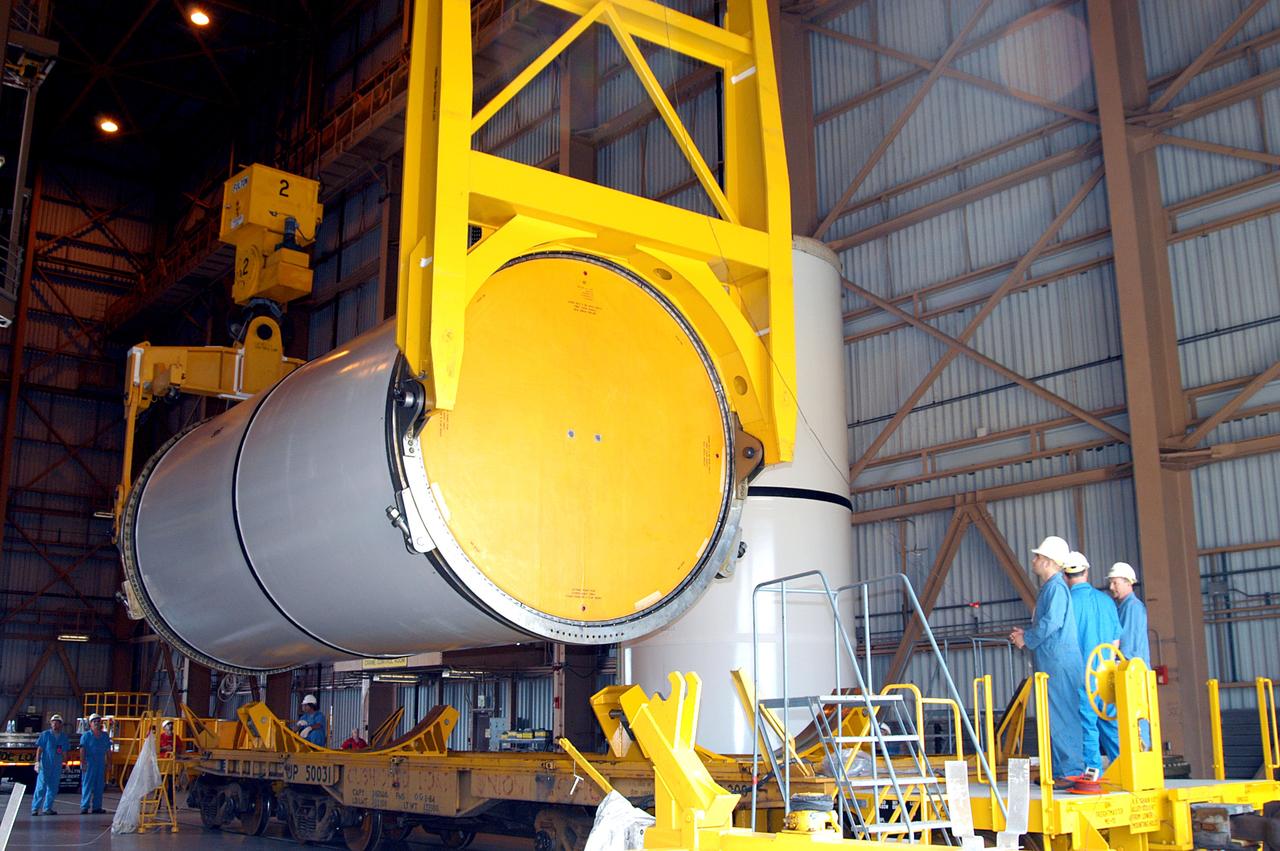
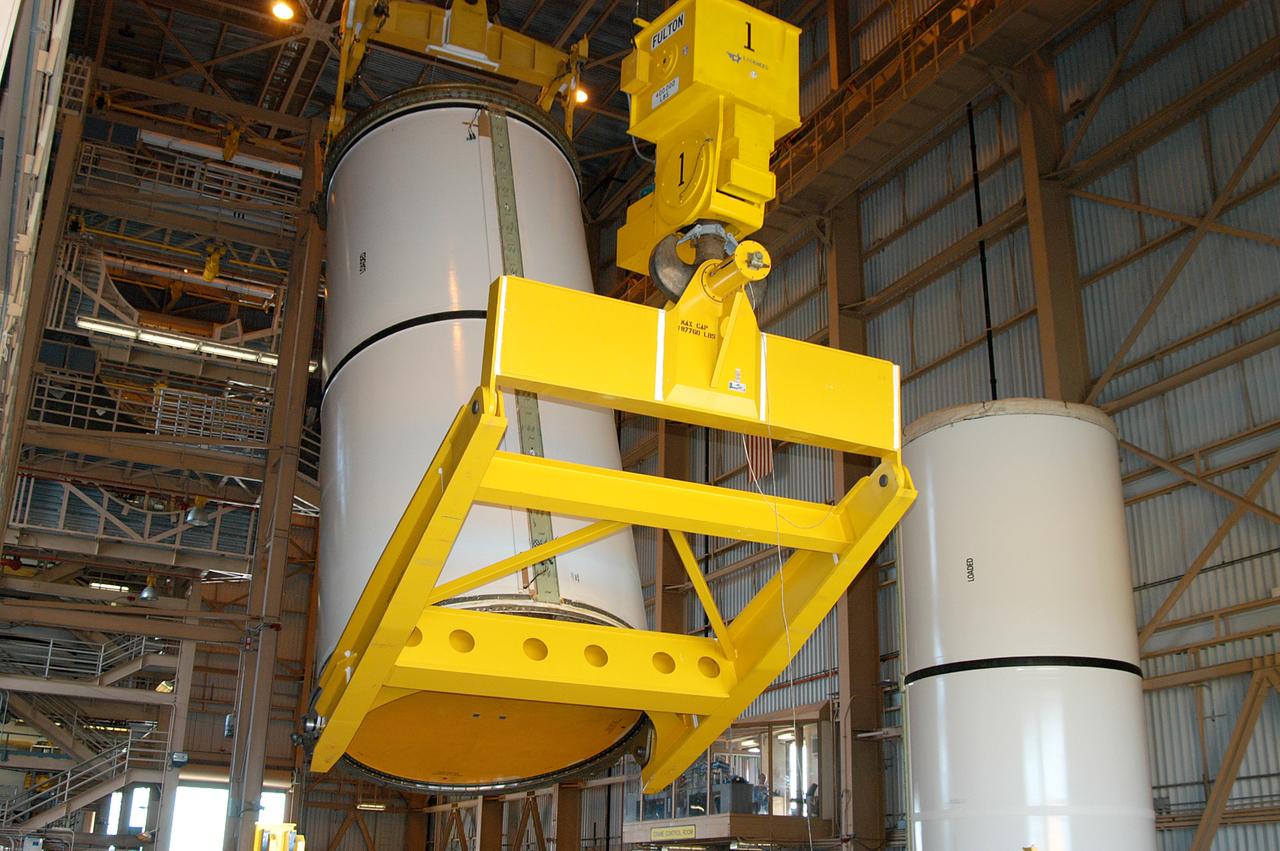
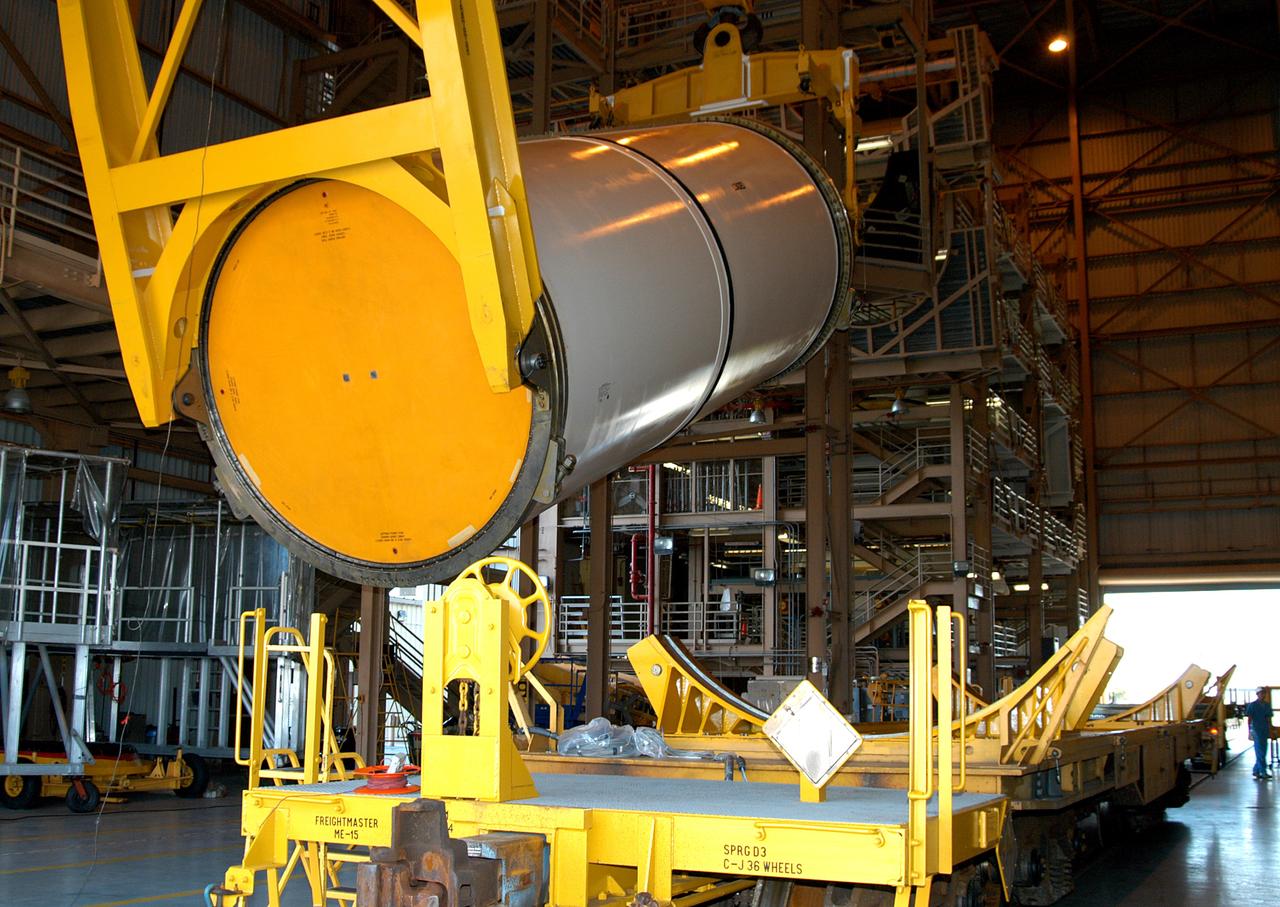
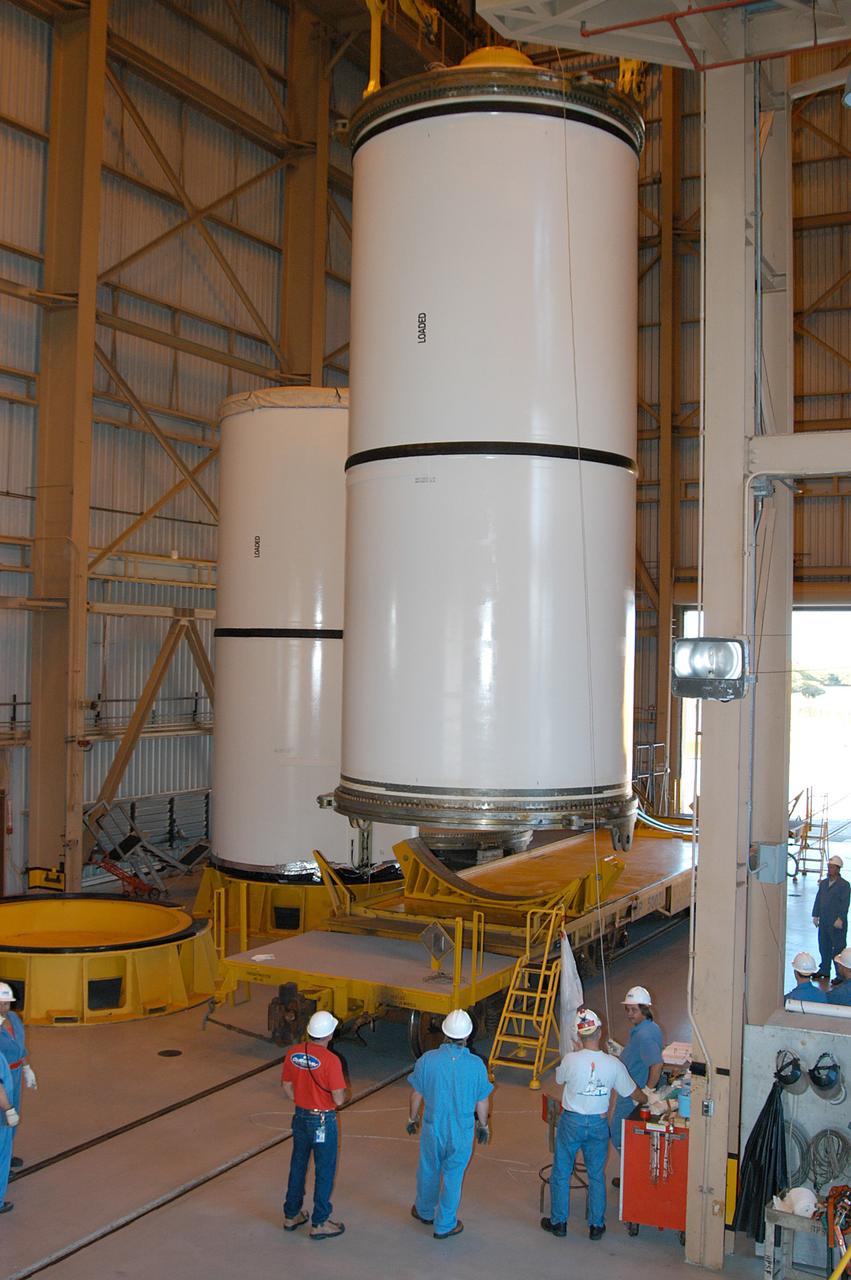
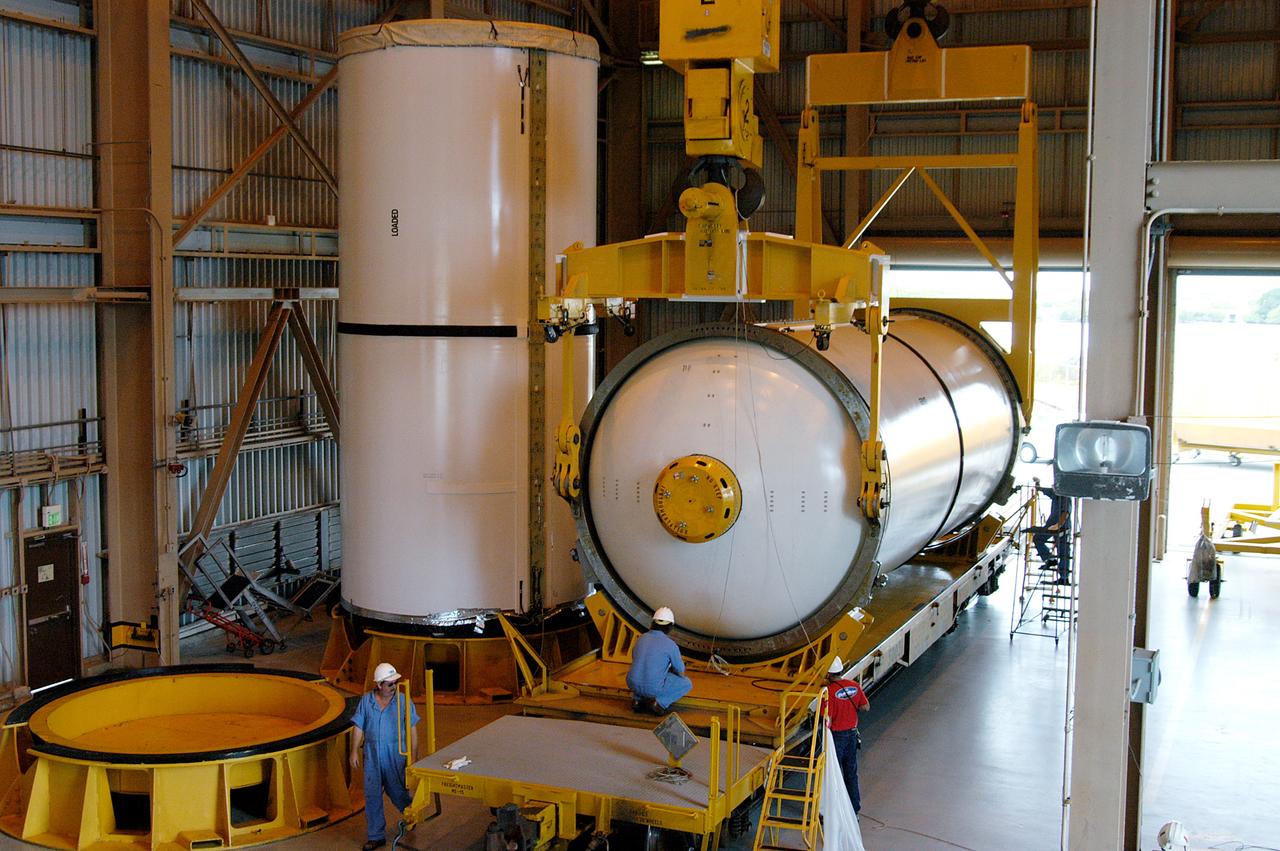
KENNEDY SPACE CENTER, FLA. -  In the Rotation Processing and Surge Facility, an SRB solid segment is being rotated to horizontal for placement on a rail car.  The segment is being shipped to Utah for testing.  The segment was part of the STS-114 stack.  It is the first time actual flight segments that had been stacked for flight in the VAB are being returned to Utah for testing.  It will undergo firing, which will enable inspectors to check the viability of the solid and verify the life expectancy for stacked segments.
KENNEDY SPACE CENTER, FLA. - In the Rotation Processing and Surge Facility, an SRB solid segment is being rotated to horizontal for placement on a rail car. The segment is being shipped to Utah for testing. The segment was part of the STS-114 stack. It is the first time actual flight segments that had been stacked for flight in the VAB are being returned to Utah for testing. It will undergo firing, which will enable inspectors to check the viability of the solid and verify the life expectancy for stacked segments.
KENNEDY SPACE CENTER, FLA. -  In the Rotation Processing and Surge Facility, an SRB solid segment is being moved to a rail car for shipment to Utah for testing.  The segment was part of the STS-114 stack.  It is the first time actual flight segments that had been stacked for flight in the VAB are being returned to Utah for testing.  It will undergo firing, which will enable inspectors to check the viability of the solid and verify the life expectancy for stacked segments.
KENNEDY SPACE CENTER, FLA. - In the Rotation Processing and Surge Facility, an SRB solid segment is being moved to a rail car for shipment to Utah for testing. The segment was part of the STS-114 stack. It is the first time actual flight segments that had been stacked for flight in the VAB are being returned to Utah for testing. It will undergo firing, which will enable inspectors to check the viability of the solid and verify the life expectancy for stacked segments.
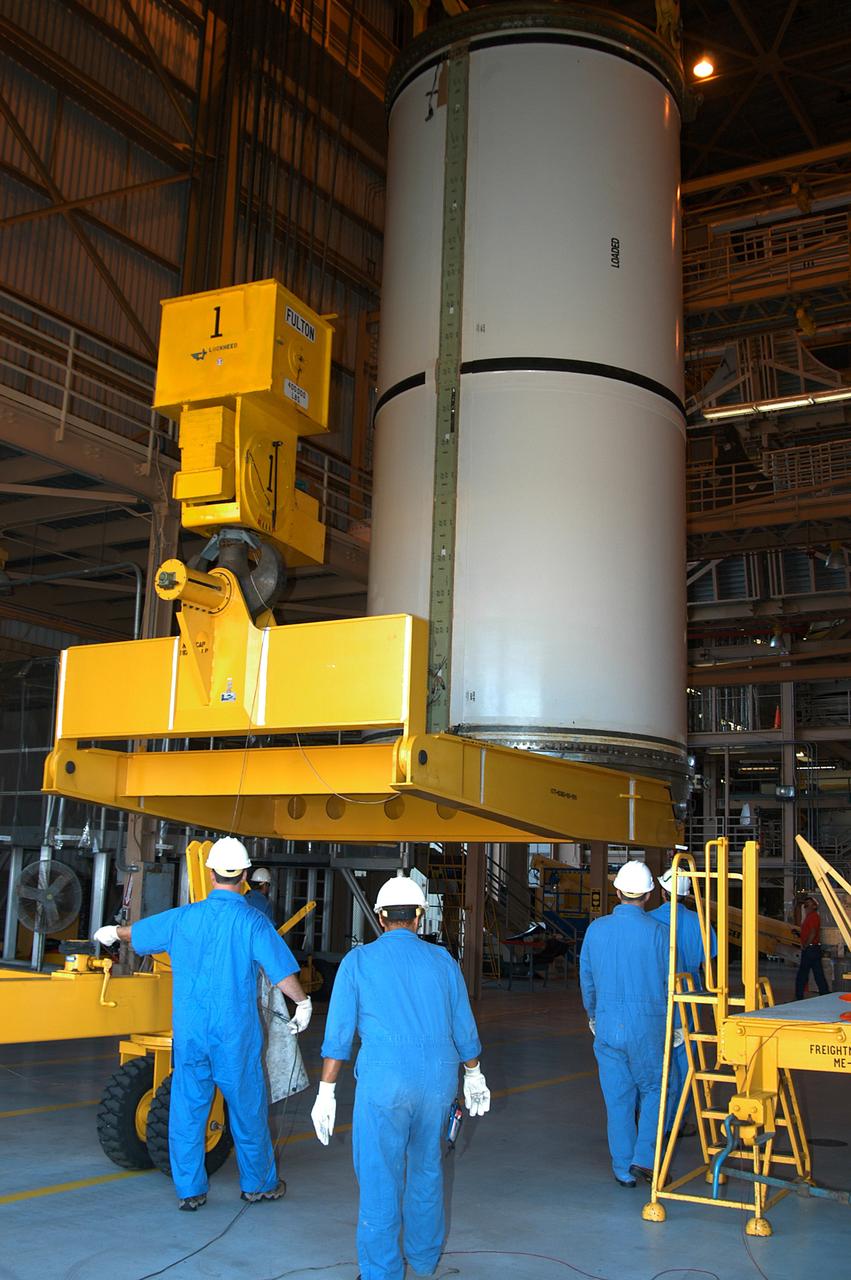
KENNEDY SPACE CENTER, FLA. -  In the Rotation Processing and Surge Facility, an SRB solid segment is being lifted and moved to a rail car for shipment to Utah for testing.  The segment was part of the STS-114 stack.  It is the first time actual flight segments that had been stacked for flight in the VAB are being returned to Utah for testing.  It will undergo firing, which will enable inspectors to check the viability of the solid and verify the life expectancy for stacked segments.
KENNEDY SPACE CENTER, FLA. - In the Rotation Processing and Surge Facility, an SRB solid segment is being lifted and moved to a rail car for shipment to Utah for testing. The segment was part of the STS-114 stack. It is the first time actual flight segments that had been stacked for flight in the VAB are being returned to Utah for testing. It will undergo firing, which will enable inspectors to check the viability of the solid and verify the life expectancy for stacked segments.
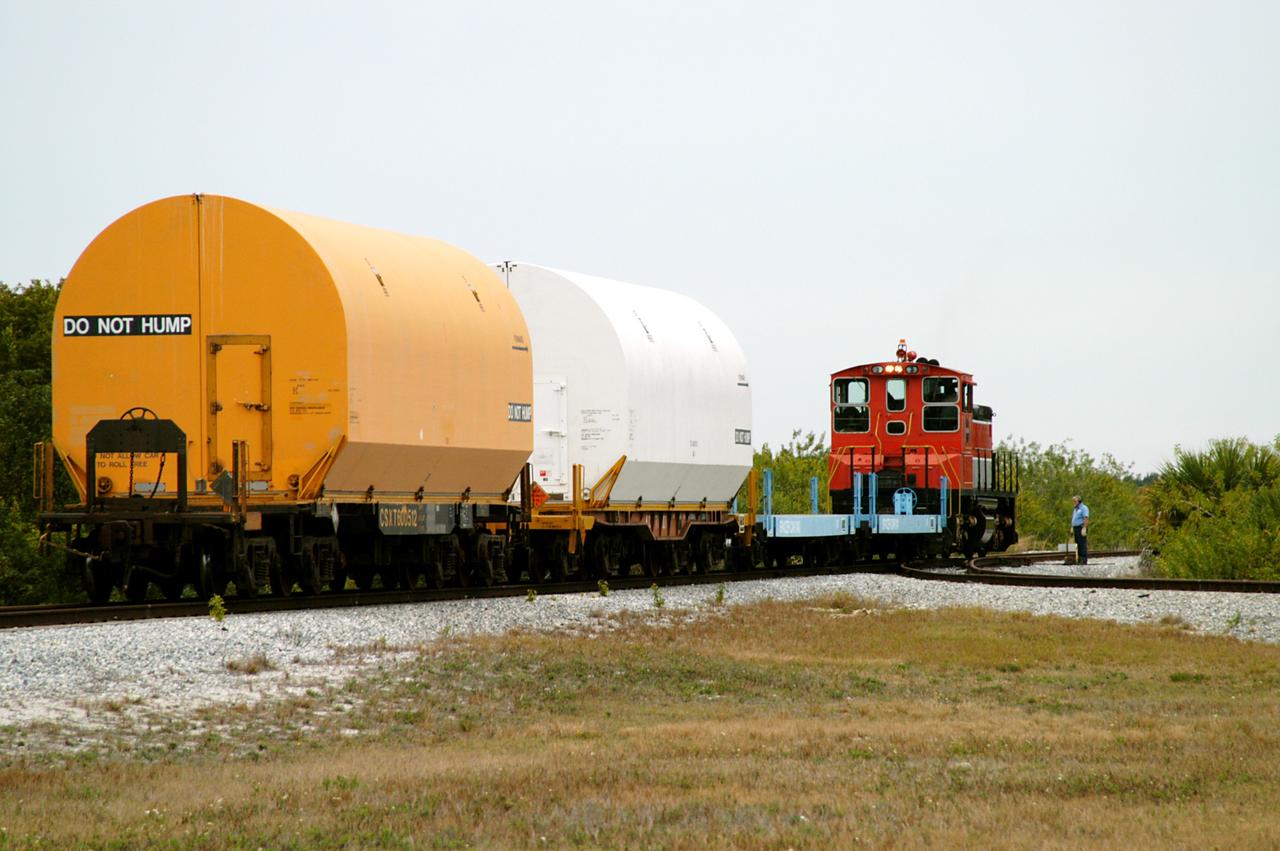
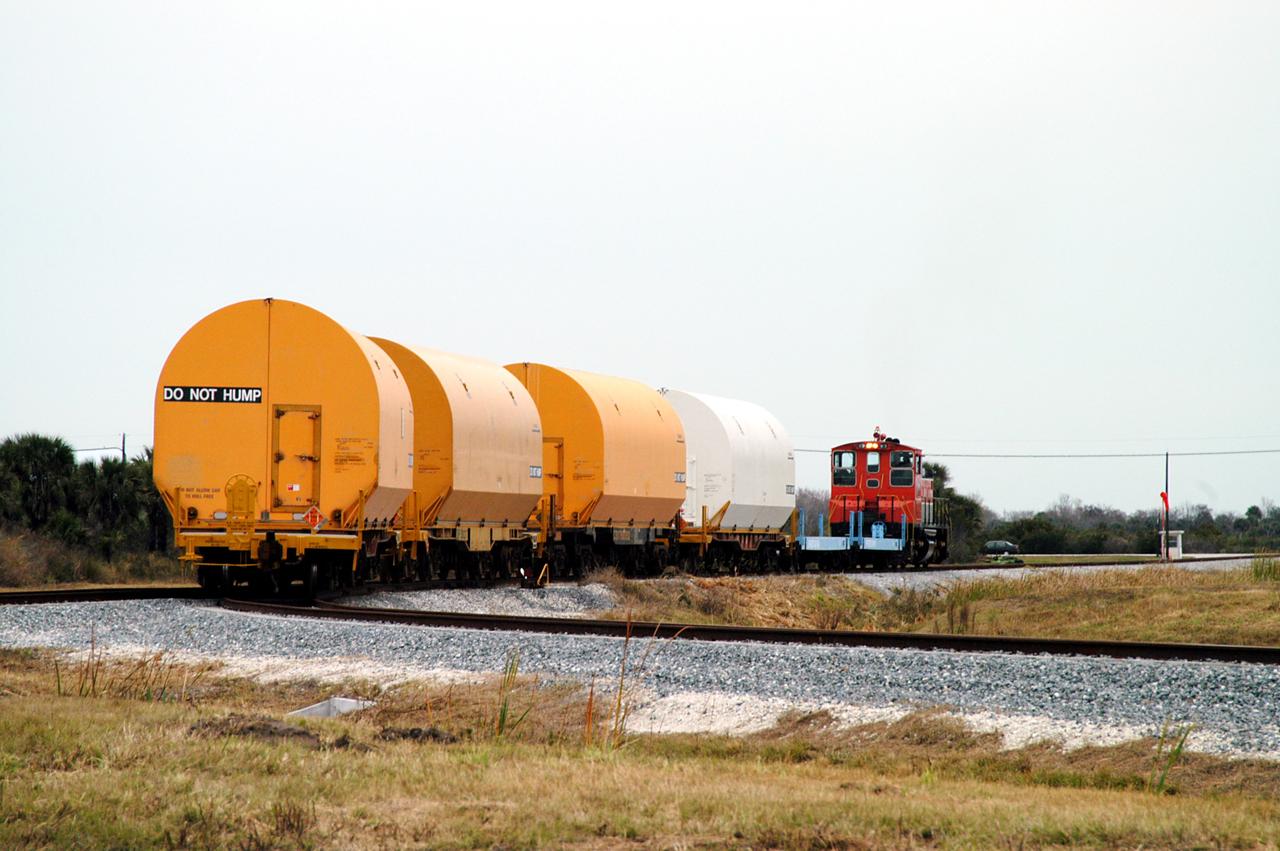
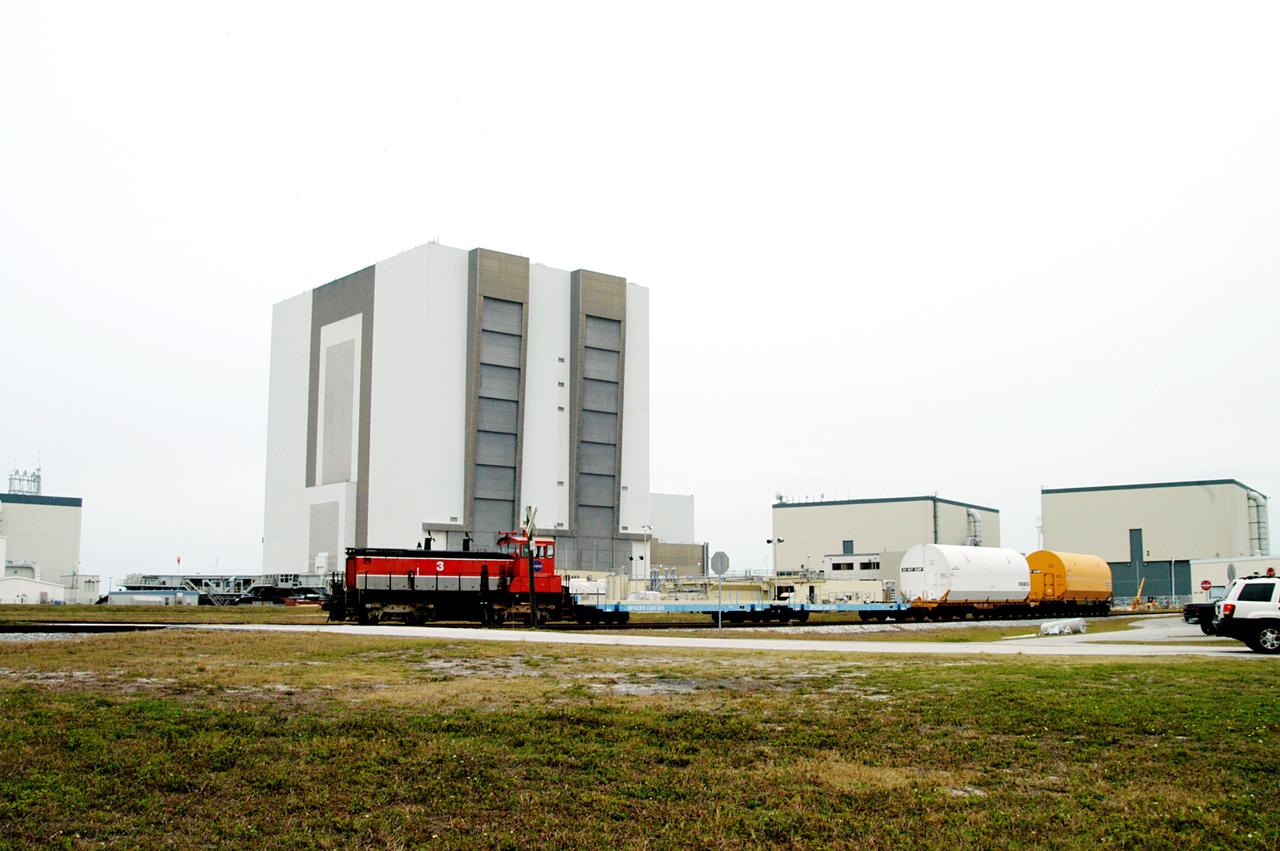
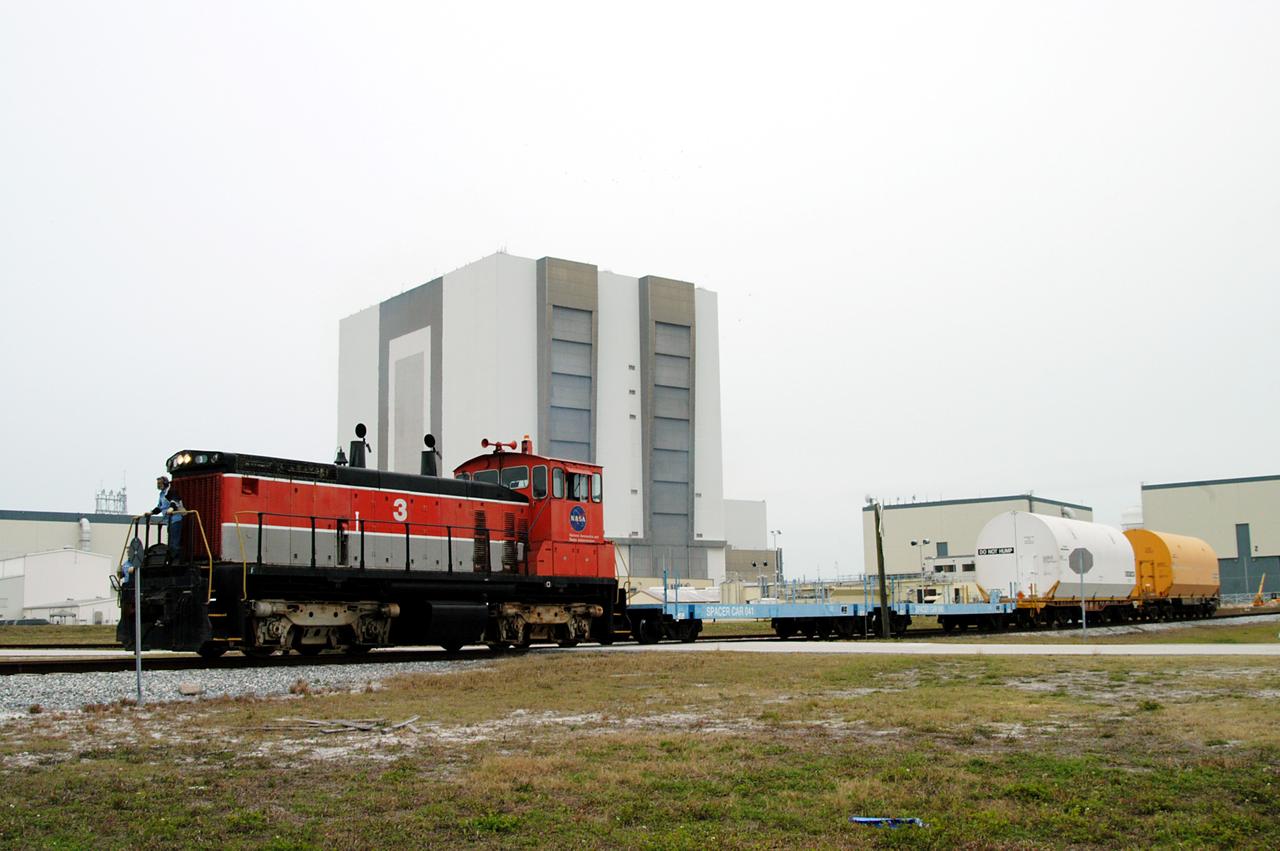
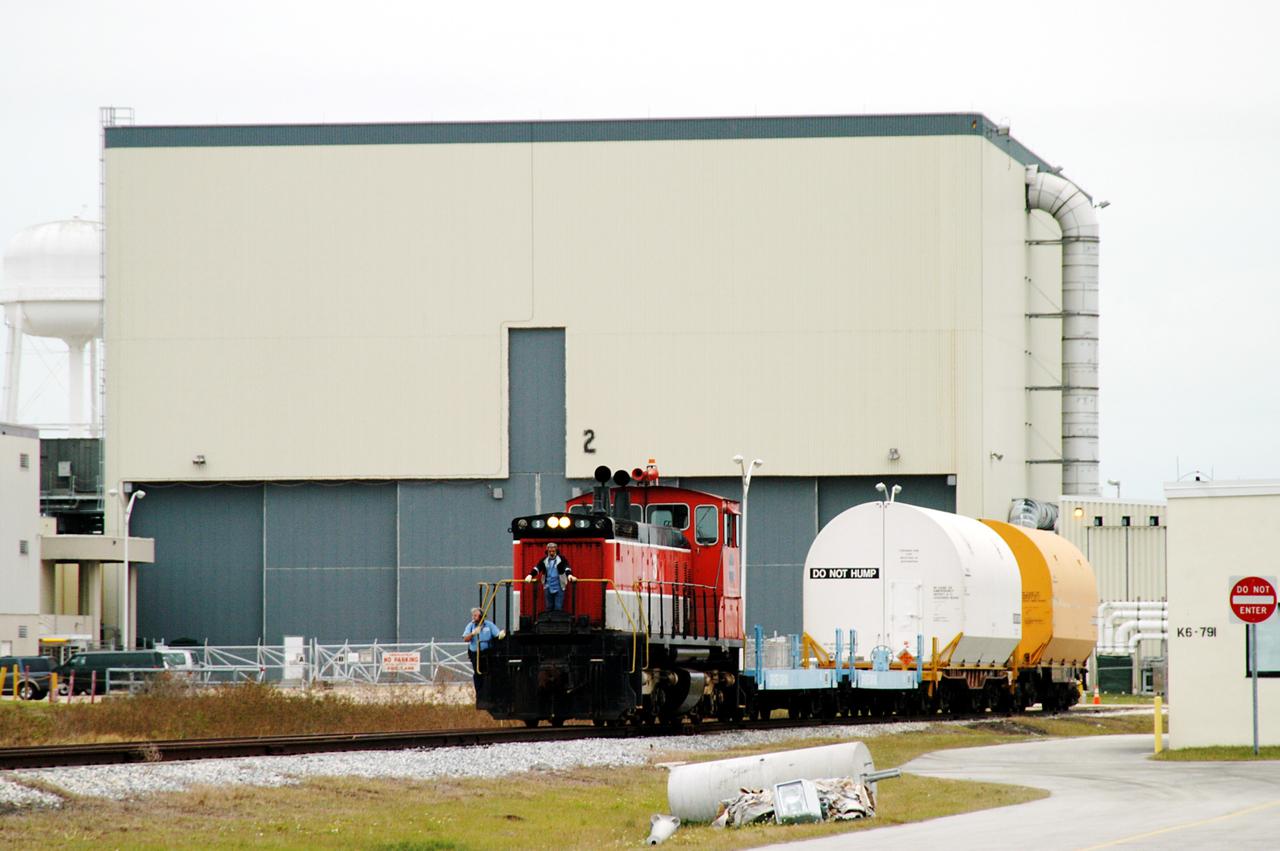
KENNEDY SPACE CENTER, FLA. - Moving past the 525-foot-high Vehicle Assembly Building, the red NASA engine pulls several containers enclosing segments of a solid rocket booster being returned to Utah for testing.  The segments were part of the STS-114 stack.  It is the first time actual flight segments that had been stacked for flight in the VAB are being returned for testing.  They will undergo firing, which will enable inspectors to check the viability of the solid and verify the life expectancy for stacked segments.
KENNEDY SPACE CENTER, FLA. - Moving past the 525-foot-high Vehicle Assembly Building, the red NASA engine pulls several containers enclosing segments of a solid rocket booster being returned to Utah for testing. The segments were part of the STS-114 stack. It is the first time actual flight segments that had been stacked for flight in the VAB are being returned for testing. They will undergo firing, which will enable inspectors to check the viability of the solid and verify the life expectancy for stacked segments.
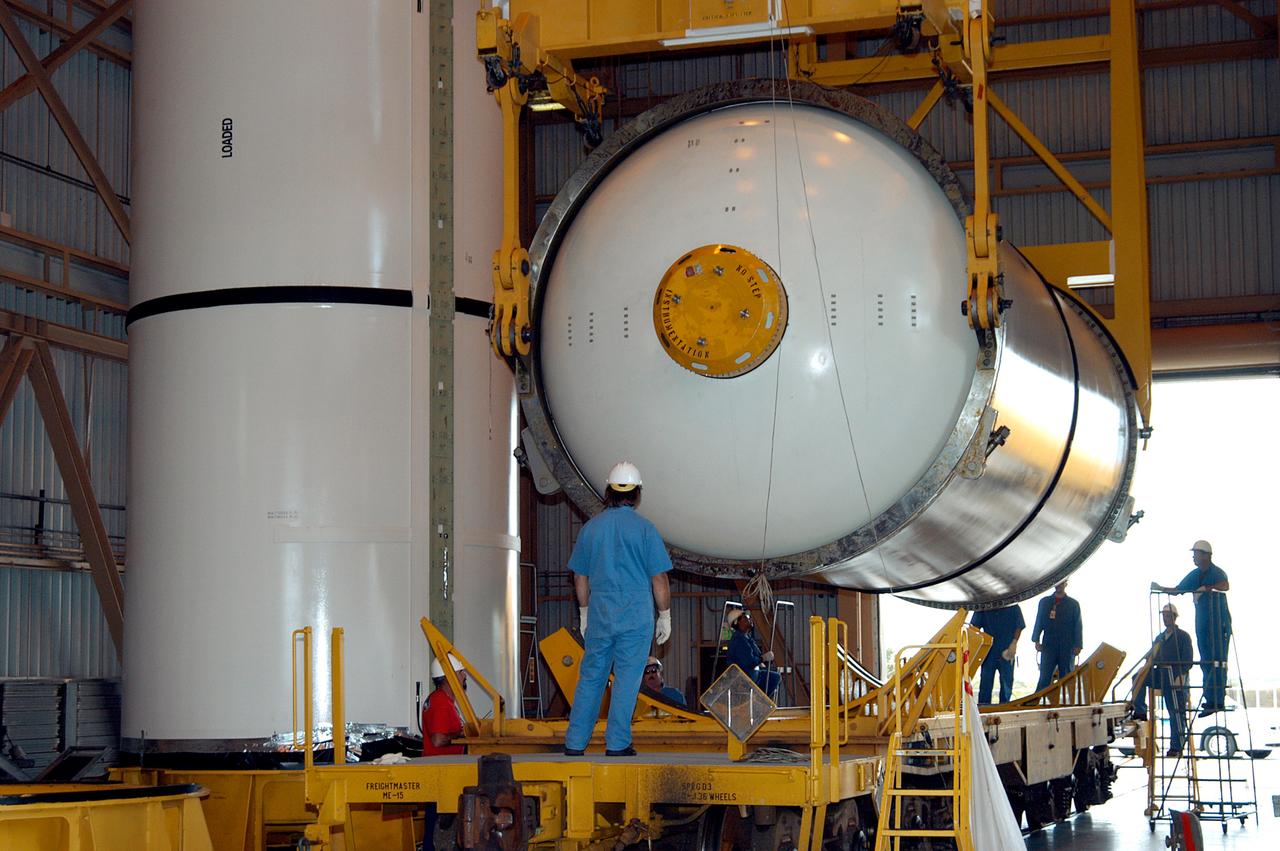
KENNEDY SPACE CENTER, FLA. -  In the Rotation Processing and Surge Facility, an SRB solid segment is lowered onto a rail car for shipment to Utah where it will be tested.  The segment was part of the STS-114 stack.  It is the first time actual flight segments that had been stacked for flight in the VAB are being returned to Utah for testing.  It will undergo firing, which will enable inspectors to check the viability of the solid and verify the life expectancy for stacked segments.
KENNEDY SPACE CENTER, FLA. - In the Rotation Processing and Surge Facility, an SRB solid segment is lowered onto a rail car for shipment to Utah where it will be tested. The segment was part of the STS-114 stack. It is the first time actual flight segments that had been stacked for flight in the VAB are being returned to Utah for testing. It will undergo firing, which will enable inspectors to check the viability of the solid and verify the life expectancy for stacked segments.
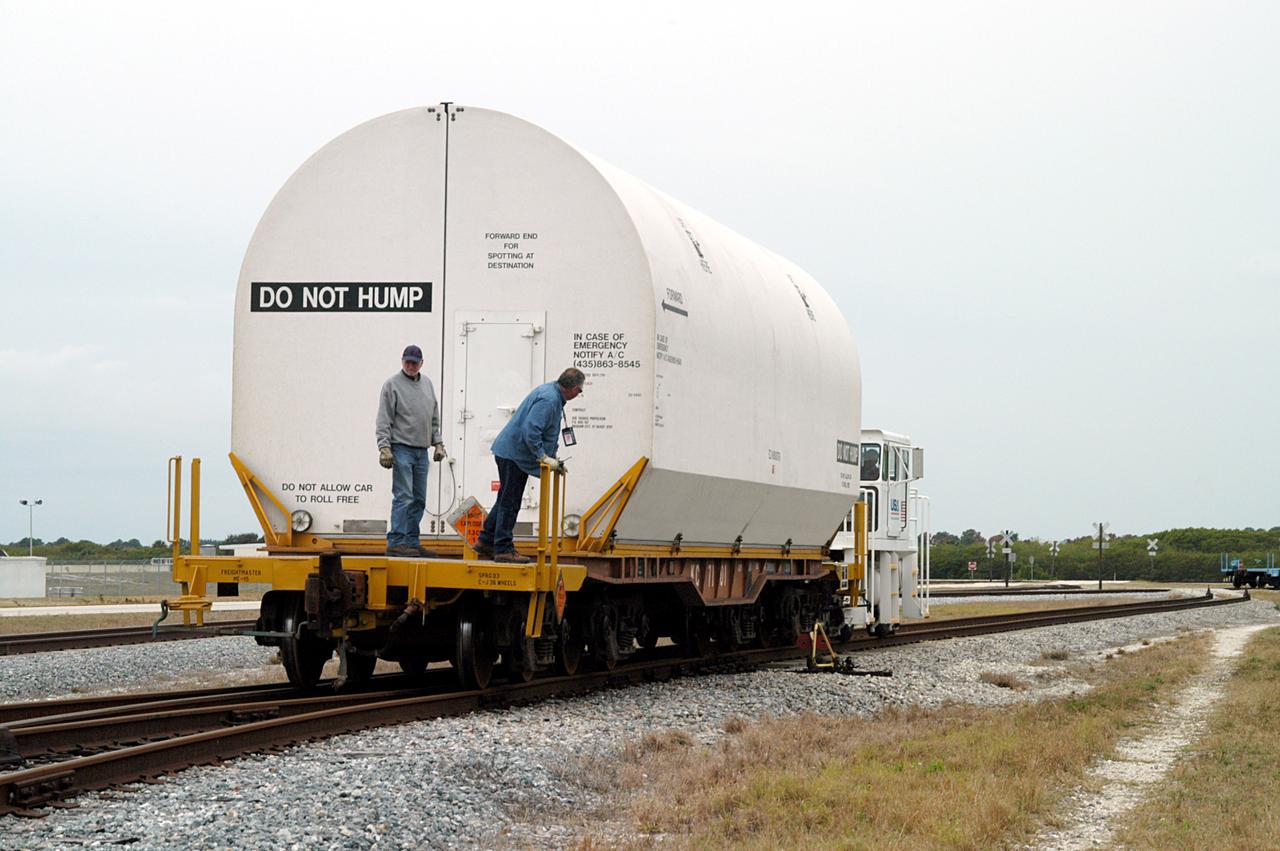
KENNEDY SPACE CENTER, FLA. - Workers ride the rails along with a container enclosing a segment of a solid rocket booster being moved to the main track.  Several segments are being returned to Utah for testing.  The segments were part of the STS-114 stack.  It is the first time actual flight segments that had been stacked for flight in the VAB are being returned for testing.  They will undergo firing, which will enable inspectors to check the viability of the solid and verify the life expectancy for stacked segments.
KENNEDY SPACE CENTER, FLA. - Workers ride the rails along with a container enclosing a segment of a solid rocket booster being moved to the main track. Several segments are being returned to Utah for testing. The segments were part of the STS-114 stack. It is the first time actual flight segments that had been stacked for flight in the VAB are being returned for testing. They will undergo firing, which will enable inspectors to check the viability of the solid and verify the life expectancy for stacked segments.
KENNEDY SPACE CENTER, FLA. -  In the Rotation Processing and Surge Facility, an SRB solid segment is lowered onto a rail car for shipment to Utah where it will be tested.  The segment was part of the STS-114 stack.  It is the first time actual flight segments that had been stacked for flight in the VAB are being returned to Utah for testing.  It will undergo firing, which will enable inspectors to check the viability of the solid and verify the life expectancy for stacked segments.
KENNEDY SPACE CENTER, FLA. - In the Rotation Processing and Surge Facility, an SRB solid segment is lowered onto a rail car for shipment to Utah where it will be tested. The segment was part of the STS-114 stack. It is the first time actual flight segments that had been stacked for flight in the VAB are being returned to Utah for testing. It will undergo firing, which will enable inspectors to check the viability of the solid and verify the life expectancy for stacked segments.
KENNEDY SPACE CENTER, FLA. - The red NASA engine backs up with its cargo of containers in order to change tracks.  The containers enclose segments of a solid rocket booster being returned to Utah for testing.  The segments were part of the STS-114 stack.  It is the first time actual flight segments that had been stacked for flight in the VAB are being returned for testing.  They will undergo firing, which will enable inspectors to check the viability of the solid and verify the life expectancy for stacked segments.
KENNEDY SPACE CENTER, FLA. - The red NASA engine backs up with its cargo of containers in order to change tracks. The containers enclose segments of a solid rocket booster being returned to Utah for testing. The segments were part of the STS-114 stack. It is the first time actual flight segments that had been stacked for flight in the VAB are being returned for testing. They will undergo firing, which will enable inspectors to check the viability of the solid and verify the life expectancy for stacked segments.
KENNEDY SPACE CENTER, FLA. -  In the Rotation Processing and Surge Facility, an SRB solid segment is lowered onto a rail car for shipment to Utah where it will be tested.  The segment was part of the STS-114 stack.  It is the first time actual flight segments that had been stacked for flight in the VAB are being returned to Utah for testing.  It will undergo firing, which will enable inspectors to check the viability of the solid and verify the life expectancy for stacked segments.
KENNEDY SPACE CENTER, FLA. - In the Rotation Processing and Surge Facility, an SRB solid segment is lowered onto a rail car for shipment to Utah where it will be tested. The segment was part of the STS-114 stack. It is the first time actual flight segments that had been stacked for flight in the VAB are being returned to Utah for testing. It will undergo firing, which will enable inspectors to check the viability of the solid and verify the life expectancy for stacked segments.
KENNEDY SPACE CENTER, FLA. -  In the Rotation Processing and Surge Facility, an SRB solid segment is being lifted and moved to a rail car for shipment to Utah for testing.  The segment was part of the STS-114 stack.  It is the first time actual flight segments that had been stacked for flight in the VAB are being returned to Utah for testing.  It will undergo firing, which will enable inspectors to check the viability of the solid and verify the life expectancy for stacked segments.
KENNEDY SPACE CENTER, FLA. - In the Rotation Processing and Surge Facility, an SRB solid segment is being lifted and moved to a rail car for shipment to Utah for testing. The segment was part of the STS-114 stack. It is the first time actual flight segments that had been stacked for flight in the VAB are being returned to Utah for testing. It will undergo firing, which will enable inspectors to check the viability of the solid and verify the life expectancy for stacked segments.
KENNEDY SPACE CENTER, FLA. - The red NASA engine moves forward past the Vehicle Assembly Building with its cargo of containers enclosing segments of a solid rocket booster being returned to Utah for testing.  The segments were part of the STS-114 stack.  It is the first time actual flight segments that had been stacked for flight in the VAB are being returned for testing.  They will undergo firing, which will enable inspectors to check the viability of the solid and verify the life expectancy for stacked segments.
KENNEDY SPACE CENTER, FLA. - The red NASA engine moves forward past the Vehicle Assembly Building with its cargo of containers enclosing segments of a solid rocket booster being returned to Utah for testing. The segments were part of the STS-114 stack. It is the first time actual flight segments that had been stacked for flight in the VAB are being returned for testing. They will undergo firing, which will enable inspectors to check the viability of the solid and verify the life expectancy for stacked segments.
KENNEDY SPACE CENTER, FLA. - The red NASA engine hauls its cargo toward Titusville, Fla. The containers enclose segments of a solid rocket booster being returned to Utah for testing.  The segments were part of the STS-114 stack.  It is the first time actual flight segments that had been stacked for flight in the VAB are being returned for testing.  They will undergo firing, which will enable inspectors to check the viability of the solid and verify the life expectancy for stacked segments.
KENNEDY SPACE CENTER, FLA. - The red NASA engine hauls its cargo toward Titusville, Fla. The containers enclose segments of a solid rocket booster being returned to Utah for testing. The segments were part of the STS-114 stack. It is the first time actual flight segments that had been stacked for flight in the VAB are being returned for testing. They will undergo firing, which will enable inspectors to check the viability of the solid and verify the life expectancy for stacked segments.
KENNEDY SPACE CENTER, FLA. - The red NASA engine hauls its cargo toward Titusville, Fla. The containers enclose segments of a solid rocket booster being returned to Utah for testing.  The segments were part of the STS-114 stack.  It is the first time actual flight segments that had been stacked for flight in the VAB are being returned for testing.  They will undergo firing, which will enable inspectors to check the viability of the solid and verify the life expectancy for stacked segments.
KENNEDY SPACE CENTER, FLA. - The red NASA engine hauls its cargo toward Titusville, Fla. The containers enclose segments of a solid rocket booster being returned to Utah for testing. The segments were part of the STS-114 stack. It is the first time actual flight segments that had been stacked for flight in the VAB are being returned for testing. They will undergo firing, which will enable inspectors to check the viability of the solid and verify the life expectancy for stacked segments.
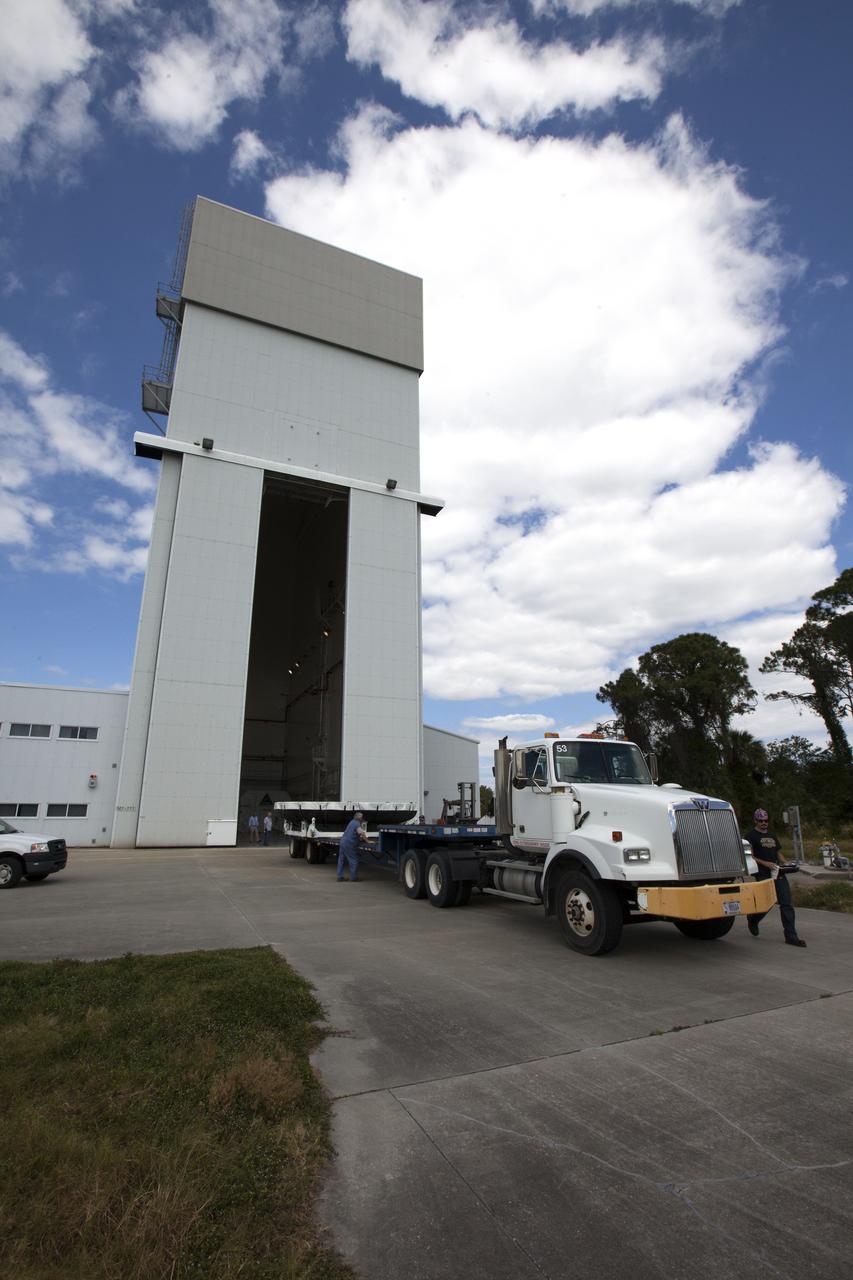
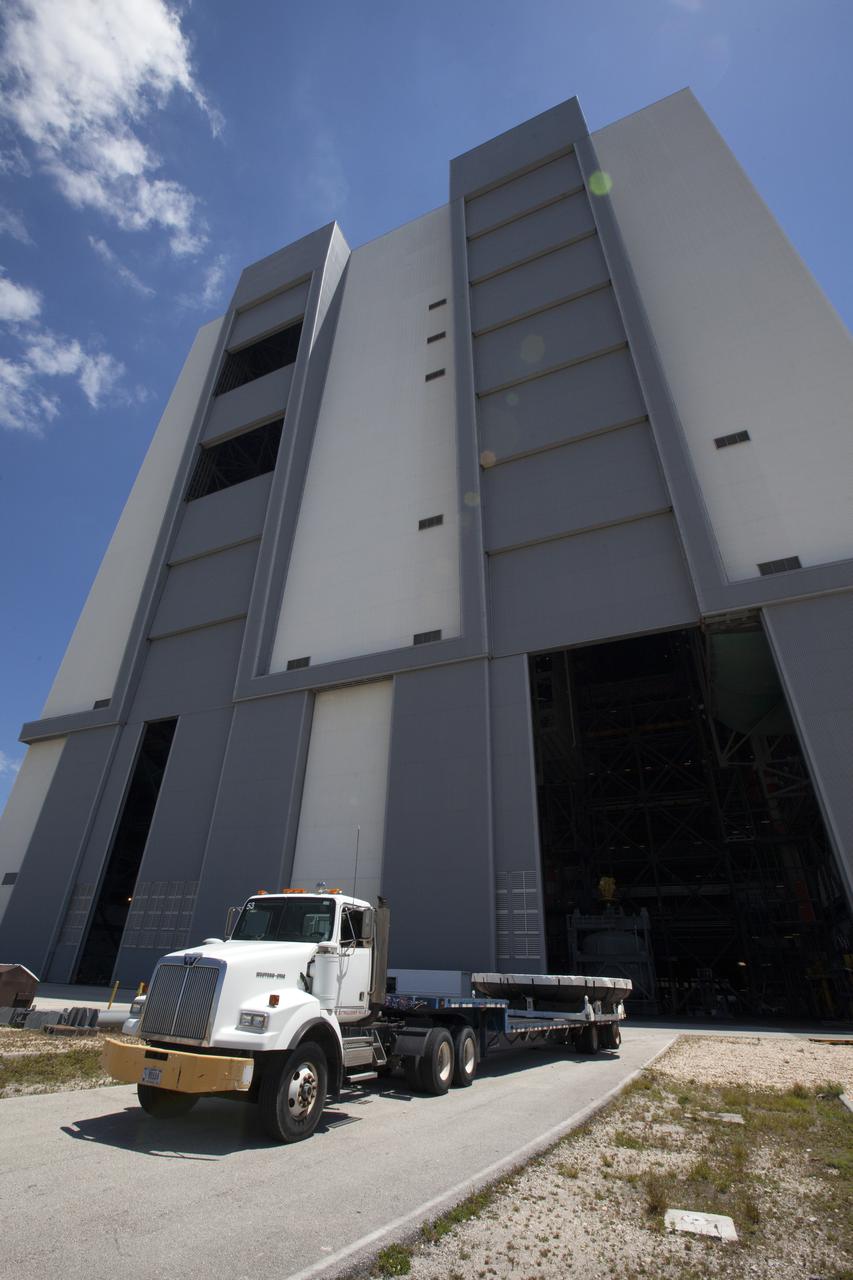
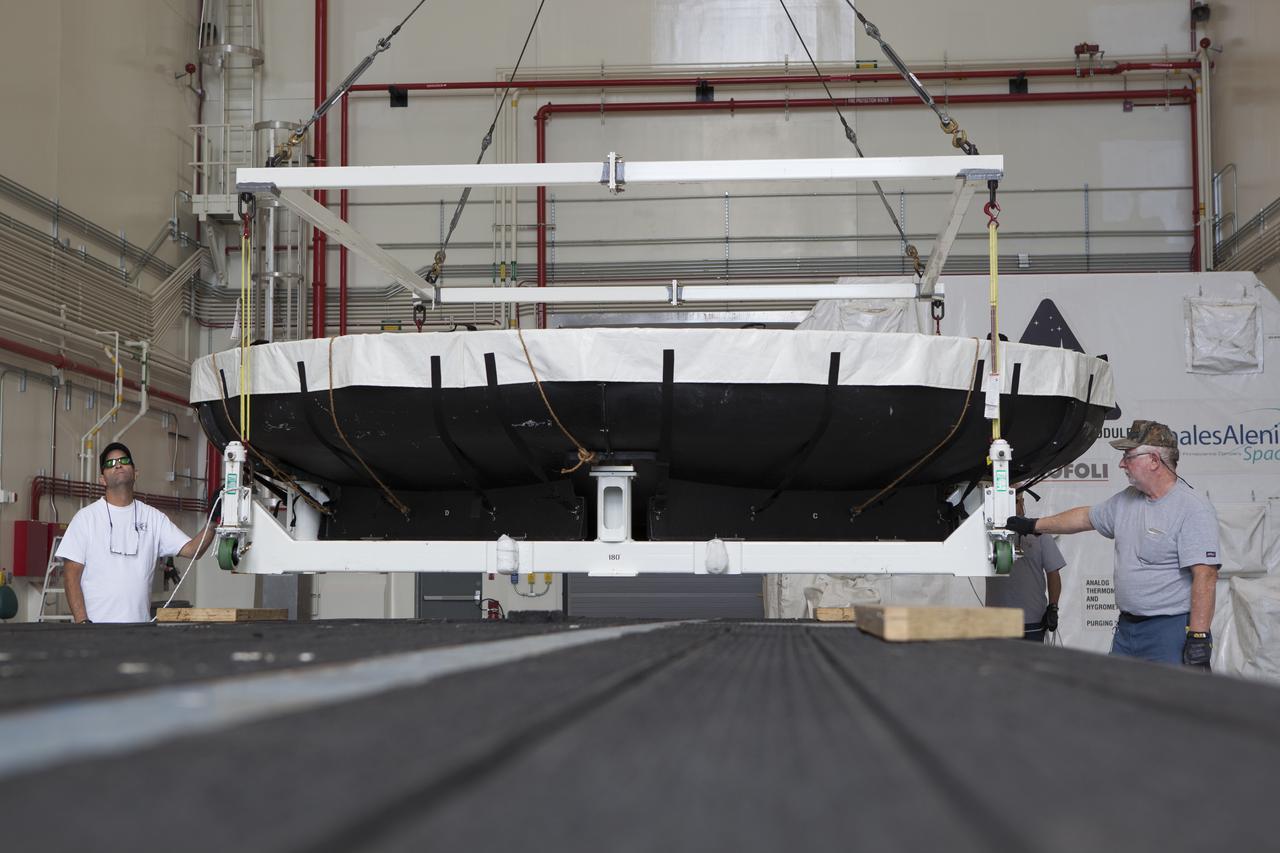
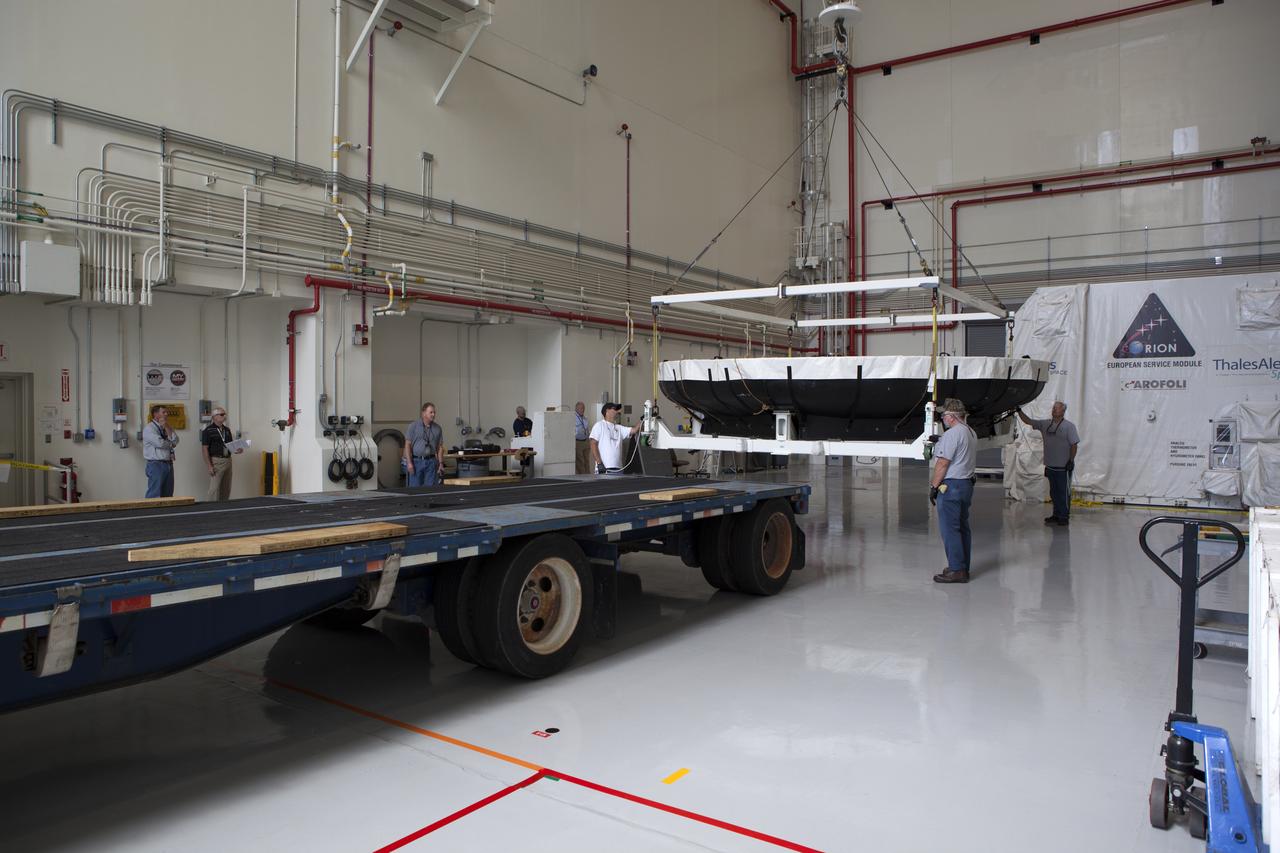
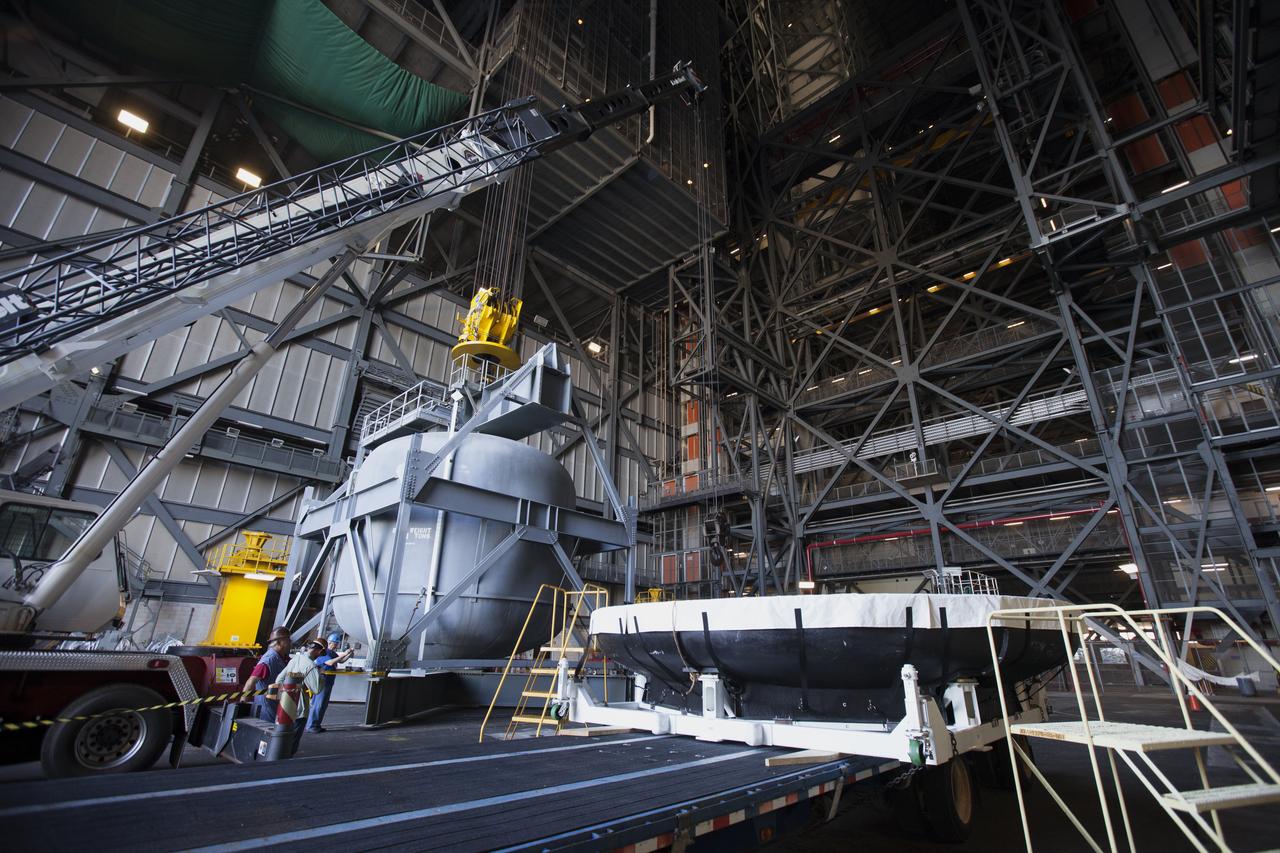
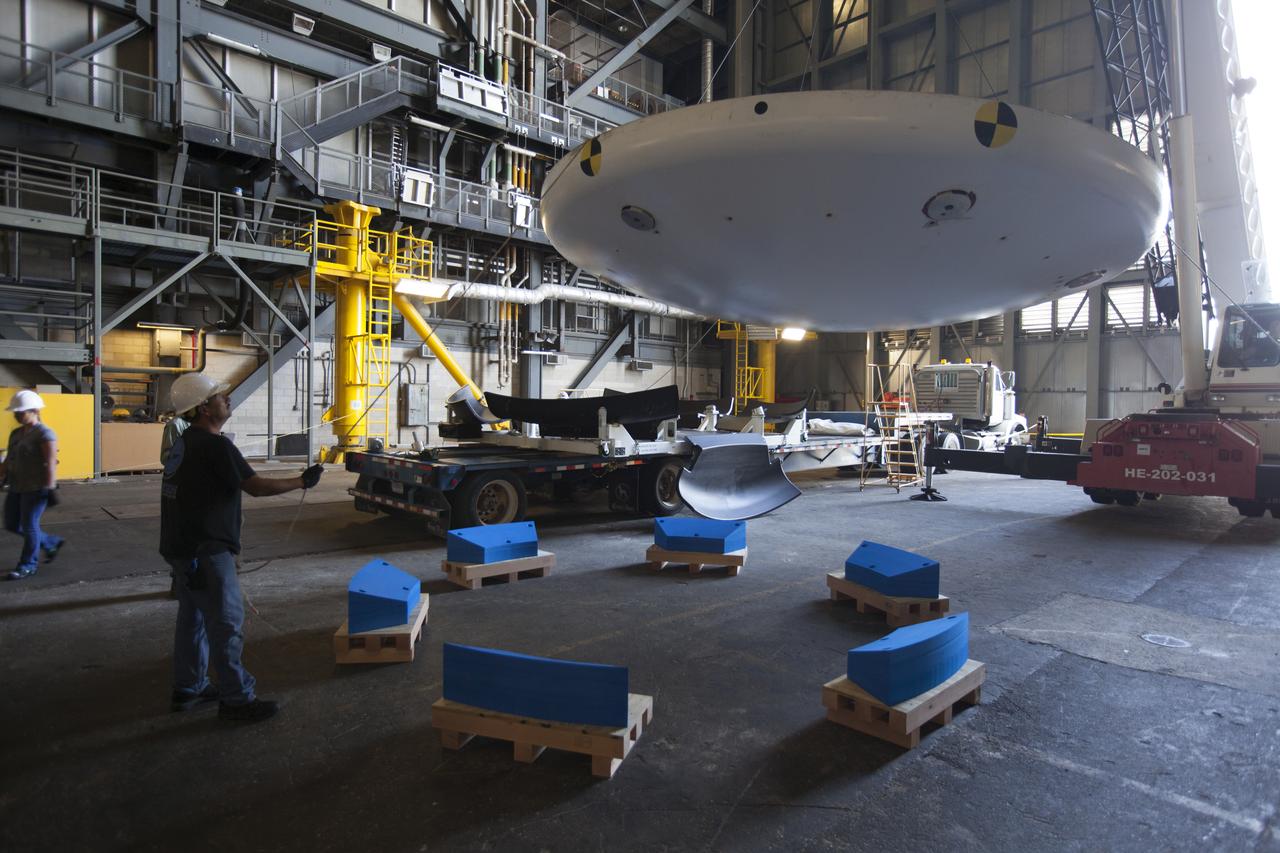
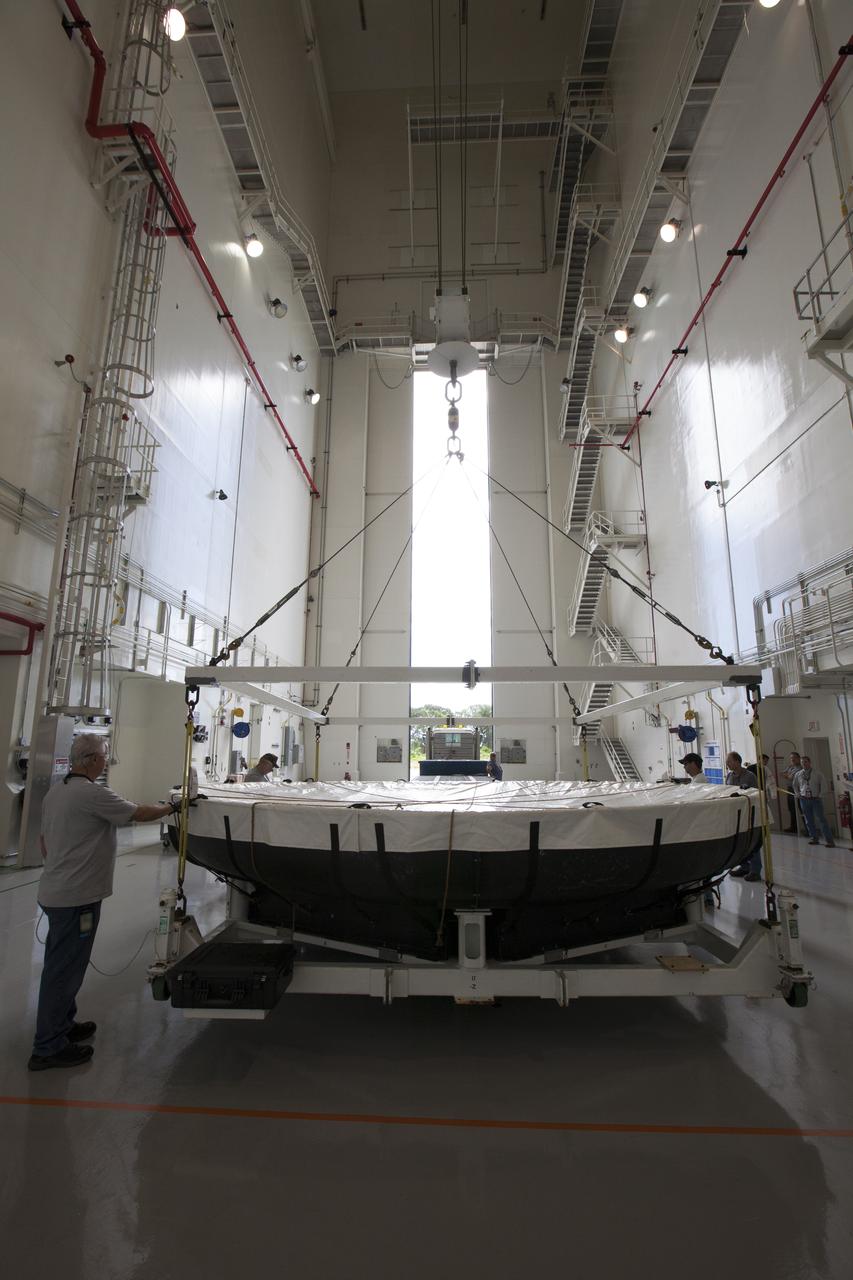
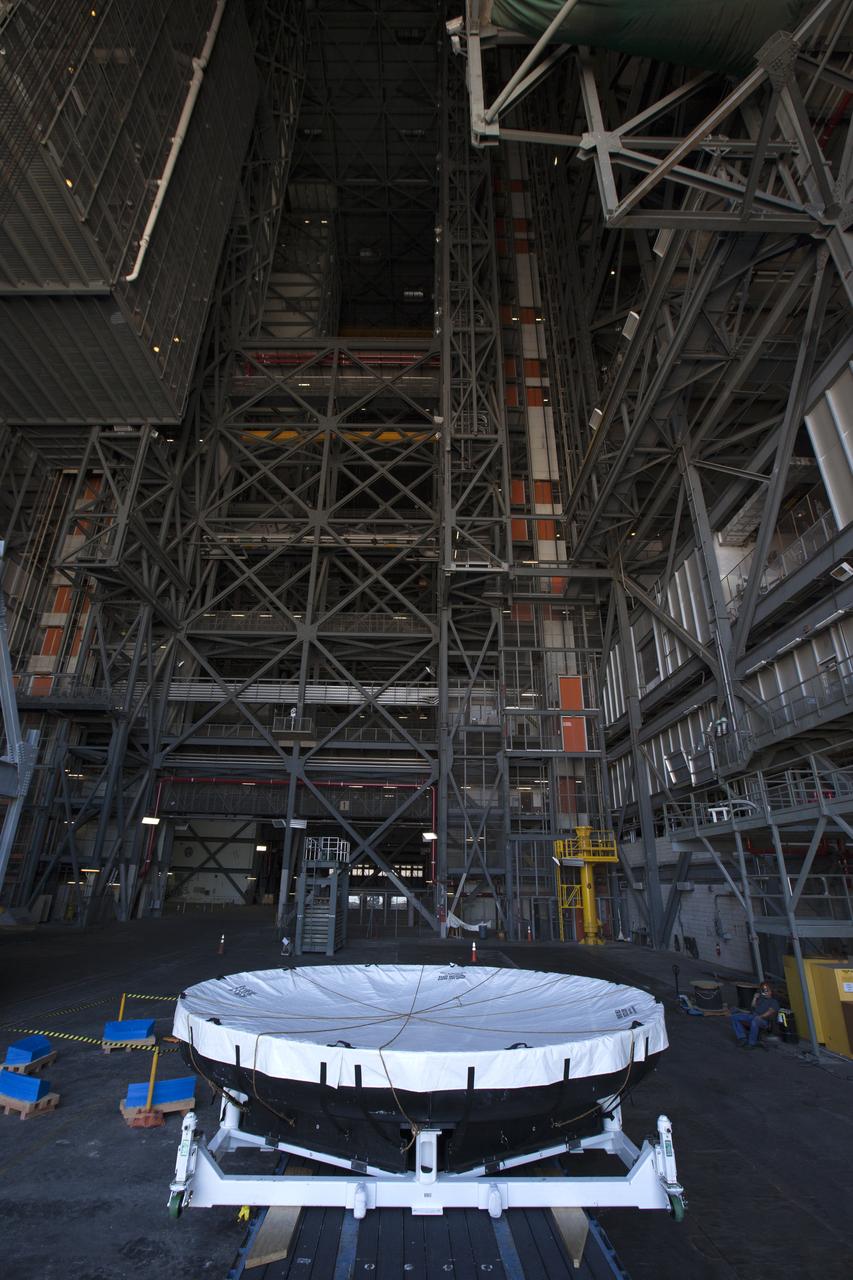
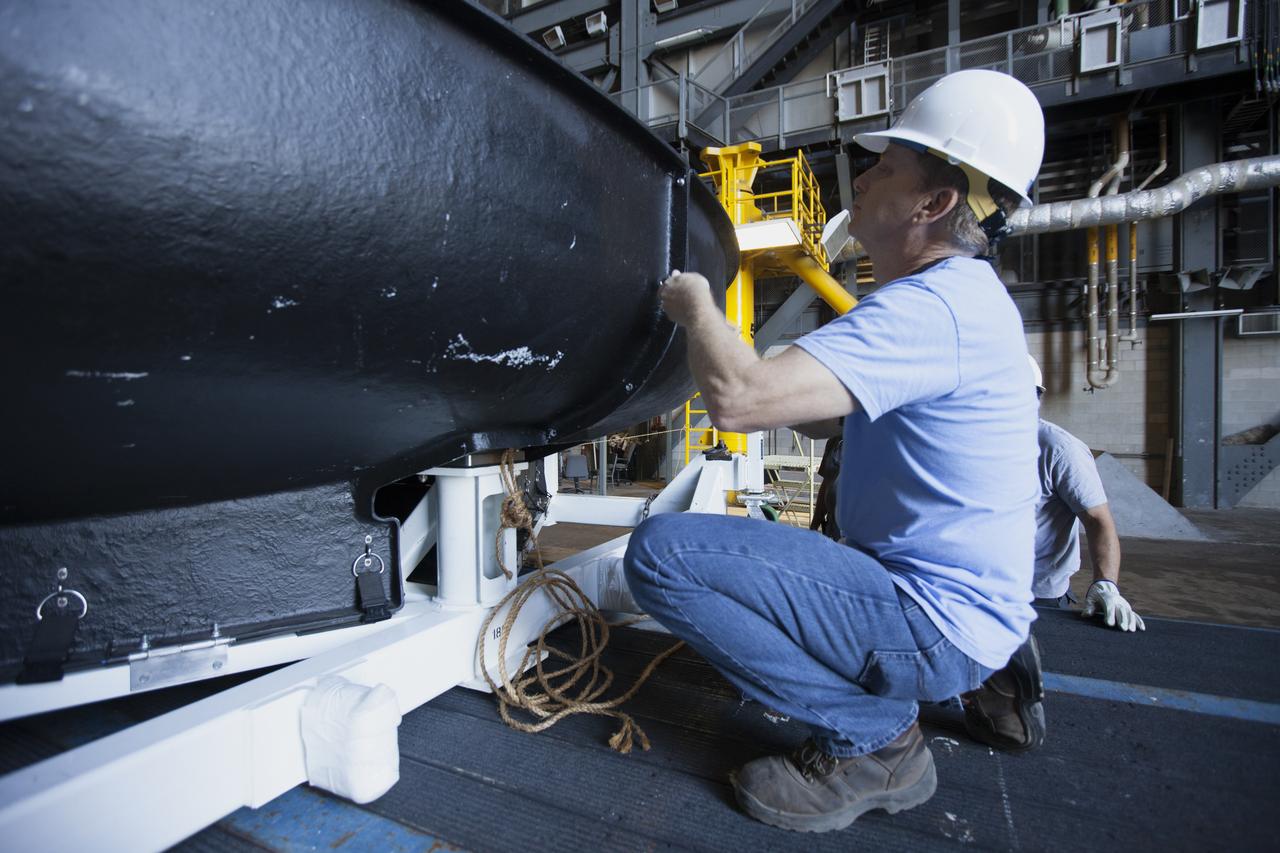
Inside High Bay 2 in the Vehicle Assembly Building (VAB) at NASA's Kennedy Space Center in Florida, workers help prepare the Orion heat shield from Exploration Flight Test-1 for unloading off its transporter. The heat shield is being transferred from the Orion Program to the Ground Systems Development and Operations Program, Landing and Recovery Operations. In the VAB, the heat shield will be integrated with the Orion ground test article and used for future underway recovery testing.
Orion EFT-1 Heat Shield Offload from Truck onto Foam Pads (Dunna
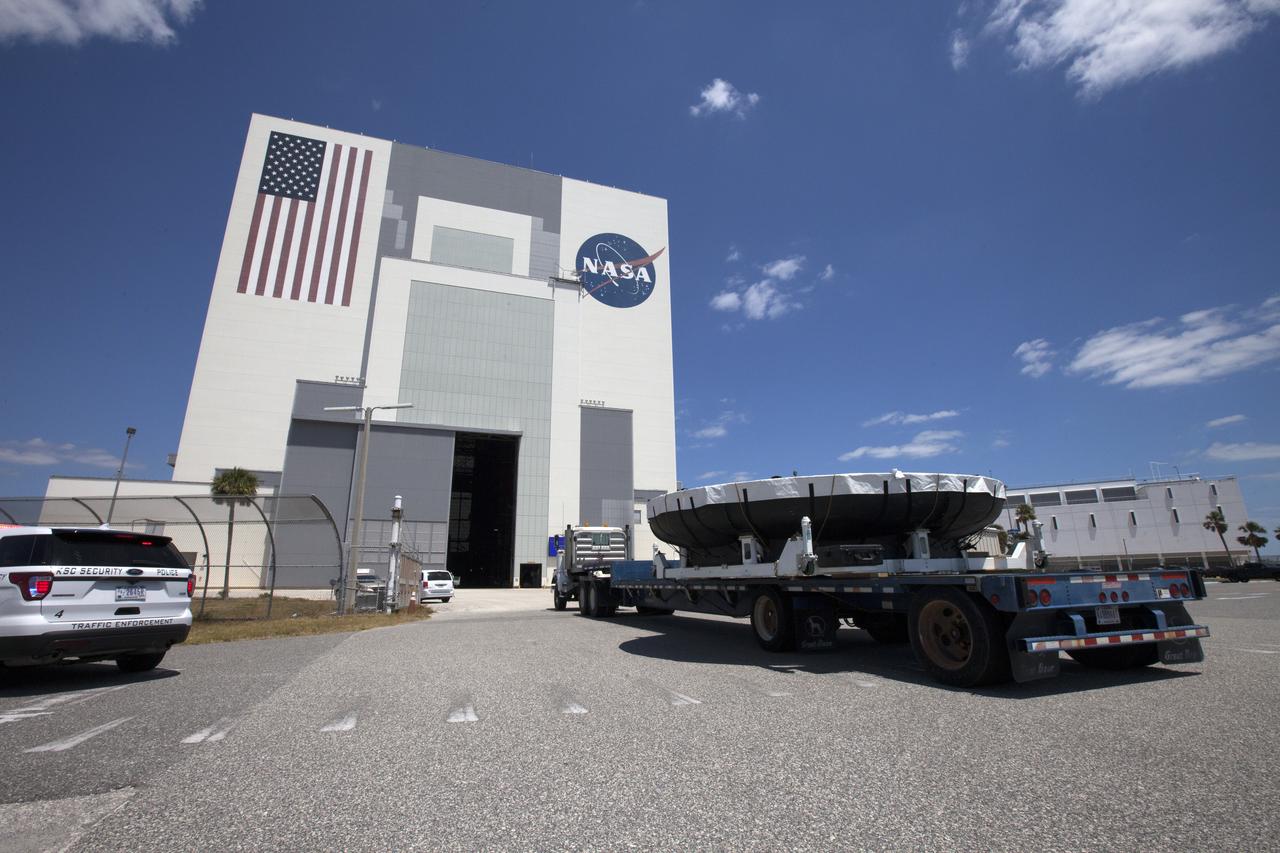
The Orion heat shield from Exploration Flight Test-1, secured on a transporter, departs the Launch Abort System Facility at NASA's Kennedy Space Center in Florida, for its move to the Vehicle Assembly Building (VAB). The heat shield is being transferred from the Orion Program to the Ground Systems Development and Operations Program, Landing and Recovery Operations. In the VAB, the heat shield will be integrated with the Orion ground test article and used for future underway recovery testing.
Orion EFT-1 Heat Shield Move from LASF to VAB Highbay 2
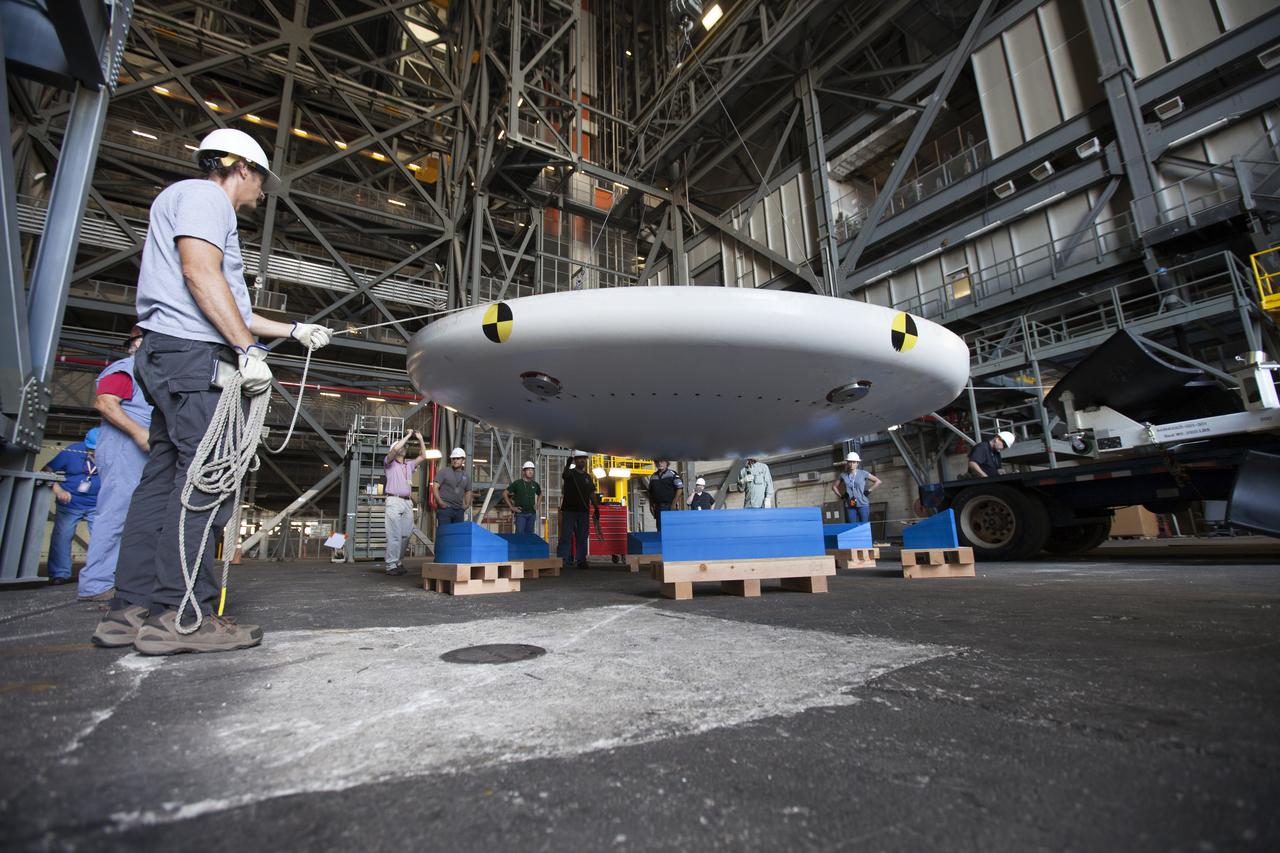
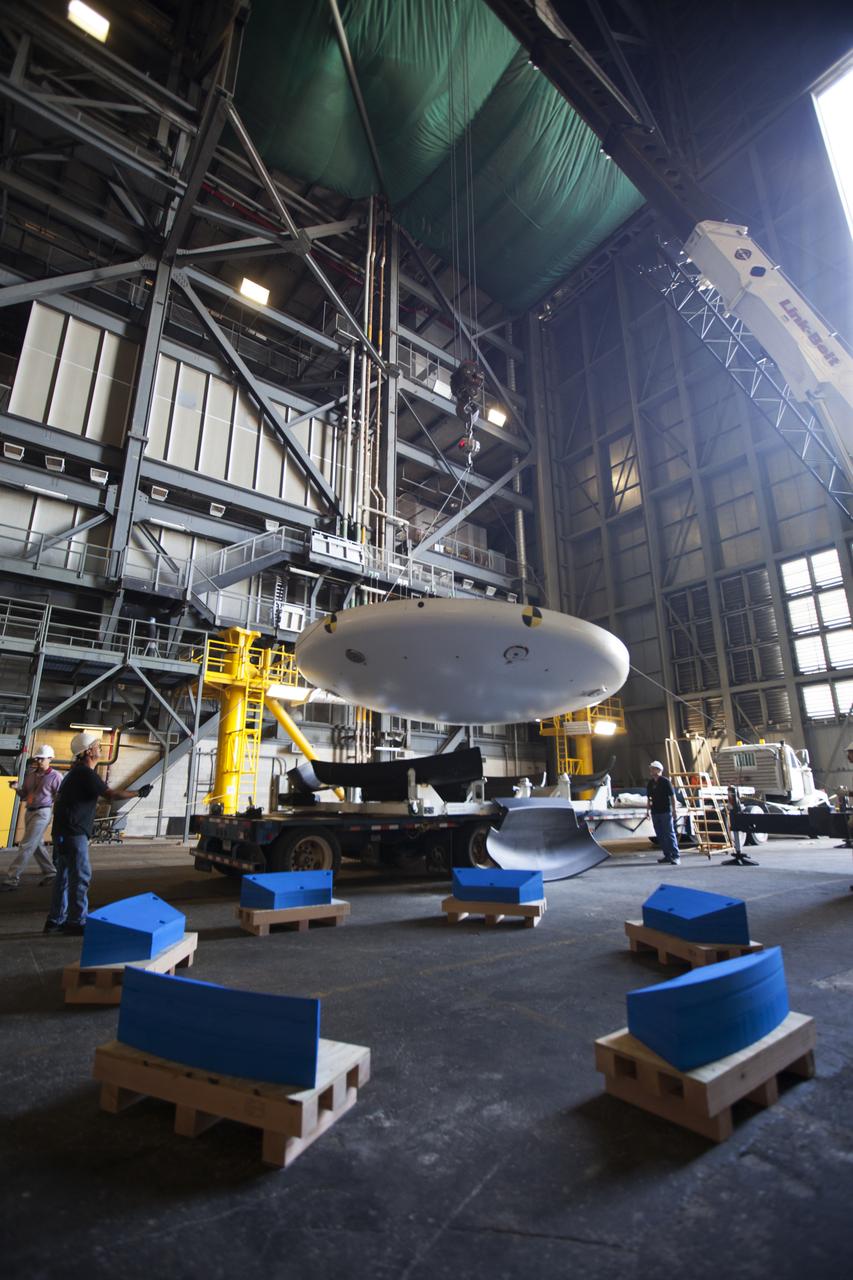
Inside High Bay 2 in the Vehicle Assembly Building (VAB) at NASA's Kennedy Space Center in Florida, a worker monitors the progress as a crane lowers the Orion heat shield from Exploration Flight Test-1 onto foam blocks. The heat shield is being transferred from the Orion Program to the Ground Systems Development and Operations Program, Landing and Recovery Operations. In the VAB, the heat shield will be integrated with the Orion ground test article and used for future underway recovery testing.
Orion EFT-1 Heat Shield Offload from Truck onto Foam Pads (Dunna
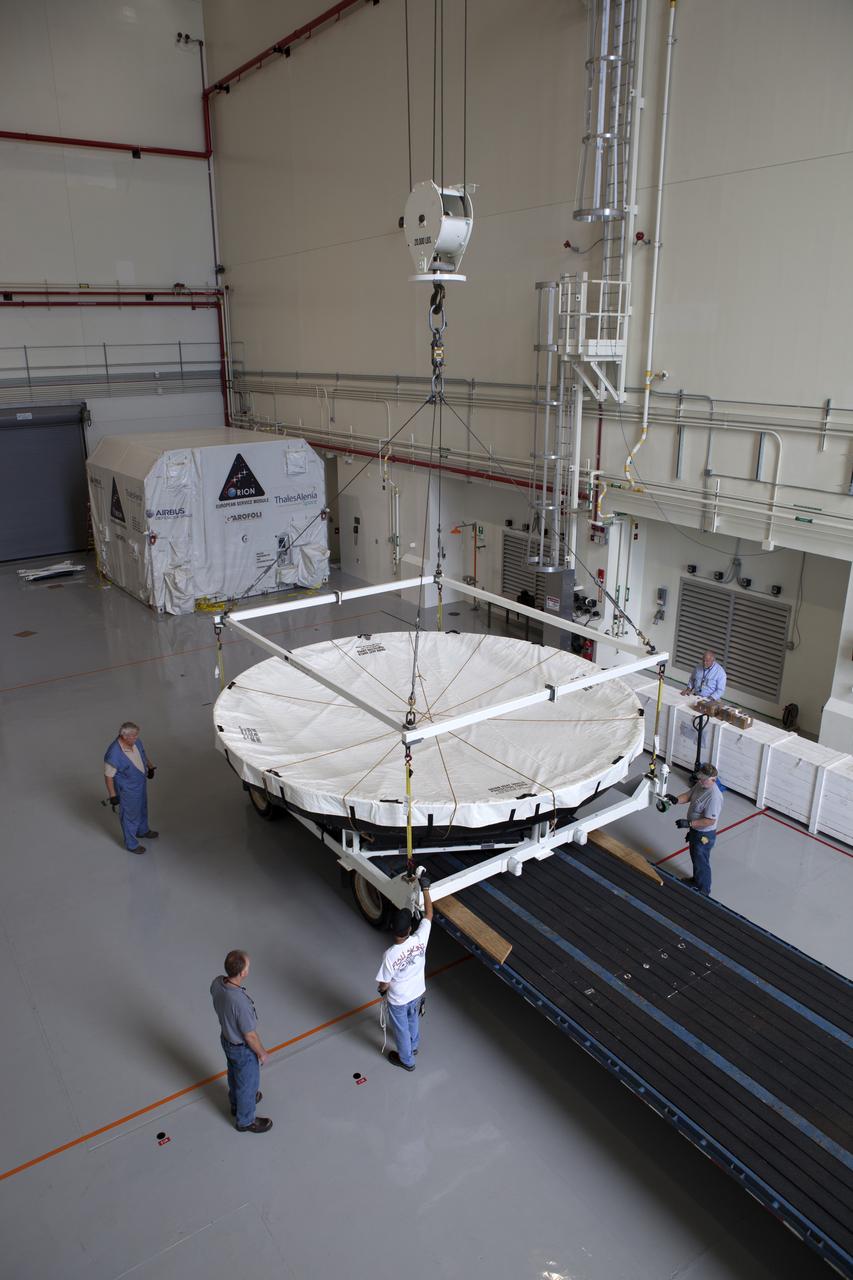
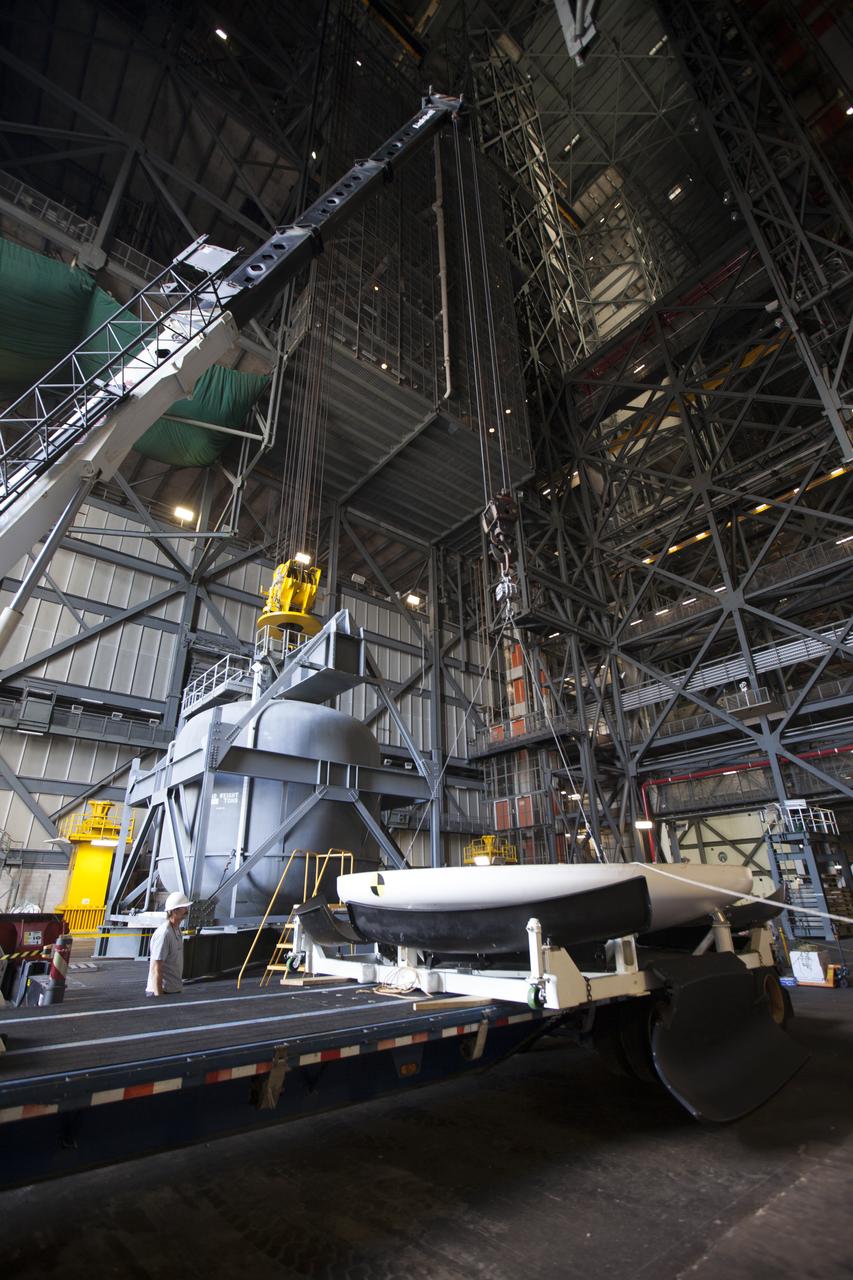
Inside High Bay 2 in the Vehicle Assembly Building (VAB) at NASA's Kennedy Space Center in Florida, a crane is attached to the Orion heat shield from Exploration Flight Test-1 for unloading off its transporter. The heat shield is being transferred from the Orion Program to the Ground Systems Development and Operations Program, Landing and Recovery Operations. In the VAB, the heat shield will be integrated with the Orion ground test article and used for future underway recovery testing.
Orion EFT-1 Heat Shield Offload from Truck onto Foam Pads (Dunna
Inside the Launch Abort System Facility at NASA's Kennedy Space Center in Florida, the Orion heat shield from Exploration Flight Test-1 is being prepared for its move to the Vehicle Assembly Building (VAB). The heat shield is being transferred from the Orion Program to the Ground Systems Development and Operations Program, Landing and Recovery Operations. In the VAB, the heat shield will be integrated with the Orion ground test article and used for future underway recovery testing.
Orion EFT-1 Heat Shield Move from LASF to VAB Highbay 2
Inside High Bay 2 in the Vehicle Assembly Building (VAB) at NASA's Kennedy Space Center in Florida, workers help prepare the Orion heat shield from Exploration Flight Test-1 for unloading off its transporter. The heat shield is being transferred from the Orion Program to the Ground Systems Development and Operations Program, Landing and Recovery Operations. In the VAB, the heat shield will be integrated with the Orion ground test article and used for future underway recovery testing.
Orion EFT-1 Heat Shield Offload from Truck onto Foam Pads (Dunna
Inside the Launch Abort System Facility at NASA's Kennedy Space Center in Florida, the Orion heat shield from Exploration Flight Test-1 is being loaded onto a transporter for its move to the Vehicle Assembly Building (VAB). The heat shield is being transferred from the Orion Program to the Ground Systems Development and Operations Program, Landing and Recovery Operations. In the VAB, the heat shield will be integrated with the Orion ground test article and used for future underway recovery testing.
Orion EFT-1 Heat Shield Move from LASF to VAB Highbay 2
The Orion heat shield from Exploration Flight Test-1, secured on a transporter, arrives at the Vehicle Assembly Building (VAB) at NASA's Kennedy Space Center in Florida. The heat shield was moved from the Launch Abort System Facility. The heat shield is being transferred from the Orion Program to the Ground Systems Development and Operations Program, Landing and Recovery Operations. In the VAB, the heat shield will be integrated with the Orion ground test article and used for future underway recovery testing.
Orion EFT-1 Heat Shield Move from LASF to VAB Highbay 2
A flatbed truck carrying the Orion heat shield from Exploration Flight Test-1, prepares to back into High Bay 2 in the Vehicle Assembly Building (VAB) at NASA's Kennedy Space Center in Florida. The heat shield was moved from the Launch Abort System Facility. The heat shield is being transferred from the Orion Program to the Ground Systems Development and Operations Program, Landing and Recovery Operations. In the VAB, the heat shield will be integrated with the Orion ground test article and used for future underway recovery testing.
Orion EFT-1 Heat Shield Move from LASF to VAB Highbay 2
Inside the Launch Abort System Facility at NASA's Kennedy Space Center in Florida, a crane lowers the Orion heat shield from Exploration Flight Test-1 onto a transporter for its move to the Vehicle Assembly Building (VAB). The heat shield is being transferred from the Orion Program to the Ground Systems Development and Operations Program, Landing and Recovery Operations. In the VAB, the heat shield will be integrated with the Orion ground test article and used for future underway recovery testing.
Orion EFT-1 Heat Shield Move from LASF to VAB Highbay 2
Inside the Launch Abort System Facility at NASA's Kennedy Space Center in Florida, the Orion heat shield from Exploration Flight Test-1 is being loaded onto a transporter for its move to the Vehicle Assembly Building (VAB). The heat shield is being transferred from the Orion Program to the Ground Systems Development and Operations Program, Landing and Recovery Operations. In the VAB, the heat shield will be integrated with the Orion ground test article and used for future underway recovery testing.
Orion EFT-1 Heat Shield Move from LASF to VAB Highbay 2
Inside High Bay 2 in the Vehicle Assembly Building (VAB) at NASA's Kennedy Space Center in Florida, a crane is attached to the Orion heat shield from Exploration Flight Test-1 for unloading off its transporter. The heat shield is being transferred from the Orion Program to the Ground Systems Development and Operations Program, Landing and Recovery Operations. In the VAB, the heat shield will be integrated with the Orion ground test article and used for future underway recovery testing.
Orion EFT-1 Heat Shield Offload from Truck onto Foam Pads (Dunna
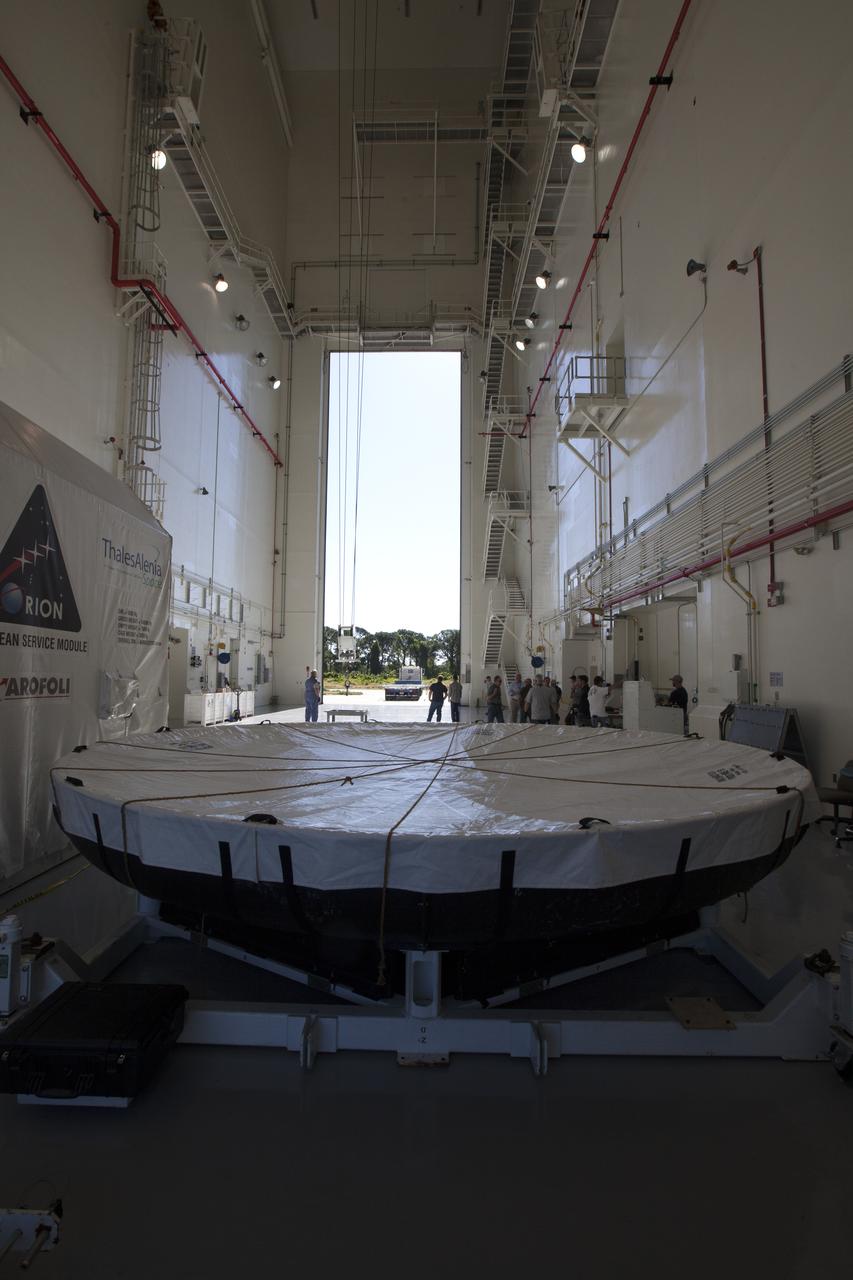
The Orion heat shield from Exploration Flight Test-1 has arrived in High Bay 2 in the Vehicle Assembly Building (VAB) at NASA's Kennedy Space Center in Florida. The heat shield was moved from the Launch Abort System Facility. The heat shield is being transferred from the Orion Program to the Ground Systems Development and Operations Program, Landing and Recovery Operations. In the VAB, the heat shield will be integrated with the Orion ground test article and used for future underway recovery testing.
Orion EFT-1 Heat Shield Move from LASF to VAB Highbay 2
Inside High Bay 2 in the Vehicle Assembly Building (VAB) at NASA's Kennedy Space Center in Florida, a crane lifts the Orion heat shield from Exploration Flight Test-1 up off its transporter. It will be lowered onto foam blocks. The heat shield is being transferred from the Orion Program to the Ground Systems Development and Operations Program, Landing and Recovery Operations. In the VAB, the heat shield will be integrated with the Orion ground test article and used for future underway recovery testing.
Orion EFT-1 Heat Shield Offload from Truck onto Foam Pads (Dunna
The Orion heat shield from Exploration Flight Test-1 has arrived in High Bay 2 of the Vehicle Assembly Building (VAB) at NASA's Kennedy Space Center in Florida. The heat shield is being transferred from the Orion Program to the Ground Systems Development and Operations Program, Landing and Recovery Operations. In the VAB, the heat shield will be integrated with the Orion ground test article and used for future underway recovery testing.
Orion EFT-1 Heat Shield Offload from Truck onto Foam Pads (Dunna
Inside High Bay 2 in the Vehicle Assembly Building (VAB) at NASA's Kennedy Space Center in Florida, workers monitor the progress as a crane lowers the Orion heat shield from Exploration Flight Test-1 onto foam blocks. The heat shield is being transferred from the Orion Program to the Ground Systems Development and Operations Program, Landing and Recovery Operations. In the VAB, the heat shield will be integrated with the Orion ground test article and used for future underway recovery testing.
Orion EFT-1 Heat Shield Offload from Truck onto Foam Pads (Dunna
Inside High Bay 2 in the Vehicle Assembly Building (VAB) at NASA's Kennedy Space Center in Florida, a worker helps prepare the Orion heat shield from Exploration Flight Test-1 for unloading off its transporter. The heat shield is being transferred from the Orion Program to the Ground Systems Development and Operations Program, Landing and Recovery Operations. In the VAB, the heat shield will be integrated with the Orion ground test article and used for future underway recovery testing.
Orion EFT-1 Heat Shield Offload from Truck onto Foam Pads (Dunna
A flatbed truck carrying the Orion heat shield from Exploration Flight Test-1, backs into High Bay 2 in the Vehicle Assembly Building (VAB) at NASA's Kennedy Space Center in Florida. The heat shield was moved from the Launch Abort System Facility. The heat shield is being transferred from the Orion Program to the Ground Systems Development and Operations Program, Landing and Recovery Operations. In the VAB, the heat shield will be integrated with the Orion ground test article and used for future underway recovery testing.
Orion EFT-1 Heat Shield Move from LASF to VAB Highbay 2
Inside the Launch Abort System Facility at NASA's Kennedy Space Center in Florida, the Orion heat shield from Exploration Flight Test-1 is secured on a transporter and ready for its move to the Vehicle Assembly Building (VAB). The heat shield is being transferred from the Orion Program to the Ground Systems Development and Operations Program, Landing and Recovery Operations. In the VAB, the heat shield will be integrated with the Orion ground test article and used for future underway recovery testing.
Orion EFT-1 Heat Shield Move from LASF to VAB Highbay 2
Inside High Bay 2 in the Vehicle Assembly Building (VAB) at NASA's Kennedy Space Center in Florida, the Orion heat shield from Exploration Flight Test-1 is secured on foam blocks. The heat shield is being transferred from the Orion Program to the Ground Systems Development and Operations Program, Landing and Recovery Operations. In the VAB, the heat shield will be integrated with the Orion ground test article and used for future underway recovery testing.
Orion EFT-1 Heat Shield Offload from Truck onto Foam Pads (Dunna
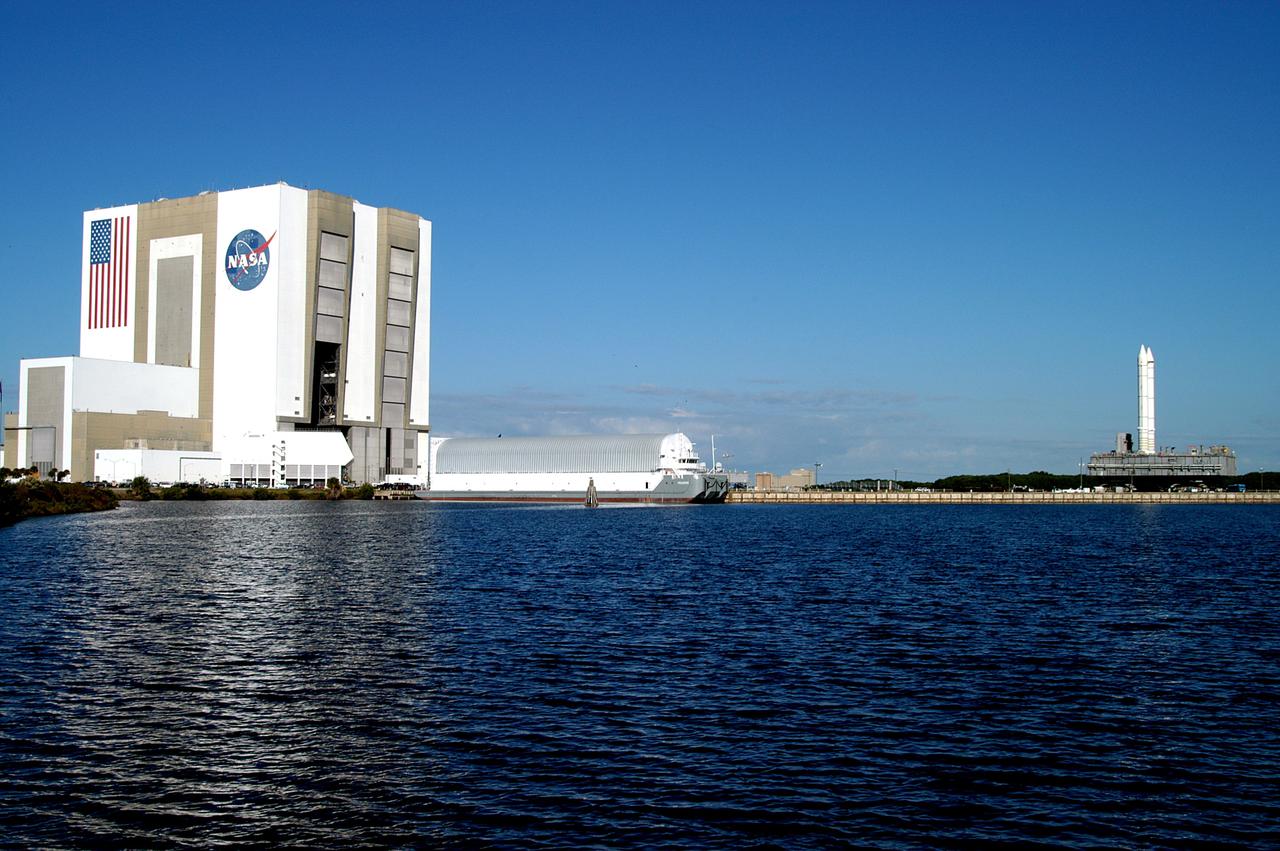
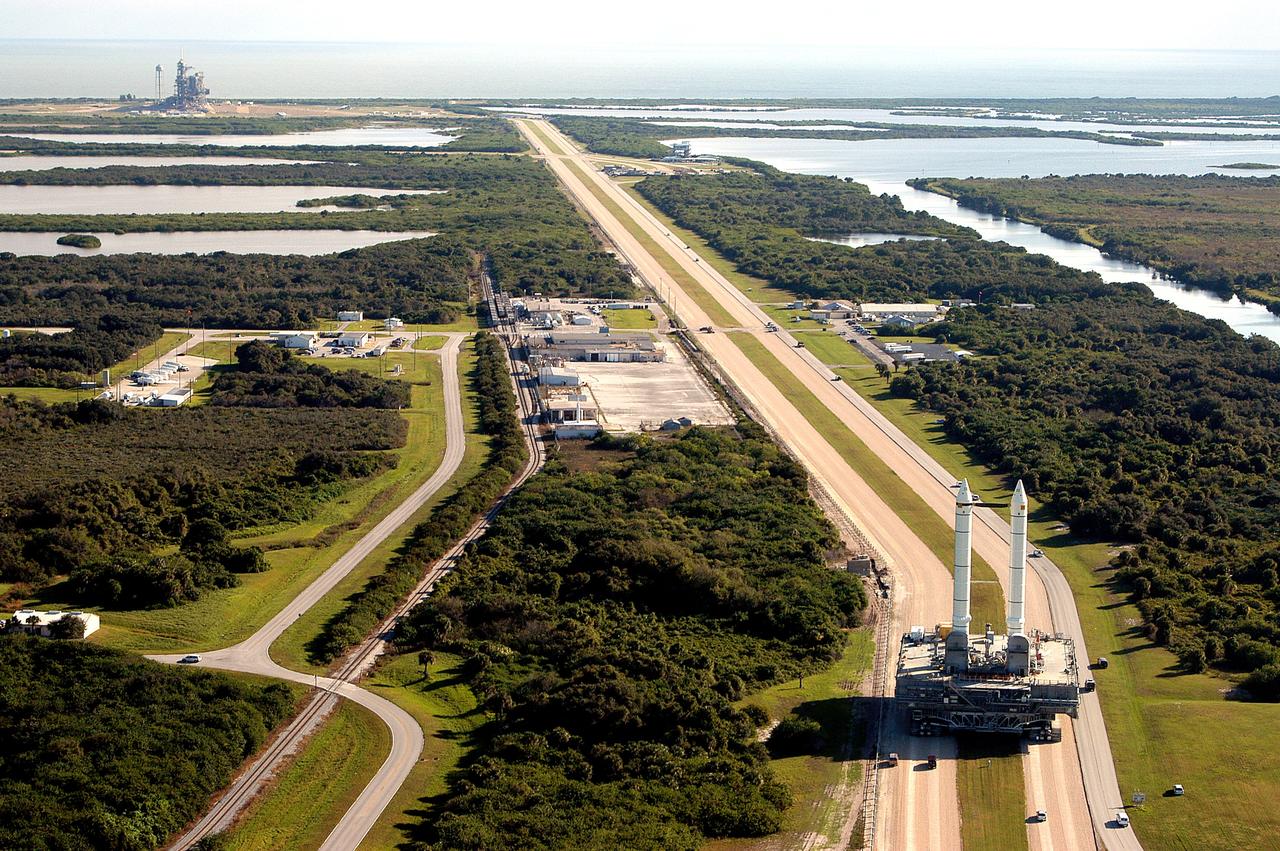
KENNEDY SPACE CENTER, FLA. -  The crawler transporter slowly moves the Mobile Launcher Platform (MLP), carrying a set of twin solid rocket boosters, away from the Vehicle Assembly Building (VAB) in support of engineering analysis vibration tests on the crawler and MLP.   In the distance, at left, is Launch Pad 39A.  The water on the right of the crawlerway is the Banana River.  The crawler is moving at various speeds up to 1 mph in an effort to achieve vibration data gathering goals as it leaves the VAB and then returns.  The boosters are braced at the top for stability.  The primary purpose of these rollout tests is to gather data to develop future maintenance requirements on the transport equipment and the flight hardware. Various parts of the MLP and crawler transporter have been instrumented with vibration data collection equipment.
KENNEDY SPACE CENTER, FLA. - The crawler transporter slowly moves the Mobile Launcher Platform (MLP), carrying a set of twin solid rocket boosters, away from the Vehicle Assembly Building (VAB) in support of engineering analysis vibration tests on the crawler and MLP. In the distance, at left, is Launch Pad 39A. The water on the right of the crawlerway is the Banana River. The crawler is moving at various speeds up to 1 mph in an effort to achieve vibration data gathering goals as it leaves the VAB and then returns. The boosters are braced at the top for stability. The primary purpose of these rollout tests is to gather data to develop future maintenance requirements on the transport equipment and the flight hardware. Various parts of the MLP and crawler transporter have been instrumented with vibration data collection equipment.
KENNEDY SPACE CENTER, FLA. -  The crawler transporter slowly moves the Mobile Launcher Platform (MLP), carrying a set of twin solid rocket boosters, away from the Vehicle Assembly Building (VAB) in support of engineering analysis vibration tests on the crawler and MLP.  On either side of the boosters on the horizon can be seen the two launch pads. The crawler is moving at various speeds up to 1 mph in an effort to achieve vibration data gathering goals as it leaves the VAB and then returns.  The boosters are braced at the top for stability.  The primary purpose of these rollout tests is to gather data to develop future maintenance requirements on the transport equipment and the flight hardware. Various parts of the MLP and crawler transporter have been instrumented with vibration data collection equipment.
KENNEDY SPACE CENTER, FLA. - The crawler transporter slowly moves the Mobile Launcher Platform (MLP), carrying a set of twin solid rocket boosters, away from the Vehicle Assembly Building (VAB) in support of engineering analysis vibration tests on the crawler and MLP. On either side of the boosters on the horizon can be seen the two launch pads. The crawler is moving at various speeds up to 1 mph in an effort to achieve vibration data gathering goals as it leaves the VAB and then returns. The boosters are braced at the top for stability. The primary purpose of these rollout tests is to gather data to develop future maintenance requirements on the transport equipment and the flight hardware. Various parts of the MLP and crawler transporter have been instrumented with vibration data collection equipment.
KENNEDY SPACE CENTER, FLA. - Viewed across the turn basin in the Launch Complex 39 Area, the crawler transporter slowly moves the Mobile Launcher Platform (MLP), carrying a set of twin solid rocket boosters, away from the Vehicle Assembly Building (VAB).  The journey is in support of engineering analysis vibration tests on the crawler and MLP.  The water on the right of the crawlerway is the Banana River.  The crawler is moving at various speeds up to 1 mph in an effort to achieve vibration data gathering goals as it leaves the VAB and then returns.  The boosters are braced at the top for stability.  The primary purpose of these rollout tests is to gather data to develop future maintenance requirements on the transport equipment and the flight hardware. Various parts of the MLP and crawler transporter have been instrumented with vibration data collection equipment.
KENNEDY SPACE CENTER, FLA. - Viewed across the turn basin in the Launch Complex 39 Area, the crawler transporter slowly moves the Mobile Launcher Platform (MLP), carrying a set of twin solid rocket boosters, away from the Vehicle Assembly Building (VAB). The journey is in support of engineering analysis vibration tests on the crawler and MLP. The water on the right of the crawlerway is the Banana River. The crawler is moving at various speeds up to 1 mph in an effort to achieve vibration data gathering goals as it leaves the VAB and then returns. The boosters are braced at the top for stability. The primary purpose of these rollout tests is to gather data to develop future maintenance requirements on the transport equipment and the flight hardware. Various parts of the MLP and crawler transporter have been instrumented with vibration data collection equipment.
KENNEDY SPACE CENTER, FLA. -  Mobile Launcher Platform (MLP) number 3 and a set of twin solid rocket boosters, atop the crawler-transporter, crawl out of the Vehicle Assembly Building (VAB) in support of the second engineering analysis vibration test on the crawler and MLP. In the background is another MLP.  The crawler is moving at various speeds up to 1 mph in an effort to achieve vibration data gathering goals as it leaves the VAB, travels toward Launch Pad 39A and then returns.  The boosters are braced at the top for stability.  The primary purpose of these rollout tests is to gather data to develop future maintenance requirements on the transport equipment and the flight hardware. Various parts of the MLP and crawler transporter have been instrumented with vibration data collection equipment.
KENNEDY SPACE CENTER, FLA. - Mobile Launcher Platform (MLP) number 3 and a set of twin solid rocket boosters, atop the crawler-transporter, crawl out of the Vehicle Assembly Building (VAB) in support of the second engineering analysis vibration test on the crawler and MLP. In the background is another MLP. The crawler is moving at various speeds up to 1 mph in an effort to achieve vibration data gathering goals as it leaves the VAB, travels toward Launch Pad 39A and then returns. The boosters are braced at the top for stability. The primary purpose of these rollout tests is to gather data to develop future maintenance requirements on the transport equipment and the flight hardware. Various parts of the MLP and crawler transporter have been instrumented with vibration data collection equipment.
KENNEDY SPACE CENTER, FLA. -  Mobile Launcher Platform (MLP) number 3 and a set of twin solid rocket boosters, atop the crawler-transporter, inch away from the Vehicle Assembly Building (VAB) in support of the second engineering analysis vibration test on the crawler and MLP. The crawler is moving at various speeds up to 1 mph in an effort to achieve vibration data gathering goals as it leaves the VAB, travels toward Launch Pad 39A and then returns.  The boosters are braced at the top for stability.  The primary purpose of these rollout tests is to gather data to develop future maintenance requirements on the transport equipment and the flight hardware. Various parts of the MLP and crawler transporter have been instrumented with vibration data collection equipment.
KENNEDY SPACE CENTER, FLA. - Mobile Launcher Platform (MLP) number 3 and a set of twin solid rocket boosters, atop the crawler-transporter, inch away from the Vehicle Assembly Building (VAB) in support of the second engineering analysis vibration test on the crawler and MLP. The crawler is moving at various speeds up to 1 mph in an effort to achieve vibration data gathering goals as it leaves the VAB, travels toward Launch Pad 39A and then returns. The boosters are braced at the top for stability. The primary purpose of these rollout tests is to gather data to develop future maintenance requirements on the transport equipment and the flight hardware. Various parts of the MLP and crawler transporter have been instrumented with vibration data collection equipment.
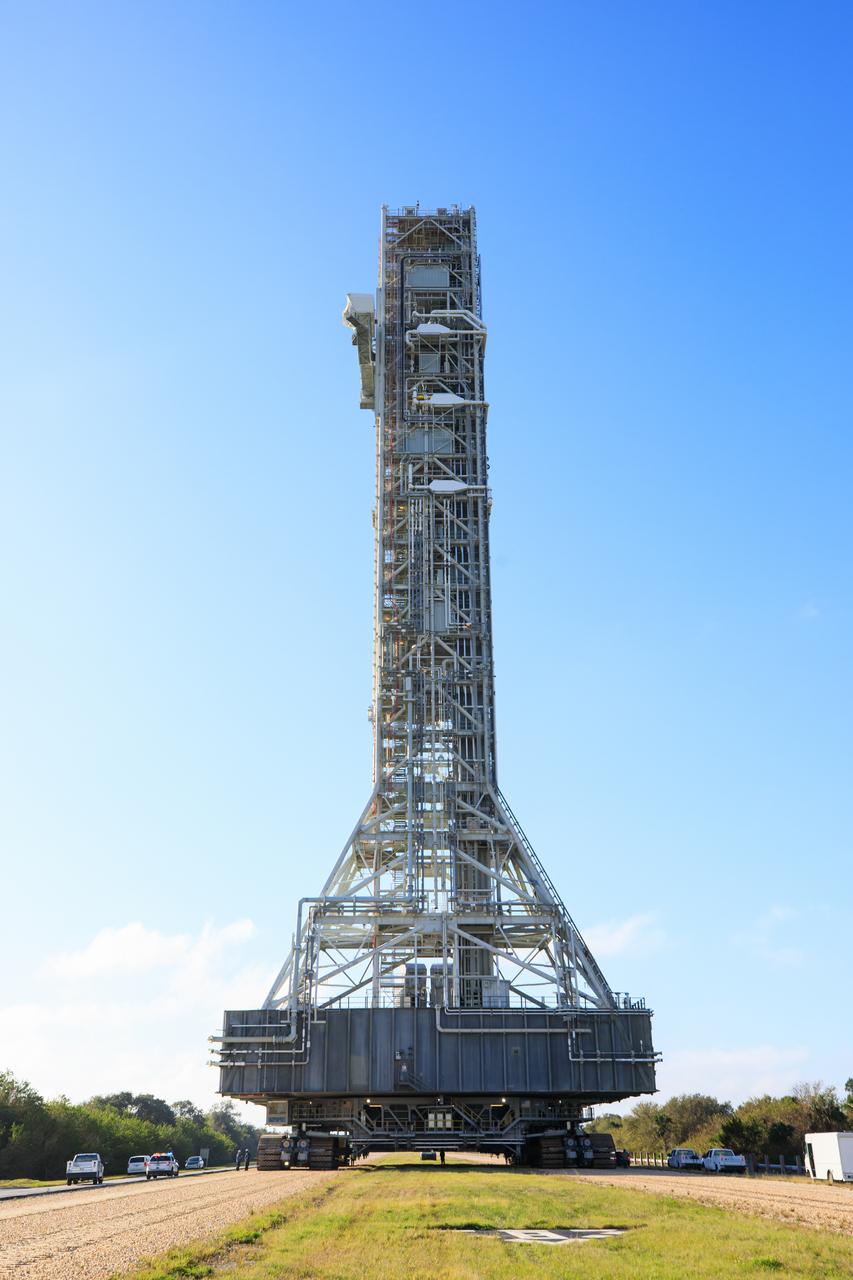
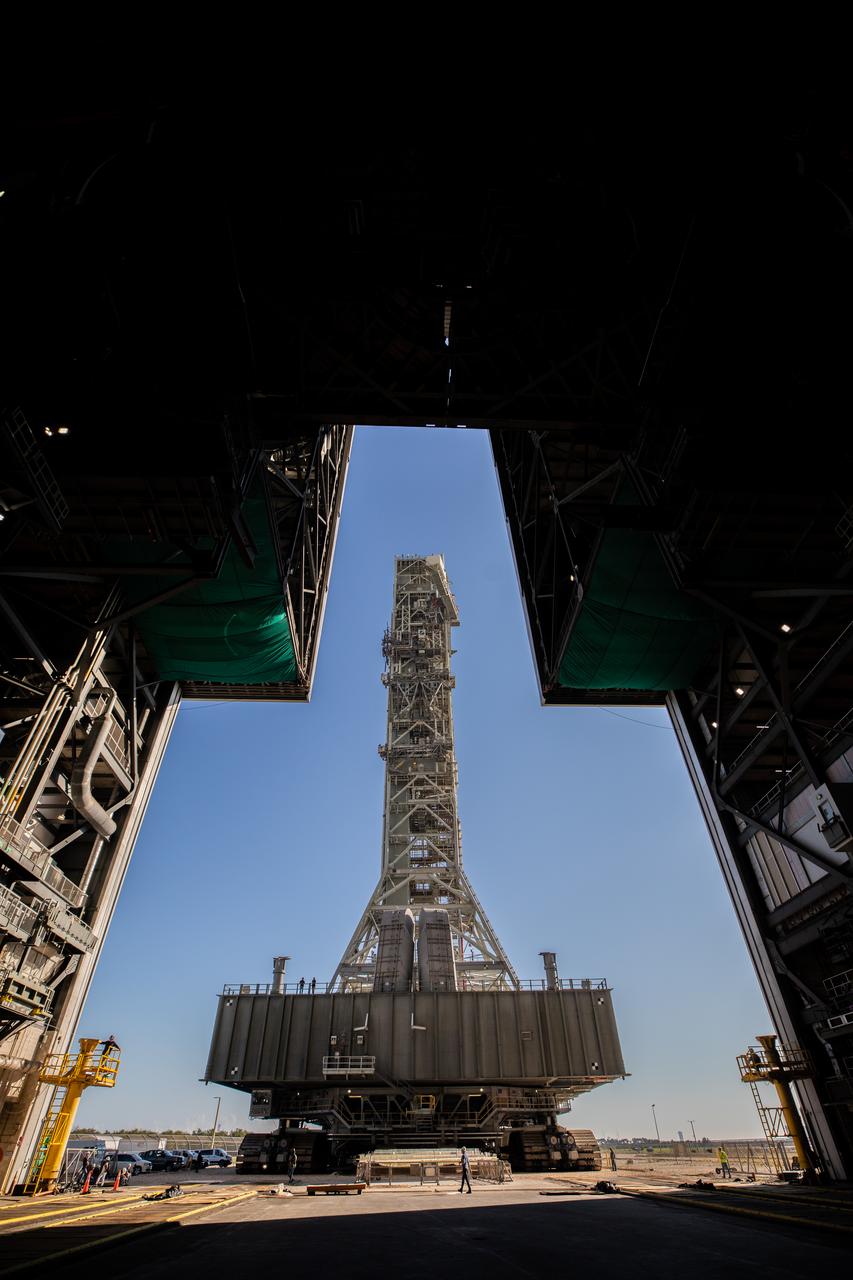
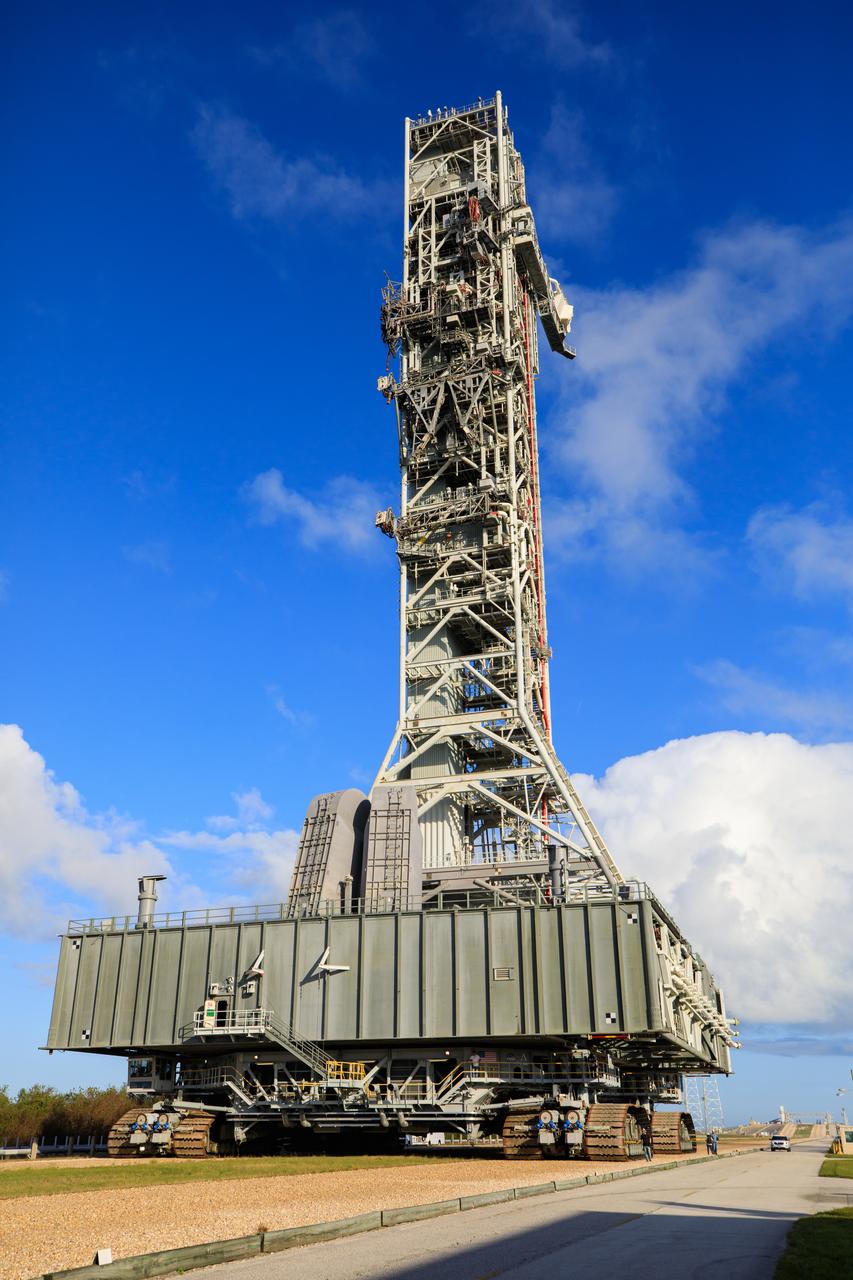
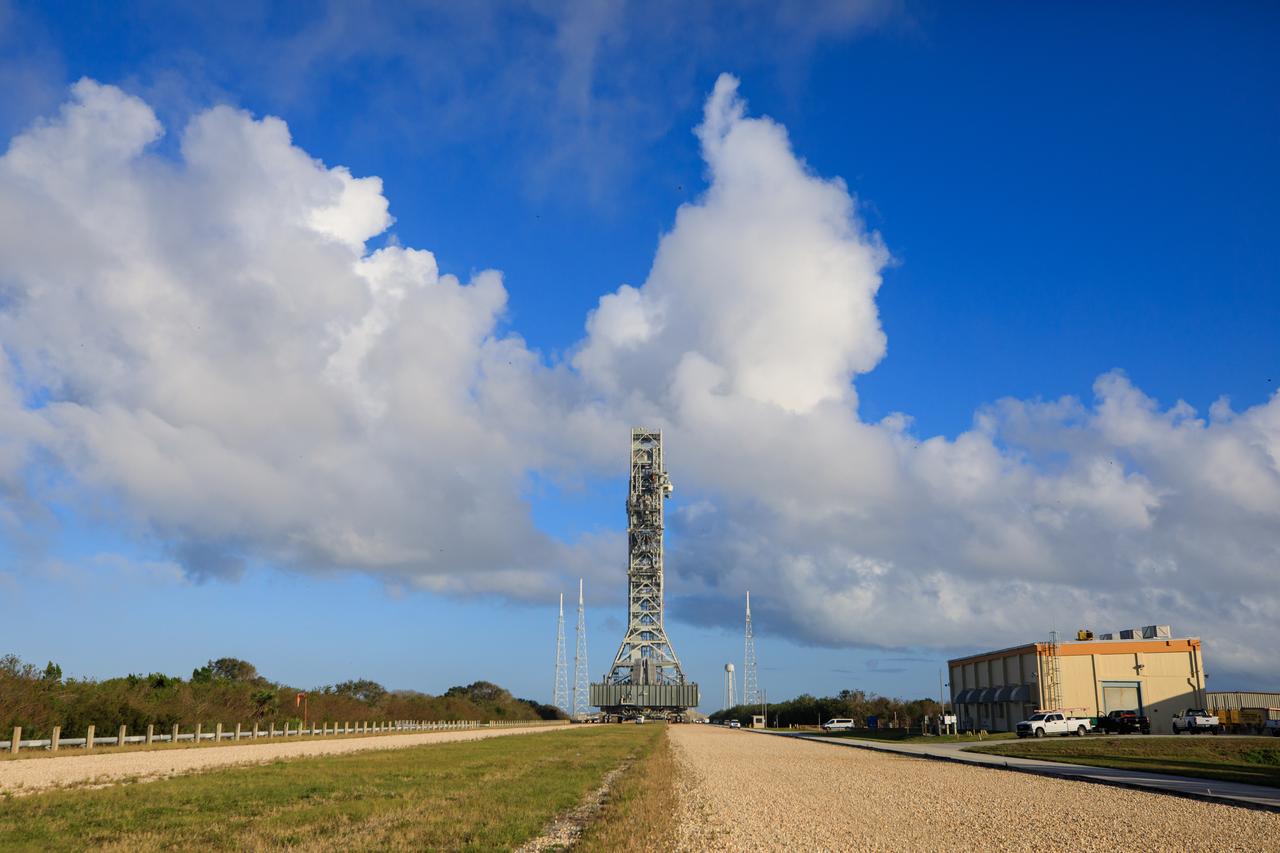
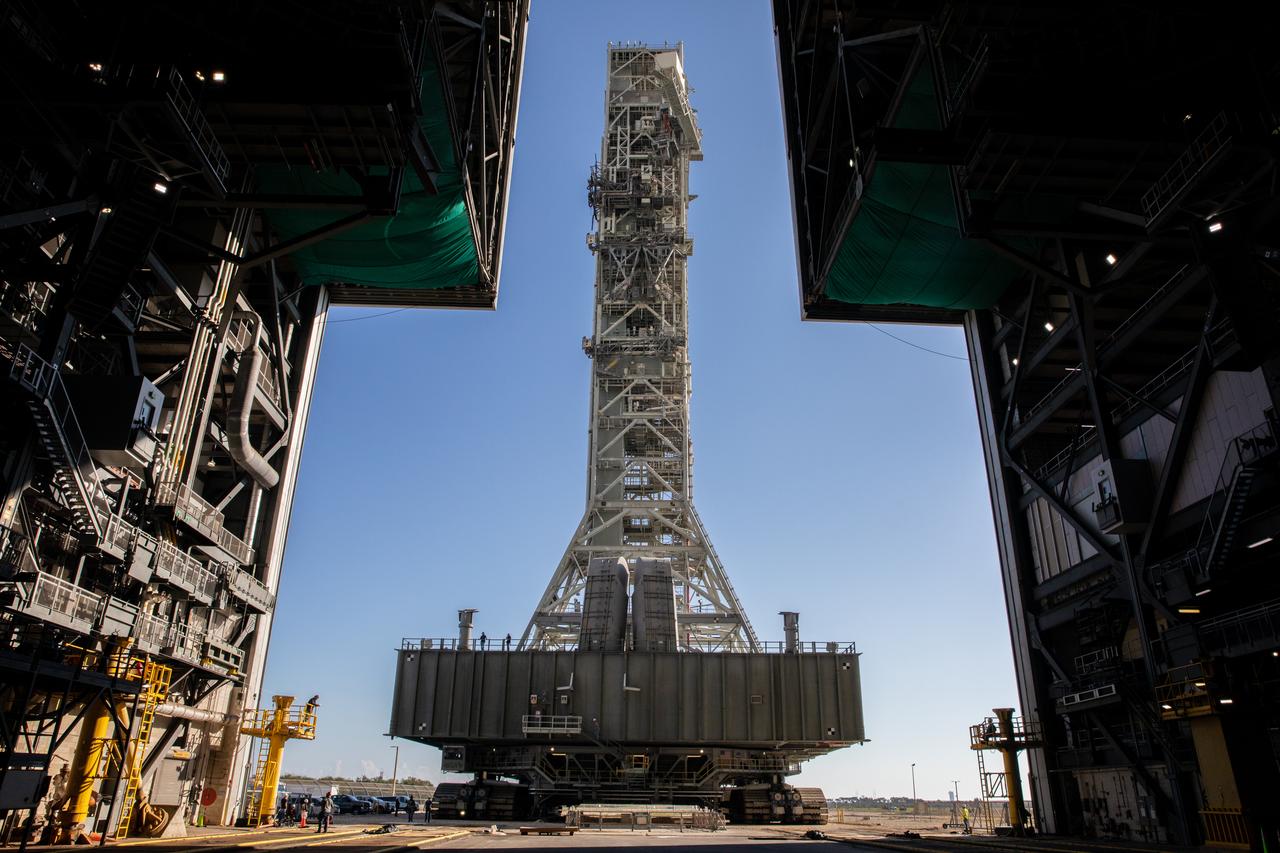
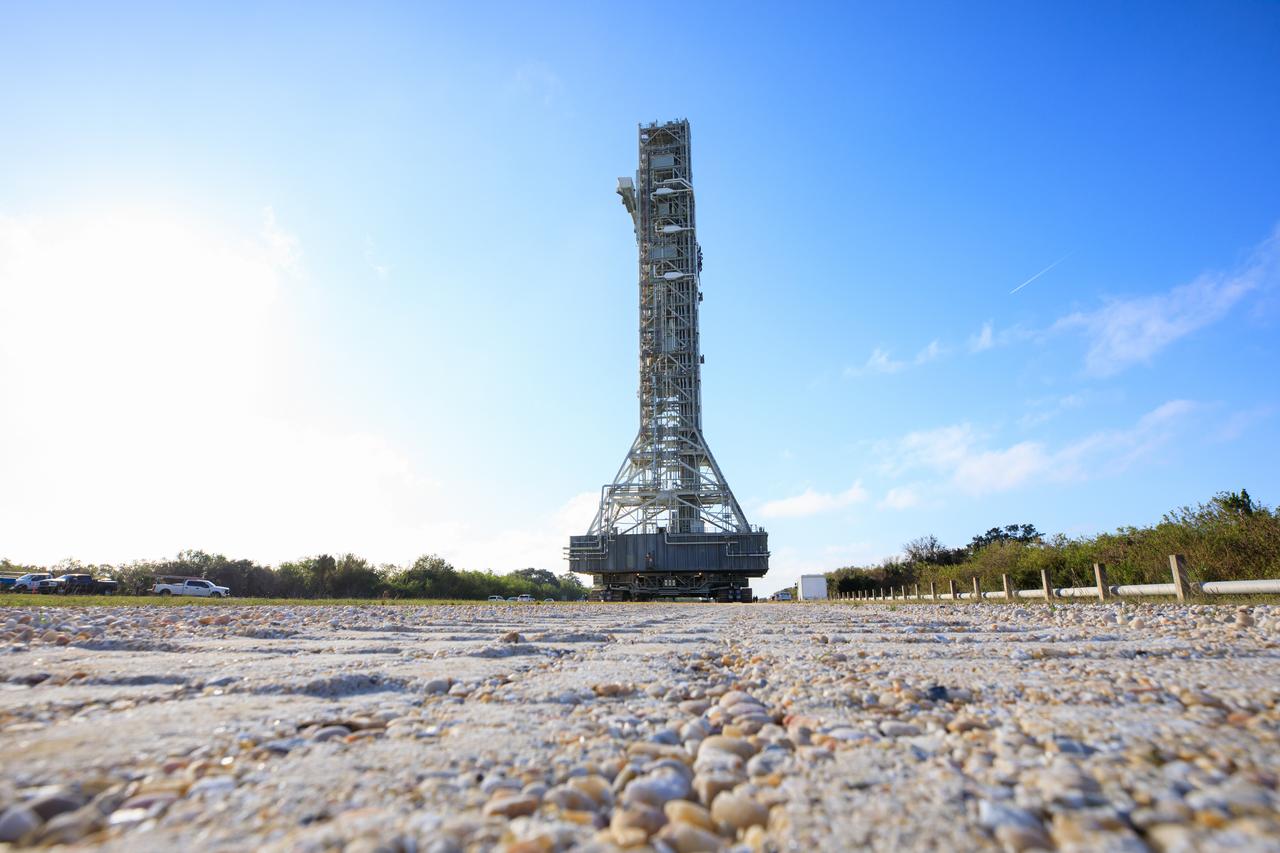
NASA’s mobile launcher, carried atop the crawler-transporter 2, left launch pad 39B at NASA’s Kennedy Space Center in Florida on Dec. 8, 2022, following the successful launch of the agency’s Space Launch System (SLS) rocket and Orion spacecraft on the Artemis I flight test on Nov. 16, 2022. The mobile launcher is scheduled to return to the Vehicle Assembly Building (VAB) on Dec. 9, 2022, and it will remain inside the VAB for several weeks as teams get it ready for the Artemis II crewed mission. Following its stay in the VAB, it will go to the mobile launcher park site location at Kennedy where it will undergo emergency egress modifications and testing to support future Artemis missions.
Mobile Launcher Rollback to VAB
NASA’s mobile launcher, carried atop the crawler-transporter 2, left launch pad 39B at NASA’s Kennedy Space Center in Florida on Dec. 8, 2022, following the successful launch of the agency’s Space Launch System (SLS) rocket and Orion spacecraft on the Artemis I flight test on Nov. 16, 2022. The mobile launcher is scheduled to return to the Vehicle Assembly Building (VAB) on Dec. 9, 2022, and it will remain inside the VAB for several weeks as teams get it ready for the Artemis II crewed mission. Following its stay in the VAB, it will go to the mobile launcher park site location at Kennedy where it will undergo emergency egress modifications and testing to support future Artemis missions.
Mobile Launcher Rollback to VAB
A view from inside the Vehicle Assembly Building (VAB) at NASA’s Kennedy Space Center in Florida on Dec. 9, 2022, as the mobile launcher, carried atop the crawler-transporter 2, arrives at the entrance to the transfer aisle, following the successful launch of the agency’s Space Launch System (SLS) rocket and Orion spacecraft on the Artemis I flight test on Nov. 16, 2022. The mobile launcher will stay inside the VAB and remain there for several weeks as teams get it ready for the Artemis II crewed mission. Following its stay in the VAB, it will go to the mobile launcher park site location at Kennedy where it will undergo emergency egress modifications and testing to support future Artemis missions.
Artemis I Post-Launch Mobile Launcher Rollback
A view from inside the Vehicle Assembly Building (VAB) at NASA’s Kennedy Space Center in Florida on Dec. 9, 2022, as the mobile launcher, carried atop the crawler-transporter 2, arrives at the entrance to the transfer aisle, following the successful launch of the agency’s Space Launch System (SLS) rocket and Orion spacecraft on the Artemis I flight test on Nov. 16, 2022. The mobile launcher will stay inside the VAB and remain there for several weeks as teams get it ready for the Artemis II crewed mission. Following its stay in the VAB, it will go to the mobile launcher park site location at Kennedy where it will undergo emergency egress modifications and testing to support future Artemis missions.
Artemis I Post-Launch Mobile Launcher Rollback
NASA’s mobile launcher, carried atop the crawler-transporter 2, left launch pad 39B at NASA’s Kennedy Space Center in Florida on Dec. 8, 2022, following the successful launch of the agency’s Space Launch System (SLS) rocket and Orion spacecraft on the Artemis I flight test on Nov. 16, 2022. The mobile launcher is scheduled to return to the Vehicle Assembly Building (VAB) on Dec. 9, 2022, and it will remain inside the VAB for several weeks as teams get it ready for the Artemis II crewed mission. Following its stay in the VAB, it will go to the mobile launcher park site location at Kennedy where it will undergo emergency egress modifications and testing to support future Artemis missions.
Mobile Launcher Rollback to VAB
NASA’s mobile launcher, carried atop the crawler-transporter 2, left launch pad 39B at NASA’s Kennedy Space Center in Florida on Dec. 8, 2022, following the successful launch of the agency’s Space Launch System (SLS) rocket and Orion spacecraft on the Artemis I flight test on Nov. 16, 2022. The mobile launcher is scheduled to return to the Vehicle Assembly Building (VAB) on Dec. 9, 2022, and it will remain inside the VAB for several weeks as teams get it ready for the Artemis II crewed mission. Following its stay in the VAB, it will go to the mobile launcher park site location at Kennedy where it will undergo emergency egress modifications and testing to support future Artemis missions.
Mobile Launcher Rollback to VAB
NASA’s mobile launcher, carried atop the crawler-transporter 2, left launch pad 39B at NASA’s Kennedy Space Center in Florida on Dec. 8, 2022, following the successful launch of the agency’s Space Launch System (SLS) rocket and Orion spacecraft on the Artemis I flight test on Nov. 16, 2022. The mobile launcher is scheduled to return to the Vehicle Assembly Building (VAB) on Dec. 9, 2022, and it will remain inside the VAB for several weeks as teams get it ready for the Artemis II crewed mission. Following its stay in the VAB, it will go to the mobile launcher park site location at Kennedy where it will undergo emergency egress modifications and testing to support future Artemis missions.
Mobile Launcher Rollback to VAB
NASA’s mobile launcher, carried atop the crawler-transporter 2, moves inside the Vehicle Assembly Building (VAB) at NASA’s Kennedy Space Center in Florida on Dec. 9, 2022, following the successful launch of the agency’s Space Launch System (SLS) rocket and Orion spacecraft on the Artemis I flight test on Nov. 16, 2022. The mobile launcher will remain inside the VAB for several weeks as teams get it ready for the Artemis II crewed mission. Following its stay in the VAB, it will go to the mobile launcher park site location at Kennedy where it will undergo emergency egress modifications and testing to support future Artemis missions.
Artemis I Post-Launch Mobile Launcher Rollback
NASA’s mobile launcher, carried atop the crawler-transporter 2, left launch pad 39B at NASA’s Kennedy Space Center in Florida on Dec. 8, 2022, following the successful launch of the agency’s Space Launch System (SLS) rocket and Orion spacecraft on the Artemis I flight test on Nov. 16, 2022. The mobile launcher is scheduled to return to the Vehicle Assembly Building (VAB) on Dec. 9, 2022, and it will remain inside the VAB for several weeks as teams get it ready for the Artemis II crewed mission. Following its stay in the VAB, it will go to the mobile launcher park site location at Kennedy where it will undergo emergency egress modifications and testing to support future Artemis missions.
Mobile Launcher Rollback to VAB
NASA’s mobile launcher, carried atop the crawler-transporter 2, left launch pad 39B at NASA’s Kennedy Space Center in Florida on Dec. 8, 2022, following the successful launch of the agency’s Space Launch System (SLS) rocket and Orion spacecraft on the Artemis I flight test on Nov. 16, 2022. The mobile launcher is scheduled to return to the Vehicle Assembly Building (VAB) on Dec. 9, 2022, and it will remain inside the VAB for several weeks as teams get it ready for the Artemis II crewed mission. Following its stay in the VAB, it will go to the mobile launcher park site location at Kennedy where it will undergo emergency egress modifications and testing to support future Artemis missions.
Mobile Launcher Rollback to VAB
NASA’s mobile launcher, carried atop the crawler-transporter 2, left launch pad 39B at NASA’s Kennedy Space Center in Florida on Dec. 8, 2022, following the successful launch of the agency’s Space Launch System (SLS) rocket and Orion spacecraft on the Artemis I flight test on Nov. 16, 2022. The mobile launcher is scheduled to return to the Vehicle Assembly Building (VAB) on Dec. 9, 2022, and it will remain inside the VAB for several weeks as teams get it ready for the Artemis II crewed mission. Following its stay in the VAB, it will go to the mobile launcher park site location at Kennedy where it will undergo emergency egress modifications and testing to support future Artemis missions.
Mobile Launcher Rollback to VAB
NASA’s mobile launcher, carried atop the crawler-transporter 2, is moved inside High Bay 3 of the Vehicle Assembly Building (VAB) at NASA’s Kennedy Space Center in Florida on Dec. 9, 2022, following the successful launch of the agency’s Space Launch System (SLS) rocket and Orion spacecraft on the Artemis I flight test on Nov. 16, 2022. The mobile launcher will remain inside the VAB for several weeks as teams get it ready for the Artemis II crewed mission. Following its stay in the VAB, it will go to the mobile launcher park site location at Kennedy where it will undergo emergency egress modifications and testing to support future Artemis missions.
Artemis I Post-Launch Mobile Launcher Rollback
NASA’s mobile launcher, carried atop the crawler-transporter 2, left launch pad 39B at NASA’s Kennedy Space Center in Florida on Dec. 8, 2022, following the successful launch of the agency’s Space Launch System (SLS) rocket and Orion spacecraft on the Artemis I flight test on Nov. 16, 2022. The mobile launcher is scheduled to return to the Vehicle Assembly Building (VAB) on Dec. 9, 2022, and it will remain inside the VAB for several weeks as teams get it ready for the Artemis II crewed mission. Following its stay in the VAB, it will go to the mobile launcher park site location at Kennedy where it will undergo emergency egress modifications and testing to support future Artemis missions.
Mobile Launcher Rollback to VAB
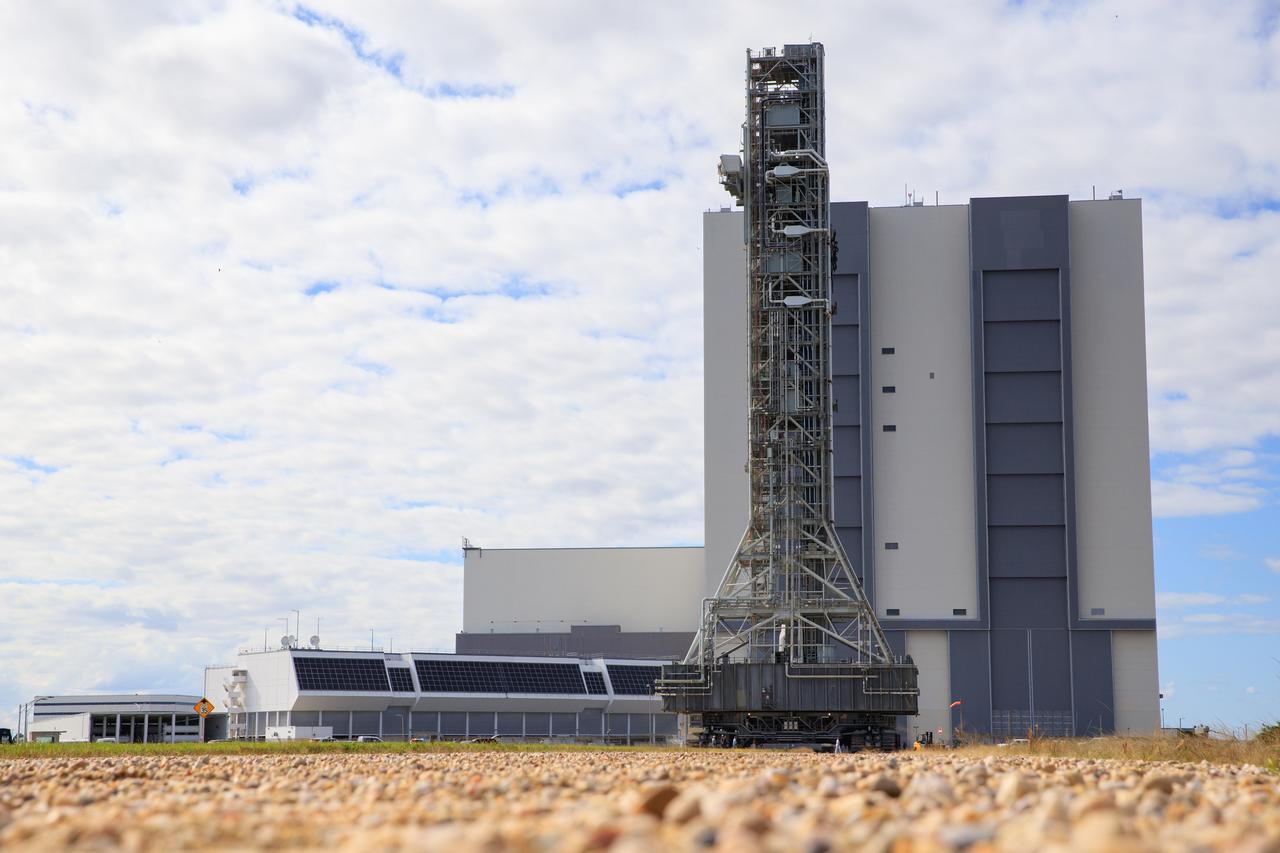
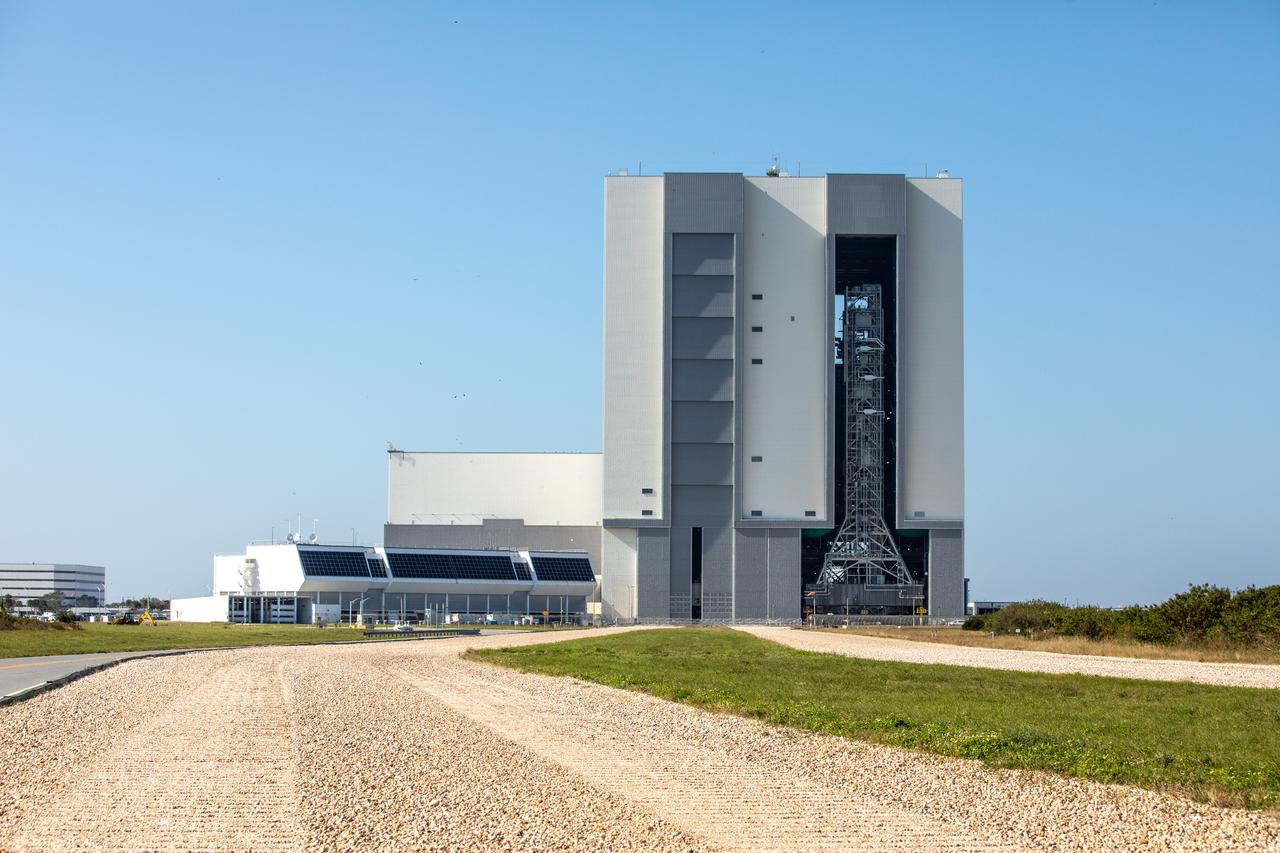
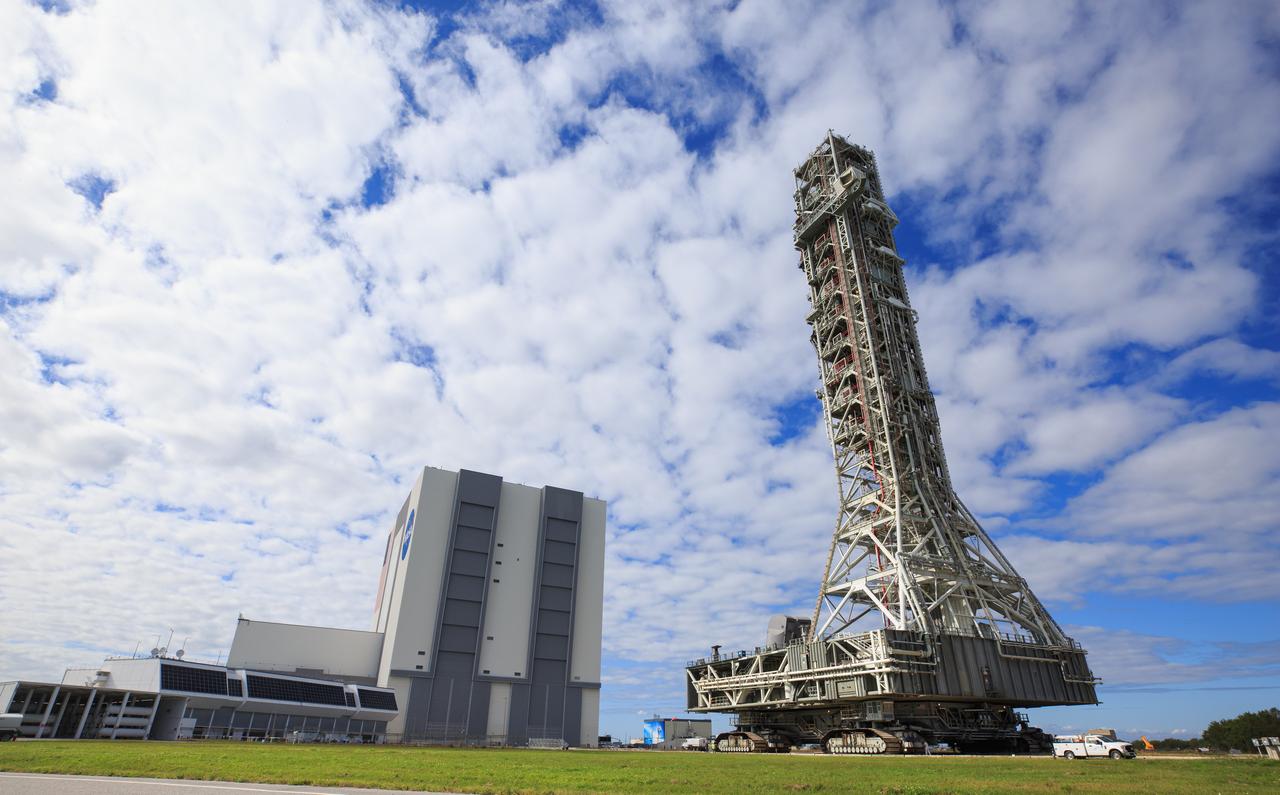
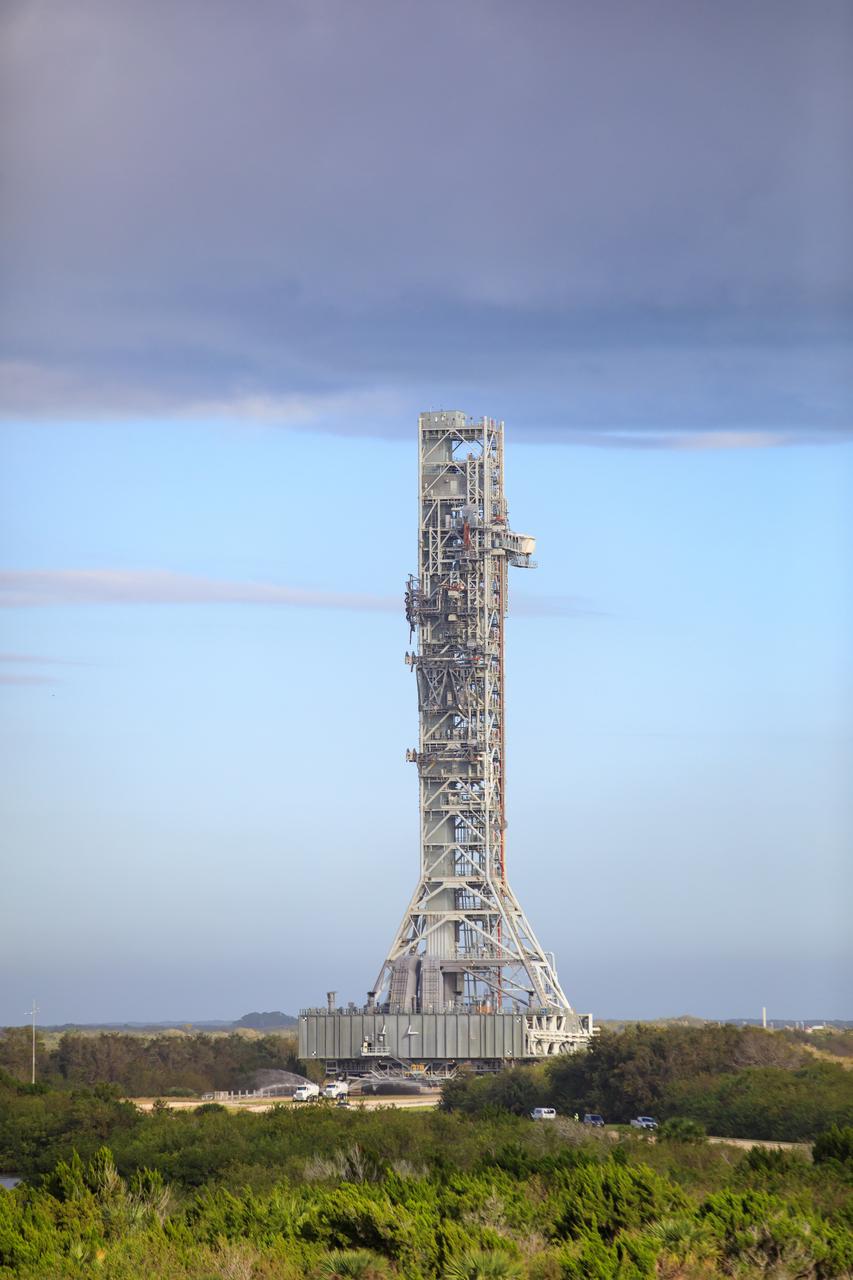
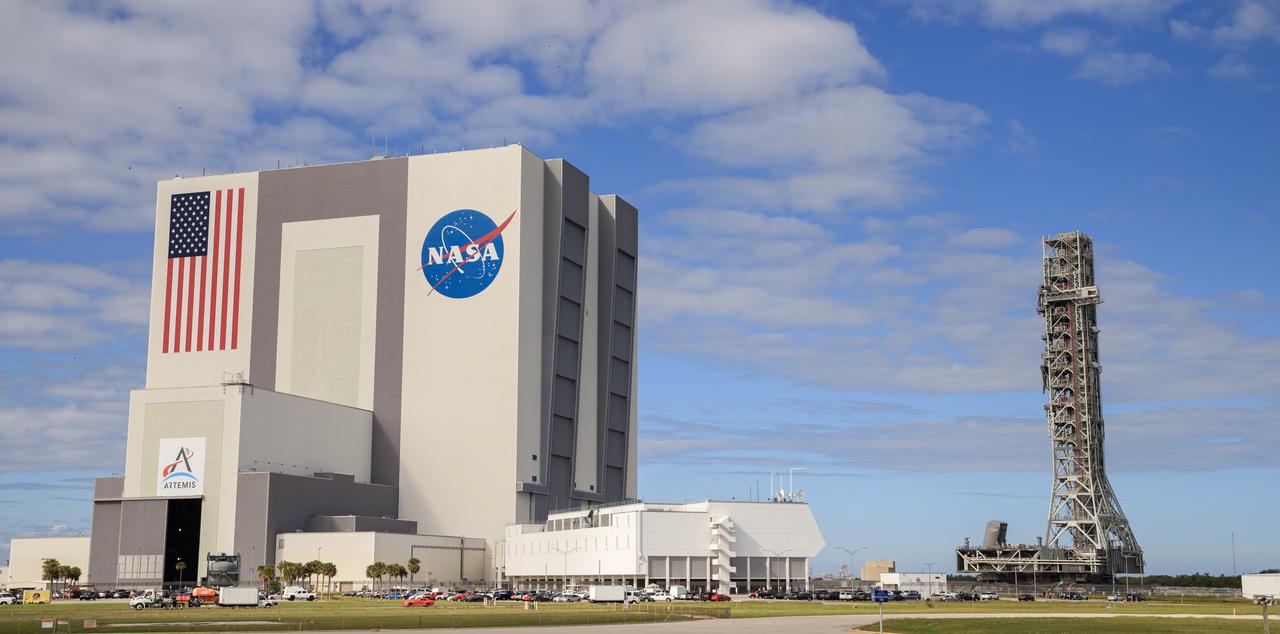
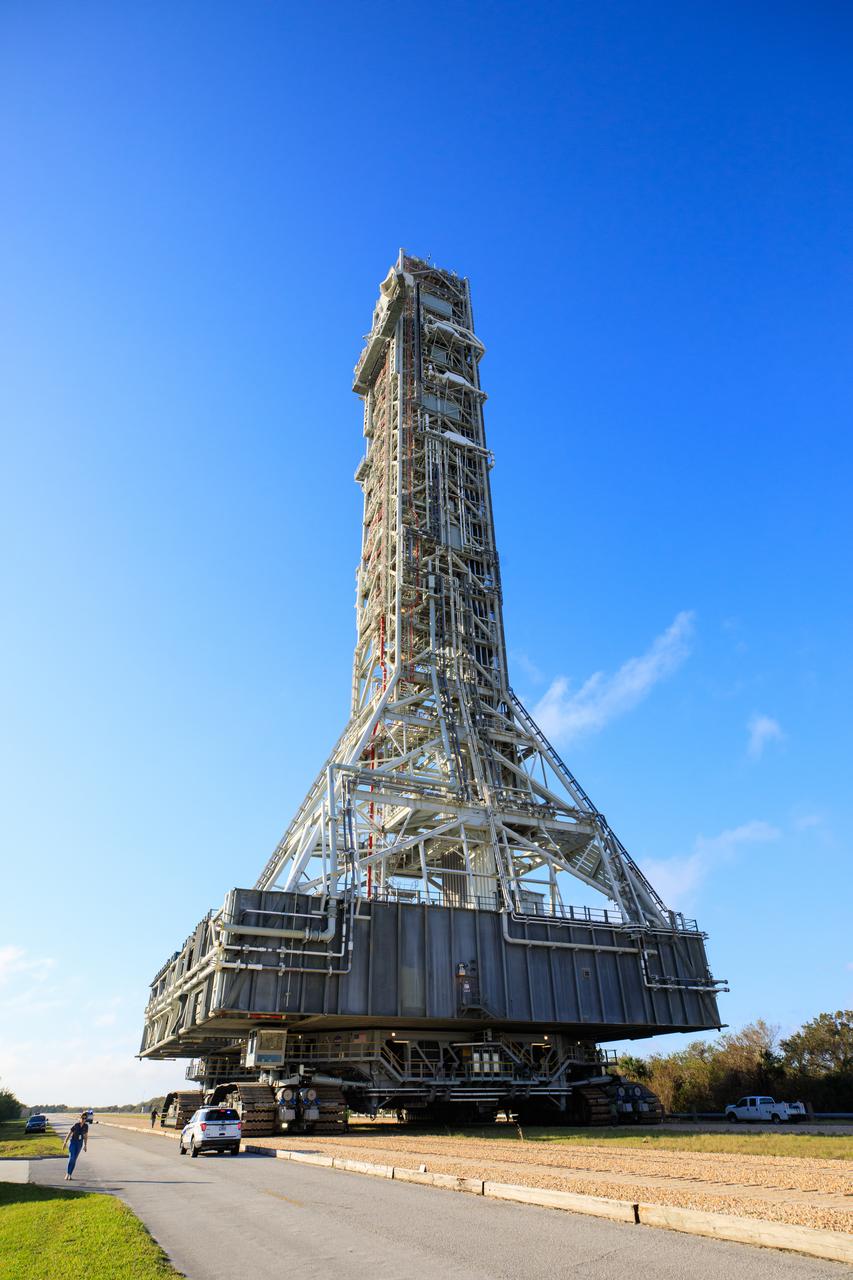
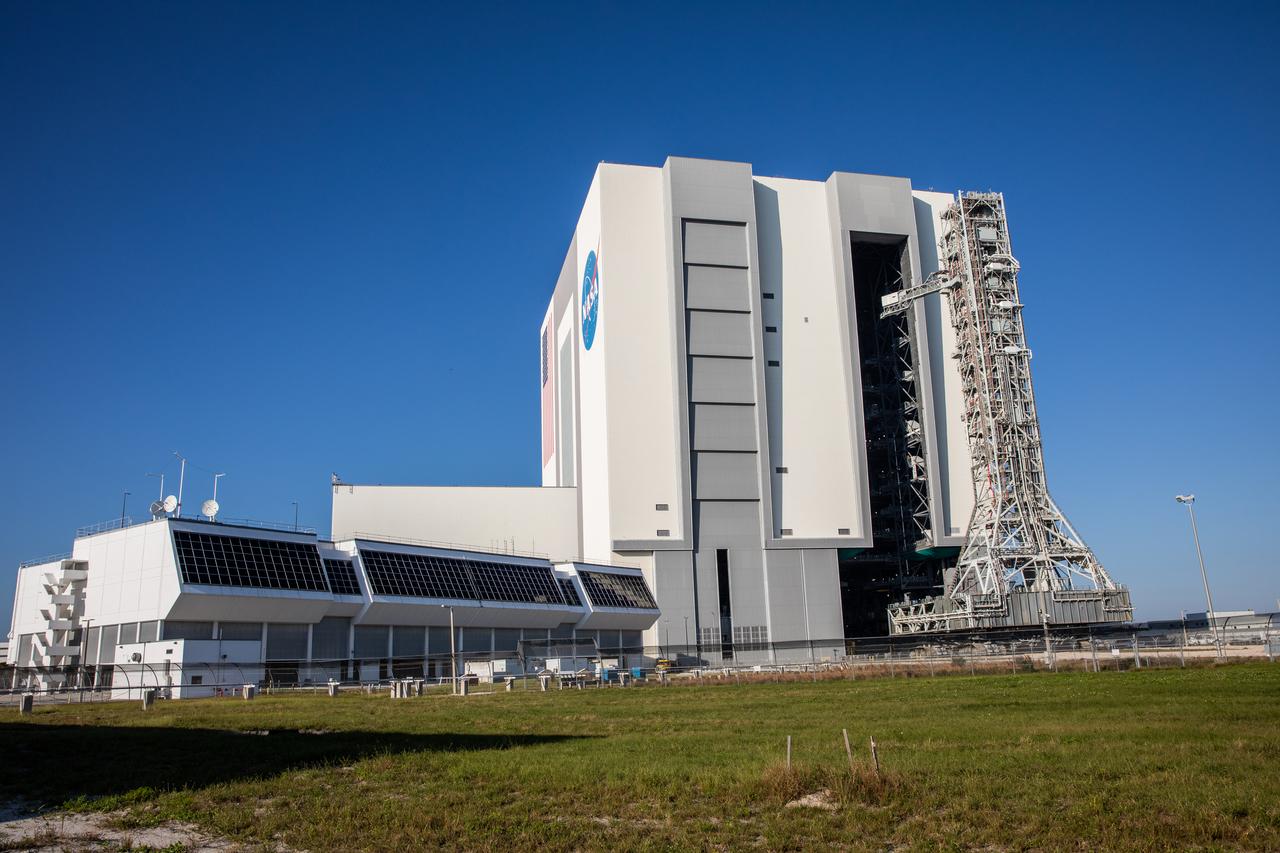
NASA’s mobile launcher, carried atop the crawler-transporter 2, arrives at the entrance to the Vehicle Assembly Building (VAB) at NASA’s Kennedy Space Center in Florida. The mobile launcher left launch pad 39B on Dec. 8, 2022, following the successful launch of the agency’s Space Launch System (SLS) rocket and Orion spacecraft on the Artemis I flight test on Nov. 16, 2022 and returned to the VAB on Dec. 9, 2022. The mobile launcher stay inside the VAB as teams get it ready for the Artemis II crewed mission. Following its stay in the VAB, it will go to the mobile launcher park site location at Kennedy where it will undergo emergency egress modifications and testing to support future Artemis missions.
Artemis I Post-Launch Mobile Launcher Rollback
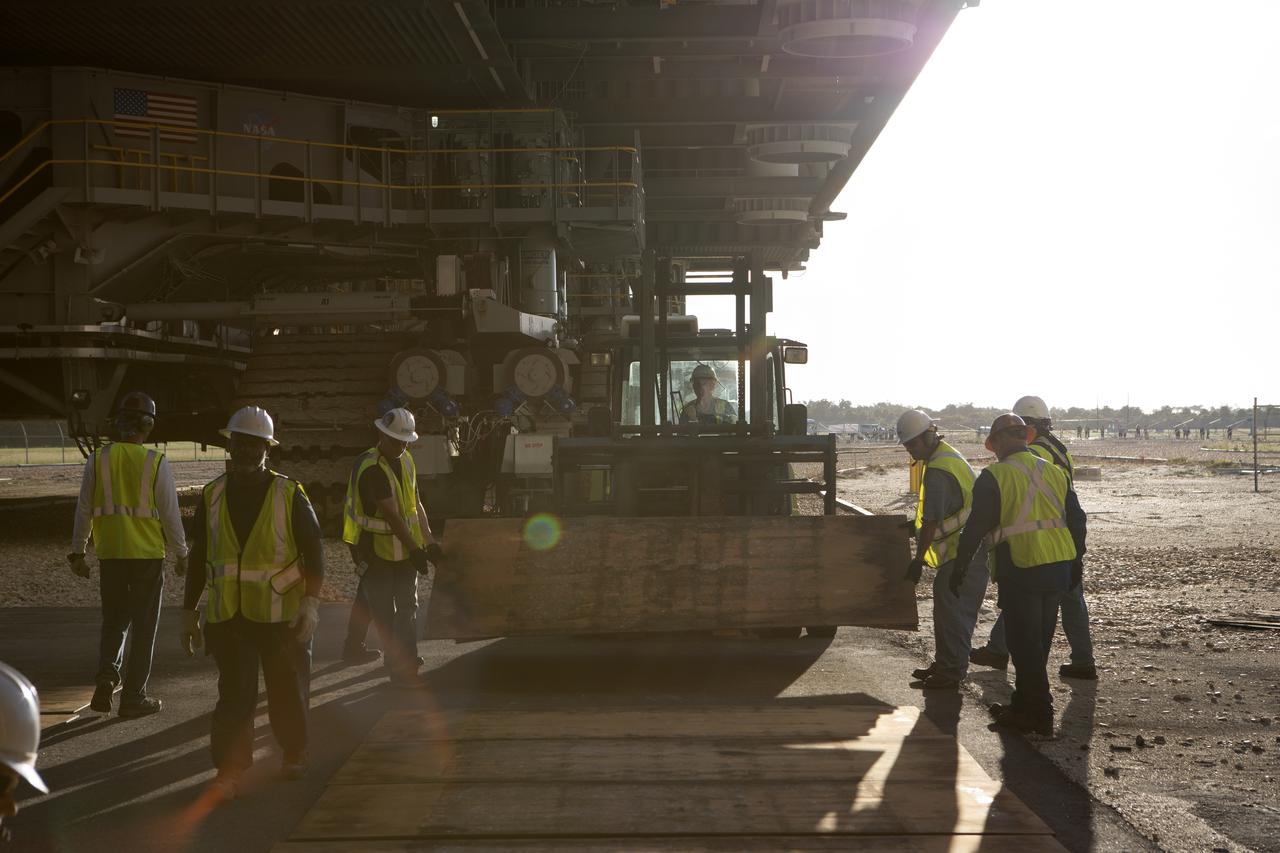
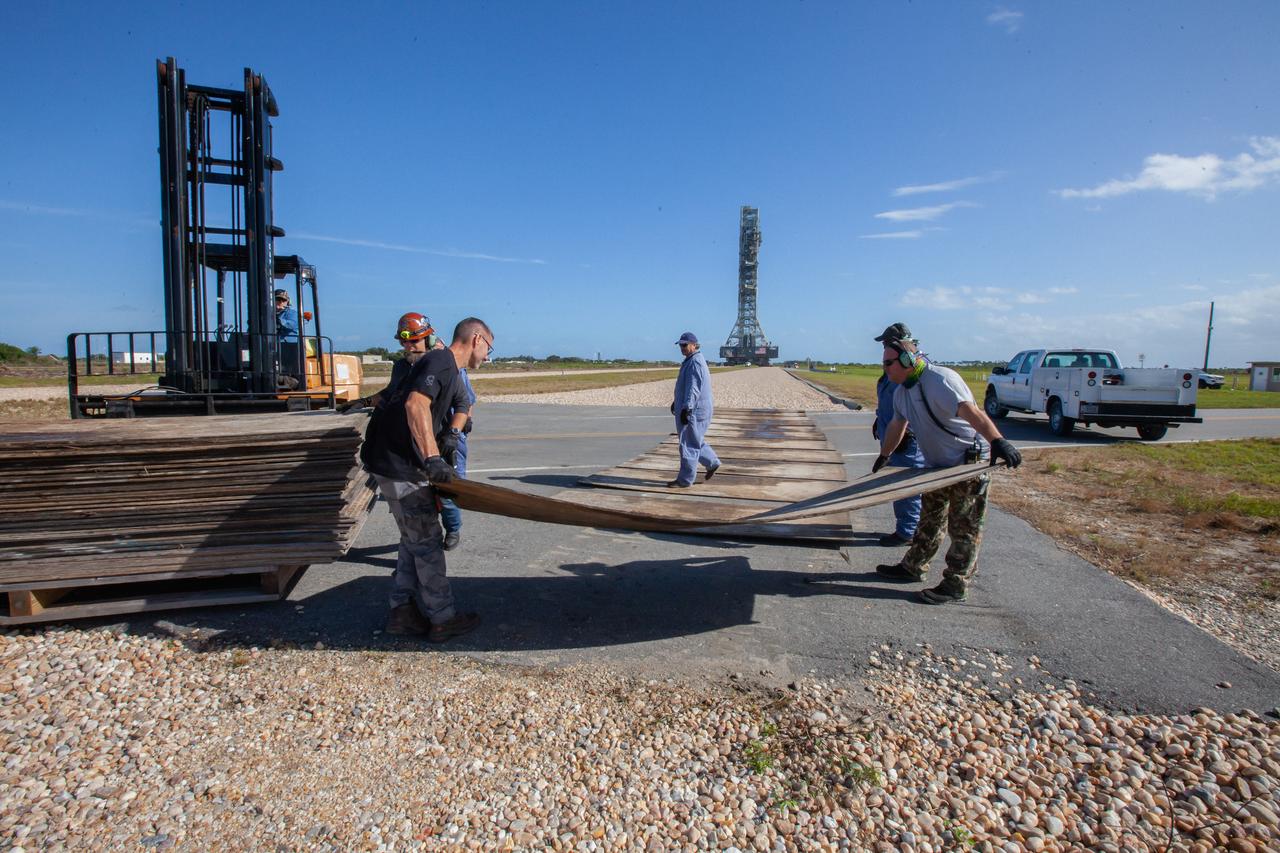
Technicians lay wooden planks down in the tracks to the entrance to High Bay 3 in the Vehicle Assembly Building (VAB), as mobile launcher, atop crawler-transporter 2, moves into the VAB on Sept. 8, 2018, at NASA's Kennedy Space Center in Florida. The mobile launcher departed Launch Pad 39B after several days of testing with the pad. This is the first time that the modified mobile launcher made the trip to the pad and the VAB. The mobile launcher will spend seven months in the VAB undergoing testing. The 380-foot-tall structure is equipped with the crew access arm and several umbilicals that will provide power, environmental control, pneumatics, communication and electrical connections to the agency's Space Launch System and Orion spacecraft. Exploration Ground Systems is preparing the ground systems necessary to launch SLS and Orion on Exploration Mission-1, missions to the Moon and on to Mars.
ML Moves Toward Exploration Mission 1 roll into the VAB HB-3
NASA’s mobile launcher, carried atop the crawler-transporter 2, arrives at the entrance to the Vehicle Assembly Building (VAB) at NASA’s Kennedy Space Center in Florida. The mobile launcher left launch pad 39B on Dec. 8, 2022, following the successful launch of the agency’s Space Launch System (SLS) rocket and Orion spacecraft on the Artemis I flight test on Nov. 16, 2022 and returned to the VAB on Dec. 9, 2022. The mobile launcher stay inside the VAB as teams get it ready for the Artemis II crewed mission. Following its stay in the VAB, it will go to the mobile launcher park site location at Kennedy where it will undergo emergency egress modifications and testing to support future Artemis missions.
Artemis I Post-Launch Mobile Launcher Rollback
Seen here is a close-up view of the Orion stage adapter (OSA) structural test article atop the Space Launch System (SLS) rocket inside the Vehicle Assembly Building (VAB) at NASA’s Kennedy Space Center in Florida on Aug. 12, 2021. The test article, representing the mass and weight of the actual flight hardware, is being used for various tests inside the VAB ahead of OSA stacking operations. The first in an increasingly complex set of missions, Artemis I will test SLS and the Orion spacecraft as an integrated system prior to crewed flights to the Moon. Through Artemis, NASA will send the first woman and the first person of color to the lunar surface, as well as establish a sustainable presence on and around the Moon.
OSA STA and Umbilicals
Seen here is a close-up view of the Orion stage adapter (OSA) structural test article atop the Space Launch System (SLS) rocket inside the Vehicle Assembly Building (VAB) at NASA’s Kennedy Space Center in Florida on Aug. 12, 2021. The test article, representing the mass and weight of the actual flight hardware, is being used for various tests inside the VAB ahead of OSA stacking operations. The first in an increasingly complex set of missions, Artemis I will test SLS and the Orion spacecraft as an integrated system prior to crewed flights to the Moon. Through Artemis, NASA will send the first woman and the first person of color to the lunar surface, as well as establish a sustainable presence on and around the Moon.
OSA STA and Umbilicals
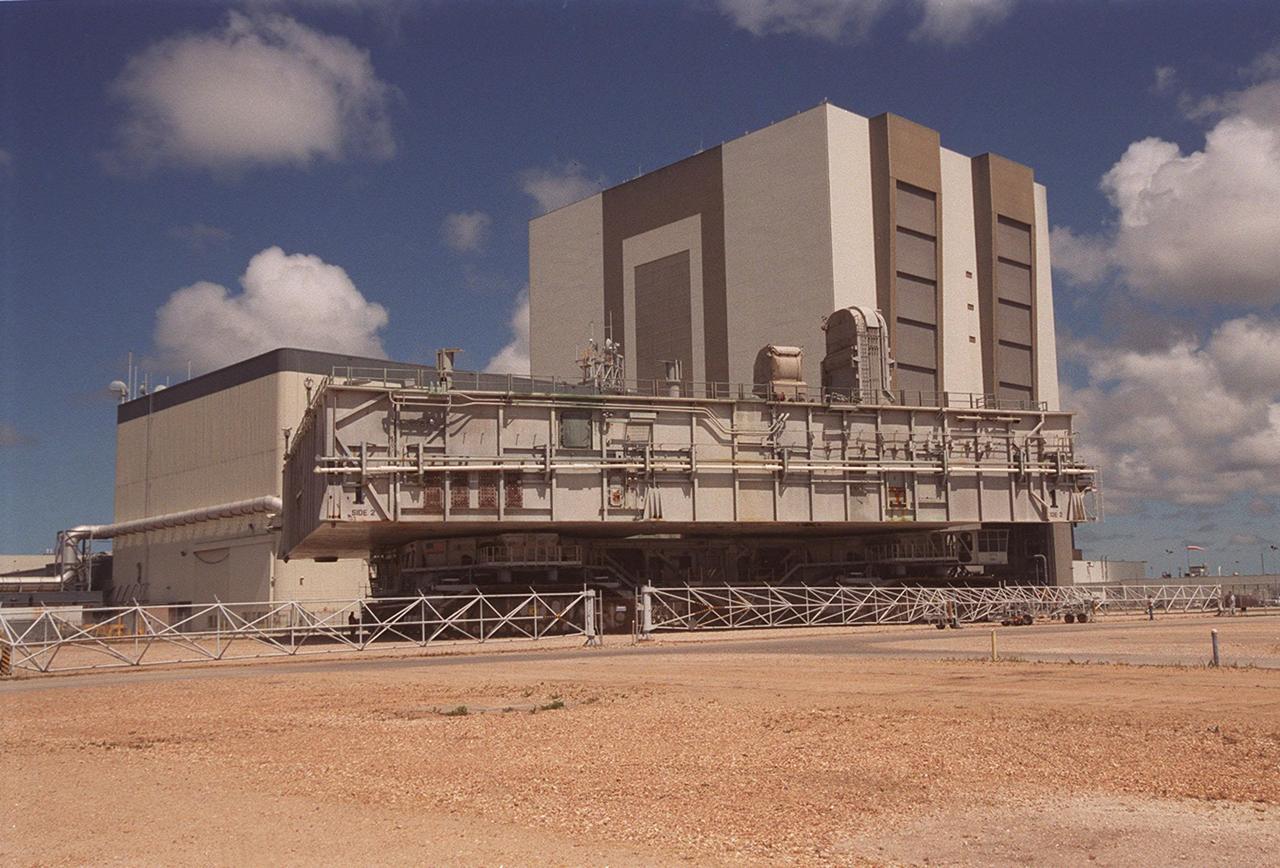
KENNEDY SPACE CENTER, FLA. -- A crawler-transporter with mobile launcher platform on top tests the buried portion of the Apollo-era crawlerway leading to the Vehicle Assembly Building (VAB) high bay 2 on the southwest side. The road was restored as part of KSC’s Safe Haven project. High bay 2 provides a third stacking area. The primary goal of the Safe Haven construction project was to strengthen readiness for hurricane season by expanding the VAB’s storage capacity. The new area, in high bay 2, will allow NASA to preassemble stacks and still have room in the VAB to pull a Shuttle back from the pad if severe weather threatens. Potential rollouts of the Space Shuttle to the launch pad from high bay 2 will involve making a turn around the north side of the VAB in contrast to the straight rollouts from high bays 1 and 3, on the east side of the VAB facing the launch pads
KSC00pp0716
KENNEDY SPACE CENTER, FLA. -- A crawler-transporter with mobile launcher platform on top tests the buried portion of the Apollo-era crawlerway leading to the Vehicle Assembly Building (VAB) high bay 2 on the southwest side. The road was restored as part of KSC’s Safe Haven project. High bay 2 provides a third stacking area. The primary goal of the Safe Haven construction project was to strengthen readiness for hurricane season by expanding the VAB’s storage capacity. The new area, in high bay 2, will allow NASA to preassemble stacks and still have room in the VAB to pull a Shuttle back from the pad if severe weather threatens. Potential rollouts of the Space Shuttle to the launch pad from high bay 2 will involve making a turn around the north side of the VAB in contrast to the straight rollouts from high bays 1 and 3, on the east side of the VAB facing the launch pads
KSC-00pp0716
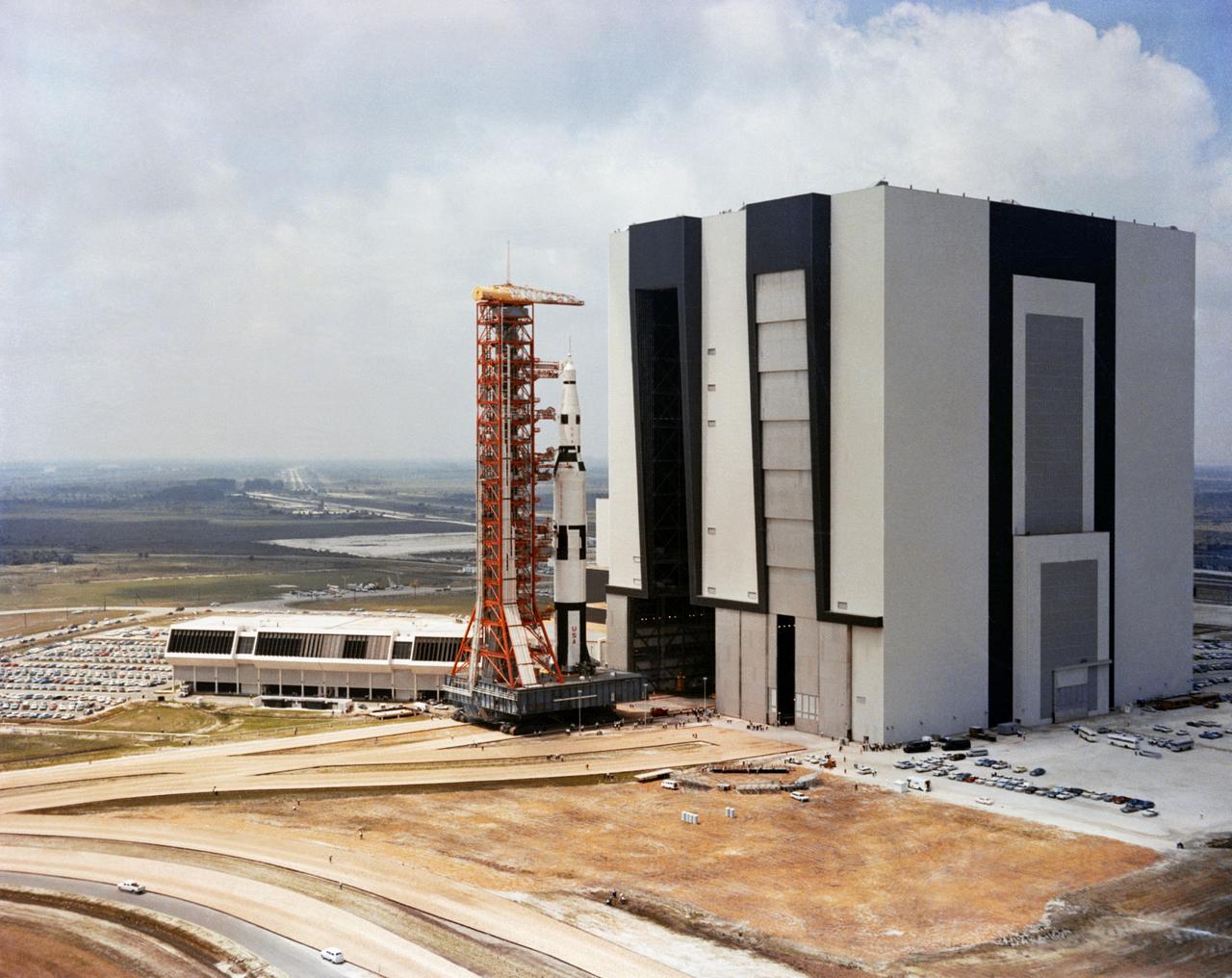
An Apollo/Saturn V facilities Test Vehicle and Launch Umbilical Tower (LUT) atop a crawler-transporter move from the Vehicle Assembly Building (VAB) on the way to Pad A. This test vehicle, designated the Apollo/Saturn 500-F, is being used to verify launch facilities, train launch crews, and develop test and checkout procedures.
Apollo/Saturn V facilities Test Vehicle and Launch Umbilical Tower
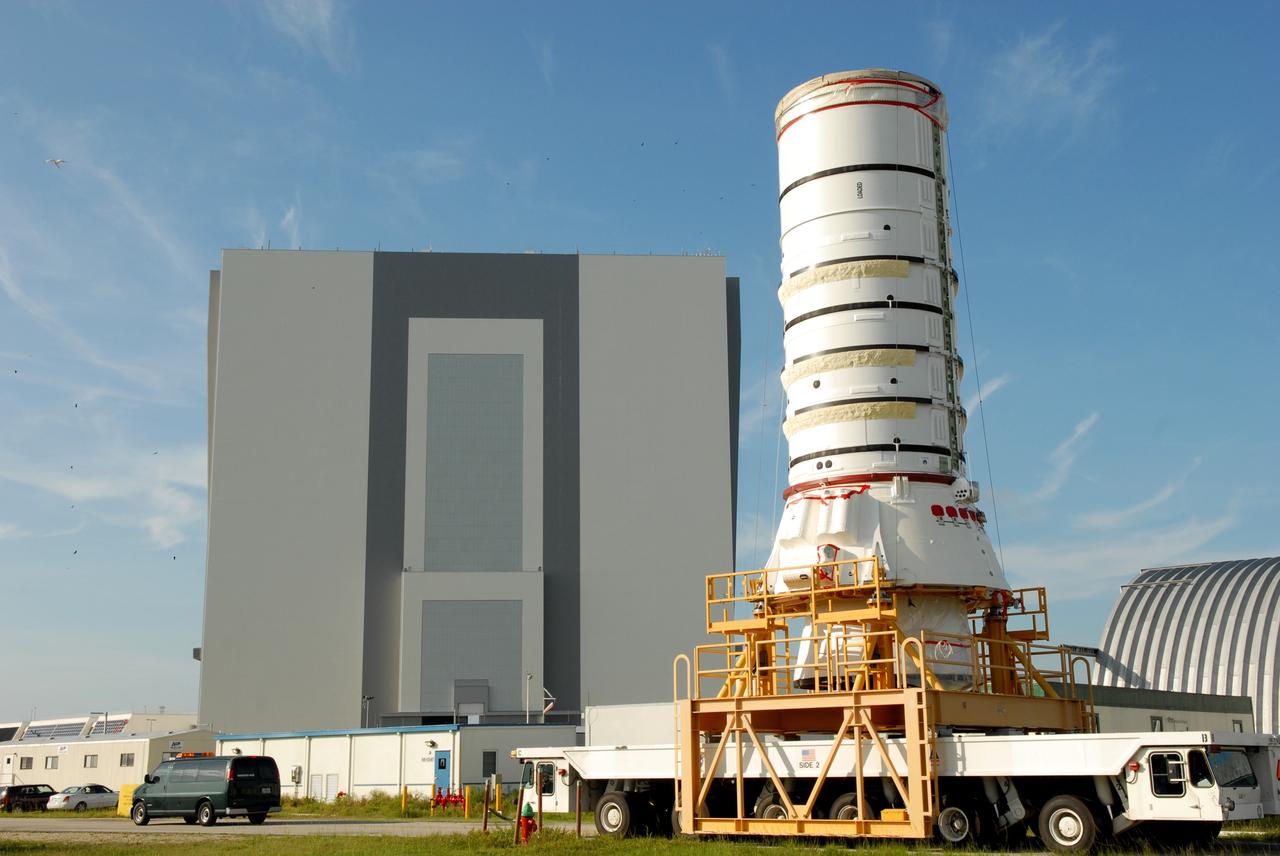
CAPE CANAVERAL, Fla. – The Ares I-X aft assembly nears the Vehicle Assembly Building at NASA's Kennedy Space Center in Florida.  It is being moved to the VAB for stacking to complete the Ares I-X test vehicle.  The aft assembly will be the first segment to be stacked on the mobile launch platform in the VAB.  Part of the Constellation Program, the Ares I-X is the test vehicle for the Ares I, which is the essential core of a space transportation system that eventually will carry crewed missions back to the moon, on to Mars and out into the solar system. The Ares I-X flight test is targeted no earlier than Aug. 30 from Launch Pad 39B.  Photo credit: NASA/Jim Grossmann
KSC-2009-3902
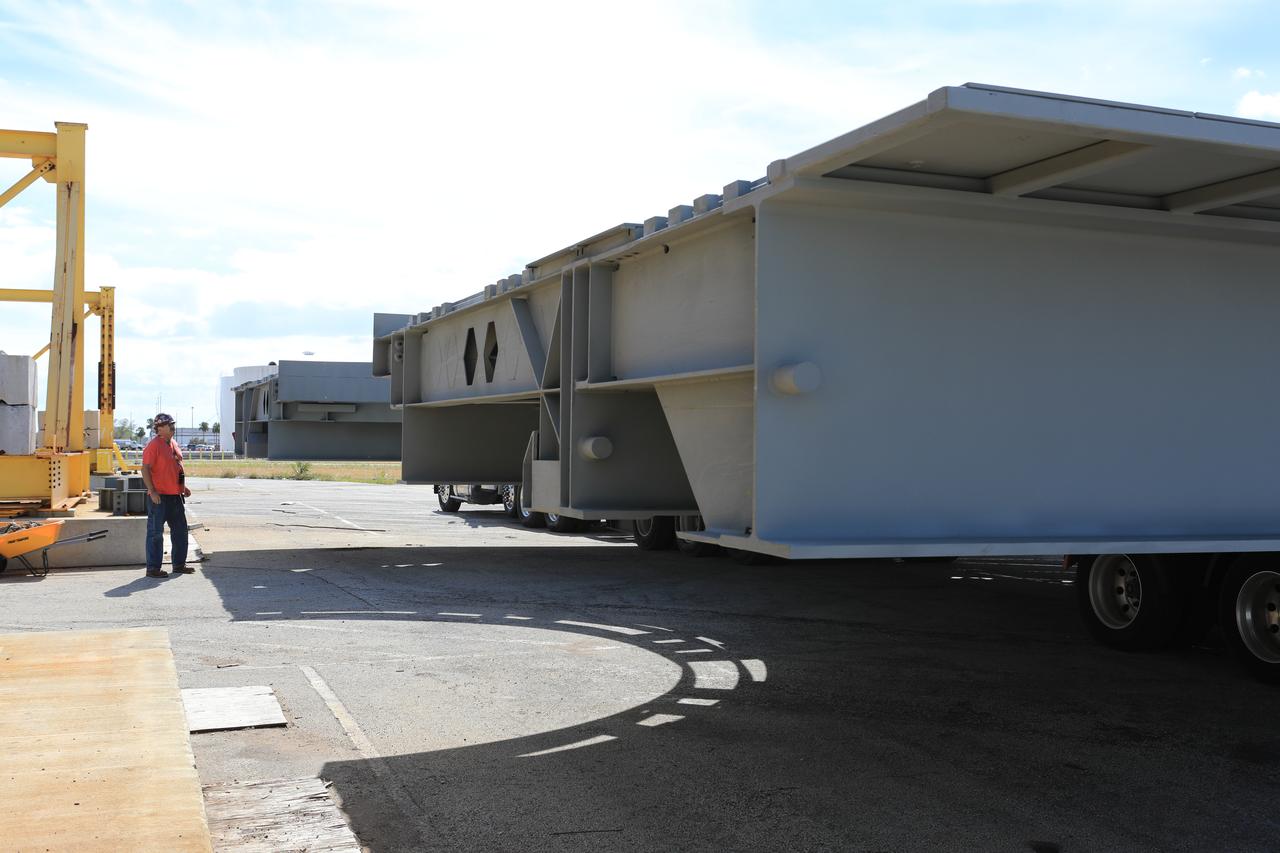
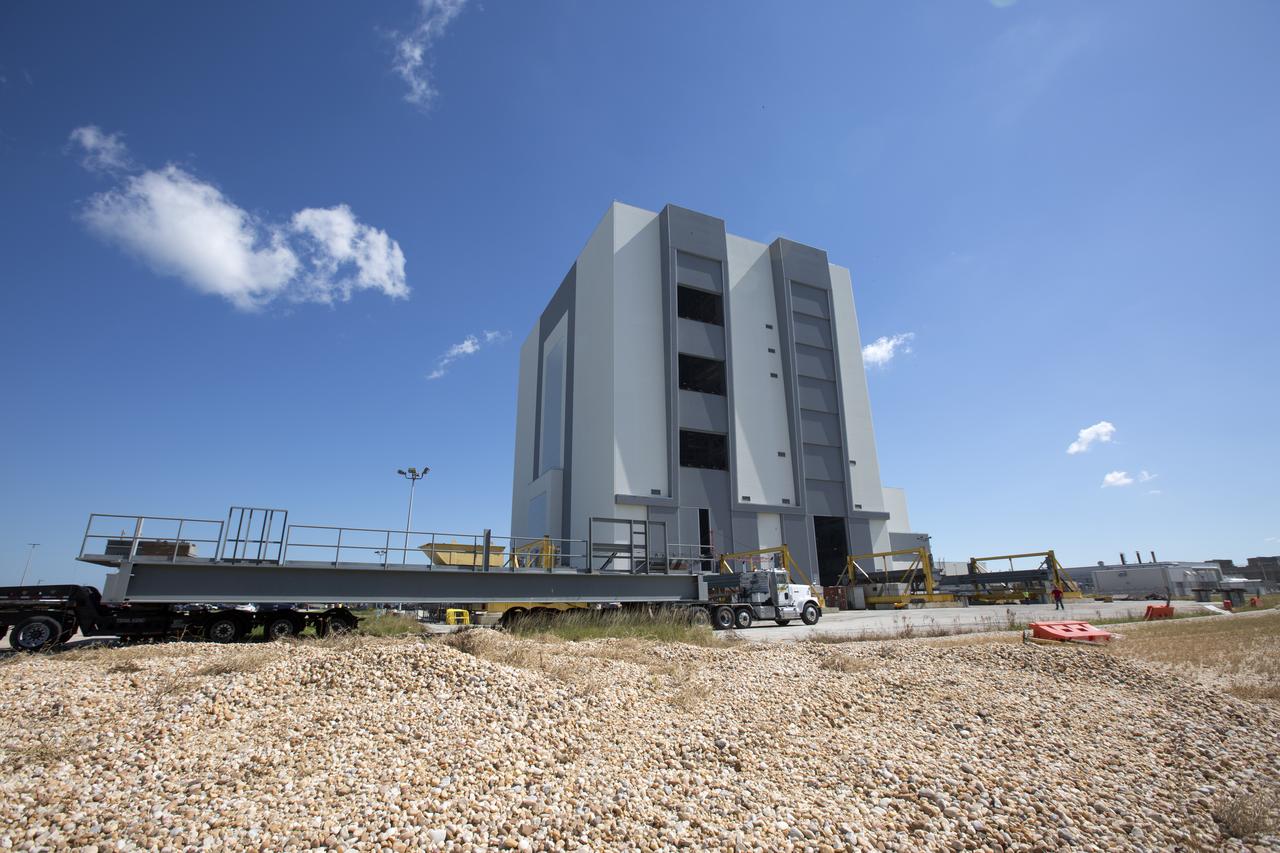
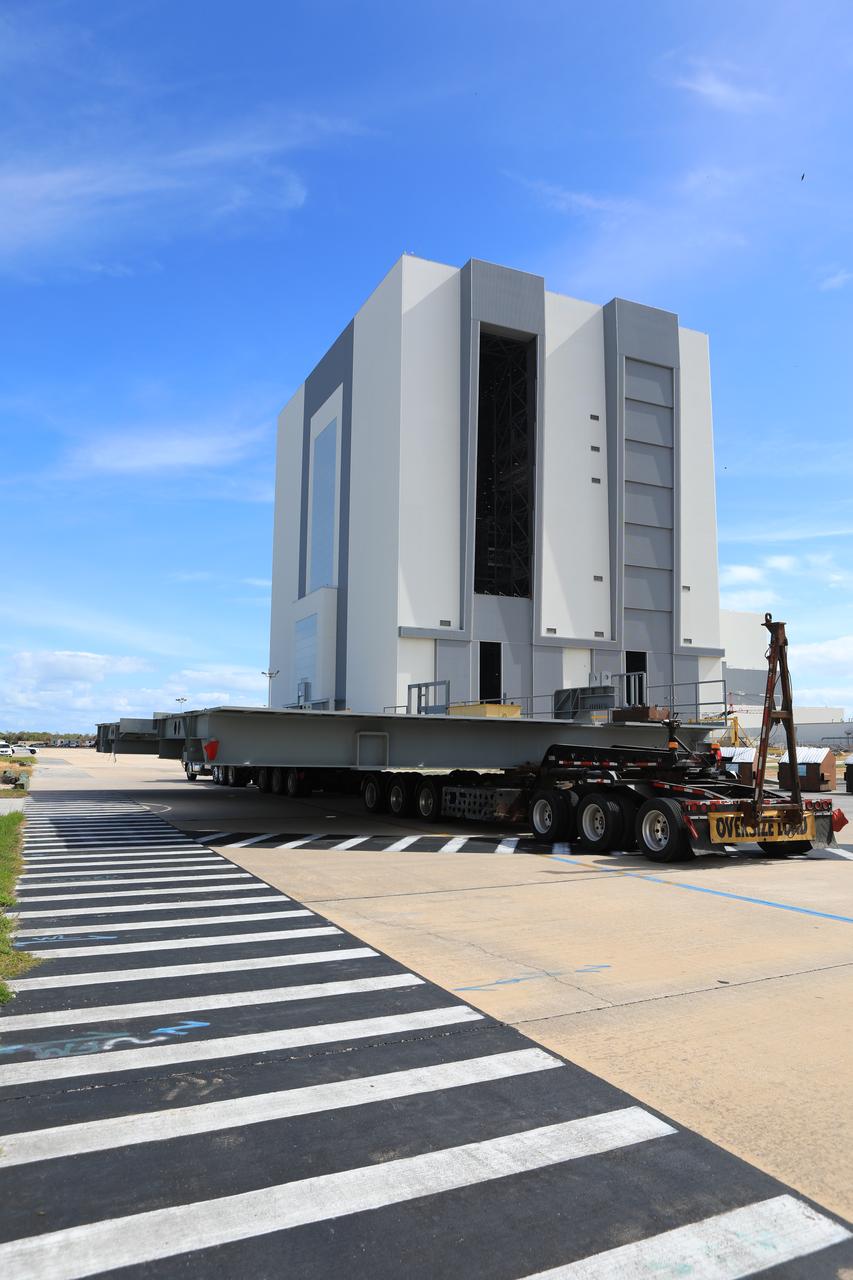
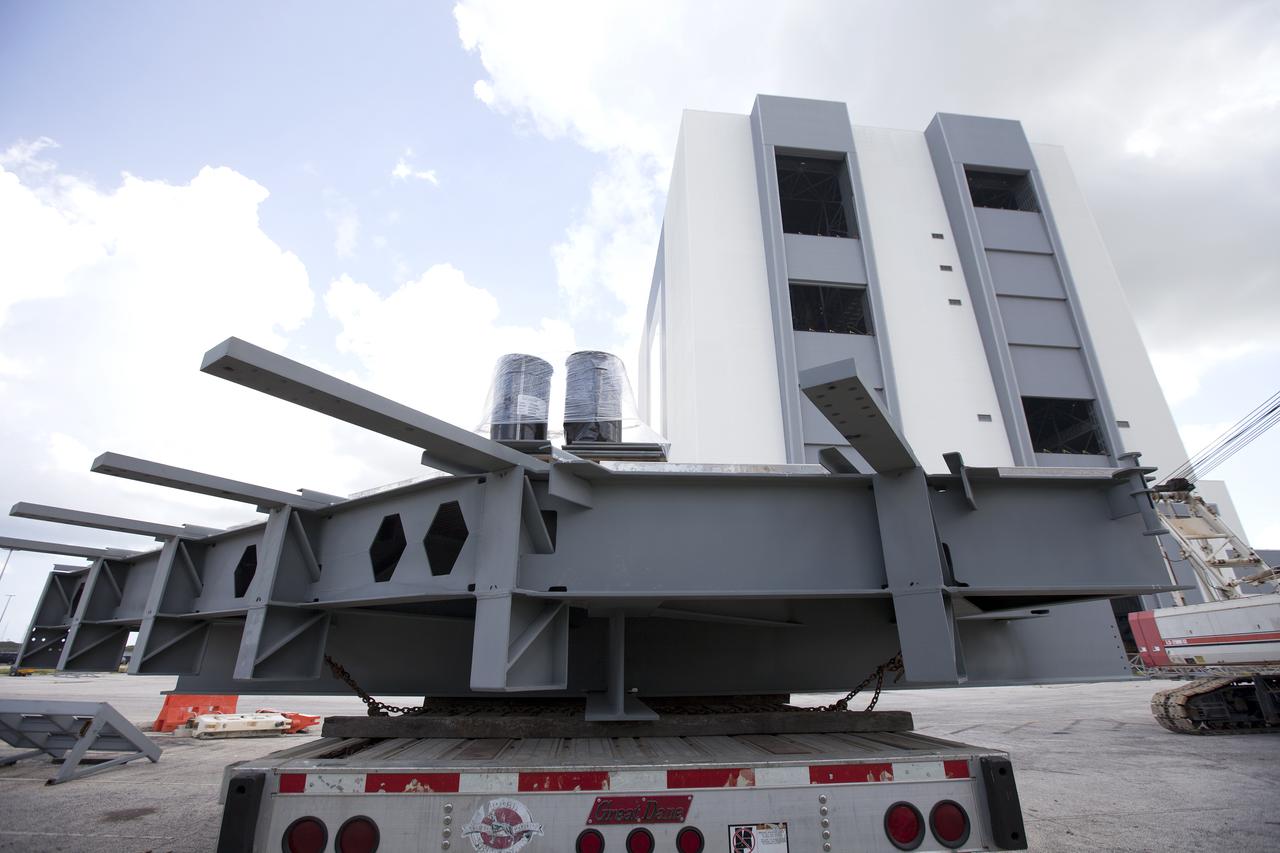
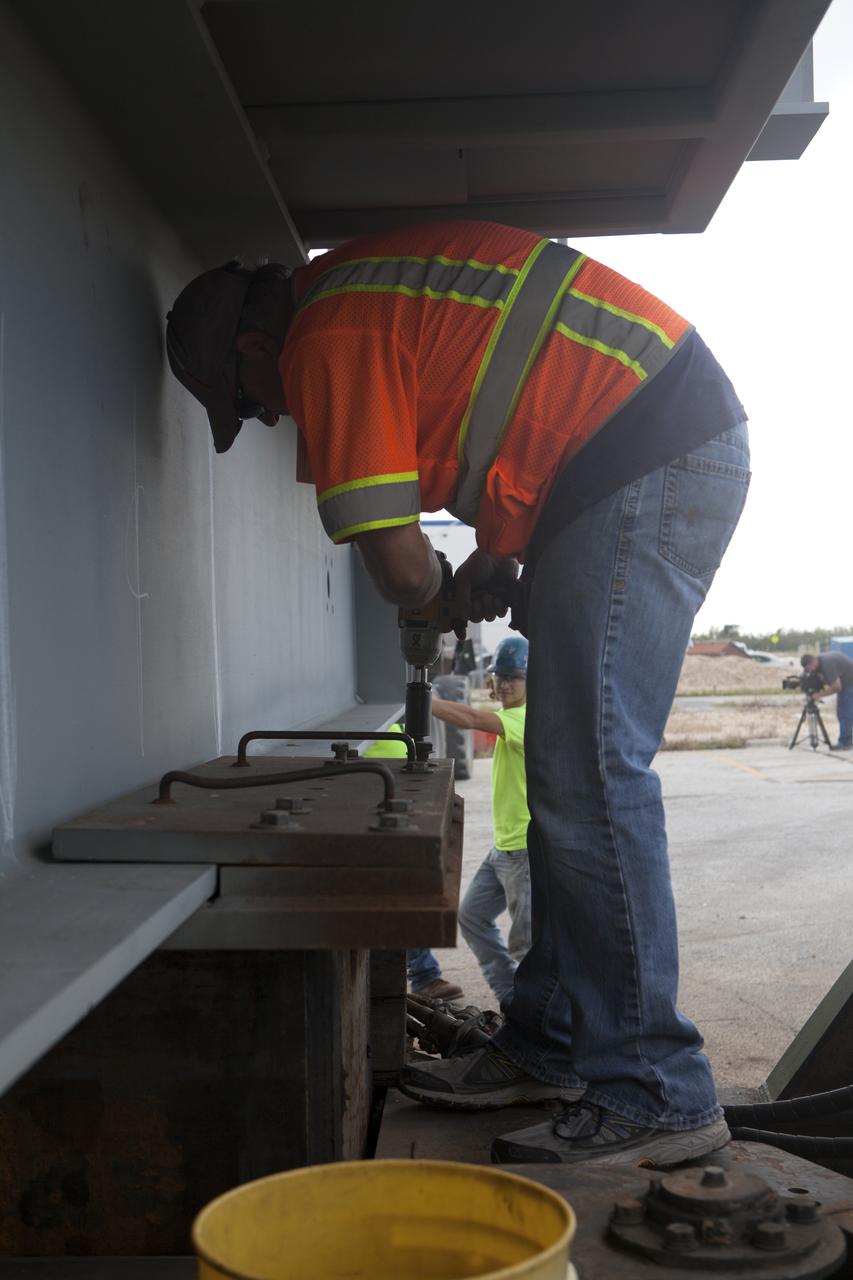
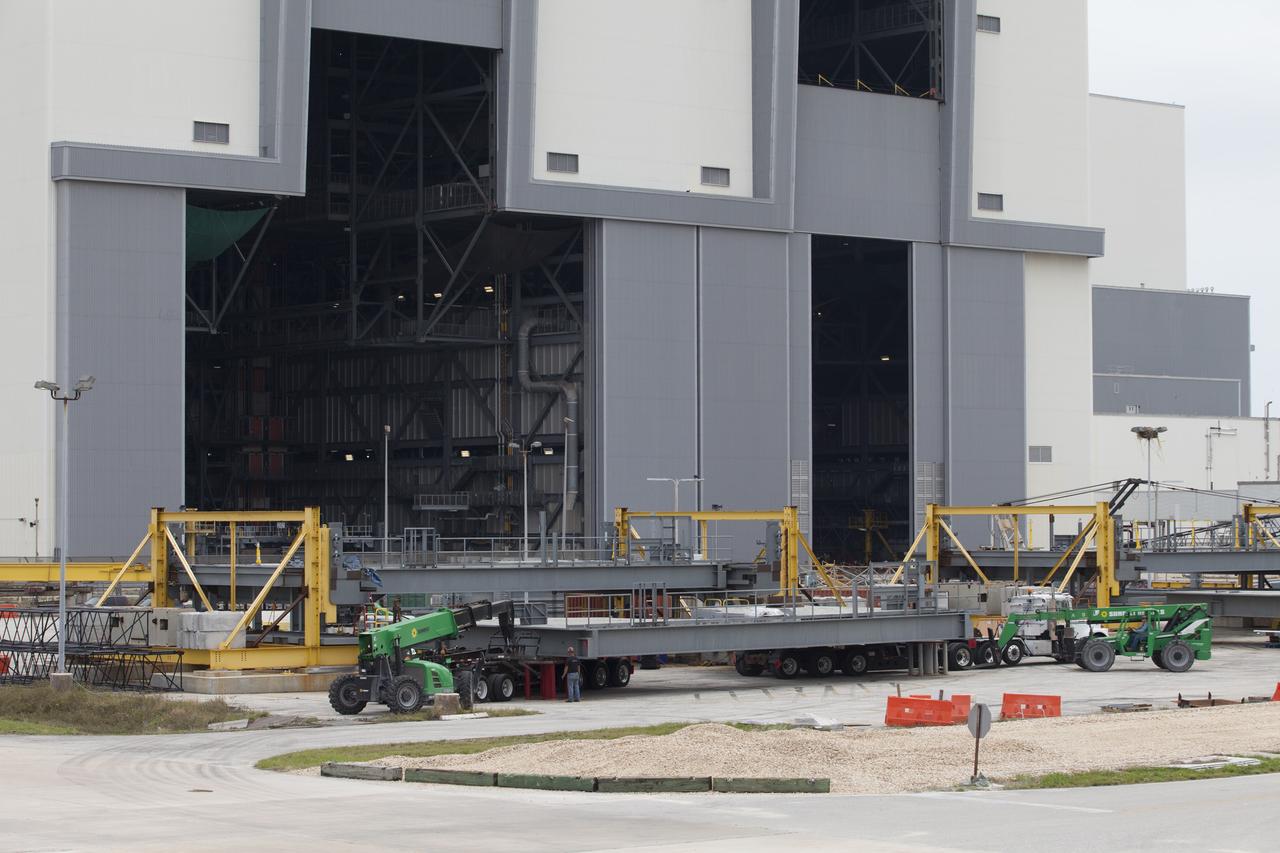
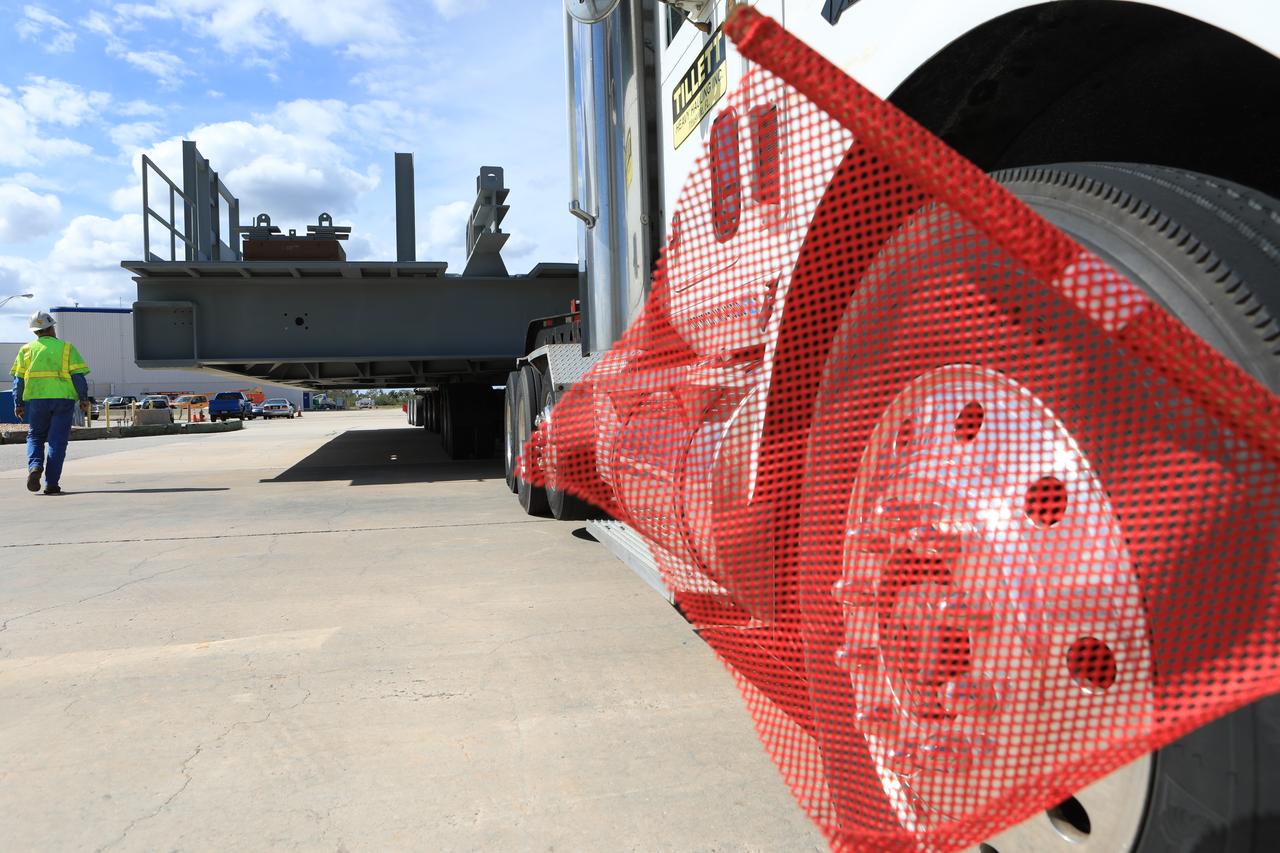
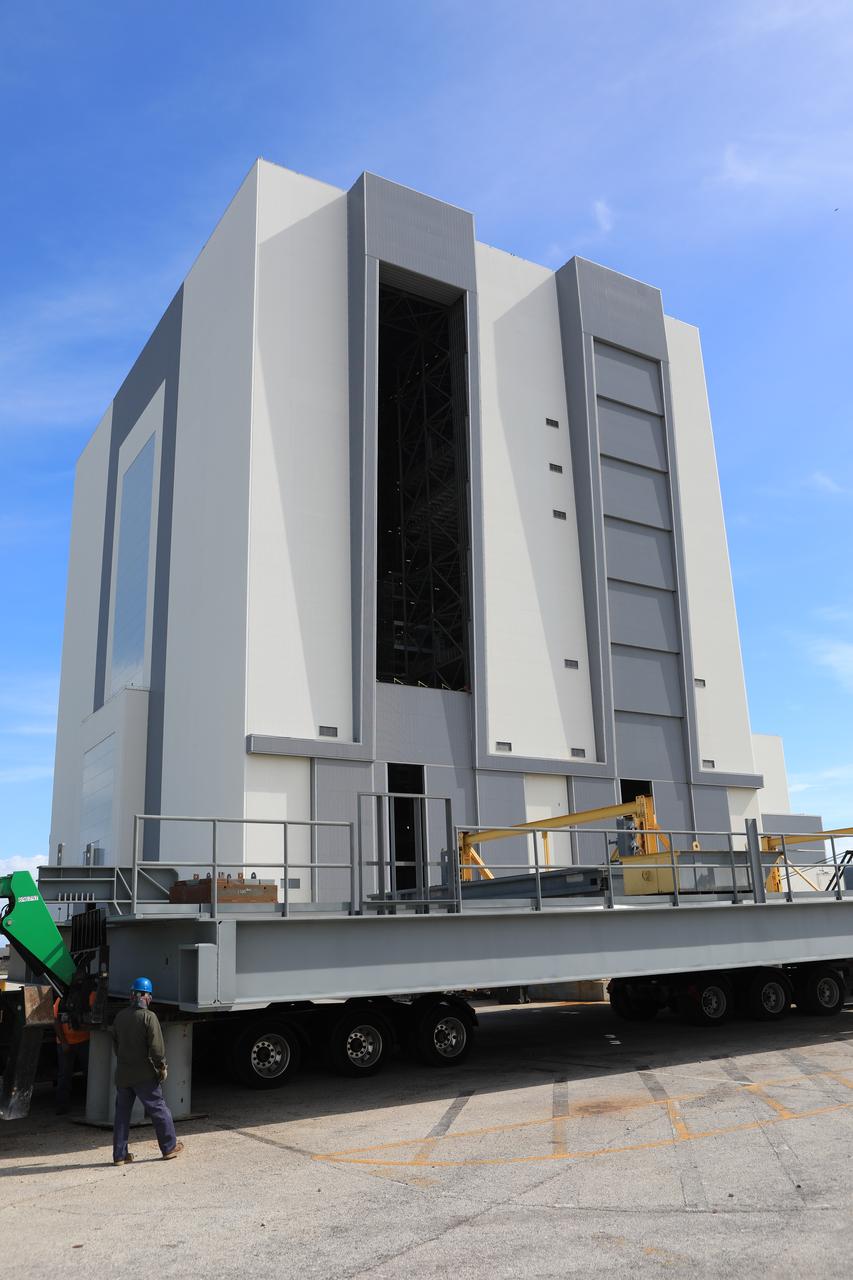
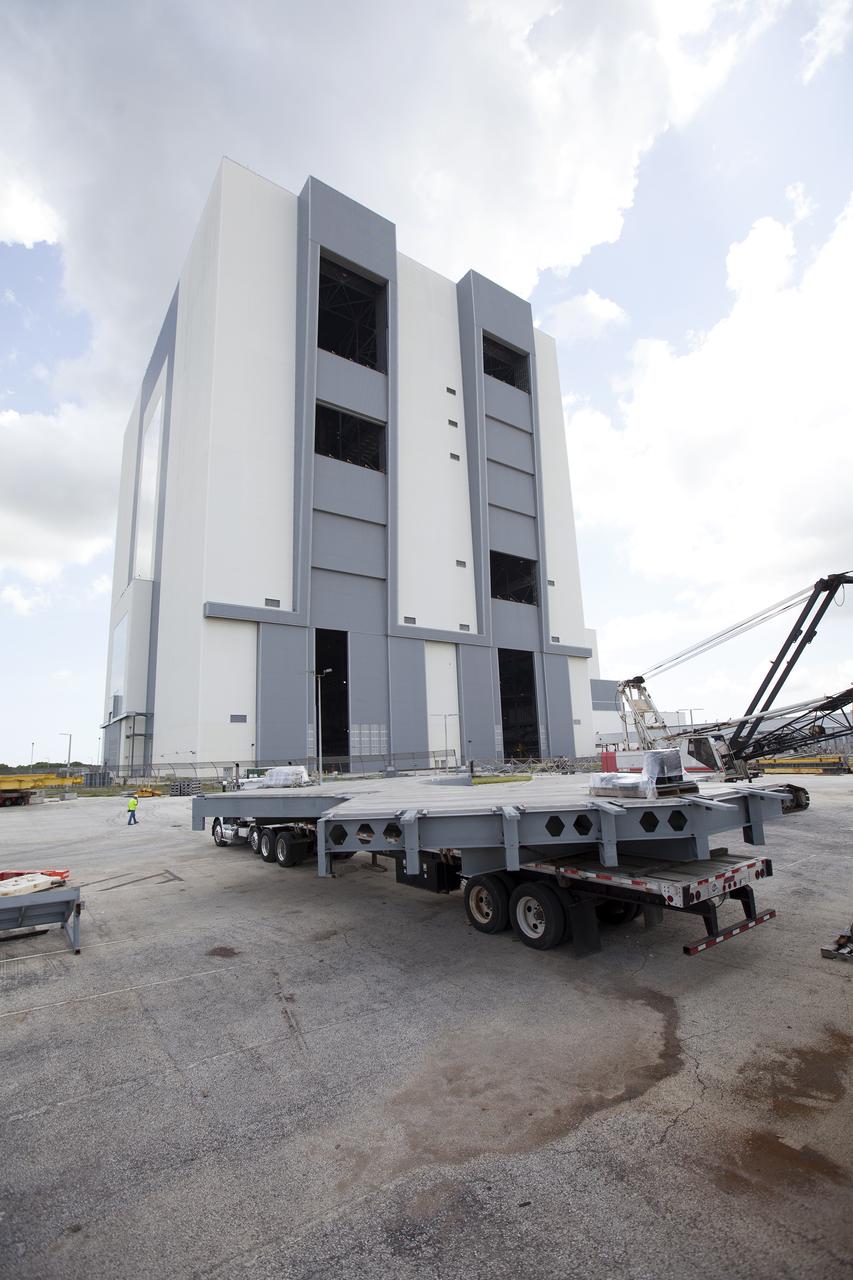
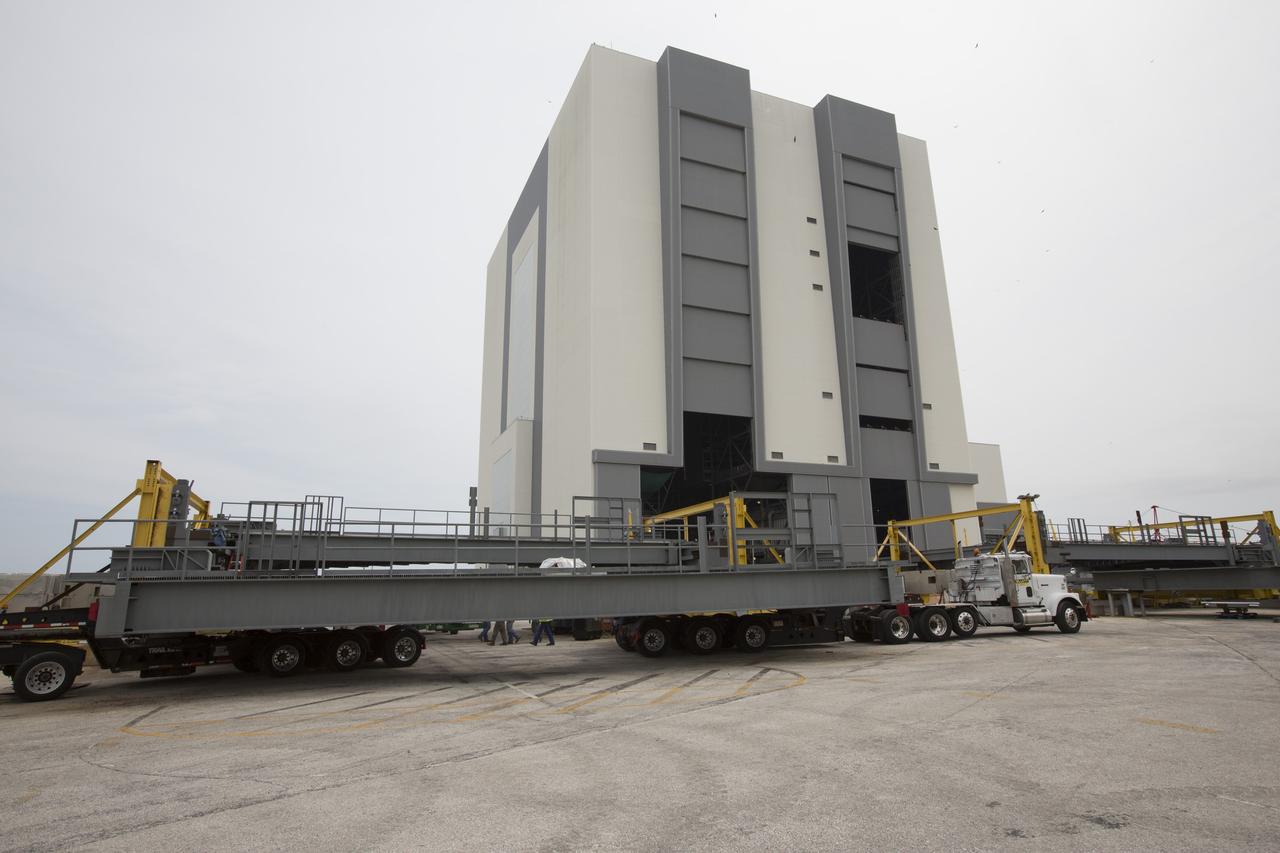
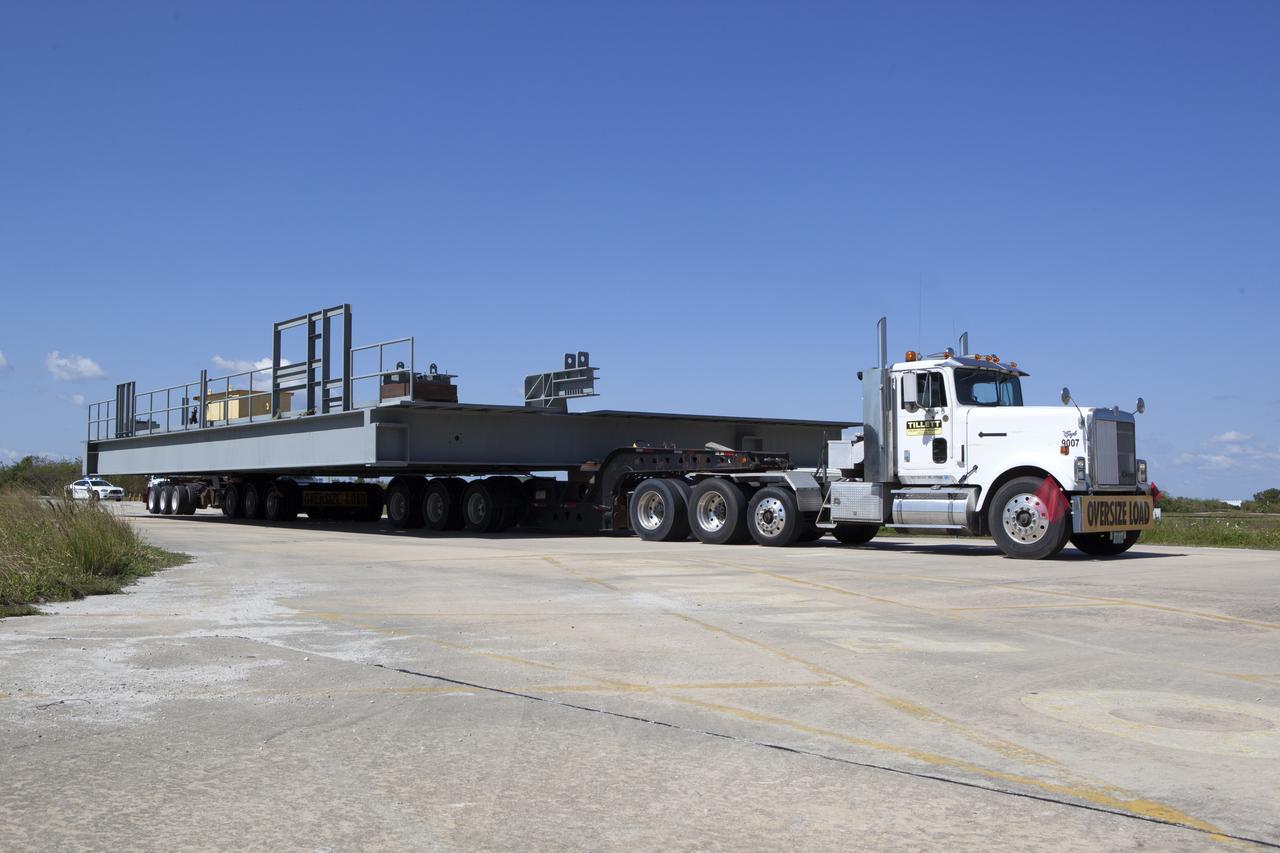
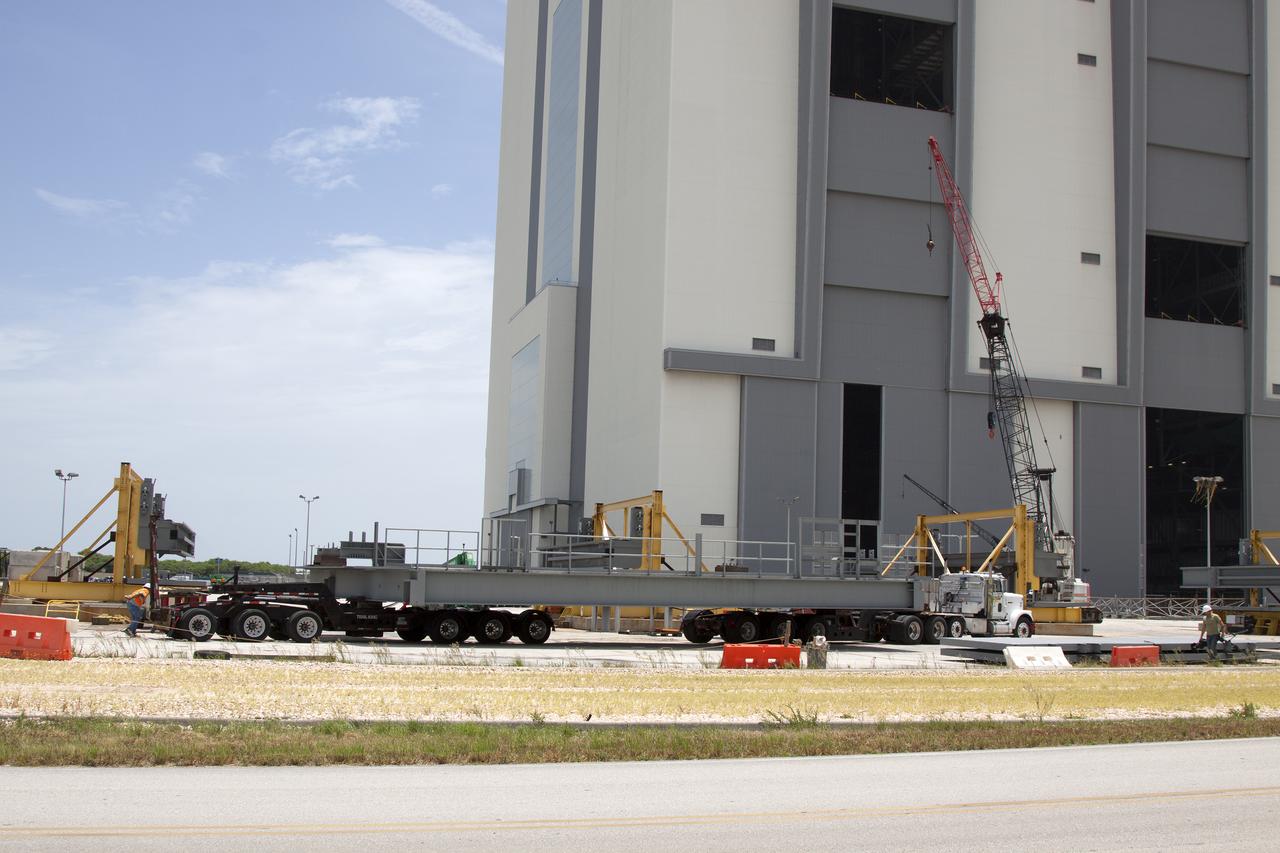
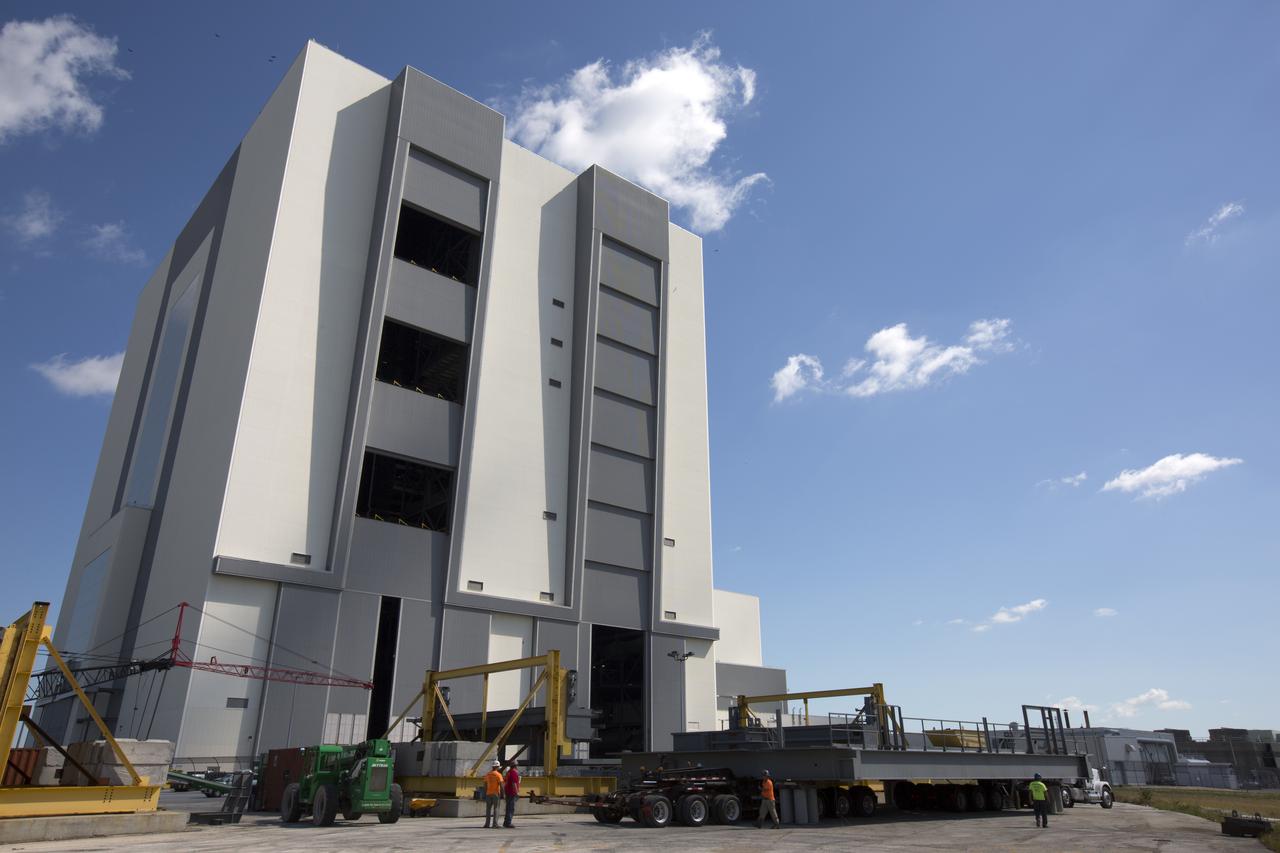
A heavy load transport truck from Tillett Heavy Hauling in Titusville, Florida, arrives at the Vehicle Assembly Building (VAB) at NASA’s Kennedy Space Center in Florida, carrying the second half of the B-level work platforms, B north, for the agency’s Space Launch System (SLS) rocket. The platform will be delivered to the VAB staging area in the west parking lot. The Ground Systems Development and Operations Program is overseeing upgrades and modifications to VAB High Bay 3 to support processing of the SLS and Orion spacecraft. A total of 10 levels of new platforms, 20 platform halves altogether, will surround the SLS rocket and Orion spacecraft and provide access for testing and processing.
Platform B North Arrival
Workers prepare to unload the second half of the A-level work platforms, A north, for NASA's Space Launch System (SLS) rocket, from a heavy load transport truck near the Vehicle Assembly Building (VAB) at NASA's Kennedy Space Center in Florida. This is the final platform delivered to Kennedy. The platform will be offloaded in a staging area near the VAB. The A-level platforms are the topmost platforms for High Bay 3 in the VAB. The Ground Systems Development and Operations Program is overseeing upgrades and modifications to High Bay 3 to support processing of the SLS and Orion spacecraft. A total of 10 levels of new platforms, 20 platform halves altogether, will surround the SLS rocket and Orion spacecraft and provide access for testing and processing.
Platform A North Arrival
A heavy load transport truck from Tillett Heavy Hauling in Titusville, Florida, arrives at the Vehicle Assembly Building (VAB) at NASA’s Kennedy Space Center in Florida, carrying the second half of the B-level work platforms, B north, for the agency’s Space Launch System (SLS) rocket. The platform will be offloaded in the VAB staging area in the west parking lot. The Ground Systems Development and Operations Program is overseeing upgrades and modifications to VAB High Bay 3 to support processing of the SLS and Orion spacecraft. A total of 10 levels of new platforms, 20 platform halves altogether, will surround the SLS rocket and Orion spacecraft and provide access for testing and processing.
Platform B North Arrival
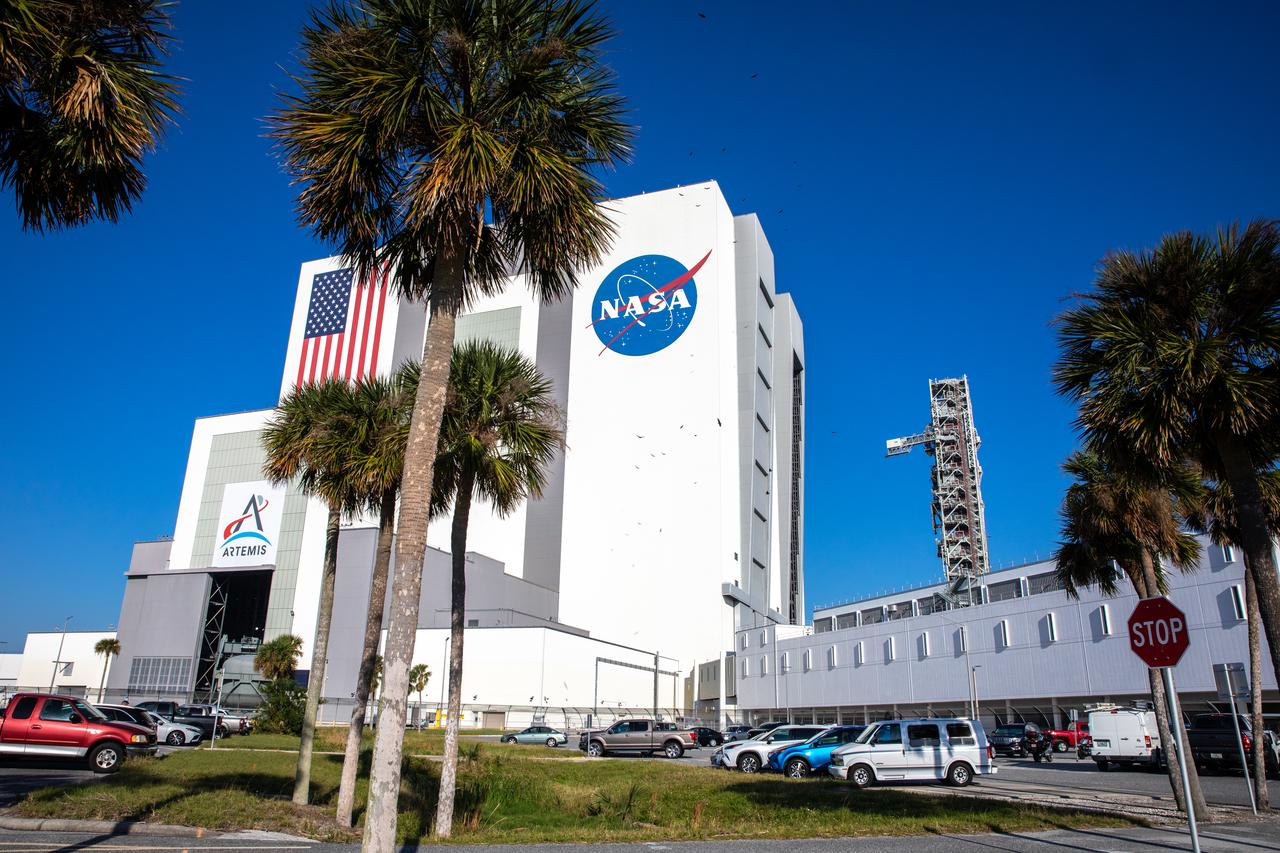
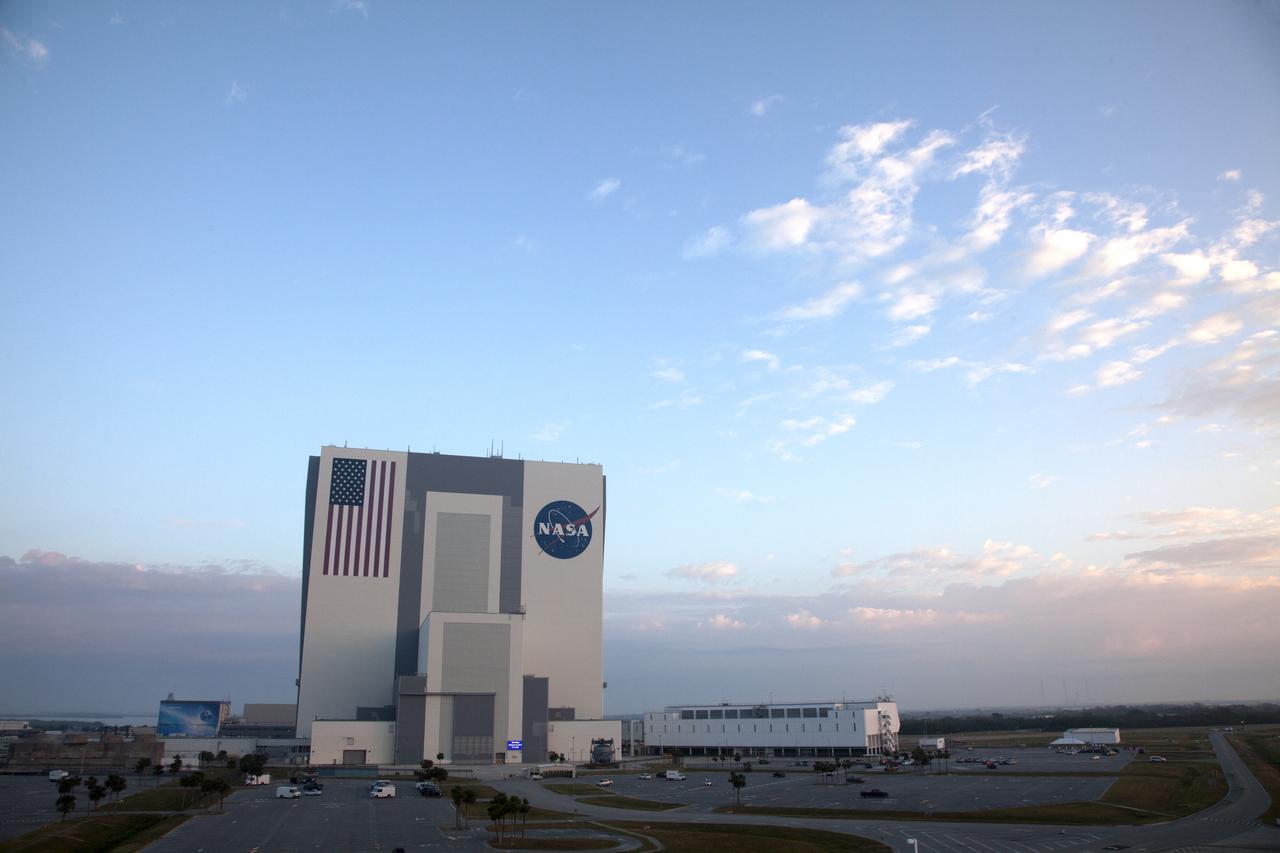
An early morning view of the iconic Vehicle Assembly Building (VAB) at NASA's Kennedy Space Center in Florida. To the right is the Launch Control Center. All 10 levels of new work platforms, 20 platform halves altogether, have been installed in VAB High Bay 3 for the agency's Space Launch System (SLS) rocket and Orion spacecraft. The Ground Systems Development and Operations Program is overseeing upgrades to the VAB, including installation of the new platforms to prepare for the first test flight of Orion atop the SLS from Launch Pad 39B.
VAB from OSBI II Balcony
A heavy load transport truck arrives at the Vehicle Assembly Building (VAB) at NASA’s Kennedy Space Center in Florida, carrying the second half of the F-level work platforms for the agency’s Space Launch System (SLS) rocket. The platform will be delivered to the VAB staging area in the west parking lot. The Ground Systems Development and Operations Program is overseeing upgrades and modifications to VAB High Bay 3 to support processing of the SLS and Orion spacecraft. A total of 10 levels of new platforms, 20 platform halves altogether, will surround the SLS rocket and Orion spacecraft and provide access for testing and processing. Delivery of this platform brings the total to 10 platforms, or half of the work platforms delivered to Kennedy.
Platform F Arrival
A heavy load transport truck has arrived at the Vehicle Assembly Building (VAB) at NASA’s Kennedy Space Center in Florida, carrying the second half of the F-level work platforms for the agency’s Space Launch System (SLS) rocket. The platform will be delivered to the VAB staging area in the west parking lot. The Ground Systems Development and Operations Program is overseeing upgrades and modifications to VAB High Bay 3 to support processing of the SLS and Orion spacecraft. A total of 10 levels of new platforms, 20 platform halves altogether, will surround the SLS rocket and Orion spacecraft and provide access for testing and processing. Delivery of this platform brings the total to 10 platforms, or half of the work platforms delivered to Kennedy,
Platform F Arrival
An early morning view of the iconic Vehicle Assembly Building (VAB) at NASA's Kennedy Space Center in Florida. To the right is the Launch Control Center. In the background is the mobile launcher. All 10 levels of new work platforms, 20 platform halves altogether, have been installed in VAB High Bay 3 for the agency's Space Launch System (SLS) rocket and Orion spacecraft. The Ground Systems Development and Operations Program is overseeing upgrades to the VAB, including installation of the new platforms to prepare for the first test flight of Orion atop the SLS from Launch Pad 39B.
VAB during Sunrise at Kennedy Space Center
A heavy load transport truck from Tillett Heavy Hauling in Titusville, Florida, travels toward the Vehicle Assembly Building (VAB) at NASA’s Kennedy Space Center in Florida, carrying the first half of the B-level work platforms, B South, for the agency’s Space Launch System (SLS) rocket. The platform will be delivered to the Vehicle Assembly Building (VAB) staging area in the west parking lot. The Ground Systems Development and Operations Program is overseeing upgrades and modifications to VAB High Bay 3 to support processing of the SLS and Orion spacecraft. A total of 10 levels of new platforms, 20 platform halves altogether, will surround the SLS rocket and Orion spacecraft and provide access for testing and processing.
Platform B South Arrival
A heavy load transport truck from Tillett Heavy Hauling in Titusville, Florida, arrives at the Vehicle Assembly Building (VAB) at NASA’s Kennedy Space Center in Florida, carrying the first half of the B-level work platforms, B South, for the agency’s Space Launch System (SLS) rocket. The platform will be offloaded in the VAB staging area in the west parking lot. The Ground Systems Development and Operations Program is overseeing upgrades and modifications to VAB High Bay 3 to support processing of the SLS and Orion spacecraft. A total of 10 levels of new platforms, 20 platform halves altogether, will surround the SLS rocket and Orion spacecraft and provide access for testing and processing.
Platform B South Arrival
A heavy load transport truck from Tillett Heavy Hauling in Titusville, Florida, arrives at the Vehicle Assembly Building (VAB) at NASA’s Kennedy Space Center in Florida, carrying a section of the first half of the C-level work platforms, C south, for the agency’s Space Launch System (SLS) rocket. The platform will be delivered to the VAB staging area in the west parking lot. The Ground Systems Development and Operations Program is overseeing upgrades and modifications to VAB High Bay 3 to support processing of the SLS and Orion spacecraft. A total of 10 levels of new platforms, 20 platform halves altogether, will surround the SLS rocket and Orion spacecraft and provide access for testing and processing.
Platform C South Arrival
A heavy load transport truck from Tillett Heavy Hauling in Titusville, Florida, arrives at the Vehicle Assembly Building (VAB) at NASA’s Kennedy Space Center in Florida, carrying the first half of the B-level work platforms, B South, for the agency’s Space Launch System (SLS) rocket. The platform will be offloaded in the VAB staging area in the west parking lot. The Ground Systems Development and Operations Program is overseeing upgrades and modifications to VAB High Bay 3 to support processing of the SLS and Orion spacecraft. A total of 10 levels of new platforms, 20 platform halves altogether, will surround the SLS rocket and Orion spacecraft and provide access for testing and processing.
Platform B South Arrival
A heavy load transport truck from Tillett Heavy Hauling in Titusville, Florida, arrives at the Vehicle Assembly Building (VAB) at NASA’s Kennedy Space Center in Florida, carrying the second section of the first half of the C-level work platforms, C South, for the agency’s Space Launch System (SLS) rocket. The platform will be offloaded in the VAB staging area in the west parking lot. The Ground Systems Development and Operations Program is overseeing upgrades and modifications to VAB High Bay 3 to support processing of the SLS and Orion spacecraft. A total of 10 levels of new platforms, 20 platform halves altogether, will surround the SLS rocket and Orion spacecraft and provide access for testing and processing.
Platform C South Arrival
A heavy load transport truck from Tillett Heavy Hauling in Titusville, Florida, arrives at the Vehicle Assembly Building (VAB) at NASA’s Kennedy Space Center in Florida, carrying the second section of the first half of the C-level work platforms, C South, for the agency’s Space Launch System (SLS) rocket. The platform will be offloaded in the VAB staging area in the west parking lot. The Ground Systems Development and Operations Program is overseeing upgrades and modifications to VAB High Bay 3 to support processing of the SLS and Orion spacecraft. A total of 10 levels of new platforms, 20 platform halves altogether, will surround the SLS rocket and Orion spacecraft and provide access for testing and processing.
Platform C South Arrival
Kennedy Space Center employees lay out a path for NASA’s mobile launcher, carried atop the crawler-transporter 2, to continue its journey to the Vehicle Assembly Building (VAB) on Dec. 20, 2019. The mobile launcher returned to the VAB after spending months at the Florida spaceport’s Launch Pad 39B undergoing final validation and verification testing. Standing 380 feet tall, the mobile launcher – which will be used to assemble, process and launch the Space Launch System and Orion spacecraft – will remain inside the VAB until it is ready to return to the pad with the rocket and spacecraft on top for the “wet dress rehearsal” ahead of the Artemis I launch.
Mobile Launcher Rollback to VAB
The second half of the B-level work platforms, B north, arrives at the Vehicle Assembly Building (VAB) at NASA's Kennedy Space Center in Florida. It will be offloaded from a heavy load transport truck to a staging area in the VAB west parking lot. The Ground Systems Development and Operations Program is overseeing upgrades and modifications to VAB High Bay 3 to support processing of the SLS and Orion spacecraft. A total of 10 levels of new platforms, 20 platform halves altogether, will surround the SLS rocket and Orion spacecraft and provide access for testing and processing.
Platform B North Arrival
A heavy load transport truck from Tillett Heavy Hauling in Titusville, Florida, arrives at the Vehicle Assembly Building (VAB) at NASA’s Kennedy Space Center in Florida, carrying the second half of the B-level work platforms, B north, for the agency’s Space Launch System (SLS) rocket. The platform will be offloaded in the VAB staging area in the west parking lot. The Ground Systems Development and Operations Program is overseeing upgrades and modifications to VAB High Bay 3 to support processing of the SLS and Orion spacecraft. A total of 10 levels of new platforms, 20 platform halves altogether, will surround the SLS rocket and Orion spacecraft and provide access for testing and processing.
Platform B North Arrival
A heavy load transport truck proceeds along the road to the Vehicle Assembly Building (VAB) at NASA’s Kennedy Space Center in Florida, carrying the second half of the F-level work platforms for the agency’s Space Launch System (SLS) rocket. The platform will be delivered to the VAB staging area in the west parking lot. The Ground Systems Development and Operations Program is overseeing upgrades and modifications to VAB High Bay 3 to support processing of the SLS and Orion spacecraft. A total of 10 levels of new platforms, 20 platform halves altogether, will surround the SLS rocket and Orion spacecraft and provide access for testing and processing. Delivery of this platform brings the total to 10 platforms, or half of the work platforms delivered to Kennedy.
Platform F Arrival