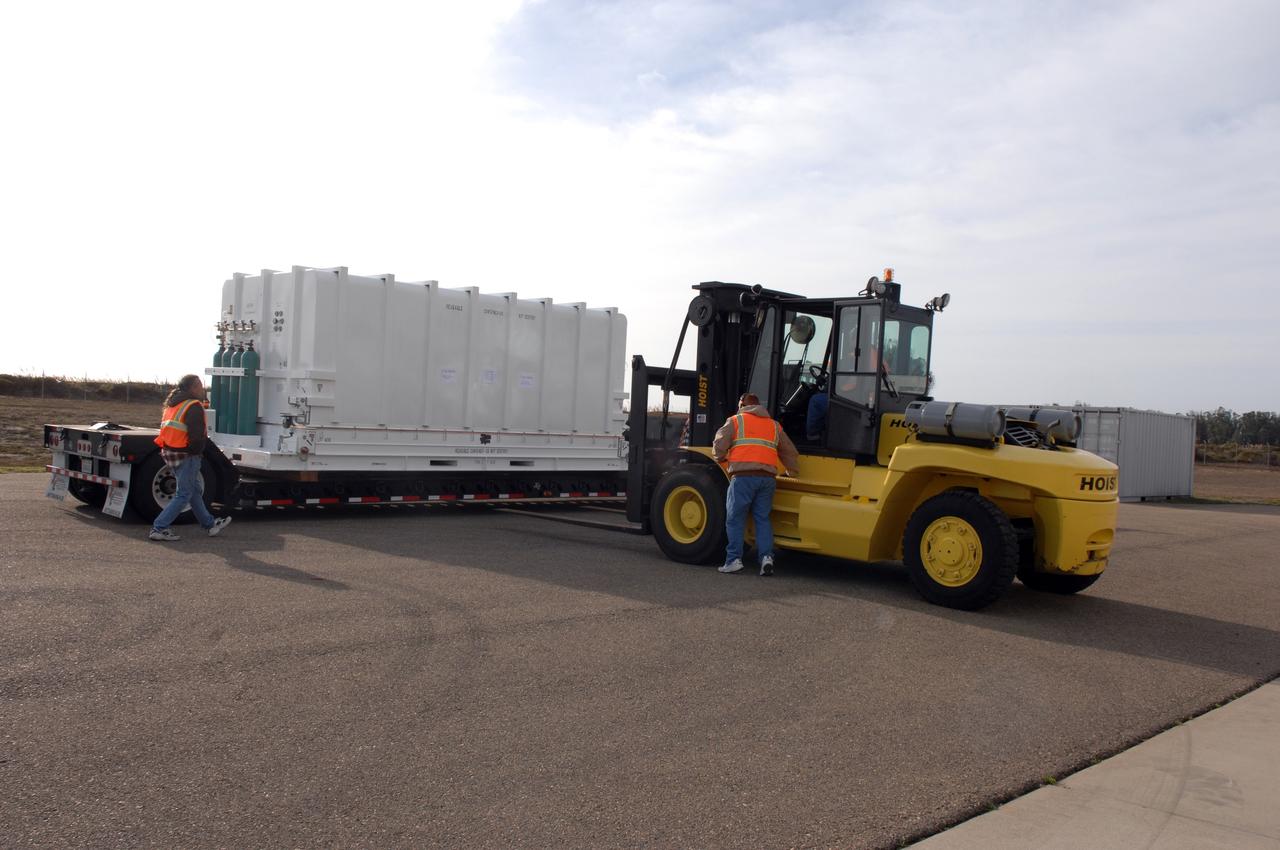
VANDENBERG AIR FORCE BASE, Calif. – The latest polar-orbiting operational environmental weather satellite developed by NASA for the National Oceanic and Atmospheric Administration, called NOAA-N Prime, is offloaded from the trailer at Vandenberg Air Force Base, Calif. The spacecraft will be moved into a NASA payload processing facility and prepared for a Feb. 4 launch. NOAA-N Prime, built by Lockheed Martin, is similar to NOAA-N launched on May 20, 2005.
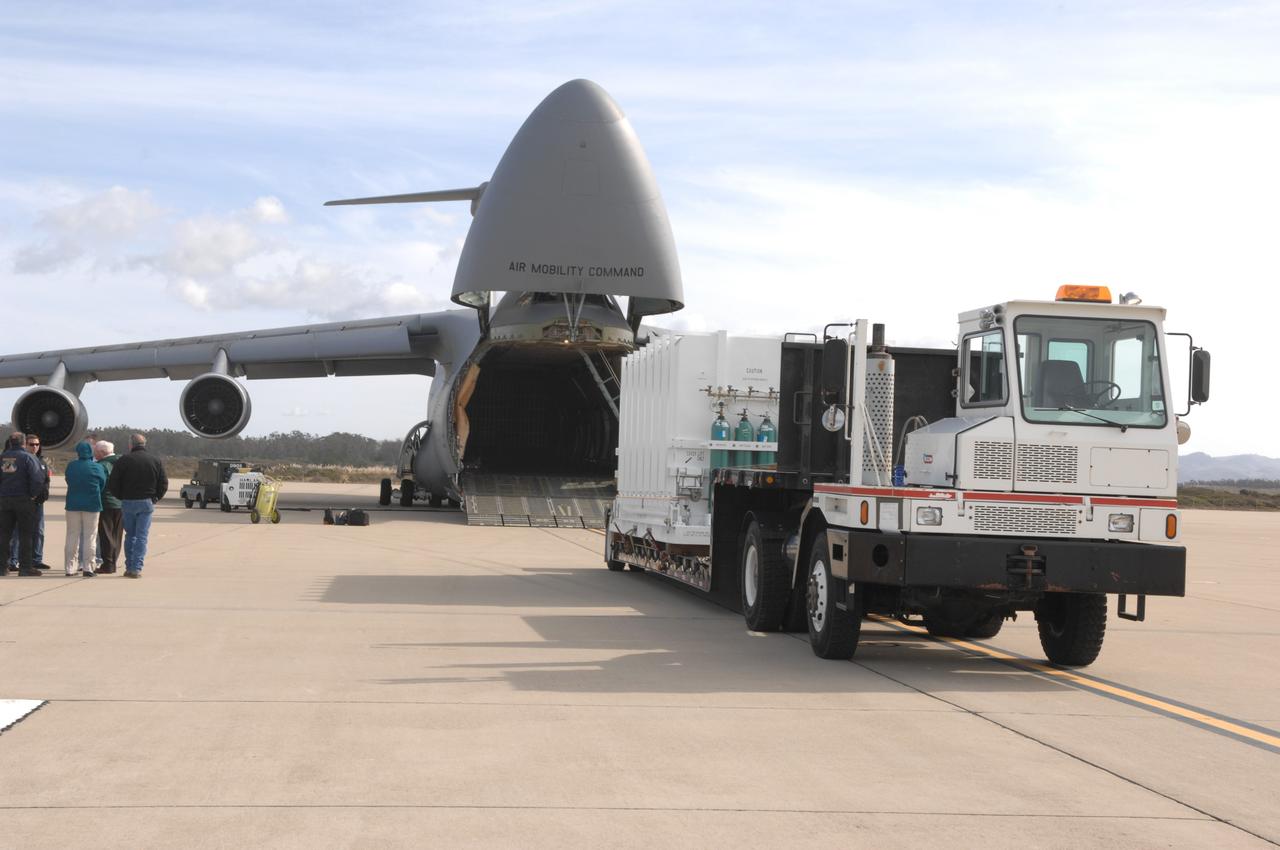
VANDENBERG AIR FORCE BASE, Calif. – The latest polar-orbiting operational environmental weather satellite developed by NASA for the National Oceanic and Atmospheric Administration, called NOAA-N Prime, is offloaded from the C-5A military cargo aircraft at Vandenberg Air Force Base, Calif., in preparation for a Feb. 4 launch. NOAA-N Prime, built by Lockheed Martin, is similar to NOAA-N launched on May 20, 2005.
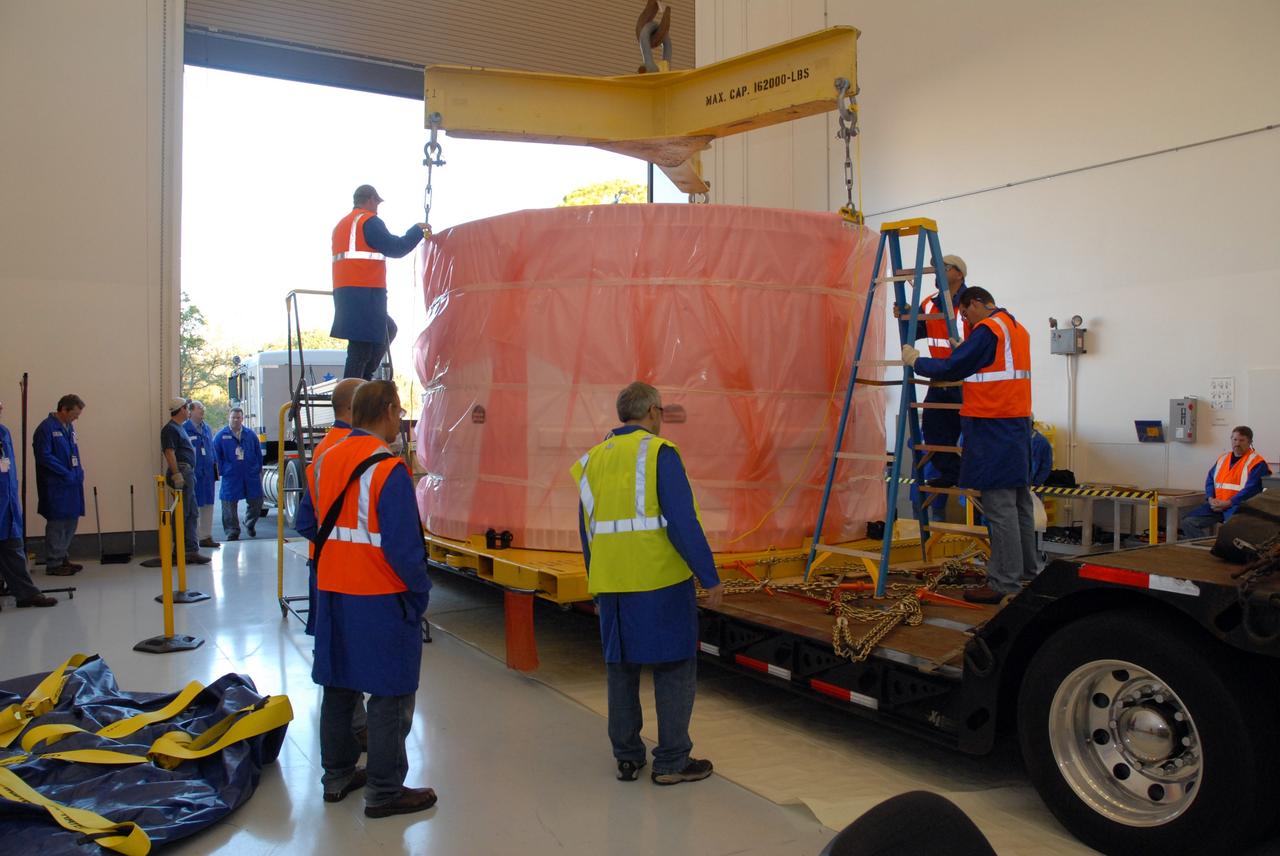
CAPE CANAVERAL, Fla. – At Astrotech in Titusville, Fla., the bagged fifth segment simulator of the Ares I-X is placed on a transporter. The segment will be transferred to the Vehicle Assembly Building's extended duration orbiter lab, or EDO, at NASA's Kennedy Space Center in Florida for stacking operations. Ares I-X is the test vehicle for the Ares I, which is part of the Constellation Program to return men to the moon and beyond. Ares I is the essential core of a safe, reliable, cost-effective space transportation system that eventually will carry crewed missions back to the moon, on to Mars and out into the solar system. Ares I-X is targeted for launch in July 2009. Photo credit: NASA/Tim Jacobs

VANDENBERG AIR FORCE BASE, Calif. – The latest polar-orbiting operational environmental weather satellite developed by NASA for the National Oceanic and Atmospheric Administration, called NOAA-N Prime, is being offloaded from the C-5A military cargo aircraft at Vandenberg Air Force Base, Calif., in preparation for a Feb. 4 launch. NOAA-N Prime, built by Lockheed Martin, is similar to NOAA-N launched on May 20, 2005.

VANDENBERG AIR FORCE BASE, Calif. – The latest polar-orbiting operational environmental weather satellite developed by NASA for the National Oceanic and Atmospheric Administration, called NOAA-N Prime, arrived by C-5A military cargo aircraft at Vandenberg Air Force Base, Calif., in preparation for a Feb. 4 launch. NOAA-N Prime, built by Lockheed Martin, is similar to NOAA-N launched on May 20, 2005.
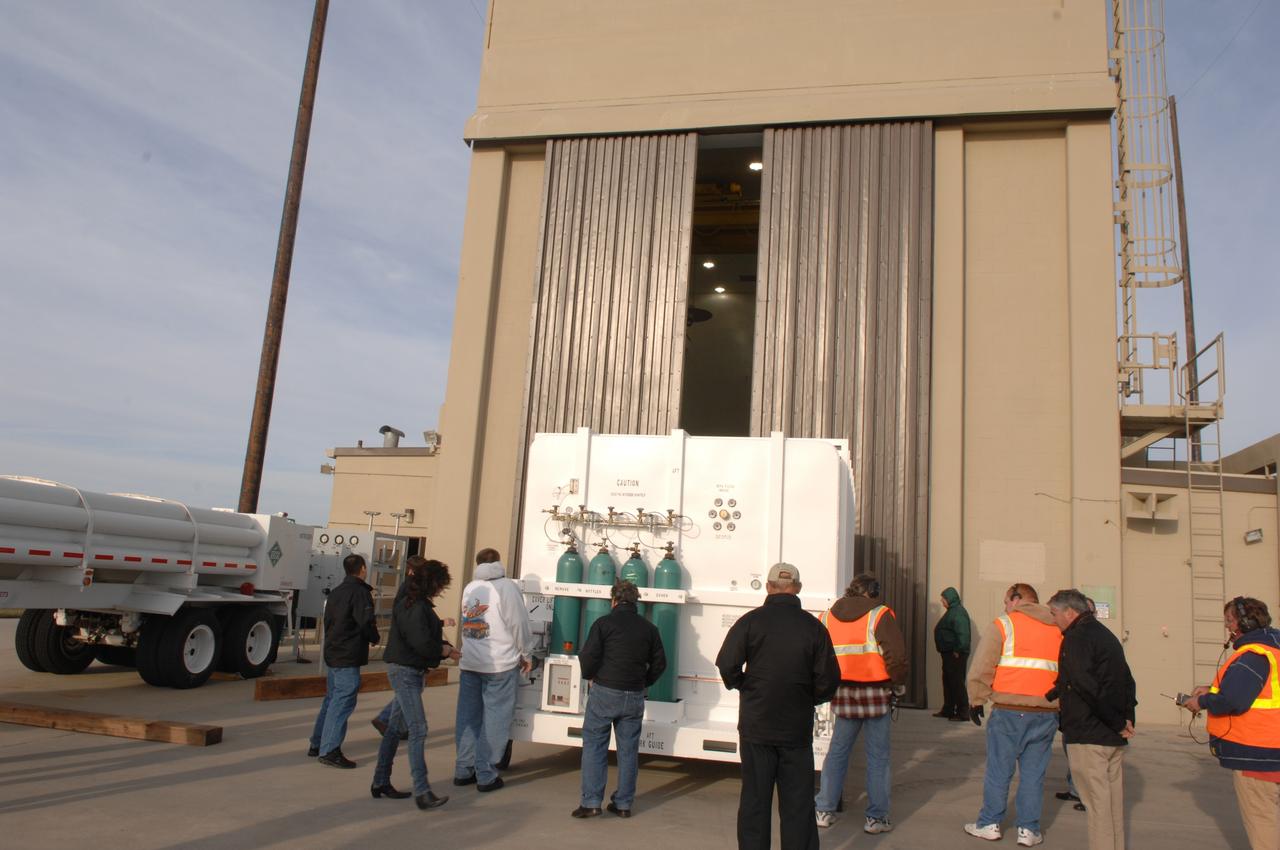
VANDENBERG AIR FORCE BASE, Calif. – The latest polar-orbiting operational environmental weather satellite developed by NASA for the National Oceanic and Atmospheric Administration, called NOAA-N Prime, is moved into a NASA payload processing facility to be prepared for a Feb. 4 launch. NOAA-N Prime, built by Lockheed Martin, is similar to NOAA-N launched on May 20, 2005.
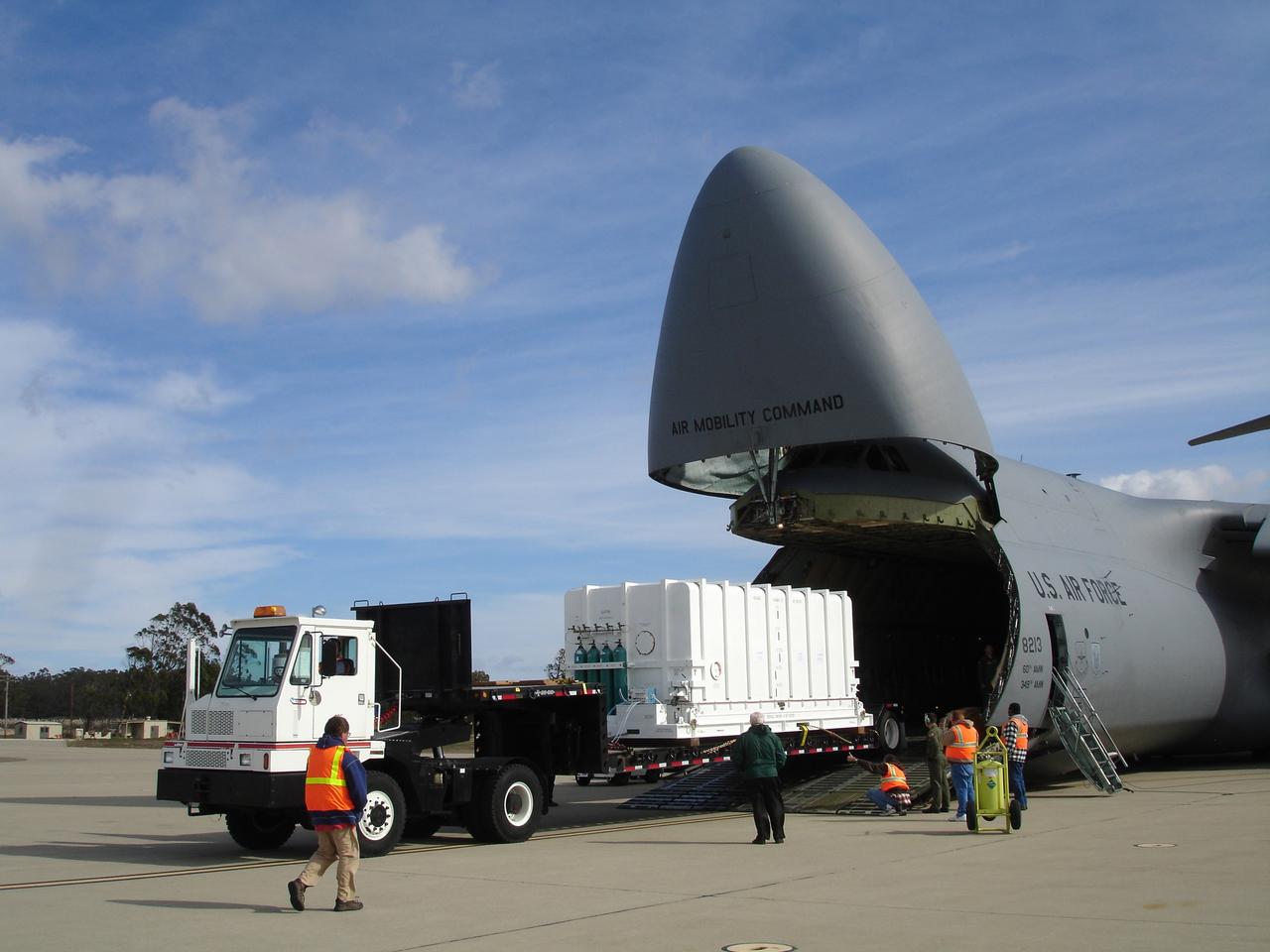
VANDENBERG AIR FORCE BASE, Calif. – The NOAA-N Prime spacecraft is offloaded from a C-5 aircraft after arrival at Vandenberg Air Force Base Airfield in California. NOAA-N Prime was built by Lockheed Martin Space Systems Company for its Advanced Television Infrared Observational Satellites -N series. It is the latest polar-orbiting operational environmental weather satellite developed by NASA for the National Oceanic and Atmospheric Administration. The satellite will provide a platform to support environmental monitoring instruments for imaging and measuring the Earth's atmosphere, its surface and cloud cover, including Earth radiation, atmospheric ozone, aerosol distribution, sea surface temperature and vertical temperature and water profiles in the troposphere and stratosphere. The satellite will assist in measuring proton and electron fluxes at orbit altitude, collecting data from remote platforms to assist the Search and Rescue Satellite-Aided Tracking system. The satellite will be launched from the Western Range at Vandenberg AFB by a United Launch Alliance two-stage Delta II rocket managed by NASA's Launch Service Program at Kennedy. Photo credit: NASA/Jerry Nagy, VAFB