
KENNEDY SPACE CENTER, FLA. - Inside Orbital Sciences’ Building 1555 at Vandenberg Air Force Base in California, the Pegasus XL launch vehicle is complete after mating with the Space Technology 5 (ST5). The ST5 contains three microsatellites, with miniaturized redundant components and technologies. Each will validate New Millennium Program selected technologies, such as the Cold Gas Micro-Thruster and X-Band Transponder Communication System. After deployment from the Pegasus, the micro-satellites will be positioned in a “string of pearls” constellation that demonstrates the ability to position them to perform simultaneous multi-point measurements of the magnetic field using highly sensitive magnetometers. The data will help scientists understand and map the intensity and direction of the Earth’s magnetic field, its relation to space weather events, and affects on our planet. With such missions, NASA hopes to improve scientists’ ability to accurately forecast space weather and minimize its harmful effects on space- and ground-based systems. Launch of ST5 is scheduled no earlier than March 6 from Vandenberg Air Force Base.

KENNEDY SPACE CENTER, FLA. - Inside Orbital Sciences’ Building 1555 at Vandenberg Air Force Base in California, the Pegasus XL launch vehicle is ready for mating with the Space Technology 5 (ST5) spacecraft. The ST5 contains three microsatellites with miniaturized redundant components and technologies. Each will validate New Millennium Program selected technologies, such as the Cold Gas Micro-Thruster and X-Band Transponder Communication System. After deployment from the Pegasus, the micro-satellites will be positioned in a “string of pearls” constellation that demonstrates the ability to position them to perform simultaneous multi-point measurements of the magnetic field using highly sensitive magnetometers. The data will help scientists understand and map the intensity and direction of the Earth’s magnetic field, its relation to space weather events, and affects on our planet. With such missions, NASA hopes to improve scientists’ ability to accurately forecast space weather and minimize its harmful effects on space- and ground-based systems. Launch of ST5 is scheduled no earlier than March 6 from Vandenberg Air Force Base.

KENNEDY SPACE CENTER, FLA. - Inside Orbital Sciences’ Building 1555 at Vandenberg Air Force Base in California, a worker examines the end of the Pegasus XL launch vehicle that will be mated with the Space Technology 5 (ST5) spacecraft. The ST5 contains three microsatellites with miniaturized redundant components and technologies. Each will validate New Millennium Program selected technologies, such as the Cold Gas Micro-Thruster and X-Band Transponder Communication System. After deployment from the Pegasus, the micro-satellites will be positioned in a “string of pearls” constellation that demonstrates the ability to position them to perform simultaneous multi-point measurements of the magnetic field using highly sensitive magnetometers. The data will help scientists understand and map the intensity and direction of the Earth’s magnetic field, its relation to space weather events, and affects on our planet. With such missions, NASA hopes to improve scientists’ ability to accurately forecast space weather and minimize its harmful effects on space- and ground-based systems. Launch of ST5 is scheduled no earlier than March 6 from Vandenberg Air Force Base.

KENNEDY SPACE CENTER, FLA. - Inside Orbital Sciences’ Building 1555 at Vandenberg Air Force Base in California, workers begin the mating process of the Space Technology 5 (ST5), at right, with the Pegasus XL launch vehicle, at left. The ST5 contains three microsatellites, with miniaturized redundant components and technologies. Each will validate New Millennium Program selected technologies, such as the Cold Gas Micro-Thruster and X-Band Transponder Communication System. After deployment from the Pegasus, the micro-satellites will be positioned in a “string of pearls” constellation that demonstrates the ability to position them to perform simultaneous multi-point measurements of the magnetic field using highly sensitive magnetometers. The data will help scientists understand and map the intensity and direction of the Earth’s magnetic field, its relation to space weather events, and affects on our planet. With such missions, NASA hopes to improve scientists’ ability to accurately forecast space weather and minimize its harmful effects on space- and ground-based systems. Launch of ST5 is scheduled no earlier than March 6 from Vandenberg Air Force Base.
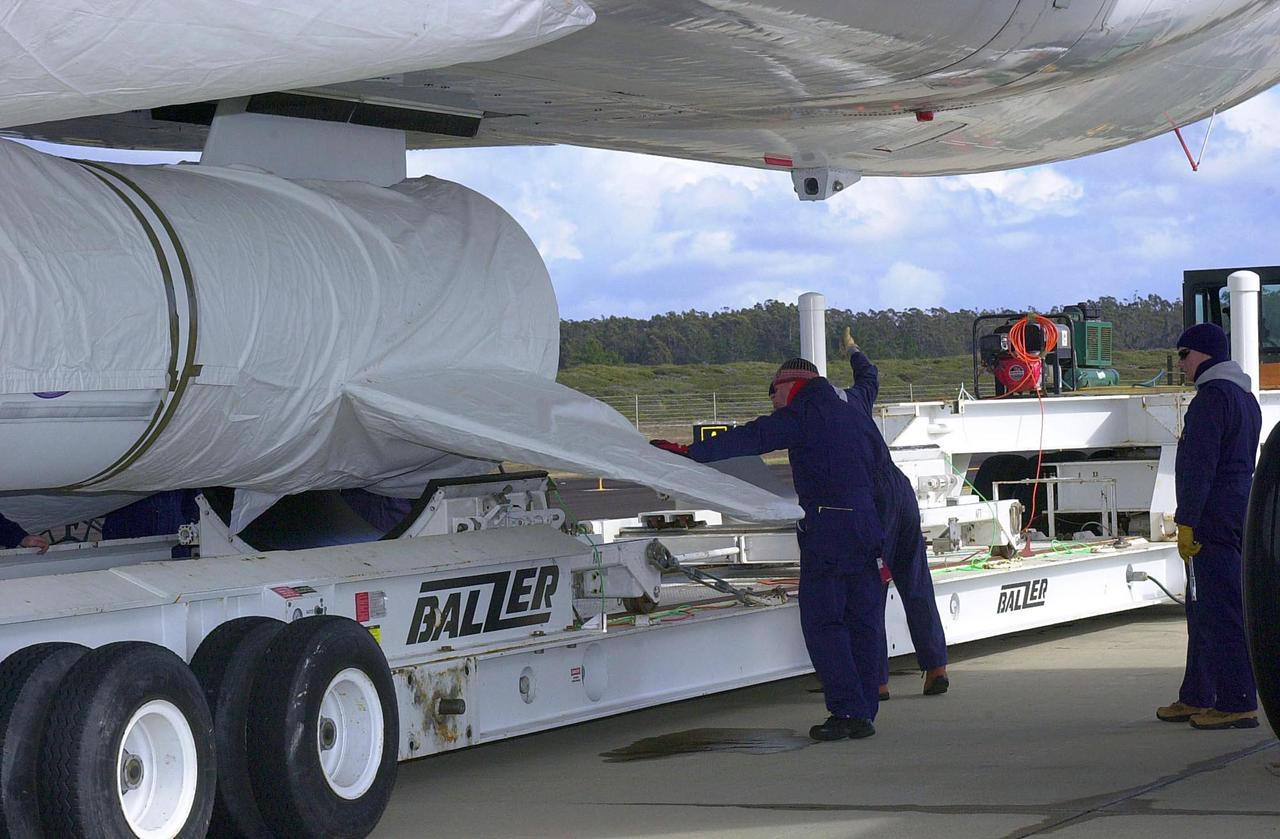
VANDENBERG AIR FORCE BASE, CALIF. - On the ramp adjacent to the runway at Vandenberg Air Force Base in California, workers secure the Space Technology 5's Pegasus rocket to the underside of an Orbital Sciences L-1011 carrier aircraft. The ST5, which contains three microsatellites with miniaturized redundant components and technologies, is mated to its launch vehicle, Orbital Sciences' Pegasus XL. Each of the ST5 microsatellites will validate New Millennium Program selected technologies, such as the Cold Gas Micro-Thruster and X-Band Transponder Communication System. After deployment from the Pegasus, the micro-satellites will be positioned in a “string of pearls” constellation that demonstrates the ability to position them to perform simultaneous multi-point measurements of the magnetic field using highly sensitive magnetometers. The data will help scientists understand and map the intensity and direction of the Earth’s magnetic field, its relation to space weather events, and affects on our planet. Launch of ST5 and the Pegasus XL will be from underneath the belly of an L-1011 carrier aircraft from Vandenberg Air Force Base.

VANDENBERG AIR FORCE BASE, CALIF. - Workers prepare to transport the Space Technology 5 (ST5) spacecraft from Orbital Sciences’ Building 1555 at Vandenberg Air Force Base in California to the L-1011 carrier aircraft in position on the ramp adjacent to the Vandenberg runway. The ST5, which contains three microsatellites with miniaturized redundant components and technologies, is mated to its launch vehicle, Orbital Sciences' Pegasus XL. Each of the ST5 microsatellites will validate New Millennium Program selected technologies, such as the Cold Gas Micro-Thruster and X-Band Transponder Communication System. After deployment from the Pegasus, the micro-satellites will be positioned in a “string of pearls” constellation that demonstrates the ability to position them to perform simultaneous multi-point measurements of the magnetic field using highly sensitive magnetometers. The data will help scientists understand and map the intensity and direction of the Earth’s magnetic field, its relation to space weather events, and affects on our planet. Launch of ST5 and the Pegasus XL will be from underneath the belly of an L-1011 carrier aircraft from Vandenberg Air Force Base.
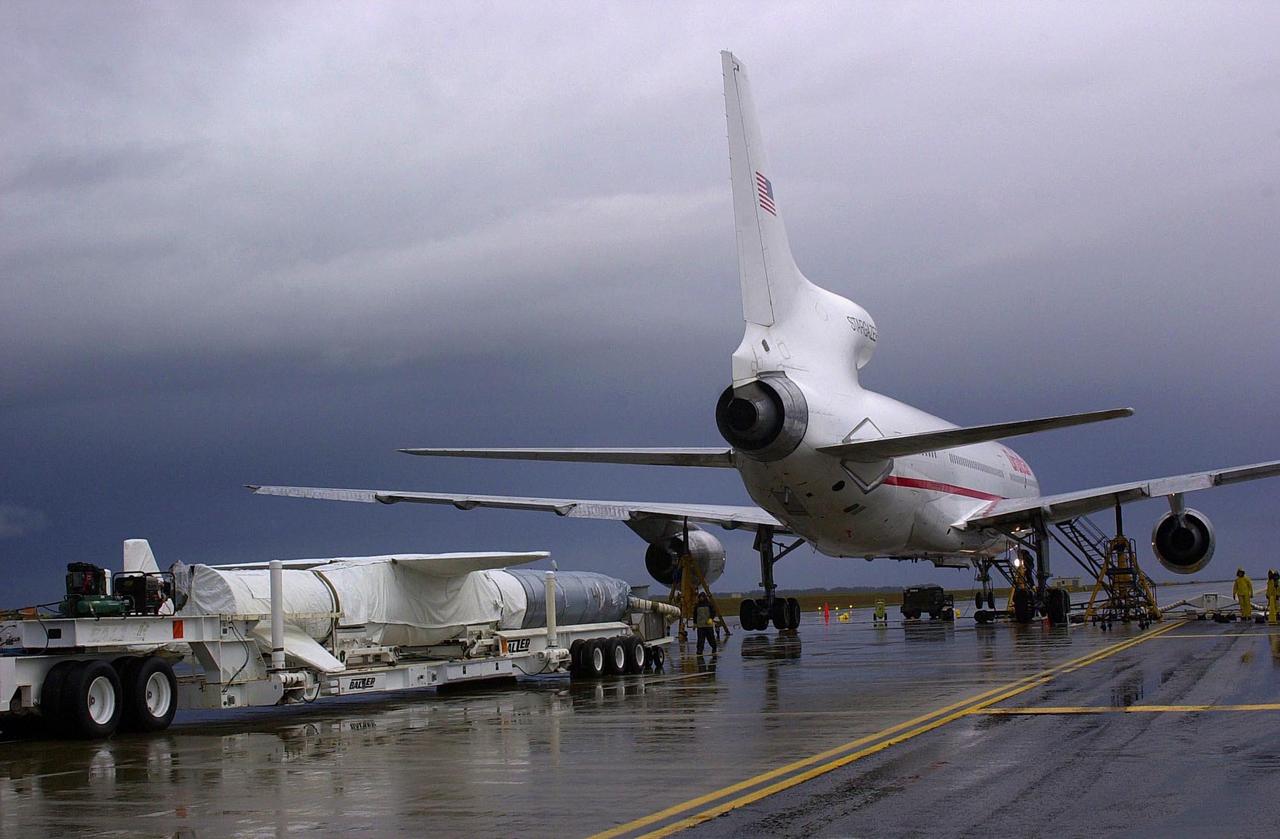
VANDENBERG AIR FORCE BASE, CALIF. - On the ramp adjacent to the runway at Vandenberg Air Force Base in California, the Space Technology 5's Pegasus rocket is placed in position to be mated to the underside of an Orbital Sciences L-1011 carrier aircraft. The ST5, which contains three microsatellites with miniaturized redundant components and technologies, is mated to its launch vehicle, Orbital Sciences' Pegasus XL. Each of the ST5 microsatellites will validate New Millennium Program selected technologies, such as the Cold Gas Micro-Thruster and X-Band Transponder Communication System. After deployment from the Pegasus, the micro-satellites will be positioned in a “string of pearls” constellation that demonstrates the ability to position them to perform simultaneous multi-point measurements of the magnetic field using highly sensitive magnetometers. The data will help scientists understand and map the intensity and direction of the Earth’s magnetic field, its relation to space weather events, and affects on our planet. Launch of ST5 and the Pegasus XL will be from underneath the belly of an L-1011 carrier aircraft from Vandenberg Air Force Base.
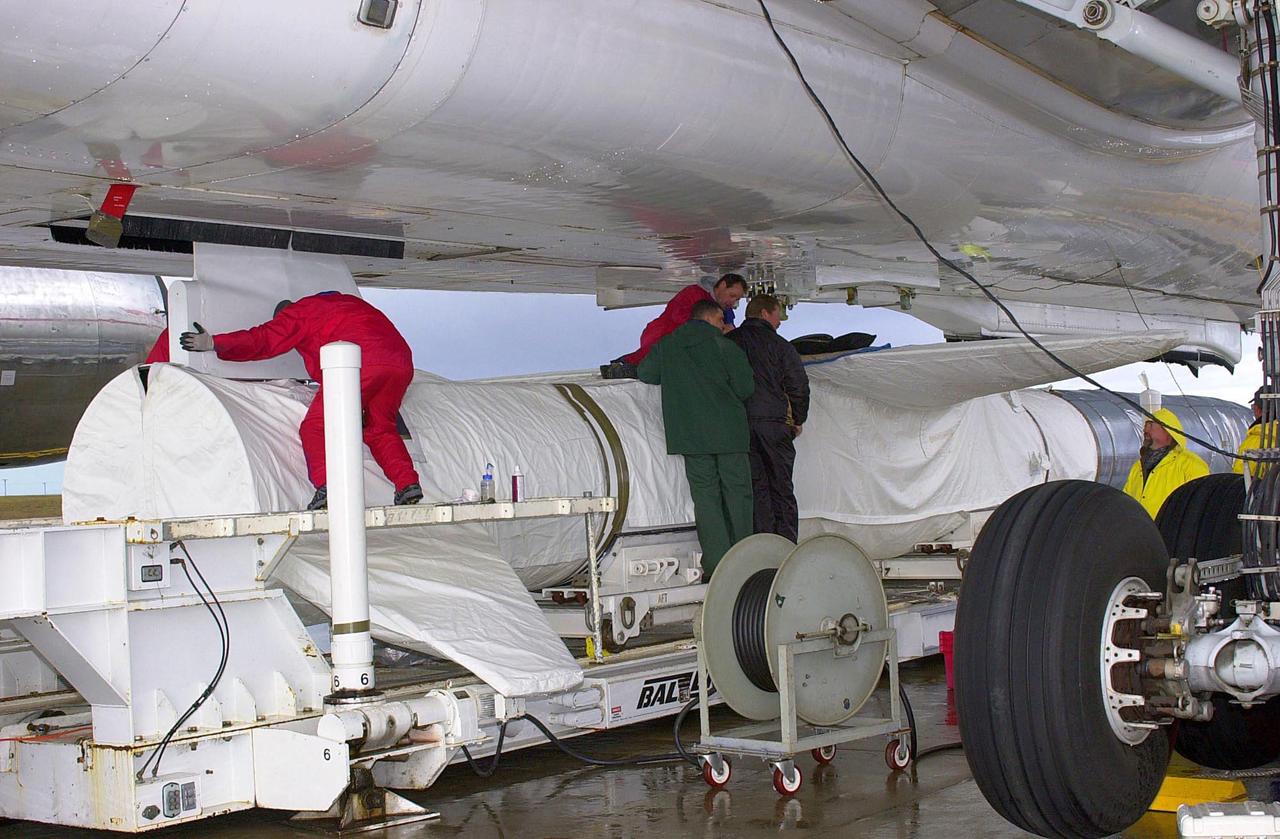
VANDENBERG AIR FORCE BASE, CALIF. - On the ramp adjacent to the runway at Vandenberg Air Force Base in California, a worker positions the vertical fin within the Orbital Sciences L-1011 aircraft. The fin will then be attached to the Space Technology 5's Pegasus rocket which will be mated to the underside of the carrier aircraft. The ST5, which contains three microsatellites with miniaturized redundant components and technologies, is mated to its launch vehicle, Orbital Sciences' Pegasus XL. Each of the ST5 microsatellites will validate New Millennium Program selected technologies, such as the Cold Gas Micro-Thruster and X-Band Transponder Communication System. After deployment from the Pegasus, the micro-satellites will be positioned in a “string of pearls” constellation that demonstrates the ability to position them to perform simultaneous multi-point measurements of the magnetic field using highly sensitive magnetometers. The data will help scientists understand and map the intensity and direction of the Earth’s magnetic field, its relation to space weather events, and affects on our planet. Launch of ST5 and the Pegasus XL will be from underneath the belly of an L-1011 carrier aircraft from Vandenberg Air Force Base.
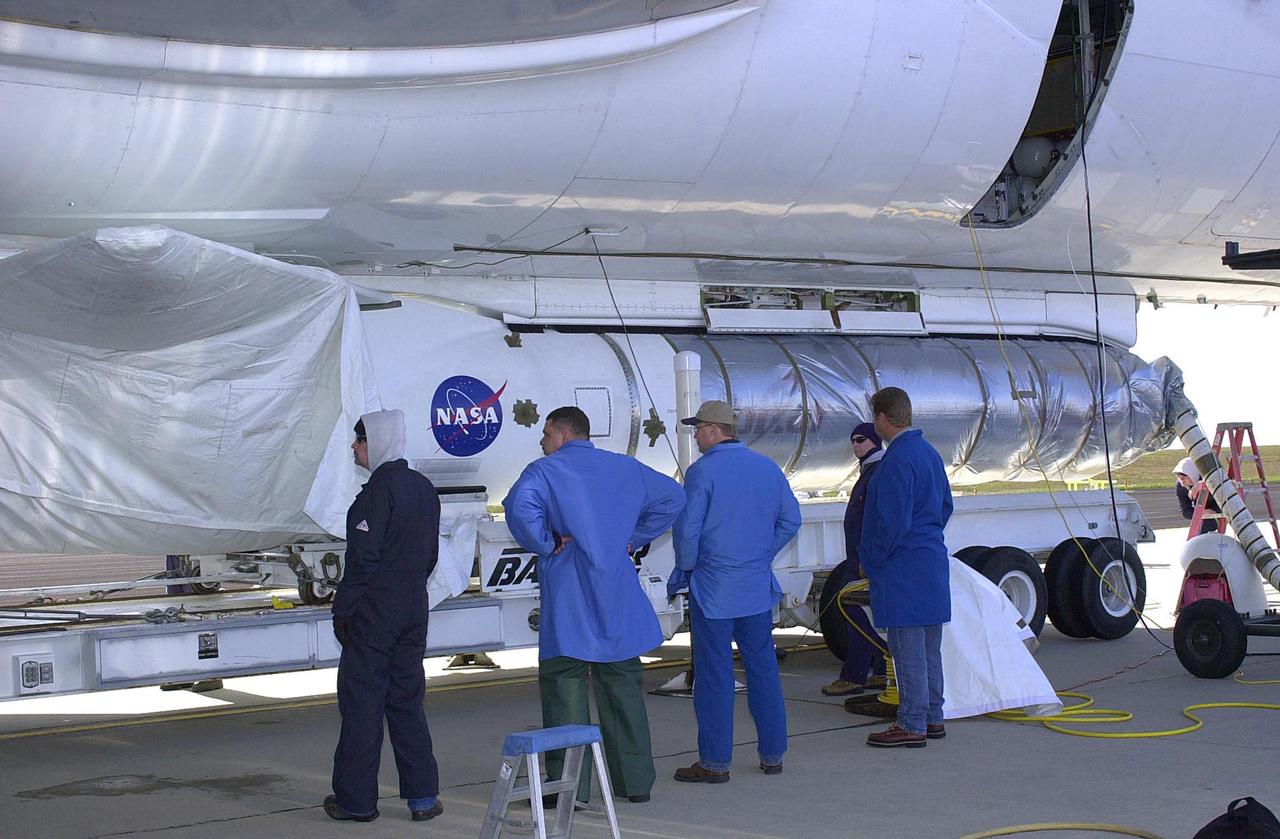
VANDENBERG AIR FORCE BASE, CALIF. - On the ramp adjacent to the runway at Vandenberg Air Force Base in California, workers install the Space Technology 5's Pegasus rocket beneath an Orbital Sciences L-1011 carrier aircraft. The ST5, which contains three microsatellites with miniaturized redundant components and technologies, is mated to its launch vehicle, Orbital Sciences' Pegasus XL. Each of the ST5 microsatellites will validate New Millennium Program selected technologies, such as the Cold Gas Micro-Thruster and X-Band Transponder Communication System. After deployment from the Pegasus, the micro-satellites will be positioned in a “string of pearls” constellation that demonstrates the ability to position them to perform simultaneous multi-point measurements of the magnetic field using highly sensitive magnetometers. The data will help scientists understand and map the intensity and direction of the Earth’s magnetic field, its relation to space weather events, and affects on our planet. Launch of ST5 and the Pegasus XL will be from underneath the belly of an L-1011 carrier aircraft from Vandenberg Air Force Base.