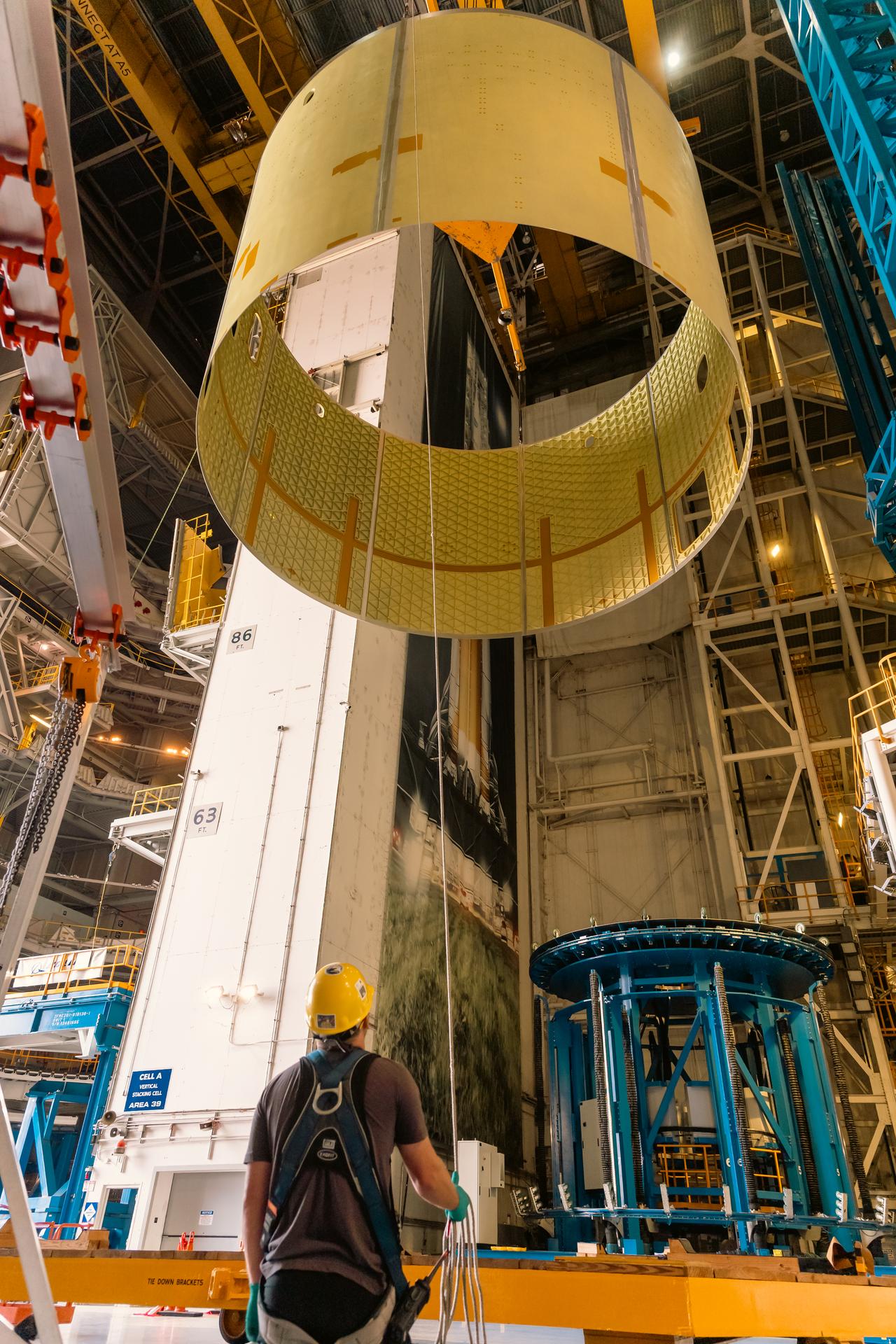
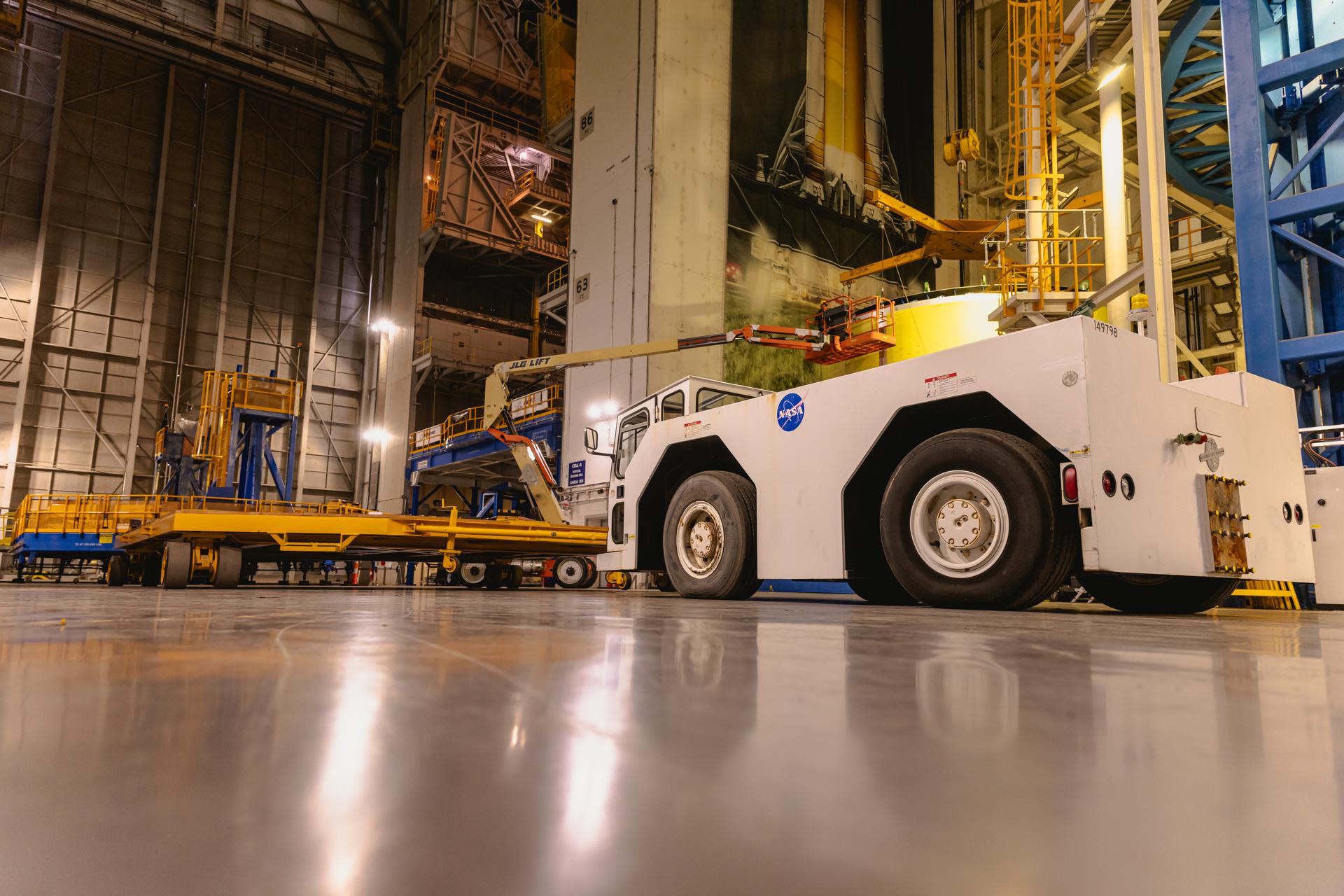
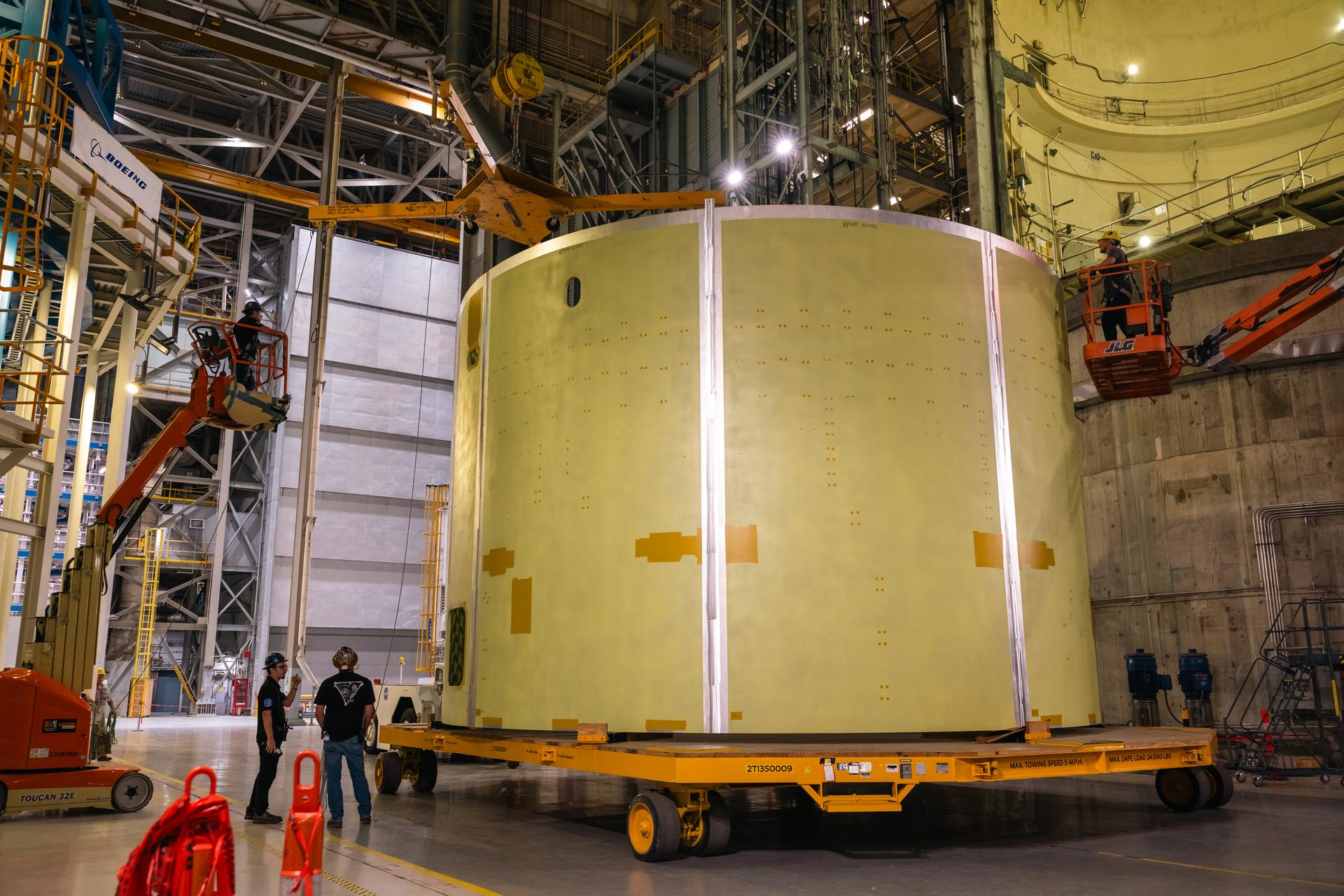
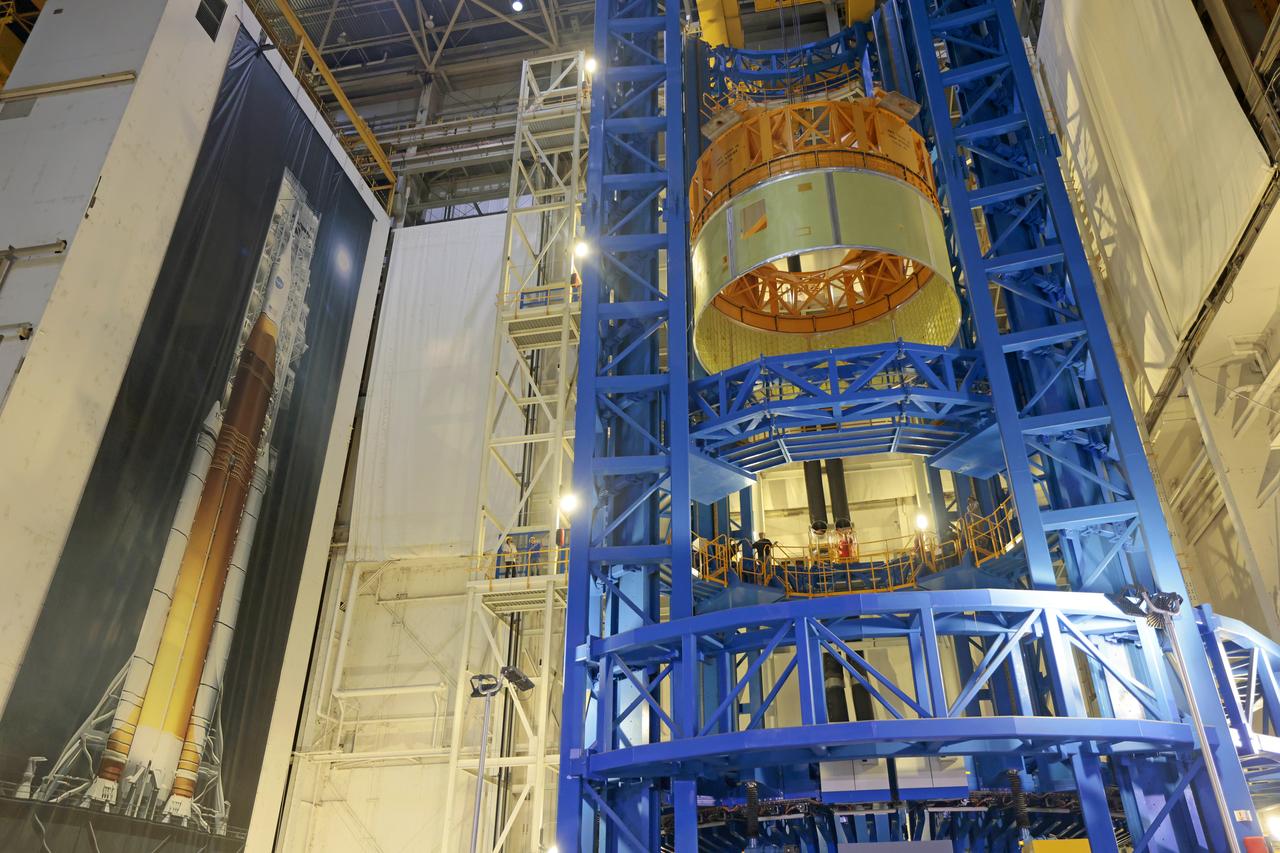
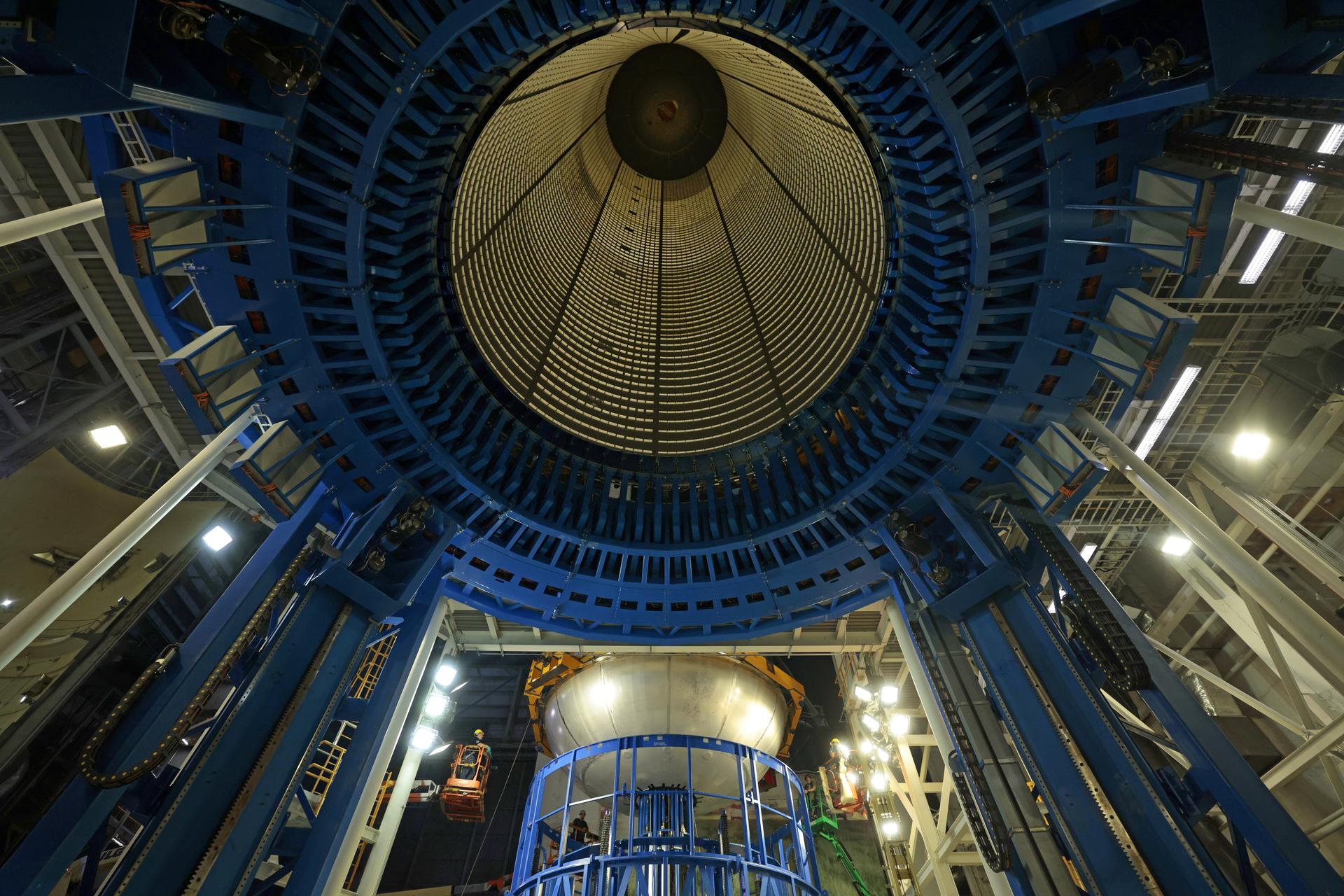
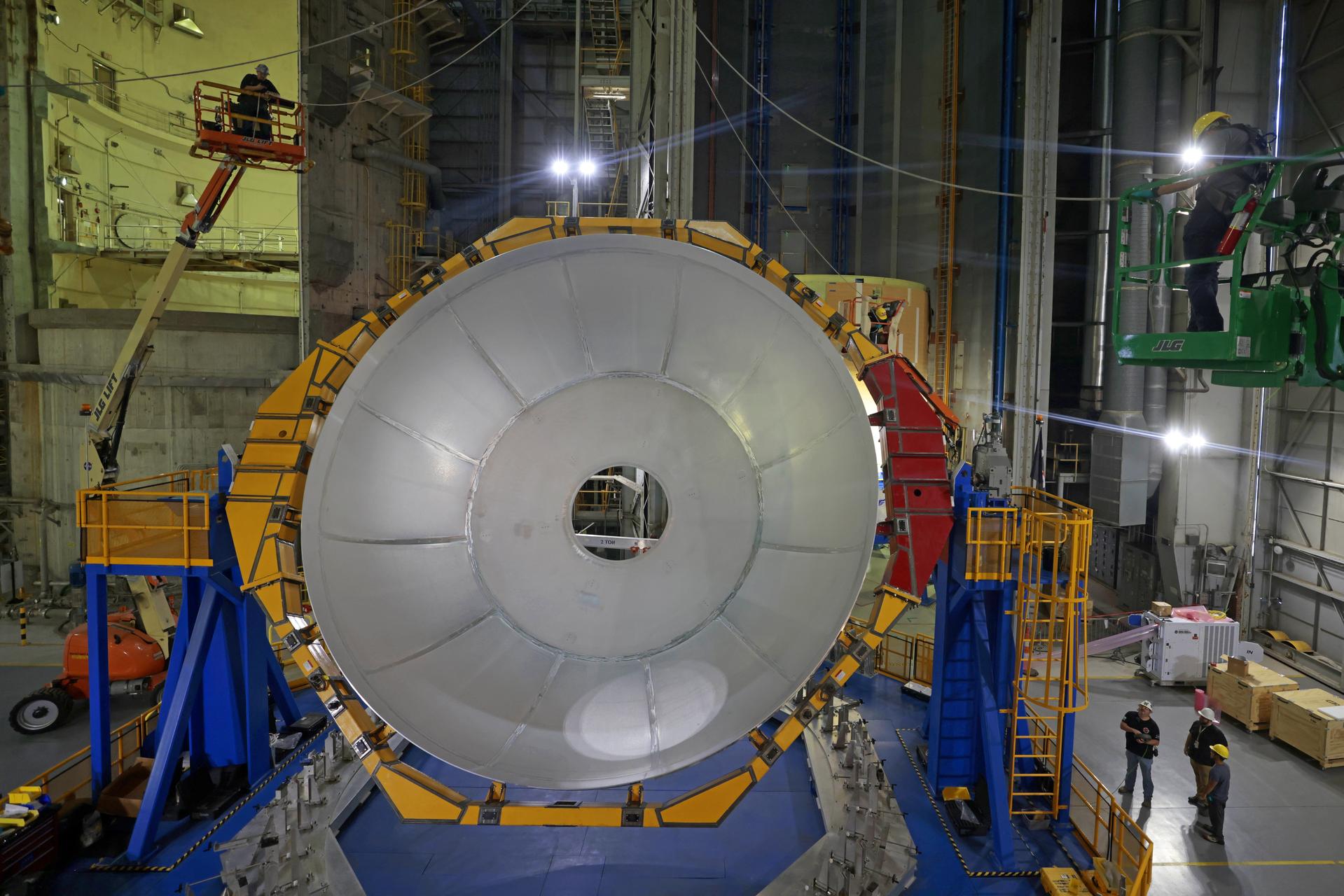
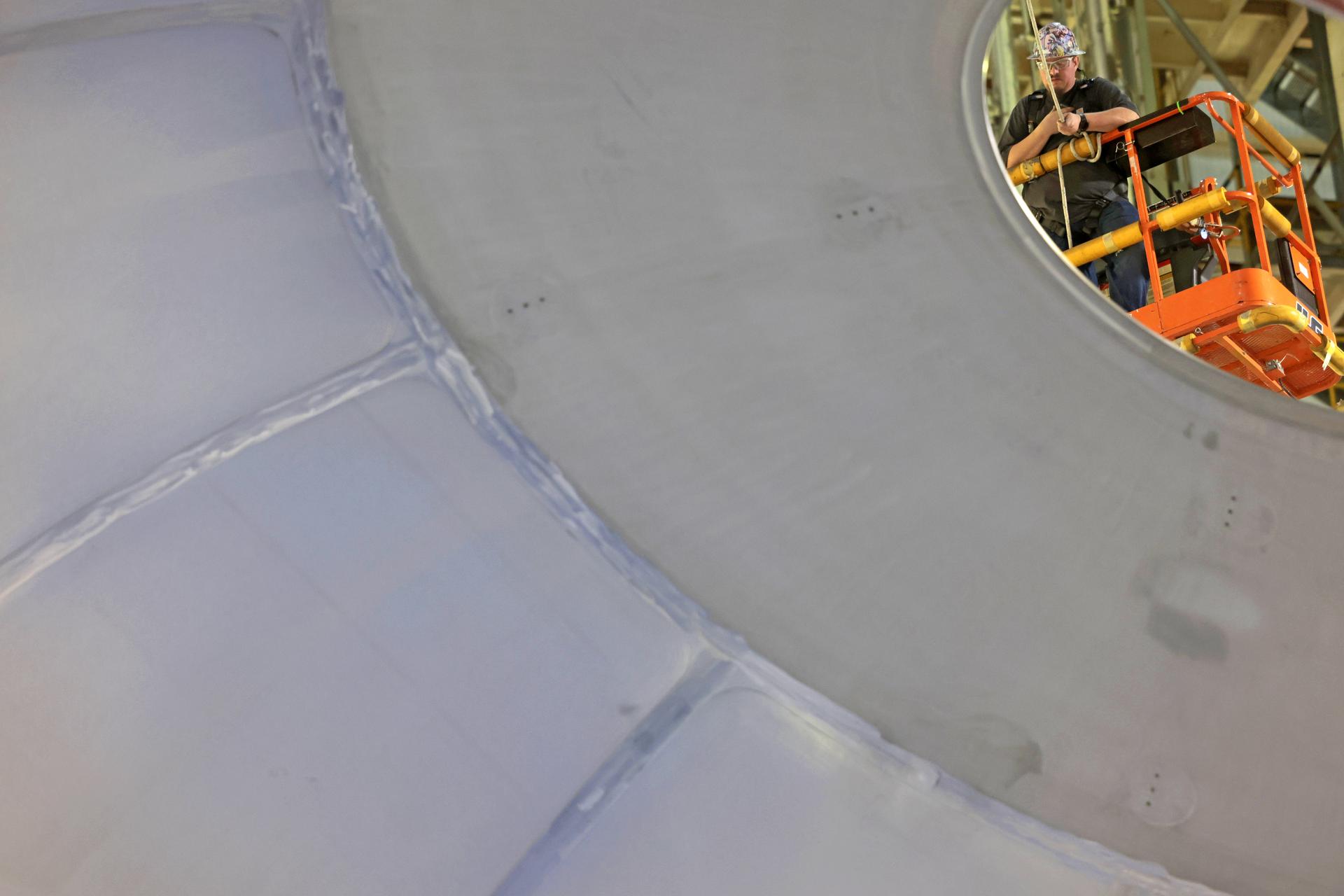
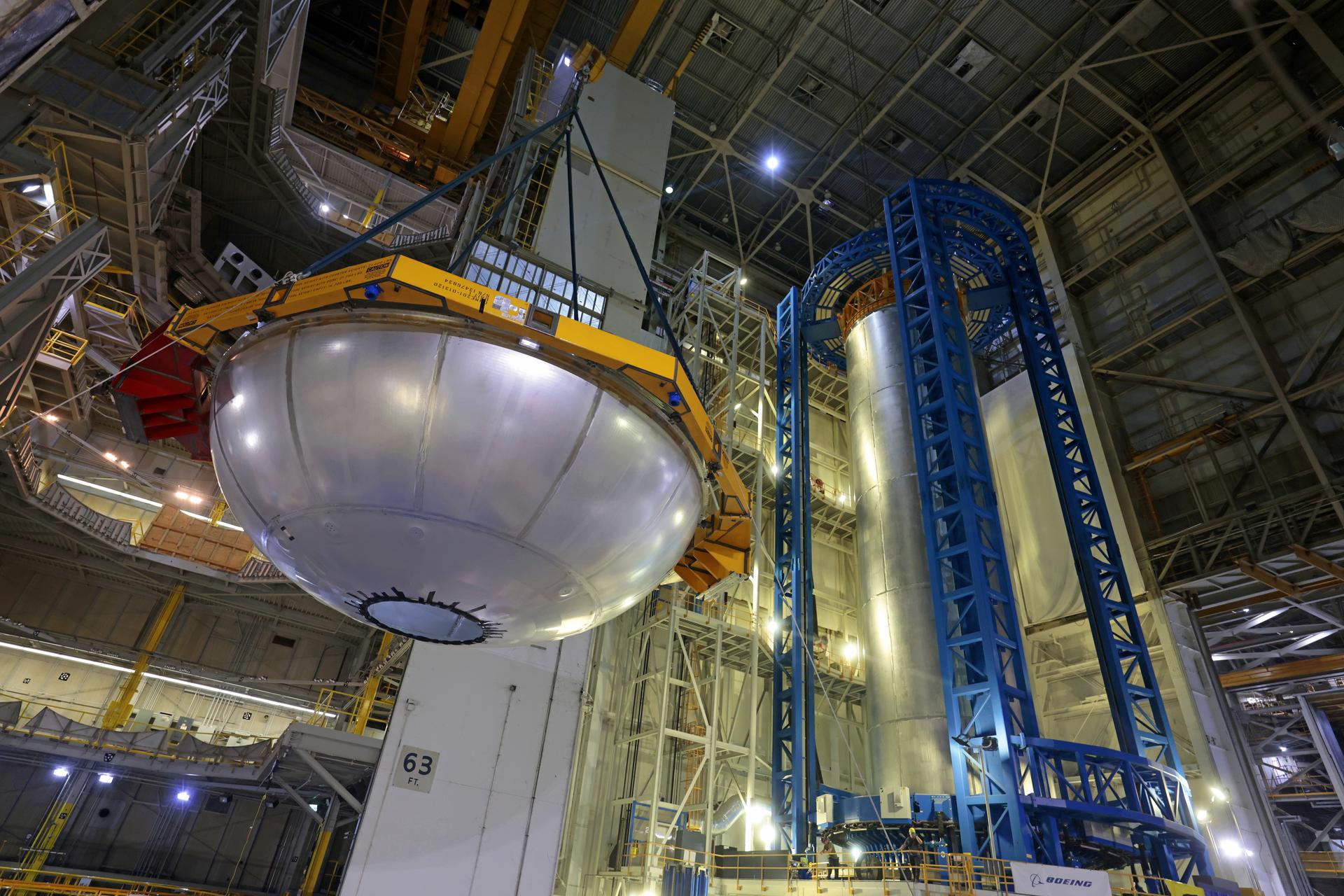
Teams at Michoud Assembly Facility in New Orleans load the engine section barrel into the vertical assembly center on Aug. 5, 2026. The engine section will be used on the SLS (Space Launch System) rocket’s core stage for the agency’s Artemis V mission. On the vertical assembly center tooling, teams will mate the flight hardware to a ring, which will serve as an attachment point for the liquid hydrogen tank later in the production process. The engine section is one of five major elements that make up the 212-foot-tall SLS rocket stage; and houses various avionic systems, the engine thrust structure, and four RS-25 engines. The core stage produces more than two million pounds of thrust to help launch NASA’s Orion spacecraft, astronauts, and supplies beyond Earth’s orbit and to the lunar surface for Artemis.
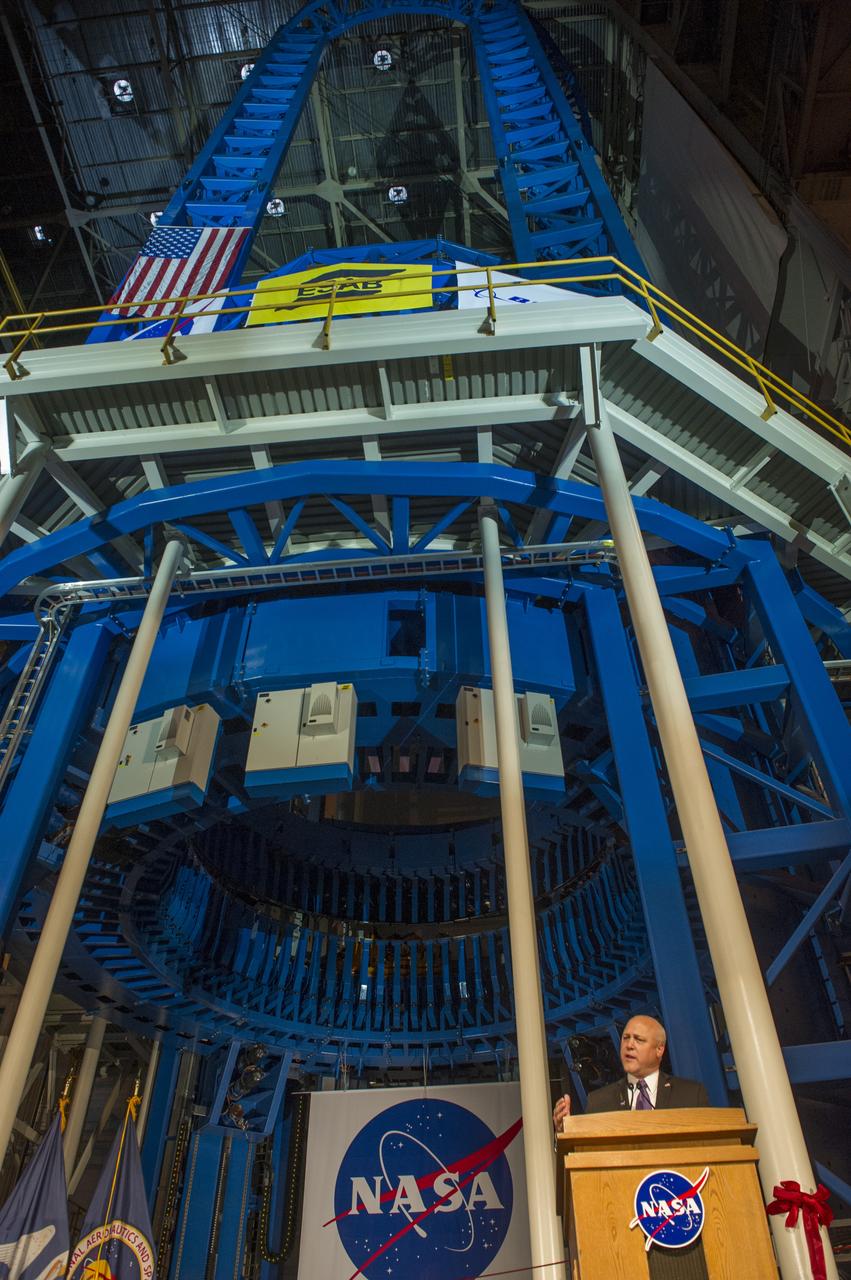
NEW ORLEANS MAYOR MITCH LANDRIEU SPEAKS AT DEDICATION OF VERTICAL ASSEMBLY CENTER;
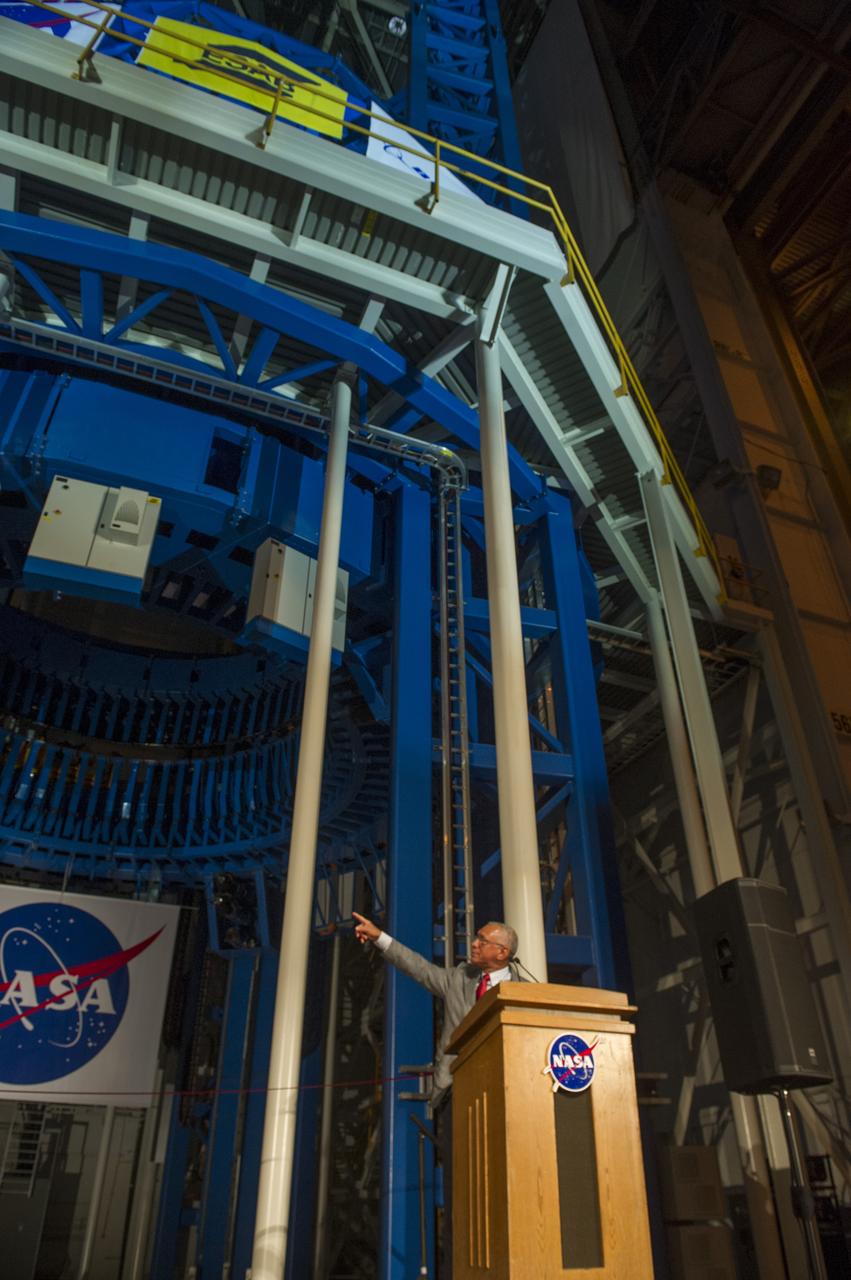
NASA ADMINISTRATOR BOLDEN SPEAKS AT DEDICATION OF VERTICAL ASSEMBLY CENTER
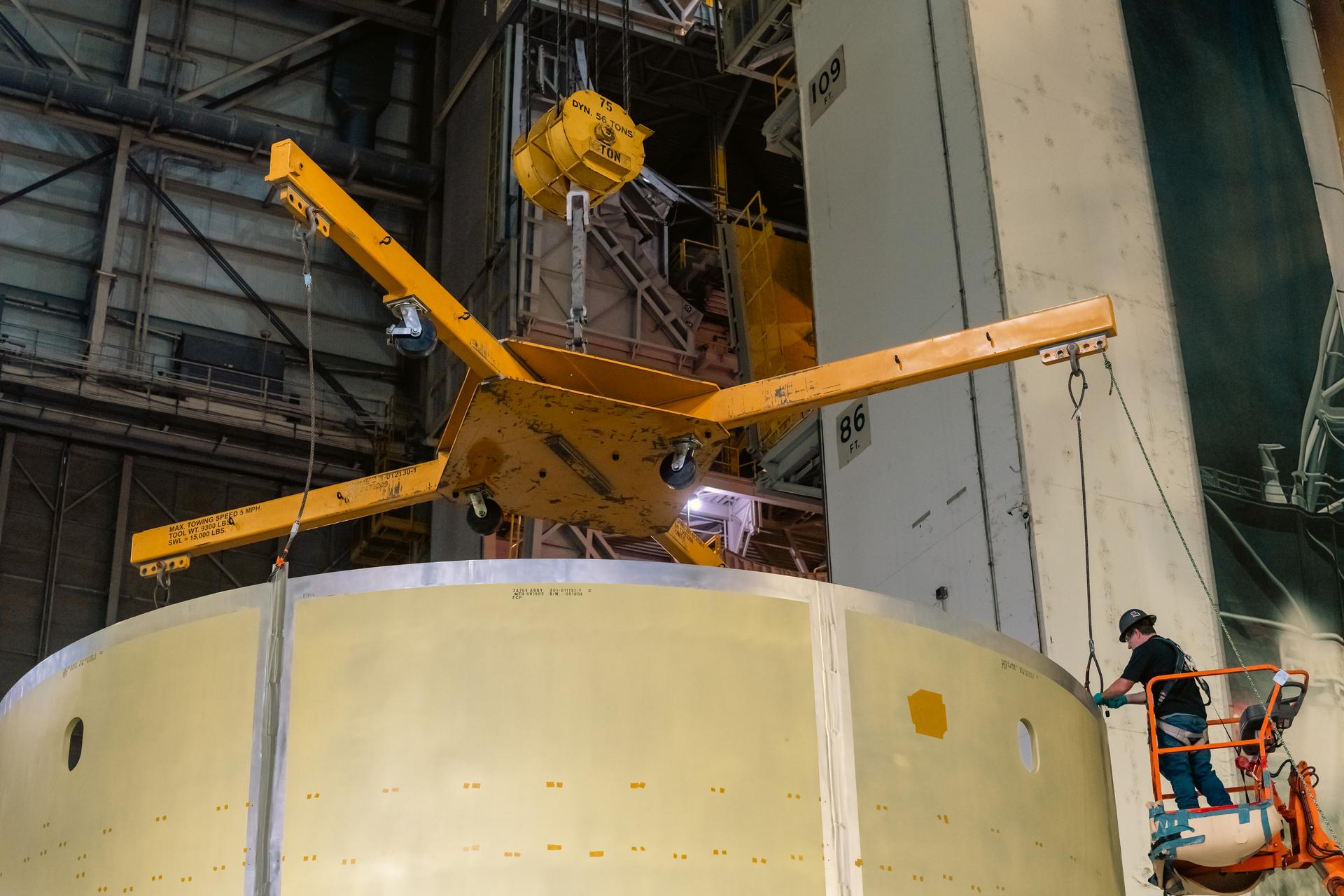
Teams at Michoud Assembly Facility in New Orleans load the engine section barrel into the vertical assembly center on Aug. 5, 2026. The engine section will be used on the SLS (Space Launch System) rocket’s core stage for the agency’s Artemis V mission. On the vertical assembly center tooling, teams will mate the flight hardware to a ring, which will serve as an attachment point for the liquid hydrogen tank later in the production process. The engine section is one of five major elements that make up the 212-foot-tall SLS rocket stage; and houses various avionic systems, the engine thrust structure, and four RS-25 engines. The core stage produces more than two million pounds of thrust to help launch NASA’s Orion spacecraft, astronauts, and supplies beyond Earth’s orbit and to the lunar surface for Artemis.
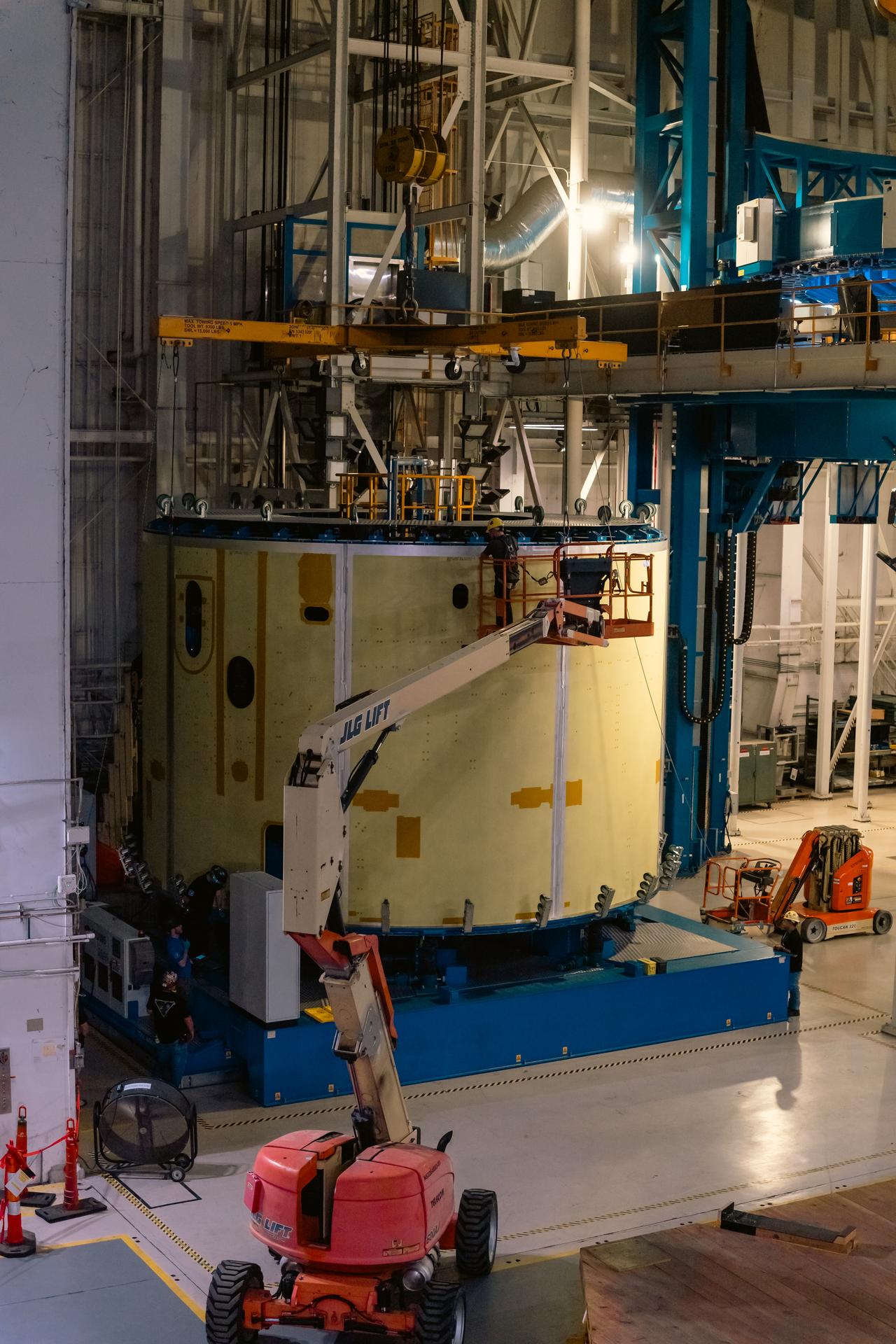
Teams at Michoud Assembly Facility in New Orleans load the 25-foot-long engine section barrel into the vertical assembly center on Aug. 5, 2026. The engine section will be used on the SLS (Space Launch System) rocket’s core stage for the agency’s Artemis V mission. On the vertical assembly center tooling, teams will mate the flight hardware to a ring, which will serve as an attachment point for the liquid hydrogen tank later in the production process. The engine section is one of five major elements that make up the 212-foot-tall SLS rocket stage; and houses various avionic systems, the engine thrust structure, and four RS-25 engines. The core stage produces more than two million pounds of thrust to help launch NASA’s Orion spacecraft, astronauts, and supplies beyond Earth’s orbit and to the lunar surface for Artemis.
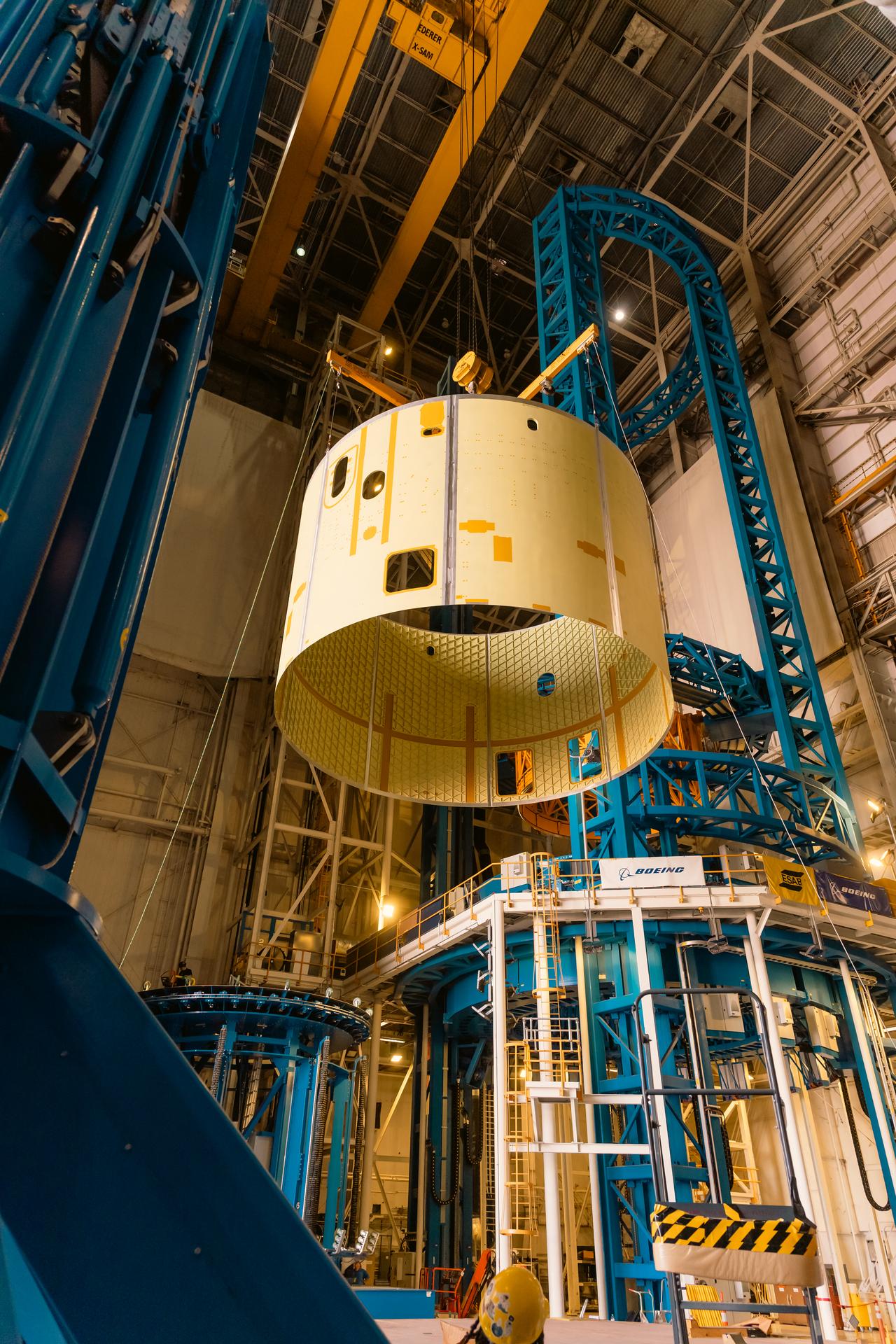
Teams at Michoud Assembly Facility in New Orleans load the engine section barrel into the vertical assembly center on Aug. 5, 2026. The engine section will be used on the SLS (Space Launch System) rocket’s core stage for the agency’s Artemis V mission. On the vertical assembly center tooling, teams will mate the flight hardware to a ring, which will serve as an attachment point for the liquid hydrogen tank later in the production process. The engine section is one of five major elements that make up the 212-foot-tall SLS rocket stage; and houses various avionic systems, the engine thrust structure, and four RS-25 engines. The core stage produces more than two million pounds of thrust to help launch NASA’s Orion spacecraft, astronauts, and supplies beyond Earth’s orbit and to the lunar surface for Artemis.
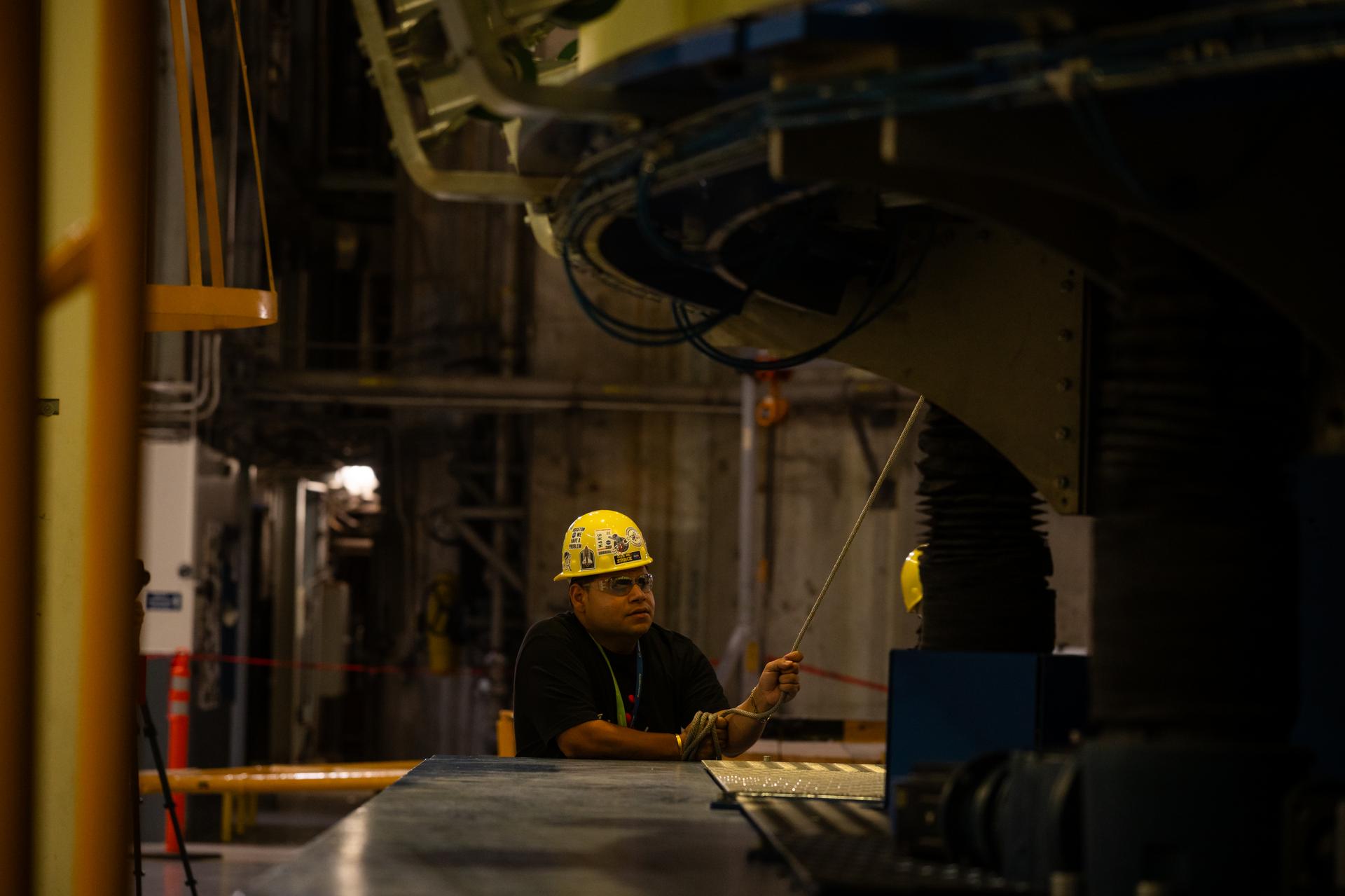
Teams at Michoud Assembly Facility in New Orleans load the engine section barrel into the vertical assembly center on Aug. 5, 2026. The engine section will be used on the SLS (Space Launch System) rocket’s core stage for the agency’s Artemis V mission. On the vertical assembly center tooling, teams will mate the flight hardware to a ring, which will serve as an attachment point for the liquid hydrogen tank later in the production process. The engine section is one of five major elements that make up the 212-foot-tall SLS rocket stage; and houses various avionic systems, the engine thrust structure, and four RS-25 engines. The core stage produces more than two million pounds of thrust to help launch NASA’s Orion spacecraft, astronauts, and supplies beyond Earth’s orbit and to the lunar surface for Artemis.
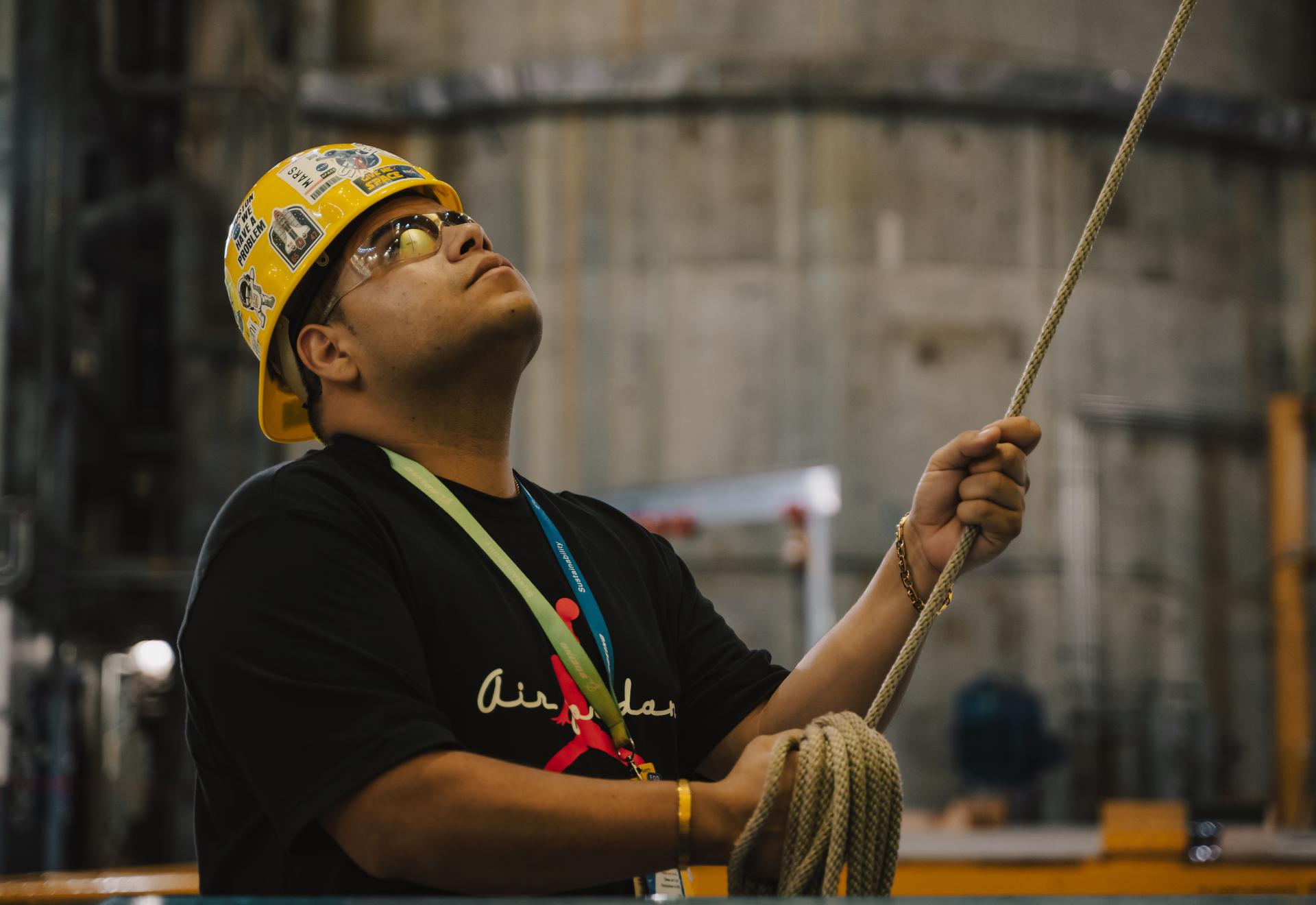
Teams at Michoud Assembly Facility in New Orleans load the engine section barrel into the vertical assembly center on Aug. 5, 2026. The engine section will be used on the SLS (Space Launch System) rocket’s core stage for the agency’s Artemis V mission. On the vertical assembly center tooling, teams will mate the flight hardware to a ring, which will serve as an attachment point for the liquid hydrogen tank later in the production process. The engine section is one of five major elements that make up the 212-foot-tall SLS rocket stage; and houses various avionic systems, the engine thrust structure, and four RS-25 engines. The core stage produces more than two million pounds of thrust to help launch NASA’s Orion spacecraft, astronauts, and supplies beyond Earth’s orbit and to the lunar surface for Artemis.
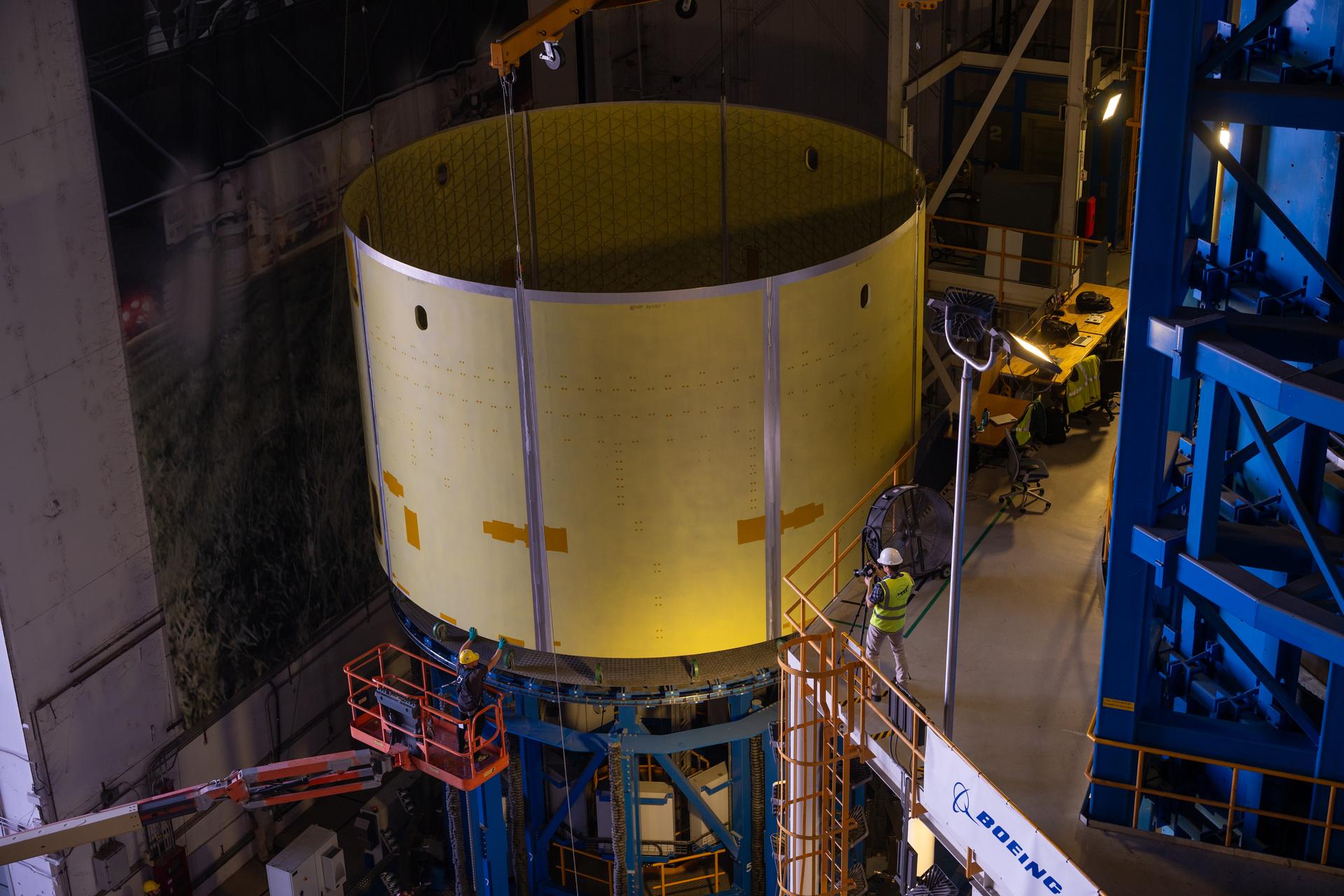
Teams at Michoud Assembly Facility in New Orleans load the engine section barrel into the vertical assembly center on Aug. 5, 2026. The engine section will be used on the SLS (Space Launch System) rocket’s core stage for the agency’s Artemis V mission. On the vertical assembly center tooling, teams will mate the flight hardware to a ring, which will serve as an attachment point for the liquid hydrogen tank later in the production process. The engine section is one of five major elements that make up the 212-foot-tall SLS rocket stage; and houses various avionic systems, the engine thrust structure, and four RS-25 engines. The core stage produces more than two million pounds of thrust to help launch NASA’s Orion spacecraft, astronauts, and supplies beyond Earth’s orbit and to the lunar surface for Artemis.
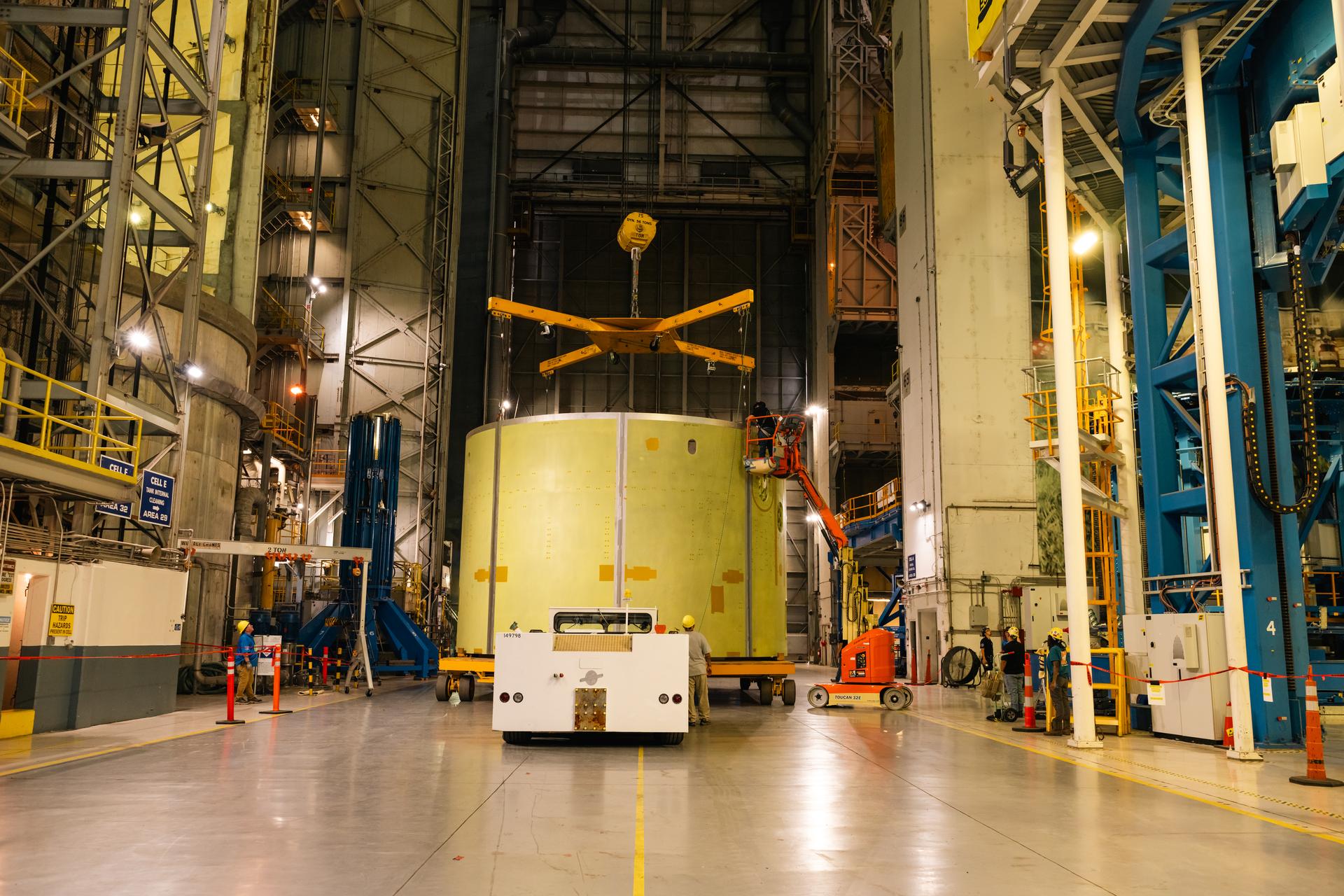
Teams at Michoud Assembly Facility in New Orleans load the engine section barrel into the vertical assembly center on Aug. 5, 2026. The engine section will be used on the SLS (Space Launch System) rocket’s core stage for the agency’s Artemis V mission. On the vertical assembly center tooling, teams will mate the flight hardware to a ring, which will serve as an attachment point for the liquid hydrogen tank later in the production process. The engine section is one of five major elements that make up the 212-foot-tall SLS rocket stage; and houses various avionic systems, the engine thrust structure, and four RS-25 engines. The core stage produces more than two million pounds of thrust to help launch NASA’s Orion spacecraft, astronauts, and supplies beyond Earth’s orbit and to the lunar surface for Artemis.
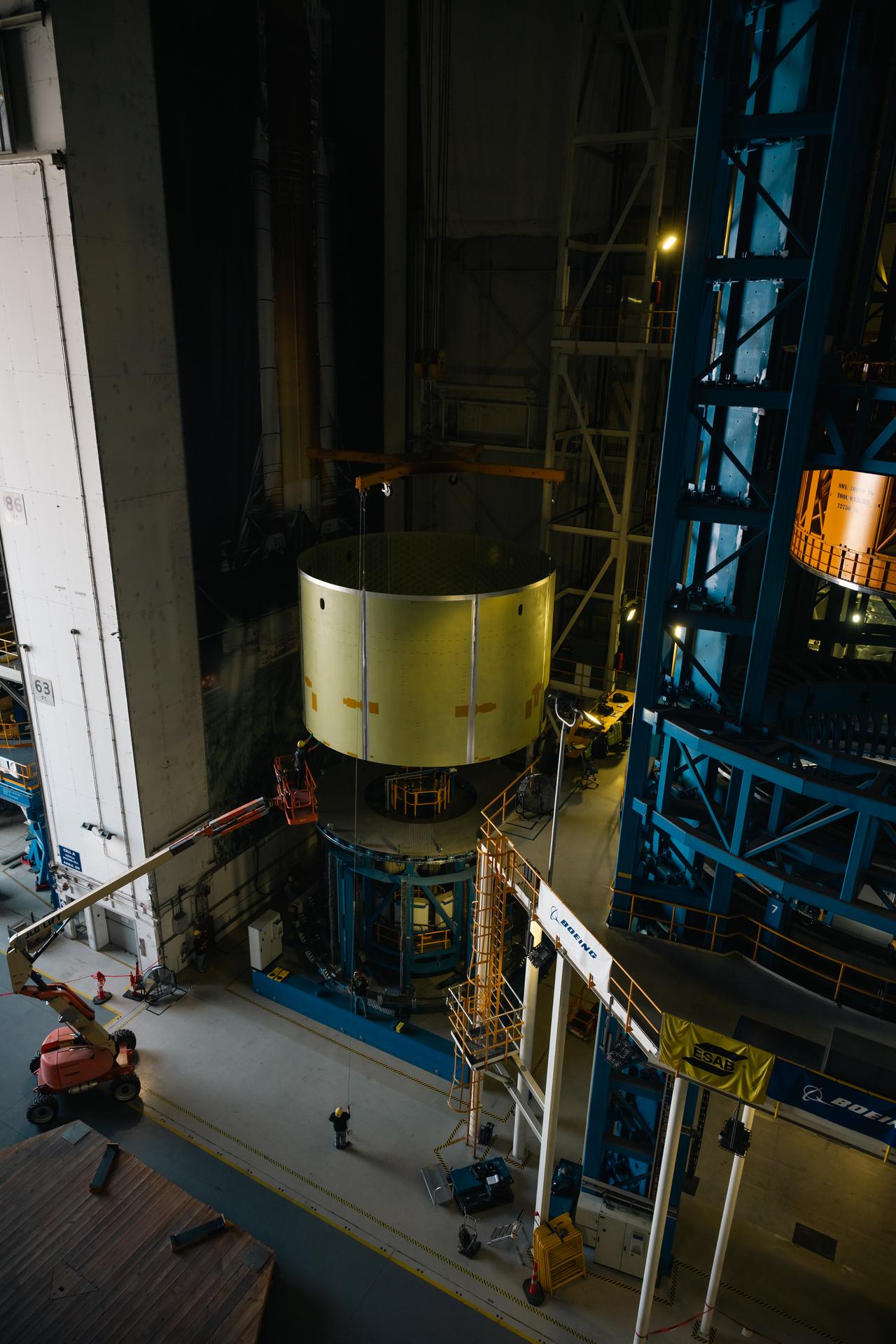
Teams at Michoud Assembly Facility in New Orleans load the engine section barrel into the vertical assembly center on Aug. 5, 2026. The engine section will be used on the SLS (Space Launch System) rocket’s core stage for the agency’s Artemis V mission. On the vertical assembly center tooling, teams will mate the flight hardware to a ring, which will serve as an attachment point for the liquid hydrogen tank later in the production process. The engine section is one of five major elements that make up the 212-foot-tall SLS rocket stage; and houses various avionic systems, the engine thrust structure, and four RS-25 engines. The core stage produces more than two million pounds of thrust to help launch NASA’s Orion spacecraft, astronauts, and supplies beyond Earth’s orbit and to the lunar surface for Artemis.
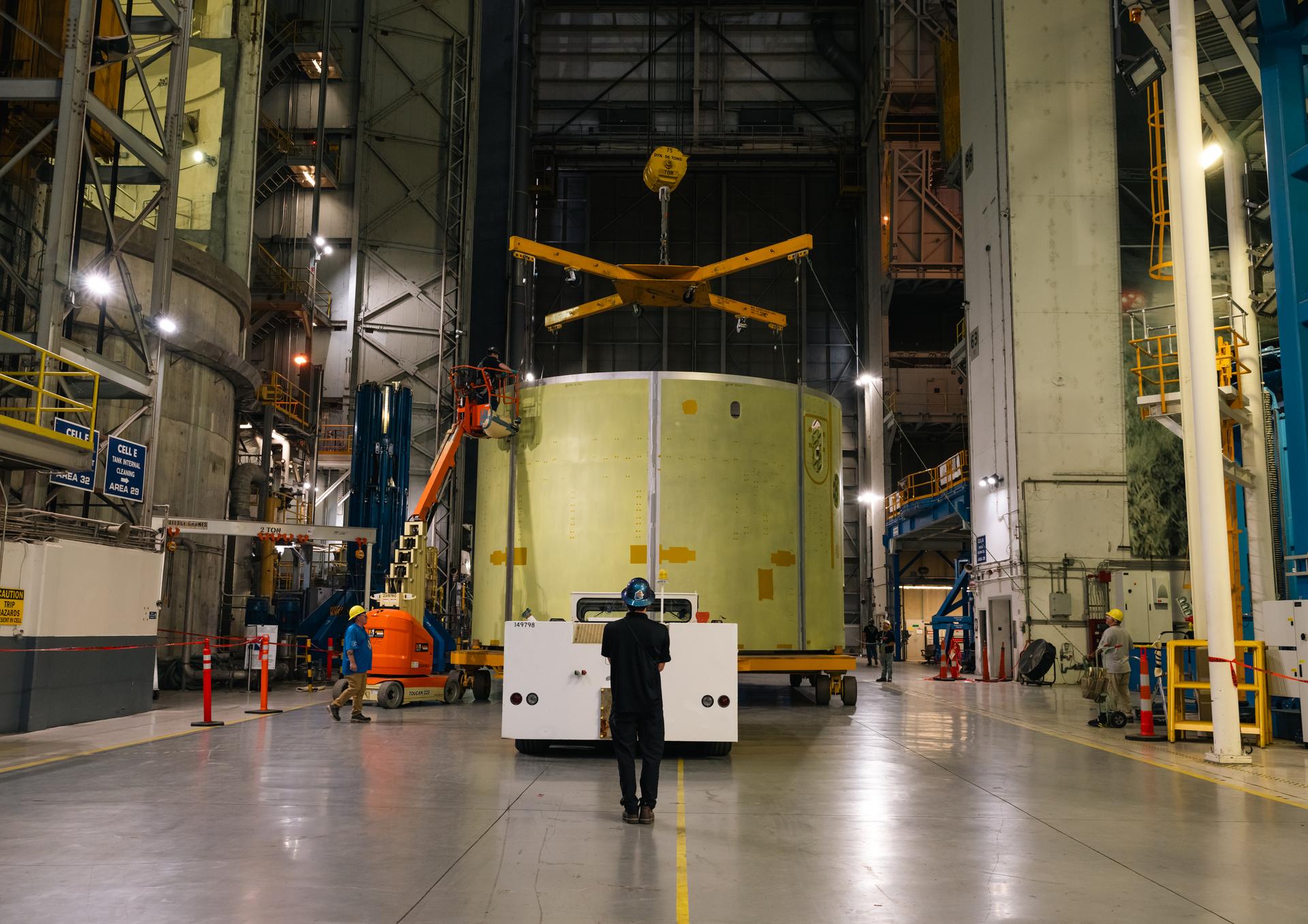
Teams at Michoud Assembly Facility in New Orleans load the engine section barrel into the vertical assembly center on Aug. 5, 2026. The engine section will be used on the SLS (Space Launch System) rocket’s core stage for the agency’s Artemis V mission. On the vertical assembly center tooling, teams will mate the flight hardware to a ring, which will serve as an attachment point for the liquid hydrogen tank later in the production process. The engine section is one of five major elements that make up the 212-foot-tall SLS rocket stage; and houses various avionic systems, the engine thrust structure, and four RS-25 engines. The core stage produces more than two million pounds of thrust to help launch NASA’s Orion spacecraft, astronauts, and supplies beyond Earth’s orbit and to the lunar surface for Artemis.
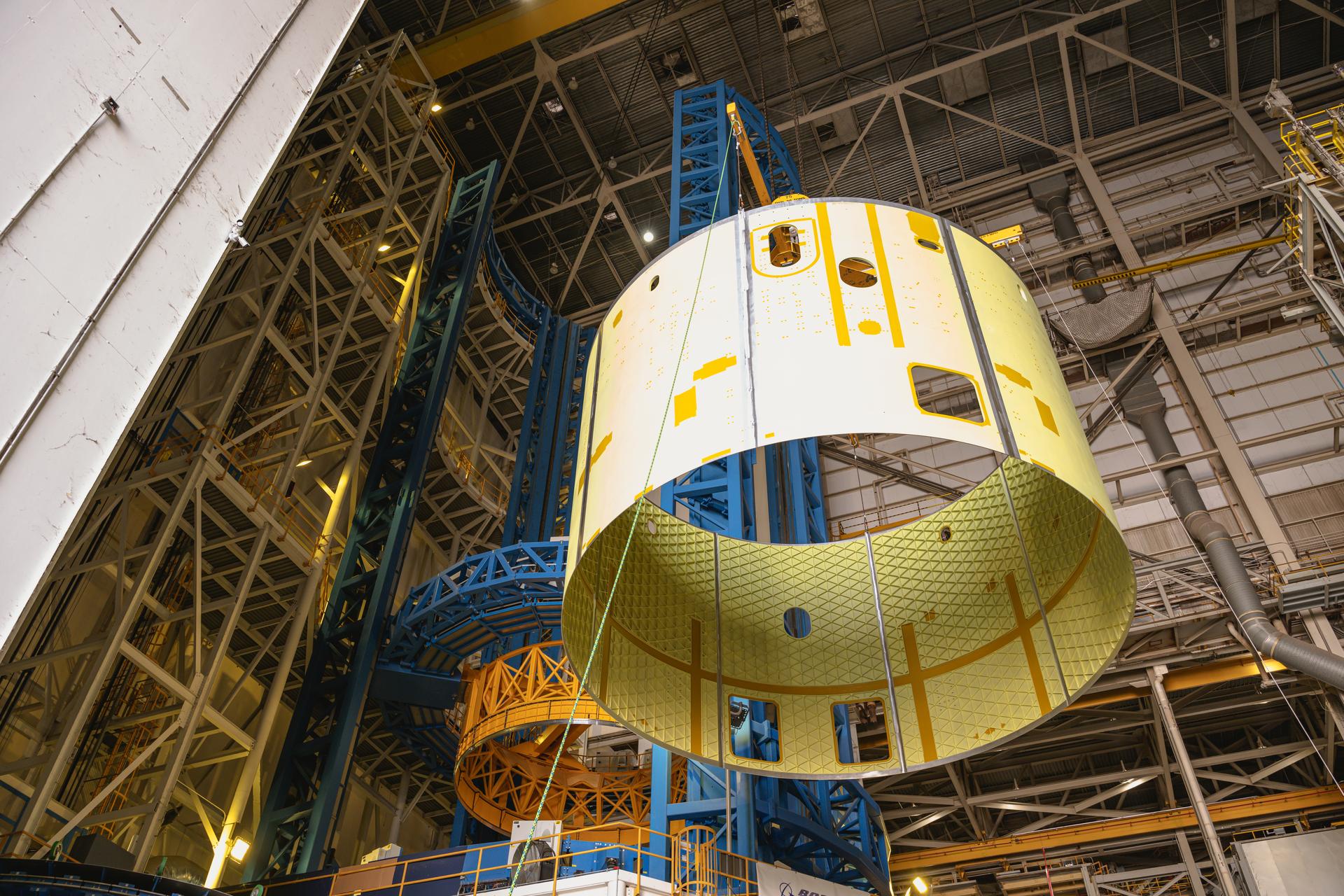
Teams at Michoud Assembly Facility in New Orleans load the engine section barrel into the vertical assembly center on Aug. 5, 2026. The engine section will be used on the SLS (Space Launch System) rocket’s core stage for the agency’s Artemis V mission. On the vertical assembly center tooling, teams will mate the flight hardware to a ring, which will serve as an attachment point for the liquid hydrogen tank later in the production process. The engine section is one of five major elements that make up the 212-foot-tall SLS rocket stage; and houses various avionic systems, the engine thrust structure, and four RS-25 engines. The core stage produces more than two million pounds of thrust to help launch NASA’s Orion spacecraft, astronauts, and supplies beyond Earth’s orbit and to the lunar surface for Artemis.
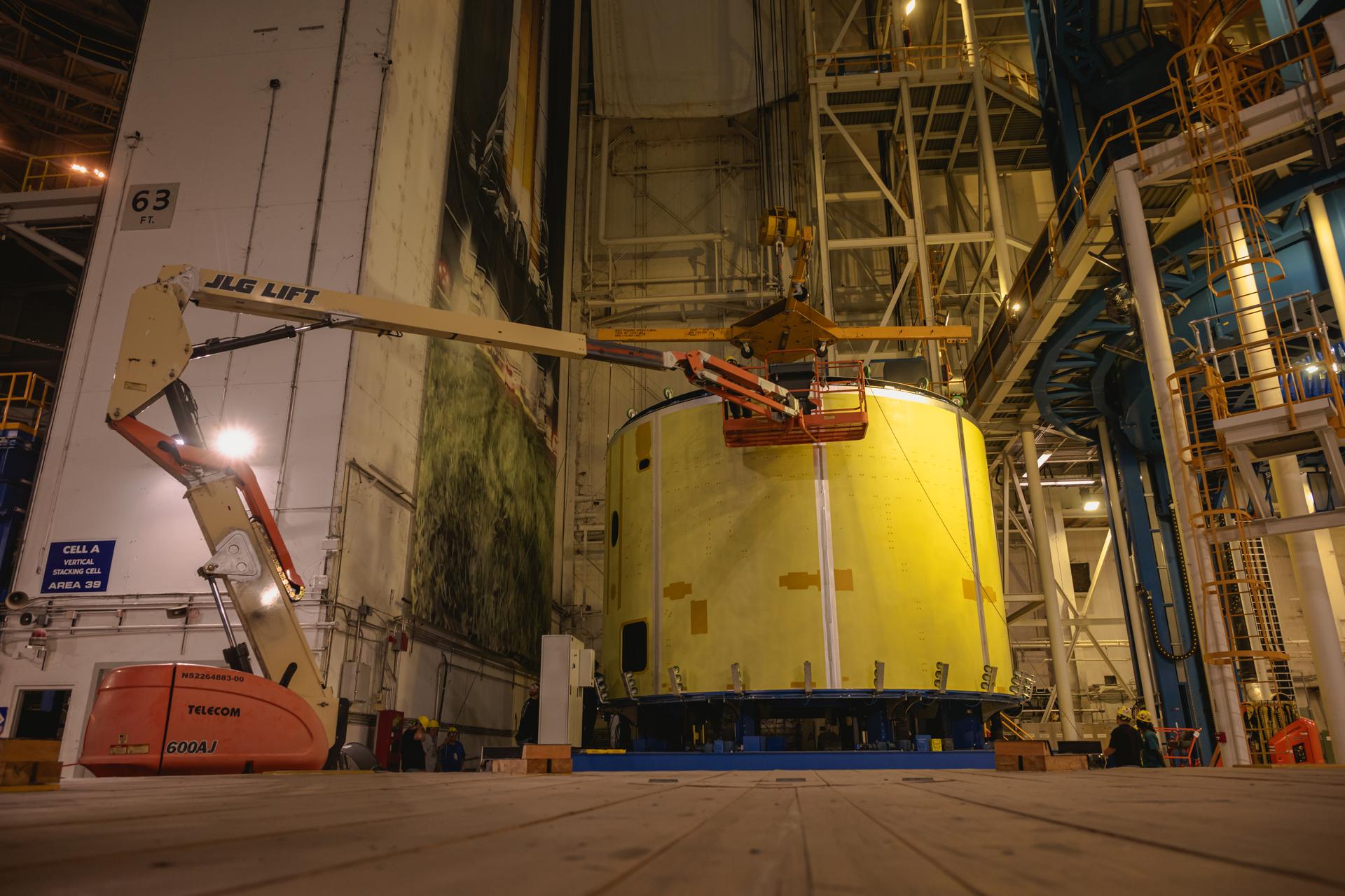
Teams at Michoud Assembly Facility in New Orleans load the engine section barrel into the vertical assembly center on Aug. 5, 2026. The engine section will be used on the SLS (Space Launch System) rocket’s core stage for the agency’s Artemis V mission. On the vertical assembly center tooling, teams will mate the flight hardware to a ring, which will serve as an attachment point for the liquid hydrogen tank later in the production process. The engine section is one of five major elements that make up the 212-foot-tall SLS rocket stage; and houses various avionic systems, the engine thrust structure, and four RS-25 engines. The core stage produces more than two million pounds of thrust to help launch NASA’s Orion spacecraft, astronauts, and supplies beyond Earth’s orbit and to the lunar surface for Artemis.
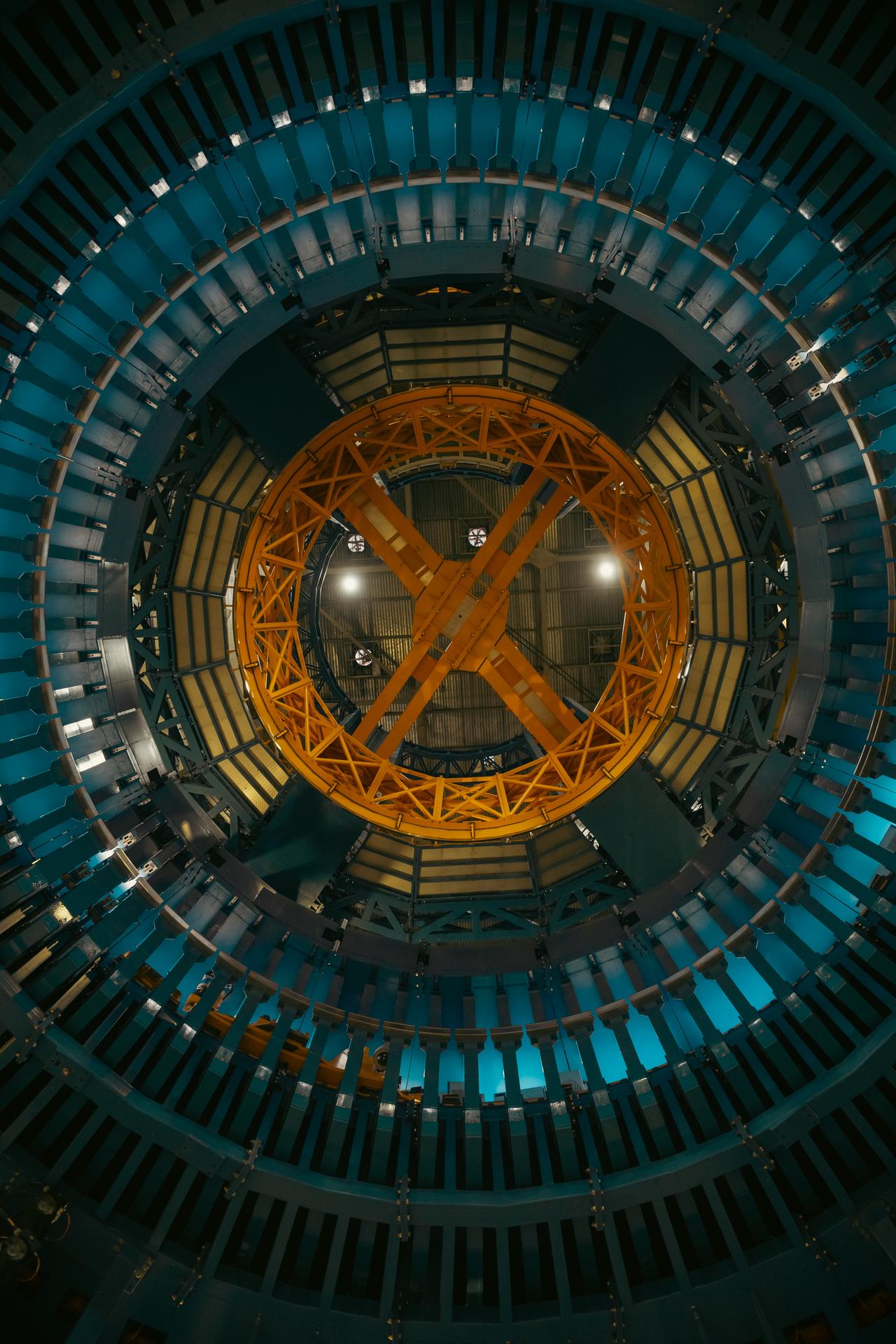
Teams at Michoud Assembly Facility in New Orleans load the 25-foot-long engine section barrel into the vertical assembly center on Aug. 5, 2026. The engine section will be used on the SLS (Space Launch System) rocket’s core stage for the agency’s Artemis V mission. On the vertical assembly center tooling, teams will mate the flight hardware to a ring, which will serve as an attachment point for the liquid hydrogen tank later in the production process. The engine section is one of five major elements that make up the 212-foot-tall SLS rocket stage; and houses various avionic systems, the engine thrust structure, and four RS-25 engines. The core stage produces more than two million pounds of thrust to help launch NASA’s Orion spacecraft, astronauts, and supplies beyond Earth’s orbit and to the lunar surface for Artemis.
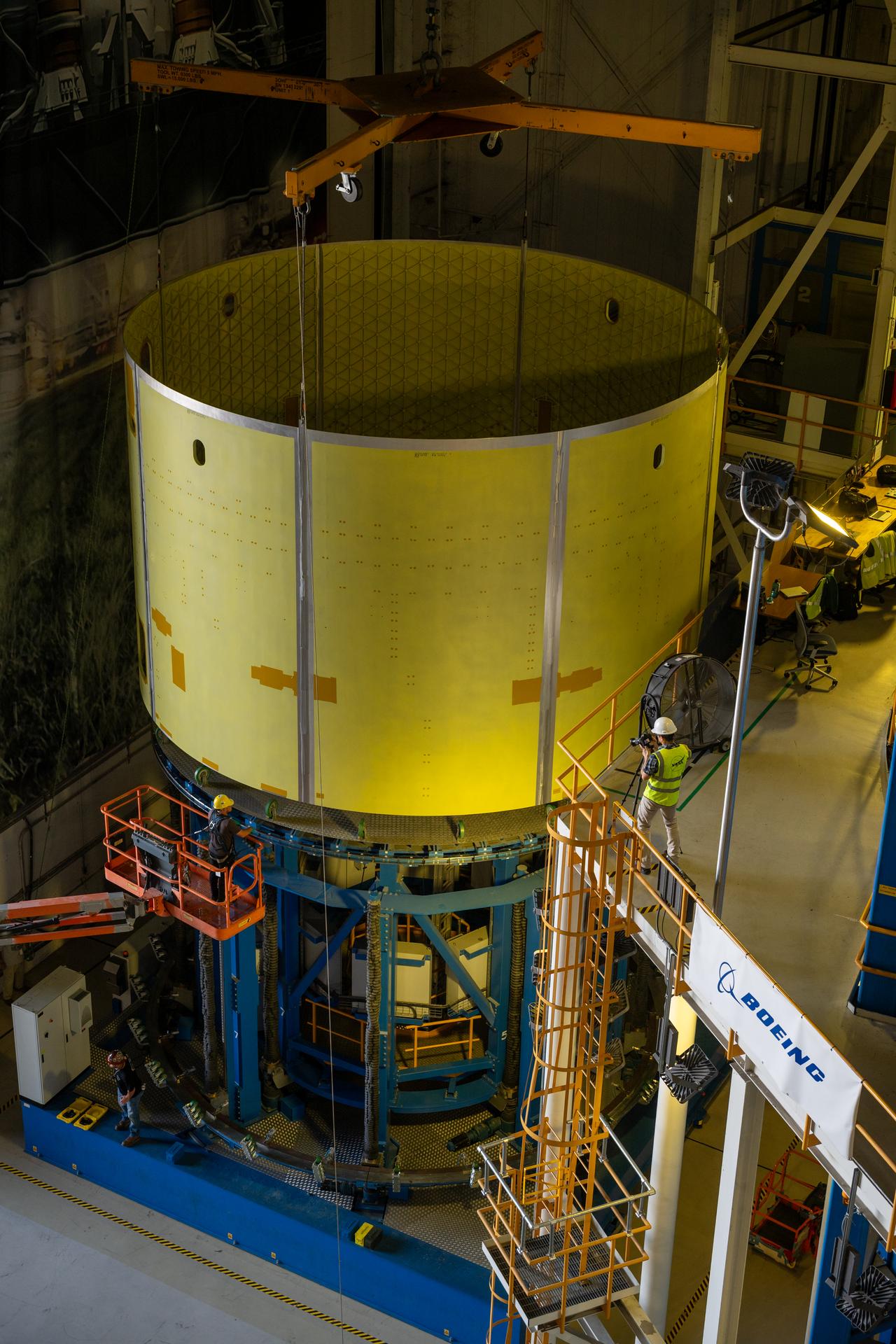
Teams at Michoud Assembly Facility in New Orleans load the engine section barrel into the vertical assembly center on Aug. 5, 2026. The engine section will be used on the SLS (Space Launch System) rocket’s core stage for the agency’s Artemis V mission. On the vertical assembly center tooling, teams will mate the flight hardware to a ring, which will serve as an attachment point for the liquid hydrogen tank later in the production process. The engine section is one of five major elements that make up the 212-foot-tall SLS rocket stage; and houses various avionic systems, the engine thrust structure, and four RS-25 engines. The core stage produces more than two million pounds of thrust to help launch NASA’s Orion spacecraft, astronauts, and supplies beyond Earth’s orbit and to the lunar surface for Artemis.
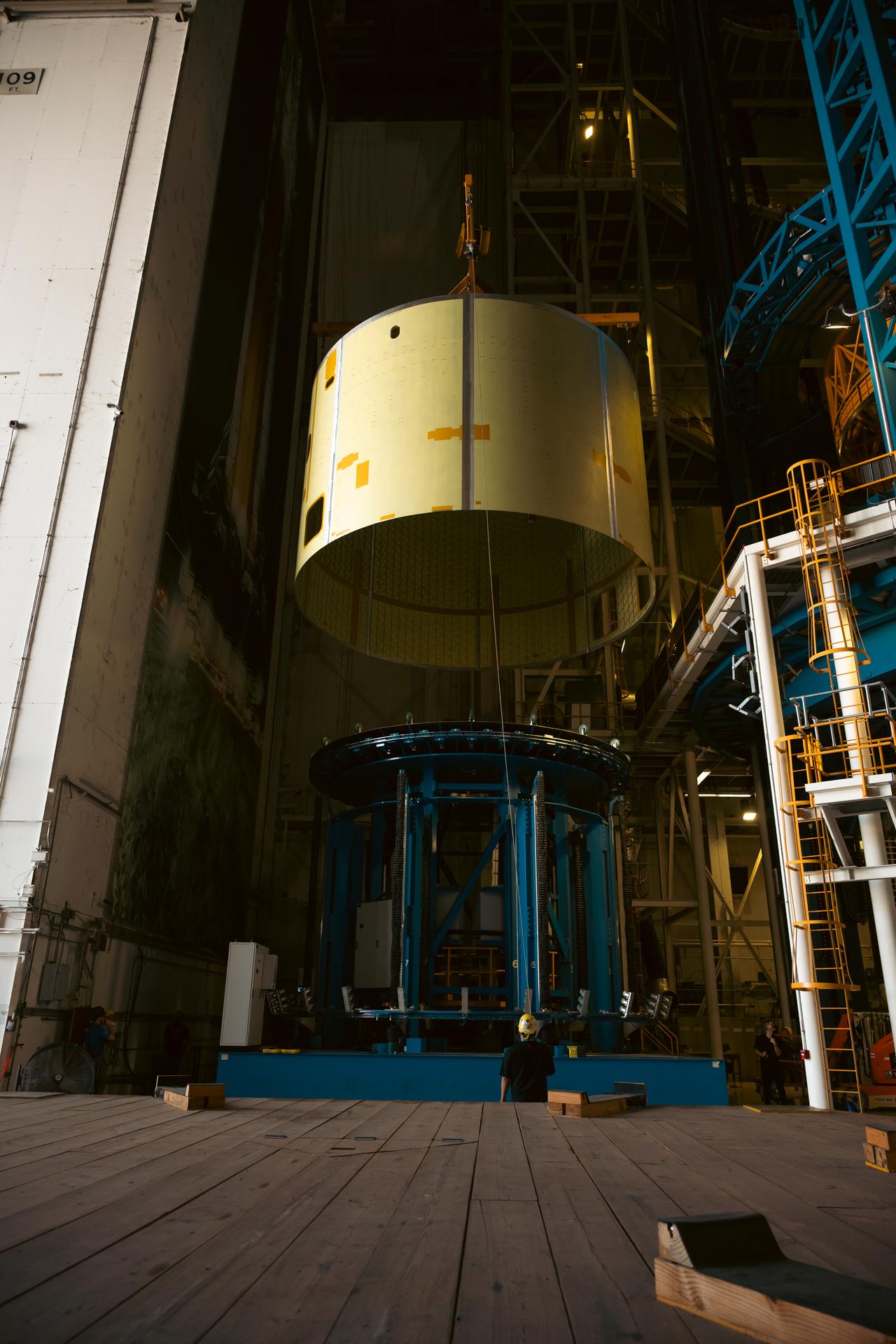
Teams at Michoud Assembly Facility in New Orleans load the engine section barrel into the vertical assembly center on Aug. 5, 2026. The engine section will be used on the SLS (Space Launch System) rocket’s core stage for the agency’s Artemis V mission. On the vertical assembly center tooling, teams will mate the flight hardware to a ring, which will serve as an attachment point for the liquid hydrogen tank later in the production process. The engine section is one of five major elements that make up the 212-foot-tall SLS rocket stage; and houses various avionic systems, the engine thrust structure, and four RS-25 engines. The core stage produces more than two million pounds of thrust to help launch NASA’s Orion spacecraft, astronauts, and supplies beyond Earth’s orbit and to the lunar surface for Artemis.
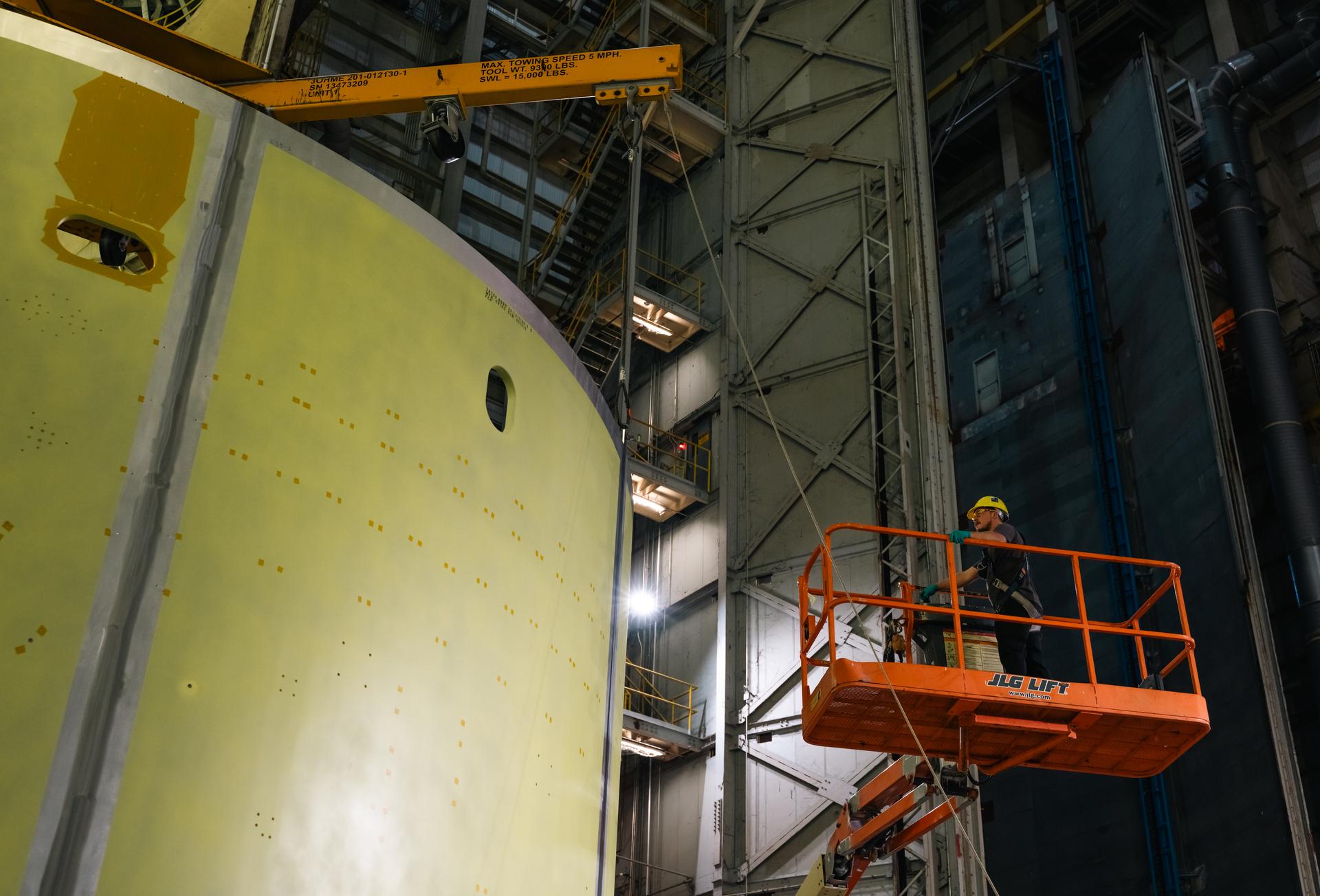
Teams at Michoud Assembly Facility in New Orleans load the engine section barrel into the vertical assembly center on Aug. 5, 2026. The engine section will be used on the SLS (Space Launch System) rocket’s core stage for the agency’s Artemis V mission. On the vertical assembly center tooling, teams will mate the flight hardware to a ring, which will serve as an attachment point for the liquid hydrogen tank later in the production process. The engine section is one of five major elements that make up the 212-foot-tall SLS rocket stage; and houses various avionic systems, the engine thrust structure, and four RS-25 engines. The core stage produces more than two million pounds of thrust to help launch NASA’s Orion spacecraft, astronauts, and supplies beyond Earth’s orbit and to the lunar surface for Artemis.
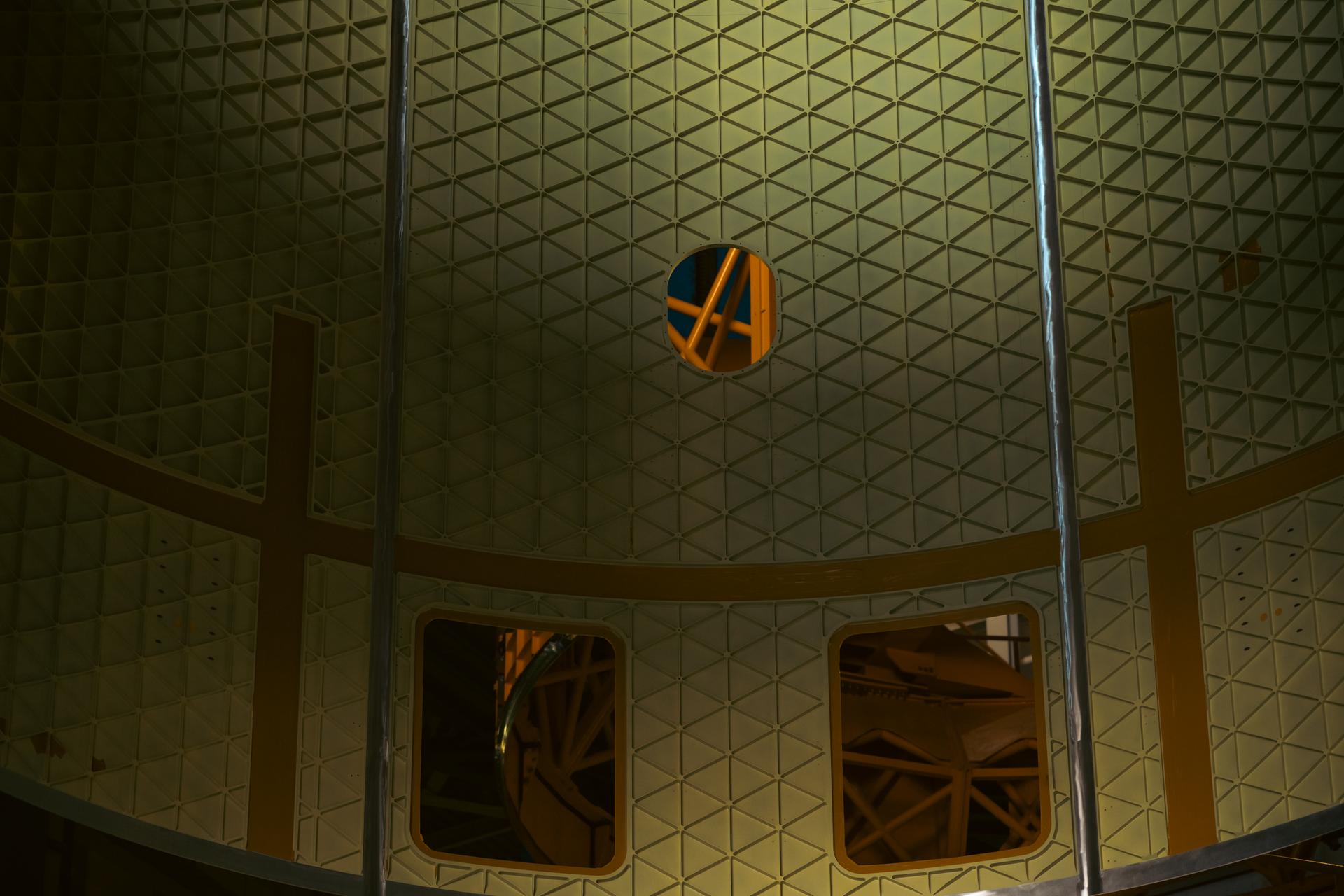
Teams at Michoud Assembly Facility in New Orleans load the engine section barrel into the vertical assembly center on Aug. 5, 2026. The engine section will be used on the SLS (Space Launch System) rocket’s core stage for the agency’s Artemis V mission. On the vertical assembly center tooling, teams will mate the flight hardware to a ring, which will serve as an attachment point for the liquid hydrogen tank later in the production process. The engine section is one of five major elements that make up the 212-foot-tall SLS rocket stage; and houses various avionic systems, the engine thrust structure, and four RS-25 engines. The core stage produces more than two million pounds of thrust to help launch NASA’s Orion spacecraft, astronauts, and supplies beyond Earth’s orbit and to the lunar surface for Artemis.
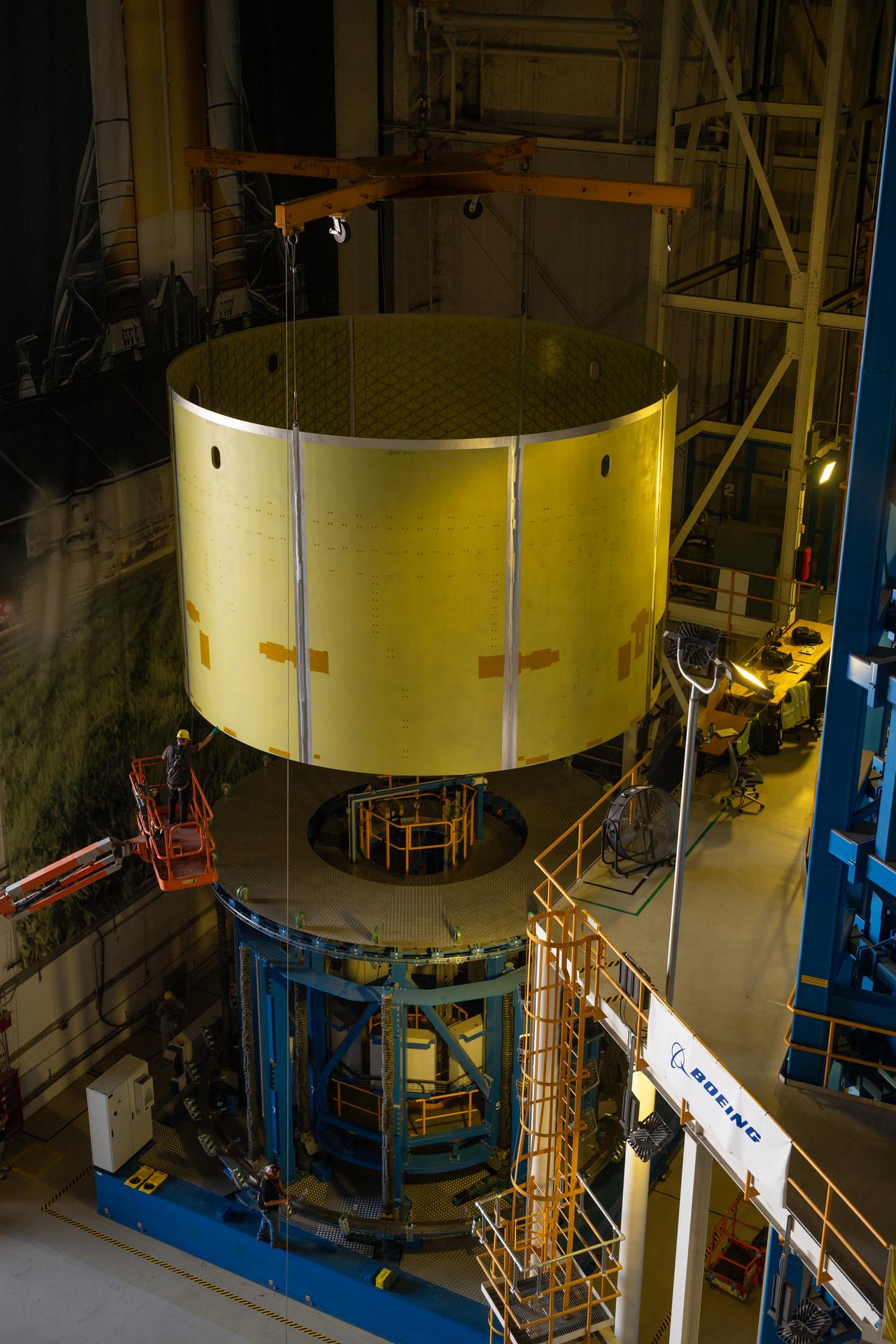
Teams at Michoud Assembly Facility in New Orleans load the engine section barrel into the vertical assembly center on Aug. 5, 2026. The engine section will be used on the SLS (Space Launch System) rocket’s core stage for the agency’s Artemis V mission. On the vertical assembly center tooling, teams will mate the flight hardware to a ring, which will serve as an attachment point for the liquid hydrogen tank later in the production process. The engine section is one of five major elements that make up the 212-foot-tall SLS rocket stage; and houses various avionic systems, the engine thrust structure, and four RS-25 engines. The core stage produces more than two million pounds of thrust to help launch NASA’s Orion spacecraft, astronauts, and supplies beyond Earth’s orbit and to the lunar surface for Artemis.
Teams at Michoud Assembly Facility in New Orleans load the engine section barrel into the vertical assembly center on Aug. 5, 2026. The engine section will be used on the SLS (Space Launch System) rocket’s core stage for the agency’s Artemis V mission. On the vertical assembly center tooling, teams will mate the flight hardware to a ring, which will serve as an attachment point for the liquid hydrogen tank later in the production process. The engine section is one of five major elements that make up the 212-foot-tall SLS rocket stage; and houses various avionic systems, the engine thrust structure, and four RS-25 engines. The core stage produces more than two million pounds of thrust to help launch NASA’s Orion spacecraft, astronauts, and supplies beyond Earth’s orbit and to the lunar surface for Artemis.
Teams at Michoud Assembly Facility in New Orleans load the engine section barrel into the vertical assembly center on Aug. 5, 2026. The engine section will be used on the SLS (Space Launch System) rocket’s core stage for the agency’s Artemis V mission. On the vertical assembly center tooling, teams will mate the flight hardware to a ring, which will serve as an attachment point for the liquid hydrogen tank later in the production process. The engine section is one of five major elements that make up the 212-foot-tall SLS rocket stage; and houses various avionic systems, the engine thrust structure, and four RS-25 engines. The core stage produces more than two million pounds of thrust to help launch NASA’s Orion spacecraft, astronauts, and supplies beyond Earth’s orbit and to the lunar surface for Artemis.

Teams lift a liquid hydrogen tank barrel into the Vertical Assembly Center at Michoud Assembly Facility in New Orleans, on July 25, 2025. Inside the center, teams will perform a circumferential weld to connect the barrel to the previously loaded forward dome. The barrel is one of five barrels, which along with the forward and aft domes, make up the liquid hydrogen tank for the fourth core stage manufactured at the site. Artemis will pave the way for a long-term human presence on the lunar surface while ushering in the Golden Age of Innovation and Exploration.

Teams lift a liquid hydrogen tank barrel into the Vertical Assembly Center at Michoud Assembly Facility in New Orleans, on July 25, 2025. Inside the center, teams will perform a circumferential weld to connect the barrel to the previously loaded forward dome. The barrel is one of five barrels, which along with the forward and aft domes, make up the liquid hydrogen tank for the fourth core stage manufactured at the site. Artemis will pave the way for a long-term human presence on the lunar surface while ushering in the Golden Age of Innovation and Exploration.

Teams lift a liquid hydrogen tank barrel into the Vertical Assembly Center at Michoud Assembly Facility in New Orleans, on July 25, 2025. Inside the center, teams will perform a circumferential weld to connect the barrel to the previously loaded forward dome. The barrel is one of five barrels, which along with the forward and aft domes, make up the liquid hydrogen tank for the fourth core stage manufactured at the site. Artemis will pave the way for a long-term human presence on the lunar surface while ushering in the Golden Age of Innovation and Exploration.

Teams lift a liquid hydrogen tank barrel into the Vertical Assembly Center at Michoud Assembly Facility in New Orleans, on July 25, 2025. Inside the center, teams will perform a circumferential weld to connect the barrel to the previously loaded forward dome. The barrel is one of five barrels, which along with the forward and aft domes, make up the liquid hydrogen tank for the fourth core stage manufactured at the site. Artemis will pave the way for a long-term human presence on the lunar surface while ushering in the Golden Age of Innovation and Exploration.
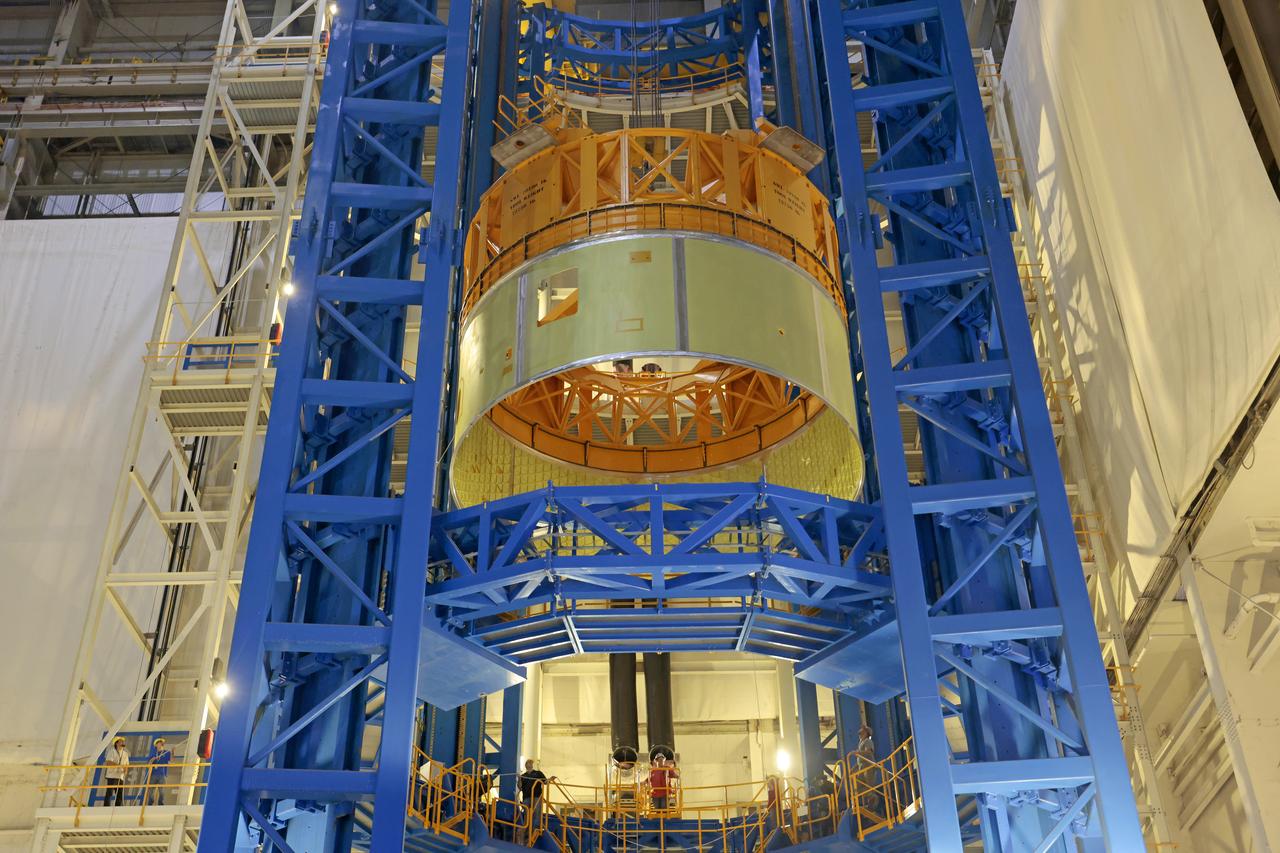
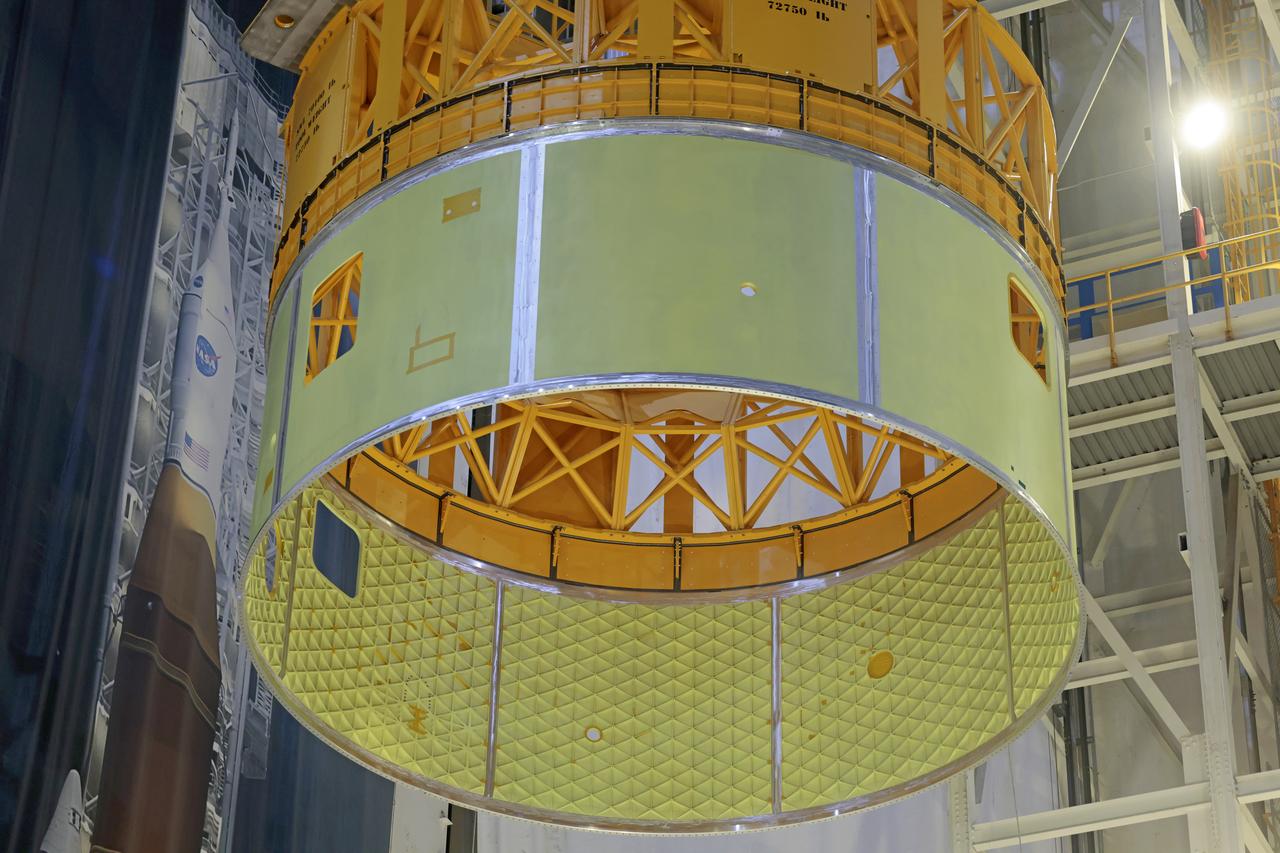
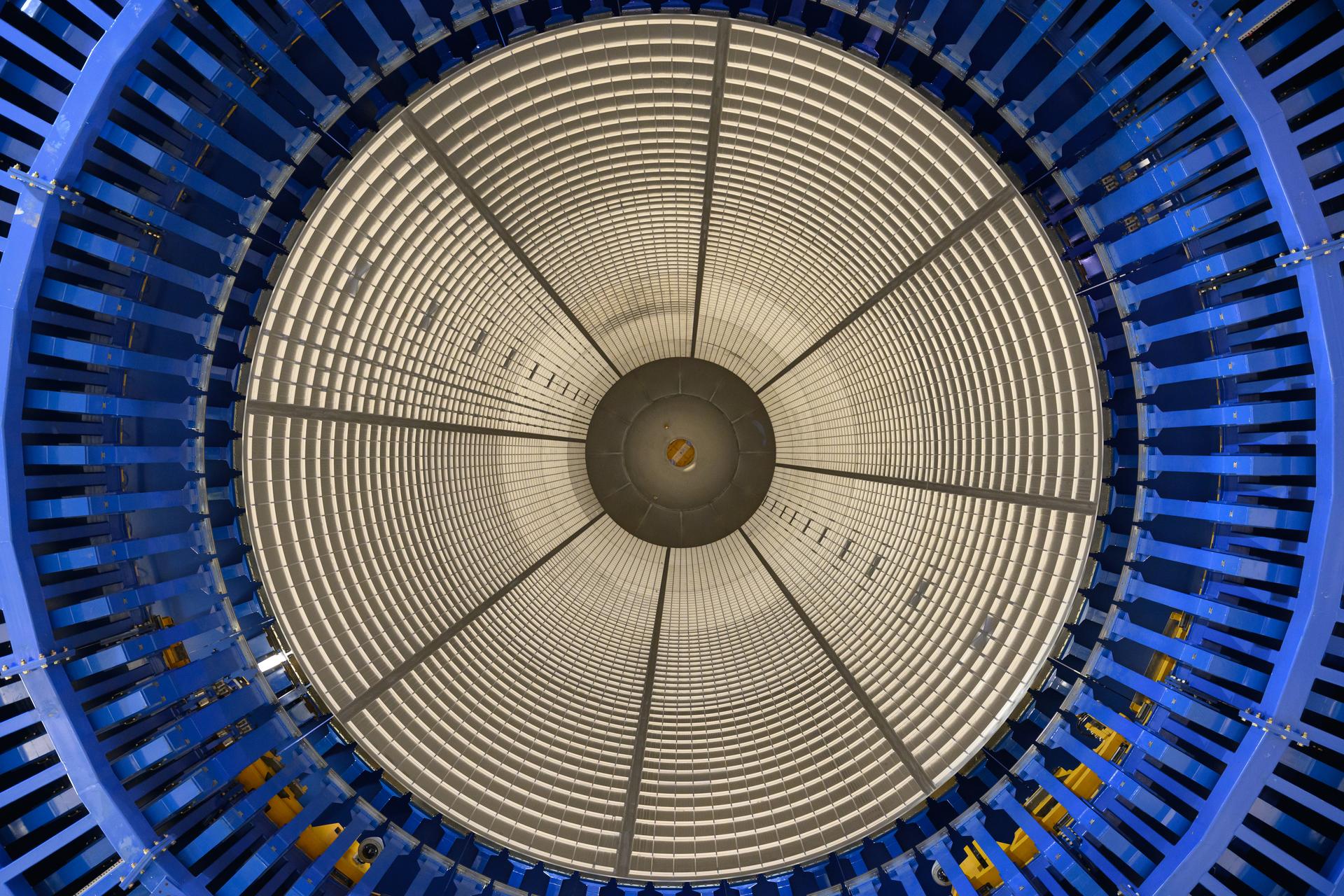
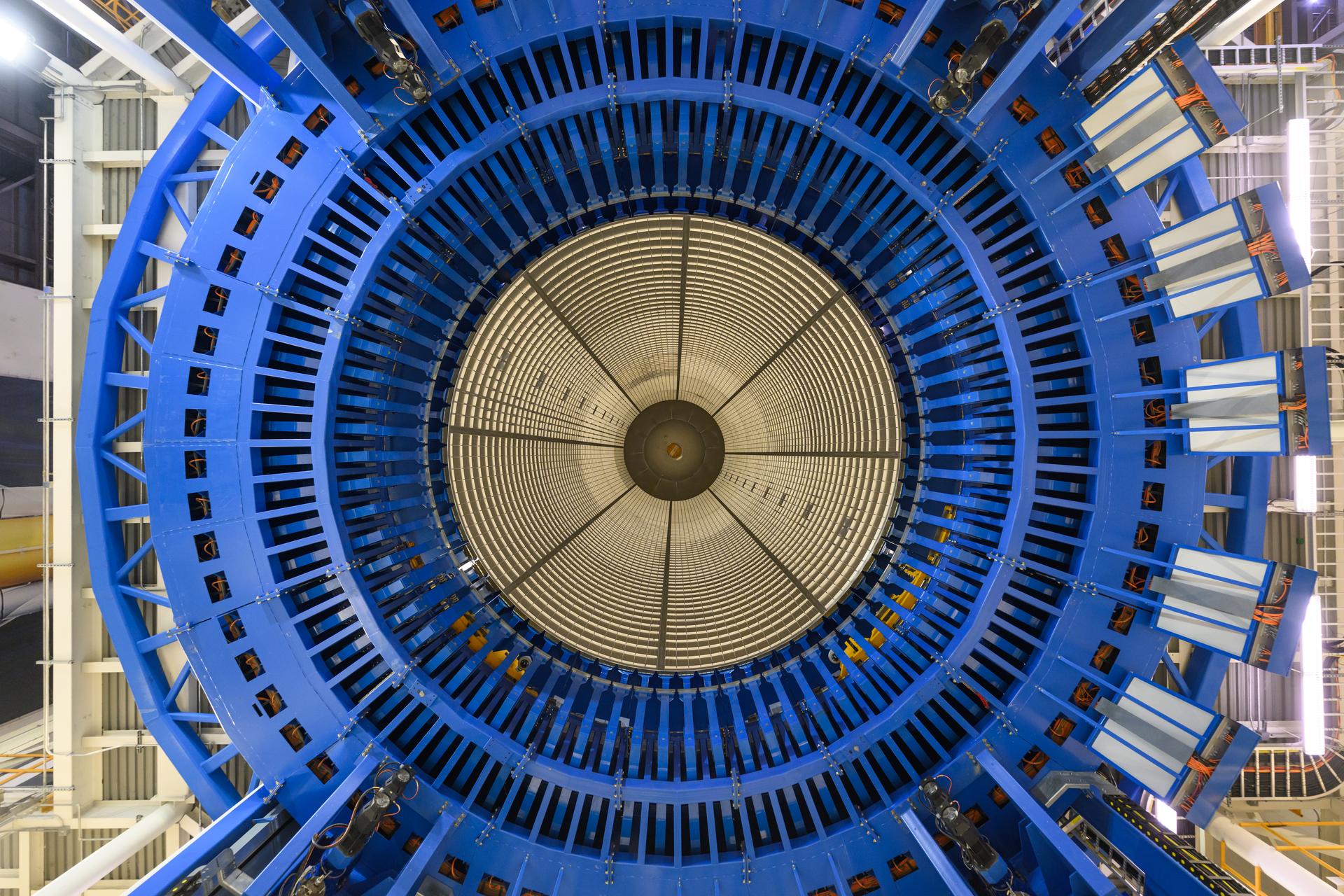
This image shows teams at NASA’s Michoud Assembly Facility in New Orleans lifting a forward skirt out of its vertical assembly center on Jan. 31, 2025. The forward skirt, which will be used on the core stage for the agency’s SLS (Space Launch System) rocket for its Artemis IV mission, houses flight computers, cameras, and avionics. While inside the vertical assembly center, technicians attached the forward skirt’s forward and aft rings, which serve as attachments points to the launch vehicle stage adapter and the liquid oxygen tank, respectively. The forward skirt is one of five major elements that make up the 212-foot-tall rocket stage. The core stage, along with its four RS-25 engines, produce more than two million pounds of thrust to help launch NASA’s Orion spacecraft, astronauts, and supplies beyond Earth’s orbit and to the lunar surface for Artemis. Image credit: NASA/Michael DeMocker
This image shows teams at NASA’s Michoud Assembly Facility in New Orleans lifting a forward skirt out of its vertical assembly center on Jan. 31, 2025. The forward skirt, which will be used on the core stage for the agency’s SLS (Space Launch System) rocket for its Artemis IV mission, houses flight computers, cameras, and avionics. While inside the vertical assembly center, technicians attached the forward skirt’s forward and aft rings, which serve as attachments points to the launch vehicle stage adapter and the liquid oxygen tank, respectively. The forward skirt is one of five major elements that make up the 212-foot-tall rocket stage. The core stage, along with its four RS-25 engines, produce more than two million pounds of thrust to help launch NASA’s Orion spacecraft, astronauts, and supplies beyond Earth’s orbit and to the lunar surface for Artemis. Image credit: NASA/Michael DeMocker

This image shows teams at NASA’s Michoud Assembly Facility in New Orleans lifting a forward skirt out of its vertical assembly center on Jan. 31, 2025. The forward skirt, which will be used on the core stage for the agency’s SLS (Space Launch System) rocket for its Artemis IV mission, houses flight computers, cameras, and avionics. While inside the vertical assembly center, technicians attached the forward skirt’s forward and aft rings, which serve as attachments points to the launch vehicle stage adapter and the liquid oxygen tank, respectively. The forward skirt is one of five major elements that make up the 212-foot-tall rocket stage. The core stage, along with its four RS-25 engines, produce more than two million pounds of thrust to help launch NASA’s Orion spacecraft, astronauts, and supplies beyond Earth’s orbit and to the lunar surface for Artemis. Image credit: NASA/Michael DeMocker
This image shows teams at NASA’s Michoud Assembly Facility in New Orleans lifting a forward skirt out of its vertical assembly center on Jan. 31, 2025. The forward skirt, which will be used on the core stage for the agency’s SLS (Space Launch System) rocket for its Artemis IV mission, houses flight computers, cameras, and avionics. While inside the vertical assembly center, technicians attached the forward skirt’s forward and aft rings, which serve as attachments points to the launch vehicle stage adapter and the liquid oxygen tank, respectively. The forward skirt is one of five major elements that make up the 212-foot-tall rocket stage. The core stage, along with its four RS-25 engines, produce more than two million pounds of thrust to help launch NASA’s Orion spacecraft, astronauts, and supplies beyond Earth’s orbit and to the lunar surface for Artemis. Image credit: NASA/Michael DeMocker
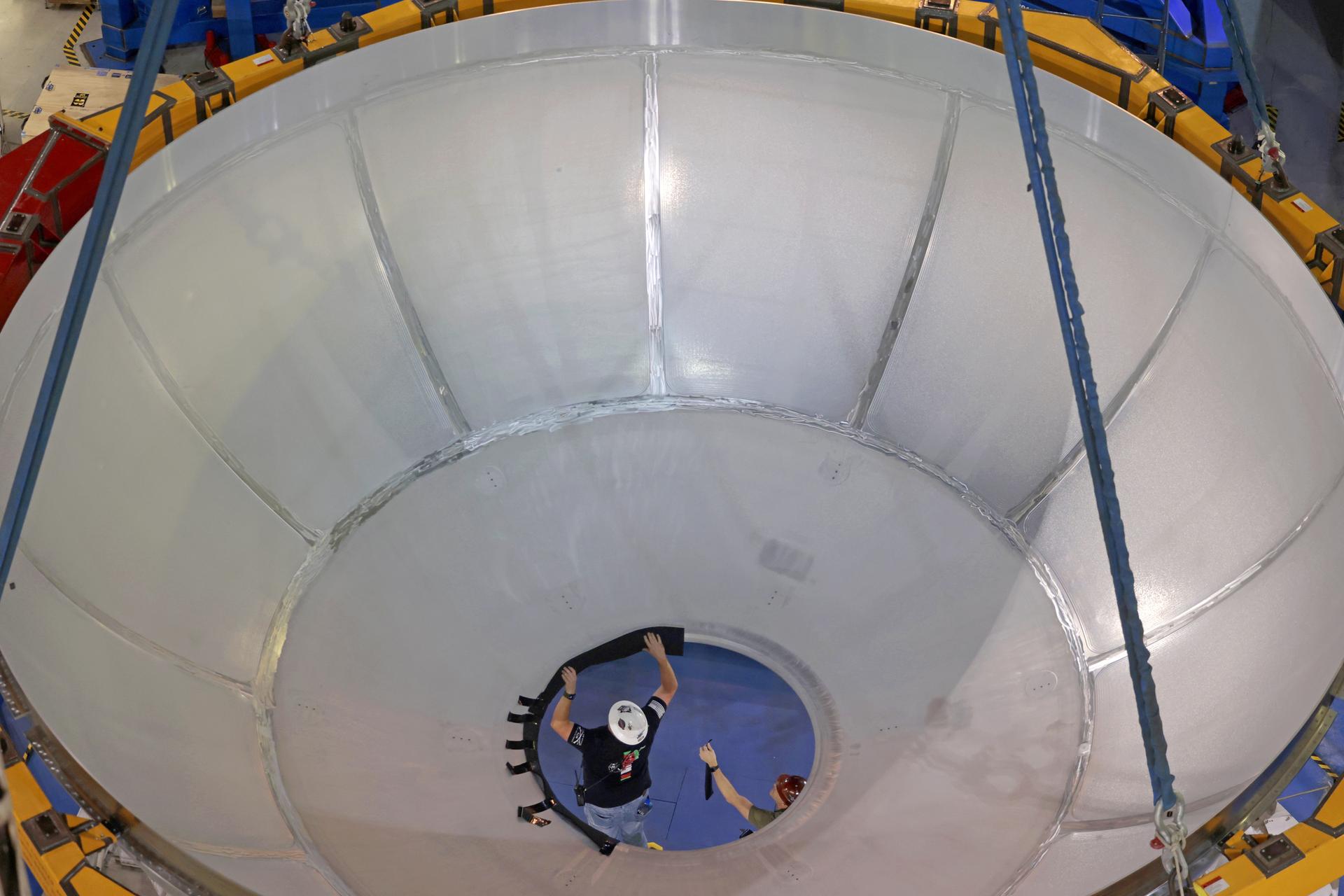
Move crews at NASA’s Michoud Assembly Facility in New Orleans lift the aft dome for the liquid hydrogen tank for the fourth core stage of NASA’s SLS (Space Launch System), into the in-feeder of the facility’s vertical assembly center. Once loaded into the production tool, teams with SLS prime contractor, Boeing, will circumferentially friction-stir weld the dome to the previously-welded forward dome and five barrels that make up the liquid hydrogen tank. The SLS core stage liquid hydrogen tank holds 537,000 gallons of super-cooled propellant and is one of five unique elements that make up the SLS core stage. Together with the forward skirt, liquid oxygen tank, intertank, and engine section, the liquid hydrogen tank will provide propellant to the four RS-25 engines to produce more than two million pounds of thrust to help launch NASA’s Orion spacecraft, astronauts, and supplies beyond Earth’s orbit to the Moon.
Move crews at NASA’s Michoud Assembly Facility in New Orleans lift the aft dome for the liquid hydrogen tank for the fourth core stage of NASA’s SLS (Space Launch System), into the in-feeder of the facility’s vertical assembly center. Once loaded into the production tool, teams with SLS prime contractor, Boeing, will circumferentially friction-stir weld the dome to the previously-welded forward dome and five barrels that make up the liquid hydrogen tank. The SLS core stage liquid hydrogen tank holds 537,000 gallons of super-cooled propellant and is one of five unique elements that make up the SLS core stage. Together with the forward skirt, liquid oxygen tank, intertank, and engine section, the liquid hydrogen tank will provide propellant to the four RS-25 engines to produce more than two million pounds of thrust to help launch NASA’s Orion spacecraft, astronauts, and supplies beyond Earth’s orbit to the Moon.
Move crews at NASA’s Michoud Assembly Facility in New Orleans lift the aft dome for the liquid hydrogen tank for the fourth core stage of NASA’s SLS (Space Launch System), into the in-feeder of the facility’s vertical assembly center. Once loaded into the production tool, teams with SLS prime contractor, Boeing, will circumferentially friction-stir weld the dome to the previously-welded forward dome and five barrels that make up the liquid hydrogen tank. The SLS core stage liquid hydrogen tank holds 537,000 gallons of super-cooled propellant and is one of five unique elements that make up the SLS core stage. Together with the forward skirt, liquid oxygen tank, intertank, and engine section, the liquid hydrogen tank will provide propellant to the four RS-25 engines to produce more than two million pounds of thrust to help launch NASA’s Orion spacecraft, astronauts, and supplies beyond Earth’s orbit to the Moon. Image credit: NASA/Michael DeMocker
Move crews at NASA’s Michoud Assembly Facility in New Orleans lift the aft dome for the liquid hydrogen tank for the fourth core stage of NASA’s SLS (Space Launch System), into the in-feeder of the facility’s vertical assembly center. Once loaded into the production tool, teams with SLS prime contractor, Boeing, will circumferentially friction-stir weld the dome to the previously-welded forward dome and five barrels that make up the liquid hydrogen tank. The SLS core stage liquid hydrogen tank holds 537,000 gallons of super-cooled propellant and is one of five unique elements that make up the SLS core stage. Together with the forward skirt, liquid oxygen tank, intertank, and engine section, the liquid hydrogen tank will provide propellant to the four RS-25 engines to produce more than two million pounds of thrust to help launch NASA’s Orion spacecraft, astronauts, and supplies beyond Earth’s orbit to the Moon. Image credit: NASA/Michael DeMocker
Move crews at NASA’s Michoud Assembly Facility in New Orleans lift the aft dome for the liquid hydrogen tank for the fourth core stage of NASA’s SLS (Space Launch System), into the in-feeder of the facility’s vertical assembly center. Once loaded into the production tool, teams with SLS prime contractor, Boeing, will circumferentially friction-stir weld the dome to the previously-welded forward dome and five barrels that make up the liquid hydrogen tank. The SLS core stage liquid hydrogen tank holds 537,000 gallons of super-cooled propellant and is one of five unique elements that make up the SLS core stage. Together with the forward skirt, liquid oxygen tank, intertank, and engine section, the liquid hydrogen tank will provide propellant to the four RS-25 engines to produce more than two million pounds of thrust to help launch NASA’s Orion spacecraft, astronauts, and supplies beyond Earth’s orbit to the Moon. Image credit: NASA/Michael DeMocker
Move crews at NASA’s Michoud Assembly Facility in New Orleans lift the aft dome for the liquid hydrogen tank for the fourth core stage of NASA’s SLS (Space Launch System), into the in-feeder of the facility’s vertical assembly center. Once loaded into the production tool, teams with SLS prime contractor, Boeing, will circumferentially friction-stir weld the dome to the previously-welded forward dome and five barrels that make up the liquid hydrogen tank. The SLS core stage liquid hydrogen tank holds 537,000 gallons of super-cooled propellant and is one of five unique elements that make up the SLS core stage. Together with the forward skirt, liquid oxygen tank, intertank, and engine section, the liquid hydrogen tank will provide propellant to the four RS-25 engines to produce more than two million pounds of thrust to help launch NASA’s Orion spacecraft, astronauts, and supplies beyond Earth’s orbit to the Moon. Image credit: NASA/Michael DeMocker
Move crews at NASA’s Michoud Assembly Facility in New Orleans lift the aft dome for the liquid hydrogen tank for the fourth core stage of NASA’s SLS (Space Launch System), into the in-feeder of the facility’s vertical assembly center. Once loaded into the production tool, teams with SLS prime contractor, Boeing, will circumferentially friction-stir weld the dome to the previously-welded forward dome and five barrels that make up the liquid hydrogen tank. The SLS core stage liquid hydrogen tank holds 537,000 gallons of super-cooled propellant and is one of five unique elements that make up the SLS core stage. Together with the forward skirt, liquid oxygen tank, intertank, and engine section, the liquid hydrogen tank will provide propellant to the four RS-25 engines to produce more than two million pounds of thrust to help launch NASA’s Orion spacecraft, astronauts, and supplies beyond Earth’s orbit to the Moon. Image credit: NASA/Michael DeMocker
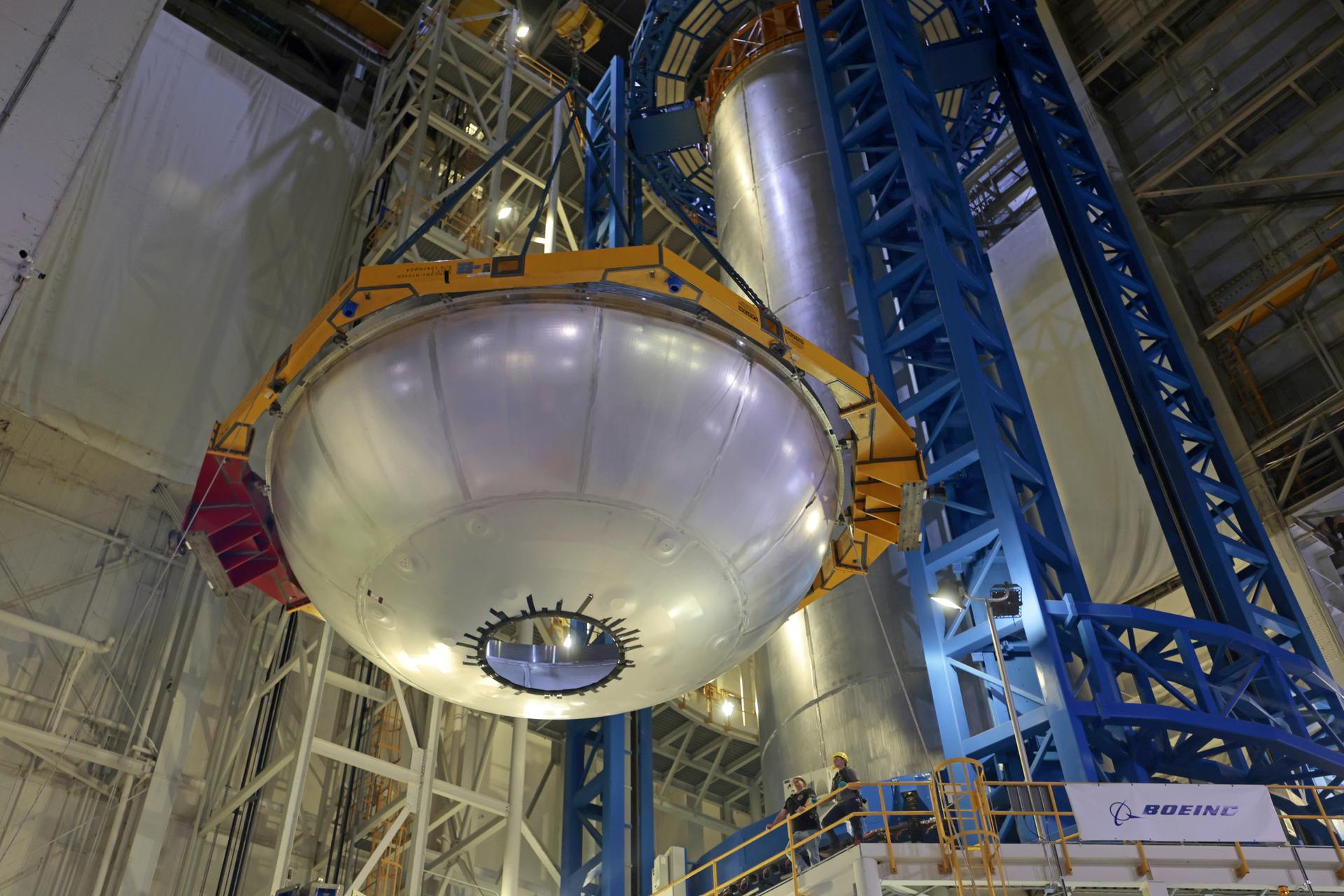
Move crews at NASA’s Michoud Assembly Facility in New Orleans lift the aft dome for the liquid hydrogen tank for the fourth core stage of NASA’s SLS (Space Launch System), into the in-feeder of the facility’s vertical assembly center. Once loaded into the production tool, teams with SLS prime contractor, Boeing, will circumferentially friction-stir weld the dome to the previously-welded forward dome and five barrels that make up the liquid hydrogen tank. The SLS core stage liquid hydrogen tank holds 537,000 gallons of super-cooled propellant and is one of five unique elements that make up the SLS core stage. Together with the forward skirt, liquid oxygen tank, intertank, and engine section, the liquid hydrogen tank will provide propellant to the four RS-25 engines to produce more than two million pounds of thrust to help launch NASA’s Orion spacecraft, astronauts, and supplies beyond Earth’s orbit to the Moon. Image credit: NASA/Michael DeMocker
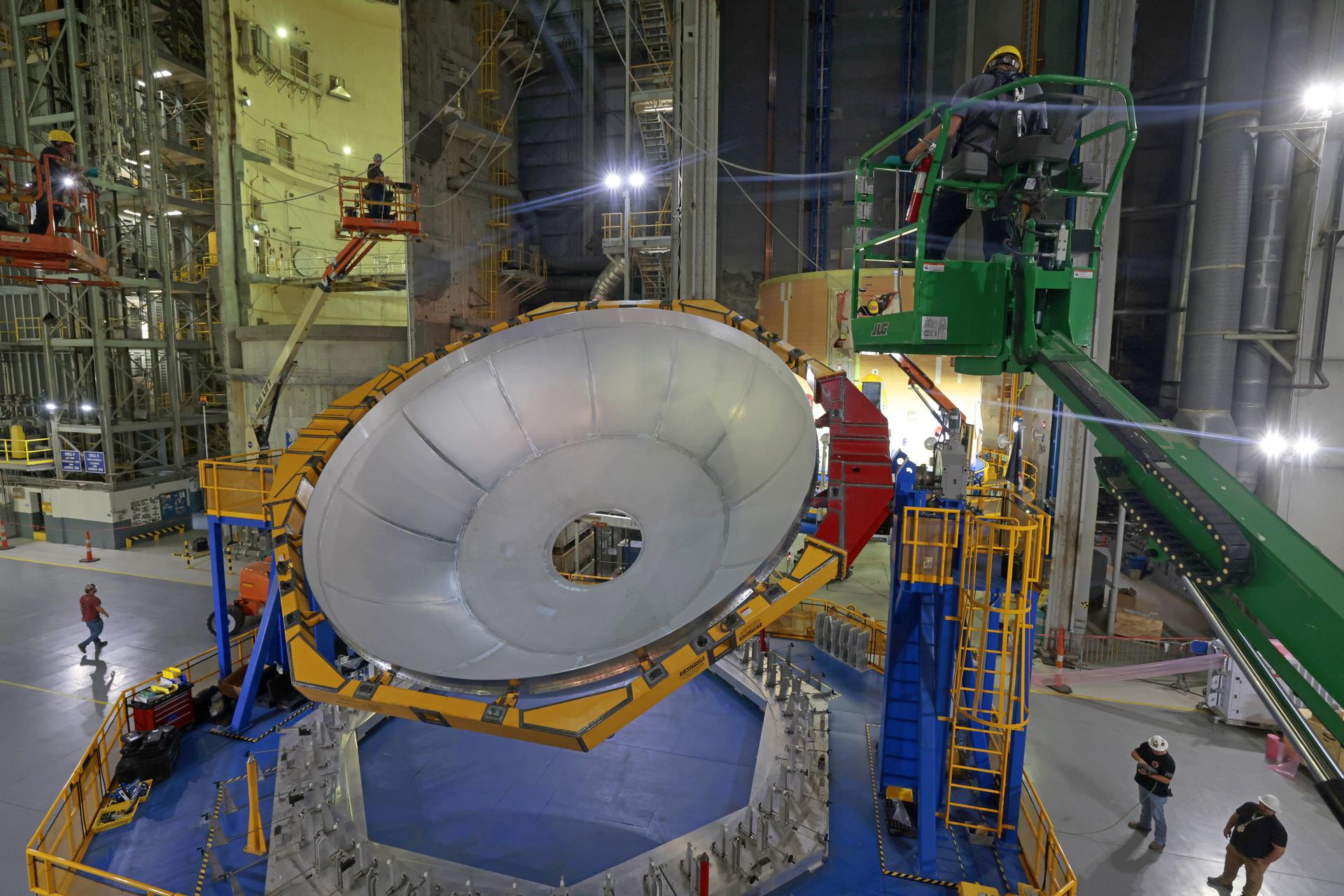
Move crews at NASA’s Michoud Assembly Facility in New Orleans lift the aft dome for the liquid hydrogen tank for the fourth core stage of NASA’s SLS (Space Launch System), into the in-feeder of the facility’s vertical assembly center. Once loaded into the production tool, teams with SLS prime contractor, Boeing, will circumferentially friction-stir weld the dome to the previously-welded forward dome and five barrels that make up the liquid hydrogen tank. The SLS core stage liquid hydrogen tank holds 537,000 gallons of super-cooled propellant and is one of five unique elements that make up the SLS core stage. Together with the forward skirt, liquid oxygen tank, intertank, and engine section, the liquid hydrogen tank will provide propellant to the four RS-25 engines to produce more than two million pounds of thrust to help launch NASA’s Orion spacecraft, astronauts, and supplies beyond Earth’s orbit to the Moon. Image credit: NASA/Michael DeMocker
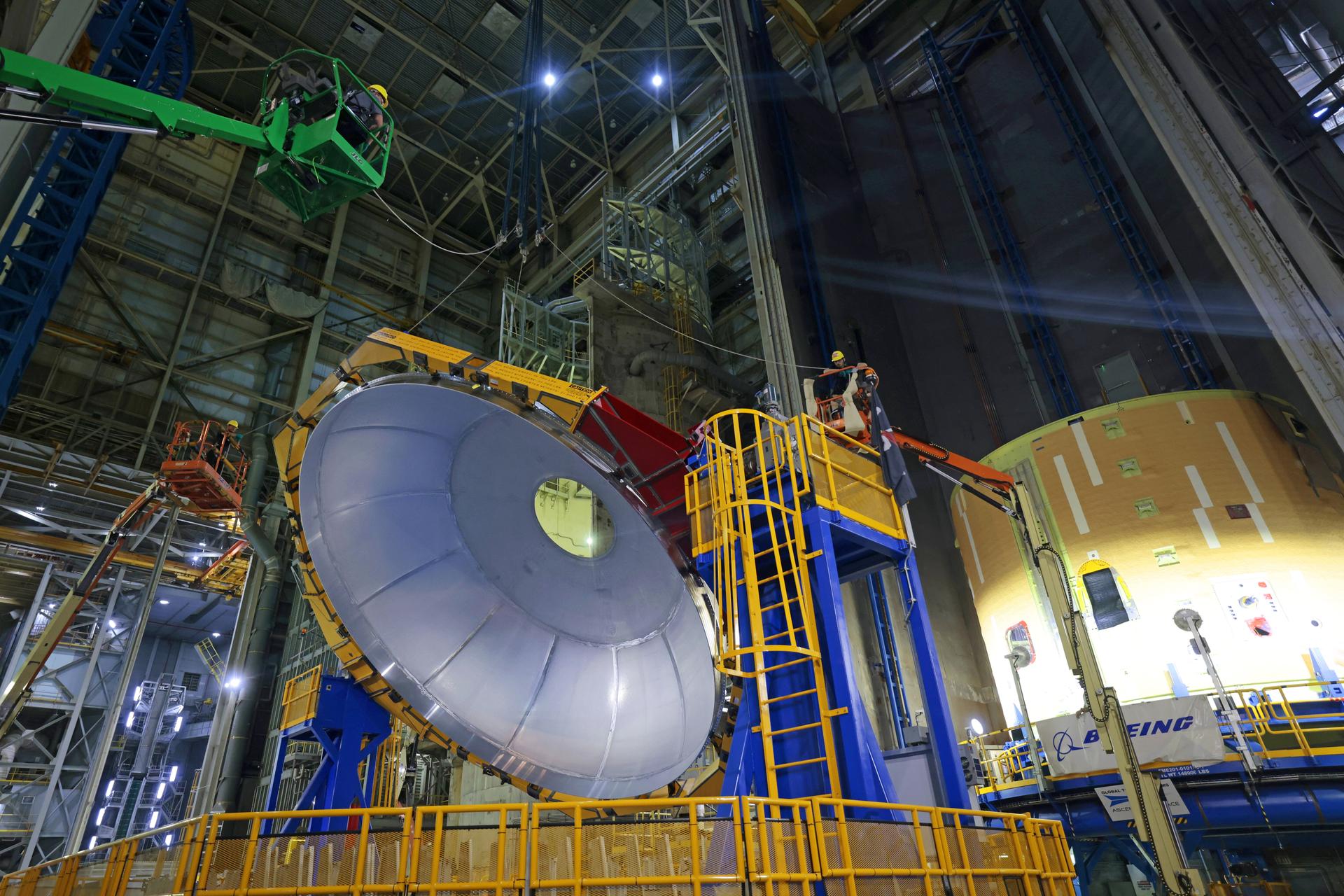
Move crews at NASA’s Michoud Assembly Facility in New Orleans lift the aft dome for the liquid hydrogen tank for the fourth core stage of NASA’s SLS (Space Launch System), into the in-feeder of the facility’s vertical assembly center. Once loaded into the production tool, teams with SLS prime contractor, Boeing, will circumferentially friction-stir weld the dome to the previously-welded forward dome and five barrels that make up the liquid hydrogen tank. The SLS core stage liquid hydrogen tank holds 537,000 gallons of super-cooled propellant and is one of five unique elements that make up the SLS core stage. Together with the forward skirt, liquid oxygen tank, intertank, and engine section, the liquid hydrogen tank will provide propellant to the four RS-25 engines to produce more than two million pounds of thrust to help launch NASA’s Orion spacecraft, astronauts, and supplies beyond Earth’s orbit to the Moon. Image credit: NASA/Michael DeMocker
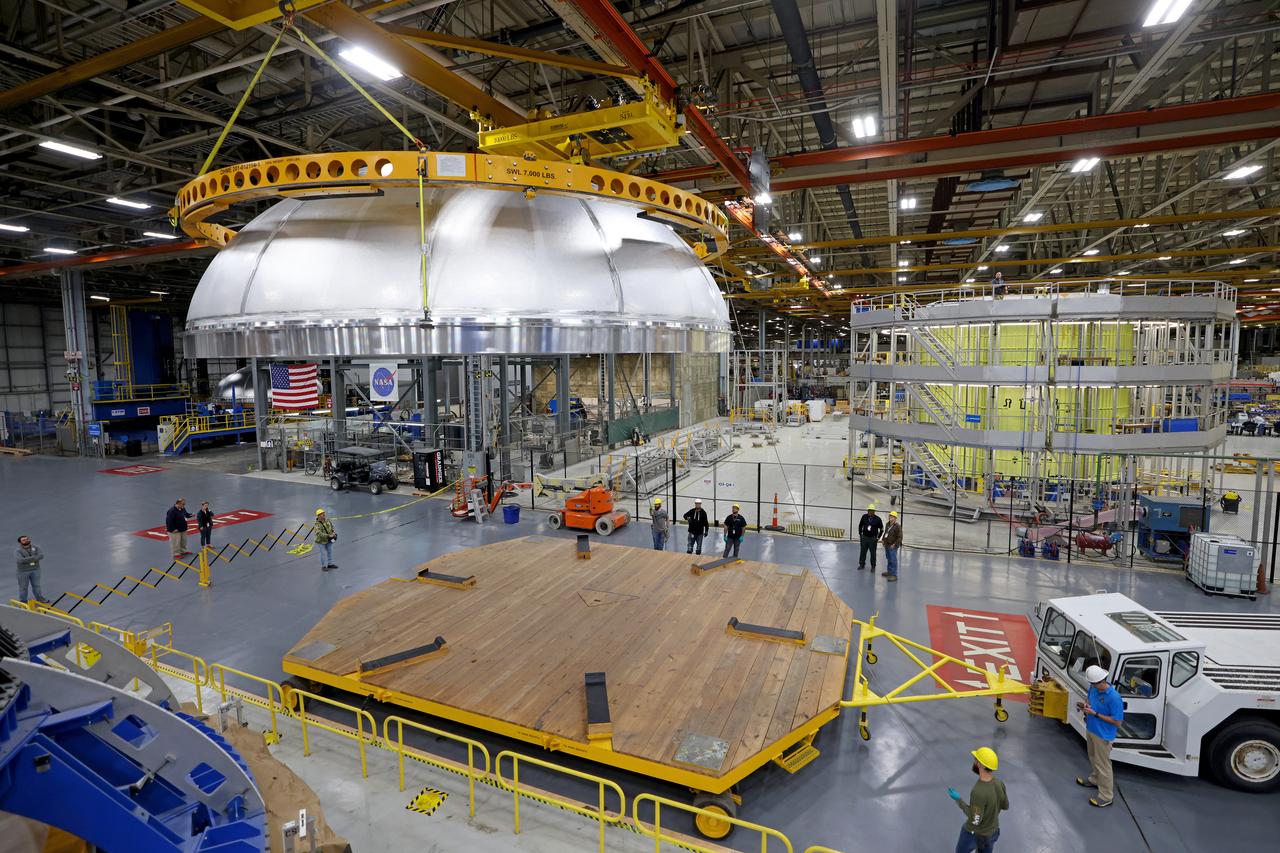
This imagery shows how technicians at NASA’s Michoud Assembly Facility moved the aft dome of the liquid oxygen tank for NASA’s SLS (Space Launch System) rocket for the next phase of production inside the Vertical Assembly center Dec. 5. The dome will form part of the core stage that will power NASA’s Artemis III mission. Engineers will soon rotate the dome to attach it to the previously joined forward dome and aft barrel segments using friction-stir welding. The liquid oxygen tank is one of five major components that make up the SLS rocket’s core stage. Together with the forward skirt, intertank, liquid hydrogen tank, engine section, along with the four RS-25 engines at its base, the 212-foot core stage will help power NASA’s Artemis missions to the Moon. Image credit: NASA/Michael DeMocker

This imagery shows how technicians at NASA’s Michoud Assembly Facility moved the aft dome of the liquid oxygen tank for NASA’s SLS (Space Launch System) rocket for the next phase of production inside the Vertical Assembly center Dec. 5. The dome will form part of the core stage that will power NASA’s Artemis III mission. Engineers will soon rotate the dome to attach it to the previously joined forward dome and aft barrel segments using friction-stir welding. The liquid oxygen tank is one of five major components that make up the SLS rocket’s core stage. Together with the forward skirt, intertank, liquid hydrogen tank, engine section, along with the four RS-25 engines at its base, the 212-foot core stage will help power NASA’s Artemis missions to the Moon.

This imagery shows how technicians at NASA’s Michoud Assembly Facility moved the aft dome of the liquid oxygen tank for NASA’s SLS (Space Launch System) rocket for the next phase of production inside the Vertical Assembly center Dec. 5. The dome will form part of the core stage that will power NASA’s Artemis III mission. Engineers will soon rotate the dome to attach it to the previously joined forward dome and aft barrel segments using friction-stir welding. The liquid oxygen tank is one of five major components that make up the SLS rocket’s core stage. Together with the forward skirt, intertank, liquid hydrogen tank, engine section, along with the four RS-25 engines at its base, the 212-foot core stage will help power NASA’s Artemis missions to the Moon.
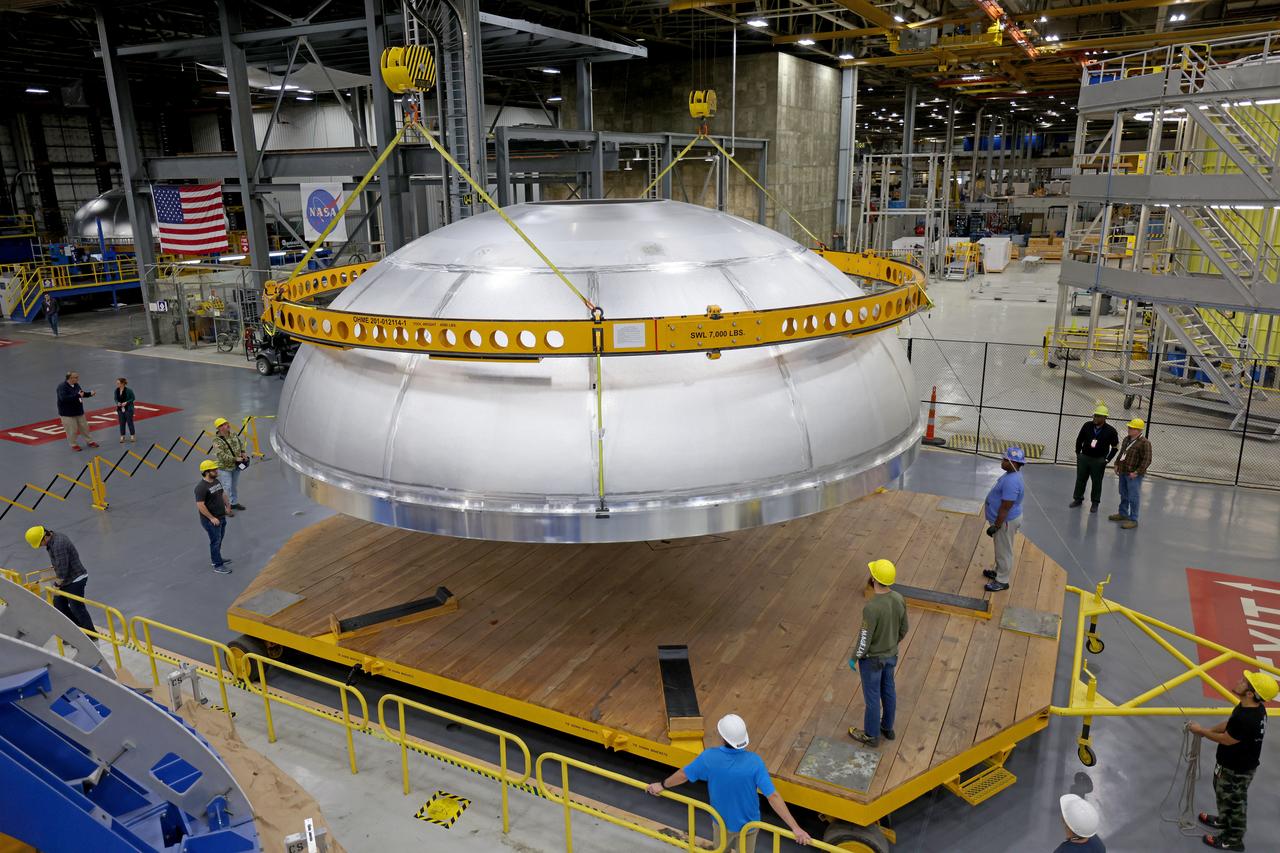
This imagery shows how technicians at NASA’s Michoud Assembly Facility moved the aft dome of the liquid oxygen tank for NASA’s SLS (Space Launch System) rocket for the next phase of production inside the Vertical Assembly center Dec. 5. The dome will form part of the core stage that will power NASA’s Artemis III mission. Engineers will soon rotate the dome to attach it to the previously joined forward dome and aft barrel segments using friction-stir welding. The liquid oxygen tank is one of five major components that make up the SLS rocket’s core stage. Together with the forward skirt, intertank, liquid hydrogen tank, engine section, along with the four RS-25 engines at its base, the 212-foot core stage will help power NASA’s Artemis missions to the Moon. Image credit: NASA/Michael DeMocker
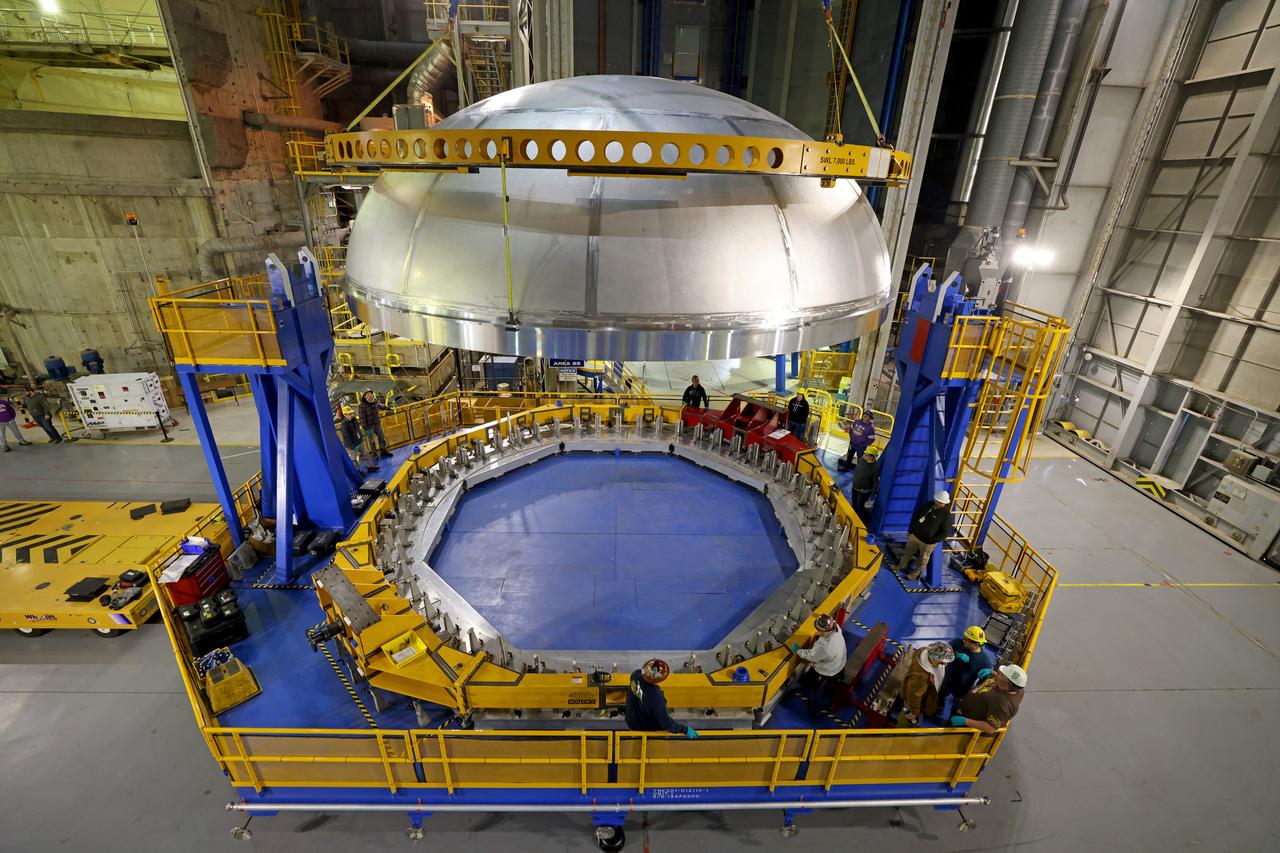
This imagery shows how technicians at NASA’s Michoud Assembly Facility moved the aft dome of the liquid oxygen tank for NASA’s SLS (Space Launch System) rocket for the next phase of production inside the Vertical Assembly center Dec. 6. The dome will form part of the core stage that will power NASA’s Artemis III mission. Engineers will soon rotate the dome to attach it to the previously joined forward dome and aft barrel segments using friction-stir welding. The liquid oxygen tank is one of five major components that make up the SLS rocket’s core stage. Together with the forward skirt, intertank, liquid hydrogen tank, engine section, along with the four RS-25 engines at its base, the 212-foot core stage will help power NASA’s Artemis missions to the Moon. Image credit: NASA/Michael DeMocker

This imagery shows how technicians at NASA’s Michoud Assembly Facility moved the aft dome of the liquid oxygen tank for NASA’s SLS (Space Launch System) rocket for the next phase of production inside the Vertical Assembly center Dec. 5. The dome will form part of the core stage that will power NASA’s Artemis III mission. Engineers will soon rotate the dome to attach it to the previously joined forward dome and aft barrel segments using friction-stir welding. The liquid oxygen tank is one of five major components that make up the SLS rocket’s core stage. Together with the forward skirt, intertank, liquid hydrogen tank, engine section, along with the four RS-25 engines at its base, the 212-foot core stage will help power NASA’s Artemis missions to the Moon.
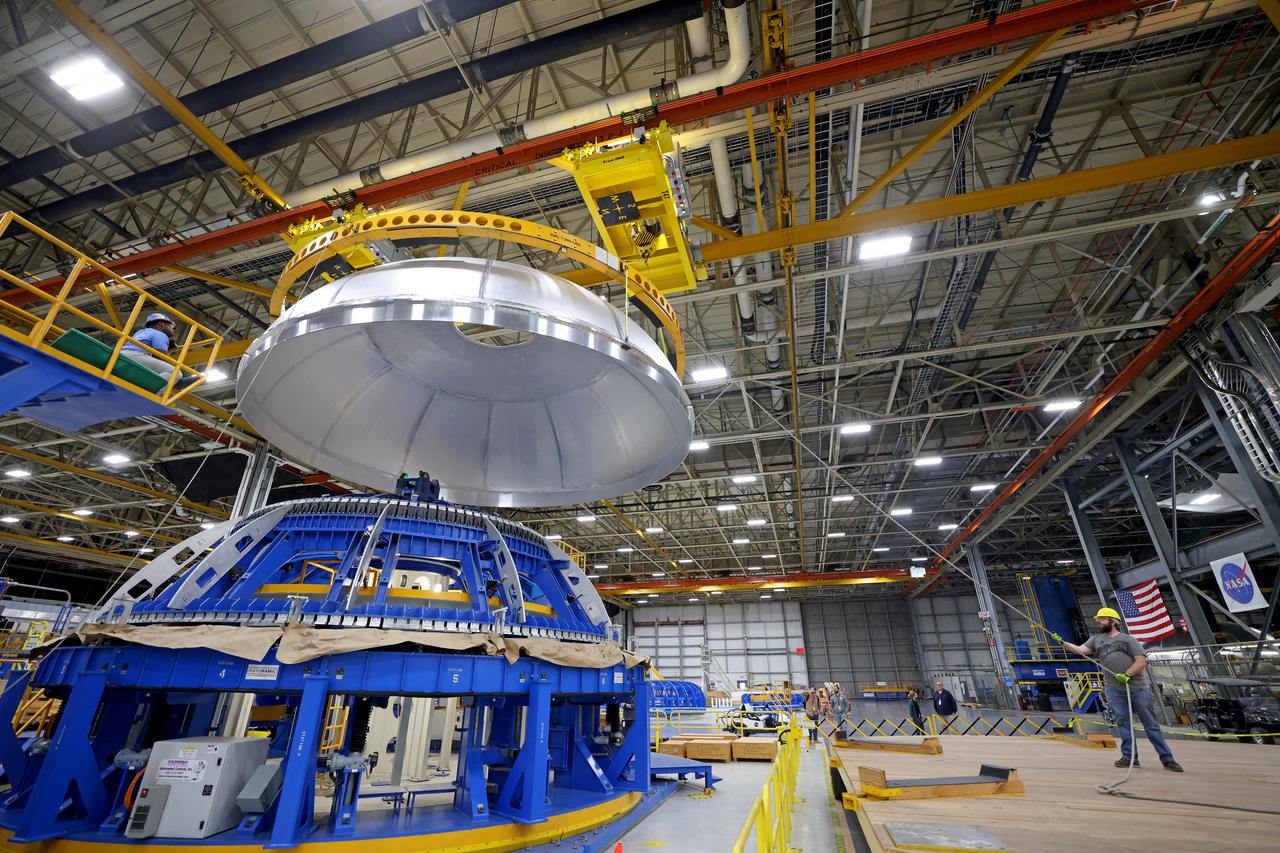
This imagery shows how technicians at NASA’s Michoud Assembly Facility moved the aft dome of the liquid oxygen tank for NASA’s SLS (Space Launch System) rocket for the next phase of production inside the Vertical Assembly center Dec. 5. The dome will form part of the core stage that will power NASA’s Artemis III mission. Engineers will soon rotate the dome to attach it to the previously joined forward dome and aft barrel segments using friction-stir welding. The liquid oxygen tank is one of five major components that make up the SLS rocket’s core stage. Together with the forward skirt, intertank, liquid hydrogen tank, engine section, along with the four RS-25 engines at its base, the 212-foot core stage will help power NASA’s Artemis missions to the Moon. Image credit: NASA/Michael DeMocker
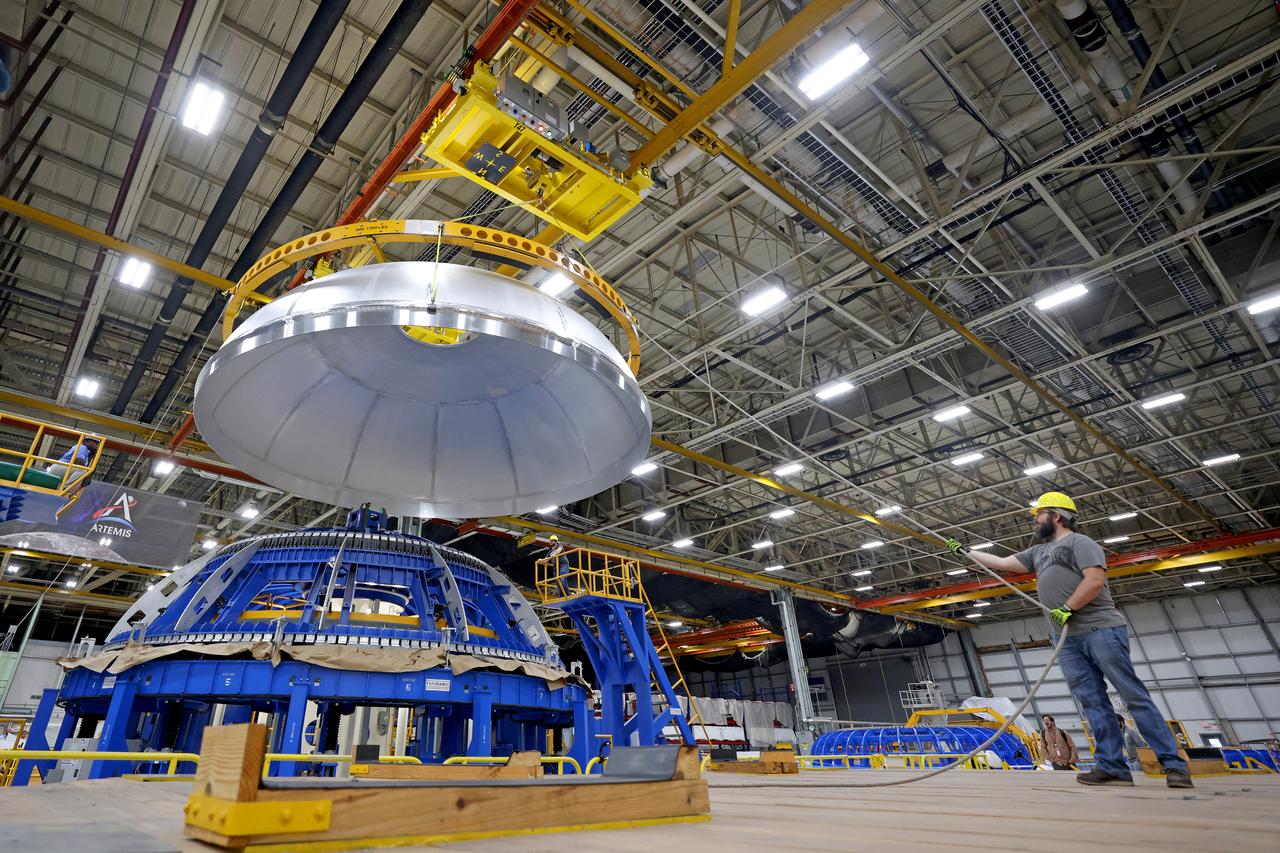
This imagery shows how technicians at NASA’s Michoud Assembly Facility moved the aft dome of the liquid oxygen tank for NASA’s SLS (Space Launch System) rocket for the next phase of production inside the Vertical Assembly center Dec. 5. The dome will form part of the core stage that will power NASA’s Artemis III mission. Engineers will soon rotate the dome to attach it to the previously joined forward dome and aft barrel segments using friction-stir welding. The liquid oxygen tank is one of five major components that make up the SLS rocket’s core stage. Together with the forward skirt, intertank, liquid hydrogen tank, engine section, along with the four RS-25 engines at its base, the 212-foot core stage will help power NASA’s Artemis missions to the Moon. Image credit: NASA/Michael DeMocker

This imagery shows how technicians at NASA’s Michoud Assembly Facility moved the aft dome of the liquid oxygen tank for NASA’s SLS (Space Launch System) rocket for the next phase of production inside the Vertical Assembly center Dec. 5. The dome will form part of the core stage that will power NASA’s Artemis III mission. Engineers will soon rotate the dome to attach it to the previously joined forward dome and aft barrel segments using friction-stir welding. The liquid oxygen tank is one of five major components that make up the SLS rocket’s core stage. Together with the forward skirt, intertank, liquid hydrogen tank, engine section, along with the four RS-25 engines at its base, the 212-foot core stage will help power NASA’s Artemis missions to the Moon.

This imagery shows how technicians at NASA’s Michoud Assembly Facility moved the aft dome of the liquid oxygen tank for NASA’s SLS (Space Launch System) rocket for the next phase of production inside the Vertical Assembly center Dec. 18. The dome will form part of the core stage that will power NASA’s Artemis III mission. Engineers rotate the dome to attach it to the previously joined forward dome and aft barrel segments using friction-stir welding. The liquid oxygen tank is one of five major components that make up the SLS rocket’s core stage. Together with the forward skirt, intertank, liquid hydrogen tank, engine section, along with the four RS-25 engines at its base, the 212-foot core stage will help power NASA’s Artemis missions to the Moon.

This imagery shows how technicians at NASA’s Michoud Assembly Facility moved the aft dome of the liquid oxygen tank for NASA’s SLS (Space Launch System) rocket for the next phase of production inside the Vertical Assembly center Dec. 18. The dome will form part of the core stage that will power NASA’s Artemis III mission. Engineers rotate the dome to attach it to the previously joined forward dome and aft barrel segments using friction-stir welding. The liquid oxygen tank is one of five major components that make up the SLS rocket’s core stage. Together with the forward skirt, intertank, liquid hydrogen tank, engine section, along with the four RS-25 engines at its base, the 212-foot core stage will help power NASA’s Artemis missions to the Moon.
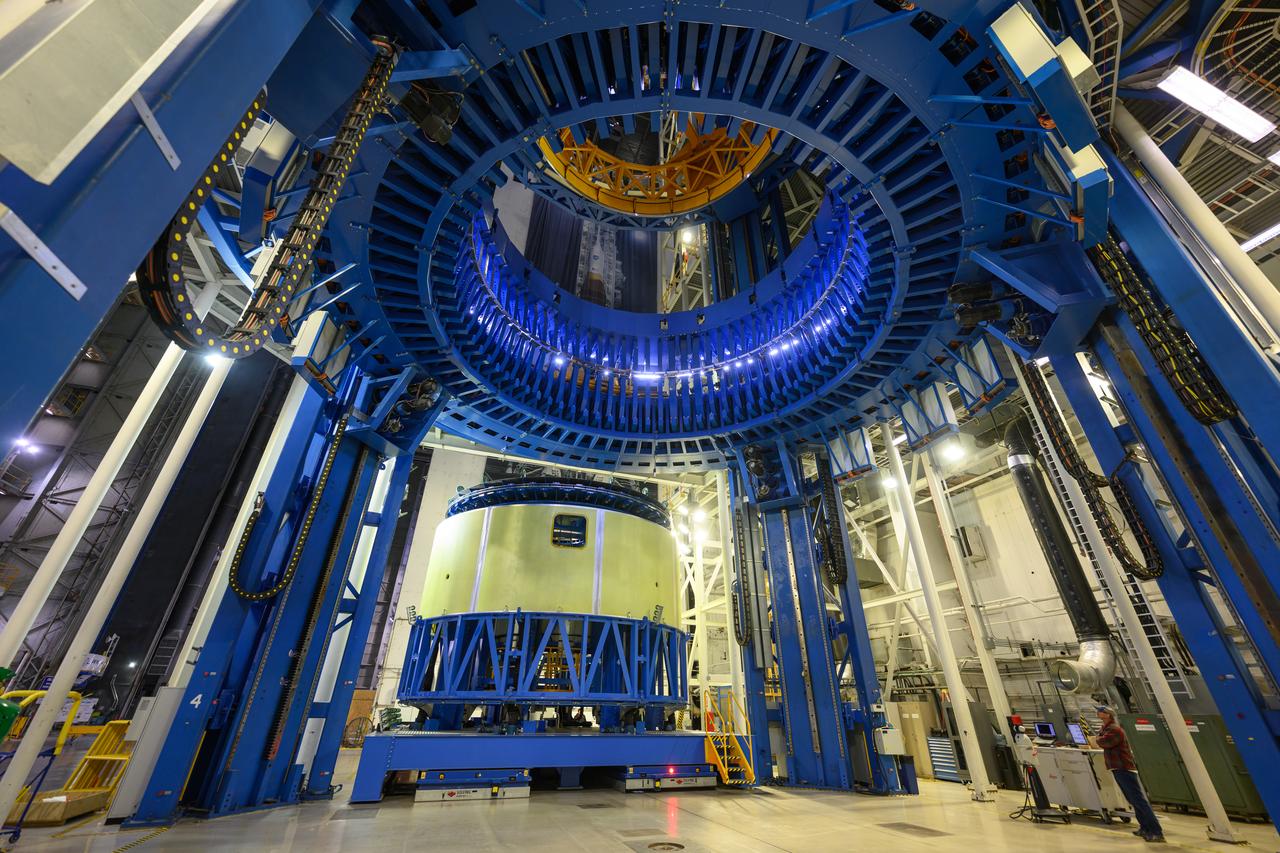
Teams at NASA’s Michoud Assembly Facility in New Orleans move the forward skirt, which will be used on the SLS (Space Launch System) rocket’s core stage for the agency’s Artemis IV mission, into the vertical assembly center on Dec. 2. Inside the tooling, the forward skirt receives its forward and aft rings through a circumferential friction-stir welding process. Seven rings are used in the production of the core stage. They provide stiffening for the dome structures on the propellant tanks and, as on the forward skirt, serve as attachment points for the major components to form the SLS core stage. The forward skirt is one of five major elements that make up the 212-foot-tall rocket stage. The core stage, along with its four RS-25 engines, produce more than two million pounds of thrust to help launch NASA’s Orion spacecraft, astronauts, and supplies beyond Earth’s orbit and to the lunar surface for Artemis.
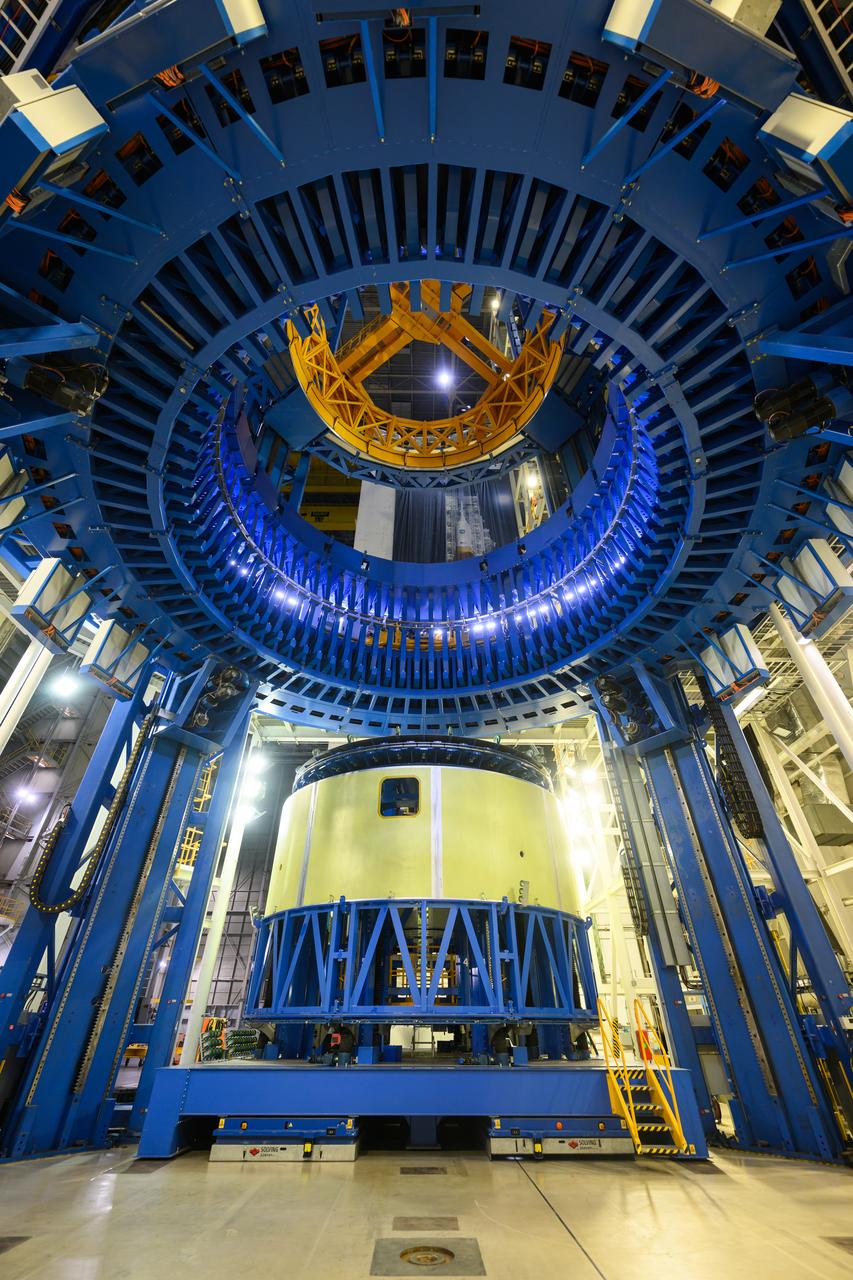
Teams at NASA’s Michoud Assembly Facility in New Orleans move the forward skirt, which will be used on the SLS (Space Launch System) rocket’s core stage for the agency’s Artemis IV mission, into the vertical assembly center on Dec. 2. Inside the tooling, the forward skirt receives its forward and aft rings through a circumferential friction-stir welding process. Seven rings are used in the production of the core stage. They provide stiffening for the dome structures on the propellant tanks and, as on the forward skirt, serve as attachment points for the major components to form the SLS core stage. The forward skirt is one of five major elements that make up the 212-foot-tall rocket stage. The core stage, along with its four RS-25 engines, produce more than two million pounds of thrust to help launch NASA’s Orion spacecraft, astronauts, and supplies beyond Earth’s orbit and to the lunar surface for Artemis.

This imagery shows how technicians at NASA’s Michoud Assembly Facility moved the aft dome of the liquid oxygen tank for NASA’s SLS (Space Launch System) rocket for the next phase of production inside the Vertical Assembly center Dec. 18. The dome will form part of the core stage that will power NASA’s Artemis III mission. Engineers rotate the dome to attach it to the previously joined forward dome and aft barrel segments using friction-stir welding. The liquid oxygen tank is one of five major components that make up the SLS rocket’s core stage. Together with the forward skirt, intertank, liquid hydrogen tank, engine section, along with the four RS-25 engines at its base, the 212-foot core stage will help power NASA’s Artemis missions to the Moon.
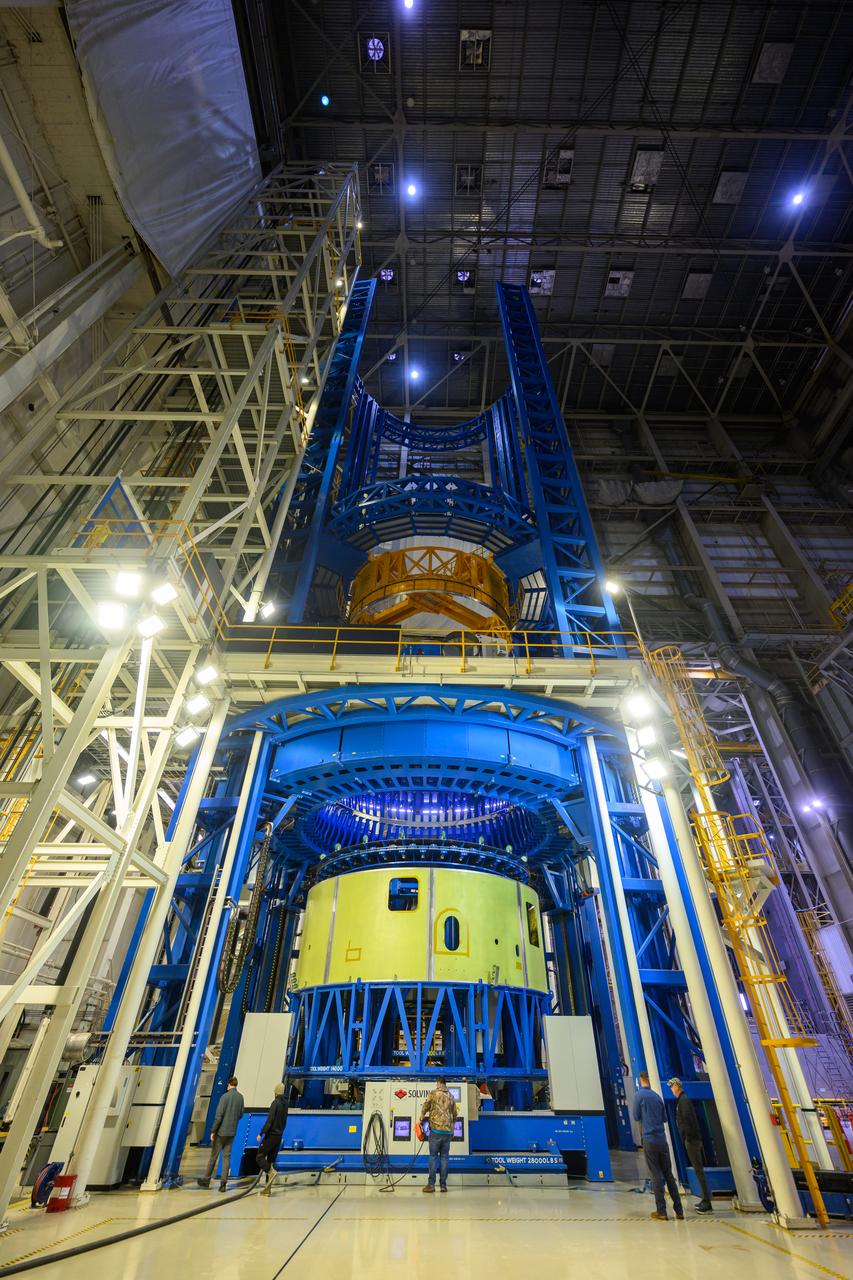
Teams at NASA’s Michoud Assembly Facility in New Orleans move the forward skirt, which will be used on the SLS (Space Launch System) rocket’s core stage for the agency’s Artemis IV mission, into the vertical assembly center on Dec. 2. Inside the tooling, the forward skirt receives its forward and aft rings through a circumferential friction-stir welding process. Seven rings are used in the production of the core stage. They provide stiffening for the dome structures on the propellant tanks and, as on the forward skirt, serve as attachment points for the major components to form the SLS core stage. The forward skirt is one of five major elements that make up the 212-foot-tall rocket stage. The core stage, along with its four RS-25 engines, produce more than two million pounds of thrust to help launch NASA’s Orion spacecraft, astronauts, and supplies beyond Earth’s orbit and to the lunar surface for Artemis.

This imagery shows how technicians at NASA’s Michoud Assembly Facility moved the aft dome of the liquid oxygen tank for NASA’s SLS (Space Launch System) rocket for the next phase of production inside the Vertical Assembly center Dec. 18. The dome will form part of the core stage that will power NASA’s Artemis III mission. Engineers rotate the dome to attach it to the previously joined forward dome and aft barrel segments using friction-stir welding. The liquid oxygen tank is one of five major components that make up the SLS rocket’s core stage. Together with the forward skirt, intertank, liquid hydrogen tank, engine section, along with the four RS-25 engines at its base, the 212-foot core stage will help power NASA’s Artemis missions to the Moon.

This imagery shows how technicians at NASA’s Michoud Assembly Facility moved the aft dome of the liquid oxygen tank for NASA’s SLS (Space Launch System) rocket for the next phase of production inside the Vertical Assembly center Dec. 18. The dome will form part of the core stage that will power NASA’s Artemis III mission. Engineers rotate the dome to attach it to the previously joined forward dome and aft barrel segments using friction-stir welding. The liquid oxygen tank is one of five major components that make up the SLS rocket’s core stage. Together with the forward skirt, intertank, liquid hydrogen tank, engine section, along with the four RS-25 engines at its base, the 212-foot core stage will help power NASA’s Artemis missions to the Moon.

This imagery shows how technicians at NASA’s Michoud Assembly Facility moved the aft dome of the liquid oxygen tank for NASA’s SLS (Space Launch System) rocket for the next phase of production inside the Vertical Assembly center Dec. 18. The dome will form part of the core stage that will power NASA’s Artemis III mission. Engineers rotate the dome to attach it to the previously joined forward dome and aft barrel segments using friction-stir welding. The liquid oxygen tank is one of five major components that make up the SLS rocket’s core stage. Together with the forward skirt, intertank, liquid hydrogen tank, engine section, along with the four RS-25 engines at its base, the 212-foot core stage will help power NASA’s Artemis missions to the Moon.

This imagery shows how technicians at NASA’s Michoud Assembly Facility moved the aft dome of the liquid oxygen tank for NASA’s SLS (Space Launch System) rocket for the next phase of production inside the Vertical Assembly center Dec. 18. The dome will form part of the core stage that will power NASA’s Artemis III mission. Engineers rotate the dome to attach it to the previously joined forward dome and aft barrel segments using friction-stir welding. The liquid oxygen tank is one of five major components that make up the SLS rocket’s core stage. Together with the forward skirt, intertank, liquid hydrogen tank, engine section, along with the four RS-25 engines at its base, the 212-foot core stage will help power NASA’s Artemis missions to the Moon.

This imagery shows how technicians at NASA’s Michoud Assembly Facility moved the aft dome of the liquid oxygen tank for NASA’s SLS (Space Launch System) rocket for the next phase of production inside the Vertical Assembly center Dec. 18. The dome will form part of the core stage that will power NASA’s Artemis III mission. Engineers rotate the dome to attach it to the previously joined forward dome and aft barrel segments using friction-stir welding. The liquid oxygen tank is one of five major components that make up the SLS rocket’s core stage. Together with the forward skirt, intertank, liquid hydrogen tank, engine section, along with the four RS-25 engines at its base, the 212-foot core stage will help power NASA’s Artemis missions to the Moon.

This imagery shows how technicians at NASA’s Michoud Assembly Facility moved the aft dome of the liquid oxygen tank for NASA’s SLS (Space Launch System) rocket for the next phase of production inside the Vertical Assembly center Dec. 18. The dome will form part of the core stage that will power NASA’s Artemis III mission. Engineers rotate the dome to attach it to the previously joined forward dome and aft barrel segments using friction-stir welding. The liquid oxygen tank is one of five major components that make up the SLS rocket’s core stage. Together with the forward skirt, intertank, liquid hydrogen tank, engine section, along with the four RS-25 engines at its base, the 212-foot core stage will help power NASA’s Artemis missions to the Moon.

This imagery shows how technicians at NASA’s Michoud Assembly Facility moved the aft dome of the liquid oxygen tank for NASA’s SLS (Space Launch System) rocket for the next phase of production inside the Vertical Assembly center Dec. 18. The dome will form part of the core stage that will power NASA’s Artemis III mission. Engineers rotate the dome to attach it to the previously joined forward dome and aft barrel segments using friction-stir welding. The liquid oxygen tank is one of five major components that make up the SLS rocket’s core stage. Together with the forward skirt, intertank, liquid hydrogen tank, engine section, along with the four RS-25 engines at its base, the 212-foot core stage will help power NASA’s Artemis missions to the Moon.

This imagery shows how technicians at NASA’s Michoud Assembly Facility moved the aft dome of the liquid oxygen tank for NASA’s SLS (Space Launch System) rocket for the next phase of production inside the Vertical Assembly center Dec. 18. The dome will form part of the core stage that will power NASA’s Artemis III mission. Engineers rotate the dome to attach it to the previously joined forward dome and aft barrel segments using friction-stir welding. The liquid oxygen tank is one of five major components that make up the SLS rocket’s core stage. Together with the forward skirt, intertank, liquid hydrogen tank, engine section, along with the four RS-25 engines at its base, the 212-foot core stage will help power NASA’s Artemis missions to the Moon.

This imagery shows how technicians at NASA’s Michoud Assembly Facility moved the aft dome of the liquid oxygen tank for NASA’s SLS (Space Launch System) rocket for the next phase of production inside the Vertical Assembly center Dec. 18. The dome will form part of the core stage that will power NASA’s Artemis III mission. Engineers rotate the dome to attach it to the previously joined forward dome and aft barrel segments using friction-stir welding. The liquid oxygen tank is one of five major components that make up the SLS rocket’s core stage. Together with the forward skirt, intertank, liquid hydrogen tank, engine section, along with the four RS-25 engines at its base, the 212-foot core stage will help power NASA’s Artemis missions to the Moon.
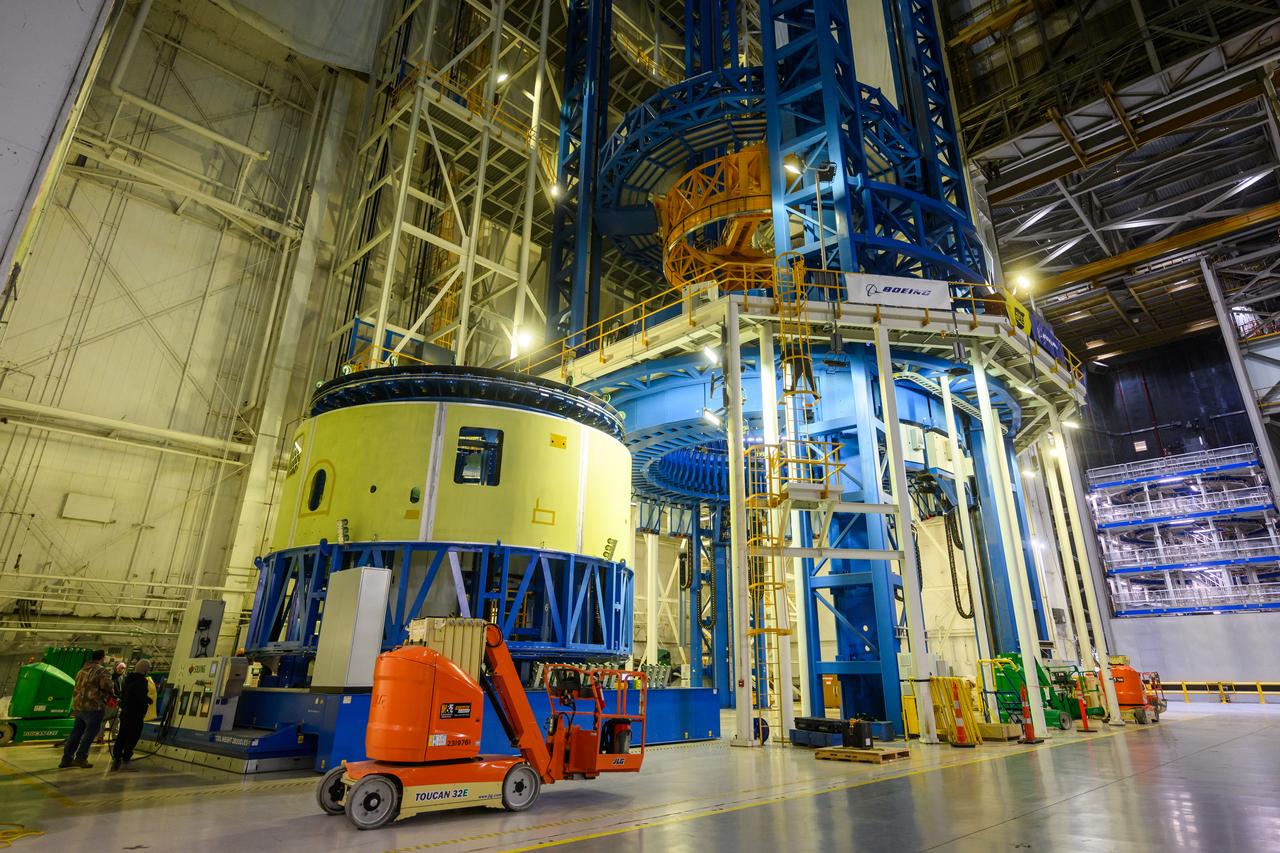
Teams at NASA’s Michoud Assembly Facility in New Orleans move the forward skirt, which will be used on the SLS (Space Launch System) rocket’s core stage for the agency’s Artemis IV mission, into the vertical assembly center on Dec. 2. Inside the tooling, the forward skirt receives its forward and aft rings through a circumferential friction-stir welding process. Seven rings are used in the production of the core stage. They provide stiffening for the dome structures on the propellant tanks and, as on the forward skirt, serve as attachment points for the major components to form the SLS core stage. The forward skirt is one of five major elements that make up the 212-foot-tall rocket stage. The core stage, along with its four RS-25 engines, produce more than two million pounds of thrust to help launch NASA’s Orion spacecraft, astronauts, and supplies beyond Earth’s orbit and to the lunar surface for Artemis.
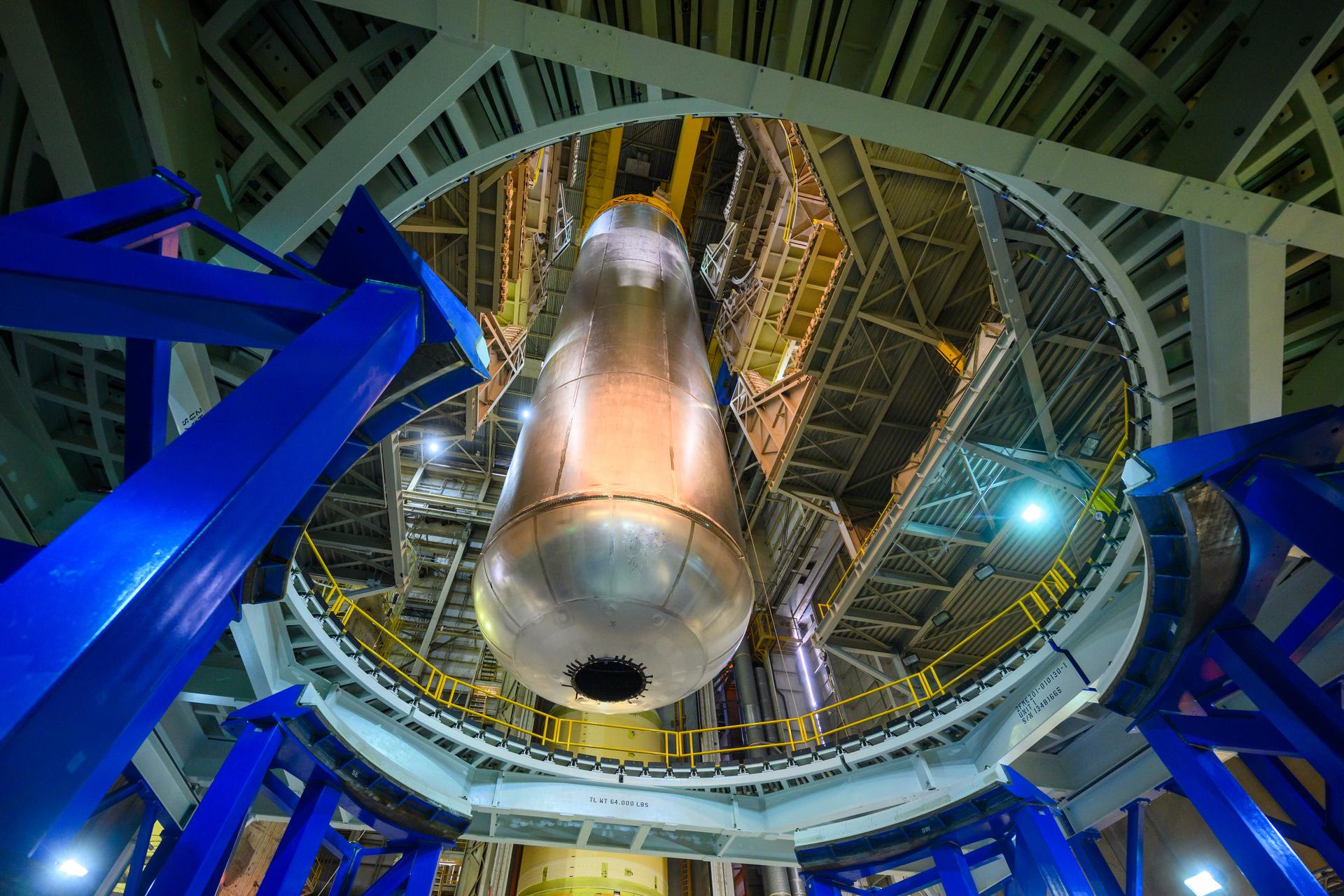
Teams at NASA’s Michoud Assembly Facility in New Orleans lift the 130-foot-tall liquid hydrogen tank off the vertical assembly center on Nov. 14. This is the fourth liquid hydrogen tank manufactured at the facility for the agency’s SLS (Space Launch System) rocket. The completed tank will be loaded into a production cell for technicians to remove the lift tool, perform dimensional scans, and then install brackets, which will allow the move crew to break the tank over from a vertical to a horizontal configuration.
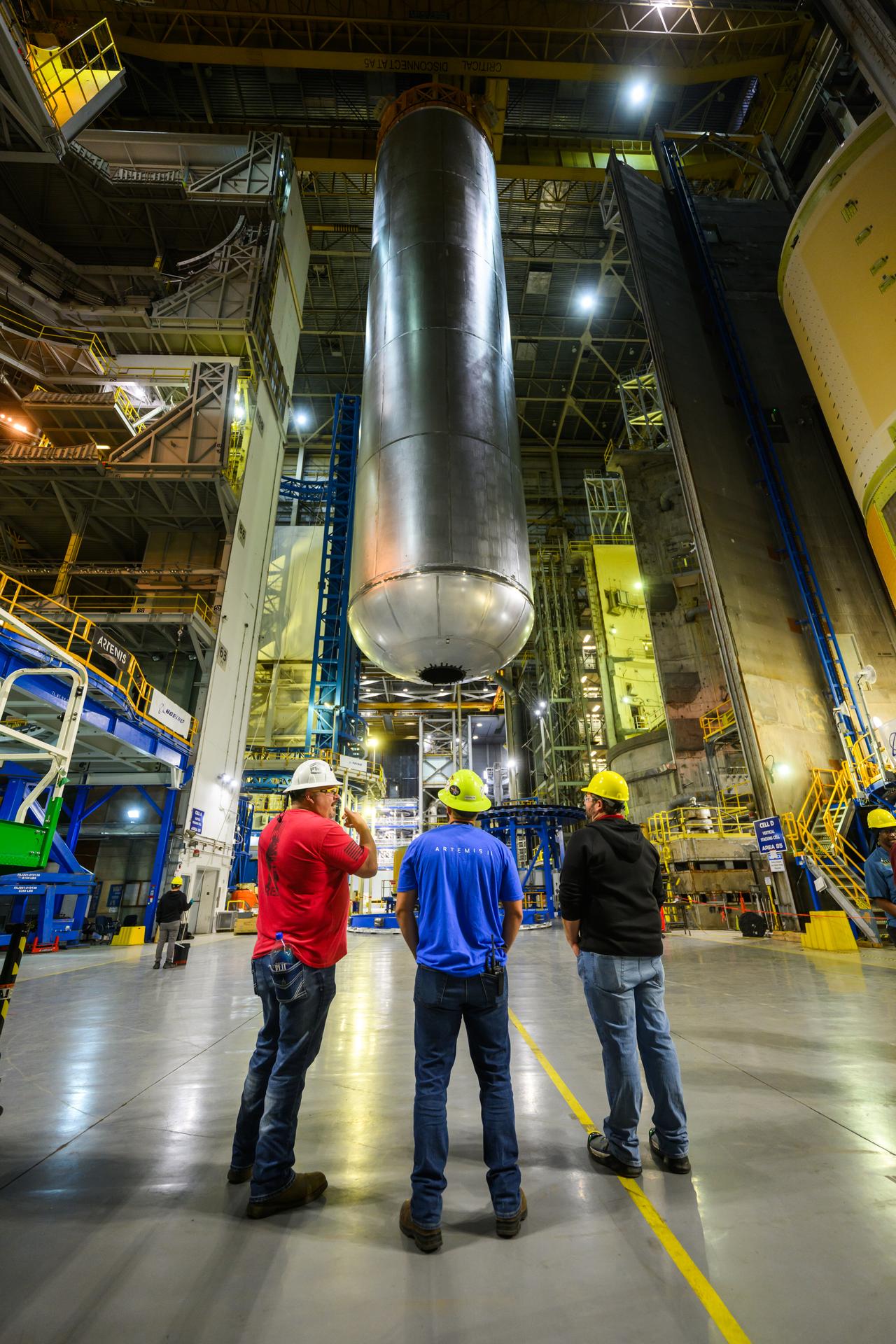
Teams at NASA’s Michoud Assembly Facility in New Orleans lift the 130-foot-tall liquid hydrogen tank off the vertical assembly center on Nov. 14. This is the fourth liquid hydrogen tank manufactured at the facility for the agency’s SLS (Space Launch System) rocket. The completed tank will be loaded into a production cell for technicians to remove the lift tool, perform dimensional scans, and then install brackets, which will allow the move crew to break the tank over from a vertical to a horizontal configuration.
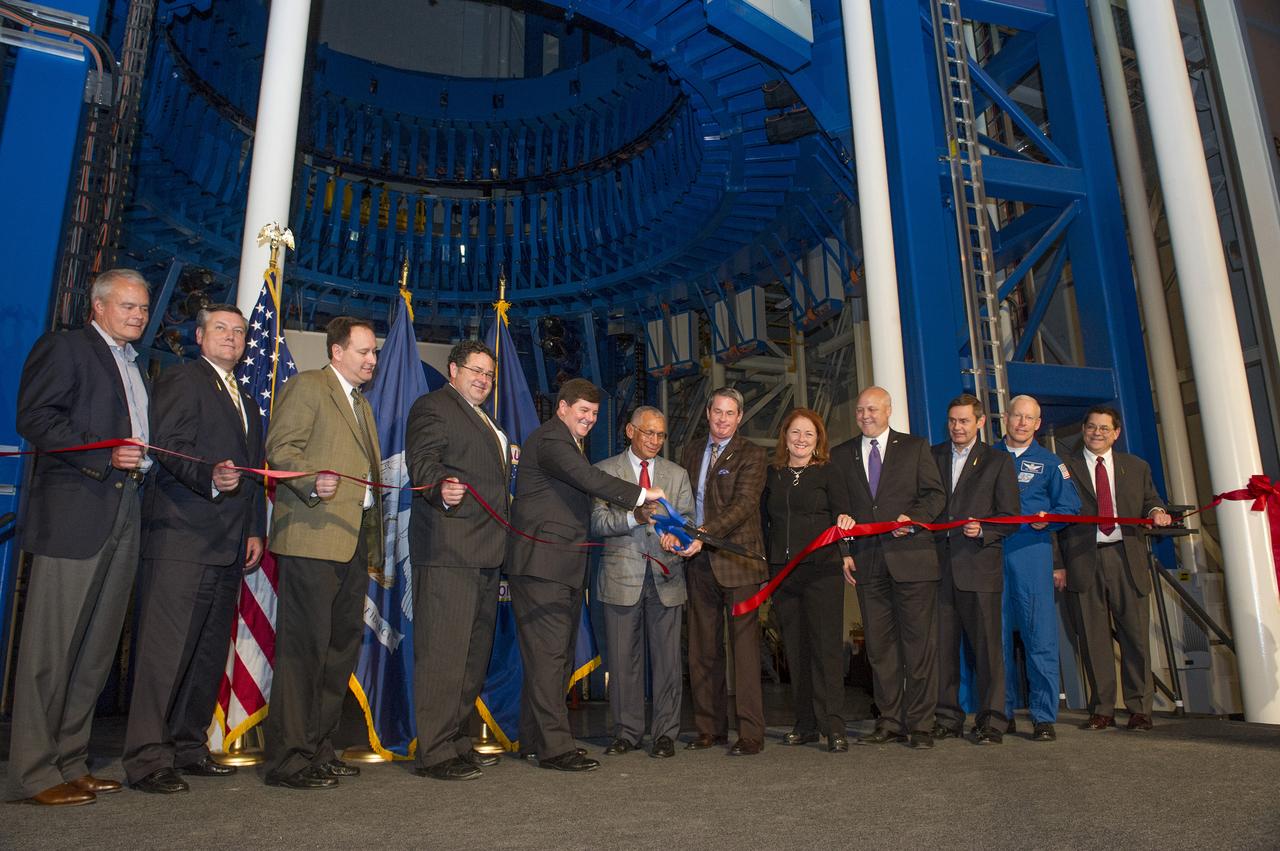
RIBBON CUTTING AT VERTICAL ASSEMBLY CENTER, MICHOUD ASSEMBLY FACILITY, SEPTEMBER 12, 2014, (L TO R): CLAY KIEFABER, CEO OF ESAB (COMPANY THAT BUILT WELDING TOOL)…PATRICK SCHEUERMANN…ROBERT LIGHTFOOT…TODD MAY…MISSISSIPPI CONGRESSMAN STEVEN PALAZZO…CHARLIE BOLDEN…LOUISIANA SENATOR DAVID VITTER…VIRGINIA BARNES, VICE-PRESIDENT AND PROGRAM MANAGER FOR SLS - BOEING… MITCH LANDRIEU, MAYOR OF NEW ORLEANS… JOHN ELBON, VICE PRESIDENT/GENERAL MANAGER, SPACE EXPLORATIONS – BOEING…PATRICK FORRESTER, ASTRONAUT…ROY MALONE.
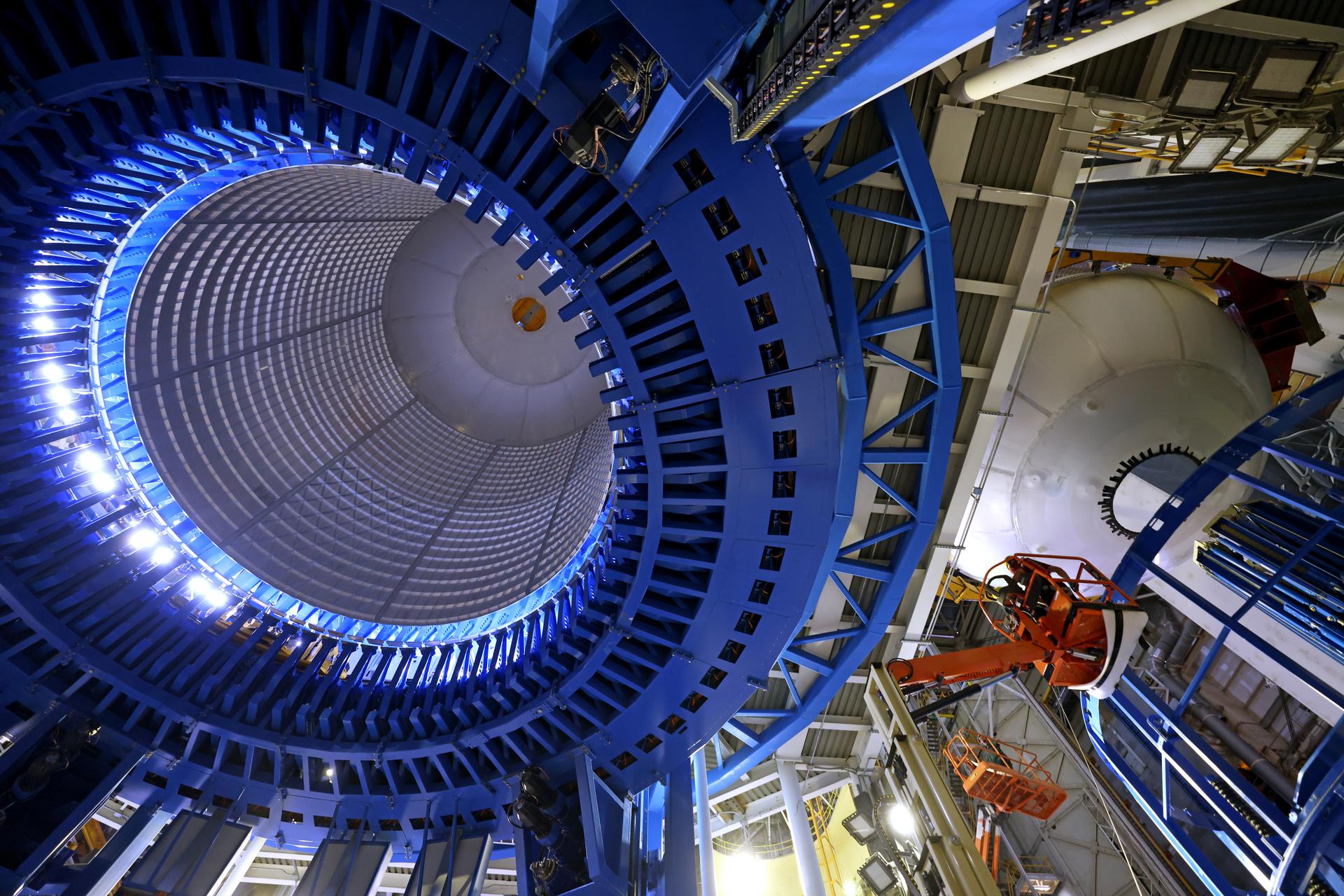
Teams at NASA’s Michoud Assembly Facility in New Orleans lift the aft dome for the liquid oxygen tank into the Vertical Assembly Center on May 11. The flight hardware will form part of the SLS (Space Launch System) rocket’s core stage for the Artemis IV mission. The aft dome is the final piece to complete the liquid oxygen tank structure. Inside the vertical assembly center – one of the largest friction-stir weld tools in the world – NASA and Boeing, SLS core stage prime contractor, will perform a circumferential weld to join the dome to the previously welded forward dome and two barrel structures to form the full liquid oxygen tank structure. The propellant tank is one of five major elements that make up the 212-foot-tall rocket stage. The core stage, along with its four RS-25 engines at its base, produces more than two million pounds of thrust to help launch NASA’s Orion spacecraft, astronauts, and supplies beyond Earth’s orbit and to the lunar surface for Artemis. Image credit: NASA/Michael DeMocker
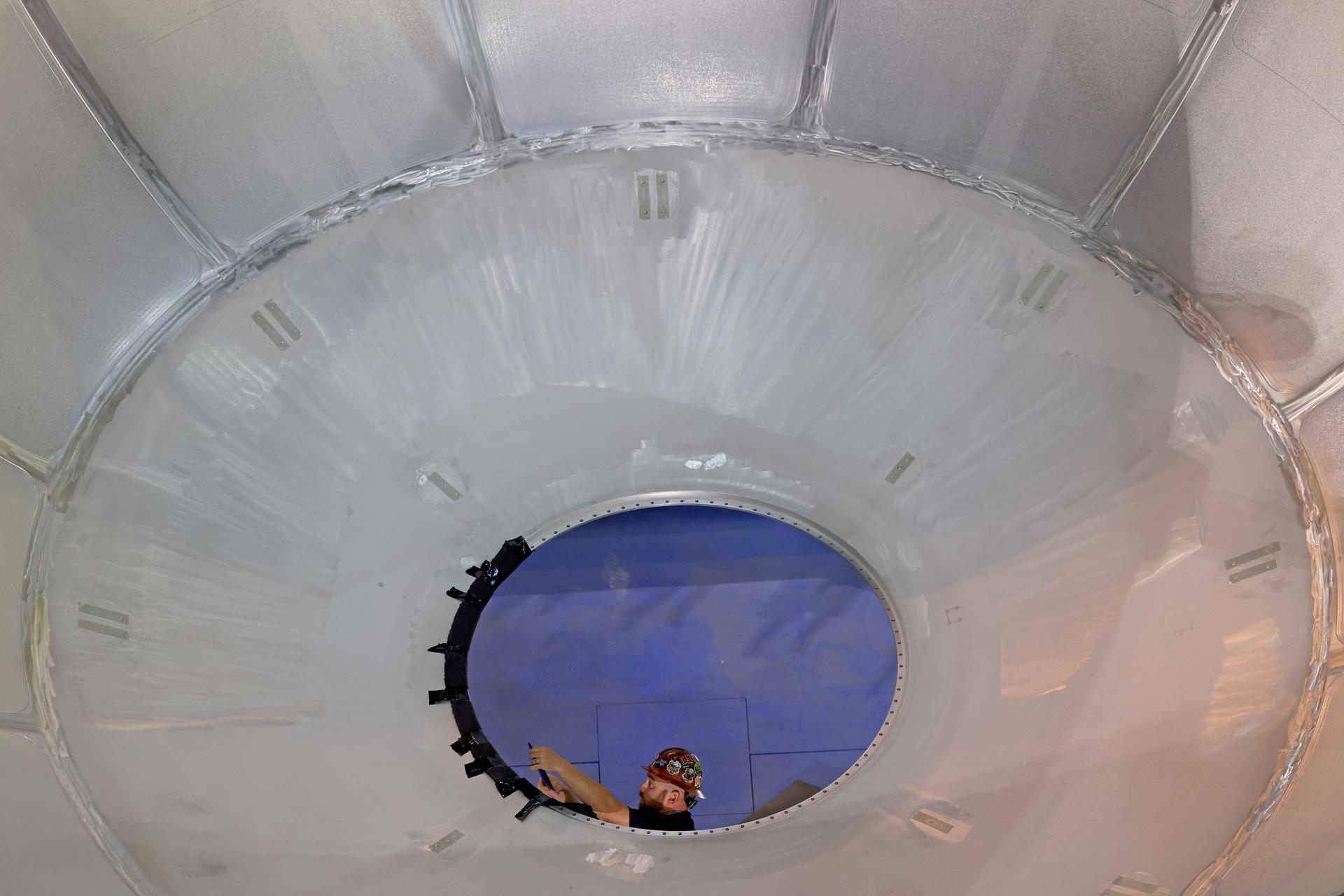
Teams at NASA’s Michoud Assembly Facility in New Orleans lift the aft dome for the liquid oxygen tank into the Vertical Assembly Center on May 11. The flight hardware will form part of the SLS (Space Launch System) rocket’s core stage for the Artemis IV mission. The aft dome is the final piece to complete the liquid oxygen tank structure. Inside the vertical assembly center – one of the largest friction-stir weld tools in the world – NASA and Boeing, SLS core stage prime contractor, will perform a circumferential weld to join the dome to the previously welded forward dome and two barrel structures to form the full liquid oxygen tank structure. The propellant tank is one of five major elements that make up the 212-foot-tall rocket stage. The core stage, along with its four RS-25 engines at its base, produces more than two million pounds of thrust to help launch NASA’s Orion spacecraft, astronauts, and supplies beyond Earth’s orbit and to the lunar surface for Artemis. Image credit: NASA/Michael DeMocker
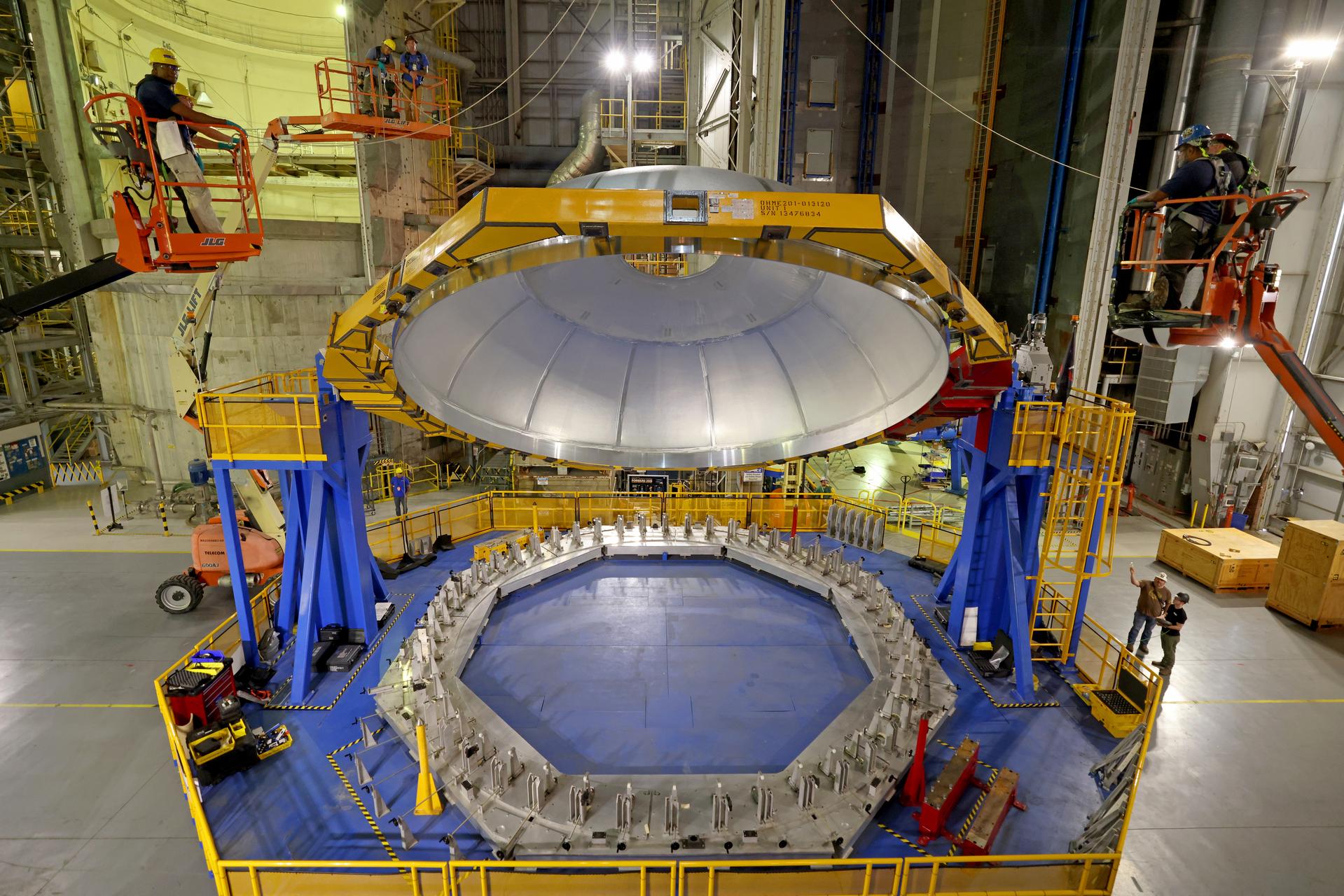
Teams at NASA’s Michoud Assembly Facility in New Orleans lift the aft dome for the liquid oxygen tank into the Vertical Assembly Center on May 11. The flight hardware will form part of the SLS (Space Launch System) rocket’s core stage for the Artemis IV mission. The aft dome is the final piece to complete the liquid oxygen tank structure. Inside the vertical assembly center – one of the largest friction-stir weld tools in the world – NASA and Boeing, SLS core stage prime contractor, will perform a circumferential weld to join the dome to the previously welded forward dome and two barrel structures to form the full liquid oxygen tank structure. The propellant tank is one of five major elements that make up the 212-foot-tall rocket stage. The core stage, along with its four RS-25 engines at its base, produces more than two million pounds of thrust to help launch NASA’s Orion spacecraft, astronauts, and supplies beyond Earth’s orbit and to the lunar surface for Artemis. Image credit: NASA/Michael DeMocker
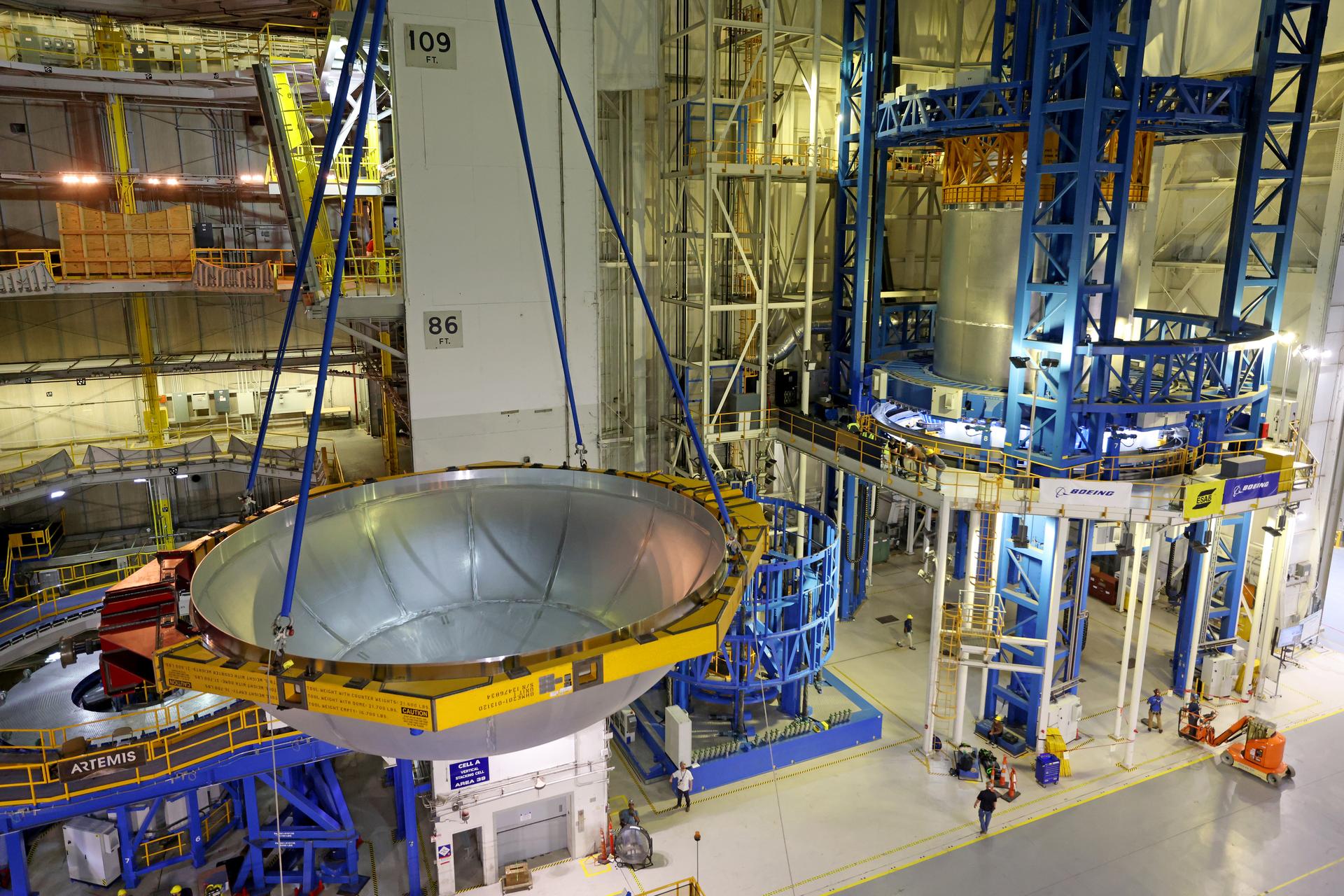
Teams at NASA’s Michoud Assembly Facility in New Orleans lift the aft dome for the liquid oxygen tank into the Vertical Assembly Center on May 11. The flight hardware will form part of the SLS (Space Launch System) rocket’s core stage for the Artemis IV mission. The aft dome is the final piece to complete the liquid oxygen tank structure. Inside the vertical assembly center – one of the largest friction-stir weld tools in the world – NASA and Boeing, SLS core stage prime contractor, will perform a circumferential weld to join the dome to the previously welded forward dome and two barrel structures to form the full liquid oxygen tank structure. The propellant tank is one of five major elements that make up the 212-foot-tall rocket stage. The core stage, along with its four RS-25 engines at its base, produces more than two million pounds of thrust to help launch NASA’s Orion spacecraft, astronauts, and supplies beyond Earth’s orbit and to the lunar surface for Artemis. Image credit: NASA/Michael DeMocker
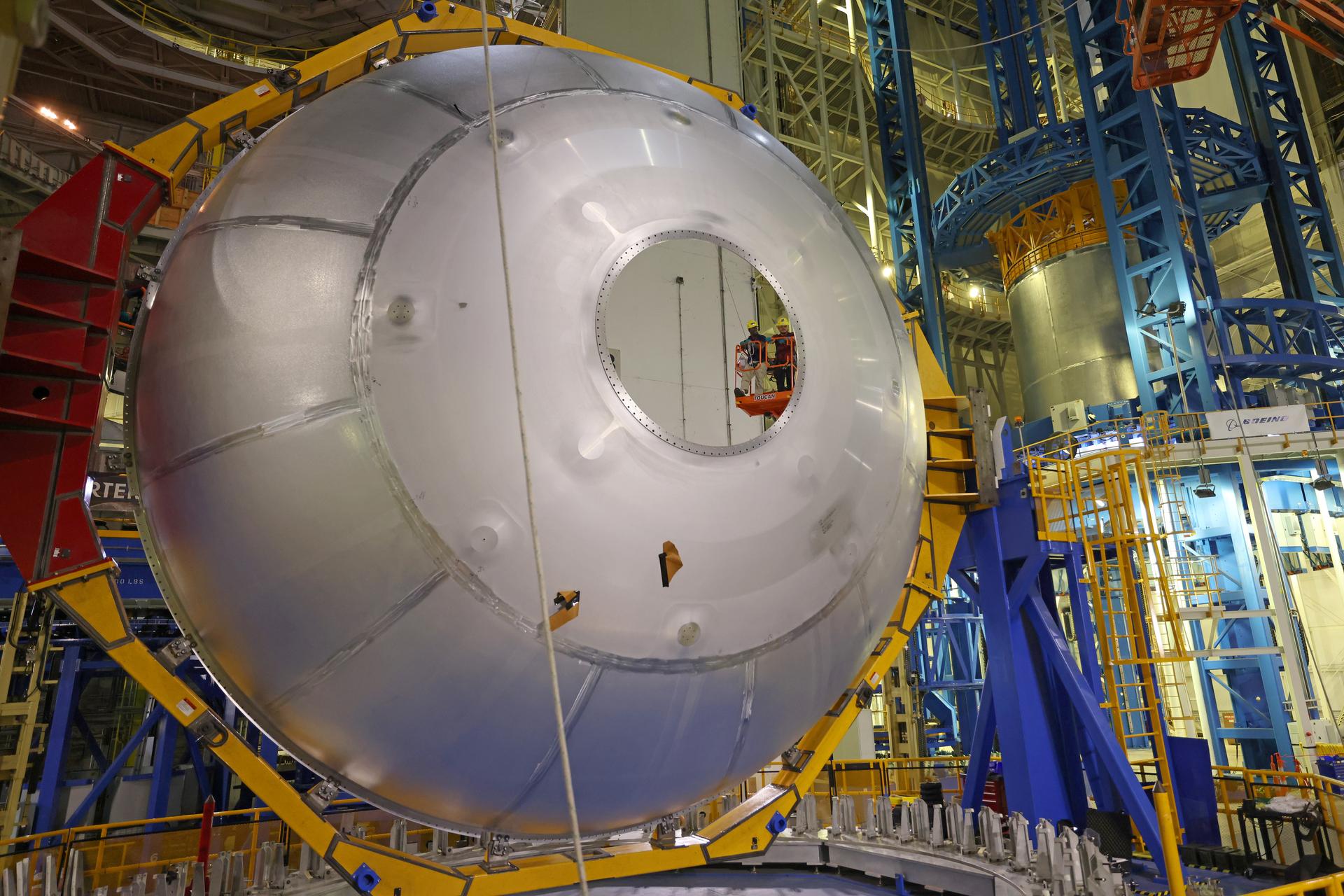
Teams at NASA’s Michoud Assembly Facility in New Orleans lift the aft dome for the liquid oxygen tank into the Vertical Assembly Center on May 11. The flight hardware will form part of the SLS (Space Launch System) rocket’s core stage for the Artemis IV mission. The aft dome is the final piece to complete the liquid oxygen tank structure. Inside the vertical assembly center – one of the largest friction-stir weld tools in the world – NASA and Boeing, SLS core stage prime contractor, will perform a circumferential weld to join the dome to the previously welded forward dome and two barrel structures to form the full liquid oxygen tank structure. The propellant tank is one of five major elements that make up the 212-foot-tall rocket stage. The core stage, along with its four RS-25 engines at its base, produces more than two million pounds of thrust to help launch NASA’s Orion spacecraft, astronauts, and supplies beyond Earth’s orbit and to the lunar surface for Artemis. Image credit: NASA/Michael DeMocker
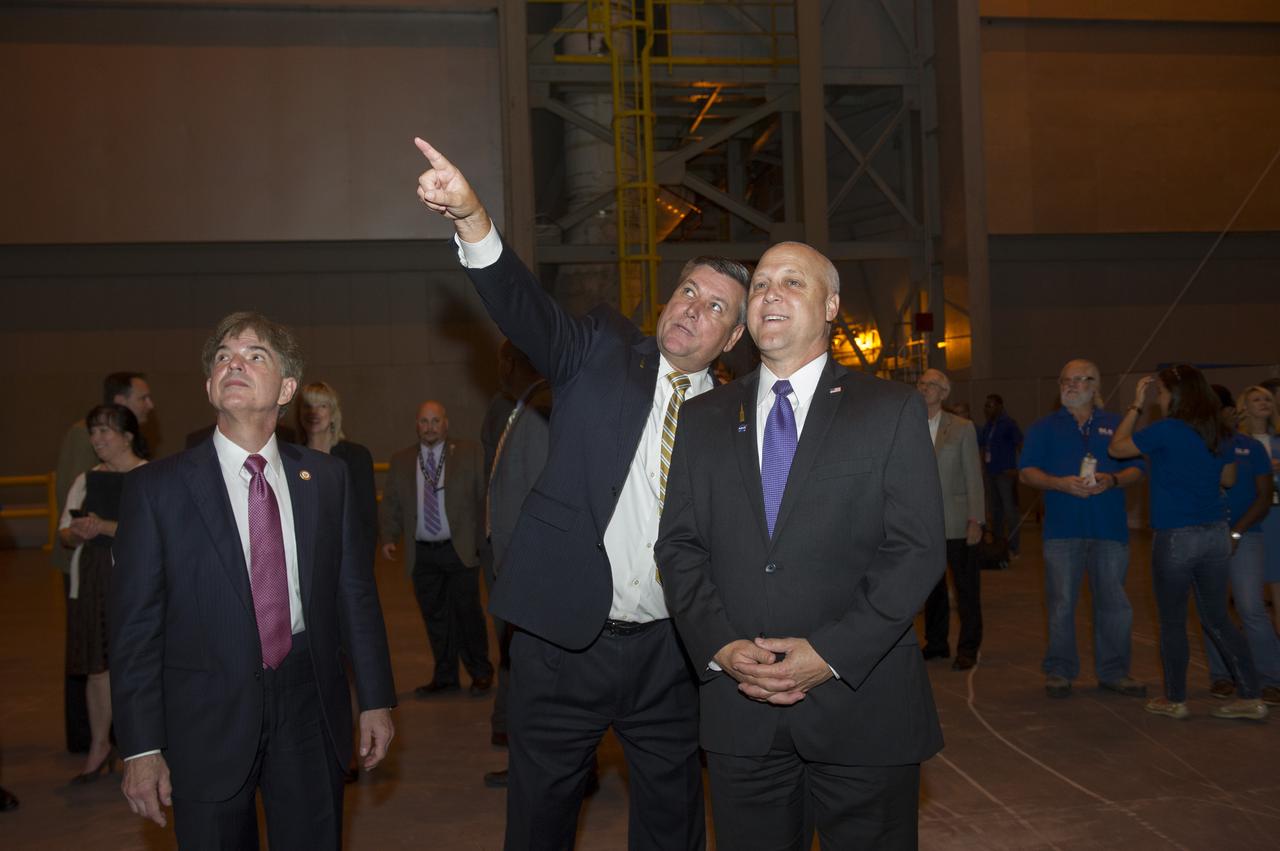
PATRICK SCHEUERMANN POINTS OUT FEATURES OF VERTICAL ASSEMBLY CENTER TO NEW ORLEANS MAYOR MITCH LANDRIEU

NEW ORLEANS MAYOR MITCH LANDRIEU, ROBERT LIGHT FOOT, AND TODD MAY CHAT AFTER DEDICATION OF VERTICAL ASSEMBLY CENTER
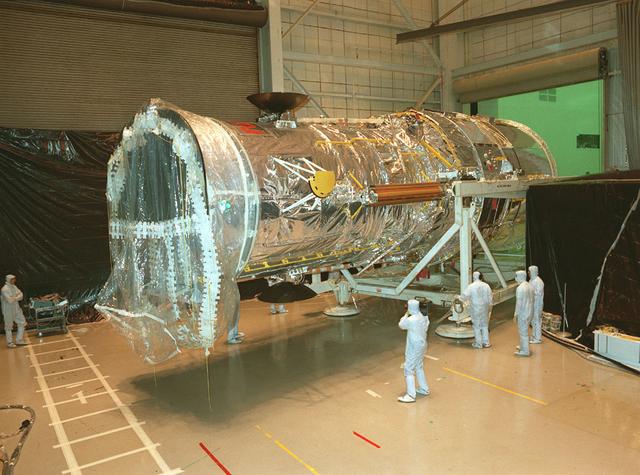
The Hubble Space Telescope (HST) being transferred from the Vertical Assembly Test Area (VATA) to the High Bay at the Lockheed assembly plant in preparation for transport to the Kennedy Space Center (KSC) after final testing and verification.
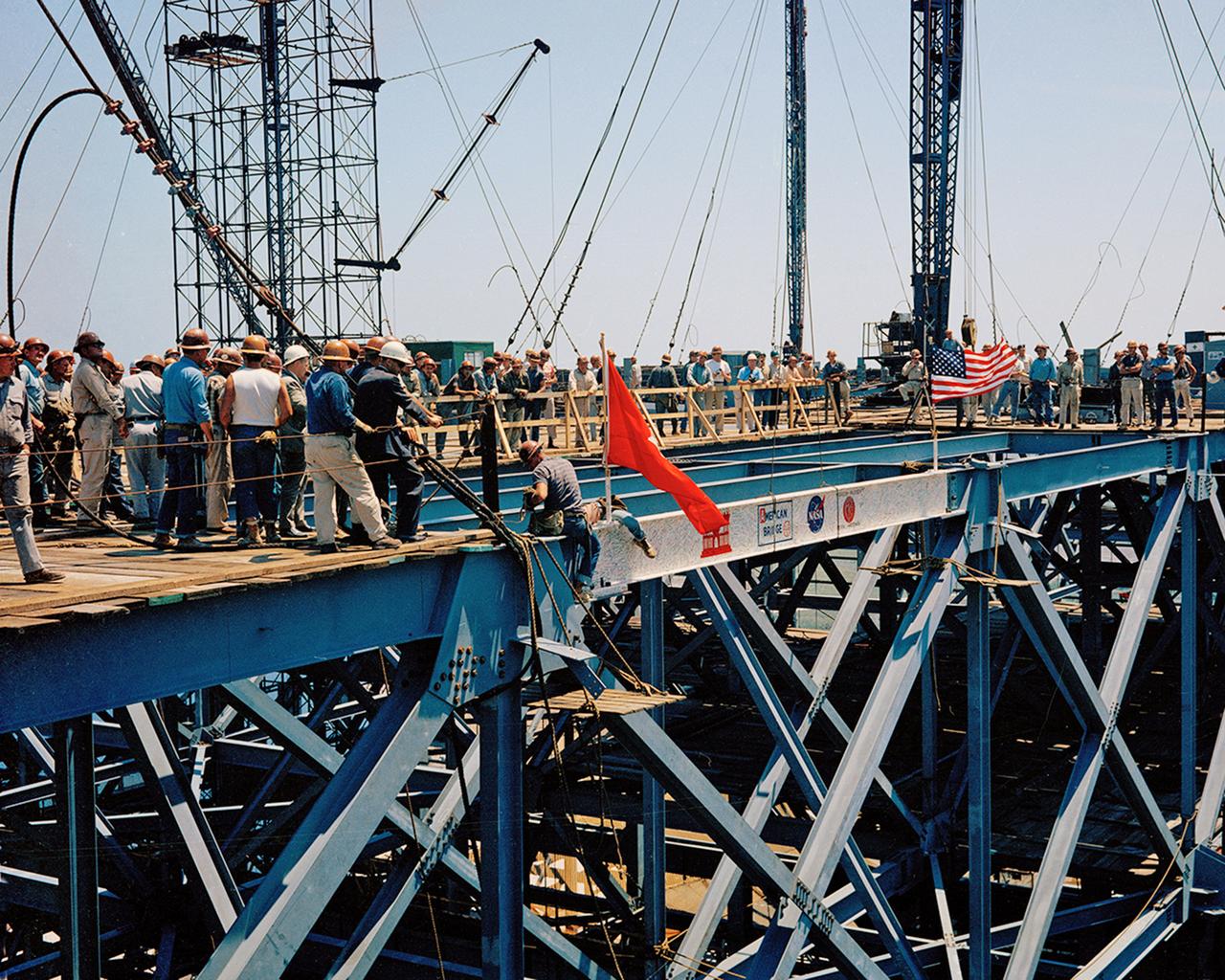
Installation of the Last Major Beam autographed by construction workers, NASA, and Corps of Engineers employees atop the Kennedy Space Center Vertical Assembly Building (VAB), MILA.
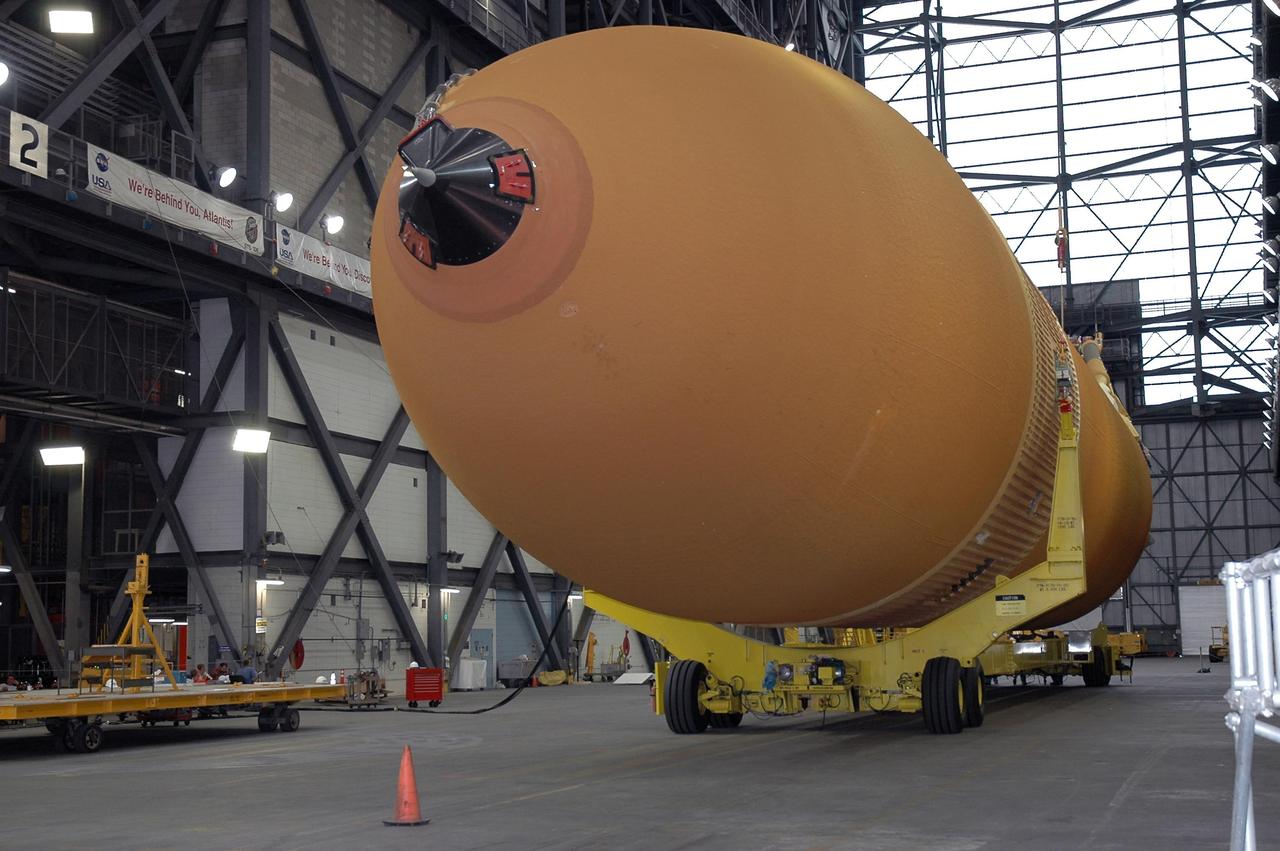
KENNEDY SPACE CENTER, FLA. -- In the Vehicle Assembly Building, external tank No. 117 is lifted off its transporter in preparation for being lifted to a vertical position. Once vertical, the tank will be lifted into the checkout cell in high bay 2 for processing. ET-117 arrived aboard the Pegasus barge after its voyage around the Florida Peninsula from the Michoud Assembly Facility near New Orleans. The tank is slated for mission STS-118, which is targeted for launch in early August. Photo credit: NASA/Jack Pfaller
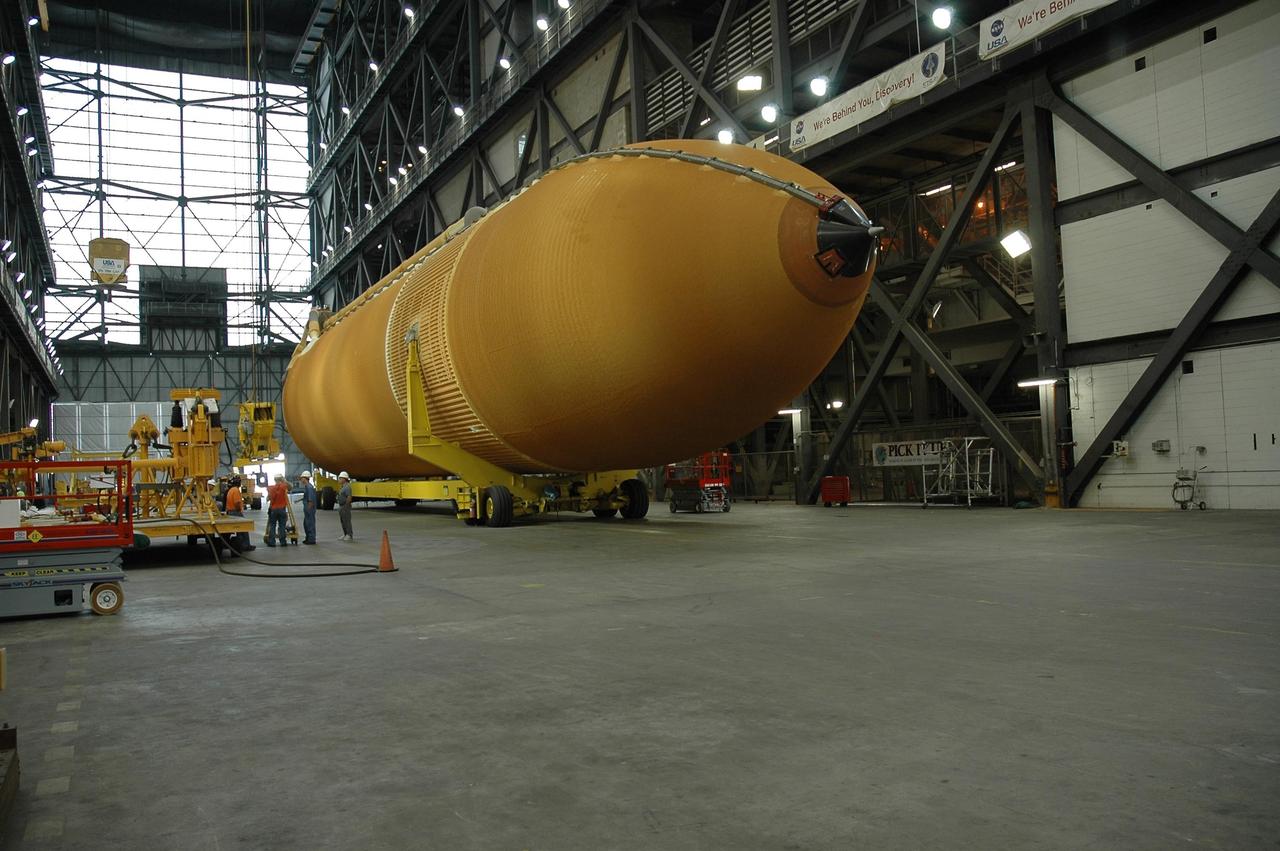
KENNEDY SPACE CENTER, FLA. -- In the Vehicle Assembly Building, workers are attaching an overhead crane to external tank No. 117 in order to lift it to a vertical position. Once vertical, the tank will be lifted into the checkout cell in high bay 2 for processing. ET-117 arrived aboard the Pegasus barge after its voyage around the Florida Peninsula from the Michoud Assembly Facility near New Orleans. The tank is slated for mission STS-118, which is targeted for launch in early August. Photo credit: NASA/Jack Pfaller
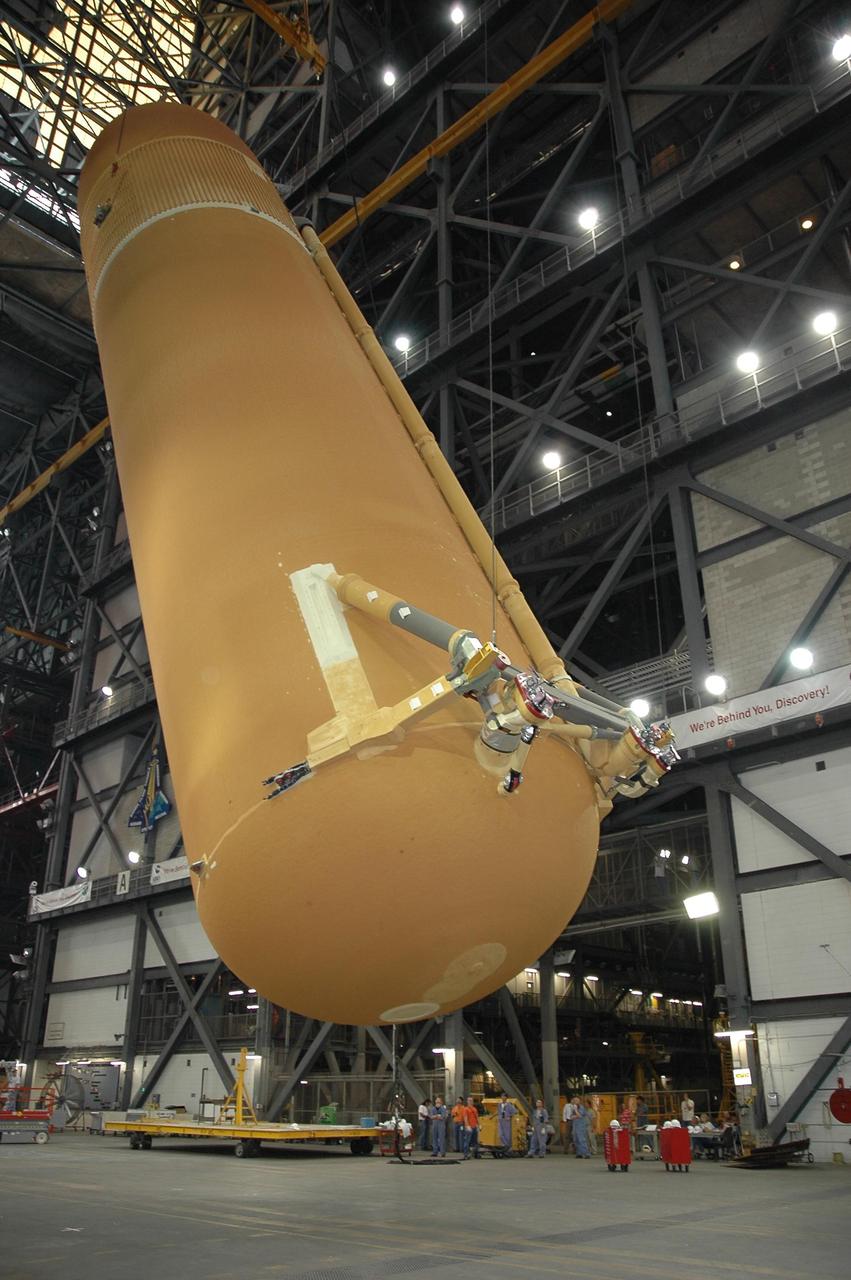
KENNEDY SPACE CENTER, FLA. -- In the Vehicle Assembly Building, external tank No. 117 is nearly raised to a vertical position above the transfer aisle. Once it is vertical, the tank will be lifted into the checkout cell in high bay 2 for processing. ET-117 arrived aboard the Pegasus barge after its voyage around the Florida Peninsula from the Michoud Assembly Facility near New Orleans. The tank is slated for mission STS-118, which is targeted for launch in early August. Photo credit: NASA/Jack Pfaller
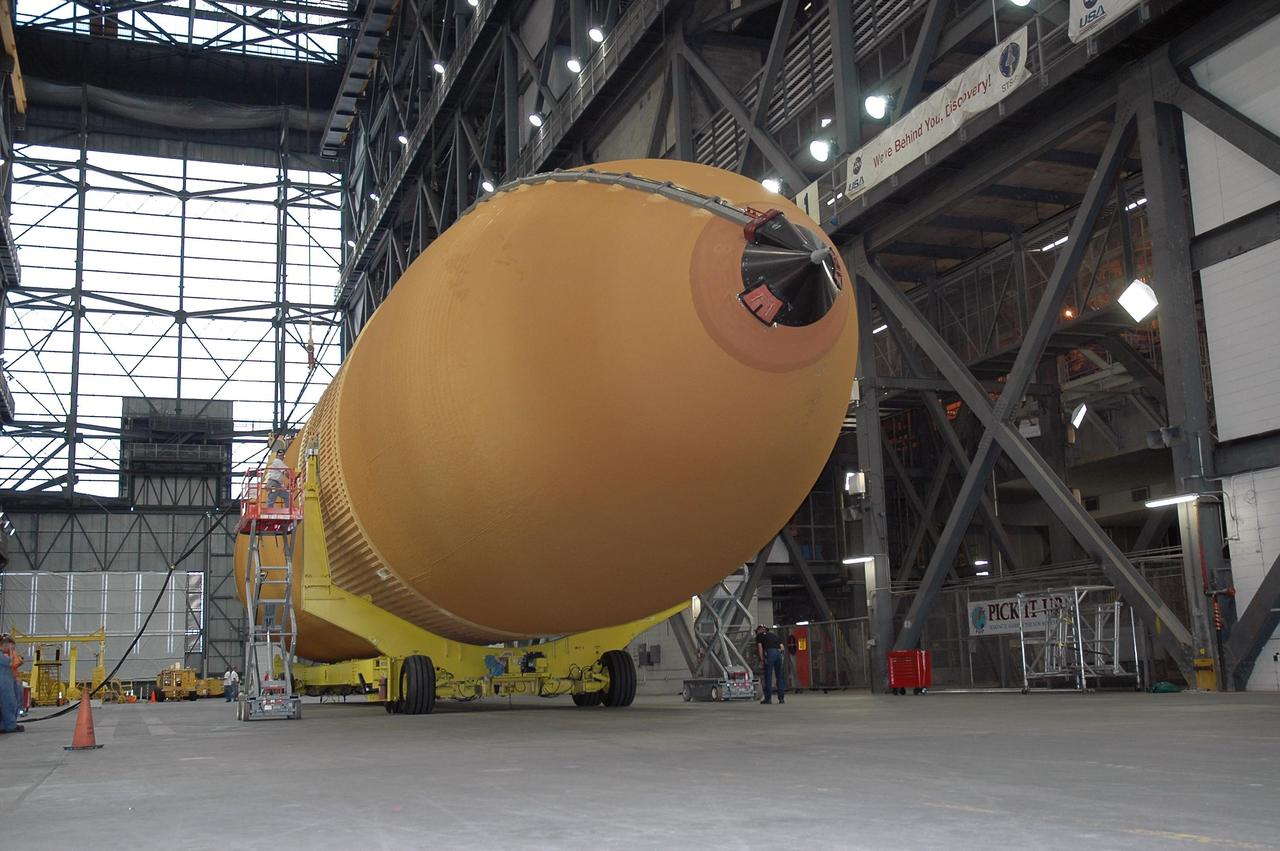
KENNEDY SPACE CENTER, FLA. -- In the Vehicle Assembly Building, external tank No. 117 is waiting to be raised off its transporter in order to lift it to a vertical position. Once vertical, the tank will be lifted into the checkout cell in high bay 2 for processing. ET-117 arrived aboard the Pegasus barge after its voyage around the Florida Peninsula from the Michoud Assembly Facility near New Orleans. The tank is slated for mission STS-118, which is targeted for launch in early August. Photo credit: NASA/Jack Pfaller

KENNEDY SPACE CENTER, FLA. -- In the Vehicle Assembly Building, external tank No. 117 is slowly raised from horizontal to vertical. Once vertical, the tank will be lifted into the checkout cell in high bay 2 for processing. ET-117 arrived aboard the Pegasus barge after its voyage around the Florida Peninsula from the Michoud Assembly Facility near New Orleans. The tank is slated for mission STS-118, which is targeted for launch in early August. Photo credit: NASA/Jack Pfaller

KENNEDY SPACE CENTER, FLA. - The vertically suspended external tank is lowered toward a transporter in the transfer aisle of the Vehicle Assembly Building. The tank is being transferred to the Michoud Space Systems Assembly Facility near New Orleans where redesign of the external tank is underway for Return to Flight.
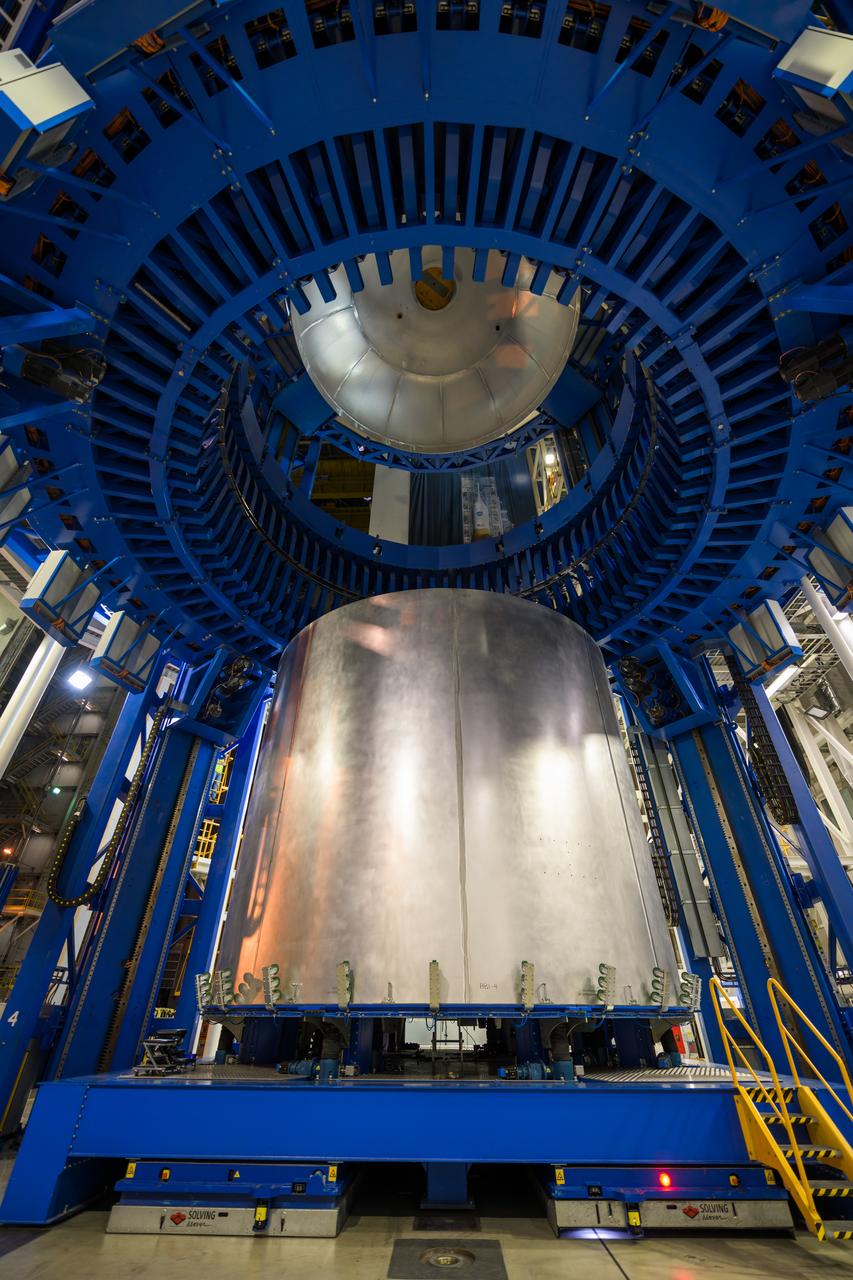
Space Launch System Corestage-2 Liquid Hydrogen(LH2) tank is under construction at NASA's Michoud Assembly Facility. Here you can see 1 of 5 barrels being loaded in the Vertical Assembly Center tool where it will be welded.

KENNEDY SPACE CENTER, FLA. - The vertically suspended external tank is lowered toward a transporter in the transfer aisle of the Vehicle Assembly Building. The tank is being transferred to the Michoud Space Systems Assembly Facility near New Orleans where redesign of the external tank is underway for Return to Flight.
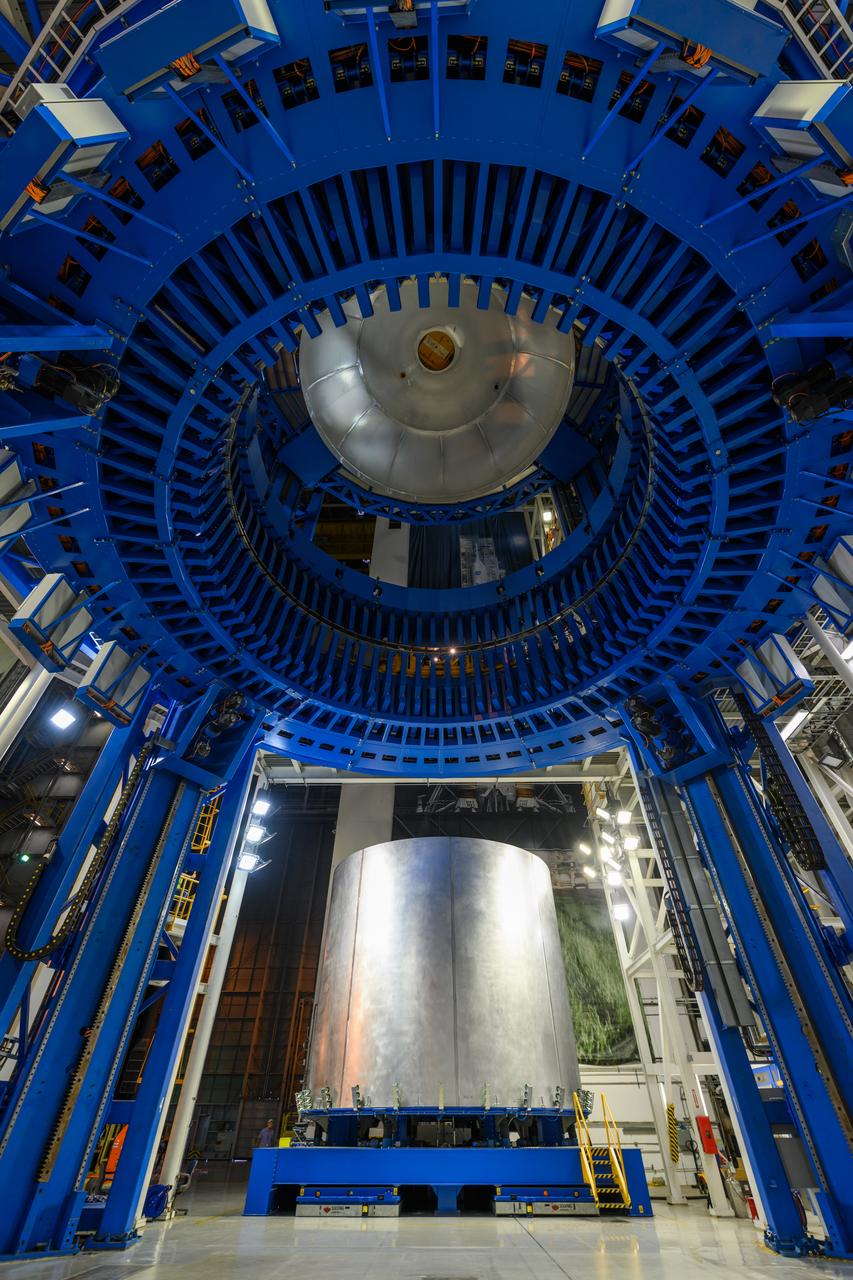
Space Launch System Corestage-2 Liquid Hydrogen(LH2) tank is under construction at NASA's Michoud Assembly Facility. Here you can see 1 of 5 barrels being loaded in the Vertical Assembly Center tool where it will be welded.

Astronaut Victor Glover visits with Michoud employees and with the Artemis II Core Stage as it prepares to roll out of the Vertical Assembly Building to the waiting Pegasus barge at NASA’s Michoud Assembly Facility in New Orleans in preparation for delivery to Kennedy Space Center later this month. Image credit: NASA/Michael DeMocker
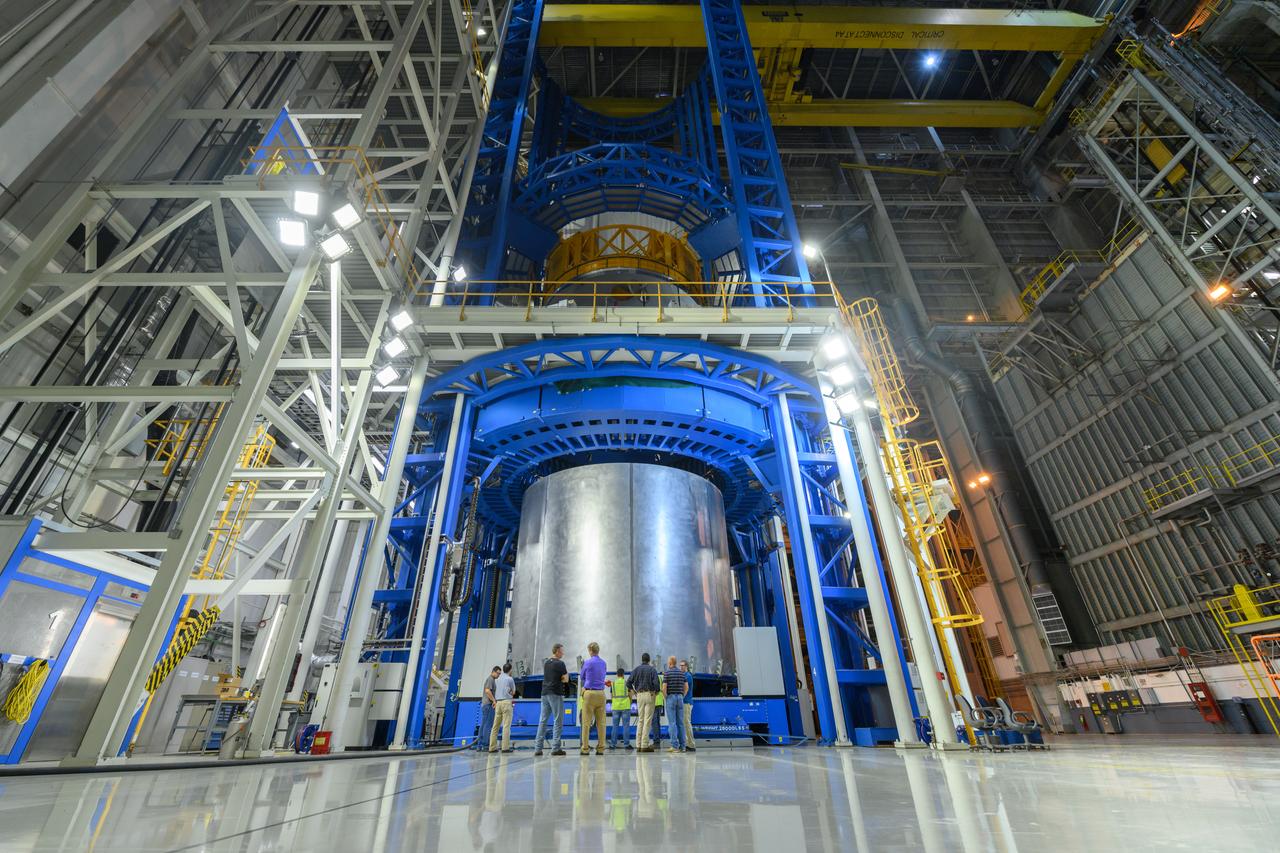
Space Launch System Corestage-2 Liquid Hydrogen(LH2) tank is under construction at NASA's Michoud Assembly Facility. Here you can see 1 of 5 barrels being loaded in the Vertical Assembly Center tool where it will be welded.

KENNEDY SPACE CENTER, FLA. - An external tank in the Vehicle Assembly Building is suspended in a vertical position. The tank will be lowered and placed on a transporter. The tank is being transferred to the Michoud Space Systems Assembly Facility near New Orleans where redesign of the external tank is underway for Return to Flight.
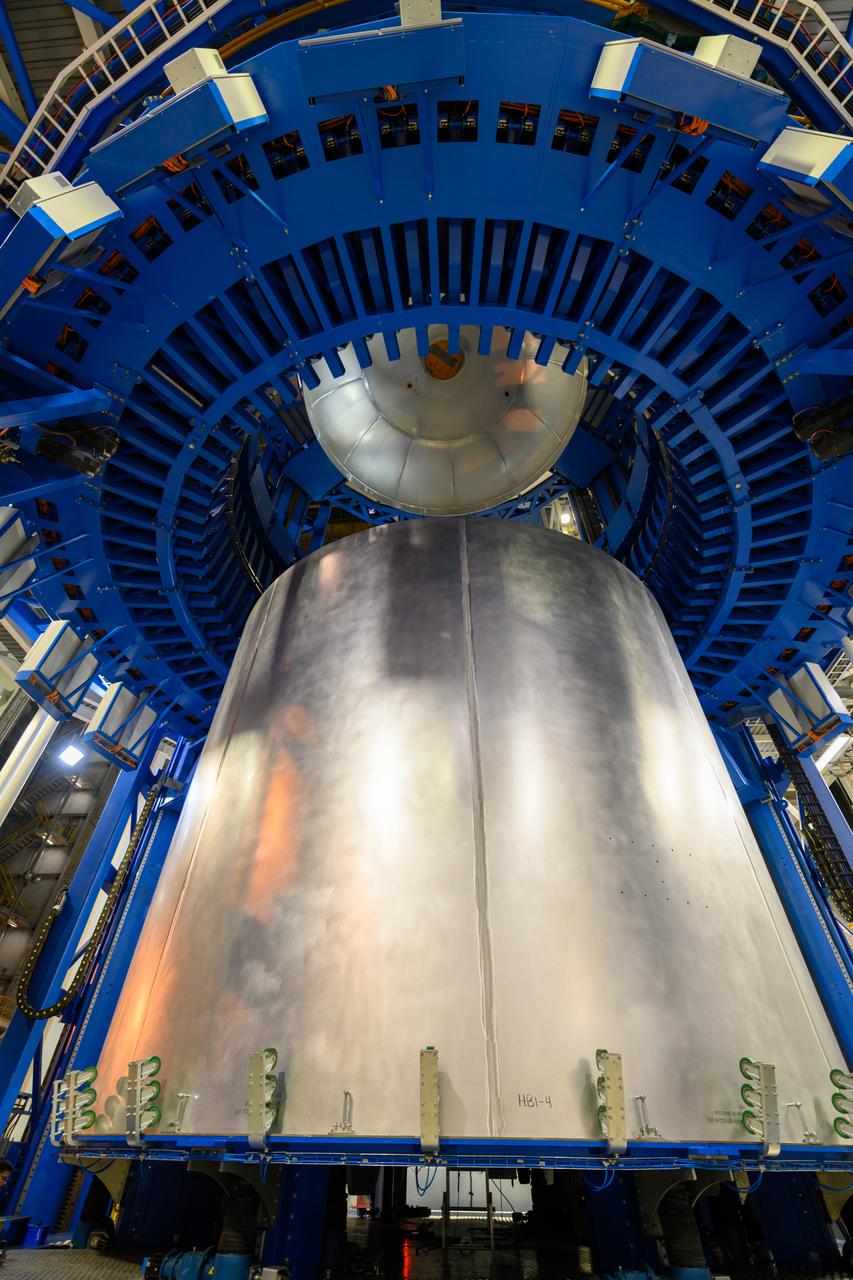
Space Launch System Corestage-2 Liquid Hydrogen(LH2) tank is under construction at NASA's Michoud Assembly Facility. Here you can see 1 of 5 barrels being loaded in the Vertical Assembly Center tool where it will be welded.
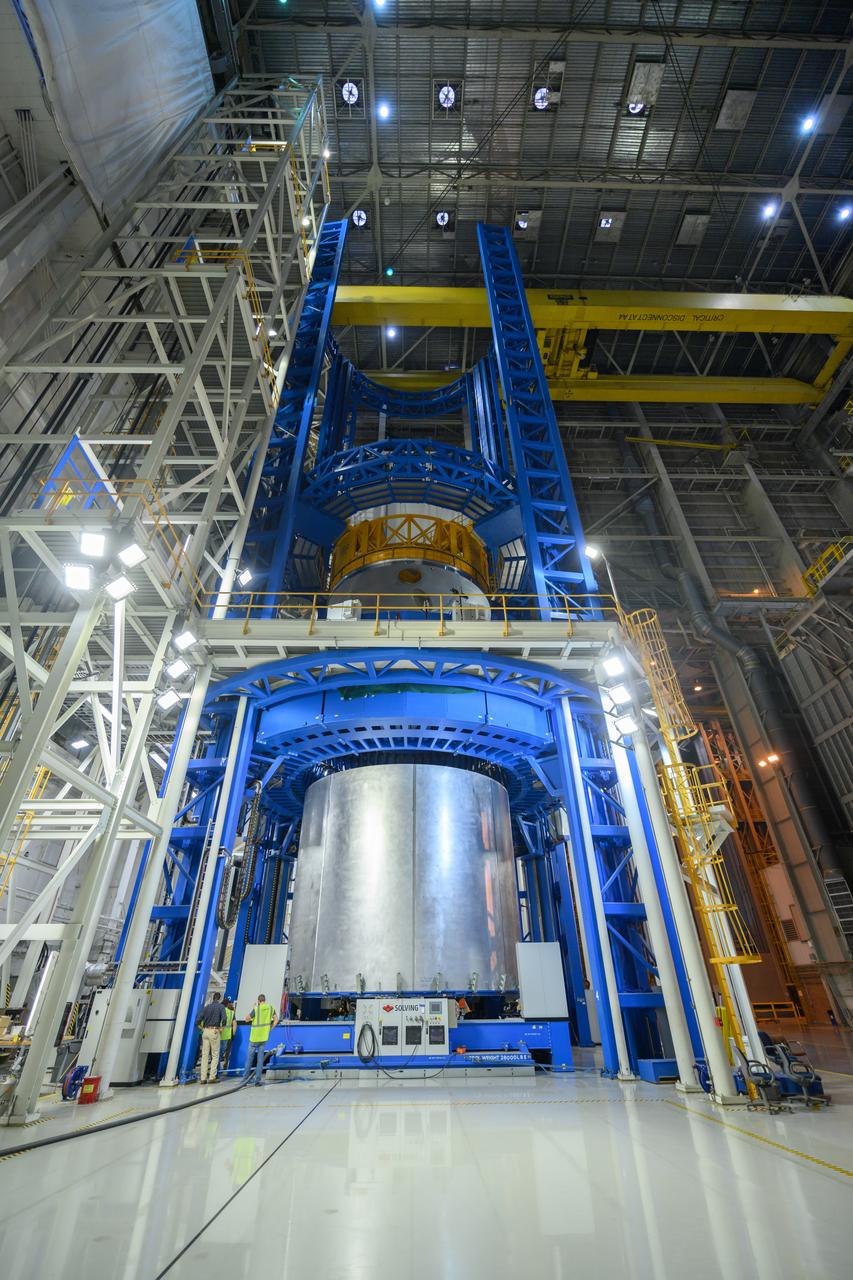
Space Launch System Corestage-2 Liquid Hydrogen(LH2) tank is under construction at NASA's Michoud Assembly Facility. Here you can see 1 of 5 barrels being loaded in the Vertical Assembly Center tool where it will be welded.
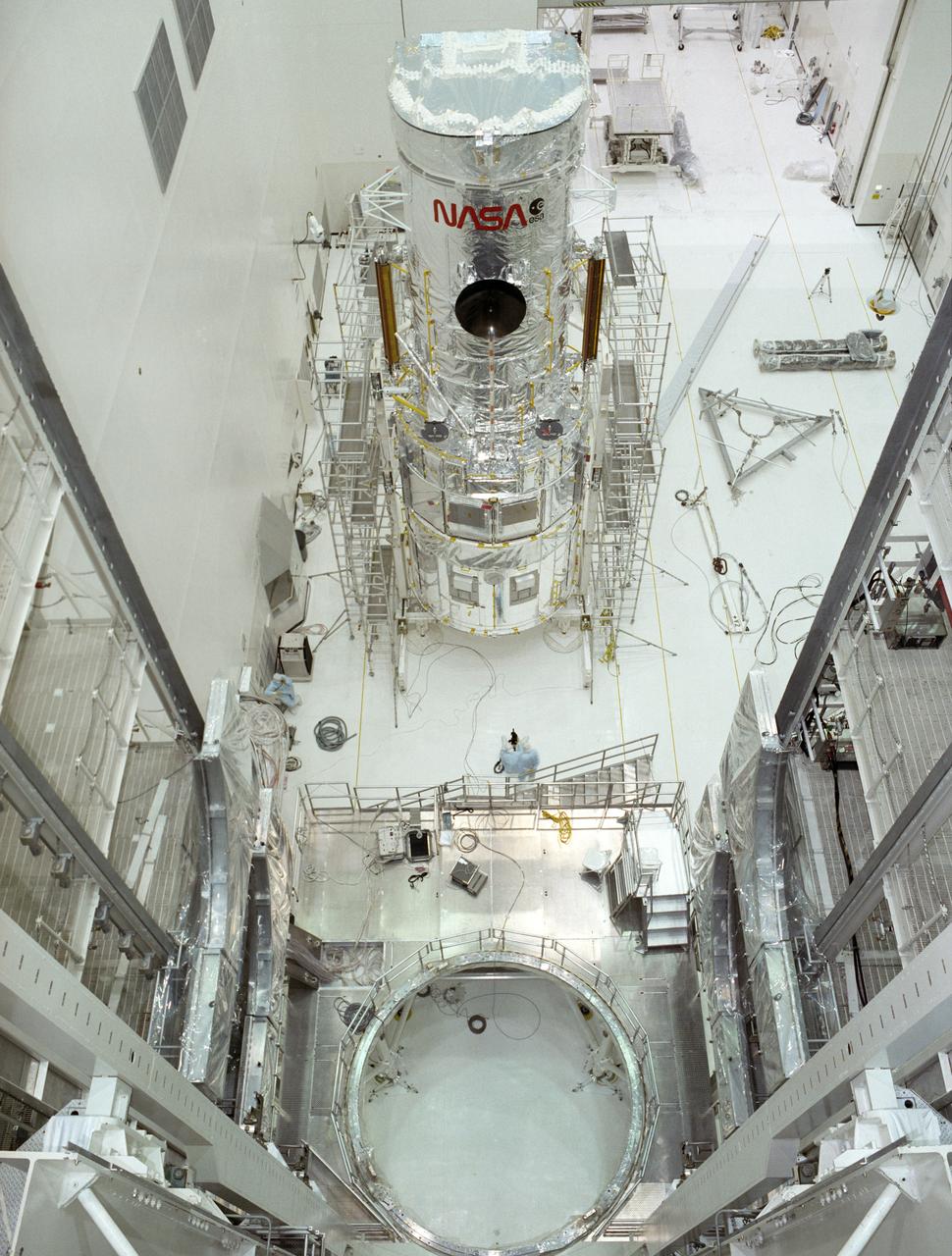
Ready for transportation to the Kennedy Space Center, the Hubble Space Telescope (HST) is pictured onboard the strongback dolly at the Vertical Processing Facility (VPF) at the Lockheed assembly plant upon completion of final testing and verification.
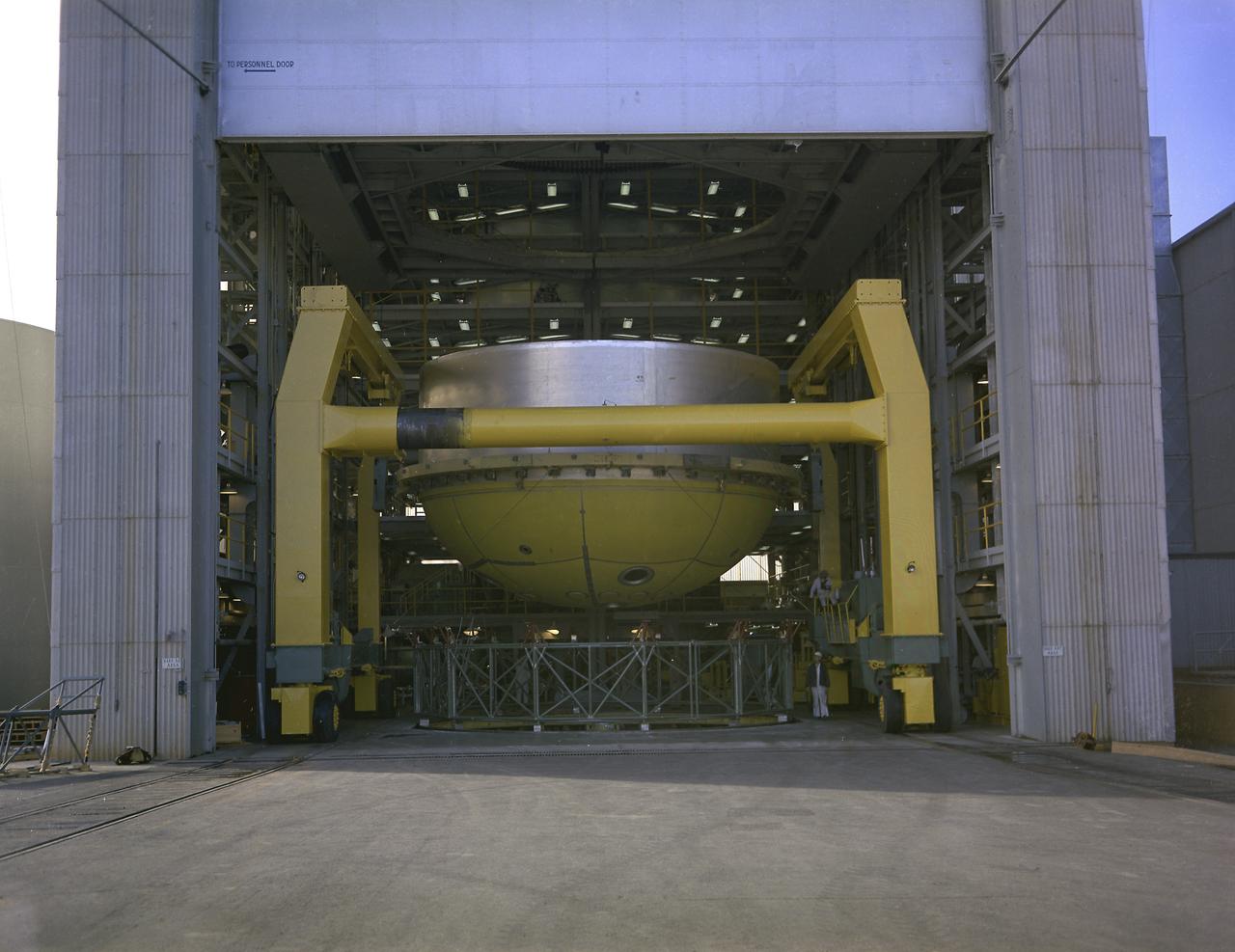
This photograph shows a fuel tank lower half for the Saturn V S-IC-T stage (the S-IC stage for static testing) on a C-frame transporter inside the vertical assembly building at the Marshall Space Flight Center.
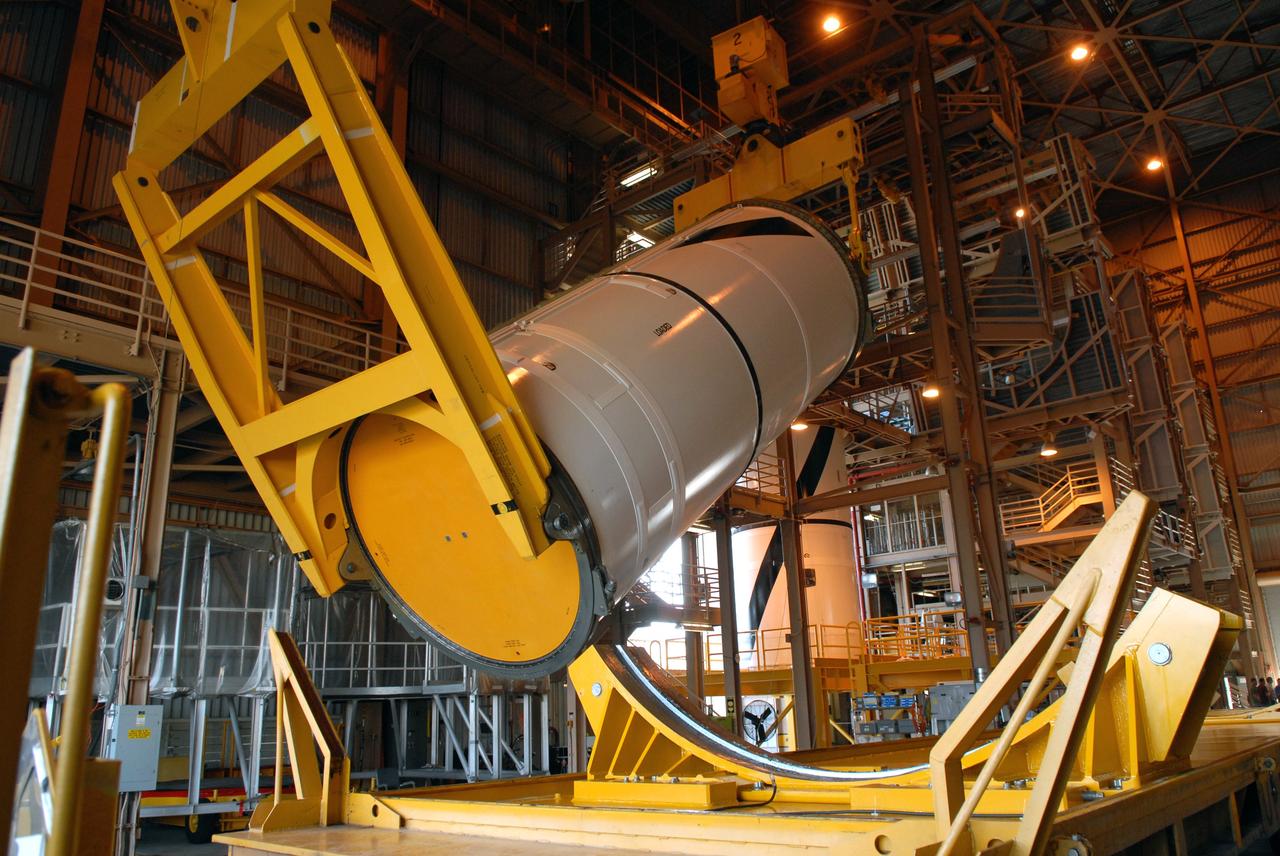
CAPE CANAVERAL, Fla. – In the Rotation, Processing and Surge Facility at NASA's Kennedy Space Center in Florida, cranes attached to the Ares I-X center forward segment raise it to vertical. Once vertical, the segment will be moved to a stand. The booster used for the Ares I-X launch is being modified by adding new forward structures and a fifth segment simulator. The stacking operations are scheduled to begin in the Vehicle Assembly Building in April. Launch of the Ares I-X flight test is targeted for July 2009. Photo credit: NASA/Troy Cryder

KENNEDY SPACE CENTER, FLA. - An aerial view of the Vertical Integration Facility, on Launch Complex 41 at Cape Canaveral Air Force Station in Florida, which holds the Lockheed Martin Atlas V rocket that will launch NASA’s New Horizons spacecraft. In the background is NASA Kennedy Space Center’s Vehicle Assembly Building.

KENNEDY SPACE CENTER, FLA. -- Inside the Vehicle Assembly Building (VAB), overhead cranes move above the orbiter Atlantis in order to lift it to vertical. When vertical, the orbiter will be placed aboard the mobile launcher platform (MLP) for stacking with the solid rocket boosters and external tank. Atlantis is scheduled to launch Sept. 8 on mission STS-106, the fourth construction flight to the International Space Station, with a crew of seven

KENNEDY SPACE CENTER, FLA. -- Inside the Vehicle Assembly Building (VAB), overhead cranes move above the orbiter Atlantis in order to lift it to vertical. When vertical, the orbiter will be placed aboard the mobile launcher platform (MLP) for stacking with the solid rocket boosters and external tank. Atlantis is scheduled to launch Sept. 8 on mission STS-106, the fourth construction flight to the International Space Station, with a crew of seven

Move crews at NASA’s Michoud Assembly Facility lift the aft liquid oxygen tank (LOX) barrel out of the Vertical Weld Center (VWC) for its next phase of production. The aft barrel will eventually be mated with the forward barrel and the forward and aft domes to form the LOX tank, which will be used in the Space Launch System’s (SLS) Artemis IV mission. The LOX tank holds 196,000 gallons of super-cooled liquid oxygen to help fuel four RS-25 engines. The SLS core stage is made up of five unique elements: the forward skirt, liquid oxygen tank, intertank, liquid hydrogen tank, and the engine section. The liquid oxygen hardware, along with the liquid hydrogen tank will provide propellant to the four RS-25 engines to produce more than two million pounds of thrust to help launch NASA’s Orion spacecraft, astronauts, and supplies beyond Earth’s orbit to the Moon. Together with its four RS-25 engines, the rocket’s massive 212-foot-tall core stage — the largest stage NASA has ever built — and its twin solid rocket boosters will produce 8.8 million pounds of thrust to send NASA’s Orion spacecraft, astronauts, and supplies beyond Earth’s orbit to the Moon and, ultimately, Mars. Offering more payload mass, volume capability and energy to speed missions through space, the SLS rocket, along with NASA’s Gateway in lunar orbit, the Human Landing System, and Orion spacecraft, is part of NASA’s backbone for deep space exploration and the Artemis lunar program. No other rocket is capable of carrying astronauts in Orion around the Moon in a single mission. Photographed on Tuesday, May 10, 2022
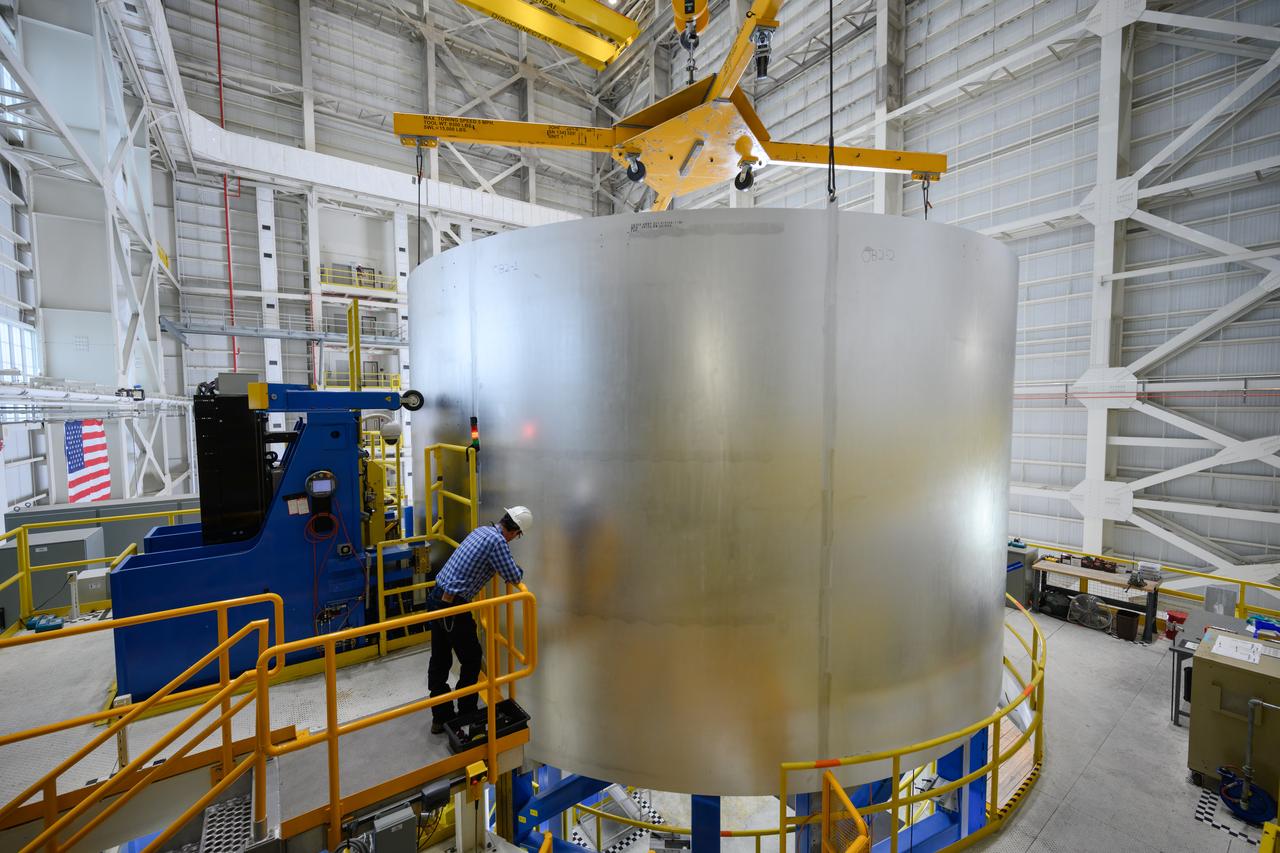
Move crews at NASA’s Michoud Assembly Facility lift the aft liquid oxygen tank (LOX) barrel out of the Vertical Weld Center (VWC) for its next phase of production. The aft barrel will eventually be mated with the forward barrel and the forward and aft domes to form the LOX tank, which will be used in the Space Launch System’s (SLS) Artemis IV mission. The LOX tank holds 196,000 gallons of super-cooled liquid oxygen to help fuel four RS-25 engines. The SLS core stage is made up of five unique elements: the forward skirt, liquid oxygen tank, intertank, liquid hydrogen tank, and the engine section. The liquid oxygen hardware, along with the liquid hydrogen tank will provide propellant to the four RS-25 engines to produce more than two million pounds of thrust to help launch NASA’s Orion spacecraft, astronauts, and supplies beyond Earth’s orbit to the Moon. Together with its four RS-25 engines, the rocket’s massive 212-foot-tall core stage — the largest stage NASA has ever built — and its twin solid rocket boosters will produce 8.8 million pounds of thrust to send NASA’s Orion spacecraft, astronauts, and supplies beyond Earth’s orbit to the Moon and, ultimately, Mars. Offering more payload mass, volume capability and energy to speed missions through space, the SLS rocket, along with NASA’s Gateway in lunar orbit, the Human Landing System, and Orion spacecraft, is part of NASA’s backbone for deep space exploration and the Artemis lunar program. No other rocket is capable of carrying astronauts in Orion around the Moon in a single mission. Photographed on Tuesday, May 10, 2022

Move crews at NASA’s Michoud Assembly Facility lift the aft liquid oxygen tank (LOX) barrel out of the Vertical Weld Center (VWC) for its next phase of production. The aft barrel will eventually be mated with the forward barrel and the forward and aft domes to form the LOX tank, which will be used in the Space Launch System’s (SLS) Artemis IV mission. The LOX tank holds 196,000 gallons of super-cooled liquid oxygen to help fuel four RS-25 engines. The SLS core stage is made up of five unique elements: the forward skirt, liquid oxygen tank, intertank, liquid hydrogen tank, and the engine section. The liquid oxygen hardware, along with the liquid hydrogen tank will provide propellant to the four RS-25 engines to produce more than two million pounds of thrust to help launch NASA’s Orion spacecraft, astronauts, and supplies beyond Earth’s orbit to the Moon. Together with its four RS-25 engines, the rocket’s massive 212-foot-tall core stage — the largest stage NASA has ever built — and its twin solid rocket boosters will produce 8.8 million pounds of thrust to send NASA’s Orion spacecraft, astronauts, and supplies beyond Earth’s orbit to the Moon and, ultimately, Mars. Offering more payload mass, volume capability and energy to speed missions through space, the SLS rocket, along with NASA’s Gateway in lunar orbit, the Human Landing System, and Orion spacecraft, is part of NASA’s backbone for deep space exploration and the Artemis lunar program. No other rocket is capable of carrying astronauts in Orion around the Moon in a single mission. Photographed on Tuesday, May 10, 2022