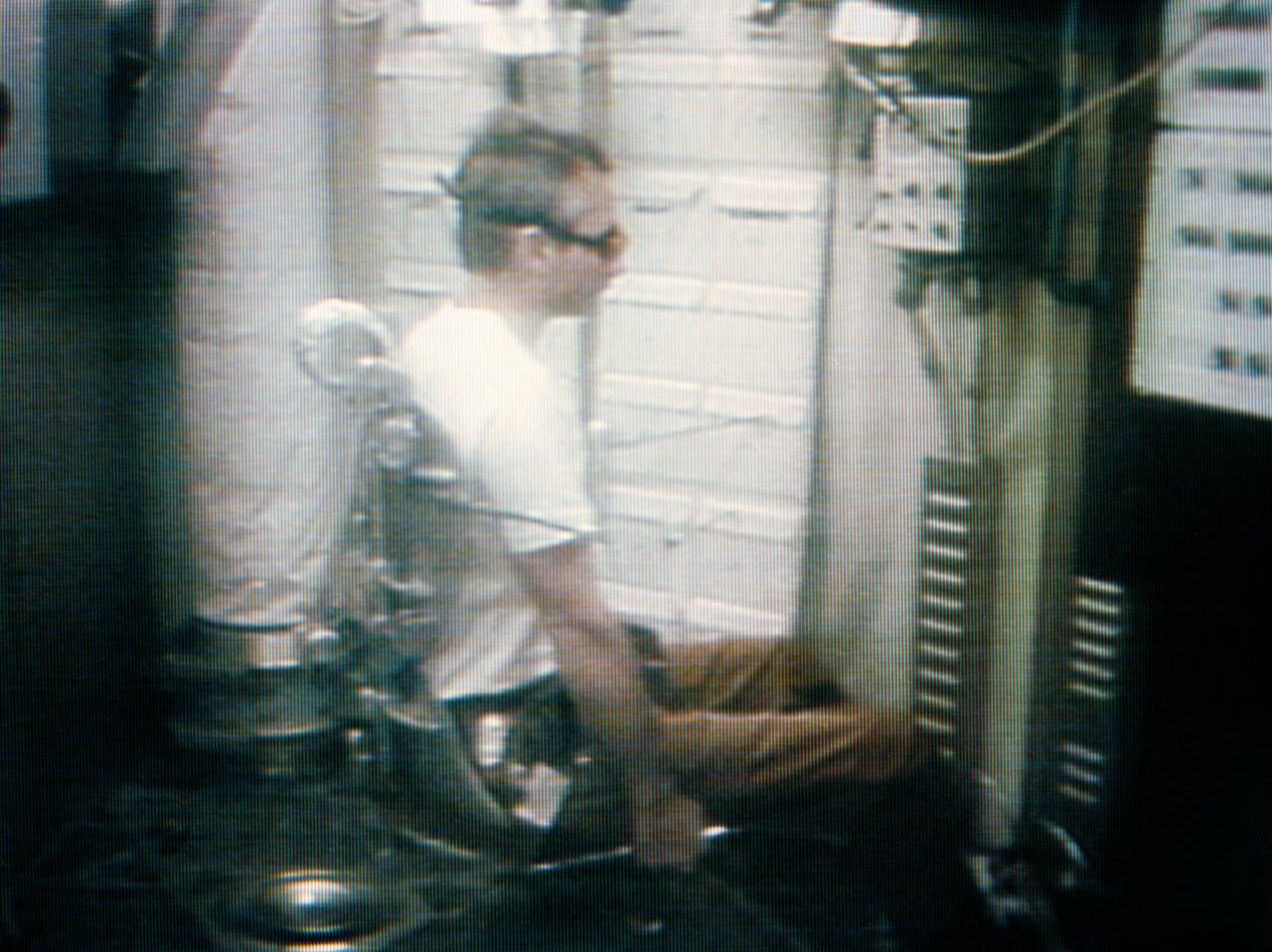
S73-34171 (9 Aug. 1973) --- Scientist-astronaut Owen K. Garriott, Skylab 3 science pilot, serves as test subject for the Skylab ?Human Vestibular Function? M131 Experiment, as seen in this photographic reproduction taken from a television transmission made by a color TV camera aboard the Skylab space station in Earth orbit. The objectives of the Skylab M131 experiment are to obtain data pertinent to establishing the validity of measurements of specific behavioral/physiological responses influenced by vestibular activity under one-g and zero-g conditions; to determine man?s adaptability to unusual vestibular conditions and predict habitability of future spacecraft conditions involving reduced gravity and Coriollis forces; and to measure the accuracy and variability in man?s judgment of spatial coordinates based on atypical gravity receptor cues and inadequate visual cures. Dr. Garriott is seated in the experiment?s litter chair which can rotate the test subject at predetermined rotational velocity or programmed acceleration/decelerational profile. Photo credit: NASA
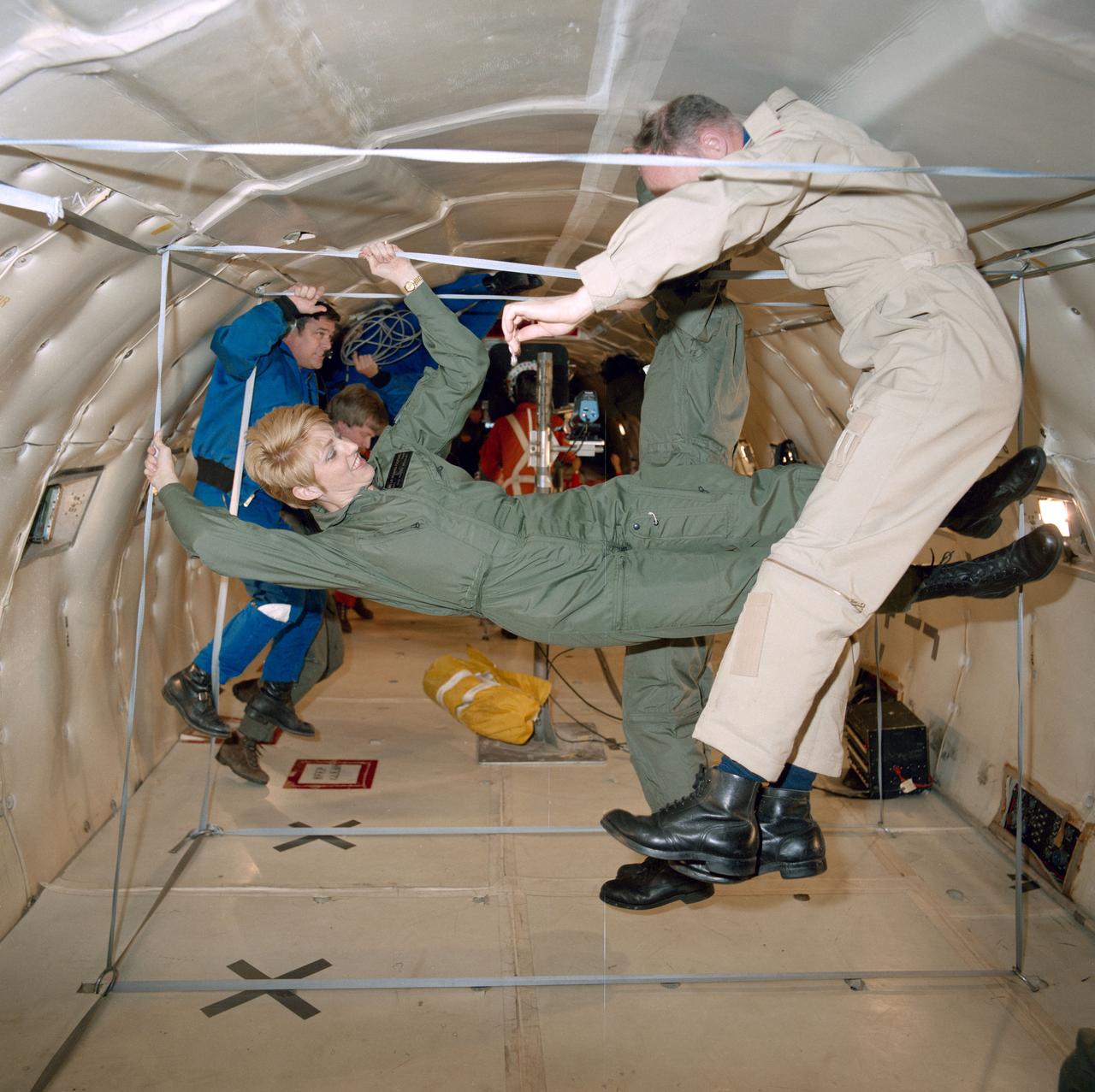
Vestibular Study testing in Zero-G flights on the KC-135. Seen in this view are Roberta Bonder and others experiencing weightlessness.
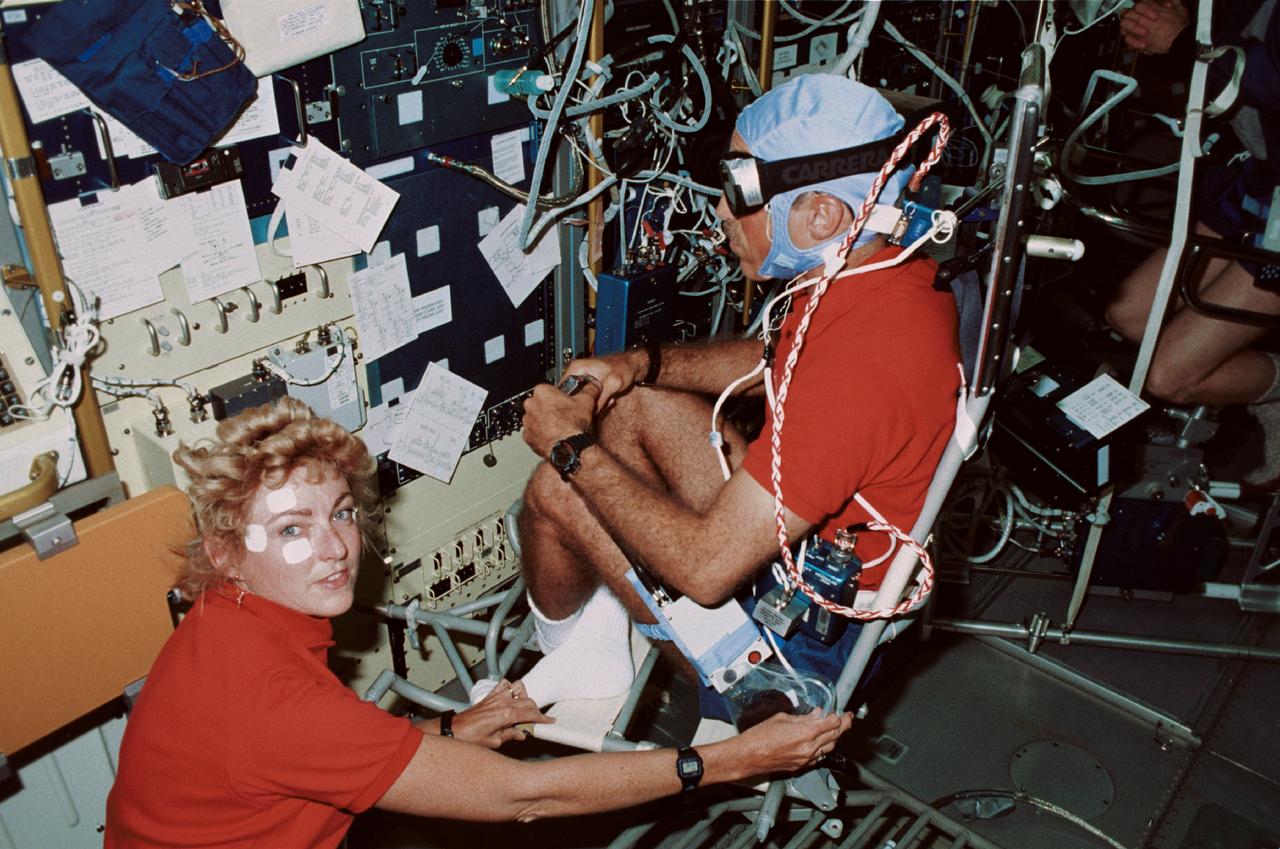
STS040-211-020 (5-14 June 1991) --- Vestibular experiment activities were captured onboard Columbia's Spacelab Life Sciences (SLS-1) module in this 35mm scene. Astronaut James P. Bagian, STS-40 mission specialist, is in a rotating chair while wearing an accelometer and electrodes to record head motion and horizontal and vertical eye movements during the rotations. Payload specialist Millie Hughes-Fulford, lower left, assists with the test.
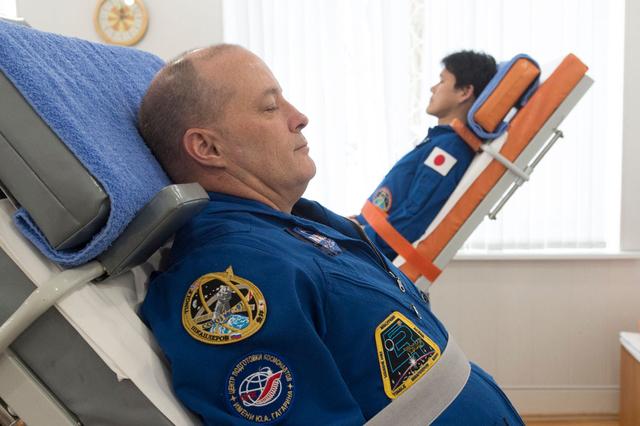
jsc2017e137341 - At the Cosmonaut Hotel crew quarters in Baikonur, Kazakhstan, Expedition 54-55 prime crewmembers Scott Tingle of NASA (left) and Norishige Kanai of the Japan Aerospace Exploration Agency (right) test their vestibular skills on tilt tables Dec. 11 as part of their pre-launch training. Along with Anton Shkaplerov of the Russian Federal Space Agency (Roscosmos), they will launch Dec. 17 on the Soyuz MS-07 spacecraft from the Baikonur Cosmodrome for a five month mission on the International Space Station...Andrey Shelepin / Gagarin Cosmonaut Training Center.
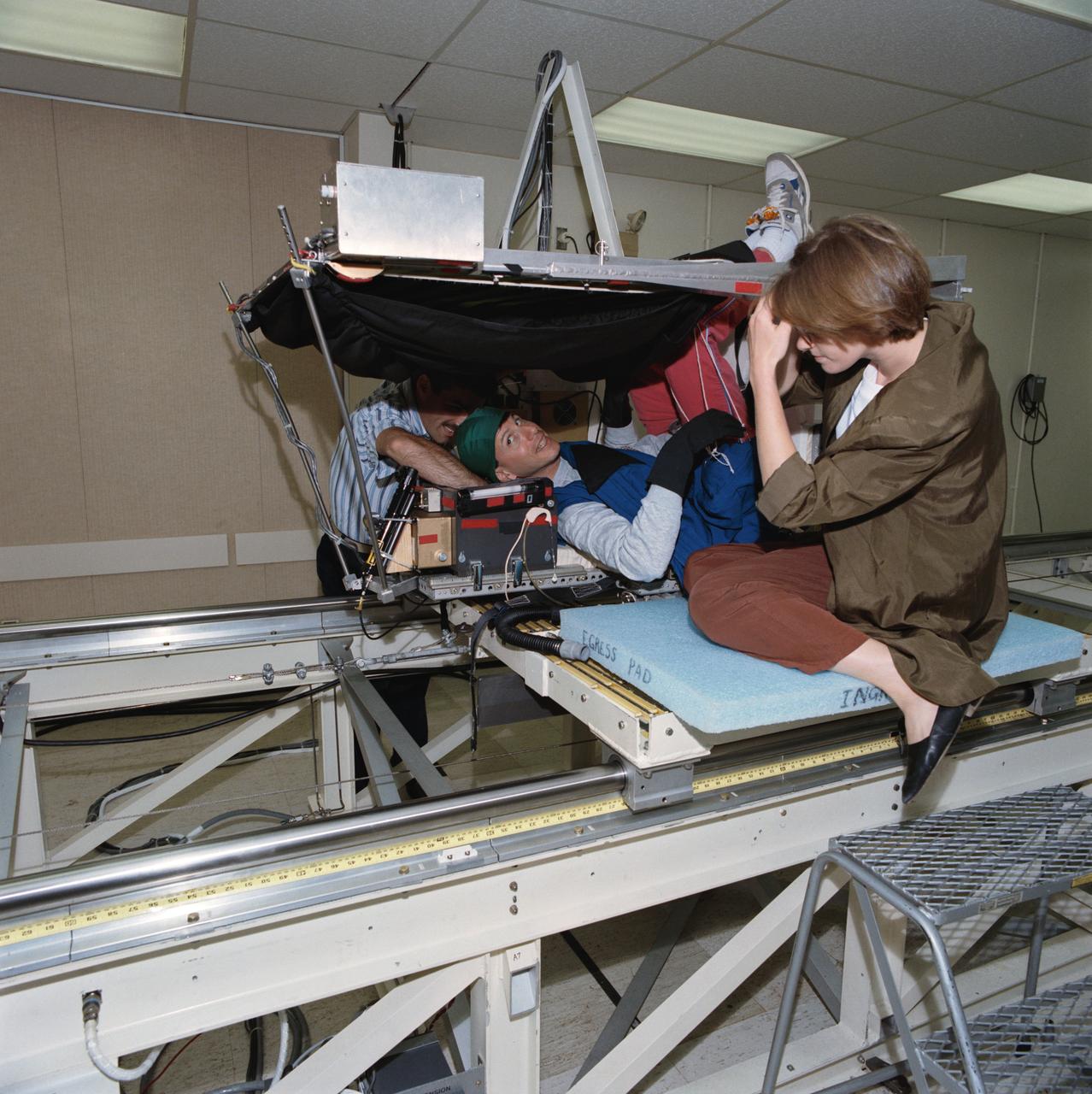
S93-45314 (29 Sept 1993) --- Payload specialist Martin J. Fettman, in an oscillating sled device, participates in a data collection project for neurovestibular functions. The seven Spacelab Life Sciences (SLS-2) crewmembers devoted a full day to miscellaneous biomedical data collection in preparation for next month's two week mission aboard Columbia.
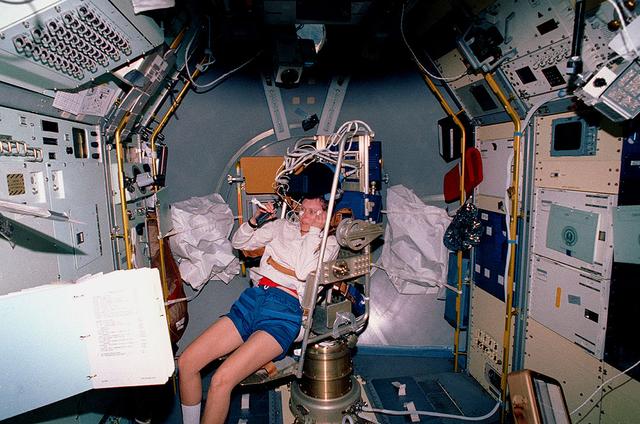
This Space Shuttle Orbiter Discovery (STS-42) onboard photo shows Canadian Payload Specialist Roberta Bondar getting into the Microgravity Vestibular Investigation (MVI) chair to begin an experiment in the International Microgravity Lab-1 (IML-1) Science Module. The (MVI) chair was designed to test the crew member's visual and vestibular responses to head and body movements.
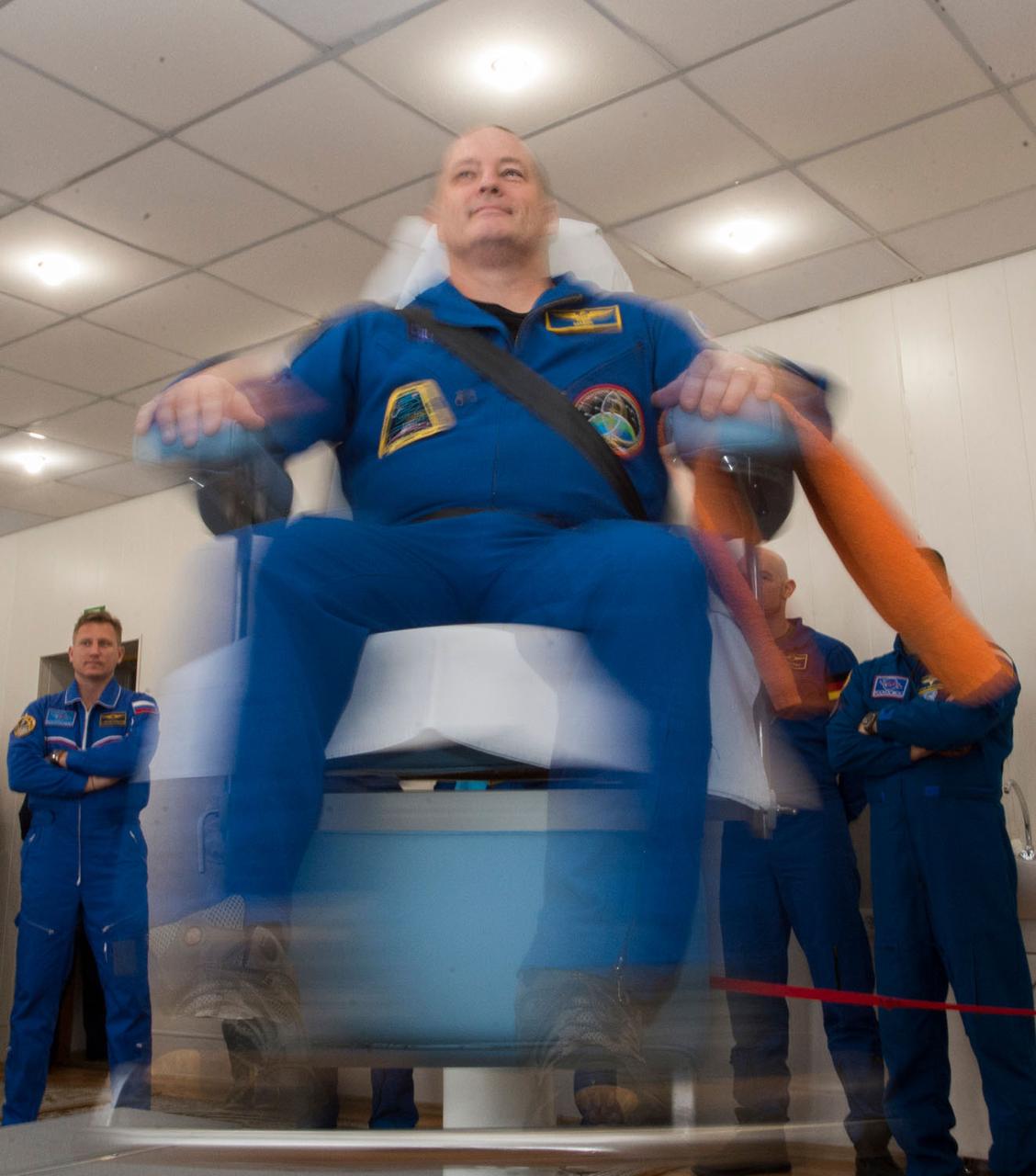
jsc2017e137339 - At the Cosmonaut Hotel crew quarters in Baikonur, Kazakhstan, Expedition 54-55 prime crewmember Scott Tingle of NASA tests his vestibular skills on a rotating chair Dec. 11 as part of his pre-launch training. Tingle, Norishige Kanai of the Japan Aerospace Exploration Agency (JAXA) and Anton Shkaplerov of the Russian Federal Space Agency (Roscosmos) will launch Dec. 17 on the Soyuz MS-07 spacecraft from the Baikonur Cosmodrome for a five month mission on the International Space Station...Andrey Shelepin / Gagarin Cosmonaut Training Center.
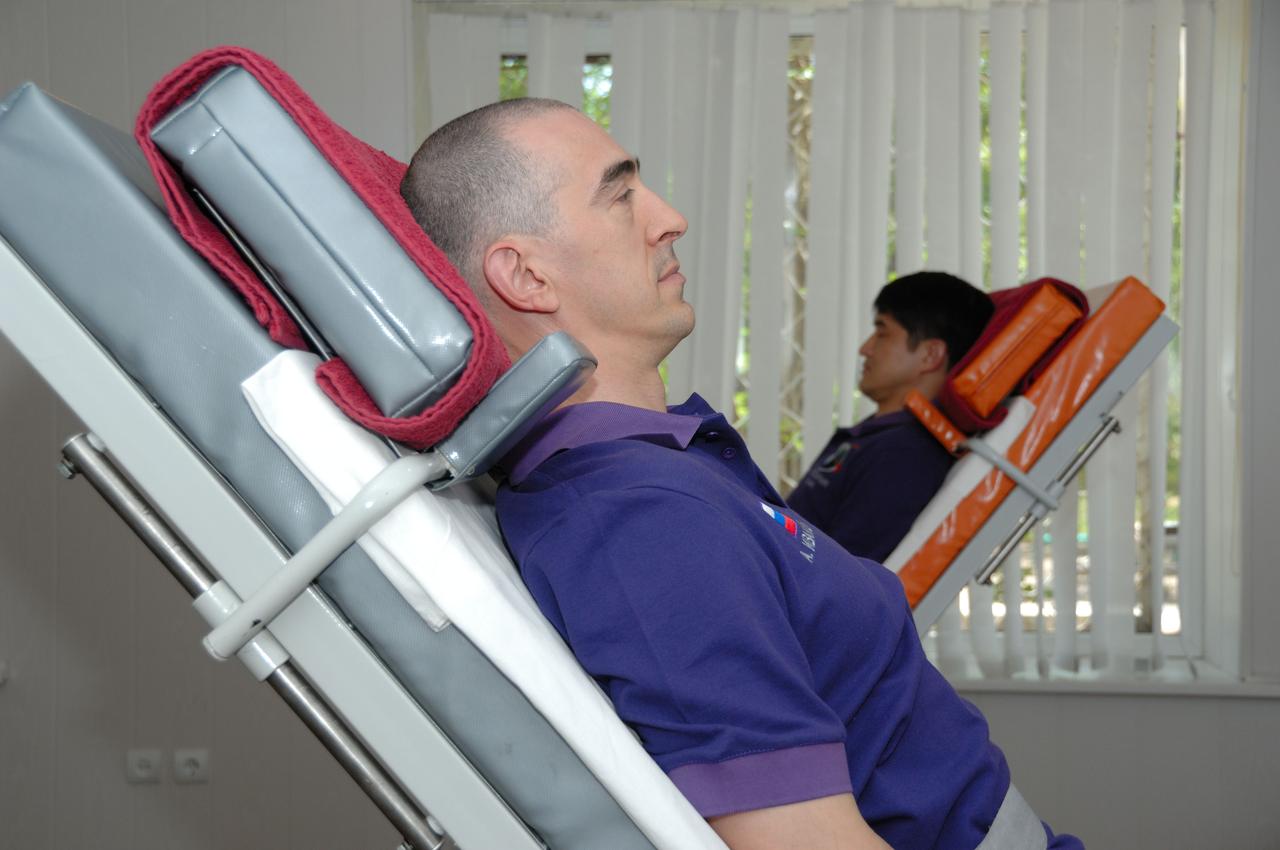
At the Cosmonaut Hotel in Baikonur, Kazakhstan, Expedition 48-49 crewmembers Anatoly Ivanishin of Roscosmos (foreground) and Takuya Onishi of the Japan Aerospace Exploration Agency conduct tests of their vestibular system on tilt tables June 30 as part of pre-launch activities. They and Kate Rubins of NASA will launch July 7, Baikonur time, on the Soyuz MS-01 spacecraft for a planned four-month mission on the International Space Station. NASA/Alexander Vysotsky
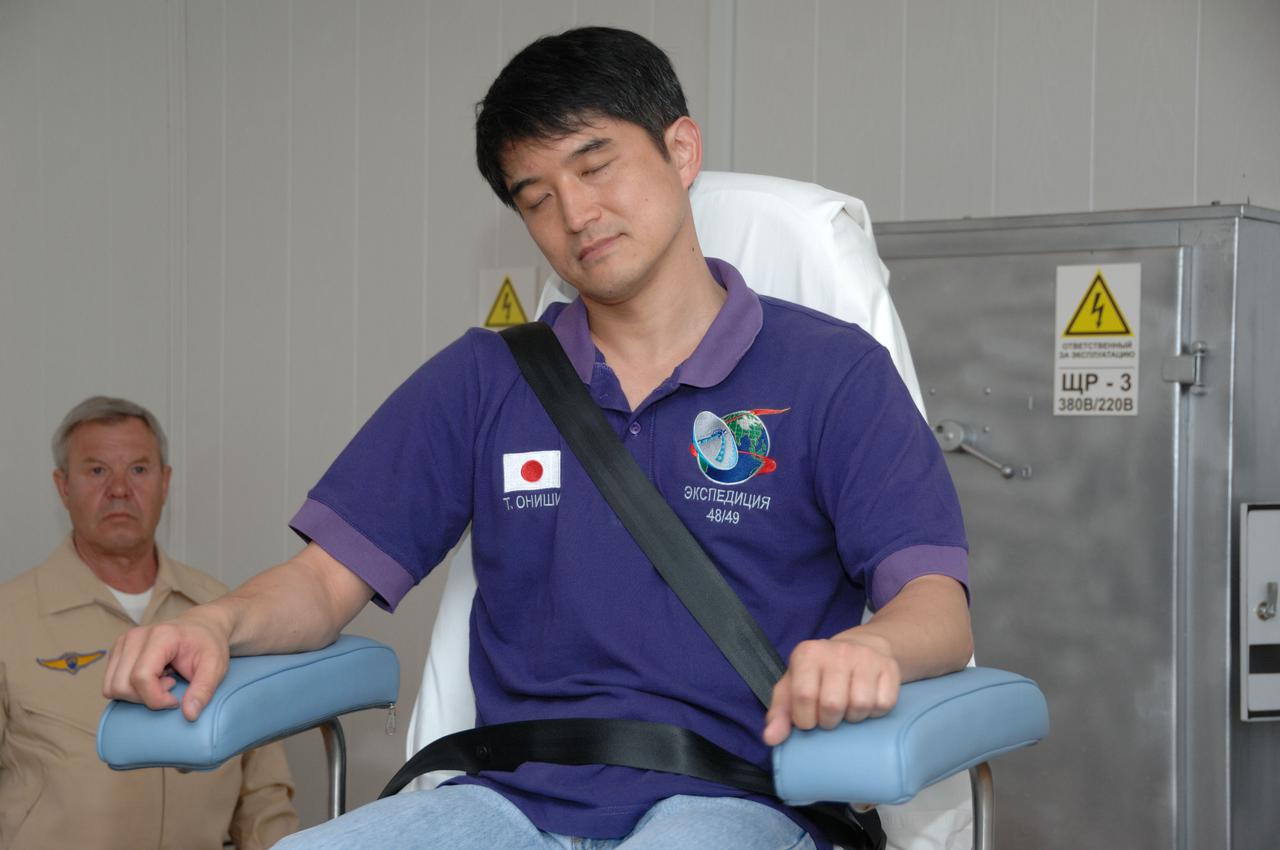
At the Cosmonaut Hotel in Baikonur, Kazakhstan, Expedition 48-49 crewmember Takuya Onishi of the Japan Aerospace Exploration Agency takes a spin in a rotating chair to test his vestibular system June 30 as part of pre-launch activities. Onishi, Kate Rubins of NASA and Anatoly Ivanishin of Roscosmos will launch July 7, Baikonur time, on the Soyuz MS-01 spacecraft for a planned four-month mission on the International Space Station. NASA/Alexander Vysotsky
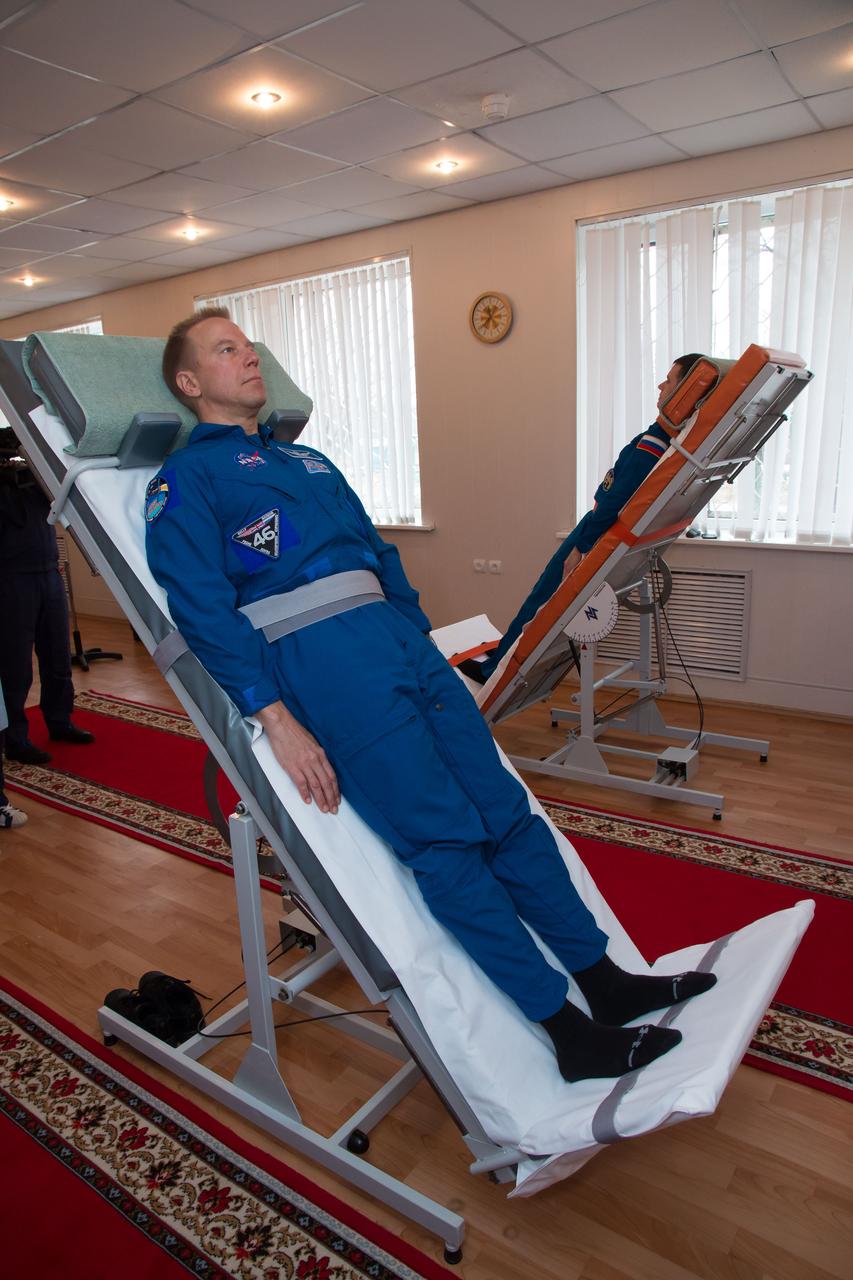
At the Cosmonaut Hotel crew quarters in Baikonur, Kazakhstan, Expedition 46-47 crewmember Tim Kopra of NASA took a turn on a tilt table to test his vestibular system Dec. 9 as part of his pre-launch training. Kopra, Tim Peake of the European Space Agency and Yuri Malenchenko of the Russian Federal Space Agency will launch Dec. 15 on their Soyuz TMA-19M spacecraft for a six-month mission on the International Space Station. NASA/Victor Zelentsov
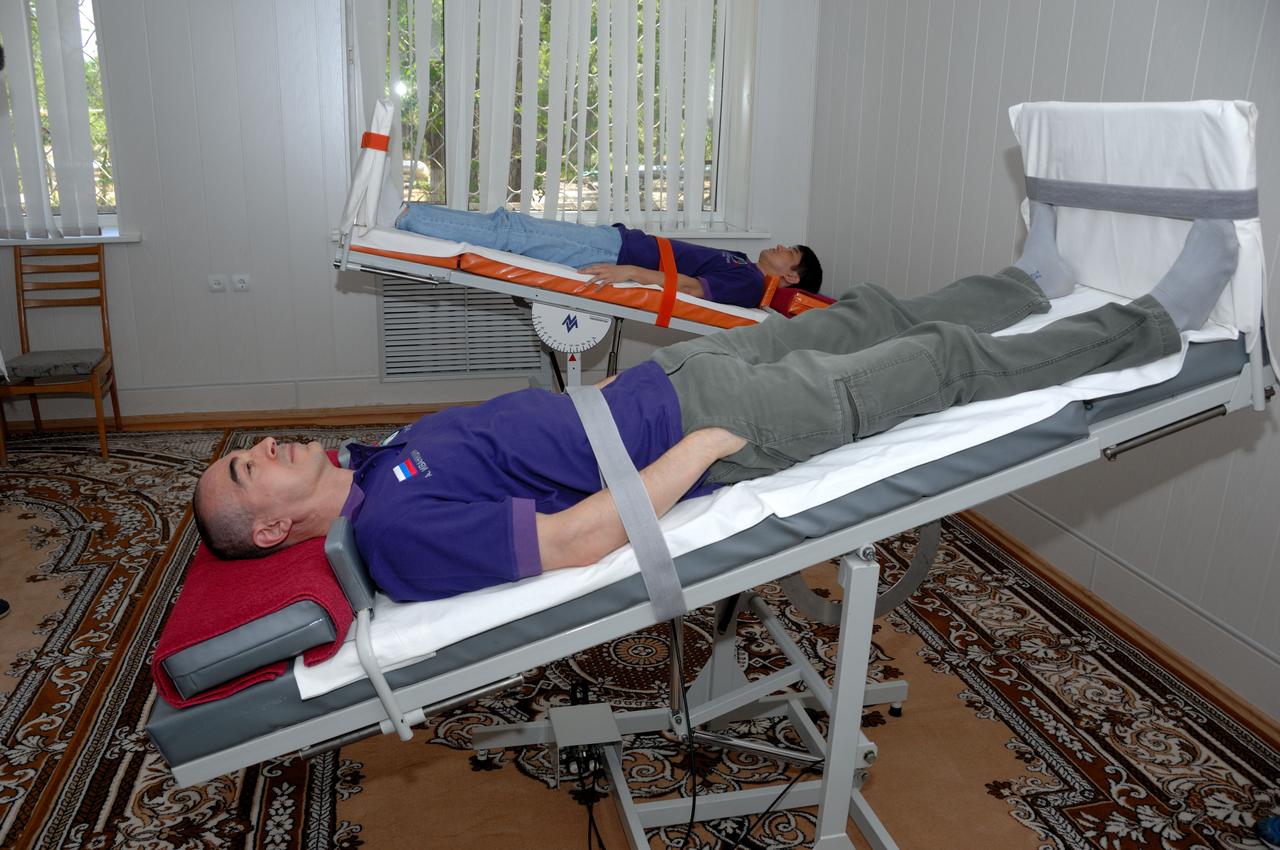
At the Cosmonaut Hotel in Baikonur, Kazakhstan, Expedition 48-49 crewmembers Anatoly Ivanishin of Roscosmos (foreground) and Takuya Onishi of the Japan Aerospace Exploration Agency conduct tests of their vestibular system on tilt tables June 30 as part of pre-launch activities. They and Kate Rubins of NASA will launch July 7, Baikonur time, on the Soyuz MS-01 spacecraft for a planned four-month mission on the International Space Station. NASA/Alexander Vysotsky
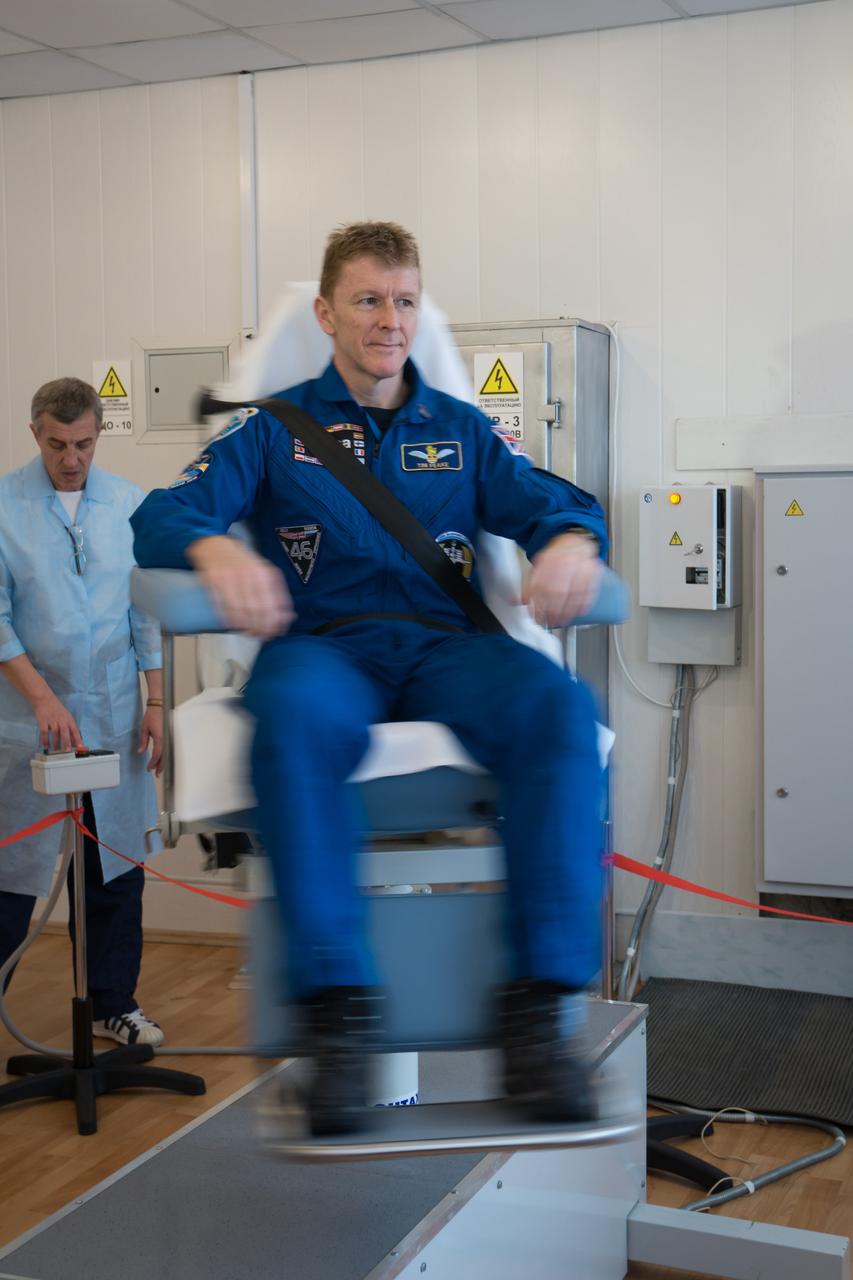
At the Cosmonaut Hotel crew quarters in Baikonur, Kazakhstan, Expedition 46-47 crewmember Tim Peake of the European Space Agency took a turn in a spinning chair to test his vestibular system Dec. 9 as part of his pre-launch training. Peake, Yuri Malenchenko of the Russian Federal Space Agency (Roscosmos) and Tim Kopra of NASA will launch Dec. 15 on their Soyuz TMA-19M spacecraft for a six-month mission on the International Space Station. NASA/Victor Zelentsov
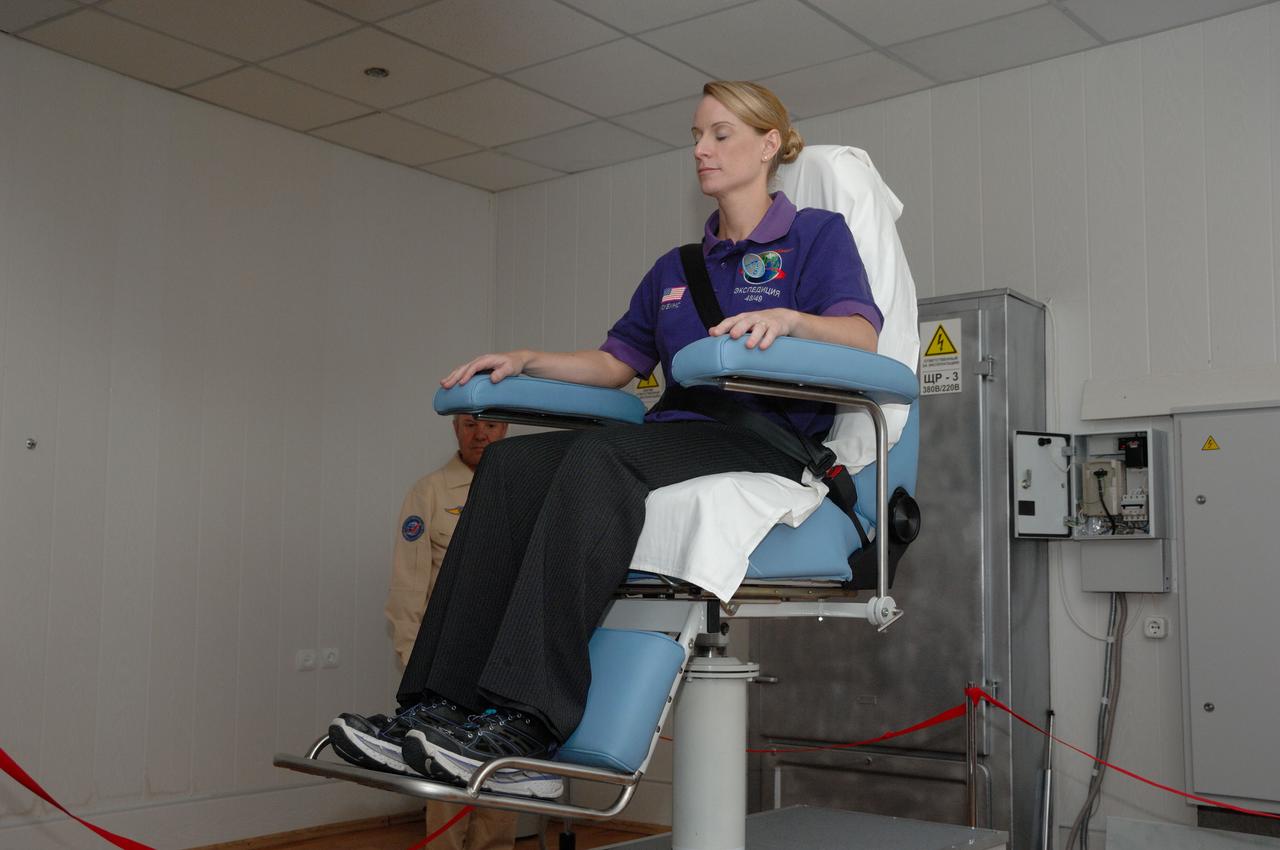
At the Cosmonaut Hotel in Baikonur, Kazakhstan, Expedition 48-49 crewmember Kate Rubins of NASA takes a spin in a rotating chair to test her vestibular system June 30 as part of pre-launch activities. Rubins, Anatoly Ivanishin of Roscosmos and Takuya Onishi of the Japan Aerospace Exploration Agency will launch July 7, Baikonur time, on the Soyuz MS-01 spacecraft for a planned four-month mission on the International Space Station. NASA/Alexander Vysotsky
S73-32113 (9 Aug. 1973) --- Scientist-astronaut Owen K. Garriott, Skylab 3 science pilot, serves as test subject for the Skylab ?Human Vestibular Function? M131 Experiment, as seen in this photographic reproduction taken from a television transmission made by a color TV camera aboard the Skylab space station in Earth orbit. The objectives of the Skylab M131 experiment are to obtain data pertinent to establishing the validity of measurements of specific behavioral/physiological responses influenced by vestibular activity under one-g and zero-g conditions; to determine man?s adaptability to unusual vestibular conditions and predict habitability of future spacecraft conditions involving reduced gravity and Coriollis forces; and to measure the accuracy and variability in man?s judgment of spatial coordinates based on atypical gravity receptor cues and inadequate visual cues. Photo credit: NASA

jsc2019e053721 - At the Cosmonaut Hotel crew quarters in Baikonur, Kazakhstan, Expedition 61 crewmember Jessica Meir of NASA takes a spin in a rotating chair Sept. 18 to test her vestibular system as part of pre-launch activities. Along with Oleg Skripochka of Roscosmos and spaceflight participant Hazzaa Ali Almansoori of the United Arab Emirates, they will launch Sept. 25 from the Baikonur Cosmodrome in Kazakhstan on the Soyuz MS-15 spacecraft for a mission on the International Space Station...NASA/Victor Zelentsov
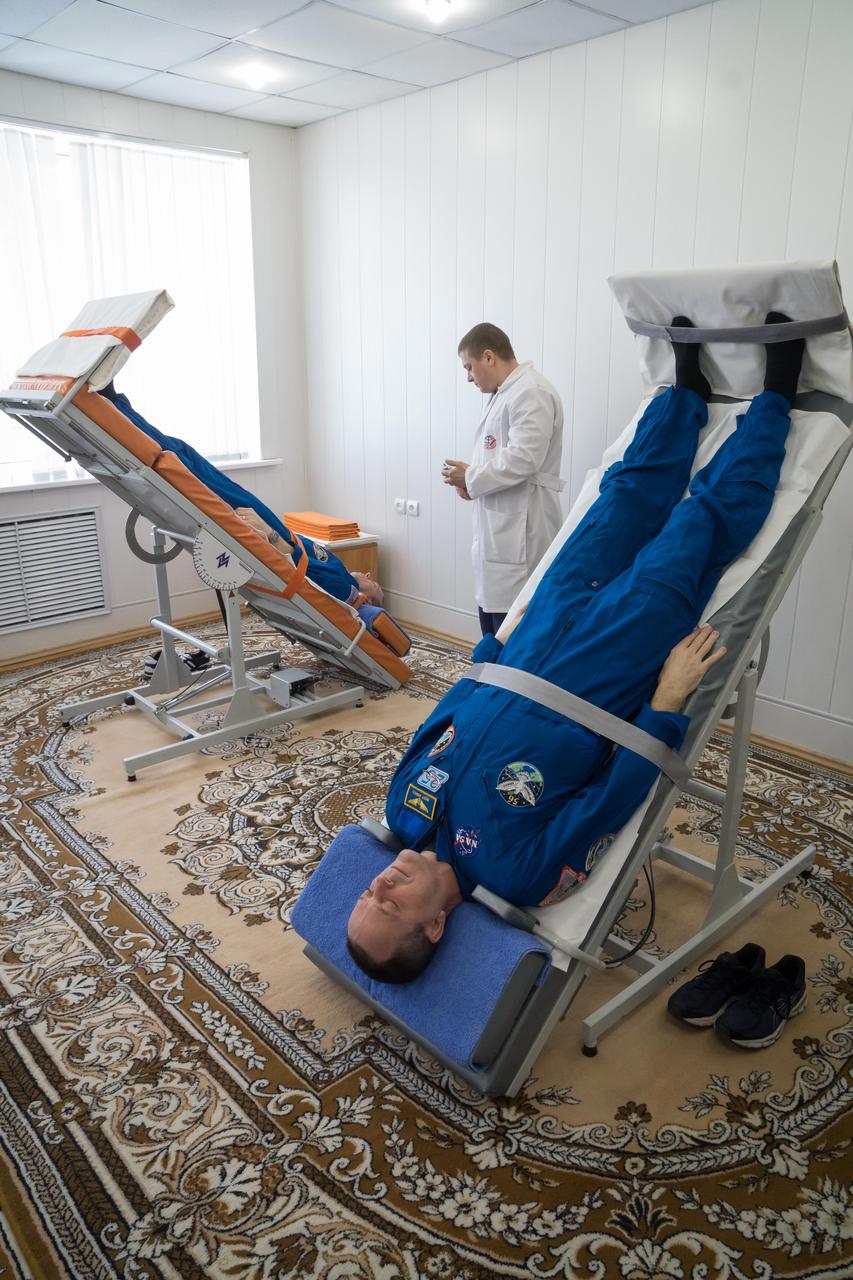
jsc2018e025556 - At the Cosmonaut Hotel crew quarters in Baikonur, Kazakhstan, Expedition 55 crewmembers Drew Feustel of NASA (top) and Ricky Arnold of NASA (bottom) conduct tests of their vestibular systems on tilt tables March 15 as part of pre-launch activities. Along with Oleg Artemyev of Roscosmos, they will launch March 21 on the Soyuz MS-08 spacecraft from the Baikonur Cosmodrome on a five-month mission to the International Space Station...NASA/Victor Zelentsov.
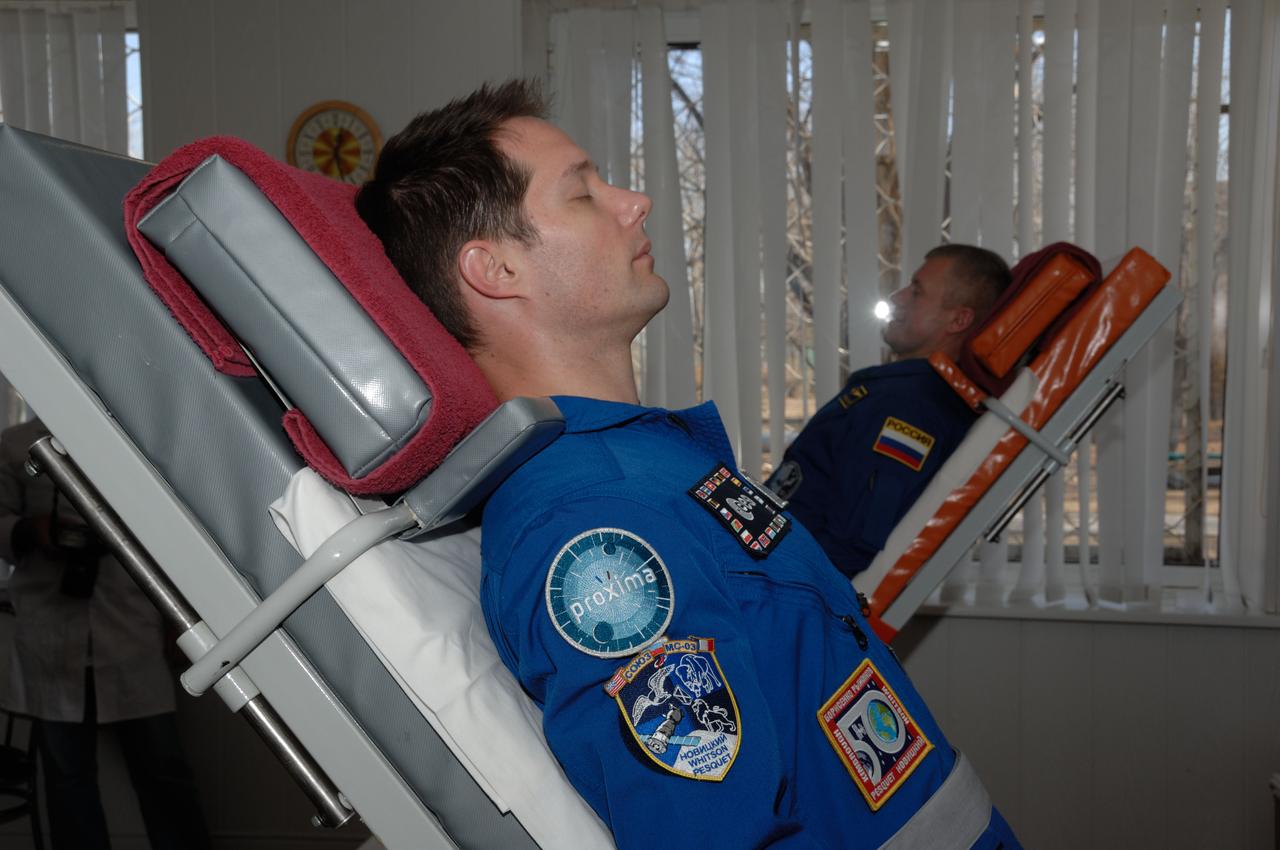
At their Cosmonaut Hotel crew quarters in Baikonur, Kazakhstan, Expedition 50-51 crewmembers Thomas Pesquet of the European Space Agency (foreground) and Oleg Novitskiy of the Russian Federal Space Agency (Roscosmos) conduct vestibular tests on tilt tables Nov. 10 as part of their prelaunch training. Pesquet, Novitskiy and Peggy Whitson of NASA will launch Nov. 18, Baikonur time, on the Soyuz MS-03 spacecraft for a six-month mission on the International Space Station. NASA/Alexander Vysotsky
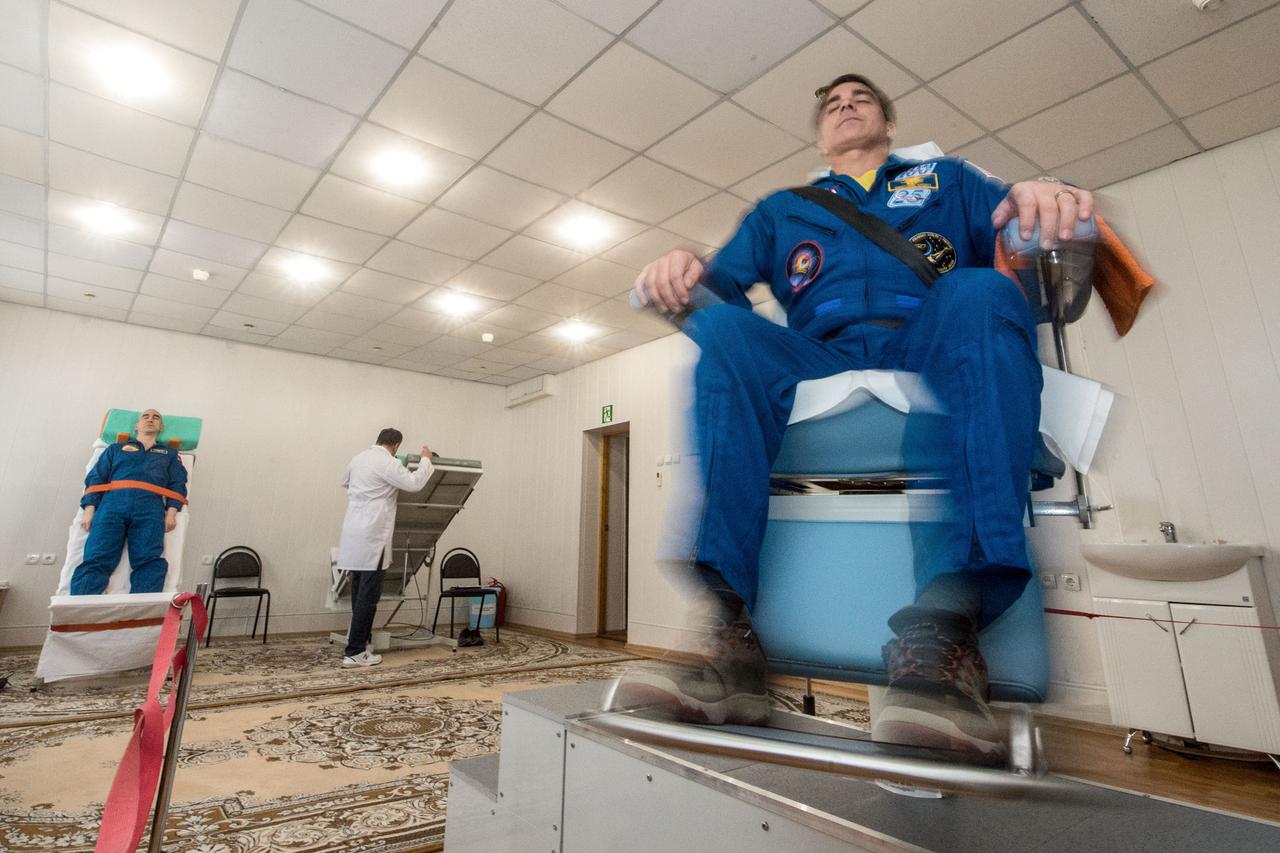
jsc2020e016967 - At the Cosmonaut Hotel crew quarters in Baikonur, Kazakhstan, Expedition 63 crewmembers Chris Cassidy of NASA (right) and Anatoly Ivanishin of Roscosmos (left) take a spin April 1 to test their vestibular systems as part of pre-launch training. Cassidy, Ivanishin and Ivan Vagner of Roscosmos will launch April 9 on the Soyuz MS-16 spacecraft from the Baikonur Cosmodrome in Kazakhstan for a six-and-a-half month mission on the International Space Station...Andrey Shelepin/Gagarin Cosmonaut Training Center.
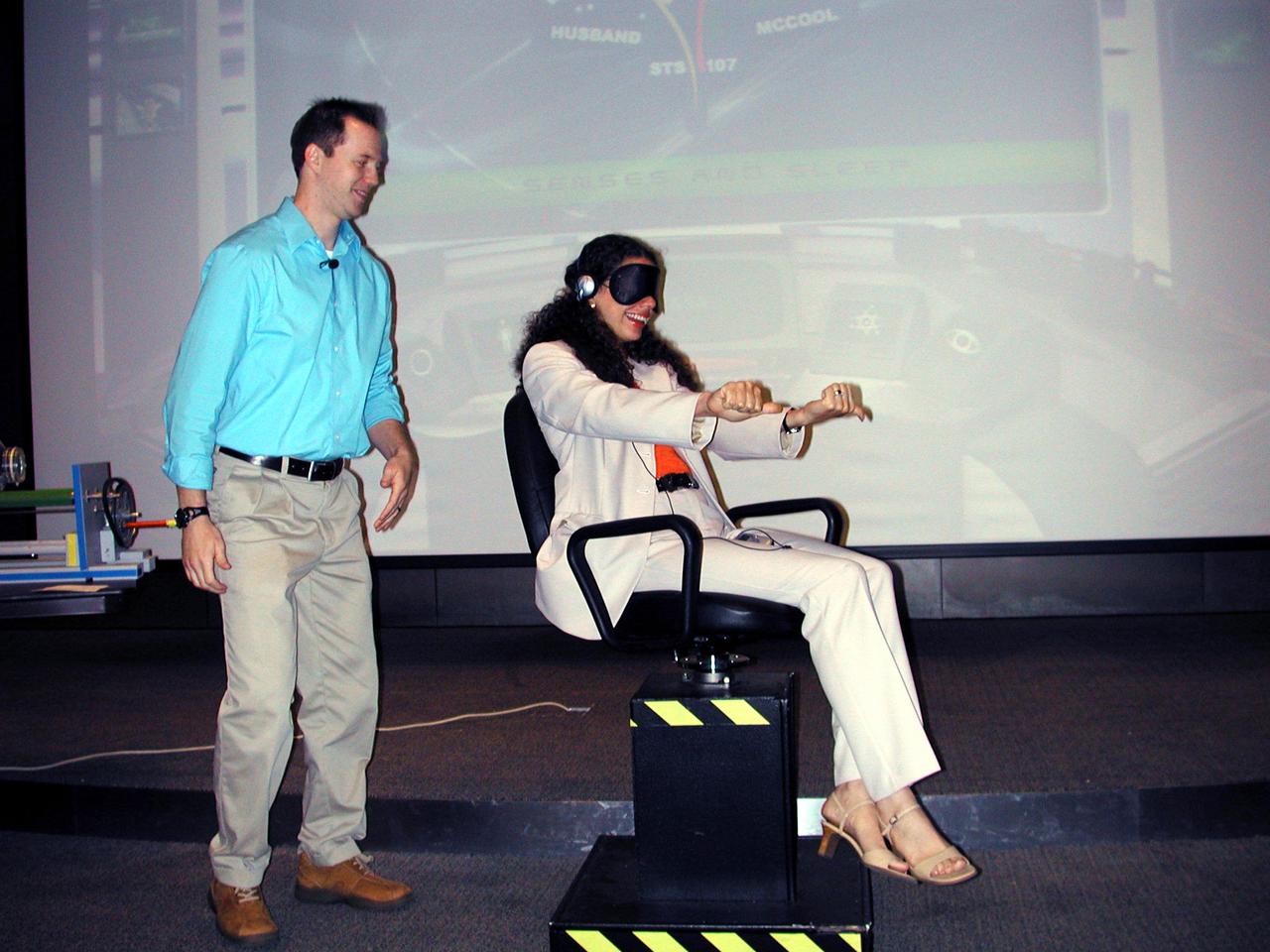
Brad McLain for the Space Biology Museum Network spins a volunteer in a rotating chair to illustrate how dependent the human vestibular system is on visual cues. The volunteer's thumbs indicate which way she thinks she is turning. Similar tests are conducted on astronauts to study how they adapt to space and readapt to Earth. The activity was part of the Space Research and You education event held by NASA's Office of Biological and Physical Research on June 25, 2002, in Arlington, VA, to highlight the research that will be conducted on STS-107.
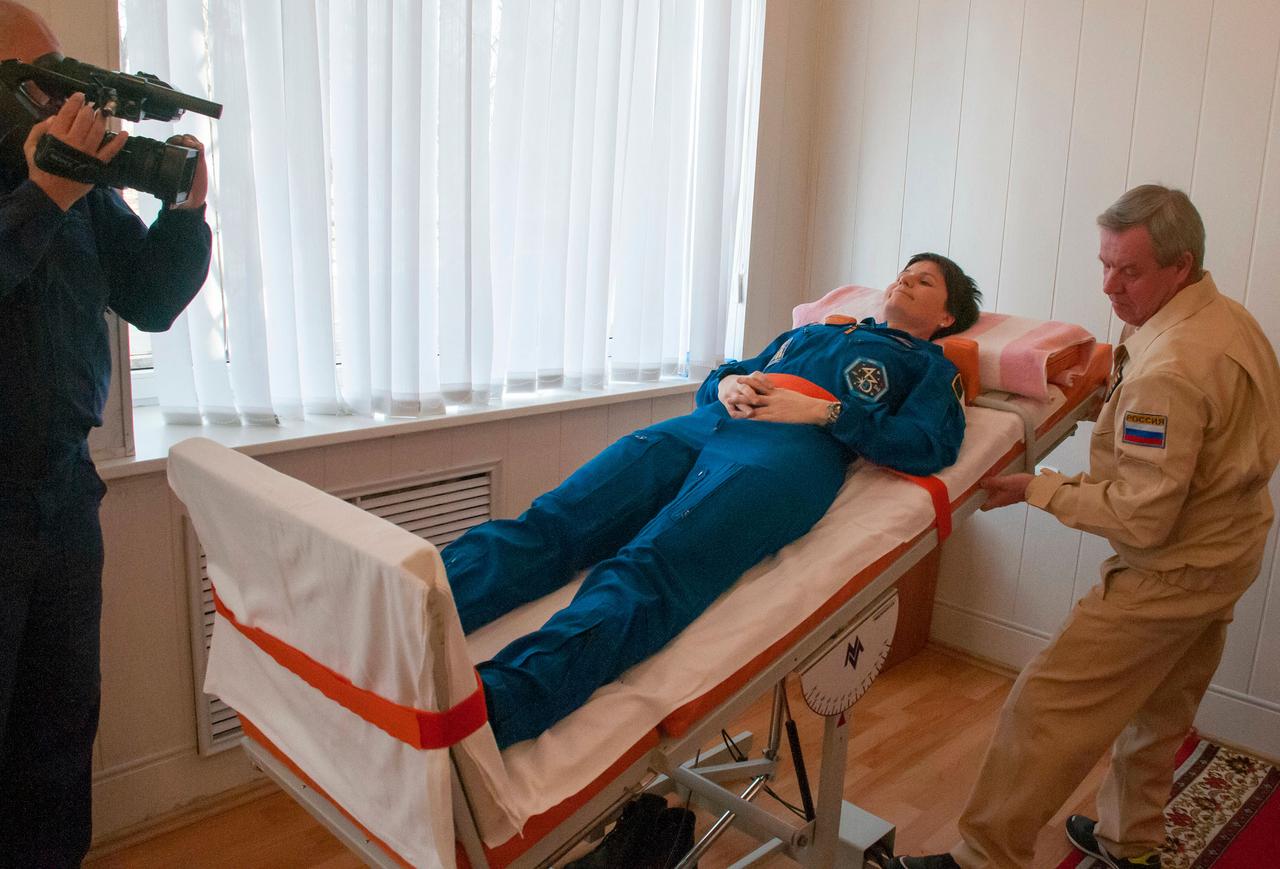
6103: At the Cosmonaut Hotel crew quarters in Baikonur, Kazakhstan, Expedition 42/43 crewmember Samantha Cristoforetti of the European Space Agency tests her vestibular system on a tilt table Nov. 18 as part of pre-launch training. Cristoforetti, Terry Virts of NASA and Anton Shkaplerov of the Russian Federal Space Agency (Roscosmos) will launch Nov. 24, Kazakh time, from the Baikonur Cosmodrome in the Soyuz TMA-15M spacecraft for a 5 ½ month mission on the International Space Station. NASA/Sergei Fyodorov
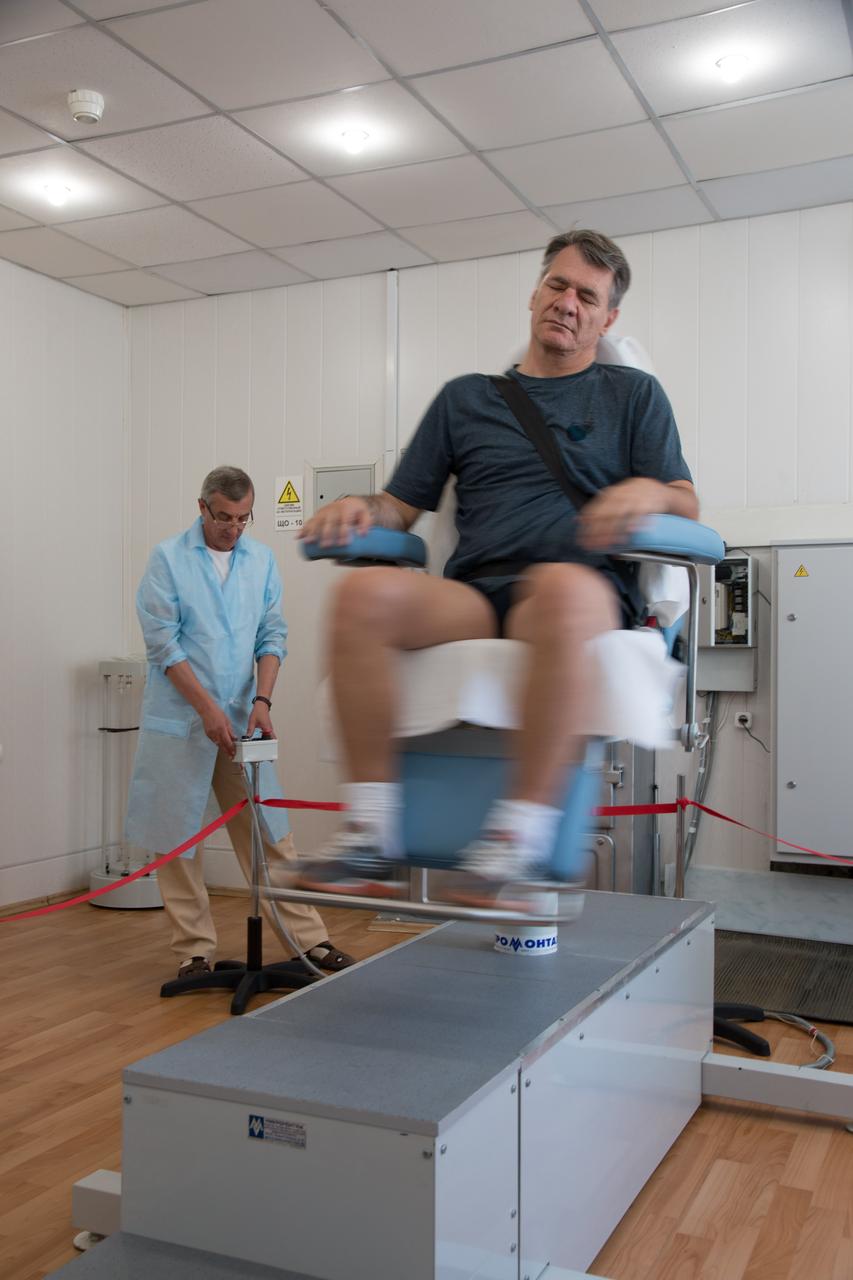
jsc2017e101945 (July 22, 2017) --- At the Cosmonaut Hotel crew quarters in Baikonur, Kazakhstan, Expedition 52-53 crewmember Paolo Nespoli of the European Space Agency tests his vestibular system in a spinning chair July 22 as part of pre-launch activities. Nespoli, Randy Bresnik of NASA and Sergey Ryazanskiy of the Russian Federal Space Agency (Roscosmos) will launch July 28 on the Soyuz MS-05 spacecraft from the Baikonur Cosmodrome for a five-month mission on the International Space Station. Credit: NASA/Victor Zelentsov
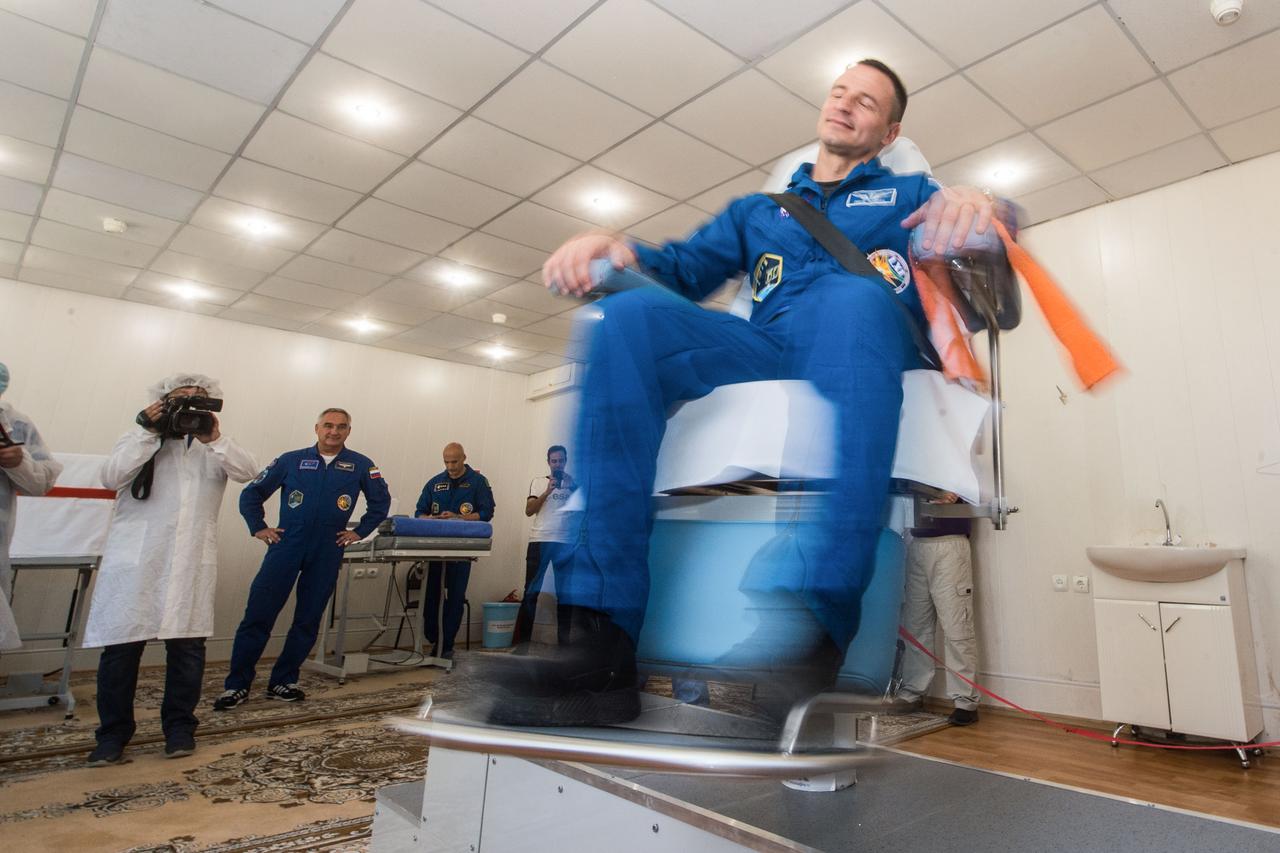
jsc2019e039262 - At the Cosmonaut Hotel crew quarters in Baikonur, Kazakhstan, Expedition 60 crewmember Drew Morgan of NASA takes a ride in a spinning chair July 12 to test his vestibular system as part of pre-launch activities. Morgan, Alexander Skvortsov of Roscosmos and Luca Parmitano of the European Space Agency will launch July 20 on the Soyuz MS-13 spacecraft from the Baikonur Cosmodrome in Kazakhstan on a mission to the International Space Station...Andrey Shelepin/GCTC.
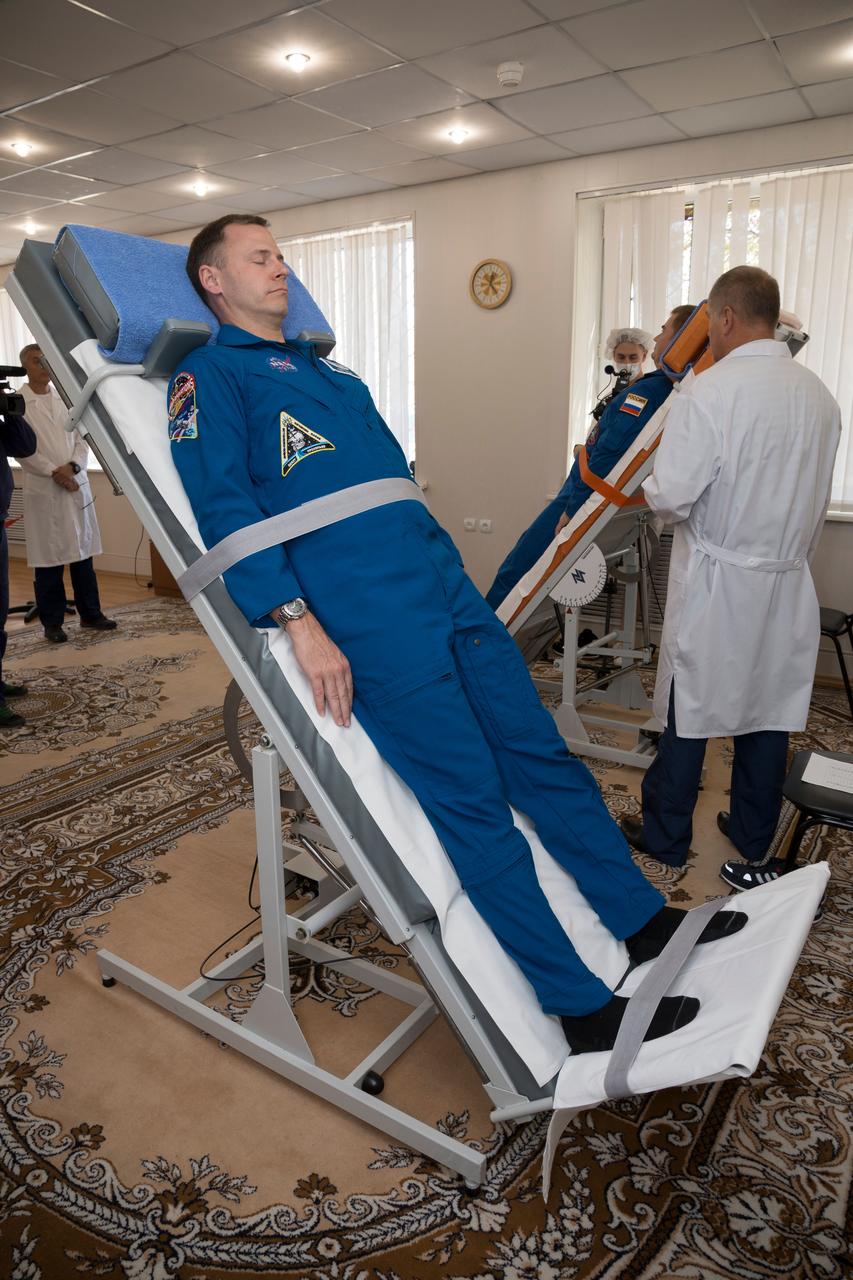
jsc2018e085902 (Oct. 3, 2018) --- Expedition 57 crew members Nick Hague of NASA, left, and Alexey Ovchinin of Roscosmos, right, conduct tests of their vestibular systems on tilt tables, Wednesday, Oct. 3, 2018 at the Cosmonaut Hotel in Baikonur, Kazakhstan. Hague and Ovchinin are scheduled to launch on Oct. 11 onboard the Soyuz MS-10 spacecraft from the Baikonur Cosmodrome in Kazakhstan for a six-month mission on the International Space Station. Photo Credit: (NASA/Victor Zelentsov)

jsc2020e016968 - At the Cosmonaut Hotel crew quarters in Baikonur, Kazakhstan, Expedition 63 crewmembers Anatoly Ivanishin (bottom) and Ivan Vagner (top) of Roscosmos take a ride on tilt tables April 1 to test their vestibular systems. Along with Chris Cassidy of NASA, they will launch April 9 on the Soyuz MS-16 spacecraft from the Baikonur Cosmodrome in Kazakhstan for a six-and-a-half month mission on the International Space Station...Andrey Shelepin/Gagarin Cosmonaut Training Center.
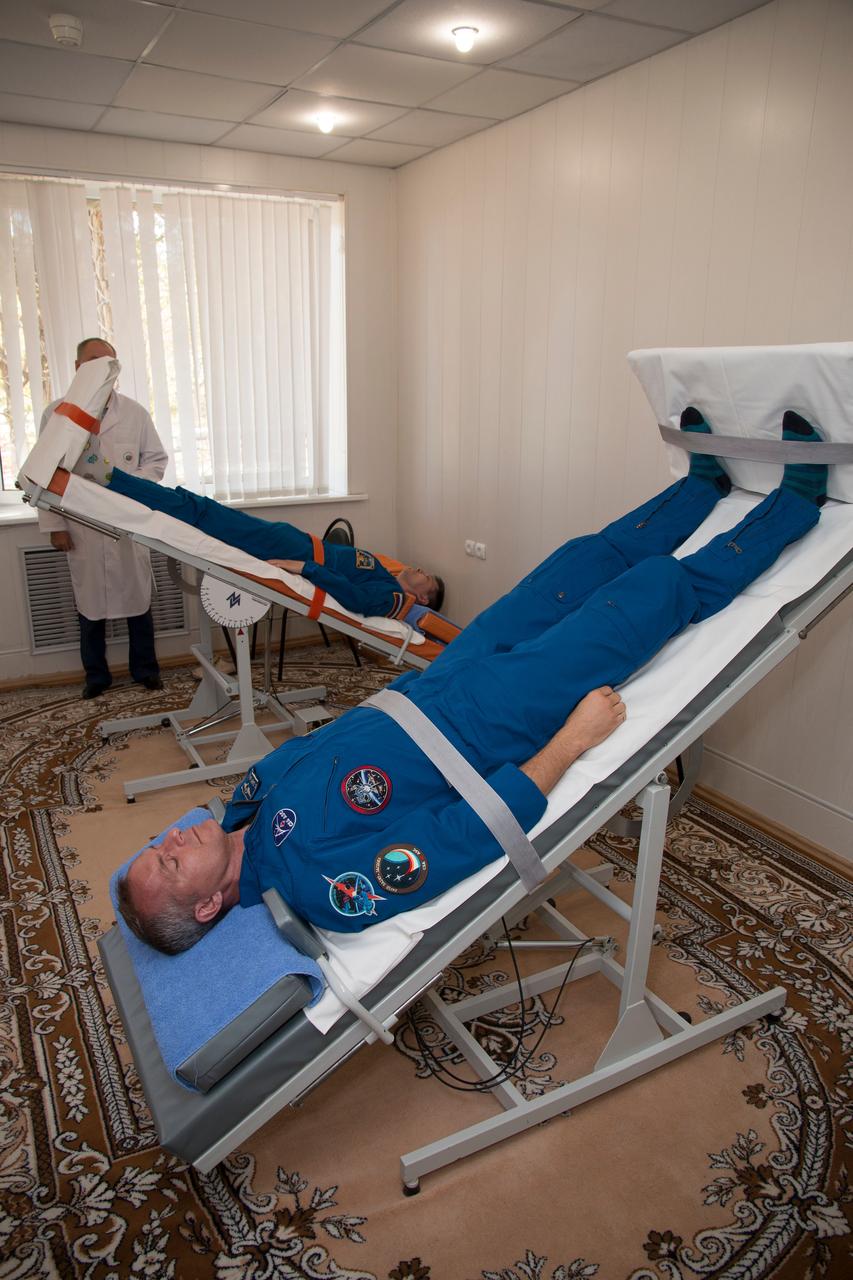
jsc2018e085901 (Oct. 3, 2018) --- Expedition 57 backup crew members Oleg Kononenko of Roscosmos, top, and David Saint-Jacques of the Canadian Space Agency, bottom, conduct tests of their vestibular system on tilt tables, Wednesday, Oct. 3, 2018 at the Cosmonaut Hotel in Baikonur, Kazakhstan. Alexey Ovchinin of Roscosmos and Nick Hague of NASA are scheduled to launch on Oct. 11 onboard the Soyuz MS-10 spacecraft from the Baikonur Cosmodrome in Kazakhstan for a six-month mission on the International Space Station. Photo Credit: (NASA/Victor Zelentsov)
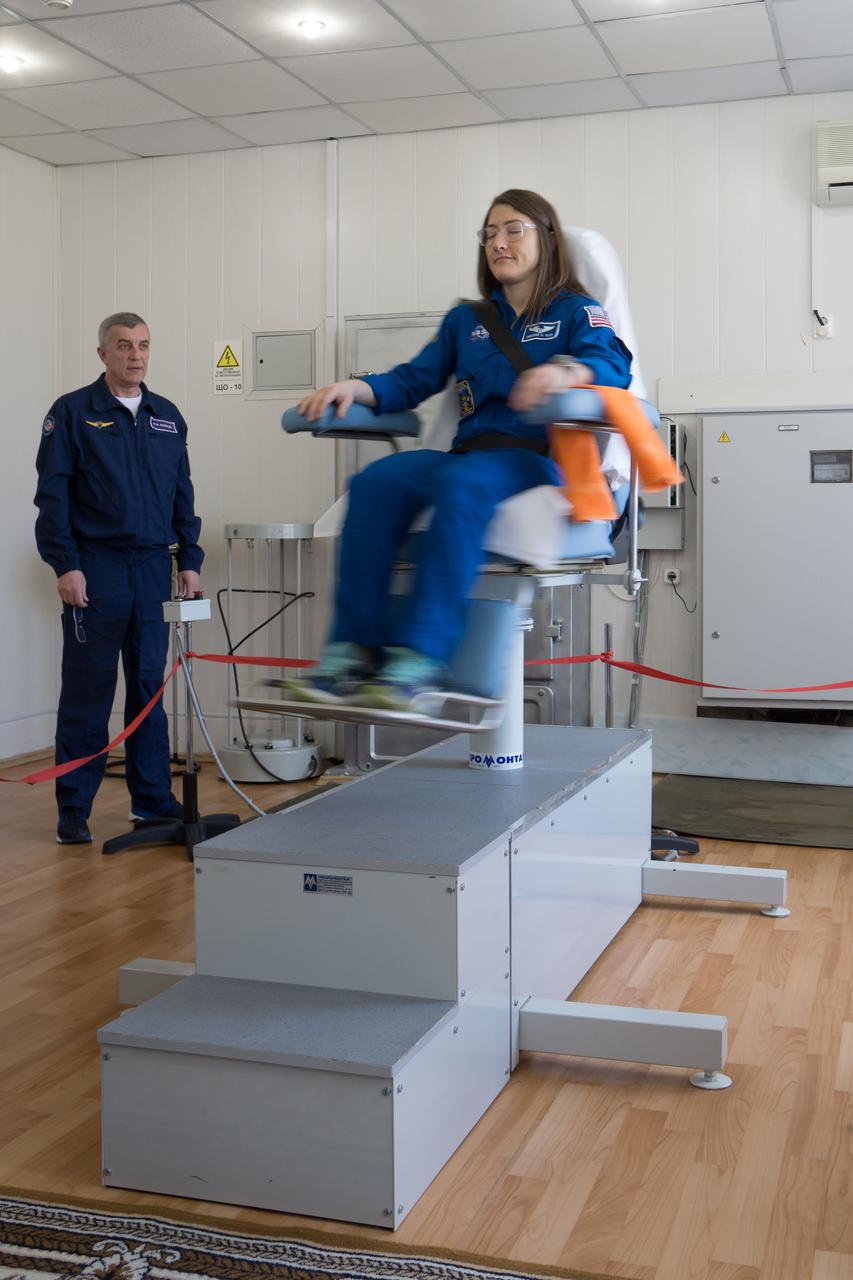
At the Cosmonaut Hotel crew quarters in Baikonur, Kazakhstan, Expedition 59 crewmember Christina Koch of NASA tests her vestibular system in a rotating chair March 7 as part of her pre-launch activities. Koch, Alexey Ovchinin of Roscosmos and Nick Hague of NASA will launch March 14, U.S. time, on the Soyuz MS-12 spacecraft from the Baikonur Cosmodrome for a six-and-a-half month mission on the International Space Station...NASA/Victor Zelentsov.
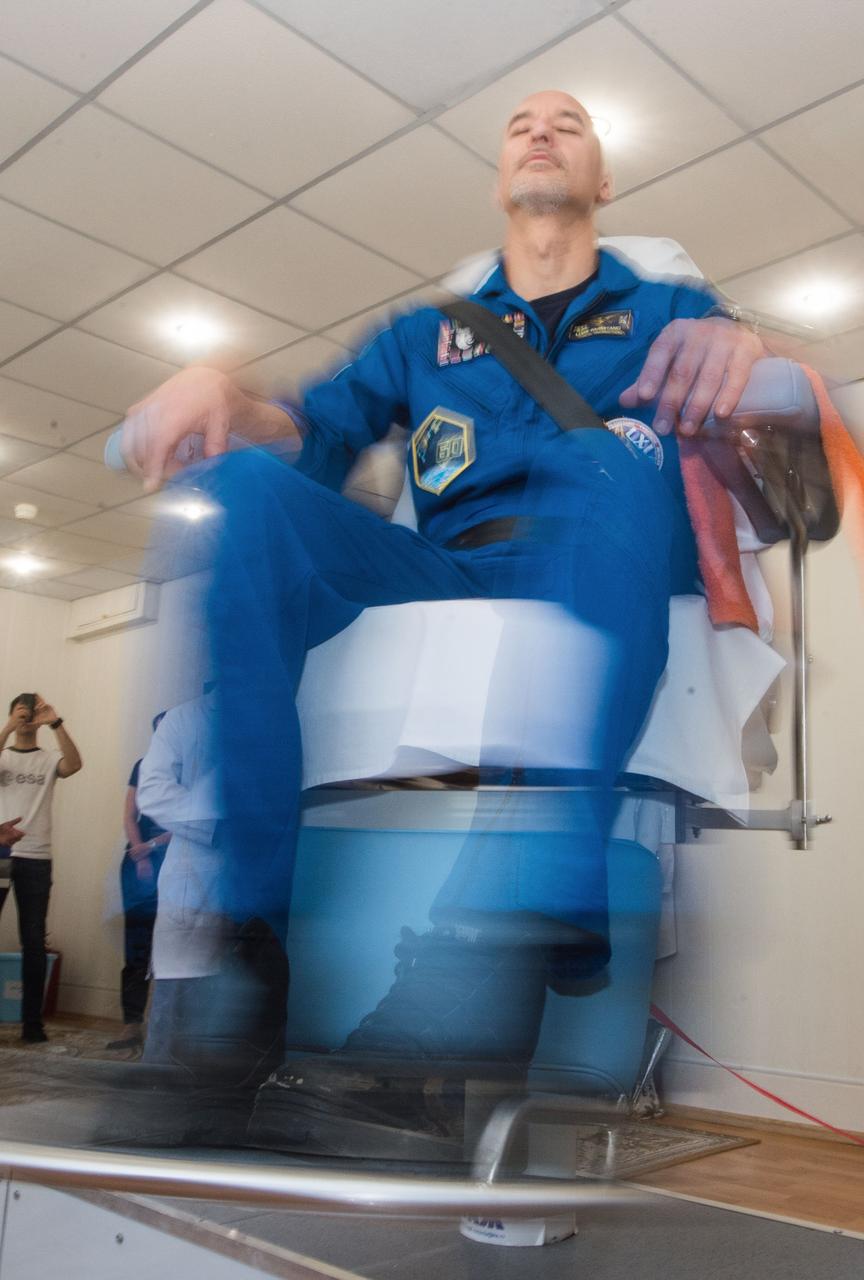
jsc2019e039267 - At the Cosmonaut Hotel crew quarters in Baikonur, Kazakhstan, Expedition 60 crewmember Luca Parmitano of the European Space Agency takes a ride in a spinning chair July 12 to test his vestibular system as part of pre-launch activities. Parmitano, Drew Morgan of NASA and Alexander Skvortsov of Roscosmos will launch July 20 on the Soyuz MS-13 spacecraft from the Baikonur Cosmodrome in Kazakhstan on a mission to the International Space Station...Andrey Shelepin/GCTC.
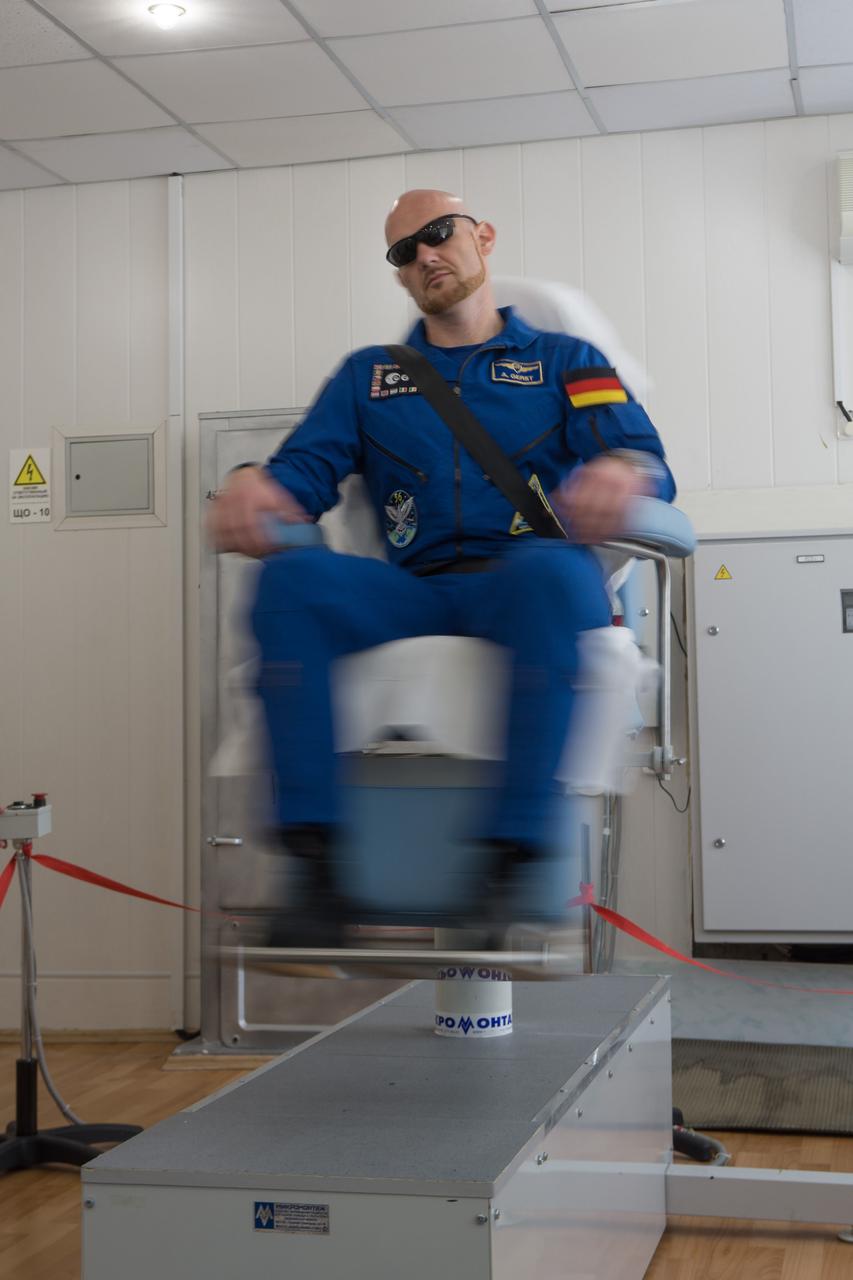
jsc2018e050828 - At the Cosmonaut Hotel crew quarters in Baikonur, Kazakhstan, Expedition 56 prime crewmember Alexander Gerst of the European Space Agency takes a spin in a rotating chair May 29 to test his vestibular system as part of pre-launch activities. Gerst, Serena Aunon-Chancellor of NASA and Sergey Prokopyev of Roscosmos will launch June 6 from the Baikonur Cosmodrome in Kazakhstan on the Soyuz MS-09 spacecraft for a six-month mission on the International Space Station...NASA/Victor Zelentsov.
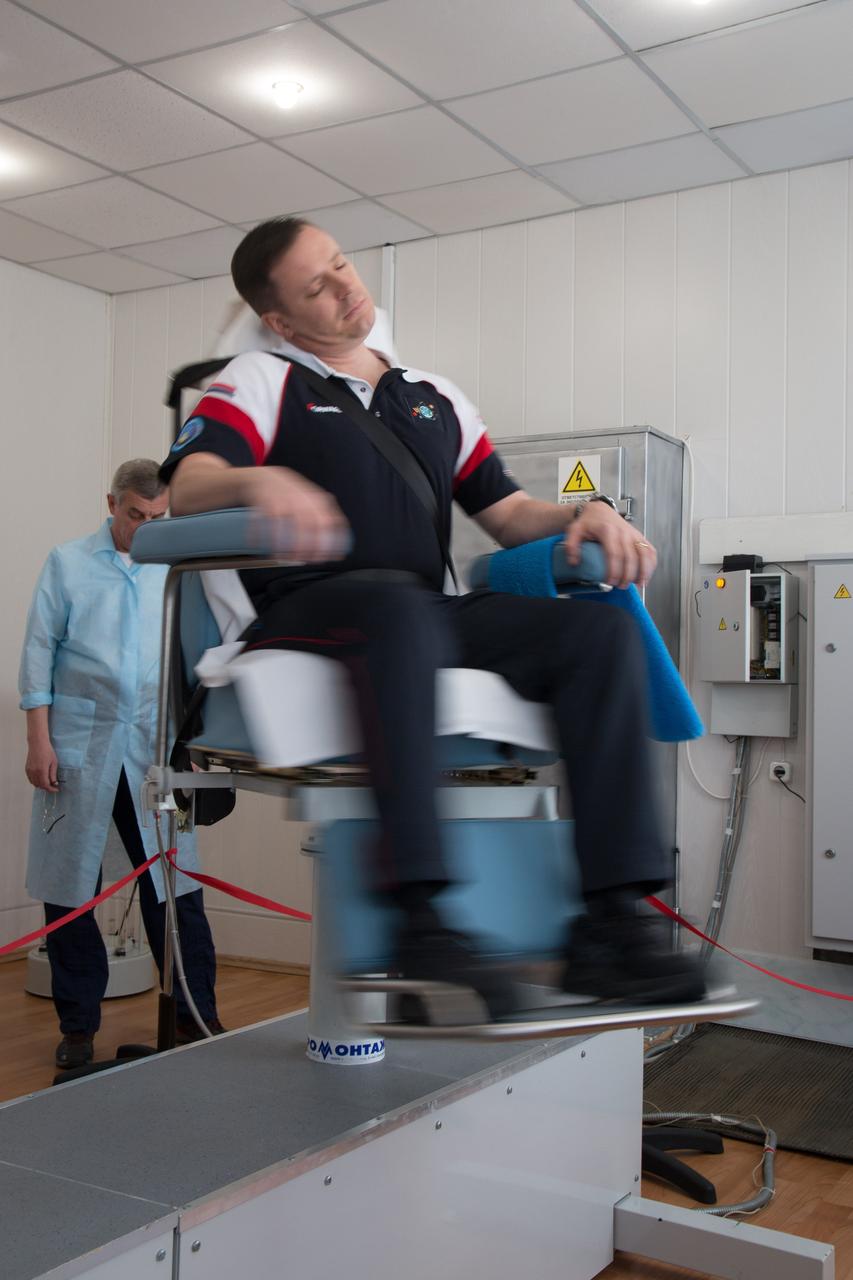
jsc2017e043073 (April 13, 2017) --- At the Cosmonaut Hotel crew quarters in Baikonur, Kazakhstan, Expedition 51 crewmember Jack Fischer of NASA takes a spin in a rotating chair to test his vestibular system April 13 as part of his pre-launch activities. Fischer and Fyodor Yurchikhin of the Russian Federal Space Agency (Roscosmos) will liftoff April 20 from the Baikonur Cosmodrome on the Soyuz MS-04 spacecraft for a four and a half month mission on the International Space Station. NASA/Victor Zelentsov
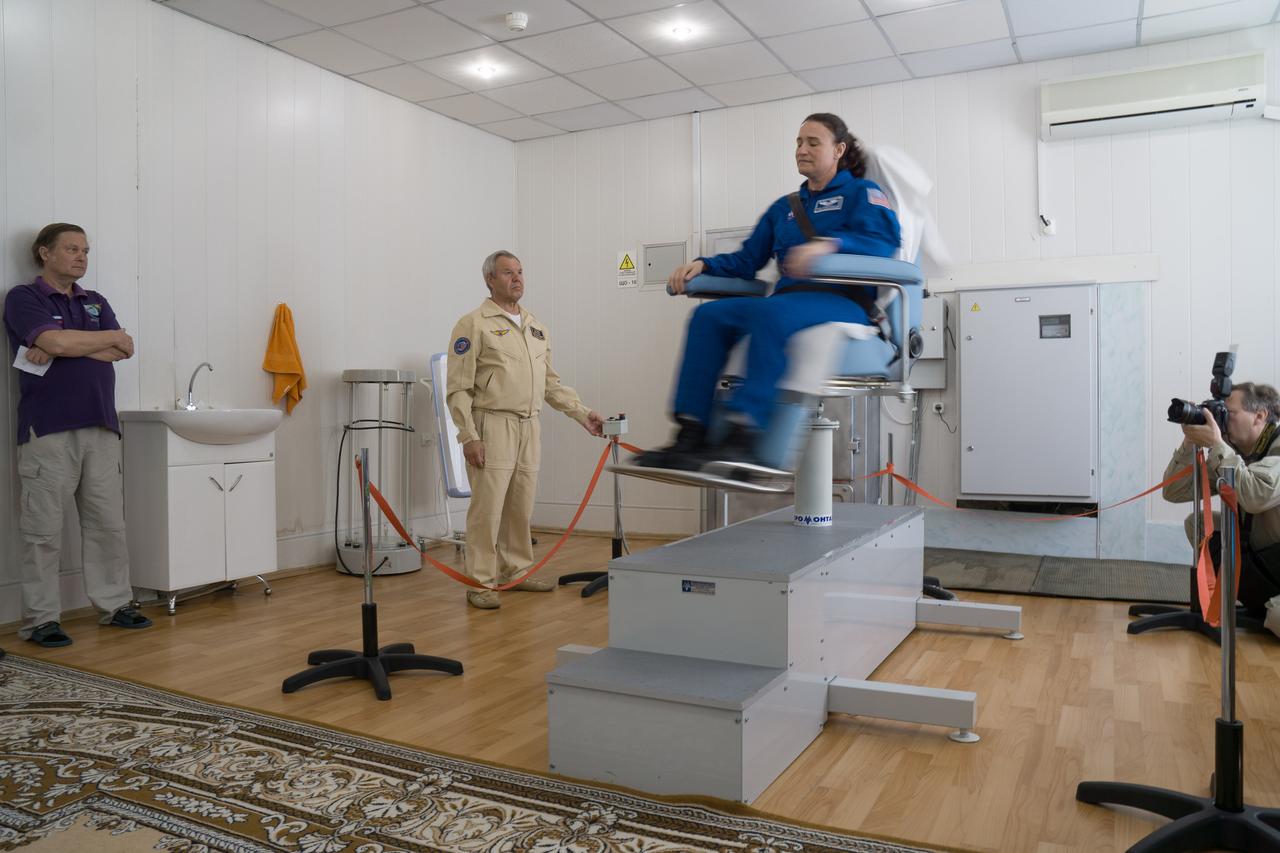
jsc2018e050829 - At the Cosmonaut Hotel crew quarters in Baikonur, Kazakhstan, Expedition 56 prime crewmember Serena Aunon-Chancellor of NASA takes a spin in a rotating chair May 29 to test her vestibular system as part of pre-launch activities. Aunon-Chancellor, Alexander Gerst of the European Space Agency and Sergey Prokopyev of Roscosmos will launch June 6 from the Baikonur Cosmodrome in Kazakhstan on the Soyuz MS-09 spacecraft for a six-month mission on the International Space Station...NASA/Victor Zelentsov.
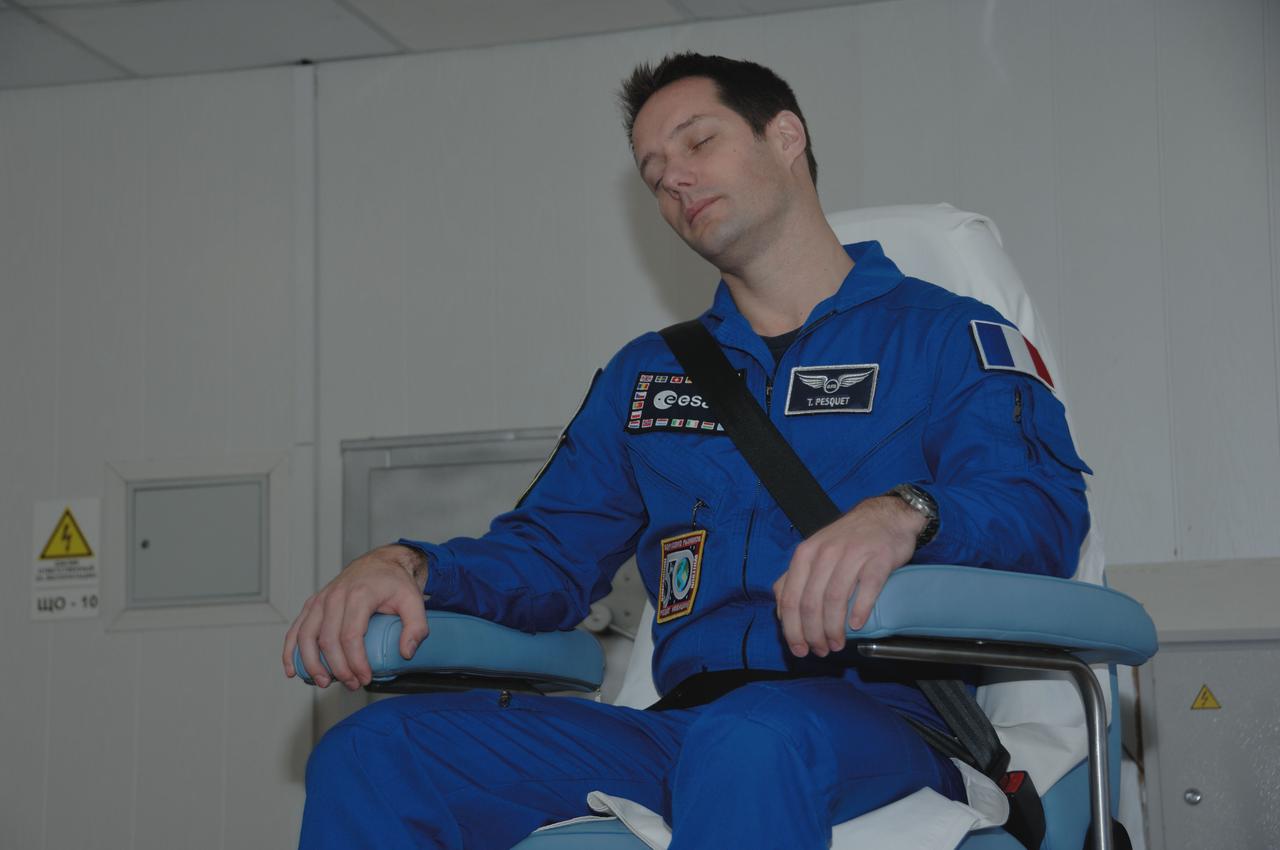
At his Cosmonaut Hotel crew quarters in Baikonur, Kazakhstan, Expedition 50-51 crewmember Thomas Pesquet of the European Space Agency takes a spin in a rotating chair Nov. 10 to test his vestibular system as part of preflight activities. Pesquet, Peggy Whitson of NASA and Oleg Novitskiy of the Russian Federal Space Agency (Roscosmos) will launch Nov. 18, Baikonur time, on the Soyuz MS-03 spacecraft for a six-month mission on the International Space Station. NASA/Alexander Vysotsky
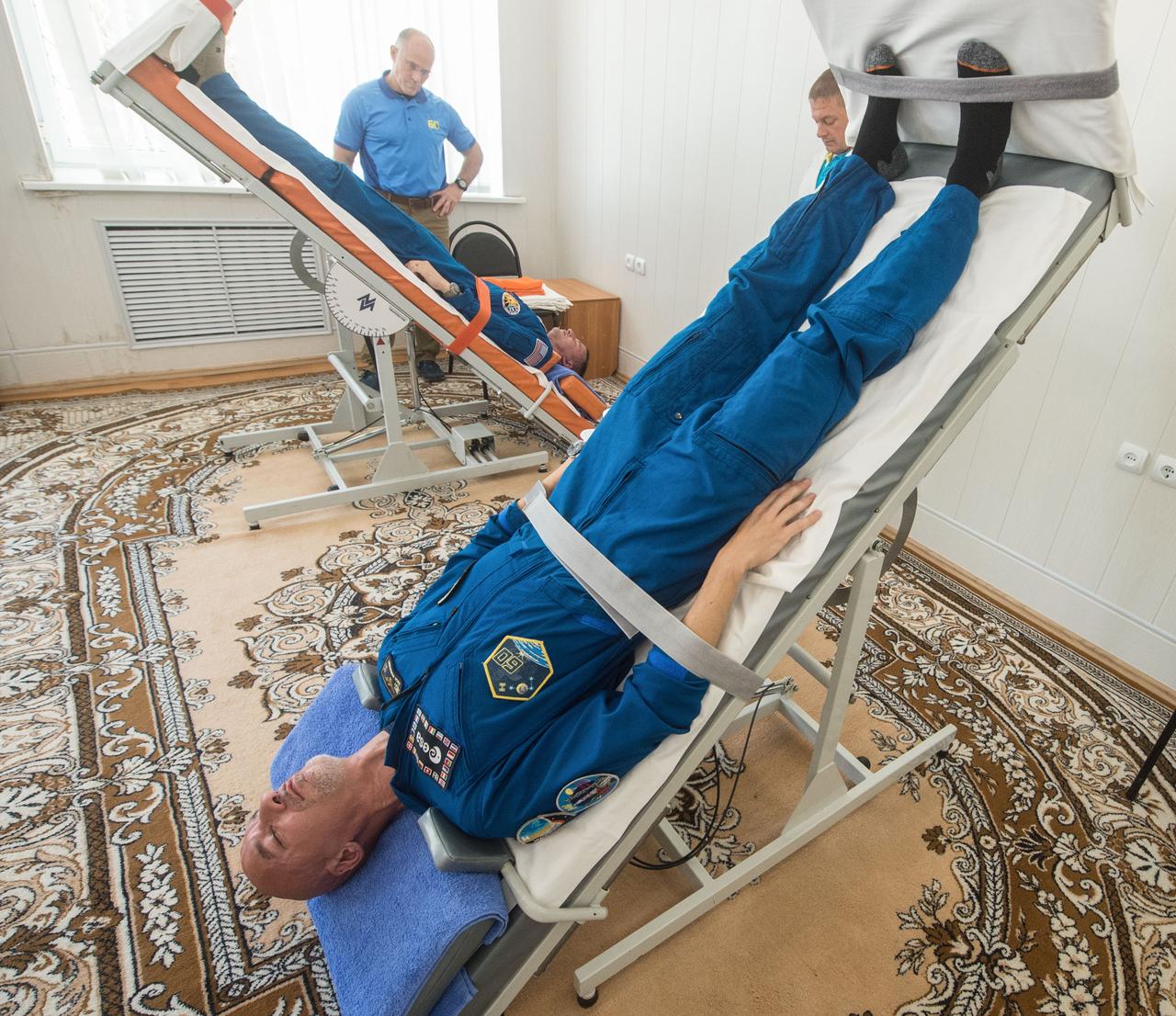
jsc2019e039266 - At the Cosmonaut Hotel crew quarters in Baikonur, Kazakhstan, Expedition 60 crewmembers Luca Parmitano of the European Space Agency (foreground) and Drew Morgan of NASA test out their vestibular systems on tilt tables July 12 as part of pre-launch activities. Along with Alexander Skvortsov of Roscosmos, they will launch July 20 on the Soyuz MS-13 spacecraft from the Baikonur Cosmodrome in Kazakhstan on a mission to the International Space Station...Andrey Shelepin/GCTC.
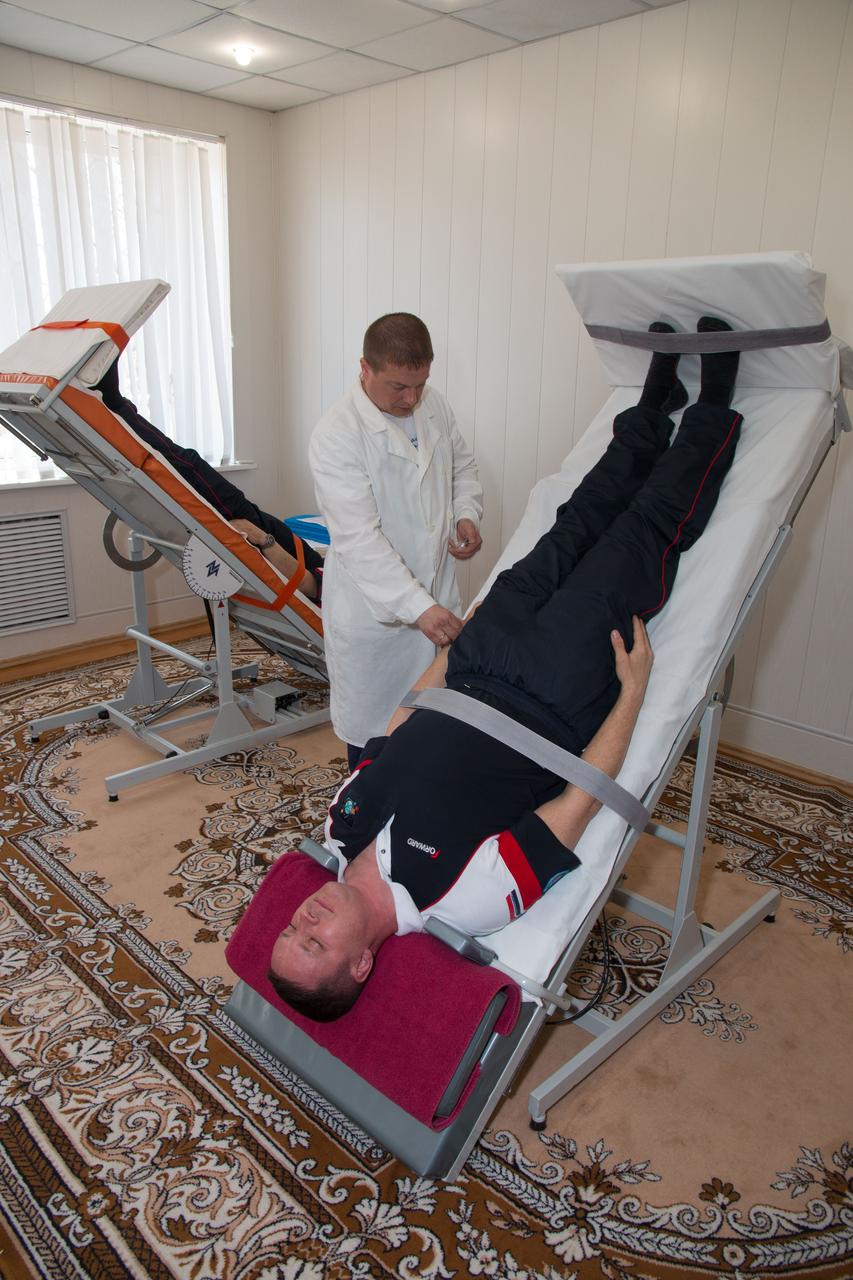
jsc2017e043074 (April 13, 2017) --- At the Cosmonaut Hotel crew quarters in Baikonur, Kazakhstan, Expedition 51 crewmember Jack Fischer of NASA conducts a session on a tilt table to test his vestibular system April 13 as part of his pre-launch activities. Fischer and Fyodor Yurchikhin of the Russian Federal Space Agency (Roscosmos) will liftoff April 20 from the Baikonur Cosmodrome on the Soyuz MS-04 spacecraft for a four and a half month mission on the International Space Station. NASA/Victor Zelentsov
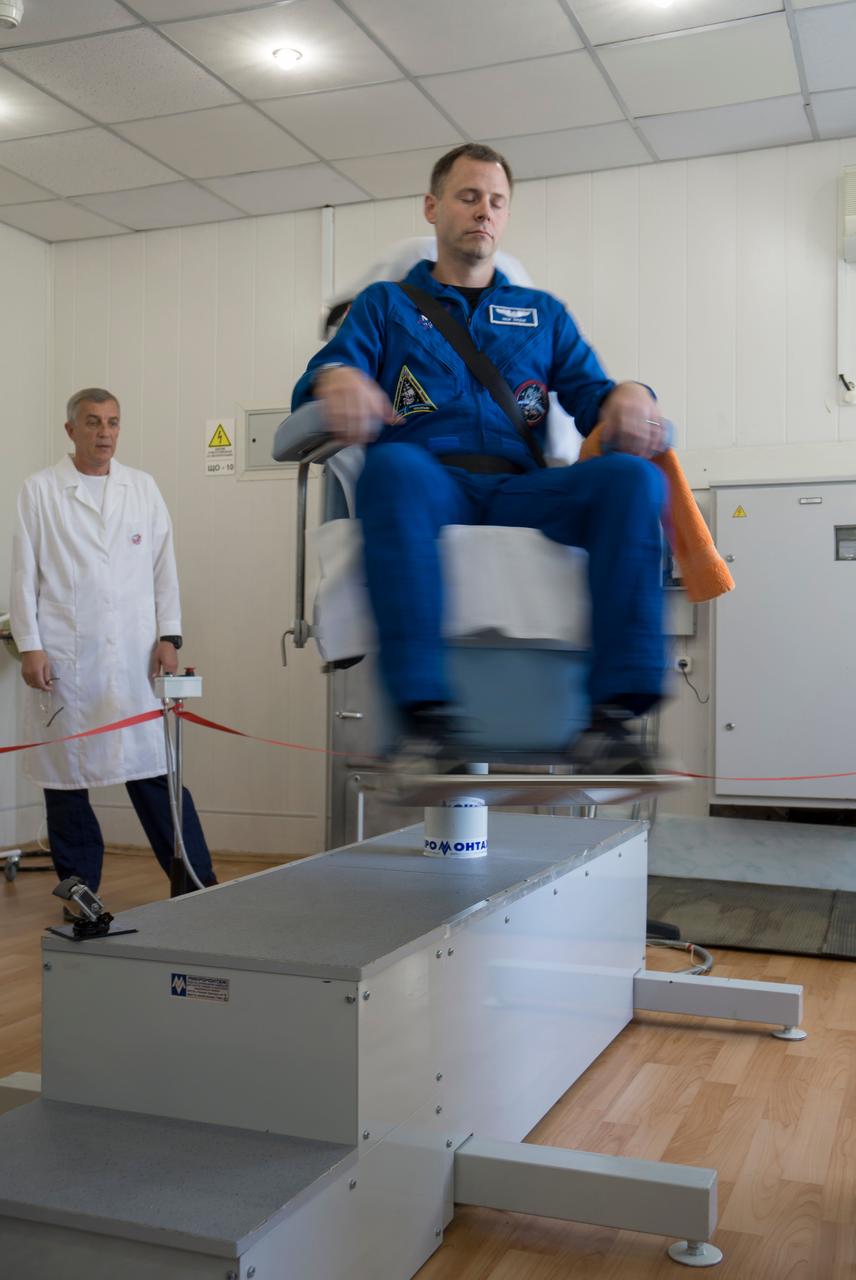
jsc2018e085899 (Oct. 3, 2018) --- Expedition 57 prime crew member Nick Hague of NASA takes a spin in a rotating chair to test his vestibular system as part of pre-launch activities, Wednesday, Oct. 3, 2018 at the Cosmonaut Hotel in Baikonur, Kazakhstan. Hague and Alexey Ovchinin of Roscosmos are scheduled to launch on Oct. 11 onboard the Soyuz MS-10 spacecraft from the Baikonur Cosmodrome in Kazakhstan for a six-month mission on the International Space Station. Photo Credit: (NASA/Victor Zelentsov)
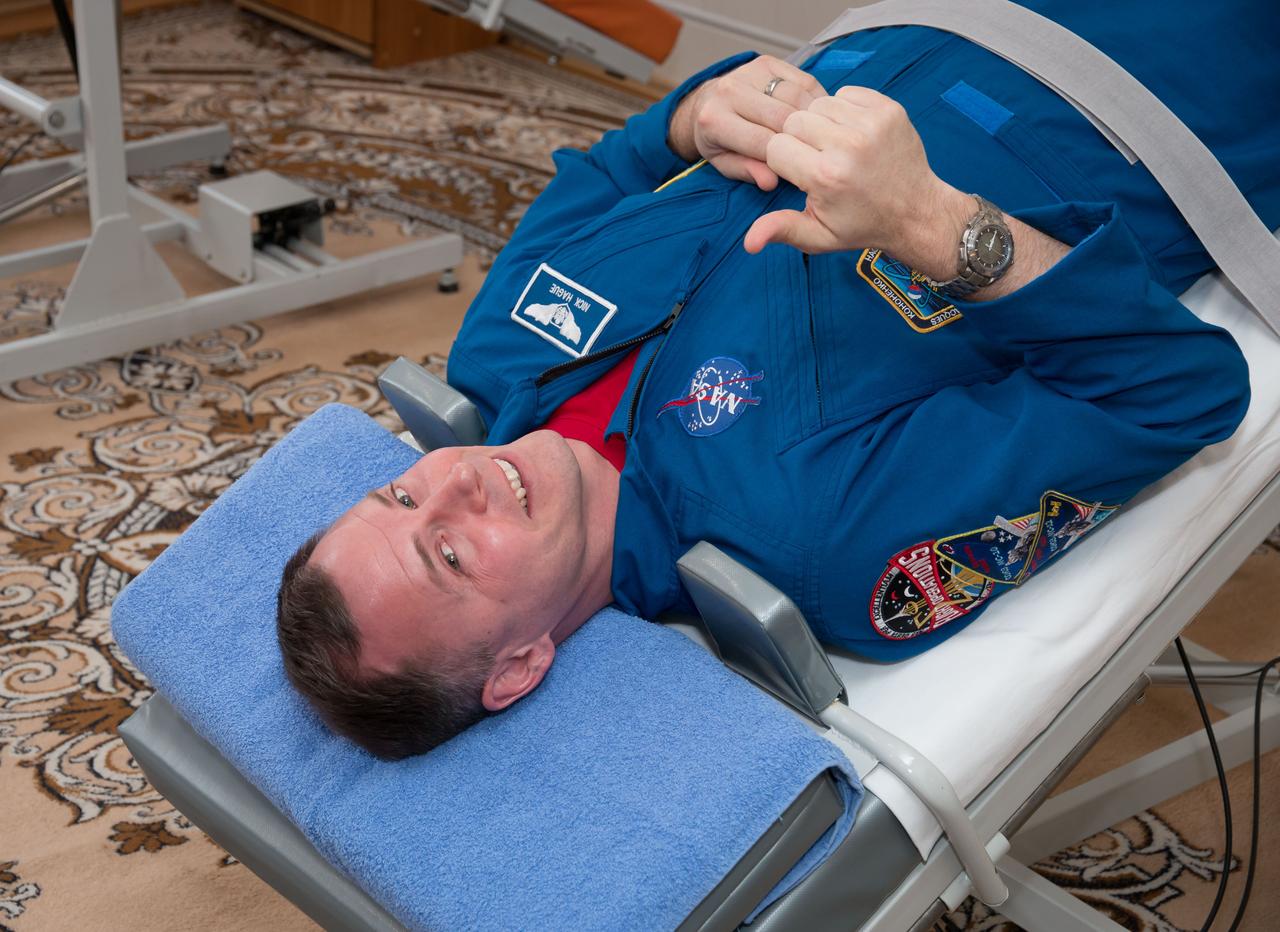
At the Cosmonaut Hotel crew quarters in Baikonur, Kazakhstan, Expedition 59 crewmember Nick Hague of NASA flashes a thumbs-up signal as he tests his vestibular system on a tilt table March 7 as part of his pre-launch activities. Hague, Christina Koch of NASA and Alexey Ovchinin of Roscosmos will launch March 14, U.S. time, on the Soyuz MS-12 spacecraft from the Baikonur Cosmodrome for a six-and-a-half month mission on the International Space Station...NASA/Victor Zelentsov.
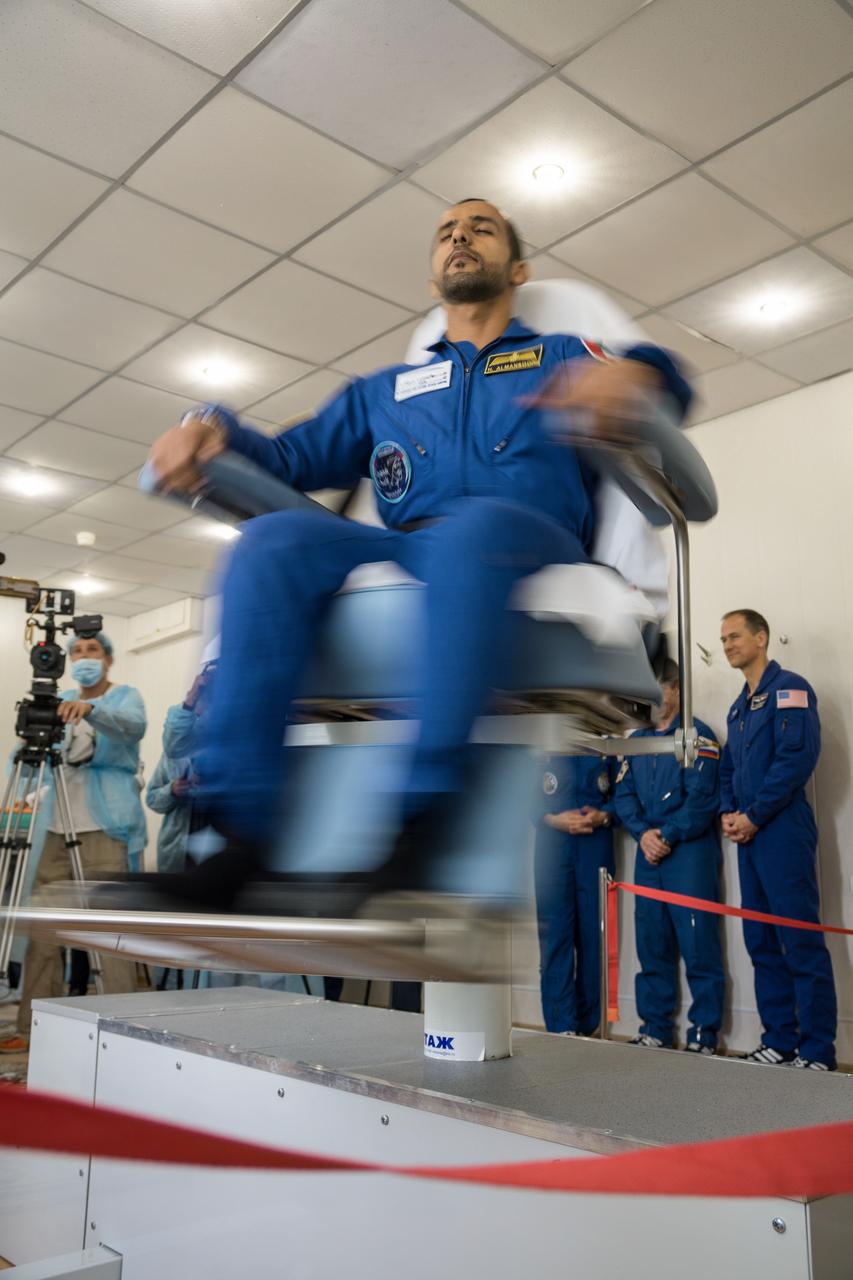
jsc2019e053723 - At the Cosmonaut Hotel crew quarters in Baikonur, Kazakhstan, spaceflight participant Hazzaa Ali Almansoori of the United Arab Emirates takes a spin in a rotating chair Sept. 18 to test his vestibular system as part of pre-launch activities. Along with Expedition 61 crewmembers Oleg Skripochka of Roscosmos and Jessica Meir of NASA, they will launch Sept. 25 from the Baikonur Cosmodrome in Kazakhstan on the Soyuz MS-15 spacecraft for a mission on the International Space Station...NASA/Victor Zelentsov
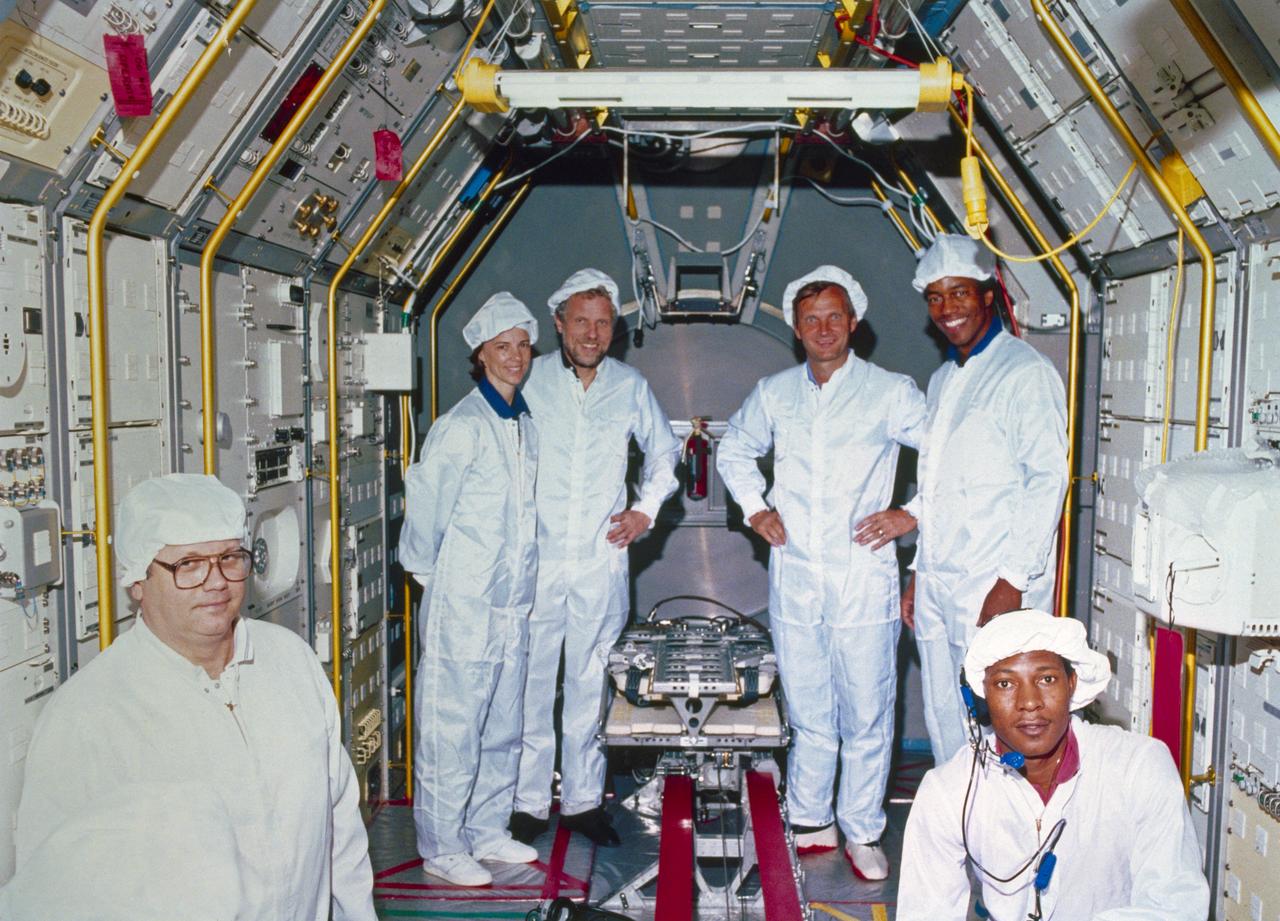
S85-43139 (20 Sept 1985) --- Four members of the STS 61-A/Spacelab D-1 crew and two technicians are shown with a vestibular sled experiment for they will use for extensive research and testing late October and early November are (background, left to right), Astronaut Bonnie J. Dunbar, Reinhard Furrer, Ernst Messerschmid and Guion S. Bluford Jr. The seat shown can be moved back and forth with precisley adjusted accelerations along the fixed rails on the floor of the Spacelab aisle.
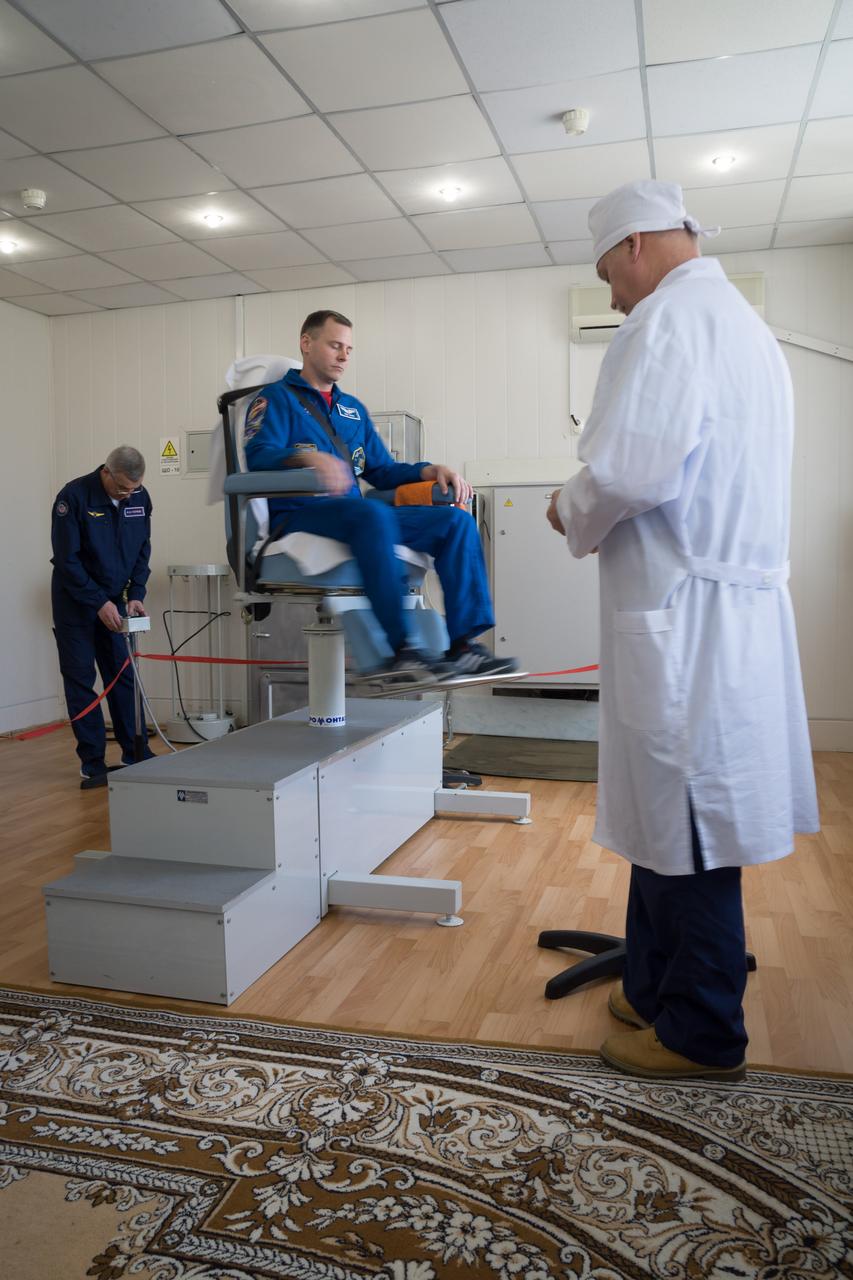
At the Cosmonaut Hotel crew quarters in Baikonur, Kazakhstan, Expedition 59 crewmember Nick Hague of NASA tests his vestibular system in a rotating chair March 7 as part of his pre-launch activities. Hague, Christina Koch of NASA and Alexey Ovchinin of Roscosmos will launch March 14, U.S. time, on the Soyuz MS-12 spacecraft from the Baikonur Cosmodrome for a six-and-a-half month mission on the International Space Station...NASA/Victor Zelentsov.
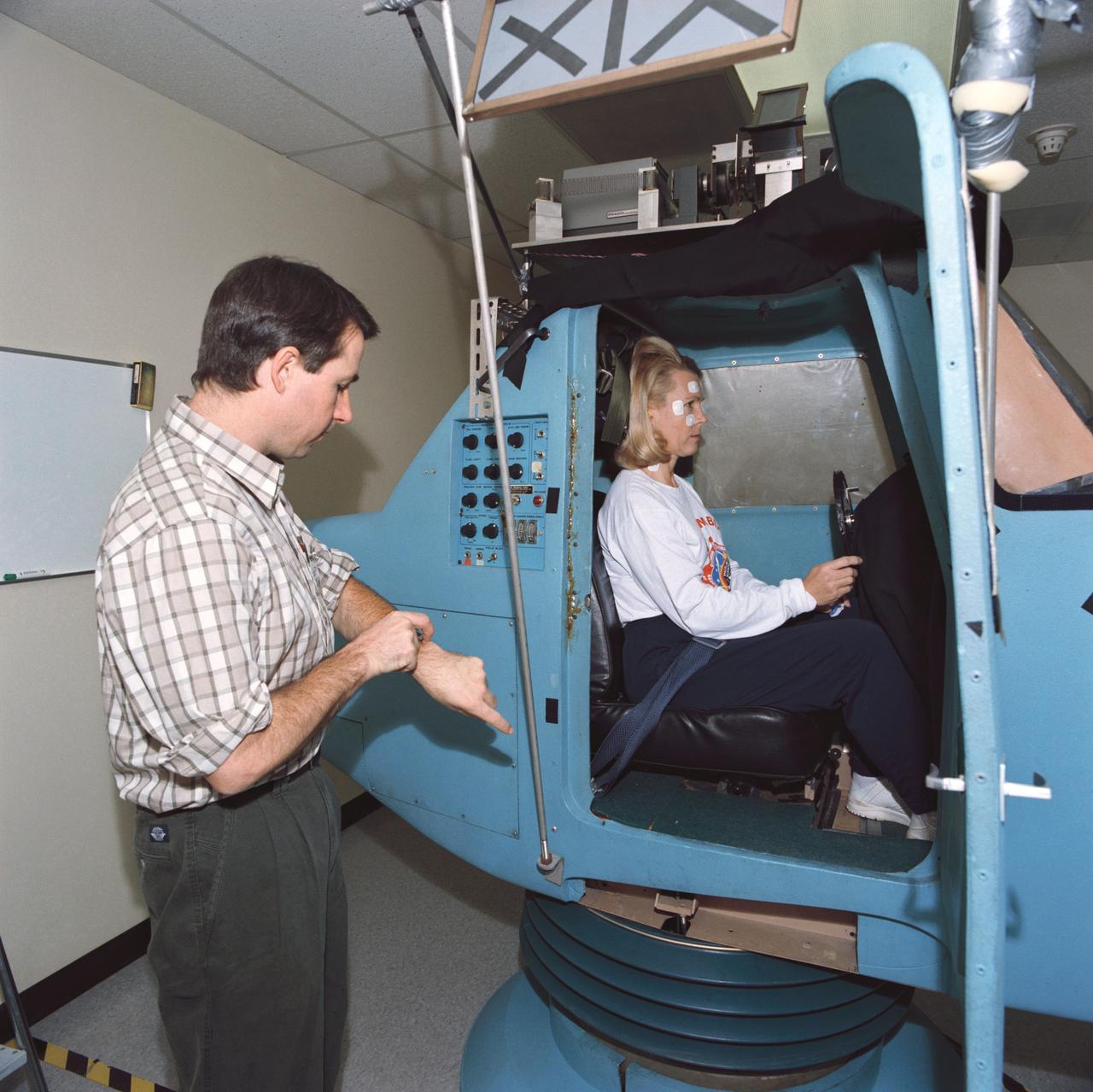
S93-45373 (29 Sept 1993) --- Astronaut Rhea Seddon, STS-58 payload commander, is in a piloting simulator as part of a pre-flight data collection project for neurovestibular functions. The seven Spacelab Life Sciences (SLS-2) crew members devoted a full day to miscellaneous biomedical data collection in preparation for next month's two week mission aboard Columbia.
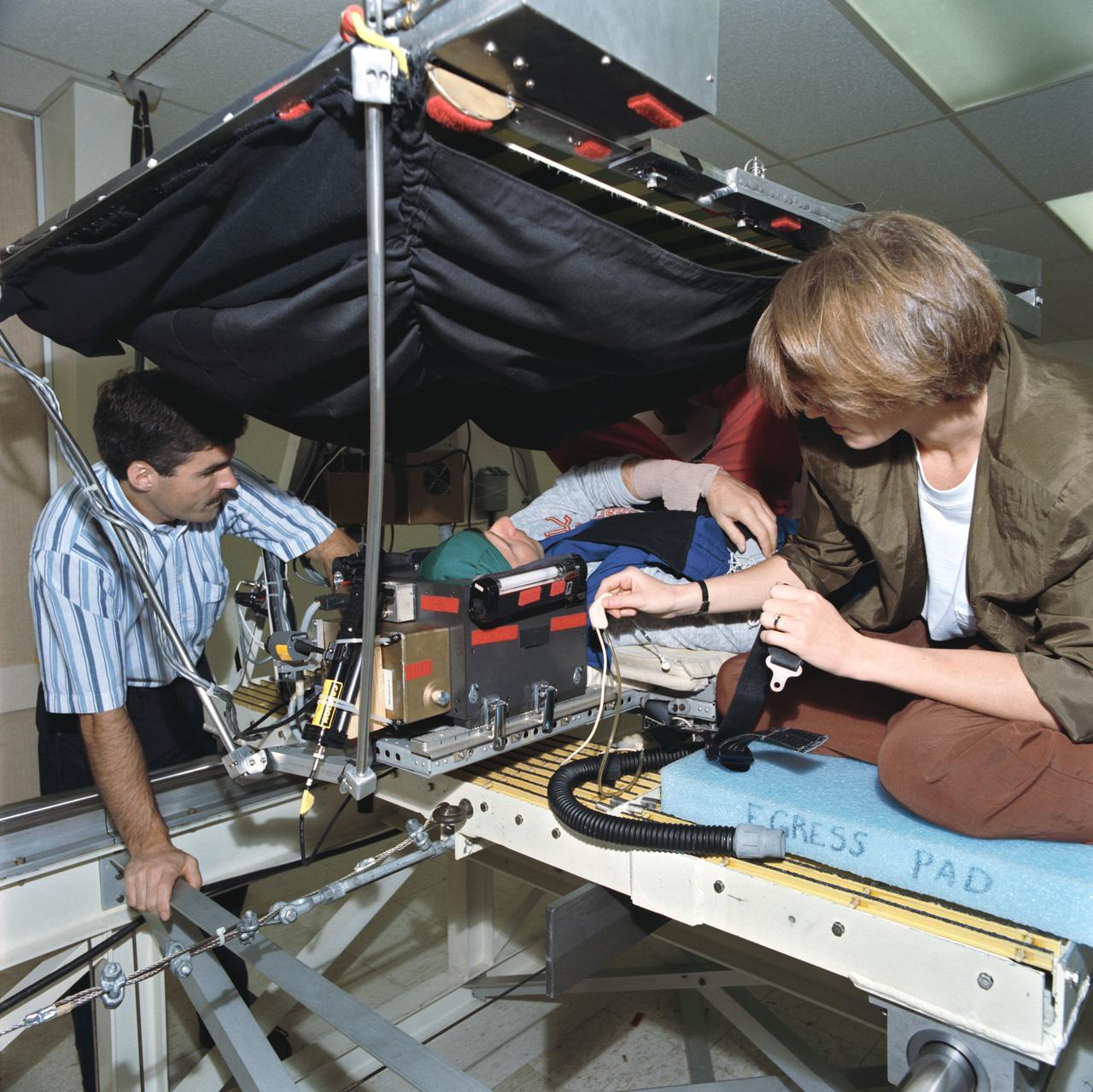
S93-45363 (29 Sept 1993) --- Payload specialist Martin J. Fettman, in an oscillating sled device, participates in a data collection project for neurovestibular functions. The seven Spacelab Life Sciences (SLS-2) crewmembers devoted a full day to miscellaneous biomedical data collection in preparation for next month's two week mission aboard Columbia.
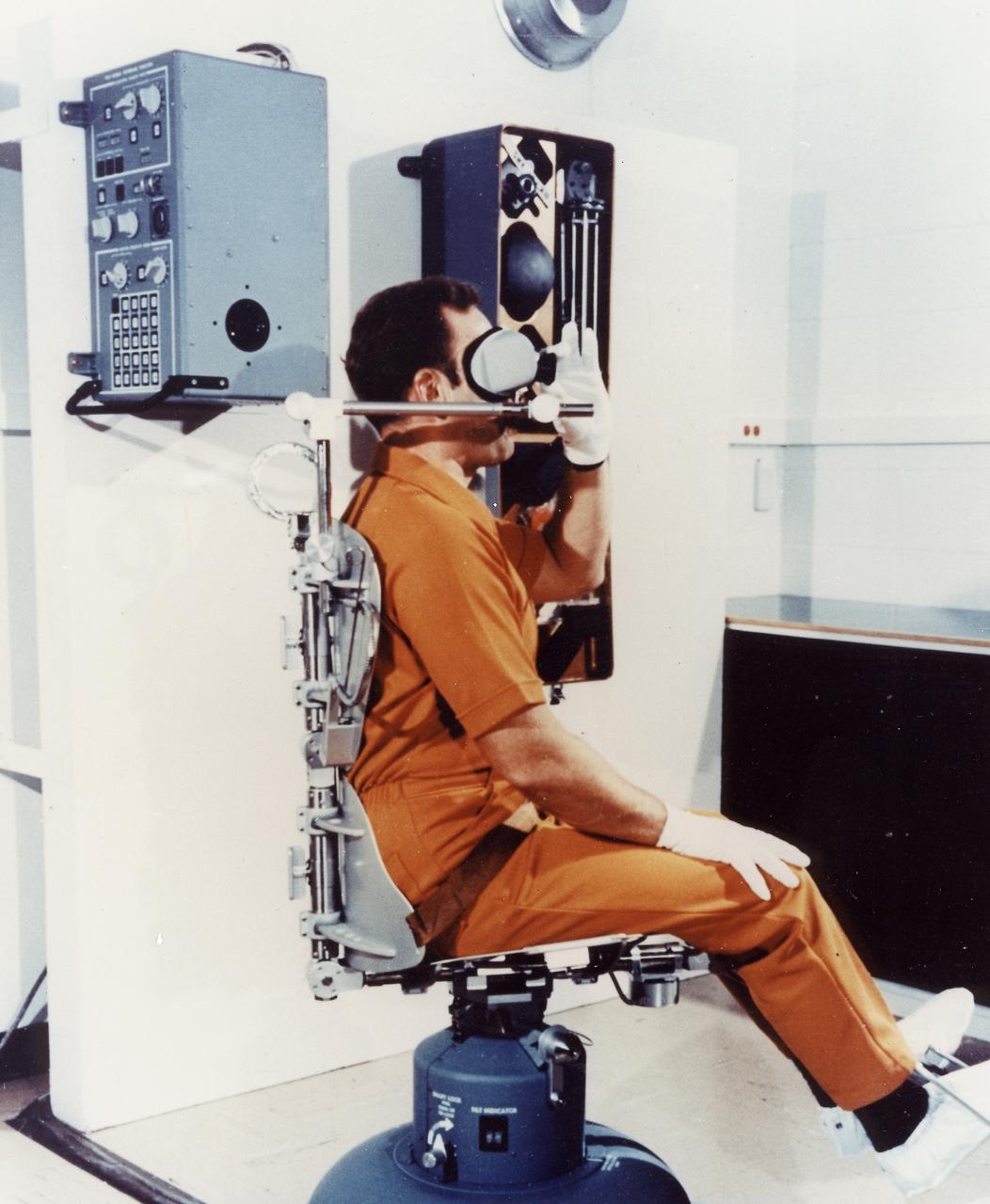
This 1970 photograph shows the Rotating Litter Chair, a major component of Skylab's Human Vestibular Function experiment (M131). The experiment was a set of medical studies designed to determine the effect of long-duration space missions on astronauts' coordination abilities. The M131 experiment tested the astronauts susceptibility to motion sickness in the Skylab environment, acquired data fundamental to an understanding of the functions of human gravity reception under prolonged absence of gravity, and tested for changes in the sensitivity of the semicircular canals. Data from this experiment was collected before, during, and after flight. The Marshall Space Flight Center had program management responsibility for the development of Skylab hardware and experiments.
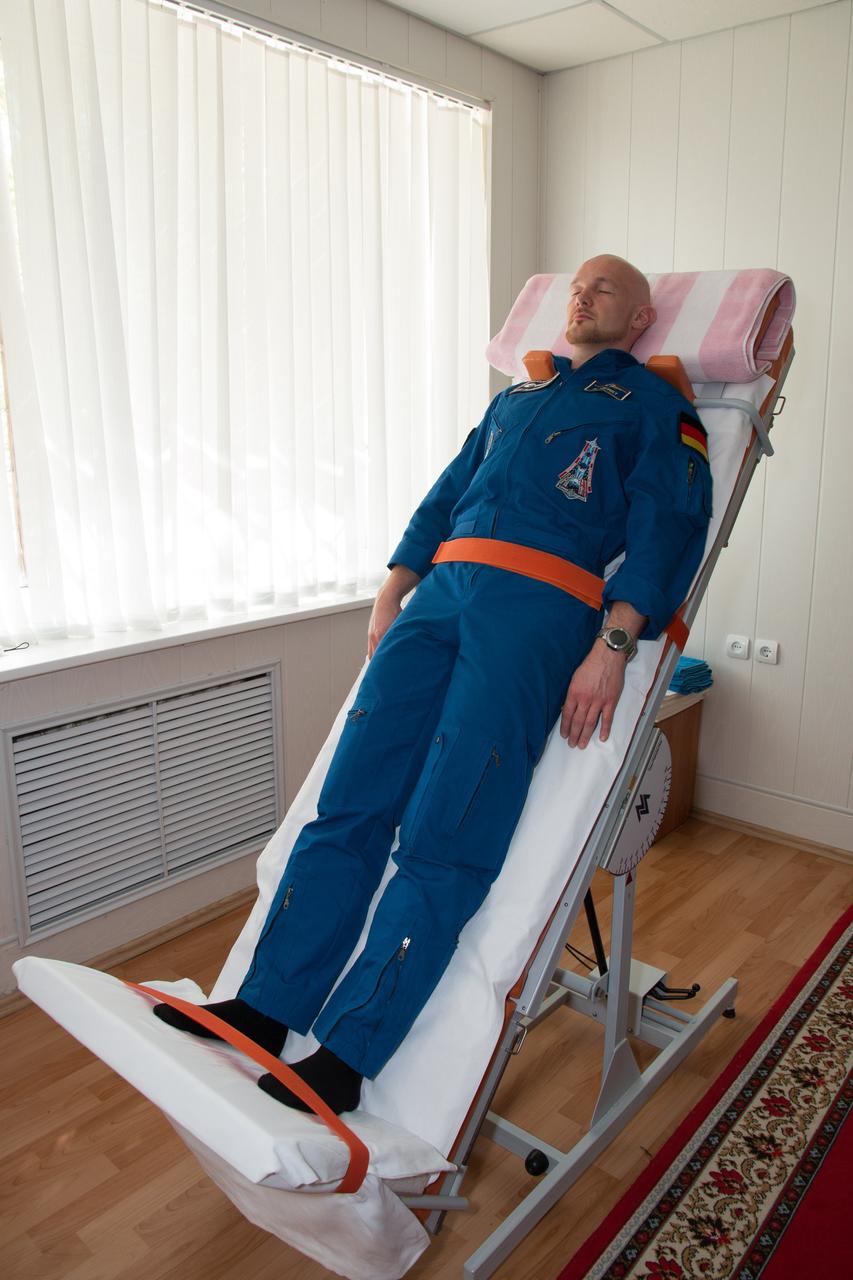
11-57-29-2: At the Cosmonaut Hotel crew quarters in Baikonur, Kazakhstan, Expedition 40/41 Flight Engineer Alexander Gerst of the European Space Agency takes a turn on a tilt table May 21 as he tests his vestibular system during pre-launch medical tests. Gerst, Soyuz Commander Max Suraev of the Russian Federal Space Agency (Roscosmos) and Flight Engineer Reid Wiseman of NASA will launch on May 29, Kazakh time, on the Soyuz TMA-13M spacecraft from the Baikonur Cosmodrome for a 5 ½ month mission on the International Space Station. NASA/Victor Zelentsov
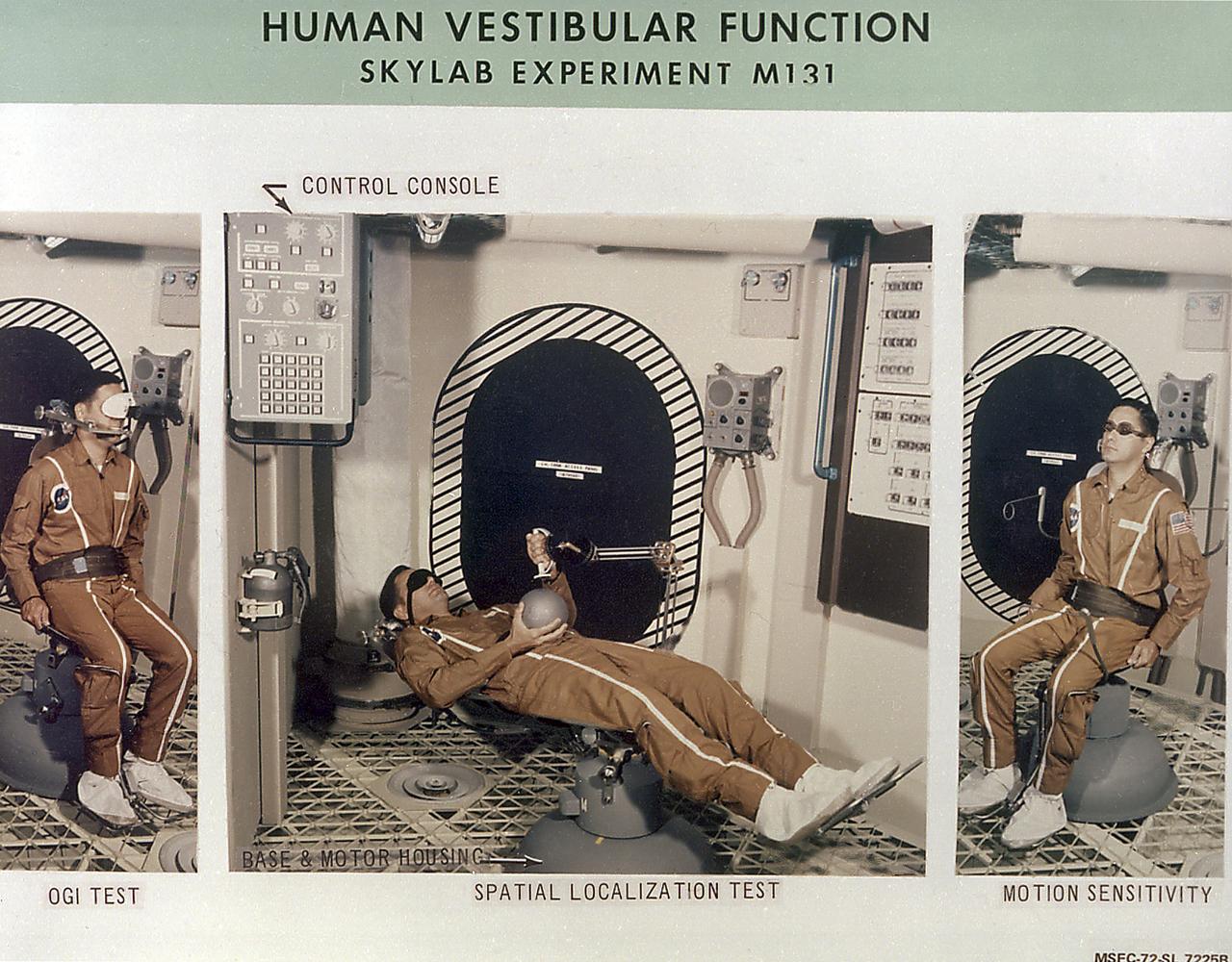
This set of photographs details Skylab's Human Vestibular Function experiment (M131). This experiment was a set of medical studies designed to determine the effect of long-duration space missions on astronauts' coordination abilities. This experiment tested the astronauts susceptibility to motion sickness in the Skylab environment, acquired data fundamental to an understanding of the functions of human gravity reception under prolonged absence of gravity, and tested for changes in the sensitivity of the semicircular canals. Data from this experiment was collected before, during, and after flight. The Marshall Space Flight Center had program management responsibility for the development of Skylab hardware and experiments.
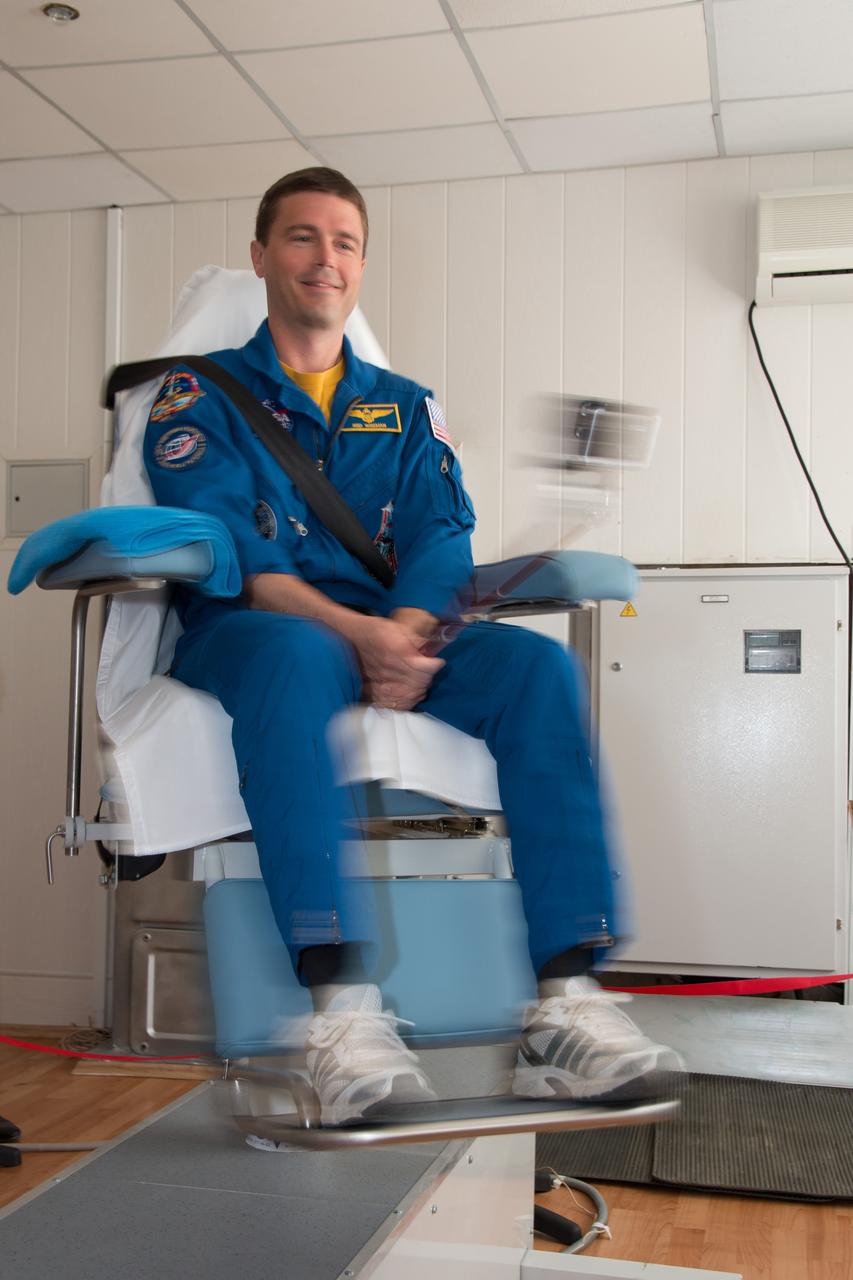
11-56-02-4: At the Cosmonaut Hotel crew quarters in Baikonur, Kazakhstan, Expedition 40/41 Flight Engineer Reid Wiseman of NASA takes a ride in a spinning chair May 21 as he tests his vestibular system during pre-launch medical tests. Wiseman, Soyuz Commander Max Suraev of the Russian Federal Space Agency (Roscosmos) and Flight Engineer Alexander Gerst of the European Space Agency will launch on May 29, Kazakh time, on the Soyuz TMA-13M spacecraft from the Baikonur Cosmodrome for a 5 ½ month mission on the International Space Station. NASA/Victor Zelentsov
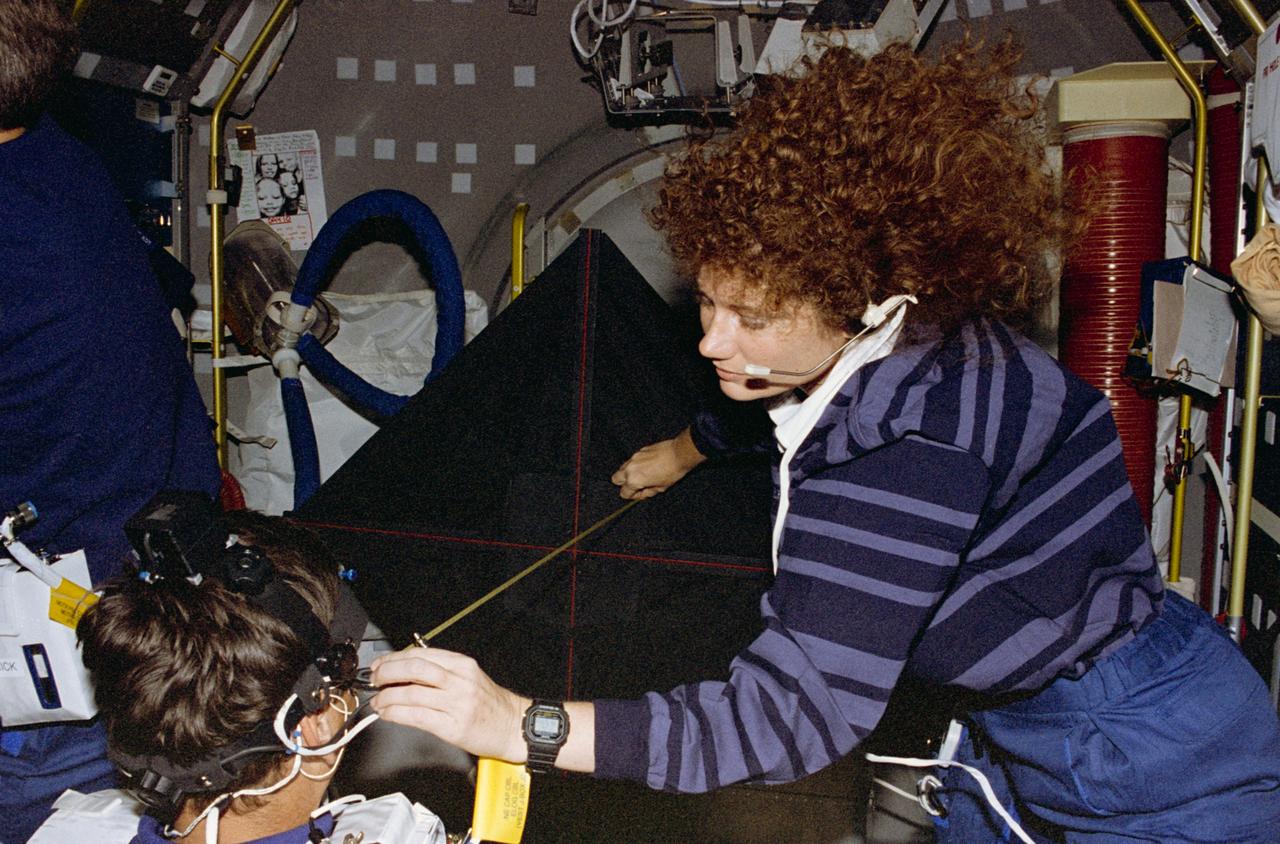
STS078-398-032 (20 June - 7 July 1996) --- Astronaut Susan J. Helms, payload commander, measures the distance between Jean-Jacques Favier’s head and the luminous torque, used for the Canal and Otolith Interaction Study (COIS) on the Life and Microgravity Spacelab (LMS-1) mission. Favier, representing the French Space Agency (CNES), is one of two international payload specialists on the almost-17-day flight. This view shows the Voluntary Head Movement (VHM) segment of the experiment. The VHM is meant to characterize how the coordination of head and eye movement changes as a result of spaceflight. Since most vestibular functions are influenced by gravity, the COIS experiment is meant to measure response differences in microgravity.
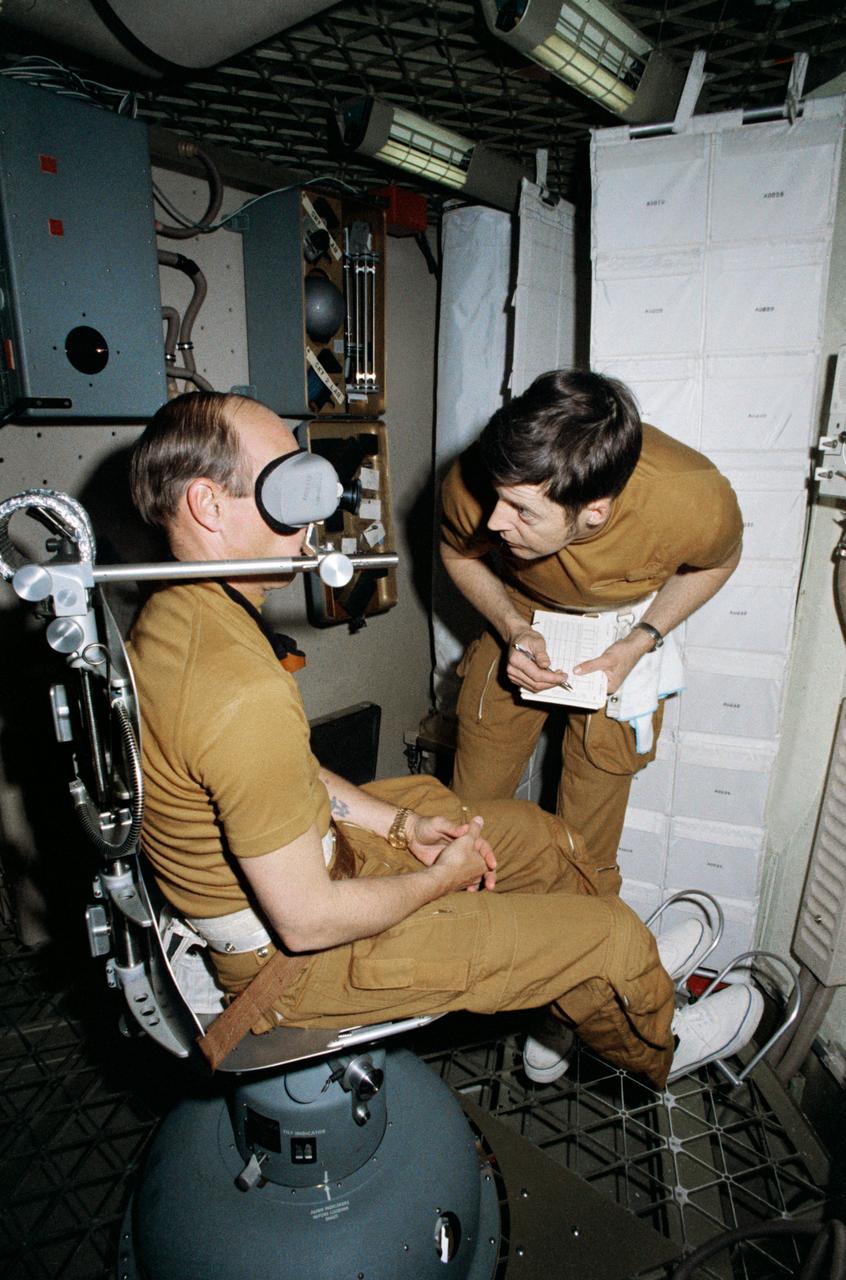
S73-20678 (1 March 1973) --- Astronaut Charles Conrad Jr., commander of the first manned Skylab mission, checks out the Human Vestibular Function, Experiment M131, during Skylab training at Johnson Space Center. Scientist-astronaut Joseph P. Kerwin, science pilot of the mission, goes over a checklist. The two men are in the work and experiments compartment of the crew quarters of the Skylab Orbital Workshop (OWS) trainer at JSC. Photo credit: NASA
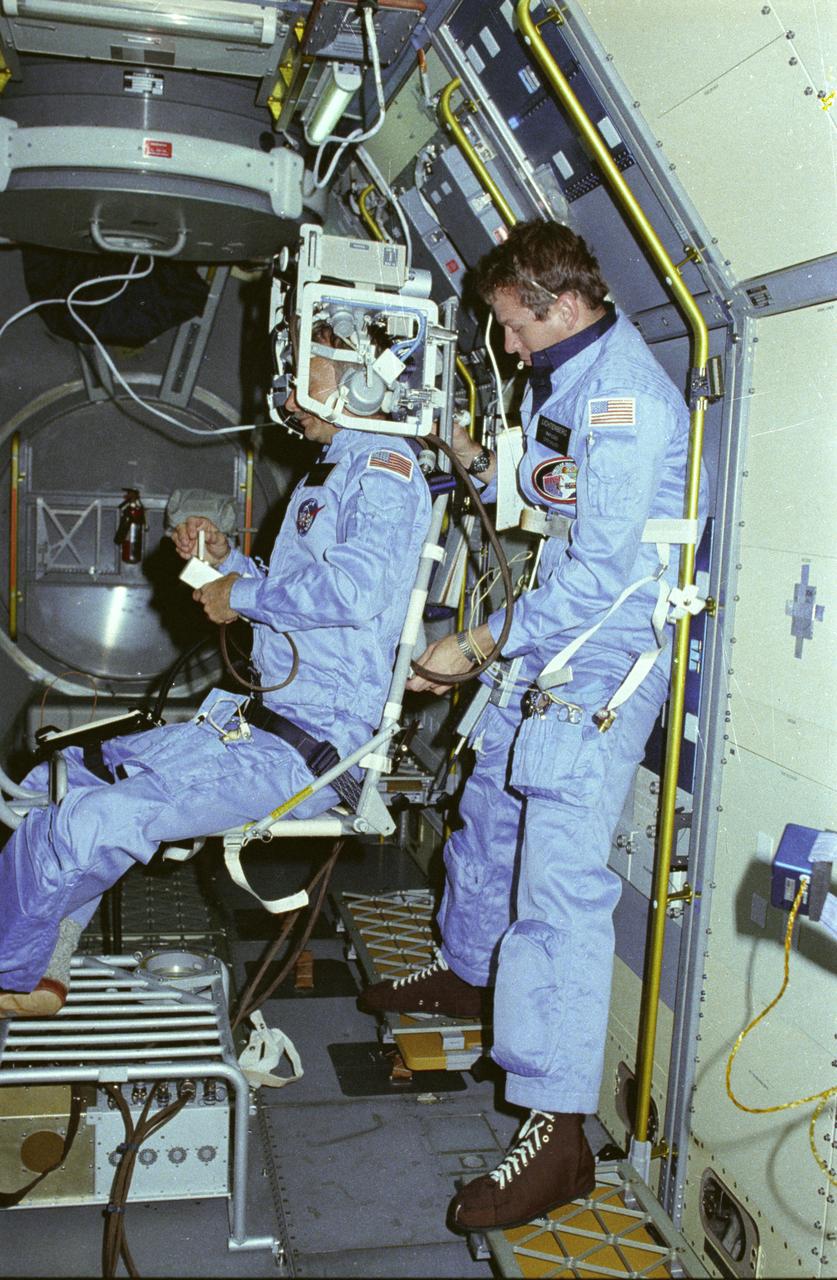
In this photograph, astronauts Owen Garriott on the body restriant system and Byron Lichtenberg prepare for a Vestibular Experiment during the Spacelab-1 mission. The Vestibular Experiments in Space were the study of the interaction among the otoliths, semicircular canals, vision, and spinal reflexes in humans. The main objective was to determine how the body, which receives redundant information for several sensory sources, interprets this information in microgravity. Another objective was to record and characterize the symptoms of space sickness experienced by crewmembers. The body restraint system was a rotating chair with a harness to hold the test subject in place. The crewmember wore an accelerometer and electrodes to record head motion and horizontal and vertical eye movement as the body rotated. The first Spacelab mission, Spacelab-1, sponsored jointly and shared equally by NASA and the European Space Agency, was a multidisciplinary mission; that is, investigations were performed in several different fields of scientific research. The overall goal of the mission was to verify Spacelab performance through a variety of scientific experiments. The Spacelab-1 was launched aboard the Space Shuttle Orbiter Columbia for the STS-9 mission on November 28, 1983. The Marshall Space Flight Center had management responsibilities for the mission.

jsc2018e085900 (Oct. 3, 2018) --- Expedition 57 backup crew member David Saint-Jacques of the Canadian Space Agency takes a spin in a rotating chair to test his vestibular system as part of pre-launch activities, Wednesday, Oct. 3, 2018 at the Cosmonaut Hotel in Baikonur, Kazakhstan. Alexey Ovchinin of Roscosmos and Nick Hague of NASA are scheduled to launch on Oct. 11 onboard the Soyuz MS-10 spacecraft from the Baikonur Cosmodrome in Kazakhstan for a six-month mission on the International Space Station. Photo Credit: (NASA/Victor Zelentsov)
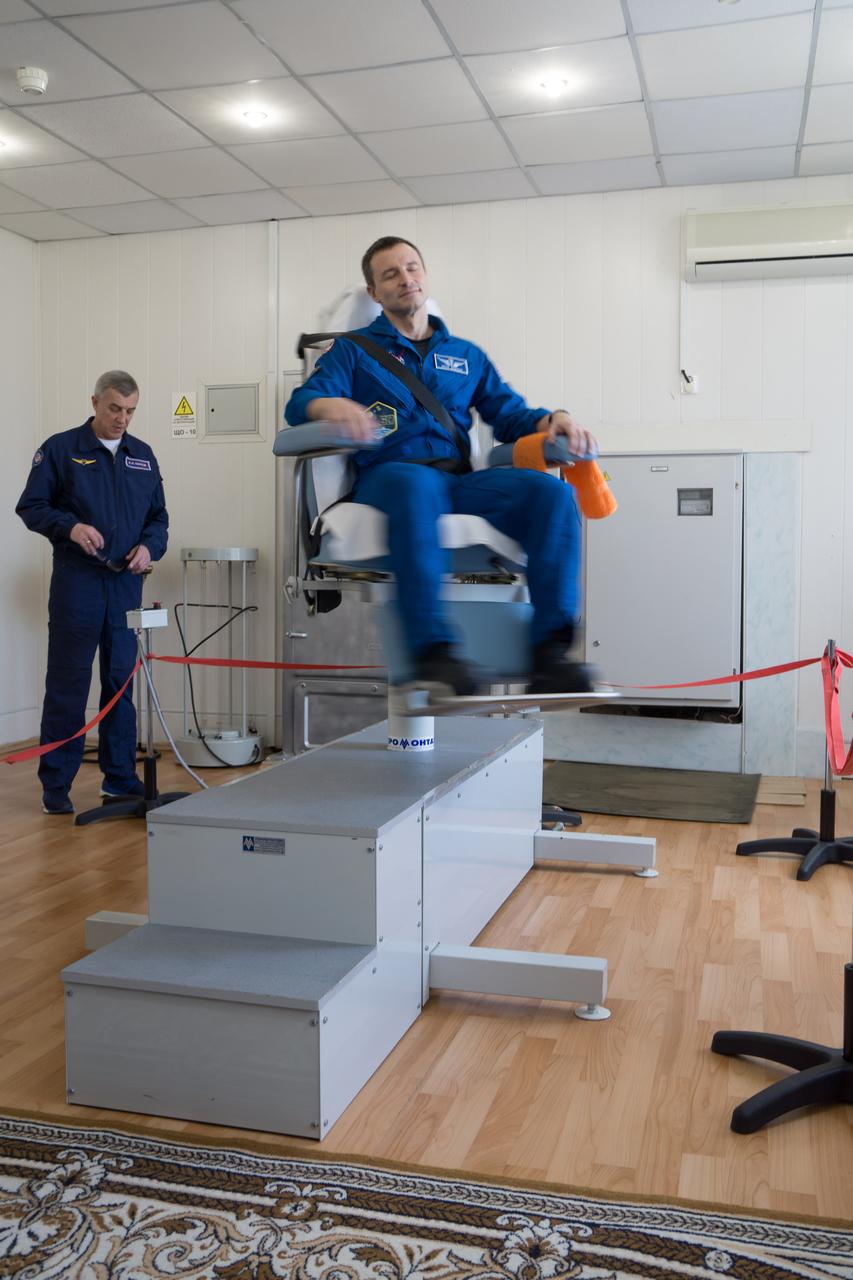
At the Cosmonaut Hotel crew quarters in Baikonur, Kazakhstan, Expedition 59 backup crewmember Drew Morgan of NASA tests his vestibular system in a rotating chair March 7 as part of his pre-launch activities. Morgan, Luca Parmitano of the European Space Agency and Alexander Skvortsov of Roscosmos are the backups to the prime crewmembers, Christina Koch of NASA, Alexey Ovchinin of Roscosmos and Nick Hague of NASA, who will launch March 14, U.S. time, on the Soyuz MS-12 spacecraft from the Baikonur Cosmodrome for a six-and-a-half month mission on the International Space Station...NASA/Victor Zelentsov.
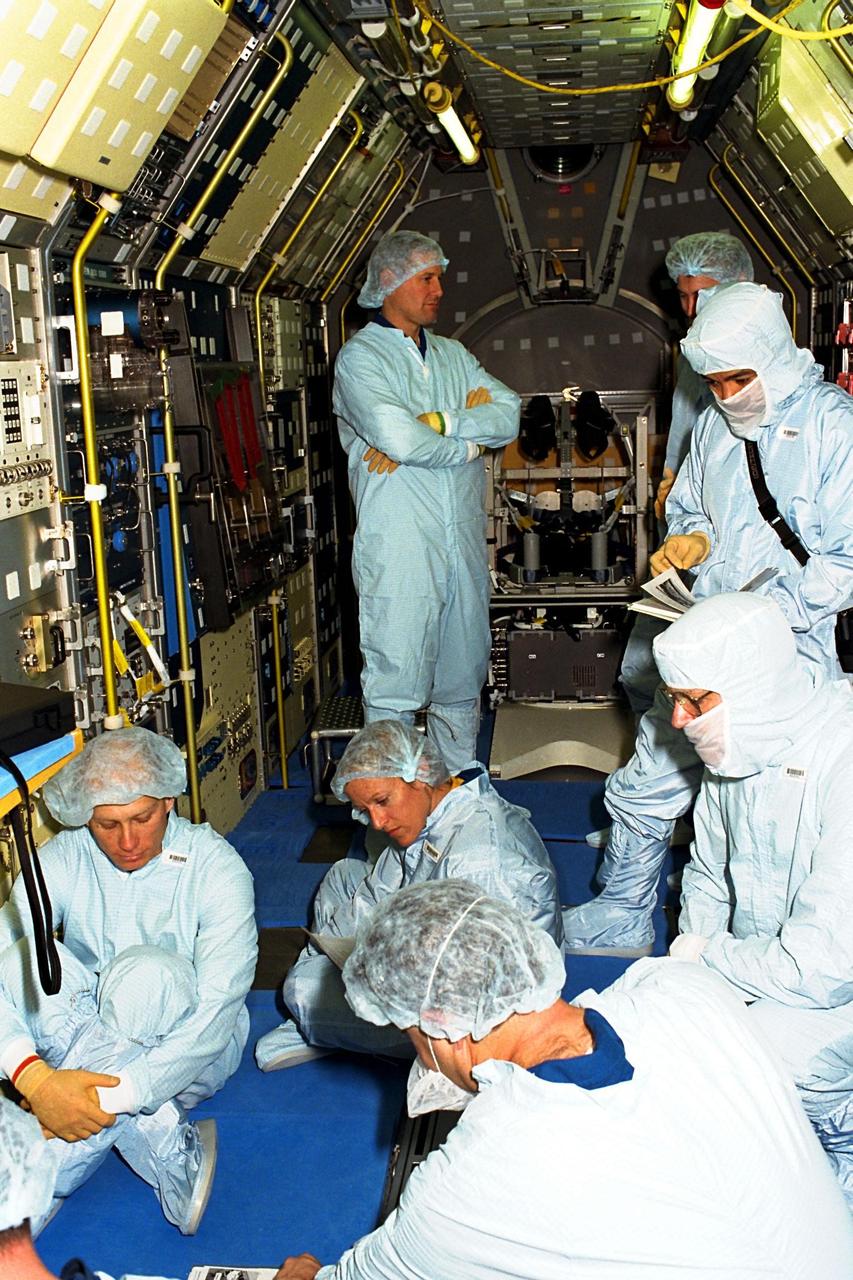
STS-90 crew members check out the inside of the module for the mission's Neurolab payload during the Crew Equipment Interface Test (CEIT) in Kennedy Space Center's (KSC's) Operations and Checkout Building, where the payload is undergoing processing. The CEIT gives astronauts an opportunity to get a hands-on look at the payloads with which they will be working on-orbit. STS-90 is scheduled to launch aboard the Shuttle Columbia from KSC on April 2. Investigations during the Neurolab mission will focus on the effects of microgravity on the nervous system. Specifically, experiments will study the adaptation of the vestibular system, the central nervous system, and the pathways that control the ability to sense location in the absence of gravity, as well as the effect of microgravity on a developing nervous system
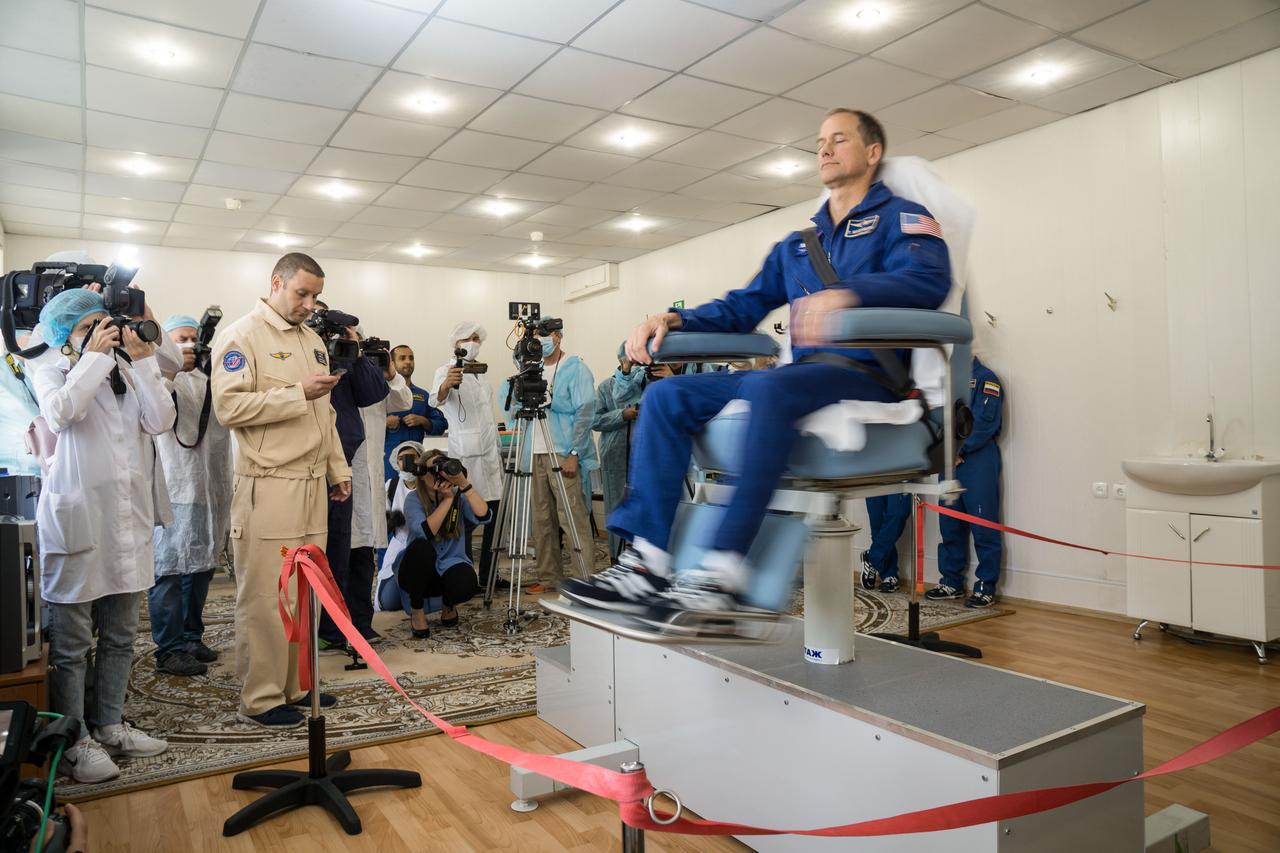
jsc2019e053722 - At the Cosmonaut Hotel crew quarters in Baikonur, Kazakhstan, backup Expedition 61 crewmember Tom Marshburn of NASA takes a spin in a rotating chair Sept. 18 to test his vestibular system as part of pre-launch activities. He is one of the backups to the prime crew, spaceflight participant Hazzaa ali Almansoori of the United Arab Emirates and Expedition 61 crewmembers Oleg Skripochka of Roscosmos and Jessica Meir of NASA, who are set to launch Sept. 25 from the Baikonur Cosmodrome in Kazakhstan on the Soyuz MS-15 spacecraft for a mission on the International Space Station...NASA/Victor Zelentsov
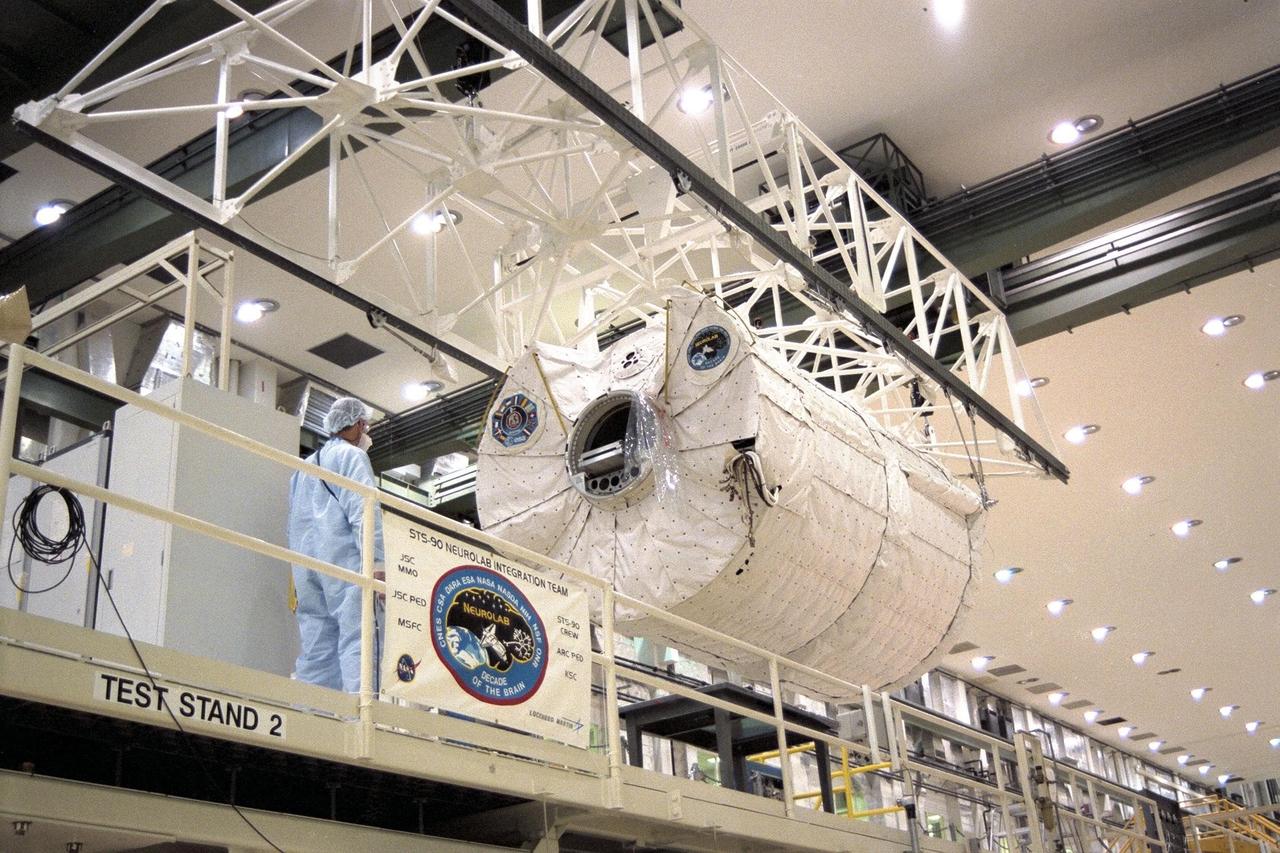
KENNEDY SPACE CENTER, FLA. -- A technician looks at the STS-90 Neurolab payload as it is moved from its test stand in KSC's Operations and Checkout Building. Investigations during the Neurolab mission will focus on the effects of microgravity on the nervous system. Specifically, experiments will study the adaptation of the vestibular system, the central nervous system, and the pathways that control the ability to sense location in the absence of gravity, as well as the effect of microgravity on a developing nervous system. The crew of STS-90, slated for launch in April, will include Commander Richard Searfoss, Pilot Scott Altman, Mission Specialists Richard Linnehan, Dafydd (Dave) Williams, M.D., and Kathryn (Kay) Hire, and Payload Specialists Jay Buckey, M.D., and James Pawelczyk, Ph.D
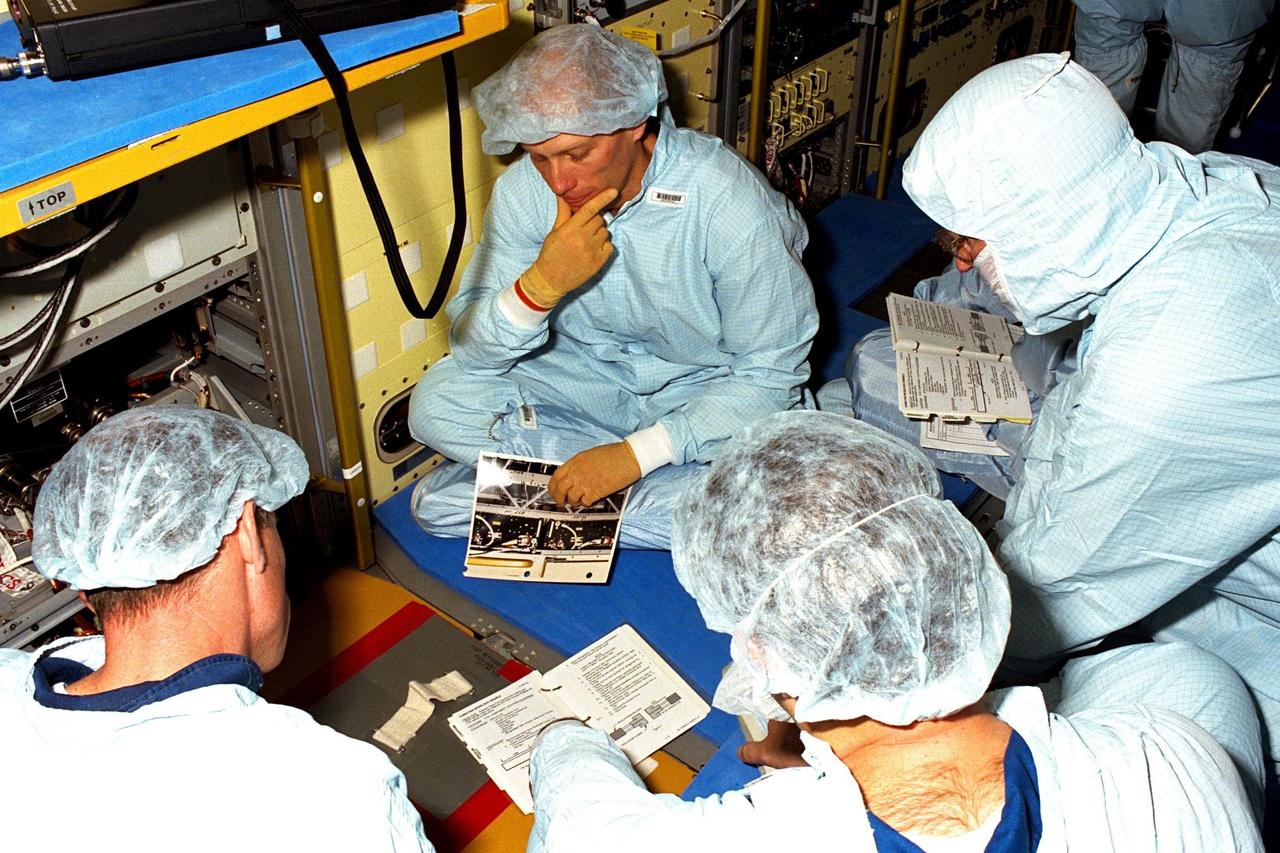
STS-90 crew members study manuals and drawings for the mission's Neurolab payload during the Crew Equipment Interface Test (CEIT) in Kennedy Space Center's (KSC's) Operations and Checkout Building, where the payload is undergoing processing. The CEIT gives astronauts an opportunity to get a hands-on look at the payloads with which they will be working on-orbit. STS-90 is scheduled to launch aboard the Shuttle Columbia from KSC on April 2. Investigations during the Neurolab mission will focus on the effects of microgravity on the nervous system. Specifically, experiments will study the adaptation of the vestibular system, the central nervous system, and the pathways that control the ability to sense location in the absence of gravity, as well as the effect of microgravity on a developing nervous system
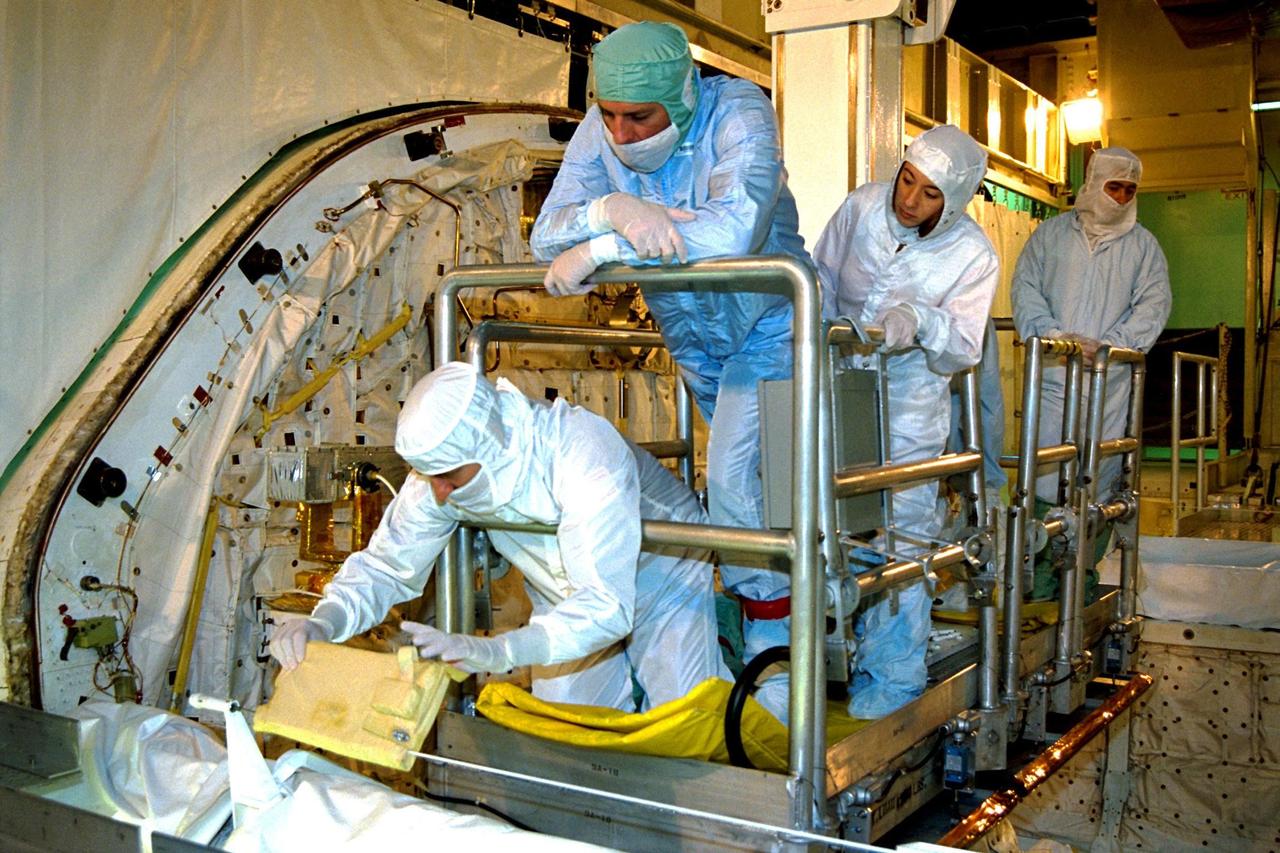
Members of the STS-90 crew participate in the Crew Equipment Interface Test (CEIT) in Kennedy Space Center's Orbiter Processing Facility Bay 3. The CEIT gives astronauts an opportunity to get a hands-on look at the payloads with which they will be working on-orbit. Investigations during the STS-90 Neurolab mission will focus on the effects of microgravity on the nervous system. Specifically, experiments will study the adaptation of the vestibular system, the central nervous system, and the pathways that control the ability to sense location in the absence of gravity, as well as the effect of microgravity on a developing nervous system. The crew of STS-90, slated for launch in April, will include Commander Richard Searfoss, Pilot Scott Altman, Mission Specialists Richard Linnehan, Dafydd (Dave) Williams, M.D., and Kathryn (Kay) Hire, and Payload Specialists Jay Buckey, M.D., and James Pawelczyk, Ph.D
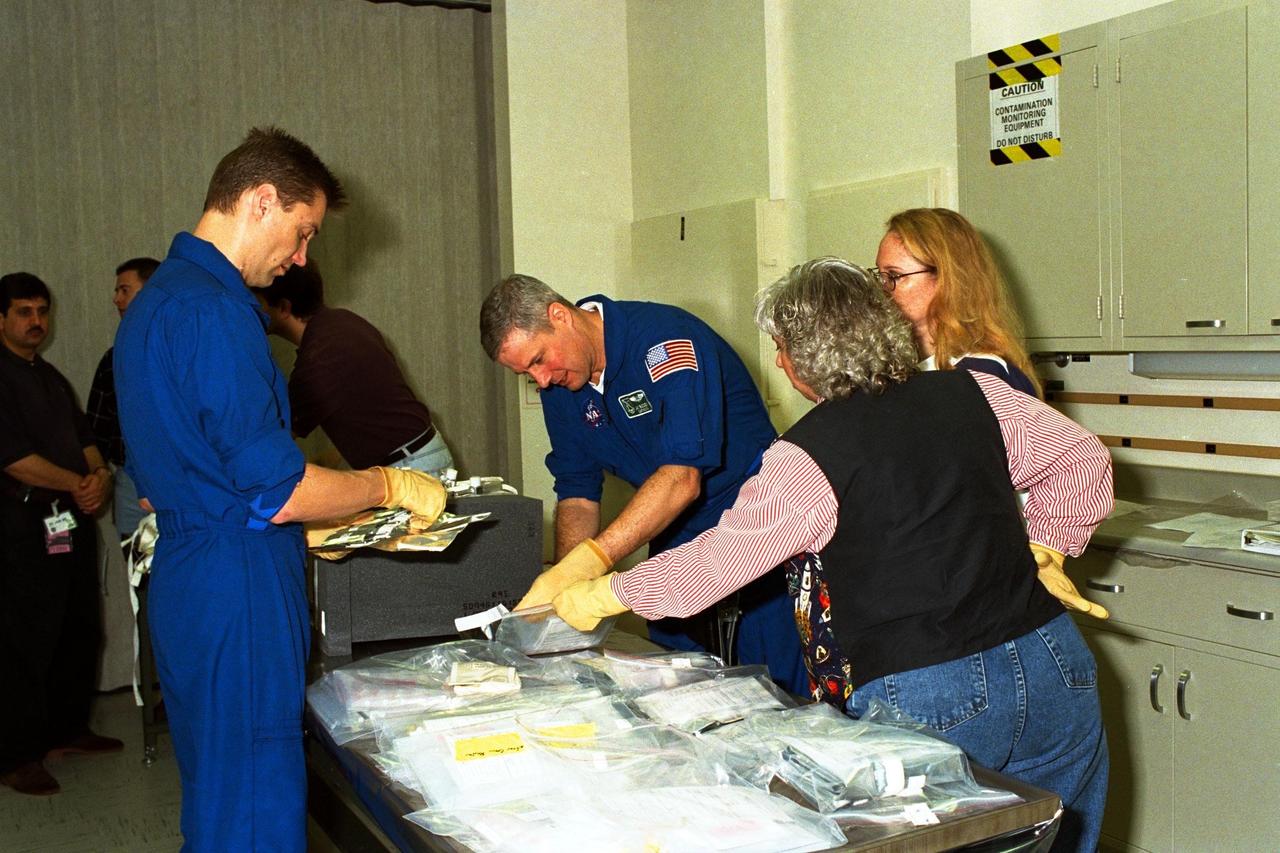
STS-90 Payload Specialists James Pawelczyk, Ph.D. (at left), and Jay Buckey Jr., M.D., examine items to be used during the Crew Equipment Interface Test (CEIT) in Kennedy Space Center's (KSC's) Operations and Checkout Building, where the Neurolab payload is undergoing processing. The CEIT gives astronauts an opportunity to get a hands-on look at the payloads with which they will be working on-orbit. STS-90 is scheduled to launch aboard the Shuttle Columbia from KSC on April 2. Investigations during the Neurolab mission will focus on the effects of microgravity on the nervous system. Specifically, experiments will study the adaptation of the vestibular system, the central nervous system, and the pathways that control the ability to sense location in the absence of gravity, as well as the effect of microgravity on a developing nervous system
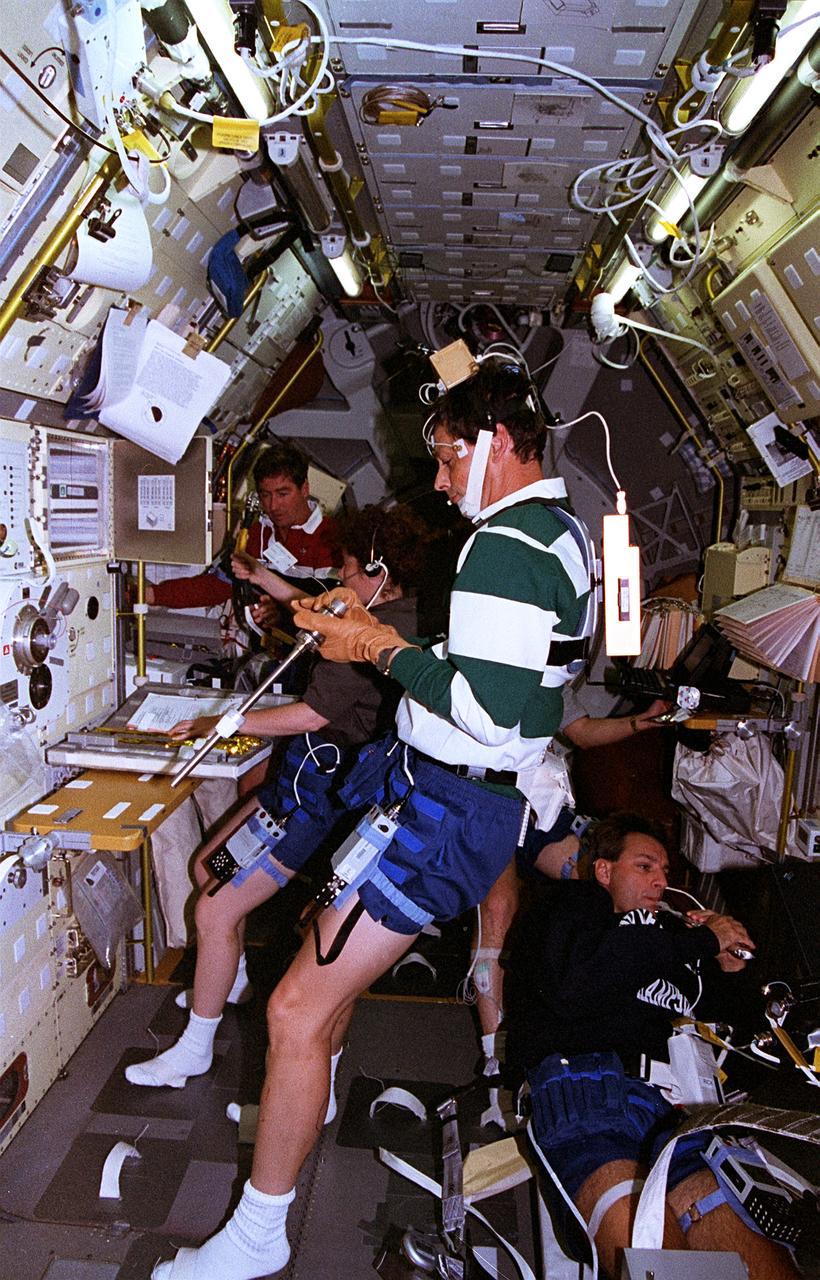
STS078-396-015 (20 June - 7 July 1996) --- Payload specialist Jean-Jacques Favier, representing the French Space Agency (CNES), prepares a sample for the Advanced Gradient Heating Facility (AGHF) while wearing instruments that measure upper body movement. The Torso Rotation Experiment (TRE) complements other vestibular studies that measure differences in the way human beings react physically to their surroundings in microgravity. This is a typical Life and Microgravity Spacelab (LMS-1) mission scene, with several experiments being performed. Astronaut Susan J. Helms, payload commander, assists Favier in the AGHF preparations. Astronaut Richard M. Linnehan (bottom right), mission specialist, tests his muscle response with the Handgrip Dynamometer. Astronaut Thomas T. (Tom) Henricks (far background), mission commander, offers assistance.
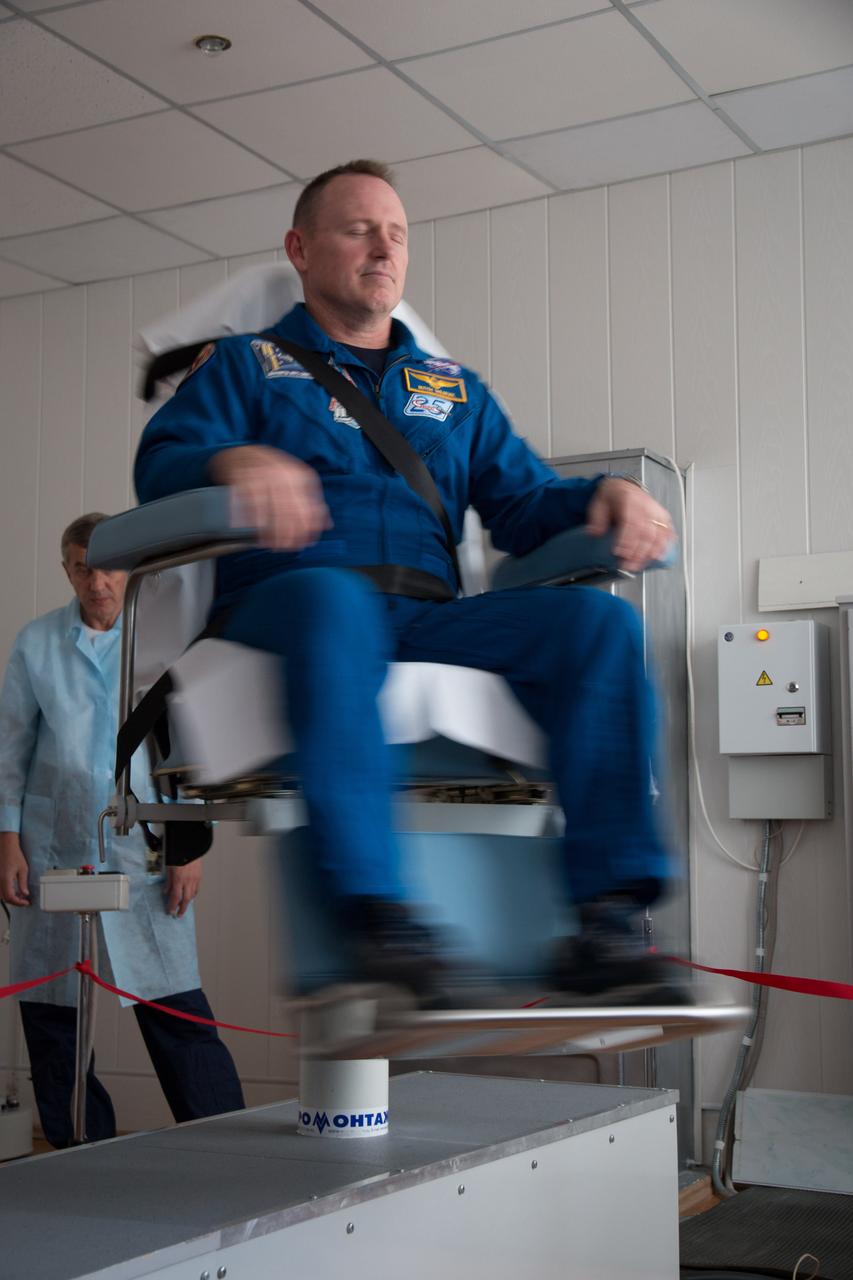
17-12-17-17-2: (17 Sept. 2014) --- At the Cosmonaut Hotel crew quarters in Baikonur, Kazakhstan, Expedition 41 Flight Engineer Barry Wilmore of NASA takes a turn in a spinning chair to test his vestibular system Sept. 17 as he and his crewmates prepare for their upcoming launch. Wilmore, Soyuz Commander Alexander Samokutyaev of the Russian Federal Space Agency (Roscosmos) and Flight Engineer Elena Serova of Roscosmos will launch from the Baikonur Cosmodrome Sept. 26, Kazakh time, in the Soyuz TMA-14M spacecraft for a 5 ½ month mission on the International Space Station. Serova will become the fourth Russian woman to fly in space and the first Russian woman to live and work on the station. Photo credit: NASA/Victor Zelentsov
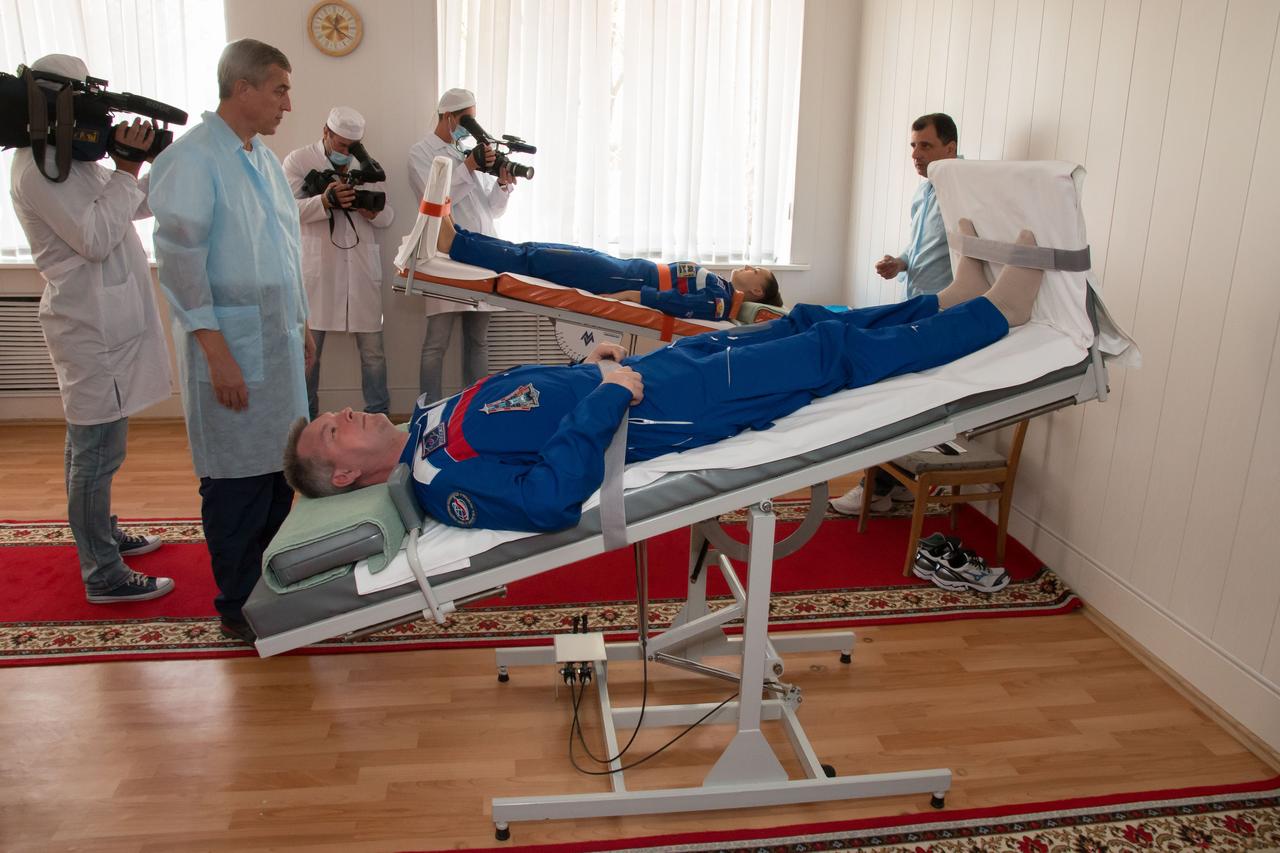
17-12-26-50-2: (17 Sept. 2014) --- At the Cosmonaut Hotel crew quarters in Baikonur, Kazakhstan, Expedition 41/42 Soyuz Commander Alexander Samokutyaev of the Russian Federal Space Agency (Roscosmos, foreground) and Flight Engineer Elena Serova of Roscosmos (background) take turns on tilt tables Sept. 17 to test their vestibular systems. Samokutyaev, Serova and Flight Engineer Barry Wilmore of NASA are scheduled to launch from the Baikonur Cosmodrome Sept. 26, Kazakh time, in the Soyuz TMA-14M spacecraft for a 5 ½ month mission on the International Space Station. Serova will become the fourth Russian woman to fly in space and the first Russian woman to live and work on the station. Photo credit: NASA/Victor Zelentsov
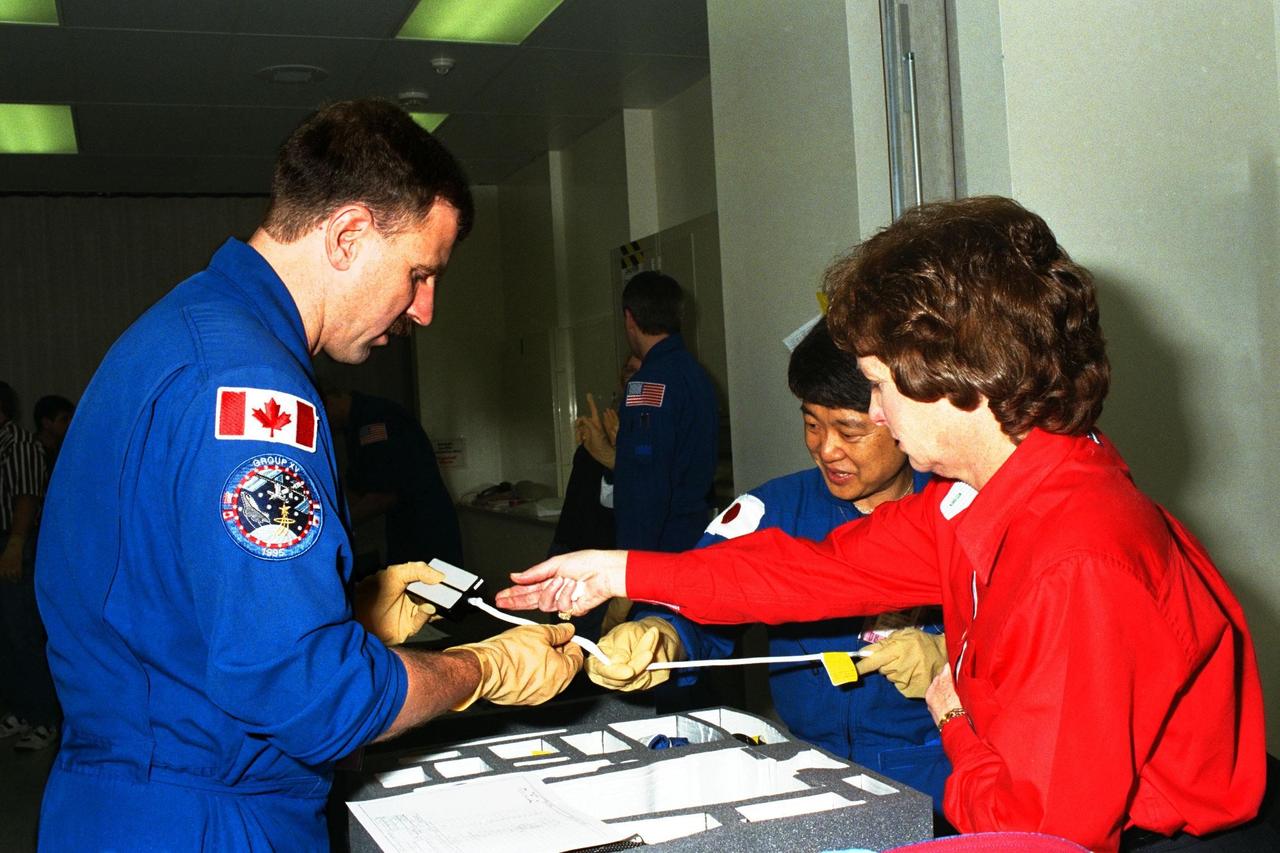
STS-90 Mission Specialist Dafydd "Dave" Rhys Williams, M.D., with the Canadian Space Agency, and back-up Payload Specialist Chiaki Mukai, M.D., Ph.D., with the National Space Development Agency of Japan, examine items to be used during the Crew Equipment Interface Test (CEIT) in Kennedy Space Center's (KSC's) Operations and Checkout Building, where the Neurolab payload is undergoing processing. The CEIT gives astronauts an opportunity to get a hands-on look at the payloads with which they will be working on-orbit. STS-90 is scheduled to launch aboard the Shuttle Columbia from KSC on April 2. Investigations during the Neurolab mission will focus on the effects of microgravity on the nervous system. Specifically, experiments will study the adaptation of the vestibular system, the central nervous system, and the pathways that control the ability to sense location in the absence of gravity, as well as the effect of microgravity on a developing nervous system
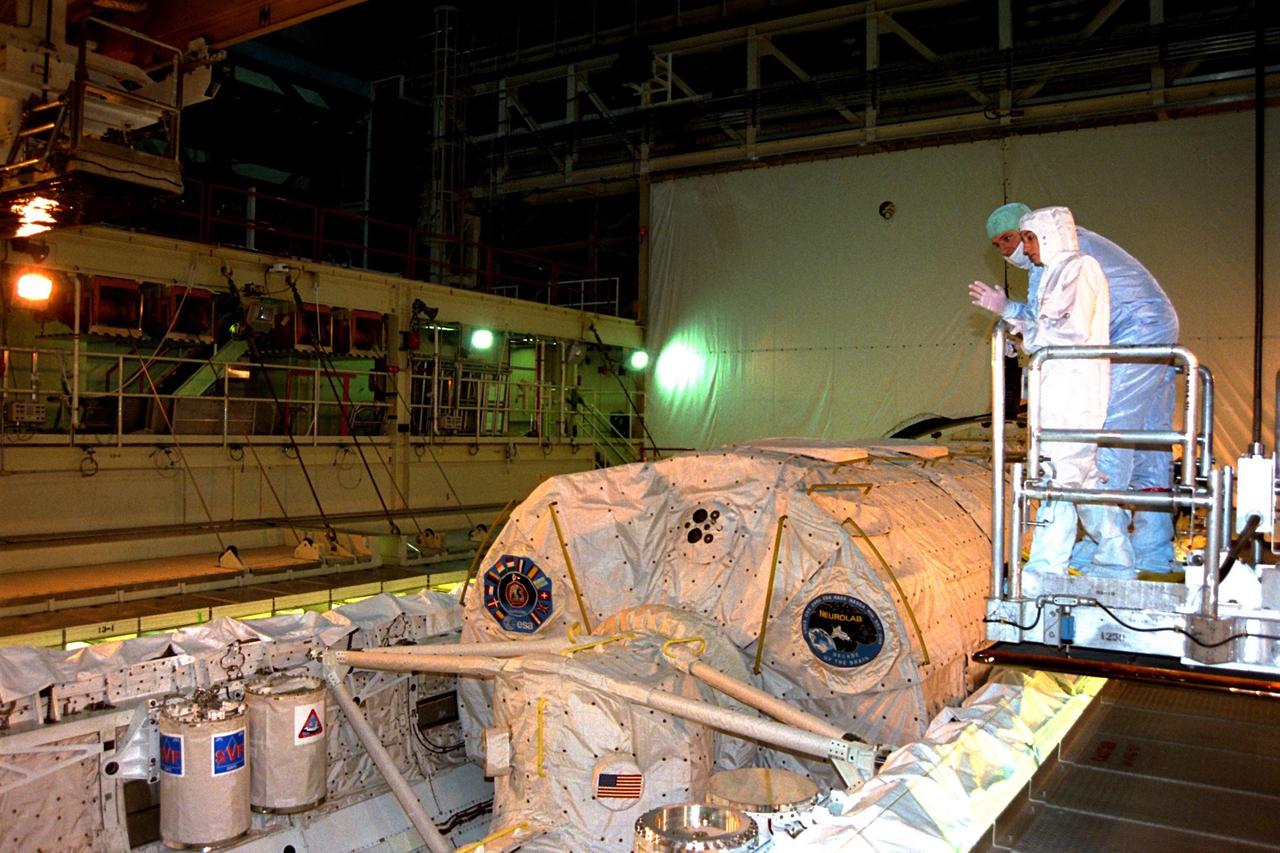
Stacie Greene, an extravehicular activity trainer from Johnson Space Center, discusses the STS-90 Neurolab mission with Mission Specialist Richard Linnehan overlooking Columbia's payload bay. The crew of STS-90 participated in the Crew Equipment Interface Test (CEIT) in Kennedy Space Center's Orbiter Processing Facility Bay 3. The CEIT gives astronauts an opportunity to get a hands-on look at the payloads with which they will be working on-orbit. Investigations during the STS-90 Neurolab mission will focus on the effects of microgravity on the nervous system. Specifically, experiments will study the adaptation of the vestibular system, the central nervous system, and the pathways that control the ability to sense location in the absence of gravity, as well as the effect of microgravity on a developing nervous system. STS-90 is scheduled for launch on April 16 at 2:19 p.m. EDT
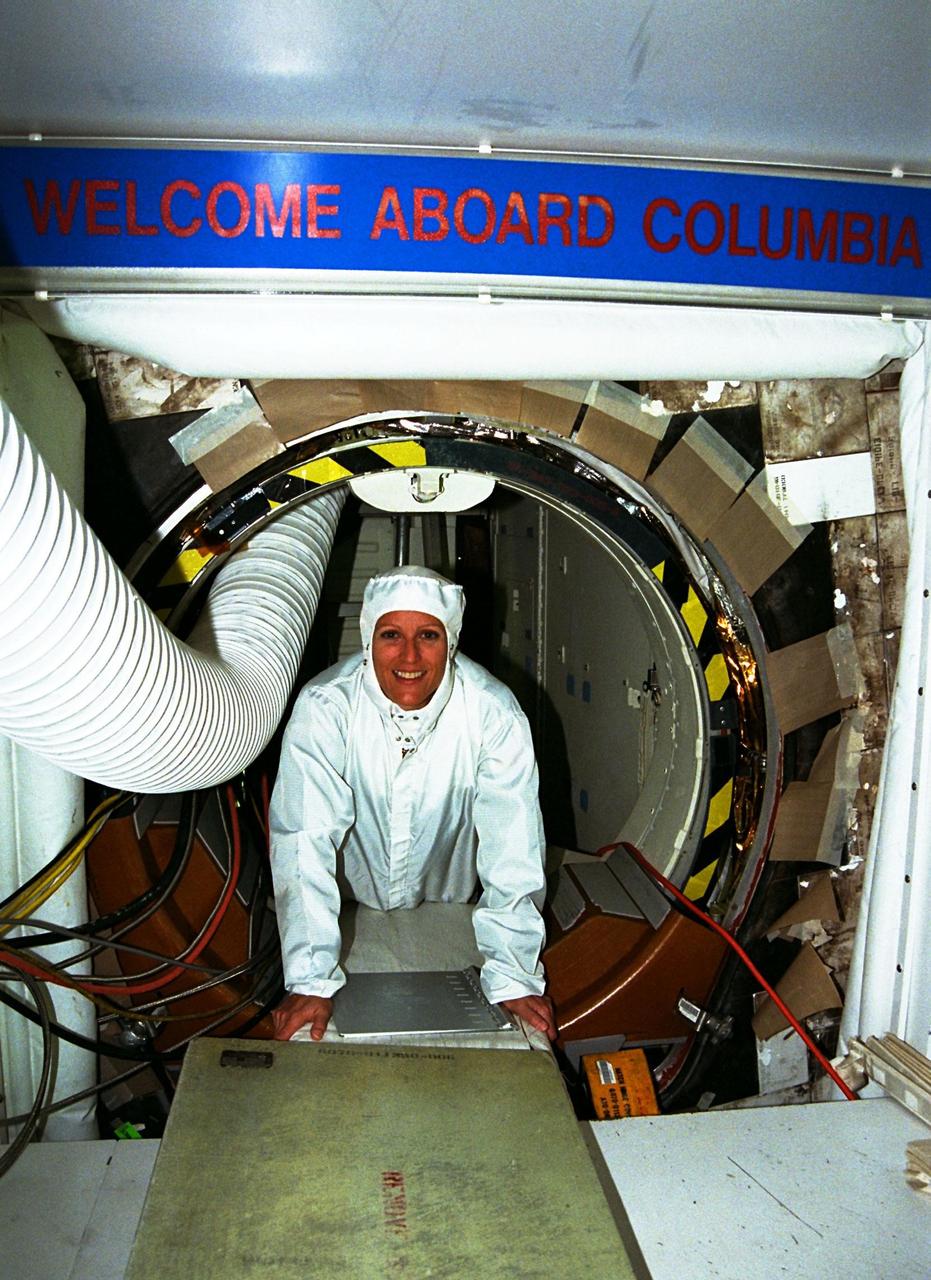
STS-90 Mission Specialist Kathryn (Kay) Hire enjoys the crawl between Columbia and the white room that allows access to the orbiter. The crew of STS-90 recently participated in the Crew Equipment Interface Test (CEIT) in Kennedy Space Center's Orbiter Processing Facility Bay 3. The CEIT gives astronauts an opportunity to get a hands-on look at the payloads with which they will be working on-orbit. Investigations during the STS-90 Neurolab mission will focus on the effects of microgravity on the nervous system. Specifically, experiments will study the adaptation of the vestibular system, the central nervous system, and the pathways that control the ability to sense location in the absence of gravity, as well as the effect of microgravity on a developing nervous system. STS-90, which will be Hire's first Shuttle flight, is scheduled for launch on April 16 at 2:19 p.m. EDT
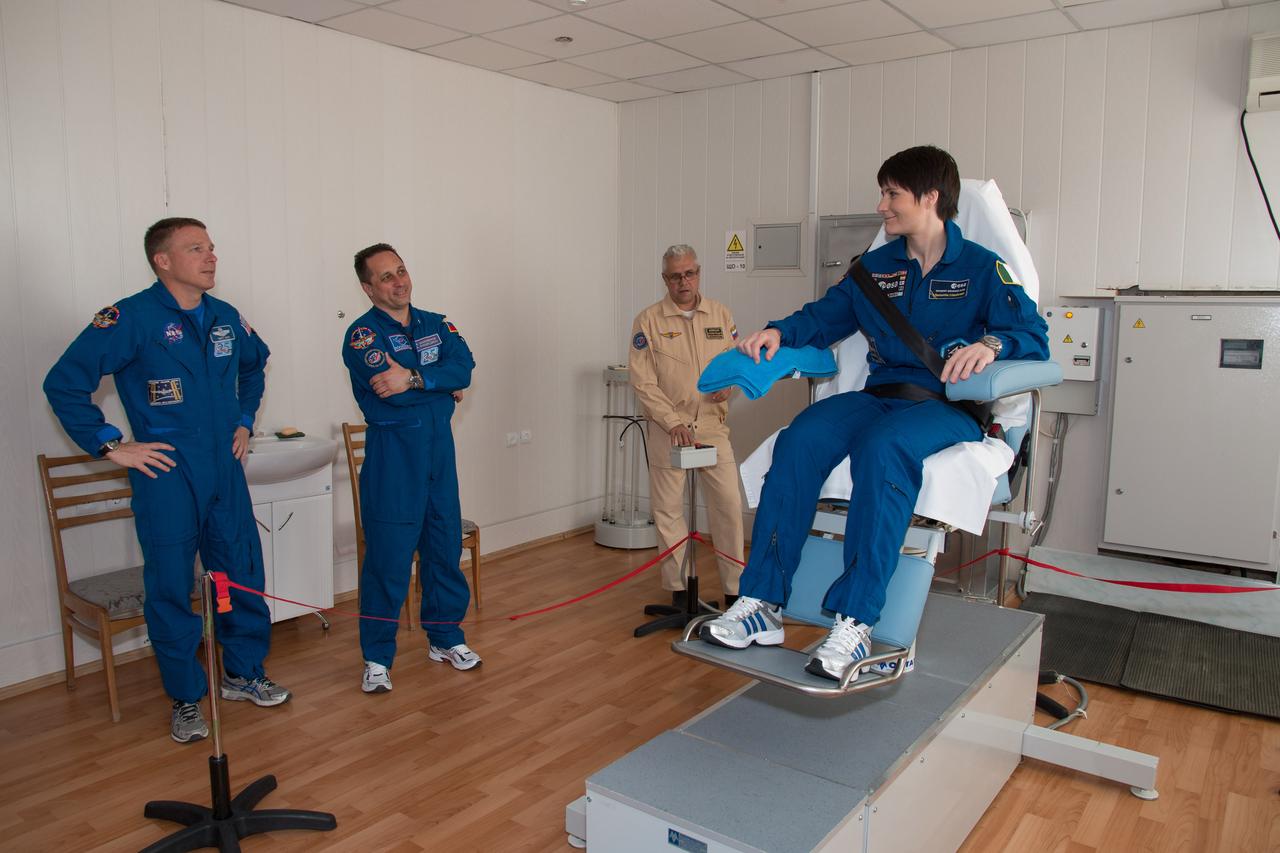
11-59-33-2: At the Cosmonaut Hotel crew quarters in Baikonur, Kazakhstan, Expedition 40/41 backup crewmember Samantha Cristoforetti of the European Space Agency (right) prepares to take a ride in a spinning chair May 21 to exercise her vestibular system during pre-launch medical tests. Looking on are backup crewmates Terry Virts of NASA (far left) and Anton Shkaplerov of the Russian Federal Space Agency (Roscosmos, second from the left). The trio is backing up the prime crew, Flight Engineer Alexander Gerst of the European Space Agency, Soyuz Commander Max Suraev of Roscosmos and NASA Flight Engineer Reid Wiseman, who will launch on May 29, Kazakh time, on the Soyuz TMA-13M spacecraft from the Baikonur Cosmodrome for a 5 ½ month mission on the International Space Station. NASA/Victor Zelentsov
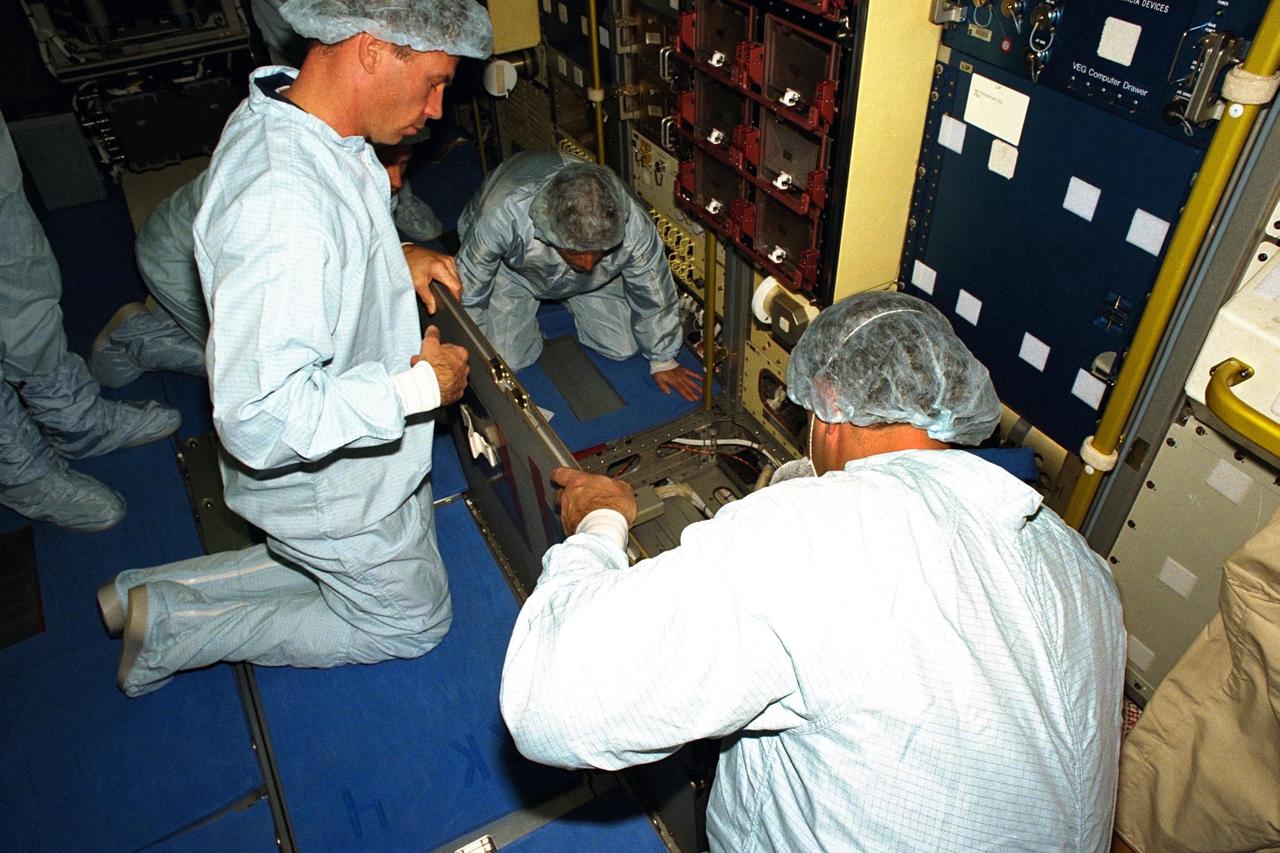
STS-90 Payload Specialist James Pawelczyk, Ph.D., holds up a panel as one of the items used during the Crew Equipment Interface Test (CEIT) in Kennedy Space Center's (KSC's) Operations and Checkout Building, where the Neurolab payload is undergoing processing. The CEIT gives astronauts an opportunity to get a hands-on look at the payloads with which they will be working on-orbit. STS-90 is scheduled to launch aboard the Shuttle Columbia from KSC on April 2. Investigations during the Neurolab mission will focus on the effects of microgravity on the nervous system. Specifically, experiments will study the adaptation of the vestibular system, the central nervous system, and the pathways that control the ability to sense location in the absence of gravity, as well as the effect of microgravity on a developing nervous system
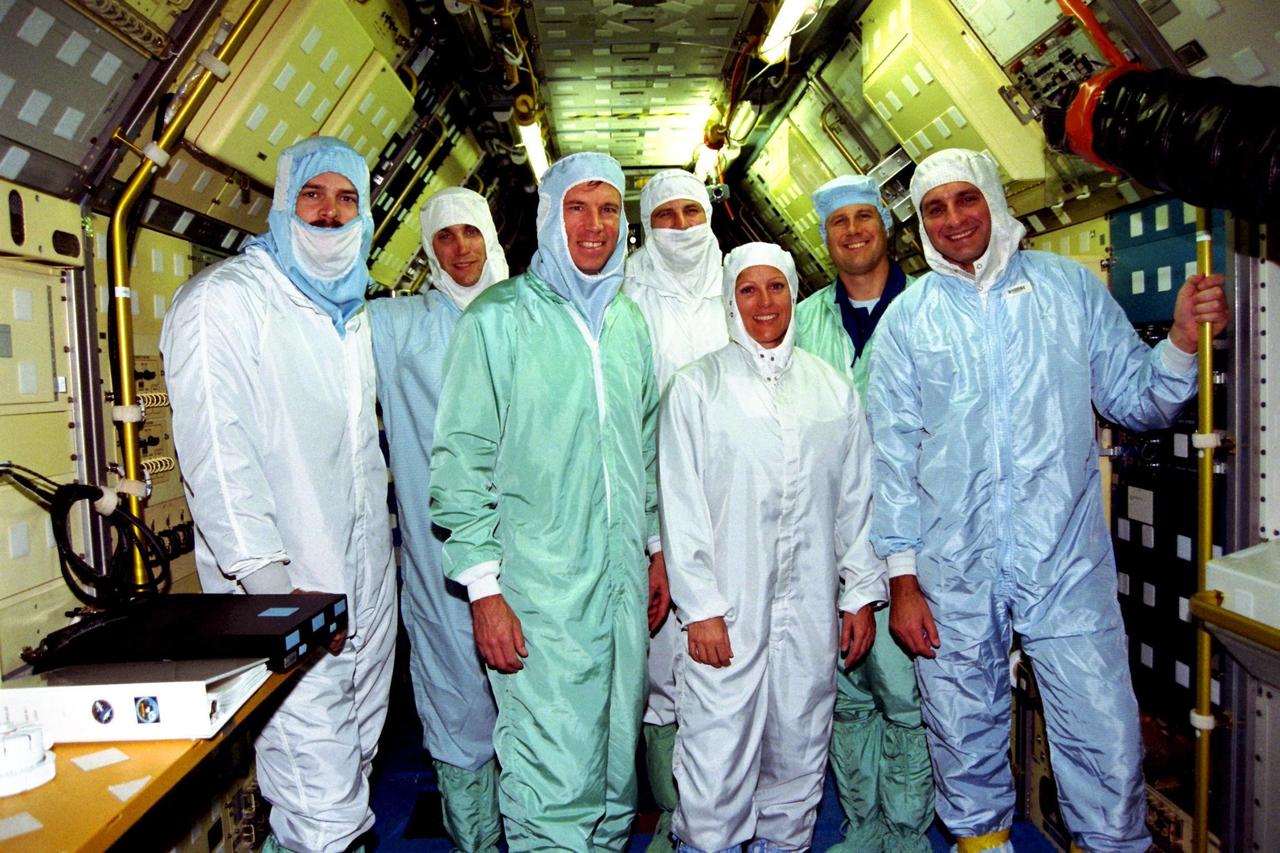
Members of the STS-90 crew participate in the Crew Equipment Interface Test (CEIT) in Kennedy Space Center's Orbiter Processing Facility Bay 3. The CEIT gives astronauts an opportunity to get a hands-on look at the payloads with which they will be working on-orbit. Investigations during the STS-90 Neurolab mission will focus on the effects of microgravity on the nervous system. Specifically, experiments will study the adaptation of the vestibular system, the central nervous system, and the pathways that control the ability to sense location in the absence of gravity, as well as the effect of microgravity on a developing nervous system. The crew of STS-90, slated for launch in April, are, left to right, Pilot Scott Altman; Payload Specialist James Pawelczyk, Ph.D.; Commander Richard Searfoss; Mission Specialists Dafydd (Dave) Williams, M.D., and Kathryn (Kay) Hire; Payload Specialist Jay Buckey, M.D.; and Mission Specialist Richard Linnehan
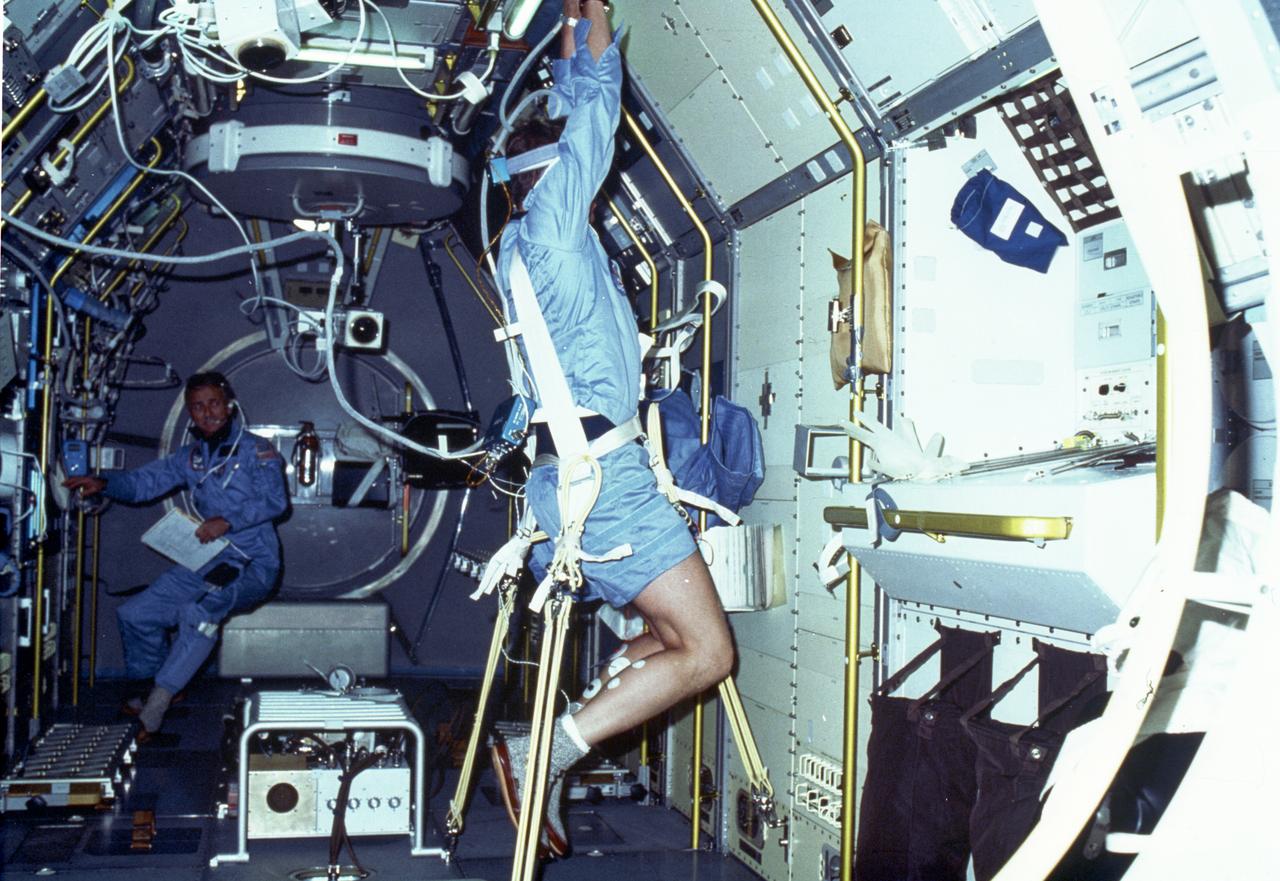
In this Spacelab-1 mission onboard photograph, astronaut Byron Lichtenberg performs a drop experiment, one of the Vestibular Experiments in Space investigations. The experiment examined spinal reflexes to determine whether they changed in microgravity. In Earth's environment, the otoliths signal the muscles to prepare for jolts associated with falling. During the flight, the normal reflex between the otoliths and the muscles was partially inhibited early in flight, declined further as the flight progressed, and returned to normal immediately after landing, suggesting that the brain ignored or reinterpreted otolith signals during space flight. Crewmembers reported a lack of awareness of position and location of feet, difficulty in maintaining balance, and a perception that falls were more sudden, faster, and harder than similar drops experienced in preflight. Crewmembers experienced illusions as they performed prescribed movement tests. When crew members viewed various targets and then pointed at them while blindfolded, their perception of target location and position of their own limbs was inaccurate in flight compared with similar tests on the ground. The Spacelab-1 was a multidisciplinary mission; that is, investigations were performed in several different fields of scientific research. The overall goal of the mission was to verify Spacelab performance through a variety of scientific experiments. The Spacelab-1 was launched aboard the Space Shuttle Orbiter Columbia for the STS-9 mission on November 28, 1983. The Marshall Space Flight Center had management responsibilities for the mission.
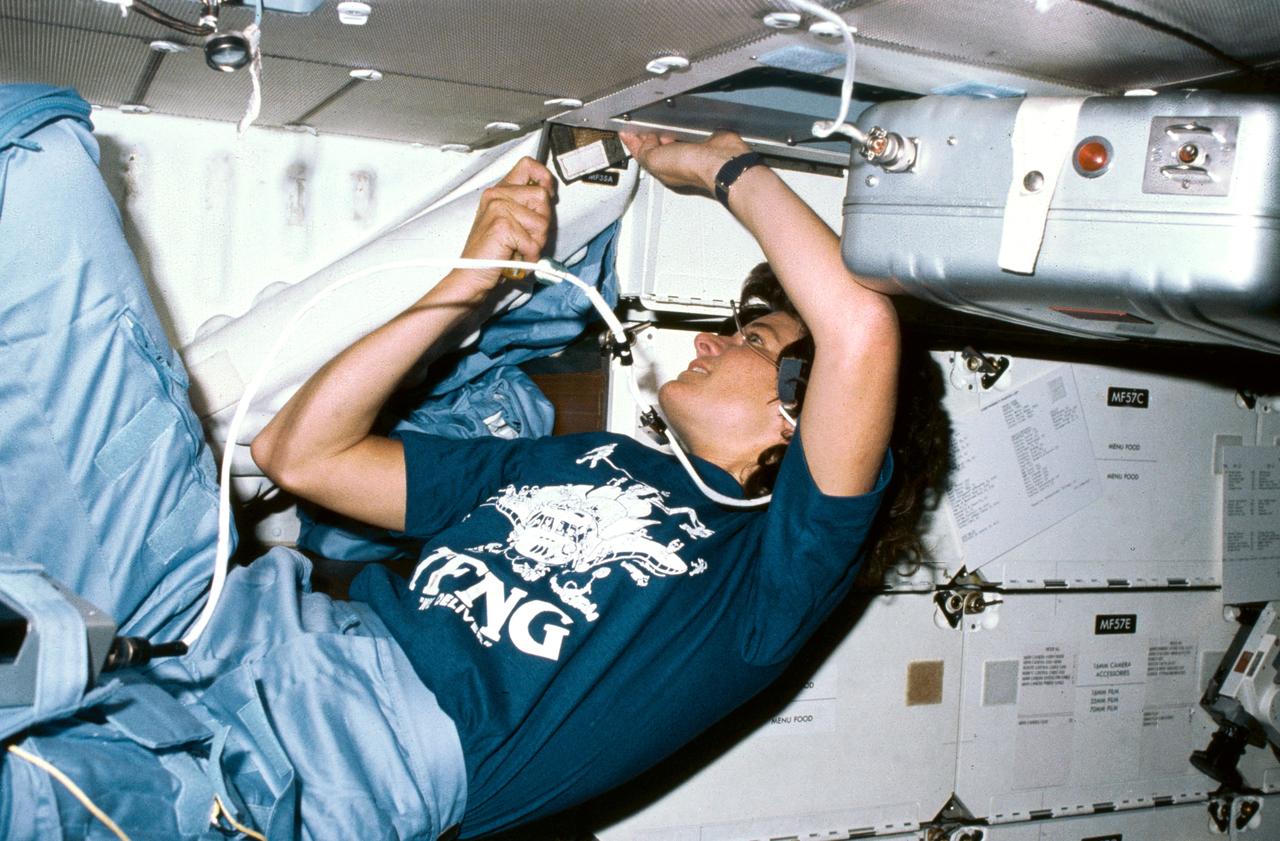
S83-35768 (18-24 June 1983) --- Astronaut Sally K. Ride, mission specialist for STS-7, uses a screw driver in order to clean out an air filtering system in the mid-deck of the Earth-orbiting Space Shuttle Challenger. Dr. Ride's constant wear garment bears some extras -- a cartoon of 35 busy astronauts around a Space Shuttle and the acronym TFNG, below which is written, "We deliver!" TFNG stands for thirty-five new guys, referring to the 1978 class of astronaut candidates (ASCAN) from which Dr. Ride and three of her crew members hail. The tiny two-word declarative in white lettering refers to the successful deployment of two communications satellites. This photograph was made with a 35mm camera.
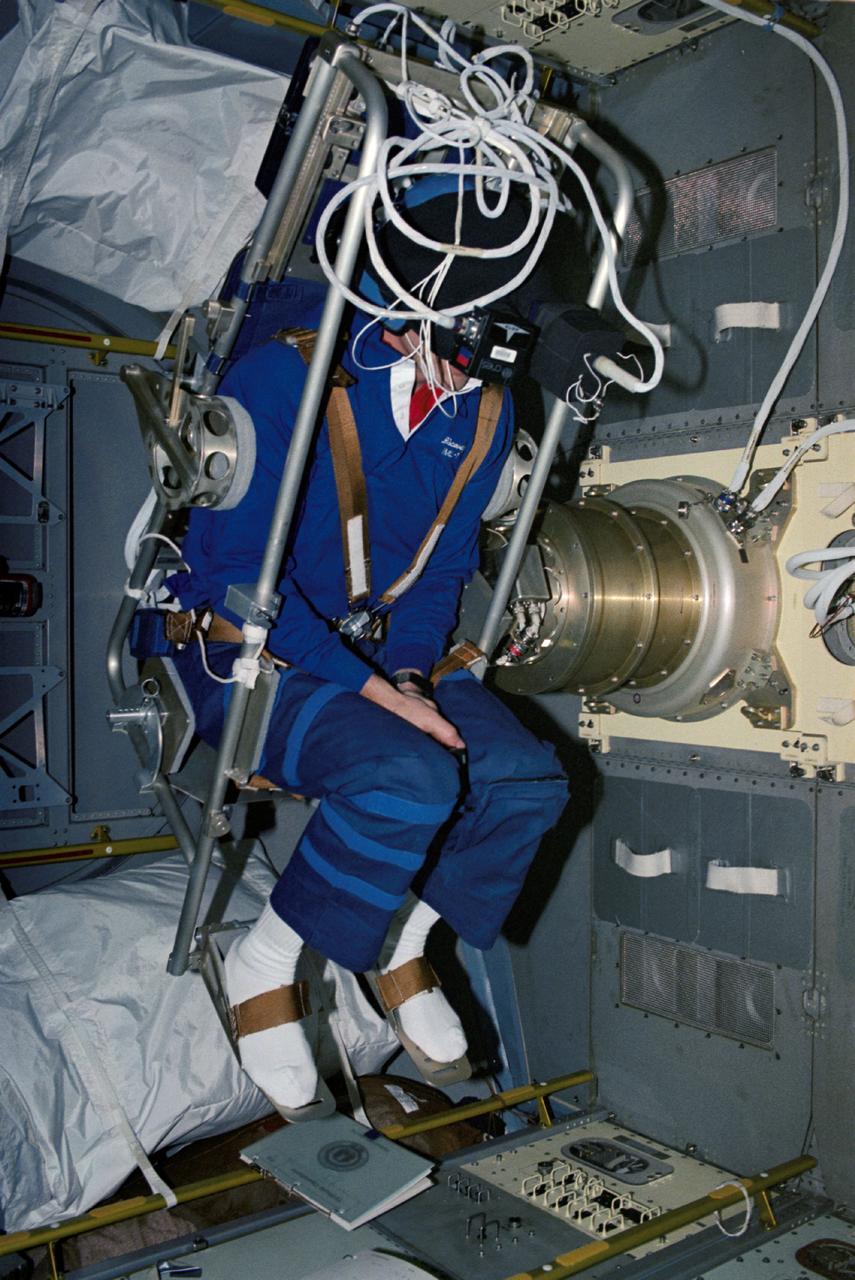
STS042-27-037 (22-30 Jan. 1992) --- Astronaut David C. Hilmers, STS-42 mission specialist, wearing a helmet assembly, sits in the Microgravity Vestibular Investigation (MVI) rotating chair. The scene is in the International Microgravity Laboratory (IML-1) science module aboard Discovery. Hilmers, a mission specialist, and six other crewmembers spent more than eight days in Earth-orbit conducting experiments. Hilmer's helmet assembly is outfitted with accelerometers to measure head movements and visors that fit over each eye independently to provide visual stimuli. The chair system has three movement patterns: "sinusoidal" or traveling predictably back and forth over the same distance at a constant speed; "pseudorandom" or moving back and forth over the varying distances; and "stepped" or varying speeds beginning and stopping suddenly.