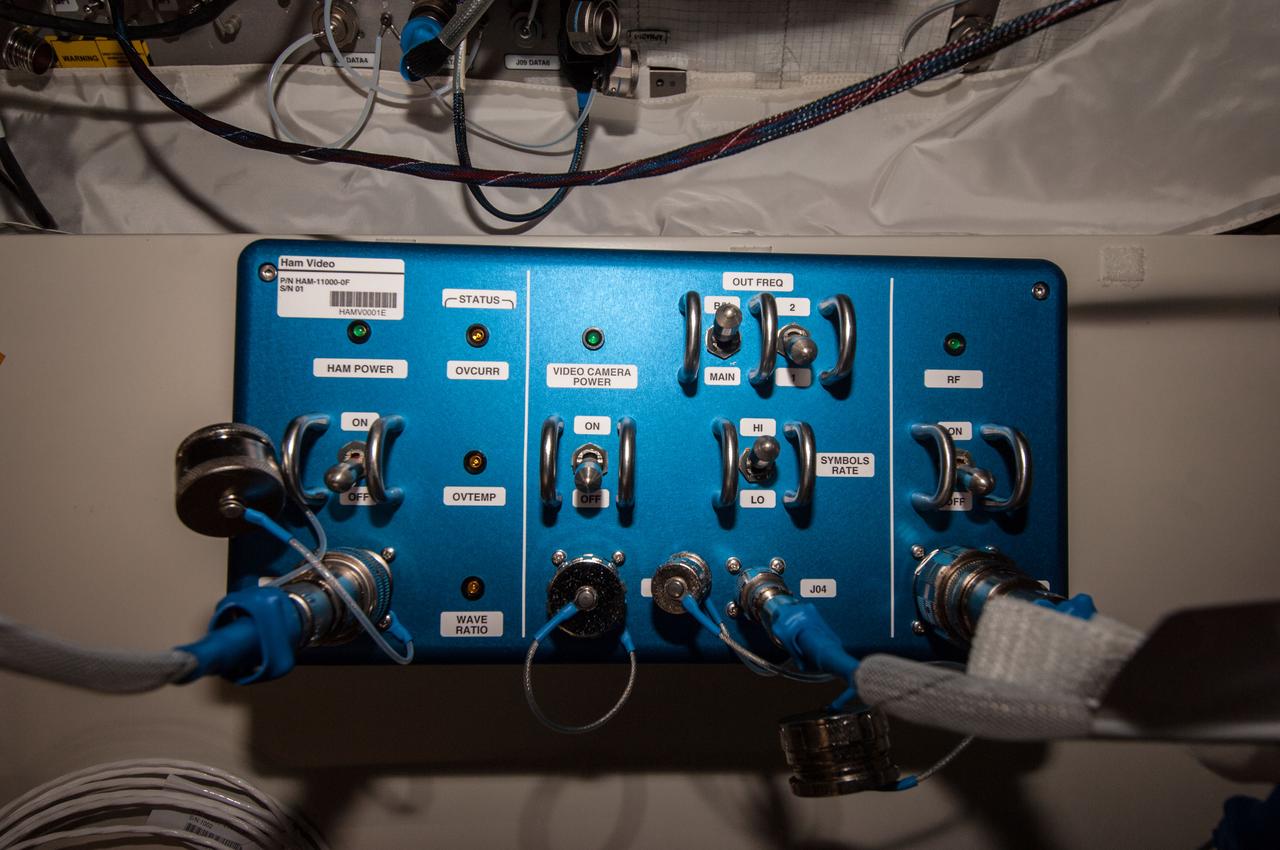
Documentation of the Ham Video unit installed in the Columbus European Laboratory. Part number (P/N) is HAM-11000-0F, serial number (S/N) is 01, barcode is HAMV0001E. Image was taken during Expedition 39 Ham Video commissioning activities and released by astronaut on Twitter.
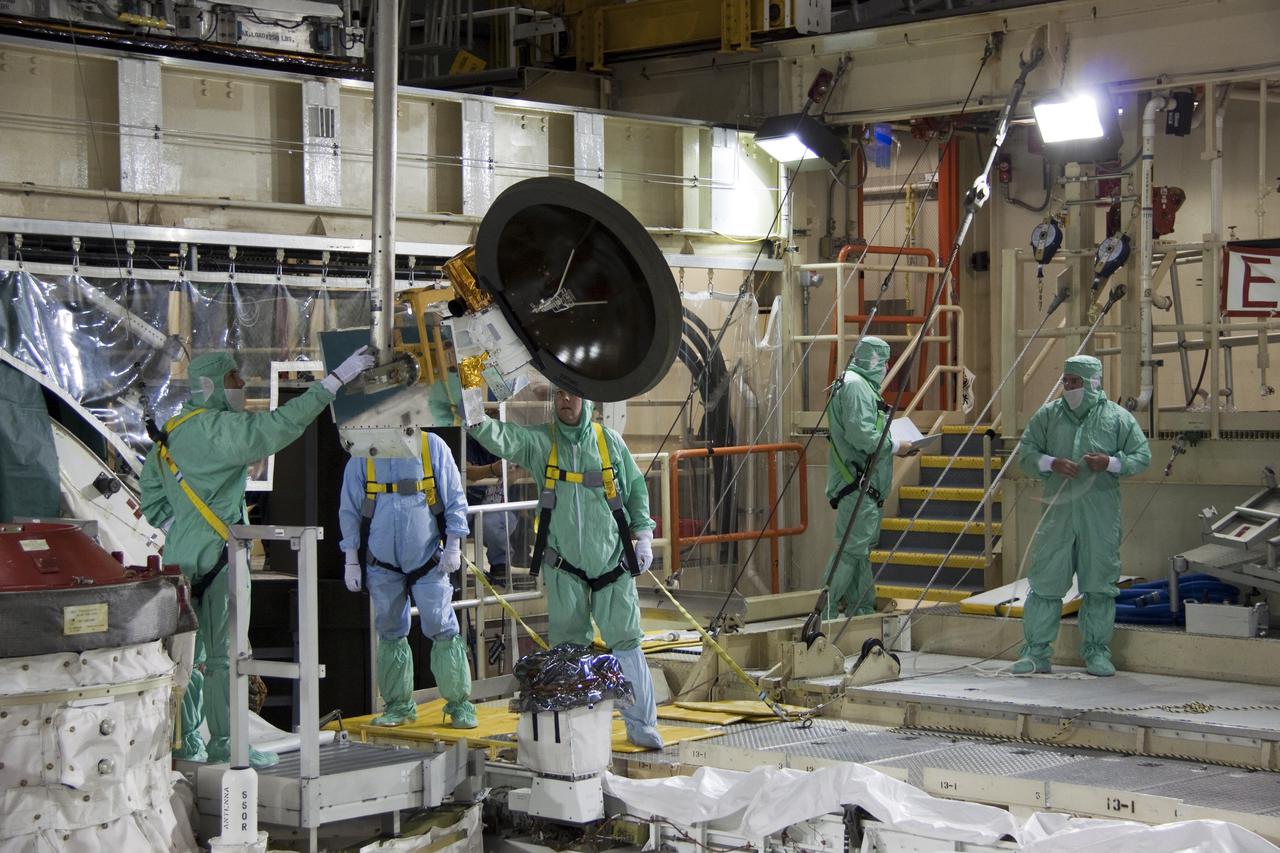
CAPE CANAVERAL, Fla. -- Technicians install a new Ku-Band communications system antenna on space shuttle Discovery in Orbiter Processing Facility-3 at NASA's Kennedy Space Center in Florida. The antenna is used to transmit and receive high data rate communications, such as video, and is being replaced for the STS-133 mission to the International Space Station. During its STS-131 mission to the station in April, Discovery's Ku-Band failed to operate in orbit. As a result, video of the thermal protection system inspection had to be recorded aboard Discovery and transmitted to the ground after the shuttle docked with the station. Typically, the inspection video is simultaneously transmitted live to the ground and recorded aboard the shuttle for later review. NASA_Charisse Nahser
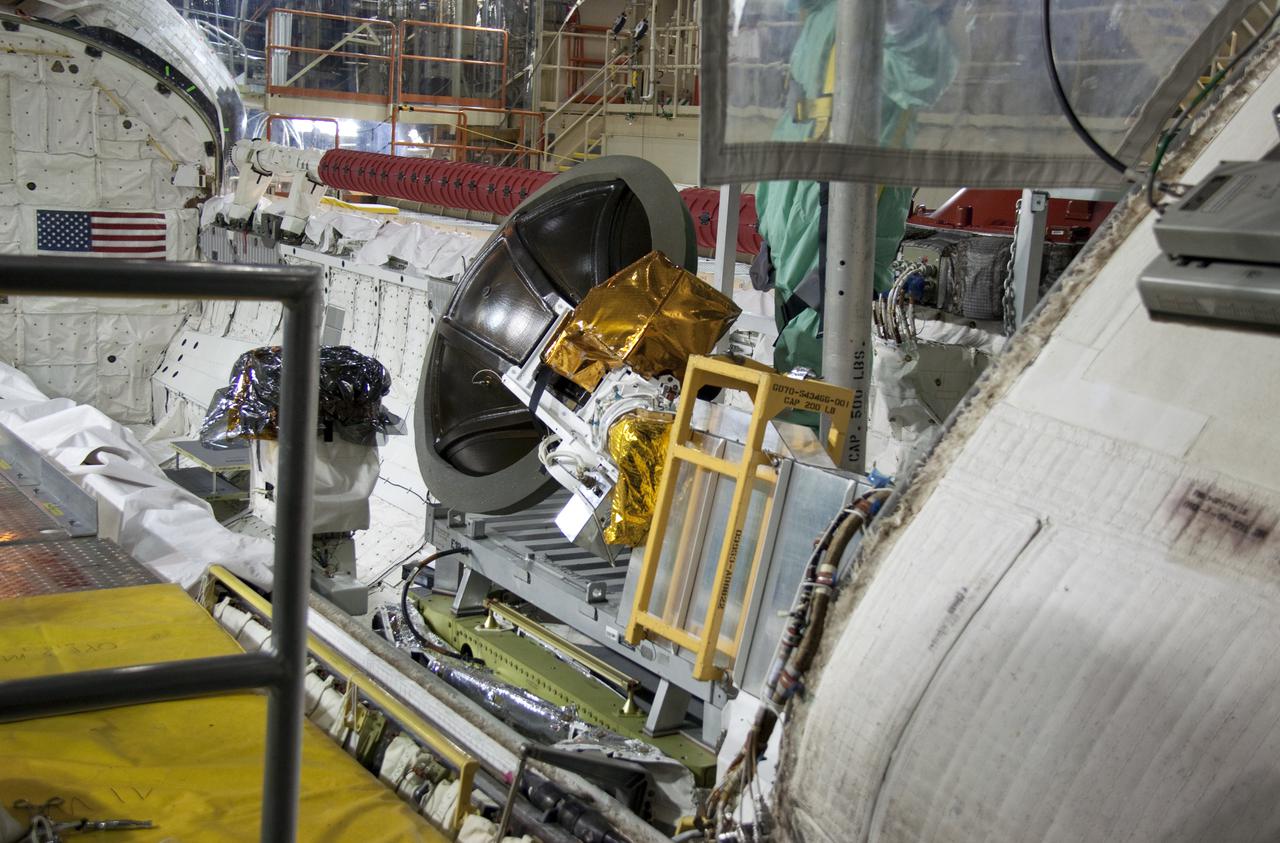
CAPE CANAVERAL, Fla. -- A new Ku-Band communications system antenna is installed on space shuttle Discovery in Orbiter Processing Facility-3 at NASA's Kennedy Space Center in Florida. The antenna is used to transmit and receive high data rate communications, such as video, and is being replaced for the STS-133 mission to the International Space Station. During its STS-131 mission to the station in April, Discovery's Ku-Band failed to operate in orbit. As a result, video of the thermal protection system inspection had to be recorded aboard Discovery and transmitted to the ground after the shuttle docked with the station. Typically, the inspection video is simultaneously transmitted live to the ground and recorded aboard the shuttle for later review. NASA_Charisse Nahser
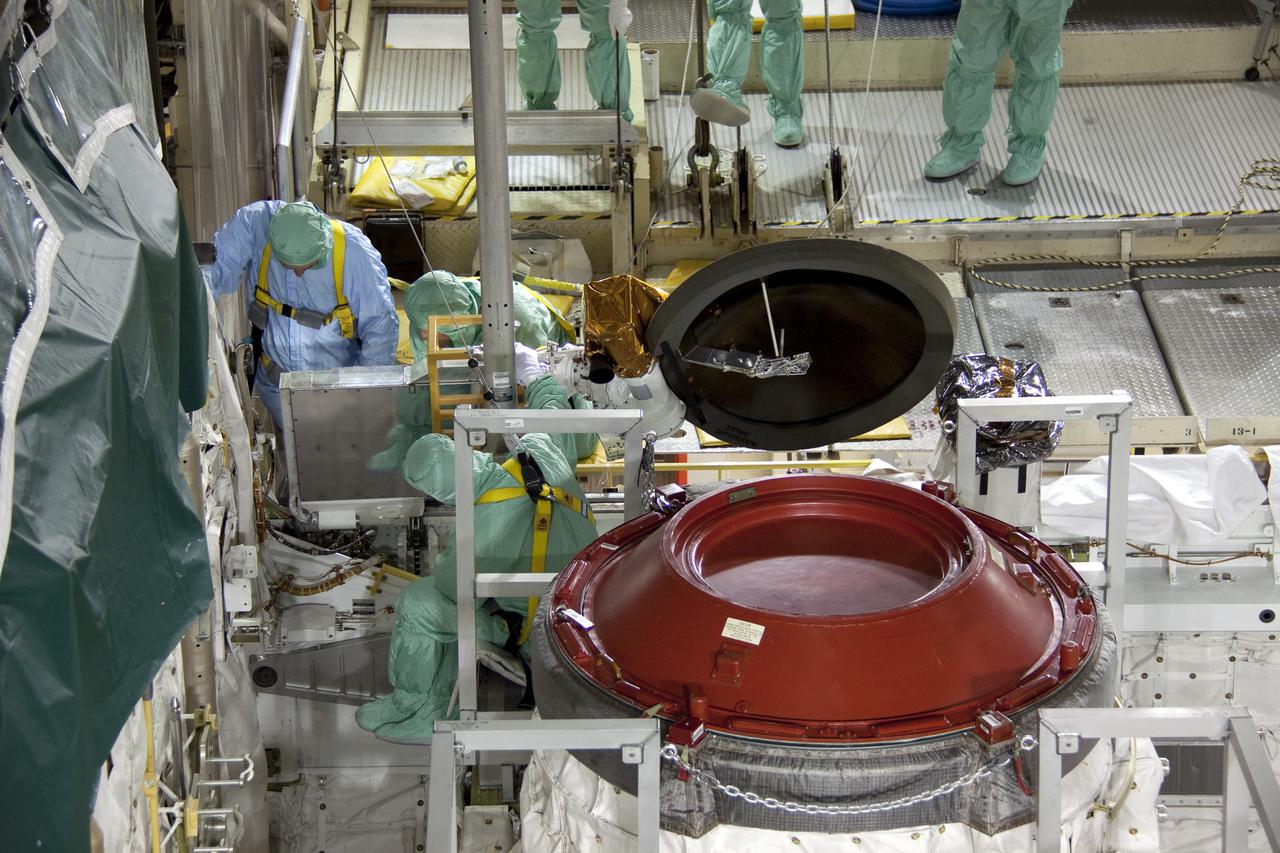
CAPE CANAVERAL, Fla. -- Technicians install a new Ku-Band communications system antenna on space shuttle Discovery in Orbiter Processing Facility-3 at NASA's Kennedy Space Center in Florida. The antenna is used to transmit and receive high data rate communications, such as video, and is being replaced for the STS-133 mission to the International Space Station. During its STS-131 mission to the station in April, Discovery's Ku-Band failed to operate in orbit. As a result, video of the thermal protection system inspection had to be recorded aboard Discovery and transmitted to the ground after the shuttle docked with the station. Typically, the inspection video is simultaneously transmitted live to the ground and recorded aboard the shuttle for later review. NASA_Charisse Nahser
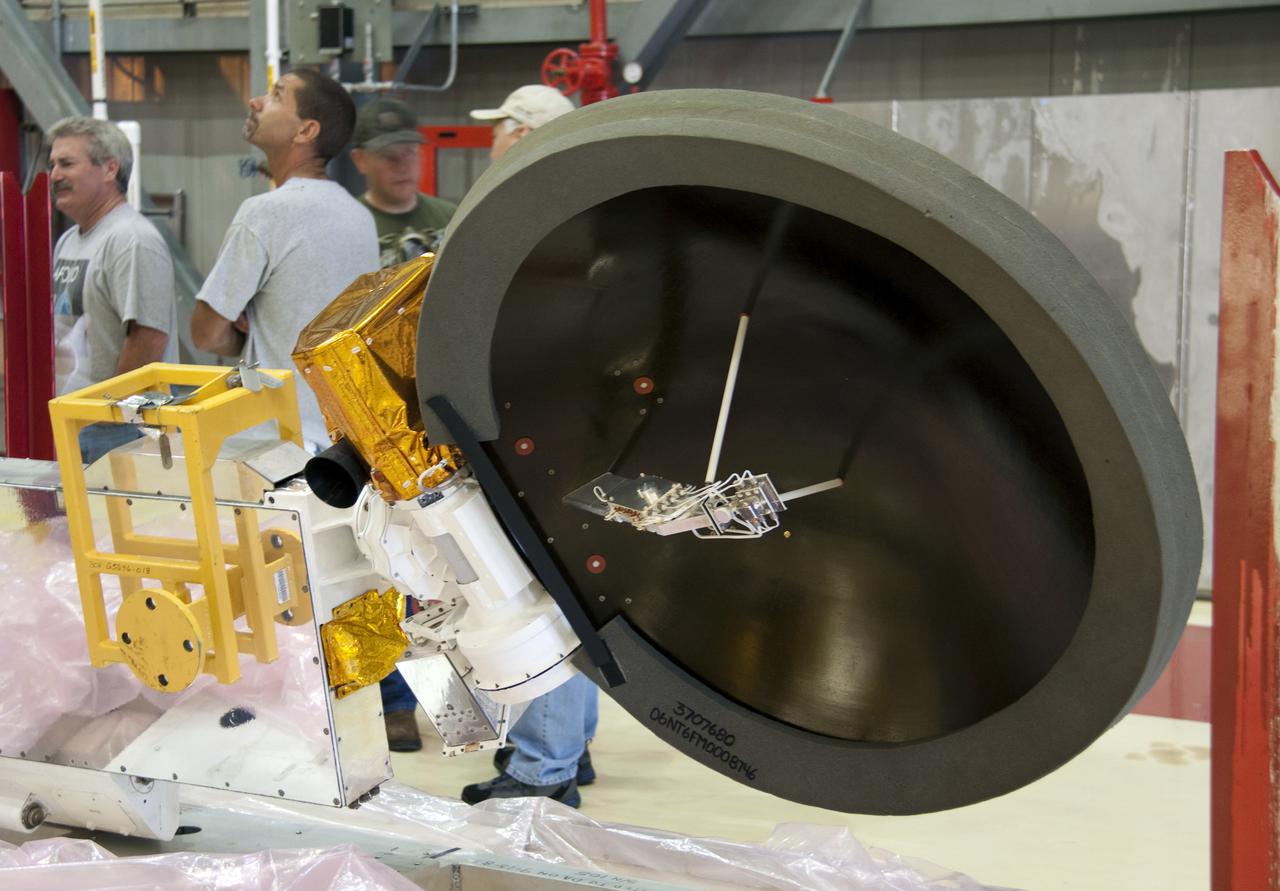
CAPE CANAVERAL, Fla. -- A new Ku-Band communications system antenna is ready to be installed on space shuttle Discovery in Orbiter Processing Facility-3 at NASA's Kennedy Space Center in Florida. The antenna is used to transmit and receive high data rate communications, such as video, and is being replaced for the STS-133 mission to the International Space Station. During its STS-131 mission to the station in April, Discovery's Ku-Band failed to operate in orbit. As a result, video of the thermal protection system inspection had to be recorded aboard Discovery and transmitted to the ground after the shuttle docked with the station. Typically, the inspection video is simultaneously transmitted live to the ground and recorded aboard the shuttle for later review. NASA_Charisse Nahser

ISS030-E-060104 (1 Feb. 2012) --- NASA astronaut Dan Burbank, Expedition 30 commander, uses a video camera in the Destiny laboratory of the International Space Station during installation and routing of video cable for the High Rate Communication System (HRCS). HRCS will allow for two additional space-to-ground audio channels and two additional downlink video channels.
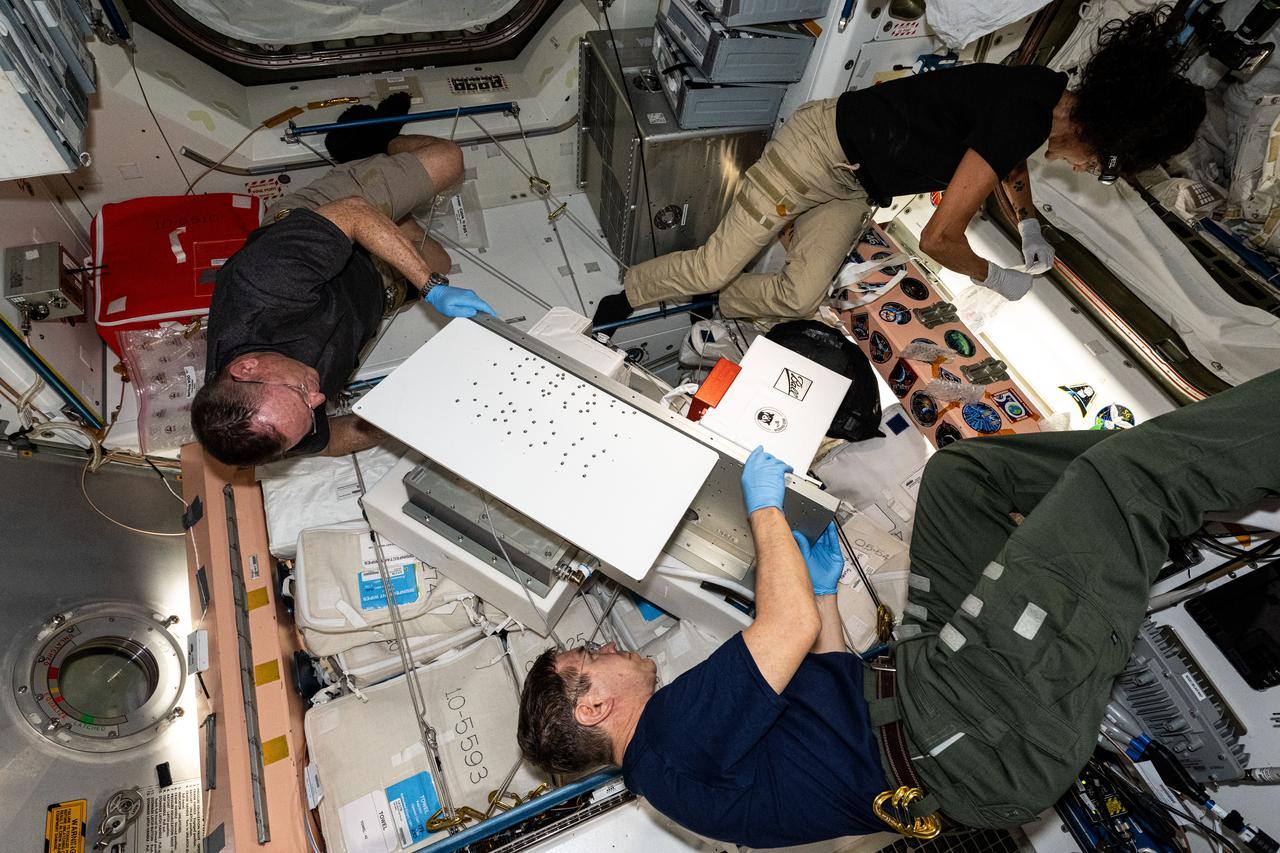
iss071e379489 (July 23, 2024) --- Clockwise from bottom, NASA astronauts Mike Barratt, Butch Wilmore, and Suni Williams are at work inside the International Space Station's Unity module. The trio was configuring the ArgUS Mission 1 technology demonstration hardware to test the external operations of communications, computer processing, and high-definition video gear in the vacuum of space.
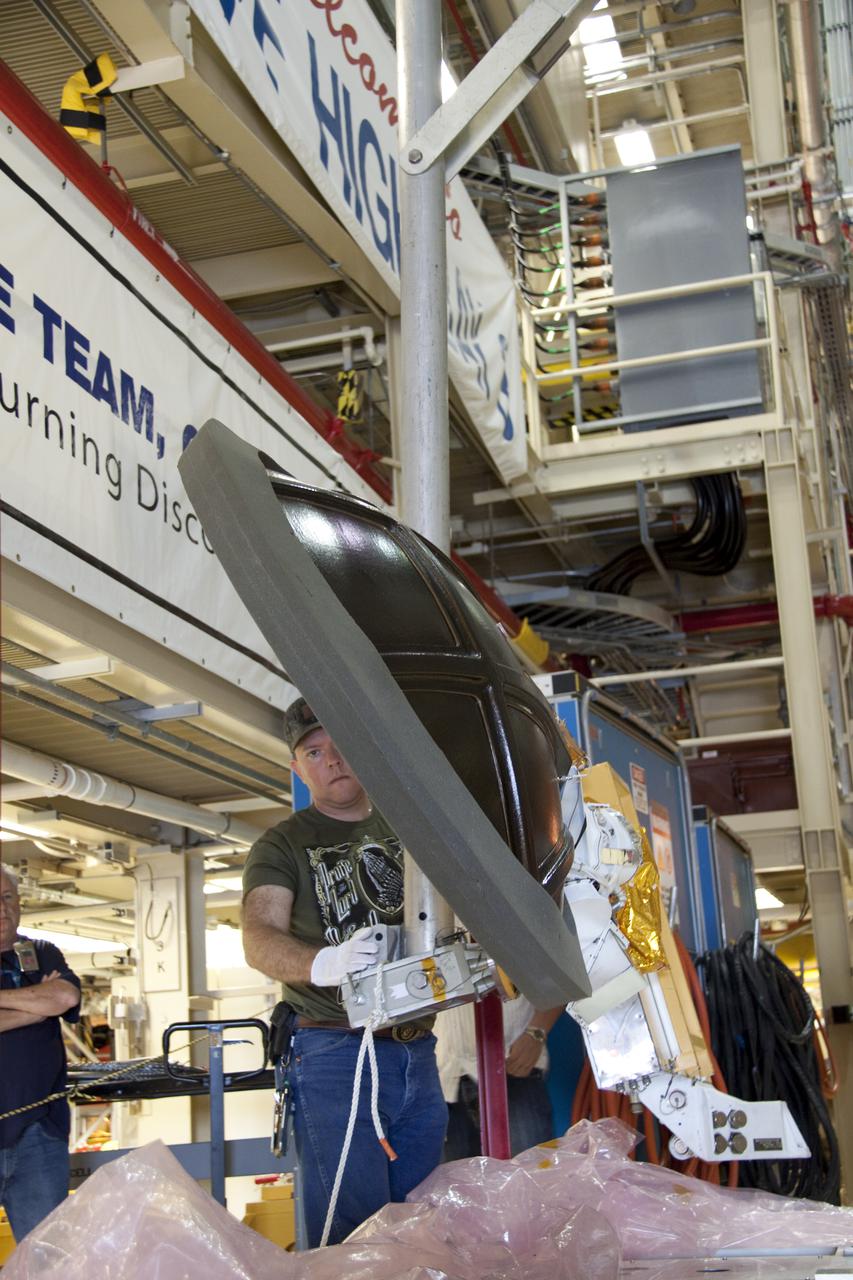
CAPE CANAVERAL, Fla. -- Technicians prepare to install a new Ku-Band communications system antenna on space shuttle Discovery in Orbiter Processing Facility-3 at NASA's Kennedy Space Center in Florida. The antenna is used to transmit and receive high data rate communications, such as video, and is being replaced for the STS-133 mission to the International Space Station. During its STS-131 mission to the station in April, Discovery's Ku-Band failed to operate in orbit. As a result, video of the thermal protection system inspection had to be recorded aboard Discovery and transmitted to the ground after the shuttle docked with the station. Typically, the inspection video is simultaneously transmitted live to the ground and recorded aboard the shuttle for later review. NASA_Charisse Nahser
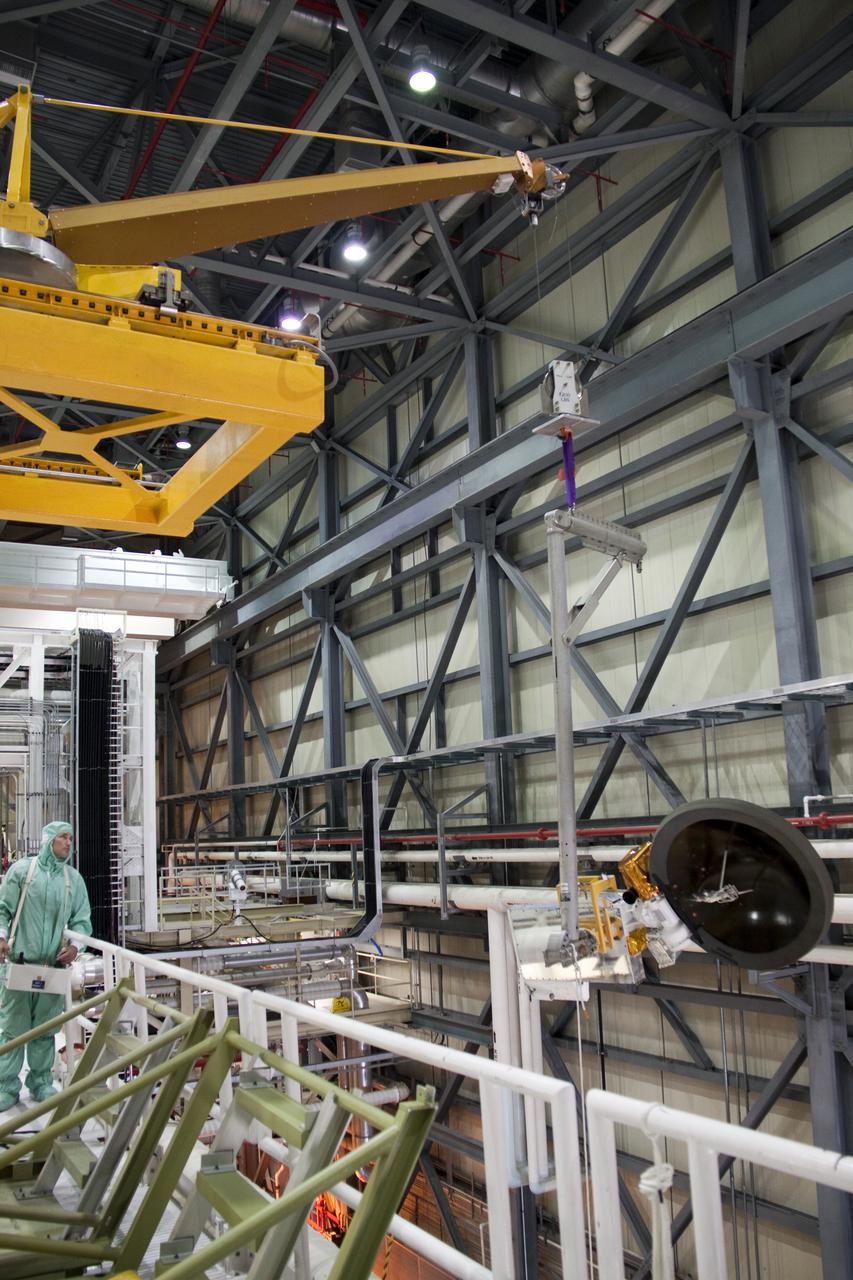
CAPE CANAVERAL, Fla. -- Technicians prepare to install a new Ku-Band communications system antenna on space shuttle Discovery in Orbiter Processing Facility-3 at NASA's Kennedy Space Center in Florida. The antenna is used to transmit and receive high data rate communications, such as video, and is being replaced for the STS-133 mission to the International Space Station. During its STS-131 mission to the station in April, Discovery's Ku-Band failed to operate in orbit. As a result, video of the thermal protection system inspection had to be recorded aboard Discovery and transmitted to the ground after the shuttle docked with the station. Typically, the inspection video is simultaneously transmitted live to the ground and recorded aboard the shuttle for later review. NASA_Charisse Nahser
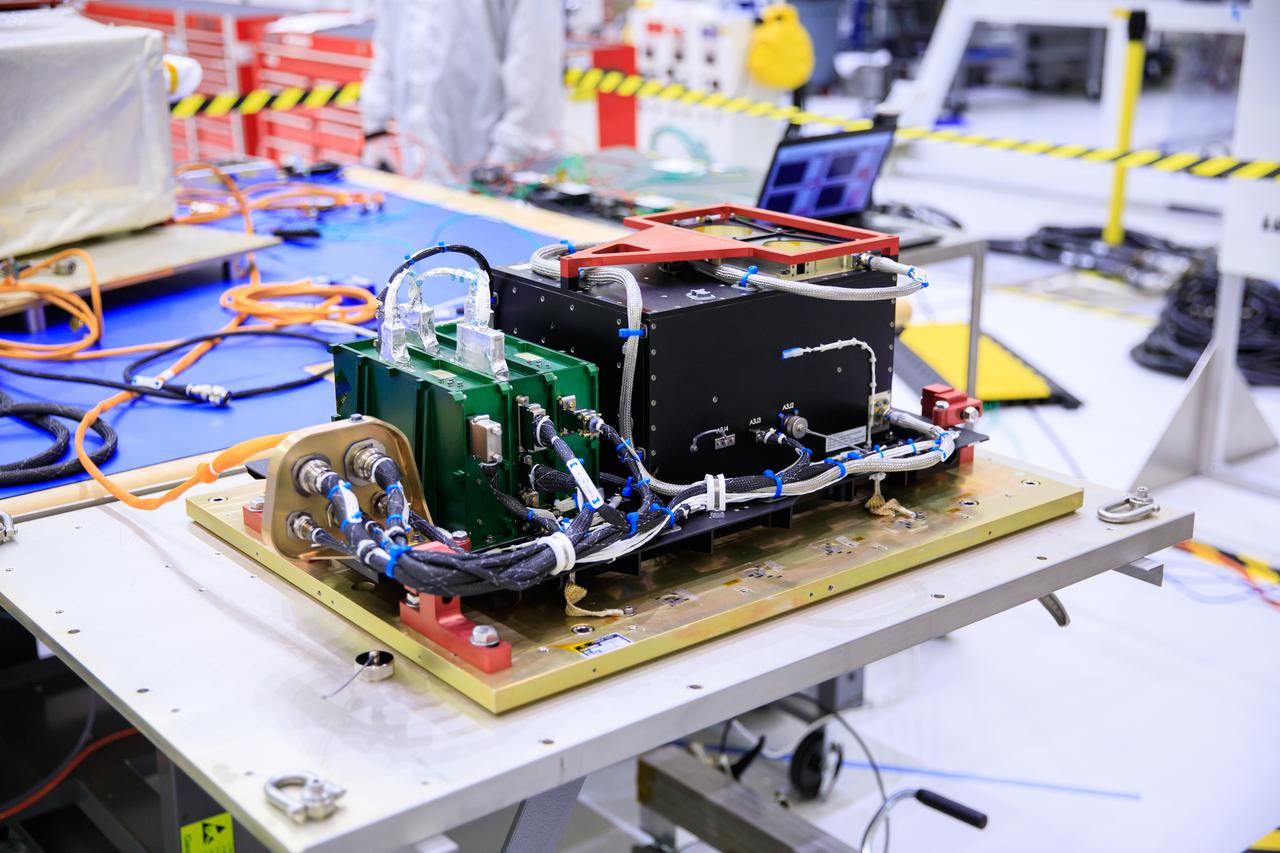
A close-up view of one of the parts of the Optical Communications System for the Artemis II mission inside the Neil Armstrong Operations and Checkout Building high bay on June 2, 2023. Optical communications is the latest space communications technology that is able to provide data rates as much as a hundred times higher than current systems. This will allow astronauts to send and receive ultra-high-definition video from the surface of the Moon or other planets such as Mars. Artemis II will be the first Artemis mission flying crew aboard Orion.
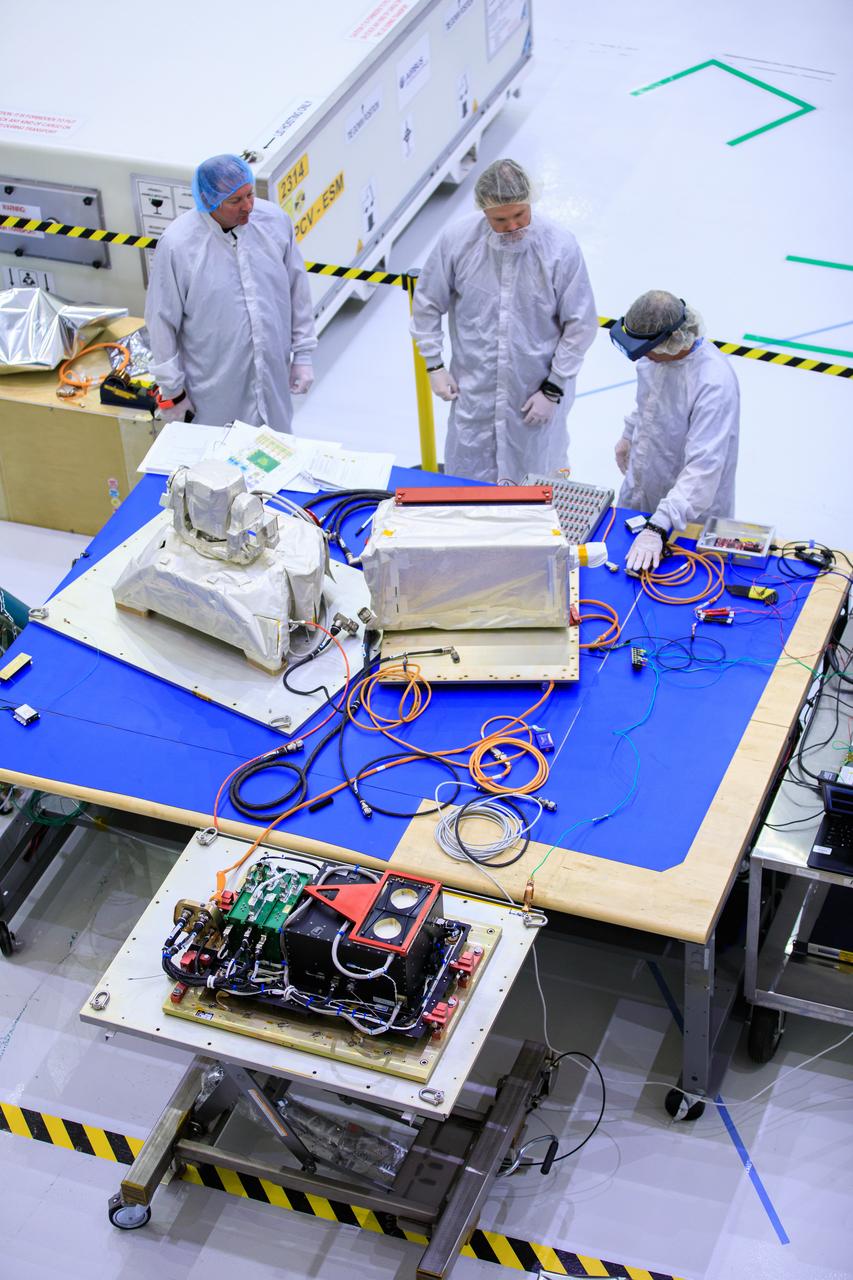
Inside the high bay of the Neil Armstrong Operations and Checkout Building at NASA’s Kennedy Space Center in Florida, technicians assemble on the Optical Communications System for the Artemis II mission on June 2, 2023. Optical communications is the latest space communications technology that is able to provide data rates as much as a hundred times higher than current systems. This will allow astronauts to send and receive ultra-high-definition video from the surface of the Moon or other planets such as Mars. Artemis II will be the first Artemis mission flying crew aboard Orion.
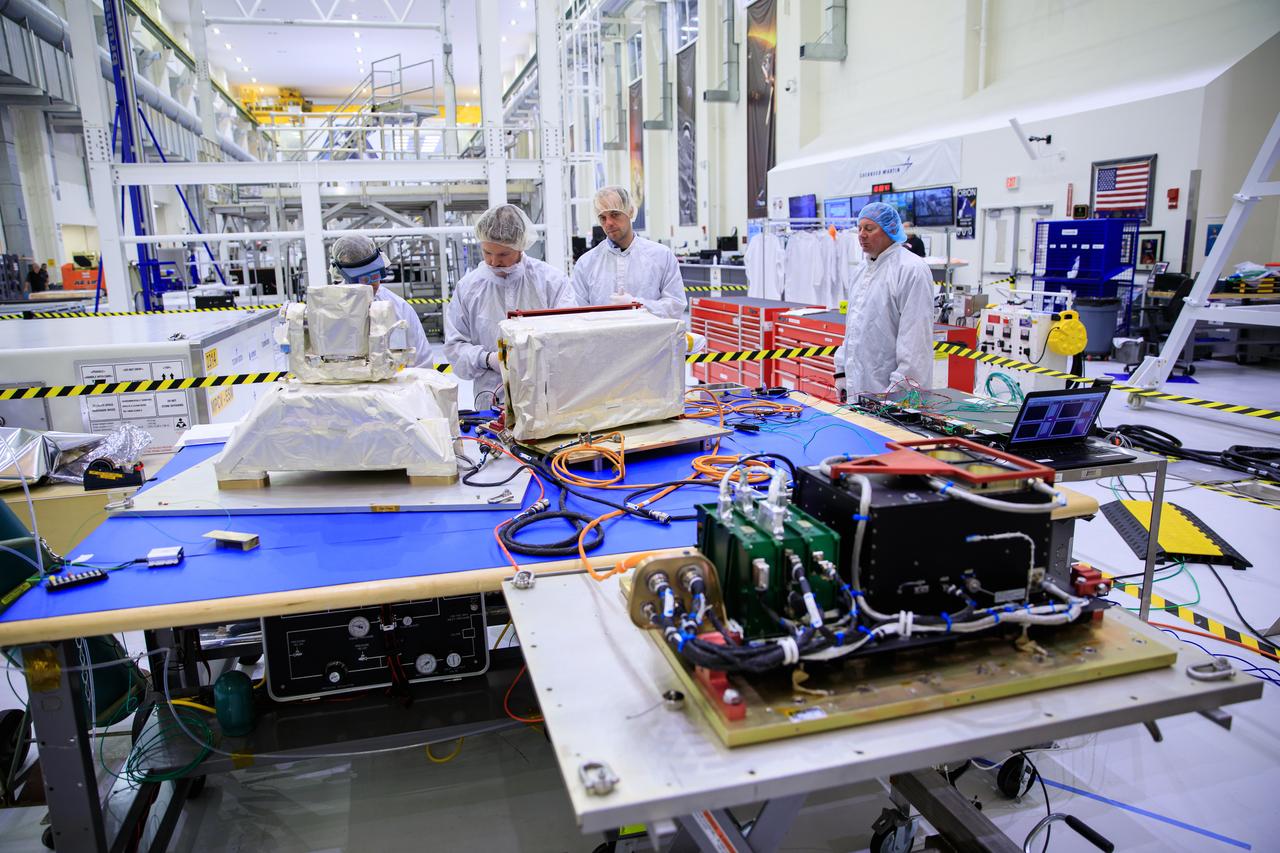
Inside the high bay of the Neil Armstrong Operations and Checkout Building at NASA’s Kennedy Space Center in Florida, technicians assemble on the Optical Communications System for the Artemis II mission on June 2, 2023. Optical communications is the latest space communications technology that is able to provide data rates as much as a hundred times higher than current systems. This will allow astronauts to send and receive ultra-high-definition video from the surface of the Moon or other planets such as Mars. Artemis II will be the first Artemis mission flying crew aboard Orion.

Inside the high bay of the Neil Armstrong Operations and Checkout Building at NASA’s Kennedy Space Center in Florida, technicians assemble on the Optical Communications System for the Artemis II mission on June 2, 2023. Optical communications is the latest space communications technology that is able to provide data rates as much as a hundred times higher than current systems. This will allow astronauts to send and receive ultra-high-definition video from the surface of the Moon or other planets such as Mars. Artemis II will be the first Artemis mission flying crew aboard Orion.
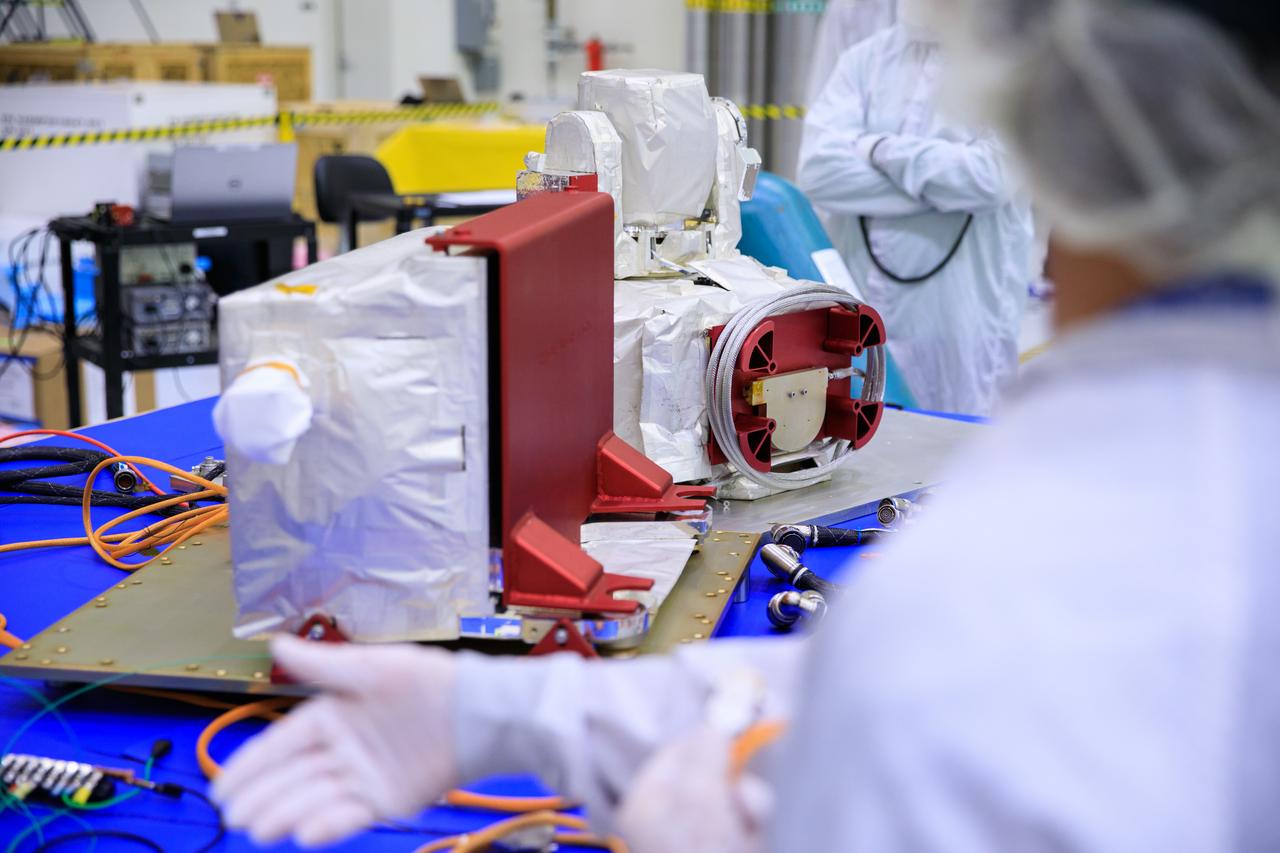
Inside the high bay of the Neil Armstrong Operations and Checkout Building at NASA’s Kennedy Space Center in Florida, technicians assemble on the Optical Communications System for the Artemis II mission on June 2, 2023. Optical communications is the latest space communications technology that is able to provide data rates as much as a hundred times higher than current systems. This will allow astronauts to send and receive ultra-high-definition video from the surface of the Moon or other planets such as Mars. Artemis II will be the first Artemis mission flying crew aboard Orion.

Inside the high bay of the Neil Armstrong Operations and Checkout Building at NASA’s Kennedy Space Center in Florida, technicians assemble on the Optical Communications System for the Artemis II mission on June 2, 2023. Optical communications is the latest space communications technology that is able to provide data rates as much as a hundred times higher than current systems. This will allow astronauts to send and receive ultra-high-definition video from the surface of the Moon or other planets such as Mars. Artemis II will be the first Artemis mission flying crew aboard Orion.
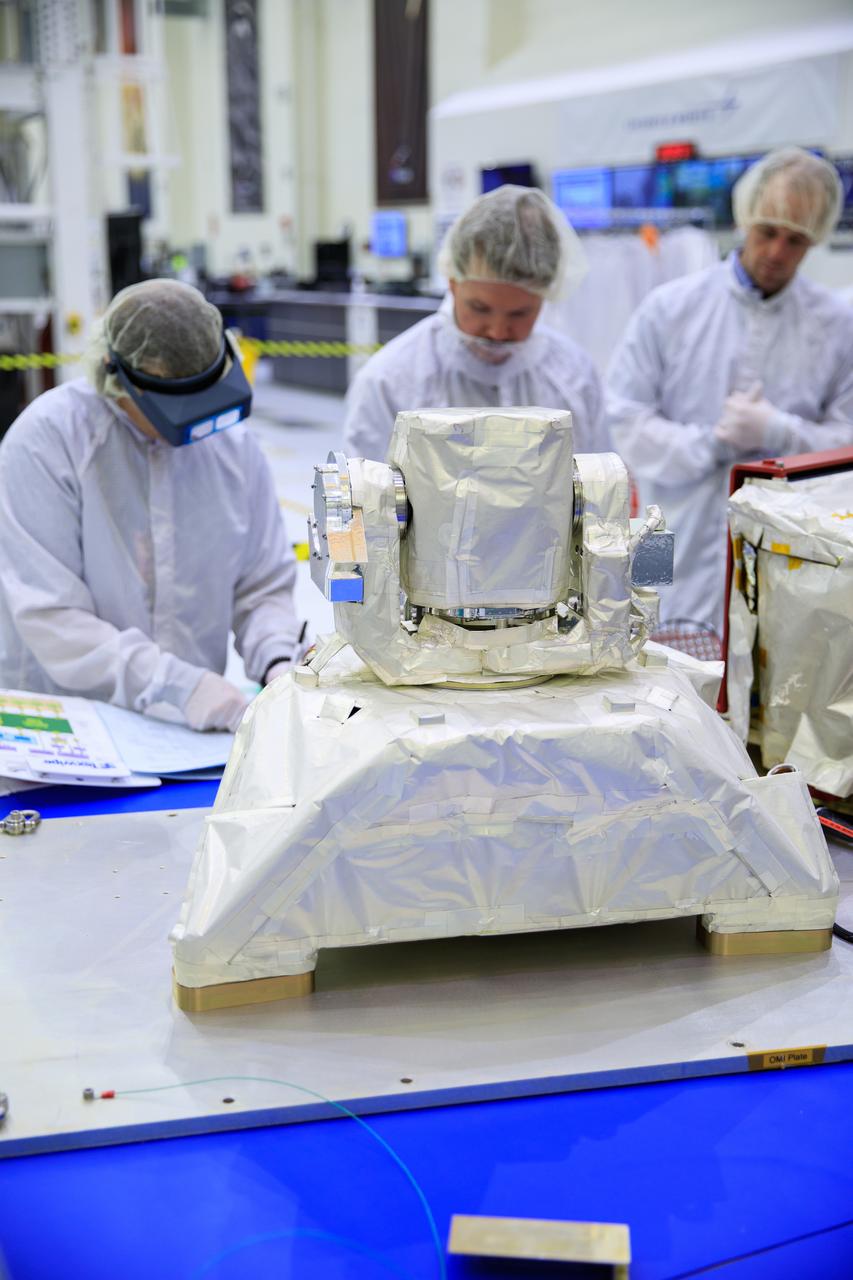
Inside the high bay of the Neil Armstrong Operations and Checkout Building at NASA’s Kennedy Space Center in Florida, technicians work on the Optical Communications System for the Artemis II mission on June 2, 2023. Optical communications is the latest space communications technology that is able to provide data rates as much as a hundred times higher than current systems. This will allow astronauts to send and receive ultra-high-definition video from the surface of the Moon or other planets such as Mars. Artemis II will be the first Artemis mission flying crew aboard Orion.
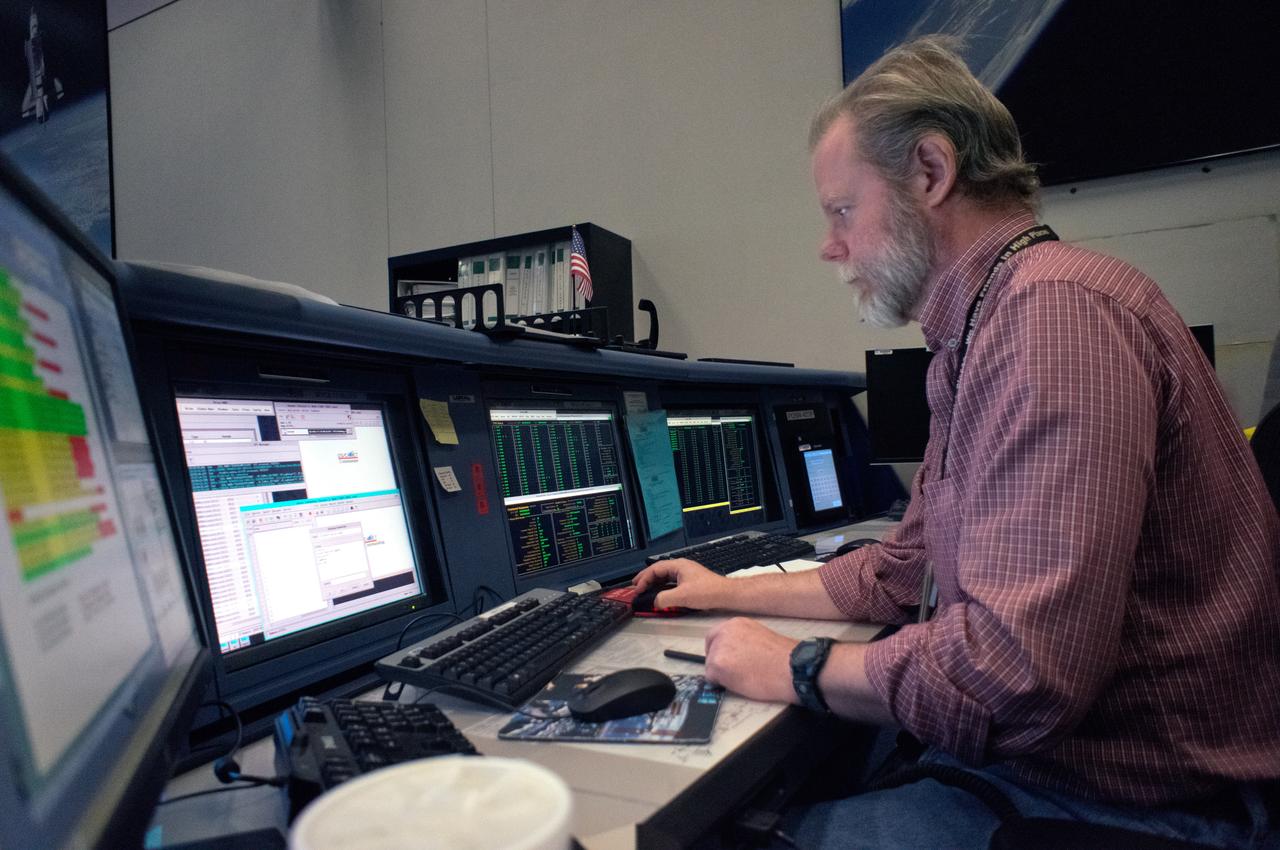
The Orion avionics team participates in a successful End to End 02 test between Mission Control Center (MCC) Houston and the Communications and Tracking Integrated Lab in Denver on Oct. 16, 2011. The team successfully flowed telemetry over RF link to the MCC, sent the first encrypted command from MCC to Orion, demonstrated full end to end video link capability, and downlinked test video file in a file transfer. Part of Batch image transfer from Flickr.
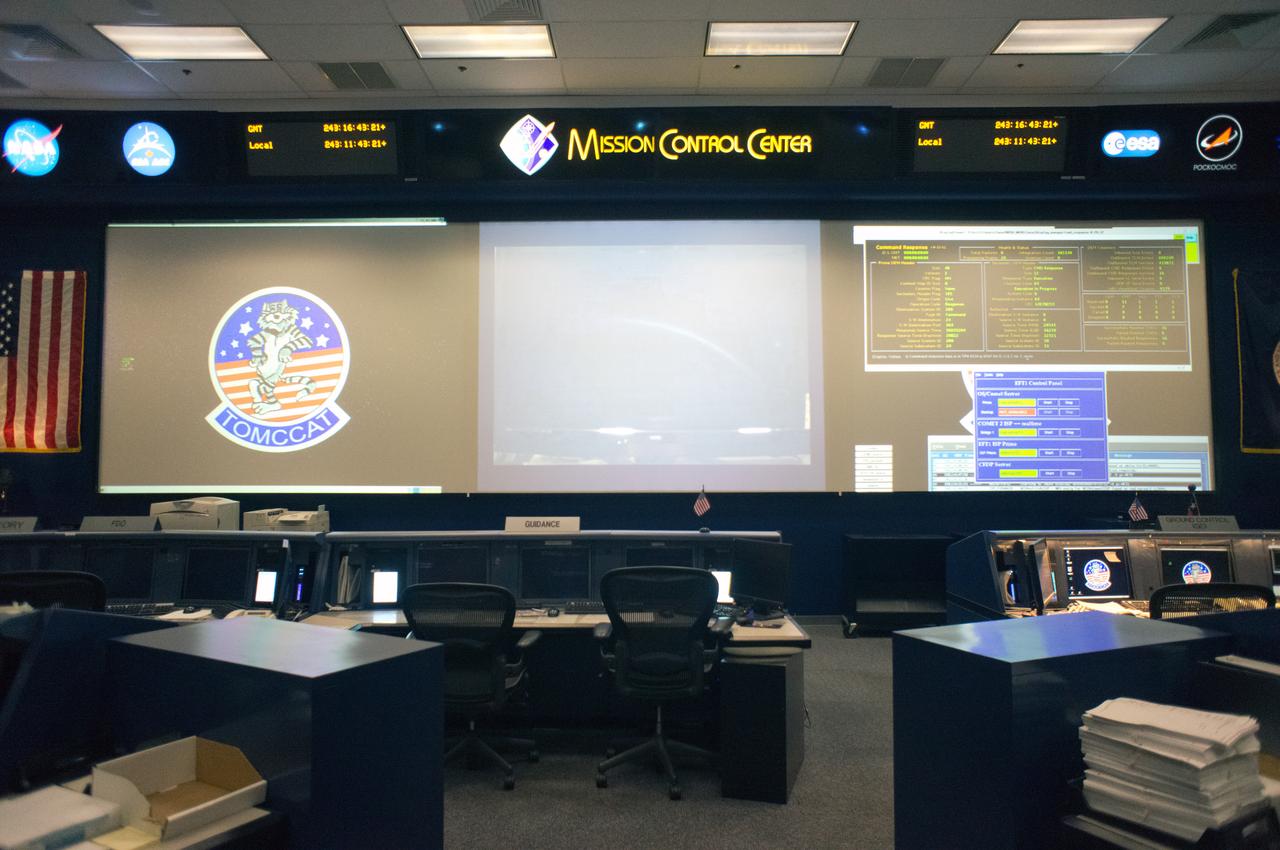
The Orion avionics team participates in a successful End to End 02 test between Mission Control Center (MCC) Houston and the Communications and Tracking Integrated Lab in Denver on Oct. 16, 2011. The team successfully flowed telemetry over RF link to the MCC, sent the first encrypted command from MCC to Orion, demonstrated full end to end video link capability, and downlinked test video file in a file transfer. Part of Batch image transfer from Flickr.
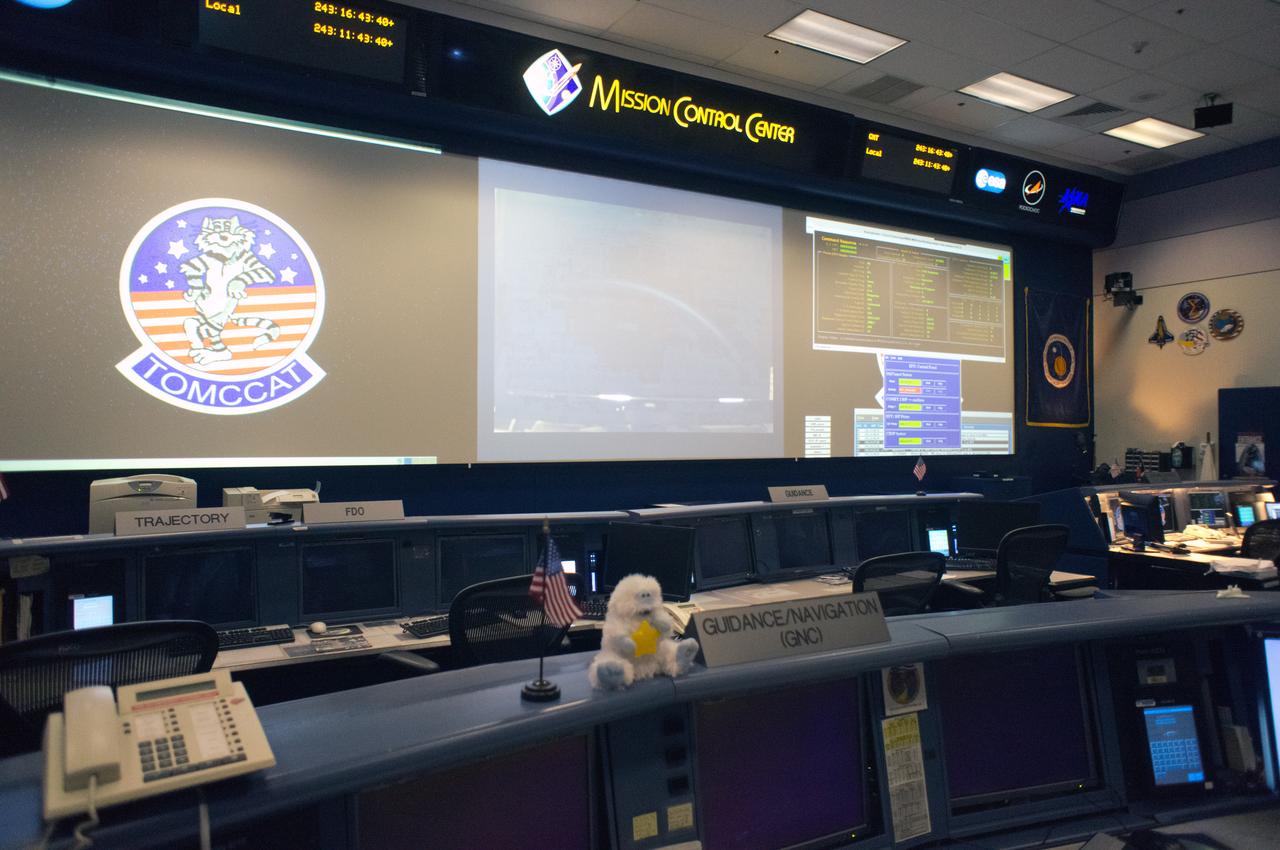
The Orion avionics team participates in a successful End to End 02 test between Mission Control Center (MCC) Houston and the Communications and Tracking Integrated Lab in Denver on Oct. 16, 2011. The team successfully flowed telemetry over RF link to the MCC, sent the first encrypted command from MCC to Orion, demonstrated full end to end video link capability, and downlinked test video file in a file transfer. Part of Batch image transfer from Flickr.

All Goddard employees are invited to gather in Bldg 28 Friday, August 26, 2016 to share a greeting in recognition of Star Trek 50th anniversary which is Sept 8. Office of Communications will film people speaking several lines in unison. Video will be part of a longer video of messaes recorded across the agency and will be shared on social media via Dateline, Facebook and Twitter.
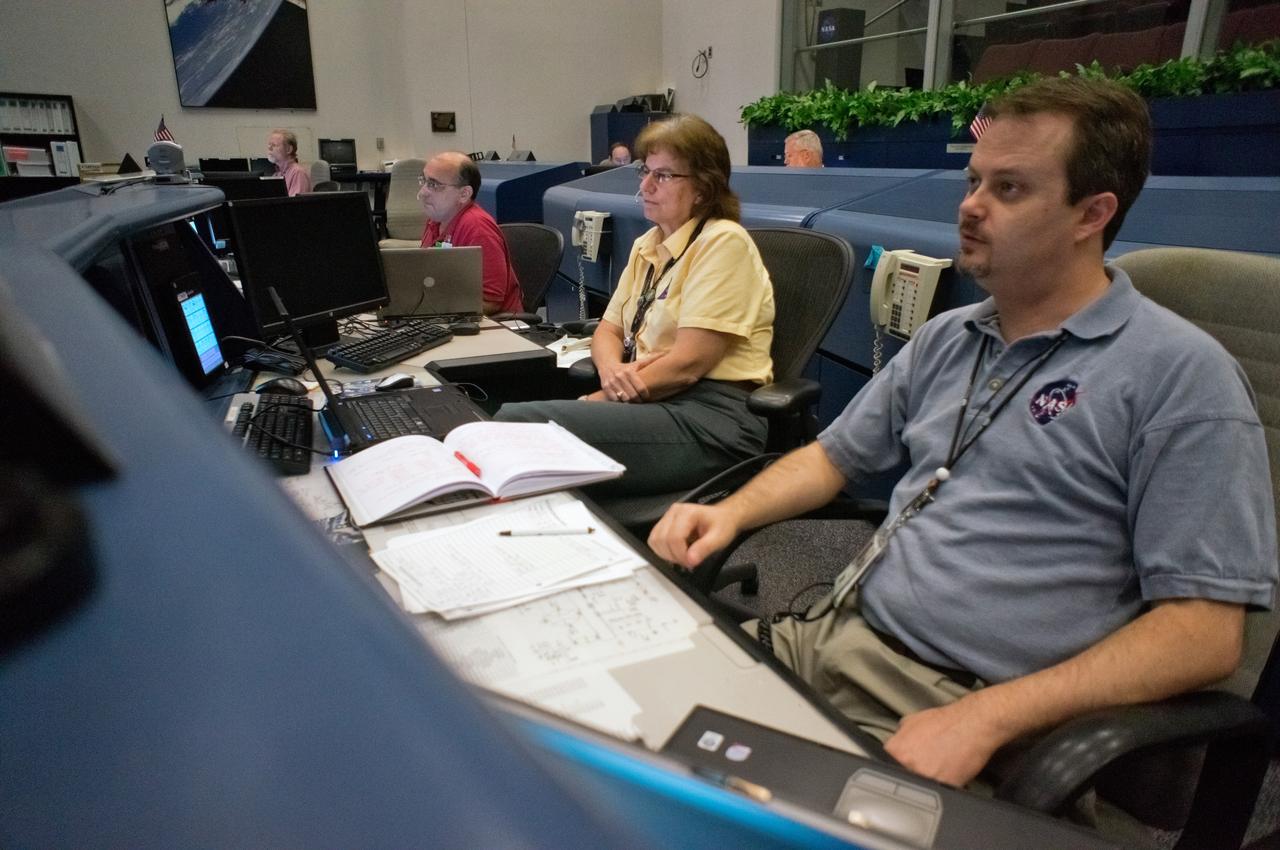
The Orion avionics team participates in a successful End to End 02 test between Mission Control Center (MCC) Houston and the Communications and Tracking Integrated Lab in Denver on Oct. 16, 2011. The team successfully flowed telemetry over RF link to the MCC, sent the first encrypted command from MCC to Orion, demonstrated full end to end video link capability, and downlinked test video file in a file transfer. Part of Batch image transfer from Flickr.

The Orion avionics team participates in a successful End to End 02 test between Mission Control Center (MCC) Houston and the Communications and Tracking Integrated Lab in Denver on Oct. 16, 2011. The team successfully flowed telemetry over RF link to the MCC, sent the first encrypted command from MCC to Orion, demonstrated full end to end video link capability, and downlinked test video file in a file transfer. Part of Batch image transfer from Flickr.
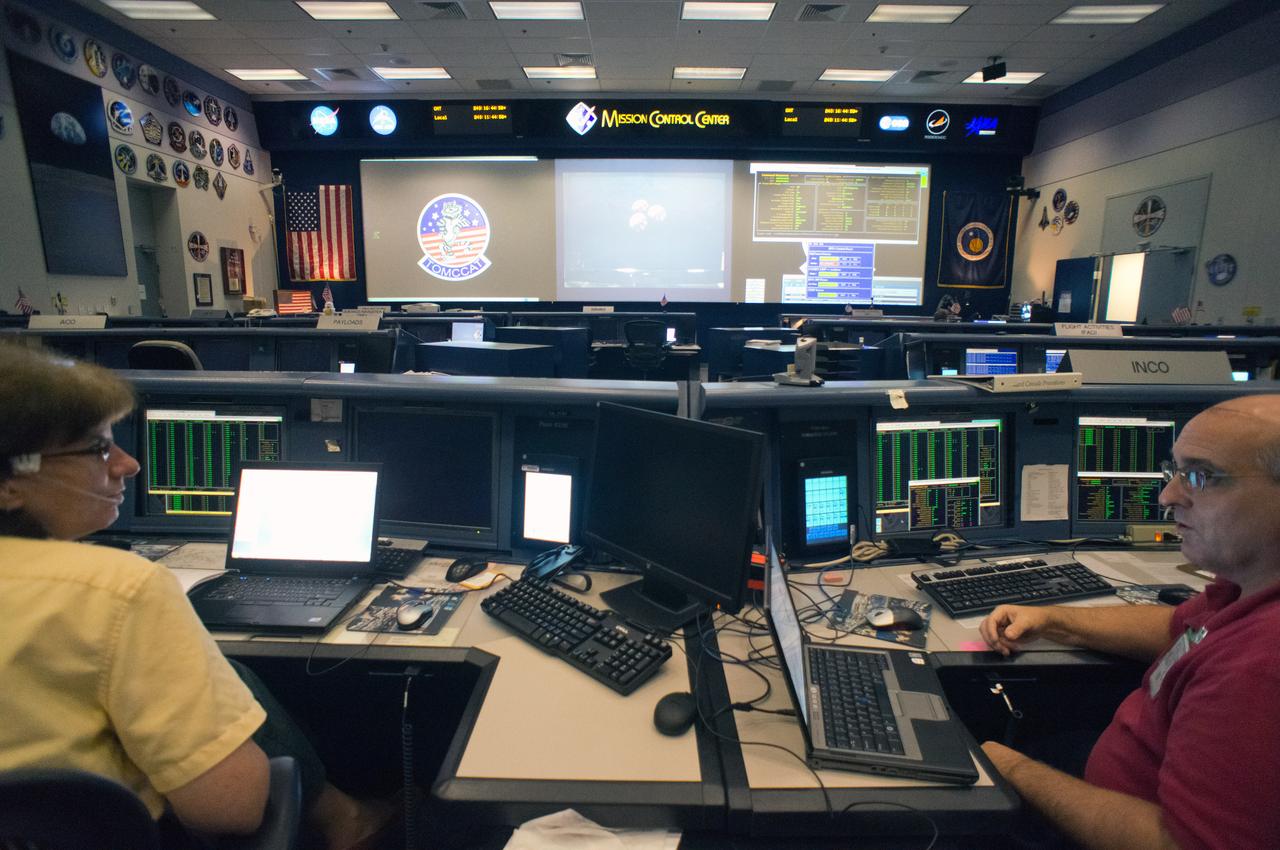
The Orion avionics team participates in a successful End to End 02 test between Mission Control Center (MCC) Houston and the Communications and Tracking Integrated Lab in Denver on Oct. 16, 2011. The team successfully flowed telemetry over RF link to the MCC, sent the first encrypted command from MCC to Orion, demonstrated full end to end video link capability, and downlinked test video file in a file transfer. Part of Batch image transfer from Flickr.

The Orion avionics team participates in a successful End to End 02 test between Mission Control Center (MCC) Houston and the Communications and Tracking Integrated Lab in Denver on Oct. 16, 2011. The team successfully flowed telemetry over RF link to the MCC, sent the first encrypted command from MCC to Orion, demonstrated full end to end video link capability, and downlinked test video file in a file transfer. Part of Batch image transfer from Flickr.

ISS030-E-060117 (1 Feb. 2012) --- In the International Space Station?s Destiny laboratory, European Space Agency astronaut Andre Kuipers, Expedition 30 flight engineer, routes video cable for the High Rate Communication System (HRCS). HRCS will allow for two additional space-to-ground audio channels and two additional downlink video channels.
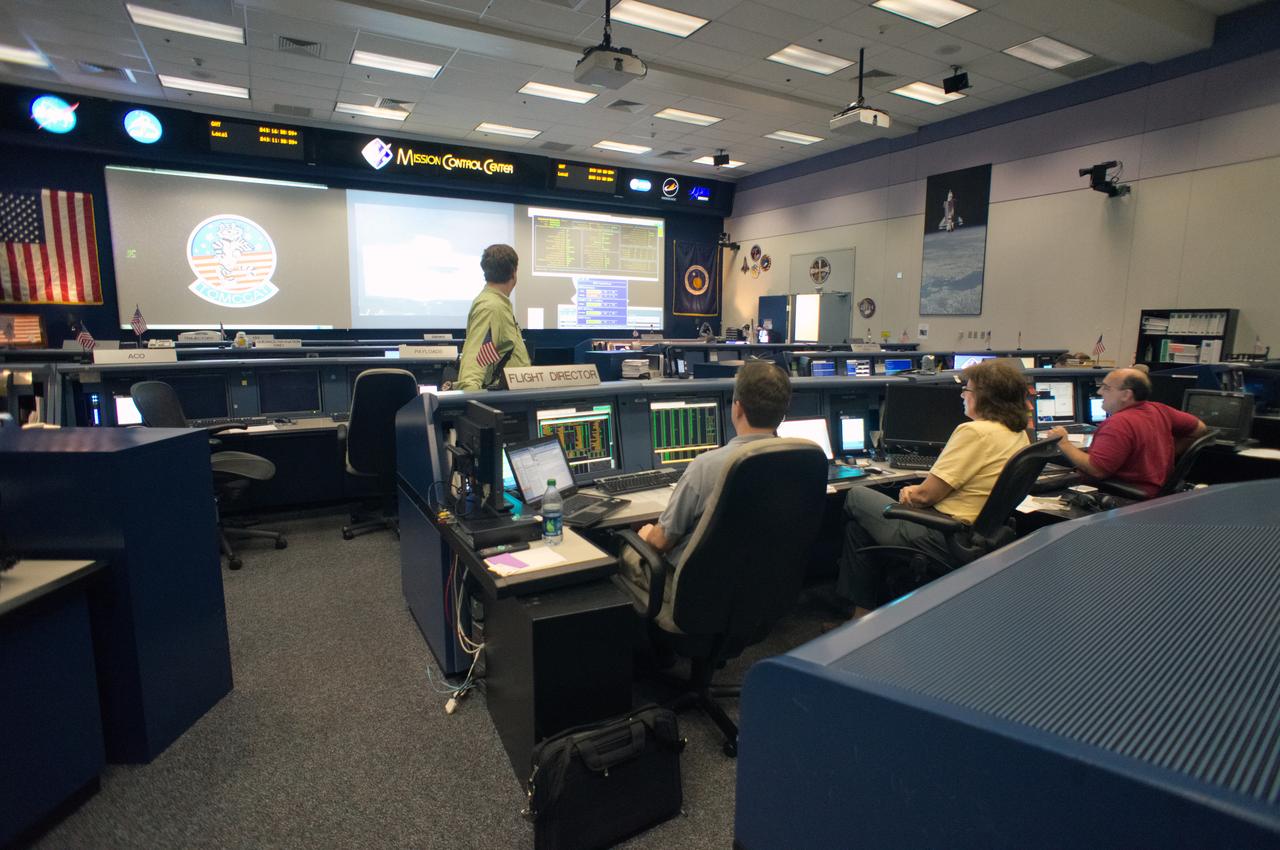
The Orion avionics team participates in a successful End to End 02 test between Mission Control Center (MCC) Houston and the Communications and Tracking Integrated Lab in Denver on Oct. 16, 2011. The team successfully flowed telemetry over RF link to the MCC, sent the first encrypted command from MCC to Orion, demonstrated full end to end video link capability, and downlinked test video file in a file transfer. Part of Batch image transfer from Flickr.
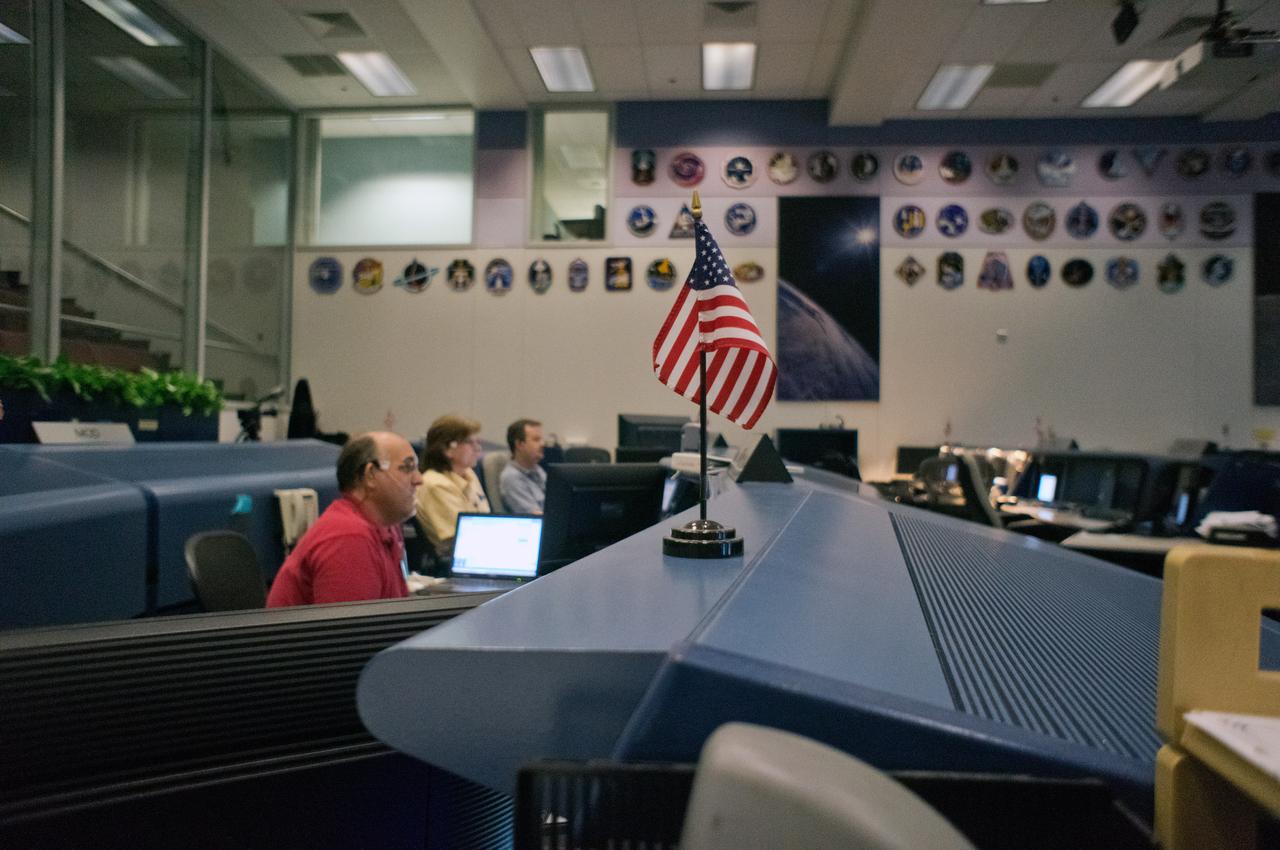
The Orion avionics team participates in a successful End to End 02 test between Mission Control Center (MCC) Houston and the Communications and Tracking Integrated Lab in Denver on Oct. 16, 2011. The team successfully flowed telemetry over RF link to the MCC, sent the first encrypted command from MCC to Orion, demonstrated full end to end video link capability, and downlinked test video file in a file transfer. Part of Batch image transfer from Flickr.
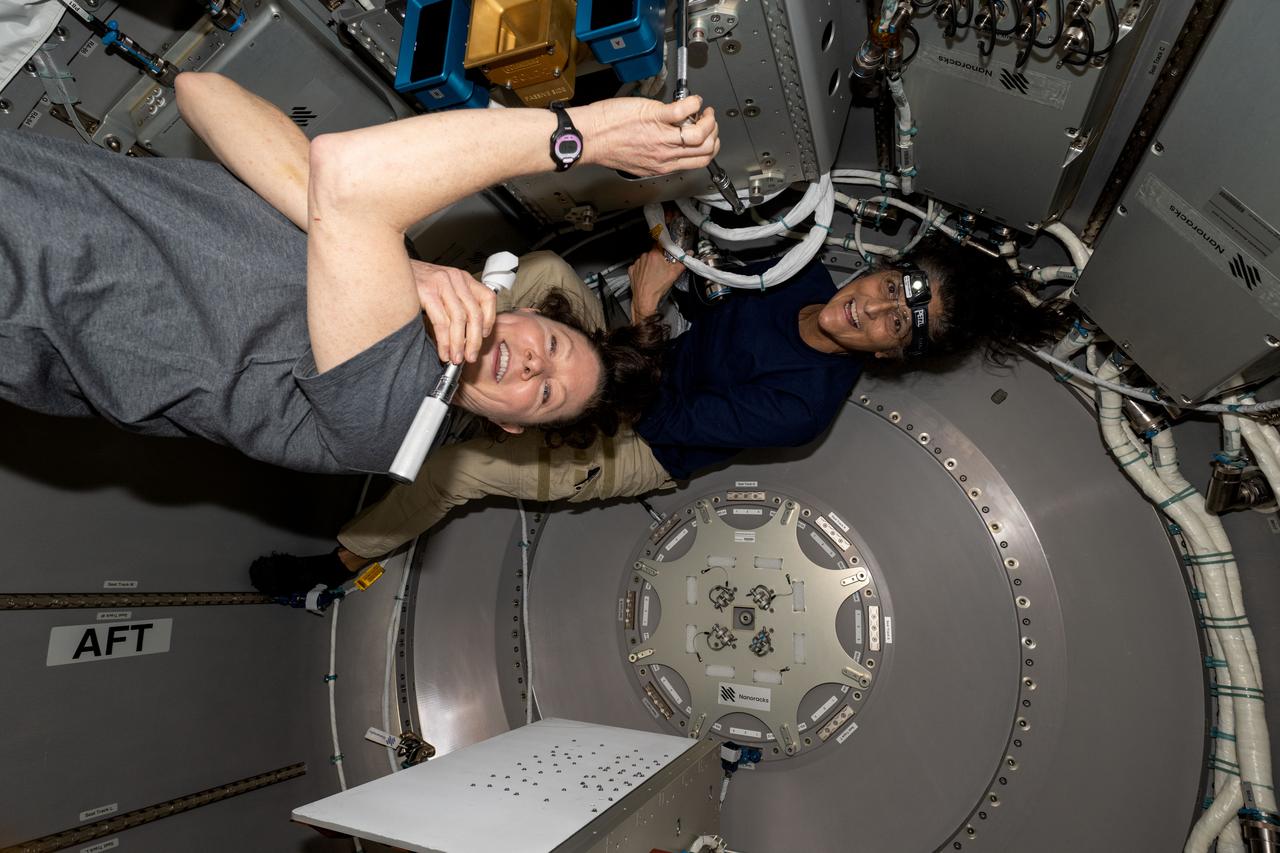
iss071e403704 (July 24, 2024) --- NASA astronauts (from left) Tracy C. Dyson, Expedition 71 Flight Engineer, and Suni Williams, Pilot for Boeing's Crew Flight Test, work inside the NanoRacks Bishop airlock located in the port side of the International Space Station's Tranquility module. The duo installed the the ArgUS Mission-1 technology demonstration hardware inside Bishop for placement outside in the vacuum of space to test the external operations of communications, computer processing, and high-definition video gear.
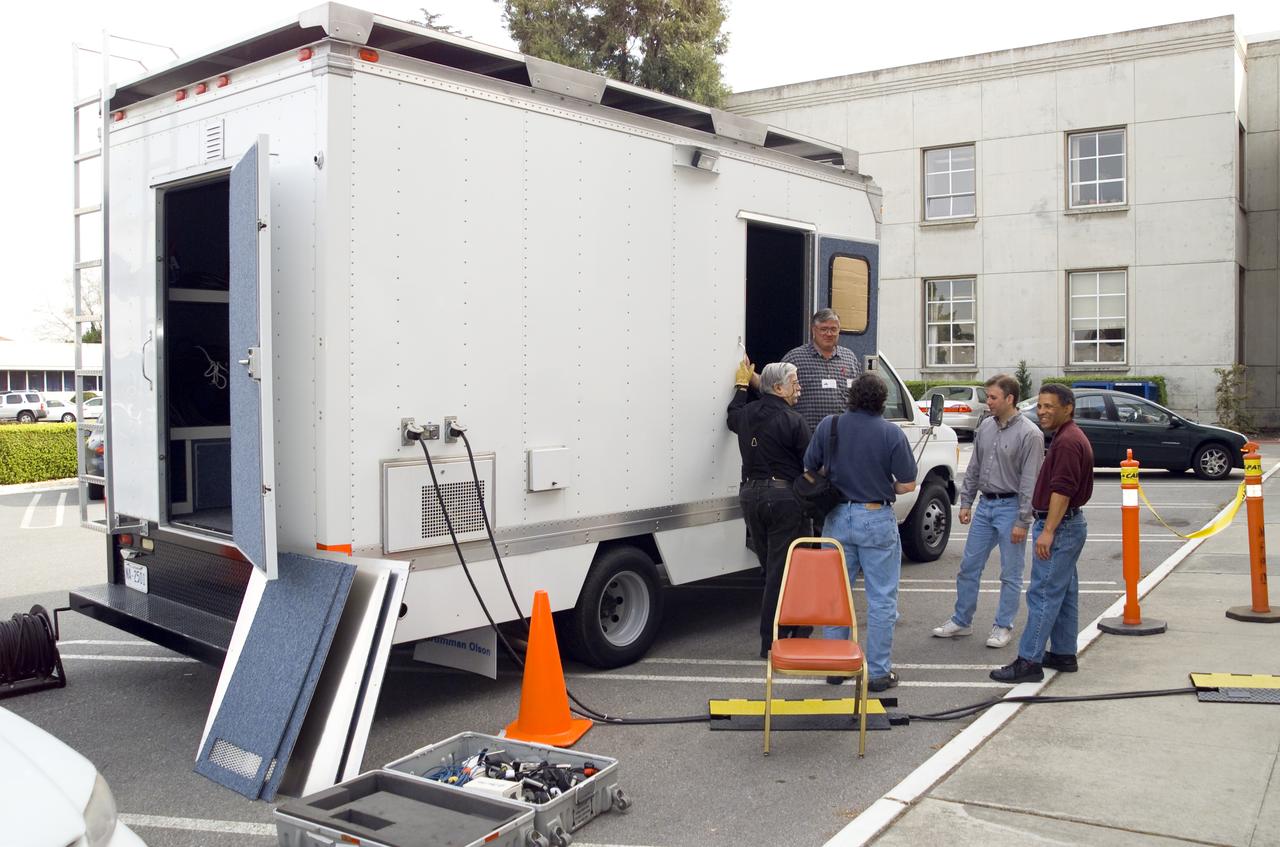
Sun-Earth Day WEBCAST - NASA TV; Host Paul Mortfield, Astronomer Stanford Solar Center and visiting students from San Francisco Bay Area Schools Documentation Technology Branch Video communications van (code-JIT) David Maurantonio, Paul Langston
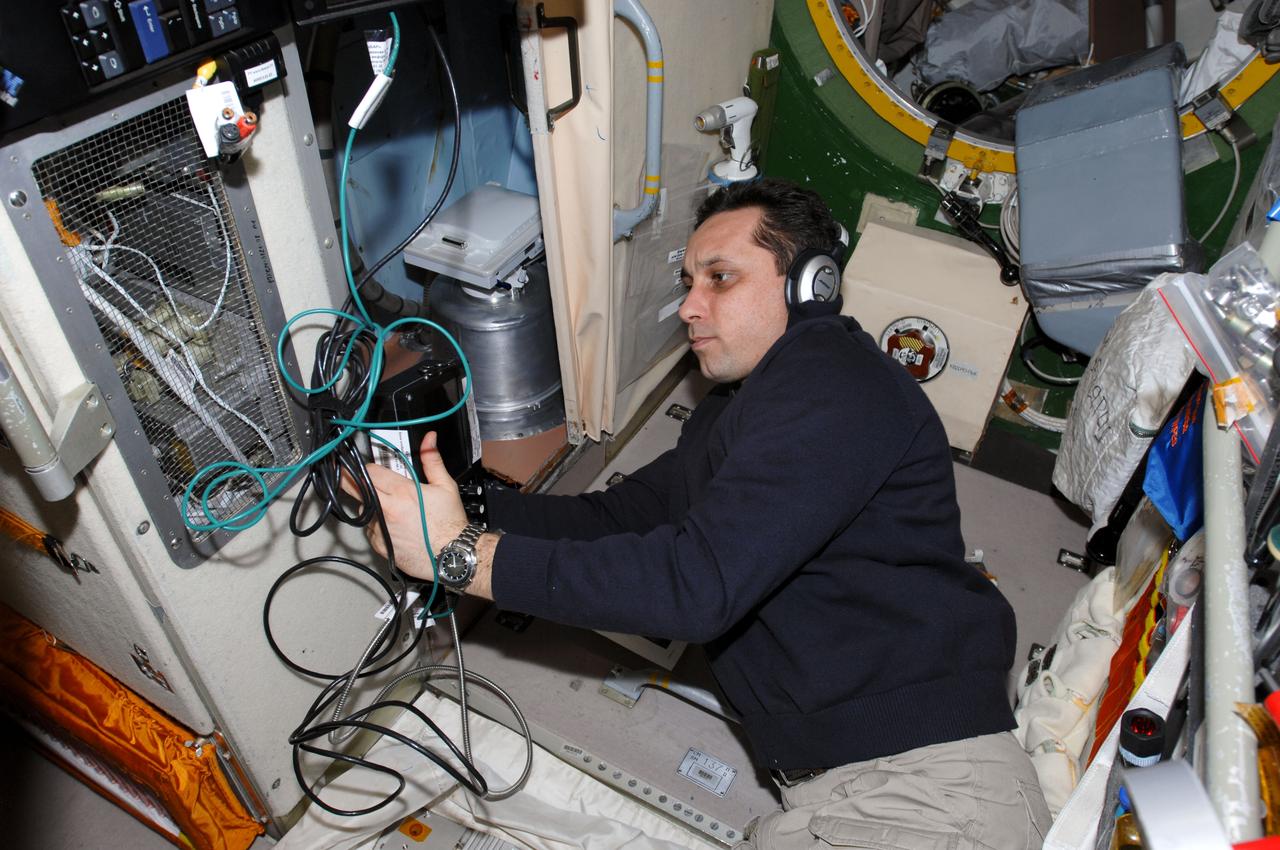
ISS030-E-021042 (5 Jan. 2012) --- Russian cosmonaut Anton Shkaplerov, Expedition 30 flight engineer, wears a communication system headset while working with a video display unit in the Zvezda Service Module of the International Space Station.
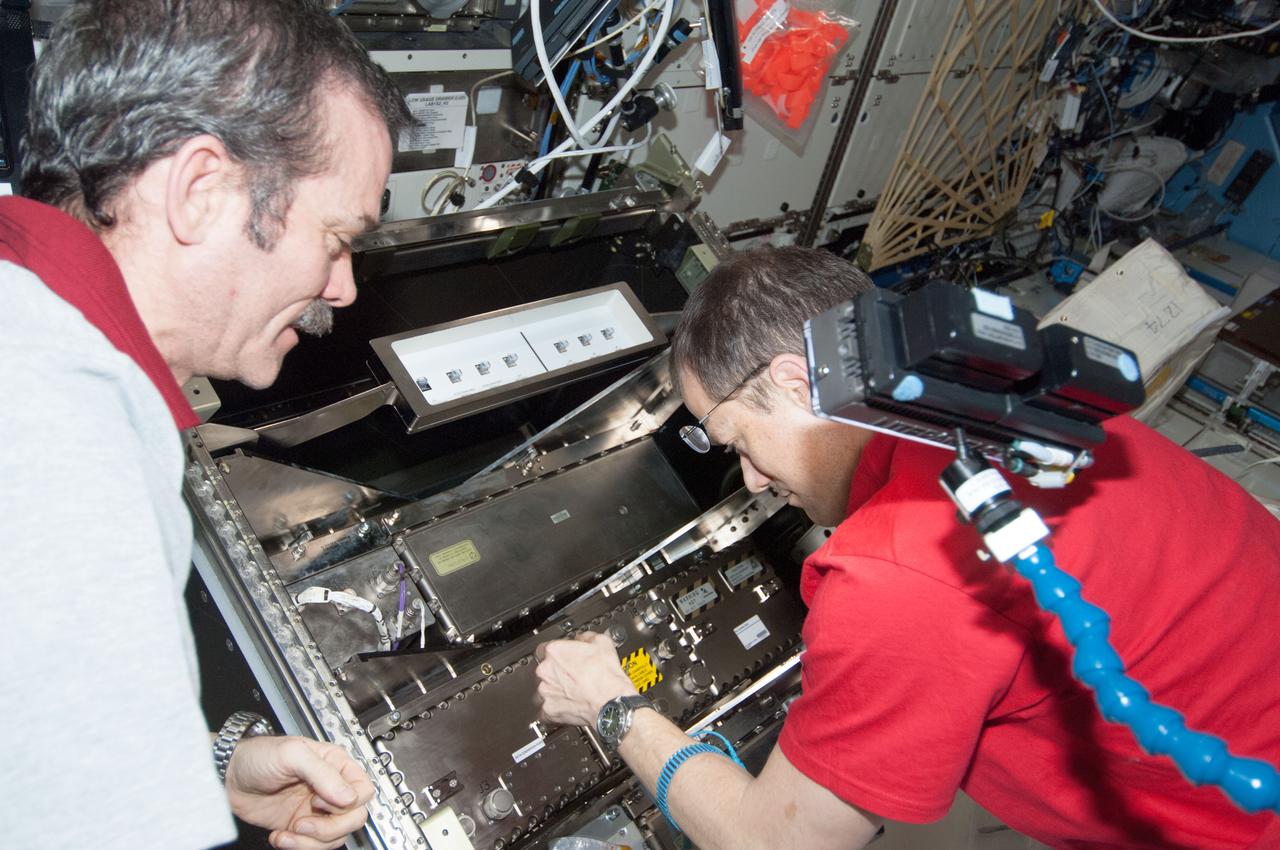
ISS035-E-013783 (2 April 2013) --- In the U.S. lab Destiny on the International Space Station, Expedition 35 Commander Chris Hadfield (right) and Flight Engineer Tom Marshburn remove the Video Baseband Signal Processor (VBSP) in order to replace it with a new Ku communication unit and its associated data and Ethernet cabling.
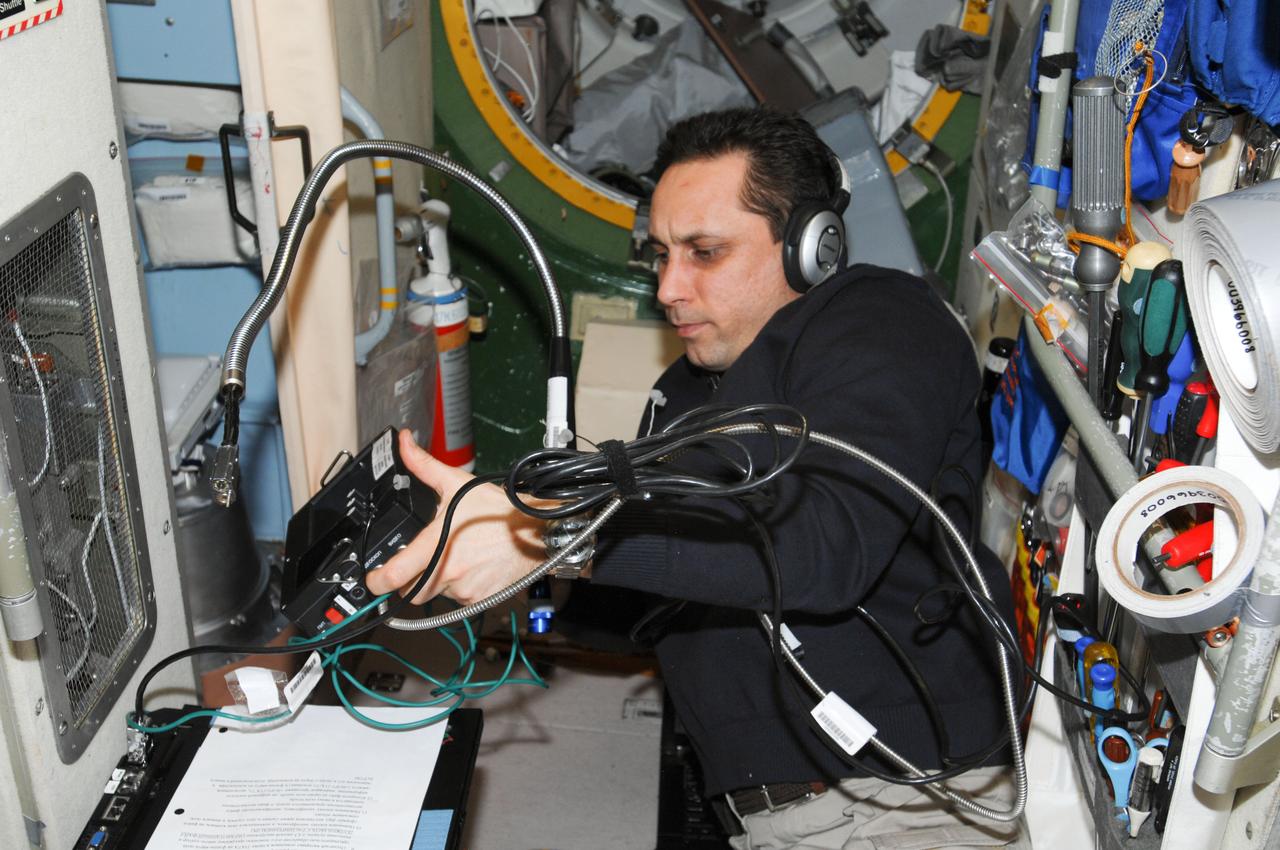
ISS030-E-021039 (5 Jan. 2012) --- Russian cosmonaut Anton Shkaplerov, Expedition 30 flight engineer, wears a communication system headset while working with a video display unit in the Zvezda Service Module of the International Space Station.

The communication antenna is used primarily for test flights to receive downlink flight data and video from test aircraft and also to support command uplink of data to test aircraft for command and control. It is one of two such assets of the Dryden Aeronautical Test Range at NASA’s Armstrong Flight Research Center in California.
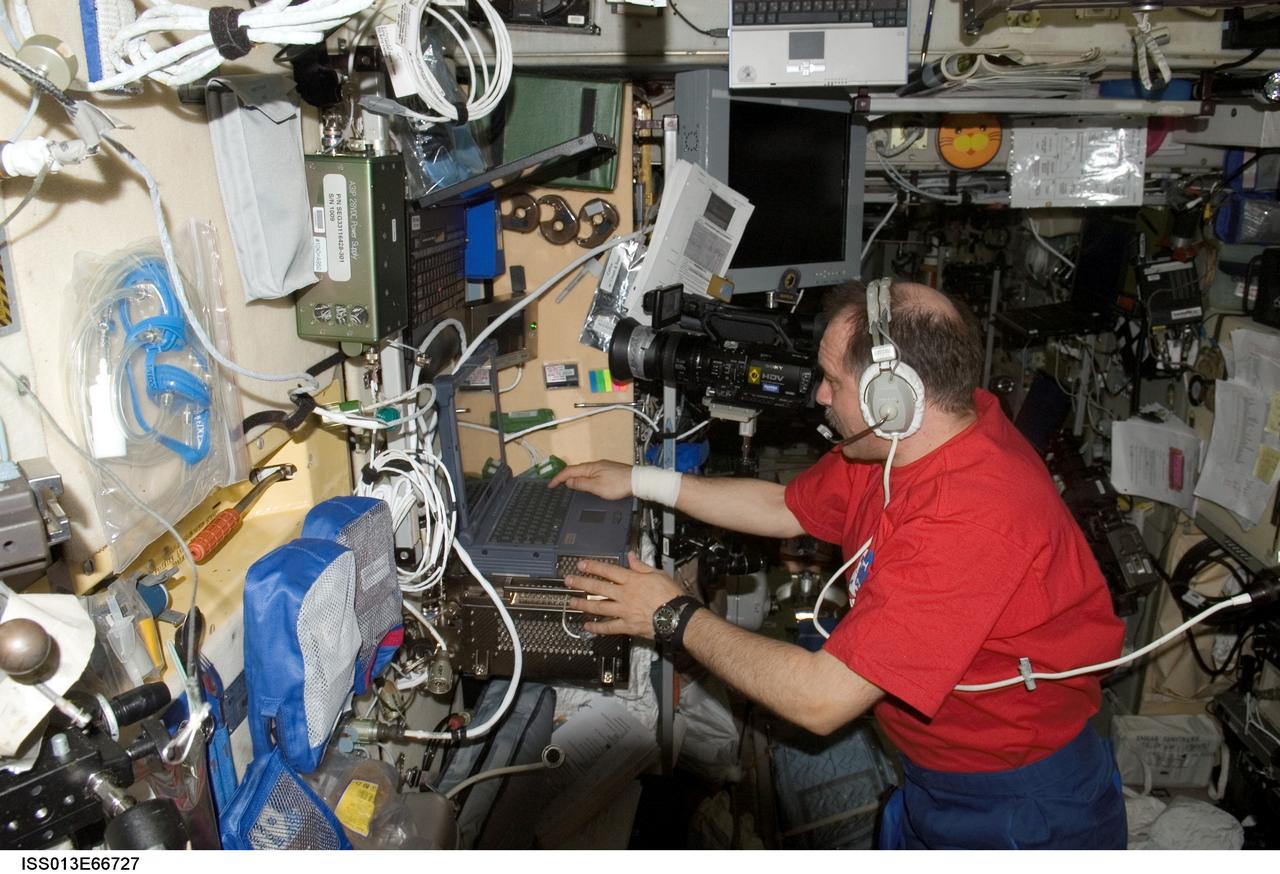
ISS013-E-66727 (August 2006) --- Cosmonaut Pavel V. Vinogradov, Expedition 13 commander representing Russia's Federal Space Agency, wears a communication system headset while using a video camcorder and computer in the Zvezda Service Module of the International Space Station.
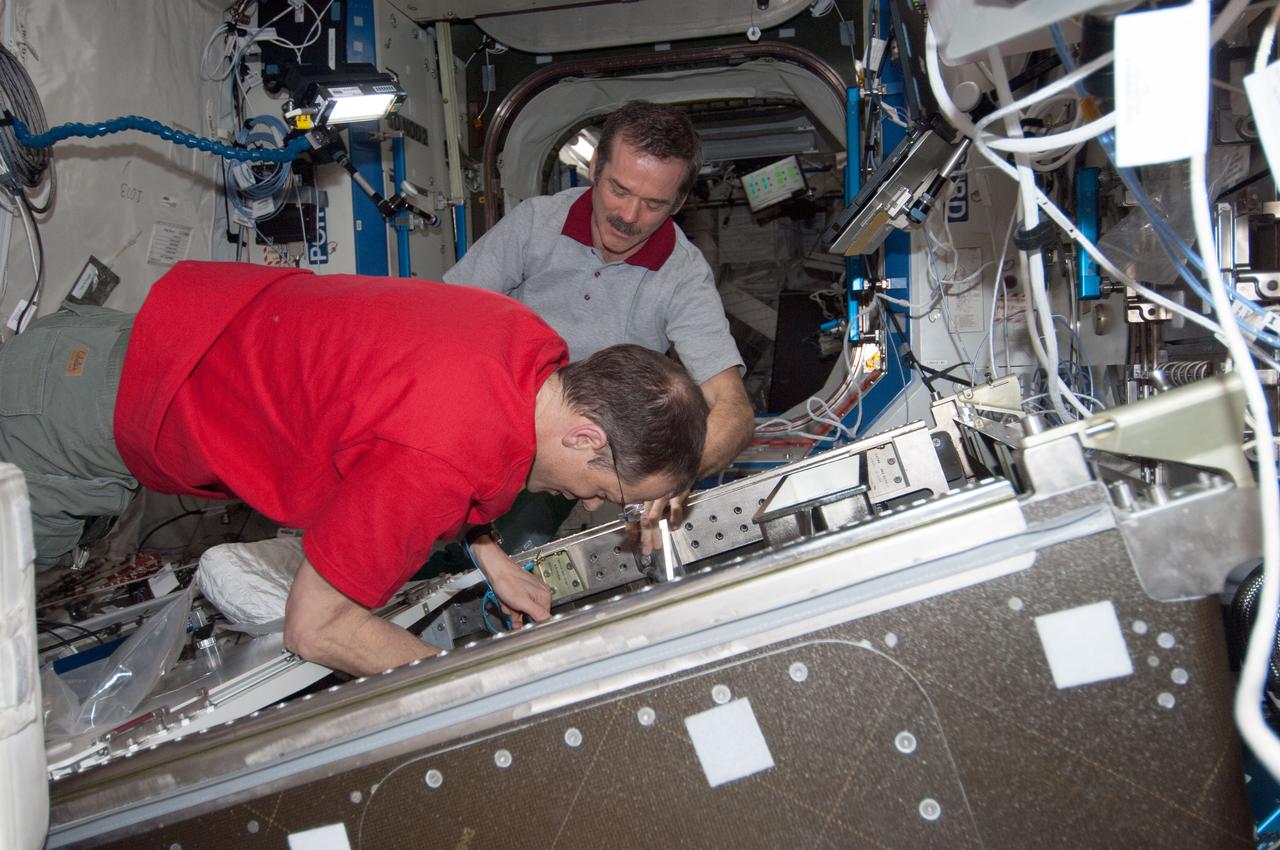
ISS035-E-013790 (2 April 2013) --- In the U.S. lab Destiny on the International Space Station, Expedition 35 Commander Chris Hadfield (background) and Flight Engineer Tom Marshburn remove the Video Baseband Signal Processor (VBSP) in order to replace it with a new Ku communication unit and its associated data and Ethernet cabling.
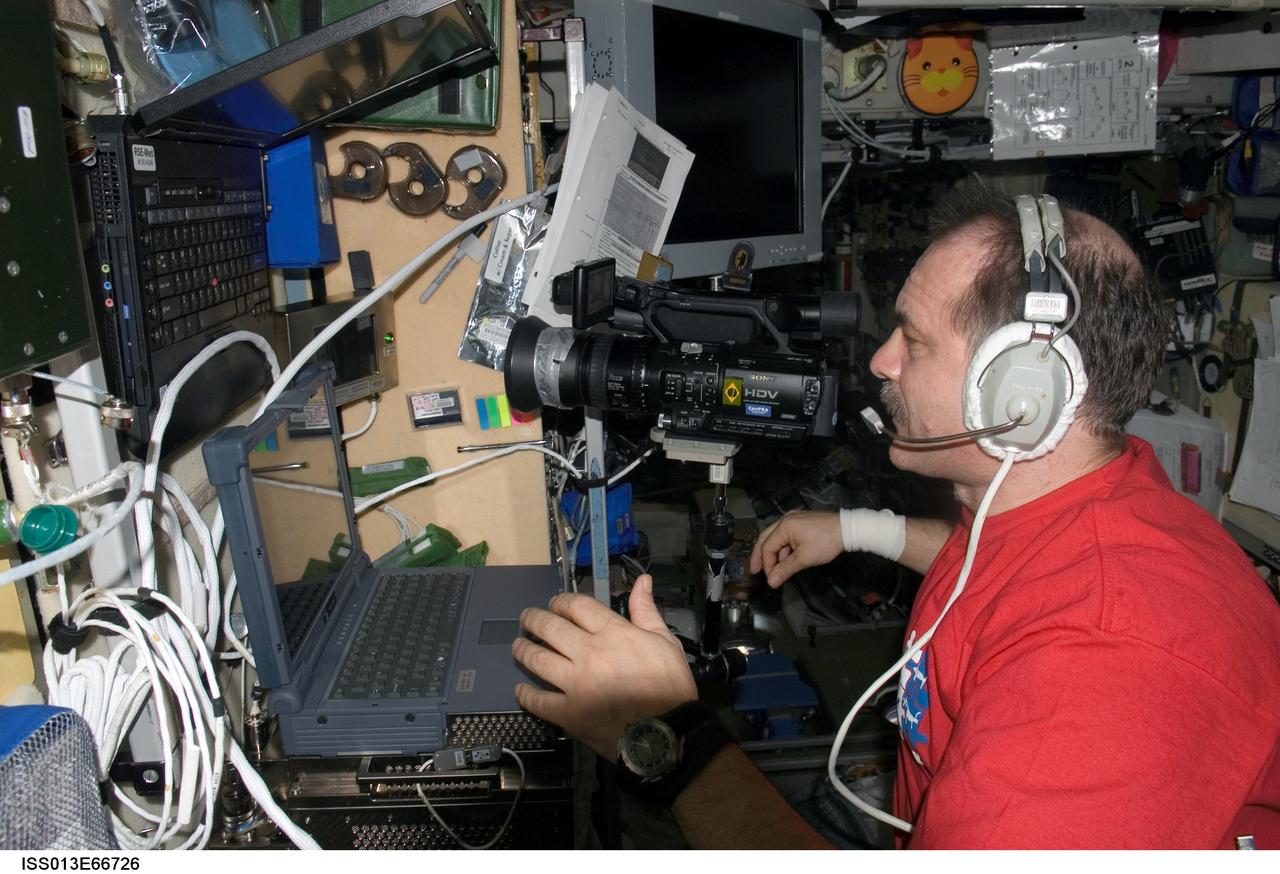
ISS013-E-66726 (August 2006) --- Cosmonaut Pavel V. Vinogradov, Expedition 13 commander representing Russia's Federal Space Agency, wears a communication system headset while using a video camcorder and computer in the Zvezda Service Module of the International Space Station.
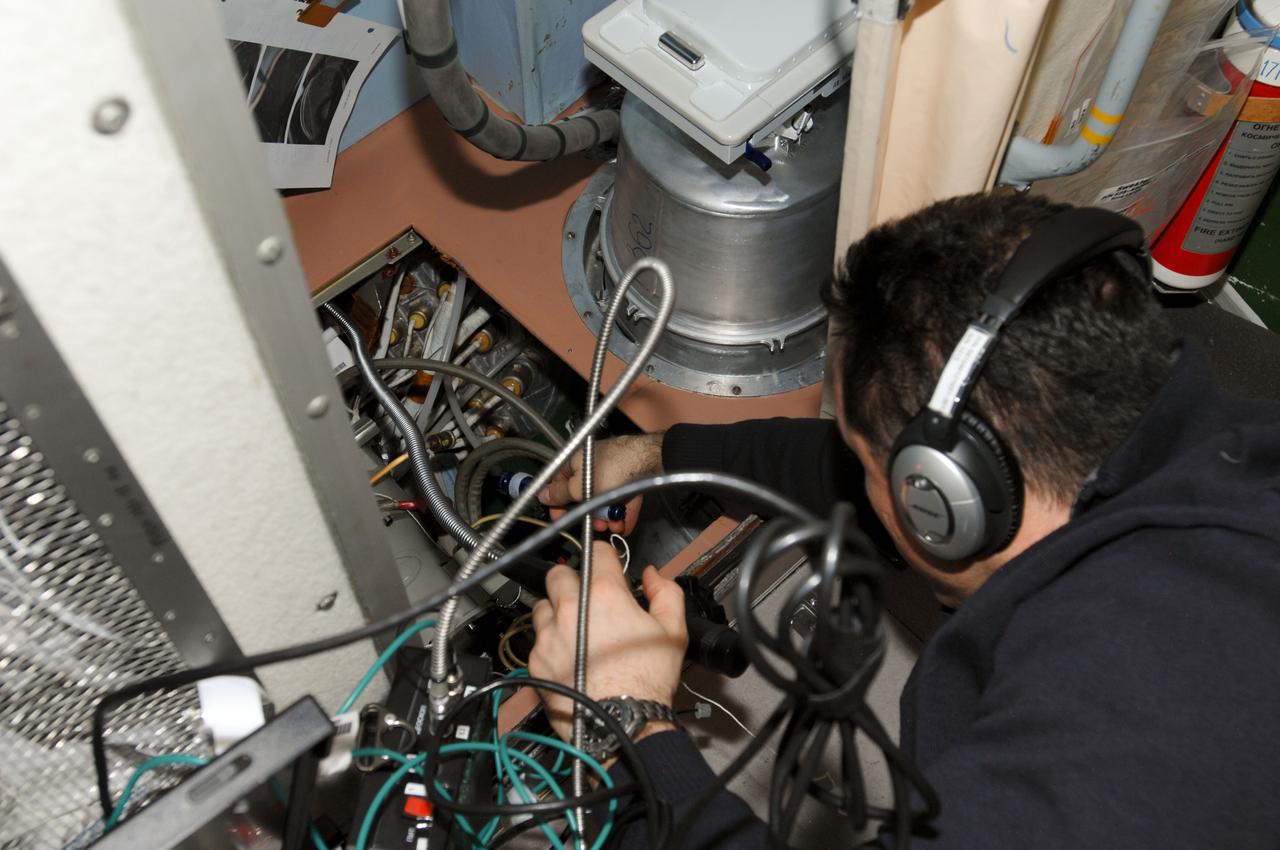
ISS030-E-021041 (5 Jan. 2012) --- Russian cosmonaut Anton Shkaplerov, Expedition 30 flight engineer, wears a communication system headset while working with a video display unit in the Zvezda Service Module of the International Space Station.

The communication antenna is used primarily for test flights to receive downlink flight data and video from test aircraft and also to support command uplink of data to test aircraft for command and control. It is one of two such assets of the Dryden Aeronautical Test Range at NASA’s Armstrong Flight Research Center in California.
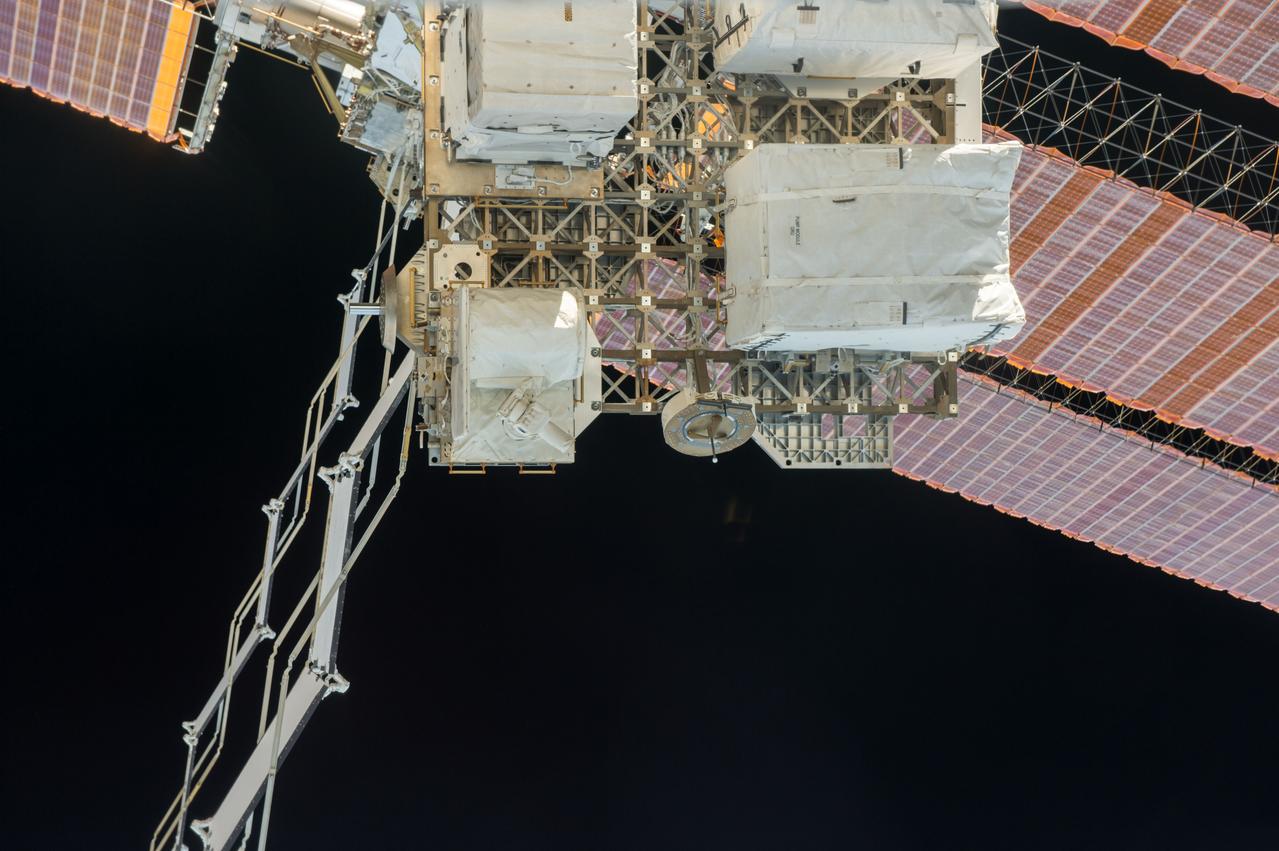
iss048e057073 (8/12/2016) --- A view of Optical Payload for Lasercomm Science (OPALS) installed on ExPRESS (Expedite the Processing of Experiments to Space Station) Logistics Carrier-1 (ELC-1). The Optical Payload for Lasercomm Science (OPALS) aims to demonstrate optical communications technology. This is accomplished by transferring a video from hardware onboard the ISS to our ground receiver at JPL’s Optical Communications Telescope Laboratory (OCTL) in Wrightwood, California.
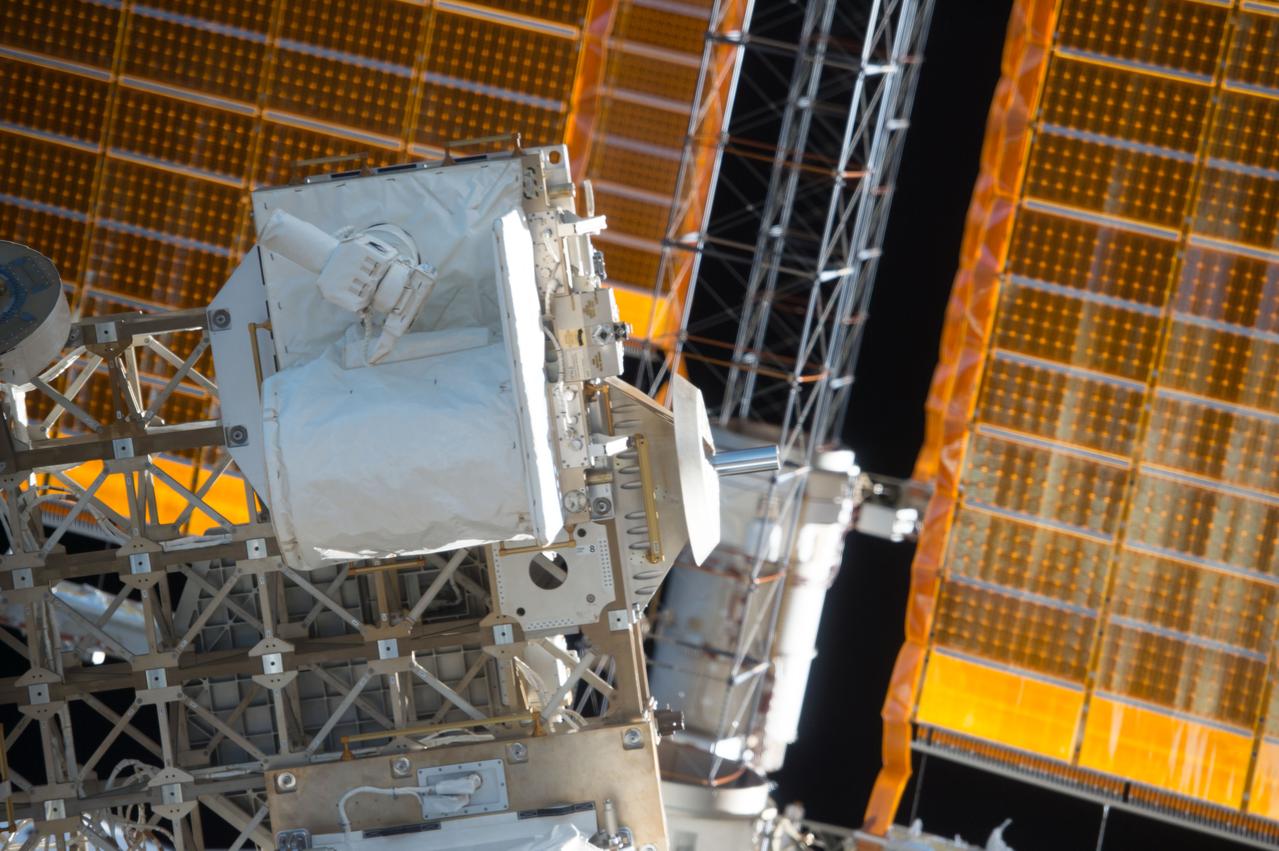
iss048e052292 (8/6/2016) --- A view of Optical Payload for Lasercomm Science (OPALS) installed on ExPRESS (Expedite the Processing of Experiments to Space Station) Logistics Carrier-1 (ELC-1). The Optical Payload for Lasercomm Science (OPALS) aims to demonstrate optical communications technology. This is accomplished by transferring a video from hardware onboard the ISS to our ground receiver at JPL’s Optical Communications Telescope Laboratory (OCTL) in Wrightwood, California.

Michelle Jones, NASA’s deputy associate administrator for communications, left, and Aya Collins, director of the engagement division of NASA’s Office of Communications, record a video for social media in front of the mural “To the Moon, and Back” by the New York-based artist team Geraluz and WERC that was created as part of the reimagined NASA Art Program, Tuesday, September 24, 2024, in New York City’s Hudson Square neighborhood. For the inaugural project of the reestablished NASA Art Program the agency collaborated with the Hudson Square Business Improvement District on an open call for New York-based artists to design and install a large-scale mural inspired by NASA’s work and missions. Photo Credit: (NASA/Joel Kowsky)

These photos and videos show NASA astronauts Bob Hines and Raja Chari practicing landing procedures in the Rocky Mounts of Colorado in April 2025. The astronauts were participating in a NASA-specific course at the HAATS (High-Altitude Army National Guard Aviation Training Site) in Gypsum, Colorado. NASA and the Colorado Army National Guard are using military helicopters to develop a foundational lunar lander simulated flight training course to help astronauts practice flight and landing procedures for the Moon. For more information, contact NASA Marshall’s Office of Communications at 256-544-0034.
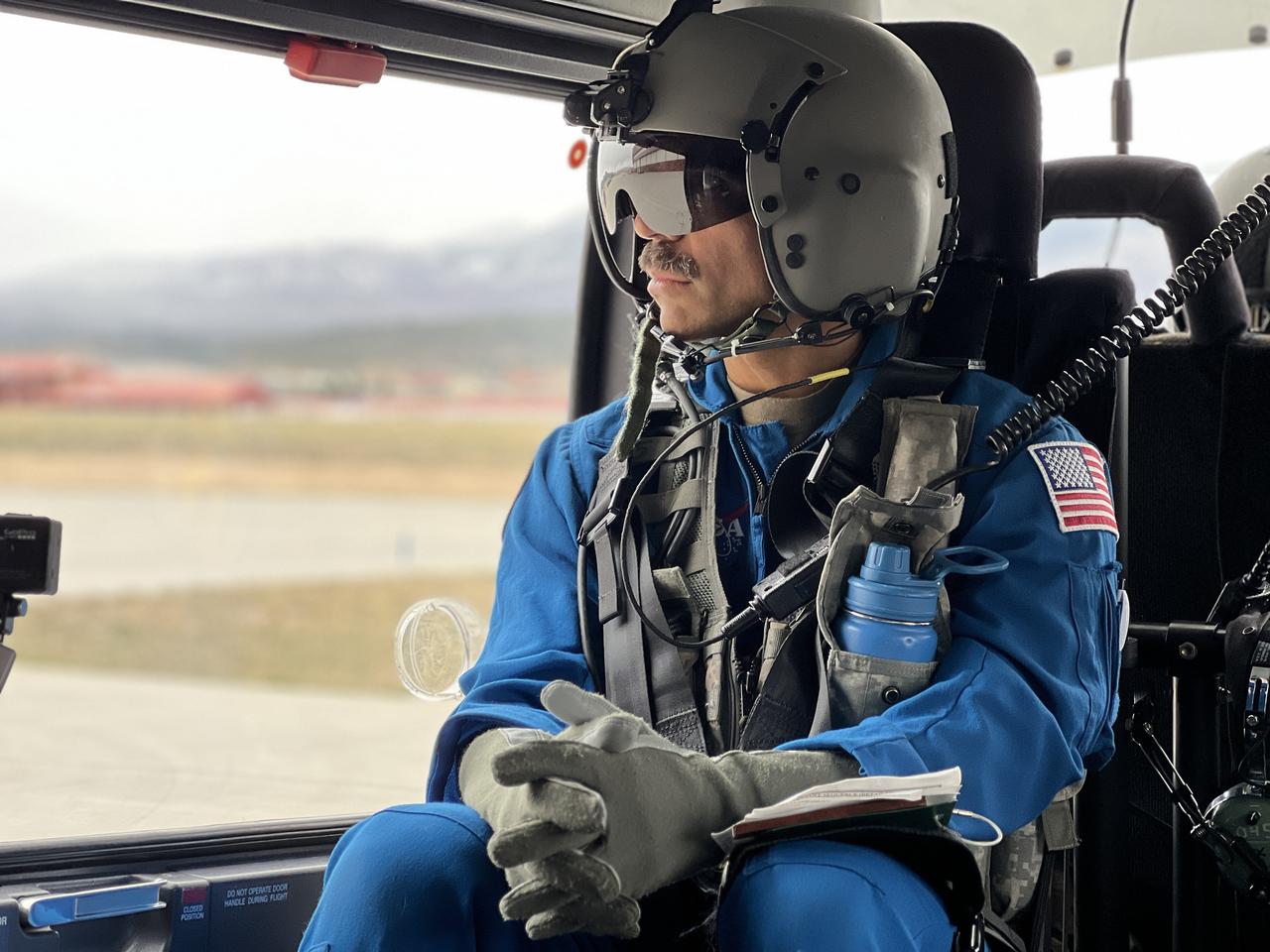
These photos and videos show NASA astronauts Bob Hines and Raja Chari practicing landing procedures in the Rocky Mounts of Colorado in April 2025. The astronauts were participating in a NASA-specific course at the HAATS (High-Altitude Army National Guard Aviation Training Site) in Gypsum, Colorado. NASA and the Colorado Army National Guard are using military helicopters to develop a foundational lunar lander simulated flight training course to help astronauts practice flight and landing procedures for the Moon. For more information, contact NASA Marshall’s Office of Communications at 256-544-0034.
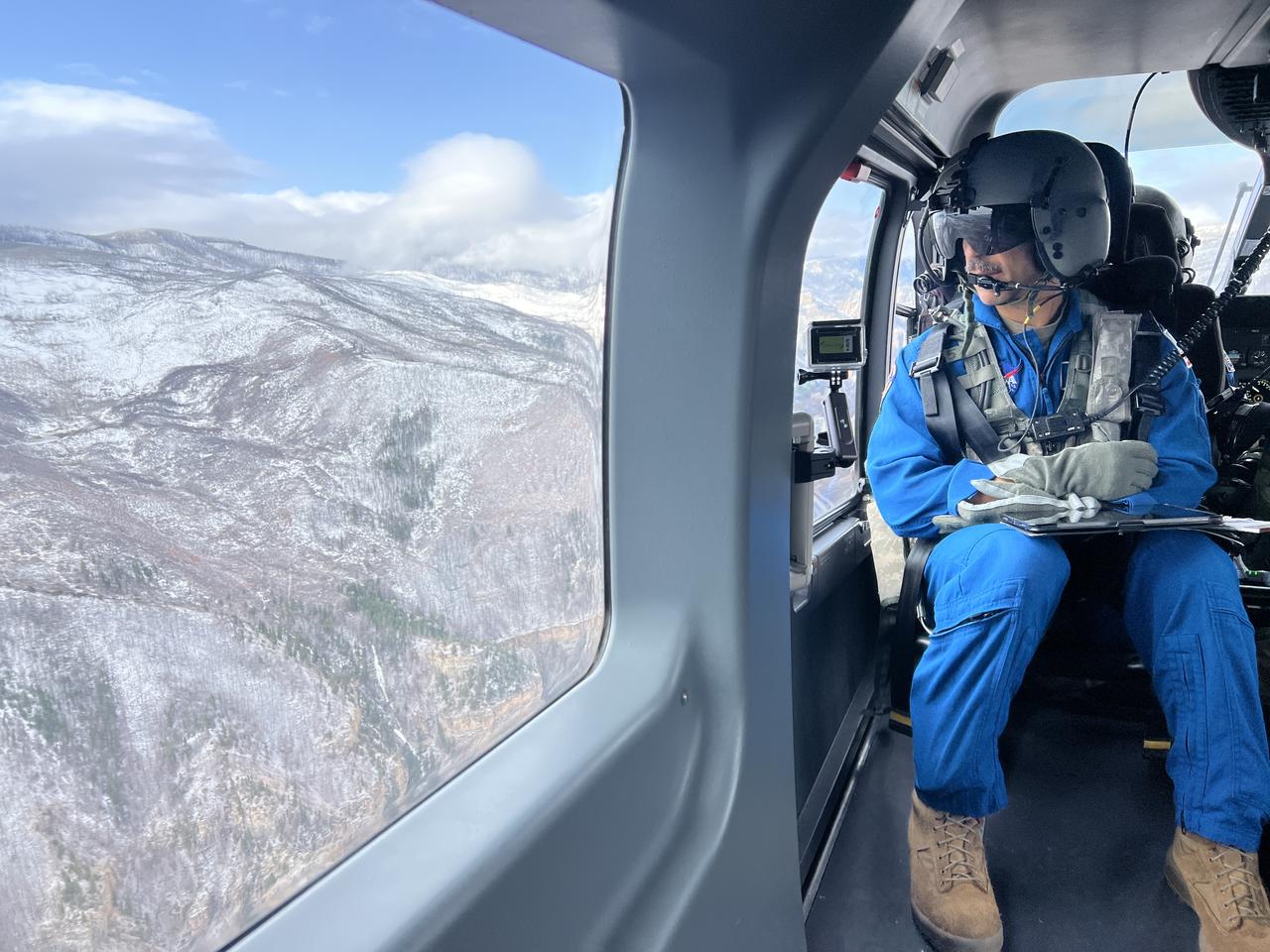
These photos and videos show NASA astronauts Bob Hines and Raja Chari practicing landing procedures in the Rocky Mounts of Colorado in April 2025. The astronauts were participating in a NASA-specific course at the HAATS (High-Altitude Army National Guard Aviation Training Site) in Gypsum, Colorado. NASA and the Colorado Army National Guard are using military helicopters to develop a foundational lunar lander simulated flight training course to help astronauts practice flight and landing procedures for the Moon. For more information, contact NASA Marshall’s Office of Communications at 256-544-0034.
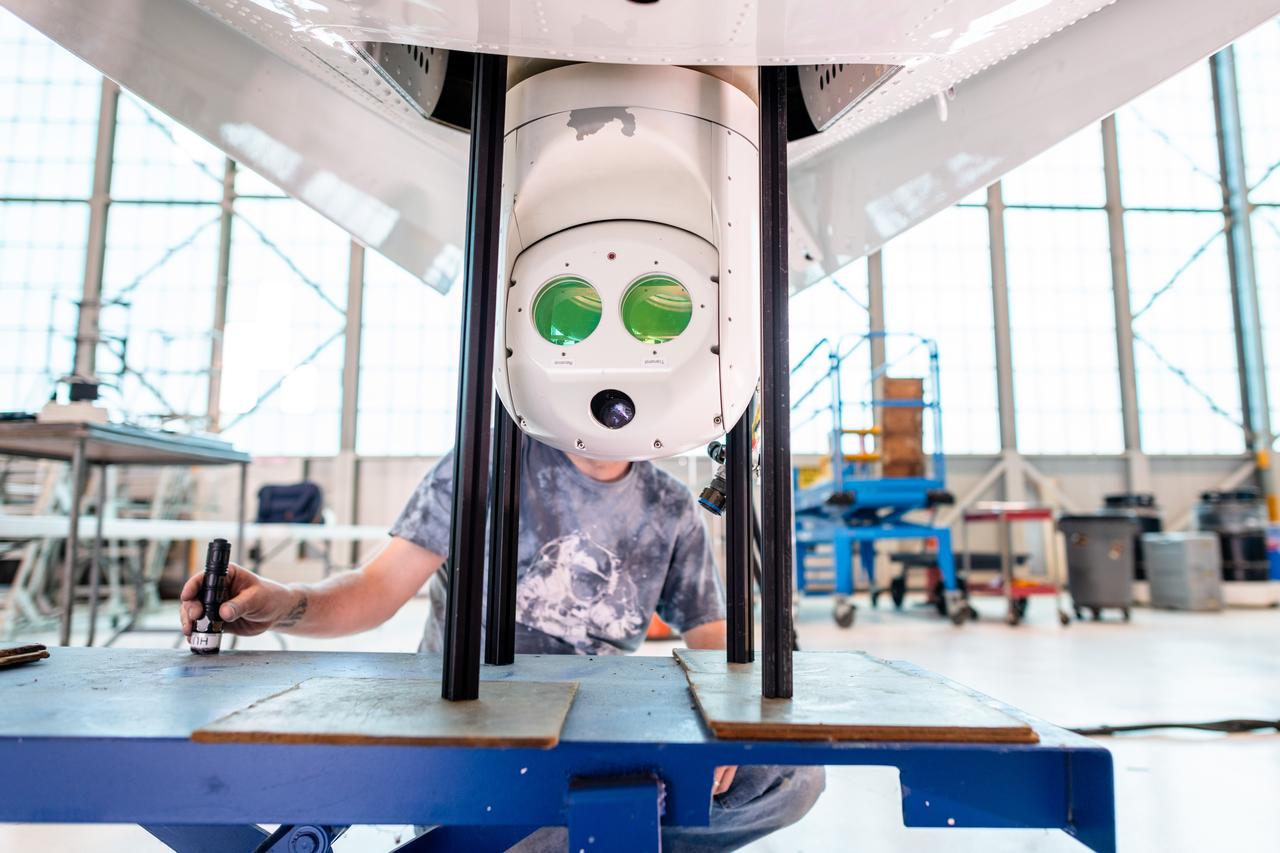
Dave Brennen, an electronics technician, installing the optical system under the belly of the PC-12 aircraft that streamed the first 4K video from aircraft to the International Space Station and back on May 20, 2024. Photo Credit: (NASA/Sara Lowthian-Hanna)
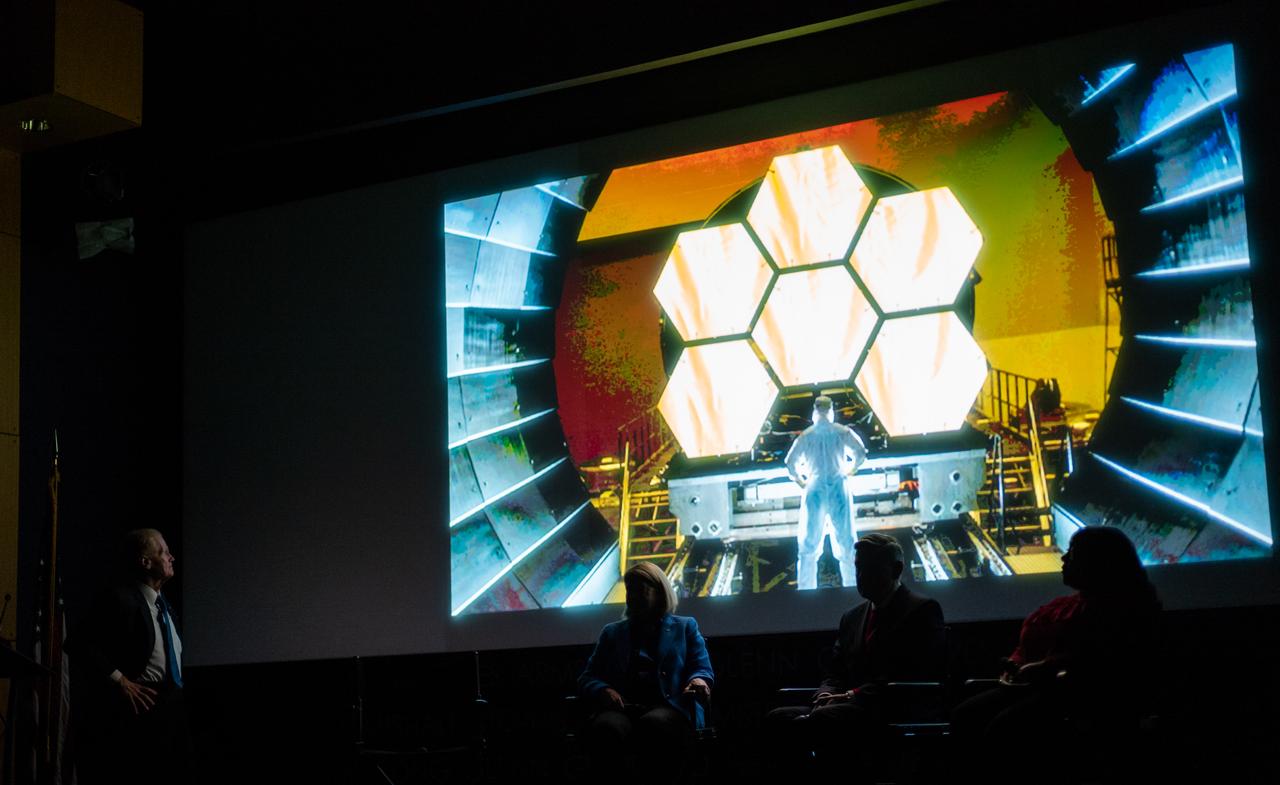
NASA Administrator Bill Nelson, left, NASA Deputy Administrator Pam Melroy, second from left, NASA Associate Administrator Bob Cabana, second from right, and Michelle Jones of NASA Communication, are seen as a video is shown during an end-of-the year all hands with senior leadership, uesday, Dec. 13, 2022, at the Mary W. Jackson NASA Headquarters building in Washington. Nelson, Melroy, and Cabana highlighted the agency’s 2022 accomplishments and looked forward to what is coming in 2023 and beyond. Photo Credit: (NASA/Joel Kowsky)
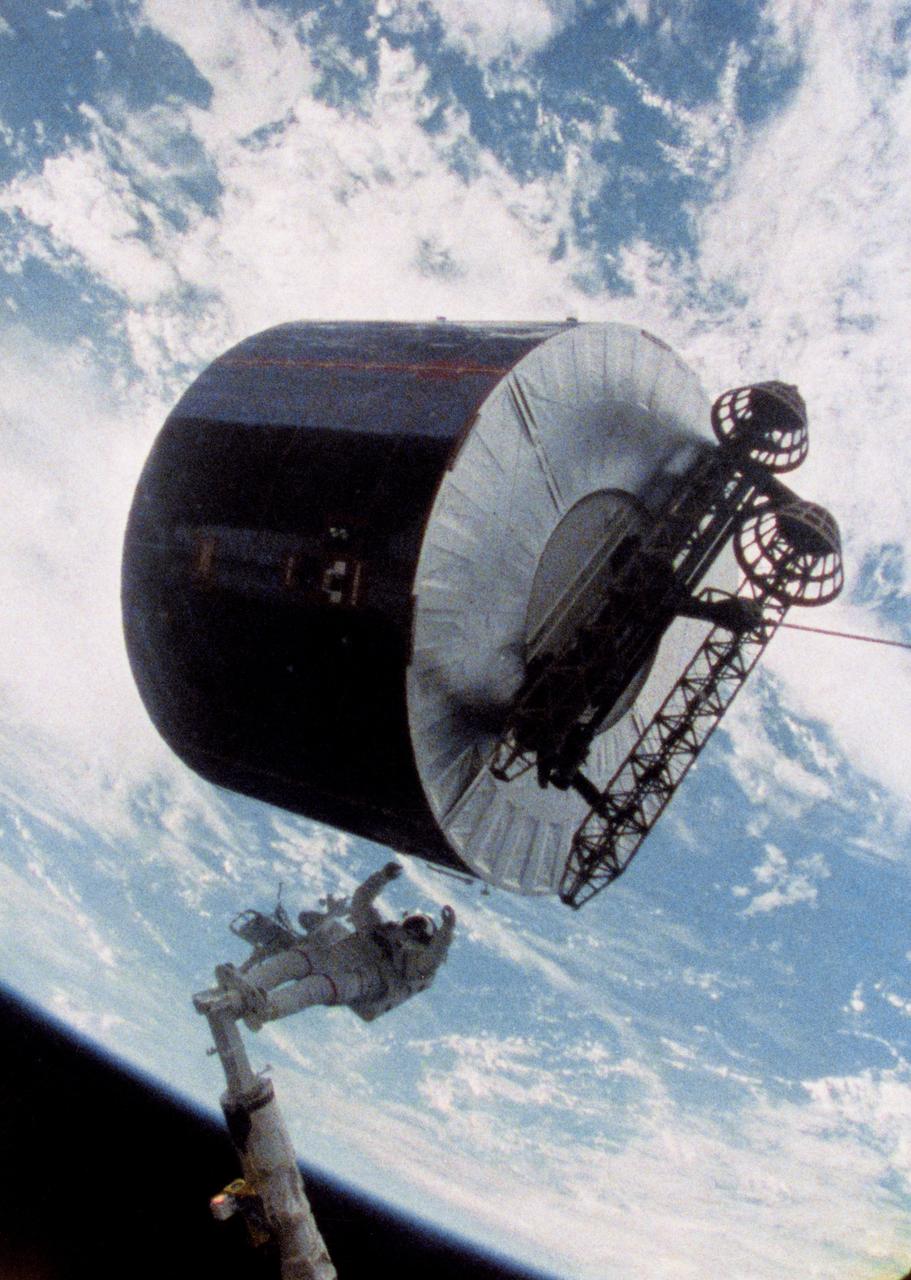
51I-S-237 (1 Sept. 1985) --- A still photo made from a video downlink shows astronaut James D. van Hoften, just after giving a shove to the Syncom IV-3 communications satellite. NASA's 51-I astronaut crew aboard the space shuttle Discovery had earlier captured and repaired the previously errant satellite. Photo credit: NASA
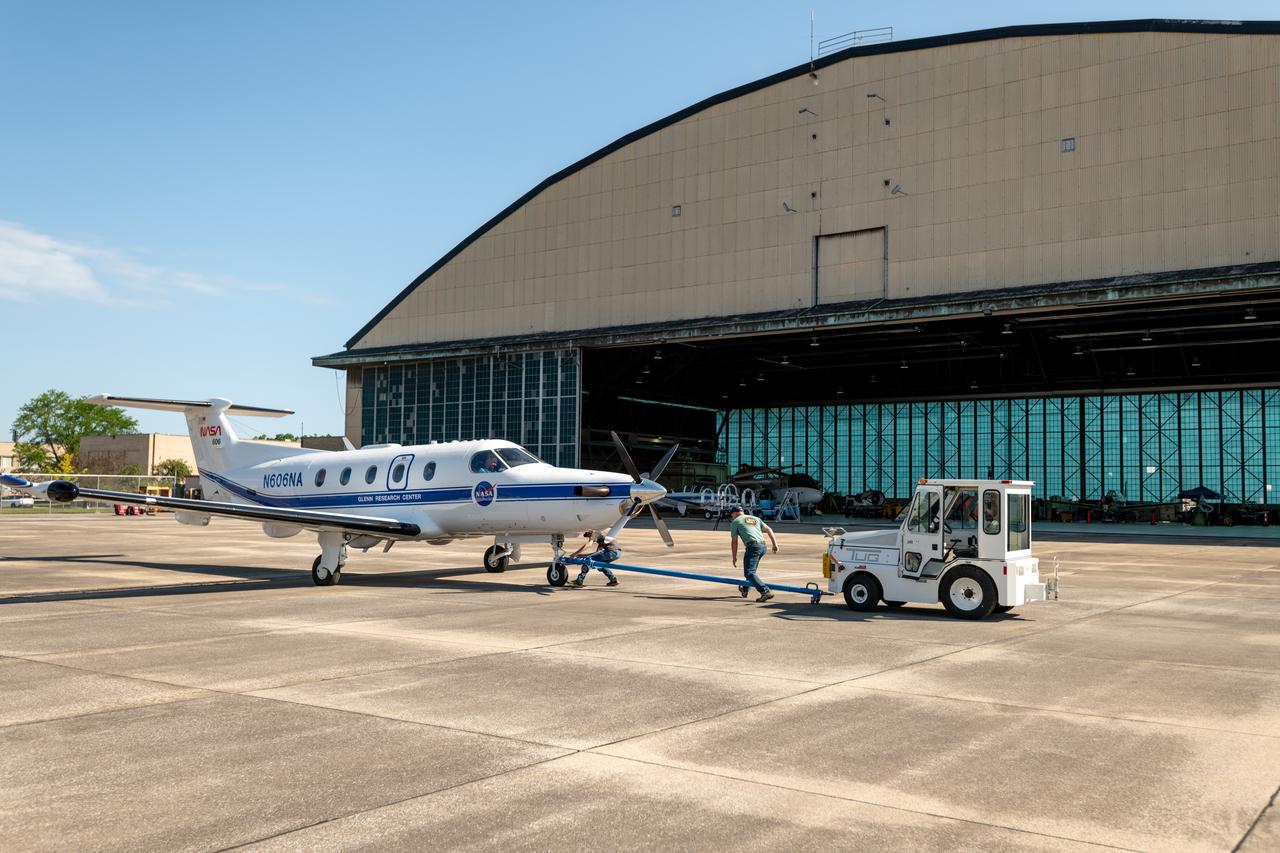
A team at NASA’s Glenn Research Center in Cleveland streamed 4K video footage from an aircraft to the International Space Station and back for the first time using optical, or laser, communications. The feat was part of a series of tests on new technology that could provide live video coverage of astronauts on the Moon during the Artemis missions. Working with the Air Force Research Laboratory and NASA’s Small Business Innovation Research program, Glenn engineers temporarily installed a portable laser terminal on the belly of a Pilatus PC-12 aircraft. They then flew over Lake Erie sending data from the aircraft to an optical ground station in Cleveland. From there, it was sent over an Earth-based network to NASA’s White Sands Test Facility in Las Cruces, New Mexico, where scientists used infrared light signals to send the data.

A team at NASA’s Glenn Research Center in Cleveland streamed 4K video footage from an aircraft to the International Space Station and back for the first time using optical, or laser, communications. The feat was part of a series of tests on new technology that could provide live video coverage of astronauts on the Moon during the Artemis missions. Working with the Air Force Research Laboratory and NASA’s Small Business Innovation Research program, Glenn engineers temporarily installed a portable laser terminal on the belly of a Pilatus PC-12 aircraft. They then flew over Lake Erie sending data from the aircraft to an optical ground station in Cleveland. From there, it was sent over an Earth-based network to NASA’s White Sands Test Facility in Las Cruces, New Mexico, where scientists used infrared light signals to send the data. Photo Credit: (NASA/Sara Lowthian-Hanna)
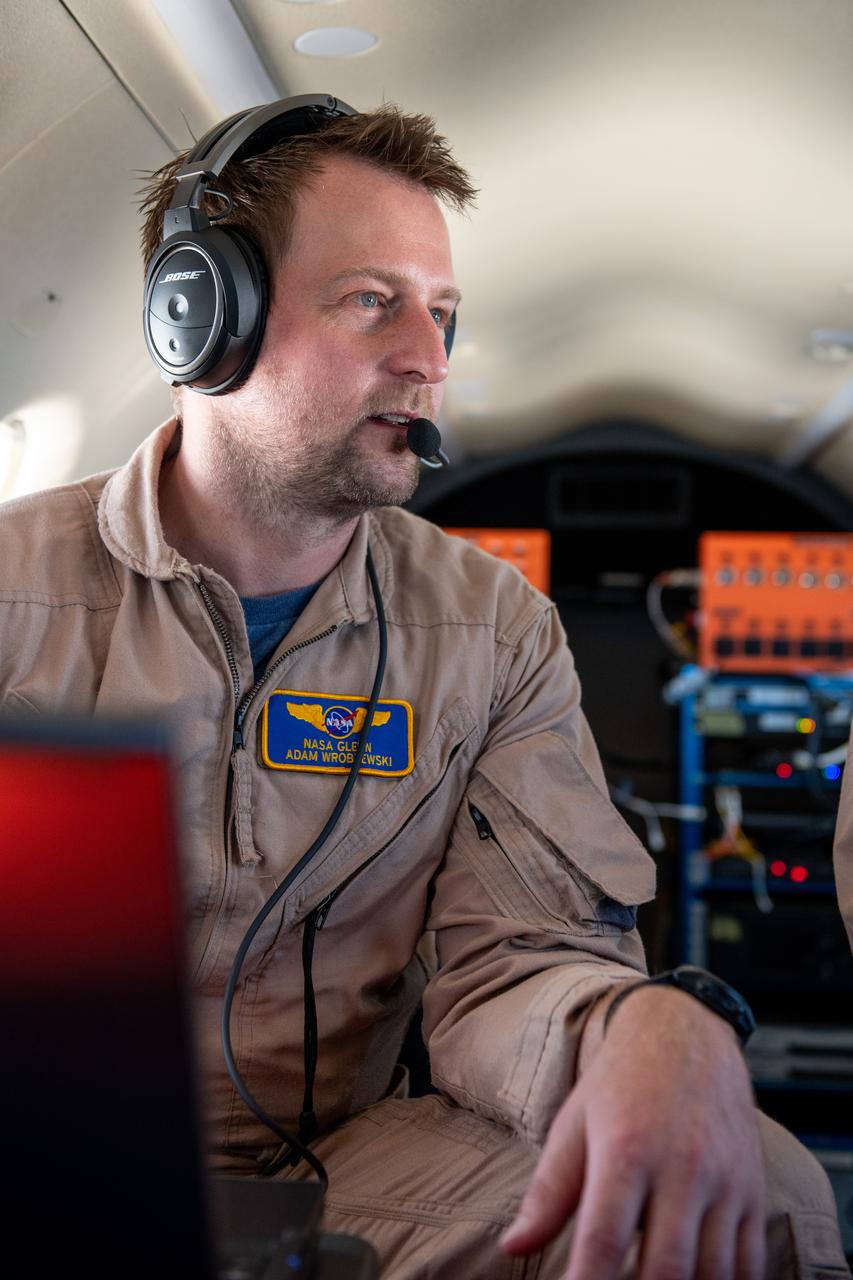
Adam Wroblewski p A team at NASA’s Glenn Research Center in Cleveland streamed 4K video footage from an aircraft to the International Space Station and back for the first time using optical, or laser, communications. The feat was part of a series of tests on new technology that could provide live video coverage of astronauts on the Moon during the Artemis missions. Working with the Air Force Research Laboratory and NASA’s Small Business Innovation Research program, Glenn engineers temporarily installed a portable laser terminal on the belly of a Pilatus PC-12 aircraft. Adam Wroblewski in the PC-12 over Lake Erie on June 13, 2024 sending data from the aircraft to an optical ground station in Cleveland. From there, it was sent over an Earth-based network to NASA’s White Sands Test Facility in Las Cruces, New Mexico, where scientists used infrared light signals to send the data. Photo Credit: (NASA/Sara Lowthian-Hanna)
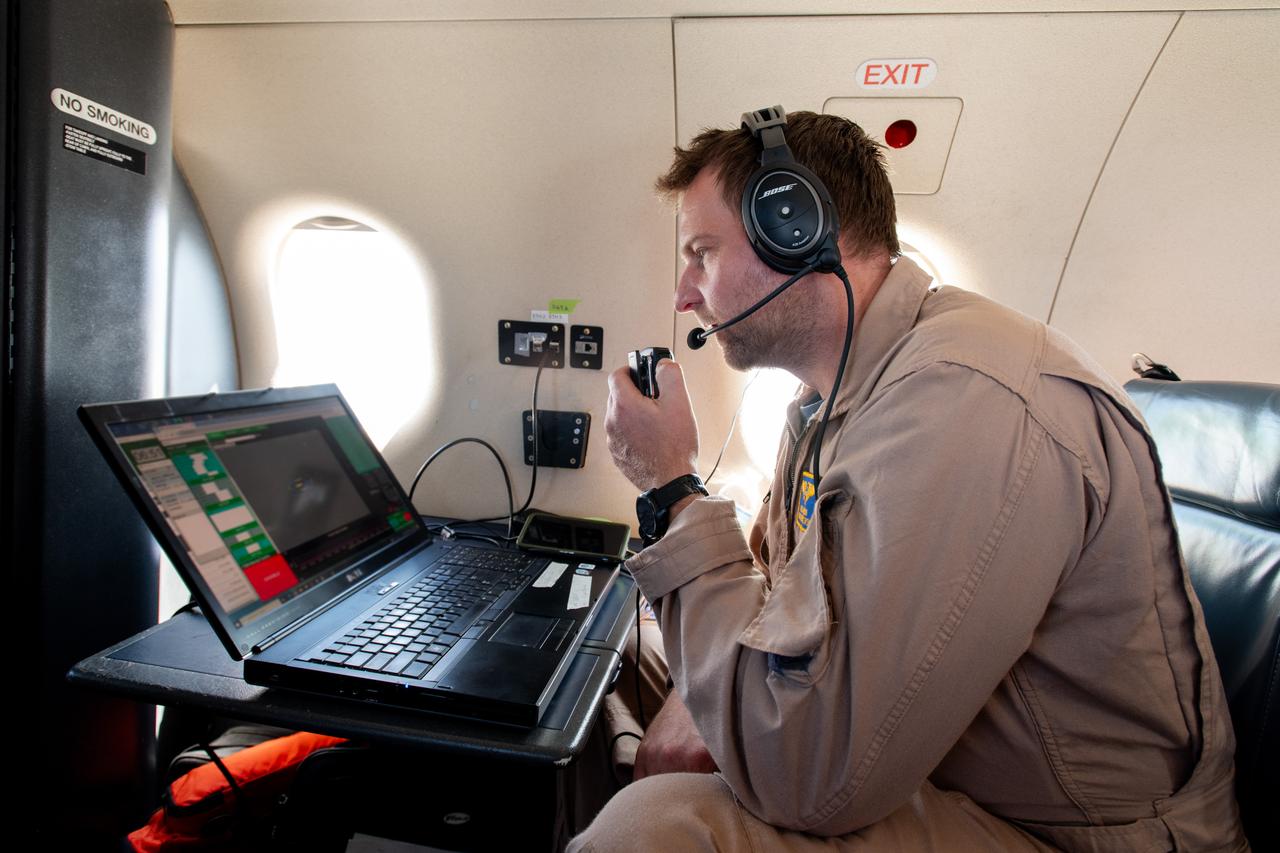
A team at NASA’s Glenn Research Center in Cleveland streamed 4K video footage from an aircraft to the International Space Station and back for the first time using optical, or laser, communications. The feat was part of a series of tests on new technology that could provide live video coverage of astronauts on the Moon during the Artemis missions. Working with the Air Force Research Laboratory and NASA’s Small Business Innovation Research program, Glenn engineers temporarily installed a portable laser terminal on the belly of a Pilatus PC-12 aircraft. They then flew over Lake Erie sending data from the aircraft to an optical ground station in Cleveland. From there, it was sent over an Earth-based network to NASA’s White Sands Test Facility in Las Cruces, New Mexico, where scientists used infrared light signals to send the data. Photo Credit: (NASA/Sara Lowthian-Hanna)
A team at NASA’s Glenn Research Center in Cleveland streamed 4K video footage from an aircraft to the International Space Station and back for the first time using optical, or laser, communications. The feat was part of a series of tests on new technology that could provide live video coverage of astronauts on the Moon during the Artemis missions. Working with the Air Force Research Laboratory and NASA’s Small Business Innovation Research program, Glenn engineers temporarily installed a portable laser terminal on the belly of a Pilatus PC-12 aircraft. They then flew over Lake Erie sending data from the aircraft to an optical ground station in Cleveland. From there, it was sent over an Earth-based network to NASA’s White Sands Test Facility in Las Cruces, New Mexico, where scientists used infrared light signals to send the data.
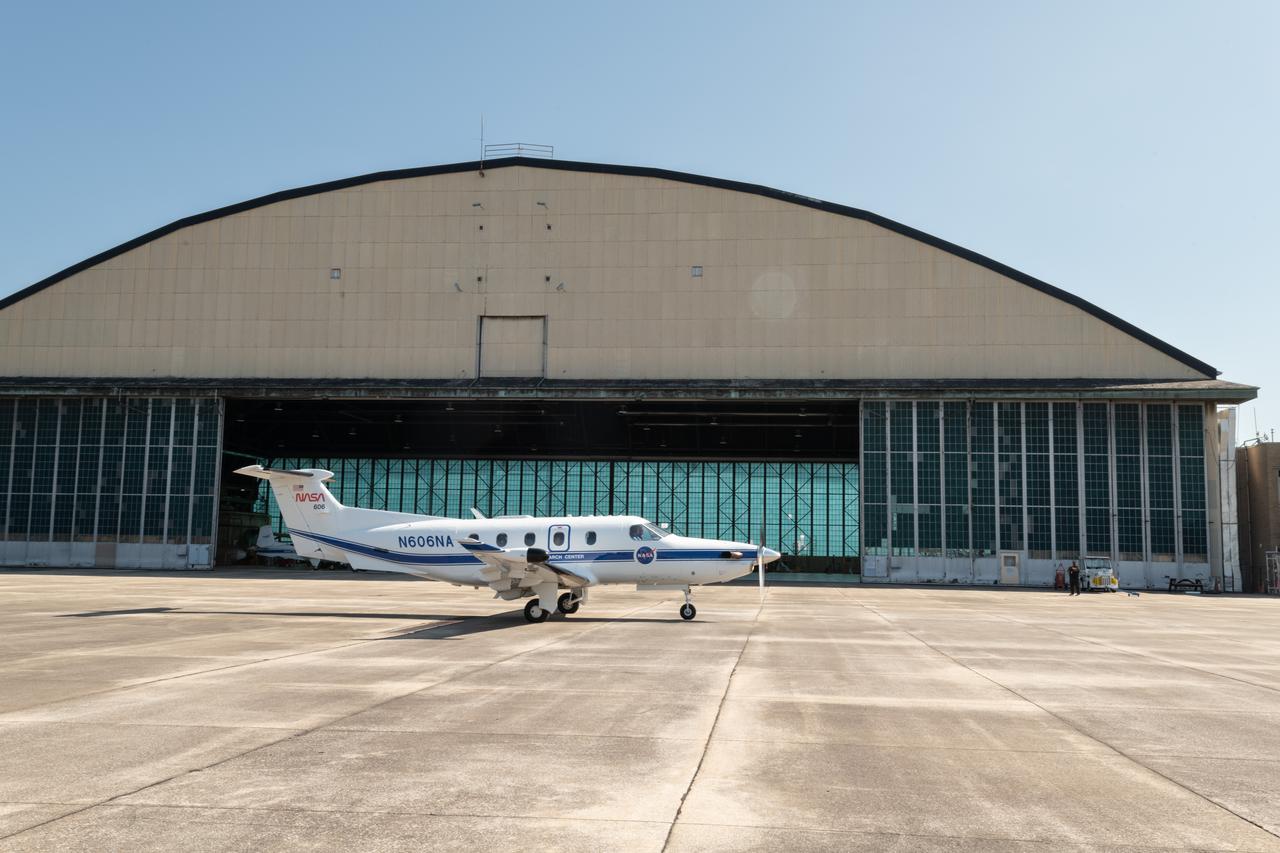
A team at NASA’s Glenn Research Center in Cleveland streamed 4K video footage from an aircraft to the International Space Station and back for the first time using optical, or laser, communications. The feat was part of a series of tests on new technology that could provide live video coverage of astronauts on the Moon during the Artemis missions. Working with the Air Force Research Laboratory and NASA’s Small Business Innovation Research program, Glenn engineers temporarily installed a portable laser terminal on the belly of a Pilatus PC-12 aircraft. They then flew over Lake Erie sending data from the aircraft to an optical ground station in Cleveland. From there, it was sent over an Earth-based network to NASA’s White Sands Test Facility in Las Cruces, New Mexico, where scientists used infrared light signals to send the data.
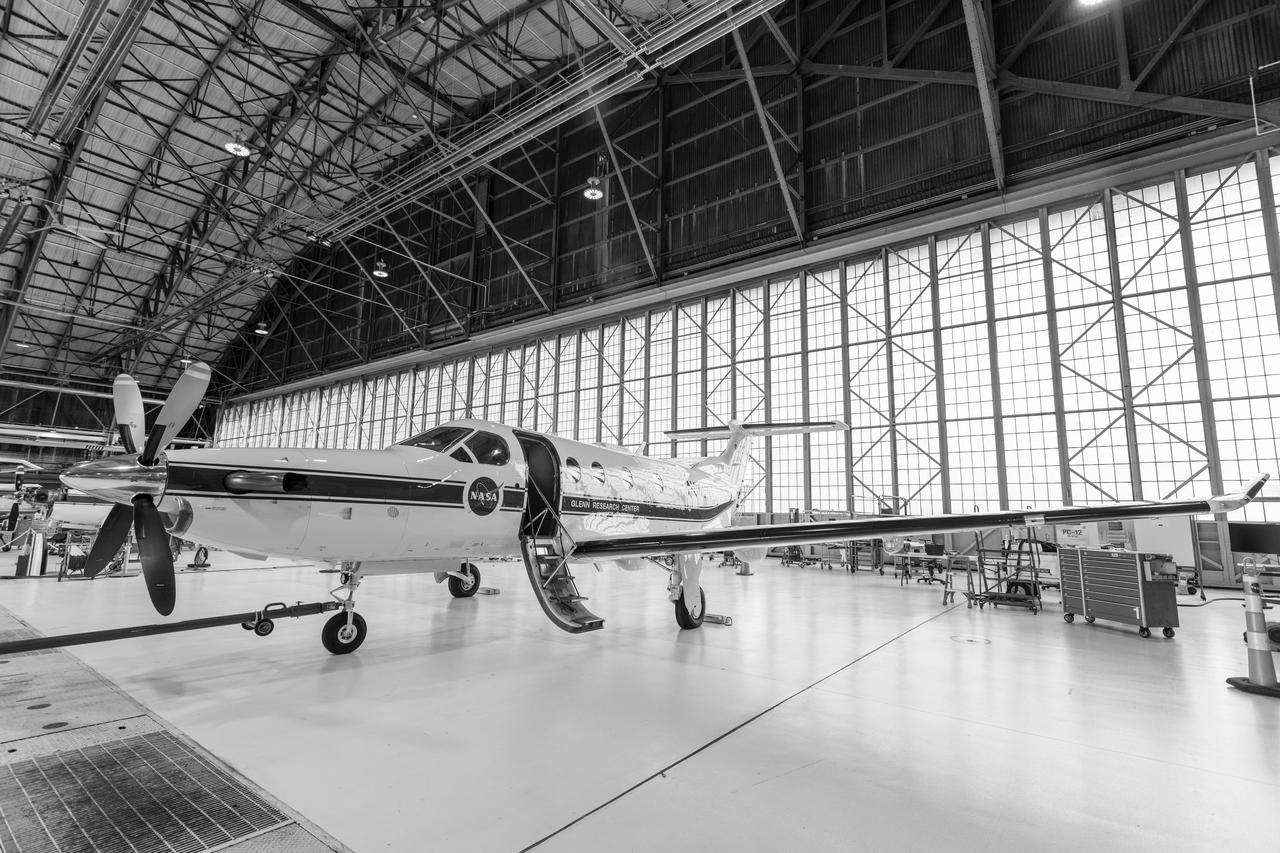
A team at NASA’s Glenn Research Center in Cleveland streamed 4K video footage from an aircraft to the International Space Station and back for the first time using optical, or laser, communications. The feat was part of a series of tests on new technology that could provide live video coverage of astronauts on the Moon during the Artemis missions. Working with the Air Force Research Laboratory and NASA’s Small Business Innovation Research program, Glenn engineers temporarily installed a portable laser terminal on the belly of a Pilatus PC-12 aircraft. They then flew over Lake Erie sending data from the aircraft to an optical ground station in Cleveland. From there, it was sent over an Earth-based network to NASA’s White Sands Test Facility in Las Cruces, New Mexico, where scientists used infrared light signals to send the data.
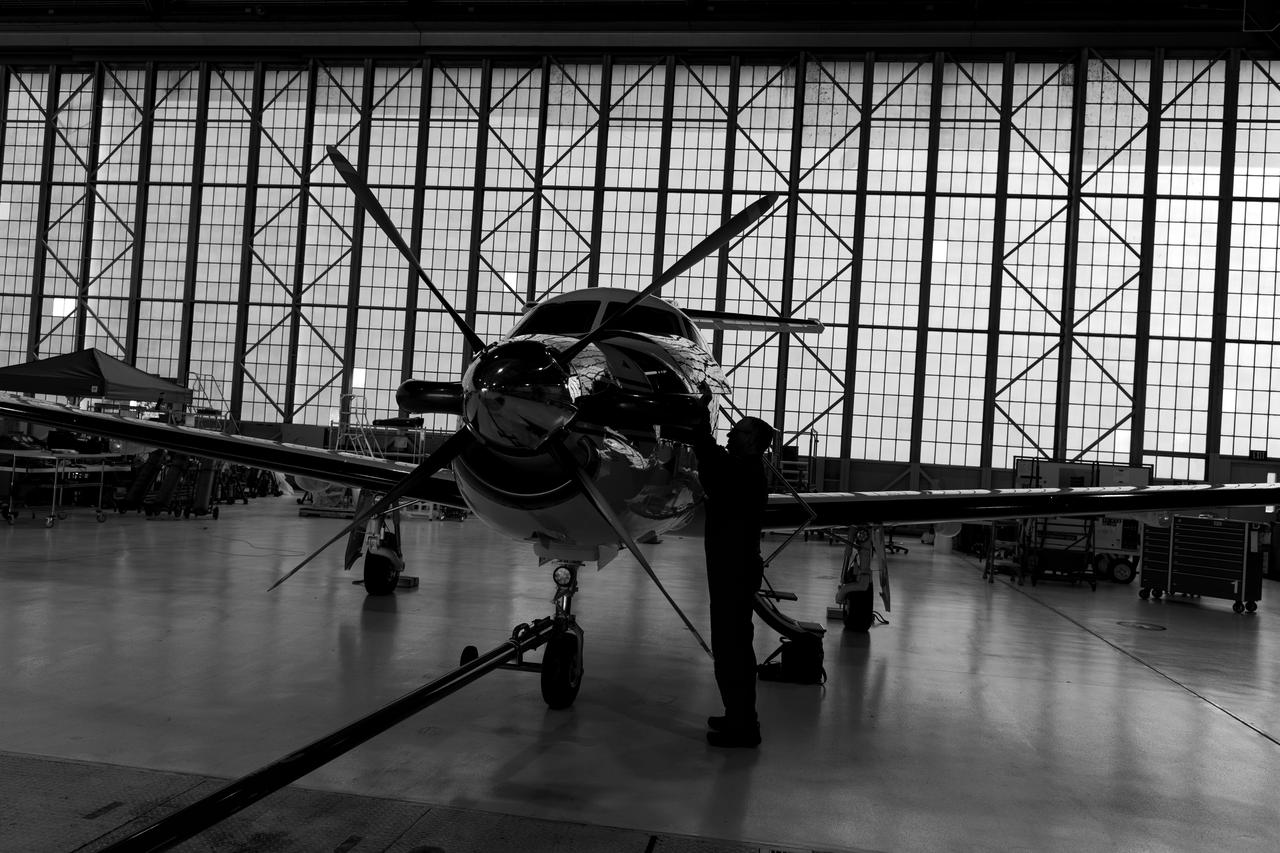
Pilatus PC-12 Aircraft Being Prepped for Takeoff on June 12, 2024. A team at NASA’s Glenn Research Center in Cleveland streamed 4K video footage from an aircraft to the International Space Station and back for the first time using optical, or laser, communications. The feat was part of a series of tests on new technology that could provide live video coverage of astronauts on the Moon during the Artemis missions. Working with the Air Force Research Laboratory and NASA’s Small Business Innovation Research program, Glenn engineers temporarily installed a portable laser terminal on the belly of a Pilatus PC-12 aircraft. They then flew over Lake Erie sending data from the aircraft to an optical ground station in Cleveland. From there, it was sent over an Earth-based network to NASA’s White Sands Test Facility in Las Cruces, New Mexico, where scientists used infrared light signals to send the data. Photo Credit: (NASA/Sara Lowthian-Hanna)

A team at NASA’s Glenn Research Center in Cleveland streamed 4K video footage from an aircraft to the International Space Station and back for the first time using optical, or laser, communications. The feat was part of a series of tests on new technology that could provide live video coverage of astronauts on the Moon during the Artemis missions. Working with the Air Force Research Laboratory and NASA’s Small Business Innovation Research program, Glenn engineers temporarily installed a portable laser terminal on the belly of a Pilatus PC-12 aircraft. They then flew over Lake Erie sending data from the aircraft to an optical ground station in Cleveland. From there, it was sent over an Earth-based network to NASA’s White Sands Test Facility in Las Cruces, New Mexico, where scientists used infrared light signals to send the data.

A team at NASA’s Glenn Research Center in Cleveland streamed 4K video footage from an aircraft to the International Space Station and back for the first time using optical, or laser, communications. The feat was part of a series of tests on new technology that could provide live video coverage of astronauts on the Moon during the Artemis missions. Pictured from Left to Right: James Demers, Adam Wroblewski, Shaun McKeehan, Kurt Blankenship. Working with the Air Force Research Laboratory and NASA’s Small Business Innovation Research program, Glenn engineers temporarily installed a portable laser terminal on the belly of a Pilatus PC-12 aircraft. They then flew over Lake Erie sending data from the aircraft to an optical ground station in Cleveland. From there, it was sent over an Earth-based network to NASA’s White Sands Test Facility in Las Cruces, New Mexico, where scientists used infrared light signals to send the data.
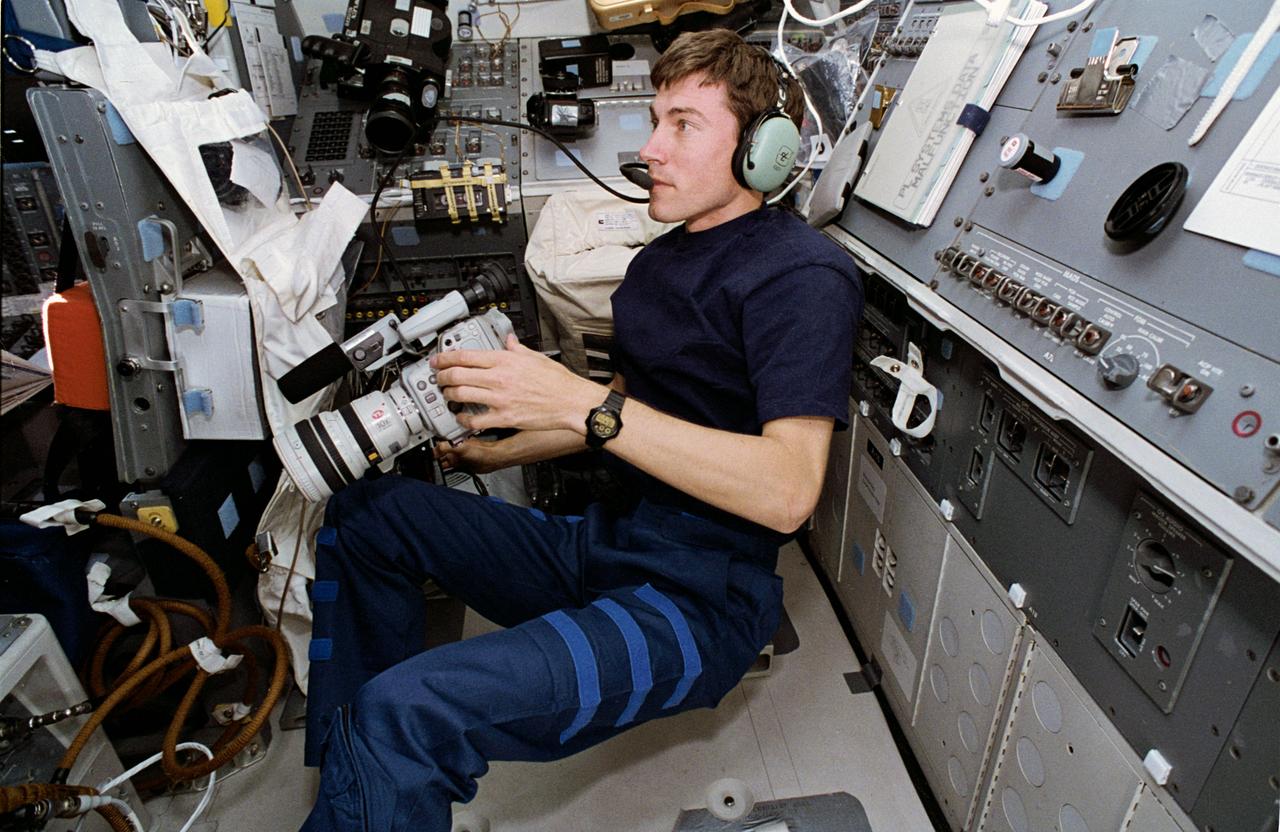
STS60-29-009 (10 Feb 1994) --- On the Space Shuttle Discovery's aft flight deck, Russian cosmonaut Sergei K. Krikalev prepares for one chore while performing another. Using the Shuttle Amateur Radio Experiment (SAREX) gear, the mission specialist was talking with students in Maine. He holds a camcorder, which was later called into action to record inflight activities. Krikalev joined five NASA astronauts for eight days in space aboard Discovery.
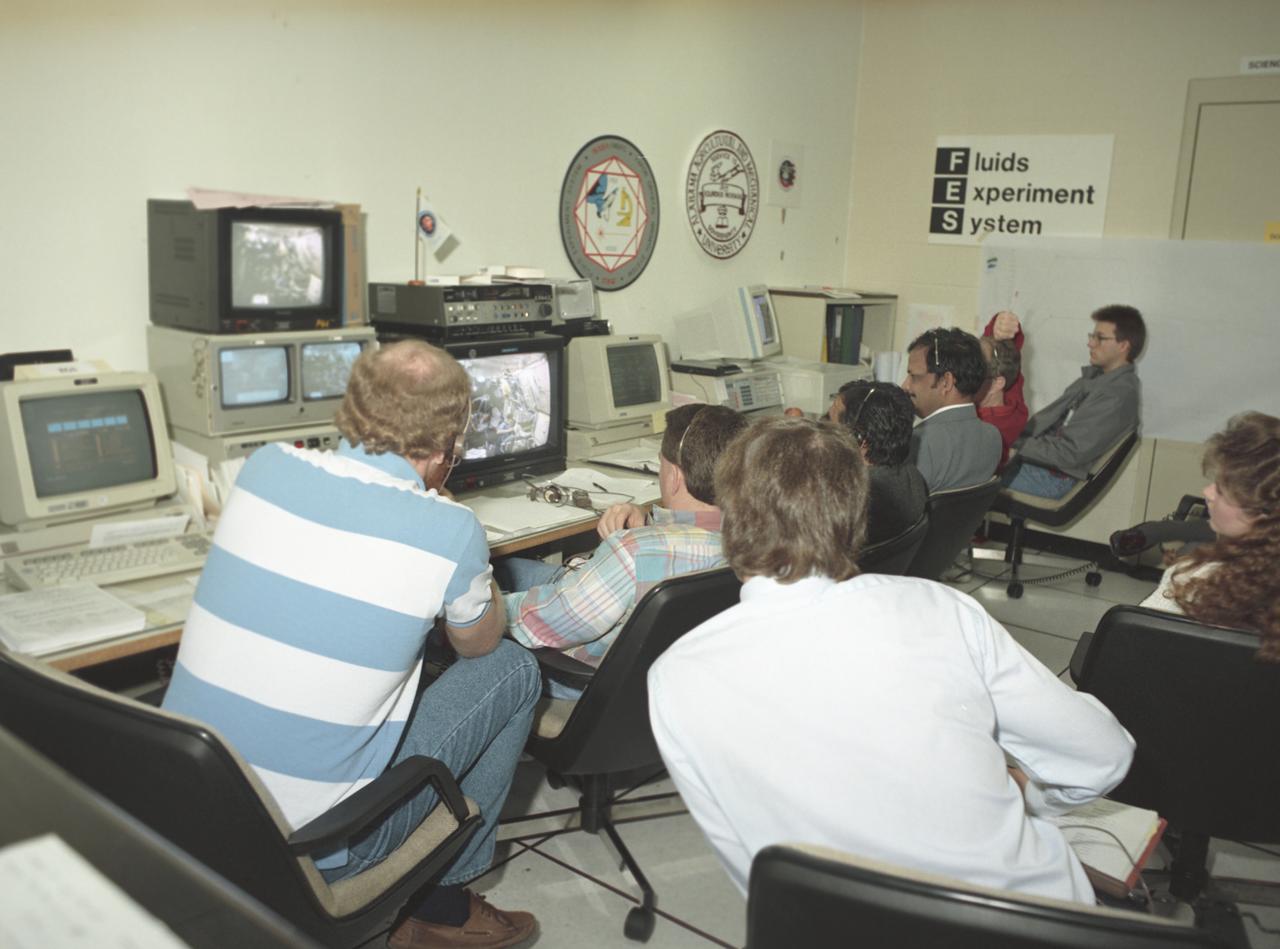
This photograph shows activities during the International Microgravity Laboratory-1 (IML-1) mission (STS-42) in the Payload Operations Control Center (POCC) at the Marshall Space Flight Center. Members of the Fluid Experiment System (FES) group monitor the progress of their experiment through video at the POCC. The IML-1 mission was the first in a series of Shuttle flights dedicated to fundamental materials and life sciences research. The mission was to explore, in depth, the complex effects of weightlessness on living organisms and materials processing. The crew conducted experiments on the human nervous system's adaptation to low gravity and the effects on other life forms such as shrimp eggs, lentil seedlings, fruit fly eggs, and bacteria. Low gravity materials processing experiments included crystal growth from a variety of substances such as enzymes, mercury, iodine, and virus. The International space science research organizations that participated in this mission were: The U.S. National Aeronautics and Space Administion, the European Space Agency, the Canadian Space Agency, the French National Center for Space Studies, the German Space Agency, and the National Space Development Agency of Japan. The POCC was the air/ground communication charnel used between astronauts aboard the Spacelab and scientists, researchers, and ground control teams during the Spacelab missions. The facility made instantaneous video and audio communications possible for scientists on the ground to follow the progress and to send direct commands of their research almost as if they were in space with the crew.
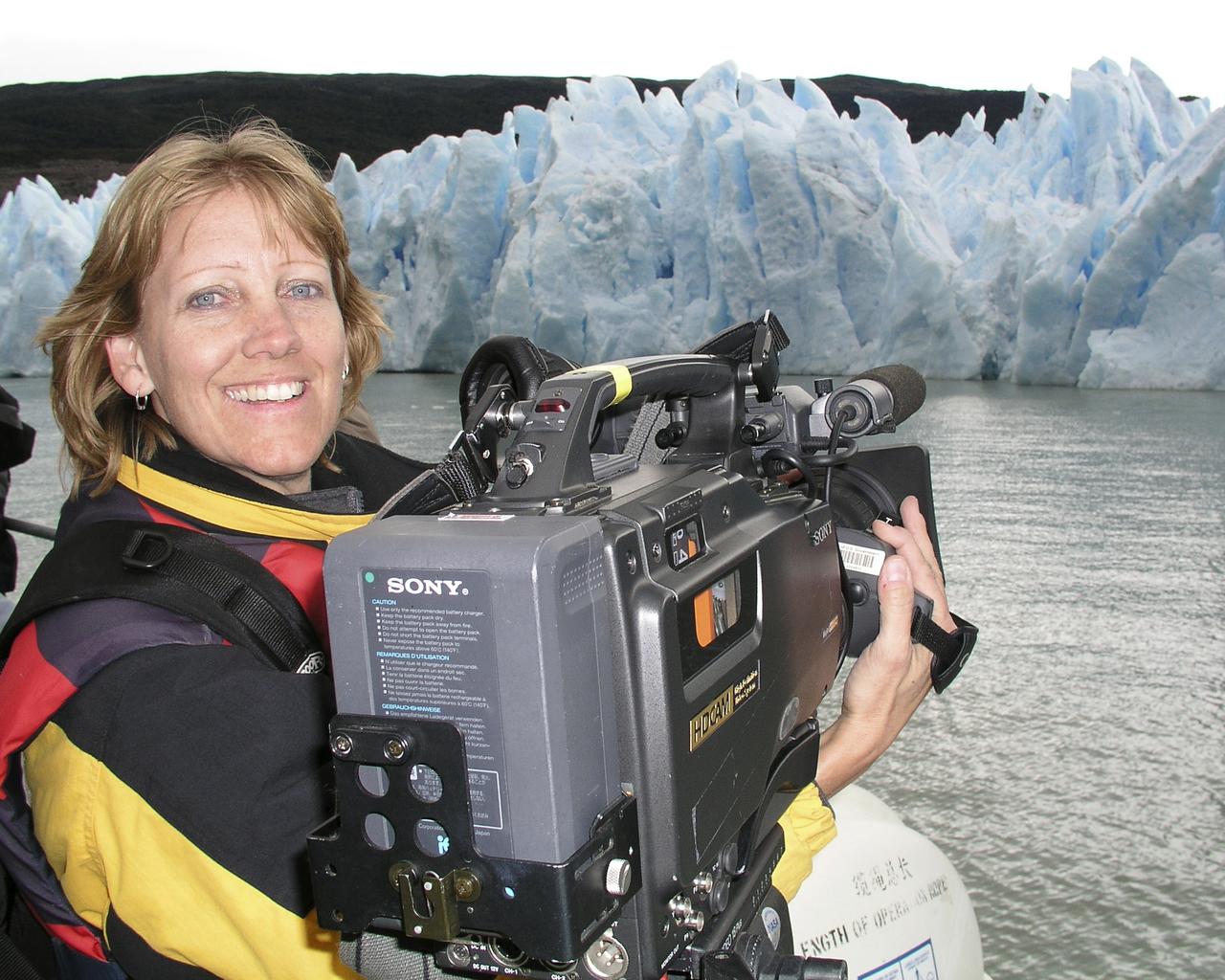
Lori Losey, an employee of Arcata Associates at Dryden, was honored with NASA's 2004 Videographer of the Year award for her work in two of the three categories in the NASA video competition, public affairs and documentation. In the public affairs category, Losey received a first-place citation for her footage of an Earth Science mission that was flown aboard NASA's DC-8 Flying Laboratory in South America last year. Her footage not only depicted the work of the scientists aboard the aircraft and on the ground, but she also obtained spectacular footage of flora and fauna in the mission's target area that helped communicate the environmental research goals of the project. Losey also took first place in the documentation category for her acquisition of technical videography of the X-45A Unmanned Combat Air Vehicle flight tests. The video, shot with a hand-held camera from the rear seat of a NASA F/A-18 mission support aircraft, demonstrated her capabilities in recording precise technical visual data in a very challenging airborne environment. The award was presented to Losey during a NASA reception at the National Association of Broadcasters convention in Las Vegas April 19. A three-judge panel evaluated entries for public affairs, documentation and production videography on professional excellence, technical quality, originality, creativity within restrictions of the project, and applicability to NASA and its mission. Entries consisted of a continuous video sequence or three views of the same subject for a maximum of three minutes duration. Linda Peters, Arcata Associates' Video Systems Supervisor at NASA Dryden, noted, "Lori is a talented videographer who has demonstrated extraordinary abilities with the many opportunities she has received in her career at NASA." Losey's award was the second major NASA video award won by members of the Dryden video team in two years. Steve Parcel took first place in the documentation category last year for his camera and editing
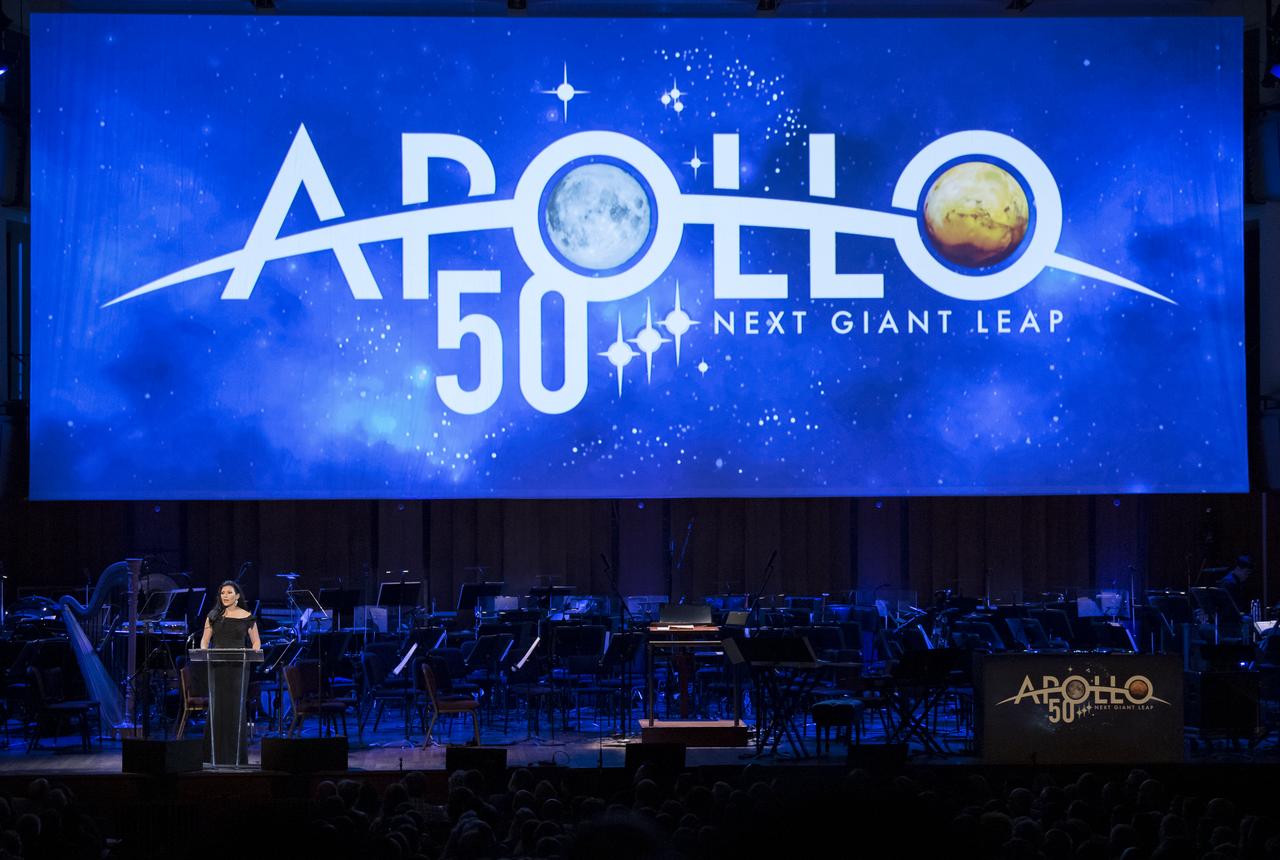
NASA Associate Administrator for Communications, Bettina Inclan speaks during the "National Symphony Orchestra Pops, Apollo 11: A 50th Anniversary, One Small Step, One Giant Leap" a program including musical acts, speakers, and images and video related to space, on Saturday, July 20, 2019 at the John F. Kennedy Center for the Performing Arts in Washington. NASA and the country are recognizing the 50th anniversary of Apollo 11, in which astronauts Neil Armstrong, Michael Collins, and Buzz Aldrin crewed the first mission to land astronauts on the Moon. Photo Credit: (NASA/Aubrey Gemignani)

NASA Associate Administrator for Communications, Bettina Inclan speaks during the "National Symphony Orchestra Pops, Apollo 11: A 50th Anniversary, One Small Step, One Giant Leap" a program including musical acts, speakers, and images and video related to space, on Saturday, July 20, 2019 at the John F. Kennedy Center for the Performing Arts in Washington. NASA and the country are recognizing the 50th anniversary of Apollo 11, in which astronauts Neil Armstrong, Michael Collins, and Buzz Aldrin crewed the first mission to land astronauts on the Moon. Photo Credit: (NASA/Aubrey Gemignani)
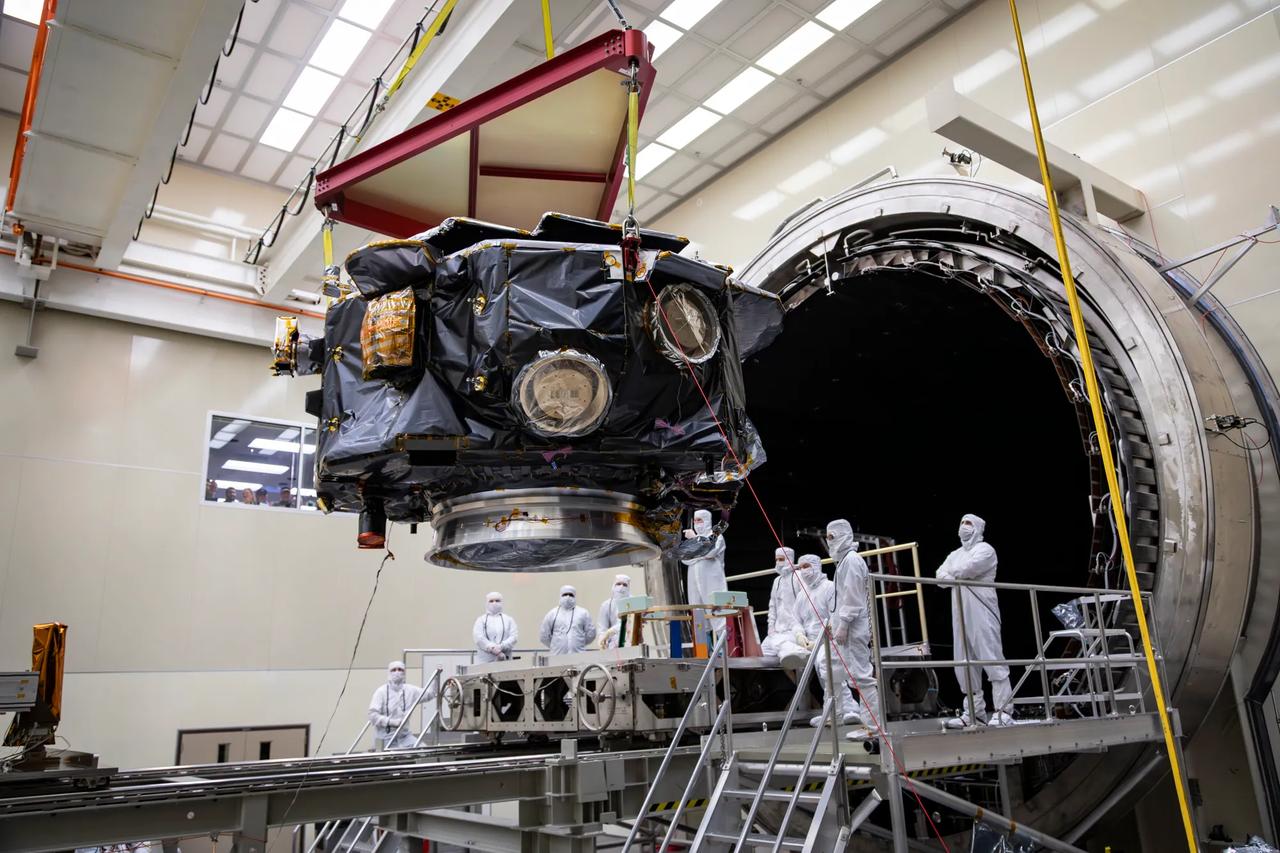
These photos and timelapse show NASA’s IMAP mission being loaded into the thermal vacuum chamber of NASA Marshall Space Flight Center’s X-Ray and Cryogenic Facility (XRCF) in Huntsville, Alabama. IMAP arrived at Marshall March 18 and was loaded into the chamber March 19. IMAP will undergo testing such as dramatic temperature changes to simulate the harsh environment of space. The XRCF’s vacuum chamber is is 20 feet in diameter and 60 feet long making it one of the largest across NASA. The IMAP mission is a modern-day celestial cartographer that will map the solar system by studying the heliosphere, a giant bubble created by the Sun’s solar wind that surrounds our solar system and protects it from harmful interstellar radiation. Photos and video courtesy of Ed Whitman from Johns Hopkins University’s Applied Physics Laboratory. For more information, contact NASA Marshall’s Office of Communications at 256-544-0034.
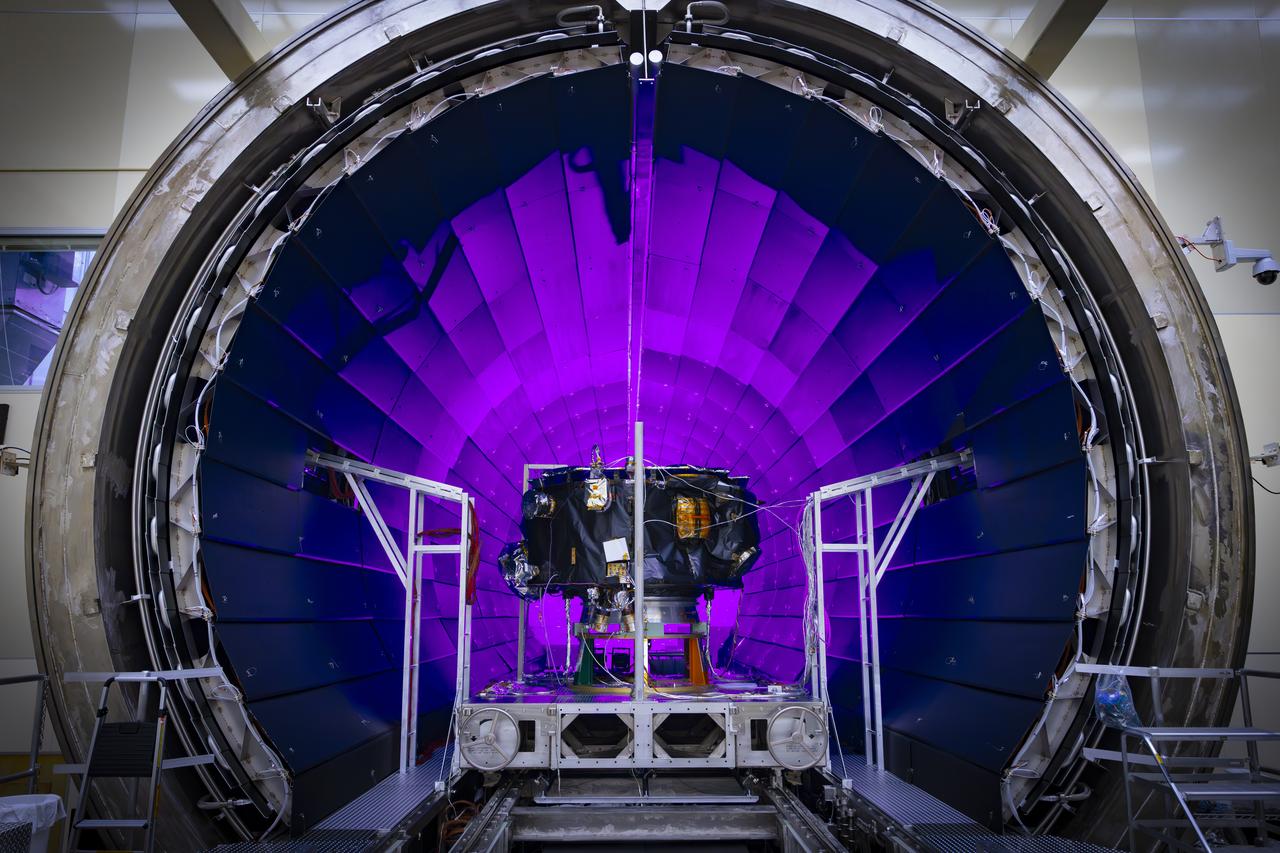
These photos and timelapse show NASA’s IMAP mission being loaded into the thermal vacuum chamber of NASA Marshall Space Flight Center’s X-Ray and Cryogenic Facility (XRCF) in Huntsville, Alabama. IMAP arrived at Marshall March 18 and was loaded into the chamber March 19. IMAP will undergo testing such as dramatic temperature changes to simulate the harsh environment of space. The XRCF’s vacuum chamber is is 20 feet in diameter and 60 feet long making it one of the largest across NASA. The IMAP mission is a modern-day celestial cartographer that will map the solar system by studying the heliosphere, a giant bubble created by the Sun’s solar wind that surrounds our solar system and protects it from harmful interstellar radiation. Photos and video courtesy of Ed Whitman from Johns Hopkins University’s Applied Physics Laboratory. For more information, contact NASA Marshall’s Office of Communications at 256-544-0034.
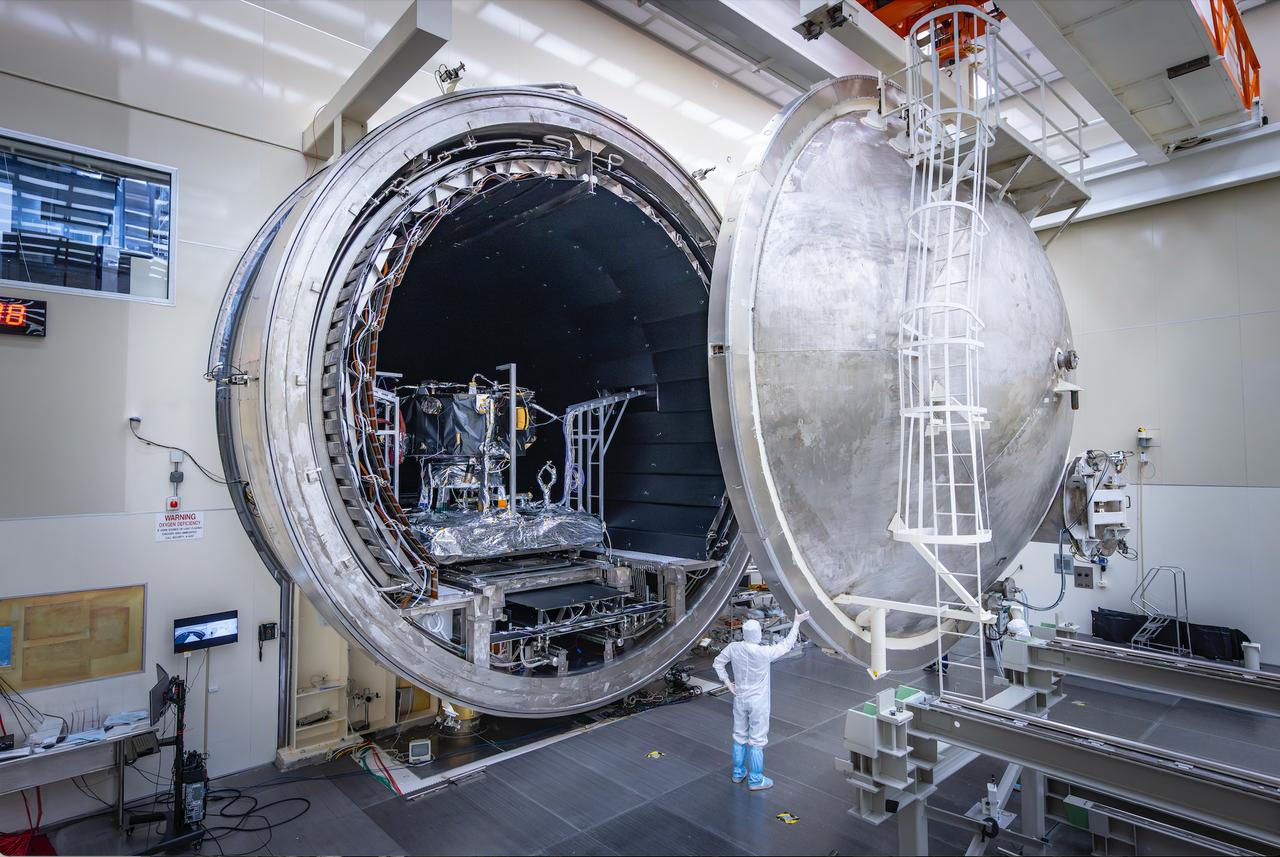
These photos and timelapse show NASA’s IMAP mission being loaded into the thermal vacuum chamber of NASA Marshall Space Flight Center’s X-Ray and Cryogenic Facility (XRCF) in Huntsville, Alabama. IMAP arrived at Marshall March 18 and was loaded into the chamber March 19. IMAP will undergo testing such as dramatic temperature changes to simulate the harsh environment of space. The XRCF’s vacuum chamber is is 20 feet in diameter and 60 feet long making it one of the largest across NASA. The IMAP mission is a modern-day celestial cartographer that will map the solar system by studying the heliosphere, a giant bubble created by the Sun’s solar wind that surrounds our solar system and protects it from harmful interstellar radiation. Photos and video courtesy of Ed Whitman from Johns Hopkins University’s Applied Physics Laboratory. For more information, contact NASA Marshall’s Office of Communications at 256-544-0034.

NASA's Curiosity Mars rover recorded two 25-frame videos showing the passage of 12 hours on Nov. 8, 2023, the 4,002nd Martian day, or sol, of the mission. The commands to capture the images that make up these videos were among the last that engineers beamed up to the rover before the start of Mars solar conjunction – a period of several weeks when the Sun is between Earth and Mars. Because the Sun's plasma can interfere with radio communications, NASA's Mars missions stand down from sending commands to their spacecraft during conjunction, bringing the missions to a temporary standstill. (The spacecraft still radio back their health status during this period.) The images were captured with Curiosity's front and rear Hazard-Avoidance Cameras, or Hazcams. Rover drivers use these black-and-white cameras to plan safe drive routes. A long series of images can be put together to create a video so that scientists can look for passing clouds or dust devils, which teach them more about the Martian environment. The perfect time for doing this type of work is when Curiosity is less active for long stretches, as it was during Mars solar conjunction. The lack of robotic arm motion and driving during conjunction allowed the Hazcams to image for 12 hours of a day – from 5:30 a.m. to 5:30 p.m. local Mars time – for the first time. While these Hazcam videos didn't reveal any clouds or dust activity, they did capture the passage of time as the Sun rose and set. The main video shows the front Hazcam's view looking southeast along Gediz Vallis, a valley found on Mount Sharp, the base of which Curiosity has been ascending since 2014. The sky brightens during sunrise in the east (left of image), and the shadow of the rover's stationary 7-foot (2-meter) robotic arm moves across the ground like that of a sundial. The rover's two front wheels are visible on each side of the frame; at upper left is a circular calibration target mounted on the shoulder of the robotic arm. Engineers use the target to test the accuracy of the Alpha Particle X-ray Spectrometer, an instrument that detects chemical elements on the Martian surface. In the middle of the day, the camera's autoexposure algorithm settles on exposure times of around one-third of a second; as evening turns to night, that exposure time grows to more than a minute, causing typical sensor noise known as "hot pixels" that appear as snow across the final image. Video available at https://photojournal.jpl.nasa.gov/catalog/PIA26209
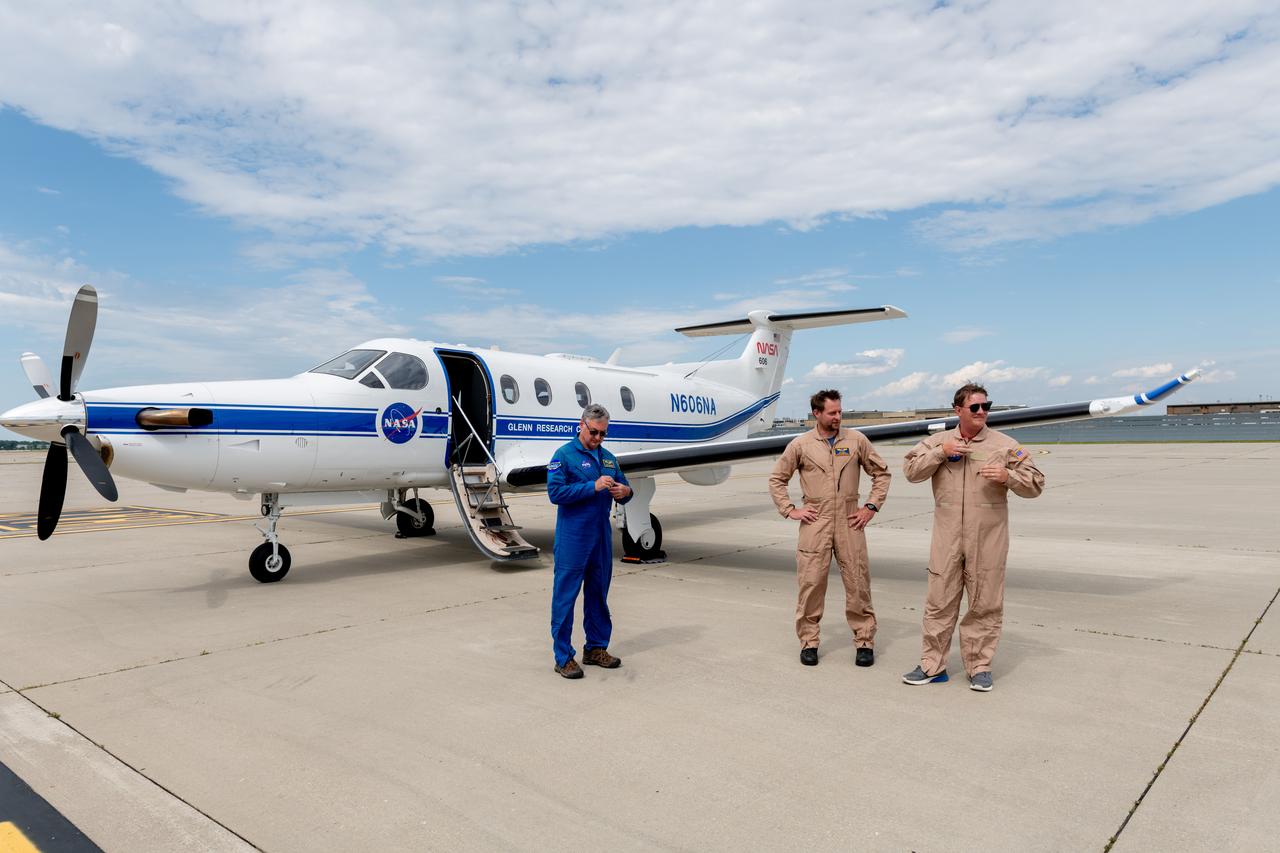
A team at NASA’s Glenn Research Center in Cleveland streamed 4K video footage from an aircraft to the International Space Station and back for the first time using optical, or laser, communications. The feat was part of a series of tests on new technology that could provide live video coverage of astronauts on the Moon during the Artemis missions. Pictured here on June 13, 2024 from Left to Right: Kurt Blakenship, Adam Wroblewski, Shaun McKeehan. Working with the Air Force Research Laboratory and NASA’s Small Business Innovation Research program, Glenn engineers temporarily installed a portable laser terminal on the belly of a Pilatus PC-12 aircraft. They then flew over Lake Erie sending data from the aircraft to an optical ground station in Cleveland. From there, it was sent over an Earth-based network to NASA’s White Sands Test Facility in Las Cruces, New Mexico, where scientists used infrared light signals to send the data. Photo Credit: (NASA/Sara Lowthian-Hanna)
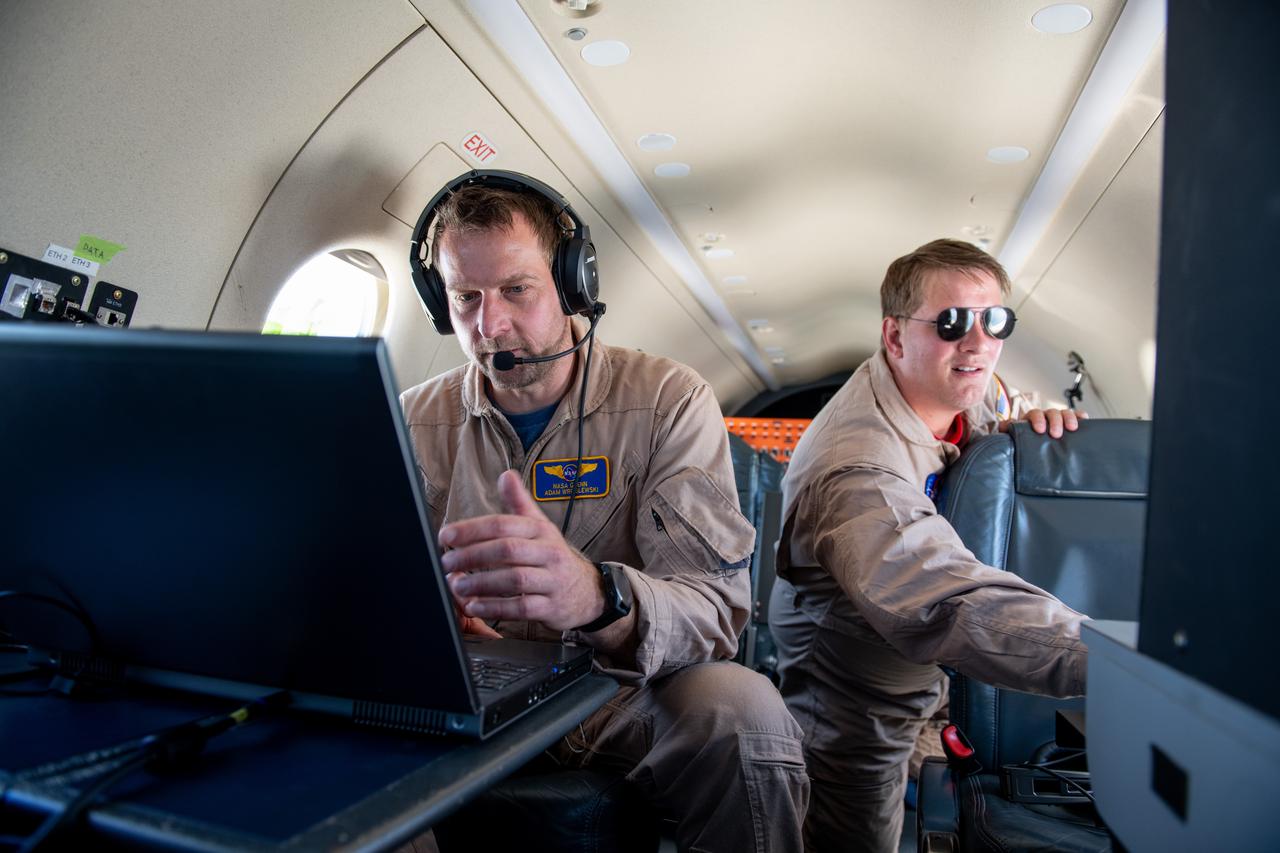
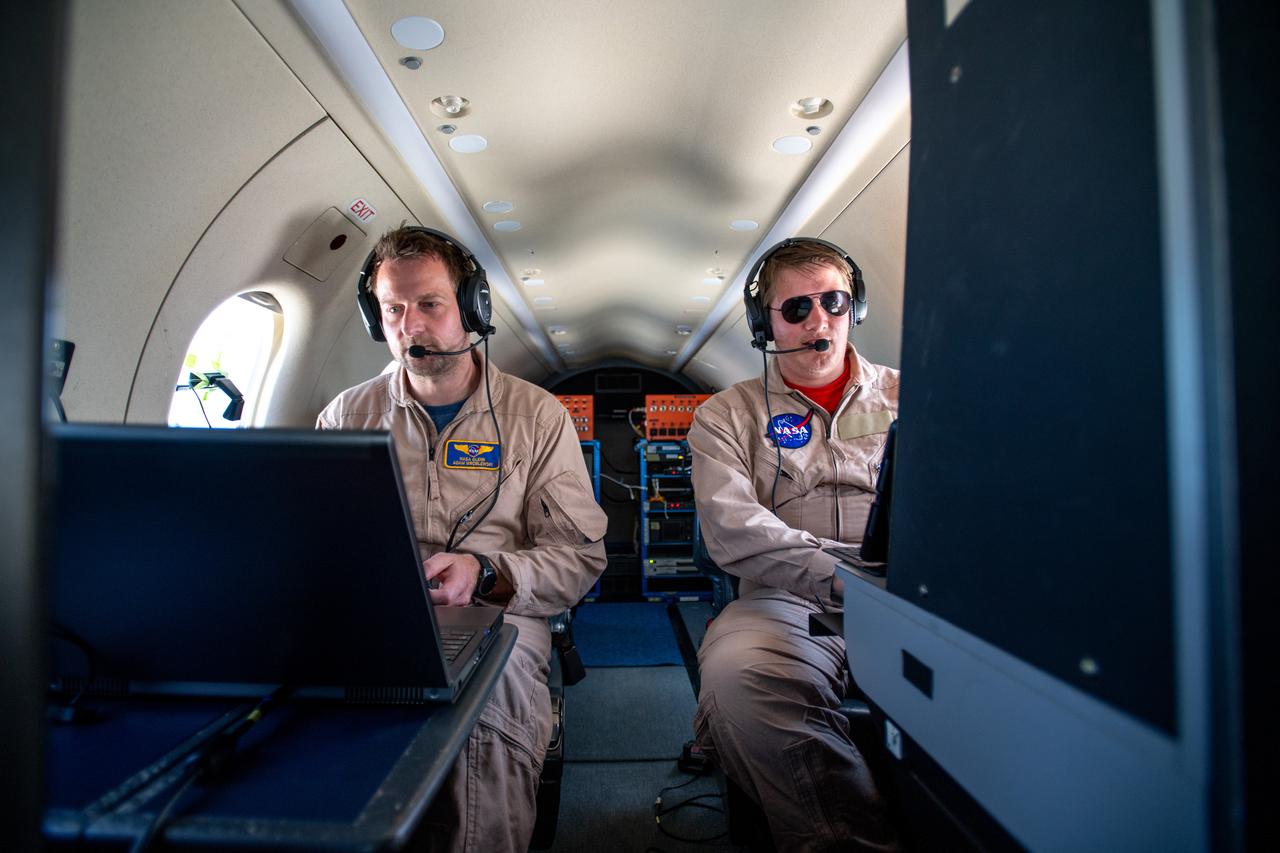
Adam Wroblewski and Shaun McKeehan Working In PC-12 Aircraft during in flight testing on June 13, 2024. A team at NASA’s Glenn Research Center in Cleveland streamed 4K video footage from an aircraft to the International Space Station and back for the first time using optical, or laser, communications. The feat was part of a series of tests on new technology that could provide live video coverage of astronauts on the Moon during the Artemis missions. Working with the Air Force Research Laboratory and NASA’s Small Business Innovation Research program, Glenn engineers temporarily installed a portable laser terminal on the belly of a Pilatus PC-12 aircraft. They then flew over Lake Erie sending data from the aircraft to an optical ground station in Cleveland. From there, it was sent over an Earth-based network to NASA’s White Sands Test Facility in Las Cruces, New Mexico, where scientists used infrared light signals to send the data. Photo Credit: (NASA/Sara Lowthian-Hanna)
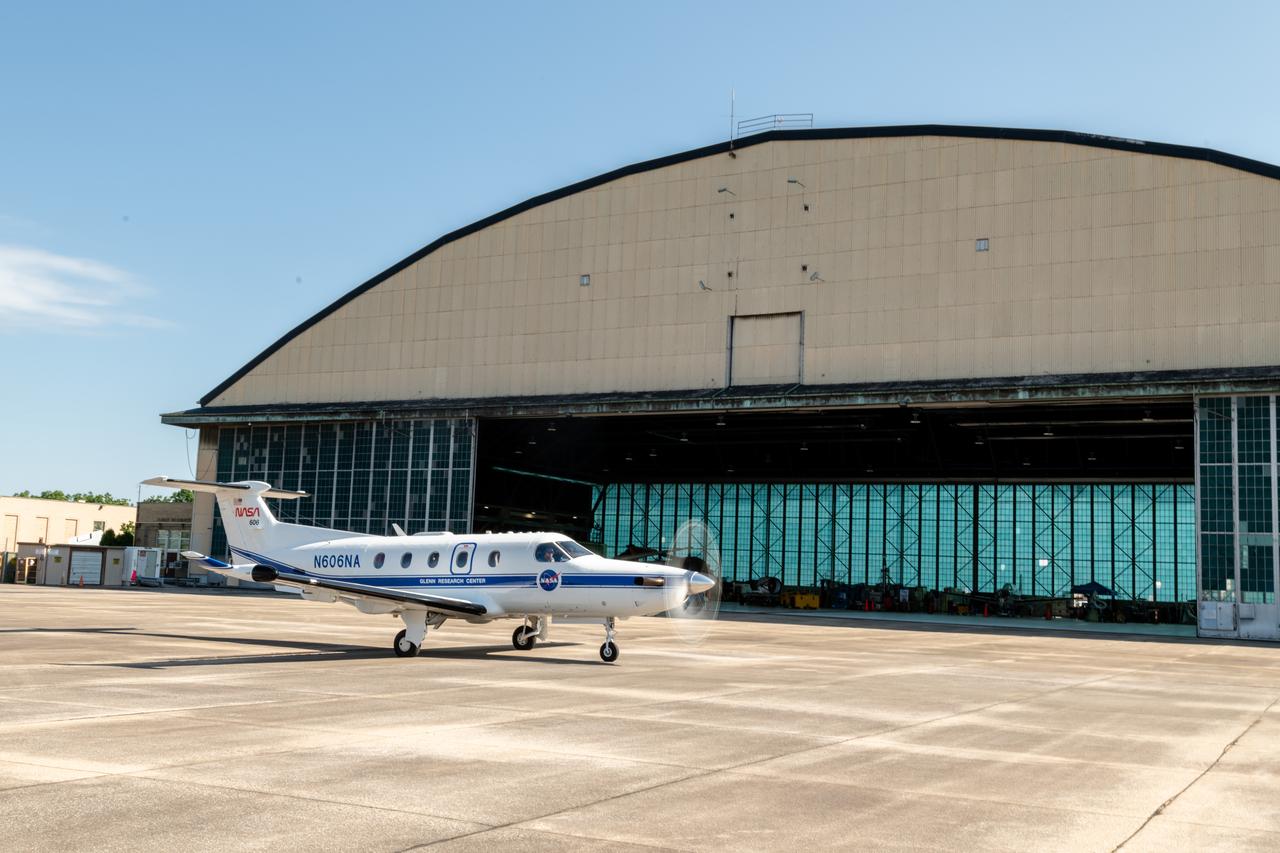
At Glenn Research Center, the PC-12 is Prepped for a flight and ready to takeoff on June 12, 2024. A team at NASA’s Glenn Research Center in Cleveland streamed 4K video footage from an aircraft to the International Space Station and back for the first time using optical, or laser, communications. The feat was part of a series of tests on new technology that could provide live video coverage of astronauts on the Moon during the Artemis missions. Working with the Air Force Research Laboratory and NASA’s Small Business Innovation Research program, Glenn engineers temporarily installed a portable laser terminal on the belly of a Pilatus PC-12 aircraft. They then flew over Lake Erie sending data from the aircraft to an optical ground station in Cleveland. From there, it was sent over an Earth-based network to NASA’s White Sands Test Facility in Las Cruces, New Mexico, where scientists used infrared light signals to send the data. Photo Credit: (NASA/Sara Lowthian-Hanna)
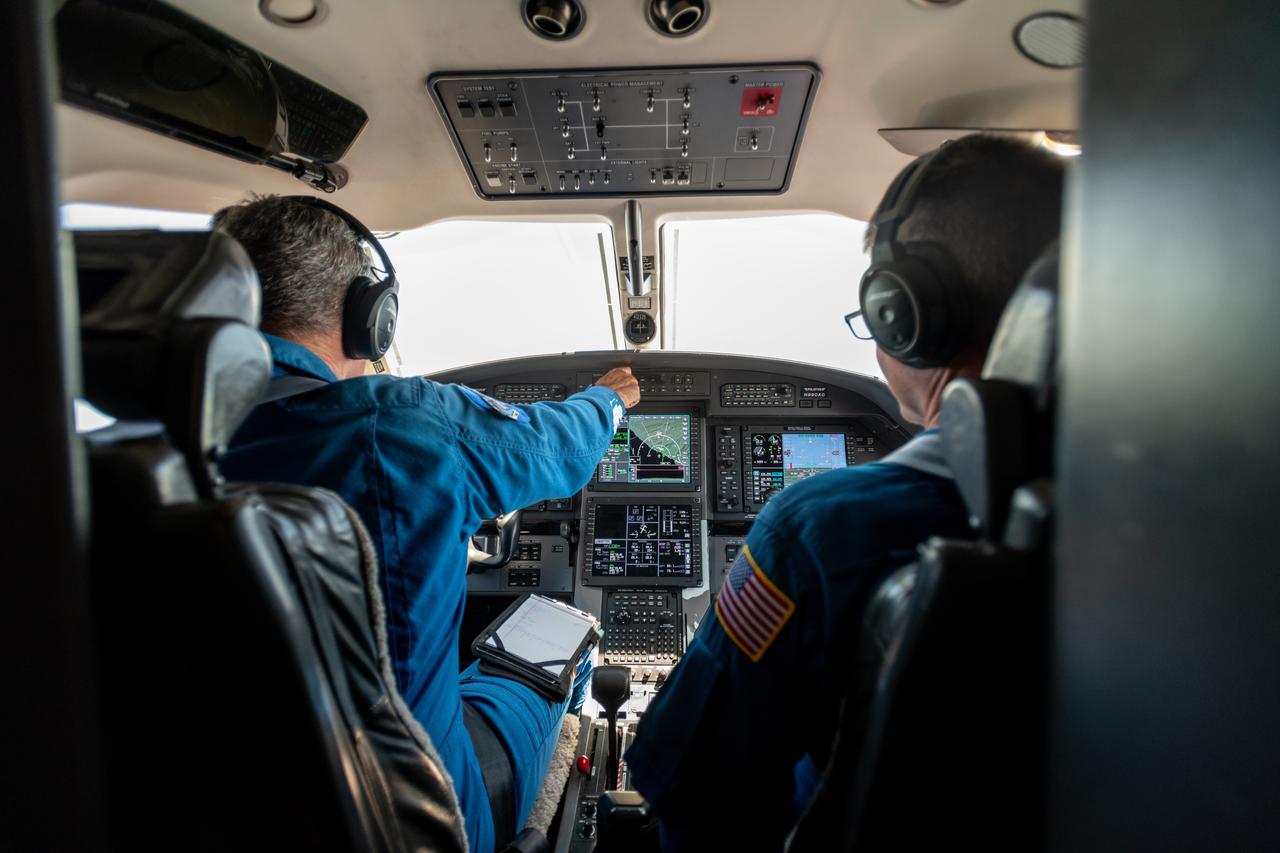
Kurt Blankenship and James Demers Fly PC-12 Aircraft During Testing on June 13, 2024. A team at NASA’s Glenn Research Center in Cleveland streamed 4K video footage from an aircraft to the International Space Station and back for the first time using optical, or laser, communications. The feat was part of a series of tests on new technology that could provide live video coverage of astronauts on the Moon during the Artemis missions. Working with the Air Force Research Laboratory and NASA’s Small Business Innovation Research program, Glenn engineers temporarily installed a portable laser terminal on the belly of a Pilatus PC-12 aircraft. They then flew over Lake Erie sending data from the aircraft to an optical ground station in Cleveland. From there, it was sent over an Earth-based network to NASA’s White Sands Test Facility in Las Cruces, New Mexico, where scientists used infrared light signals to send the data. Photo Credit: (NASA/Sara Lowthian-Hanna)
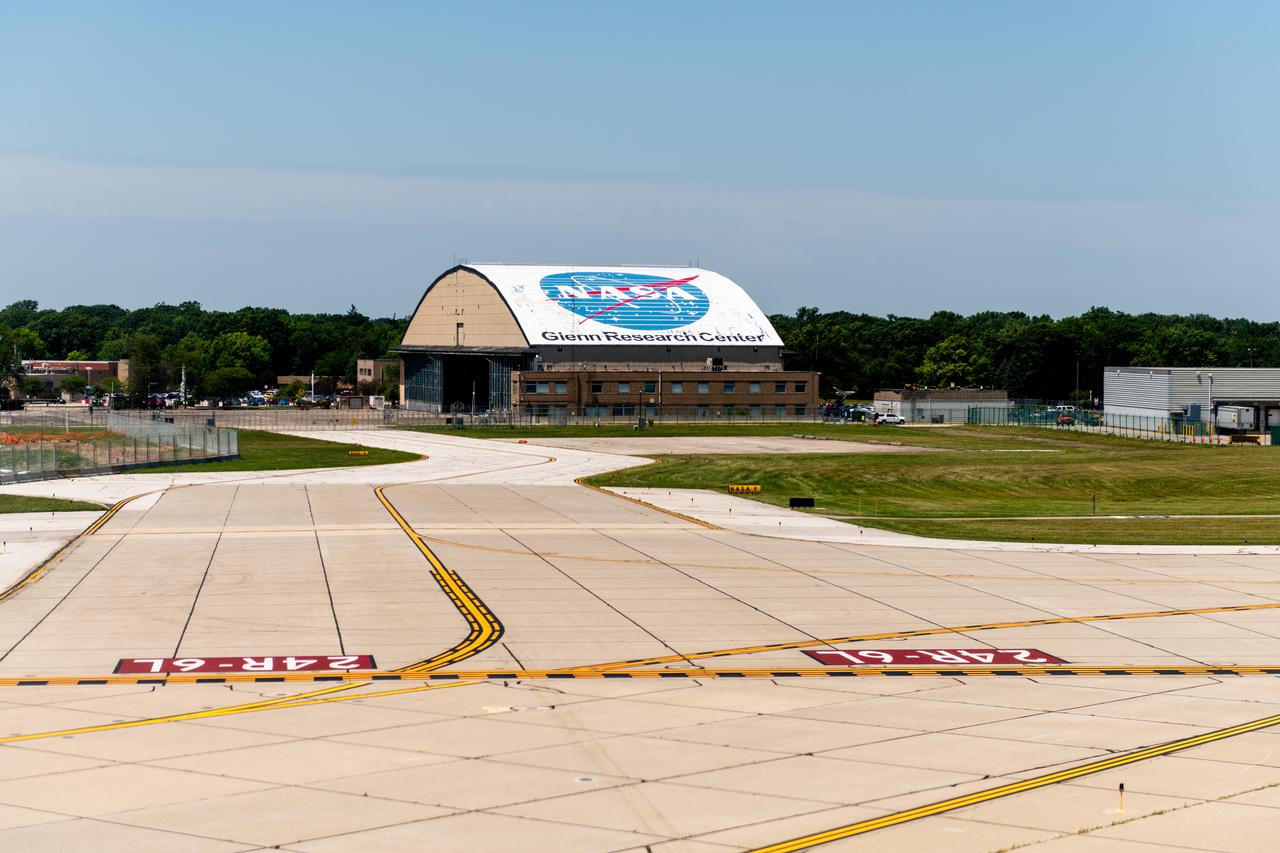
View of the Glenn Research Center Hangar from the Cleveland Hopkins Airport Runway during a testing flight on June 13, 2024. A team at NASA’s Glenn Research Center in Cleveland streamed 4K video footage from an aircraft to the International Space Station and back for the first time using optical, or laser, communications. The feat was part of a series of tests on new technology that could provide live video coverage of astronauts on the Moon during the Artemis missions. Working with the Air Force Research Laboratory and NASA’s Small Business Innovation Research program, Glenn engineers temporarily installed a portable laser terminal on the belly of a Pilatus PC-12 aircraft. They then flew over Lake Erie sending data from the aircraft to an optical ground station in Cleveland. From there, it was sent over an Earth-based network to NASA’s White Sands Test Facility in Las Cruces, New Mexico, where scientists used infrared light signals to send the data. Photo Credit: (NASA/Sara Lowthian-Hanna)
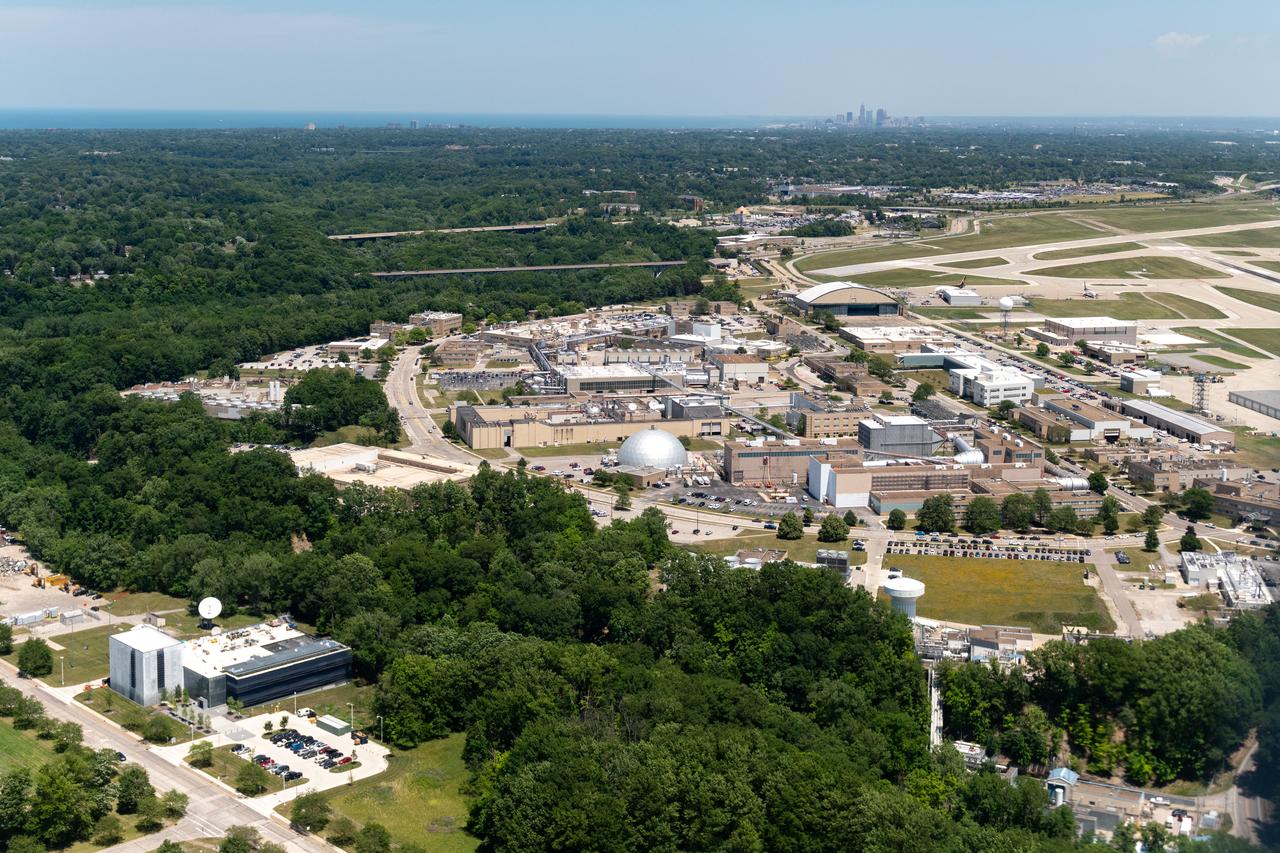
Aerial Photograph of Glenn Research Center With Downtown Cleveland in the Distance taken from the PC-12 on June 13, 2024. A team at NASA’s Glenn Research Center in Cleveland streamed 4K video footage from an aircraft to the International Space Station and back for the first time using optical, or laser, communications. The feat was part of a series of tests on new technology that could provide live video coverage of astronauts on the Moon during the Artemis missions. Working with the Air Force Research Laboratory and NASA’s Small Business Innovation Research program, Glenn engineers temporarily installed a portable laser terminal on the belly of a Pilatus PC-12 aircraft. They then flew over Lake Erie sending data from the aircraft to an optical ground station in Cleveland. From there, it was sent over an Earth-based network to NASA’s White Sands Test Facility in Las Cruces, New Mexico, where scientists used infrared light signals to send the data. Photo Credit: (NASA/Sara Lowthian-Hanna)
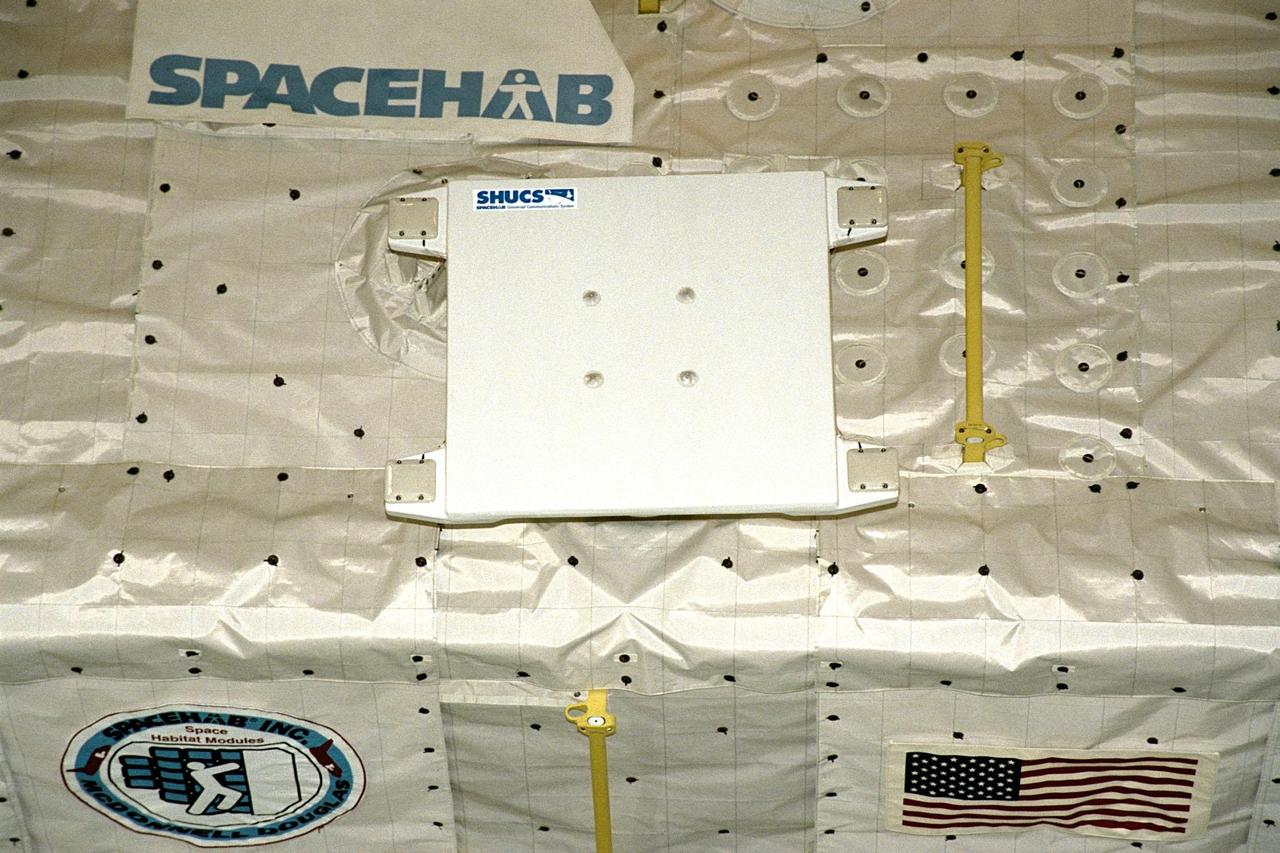
The SPACEHAB Single Module, is shown from the aft, with the SPACEHAB Universal Communication System (SHUCS) payload attached, in Discovery's payload bay shortly before the payload bay doors are closed for the flight of STS-91 at Launch Pad 39A. Launch is planned for June 2 with a window opening around 6:10 p.m. EDT. The single SPACEHAB module houses experiments to be performed by the astronauts and serves as a cargo carrier for items to be transferred to and from the Russian Space Station Mir. Flying for the first time, the SHUCS payload will be used to send and receive telephone voice and faxes, as well as provide video images of the crew from the SPACEHAB module, to test the improved availability of payload uplink and downlink communications with the ground. STS-91 will also feature the ninth Shuttle docking with the Russian Space Station Mir, the first Mir docking for Discovery, the conclusion of Phase I of the joint U.S.-Russian International Space Station Program, and the first flight of the new Space Shuttle super lightweight external tank. The STS-91 flight crew includes Commander Charles Precourt; Pilot Dominic Gorie; and Mission Specialists Wendy B. Lawrence; Franklin Chang-Diaz, Ph.D.; Janet Kavandi, Ph.D.; and Valery Ryumin, with the Russian Space Agency. Andrew Thomas, Ph.D., will be returning to Earth with the crew after living more than four months aboard Mir
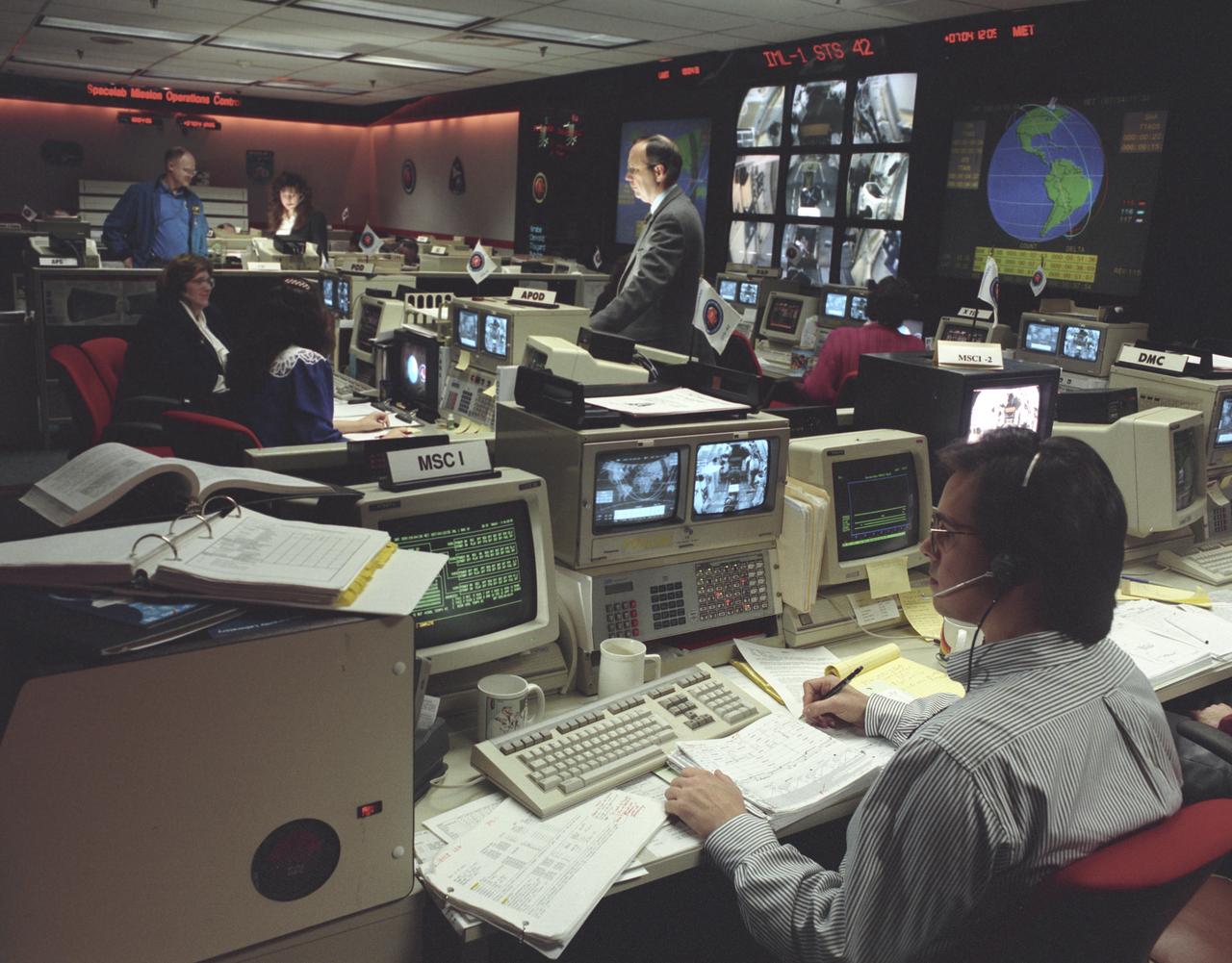
This photograph shows activities during the International Microgravity Laboratory-1 (IML-1) mission (STS-42) in the Payload Operations Control Center (POCC) at the Marshall Space Flight Center. The IML-1 mission was the first in a series of Shuttle flights dedicated to fundamental materials and life sciences research. The mission was to explore, in depth, the complex effects of weightlessness on living organisms and materials processing. The crew conducted experiments on the human nervous system's adaptation to low gravity and the effects on other life forms such as shrimp eggs, lentil seedlings, fruit fly eggs, and bacteria. Low gravity materials processing experiments included crystal growth from a variety of substances such as enzymes, mercury, iodine, and virus. The International space science research organizations that participated in this mission were: The U.S. National Aeronautics and Space Administration, the European Space Agency, the Canadian Space Agency, the French National Center for Space Studies, the German Space Agency, and the National Space Development Agency of Japan. The POCC was the air/ground communication charnel used between the astronauts aboard the Spacelab and scientists, researchers, and ground control teams during the Spacelab missions. The facility made instantaneous video and audio communications possible for scientists on the ground to follow the progress and to send direct commands of their research almost as if they were in space with the crew.
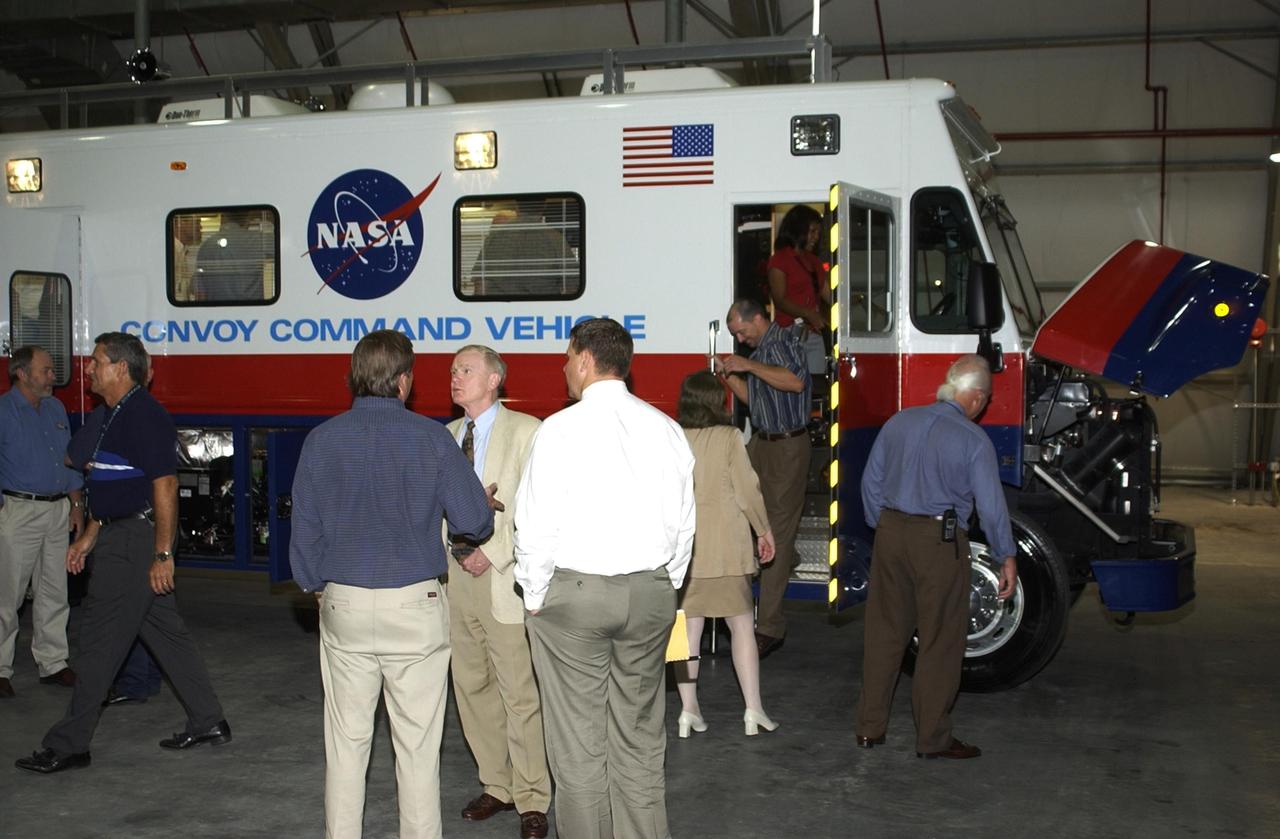
KENNEDY SPACE CENTER, FLA. -- While guests tour the new Convoy Command Vehicle (rear), Center Director Roy Bridges Jr. (center) talks to Launch Director Mike Leinbach. The tour followed a commissioning ceremony for the new vehicle. The 40-foot vehicle is replacing a 15-year old model, and will be used following Shuttle landings as the prime vehicle to control critical communications between the orbiter, the crew and the Launch Control Center, to monitor the health of the Shuttle Orbiter systems and to direct convoy operations at the Shuttle Landing Facility. Upgrades and high-tech features incorporated into the design and development of this vehicle make it more reliable and efficient for the convoy crew. Seating capacity was increased from 4 to 12, and video recorders and television monitors were added to provide the convoy team with the maximum amount of visual information
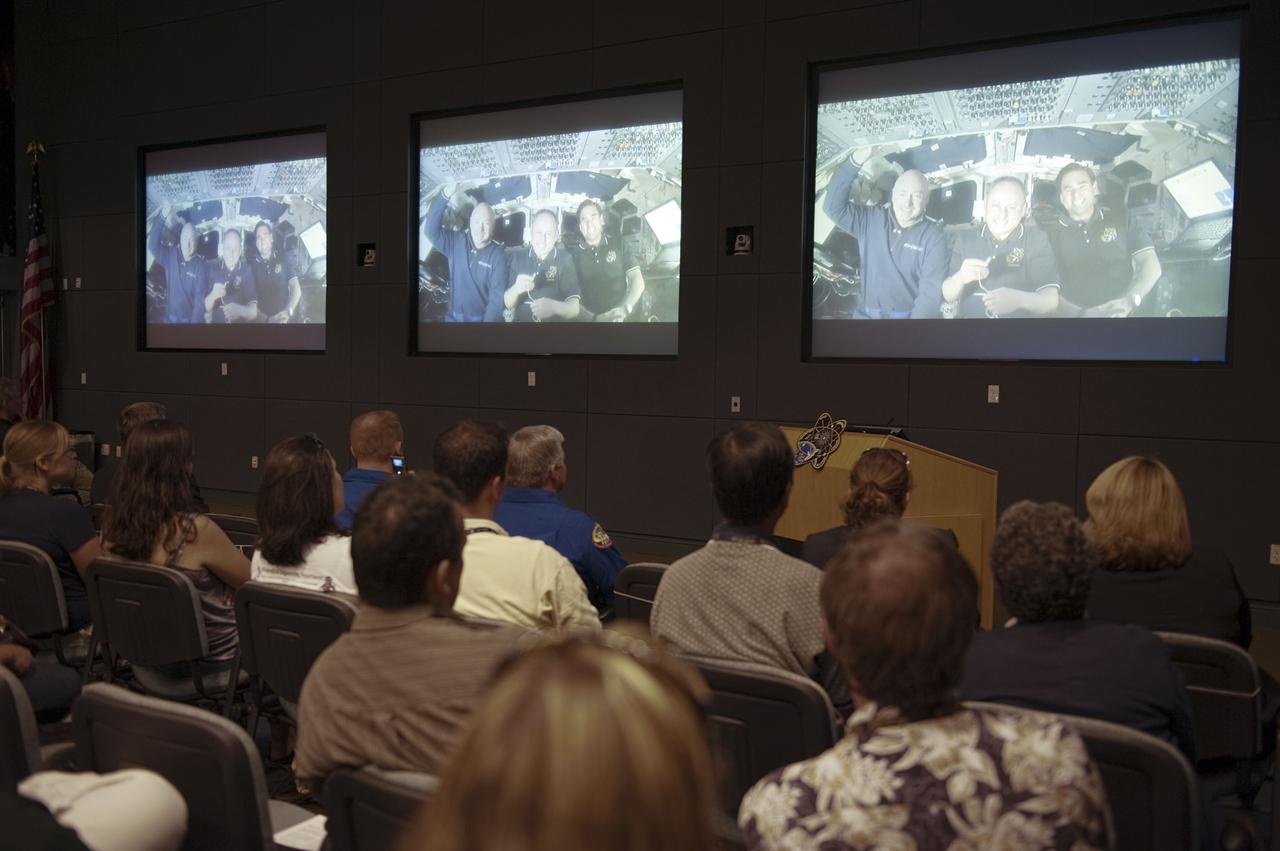
CAPE CANAVERAL, Fla. - Employees at NASA's Kennedy Space Center in Florida are joined by STS-134 Pilot Gregory H. Johnson and Mission Specialist Michael Fincke for a video presentation during a crew return event highlighting the flight. Commander Mark Kelly, Johnson and Mission Specialists Fincke, Greg Chamitoff, Andrew Feustel and European Space Agency astronaut Roberto Vittori lifted off May 16, 2011, aboard space shuttle Endeavour. During the nearly 16-day STS-134 mission, Endeavour delivered to the International Space Station the Alpha Magnetic Spectrometer (AMS) and spare parts, including two S-band communications antennas, a high-pressure gas tank and additional spare parts for Dextre. This was the 36th shuttle mission to the station and Endeavour's 25th and final flight. For more information, visit www.nasa.gov/mission_pages/shuttle/shuttlemissions/sts134/main/index.html. Photo credit: NASA/Kim Shiflett
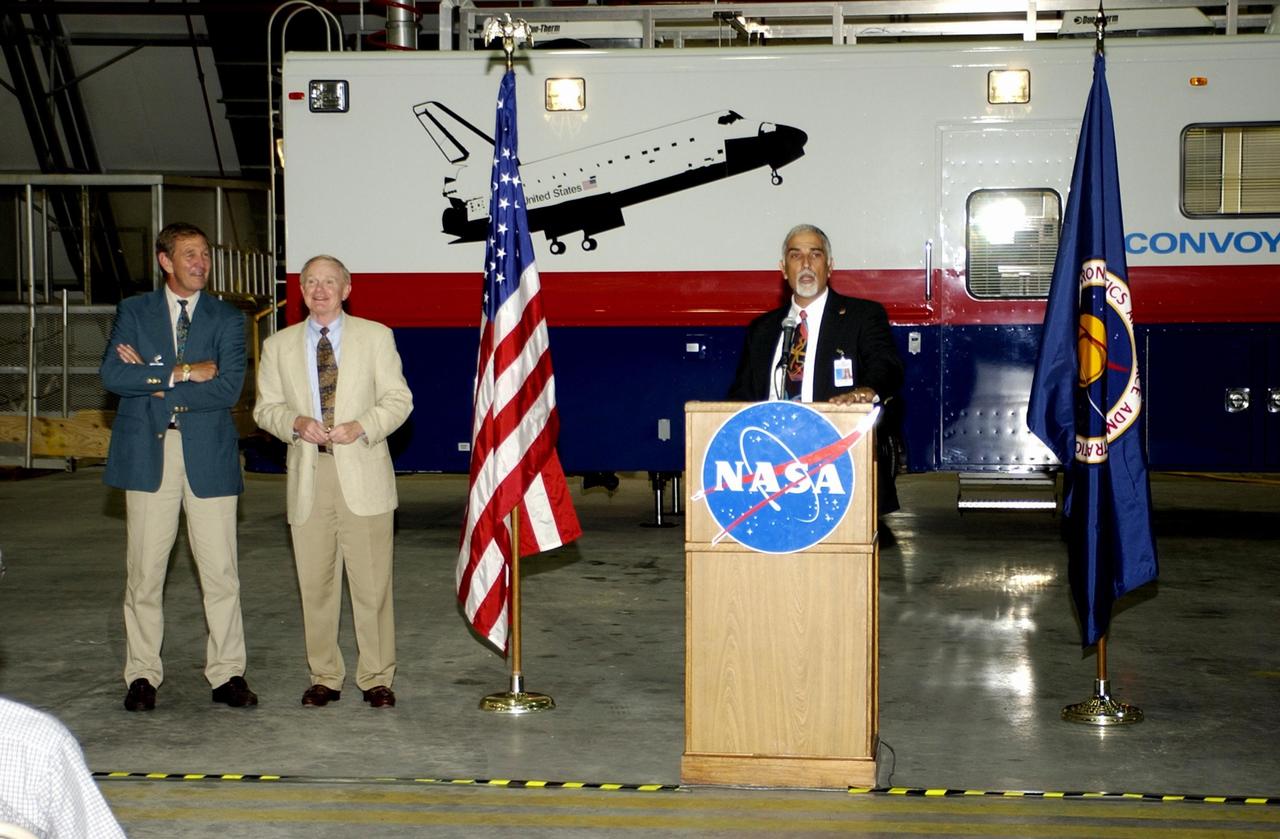
KENNEDY SPACE CENTER, FLA. -- During a commissioning ceremony for the new Convoy Command Vehicle (background), Tony Shibly, project manager, United Space Alliance, offers a few remarks to guests. At left are USA Chief Operating Officer Mike McCulley and Center Director Roy Bridges Jr. The new 40-foot vehicle is replacing a 15-year old model, and will be used following Shuttle landings as the prime vehicle to control critical communications between the orbiter, the crew and the Launch Control Center, to monitor the health of the Shuttle Orbiter systems and to direct convoy operations at the Shuttle Landing Facility. Upgrades and high-tech features incorporated into the design and development of this vehicle make it more reliable and efficient for the convoy crew. Seating capacity was increased from 4 to 12, and video recorders and television monitors were added to provide the convoy team with the maximum amount of visual information
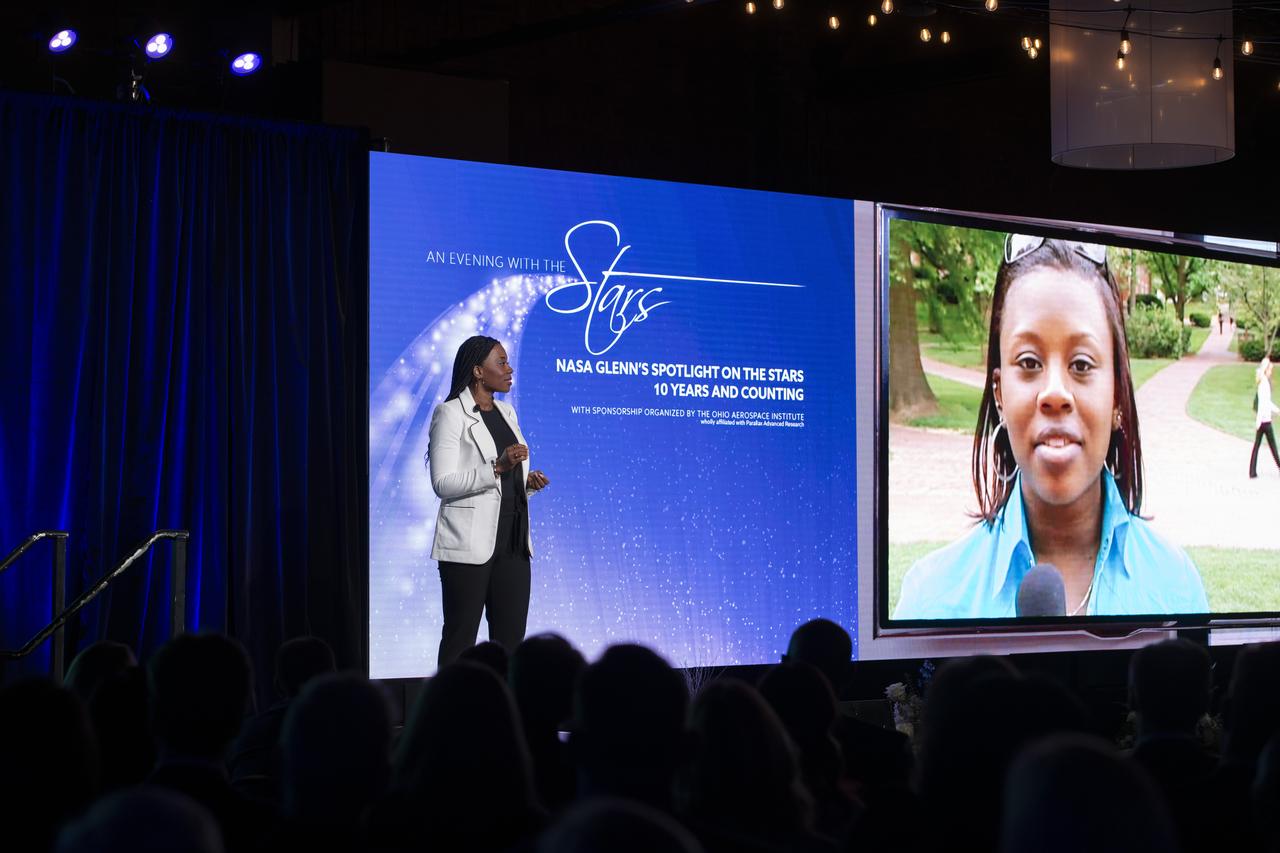
NASA Glenn's Spotlight on the Stars, 10 Years and Counting was held at Windows on the River in Cleveland, OH on November 20th, 2024. Sponsorship organized by the Ohio Aerospace Institute. Welcome by Dennis Andersh, CEO and President, Parallax Advanced Research, Ohio Aerospace Institute. Remarks by Terrence Slaybaugh, Vice President of Sites and Infrastructure, JobsOhio. Introduction of 10th Anniversary Video, Dr. Wanda Peters, Acting Deputy Director, NASA Glenn Research Center. Remarks/Introduction of Presenters, Dr. James Kenyon, Director, NASA Glenn Research Center. Keynote Speakers: Nikki Welch, NASA Glenn Communications, Connecting People to the Mission. Timothy Smith, NASA Glenn's Superalloy Achievements. Carlos Garcia-Galan, Dreaming of Going to the Moon. Photo Credit: (NASA/Sara Lowthian-Hanna)
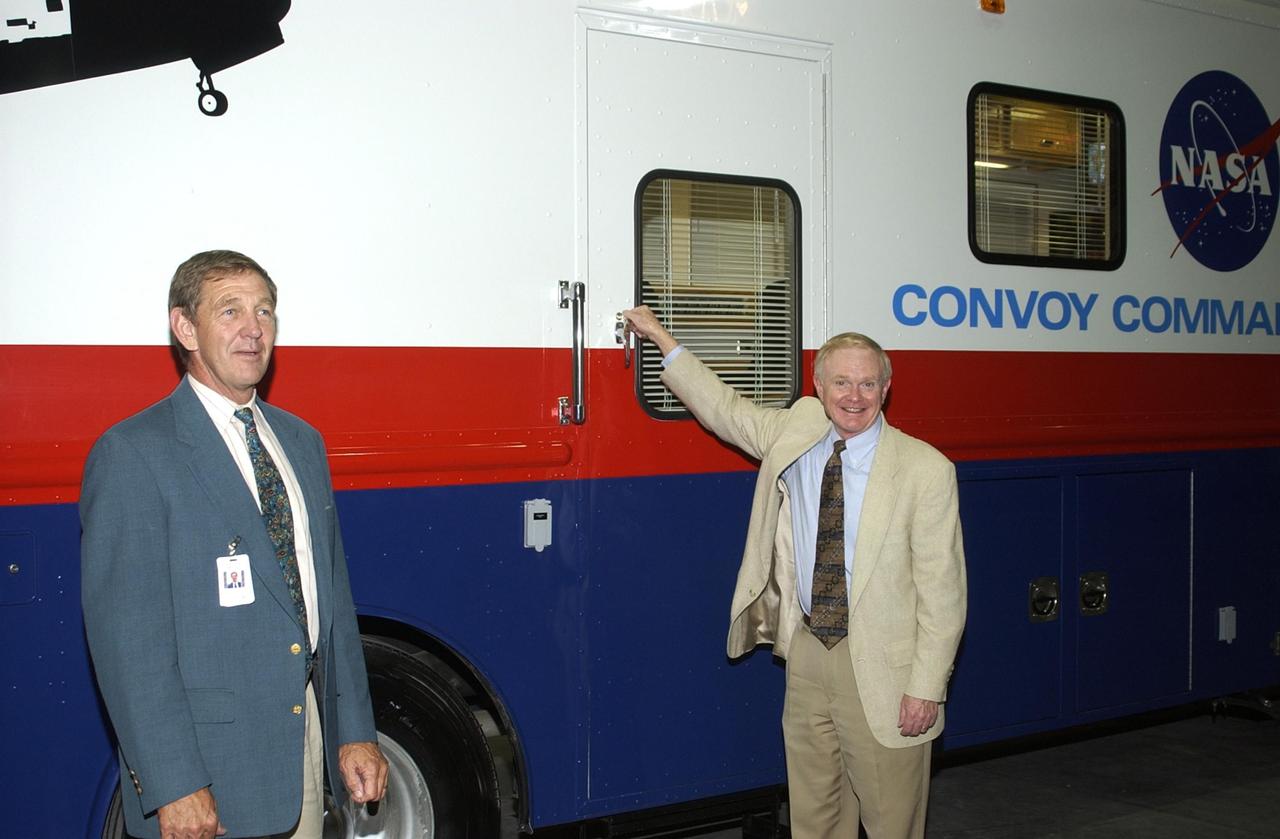
KENNEDY SPACE CENTER, FLA. - After opening remarks at a commissioning ceremony for the new Convoy Command Vehicle, Center Director Roy Bridges Jr. (right) gets ready to open the door for a tour of the vehicle. At left is United Space Alliance Chief Operating Officer Mike McCulley. The new 40-foot vehicle is replacing a 15-year old model, and will be used following Shuttle landings as the prime vehicle to control critical communications between the orbiter, the crew and the Launch Control Center, to monitor the health of the Shuttle Orbiter systems and to direct convoy operations at the Shuttle Landing Facility. Upgrades and high-tech features incorporated into the design and development of this vehicle make it more reliable and efficient for the convoy crew. Seating capacity was increased from 4 to 12, and video recorders and television monitors were added to provide the convoy team with the maximum amount of visual information
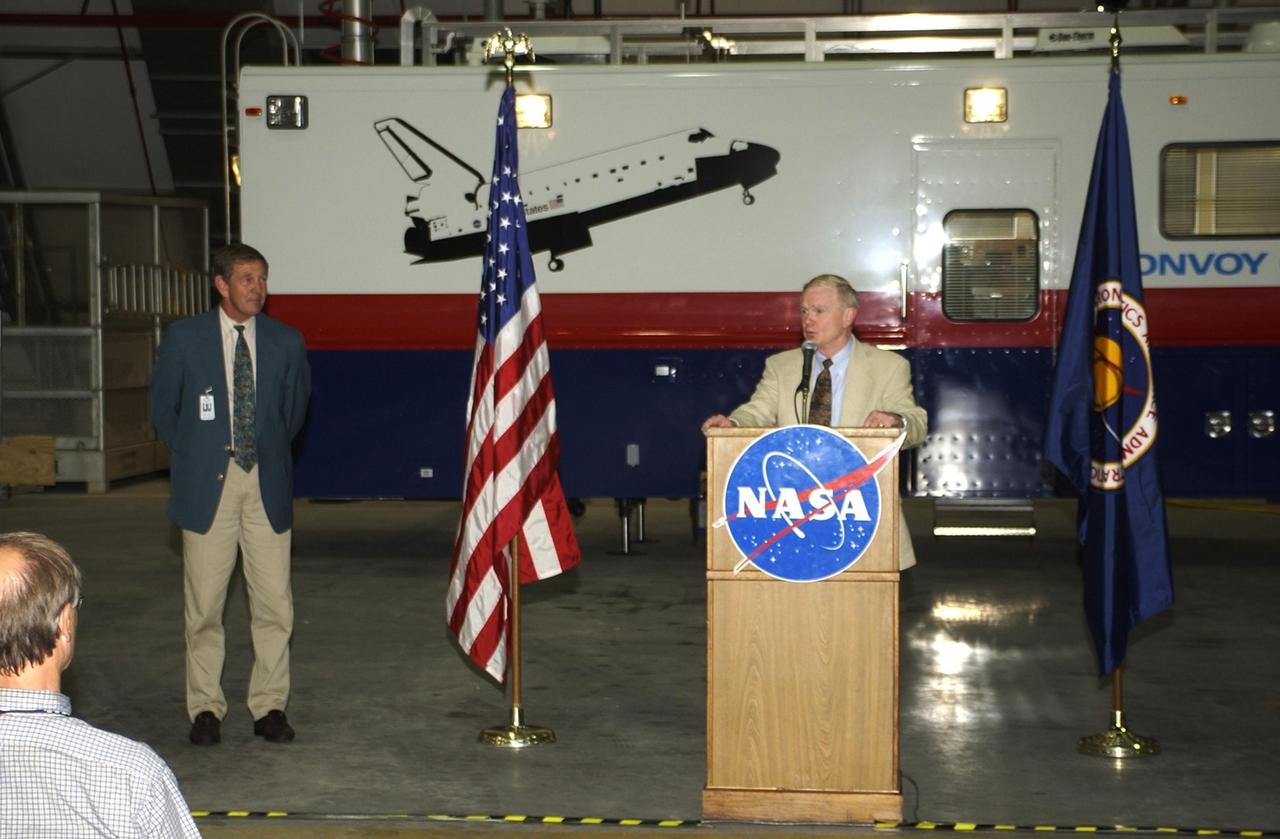
KENNEDY SPACE CENTER, FLA. -- At the podium, Center Director Roy Bridges Jr. offers remarks at the commissioning ceremony for the new Convoy Command Vehicle behind him. At left is Mike McCulley, chief operating officer, United Space Alliance. The new 40-foot vehicle is replacing a 15-year old model, and will be used following Shuttle landings as the prime vehicle to control critical communications between the orbiter, the crew and the Launch Control Center, to monitor the health of the Shuttle Orbiter systems and to direct convoy operations at the Shuttle Landing Facility. Upgrades and high-tech features incorporated into the design and development of this vehicle make it more reliable and efficient for the convoy crew. Seating capacity was increased from 4 to 12, and video recorders and television monitors were added to provide the convoy team with the maximum amount of visual information
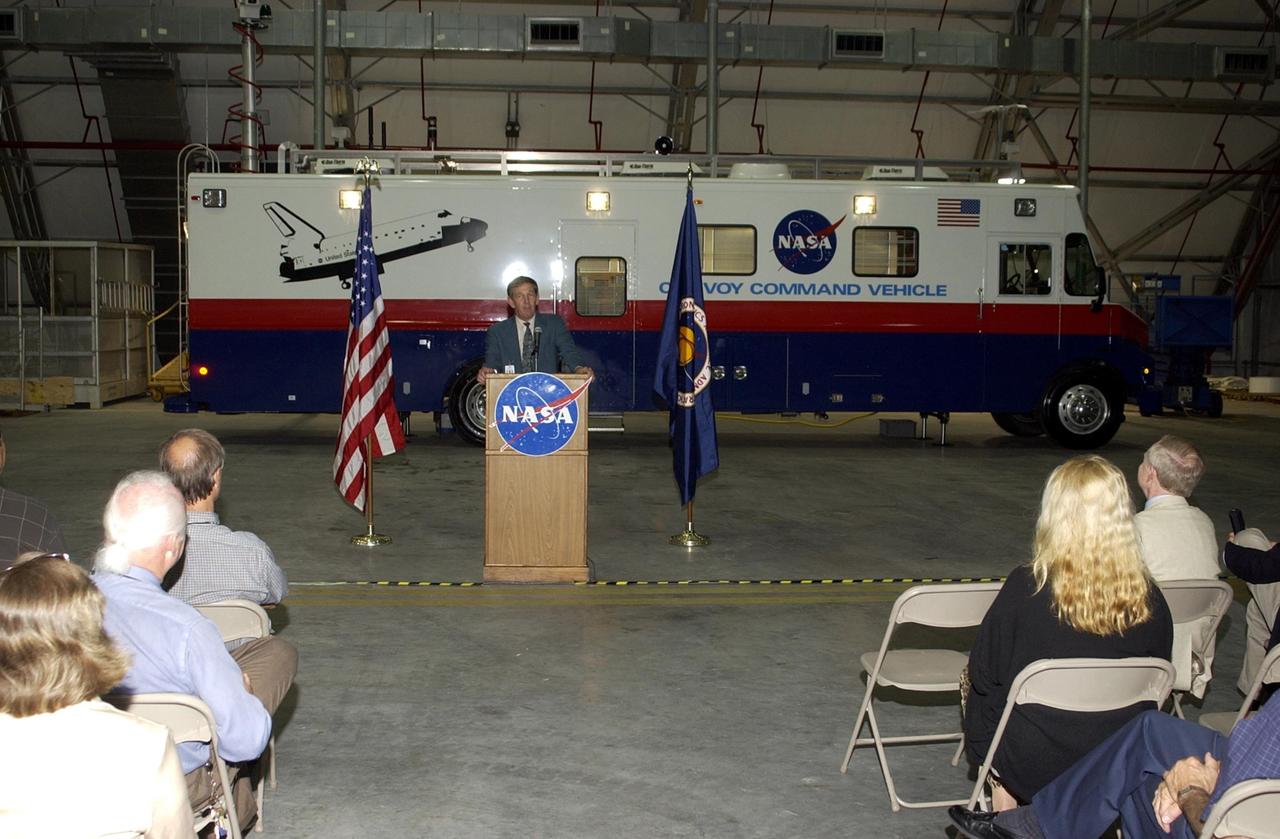
KENNEDY SPACE CENTER, FLA. -- United Space Alliance Chief Operating Officer Mike McCulley welcomes guests to the Landing Operations Facility and commissioning ceremony for the new Convoy Command Vehicle behind him. The new 40-foot vehicle is replacing a 15-year old model, and will be used following Shuttle landings as the prime vehicle to control critical communications between the orbiter, the crew and the Launch Control Center, to monitor the health of the Shuttle Orbiter systems and to direct convoy operations at the Shuttle Landing Facility. Upgrades and high-tech features incorporated into the design and development of this vehicle make it more reliable and efficient for the convoy crew. Seating capacity was increased from 4 to 12, and video recorders and television monitors were added to provide the convoy team with the maximum amount of visual information

Astronaut John Blaha replaces an exhausted media bag and filled waste bag with fresh bags to continue a bioreactor experiment aboard space station Mir in 1996. NASA-sponsored bioreactor research has been instrumental in helping scientists to better understand normal and cancerous tissue development. In cooperation with the medical community, the bioreactor design is being used to prepare better models of human colon, prostate, breast and ovarian tumors. Cartilage, bone marrow, heart muscle, skeletal muscle, pancreatic islet cells, liver and kidney are just a few of the normal tissues being cultured in rotating bioreactors by investigators. This image is from a video downlink. The work is sponsored by NASA's Office of Biological and Physical Research. The bioreactor is managed by the Biotechnology Cell Science Program at NASA's Johnson Space Center (JSC).
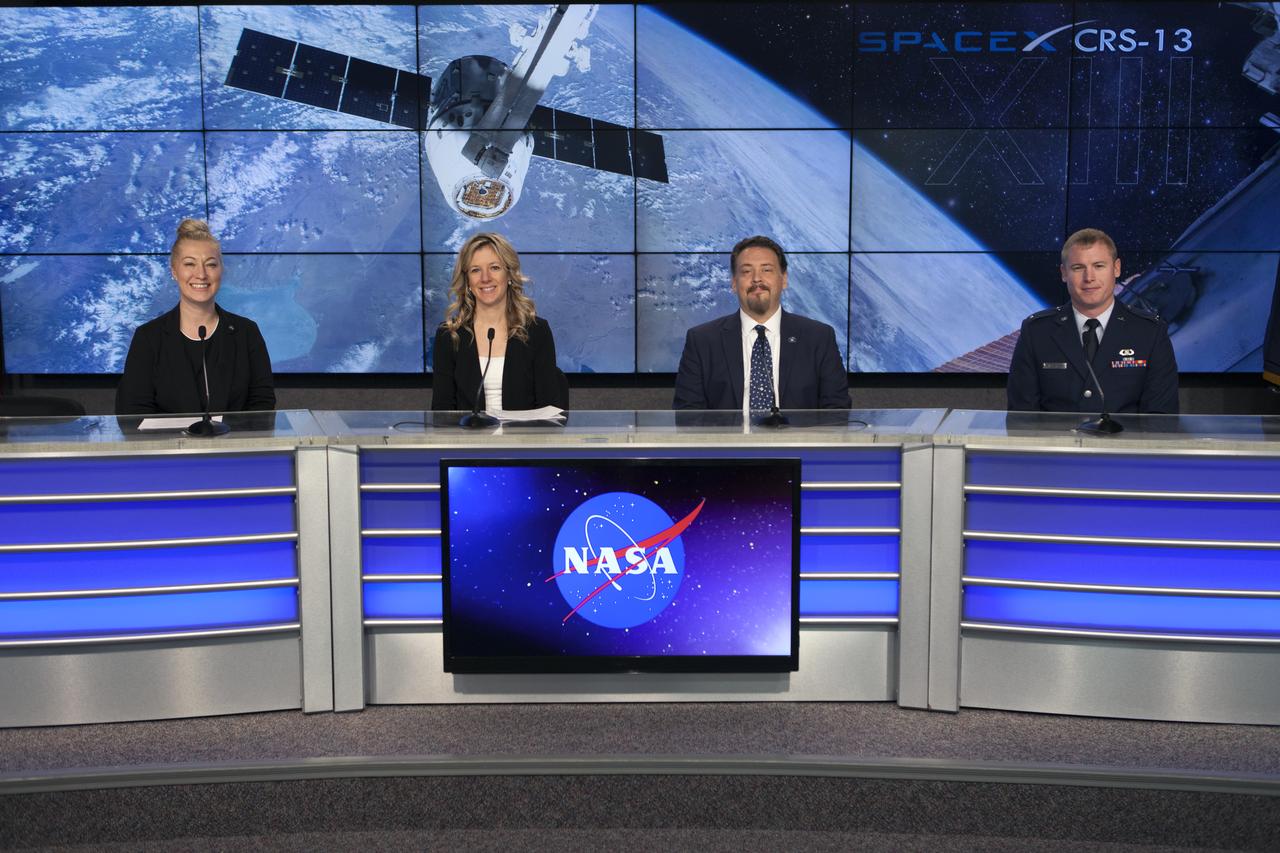
In the Kennedy Space Center’s Press Site auditorium, NASA and industry leaders speak to members of the media during a prelaunch news conference for the SpaceX CRS-13 commercial resupply services mission to the International Space Station. From left are: Cheryl Warner of NASA Communications, Jessica Jensen, SpaceX director of Dragon Mission Management, Kirt Costello, deputy chief scientist for the International Space Station Program Science Office at NASA’s Johnson Space Center in Houston, and Lt. David Myers, weather officer for the 45th Weather Squadron. Kirk Shireman, International Space Station Program manager at Johnson, participated by video link. A Dragon spacecraft is scheduled to be launched from Space Launch Complex 40 at Cape Canaveral Air Force Station at 11:46 a.m. EST, on Dec. 12, 2017. The SpaceX Falcon 9 rocket will lift off on the company's 13th Commercial Resupply Services mission to the space station.
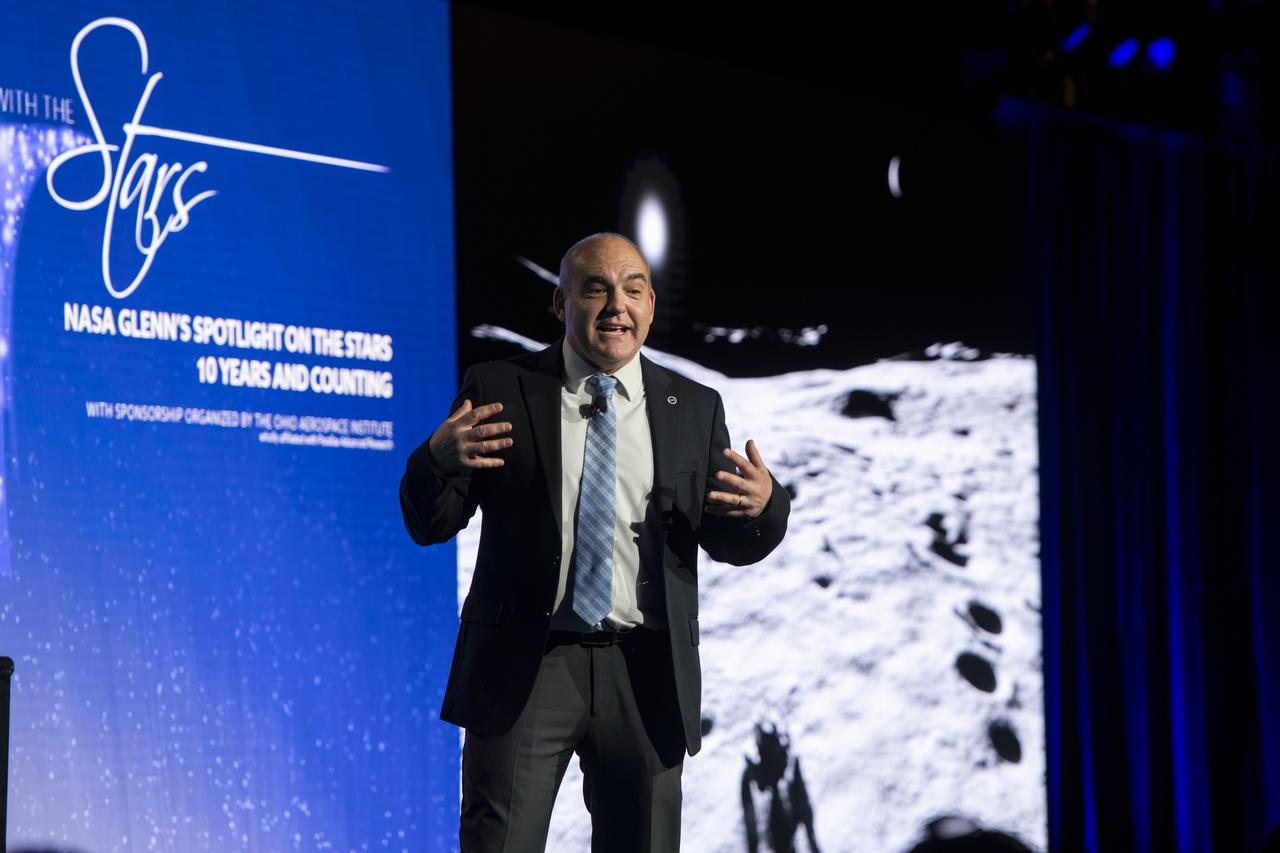
NASA Glenn's Spotlight on the Stars, 10 Years and Counting was held at Windows on the River in Cleveland, OH on November 20th, 2024. Sponsorship organized by the Ohio Aerospace Institute. Welcome by Dennis Andersh, CEO and President, Parallax Advanced Research, Ohio Aerospace Institute. Remarks by Terrence Slaybaugh, Vice President of Sites and Infrastructure, JobsOhio. Introduction of 10th Anniversary Video, Dr. Wanda Peters, Acting Deputy Director, NASA Glenn Research Center. Remarks/Introduction of Presenters, Dr. James Kenyon, Director, NASA Glenn Research Center. Keynote Speakers: Nikki Welch, NASA Glenn Communications, Connecting People to the Mission. Timothy Smith, NASA Glenn's Superalloy Achievements. Carlos Garcia-Galan, Orion Program’s European Service Module Integration Office at Glenn Research Center, Dreaming of Going to the Moon.
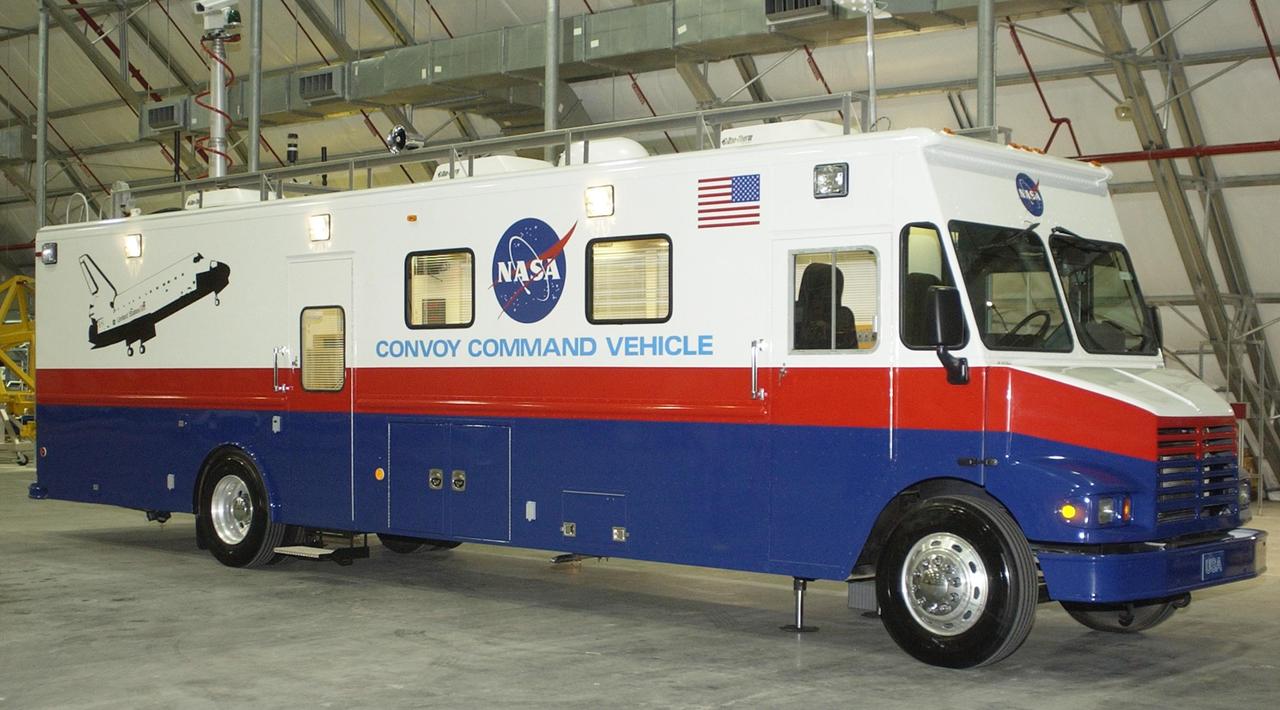
KENNEDY SPACE CENTER, FLA. -- The new Convoy Command Vehicle is displayed before a commissioning ceremony to hand it over to Center Director Roy Bridges Jr. The ceremony was to be held at the Landing Operations Facility. The new 40-foot vehicle is replacing a 15-year old model, and will be used following Shuttle landings as the prime vehicle to control critical communications between the orbiter, the crew and the Launch Control Center, to monitor the health of the Shuttle Orbiter systems and to direct convoy operations at the Shuttle Landing Facility. Upgrades and high-tech features incorporated into the design and development of this vehicle make it more reliable and efficient for the convoy crew. Seating capacity was increased from 4 to 12, and video recorders and television monitors were added to provide the convoy team with the maximum amount of visual information
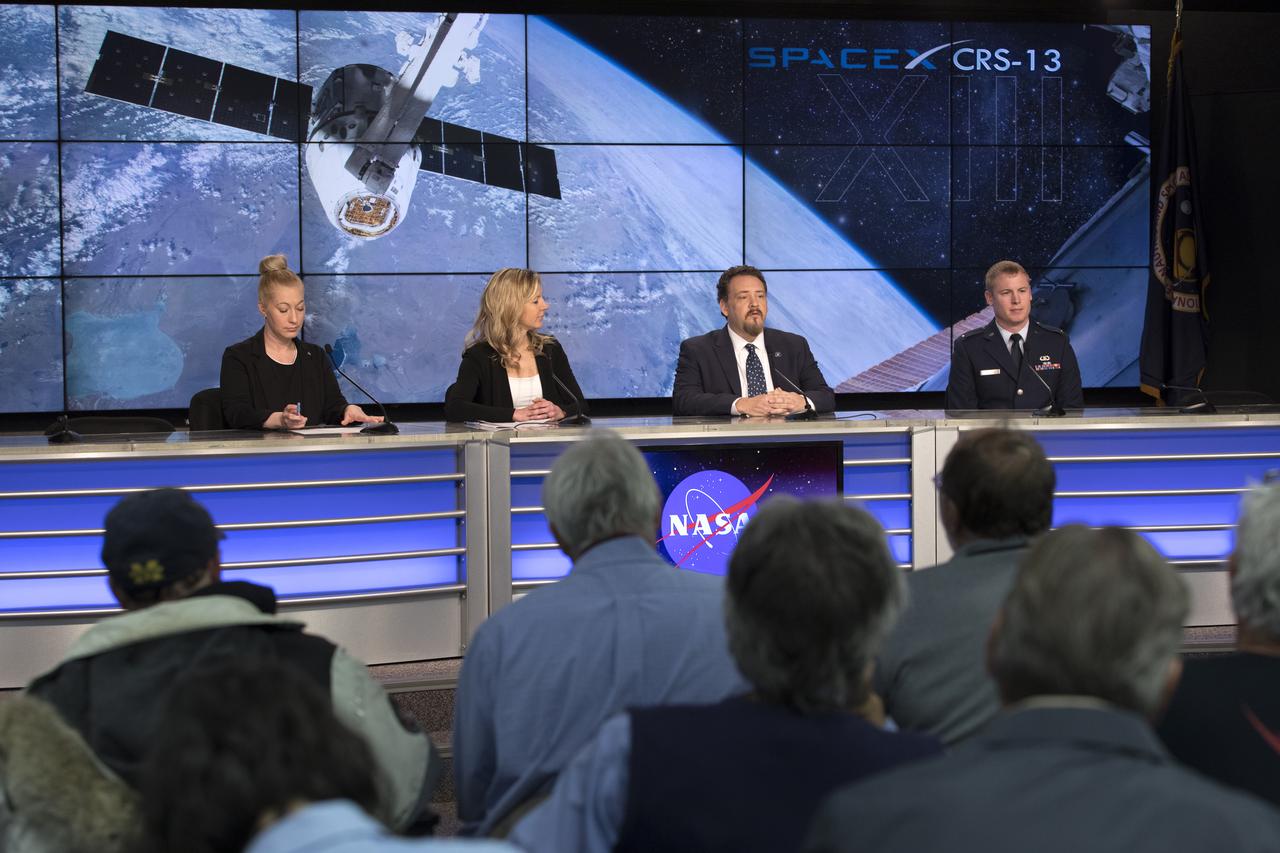
In the Kennedy Space Center’s Press Site auditorium, NASA and industry leaders speak to members of the media during a prelaunch news conference for the SpaceX CRS-13 commercial resupply services mission to the International Space Station. From left are: Cheryl Warner of NASA Communications, Jessica Jensen, SpaceX director of Dragon Mission Management, Kirt Costello, deputy chief scientist for the International Space Station Program Science Office at NASA’s Johnson Space Center in Houston, and Lt. David Myers, weather officer for the 45th Weather Squadron. Kirk Shireman, International Space Station Program manager at Johnson, participated by video link. A Dragon spacecraft is scheduled to be launched from Space Launch Complex 40 at Cape Canaveral Air Force Station at 11:46 a.m. EST, on Dec. 12, 2017. The SpaceX Falcon 9 rocket will lift off on the company's 13th Commercial Resupply Services mission to the space station.
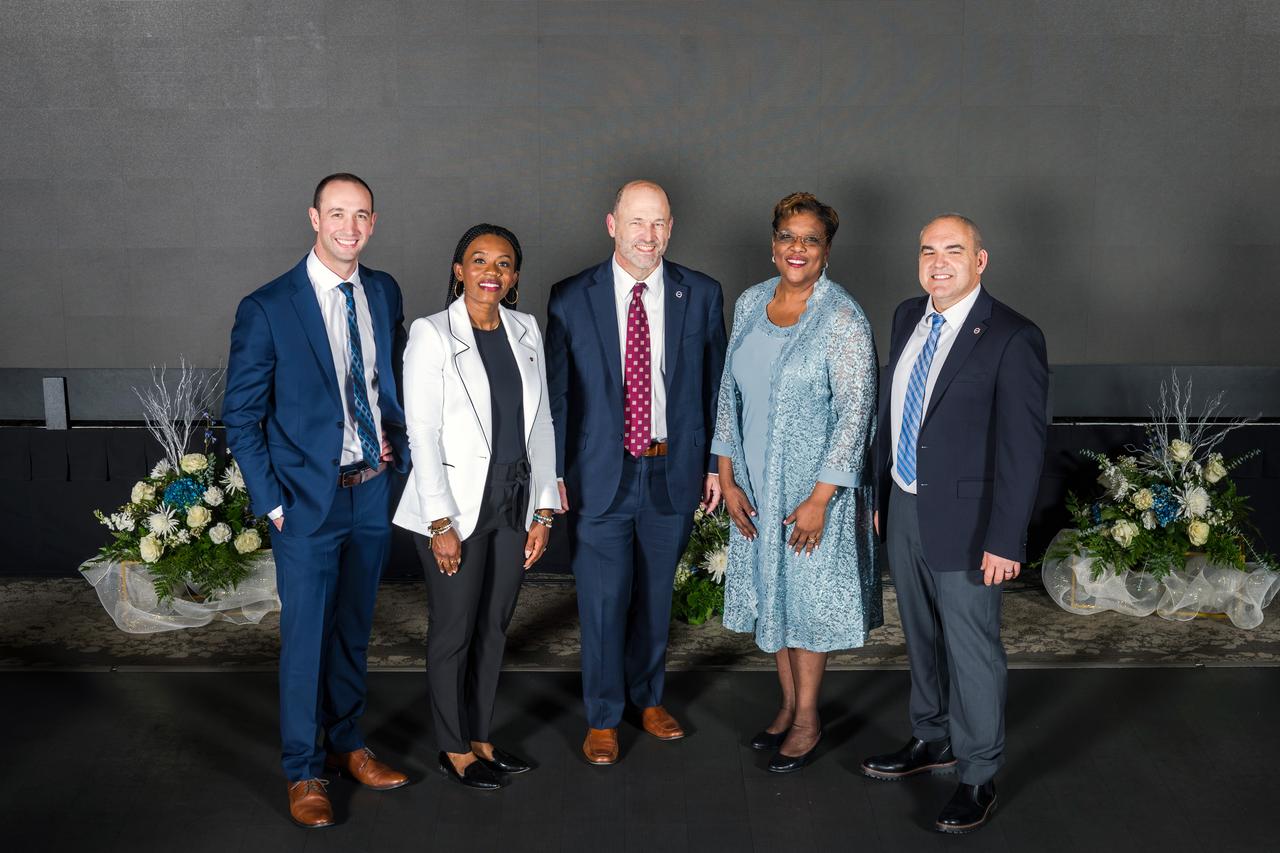
NASA Glenn's Spotlight on the Stars, 10 Years and Counting was held at Windows on the River in Cleveland, OH on November 20th, 2024. Sponsorship organized by the Ohio Aerospace Institute. Pictured from left to right: Timothy Smith, Nikki Welch, Center Director Dr. James Kenyon, Acting Deputy Center Director Dr. Wanda Peters, Carlos Garcia-Galan. Welcome by Dennis Andersh, CEO and President, Parallax Advanced Research, Ohio Aerospace Institute. Remarks by Terrence Slaybaugh, Vice President of Sites and Infrastructure, JobsOhio. Introduction of 10th Anniversary Video, Dr. Wanda Peters, Acting Deputy Director, NASA Glenn Research Center. Remarks/Introduction of Presenters, Dr. James Kenyon, Director, NASA Glenn Research Center. Keynote Speakers: Nikki Welch, NASA Glenn Communications, Connecting People to the Mission. Timothy Smith, NASA Glenn's Superalloy Achievements. Carlos Garcia-Galan, Dreaming of Going to the Moon.
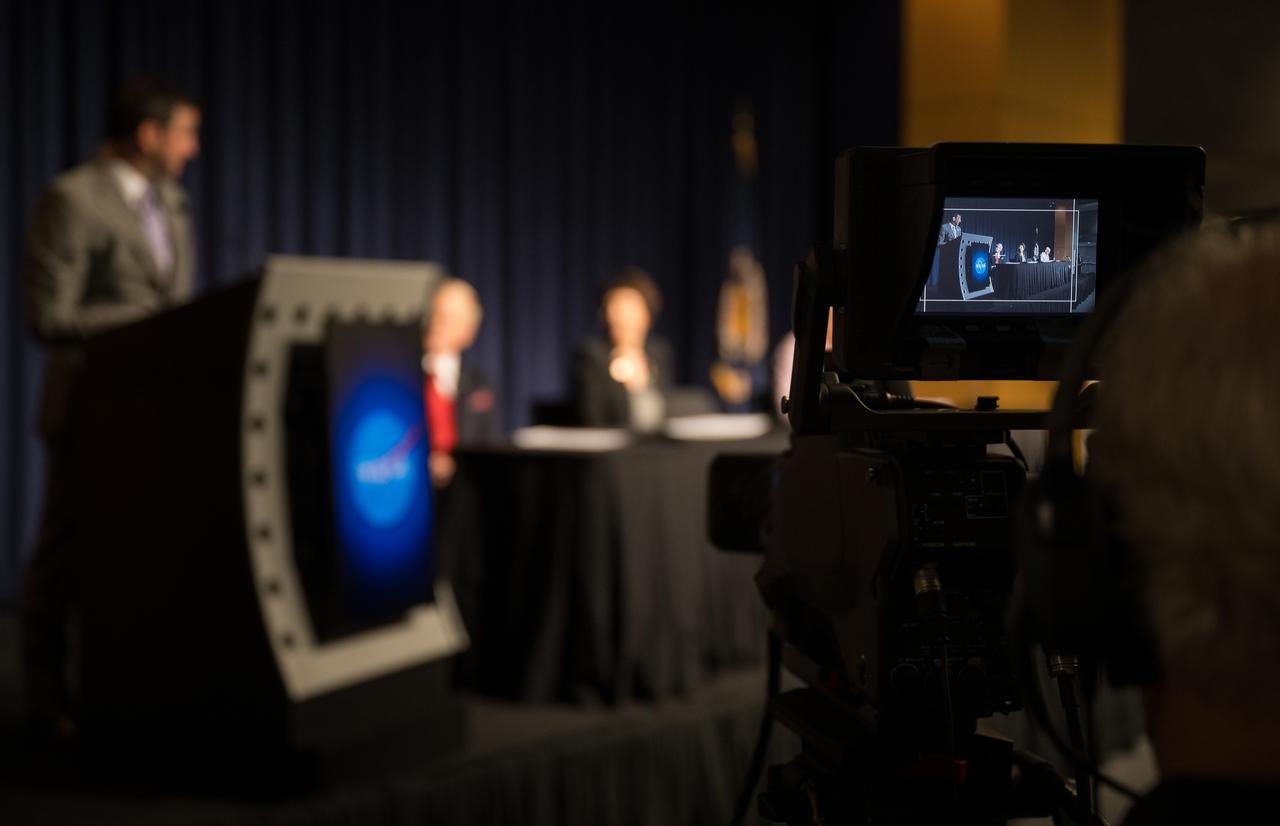
Panelists, from left to right, NASA Assistant Deputy Associate Administrator for Research, Science Mission Directorate, Daniel Evans; NASA Administrator Bill Nelson; NASA Associate Administrator for the Science Mission Directorate, Nicola Fox; and President of the Simons Foundation and Chair of NASA's UAP Independent Study Team, David Spergel, are seen in a video camera during a media briefing to discuss the findings from an unidentified anomalous phenomena (UAP) independent study team, Thursday, Sept. 14, 2023, at the Mary W. Jackson NASA Headquarters building in Washington. The UAP independent study team, commissioned in 2022, is a counsel of 16 community experts across diverse areas on matters relevant to potential methods of study for unidentified anomalous phenomena. NASA published the team’s full report online, which aims to inform about what possible data could be collected in the future to shed light on the nature and origin of UAP. Photo Credit: (NASA/Aubrey Gemignani)
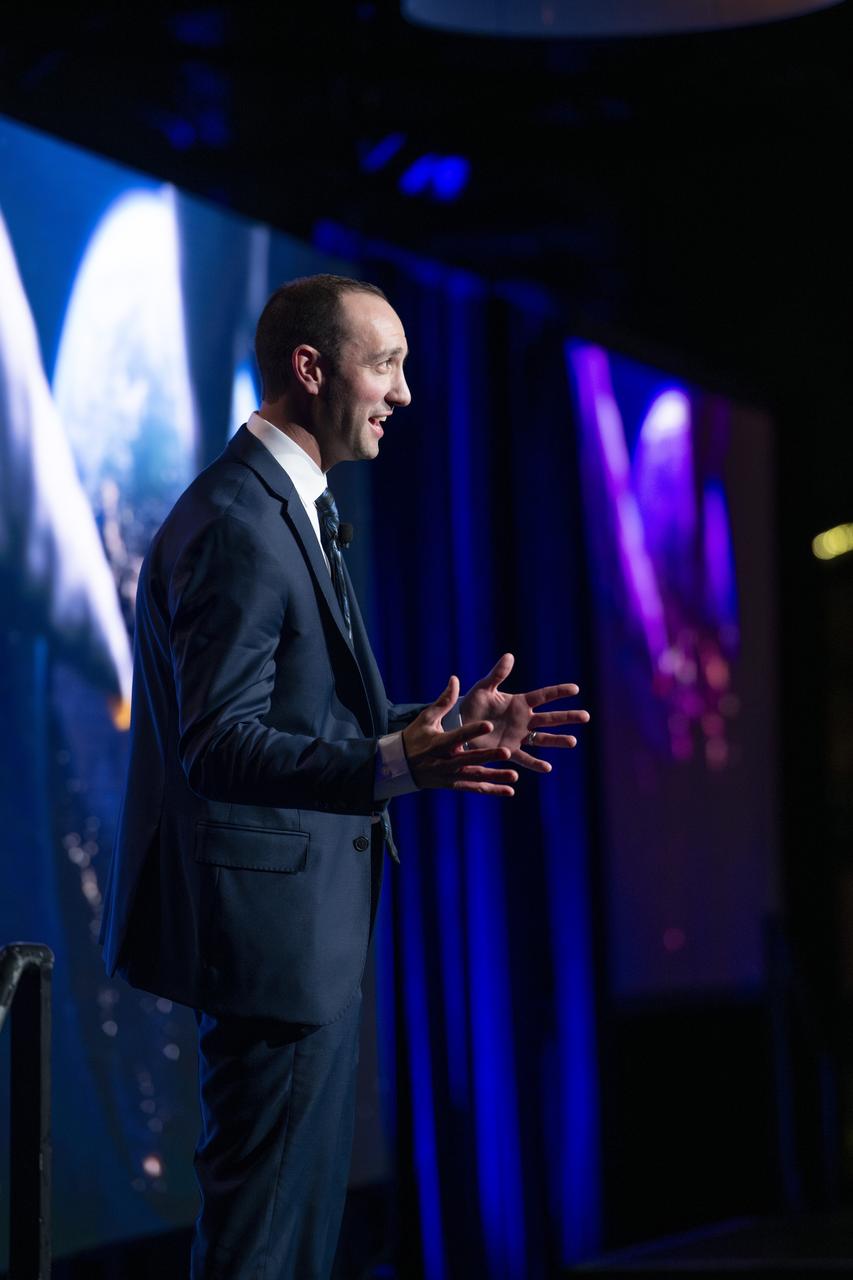
NASA Glenn's Spotlight on the Stars, 10 Years and Counting was held at Windows on the River in Cleveland, OH on November 20th, 2024. Sponsorship organized by the Ohio Aerospace Institute. Welcome by Dennis Andersh, CEO and President, Parallax Advanced Research, Ohio Aerospace Institute. Remarks by Terrence Slaybaugh, Vice President of Sites and Infrastructure, JobsOhio. Introduction of 10th Anniversary Video, Dr. Wanda Peters, Acting Deputy Director, NASA Glenn Research Center. Remarks/Introduction of Presenters, Dr. James Kenyon, Director, NASA Glenn Research Center. Keynote Speakers: Nikki Welch, NASA Glenn Communications, Connecting People to the Mission. Timothy Smith, NASA Glenn's Superalloy Achievements. Carlos Garcia-Galan, Dreaming of Going to the Moon.
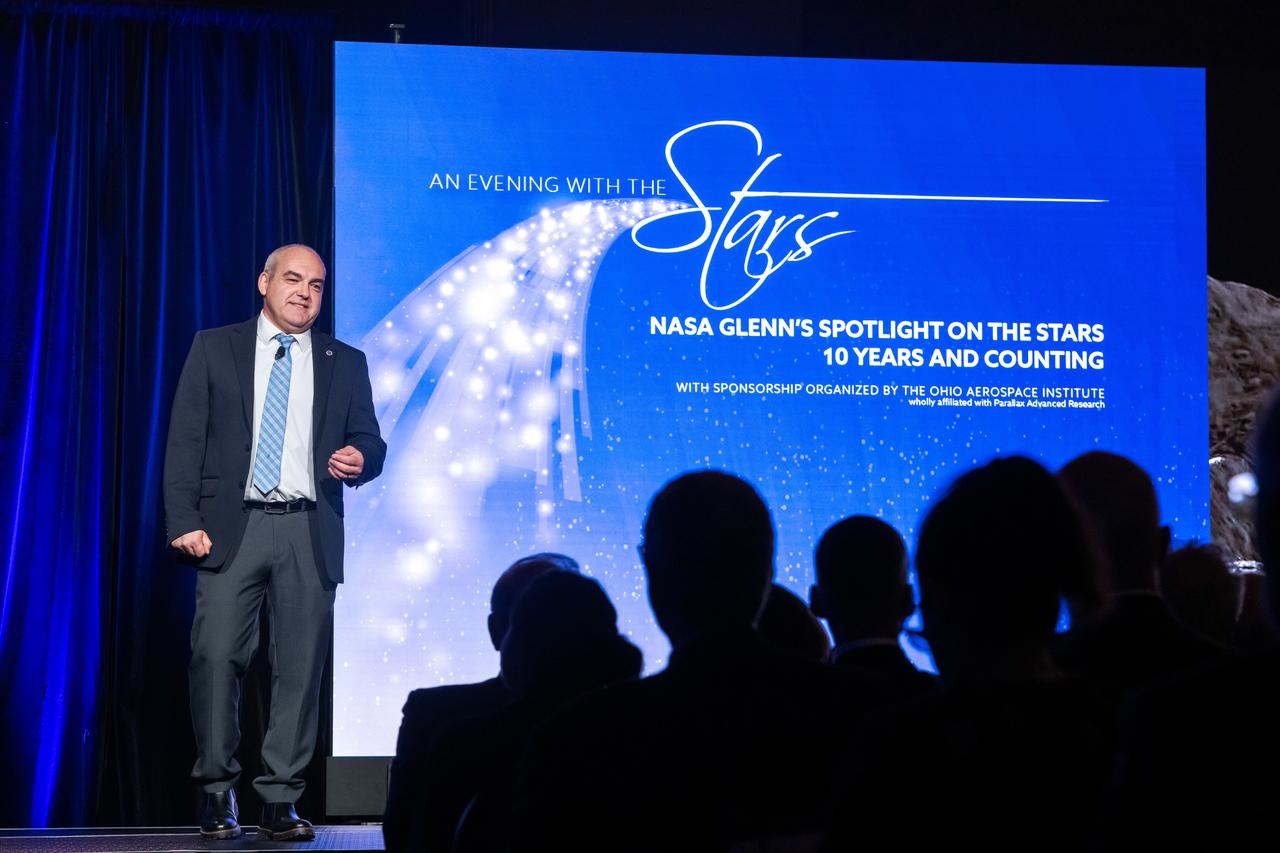
NASA Glenn's Spotlight on the Stars, 10 Years and Counting was held at Windows on the River in Cleveland, OH on November 20th, 2024. Sponsorship organized by the Ohio Aerospace Institute. Welcome by Dennis Andersh, CEO and President, Parallax Advanced Research, Ohio Aerospace Institute. Remarks by Terrence Slaybaugh, Vice President of Sites and Infrastructure, JobsOhio. Introduction of 10th Anniversary Video, Dr. Wanda Peters, Acting Deputy Director, NASA Glenn Research Center. Remarks/Introduction of Presenters, Dr. James Kenyon, Director, NASA Glenn Research Center. Keynote Speakers: Nikki Welch, NASA Glenn Communications, Connecting People to the Mission. Timothy Smith, NASA Glenn's Superalloy Achievements. Carlos Garcia-Galan, Dreaming of Going to the Moon.
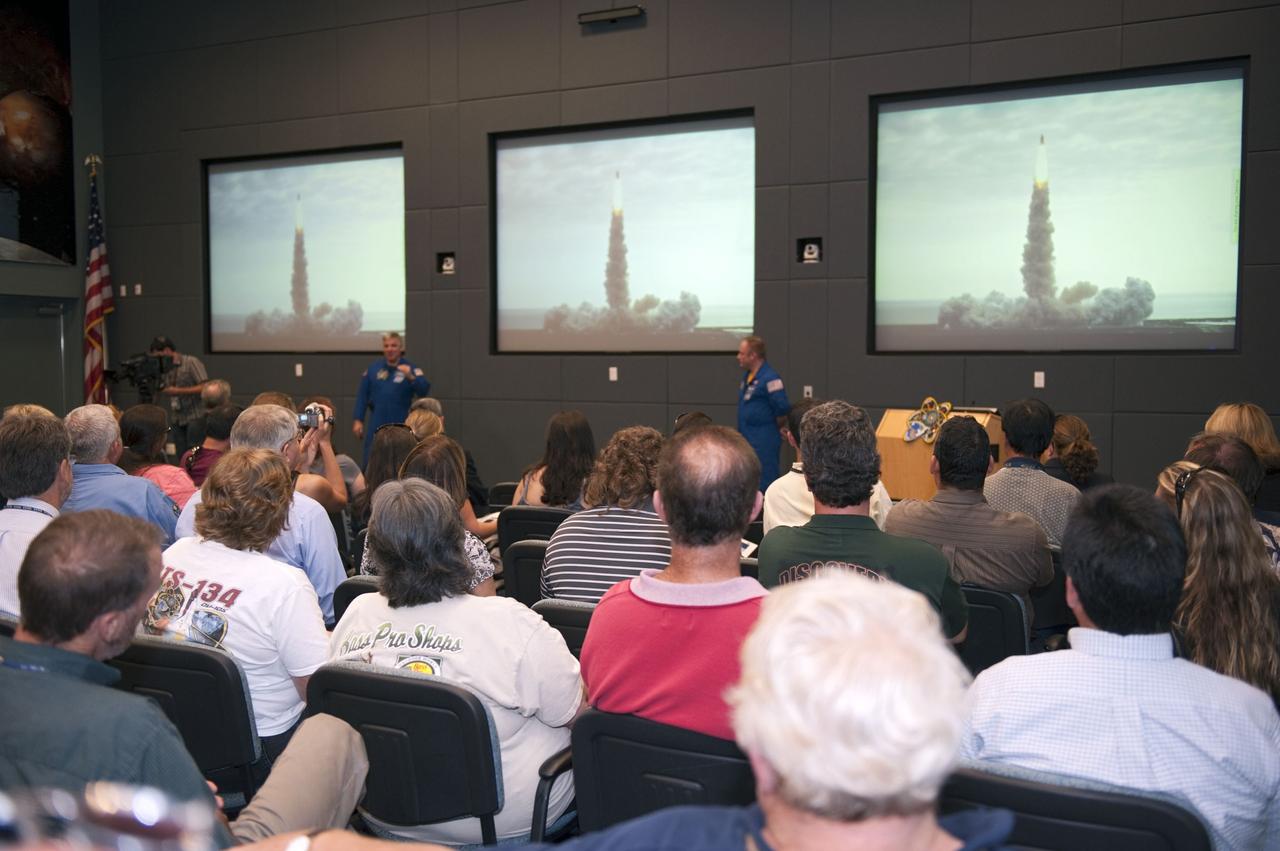
CAPE CANAVERAL, Fla. - STS-134 Pilot Gregory H. Johnson, left, and Mission Specialist Michael Fincke speak to employees at NASA's Kennedy Space Center in Florida during a video presentation, part of a crew return event. Commander Mark Kelly, Johnson and Mission Specialists Fincke, Greg Chamitoff, Andrew Feustel and European Space Agency astronaut Roberto Vittori lifted off May 16, 2011, aboard space shuttle Endeavour. During the nearly 16-day STS-134 mission, Endeavour delivered to the International Space Station the Alpha Magnetic Spectrometer (AMS) and spare parts, including two S-band communications antennas, a high-pressure gas tank and additional spare parts for Dextre. This was the 36th shuttle mission to the station and Endeavour's 25th and final flight. For more information, visit www.nasa.gov/mission_pages/shuttle/shuttlemissions/sts134/main/index.html. Photo credit: NASA/Kim Shiflett
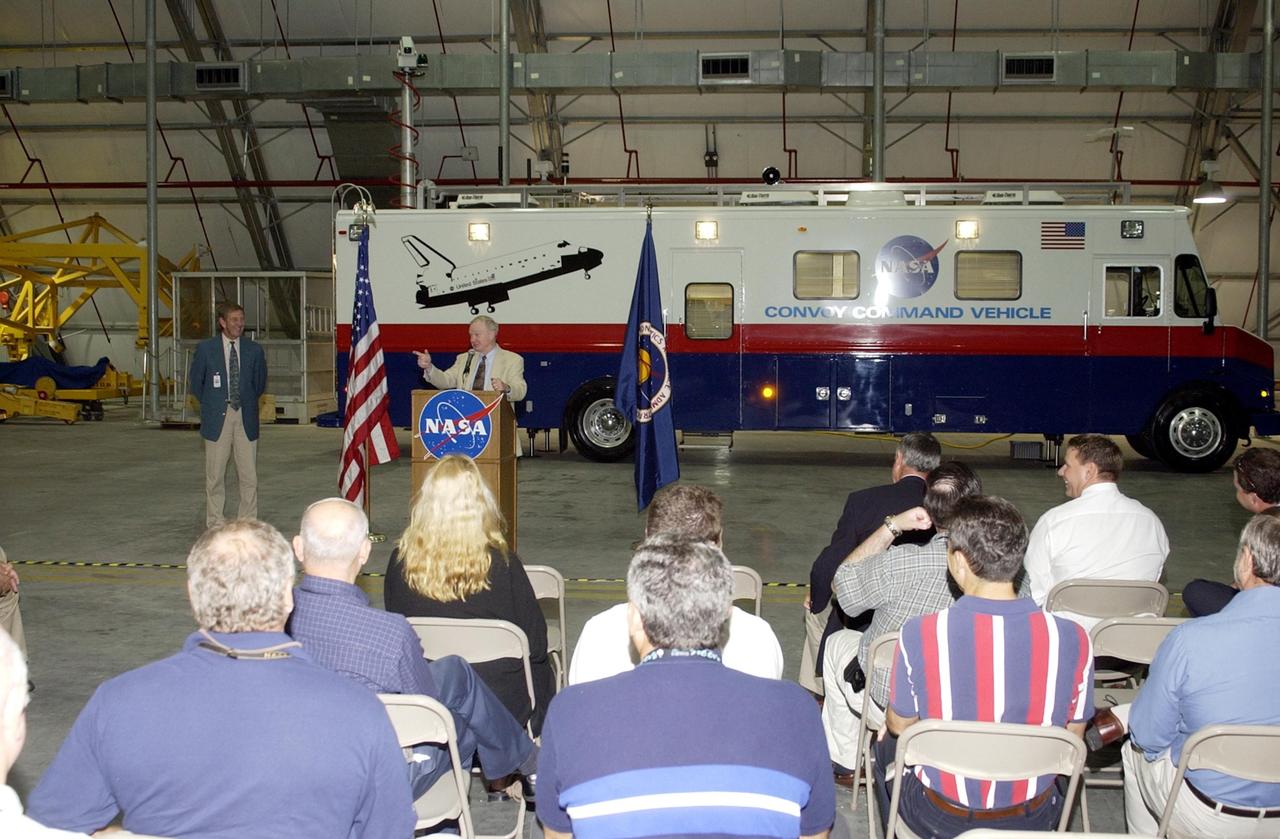
KENNEDY SPACE CENTER, FLA. -- At the podium, Center Director Roy Bridges Jr. offers remarks at the commissioning ceremony for the new Convoy Command Vehicle behind him. At left is Mike McCulley, chief operating officer, United Space Alliance. The new 40-foot vehicle is replacing a 15-year old model, and will be used following Shuttle landings as the prime vehicle to control critical communications between the orbiter, the crew and the Launch Control Center, to monitor the health of the Shuttle Orbiter systems and to direct convoy operations at the Shuttle Landing Facility. Upgrades and high-tech features incorporated into the design and development of this vehicle make it more reliable and efficient for the convoy crew. Seating capacity was increased from 4 to 12, and video recorders and television monitors were added to provide the convoy team with the maximum amount of visual information

NASA Glenn's Spotlight on the Stars, 10 Years and Counting. Sponsorship organized by the Ohio Aerospace Institute was held at Windows on the River in Cleveland, OH on November 20th, 2024. Here, keynote speaker, Nikki Welch is on stage during Evening with the Stars 2024 Welcome by Dennis Andersh, CEO and President, Parallax Advanced Research, Ohio Aerospace Institute. Remarks by Terrence Slaybaugh, Vice President of Sites and Infrastructure, JobsOhio. Introduction of 10th Anniversary Video, Dr. Wanda Peters, Acting Deputy Director, NASA Glenn Research Center. Remarks/Introduction of Presenters, Dr. James Kenyon, Director, NASA Glenn Research Center. Keynote Speakers: Nikki Welch, NASA Glenn Communications, Connecting People to the Mission. Timothy Smith, NASA Glenn's Superalloy Achievements. Carlos Garcia-Galan, Dreaming of Going to the Moon. Photo Credit: (NASA/Sara Lowthian-Hanna)
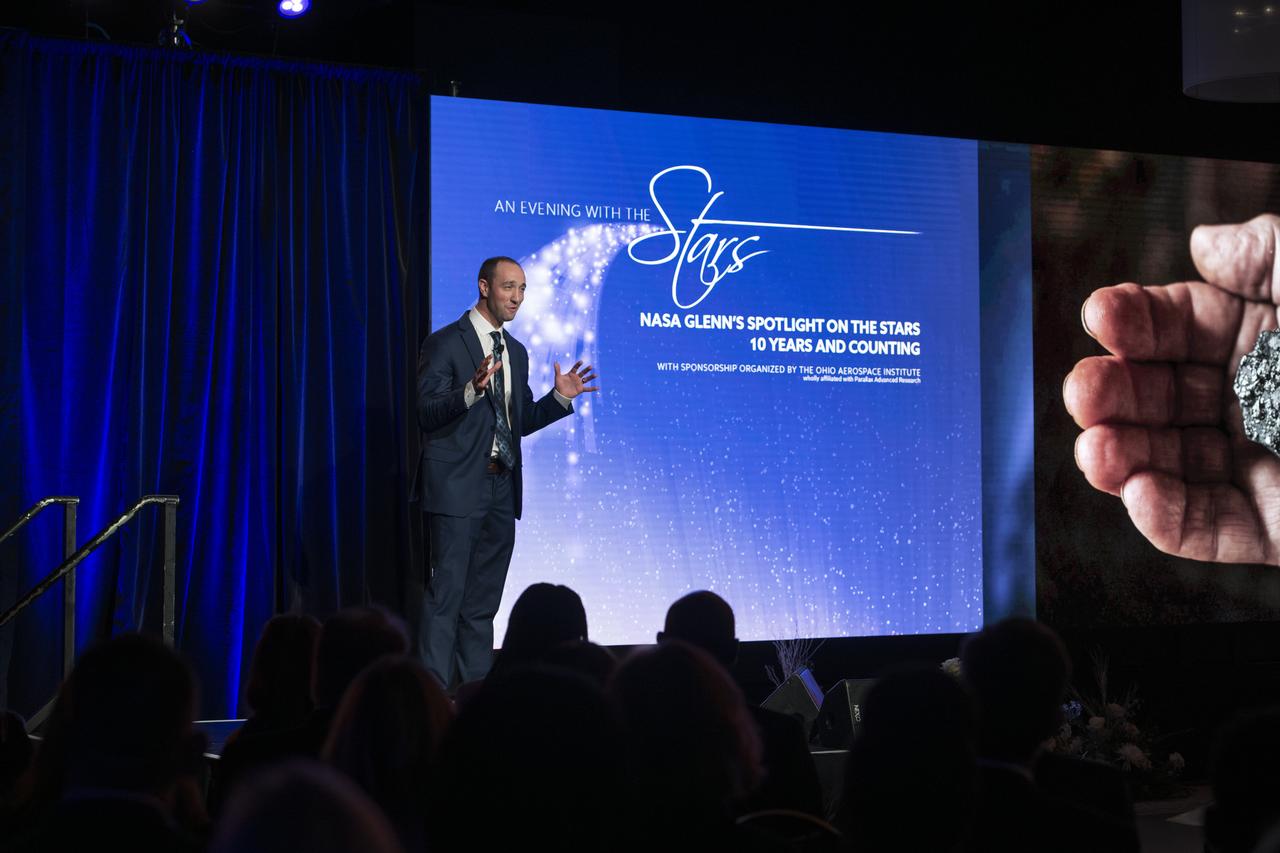
NASA Glenn's Spotlight on the Stars, 10 Years and Counting was held at Windows on the River in Cleveland, OH on November 20th, 2024. Sponsorship organized by the Ohio Aerospace Institute. Welcome by Dennis Andersh, CEO and President, Parallax Advanced Research, Ohio Aerospace Institute. Remarks by Terrence Slaybaugh, Vice President of Sites and Infrastructure, JobsOhio. Introduction of 10th Anniversary Video, Dr. Wanda Peters, Acting Deputy Director, NASA Glenn Research Center. Remarks/Introduction of Presenters, Dr. James Kenyon, Director, NASA Glenn Research Center. Keynote Speakers: Nikki Welch, NASA Glenn Communications, Connecting People to the Mission. Timothy Smith, NASA Glenn's Superalloy Achievements. Carlos Garcia-Galan, Dreaming of Going to the Moon. Photo Credit: (NASA/Sara Lowthian-Hanna)
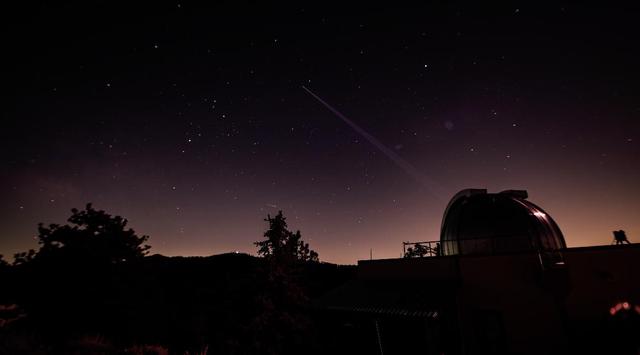
This timelapse video shows the NASA Jet Propulsion Laboratory's Table Mountain Facility near Wrightwood, California, transmitting its 3-kilowatt laser beacon to the agency's Deep Space Optical Communications (DSOC) experiment aboard NASA's Psyche mission on June 2, 2025; the spacecraft was about 143 million miles (230 million kilometers) from Earth at the time. Managed by JPL, DSOC was designed to demonstrate that data encoded in laser photons could be reliably transmitted, received, and then decoded after traveling millions of miles from Earth out to Mars distances. Nearly two years after launching aboard the agency's Psyche mission in 2023, the demonstration completed its 65th and final "pass" on Sept. 2, 2025, sending a laser signal to Psyche and receiving the return signal from 218 million miles (350 million kilometers) away. Animation available at https://photojournal.jpl.nasa.gov/catalog/PIA26663
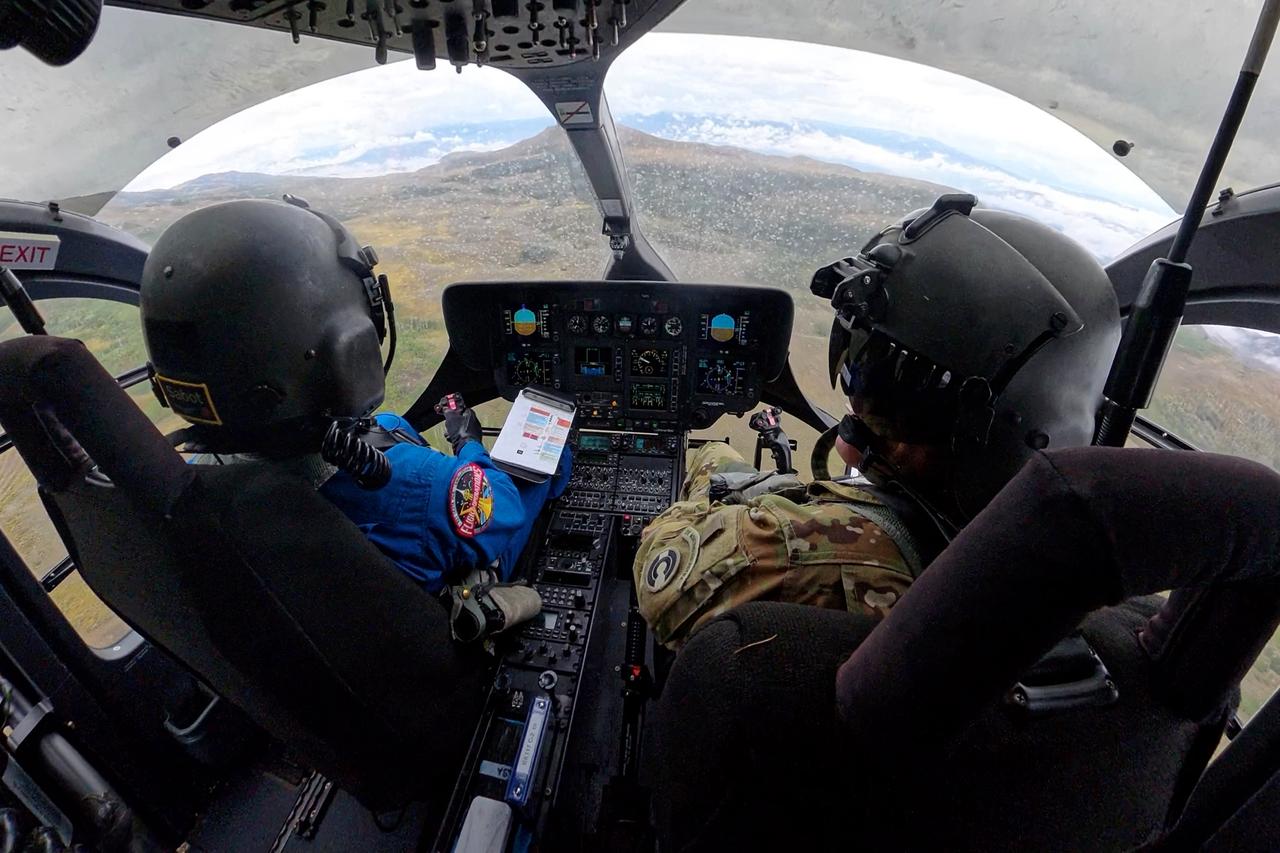
These photos and videos show how NASA certified a new lander flight training course using helicopters in the mountains of northern Colorado. NASA is partnering with the Colorado Army National Guard at its High-Altitude Army National Guard Aviation Training Site near Gypsum, Colorado, to develop the foundational flight training course that will help astronauts practice flight and landing procedures for the Moon. The certification marks an important milestone in crew training for Artemis missions to the Moon, when astronauts will use a commercial human landing system to land on the lunar surface. During the two-week certification run in late August 2025, NASA astronauts Matthew Dominick and Mark Vande Hei participated in flight and landing training to help certify the course. The pair, along with trained instructor pilots with the Army National Guard, took turns flying a helicopter and navigating to landing zones. Artemis flight crew trainers, mission control leads, and lunar lander operational experts from NASA Johnson joined them on each helicopter flight to assess the instruction, training environment, and technical applications for crewed lunar missions. For more information, contact NASA Marshall’s Office of Communications at 256-544
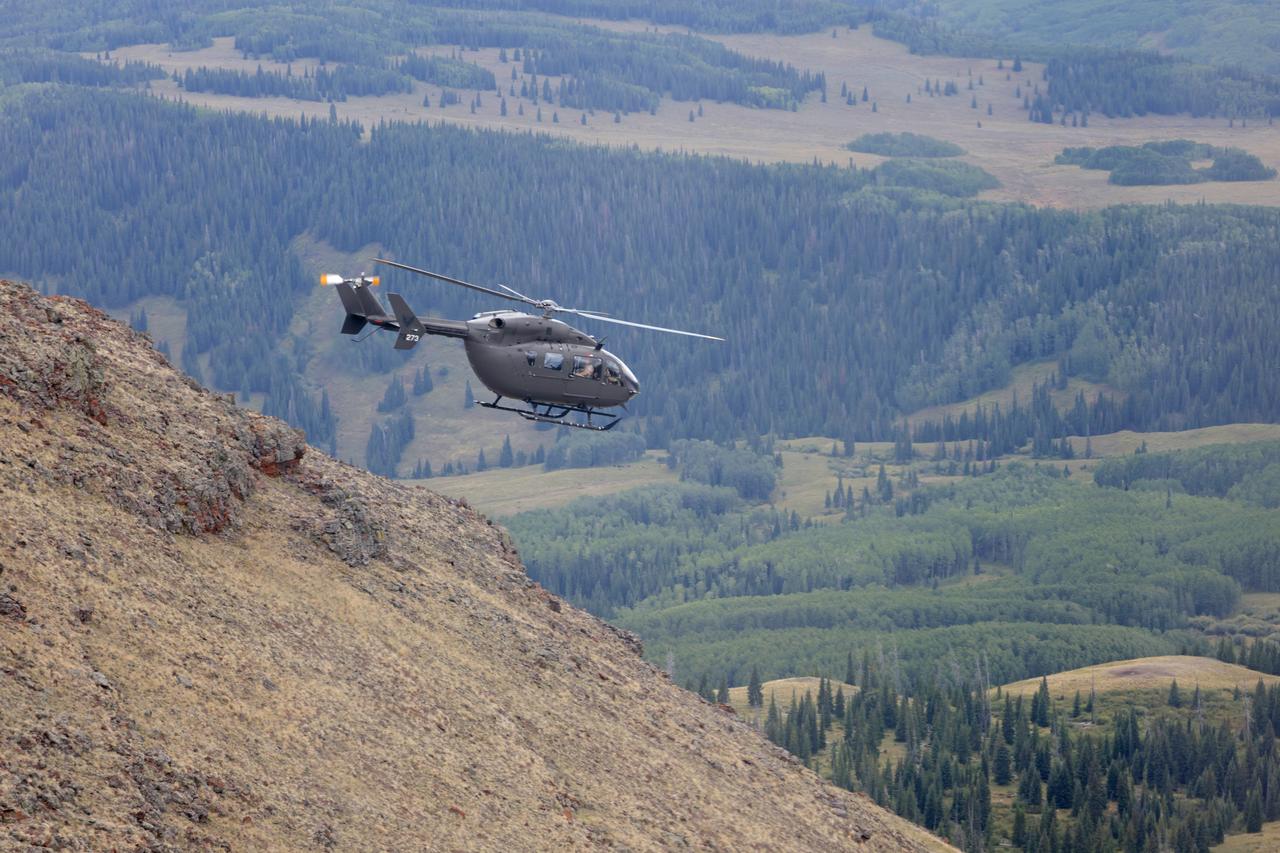
These photos and videos show how NASA certified a new lander flight training course using helicopters in the mountains of northern Colorado. NASA is partnering with the Colorado Army National Guard at its High-Altitude Army National Guard Aviation Training Site near Gypsum, Colorado, to develop the foundational flight training course that will help astronauts practice flight and landing procedures for the Moon. The certification marks an important milestone in crew training for Artemis missions to the Moon, when astronauts will use a commercial human landing system to land on the lunar surface. During the two-week certification run in late August 2025, NASA astronauts Matthew Dominick and Mark Vande Hei participated in flight and landing training to help certify the course. The pair, along with trained instructor pilots with the Army National Guard, took turns flying a helicopter and navigating to landing zones. Artemis flight crew trainers, mission control leads, and lunar lander operational experts from NASA Johnson joined them on each helicopter flight to assess the instruction, training environment, and technical applications for crewed lunar missions. For more information, contact NASA Marshall’s Office of Communications at 256-544
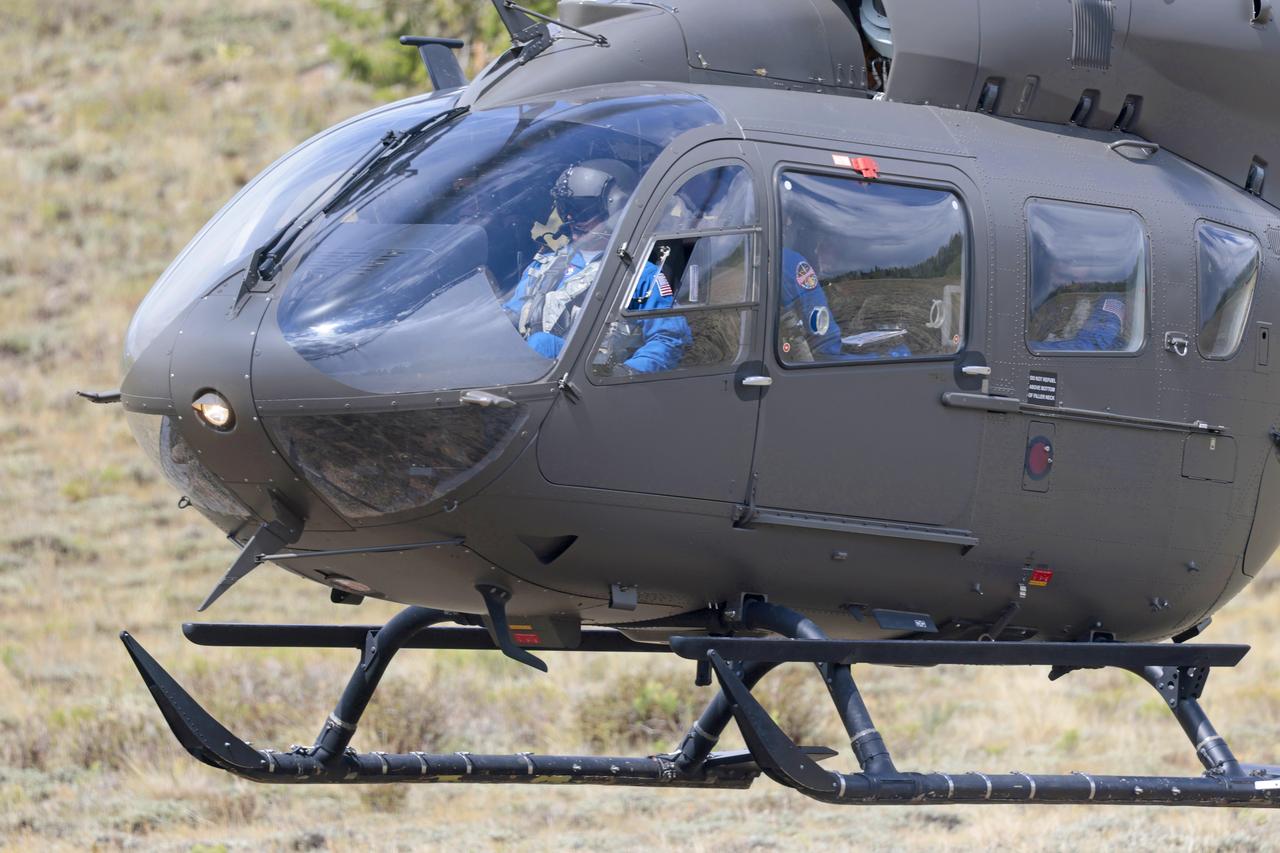
These photos and videos show how NASA certified a new lander flight training course using helicopters in the mountains of northern Colorado. NASA is partnering with the Colorado Army National Guard at its High-Altitude Army National Guard Aviation Training Site near Gypsum, Colorado, to develop the foundational flight training course that will help astronauts practice flight and landing procedures for the Moon. The certification marks an important milestone in crew training for Artemis missions to the Moon, when astronauts will use a commercial human landing system to land on the lunar surface. During the two-week certification run in late August 2025, NASA astronauts Matthew Dominick and Mark Vande Hei participated in flight and landing training to help certify the course. The pair, along with trained instructor pilots with the Army National Guard, took turns flying a helicopter and navigating to landing zones. Artemis flight crew trainers, mission control leads, and lunar lander operational experts from NASA Johnson joined them on each helicopter flight to assess the instruction, training environment, and technical applications for crewed lunar missions. For more information, contact NASA Marshall’s Office of Communications at 256-544
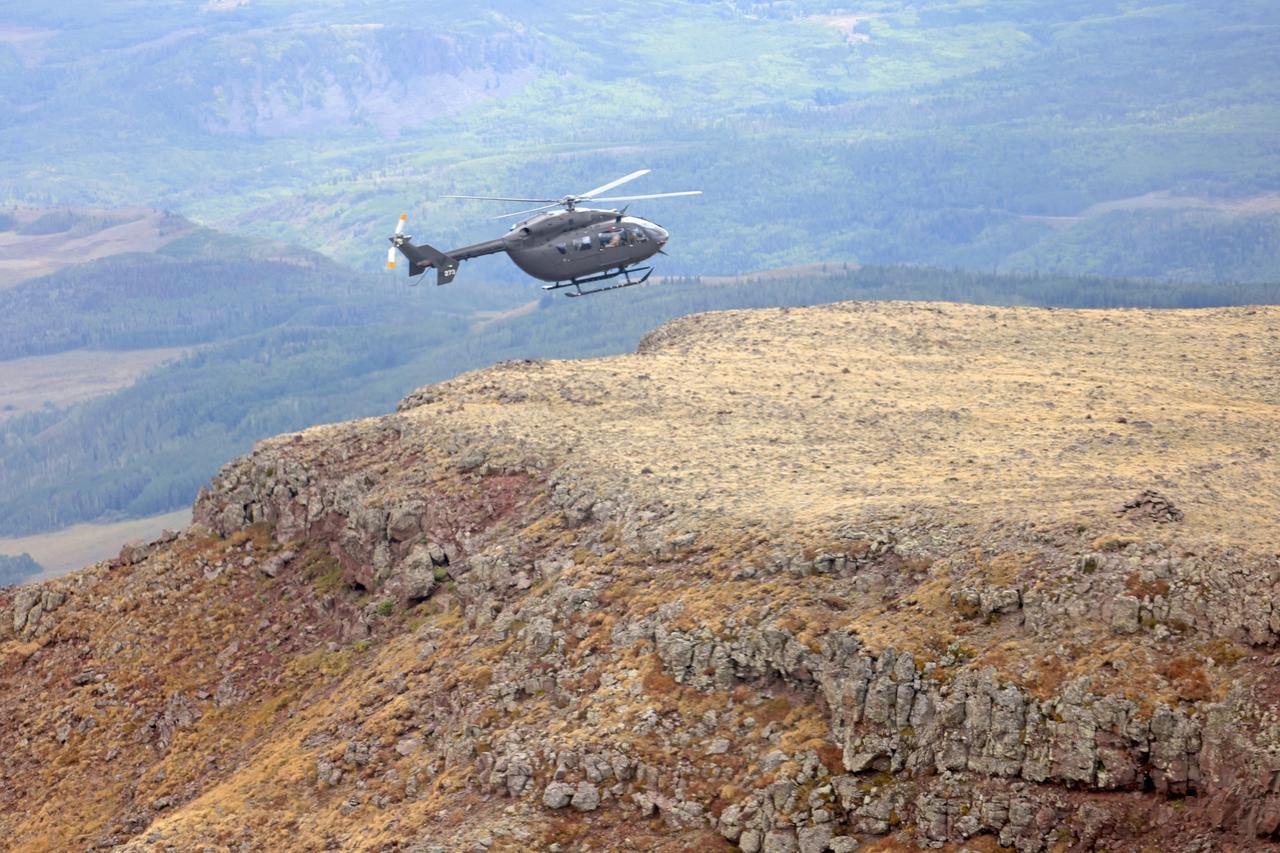
These photos and videos show how NASA certified a new lander flight training course using helicopters in the mountains of northern Colorado. NASA is partnering with the Colorado Army National Guard at its High-Altitude Army National Guard Aviation Training Site near Gypsum, Colorado, to develop the foundational flight training course that will help astronauts practice flight and landing procedures for the Moon. The certification marks an important milestone in crew training for Artemis missions to the Moon, when astronauts will use a commercial human landing system to land on the lunar surface. During the two-week certification run in late August 2025, NASA astronauts Matthew Dominick and Mark Vande Hei participated in flight and landing training to help certify the course. The pair, along with trained instructor pilots with the Army National Guard, took turns flying a helicopter and navigating to landing zones. Artemis flight crew trainers, mission control leads, and lunar lander operational experts from NASA Johnson joined them on each helicopter flight to assess the instruction, training environment, and technical applications for crewed lunar missions. For more information, contact NASA Marshall’s Office of Communications at 256-544
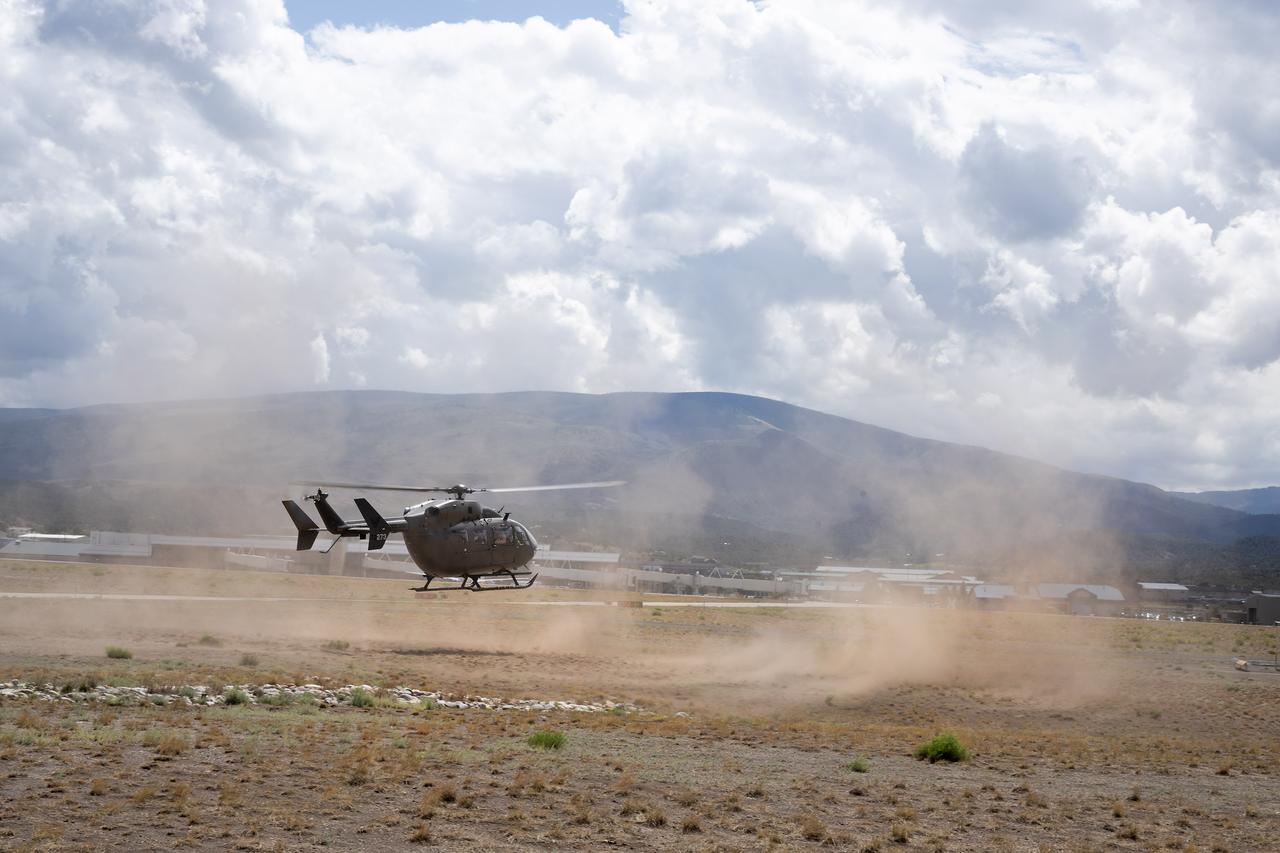
These photos and videos show how NASA certified a new lander flight training course using helicopters in the mountains of northern Colorado. NASA is partnering with the Colorado Army National Guard at its High-Altitude Army National Guard Aviation Training Site near Gypsum, Colorado, to develop the foundational flight training course that will help astronauts practice flight and landing procedures for the Moon. The certification marks an important milestone in crew training for Artemis missions to the Moon, when astronauts will use a commercial human landing system to land on the lunar surface. During the two-week certification run in late August 2025, NASA astronauts Matthew Dominick and Mark Vande Hei participated in flight and landing training to help certify the course. The pair, along with trained instructor pilots with the Army National Guard, took turns flying a helicopter and navigating to landing zones. Artemis flight crew trainers, mission control leads, and lunar lander operational experts from NASA Johnson joined them on each helicopter flight to assess the instruction, training environment, and technical applications for crewed lunar missions. For more information, contact NASA Marshall’s Office of Communications at 256-544