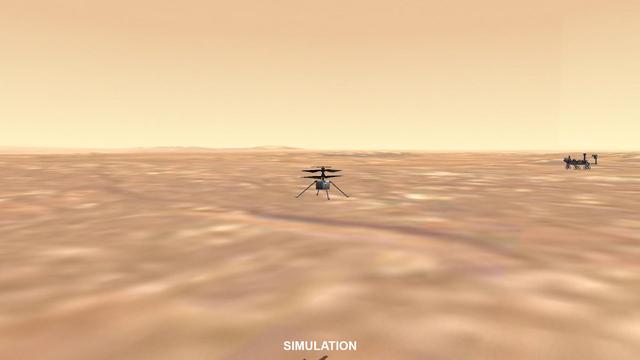
This video animation made with data from the first flight of NASA's Ingenuity helicopter shows the flight from different angles. The flight occurred on April 19, 2021. The Ingenuity Mars Helicopter was built by JPL, which also manages this technology demonstration project for NASA Headquarters. It is supported by NASA's Science Mission Directorate, Aeronautics Research Mission Directorate, and Space Technology Mission Directorate. NASA's Ames Research Center and Langley Research Center provided significant flight performance analysis and technical assistance during Ingenuity's development. A key objective for Perseverance's mission on Mars is astrobiology, including the search for signs of ancient microbial life. The rover will characterize the planet's geology and past climate, pave the way for human exploration of the Red Planet, and be the first mission to collect and cache Martian rock and regolith (broken rock and dust). Subsequent NASA missions, in cooperation with ESA (European Space Agency), would send spacecraft to Mars to collect these sealed samples from the surface and return them to Earth for in-depth analysis. The Mars 2020 Perseverance mission is part of NASA's Moon to Mars exploration approach, which includes Artemis missions to the Moon that will help prepare for human exploration of the Red Planet. Animation available at https://photojournal.jpl.nasa.gov/catalog/PIA24588

NASA Voyager 2 spacecraft flew by Triton, a moon of Neptune, on August 25, 1989. This frame from a video using Voyager data recreates that exciting encounter.
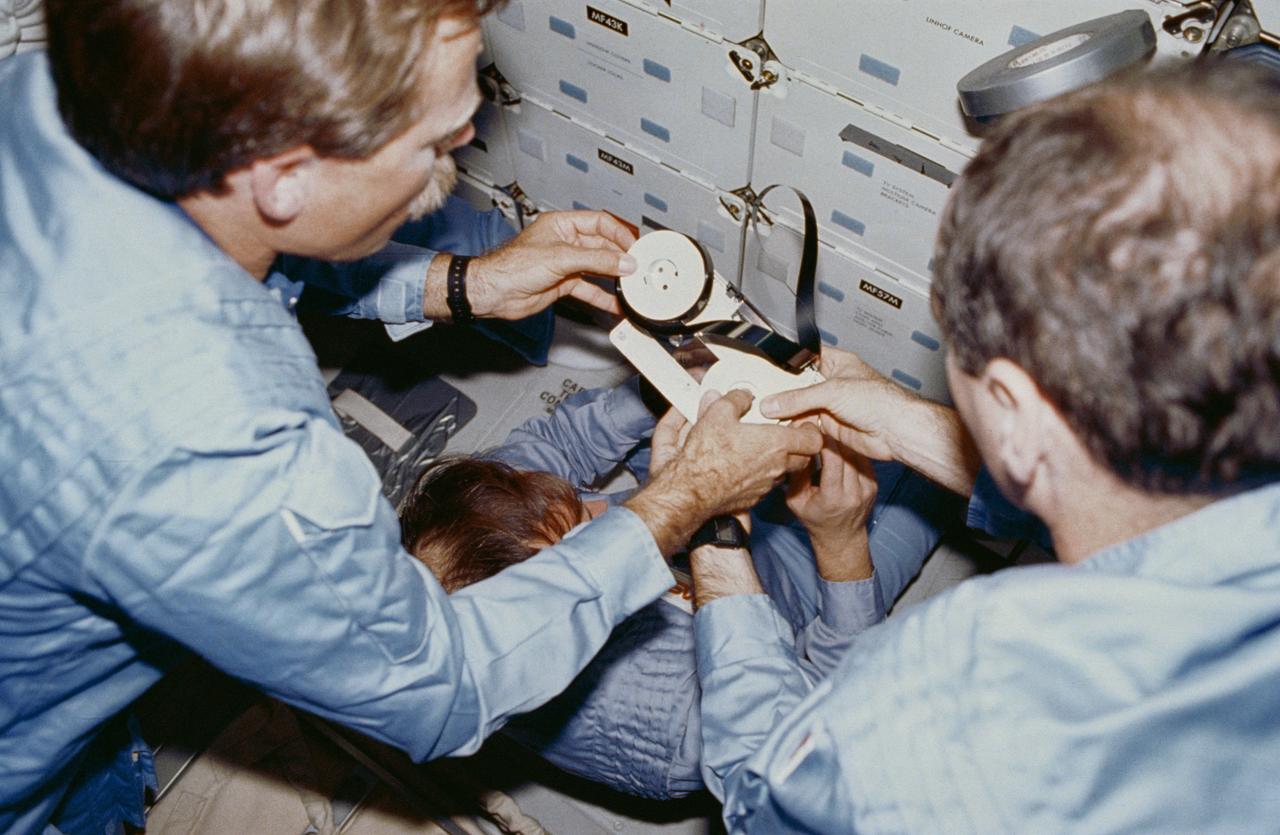
STS027-05-020 (2-6 Dec. 1988) --- In the foreground, astronauts Robert L. Gibson (left) and Guy S. Gardner, commander and pilot, respectively, for the STS-27 mission, repair a 3/4-inch video reel on the middeck of the Earth-orbiting space shuttle Atlantis. Photo credit: NASA
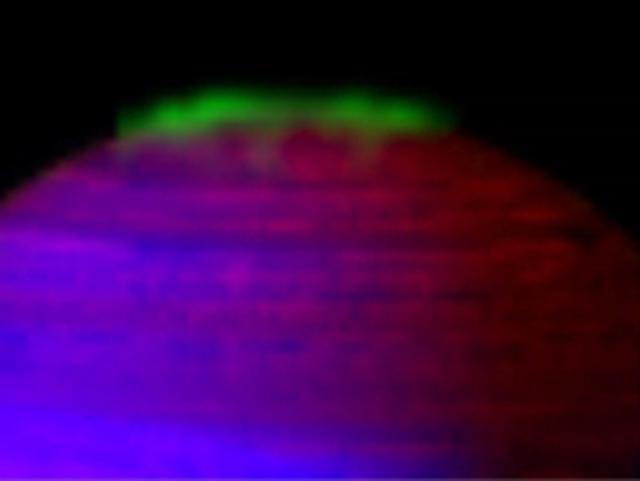
This frame from a movie, made from data obtained by NASA Cassini spacecraft, shows Saturn southern aurora shimmering over approximately 20 hours as the planet rotates. The video is available at the Photojournal.
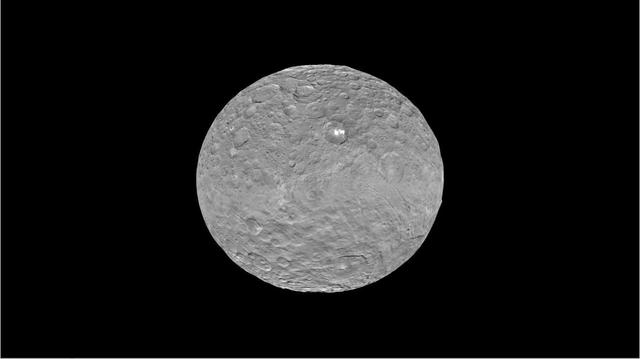
This frame from a video shows the bright spots in Occator crater on dwarf planet Ceres, generated from data from NASA Dawn spacecraft. The global view uses data collected by NASA's Dawn mission in April and May 2015. The highest-resolution parts of the map have a resolution of 1,600 feet (480 meters) per pixel. The second portion of the video shows the bright spots in Occator crater, which is about 60 miles (90 kilometers) across and 2 miles (4 kilometers) deep. Vertical relief has been exaggerated by a factor of five. Exaggerating the relief helps scientists understand and visualize the topography more easily, and highlights features that are sometimes subtle. The third portion of the video shows a mountain about 4 miles (6 kilometers) high, which is roughly the elevation of Mount McKinley in Alaska's Denali National Park. Vertical relief has been exaggerated by a factor of five. Exaggerating the relief helps scientists understand and visualize the topography much more easily, and highlights features that are sometimes subtle. The fourth section of the video shows the global view from the first section in 3-D view. A pair of 3-D glasses reveals striking detail in the topography of the dwarf planet. http://photojournal.jpl.nasa.gov/catalog/PIA19619
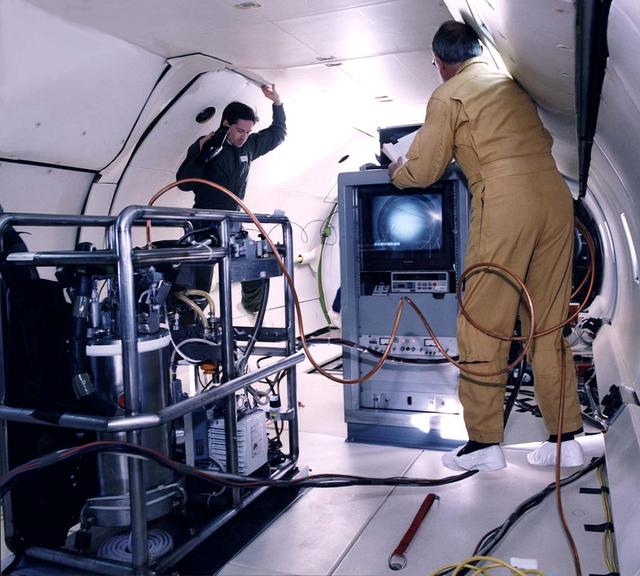
Ted Brunzie and Peter Mason observe the float package and the data rack aboard the DC-9 reduced gravity aircraft. The float package contains a cryostat, a video camera, a pump and accelerometers. The data rack displays and record the video signal from the float package on tape and stores acceleration and temperature measurements on disk.

NASA Armstrong’s Mission Control Center, or MCC, is where culmination of all data-gathering occurs. Engineers, flight controllers and researchers monitor flights and missions as they are carried out. Data and video run through the MCC and are recorded, displayed and archived. Data is then processed and prepared for post-flight analysis.
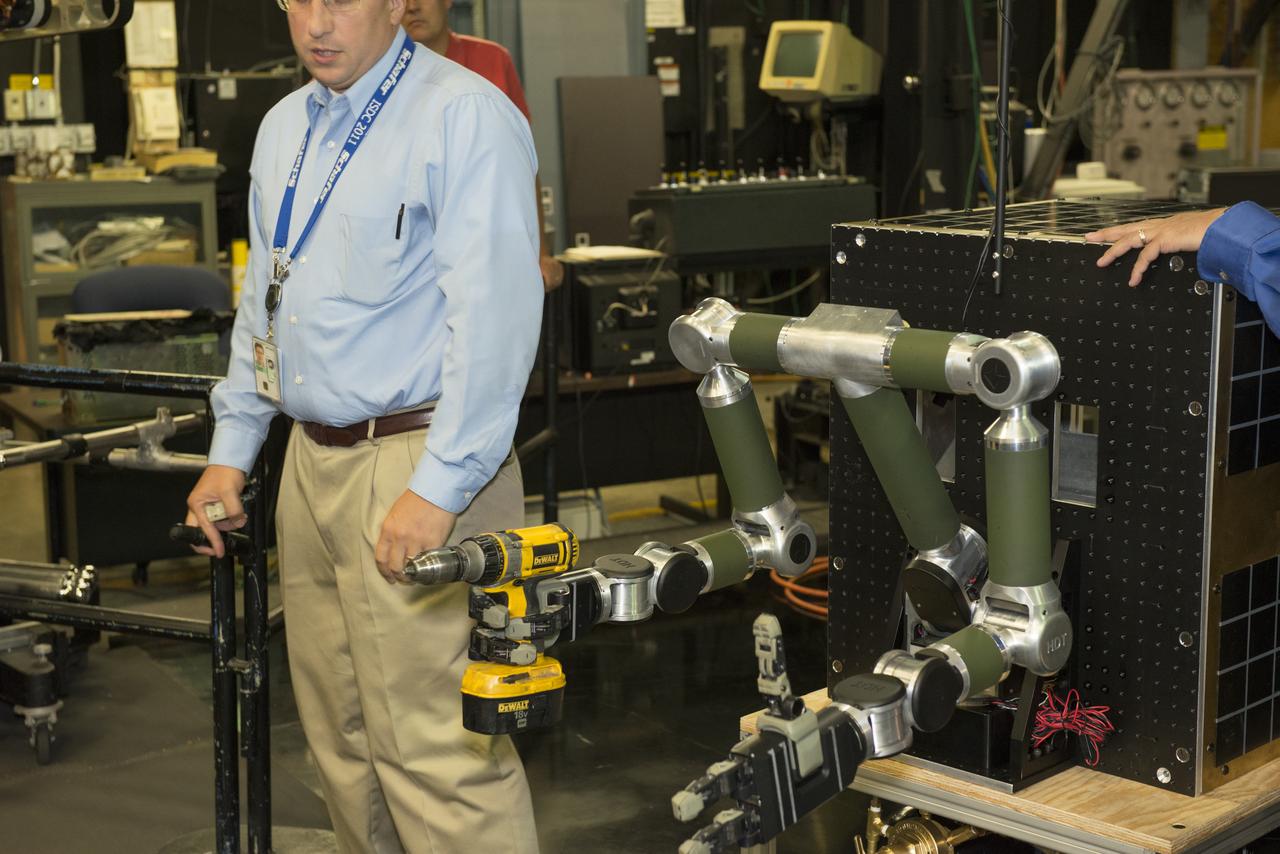
FINAL DEMONSTRATION OF A WIRELESS DATA TASK SUPPORTED BY SLS ADVANCED DEVELOPMENT USED TO DEMONSTRATE REAL-TIME VIDEO OVER WIRELESS CONNECTIONS ALONG WITH DATA AND COMMANDS AS DEMONSTRATED VIA THE ROBOTIC ARMS. THE ARMS AND VIDEO CAMERAS WERE MOUNTED ON FREE FLOATING AIR-BEARING VEHICLES TO SIMULATE CONDITIONS IN SPACE. THEY WERE USED TO SHOW HOW A CHASE VEHICLE COULD MOVE UP TO AND CAPTURE A SATELLITE, SUCH AS THE FASTSAT MOCKUP DEMONSTRITING HOW ROBOTIC TECHNOLOGY AND SMALL SPACECRAFT COULD ASSIST WITH ORBITAL DEBRIS MITIGATION
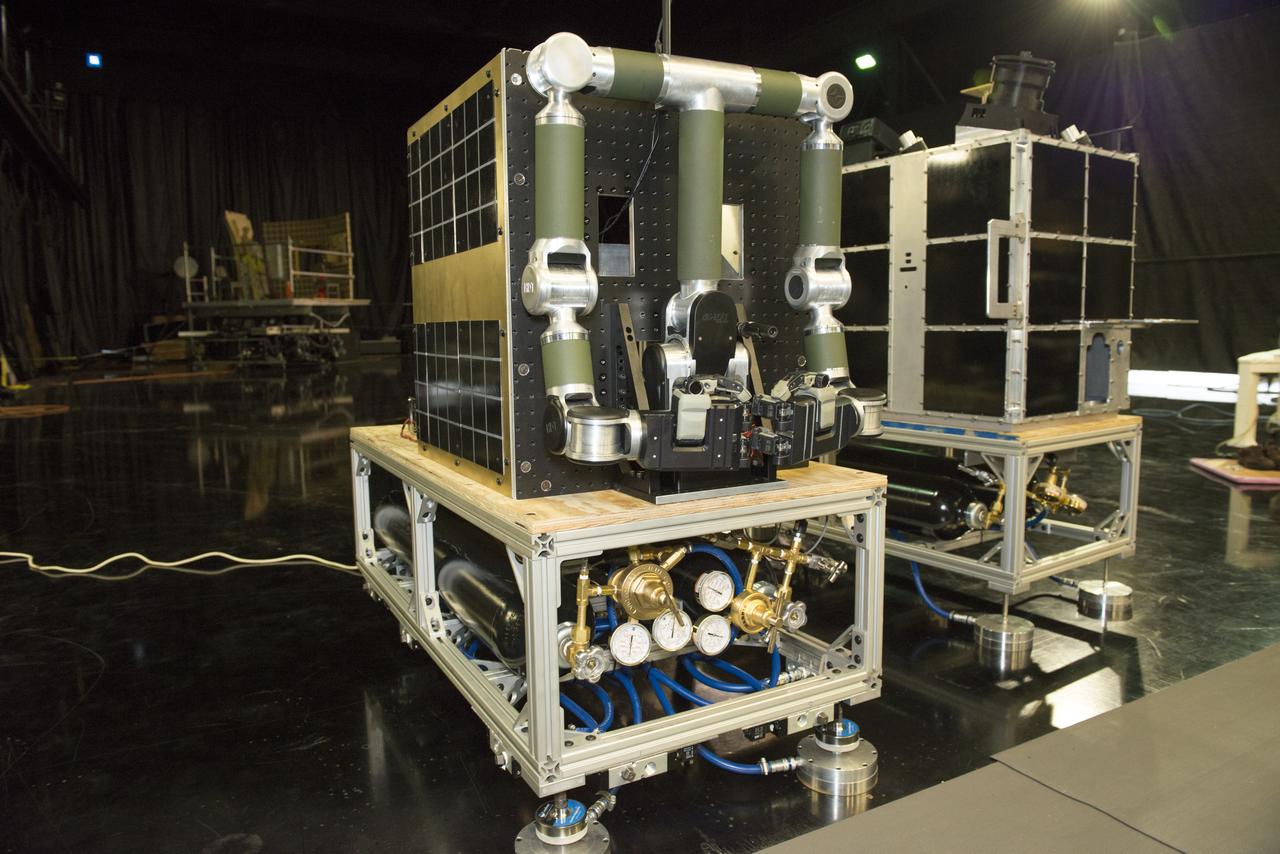
FINAL DEMONSTRATION OF A WIRELESS DATA TASK SUPPORTED BY SLS ADVANCED DEVELOPMENT USED TO DEMONSTRATE REAL-TIME VIDEO OVER WIRELESS CONNECTIONS ALONG WITH DATA AND COMMANDS AS DEMONSTRATED VIA THE ROBOTIC ARMS. THE ARMS AND VIDEO CAMERAS WERE MOUNTED ON FREE FLOATING AIR-BEARING VEHICLES TO SIMULATE CONDITIONS IN SPACE. THEY WERE USED TO SHOW HOW A CHASE VEHICLE COULD MOVE UP TO AND CAPTURE A SATELLITE, SUCH AS THE FASTSAT MOCKUP DEMONSTRITING HOW ROBOTIC TECHNOLOGY AND SMALL SPACECRAFT COULD ASSIST WITH ORBITAL DEBRIS MITIGATION
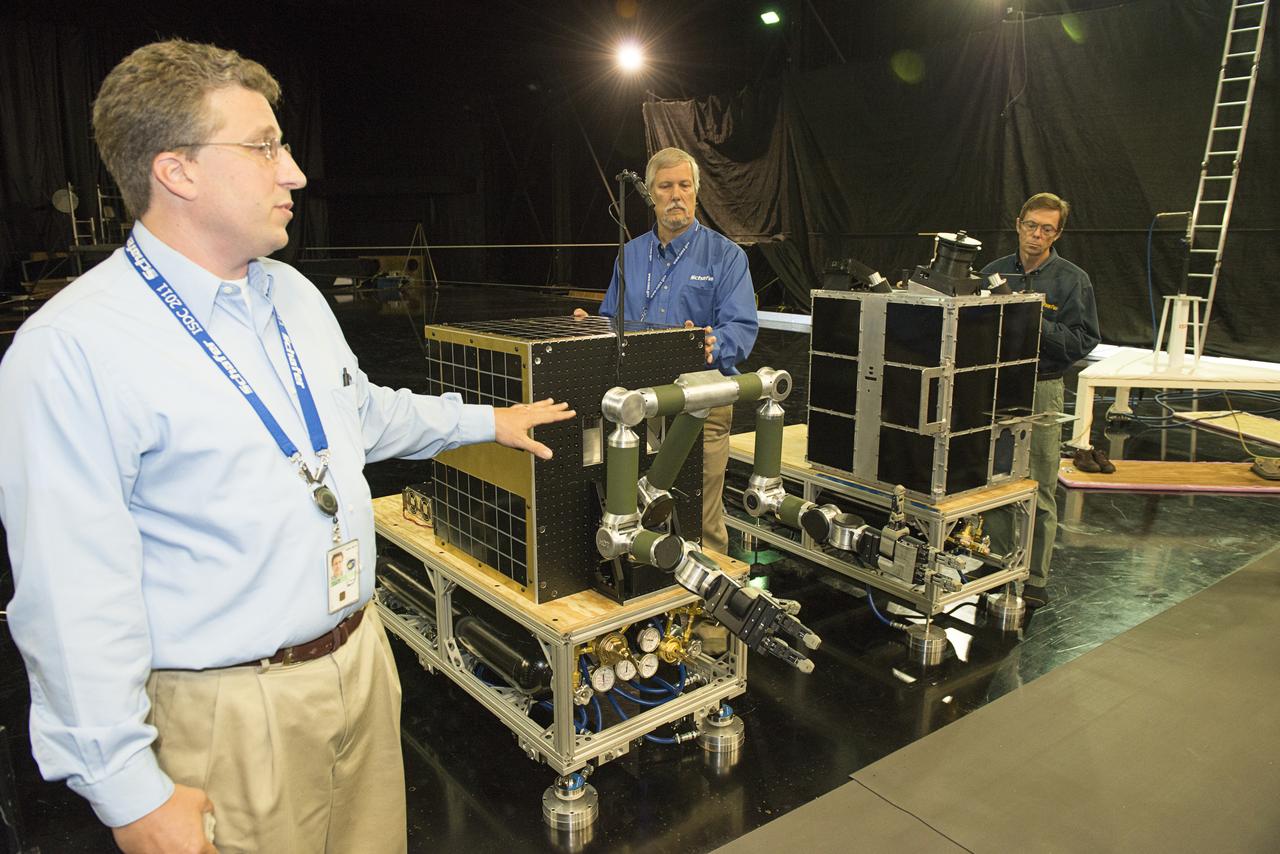
FINAL DEMONSTRATION OF A WIRELESS DATA TASK SUPPORTED BY SLS ADVANCED DEVELOPMENT USED TO DEMONSTRATE REAL-TIME VIDEO OVER WIRELESS CONNECTIONS ALONG WITH DATA AND COMMANDS AS DEMONSTRATED VIA THE ROBOTIC ARMS. THE ARMS AND VIDEO CAMERAS WERE MOUNTED ON FREE FLOATING AIR-BEARING VEHICLES TO SIMULATE CONDITIONS IN SPACE. THEY WERE USED TO SHOW HOW A CHASE VEHICLE COULD MOVE UP TO AND CAPTURE A SATELLITE, SUCH AS THE FASTSAT MOCKUP DEMONSTRITING HOW ROBOTIC TECHNOLOGY AND SMALL SPACECRAFT COULD ASSIST WITH ORBITAL DEBRIS MITIGATION

The communication antenna is used primarily for test flights to receive downlink flight data and video from test aircraft and also to support command uplink of data to test aircraft for command and control. It is one of two such assets of the Dryden Aeronautical Test Range at NASA’s Armstrong Flight Research Center in California.

The communication antenna is used primarily for test flights to receive downlink flight data and video from test aircraft and also to support command uplink of data to test aircraft for command and control. It is one of two such assets of the Dryden Aeronautical Test Range at NASA’s Armstrong Flight Research Center in California.
CAPE CANAVERAL, Fla. -- Technicians install a new Ku-Band communications system antenna on space shuttle Discovery in Orbiter Processing Facility-3 at NASA's Kennedy Space Center in Florida. The antenna is used to transmit and receive high data rate communications, such as video, and is being replaced for the STS-133 mission to the International Space Station. During its STS-131 mission to the station in April, Discovery's Ku-Band failed to operate in orbit. As a result, video of the thermal protection system inspection had to be recorded aboard Discovery and transmitted to the ground after the shuttle docked with the station. Typically, the inspection video is simultaneously transmitted live to the ground and recorded aboard the shuttle for later review. NASA_Charisse Nahser
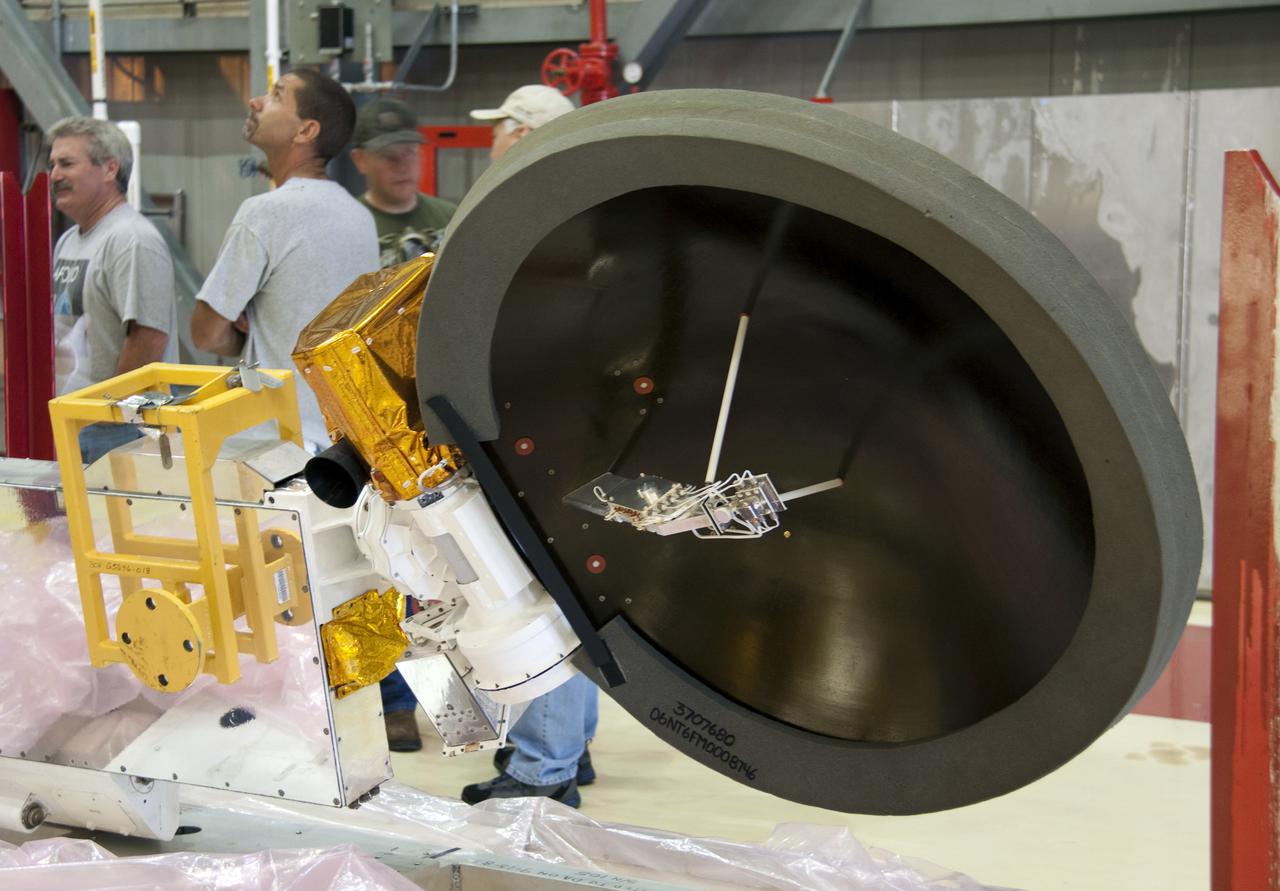
CAPE CANAVERAL, Fla. -- A new Ku-Band communications system antenna is installed on space shuttle Discovery in Orbiter Processing Facility-3 at NASA's Kennedy Space Center in Florida. The antenna is used to transmit and receive high data rate communications, such as video, and is being replaced for the STS-133 mission to the International Space Station. During its STS-131 mission to the station in April, Discovery's Ku-Band failed to operate in orbit. As a result, video of the thermal protection system inspection had to be recorded aboard Discovery and transmitted to the ground after the shuttle docked with the station. Typically, the inspection video is simultaneously transmitted live to the ground and recorded aboard the shuttle for later review. NASA_Charisse Nahser
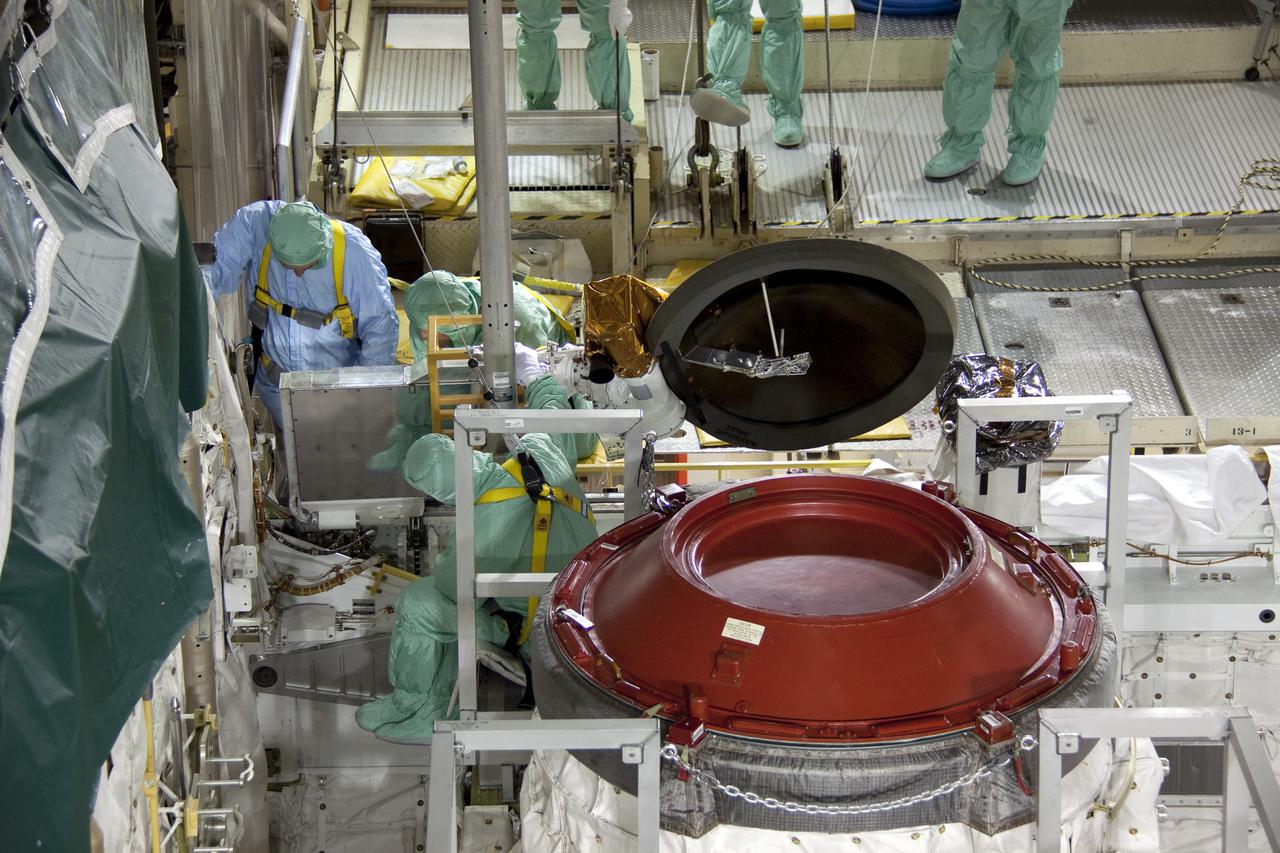
CAPE CANAVERAL, Fla. -- Technicians install a new Ku-Band communications system antenna on space shuttle Discovery in Orbiter Processing Facility-3 at NASA's Kennedy Space Center in Florida. The antenna is used to transmit and receive high data rate communications, such as video, and is being replaced for the STS-133 mission to the International Space Station. During its STS-131 mission to the station in April, Discovery's Ku-Band failed to operate in orbit. As a result, video of the thermal protection system inspection had to be recorded aboard Discovery and transmitted to the ground after the shuttle docked with the station. Typically, the inspection video is simultaneously transmitted live to the ground and recorded aboard the shuttle for later review. NASA_Charisse Nahser
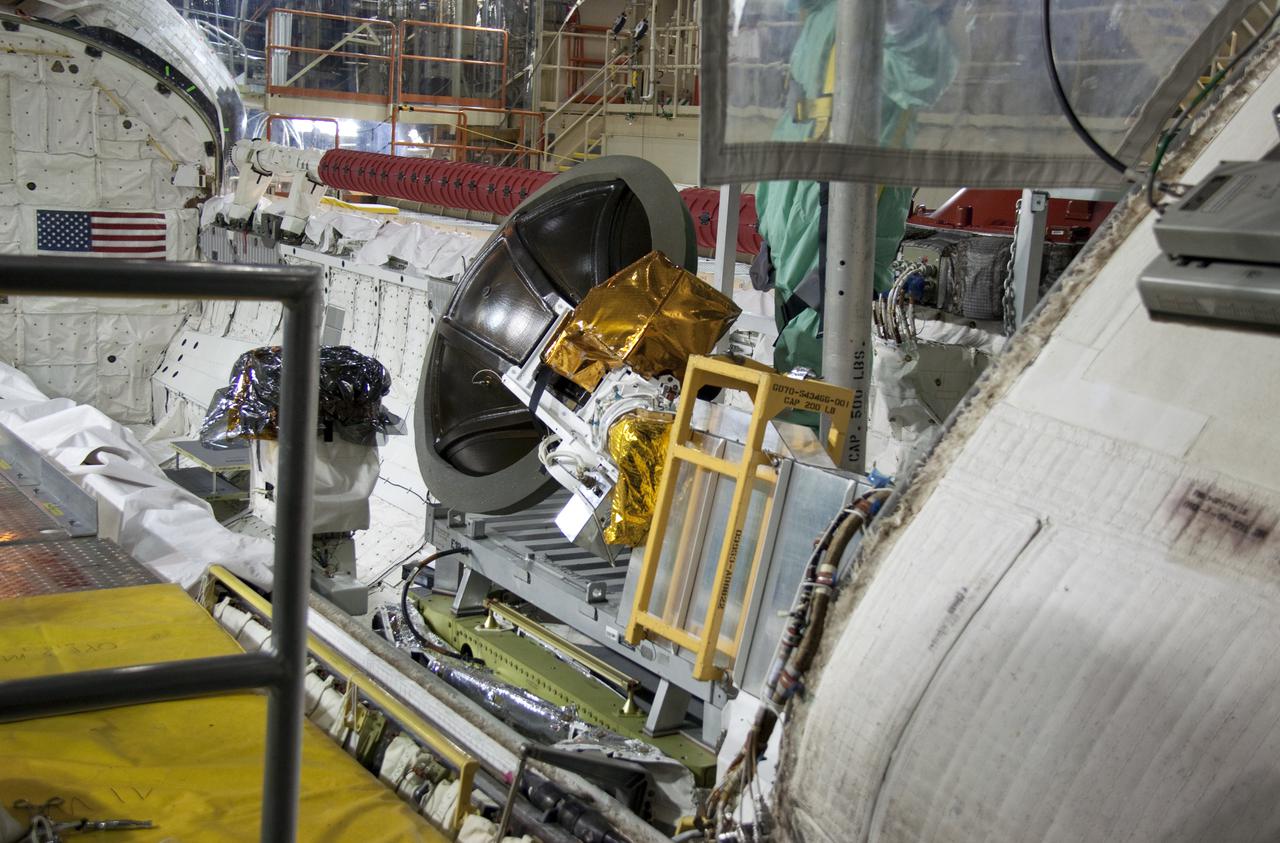
CAPE CANAVERAL, Fla. -- A new Ku-Band communications system antenna is ready to be installed on space shuttle Discovery in Orbiter Processing Facility-3 at NASA's Kennedy Space Center in Florida. The antenna is used to transmit and receive high data rate communications, such as video, and is being replaced for the STS-133 mission to the International Space Station. During its STS-131 mission to the station in April, Discovery's Ku-Band failed to operate in orbit. As a result, video of the thermal protection system inspection had to be recorded aboard Discovery and transmitted to the ground after the shuttle docked with the station. Typically, the inspection video is simultaneously transmitted live to the ground and recorded aboard the shuttle for later review. NASA_Charisse Nahser
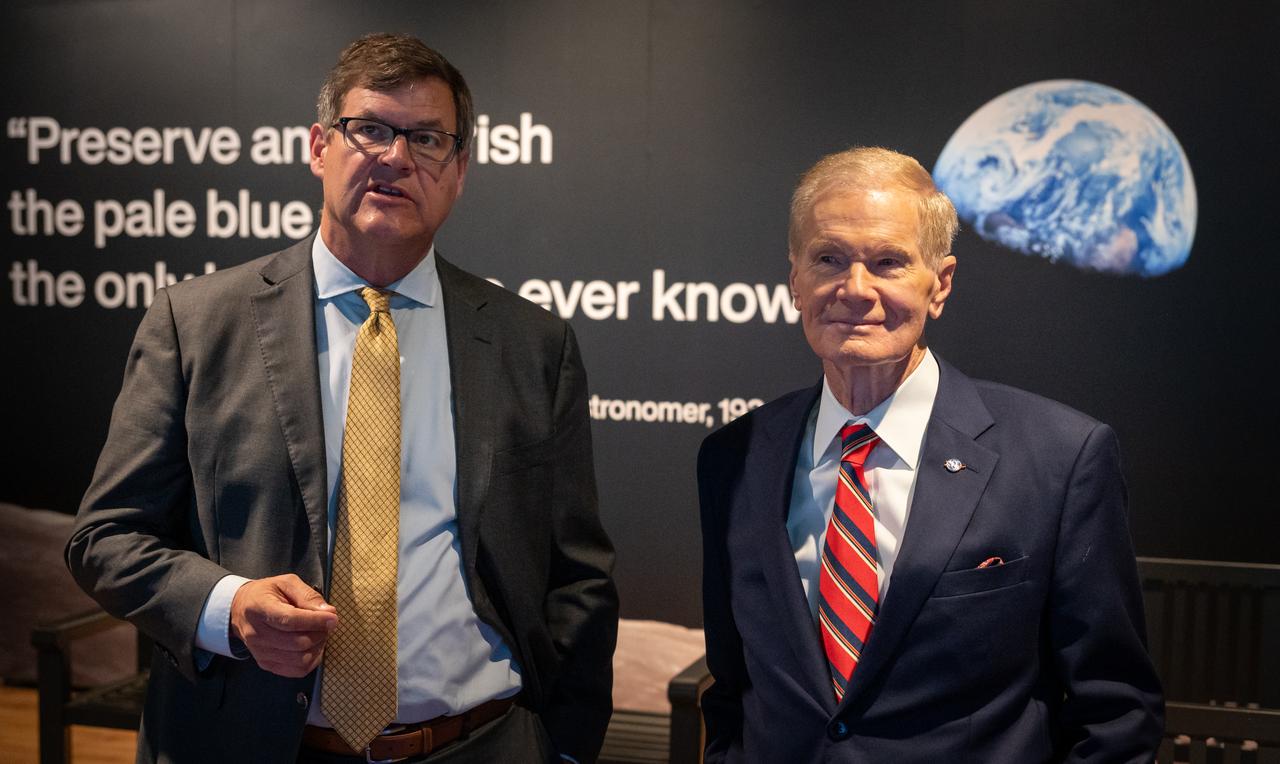
Smithsonian Museum of Natural History, Sant Director, Kirk Johnson, left, talks with NASA Administrator Bill Nelson, during a preview of the Earth Information Center at the Smithsonian National Museum of Natural History, in Washington, Monday, Oct. 7, 2024. The exhibit includes a video wall displaying Earth science data visualizations and videos, an interpretive panel showing Earth’s connected systems, information on our changing world, and an overview of how NASA and the Smithsonian study our home planet. Photo Credit: (NASA/Bill Ingalls)
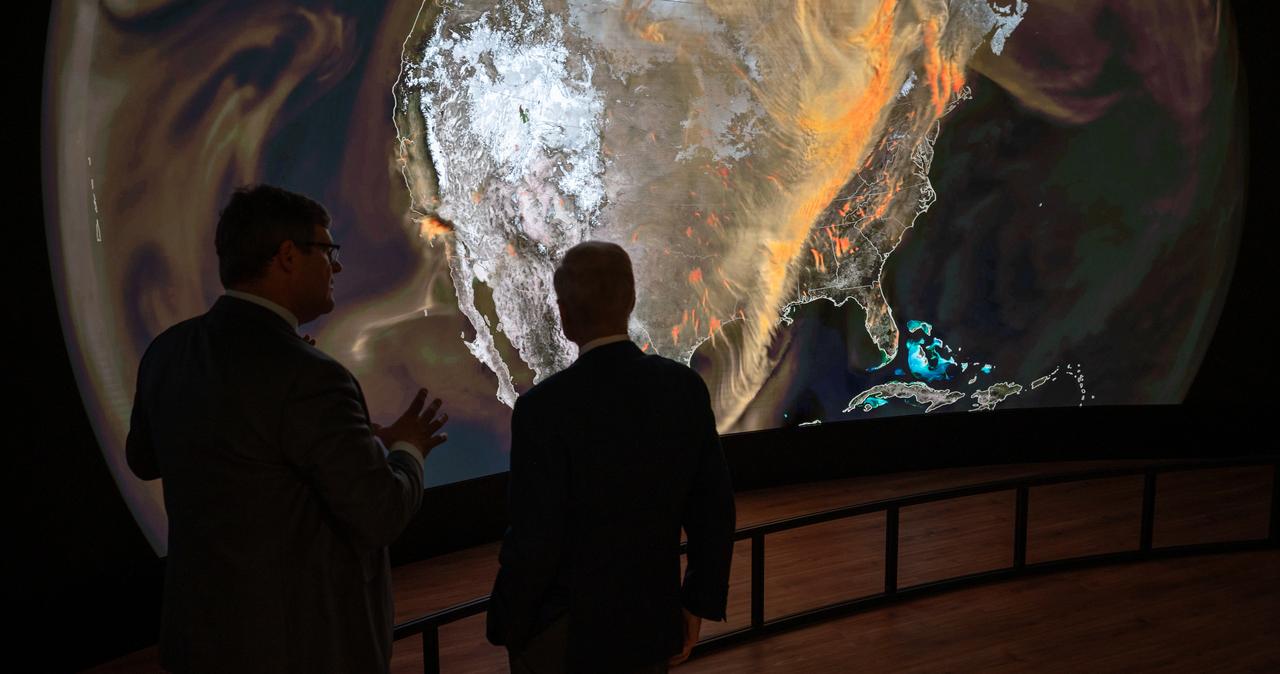
Smithsonian Museum of Natural History, Sant Director, Kirk Johnson, left, talks with NASA Administrator Bill Nelson, during a preview of the Earth Information Center at the Smithsonian National Museum of Natural History, in Washington, Monday, Oct. 7, 2024. The exhibit includes a video wall displaying Earth science data visualizations and videos, an interpretive panel showing Earth’s connected systems, information on our changing world, and an overview of how NASA and the Smithsonian study our home planet. Photo Credit: (NASA/Bill Ingalls)
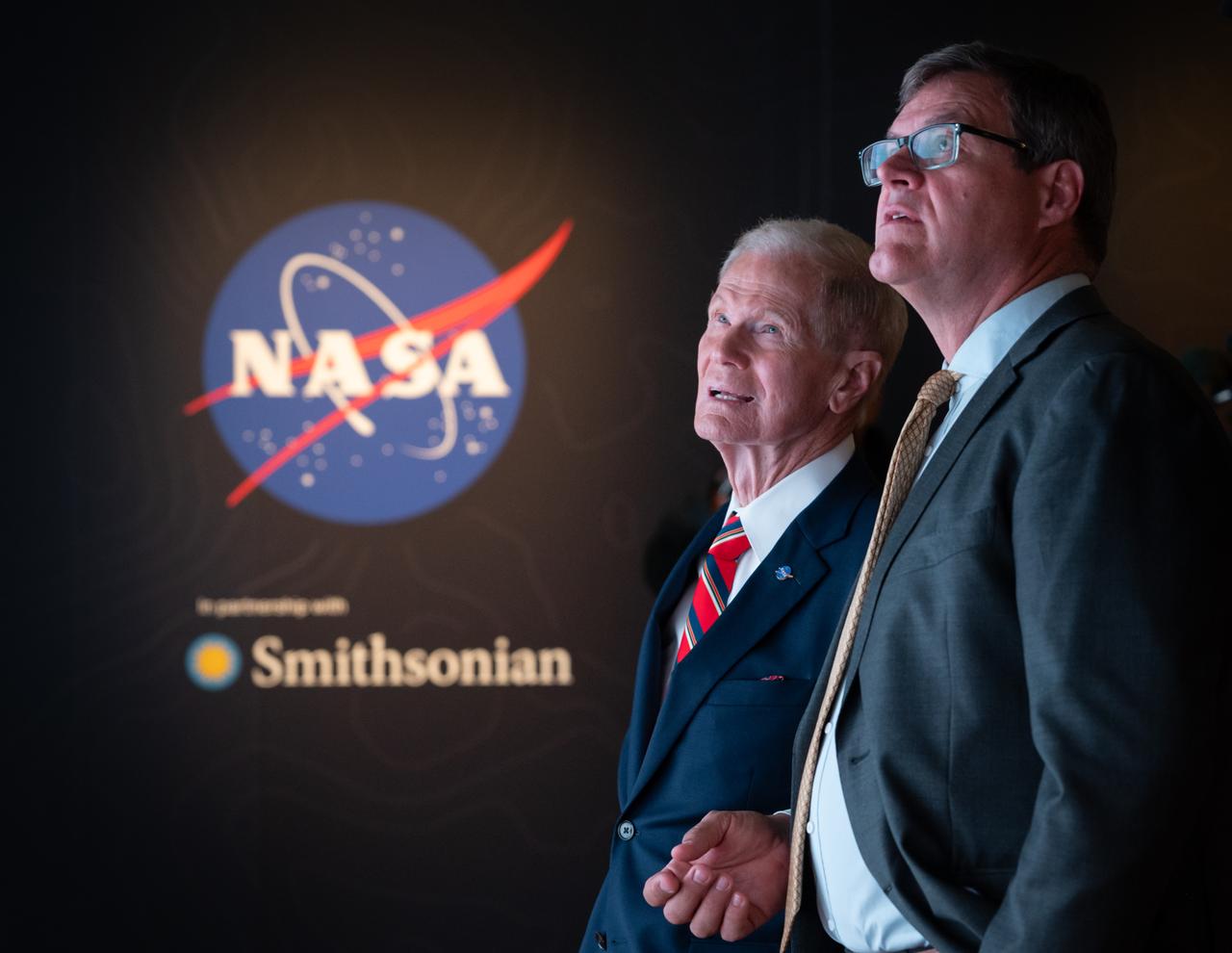
NASA Administrator Bill Nelson, left, and Smithsonian Museum of Natural History, Sant Director, Kirk Johnson, preview the Earth Information Center at the Smithsonian National Museum of Natural History, in Washington, Monday, Oct. 7, 2024. The exhibit includes a video wall displaying Earth science data visualizations and videos, an interpretive panel showing Earth’s connected systems, information on our changing world, and an overview of how NASA and the Smithsonian study our home planet. Photo Credit: (NASA/Bill Ingalls)
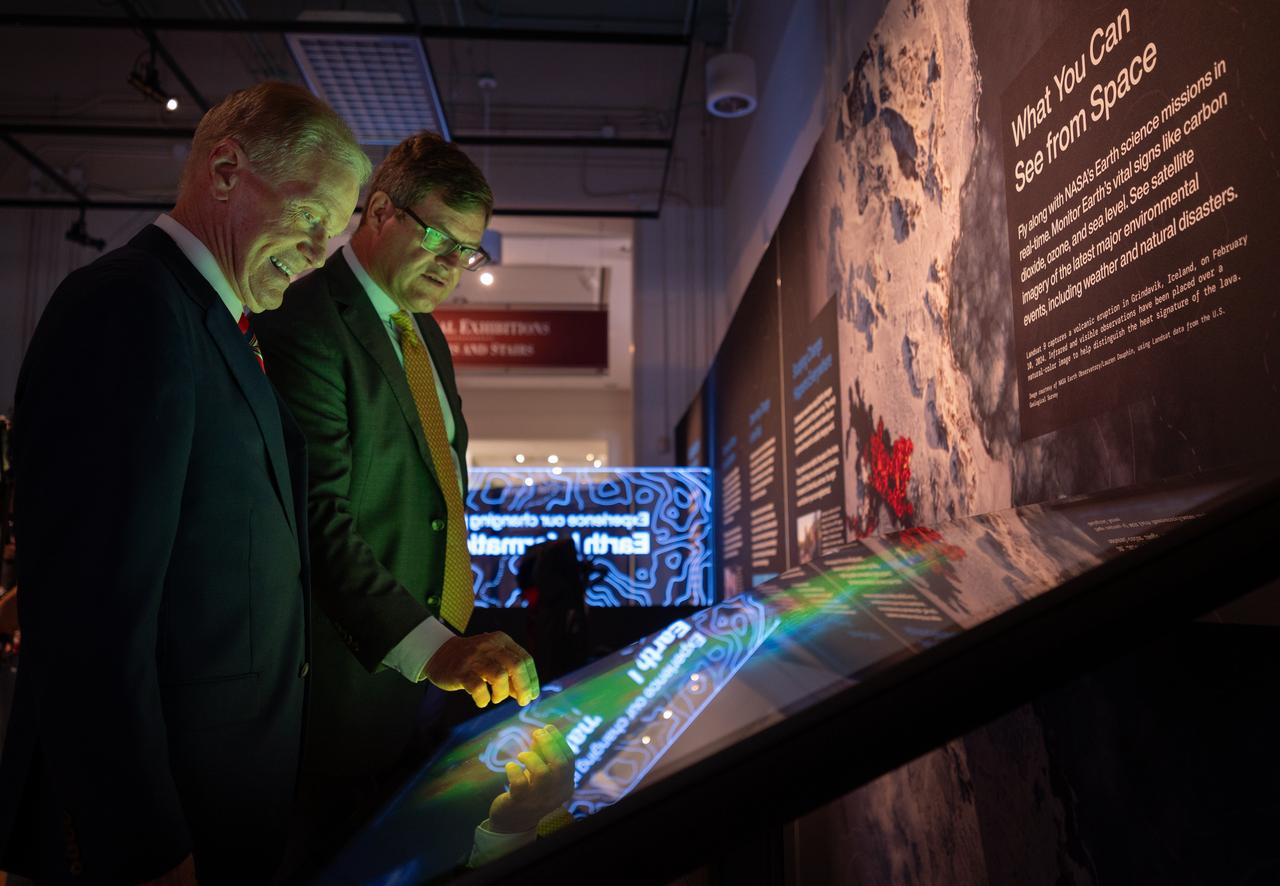
NASA Administrator Bill Nelson, left, and Smithsonian Museum of Natural History, Sant Director, Kirk Johnson, preview the Earth Information Center at the Smithsonian National Museum of Natural History, in Washington, Monday, Oct. 7, 2024. The exhibit includes a video wall displaying Earth science data visualizations and videos, an interpretive panel showing Earth’s connected systems, information on our changing world, and an overview of how NASA and the Smithsonian study our home planet. Photo Credit: (NASA/Bill Ingalls)
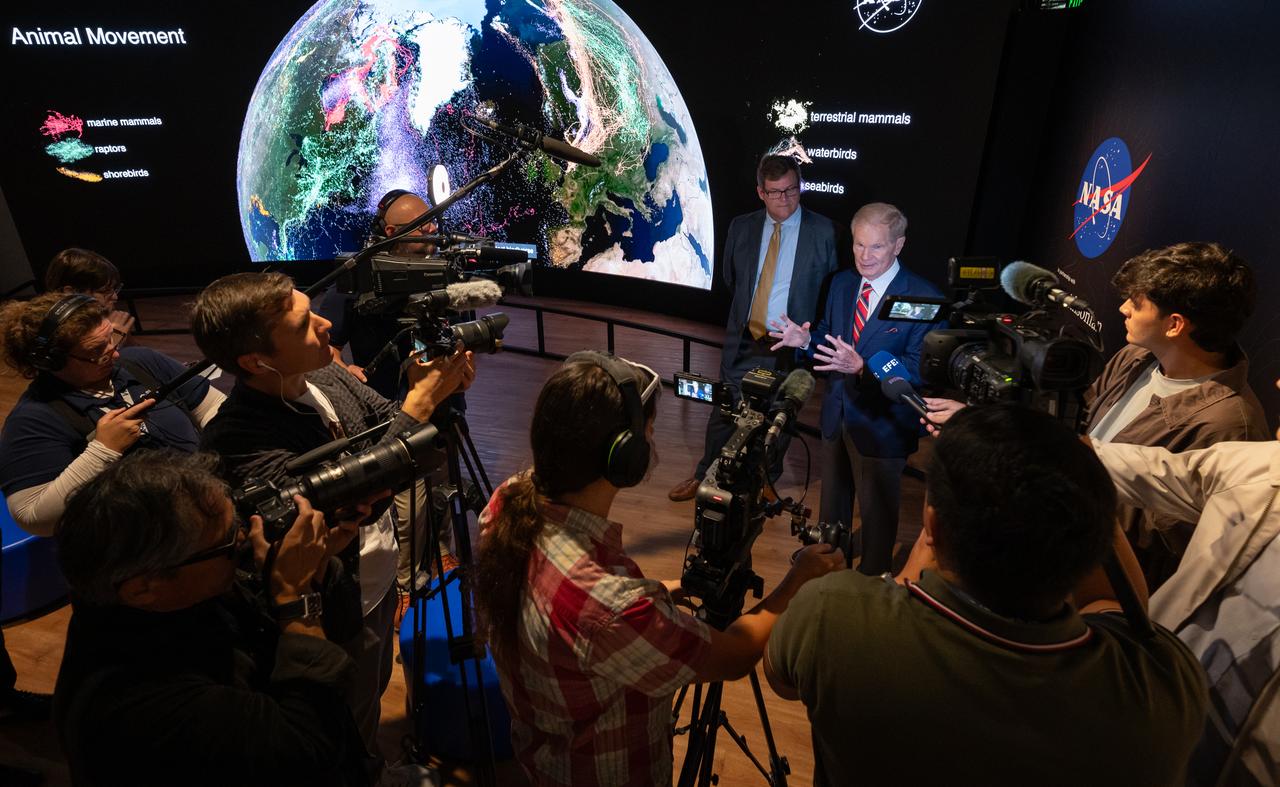
Smithsonian Museum of Natural History, Sant Director, Kirk Johnson, left, and NASA Administrator Bill Nelson, talk with media during a preview the Earth Information Center at the Smithsonian National Museum of Natural History, in Washington, Monday, Oct. 7, 2024. The exhibit includes a video wall displaying Earth science data visualizations and videos, an interpretive panel showing Earth’s connected systems, information on our changing world, and an overview of how NASA and the Smithsonian study our home planet. Photo Credit: (NASA/Bill Ingalls)
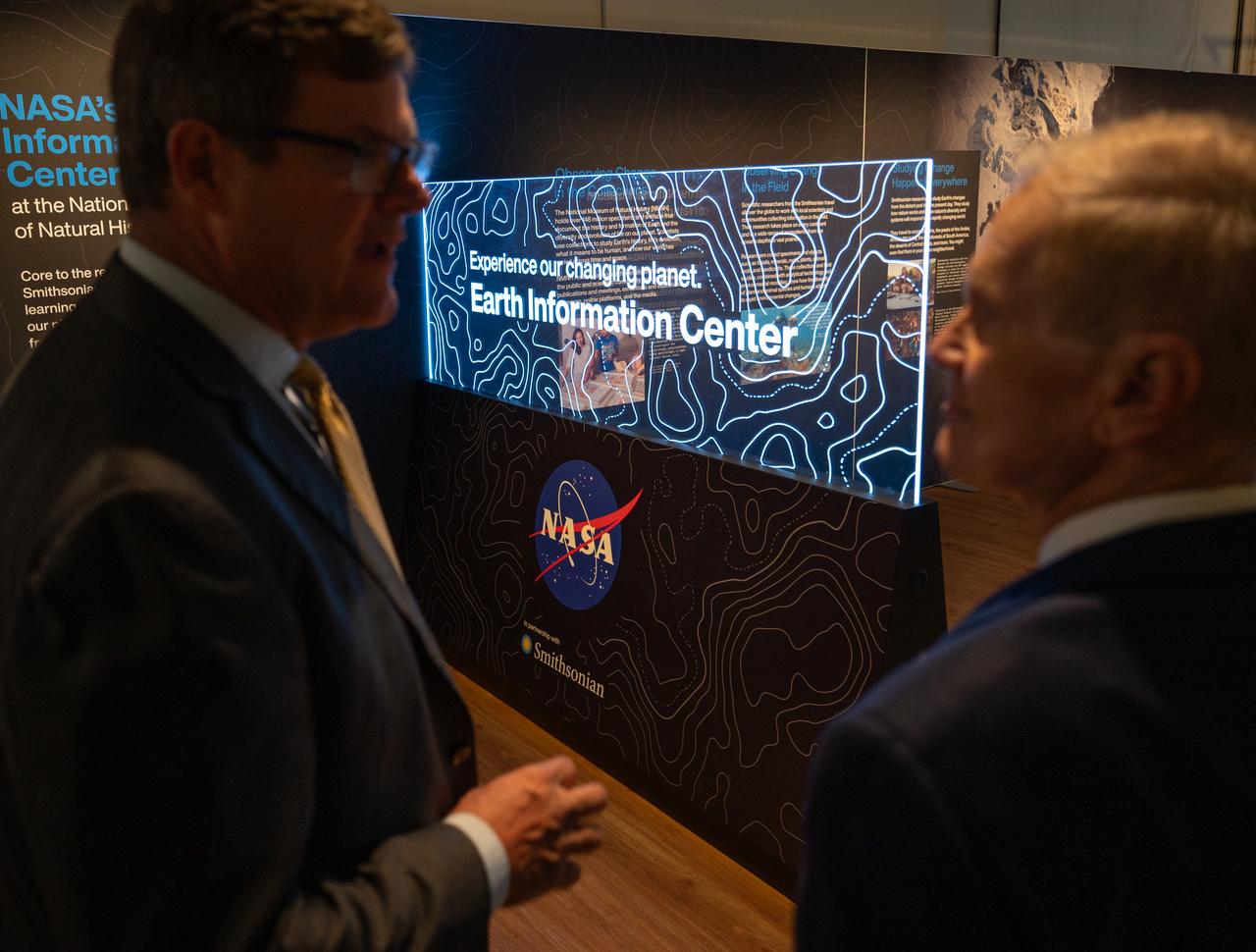
Smithsonian Museum of Natural History, Sant Director, Kirk Johnson, left, talks with NASA Administrator Bill Nelson, during a preview of the Earth Information Center at the Smithsonian National Museum of Natural History, in Washington, Monday, Oct. 7, 2024. The exhibit includes a video wall displaying Earth science data visualizations and videos, an interpretive panel showing Earth’s connected systems, information on our changing world, and an overview of how NASA and the Smithsonian study our home planet. Photo Credit: (NASA/Bill Ingalls)

The Smithsonian National Museum of Natural History in Washington is seen as the new Earth Information Center is previewed, Monday, Oct. 7, 2024. The exhibit includes a video wall displaying Earth science data visualizations and videos, an interpretive panel showing Earth’s connected systems, information on our changing world, and an overview of how NASA and the Smithsonian study our home planet. Photo Credit: (NASA/Bill Ingalls)
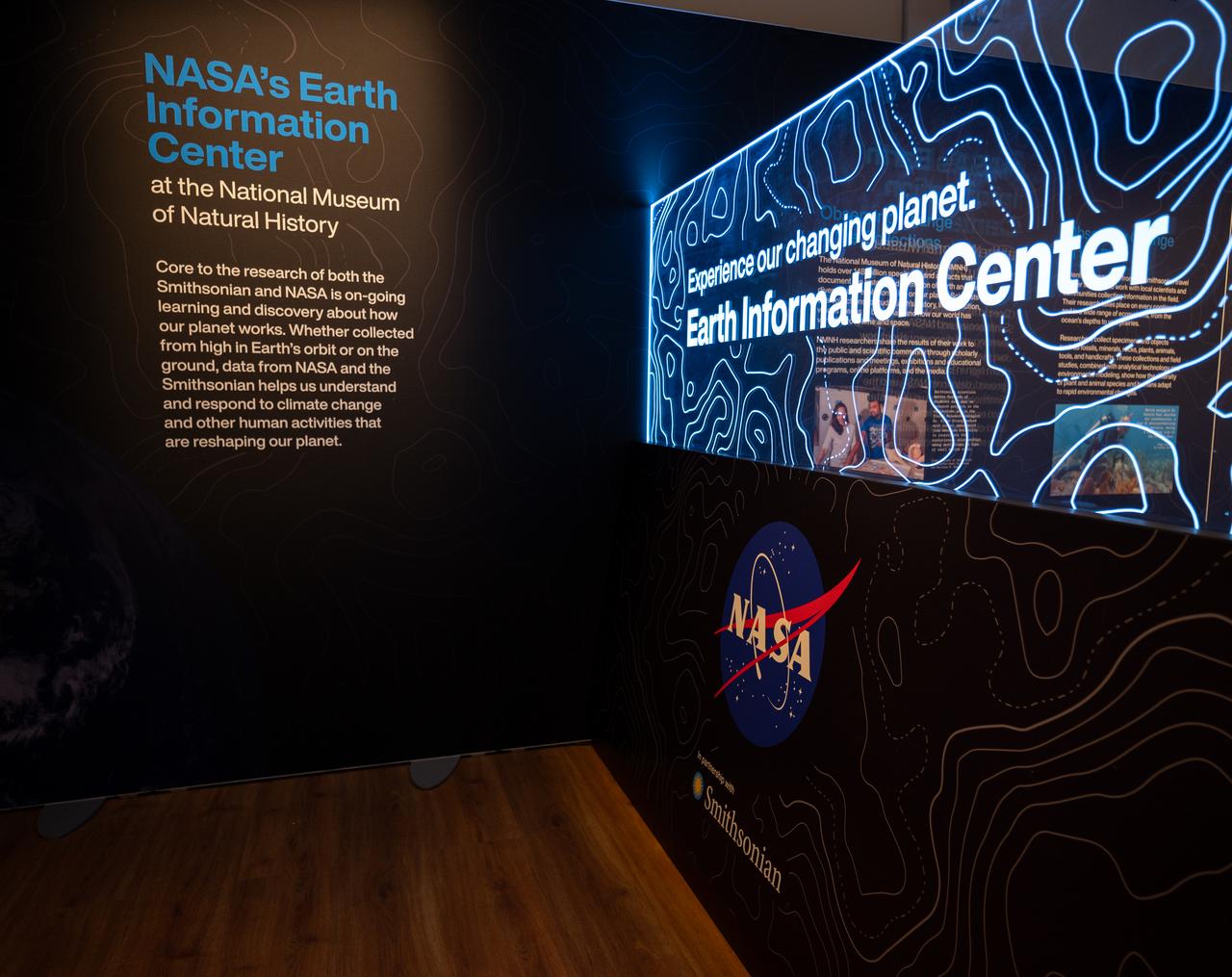
The Earth Information Center at the Smithsonian National Museum of Natural History, in Washington, is previewed, Monday, Oct. 7, 2024. The exhibit includes a video wall displaying Earth science data visualizations and videos, an interpretive panel showing Earth’s connected systems, information on our changing world, and an overview of how NASA and the Smithsonian study our home planet. Photo Credit: (NASA/Bill Ingalls)
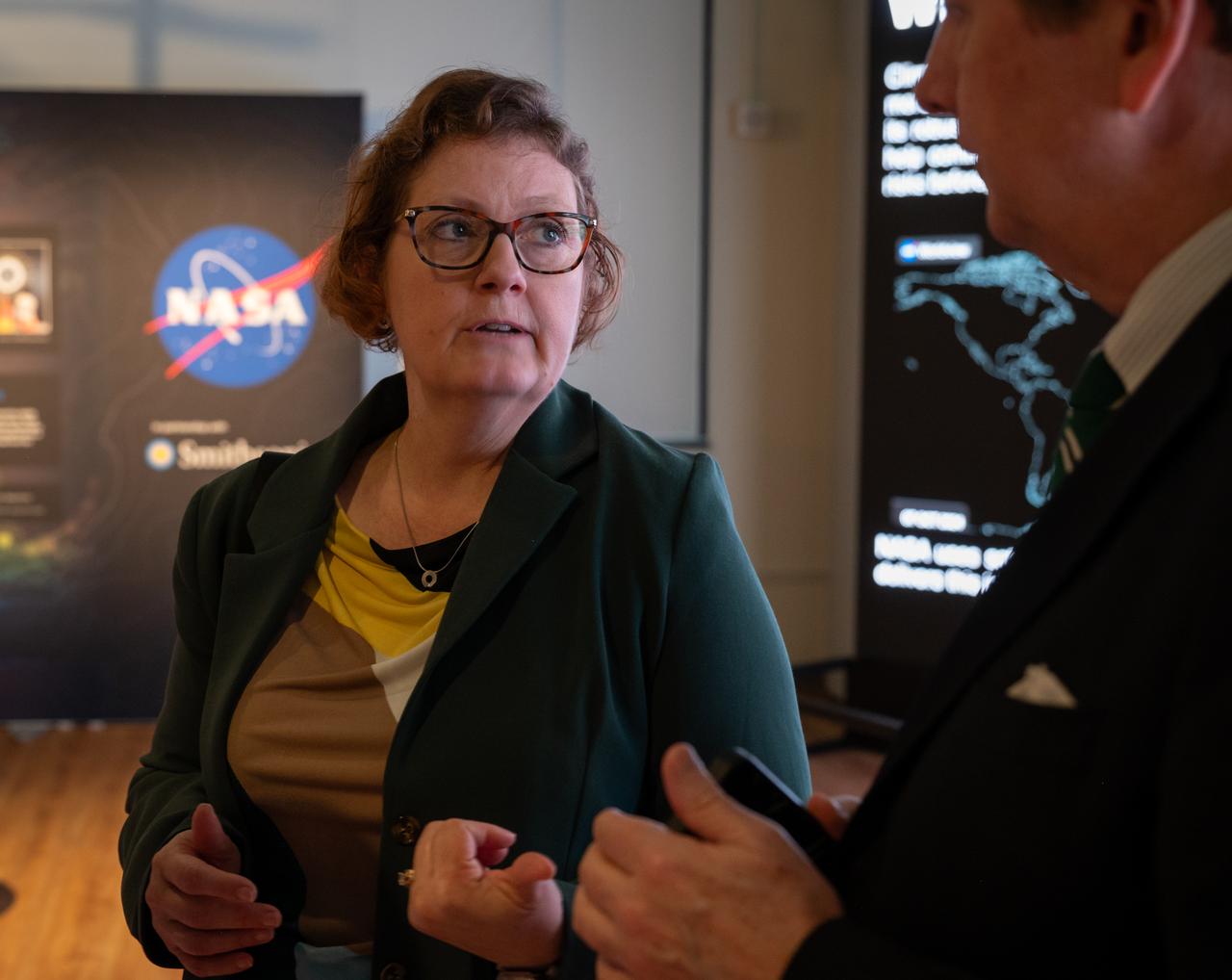
NASA Earth Sciences Division, Deputy Director, Julie Robinson, previews of the Earth Information Center at the Smithsonian National Museum of Natural History, in Washington, Monday, Oct. 7, 2024. The exhibit includes a video wall displaying Earth science data visualizations and videos, an interpretive panel showing Earth’s connected systems, information on our changing world, and an overview of how NASA and the Smithsonian study our home planet. Photo Credit: (NASA/Bill Ingalls)
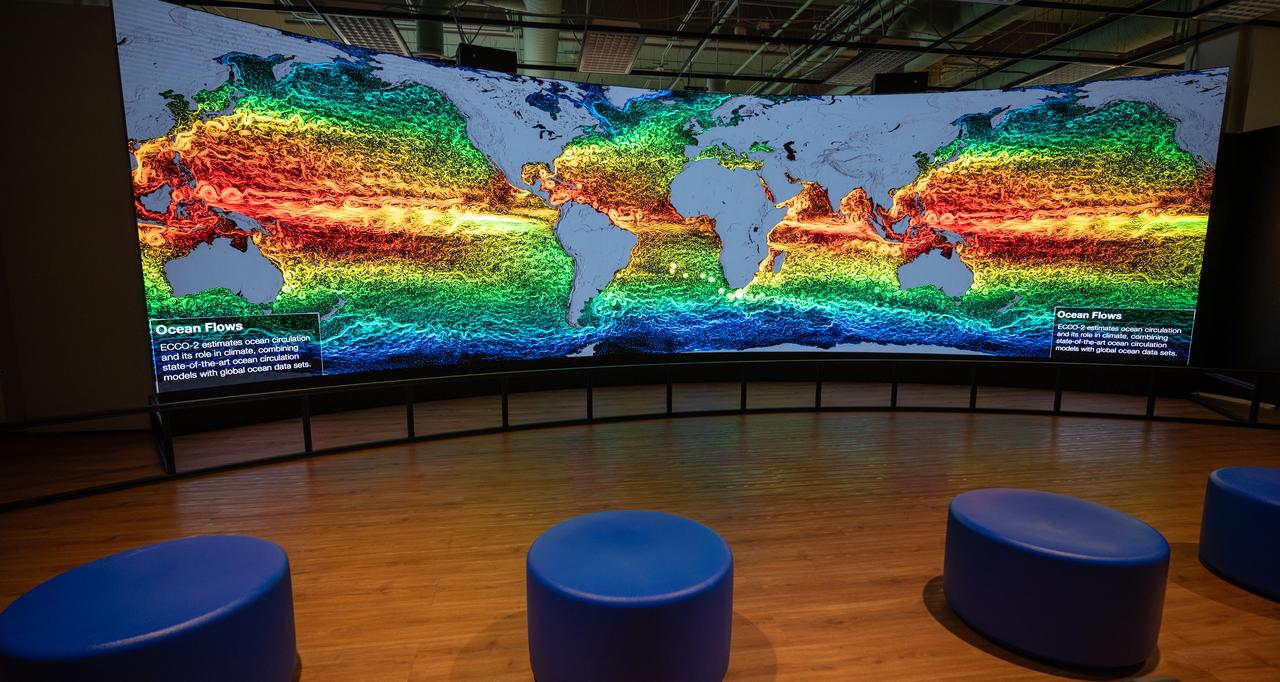
The Earth Information Center at the Smithsonian National Museum of Natural History, in Washington, is previewed, Monday, Oct. 7, 2024. The exhibit includes a video wall displaying Earth science data visualizations and videos, an interpretive panel showing Earth’s connected systems, information on our changing world, and an overview of how NASA and the Smithsonian study our home planet. Photo Credit: (NASA/Bill Ingalls)
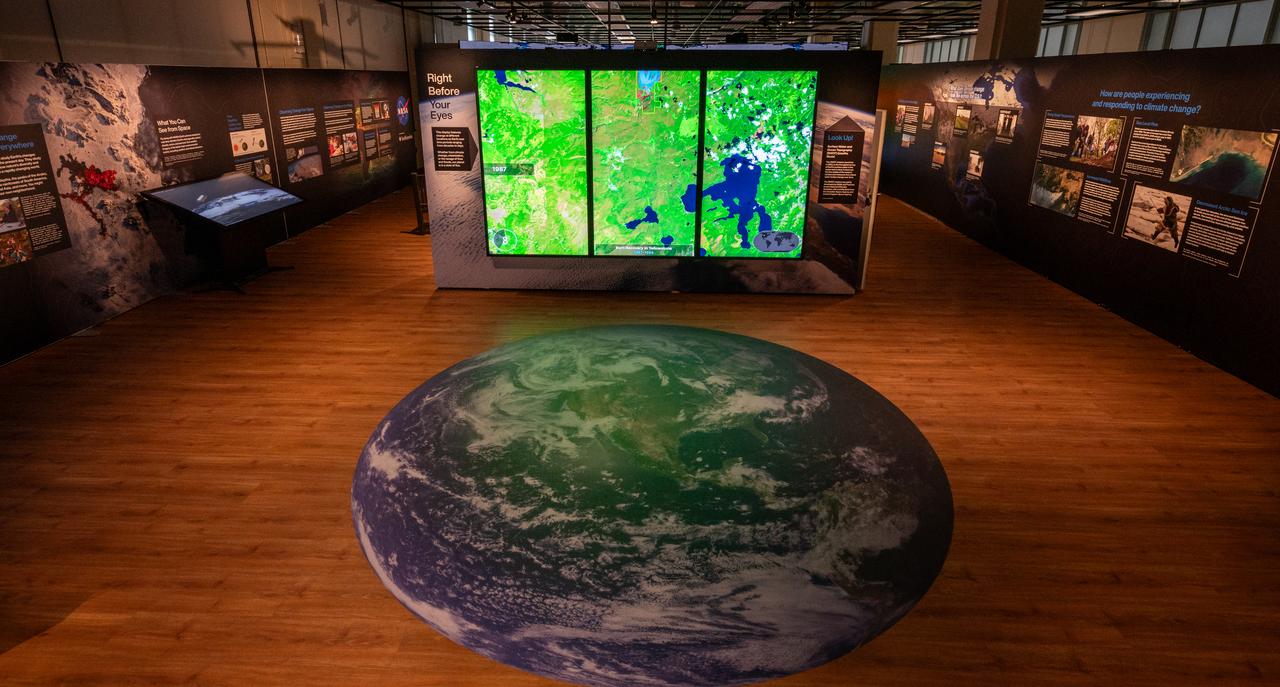
The Earth Information Center at the Smithsonian National Museum of Natural History, in Washington, is previewed, Monday, Oct. 7, 2024. The exhibit includes a video wall displaying Earth science data visualizations and videos, an interpretive panel showing Earth’s connected systems, information on our changing world, and an overview of how NASA and the Smithsonian study our home planet. Photo Credit: (NASA/Bill Ingalls)
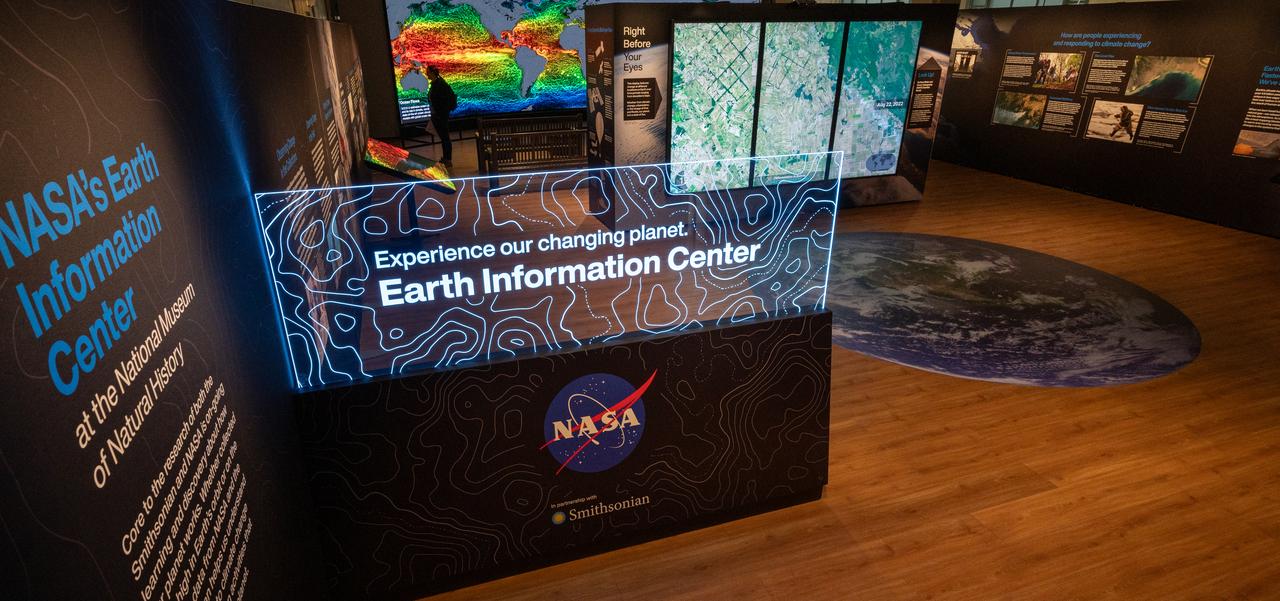
The Earth Information Center at the Smithsonian National Museum of Natural History, in Washington, is previewed, Monday, Oct. 7, 2024. The exhibit includes a video wall displaying Earth science data visualizations and videos, an interpretive panel showing Earth’s connected systems, information on our changing world, and an overview of how NASA and the Smithsonian study our home planet. Photo Credit: (NASA/Bill Ingalls)
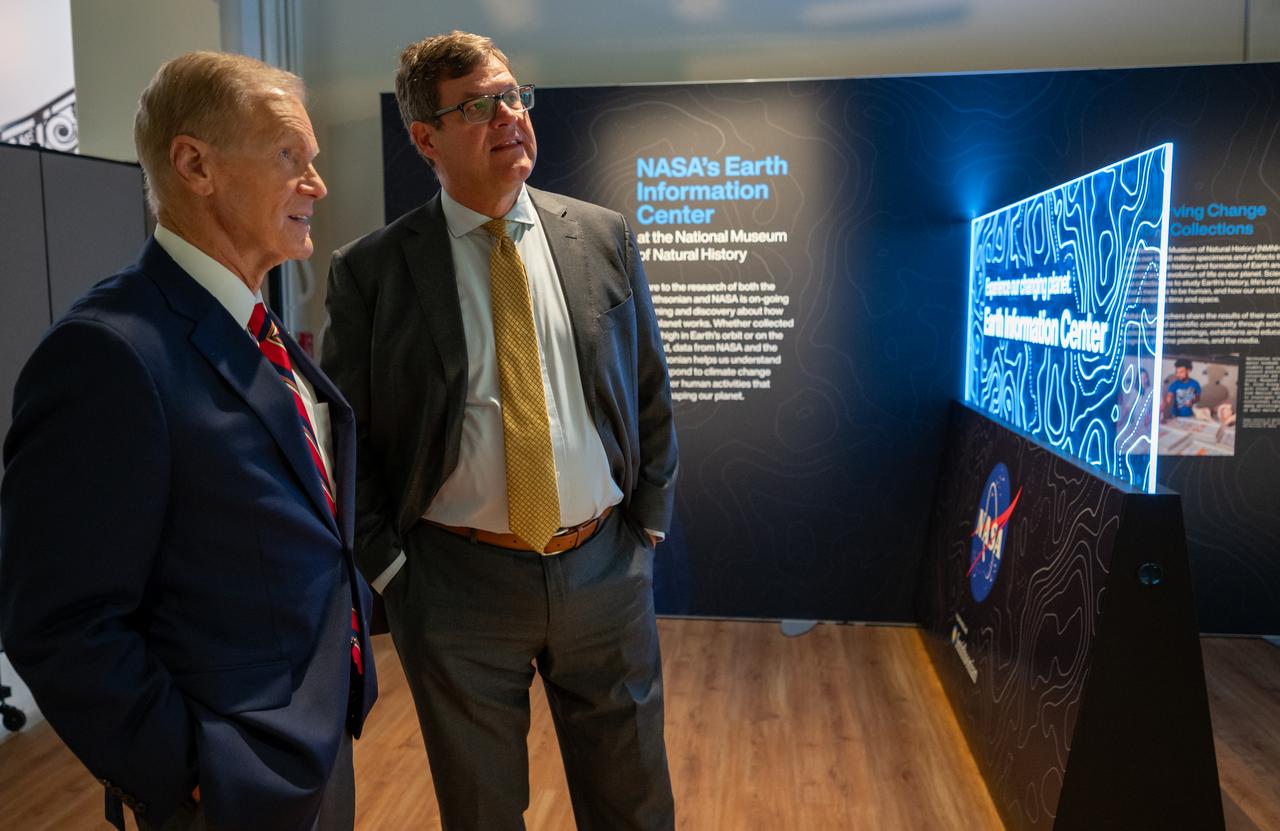
NASA Administrator Bill Nelson, left, talks with Smithsonian Museum of Natural History, Sant Director, Kirk Johnson, during a preview of the Earth Information Center at the Smithsonian National Museum of Natural History, in Washington, Monday, Oct. 7, 2024. The exhibit includes a video wall displaying Earth science data visualizations and videos, an interpretive panel showing Earth’s connected systems, information on our changing world, and an overview of how NASA and the Smithsonian study our home planet. Photo Credit: (NASA/Bill Ingalls)
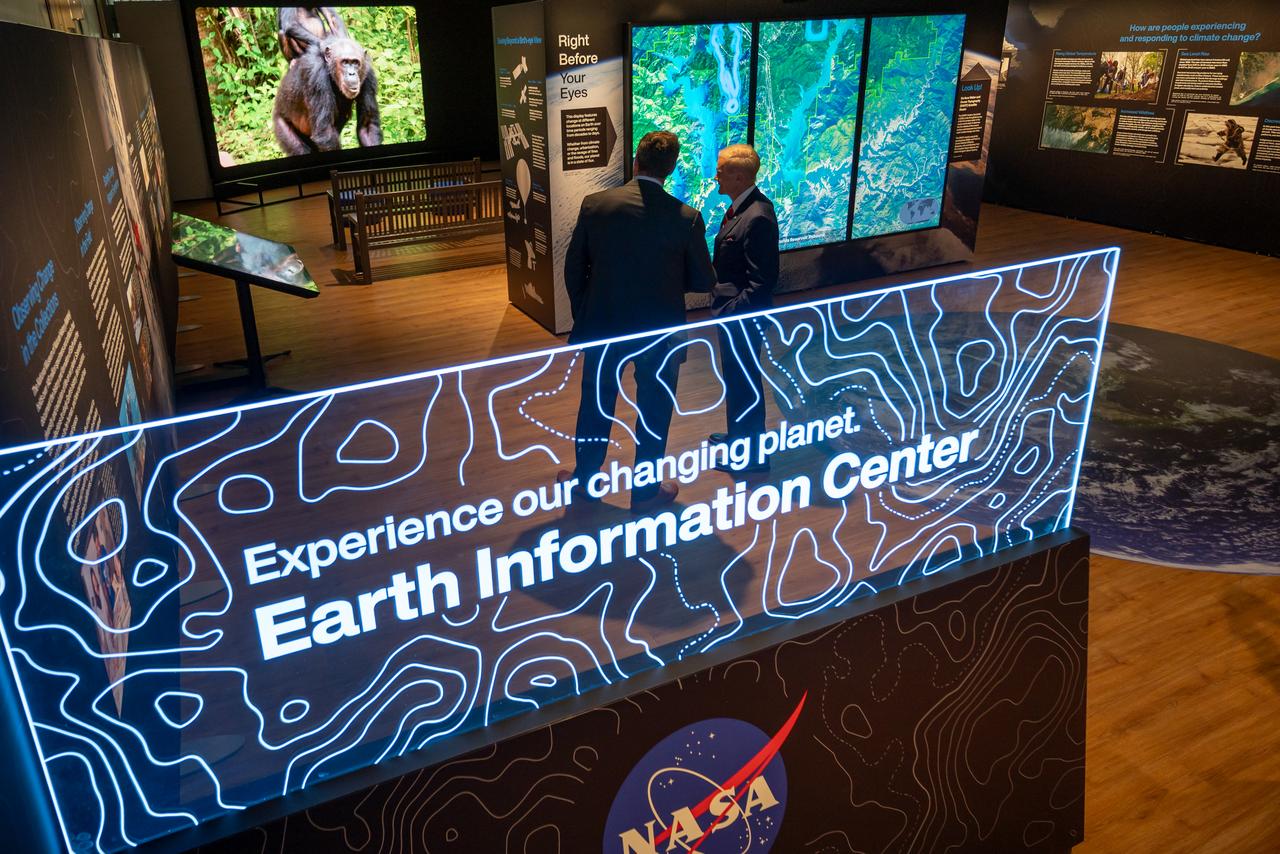
Smithsonian Museum of Natural History, Sant Director, Kirk Johnson, left, talks with NASA Administrator Bill Nelson, during a preview of the Earth Information Center at the Smithsonian National Museum of Natural History, in Washington, Monday, Oct. 7, 2024. The exhibit includes a video wall displaying Earth science data visualizations and videos, an interpretive panel showing Earth’s connected systems, information on our changing world, and an overview of how NASA and the Smithsonian study our home planet. Photo Credit: (NASA/Bill Ingalls)
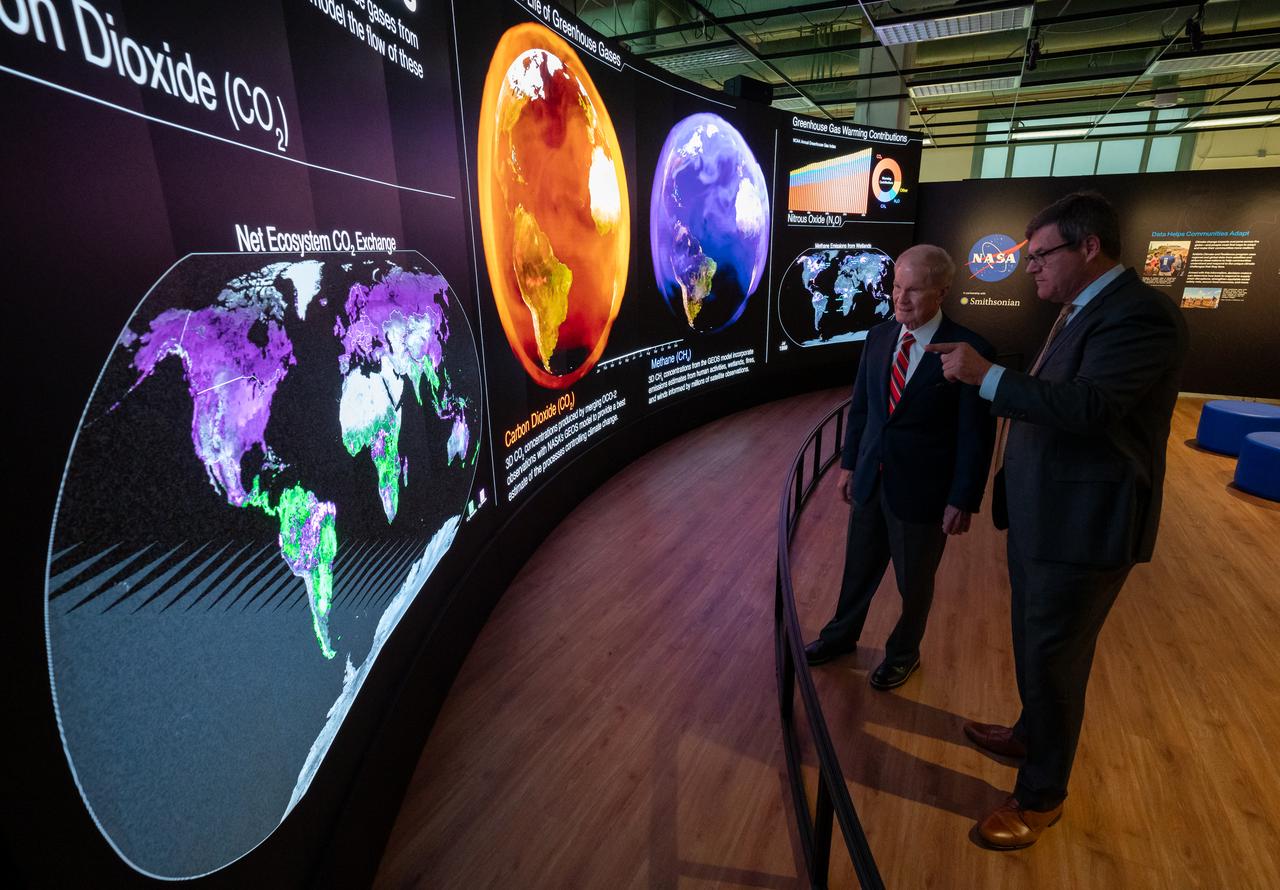
NASA Administrator Bill Nelson, left, and Smithsonian Museum of Natural History, Sant Director, Kirk Johnson, preview the Earth Information Center at the Smithsonian National Museum of Natural History, in Washington, Monday, Oct. 7, 2024. The exhibit includes a video wall displaying Earth science data visualizations and videos, an interpretive panel showing Earth’s connected systems, information on our changing world, and an overview of how NASA and the Smithsonian study our home planet. Photo Credit: (NASA/Bill Ingalls)
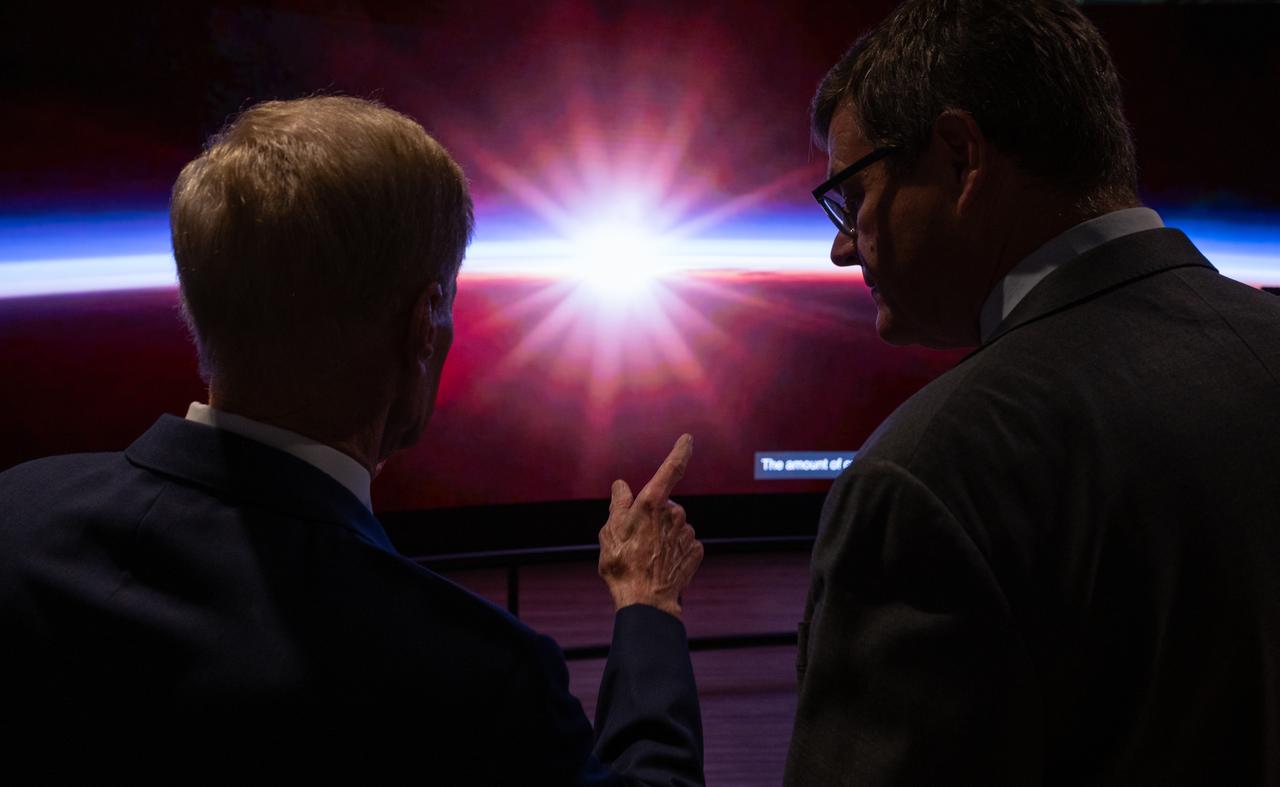
NASA Administrator Bill Nelson, left, and Smithsonian Museum of Natural History, Sant Director, Kirk Johnson, preview the Earth Information Center at the Smithsonian National Museum of Natural History, in Washington, Monday, Oct. 7, 2024. The exhibit includes a video wall displaying Earth science data visualizations and videos, an interpretive panel showing Earth’s connected systems, information on our changing world, and an overview of how NASA and the Smithsonian study our home planet. Photo Credit: (NASA/Bill Ingalls)
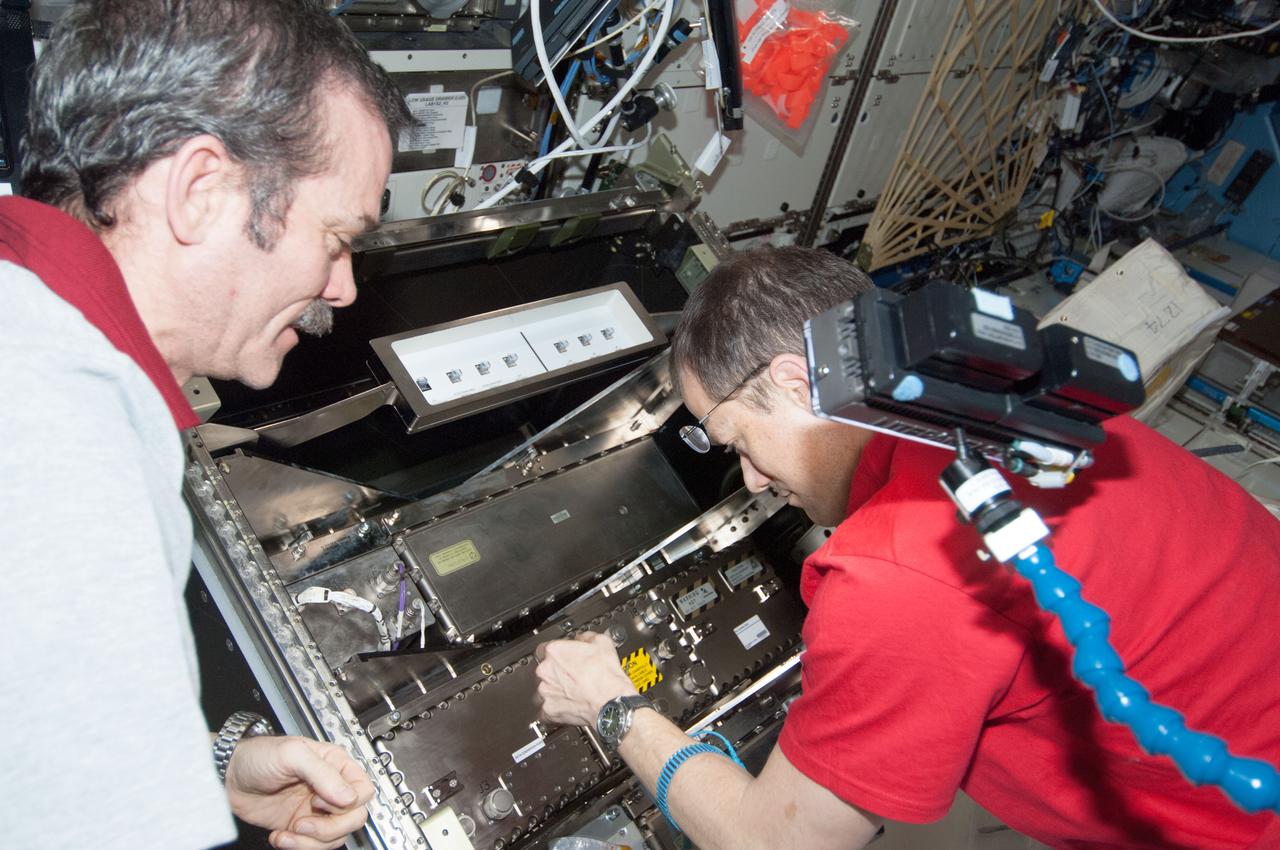
ISS035-E-013783 (2 April 2013) --- In the U.S. lab Destiny on the International Space Station, Expedition 35 Commander Chris Hadfield (right) and Flight Engineer Tom Marshburn remove the Video Baseband Signal Processor (VBSP) in order to replace it with a new Ku communication unit and its associated data and Ethernet cabling.
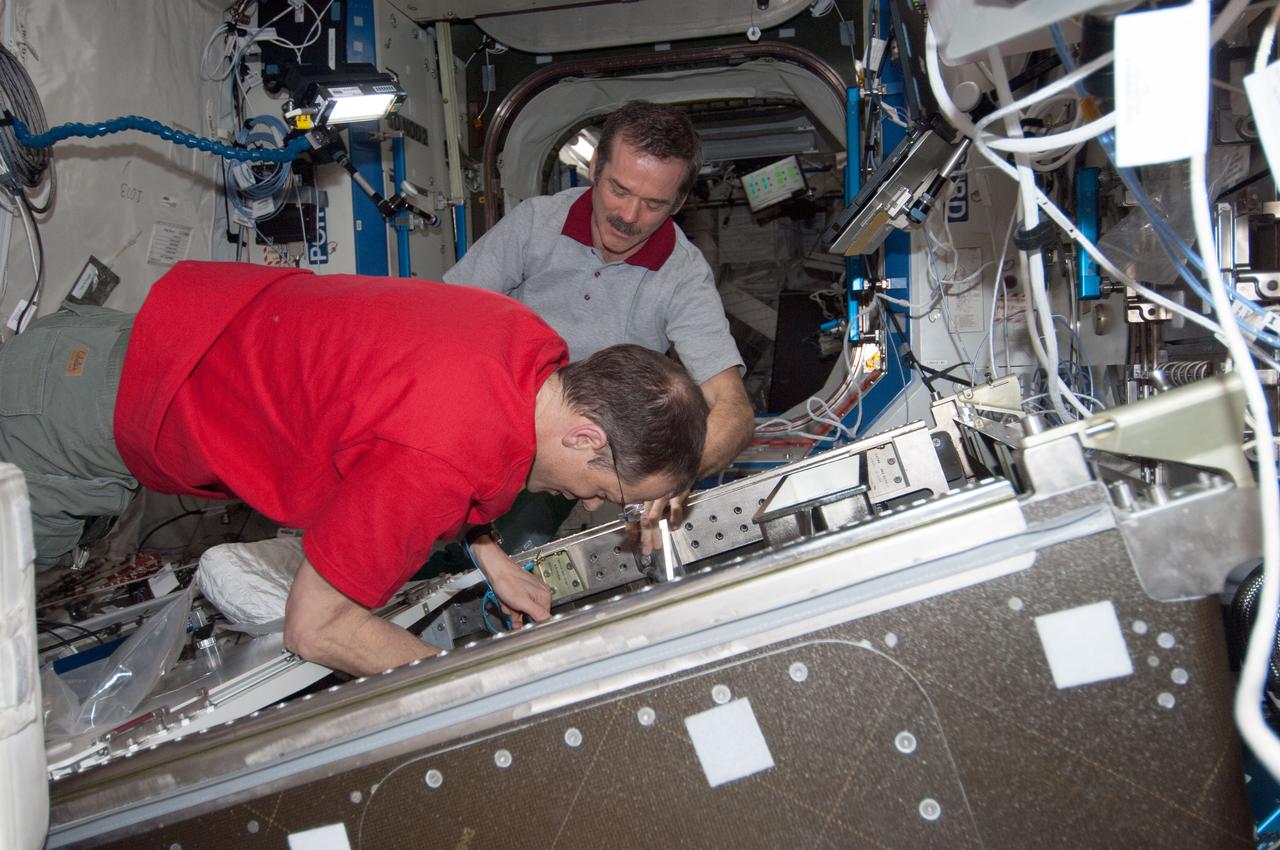
ISS035-E-013790 (2 April 2013) --- In the U.S. lab Destiny on the International Space Station, Expedition 35 Commander Chris Hadfield (background) and Flight Engineer Tom Marshburn remove the Video Baseband Signal Processor (VBSP) in order to replace it with a new Ku communication unit and its associated data and Ethernet cabling.

This still from a video shows illustrations of the seven Earth-size planets of TRAPPIST-1, an exoplanet system about 40 light-years away, based on data current as of February 2018. Each planet is shown in sequence, starting with the innermost TRAPPIST-1b and ending with the outermost TRAPPIST-1h. The video presents the planets' relative sizes as well as the relative scale of the central star as seen from each planet. The art highlights possibilities for how the surfaces of these intriguing worlds might look based on their newly calculated properties. The seven planets of TRAPPIST-1 are all Earth-sized and terrestrial. TRAPPIST-1 is an ultra-cool dwarf star in the constellation Aquarius, and its planets orbit very close to it. In the background, slightly distorted versions our familiar constellations, including Orion and Taurus, are shown as they would appear from the location of TRAPPIST-1 (backdrop image courtesy California Academy of Sciences/Dan Tell). An animation is available at https://photojournal.jpl.nasa.gov/catalog/PIA22098
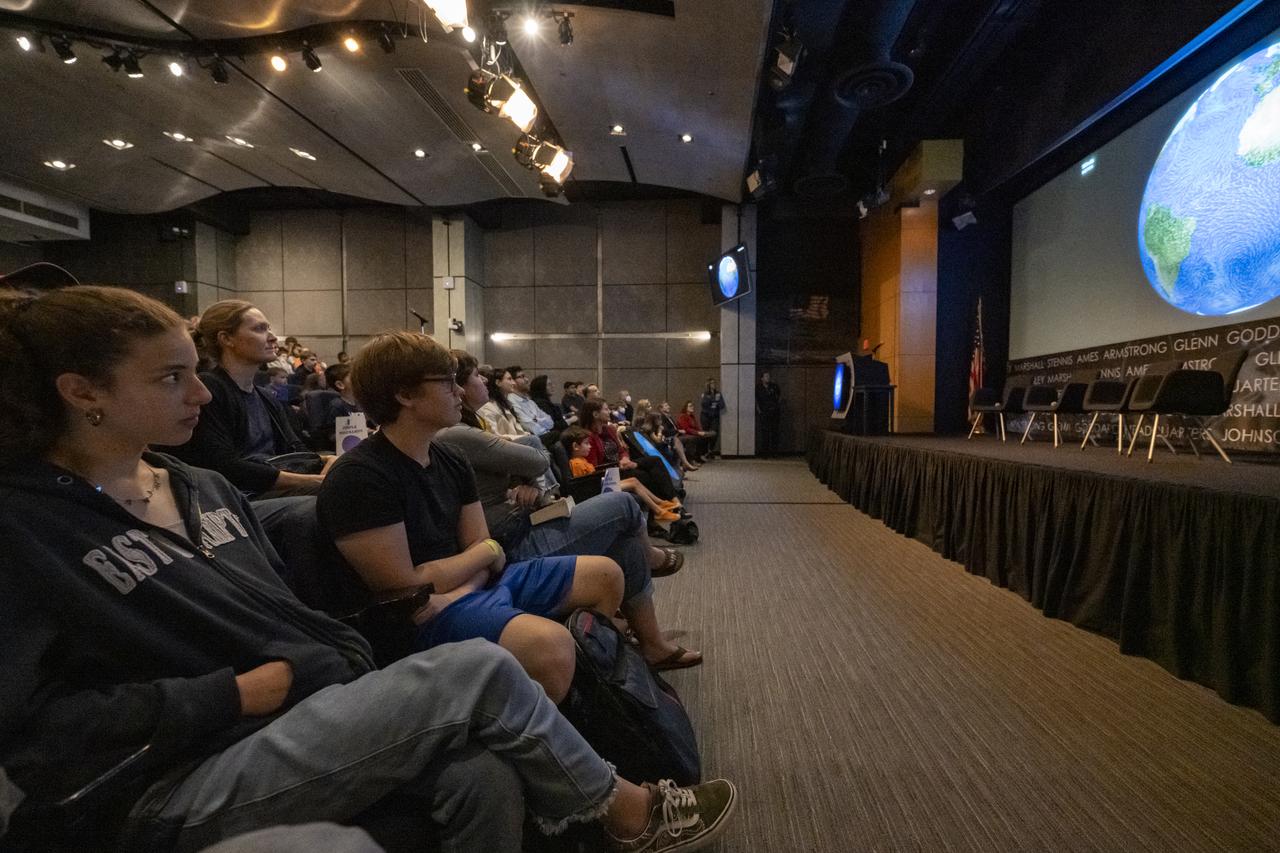
Local students view a video presentation during an Earth Information Center (EIC) student engagement event, Friday, June 23, 2023, at the Mary W. Jackson NASA Headquarters building in Washington. The EIC is a new immersive experience that combines live data sets with cutting-edge data visualization and storytelling to allow visitors to see how our planet is changing. Photo Credit: (NASA/Keegan Barber)
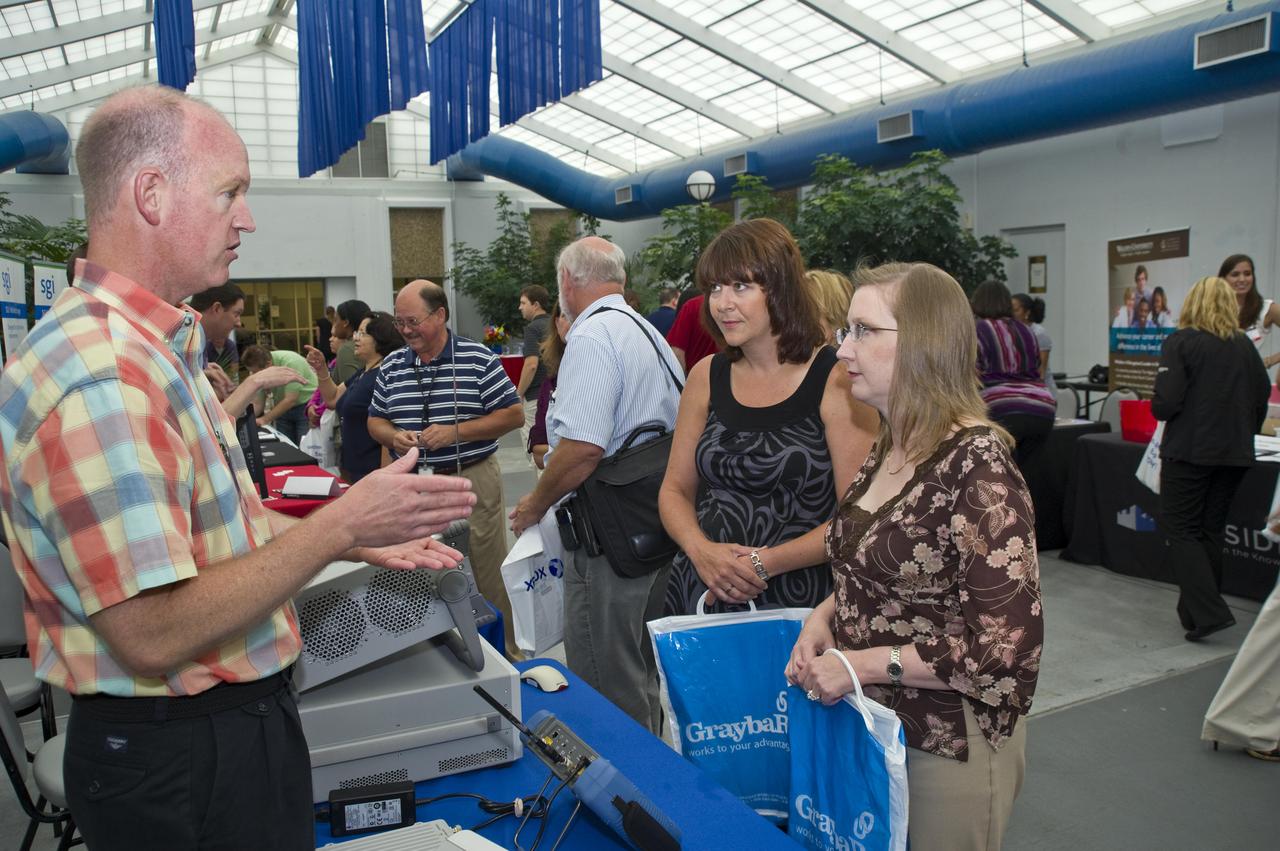
Phillip Stallcup with Agilent Technologies in Huntsville, Ala., talks with NASA employees Leslie Ladner (l) and Kelly Sullivan about spectrum analyzers and other test equipment during the Stennis Technology Expo on May 26. The expo was hosted by NASA Solutions for Enterprise-Wide Procurement and featured various exhibitors demonstrating the latest in a range of technologies, such as training equipment, secure data storage, video networks, distance learning and data management.
A team at NASA’s Glenn Research Center in Cleveland streamed 4K video footage from an aircraft to the International Space Station and back for the first time using optical, or laser, communications. The feat was part of a series of tests on new technology that could provide live video coverage of astronauts on the Moon during the Artemis missions. Working with the Air Force Research Laboratory and NASA’s Small Business Innovation Research program, Glenn engineers temporarily installed a portable laser terminal on the belly of a Pilatus PC-12 aircraft. They then flew over Lake Erie sending data from the aircraft to an optical ground station in Cleveland. From there, it was sent over an Earth-based network to NASA’s White Sands Test Facility in Las Cruces, New Mexico, where scientists used infrared light signals to send the data.

A team at NASA’s Glenn Research Center in Cleveland streamed 4K video footage from an aircraft to the International Space Station and back for the first time using optical, or laser, communications. The feat was part of a series of tests on new technology that could provide live video coverage of astronauts on the Moon during the Artemis missions. Working with the Air Force Research Laboratory and NASA’s Small Business Innovation Research program, Glenn engineers temporarily installed a portable laser terminal on the belly of a Pilatus PC-12 aircraft. They then flew over Lake Erie sending data from the aircraft to an optical ground station in Cleveland. From there, it was sent over an Earth-based network to NASA’s White Sands Test Facility in Las Cruces, New Mexico, where scientists used infrared light signals to send the data. Photo Credit: (NASA/Sara Lowthian-Hanna)
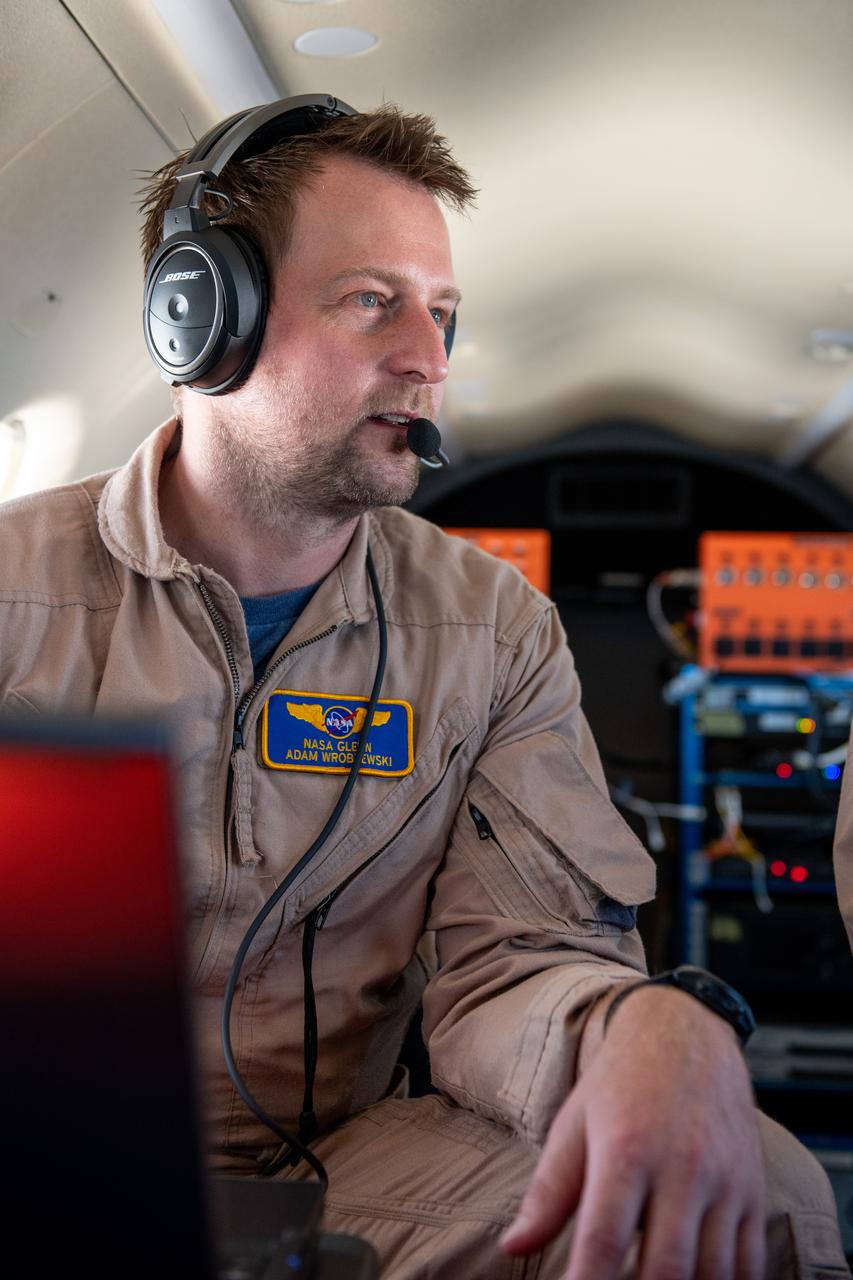
Adam Wroblewski p A team at NASA’s Glenn Research Center in Cleveland streamed 4K video footage from an aircraft to the International Space Station and back for the first time using optical, or laser, communications. The feat was part of a series of tests on new technology that could provide live video coverage of astronauts on the Moon during the Artemis missions. Working with the Air Force Research Laboratory and NASA’s Small Business Innovation Research program, Glenn engineers temporarily installed a portable laser terminal on the belly of a Pilatus PC-12 aircraft. Adam Wroblewski in the PC-12 over Lake Erie on June 13, 2024 sending data from the aircraft to an optical ground station in Cleveland. From there, it was sent over an Earth-based network to NASA’s White Sands Test Facility in Las Cruces, New Mexico, where scientists used infrared light signals to send the data. Photo Credit: (NASA/Sara Lowthian-Hanna)
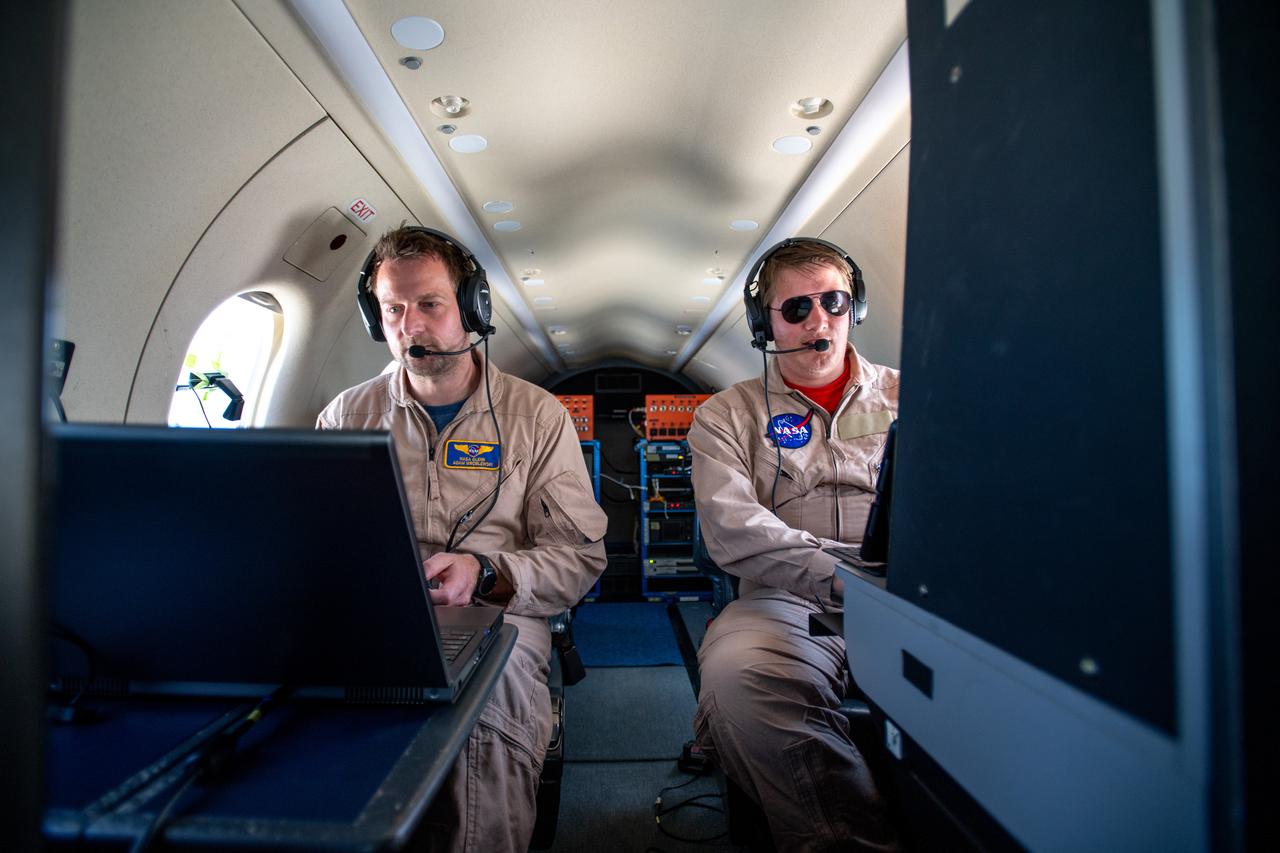
A team at NASA’s Glenn Research Center in Cleveland streamed 4K video footage from an aircraft to the International Space Station and back for the first time using optical, or laser, communications. The feat was part of a series of tests on new technology that could provide live video coverage of astronauts on the Moon during the Artemis missions. Working with the Air Force Research Laboratory and NASA’s Small Business Innovation Research program, Glenn engineers temporarily installed a portable laser terminal on the belly of a Pilatus PC-12 aircraft. They then flew over Lake Erie sending data from the aircraft to an optical ground station in Cleveland. From there, it was sent over an Earth-based network to NASA’s White Sands Test Facility in Las Cruces, New Mexico, where scientists used infrared light signals to send the data. Photo Credit: (NASA/Sara Lowthian-Hanna)
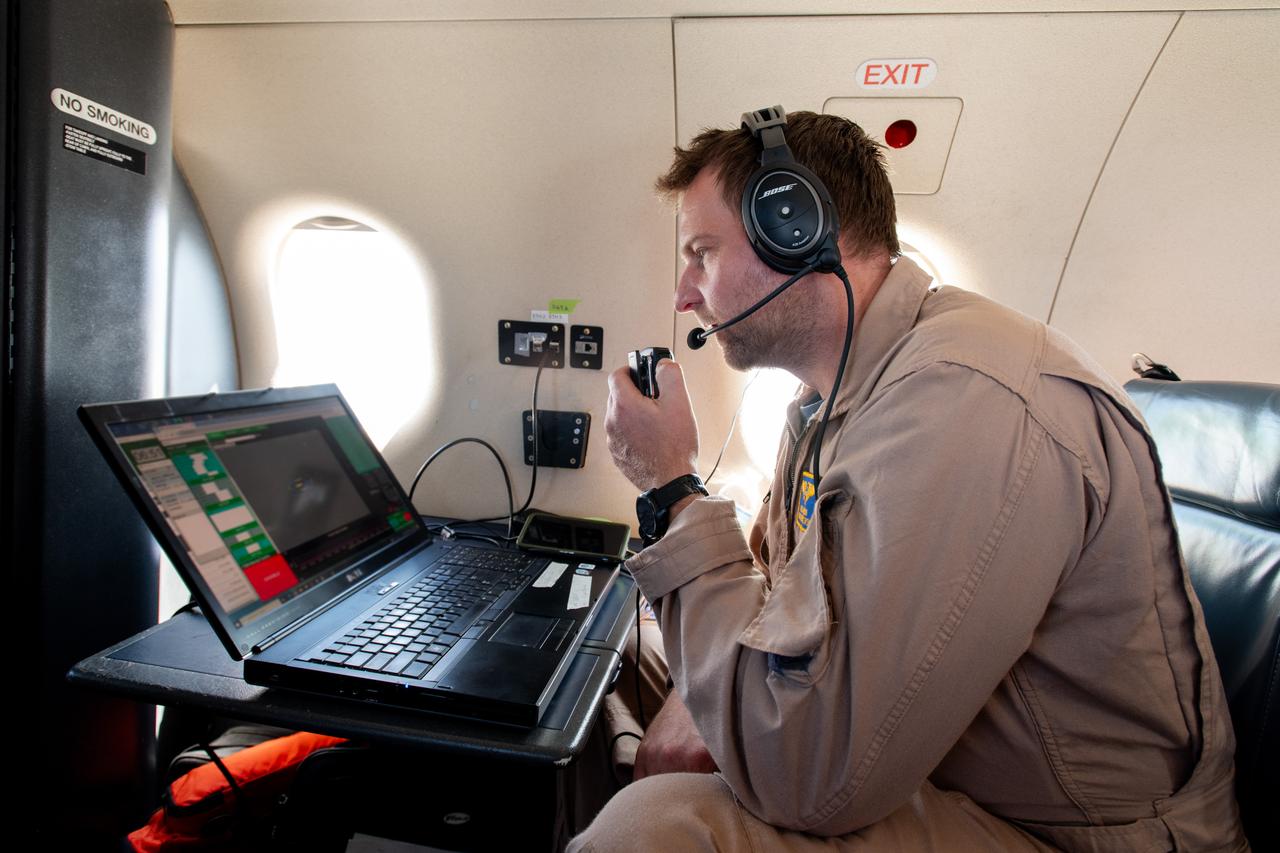
A team at NASA’s Glenn Research Center in Cleveland streamed 4K video footage from an aircraft to the International Space Station and back for the first time using optical, or laser, communications. The feat was part of a series of tests on new technology that could provide live video coverage of astronauts on the Moon during the Artemis missions. Working with the Air Force Research Laboratory and NASA’s Small Business Innovation Research program, Glenn engineers temporarily installed a portable laser terminal on the belly of a Pilatus PC-12 aircraft. They then flew over Lake Erie sending data from the aircraft to an optical ground station in Cleveland. From there, it was sent over an Earth-based network to NASA’s White Sands Test Facility in Las Cruces, New Mexico, where scientists used infrared light signals to send the data.
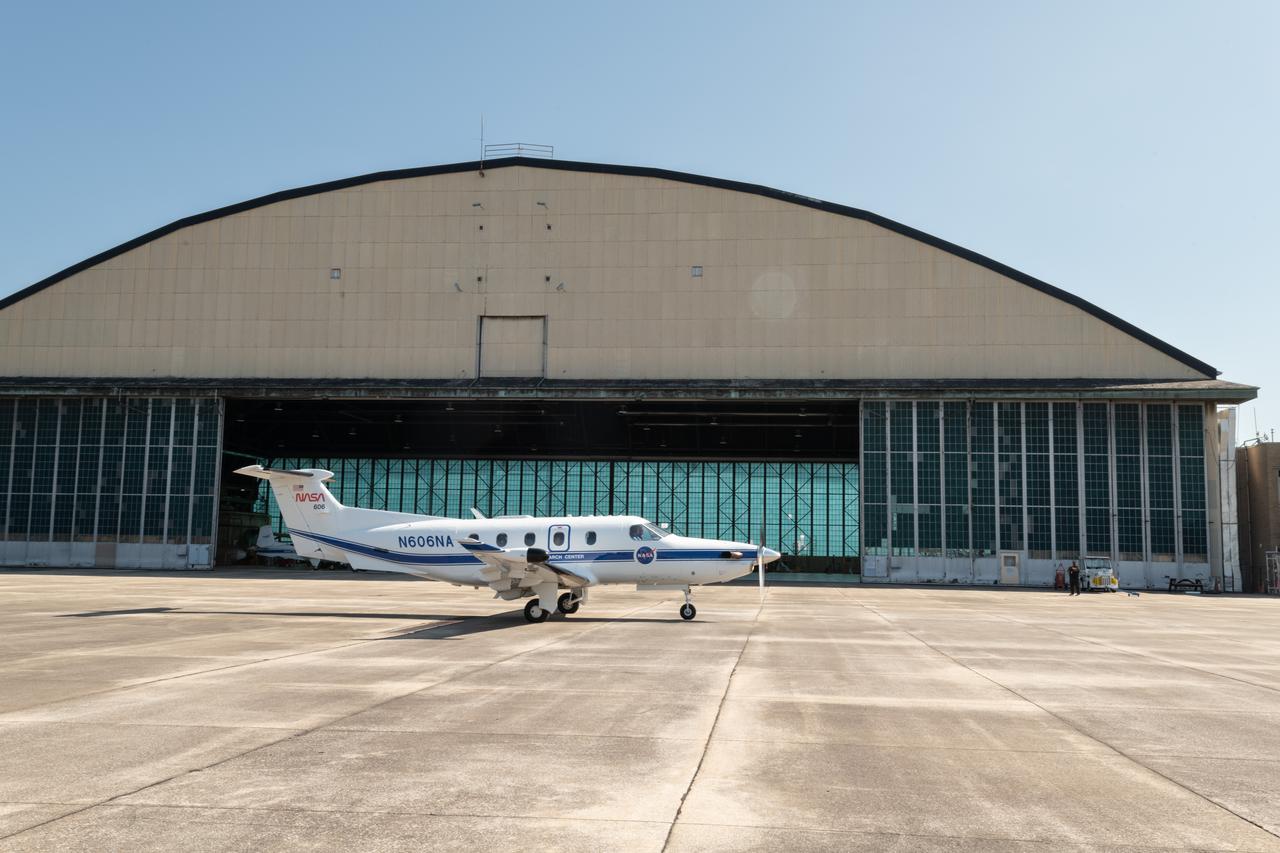
A team at NASA’s Glenn Research Center in Cleveland streamed 4K video footage from an aircraft to the International Space Station and back for the first time using optical, or laser, communications. The feat was part of a series of tests on new technology that could provide live video coverage of astronauts on the Moon during the Artemis missions. Working with the Air Force Research Laboratory and NASA’s Small Business Innovation Research program, Glenn engineers temporarily installed a portable laser terminal on the belly of a Pilatus PC-12 aircraft. They then flew over Lake Erie sending data from the aircraft to an optical ground station in Cleveland. From there, it was sent over an Earth-based network to NASA’s White Sands Test Facility in Las Cruces, New Mexico, where scientists used infrared light signals to send the data.
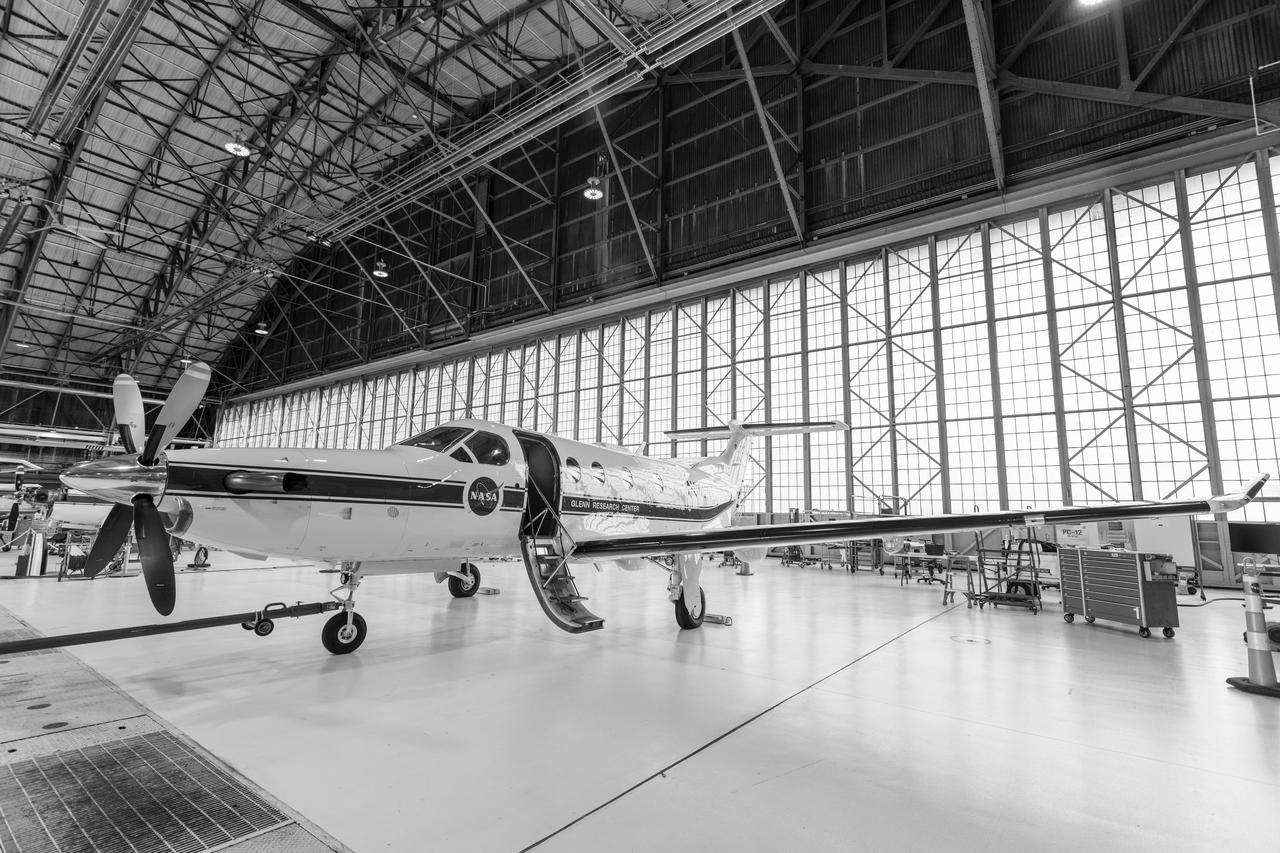
A team at NASA’s Glenn Research Center in Cleveland streamed 4K video footage from an aircraft to the International Space Station and back for the first time using optical, or laser, communications. The feat was part of a series of tests on new technology that could provide live video coverage of astronauts on the Moon during the Artemis missions. Working with the Air Force Research Laboratory and NASA’s Small Business Innovation Research program, Glenn engineers temporarily installed a portable laser terminal on the belly of a Pilatus PC-12 aircraft. They then flew over Lake Erie sending data from the aircraft to an optical ground station in Cleveland. From there, it was sent over an Earth-based network to NASA’s White Sands Test Facility in Las Cruces, New Mexico, where scientists used infrared light signals to send the data.
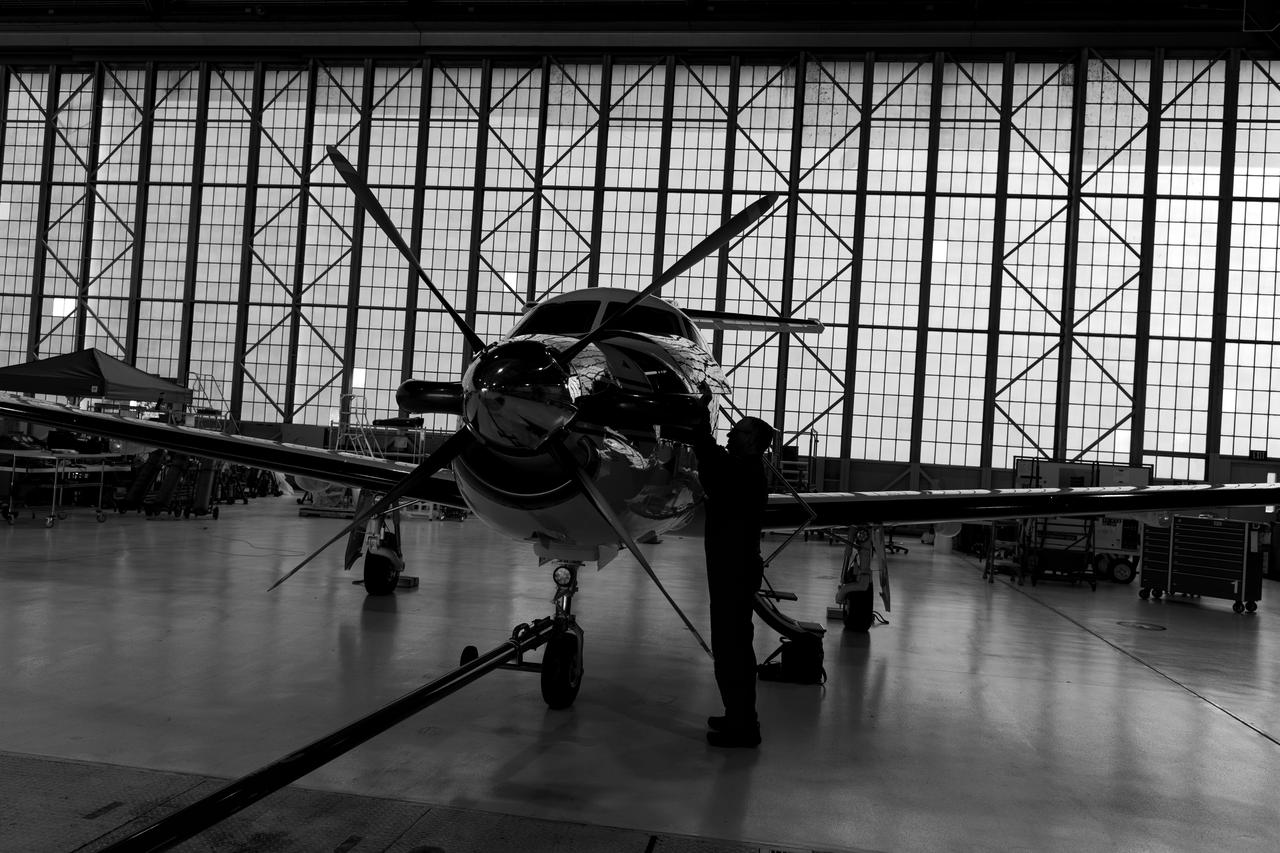
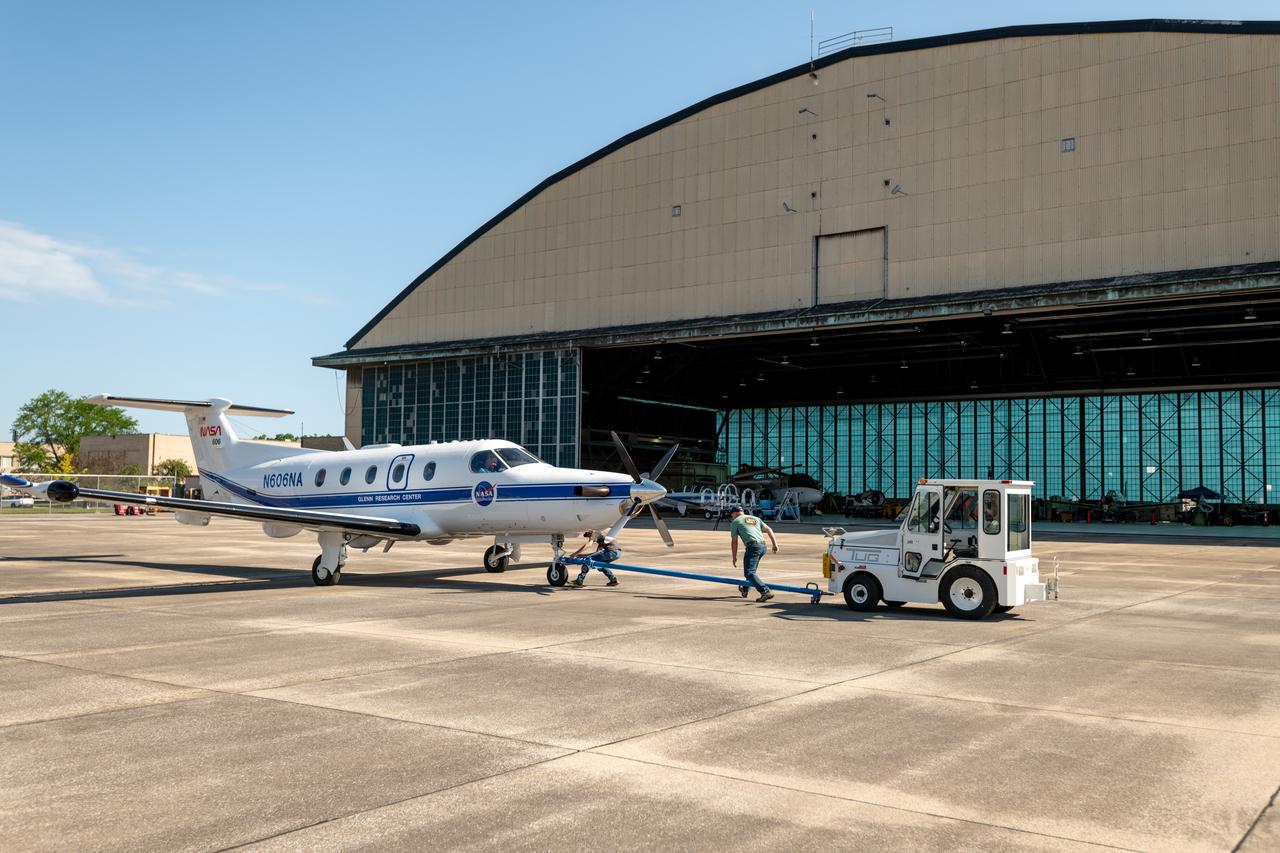
Pilatus PC-12 Aircraft Being Prepped for Takeoff on June 12, 2024. A team at NASA’s Glenn Research Center in Cleveland streamed 4K video footage from an aircraft to the International Space Station and back for the first time using optical, or laser, communications. The feat was part of a series of tests on new technology that could provide live video coverage of astronauts on the Moon during the Artemis missions. Working with the Air Force Research Laboratory and NASA’s Small Business Innovation Research program, Glenn engineers temporarily installed a portable laser terminal on the belly of a Pilatus PC-12 aircraft. They then flew over Lake Erie sending data from the aircraft to an optical ground station in Cleveland. From there, it was sent over an Earth-based network to NASA’s White Sands Test Facility in Las Cruces, New Mexico, where scientists used infrared light signals to send the data. Photo Credit: (NASA/Sara Lowthian-Hanna)

A team at NASA’s Glenn Research Center in Cleveland streamed 4K video footage from an aircraft to the International Space Station and back for the first time using optical, or laser, communications. The feat was part of a series of tests on new technology that could provide live video coverage of astronauts on the Moon during the Artemis missions. Working with the Air Force Research Laboratory and NASA’s Small Business Innovation Research program, Glenn engineers temporarily installed a portable laser terminal on the belly of a Pilatus PC-12 aircraft. They then flew over Lake Erie sending data from the aircraft to an optical ground station in Cleveland. From there, it was sent over an Earth-based network to NASA’s White Sands Test Facility in Las Cruces, New Mexico, where scientists used infrared light signals to send the data.

A team at NASA’s Glenn Research Center in Cleveland streamed 4K video footage from an aircraft to the International Space Station and back for the first time using optical, or laser, communications. The feat was part of a series of tests on new technology that could provide live video coverage of astronauts on the Moon during the Artemis missions. Pictured from Left to Right: James Demers, Adam Wroblewski, Shaun McKeehan, Kurt Blankenship. Working with the Air Force Research Laboratory and NASA’s Small Business Innovation Research program, Glenn engineers temporarily installed a portable laser terminal on the belly of a Pilatus PC-12 aircraft. They then flew over Lake Erie sending data from the aircraft to an optical ground station in Cleveland. From there, it was sent over an Earth-based network to NASA’s White Sands Test Facility in Las Cruces, New Mexico, where scientists used infrared light signals to send the data.
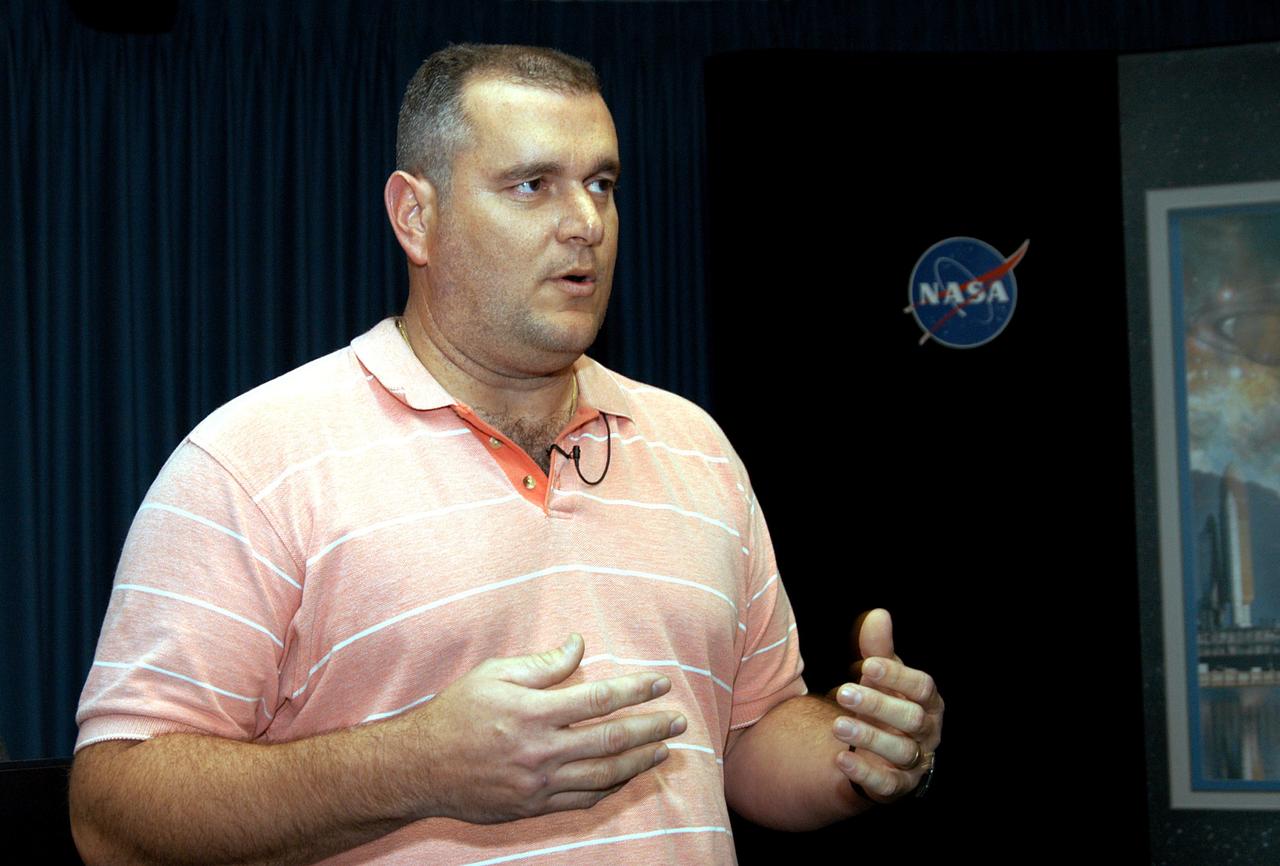
KENNEDY SPACE CENTER, FLA. - Armando Oliu, Final Inspection Team lead for the Shuttle program, speaks to reporters about the aid the Image Analysis Lab is giving the FBI in a kidnapping case. Oliu oversees the image lab that is using an advanced SGI® TP9500 data management system to review the tape of the kidnapping in progress in Sarasota, Fla. KSC installed the new $3.2 million system in preparation for Return to Flight of the Space Shuttle fleet. The lab is studying the Sarasota kidnapping video to provide any new information possible to law enforcement officers. KSC is joining NASA’s Marshall Space Flight Center in Alabama in reviewing the tape.
KENNEDY SPACE CENTER, FLA. - Armando Oliu, Final Inspection Team lead for the Shuttle program, speaks to reporters about the aid the Image Analysis Lab is giving the FBI in a kidnapping case. Oliu oversees the image lab that is using an advanced SGI® TP9500 data management system to review the tape of the kidnapping in progress in Sarasota, Fla. KSC installed the new $3.2 million system in preparation for Return to Flight of the Space Shuttle fleet. The lab is studying the Sarasota kidnapping video to provide any new information possible to law enforcement officers. KSC is joining NASA’s Marshall Space Flight Center in Alabama in reviewing the tape.

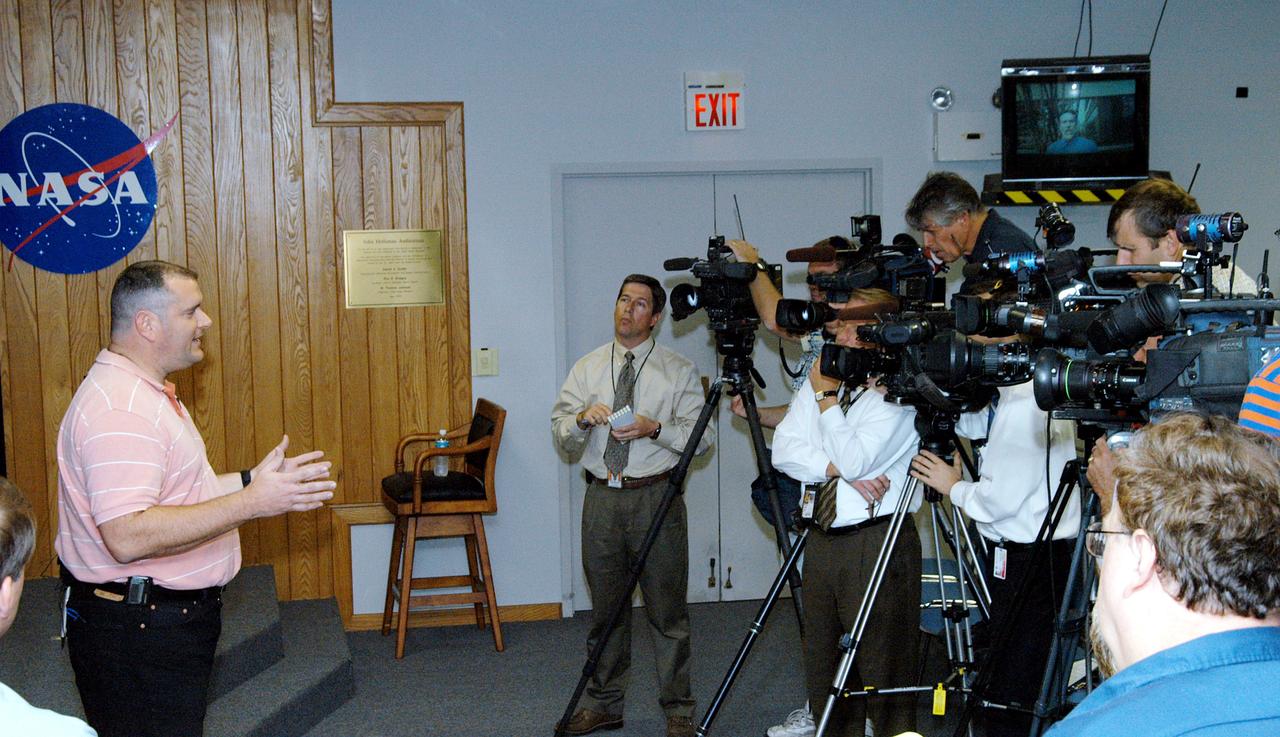
KENNEDY SPACE CENTER, FLA. - Reporters are eager to hear from Armando Oliu about the aid the Image Analysis Lab is giving the FBI in a kidnapping case. Oliu, Final Inspection Team lead for the Shuttle program, oversees the lab that is using an advanced SGI® TP9500 data management system to review the tape of the kidnapping in progress in Sarasota, Fla. KSC installed the new $3.2 million system in preparation for Return to Flight of the Space Shuttle fleet. The lab is studying the Sarasota kidnapping video to provide any new information possible to law enforcement officers. KSC is joining NASA’s Marshall Space Flight Center in Alabama in reviewing the tape.
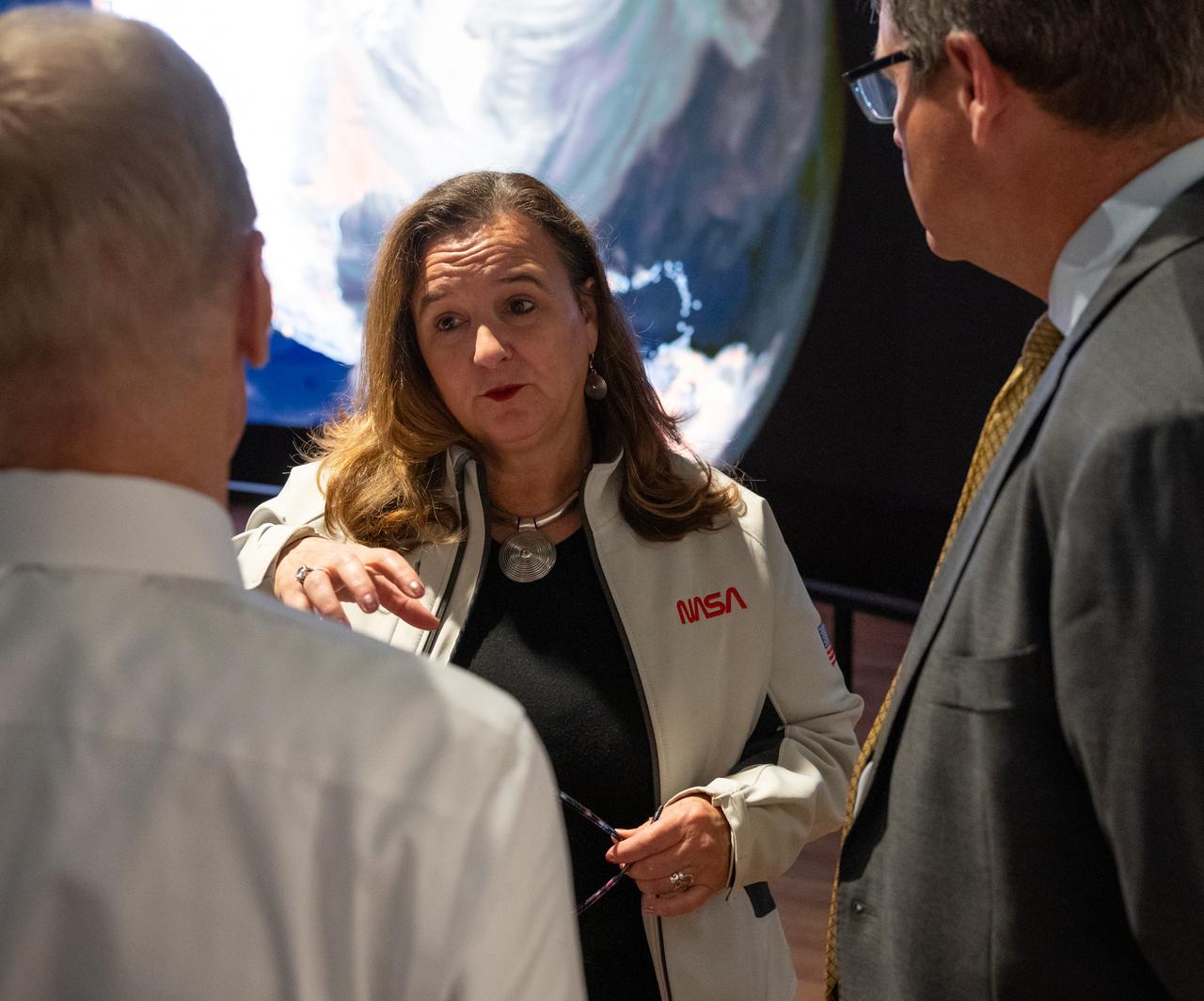
NASA Earth Sciences, Division Director, Karen St. Germain, center, speaks with NASA Administrator Bill Nelson, left, and Smithsonian Museum of Natural History, Sant Director, Kirk Johnson, during a preview of the Earth Information Center at the Smithsonian National Museum of Natural History, in Washington, Monday, Oct. 7, 2024. The exhibit includes a video wall displaying Earth science data visualizations and videos, an interpretive panel showing Earth’s connected systems, information on our changing world, and an overview of how NASA and the Smithsonian study our home planet. Photo Credit: (NASA/Bill Ingalls)
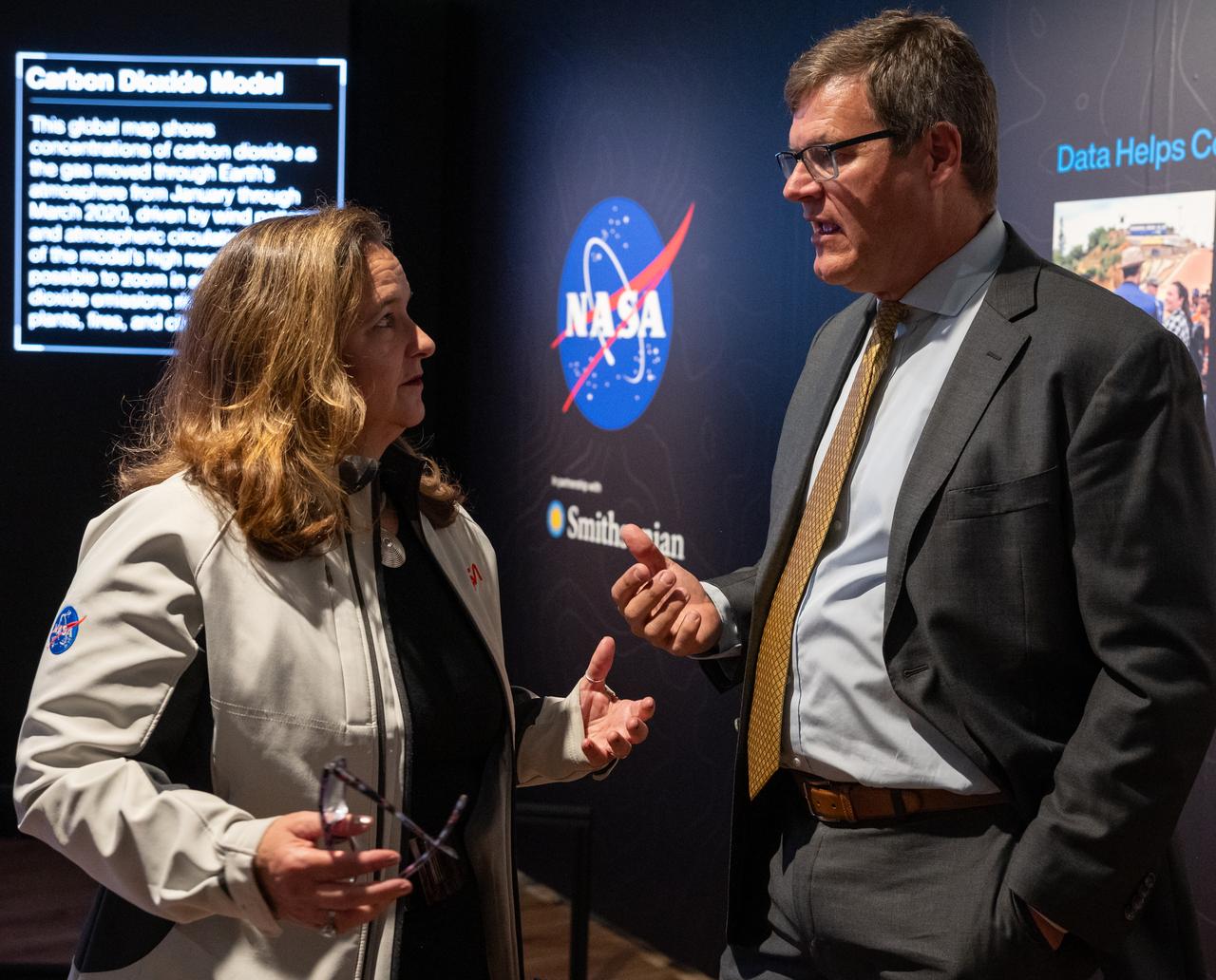
NASA Earth Sciences, Division Director, Karen St. Germain, left, and Smithsonian Museum of Natural History, Sant Director, Kirk Johnson, talk during a preview of the Earth Information Center at the Smithsonian National Museum of Natural History, in Washington, Monday, Oct. 7, 2024. The exhibit includes a video wall displaying Earth science data visualizations and videos, an interpretive panel showing Earth’s connected systems, information on our changing world, and an overview of how NASA and the Smithsonian study our home planet. Photo Credit: (NASA/Bill Ingalls)
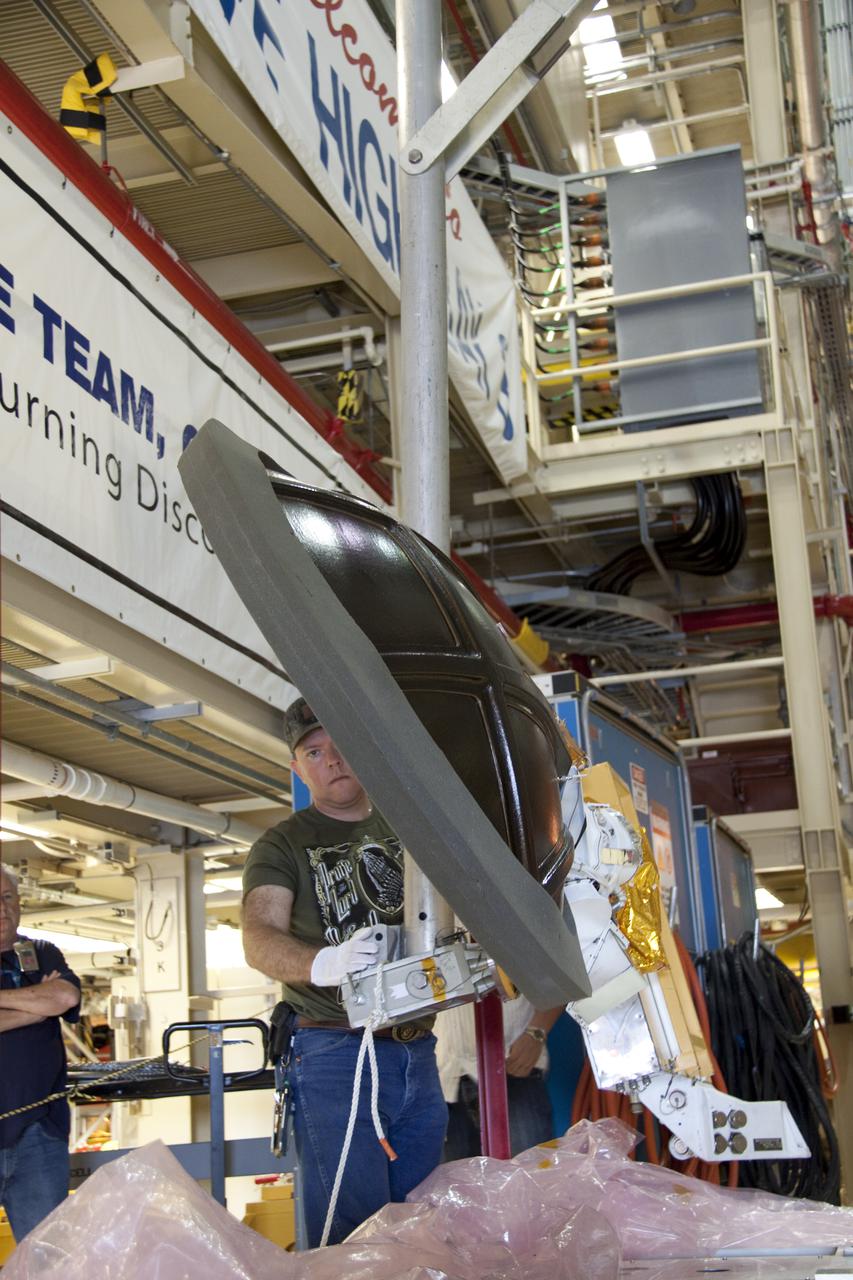
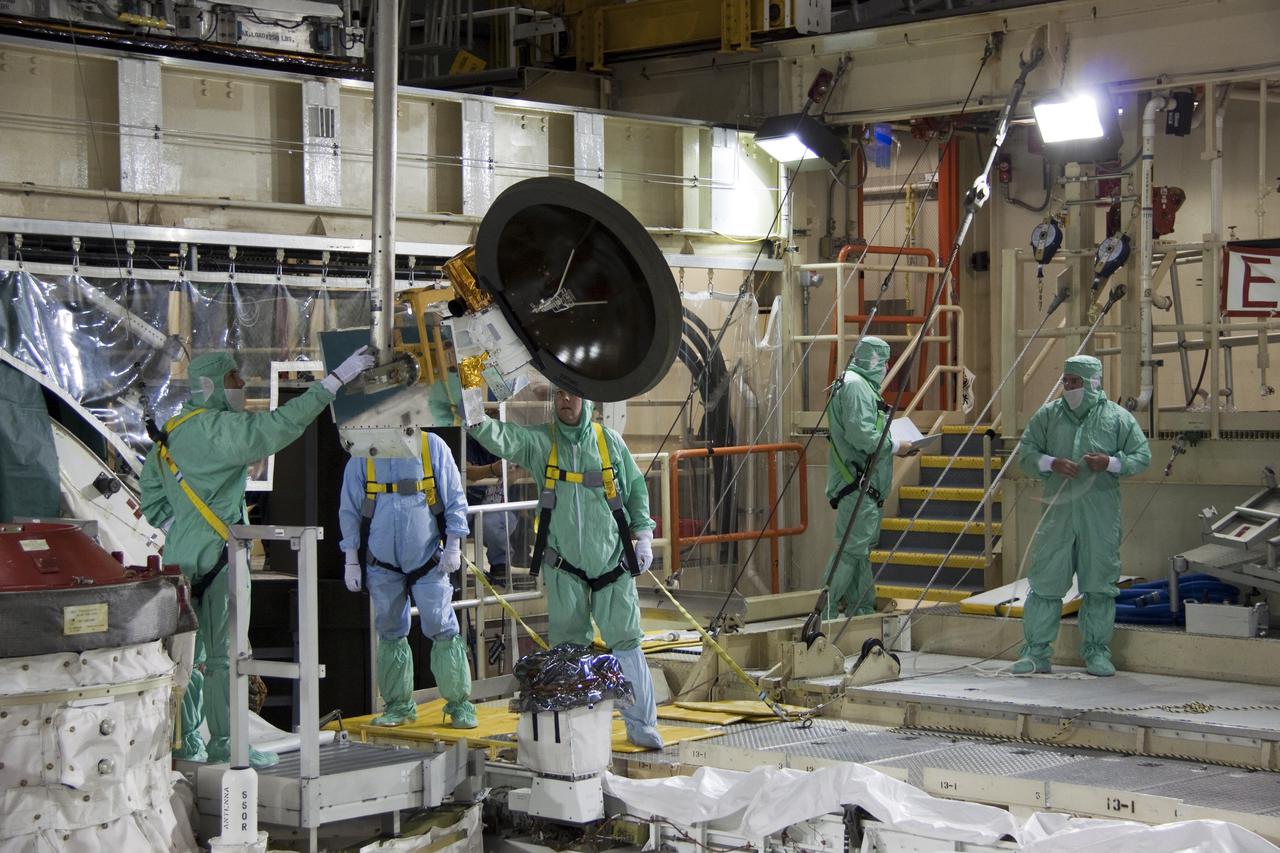
CAPE CANAVERAL, Fla. -- Technicians prepare to install a new Ku-Band communications system antenna on space shuttle Discovery in Orbiter Processing Facility-3 at NASA's Kennedy Space Center in Florida. The antenna is used to transmit and receive high data rate communications, such as video, and is being replaced for the STS-133 mission to the International Space Station. During its STS-131 mission to the station in April, Discovery's Ku-Band failed to operate in orbit. As a result, video of the thermal protection system inspection had to be recorded aboard Discovery and transmitted to the ground after the shuttle docked with the station. Typically, the inspection video is simultaneously transmitted live to the ground and recorded aboard the shuttle for later review. NASA_Charisse Nahser
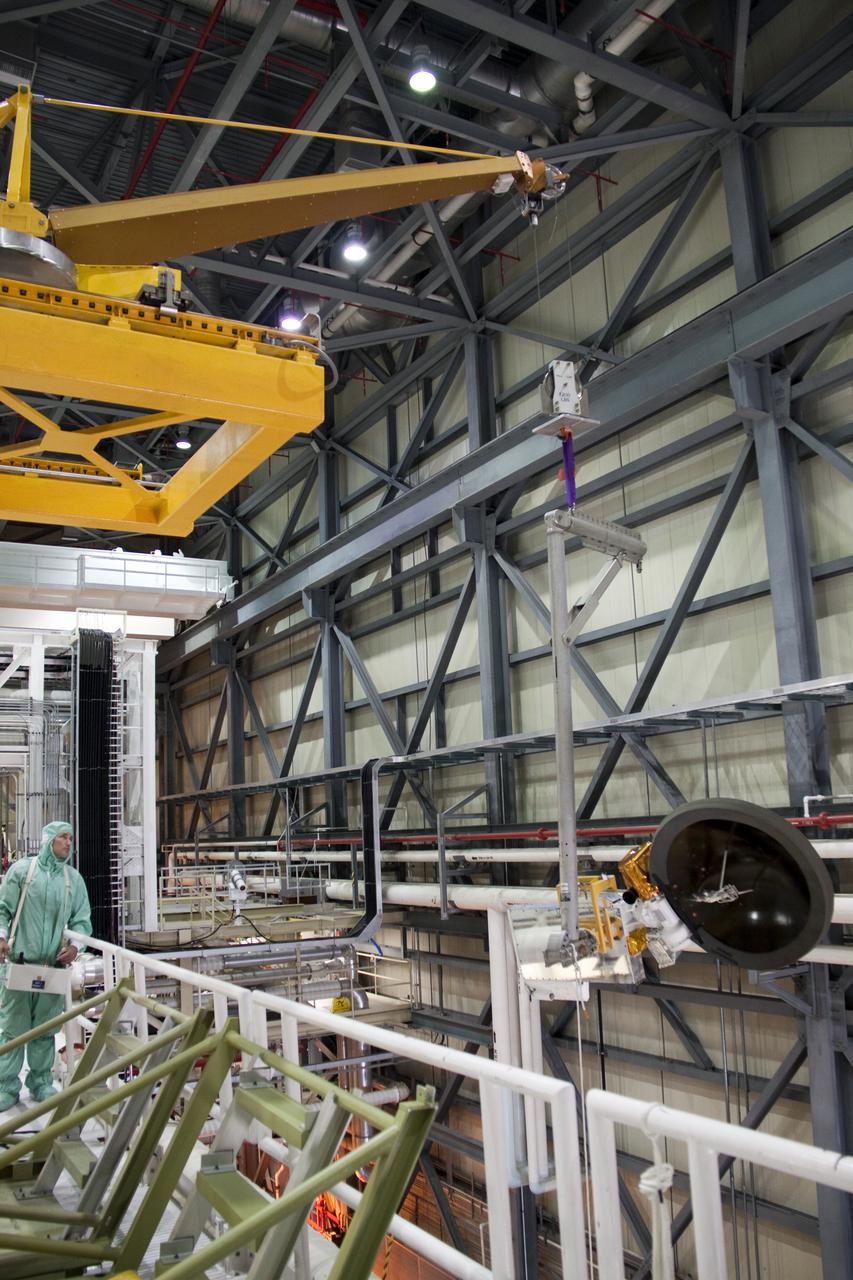
CAPE CANAVERAL, Fla. -- Technicians prepare to install a new Ku-Band communications system antenna on space shuttle Discovery in Orbiter Processing Facility-3 at NASA's Kennedy Space Center in Florida. The antenna is used to transmit and receive high data rate communications, such as video, and is being replaced for the STS-133 mission to the International Space Station. During its STS-131 mission to the station in April, Discovery's Ku-Band failed to operate in orbit. As a result, video of the thermal protection system inspection had to be recorded aboard Discovery and transmitted to the ground after the shuttle docked with the station. Typically, the inspection video is simultaneously transmitted live to the ground and recorded aboard the shuttle for later review. NASA_Charisse Nahser
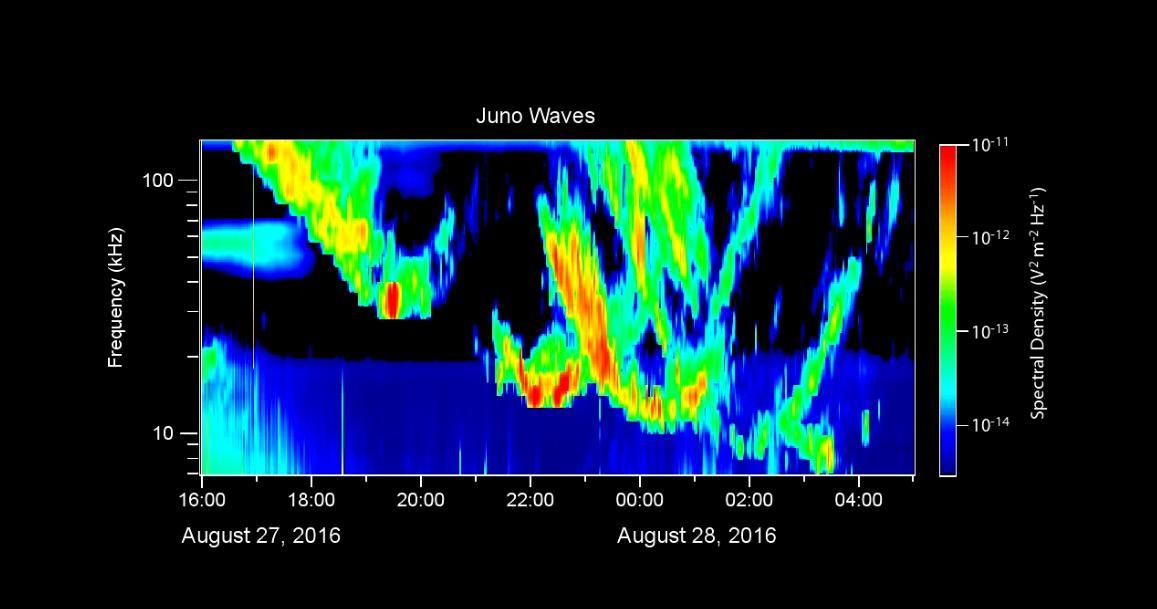
During its close flyby of Jupiter on August 27, 2016, the Waves instrument on NASA's Juno spacecraft received radio signals associated with the giant planet's very intense auroras. This video displays these radio emissions in a format similar to a voiceprint, showing the intensity of radio waves as a function of frequency and time. The largest intensities are indicated in warmer colors. The frequency range of these signals is from 7 to 140 kilohertz. Radio astronomers call these "kilometric emissions" because their wavelengths are about a kilometer long. The time span of this data is 13 hours, beginning shortly after Juno's closest approach to Jupiter. Accompanying this data display is an audio rendition of the radio emissions, shifted into a lower register since the radio waves are well above the audio frequency range. In the video, a cursor moves from left to right to mark the time as the sounds are heard. These radio emissions were among the first observed by early radio astronomers in the 1950s. However, until now, they had not been observed from closely above the auroras themselves. From its polar orbit vantage point, Juno has -- for the first time -- enabled observations of these emissions from very close range. The Juno team believes that Juno flew directly through the source regions for some of these emissions during this flyby, which was Juno's first with its sensors actively collecting data. A movie is available at http://photojournal.jpl.nasa.gov/catalog/PIA21037
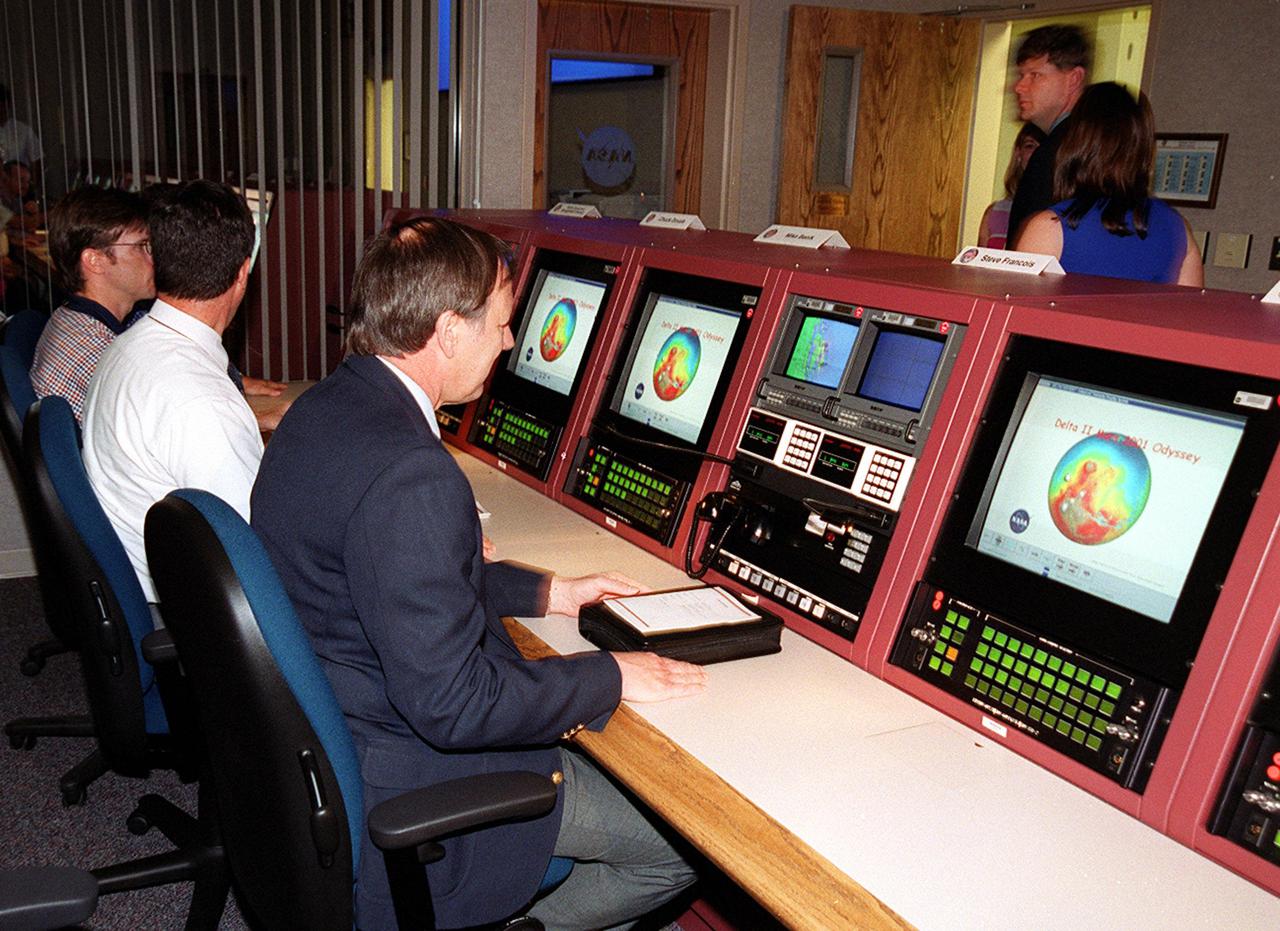
At the dedication of the upgraded Launch Vehicle Data Center in Hangar AE, Cape Canaveral Air Force Station, Fla., attendees got a close look at the new consoles. Seated on the right is Steve Francois, program manager, Expendable Vehicles and Payload Carriers. The new facility’s three individual control rooms replace a single LVDC control room in use since the mid-1970s. Developed by NASA-KSC to support multiple test operations in parallel or a single large launch operation, the new LVDC allows up to 100 launch vehicle engineers to monitor the voice, data and video systems that support the checkout and launch of an expendable vehicle
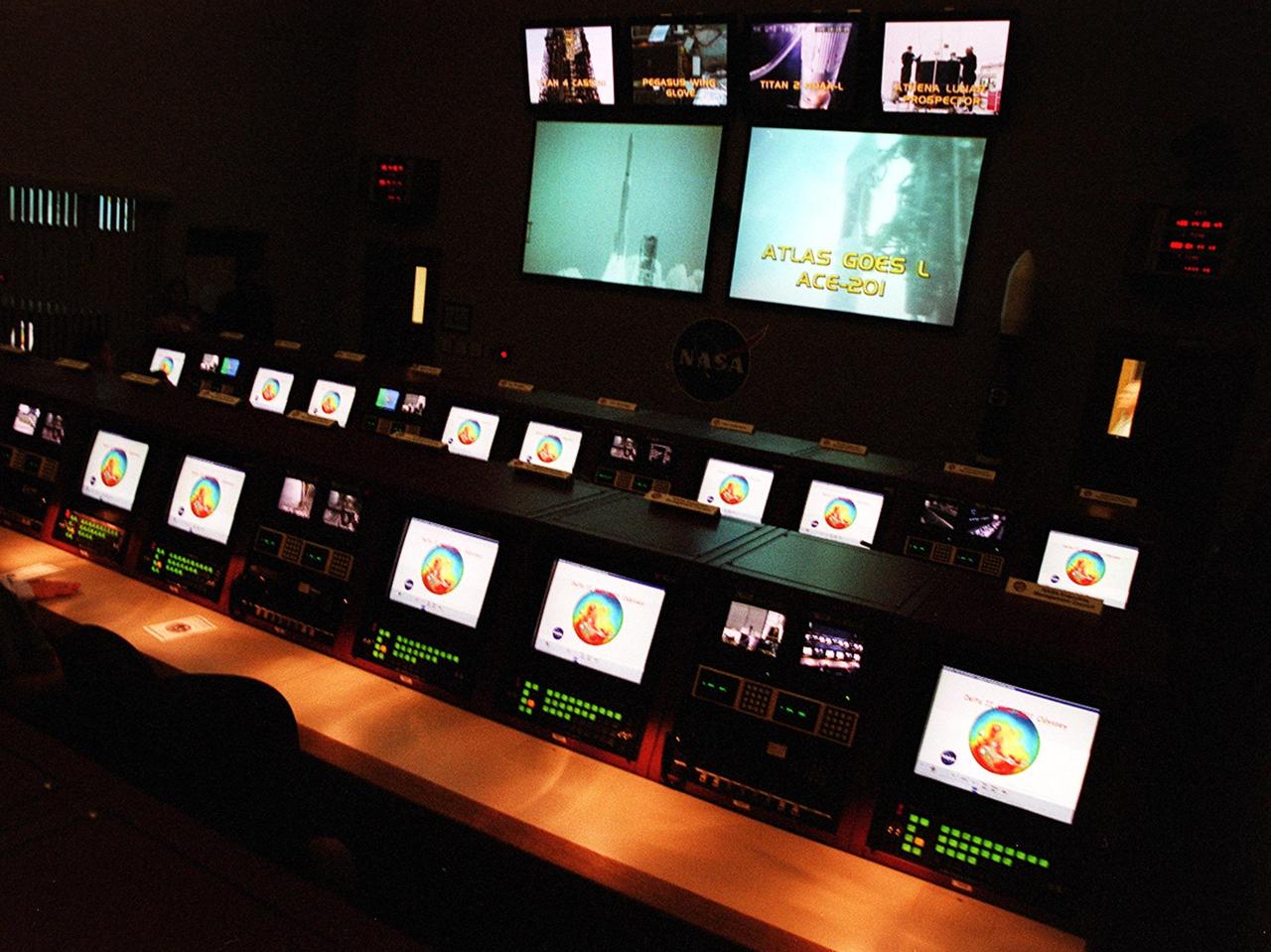
State-of-the-art displays shown here provide enhanced capability to engineers in the upgraded Launch Vehicle Data Center in Hangar AE, Cape Canaveral Air Force Station, Fla. The new facility’s three individual control rooms replace a single LVDC control room in use since the mid-1970s. Developed by NASA-KSC to support multiple test operations in parallel or a single large launch operation, the new LVDC allows up to 100 launch vehicle engineers to monitor the voice, data and video systems that support the checkout and launch of an expendable vehicle
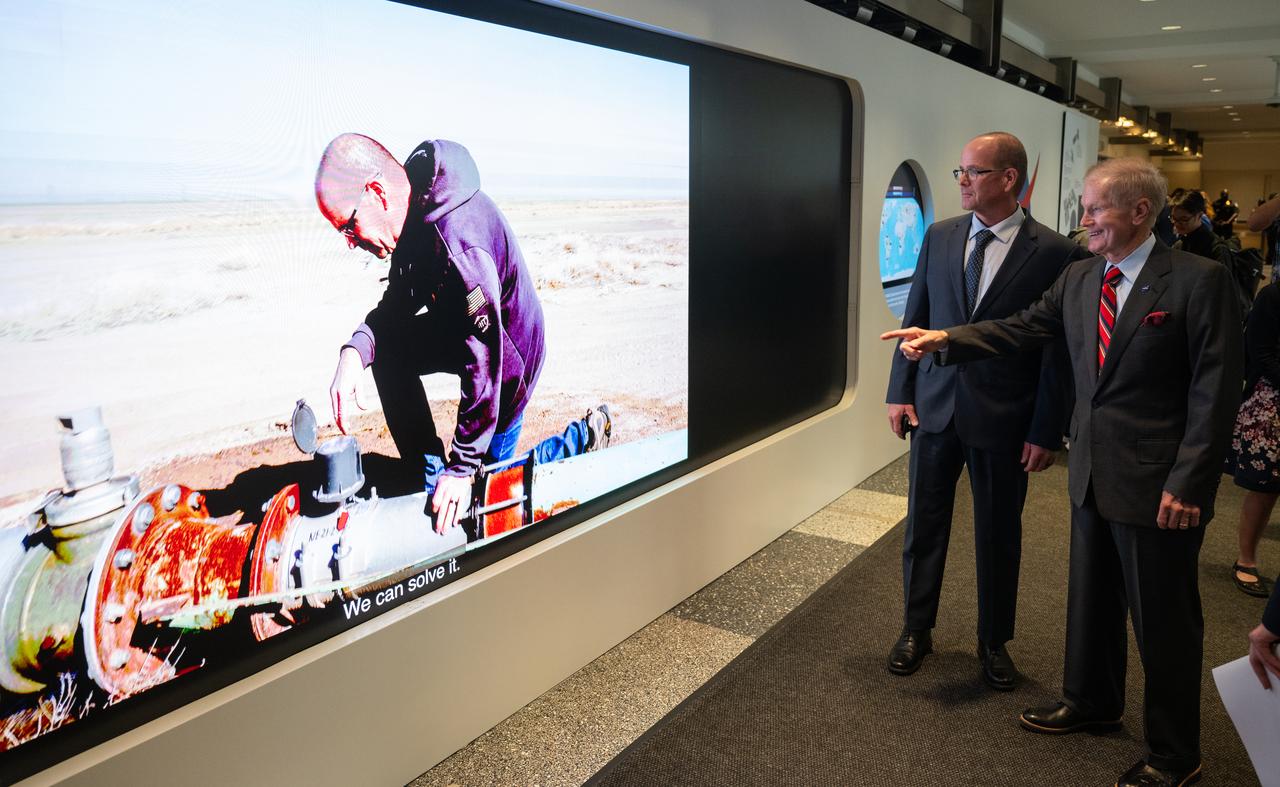
NASA Administrator Bill Nelson, right, and Dwane Roth of Big D Farms in Kansas are seen watching a video on the hyperwall that shows Roth’s farm following a ribbon cutting ceremony to open NASA’s Earth Information Center, Wednesday, June 21, 2023, at the Mary W. Jackson NASA Headquarters building in Washington. The Earth Information Center is new immersive experience that combines live data sets with cutting-edge data visualization and storytelling to allow visitors to see how our planet is changing. Photo Credit: (NASA/Joel Kowsky)
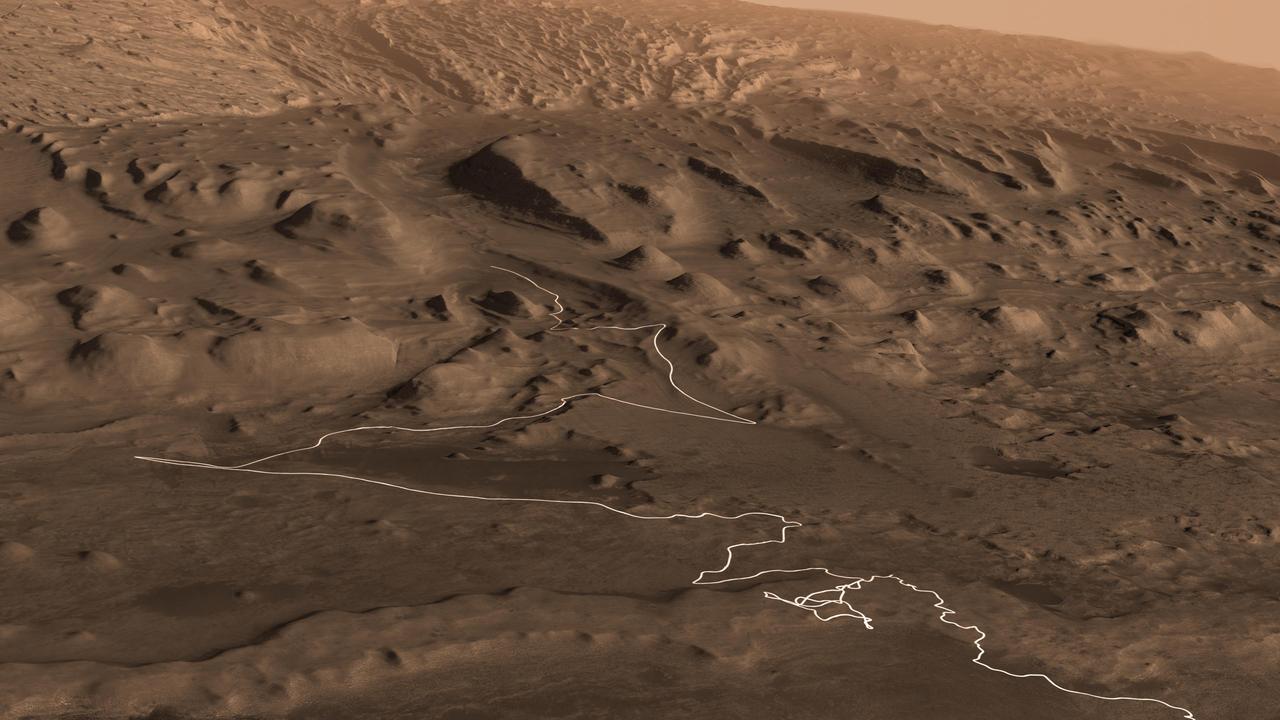
This animation shows a proposed route for NASA's Curiosity rover, which is climbing lower Mount Sharp on Mars. The annotated version of the map labels different regions that scientists working with the rover would like to explore in coming years. A flyover video explains them in more detail. Data used in creating this map came from several instruments on NASA's Mars Reconnaissance Orbiter (MRO), including the High Resolution Imaging Science Experiment (HiRISE), Compact Reconnaissance Imaging Spectrometer for Mars (CRISM) and the Context Camera (CTX). The High Resolution Stereo Camera (HRSC) instrument on the European Space Agency's Mars Express also contributed data. Animation available at https://photojournal.jpl.nasa.gov/catalog/PIA23179
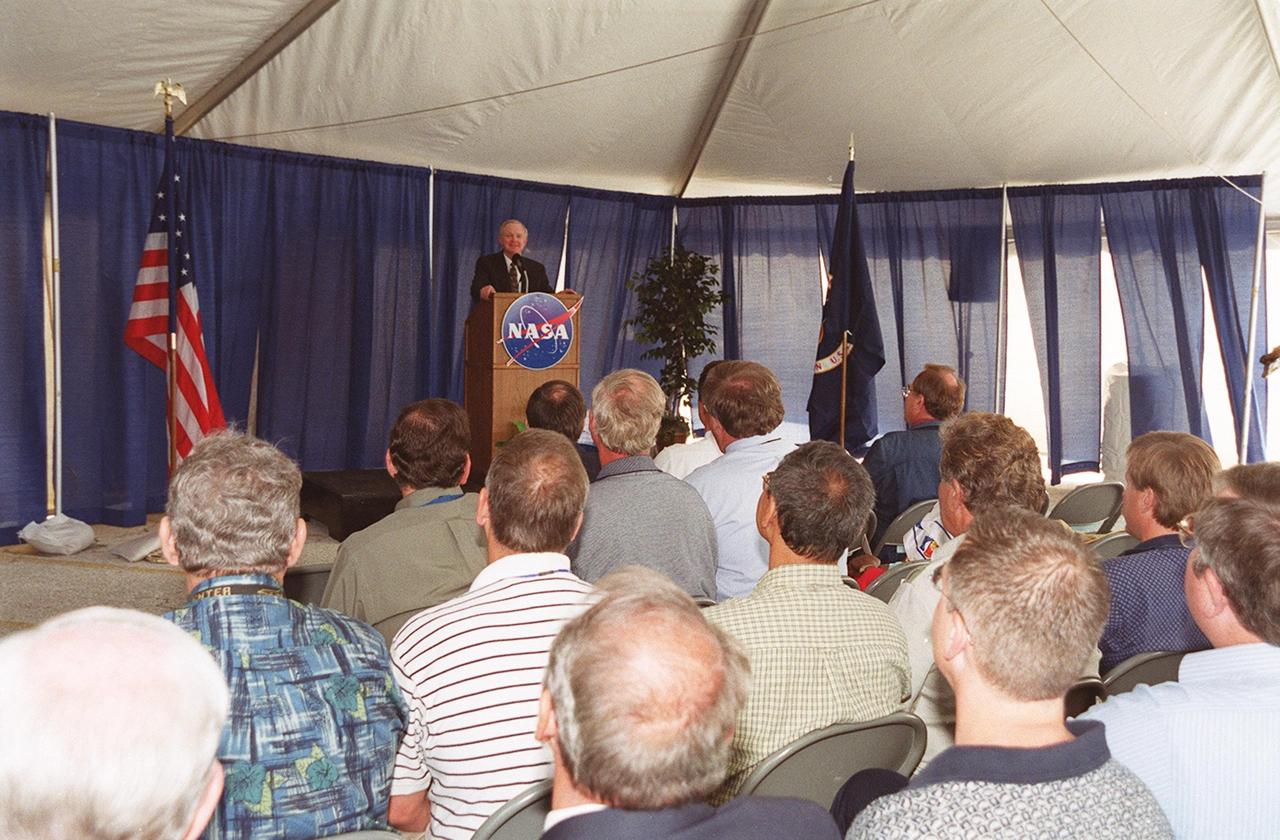
Center Director Roy Bridges addresses attendees at the dedication of the upgraded Launch Vehicle Data Center in Hangar AE, Cape Canaveral Air Force Station, Fla. The new facility’s three individual control rooms replace a single LVDC control room in use since the mid-1970s. Developed by NASA-KSC to support multiple test operations in parallel or a single large launch operation, the new LVDC allows up to 100 launch vehicle engineers to monitor the voice, data and video systems that support the checkout and launch of an expendable vehicle
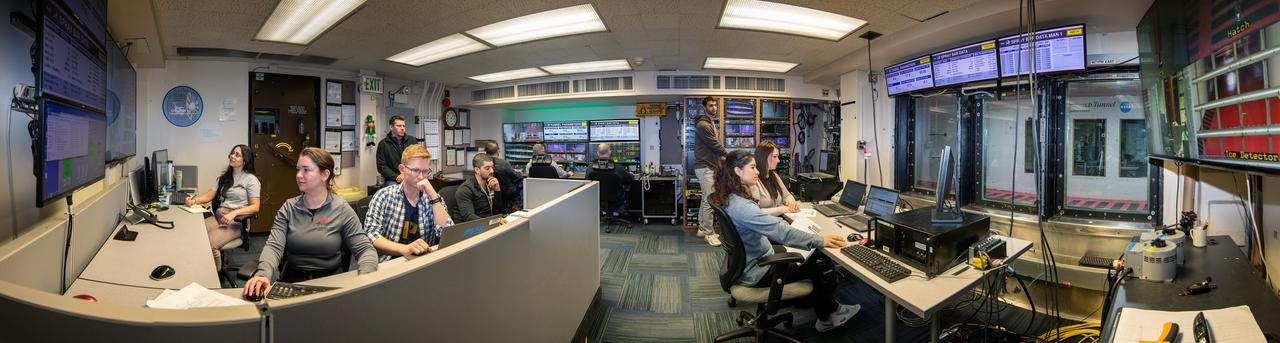
Panorama of the IRT engineering and ice cloud calibration team in the control room. Shown on the left are the data and system engineers. In the center with their backs to the camera are the wind tunnel operators who control the wind speed and super cooled water flow. In the center right of the photo is the video recording system and the test engineers. On the right side the test section can be see though the wind and the TV screen shows the pray bars that create the icing cloud.
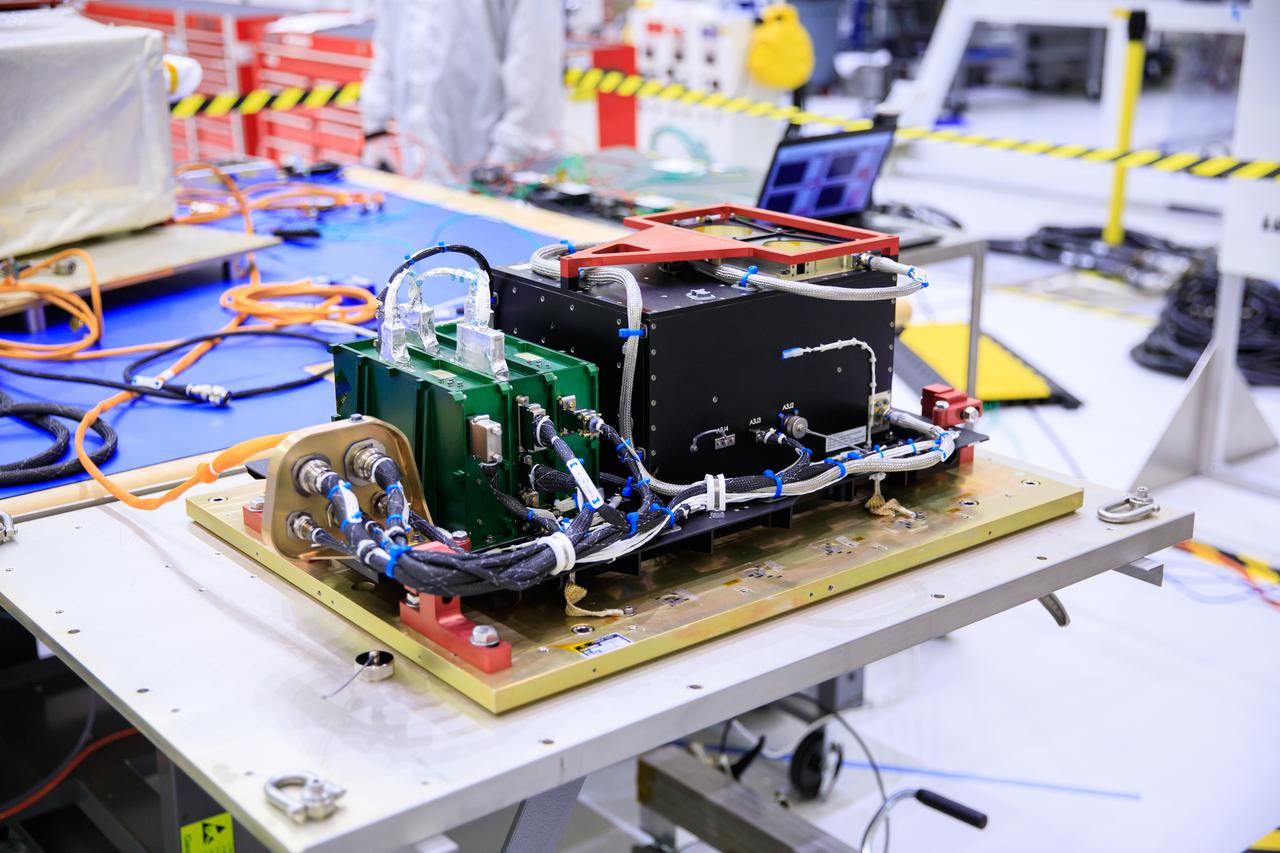
A close-up view of one of the parts of the Optical Communications System for the Artemis II mission inside the Neil Armstrong Operations and Checkout Building high bay on June 2, 2023. Optical communications is the latest space communications technology that is able to provide data rates as much as a hundred times higher than current systems. This will allow astronauts to send and receive ultra-high-definition video from the surface of the Moon or other planets such as Mars. Artemis II will be the first Artemis mission flying crew aboard Orion.

jsc2020e039121 (5/29/2020) — A preflight view of a Panasonic Optical Disc (Archival Disc) with image and video data pre-recorded on it, mounted on the Exposed Experiment Handrail Attachment Mechanism (ExHAM) facility. The Optical Disc Space Exposure Experiment Project (ExHAM-ODSEEP) demonstrates the durability of an optical disc when exposed to the space environment. Photo courtesy of: Panasonic
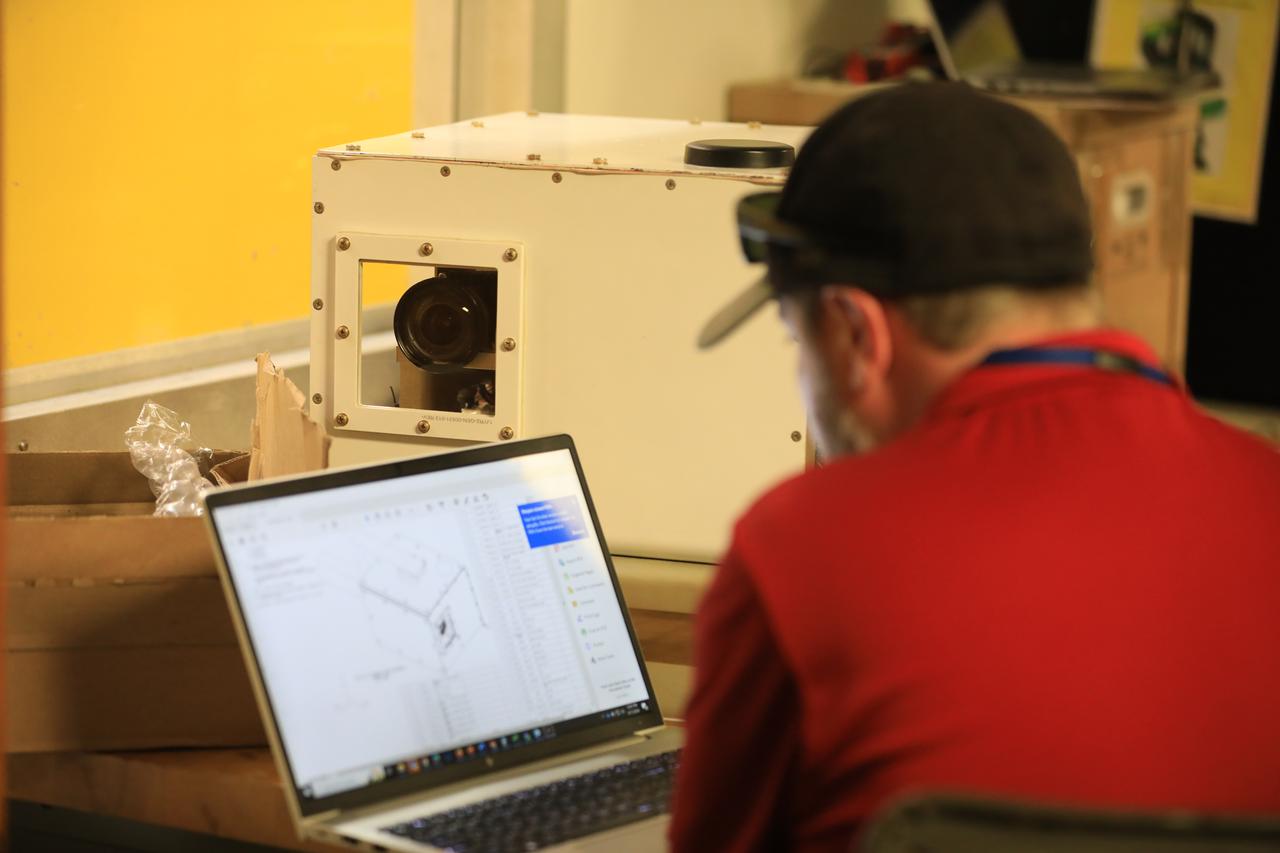
NASA researcher A.J. Jaffe prepares the NASA Airborne Instrumentation for Real-world Video of Urban Environments (AIRVUE) sensor pod for testing at NASA’s Kennedy Space Center in Cape Canaveral, Florida in April 2024. The AIRVUE pod will be used to collect data for autonomous aircraft like air taxis, drones, or other Advanced Air Mobility aircraft.
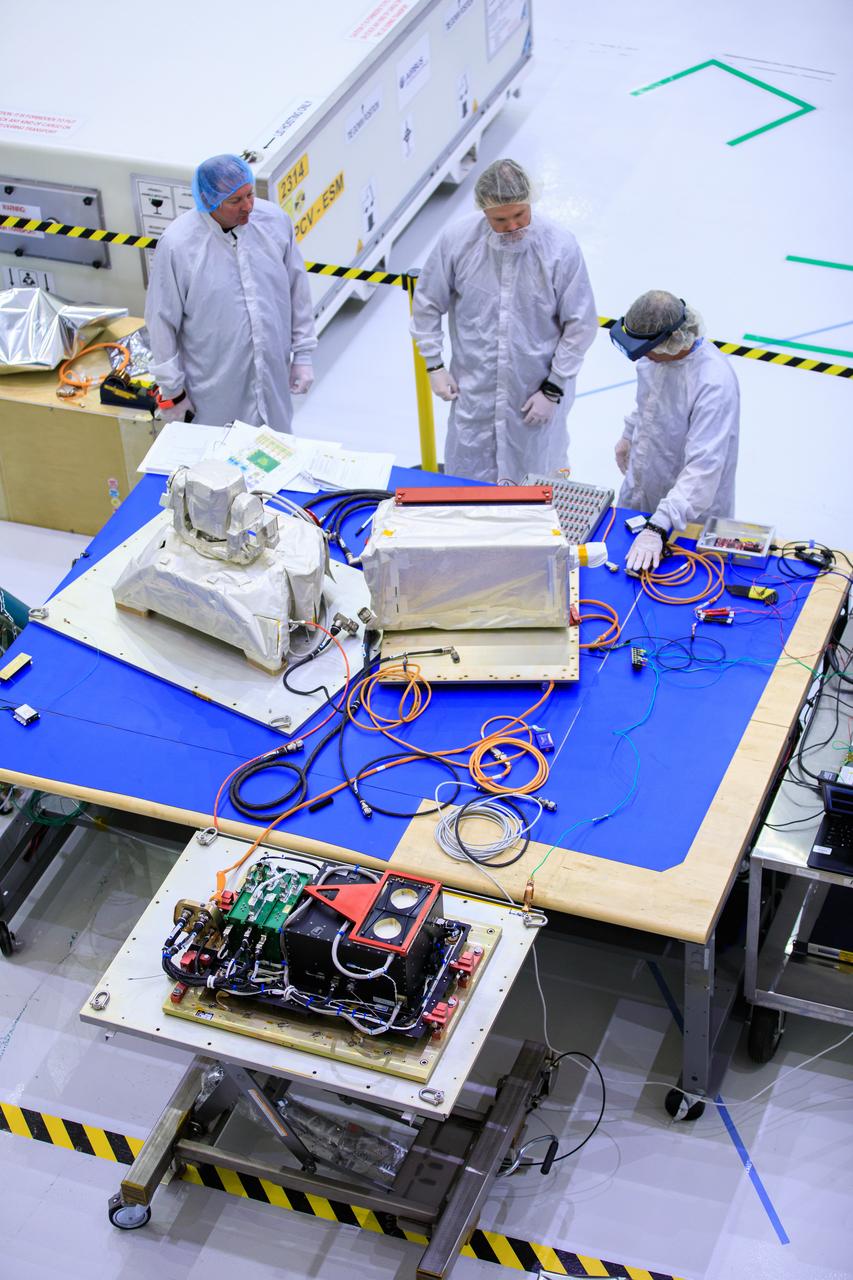
Inside the high bay of the Neil Armstrong Operations and Checkout Building at NASA’s Kennedy Space Center in Florida, technicians assemble on the Optical Communications System for the Artemis II mission on June 2, 2023. Optical communications is the latest space communications technology that is able to provide data rates as much as a hundred times higher than current systems. This will allow astronauts to send and receive ultra-high-definition video from the surface of the Moon or other planets such as Mars. Artemis II will be the first Artemis mission flying crew aboard Orion.
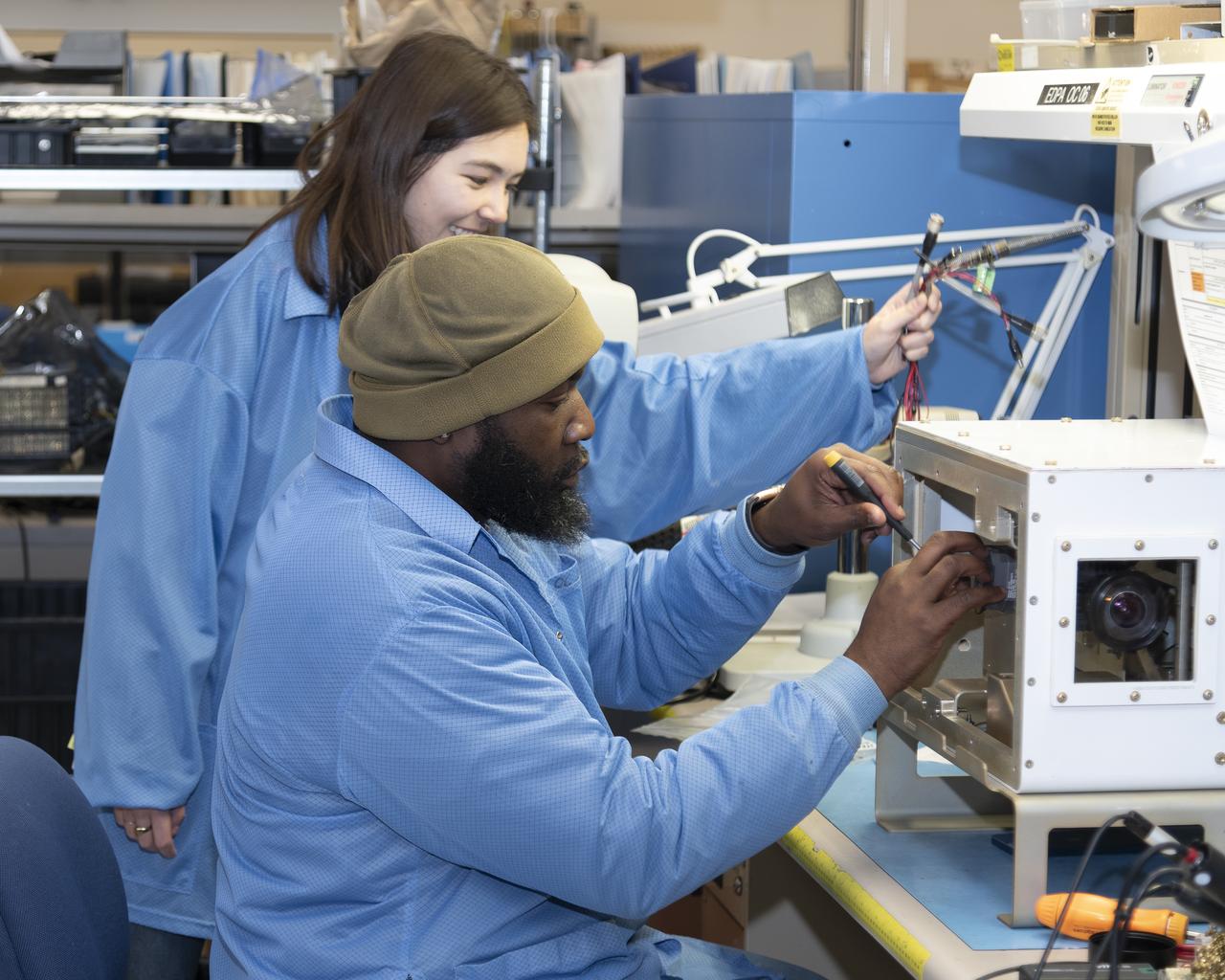
NASA researchers James Cowart and Elizabeth Nail add sensors, wiring and cameras, to the NASA Airborne Instrumentation for Real-world Video of Urban Environments (AIRVUE) sensor pod at NASA’s Armstrong Flight Research Center in Edwards, California in late February 2024. The AIRVUE pod was flown on a helicopter at NASA’s Kennedy Space Center in Florida and is used to collect data for future autonomous aircraft.
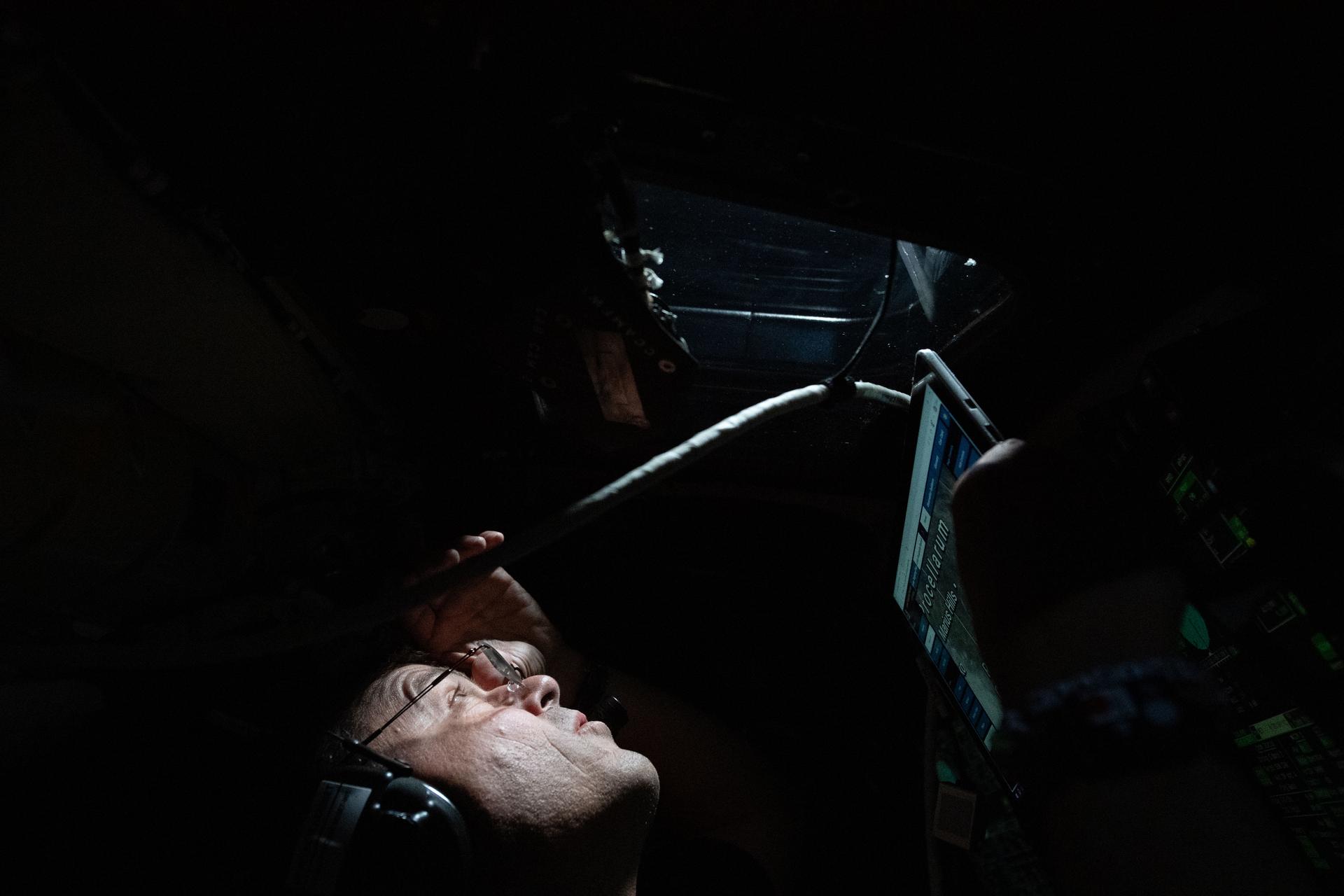
art002e009290 (April 6, 2026) – Artemis II Commander Reid Wiseman peers out the window of the Orion spacecraft just as his first lunar observation period of the day begins. Throughout the course of the sixth day of the mission, Wiseman and his crewmates took turns at the windows, capturing images and video of the Moon, along with recorded observations. The astronauts are members of the science team, and the data they collect will shape the future of lunar science.
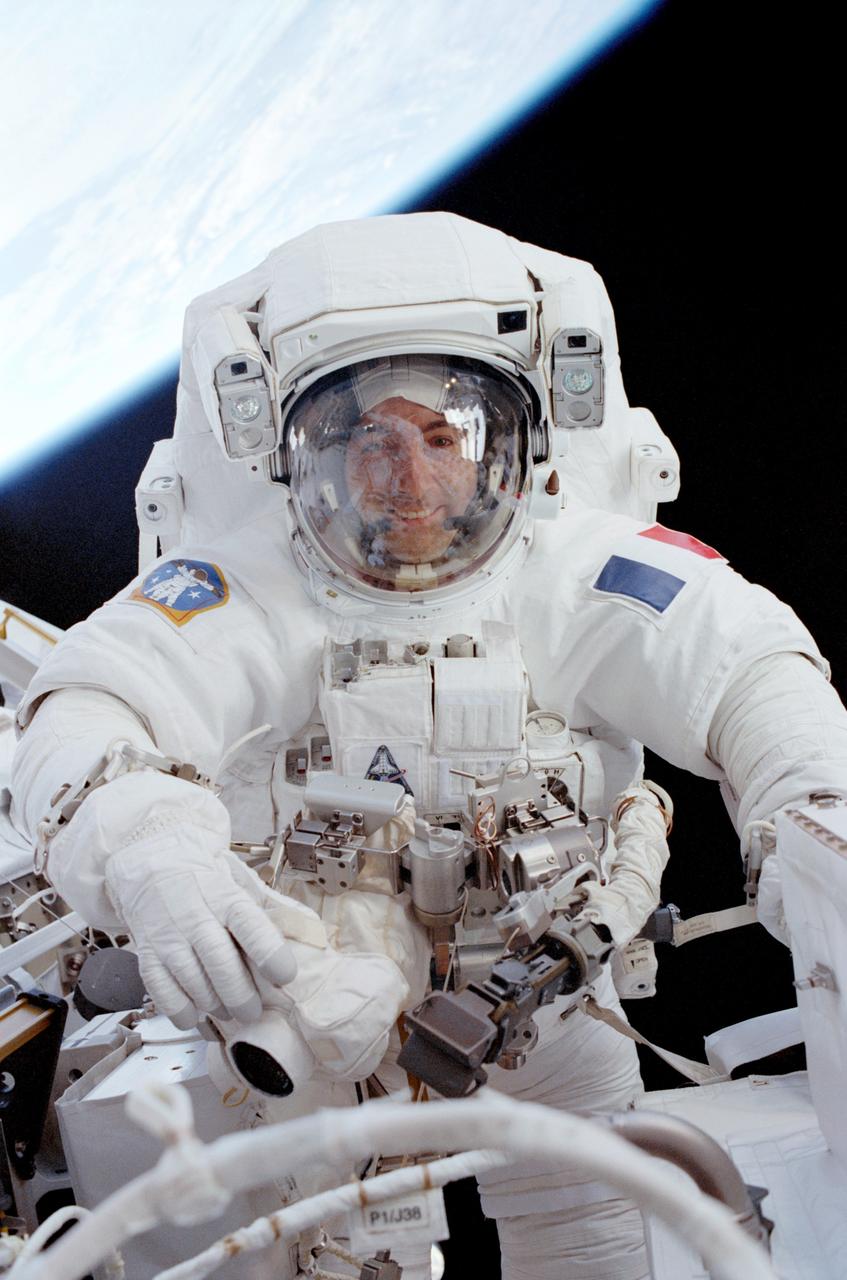
STS111-307-017 (11 June 2002) --- Astronaut Philippe Perrin, STS-111 mission specialist representing CNES, the French Space Agency, participates in the second scheduled session of extravehicular activity (EVA) for the STS-111 mission. During the spacewalk, Perrin and Chang-Diaz attached power, data and video cables from the International Space Station (ISS) to the Mobile Base System (MBS) and used a power wrench to complete the attachment of the MBS onto the Mobile Transporter (MT).
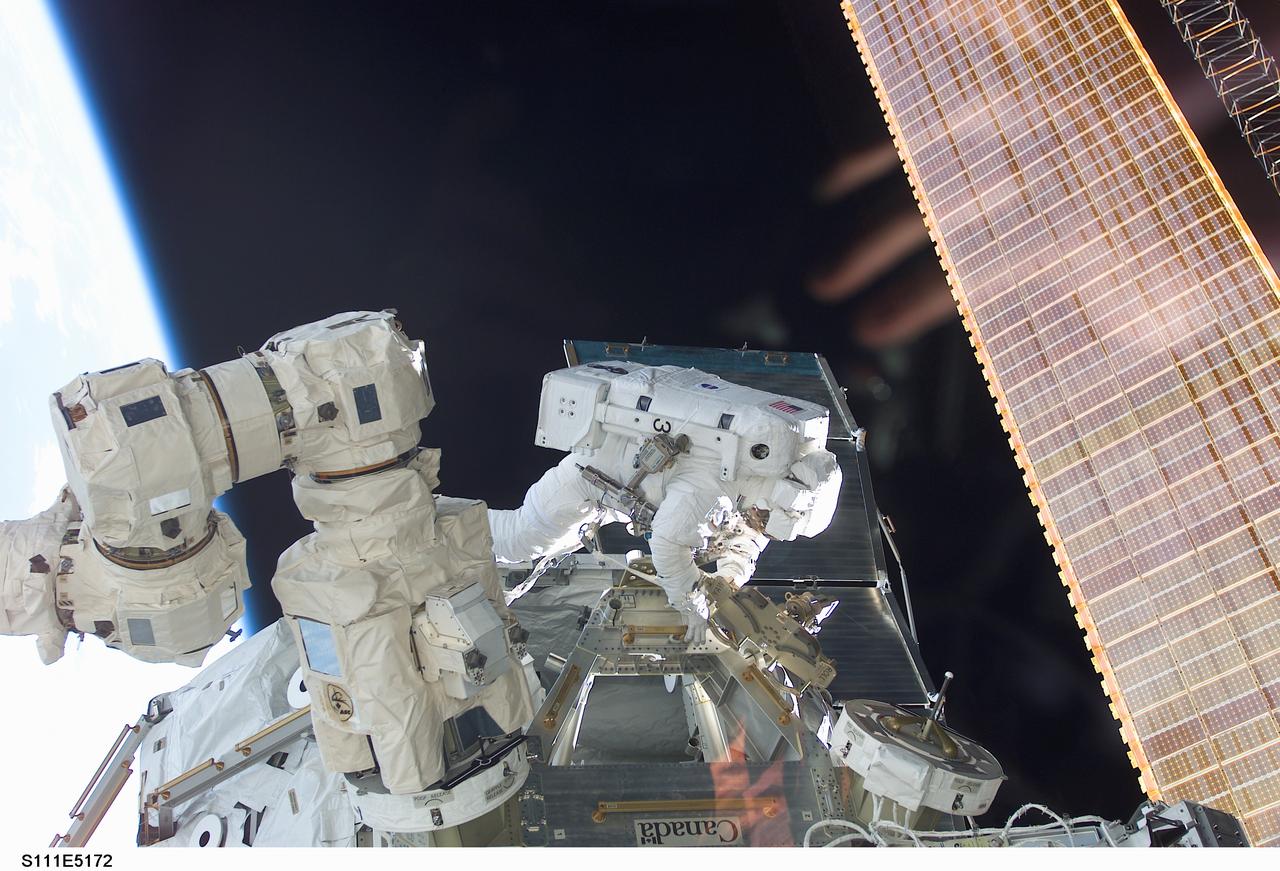
STS111-E-5172 (11 June 2002) --- Astronaut Philippe Perrin, mission specialist representing CNES, the French Space Agency, participates in the second scheduled session of extravehicular activity (EVA) for the STS-111 mission. During the spacewalk, Perrin and Chang-Diaz attached power, data and video cables from the International Space Station (ISS) to the Mobile Base System (MBS) and used a power wrench to complete the attachment of the MBS onto the Mobile Transporter (MT).
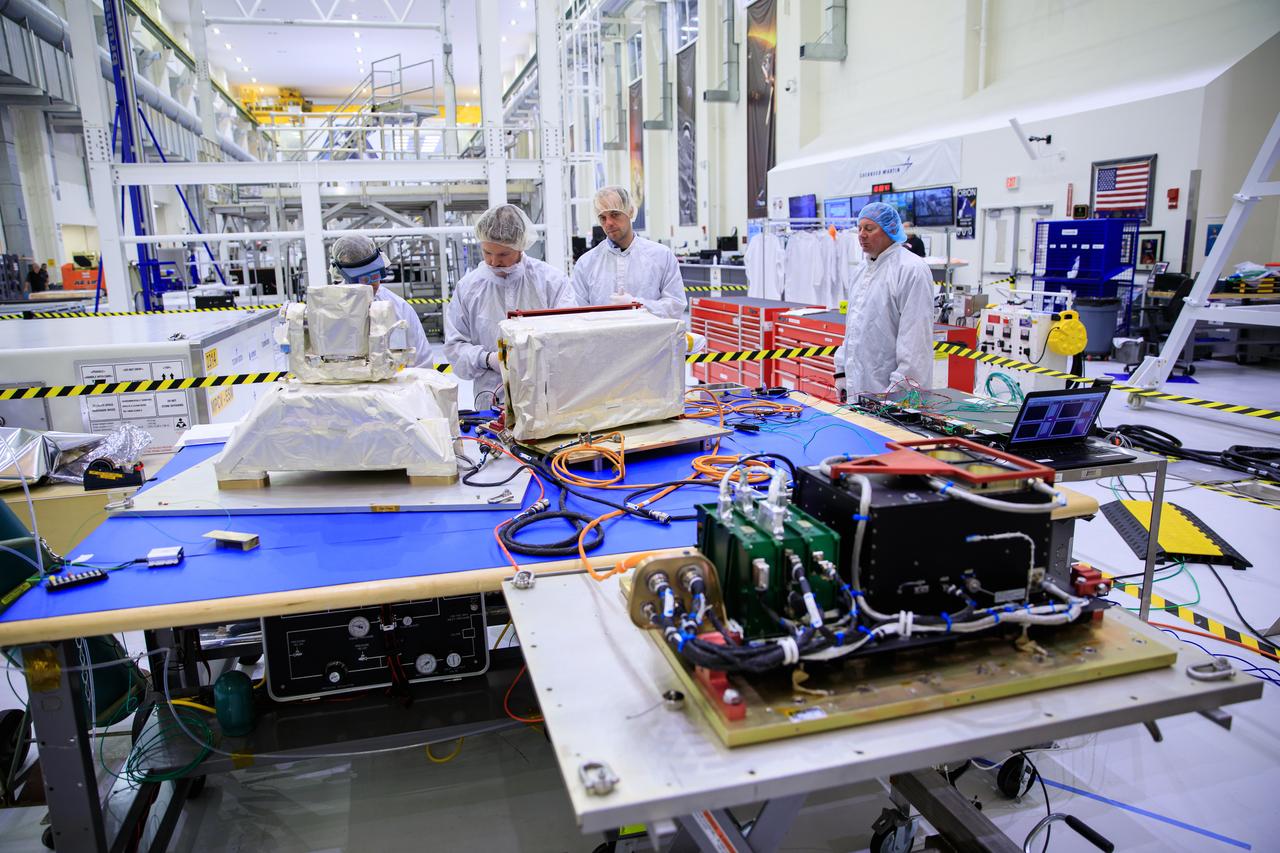
Inside the high bay of the Neil Armstrong Operations and Checkout Building at NASA’s Kennedy Space Center in Florida, technicians assemble on the Optical Communications System for the Artemis II mission on June 2, 2023. Optical communications is the latest space communications technology that is able to provide data rates as much as a hundred times higher than current systems. This will allow astronauts to send and receive ultra-high-definition video from the surface of the Moon or other planets such as Mars. Artemis II will be the first Artemis mission flying crew aboard Orion.

Inside the high bay of the Neil Armstrong Operations and Checkout Building at NASA’s Kennedy Space Center in Florida, technicians assemble on the Optical Communications System for the Artemis II mission on June 2, 2023. Optical communications is the latest space communications technology that is able to provide data rates as much as a hundred times higher than current systems. This will allow astronauts to send and receive ultra-high-definition video from the surface of the Moon or other planets such as Mars. Artemis II will be the first Artemis mission flying crew aboard Orion.
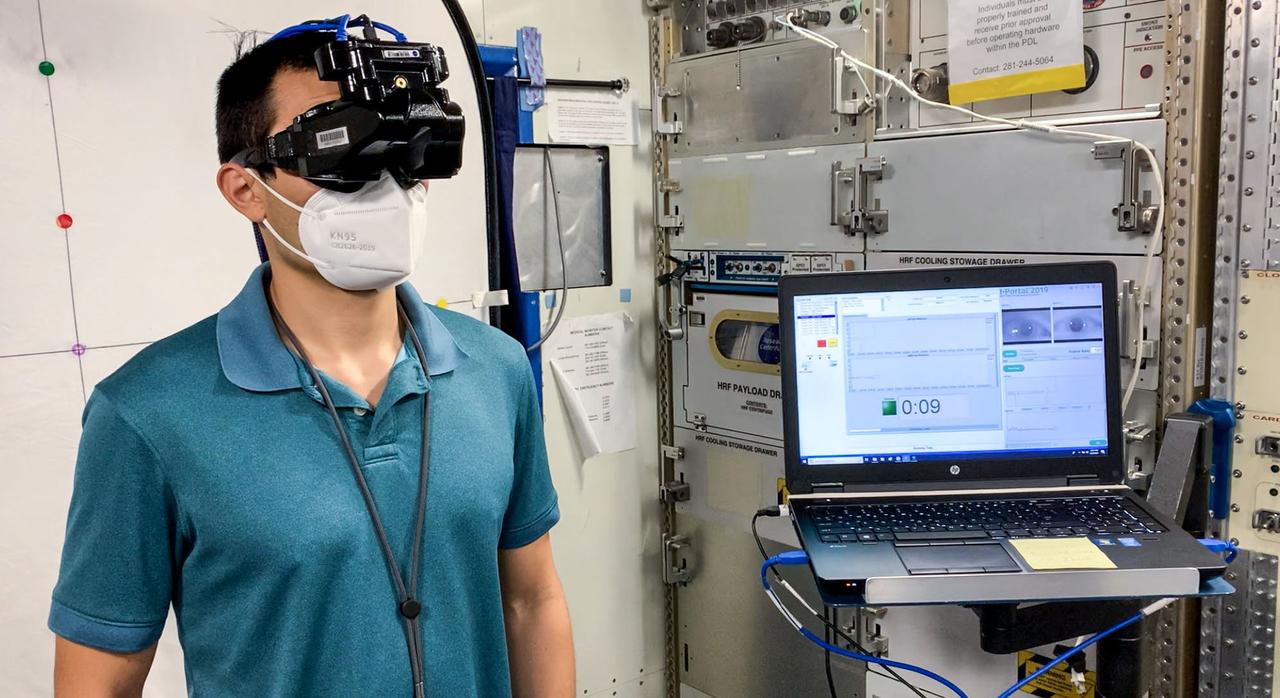
jsc2022e083571 (11/2/2022) --- The Falcon Goggles being worn as part of training development classes at NASA's Johnson Space Center. This image shows the configuration donned with the goggles cover. The Falcon Goggles, based on the Neurolign DX Falcon™, provide a system for capturing detailed high-speed video of the eyes to collect precise data on ocular alignment and crew balance. Image courtesy of NASA.
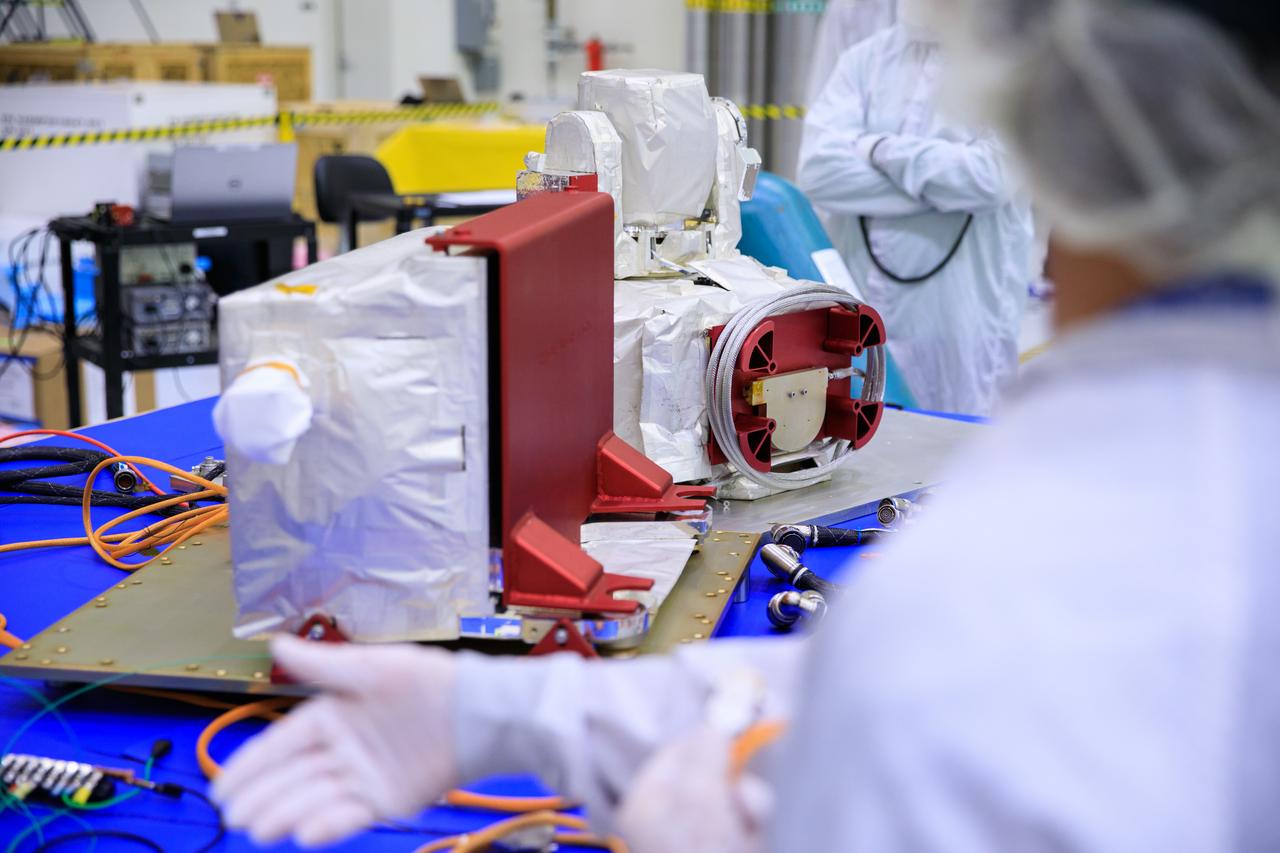
Inside the high bay of the Neil Armstrong Operations and Checkout Building at NASA’s Kennedy Space Center in Florida, technicians assemble on the Optical Communications System for the Artemis II mission on June 2, 2023. Optical communications is the latest space communications technology that is able to provide data rates as much as a hundred times higher than current systems. This will allow astronauts to send and receive ultra-high-definition video from the surface of the Moon or other planets such as Mars. Artemis II will be the first Artemis mission flying crew aboard Orion.
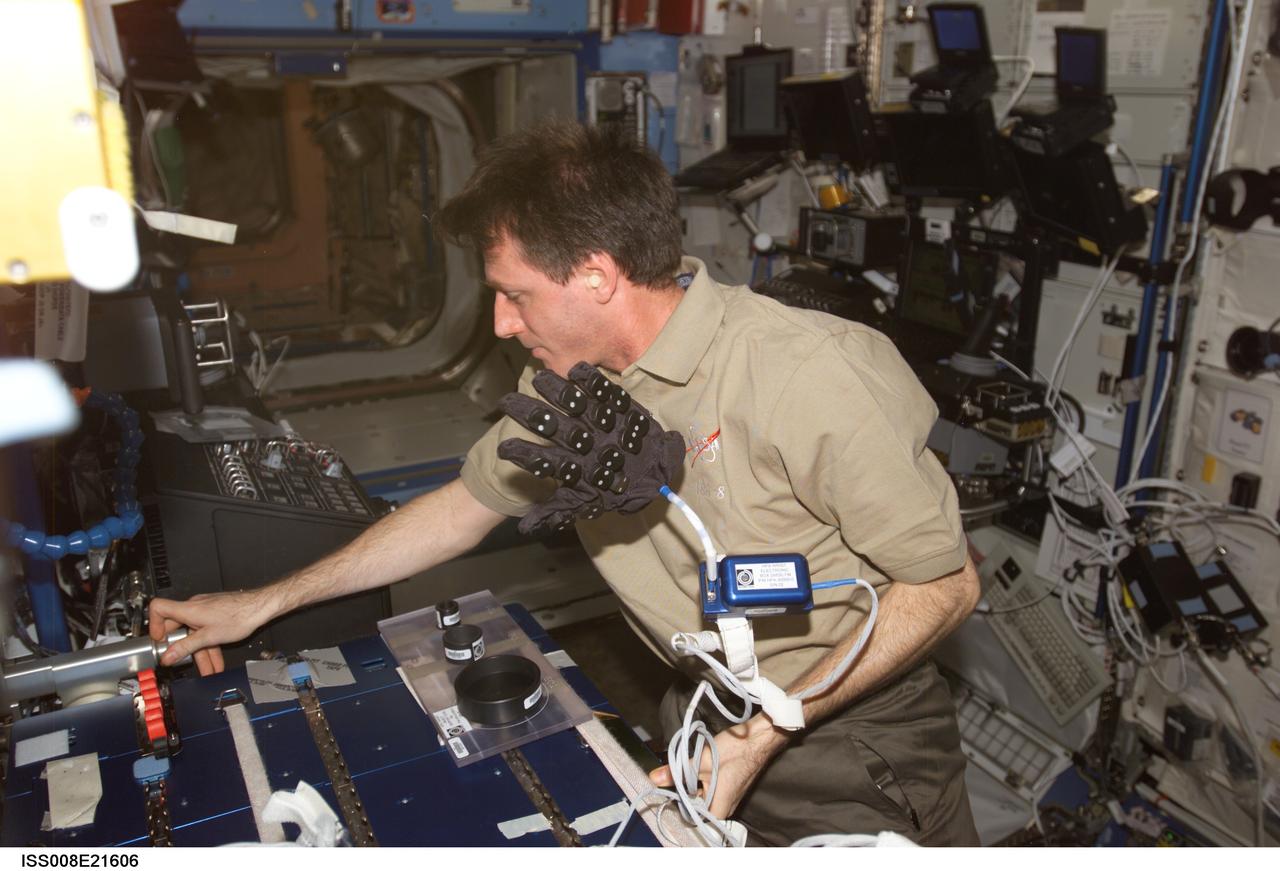
ISS008-E-21606 (15 April 2004) --- Astronaut C. Michael Foale, Expedition 8 commander and NASA ISS science officer, completes his third and final data collection with the Hand Posture Analysis (HPA) investigation in the Destiny laboratory on the International Space Station (ISS). After setting up the video tape recorder (VTR) for documenting the activities, Foale used the posture acquisition glove (PAG), which has delicate sensors attached to the tops of the fingers, to operate the handgrip dynamometer (HGD).
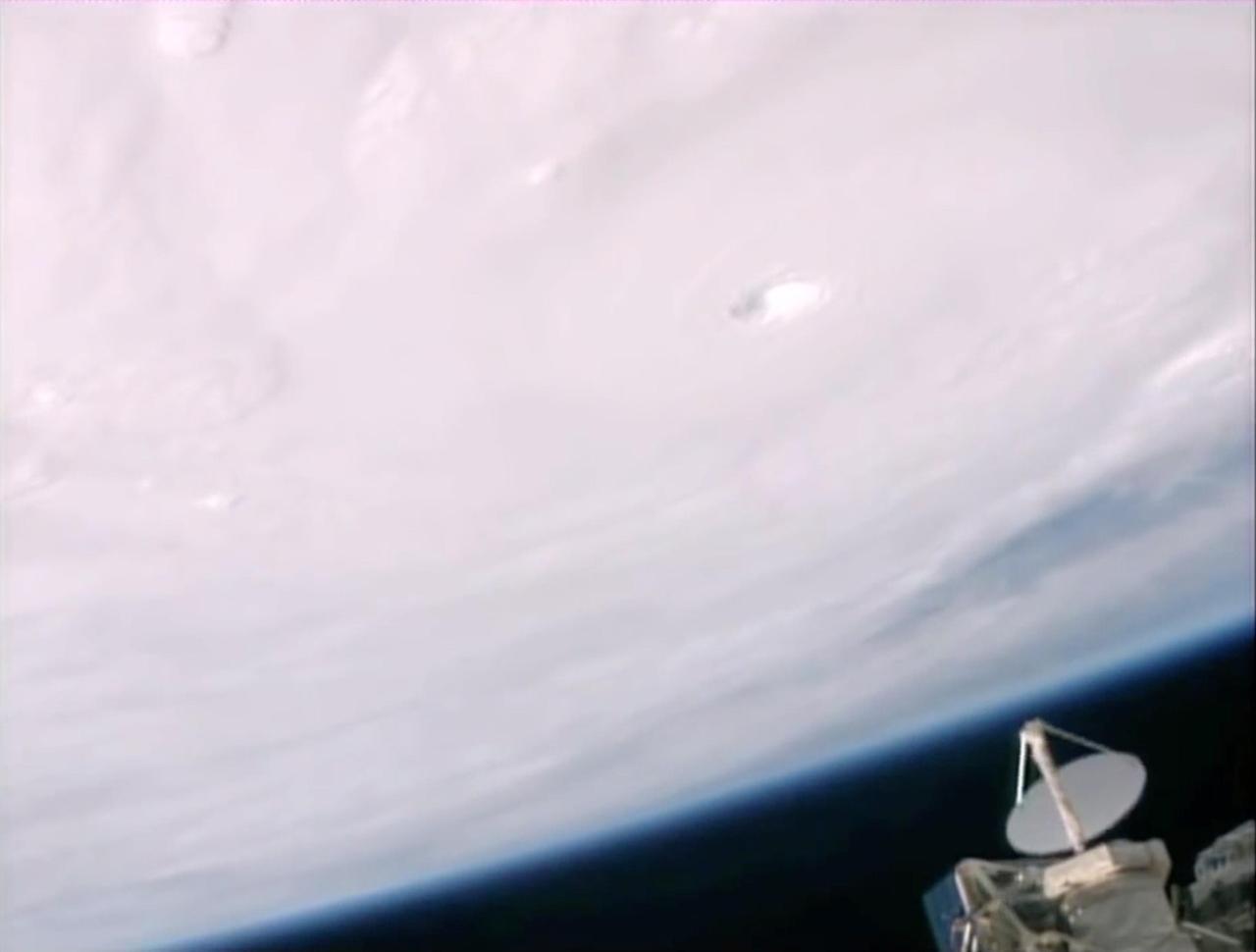
NASA's RapidScat's antenna, lower right, was pointed at Hurricane Patricia as the powerful storm approached Mexico on Oct. 23, 2015. Patricia was the strongest hurricane ever recorded in the Western Hemisphere, with maximum winds of 200 mph (320 kilometers per hour). When it first made landfall on the Pacific coast of Mexico on Oct. 23, it was a destructive Category 5 storm. The videos are from the International Space Station. RapidScat's spinning antenna, lower right, collects wind-speed data from Hurricane Patricia. http://photojournal.jpl.nasa.gov/catalog/PIA20049

Inside the high bay of the Neil Armstrong Operations and Checkout Building at NASA’s Kennedy Space Center in Florida, technicians assemble on the Optical Communications System for the Artemis II mission on June 2, 2023. Optical communications is the latest space communications technology that is able to provide data rates as much as a hundred times higher than current systems. This will allow astronauts to send and receive ultra-high-definition video from the surface of the Moon or other planets such as Mars. Artemis II will be the first Artemis mission flying crew aboard Orion.
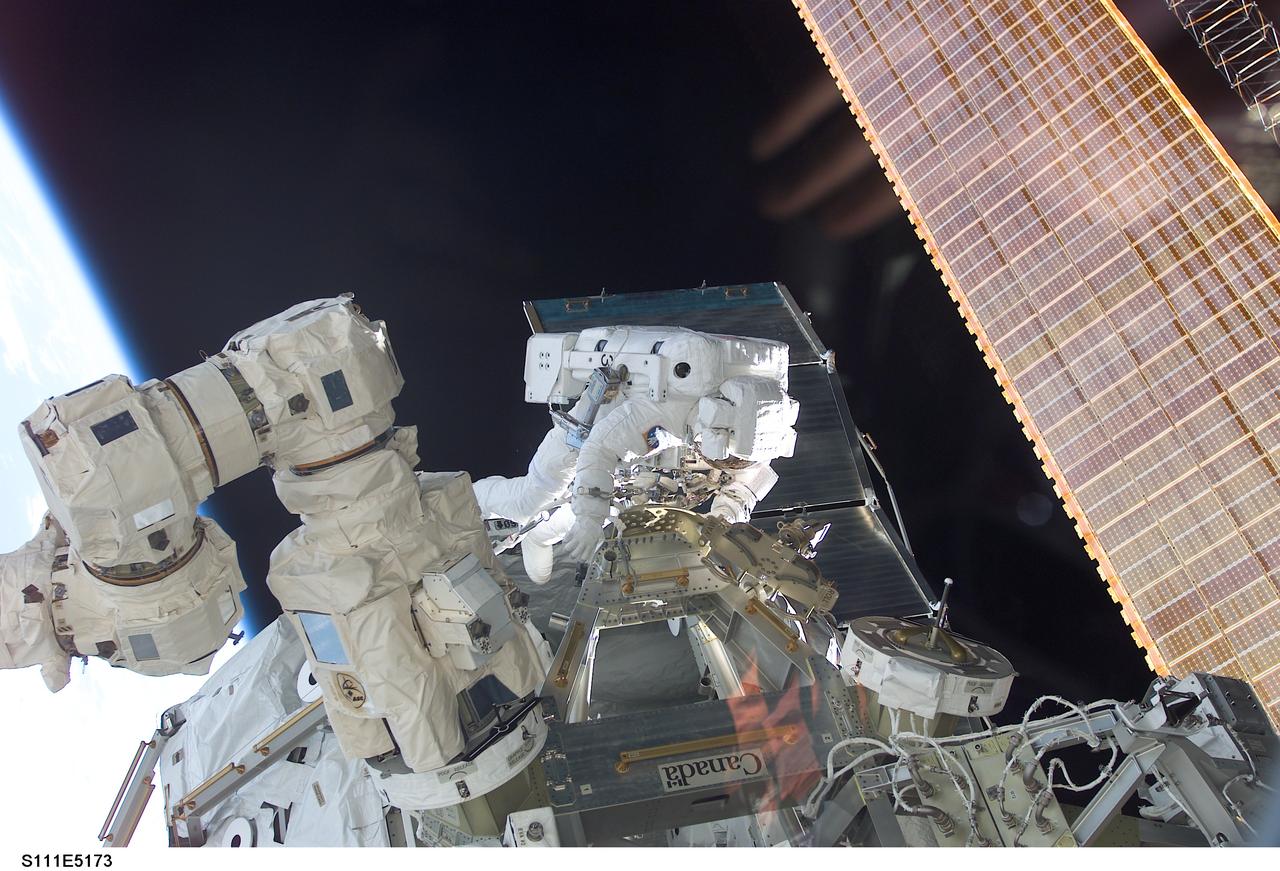
STS111-E-5173 (11 June 2002) --- Astronaut Philippe Perrin, mission specialist representing CNES, the French Space Agency, participates in the second scheduled session of extravehicular activity (EVA) for the STS-111 mission. During the spacewalk, Perrin and Chang-Diaz attached power, data and video cables from the International Space Station (ISS) to the Mobile Base System (MBS) and used a power wrench to complete the attachment of the MBS onto the Mobile Transporter (MT).
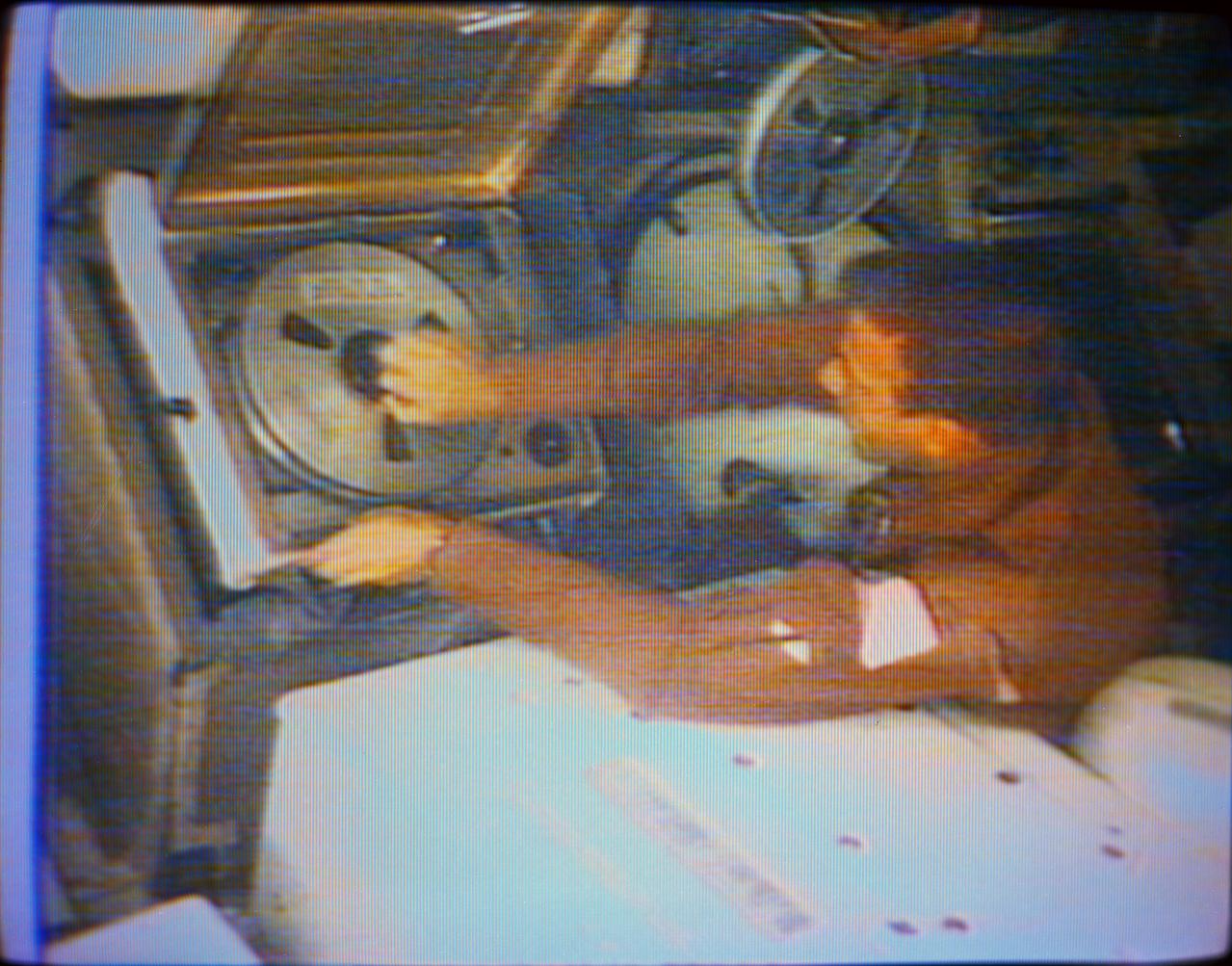
S73-27467 (5 June 1973) --- An overhead view of astronaut Paul J. Weitz, Skylab 2 pilot, at the video tape recorder in the Orbital Workshop of the Skylab 1 and 2 space station cluster in Earth orbit. Weitz is changing the tape in the recorder and storing the used data tape. This photograph was reproduced from a color television transmission made on June 5, 1973. Photo credit: NASA
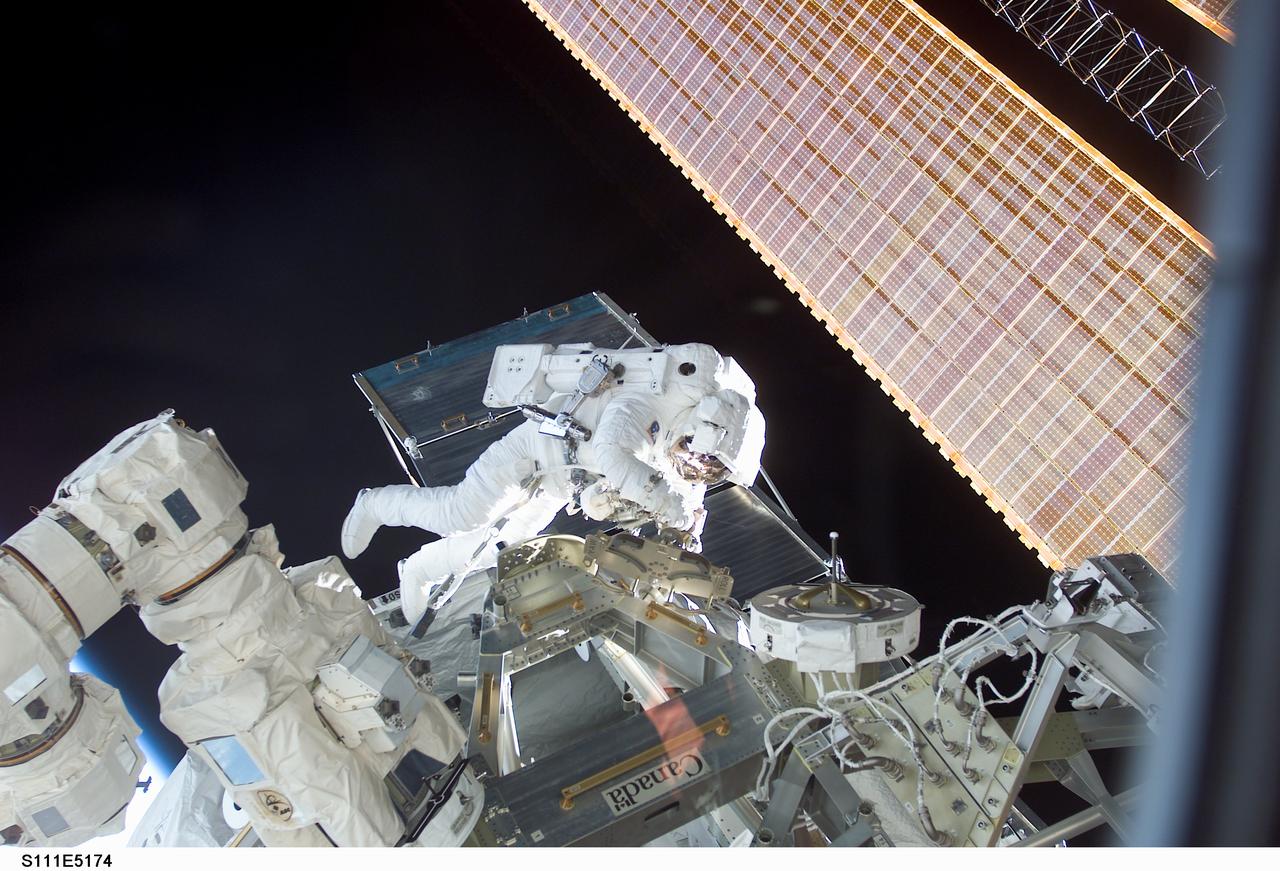
STS111-E-5174 (11 June 2002) --- Astronaut Philippe Perrin, mission specialist representing CNES, the French Space Agency, participates in the second scheduled session of extravehicular activity (EVA) for the STS-111 mission. During the spacewalk, Perrin and Chang-Diaz attached power, data and video cables from the International Space Station (ISS) to the Mobile Base System (MBS) and used a power wrench to complete the attachment of the MBS onto the Mobile Transporter (MT).
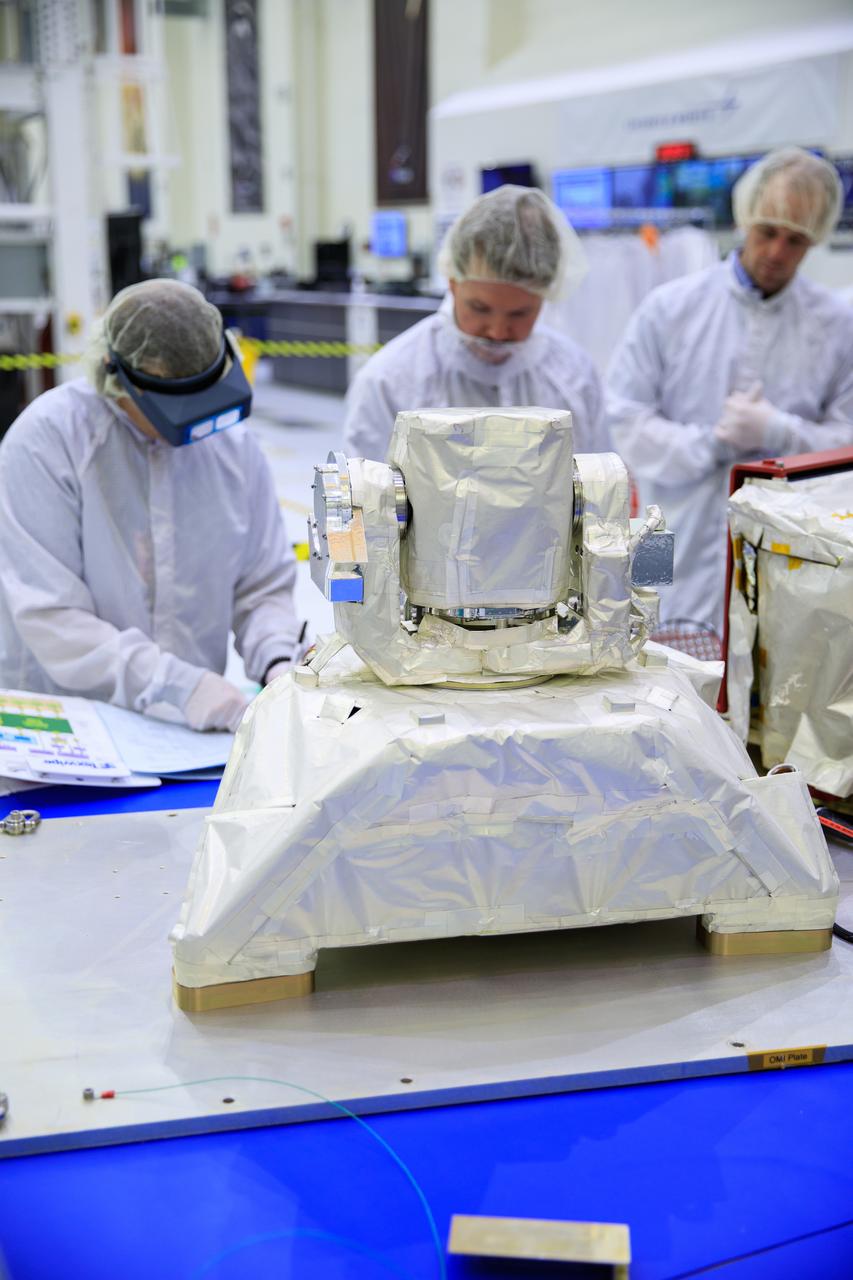
Inside the high bay of the Neil Armstrong Operations and Checkout Building at NASA’s Kennedy Space Center in Florida, technicians work on the Optical Communications System for the Artemis II mission on June 2, 2023. Optical communications is the latest space communications technology that is able to provide data rates as much as a hundred times higher than current systems. This will allow astronauts to send and receive ultra-high-definition video from the surface of the Moon or other planets such as Mars. Artemis II will be the first Artemis mission flying crew aboard Orion.
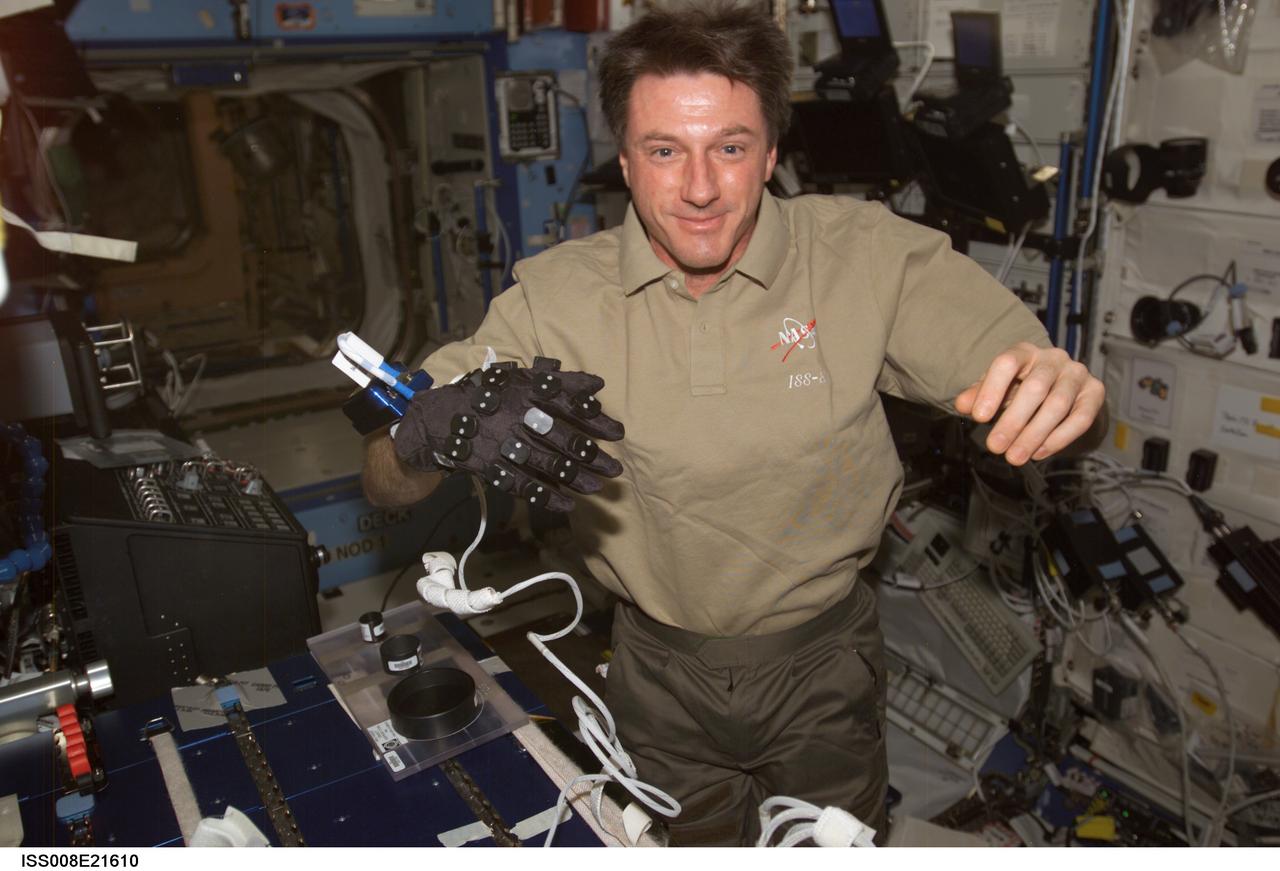
ISS008-E-21610 (15 April 2004) --- Astronaut C. Michael Foale, Expedition 8 commander and NASA ISS science officer, completes his third and final data collection with the Hand Posture Analysis (HPA) investigation in the Destiny laboratory on the International Space Station (ISS). After setting up the video tape recorder (VTR) for documenting the activities, Foale used the posture acquisition glove (PAG), which has delicate sensors attached to the tops of the fingers, to operate the handgrip dynamometer (HGD).
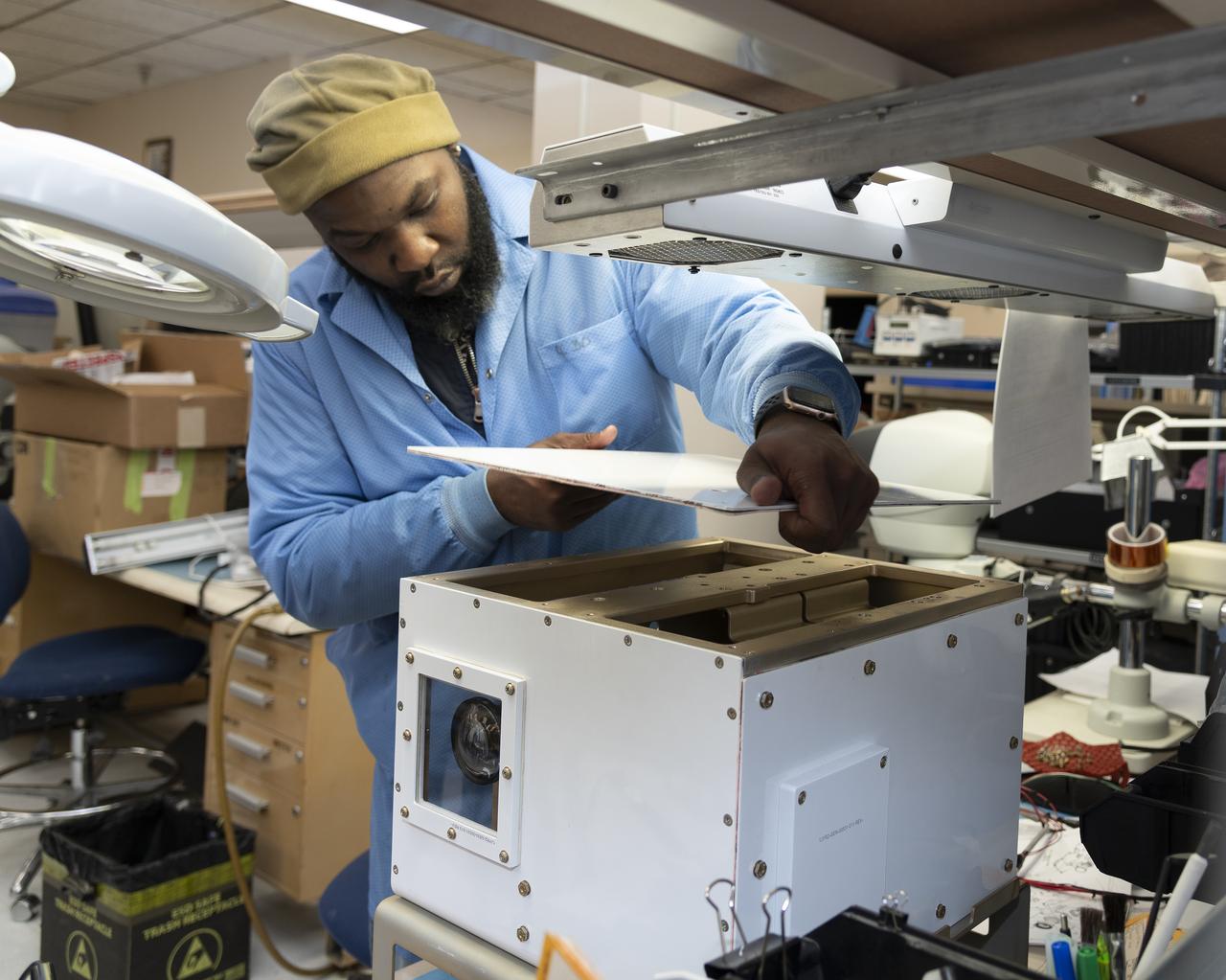
NASA researcher James Cowart adds the top back onto the NASA Airborne Instrumentation for Real-world Video of Urban Environments (AIRVUE) sensor pod at NASA’s Armstrong Flight Research Center in Edwards, California in late February 2024. The pod houses sensors, wiring and cameras. The AIRVUE pod was flown on a helicopter at NASA’s Kennedy Space Center in Florida and is used to collect data for future autonomous aircraft.
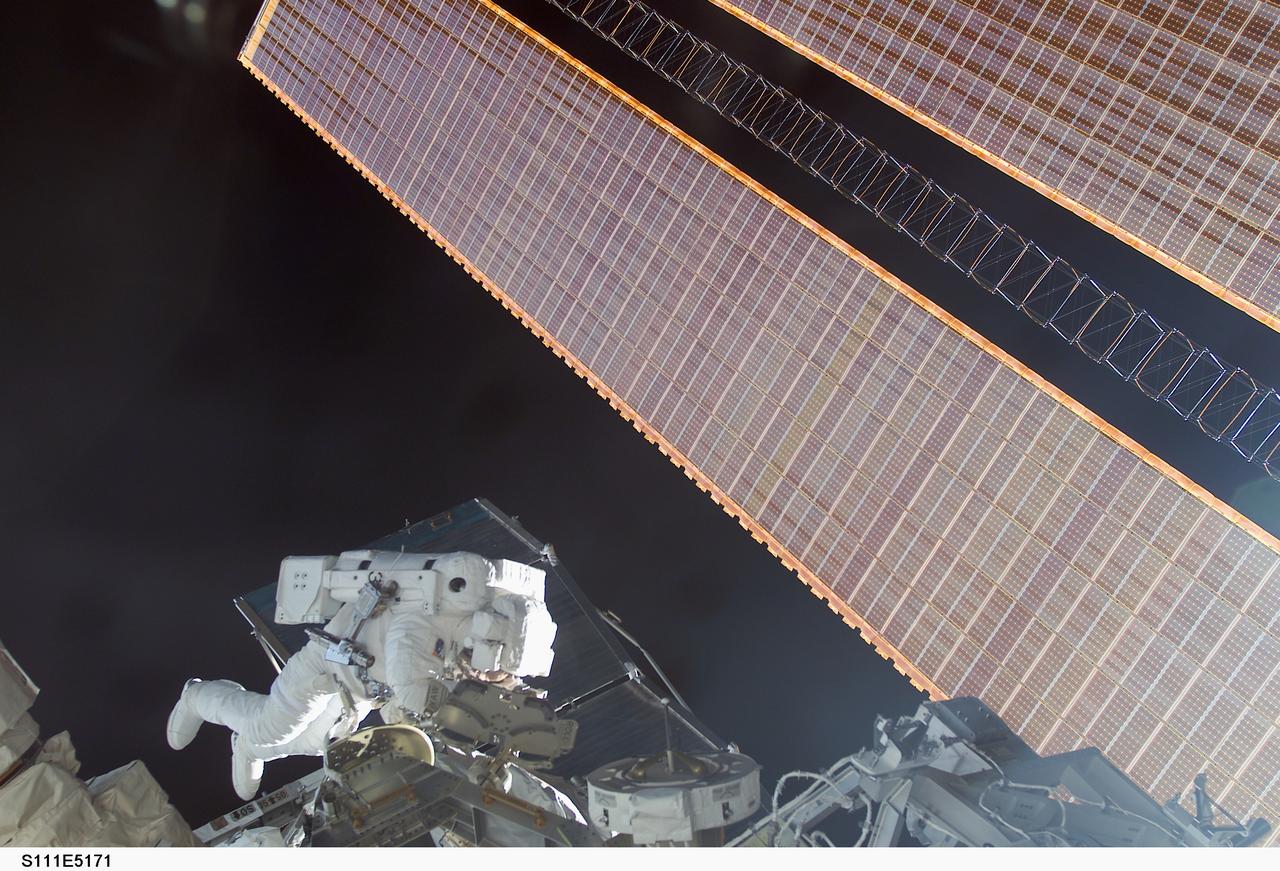
STS111-E-5171 (11 June 2002) --- Astronaut Philippe Perrin, mission specialist representing CNES, the French Space Agency, participates in the second scheduled session of extravehicular activity (EVA) for the STS-111 mission. During the spacewalk, Perrin and Chang-Diaz attached power, data and video cables from the International Space Station (ISS) to the Mobile Base System (MBS) and used a power wrench to complete the attachment of the MBS onto the Mobile Transporter (MT).
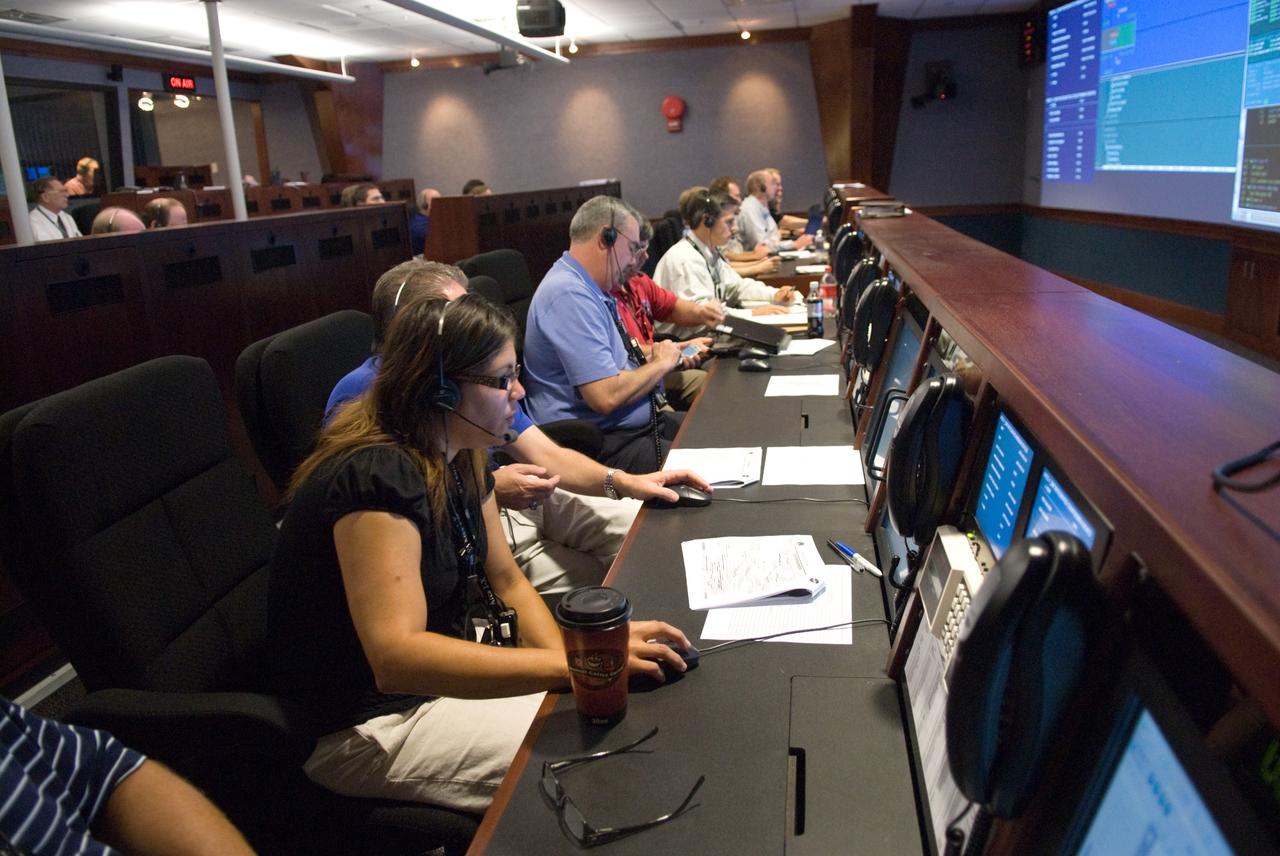
CAPE CANAVERAL, Fla. – In the Mission Director Center in Cape Canaveral Air Force Station's Hangar AE, mission engineers take part in a countdown simulation for the upcoming Ares I-X flight test. Ares I-X is targeted for the test on Oct. 31. The Hangar AE control rooms provide real-time voice, data and video information for ex¬pendable vehicle checkout and launch operations, similar to that provided by the space shuttle control rooms. Photo credit: NASA/Kim Shiflett

JSC2006-E-53281 (7 Dec. 2006) --- Steve Stich, STS-116 ascent flight director, monitors data and video at his console in the space shuttle flight control room within the Johnson Space Center's Mission Control Center. Flight controllers were anticipating the scheduled launch of the Space Shuttle Discovery several hundred miles away in Florida, but questionable weather conditions later caused postponement of the liftoff until Dec. 9.
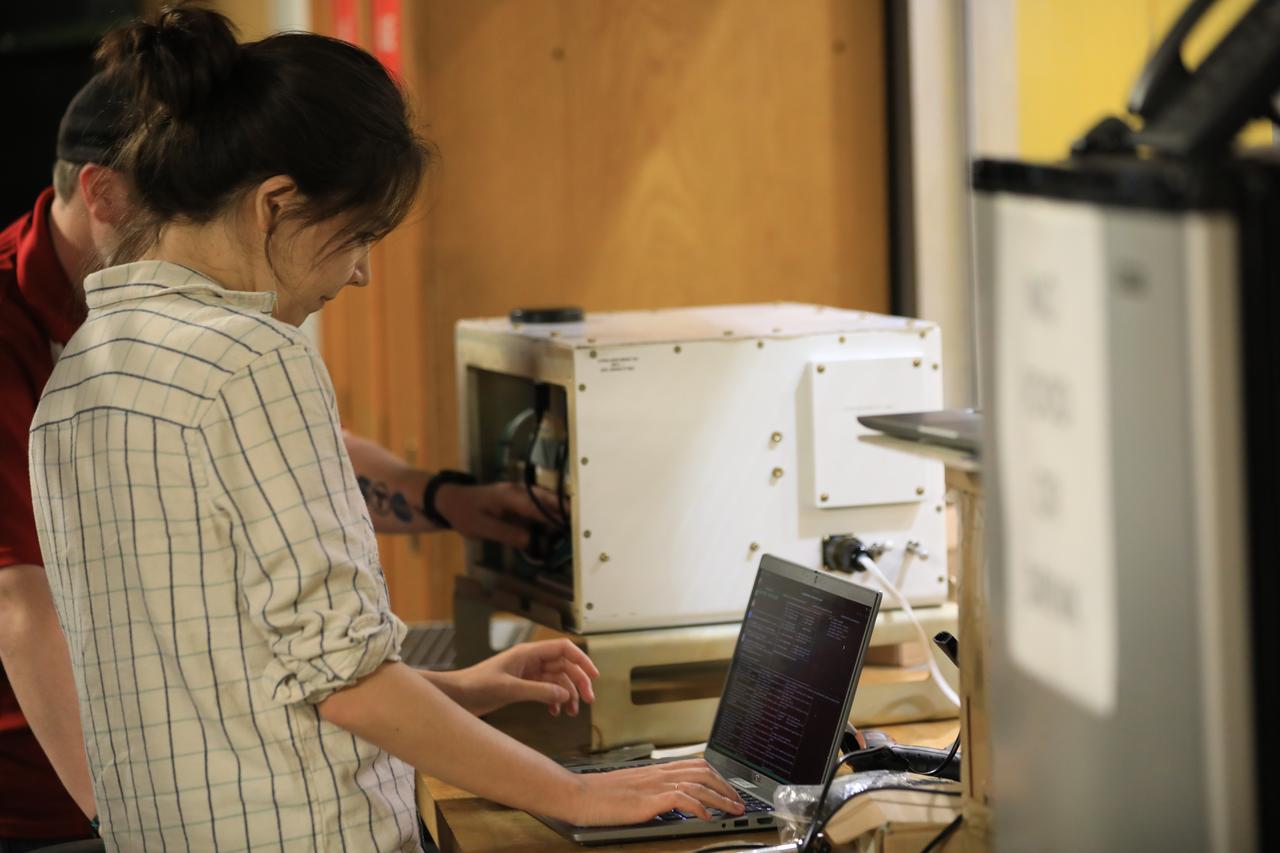
NASA researchers Elizabeth Nail (foreground) and A.J. Jaffe (background) prepare the NASA Airborne Instrumentation for Real-world Video of Urban Environments (AIRVUE) sensor pod for testing at NASA’s Kennedy Space Center in Cape Canaveral, Florida in April 2024. The AIRVUE pod will be used to collect data for autonomous aircraft like air taxis, drones, or other Advanced Air Mobility aircraft.
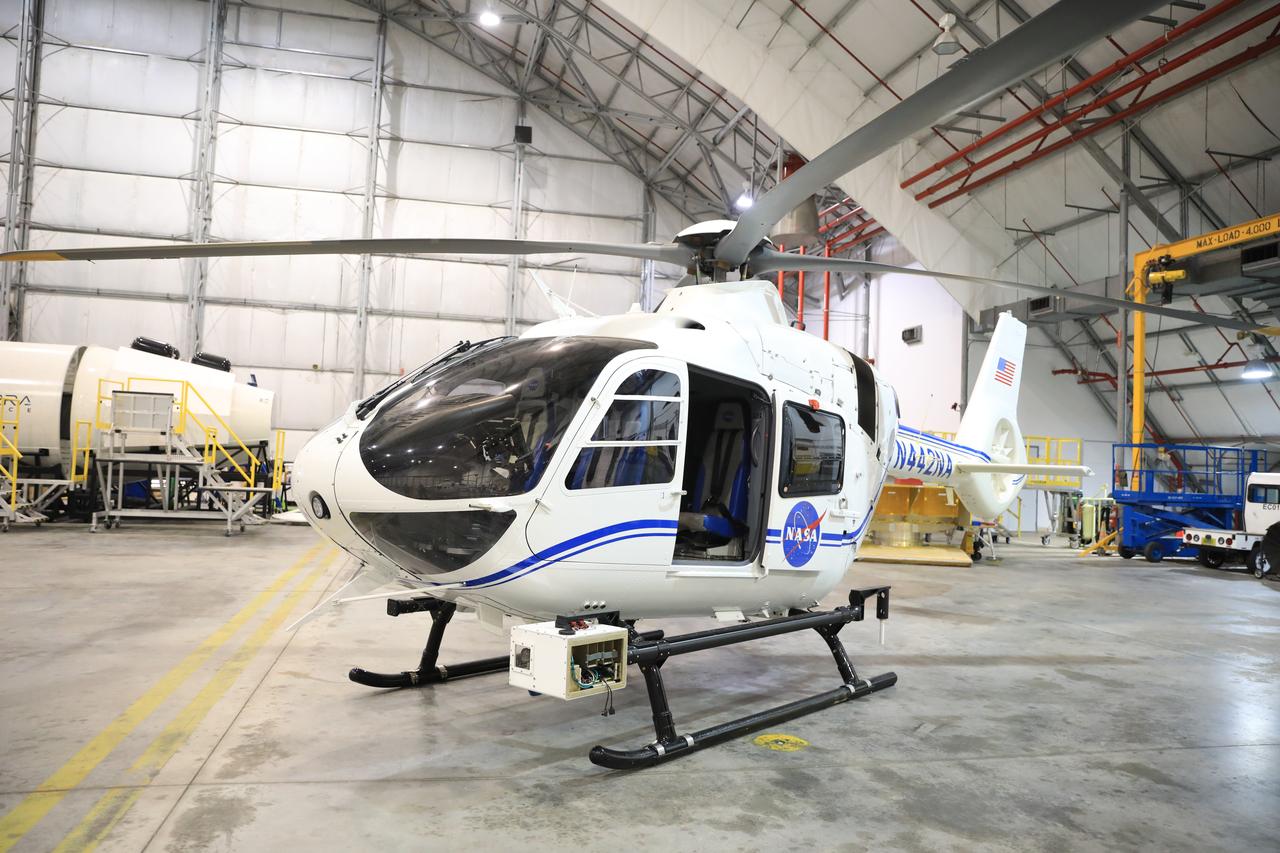
The NASA Airborne Instrumentation for Real-world Video of Urban Environments (AIRVUE) sensor pod is attached to the base of a NASA helicopter at NASA’s Kennedy Space Center in Cape Canaveral, Florida in April 2024 before a flight to test the pod’s cameras and sensors. The AIRVUE pod will be used to collect data for autonomous aircraft like air taxis, drones, or other Advanced Air Mobility aircraft.

This global view of Venus, centered at 270 degrees east longitude, is a compilation of data from several sources. Magellan synthetic aperature radar mosaics from the first cycle of Magellan mapping are mapped onto a computer-simulated globe to create the image. Data gaps are filled with Pioneer-Venus orbiter data, or a constant mid-range value. Simulated color is used to enhance small-scale structure. The simulated hues are based on color images recorded by the Soviet Venera 13 and 14 spacecraft. The image was produced at the Jet Propulsion Laboratory (JPL) Multimission Image Processing Laboratory and is a single frame from a video released at the JPL news conference, 10-29-91. View provided by JPL with alternate number P-39225 MGN81.
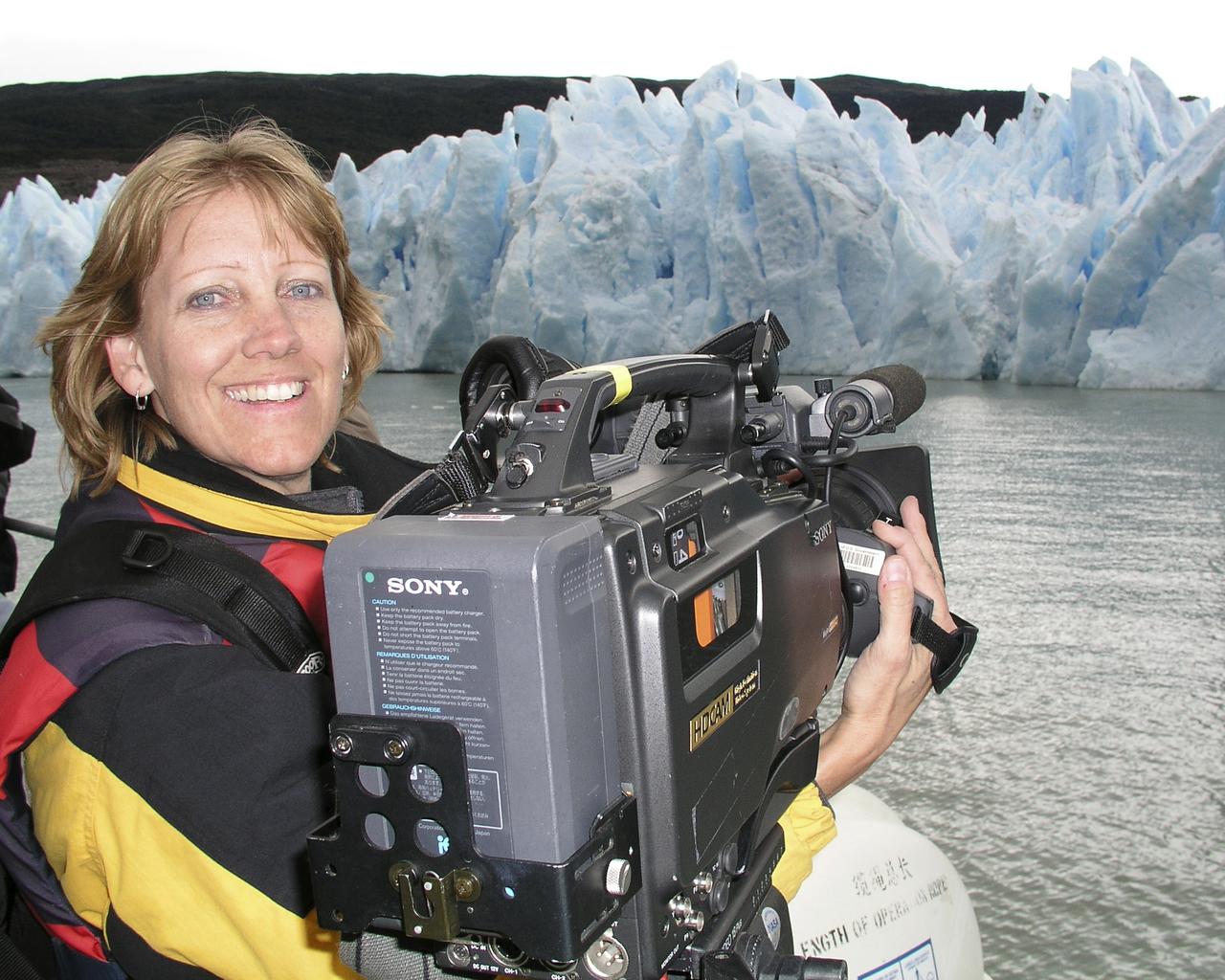
Lori Losey, an employee of Arcata Associates at Dryden, was honored with NASA's 2004 Videographer of the Year award for her work in two of the three categories in the NASA video competition, public affairs and documentation. In the public affairs category, Losey received a first-place citation for her footage of an Earth Science mission that was flown aboard NASA's DC-8 Flying Laboratory in South America last year. Her footage not only depicted the work of the scientists aboard the aircraft and on the ground, but she also obtained spectacular footage of flora and fauna in the mission's target area that helped communicate the environmental research goals of the project. Losey also took first place in the documentation category for her acquisition of technical videography of the X-45A Unmanned Combat Air Vehicle flight tests. The video, shot with a hand-held camera from the rear seat of a NASA F/A-18 mission support aircraft, demonstrated her capabilities in recording precise technical visual data in a very challenging airborne environment. The award was presented to Losey during a NASA reception at the National Association of Broadcasters convention in Las Vegas April 19. A three-judge panel evaluated entries for public affairs, documentation and production videography on professional excellence, technical quality, originality, creativity within restrictions of the project, and applicability to NASA and its mission. Entries consisted of a continuous video sequence or three views of the same subject for a maximum of three minutes duration. Linda Peters, Arcata Associates' Video Systems Supervisor at NASA Dryden, noted, "Lori is a talented videographer who has demonstrated extraordinary abilities with the many opportunities she has received in her career at NASA." Losey's award was the second major NASA video award won by members of the Dryden video team in two years. Steve Parcel took first place in the documentation category last year for his camera and editing
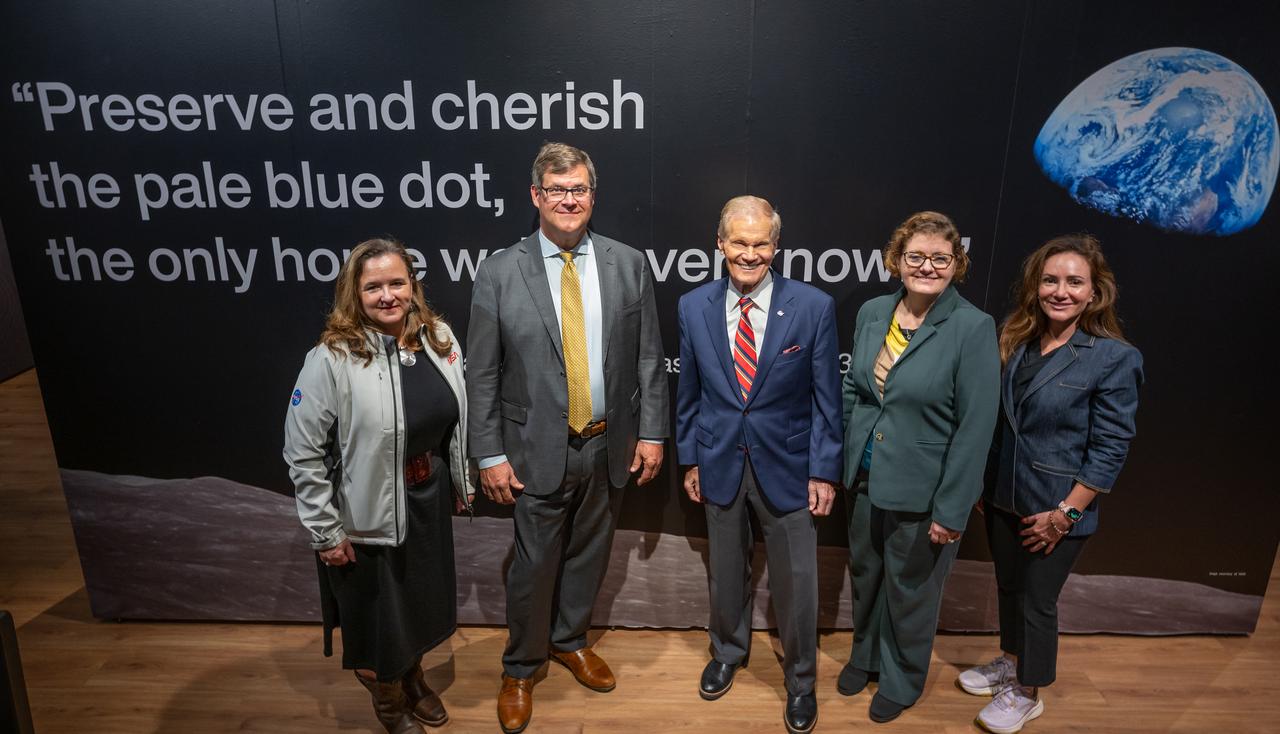
NASA Earth Sciences, Division Director, Karen St. Germain, left, Smithsonian Museum of Natural History, Sant Director, Kirk Johnson, NASA Administrator Bill Nelson, NASA Earth Sciences Division, Deputy Director, Julie Robinson, and NASA Senior Advisor Susie Perez Quinn, right, pose for a group photograph during a preview of the Earth Information Center at the Smithsonian National Museum of Natural History, in Washington, Monday, Oct. 7, 2024. The exhibit includes a video wall displaying Earth science data visualizations and videos, an interpretive panel showing Earth’s connected systems, information on our changing world, and an overview of how NASA and the Smithsonian study our home planet. Photo Credit: (NASA/Bill Ingalls)
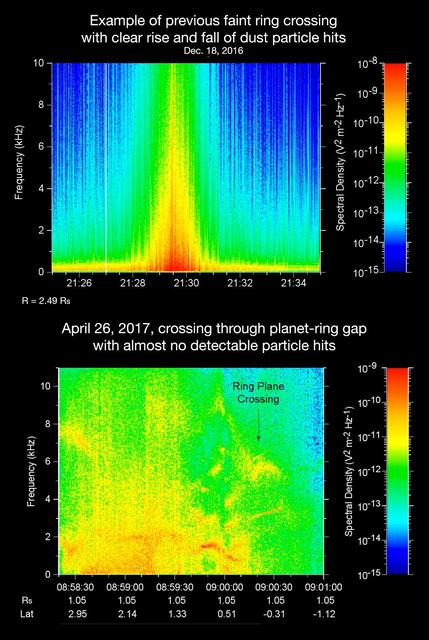
The sounds and spectrograms in these two videos represent data collected by the Radio and Plasma Wave Science, or RPWS, instrument on NASA's Cassini spacecraft, as it crossed the plane of Saturn's rings on two separate orbits. As tiny, dust-sized particles strike Cassini and the three 33-foot-long (10-meter-long), RPWS antennas, the particles are vaporized into tiny clouds of plasma, or electrically excited gas. These tiny explosions make a small electrical signal (a voltage impulse) that RPWS can detect. Researchers on the RPWS team convert the data into visible and audio formats, like those seen here, for analysis. Ring particle hits sound like pops and cracks in the audio. The first video (top image in the montage) was made using RPWS data from a ring plane crossing on Dec. 18, 2016, when the spacecraft passed through the faint, dusty Janus-Epimetheus ring (see PIA08328 for an image that features this ring). This was during Cassini's 253rd orbit of Saturn, known as Rev 253. As is typical for this sort of ring crossing, the number of audible pops and cracks rises to a maximum around the time of a ring crossing and trails off afterward. The peak of the ring density is obvious in the colored display at the red spike. The second video (bottom image in the montage) was made using data RPWS collected as Cassini made the first dive through the gap between Saturn and its rings as part of the mission's Grand Finale, on April 26, 2017. Very few pops and cracks are audible in this data at all. In comparing the two data sets, it is apparent that while Cassini detected many ring-particles striking Cassini when passing through the Janus-Epimetheus ring, the first Grand Finale crossing -- in stark contrast -- was nearly particle free. The unexpected finding that the gap is so empty is a new mystery that scientists are eager to understand. On April 26, 2017, Cassini dove through the previously unexplored ring-planet gap at speeds approaching 75,000 mph (121,000 kph), using its large, dish-shaped high-gain antenna (or HGA) as a shield to protect the rest of the spacecraft and its instruments from potential impacts by small, icy ring particles. Two of Cassini's instruments, the magnetometer and RPWS, extend beyond the protective antenna dish, and were exposed to the particle environment during the dive. The Cassini team used this data from RPWS, along with inputs from other components on the spacecraft, to make the decision of whether the HGA would be needed as a shield on most future Grand Finale dives through the planet-ring gap. Based on these inputs the team determined this protective measure would not be needed, allowing the team's preferred mode of science operations to proceed, with Cassini able to point its science instruments in any direction necessary to obtain scientists' desired observations. (Four of the 21 remaining dives pass through the inner D ring. The mission had already planned to use the HGA as a shield for those passes.) The colors on the spectrogram indicate the emitted power of the radio waves, with red as the most powerful. Time is on the x-axis, and frequency of the radio waves is on the y-axis. The audible whistle in the April 26 data, just before ring plane crossing, is due to a type of plasma wave that will be the subject of further study. In addition, there is an abrupt change beginning at the 09:00:00 mark on the spectrogram that represents a change in the RPWS antenna's operational configuration (from monopole mode to dipole mode). The videos can be viewed at https://photojournal.jpl.nasa.gov/catalog/PIA21446
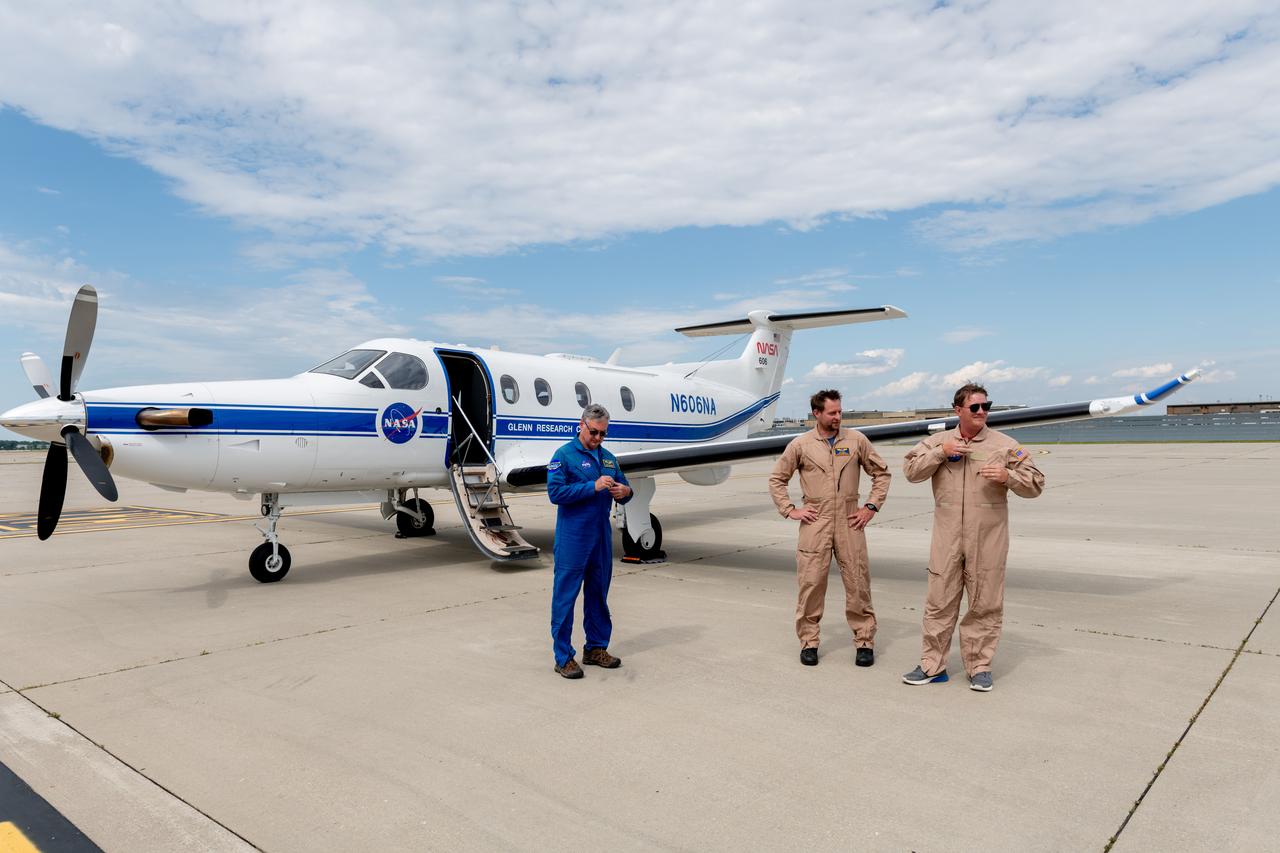
A team at NASA’s Glenn Research Center in Cleveland streamed 4K video footage from an aircraft to the International Space Station and back for the first time using optical, or laser, communications. The feat was part of a series of tests on new technology that could provide live video coverage of astronauts on the Moon during the Artemis missions. Pictured here on June 13, 2024 from Left to Right: Kurt Blakenship, Adam Wroblewski, Shaun McKeehan. Working with the Air Force Research Laboratory and NASA’s Small Business Innovation Research program, Glenn engineers temporarily installed a portable laser terminal on the belly of a Pilatus PC-12 aircraft. They then flew over Lake Erie sending data from the aircraft to an optical ground station in Cleveland. From there, it was sent over an Earth-based network to NASA’s White Sands Test Facility in Las Cruces, New Mexico, where scientists used infrared light signals to send the data. Photo Credit: (NASA/Sara Lowthian-Hanna)
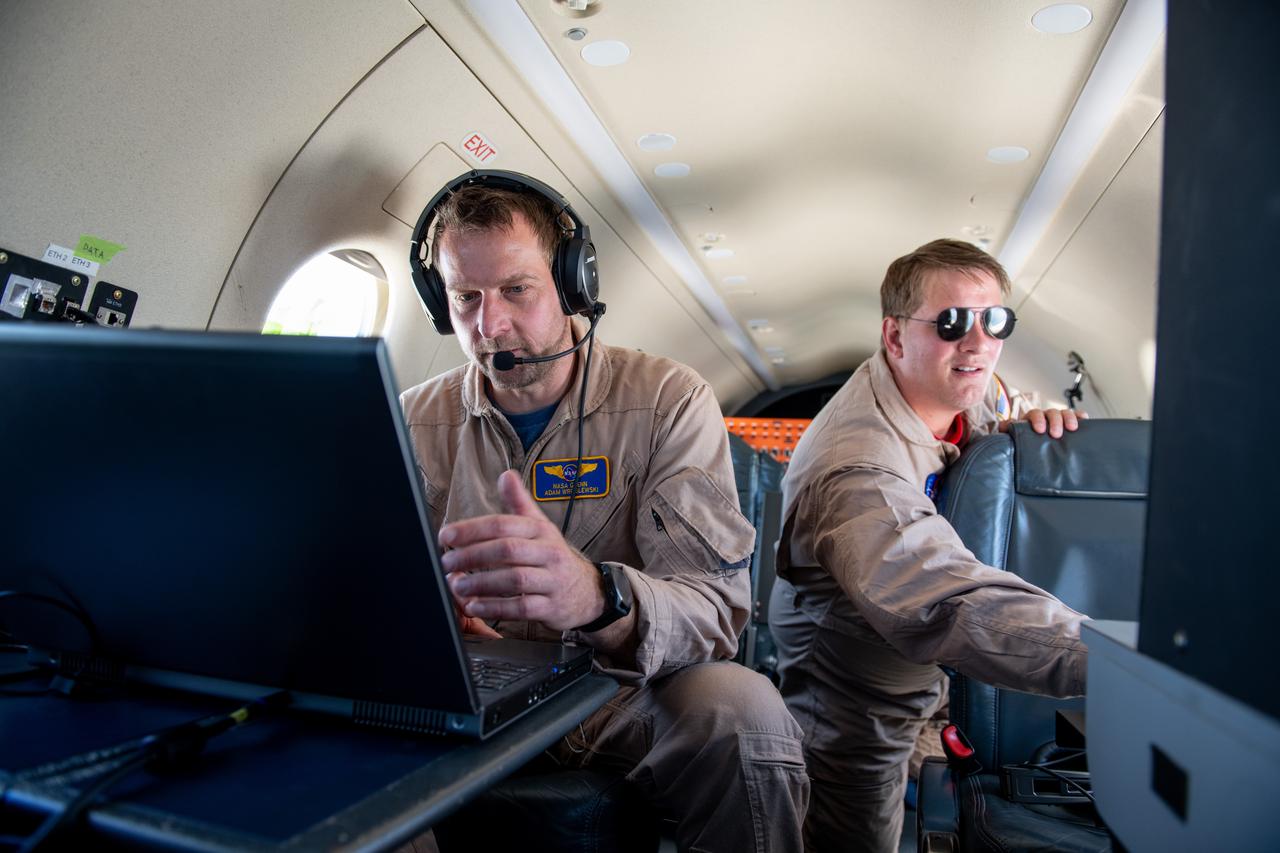
Adam Wroblewski and Shaun McKeehan Working In PC-12 Aircraft during in flight testing on June 13, 2024. A team at NASA’s Glenn Research Center in Cleveland streamed 4K video footage from an aircraft to the International Space Station and back for the first time using optical, or laser, communications. The feat was part of a series of tests on new technology that could provide live video coverage of astronauts on the Moon during the Artemis missions. Working with the Air Force Research Laboratory and NASA’s Small Business Innovation Research program, Glenn engineers temporarily installed a portable laser terminal on the belly of a Pilatus PC-12 aircraft. They then flew over Lake Erie sending data from the aircraft to an optical ground station in Cleveland. From there, it was sent over an Earth-based network to NASA’s White Sands Test Facility in Las Cruces, New Mexico, where scientists used infrared light signals to send the data. Photo Credit: (NASA/Sara Lowthian-Hanna)
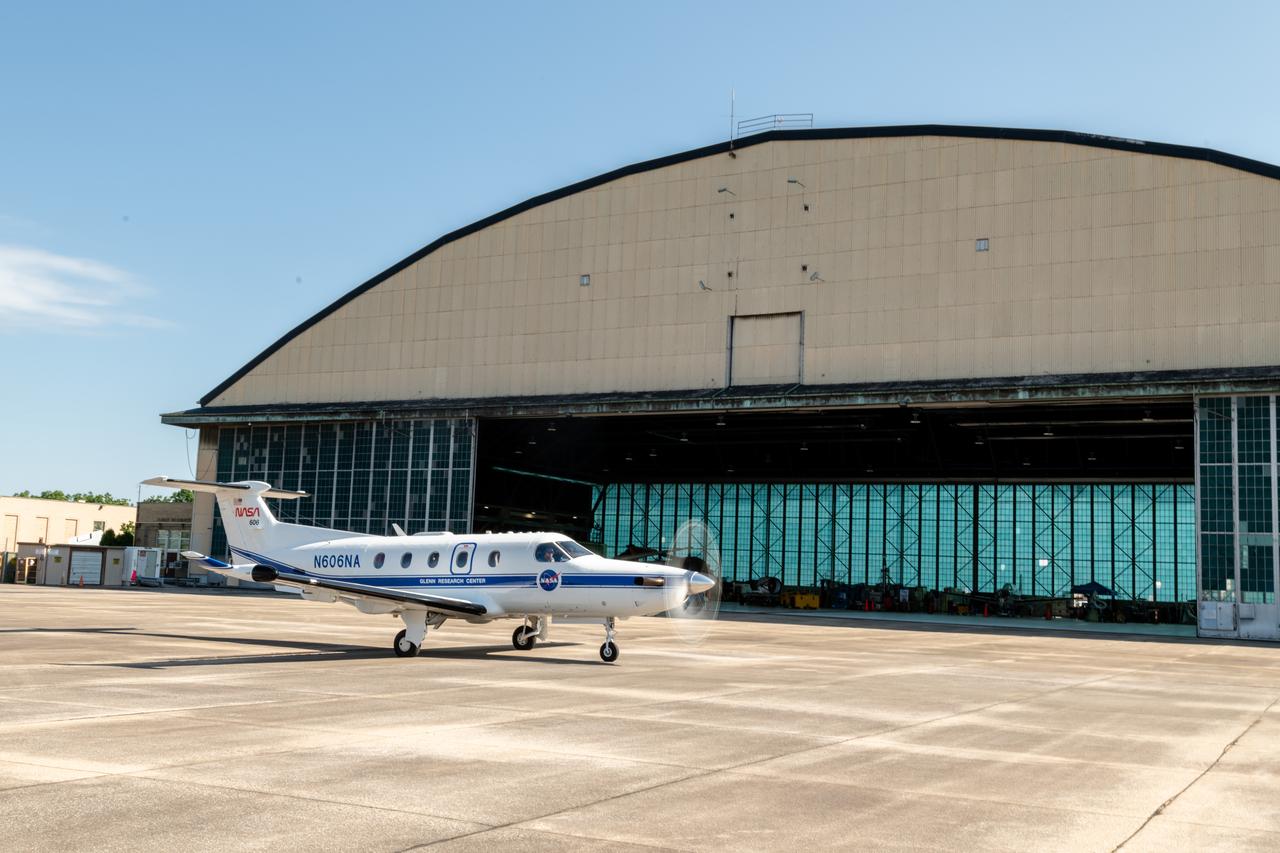
At Glenn Research Center, the PC-12 is Prepped for a flight and ready to takeoff on June 12, 2024. A team at NASA’s Glenn Research Center in Cleveland streamed 4K video footage from an aircraft to the International Space Station and back for the first time using optical, or laser, communications. The feat was part of a series of tests on new technology that could provide live video coverage of astronauts on the Moon during the Artemis missions. Working with the Air Force Research Laboratory and NASA’s Small Business Innovation Research program, Glenn engineers temporarily installed a portable laser terminal on the belly of a Pilatus PC-12 aircraft. They then flew over Lake Erie sending data from the aircraft to an optical ground station in Cleveland. From there, it was sent over an Earth-based network to NASA’s White Sands Test Facility in Las Cruces, New Mexico, where scientists used infrared light signals to send the data. Photo Credit: (NASA/Sara Lowthian-Hanna)
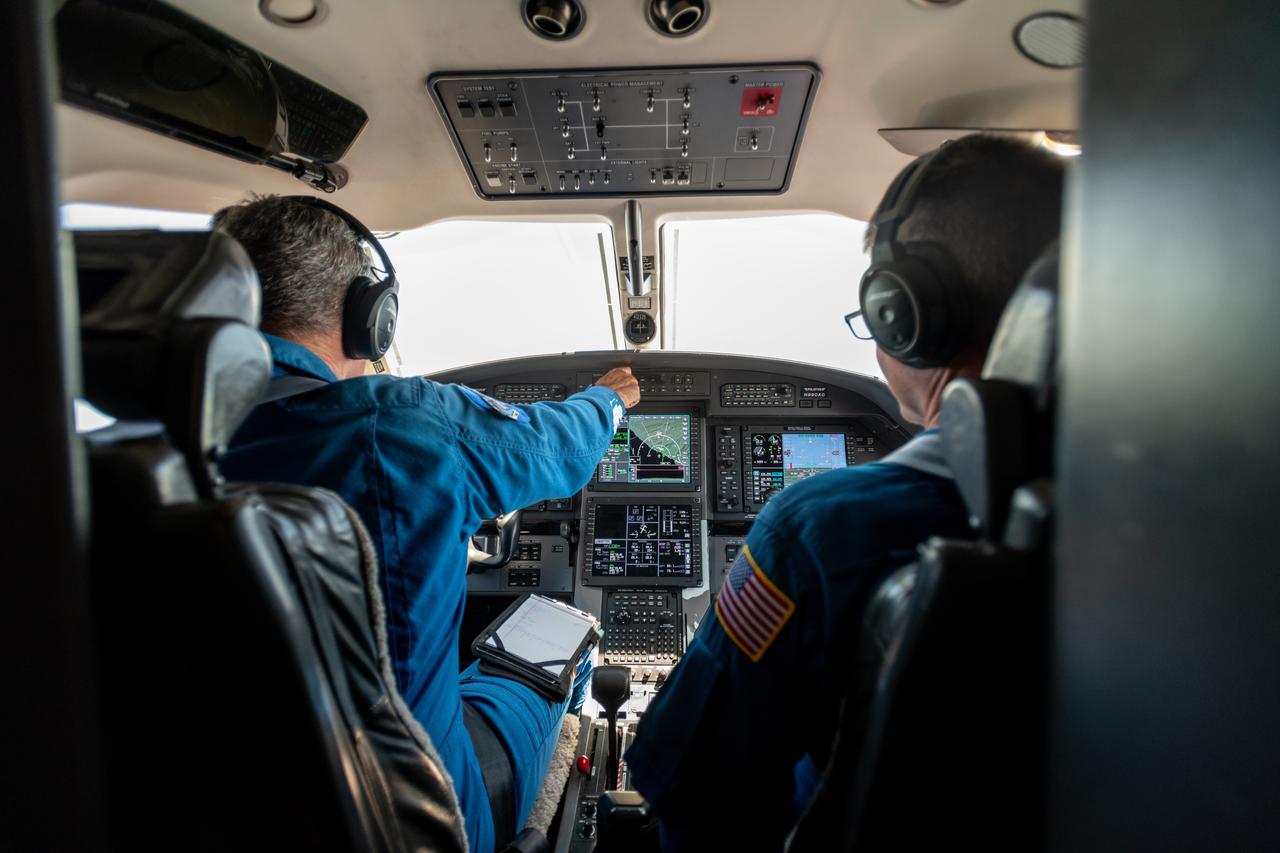
Kurt Blankenship and James Demers Fly PC-12 Aircraft During Testing on June 13, 2024. A team at NASA’s Glenn Research Center in Cleveland streamed 4K video footage from an aircraft to the International Space Station and back for the first time using optical, or laser, communications. The feat was part of a series of tests on new technology that could provide live video coverage of astronauts on the Moon during the Artemis missions. Working with the Air Force Research Laboratory and NASA’s Small Business Innovation Research program, Glenn engineers temporarily installed a portable laser terminal on the belly of a Pilatus PC-12 aircraft. They then flew over Lake Erie sending data from the aircraft to an optical ground station in Cleveland. From there, it was sent over an Earth-based network to NASA’s White Sands Test Facility in Las Cruces, New Mexico, where scientists used infrared light signals to send the data. Photo Credit: (NASA/Sara Lowthian-Hanna)
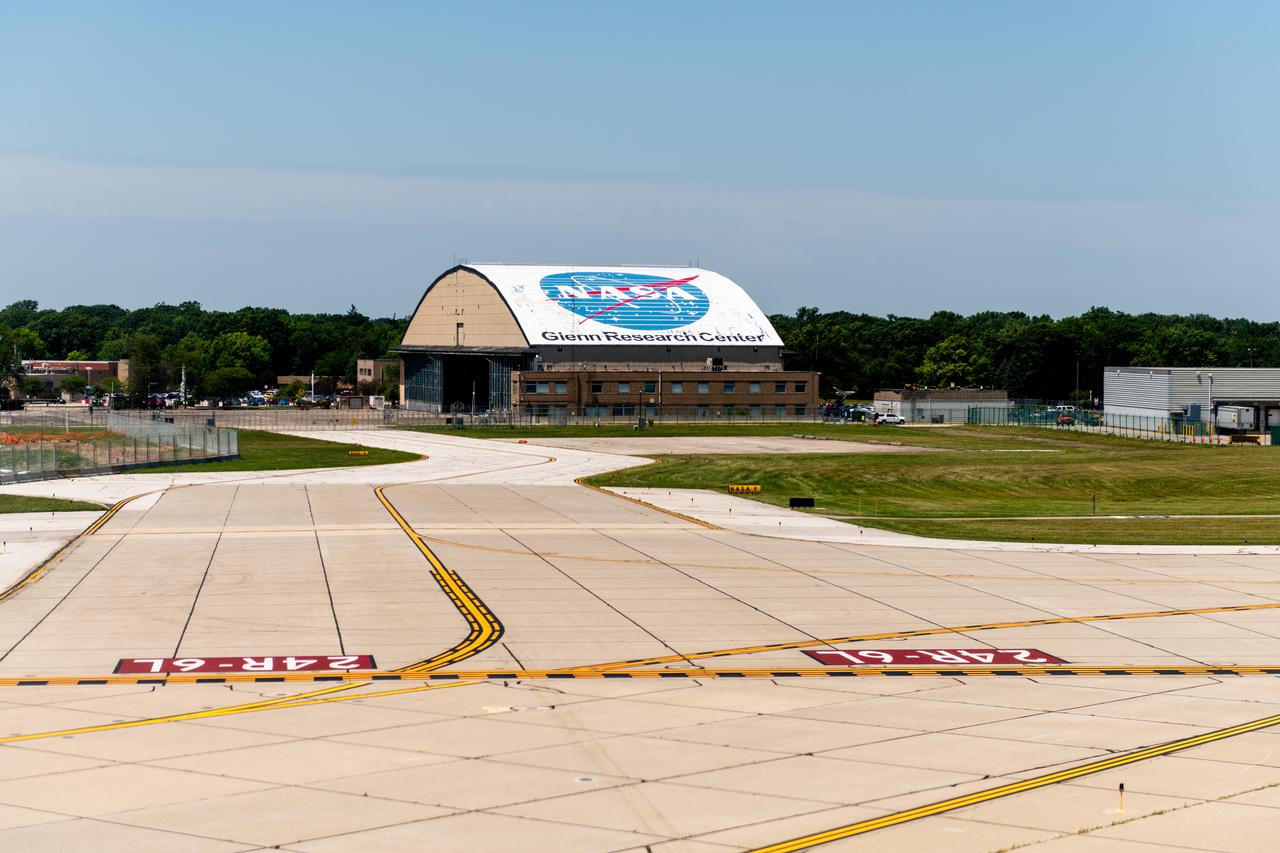
View of the Glenn Research Center Hangar from the Cleveland Hopkins Airport Runway during a testing flight on June 13, 2024. A team at NASA’s Glenn Research Center in Cleveland streamed 4K video footage from an aircraft to the International Space Station and back for the first time using optical, or laser, communications. The feat was part of a series of tests on new technology that could provide live video coverage of astronauts on the Moon during the Artemis missions. Working with the Air Force Research Laboratory and NASA’s Small Business Innovation Research program, Glenn engineers temporarily installed a portable laser terminal on the belly of a Pilatus PC-12 aircraft. They then flew over Lake Erie sending data from the aircraft to an optical ground station in Cleveland. From there, it was sent over an Earth-based network to NASA’s White Sands Test Facility in Las Cruces, New Mexico, where scientists used infrared light signals to send the data. Photo Credit: (NASA/Sara Lowthian-Hanna)
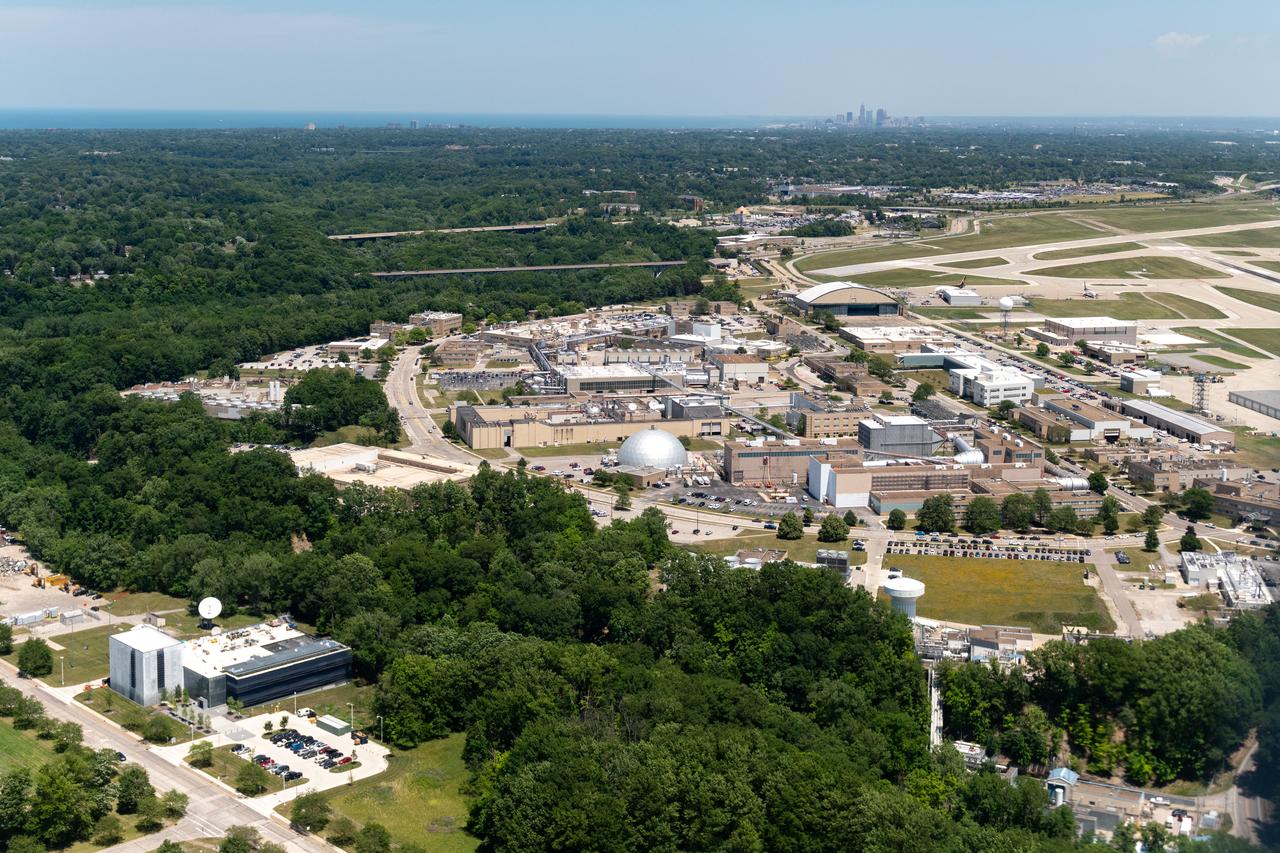
Aerial Photograph of Glenn Research Center With Downtown Cleveland in the Distance taken from the PC-12 on June 13, 2024. A team at NASA’s Glenn Research Center in Cleveland streamed 4K video footage from an aircraft to the International Space Station and back for the first time using optical, or laser, communications. The feat was part of a series of tests on new technology that could provide live video coverage of astronauts on the Moon during the Artemis missions. Working with the Air Force Research Laboratory and NASA’s Small Business Innovation Research program, Glenn engineers temporarily installed a portable laser terminal on the belly of a Pilatus PC-12 aircraft. They then flew over Lake Erie sending data from the aircraft to an optical ground station in Cleveland. From there, it was sent over an Earth-based network to NASA’s White Sands Test Facility in Las Cruces, New Mexico, where scientists used infrared light signals to send the data. Photo Credit: (NASA/Sara Lowthian-Hanna)
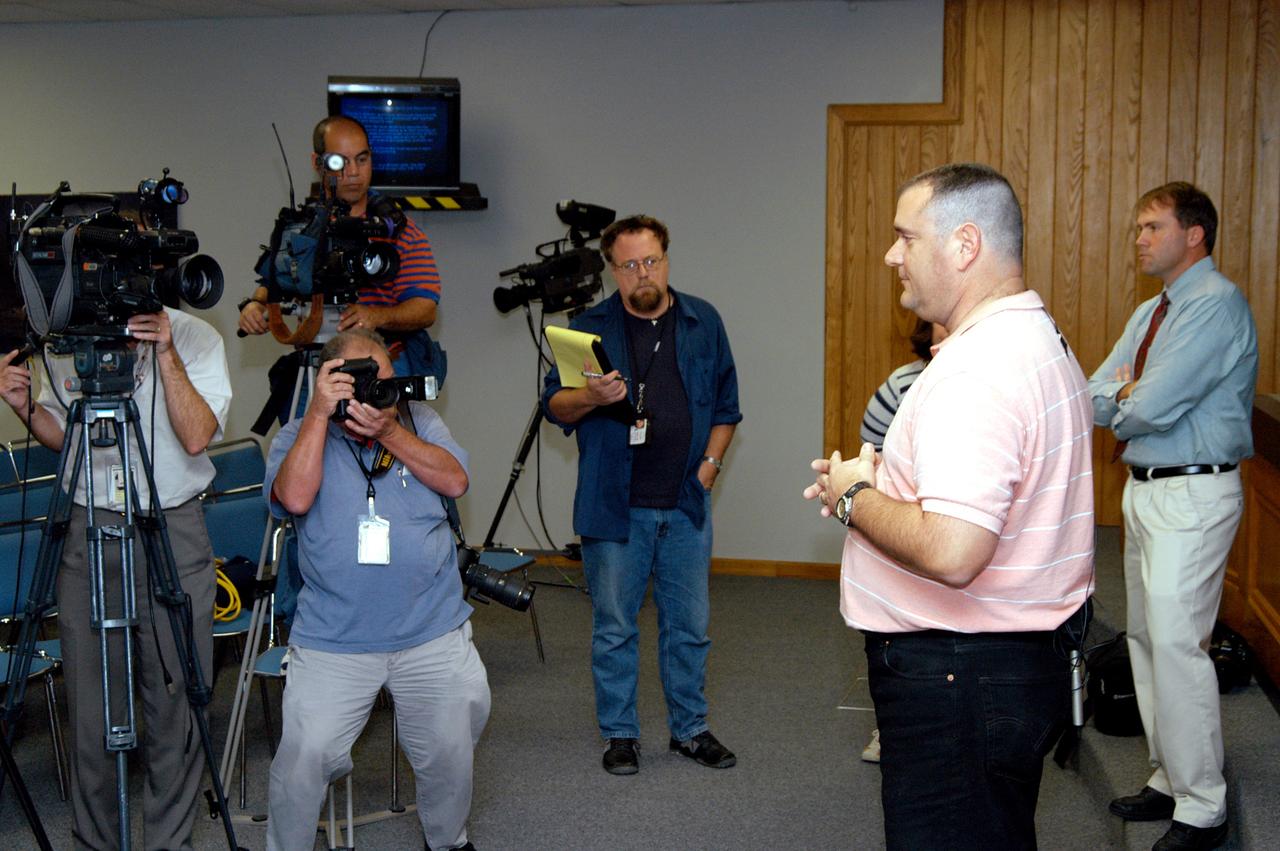
KENNEDY SPACE CENTER, FLA. - Armando Oliu, Final Inspection Team lead for the Shuttle program, speaks to reporters about the aid the Image Analysis Lab is giving the FBI in a kidnapping case. Behind him at right is Mike Rein, External Affairs division chief. Oliu oversees the image lab that is using an advanced SGI® TP9500 data management system to review the tape of the kidnapping in progress in Sarasota, Fla. KSC installed the new $3.2 million system in preparation for Return to Flight of the Space Shuttle fleet. The lab is studying the Sarasota kidnapping video to provide any new information possible to law enforcement officers. KSC is joining NASA’s Marshall Space Flight Center in Alabama in reviewing the tape.

Giant, bright coronal loops trace out the magnetic field lines above an active region from June 4-6, 2018. The wavelength of extreme ultraviolet light shown here is emitted by ionized iron travelling along the field lines, super-heated to approximately 1 million degrees K. Coronal loops were not seen in this level of detail until the Solar Dynamics Observatory was launched in 2010 and came online, giving solar scientists new data with which to study the Sun and its processes. Videos are available at https://photojournal.jpl.nasa.gov/catalog/PIA22508
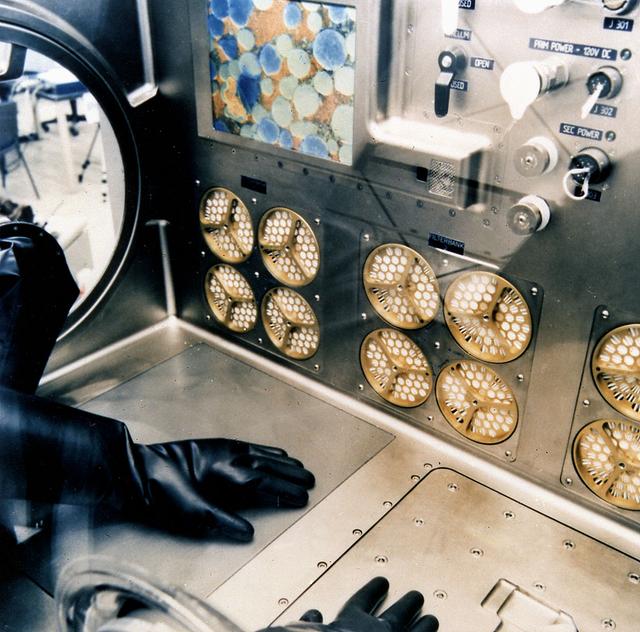
The Microgravity Science Glovebox is a facility for performing microgravity research in the areas of materials, combustion, fluids and biotechnology science. The facility occupies a full ISPR, consisting of: the ISPR rack and infrastructure for the rack, the glovebox core facility, data handling, rack stowage, outfitting equipment, and a video subsystem. MSG core facility provides the experiment developers a chamber with air filtering and recycling, up to two levels of containment, an airlock for transfer of payload equipment to/from the main volume, interface resources for the payload inside the core facility, resources inside the airlock, and storage drawers for MSG support equipment and consumables.