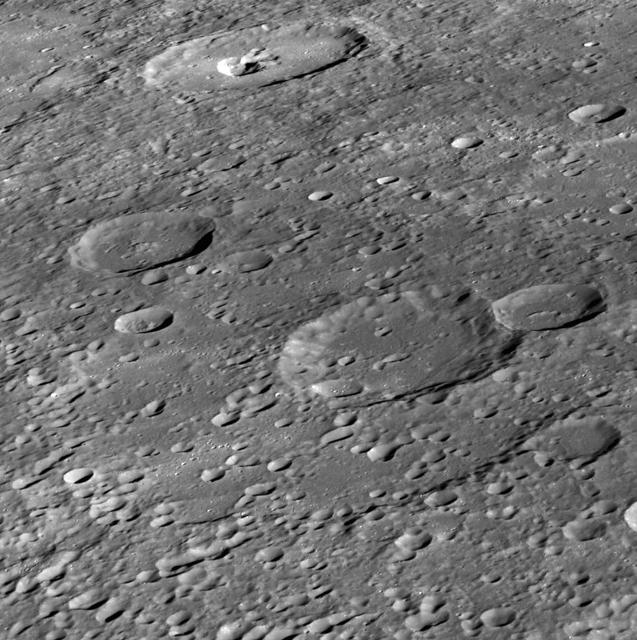
A View into To Ngoc Van
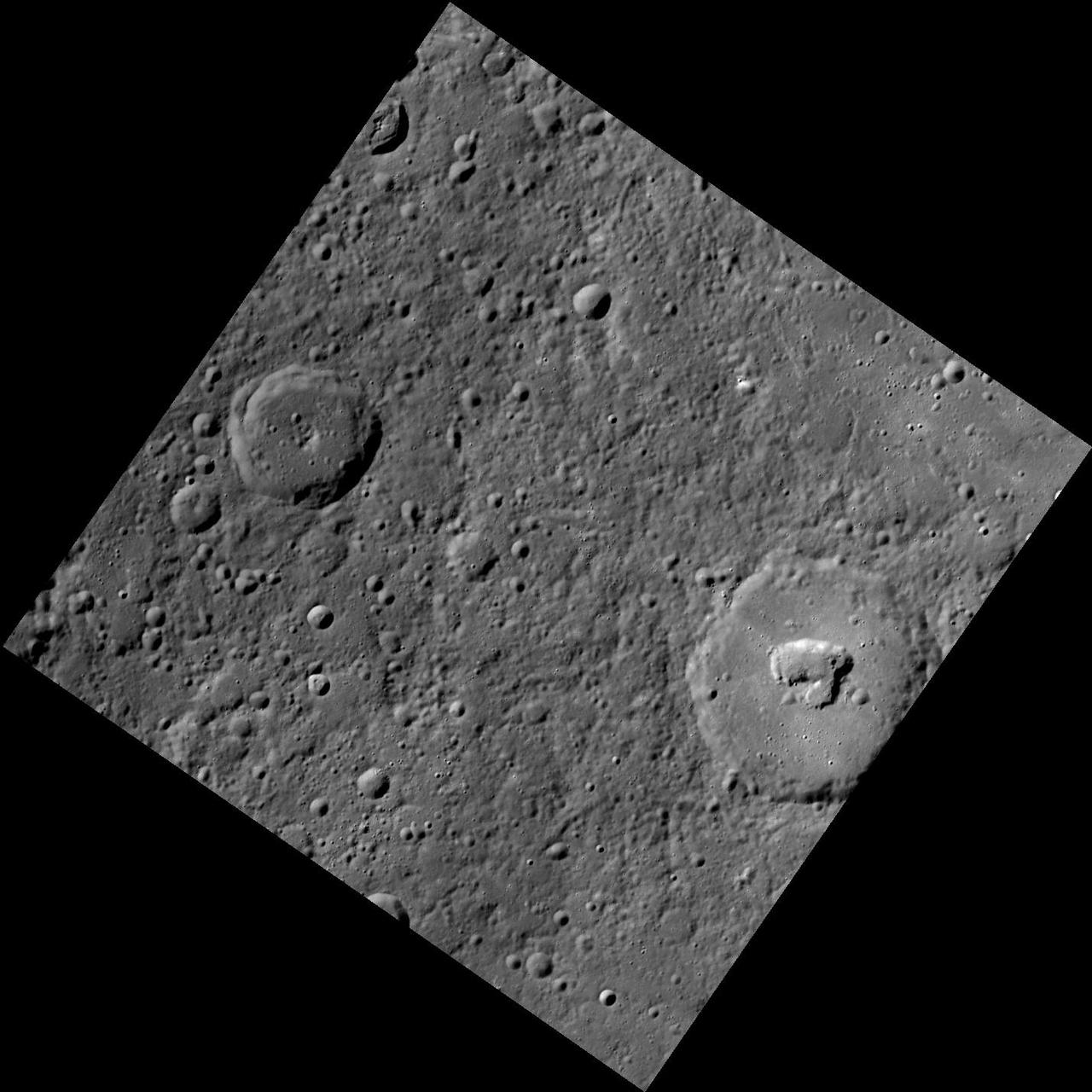
To Ngoc Van Central Pit
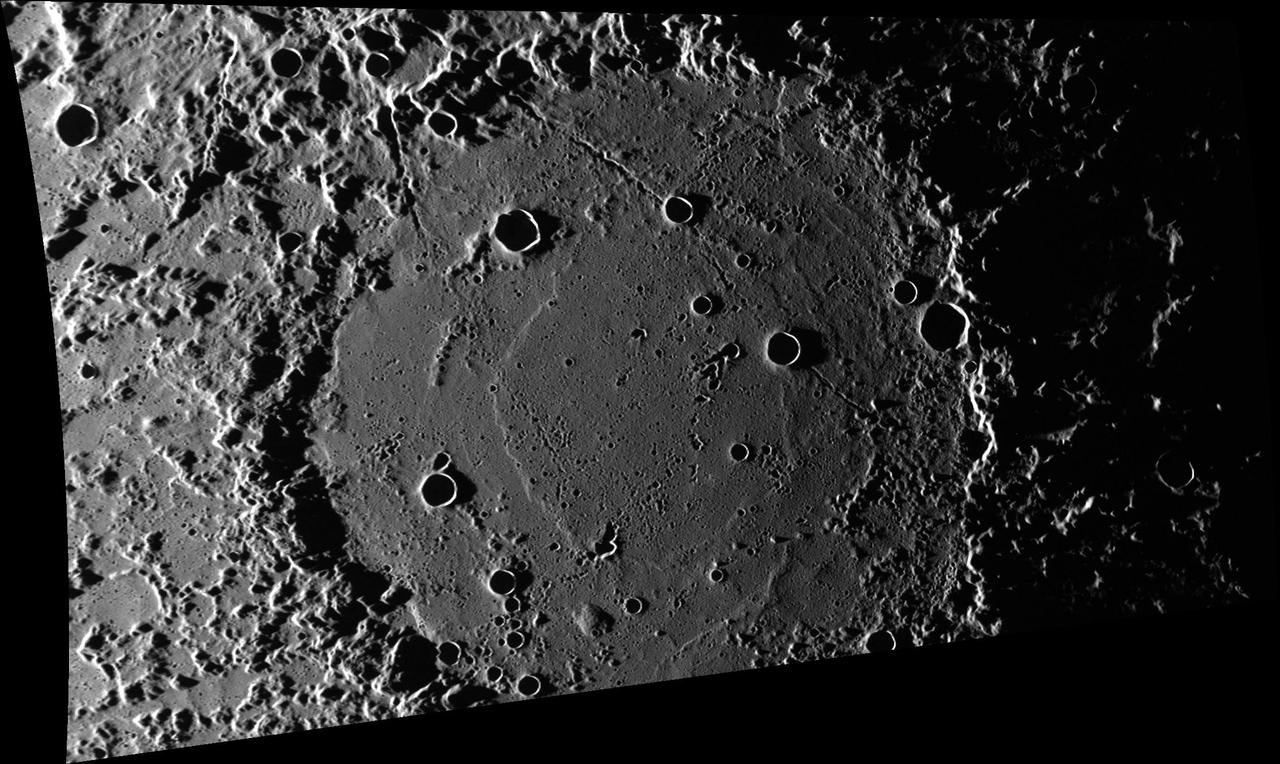
Van Eyck and the Formation
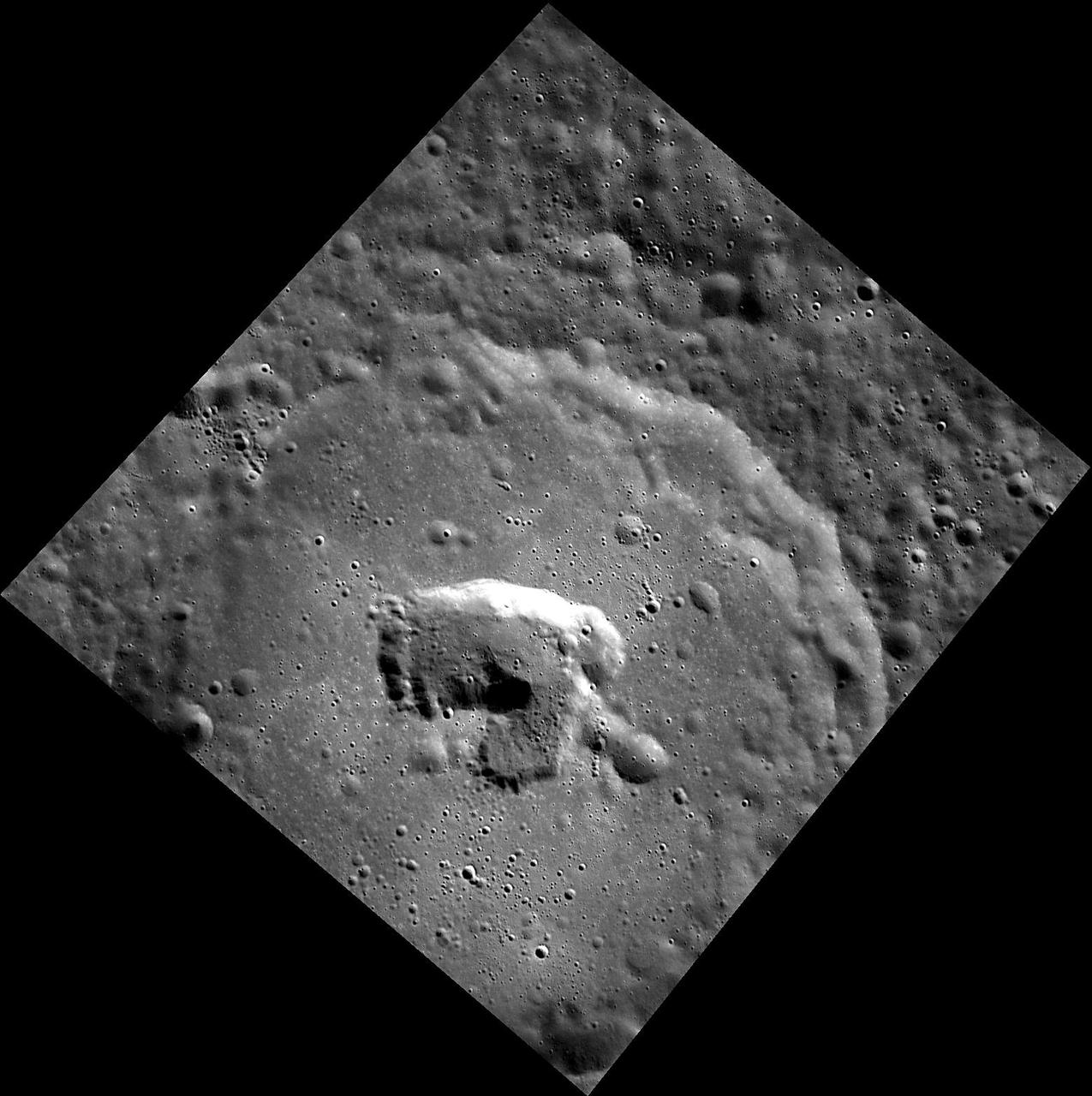
Close-up Shot of To Ngoc Van
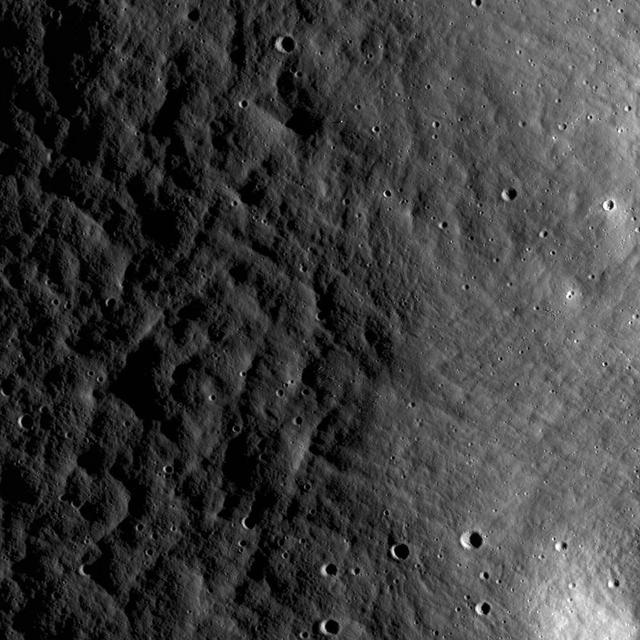
Ejecta from Van de Graaff Crater
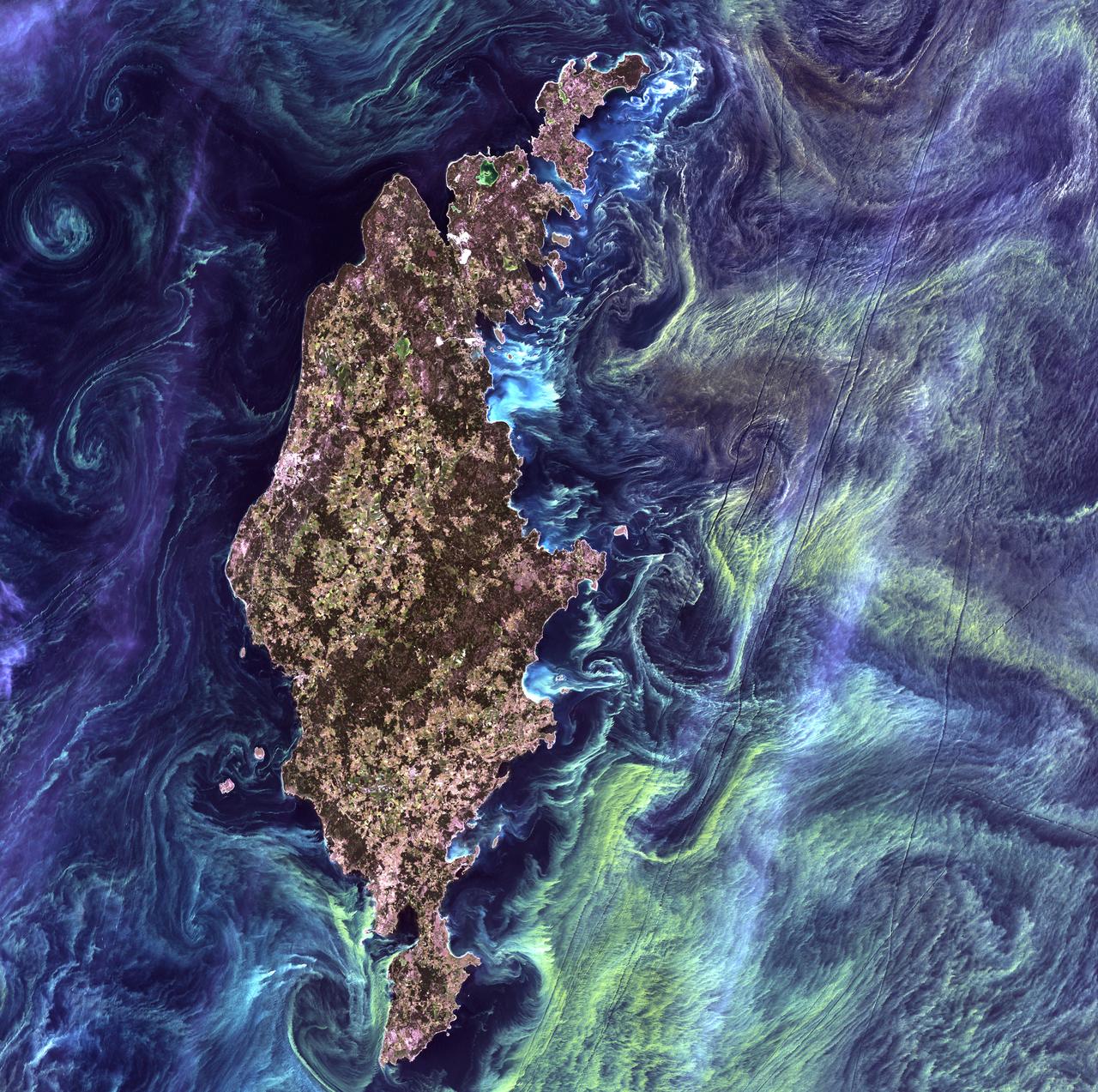
Van Gogh from Space - July 13th, 2005 Description: In the style of Van Gogh's painting "Starry Night," massive congregations of greenish phytoplankton swirl in the dark water around Gotland, a Swedish island in the Baltic Sea. Phytoplankton are microscopic marine plants that form the first link in nearly all ocean food chains. Population explosions, or blooms, of phytoplankton, like the one shown here, occur when deep currents bring nutrients up to sunlit surface waters, fueling the growth and reproduction of these tiny plants. Credit: USGS/NASA/Landsat 7 To learn more about the Landsat satellite go to: <a href="http://landsat.gsfc.nasa.gov/" rel="nofollow">landsat.gsfc.nasa.gov/</a> <b><a href="http://www.nasa.gov/centers/goddard/home/index.html" rel="nofollow">NASA Goddard Space Flight Center</a></b> enables NASA’s mission through four scientific endeavors: Earth Science, Heliophysics, Solar System Exploration, and Astrophysics. Goddard plays a leading role in NASA’s accomplishments by contributing compelling scientific knowledge to advance the Agency’s mission. <b>Follow us on <a href="http://twitter.com/NASA_GoddardPix" rel="nofollow">Twitter</a></b> <b>Join us on <a href="http://www.facebook.com/pages/Greenbelt-MD/NASA-Goddard/395013845897?ref=tsd" rel="nofollow">Facebook</a></b>
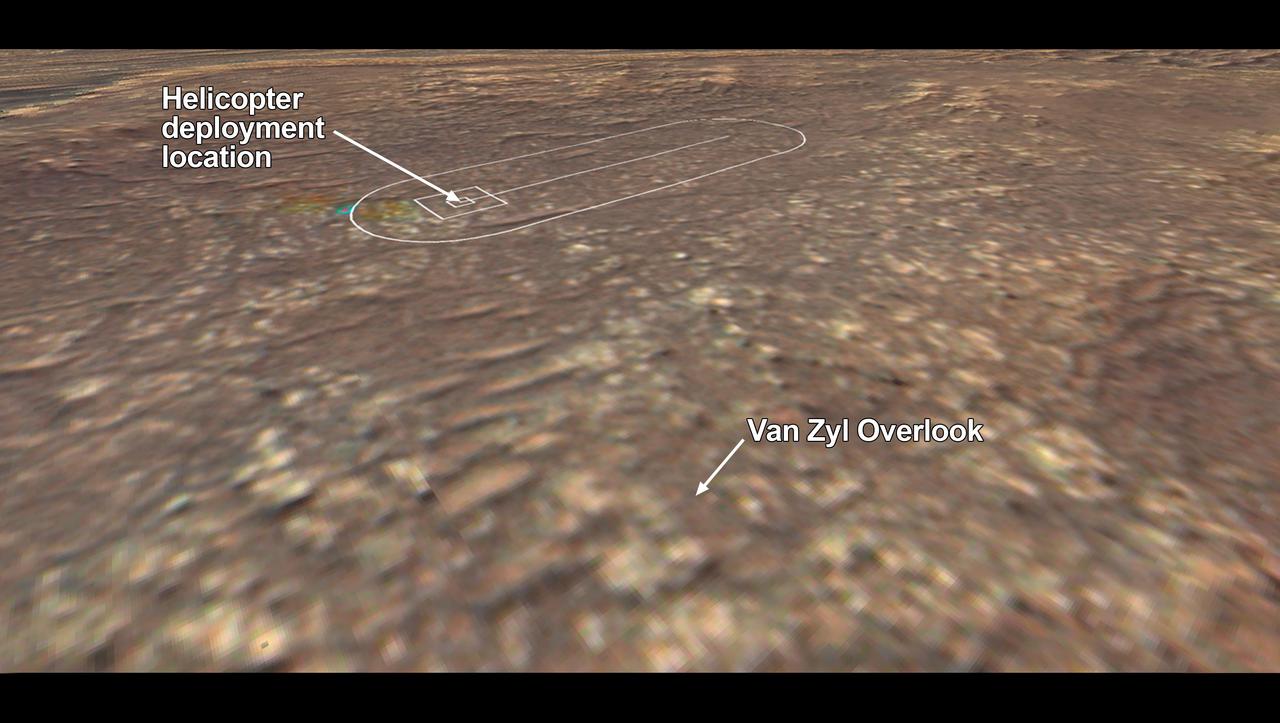
The location where NASA's Mars 2020 Perseverance rover will observe the Ingenuity Mars Helicopter's attempt at powered controlled flight at Mars is called "Van Zyl Overlook," after Jakob van Zyl. Van Zyl was the team's longtime colleague, mentor, and leader at NASA's Jet Propulsion Laboratory in Southern California. He passed away unexpectedly in August 2020, about a month after the launch of Perseverance. Van Zyl joined JPL in 1986 and served in crucial roles at the Lab over a 33-year career, including as director for the Astronomy and Physics Directorate, associate director for project formulation and strategy, and finally director for the Solar System Exploration Directorate. As leader of solar system exploration at JPL, he oversaw successful operations of such NASA missions as Juno, Dawn, and Cassini, the implementation of the Mars InSight lander and MarCO CubeSats, as well as ongoing development of Europa Clipper, Psyche, and all of JPL's instruments and Ingenuity. https://photojournal.jpl.nasa.gov/catalog/PIA24435

Katherine Van Hooser, MSFC Chief Engineer, in her office, for Marshall Star “Take 5” series.

NASA Wide-field Infrared Survey Explorer is a little like the Vincent van Gogh of the infrared sky, providing the world with picturesque images of the cosmos by representing infrared light through color. This image is the nebula NGC 2174.
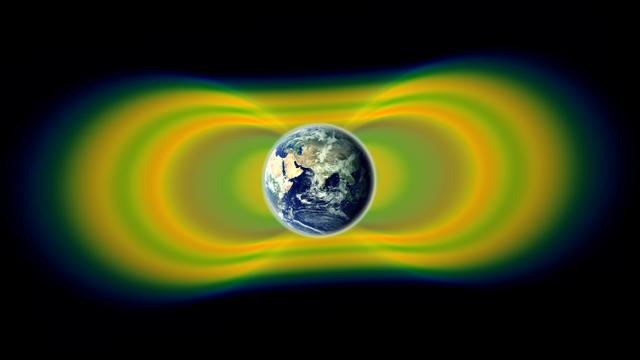
Two giant swaths of radiation, known as the Van Allen Belts, surrounding Earth were discovered in 1958. In 2012, observations from the Van Allen Probes showed that a third belt can sometimes appear. The radiation is shown here in yellow, with green representing the spaces between the belts. Credit: NASA/Van Allen Probes/Goddard Space Flight Center To read more go to: <a href="http://www.nasa.gov/mission_pages/rbsp/news/third-belt.html" rel="nofollow">www.nasa.gov/mission_pages/rbsp/news/third-belt.html</a> <b><a href="http://www.nasa.gov/audience/formedia/features/MP_Photo_Guidelines.html" rel="nofollow">NASA image use policy.</a></b> <b><a href="http://www.nasa.gov/centers/goddard/home/index.html" rel="nofollow">NASA Goddard Space Flight Center</a></b> enables NASA’s mission through four scientific endeavors: Earth Science, Heliophysics, Solar System Exploration, and Astrophysics. Goddard plays a leading role in NASA’s accomplishments by contributing compelling scientific knowledge to advance the Agency’s mission. <b>Follow us on <a href="http://twitter.com/NASA_GoddardPix" rel="nofollow">Twitter</a></b> <b>Like us on <a href="http://www.facebook.com/pages/Greenbelt-MD/NASA-Goddard/395013845897?ref=tsd" rel="nofollow">Facebook</a></b> <b>Find us on <a href="http://instagram.com/nasagoddard?vm=grid" rel="nofollow">Instagram</a></b>
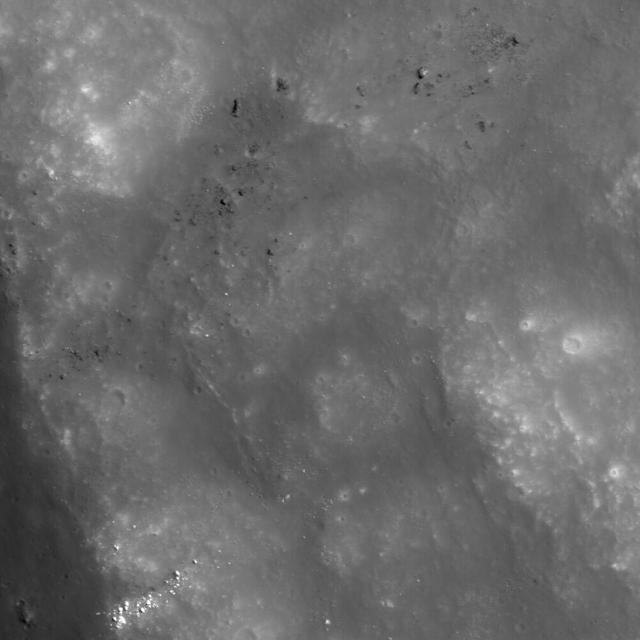
This image taken NASA Lunar Reconnaissance Orbiter shows the wall of crater Van de Graaff C, where brighter material is exposed by more active processes associated with steeper slopes, recent small craters, and even individual rolling boulders.
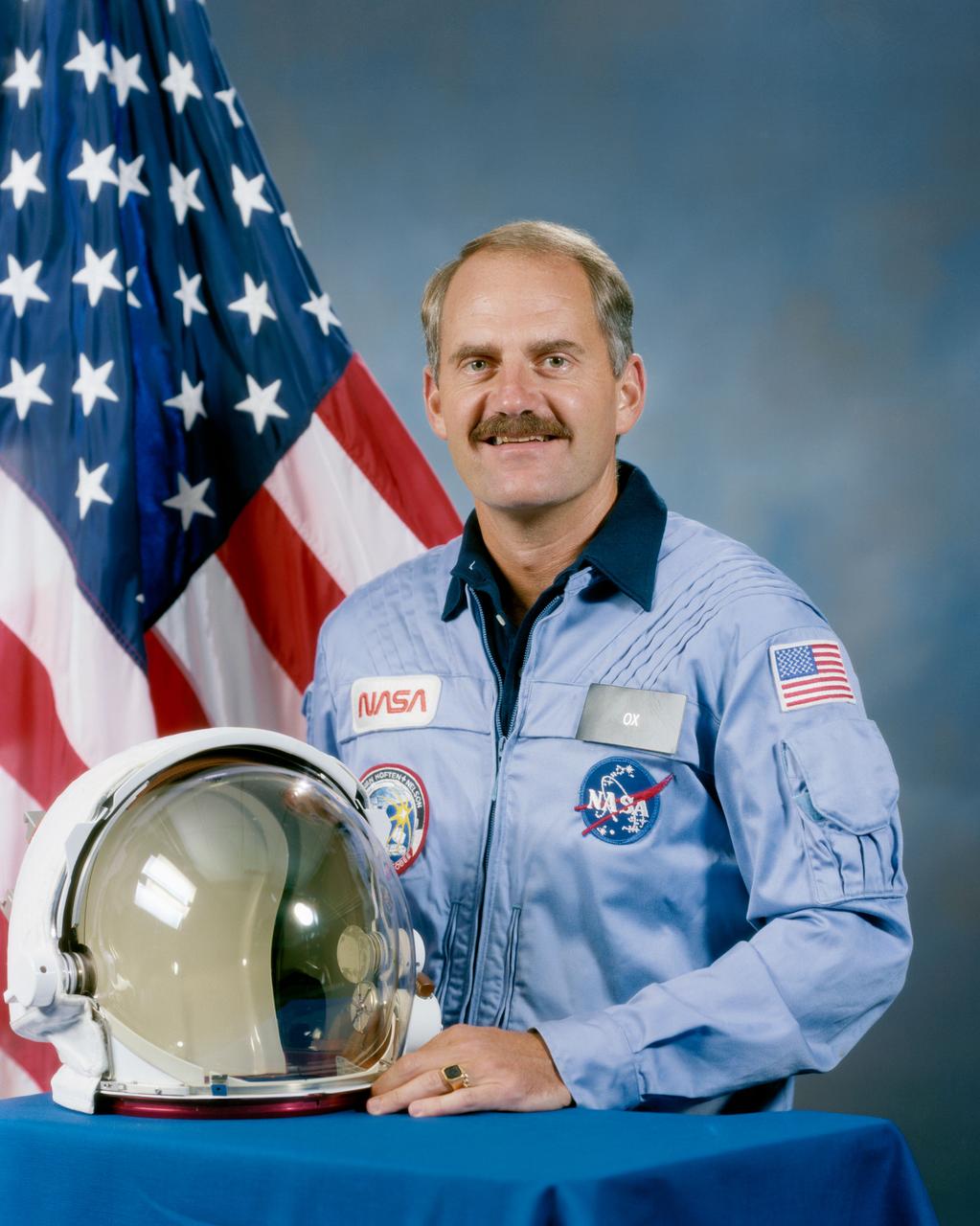
S84-42000 (31 Jan 1978) --- Asronaut James D. Van Hoften, astronaut candidate and mission specialist.
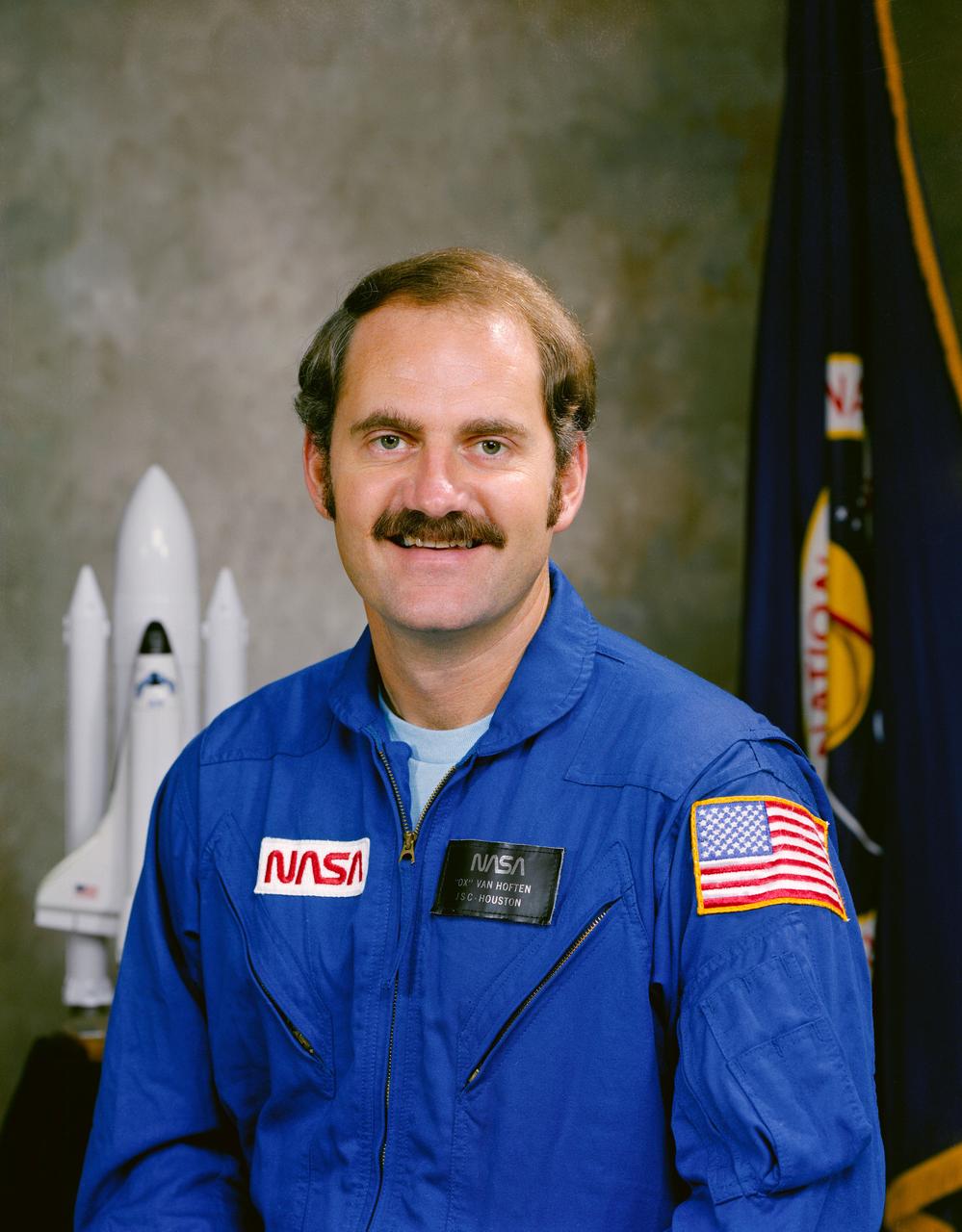
S78-35311 (31 Jan 1978) --- Astronaut James D. Van Hoften.
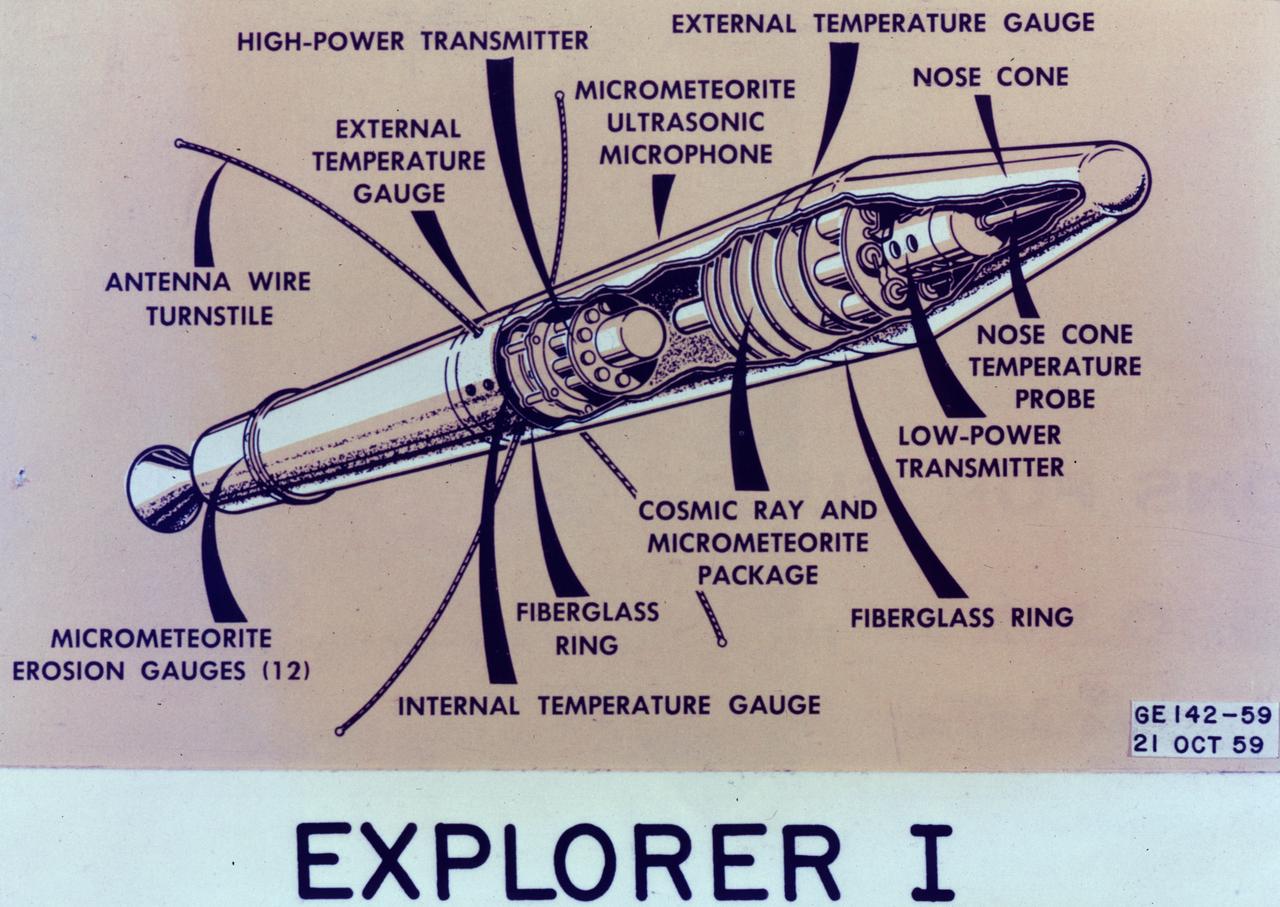
This image is a cutaway illustration of the Explorer I satellite with callouts. The Explorer I satellite was America's first scientific satellite launched aboard the Jupiter C launch vehicle on January 31, 1958. The Explorer I carried the radiation detection experiment designed by Dr. James Van Allen and discovered the Van Allen Radiation Belt.
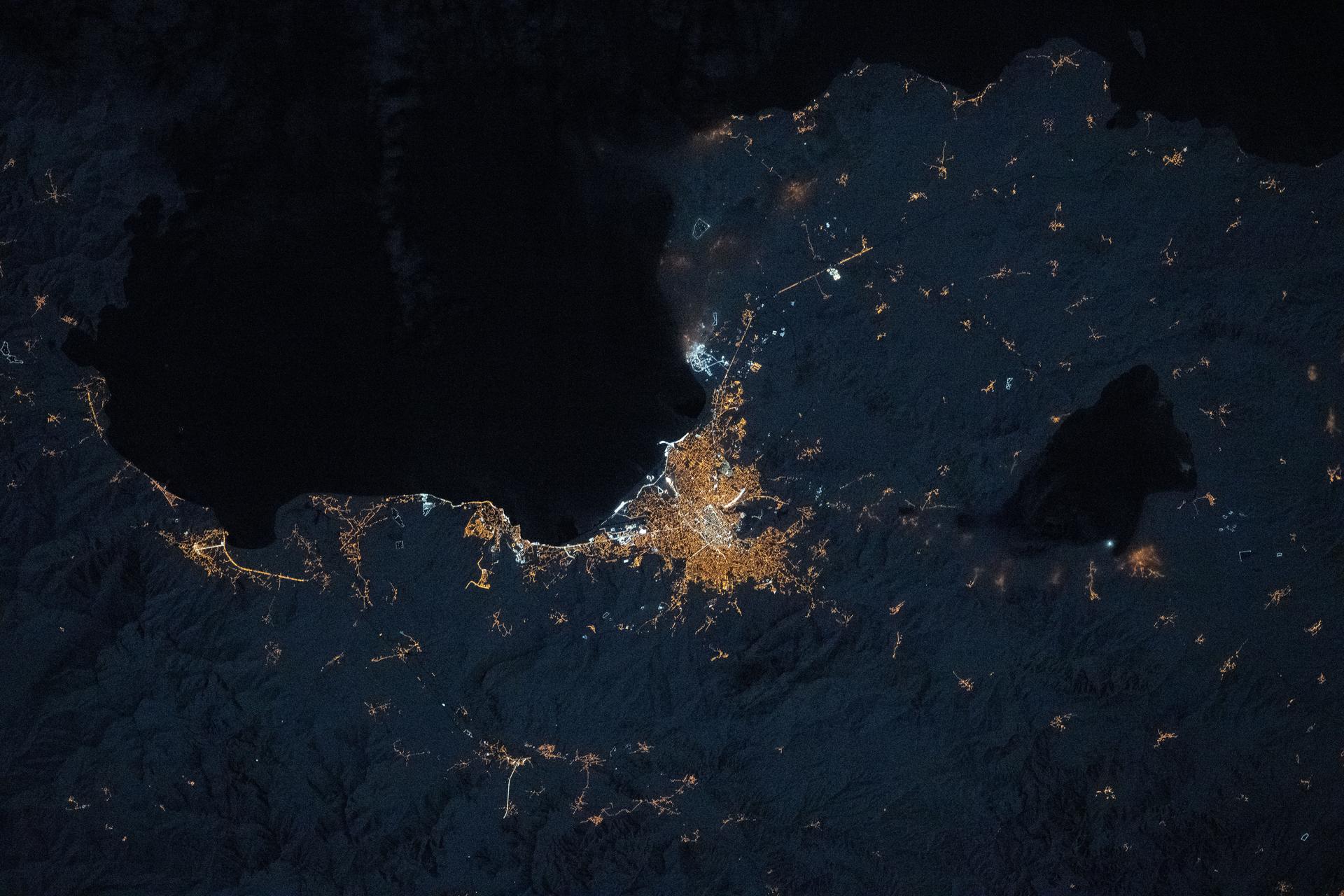
iss074e0043921 (Jan. 3, 2026) --- The amber high-pressure sodium lights of Van, Türkiye (center), along with its suburbs and villages, dot the southeast coast of Lake Van in the nation’s Eastern Anatolia Region. The International Space Station was orbiting 262 miles above Earth at approximately 10:12 p.m. local time when this photograph was taken. Credit: JAXA/Kimiya Yui
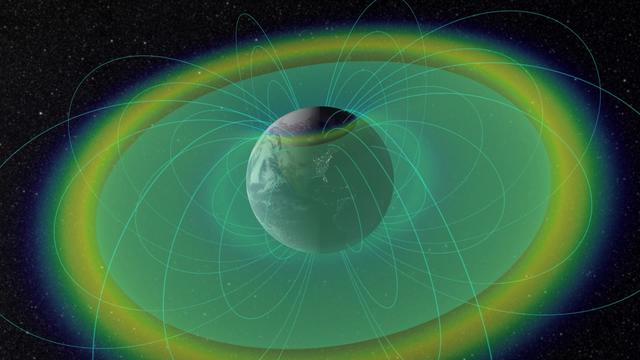
Two donuts of seething radiation that surround Earth, called the Van Allen radiation belts, have been found to contain a nearly impenetrable barrier that prevents the fastest, most energetic electrons from reaching Earth. Read more: <a href="http://1.usa.gov/11v7nUW" rel="nofollow">1.usa.gov/11v7nUW</a> Caption: This is a visualization of the radiation belts with confined charged particles (blue & yellow) and plasmapause boundary (blue-green surface) Caption: NASA's Scientific Visualization Studio <b><a href="http://www.nasa.gov/audience/formedia/features/MP_Photo_Guidelines.html" rel="nofollow">NASA image use policy.</a></b> <b><a href="http://www.nasa.gov/centers/goddard/home/index.html" rel="nofollow">NASA Goddard Space Flight Center</a></b> enables NASA’s mission through four scientific endeavors: Earth Science, Heliophysics, Solar System Exploration, and Astrophysics. Goddard plays a leading role in NASA’s accomplishments by contributing compelling scientific knowledge to advance the Agency’s mission. <b>Follow us on <a href="http://twitter.com/NASAGoddardPix" rel="nofollow">Twitter</a></b> <b>Like us on <a href="http://www.facebook.com/pages/Greenbelt-MD/NASA-Goddard/395013845897?ref=tsd" rel="nofollow">Facebook</a></b> <b>Find us on <a href="http://instagrid.me/nasagoddard/?vm=grid" rel="nofollow">Instagram</a></b>
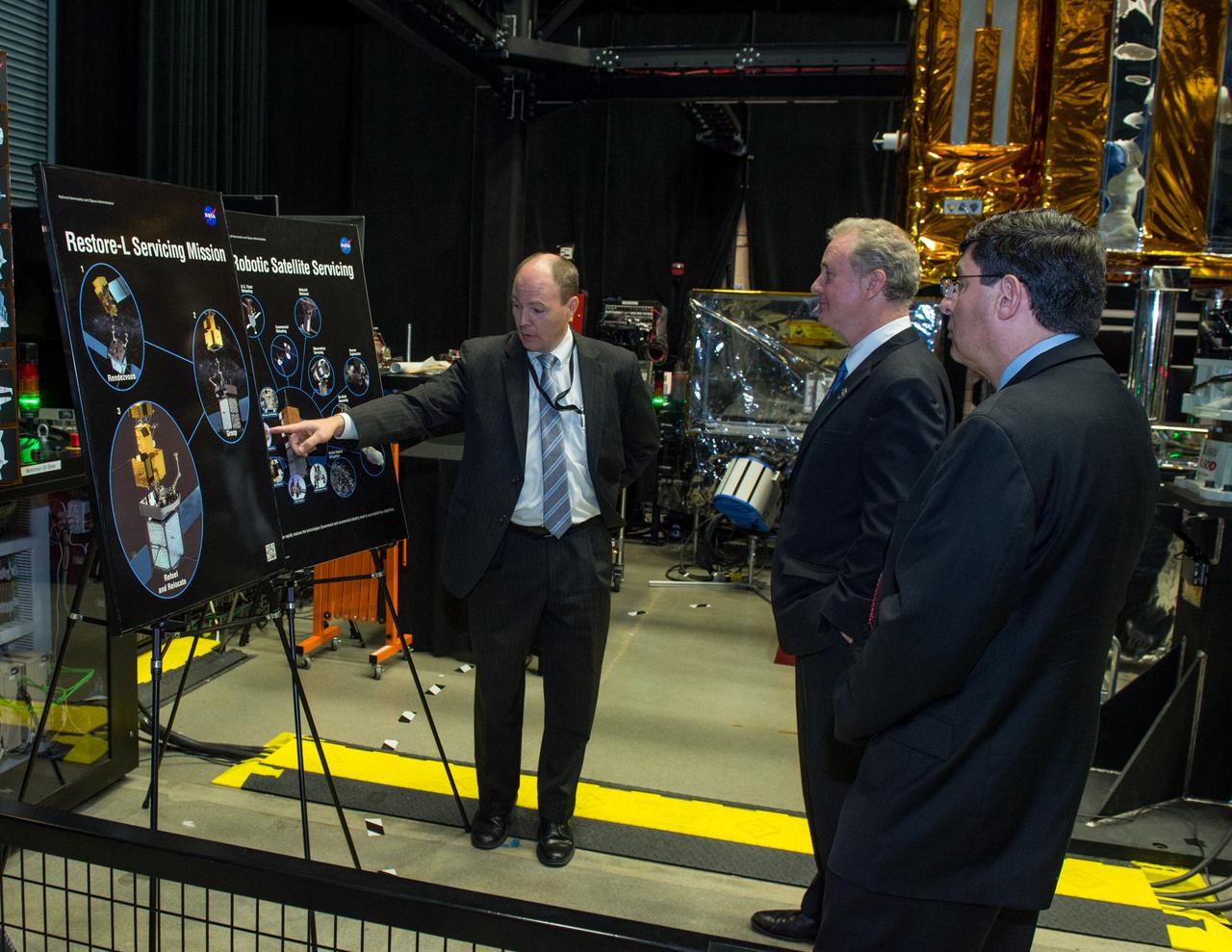
Representative Chris Van Hollen visits NASA Goddard Space Flight Center with Center Director Chris Scolese.
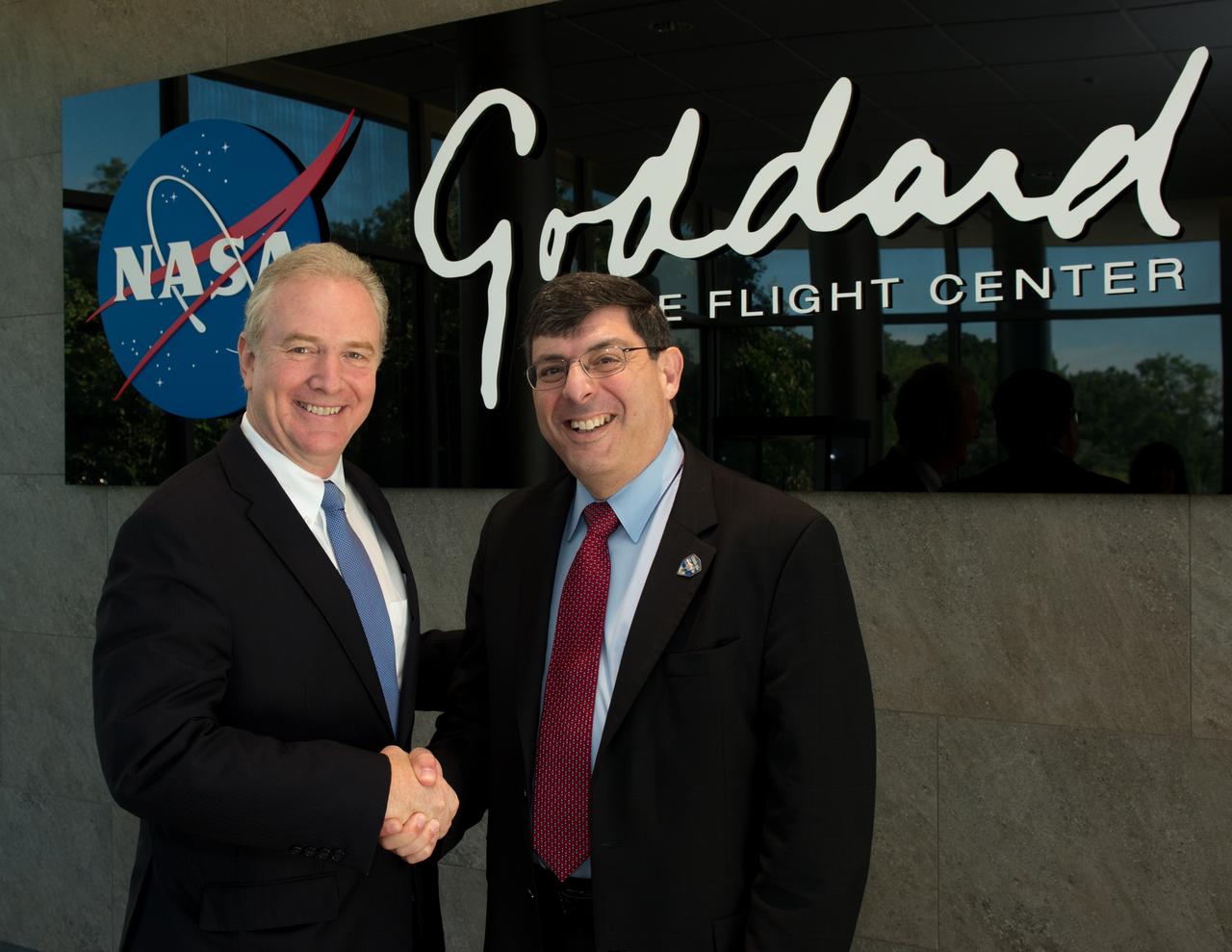
Representative Chris Van Hollen visits NASA Goddard Space Flight Center with Center Director Chris Scolese.
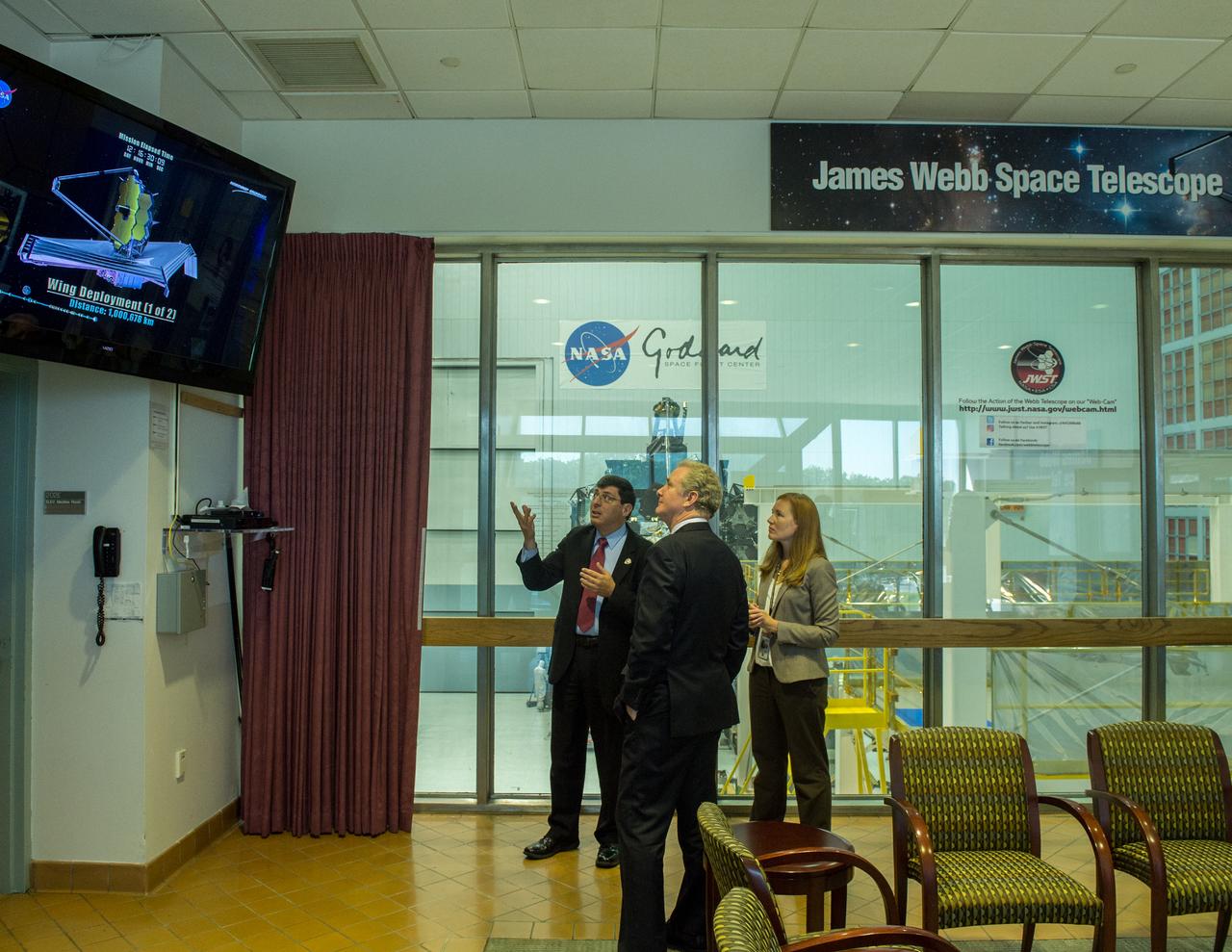
Representative Chris Van Hollen visits NASA Goddard Space Flight Center with Center Director Chris Scolese.
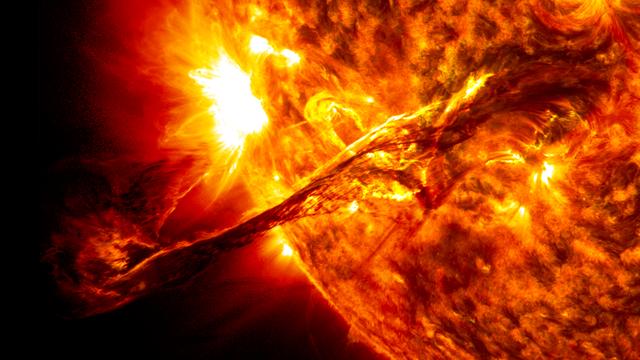
On Aug. 31, 2012, a giant prominence on the sun erupted, sending out particles and a shock wave that traveled near Earth. This event may have been one of the causes of a third radiation belt that appeared around Earth a few days later, a phenomenon that was observed for the very first time by the newly-launched Van Allen Probes. This image of the prominence before it erupted was captured by NASA's Solar Dynamics Observatory (SDO). Credit: NASA/SDO/AIA/Goddard Space Flight Center To read more go to: <a href="http://www.nasa.gov/mission_pages/rbsp/news/third-belt.html" rel="nofollow">www.nasa.gov/mission_pages/rbsp/news/third-belt.html</a> <b><a href="http://www.nasa.gov/audience/formedia/features/MP_Photo_Guidelines.html" rel="nofollow">NASA image use policy.</a></b> <b><a href="http://www.nasa.gov/centers/goddard/home/index.html" rel="nofollow">NASA Goddard Space Flight Center</a></b> enables NASA’s mission through four scientific endeavors: Earth Science, Heliophysics, Solar System Exploration, and Astrophysics. Goddard plays a leading role in NASA’s accomplishments by contributing compelling scientific knowledge to advance the Agency’s mission. <b>Follow us on <a href="http://twitter.com/NASA_GoddardPix" rel="nofollow">Twitter</a></b> <b>Like us on <a href="http://www.facebook.com/pages/Greenbelt-MD/NASA-Goddard/395013845897?ref=tsd" rel="nofollow">Facebook</a></b> <b>Find us on <a href="http://instagram.com/nasagoddard?vm=grid" rel="nofollow">Instagram</a></b>
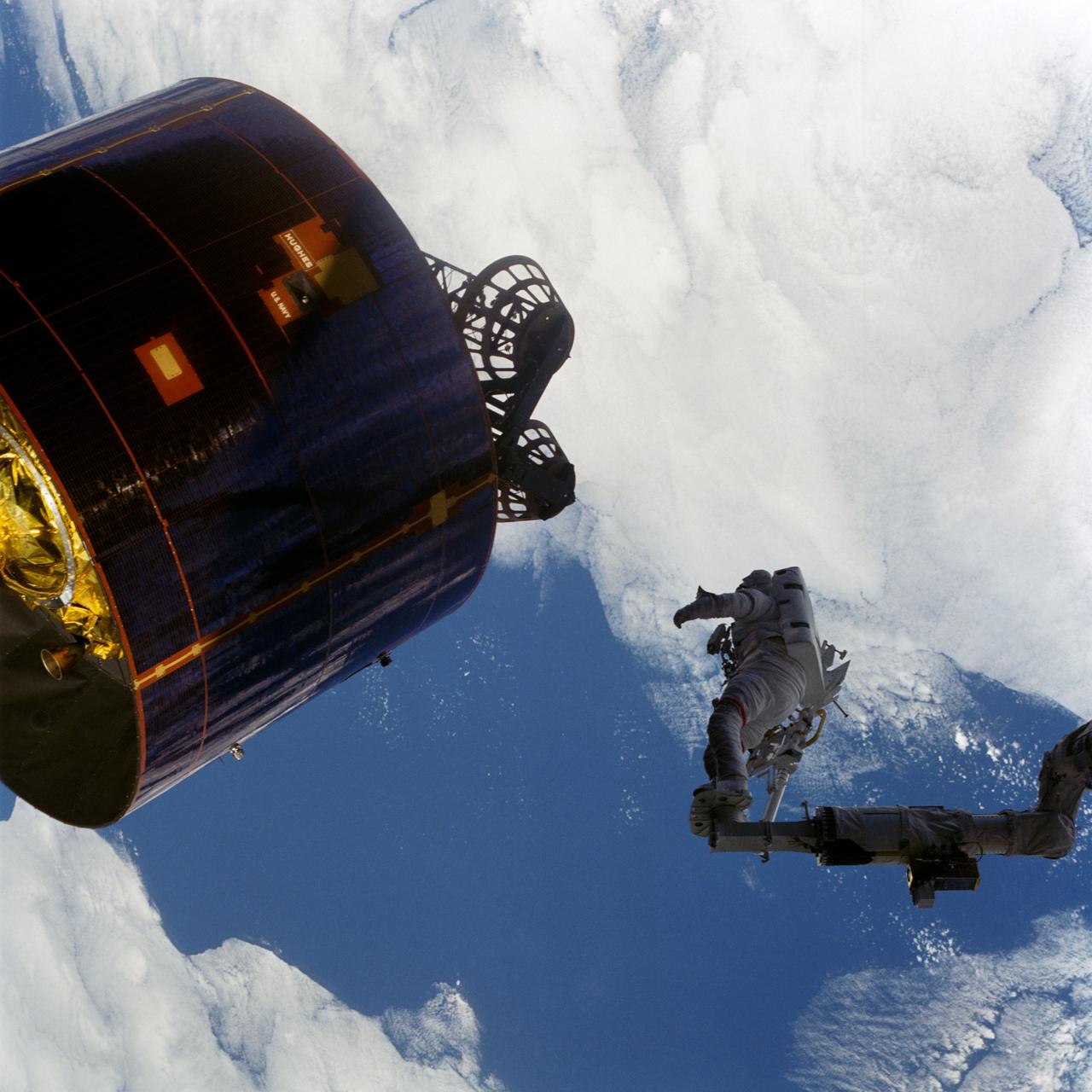
51I-44-012 (1 Sept. 1985) --- Astronaut James D. van Hoften looks on as the Syncom IVC-3 satellite responds to his push against it moments earlier. Dr. van Hoften, mission specialist, is anchored to a foot restraint on the end of the remote manipulator system (RMS) arm of the Earth-orbiting space shuttle Discovery. The 51-I crew members showed this photograph at their Sept. 11 postflight press conference. Photo credit: NASA
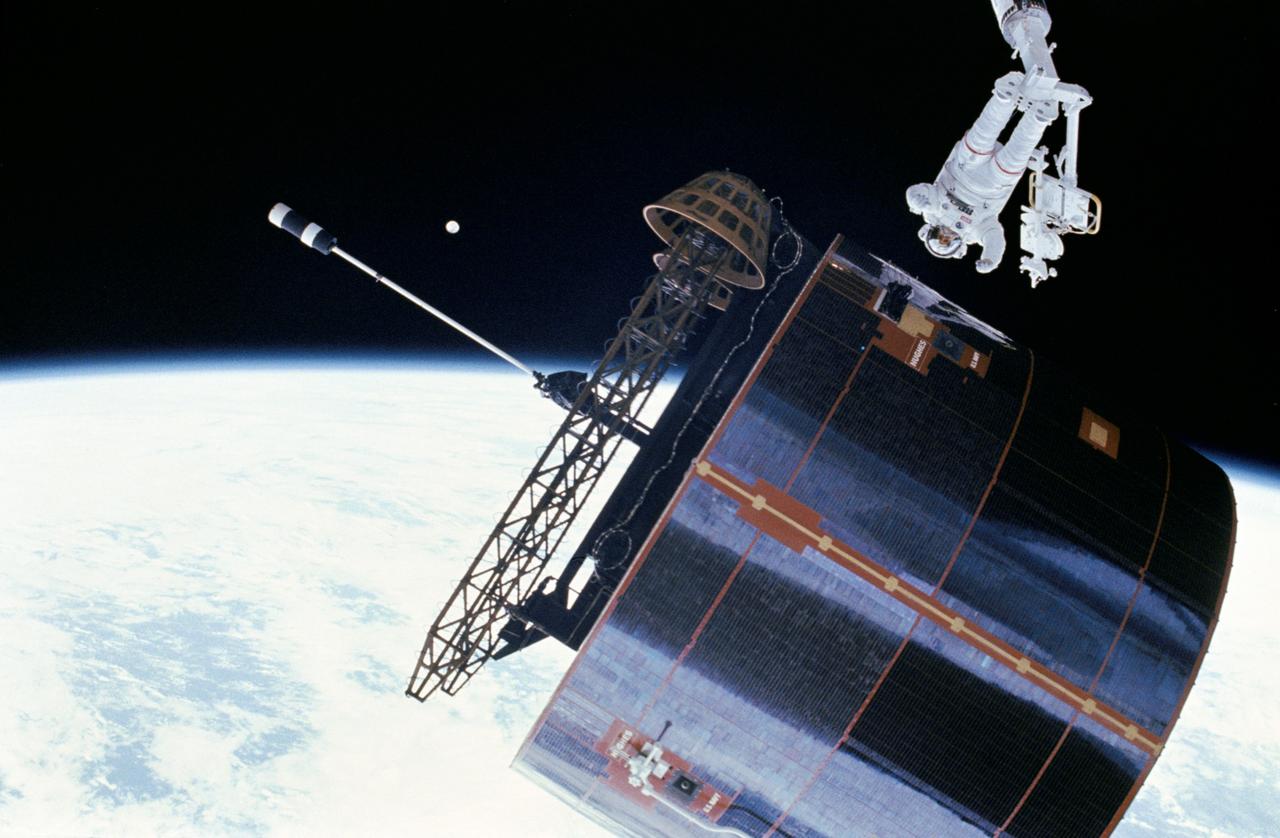
51I-102-029 (31 August - 1 September 1985) --- This is one of a series of six photographs released by NASA covering the extravehicular activity (EVA) of astronauts James D. van Hoften and William F. Fisher, who helped to capture, repair and release the previously errant Syncom IV-3 communications satellite. Here, Dr. van Hoften has just given a shove to the the Syncom. (For orientation, moon should be in lower right quadrant).
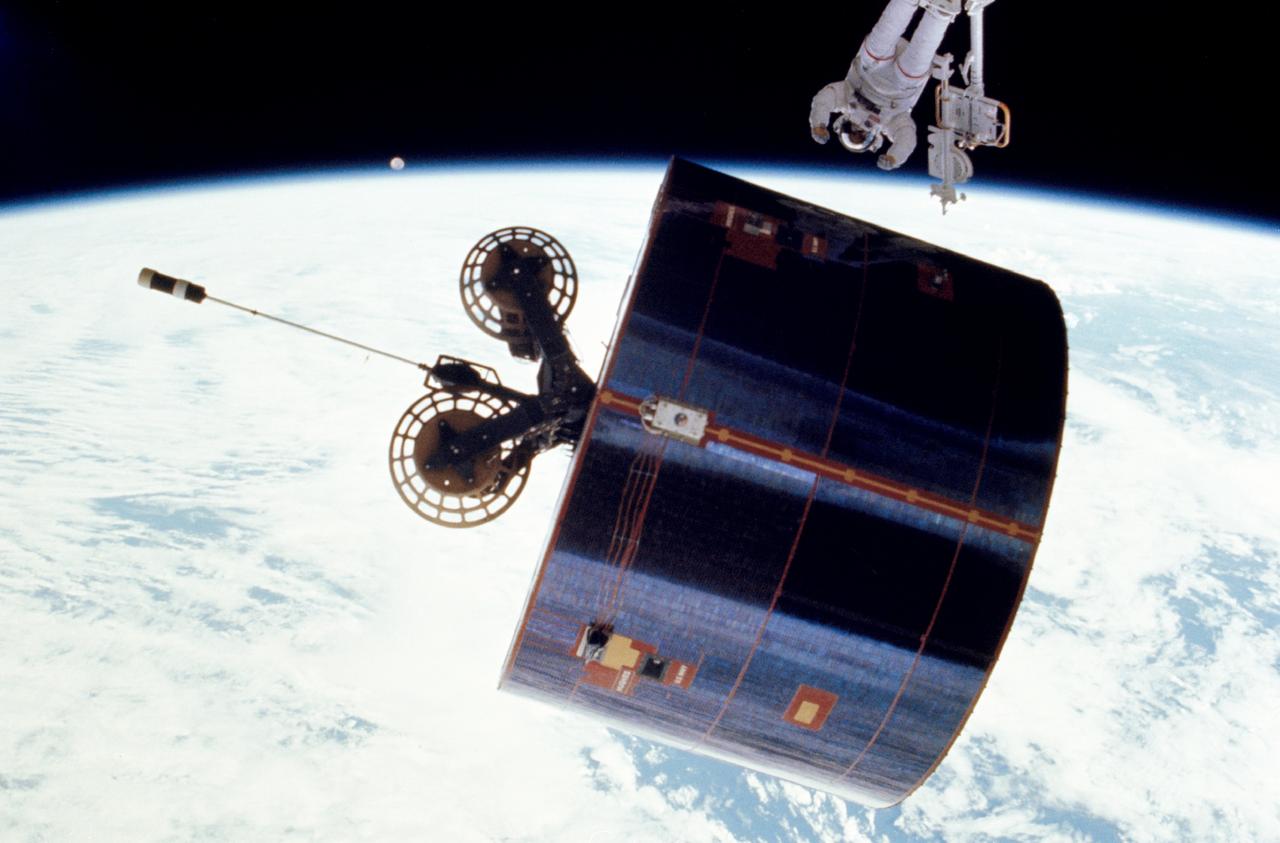
51I-102-033 (31 August - 1 September 1985) --- This is one of a series of six photographs released by NASA covering the extravehicular activity (EVA) of astronauts James D. van Hoften and William F. Fisher, who helped to capture, repair and release the previously errant Syncom IV-3 communications satellite. Here, Dr. van Hoften has just given a shove to the the Syncom. (For orientation, moon should be in lower right quadrant).
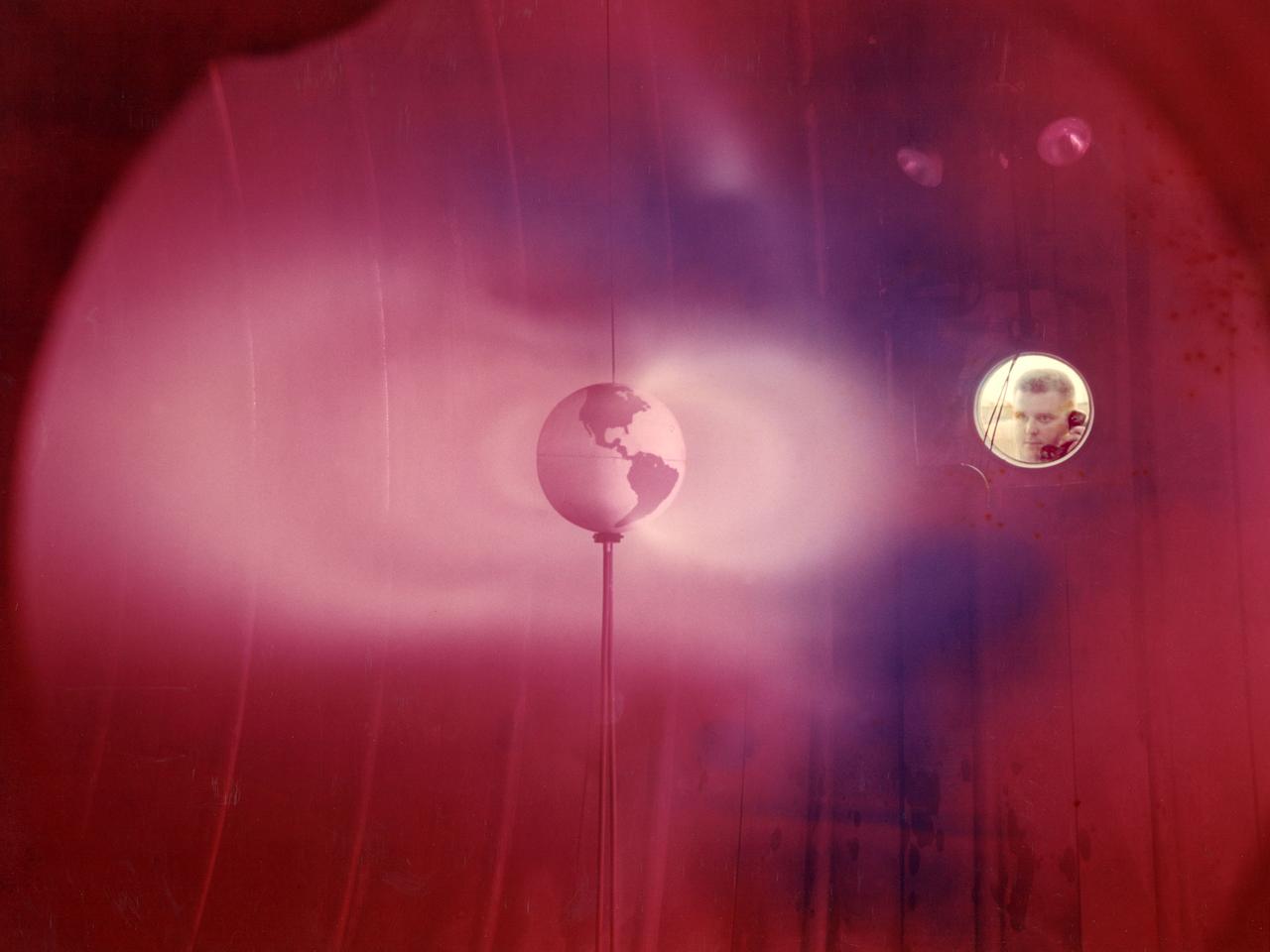
The model of the Earth housed inside Vacuum Tank 5 contained a coil which produced a magnetic field simulating that of the Earth. It was bombarded with a stream of ionized particles simulating the solar wind which impinges on the Earth's magnetic field. The bands or belts of luminous plasma seen in this image were suggestive of the Van Allen belts found around the Earth. Scientists at Lewis probed the plasma around the model and studied scaling laws in an attempt to find an explanation for the actual formation of the Van Allen belt.
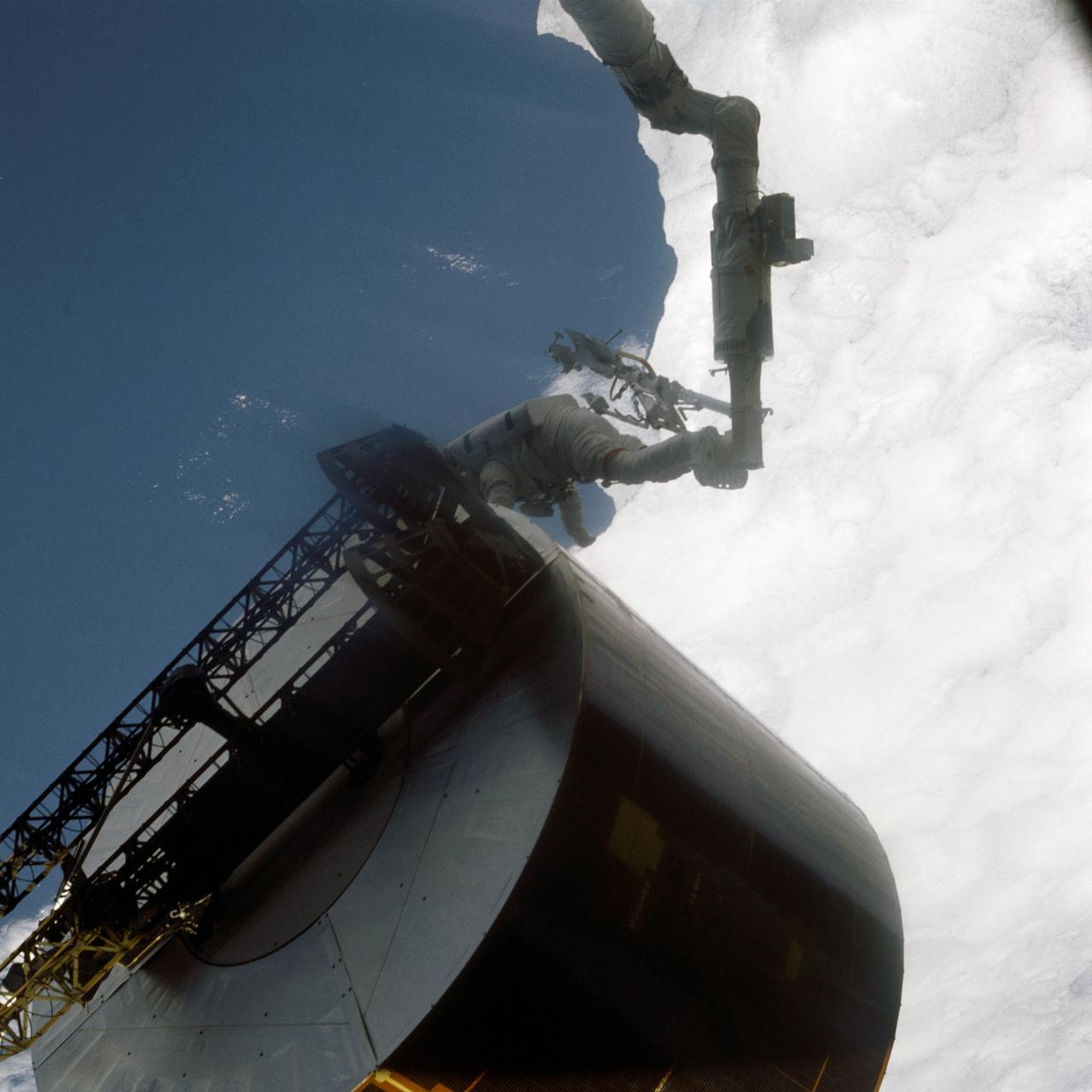
51I-44-014 (31 Aug-1 Sept. 1985) --- This photograph is one of a series of six covering extravehicular activity (EVA) which were released by NASA on Sept. 4, 1985. Here, astronaut James D. van Hoften, dwarfed by the large satellite, moves in for initial contact. Astronaut John M. (Mike) Lounge, out of frame inside cabin, maneuvers the remote manipulator system (RMS) arm to assist astronauts van Hoften and William F. Fisher. Photo credit: NASA
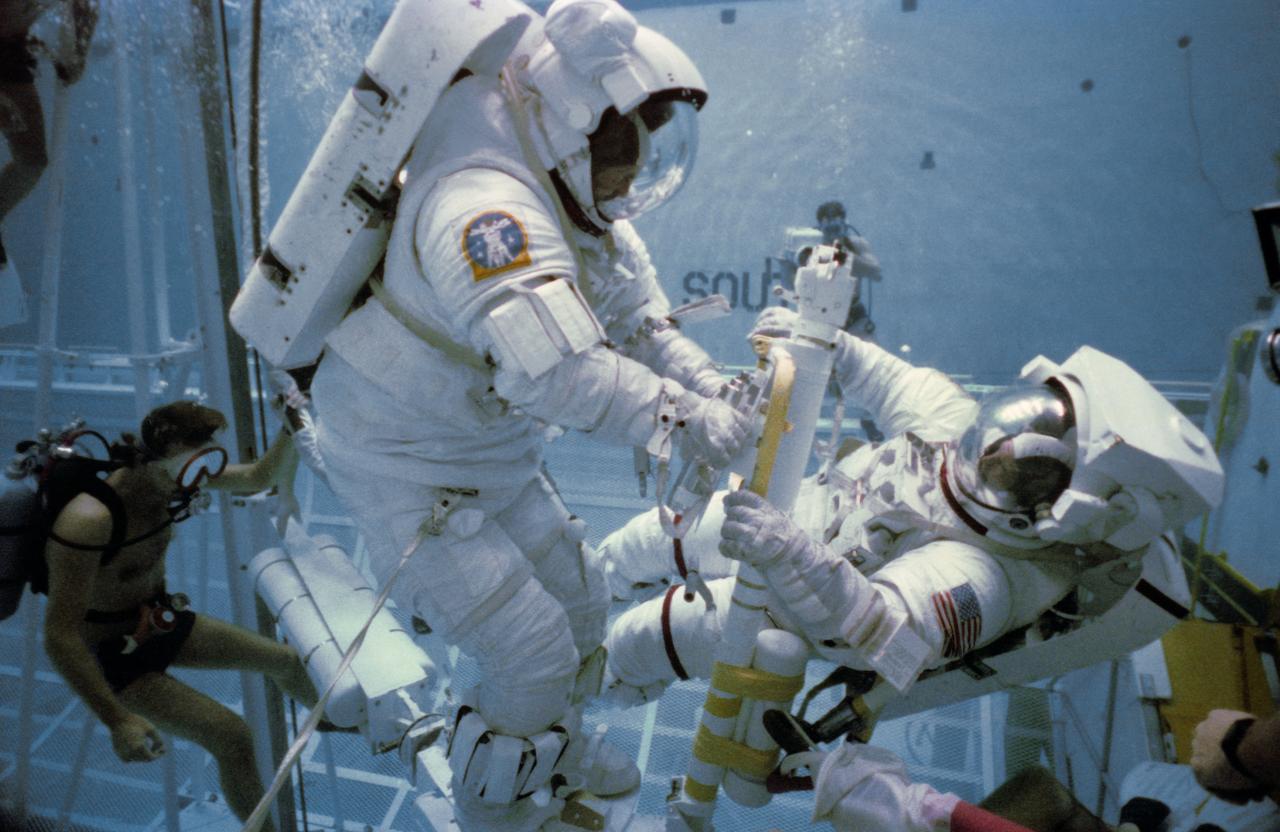
S83-42895 (19 Oct 1983) --- Astronauts George D. Nelson and James D. van Hoften, NASA Flight STS-41C mission specialists, offer an underwater version of a preview of their mission's extravehicular activity (EVA). The April 1984 flight includes as one of its primary objectives a two-person EVA and a visit to the damaged Solar Maximum Satellite (SMS). Van Hoften, left, and Nelson work here with the mobile foot restraint (MFR), which attaches to the remote manipulator system (RMS) arm to form a "cherry-picker" device. Van Hoften is standing on the MFR. The two are making use of the Johnson Space Center's (JSC) weightless environment training facility (WET-F). This photograph was taken by Otis Imboden.

Leon Van Speybroeck of the Harvard-Smithsonian Center for Astrophysics in Cambridge Massachusetts was awarded the 2002 Bruno Rossi Prize of the High-Energy Astrophysics Division of the American Astronomy Society. The Rossi Prize is an arnual recognition of significant contributions in high-energy astrophysics in honor of the Massachusetts Institute of Technology's late Professor Bruno Rossi, an authority on cosmic ray physics and a pioneer in the field of x-ray astronomy. Van Speybroeck, who led the effort to design and make the x-ray mirrors for NASA's premier Chandra X-Ray Observatory, was recognized for a career of stellar achievements in designing precision x-ray optics. As Telescope Scientist for Chandra, he has worked for more than 20 years with a team that includes scientists and engineers from the Harvard-Smithsonian, NASA's Marshall Space Flight Center, TRW, Inc., Huhes-Danbury (now B.F. Goodrich Aerospace), Optical Coating Laboratories, Inc., and Eastman-Kodak on all aspects of the x-ray mirror assembly that is the heart of the observatory.
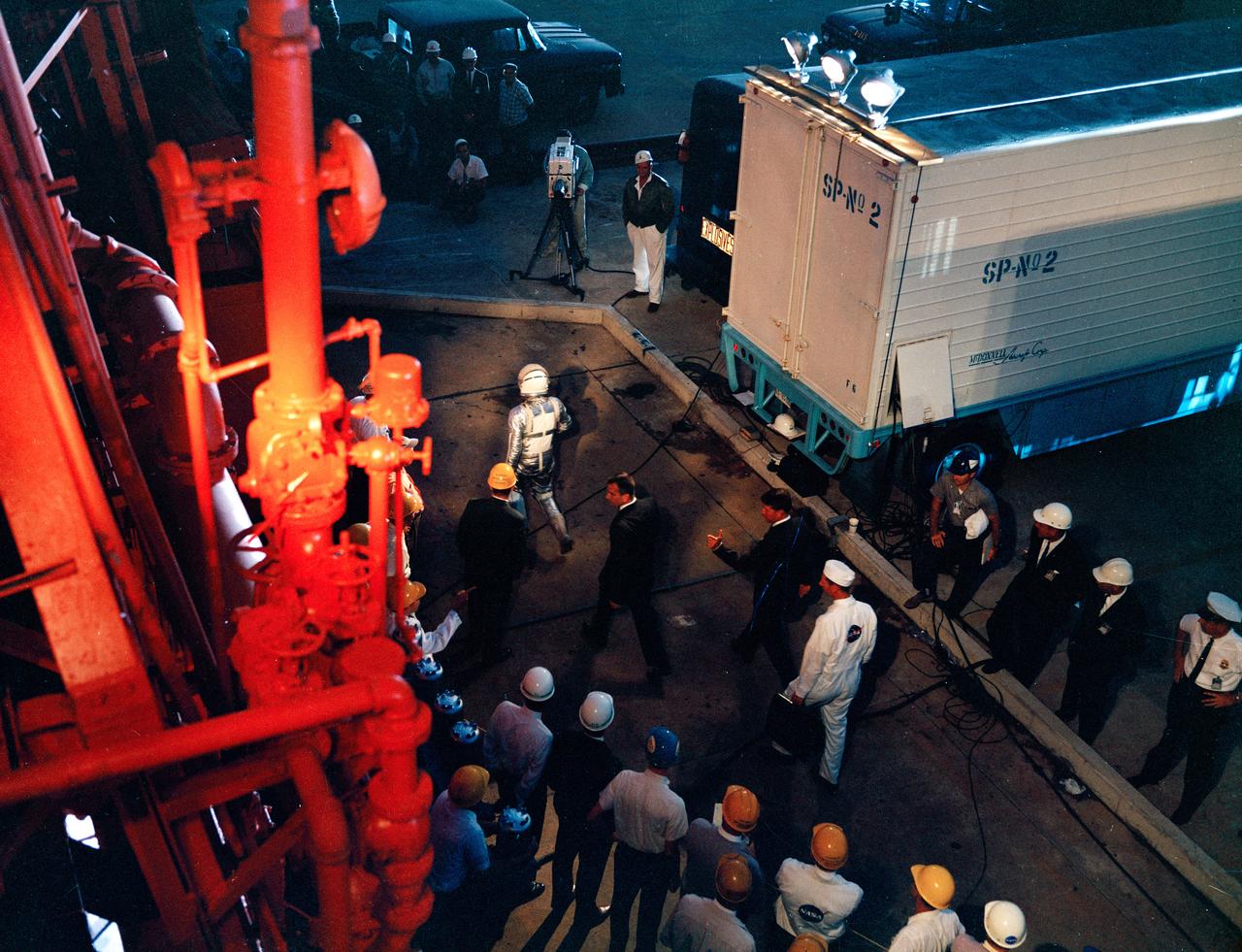
S63-07632 (15 May 1963) --- Astronaut L. Gordon Cooper Jr. leaves the transfer van for the launch pad and the beginning of the Mercury-Atlas 9 (MA-9) flight on May 15, 1963. Photo credit: NASA
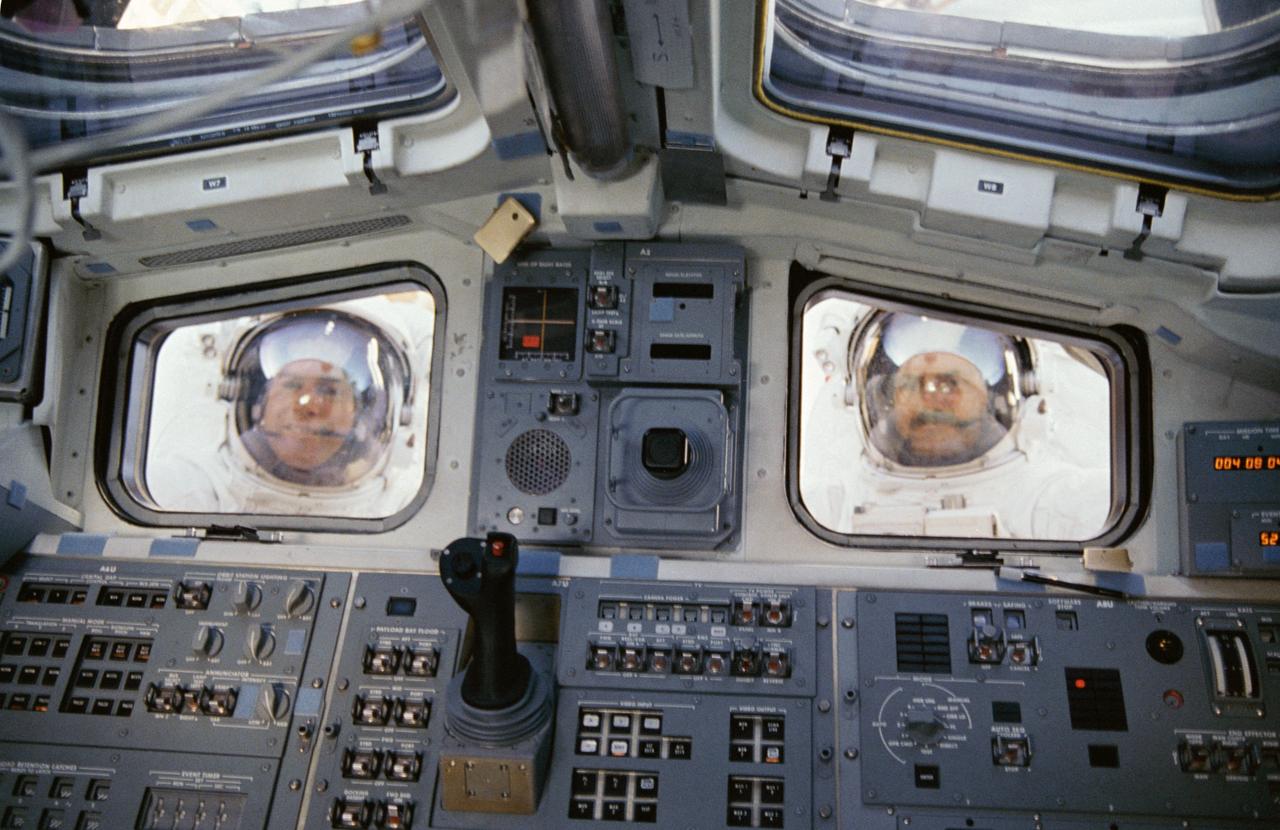
51I-11-027 (1 Sept 1985) --- The extravehicular activity (EVA) of astronauts William F. Fisher (left) and James D. van Hoften succeeded in the capture, repair and re-release of the troubled Syncom IV-3 satellite. Here, the two take a break from the serious side of their EVA to look into the Discovery's cabin. The 51-I crewmembers showed this scene at their Sept. 11 post-flight press conference.
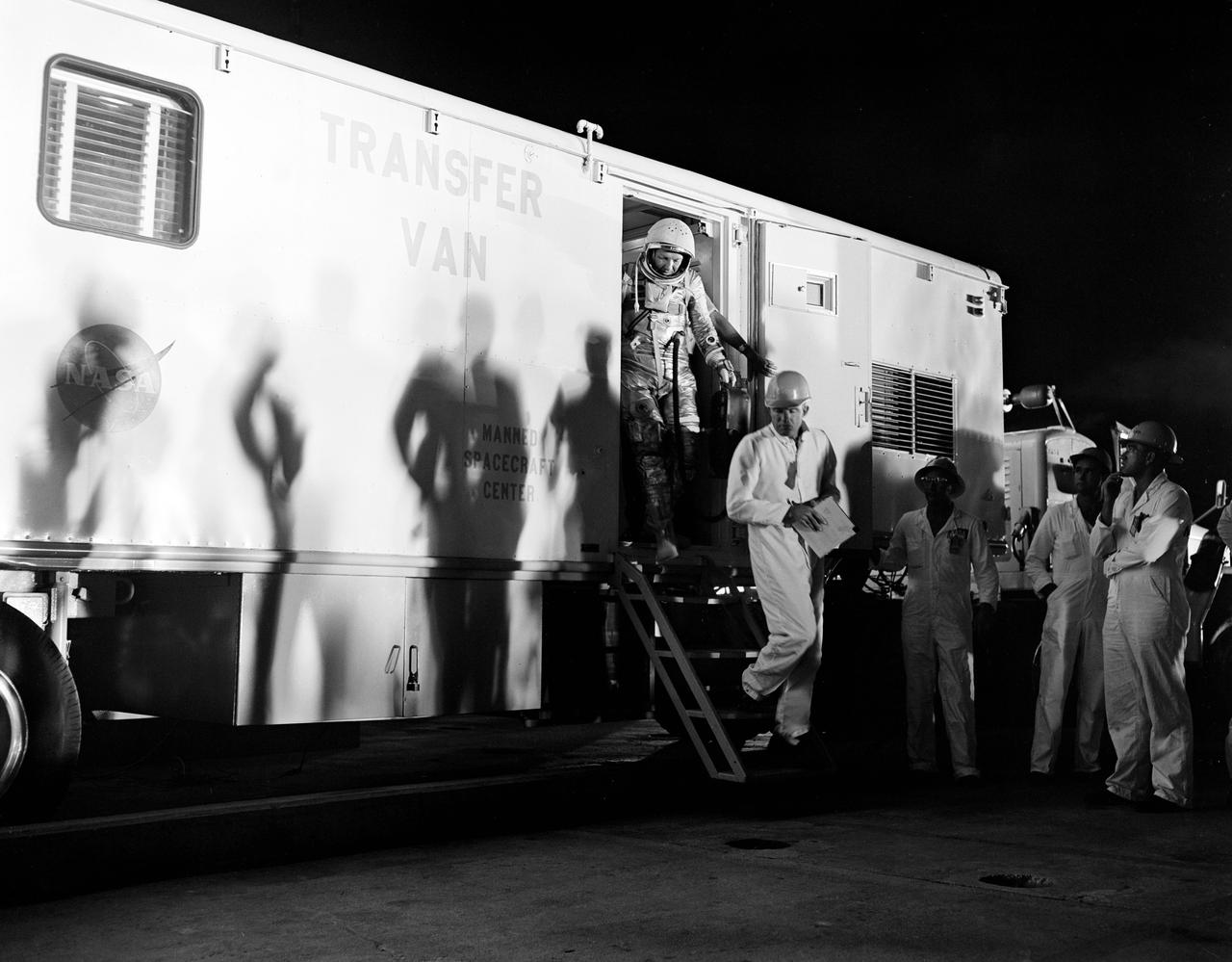
S62-06008 (3 Oct. 1962) --- Astronaut Walter M. Schirra Jr., pilot of the Mercury-Atlas 8 (MA-8) Earth-orbital spaceflight, steps from a transport van as he arrives at Cape Canaveral's Pad 14 during the MA-8 prelaunch countdown. Schirra is accompanied by astronaut L. Gordon Cooper Jr. (in white coveralls), MA-8 backup pilot. Photo credit: NASA
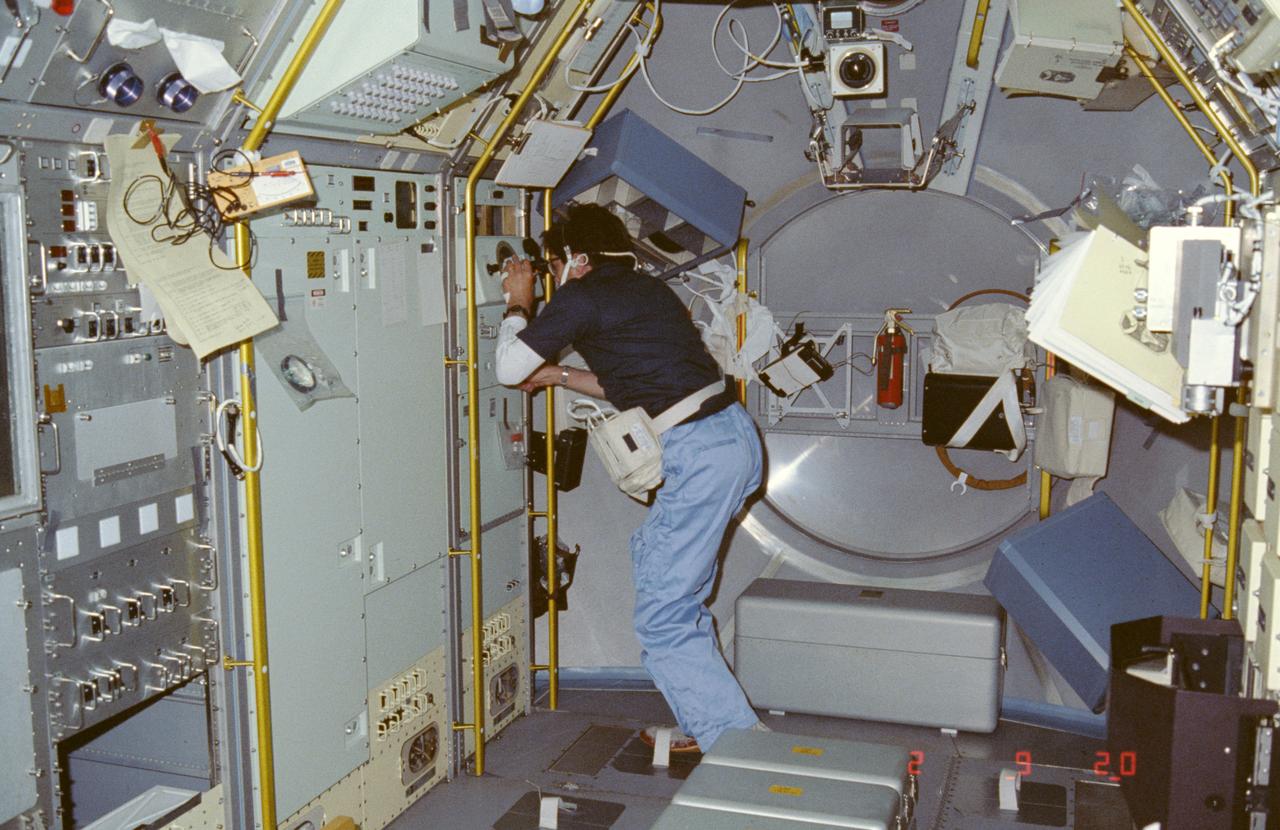
51B-06-010 (29 April-6 May 1985) --- Lodewijk van den Berg, 51-B payload specialist, observes the growth of mercuric iodide crystal in the vapor crystal growth system (VCGS) on the Spacelab 3 science module aboard the Space Shuttle Challenger.
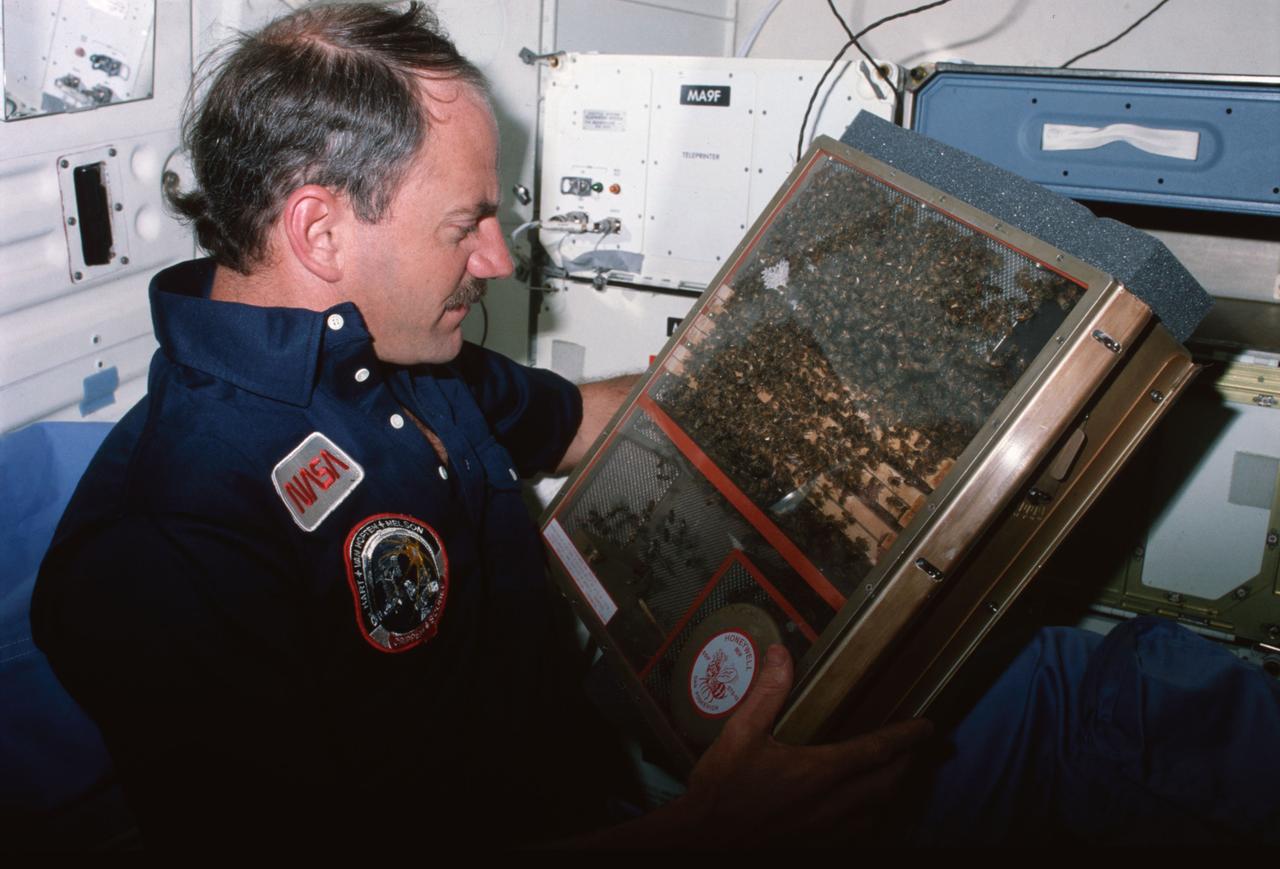
41C-05-188 (12 April 1984) --- Astronaut James D. van Hoften, mission specialist, holds an aluminum box, full of honeybees. The experiment in Earth-orbit is duplicated with another colony of the young honeycomb builders on Earth. Dan Poskevich submitted the experiment to NASA as part of the Shuttle student involvement program.
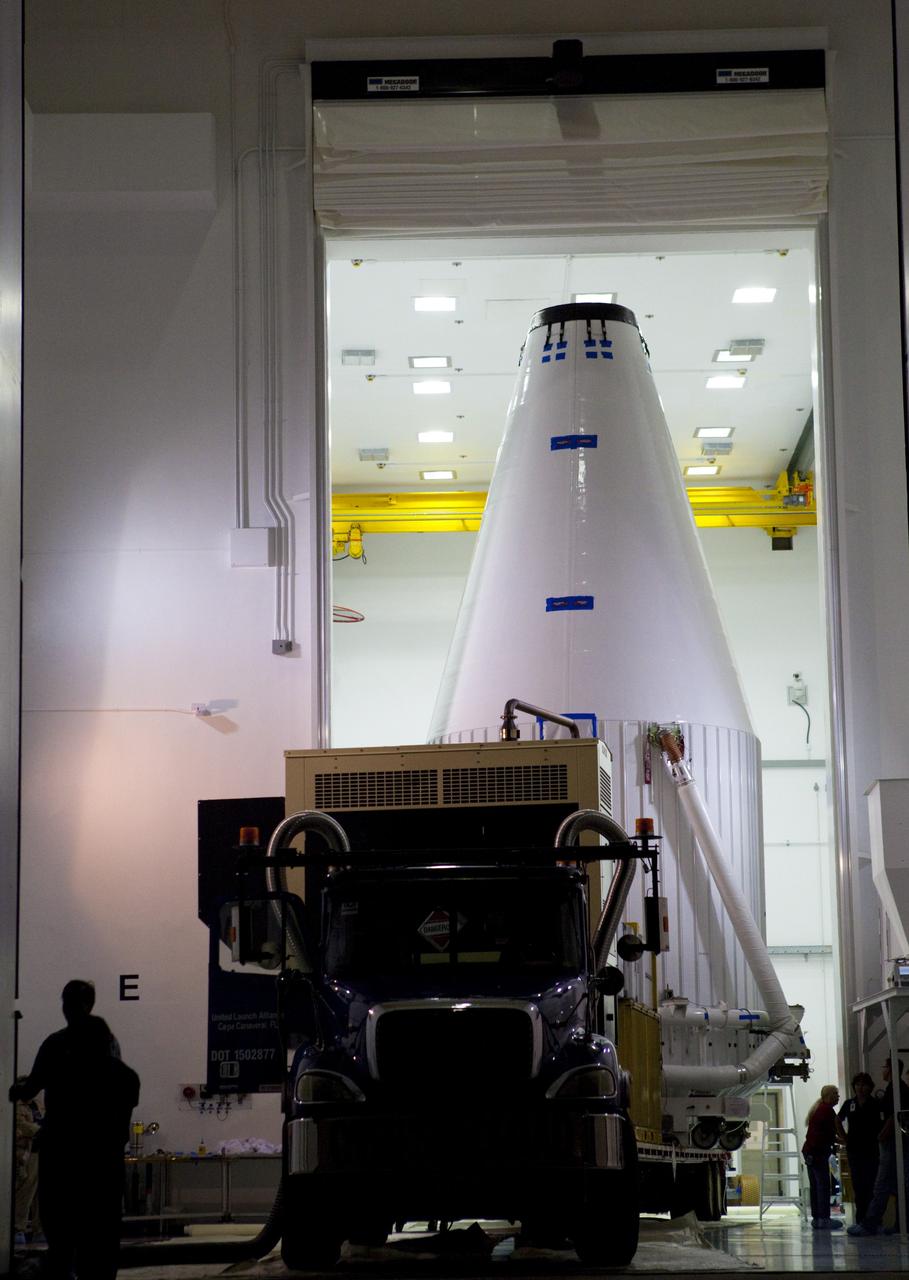
CAPE CANAVERAL, Fla. – The Radiation Belt Storm Probes, or RBSP, spacecraft are moved inside their payload fairing on the payload transporter from the Astrotech payload processing facility in Titusville, Fla. to Space Launch Complex-41 at Cape Canaveral Air Force Station. The fairing, which holds the twin RBSP spacecraft, will be lifted to the top of a United Launch Alliance Atlas V rocket for launch later in August. The two spacecraft are designed to study the Van Allen radiation belts in unprecedented detail. Photo credit: NASA/Dmitri Gerondidakis
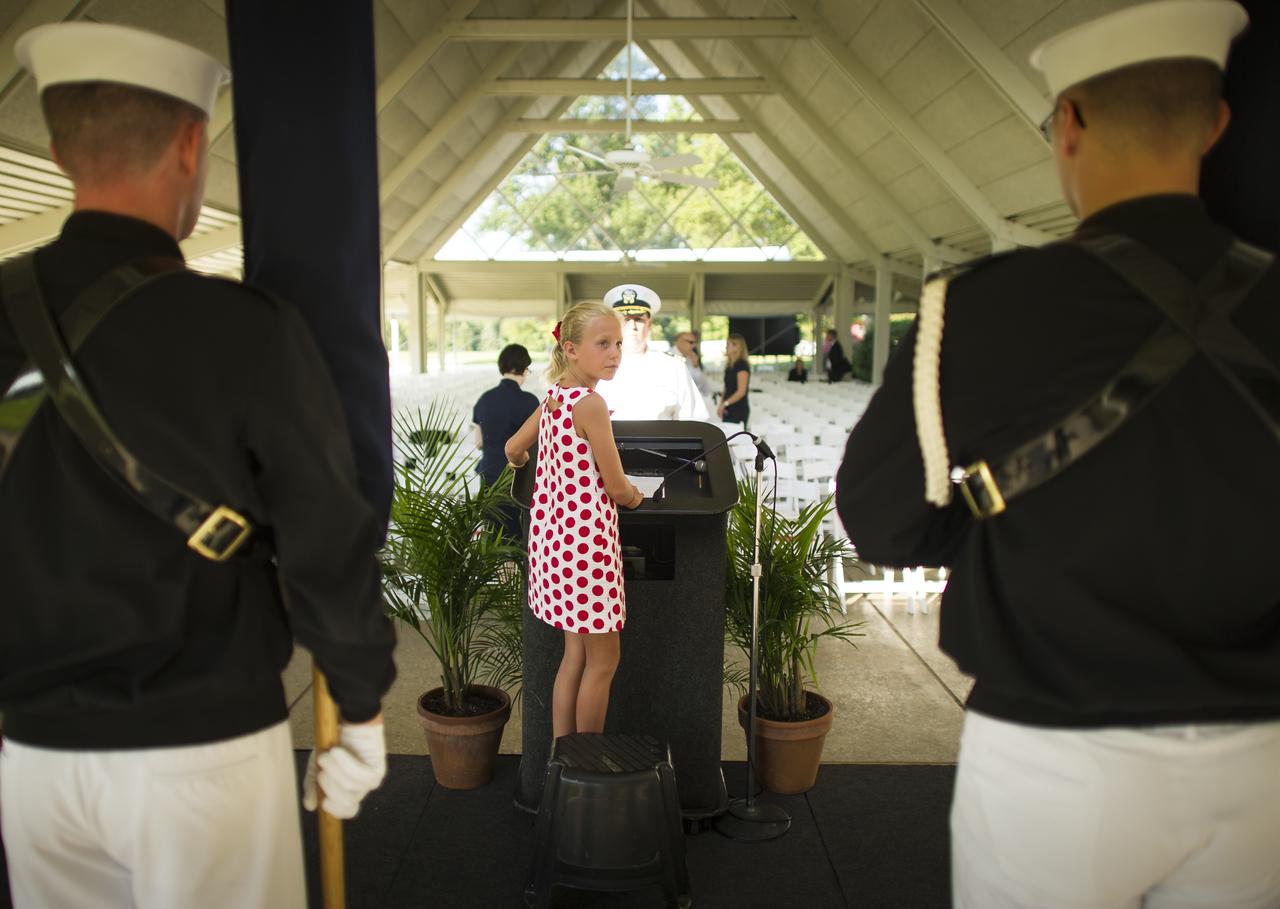
Piper Van Wagenen, one of Neil Armstrong's 10 grandchildren, is seen during preparation of a memorial service celebrating the life of Neil Armstrong, Friday, Aug. 31, 2012, at the Camargo Club in Cincinnati. Armstrong, the first man to walk on the moon during the 1969 Apollo 11 mission, died Saturday, Aug. 25. He was 82. Photo Credit: (NASA/Bill Ingalls)
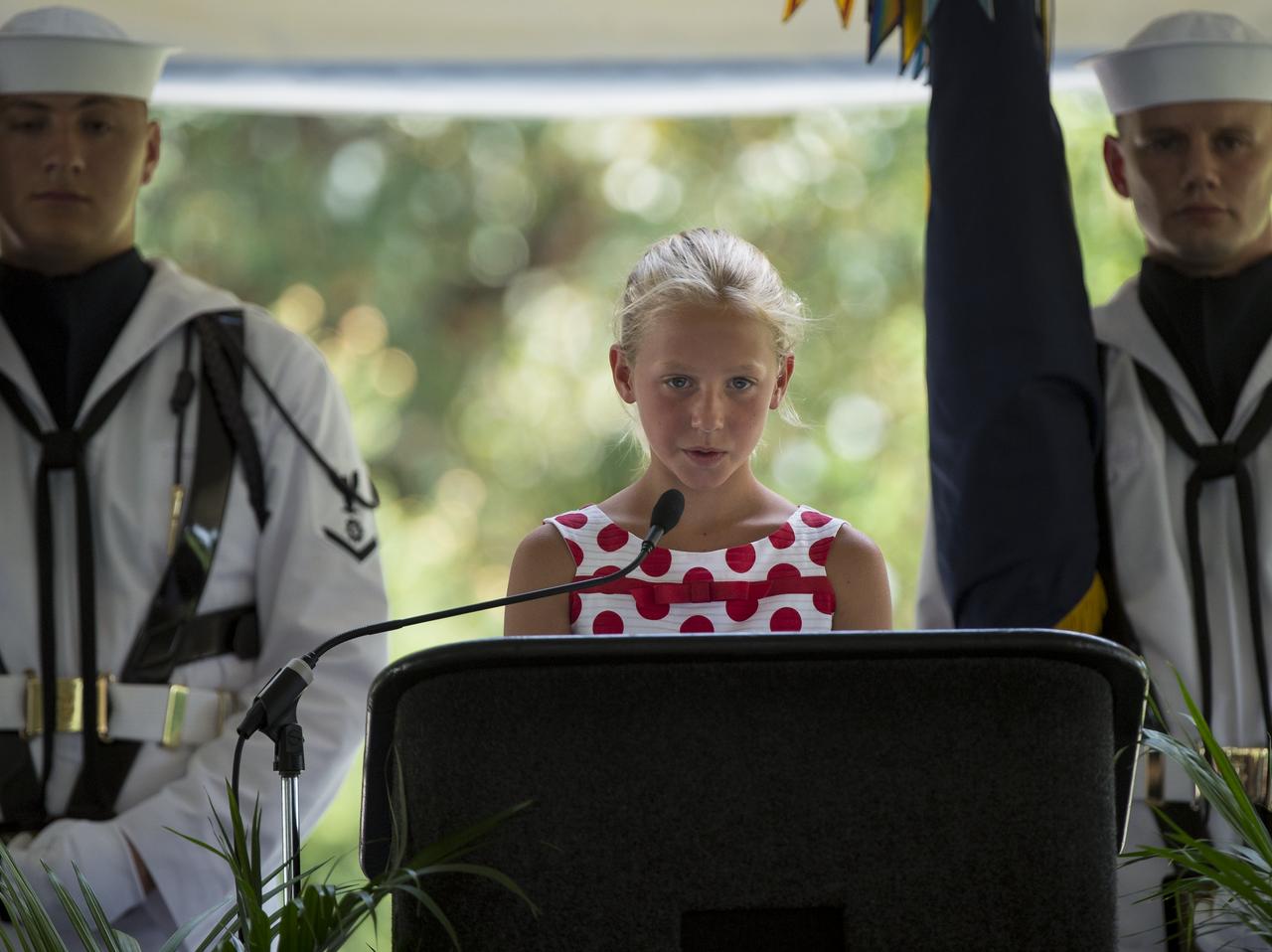
Piper Van Wagenen, one of Neil Armstrong's 10 grandchildren, speaks during a memorial service celebrating the life of her grandfather, Friday, Aug. 31, 2012, at the Camargo Club in Cincinnati. Armstrong, the first man to walk on the moon during the 1969 Apollo 11 mission, died Saturday, Aug. 25. He was 82. Photo Credit: (NASA/Bill Ingalls)
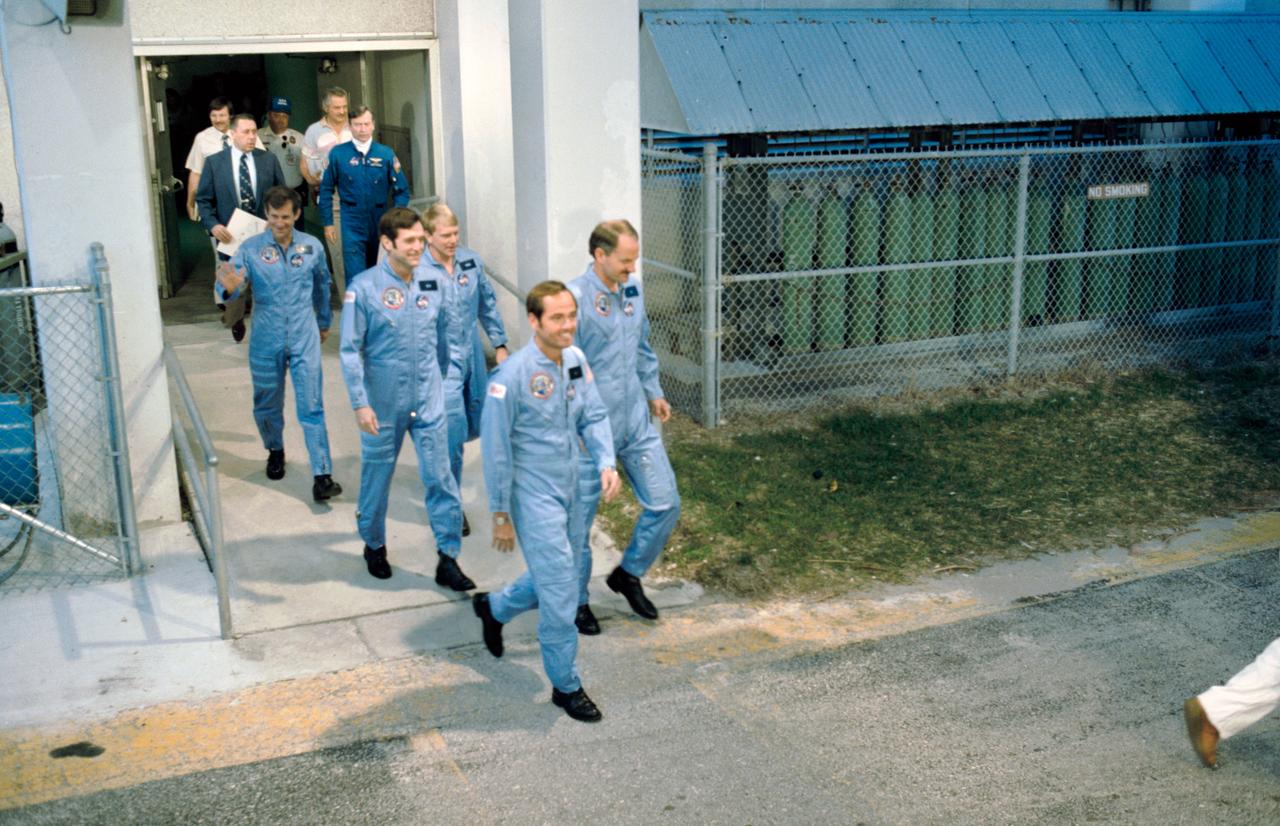
41C-3061 (6 April 1984) --- The five-member astronauts crew for NASA's STS-41C Space Shuttle mission head for the transfer van that will transport them to Launch Pad 39B at the Kennedy Space Center. Astronaut Robert L. Crippen, commander, leads the way. Immediately behind Crippen is Astronaut Francis R. (Dick) Scobee, pilot. The three mission specialists are (left to right) Astronauts Terry J. Hart, George D. Nelson and James D. van Hoften. The photograph was taken by Otis Imobden.
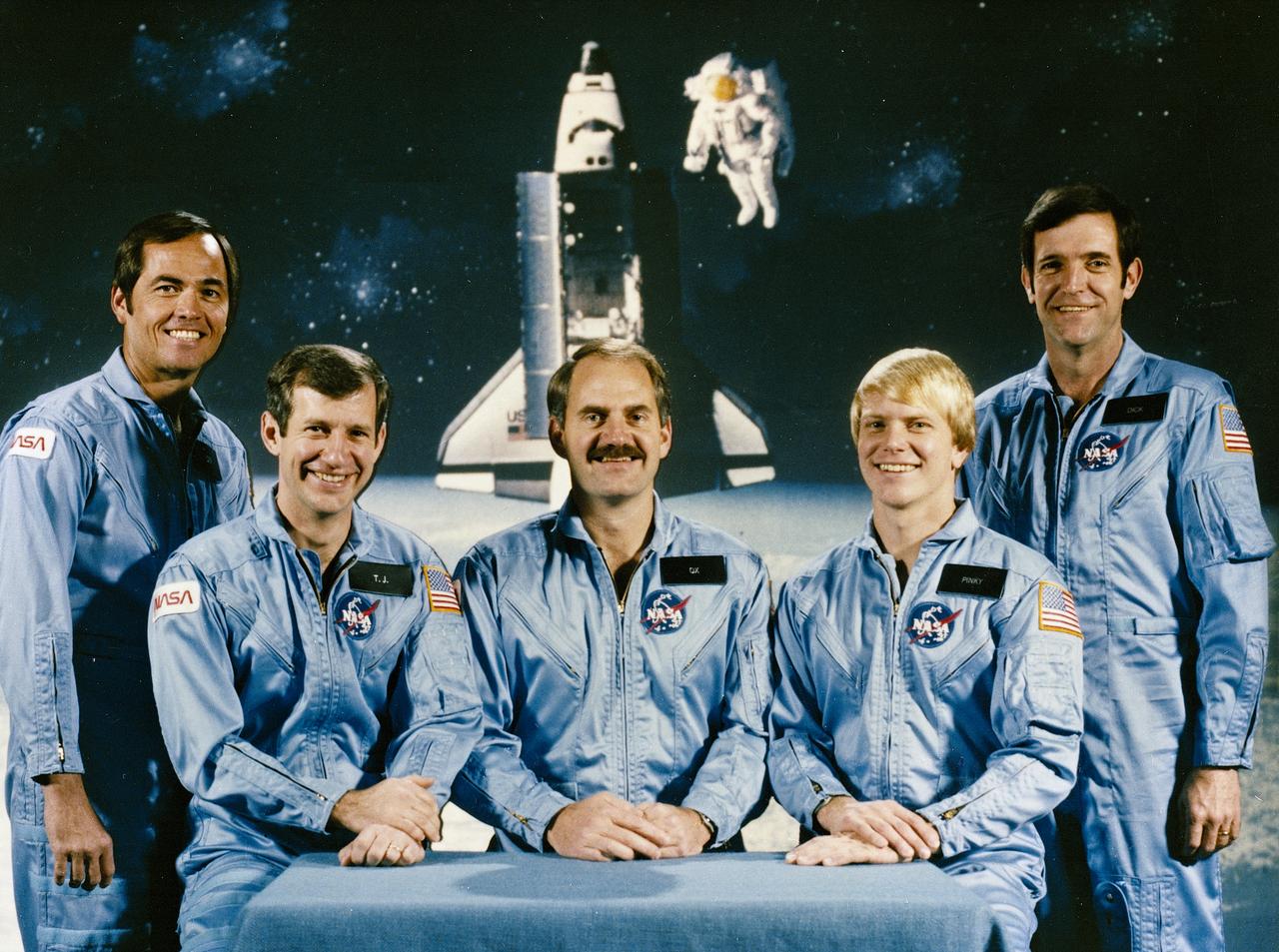
The crew assigned to the STS-41CB (STS-13) mission included (left to right) Robert L. Crippen, commander; Terry J. Hart, mission specialist; James D. Van-Hoften, mission specialist; George D. Nelson, mission specialist; and Francis R. (Dick) Scobee, pilot. Launched aboard the Space Shuttle Challenger on April 6, 1984 at 8:58:00 am (EST), the STS-41C mission marked the first direct ascent trajectory for the Space Shuttle. The crew deployed the Long Duration Exposure Facility (LDEF).
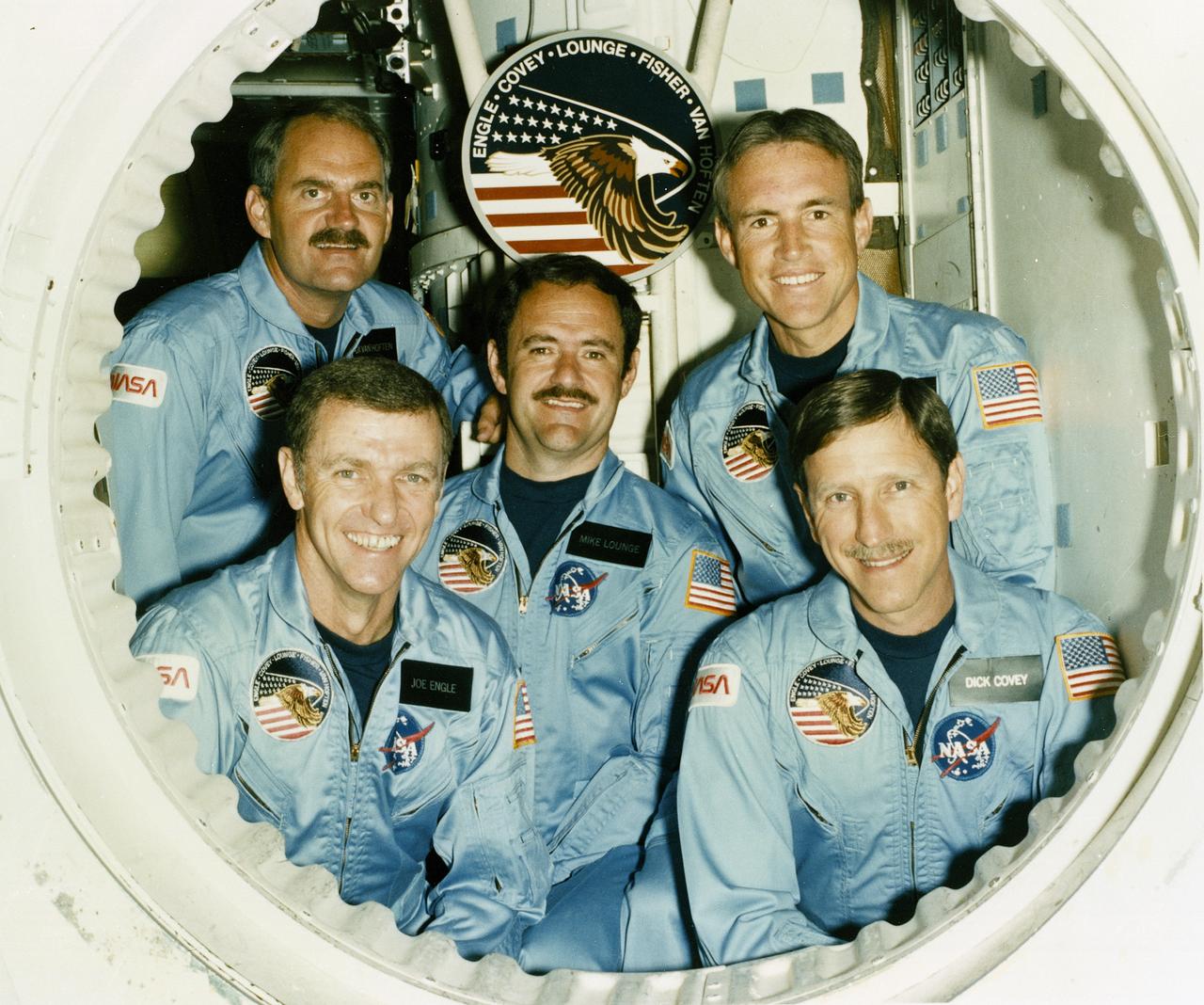
The crew assigned to the STS-51I mission included (front row left to right) Joe H. Engle, commander; and Richard O. Covey, pilot. In the center is John M. (Mike) Lounge, mission specialist. On the back row, from left to right, are mission specialists James D. van Hoften, and William F. Fisher. Launched aboard the Space Shuttle Discovery on August 27, 1985 at 6:58:01 am (EDT), the STS-51I mission’s primary payloads were three communication satellites: the ASC-1 for the American Satellite Company; the AUSSAT-1, an Australian communications satellite; and the SYNCOM-IV-4, the synchronous communications satellite.
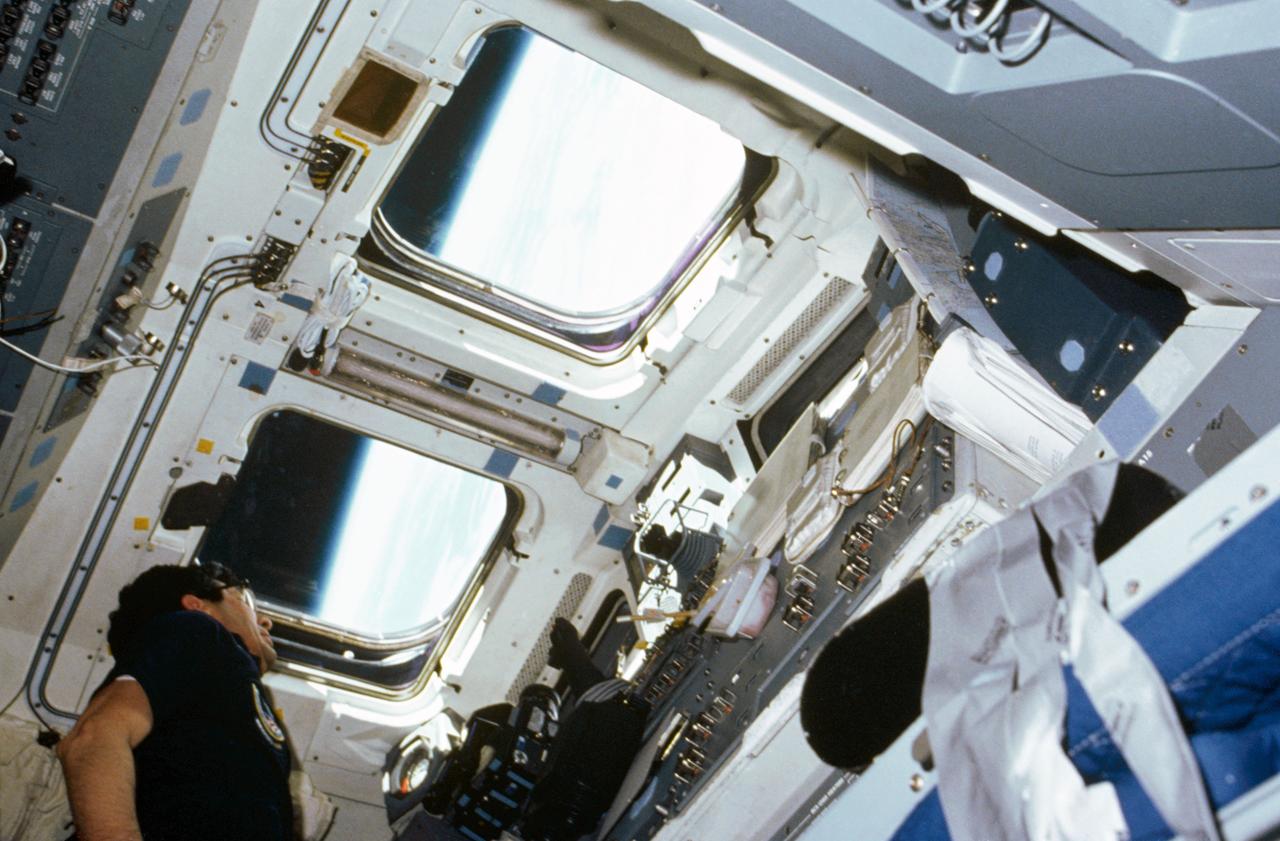
In this low-angle photo Payload specialist Lodewijk van den Berg, one of two payload specialists, looks out aft flight deck window aboard the shuttle orbiter Challenger.
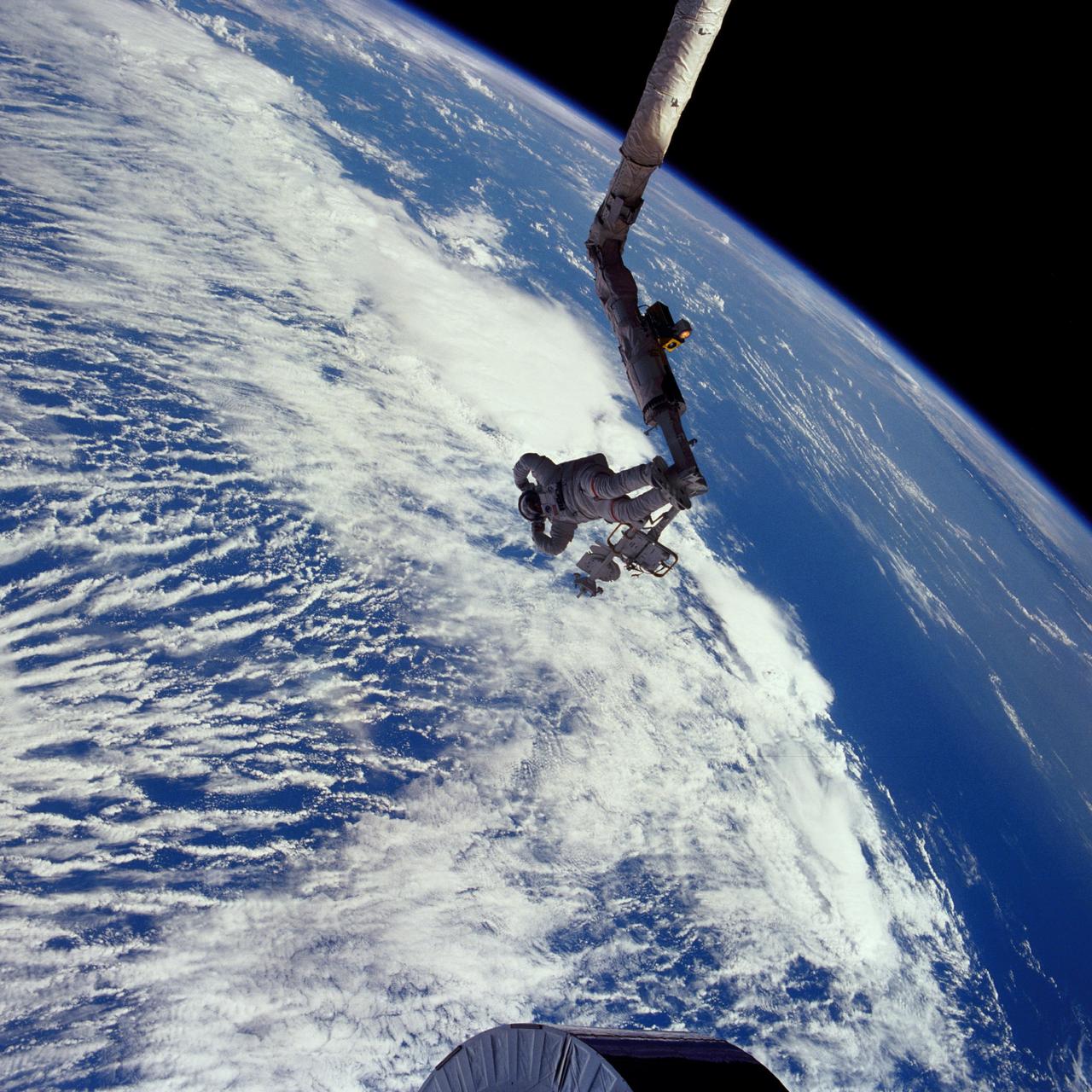
51I-41-086 (1 September 1985) --- Astronaut James D. van Hoften, mission specialist, flexes his muscles in celebration of a triumphant extravehicular task. Clouds over the ocean form the backdrop for this 70mm scene, toward the end of a two-day effort to capture, repair and release the previously errant Syncom IV-3 communications satellite. Van Hoften, anchored to a special foot restraint device on the end of Discovery's Remote Manipulator System (RMS), had just performed the final "shove" that started the relative separation of the Shuttle and the Syncom, which is not far out of frame. He had been joined by astronaut William F. Fisher for the busy two days of EVA.
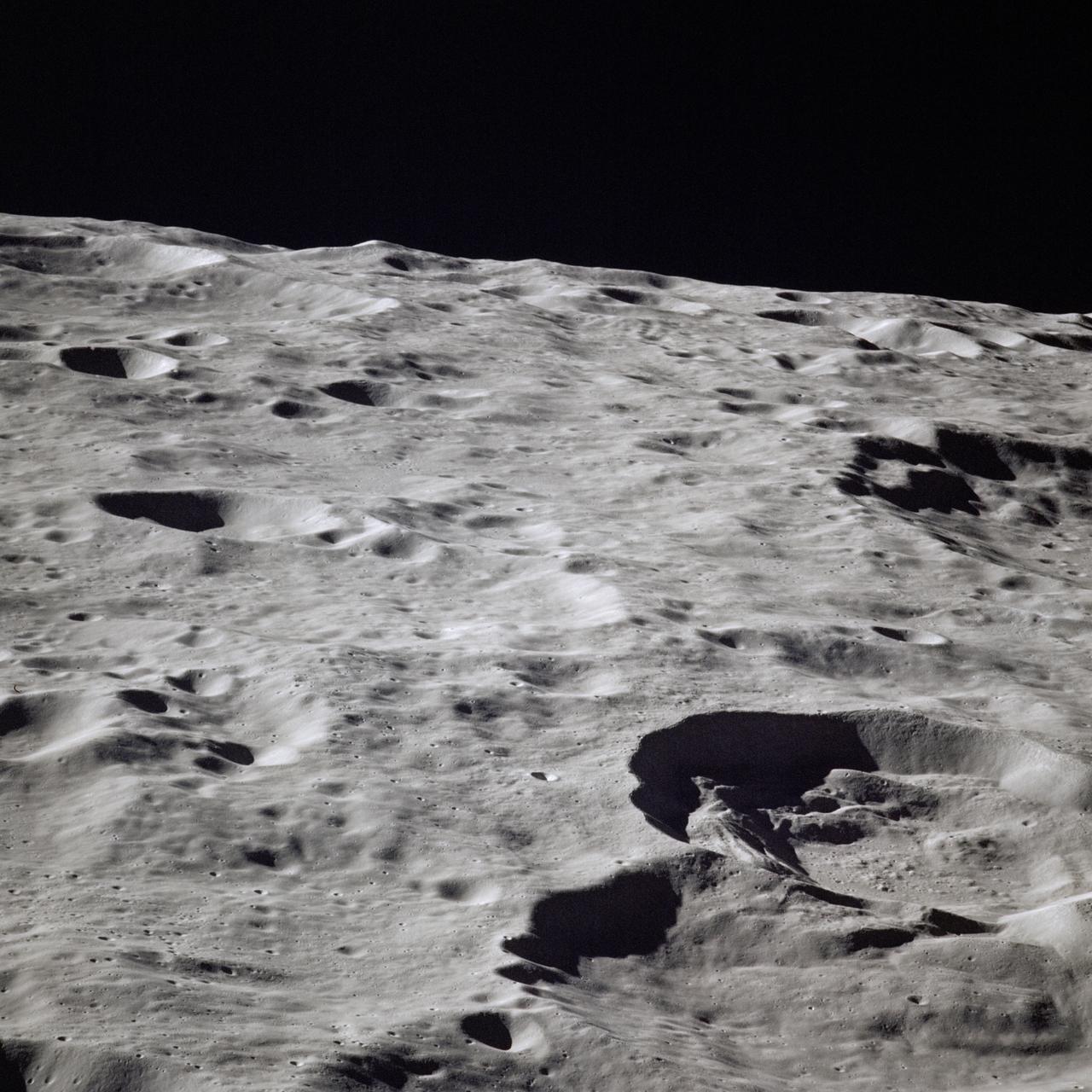
AS16-118-18947 (16-27 April 1972) --- A 250mm view looking north by westward across lunar farside highland terrain, as photographed from the Apollo 16 spacecraft in lunar orbit. The frame is centered at approximately 158 degrees east longitude and 17 degrees north latitude. Van Gent Crater is the lower of two large craters at extreme lower right corner. The top of the two craters is unnamed. The west part of Konstantinov Crater is at extreme right center. Nagaoka Crater is just below the horizon at upper left.
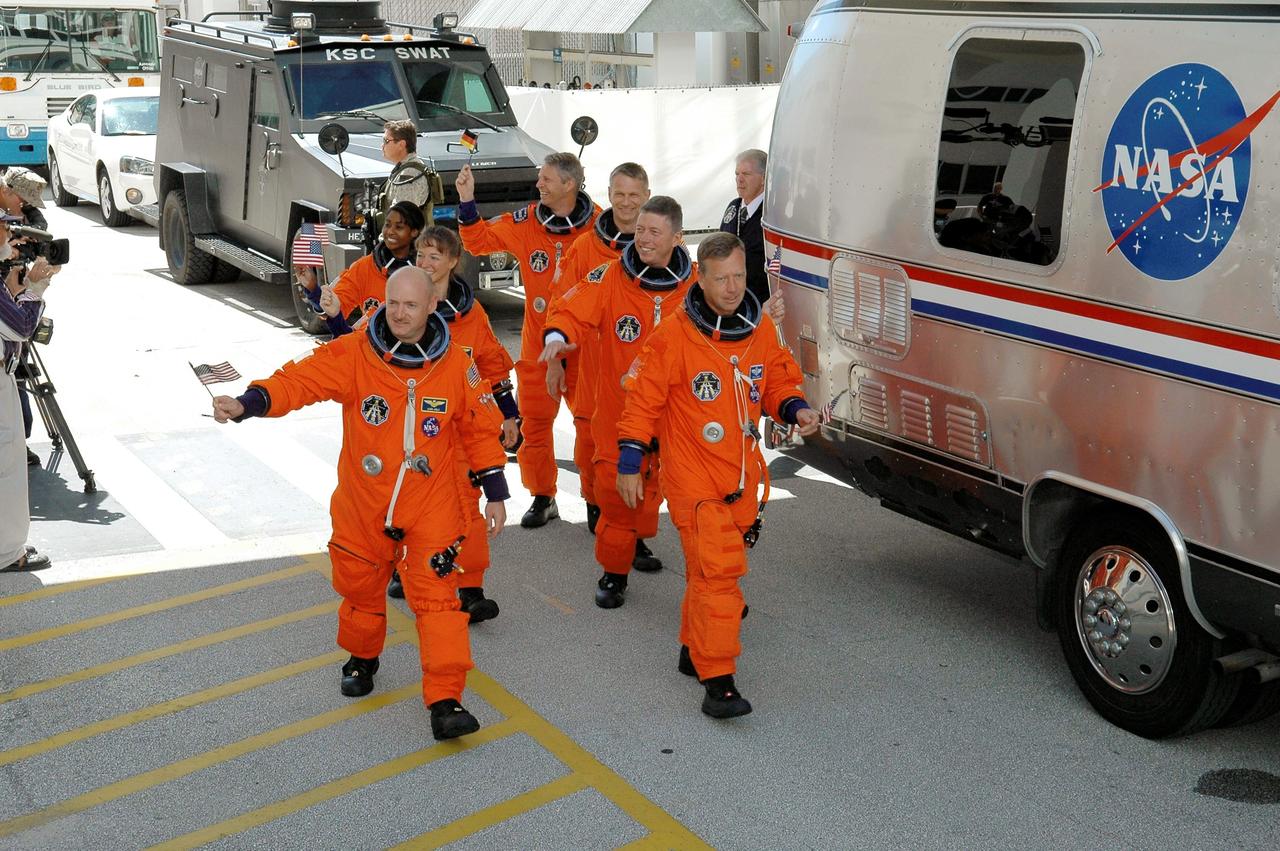
STS121-S-006 (4 July 2006) --- The STS-121 crewmembers, having donned their shuttle launch and entry suits, wave flags for the Fourth of July as they prepare to board the transfer van awaiting to take them to Launch Pad 39B. Steven W. Lindsey (right front), commander, and Mark E. Kelly, pilot, lead the way. Other crewmembers - Lisa M. Nowak, Michael E. Fossum, Stephanie D. Wilson, Piers J. Sellers and European Space Agency (ESA) astronaut Thomas Reiter of Germany - follow.
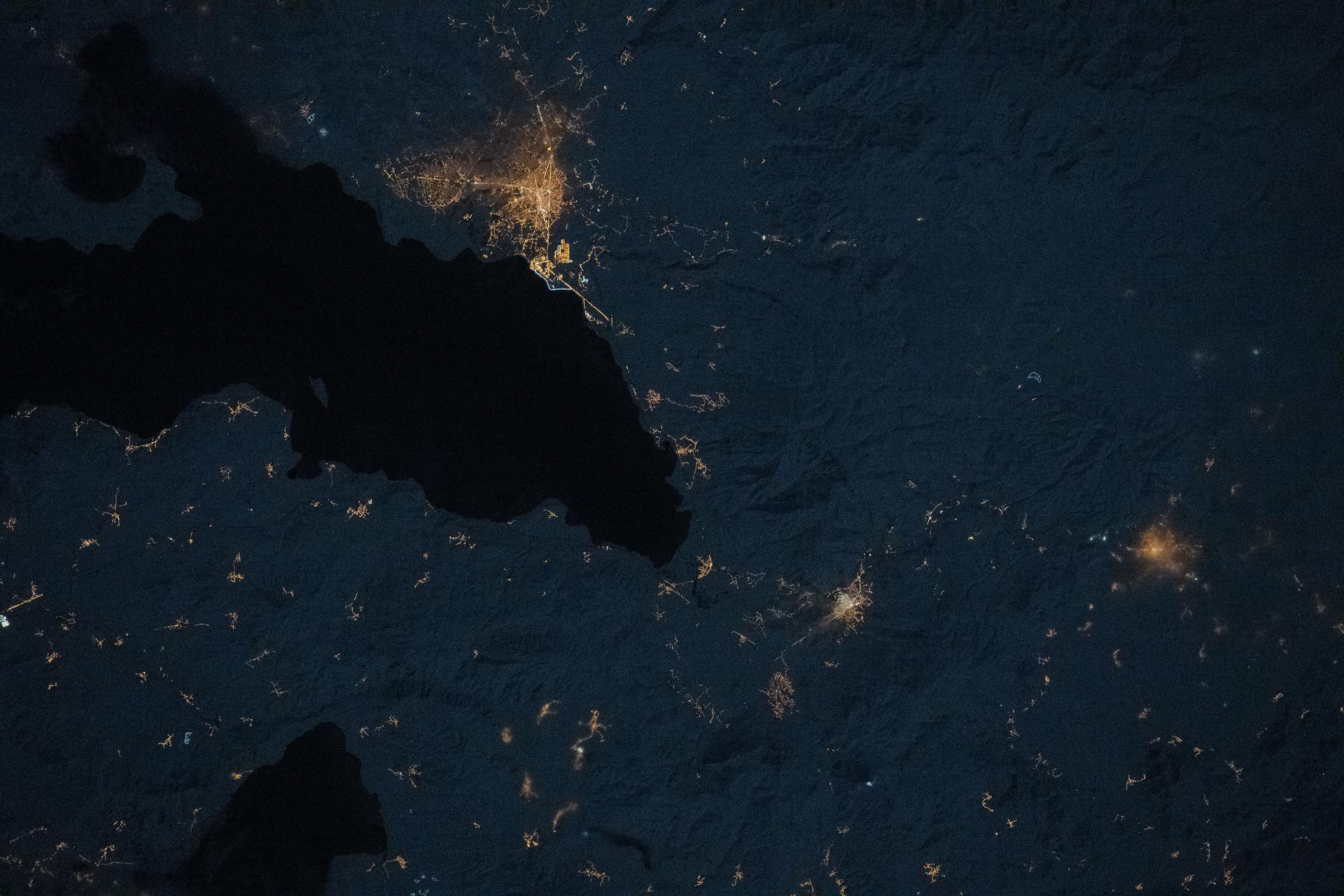
iss074e0043930 (Jan. 3, 2026) --- The amber high-pressure sodium lights of Erciş, Türkiye (top), along with its suburbs and villages, dot the landscape surrounding Lake Van in the nation’s Eastern Anatolia Region. The International Space Station was orbiting 262 miles above Earth at approximately 10:12 p.m. local time when this photograph was taken. Credit: JAXA/Kimiya Yui
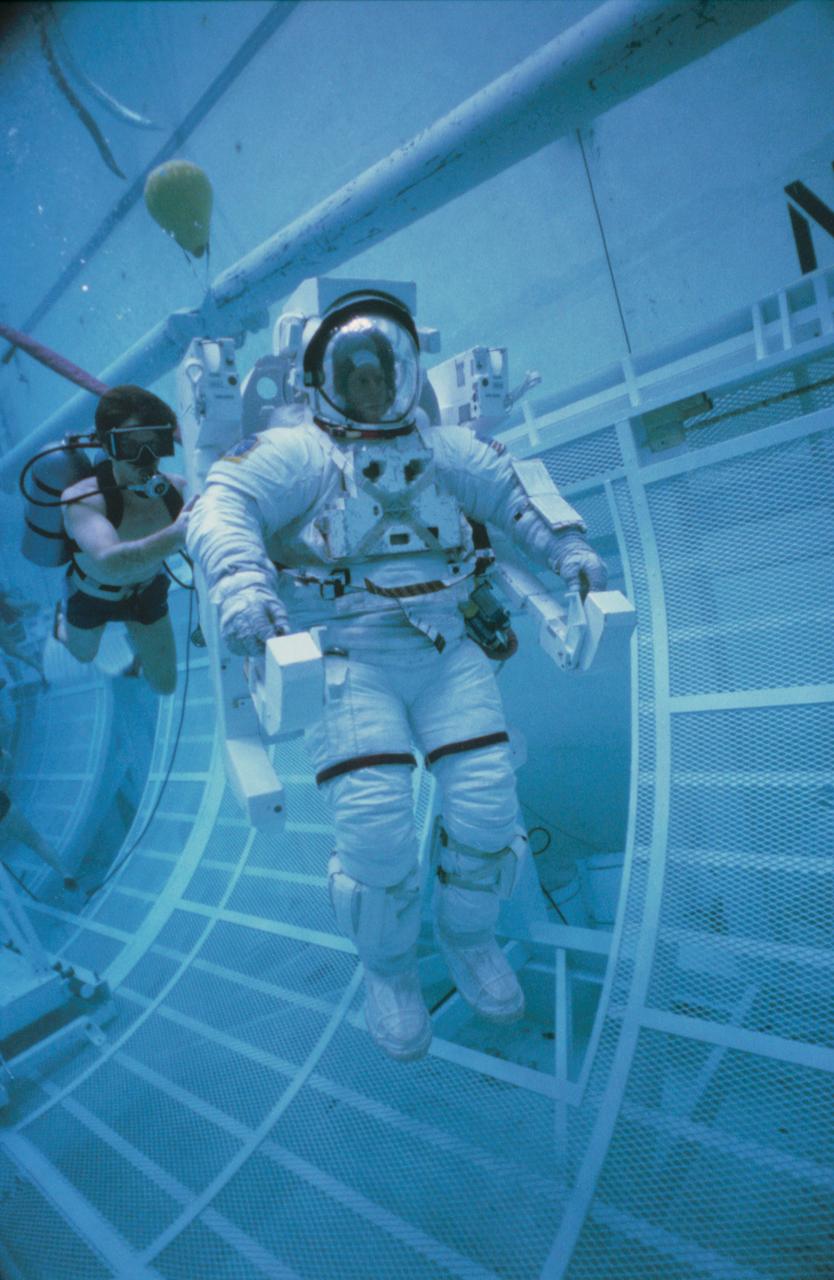
Underwater extravehicular activity (EVA) training in the weightless environment training facility (WETF) with astronauts George Nelson and James van Hoften. They are using tools to assemble material in the facility while surrounded by divers (428895); View of George Nelson in full extravehicular mobility unit (EMU) floating inside the space shuttle payload bay mockup with a diver behind him (42896).
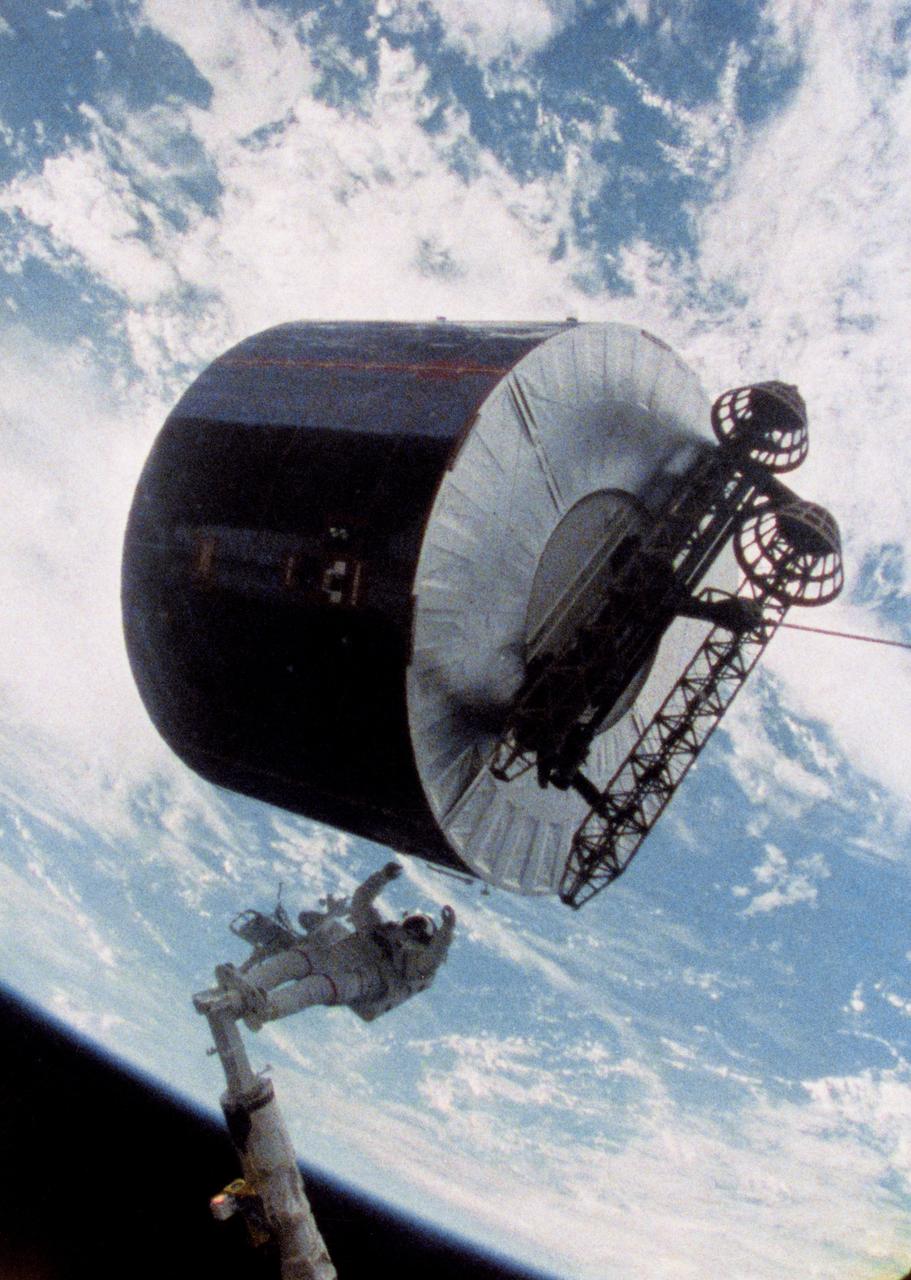
51I-S-237 (1 Sept. 1985) --- A still photo made from a video downlink shows astronaut James D. van Hoften, just after giving a shove to the Syncom IV-3 communications satellite. NASA's 51-I astronaut crew aboard the space shuttle Discovery had earlier captured and repaired the previously errant satellite. Photo credit: NASA
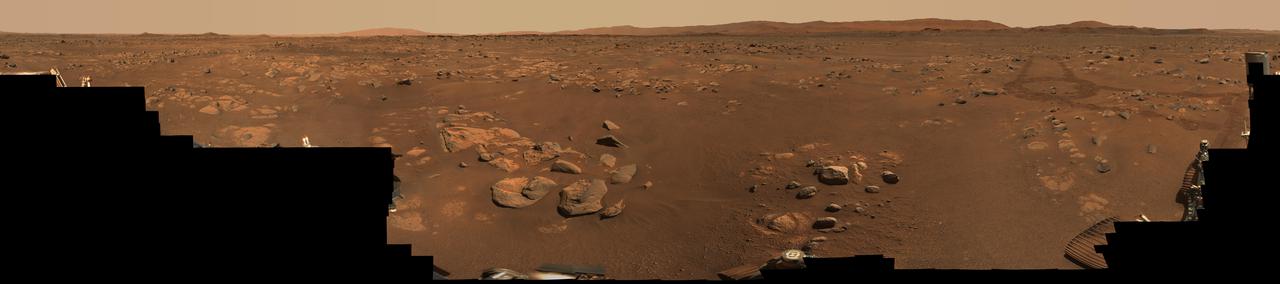
NASA's Perseverance Mars rover used its Mastcam-Z stereo imaging system to capture this 360-degree panorama of "Van Zyl Overlook," where the rover was parked for 13 days as the Ingenuity helicopter performed its first flights. The 2.4 billion-pixel panorama is made up of 992 individual right-eye Mastcam-Z images stitched together. The images were taken between April 15 and 26, 2021, or the 53rd and 64th Martian days, or sols, of the mission. A few small patches of near-field sand had been covered by parts of Perseverance when the right-eye Mastcam-Z images were taken; those gaps were filled with images of the same sandy patches taken by the Mastcam-Z left-eye camera at the same time, or from the earlier navigation camera images. Imaging coverage of the sky has also been digitally smoothed and expanded based on the actual sky color observed as the panorama was being acquired on Mars. Arizona State University in Tempe leads the operations of the Mastcam-Z instrument, working in collaboration with Malin Space Science Systems in San Diego. A key objective for Perseverance's mission on Mars is astrobiology, including the search for signs of ancient microbial life. The rover will characterize the planet's geology and past climate, pave the way for human exploration of the Red Planet, and be the first mission to collect and cache Martian rock and regolith (broken rock and dust). Subsequent NASA missions, in cooperation with ESA (European Space Agency), would send spacecraft to Mars to collect these sealed samples from the surface and return them to Earth for in-depth analysis. The Mars 2020 Perseverance mission is part of NASA's Moon to Mars exploration approach, which includes Artemis missions to the Moon that will help prepare for human exploration of the Red Planet. https://photojournal.jpl.nasa.gov/catalog/PIA24663
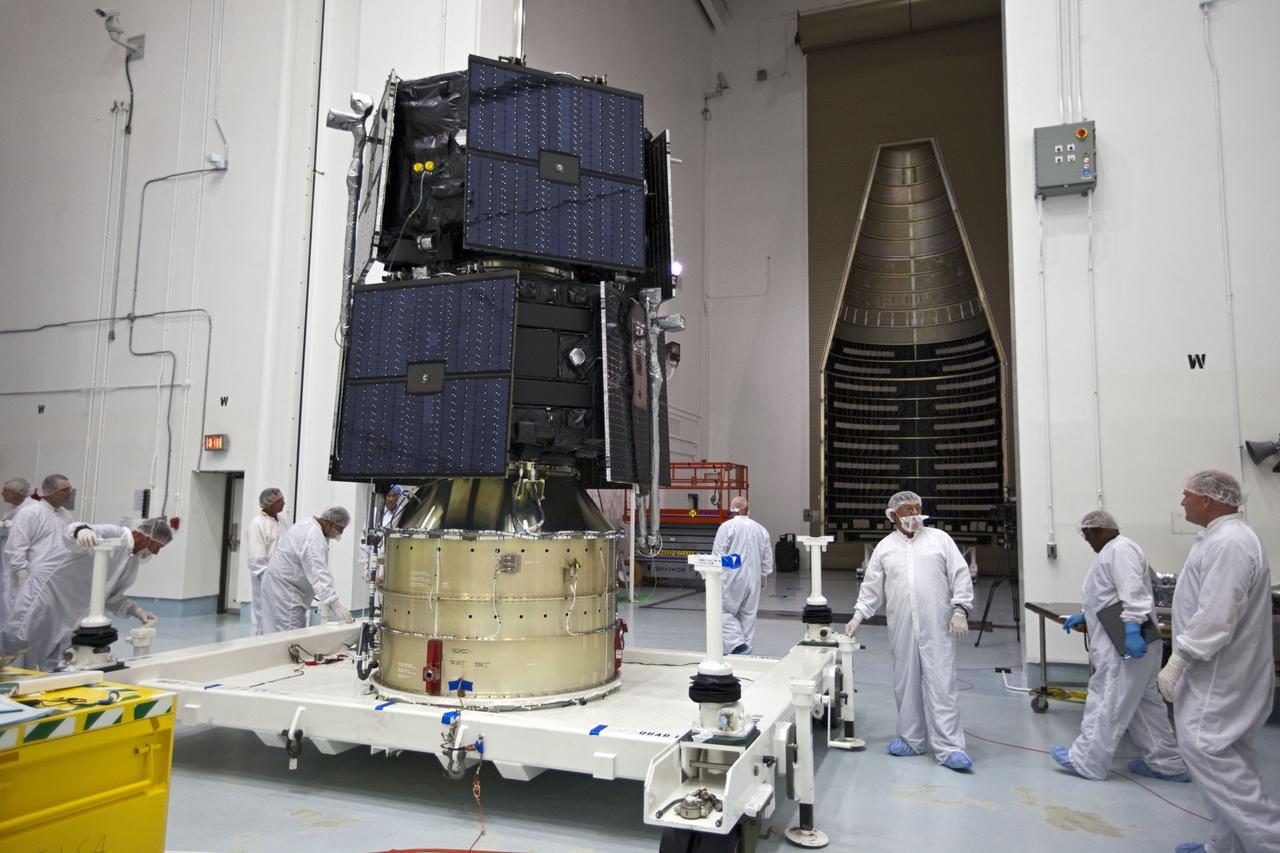
TITUSVILLE, Fla. - Inside the Astrotech payload processing facility in Titusville, Fla. near NASA’s Kennedy Space Center, technicians prepare the two Radiation Belt Storm Probes, or RBSP, spacecraft prior for encapsulation in payload faring. The fairing will house and protect the RBSP during liftoff and flight through the atmosphere aboard an Atlas V rocket. NASA’s RBSP mission will help us understand the sun’s influence on Earth and near-Earth space by studying the Earth’s radiation belts on various scales of space and time. RBSP will begin its mission of exploration of Earth’s Van Allen radiation belts and the extremes of space weather after its liftoff aboard a United Launch Alliance Atlas V from Space Launch Complex 41 at Cape Canaveral Air Force Station, Fla. Liftoff is targeted for Aug. 23, 2012. For more information, visit http://www.nasa.gov/rbsp. Photo credit: NASA/ Kim Shiflett
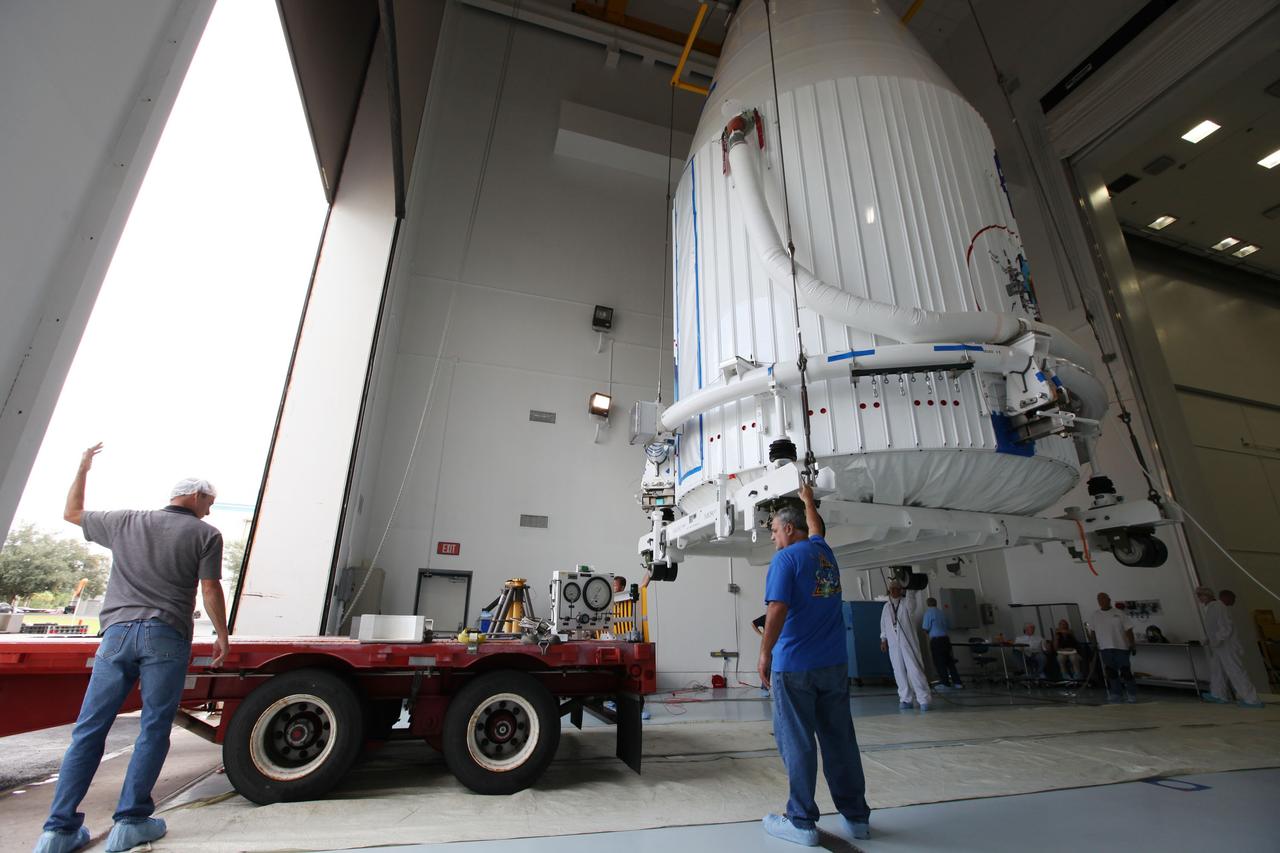
TITUSVILLE, Fla. - Inside the Astrotech payload processing facility in Titusville, Fla. near NASA’s Kennedy Space Center, technicians use a crane to lift the payload faring containing the two Radiation Belt Storm Probes, or RBSP, spacecraft as a transporter moves into position. NASA’s RBSP mission will help us understand the sun’s influence on Earth and near-Earth space by studying the Earth’s radiation belts on various scales of space and time. RBSP will begin its mission of exploration of Earth’s Van Allen radiation belts and the extremes of space weather after its liftoff aboard a United Launch Alliance Atlas V rocket from Space Launch Complex 41 at Cape Canaveral Air Force Station, Fla. Liftoff is targeted for Aug. 23, 2012. For more information, visit http://www.nasa.gov/rbsp Photo credit: NASA/ Kim Shiflett
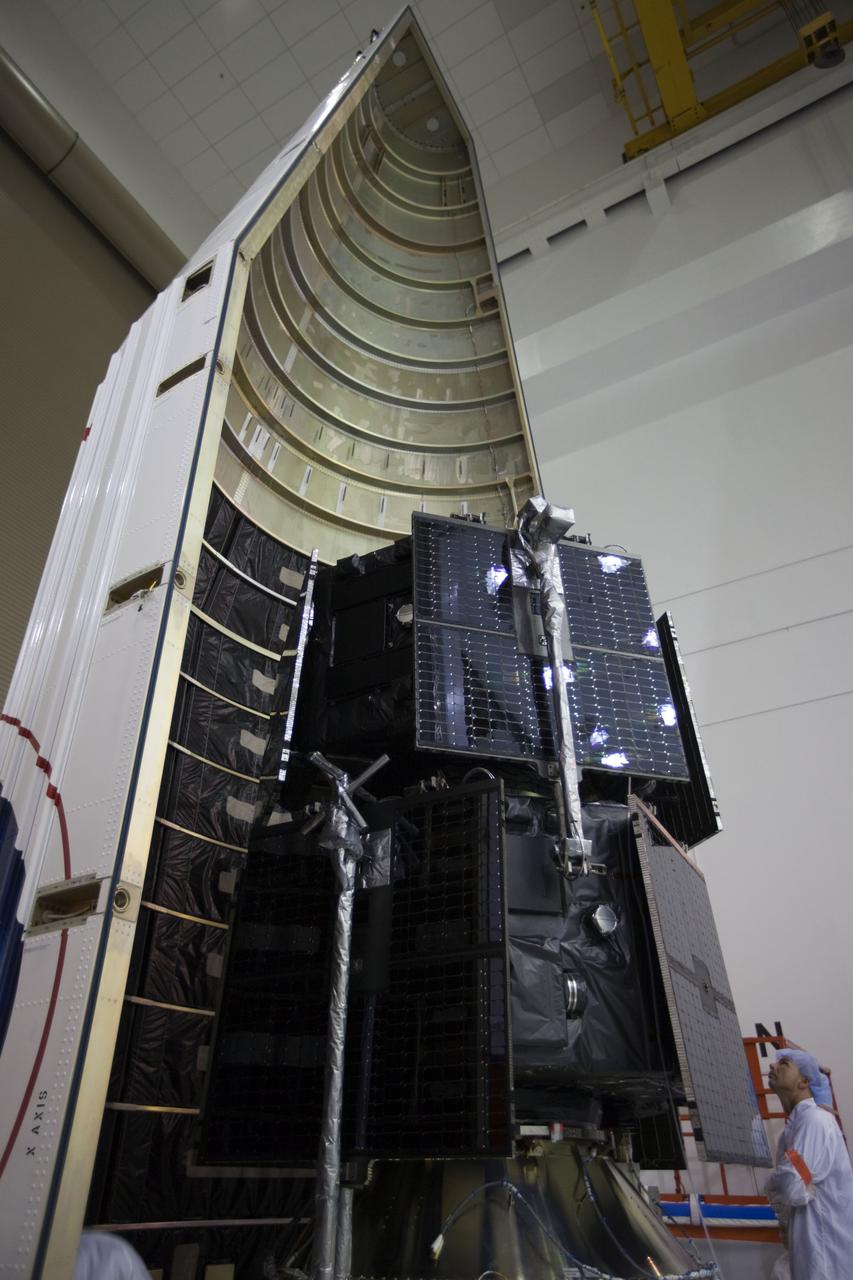
TITUSVILLE, Fla. - Inside the Astrotech payload processing facility in Titusville, Fla. near NASA’s Kennedy Space Center, a technician checks out the two Radiation Belt Storm Probes, or RBSP, spacecraft as they are being encapsulated in the payload faring. The fairing will house and protect the RBSP during liftoff and flight through the atmosphere aboard an Atlas V rocket. NASA’s RBSP mission will help us understand the sun’s influence on Earth and near-Earth space by studying the Earth’s radiation belts on various scales of space and time. RBSP will begin its mission of exploration of Earth’s Van Allen radiation belts and the extremes of space weather after its liftoff aboard a United Launch Alliance Atlas V from Space Launch Complex 41 at Cape Canaveral Air Force Station, Fla. Liftoff is targeted for Aug. 23, 2012. For more information, visit http://www.nasa.gov/rbsp. Photo credit: NASA/ Kim Shiflett
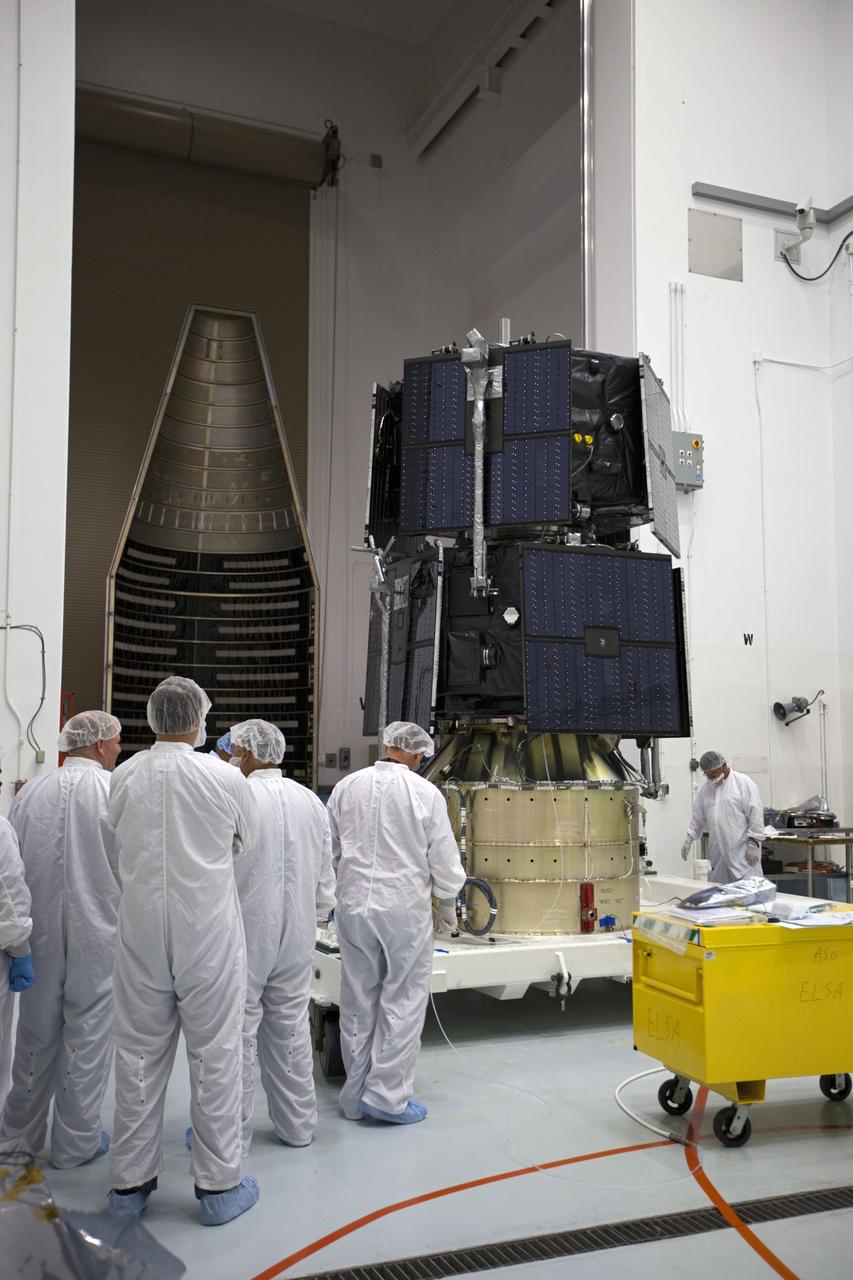
TITUSVILLE, Fla. - Inside the Astrotech payload processing facility in Titusville, Fla. near NASA’s Kennedy Space Center, technicians prepare the two Radiation Belt Storm Probes, or RBSP, spacecraft prior for encapsulation in the payload faring. The fairing will house and protect the RBSP during liftoff and flight through the atmosphere aboard an Atlas V rocket. NASA’s RBSP mission will help us understand the sun’s influence on Earth and near-Earth space by studying the Earth’s radiation belts on various scales of space and time. RBSP will begin its mission of exploration of Earth’s Van Allen radiation belts and the extremes of space weather after its liftoff aboard a United Launch Alliance Atlas V from Space Launch Complex 41 at Cape Canaveral Air Force Station, Fla. Liftoff is targeted for Aug. 23, 2012. For more information, visit http://www.nasa.gov/rbsp. Photo credit: NASA/ Kim Shiflett
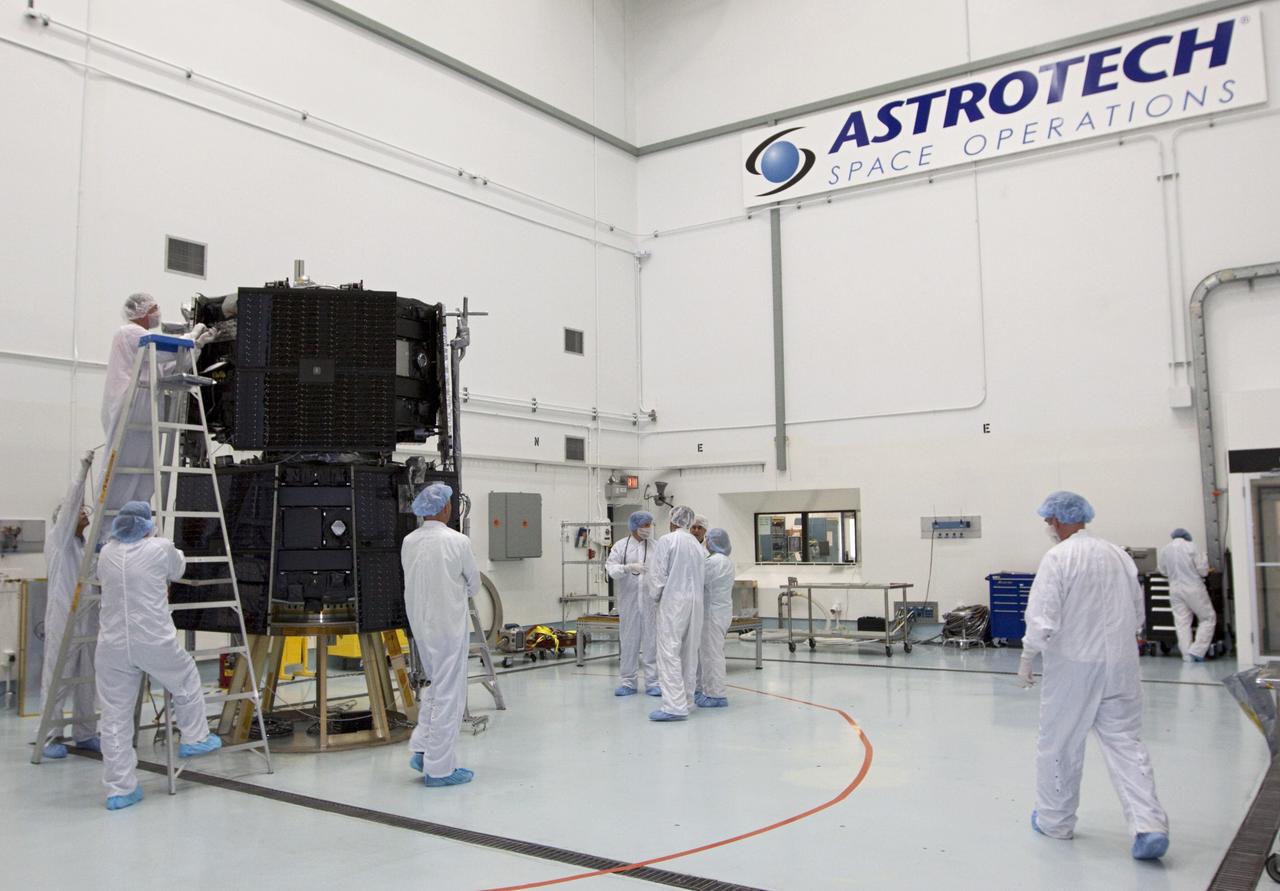
CAPE CANAVERAL, Fla. - Inside the Astrotech payload processing facility near NASA’s Kennedy Space Center in Florida, technicians work on the Radiation Belt Storm Probes, or RBSP, spacecraft. NASA’s RBSP mission will help us understand the sun’s influence on Earth and near-Earth space by studying the Earth’s radiation belts on various scales of space and time. As the spacecraft orbits Earth, the four solar panels will continuously face the sun to provide constant power to its instruments. The boom will provide data of the electric fields that energize radiation particles and modify the structure of the inner magnetosphere. RBSP will begin its mission of exploration of Earth’s Van Allen radiation belts and the extremes of space weather after its launch aboard a United Launch Alliance Atlas V rocket. Launch is targeted for Aug. 23. For more information, visit http://www.nasa.gov/rbsp. Photo credit: NASA/Kim Shiflett
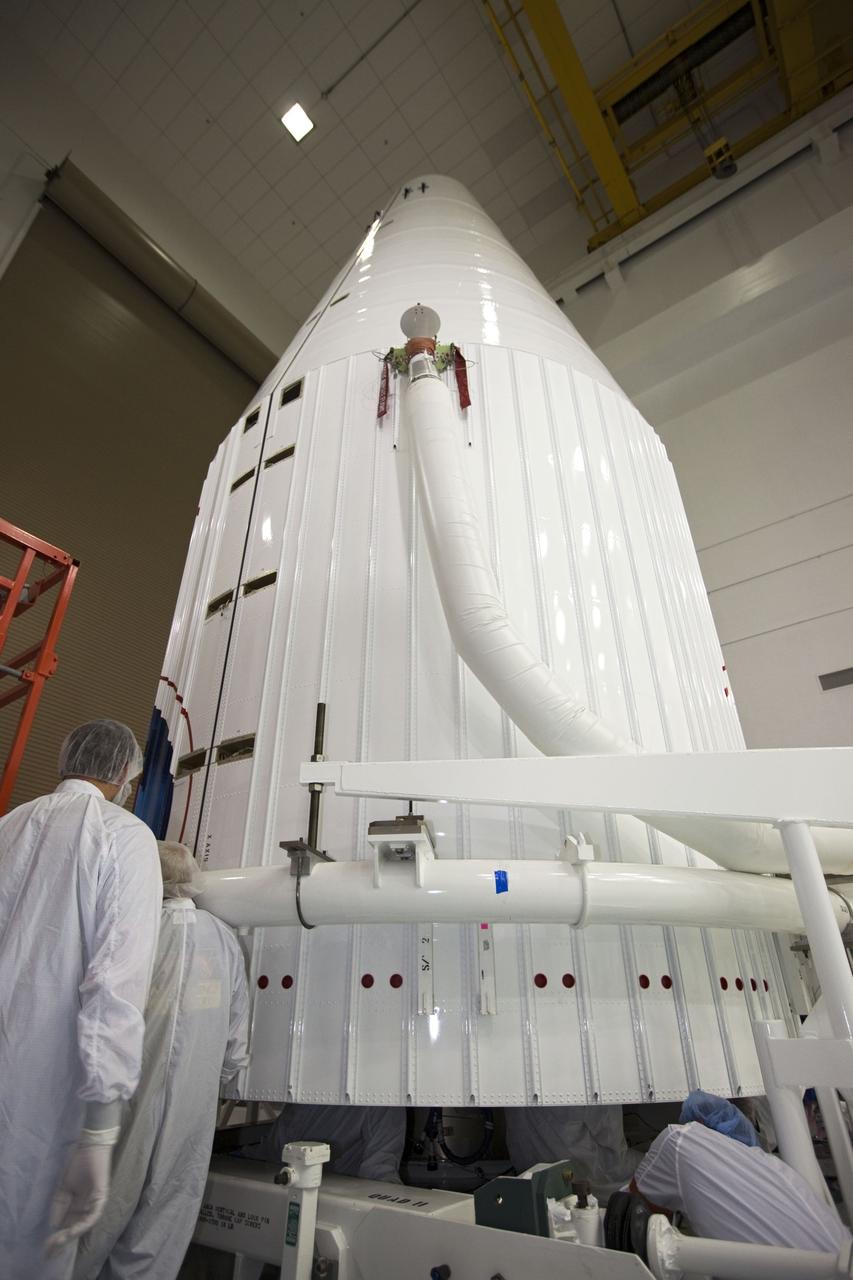
TITUSVILLE, Fla. - Inside the Astrotech payload processing facility in Titusville, Fla. near NASA’s Kennedy Space Center, technicians complete checkouts following encapsulation of the two Radiation Belt Storm Probes, or RBSP, spacecraft with its payload faring. The fairing will house and protect the RBSP during liftoff and flight through the atmosphere aboard an Atlas V rocket. NASA’s RBSP mission will help us understand the sun’s influence on Earth and near-Earth space by studying the Earth’s radiation belts on various scales of space and time. RBSP will begin its mission of exploration of Earth’s Van Allen radiation belts and the extremes of space weather after its liftoff aboard a United Launch Alliance Atlas V from Space Launch Complex 41 at Cape Canaveral Air Force Station, Fla. Liftoff is targeted for Aug. 23, 2012. For more information, visit http://www.nasa.gov/rbsp. Photo credit: NASA/ Kim Shiflett

TITUSVILLE, Fla. - Inside the Astrotech payload processing facility in Titusville, Fla. near NASA’s Kennedy Space Center, technicians prepare the two Radiation Belt Storm Probes, or RBSP, spacecraft for encapsulation in the payload faring. The fairing will house and protect the RBSP during liftoff and flight through the atmosphere aboard an Atlas V rocket. NASA’s RBSP mission will help us understand the sun’s influence on Earth and near-Earth space by studying the Earth’s radiation belts on various scales of space and time. RBSP will begin its mission of exploration of Earth’s Van Allen radiation belts and the extremes of space weather after its liftoff aboard a United Launch Alliance Atlas V from Space Launch Complex 41 at Cape Canaveral Air Force Station, Fla. Liftoff is targeted for Aug. 23, 2012. For more information, visit http://www.nasa.gov/rbsp. Photo credit: NASA/ Kim Shiflett
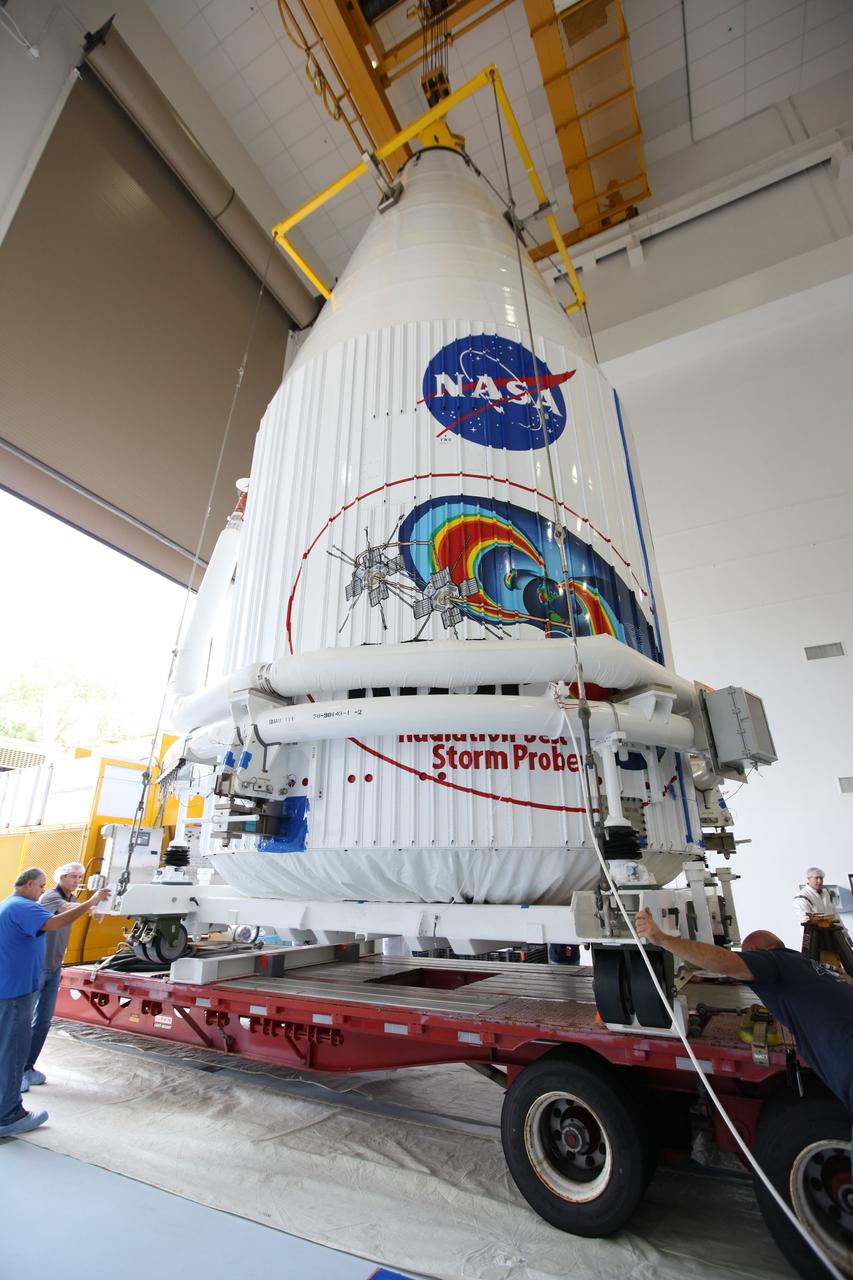
TITUSVILLE, Fla. - Inside the Astrotech payload processing facility in Titusville, Fla. near NASA’s Kennedy Space Center, technicians use a crane to lower the payload faring containing the two Radiation Belt Storm Probes, or RBSP, spacecraft on to a transporter to be moved to the launch complex. NASA’s RBSP mission will help us understand the sun’s influence on Earth and near-Earth space by studying the Earth’s radiation belts on various scales of space and time. RBSP will begin its mission of exploration of Earth’s Van Allen radiation belts and the extremes of space weather after its liftoff aboard a United Launch Alliance Atlas V rocket from Space Launch Complex 41 at Cape Canaveral Air Force Station, Fla. Liftoff is targeted for Aug. 23, 2012. For more information, visit http://www.nasa.gov/rbsp Photo credit: NASA/ Kim Shiflett
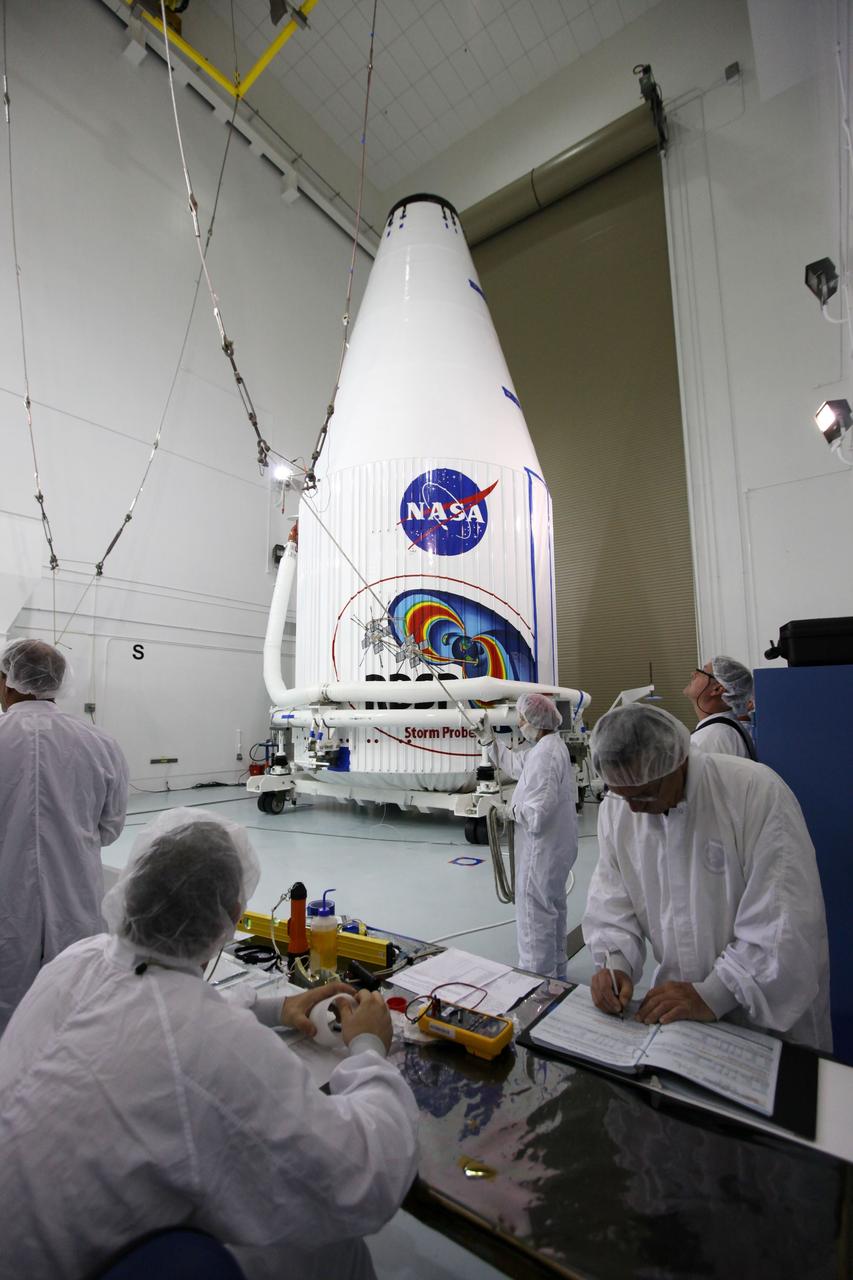
TITUSVILLE, Fla. - Inside the Astrotech payload processing facility in Titusville, Fla. near NASA’s Kennedy Space Center, technicians make final checks prior to lifting the payload faring containing the two Radiation Belt Storm Probes, or RBSP, spacecraft on to a transporter to be moved to the launch complex. NASA’s RBSP mission will help us understand the sun’s influence on Earth and near-Earth space by studying the Earth’s radiation belts on various scales of space and time. RBSP will begin its mission of exploration of Earth’s Van Allen radiation belts and the extremes of space weather after its liftoff aboard a United Launch Alliance Atlas V rocket from Space Launch Complex 41 at Cape Canaveral Air Force Station, Fla. Liftoff is targeted for Aug. 23, 2012. For more information, visit http://www.nasa.gov/rbsp Photo credit: NASA/ Kim Shiflett
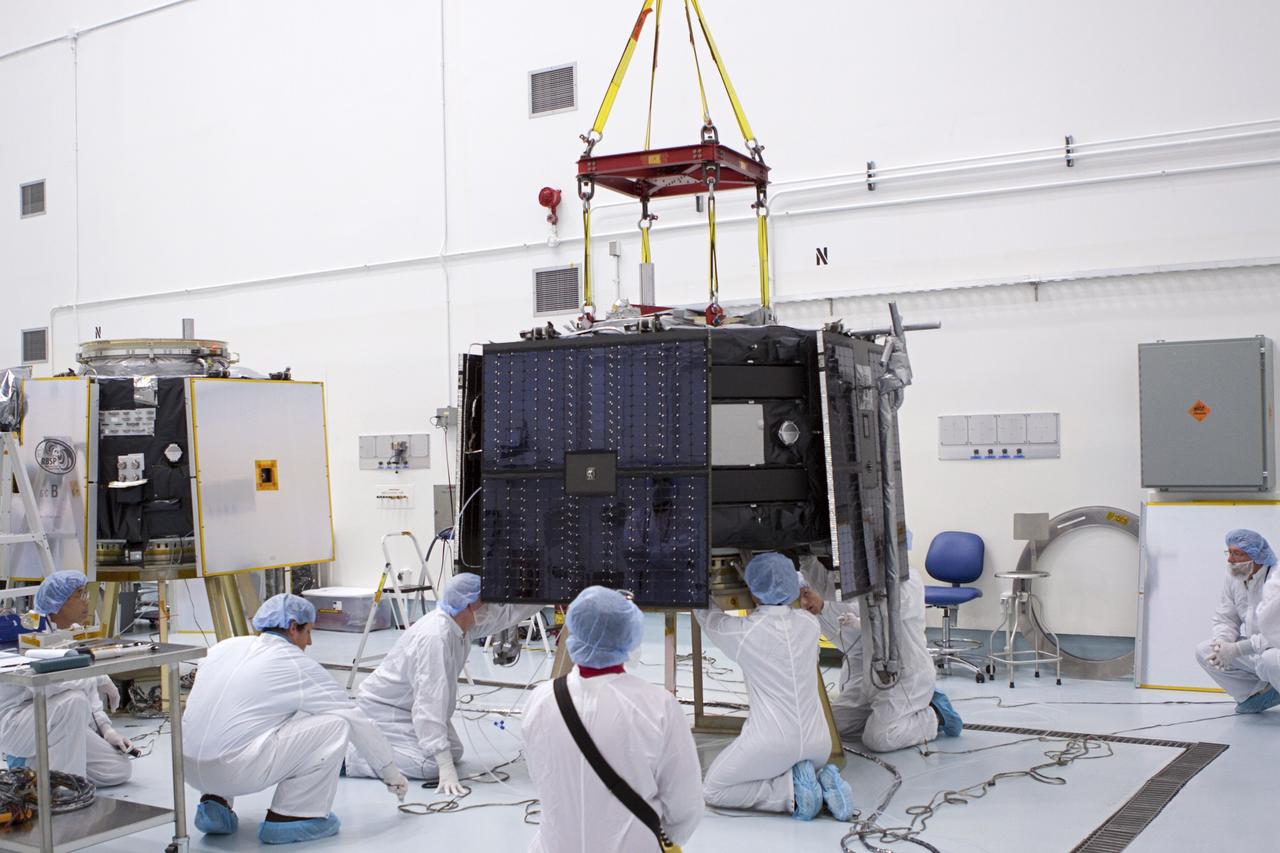
TITUSVILLE, Fla. - Inside the Astrotech payload processing facility in Titusville, Fla. near NASA’s Kennedy Space Center, technicians prepare the Radiation Belt Storm Probes, or RBSP, spacecraft A prior to vertical stacking atop RBSP B. NASA’s RBSP mission will help us understand the sun’s influence on Earth and near-Earth space by studying the Earth’s radiation belts on various scales of space and time. RBSP will begin its mission of exploration of Earth’s Van Allen radiation belts and the extremes of space weather after its liftoff aboard a United Launch Alliance Atlas V from Space Launch Complex 41 at Cape Canaveral Air Force Station, Fla. Liftoff is targeted for Aug. 23, 2012. For more information, visit http://www.nasa.gov/rbsp. Photo credit: NASA/Jim Grossmann
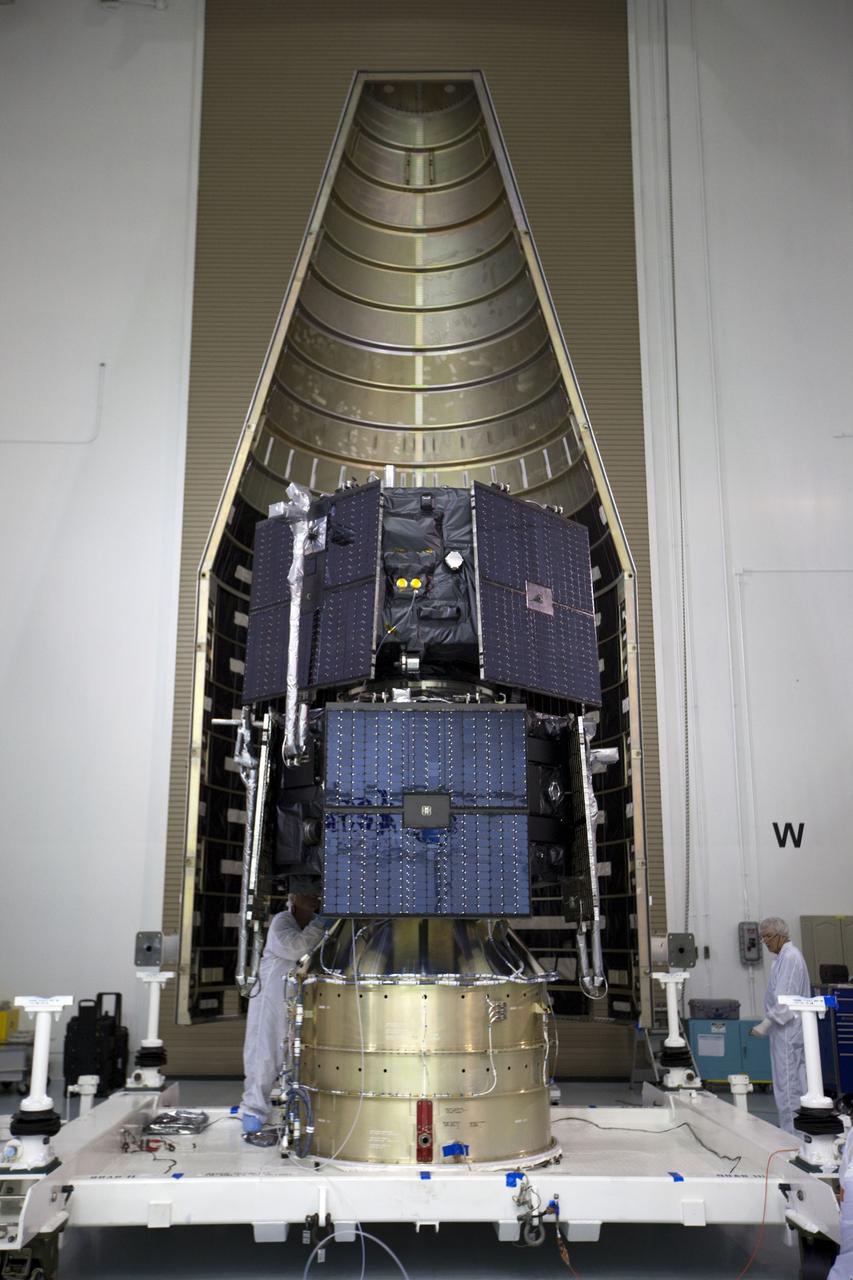
TITUSVILLE, Fla. - Inside the Astrotech payload processing facility in Titusville, Fla. near NASA’s Kennedy Space Center, a technician checks out the two Radiation Belt Storm Probes, or RBSP, spacecraft as they are being encapsulated in the payload faring. The fairing will house and protect the RBSP during liftoff and flight through the atmosphere aboard an Atlas V rocket. NASA’s RBSP mission will help us understand the sun’s influence on Earth and near-Earth space by studying the Earth’s radiation belts on various scales of space and time. RBSP will begin its mission of exploration of Earth’s Van Allen radiation belts and the extremes of space weather after its liftoff aboard a United Launch Alliance Atlas V from Space Launch Complex 41 at Cape Canaveral Air Force Station, Fla. Liftoff is targeted for Aug. 23, 2012. For more information, visit http://www.nasa.gov/rbsp. Photo credit: NASA/ Kim Shiflett
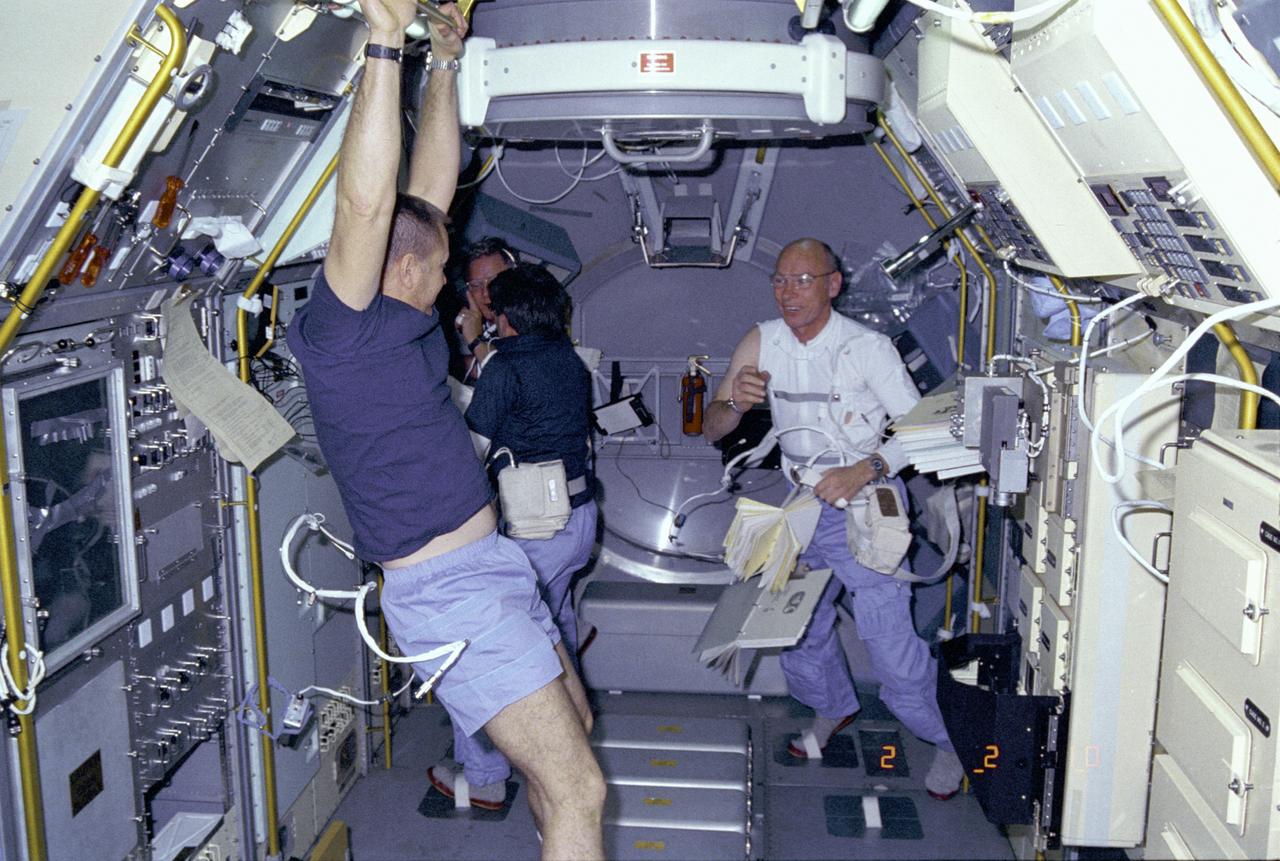
Activities inside the laboratory module during the Spacelab-3 mission are shown in this photograph. Left to right are astronauts Robert Overmyer, Commander of the mission; Don Lind, Mission Specialist; Lodewijk van den Berg, Payload Specialist; and William Thornton, Mission Specialist. The primary purpose of the Spacelab-3 mission was to conduct materials science experiments in a stable low-gravity environment. In addition, the crew did research in life sciences, fluid mechanics, atmospheric science, and astronomy. Spacelab-3 was equipped with several new minilabs, special facilities that would be used repeatedly on future flights. Two elaborate crystal growth furnaces, a life support and housing facility for small animals, and two types of apparatus for the study of fluids were evaluated on their inaugural flight. Spacelab-3 (STS-51B) was launched aboard the Space Shuttle Challenger on April 29, 1985. The Marshall Space Flight Center had managing responsibilities of the mission.
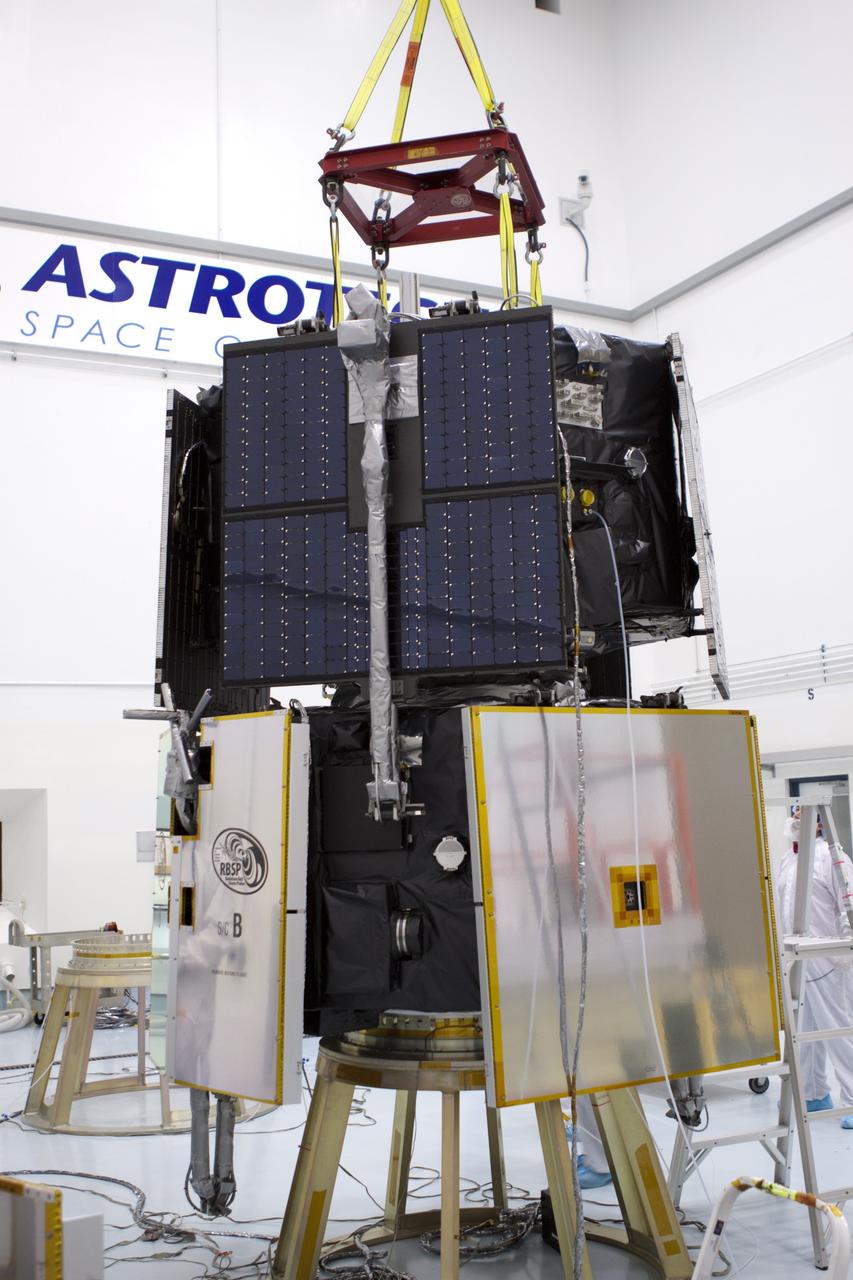
TITUSVILLE, Fla. - Inside the Astrotech payload processing facility in Titusville, Fla. near NASA’s Kennedy Space Center, the Radiation Belt Storm Probes, or RBSP, spacecraft A has been placed atop RBSP B. NASA’s RBSP mission will help us understand the sun’s influence on Earth and near-Earth space by studying the Earth’s radiation belts on various scales of space and time. RBSP will begin its mission of exploration of Earth’s Van Allen radiation belts and the extremes of space weather after its liftoff aboard a United Launch Alliance Atlas V from Space Launch Complex 41 at Cape Canaveral Air Force Station, Fla. Liftoff is targeted for Aug. 23, 2012. For more information, visit http://www.nasa.gov/rbsp. Photo credit: NASA/Jim Grossmann
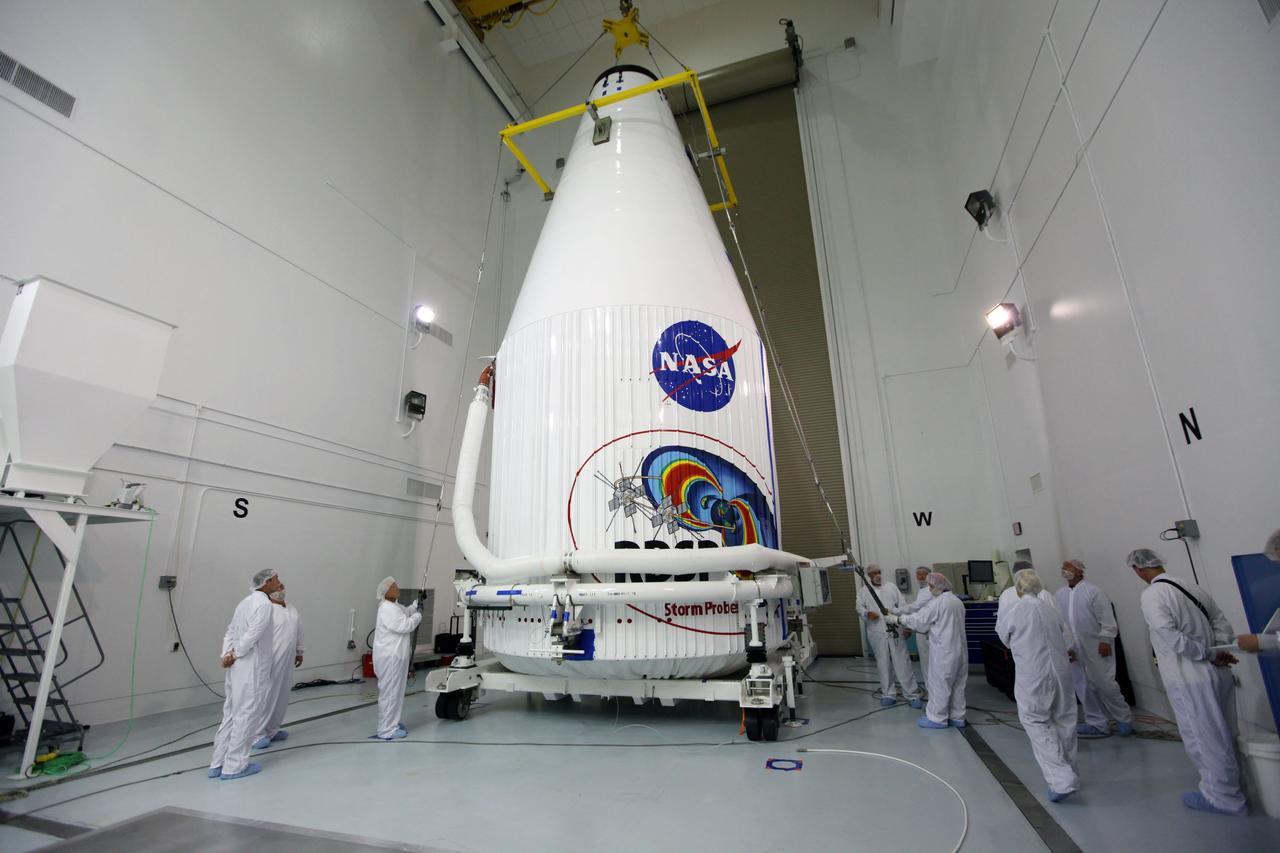
TITUSVILLE, Fla. - Inside the Astrotech payload processing facility in Titusville, Fla. near NASA’s Kennedy Space Center, technicians attach a crane to lift the payload faring containing the two Radiation Belt Storm Probes, or RBSP, spacecraft on to a transporter to be moved to the launch complex. NASA’s RBSP mission will help us understand the sun’s influence on Earth and near-Earth space by studying the Earth’s radiation belts on various scales of space and time. RBSP will begin its mission of exploration of Earth’s Van Allen radiation belts and the extremes of space weather after its liftoff aboard a United Launch Alliance Atlas V rocket from Space Launch Complex 41 at Cape Canaveral Air Force Station, Fla. Liftoff is targeted for Aug. 23, 2012. For more information, visit http://www.nasa.gov/rbsp Photo credit: NASA/ Kim Shiflett
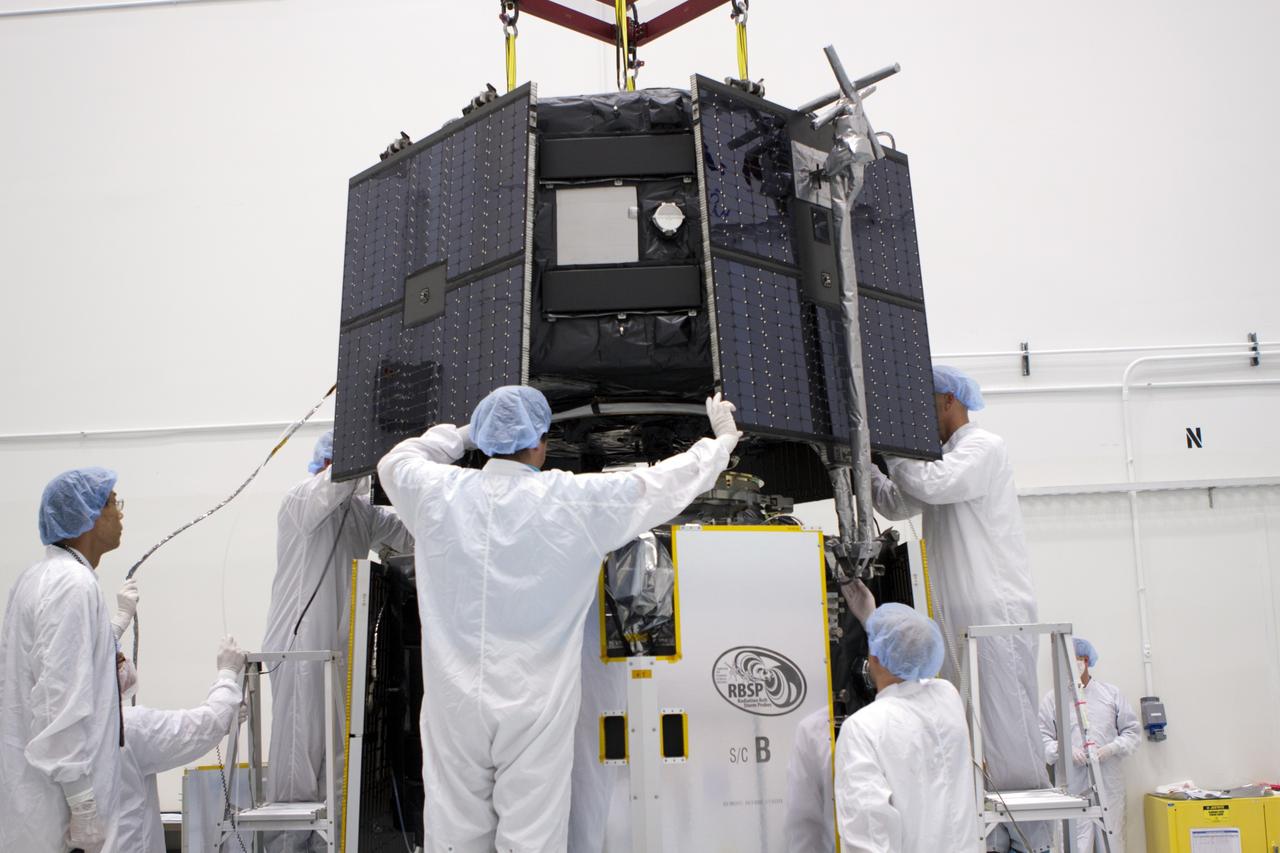
TITUSVILLE, Fla. - Inside the Astrotech payload processing facility in Titusville, Fla. near NASA’s Kennedy Space Center, technicians carefully check the Radiation Belt Storm Probes, or RBSP, spacecraft A as it is being placed atop RBSP B. NASA’s RBSP mission will help us understand the sun’s influence on Earth and near-Earth space by studying the Earth’s radiation belts on various scales of space and time. RBSP will begin its mission of exploration of Earth’s Van Allen radiation belts and the extremes of space weather after its liftoff aboard a United Launch Alliance Atlas V from Space Launch Complex 41 at Cape Canaveral Air Force Station, Fla. Liftoff is targeted for Aug. 23, 2012. For more information, visit http://www.nasa.gov/rbsp. Photo credit: NASA/Jim Grossmann
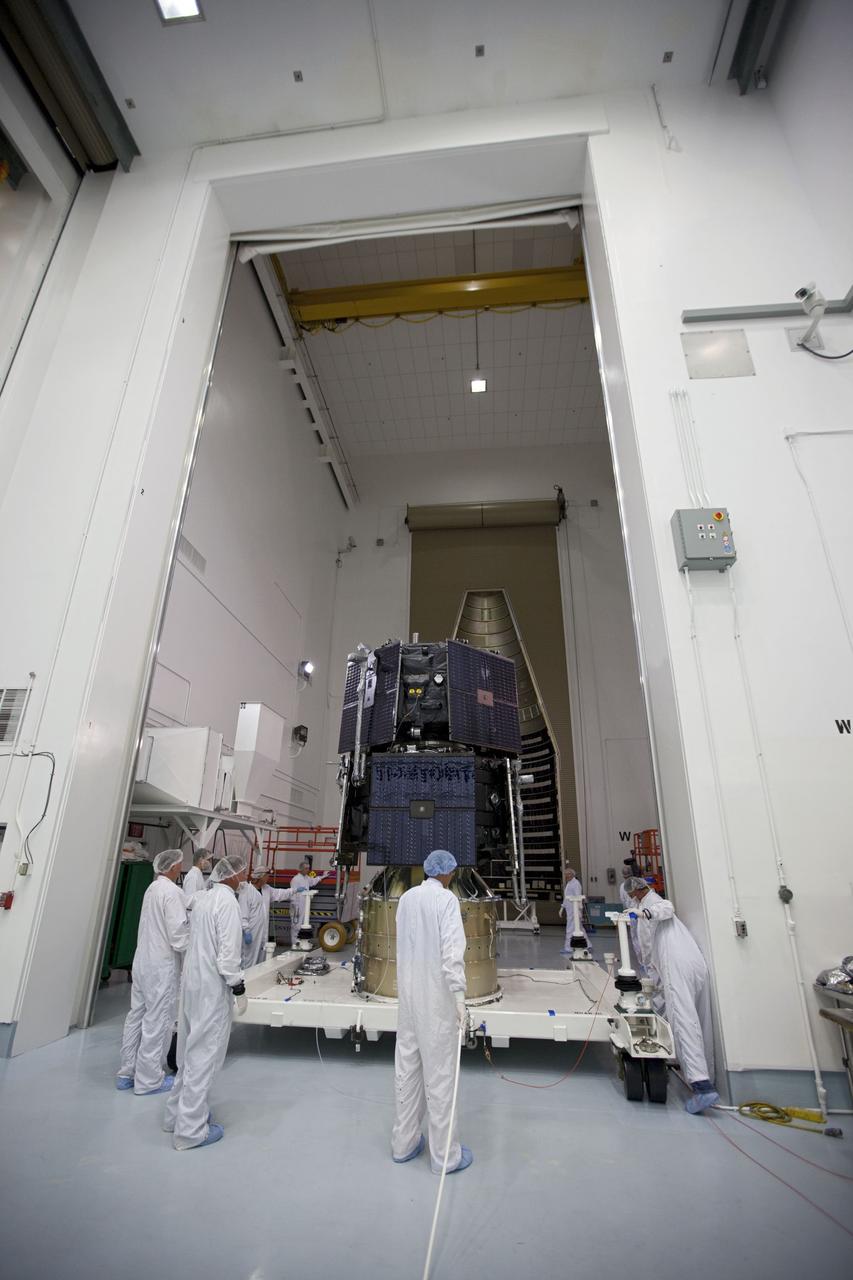
TITUSVILLE, Fla. - Inside the Astrotech payload processing facility in Titusville, Fla. near NASA’s Kennedy Space Center, technicians move the two Radiation Belt Storm Probes, or RBSP, spacecraft into position for encapsulation in the payload faring. The fairing will house and protect the RBSP during liftoff and flight through the atmosphere aboard an Atlas V rocket. NASA’s RBSP mission will help us understand the sun’s influence on Earth and near-Earth space by studying the Earth’s radiation belts on various scales of space and time. RBSP will begin its mission of exploration of Earth’s Van Allen radiation belts and the extremes of space weather after its liftoff aboard a United Launch Alliance Atlas V from Space Launch Complex 41 at Cape Canaveral Air Force Station, Fla. Liftoff is targeted for Aug. 23, 2012. For more information, visit http://www.nasa.gov/rbsp. Photo credit: NASA/ Kim Shiflett
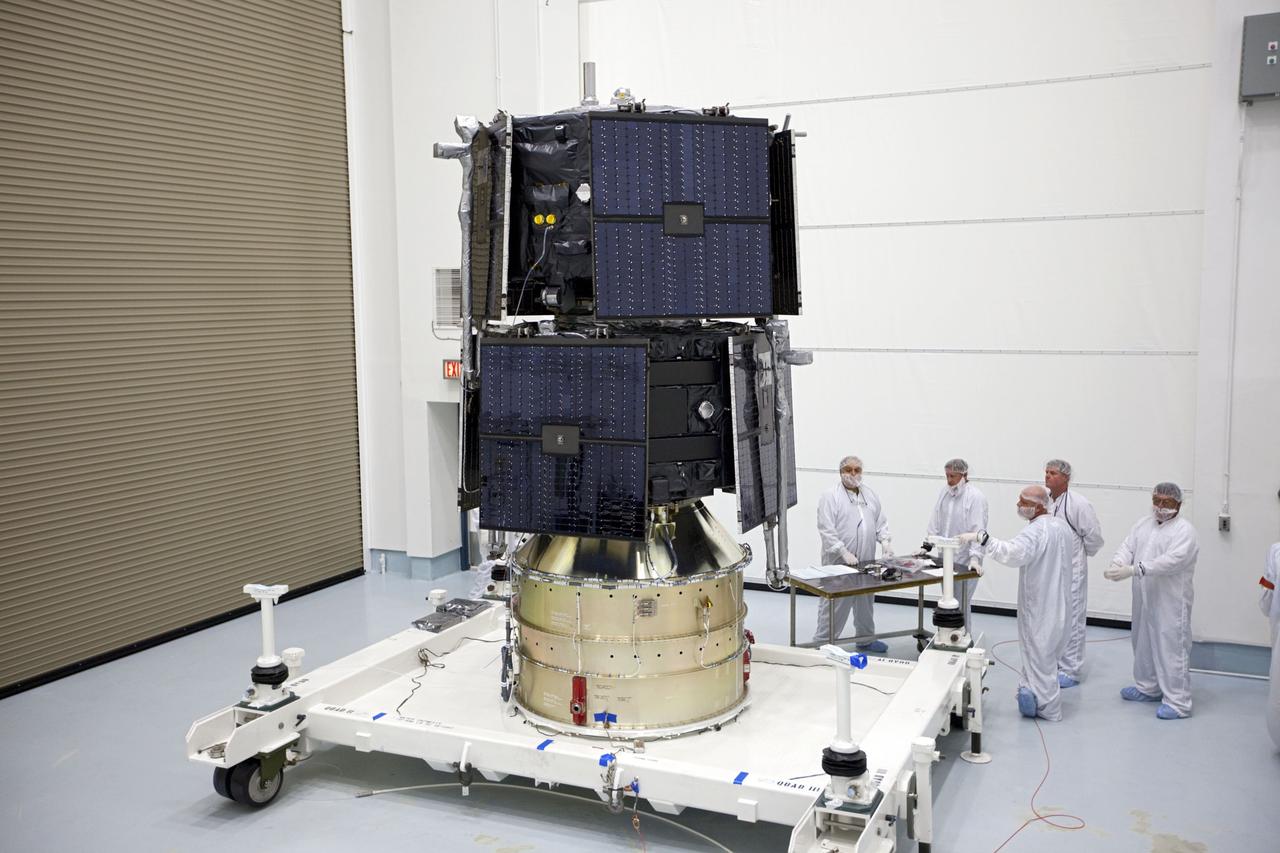
TITUSVILLE, Fla. - Inside the Astrotech payload processing facility in Titusville, Fla. near NASA’s Kennedy Space Center, technicians checkout the two Radiation Belt Storm Probes, or RBSP, spacecraft prior to vertical encapsulation in the payload faring. The fairing will house and protect the RBSP during liftoff and flight through the atmosphere aboard an Atlas V rocket. NASA’s RBSP mission will help us understand the sun’s influence on Earth and near-Earth space by studying the Earth’s radiation belts on various scales of space and time. RBSP will begin its mission of exploration of Earth’s Van Allen radiation belts and the extremes of space weather after its liftoff aboard a United Launch Alliance Atlas V from Space Launch Complex 41 at Cape Canaveral Air Force Station, Fla. Liftoff is targeted for Aug. 23, 2012. For more information, visit http://www.nasa.gov/rbsp. Photo credit: NASA/ Kim Shiflett
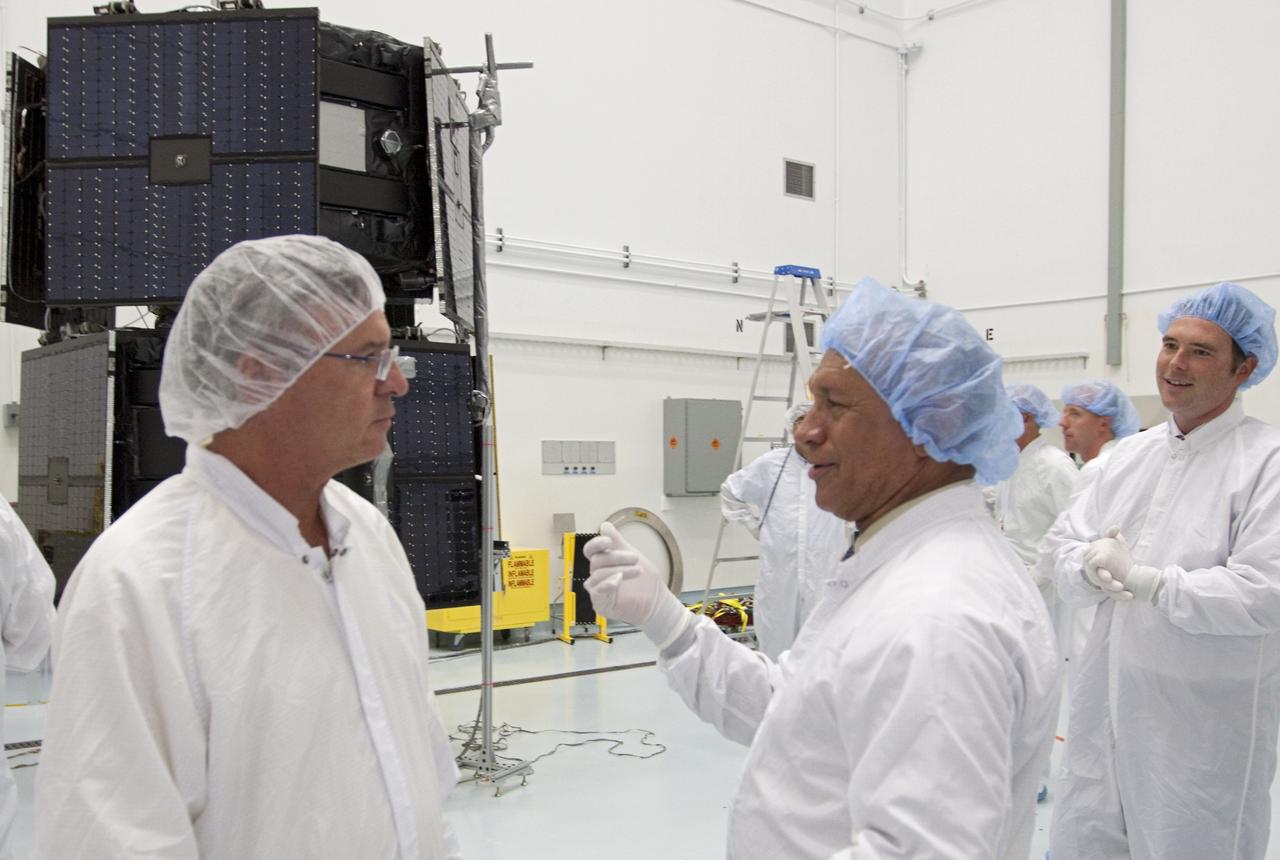
CAPE CANAVERAL, Fla. - Inside the Astrotech payload processing facility near NASA’s Kennedy Space Center in Florida, NASA Administrator Charlie Bolden, center, talks to technicians about the Radiation Belt Storm Probes, or RBSP, spacecraft. NASA’s RBSP mission will help us understand the sun’s influence on Earth and near-Earth space by studying the Earth’s radiation belts on various scales of space and time. As the spacecraft orbits Earth, the four solar panels will continuously face the sun to provide constant power to its instruments. The boom will provide data of the electric fields that energize radiation particles and modify the structure of the inner magnetosphere. RBSP will begin its mission of exploration of Earth’s Van Allen radiation belts and the extremes of space weather after its launch aboard a United Launch Alliance Atlas V rocket. Launch is targeted for Aug. 23. For more information, visit http://www.nasa.gov/rbsp. Photo credit: NASA/Kim Shiflett
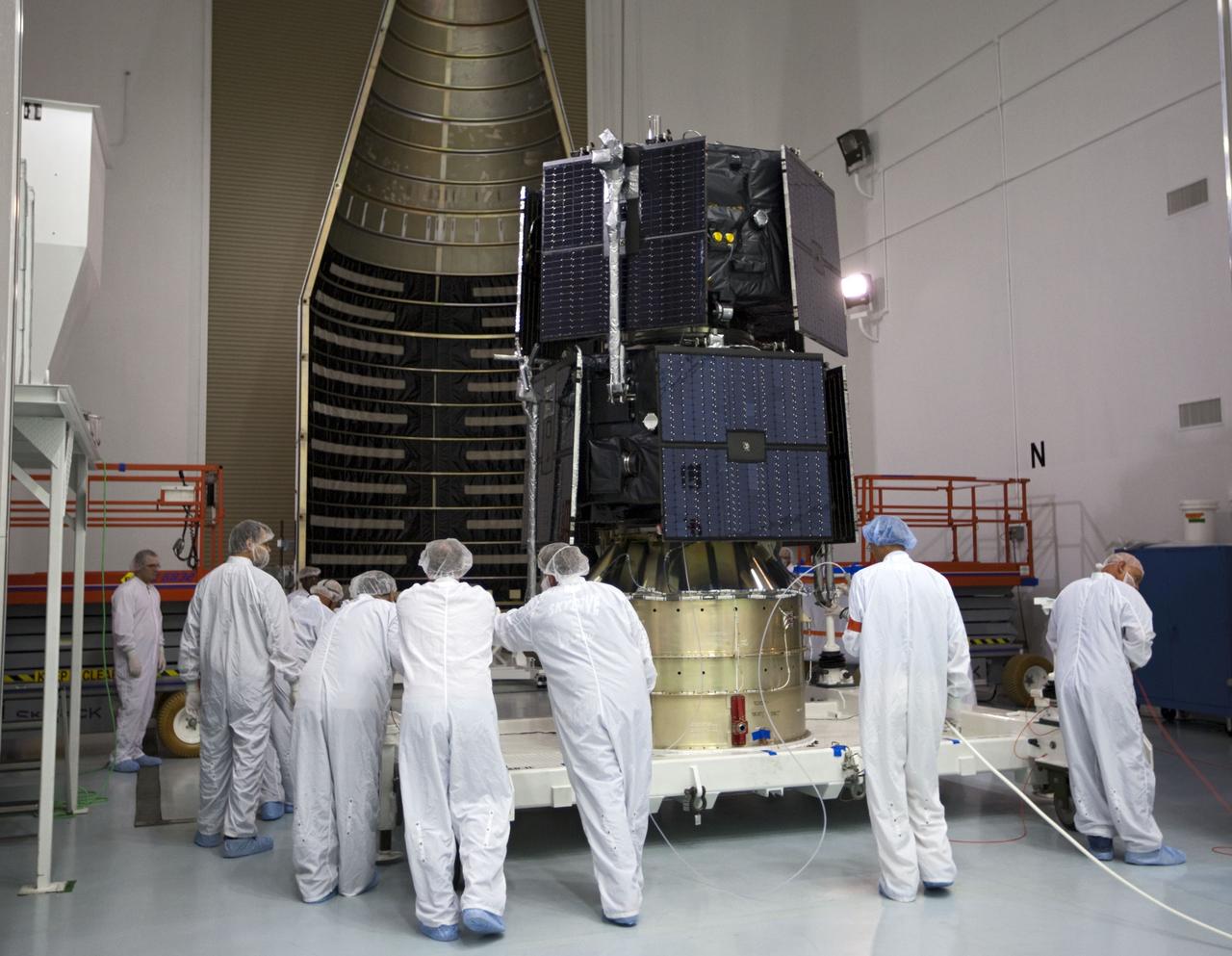
TITUSVILLE, Fla. - Inside the Astrotech payload processing facility in Titusville, Fla. near NASA’s Kennedy Space Center, technicians move the two Radiation Belt Storm Probes, or RBSP, spacecraft into position for encapsulation in the payload faring. The fairing will house and protect the RBSP during liftoff and flight through the atmosphere aboard an Atlas V rocket. NASA’s RBSP mission will help us understand the sun’s influence on Earth and near-Earth space by studying the Earth’s radiation belts on various scales of space and time. RBSP will begin its mission of exploration of Earth’s Van Allen radiation belts and the extremes of space weather after its liftoff aboard a United Launch Alliance Atlas V from Space Launch Complex 41 at Cape Canaveral Air Force Station, Fla. Liftoff is targeted for Aug. 23, 2012. For more information, visit http://www.nasa.gov/rbsp. Photo credit: NASA/ Kim Shiflett
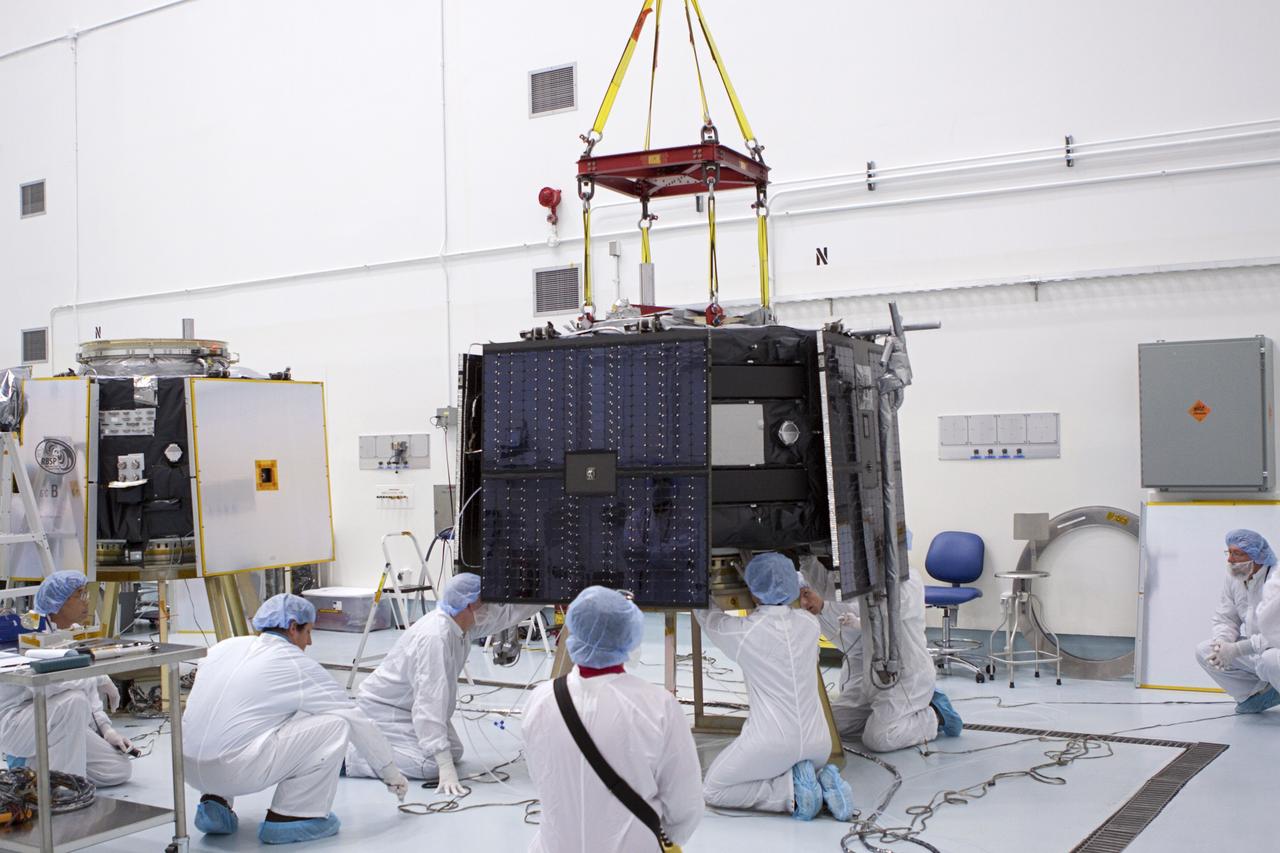
TITUSVILLE, Fla. - Inside the Astrotech payload processing facility in Titusville, Fla. near NASA’s Kennedy Space Center, technicians prepare the Radiation Belt Storm Probes, or RBSP, spacecraft A prior to vertical stacking atop RBSP B. NASA’s RBSP mission will help us understand the sun’s influence on Earth and near-Earth space by studying the Earth’s radiation belts on various scales of space and time. RBSP will begin its mission of exploration of Earth’s Van Allen radiation belts and the extremes of space weather after its liftoff aboard a United Launch Alliance Atlas V from Space Launch Complex 41 at Cape Canaveral Air Force Station, Fla. Liftoff is targeted for Aug. 23, 2012. For more information, visit http://www.nasa.gov/rbsp. Photo credit: NASA/Jim Grossmann
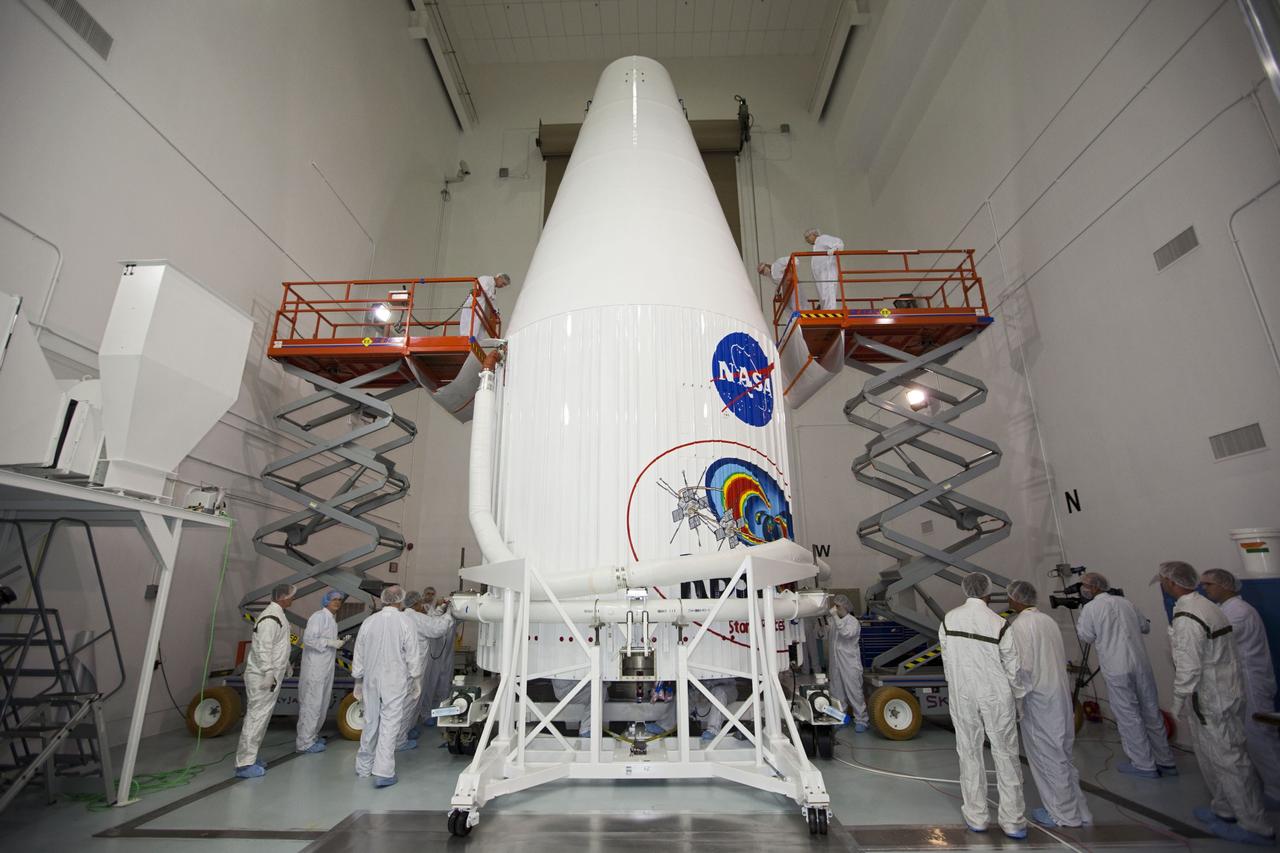
TITUSVILLE, Fla. - Inside the Astrotech payload processing facility in Titusville, Fla. near NASA’s Kennedy Space Center, technicians complete checkouts following encapsulation of the two Radiation Belt Storm Probes, or RBSP, spacecraft with its payload faring. The fairing will house and protect the RBSP during liftoff and flight through the atmosphere aboard an Atlas V rocket. NASA’s RBSP mission will help us understand the sun’s influence on Earth and near-Earth space by studying the Earth’s radiation belts on various scales of space and time. RBSP will begin its mission of exploration of Earth’s Van Allen radiation belts and the extremes of space weather after its liftoff aboard a United Launch Alliance Atlas V from Space Launch Complex 41 at Cape Canaveral Air Force Station, Fla. Liftoff is targeted for Aug. 23, 2012. For more information, visit http://www.nasa.gov/rbsp. Photo credit: NASA/ Kim Shiflett
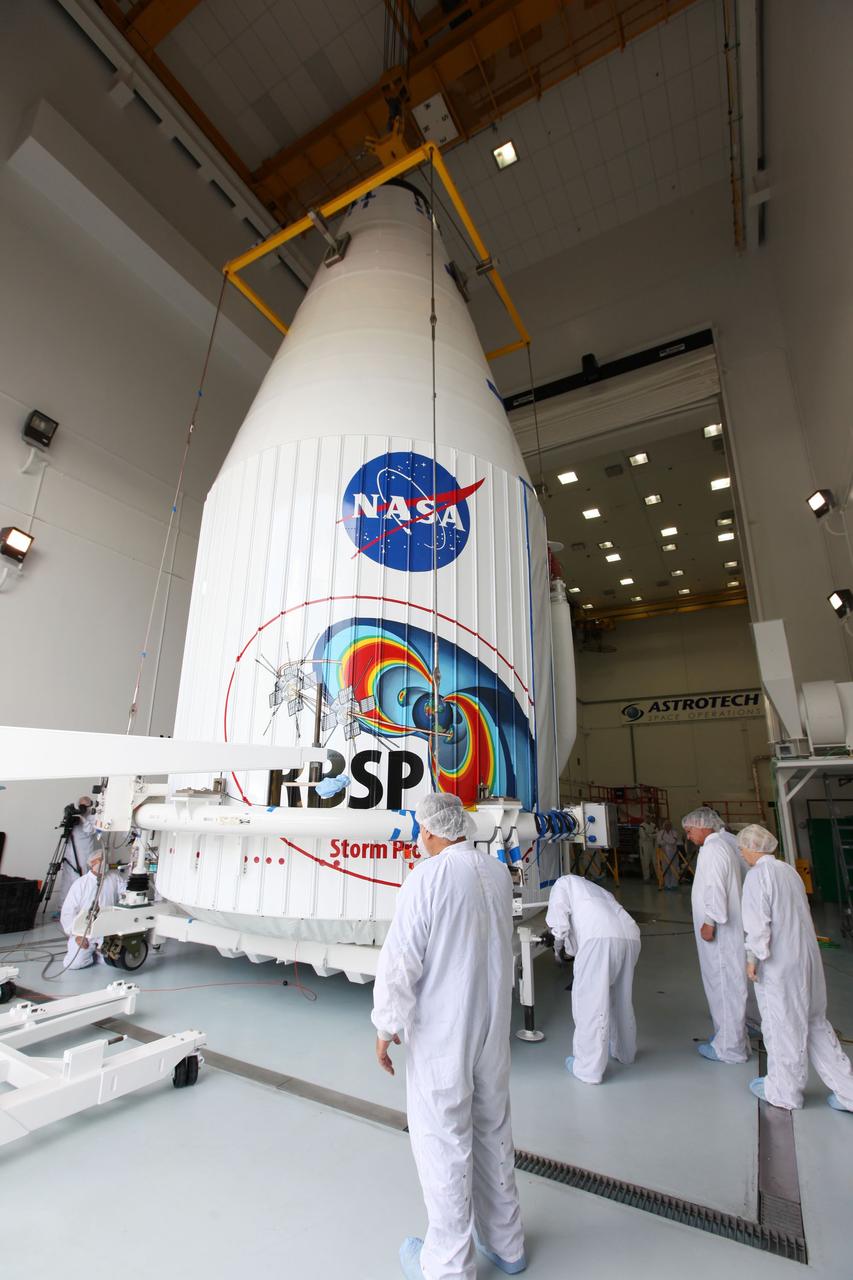
TITUSVILLE, Fla. - Inside the Astrotech payload processing facility in Titusville, Fla. near NASA’s Kennedy Space Center, technicians attach a crane to lift the payload faring containing the two Radiation Belt Storm Probes, or RBSP, spacecraft on to a transporter to be moved to the launch complex. NASA’s RBSP mission will help us understand the sun’s influence on Earth and near-Earth space by studying the Earth’s radiation belts on various scales of space and time. RBSP will begin its mission of exploration of Earth’s Van Allen radiation belts and the extremes of space weather after its liftoff aboard a United Launch Alliance Atlas V rocket from Space Launch Complex 41 at Cape Canaveral Air Force Station, Fla. Liftoff is targeted for Aug. 23, 2012. For more information, visit http://www.nasa.gov/rbsp Photo credit: NASA/ Kim Shiflett

TITUSVILLE, Fla. - Inside the Astrotech payload processing facility in Titusville, Fla. near NASA’s Kennedy Space Center, technicians attach a crane to lift the payload faring containing the two Radiation Belt Storm Probes, or RBSP, spacecraft on to a transporter to be moved to the launch complex. NASA’s RBSP mission will help us understand the sun’s influence on Earth and near-Earth space by studying the Earth’s radiation belts on various scales of space and time. RBSP will begin its mission of exploration of Earth’s Van Allen radiation belts and the extremes of space weather after its liftoff aboard a United Launch Alliance Atlas V rocket from Space Launch Complex 41 at Cape Canaveral Air Force Station, Fla. Liftoff is targeted for Aug. 23, 2012. For more information, visit http://www.nasa.gov/rbsp Photo credit: NASA/ Kim Shiflett
TITUSVILLE, Fla. - Inside the Astrotech payload processing facility in Titusville, Fla. near NASA’s Kennedy Space Center, technicians move the two Radiation Belt Storm Probes, or RBSP, spacecraft into position for encapsulation in the payload faring. The fairing will house and protect the RBSP during liftoff and flight through the atmosphere aboard an Atlas V rocket. NASA’s RBSP mission will help us understand the sun’s influence on Earth and near-Earth space by studying the Earth’s radiation belts on various scales of space and time. RBSP will begin its mission of exploration of Earth’s Van Allen radiation belts and the extremes of space weather after its liftoff aboard a United Launch Alliance Atlas V from Space Launch Complex 41 at Cape Canaveral Air Force Station, Fla. Liftoff is targeted for Aug. 23, 2012. For more information, visit http://www.nasa.gov/rbsp. Photo credit: NASA/ Kim Shiflett
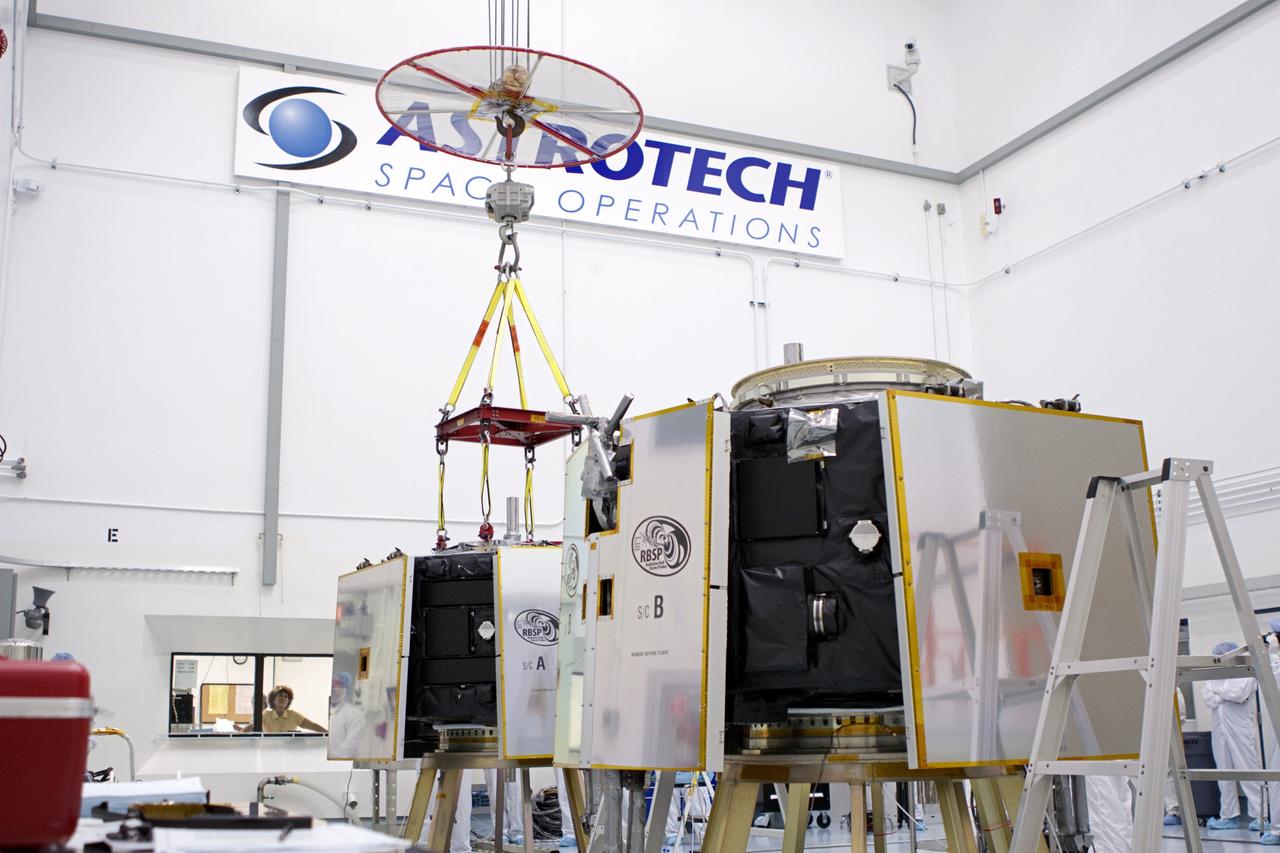
TITUSVILLE, Fla. - Inside the Astrotech payload processing facility in Titusville, Fla. near NASA’s Kennedy Space Center, a crane has been attached to the Radiation Belt Storm Probes, or RBSP, spacecraft A prior to vertical stacking atop RBSP B. NASA’s RBSP mission will help us understand the sun’s influence on Earth and near-Earth space by studying the Earth’s radiation belts on various scales of space and time. RBSP will begin its mission of exploration of Earth’s Van Allen radiation belts and the extremes of space weather after its liftoff aboard a United Launch Alliance Atlas V from Space Launch Complex 41 at Cape Canaveral Air Force Station, Fla. Liftoff is targeted for Aug. 23, 2012. For more information, visit http://www.nasa.gov/rbsp. Photo credit: NASA/Jim Grossmann
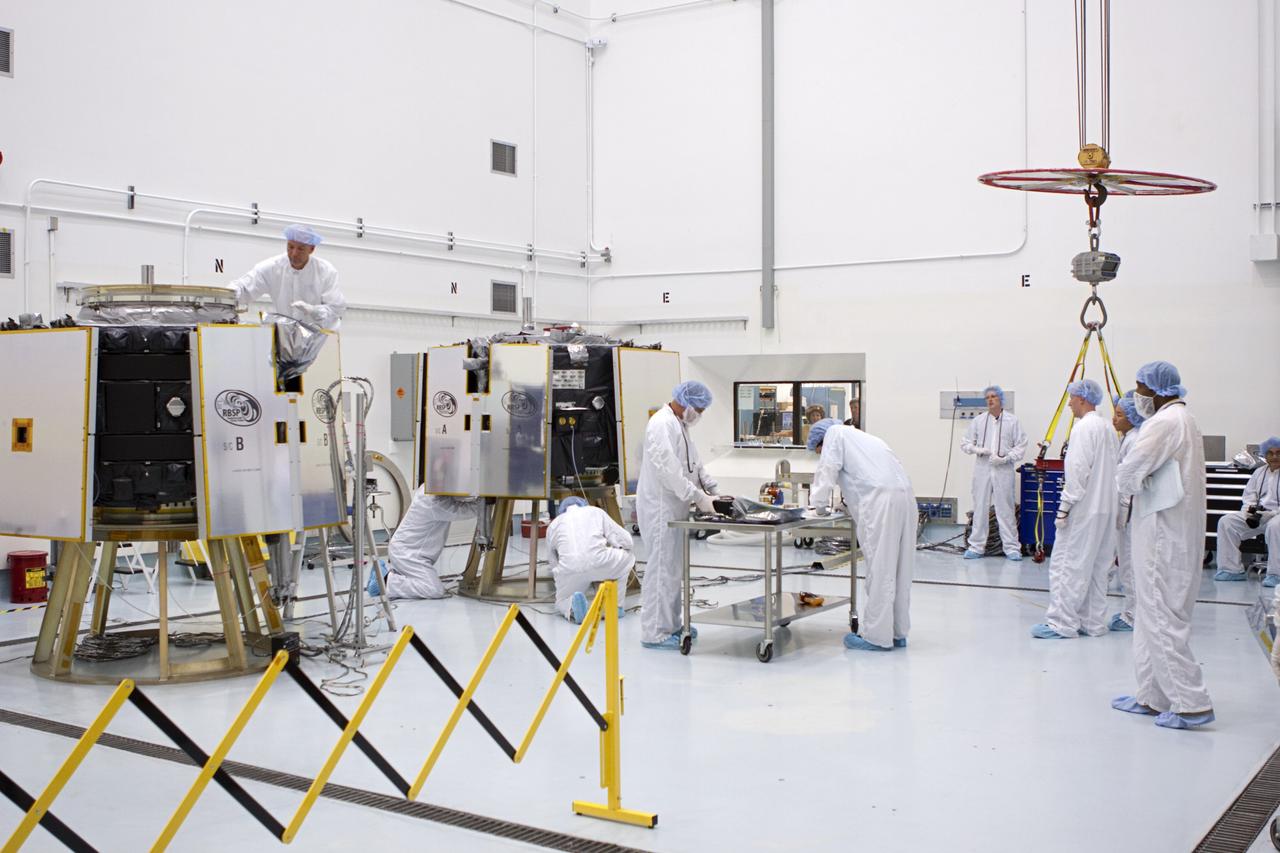
TITUSVILLE, Fla. - Inside the Astrotech payload processing facility in Titusville, Fla. near NASA’s Kennedy Space Center, technicians checkout the two Radiation Belt Storm Probes, or RBSP, spacecraft prior to vertical stacking. NASA’s RBSP mission will help us understand the sun’s influence on Earth and near-Earth space by studying the Earth’s radiation belts on various scales of space and time. RBSP will begin its mission of exploration of Earth’s Van Allen radiation belts and the extremes of space weather after its liftoff aboard a United Launch Alliance Atlas V from Space Launch Complex 41 at Cape Canaveral Air Force Station, Fla. Liftoff is targeted for Aug. 23, 2012. For more information, visit http://www.nasa.gov/rbsp. Photo credit: NASA/Jim Grossmann
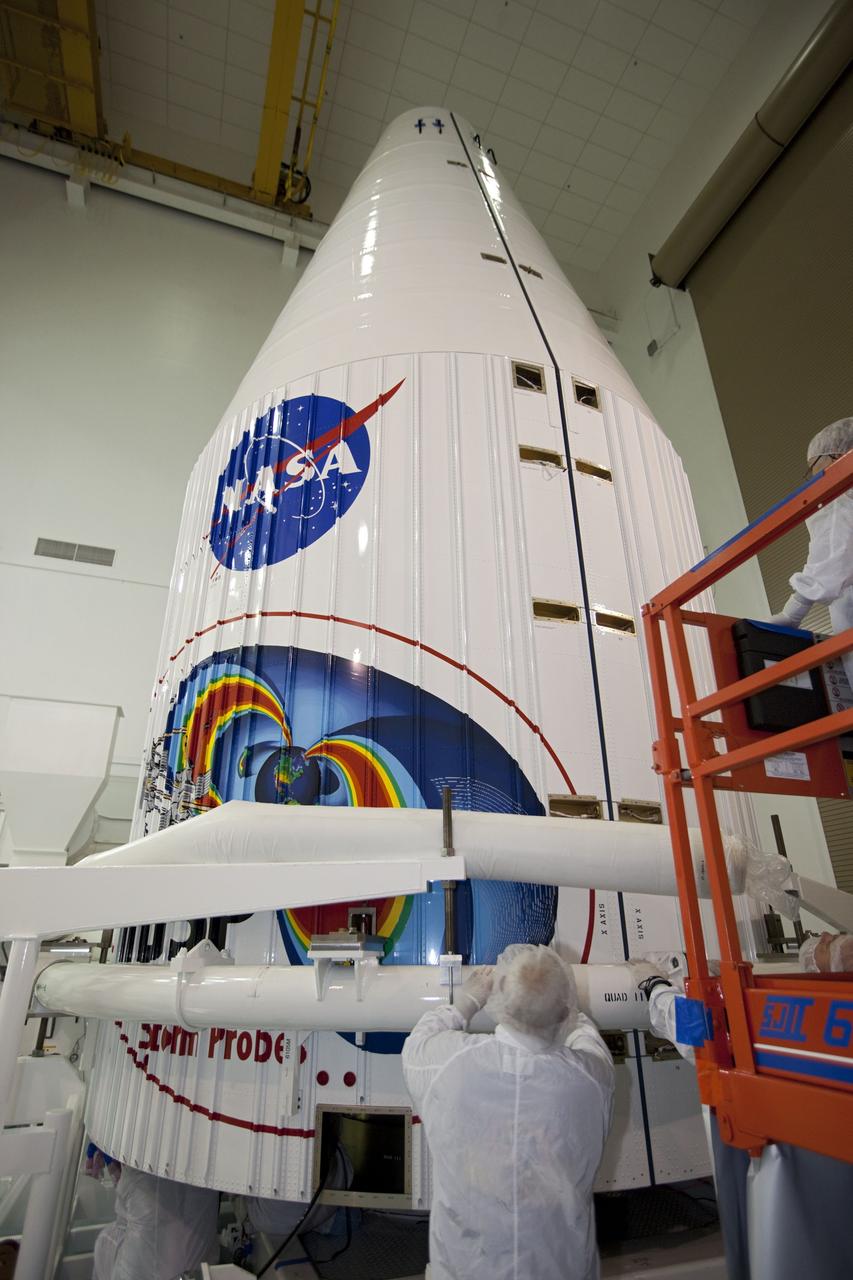
TITUSVILLE, Fla. - Inside the Astrotech payload processing facility in Titusville, Fla. near NASA’s Kennedy Space Center, technicians move the two halves if the payload faring into position for encapsulation with the two Radiation Belt Storm Probes, or RBSP, spacecraft. The fairing will house and protect the RBSP during liftoff and flight through the atmosphere aboard an Atlas V rocket. NASA’s RBSP mission will help us understand the sun’s influence on Earth and near-Earth space by studying the Earth’s radiation belts on various scales of space and time. RBSP will begin its mission of exploration of Earth’s Van Allen radiation belts and the extremes of space weather after its liftoff aboard a United Launch Alliance Atlas V from Space Launch Complex 41 at Cape Canaveral Air Force Station, Fla. Liftoff is targeted for Aug. 23, 2012. For more information, visit http://www.nasa.gov/rbsp. Photo credit: NASA/ Kim Shiflett
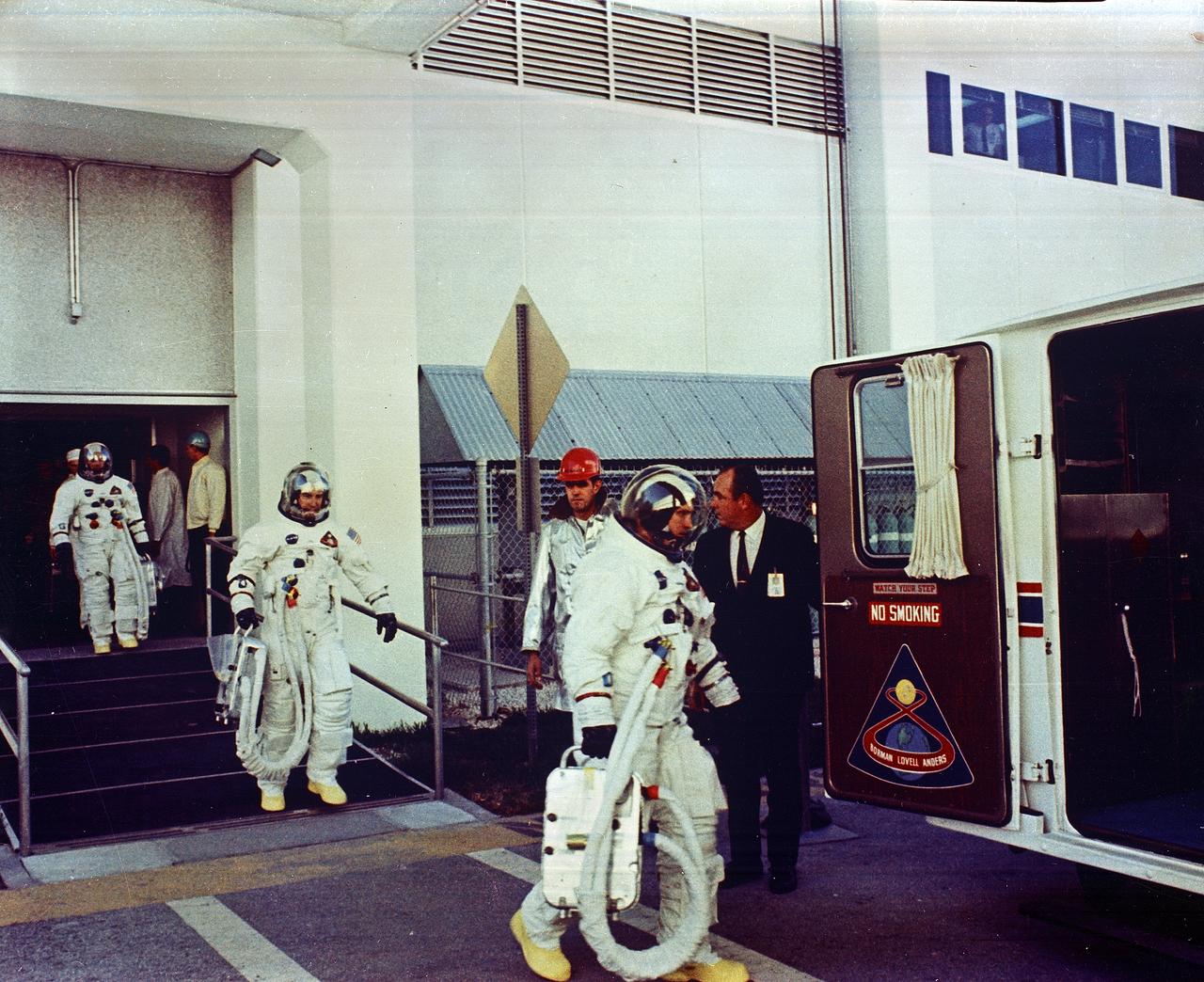
Apollo 8 Astronauts William Anders, Lunar Module (LM) Pilot; James Lovell, Command Module (CM) pilot; and Frank Borman, commander, transfer to the astronaut van for the trip to the launch pad. The first manned Apollo mission launched aboard the Saturn V and first manned Apollo craft to enter lunar orbit, the SA-503, Apollo 8 mission liftoff occurred on December 21, 1968 and returned safely to Earth on December 27, 1968. The mission achieved operational experience and tested the Apollo command module systems, including communications, tracking, and life-support, in cis-lunar space and lunar orbit, and allowed evaluation of crew performance on a lunar orbiting mission. The crew photographed the lunar surface, both far side and near side, obtaining information on topography and landmarks as well as other scientific information necessary for future Apollo landings. All systems operated within allowable parameters and all objectives of the mission were achieved.
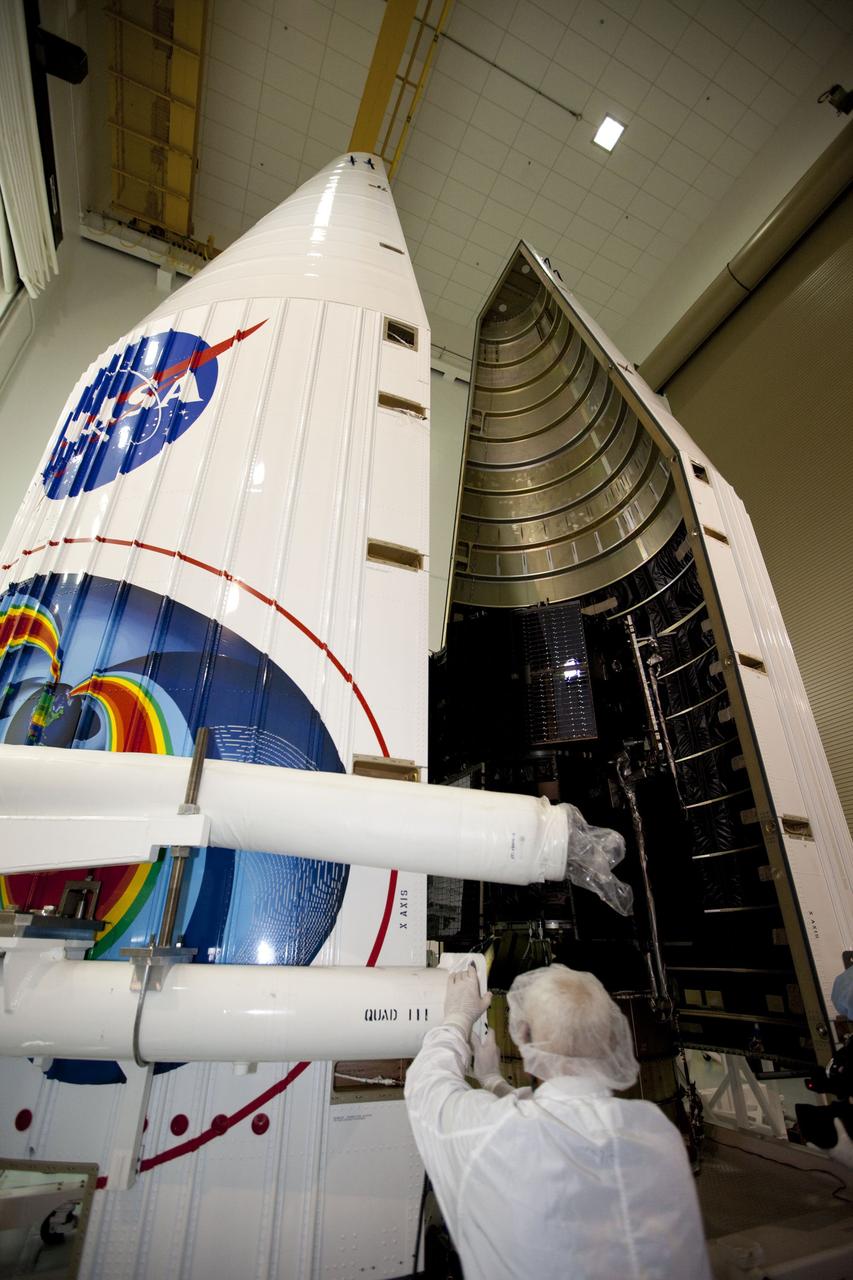
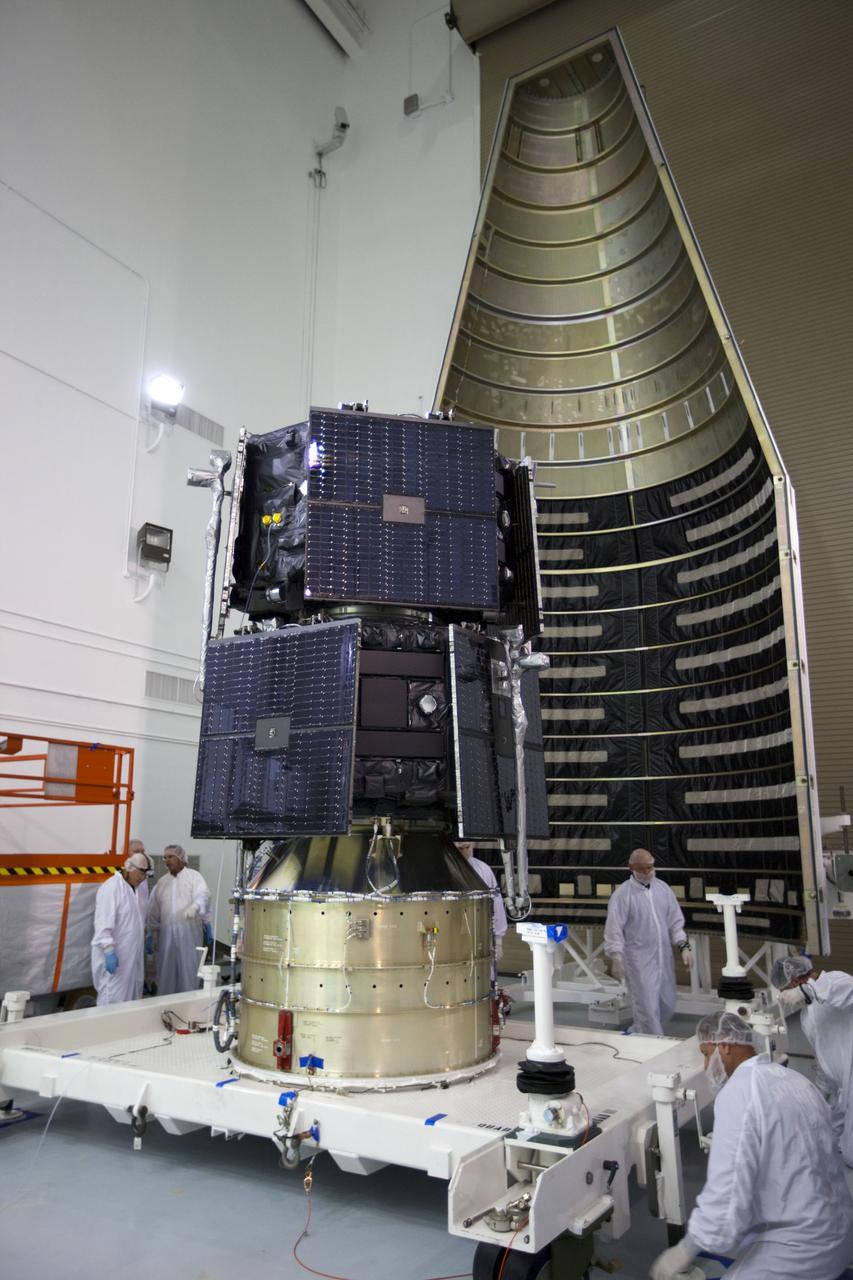
TITUSVILLE, Fla. - Inside the Astrotech payload processing facility in Titusville, Fla. near NASA’s Kennedy Space Center, technicians move the payload faring into position for encapsulation with the two Radiation Belt Storm Probes, or RBSP, spacecraft. The fairing will house and protect the RBSP during liftoff and flight through the atmosphere aboard an Atlas V rocket. NASA’s RBSP mission will help us understand the sun’s influence on Earth and near-Earth space by studying the Earth’s radiation belts on various scales of space and time. RBSP will begin its mission of exploration of Earth’s Van Allen radiation belts and the extremes of space weather after its liftoff aboard a United Launch Alliance Atlas V from Space Launch Complex 41 at Cape Canaveral Air Force Station, Fla. Liftoff is targeted for Aug. 23, 2012. For more information, visit http://www.nasa.gov/rbsp. Photo credit: NASA/ Kim Shiflett
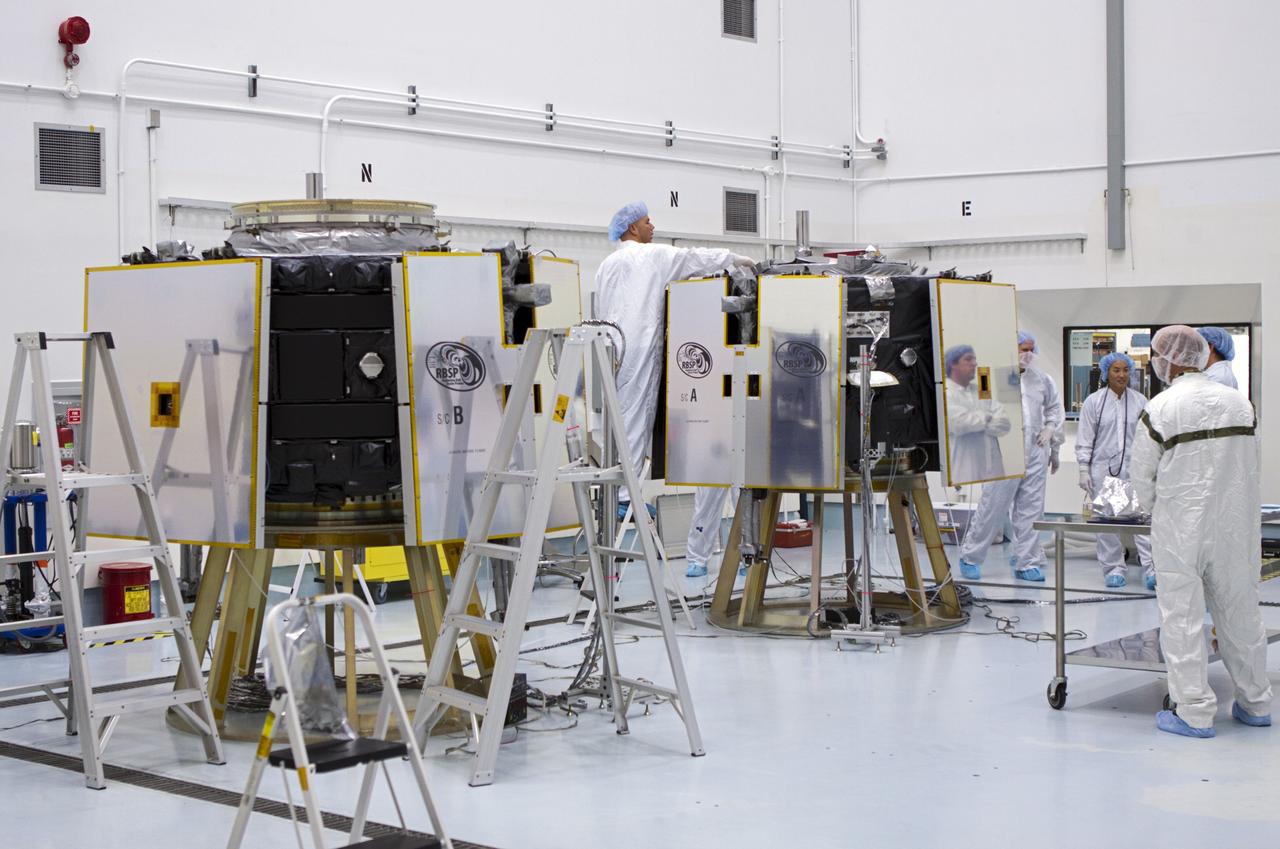
TITUSVILLE, Fla. - Inside the Astrotech payload processing facility in Titusville, Fla. near NASA’s Kennedy Space Center, technicians checkout the two Radiation Belt Storm Probes, or RBSP, spacecraft prior to vertical stacking. NASA’s RBSP mission will help us understand the sun’s influence on Earth and near-Earth space by studying the Earth’s radiation belts on various scales of space and time. RBSP will begin its mission of exploration of Earth’s Van Allen radiation belts and the extremes of space weather after its liftoff aboard a United Launch Alliance Atlas V from Space Launch Complex 41 at Cape Canaveral Air Force Station, Fla. Liftoff is targeted for Aug. 23, 2012. For more information, visit http://www.nasa.gov/rbsp. Photo credit: NASA/Jim Grossmann
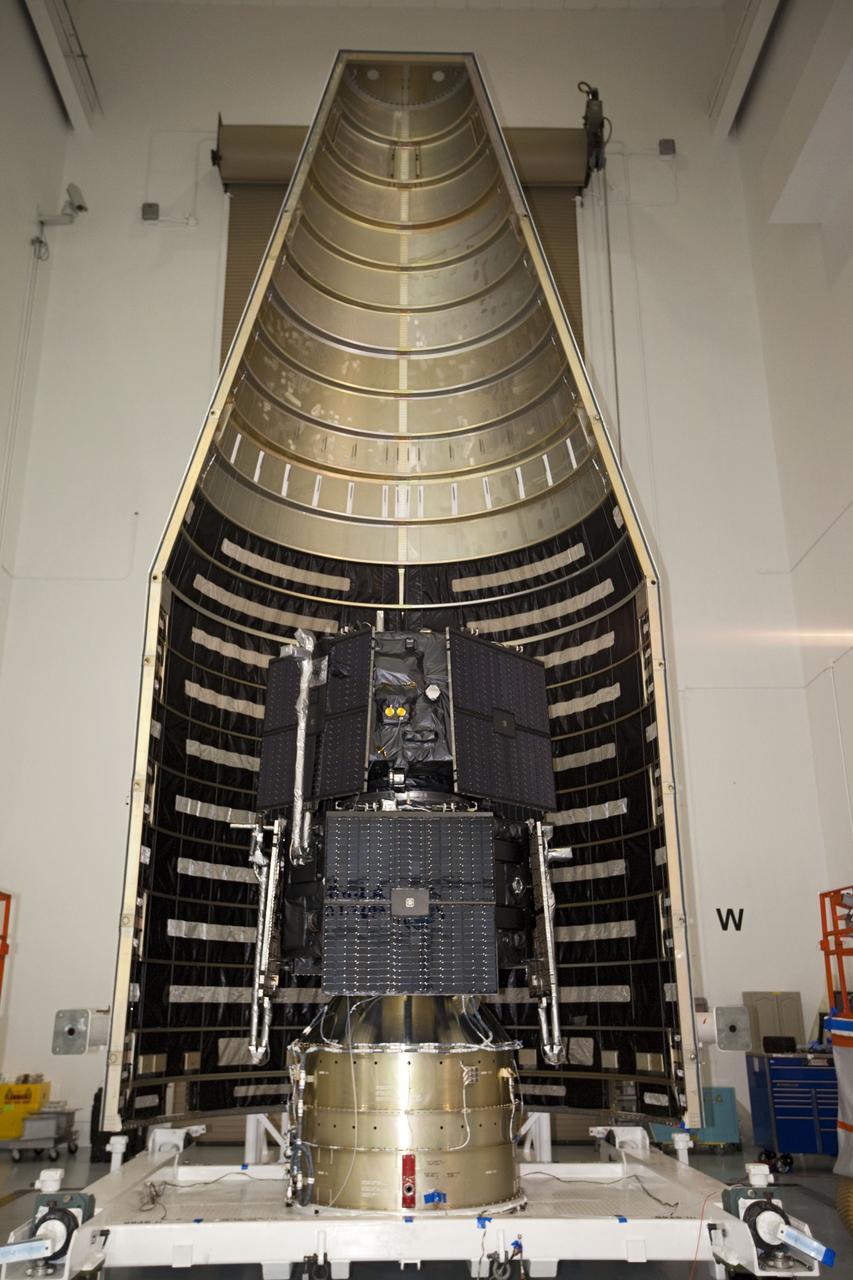
TITUSVILLE, Fla. - Inside the Astrotech payload processing facility in Titusville, Fla. near NASA’s Kennedy Space Center, the two Radiation Belt Storm Probes, or RBSP, spacecraft are being encapsulated in the payload faring. The fairing will house and protect the RBSP during liftoff and flight through the atmosphere aboard an Atlas V rocket. NASA’s RBSP mission will help us understand the sun’s influence on Earth and near-Earth space by studying the Earth’s radiation belts on various scales of space and time. RBSP will begin its mission of exploration of Earth’s Van Allen radiation belts and the extremes of space weather after its liftoff aboard a United Launch Alliance Atlas V from Space Launch Complex 41 at Cape Canaveral Air Force Station, Fla. Liftoff is targeted for Aug. 23, 2012. For more information, visit http://www.nasa.gov/rbsp. Photo credit: NASA/ Kim Shiflett
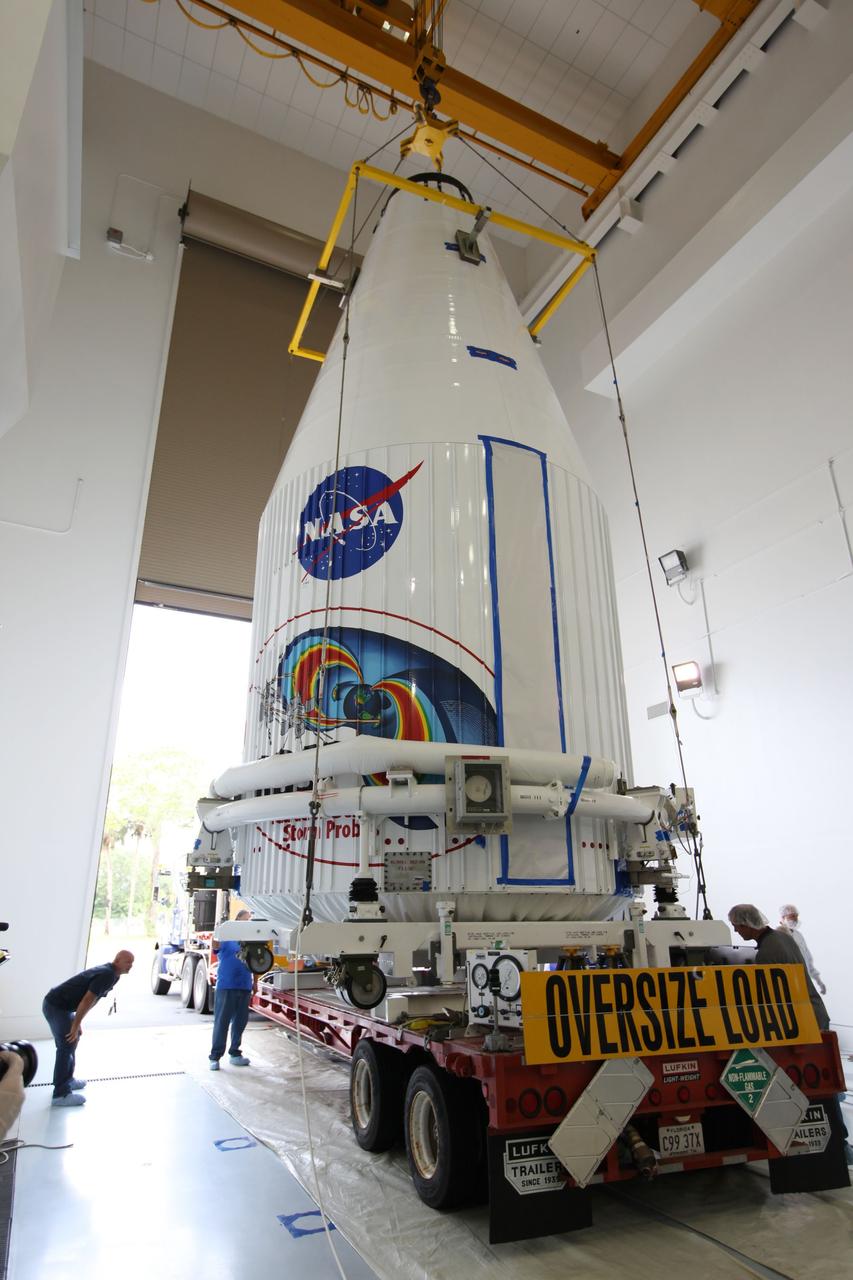
TITUSVILLE, Fla. - Inside the Astrotech payload processing facility in Titusville, Fla. near NASA’s Kennedy Space Center, technicians use a crane to lower the payload faring containing the two Radiation Belt Storm Probes, or RBSP, spacecraft on to a transporter to be moved to the launch complex. NASA’s RBSP mission will help us understand the sun’s influence on Earth and near-Earth space by studying the Earth’s radiation belts on various scales of space and time. RBSP will begin its mission of exploration of Earth’s Van Allen radiation belts and the extremes of space weather after its liftoff aboard a United Launch Alliance Atlas V rocket from Space Launch Complex 41 at Cape Canaveral Air Force Station, Fla. Liftoff is targeted for Aug. 23, 2012. For more information, visit http://www.nasa.gov/rbsp Photo credit: NASA/ Kim Shiflett
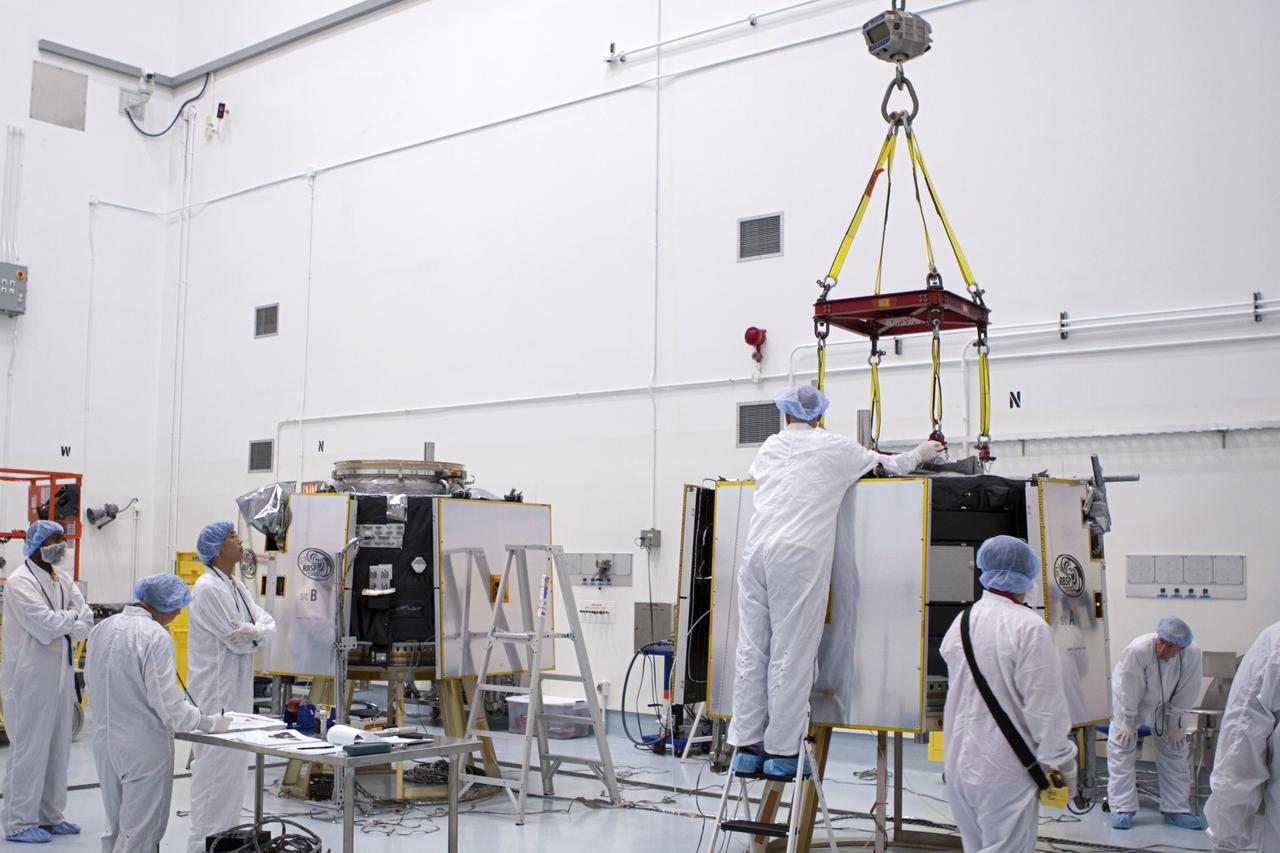
TITUSVILLE, Fla. - Inside the Astrotech payload processing facility in Titusville, Fla. near NASA’s Kennedy Space Center, technicians attach a crane to the Radiation Belt Storm Probes, or RBSP, spacecraft A prior to vertical stacking atop RBSP B. NASA’s RBSP mission will help us understand the sun’s influence on Earth and near-Earth space by studying the Earth’s radiation belts on various scales of space and time. RBSP will begin its mission of exploration of Earth’s Van Allen radiation belts and the extremes of space weather after its liftoff aboard a United Launch Alliance Atlas V from Space Launch Complex 41 at Cape Canaveral Air Force Station, Fla. Liftoff is targeted for Aug. 23, 2012. For more information, visit http://www.nasa.gov/rbsp. Photo credit: NASA/Jim Grossmann
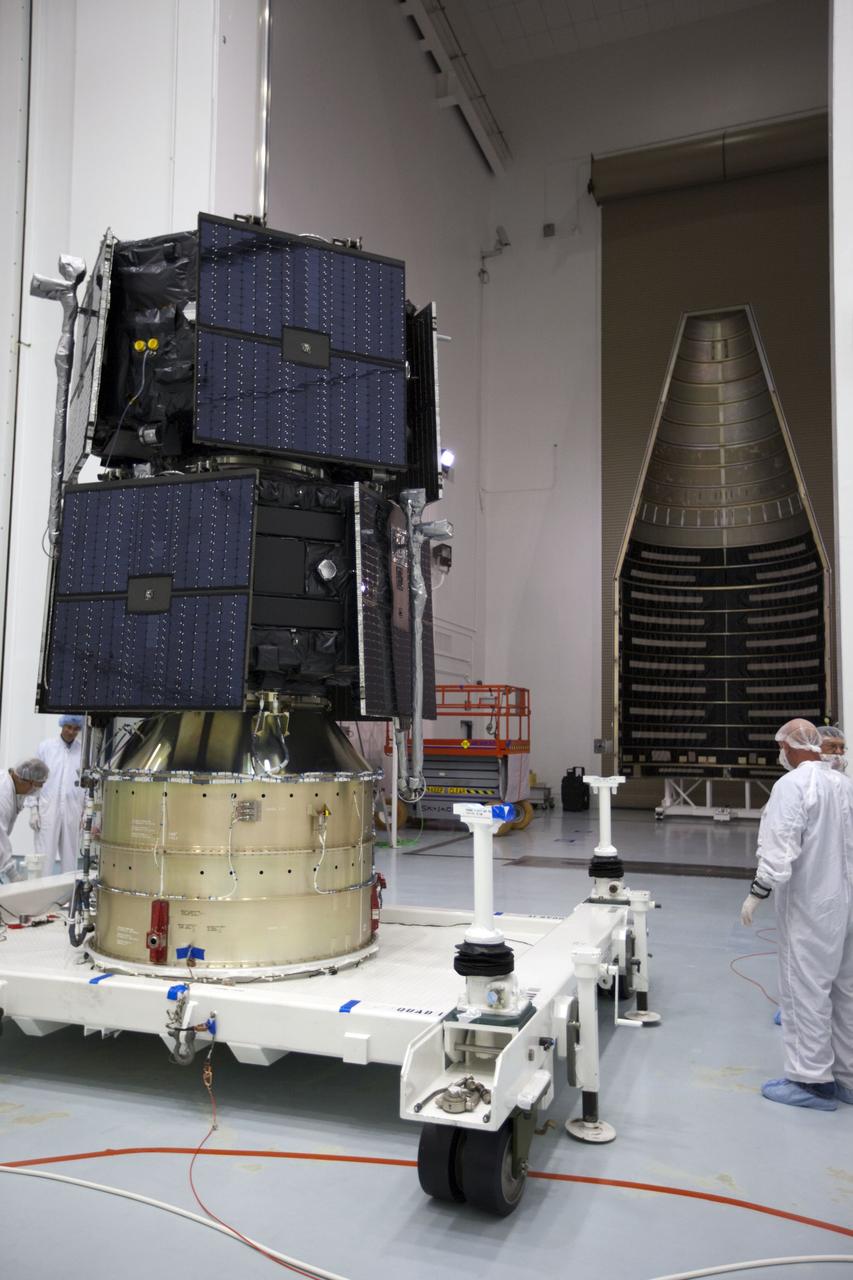
TITUSVILLE, Fla. - Inside the Astrotech payload processing facility in Titusville, Fla. near NASA’s Kennedy Space Center, technicians prepare the two Radiation Belt Storm Probes, or RBSP, spacecraft prior for encapsulation in the payload faring. The fairing will house and protect the RBSP during liftoff and flight through the atmosphere aboard an Atlas V rocket. NASA’s RBSP mission will help us understand the sun’s influence on Earth and near-Earth space by studying the Earth’s radiation belts on various scales of space and time. RBSP will begin its mission of exploration of Earth’s Van Allen radiation belts and the extremes of space weather after its liftoff aboard a United Launch Alliance Atlas V from Space Launch Complex 41 at Cape Canaveral Air Force Station, Fla. Liftoff is targeted for Aug. 23, 2012. For more information, visit http://www.nasa.gov/rbsp. Photo credit: NASA/ Kim Shiflett
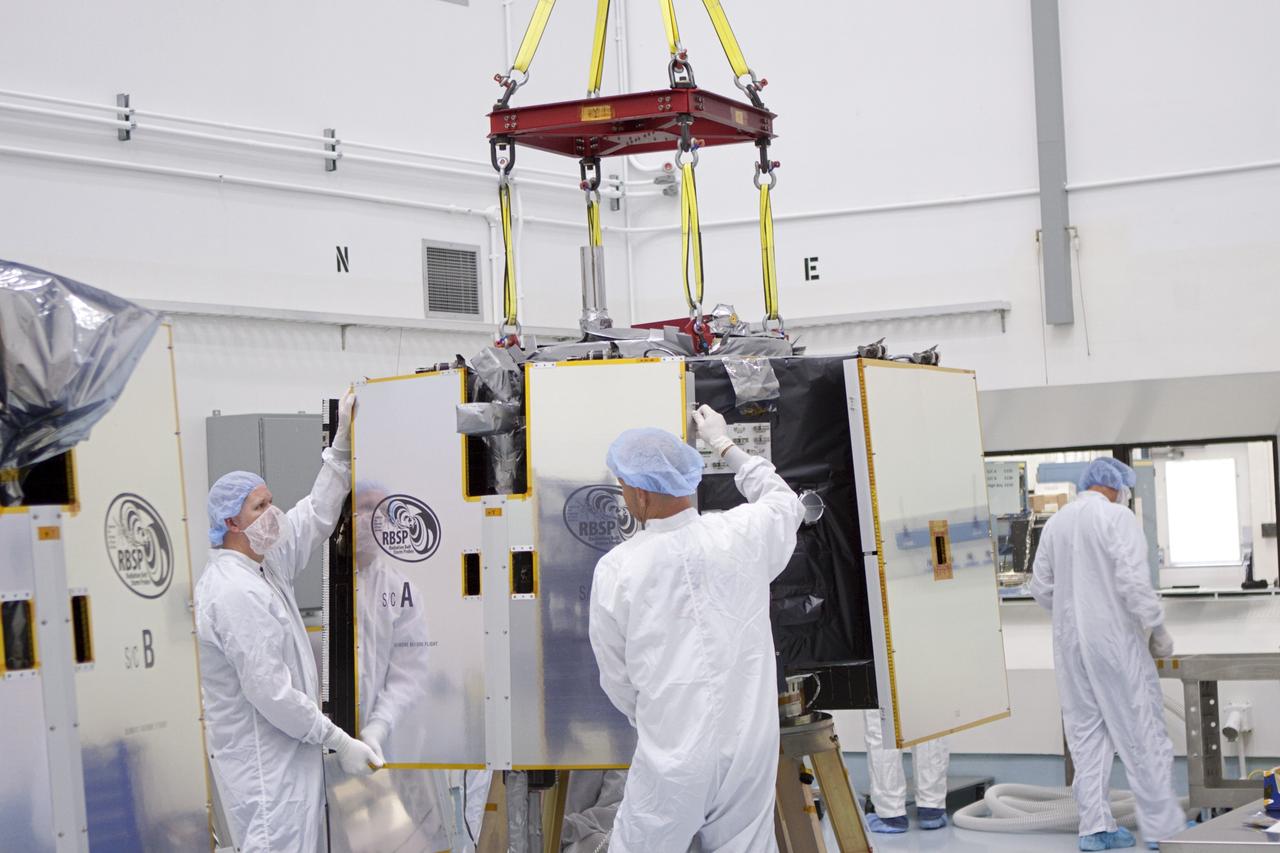
TITUSVILLE, Fla. - Inside the Astrotech payload processing facility in Titusville, Fla. near NASA’s Kennedy Space Center, technicians remove covers after a crane was attached to the Radiation Belt Storm Probes, or RBSP, spacecraft A prior to vertical stacking atop RBSP B. NASA’s RBSP mission will help us understand the sun’s influence on Earth and near-Earth space by studying the Earth’s radiation belts on various scales of space and time. RBSP will begin its mission of exploration of Earth’s Van Allen radiation belts and the extremes of space weather after its liftoff aboard a United Launch Alliance Atlas V from Space Launch Complex 41 at Cape Canaveral Air Force Station, Fla. Liftoff is targeted for Aug. 23, 2012. For more information, visit http://www.nasa.gov/rbsp. Photo credit: NASA/Jim Grossmann
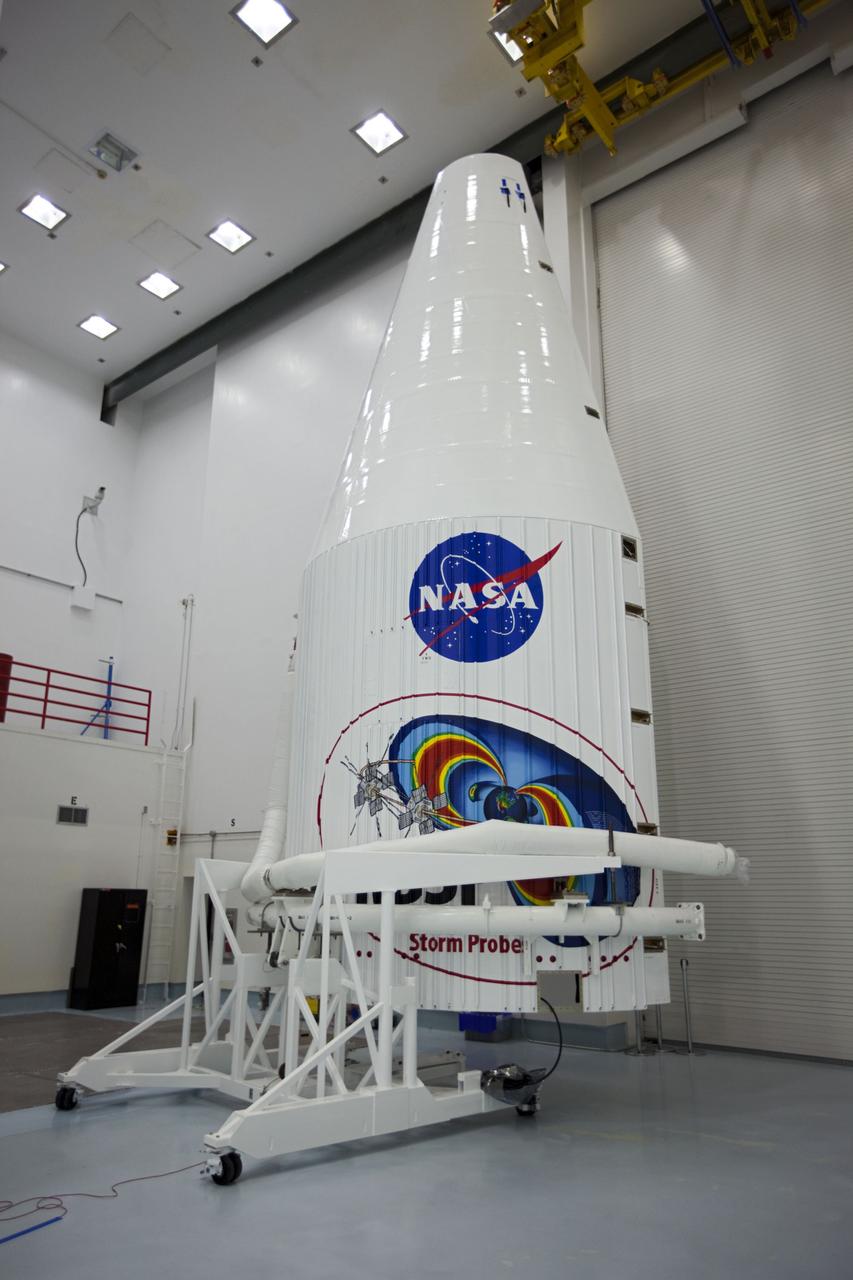
TITUSVILLE, Fla. - Inside the Astrotech payload processing facility near NASA’s Kennedy Space Center in Florida, the nose faring is being prepared for encapsulation with the Radiation Belt Storm Probes, or RBSP, spacecraft. The payload faring. The fairing will house and protect the RBSP during liftoff and flight through the atmosphere aboard an Atlas V rocket. NASA’s RBSP mission will help us understand the sun’s influence on Earth and near-Earth space by studying the Earth’s radiation belts on various scales of space and time. RBSP will begin its mission of exploration of Earth’s Van Allen radiation belts and the extremes of space weather after its liftoff aboard a United Launch Alliance Atlas V from Space Launch Complex 41 at Cape Canaveral Air Force Station, Fla. Liftoff is targeted for Aug. 23, 2012. For more information, visit http://www.nasa.gov/rbsp. Photo credit: NASA/ Kim Shiflett

TITUSVILLE, Fla. - Inside the Astrotech payload processing facility in Titusville, Fla. near NASA’s Kennedy Space Center, technicians complete encapsulation of the two Radiation Belt Storm Probes, or RBSP, spacecraft with its payload faring. The fairing will house and protect the RBSP during liftoff and flight through the atmosphere aboard an Atlas V rocket. NASA’s RBSP mission will help us understand the sun’s influence on Earth and near-Earth space by studying the Earth’s radiation belts on various scales of space and time. RBSP will begin its mission of exploration of Earth’s Van Allen radiation belts and the extremes of space weather after its liftoff aboard a United Launch Alliance Atlas V from Space Launch Complex 41 at Cape Canaveral Air Force Station, Fla. Liftoff is targeted for Aug. 23, 2012. For more information, visit http://www.nasa.gov/rbsp. Photo credit: NASA/ Kim Shiflett
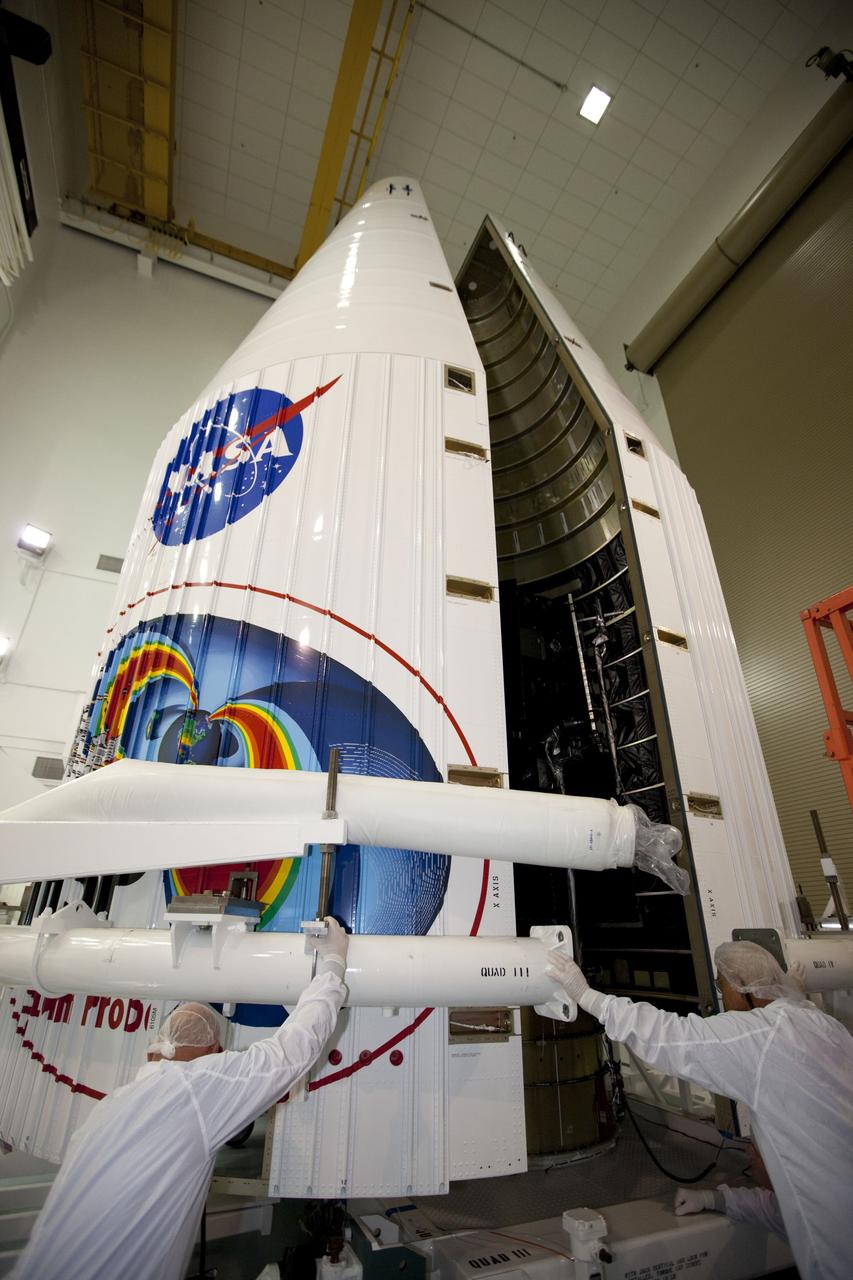
TITUSVILLE, Fla. - Inside the Astrotech payload processing facility in Titusville, Fla. near NASA’s Kennedy Space Center, technicians move the payload faring into position for encapsulation with the two Radiation Belt Storm Probes, or RBSP, spacecraft. The fairing will house and protect the RBSP during liftoff and flight through the atmosphere aboard an Atlas V rocket. NASA’s RBSP mission will help us understand the sun’s influence on Earth and near-Earth space by studying the Earth’s radiation belts on various scales of space and time. RBSP will begin its mission of exploration of Earth’s Van Allen radiation belts and the extremes of space weather after its liftoff aboard a United Launch Alliance Atlas V from Space Launch Complex 41 at Cape Canaveral Air Force Station, Fla. Liftoff is targeted for Aug. 23, 2012. For more information, visit http://www.nasa.gov/rbsp. Photo credit: NASA/ Kim Shiflett
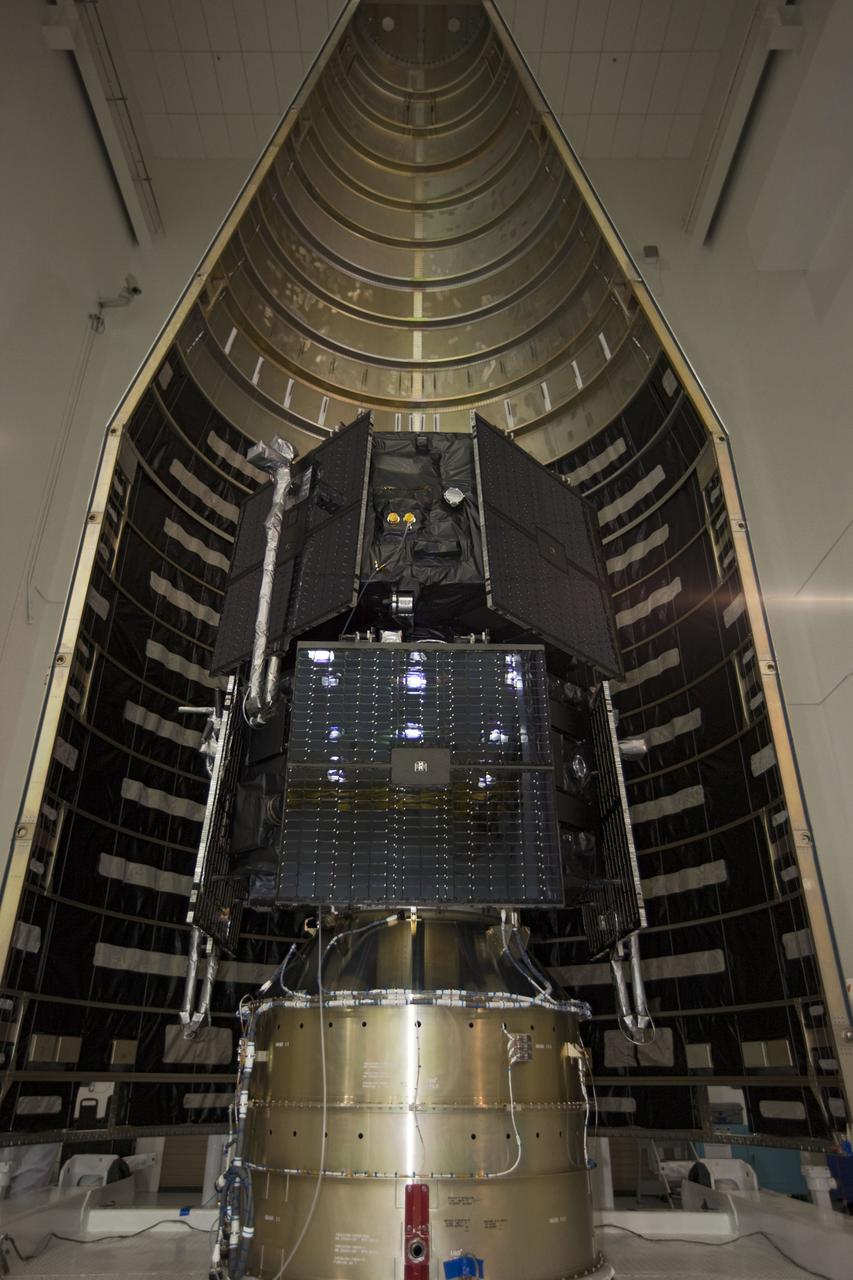
TITUSVILLE, Fla. - Inside the Astrotech payload processing facility in Titusville, Fla. near NASA’s Kennedy Space Center, the two Radiation Belt Storm Probes, or RBSP, spacecraft are being encapsulated in the payload faring. The fairing will house and protect the RBSP during liftoff and flight through the atmosphere aboard an Atlas V rocket. NASA’s RBSP mission will help us understand the sun’s influence on Earth and near-Earth space by studying the Earth’s radiation belts on various scales of space and time. RBSP will begin its mission of exploration of Earth’s Van Allen radiation belts and the extremes of space weather after its liftoff aboard a United Launch Alliance Atlas V from Space Launch Complex 41 at Cape Canaveral Air Force Station, Fla. Liftoff is targeted for Aug. 23, 2012. For more information, visit http://www.nasa.gov/rbsp. Photo credit: NASA/ Kim Shiflett
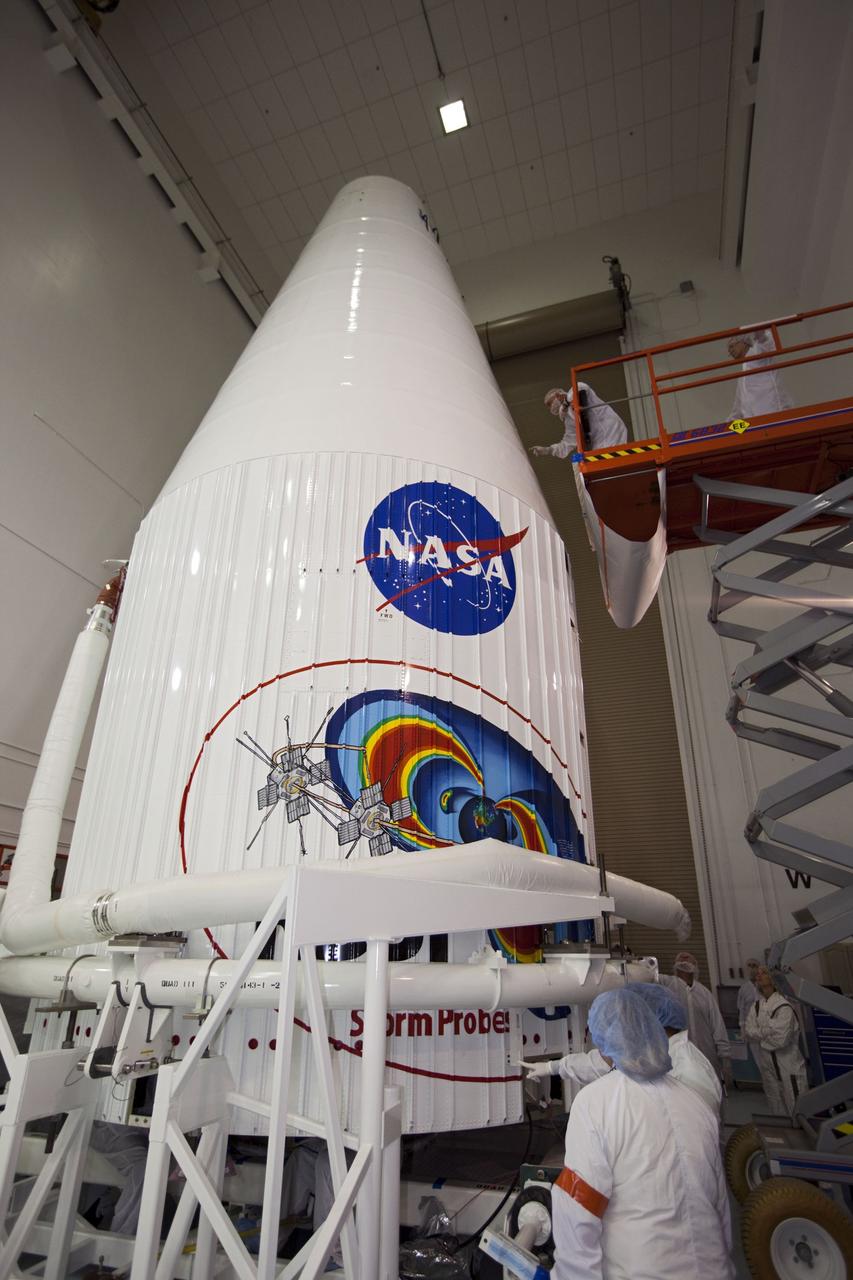
TITUSVILLE, Fla. - Inside the Astrotech payload processing facility in Titusville, Fla. near NASA’s Kennedy Space Center, technicians complete checkouts following encapsulation of the two Radiation Belt Storm Probes, or RBSP, spacecraft with its payload faring. The fairing will house and protect the RBSP during liftoff and flight through the atmosphere aboard an Atlas V rocket. NASA’s RBSP mission will help us understand the sun’s influence on Earth and near-Earth space by studying the Earth’s radiation belts on various scales of space and time. RBSP will begin its mission of exploration of Earth’s Van Allen radiation belts and the extremes of space weather after its liftoff aboard a United Launch Alliance Atlas V from Space Launch Complex 41 at Cape Canaveral Air Force Station, Fla. Liftoff is targeted for Aug. 23, 2012. For more information, visit http://www.nasa.gov/rbsp. Photo credit: NASA/ Kim Shiflett
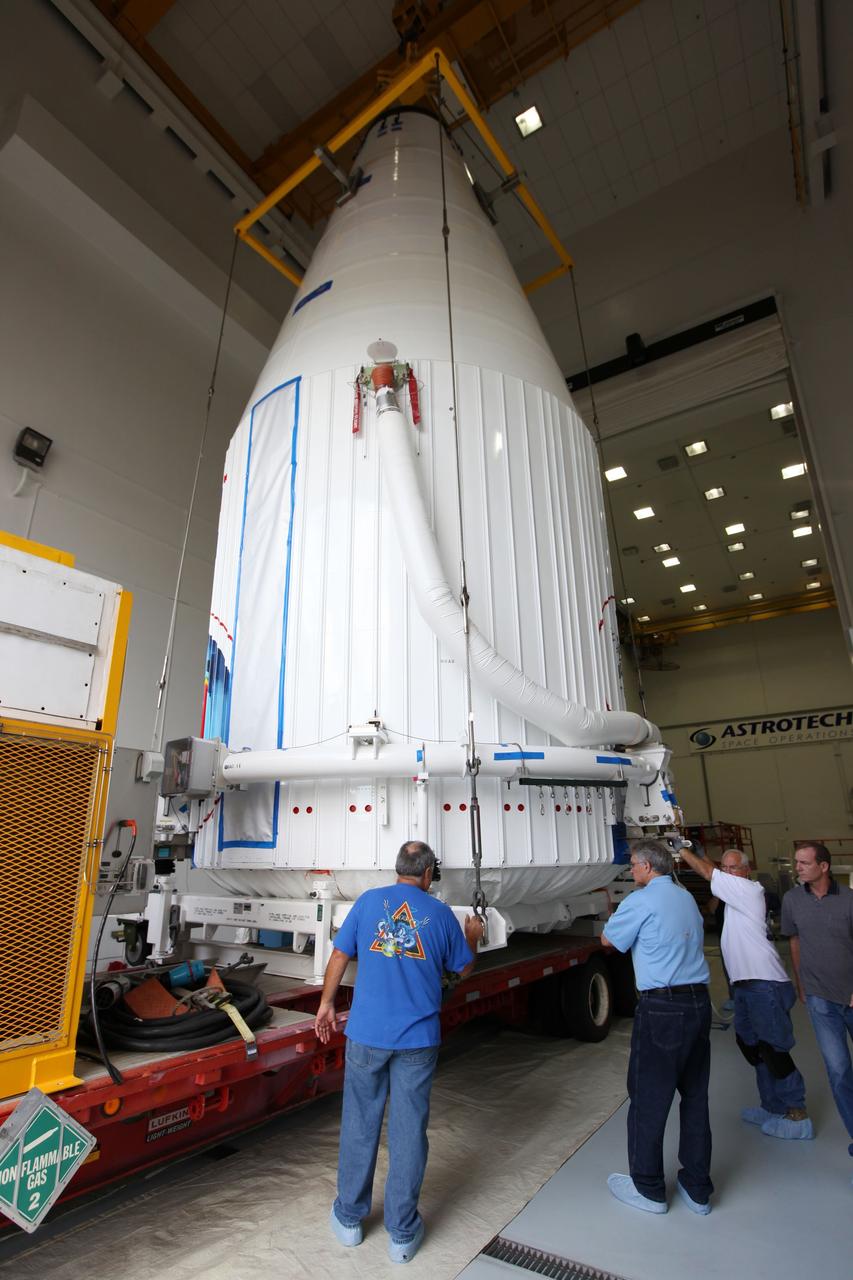
TITUSVILLE, Fla. - Inside the Astrotech payload processing facility in Titusville, Fla. near NASA’s Kennedy Space Center, technicians secure the payload faring containing the two Radiation Belt Storm Probes, or RBSP, spacecraft on to a transporter for the move to the launch complex. NASA’s RBSP mission will help us understand the sun’s influence on Earth and near-Earth space by studying the Earth’s radiation belts on various scales of space and time. RBSP will begin its mission of exploration of Earth’s Van Allen radiation belts and the extremes of space weather after its liftoff aboard a United Launch Alliance Atlas V rocket from Space Launch Complex 41 at Cape Canaveral Air Force Station, Fla. Liftoff is targeted for Aug. 23, 2012. For more information, visit http://www.nasa.gov/rbsp Photo credit: NASA/ Kim Shiflett
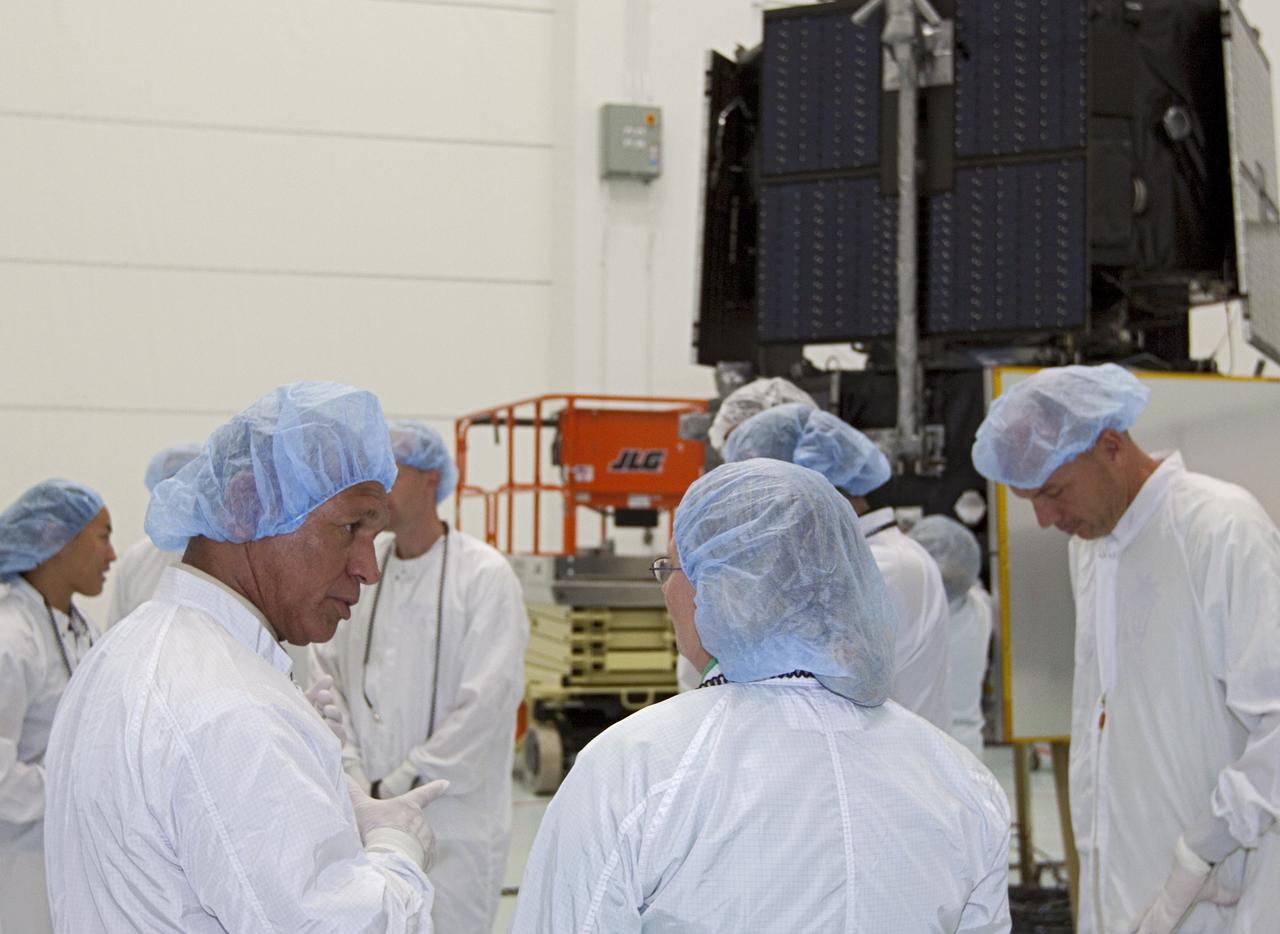
CAPE CANAVERAL, Fla. - Inside the Astrotech payload processing facility near NASA’s Kennedy Space Center in Florida, NASA Administrator Charlie Bolden, at left, talks to technicians about the Radiation Belt Storm Probes, or RBSP, spacecraft. NASA’s RBSP mission will help us understand the sun’s influence on Earth and near-Earth space by studying the Earth’s radiation belts on various scales of space and time. As the spacecraft orbits Earth, the four solar panels will continuously face the sun to provide constant power to its instruments. The boom will provide data of the electric fields that energize radiation particles and modify the structure of the inner magnetosphere. RBSP will begin its mission of exploration of Earth’s Van Allen radiation belts and the extremes of space weather after its launch aboard a United Launch Alliance Atlas V rocket. Launch is targeted for Aug. 23. For more information, visit http://www.nasa.gov/rbsp. Photo credit: NASA/Kim Shiflett
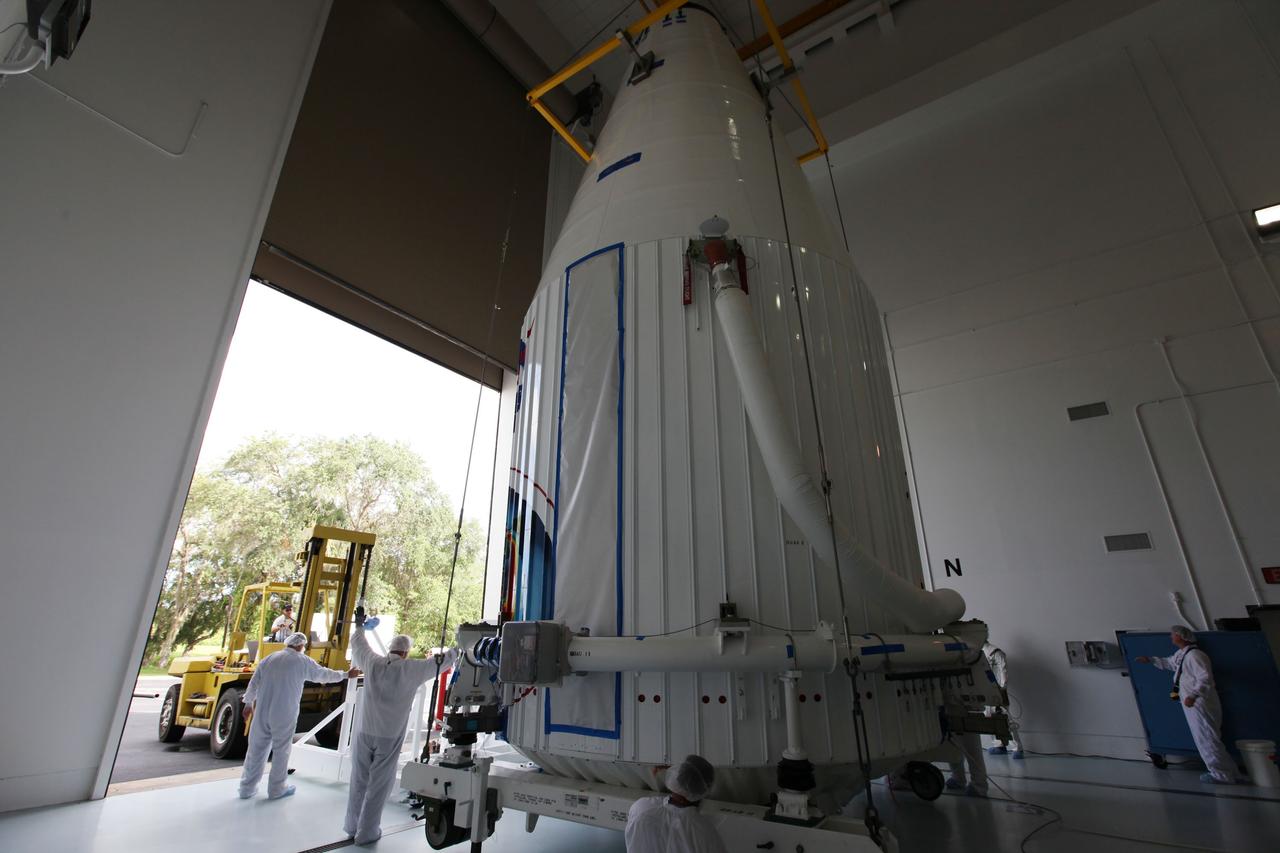
TITUSVILLE, Fla. - Inside the Astrotech payload processing facility in Titusville, Fla. near NASA’s Kennedy Space Center, technicians move the payload faring containing the two Radiation Belt Storm Probes, or RBSP, spacecraft into position for lifting on to a transporter to be moved to the launch complex. NASA’s RBSP mission will help us understand the sun’s influence on Earth and near-Earth space by studying the Earth’s radiation belts on various scales of space and time. RBSP will begin its mission of exploration of Earth’s Van Allen radiation belts and the extremes of space weather after its liftoff aboard a United Launch Alliance Atlas V rocket from Space Launch Complex 41 at Cape Canaveral Air Force Station, Fla. Liftoff is targeted for Aug. 23, 2012. For more information, visit http://www.nasa.gov/rbsp Photo credit: NASA/ Kim Shiflett
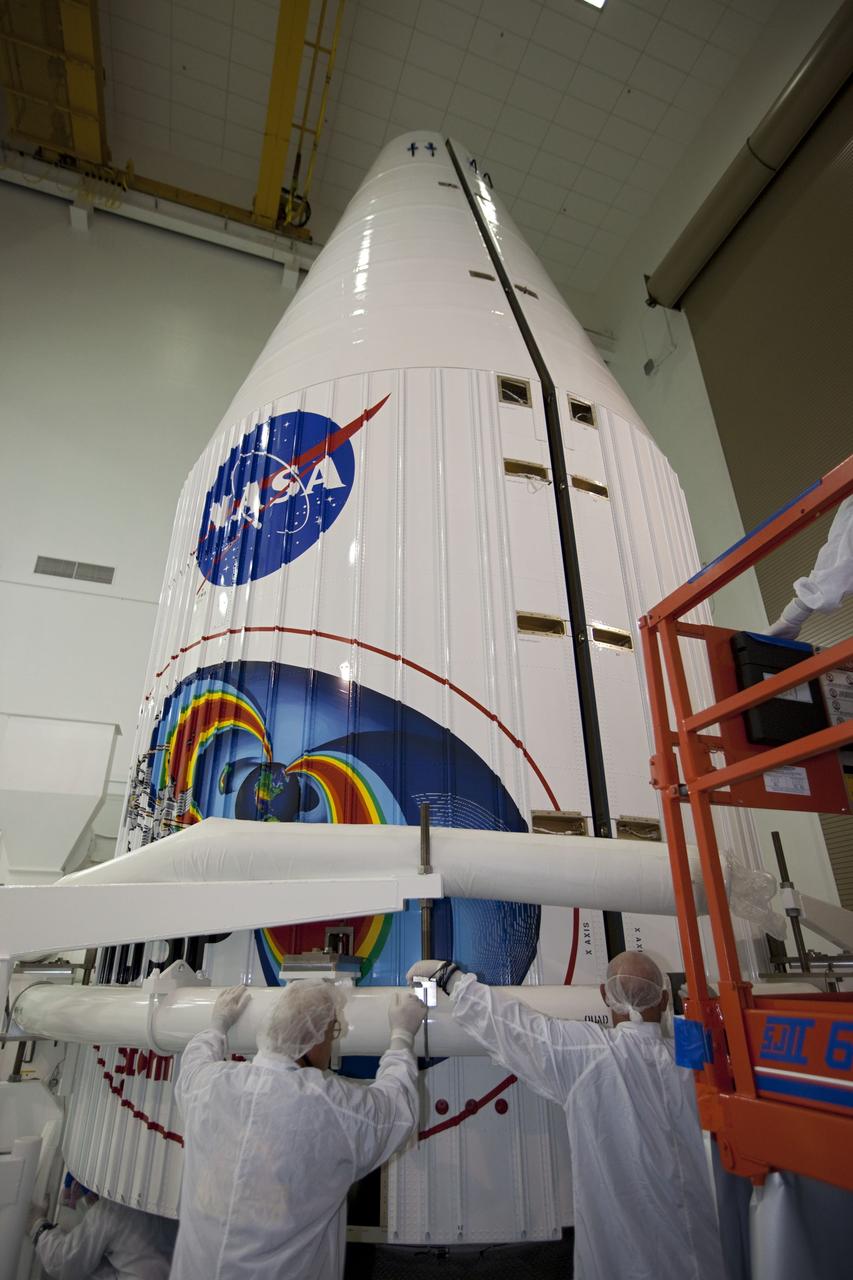
TITUSVILLE, Fla. - Inside the Astrotech payload processing facility in Titusville, Fla. near NASA’s Kennedy Space Center, technicians move the two halves if the payload faring into position for encapsulation with the two Radiation Belt Storm Probes, or RBSP, spacecraft. The fairing will house and protect the RBSP during liftoff and flight through the atmosphere aboard an Atlas V rocket. NASA’s RBSP mission will help us understand the sun’s influence on Earth and near-Earth space by studying the Earth’s radiation belts on various scales of space and time. RBSP will begin its mission of exploration of Earth’s Van Allen radiation belts and the extremes of space weather after its liftoff aboard a United Launch Alliance Atlas V from Space Launch Complex 41 at Cape Canaveral Air Force Station, Fla. Liftoff is targeted for Aug. 23, 2012. For more information, visit http://www.nasa.gov/rbsp. Photo credit: NASA/ Kim Shiflett
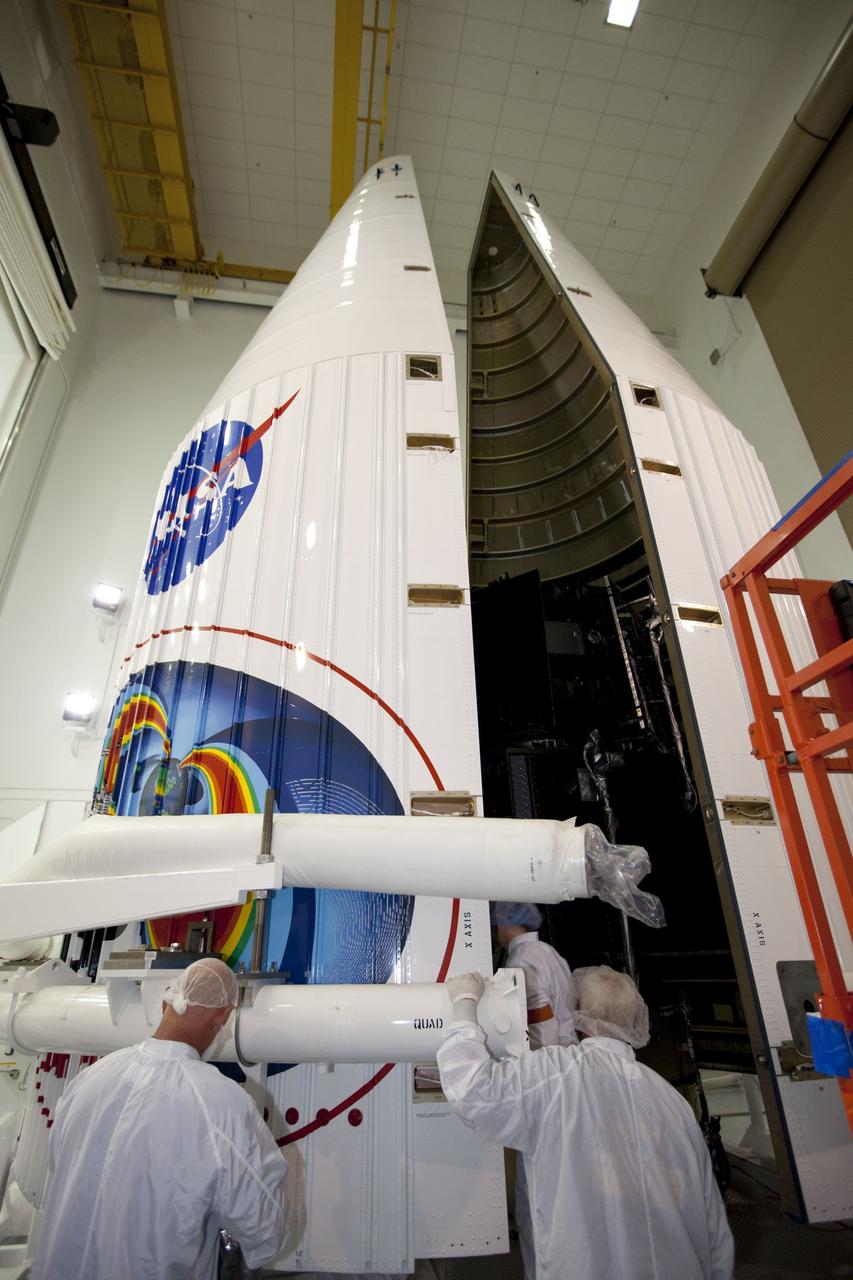
TITUSVILLE, Fla. - Inside the Astrotech payload processing facility in Titusville, Fla. near NASA’s Kennedy Space Center, technicians move the payload faring into position for encapsulation with the two Radiation Belt Storm Probes, or RBSP, spacecraft. The fairing will house and protect the RBSP during liftoff and flight through the atmosphere aboard an Atlas V rocket. NASA’s RBSP mission will help us understand the sun’s influence on Earth and near-Earth space by studying the Earth’s radiation belts on various scales of space and time. RBSP will begin its mission of exploration of Earth’s Van Allen radiation belts and the extremes of space weather after its liftoff aboard a United Launch Alliance Atlas V from Space Launch Complex 41 at Cape Canaveral Air Force Station, Fla. Liftoff is targeted for Aug. 23, 2012. For more information, visit http://www.nasa.gov/rbsp. Photo credit: NASA/ Kim Shiflett
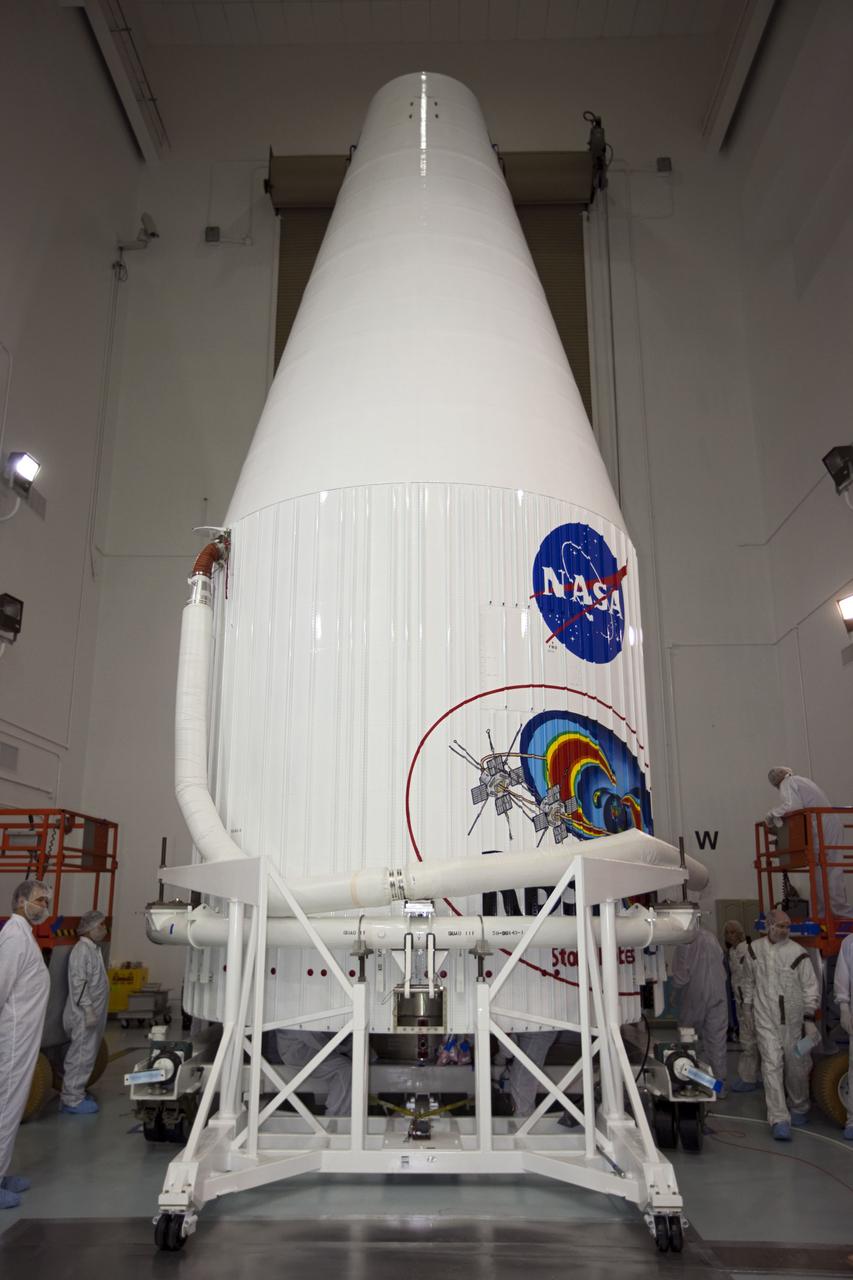
TITUSVILLE, Fla. - Inside the Astrotech payload processing facility in Titusville, Fla. near NASA’s Kennedy Space Center, technicians complete encapsulation of the two Radiation Belt Storm Probes, or RBSP, spacecraft with its payload faring. The fairing will house and protect the RBSP during liftoff and flight through the atmosphere aboard an Atlas V rocket. NASA’s RBSP mission will help us understand the sun’s influence on Earth and near-Earth space by studying the Earth’s radiation belts on various scales of space and time. RBSP will begin its mission of exploration of Earth’s Van Allen radiation belts and the extremes of space weather after its liftoff aboard a United Launch Alliance Atlas V from Space Launch Complex 41 at Cape Canaveral Air Force Station, Fla. Liftoff is targeted for Aug. 23, 2012. For more information, visit http://www.nasa.gov/rbsp. Photo credit: NASA/ Kim Shiflett
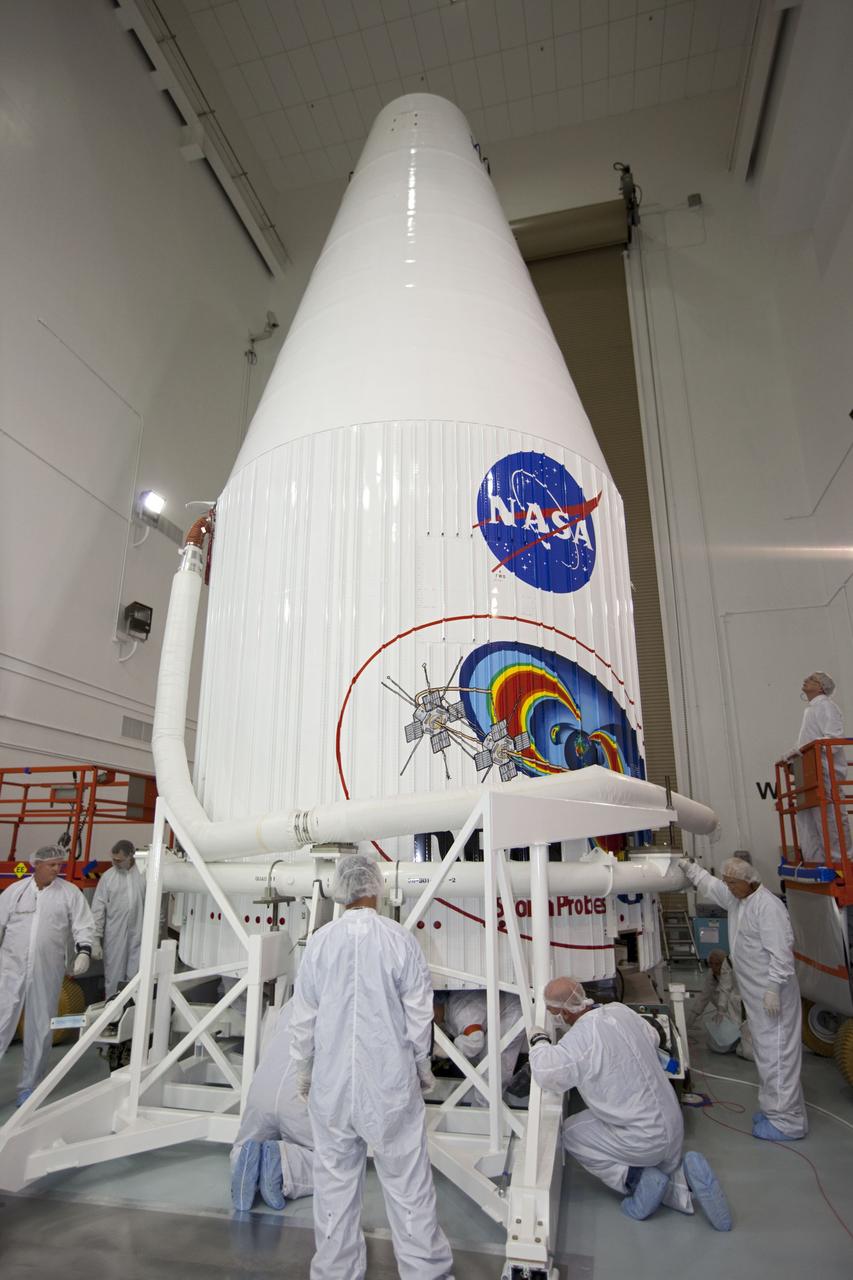
TITUSVILLE, Fla. - Inside the Astrotech payload processing facility in Titusville, Fla. near NASA’s Kennedy Space Center, technicians complete encapsulation of the two Radiation Belt Storm Probes, or RBSP, spacecraft with its payload faring. The fairing will house and protect the RBSP during liftoff and flight through the atmosphere aboard an Atlas V rocket. NASA’s RBSP mission will help us understand the sun’s influence on Earth and near-Earth space by studying the Earth’s radiation belts on various scales of space and time. RBSP will begin its mission of exploration of Earth’s Van Allen radiation belts and the extremes of space weather after its liftoff aboard a United Launch Alliance Atlas V from Space Launch Complex 41 at Cape Canaveral Air Force Station, Fla. Liftoff is targeted for Aug. 23, 2012. For more information, visit http://www.nasa.gov/rbsp. Photo credit: NASA/ Kim Shiflett
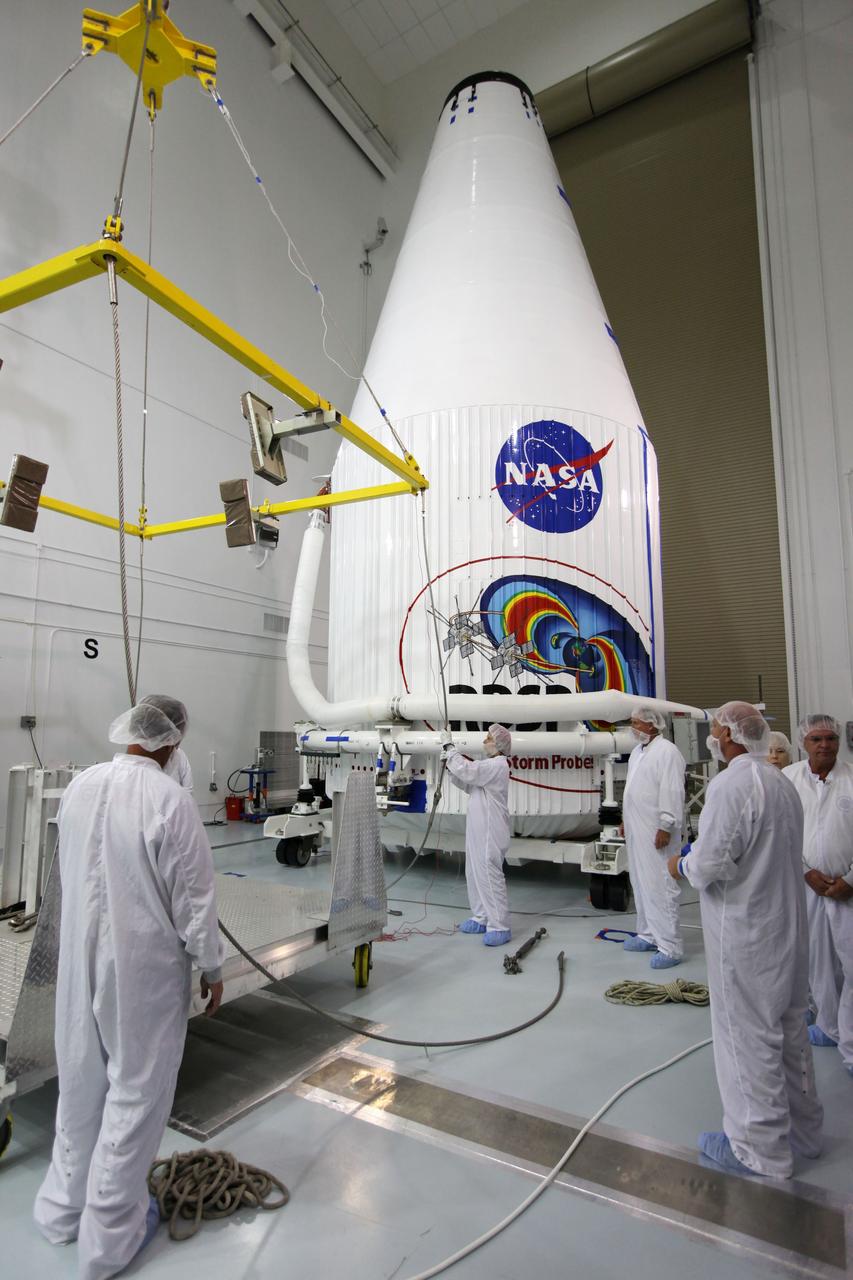
TITUSVILLE, Fla. - Inside the Astrotech payload processing facility in Titusville, Fla. near NASA’s Kennedy Space Center, technicians prepare the payload faring containing the two Radiation Belt Storm Probes, or RBSP, spacecraft for lifting on to a transporter to be moved to the launch complex. NASA’s RBSP mission will help us understand the sun’s influence on Earth and near-Earth space by studying the Earth’s radiation belts on various scales of space and time. RBSP will begin its mission of exploration of Earth’s Van Allen radiation belts and the extremes of space weather after its liftoff aboard a United Launch Alliance Atlas V rocket from Space Launch Complex 41 at Cape Canaveral Air Force Station, Fla. Liftoff is targeted for Aug. 23, 2012. For more information, visit http://www.nasa.gov/rbsp Photo credit: NASA/ Kim Shiflett
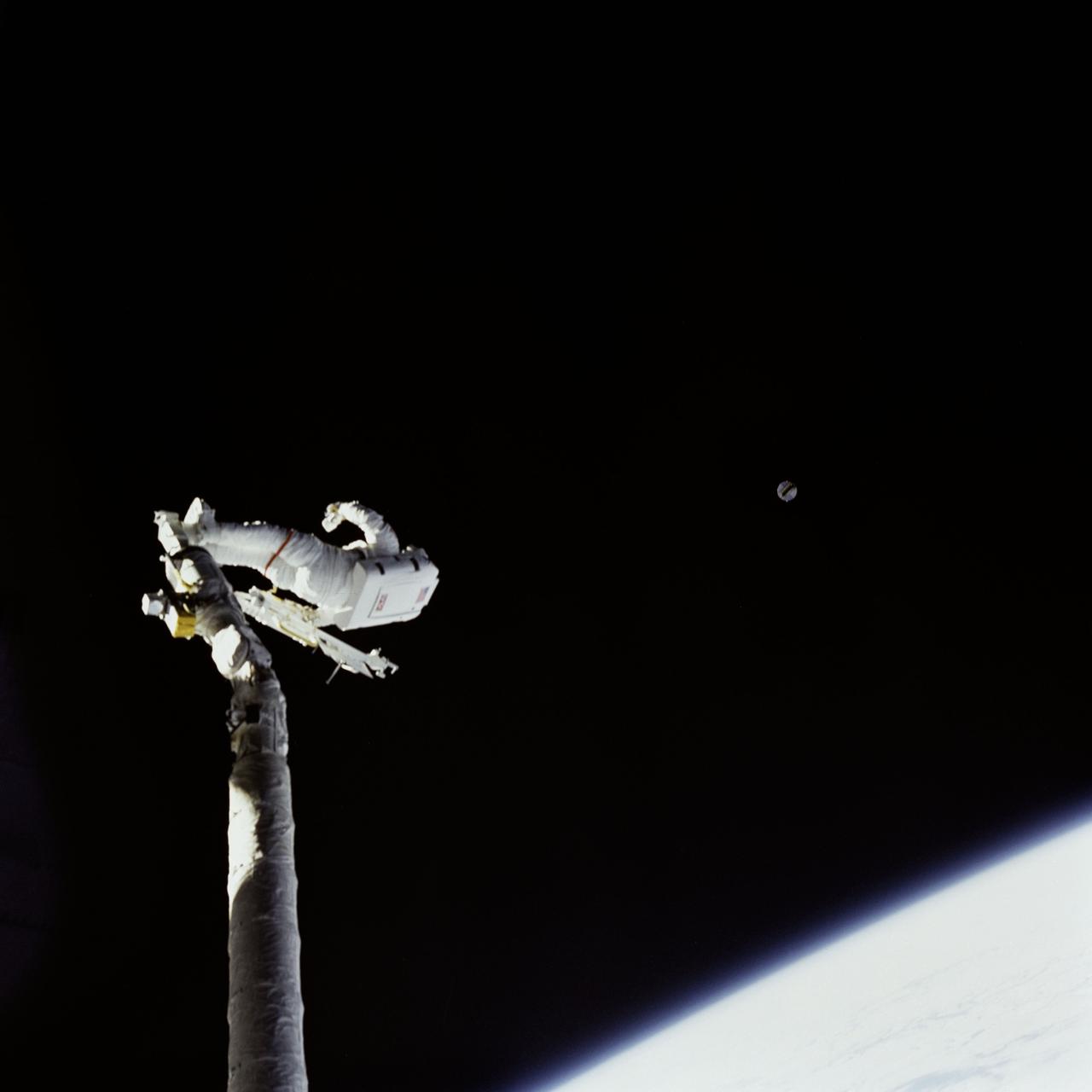
51I-44-081 (1 Sept 1985) --- Astronaut James D. van Hoften on the Discovery's remote manipulator system (RMS) arm visually tracks the distant Syncom IV-3 communications satellite after its second release, on Sept. 1, 1985.
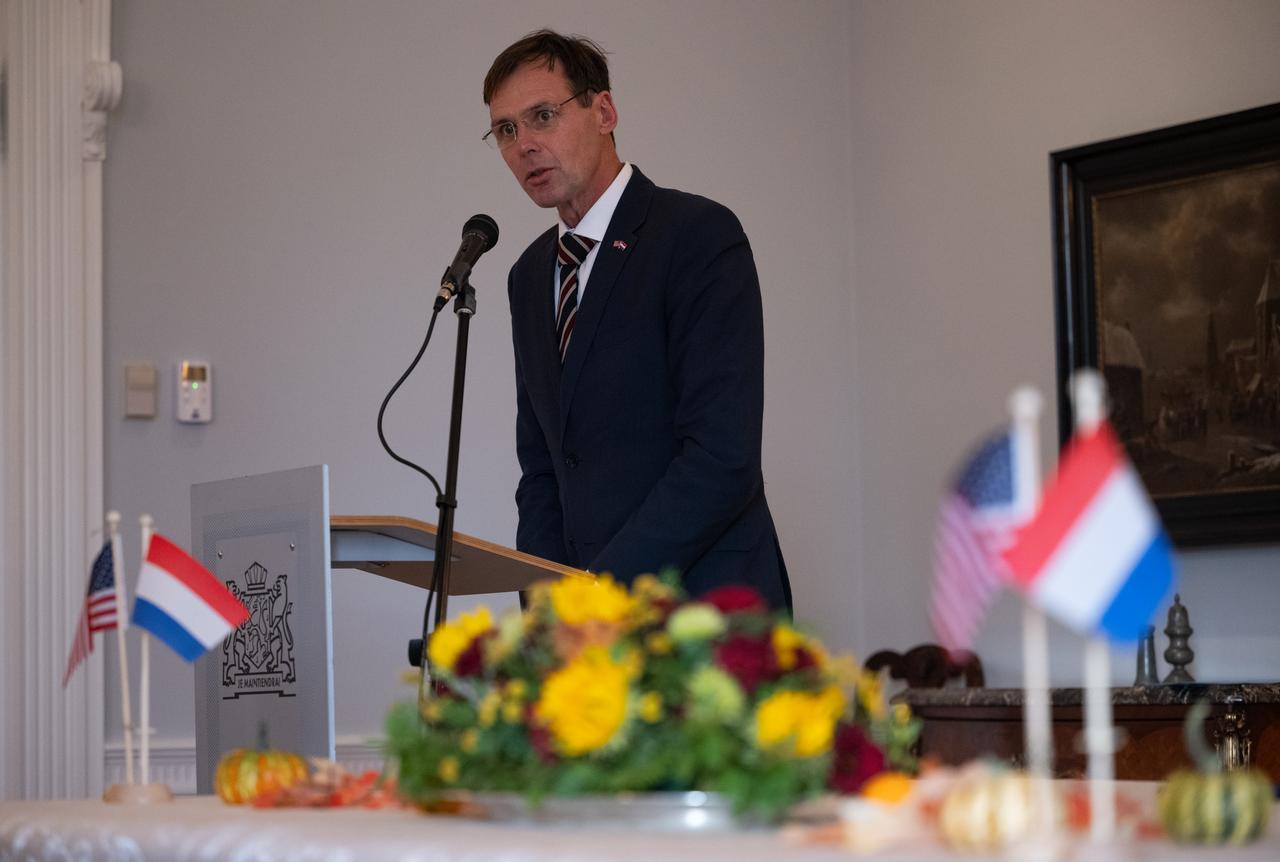
Harm van de Wetering, director of the Netherlands Space Office, delivers remarks during an Artemis Accords signing ceremony, Wednesday, Nov. 1, 2023, at the Dutch Ambassador’s Residence in Washington. Netherlands is the 31st country to sign the Artemis Accords, which establish a practical set of principles to guide space exploration cooperation among nations participating in NASA’s Artemis program. Photo Credit: (NASA/Joel Kowsky)

Carol Armstrong, wife of Neil Armstrong, and Piper Van Wagenen, one of 10 grandchildren, are seen during a memorial service celebrating the life of Neil Armstrong, Friday, Aug. 31, 2012, at the Camargo Club in Cincinnati. Armstrong, the first man to walk on the moon during the 1969 Apollo 11 mission, died Saturday, Aug. 25. He was 82. Photo Credit: (NASA/Bill Ingalls)
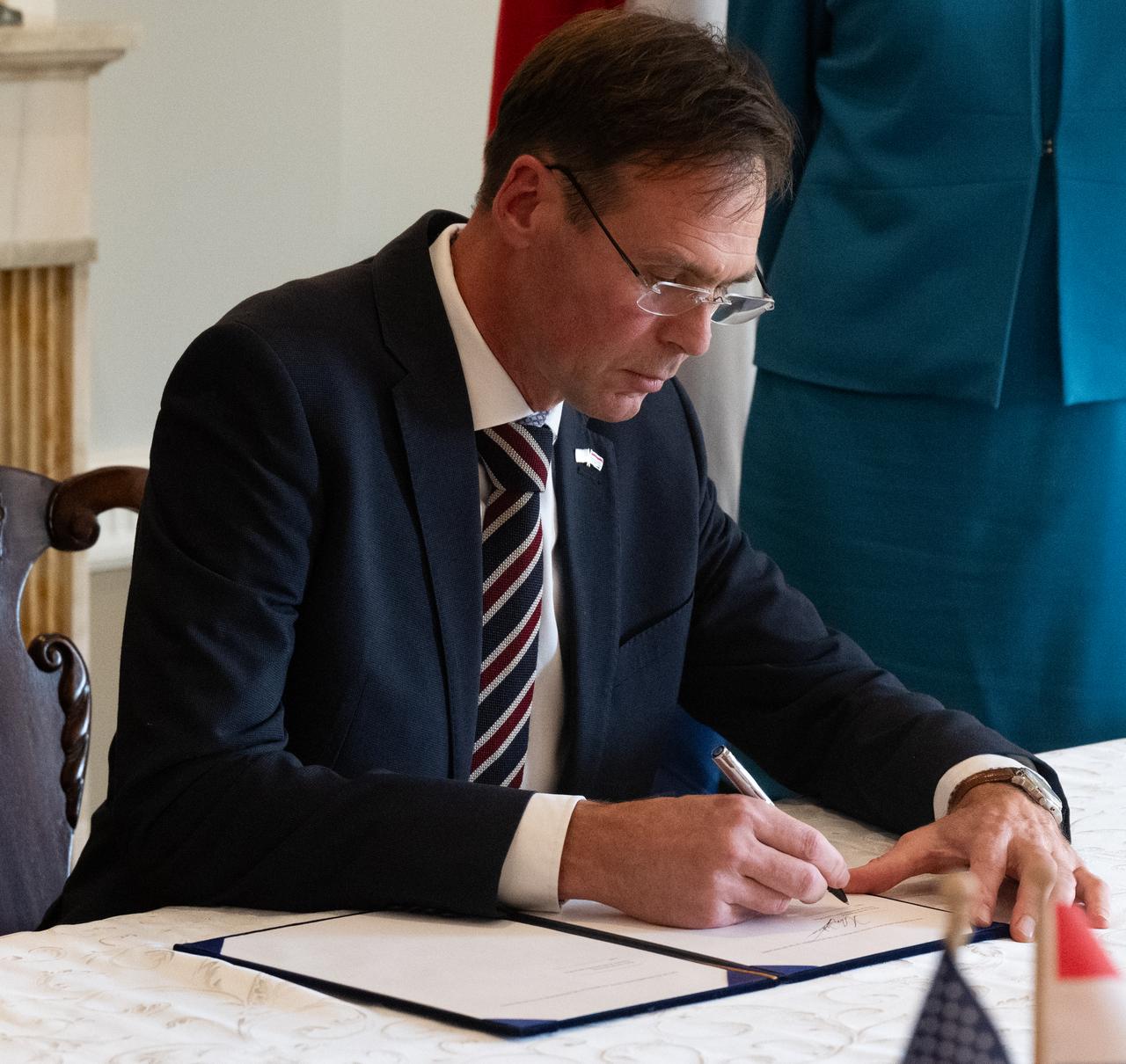
Harm van de Wetering, director of the Netherlands Space Office, center, signs the Artemis Accords, Wednesday, Nov. 1, 2023, at the Dutch Ambassador’s Residence in Washington. Netherlands is the 31st country to sign the Artemis Accords, which establish a practical set of principles to guide space exploration cooperation among nations participating in NASA’s Artemis program. Photo Credit: (NASA/Joel Kowsky)
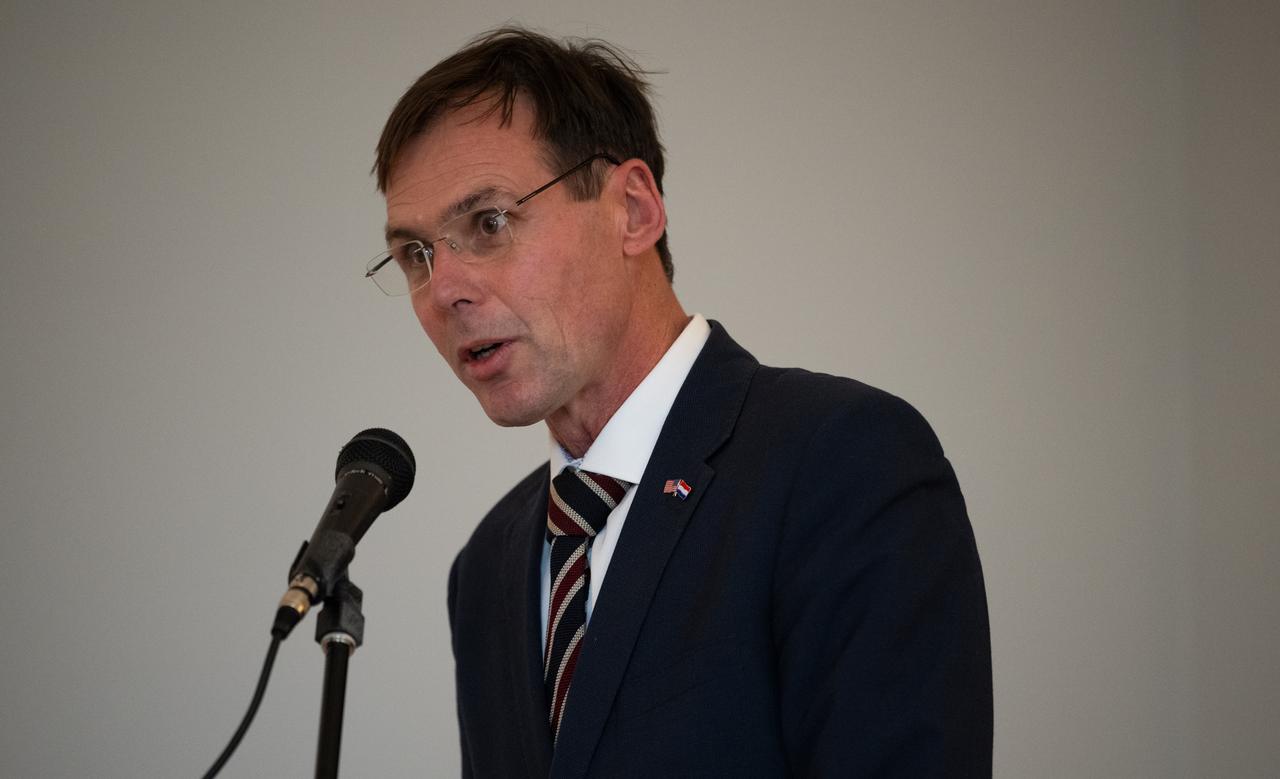
Harm van de Wetering, director of the Netherlands Space Office, delivers remarks during an Artemis Accords signing ceremony, Wednesday, Nov. 1, 2023, at the Dutch Ambassador’s Residence in Washington. Netherlands is the 31st country to sign the Artemis Accords, which establish a practical set of principles to guide space exploration cooperation among nations participating in NASA’s Artemis program. Photo Credit: (NASA/Joel Kowsky)
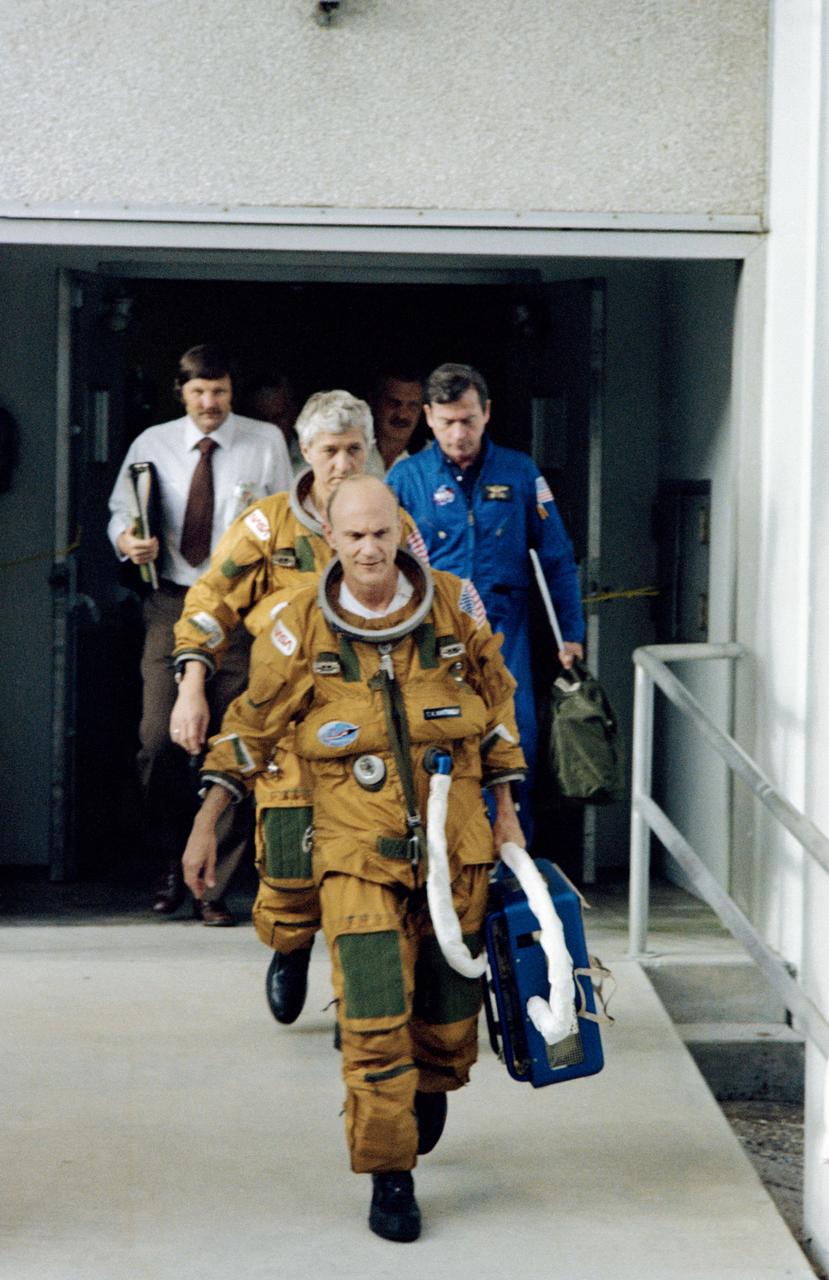
S82-32202 (29 May 1982) --- Astronauts Thomas K. (Ken) Mattingly II, center foreground, and Henry W. Hartsfield Jr., both wearing pressure garments, leave the operations and checkout building at KSC to board a special van that will take them to Launch Pad 39A for a rehearsal for their liftoff. Accompanying the pair are astronaut John W. Young (blue flight suit), chief of the astronaut office at JSC; Richard W. Nygren of the vehicle integration test team (VITT); and James O. Schlosser, space suit engineer. Photo credit: NASA