
Vance D. Brand portrait after being selected for the Apollo program. (JSC photo S71-51263)
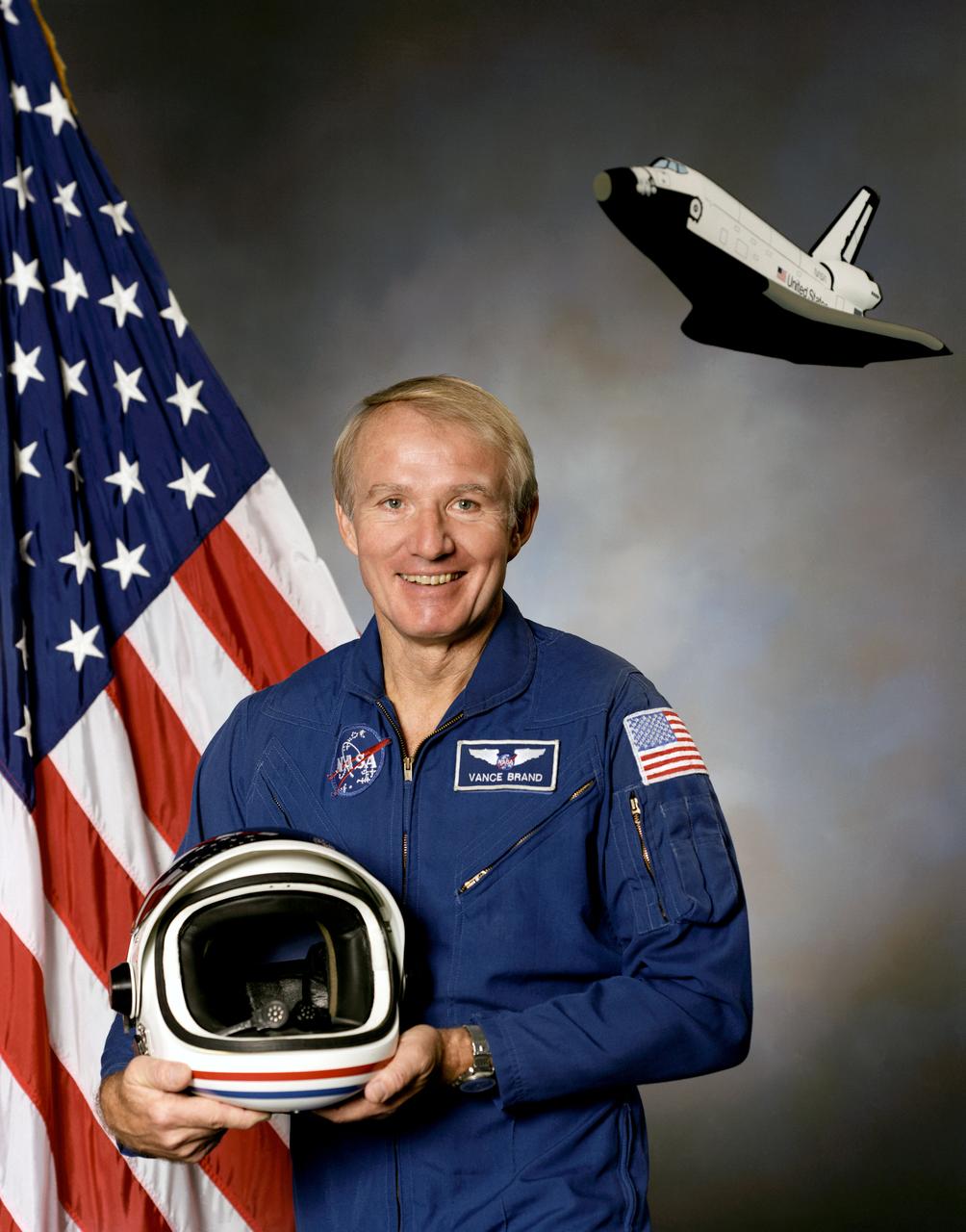
S86-38100 (2 Oct. 1986) --- Astronaut Vance D. Brand.
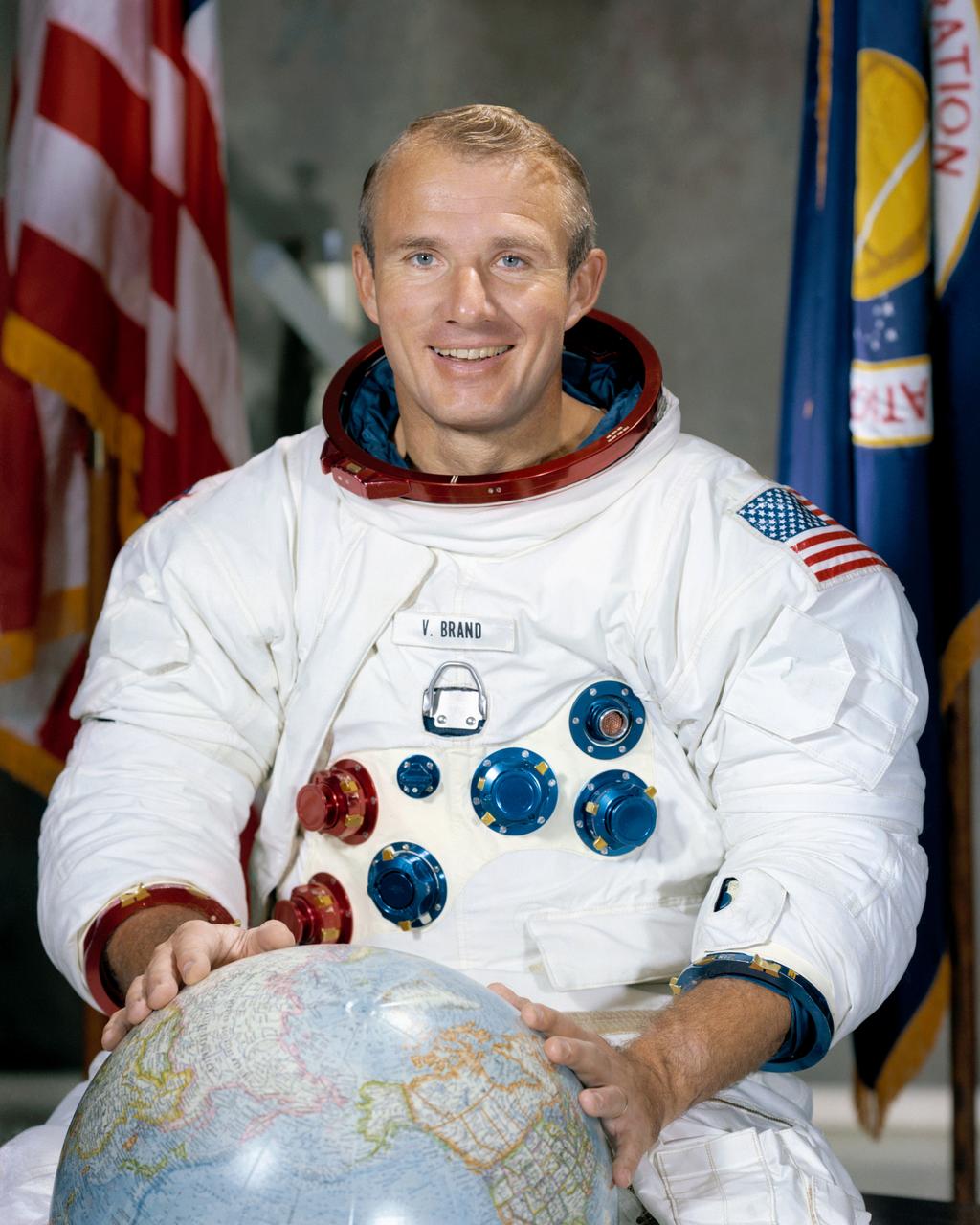
S71-51263 (21 Sept. 1971) --- Astronaut Vance D. Brand.

Egress training of Orbiter Simulator, Bldg. 9A, (Technical Services Facility). S78-34922 - Fullerton & Brand, suited. 1. SHUTTLE - CREW TRAINING 2. VANCE D. BRAND - EGRESS TRAINING 3. CHARLES G. FULLERTON - EGRESS TRAINING JSC, HOUSTON, TX
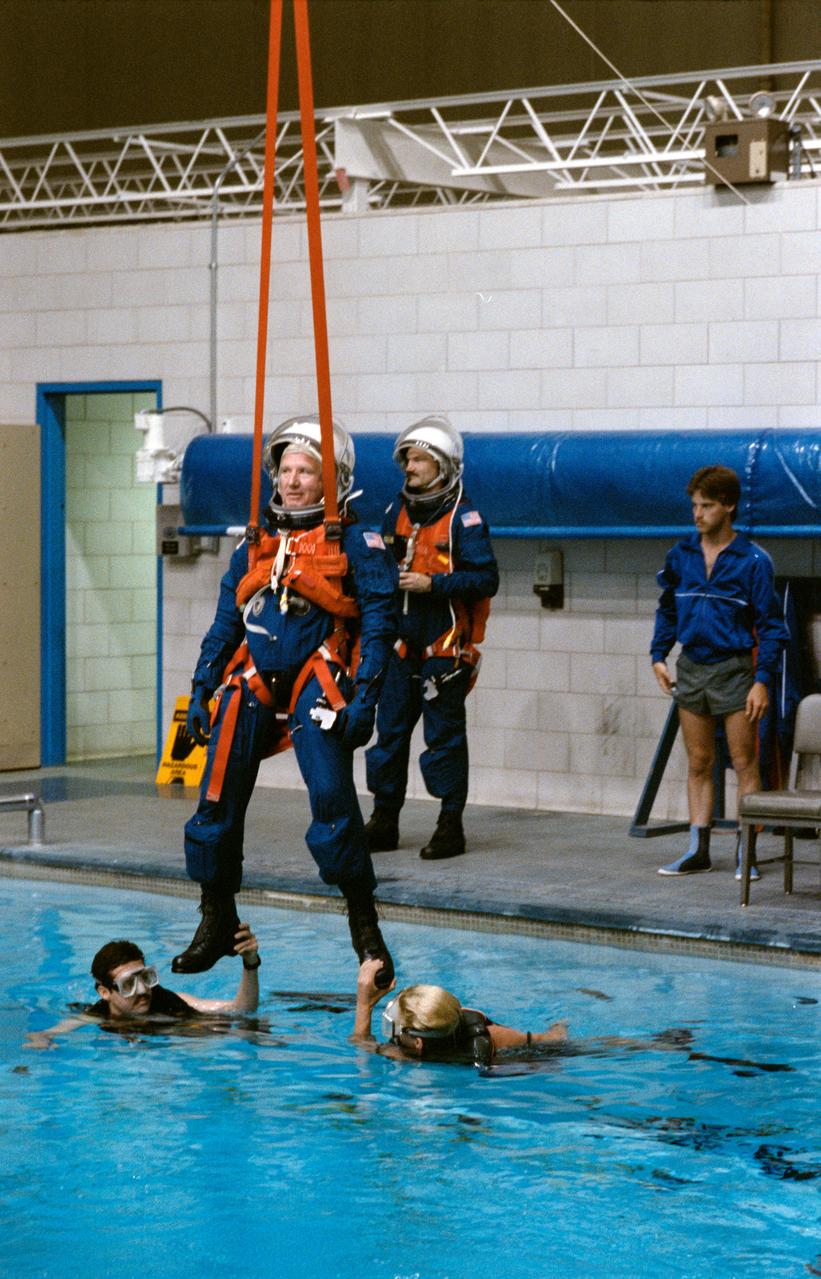
S90-34964 (16 April 1990) --- Astronaut Vance D. Brand, STS-35 commander, is suspended via his parachute harness above the pool in the Johnson Space Center?s (JSC) Weightless Environment Training Facility (WETF) Bldg 29 during launch emergency egress exercises. Divers in the pool hold Brand's feet to steady him. In the background and on the poolside is pilot Guy S. Gardner. Both Brand and Gardner are wearing launch and entry suits (LES) and launch and entry helmets (LEH).
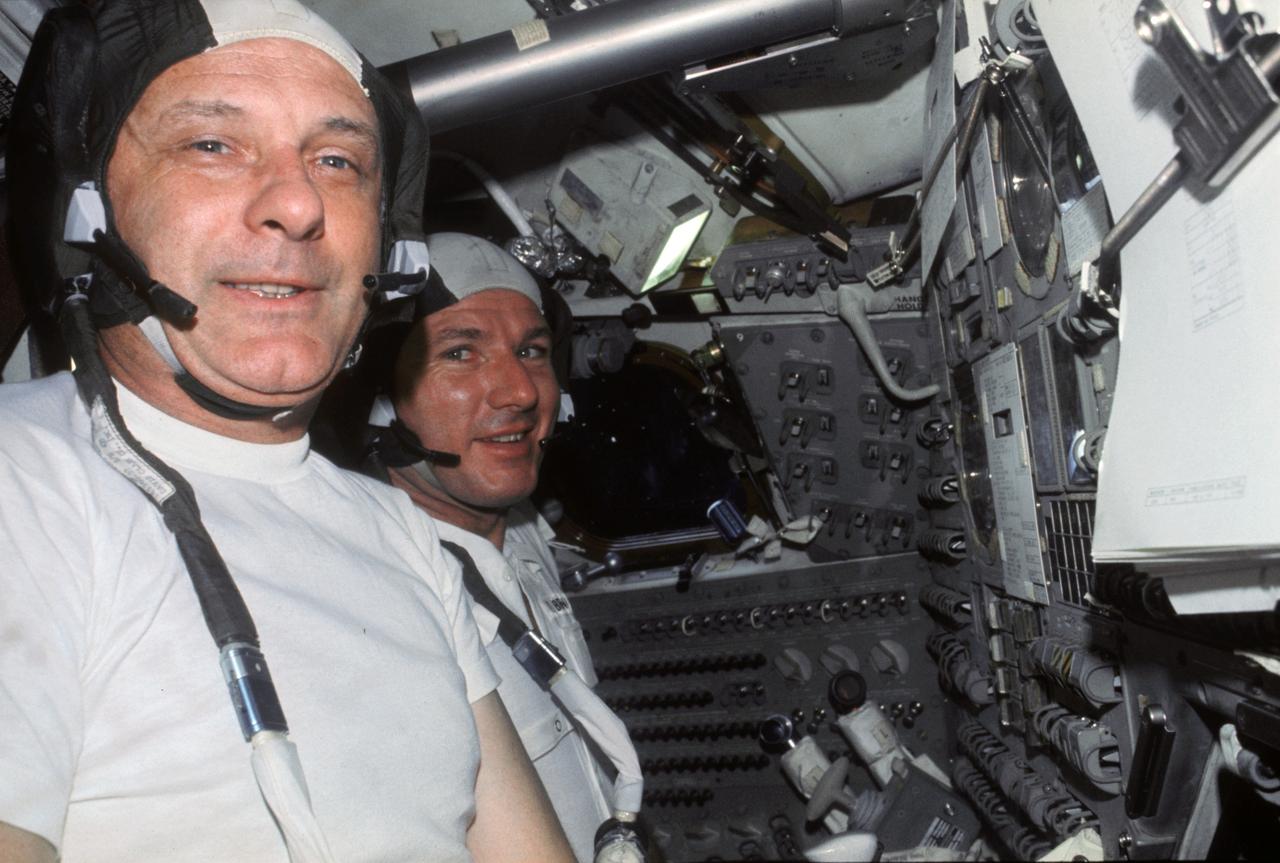
AST-06-344 (15-24 July 1975) --- Two American ASTP crewmen, astronauts Thomas P. Stafford (foreground) and Vance D. Brand are seen in the Apollo Command Module during the joint U.S.-USSR Apollo-Soyuz Test Project docking mission in Earth orbit. This picture was taken with a 35mm camera.
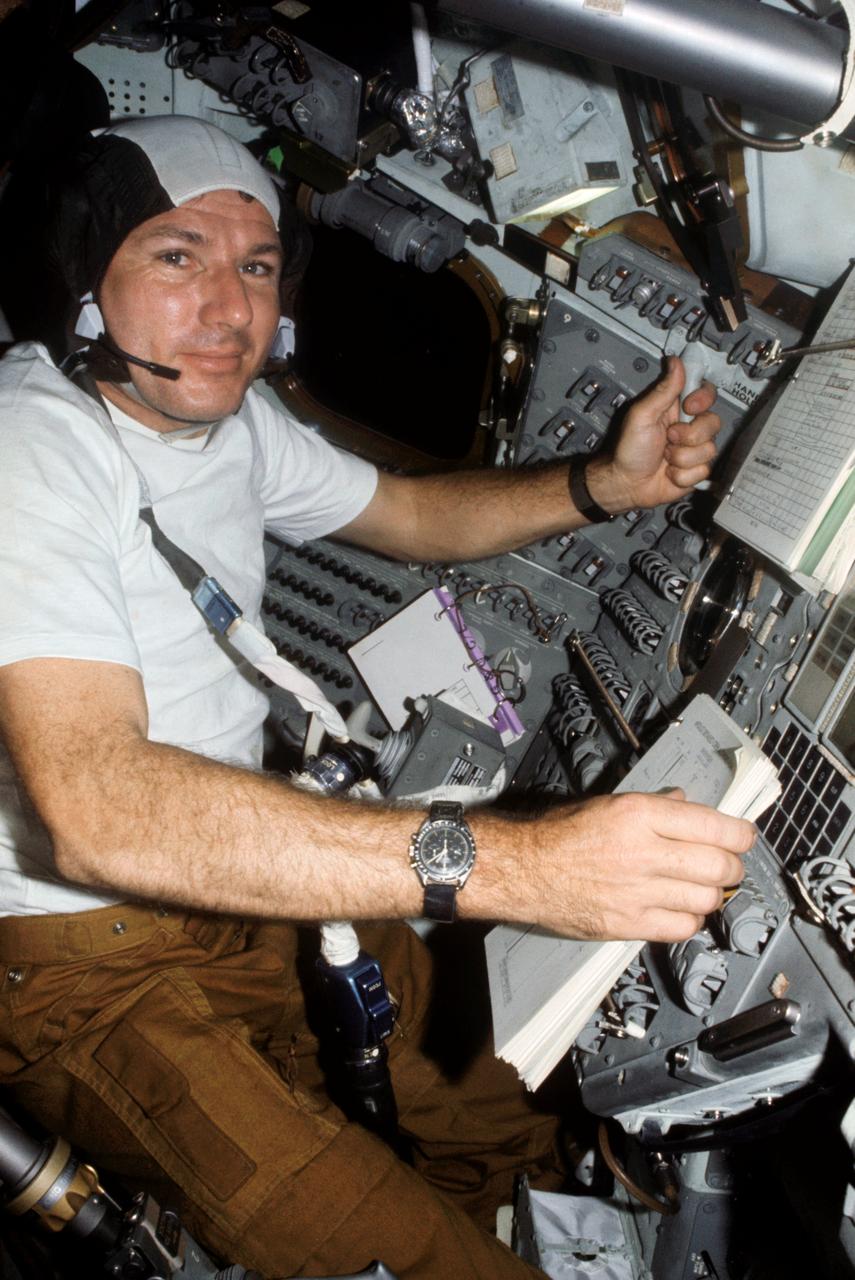
AST-08-499 (15-24 July 1975) --- Astronaut Vance D. Brand, command module pilot of the American ASTP crew, is seen at the controls of the Apollo Command Module during the joint U.S.-USSR Apollo-Soyuz Test Project docking mission in Earth orbit. This picture was taken with a 35mm camera.
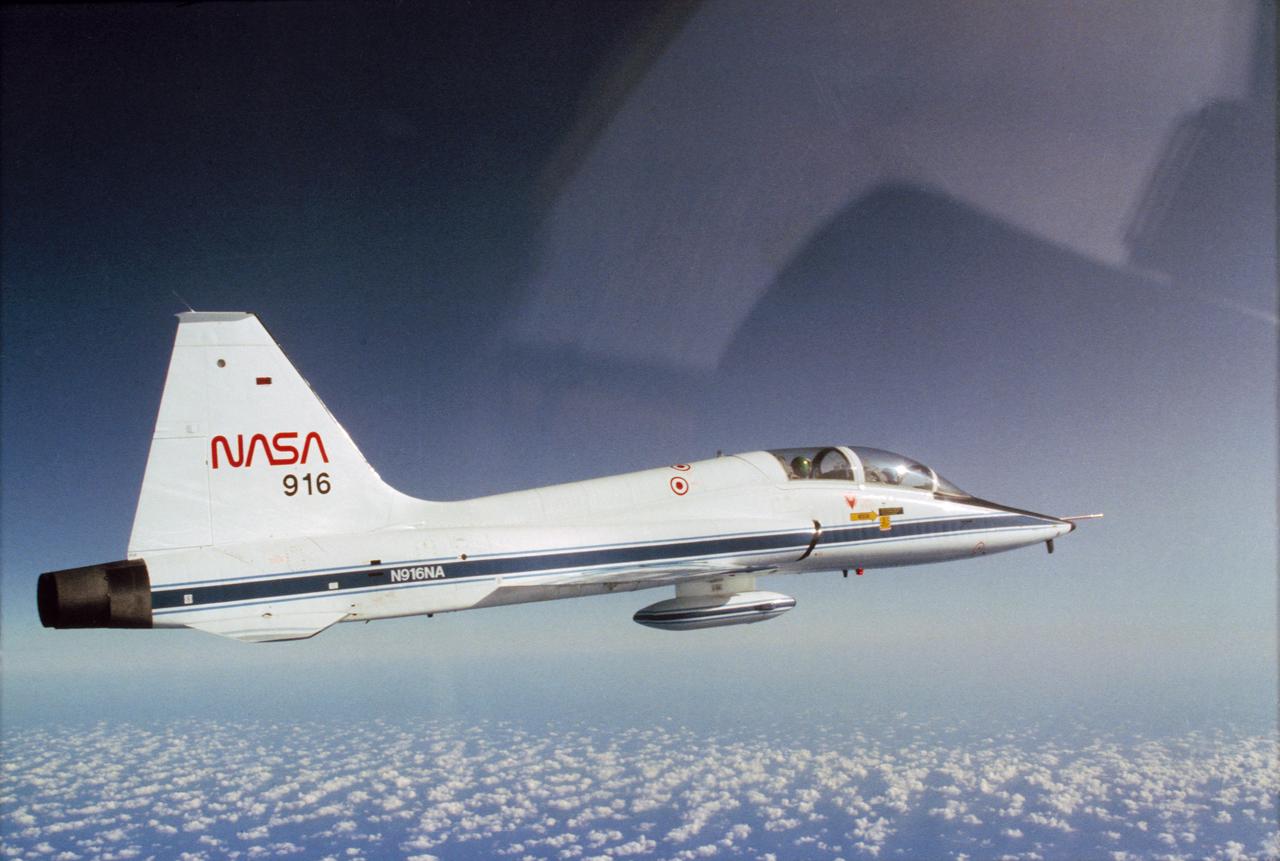
NASA 916, a T-38 jet aircraft, carrying astronauts Vance D. Brand (front station) and Robert F. Overmyer, heads for Kennedy Space Center in Florida. 1. STS-5 - PREFLIGHT KSC, FL Also available in 4x5 CN
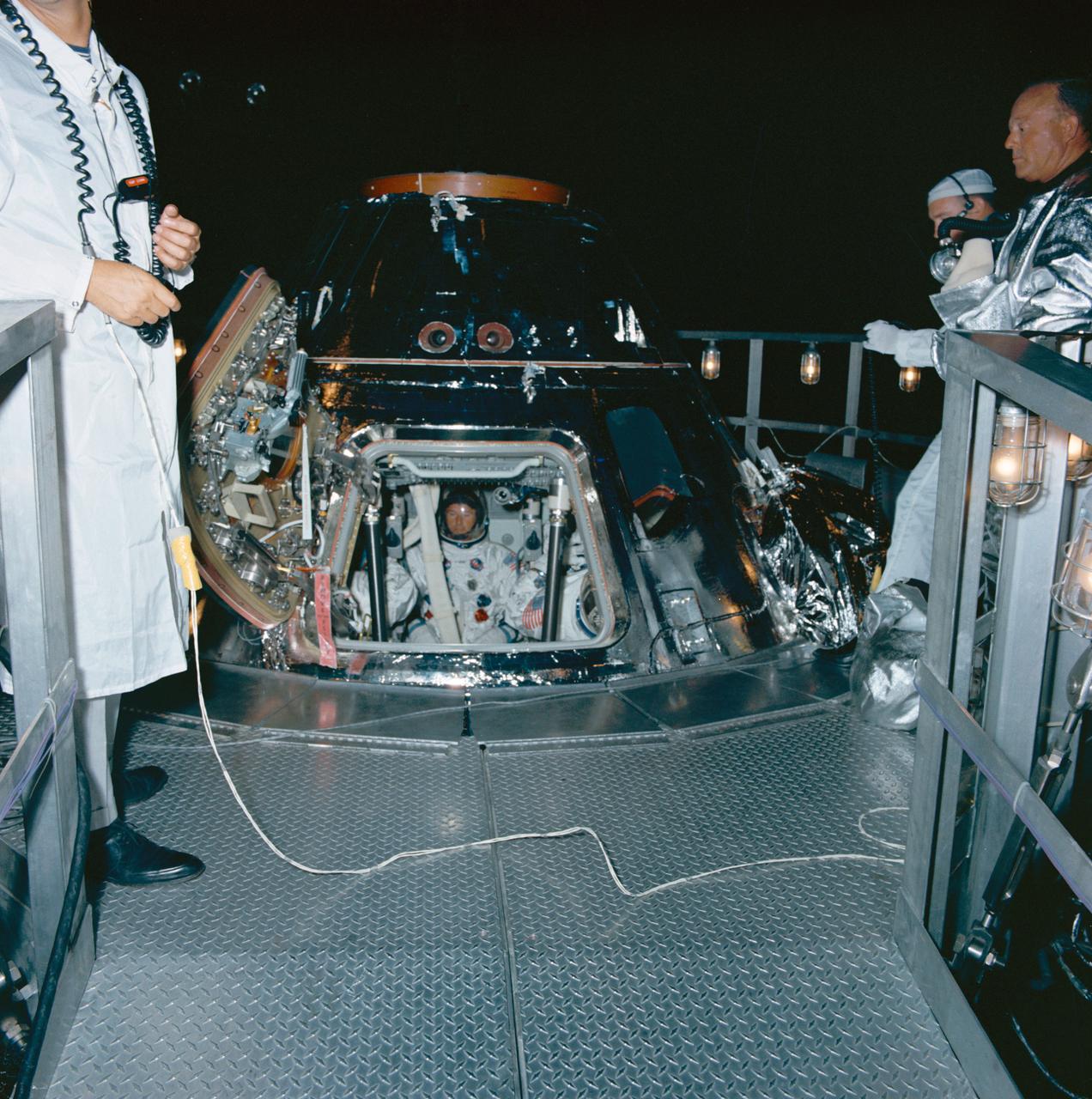
Crew ingress and beginnings of 7 1/2-day Manned Thermal Vacuum Test with Astronauts Joe Engle, Dr. Joseph Kerwin and Brand in the Apollo S/C-2TV-1, Chamber "A", Bldg. 32. Note - 35mm BW (S68-35881 thru S68-35882) - 120 CN (S68-35883 thru S68-35908) 1. ASTRONAUT BRAND, VANCE D. - VACUUM TEST 2. ASTRONAUT KERWIN, JOSEPH - VACUUM TEST 3. ASTRONAUT ENGLE, JOE - VACUUM MSC, HOUSTON, TX
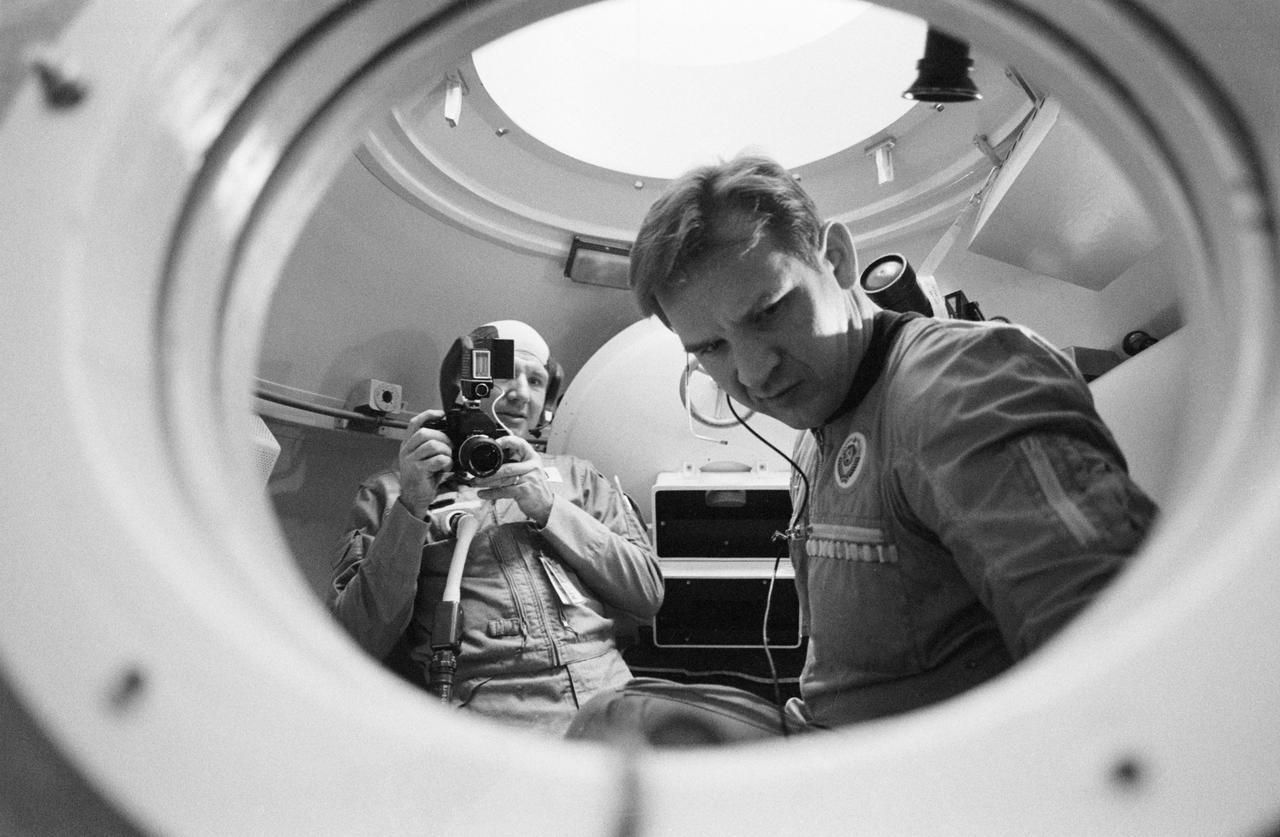
S75-21627 (13 Feb. 1975) --- Two crewmen of the joint U.S.-USSR Apollo-Soyuz Test Project mission participate in ASTP training in Building 35 at the Johnson Space Center. They are astronaut Vance D. Brand (left), command module pilot of the American ASTP prime crew; and cosmonaut Valeriy N. Kubasov, engineer on the Soviet ASTP first (prime) crew. They are in the Soyuz spacecraft orbital module mock-up. Brand and Kubasov are going through a walk-through simulation of the second day of activities in Earth orbit. Brand takes some pictures.
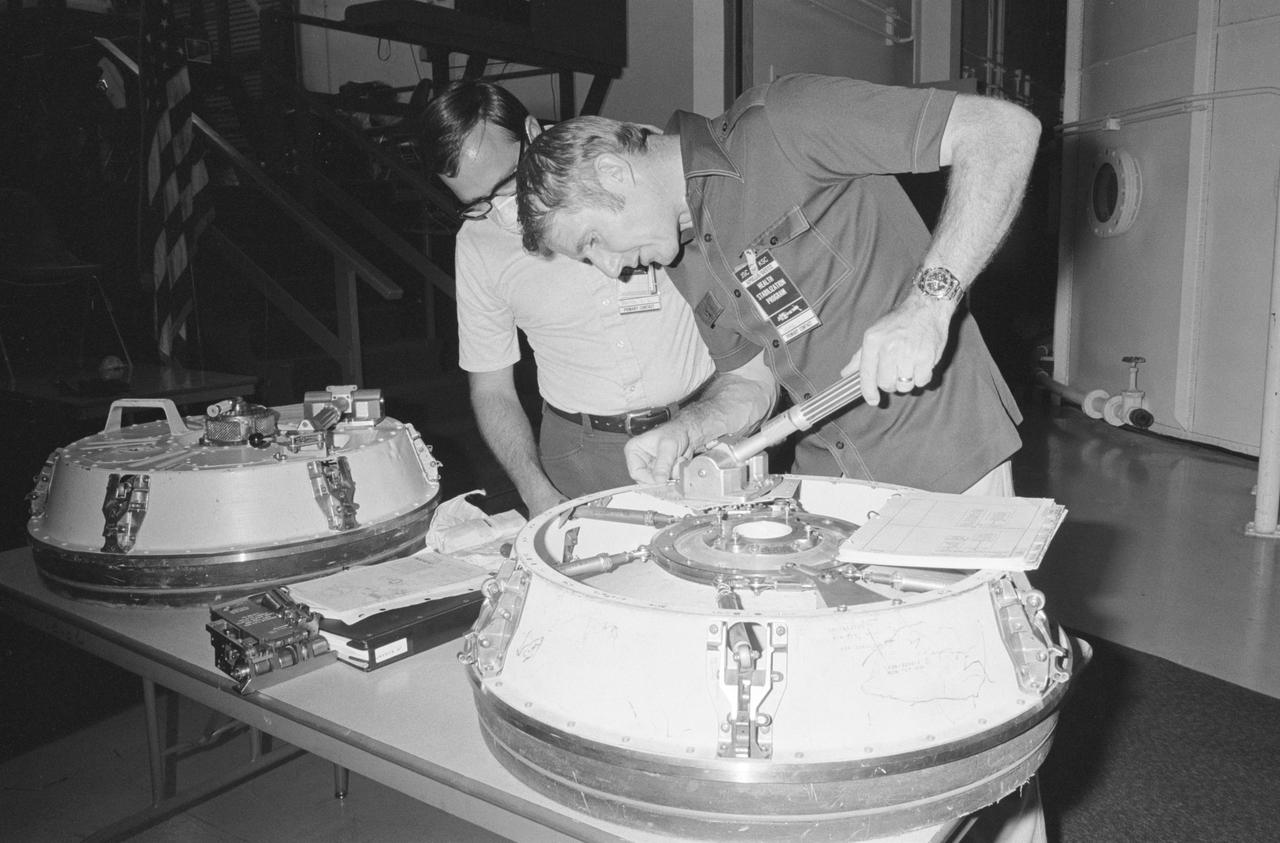
S75-28485 (12 July 1975) --- Astronaut Vance D. Brand, command module pilot of the American ASTP prime crew, practices operating a Docking Module hatch during Apollo-Soyuz Test Project preflight training at NASA's Johnson Space Center. The Docking Module is designed to link the Apollo and Soyuz spacecraft during their docking mission in Earth orbit. Gary L. Doerre of JSC?s Crew Training and Procedures Division is working with Brand. Doerre is wearing a face mask to help prevent possible exposure to Brand of disease prior to the ASTP launch.
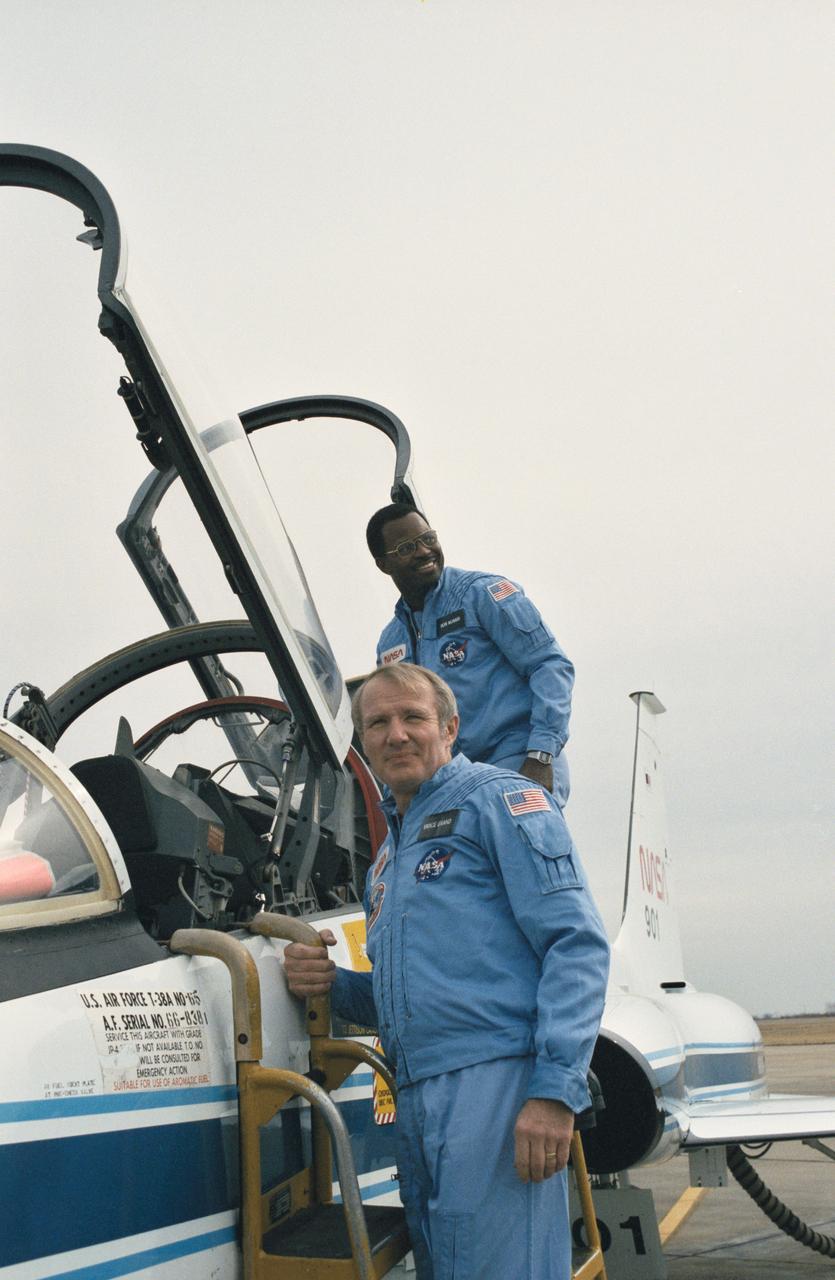
S84-26244 (31 Jan 1984) --- Astronauts Vance D. Brand, foreground, and Ronald E. McNair, of NASA's STS-41B Space Shuttle Challenger crew, prepare to climb into a T-38 jet aircraft readied for takeoff to Florida and the Kennedy Space Center (KSC). Brand is making his third Spaceflight, including his second as a Shuttle flight crew commander. McNair, mission specialist, will be making his first trip into space. Launch for STS-41B is scheduled for 8 a.m. (EST), February 3, 1984. This photo was taken by Otis Imboden.
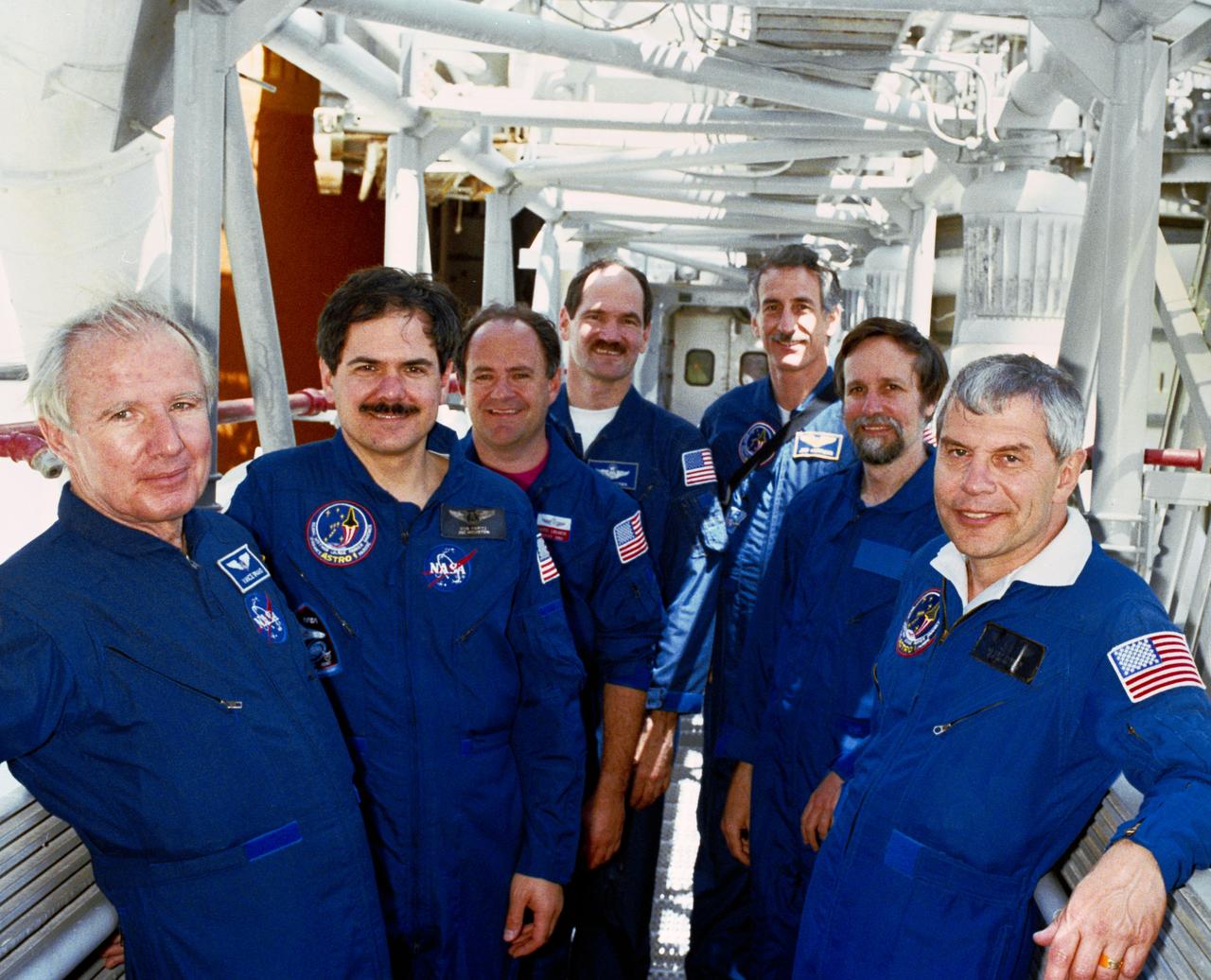
S90-38029 (21 May 1990) --- STS-35 Columbia, Orbiter Vehicle (OV) 102, crewmembers commander Vance D. Brand, pilot Guy S. Gardner, mission specialists Jeffrey A. Hoffman, John M. Lounge, Robert A. R. Parker, payload specialists Samuel T. Durrance and Ronald A. Parise and backup payload specialist Kenneth Nordsieck take a break from training activities and pose on the 195-Floor Level on Launch Pad 39A at the Kennedy Space Center (KSC). On left from front to back are Brand, Parise, Lounge and Gardner and on right from front to back are Parker, Nordsieck, and Hoffman. View provided by KSC with alternate number KSC-90PC-670.
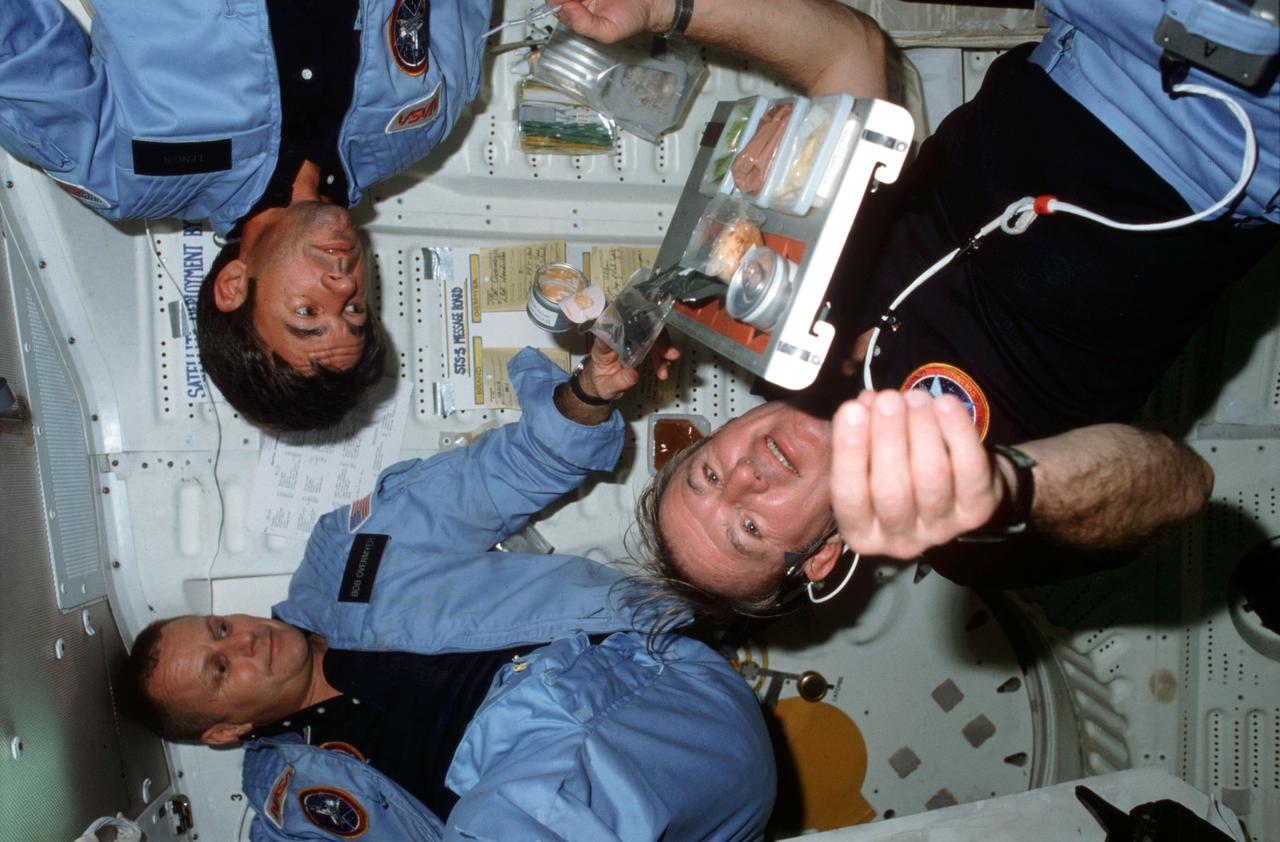
STS005-06-210 (16 Nov. 1982) --- Astronaut Vance D. Brand (in dark blue shirt), STS-5 commander; Robert F. Overmyer (left), pilot; and William B. Lenoir, mission specialist, conduct microgravity experiments with food containers and meal tray assemblies in front of middeck port side wall and side hatch. Brand prepares to eat as meal tray assembly floats above his chest and Overmeyer and Lenoir look on. Sign on port side wall is labeled STS-5 message board. Photo credit: NASA
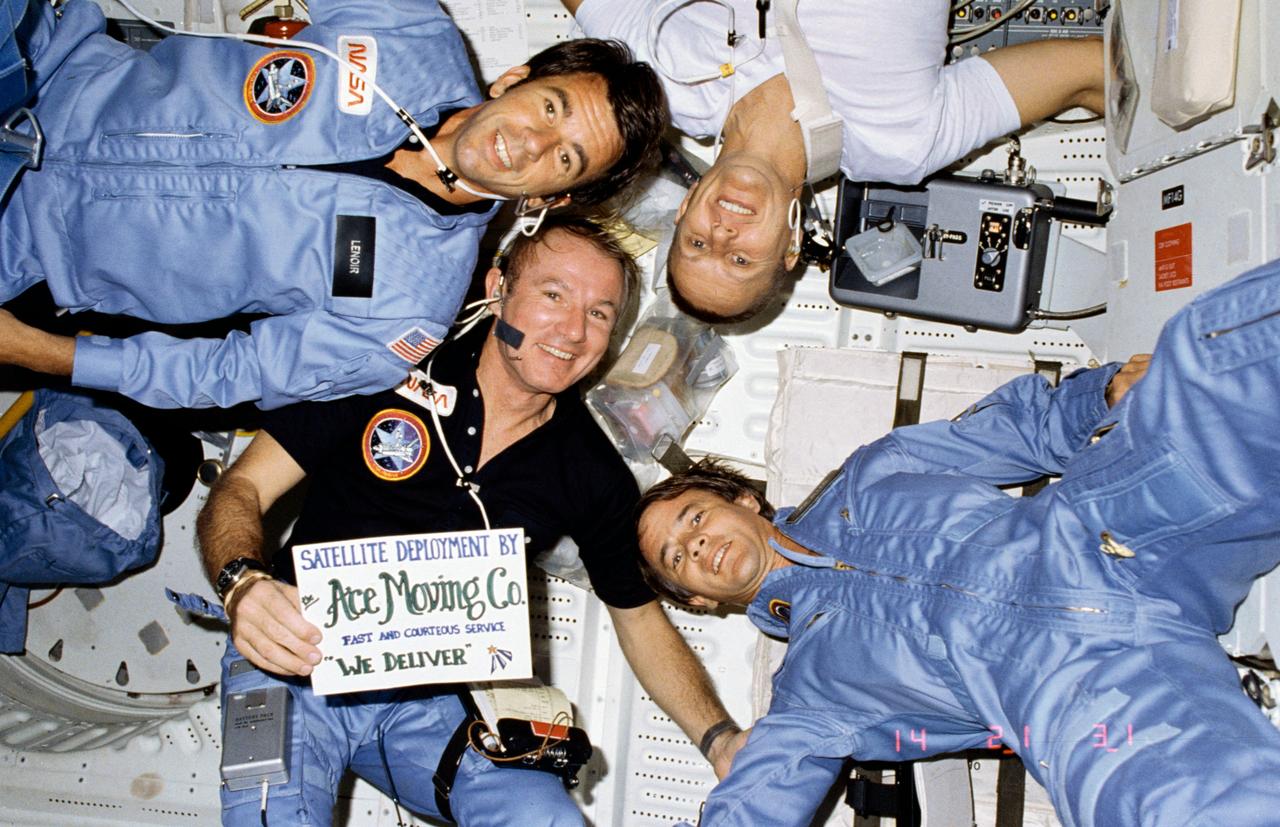
STS005-07-267 (12 Nov. 1982) --- A pre-set 35mm camera?s exposure of all four STS-5 astronaut crew members reveals a bit of their humorous side. The sign held by astronaut Vance D. Brand, crew commander, refers to the successful deployment of two commercial communications satellites on the flight's first two days. Brand is surrounded by, clockwise, left to right, astronauts William B. Lenoir, mission specialist, Robert F. Overmyer, pilot, and Joseph O. Allen IV, mission specialist, in the middeck area of the Earth-orbiting space shuttle Columbia. Photo credit: NASA
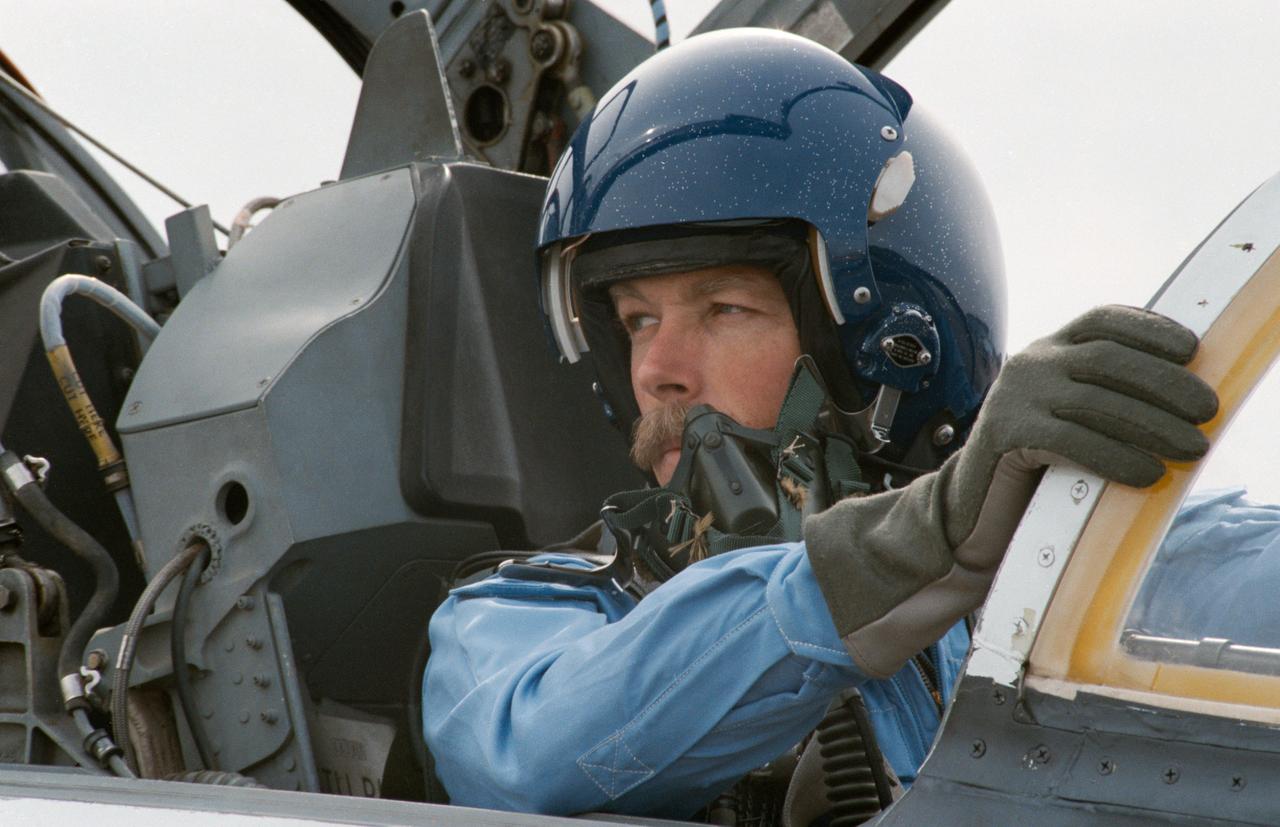
S84-26243 (31 Jan 1984) --- Astronaut Robert L. Gibson, one of five 41-B crewmembers, prepares to leave Houston?s Ellington Base in a T-38 jet aircraft en route to Florida and the Kennedy Space Center, site of February 3?s launch of the Challenger. Gibson, along with two other members of this crew, began training at JSC in July in 1978. He will be joined by Astronauts Vance D. Brand, commander; and Bruce McCandless II, Ronald E. McNair and Robert L. Stewart, all mission specialists. Brand and McCandless came aboard as NASA astronauts in April 1966.
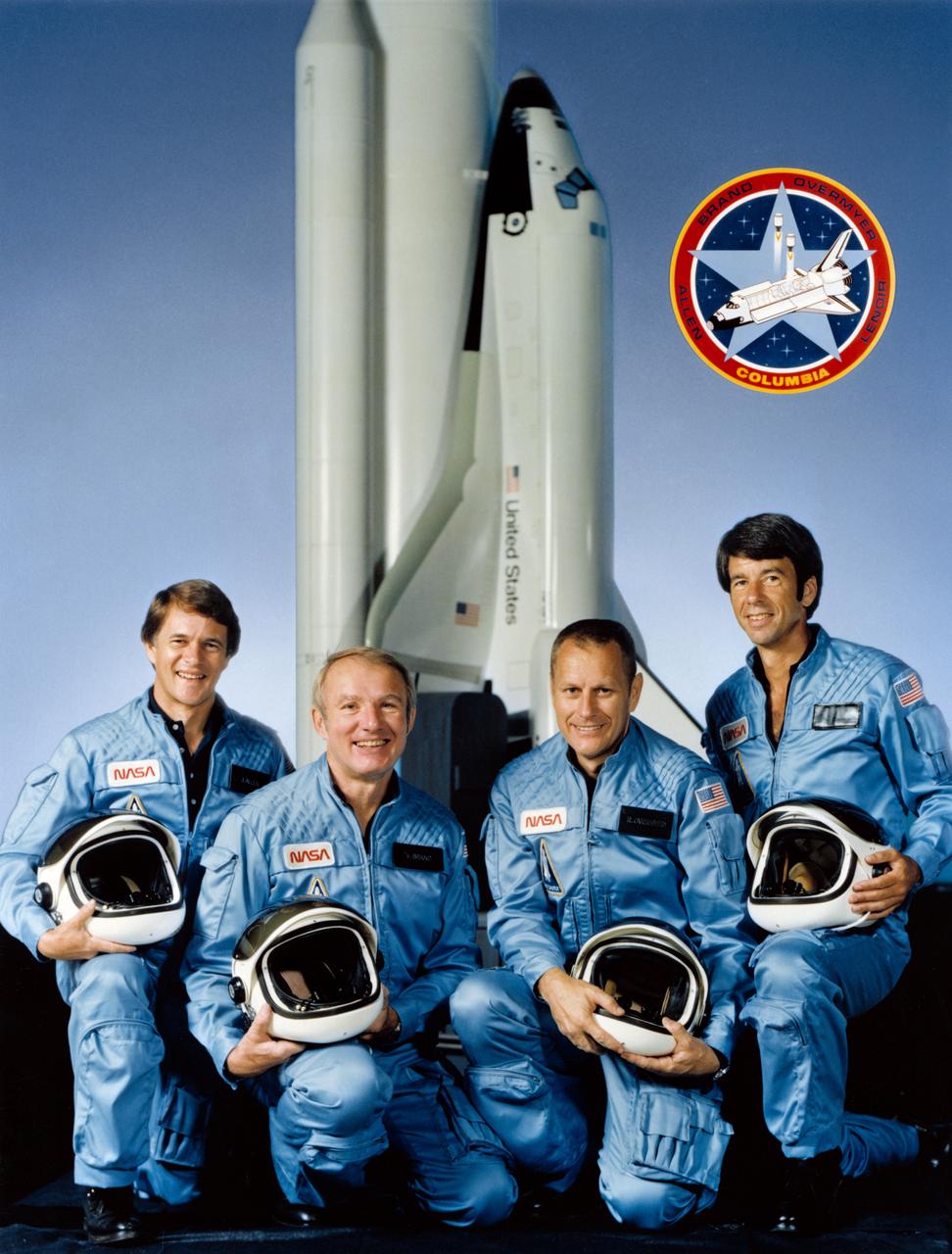
S82-36286 (15 Aug. 1982) --- These four men will be aboard the space shuttle Columbia for NASA's first operational Space Transportation System (STS) mission. They are astronauts Vance D. Brand (second left), STS-5 commander; Robert F. Overmyer (second right), pilot; and Joseph P. Allen (left) and William B. Lenoir, both mission specialists. They pose with a space shuttle model and the official insignia for STS-5. Their flight is scheduled for November of this year. Photo credit: NASA
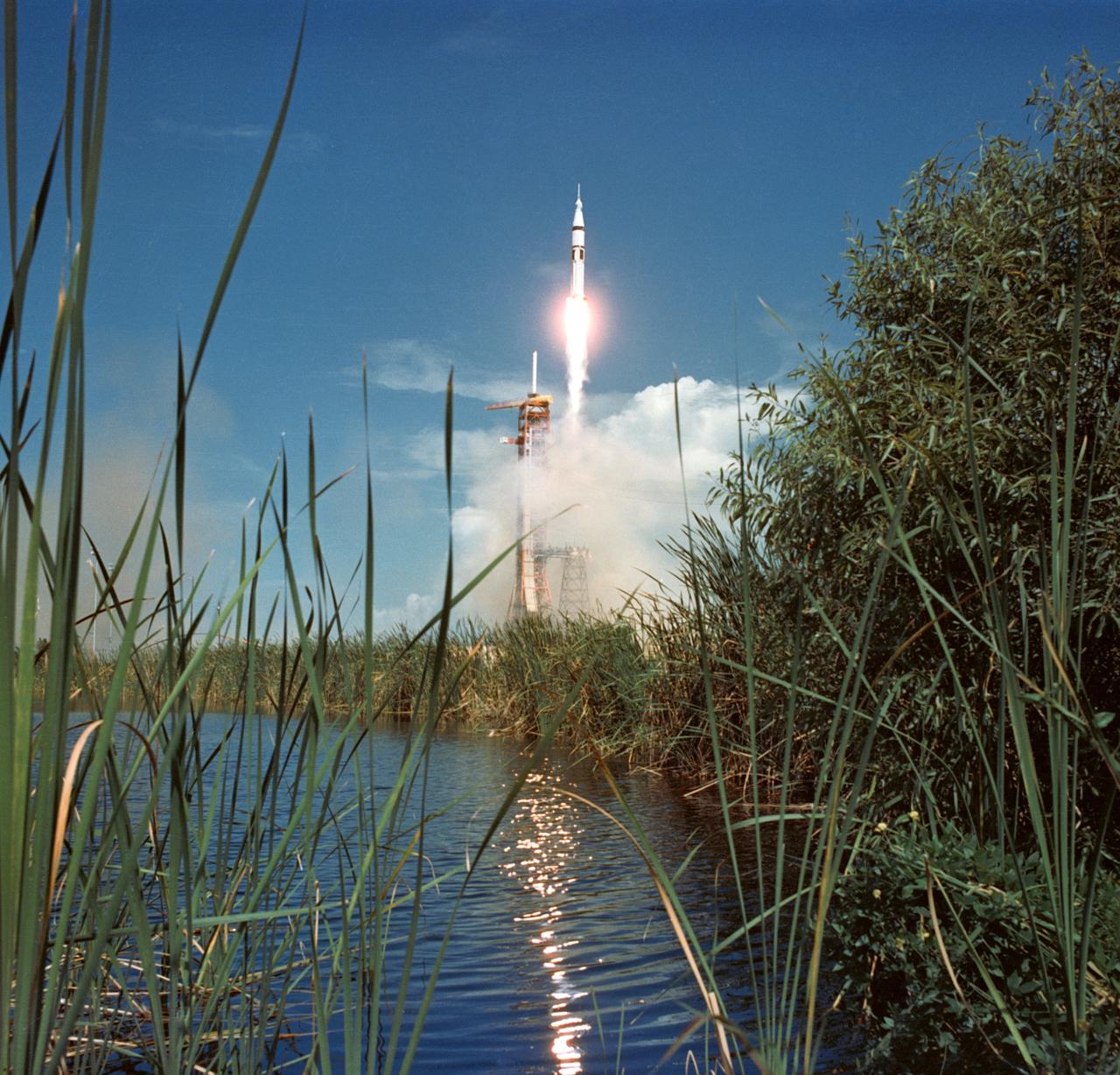
S75-28547 (15 July 1975) --- The Apollo-Soyuz Test Project's (ASTP) NASA Apollo/Saturn 1B space vehicle is launched from Pad B, Launch Complex 39, Kennedy Space Center (KSC), Florida, at 3:50 p.m. (EDT), July 15, 1975, to begin Apollo's catch-up journey toward the already Earth-orbiting Soviet Soyuz spacecraft. Aboard the Apollo spacecraft were astronauts Thomas P. Stafford, Vance D. Brand and Donald K. (Deke) Slayton.
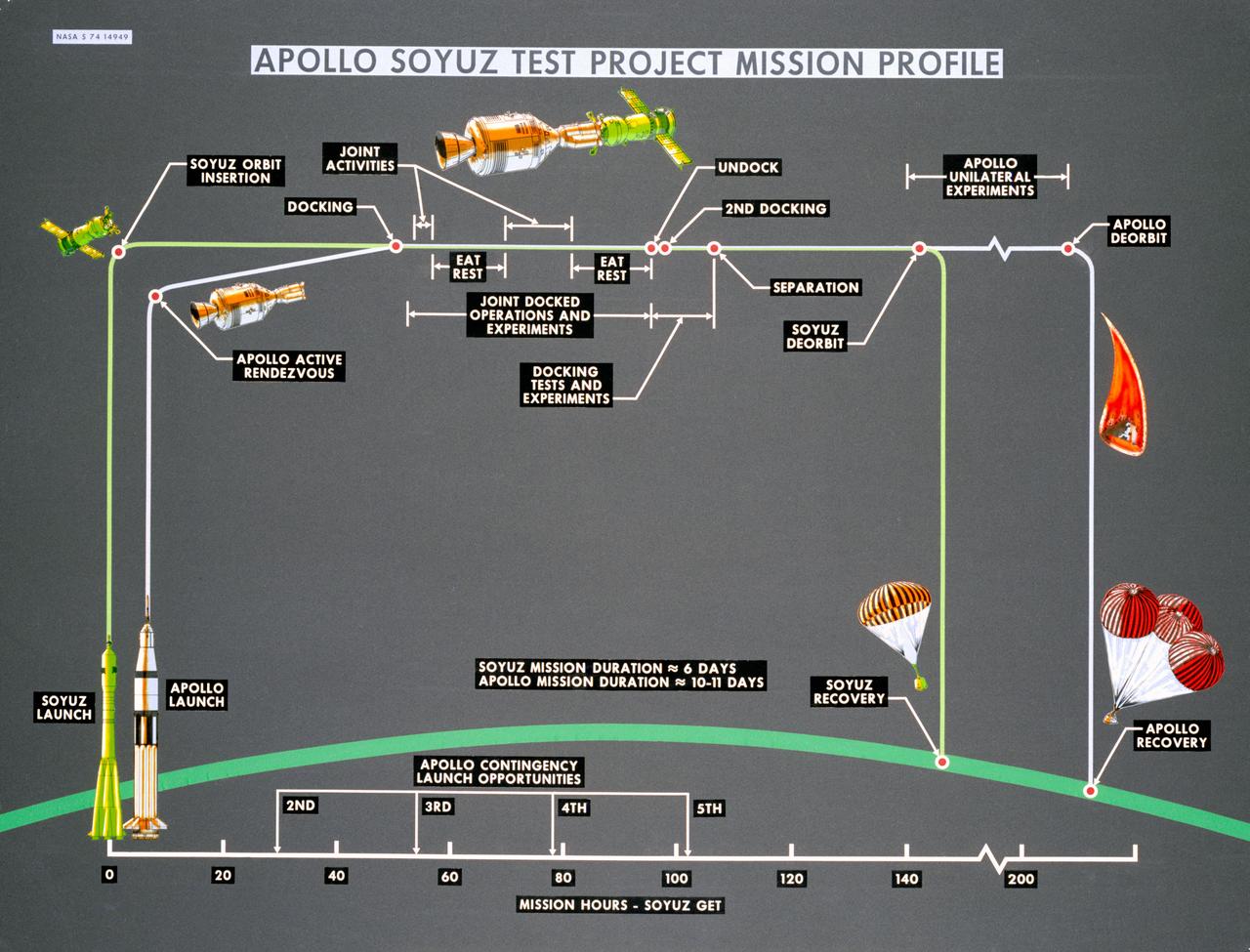
S74-14949 (October 1974) --- Artist?s drawings and call-outs depict phases of the joint U.S.-USSR Apollo-Soyuz Test Project, an Earth-orbital mission which will feature rendezvous and docking of the respective spacecraft of the two nations. ASTP crewmen for the USSR include Aleksey A. Leonov and Valeriy N. Kubasov. The astronaut team includes astronauts Thomas P. Stafford, Vance D. Brand and Donald K. Slayton. The mission is scheduled to take place in summer 1975.
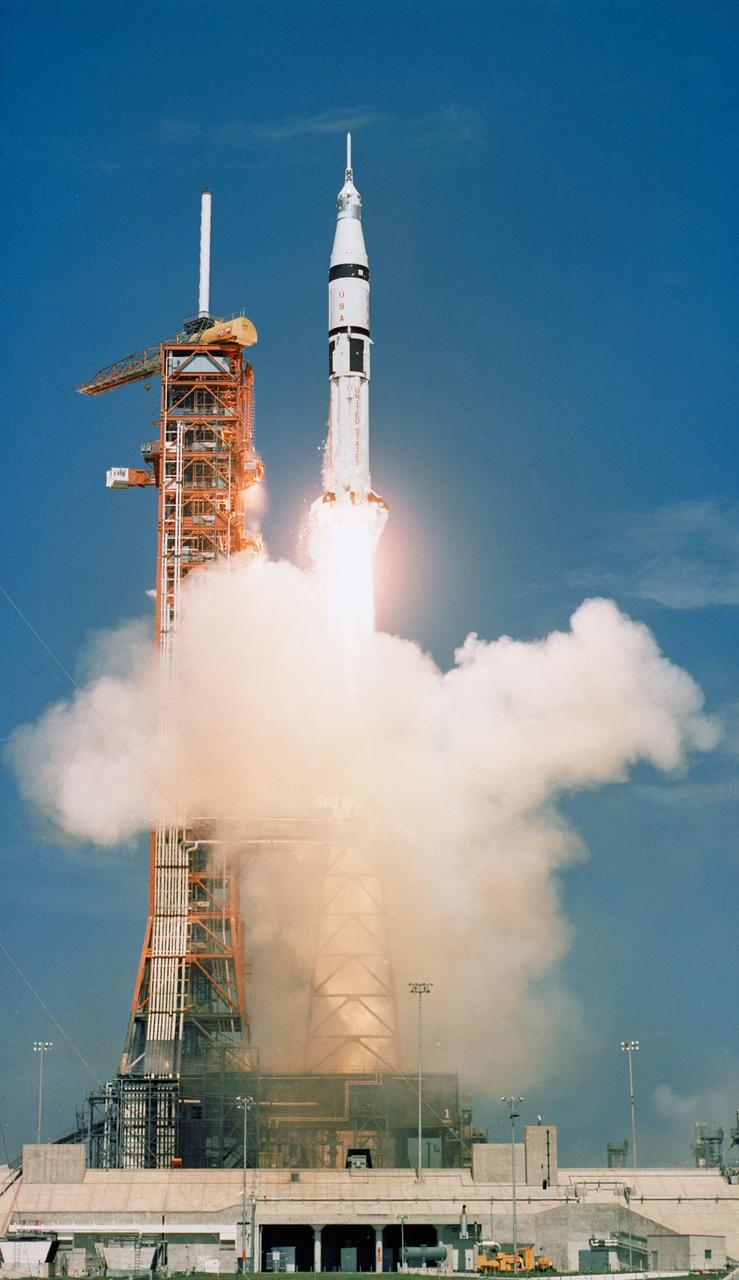
S75-28550 (15 July 1975) --- The Apollo-Soyuz Test Project's (ASTP) NASA Apollo/Saturn 1B space vehicle is launched from Pad B, Launch Complex 39, Kennedy Space Center (KSC), Florida, at 3:50 p.m. (EDT), July 15, 1975, to begin Apollo's catch-up journey toward the already Earth-orbiting Soviet Soyuz spacecraft. Aboard the Apollo spacecraft were astronauts Thomas P. Stafford, Vance D. Brand and Donald K. (Deke) Slayton.
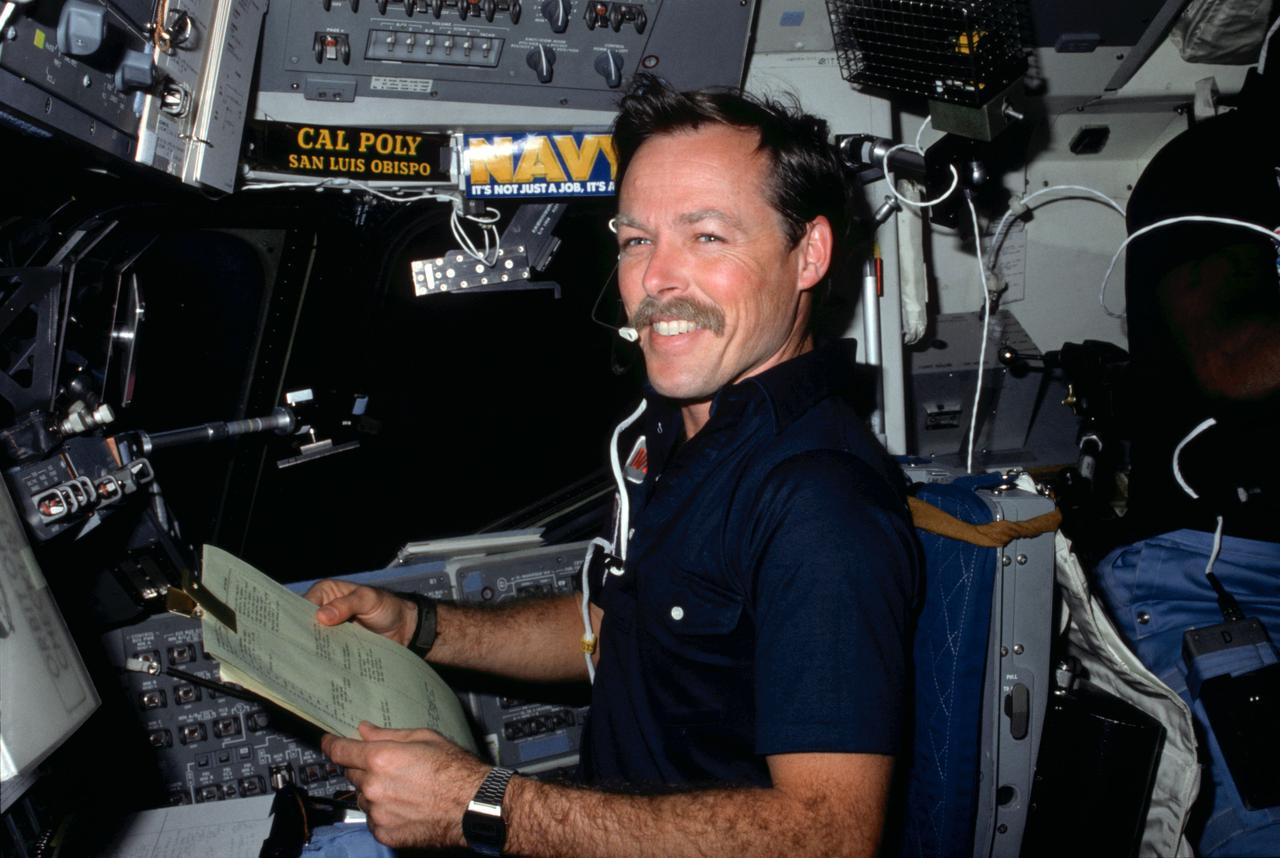
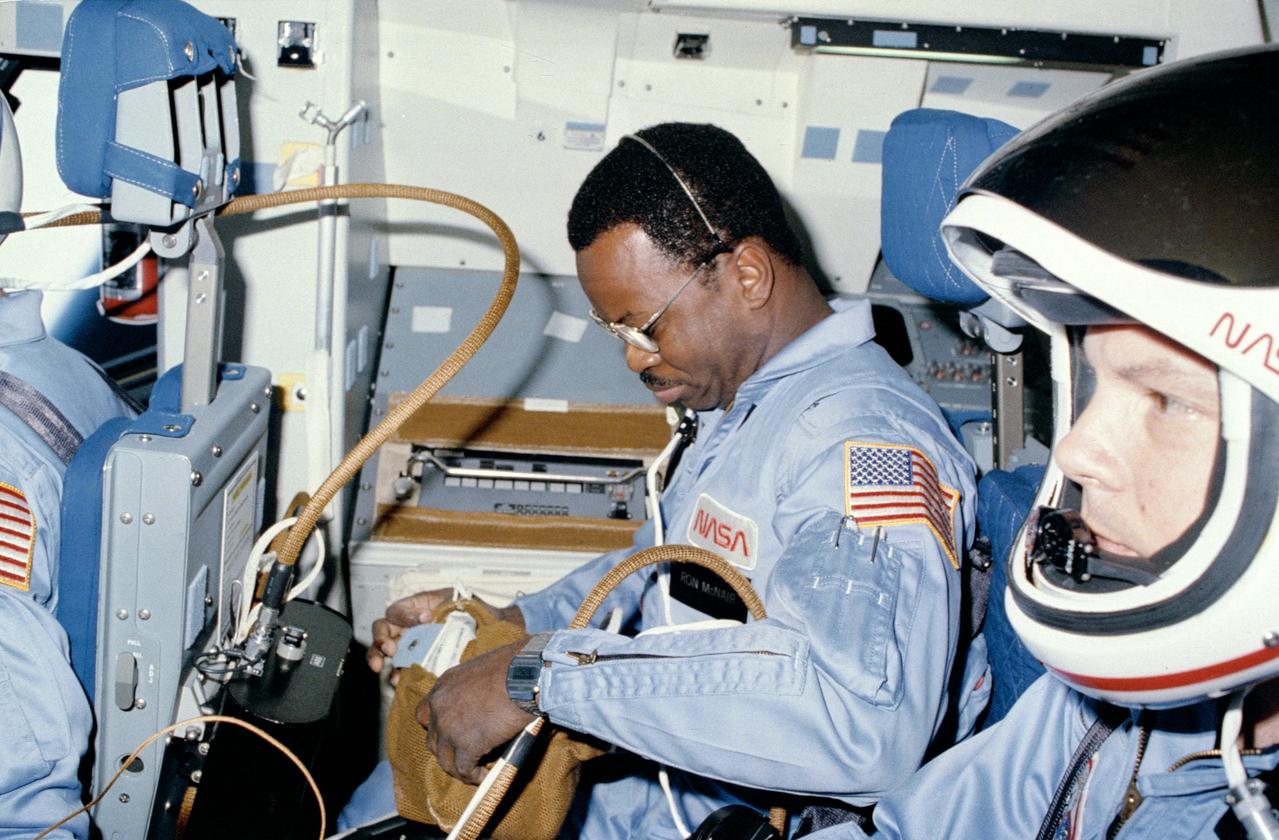
41B-07-230 (S84-27027) (3-11 February 1984) ---Astronaut Robert L. Gibson, 41-B pilot, reviews some teleprinter copy on the flight deck?s starboard station during the eight-day 41-B Space Shuttle mission. Four other astronauts share the Challenger with Gibson. They are Astronauts Vance D. Brand, commander; and Ronald E. McNair, Bruce McCandless II and Robert L. Stewart, all mission specialists. The photograph was taken from the commander?s station with a 35mm camera.
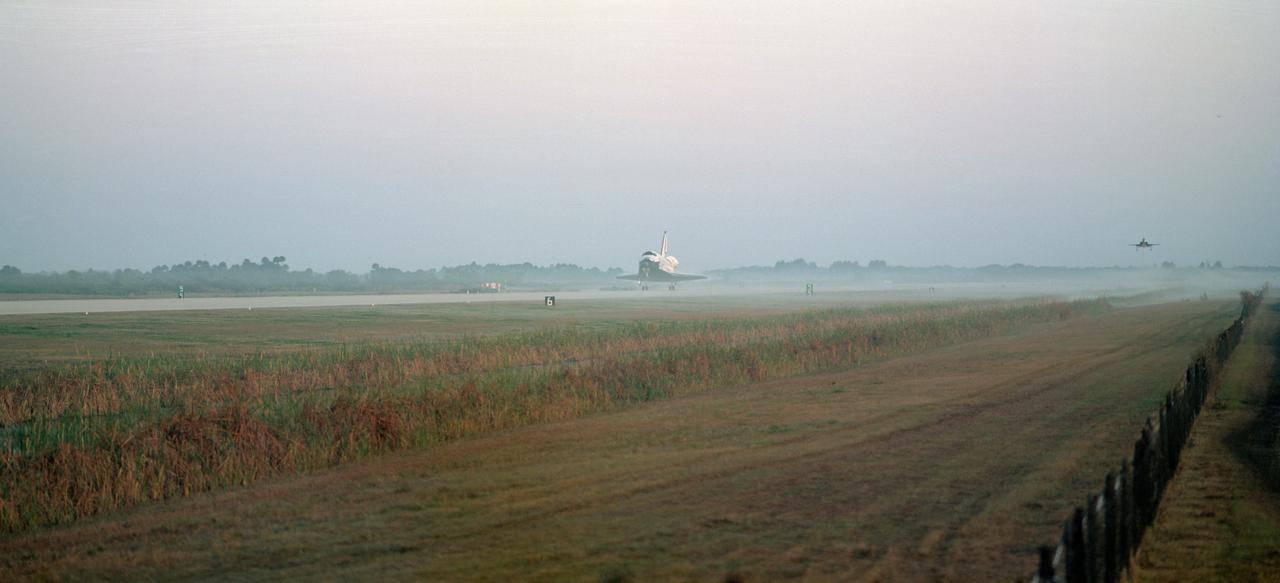
S84-27154 (11 Feb 1984) --- The first Space Shuttle landing on the Kennedy Space Center?s landing facility was recorded by a ground camera on February 11, 1984. A T-38 chase plane trails the Challenger. The nose gear has not yet touched down in this scene. Aboard the spacecraft were Astronauts Vance D. Brand, commander; Robert L. Gibson, pilot; and Bruce McCandless II, Ronald R. McNair and Robert L. Stewart, all mission specialists.
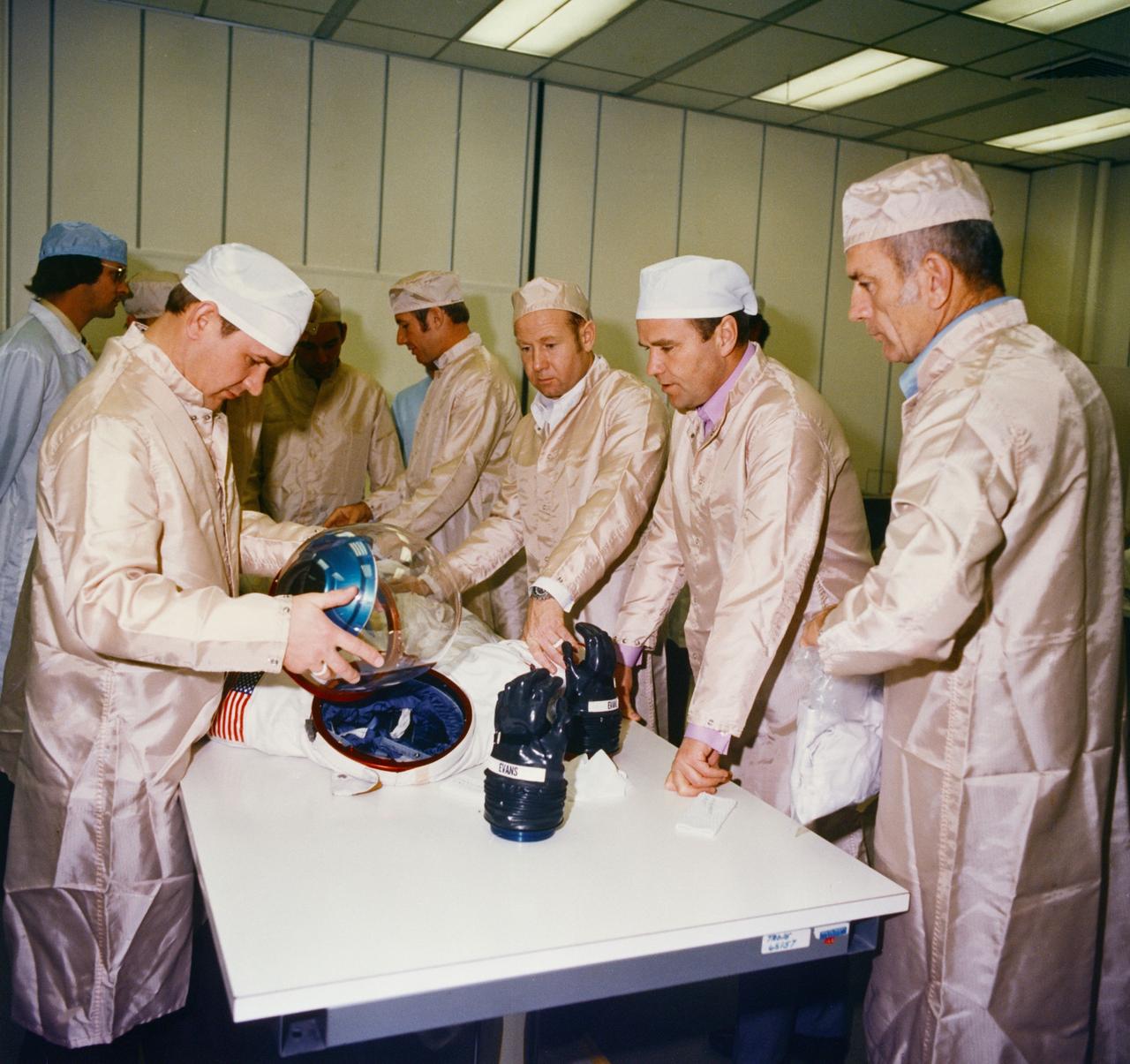
S75-24108 (8-10 Feb. 1975) --- A group of Apollo-Soyuz Test Project crewmen inspects an Apollo spacesuit during a three-day tour of NASA's Kennedy Space Center. They were at KSC to look over ASTP launch facilities and flight hardware. The six men wearing white caps are, left to right, cosmonaut Valeriy N. Kubasov, interpreter K.S. Samofal (far end of table), astronaut Vance D. Brand, cosmonaut Aleksey A. Leonov, cosmonaut Vladimir A. Shatalov and astronaut Donald K. Slayton.
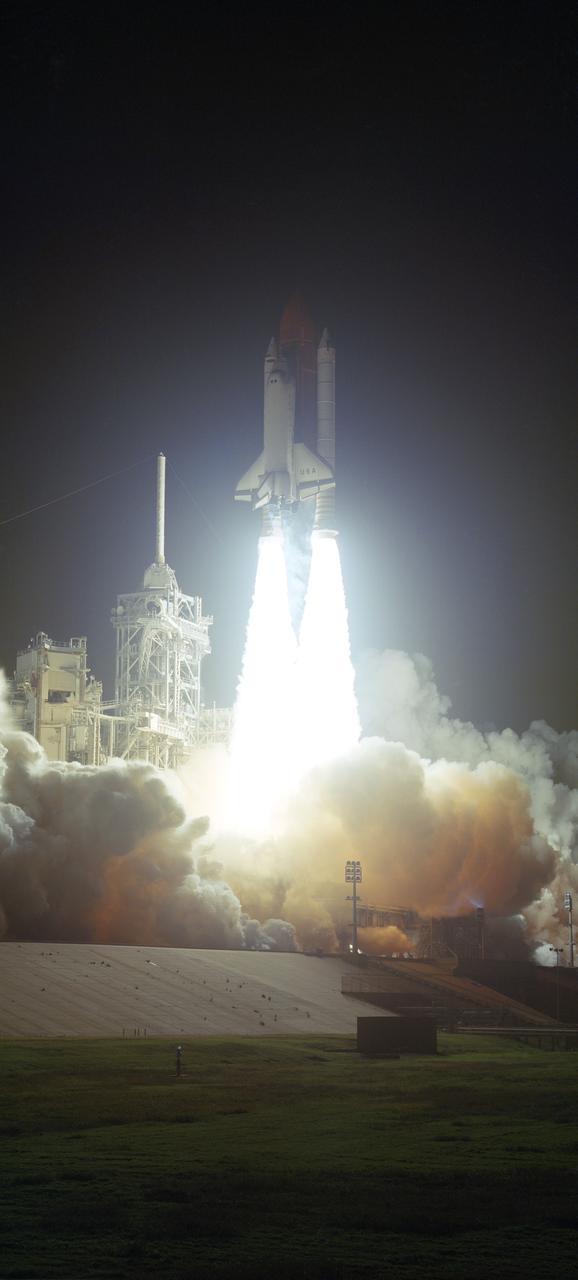
STS035-S-021 (2 Dec 1990) --- The Space Shuttle Columbia lifts off Launch Pad 39B at 1:49 a.m. (EST), Dec. 2, 1990. Primary payload onboard is the Astro-1 astronomical laboratory, headed for a ten-day fight dedicated to the single discipline of astrophysics. Crewmembers are five astronauts--Vance D. Brand, Guy S. Gardner, John M. (Mike) Lounge, Jeffrey A. Hoffman and Robert A.R. Parker--and two payload specialists--Samuel T. Durrance and Ronald A. Parise.
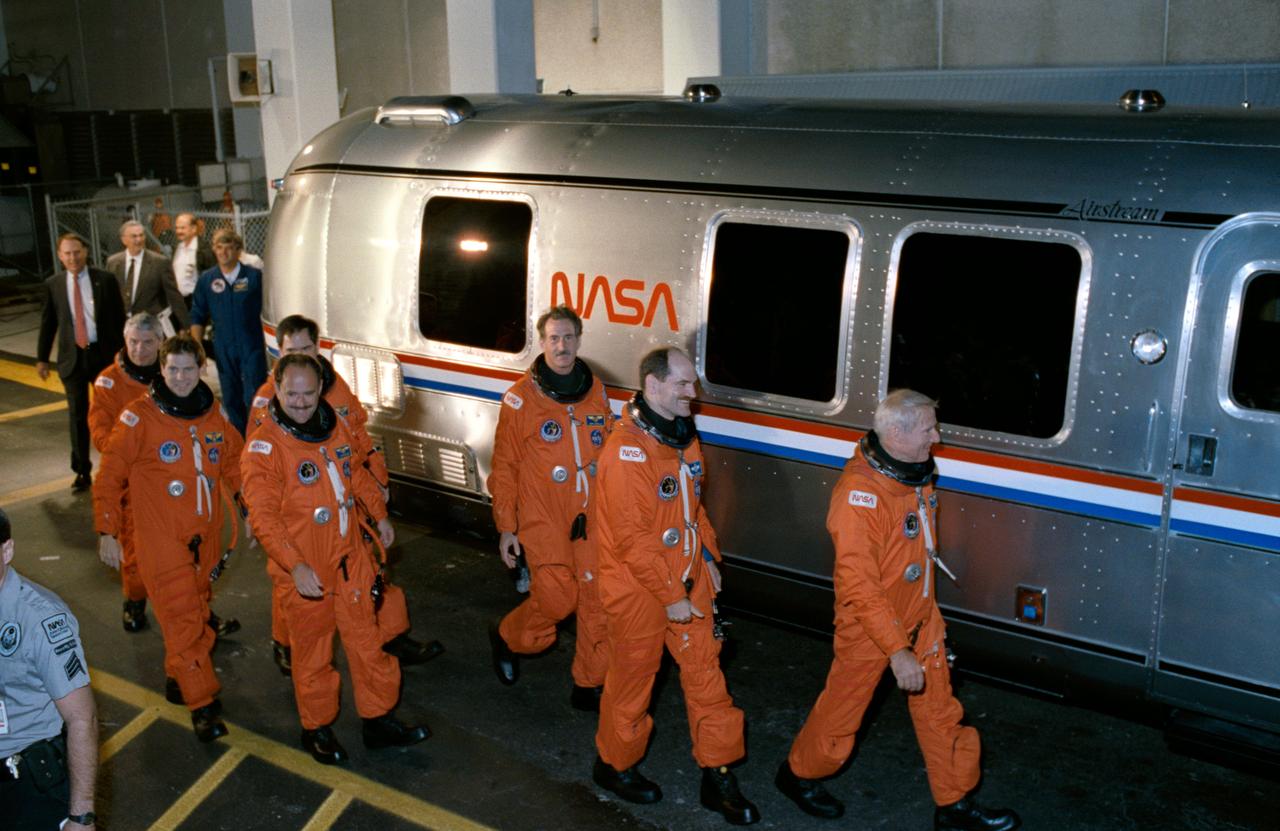
STS035-S-016 (2 Dec 1990) --- Astronaut Vance D. Brand, right, leads the STS 35 crew toward a transfer van that will take them from the nearby operations and checkout (O&C) building to Launch Complex 39. Trailing the mission commander, left to right, are Robert A. R. Parker, Samuel T. Durrance, Ronald A. Parise, John M. (Mike) Lounge, Jeffrey A. Hoffman and Guy S. Gardner.
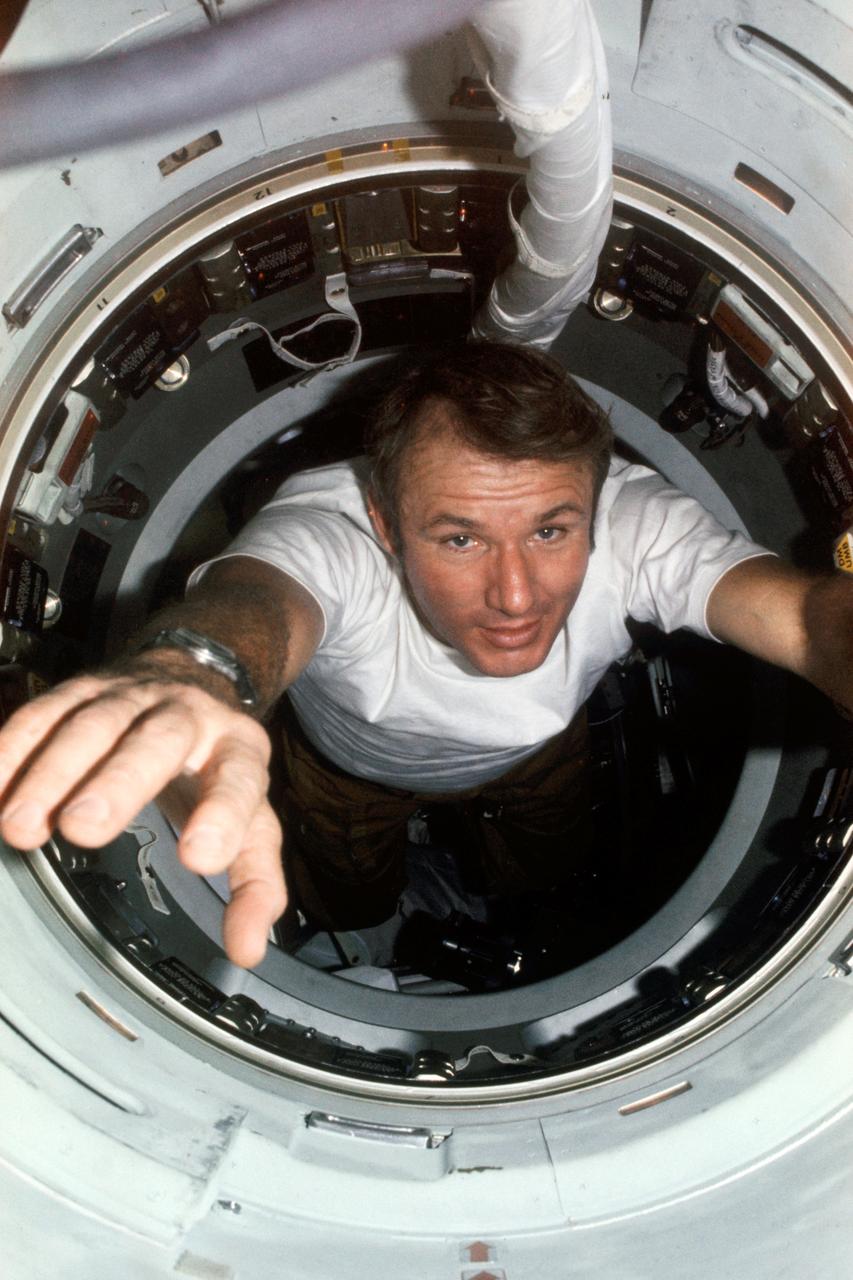
AST-06-318 (15-24 July 1975) --- Astronaut Vance D. Brand, command module pilot of the American ASTP crew, is seen in the hatchway leading from the Apollo Command Module (CM) into the Apollo Docking Module (DM) during the joint U.S.-USSR Apollo-Soyuz Test Project docking mission in Earth orbit. The 35mm camera is looking from the DM into the CM.
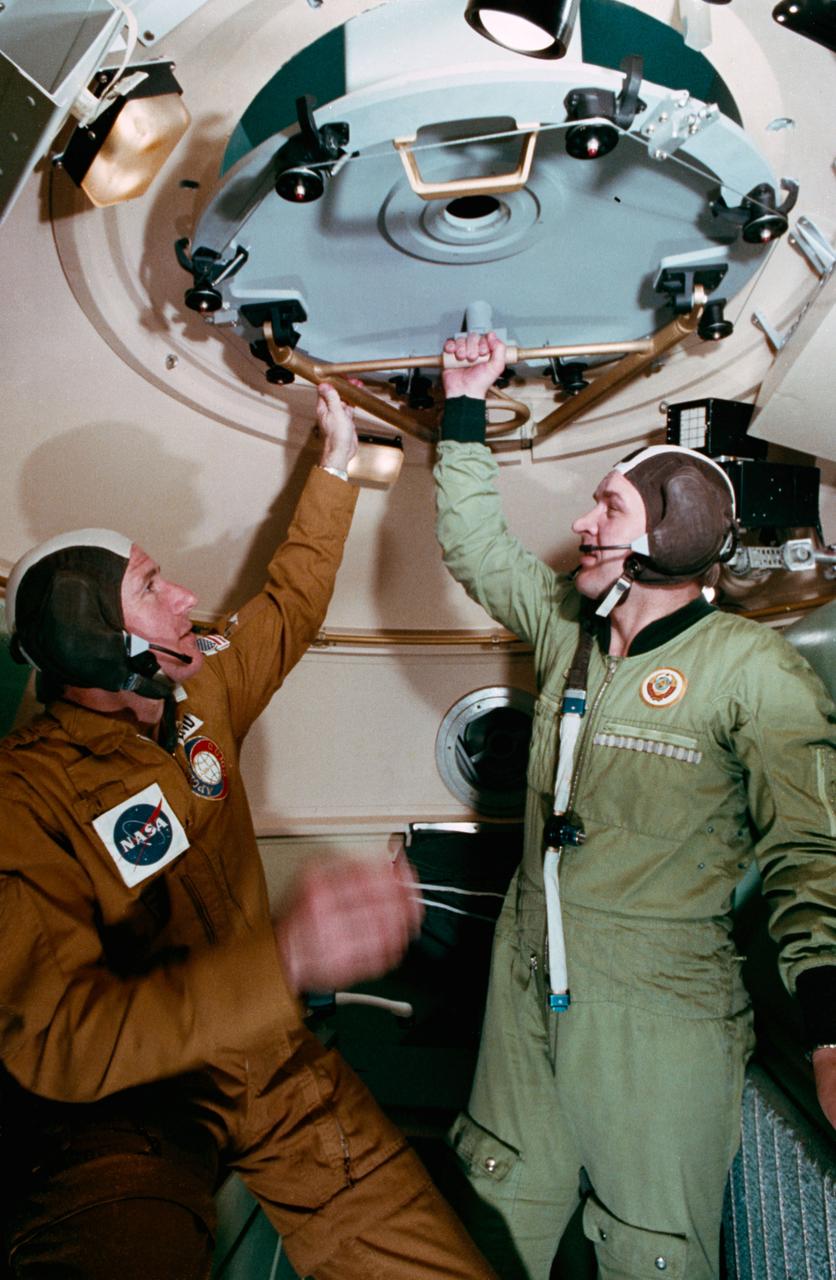
S75-22856 (25 Feb. 1975) --- An interior view of the Soyuz orbital module mock-up in Building 35 during Apollo-Soyuz Test Project joint crew training at NASA's Johnson Space Center. The ASTP crewmen are astronaut Vance D. Brand (on left), command module pilot of the American ASTP prime crew; and cosmonaut Valeriy N. Kubasov, engineer on the Soviet ASTP first (prime) crew. The training session simulated activities on the second day in Earth orbit. Photo credit: NASA
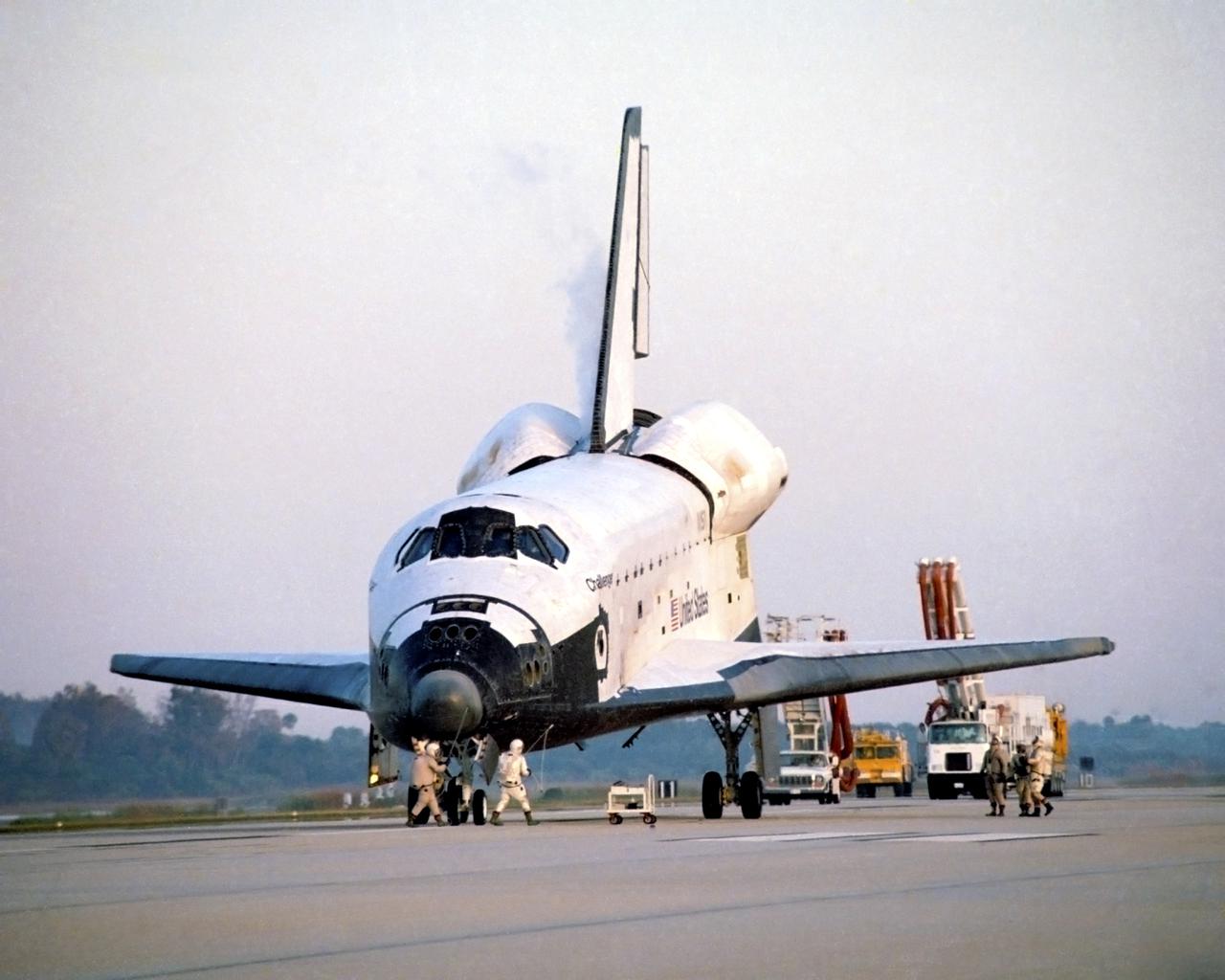
CAPE CANAVERAL, Fla. -- Ground crew members perform initial post-landing procedures on orbiter Challenger as the the crew, the first-ever to experience both launch and landing at KSC, prepare to exit the spaceship. Touchdown was at 7:15:55 a.m. EST on Feb. 11. Crew members for the historic Mission 41-B STS-11 are Commander Vance D. Brand, Pilot Robert L.'Hoot' Gibson, and Mission Specialists Bruce McCandless II, Robert L. Stewart and Ronald E. McNair. Photo credit: NASA
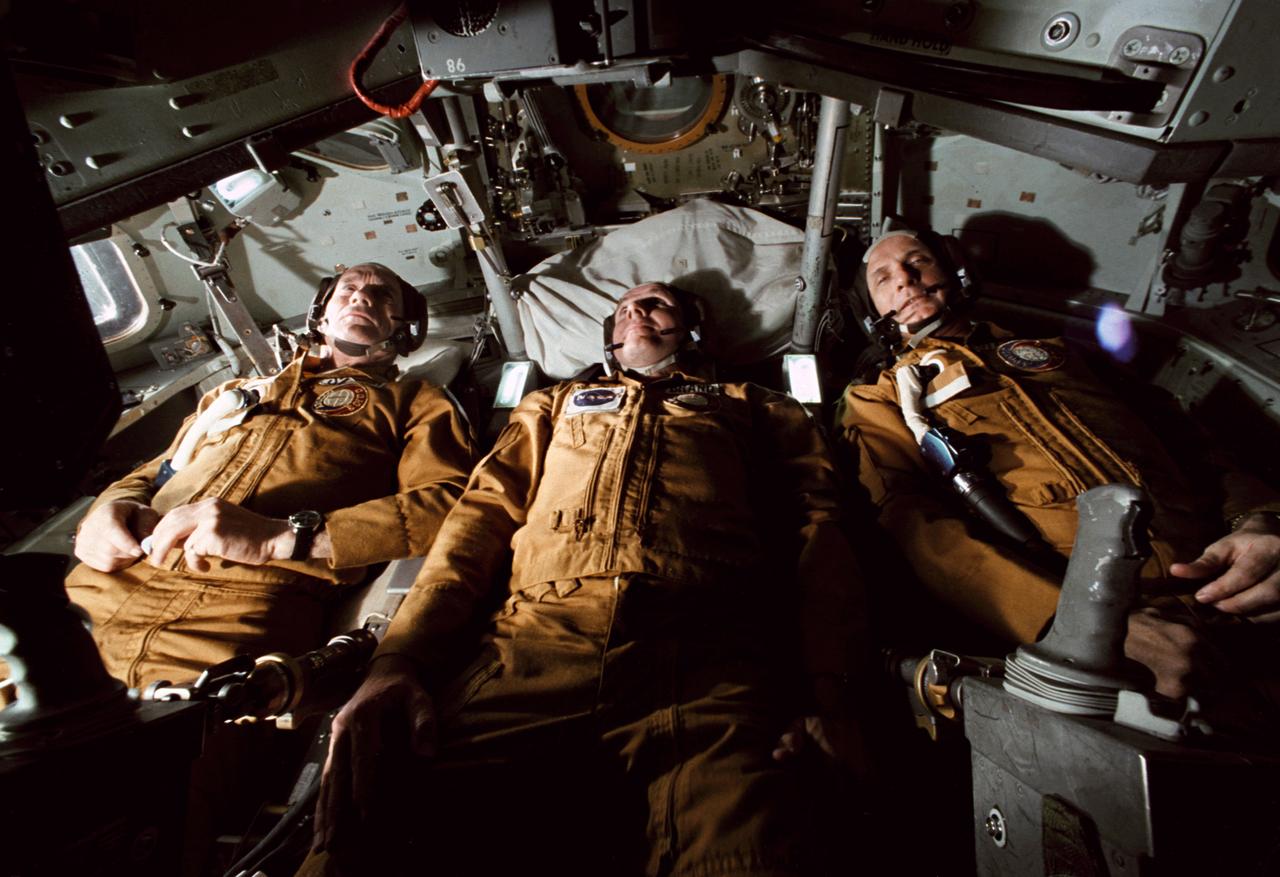
S75-22747 (25 Feb. 1975) --- An interior view of the Apollo Command Module trainer in Building 35 showing the three American ASTP prime crewmen lying in their couches during Apollo-Soyuz Test Project training at NASA's Johnson Space Center. They are, left to right, astronauts Donald K. Slayton, docking module pilot; Vance D. Brand, command module pilot; and Thomas P. Stafford, commander.
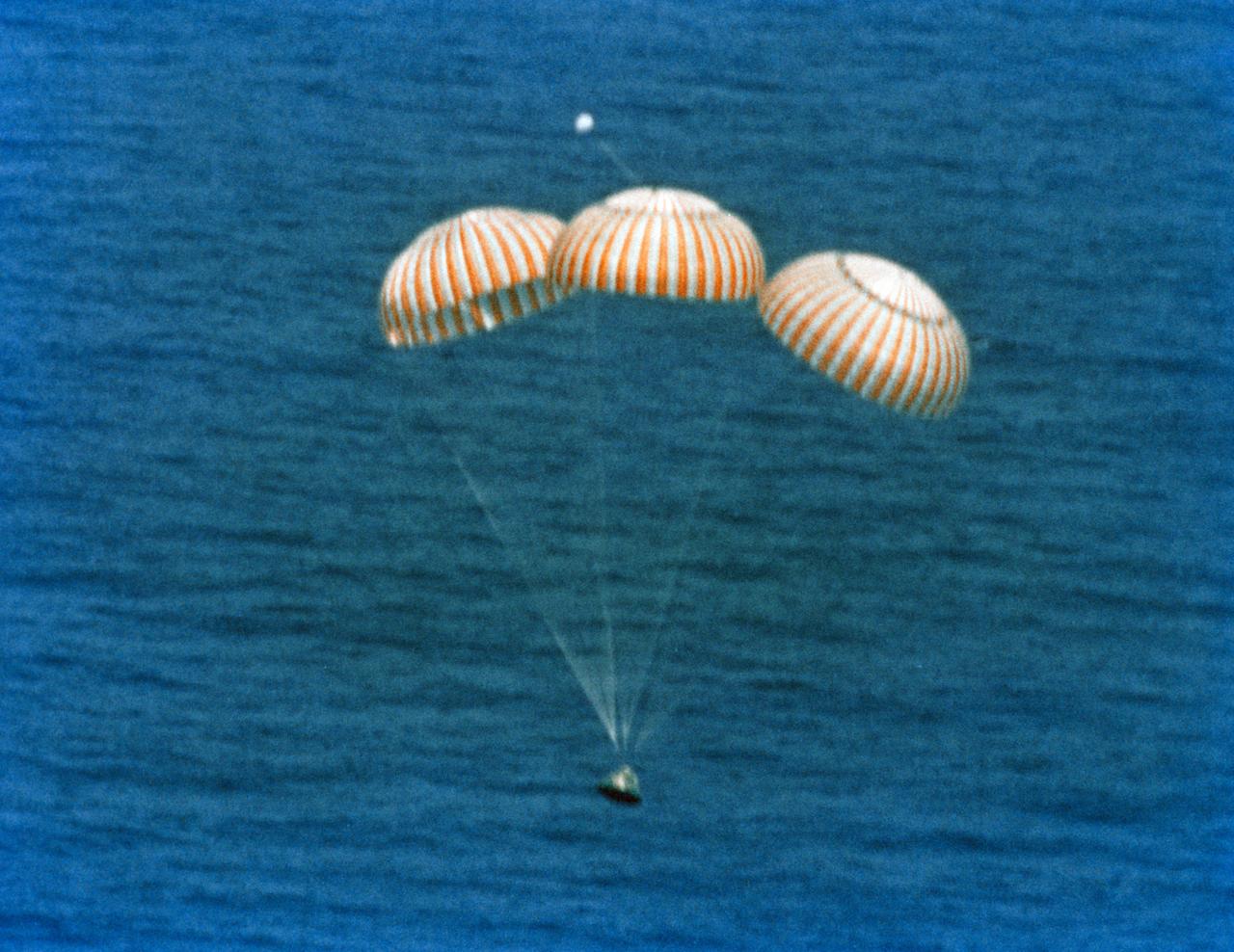
S75-29719 (24 July 1975) --- The ASTP Apollo Command Module, with astronauts Thomas P. Stafford, Vance D. Brand and Donald K. Slayton aboard, nears a touchdown in the Central Pacific Ocean to conclude the historic joint U.S.-USSR Apollo-Soyuz Test Project docking mission in Earth orbit. The spacecraft splashed down in the Hawaiian Islands area at 4:18 p.m. (CDT), July 24, 1975.
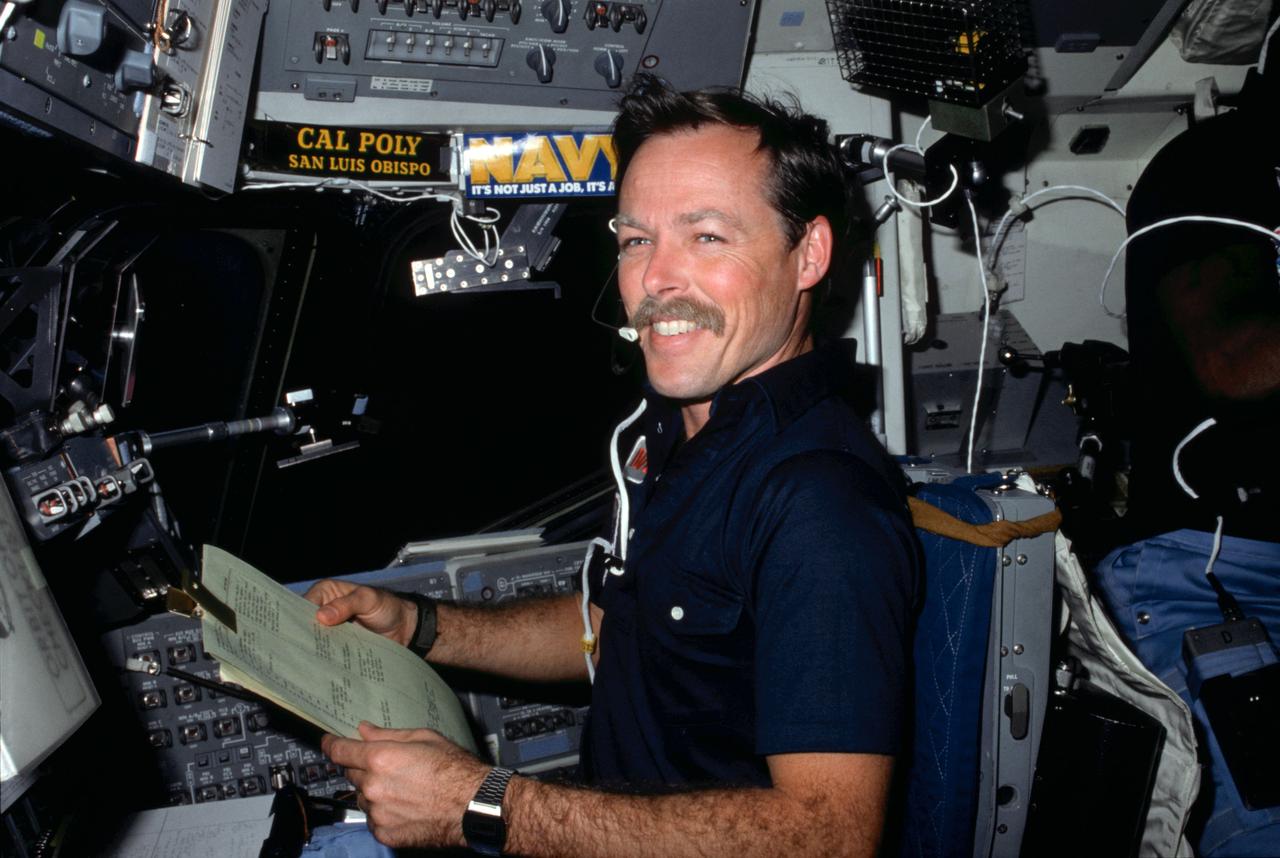
S84-27027 (3-11 Feb 1984) --- Astronaut Robert L. Gibson, STS-41B pilot, reviews some teleprinter copy on the flight deck's starboard station during the eight-day STS-41B Space Shuttle mission. Four other astronauts share the Challenger with Gibson. They are astronauts Vance D. Brand, commander; and Ronald E. McNair, Bruce McCandless II and Robert L. Stewart, all mission specialists. The photograph was taken from the commander's station with a 35mm camera.
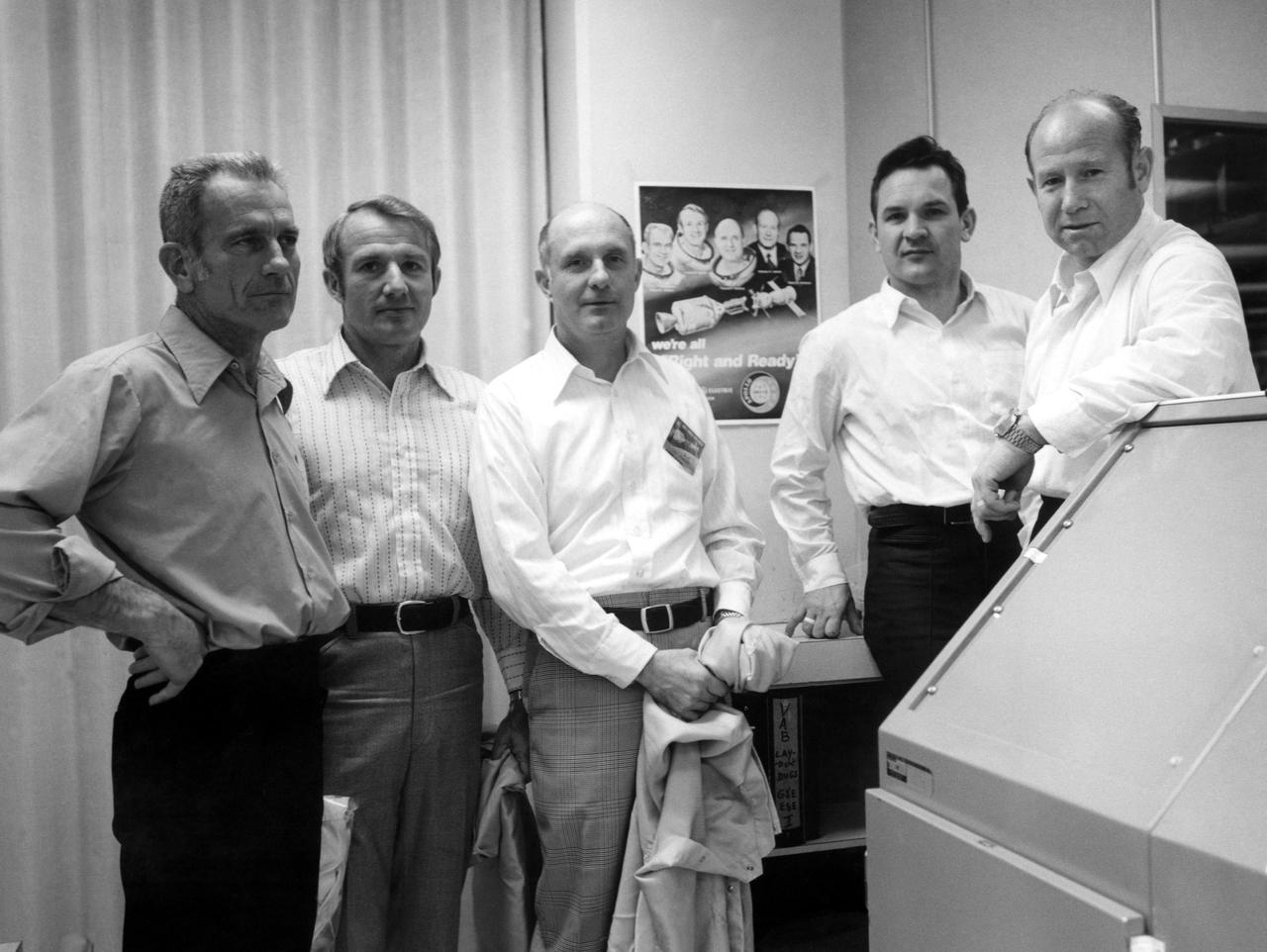
KENNEDY SPACE CENTER, FLA. -- Soviet Cosmonaut tour of KSC. United States, Soviet Union, prime crews for Apollo Soyuz Test Project inspect spacecraft checkout facilities in Manned Spacecraft Operations Building ACE Station. From left are astronauts Donald K. Slayton, Vance D. Brand and Thomas P. Stafford; cosmonauts Valeriy Kubasov and Aleksey Leonov.

S84-27155 (11 Feb 1984) --- The first Space Shuttle landing in Florida was recorded just moments prior to touchdown on the long landing facility of the Kennedy Space Center. Patches of fog were sighted near the round, but they were not a factor in the landing. Along with Astronaut Vance D. Brand, crew commander at Challenger?s controls, also onboard were Astronaut Robert L. Gibson, pilot; and Bruce McCandless II, Robert L. Stewart and Ronald E. McNair, all mission specialists.
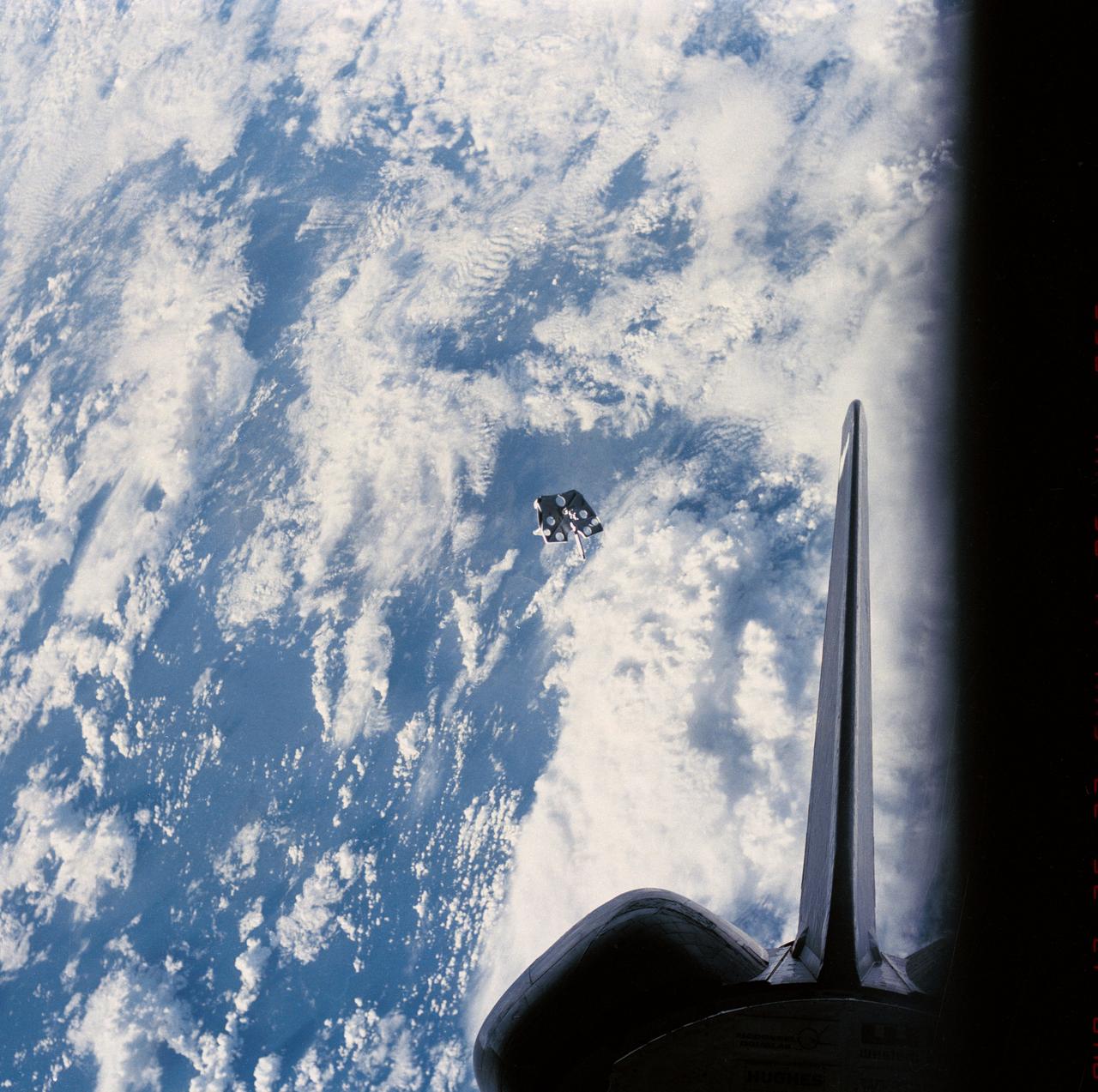
S84-27024 (7 Feb 1984) --- This 70mm frame centers on a foot restraint that strayed from the Earth-orbiting Space Shuttle Challenger during the February 9, 1984 extravehicular activity (EVA) session of astronauts Bruce McCandless II and Robert Stewart. As seen in JSC photograph frame number S84-27025, McCandless goes after the piece. Not pictured is Vance D. Brand, crew commander, who moved the spacecraft nearer the object.
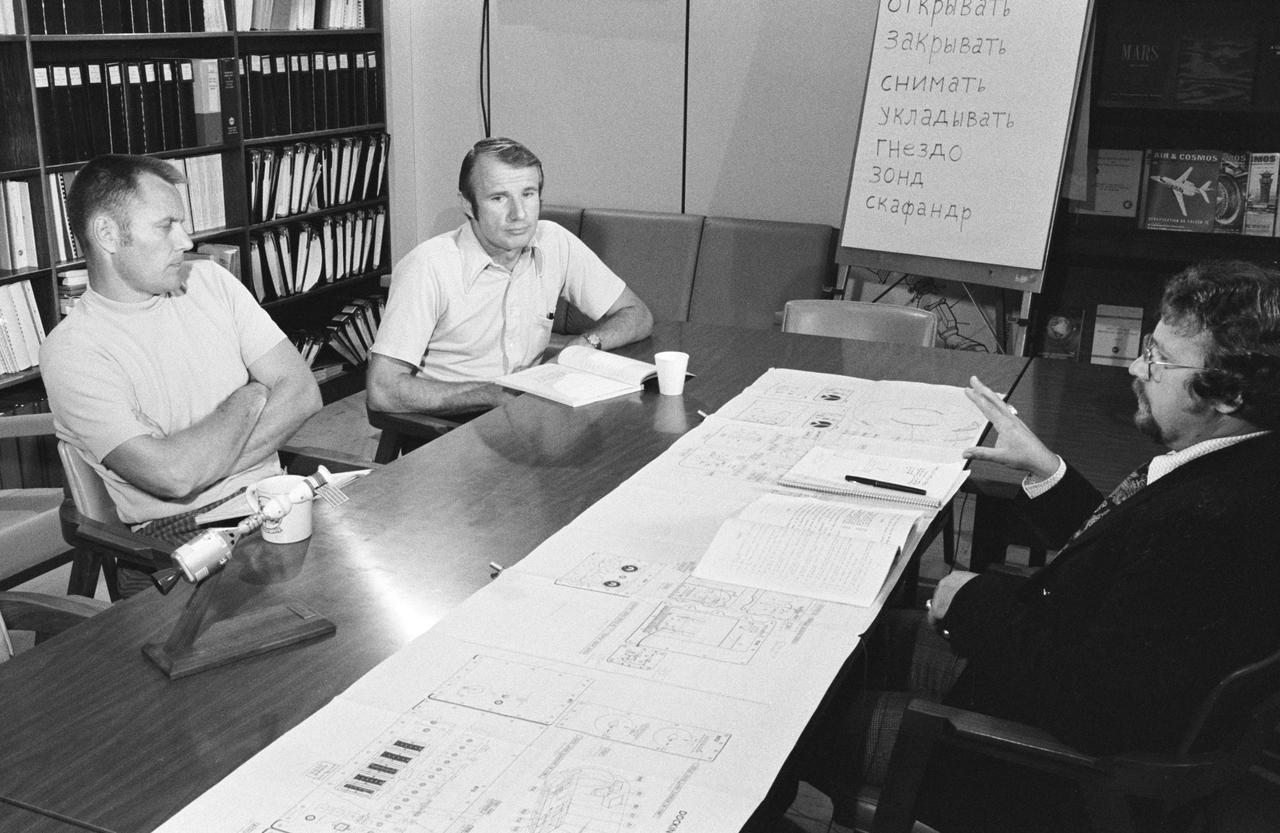
S74-23117 (6 June 1974) --- Two astronauts associated with the joint U.S.-USSR Apollo-Soyuz Test Project receive instructions in the Russian language during ASTP activity at the Johnson Space Center. They are Robert F. Overmyer, a member of the support team of the American ASTP crew, who is seated at left; and Vance D. Brand (center), the command module pilot of the American ASTP prime crew. The instructor is Anatoli Forestanko.
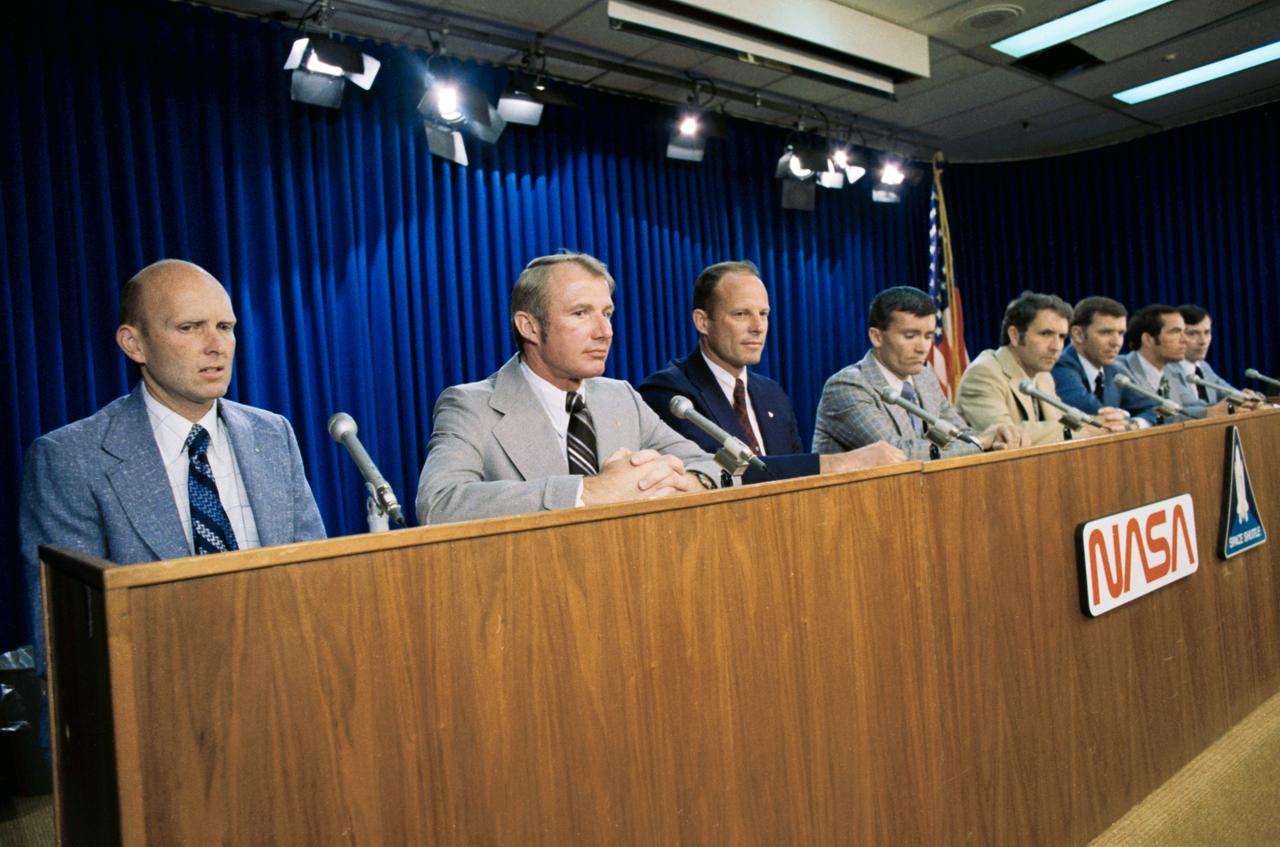
S78-27531 (22 March 1978) --- These eight men have been named on four two-man crews who will fly the space shuttle orbiter vehicle during orbital flight tests (OFT) scheduled to begin in 1979. Pictured during their press conference, right to left, astronauts John W. Young, Robert L. Crippen, Joe H. Engle, Richard H. Truly, Fred W. Haise Jr., Jack R. Lousma, Vance D. Brand and C. Gordon Fullerton. Young and Crippen are commander and pilot, respectively, for the first OFT mission. Other crews are comprised of Engle, commander, and Truly, pilot; Haise, commander, and Lousma, pilot; Brand, commander, and Fullerton, pilot. Photo credit: NASA
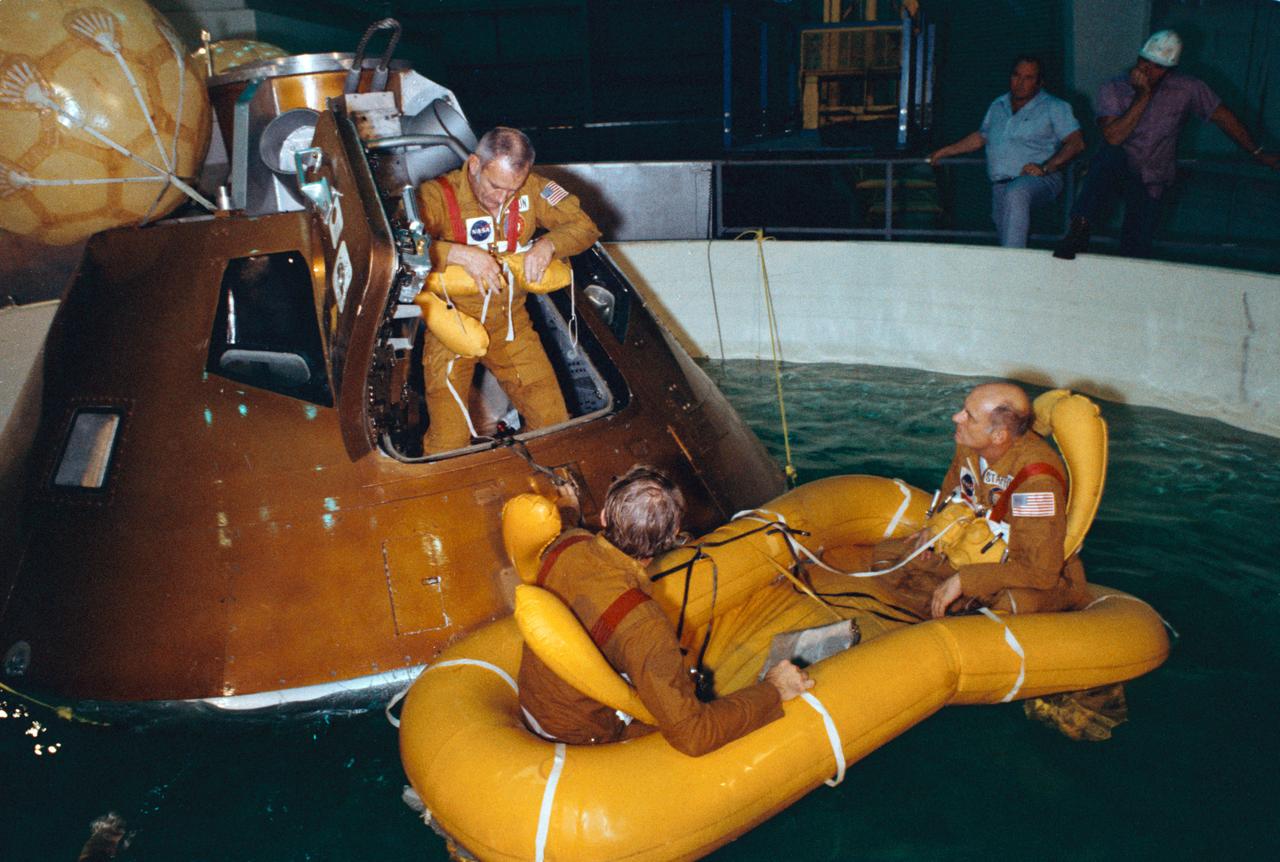
S75-23431 (8 March 1975) --- Astronaut Donald K. Slayton attaches his life preserver as he egresses an Apollo Command Module trainer in a water tank in Building 260 during water egress training at NASA's Johnson Space Center. The crewmen exit through the hatch when the CM is in this stable I (apex up) position; and they egress through the tunnel when the CM is in a stable II (apex down) position. Astronauts Vance D. Brand (on left) and Thomas P. Stafford have already egressed the trainer and are seated in a three-man life raft. This training session was part of the preparations for the joint U.S.-USSR Apollo-Soyuz Test Project docking mission in Earth orbit scheduled for July 1975. These three men compose the American ASTP prime crew. Stafford is the commander, Brand is the command module pilot, and Slayton is the docking module pilot.
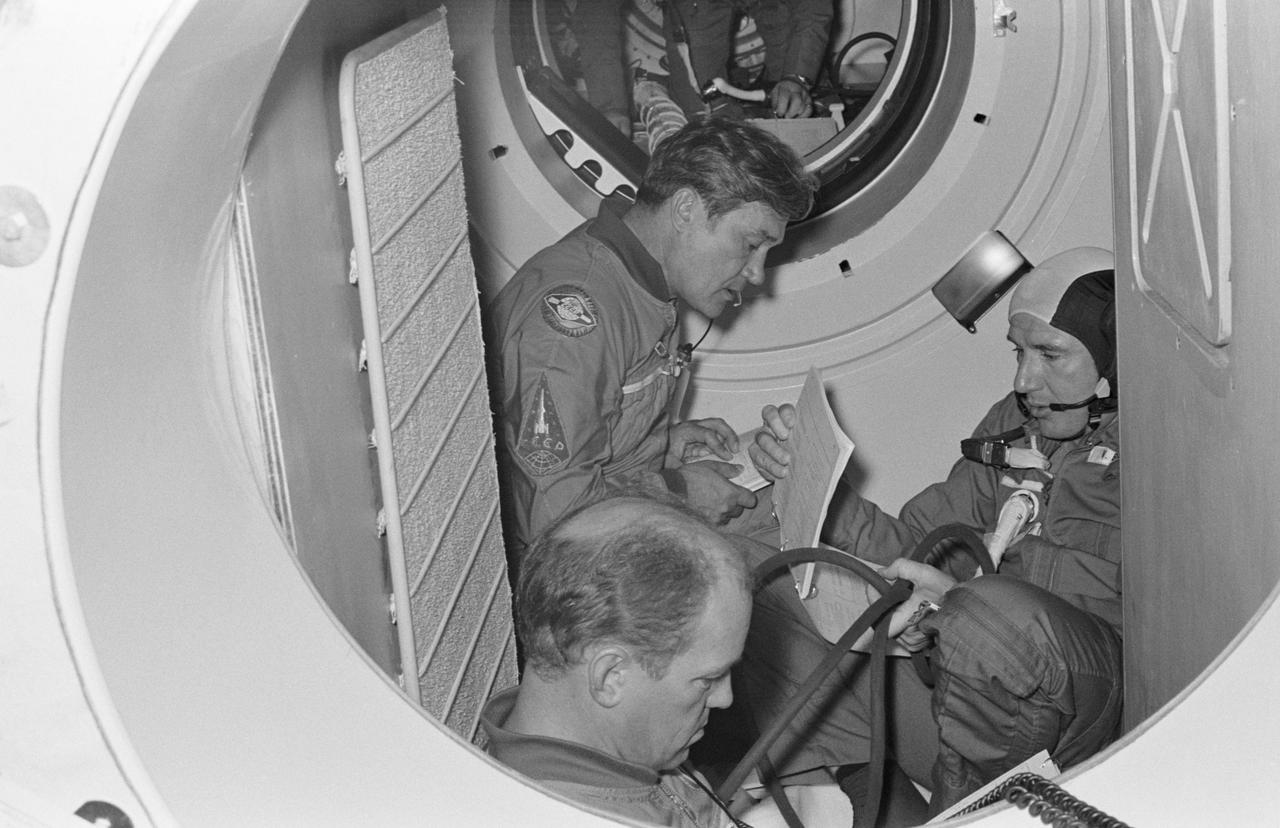
S74-28649 (16 Sept. 1974) --- Three crewmen of the Apollo-Soyuz Test Project are seated in a Soviet Soyuz spacecraft orbital module mock-up in Building 35 during ASTP simulation training at the Johnson Space Center. They are cosmonaut Anatoliy V. Filipchenko (left background), commander of the Soviet ASTP second (backup) crew; cosmonaut Nikolay N. Rukavishnikov (left foreground), engineer on the crew; and astronaut Vance D. Brand (right), command module pilot of the American ASTP prime crew. The hatch in the background leads to the Docking Module. During the exercise the American ASTP crew and the Soviet ASTP crew simulated docking the Apollo and Soyuz in Earth orbit and transferring to each other?s spacecraft. Here, Brand is visiting the Soyuz spacecraft. The crewmen are training in both the U.S. and the USSR for the joint mission scheduled for the summer of 1975.
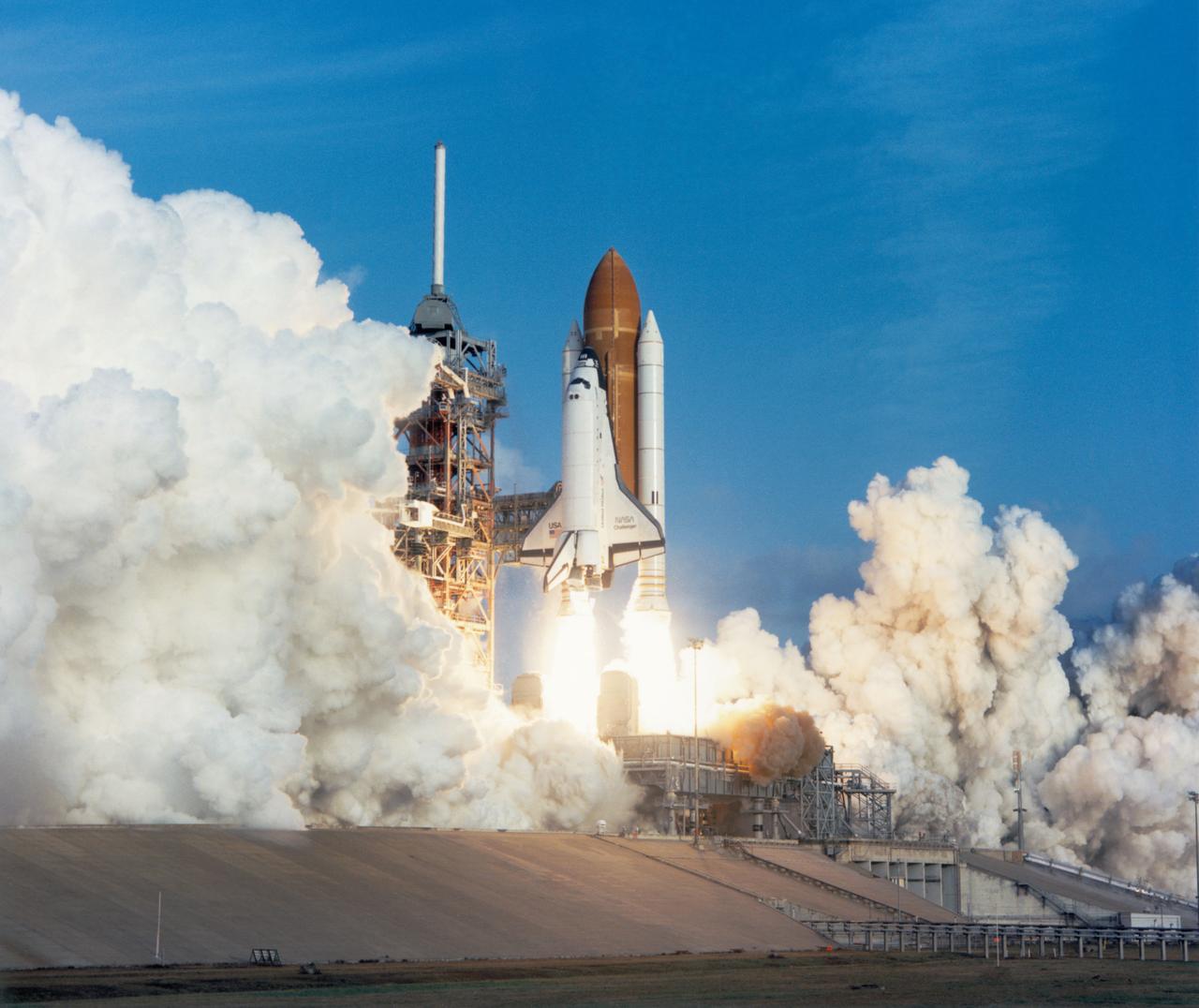
S84-26325 (3 Feb. 1984) --- Beginning a busy year, NASA's space shuttle Challenger, attached to two solid rocket boosters and an external fuel tank which it will later jettison, blasts off from Pad A at Kennedy Space Center's Launch Complex 39 at 8:00 a.m. (EST), Feb. 3, 1984. Inside the spacecraft are astronauts Vance D. Brand, Robert L. Gibson, Bruce McCandless II, Ronald E. McNair and Robert L. Stewart. Brand is making his first trip in the Challenger but his second STS flight and third spaceflight overall. The rest of the crew members are experiencing space travel for the first time. Marking a space first, this flight will be landing at KSC. Photo credit: NASA
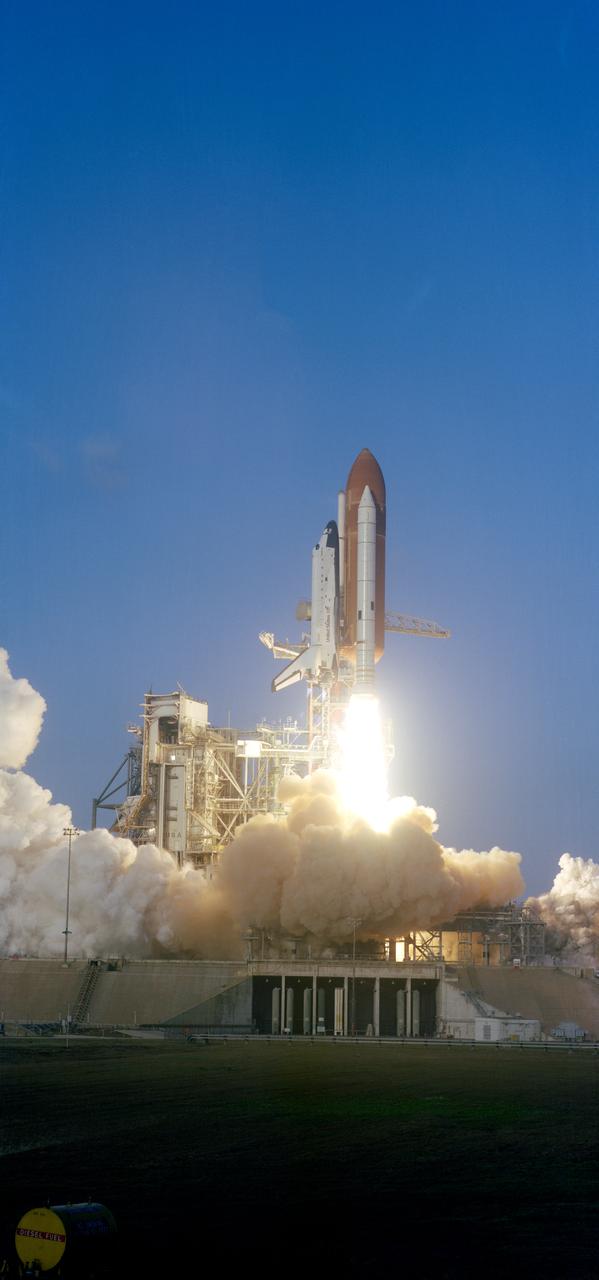
S84-26327 (3 Feb. 1984) --- Beginning a busy year, NASA's space shuttle Challenger, attached to two solid rocket boosters and an external fuel tank which it will later jettison, blasts off from Pad A at Kennedy Space Center's Launch Complex 39 at 8:00 a.m. (EST), Feb. 3, 1984. Inside the STS 41-B spacecraft are astronauts Vance D. Brand, Robert L. Gibson, Bruce McCandless II, Ronald E. McNair and Robert L. Stewart. Brand is making his first trip in the Challenger but his second STS flight and third spaceflight overall. The rest of the crew members are experiencing space travel for the first time. Marking a space first, this flight will be landing at KSC. Photo credit: NASA
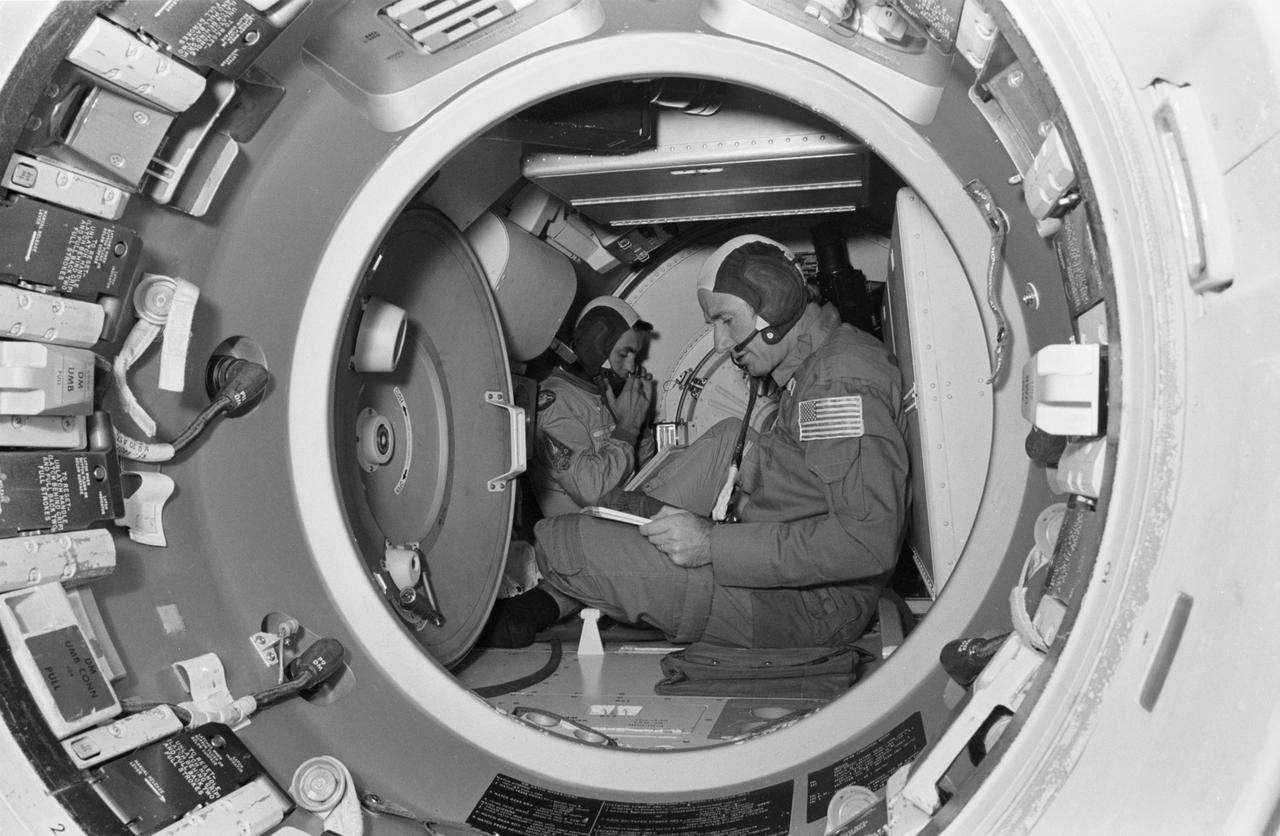
S74-28972 (20 Sept. 1974) --- Astronaut Vance D. Brand (foreground) and cosmonaut Aleksandr S. Ivanchenko are seated in the Docking Module trainer in Building 35 during Apollo-Soyuz Test Project simulation training at the Johnson Space Center. Brand is the command module pilot of the American ASTP prime crew. Ivanchenko is the engineer on the Soviet ASTP fourth crew (backup). During the exercise the American ASTP crew and the Soviet ASTP crew simulated docking the Apollo and Soyuz in Earth orbit and transferring to each other?s spacecraft. The Docking Module is designed to link the Apollo and Soyuz spacecraft. The ASTP crewmen are training in both the U.S. and USSR for the joint mission scheduled for the summer of 1975. This view is looking from inside the Command Module into the Docking Module. The hatchway loading into the Soyuz spacecraft orbital module mock-up is in the background.
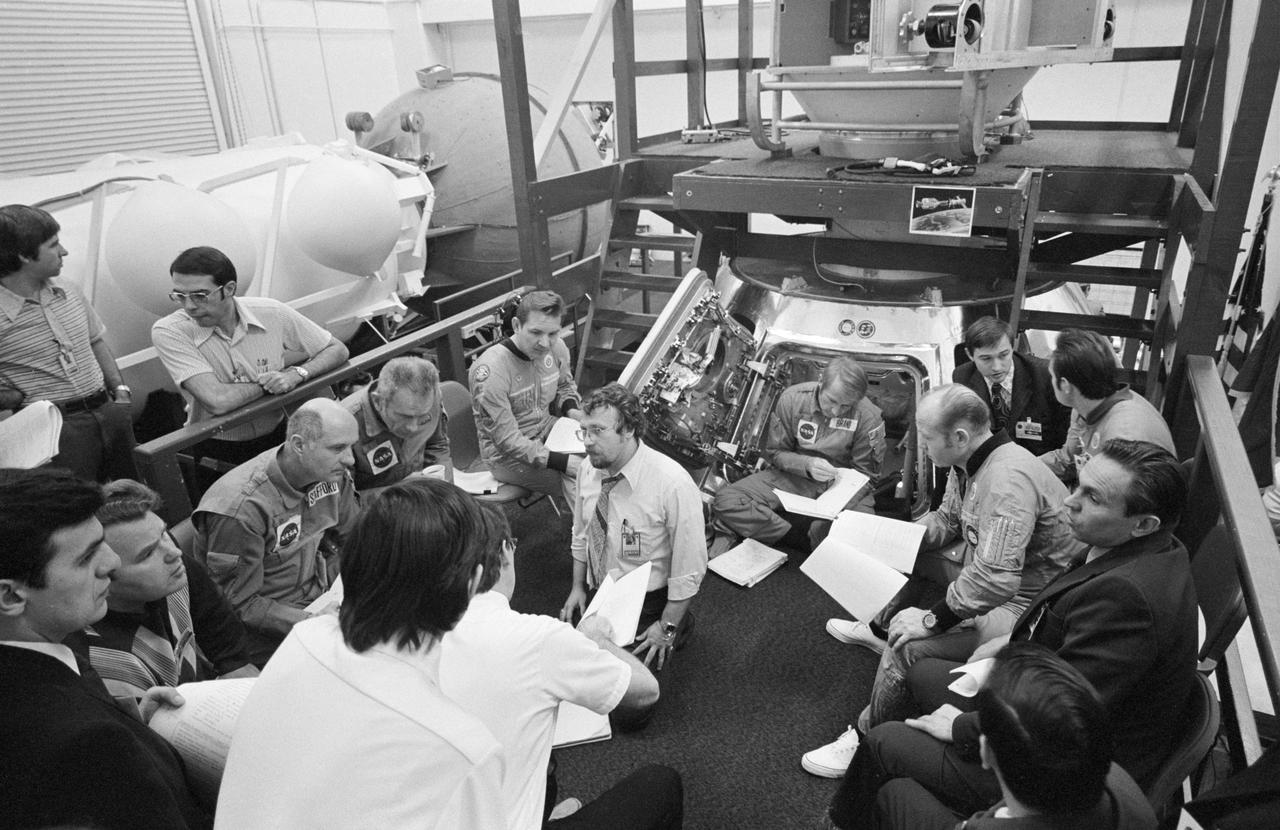
S75-21599 (12 Feb. 1975) --- Six Apollo-Soyuz Test Project crewmen participate in joint crew training in Building 35 at the Johnson Space Center. They are (wearing flight suits), left to right, astronaut Thomas P. Stafford, commander of the American ASTP prime crew; astronaut Donald K. Slayton, docking module pilot on Stafford?s crew; cosmonaut Valeriy N. Kubasov, engineer on the Soviet ASTP first (prime) crew; astronaut Vance D. Brand, command module pilot on Stafford?s crew; cosmonaut Aleksey A. Leonov, commander of the Soviet ASTP first (prime) crew; and cosmonaut Vladimir A. Dzhanibekov, commander of the Soviet ASTP third (backup) crew. Brand is seated next to the hatch of the Apollo Command Module trainer. This picture was taken during a ?walk-through? of the first day?s activities in Earth orbit. The other men are interpreters and training personnel.
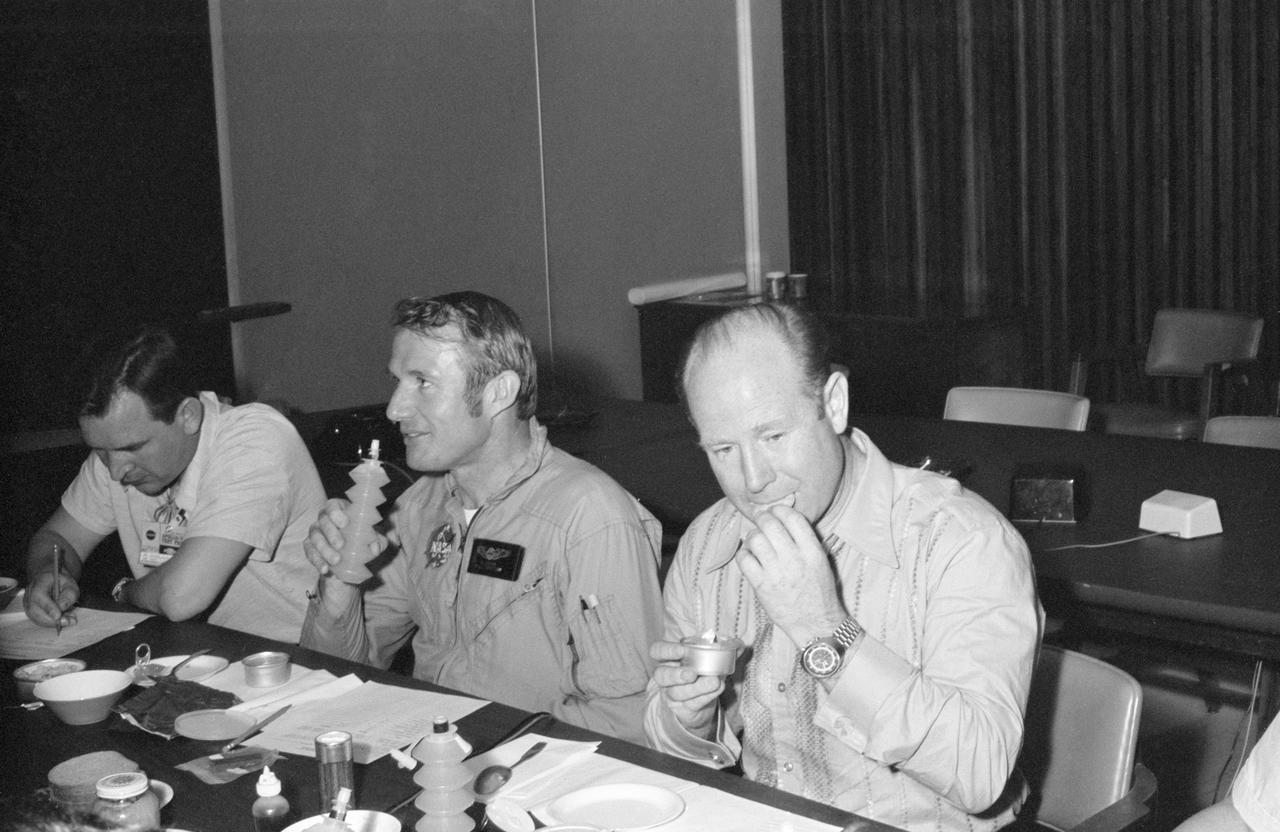
S74-20797 (23 April 1974) --- Candidate food items being considered for the joint U.S.-USSR Apollo-Soyuz Test Project mission are sampled by three ASTP crewmen in Building 4 at the Johnson Space Center. They are, left to right, cosmonaut Valeriy N. Kubasov, engineer on the Soviet ASTP crew; astronaut Vance D. Brand, command module pilot of the American ASTP crew; and cosmonaut Aleksey A. Leonov, commander of the Soviet ASTP crew. Kubasov is marking a food rating chart on which the crewmen mark their choices, likes and dislikes of the food being sampled. Brand is drinking orange juice from an accordion-like dispenser. Leonov is eating butter cookies. The two Soviet crewmen will have an opportunity to eat with the three American crewmen while the Apollo and Soyuz spacecraft are docked in Earth orbit. Leonov and Kubasov will dine on food being chosen individually by them now.
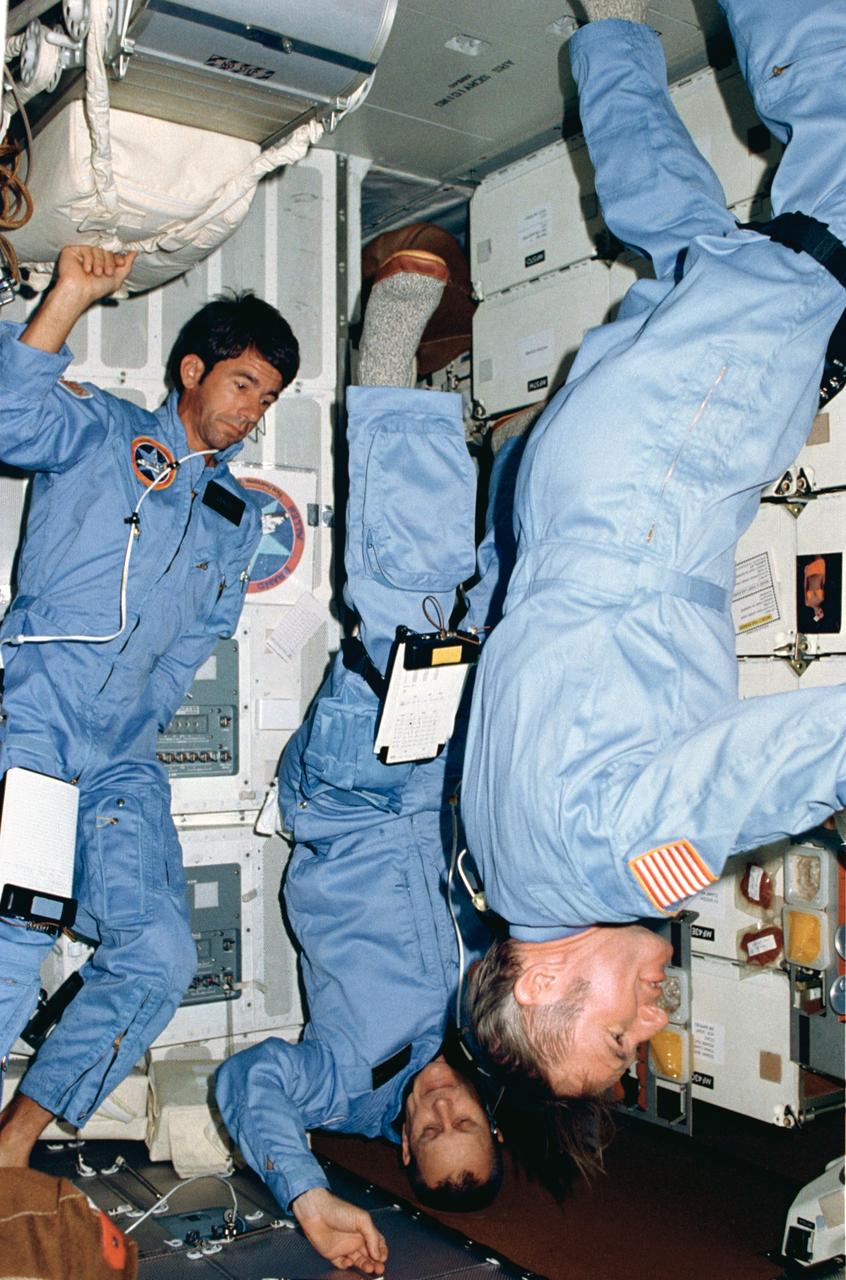
STS005-04-124 (14 Nov. 1982) --- Three members of the four-man STS-5 crew demonstrate the zero-gravity environment aboard the Earth-orbiting space shuttle Columbia. Astronaut Vance D. Brand, mission commander, holds a fairly typical Earth-bound pose, but crewmates, astronauts Robert F. Overmyer (center), pilot, and Dr. William B. Lenoir, mission specialist, perform body movements that could only be accomplished in zero-gravity. Dr. Joseph P. Allen IV, the flight’s other mission specialist, exposed this frame with a 35mm handheld camera. The four astronauts were in the middeck area of their reusable spacecraft when this photograph was made. Photo credit: NASA
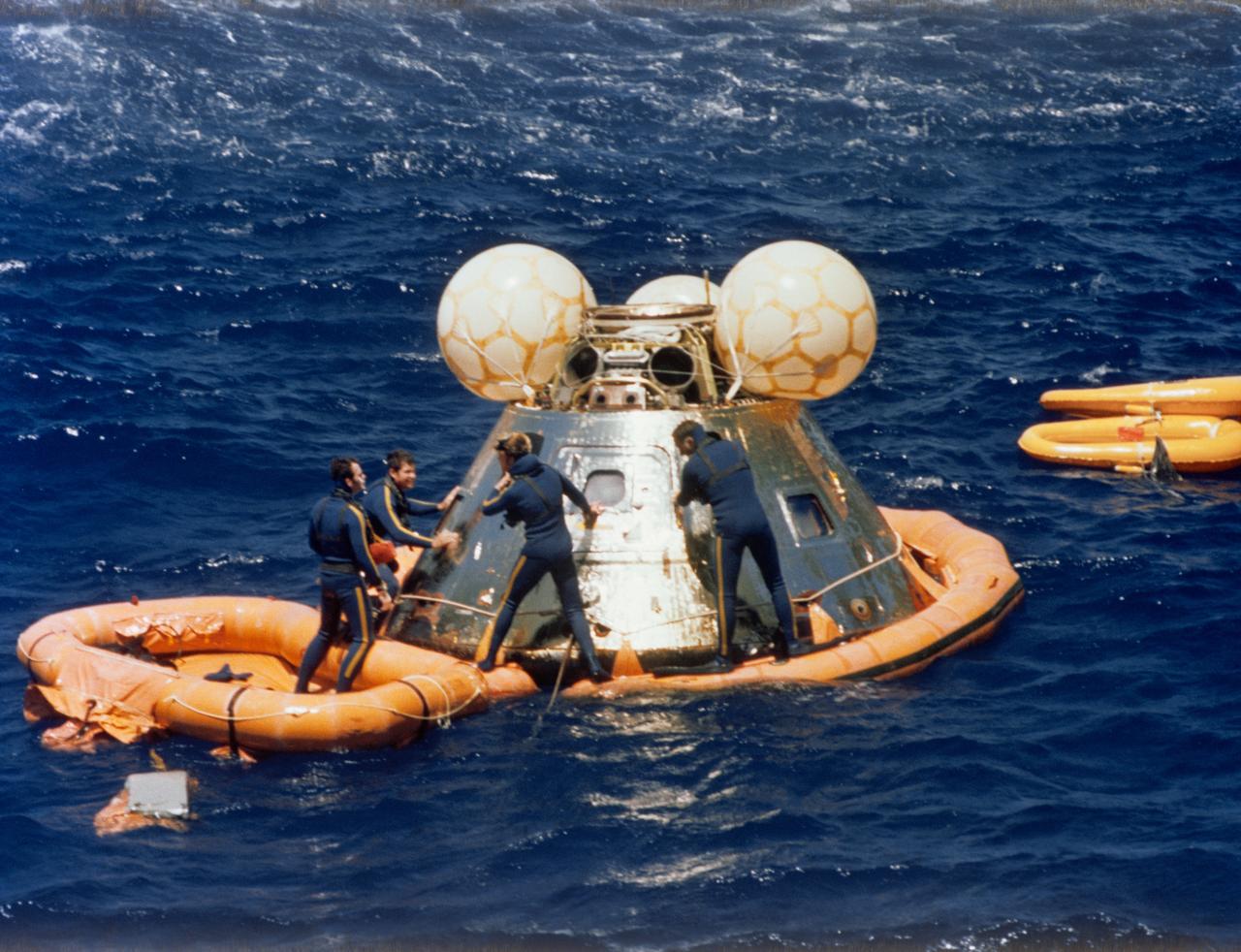
S75-29715 (24 July 1975) --- A team of U.S. Navy swimmers assists with the recovery of the ASTP Apollo Command Module following its splashdown in the Central Pacific Ocean to conclude the historic joint U.S.-USSR Apollo-Soyuz Test Project docking mission in Earth orbit. The swimmers have already attached a flotation collar to the spacecraft. The CM touched down in the Hawaiian Islands area at 4:18 p.m. (CDT), July 24, 1975. The crewmen, astronauts Thomas P. Stafford, Vance D. Brand and Donald K. Slayton, remained in the CM until it was hoisted aboard the prime recovery ship, the USS New Orleans.
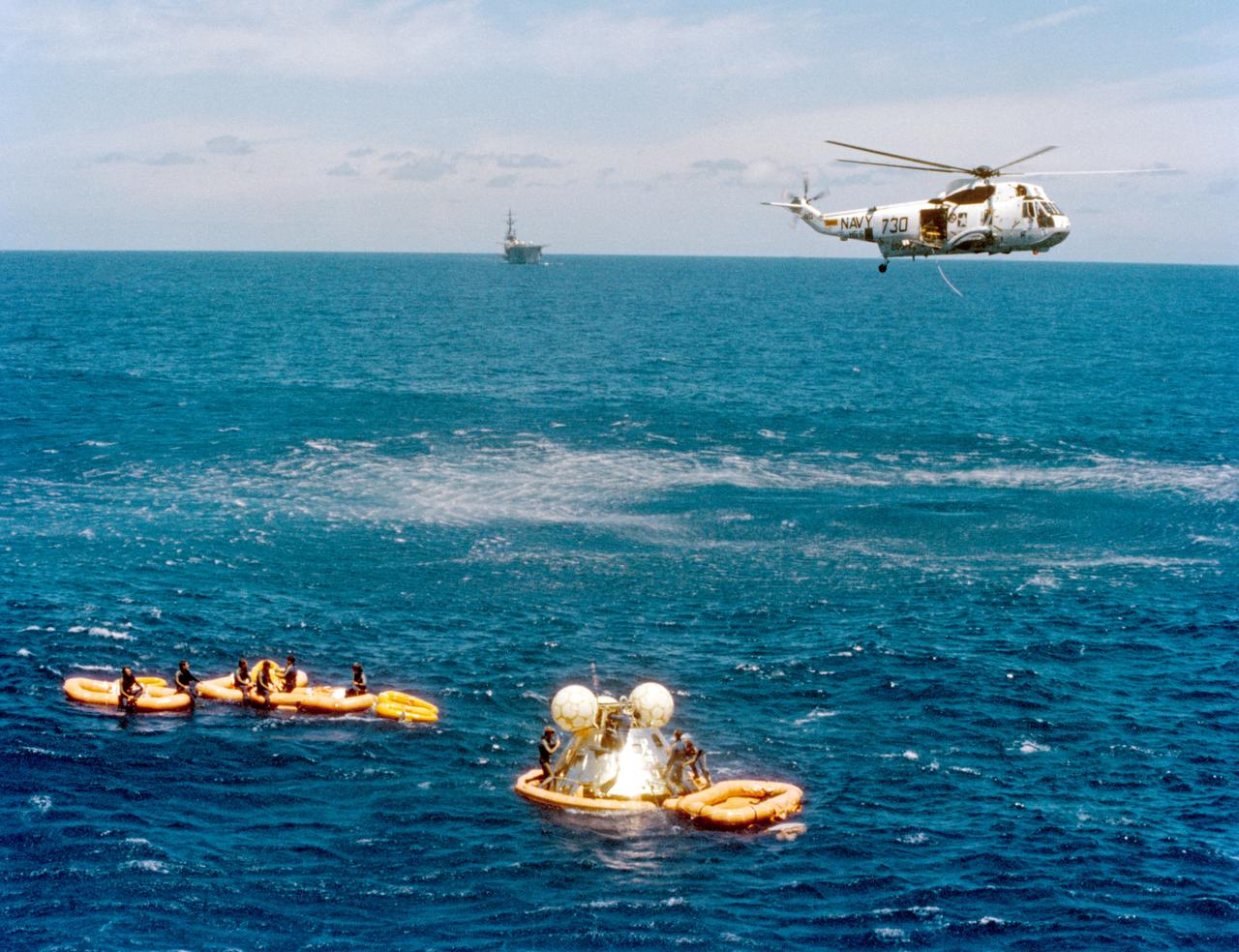
S75-29717 (24 July 1975) --- The ASTP Apollo Command Module, with astronauts Thomas P. Stafford, Vance D. Brand and Donald K. Slayton still inside, awaits pickup by the prime recovery ship, the USS New Orleans, following splashdown in the Central Pacific Ocean to conclude the historic joint U.S.-USSR Apollo-Soyuz Test Project docking mission in Earth orbit. The CM touchdown occurred in the Hawaiian Islands area at 4:18 p.m. (CDT), July 24, 1975. A team of U.S. Navy swimmers assists with the recovery operations. A recovery helicopter hovers overhead.
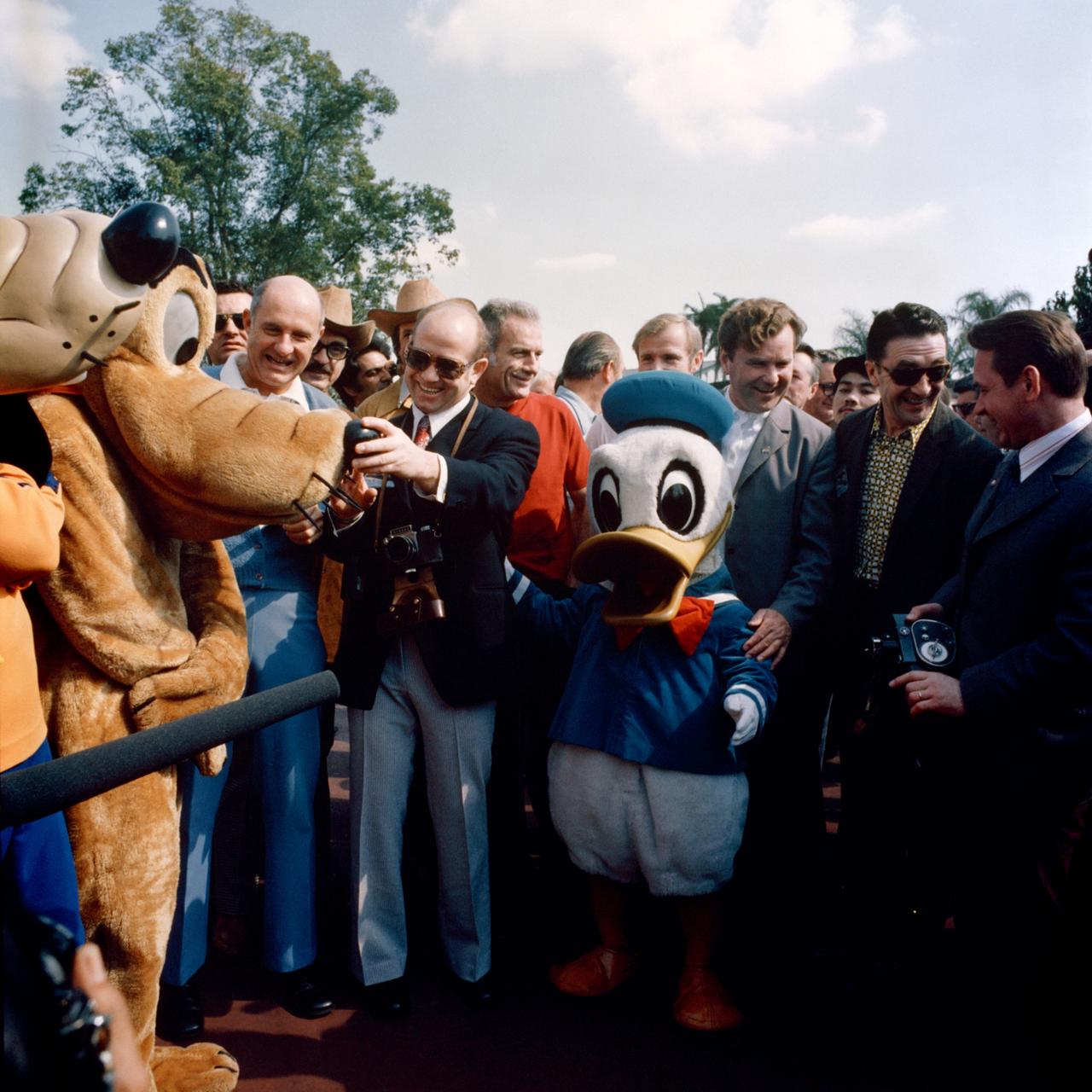
S75-24114 (8-10 Feb. 1975) --- Two Walt Disney comic cartoon characters, Donald Duck and Pluto, were on hand to greet a group of Apollo-Soyuz Test Project (ASTP) crewmen on their arrival at Disney World near Orlando. From left, are interpreter K. S. Samofal, interpreter Nicholas Timacheff, cosmonaut Vladimir A. Shatalov, astronaut Vance D. Brand, astronaut Donald K. Slayton, cosmonaut Aleksey A. Leonov (squeezing Pluto's nose) and astronaut Thomas P. Stafford. The astronauts and cosmonauts were in Florida for a three-day inspection tour of NASA's Kennedy Space Center where they looked over ASTP launch facilities and flight hardware.
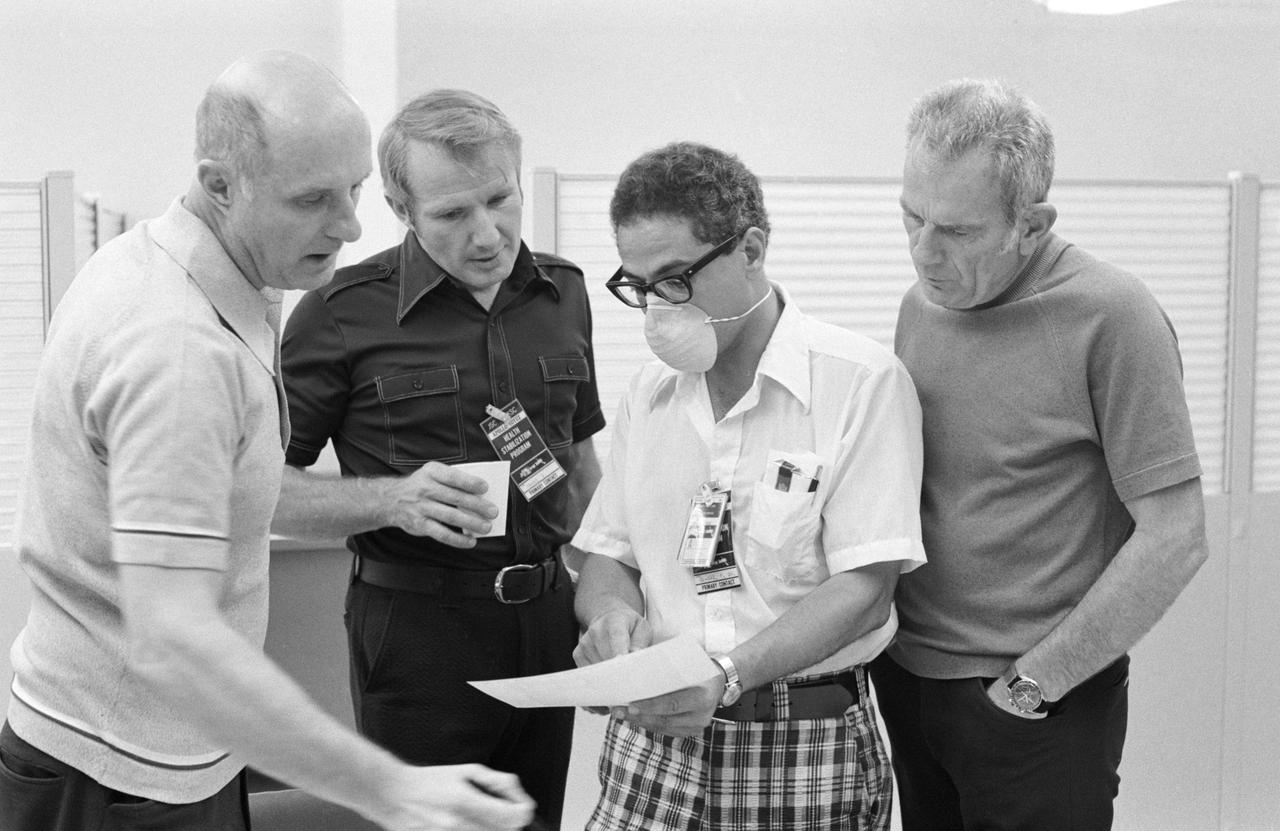
S75-28229 (8 July 1975) --- The three American ASTP prime crew astronauts participate in a photography mission briefing in Building 5 with Dr. Farouk El-Baz (wearing face mask) during Apollo-Soyuz Test Project preflight activity at NASA's Johnson Space Center. They are, left to right, Thomas P. Stafford, commander; Vance D. Brand, command module pilot; Dr. El-Baz; and Donald K. Slayton, docking module pilot. Dr. El-Baz is with the Center for Earth and Planetary Studies, National Air and Space Museum, Smithsonian Institution. The face mask is to protect the crewmen from possible exposure to disease prior to launch time. Photo credit: NASA
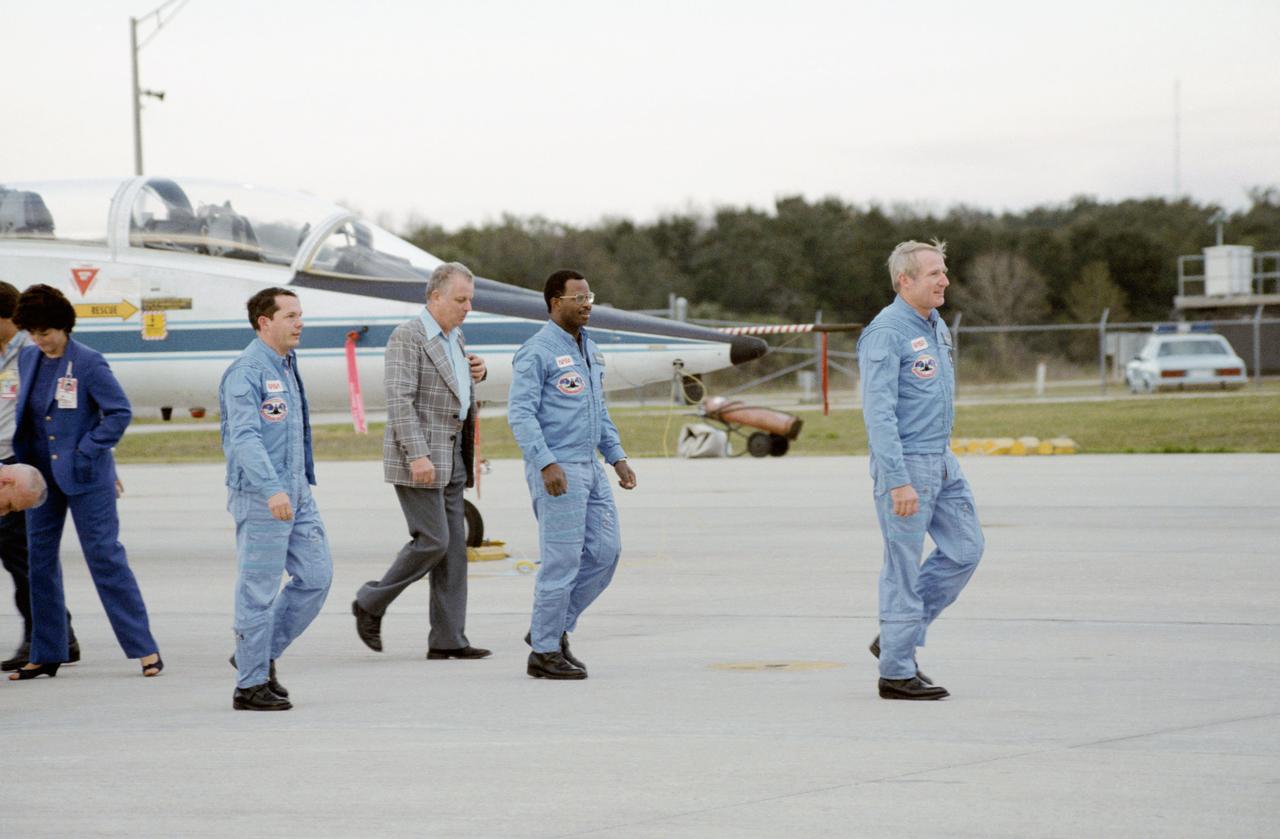
S84-26935 (31 Jan 1984) --- Three members of the STS 41-B astronaut crew arrive in Florida following a brief T-38 flight from Houston. Leading the crew from the flight line is Astronaut Vance D. Brand (right), crew commander. Following behind (in blue flight suits) are Astronauts Ronald E. McNair (center) and Robert L. Stewart (both mission specialists. They were met by Terry White (pictured), JSC public information industrial relations manager. Not pictured are Astronauts Robert L. Gibson, pilot; and Bruce McCandless II, mission specialist. Launch is scheduled for February 3, 1983.
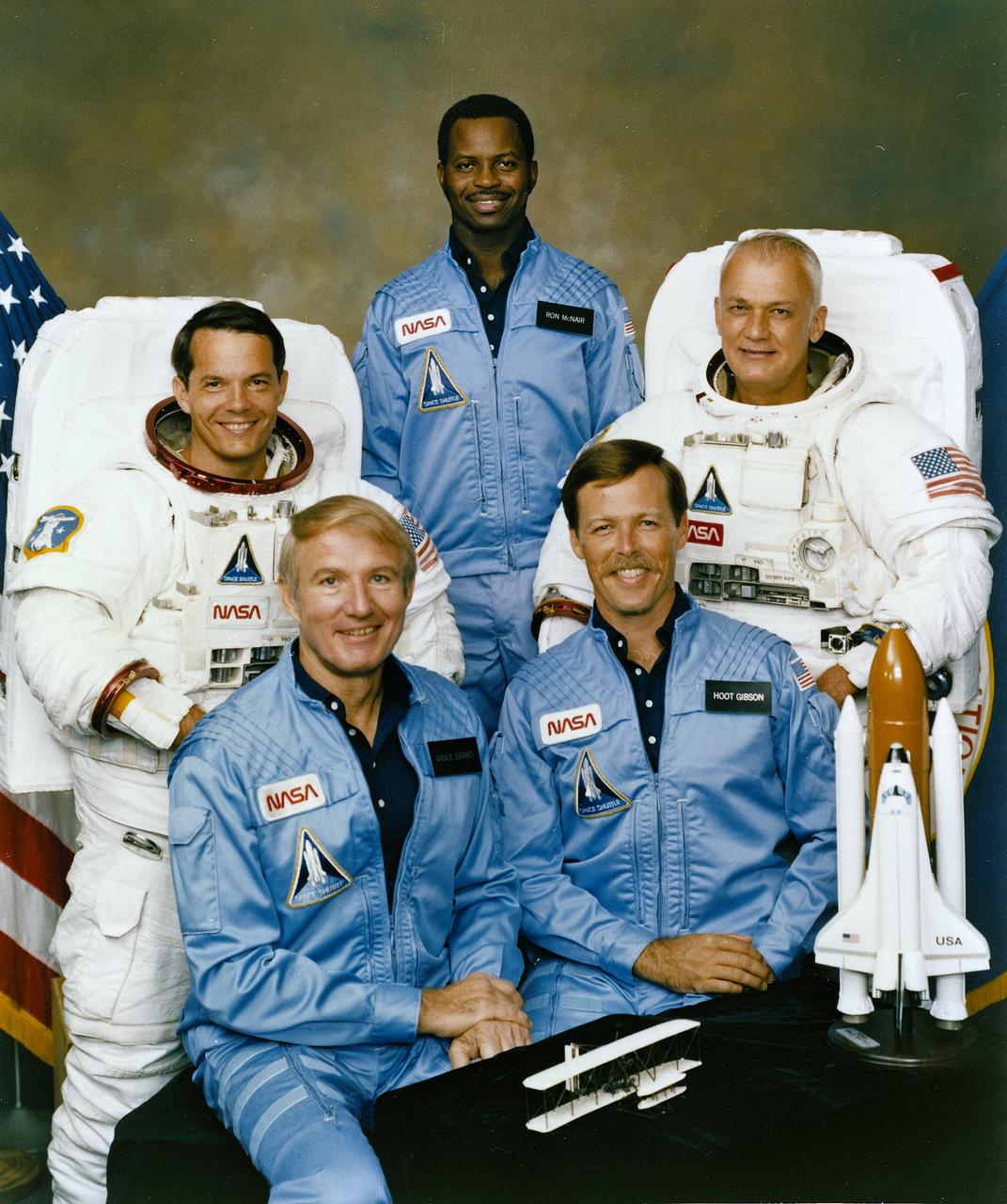
The crew assigned to the STS-41B (STS-11) mission included (seated left to right) Vance D. Brand, commander; and Robert L. Gibson, pilot. Standing left to right are mission specialists Robert L. Stewart, Ronald E. McNair, and Bruce McCandless. Launched aboard the Space Shuttle Challenger on February 3, 1984 at 8:00:00 am (EST), the STS-41B mission marked the first untethered space walks which were performed by McCandless and Stewart. The crew deployed the WESTAR-VI and PALAPA-B2 satellites.
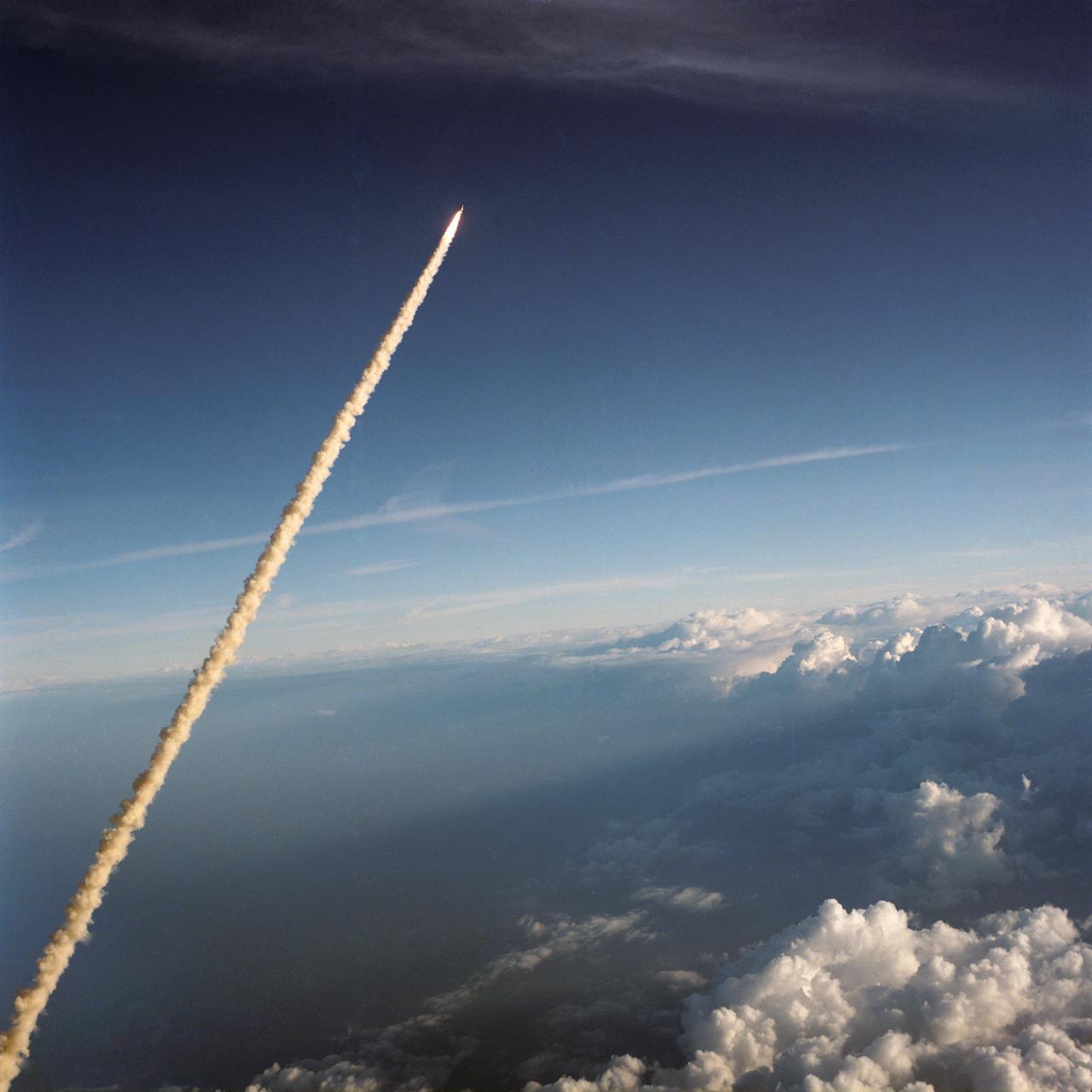
S84-26294 (3 Feb 1984) --- This scenic panorama of billowy clouds over the Atlantic and Florida and the contrasting addition of mankind's technology into the picture was provided by astronaut John W. Young and a handheld camera in the cockpit of NASA's Shuttle Training Aircraft (STA) moments after the 226 tons of spacecraft hardware were lifted off Kennedy Space Center's (KSC) Launch Pad 39A. Inside the Space Shuttle Challenger (STS 41-B), attached here to its two Solid Rocket Boosters (SRB) and External Fuel Tank (ET), were astronauts Vance D. Brand, Robert L. Gibson, Ronald E. McNair, Bruce McCandless II and Robert L. Stewart.
S84-27028 (3 Feb 1984) --- Astronaut Ronald E. McNair, left, and Robert L. Stewart prepare to enter an eight-day Earth-orbital mission aboard the Space Shuttle Challenger. Photographed by Astronaut Bruce McCandless II, McNair had already moved his helmet. Launch was less than ten minutes earlier from Launch Pad 39A at Kennedy Space Center, Florida. The three mission specialists were joined by Astronauts Vance D. Brand, commander; and Robert L. Gibson, pilot, for the flight. McCandless?s launch phase station is in the middeck.
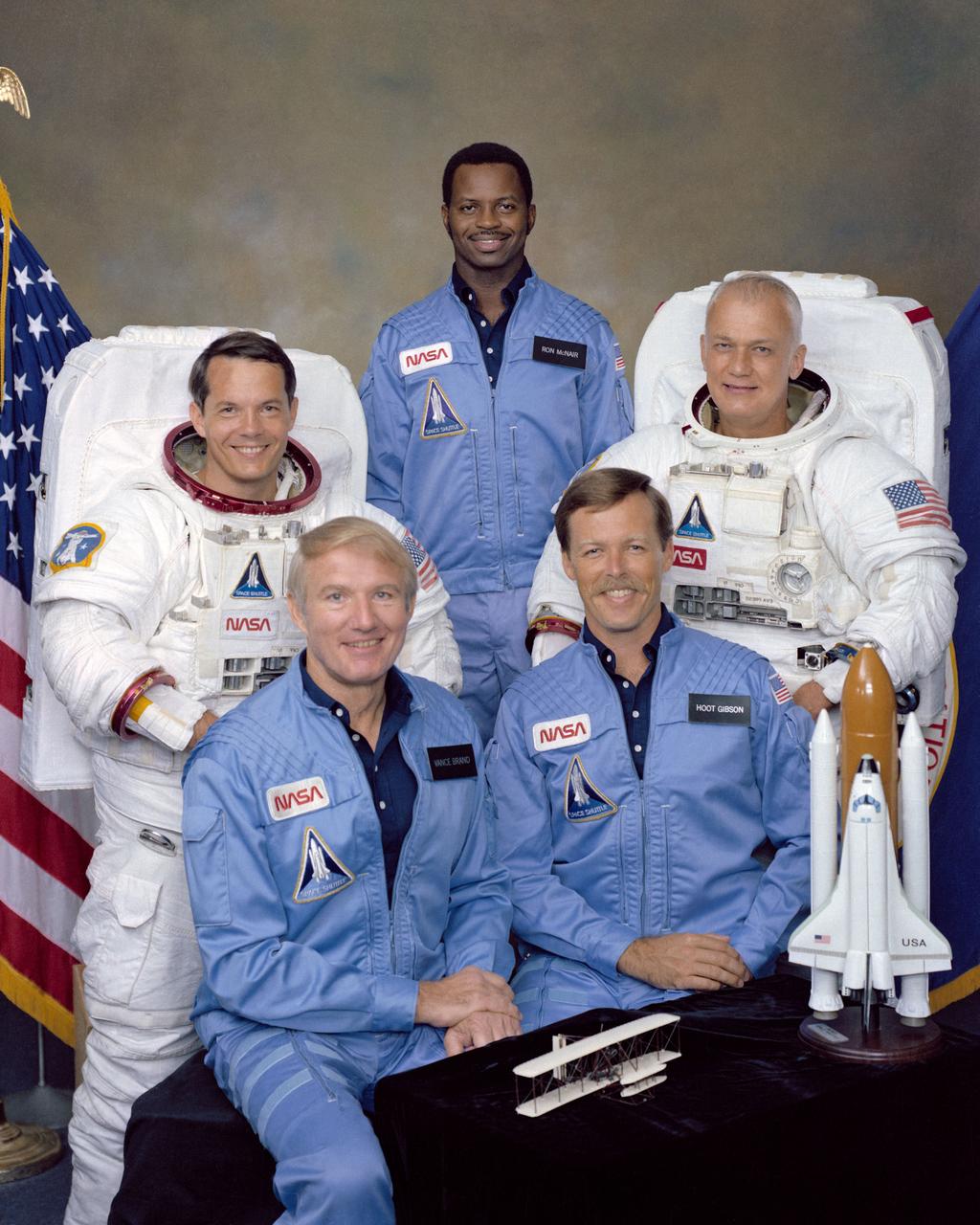
S83-40555 (15 October 1983) --- These five astronauts are in training for the STS-41B mission, scheduled early next year. On the front row are Vance D. Brand, commander; and Robert L. Gibson, pilot. Mission specialists (back row, left to right) are Robert L. Stewart, Dr. Ronald E. McNair and Bruce McCandless II. Stewart and McCandless are wearing Extravehicular Mobility Units (EMU) space suits. The STS program's second extravehicular activity (EVA) is to be performed on this flight, largely as a rehearsal for a scheduled repair visit to the Solar Maximum Satellite (SMS), on a later mission. The Manned Maneuvering Unit (MMU) will make its space debut on STS-41B.
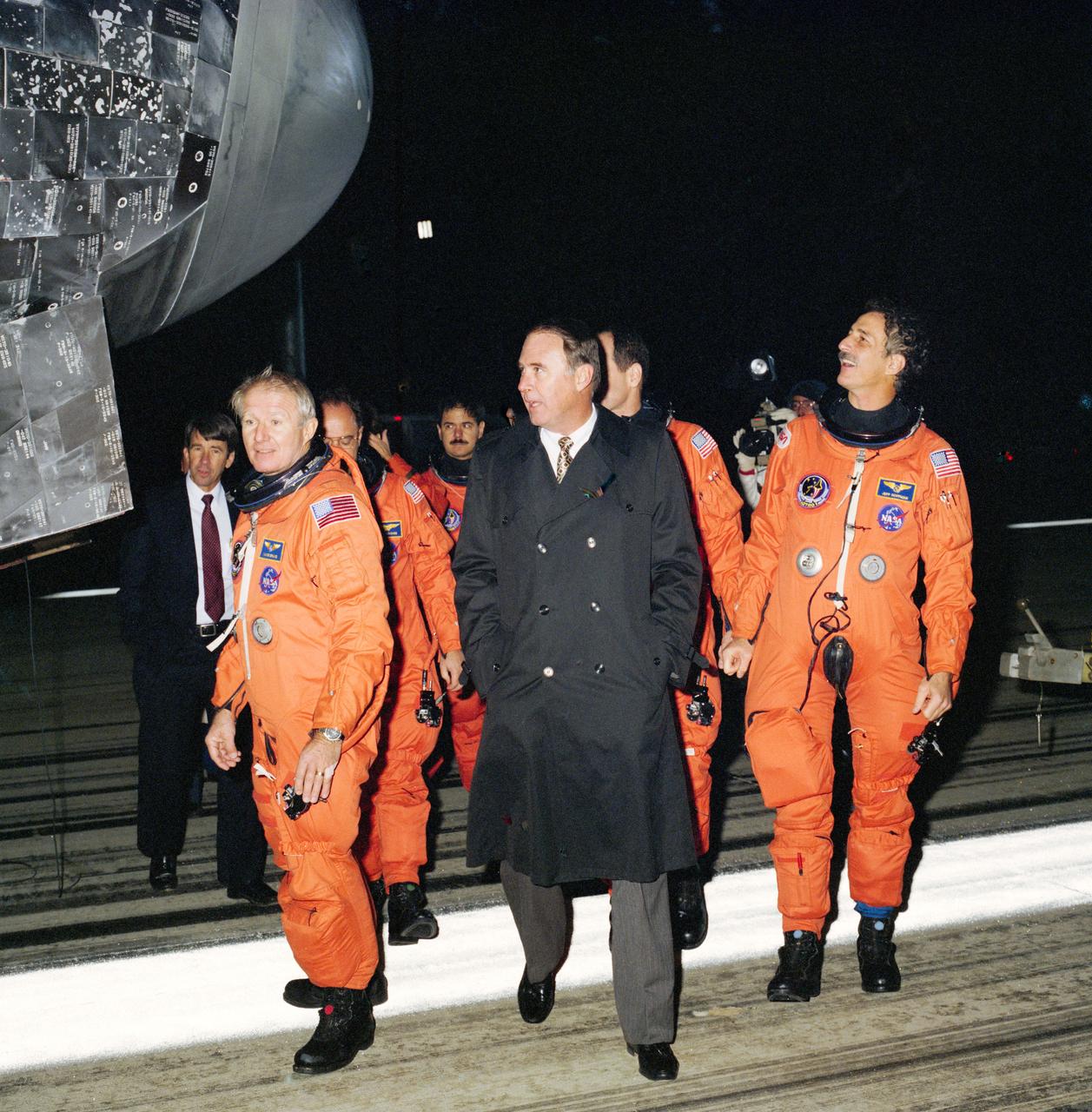
STS035-S-091 (10 Dec 1990) --- Donald R. Puddy (center), Director of Flight Crew Operations at the Johnson Space Center (JSC), joins the STS-35 crewmembers in a post-landing walk-around inspection of the Columbia at Edwards Air Force Base. Crewmembers pictured are, left to right, Vance D. Brand, John M. (Mike) Lounge, Ronald A. Parise, Guy S. Gardner and Jeffrey A. Hoffman. Obscured or out of frame are Samuel T. Durrance and Robert A. R. Parker. Dr. William B. Lenoir, NASA Associate Administrator for Space Flight, is at far left background.
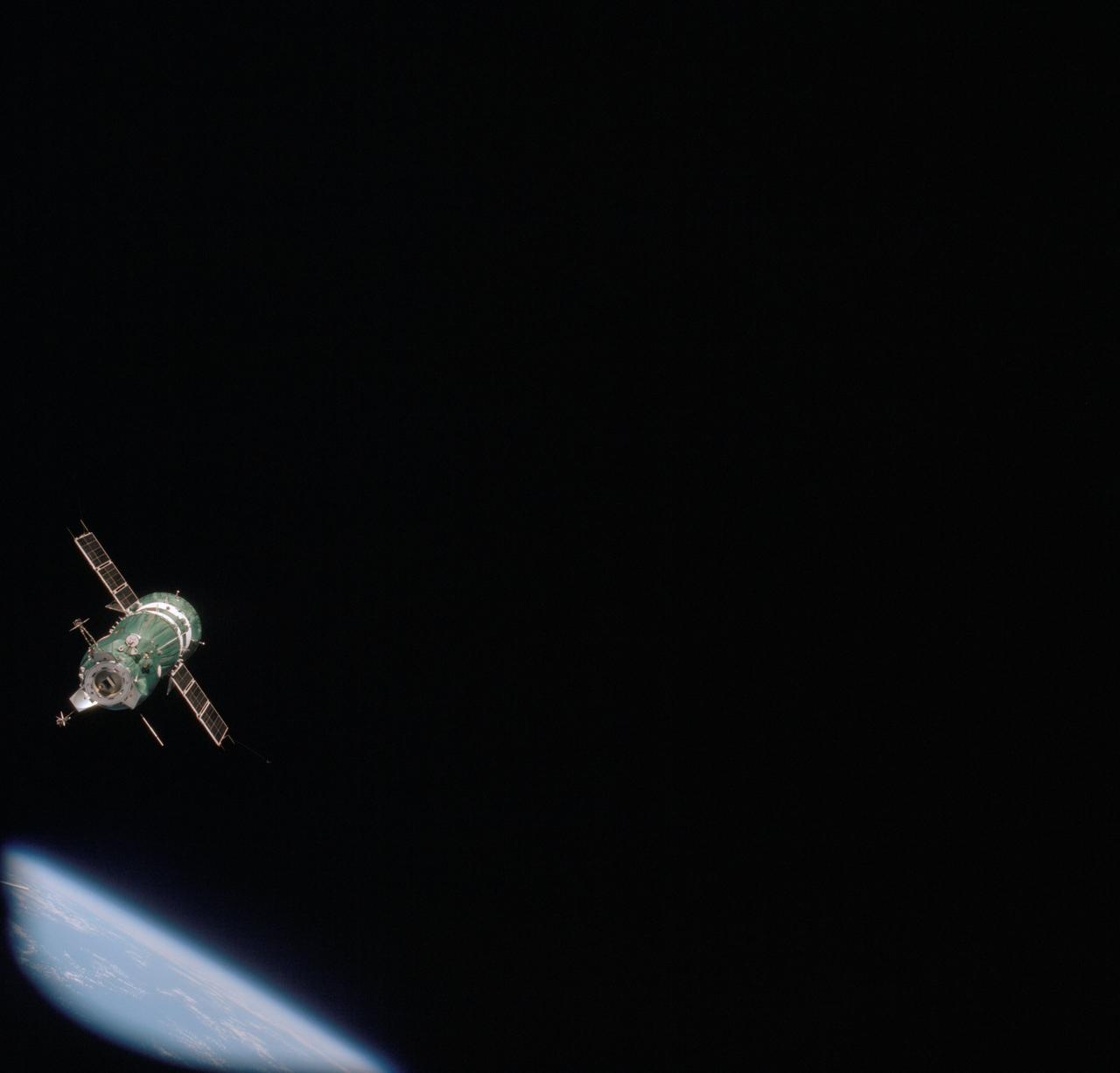
AST-09-572 (17-18 July 1975) --- The Soviet Soyuz 19 spacecraft is photographed from the American Apollo spacecraft during the joint U.S.-USSR Apollo-Soyuz Test Project (ASTP) docking mission in Earth orbit. Earth is visible in the lower left corner. This picture was taken with a 70mm camera. The Apollo crew consisted of astronauts Thomas P. Stafford, commander; Donald K. "Deke" Slayton, docking module pilot; and Vance D. Brand, command module pilot. The Soyuz 19 crew consisted of cosmonauts Aleksei A. Leonov, command pilot; and Valeri N. Kubasov, flight engineer.
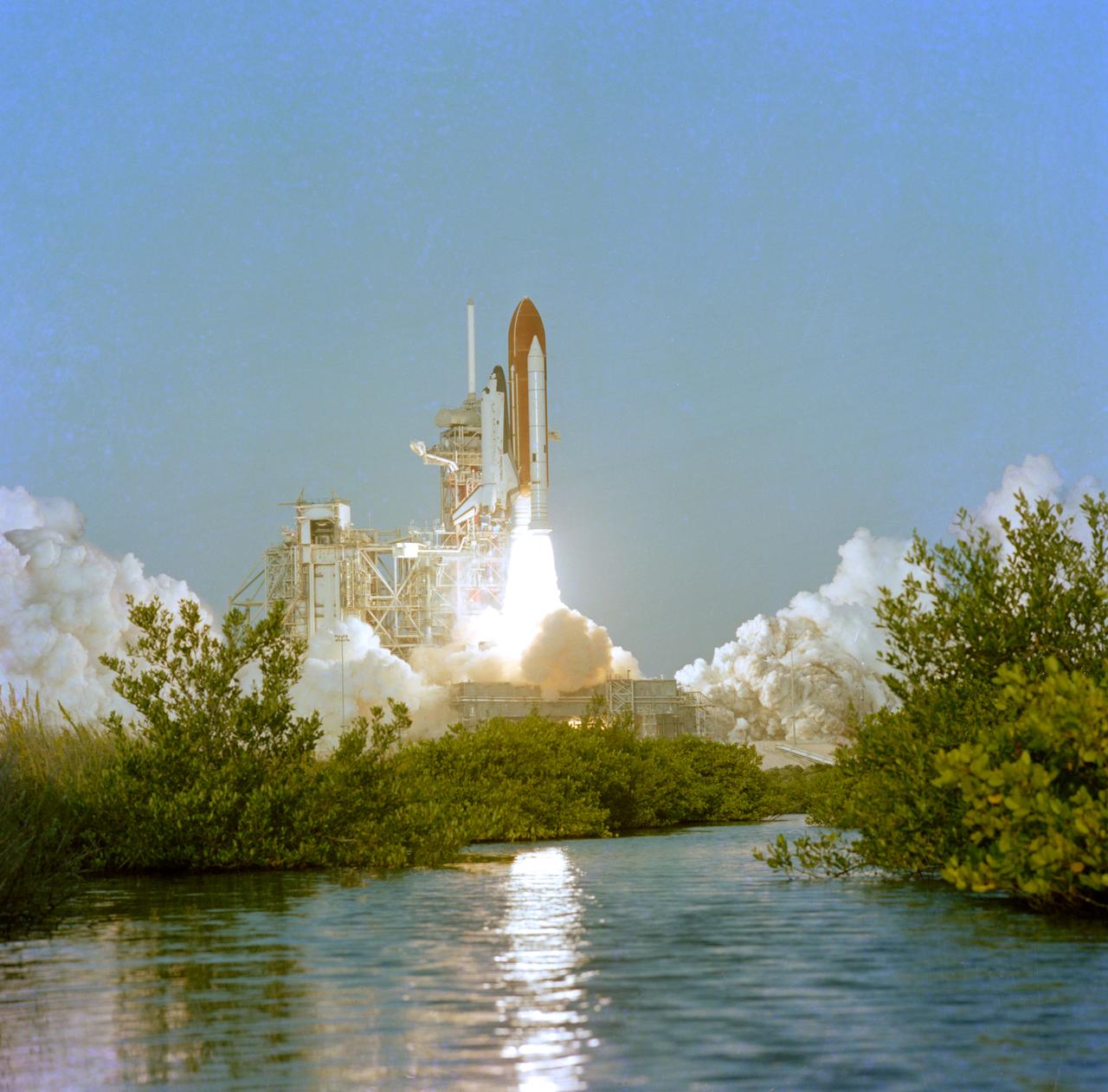
S82-39532 (11 Nov. 1982) --- Having completed its four-mission test program, the space shuttle Columbia begins a new era of operational flights as it clears the launch tower and heads for Earth orbit. Launch occurred at 7:19 a.m. (EST), November 11, 1982. Aboard the orbiter, mated here to its two solid rocket boosters and external fuel tank, were astronauts Vance D. Brand, STS-5 commander; Robert F. Overmyer, pilot; William B. Lenoir, mission specialist; and Joseph P. Allen, mission specialist. Photo credit: NASA
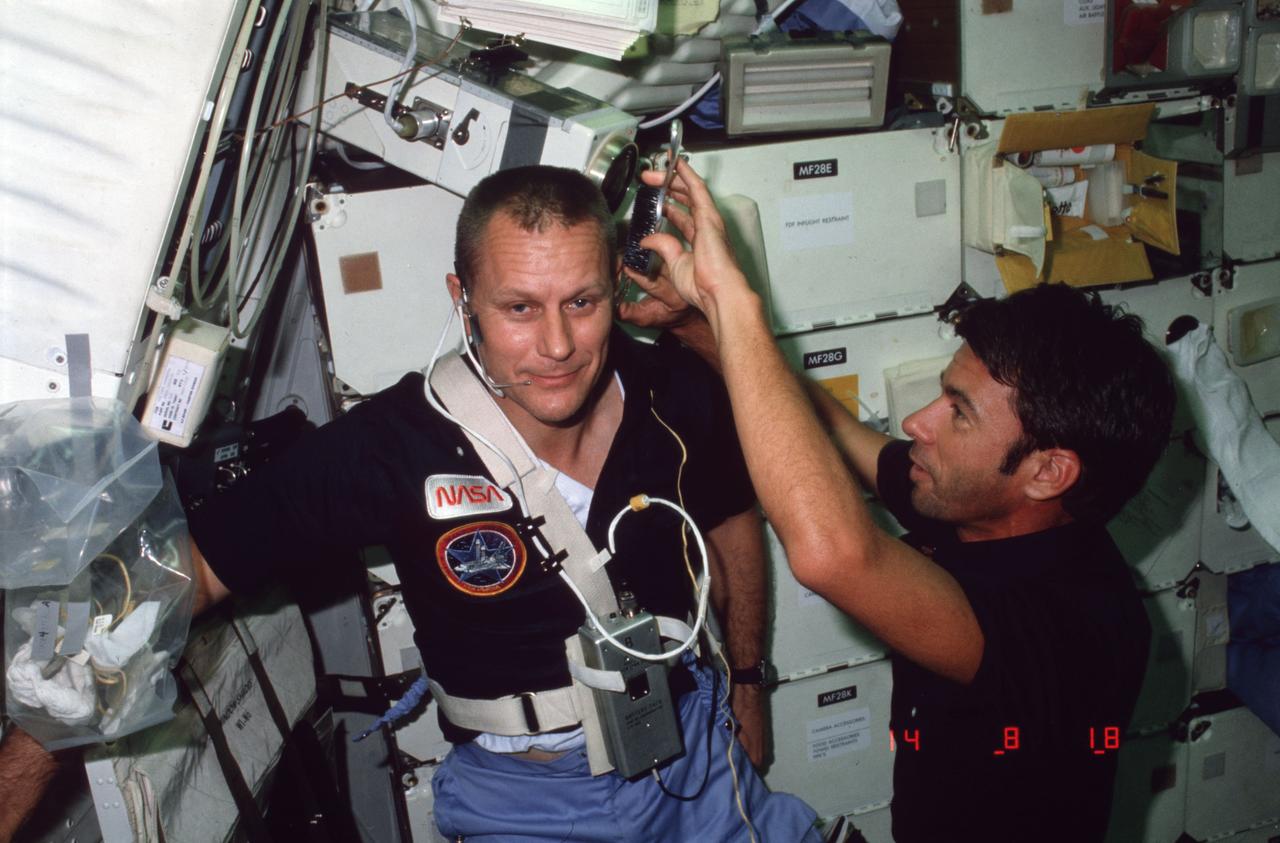
STS005-07-235 (11-16 Nov. 1982) --- Astronaut William B. Lenoir, mission specialist for STS-5, uses scissors and a brush to trim the sideburns of astronaut Robert F. Overmyer, pilot, in the middeck area of the Earth-orbiting space shuttle Columbia. An opened kit with hygiene supplies inside can be seen attached to one of the stowage locker doors at upper right. Other crew member are astronauts Vance D. Brand, commander, and Joseph P. Allen IV, the flight?s other mission specialist. Photo credit: NASA
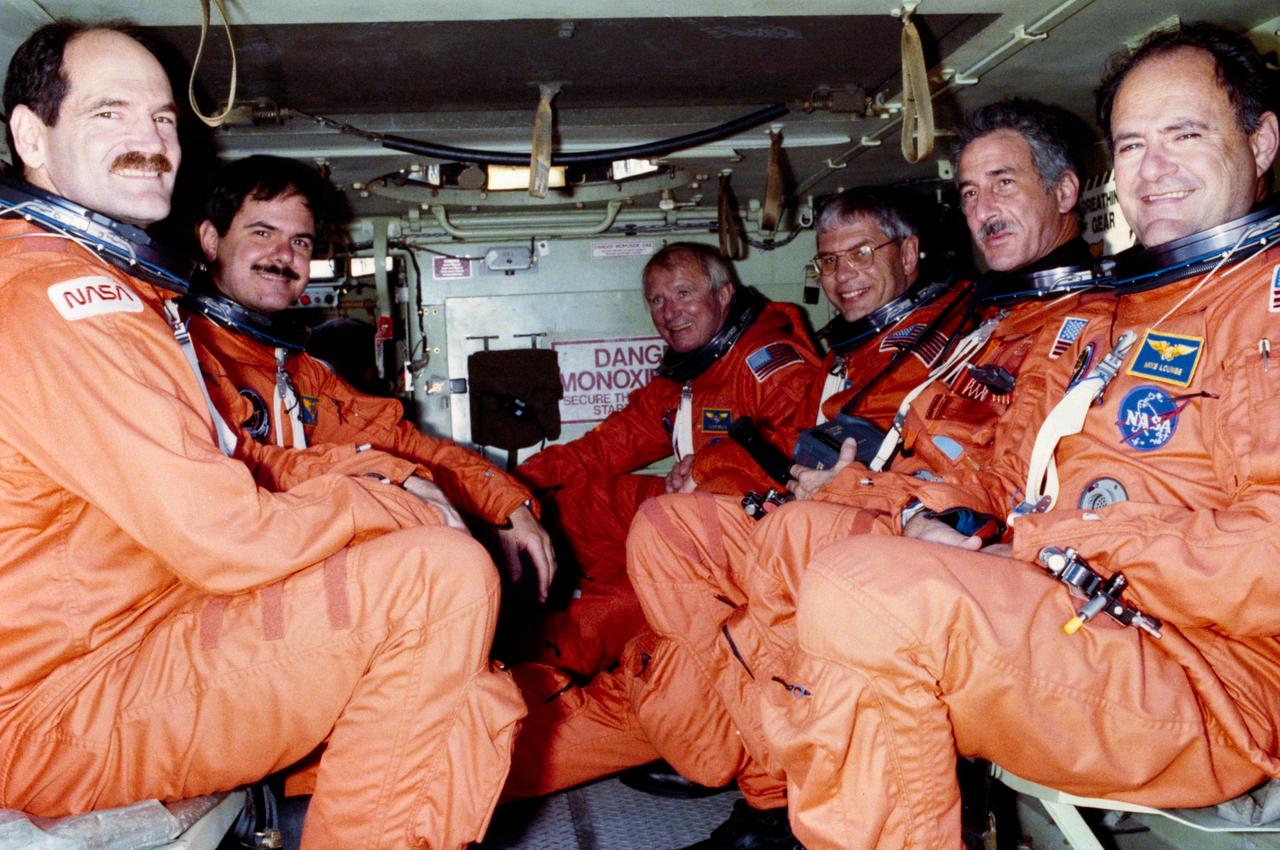
S90-40670 (13 June 1990) --- STS-35 crewmembers take a ride in the M113 tracked vehicle during emergency training conducted during the Terminal Countdown Demonstration Test (TCDT) at the Kennedy Space Center (KSC). From left, wearing launch and entry suits (LES), are pilot Guy S. Gardner, payload specialist Ronald A. Parise, commander Vance D. Brand, mission specialists Robert A. R. Parker, Jeffrey A. Hoffman and John M. Lounge. The two-day TCDT, which began 04-27-90, is a dress rehearsal for launch. STS-35 is set to lift off in May. View provided by KSC with alternate number KSC-90PC-838.
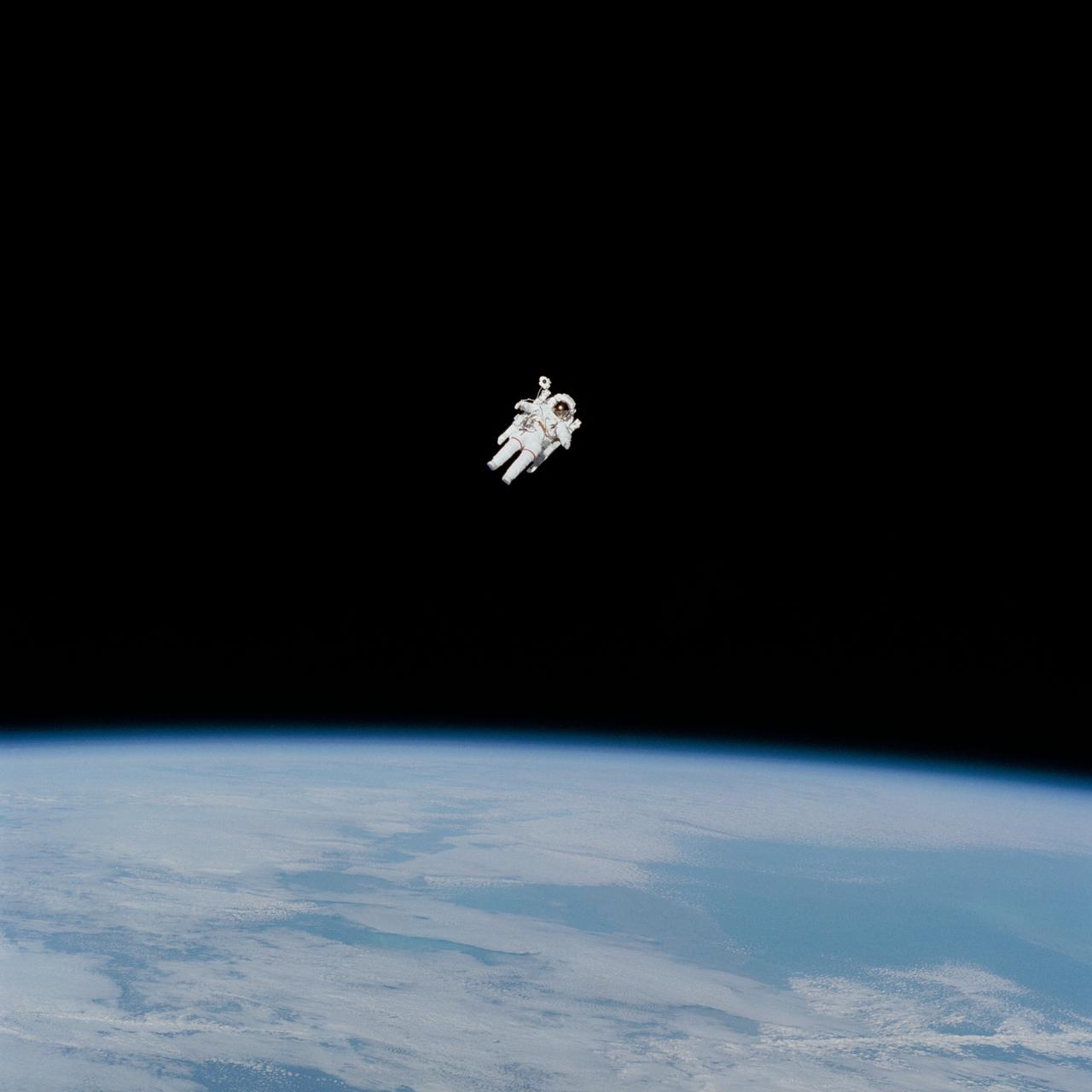
S84-27018 (7 Feb 1984) --- Astronaut Bruce McCandless II approaches his maximum distance from the Earth-orbiting Space Shuttle Challenger in this 70mm frame photographed by his fellow crewmembers onboard the reusable vehicle. McCandless is in the midst of the first "field" tryout of the nitrogen-propelled, hand-controlled back-pack device called the manned maneuvering unit (MMU). Astronaut Robert L. Stewart got a chance to test the same unit a while later in the lengthy EVA session while the two spacewalkers were photographed and monitored by their fellow crewmembers in Challenger's cabin. Those inside were Astronauts Vance D. Brand, Robert L. Gibson and Dr. Ronald E. McNair.
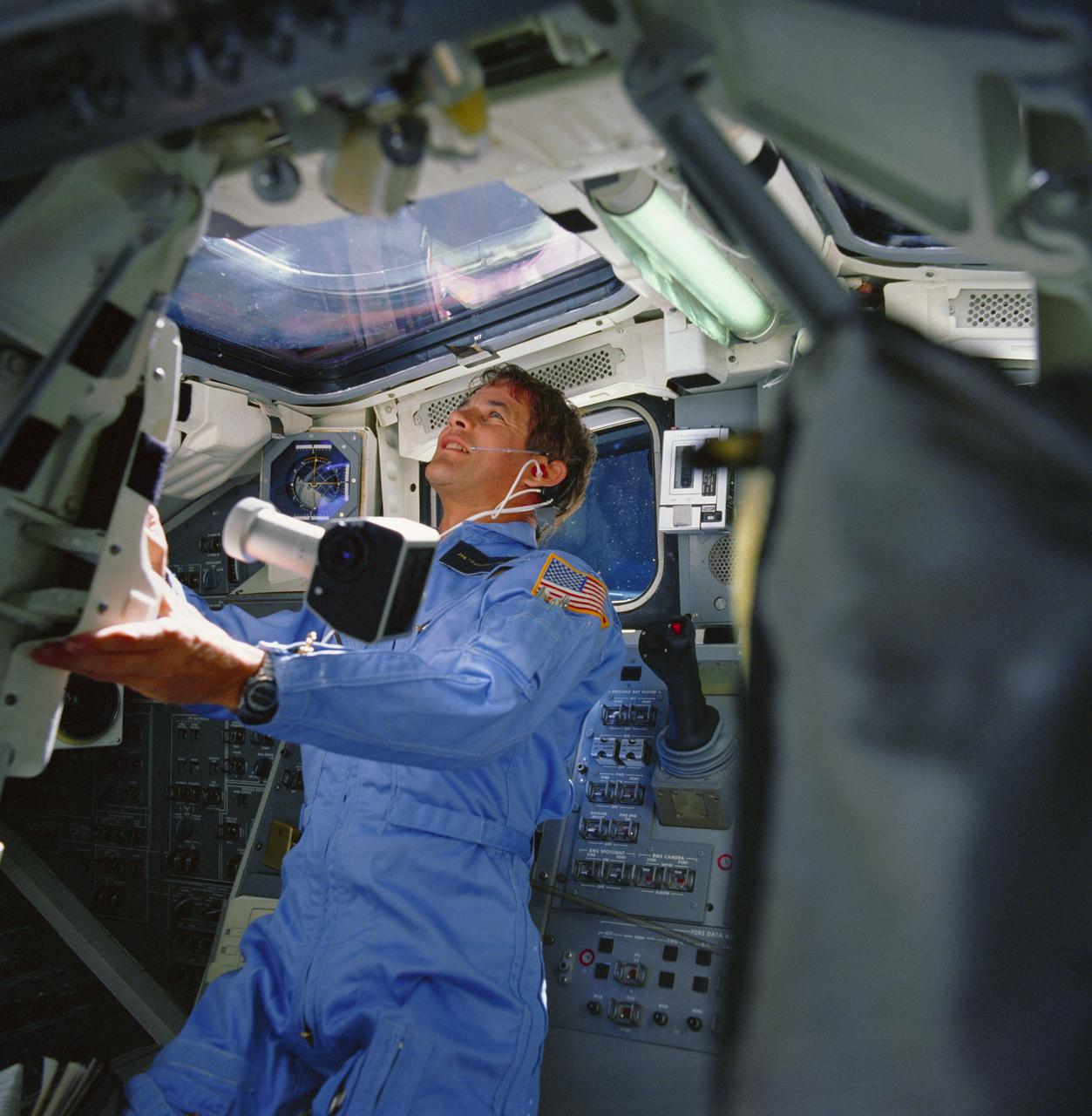
S82-39790 (11-15 Nov. 1982) --- Astronaut Joseph P. Allen IV, STS-5 mission specialist, lets a spot-meter float freely for a moment during a period devoted to out-the-window photographs of Earth from orbiting space shuttle Columbia. Dr. Allen is on the flight deck of the reusable space vehicle and positioned behind the pilot?s station. Also onboard for NASA?s first operational Space Transportation System (STS) flight are astronauts Vance D. Brand, commander; Robert F. Overmyer, pilot; and William B. Lenoir, mission specialist. Photo credit: NASA
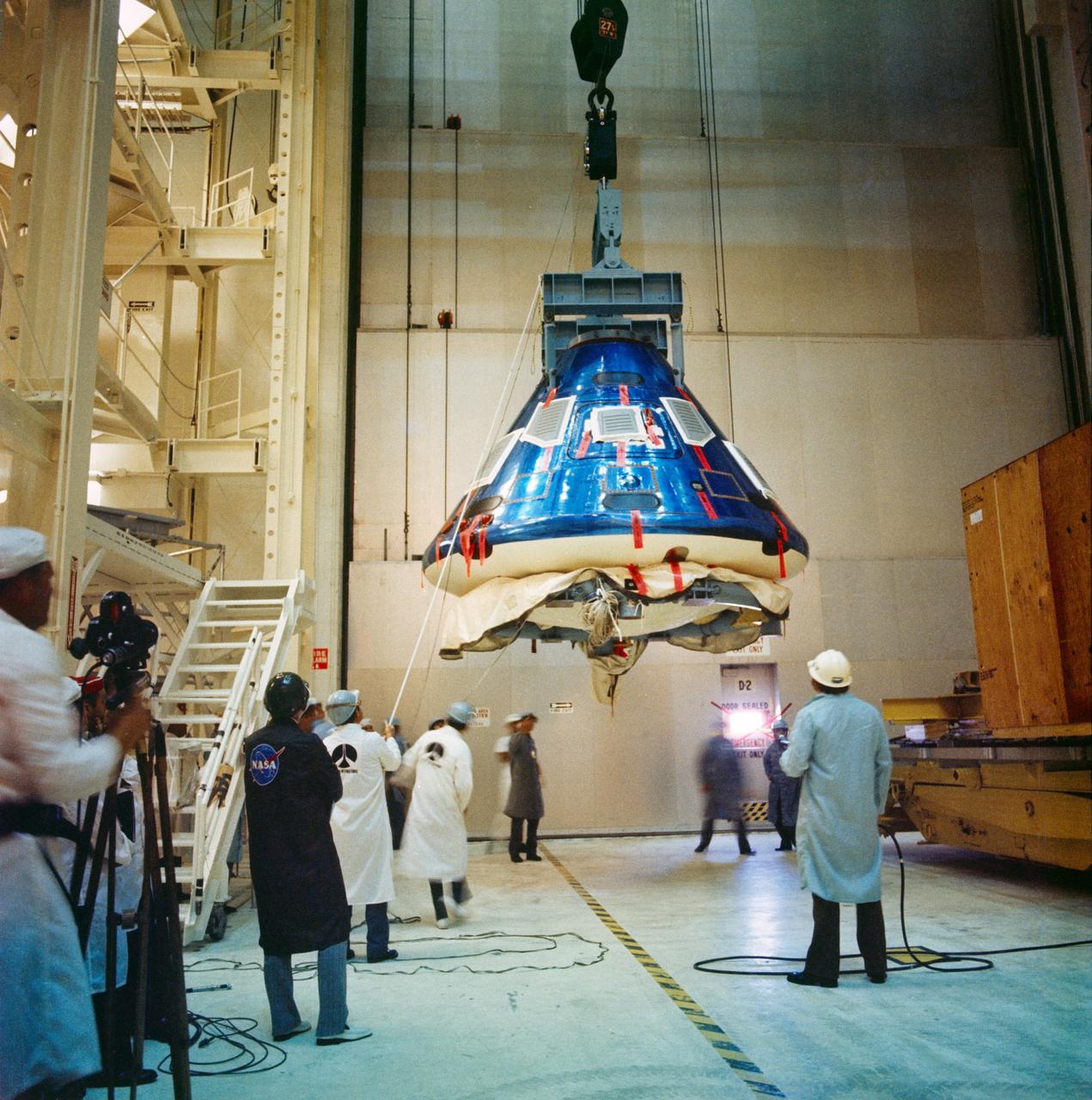
S74-32049 (8 Sept. 1974) --- The Apollo Command Module for the Apollo-Soyuz Test Project mission goes through receiving, inspection and checkout procedures in the Manned Spacecraft Operations Building at the Kennedy Space Center. The spacecraft had just arrived by air from the Rockwell International plant at Downey, California. The Apollo spacecraft (Command Module, Service Module and Docking Module), with astronauts Thomas P. Stafford, Vance D. Brand and Donald K. Slayton aboard, will dock in Earth orbit with a Soviet Soyuz spacecraft during the joint U.S.-USSR ASTP flight scheduled for July 1975. The Soviet and American crews will visit one another?s spacecraft.
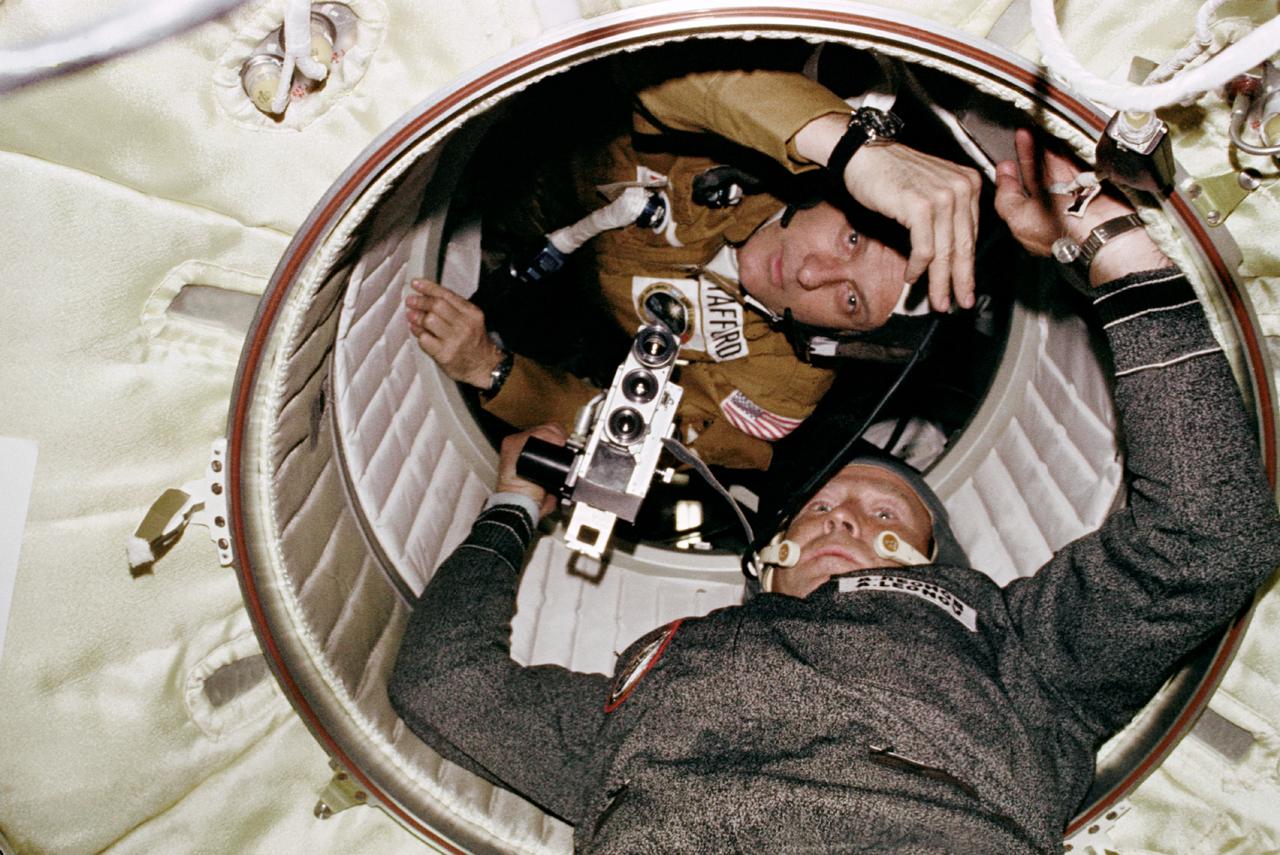
AST-03-191 (17-19 July 1975) --- Astronaut Thomas P. Stafford and cosmonaut Aleksei A. Leonov are seen at the hatchway leading from the Apollo Docking Module (DM) to the Soyuz Orbital Module (OM) during the joint U.S.-USSR Apollo Soyuz Test Project (ASTP) docking mission in Earth orbit. Cosmonaut Leonov is in the OM and astronaut Stafford is in the DM. Leonov holds a camera. The Apollo crew consisted of astronauts Stafford, commander; Donald K. "Deke" Slayton, docking module pilot; Vance D. Brand, command module pilot. The Soyuz 19 crew consisted of cosmonauts Leonov, command pilot; and Valeri N. Kubasov, flight engineer.
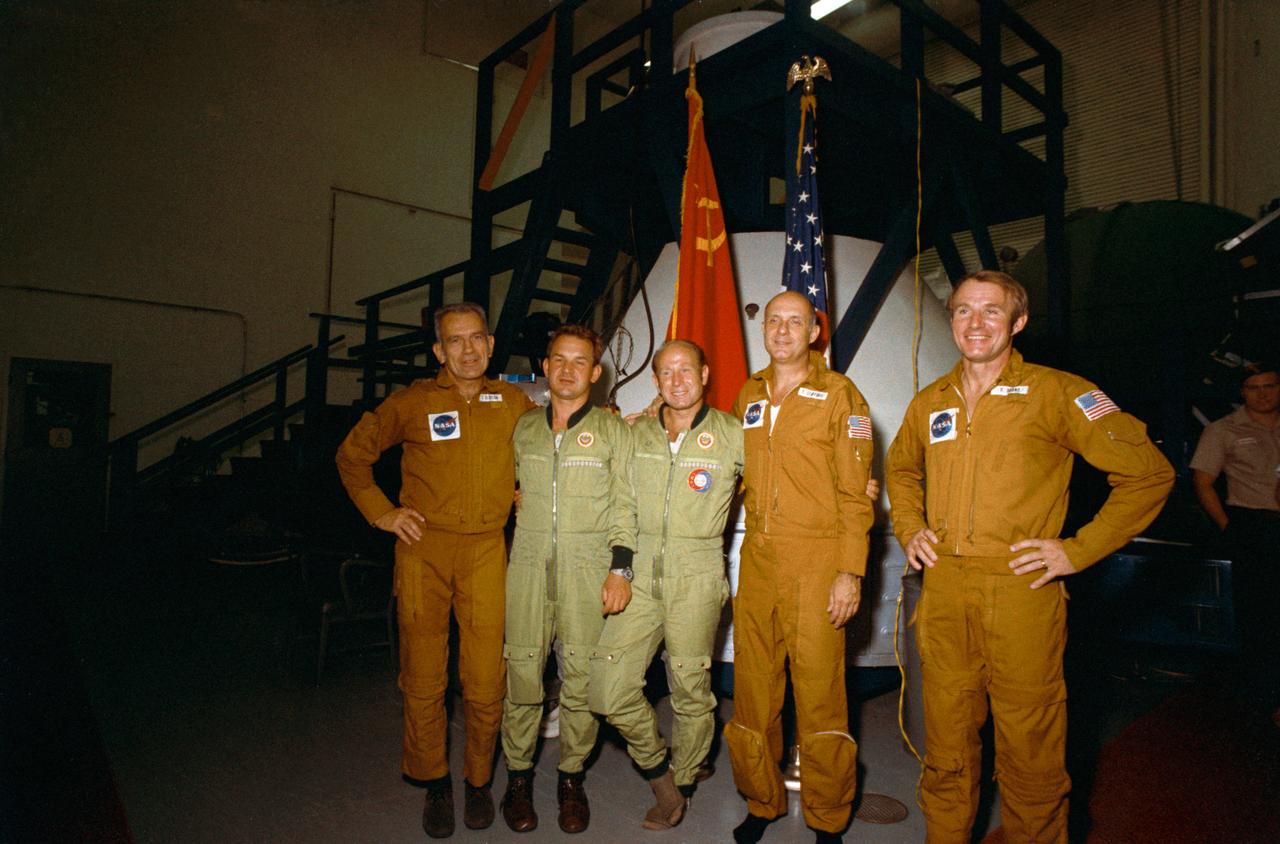
S74-28811 (23 Sept. 1974) --- The five prime crewmen of the joint U.S.-USSR Apollo-Soyuz Test Project mission are photographed in the Flight Crew Training Facility, Building 35, at the Johnson Space Center during ASTP crew training activity. They are, left to right, astronaut Donald K. Slayton, docking module pilot of the American crew; cosmonaut Valeriy N. Kubasov, engineer on the Soviet crew; cosmonaut Aleksey A. Leonov, commander of the Soviet crew; astronaut Thomas P. Stafford, commander of the American crew; and astronaut Vance D. Brand, command module pilot of the American crew.
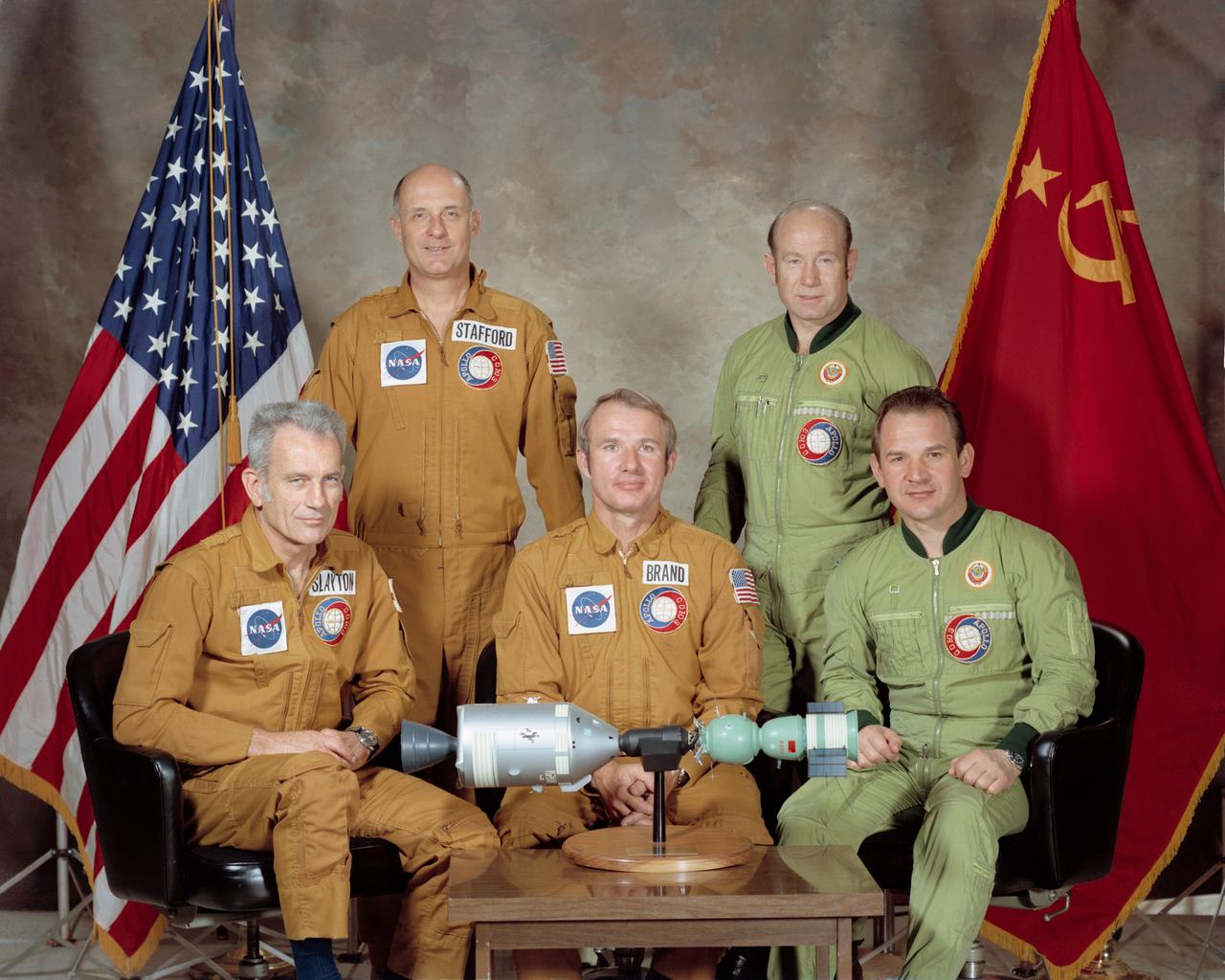
S75-22410 (March 1975) --- These five men compose the two prime crews of the joint United States-USSR Apollo-Soyuz Test Project (ASTP) docking mission in Earth orbit scheduled for July 1975. They are astronaut Thomas P. Stafford (standing on left), commander of the American crew; cosmonaut Aleksey A. Leonov (standing on right), commander of the Soviet crew; astronaut Donald K. Slayton (seated on left), docking module pilot of the American crew; astronaut Vance D. Brand (seated center), command module pilot of the American crew; and cosmonaut Valeriy N. Kubasov (seated on right), engineer on the Soviet crew.
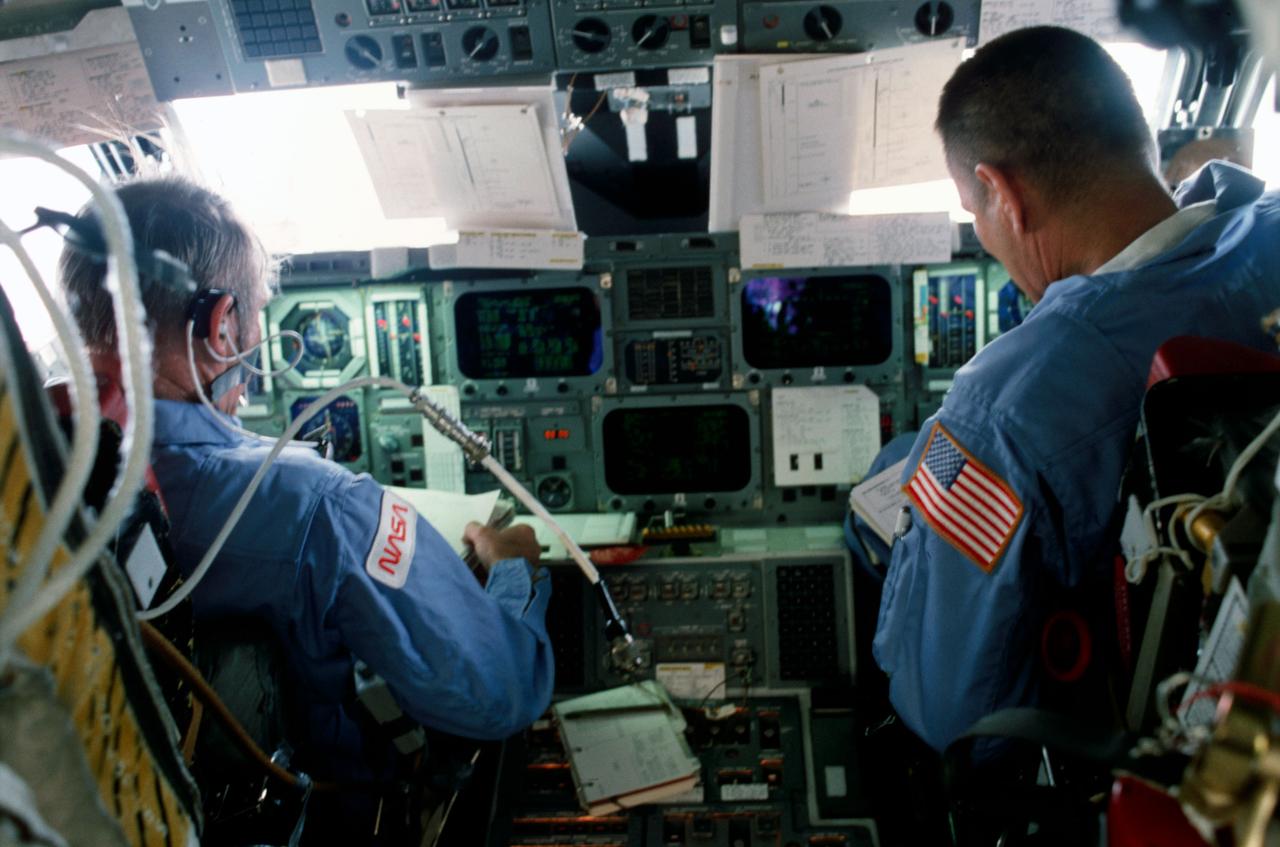
STS005-10-381 (16 Nov. 1982) --- Half of the four-member astronaut crew for the Earth-orbiting space shuttle Columbia’s STS-5 mission is pictured on the flight deck of the reusable vehicle. Astronaut Vance D. Brand, commander, holds down the commander’s station at left, while astronaut Robert F. Overmyer, pilot, points to data on one of three cathode ray tubes (CRT) on the forward flight deck. The photograph was made by astronaut Joseph P. Allen IV, one of two mission specialists on the flight. Not pictured are Dr. Allen and astronaut William B. Lenoir, the other mission specialist for this flight. Photo credit: NASA
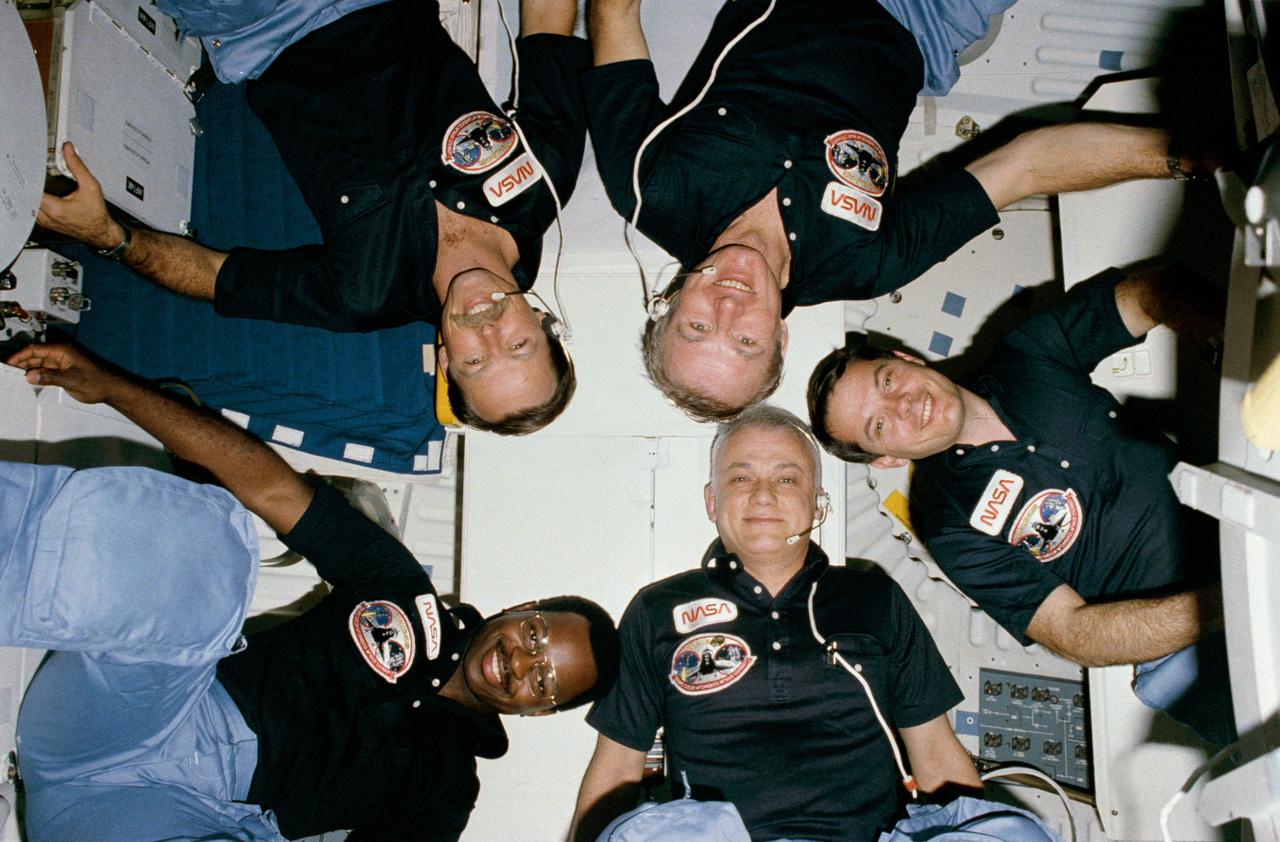
S84-27026 (3-11 Feb. 1984) --- The "star burst" type informal portrait of Space Shuttle crews has become somewhat of a tradition and the five-member STS-41B crew is no exception. HOLD PICTURE WITH SEMI-CIRCLE AT LOWER RIGHT CORNER. Counter clockwise from the lower left are Astronauts Vance D. Brand commander; Robert L. Gibson, pilot; and Dr. Ronald E. McNair; Bruce McCandless II and Robert L. Stewart, all mission specialists. The five are on the mid-deck of the Earth-orbiting Challenger. The "semi-circle" is actually part of the monodisperse latex reactor (MLR) experiment. A pre-set 35mm camera was triggered automatically to expose the frame.
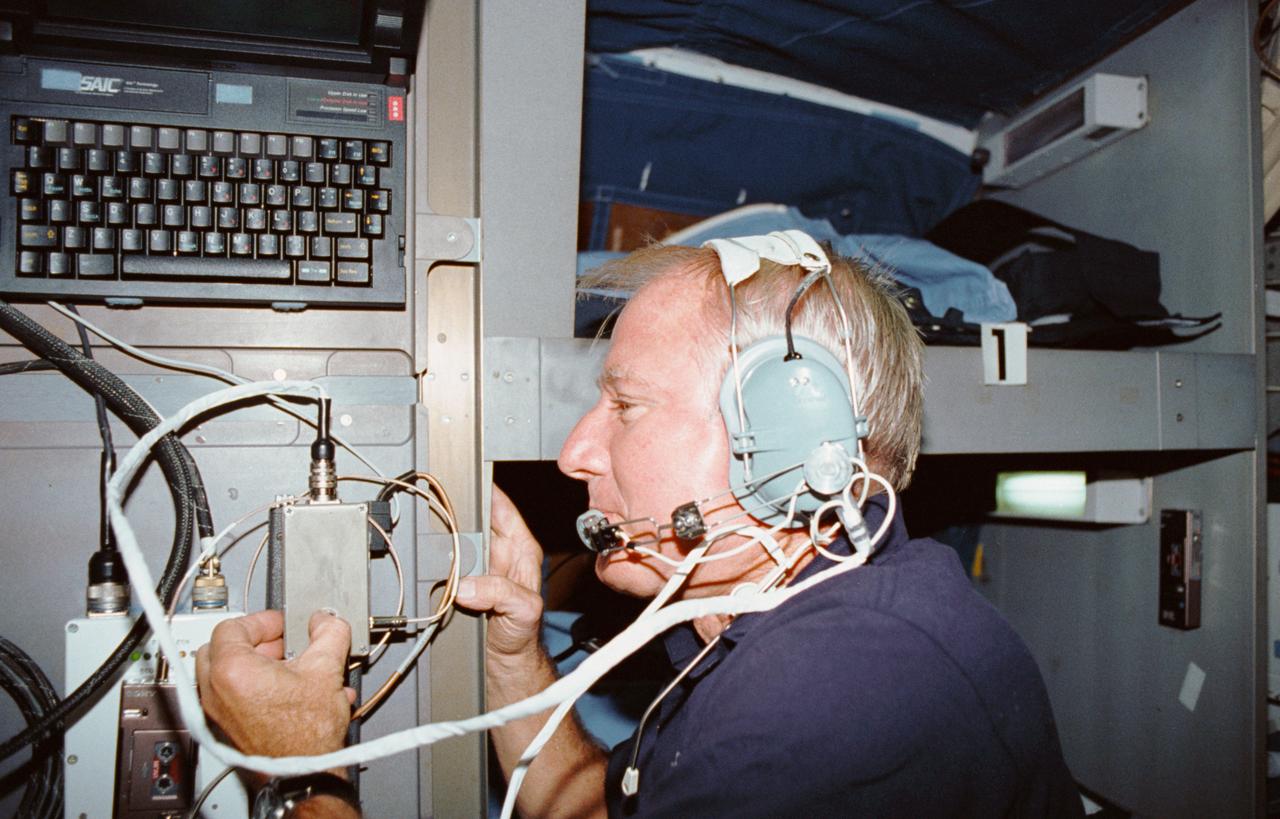
STS035-05-036 (2-10 Dec 1990) --- STS-35 Commander Vance D. Brand, wearing headset, communicates with family members using Shuttle Amateur Radio Experiment (SAREX) on Columbia's, Orbiter Vehicle (OV) 102's, middeck. SAREX and its portable laptop computer mounted on the outside of the middeck sleep station allowed the STS-35 crewmembers to "visit" and briefly share some of their in space experiences with family members. It also provided radio transmissions between ground based amateur radio operators around the world and OV-102. The experiment enabled students from all over the United States to have a chance to communicate with a crewmember in space.
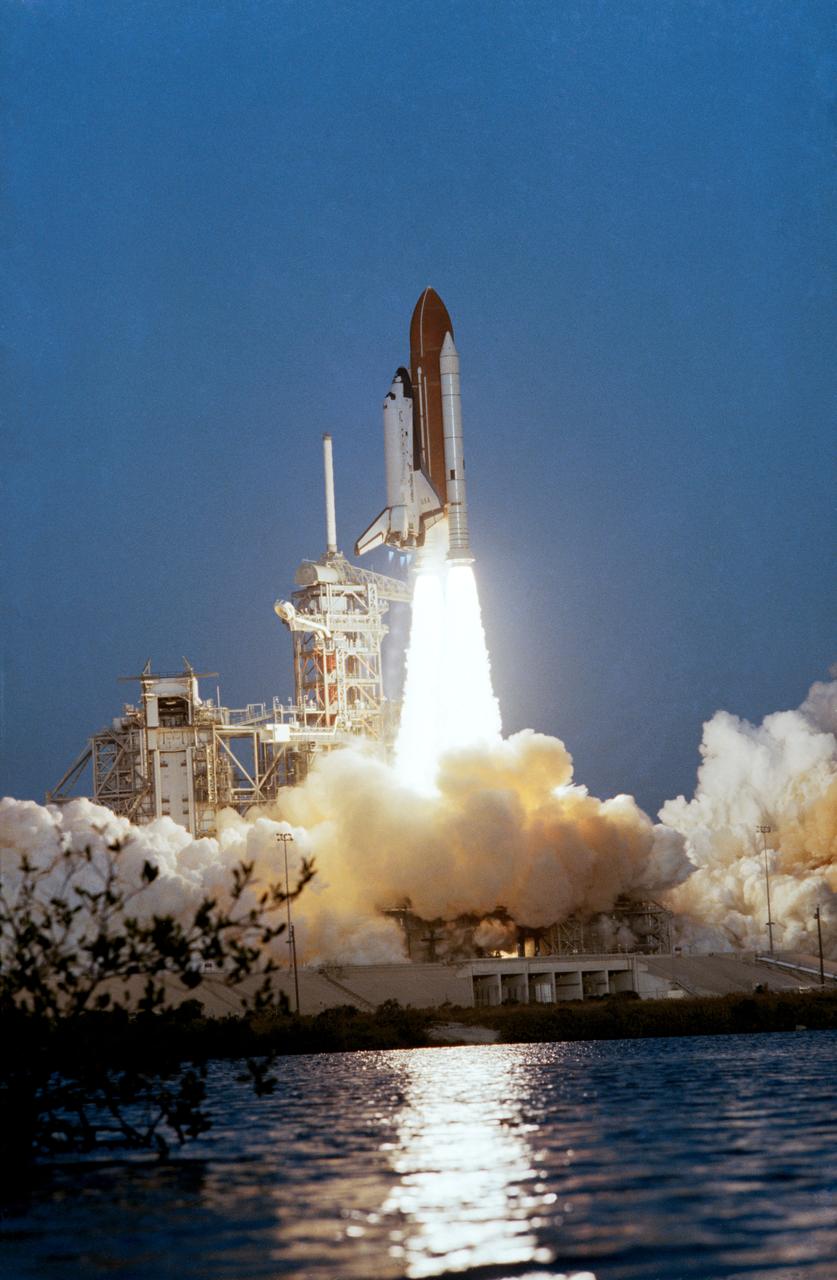
S82-39532 (11 Nov. 1982) --- Having completed its four-mission test program, the space shuttle Columbia begins a new era of operational flights as it clears the launch tower and heads for Earth orbit. Launch occurred at 7:19 a.m. (EST), November 11, 1982. Aboard the orbiter, mated here to its two solid rocket boosters and external fuel tank, were astronauts Vance D. Brand, STS-5 commander; Robert F. Overmyer, pilot; William B. Lenoir, mission specialist; and Joseph P. Allen, mission specialist. Photo credit: NASA
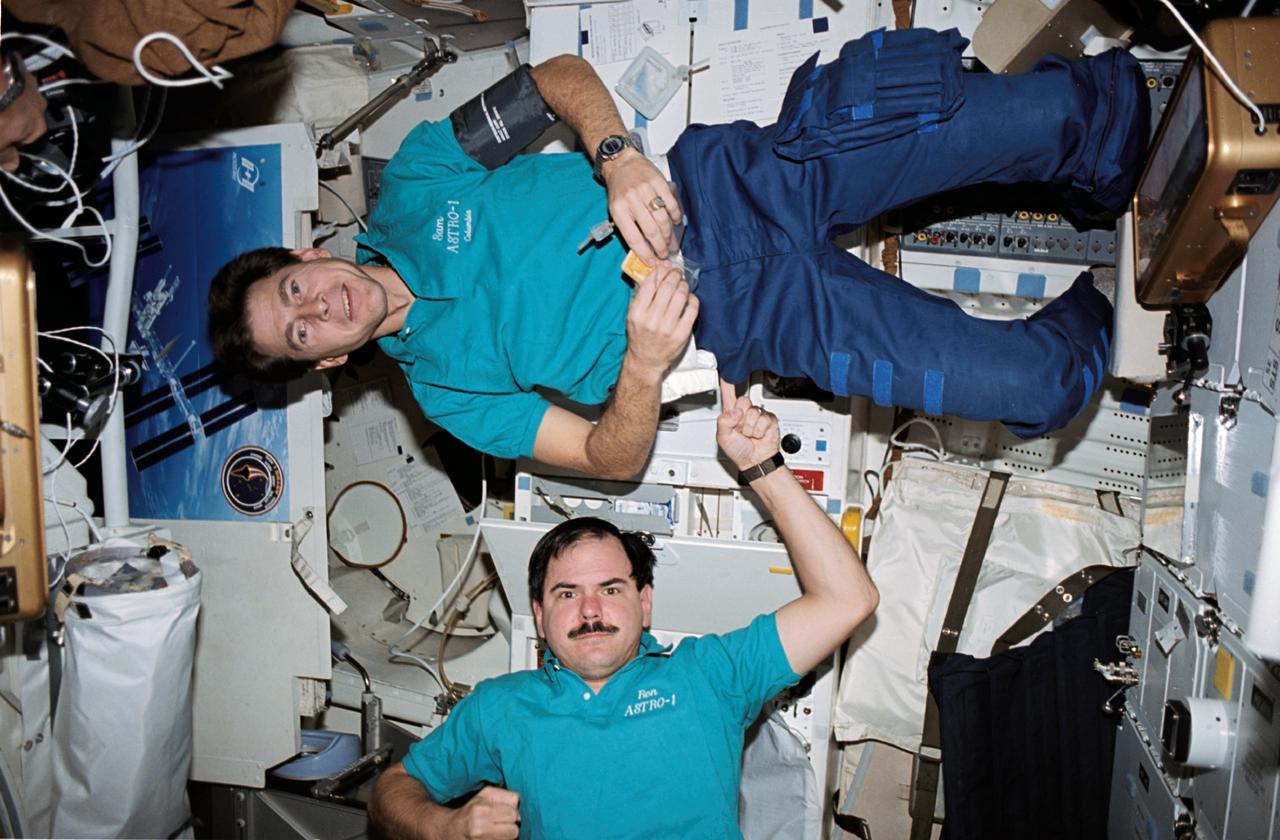
STS035-49-028 (2-10 Dec. 1990) --- This is one of 25 visuals used by the STS-35 crew at its Dec. 20, 1990 post-flight press conference. Columbia's flight of almost nine days duration (launched Dec. 2 from Kennedy Space Center and landed Dec. 10 at Edwards Air Force Base) carried the Astro-1 payload and was dedicated to astrophysics. The mission involved a seven-man crew. Crewmembers were astronauts Vance D. Brand, Guy S. Gardner, Jeffrey A. Hoffman, Robert A.R. Parker and John M. (Mike) Lounge; and Payload Specialists Samuel T. Durrance and Ronald A. Parise.
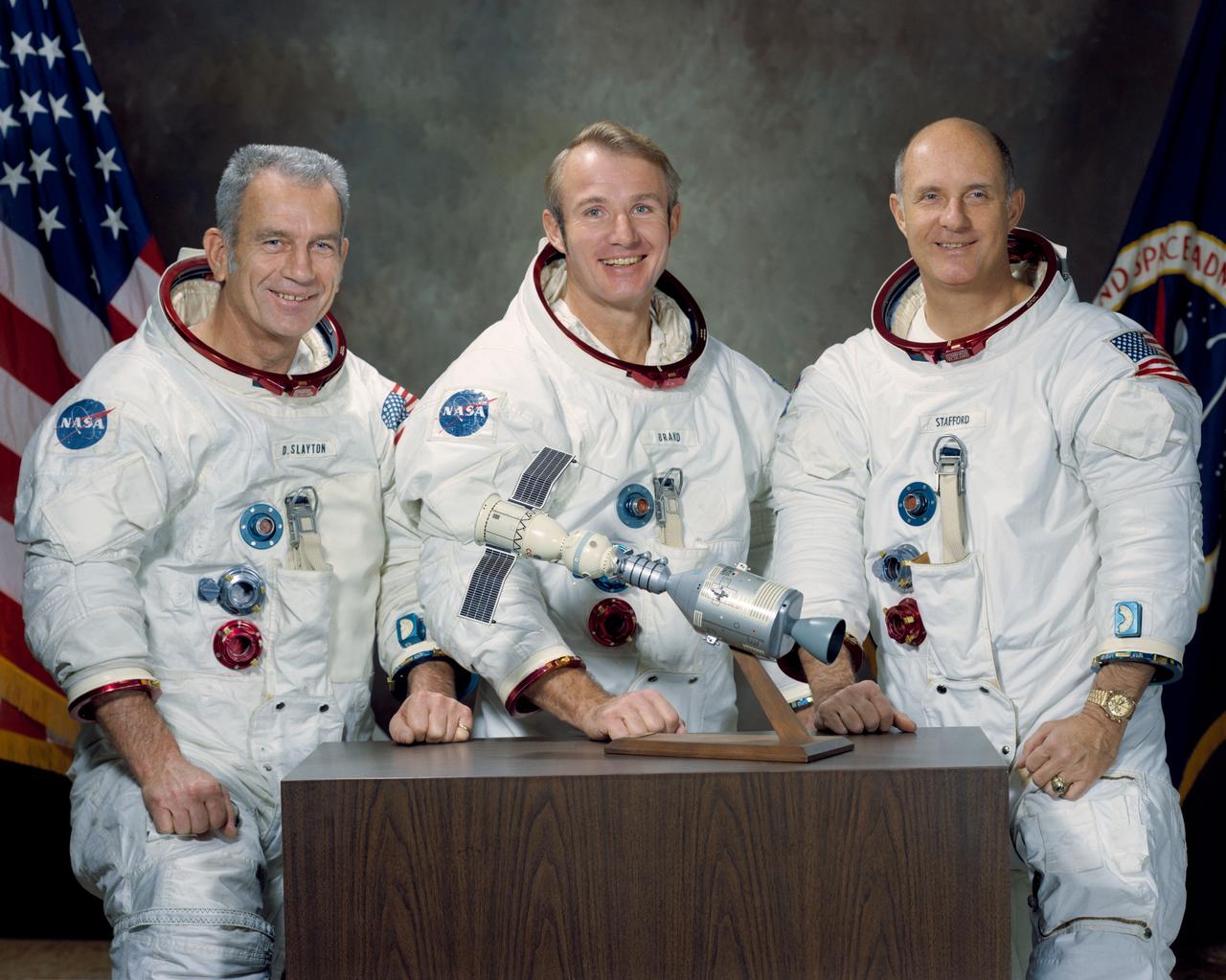
S74-15241 (January 1974) --- These three NASA astronauts are the United States flight crew for the 1975 Apollo-Soyuz Test Project (ASTP) mission. The prime crew members for the joint United States - Soviet Union spaceflight are, left to right, Donald K. Slayton, docking module pilot; Vance D. Brand, command module pilot; and Thomas P. Stafford, commander. The American and Soviet crews will visit one another?s spacecraft while the Soyuz and Apollo are docked in Earth orbit for a maximum of two days. The ASTP mission is designed to test equipment and techniques that will establish international crew rescue capability in space, as well as permit future cooperative scientific missions.
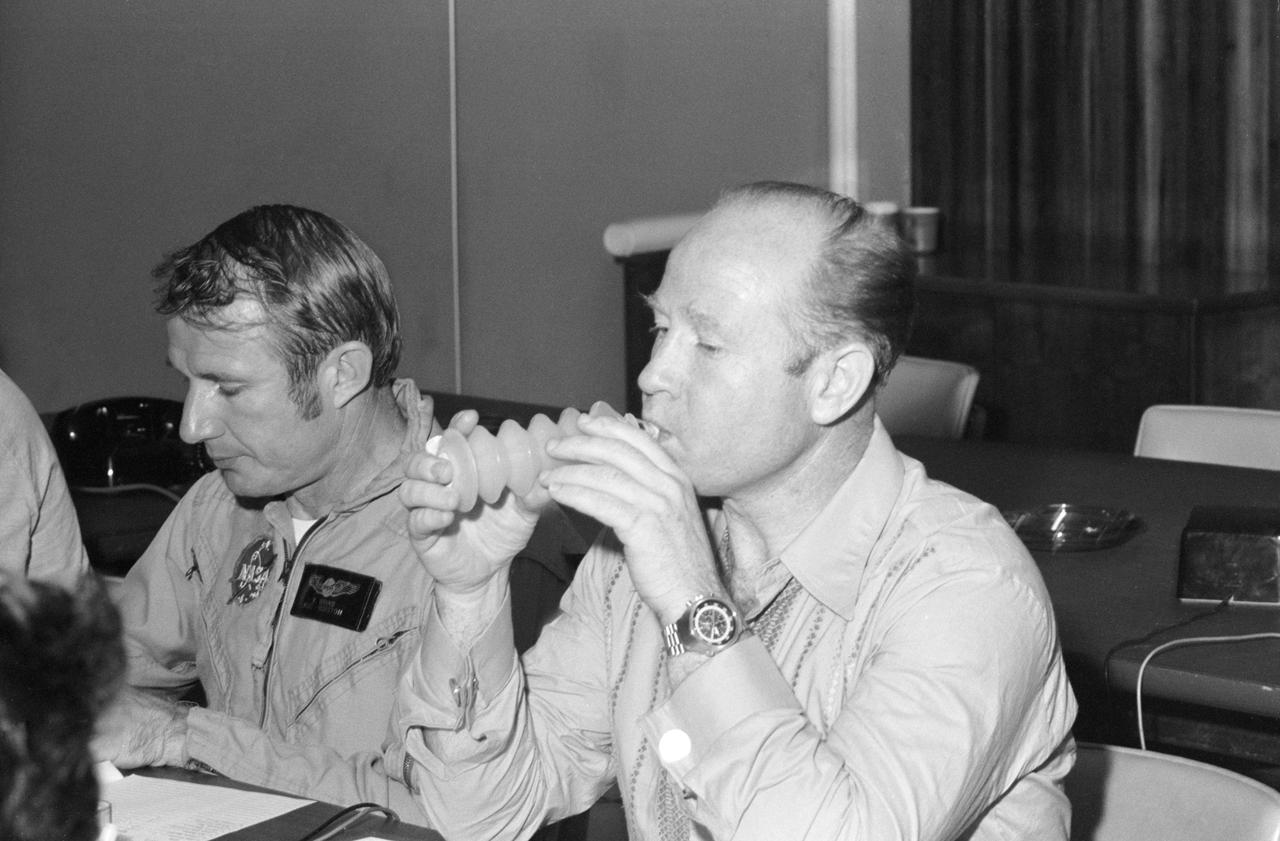
S74-20798 (23 April 1974) --- Candidate food items being considered for the joint U.S.-USSR Apollo-Soyuz Test Project mission are sampled by two ASTP crewmen in Building 4 at the Johnson Space Center. They are, left to right, astronaut Vance D. Brand, command module pilot of the American ASTP crew; and cosmonaut Aleksey A. Leonov, commander of the Soviet ASTP crew. Leonov is drinking orange juice from an accordion-like dispenser. The two Soviet crewmen will have an opportunity to eat with the three American crewmen while the Apollo and Soyuz spacecraft are docked in Earth orbit. Leonov will dine on food being chosen by him now.
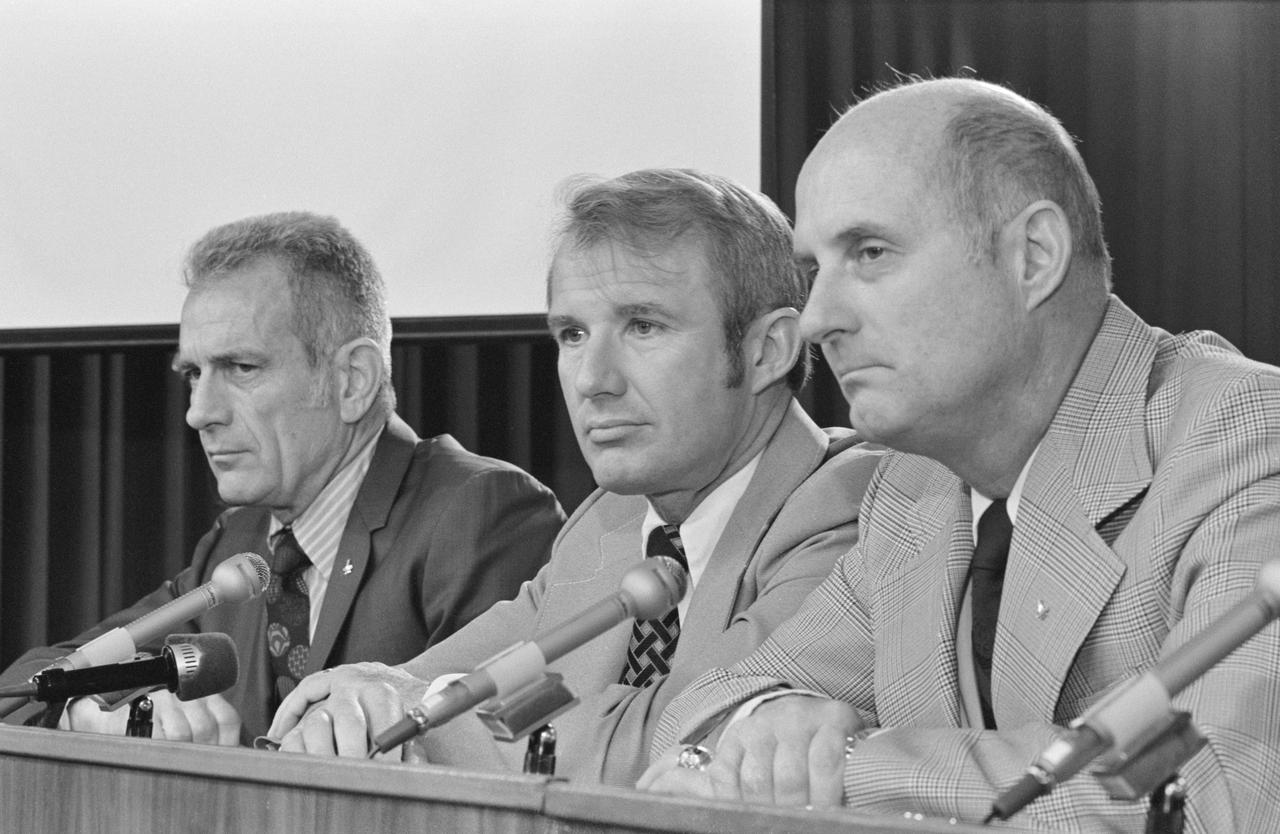
S75-26573 (14 May 1975) --- The three members of the American ASTP prime crew participate in an Apollo-Soyuz Test Project press conference conducted on May 14, 1975 in the Building 2 briefing room at NASA's Johnson Space Center. They are, left to right, Donald K. Slayton, docking module pilot; Vance D. Brand, command module pilot; and Thomas P. Stafford, commander. The astronauts discussed with the news media their recent ASTP joint training session in the Soviet Union, and the crew?s tour of the USSR?s Baikonur launch complex in Kazakhstan.
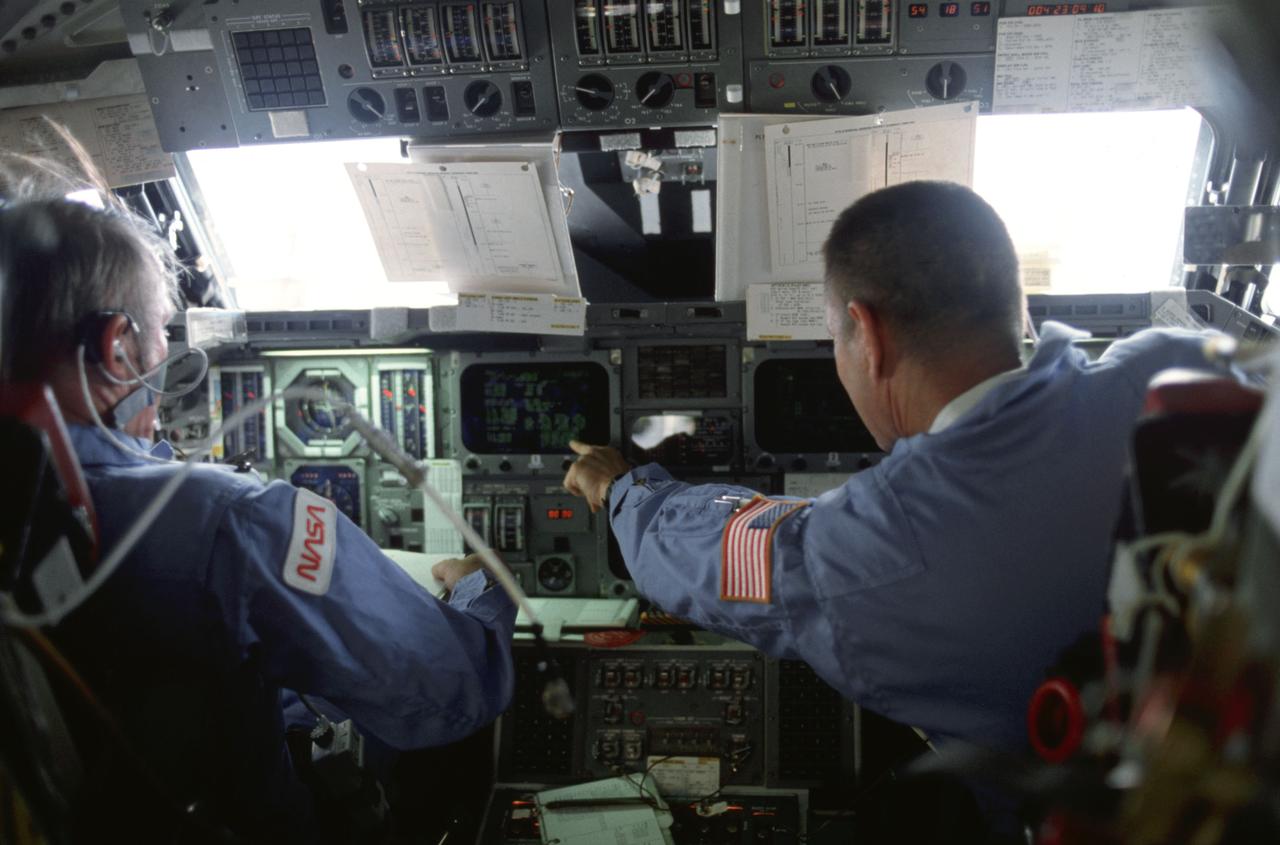
STS005-10-376 (11-16 Nov. 1982) --- Half of the four-member astronaut crew for the Earth-orbiting space shuttle Columbia?s STS-5 mission is pictured on the flight deck of the reusable vehicle. Astronaut Vance D. Brand, commander, holds down the commander?s station at left, while astronaut Robert F. Overmyer, pilot, points to data on one of three cathode ray tubes (CRT) on the forward flight deck. The photograph was made by astronaut Joseph P. Allen IV, one of two mission specialists on the flight. Not pictured are Dr. Allen and astronaut William B. Lenoir, the other mission specialist for this flight. Photo credit: NASA
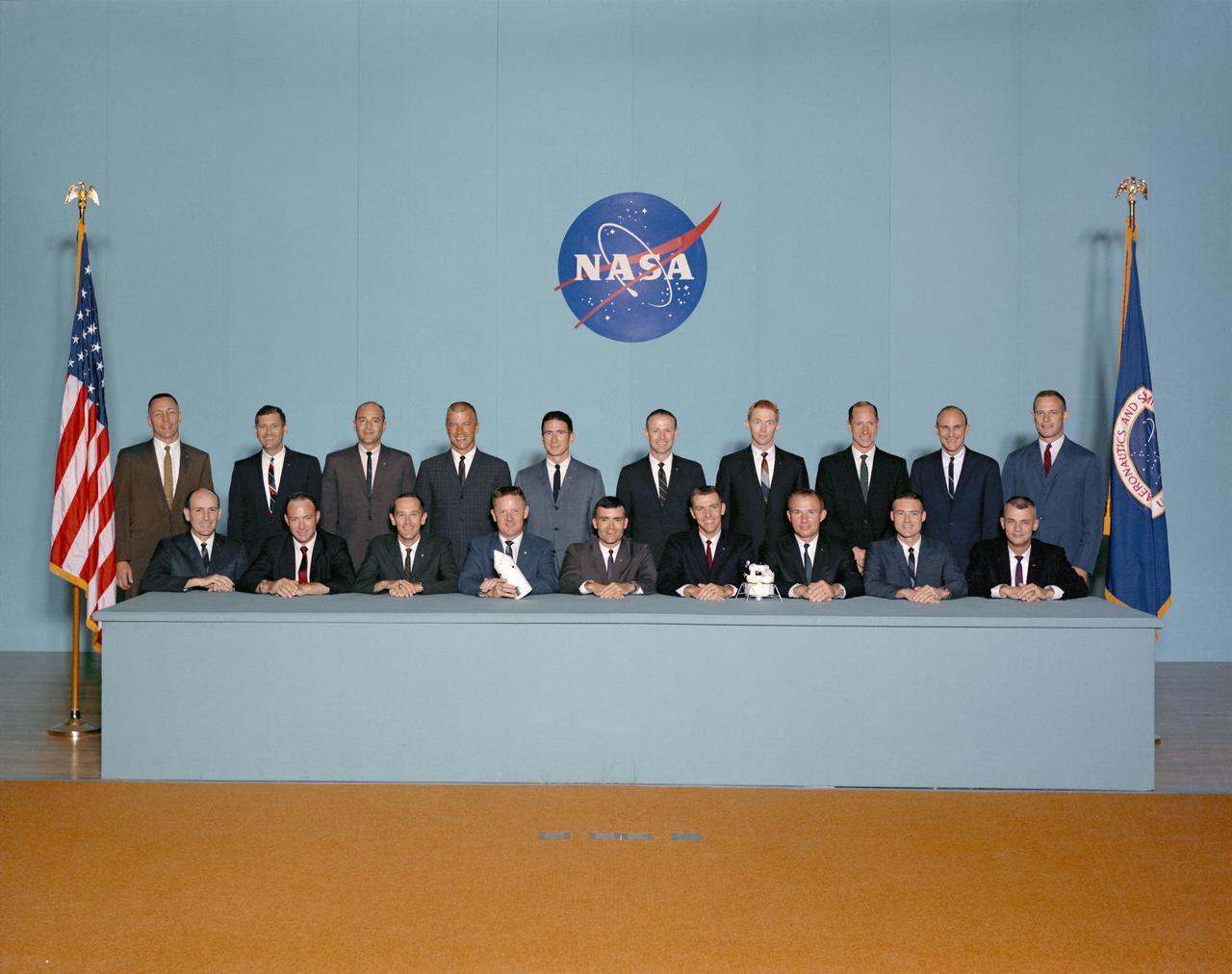
S67-30404 (May 1967) --- Portrait of astronaut group selected April 4, 1966. Seated, left to right, are Edward G. Givens Jr., Edgar D. Mitchell, Charles M. Duke Jr., Don L. Lind, Fred W. Haise Jr., Joe H. Engle, Vance D. Brand, John S. Bull and Bruce McCandless II. Standing, left to right, are John L. Swigert Jr., William R. Pogue, Ronald E. Evans, Paul J. Weitz, James B. Irwin, Gerald P. Carr, Stuart A. Roosa, Alfred M. Worden, Thomas K. Mattingly and Jack R. Lousma. Photo credit: NASA or National Aeronautics and Space Administration
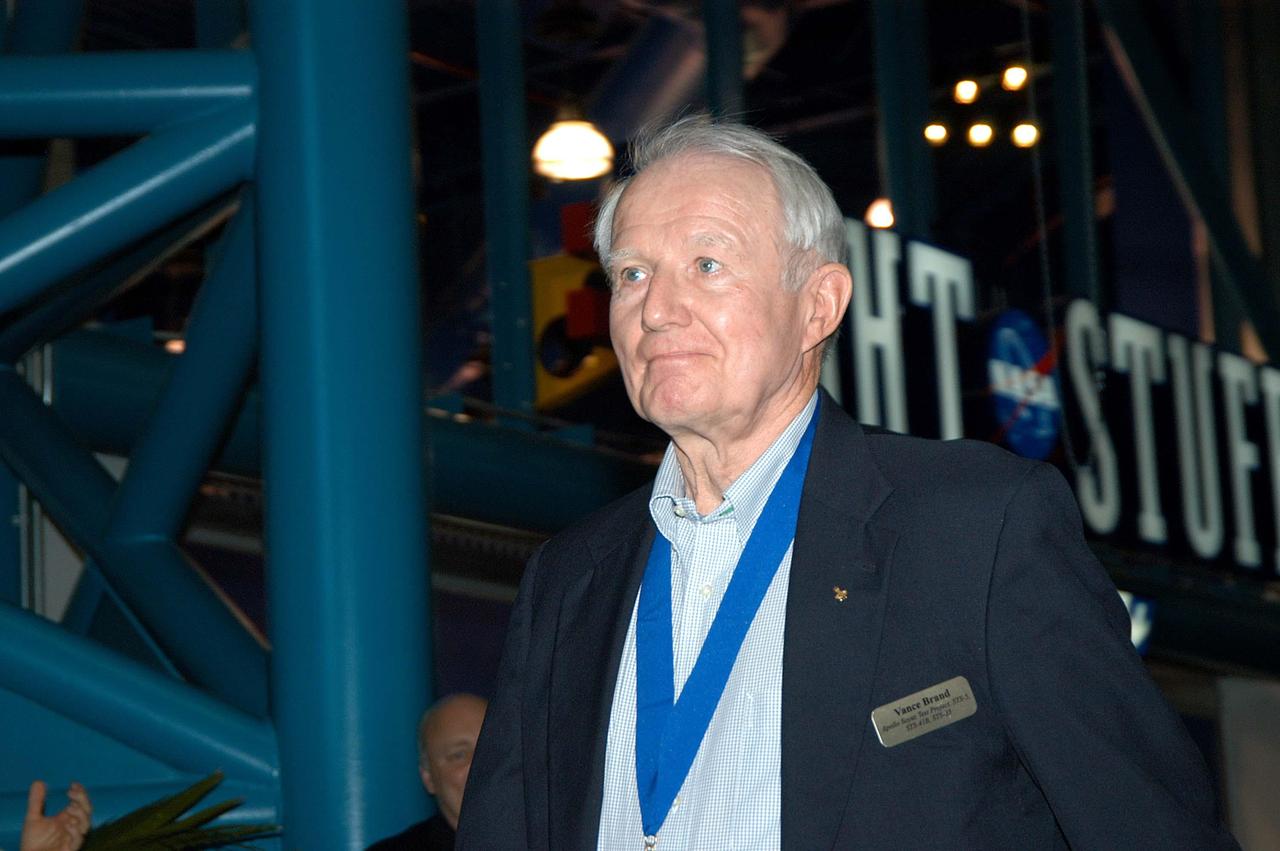
KENNEDY SPACE CENTER, FLA. -- Former astronaut Vance Brand is introduced as a previous inductee into the U.S. Astronaut Hall of Fame. He and other Hall of Fame members were present for the induction of five new space program heroes into the U.S. Astronaut Hall of Fame: Richard O. Covey, commander of the Hubble Space Telescope repair mission; Norman E. Thagard, the first American to occupy Russia’s Mir space station; the late Francis R. "Dick" Scobee, commander of the ill-fated 1986 Challenger mission; Kathryn D. Sullivan, the first American woman to walk in space; and Frederick D. Gregory, the first African-American to command a space mission and the current NASA deputy administrator. Brand was Command Module Pilot on the 1975 Apollo-Soyuz Test Project, the first linkup in orbit between spaceships of the United States and Soviet Union, and he later commanded three Space Shuttle missions. The induction ceremony was held at the Apollo/Saturn V Center at KSC. The U.S. Astronaut Hall of Fame opened in 1990 to provide a place where space travelers could be remembered for their participation and accomplishments in the U.S. space program. The five inductees join 52 previously honored astronauts from the ranks of the Gemini, Apollo, Skylab, Apollo-Soyuz, and Space Shuttle programs.
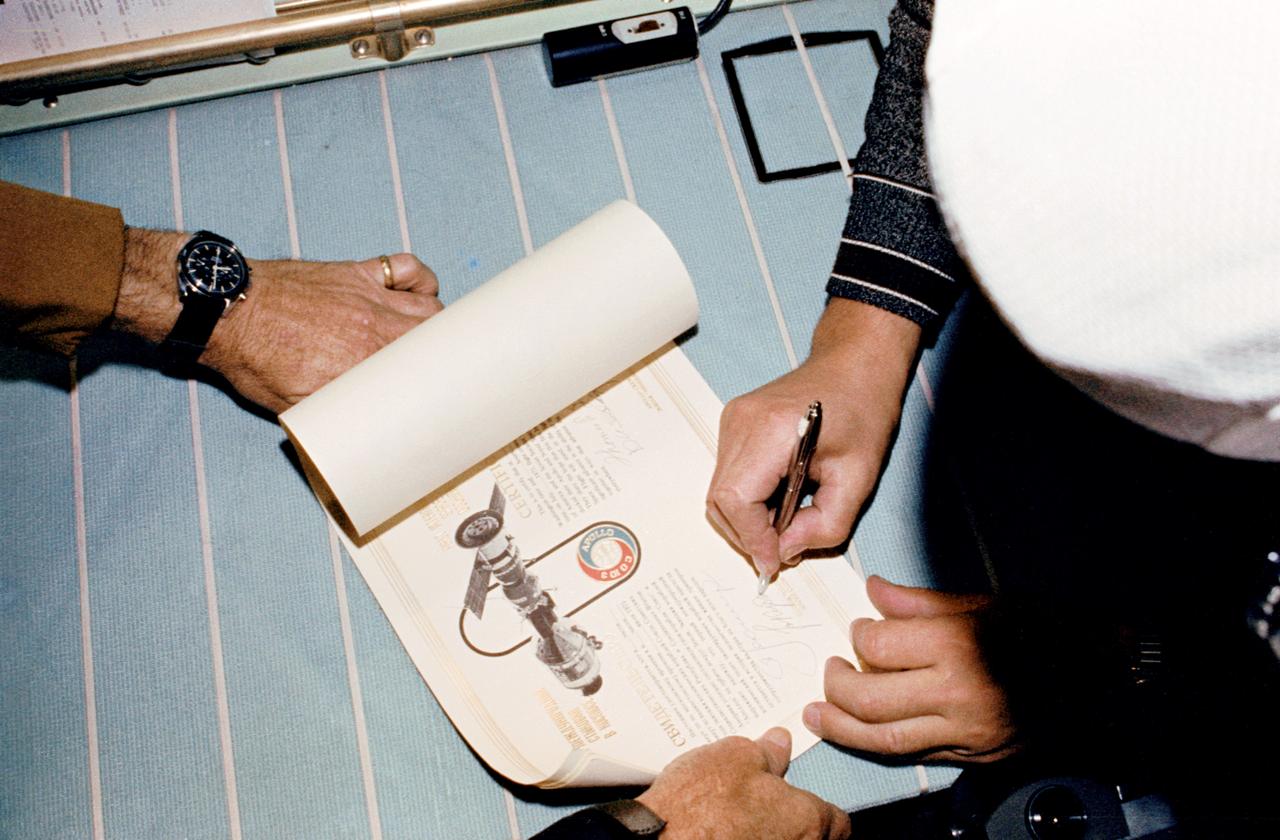
AST-03-171 (17 July 1975) --- The hands of cosmonaut Valerly N. Kubasov are seen as the ASTP engineer adds his name to the signature on the Soviet side of the official joint certificate marking an historical moment during the rendezvous day of the Apollo-Soyuz Test Project. The left hand of astronaut Donald K. Slayton, NASA's docking module pilot, is seen at left. The certificate had earlier been signed by astronauts Thomas P. Stafford, American crew commander; Slayton and cosmonaut Aleksey A. Leonov, Soviet crew commander, and it awaits the signature of astronaut Vance D. Brand, NASA's command module pilot who remained in the CM while the others signed in the Soviet Orbital Module of the Soyuz.
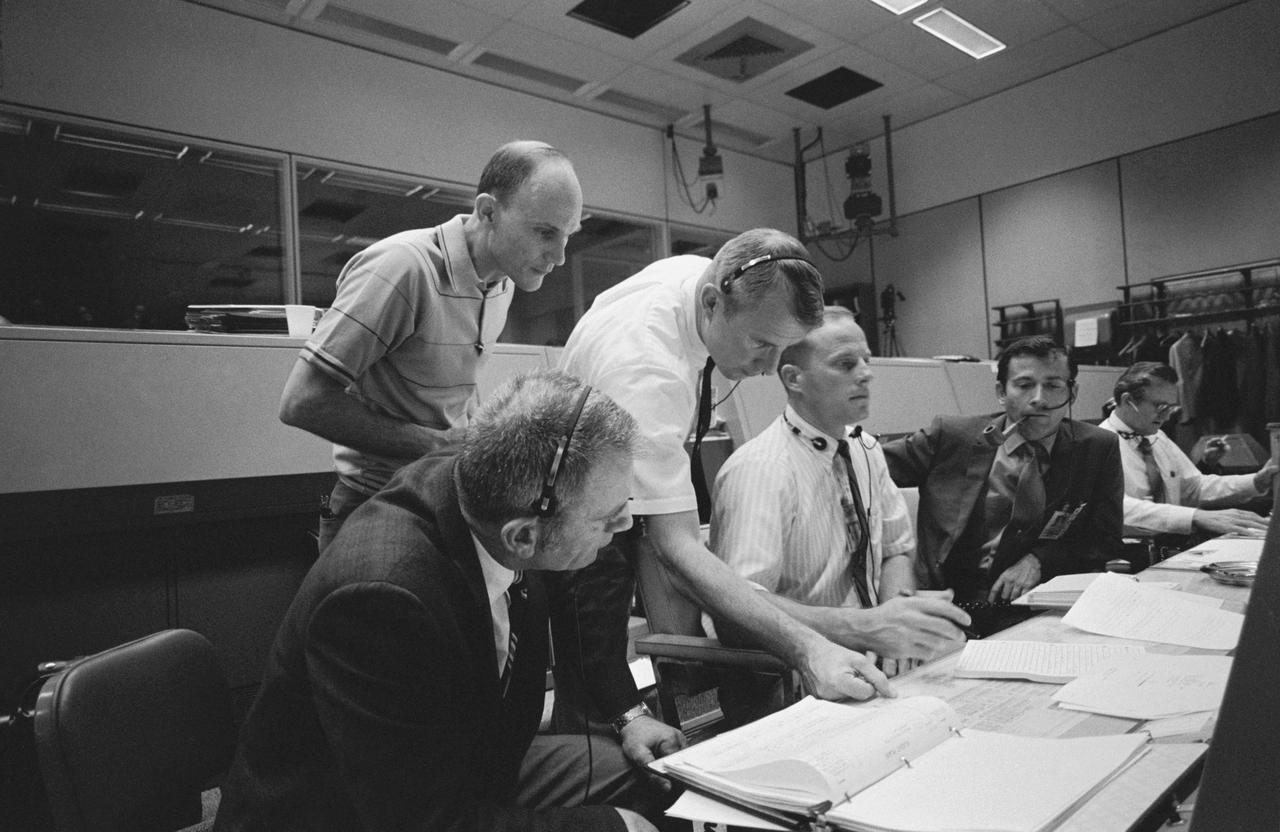
S70-34902 (14 April 1970) --- Several persons important to the Apollo 13 mission, at consoles in the Mission Operations Control Room (MOCR) of the Mission Control Center (MCC). Seated at consoles, from left to right, are astronauts Donald K. Slayton, director of flight crew operations; astronaut Jack R. Lousma, Shift 3 spacecraft communicator; and astronaut John W. Young, commander of the Apollo 13 backup crew. Standing, left to right, are astronaut Tom K. Mattingly II, who was replaced as Apollo 13 command module pilot after it was learned he may come down with measles, and astronaut Vance D. Brand, Shift 2 spacecraft communicator. Several hours earlier, in the late evening hours of April 13, crew members of the Apollo 13 mission reported to MCC that trouble had developed with an oxygen cell on their spacecraft.
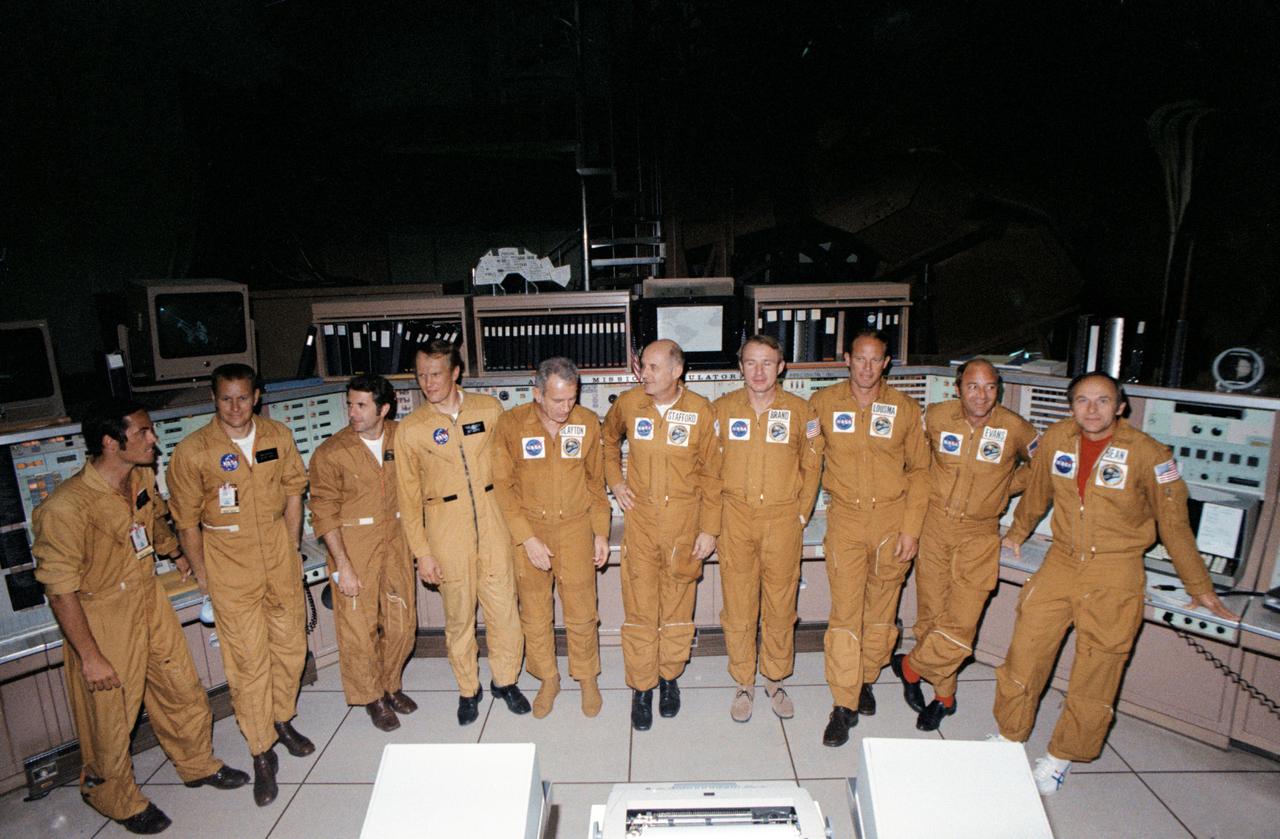
S75-28361 (9 July 1975) --- These ten American astronauts compose the U.S. prime crew, the backup crew and the crew support team for the joint U.S.-USSR Apollo-Soyuz Test Project docking mission in Earth orbit. They are, left to right, Robert L. Crippen, support team; Robert F. Overmyer, support team; Richard H. Truly, support team; Karol J. Bobko, support team; Donald K. Slayton, prime crew docking module pilot; Thomas P. Stafford, prime crew commander; Vance D. Brand, prime crew command module pilot; Jack R. Lousma, backup crew docking module pilot; Ronald E. Evans, backup crew command module pilot; and Alan L. Bean, backup crew commander. They are photographed by the Apollo Mission Simulator console in Building 5 at NASA's Johnson Space Center.
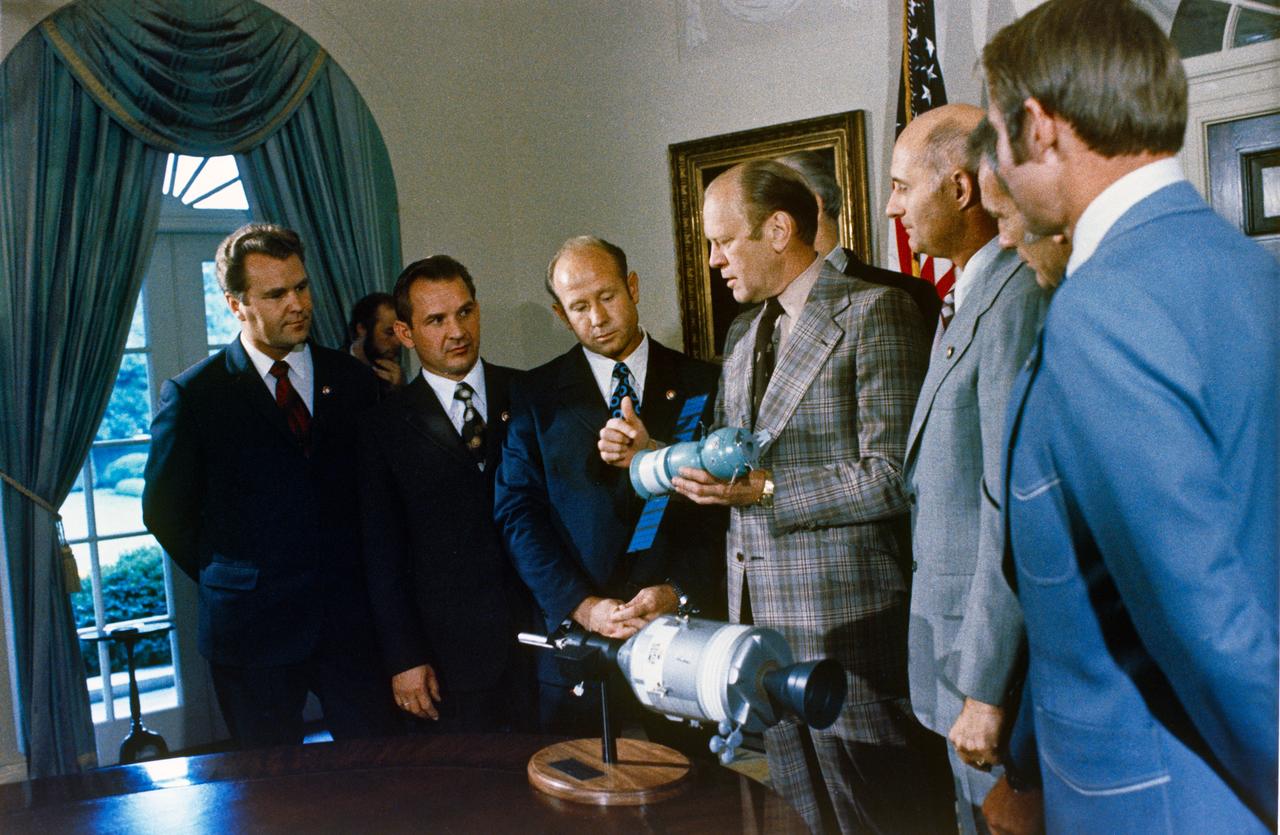
S74-29892 (7 Sept. 1974) --- President Gerald R. Ford removes the Soviet Soyuz spacecraft model from a model set depicting the 1975 Apollo-Soyuz Test Project, an Earth orbital docking and rendezvous mission involving crewmen from the U.S. and USSR, who visited Mr. Ford at the White House. The cosmonauts and astronauts are, left to right, Vladimir A. Shatalov, Chief, Cosmonaut Training; Valeriy N. Kubasov, ASTP Soviet engineer; Aleksey A. Leonov, ASTP Soviet crew commander; Thomas P. Stafford, ASTP American crew commander; Donald K. Slayton, American crew?s docking module pilot; and Vance D. Brand, command module pilot for the U.S. team. Dr. George M. Low, Deputy Administrator, National Aeronautics and Space Administration, is partially obscured behind Mr. Ford.
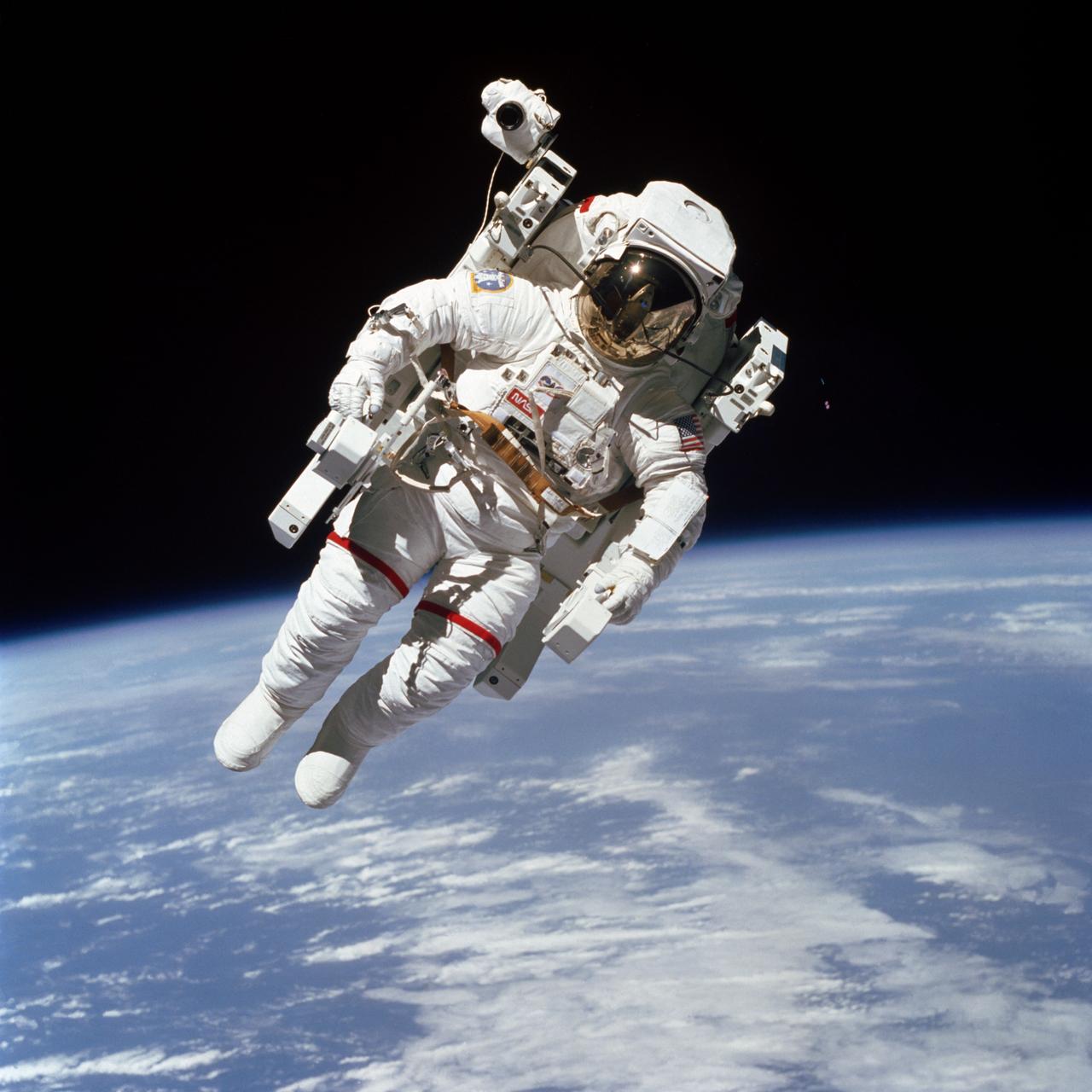
S84-27562 (7 Feb. 1984) --- Astronaut Bruce McCandless II, one of two 41B mission specialists participating in a historical Extravehicular Activity (EVA), is a few meters away from the cabin of the Earth-orbiting space shuttle Challenger in this 70mm frame. This Extravehicular Activity (EVA) represented the first use of a nitrogen-propelled, hand-controlled device called the Manned Maneuvering Unit (MMU), which allows for much greater mobility than that afforded previous spacewalkers who had to use restrictive tethers. Robert L. Stewart later tried out the MMU McCandless is using here, and the two of them tested another similar unit two days later. Inside the spacecraft were astronauts Vance D. Brand, commander; Robert L. Gibson, pilot; and Ronald E. McNair, mission specialist. Photo credit: NASA
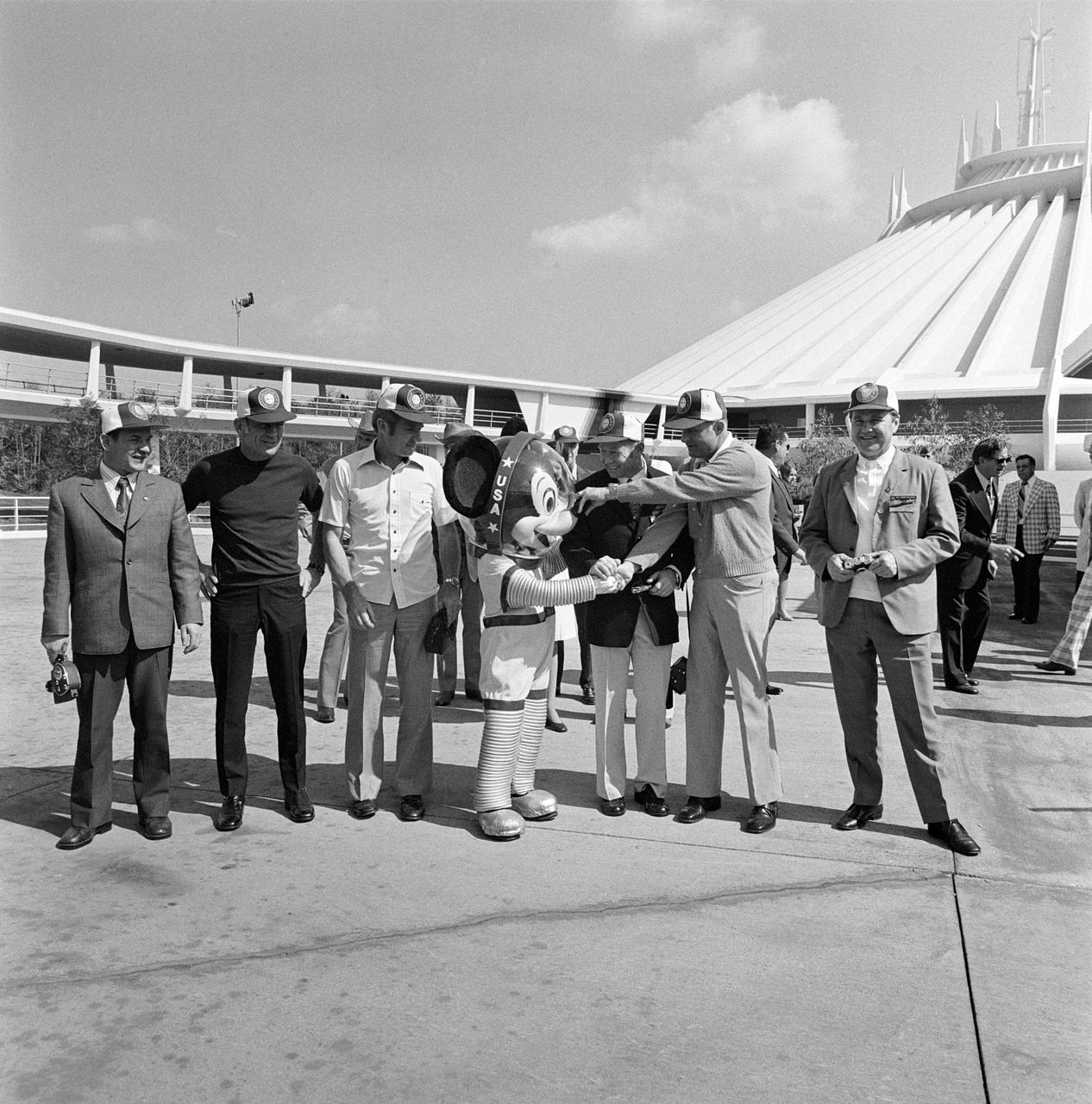
S75-24052 (8-10 Feb. 1975) --- A space-suited Mickey Mouse character welcomes the prime crewmen of the Apollo-Soyuz Test Project mission to Florida?s Disney World near Orlando. The crewmen made a side-trip to Disney World during a three-day inspection tour of NASA's Kennedy Space Center. The crewmen were at KSC to look over launch facilities and flight hardware. Receiving the jovial Disney World welcome are, left to right, cosmonaut Valeriy N. Kubasov, engineer on the Soviet crew; astronaut Donald K. Slayton, docking module pilot of the American crew; astronaut Vance D. Brand, command module pilot of the American crew; cosmonaut Aleksey A. Leonov, commander of the Soviet crew; astronaut Thomas P. Stafford, commander of the American crew; and cosmonaut Vladimir A. Shatalov, Chief of Cosmonaut Training for the USSR.
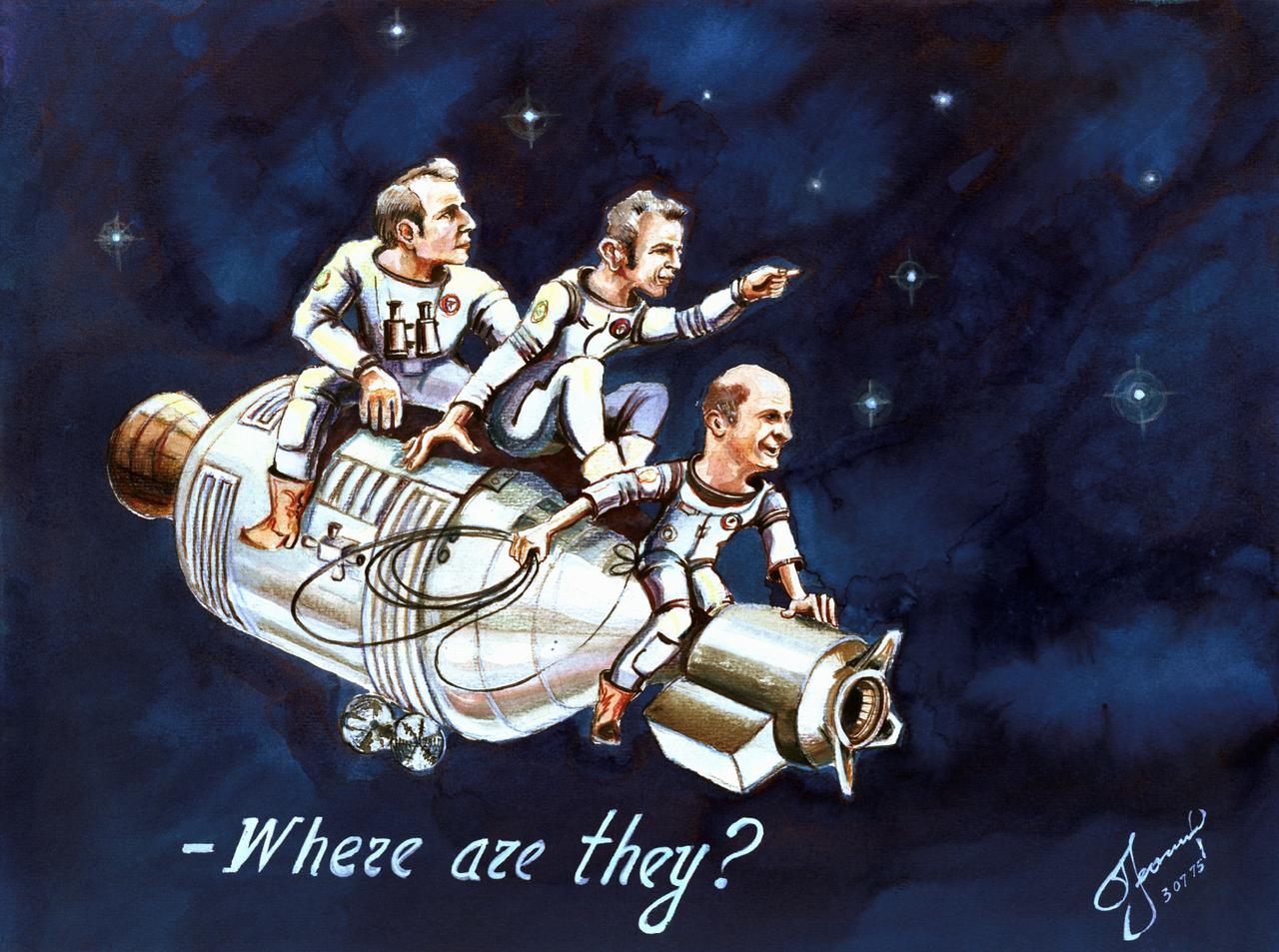
S75-28504 (17 July 1975) --- The American ASTP crewmen search the skies for the Soviet Soyuz spacecraft in this humorous artwork by cosmonaut Aleksey A. Leonov. Astronauts Vance D. Brand, Donald K. Slayton and Thomas P. Stafford (left to right) sit astride the Apollo spacecraft and Docking Module ready to lasso Soyuz. The cartoon humorously depicts the approaching historic event of an American spacecraft rendezvousing and docking in Earth orbit with a USSR spacecraft, scheduled today (July 17, 1975). Aboard Soyuz are Leonov, crew commander, and his fellow cosmonaut, Valeriy N. Kubasov. Stafford is the Apollo crew commander. The U.S. and USSR crewmen will visit each other's spacecraft while the Apollo and Soyuz are docked in Earth orbit for two days. Leonov, an accomplished artist, specializes in paintings on space subjects. He has a number of paintings on public exhibit in his native land.
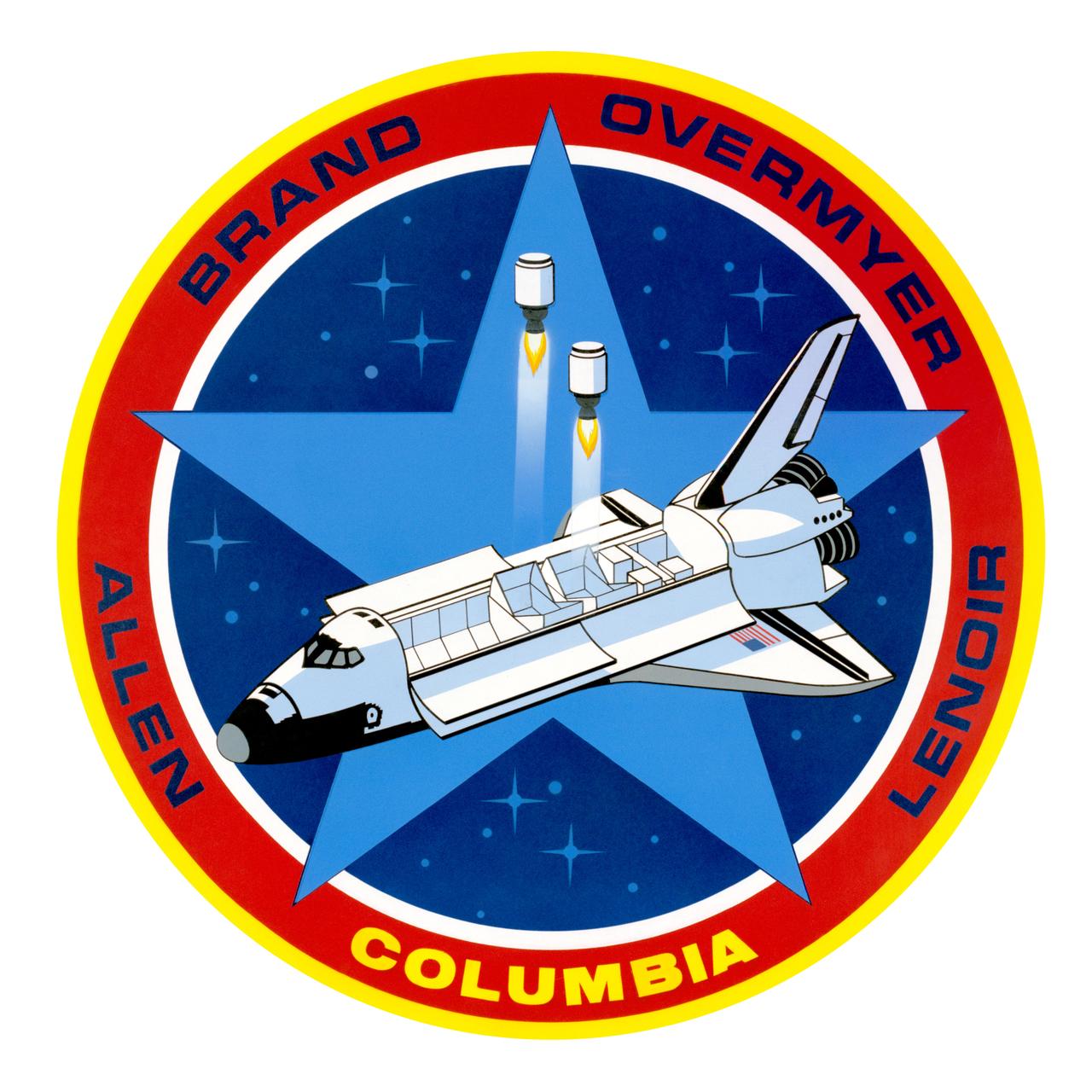
S82-35627 (20 Aug. 1982) --- This is the official crew patch for the fifth (note five points of the star) NASA Space Transportation System (STS-5) flight, scheduled for November of this year. The STS-5 flight following four successful test flights. It will call for the Columbia to be manned by four astronauts ? a space agency first. Crew members for the flights are Vance D. Brand, commander; Robert F. Overmyer, pilot; and William B. Lenoir and Joseph P. Allen, mission specialists. The NASA insignia design for space shuttle flights is reserved for use by the astronauts and for other official use as the NASA Administrator may authorize. Public availability has been approved only in the forms of illustrations by the various news media. When and if there is any change in this policy, which is not anticipated, the change will be publicly announced. Photo credit: NASA
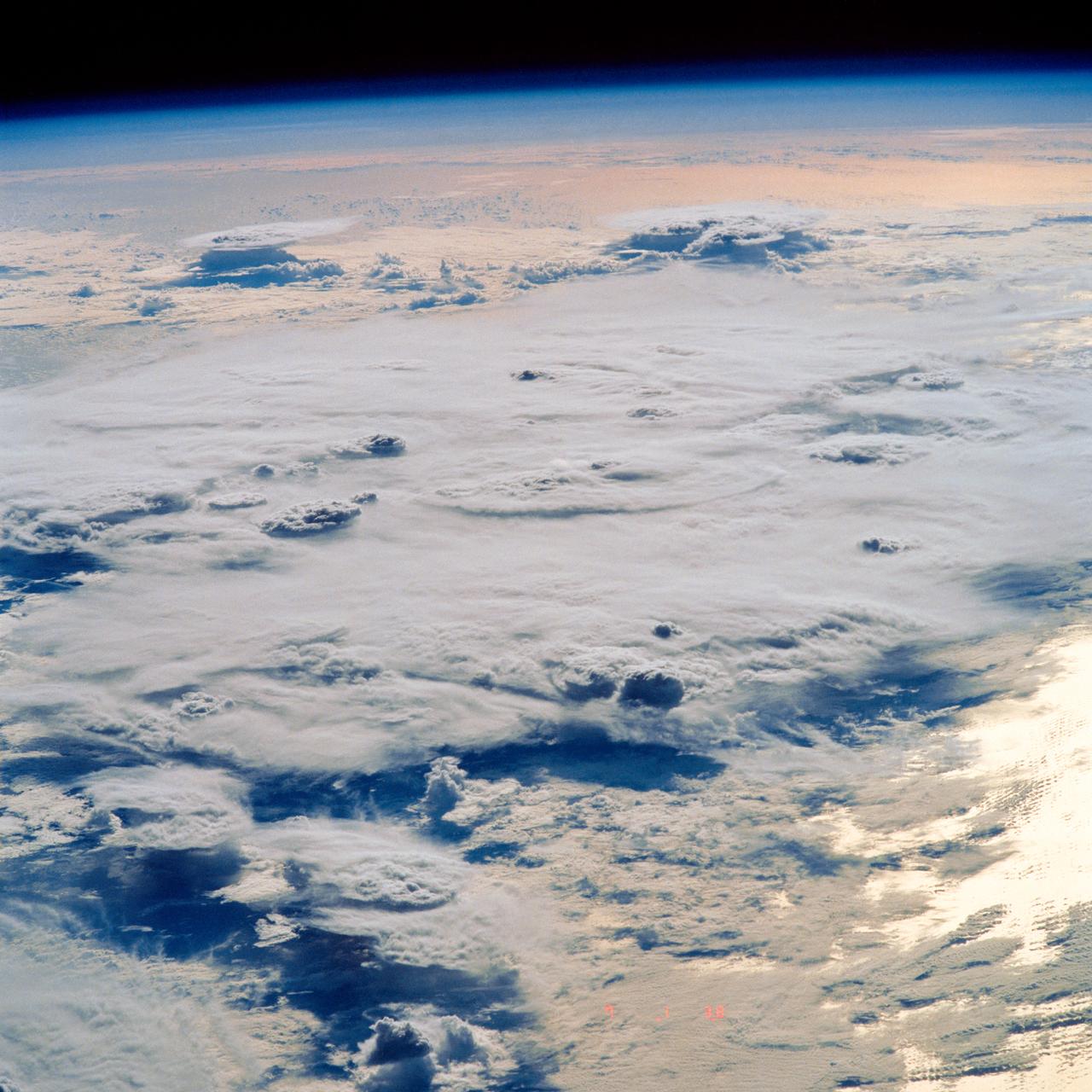
STS035-607-024 (2-10 Dec. 1990) --- This is one of 25 visuals used by the STS-35 crew at its Dec. 20, 1990 post-flight press conference. Space Shuttle Columbia's flight of almost nine days duration (launched December 2 from Kennedy Space Center (KSC) and landed December 10 at Edwards Air Force Base) carried the Astro-1 payload and was dedicated to astrophysics. The mission involved a seven-man crew. Crew members were astronauts Vance D. Brand, Guy S. Gardner, Jeffrey A. Hoffman, Robert A.R. Parker and John M. (Mike) Lounge; and payload specialists Samuel T. Durrance and Ronald A. Parise. Thunderstorm systems over the Pacific Ocean, with heavy sunglint, as photographed with a handheld Rolleiflex camera aimed through Columbia's aft flight deck windows.
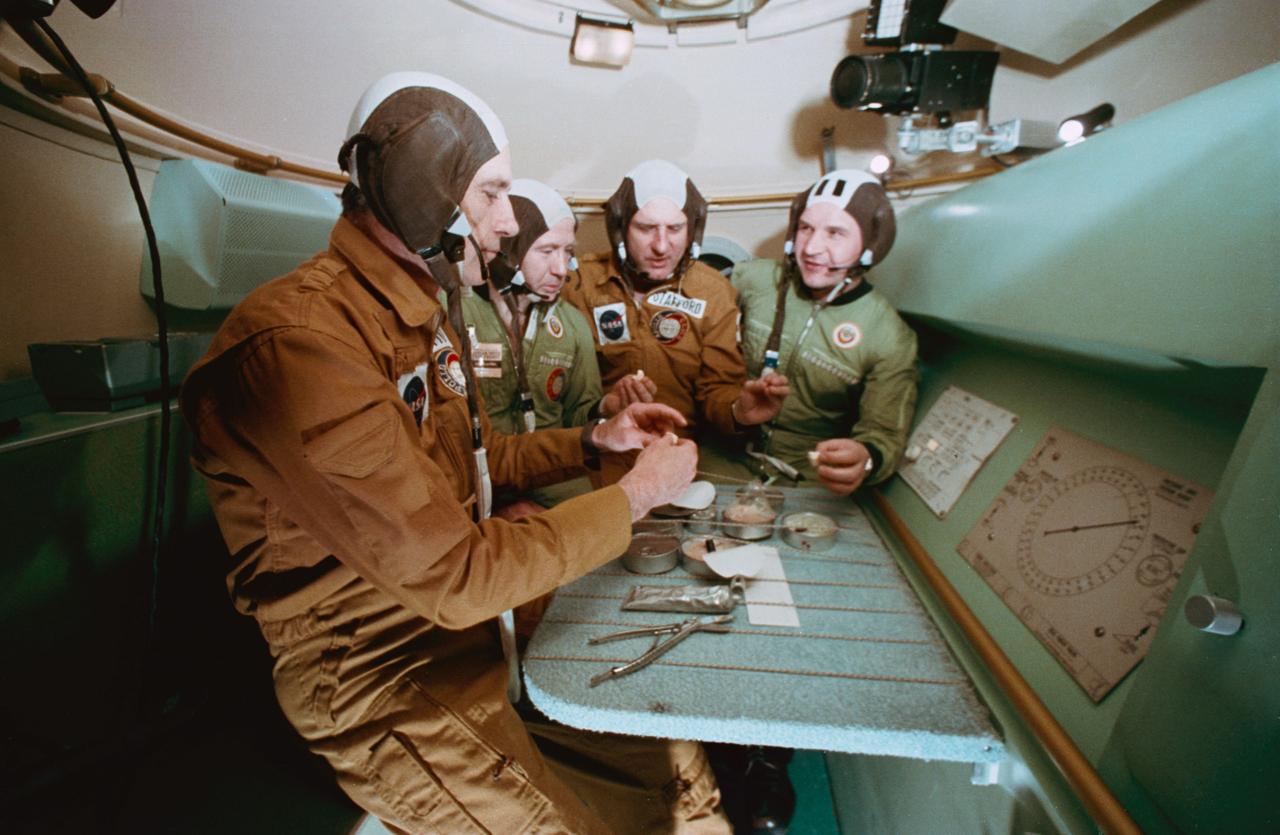
S75-22770 (25 Feb. 1975) --- Two American ASTP prime crewmen have a meal with the Soviet ASTP first (prime) crewmen during Apollo-Soyuz Test Project joint crew training at NASA's Johnson Space Center. The four are inside the Soyuz orbital module mock-up in Building 35. They are, left to right, astronaut Donald K. Slayton, docking module pilot of the American crew; cosmonaut Aleksey A. Leonov, commander of the Soviet crew; astronaut Thomas P. Stafford, commander of the American crew; and cosmonaut Valeriy N. Kubasov, engineer on the Soviet crew. The training session simulated activities on the second day in Earth orbit. During the actual mission the other American crewmen, astronaut Vance D. Brand, command module pilot, would be in the Command Module.
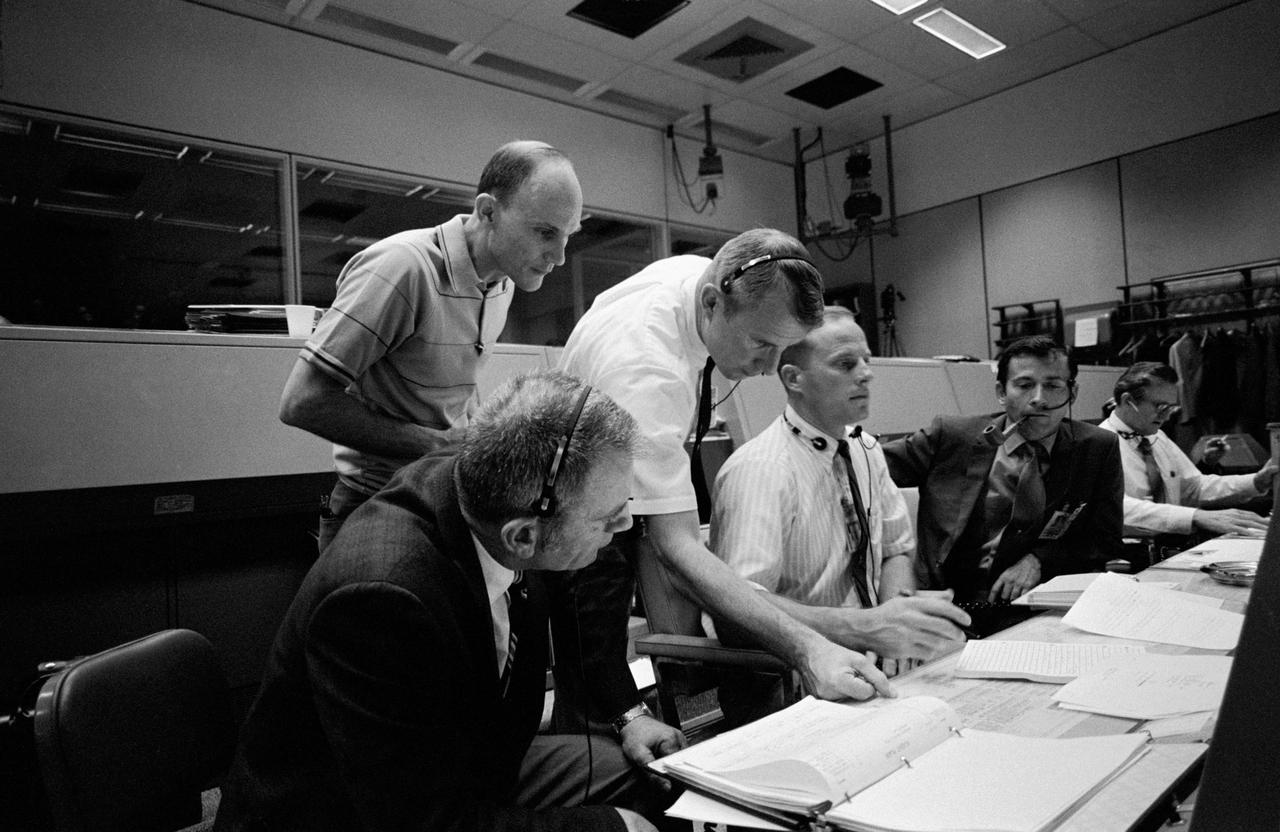
S70-34902 (14 April 1970) --- Several persons important to the Apollo 13 mission, at consoles in the Mission Operations Control Room (MOCR) of the Mission Control Center (MCC). Seated at consoles, from left to right, are astronauts Donald K. Slayton, director of flight crew operations; astronaut Jack R. Lousma, Shift 3 spacecraft communicator; and astronaut John W. Young, commander of the Apollo 13 backup crew. Standing, left to right, are astronaut Tom K. Mattingly II, who was replaced as Apollo 13 command module pilot after it was learned he may come down with measles, and astronaut Vance D. Brand, Shift 2 spacecraft communicator. Several hours earlier, in the late evening hours of April 13, crew members of the Apollo 13 mission reported to MCC that trouble had developed with an oxygen cell on their spacecraft.
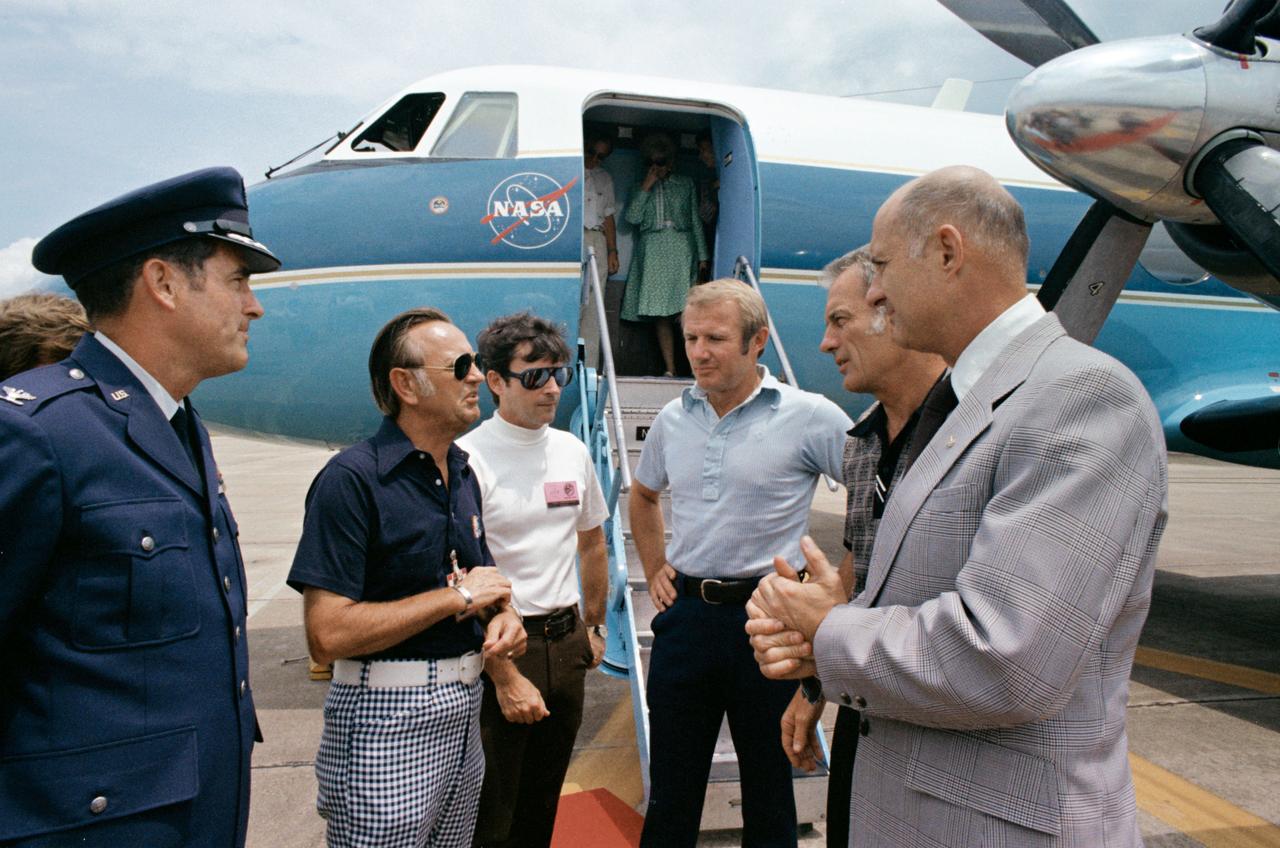
S75-30109 (10 Aug. 1975) --- Dr. Christopher C. Kraft Jr. (second from left), JSC Director, chats with the three ASTP crewmen on the runway at Ellington Air Force Base after their arrival home from the Pacific recovery area. The six men are, left to right, Col. Donald Robinson, EAFB commander; Dr. Kraft; astronaut John W. Young, Chief of the Astronaut Office at JSC; astronaut Vance D. Brand, command module pilot of the crew; astronaut Donald K. Slayton, docking module pilot of the crew; and astronaut Thomas P. Stafford, crew commander. This picture was taken prior to the official welcoming ceremonies. The crewmen?s wives are still aboard the plane. Medical treatment in Hawaii delayed the return of the crew to JSC. They suffered a pulmonary irritation from inhalation of a toxic gas minutes before splashdown on July 24, 1975.
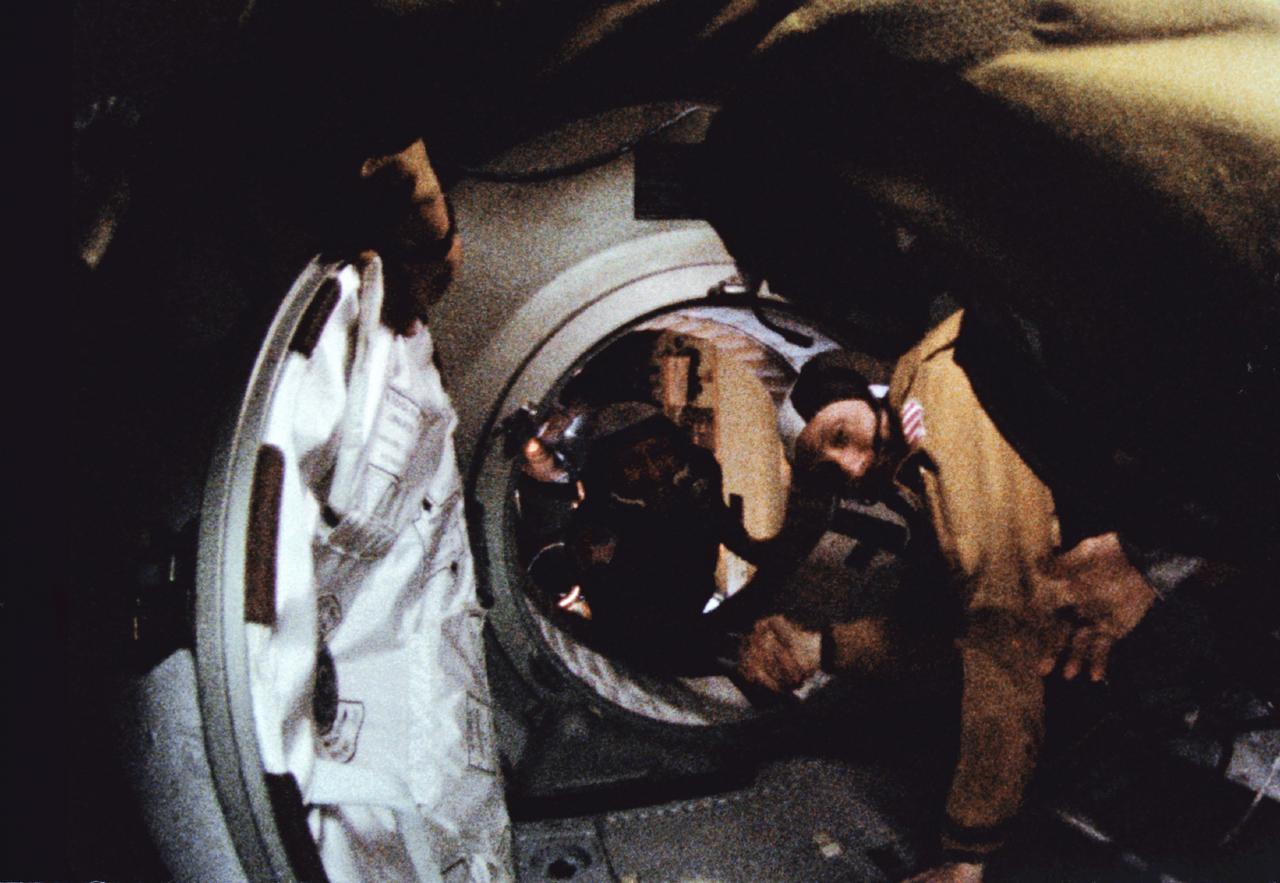
S75-29432 (17 July 1975) --- Astronaut Thomas P. Stafford (in foreground) and cosmonaut Aleksei A. Leonov make their historic handshake in space on July 17, 1975 during the joint U.S.-USSR Apollo Soyuz Test Project (ASTP) docking mission in Earth orbit. This picture was reproduced from a frame of 16mm motion picture film. The American and Soviet spacecraft were joined together in space for approximately 47 hours on July 17th, 18th, 19th, 1975. The Apollo crew consisted of astronauts Thomas P. Stafford, commander; Donald K. "Deke" Slayton, docking module pilot; Vance D. Brand, command module pilot. The Soyuz 19 crew consisted of cosmonauts Aleksei A. Leonov, command pilot; and Valeri N. Kubasov, flight engineer.
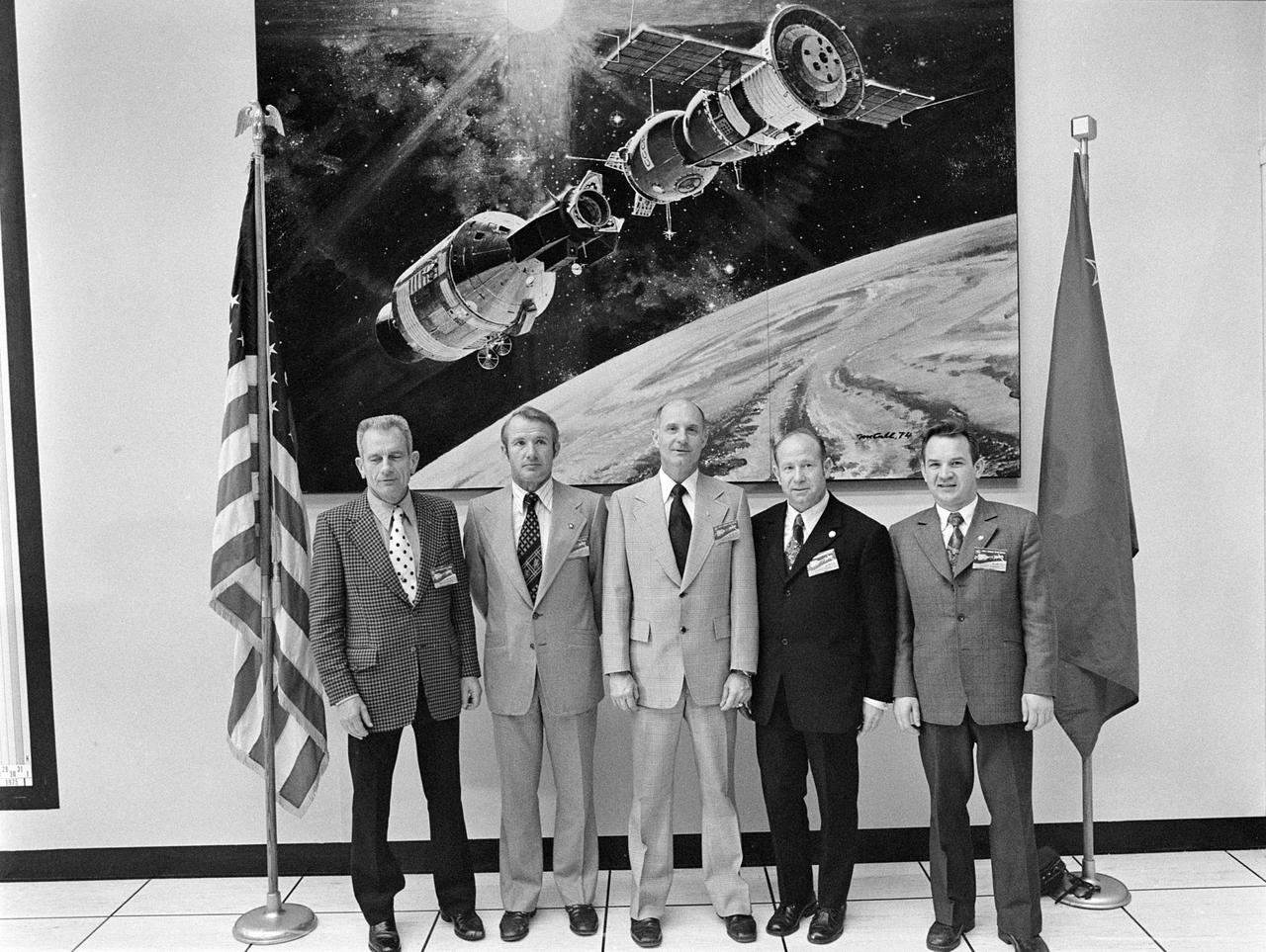
S75-24030 (8-10 Feb. 1975) --- The five prime crew members of the Apollo-Soyuz Test Project (ASTP) mission pose for a group photograph while at NASA's Kennedy Space Center (KSC) for a three-day inspection tour. They are, left to right, astronaut Donald K. (Deke) Slayton, docking module pilot of the American crew; astronaut Vance D. Brand, command module pilot of the American crew; astronaut Thomas P. Stafford, commander of the American crew; cosmonaut Aleksey A. Leonov, commander of the Soviet crew; and cosmonaut Valeriy N. Kubasov, engineer of the Soviet crew. They were at KSC to look over launch facilities and flight hardware. They are standing in front of artist Robert McCall?s painting of an ASTP docking in Earth orbit.
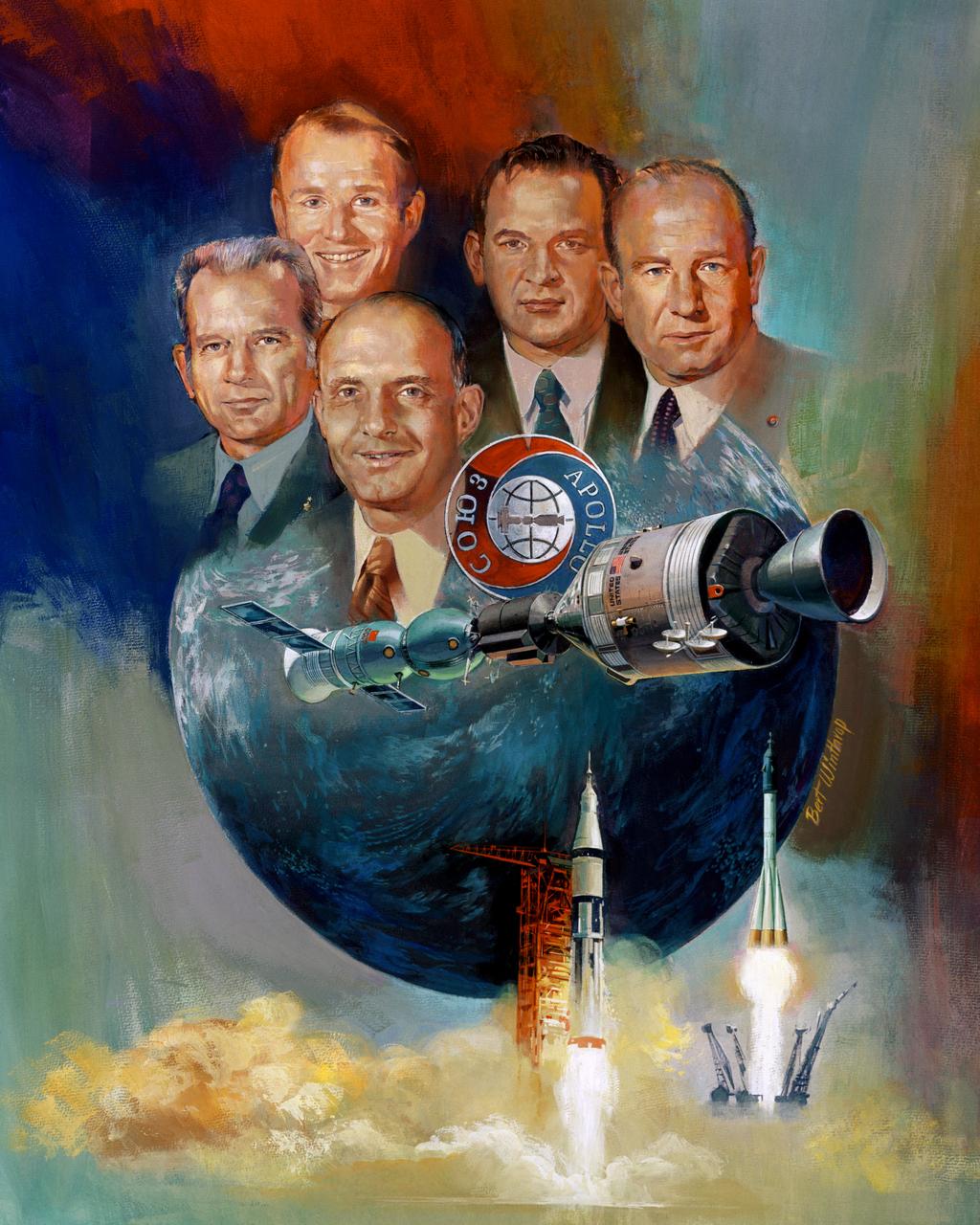
S75-25941 (April 1975) --- An Apollo-Soyuz Test Project (ASTP) symbolic painting by artist Bert Winthrop of Rockwell International Space Division, Downey, California. The artwork is composed of the ASTP mission insignia, the docked Apollo-Soyuz spacecraft, and portraits of the five ASTP prime crewmen, all superimposed against Earth's sphere in the center of the picture. The launches of both the American ASTP space vehicle (on left) and the Soviet ASTP space vehicle are depicted in the lower right corner. The five crewmen are, clockwise from the ASTP emblem, astronaut Thomas P. Stafford, commander of the American crew; astronaut Donald K. Slayton, docking module pilot of the American crew; astronaut Vance D. Brand, command module pilot of the American crew; cosmonaut Valeriy N. Kubasov, engineer on the Soviet crew; and cosmonaut Aleksey A. Leonov, commander of the Soviet crew. The joint U.S.-USSR ASTP docking mission in Earth orbit is scheduled for July 1975.
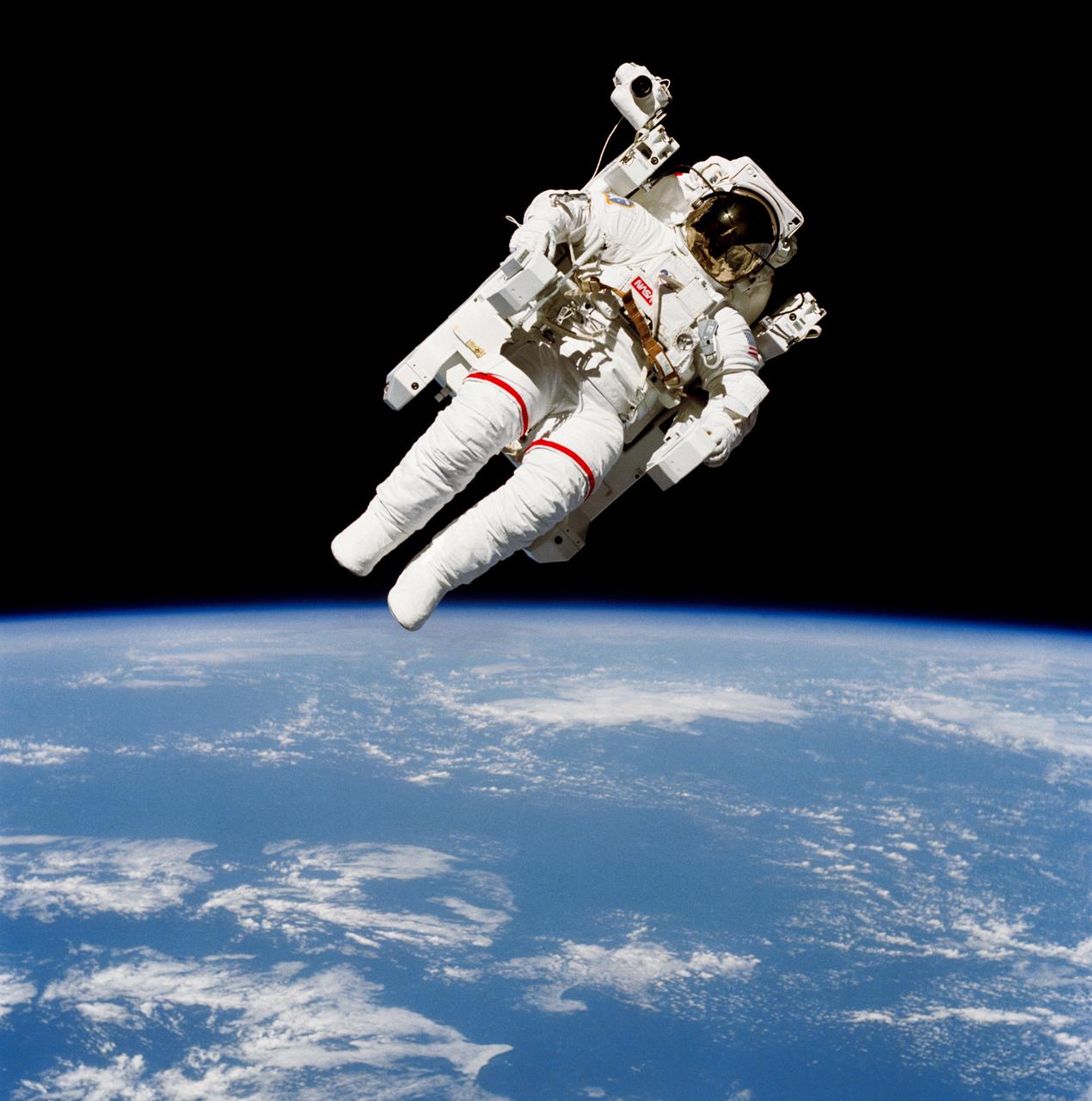
S84-27017 (7 Feb. 1984) --- Astronaut Bruce McCandless II, one of two 41-B mission specialist, participating in a historical Extravehicular Activity (EVA), is a few meters away from the cabin of the Earth-orbiting space shuttle Challenger in this 70mm frame. This EVA represented the first use of a nitrogen-propelled, hand-controlled device called the Manned Maneuvering Unit (MMU), which allows for much greater mobility than that afforded previous spacewalkers who had to use restrictive tethers. Robert L. Stewart, mission specialist, later tried out the MMU McCandless is using here. The two of them tested another similar unit two days later. Inside the spacecraft were astronauts Vance D. Brand, commander; Robert L. Gibson, pilot; and Ronald E. McNair, mission specialist. Photo credit: NASA
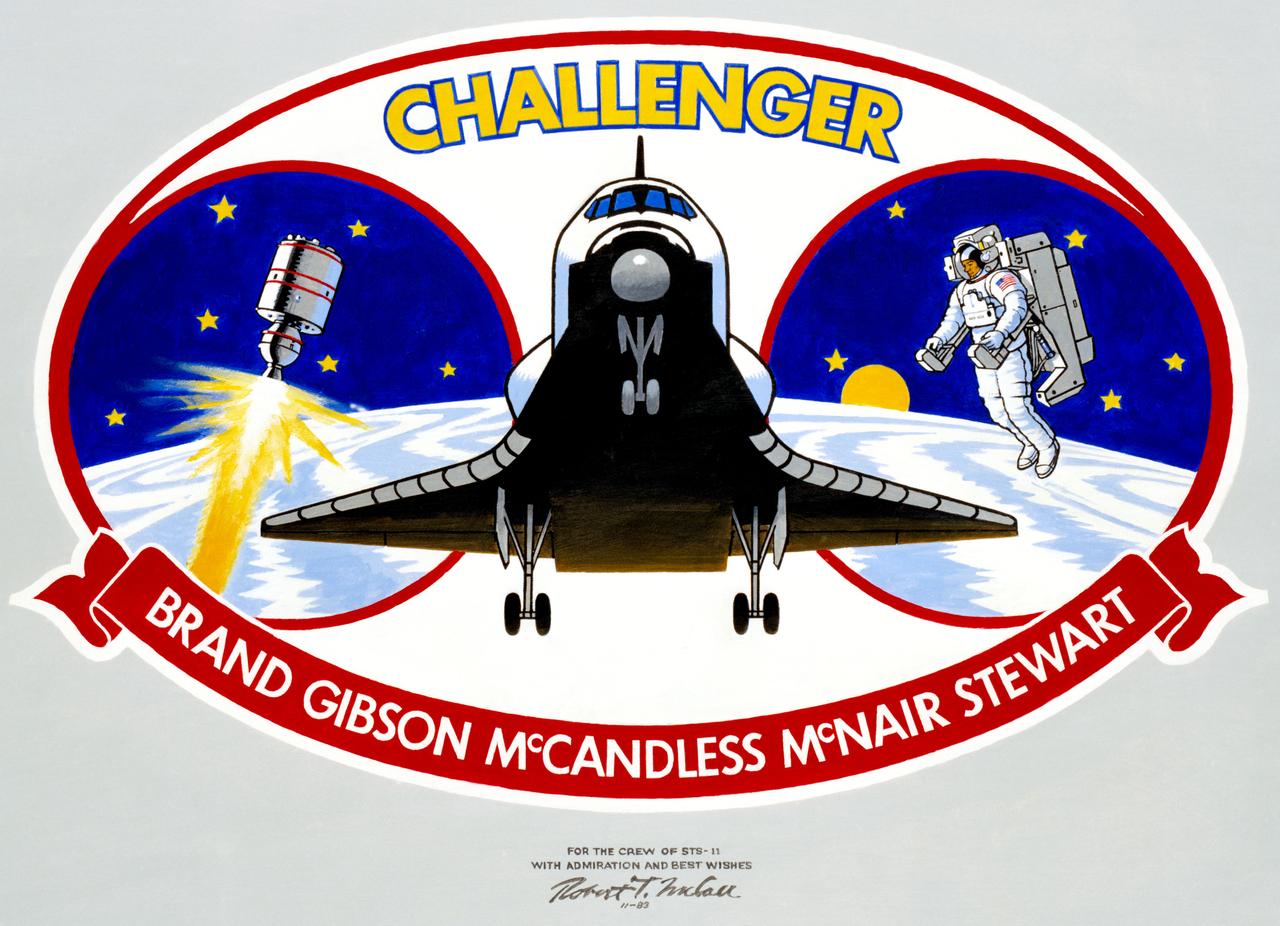
S83-45520 (December 1983) --- The space shuttle Challenger, making its fourth spaceflight, highlights the 41B insignia. The reusable vehicle is flanked in the oval by an illustration of another PAM-D assisted satellite deployment; and astronaut making the first non-tethered extravehicular activity (EVA); and eleven stars. The crew member at right is equipped with the manned maneuvering unit (MMU), a debuting backpack/motor apparatus allowing for much greater freedom of movement than that experienced by any previous space travelers performing EVA. Surnames of the five astronaut crew members balance the Robert McCall artwork. They are Vance D. Brand, Robert L. Stewart, Bruce McCandless II, Ronald E. McNair, Robert L. Gibson. The flight is scheduled for a launch in early 1984. The NASA insignia design for space shuttle flights is reserved for use by the astronauts and for other official use as the NASA Administrator may authorize. Public availability has been approved only in the forms of illustrations by the various news media. When and if there is any change in this policy, which is not anticipated, the change will be publicly announced. Photo credit: NASA
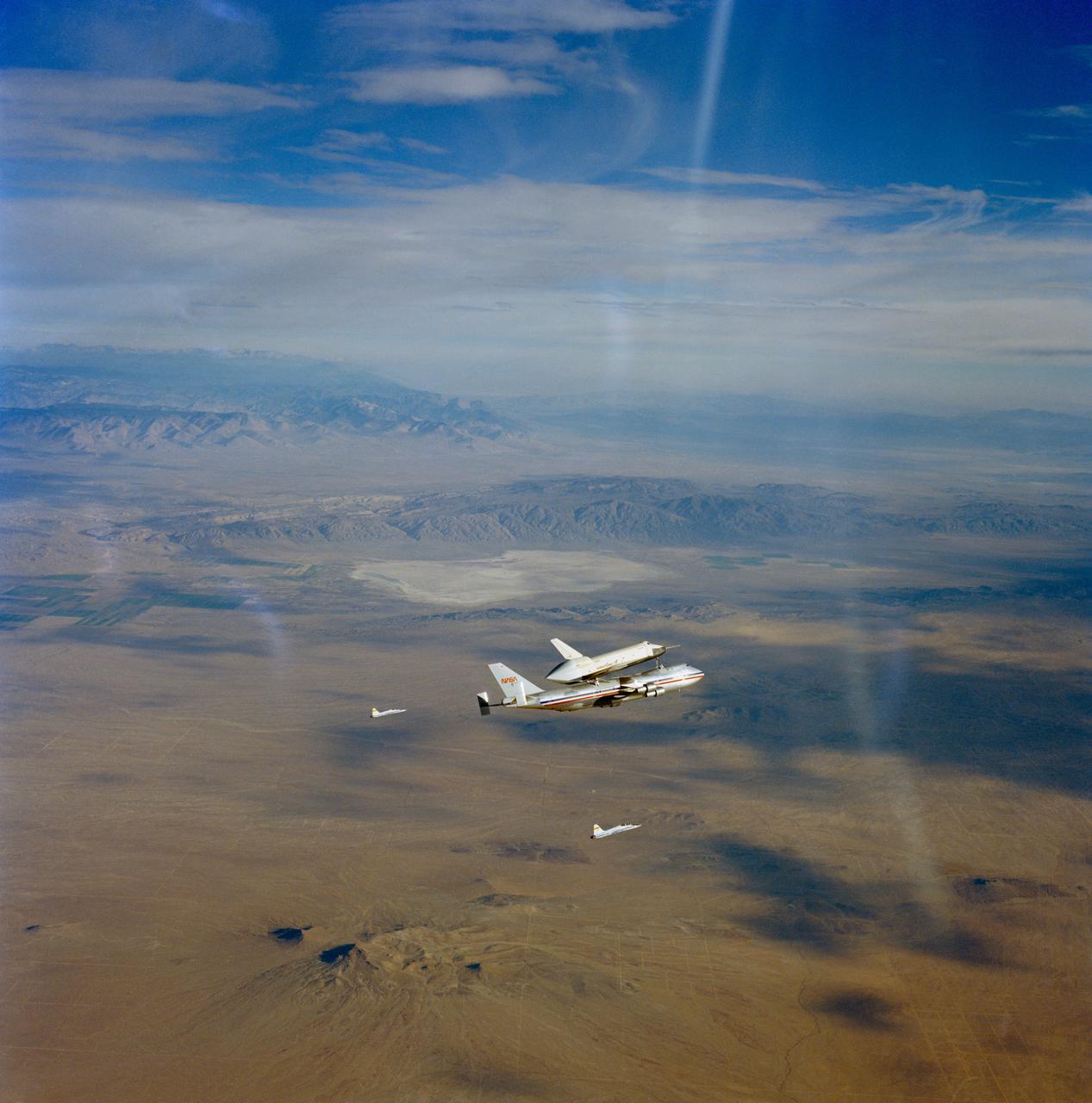
S77-28139 (13 Sept 1977) --- The Orbiter 101 "Enterprise" is seen riding "piggy-back" atope the NASA 747 carrier aircraft during the second free flight of the Shuttle Approach and Landing Tests (ALT) conducted on September 13, 1977, at the Dryden Flight Research Center in Southern California. Moments later the Orbiter 101 separated from the 747 and made a five-minute, 28-second unpowered flight before landing. Astronauts Joe H. Engle, commander, and Richard H. Truly, pilot, were the crew of the "Enterprise." two T-38 chase planes are seen in the background. The ALT free flights are designed to verify orbiter subsonic airworthiness, integrated systems operations and pilot-guided approach andlanding capability and satisfy prerequisites to automatic flight control and navigation mode. Astronaut Vance D. Brand took this picture while riding in T-38 chase plane number five. He used a 70mm Hasselblad camera with an 80mm lens.
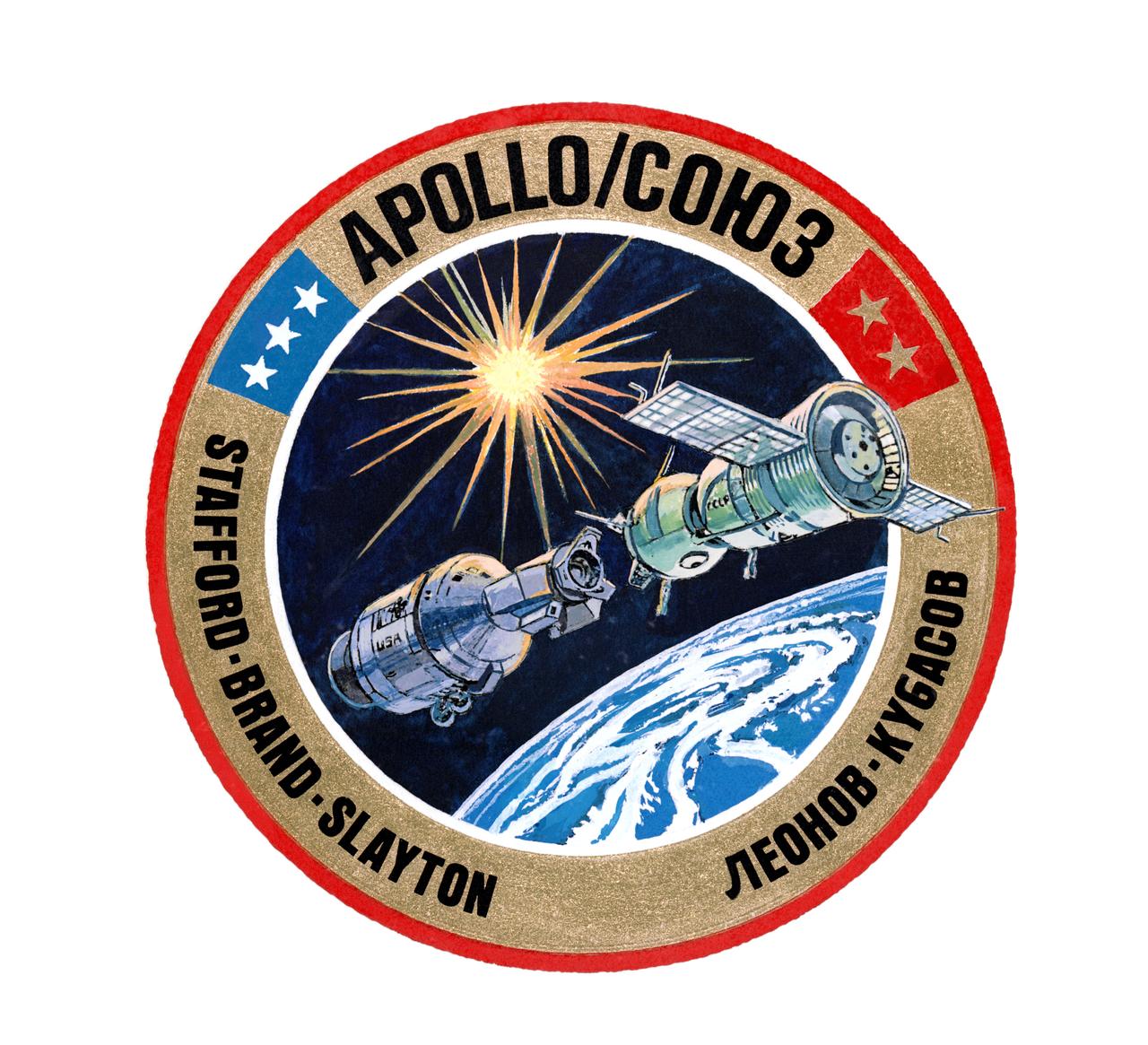
S75-20361 (27 Feb. 1975) --- This is the American crew insignia of the joint United States-USSR Apollo-Soyuz Test Project (ASTP) scheduled to take place in July 1975. Of circular design, the insignia has a colorful border area, outlined in red, with the names of the five crew members and the words Apollo in English and Soyuz in Russian around an artist?s concept of the Apollo and Soyuz spacecraft about to dock in Earth orbit. The bright sun and the blue and white Earth are in the background. The white stars on the blue background represent American astronauts Thomas P. Stafford, commander; Vance D. Brand, command module pilot; and Donald (Deke) K. Slayton, docking module pilot. The dark gold stars on the red background represent Soviet cosmonauts Aleksey A. Leonov, commander, and Valeriy N. Kubasov, engineer. Soyuz and Apollo will be launched separately from the USSR and United States, and will dock and remain together for as long as two days. The three Apollo astronauts will enter Soyuz and the two Soviet cosmonauts will visit the Apollo spacecraft via a docking module. The Russian word ?soyuz? means ?union? in English.
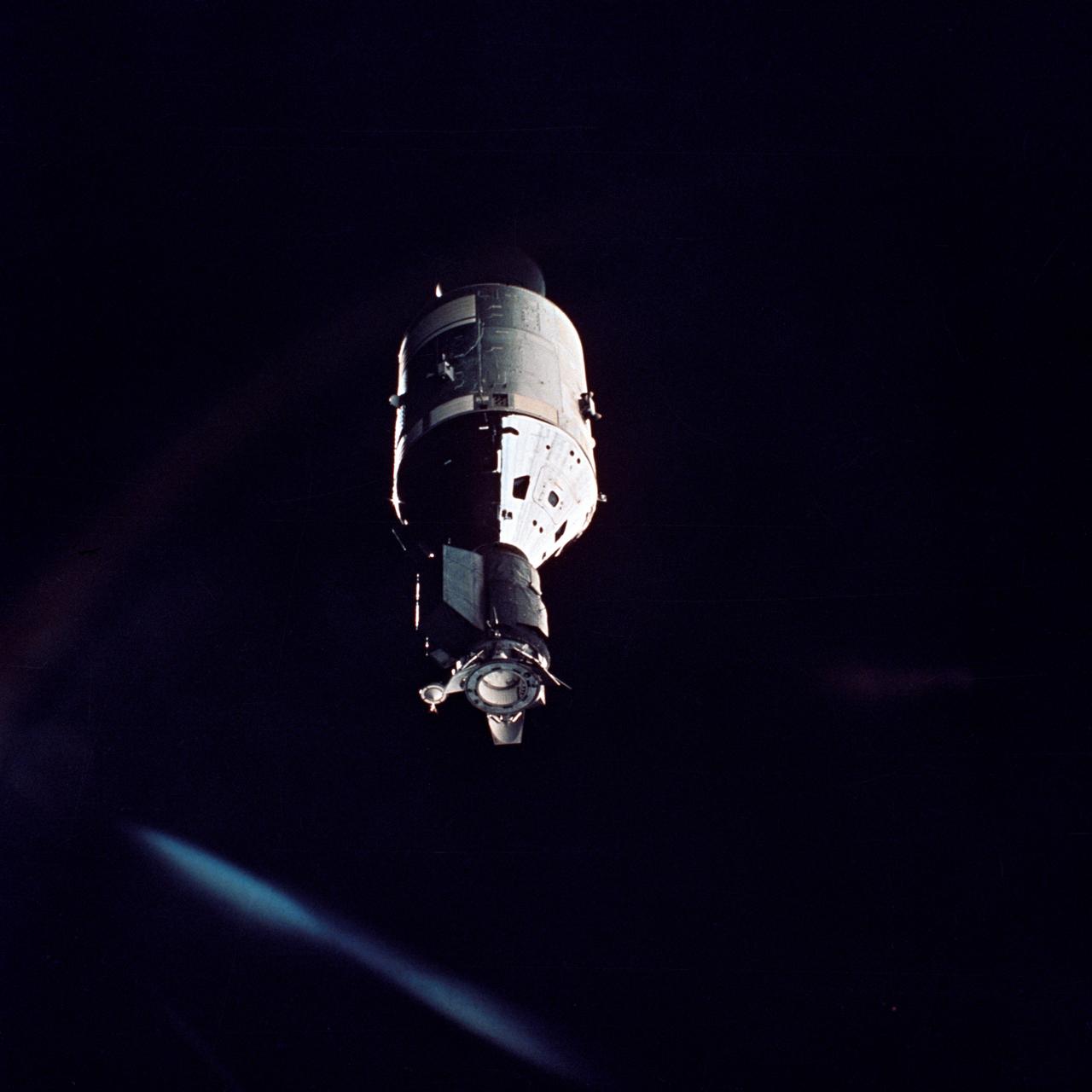
AST-32-2686 (17-19 July 1975) --- The American Apollo spacecraft as seen in Earth orbit from the Soviet Soyuz 19 spacecraft during the joint U.S.-USSR Apollo Soyuz Test Project (ASTP) mission. The Command and Service Module (CSM) and Docking Module (DM) are contrasted against a black-sky background. Light reflected in the camera streaks the image. Note the docking mechanism and docking target on the DM. On the left the bell-shaped engine nozzle of the service propulsion system protrudes from the rear of the Service Module (SM). The American and Soviet spacecraft were joined together in space for approximately 47 hours on July 17, 18, 19, 1975. This picture was furnished by the USSR in an exchange of photography taken during the ASTP flight. The Apollo crew consisted of astronauts Thomas P. Stafford, commander; Donald K. "Deke" Slayton, docking module pilot; and Vance D. Brand, command module pilot. The Soyuz 19 crew consisted of cosmonauts Aleksei A. Leonov, command pilot; and Valeri N. Kubasov, flight engineer.
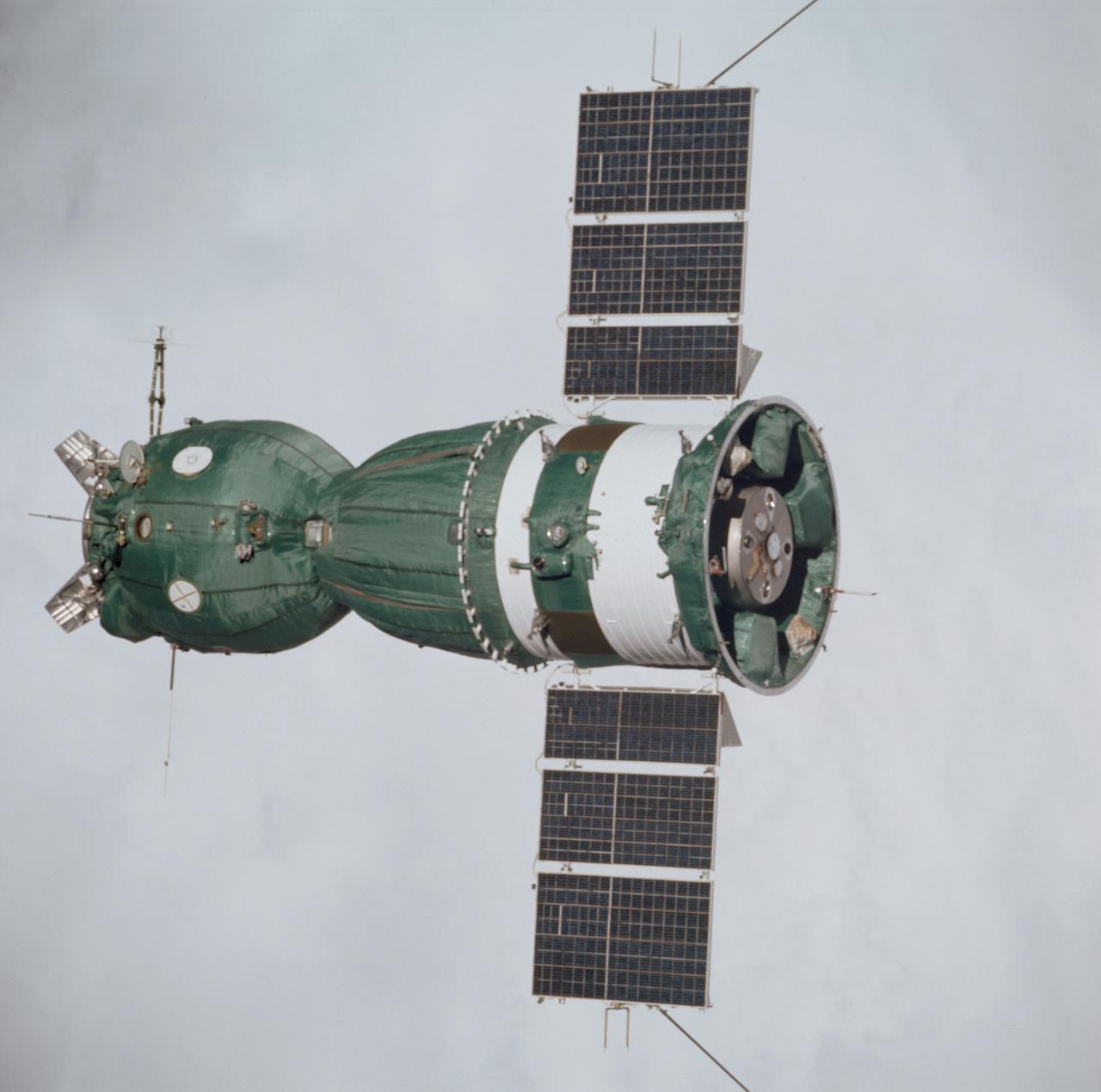
AST-01-056 (18 July 1975) --- An excellent view of the Soviet Soyuz spacecraft in Earth orbit, photographed from the American Apollo spacecraft during the joint U.S.-USSR Apollo-Soyuz Test Project (ASTP) docking mission in Earth orbit. The Soyuz is contrasted against a white-cloud background in this overhead view. The three major components of the Soyuz are the spherical-shaped Orbital Module, the bell-shaped Descent Vehicle and the cylindrical-shaped instrument Assembly Module from which two solar panels protrude. The docking system on the Orbital Module was specially designed to interface with the docking system on the Apollo's Docking Module. The ASTP astronauts and cosmonauts visited each other's spacecraft while the Soyuz and Apollo were docked in Earth orbit for two days. The Apollo crew consisted of astronauts Stafford, commander; Donald K. "Deke" Slayton, docking module pilot; and Vance D. Brand, command module pilot. The Soyuz 19 crew consisted of cosmonauts Leonov, command pilot; and Valeri N. Kubasov, flight engineer.
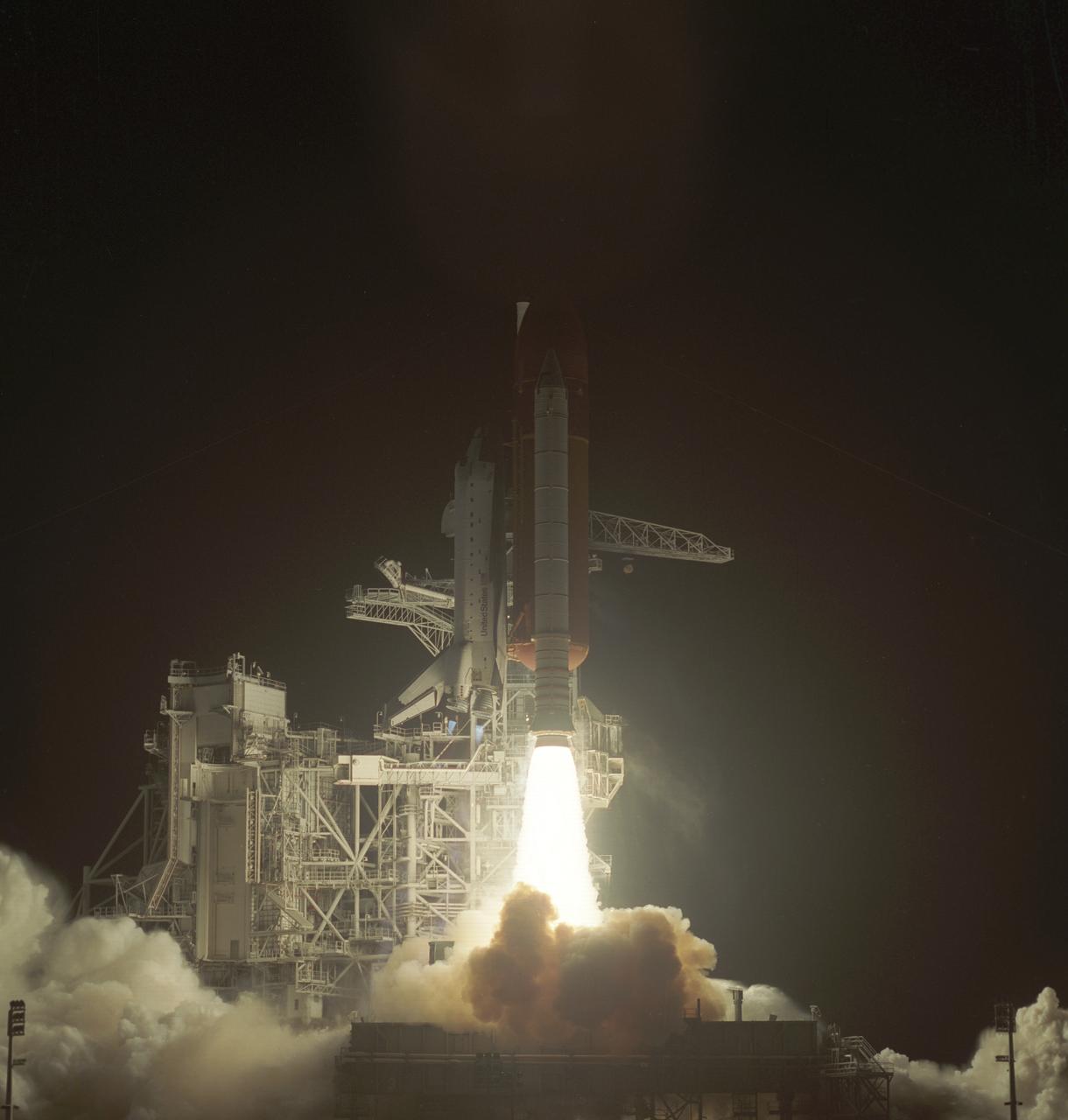
STS-35 lifted off December 2, 1990, at 1:19 am EST, aboard the Space Shuttle Orbiter Columbia. Her crew of eight included: Vance D. Brand, commander; Colonel Guy S. Gardner, pilot; mission specialists Dr. Robert A. R. Parker, John M. (Mike) Lounge, and Dr. Jeffery A. Hoffman; and payload specialists Dr. Kenneth H. Nordsieck, Dr. Samual T. Durrance, and Dr. Ronald A. Parise. The primary objective of the mission was round the clock observation of the celestial sphere in ultraviolet and X-Ray astronomy with the Astro-1 Observatory which consisted of four telescopes: the Hopkins Ultraviolet Telescope (HUT); the Wisconsin Ultraviolet Photo-Polarimeter Experiment (WUPPE); the Ultraviolet Imaging Telescope (UIT); and the Broad Band X-Ray Telescope (BBXRT). Due to loss of data used for pointing and operating the ultraviolet telescopes, Marshall Space Flight Center ground teams were forced to aim the telescopes with fine tuning by the flight crew.
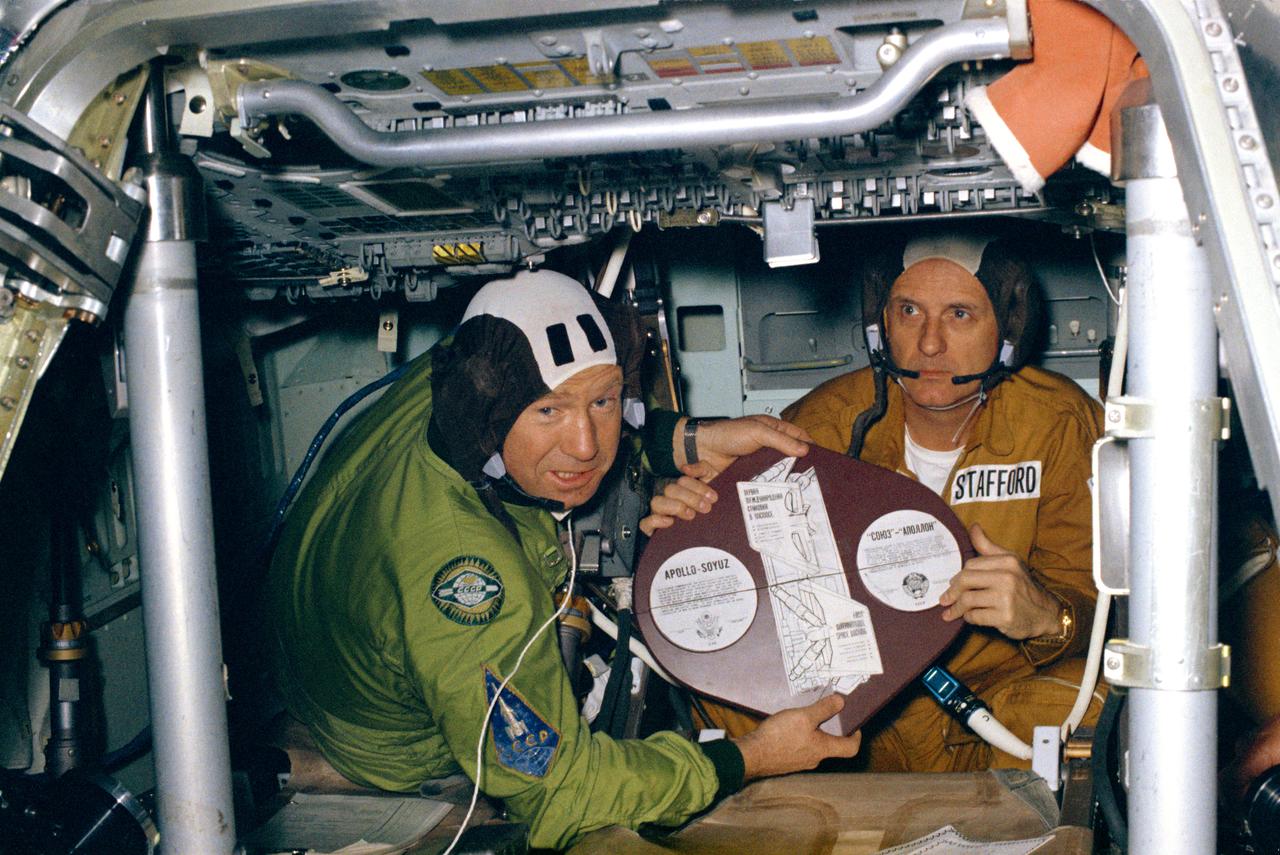
S75-25823 (February 1975) --- Cosmonaut Aleksei A. Leonov (left) and astronaut Thomas P. Stafford display the Apollo Soyuz Test Project (ASTP) commemorative plaque. The two commanders, of their respective crews, are in the Apollo Command Module (CM) trainer at Building 35 at NASA's Johnson Space Center (JSC). Two plaques divided into four quarters each will be flown on the ASTP mission. The American ASTP Apollo crew will carry the four United States quarter pieces aboard Apollo; and the Soviet ASTP Soyuz 19 crew will carry the four USSR quarter sections aboard Soyuz. The eight quarter pieces will be joined together to form two complete commemorative plaques after the two spacecraft rendezvous and dock in Earth orbit. One complete plaque then will be returned to Earth by the astronauts; and the other complete plaque will be brought back by the cosmonauts. The plaque is written in both English and Russian. The Apollo crew will consist of astronauts Thomas P. Stafford, commander; Donald K. "Deke" Slayton, docking module pilot; Vance D. Brand, command module pilot. The Soyuz 19 crew will consist of cosmonauts Aleksei A. Leonov, command pilot; and Valeri N. Kubasov, flight engineer.
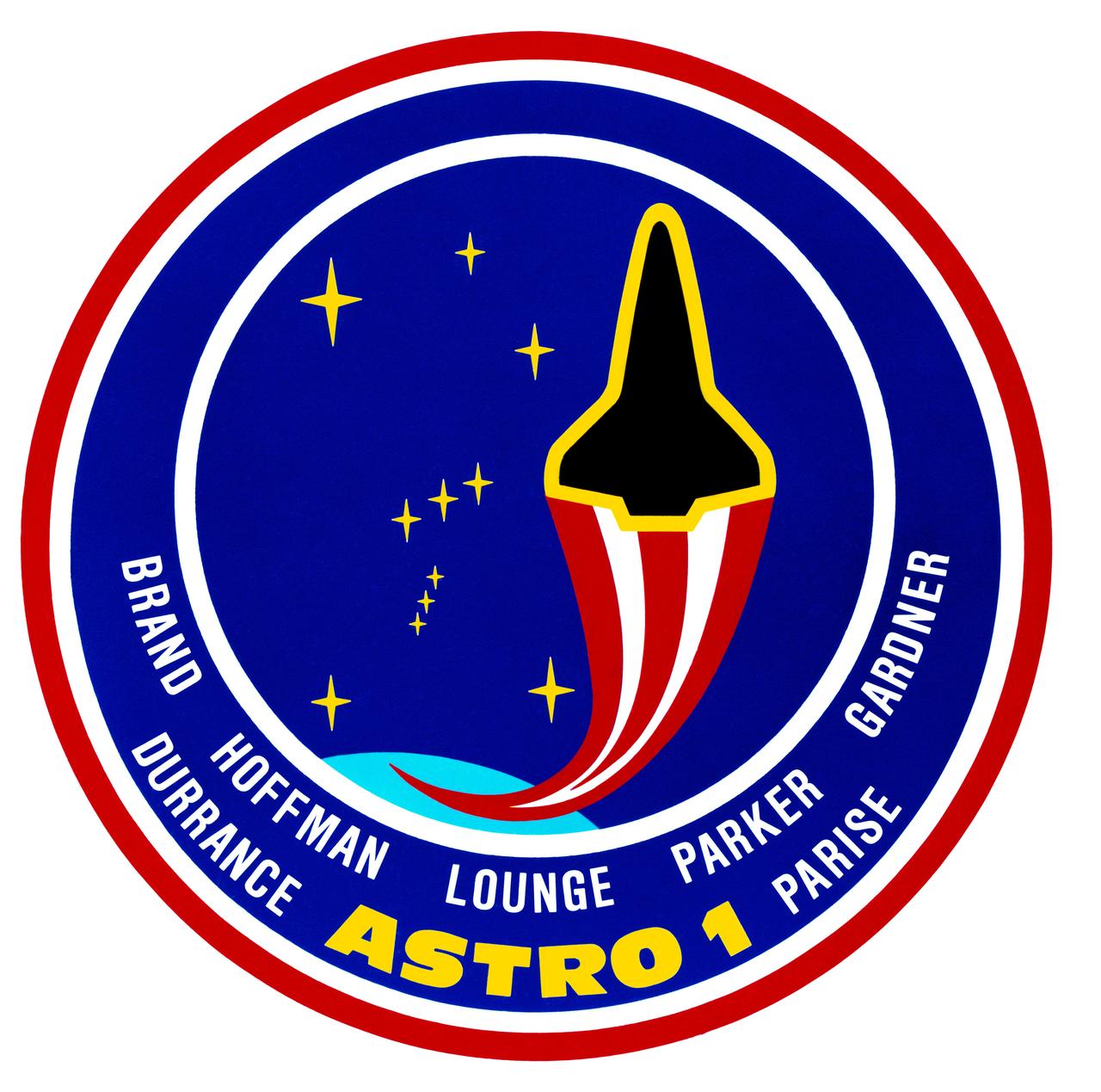
STS035-S-001 (29 Jan. 1990) --- Designed by the crew members assigned to the mission, the STS-35 crew patch symbolizes the space shuttle flying above Earth's atmosphere to better study the many celestial objects of the Universe, represented by the constellation Orion. The primary payload of STS-35 is ASTRO-l, a group of ultraviolet telescopes and the Broad-Band X-Ray Telescope. Crew members on the flight are astronauts Vance D. Brand, commander; Guy S. Gardner, pilot; and Jeffrey A. Hoffman, John M. (Mike) Lounge, Robert A. R. Parker, all mission specialists; along with the two payload specialists - Samuel T. Durrance and Ronald Parise. The NASA insignia design for space shuttle flights is reserved for use by the astronauts and for other official use as the NASA Administrator may authorize. Public availability has been approved only in the forms of illustrations by the various news media. When and if there is any change in this policy, which is not anticipated, the change will be publicly announced. Photo credit: NASA
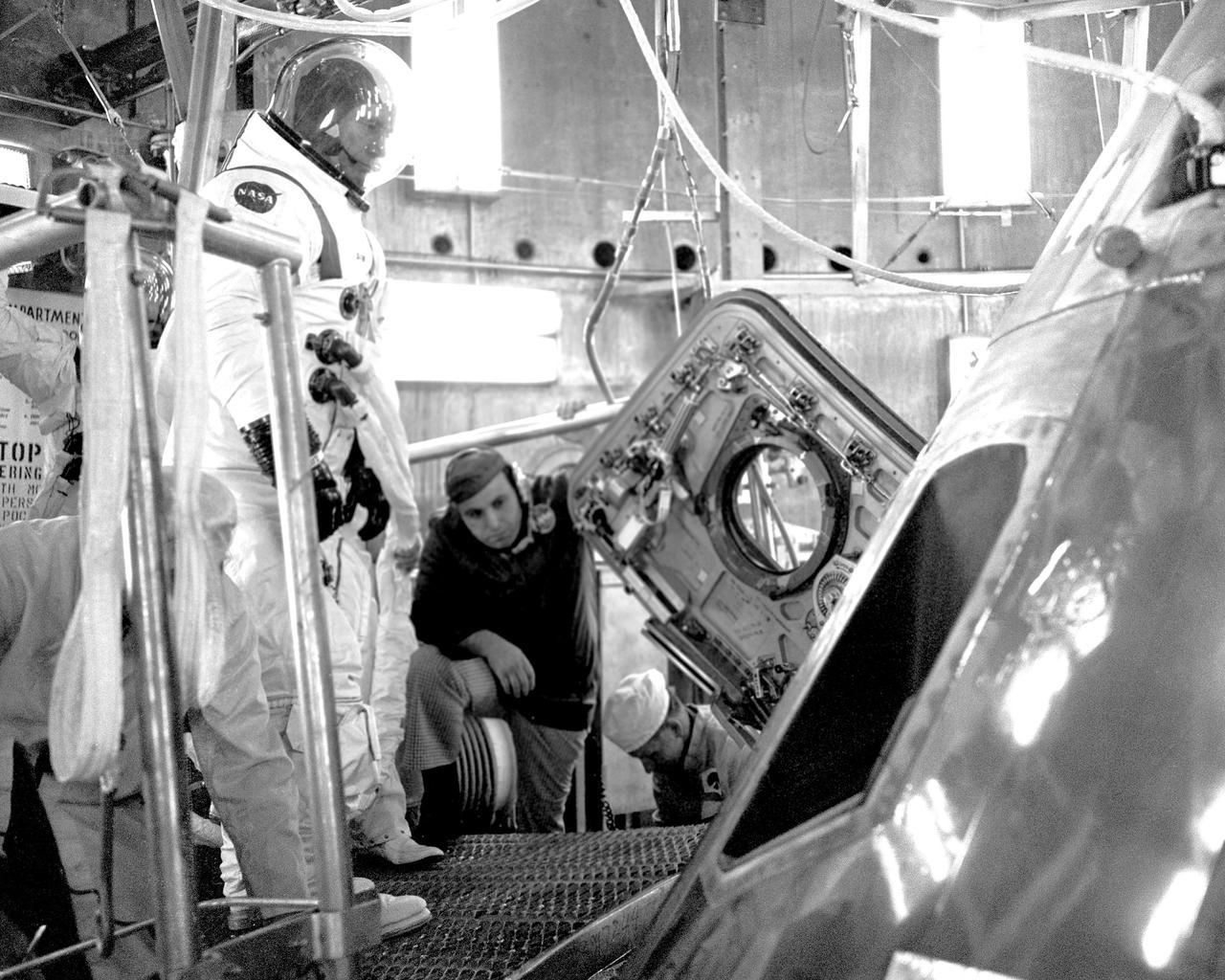
CAPE CANAVERAL, Fla. – The docking module and Apollo spacecraft for this summer's joint manned mission with the Soviet were mated in the Manned Spacecraft Operations Building today. The docking module will provide a mechanical and electrical link between the Apollo and Soyuz spacecraft while they are docked and also serve as an airlock. On hand to participate in the operation were two members of the Apollo prime crew, Astronauts Donald K. Slayton and Vance D. Brand. Launch of the Saturn 1B/Apollo from Complex 39 is scheduled for July 15. The first international crewed spaceflight was a joint U.S.-U.S.S.R. rendezvous and docking mission. The Apollo-Soyuz Test Project, or ASTP, took its name from the spacecraft employed: the American Apollo and the Soviet Soyuz. The three-man Apollo crew lifted off from Kennedy Space Center aboard a Saturn IB rocket on July 15, 1975, to link up with the Soyuz that had launched a few hours earlier. A cylindrical docking module served as an airlock between the two spacecraft for transfer of the crew members. Photo credit: NASA