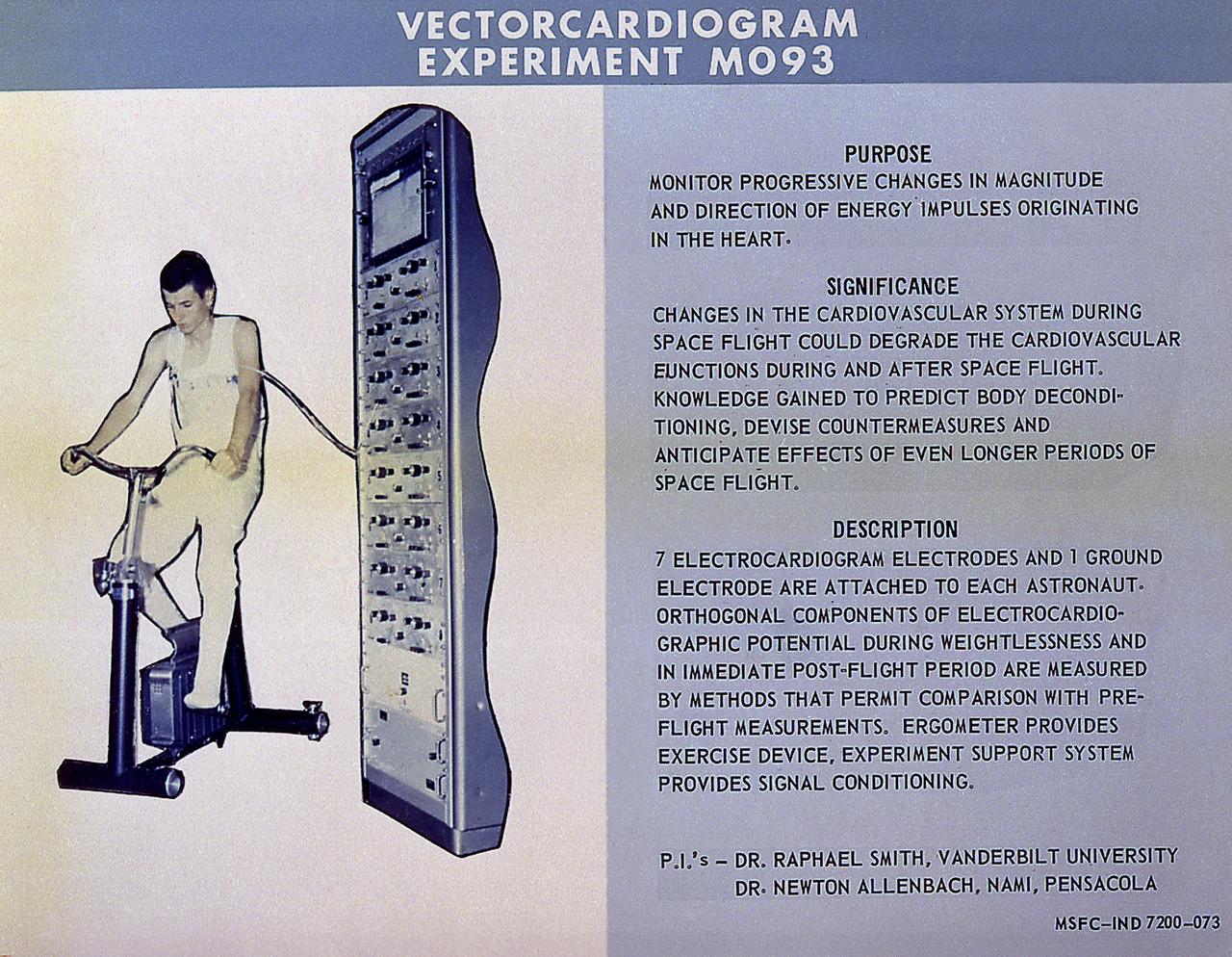
This chart details Skylab's Vectorcardiogram experiment and facility, a medical study to measure the activity of the heart by recording electric signals (vectorcardiographic potentials) of each astronaut during preflight, inflight, and post-flight periods and obtain information on changes in heart functions induced by flight conditions. Vectorcardiograms were taken with a bicycle ergometer (part of Experiment M171) at regular intervals throughout the mission while the crewmen were at rest, and before, during, and after specific exercise periods. This instrument enabled an astronaut to exercise at selected levels of energy consumption. The Marshall Space Flight Center had program management responsibility for the development of Skylab hardware and experiments.
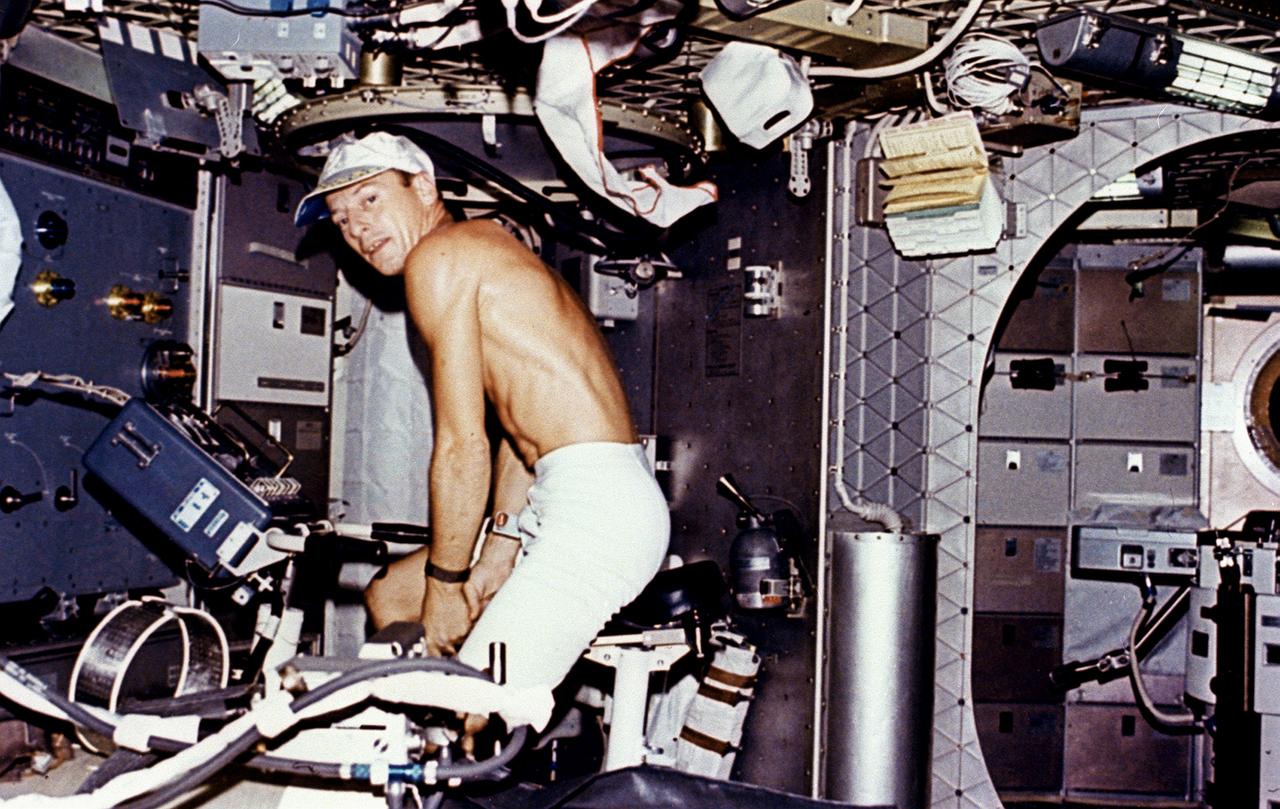
This Skylab-2 onboard photograph shows astronaut Charles "Pete" Conrad exercising on a stationary bicycle (ergometer) used for monitoring the metabolism of the astronauts. The ergometer was used to conduct both Vectorcardiogram experiment (M093) and Metabolic Activity experiment (M171). Experiment M093 was a medical evaluation designed to monitor changes in astronauts' cardiovascular systems, while Experiment M171 was to measure astronauts' metabolic changes during long-duration space missions.
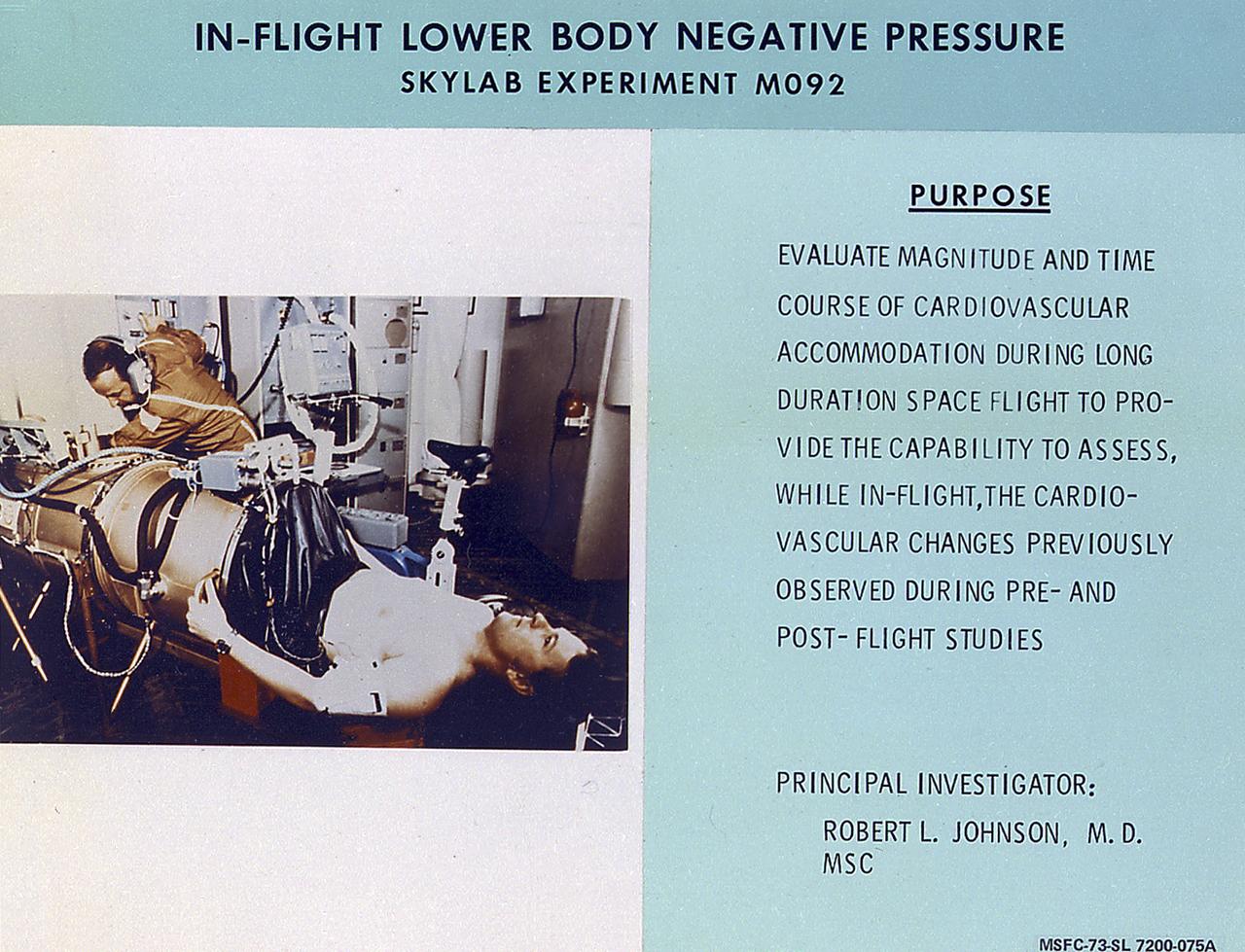
This chart details Skylab's In-Flight Lower Body Negative Pressure experiment facility, a medical evaluation designed to monitor changes in astronauts' cardiovascular systems during long-duration space missions. This experiment collected in-flight data for predicting the impairment of physical capacity and the degree of orthostatic intolerance to be expected upon return to Earth. Data to be collected were blood pressure, heart rate, body temperature, vectorcardiogram, lower body negative pressure, leg volume changes, and body mass. The Marshall Space Flight Center had program management responsibility for the development of Skylab hardware and experiments.
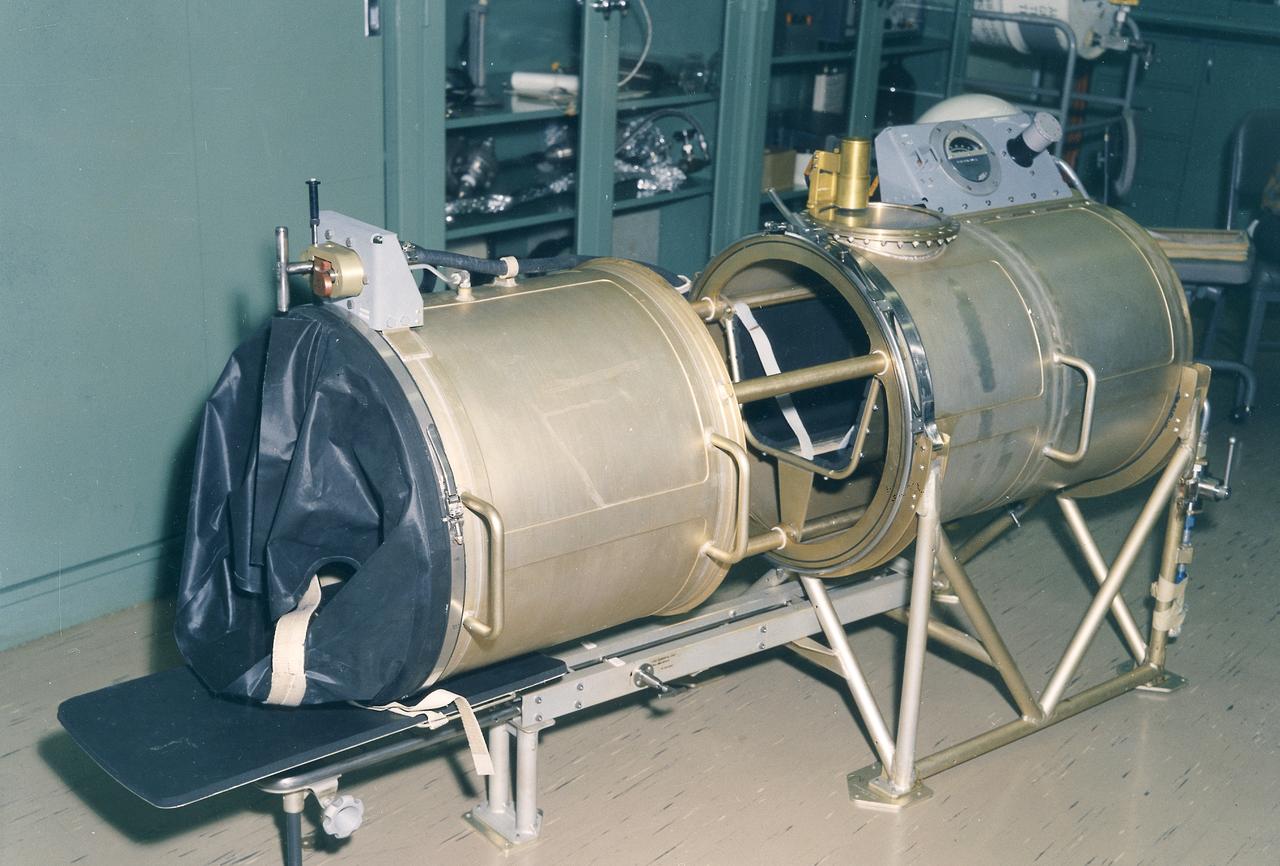
This 1970 photograph shows Skylab's In-Flight Lower Body Negative Pressure experiment facility, a medical evaluation designed to monitor changes in astronauts' cardiovascular systems during long-duration space missions. This experiment collected in-flight data for predicting the impairment of physical capacity and the degree of orthostatic intolerance to be expected upon return to Earth. Data to be collected were blood pressure, heart rate, body temperature, vectorcardiogram, lower body negative pressure, leg volume changes, and body mass. The Marshall Space Flight Center had program management responsibility for the development of Skylab hardware and experiments.
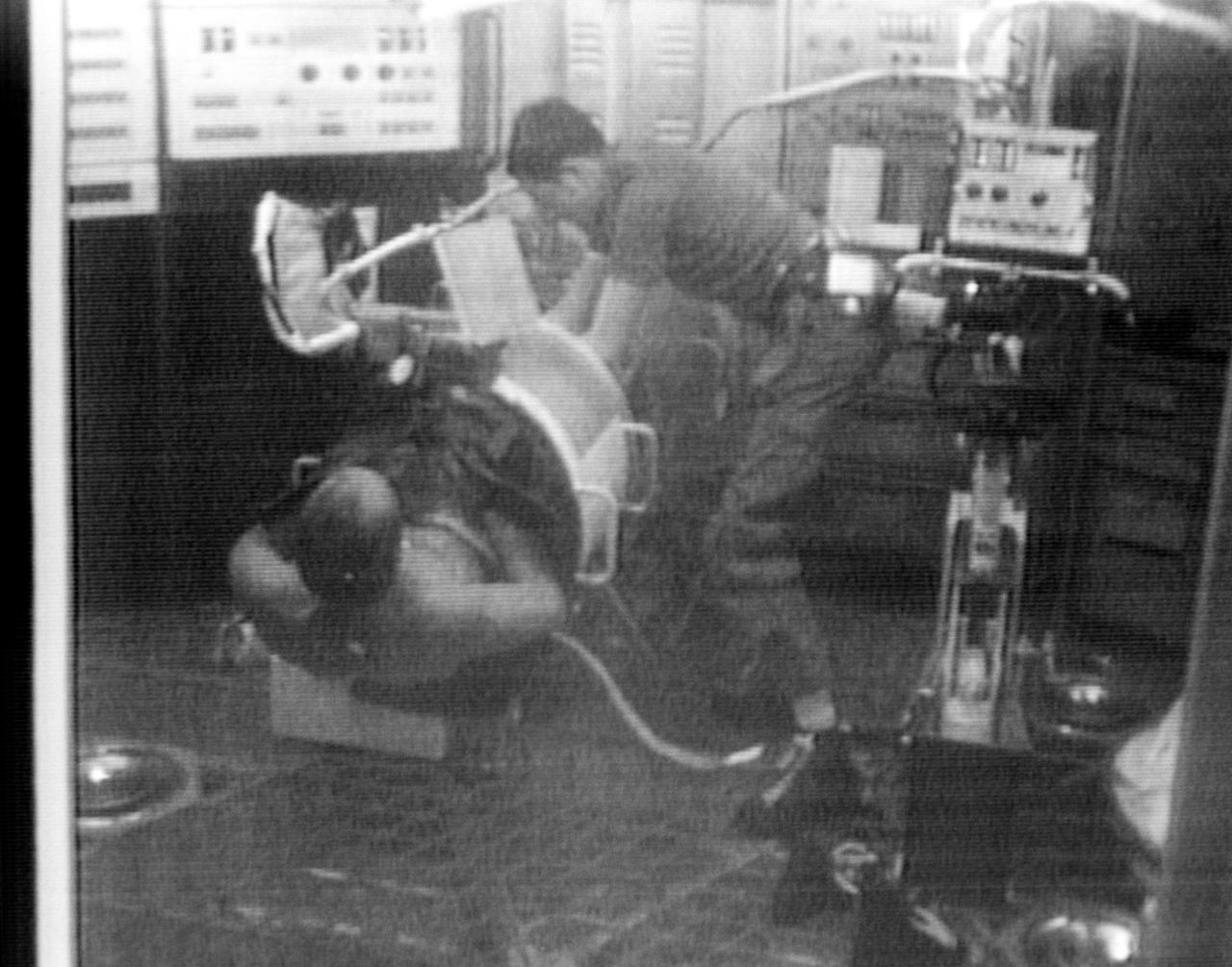
S73-27707 (9 June 1973) --- Astronaut Charles Conrad Jr., Skylab 2 commander, serves as test subject for the Lower Body Negative Pressure (MO92) Experiment, as seen in this reproduction taken from a color television transmission made by a TV camera aboard the Skylab 1/2 space station cluster in Earth orbit. Scientist-astronaut Joseph P. Kerwin, Skylab 2 science pilot, assists Conrad into the LBNP device. Kerwin served as monitor for the experiment. The purpose of the MO92 experiment is to provide information concerning the time course of cardiovascular adaptation during flight, and to provide inflight data for predicting the degree of orthostatic intolerance and impairment of physical capacity to be expected upon return to Earth environment. The data collected in support of MO92 blood pressure, heart rate, body temperature, vectorcardiogram, LBNPD pressure, leg volume changes, and body weight. Photo credit: NASA
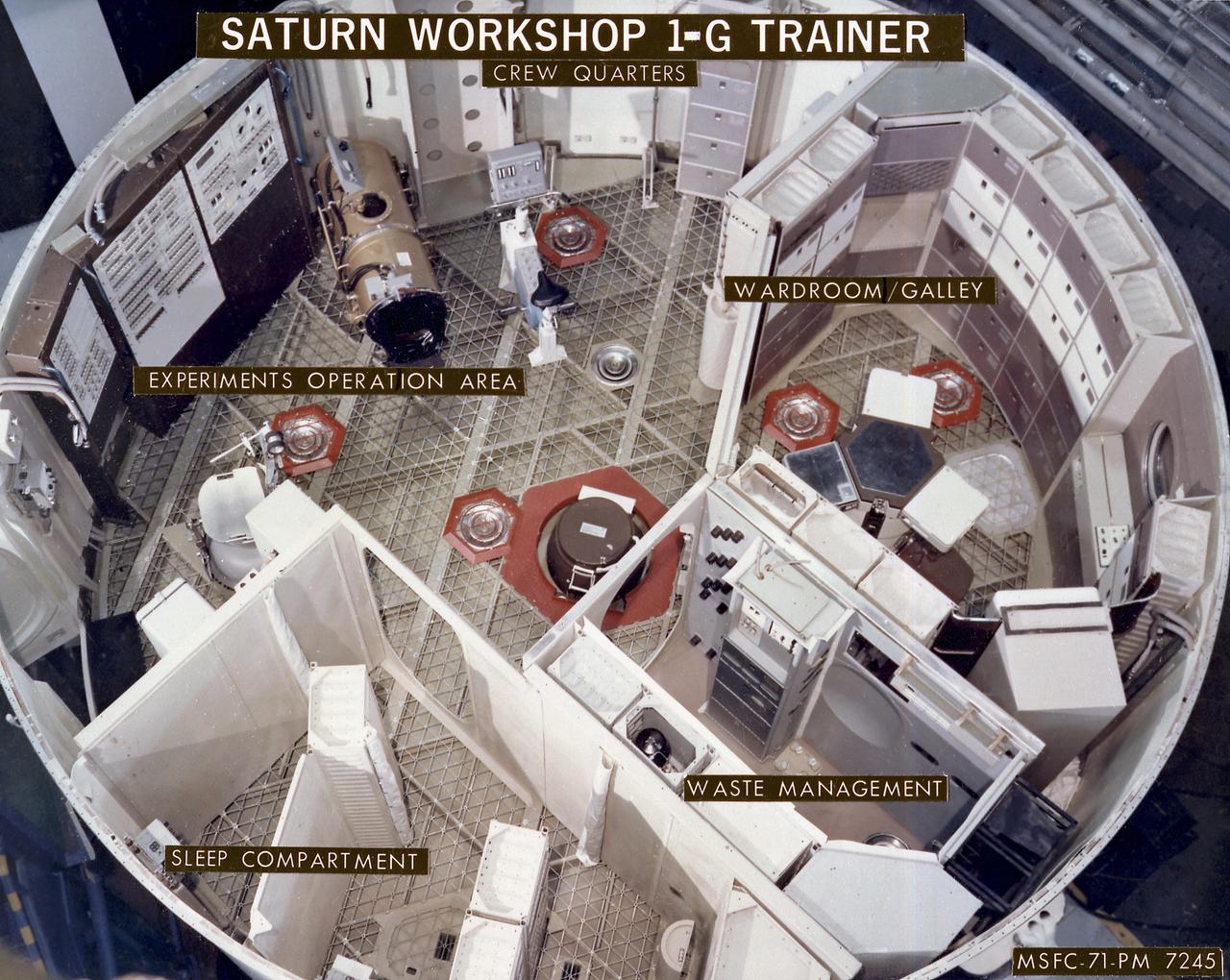
This image depicts a layout of the Skylab workshop 1-G trainer crew quarters. At left, in the sleep compartment, astronauts slept strapped to the walls of cubicles and showered at the center. Next right was the waste management area where wastes were processed and disposed. Upper right was the wardroom where astronauts prepared their meals and foods were stored. In the experiment operation area, upper left, against the far wall, was the lower-body negative-pressure device (Skylab Experiment M092) and the Ergometer for the vectorcardiogram experiment (Skylab Experiment M063). The trainers and mockups were useful in the developmental phase, while engineers and astronauts were still working out optimum designs. They provided much data applicable to the manufacture of the flight articles.