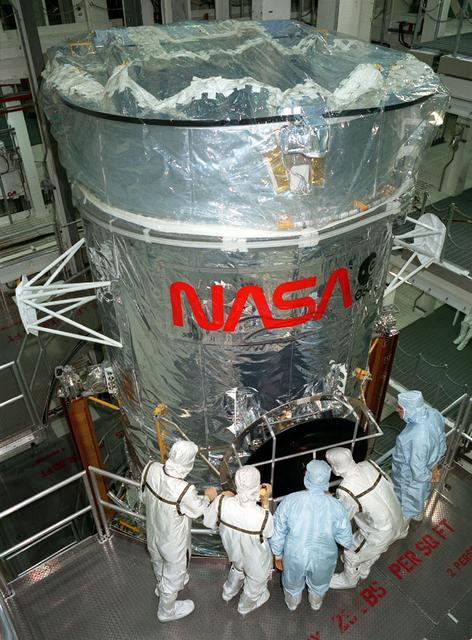
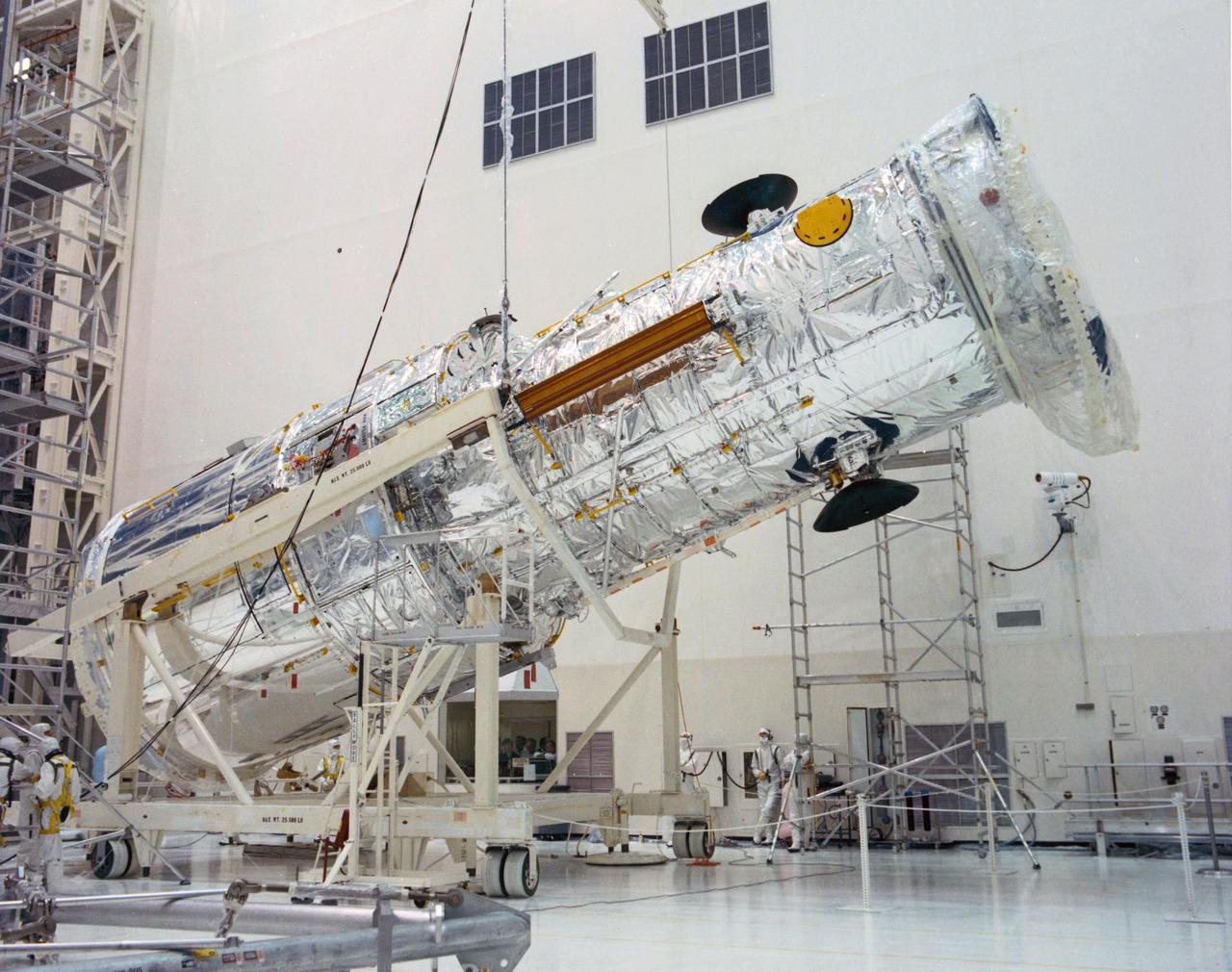
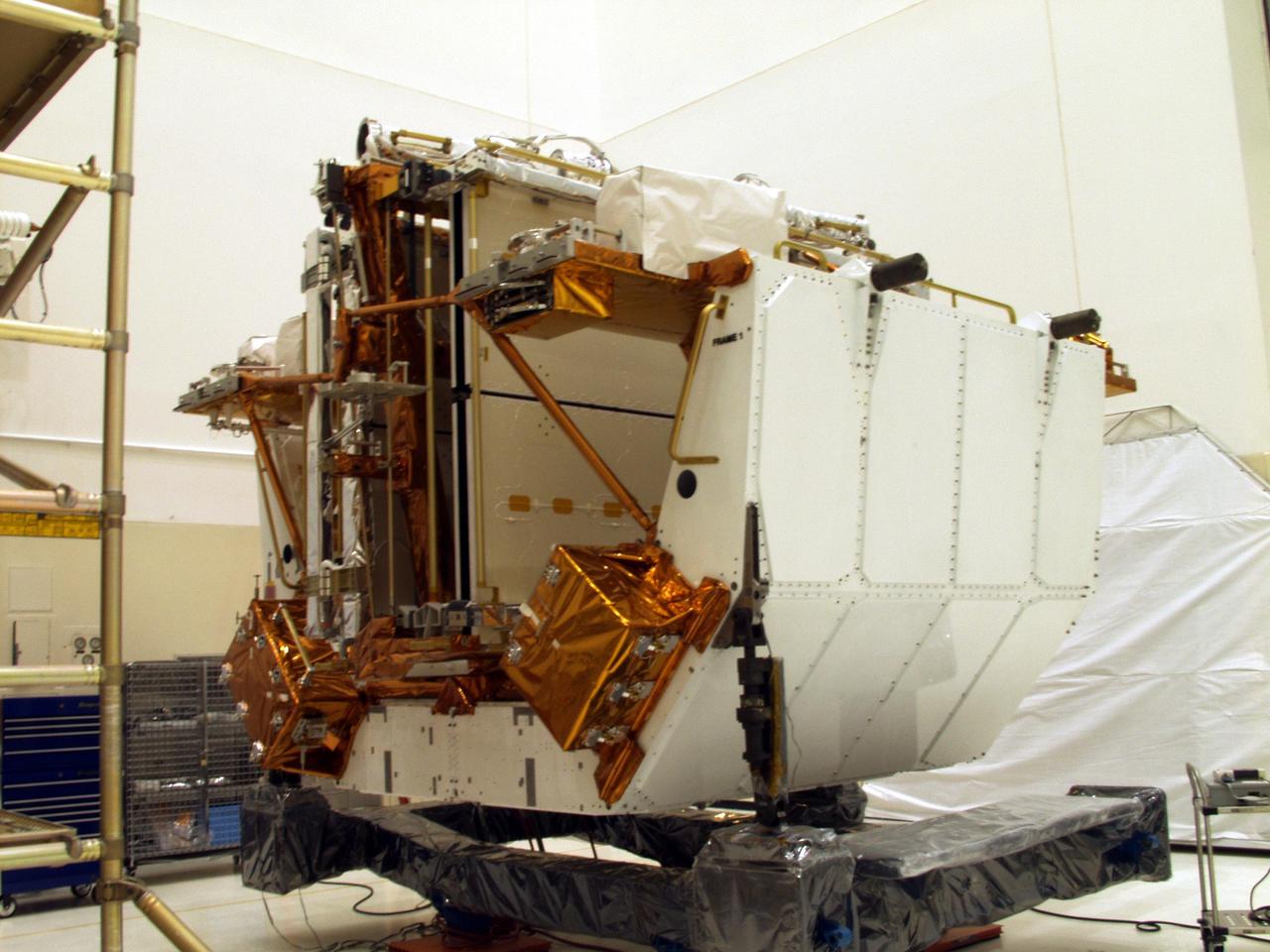
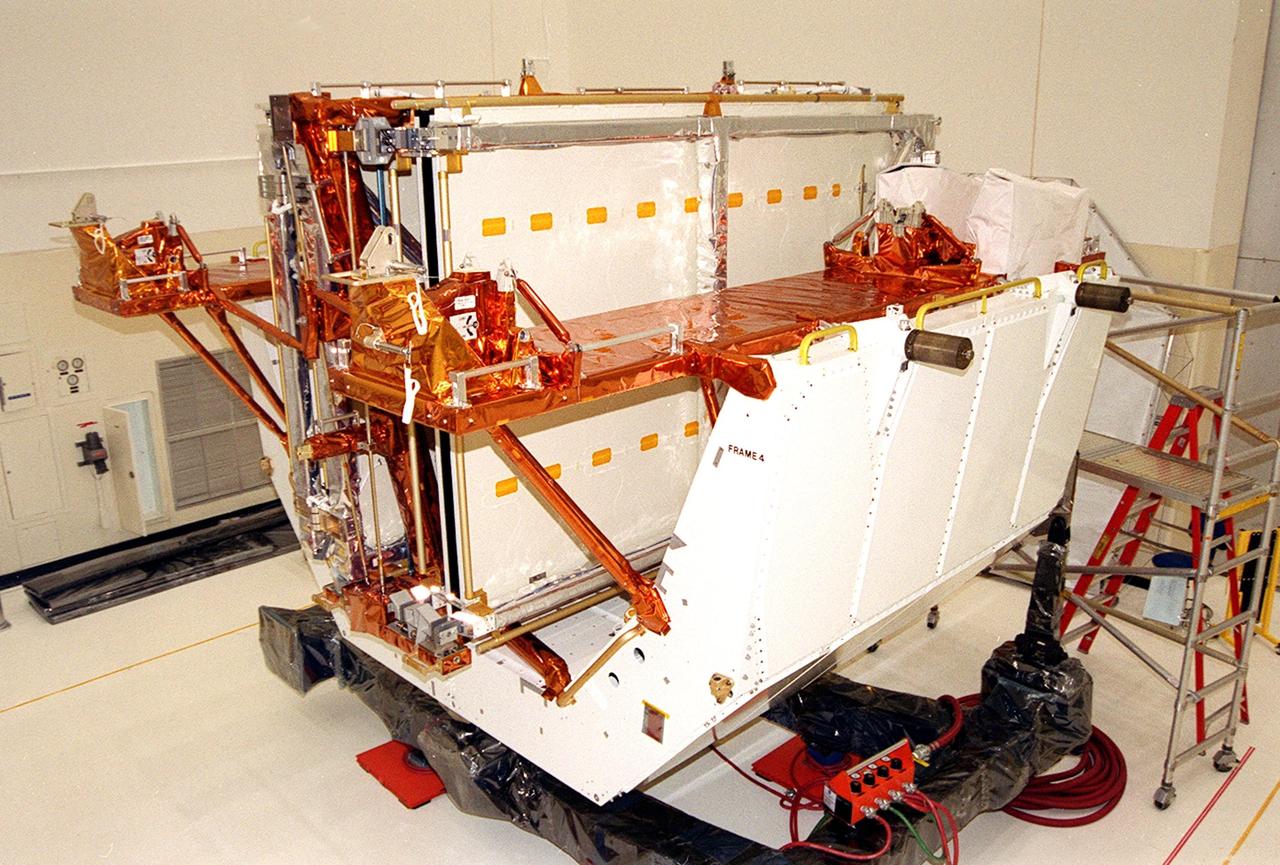
The Hubble Space Telescope (HST) pictured in the Vertical Processing Facility (VPF) support fixture during final testing and verification at the Lockheed assembly plant.
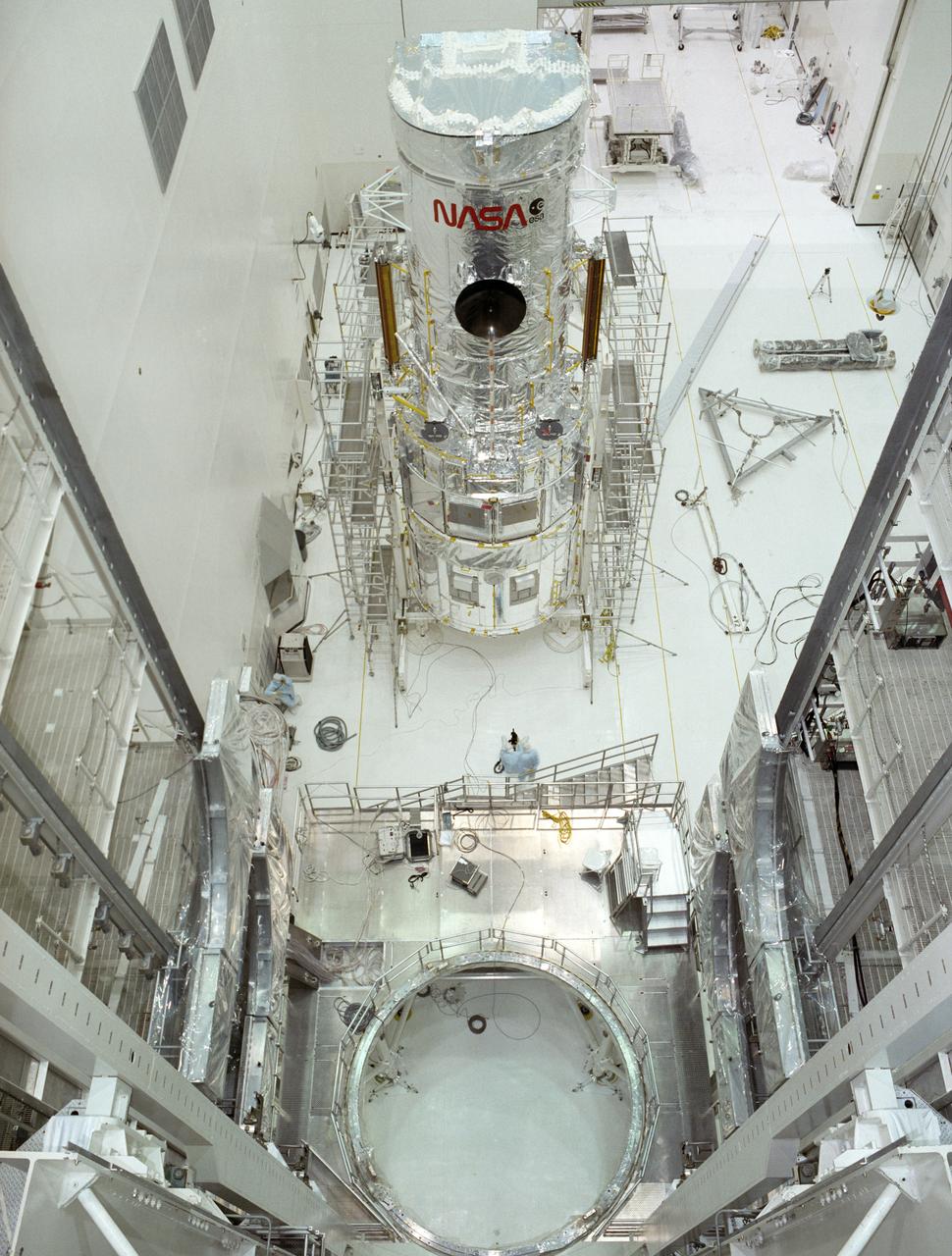
Ready for transportation to the Kennedy Space Center, the Hubble Space Telescope (HST) is pictured onboard the strongback dolly at the Vertical Processing Facility (VPF) at the Lockheed assembly plant upon completion of final testing and verification.
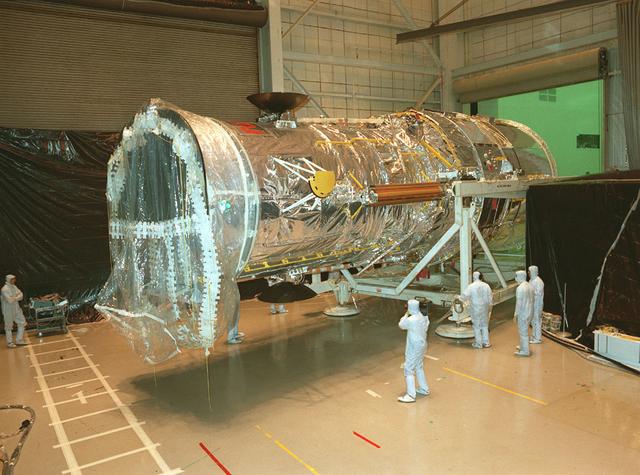
The Hubble Space Telescope (HST) being transferred from the Vertical Assembly Test Area (VATA) to the High Bay at the Lockheed assembly plant in preparation for transport to the Kennedy Space Center (KSC) after final testing and verification.
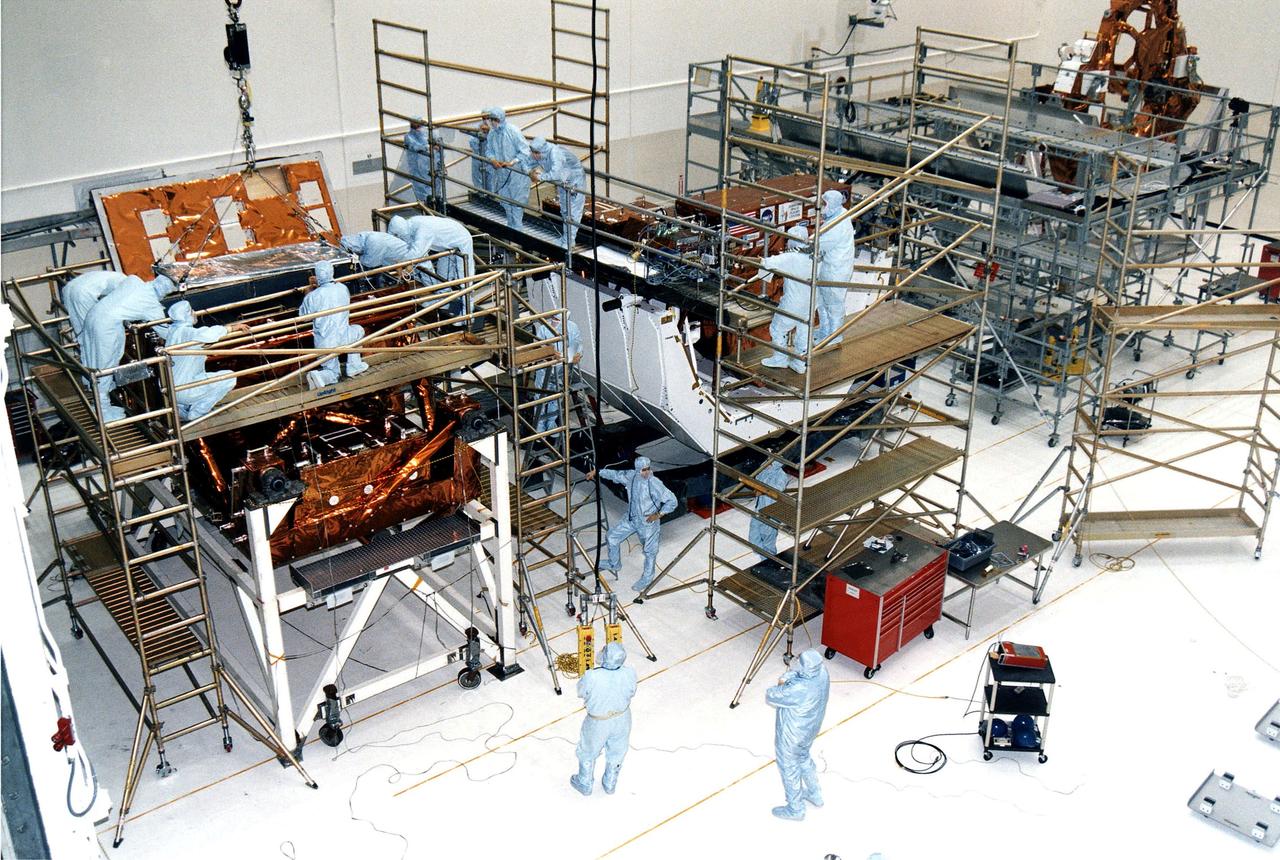
KENNEDY SPACE CENTER, FLA. - Workers in KSC's Vertical Processing Facility make final prelaunch prepartions to various payload elements that are part of the second Hubble Space Telescope (HST) servicing mission, STS-82. Liftoff is targeted Feb. 11 aboard Discovery with a crew of seven.
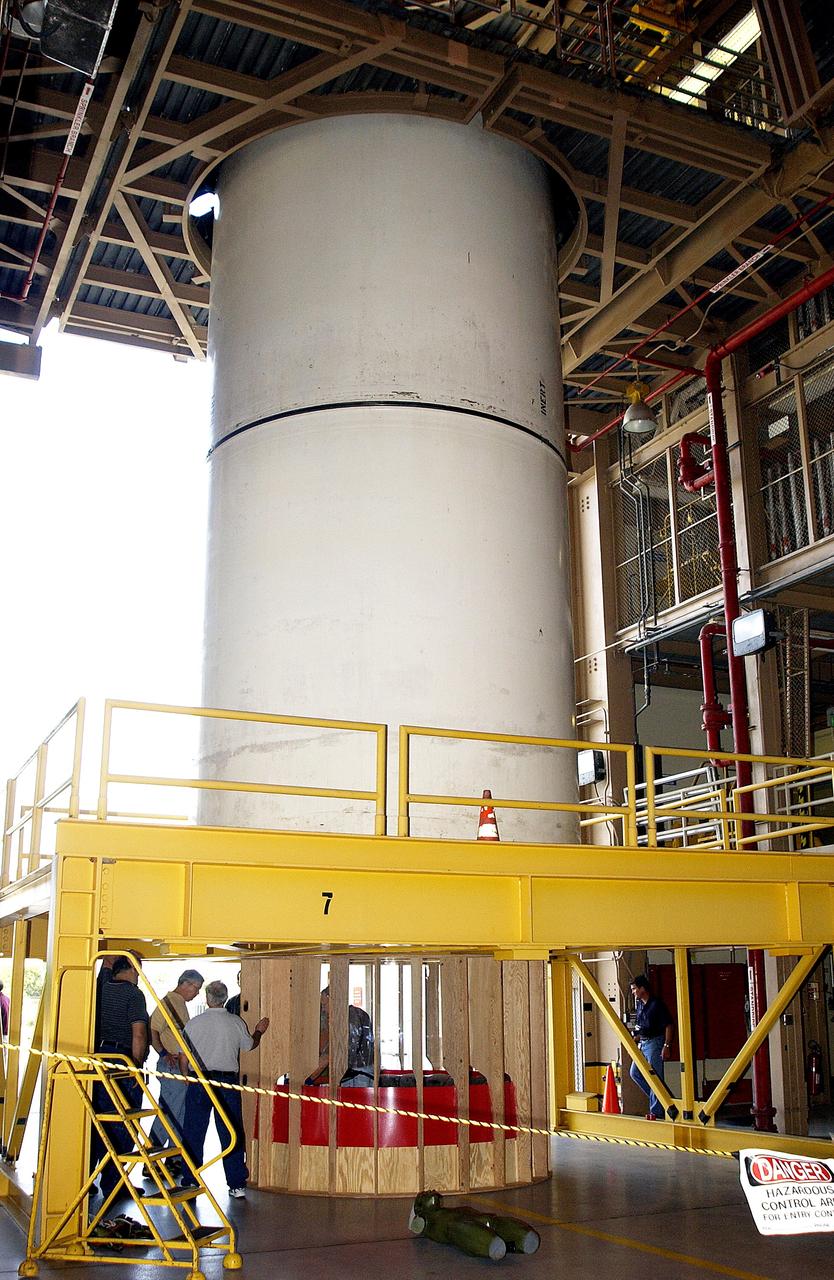
KENNEDY SPACE CENTER, FLA. - At the Rotation, Processing and Surge Facility stand a mockup of two segments of a solid rocket booster (SRB) being used to test the feasibility of a vertical SRB propellant grain inspection, required as part of safety analysis.
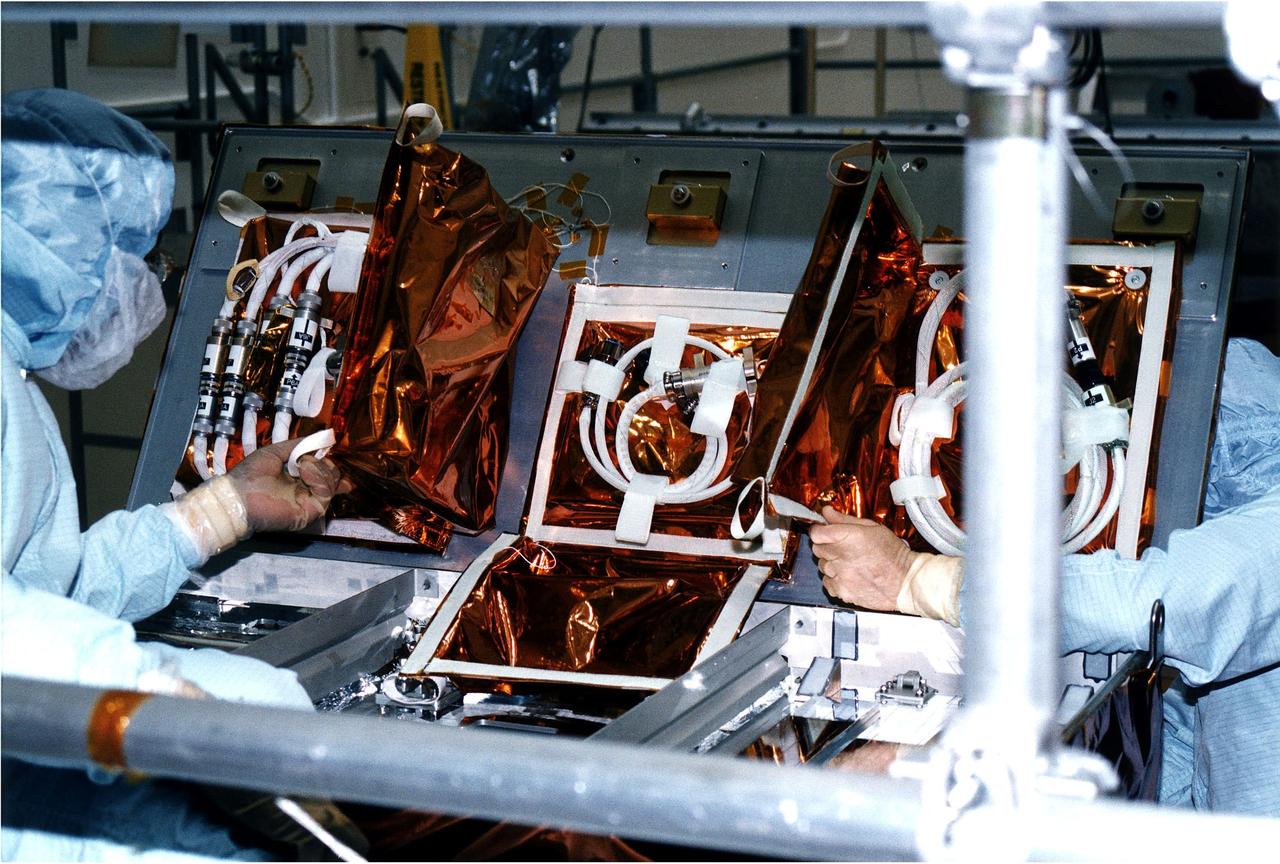
KENNEDY SPACE CENTER, FLA. - Workers in KSC's Vertical Processing Facility stow cable and adapters into a protective enclosure for the second Hubble Space Telescope servicing mission, STS-82. Liftoff aboard Discovery is targeted Feb. 11 with a crew of seven.

CAPE CANAVERAL, Fla. -- An aerial photo of the Vertical Processing Facility, which processes and integrates vertical payloads and upper stages before launch. It is located in the NASA Kennedy Space Center Industrial Area.
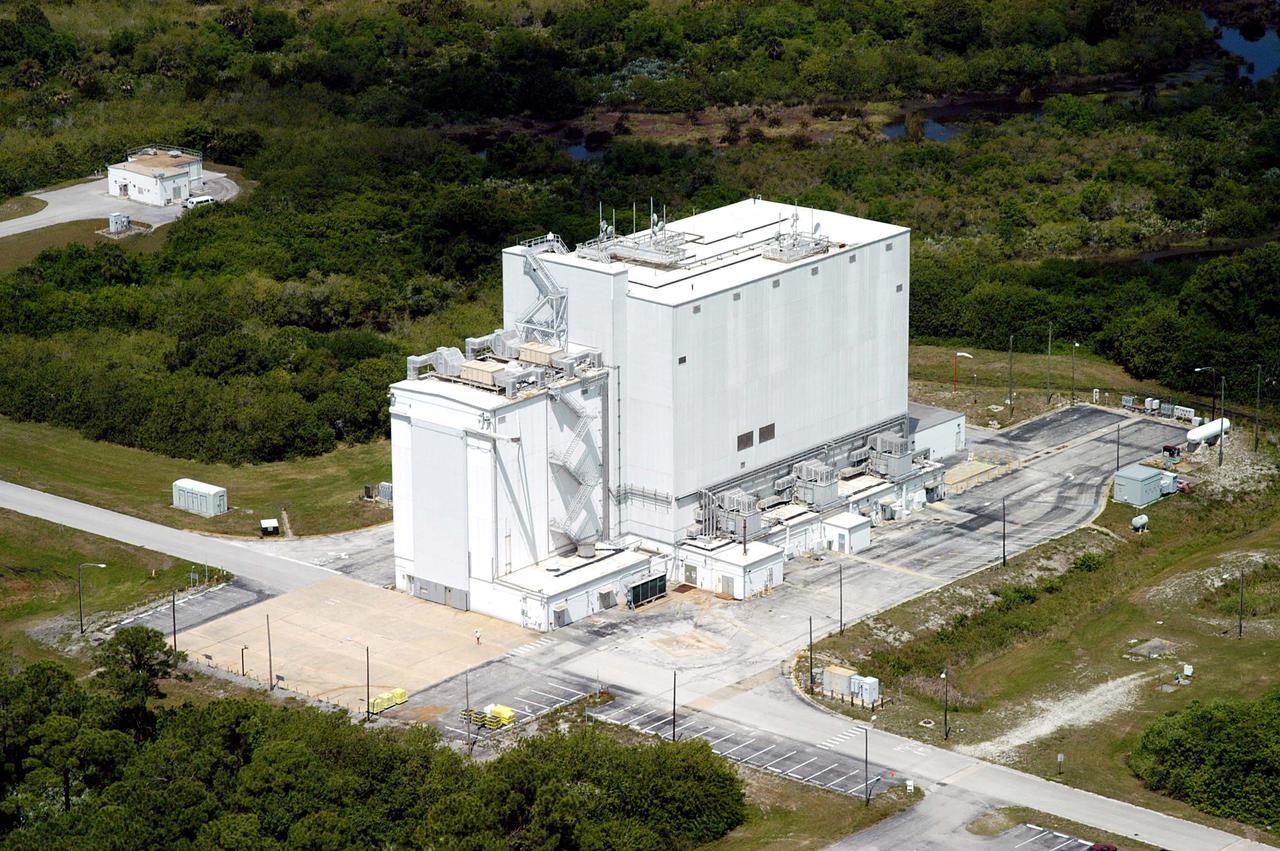
CAPE CANAVERAL, Fla. -- An aerial photo of the Vertical Processing Facility, which processes and integrates vertical payloads and upper stages before launch. It is located in the NASA Kennedy Space Center Industrial Area.
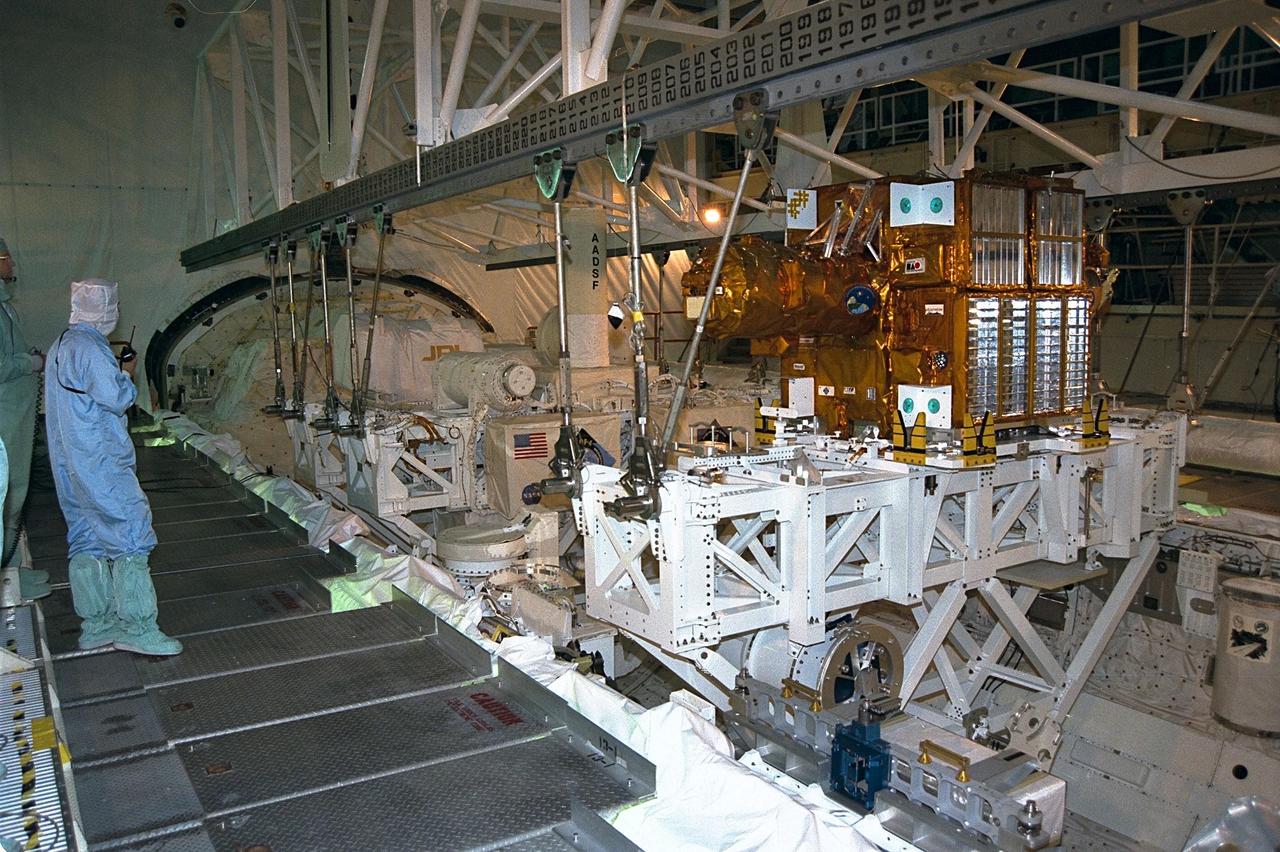
The Spartan payload, which flew on STS-87, is removed from Columbia's cargo bay in Orbiter Processing Facility Bay 3 and will be transported to the Vertical Processing Facility
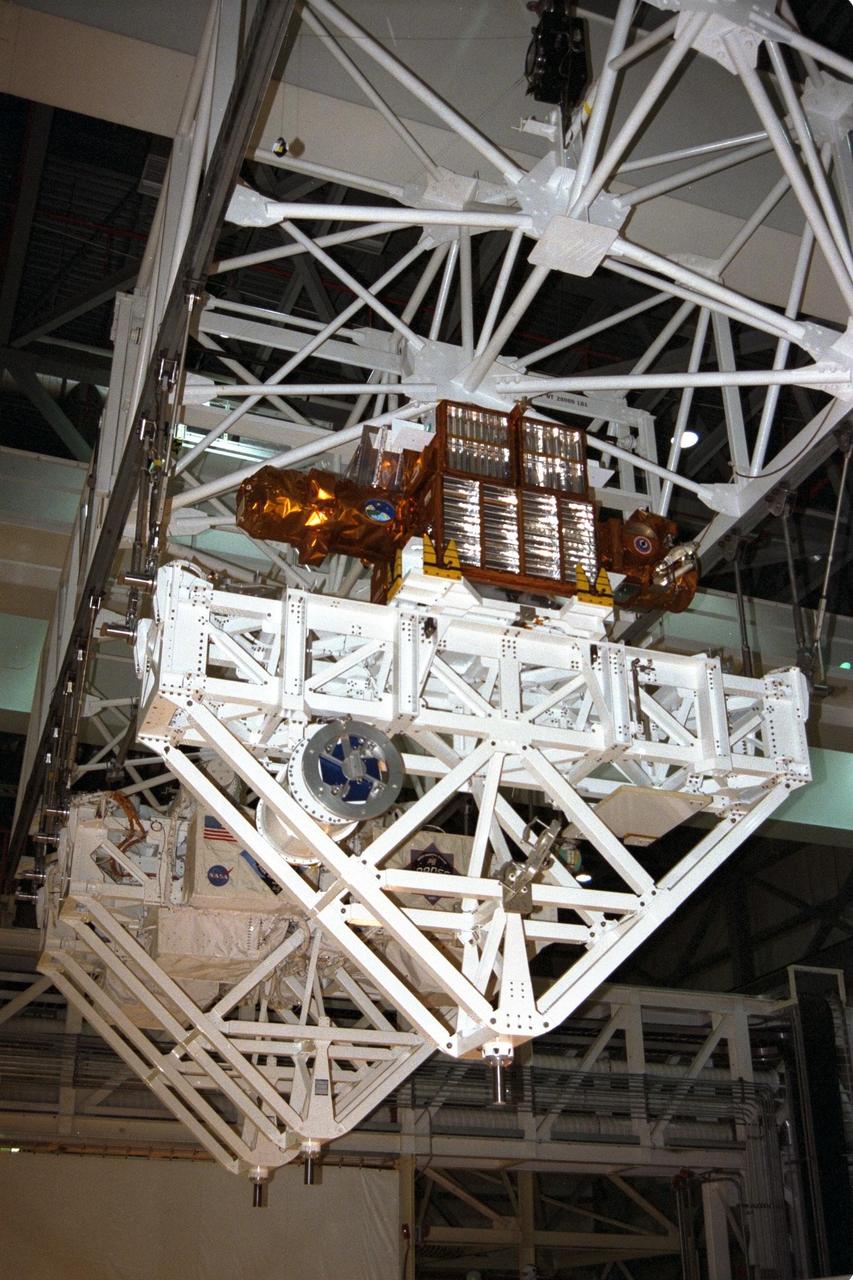
The Spartan payload, which flew on STS-87, is removed from Columbia's cargo bay in Orbiter Processing Facility Bay 3 and will be transported to the Vertical Processing Facility
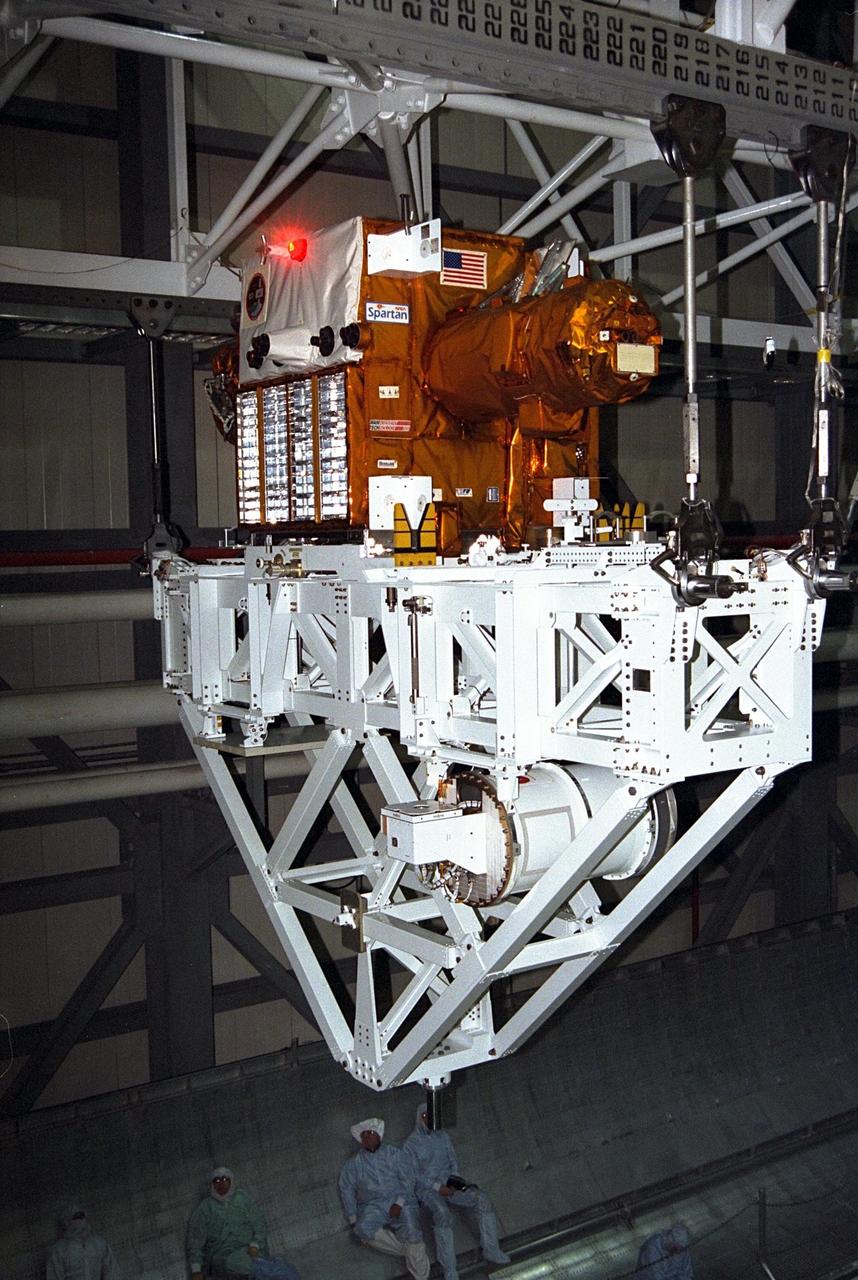
The Spartan payload, which flew on STS-87, is removed from Columbia's cargo bay in Orbiter Processing Facility Bay 3 and will be transported to the Vertical Processing Facility
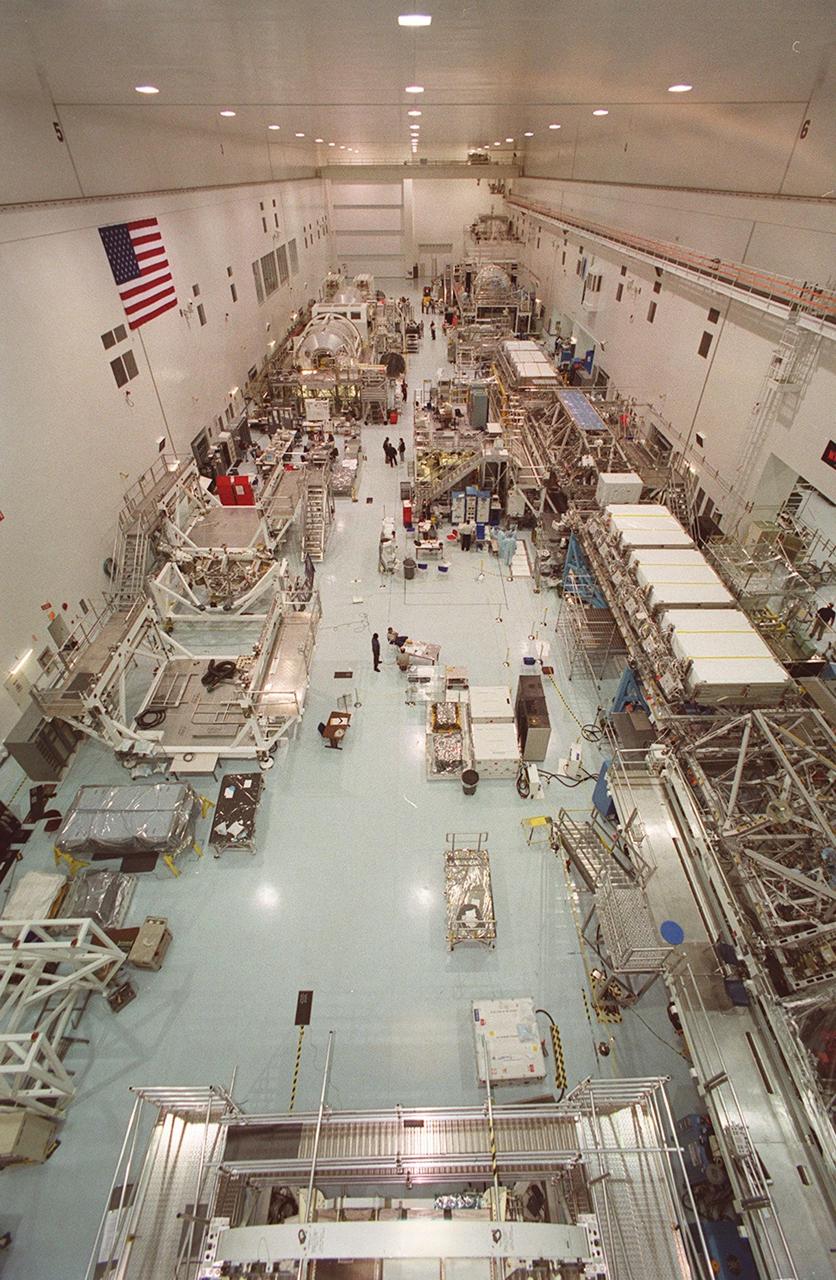
A vertical view of the Space Station Processing Facility shows the lineup of elements in various stages of preparation for future flights to the Space Station.

S89-28093 (29 Dec 1988) --- In the clean room of the vertical processing facility, the TDRS-D satellite is hoisted, thus beginning the mating process with the inertial upper stage (IUS), located in an adjacent test cell.
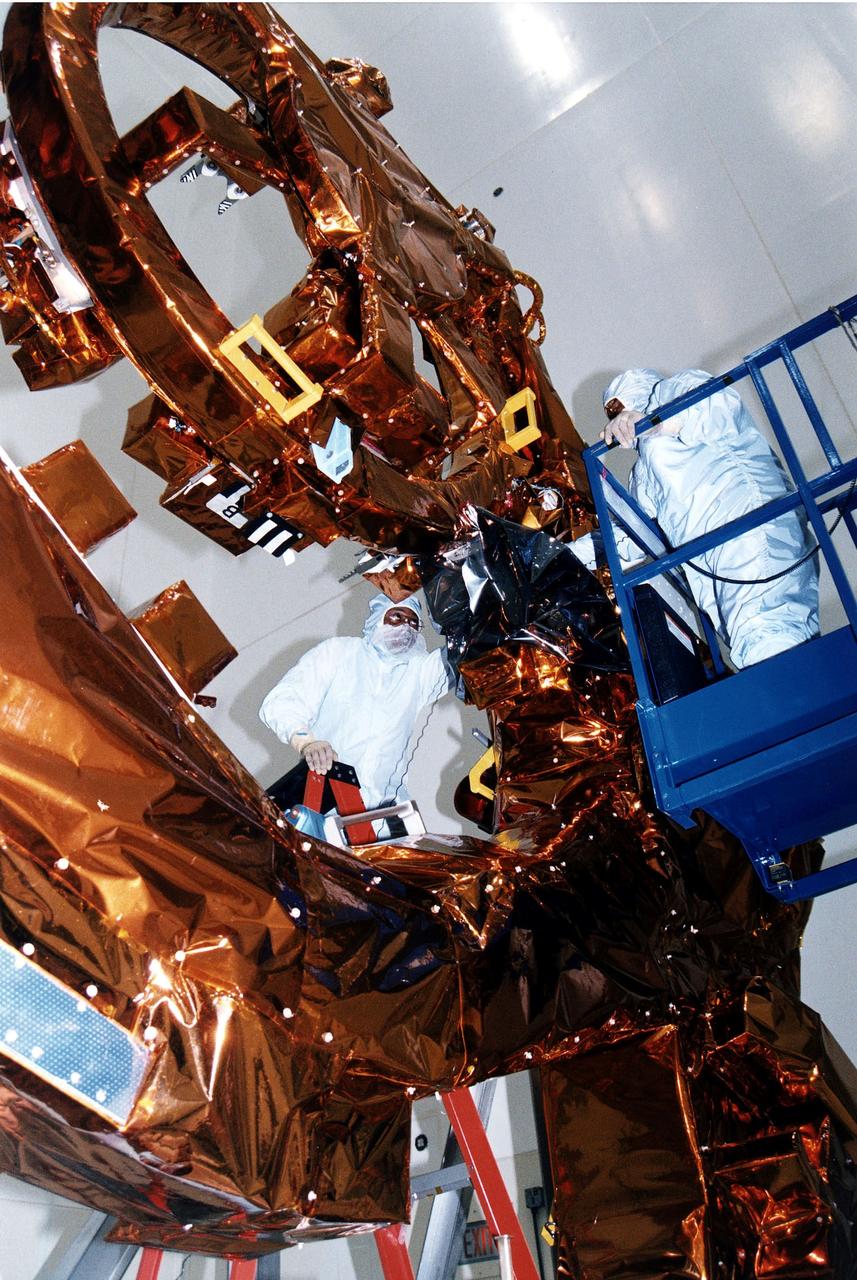
KENNEDY SPACE CENTER, FLA. - Workers in KSC's Vertical Processing Facility make final adjustments to the Flight Support System (FSS) for STS-82, the second Hubble Space Telescope servicing mission. The FSS is reusable flight hardware that provides the mechanical, structural and electrical interfaces between HST, the space support equipment and the orbiter for payload retrieval and on-orbit servicing. Liftoff aboard Discovery is targeted Feb. 11 with a crew of seven.
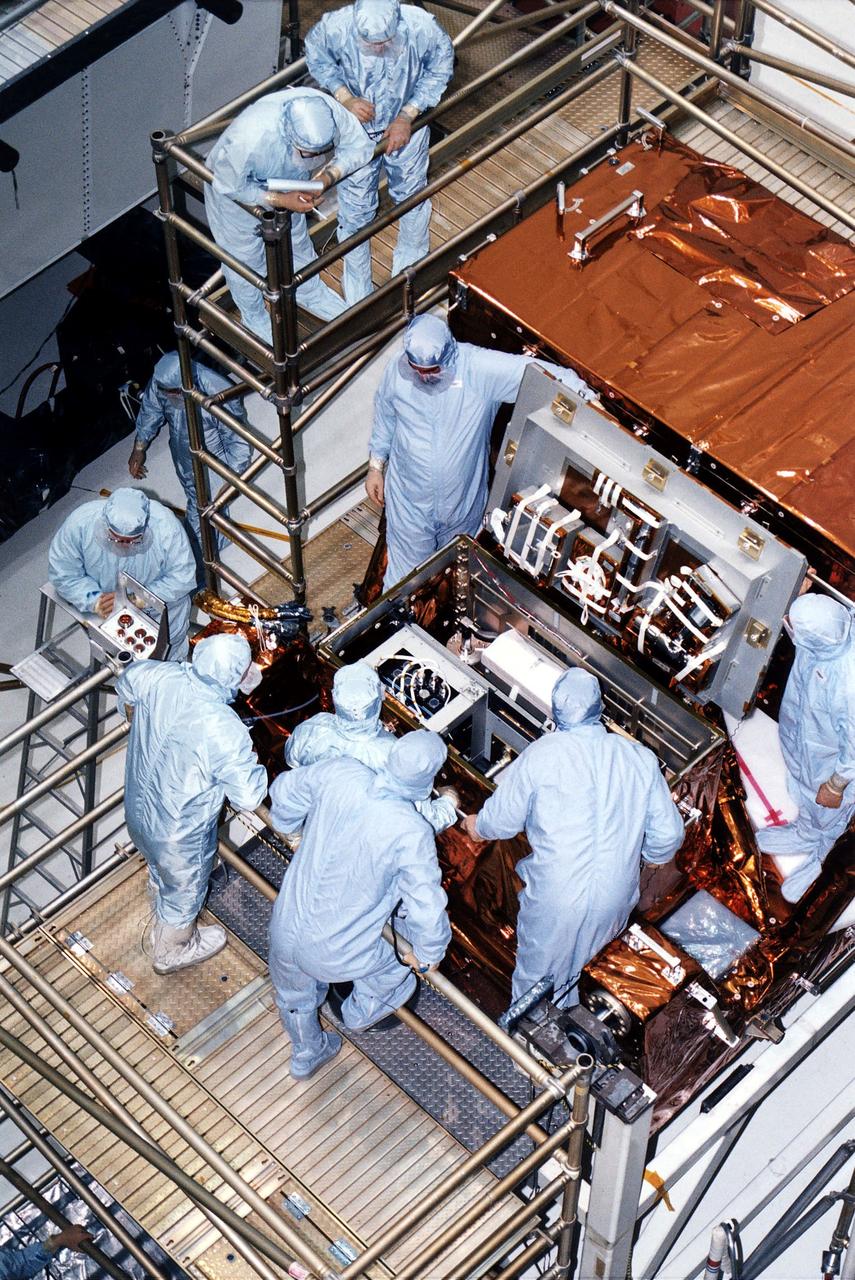
KENNEDY SPACE CENTER, FLA. - STS-82 crew members and workers at KSC's Vertical Processing Facility look at hardware in the Multipurpose ORU (Orbital Replacement Unit) Protective Enclsoure, also called MOPE. The crew is participating in the Crew Equipment Integration Test (CEIT). Liftoff of STS-82, the second Hubble Space Telescope (HST) servicing mission, is scheduled Feb. 11 aboard Discovery with a crew of seven.
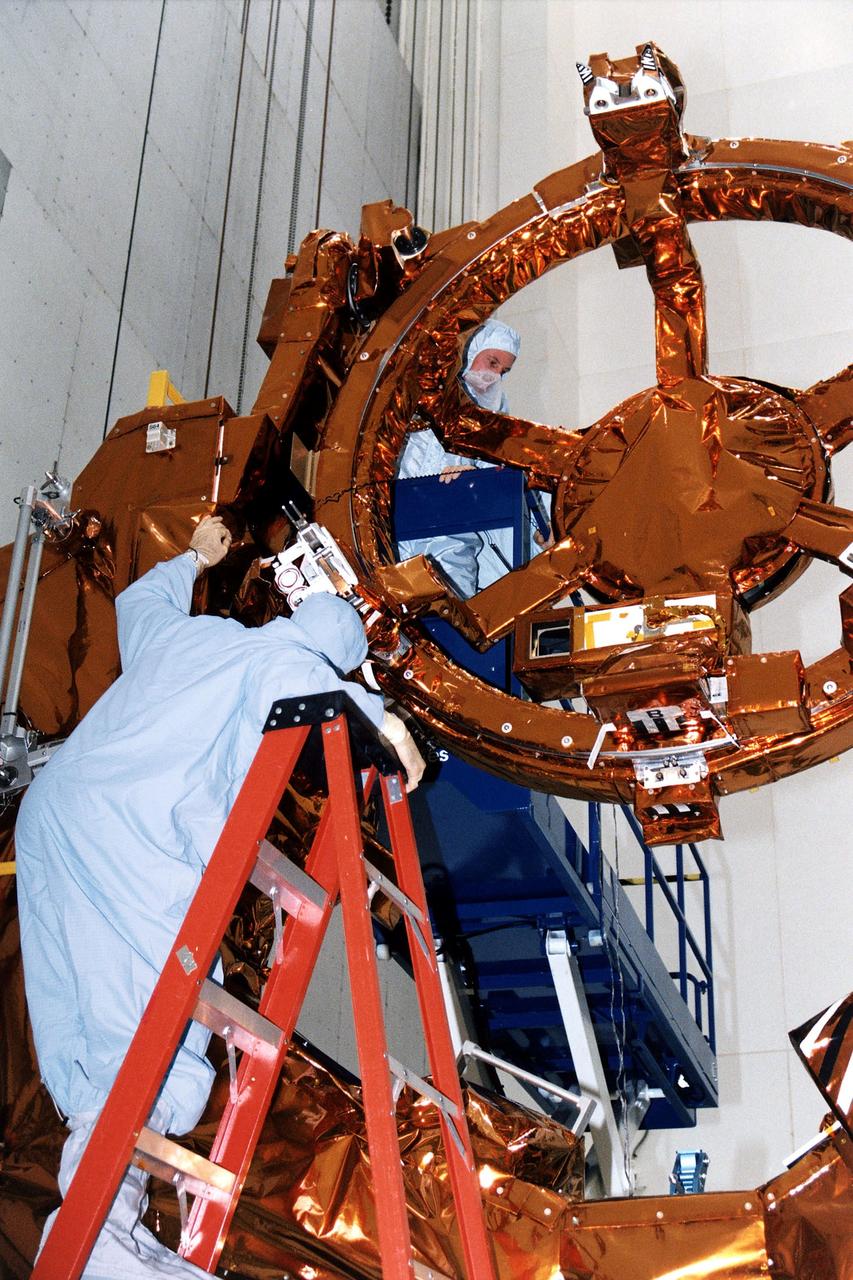
KENNEDY SPACE CENTER, FLA. - STS-82 Mission Specialist Gregory J. Harbaugh, at top, inspects part of the Flight Support System during the Crew Equipment Integration Test (CEIT) at KSC's Vertical Processing Facility. Harbaugh and the other six STS-82 crew members will conduct the second Hubble Space Telescope (HST) servicing mission aboard the Space Shuttle Discovery. Harbaugh will be one of four spacewalkers. Liftoff aboard Discovery is scheduled Feb. 11.
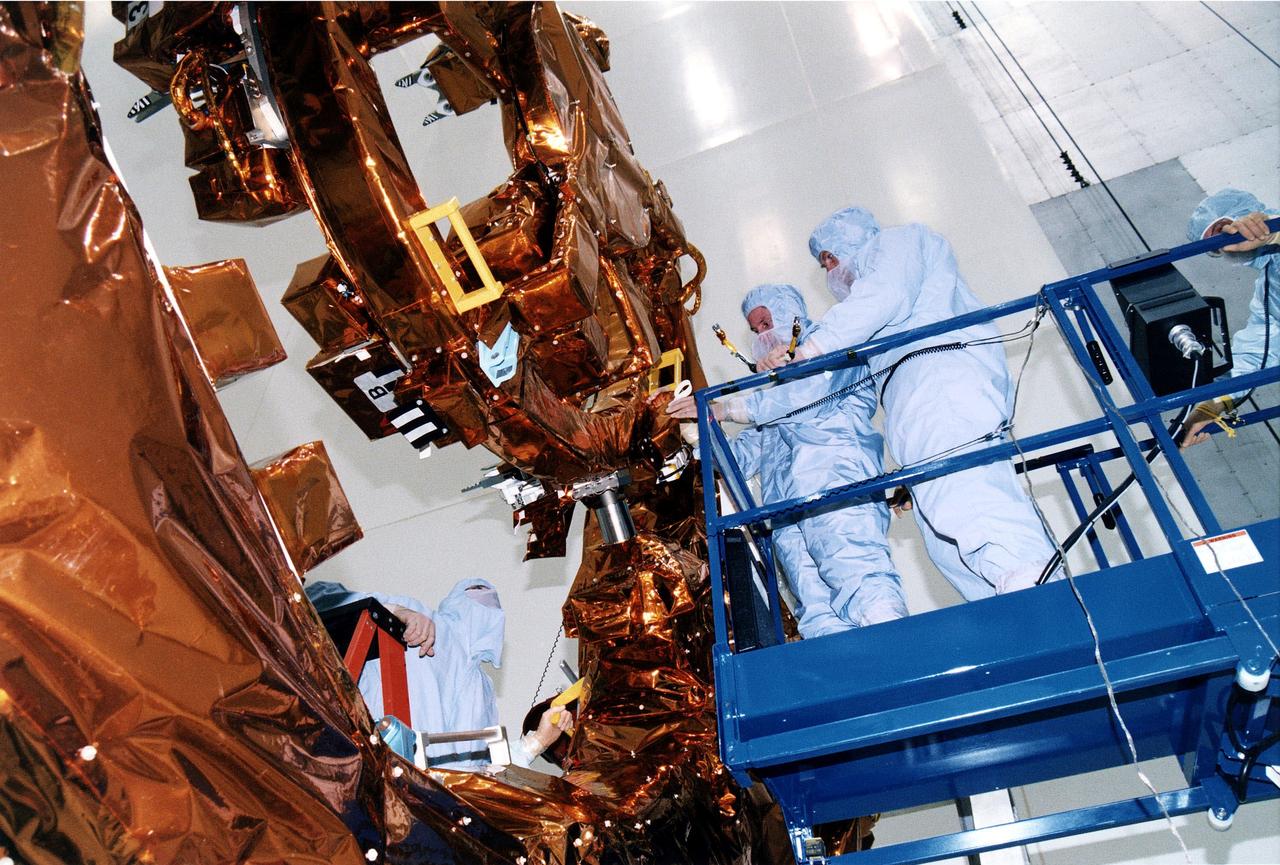
KENNEDY SPACE CENTER, FLA. - STS-82 crew members examine part of the Flight Support System during the Crew Equipment Integration Test (CEIT) in KSC's Vertical Processing Facility. From left are Mission Specialists Steven L. Smith and Gregory J. Harbaugh and Payload Commander Mark C. Lee. Liftoff of STS-82, the second Hubble Space Telescope (HST) servicing mission, is scheduled Feb. 11 aboard Discovery with a crew of seven.
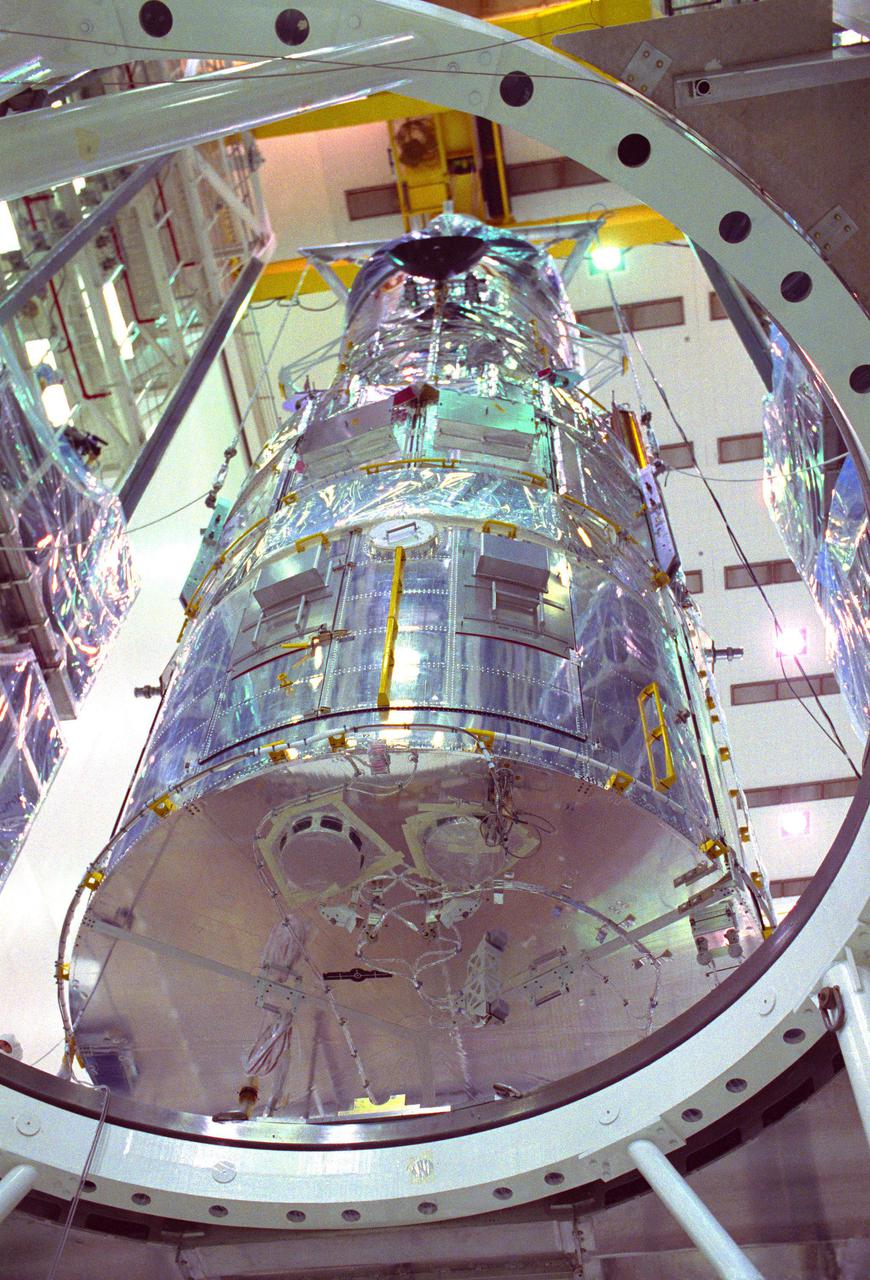
KENNEDY SPACE CENTER, FLA. -- The Hubble Space Telescope (HST) is lifted into the workstands in the Vertical Processing Facility as work begins at KSC to process the 94-inch primary mirror telescope for launch on Discovery on Space Shuttle Mission STS-31 in March 1990.
KENNEDY SPACE CENTER, FLA. -- The Hubble Space Telescope (HST) is lifted into the vertical position in the Vertical Processing Facility as work begins at KSC to process the 94-inch primary mirror telescope for launch on Discovery on Space Shuttle Mission STS-31 in March 1990. With HST, astronomers will be able to view 97 percent of the known universe, and will be able to get pictures unlimited and undistorted by the Earth's atmosphere. Compared with earth-based observatories, the HST will be able to view celestial objects that are 50 times fainter, provide images that are 10 times sharper, and see objects that are seven times farther away. .
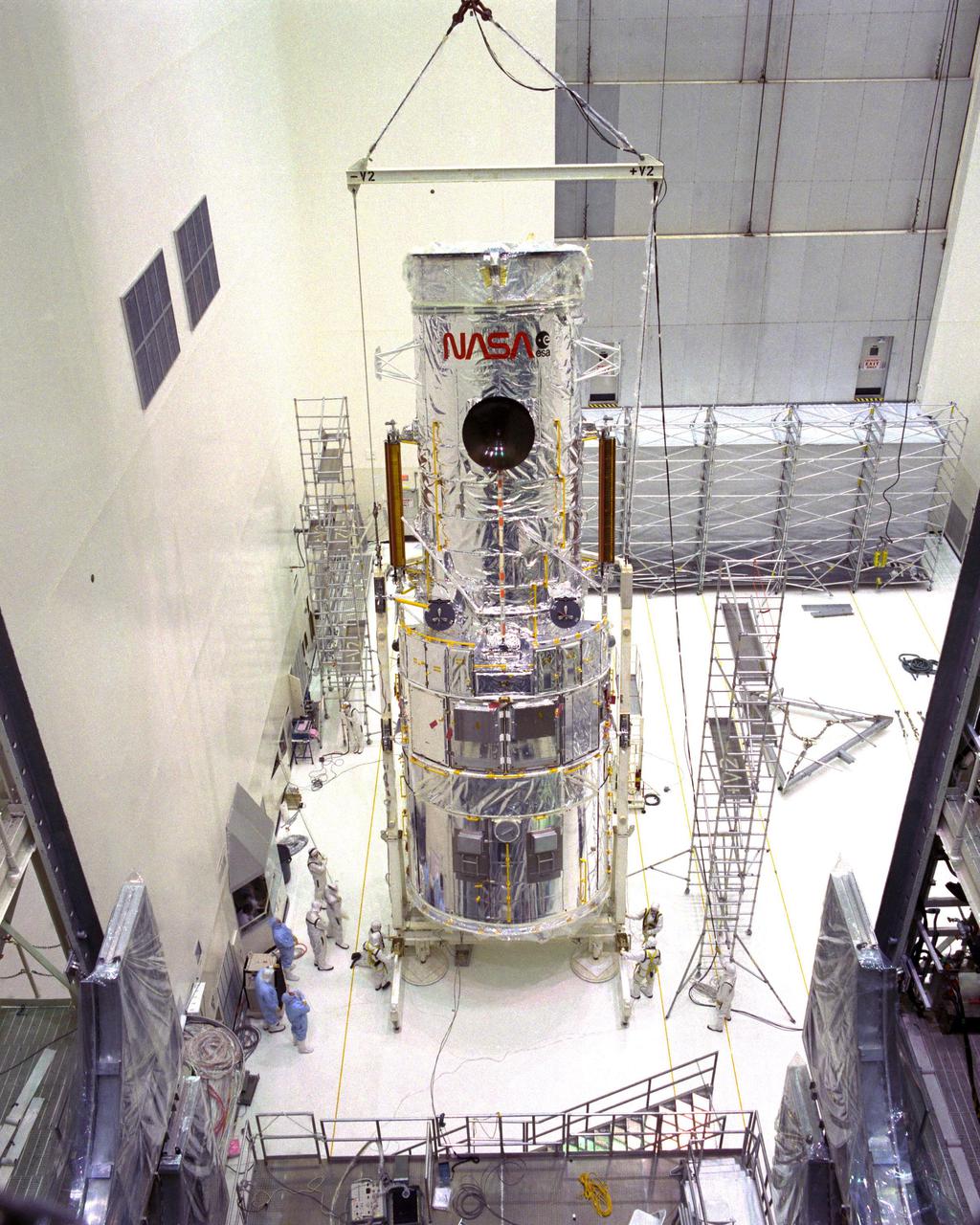
CAPE CANAVERAL, Fla. -- At the Kennedy Space Center in Florida, the Hubble Space Telescope is lifted into the vertical position in the Vertical Processing Facility as work begins to process the 94-inch primary mirror telescope for launch on the Discovery on STS-31 in March 1990. With Hubble, astronomers will be able to view 97 percent of the known universe, and will be able to get pictures unlimited and undistorted by the Earth’s atmosphere. Compared with Earth-based observatories, Hubble will be able to view celestial objects that are 50 times fainter, provide images that are 10 times sharper, and see objects that are seven times further away. Photo Credit: NASA
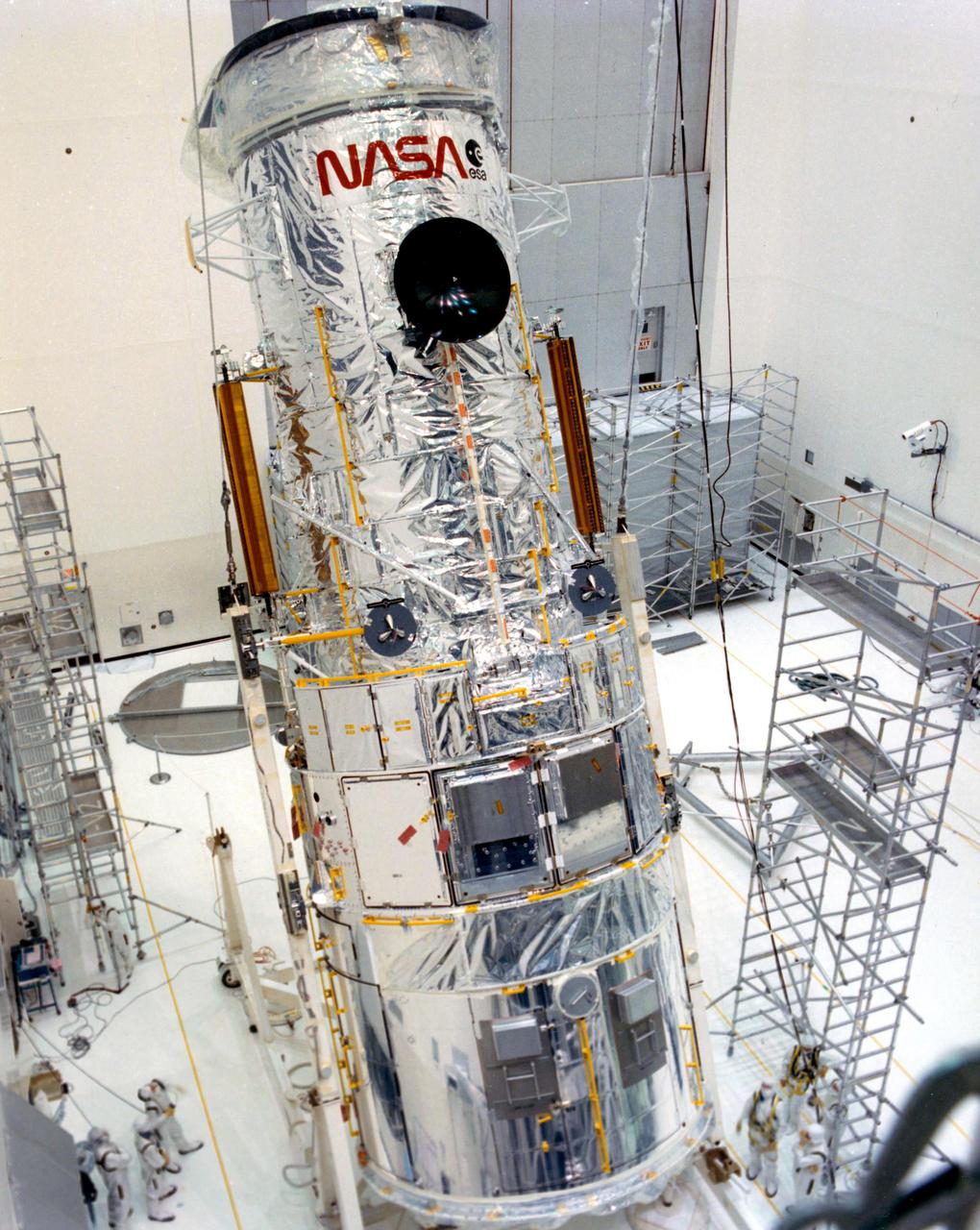
KENNEDY SPACE CENTER, FLA. -- The Hubble Space Telescope (HST) is lifted into the vertical position in the Vertical Processing Facility as work begins at KSC to process the 94-inch primary mirror telescope for launch on Discovery on Space Shuttle Mission STS-31 in March 1990. With HST, astronomers will be able to view 97 percent of the known universe, and will be able to get pictures unlimited and undistorted by the Earth's atmosphere. Compared with earth-based observatories, the HST will be able to view celestial objects that are 50 times fainter, provide images that are 10 times sharper, and see objects that are seven times farther away. .
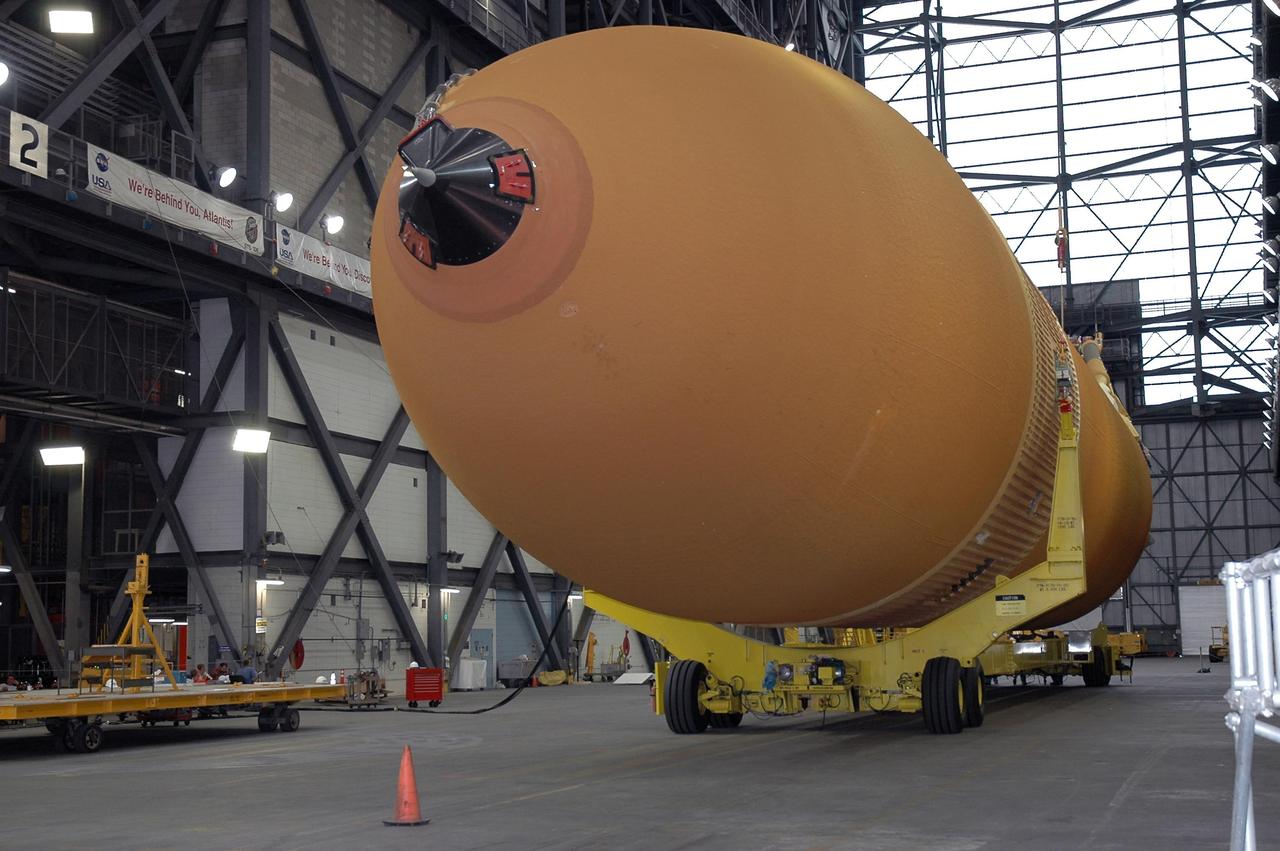
KENNEDY SPACE CENTER, FLA. -- In the Vehicle Assembly Building, external tank No. 117 is lifted off its transporter in preparation for being lifted to a vertical position. Once vertical, the tank will be lifted into the checkout cell in high bay 2 for processing. ET-117 arrived aboard the Pegasus barge after its voyage around the Florida Peninsula from the Michoud Assembly Facility near New Orleans. The tank is slated for mission STS-118, which is targeted for launch in early August. Photo credit: NASA/Jack Pfaller
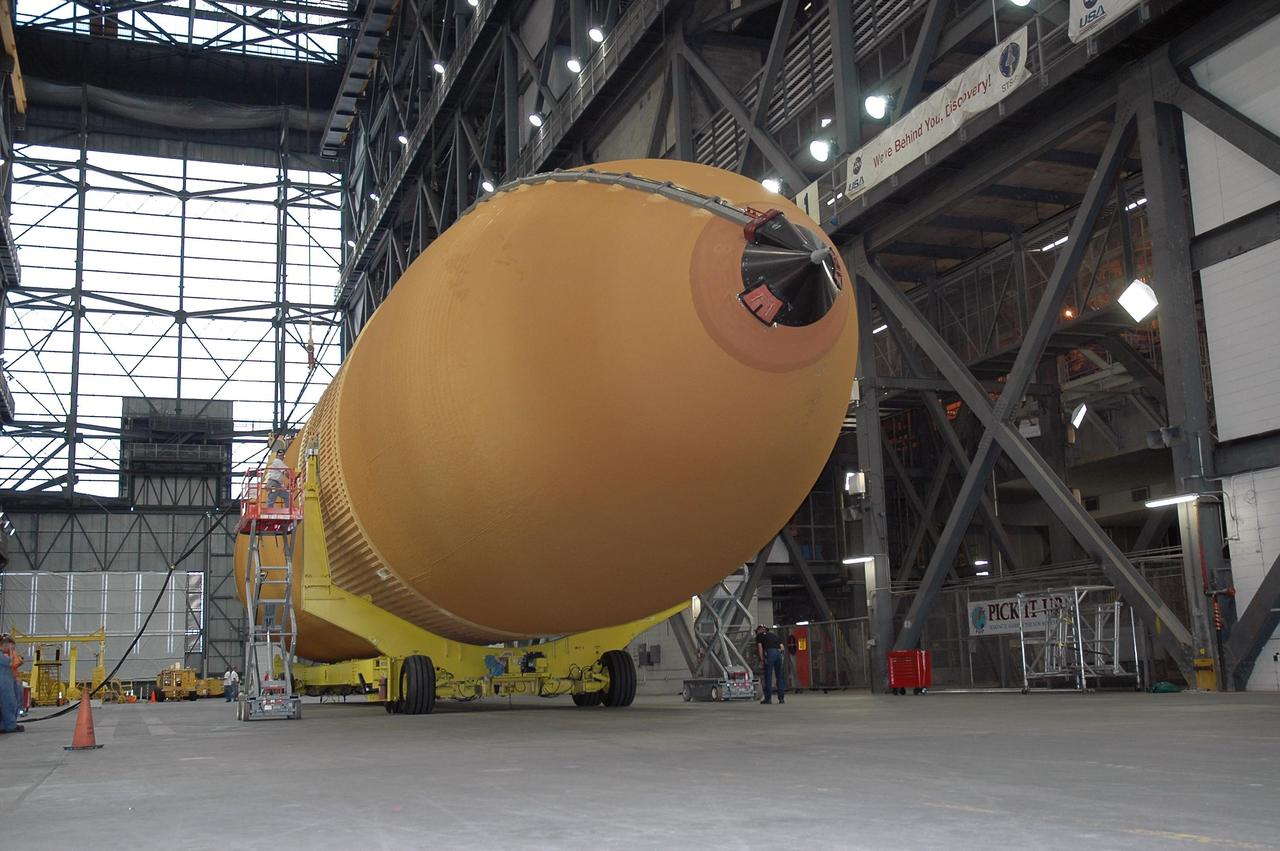
KENNEDY SPACE CENTER, FLA. -- In the Vehicle Assembly Building, workers are attaching an overhead crane to external tank No. 117 in order to lift it to a vertical position. Once vertical, the tank will be lifted into the checkout cell in high bay 2 for processing. ET-117 arrived aboard the Pegasus barge after its voyage around the Florida Peninsula from the Michoud Assembly Facility near New Orleans. The tank is slated for mission STS-118, which is targeted for launch in early August. Photo credit: NASA/Jack Pfaller
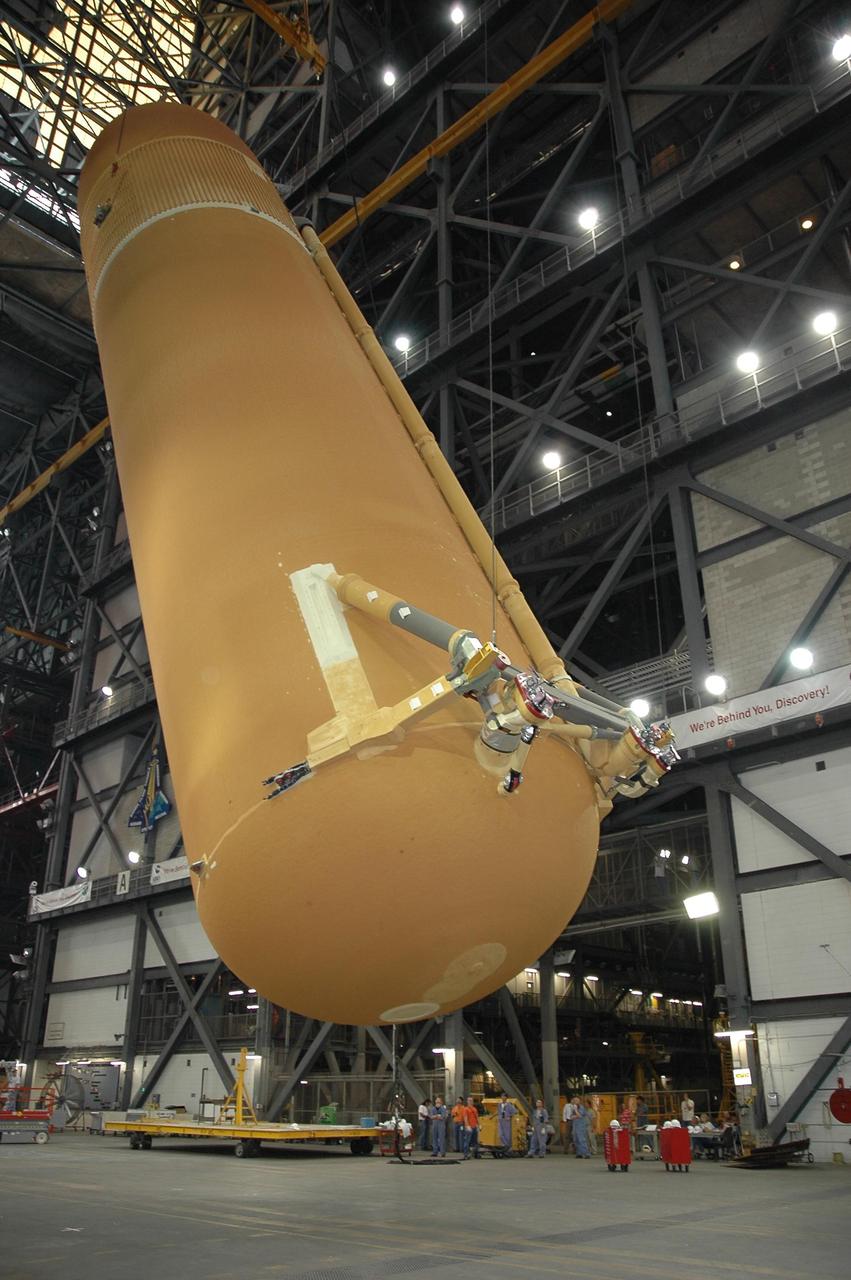
KENNEDY SPACE CENTER, FLA. -- In the Vehicle Assembly Building, external tank No. 117 is nearly raised to a vertical position above the transfer aisle. Once it is vertical, the tank will be lifted into the checkout cell in high bay 2 for processing. ET-117 arrived aboard the Pegasus barge after its voyage around the Florida Peninsula from the Michoud Assembly Facility near New Orleans. The tank is slated for mission STS-118, which is targeted for launch in early August. Photo credit: NASA/Jack Pfaller
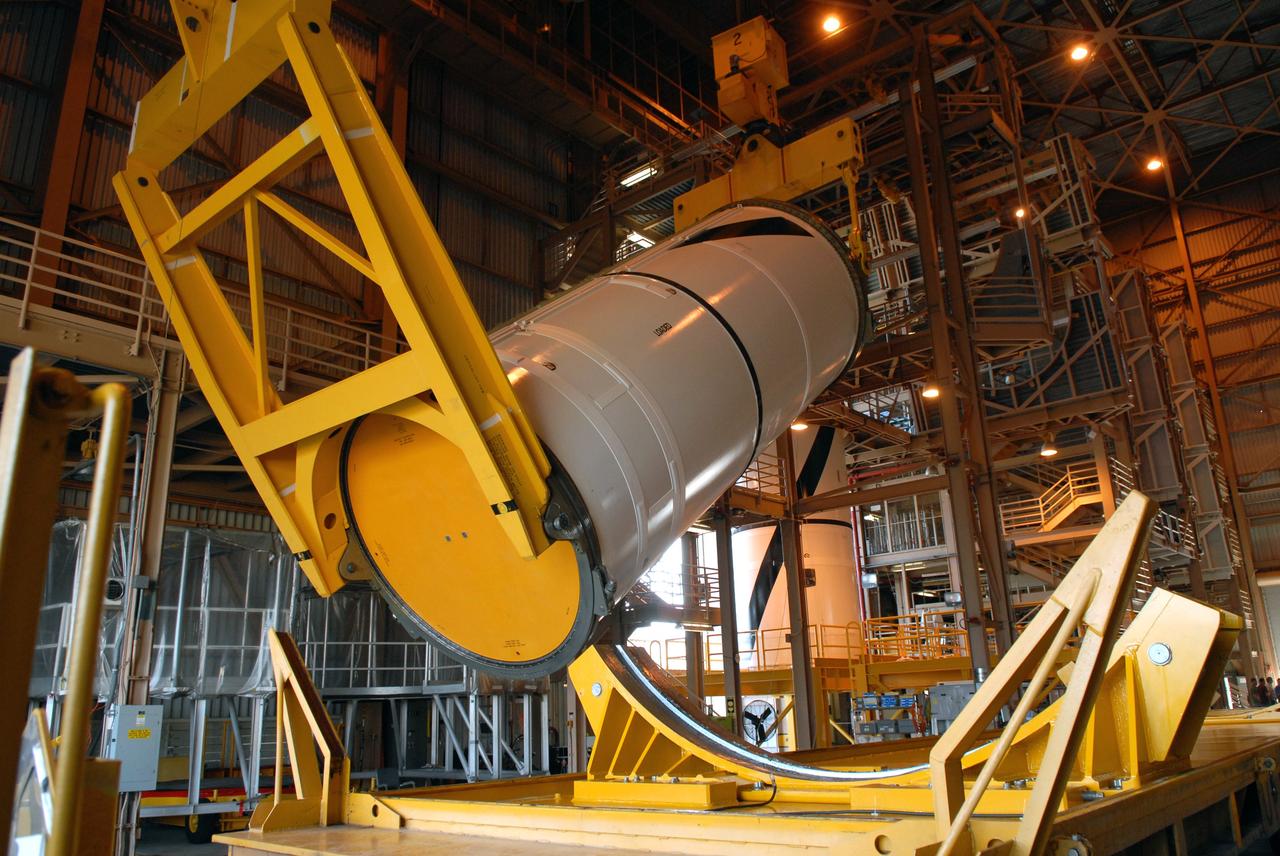
CAPE CANAVERAL, Fla. – In the Rotation, Processing and Surge Facility at NASA's Kennedy Space Center in Florida, cranes attached to the Ares I-X center forward segment raise it to vertical. Once vertical, the segment will be moved to a stand. The booster used for the Ares I-X launch is being modified by adding new forward structures and a fifth segment simulator. The stacking operations are scheduled to begin in the Vehicle Assembly Building in April. Launch of the Ares I-X flight test is targeted for July 2009. Photo credit: NASA/Troy Cryder
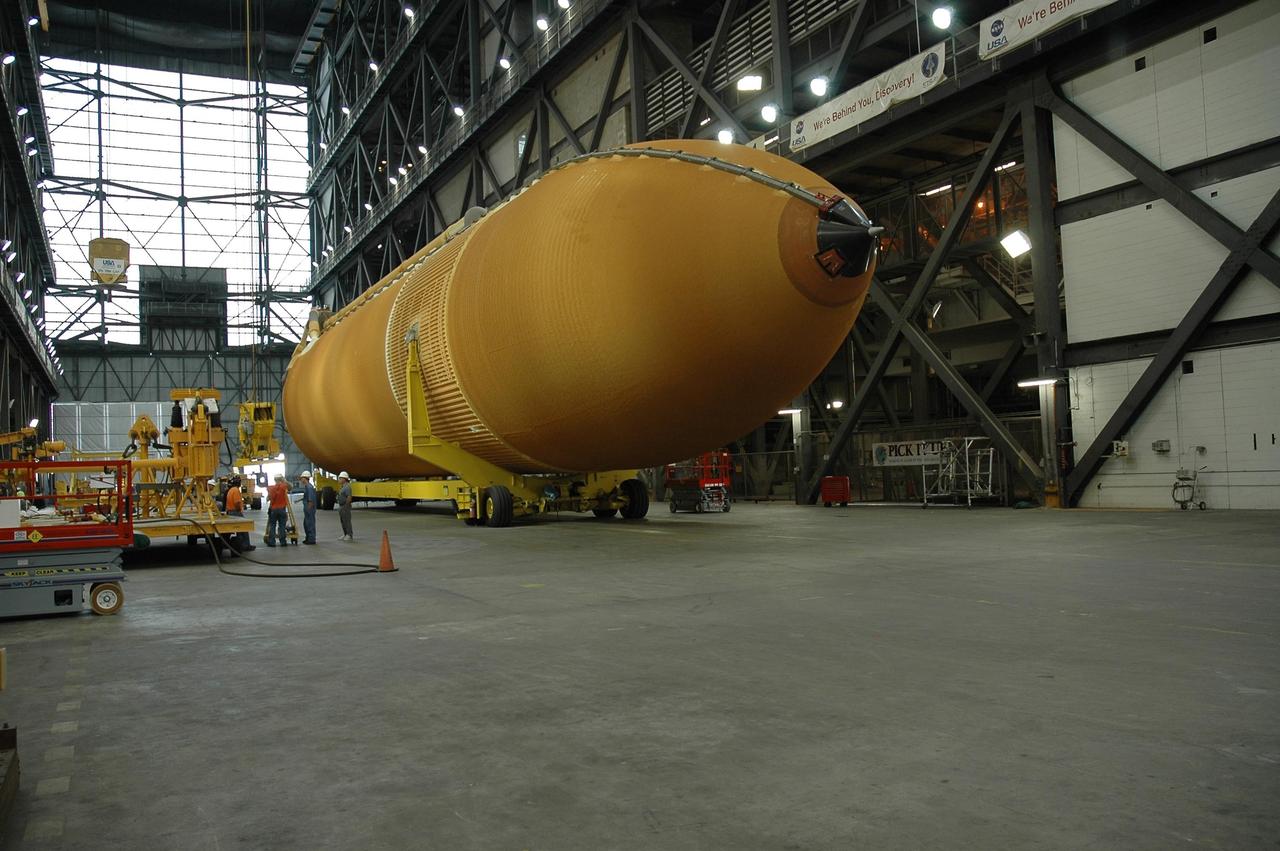
KENNEDY SPACE CENTER, FLA. -- In the Vehicle Assembly Building, external tank No. 117 is waiting to be raised off its transporter in order to lift it to a vertical position. Once vertical, the tank will be lifted into the checkout cell in high bay 2 for processing. ET-117 arrived aboard the Pegasus barge after its voyage around the Florida Peninsula from the Michoud Assembly Facility near New Orleans. The tank is slated for mission STS-118, which is targeted for launch in early August. Photo credit: NASA/Jack Pfaller

KENNEDY SPACE CENTER, FLA. -- In the Vehicle Assembly Building, external tank No. 117 is slowly raised from horizontal to vertical. Once vertical, the tank will be lifted into the checkout cell in high bay 2 for processing. ET-117 arrived aboard the Pegasus barge after its voyage around the Florida Peninsula from the Michoud Assembly Facility near New Orleans. The tank is slated for mission STS-118, which is targeted for launch in early August. Photo credit: NASA/Jack Pfaller
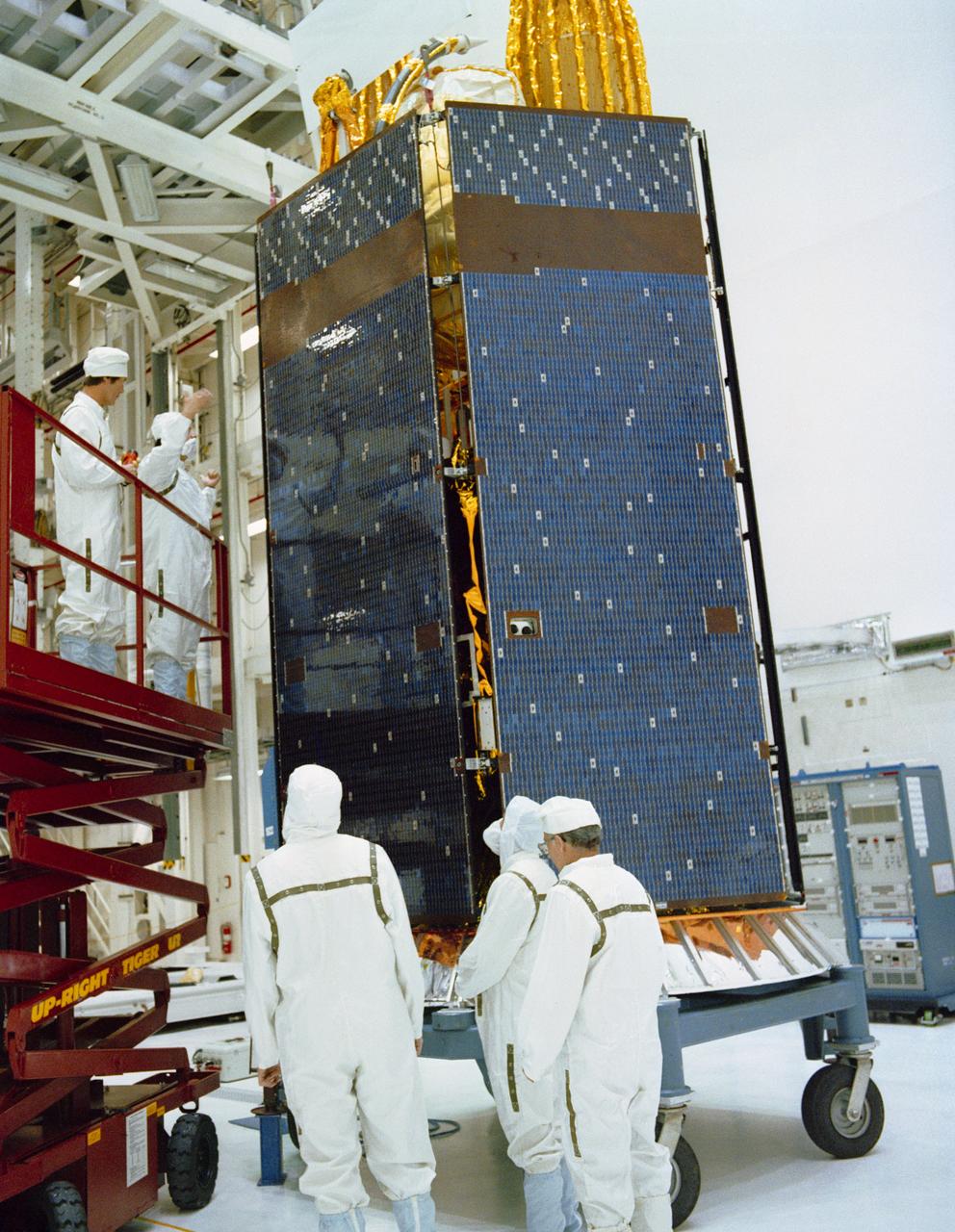
S89-27381 (29 Dec 1988) --- Technicians and engineers in the Kennedy Space Center's Vertical Processing Facility clean room prepare to participate in the mating of the STS 29 tracking and data relay satellite (TDRS-D) with its inertial upper stage (IUS-9, out of frame).
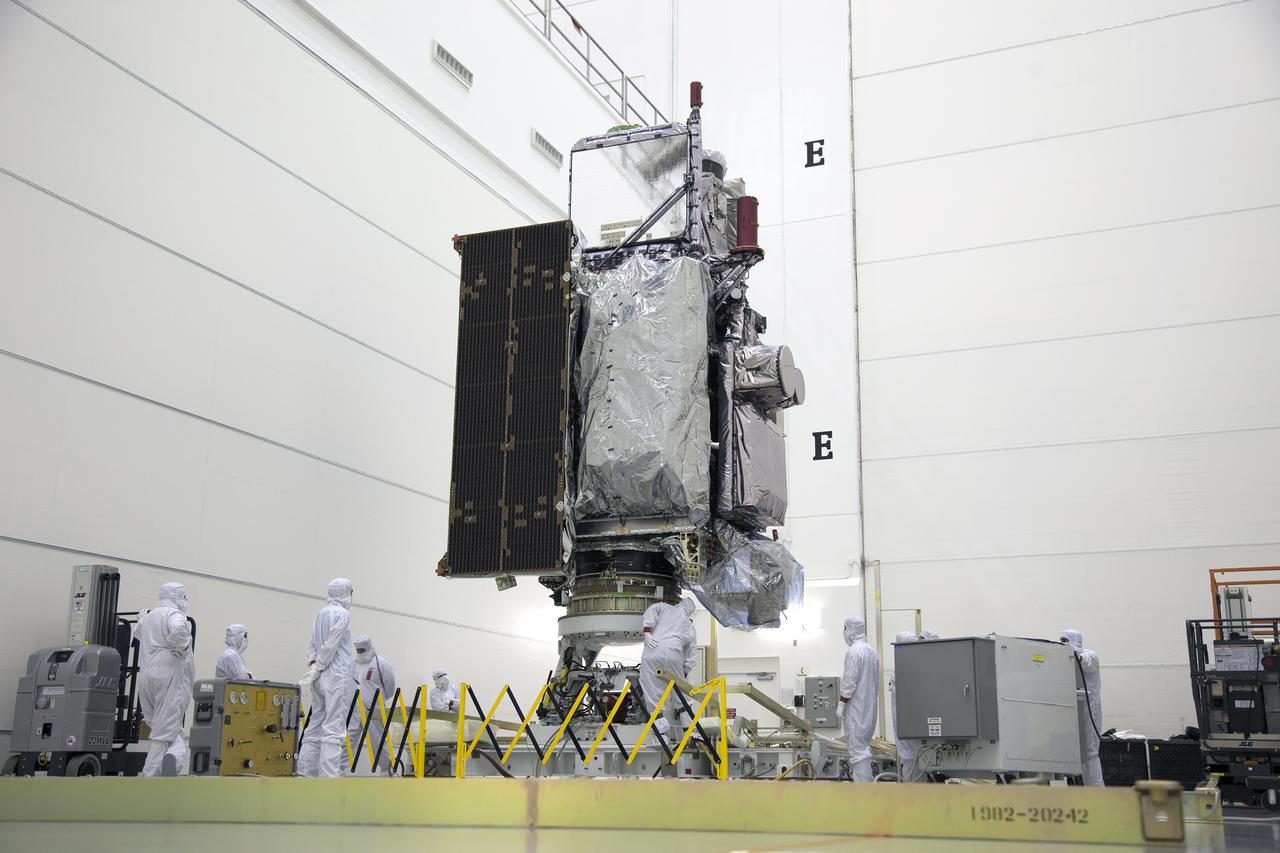
The GOES-R spacecraft stands vertically inside the Astrotech payload processing facility in Titusville, Florida near NASA’s Kennedy Space Center. GOES-R will be the first satellite in a series of next-generation NOAA Geostationary Operational Environmental Satellites. The spacecraft is to launch aboard a United Launch Alliance Atlas V rocket in November.
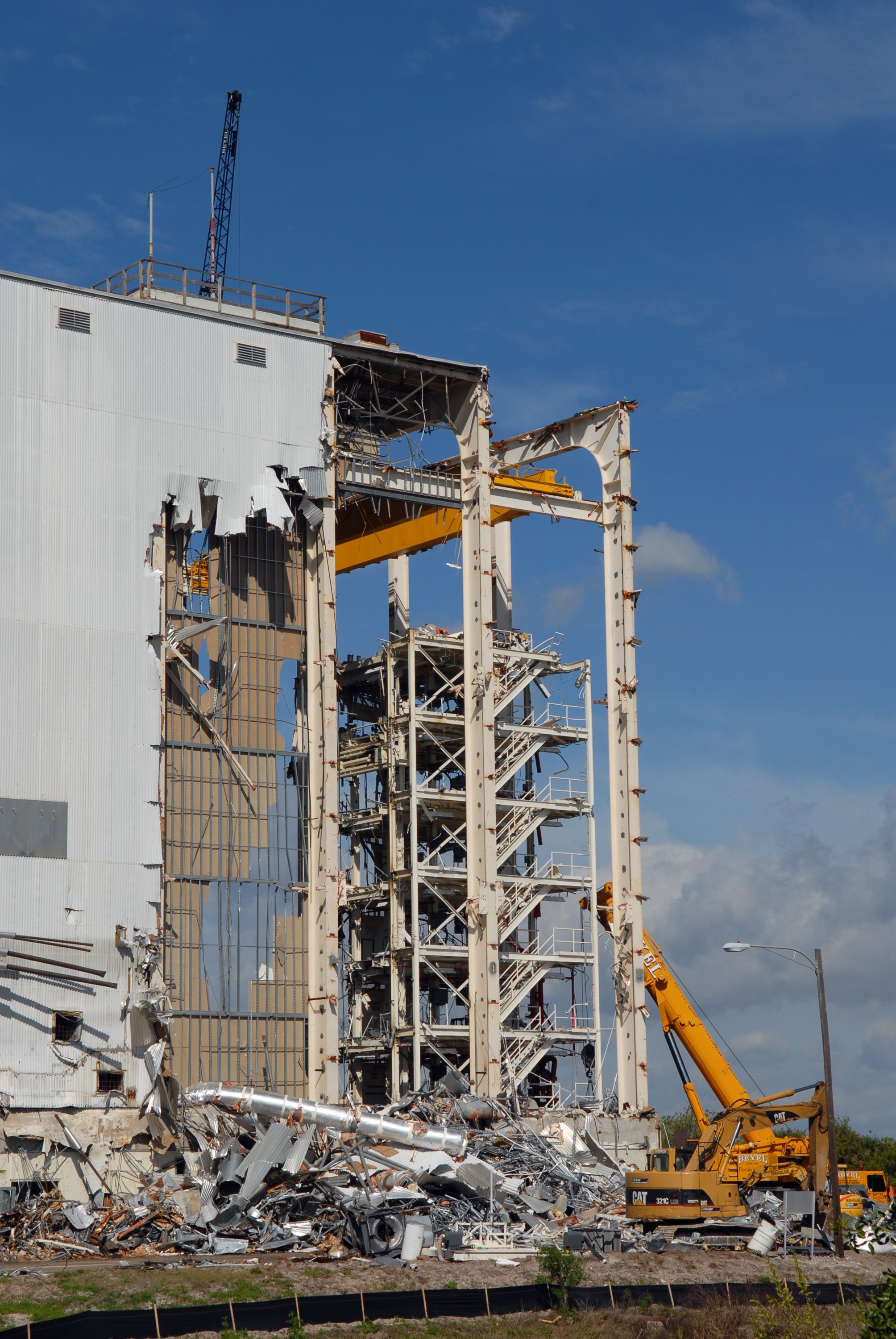
CAPE CANAVERAL, Fla. -- At NASA's Kennedy Space Center in Florida, workers demolish the Vertical Processing Facility, or VPF. The demolition, which started in February and is about half done, is scheduled to be finished by July. About 90 percent of the debris will be recycled. Photo credit: NASA/Jim Grossmann
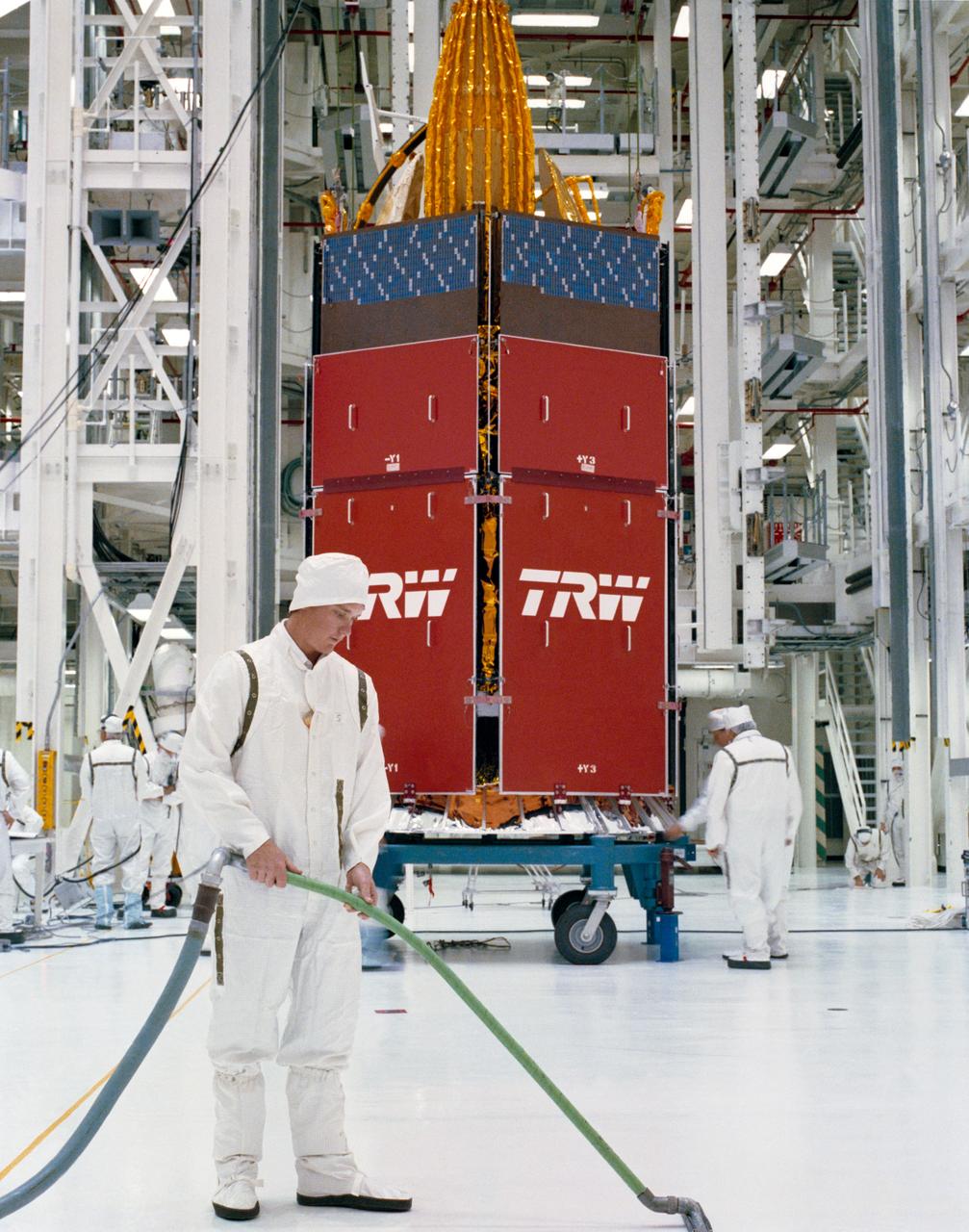
S89-27382 (29 Dec 1988) --- Technicians and engineers in the Kennedy Space Center's Vertical Processing Facility prepare to participate in the mating of the STS-29 tracking and data relay satellite (TDRS-D) with its inertial upper stage (IUS-9, out of frame).

S83-32823 (26 May 1983) --- Astronauts Sally K. Ride and John M. Fabian, attired in clean suits, participate in a STS-7 crew mission test in the Kennedy Space Center's vertical processing facility (VPF). They are two of three STS-7 mission specialists preparing for the June mission. Photo credit: NASA
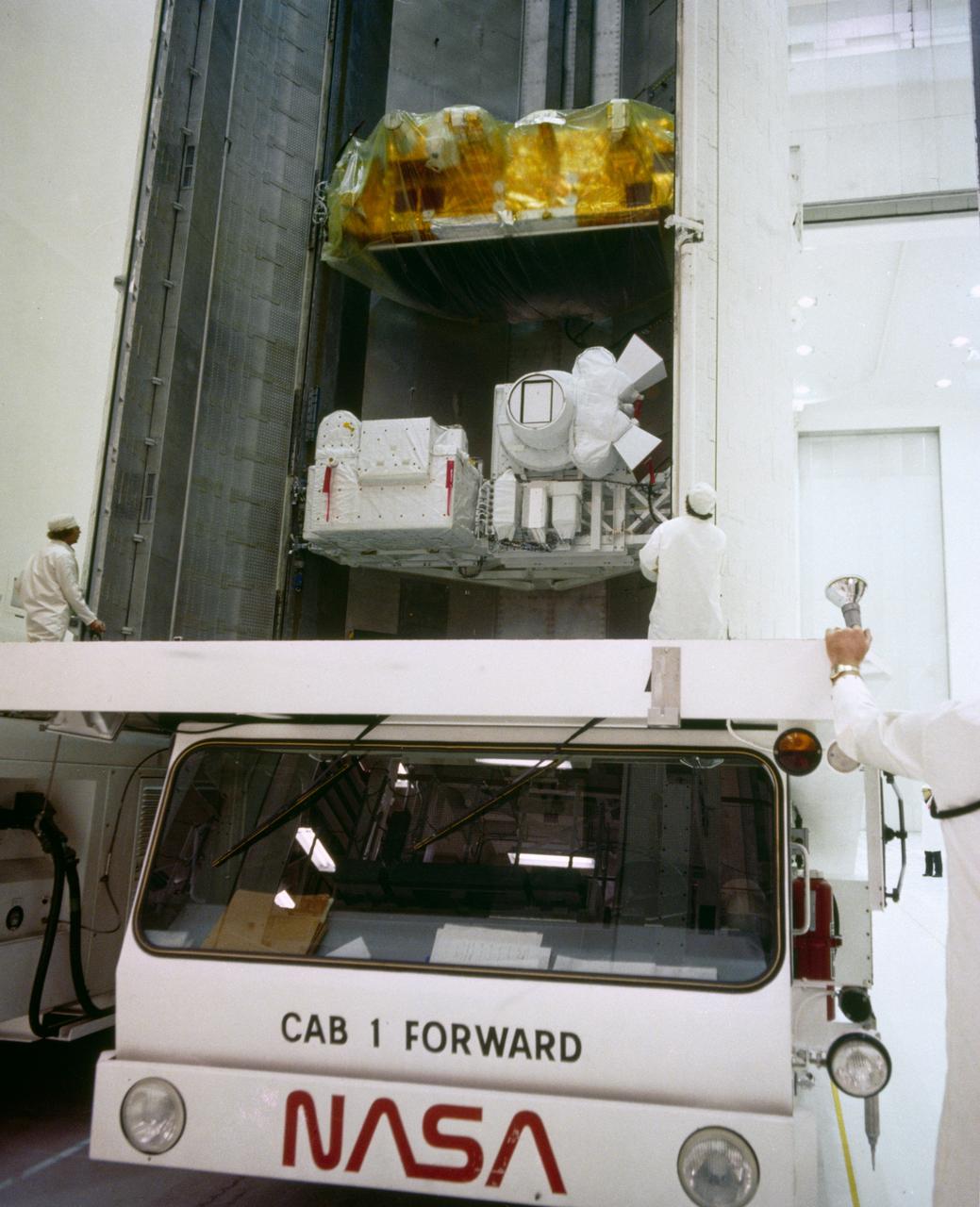
Payload canister transporter in Vertical Processing Facility Clean Room loaded with Earth Radiation Budget Experiment (ERBS), Large Format Camera (LFC), and Orbital Reservicing System (ORS) for STS-41G Mission. 1. STS-41G - EXPERIMENTS 2. CAMERAS - LFC KSC, FL Also available in 4x5 CN
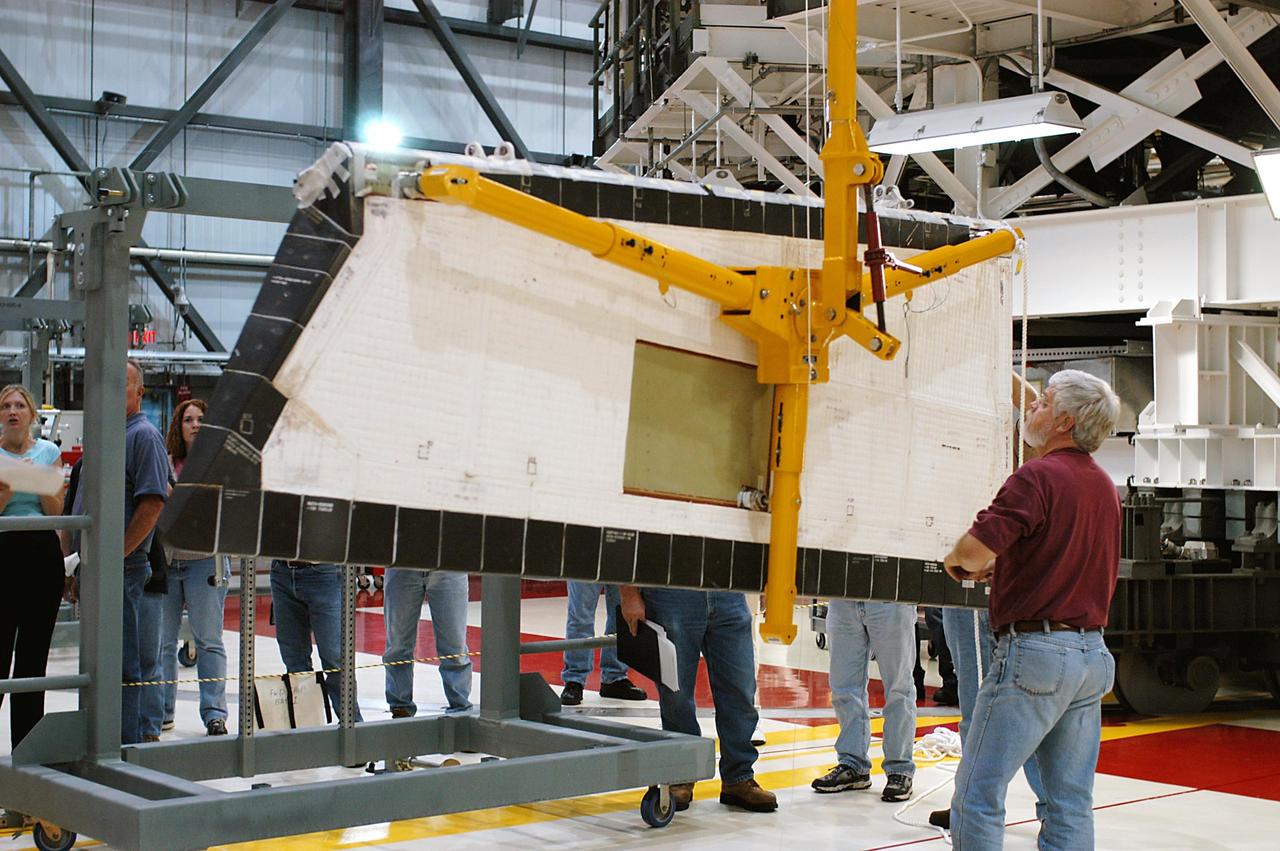
KENNEDY SPACE CENTER, FLA. -- In the Orbiter Processing Facility, workers lower Atlantis’ Rudder Speed Brake panel onto a stand after removing the panel from the vertical tail. The Rudder Speed Brake is being removed for inspection and maintenance prior to Return to Flight. The vertical tail consists of a structural fin surface made of aluminum, the Rudder Speed Brake surface, a tip and a lower trailing edge. The rudder splits into two halves to serve as a speed brake. The vertical tail and Rudder Speed Brake are covered with a reusable thermal protection system. The Rudder Speed Brake is used to guide and slow the Shuttle as it comes in for a landing.
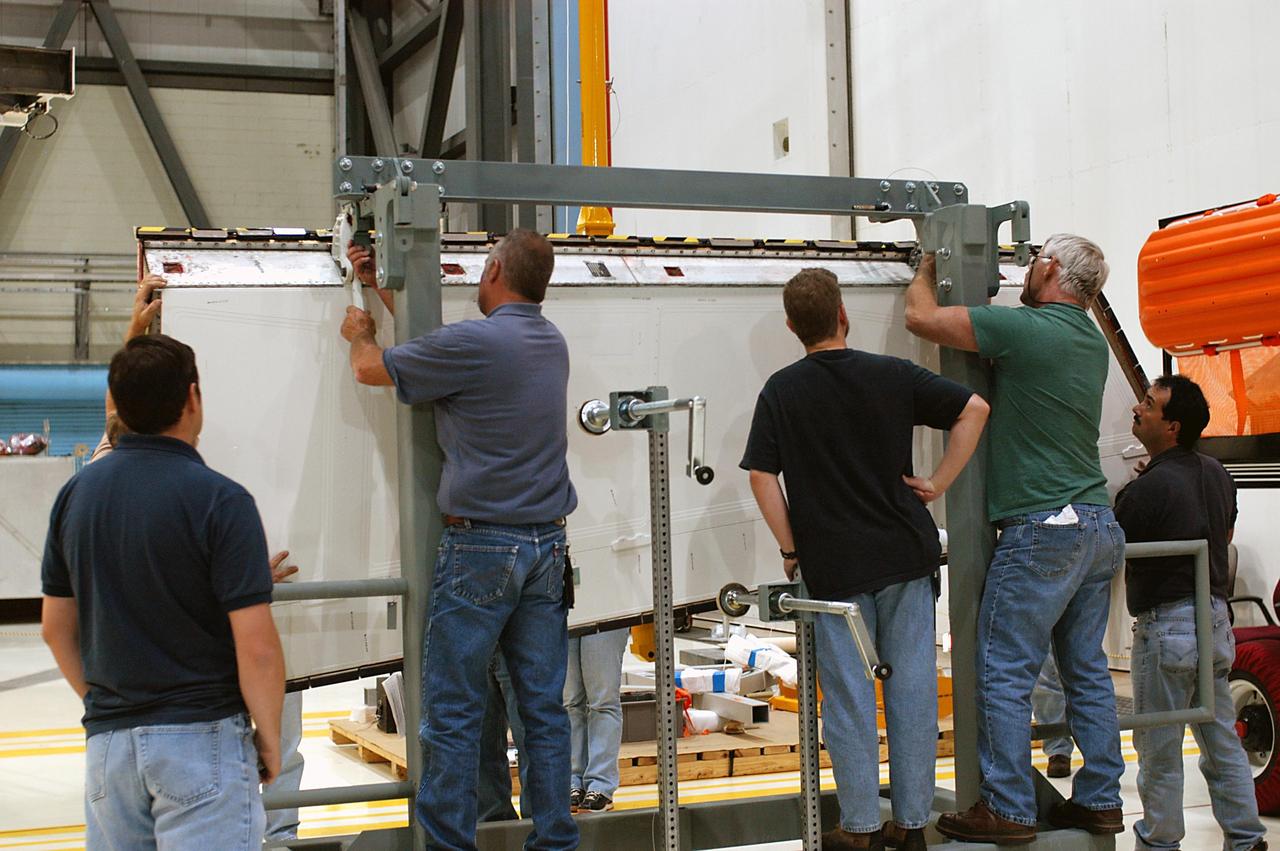
KENNEDY SPACE CENTER, FLA. -- In the Orbiter Processing Facility, workers attach Atlantis’ Rudder Speed Brake panel to a stand after removing the panel from the vertical tail. The Rudder Speed Brake is being removed for inspection and maintenance prior to Return to Flight. The vertical tail consists of a structural fin surface made of aluminum, the Rudder Speed Brake surface, a tip and a lower trailing edge. The rudder splits into two halves to serve as a speed brake. The vertical tail and Rudder Speed Brake are covered with a reusable thermal protection system. The Rudder Speed Brake is used to guide and slow the Shuttle as it comes in for a landing.
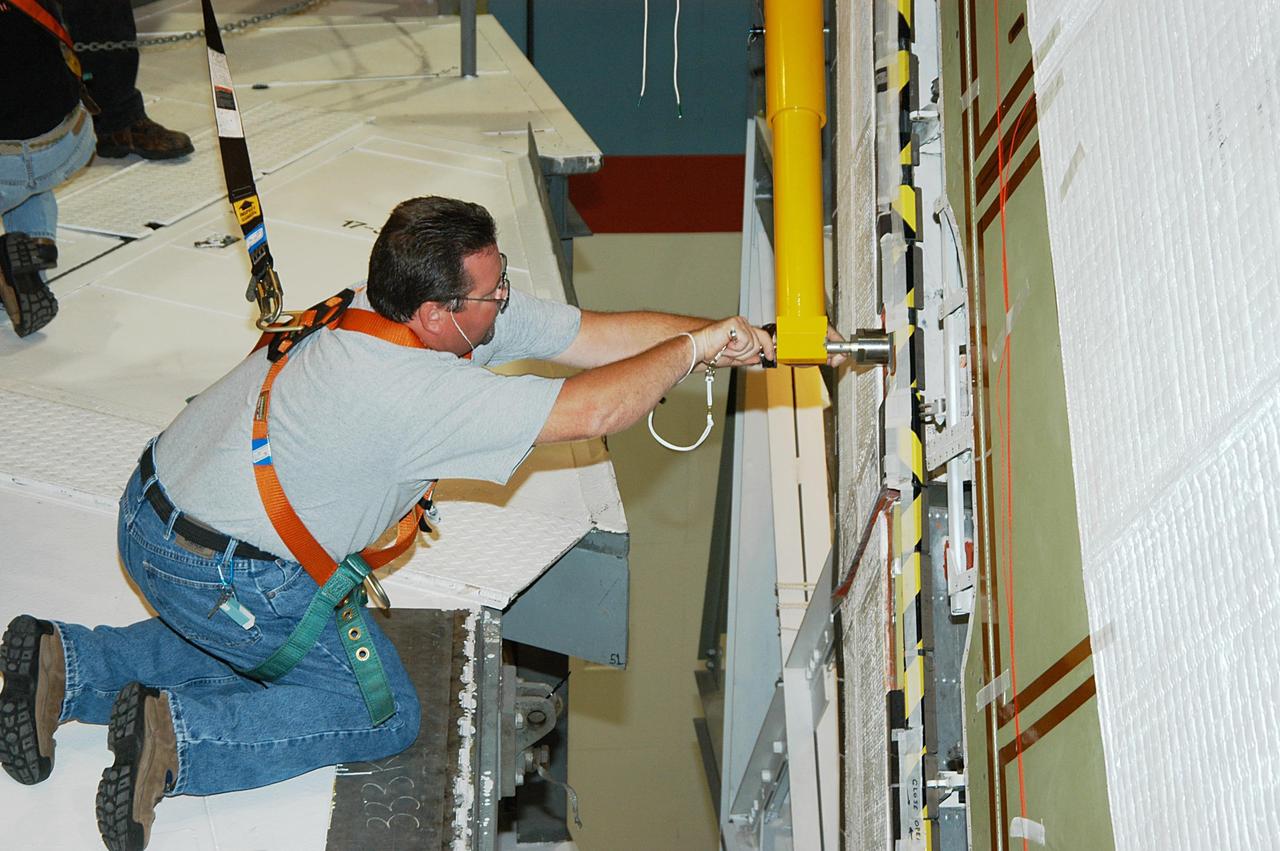
KENNEDY SPACE CENTER, FLA. -- In the Orbiter Processing Facility, a worker tightens a fitting on the device being used to remove the Rudder Speed Brake panel on the vertical tail of the orbiter Atlantis. The Rudder Speed Brake is being removed for inspection and maintenance prior to Return to Flight. The vertical tail consists of a structural fin surface made of aluminum, the Rudder Speed Brake surface, a tip and a lower trailing edge. The rudder splits into two halves to serve as a speed brake. The vertical tail and Rudder Speed Brake are covered with a reusable thermal protection system. The Rudder Speed Brake is used to guide and slow the Shuttle as it comes in for a landing.
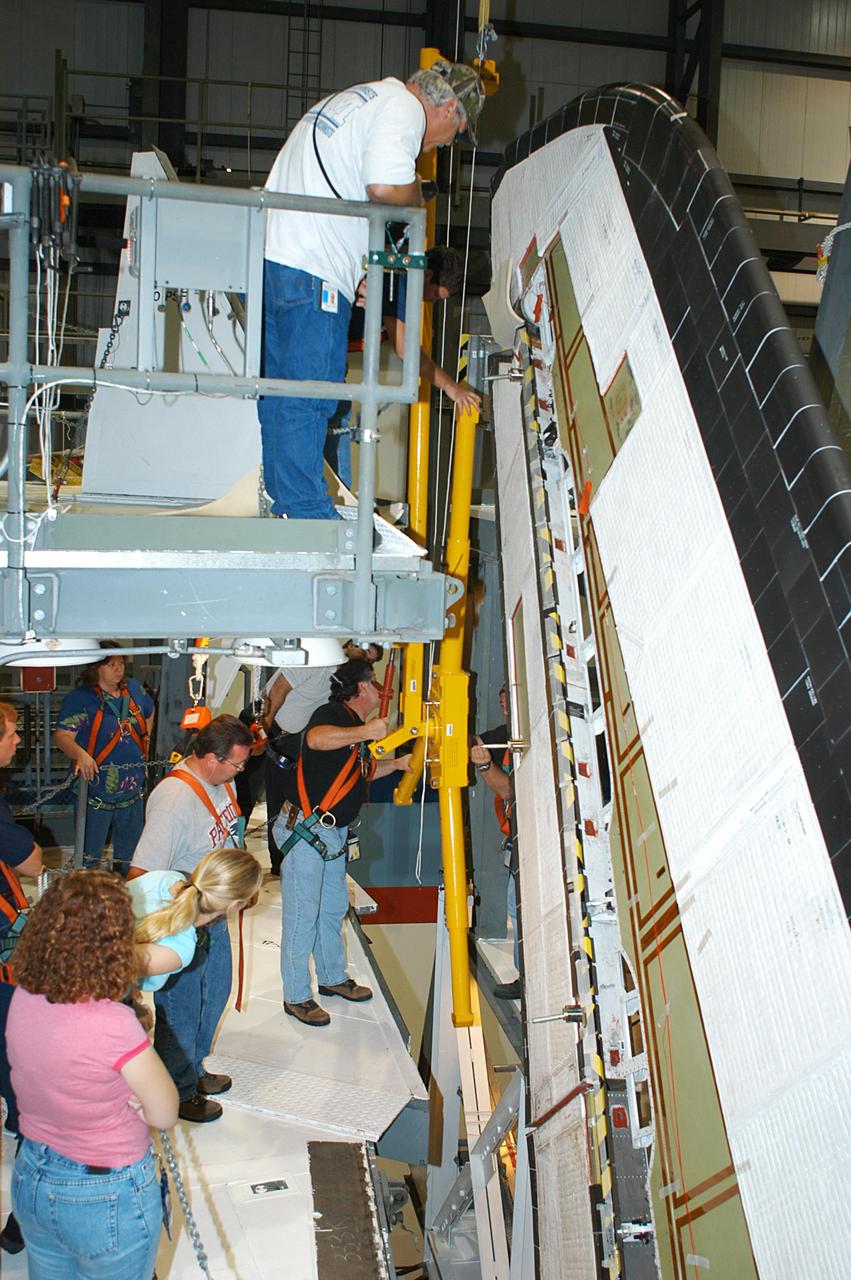
KENNEDY SPACE CENTER, FLA. -- In the Orbiter Processing Facility, a worker (below the upper framework) begins connecting a device to remove the Rudder Speed Brake panel on the vertical tail of orbiter Atlantis. The Rudder Speed Brake is being removed for inspection and maintenance prior to Return to Flight. The vertical tail consists of a structural fin surface made of aluminum, the Rudder Speed Brake surface, a tip and a lower trailing edge. The rudder splits into two halves to serve as a speed brake. The vertical tail and Rudder Speed Brake are covered with a reusable thermal protection system. The Rudder Speed Brake is used to guide and slow the Shuttle as it comes in for a landing.
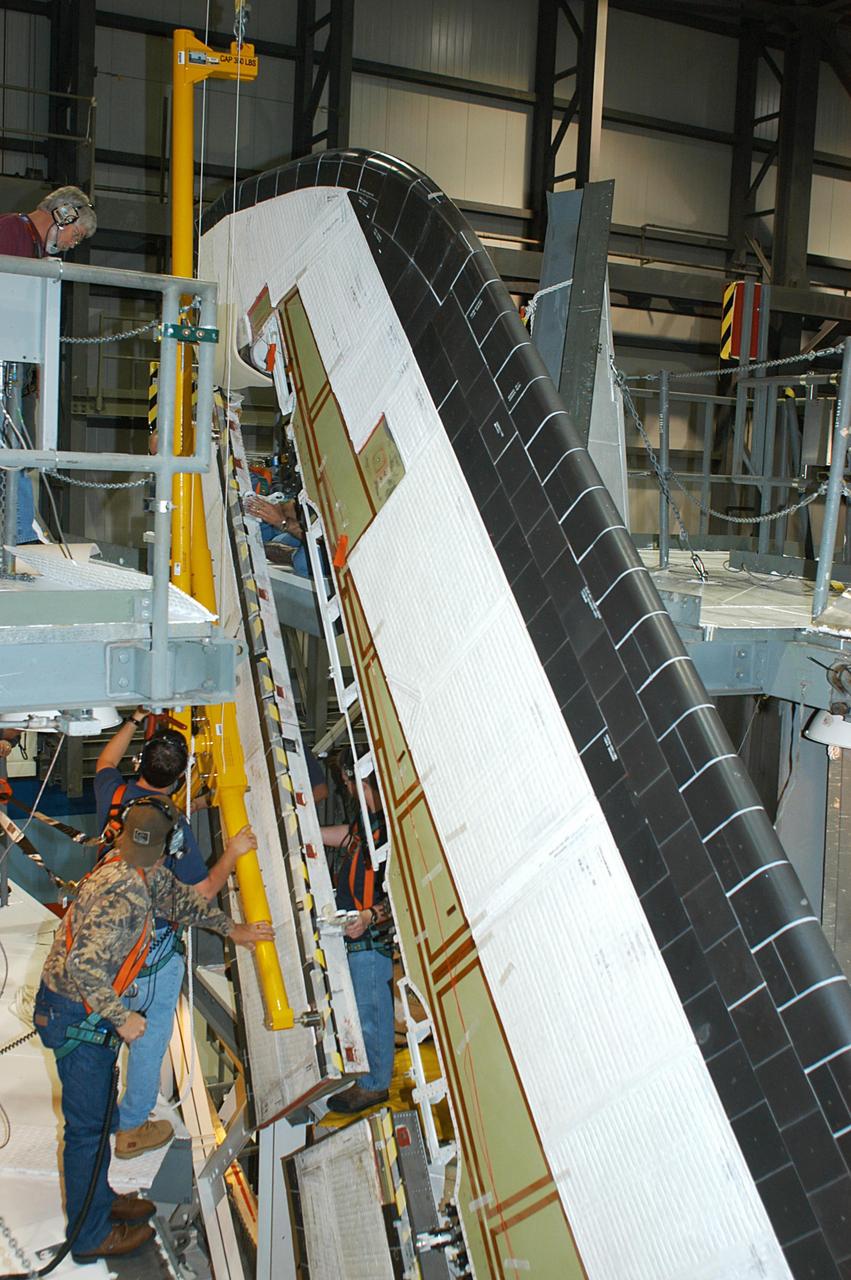
KENNEDY SPACE CENTER, FLA. -- In the Orbiter Processing Facility, workers remove the Rudder Speed Brake panel on the vertical tail of the orbiter Atlantis. The Rudder Speed Brake is being removed for inspection and maintenance prior to Return to Flight. The vertical tail consists of a structural fin surface made of aluminum, the Rudder Speed Brake surface, a tip and a lower trailing edge. The rudder splits into two halves to serve as a speed brake. The vertical tail and Rudder Speed Brake are covered with a reusable thermal protection system. The Rudder Speed Brake is used to guide and slow the Shuttle as it comes in for a landing.
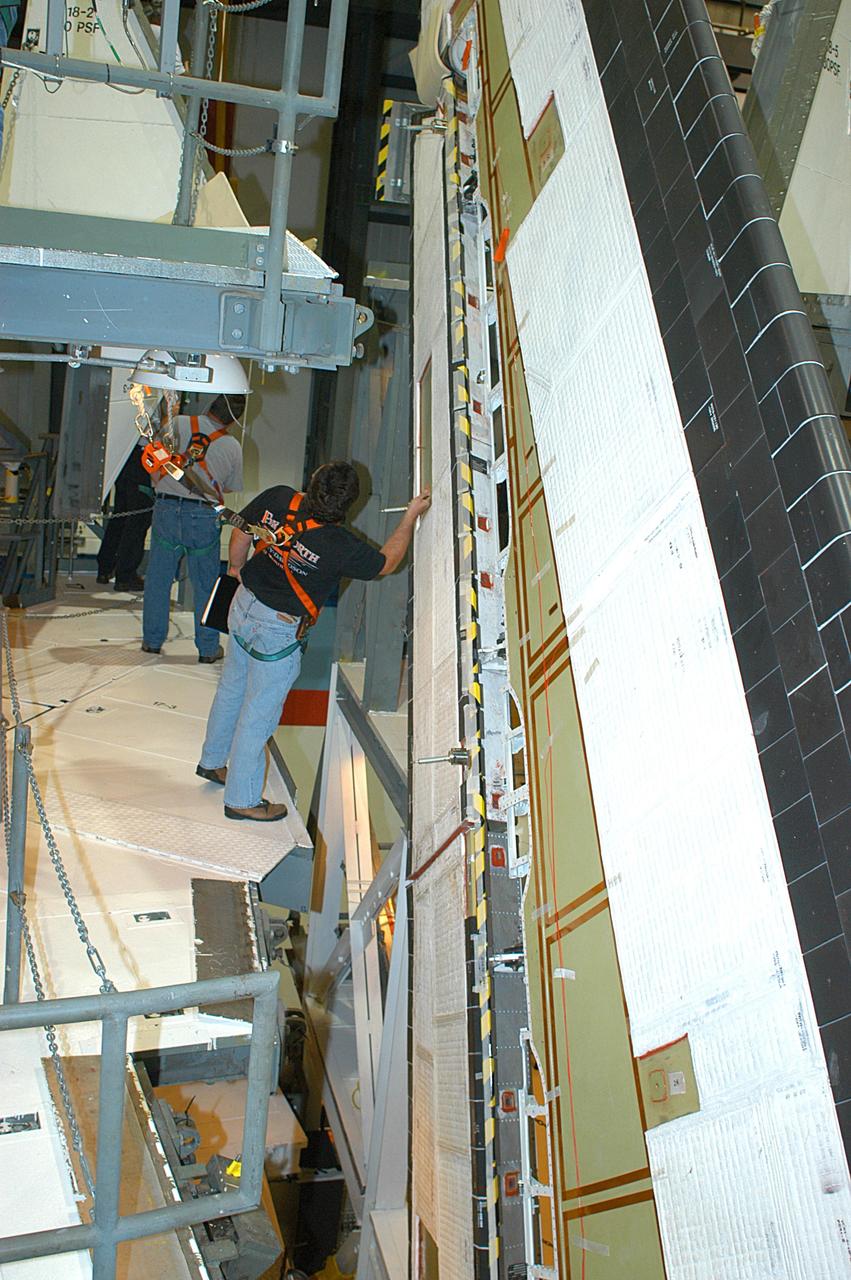
KENNEDY SPACE CENTER, FLA. -- In the Orbiter Processing Facility, a technician looks at the Rudder Speed Brake panel on the vertical tail of orbiter Atlantis. The Rudder Speed Brake is being removed for inspection and maintenance prior to Return to Flight. The vertical tail consists of a structural fin surface made of aluminum, the Rudder Speed Brake surface, a tip and a lower trailing edge. The rudder splits into two halves to serve as a speed brake. The vertical tail and Rudder Speed Brake are covered with a reusable thermal protection system. The Rudder Speed Brake is used to guide and slow the Shuttle as it comes in for a landing.
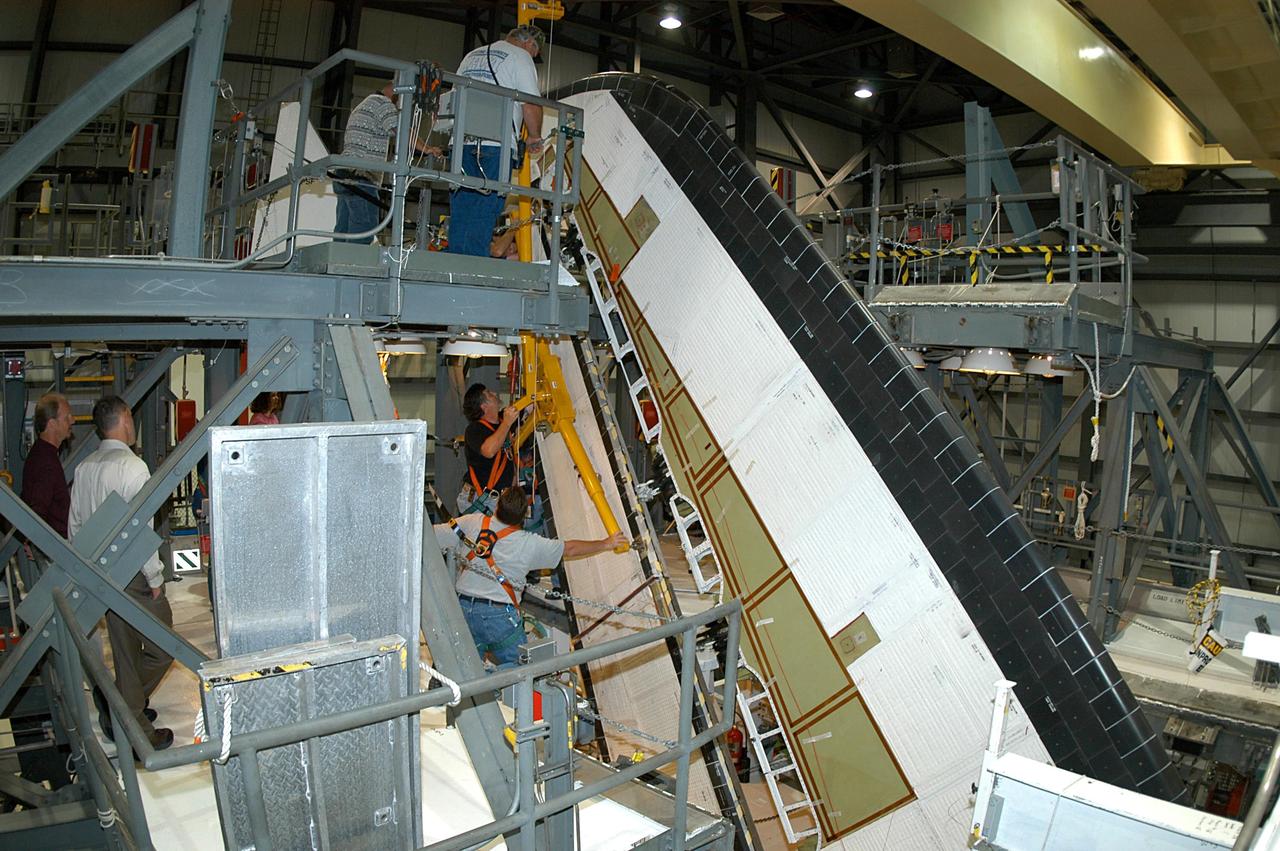
KENNEDY SPACE CENTER, FLA. -- In the Orbiter Processing Facility, workers begin removing the Rudder Speed Brake panel on the vertical tail of the orbiter Atlantis. The Rudder Speed Brake is being removed for inspection and maintenance prior to Return to Flight. The vertical tail consists of a structural fin surface made of aluminum, the Rudder Speed Brake surface, a tip and a lower trailing edge. The rudder splits into two halves to serve as a speed brake. The vertical tail and Rudder Speed Brake are covered with a reusable thermal protection system. The Rudder Speed Brake is used to guide and slow the Shuttle as it comes in for a landing.
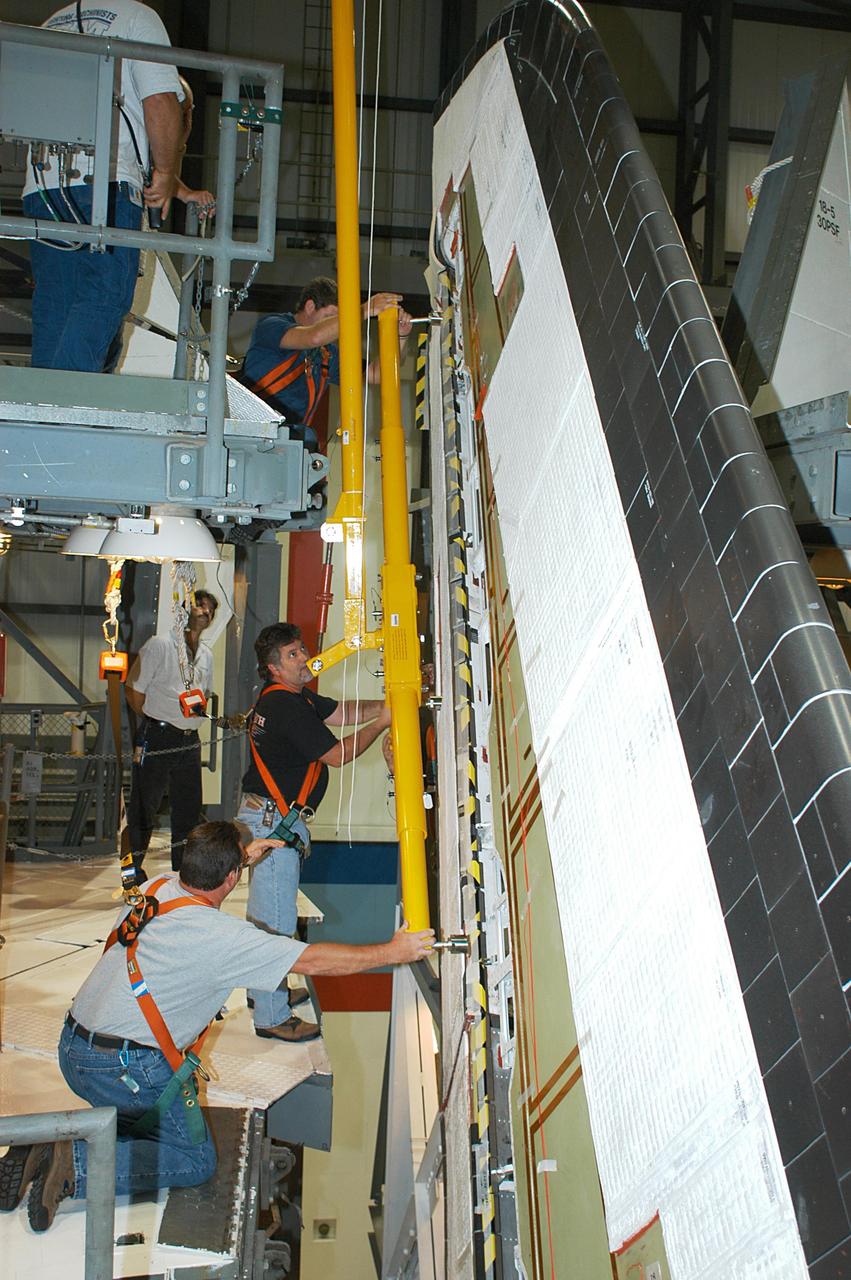
KENNEDY SPACE CENTER, FLA. -- In the Orbiter Processing Facility, workers connect a device onto the vertical tail of the orbiter Atlantis to remove the Rudder Speed Brake panel. The Rudder Speed Brake is being removed for inspection and maintenance prior to Return to Flight. The vertical tail consists of a structural fin surface made of aluminum, the Rudder Speed Brake surface, a tip and a lower trailing edge. The rudder splits into two halves to serve as a speed brake. The vertical tail and Rudder Speed Brake are covered with a reusable thermal protection system. The Rudder Speed Brake is used to guide and slow the Shuttle as it comes in for a landing.

KENNEDY SPACE CENTER, FLA. -- In the Orbiter Processing Facility, workers attach Atlantis’ Rudder Speed Brake panel to a stand after removing the panel from the vertical tail. The Rudder Speed Brake is being removed for inspection and maintenance prior to Return to Flight. The vertical tail consists of a structural fin surface made of aluminum, the Rudder Speed Brake surface, a tip and a lower trailing edge. The rudder splits into two halves to serve as a speed brake. The vertical tail and Rudder Speed Brake are covered with a reusable thermal protection system. The Rudder Speed Brake is used to guide and slow the Shuttle as it comes in for a landing.
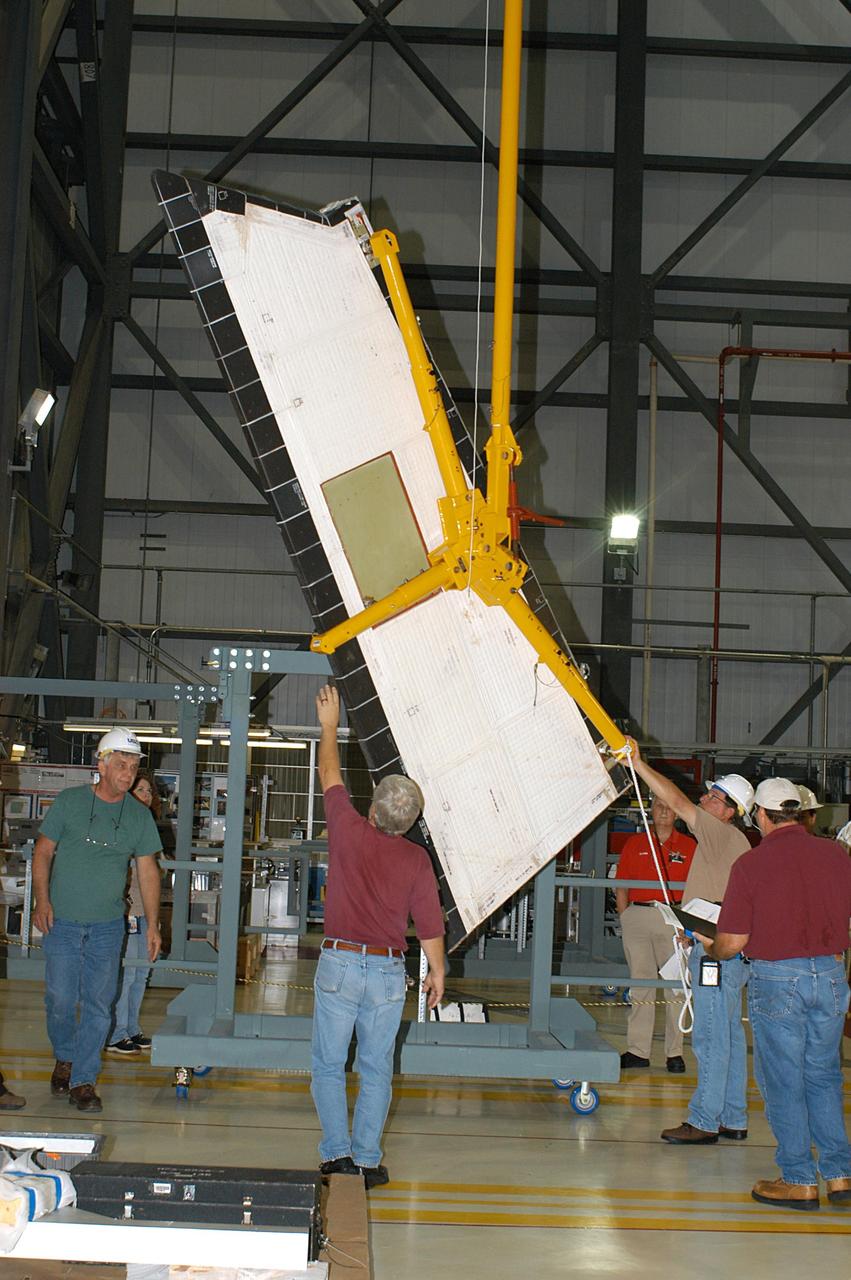
KENNEDY SPACE CENTER, FLA. -- In the Orbiter Processing Facility, workers lower Atlantis’ Rudder Speed Brake panel toward the floor after removing the panel from the vertical tail. The Rudder Speed Brake is being removed for inspection and maintenance prior to Return to Flight. The vertical tail consists of a structural fin surface made of aluminum, the Rudder Speed Brake surface, a tip and a lower trailing edge. The rudder splits into two halves to serve as a speed brake. The vertical tail and Rudder Speed Brake are covered with a reusable thermal protection system. The Rudder Speed Brake is used to guide and slow the Shuttle as it comes in for a landing.
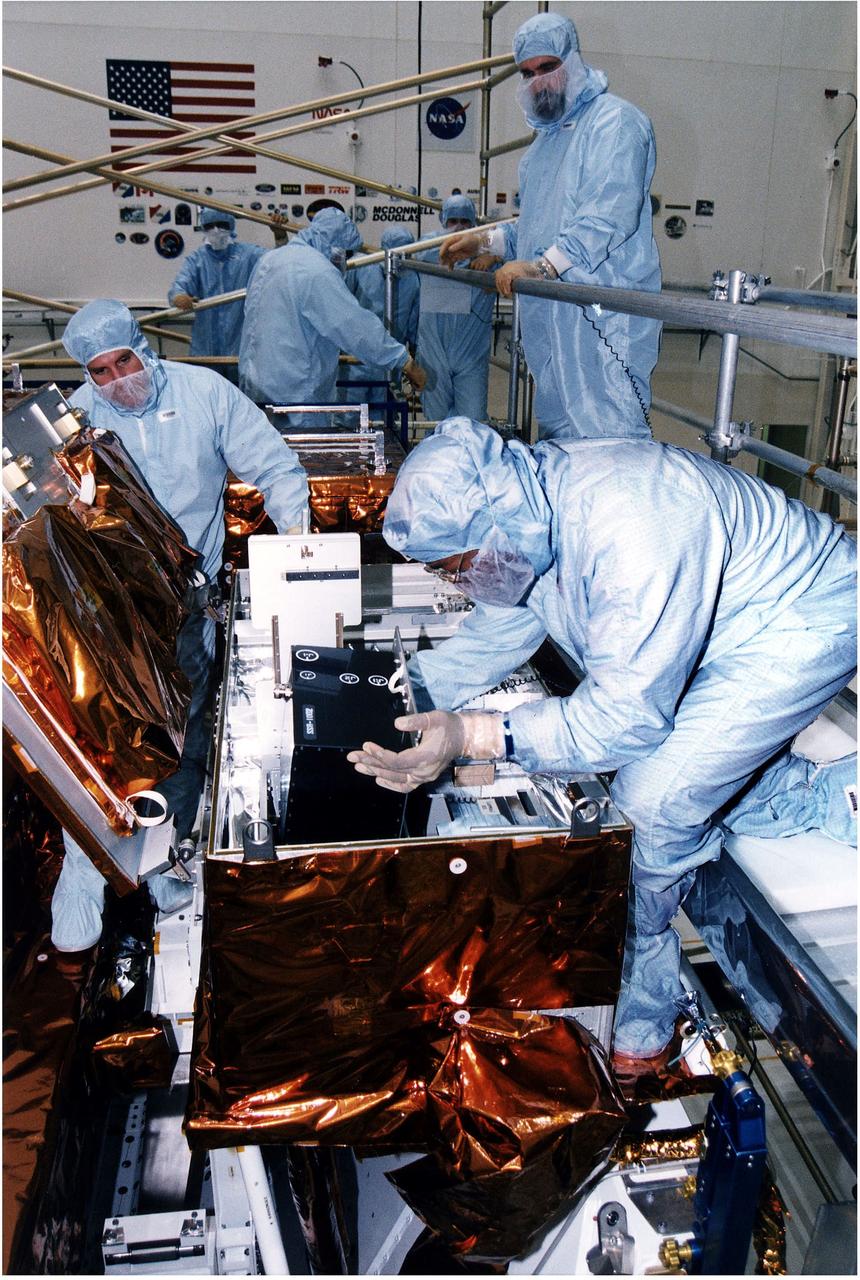
KENNEDY SPACE CENTER, FLA. - Workers in KSC's Vertical Processing Facility install a solid state recorder into a transport assembly in its protective enclosure as part of the prelaunch preparations for STS-82, the second Hubble Space Telescope servicing mission. The digital solid state recorder will replace one of three engineering/science tape recorders on Hubble. The solid state recorder has no moving parts to wear out. It also is more flexible than a reel-to-reel recorder and can store 10 times as much data. Liftoff aboard Discovery is targeted Feb. 11 with a crew of seven.
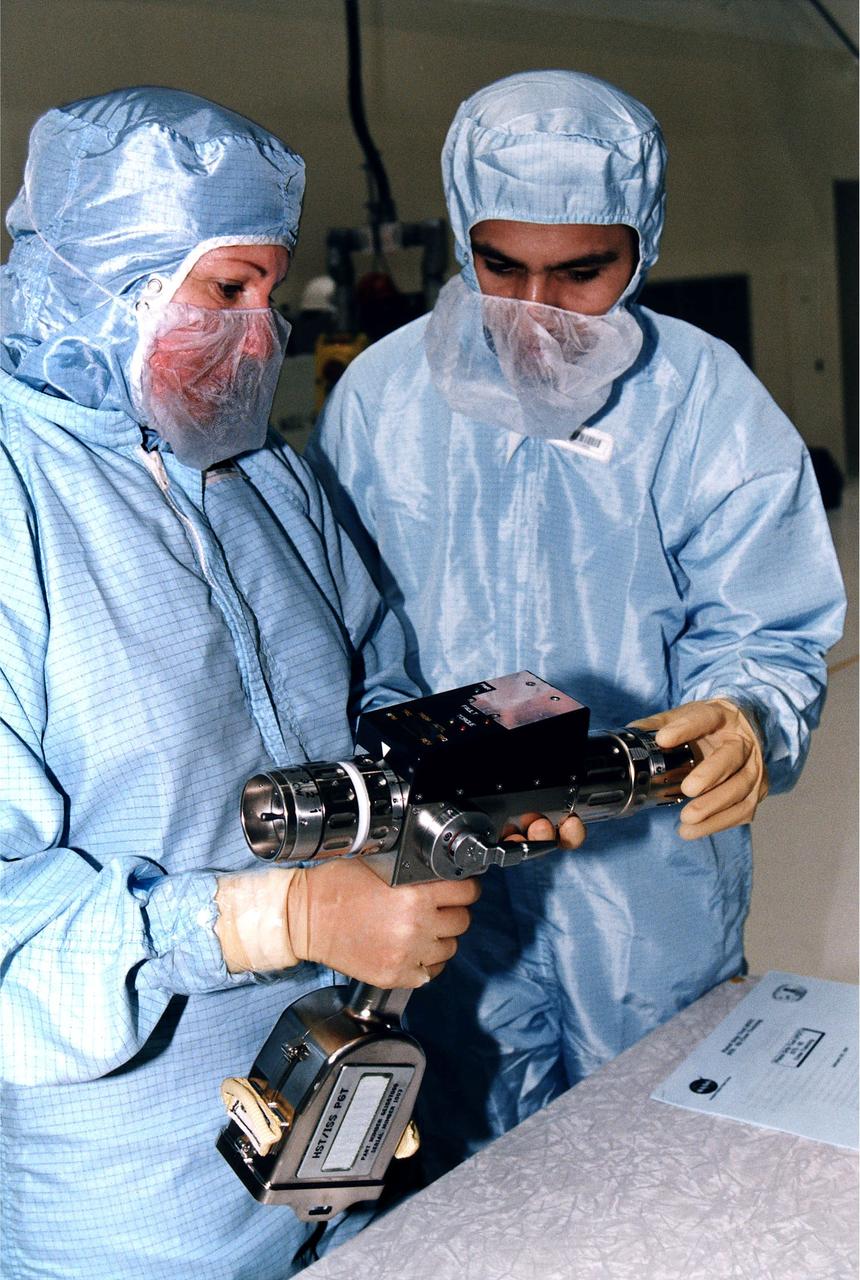
KENNEDY SPACE CENTER, FLA. - In KSC's Vertical Processing Facility, Louise Kleba of the Vehicle Integration Test Team (VITT) and engineer Devin Tailor of Goddard Space Flight Center examine the Pistol Grip Tool (PGT), which was designed for use by astronauts during spacewalks. The PGT is a self-contained, micro-processor controlled, battery-powered tool. It also can be used as a nonpowered ratchet wrench. The experiences of the astronauts on the first Hubble Space Telescope (HST) servicing mission led to recommendations for this smaller, more efficient tool for precision work during spacewalks. The PGT will be used on the second HST servicing mission, STS-82. Liftoff aboard Discovery is scheduled Feb. 11.
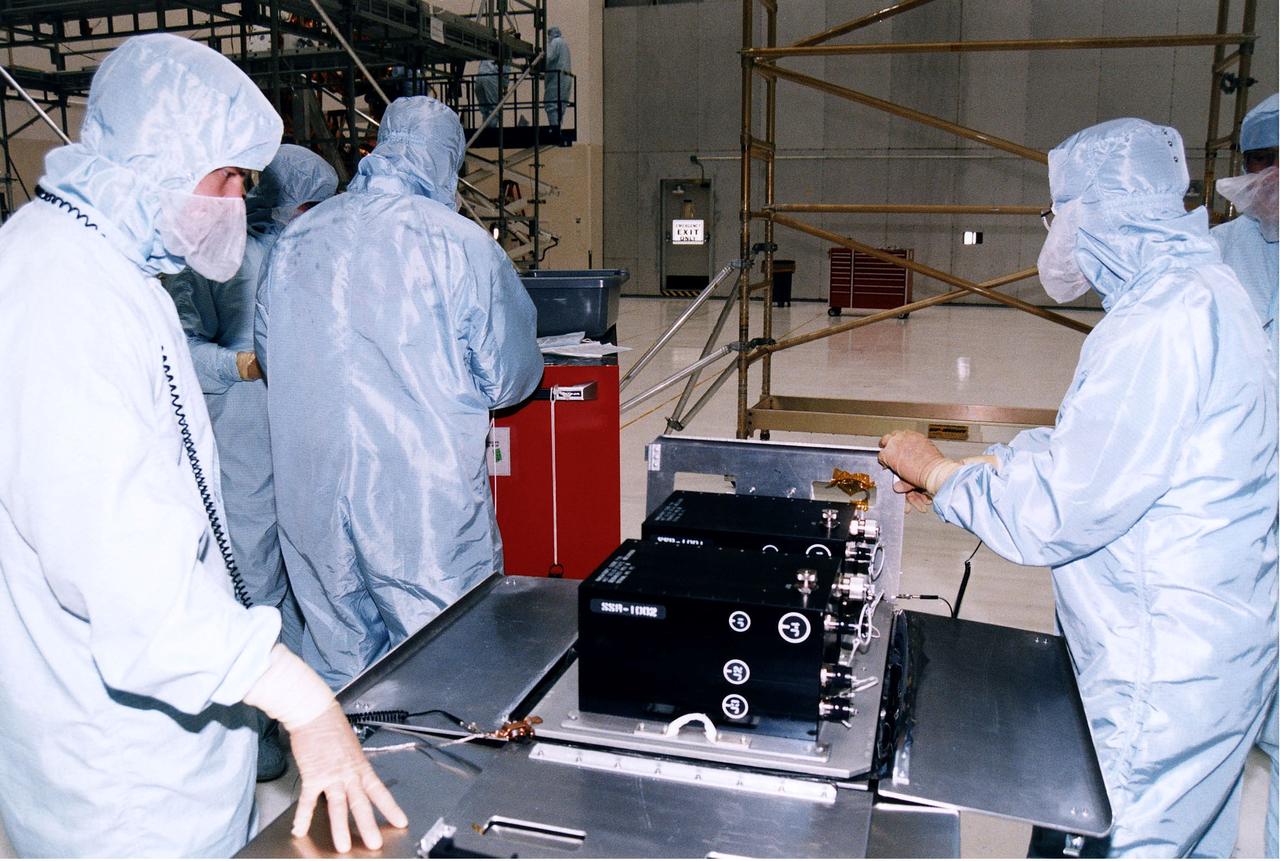
KENNEDY SPACE CENTER, FLA. - Workers in KSC's Vertical Processing Facility prepare a solid state recorder for installation in a protective enclosure as part of the prelaunch preparations for STS-82, the second Hubble Space Telescope servicing mission. The digital solid state recorder will replace one of three engineering/science tape recorders on Hubble. The solid state recorder has no moving parts to wear out. It also is more flexible than a reel-to-reel recorder and can store 10 times as much data. Liftoff aboard Discovery is targeted Feb. 11 with a crew of seven.
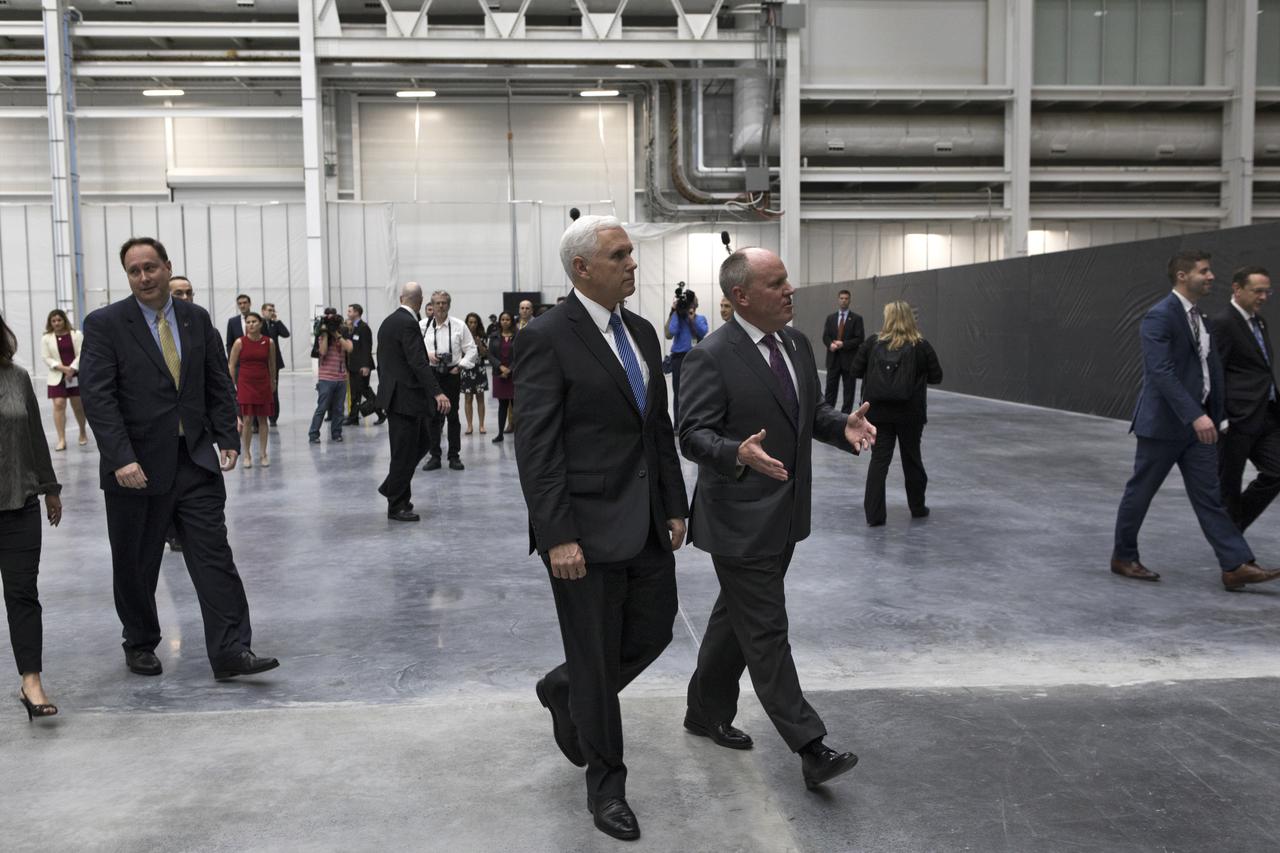
Vice President Mike Pence, at left, tours the Blue Origin Manufacturing Facility near NASA's Kennedy Space Center in Florida, Feb. 20, 2018, with the company's CEO Robert Smith. Vice President Pence viewed the flown New Shepard Booster and Crew Capsule. The booster was the first launch vehicle with a successful vertical takeoff and vertical landing to demonstrate reusability. During his visit, Pence will chair a meeting of the National Space Council on Feb. 21, 2018 in the high bay of NASA Kennedy Space Center's Space Station Processing Facility. The council's role is to advise the president regarding national space policy and strategy, and review the nation's long-range goals for space activities.
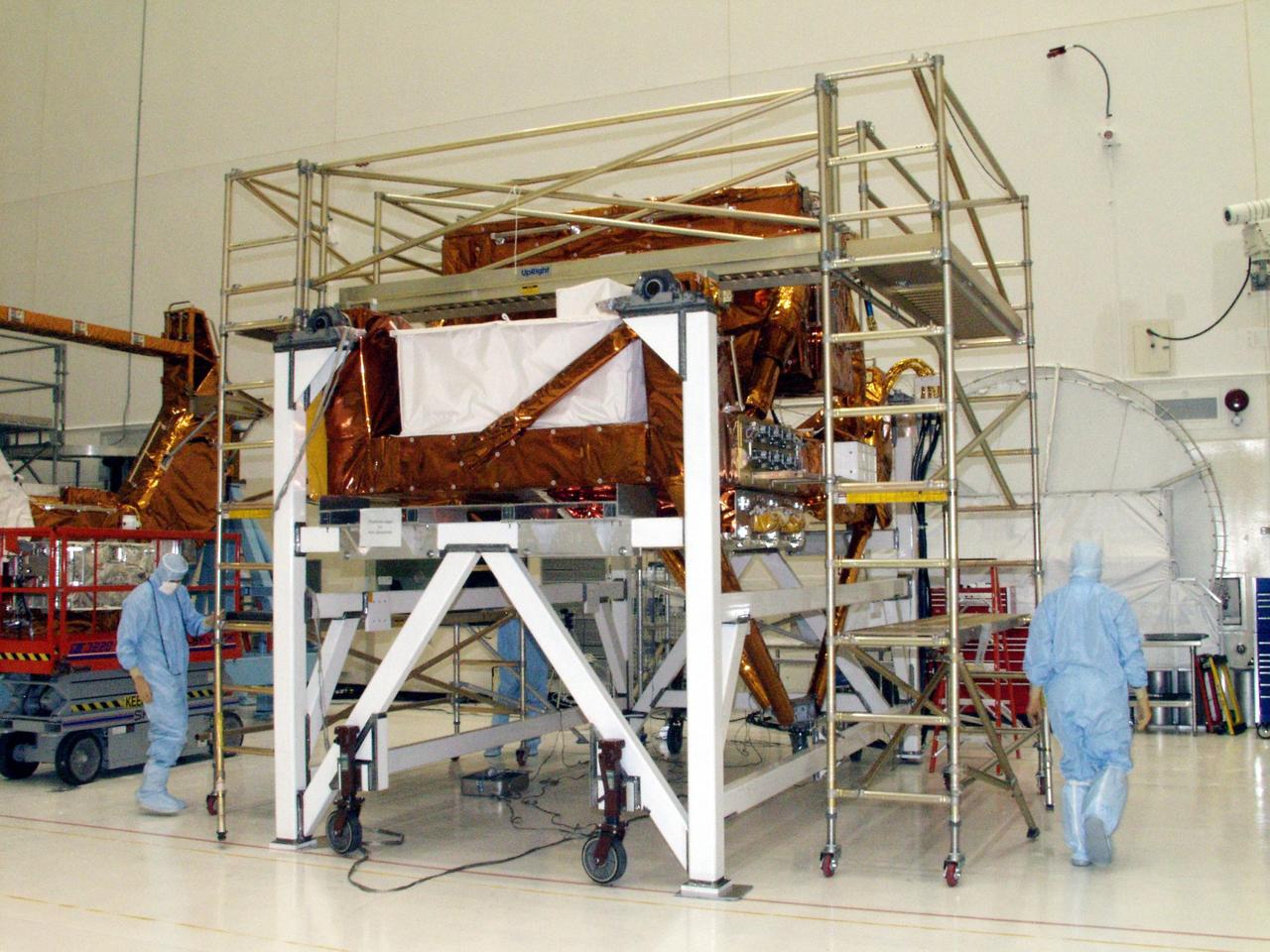
KENNEDY SPACE CENTER, FLA. --The STS-109 flight hardware for maintenance of the Hubble Space Telescope (HST) is being processed inside the clean room at the Vertical Processing Facility (VPF). Seen here is the Axial Science Instrument Protective Enclosure (ASIPE), which will house the Advanced Camera for Surveys (ACS). The hardware will be installed on four principle payload carriers. The STS-109 launch aboard Columbia is targeted for Feb. 14, 2002, and will be the 108th flight in the Space Shuttle program
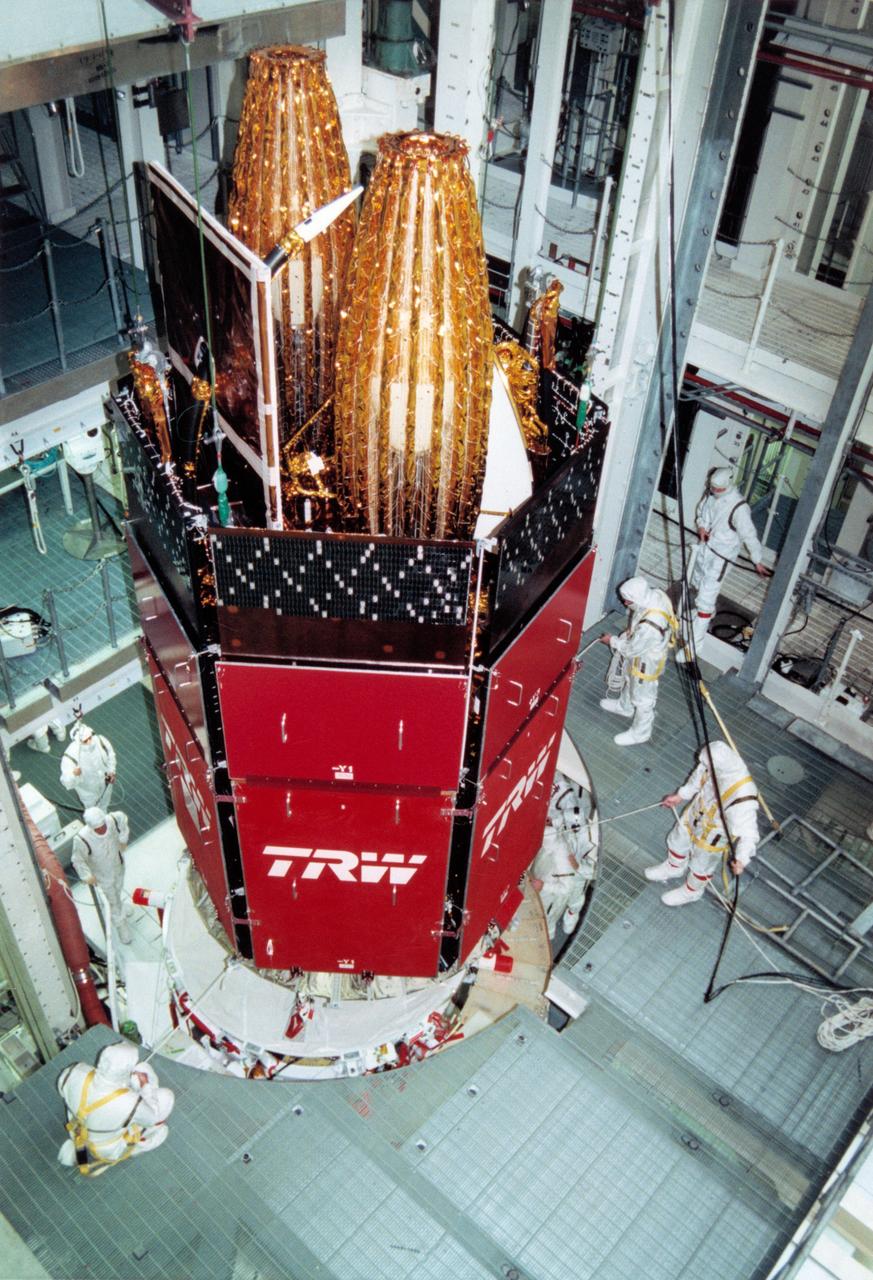
S95-08962 (12 APRIL 1995) --- Members of the Kennedy Space Center (KSC) Payload Processing Team hoist the Tracking and Data Relay Satellite (TDRS-G) into a work stand in the Vertical Processing Facility (VPF) for mating with its Inertial Upper Stage (IUS). After testing and final checkout, TDRS-G and the IUS will be transported to Launch Pad 39B and installed into the Space Shuttle Discovery's payload bay for launch on the STS-70 mission, scheduled for launch June 8, 1995.
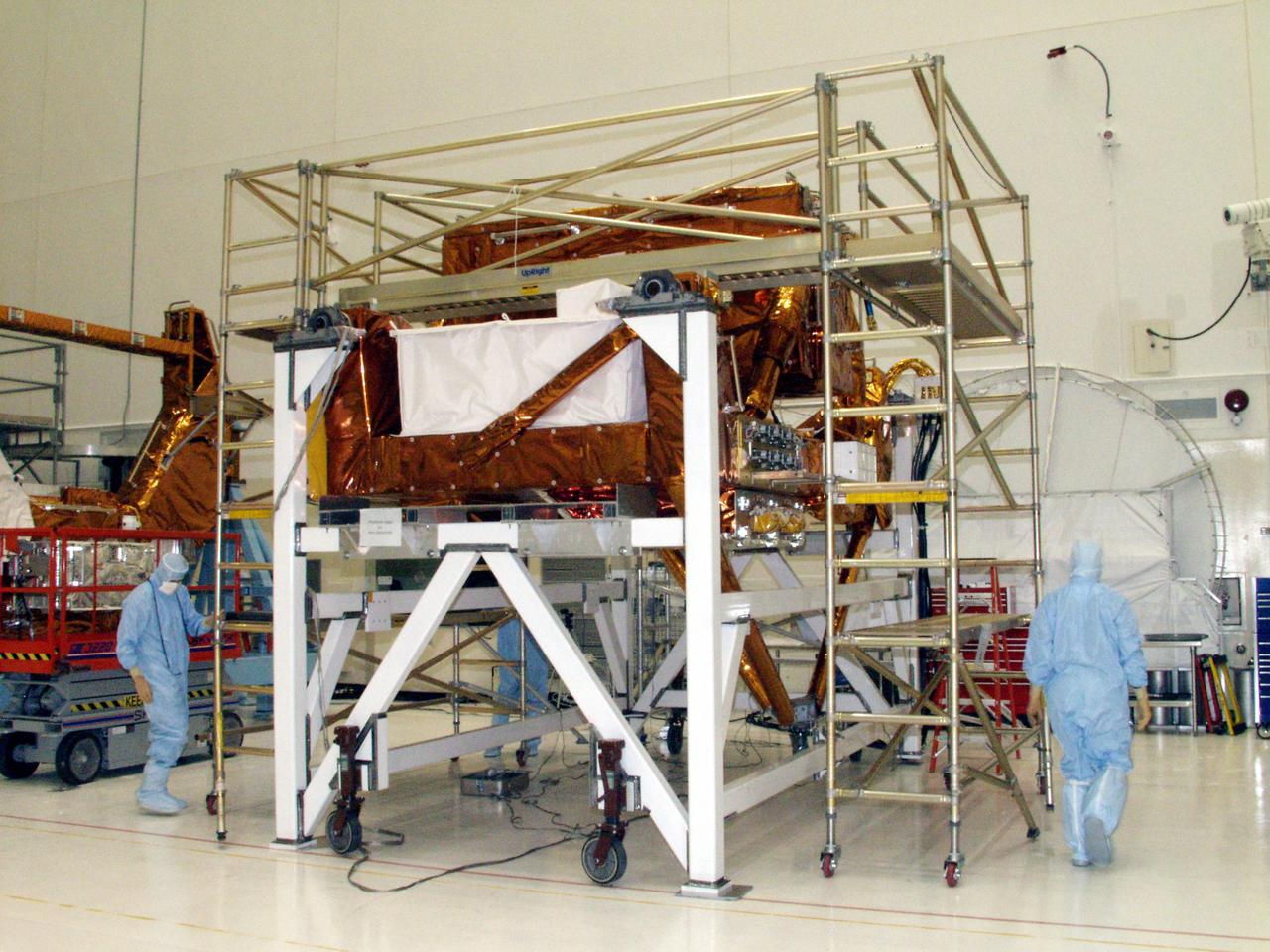
KENNEDY SPACE CENTER, FLA. --The STS-109 flight hardware for maintenance of the Hubble Space Telescope (HST) is being processed inside the clean room at the Vertical Processing Facility (VPF). Seen here is the Axial Science Instrument Protective Enclosure (ASIPE), which will house the Advanced Camera for Surveys (ACS). The hardware will be installed on four principle payload carriers. The STS-109 launch aboard Columbia is targeted for Feb. 14, 2002, and will be the 108th flight in the Space Shuttle program
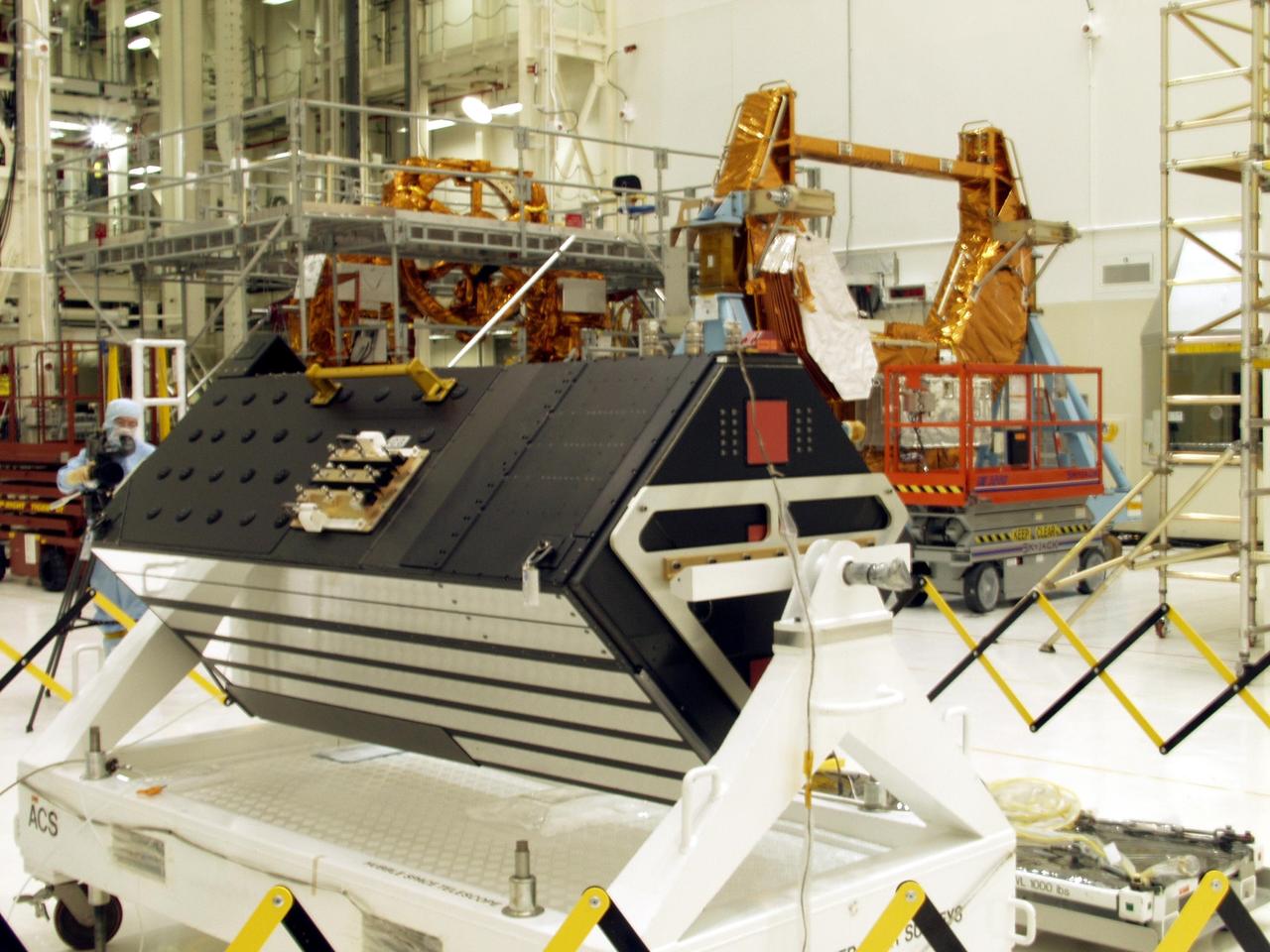
KENNEDY SPACE CENTER, FLA. -- The Advanced Camera for Surveys (ACS), foreground, is part of the STS-109 flight hardware for maintenance of the Hubble Space Telescope (HST). The ACS and other hardware, installed on four principle payload carriers, are being processed inside the clean room at the Vertical Processing Facility (VPF). The STS-109 launch aboard Columbia is targeted for Feb. 14, 2002, and will be the 108th flight in the Space Shuttle program
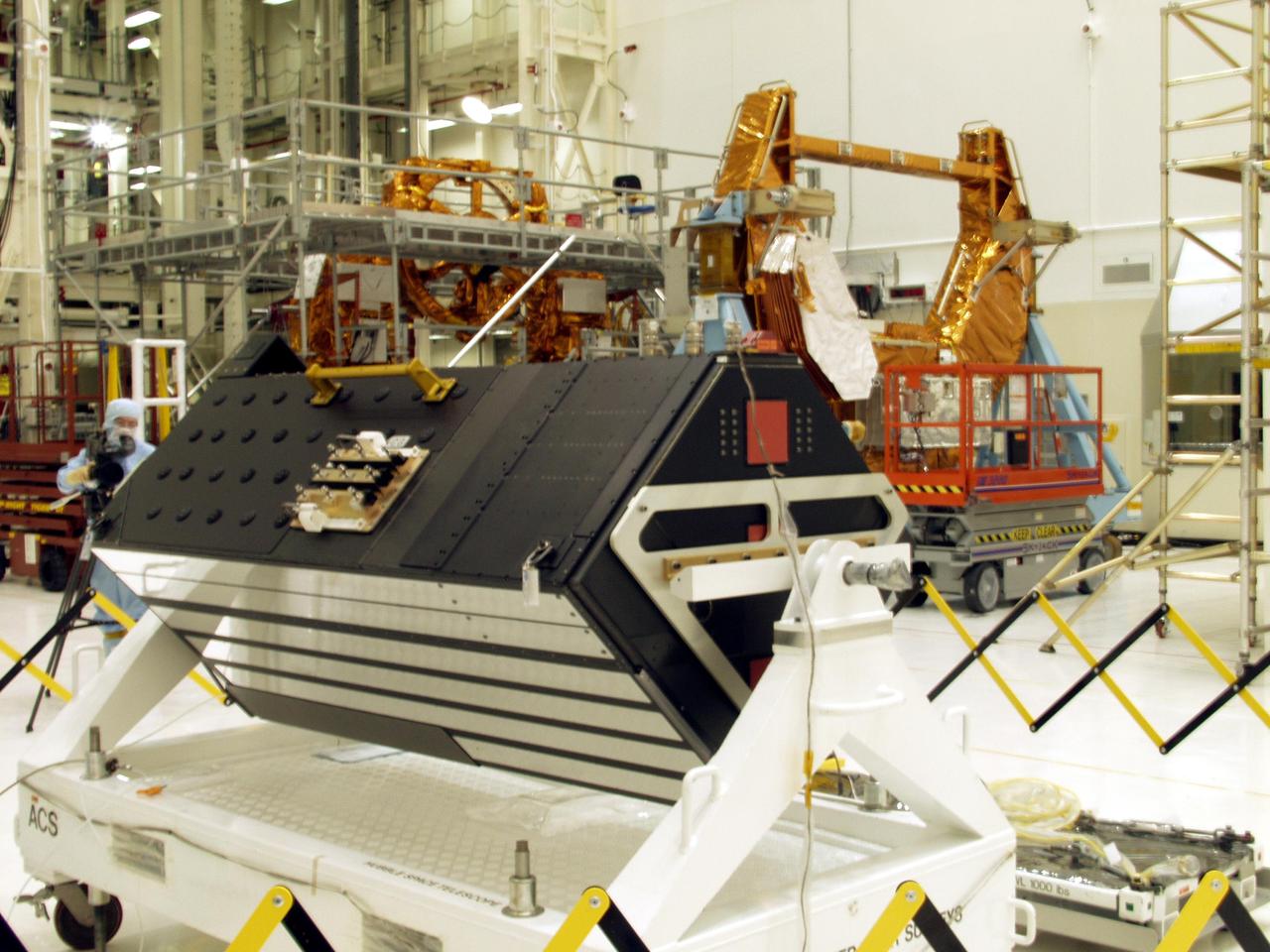
KENNEDY SPACE CENTER, FLA. -- The Advanced Camera for Surveys (ACS), foreground, is part of the STS-109 flight hardware for maintenance of the Hubble Space Telescope (HST). The ACS and other hardware, installed on four principle payload carriers, are being processed inside the clean room at the Vertical Processing Facility (VPF). The STS-109 launch aboard Columbia is targeted for Feb. 14, 2002, and will be the 108th flight in the Space Shuttle program
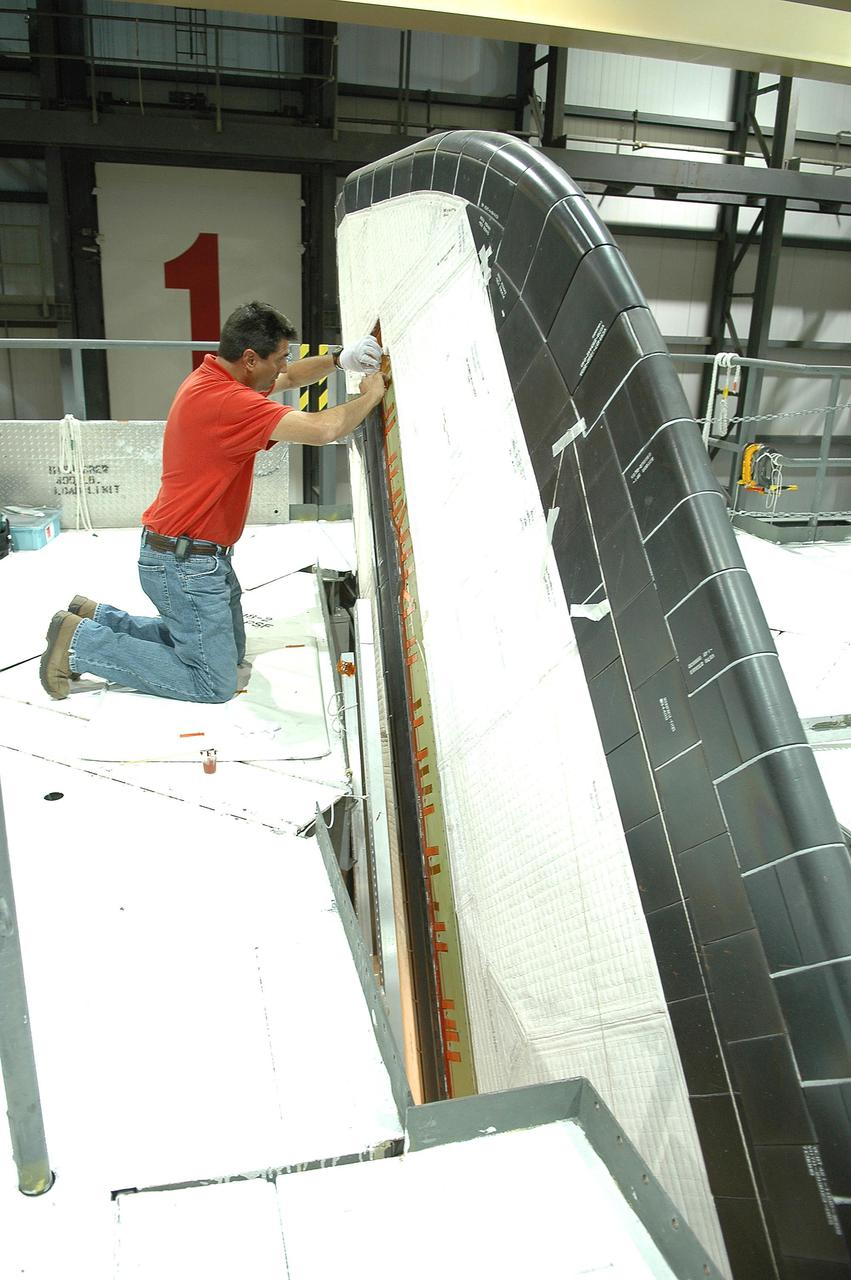
KENNEDY SPACE CENTER, FLA. - In the Orbiter Processing Facility at NASA’s Kennedy Space Center, United Space Alliance tile technician Jimmy Carter works on instrument wire spot bonding on Atlantis’ vertical tail_rudder speed brake. Atlantis is being processed for launch on the second Return to Flight mission, STS-121, which is scheduled to fly in July.
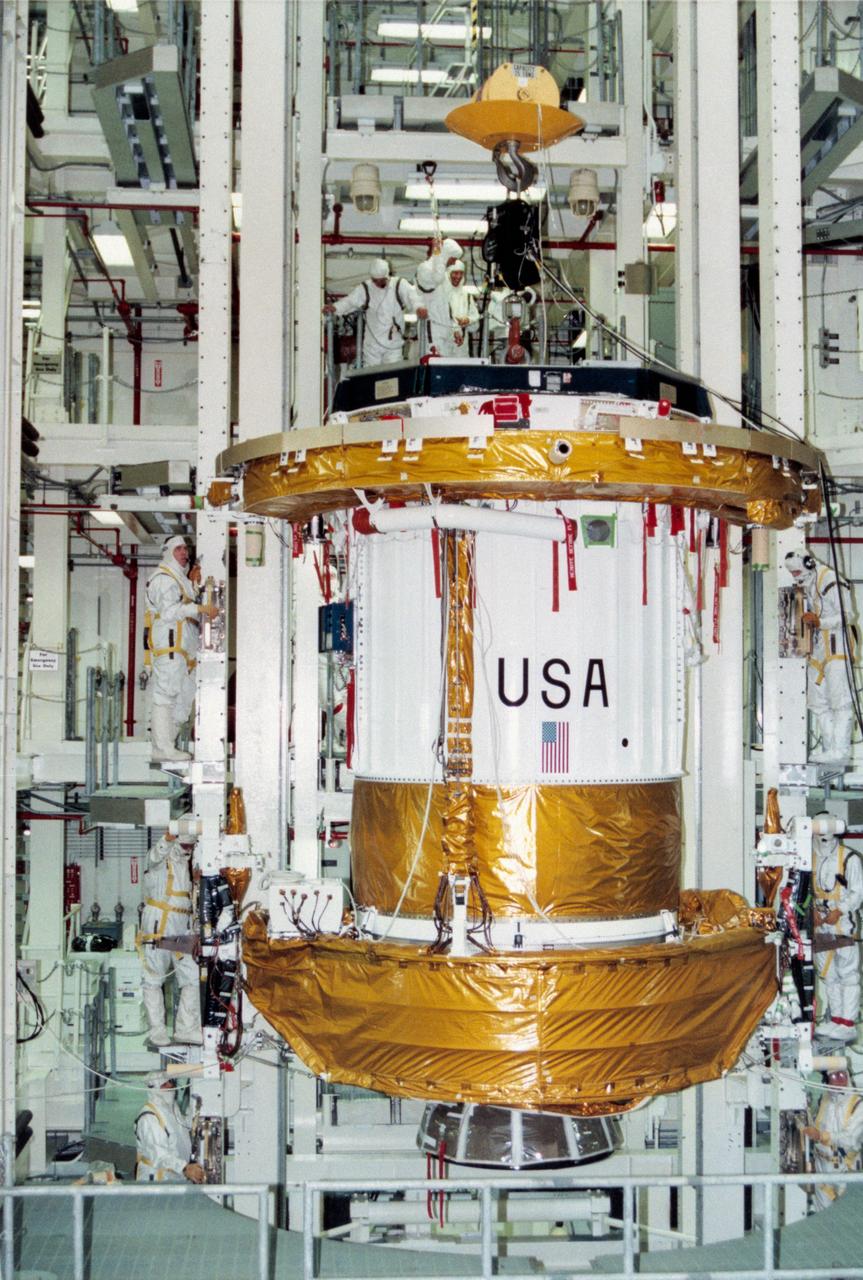
S95-08961 (4 APRIL 1995) --- Workers in the Vertical Processing Facility (VPF) oversee and control the lowering of the Inertial Upper Stage (IUS) booster into a work stand for preflight processing. The IUS will be attached to the Tracking and Data Relay Satellite (TDRS-G), which will be deployed by the Space Shuttle Discovery on the STS-70 mission. The IUS is scheduled to be mated to the TDRS satellite later in April. Liftoff of STS-70 is slated for no earlier than June 8, 1995.
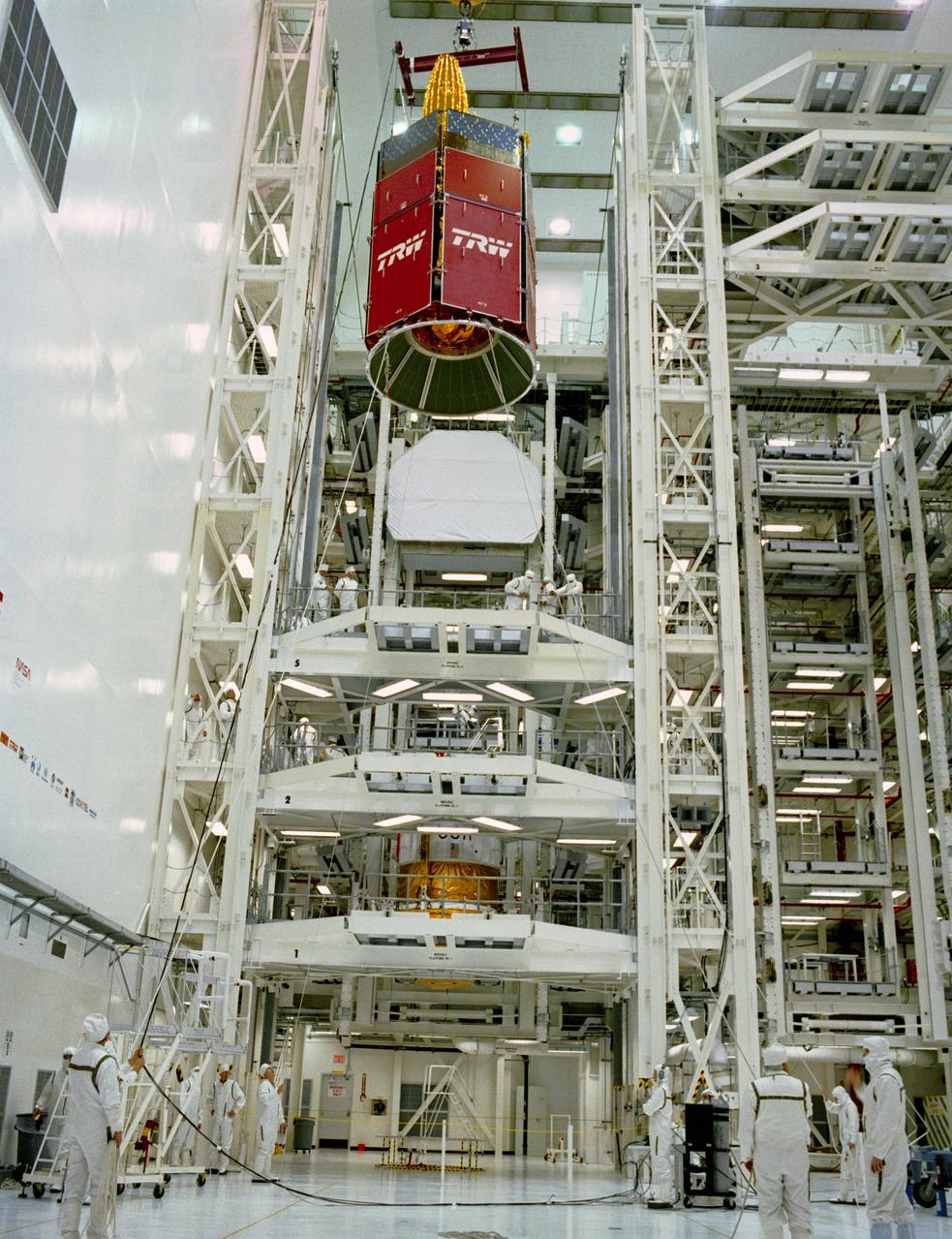
S89-27383 (29 Dec 1988) --- This wide shot of a test cell in KSC's Vertical Processing Facility affords an overall scene of the mating process of the STS 29 tracking and data relay satellite (TDRS-D, in foreground) with its inertial upper stage (IUS-9, in lower part of frame). Later the tandem will be loaded into the cargo bay of Discovery.
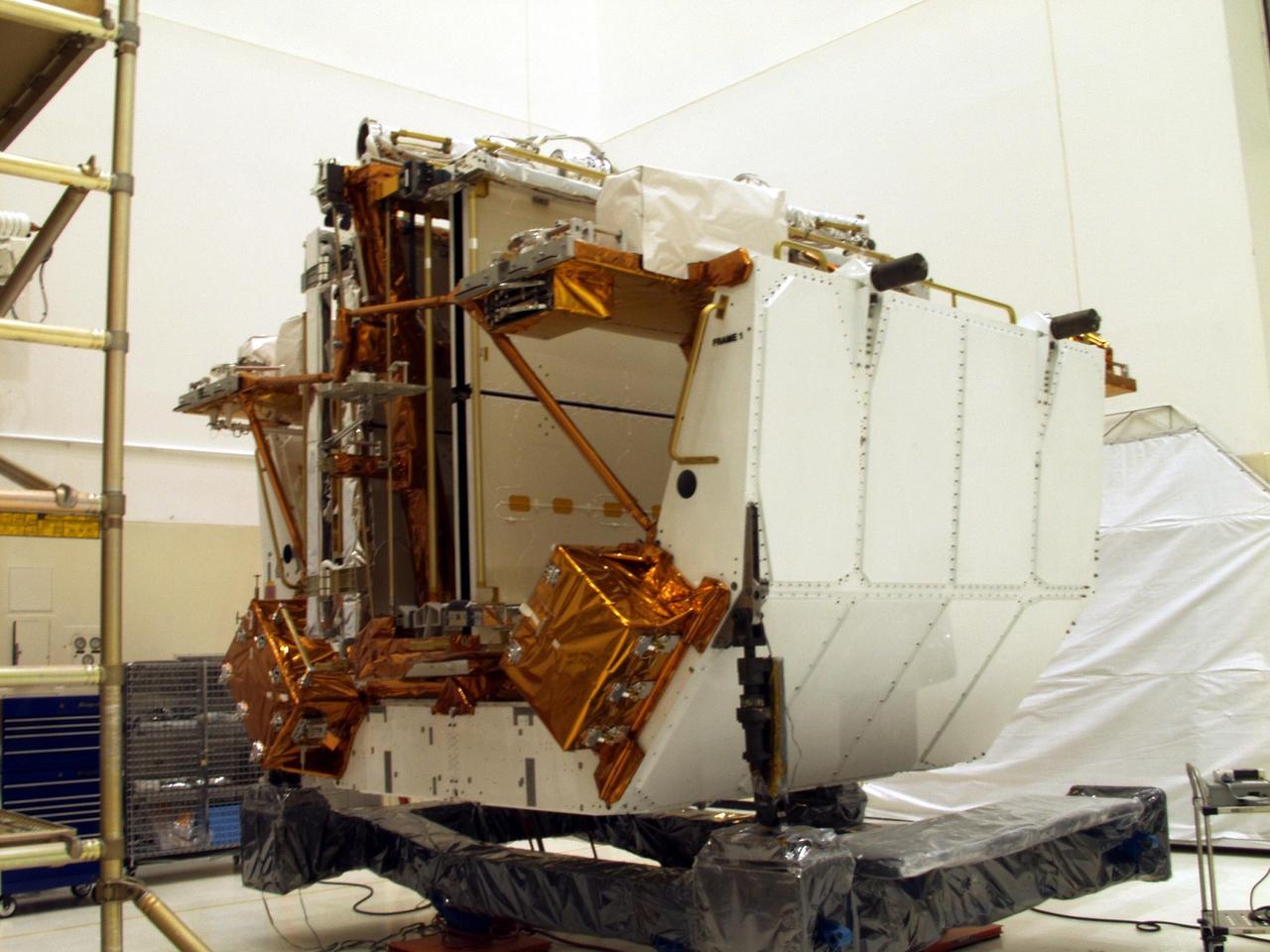
KENNEDY SPACE CENTER, FLA. --The Solar Array 3 panels are part of the STS-109 flight hardware for maintenance of the Hubble Space Telescope (HST). The panels and other hardware, installed on four principle payload carriers, are being processed inside the clean room at the Vertical Processing Facility (VPF). The STS-109 launch aboard Columbia is targeted for Feb. 14, 2002, and will be the 108th flight in the Space Shuttle program
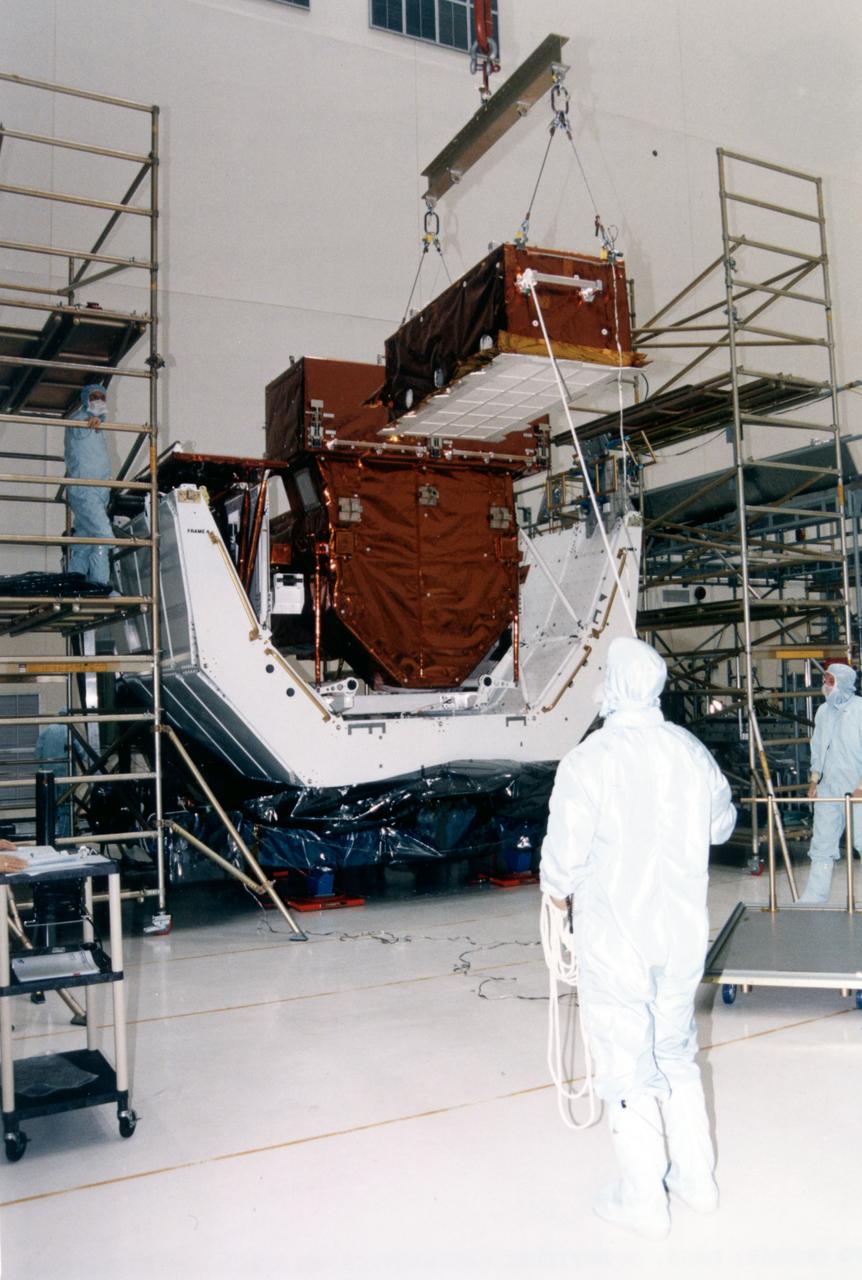
KENNEDY SPACE CENTER, FLORIDA STS-82 PREPARATIONS VIEW --- Workers in the Kennedy Space Center (KSC) Vertical Processing Facility (VPF) prepare to integrate the Small Orbital Replacement Unit (Oru) Protective Enclosure (Sope), shown here being lifted, with the ORU Carrier shelf, in background, as part of the pre-launch processing for STS-82. The mission, the second one devoted to servicing of the HST, is targeted for launch on February 11, 1997.
KENNEDY SPACE CENTER, FLA. --The Solar Array 3 panels are part of the STS-109 flight hardware for maintenance of the Hubble Space Telescope (HST). The panels and other hardware, installed on four principle payload carriers, are being processed inside the clean room at the Vertical Processing Facility (VPF). The STS-109 launch aboard Columbia is targeted for Feb. 14, 2002, and will be the 108th flight in the Space Shuttle program
KENNEDY SPACE CENTER, Fla. -- Solar arrays part of the payload for the Hubble Servicing Mission, STS-109, await processing in the Vertical Processing Facility. The primary servicing tasks of the mission are to replace Solar Array 2 with Solar Array 3, replace the Power Control Unit, remove the Faint Object Camera and install the Advanced Camera for Surveys, install the NICMOS Cooling System, and install New Outer Blanket Insulation on bays 5 through 8. Mission STS-109 is scheduled for launch in mid-February 2002
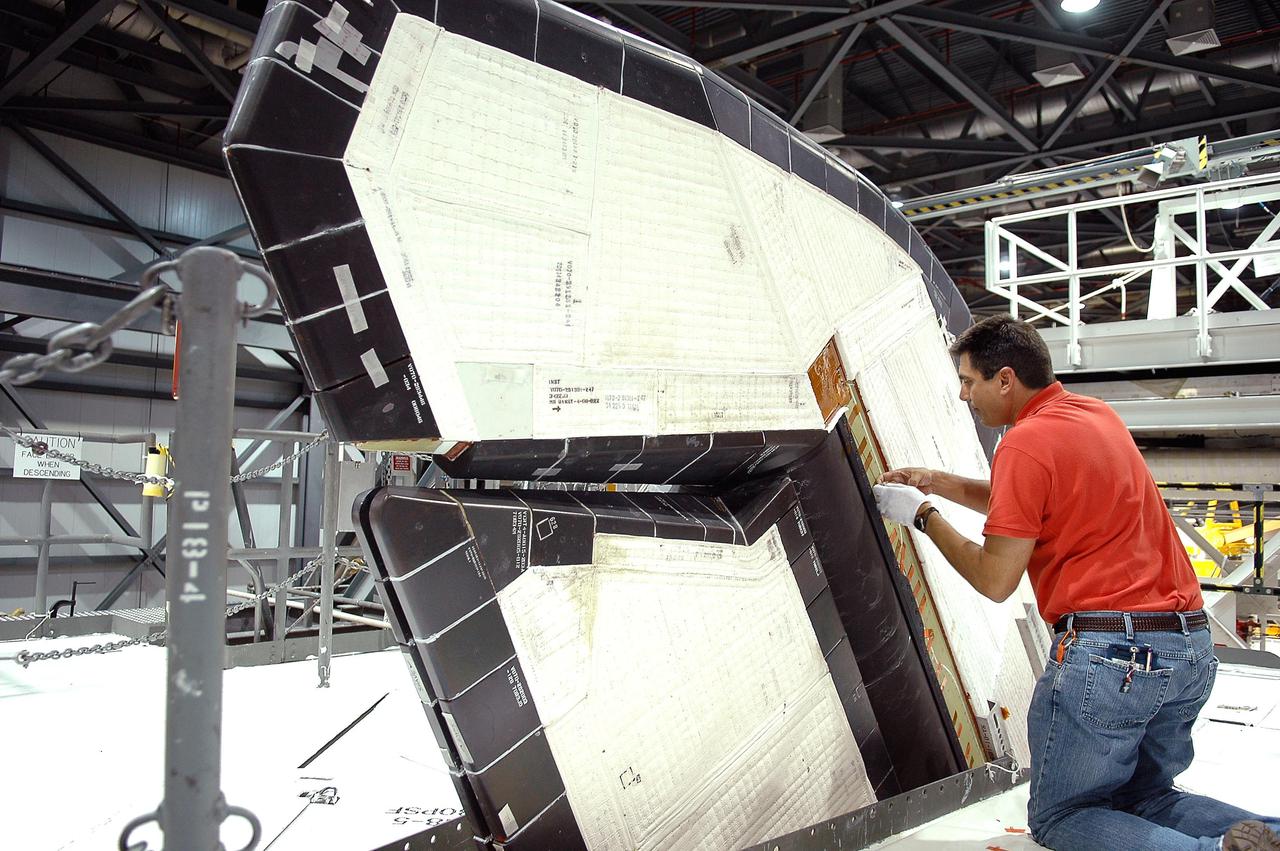
KENNEDY SPACE CENTER, FLA. - In the Orbiter Processing Facility at NASA’s Kennedy Space Center, United Space Alliance tile technician Jimmy Carter works on instrument wire spot bonding on Atlantis’ vertical tail_rudder speed brake. Atlantis is being processed for launch on the second Return to Flight mission, STS-121, which is scheduled to fly in July.
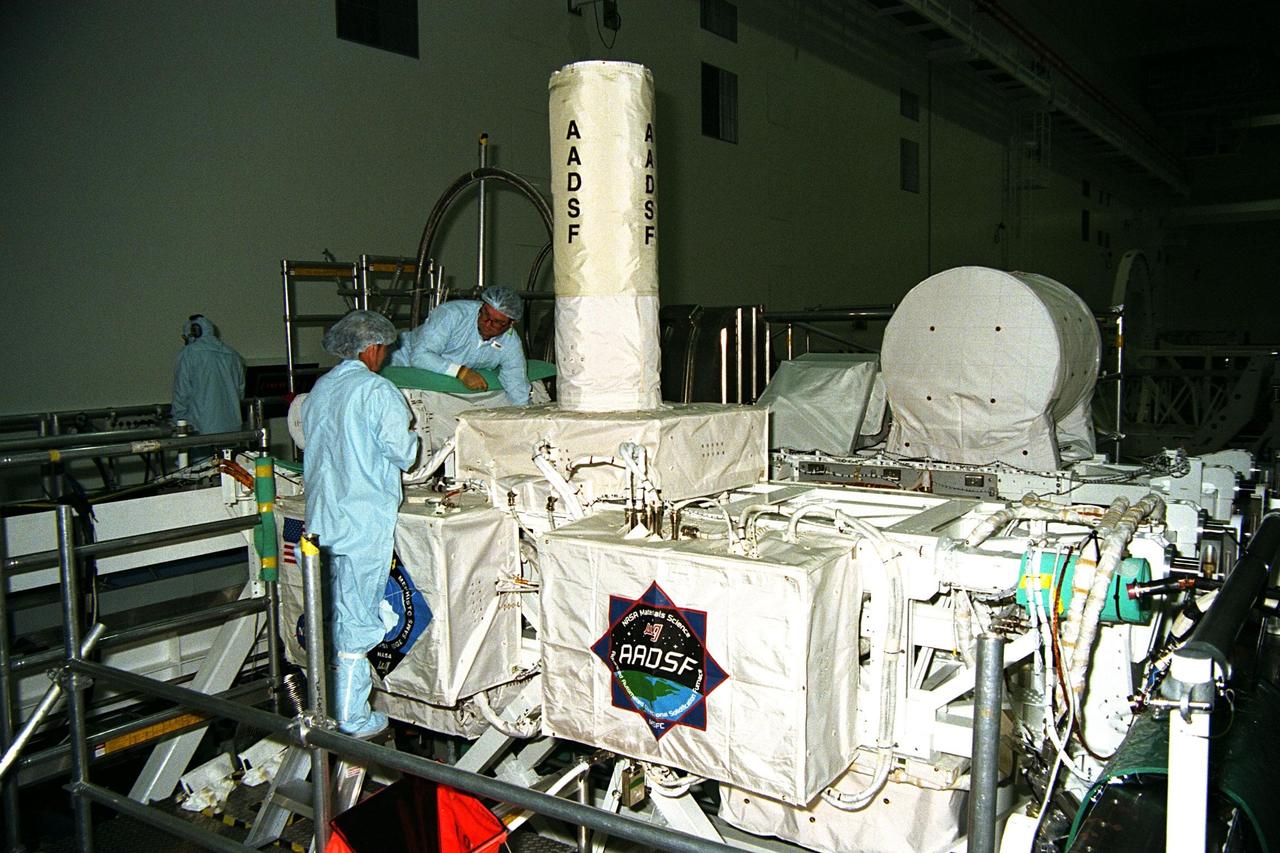
Technicians are monitoring experiments on the United States Microgravity Payload-4 (USMP-4) in preparation for its scheduled launch aboard STS-87 on Nov. 19 from Kennedy Space Center (KSC). USMP-4 experiments are prepared in the Space Station Processing Facility at KSC. The large white vertical cylinder in the center of the photo is the Advanced Automated Directional Solidification Furnace (AADSF), which is a sophisticated materials science facility used for studying a common method of processing semiconductor crystals called directional solidification. The white horizontal tube to the right is the Isothermal Dendritic Growth Experiment (IDGE), which will be used to study the dendritic solidification of molten materials in the microgravity environment
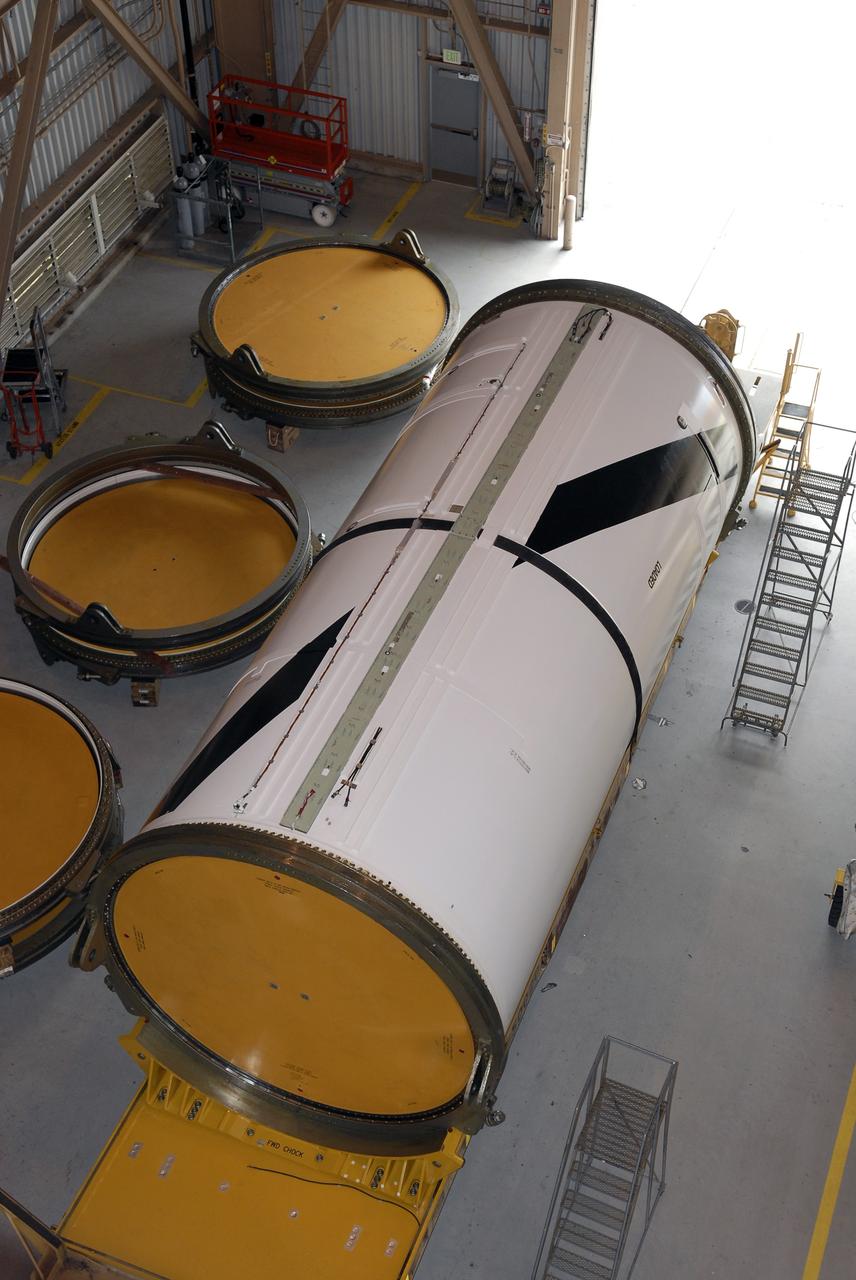
CAPE CANAVERAL, Fla. – In the Rotation, Processing and Surge Facility at NASA's Kennedy Space Center in Florida, the third of four Ares I-X segments arrives on a transporter. The segment will be raised to a vertical position in order to transfer it to a work stand for final processing and integration in the facility. The booster used for the Ares I-X launch is being modified by adding new forward structures and a fifth segment simulator. The stacking operations are scheduled to begin in the Vehicle Assembly Building in April. Launch of the Ares I-X test flight is targeted for July 2009. Photo credit: NASA/Kim Shiflett
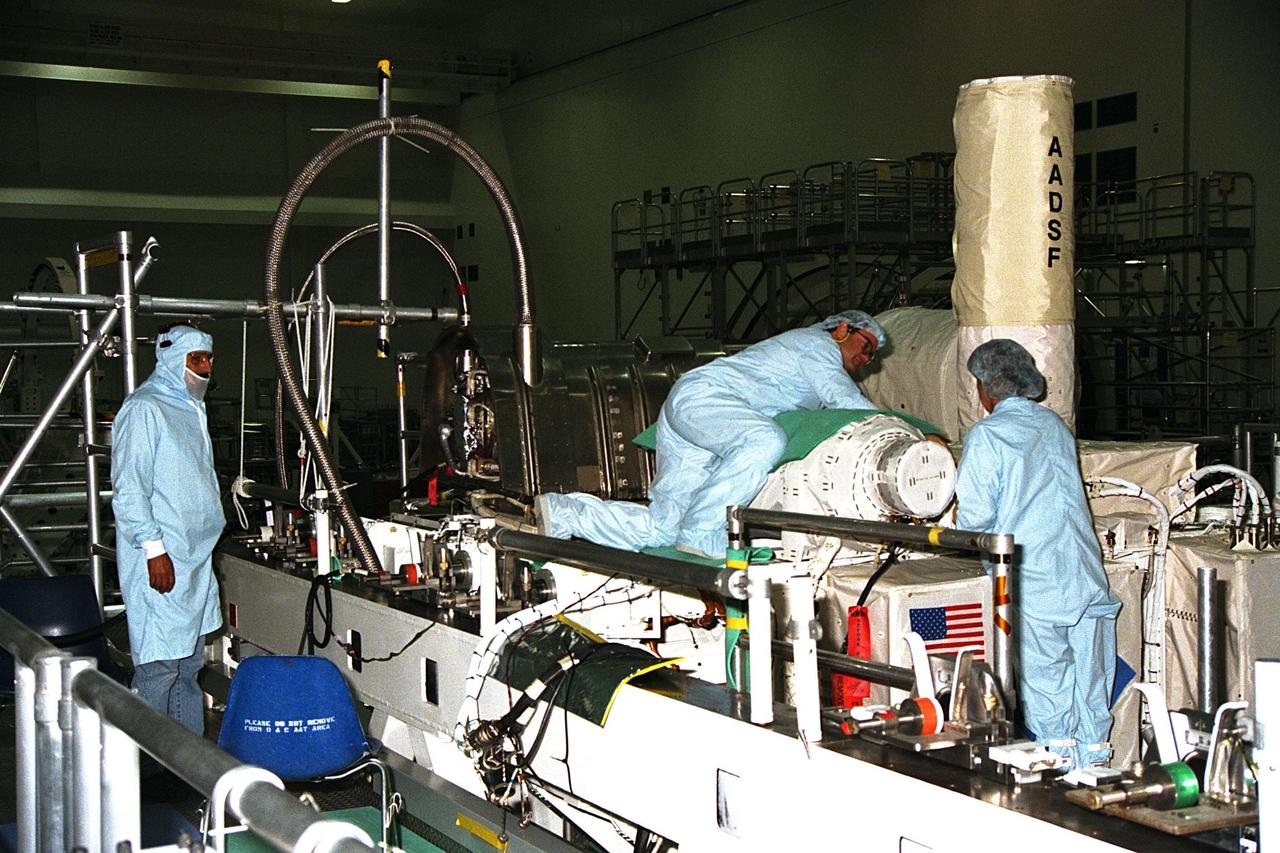
Technicians are monitoring experiments on the United States Microgravity Payload-4 (USMP-4) in preparation for its scheduled launch aboard STS-87 on Nov. 19 from Kennedy Space Center (KSC). USMP-4 experiments are prepared in the Space Station Processing Facility at KSC. The large white vertical cylinder at the right of the photo is the Advanced Automated Directional Solidification Furnace (AADSF ), which is a sophisticated materials science facility used for studying a common method of processing semiconductor crystals called directional solidification. The technician in the middle of the photo is leaning over MEPHISTO, a cooperative American-French investigation of the fundamentals of crystal growth
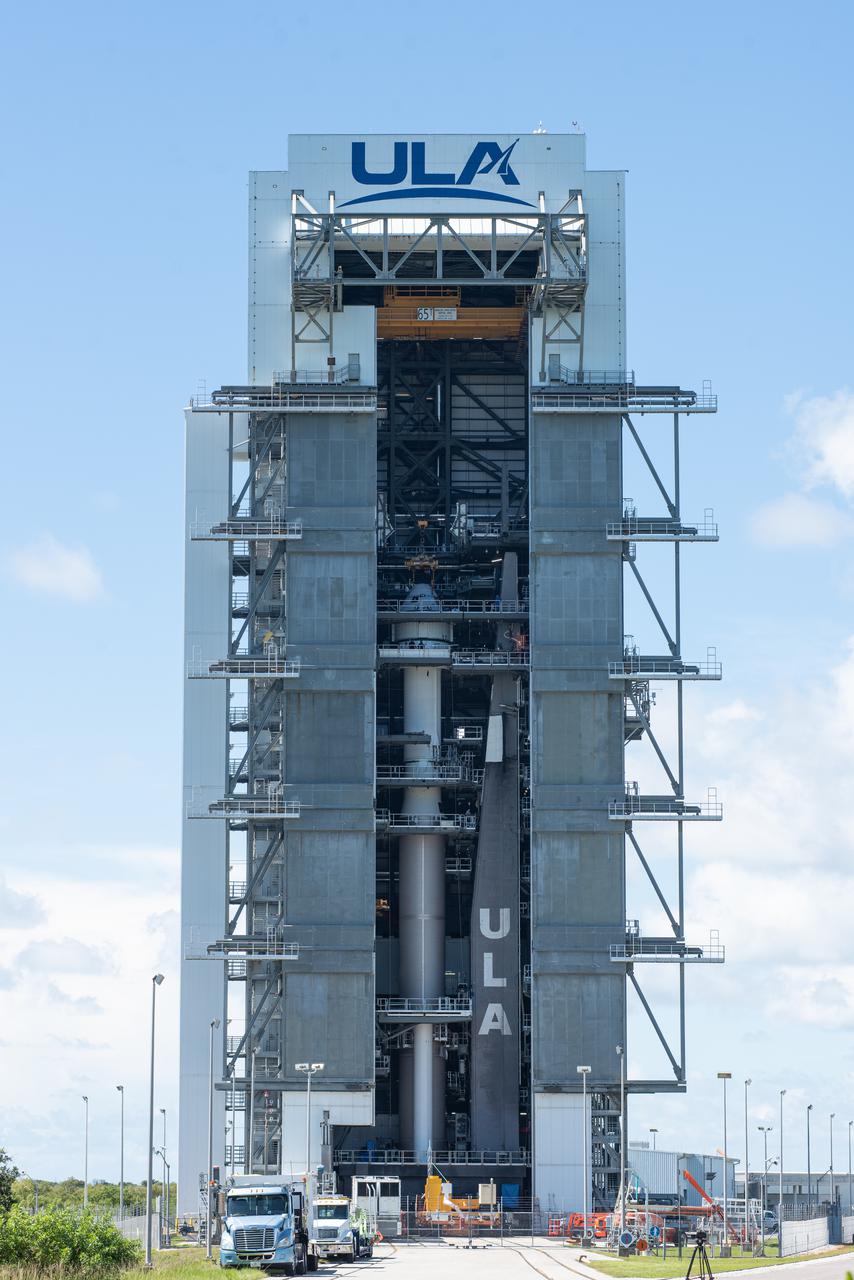
Boeing’s CST-100 Starliner spacecraft is secured atop a United Launch Alliance Atlas V rocket at the Vertical Integration Facility at Space Launch Complex-41 at Florida’s Cape Canaveral Space Force Station on July 17, 2021. Starliner will launch on the Atlas V for Boeing’s second Orbital Flight Test (OFT-2) for NASA’s Commercial Crew Program. The spacecraft rolled out from Boeing’s Commercial Crew and Cargo Processing Facility at NASA’s Kennedy Space Center earlier in the day.
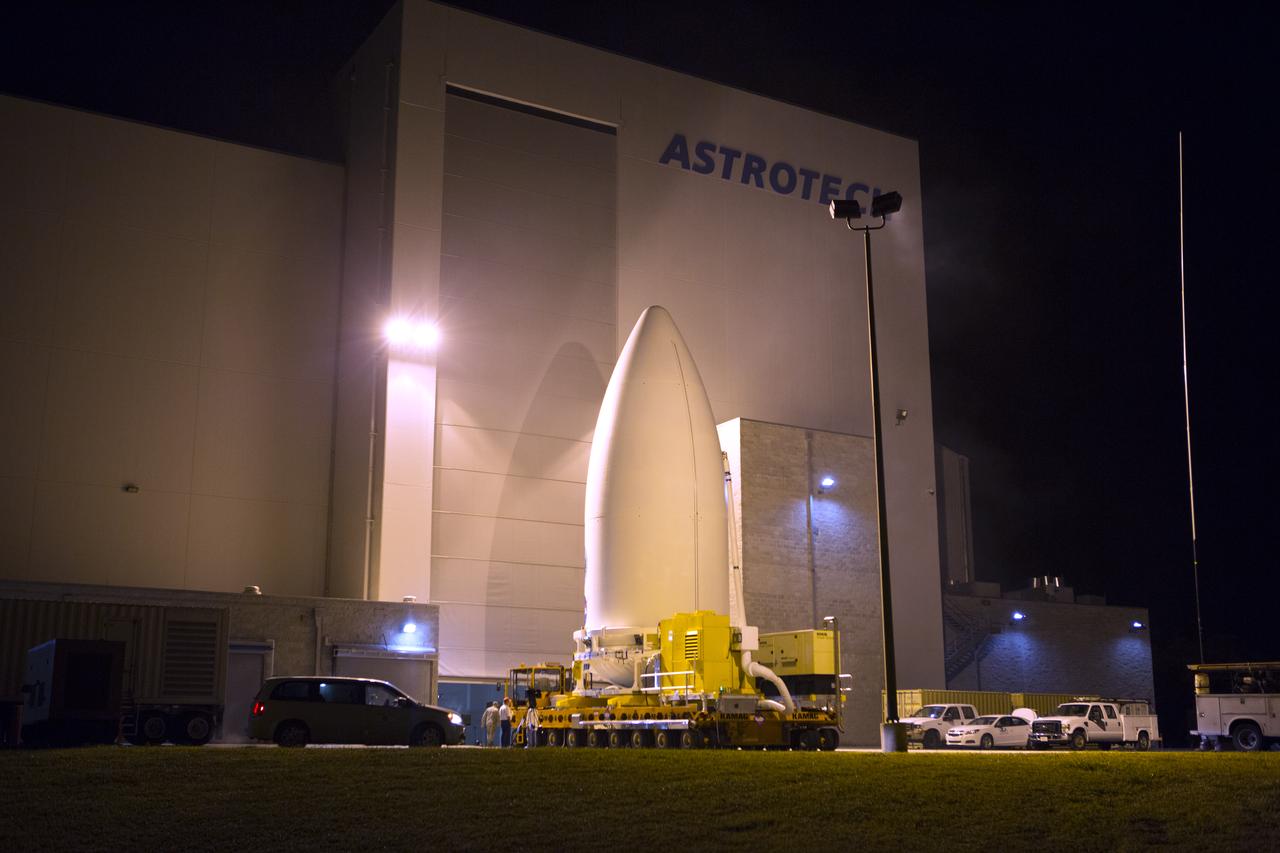
Enclosed in its payload fairing, NOAA's Geostationary Operational Environmental Satellite (GOES-R) departs from the Astrotech payload processing facility in Titusville, Florida, near NASA's Kennedy Space Center. GOES-R will be transported to the Vertical Integration Facility at Space Launch Complex 41 at Cape Canaveral Air Force Station. The satellite will launch aboard a United Launch Alliance Atlas V rocket in November. GOES-R is the first satellite in a series of next-generation NOAA GOES Satellites.
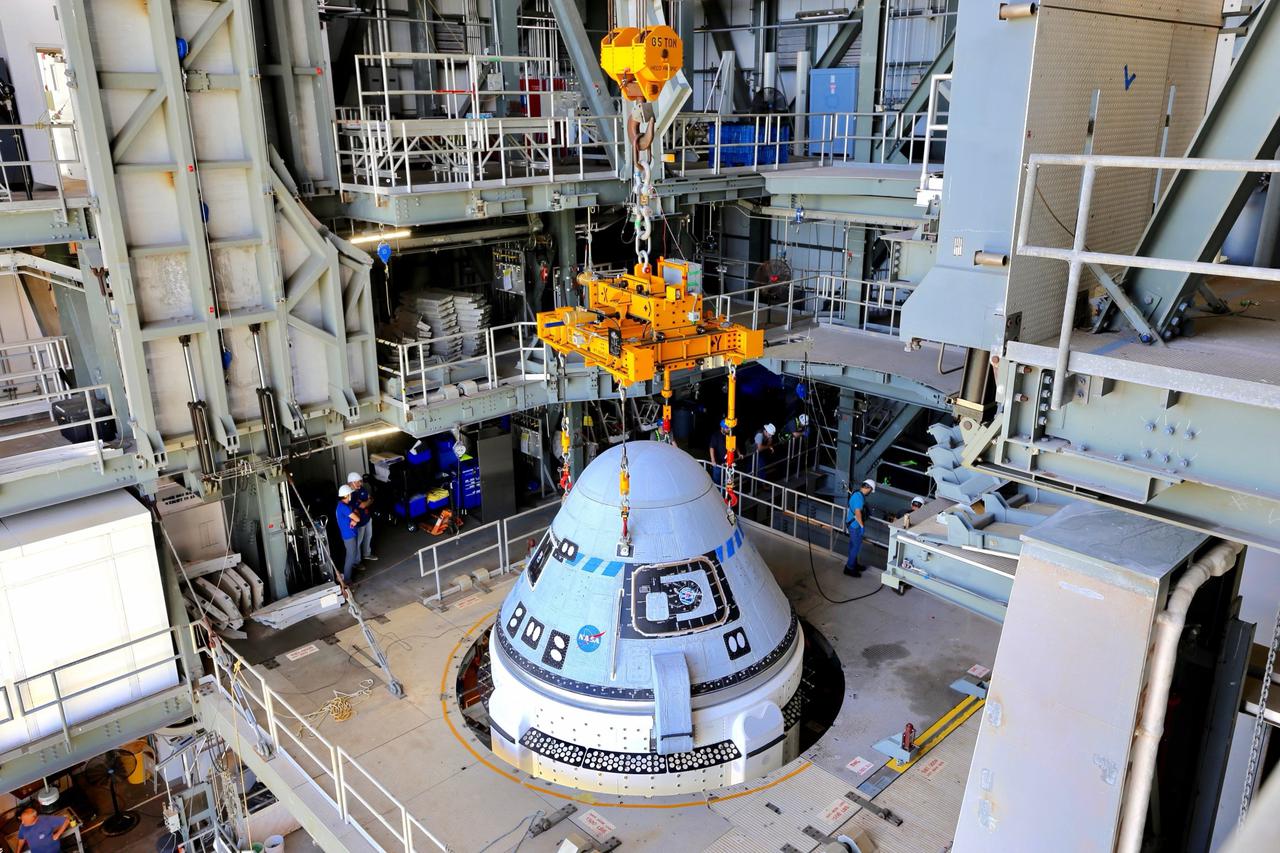
Boeing’s CST-100 Starliner spacecraft is secured atop a United Launch Alliance Atlas V rocket at the Vertical Integration Facility at Space Launch Complex-41 at Florida’s Cape Canaveral Space Force Station on July 17, 2021. Starliner will launch on the Atlas V for Boeing’s second Orbital Flight Test (OFT-2) for NASA’s Commercial Crew Program. The spacecraft rolled out from Boeing’s Commercial Crew and Cargo Processing Facility at NASA’s Kennedy Space Center earlier in the day.
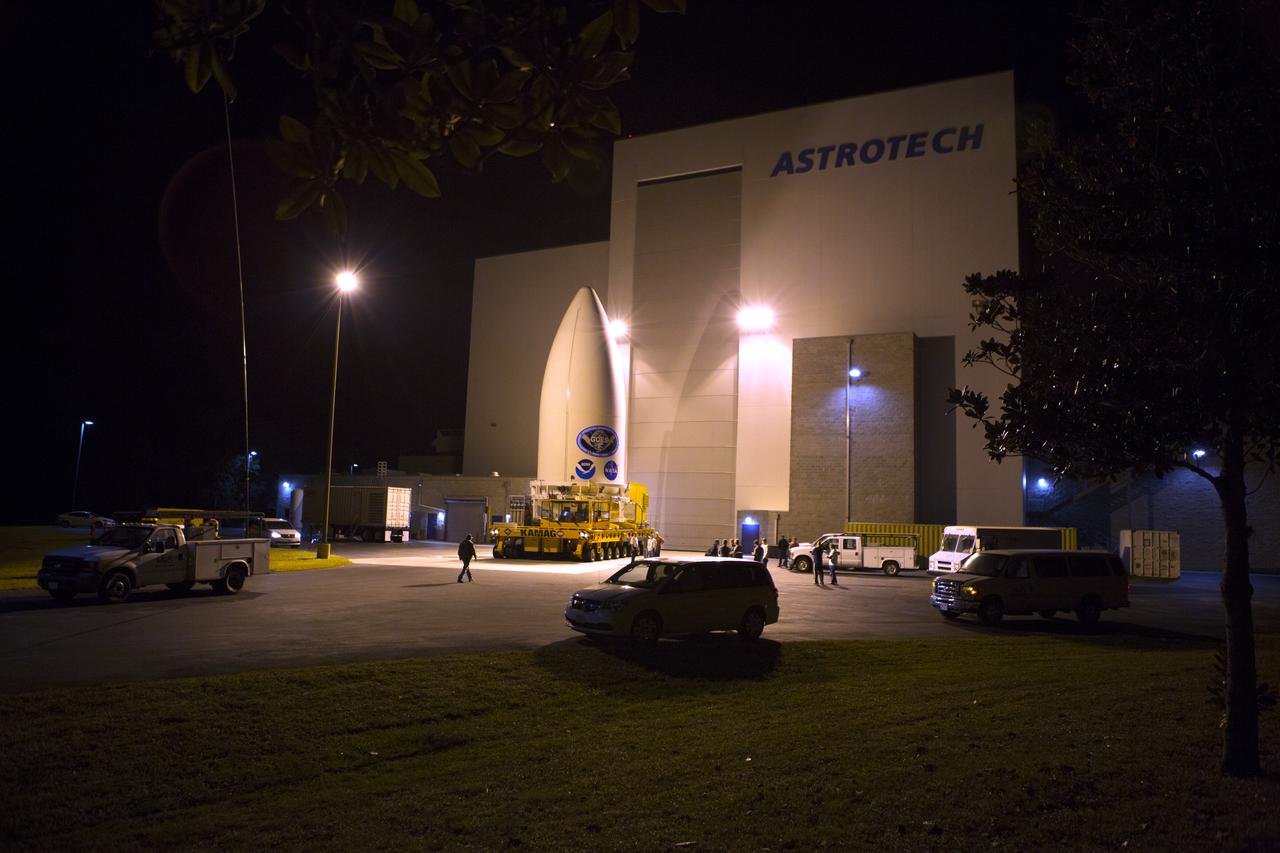
Enclosed in its payload fairing, NOAA's Geostationary Operational Environmental Satellite (GOES-R) departs from the Astrotech payload processing facility in Titusville, Florida, near NASA's Kennedy Space Center. GOES-R will be transported to the Vertical Integration Facility at Space Launch Complex 41 at Cape Canaveral Air Force Station. The satellite will launch aboard a United Launch Alliance Atlas V rocket in November. GOES-R is the first satellite in a series of next-generation NOAA GOES Satellites.
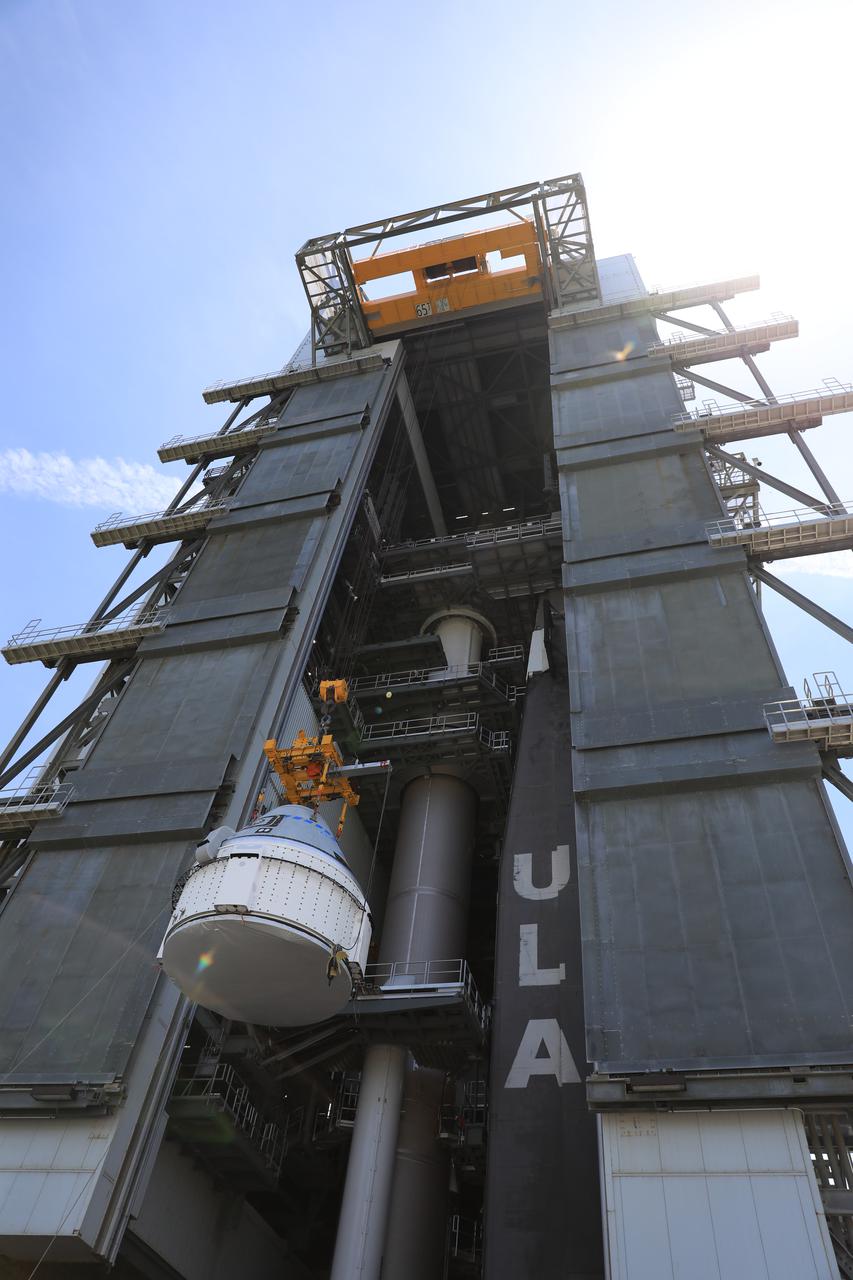
The Boeing CST-100 Starliner spacecraft is lifted at the Vertical Integration Facility at Space Launch Complex-41 at Florida’s Cape Canaveral Space Force Station on May 4, 2022. Starliner will be secured atop a United Launch Alliance Atlas V rocket for Boeing’s second Orbital Flight Test (OFT-2) to the International Space Station for NASA’s Commercial Crew Program. The spacecraft rolled out from Boeing’s Commercial Crew and Cargo Processing Facility at NASA’s Kennedy Space Center earlier in the day.
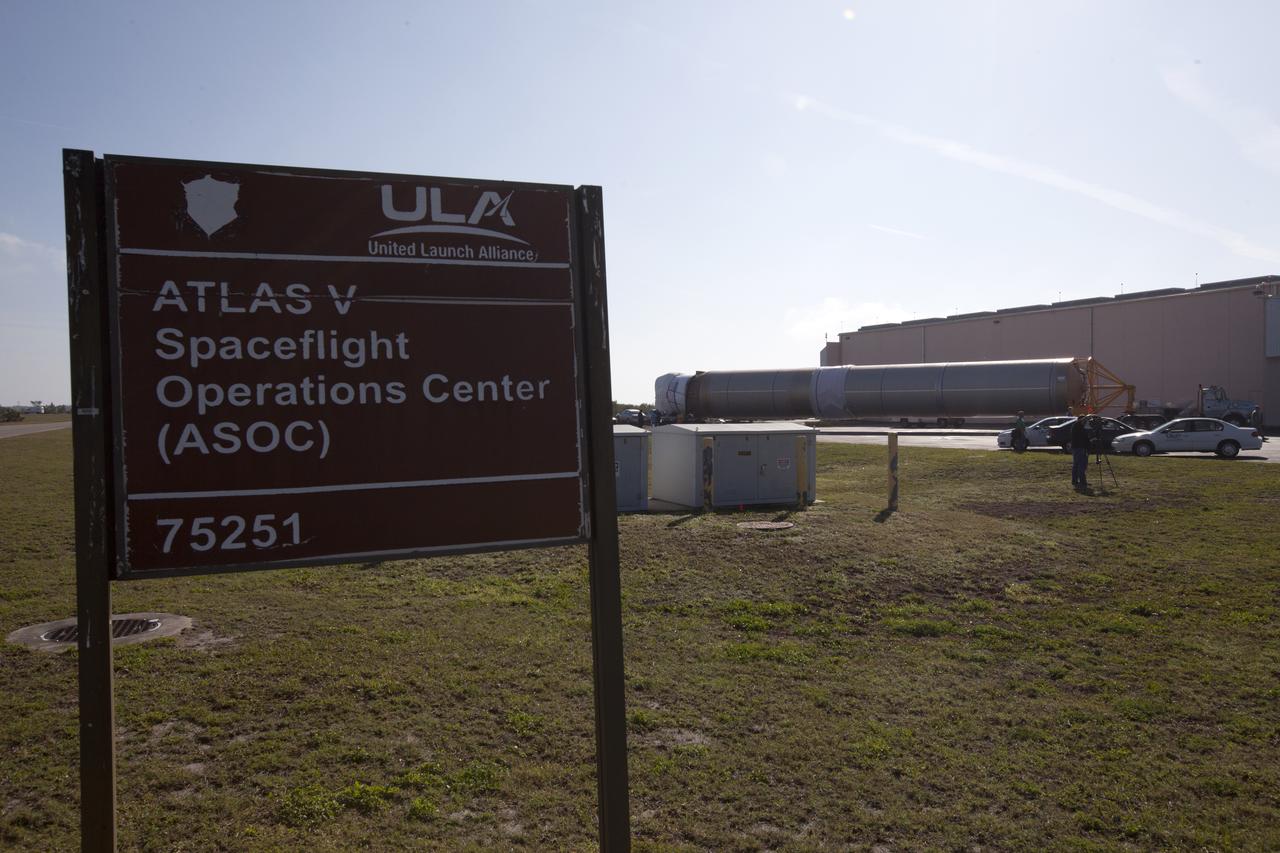
A United Launch Alliance (ULA) Atlas V booster arrives at Cape Canaveral Air Force Station's Atlas Spaceflight Operations Center (ASOC). The Atlas V will undergo final testing in that facility. When processing in the ASOC is complete, the Atlas booster will be moved to the Vertical Integration Facility for stacking at Space Launch Complex 41. Scheduled to launch March 19, 2017, the Atlas will launch a Cygnus spacecraft on the Orbital ATK CRS-7 mission to deliver thousands of pounds of supplies, equipment and scientific research materials to the International Space Station.
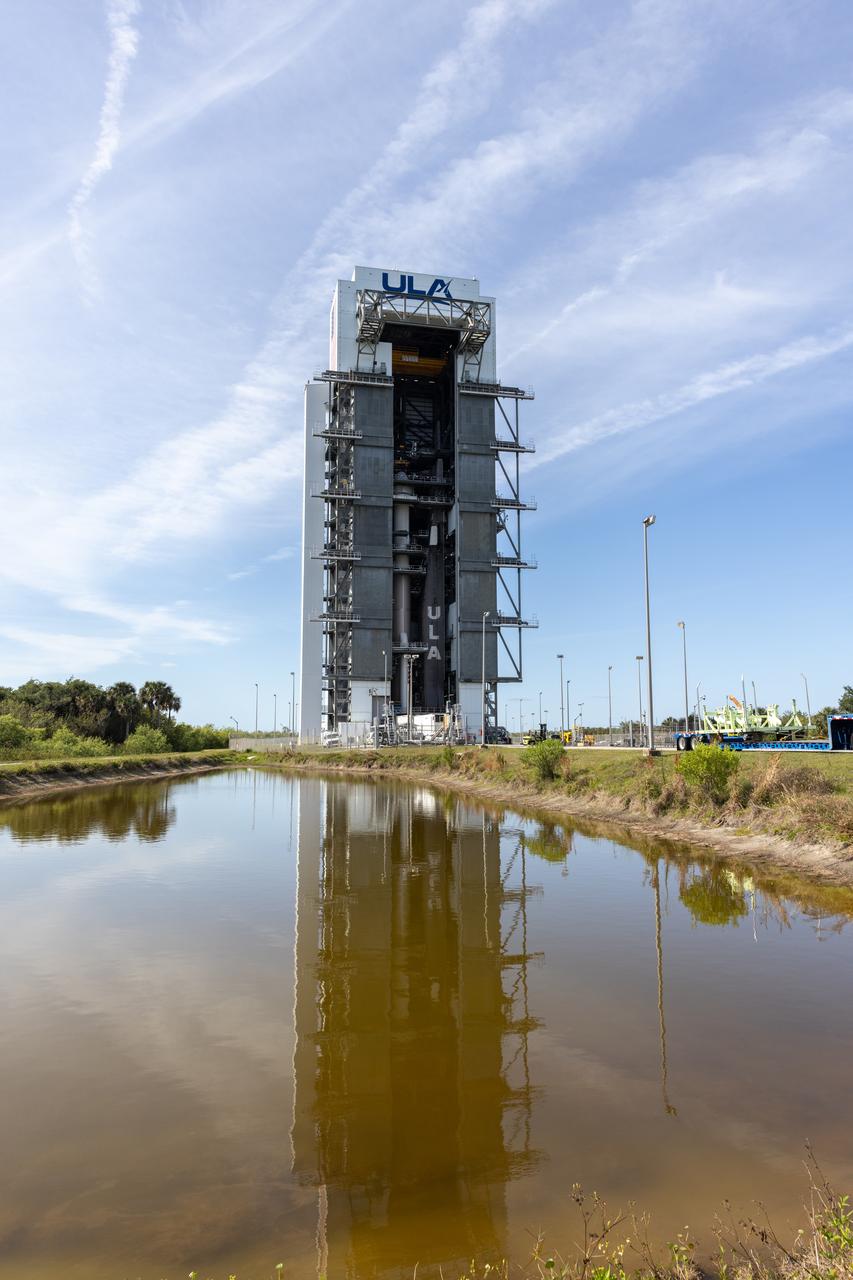
The Boeing Starliner spacecraft is lifted at the Vertical Integration Facility at Space Launch Complex-41 at Cape Canaveral Space Force Station in Florida on Tuesday, April 16, 2024. Starliner will be secured atop a United Launch Alliance Atlas V rocket for NASA’s Boeing Crew Flight Test to the International Space Station for the agency’s Commercial Crew Program. The spacecraft rolled out from Boeing's Commercial Crew and Cargo Processing Facility at NASA's Kennedy Space Center earlier in the day.
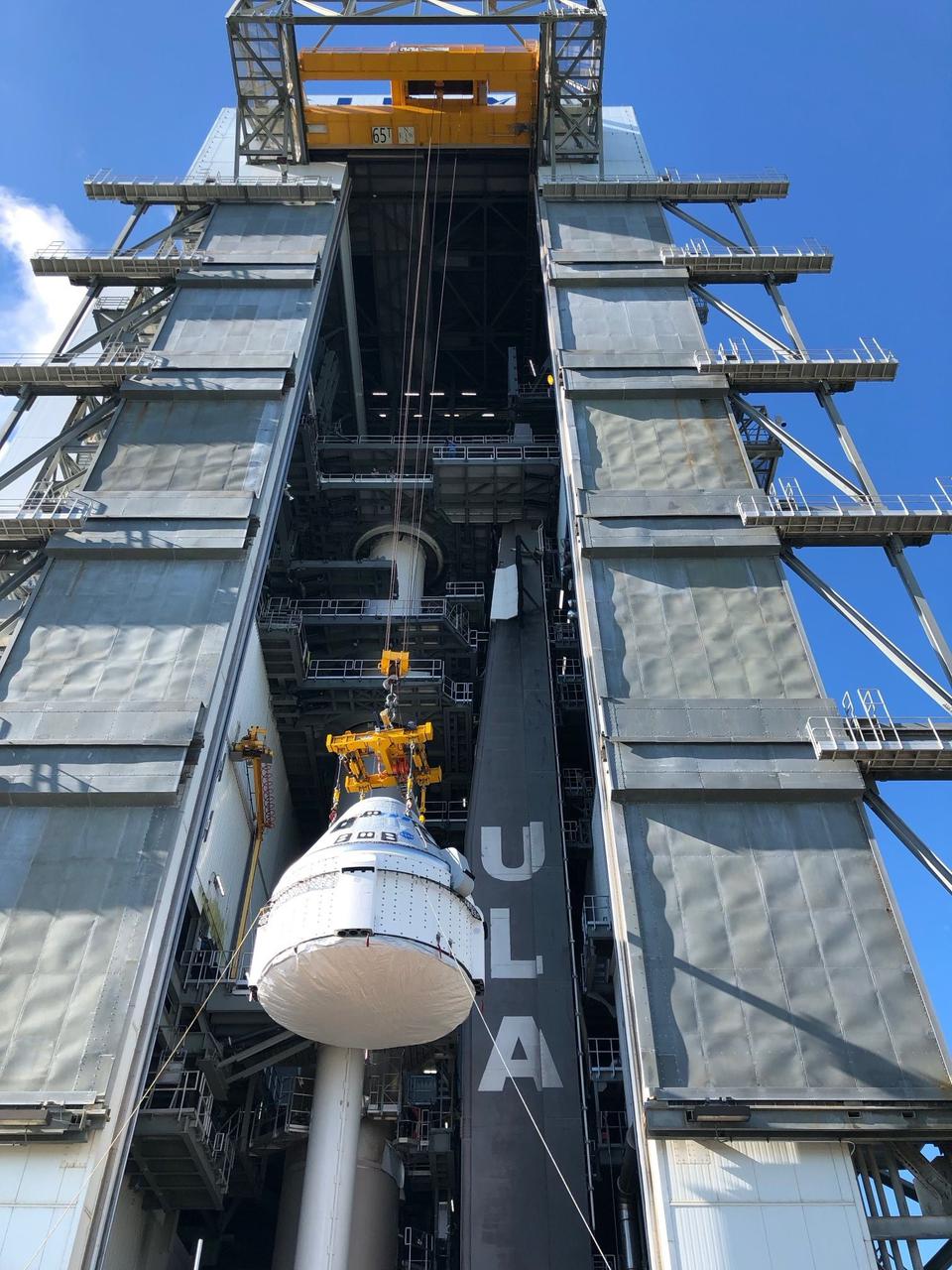
Boeing’s CST-100 Starliner spacecraft is lifted at the Vertical Integration Facility at Space Launch Complex-41 at Florida’s Cape Canaveral Space Force Station on July 17, 2021. Starliner will be secured atop a United Launch Alliance Atlas V rocket for Boeing’s Orbital Flight Test to the International Space Station for NASA’s Commercial Crew Program. The spacecraft rolled out from Boeing’s Commercial Crew and Cargo Processing Facility at NASA’s Kennedy Space Center earlier in the day.
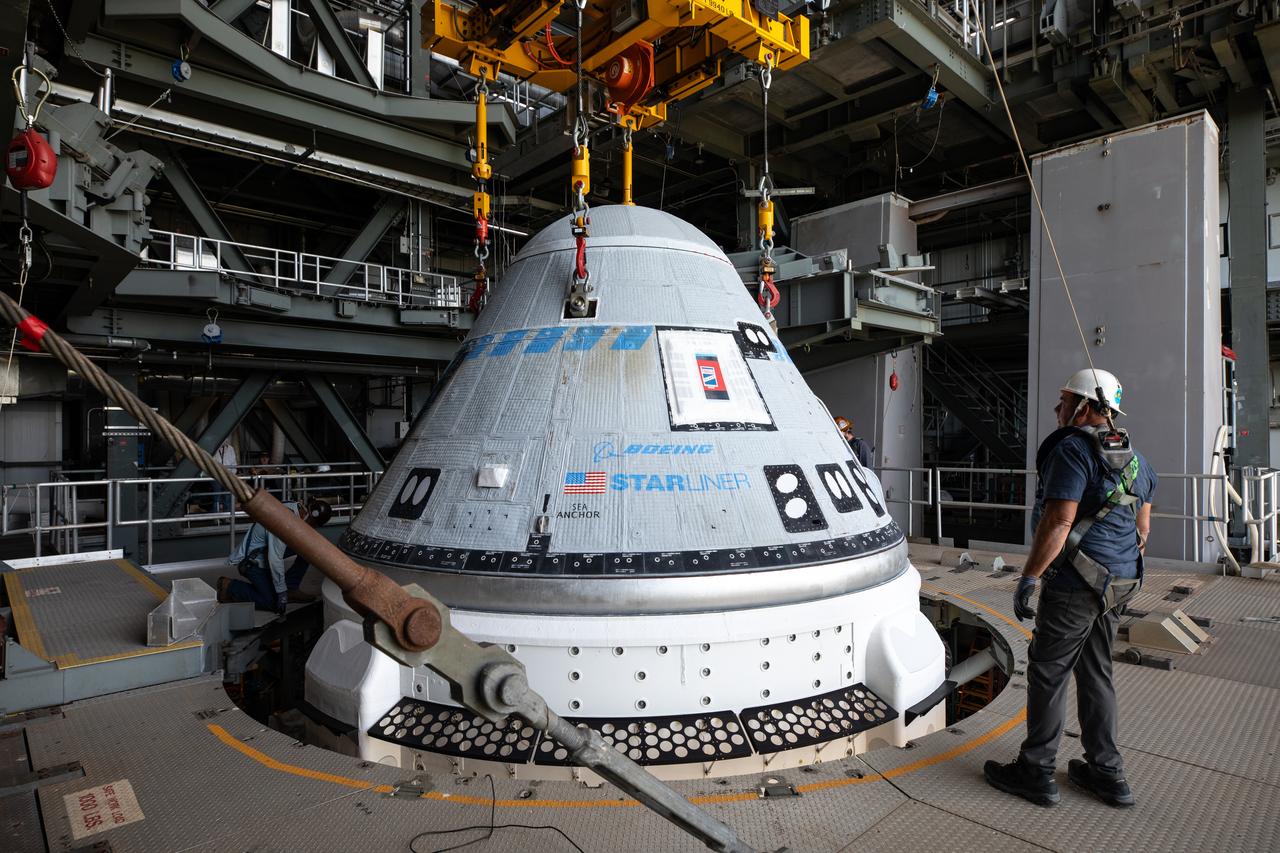
The Boeing Starliner spacecraft is lifted at the Vertical Integration Facility at Space Launch Complex-41 at Cape Canaveral Space Force Station in Florida on Tuesday, April 16, 2024. Starliner will be secured atop a United Launch Alliance Atlas V rocket for NASA’s Boeing Crew Flight Test to the International Space Station for the agency’s Commercial Crew Program. The spacecraft rolled out from Boeing's Commercial Crew and Cargo Processing Facility at NASA's Kennedy Space Center earlier in the day.
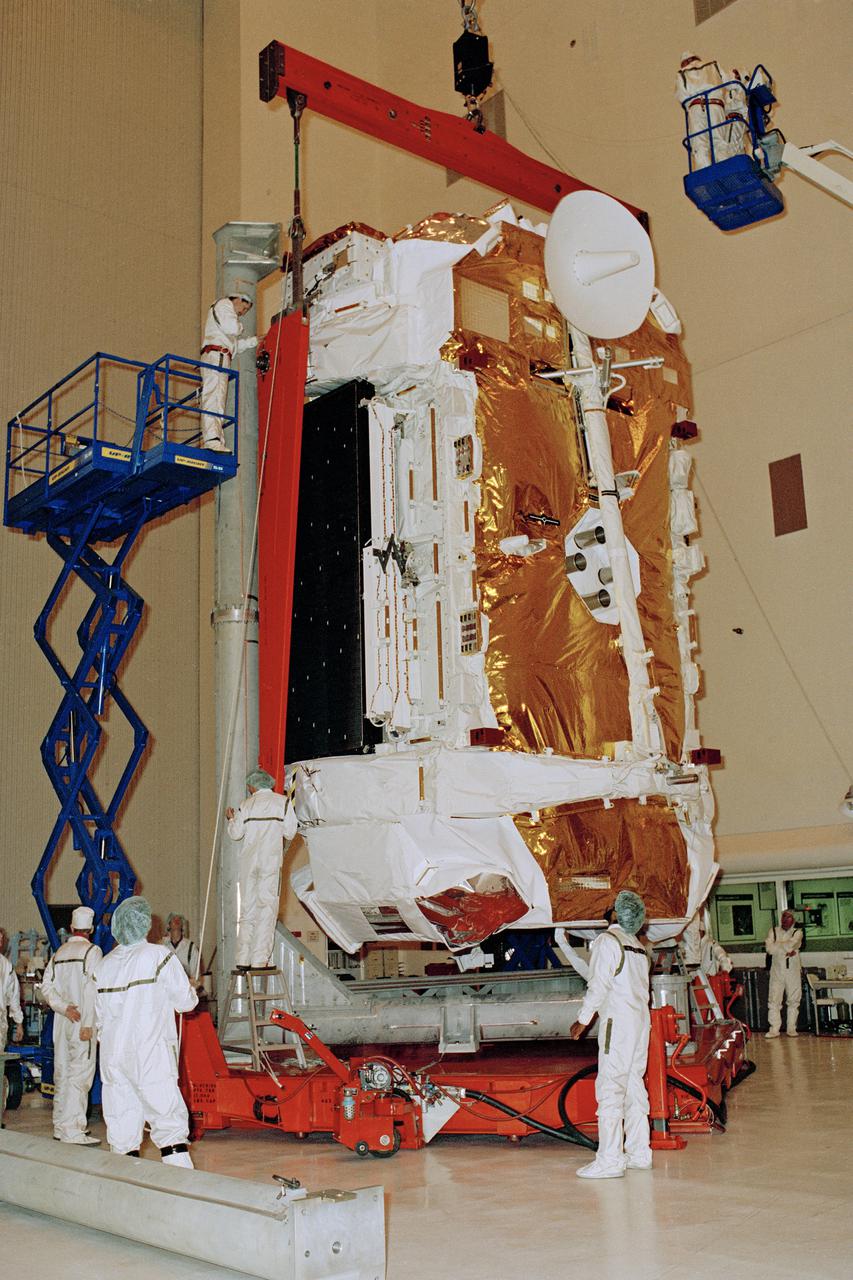
CAPE CANAVERAL, Fla. -- In the Payload Hazardous Servicing Facility at the Kennedy Space Center in Florida, technicians tilt the massive Gamma ray Observatory GRO upright for installation onto the transporter which will carry it to the Vertical Processing Facility. The spacecraft is scheduled to fly aboard the space shuttle Atlantis on STS-37. As the second of four great observatories planned by NASA, GRO will study the celestial gamma rays believed to be a record of cosmic change and evolution. Photo Credit: NASA
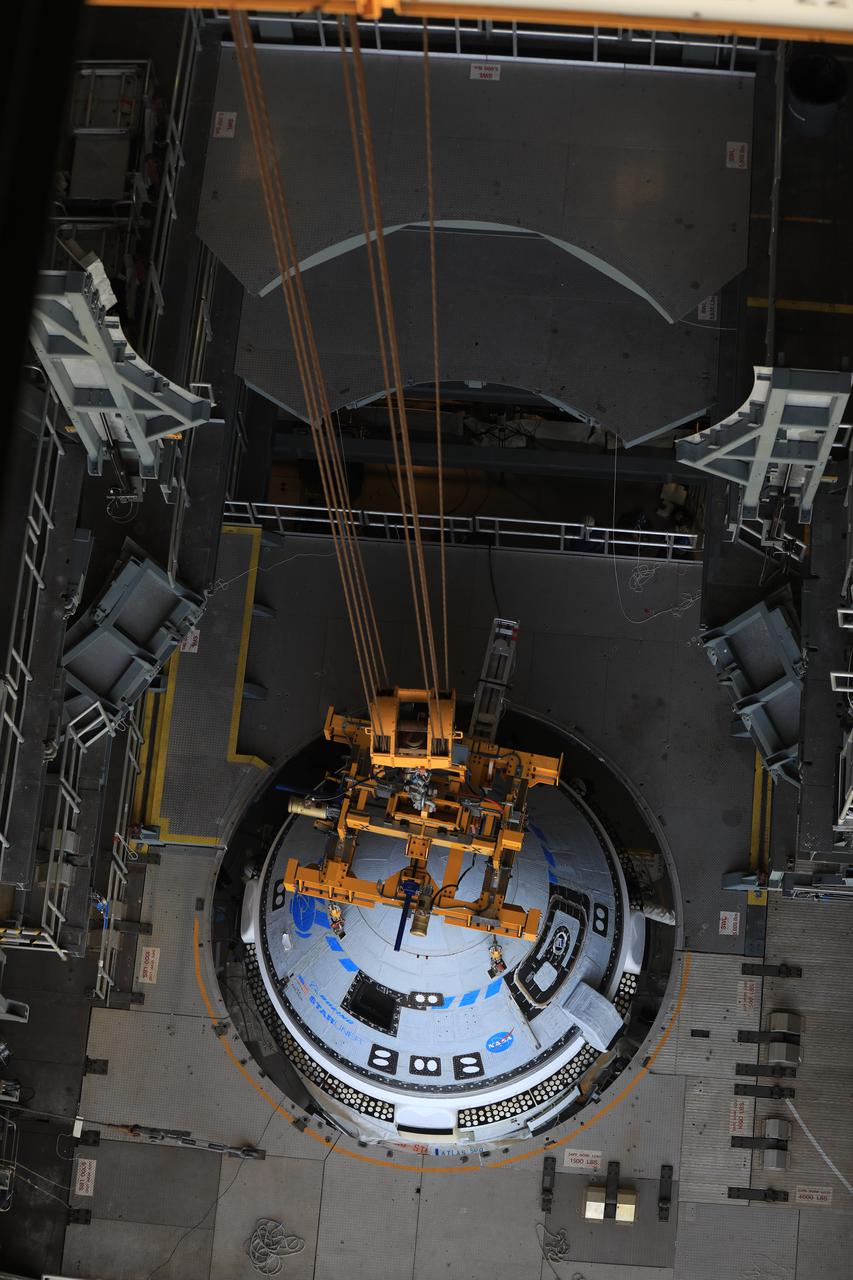
The Boeing CST-100 Starliner spacecraft is lifted at the Vertical Integration Facility at Space Launch Complex-41 at Florida’s Cape Canaveral Space Force Station on May 4, 2022. Starliner will be secured atop a United Launch Alliance Atlas V rocket for Boeing’s second Orbital Flight Test (OFT-2) to the International Space Station for NASA’s Commercial Crew Program. The spacecraft rolled out from Boeing’s Commercial Crew and Cargo Processing Facility at NASA’s Kennedy Space Center earlier in the day.
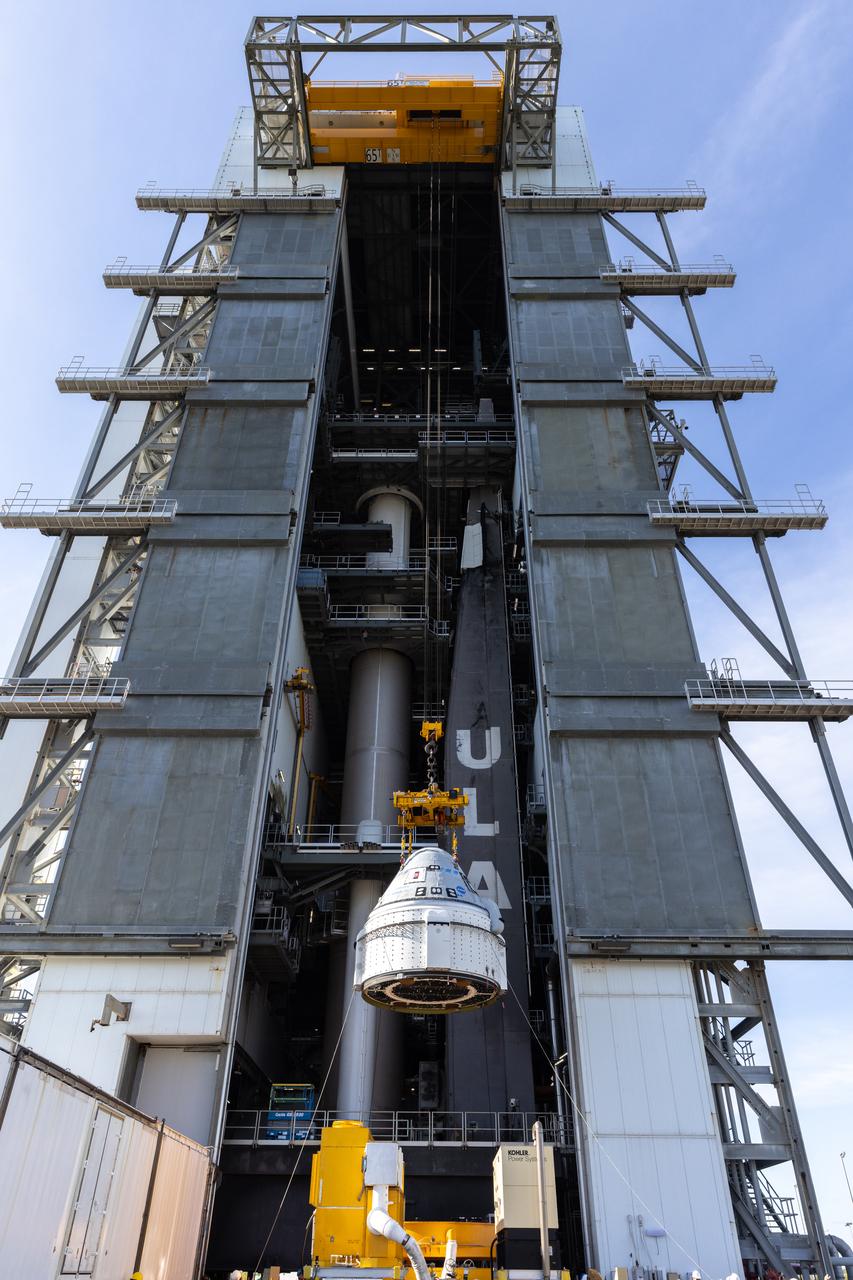
The Boeing Starliner spacecraft is lifted at the Vertical Integration Facility at Space Launch Complex-41 at Cape Canaveral Space Force Station in Florida on Tuesday, April 16, 2024. Starliner will be secured atop a United Launch Alliance Atlas V rocket for NASA’s Boeing Crew Flight Test to the International Space Station for the agency’s Commercial Crew Program. The spacecraft rolled out from Boeing's Commercial Crew and Cargo Processing Facility at NASA's Kennedy Space Center earlier in the day.
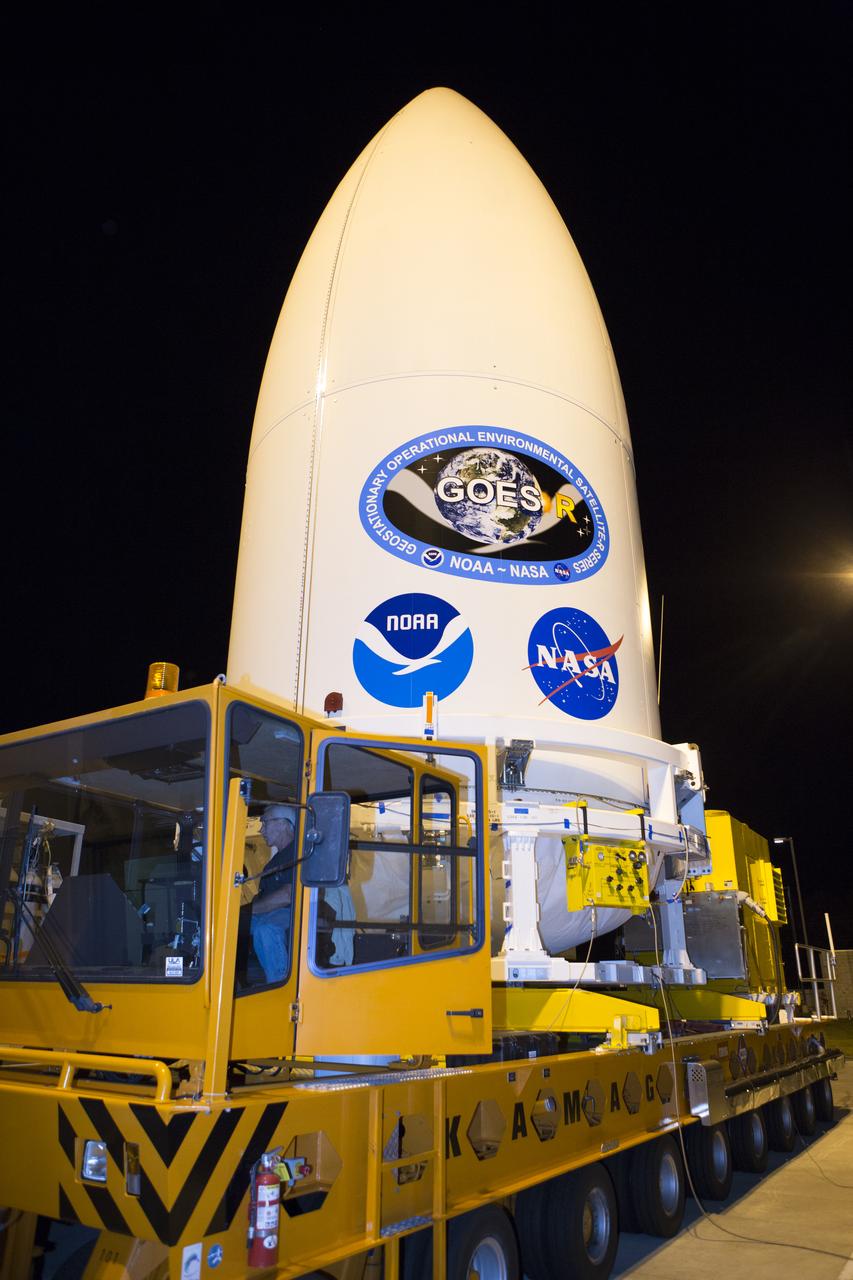
Enclosed in its payload fairing, NOAA's Geostationary Operational Environmental Satellite (GOES-R) departs from the Astrotech payload processing facility in Titusville, Florida, near NASA's Kennedy Space Center. GOES-R will be transported to the Vertical Integration Facility at Space Launch Complex 41 at Cape Canaveral Air Force Station. The satellite will launch aboard a United Launch Alliance Atlas V rocket in November. GOES-R is the first satellite in a series of next-generation NOAA GOES Satellites.
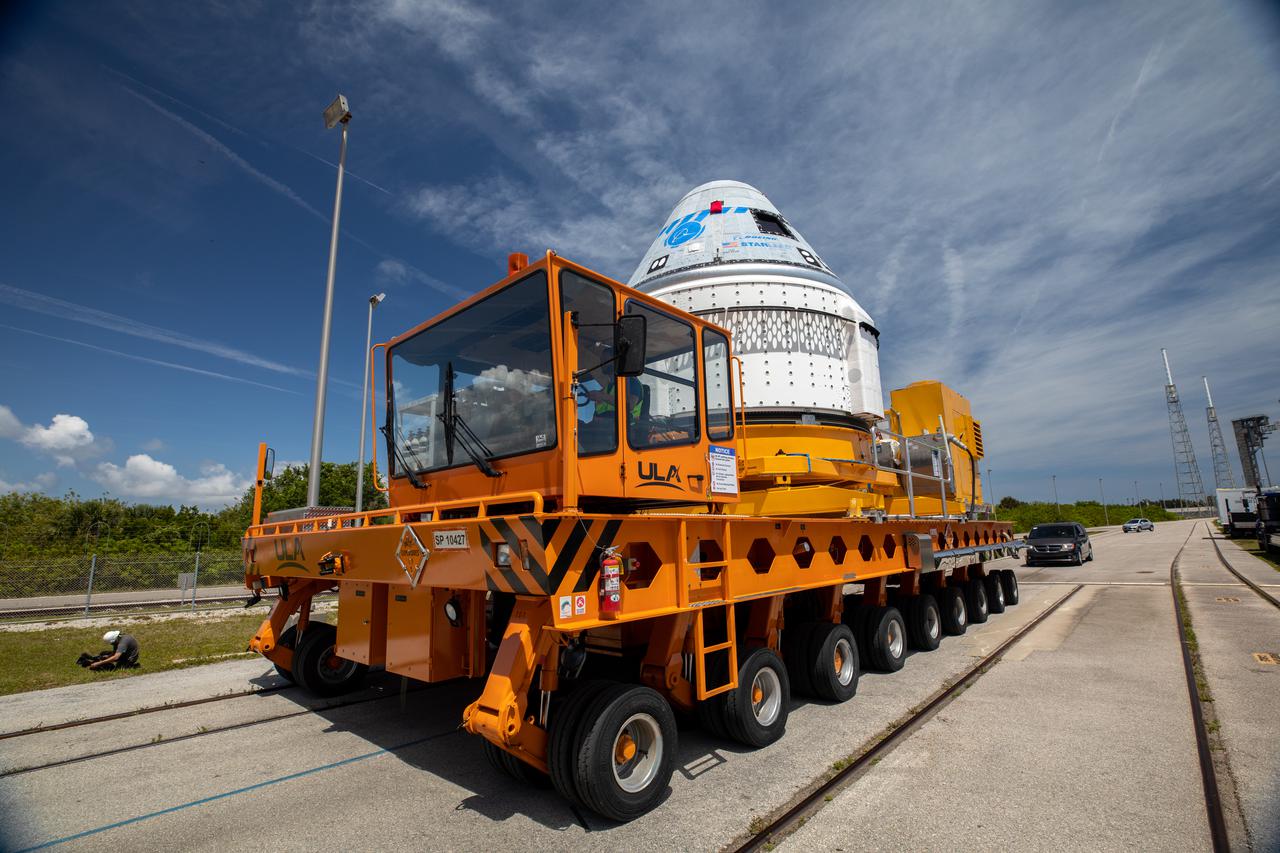
Boeing’s CST-100 Starliner spacecraft rolls out from the company’s Commercial Crew and Cargo Processing Facility at NASA’s Kennedy Space Center in Florida on May 4, 2022. The spacecraft will make the trip to the Vertical Integration Facility at Space Launch Complex-41 at Cape Canaveral Space Force Station where it will be secured atop a United Launch Alliance Atlas V rocket for Boeing’s second Orbital Flight Test (OFT-2) to the International Space Station for NASA’s Commercial Crew Program.
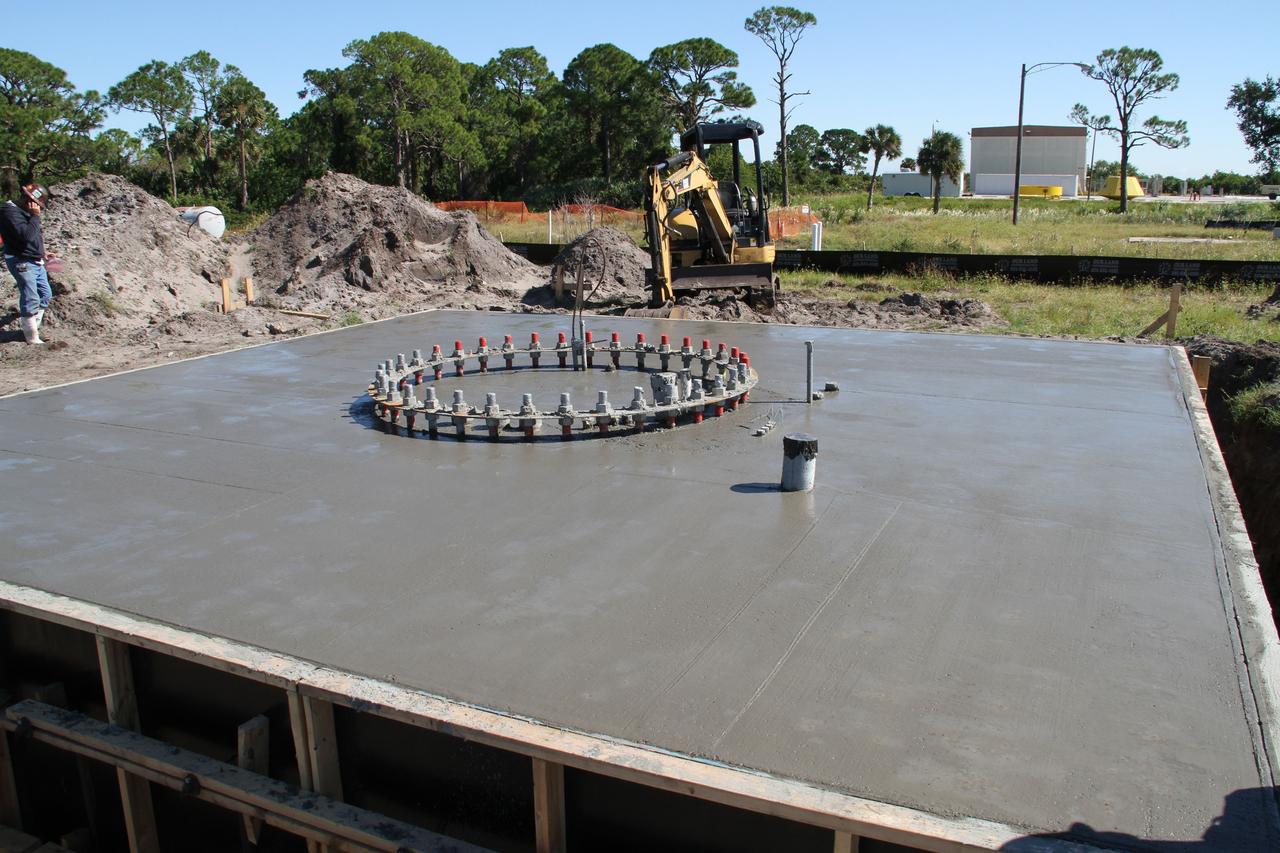
CAPE CANAVERAL, Fla. – At NASA’s Kennedy Space Center in Florida, concrete has been poured at the site of the Antenna Test Bed Array for the Ka-Band Objects Observation and Monitoring, Ka-BOOM system. The construction site is near the former Vertical Processing Facility, which has been demolished. Workers are placing the pile foundations for the 40-foot-diameter dish antenna arrays and their associated utilities, and preparing the site for the operations command center facility. Photo credit: NASA/Ben Smegelski
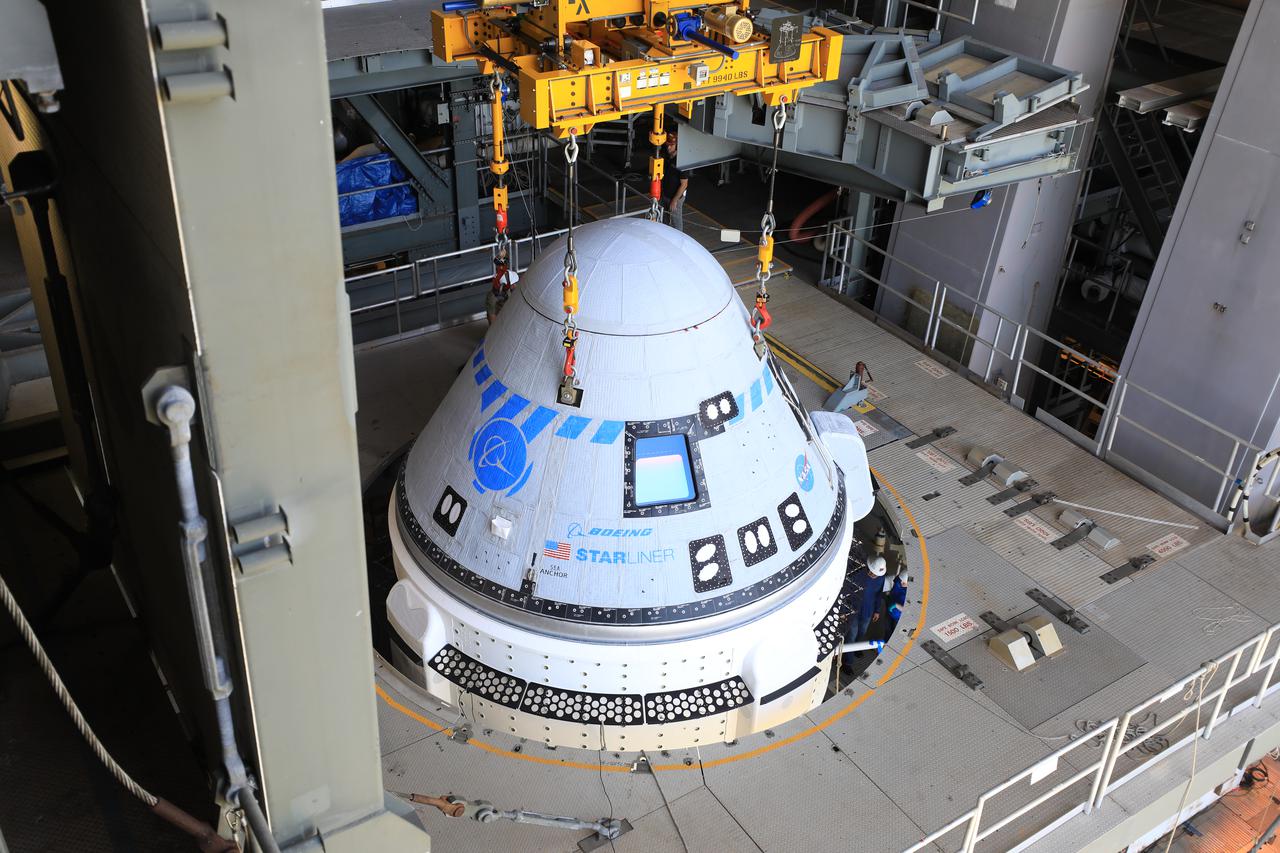
The Boeing CST-100 Starliner spacecraft is lifted at the Vertical Integration Facility at Space Launch Complex-41 at Florida’s Cape Canaveral Space Force Station on May 4, 2022. Starliner will be secured atop a United Launch Alliance Atlas V rocket for Boeing’s second Orbital Flight Test (OFT-2) to the International Space Station for NASA’s Commercial Crew Program. The spacecraft rolled out from Boeing’s Commercial Crew and Cargo Processing Facility at NASA’s Kennedy Space Center earlier in the day.
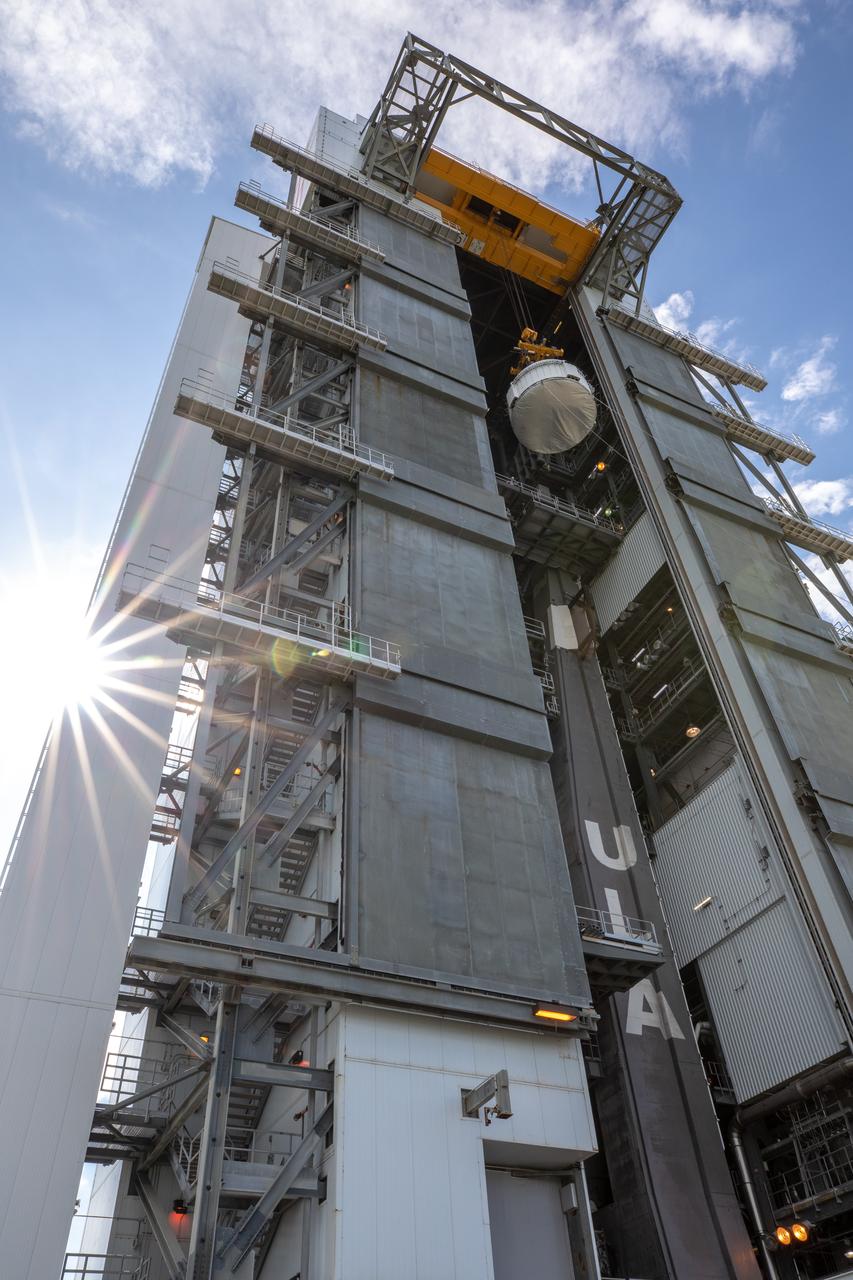
The Boeing CST-100 Starliner spacecraft is lifted at the Vertical Integration Facility at Space Launch Complex 41 at Florida’s Cape Canaveral Air Force Station on Nov. 21, 2019. Starliner will be secured atop a United Launch Alliance Atlas V rocket for Boeing’s Orbital Flight Test to the International Space Station for NASA’s Commercial Crew Program. The spacecraft rolled out from Boeing’s Commercial Crew and Cargo Processing Facility at NASA’s Kennedy Space Center earlier in the day.
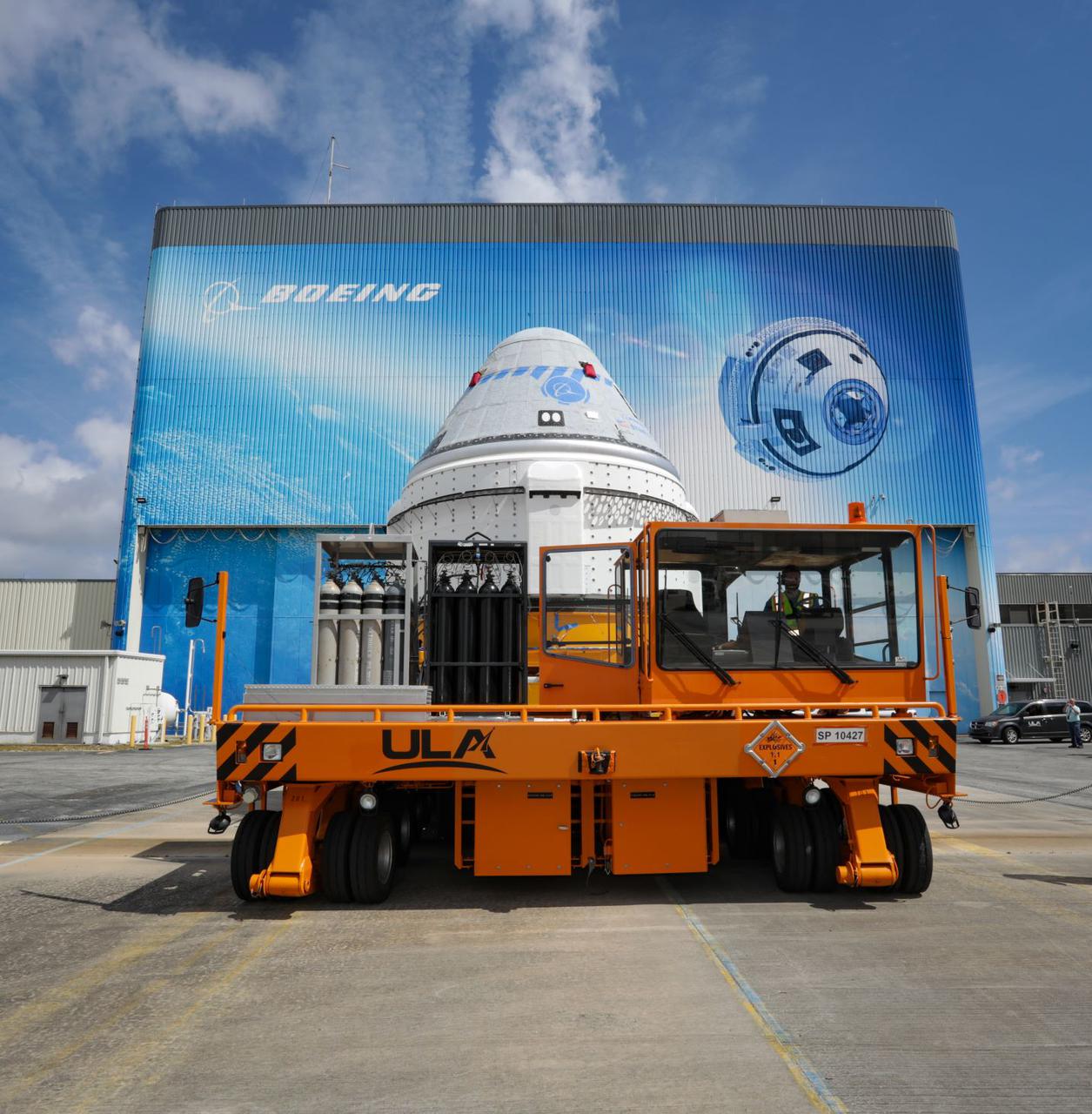
Boeing’s CST-100 Starliner spacecraft rolls out from the company’s Commercial Crew and Cargo Processing Facility at NASA’s Kennedy Space Center in Florida on May 4, 2022. The spacecraft will make the trip to the Vertical Integration Facility at Space Launch Complex-41 at Cape Canaveral Space Force Station where it will be secured atop a United Launch Alliance Atlas V rocket for Boeing’s second Orbital Flight Test (OFT-2) to the International Space Station for NASA’s Commercial Crew Program.
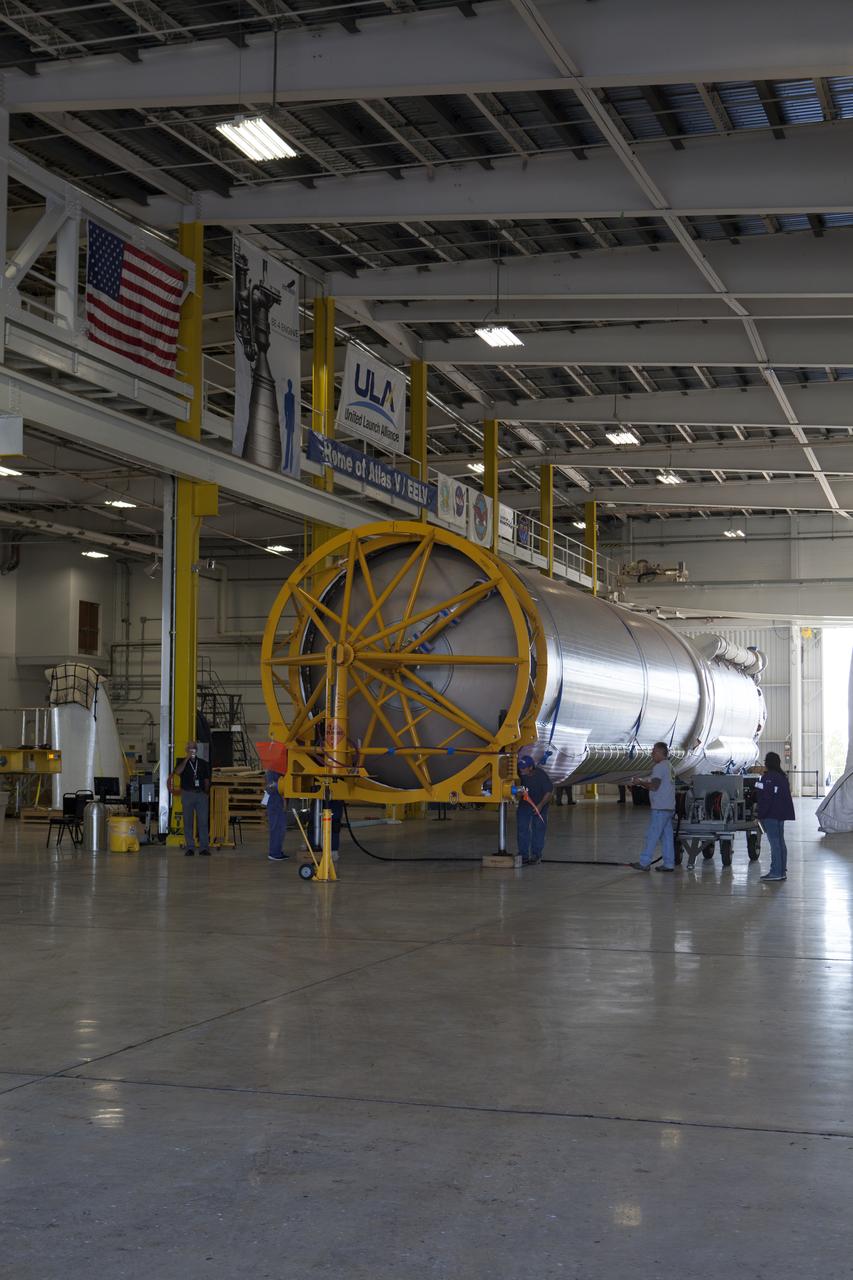
A United Launch Alliance (ULA) Atlas V booster arrives at Cape Canaveral Air Force Station's Atlas Spaceflight Operations Center (ASOC). The Atlas V will undergo final testing in that facility. When processing in the ASOC is complete, the Atlas booster will be moved to the Vertical Integration Facility for stacking at Space Launch Complex 41. Scheduled to launch March 19, 2017, the Atlas will launch a Cygnus spacecraft on the Orbital ATK CRS-7 mission to deliver thousands of pounds of supplies, equipment and scientific research materials to the International Space Station.
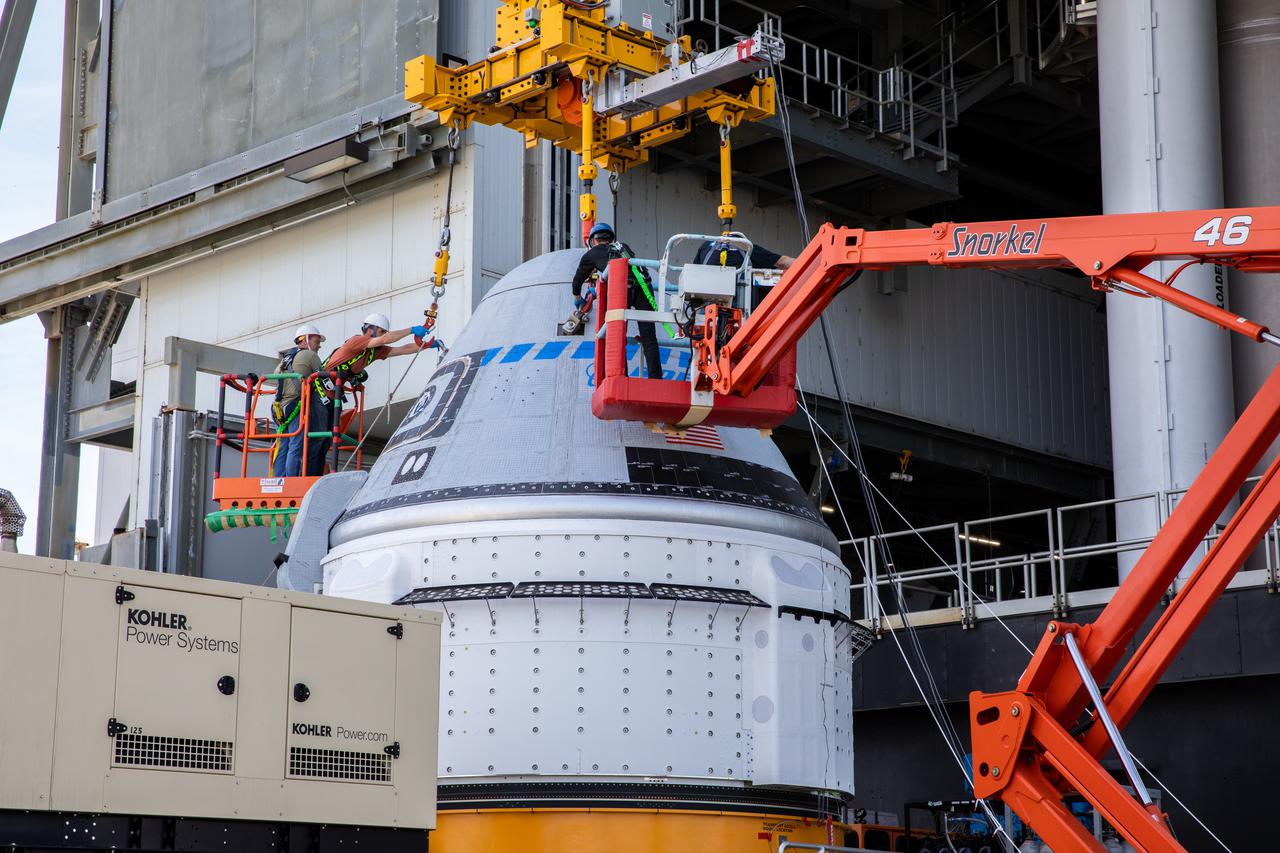
The Boeing CST-100 Starliner spacecraft is lifted at the Vertical Integration Facility at Space Launch Complex-41 at Florida’s Cape Canaveral Space Force Station on May 4, 2022. Starliner will be secured atop a United Launch Alliance Atlas V rocket for Boeing’s second Orbital Flight Test (OFT-2) to the International Space Station for NASA’s Commercial Crew Program. The spacecraft rolled out from Boeing’s Commercial Crew and Cargo Processing Facility at NASA’s Kennedy Space Center earlier in the day.
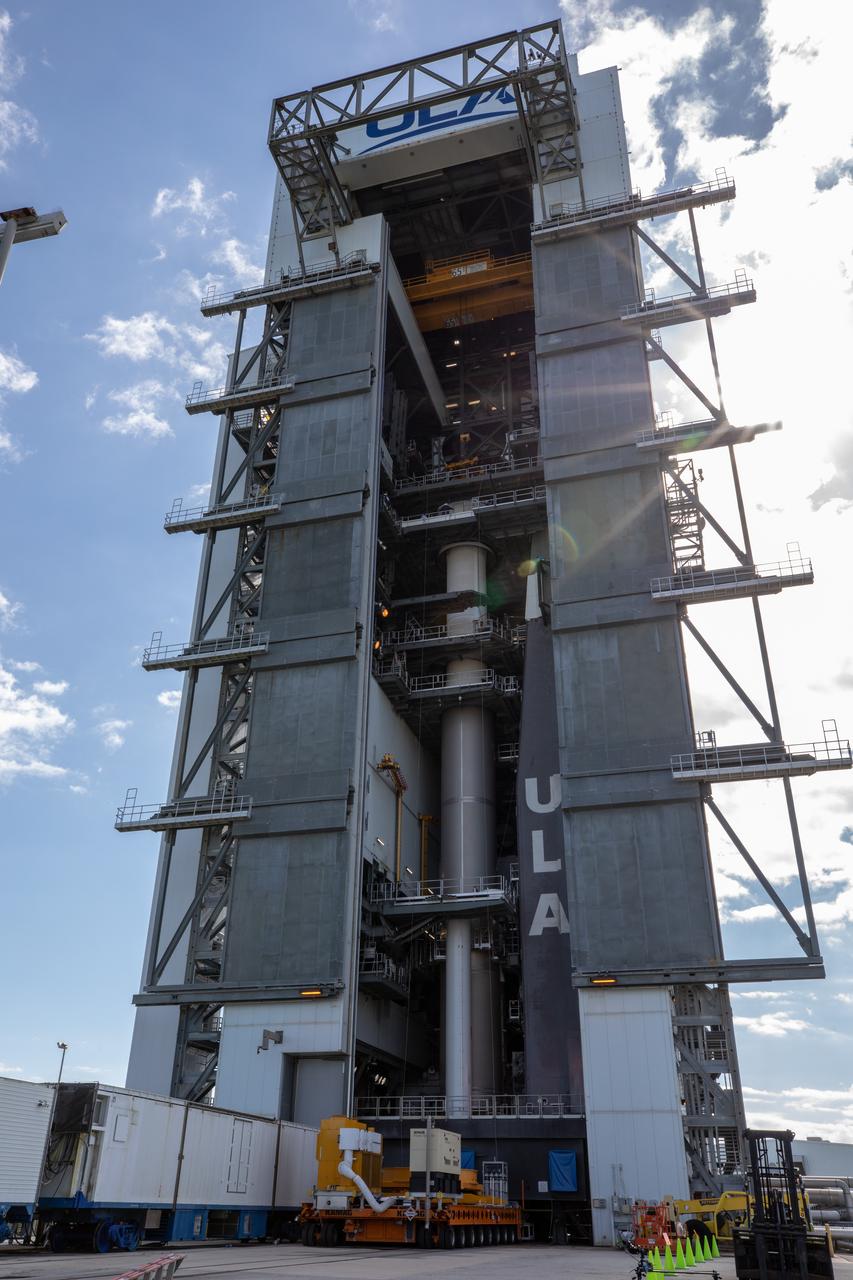
The Boeing CST-100 Starliner spacecraft is secured atop a United Launch Alliance Atlas V rocket at the Vertical Integration Facility at Space Launch Complex 41 at Florida’s Cape Canaveral Air Force Station on Nov. 21, 2019. Starliner will launch on the Atlas V for Boeing’s Orbital Flight Test to the International Space Station for NASA’s Commercial Crew Program. The spacecraft rolled out from Boeing’s Commercial Crew and Cargo Processing Facility at NASA’s Kennedy Space Center earlier in the day.
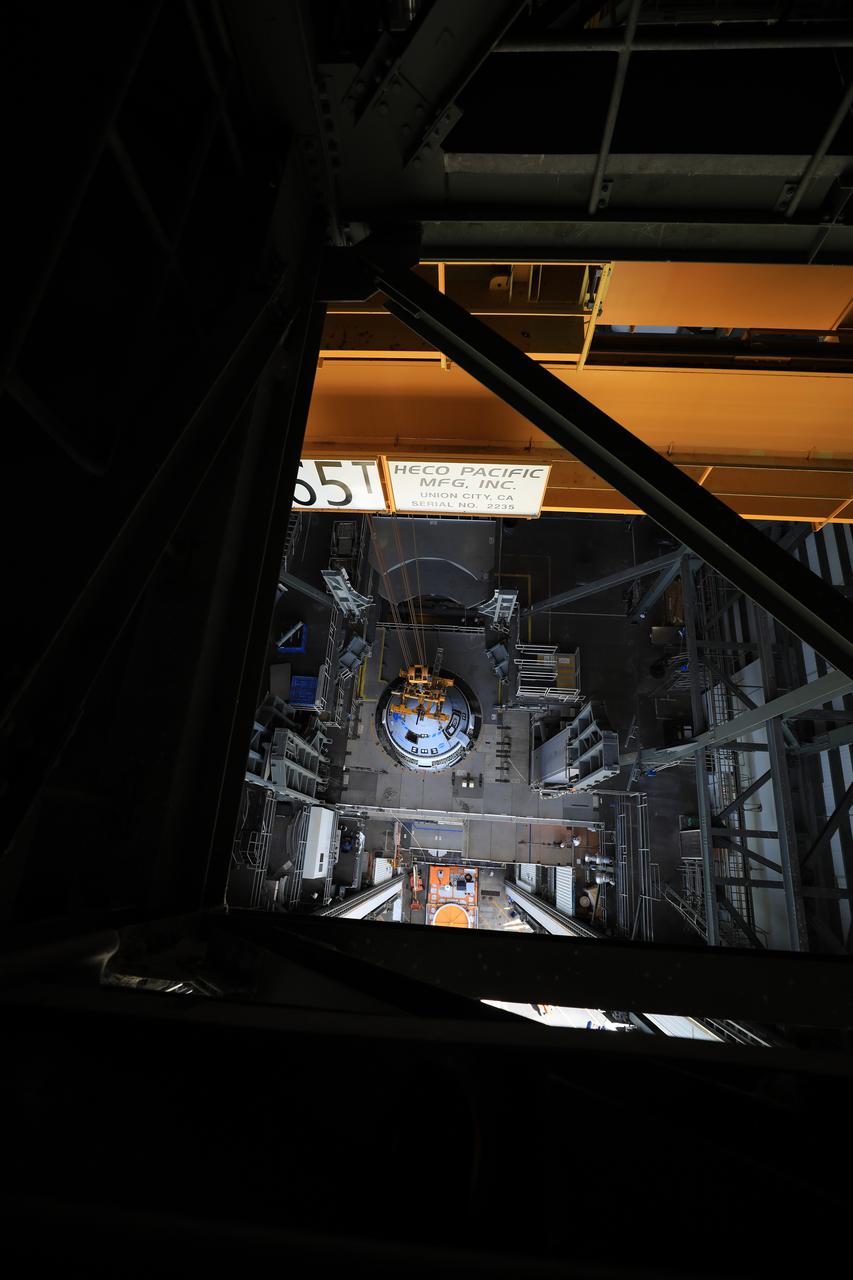
The Boeing CST-100 Starliner spacecraft is lifted at the Vertical Integration Facility at Space Launch Complex-41 at Florida’s Cape Canaveral Space Force Station on May 4, 2022. Starliner will be secured atop a United Launch Alliance Atlas V rocket for Boeing’s second Orbital Flight Test (OFT-2) to the International Space Station for NASA’s Commercial Crew Program. The spacecraft rolled out from Boeing’s Commercial Crew and Cargo Processing Facility at NASA’s Kennedy Space Center earlier in the day.
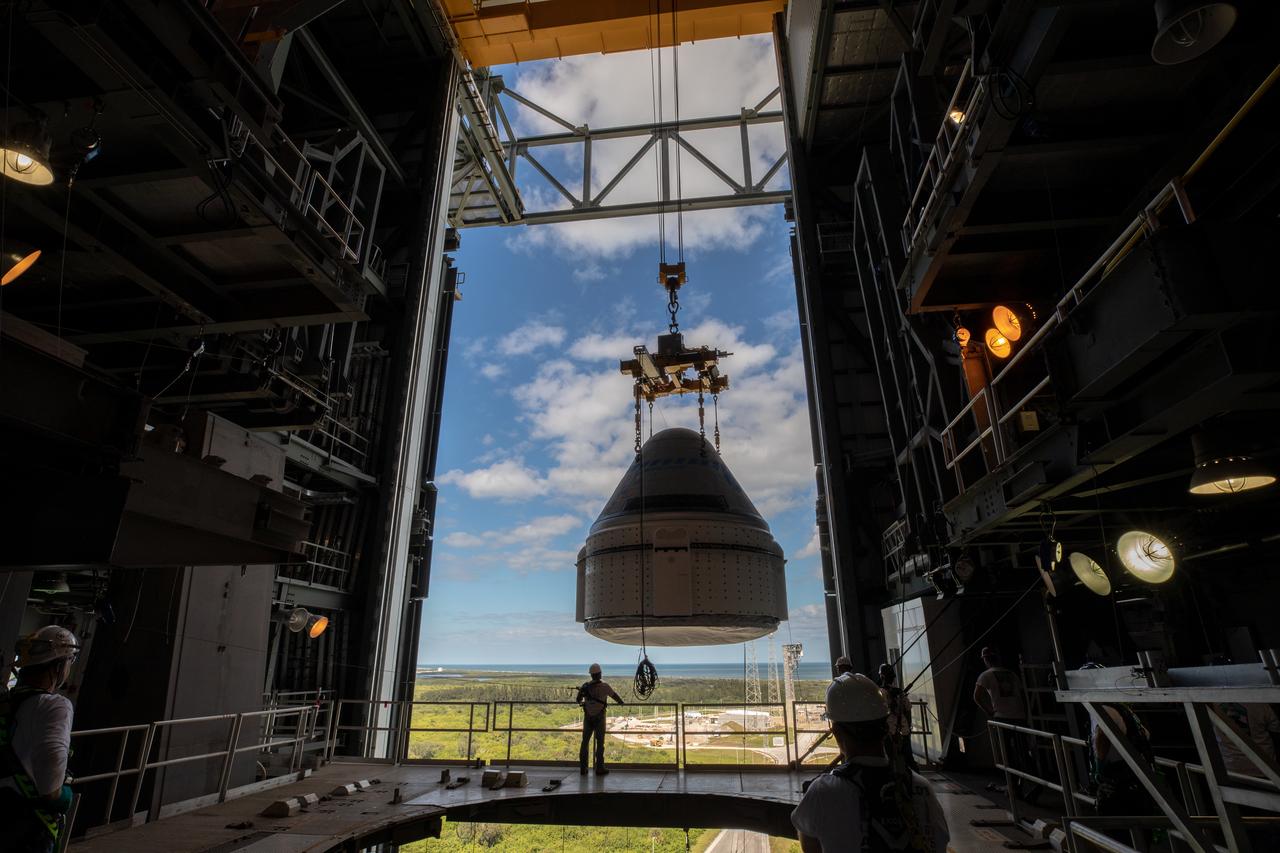
The Boeing CST-100 Starliner spacecraft is guided into position above a United Launch Alliance Atlas V rocket at the Vertical Integration Facility at Space Launch Complex 41 at Florida’s Cape Canaveral Air Force Station on Nov. 21, 2019. Starliner will be secured atop the rocket for Boeing’s Orbital Flight Test to the International Space Station for NASA’s Commercial Crew Program. The spacecraft rolled out from Boeing’s Commercial Crew and Cargo Processing Facility at NASA’s Kennedy Space Center earlier in the day.
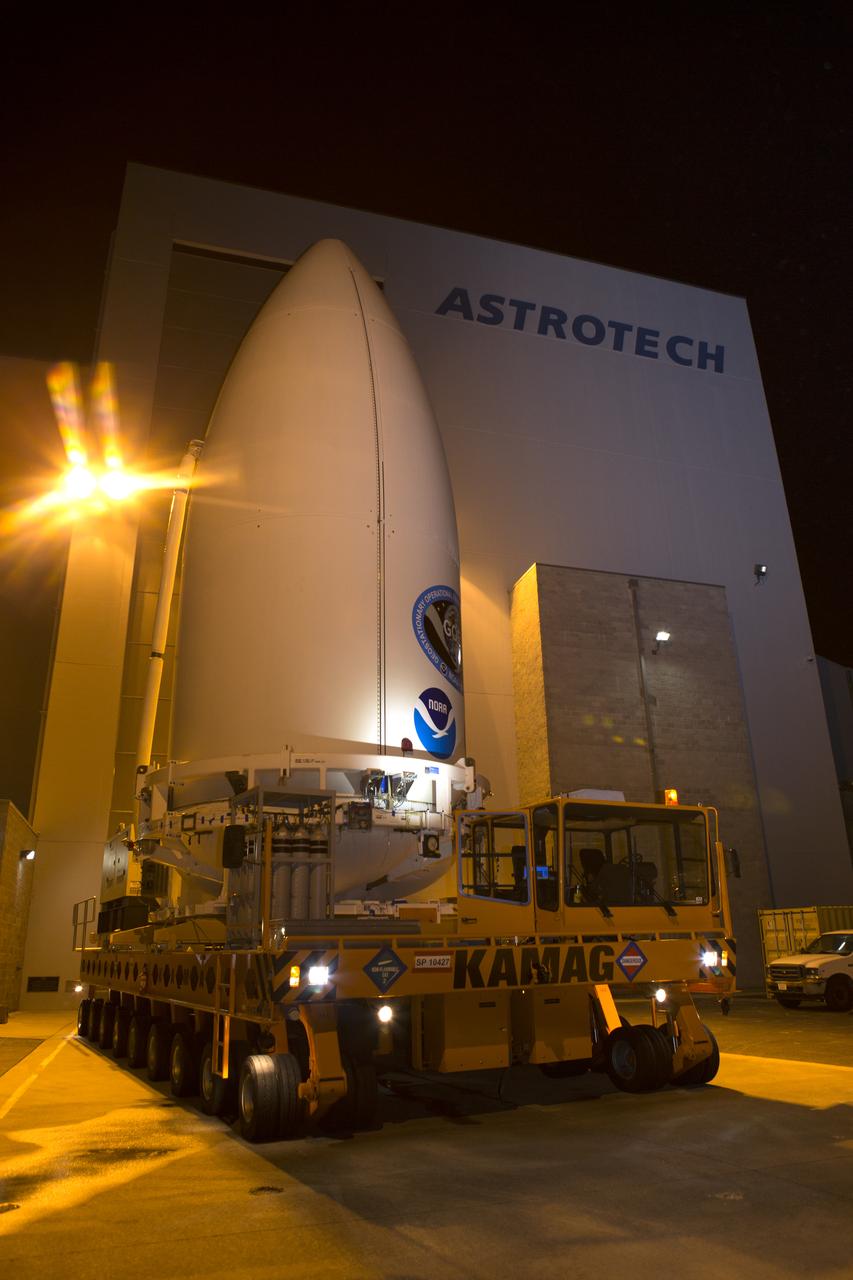
Enclosed in its payload fairing, NOAA's Geostationary Operational Environmental Satellite (GOES-R) departs from the Astrotech payload processing facility in Titusville, Florida, near NASA's Kennedy Space Center. GOES-R will be transported to the Vertical Integration Facility at Space Launch Complex 41 at Cape Canaveral Air Force Station. The satellite will launch aboard a United Launch Alliance Atlas V rocket in November. GOES-R is the first satellite in a series of next-generation NOAA GOES Satellites.
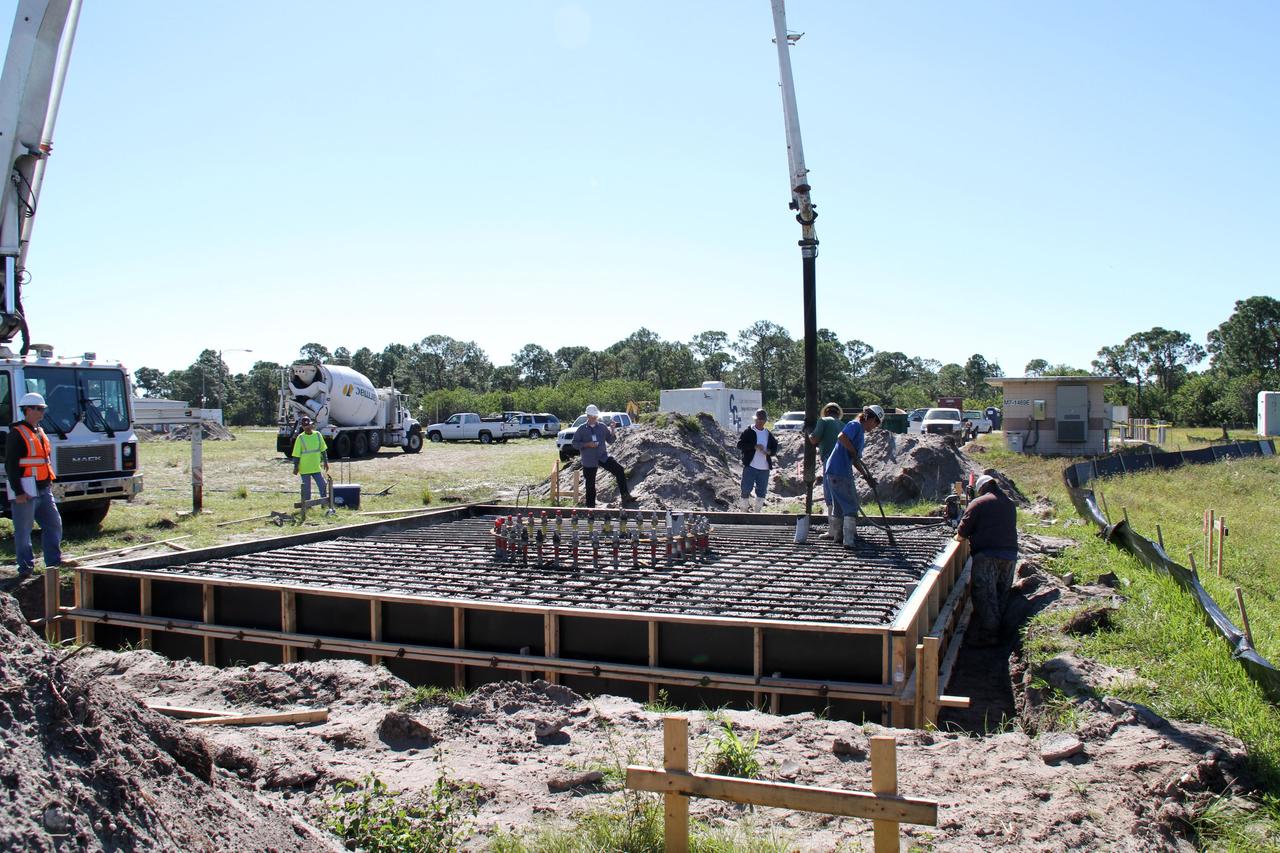
CAPE CANAVERAL, Fla. – At NASA’s Kennedy Space Center in Florida, workers pour concrete at the base of the site of the Antenna Test Bed Array for the Ka-Band Objects Observation and Monitoring, or Ka-BOOM system. The construction site is near the former Vertical Processing Facility, which has been demolished. Workers are placing the pile foundations for the 40-foot-diameter dish antenna arrays and their associated utilities, and preparing the site for the operations command center facility. Photo credit: NASA/Ben Smegelski
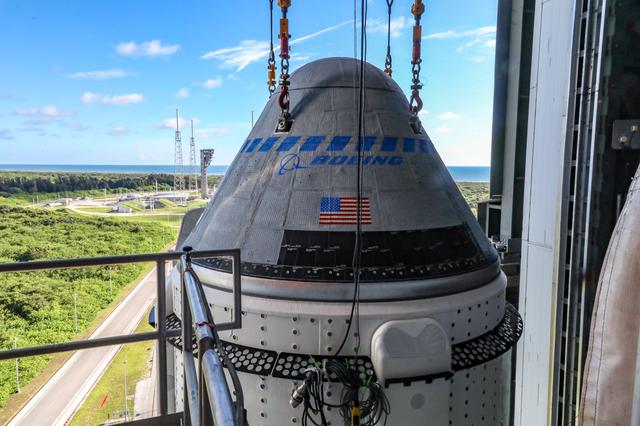
The Boeing CST-100 Starliner spacecraft is secured atop a United Launch Alliance Atlas V rocket at the Vertical Integration Facility at Space Launch Complex 41 at Cape Canaveral Space Force Station in Florida on July 17, 2021. Starliner will launch on the Atlas V for Boeing’s second Orbital Flight Test (OFT-2) for NASA’s Commercial Crew Program. The spacecraft rolled out from Boeing’s Commercial Crew and Cargo Processing Facility at NASA’s Kennedy Space Center earlier in the day.
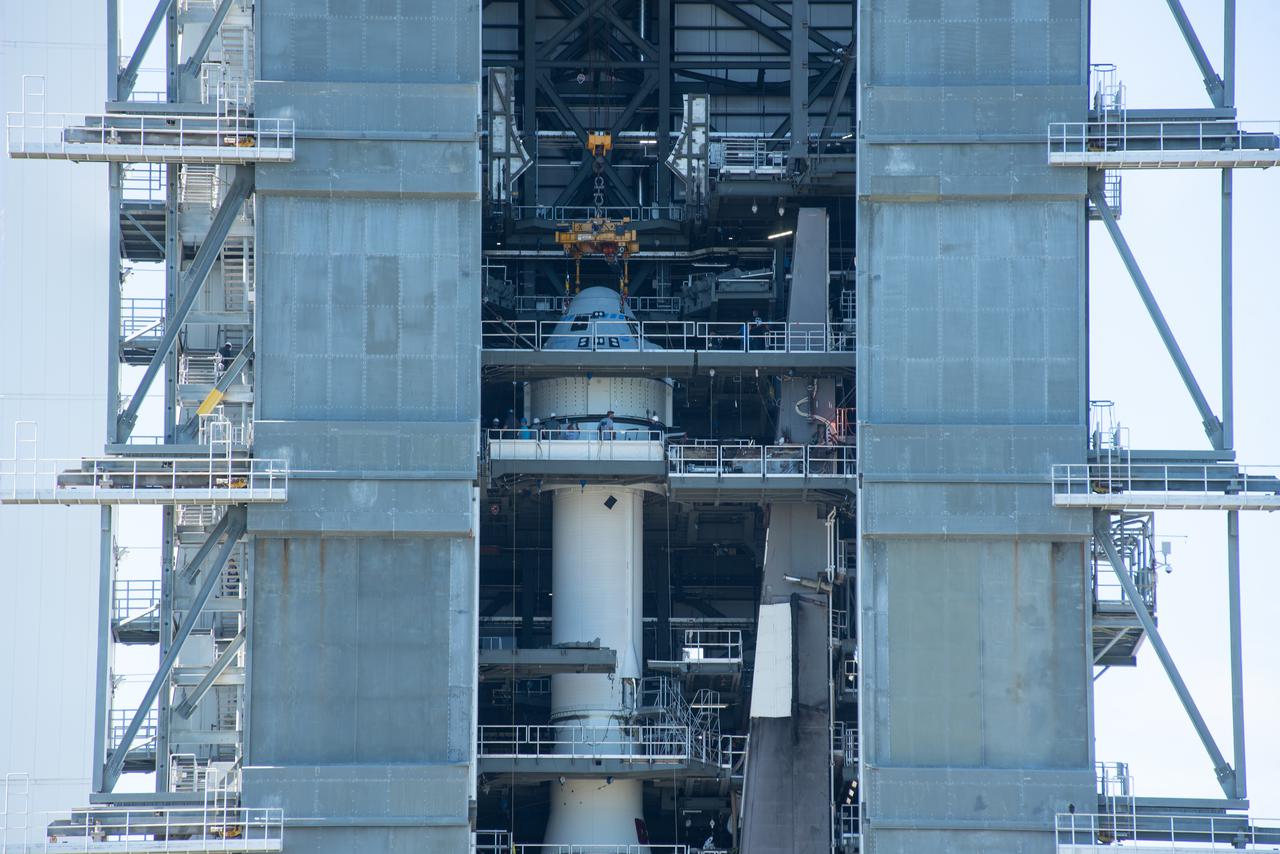
Boeing’s CST-100 Starliner spacecraft is secured atop a United Launch Alliance Atlas V rocket at the Vertical Integration Facility at Space Launch Complex-41 at Florida’s Cape Canaveral Space Force Station on July 17, 2021. Starliner will launch on the Atlas V for Boeing’s second Orbital Flight Test (OFT-2) for NASA’s Commercial Crew Program. The spacecraft rolled out from Boeing’s Commercial Crew and Cargo Processing Facility at NASA’s Kennedy Space Center earlier in the day.
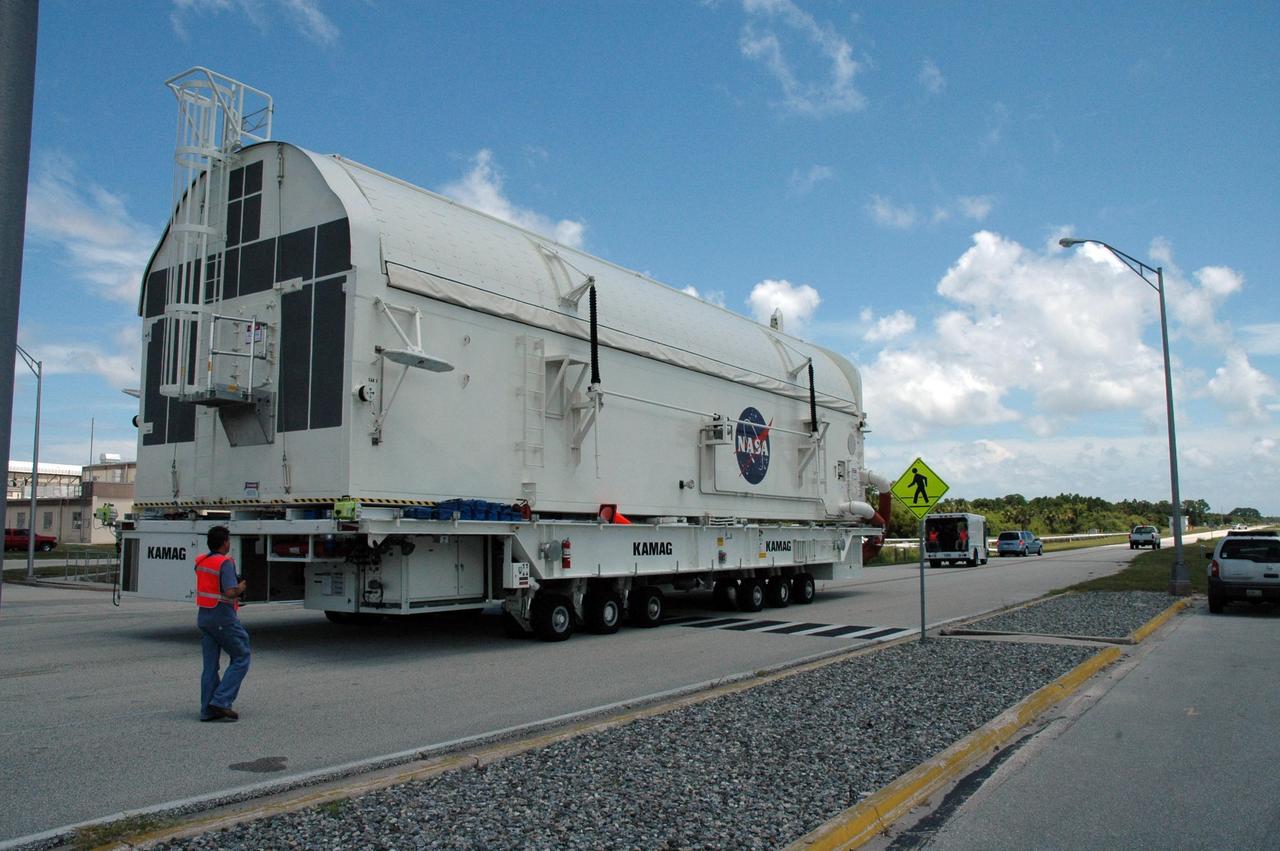
KENNEDY SPACE CENTER, FLA. -- The STS-118 payload canister transporter moves from the Space Station Processing Facility to the Canister Rotation Facility. Inside the canister are the SPACEHAB module, the S5 truss and the external stowage platform 3. At the CRF, the canister will be raised to a vertical position for delivery to Launch Pad 39A. Endeavour is targeted for launch on Aug. 9 to the International Space Station. The mission will continue space station construction with installation of the truss. Photo credit: NASA/Jim Grossmann
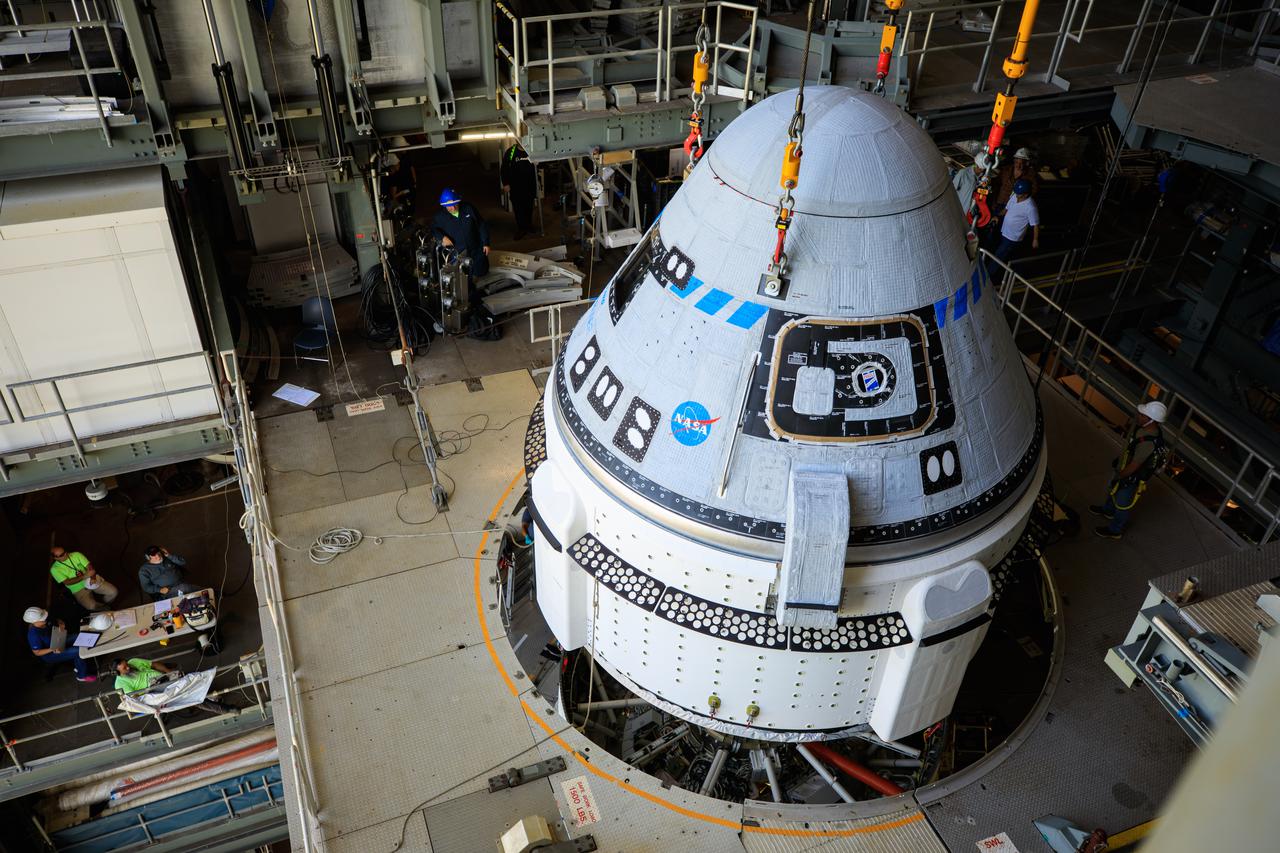
The Boeing CST-100 Starliner spacecraft is lifted at the Vertical Integration Facility at Space Launch Complex-41 at Florida's Cape Canaveral Space Force Station on May 4th, 2022. Starliner will be secured atop a United Launch Alliance Atlas V rocket for Boeing's second Orbital Flight Test (OFT-2) to the International Space Station for NASA's Commercial Crew Program. The spacecraft rolled out from Boeing's Commercial Crew and Cargo Processing Facility at NASA's Kennedy Space Center earlier in the day.
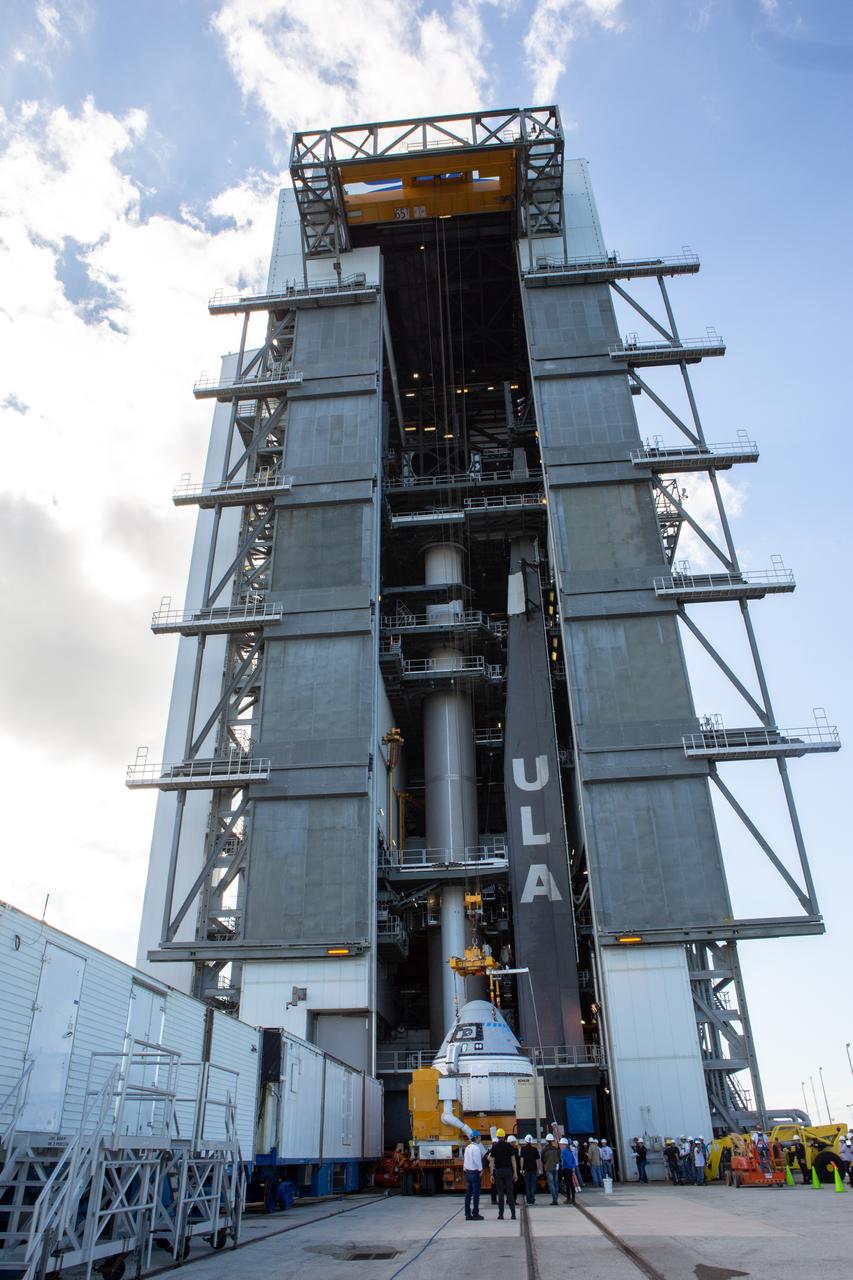
The Boeing CST-100 Starliner spacecraft is lifted at the Vertical Integration Facility at Space Launch Complex 41 at Florida’s Cape Canaveral Air Force Station on Nov. 21, 2019. Starliner will be secured atop a United Launch Alliance Atlas V rocket for Boeing’s Orbital Flight Test to the International Space Station for NASA’s Commercial Crew Program. The spacecraft rolled out from Boeing’s Commercial Crew and Cargo Processing Facility at NASA’s Kennedy Space Center earlier in the day.
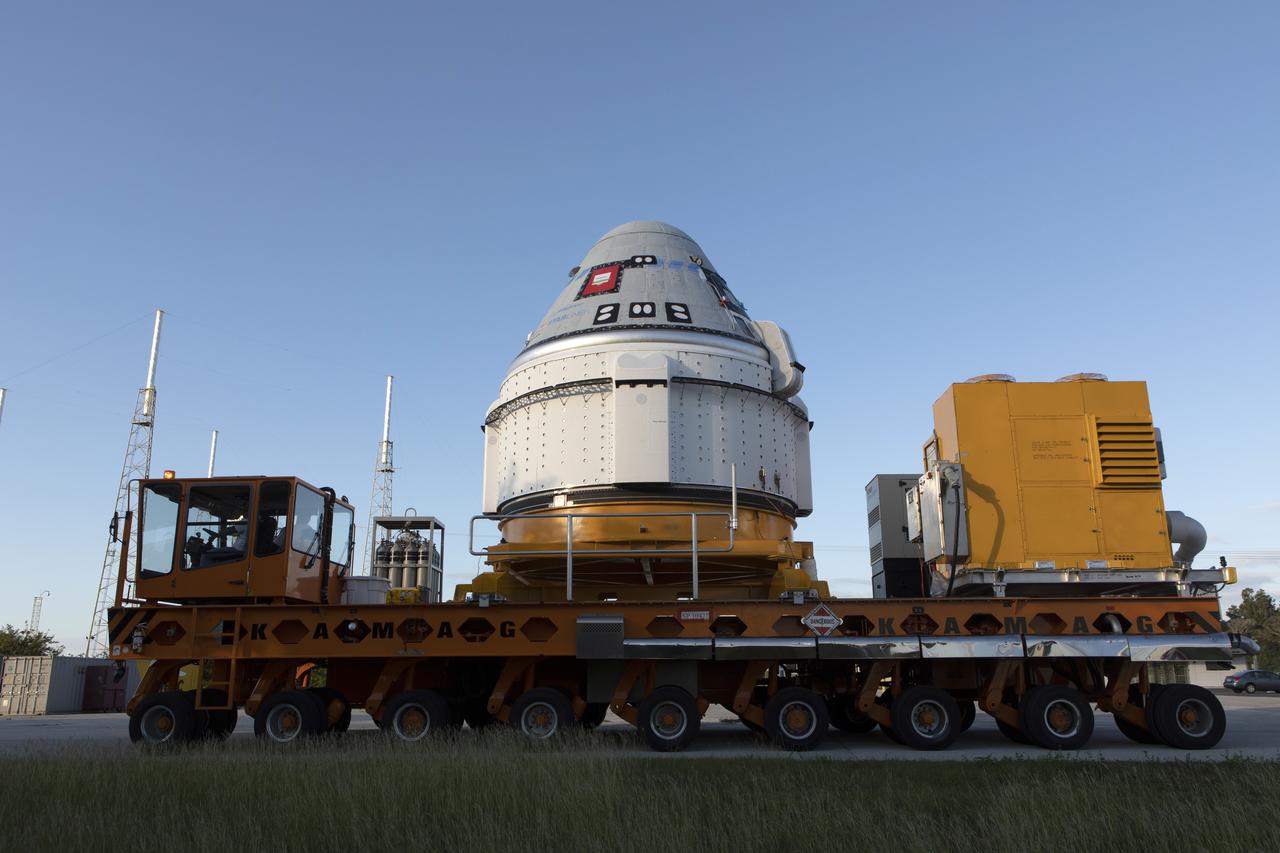
The Boeing CST-100 Starliner spacecraft arrives at the Vertical Integration Facility at Space Launch Complex 41 at Cape Canaveral Air Force Station in Florida on Nov. 21, 2019. Starliner will be secured atop a United Launch Alliance Atlas V rocket for Boeing’s Orbital Flight Test to the International Space Station for NASA’s Commercial Crew Program. The spacecraft rolled out from Boeing’s Commercial Crew and Cargo Processing Facility at NASA’s Kennedy Space Center earlier in the day.
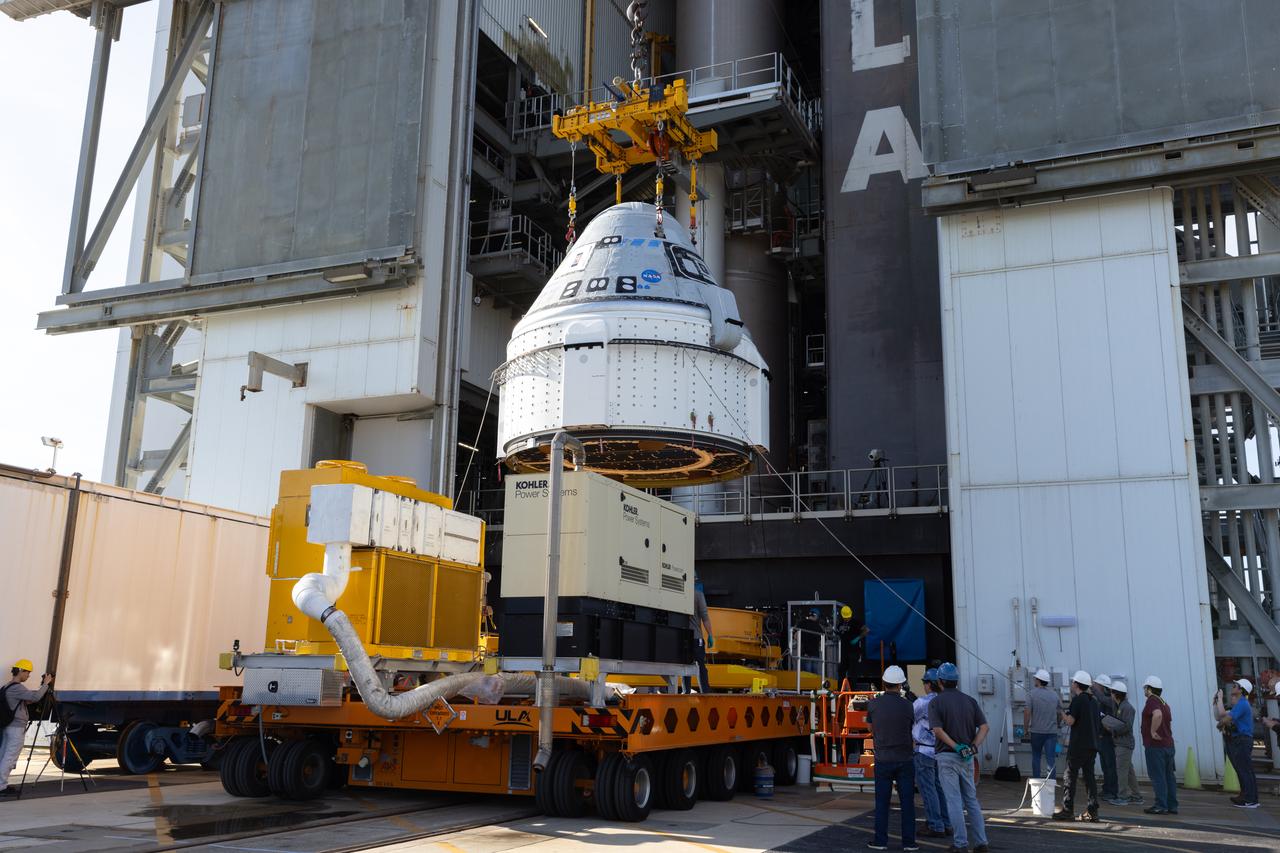
The Boeing Starliner spacecraft is lifted at the Vertical Integration Facility at Space Launch Complex-41 at Cape Canaveral Space Force Station in Florida on Tuesday, April 16, 2024. Starliner will be secured atop a United Launch Alliance Atlas V rocket for NASA’s Boeing Crew Flight Test to the International Space Station for the agency’s Commercial Crew Program. The spacecraft rolled out from Boeing's Commercial Crew and Cargo Processing Facility at NASA's Kennedy Space Center earlier in the day.
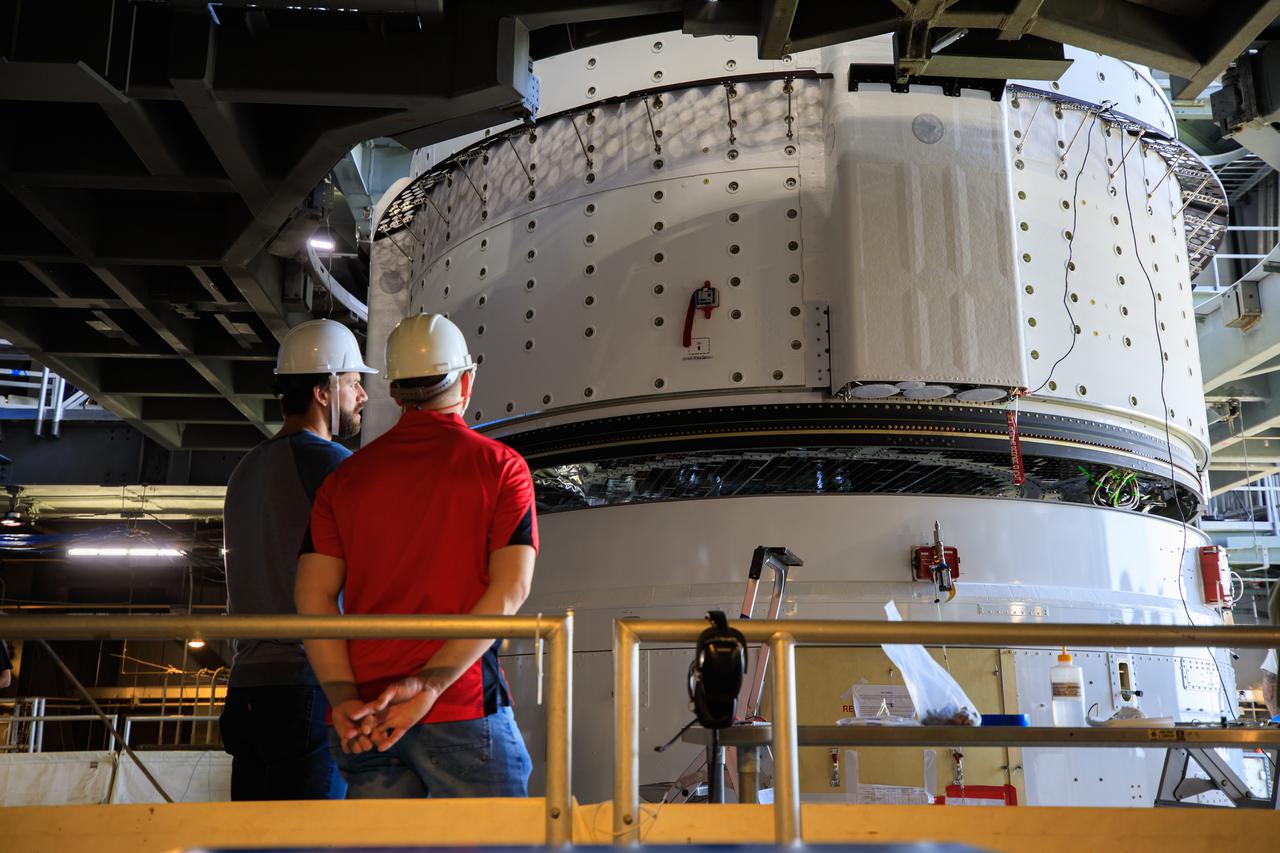
The Boeing CST-100 Starliner spacecraft is lifted at the Vertical Integration Facility at Space Launch Complex-41 at Florida's Cape Canaveral Space Force Station on May 4th, 2022. Starliner will be secured atop a United Launch Alliance Atlas V rocket for Boeing's second Orbital Flight Test (OFT-2) to the International Space Station for NASA's Commercial Crew Program. The spacecraft rolled out from Boeing's Commercial Crew and Cargo Processing Facility at NASA's Kennedy Space Center earlier in the day.
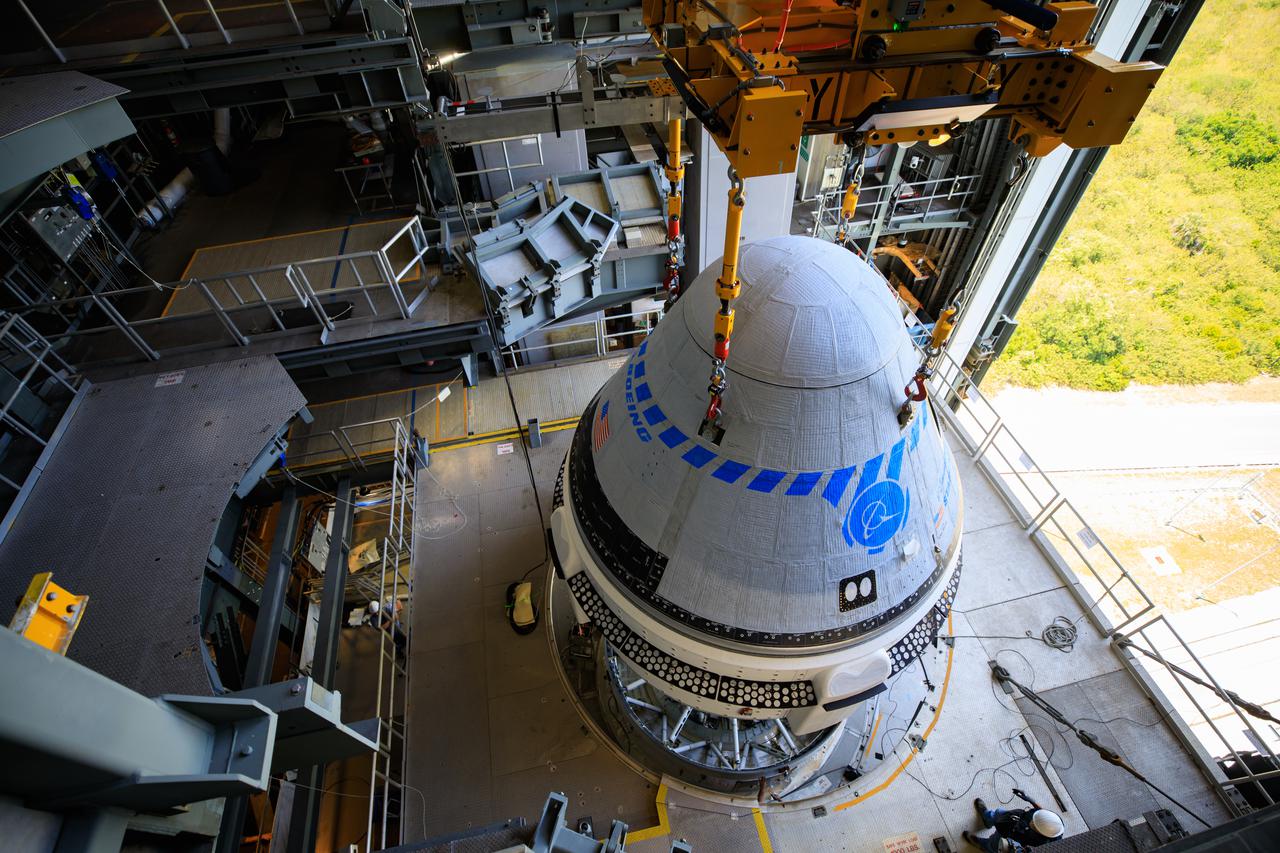
The Boeing CST-100 Starliner spacecraft is lifted at the Vertical Integration Facility at Space Launch Complex-41 at Florida's Cape Canaveral Space Force Station on May 4th, 2022. Starliner will be secured atop a United Launch Alliance Atlas V rocket for Boeing's second Orbital Flight Test (OFT-2) to the International Space Station for NASA's Commercial Crew Program. The spacecraft rolled out from Boeing's Commercial Crew and Cargo Processing Facility at NASA's Kennedy Space Center earlier in the day.
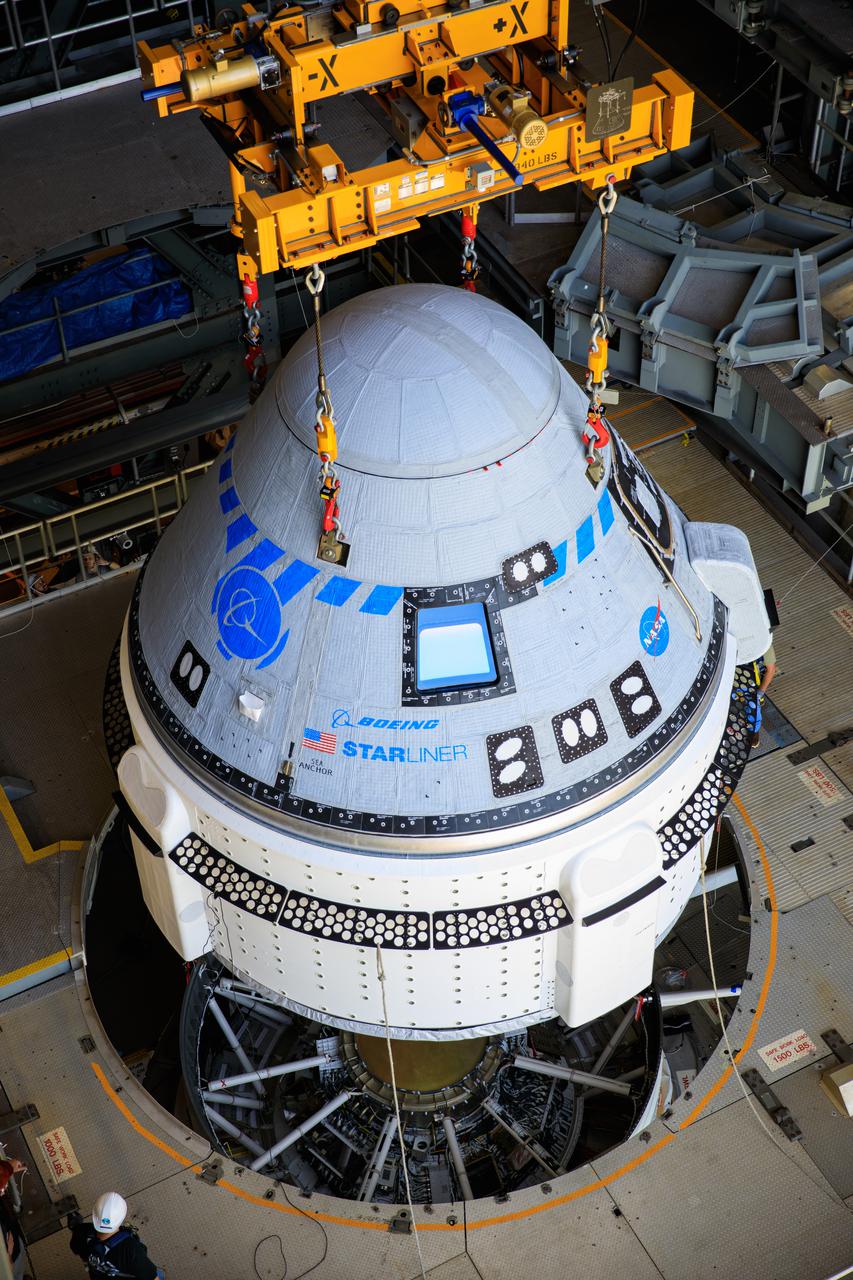
The Boeing CST-100 Starliner spacecraft is lifted at the Vertical Integration Facility at Space Launch Complex-41 at Florida's Cape Canaveral Space Force Station on May 4th, 2022. Starliner will be secured atop a United Launch Alliance Atlas V rocket for Boeing's second Orbital Flight Test (OFT-2) to the International Space Station for NASA's Commercial Crew Program. The spacecraft rolled out from Boeing's Commercial Crew and Cargo Processing Facility at NASA's Kennedy Space Center earlier in the day.
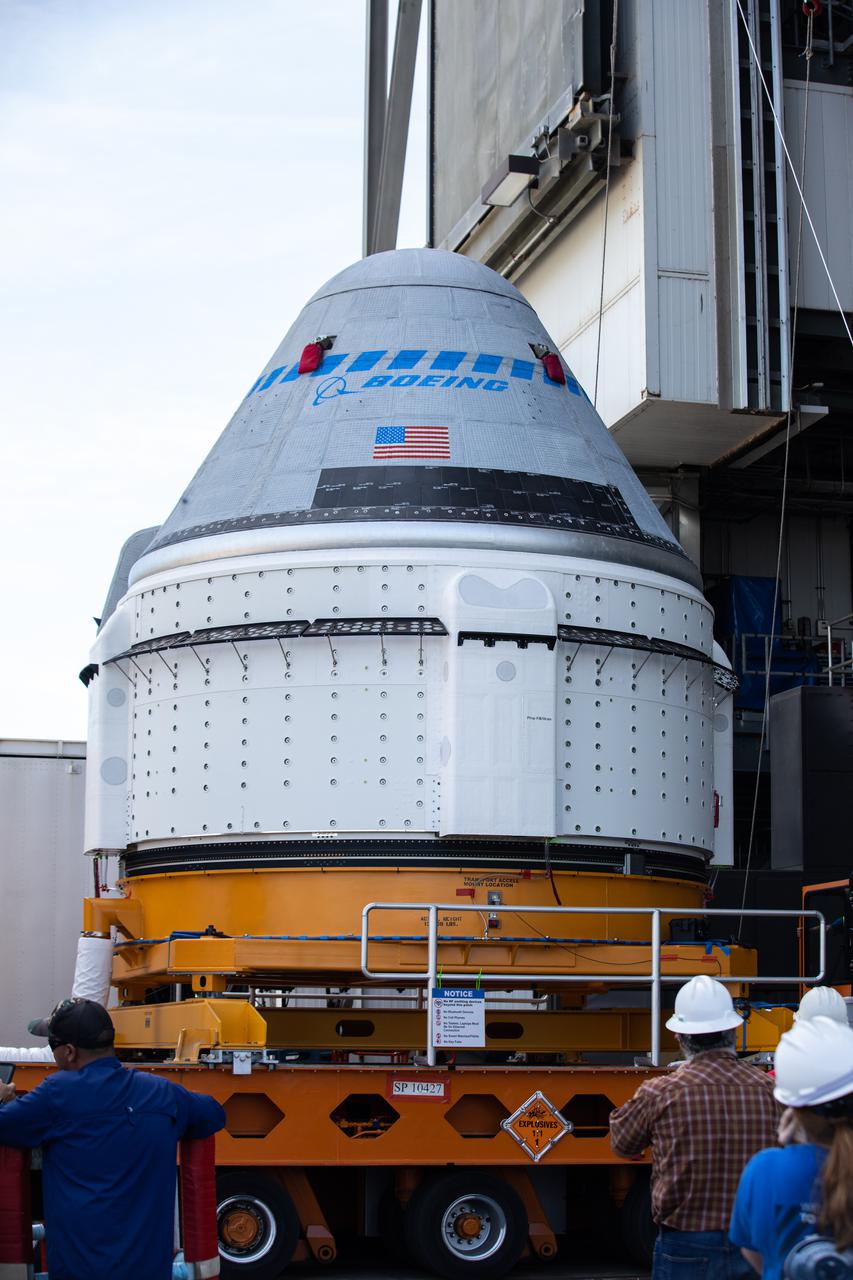
Boeing’s CST-100 Starliner spacecraft arrives at the Vertical Integration Facility at Space Launch Complex-41 at Cape Canaveral Space Force Station in Florida on May 4, 2022. Starliner will be secured atop a United Launch Alliance Atlas V rocket for Boeing’s second Orbital Flight Test (OFT-2) to the International Space Station for NASA’s Commercial Crew Program. The spacecraft rolled out from Boeing’s Commercial Crew and Cargo Processing Facility at NASA’s Kennedy Space Center earlier in the day.
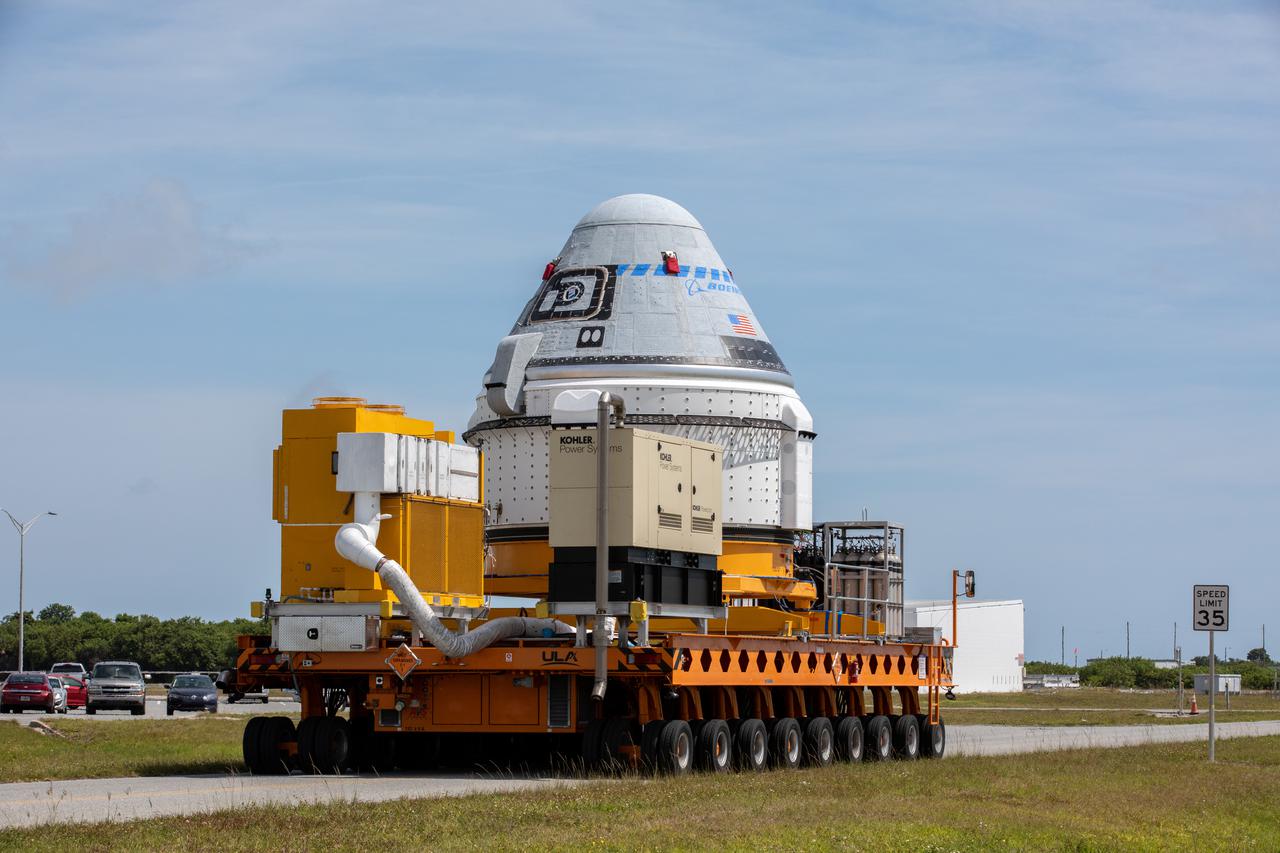
Boeing’s CST-100 Starliner spacecraft rolls out from the company’s Commercial Crew and Cargo Processing Facility at NASA’s Kennedy Space Center in Florida on May 4, 2022. The spacecraft will make the trip to the Vertical Integration Facility at Space Launch Complex-41 at Cape Canaveral Space Force Station where it will be secured atop a United Launch Alliance Atlas V rocket for Boeing’s second Orbital Flight Test (OFT-2) to the International Space Station for NASA’s Commercial Crew Program.