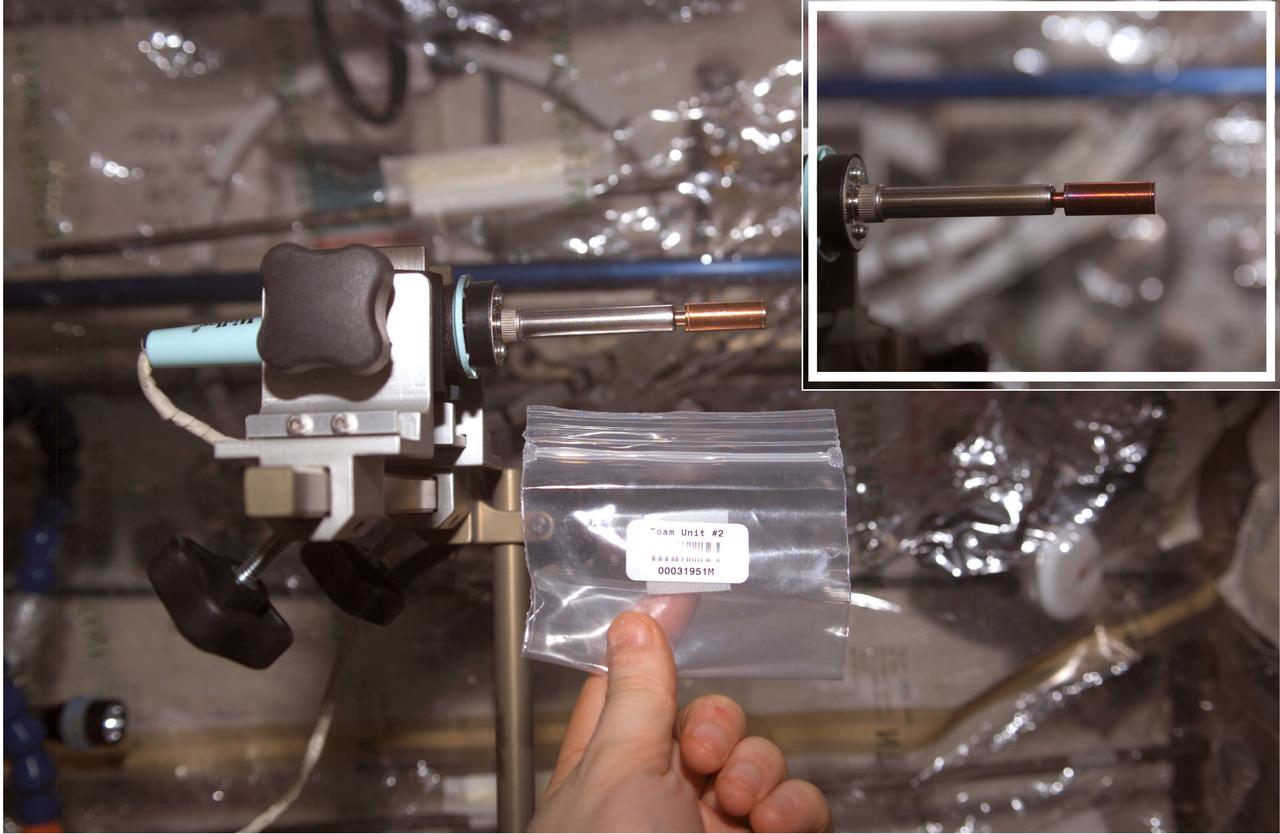
This soldering iron has an evacuated copper capsule at the tip that contains a pellet of Bulk Metallic Glass (BMG) aboard the International Space Station (ISS). Prior to flight, researchers sealed a pellet of bulk metallic glass mixed with microscopic gas-generating particles into the copper ampoule under vacuum. Once heated in space, such as in this photograph, the particles generated gas and the BMG becomes a viscous liquid. The released gas made the sample foam within the capsule where each microscopic particle formed a gas-filled pore within the foam. The inset image shows the oxidation of the sample after several minutes of applying heat. Although hidden within the brass sleeve, the sample retained the foam shape when cooled, because the viscosity increased during cooling until it was solid.
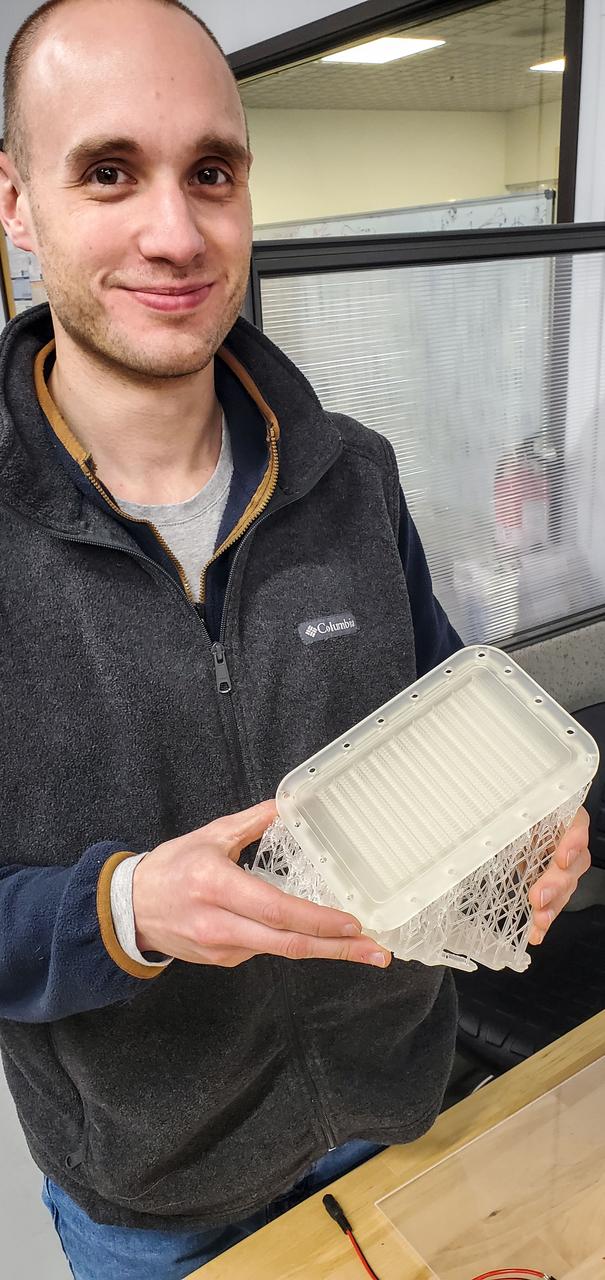
jsc2023e010171 (2/1/2023) --- Logan Torres, design engineer for the CapiSorb Visible System, holds the 3D printed degasser base during hardware fabrication. The capillary wedges in the degasser base control and passively transport viscous liquid in microgravity in order to demonstrate capabilities needed for future liquid sorbent carbon dioxide removal technologies. The CapiSorb Visible System investigation demonstrates a liquid control using capillary forces, over a range of properties that are characteristic of liquids which absorb carbon dioxide. Image courtesy of IRPI, LLC.
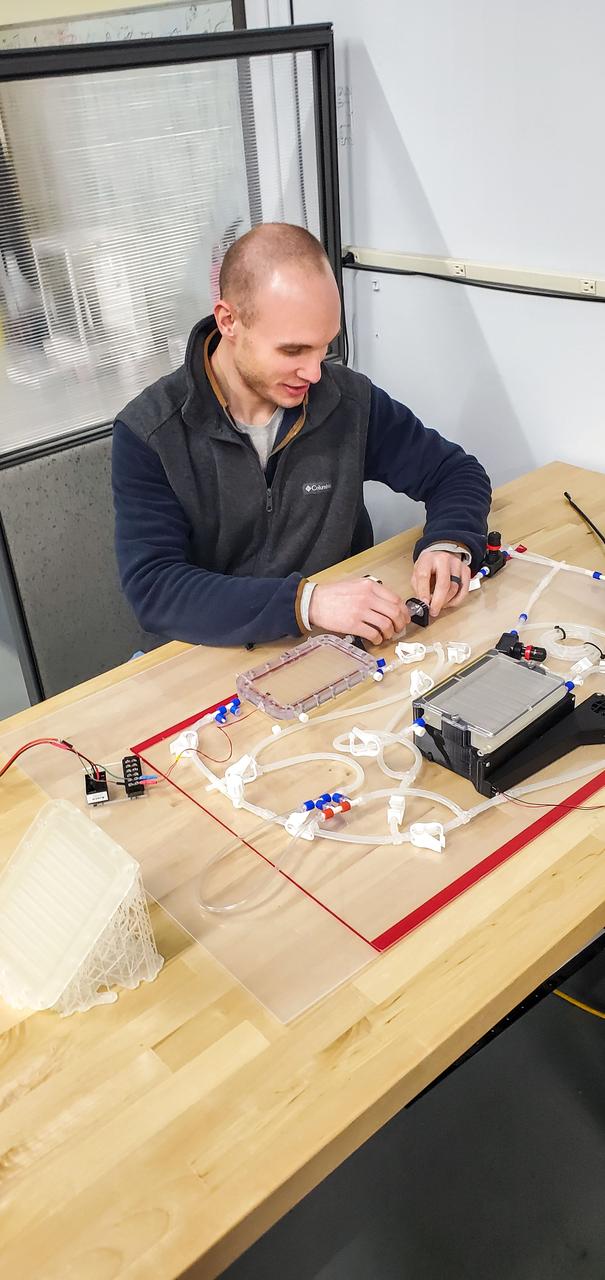
jsc2023e010172 (2/1/2023) --- Logan Torres, Design Engineer for the CapiSorb Visible System, configures the system pre-flight for performance testing. The capillary wedges in the degasser, contactor and capillary condensing heat exchanger control and passively transport viscous liquid in microgravity in order to demonstrate capabilities needed for future liquid sorbent carbon dioxide removal technologies. The CapiSorb Visible System investigation demonstrates a liquid control using capillary forces, over a range of properties that are characteristic of liquids which absorb carbon dioxide. Image courtesy of IRPI, LLC.
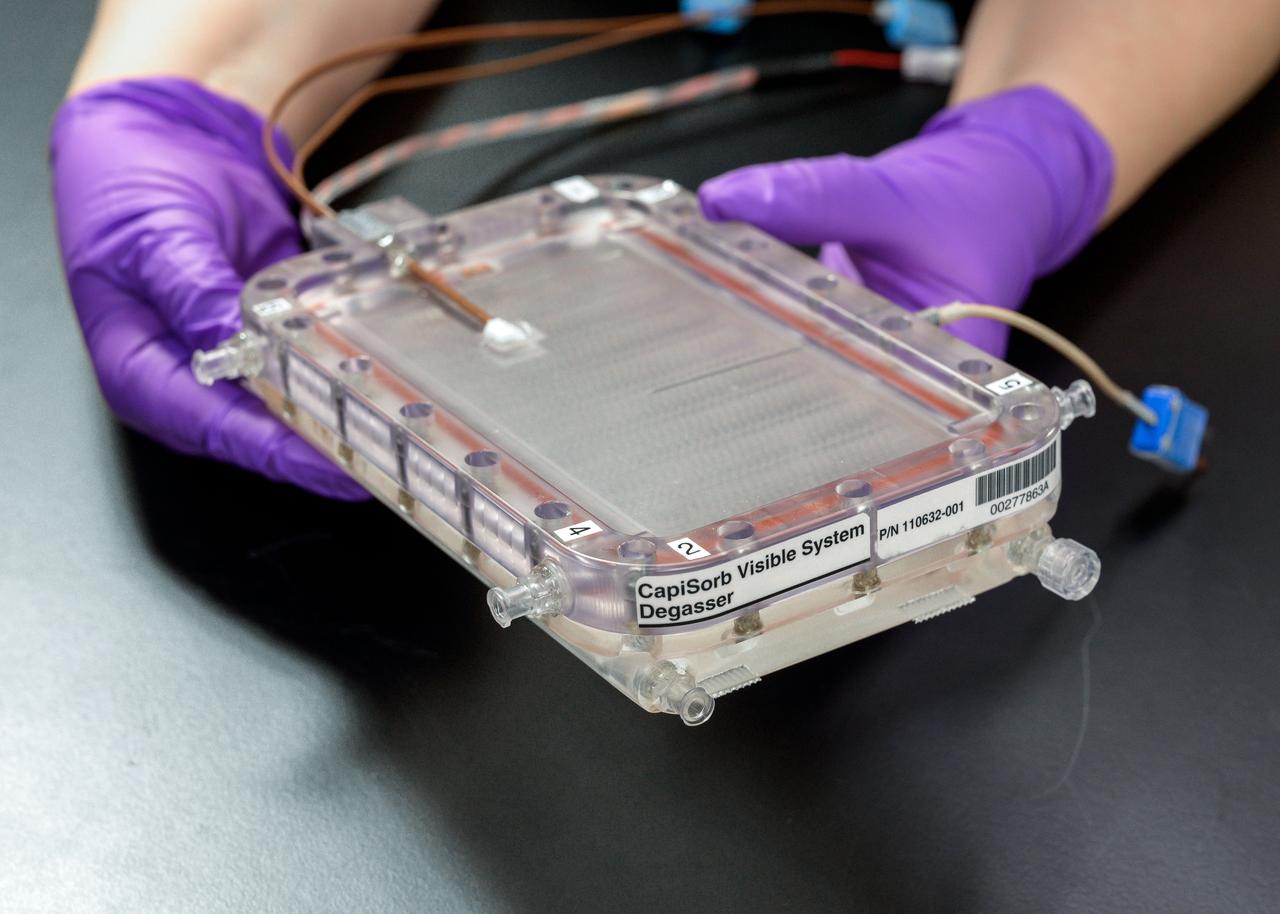
jsc2023e010167 (1/30/2023) --- CapiSorb Visible System flight unit degasser assembly in N240 room 133B. The CapiSorb Visible System will be launched on SpaceX CRS-27 in March 2023 to the International Space Station to demonstrate a liquid sorbent-based system that leverages the advantages of liquid control through capillary action to remove carbon dioxide from crewed atmospheres...Capillary wedges in the CapiSorb Visible System Degasser, shown here pre-flight, control and passively transport viscous liquid in microgravity in order to demonstrate capabilities needed for future liquid sorbent carbon dioxide removal technologies. The CapiSorb Visible System investigation demonstrates a liquid control using capillary forces, over a range of liquid properties that are characteristic of liquid carbon dioxide sorbents. Image courtesy of NASA's Ames Research Center.
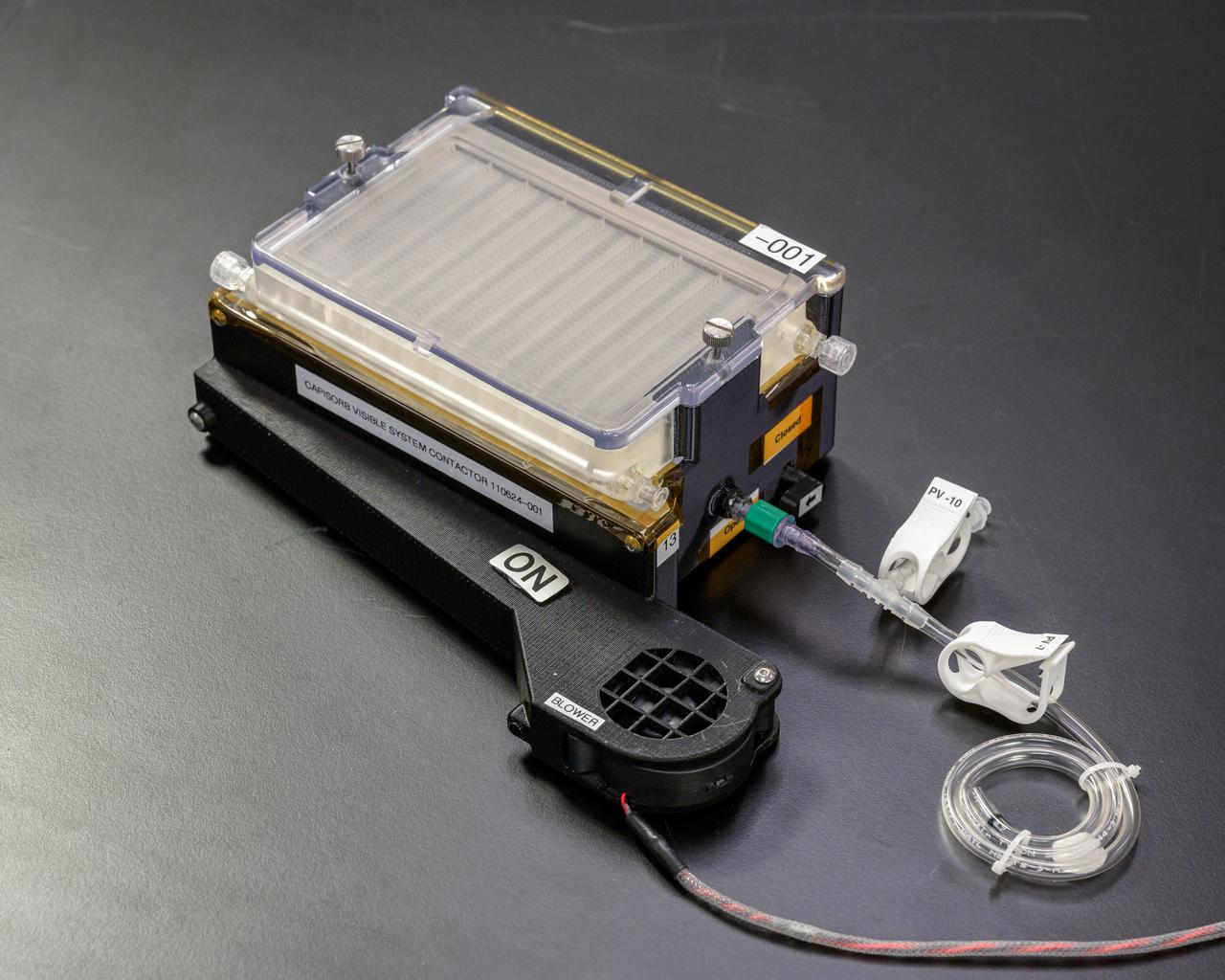
jsc2023e010168 (1/30/2023) --- CapiSorb Visible System flight unit contactor in N240 room 133B. The CapiSorb Visible System will be launched on SpaceX CRS-27 in March 2023 to the International Space Station to demonstrate a liquid sorbent-based system that leverages the advantages of liquid control through capillary action to remove carbon dioxide from crewed atmospheres...Capillary wedges in the CapiSorb Visible System Contactor, shown here preflight, control and passively transport viscous liquid in microgravity in order to demonstrate capabilities needed for future liquid carbon dioxide removal technologies. The CapiSorb Visible System investigation demonstrates a liquid control using capillary forces, over a range of properties that are characteristic of liquids which absorb carbon dioxide. Image courtesy of NASA's Ames Research Cente
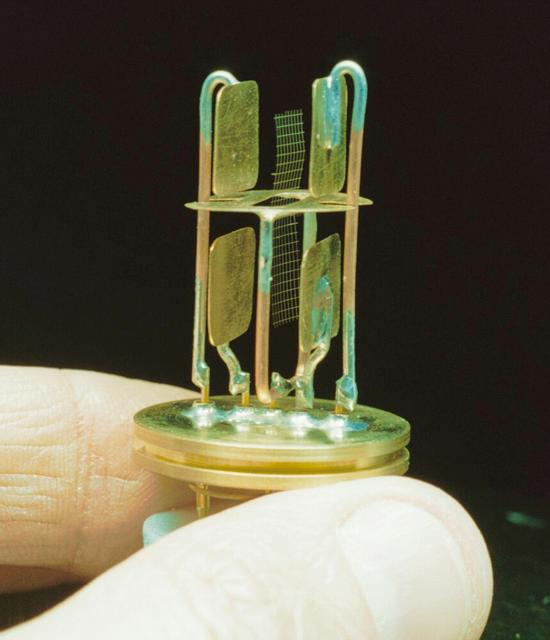
The Critical Viscosity of Xenon Experiment (CVX-2) on the STS-107 Research 1 mission in 2002 will measure the viscous behavior of liquid xenon, a heavy inert gas used in flash lamps and ion rocket engines, at its critical point. Resembling a tiny bit of window screen, the oscillator at the heart of CVX-2 will vibrate between two pairs of paddle-like electrodes. The slight bend in the shape of the mesh has no effect on the data. What counts are the mesh's displacement in the xenon fluid and the rate at which the displacement dampens. The unit shown here is encased in a small test cell and capped with a sapphire windown to contain the xenon at high pressure.

The surface of Mars is littered with examples of glacier-like landforms. While surface ice deposits are mostly limited to the polar caps, patterns of slow, viscous flow abound in many non-polar regions of Mars. Streamlines that appear as linear ridges in the surface soils and rocky debris are often exposed on top of infilling deposits that coat crater and valley floors. We see such patterns on the surfaces of Earth's icy glaciers and debris-covered "rock glaciers." As ice flows downhill, rock and soil are plucked from the surrounding landscape and ferried along the flowing ice surface and within the icy subsurface. While this process is gradual, taking perhaps thousands of years or longer, it creates a network of linear patterns that reveal the history of ice flow. Later and under warmer conditions, the ice may be lost through melting or sublimation. (Sublimation is the evaporation of ice directly from solid to gas without the presence of liquid.) Rock and minerals concentrated in these long ridges are then left behind, draped over the preexisting landscape. https://photojournal.jpl.nasa.gov/catalog/PIA25984