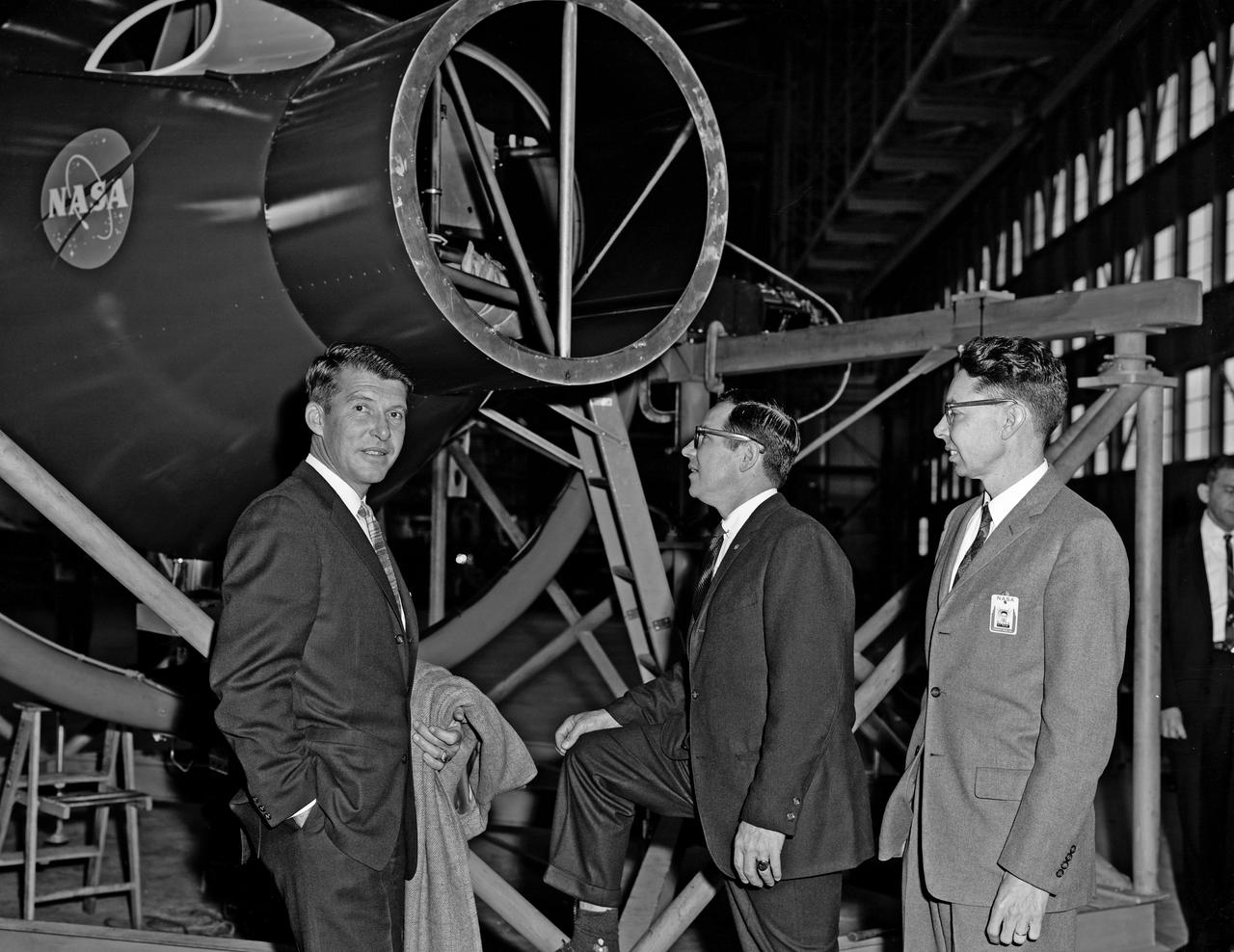
Walter (Wally) M. Schirra Visit to Langley Research Center to the Rendezvous Docking Simulator.
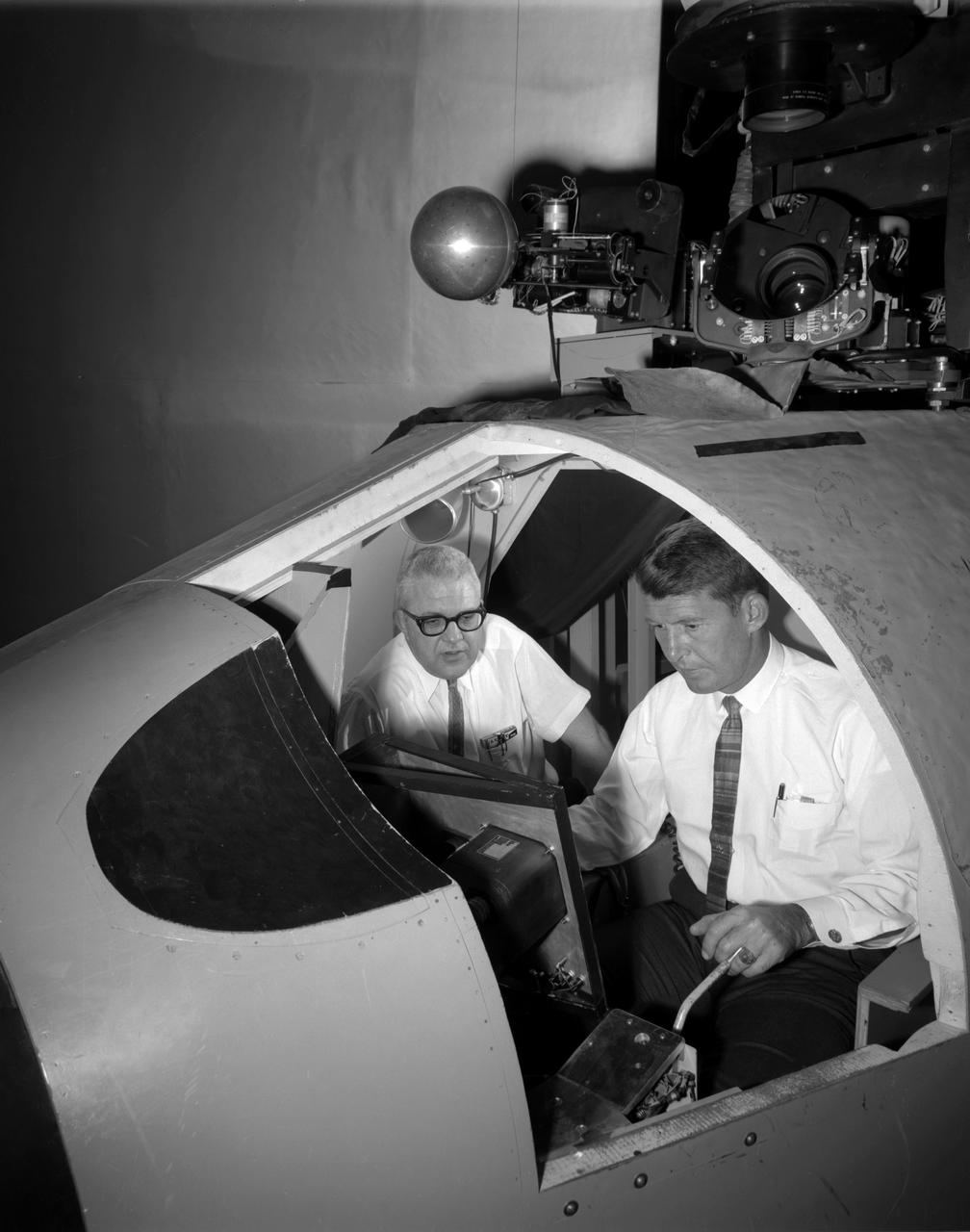
Walter (Wally) M. Schirra in Visual Docking Simulator From A.W. Vogeley, "Piloted Space-Flight Simulation at Langley Research Center," Paper presented at the American Society of Mechanical Engineers 1966 Winter Meeting, New York, NY, November 27-December 1, 1966. "This facility was [later known as the Visual-Optical Simulator. It presents to the pilot an out-the-window view of his target in correct 6 degrees of freedom motion. The scene is obtained by a television camera pick-up viewing a small-scale gimbaled model of the target. "For docking studies, the docking target picture was projected onto the surface of a 20-foot-diameter sphere and the pilot could, effectively, maneuver into contract. this facility was used in a comparison study with the Rendezvous Docking Simulator - one of the few comparison experiments in which conditions were carefully controlled and a reasonable sample of pilots used. All pilots preferred the more realistic RDS visual scene. The pilots generally liked the RDS angular motion cues although some objected to the false gravity cues that these motions introduced. Training time was shorter on the RDS, but final performance on both simulators was essentially equal. " "For station-keeping studies, since close approach is not required, the target was presented to the pilot through a virtual-image system which projects his view to infinity, providing a more realistic effect. In addition to the target, the system also projects a star and horizon background. "

The original seven astronauts for the Mercury Project pose in front of an Air Force Jet. From left to right: Scott Carpenter, L. Gordon Cooper, John H. Glenn, Virgil I. Gus Grissom, Walter M. Wally Schirra, Alan B. Shepard, and Donald K. Deke Slayton.

Astronaut Walter M. "Wally" Schirra, one of the original seven astronauts for Mercury Project selected by NASA on April 27, 1959. The MA-8 (Mercury-Atlas) mission with Sigma 7 spacecraft was the third marned orbital flight by the United States, and made the six orbits in 9-1/4 hours.

Apollo 7 Commander Walter M. "Wally" Schirra and his wife, Josephine, were among the many special NASA STS-83 launch guests who witnessed the liftoff of the Space Shuttle Columbia April 4 at the Banana Creek VIP Viewing Site at KSC. Columbia took off from Launch Pad 39A at 2:20:32 p.m. EST to begin the 16-day Microgravity Science Laboratory-1 (MSL-1) mission
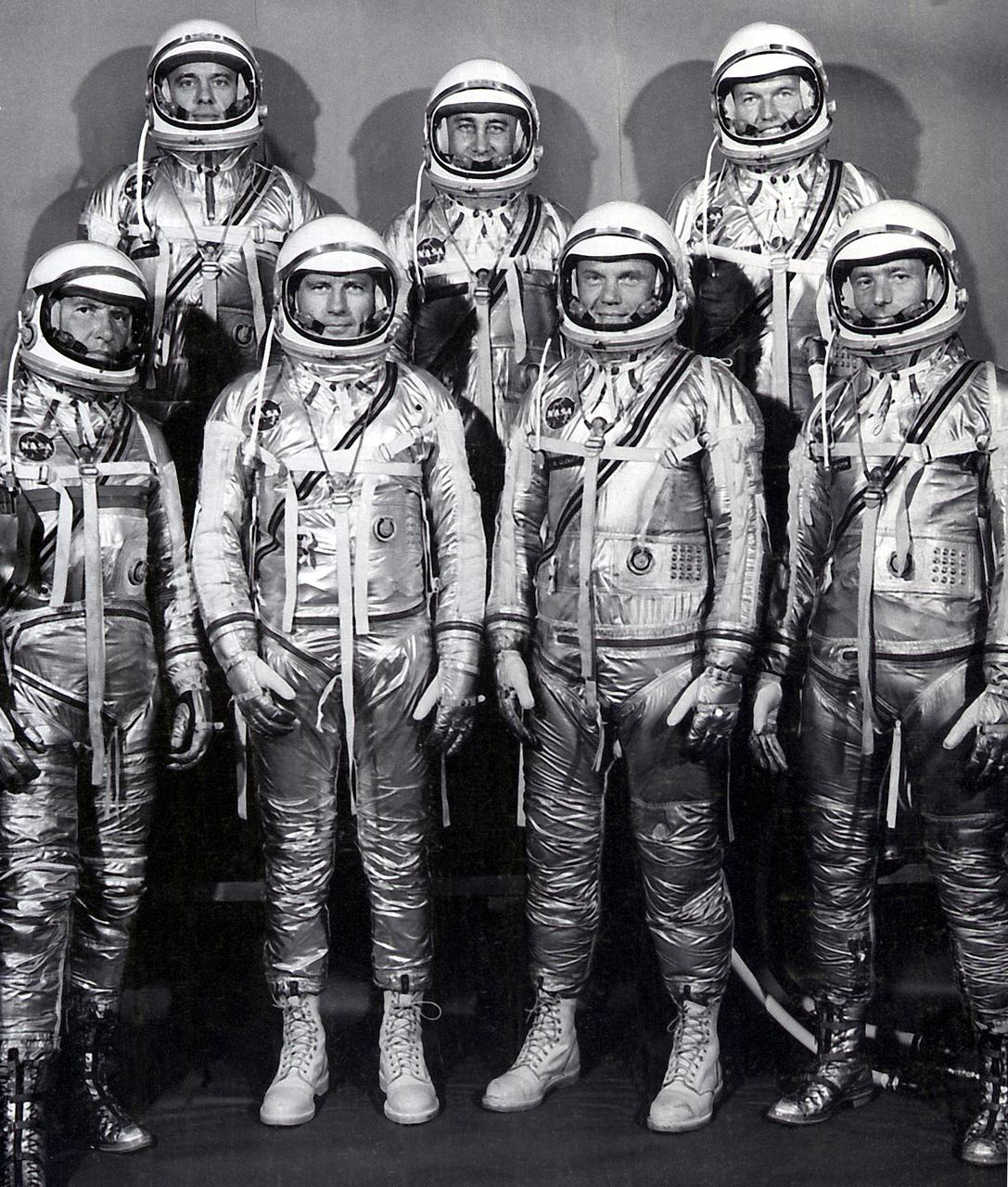
The group portrait of the original seven astronauts for the Mercury Project. NASA selected its first seven astronauts on April 27, 1959. Left to right at front: Walter M. Wally Schirra, Donald K. Deke Slayton, John H. Glenn, Jr., and Scott Carpenter. Left to right at rear: Alan B. Shepard, Virgil I. Gus Grissom, and L. Gordon Cooper, Jr.
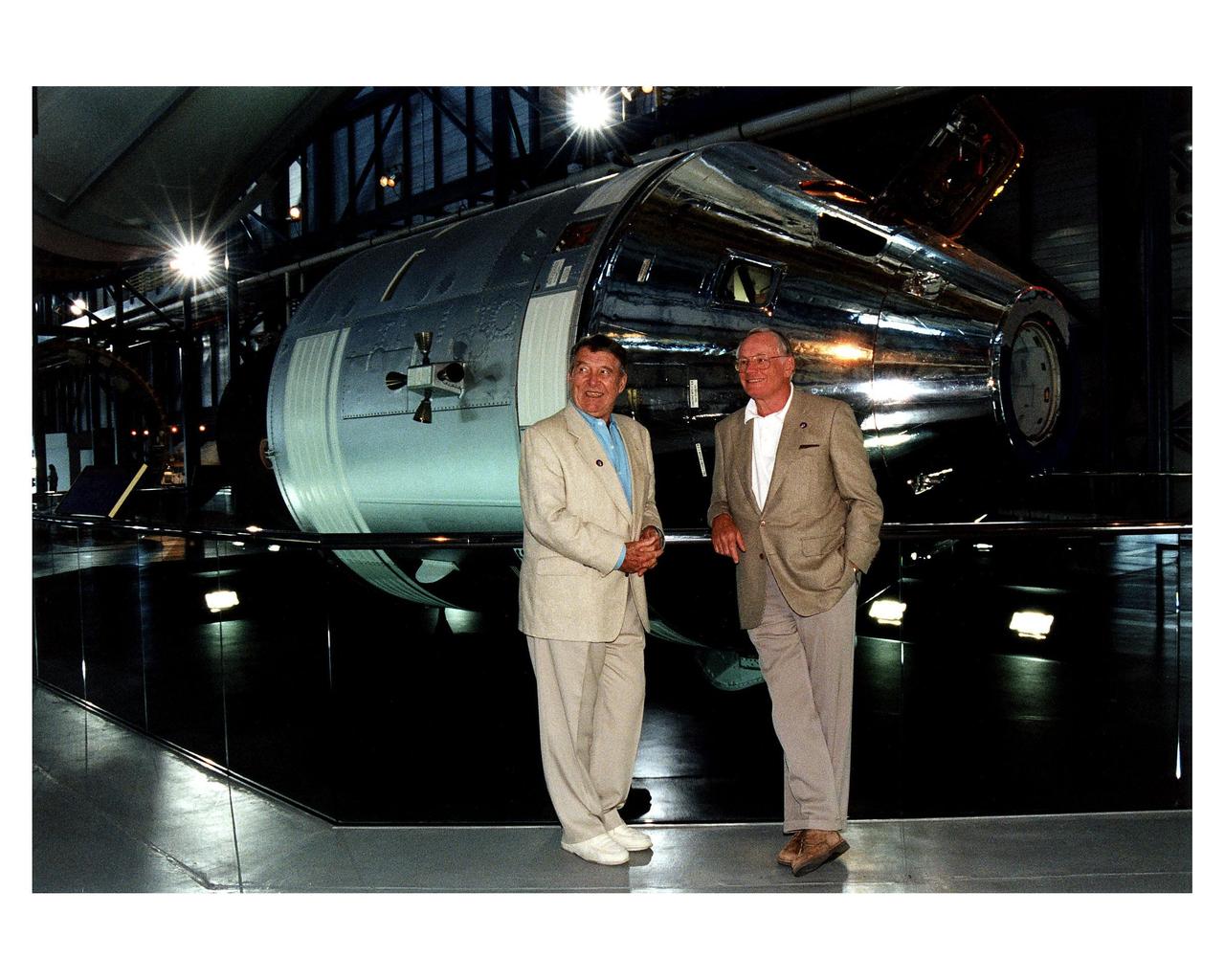
KENNEDY SPACE CENTER, FLA. -- Among the many special NASA STS-83 launch guests who witnessed the liftoff of the Space Shuttle Columbia April 4 were Apollo 7 Commander Walter M. "Wally" Schirra (left ) and Apollo l1 Commander Neil A. Armstrong. The two former astronauts are posing in front of the Apollo Command and Service Module in the Apollo/Saturn V Center at KSC. Columbia took off from Launch Pad 39A at 2:20:32 p.m. EST to begin the 16-day Microgravity Science Laboratory-1 (MSL-1) mission