This artist illustration shows a planetary disk left that weighs the equivalent of 50 Jupiter-mass planets. It demonstrates a first-of-its-kind feat from astronomers using the Herschel space observatory.
Weighing Planetary Disks Artist Concept
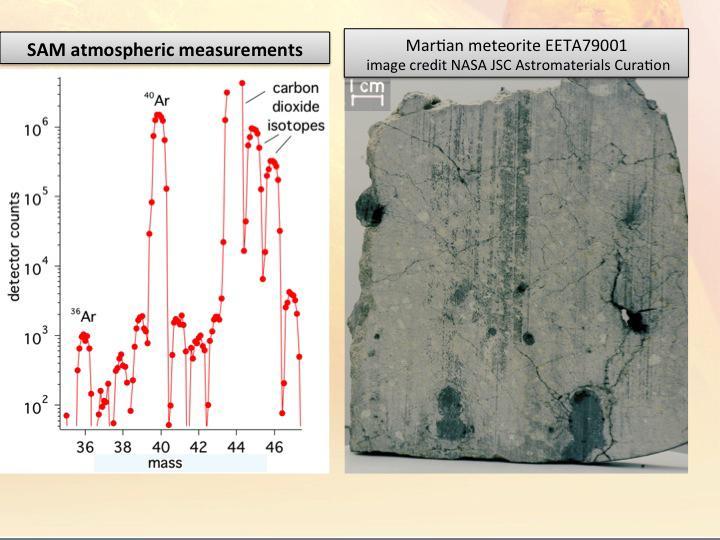
New results from the Sample Analysis at Mars, or SAM, instrument on NASA Curiosity rover detected about 2,000 times as much argon-40 as argon-36, which weighs less, confirming the connection between Mars and Martian meteorites found on Earth.
Weighing Molecules on Mars
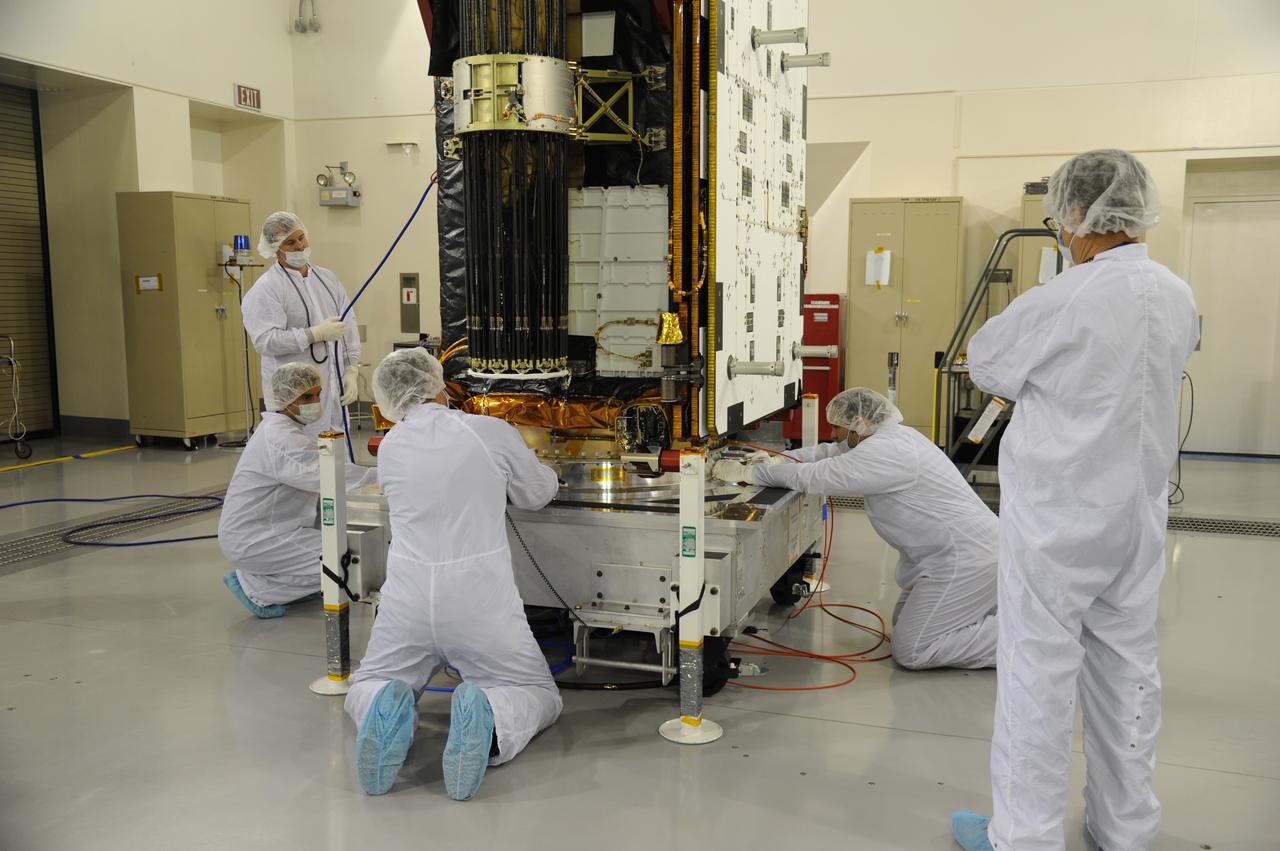
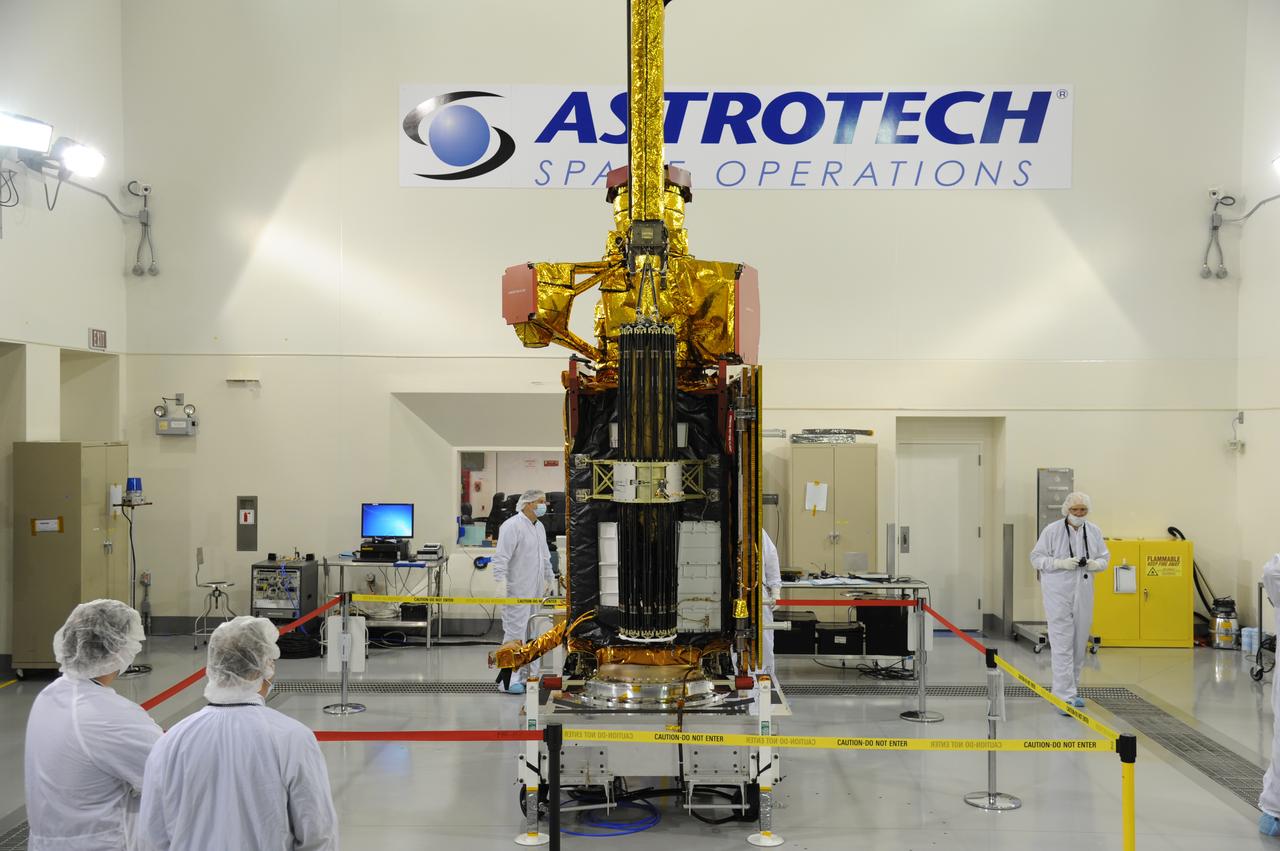
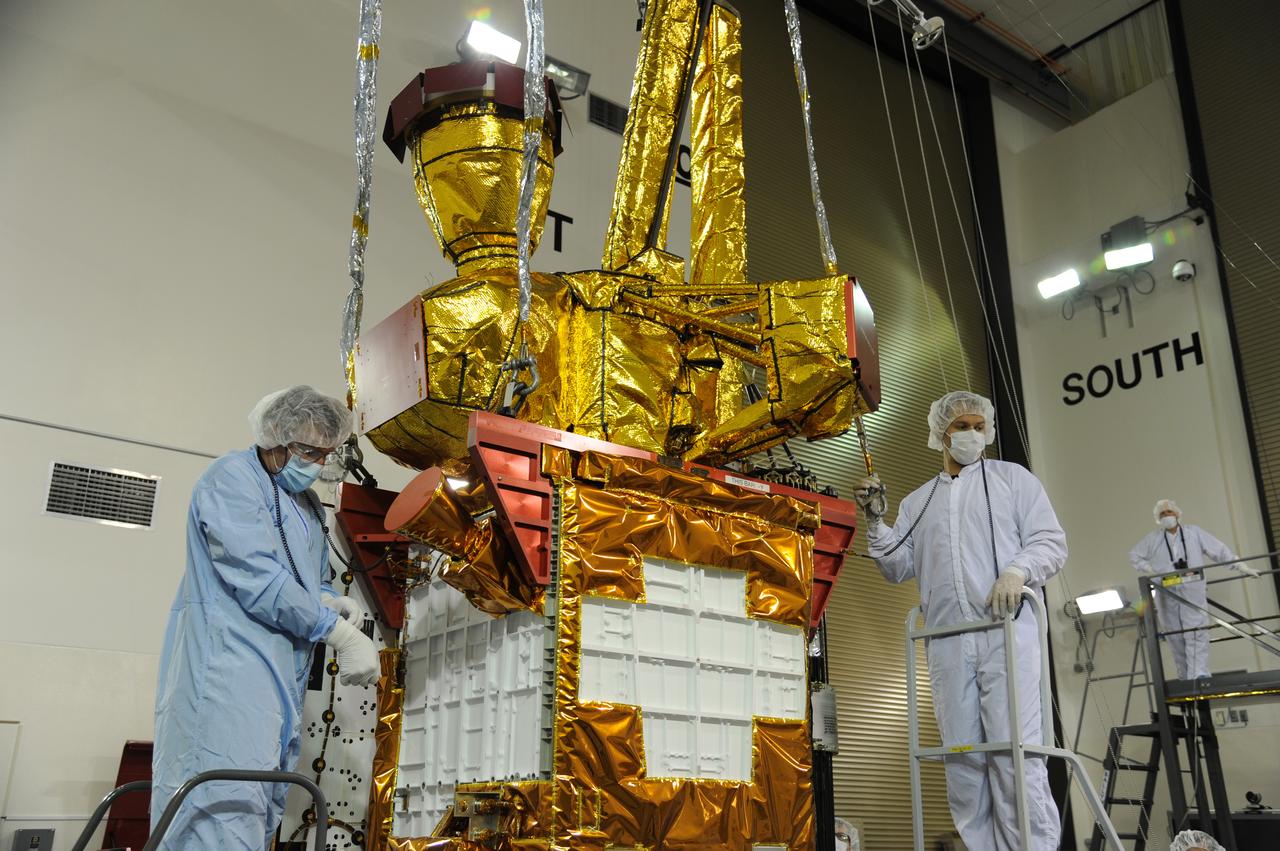
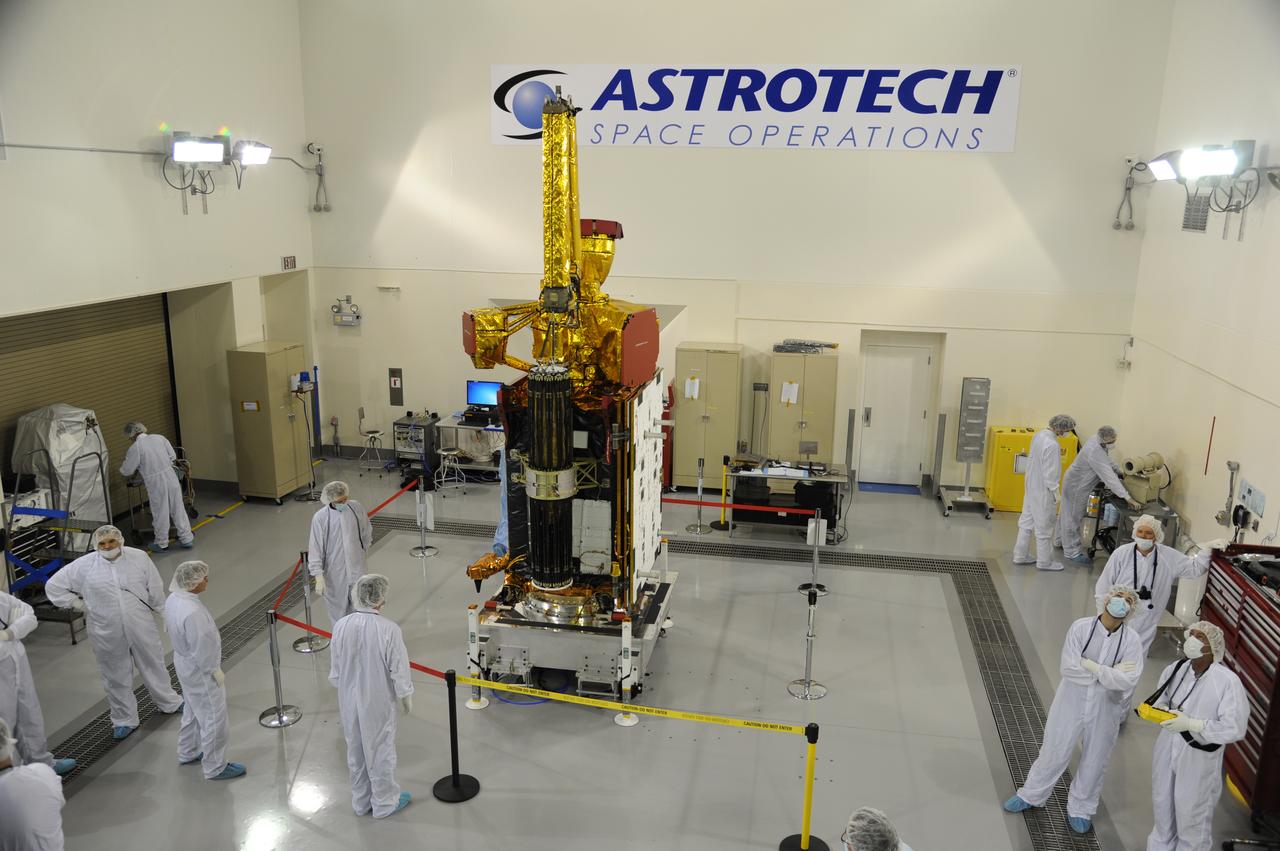
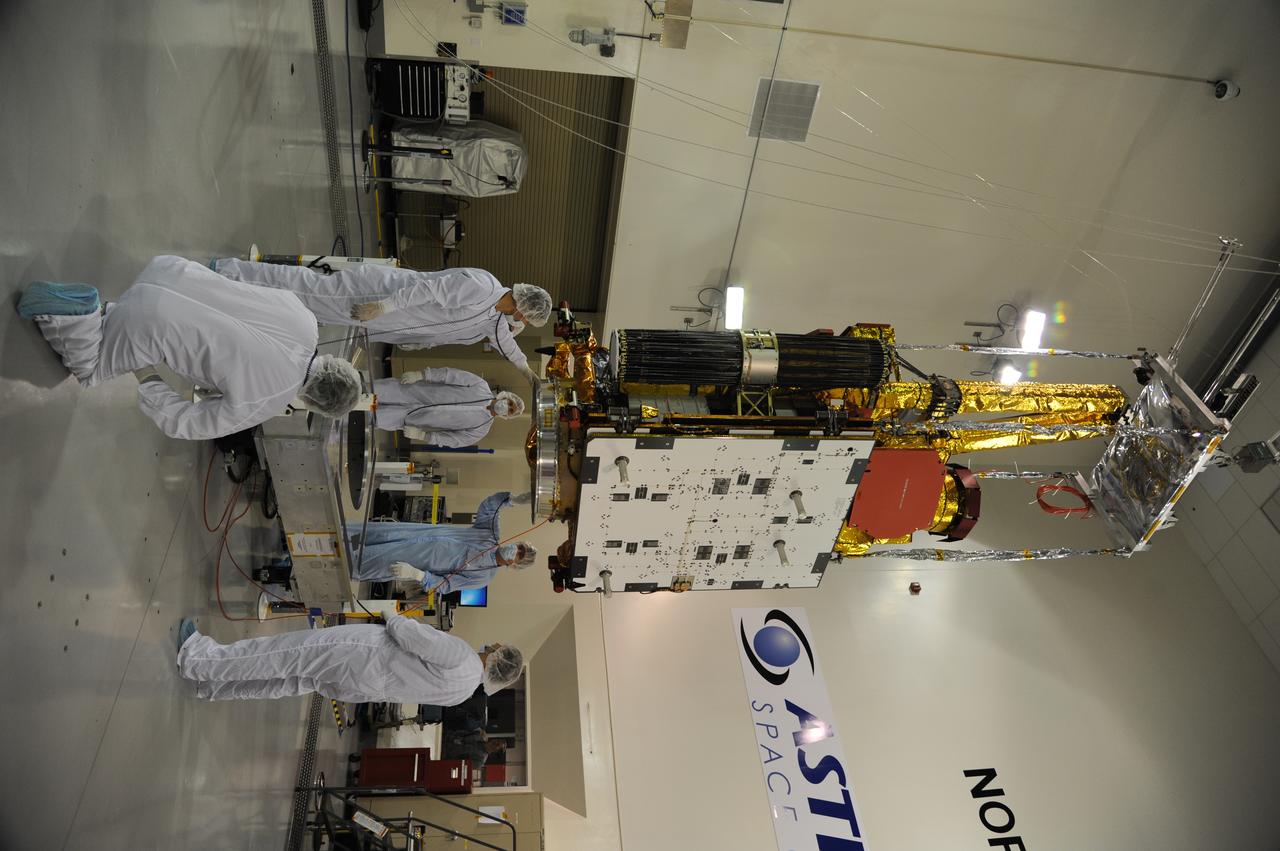
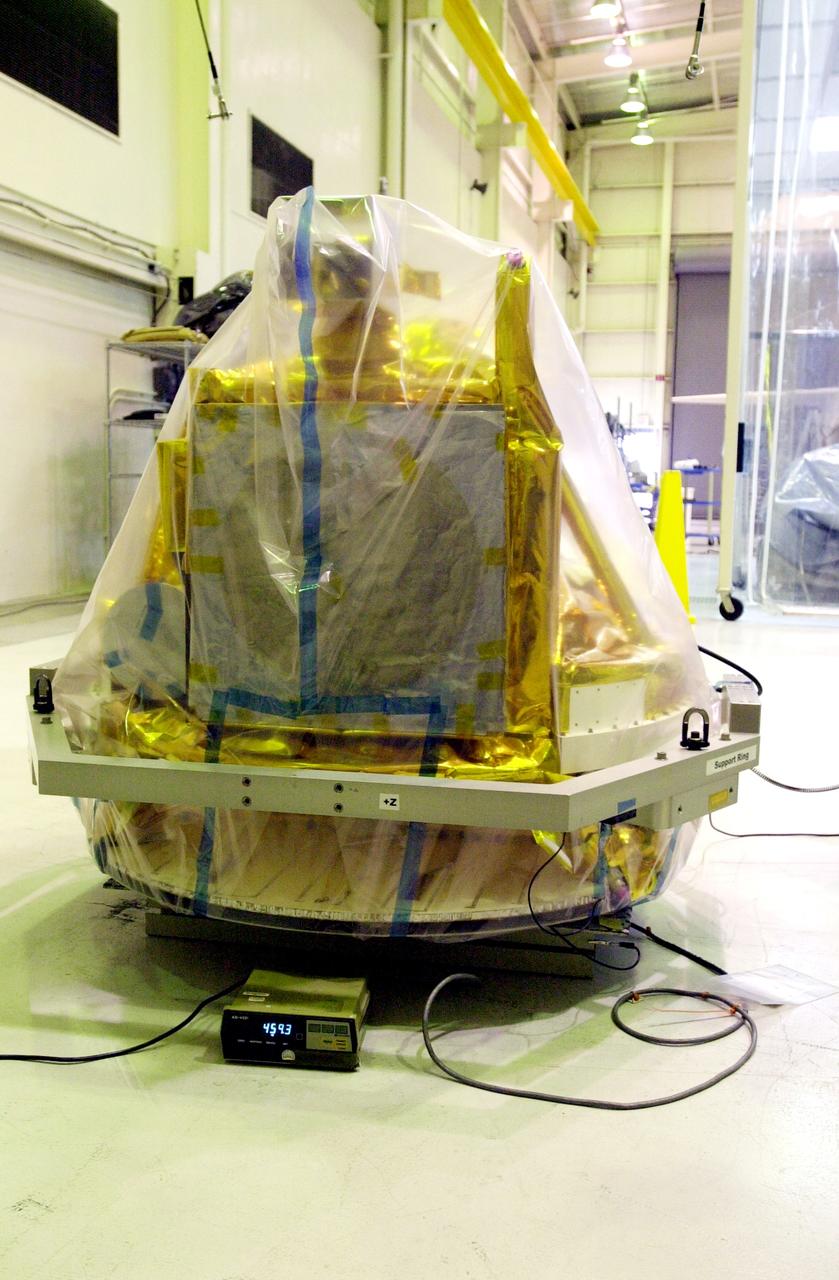
Operations are underway to weigh NASA's Soil Moisture Active Passive, or SMAP, spacecraft in the clean room of the Astrotech payload processing facility on Vandenberg Air Force Base in California. The weighing of a spacecraft is standard procedure during prelaunch processing. SMAP will launch on a Delta II 7320 configuration vehicle featuring a United Launch Alliance first stage booster powered by an Aerojet Rocketdyne RS-27A main engine and three Alliant Techsystems, or ATK, strap-on solid rocket motors. Once on station in Earth orbit, SMAP will provide global measurements of soil moisture and its freeze/thaw state. NASA's Jet Propulsion Laboratory that built the observatory and its radar instrument also is responsible for SMAP project management and mission operations. Launch from Space Launch Complex 2 is targeted for Jan. 29, 2015.
SMAP During Weighing
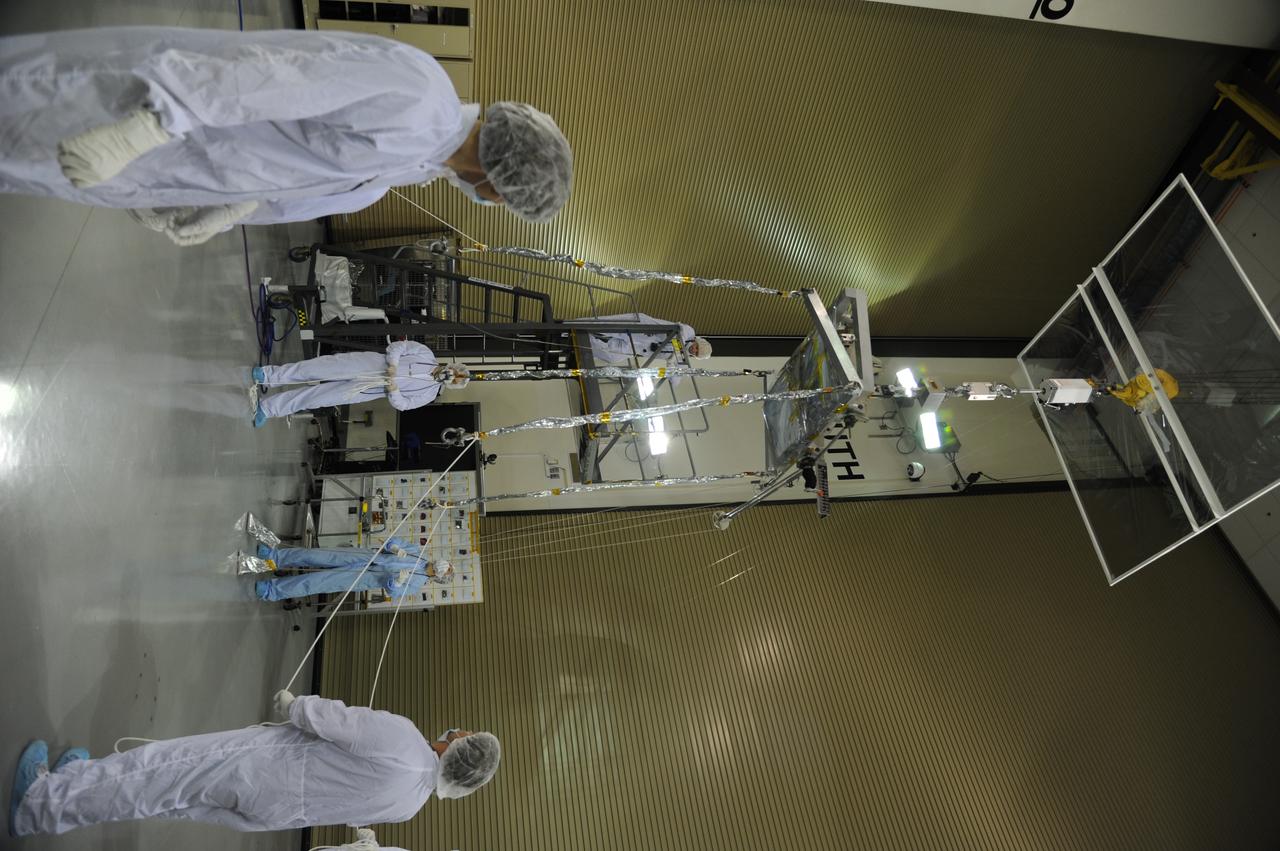
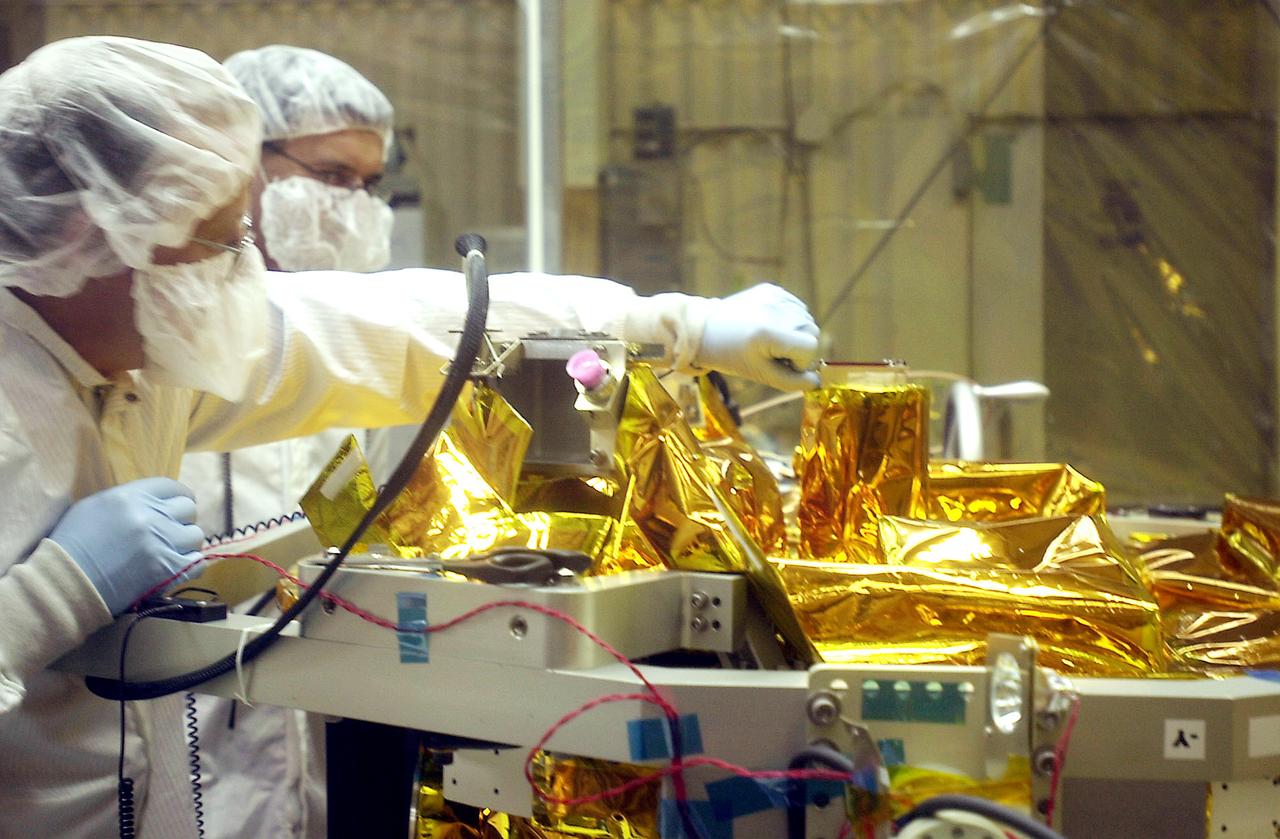
Preparations are underway to weigh NASA's Soil Moisture Active Passive, or SMAP, spacecraft in the clean room of the Astrotech payload processing facility on Vandenberg Air Force Base in California. The weighing of a spacecraft is standard procedure during prelaunch processing. SMAP will launch on a Delta II 7320 configuration vehicle featuring a United Launch Alliance first stage booster powered by an Aerojet Rocketdyne RS-27A main engine and three Alliant Techsystems, or ATK, strap-on solid rocket motors. Once on station in Earth orbit, SMAP will provide global measurements of soil moisture and its freeze/thaw state. NASA's Jet Propulsion Laboratory that built the observatory and its radar instrument also is responsible for SMAP project management and mission operations. Launch from Space Launch Complex 2 is targeted for Jan. 29, 2015.
SMAP During Weighing
Preparations are underway to weigh NASA's Soil Moisture Active Passive, or SMAP, spacecraft in the clean room of the Astrotech payload processing facility on Vandenberg Air Force Base in California. The weighing of a spacecraft is standard procedure during prelaunch processing. SMAP will launch on a Delta II 7320 configuration vehicle featuring a United Launch Alliance first stage booster powered by an Aerojet Rocketdyne RS-27A main engine and three Alliant Techsystems, or ATK, strap-on solid rocket motors. Once on station in Earth orbit, SMAP will provide global measurements of soil moisture and its freeze/thaw state. NASA's Jet Propulsion Laboratory that built the observatory and its radar instrument also is responsible for SMAP project management and mission operations. Launch from Space Launch Complex 2 is targeted for Jan. 29, 2015.
SMAP During Weighing
Operations are underway to weigh NASA's Soil Moisture Active Passive, or SMAP, spacecraft in the clean room of the Astrotech payload processing facility on Vandenberg Air Force Base in California. The weighing of a spacecraft is standard procedure during prelaunch processing. SMAP will launch on a Delta II 7320 configuration vehicle featuring a United Launch Alliance first stage booster powered by an Aerojet Rocketdyne RS-27A main engine and three Alliant Techsystems, or ATK, strap-on solid rocket motors. Once on station in Earth orbit, SMAP will provide global measurements of soil moisture and its freeze/thaw state. NASA's Jet Propulsion Laboratory that built the observatory and its radar instrument also is responsible for SMAP project management and mission operations. Launch from Space Launch Complex 2 is targeted for Jan. 29, 2015.
SMAP During Weighing
Operations are underway to weigh NASA's Soil Moisture Active Passive, or SMAP, spacecraft in the clean room of the Astrotech payload processing facility on Vandenberg Air Force Base in California. The weighing of a spacecraft is standard procedure during prelaunch processing. SMAP will launch on a Delta II 7320 configuration vehicle featuring a United Launch Alliance first stage booster powered by an Aerojet Rocketdyne RS-27A main engine and three Alliant Techsystems, or ATK, strap-on solid rocket motors. Once on station in Earth orbit, SMAP will provide global measurements of soil moisture and its freeze/thaw state. NASA's Jet Propulsion Laboratory that built the observatory and its radar instrument also is responsible for SMAP project management and mission operations. Launch from Space Launch Complex 2 is targeted for Jan. 29, 2015.
SMAP During Weighing
Operations are underway to weigh NASA's Soil Moisture Active Passive, or SMAP, spacecraft in the clean room of the Astrotech payload processing facility on Vandenberg Air Force Base in California. The weighing of a spacecraft is standard procedure during prelaunch processing. SMAP will launch on a Delta II 7320 configuration vehicle featuring a United Launch Alliance first stage booster powered by an Aerojet Rocketdyne RS-27A main engine and three Alliant Techsystems, or ATK, strap-on solid rocket motors. Once on station in Earth orbit, SMAP will provide global measurements of soil moisture and its freeze/thaw state. NASA's Jet Propulsion Laboratory that built the observatory and its radar instrument also is responsible for SMAP project management and mission operations. Launch from Space Launch Complex 2 is targeted for Jan. 29, 2015.
SMAP During Weighing
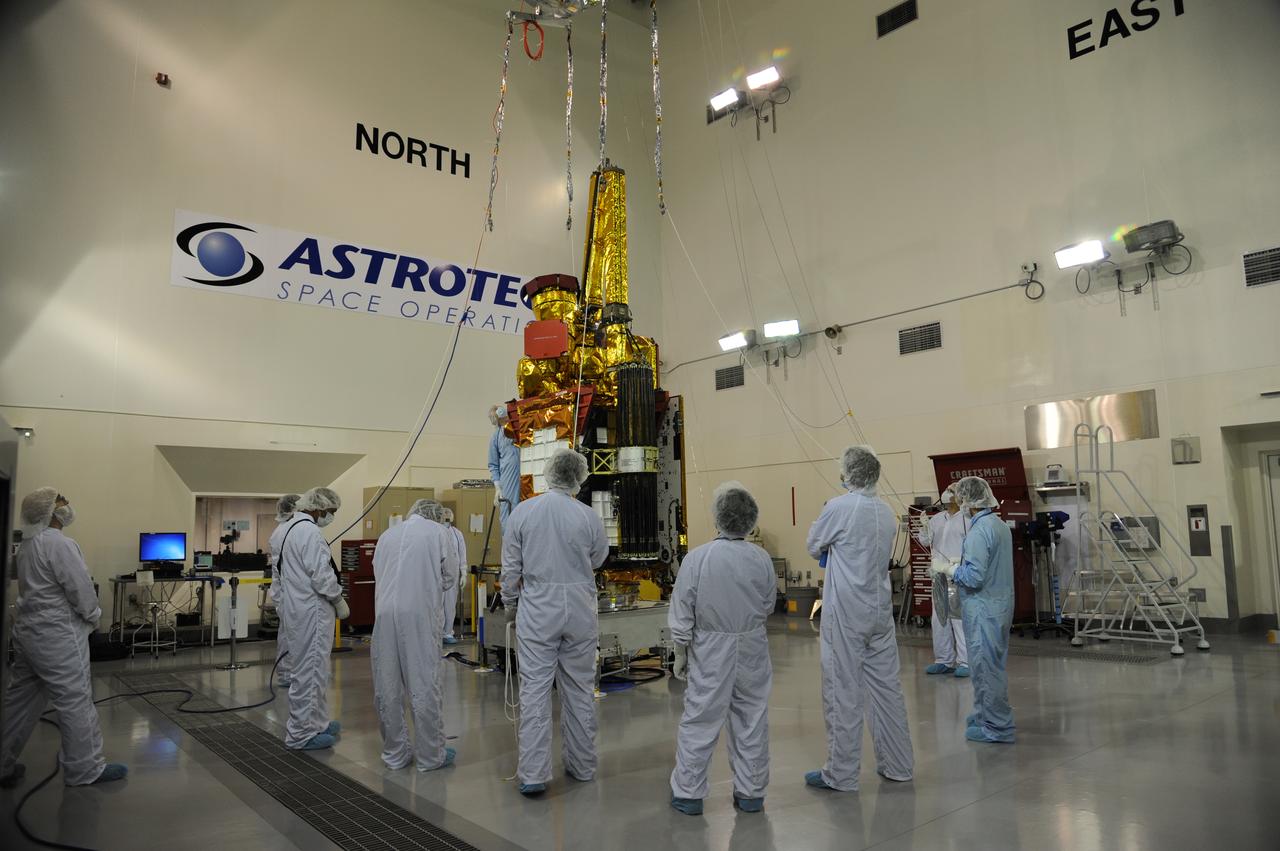
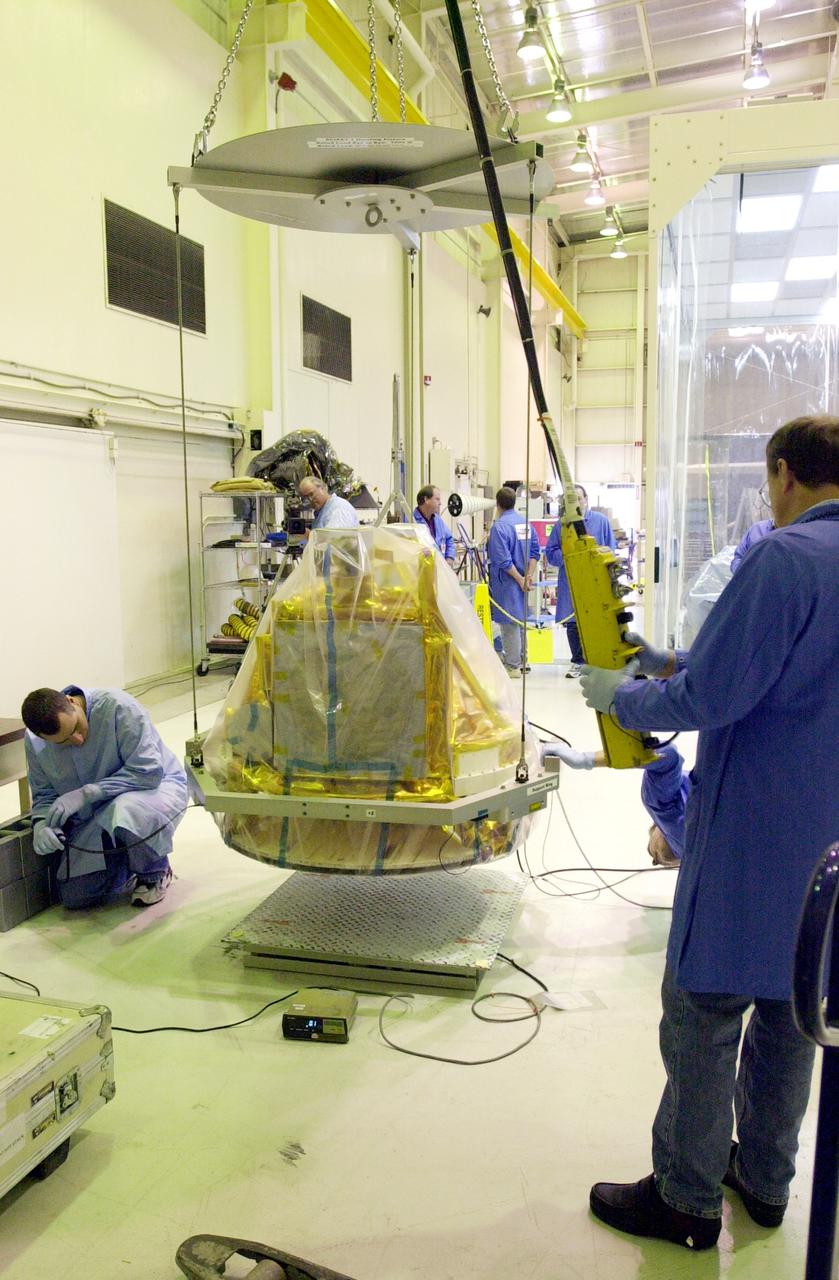
NASA's Soil Moisture Active Passive, or SMAP, spacecraft is lifted from its workstand in the clean room of the Astrotech payload processing facility on Vandenberg Air Force Base in California during operations to determine its weight. The weighing of a spacecraft is standard procedure during prelaunch processing. SMAP will launch on a Delta II 7320 configuration vehicle featuring a United Launch Alliance first stage booster powered by an Aerojet Rocketdyne RS-27A main engine and three Alliant Techsystems, or ATK, strap-on solid rocket motors. Once on station in Earth orbit, SMAP will provide global measurements of soil moisture and its freeze/thaw state. NASA's Jet Propulsion Laboratory that built the observatory and its radar instrument also is responsible for SMAP project management and mission operations. Launch from Space Launch Complex 2 is targeted for Jan. 29, 2015.
SMAP During Weighing
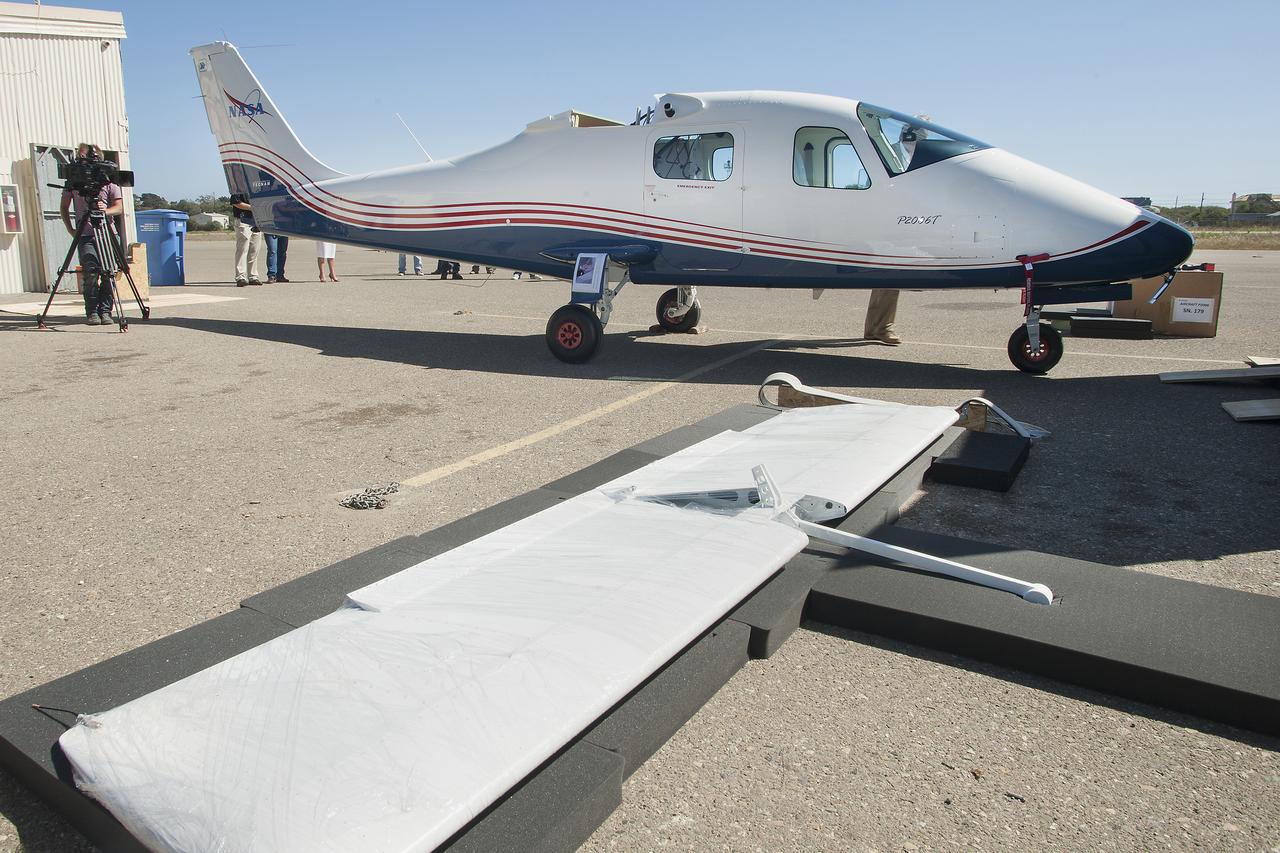
Preparations are underway to inspect, weigh and balance the Tecnam fuselage before it heads to Mojave, California, for wing integration.
X-57 Aircraft Fuselage Arrives in California
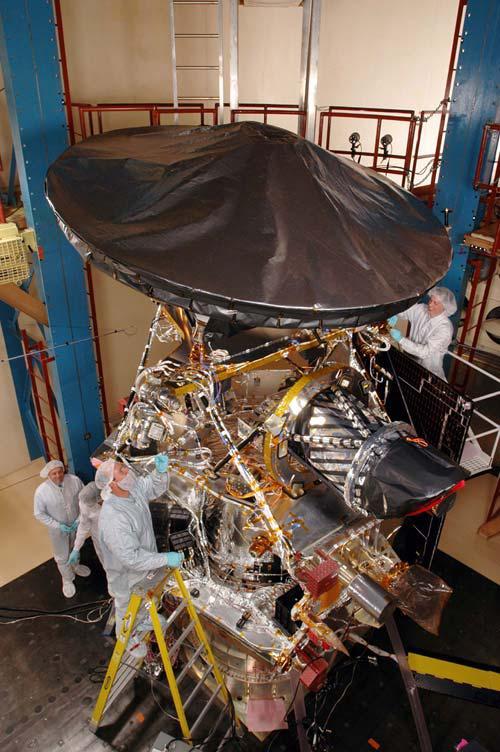
NASA Mars Reconnaissance Orbiter will be the largest spacecraft to orbit Mars, weighing 2,180 kilograms 4,796 pounds at liftoff.
Orbiter Near Final Configuration
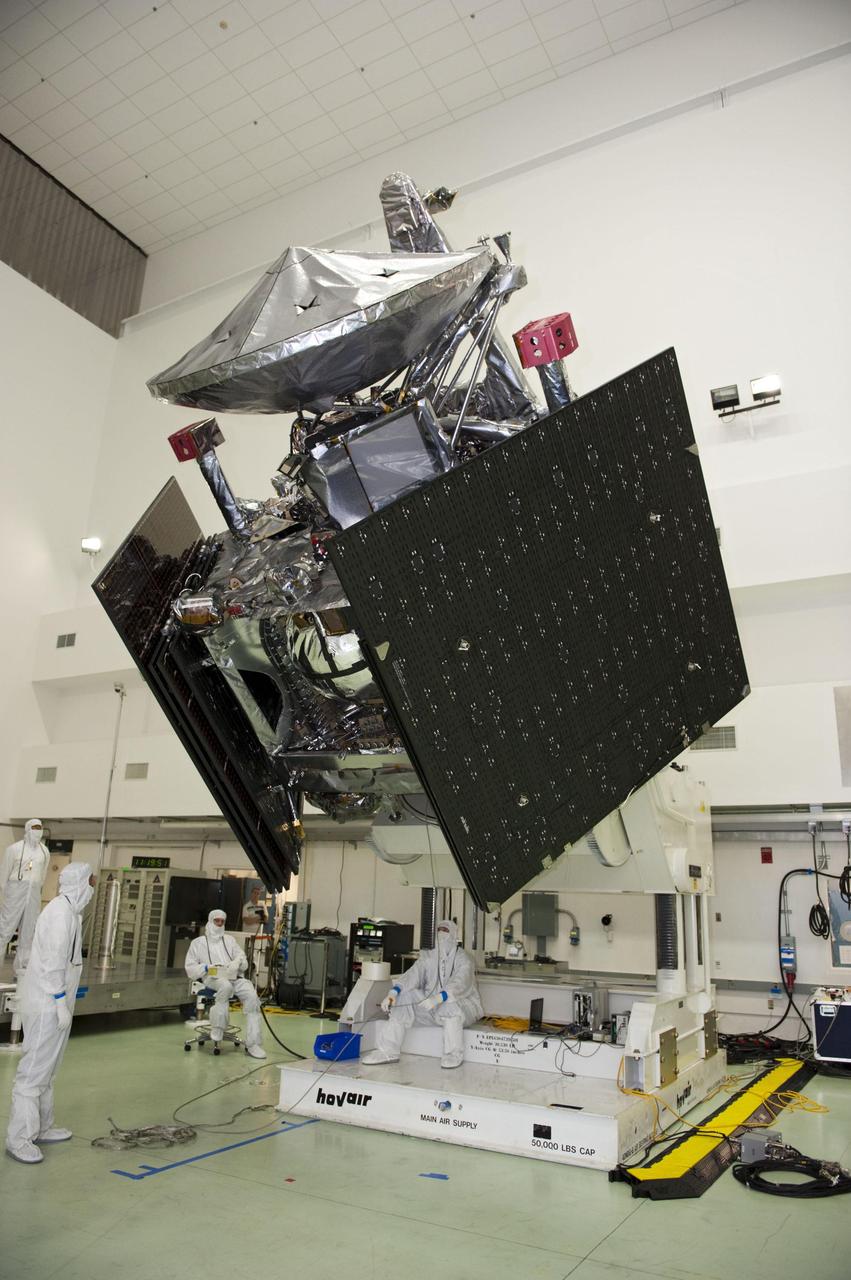
NASA Juno spacecraft undergoes weight and balance testing at Astrotech payload processing facility, Titusville, Fla. June 16, 2011.
Juno Weighs In
The Dumbbell nebula, also known as Messier 27, pumps out infrared light in this image from NASA Spitzer Space Telescope. Planetary nebulae are now known to be the remains of stars that once looked a lot like our sun.
Weighing in on the Dumbbell Nebula
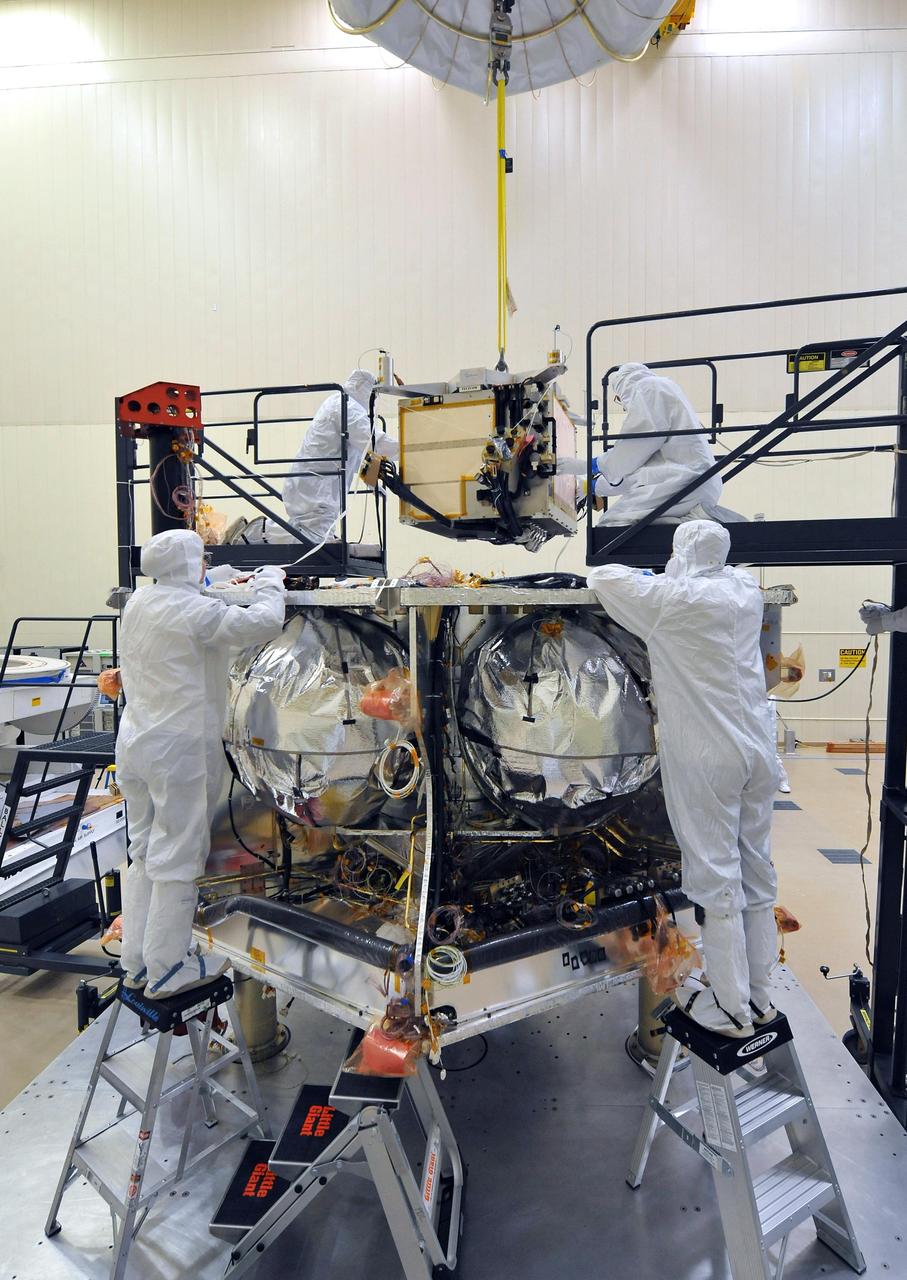
Workers place the special radiation vault for NASA Juno spacecraft onto the propulsion module. The whole vault, with more than 20 electronic assemblies inside, weighs about 200 kilograms 500 pounds.
Setting up Juno Radiation Vault
An artist conception shows the Kepler-10 system, home to two rocky planets. In the foreground is Kepler-10c, a planet that weighs 17 times as much as Earth and is more than twice as large in size.
Kepler-10 System
Photos of LaRC team weighting and performing Center of Gravity (CG) measurements of the Structural Test Article (STA) at NASA Langley Research Center.
LRC-2021-B701_P-00371.tif
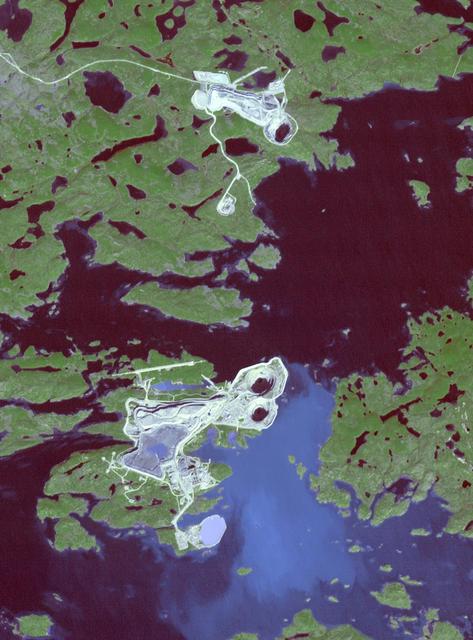
This image from NASA Terra spacecraft shows the Diavik Mine in northern Canada.The largest diamond found in North America came from the Diavik Mine. The Foxfire diamond weighs an impressive 187 carats, and was discovered in August 2015; it has been displayed in several museums throughout North America. The Diavik mine is located on an island in Lac de Gras, within the Lac de Gras kimberlite field, among other diamond mines. The image was acquired September 23, 2016, covers an area of 13.8 by 19.4 km, and is located at 64.5 degrees north, 110.2 degrees west.  https://photojournal.jpl.nasa.gov/catalog/PIA21536
Diavik Mine, Canada
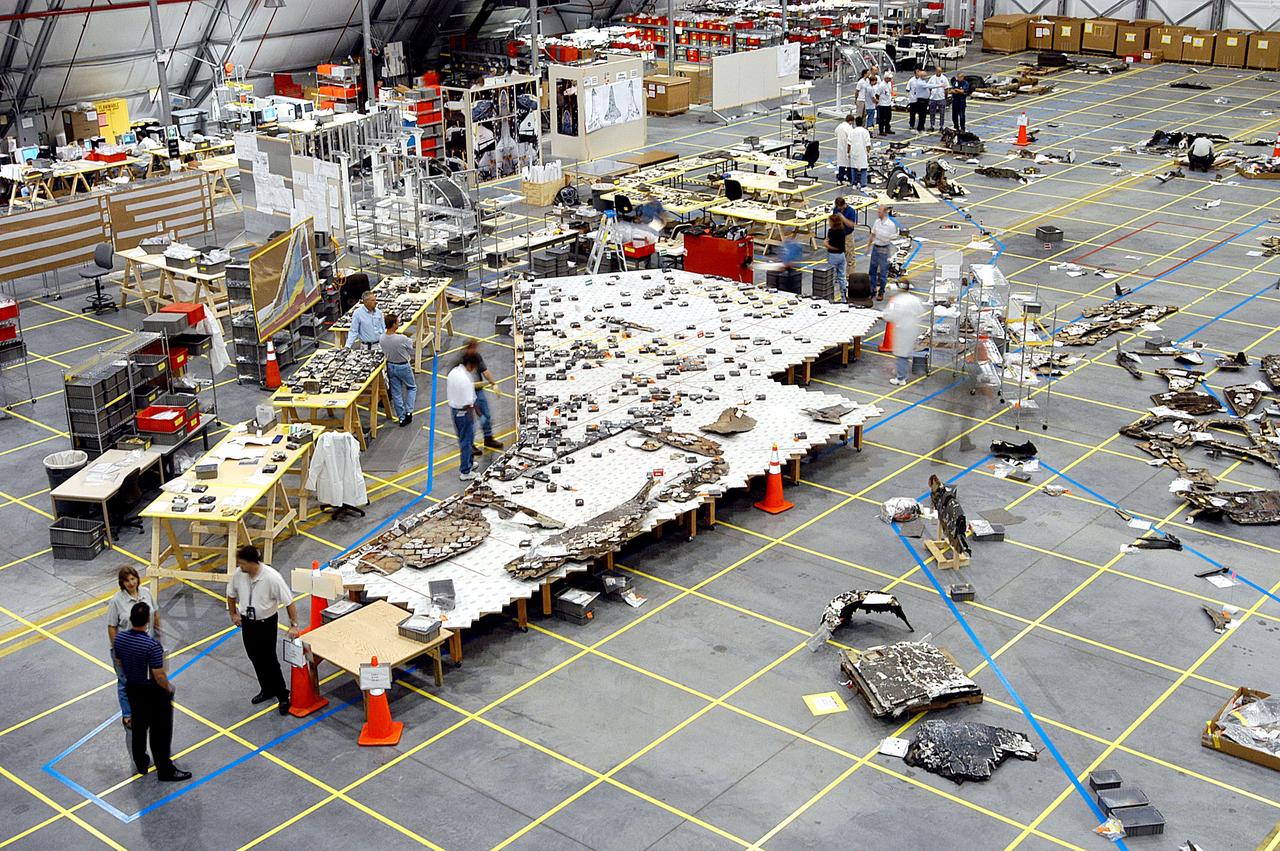
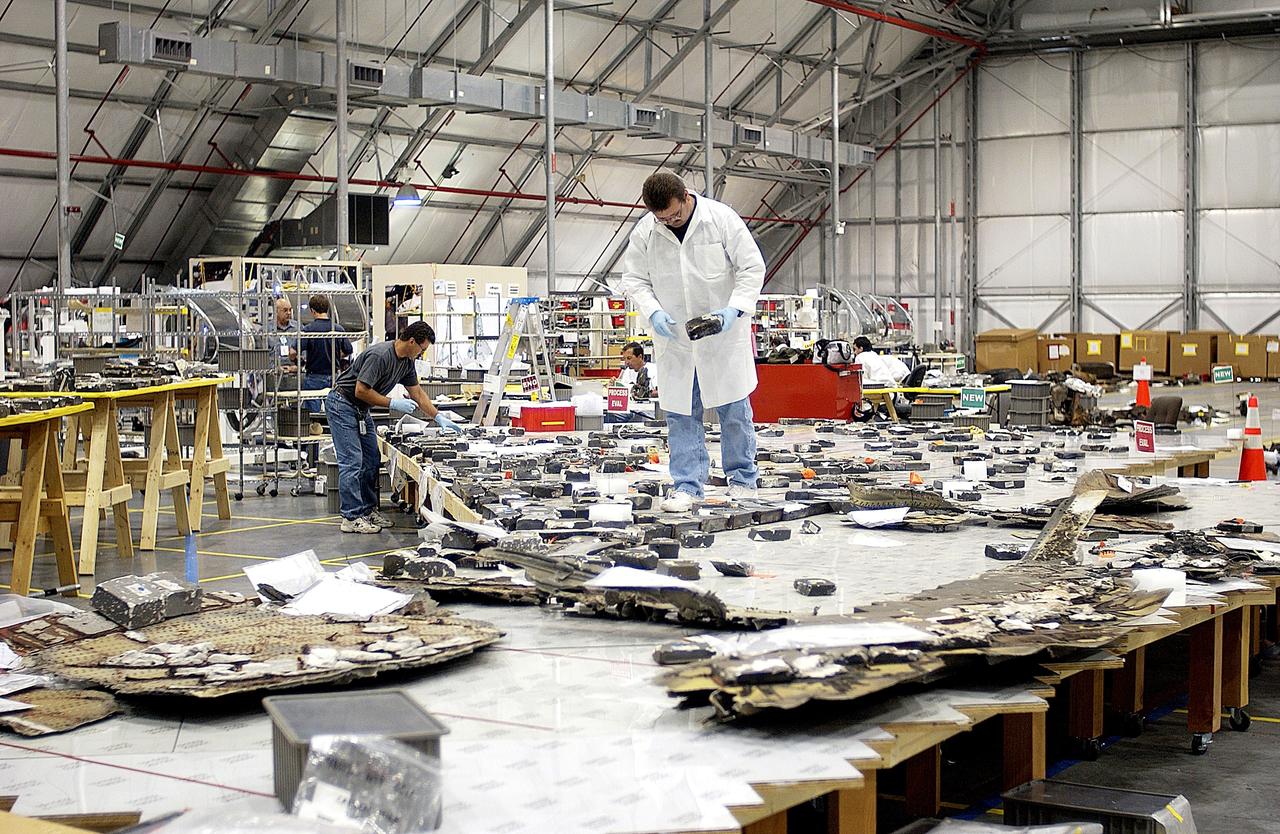
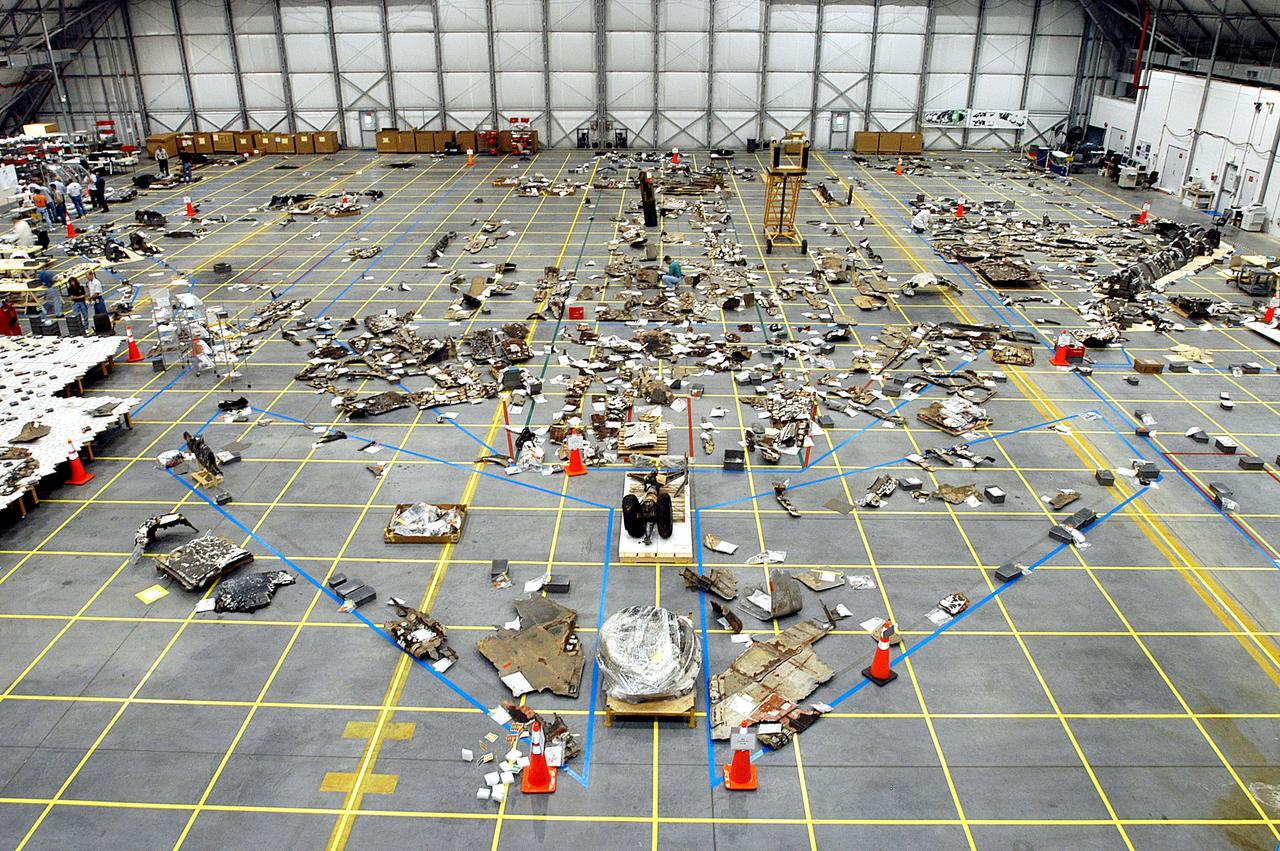
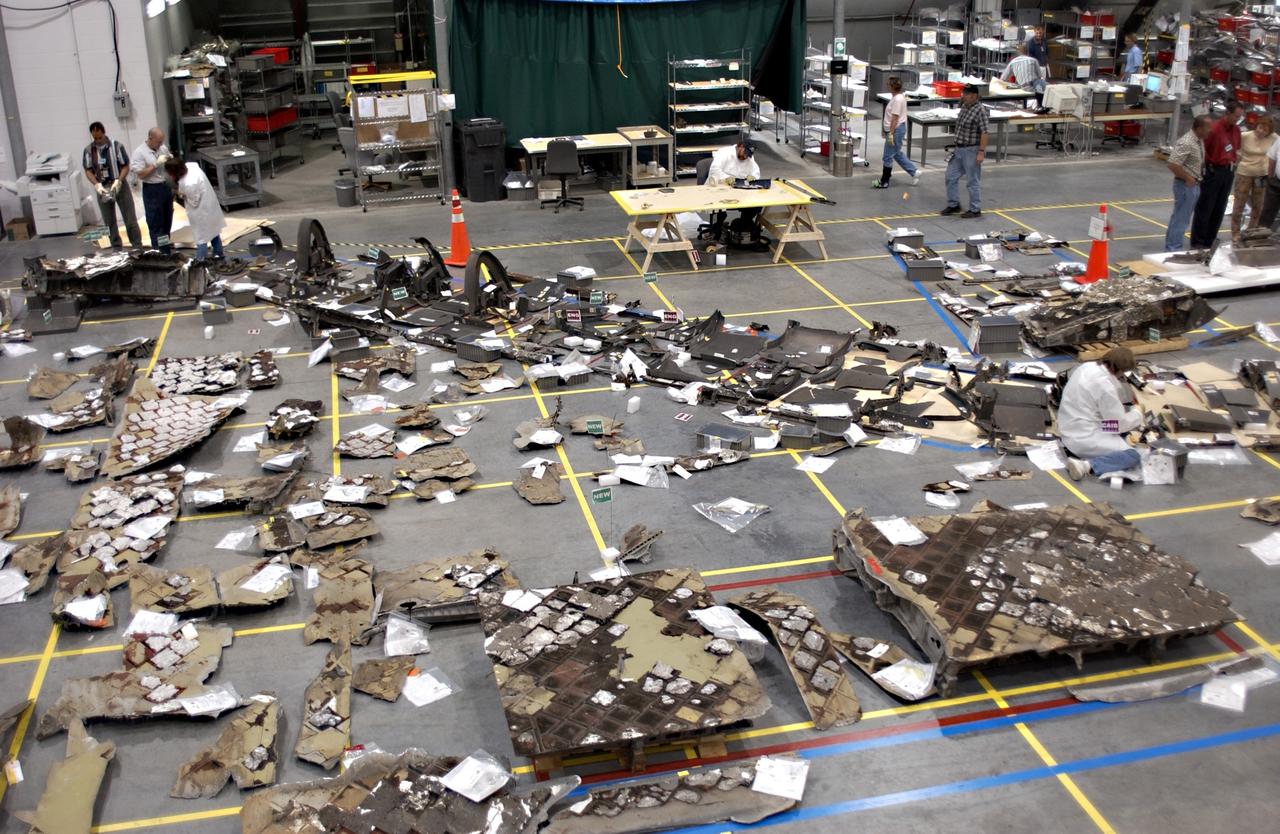
KENNEDY SPACE CENTER, FLA. -  The floor of the RLV Hangar is full of pieces of Columbia debris delivered from the search and recovery efforts in East Texas.  The items shipped to KSC number more than 82,000 and weigh 84,800 pounds or 38 percent of the total dry weight of Columbia. Of those items, 78,760 have been identified, with 753 placed on the left wing grid in the Hangar.
KENNEDY SPACE CENTER, FLA. - The floor of the RLV Hangar is full of pieces of Columbia debris delivered from the search and recovery efforts in East Texas. The items shipped to KSC number more than 82,000 and weigh 84,800 pounds or 38 percent of the total dry weight of Columbia. Of those items, 78,760 have been identified, with 753 placed on the left wing grid in the Hangar.
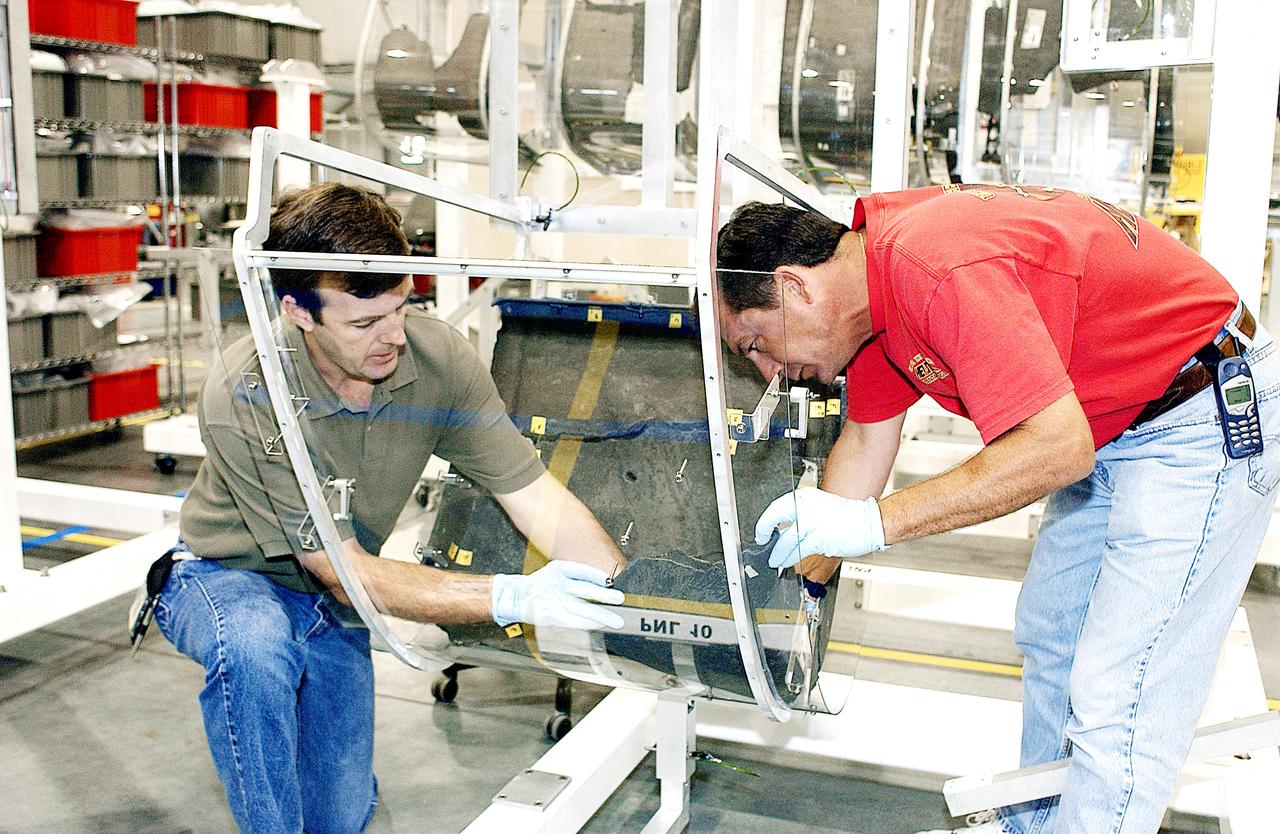
KENNEDY SPACE CENTER, FLA. -  Members of the Columbia Reconstruction Project Team place pieces of debris on a table in the RLV Hangar.   The items shipped to KSC number more than 82,000 and weigh 84,800 pounds or 38 percent of the total dry weight of Columbia.  Of those items, 78,760 have been identified, with 753 placed on the left wing grid in the Hangar.
KENNEDY SPACE CENTER, FLA. - Members of the Columbia Reconstruction Project Team place pieces of debris on a table in the RLV Hangar. The items shipped to KSC number more than 82,000 and weigh 84,800 pounds or 38 percent of the total dry weight of Columbia. Of those items, 78,760 have been identified, with 753 placed on the left wing grid in the Hangar.
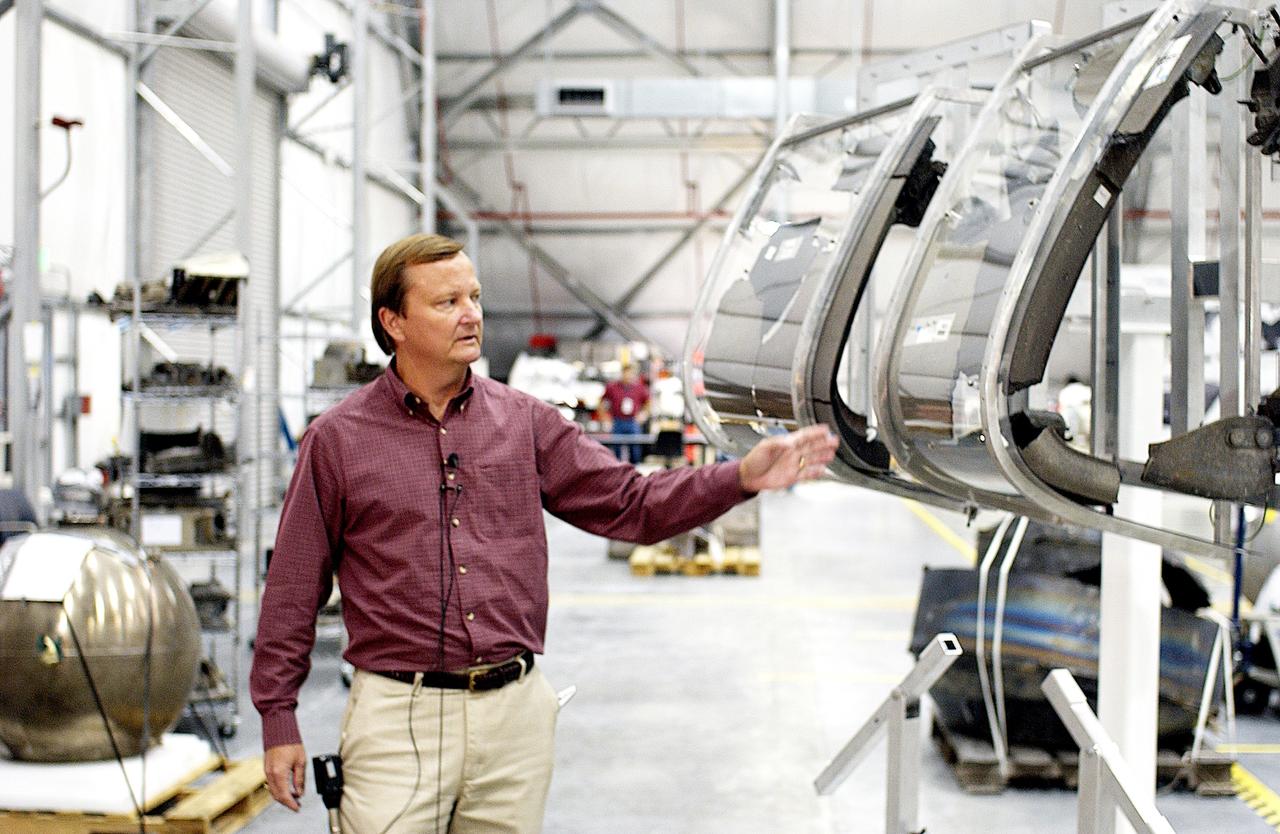
KENNEDY SPACE CENTER, FLA. - While talking to the media in the RLV Hangar, Shuttle Launch Director Mike Leinbach points to the model of the leading edge of an orbiter’s left wing that is being used to reconstruct Columbia’s wing with the recovered debris.  The items shipped to KSC number more than 82,000 and weigh 84,800 pounds or 38 percent of the total dry weight of Columbia.  Of those items, 78,760 have been identified, with 753 placed on the left wing grid in the Hangar.
KENNEDY SPACE CENTER, FLA. - While talking to the media in the RLV Hangar, Shuttle Launch Director Mike Leinbach points to the model of the leading edge of an orbiter’s left wing that is being used to reconstruct Columbia’s wing with the recovered debris. The items shipped to KSC number more than 82,000 and weigh 84,800 pounds or 38 percent of the total dry weight of Columbia. Of those items, 78,760 have been identified, with 753 placed on the left wing grid in the Hangar.
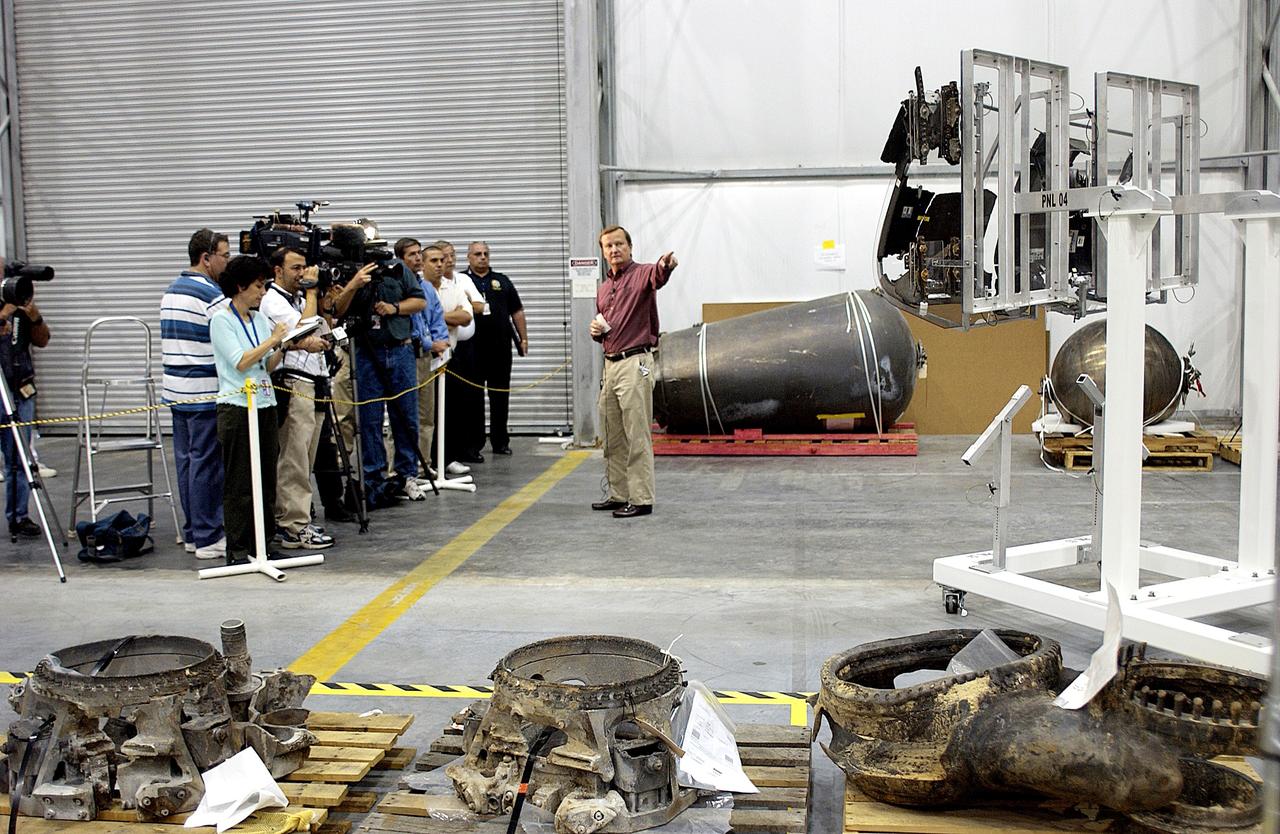
KENNEDY SPACE CENTER, FLA. - While talking to the media, Shuttle Launch Director Mike Leinbach points to some of the investigative tools in the RLV Hangar, where Columbia debris is being examined.  The items shipped to KSC number more than 82,000 and weigh 84,800 pounds or 38 percent of the total dry weight of Columbia.  Of those items, 78,760 have been identified, with 753 placed on the left wing grid in the Hangar.
KENNEDY SPACE CENTER, FLA. - While talking to the media, Shuttle Launch Director Mike Leinbach points to some of the investigative tools in the RLV Hangar, where Columbia debris is being examined. The items shipped to KSC number more than 82,000 and weigh 84,800 pounds or 38 percent of the total dry weight of Columbia. Of those items, 78,760 have been identified, with 753 placed on the left wing grid in the Hangar.
KENNEDY SPACE CENTER, FLA. -  Members of the Columbia Reconstruction Project Team place debris on the mounting fixture for RCC pieces of the leading edge of Columbia’s left wing.   The final shipment of debris arrived on this date - recovery efforts have been concluded in East Texas.  Prior to this final shipment, the total number of items at KSC is 82,567, weighing 84,800 pounds or 38 percent of the total dry weight of Columbia.  Of those items, 78,760 have been identified, with 753 placed on the left wing grid in the RLV Hangar.
KENNEDY SPACE CENTER, FLA. - Members of the Columbia Reconstruction Project Team place debris on the mounting fixture for RCC pieces of the leading edge of Columbia’s left wing. The final shipment of debris arrived on this date - recovery efforts have been concluded in East Texas. Prior to this final shipment, the total number of items at KSC is 82,567, weighing 84,800 pounds or 38 percent of the total dry weight of Columbia. Of those items, 78,760 have been identified, with 753 placed on the left wing grid in the RLV Hangar.
KENNEDY SPACE CENTER, FLA. -  Members of the Columbia Reconstruction Project Team work with pieces of debris in the RLV Hangar. The items shipped to KSC number more than 82,000 and weigh 84,800 pounds or 38 percent of the total dry weight of Columbia. Of those items, 78,760 have been identified, with 753 placed on the left wing grid in the Hangar.
KENNEDY SPACE CENTER, FLA. - Members of the Columbia Reconstruction Project Team work with pieces of debris in the RLV Hangar. The items shipped to KSC number more than 82,000 and weigh 84,800 pounds or 38 percent of the total dry weight of Columbia. Of those items, 78,760 have been identified, with 753 placed on the left wing grid in the Hangar.
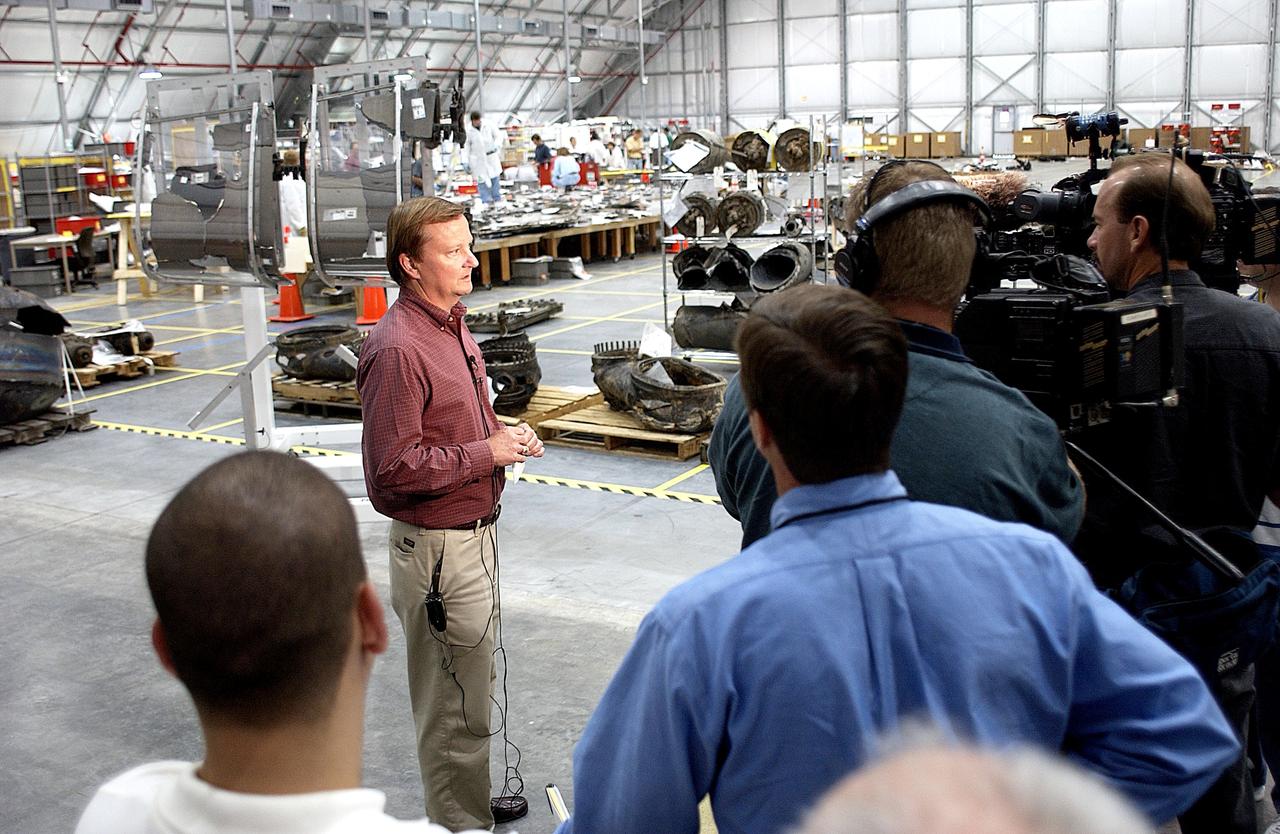
KENNEDY SPACE CENTER, FLA. - Shuttle Launch Director Mike Leinbach talks to the media in the RLV Hangar, site of the collection of Columbia debris undergoing examination.  The items shipped to KSC number more than 82,000 and weigh 84,800 pounds or 38 percent of the total dry weight of Columbia.  Of those items, 78,760 have been identified, with 753 placed on the left wing grid in the Hangar.
KENNEDY SPACE CENTER, FLA. - Shuttle Launch Director Mike Leinbach talks to the media in the RLV Hangar, site of the collection of Columbia debris undergoing examination. The items shipped to KSC number more than 82,000 and weigh 84,800 pounds or 38 percent of the total dry weight of Columbia. Of those items, 78,760 have been identified, with 753 placed on the left wing grid in the Hangar.
KENNEDY SPACE CENTER, FLA. - Shuttle Launch Director Mike Leinbach talks to the media in the RLV Hangar, site of the collection of Columbia debris undergoing examination.  The items shipped to KSC number more than 82,000 and weigh 84,800 pounds or 38 percent of the total dry weight of Columbia.  Of those items, 78,760 have been identified, with 753 placed on the left wing grid in the Hangar.
KENNEDY SPACE CENTER, FLA. - Shuttle Launch Director Mike Leinbach talks to the media in the RLV Hangar, site of the collection of Columbia debris undergoing examination. The items shipped to KSC number more than 82,000 and weigh 84,800 pounds or 38 percent of the total dry weight of Columbia. Of those items, 78,760 have been identified, with 753 placed on the left wing grid in the Hangar.
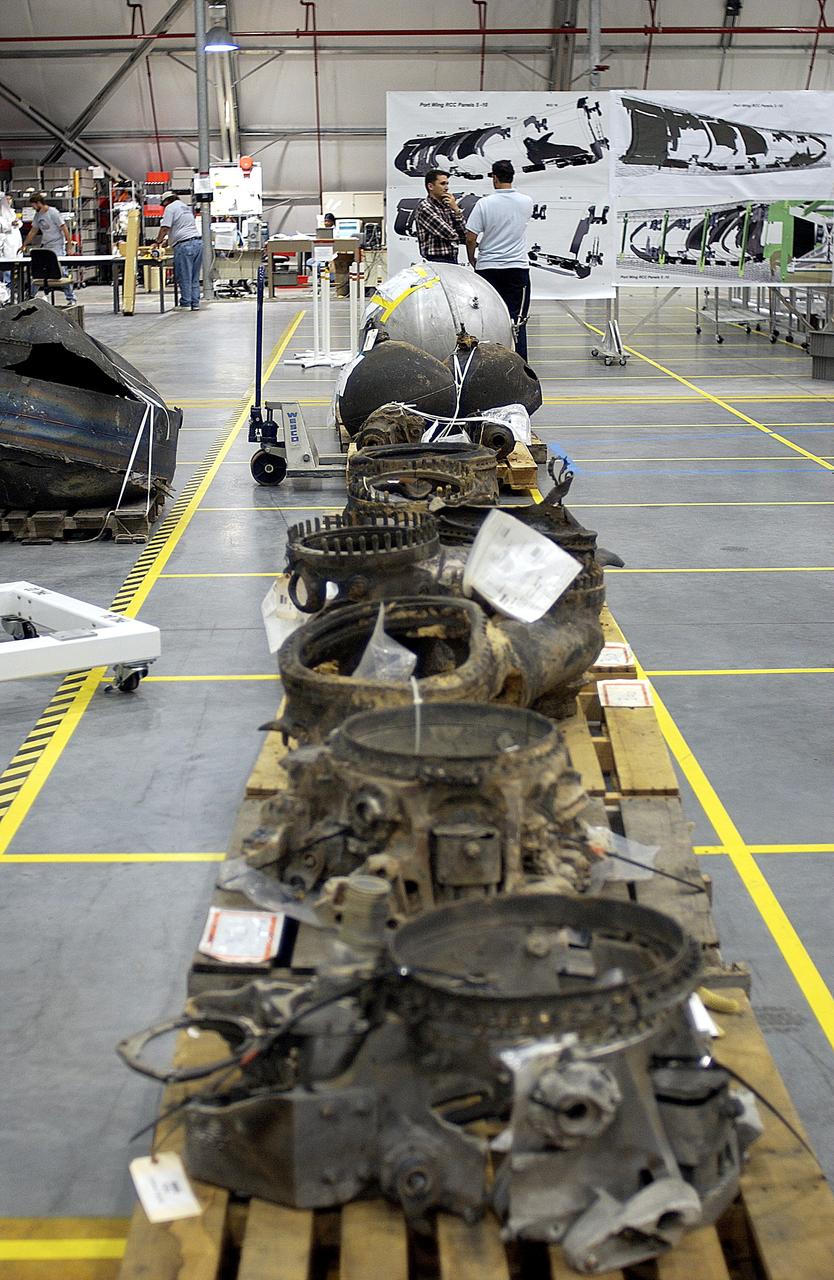
KENNEDY SPACE CENTER, FLA. - Large items of Columbia debris fill a long table in the RLV Hangar.  The items shipped to KSC number more than 82,000 and weigh 84,800 pounds or 38 percent of the total dry weight of Columbia.  Of those items, 78,760 have been identified, with 753 placed on the left wing grid in the Hangar.
KENNEDY SPACE CENTER, FLA. - Large items of Columbia debris fill a long table in the RLV Hangar. The items shipped to KSC number more than 82,000 and weigh 84,800 pounds or 38 percent of the total dry weight of Columbia. Of those items, 78,760 have been identified, with 753 placed on the left wing grid in the Hangar.
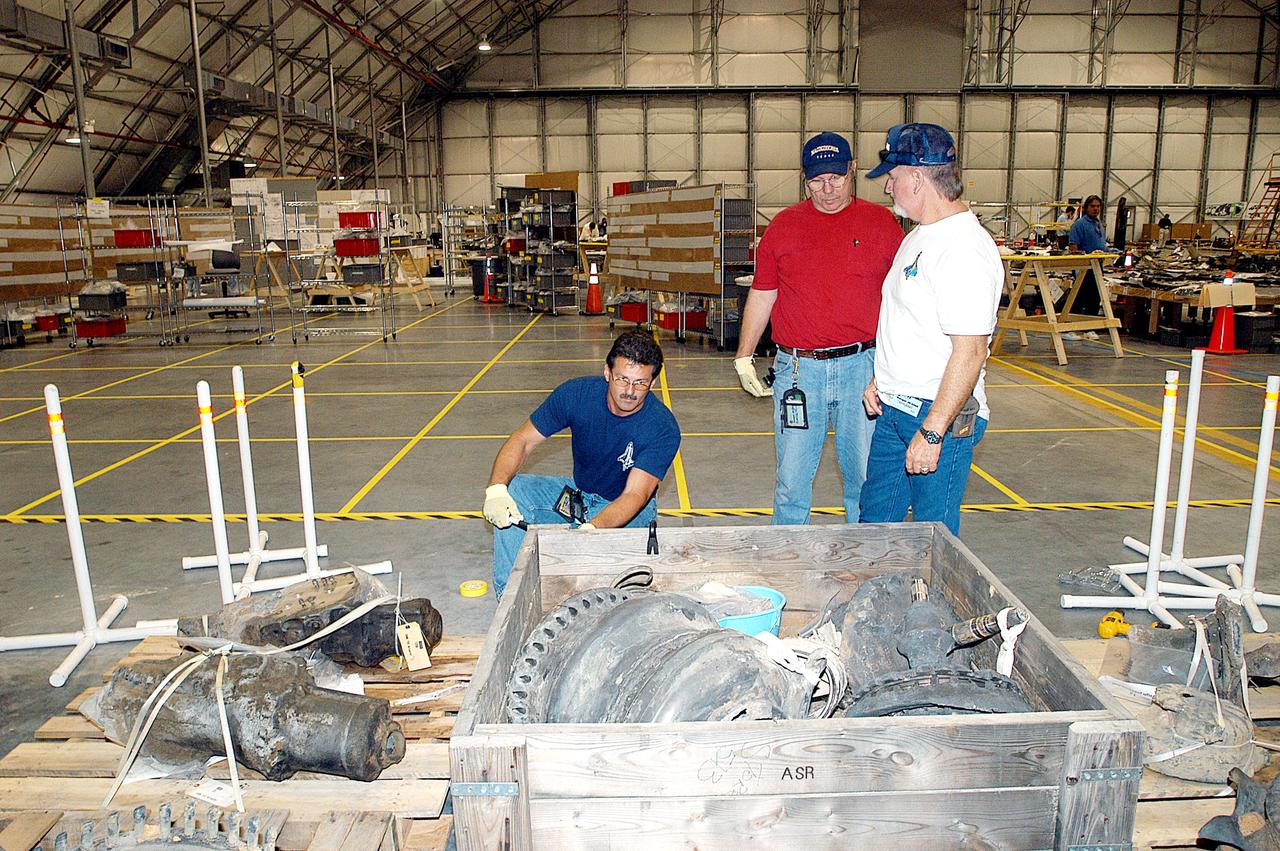
KENNEDY SPACE CENTER, FLA. -  Members of the Columbia Reconstruction Project Team work with pieces of debris in the RLV Hangar. The items shipped to KSC number more than 82,000 and weigh 84,800 pounds or 38 percent of the total dry weight of Columbia. Of those items, 78,760 have been identified, with 753 placed on the left wing grid in the Hangar.
KENNEDY SPACE CENTER, FLA. - Members of the Columbia Reconstruction Project Team work with pieces of debris in the RLV Hangar. The items shipped to KSC number more than 82,000 and weigh 84,800 pounds or 38 percent of the total dry weight of Columbia. Of those items, 78,760 have been identified, with 753 placed on the left wing grid in the Hangar.
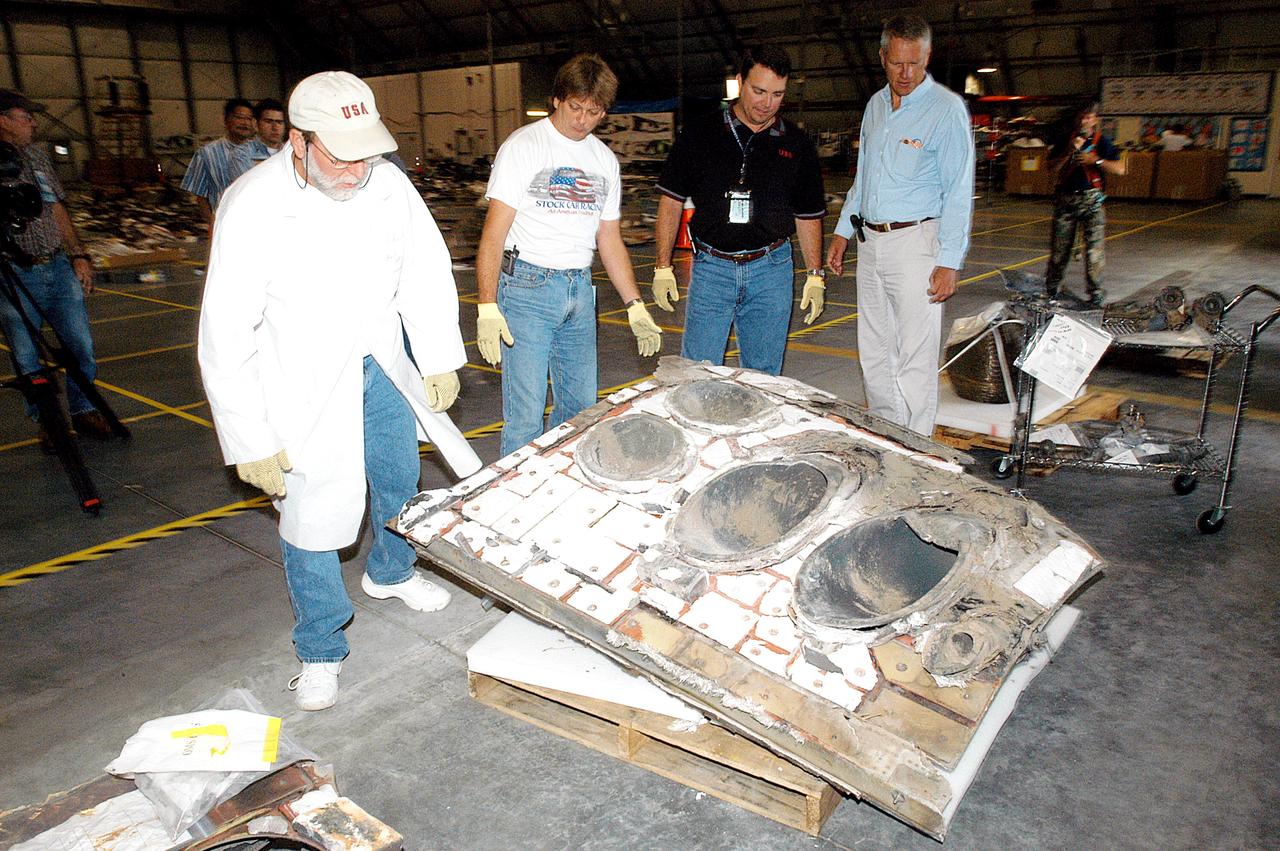
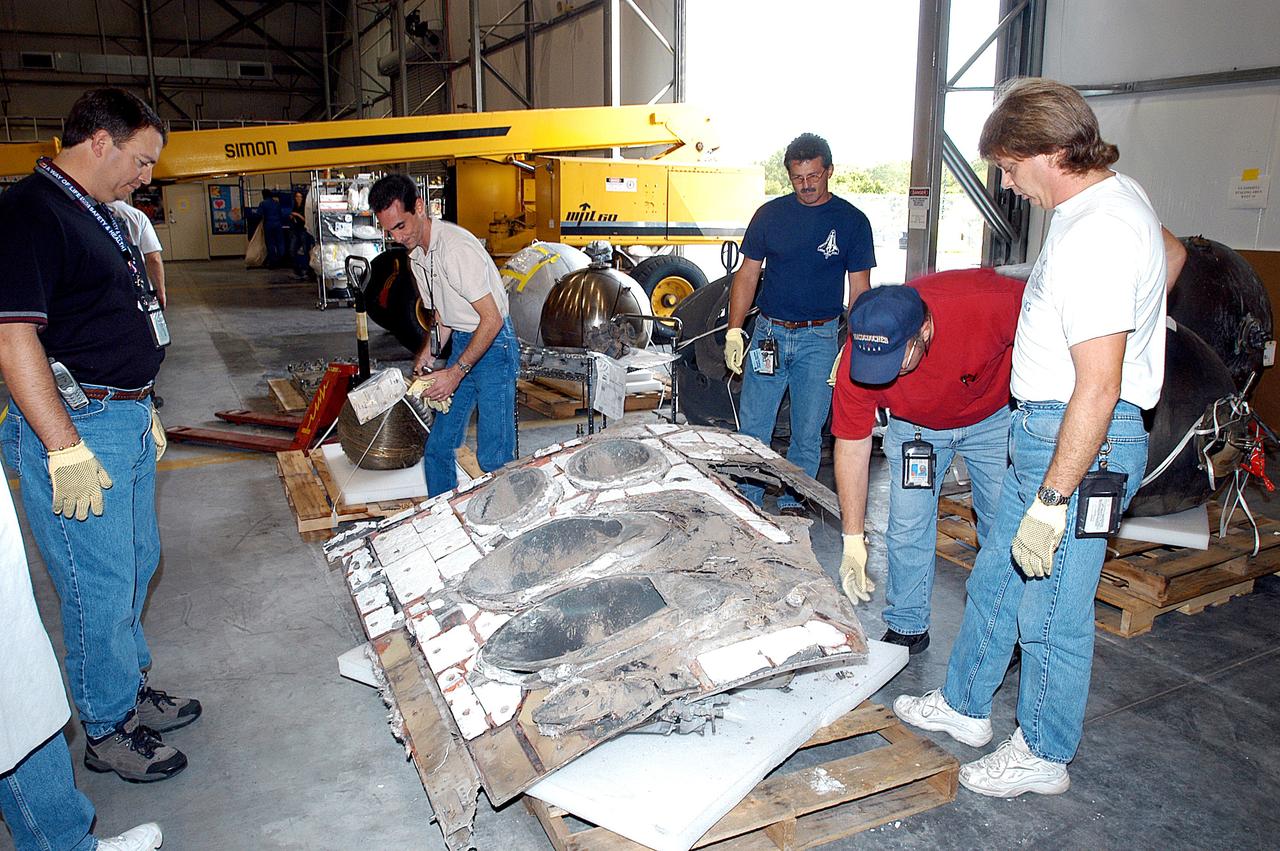
KENNEDY SPACE CENTER, FLA. -  In the RLV hangar, members of the Columbia Reconstruction Team work to identify pieces of Thermal Protection System tile from the left wing of Columbia recovered during the search and recovery efforts in East Texas.  The items shipped to KSC number more than 82,000 and weigh 84,800 pounds or 38 percent of the total dry weight of Columbia. Of those items, 78,760 have been identified, with 753 placed on the left wing grid in the Hangar.
KENNEDY SPACE CENTER, FLA. - In the RLV hangar, members of the Columbia Reconstruction Team work to identify pieces of Thermal Protection System tile from the left wing of Columbia recovered during the search and recovery efforts in East Texas. The items shipped to KSC number more than 82,000 and weigh 84,800 pounds or 38 percent of the total dry weight of Columbia. Of those items, 78,760 have been identified, with 753 placed on the left wing grid in the Hangar.
KENNEDY SPACE CENTER, FLA. -  Members of the Columbia Reconstruction Project Team work with pieces of debris in the RLV Hangar. The items shipped to KSC number more than 82,000 and weigh 84,800 pounds or 38 percent of the total dry weight of Columbia. Of those items, 78,760 have been identified, with 753 placed on the left wing grid in the Hangar.
KENNEDY SPACE CENTER, FLA. - Members of the Columbia Reconstruction Project Team work with pieces of debris in the RLV Hangar. The items shipped to KSC number more than 82,000 and weigh 84,800 pounds or 38 percent of the total dry weight of Columbia. Of those items, 78,760 have been identified, with 753 placed on the left wing grid in the Hangar.
KENNEDY SPACE CENTER, FLA. -  Members of the Columbia Reconstruction Project Team examine pieces of debris in the RLV Hangar. The items shipped to KSC number more than 82,000 and weigh 84,800 pounds or 38 percent of the total dry weight of Columbia. Of those items, 78,760 have been identified, with 753 placed on the left wing grid in the Hangar.
KENNEDY SPACE CENTER, FLA. - Members of the Columbia Reconstruction Project Team examine pieces of debris in the RLV Hangar. The items shipped to KSC number more than 82,000 and weigh 84,800 pounds or 38 percent of the total dry weight of Columbia. Of those items, 78,760 have been identified, with 753 placed on the left wing grid in the Hangar.
KENNEDY SPACE CENTER, FLA. - The Columbia Reconstruction Project team meets before arrival of the final shipment of Columbia debris.  The recovery efforts have been concluded in East Texas.  Prior to this final shipment, the total number of items at KSC is 82,567, weighing 84,800 pounds or 38 percent of the total dry weight of Columbia.  Of those items, 78,760 have been identified, with 753 placed on the left wing grid in the RLV Hangar.
KENNEDY SPACE CENTER, FLA. - The Columbia Reconstruction Project team meets before arrival of the final shipment of Columbia debris. The recovery efforts have been concluded in East Texas. Prior to this final shipment, the total number of items at KSC is 82,567, weighing 84,800 pounds or 38 percent of the total dry weight of Columbia. Of those items, 78,760 have been identified, with 753 placed on the left wing grid in the RLV Hangar.
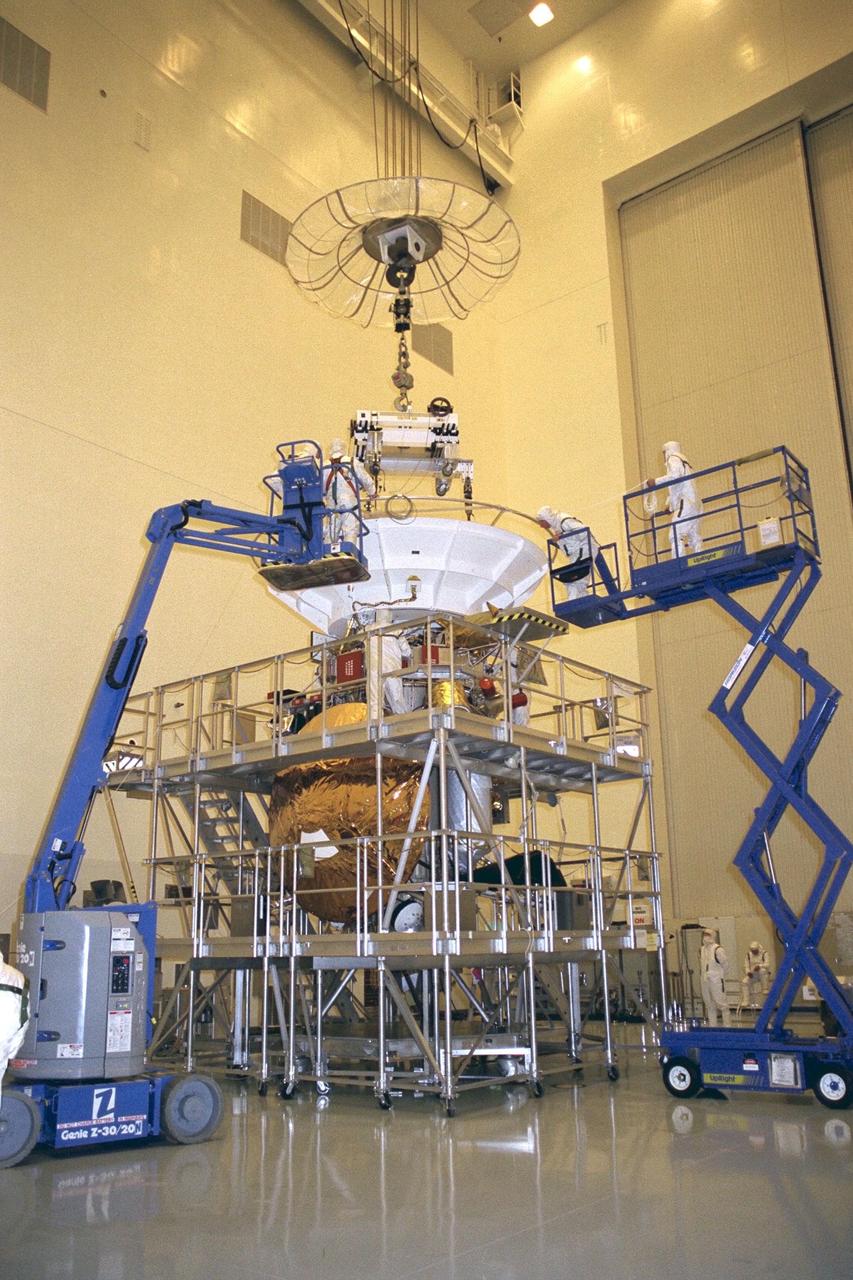
Flight mechanics from NASA’s Jet Propulsion  Laboratory (JPL) in Pasadena, Calif., work on the lifting fixture that picks up the Cassini  spacecraft in KSC’s Payload Hazardous Servicing Facility. The orbiter alone weighs  about 4,750 pounds (2,150 kilograms). At launch, the combined orbiter, Huygens probe,  launch vehicle adapter, and propellants will weigh about 12,346 pounds (5,600  kilograms). Scheduled for launch in October, the Cassini mission, a joint US-European  four-year orbital surveillance of Saturn's atmosphere and magnetosphere, its rings, and its  moons, seeks insight into the origins and evolution of the early solar system. JPL is  managing the Cassini project for NASA

KSC-97PC1108
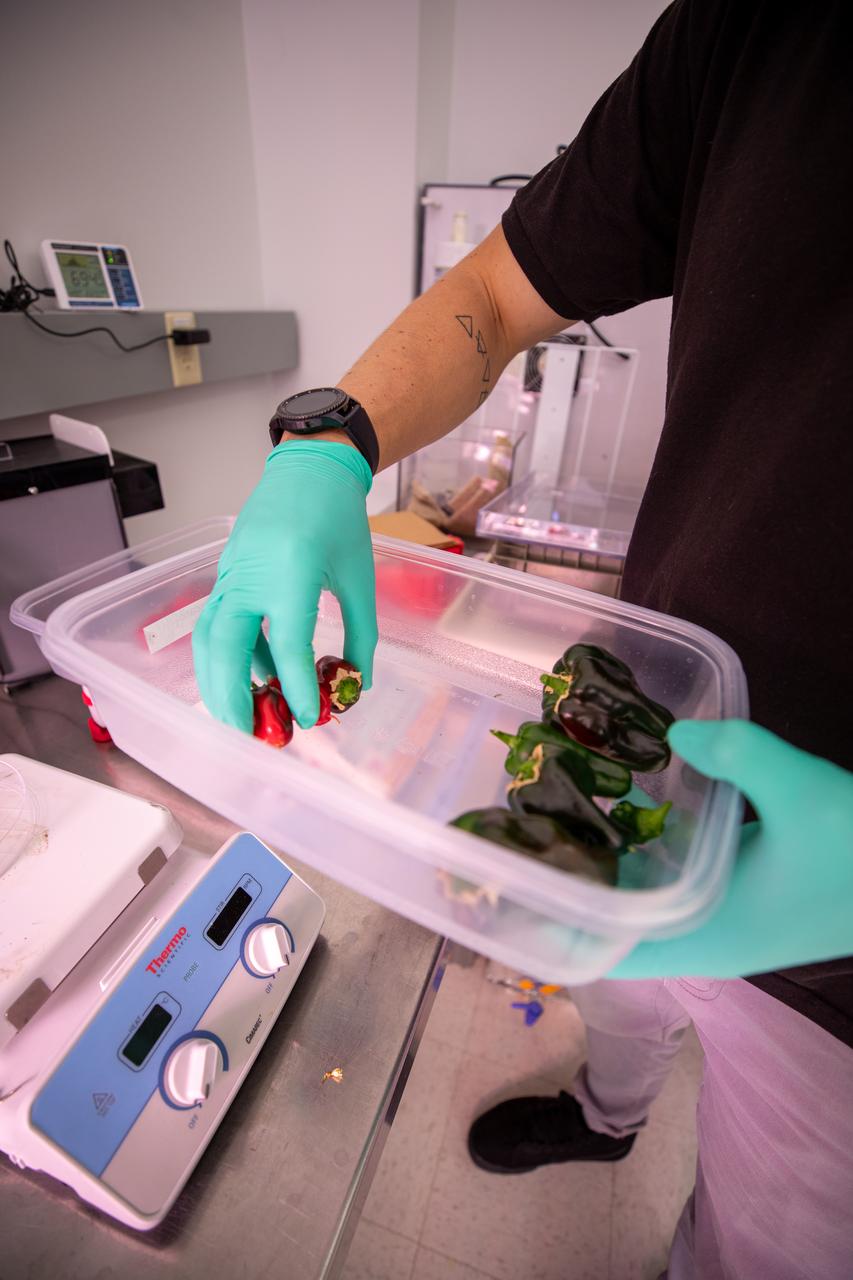
Jason Fischer, a research scientist with the Laboratory Support Services and Operations contract at NASA’s Kennedy Space Center in Florida, weighs peppers that were harvested from inside the Space Station Processing Facility on Jan. 15, 2020, prior to weighing them in preparation for sending them to space. As NASA prepares to send humans beyond low-Earth orbit, the ability for astronauts to grow a variety of fresh fruits and vegetables in space will be critical. Fresh produce will be an essential supplement to the crew’s pre-packaged diet during long-duration space exploration when they are away from Earth for extended periods of time.
Hatch Chile Pepper Assessment and Harvest
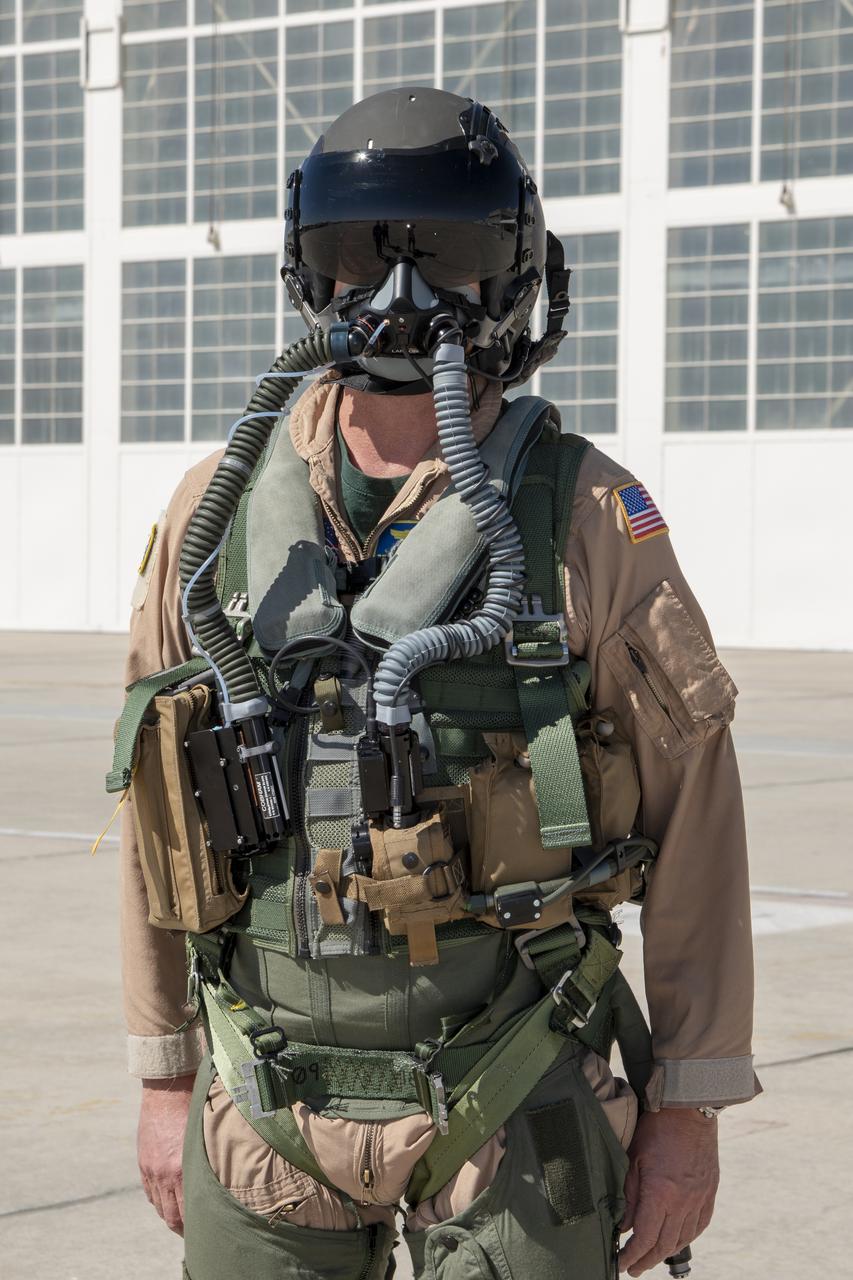
NASA Pilot Nils Larson wears a U.S. Navy harness configuration to show the integrated parachute harness and the built-in survival vest. The Navy configuration is bulkier and weighs more than the U.S. Air Force harness. Both configurations are being used in the Pilot Breathing Assessment program at NASA’s Armstrong Flight Research Center in California.
U.S. Navy Harness Configuration
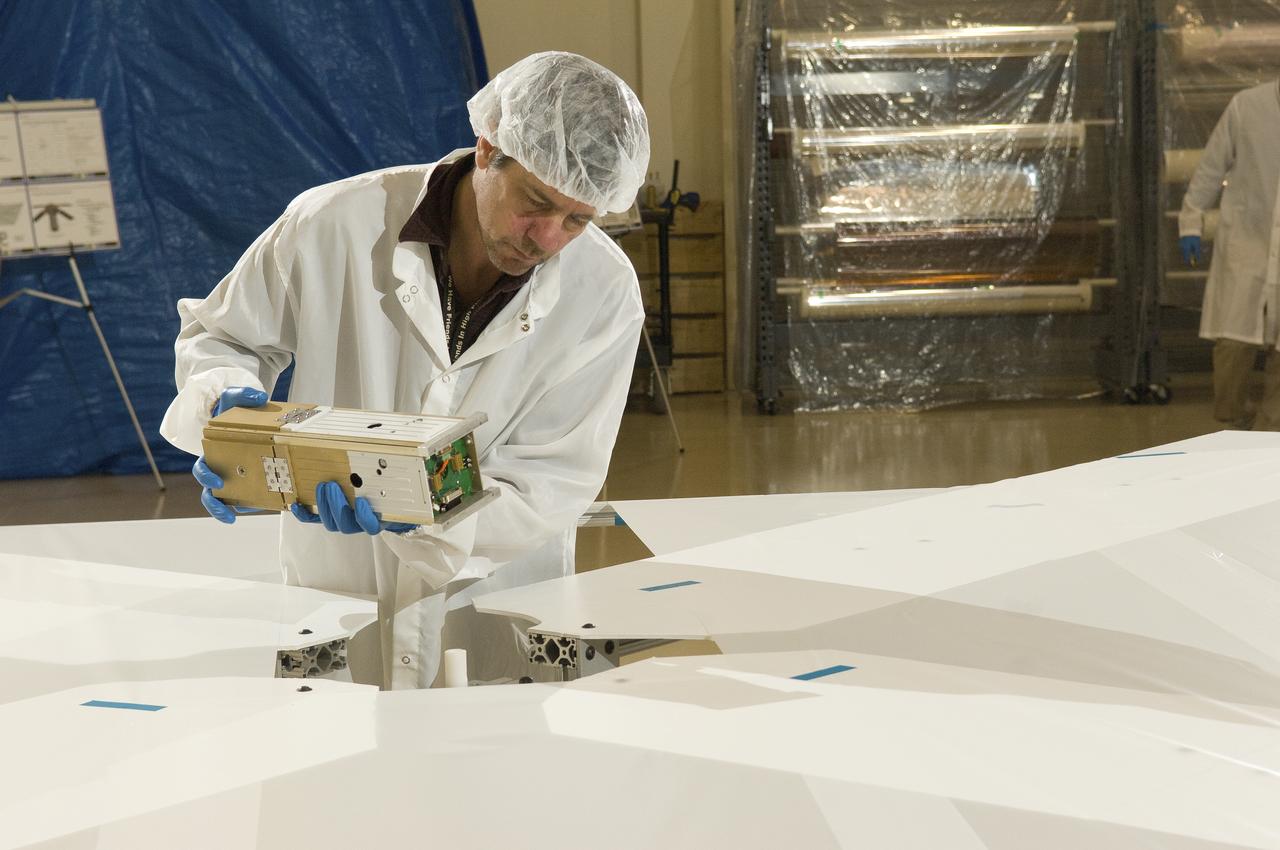
DOUG HUIE, RESEARCH TECHNICIAN AT THE UNIVERSITY OF ALABAMA IN HUNTSVILLE, CAFEFULLY SETS THE NANOSAIL-D SATELLITE ON A SPECIALLY CONSTRUCTED SURFACE DESIGNED FOR DEPLOYMENT TESTING. THE SPACECRAFT MEASURES 4 INCHES WIDE, 4 INCHES DEEP, AND 13 INCHES LONG, ROUGHLY THE SIZE OF A LOAF OF BREAD, AND WEIGHING ABOUT 9 POUNDS.
1100019
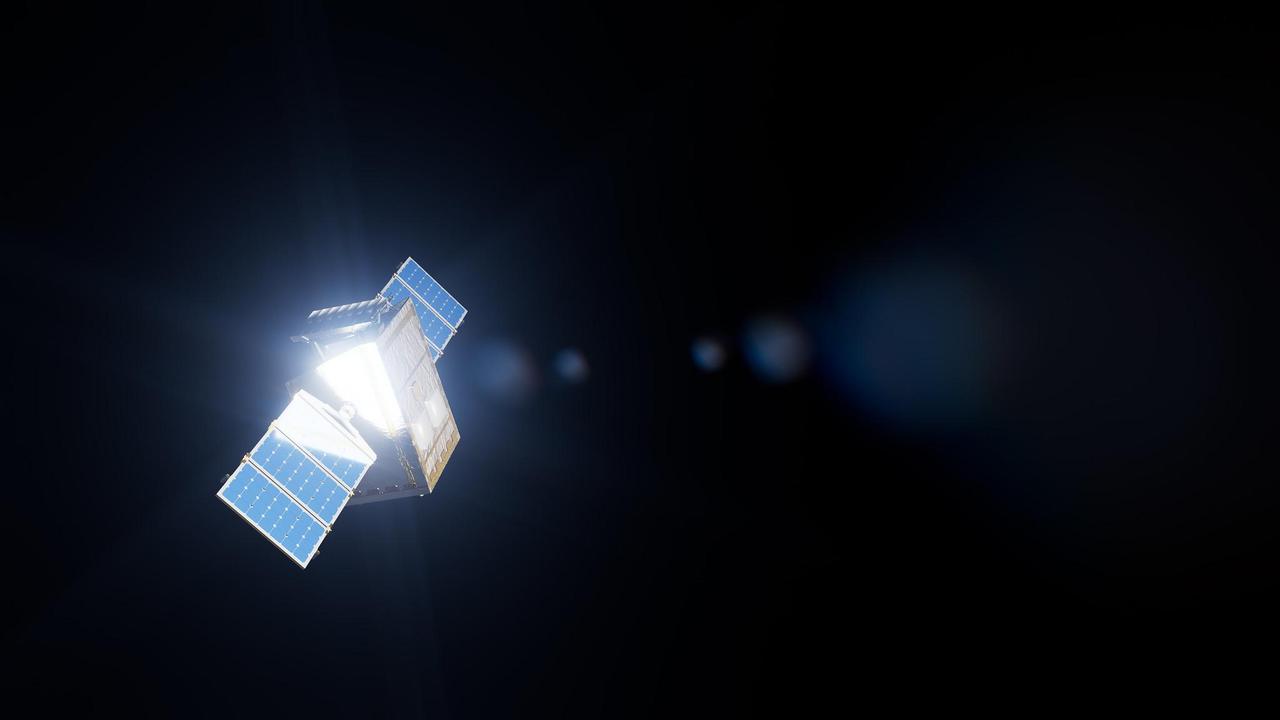
Sunlight gleams off NASA's Lunar Trailblazer in this artist's concept depicting the small satellite in lunar orbit. The spacecraft weighs only 440 pounds (200 kilograms) and measures 11.5 feet (3.5 meters) wide when its solar panels are fully deployed.  https://photojournal.jpl.nasa.gov/catalog/PIA26429
Lunar Trailblazer in Science Orbit (Artist's Concept)
KENNEDY SPACE CENTER, FLA. -  Pieces of debris from Columbia are filling the floor of the RLV Hangar.  The items at KSC number more than 82,000, weigh 84,800 pounds or 38 percent of the total dry weight of Columbia.  Of those items, 78,760 have been identified, with 753 placed on the left wing grid in the hangar.
KSC-03pd1550
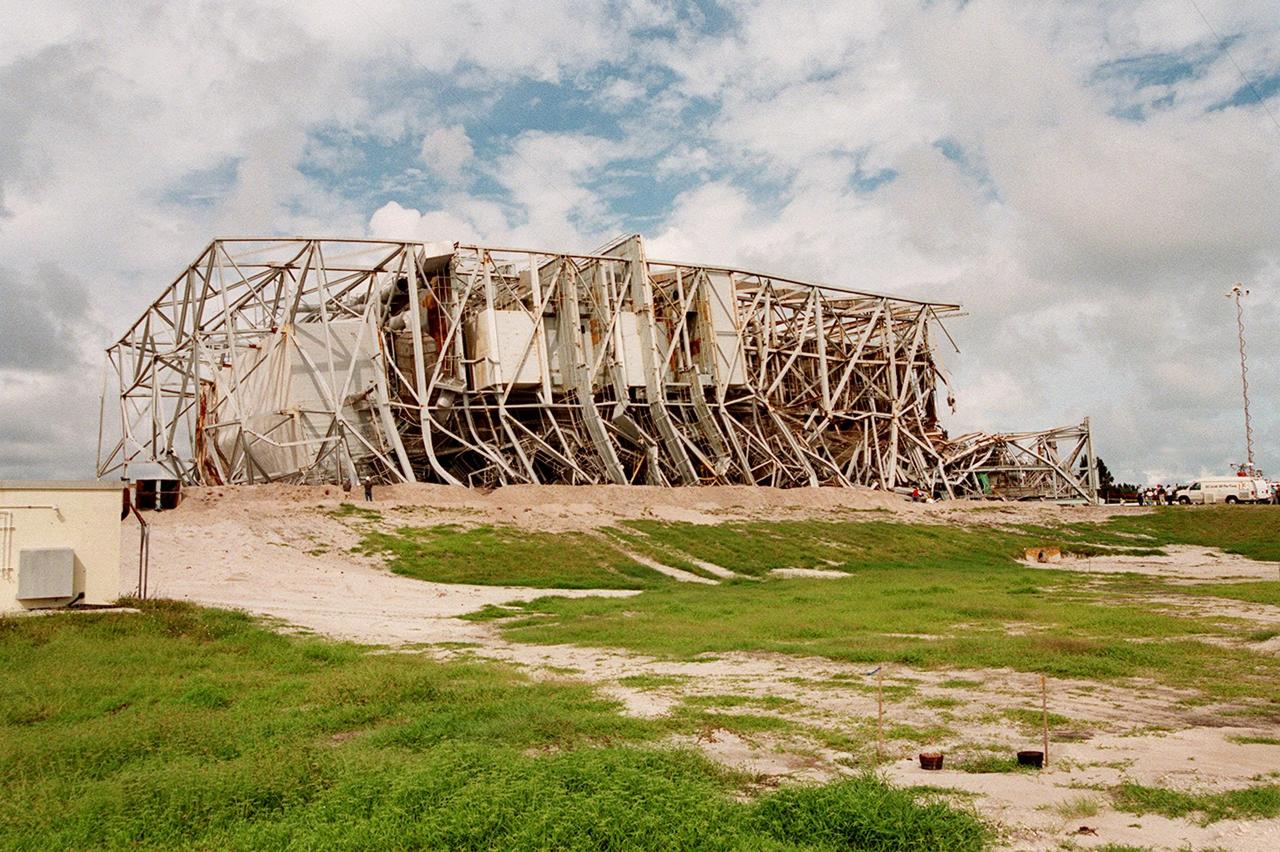
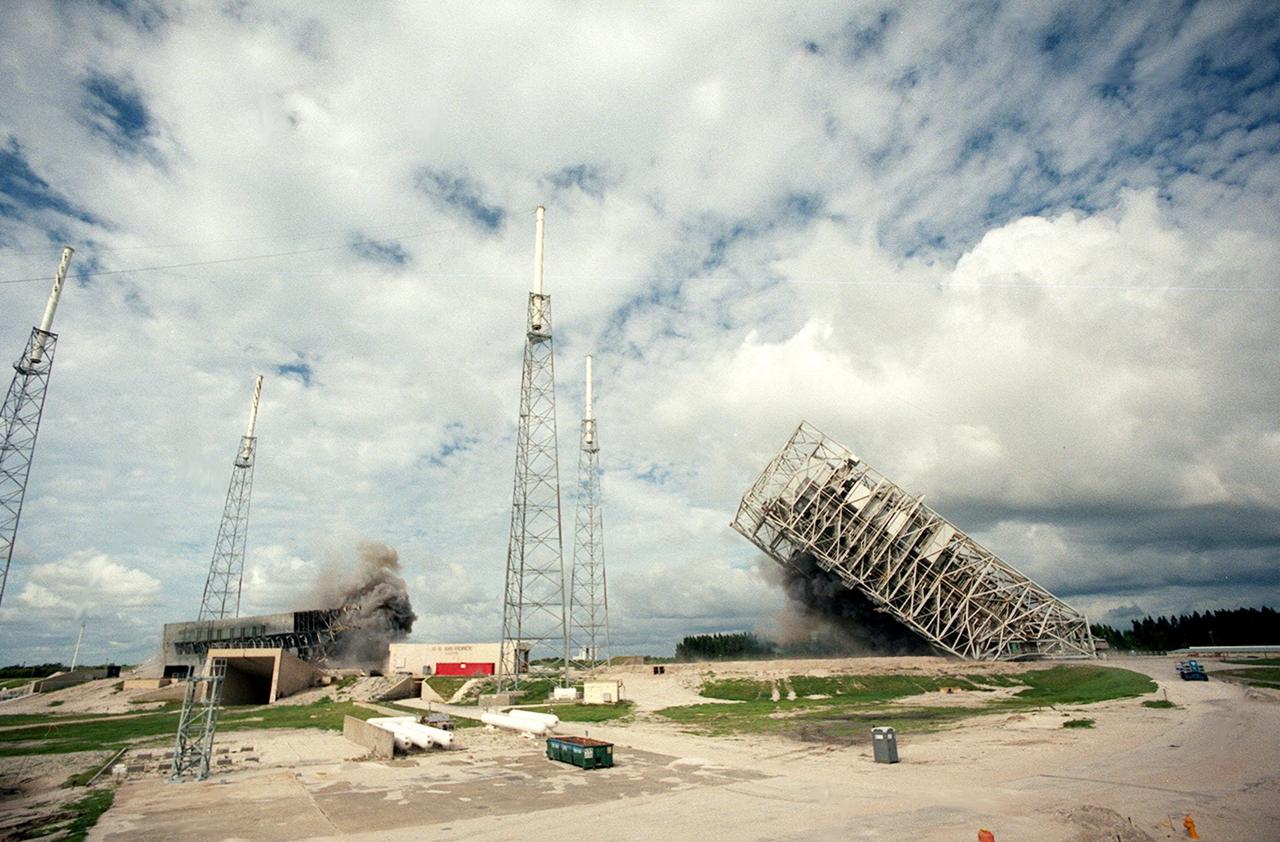
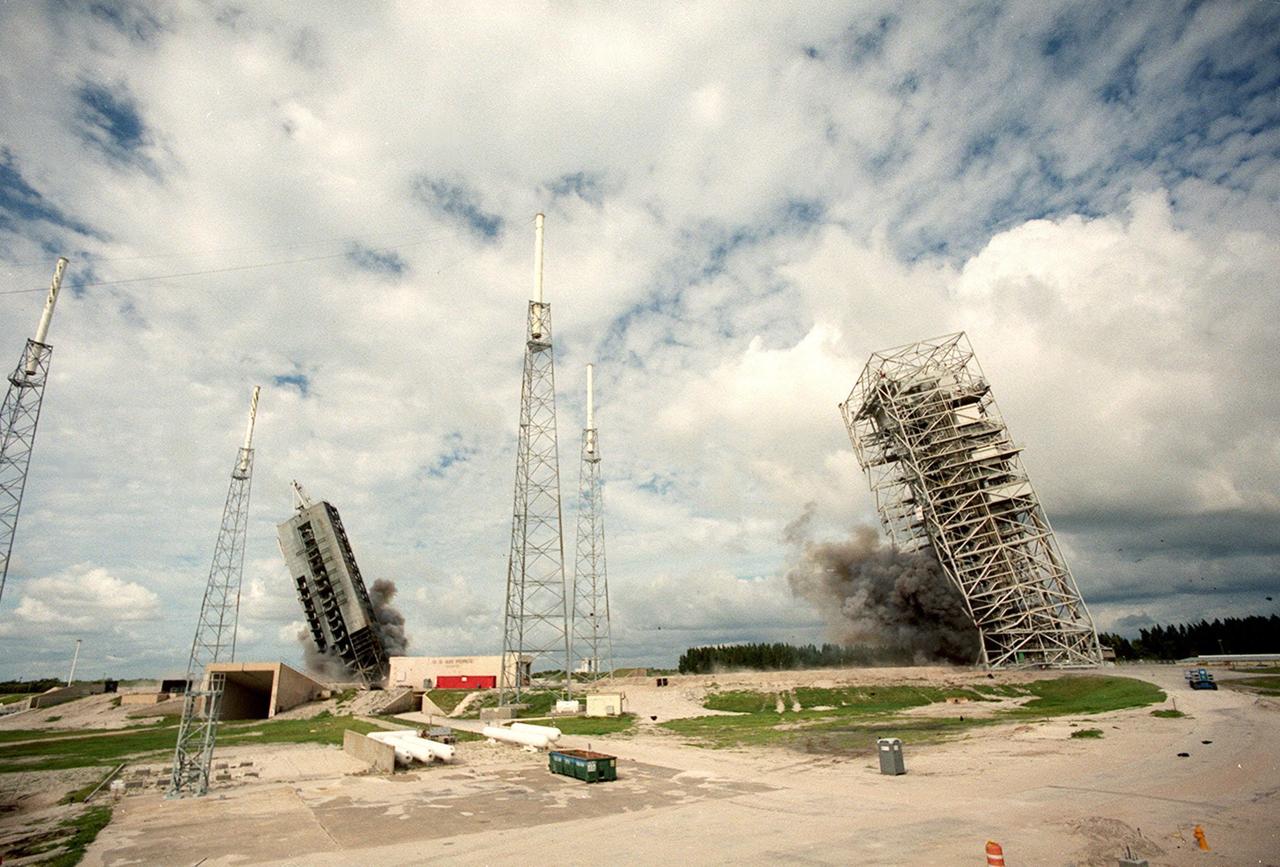
KENNEDY SPACE CENTER, FLA.  —  Two 34-year-old towers on Launch Complex 41, Cape Canaveral Air Station, fall to the ground amid the black smoke from explosives set to topple them.  Weighing two million pounds, the umbilical tower (left) was approximately 200 feet high.  The taller 300-foot Mobile Service Tower (right), still falling, weighs five million pounds. About 200 pounds of linear-shaped charges were used to topple the towers so that the materials can be recycled.  Adjacent to the towers are lightning protection structures, which will remain on the site.  The towers are being demolished to make room for Lockheed Martin's 14-acre Vehicle Integration Facility (VIF), under construction.  The implosion and removal of the tower debris is expected to be completed in two months.  The VIF will be used for Lockheed Martin's Atlas V Launch System.
KSC-99pp1240
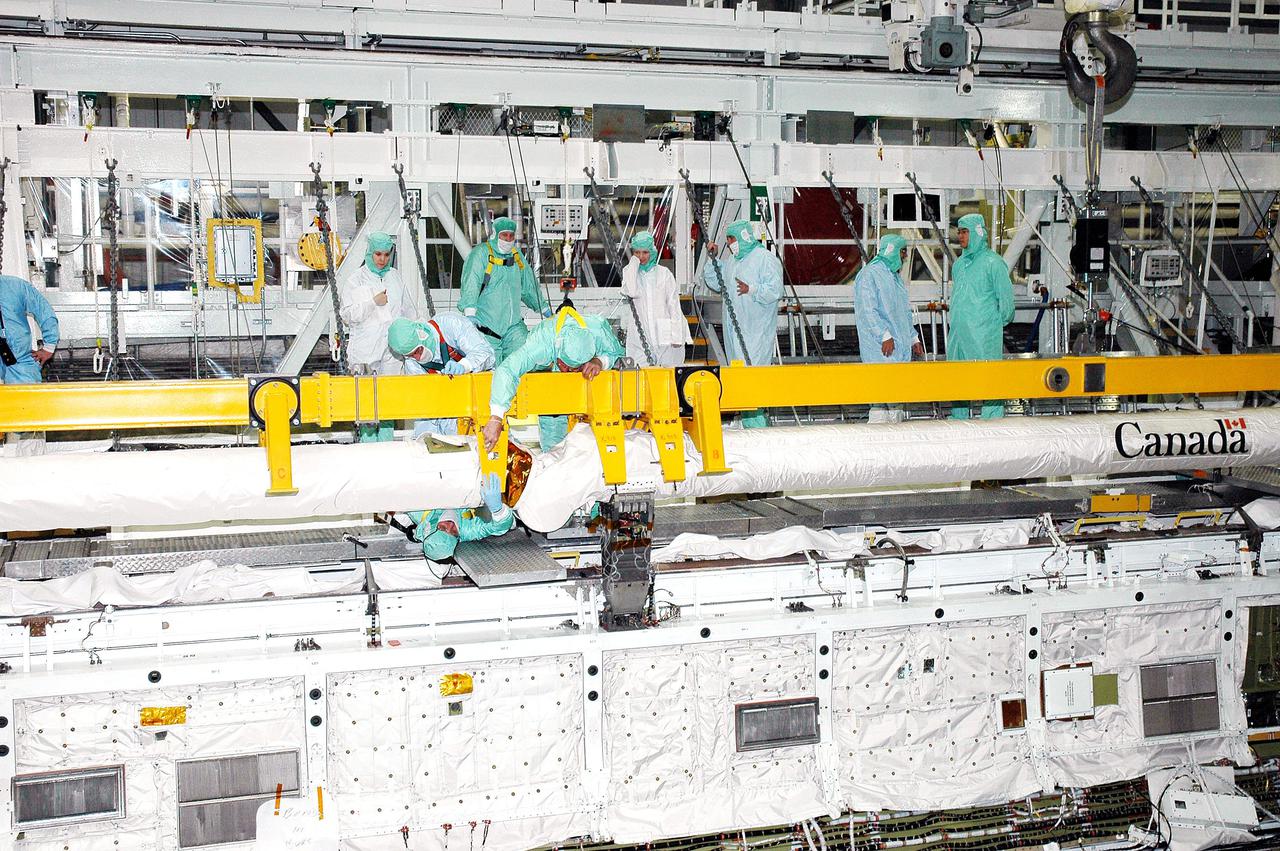
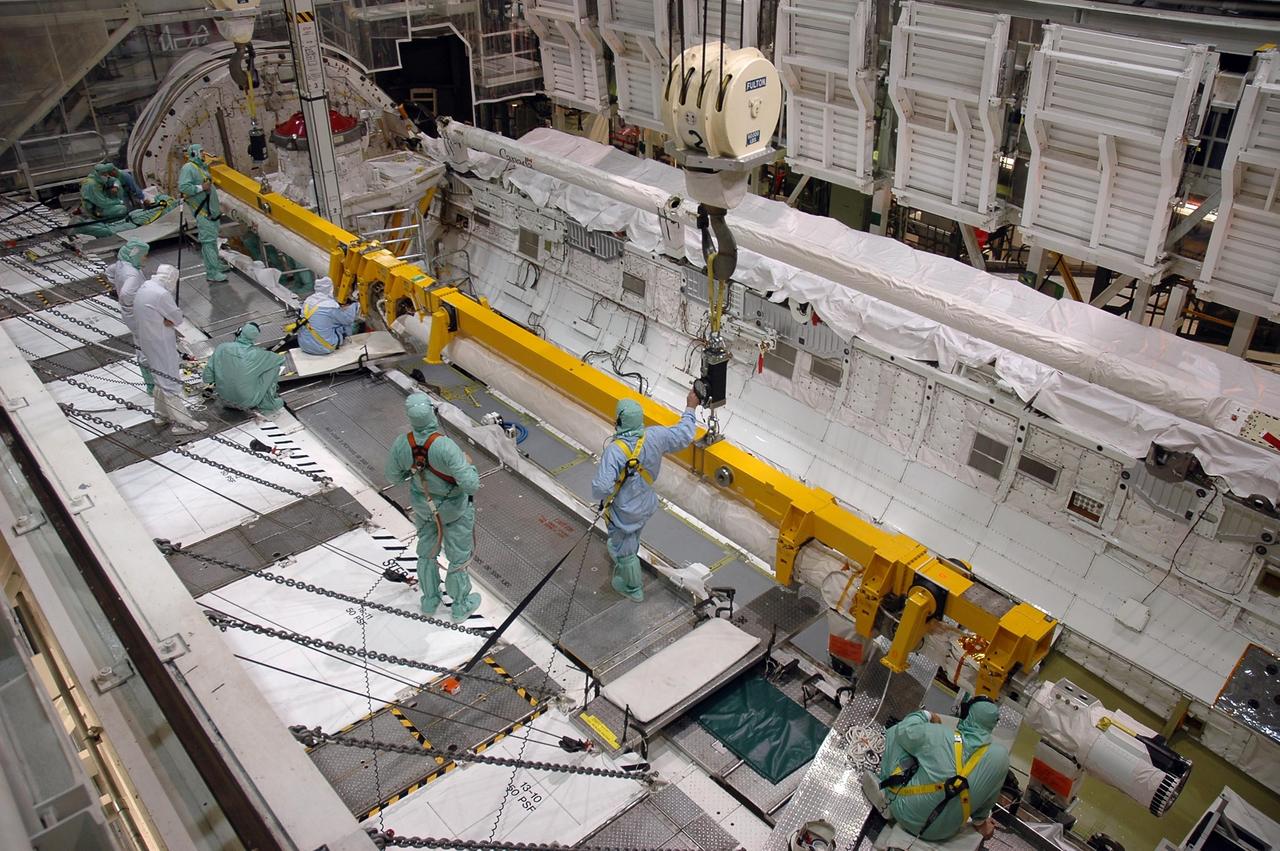
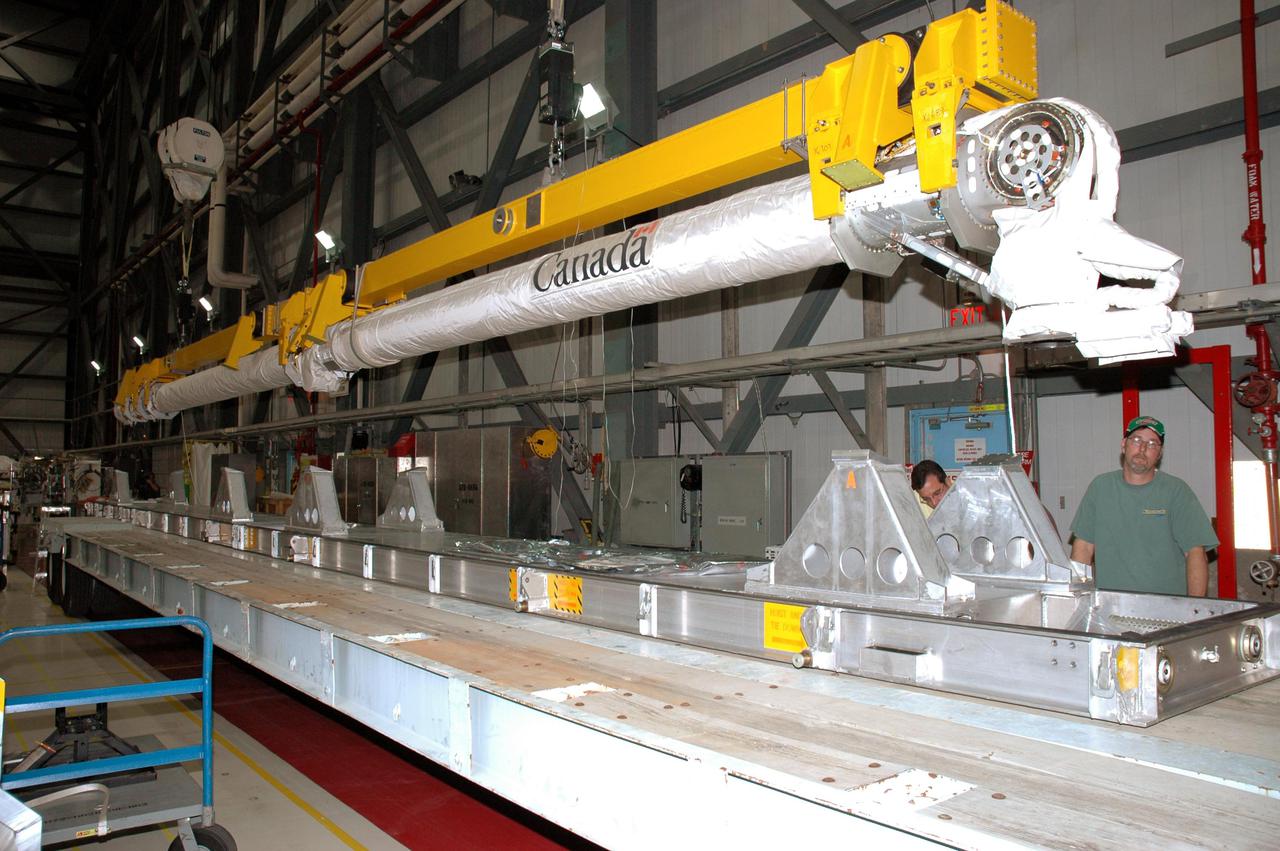
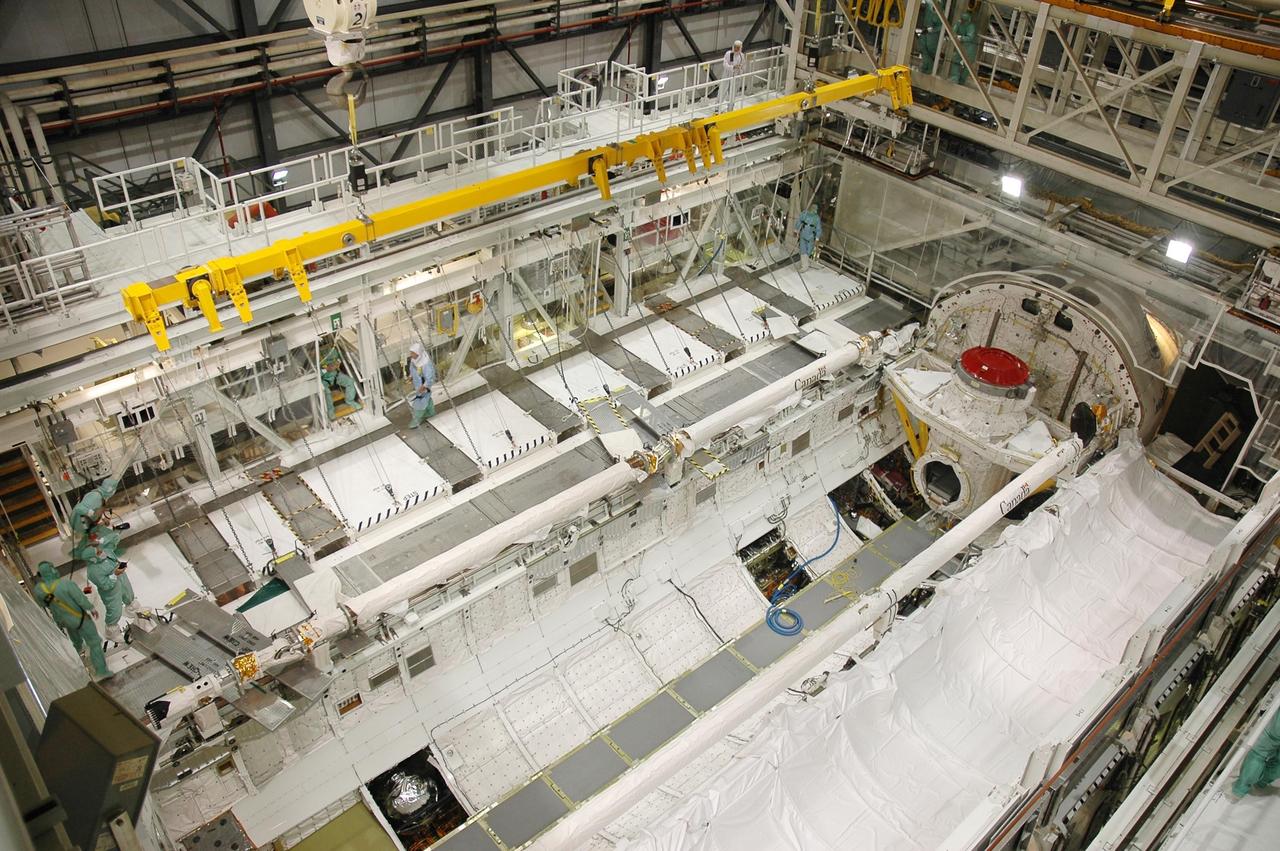
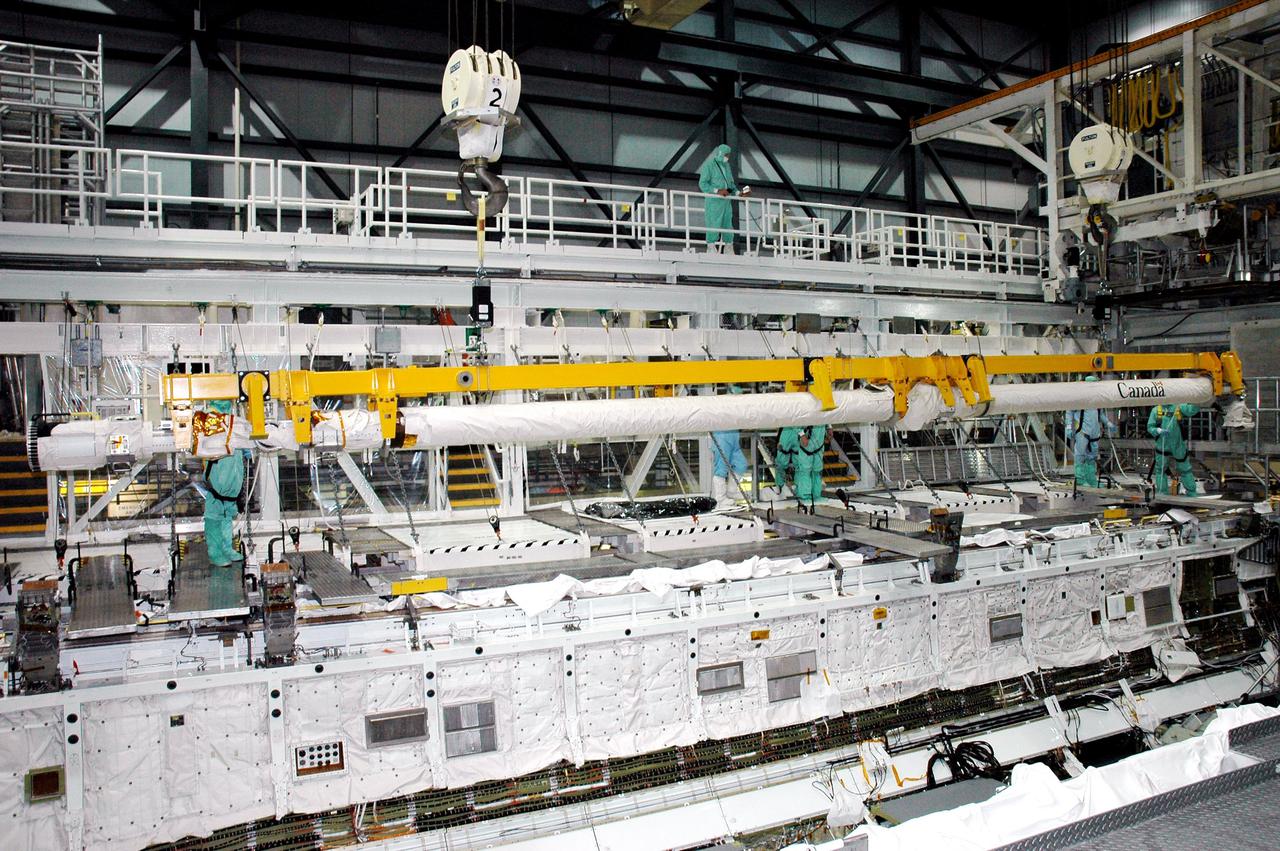
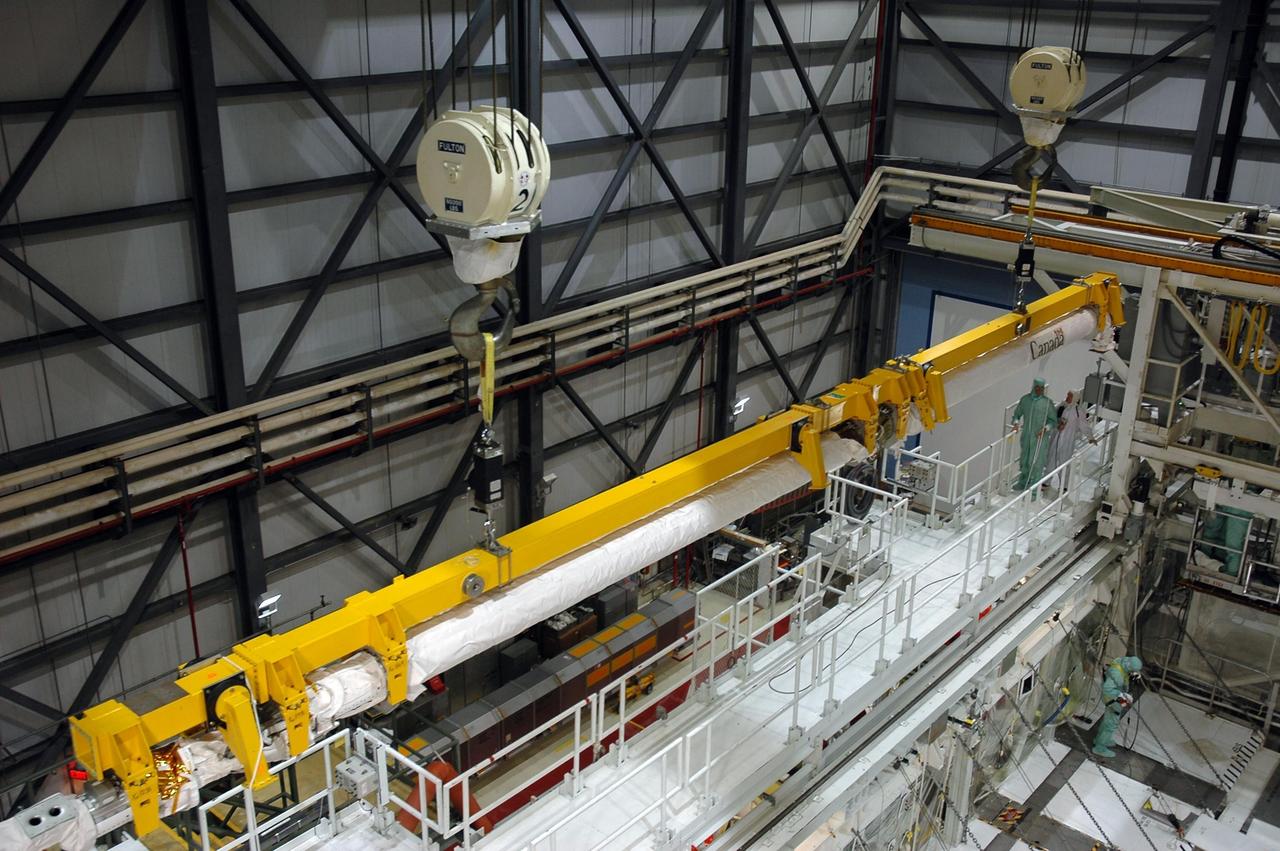
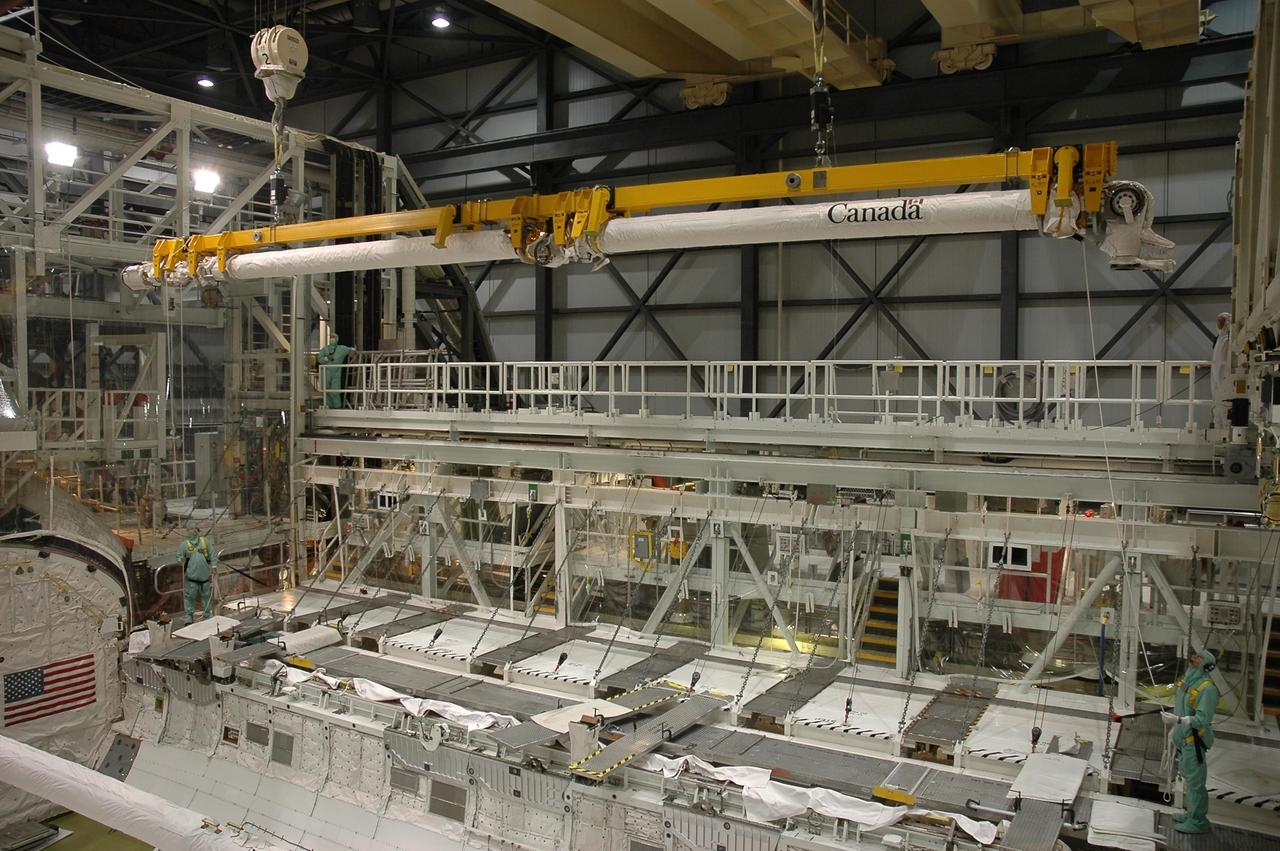
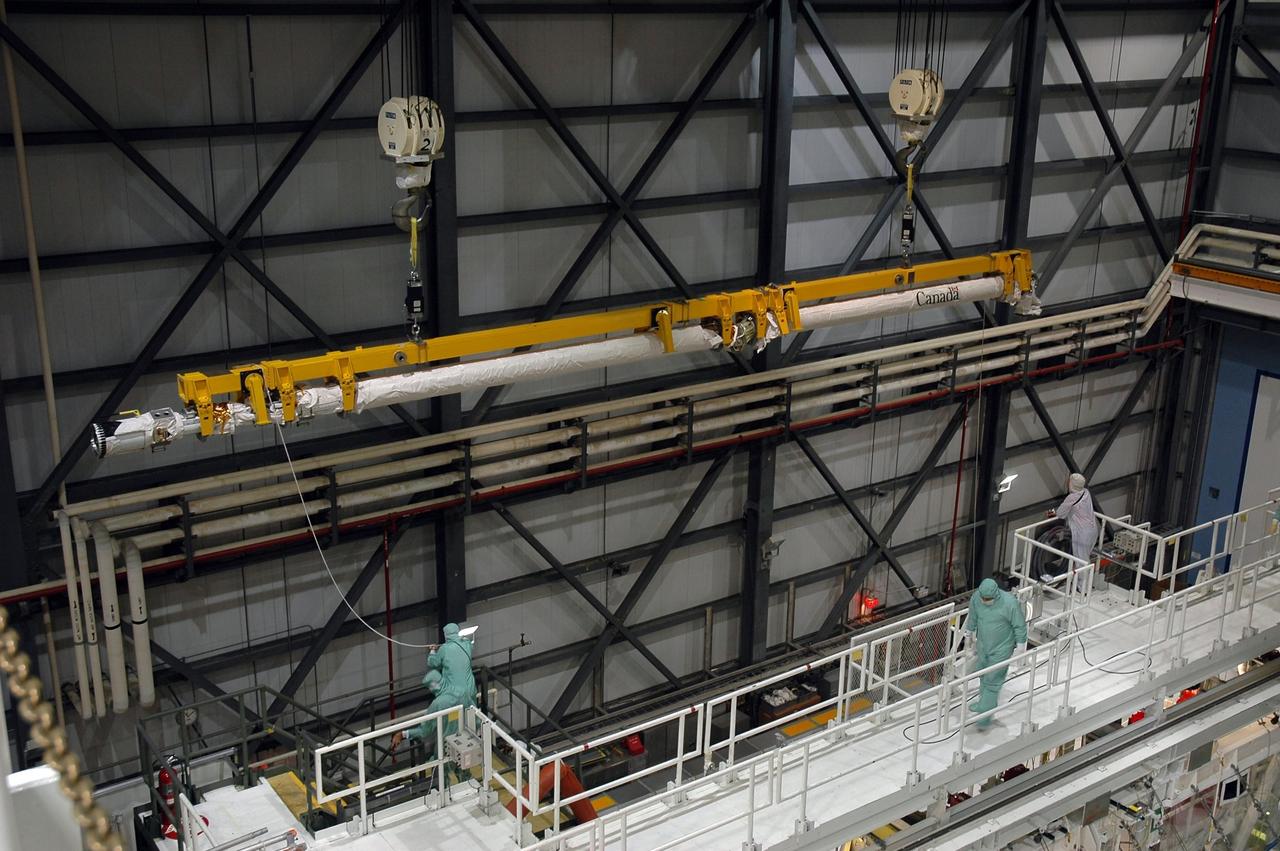
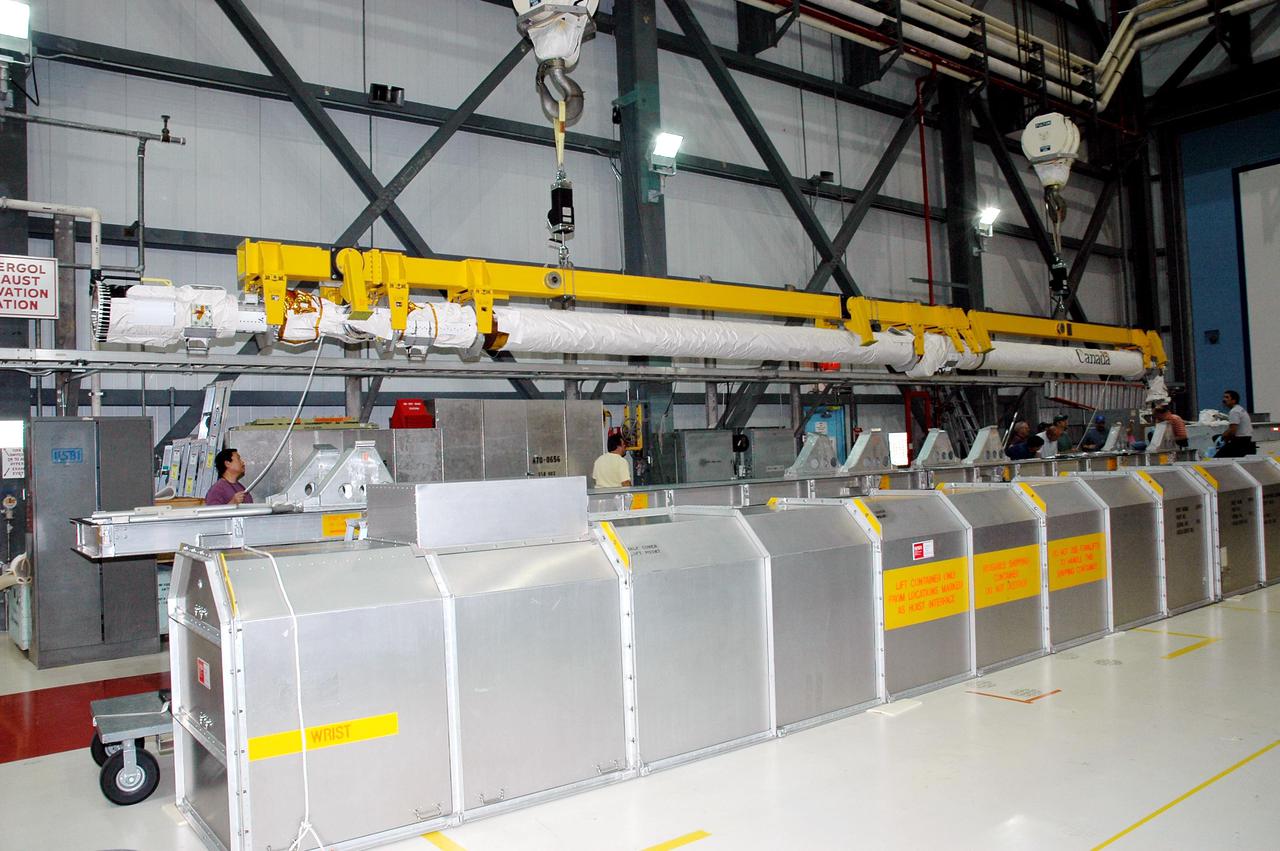
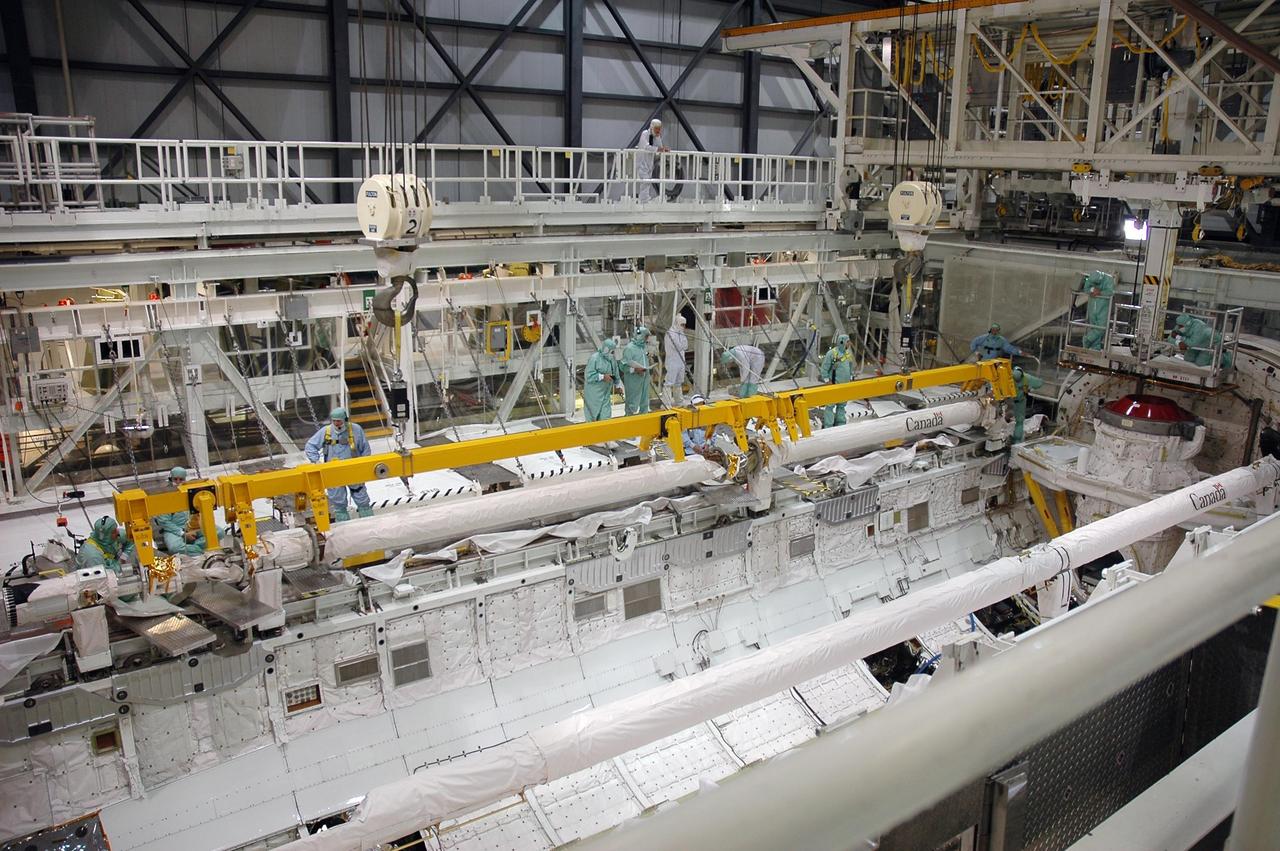
KENNEDY SPACE CENTER, FLA.  - In the Orbiter Processing Facility, an overhead crane lifts the Remote Manipulator System (RMS), or Shuttle arm.  The RMS is being moved for installation in Atlantis’ payload bay. The RMS includes the electromechanical arm that maneuvers a payload from the payload bay of the orbiter to its deployment position and then releases it. It can also grapple a free-flying payload, maneuver it to the payload bay of the orbiter and berth it in the orbiter. The RMS arm is 50 feet 3 inches long and 15 inches in diameter. It weighs 905 pounds, and the total system weighs 994 pounds. The RMS has six joints that correspond roughly to the joints of the human arm, with shoulder yaw and pitch joints; an elbow pitch joint; and wrist pitch, yaw and roll joints. The end effector is the unit at the end of the wrist that actually grabs, or grapples, the payload. Atlantis is the designated orbiter to fly on mission STS-121.  The mission has a launch window of July 12 - July 31, 2005.
KSC-05pd-0331
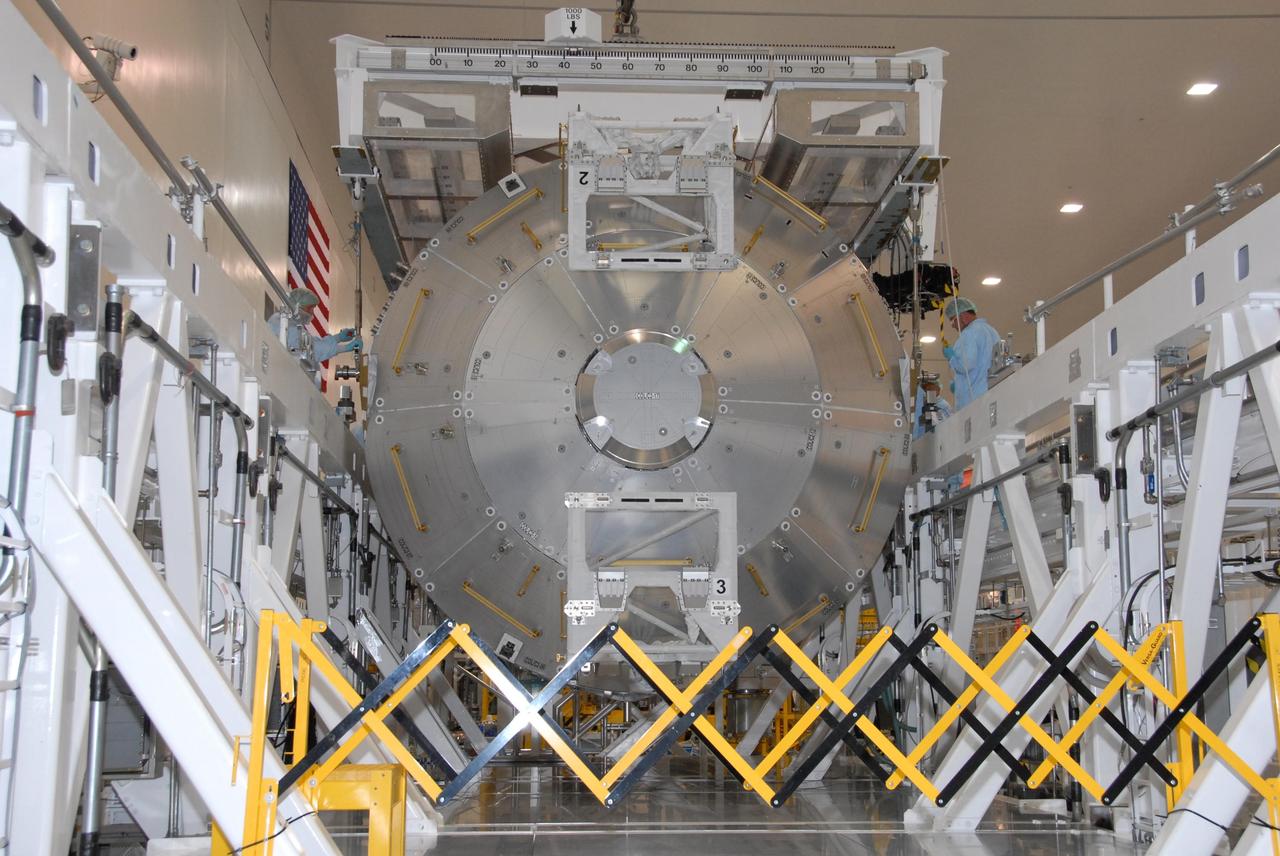
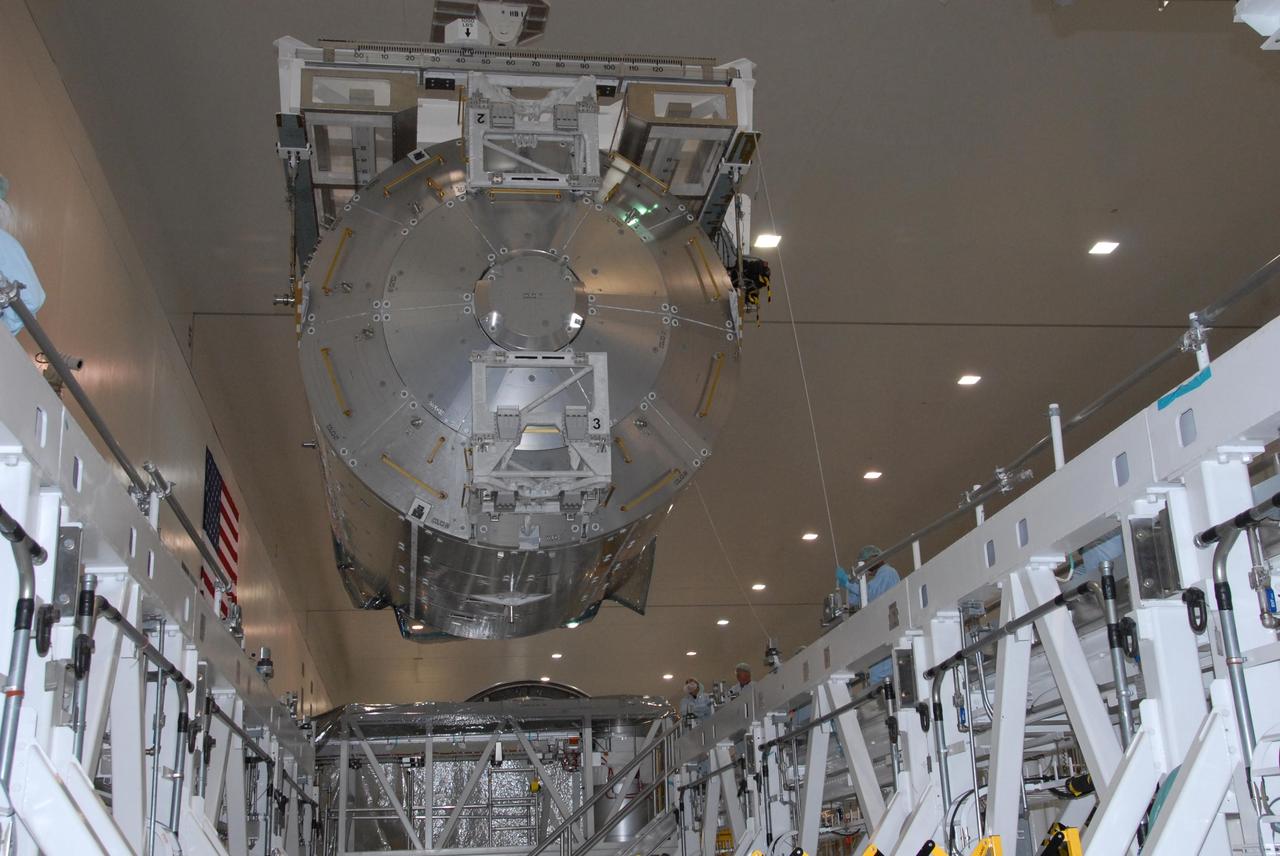
KENNEDY SPACE CENTER, FLA. -- In the Space Station Processing Facility at NASA's Kennedy Space Center, the Columbus Laboratory module is lowered onto a weigh station.  After being weighed, the module will be transferred to the payload canister. The European Space Agency 's largest single contribution to the International Space Station, Columbus will expand the research facilities of the station, providing crew members and scientists around the world the ability to conduct a variety of life, physical and materials science experiments. The module is approximately 23 feet long and 15 feet wide, allowing it to hold 10 large racks of experiments. The module is scheduled to be transferred to Launch Pad 39A in early November, in preparation for its journey to the station. Columbus will fly aboard space shuttle Atlantis on the STS-122 mission, targeted for launch Dec. 6.  Photo credit: NASA/George Shelton
KSC-07pd3026
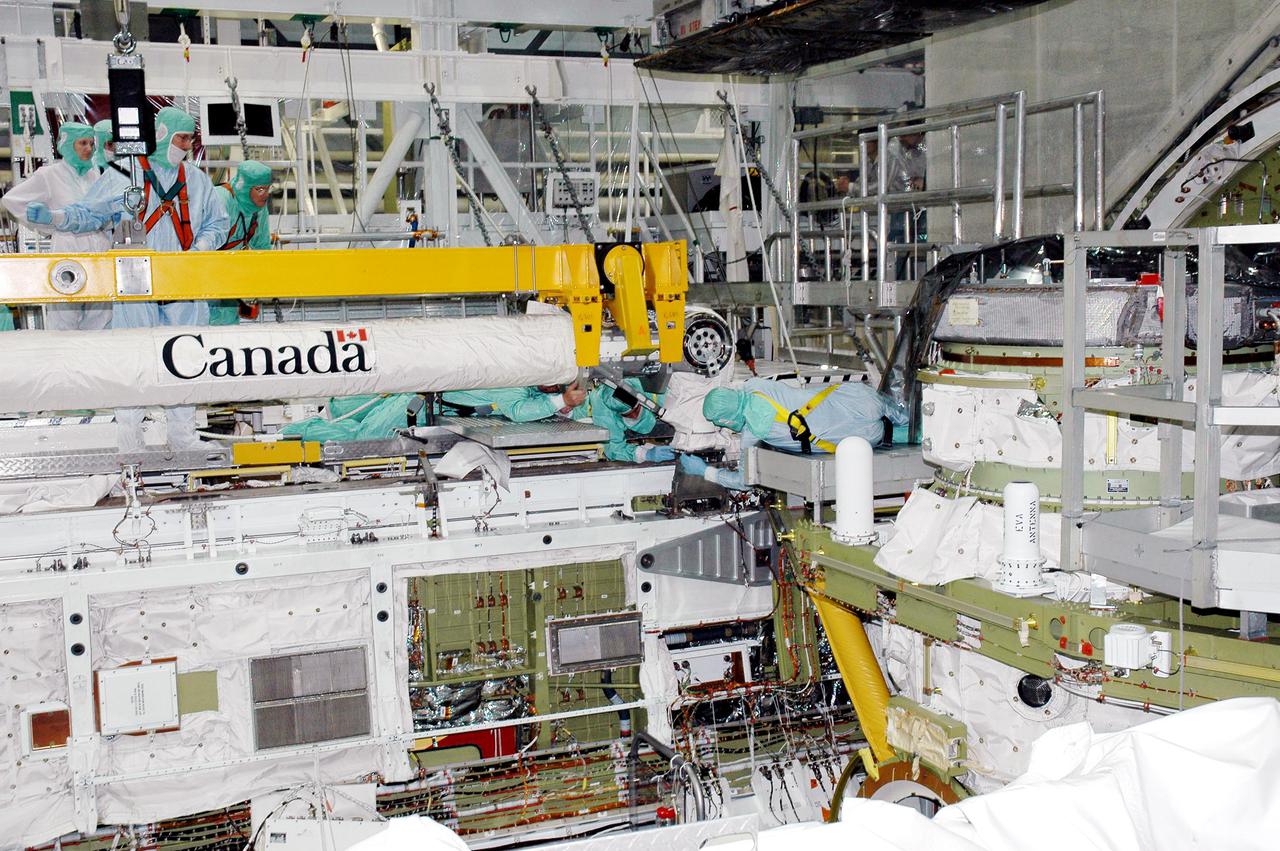
KENNEDY SPACE CENTER, FLA.  -  Workers in the Orbiter Processing Facility prepare the installation area for the Remote Manipulator System (RMS), or Shuttle arm, being lowered into place in Atlantis’ payload bay. The RMS includes the electromechanical arm that maneuvers a payload from the payload bay of the orbiter to its deployment position and then releases it. It can also grapple a free-flying payload, maneuver it to the payload bay of the orbiter and berth it in the orbiter.  The RMS arm is 50 feet 3 inches long and 15 inches in diameter. It weighs 905 pounds, and the total system weighs 994 pounds. The RMS has six joints that correspond roughly to the joints of the human arm, with shoulder yaw and pitch joints; an elbow pitch joint; and wrist pitch, yaw and roll joints. The end effector is the unit at the end of the wrist that actually grabs, or grapples, the payload. Atlantis is the designated orbiter to fly on mission STS-121.  The mission has a launch window of July 12 - July 31, 2005.
KSC-05pd-0336
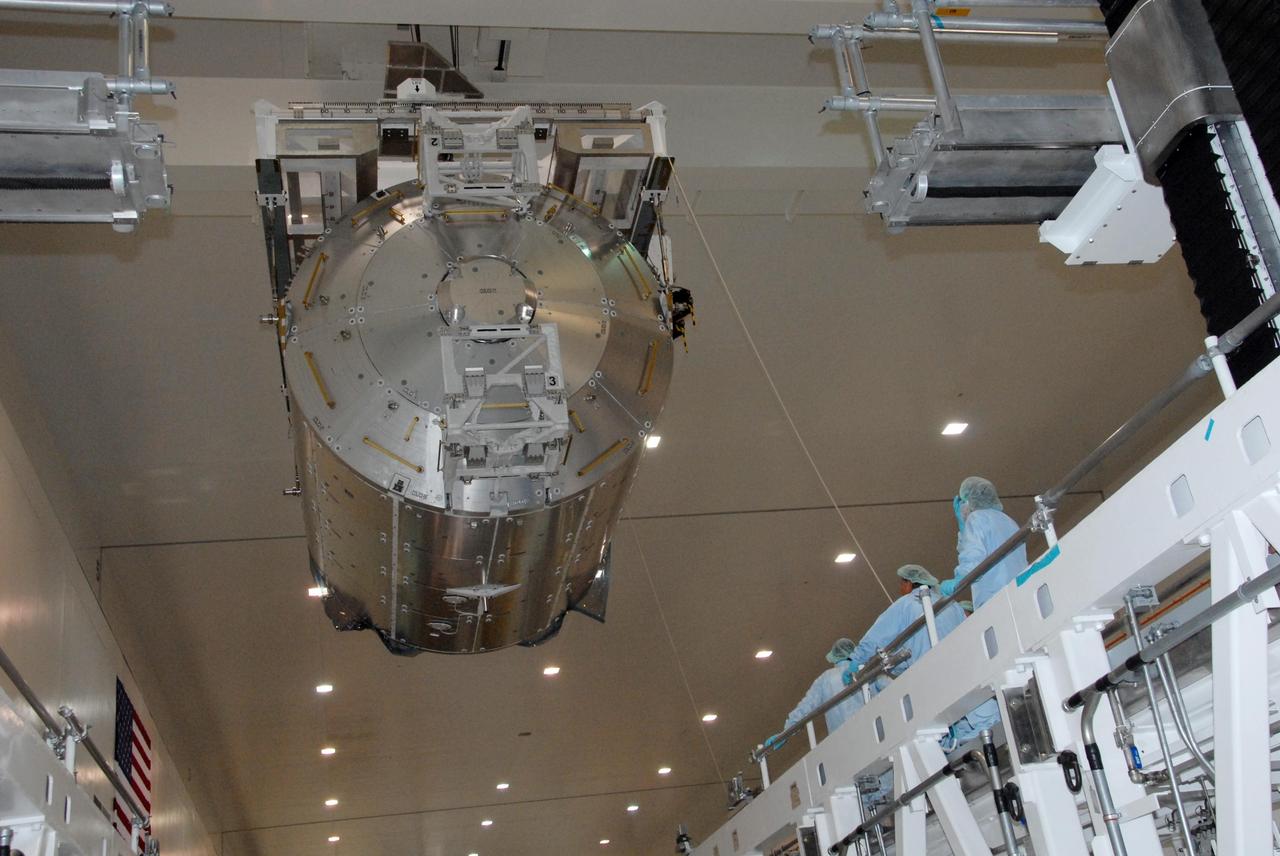
KENNEDY SPACE CENTER, FLA. -- In the Space Station Processing Facility at NASA's Kennedy Space Center, the Columbus Laboratory module is lowered toward a weigh station.  After being weighed, the module will be transferred to the payload canister. The European Space Agency 's largest single contribution to the International Space Station, Columbus will expand the research facilities of the station, providing crew members and scientists around the world the ability to conduct a variety of life, physical and materials science experiments. The module is approximately 23 feet long and 15 feet wide, allowing it to hold 10 large racks of experiments. The module is scheduled to be transferred to Launch Pad 39A in early November, in preparation for its journey to the station. Columbus will fly aboard space shuttle Atlantis on the STS-122 mission, targeted for launch Dec. 6.  Photo credit: NASA/George Shelton
KSC-07pd3025
KENNEDY SPACE CENTER, FLA.  - Workers in the Orbiter Processing Facility stand by as  the Remote Manipulator System (RMS), or Shuttle arm, is lowered into place in Atlantis’ payload bay.  The RMS includes the electromechanical arm that maneuvers a payload from the payload bay of the orbiter to its deployment position and then releases it. It can also grapple a free-flying payload, maneuver it to the payload bay of the orbiter and berth it in the orbiter. The RMS arm is 50 feet 3 inches long and 15 inches in diameter. It weighs 905 pounds, and the total system weighs 994 pounds. The RMS has six joints that correspond roughly to the joints of the human arm, with shoulder yaw and pitch joints; an elbow pitch joint; and wrist pitch, yaw and roll joints. The end effector is the unit at the end of the wrist that actually grabs, or grapples, the payload. Atlantis is the designated orbiter to fly on mission STS-121.  The mission has a launch window of July 12 - July 31, 2005.
KSC-05pd-0334
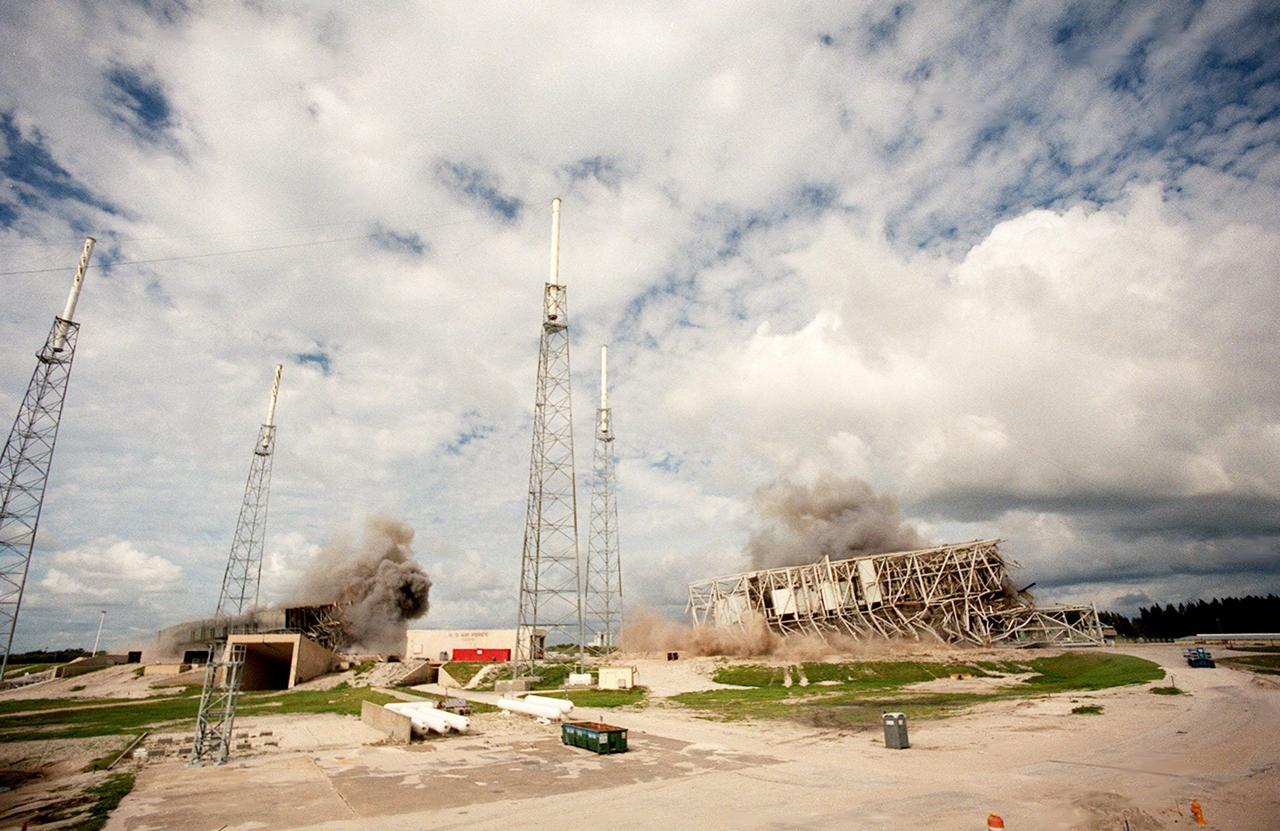
KENNEDY SPACE CENTER, FLA.  —  Two 34-year-old towers on Launch Complex 41, Cape Canaveral Air Station, lie on the ground amid the black smoke from explosives set to topple them.  Weighing two million pounds, the umbilical tower (left) was approximately 200 feet high.  The taller 300-foot Mobile Service Tower (right) weighs five million pounds. About 200 pounds of linear-shaped charges were used to topple the towers so that the materials can be recycled.  Adjacent to the towers are lightning protection structures, which will remain on the site.  The towers are being demolished to make room for Lockheed Martin's 14-acre Vehicle Integration Facility (VIF), under construction.  The implosion and removal of the tower debris is expected to be completed in two months.  The VIF will be used for Lockheed Martin's Atlas V Launch System.
KSC-99pp1238
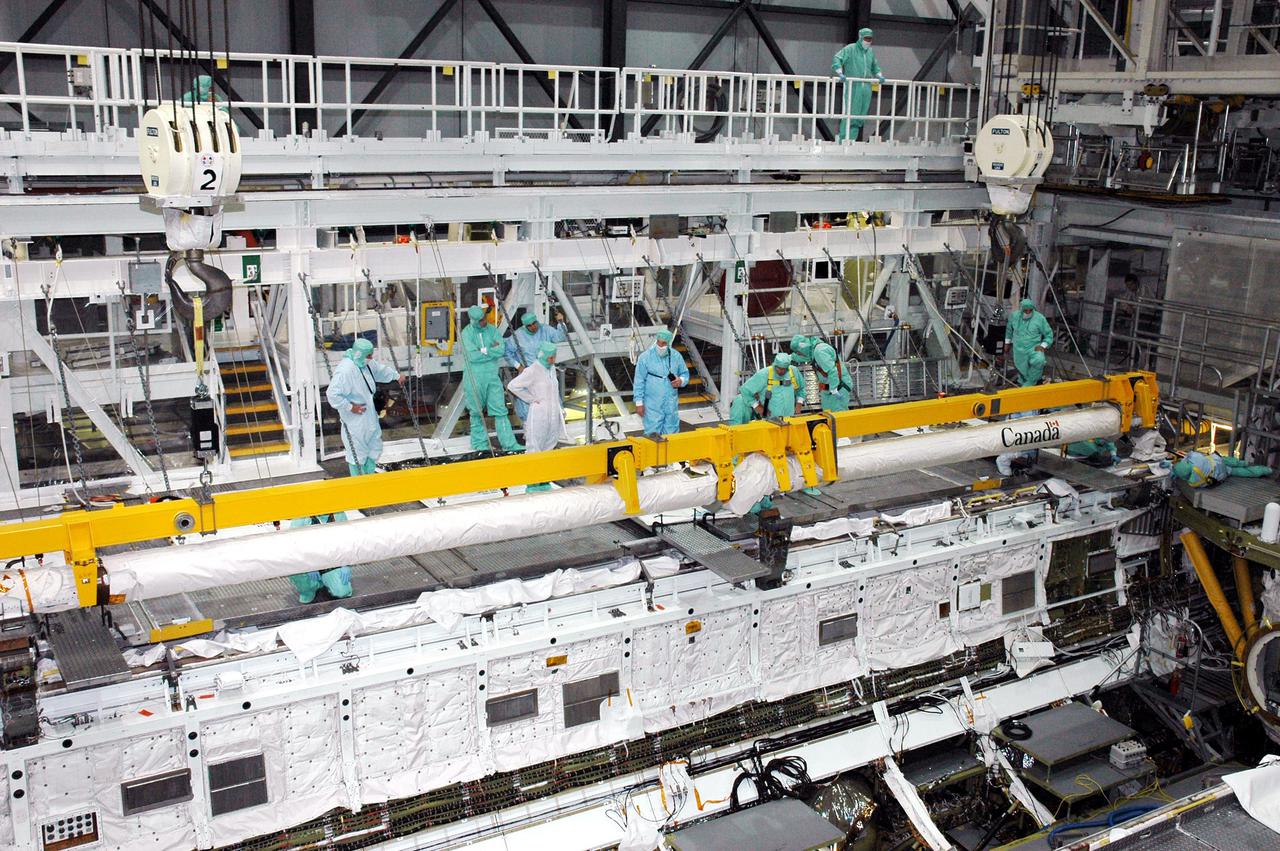
KENNEDY SPACE CENTER, FLA.  - In the Orbiter Processing Facility, an overhead crane lowers the Remote Manipulator System (RMS), or Shuttle arm, toward Atlantis for installation in the payload bay.  The RMS includes the electromechanical arm that maneuvers a payload from the payload bay of the orbiter to its deployment position and then releases it. It can also grapple a free-flying payload, maneuver it to the payload bay of the orbiter and berth it in the orbiter. The RMS arm is 50 feet 3 inches long and 15 inches in diameter. It weighs 905 pounds, and the total system weighs 994 pounds. The RMS has six joints that correspond roughly to the joints of the human arm, with shoulder yaw and pitch joints; an elbow pitch joint; and wrist pitch, yaw and roll joints. The end effector is the unit at the end of the wrist that actually grabs, or grapples, the payload. Atlantis is the designated orbiter to fly on mission STS-121.  The mission has a launch window of July 12 - July 31, 2005.
KSC-05pd-0333
KENNEDY SPACE CENTER, FLA. - In the Orbiter Processing Facility Bay 1 at NASA Kennedy Space Center, workers secure a crane to the remote manipulator system boom in Atlantis’ payload bay.  The boom is being removed from Atlantis and will be temporarily stored.. The RMS includes the electromechanical arm that maneuvers a payload from the payload bay of the orbiter to its deployment position and then releases it. It can also grapple a free-flying payload, maneuver it to the payload bay of the orbiter and berth it in the orbiter. The RMS arm is 50 feet 3 inches long and 15 inches in diameter. It weighs 905 pounds, and the total system weighs 994 pounds. The RMS has six joints that correspond roughly to the joints of the human arm, with shoulder yaw and pitch joints; an elbow pitch joint; and wrist pitch, yaw and roll joints. The end effector is the unit at the end of the wrist that actually grabs, or grapples, the payload.
KSC-05pd2465
KENNEDY SPACE CENTER, FLA. - In the Orbiter Processing Facility Bay 1 at NASA Kennedy Space Center, the remote manipulator system boom is lifted away  from Atlantis’ payload bay and will be temporarily stored.   The RMS includes the electromechanical arm that maneuvers a payload from the payload bay of the orbiter to its deployment position and then releases it. It can also grapple a free-flying payload, maneuver it to the payload bay of the orbiter and berth it in the orbiter. The RMS arm is 50 feet 3 inches long and 15 inches in diameter. It weighs 905 pounds, and the total system weighs 994 pounds. The RMS has six joints that correspond roughly to the joints of the human arm, with shoulder yaw and pitch joints; an elbow pitch joint; and wrist pitch, yaw and roll joints. The end effector is the unit at the end of the wrist that actually grabs, or grapples, the payload.
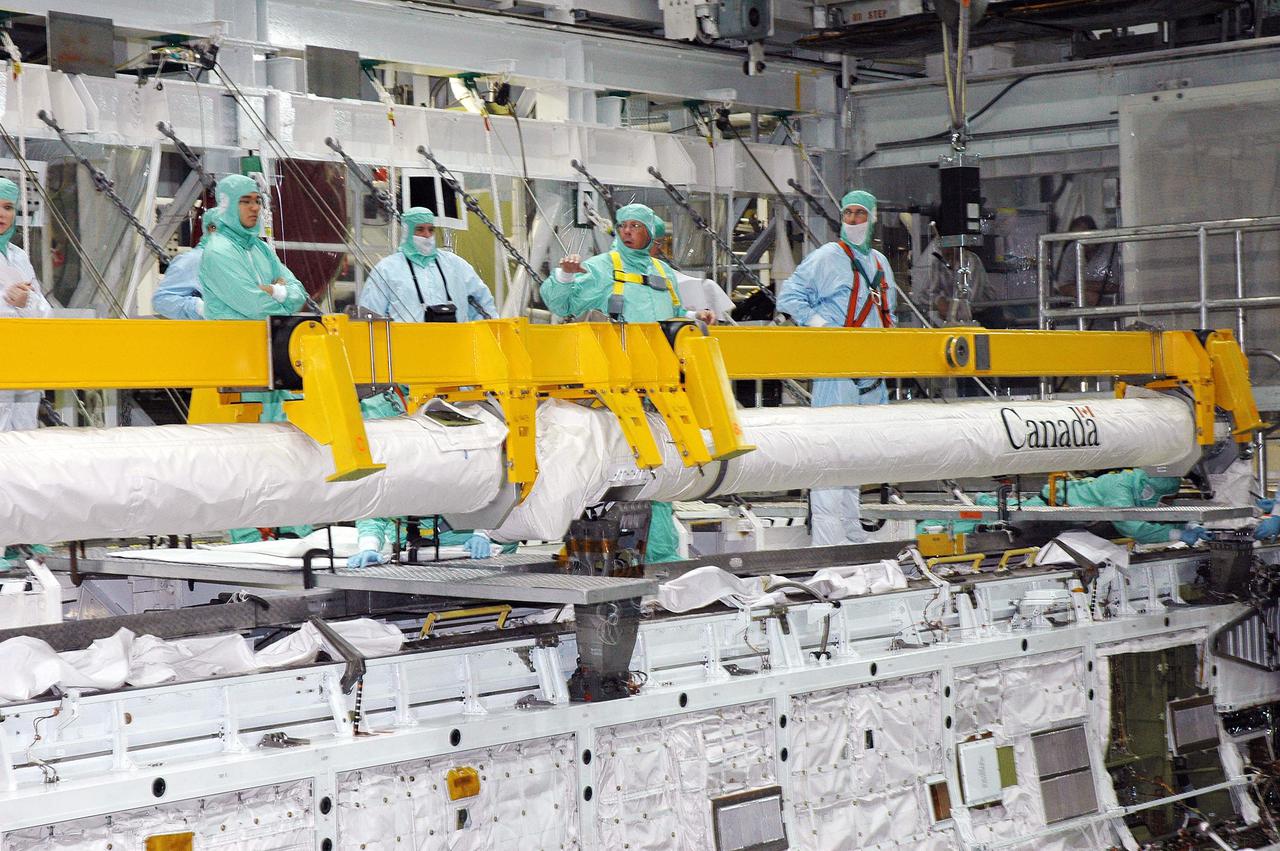
KSC-05pd2467
KENNEDY SPACE CENTER, FLA. - In the Orbiter Processing Facility Bay 1 at NASA Kennedy Space Center, a crane is lowered toward the remote manipulator system boom in Atlantis’ payload bay.  The boom is being removed from Atlantis and will be temporarily stored.  The RMS includes the electromechanical arm that maneuvers a payload from the payload bay of the orbiter to its deployment position and then releases it. It can also grapple a free-flying payload, maneuver it to the payload bay of the orbiter and berth it in the orbiter. The RMS arm is 50 feet 3 inches long and 15 inches in diameter. It weighs 905 pounds, and the total system weighs 994 pounds. The RMS has six joints that correspond roughly to the joints of the human arm, with shoulder yaw and pitch joints; an elbow pitch joint; and wrist pitch, yaw and roll joints. The end effector is the unit at the end of the wrist that actually grabs, or grapples, the payload.
KSC-05pd2463
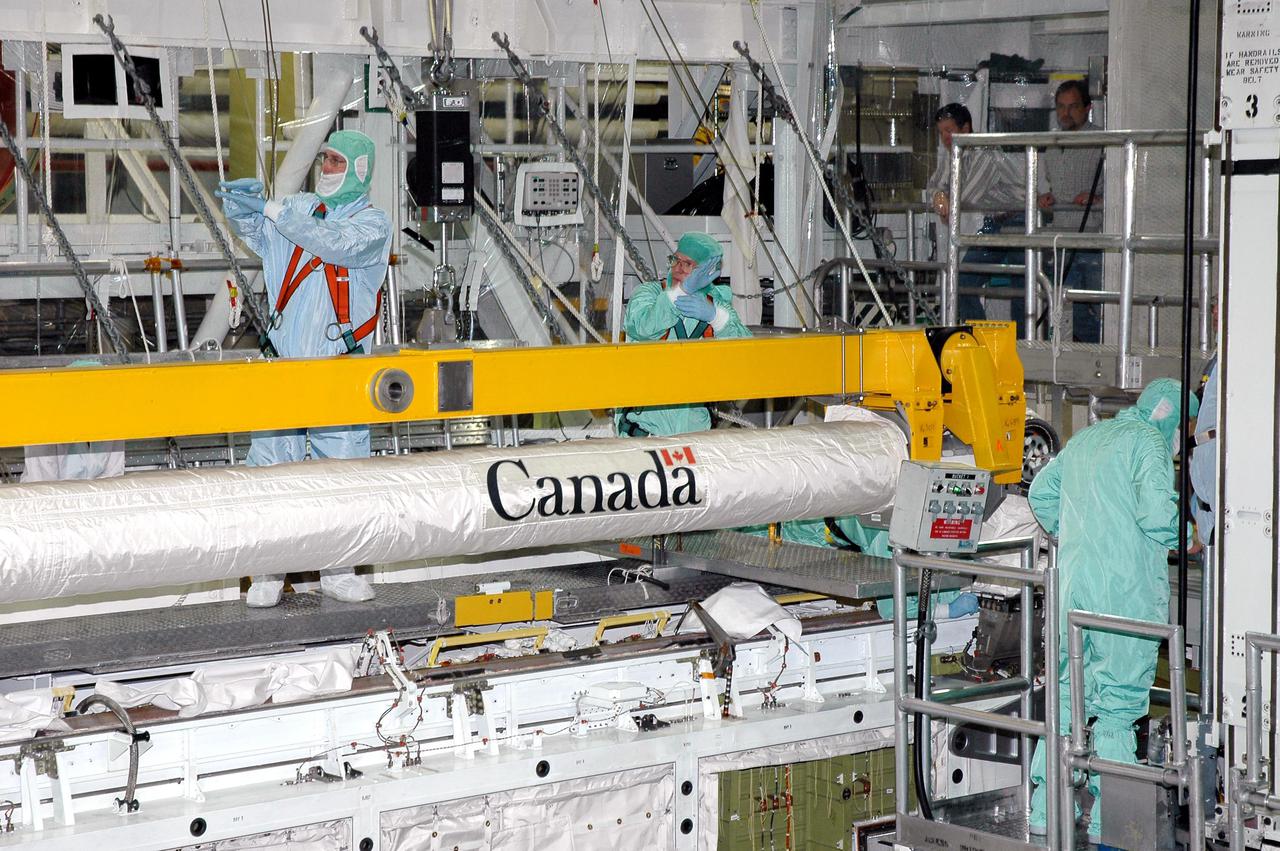
KENNEDY SPACE CENTER, FLA.  -  A worker in the Orbiter Processing Facility signals the crane operator to lower the Remote Manipulator System (RMS), or Shuttle arm, into place in Atlantis’ payload bay. The RMS includes the electromechanical arm that maneuvers a payload from the payload bay of the orbiter to its deployment position and then releases it. It can also grapple a free-flying payload, maneuver it to the payload bay of the orbiter and berth it in the orbiter.  The RMS arm is 50 feet 3 inches long and 15 inches in diameter. It weighs 905 pounds, and the total system weighs 994 pounds. The RMS has six joints that correspond roughly to the joints of the human arm, with shoulder yaw and pitch joints; an elbow pitch joint; and wrist pitch, yaw and roll joints. The end effector is the unit at the end of the wrist that actually grabs, or grapples, the payload. Atlantis is the designated orbiter to fly on mission STS-121.  The mission has a launch window of July 12 - July 31, 2005.
KSC-05pd-0337
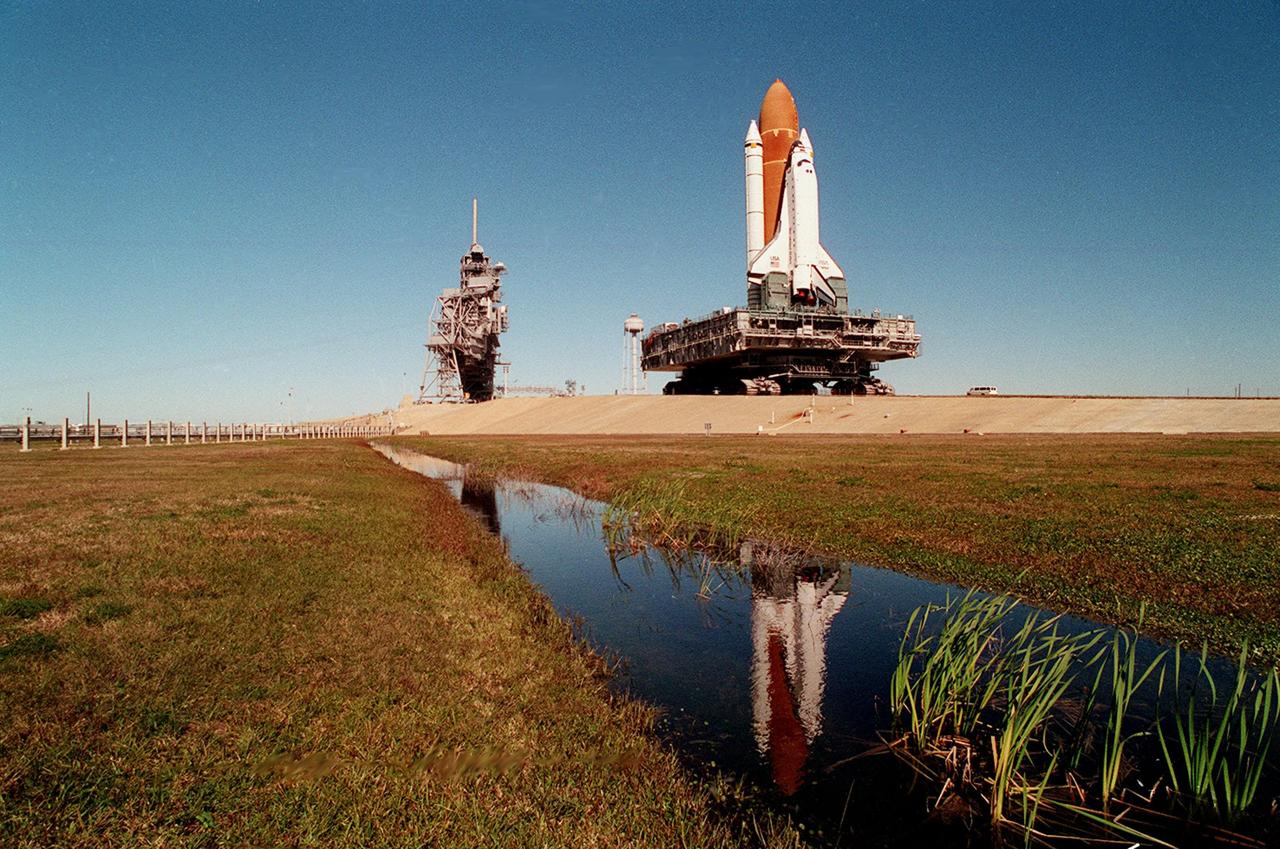
A massive 19 million pounds-plus (8.6 million kilograms) of Space Shuttle, support and transport hardware inch toward Launch Pad 39A from the Vehicle Assembly Building. The fully asssembled Space Shuttle Endeavour, minus its payloads, weighs about 4.5 million pounds (2 million kg.); the mobile launcher platform, on which it was assembled and from which it will lift off, weighs 9.25 million pounds (4.19 million kg.); and the crawler-transporter carrying the platform and Shuttle checks in at around 6 million pounds (2.7 million kg.). Once at the pad, the Shuttle and launch platform will be deposited atop support columns to complete preparations for the second Shuttle launch of 1995. The primary payload of mission STS-67 is the Astro-2 Astrophysics Observatory, carrying three ultraviolet telescopes that flew on the Astro-1 mission in 1990. STS-67 also is scheduled to become the longest shuttle flight to date, lasting 16 days
KSC-95PC-0289
KENNEDY SPACE CENTER, FLA. - In the Orbiter Processing Facility Bay 1 at NASA Kennedy Space Center, a crane lifts the remote manipulator system boom out of Atlantis’ payload bay.  The boom will be temporarily stored.  The RMS includes the electromechanical arm that maneuvers a payload from the payload bay of the orbiter to its deployment position and then releases it. It can also grapple a free-flying payload, maneuver it to the payload bay of the orbiter and berth it in the orbiter. The RMS arm is 50 feet 3 inches long and 15 inches in diameter. It weighs 905 pounds, and the total system weighs 994 pounds. The RMS has six joints that correspond roughly to the joints of the human arm, with shoulder yaw and pitch joints; an elbow pitch joint; and wrist pitch, yaw and roll joints. The end effector is the unit at the end of the wrist that actually grabs, or grapples, the payload.
KSC-05pd2466
KENNEDY SPACE CENTER, FLA.  -  Workers in the Orbiter Processing Facility prepare to install the Remote Manipulator System (RMS), or Shuttle arm, in Atlantis’ payload bay.  The RMS includes the electromechanical arm that maneuvers a payload from the payload bay of the orbiter to its deployment position and then releases it. It can also grapple a free-flying payload, maneuver it to the payload bay of the orbiter and berth it in the orbiter. The RMS arm is 50 feet 3 inches long and 15 inches in diameter. It weighs 905 pounds, and the total system weighs 994 pounds. The RMS has six joints that correspond roughly to the joints of the human arm, with shoulder yaw and pitch joints; an elbow pitch joint; and wrist pitch, yaw and roll joints. The end effector is the unit at the end of the wrist that actually grabs, or grapples, the payload. Atlantis is the designated orbiter to fly on mission STS-121.  The mission has a launch window of July 12 - July 31, 2005.
KSC-05pd-0335
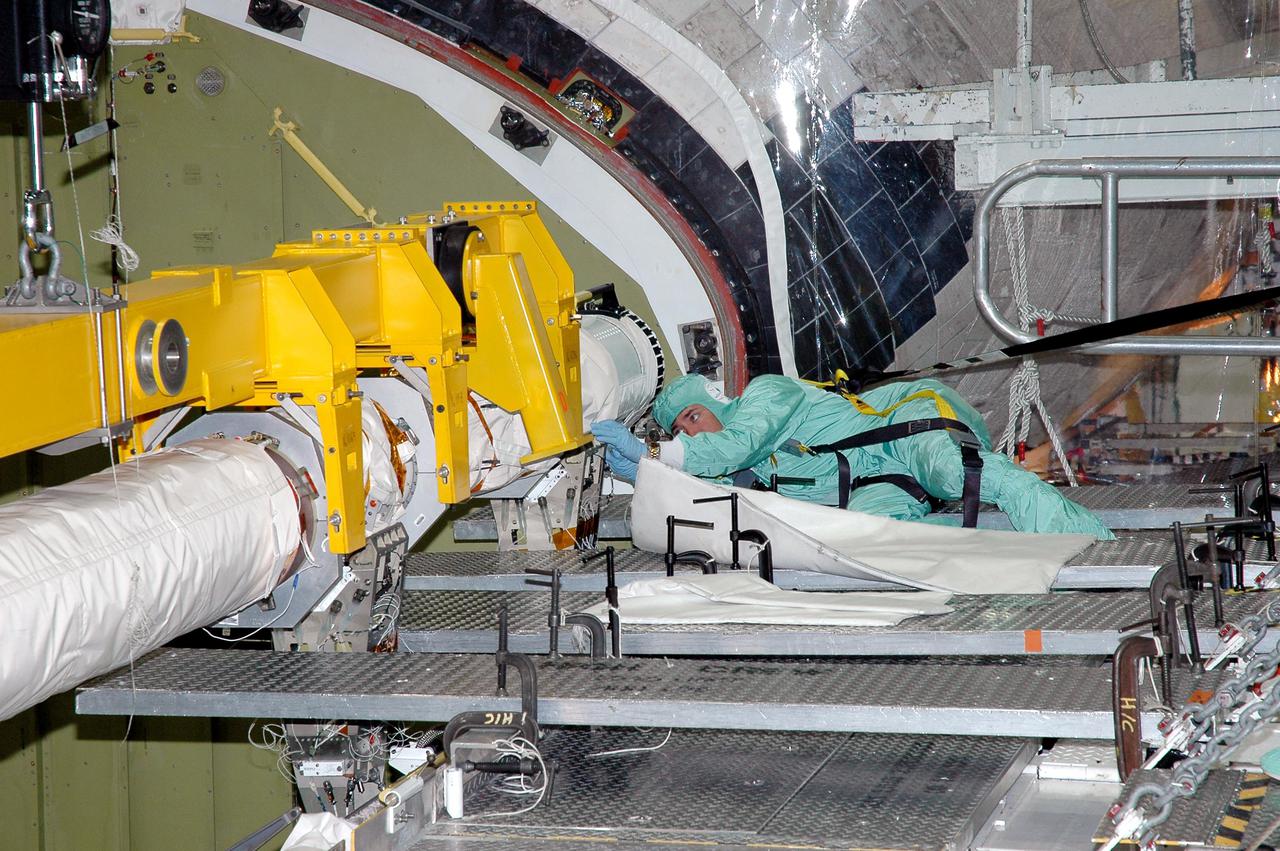
KENNEDY SPACE CENTER, FLA.  -  Workers in the Orbiter Processing Facility complete attachment of the Remote Manipulator System (RMS), or Shuttle arm, into place in Atlantis’ payload bay. The RMS includes the electromechanical arm that maneuvers a payload from the payload bay of the orbiter to its deployment position and then releases it. It can also grapple a free-flying payload, maneuver it to the payload bay of the orbiter and berth it in the orbiter. The RMS arm is 50 feet 3 inches long and 15 inches in diameter. It weighs 905 pounds, and the total system weighs 994 pounds. The RMS has six joints that correspond roughly to the joints of the human arm, with shoulder yaw and pitch joints; an elbow pitch joint; and wrist pitch, yaw and roll joints. The end effector is the unit at the end of the wrist that actually grabs, or grapples, the payload. Atlantis is the designated orbiter to fly on mission STS-121.  The mission has a launch window of July 12 - July 31, 2005.
KSC-05pd-0339
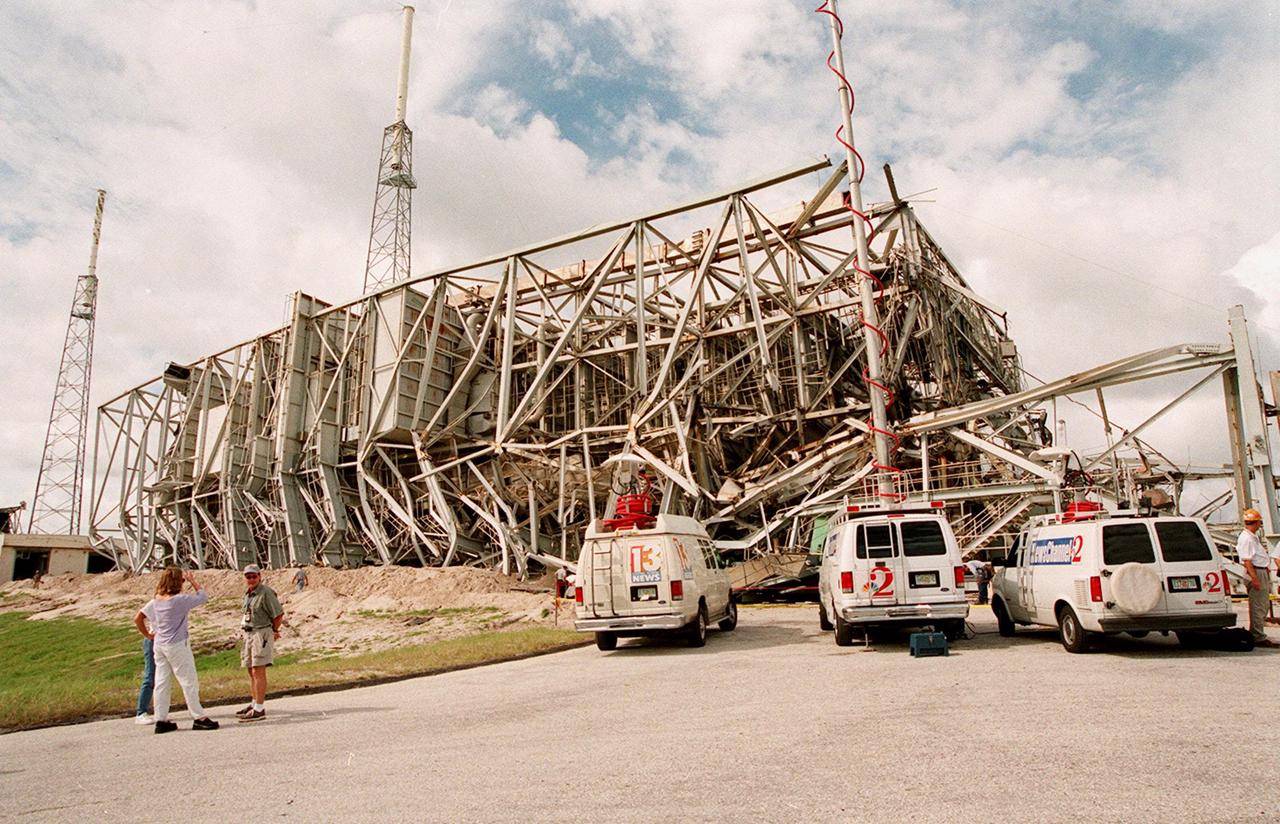
KENNEDY SPACE CENTER, FLA. --  Live TV trucks from local channels merge at the site of the fallen Mobile Service Tower (MST) and umbilical tower nearby after their demolition.  The towers were demolished to make room for Lockheed Martin's 14-acre Vehicle Integration Facility (VIF), under construction. Weighing two million pounds, the umbilical tower was approximately 200 feet high.  The taller 300-foot MST weighed five million pounds.  About 200 pounds of linear-shaped charges were used to bring down the towers so that the materials can be recycled.  The implosion and removal of the tower debris is expected to be completed in two months.  The VIF will be used for Lockheed Martin's Atlas V Launch System.
KSC-99pp1219
KENNEDY SPACE CENTER, FLA.  —  Two 34-year-old towers on Launch Complex 41, Cape Canaveral Air Station, fall to the ground amid the black smoke from explosives set to topple them.  Weighing two million pounds, the umbilical tower (left) was approximately 200 feet high.  The taller 300-foot Mobile Service Tower (right) weighs five million pounds. About 200 pounds of linear-shaped charges were used to topple the towers so that the materials can be recycled.  Adjacent to the towers are lightning protection structures, which will remain on the site.  The towers are being demolished to make room for Lockheed Martin's 14-acre Vehicle Integration Facility (VIF), under construction.  The implosion and removal of the tower debris is expected to be completed in two months.  The VIF will be used for Lockheed Martin's Atlas V Launch System.
KSC-99pp1239
KENNEDY SPACE CENTER, FLA. -- In the Space Station Processing Facility at NASA's Kennedy Space Center, the Columbus Laboratory module is moved toward a weigh station.  After being weighed, the module will be transferred to the payload canister.  The European Space Agency 's largest single contribution to the International Space Station, Columbus will expand the research facilities of the station, providing crew members and scientists around the world the ability to conduct a variety of life, physical and materials science experiments. The module is approximately 23 feet long and 15 feet wide, allowing it to hold 10 large racks of experiments. The module is scheduled to be transferred to Launch Pad 39A in early November, in preparation for its journey to the station. Columbus will fly aboard space shuttle Atlantis on the STS-122 mission, targeted for launch Dec. 6.  Photo credit: NASA/George Shelton
KSC-07pd3023
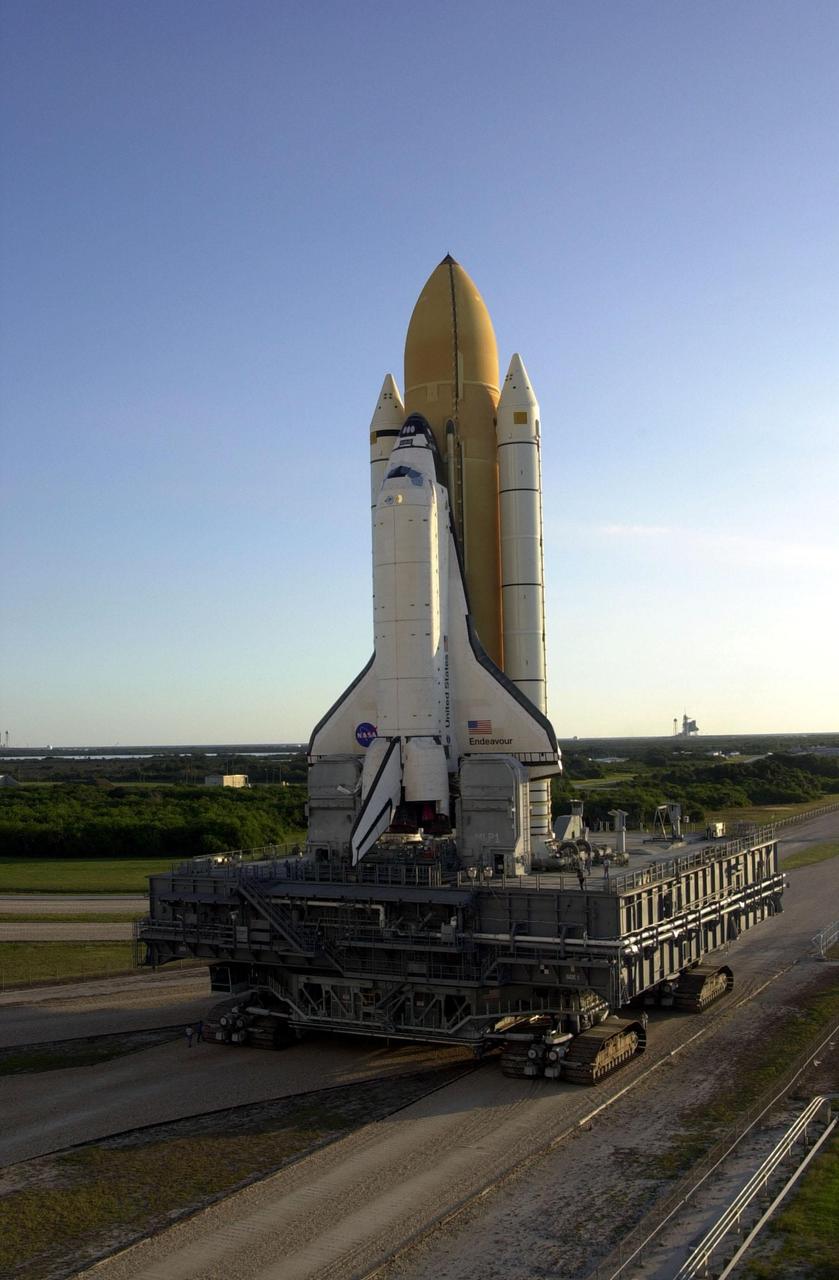
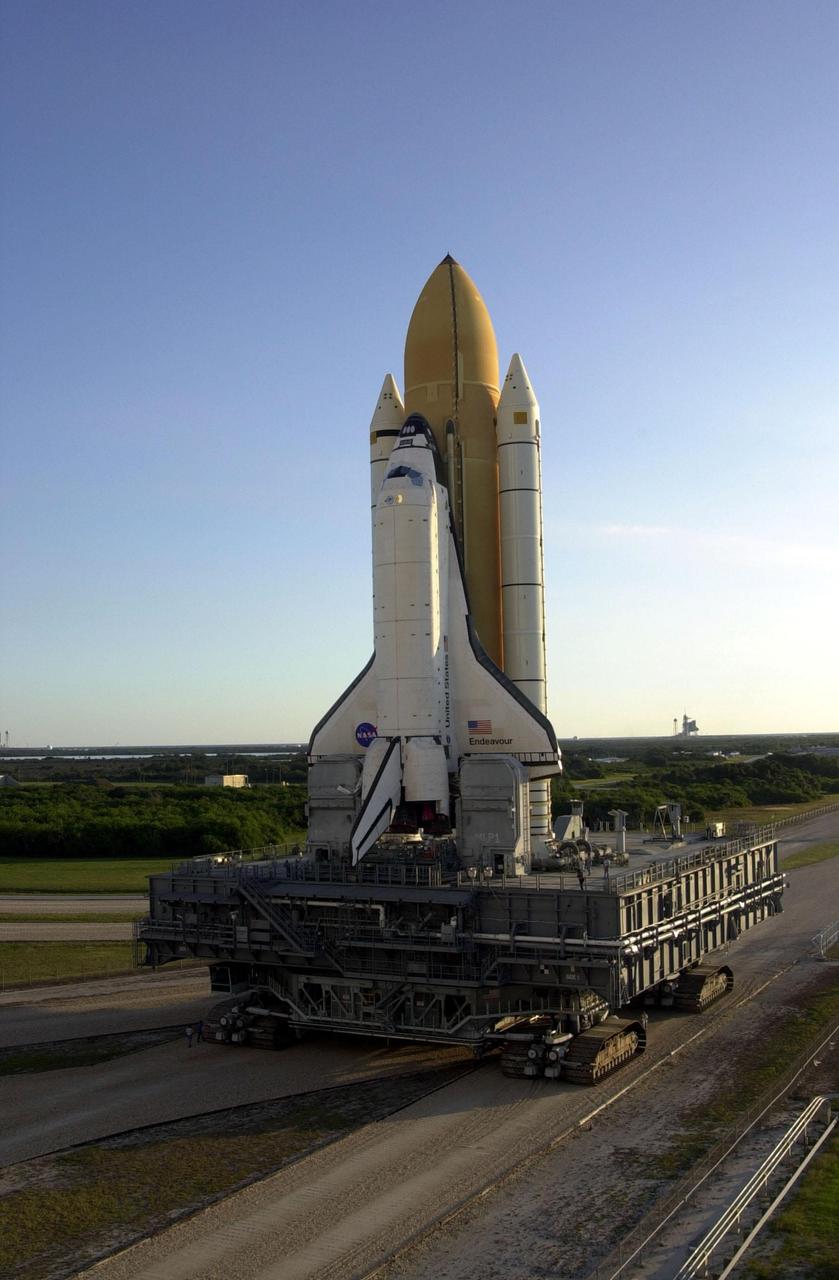
KENNEDY SPACE CENTER, Fla. -- As the early morning sky lights up, Space Shuttle Endeavour inches its way to Launch Pad 39B (on the horizon) via the crawlerway that leads from the Vehicle Assembly Building. The Shuttle is atop the Mobile Launcher Platform (MLP). Visible beneath the MLP is the crawler-transporter, which moves on four double-tracked crawlers. Each shoe on the crawler track weighs a ton. Unloaded, the transporter weighs 6 million pounds and moves at 2 mph. The maximum speed of the loaded transporter is 1 mph. Endeavour is scheduled to be launched Nov. 30 at 10:01 p.m. EST on mission STS-97, the sixth construction flight to the International Space Station. Its payload includes the P6 Integrated Truss Structure and a photovoltaic (PV) module, with giant solar arrays that will provide power to the Station. The mission includes two spacewalks to complete the solar array connections
KSC-00padig052
KENNEDY SPACE CENTER, FLA.  -  A worker in the Orbiter Processing Facility begins attaching the Remote Manipulator System (RMS), or Shuttle arm, into place in Atlantis’ payload bay. The RMS includes the electromechanical arm that maneuvers a payload from the payload bay of the orbiter to its deployment position and then releases it. It can also grapple a free-flying payload, maneuver it to the payload bay of the orbiter and berth it in the orbiter. The RMS arm is 50 feet 3 inches long and 15 inches in diameter. It weighs 905 pounds, and the total system weighs 994 pounds. The RMS has six joints that correspond roughly to the joints of the human arm, with shoulder yaw and pitch joints; an elbow pitch joint; and wrist pitch, yaw and roll joints. The end effector is the unit at the end of the wrist that actually grabs, or grapples, the payload. Atlantis is the designated orbiter to fly on mission STS-121.  The mission has a launch window of July 12 - July 31, 2005.
KSC-05pd-0338
KENNEDY SPACE CENTER, FLA. -- Live TV trucks (far right) from local channels merge at the site of the fallen Mobile Service Tower (MST) and umbilical tower nearby after their demolition. The towers were demolished to make room for Lockheed Martin's 14-acre Vehicle Integration Facility (VIF), under construction. Weighing two million pounds, the umbilical tower was approximately 200 feet high. The taller 300-foot MST weighed five million pounds. About 200 pounds of linear-shaped charges were used to bring down the towers so that the materials can be recycled. The implosion and removal of the tower debris is expected to be completed in two months. The VIF will be used for Lockheed Martin's Atlas V Launch System.
KSC-99pp1220
KENNEDY SPACE CENTER, FLA.  - In the Orbiter Processing Facility, an overhead crane moves the Remote Manipulator System (RMS), or Shuttle arm, toward Atlantis for installation in the payload bay.  The RMS includes the electromechanical arm that maneuvers a payload from the payload bay of the orbiter to its deployment position and then releases it. It can also grapple a free-flying payload, maneuver it to the payload bay of the orbiter and berth it in the orbiter. The RMS arm is 50 feet 3 inches long and 15 inches in diameter. It weighs 905 pounds, and the total system weighs 994 pounds. The RMS has six joints that correspond roughly to the joints of the human arm, with shoulder yaw and pitch joints; an elbow pitch joint; and wrist pitch, yaw and roll joints. The end effector is the unit at the end of the wrist that actually grabs, or grapples, the payload. Atlantis is the designated orbiter to fly on mission STS-121.  The mission has a launch window of July 12 - July 31, 2005.
KSC-05pd-0332
KENNEDY SPACE CENTER, Fla. -- As the early morning sky lights up, Space Shuttle Endeavour inches its way to Launch Pad 39B (on the horizon) via the crawlerway that leads from the Vehicle Assembly Building. The Shuttle is atop the Mobile Launcher Platform (MLP). Visible beneath the MLP is the crawler-transporter, which moves on four double-tracked crawlers. Each shoe on the crawler track weighs a ton. Unloaded, the transporter weighs 6 million pounds and moves at 2 mph. The maximum speed of the loaded transporter is 1 mph. Endeavour is scheduled to be launched Nov. 30 at 10:01 p.m. EST on mission STS-97, the sixth construction flight to the International Space Station. Its payload includes the P6 Integrated Truss Structure and a photovoltaic (PV) module, with giant solar arrays that will provide power to the Station. The mission includes two spacewalks to complete the solar array connections
KSC00padig052
KENNEDY SPACE CENTER, FLA. - In the Orbiter Processing Facility Bay 1 at NASA Kennedy Space Center, the remote manipulator system boom that was removed from Atlantis’ payload bay is lifted out of the way.  The boom will be temporarily stored. The RMS includes the electromechanical arm that maneuvers a payload from the payload bay of the orbiter to its deployment position and then releases it. It can also grapple a free-flying payload, maneuver it to the payload bay of the orbiter and berth it in the orbiter. The RMS arm is 50 feet 3 inches long and 15 inches in diameter. It weighs 905 pounds, and the total system weighs 994 pounds. The RMS has six joints that correspond roughly to the joints of the human arm, with shoulder yaw and pitch joints; an elbow pitch joint; and wrist pitch, yaw and roll joints. The end effector is the unit at the end of the wrist that actually grabs, or grapples, the payload.
KSC-05pd2468
KENNEDY SPACE CENTER, FLA. -In the Orbiter Processing Facility Bay 1 at NASA Kennedy Space Center, a crane is attached to the remote manipulator system boom in Atlantis’ payload bay.  The boom is being removed from Atlantis and will be temporarily stored. The RMS includes the electromechanical arm that maneuvers a payload from the payload bay of the orbiter to its deployment position and then releases it. It can also grapple a free-flying payload, maneuver it to the payload bay of the orbiter and berth it in the orbiter. The RMS arm is 50 feet 3 inches long and 15 inches in diameter. It weighs 905 pounds, and the total system weighs 994 pounds. The RMS has six joints that correspond roughly to the joints of the human arm, with shoulder yaw and pitch joints; an elbow pitch joint; and wrist pitch, yaw and roll joints. The end effector is the unit at the end of the wrist that actually grabs, or grapples, the payload.
KSC-05pd2464
KENNEDY SPACE CENTER, FLA. -- In the Space Station Processing Facility at NASA's Kennedy Space Center, the Columbus Laboratory module is lowered toward a weigh station.  After being weighed, the module will be transferred to the payload canister. The European Space Agency 's largest single contribution to the International Space Station, Columbus will expand the research facilities of the station, providing crew members and scientists around the world the ability to conduct a variety of life, physical and materials science experiments. The module is approximately 23 feet long and 15 feet wide, allowing it to hold 10 large racks of experiments. The module is scheduled to be transferred to Launch Pad 39A in early November, in preparation for its journey to the station. Columbus will fly aboard space shuttle Atlantis on the STS-122 mission, targeted for launch Dec. 6.  Photo credit: NASA/George Shelton

KSC-07pd3024
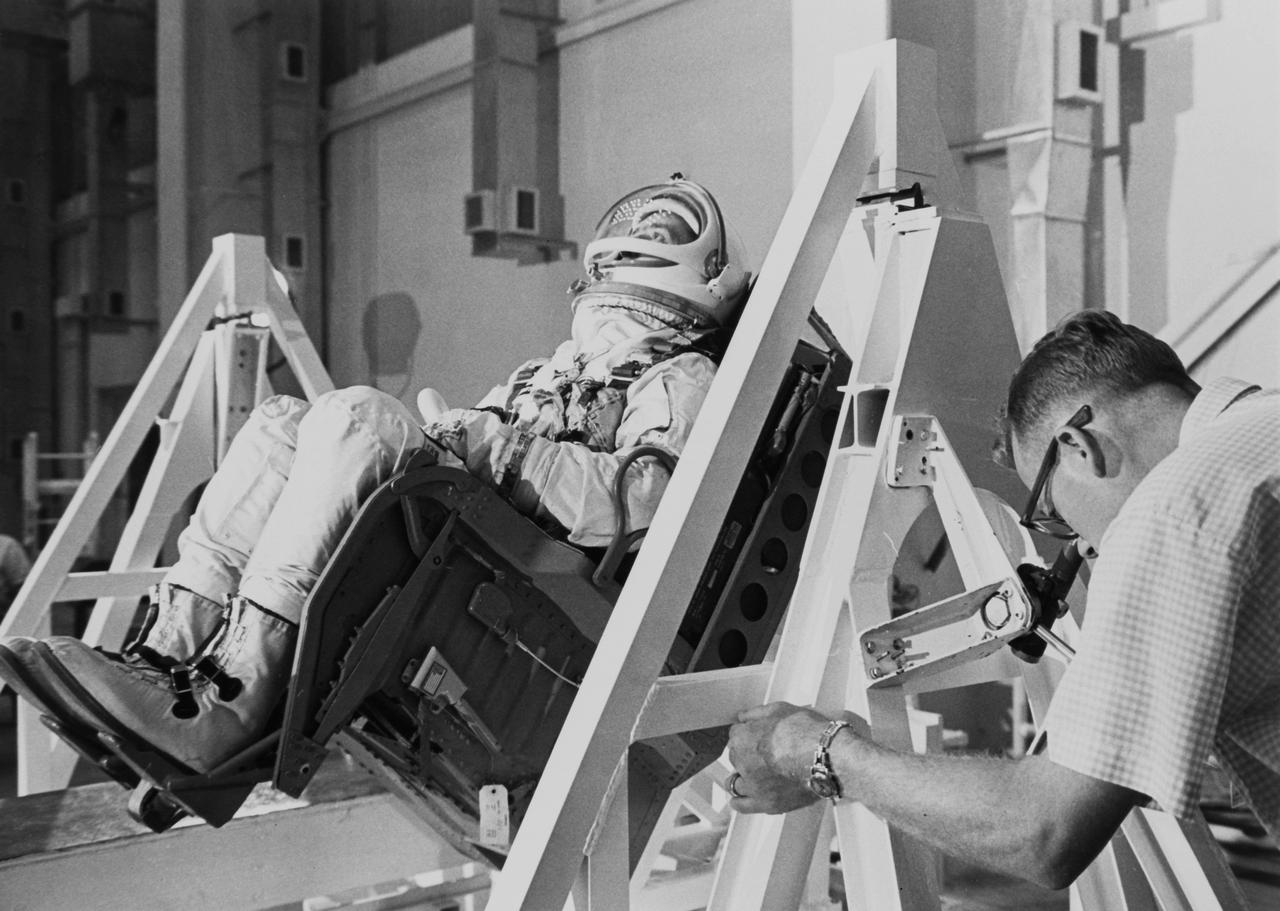
S65-19585 (21 May 1965) --- Astronaut James A. McDivitt, command pilot for the Gemini-Titan 4 prime crew, participates in a weight and balance test during a wet mock simulation exercise at Cape Kennedy, Florida. The two-man Gemini-4 mission, scheduled no earlier than June 3, 1965, will orbit Earth 62 times in four days. Astronaut Edward H. White II (out of frame) is the GT-4 prime crew pilot.
Astronaut Edward White being weighed and balanced in spacecraft seat
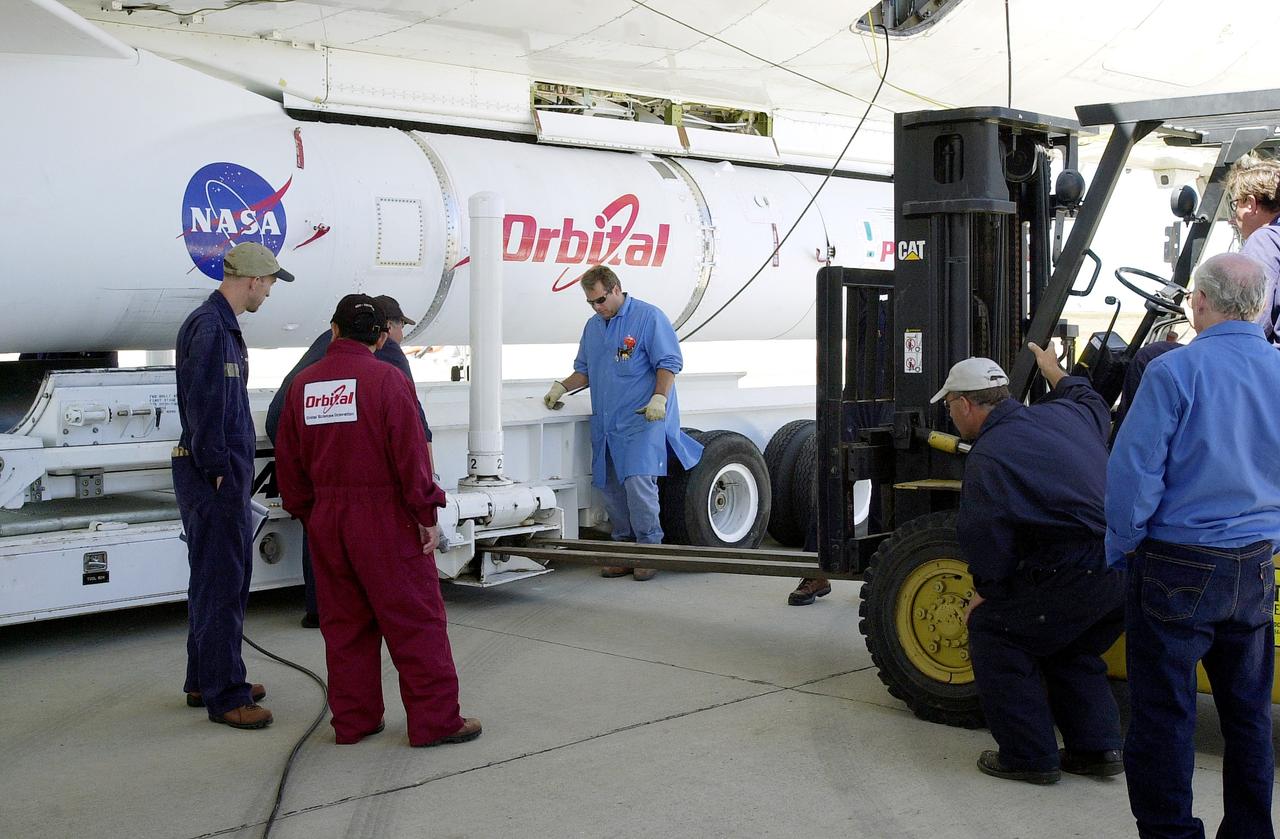
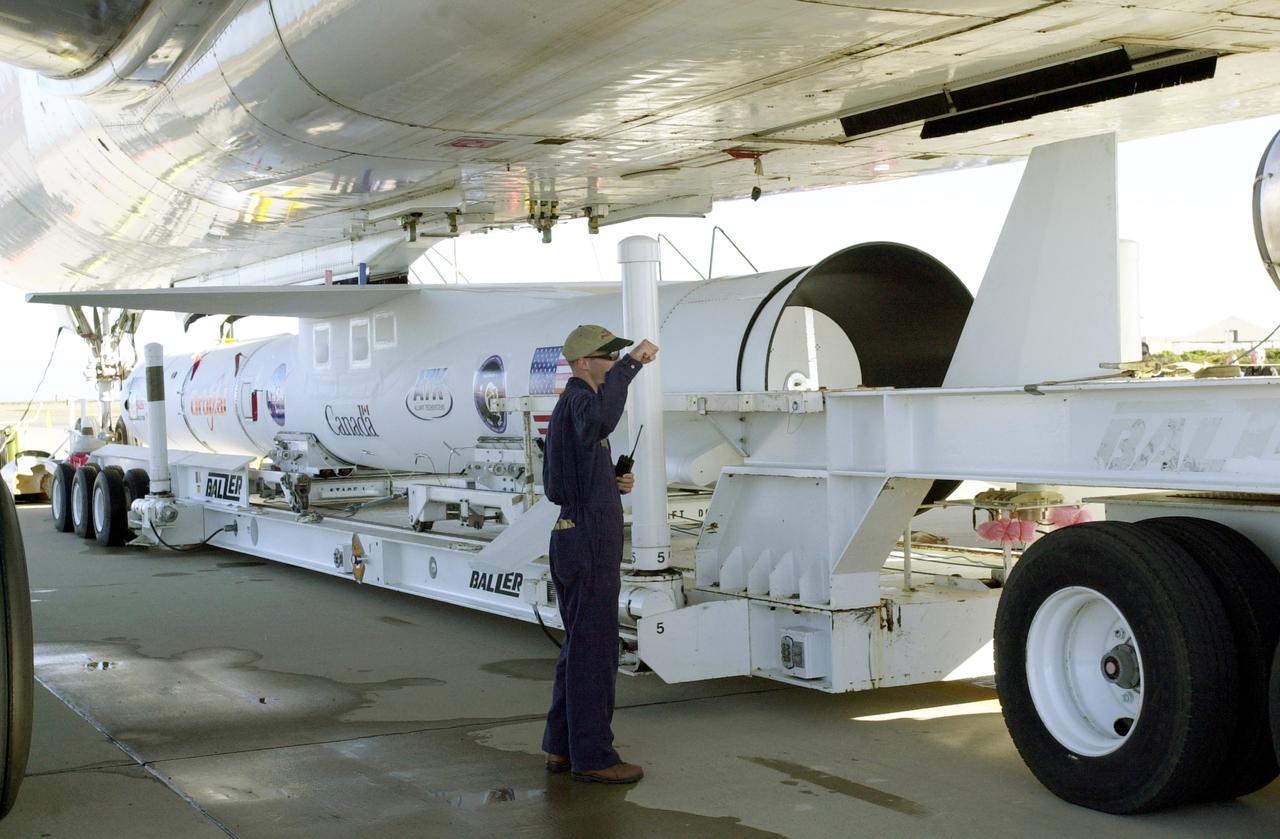
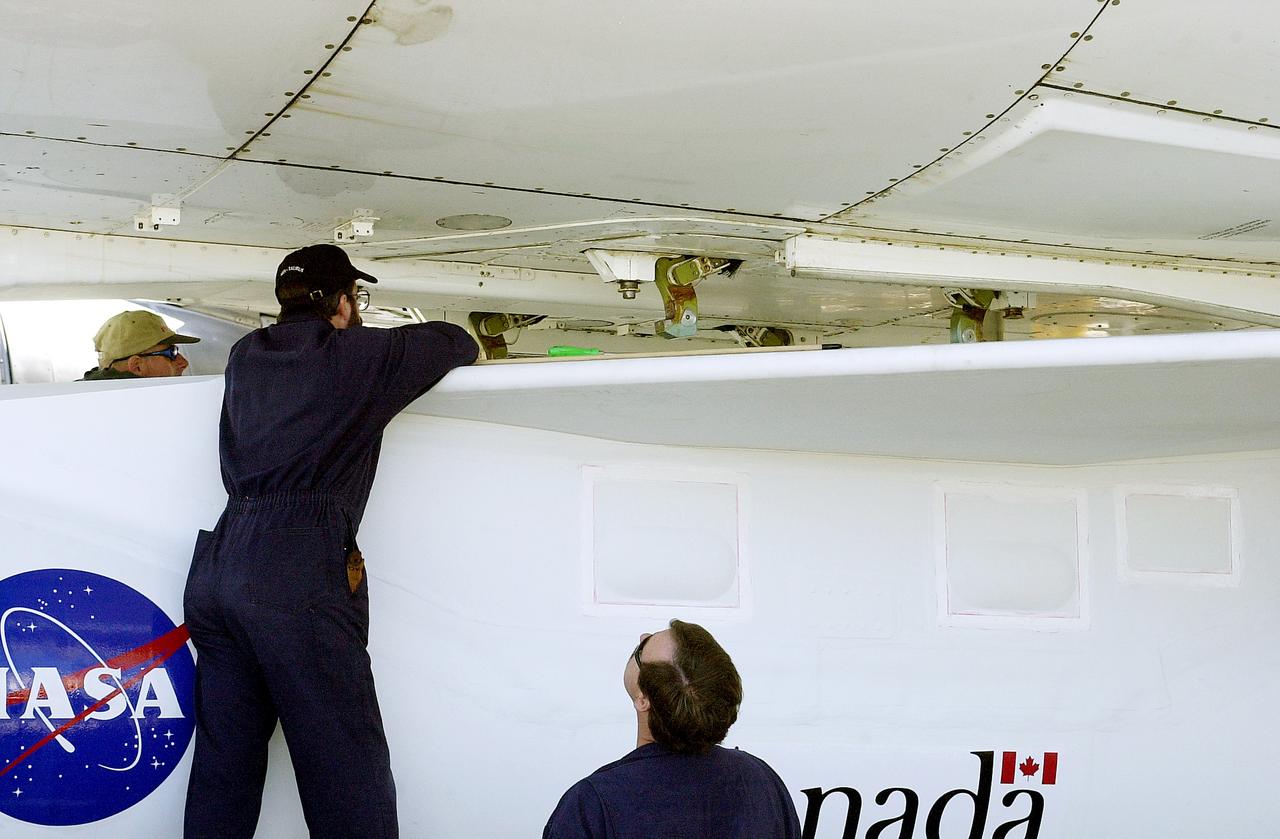
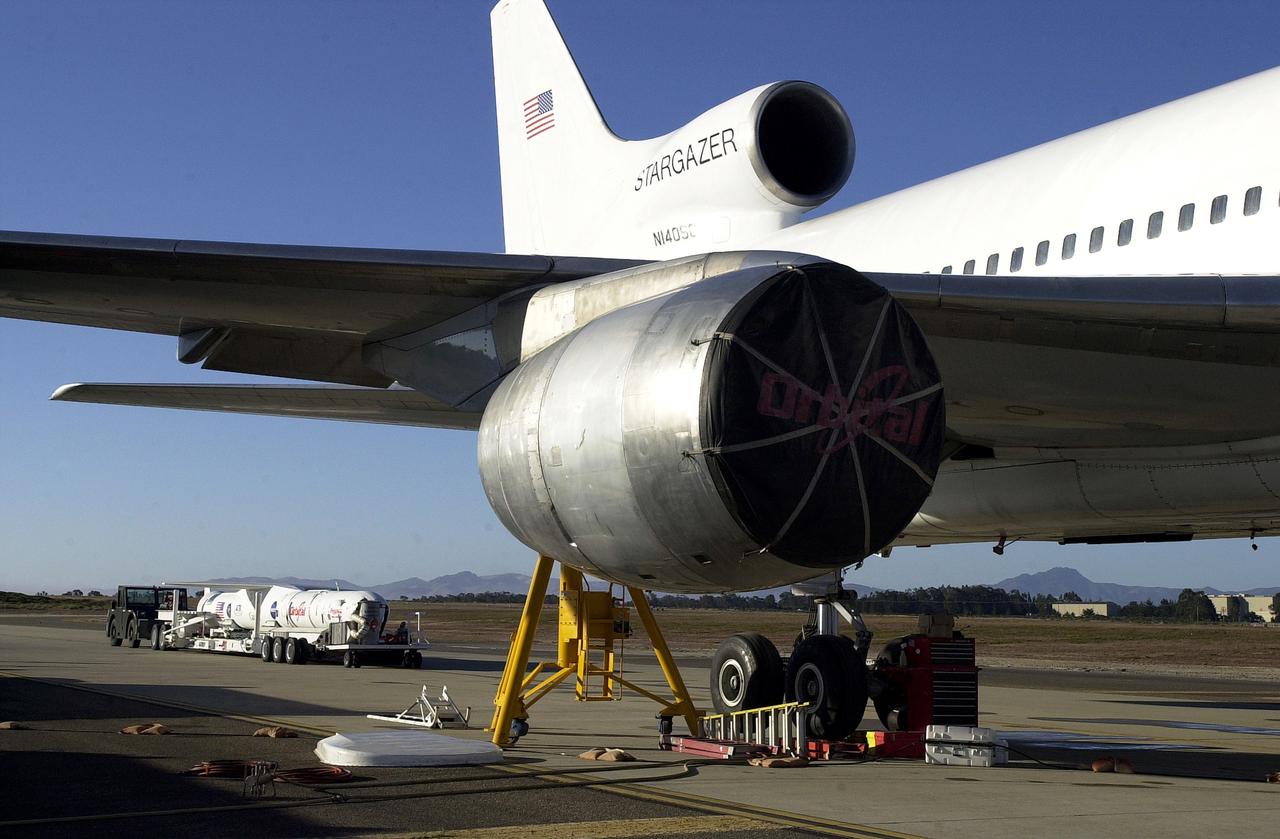
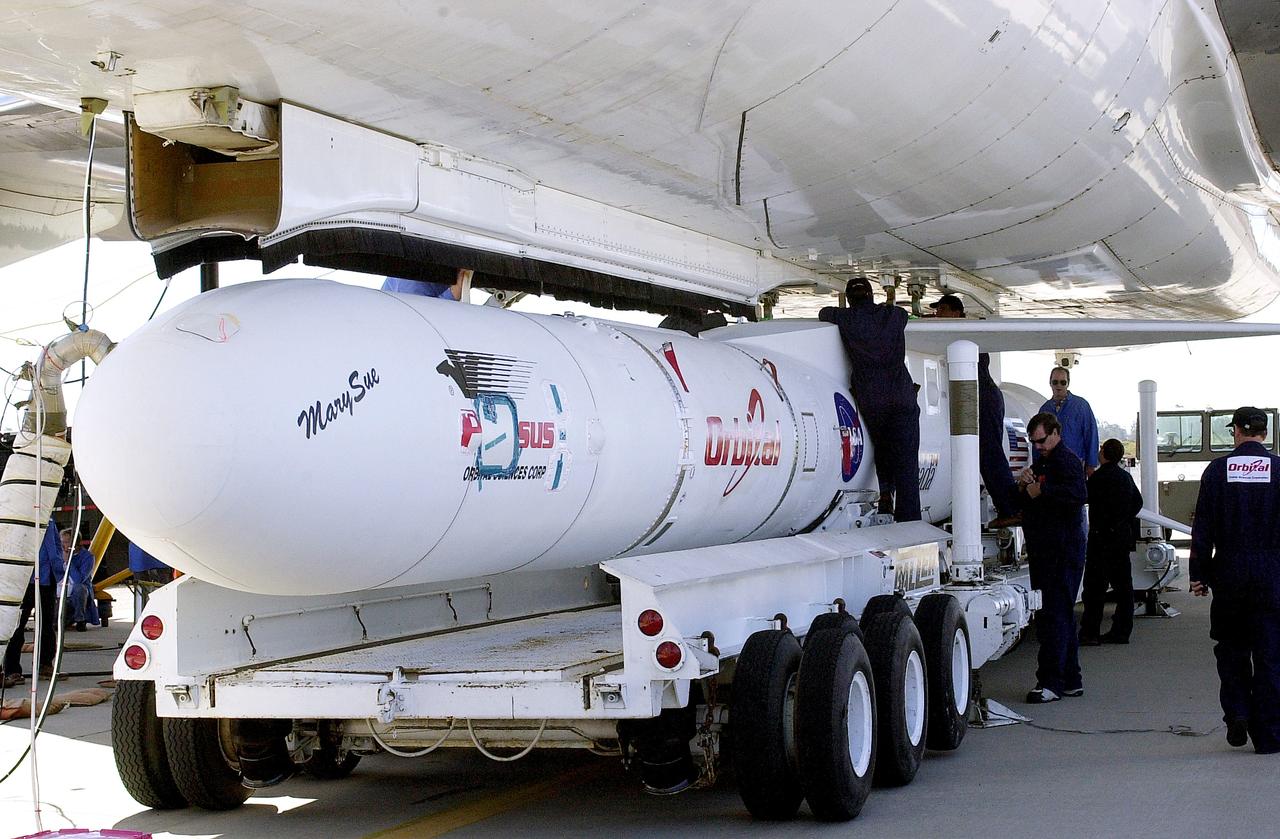
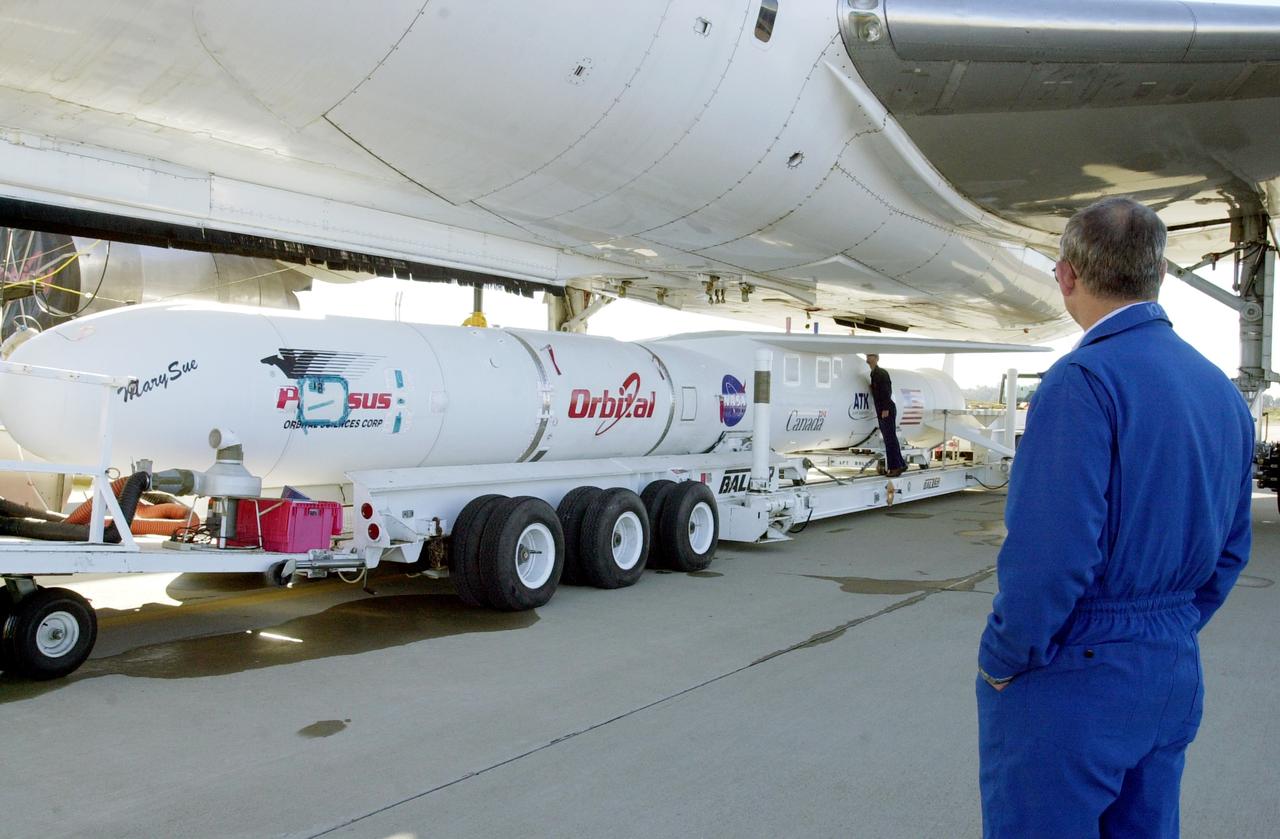
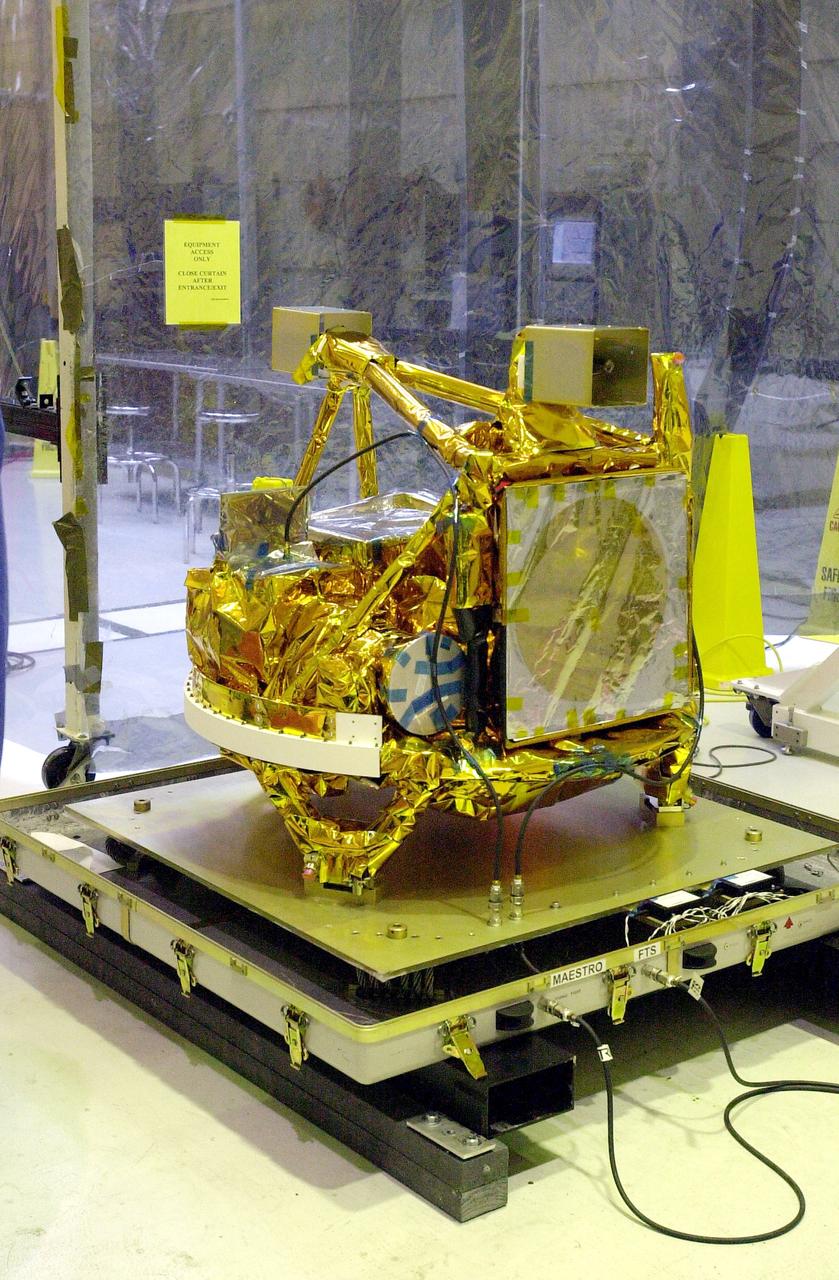
VANDENBERG AIR FORCE BASE, CALIF. -  The SciSat-1 payload and Pegasus launch vehicle are lifted and mated to the L-1011 carrier aircraft.  The SciSat-1 weighs approximately 330 pounds and after launch will be placed in a 400-mile-high polar orbit to investigate processes that control the distribution of ozone in the upper atmosphere. The data from the satellite will provide Canadian and international scientists with improved measurements relating to global ozone processes and help policymakers assess existing environmental policy and develop protective measures for improving the health of our atmosphere, preventing further ozone depletion. The mission is designed to last two years.
VANDENBERG AIR FORCE BASE, CALIF. - The SciSat-1 payload and Pegasus launch vehicle are lifted and mated to the L-1011 carrier aircraft. The SciSat-1 weighs approximately 330 pounds and after launch will be placed in a 400-mile-high polar orbit to investigate processes that control the distribution of ozone in the upper atmosphere. The data from the satellite will provide Canadian and international scientists with improved measurements relating to global ozone processes and help policymakers assess existing environmental policy and develop protective measures for improving the health of our atmosphere, preventing further ozone depletion. The mission is designed to last two years.
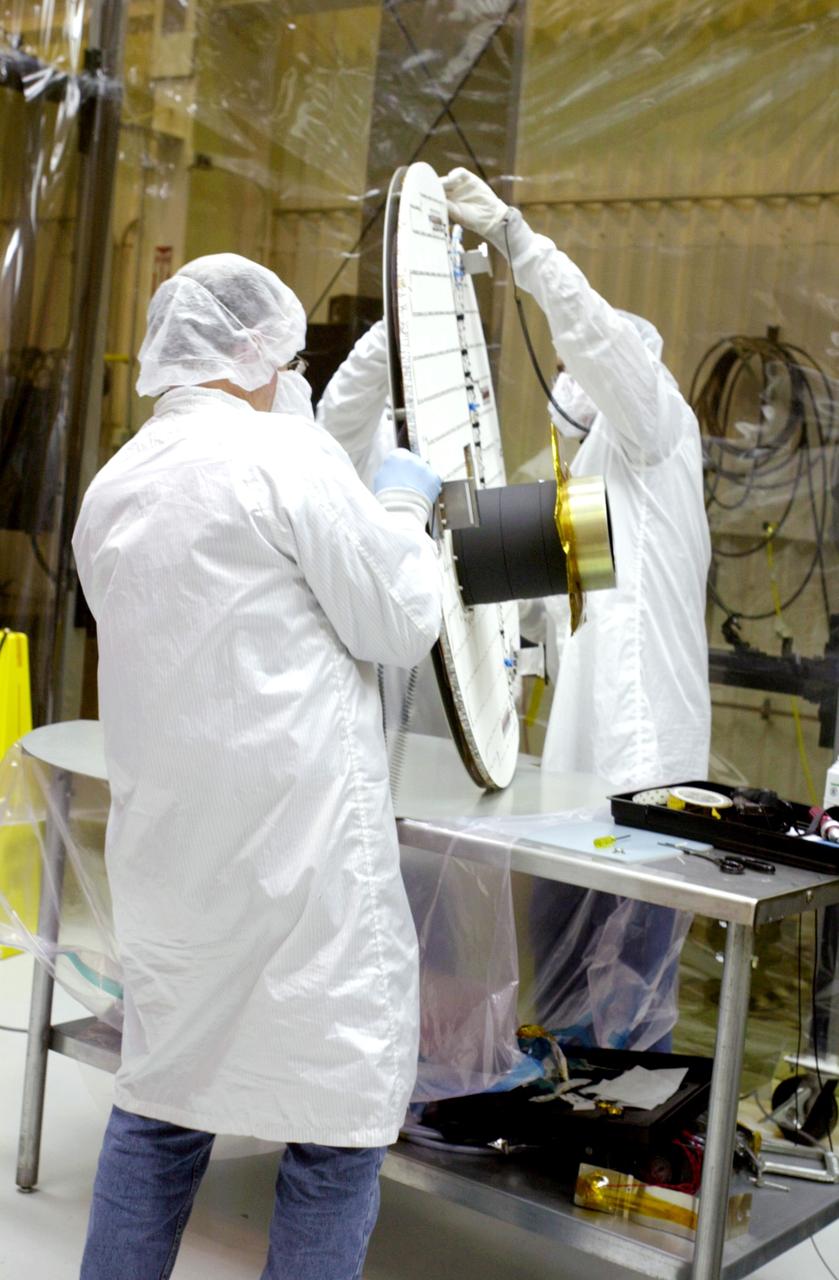
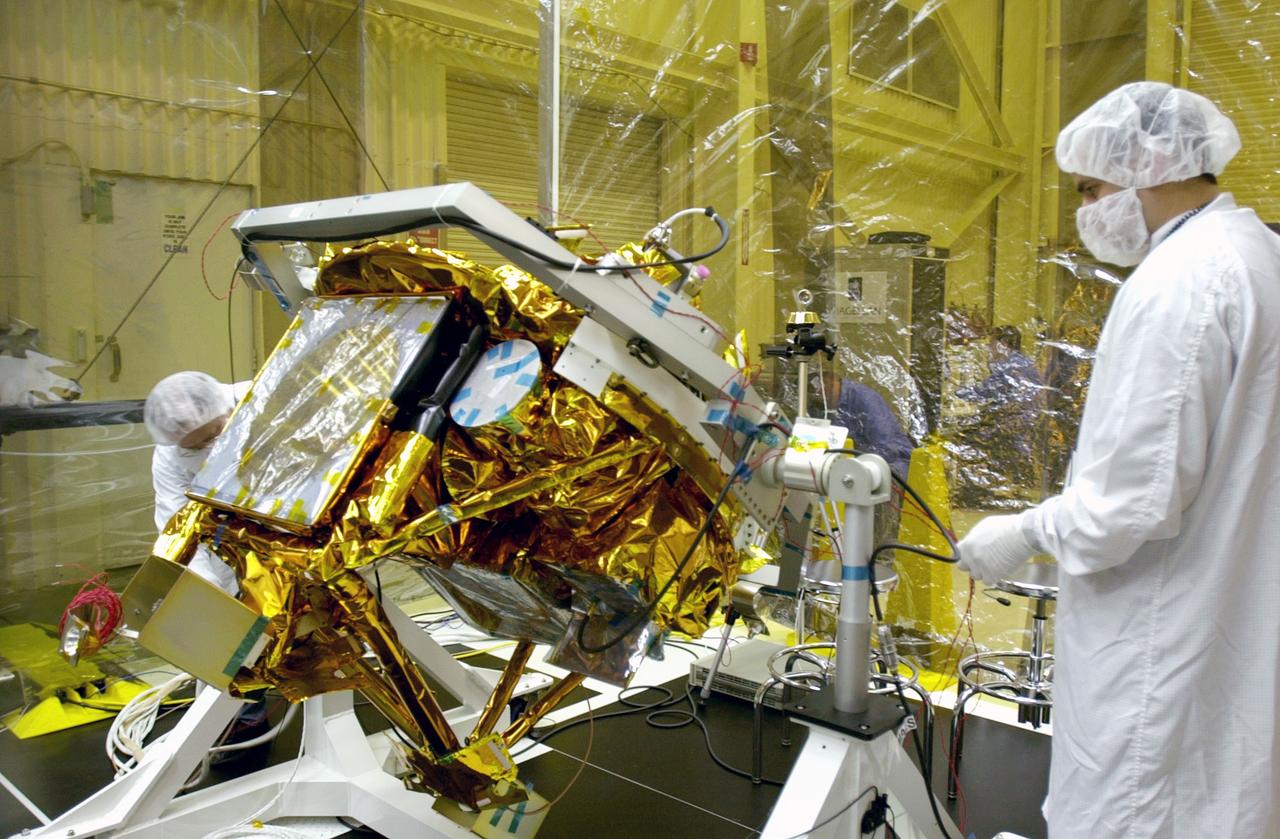
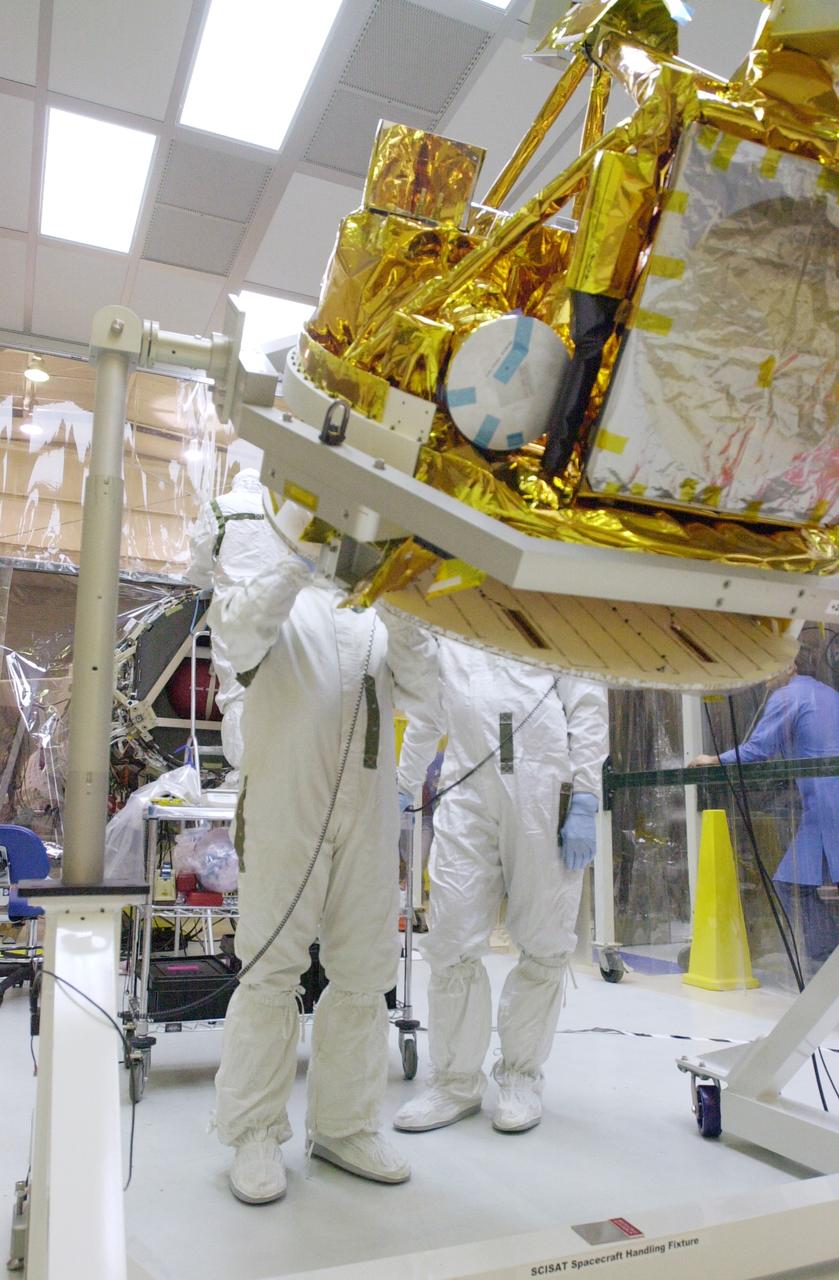
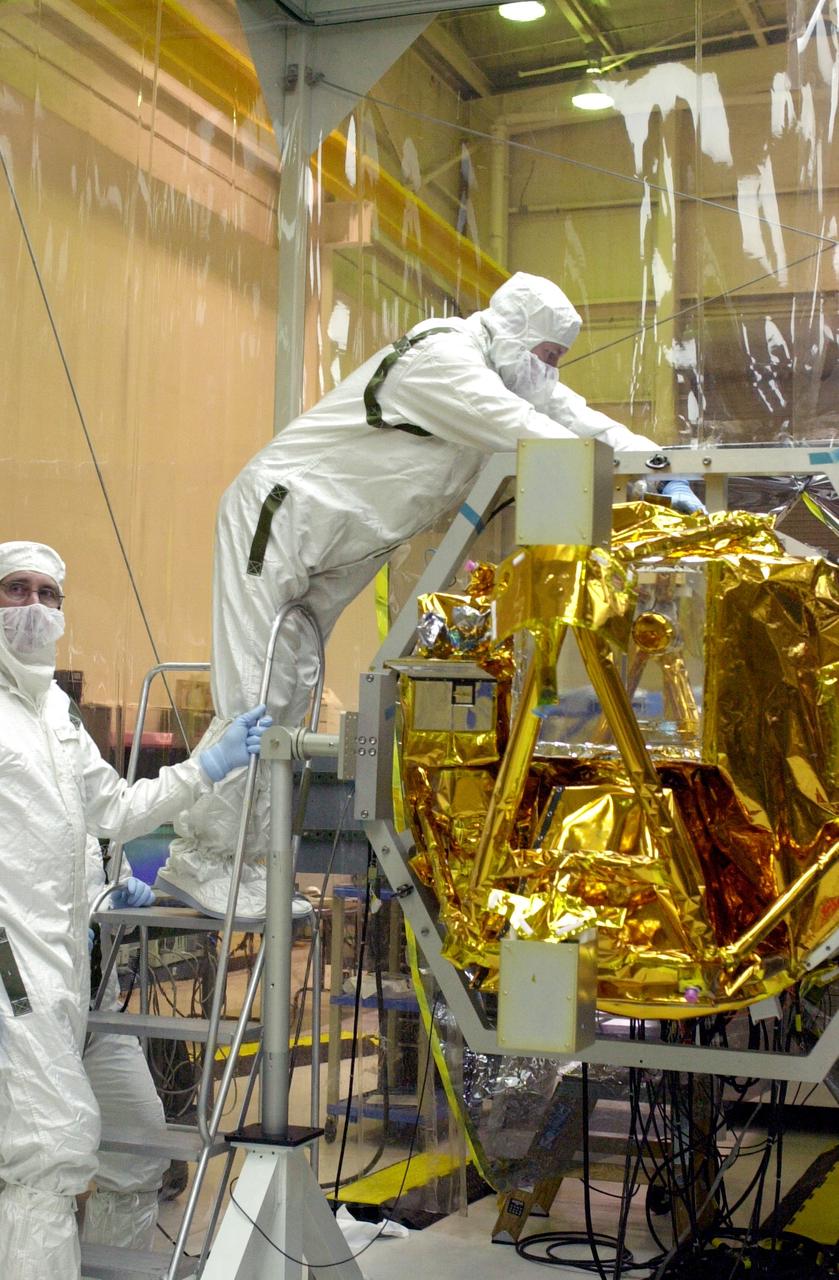
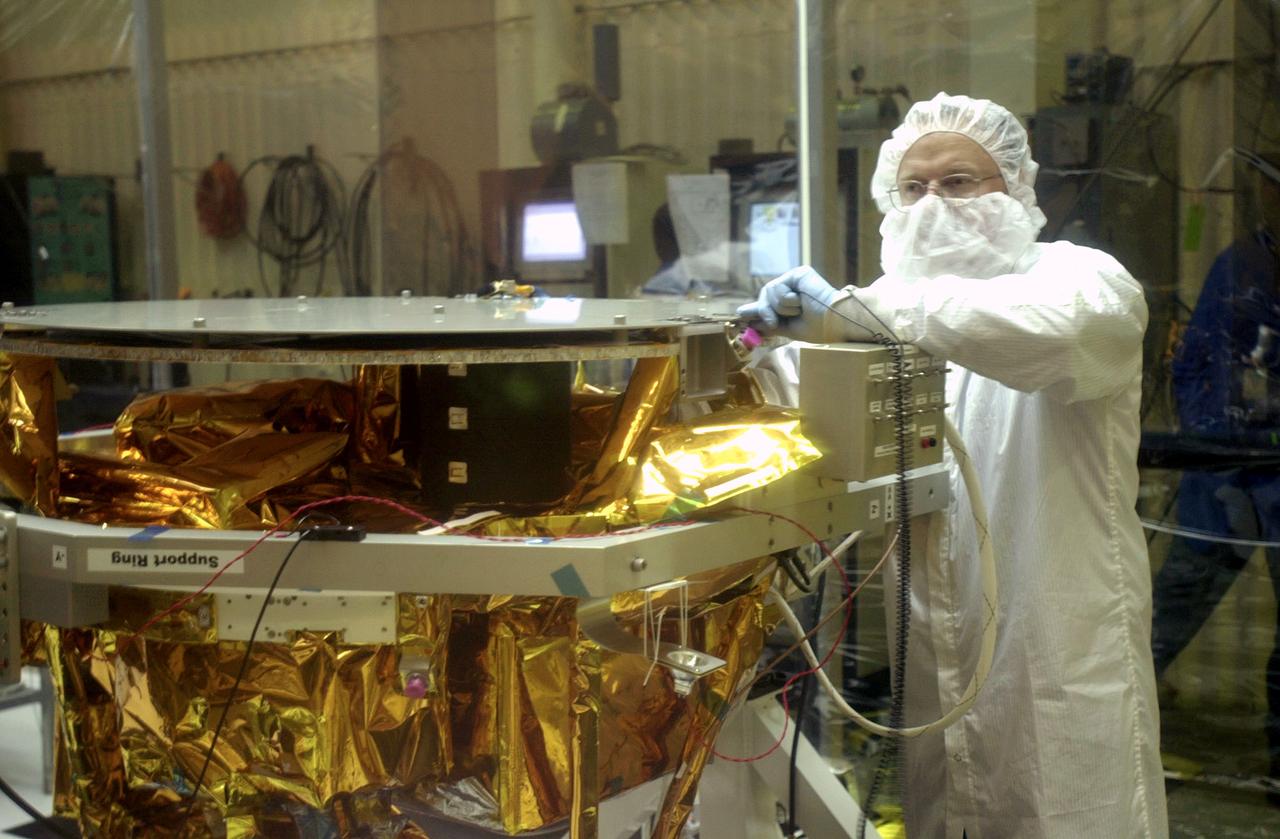
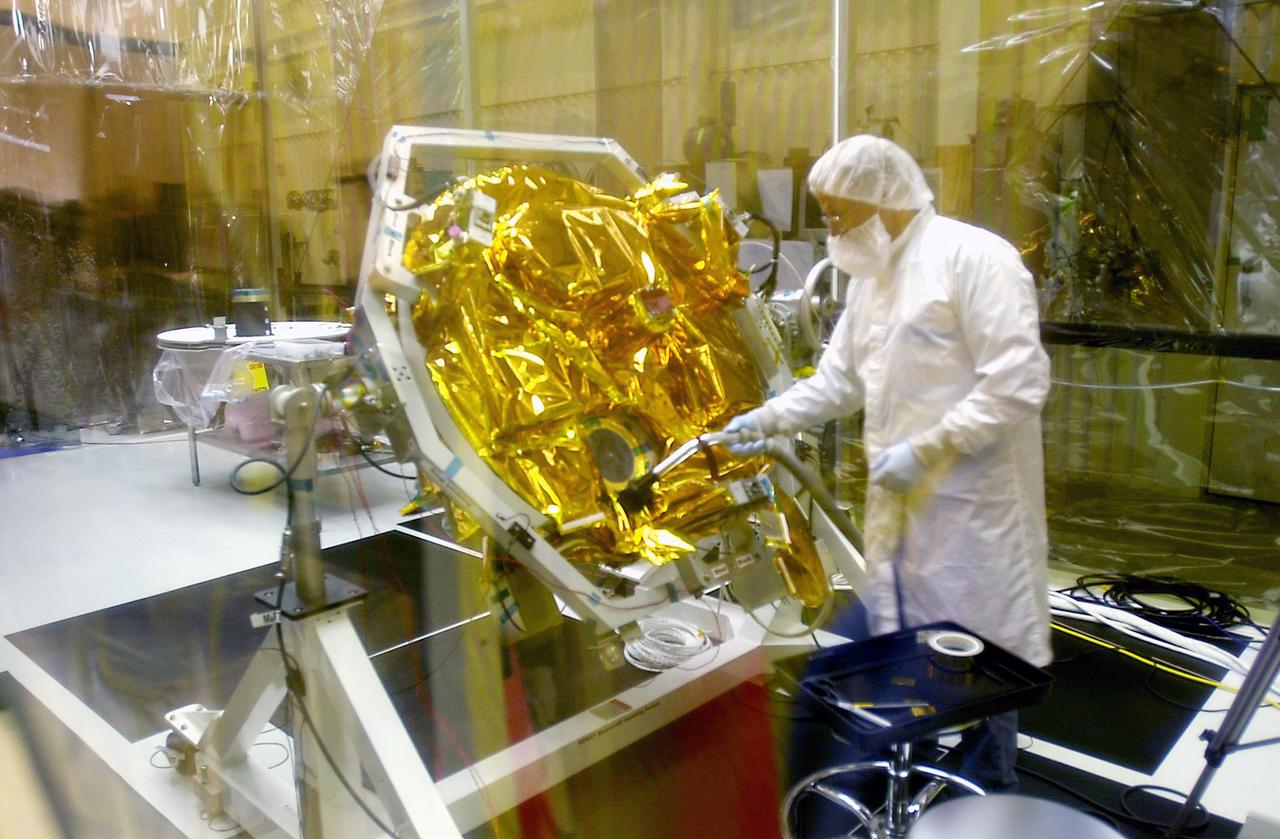
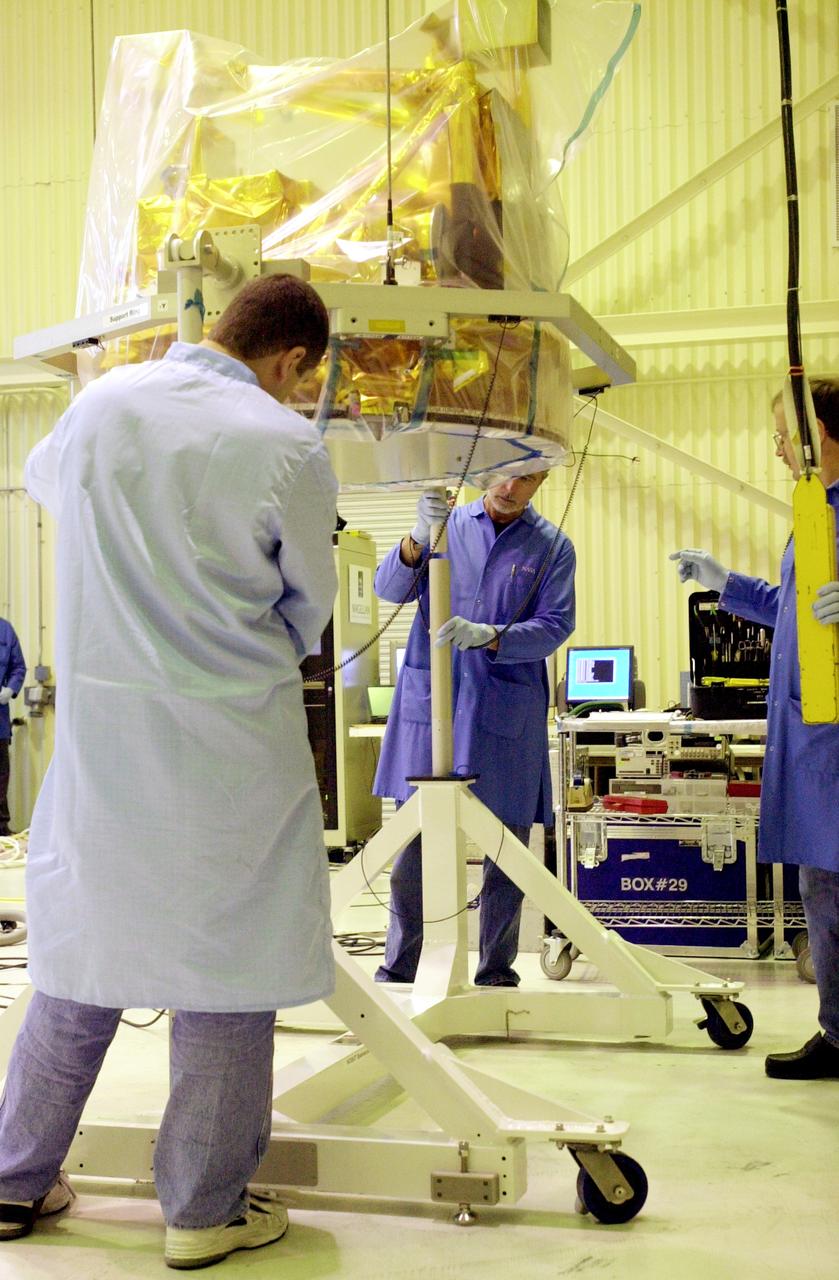
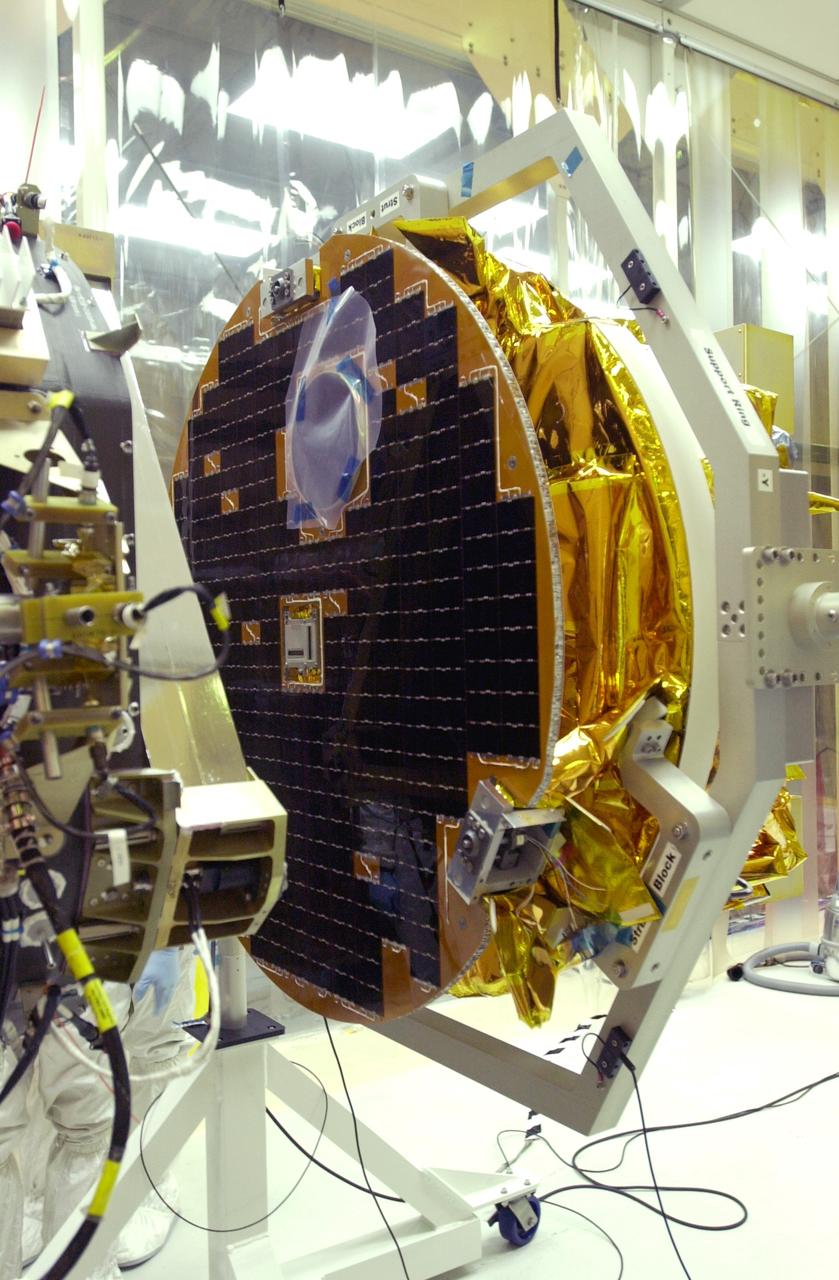
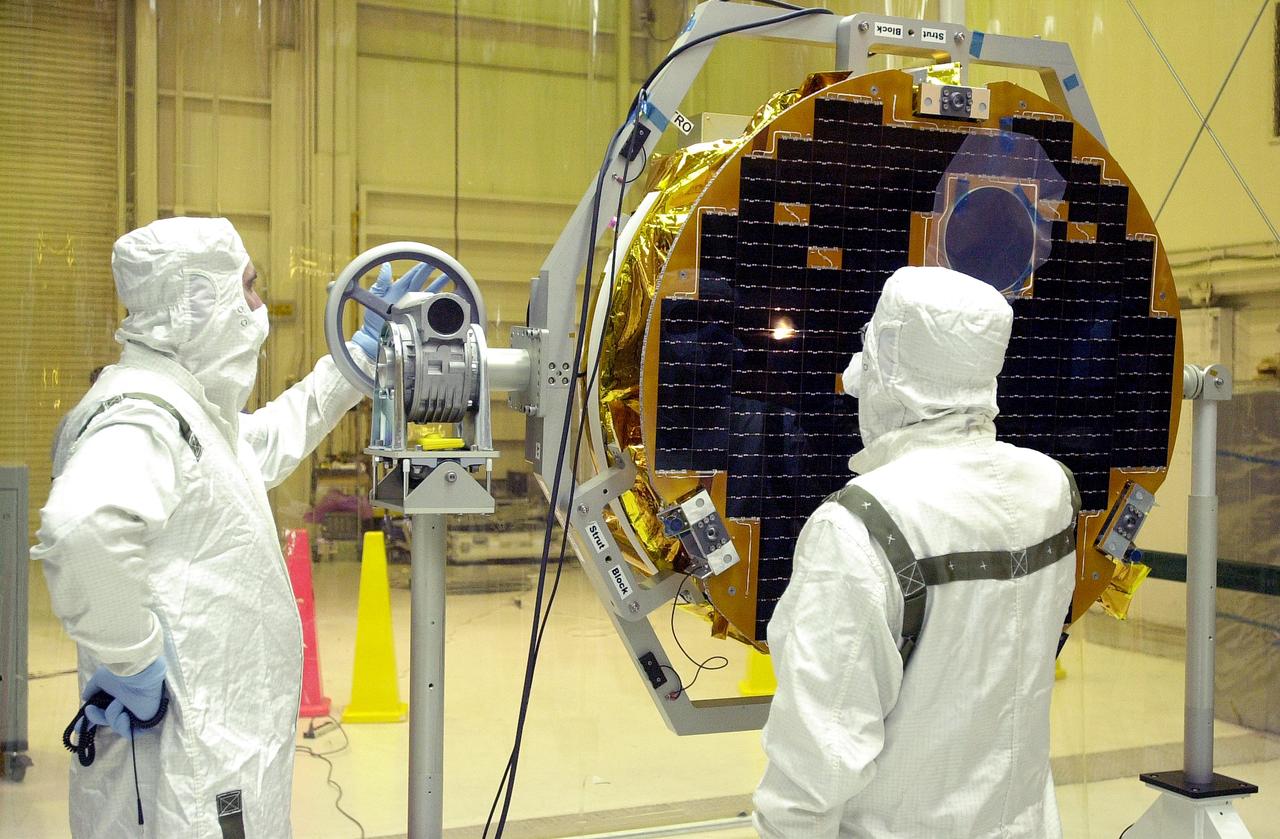
VANDENBERG AIR FORCE BASE, CALIF.- At Vandenberg Air Force Base, Calif., spacecraft functional testing is underway on the SciSat-1. The solar arrays are being attached and the communications systems are also being checked out.   The SciSat-1 weighs approximately 330 pounds and after launch will be placed in a 400-mile-high polar orbit to investigate processes that control the distribution of ozone in the upper atmosphere. The data from the satellite will provide Canadian and international scientists with improved measurements relating to global ozone processes and help policymakers assess existing environmental policy and develop protective measures for improving the health of our atmosphere, preventing further ozone depletion. The mission is designed to last two years.
VANDENBERG AIR FORCE BASE, CALIF.- At Vandenberg Air Force Base, Calif., spacecraft functional testing is underway on the SciSat-1. The solar arrays are being attached and the communications systems are also being checked out. The SciSat-1 weighs approximately 330 pounds and after launch will be placed in a 400-mile-high polar orbit to investigate processes that control the distribution of ozone in the upper atmosphere. The data from the satellite will provide Canadian and international scientists with improved measurements relating to global ozone processes and help policymakers assess existing environmental policy and develop protective measures for improving the health of our atmosphere, preventing further ozone depletion. The mission is designed to last two years.
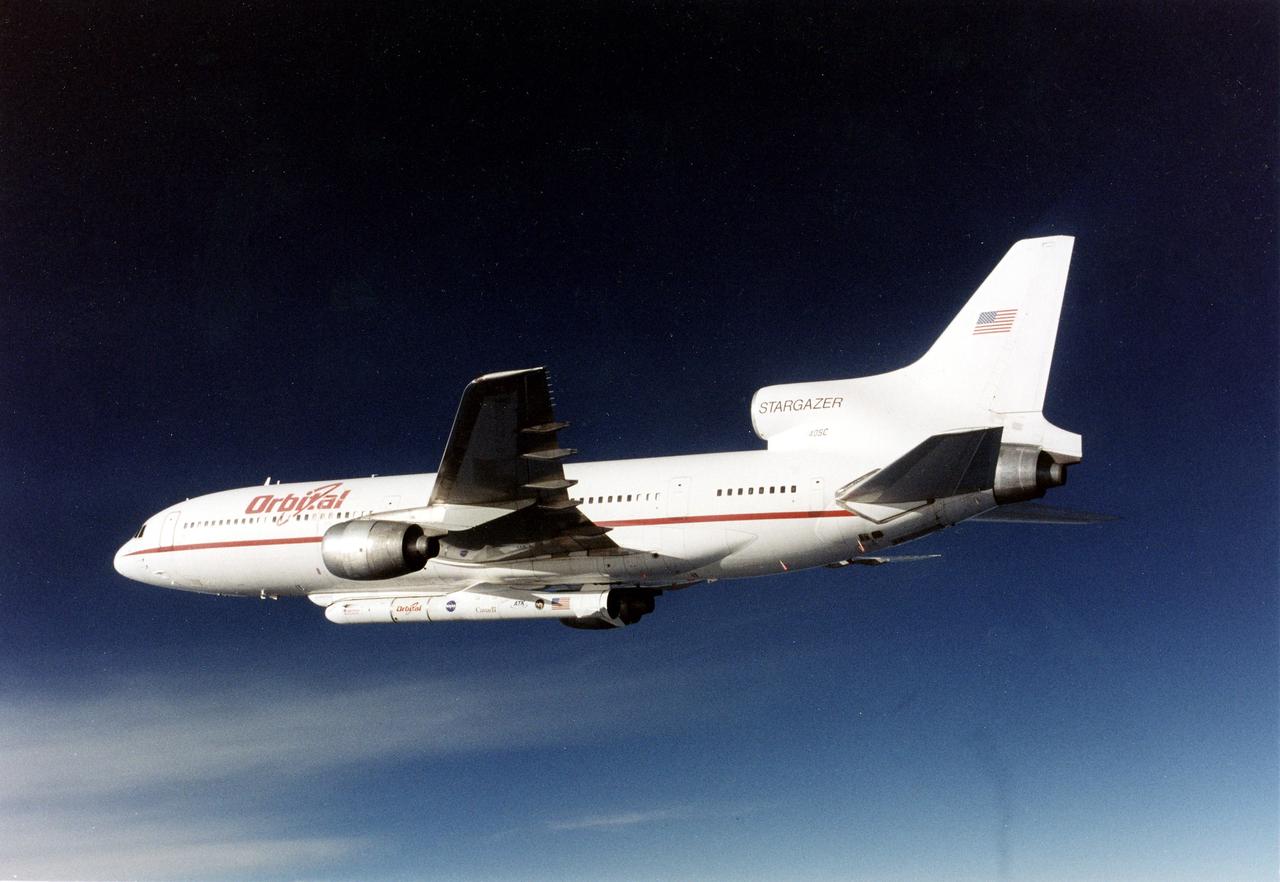
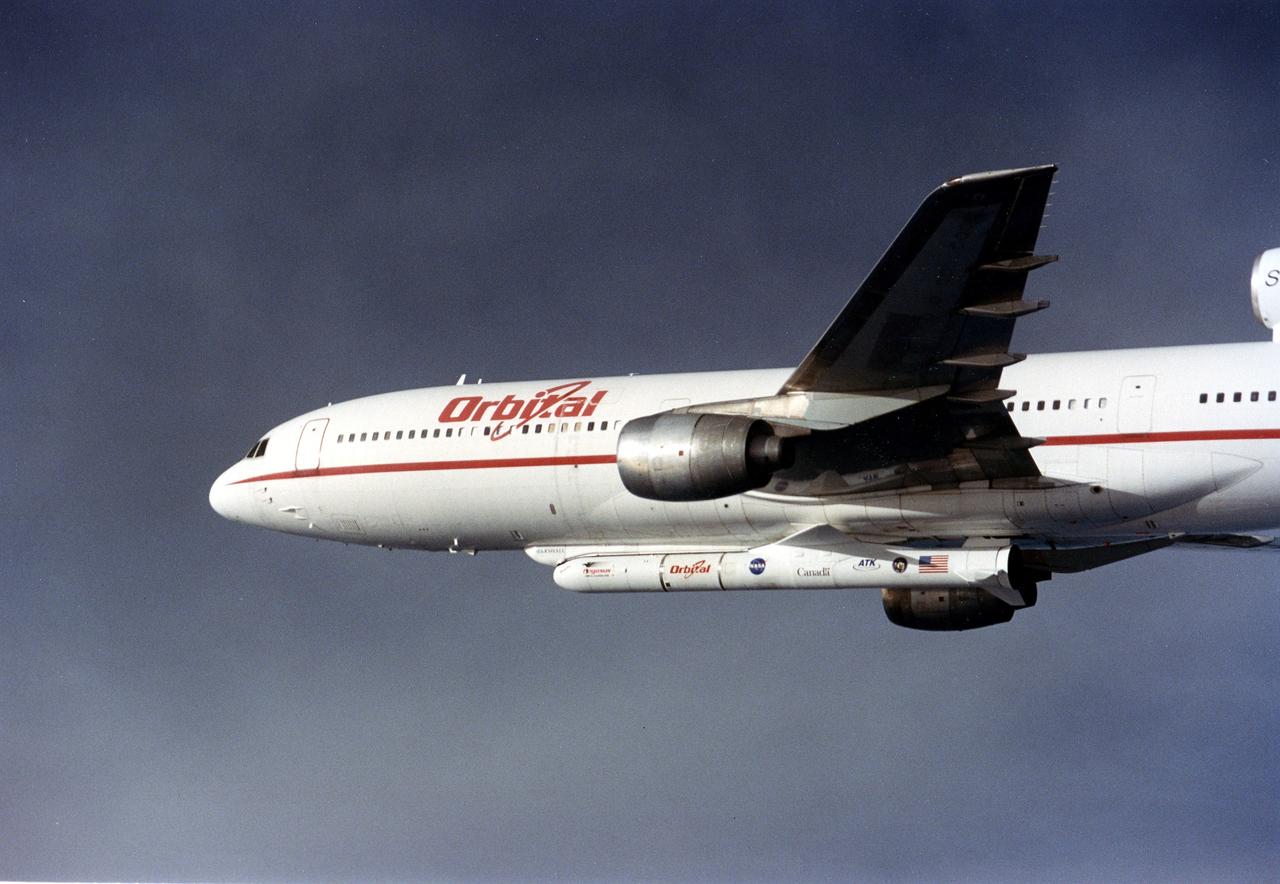
VANDENBERG AIR FORCE BASE, CALIF. -  The L-1011 carrier aircraft is in flight with its cargo of the Pegasus launch vehicle and SciSat-1 spacecraft underneath. The SciSat-1 weighs approximately 330 pounds and after launch will be placed in a 400-mile-high polar orbit to investigate processes that control the distribution of ozone in the upper atmosphere. The data from the satellite will provide Canadian and international scientists with improved measurements relating to global ozone processes and help policymakers assess existing environmental policy and develop protective measures for improving the health of our atmosphere, preventing further ozone depletion. The mission is designed to last two years.
VANDENBERG AIR FORCE BASE, CALIF. - The L-1011 carrier aircraft is in flight with its cargo of the Pegasus launch vehicle and SciSat-1 spacecraft underneath. The SciSat-1 weighs approximately 330 pounds and after launch will be placed in a 400-mile-high polar orbit to investigate processes that control the distribution of ozone in the upper atmosphere. The data from the satellite will provide Canadian and international scientists with improved measurements relating to global ozone processes and help policymakers assess existing environmental policy and develop protective measures for improving the health of our atmosphere, preventing further ozone depletion. The mission is designed to last two years.
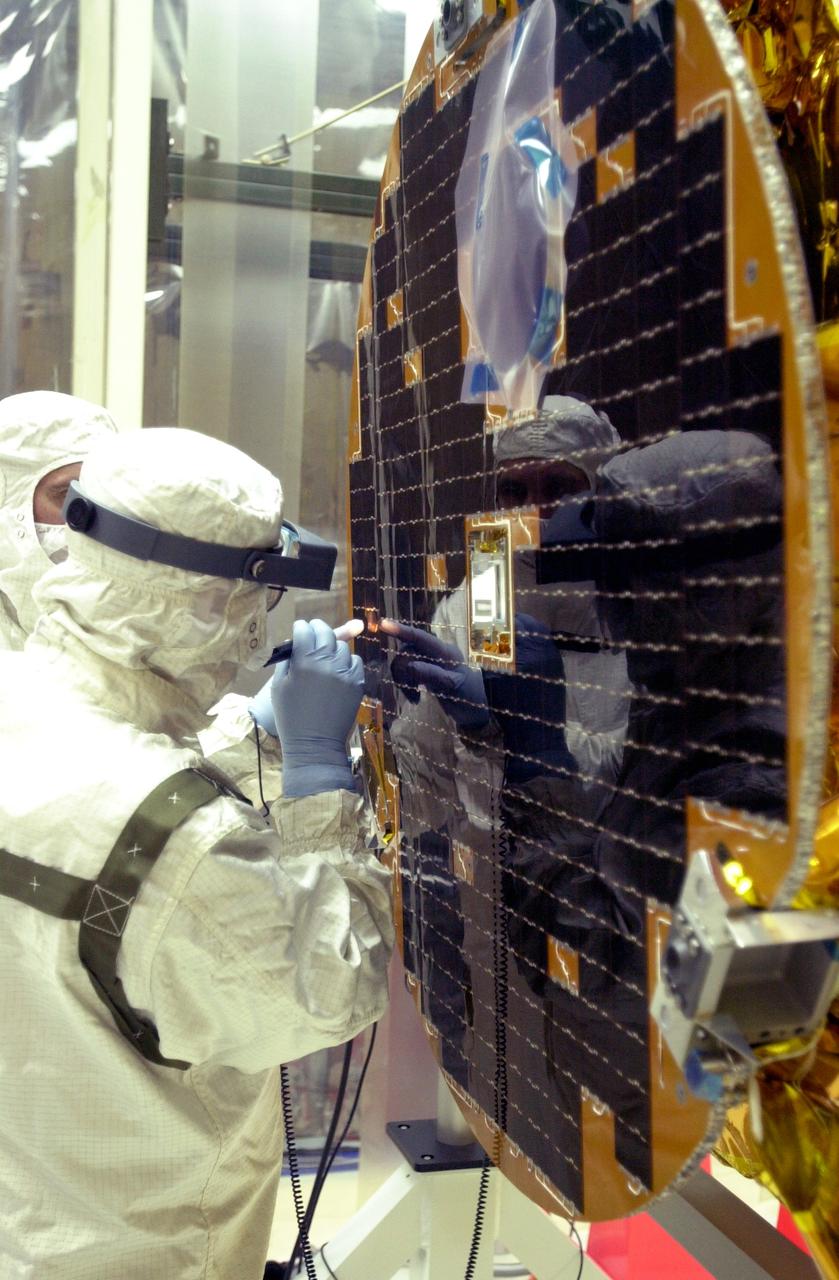
VANDENBERG AIR FORCE BASE, CALIF. -  At Vandenberg AFB, Calif., a solar array is installed on the SciSat-1 spacecraft.  The SciSat-1 weighs approximately 330 pounds and after launch will be placed in a 400-mile-high polar orbit to investigate processes that control the distribution of ozone in the upper atmosphere. The data from the satellite will provide Canadian and international scientists with improved measurements relating to global ozone processes and help policymakers assess existing environmental policy and develop protective measures for improving the health of our atmosphere, preventing further ozone depletion. The mission is designed to last two years.
VANDENBERG AIR FORCE BASE, CALIF. - At Vandenberg AFB, Calif., a solar array is installed on the SciSat-1 spacecraft. The SciSat-1 weighs approximately 330 pounds and after launch will be placed in a 400-mile-high polar orbit to investigate processes that control the distribution of ozone in the upper atmosphere. The data from the satellite will provide Canadian and international scientists with improved measurements relating to global ozone processes and help policymakers assess existing environmental policy and develop protective measures for improving the health of our atmosphere, preventing further ozone depletion. The mission is designed to last two years.
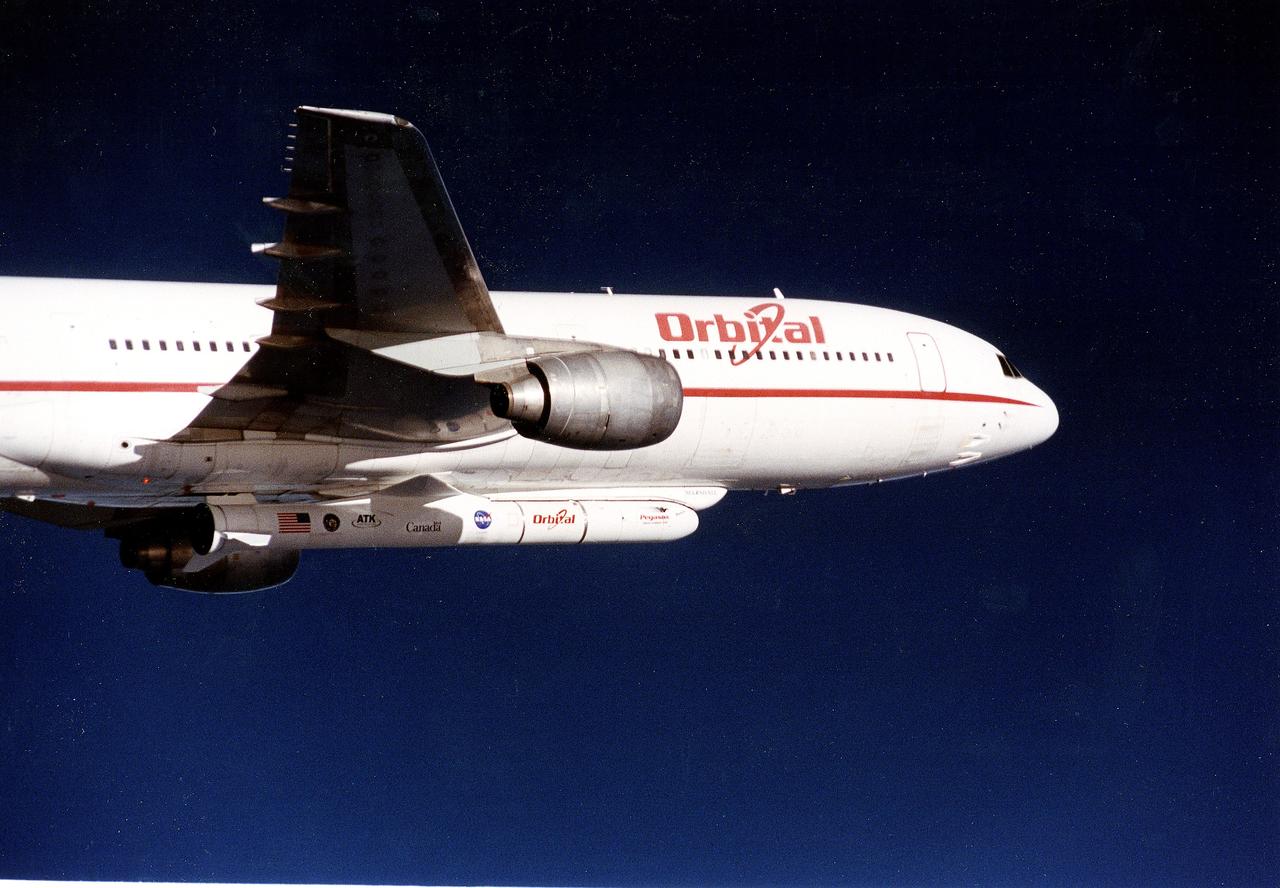
VANDENBERG AIR FORCE BASE, CALIF. -  The L-1011 carrier aircraft is in flight with its cargo of the Pegasus launch vehicle and SciSat-1 spacecraft underneath.  The SciSat-1 weighs approximately 330 pounds and after launch will be placed in a 400-mile-high polar orbit to investigate processes that control the distribution of ozone in the upper atmosphere. The data from the satellite will provide Canadian and international scientists with improved measurements relating to global ozone processes and help policymakers assess existing environmental policy and develop protective measures for improving the health of our atmosphere, preventing further ozone depletion. The mission is designed to last two years.
VANDENBERG AIR FORCE BASE, CALIF. - The L-1011 carrier aircraft is in flight with its cargo of the Pegasus launch vehicle and SciSat-1 spacecraft underneath. The SciSat-1 weighs approximately 330 pounds and after launch will be placed in a 400-mile-high polar orbit to investigate processes that control the distribution of ozone in the upper atmosphere. The data from the satellite will provide Canadian and international scientists with improved measurements relating to global ozone processes and help policymakers assess existing environmental policy and develop protective measures for improving the health of our atmosphere, preventing further ozone depletion. The mission is designed to last two years.
VANDENBERG AIR FORCE BASE, CALIF. -  At Vandenberg AFB, Calif., a solar array is tested before installing on the SciSat-1 spacecraft.  The SciSat-1 weighs approximately 330 pounds and after launch will be placed in a 400-mile-high polar orbit to investigate processes that control the distribution of ozone in the upper atmosphere. The data from the satellite will provide Canadian and international scientists with improved measurements relating to global ozone processes and help policymakers assess existing environmental policy and develop protective measures for improving the health of our atmosphere, preventing further ozone depletion. The mission is designed to last two years.
VANDENBERG AIR FORCE BASE, CALIF. - At Vandenberg AFB, Calif., a solar array is tested before installing on the SciSat-1 spacecraft. The SciSat-1 weighs approximately 330 pounds and after launch will be placed in a 400-mile-high polar orbit to investigate processes that control the distribution of ozone in the upper atmosphere. The data from the satellite will provide Canadian and international scientists with improved measurements relating to global ozone processes and help policymakers assess existing environmental policy and develop protective measures for improving the health of our atmosphere, preventing further ozone depletion. The mission is designed to last two years.
VANDENBERG AIR FORCE BASE, CALIF. -  At Vandenberg AFB, Calif., a solar array is tested before installing on the SciSat-1 spacecraft.  The SciSat-1 weighs approximately 330 pounds and after launch will be placed in a 400-mile-high polar orbit to investigate processes that control the distribution of ozone in the upper atmosphere. The data from the satellite will provide Canadian and international scientists with improved measurements relating to global ozone processes and help policymakers assess existing environmental policy and develop protective measures for improving the health of our atmosphere, preventing further ozone depletion. The mission is designed to last two years.
VANDENBERG AIR FORCE BASE, CALIF. - At Vandenberg AFB, Calif., a solar array is tested before installing on the SciSat-1 spacecraft. The SciSat-1 weighs approximately 330 pounds and after launch will be placed in a 400-mile-high polar orbit to investigate processes that control the distribution of ozone in the upper atmosphere. The data from the satellite will provide Canadian and international scientists with improved measurements relating to global ozone processes and help policymakers assess existing environmental policy and develop protective measures for improving the health of our atmosphere, preventing further ozone depletion. The mission is designed to last two years.
VANDENBERG AIR FORCE BASE, CALIF. -  The SciSat-1 payload and Pegasus launch vehicle are lifted and mated to the L-1011 carrier aircraft.  The SciSat-1 weighs approximately 330 pounds and after launch will be placed in a 400-mile-high polar orbit to investigate processes that control the distribution of ozone in the upper atmosphere. The data from the satellite will provide Canadian and international scientists with improved measurements relating to global ozone processes and help policymakers assess existing environmental policy and develop protective measures for improving the health of our atmosphere, preventing further ozone depletion. The mission is designed to last two years.
VANDENBERG AIR FORCE BASE, CALIF. - The SciSat-1 payload and Pegasus launch vehicle are lifted and mated to the L-1011 carrier aircraft. The SciSat-1 weighs approximately 330 pounds and after launch will be placed in a 400-mile-high polar orbit to investigate processes that control the distribution of ozone in the upper atmosphere. The data from the satellite will provide Canadian and international scientists with improved measurements relating to global ozone processes and help policymakers assess existing environmental policy and develop protective measures for improving the health of our atmosphere, preventing further ozone depletion. The mission is designed to last two years.
VANDENBERG AIR FORCE BASE, CALIF. -    Workers mate the Pegasus , with its cargo of the SciSat-1 payload to the L-1011 carrier aircraft.  The SciSat-1 weighs approximately 330 pounds and after launch will be placed in a 400-mile-high polar orbit to investigate processes that control the distribution of ozone in the upper atmosphere. The data from the satellite will provide Canadian and international scientists with improved measurements relating to global ozone processes and help policymakers assess existing environmental policy and develop protective measures for improving the health of our atmosphere, preventing further ozone depletion. The mission is designed to last two years.
VANDENBERG AIR FORCE BASE, CALIF. - Workers mate the Pegasus , with its cargo of the SciSat-1 payload to the L-1011 carrier aircraft. The SciSat-1 weighs approximately 330 pounds and after launch will be placed in a 400-mile-high polar orbit to investigate processes that control the distribution of ozone in the upper atmosphere. The data from the satellite will provide Canadian and international scientists with improved measurements relating to global ozone processes and help policymakers assess existing environmental policy and develop protective measures for improving the health of our atmosphere, preventing further ozone depletion. The mission is designed to last two years.
VANDENBERG AIR FORCE BASE, CALIF.- At Vandenberg Air Force Base, Calif., spacecraft functional testing is underway on the SciSat-1. The solar arrays are being attached and the communications systems are also being checked out.   The SciSat-1 weighs approximately 330 pounds and after launch will be placed in a 400-mile-high polar orbit to investigate processes that control the distribution of ozone in the upper atmosphere. The data from the satellite will provide Canadian and international scientists with improved measurements relating to global ozone processes and help policymakers assess existing environmental policy and develop protective measures for improving the health of our atmosphere, preventing further ozone depletion. The mission is designed to last two years.
VANDENBERG AIR FORCE BASE, CALIF.- At Vandenberg Air Force Base, Calif., spacecraft functional testing is underway on the SciSat-1. The solar arrays are being attached and the communications systems are also being checked out. The SciSat-1 weighs approximately 330 pounds and after launch will be placed in a 400-mile-high polar orbit to investigate processes that control the distribution of ozone in the upper atmosphere. The data from the satellite will provide Canadian and international scientists with improved measurements relating to global ozone processes and help policymakers assess existing environmental policy and develop protective measures for improving the health of our atmosphere, preventing further ozone depletion. The mission is designed to last two years.
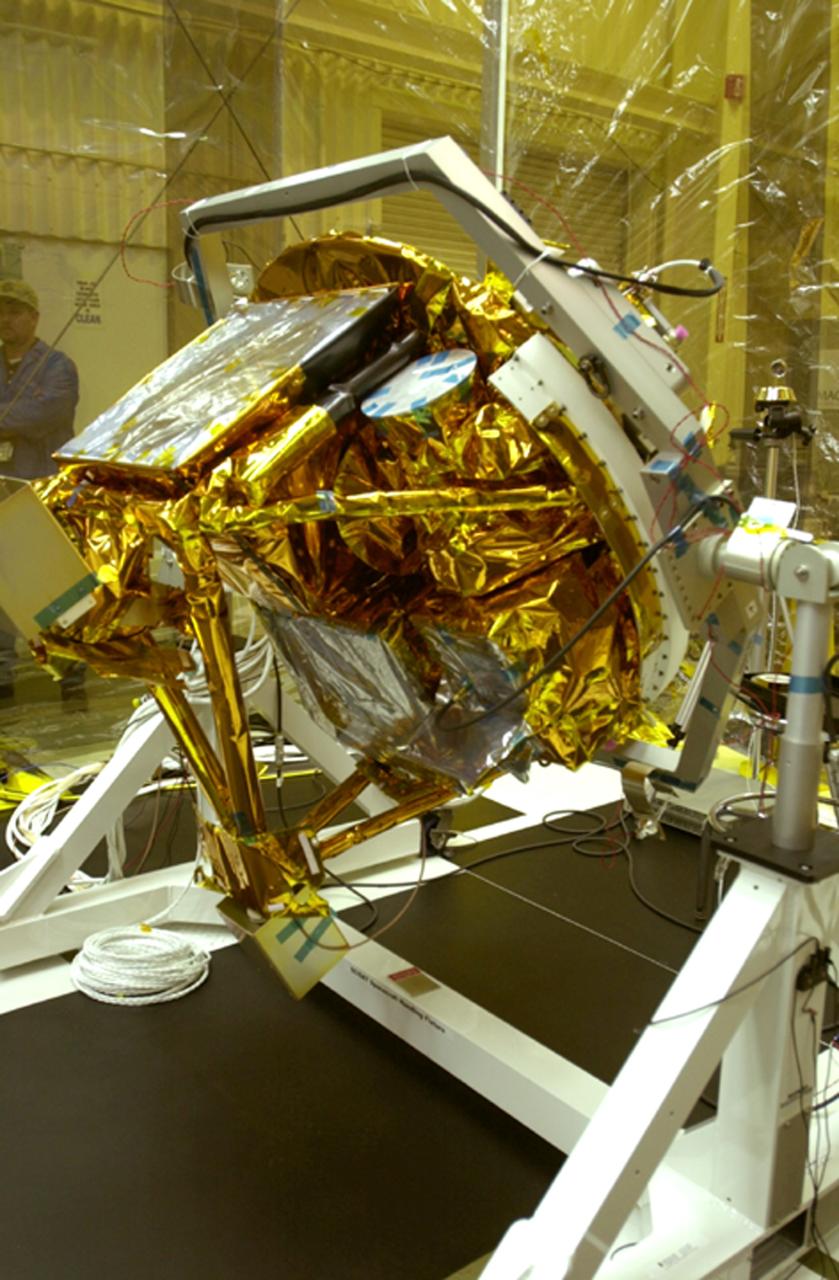
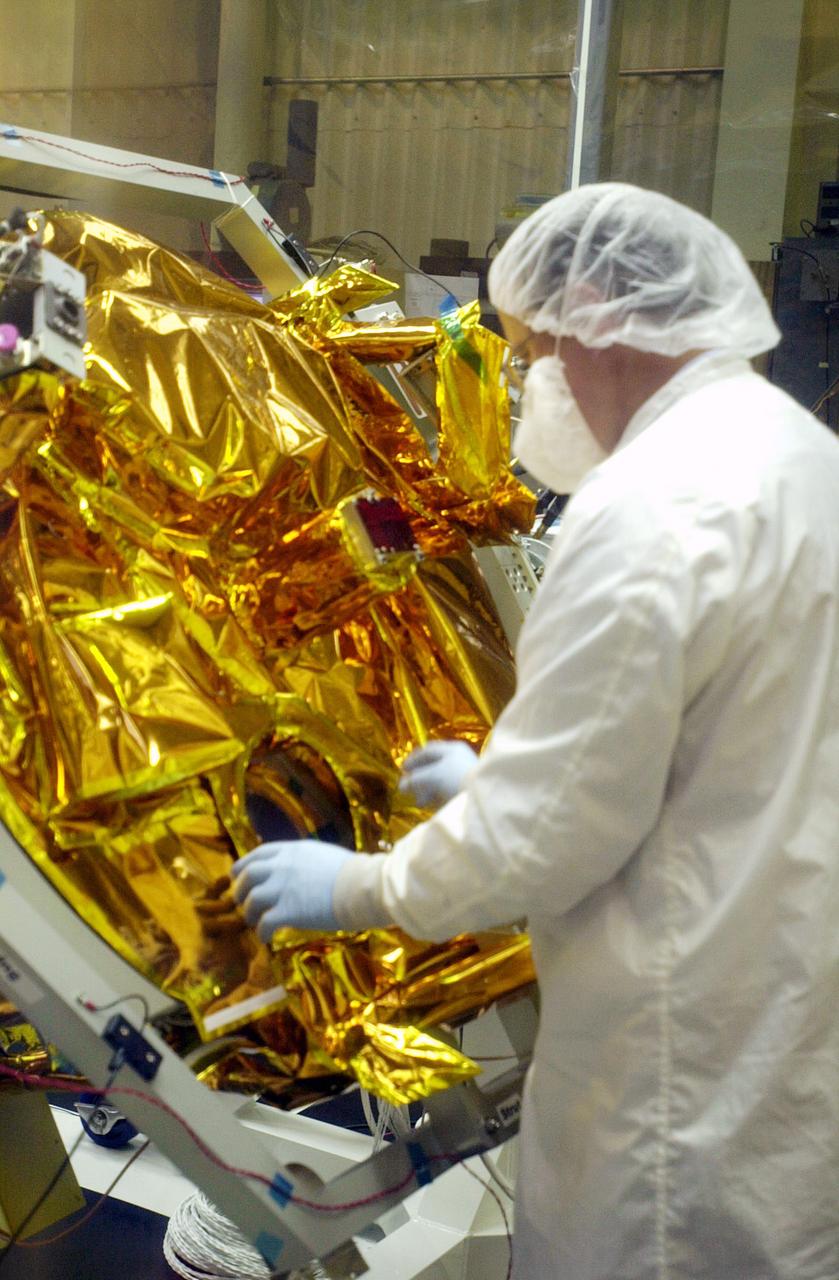
VANDENBERG AIR FORCE BASE, CALIF. -  With its cover removed, the SciSat-1 spacecraft is rotated.  The solar arrays will be attached and the communications systems checked out.   The SciSat-1 weighs approximately 330 pounds and after launch will be placed in a 400-mile-high polar orbit to investigate processes that control the distribution of ozone in the upper atmosphere. The data from the satellite will provide Canadian and international scientists with improved measurements relating to global ozone processes and help policymakers assess existing environmental policy and develop protective measures for improving the health of our atmosphere, preventing further ozone depletion. The mission is designed to last two years.
VANDENBERG AIR FORCE BASE, CALIF. - With its cover removed, the SciSat-1 spacecraft is rotated. The solar arrays will be attached and the communications systems checked out. The SciSat-1 weighs approximately 330 pounds and after launch will be placed in a 400-mile-high polar orbit to investigate processes that control the distribution of ozone in the upper atmosphere. The data from the satellite will provide Canadian and international scientists with improved measurements relating to global ozone processes and help policymakers assess existing environmental policy and develop protective measures for improving the health of our atmosphere, preventing further ozone depletion. The mission is designed to last two years.
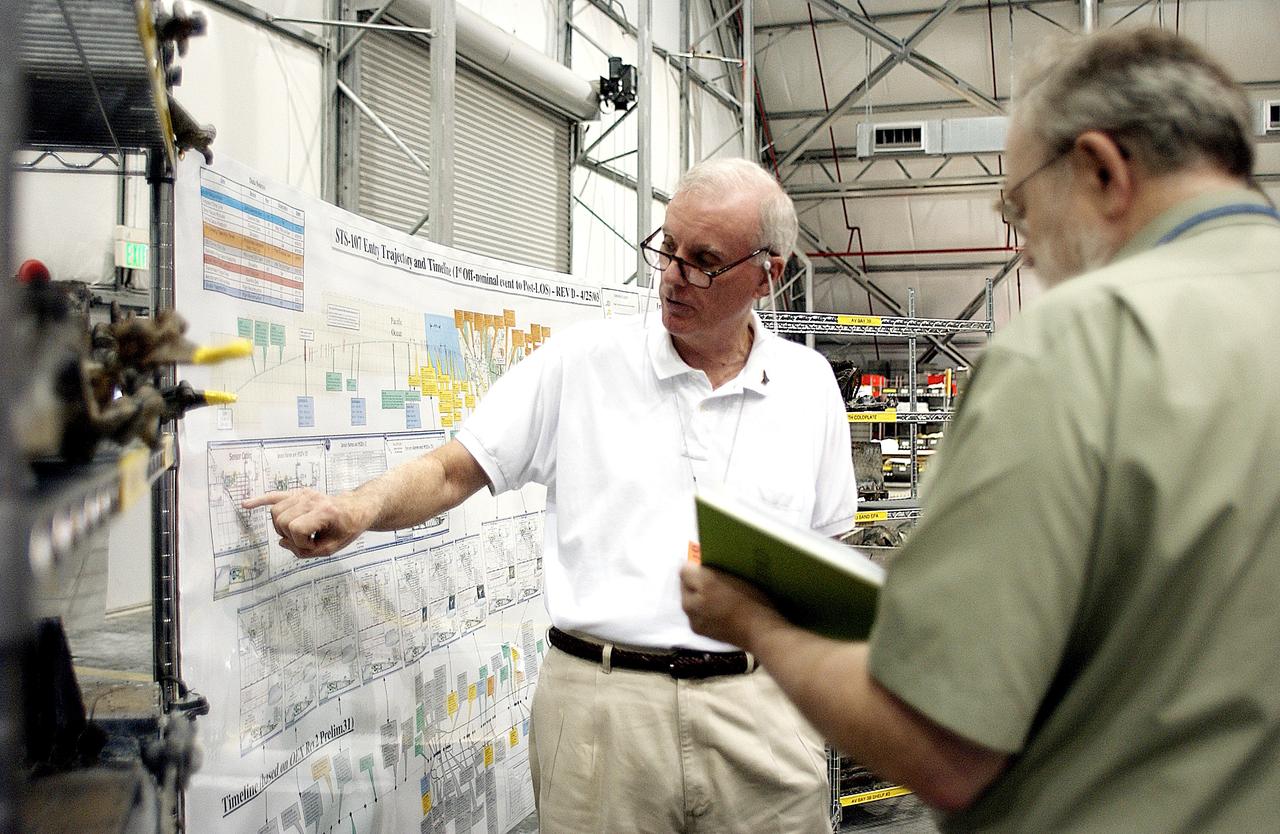
KENNEDY SPACE CENTER, FLA. - In the RLV Hangar, Adm. Harold Gehman, chairman of the Columbia Investigation Accident Board, points to data on a chart.  He and other board members are visiting as part of the ongoing investigation.  Recovery efforts as of May 5 included 82,500 pieces of debris weighing 84,800 pounds, almost 40 percent of the total dry weight of the shuttle.  About 25,000 personnel took part, utilizing almost 1.5 million total man-hours in the recovery effort and involving more than 130 federal, state and local agencies.  The operation was also supported by more than 270 organizations that included businesses and volunteer groups.
KENNEDY SPACE CENTER, FLA. - In the RLV Hangar, Adm. Harold Gehman, chairman of the Columbia Investigation Accident Board, points to data on a chart. He and other board members are visiting as part of the ongoing investigation. Recovery efforts as of May 5 included 82,500 pieces of debris weighing 84,800 pounds, almost 40 percent of the total dry weight of the shuttle. About 25,000 personnel took part, utilizing almost 1.5 million total man-hours in the recovery effort and involving more than 130 federal, state and local agencies. The operation was also supported by more than 270 organizations that included businesses and volunteer groups.
VANDENBERG AIR FORCE BASE, CALIF.- At Vandenberg Air Force Base, Calif., spacecraft functional testing is underway on the SciSat-1. The solar arrays are being attached and the communications systems are also being checked out.   The SciSat-1 weighs approximately 330 pounds and after launch will be placed in a 400-mile-high polar orbit to investigate processes that control the distribution of ozone in the upper atmosphere. The data from the satellite will provide Canadian and international scientists with improved measurements relating to global ozone processes and help policymakers assess existing environmental policy and develop protective measures for improving the health of our atmosphere, preventing further ozone depletion. The mission is designed to last two years.
VANDENBERG AIR FORCE BASE, CALIF.- At Vandenberg Air Force Base, Calif., spacecraft functional testing is underway on the SciSat-1. The solar arrays are being attached and the communications systems are also being checked out. The SciSat-1 weighs approximately 330 pounds and after launch will be placed in a 400-mile-high polar orbit to investigate processes that control the distribution of ozone in the upper atmosphere. The data from the satellite will provide Canadian and international scientists with improved measurements relating to global ozone processes and help policymakers assess existing environmental policy and develop protective measures for improving the health of our atmosphere, preventing further ozone depletion. The mission is designed to last two years.
VANDENBERG AIR FORCE BASE, CALIF.- At Vandenberg Air Force Base, Calif., spacecraft functional testing is underway on the SciSat-1. The solar arrays are being attached and the communications systems are also being checked out.   The SciSat-1 weighs approximately 330 pounds and after launch will be placed in a 400-mile-high polar orbit to investigate processes that control the distribution of ozone in the upper atmosphere. The data from the satellite will provide Canadian and international scientists with improved measurements relating to global ozone processes and help policymakers assess existing environmental policy and develop protective measures for improving the health of our atmosphere, preventing further ozone depletion. The mission is designed to last two years.
VANDENBERG AIR FORCE BASE, CALIF.- At Vandenberg Air Force Base, Calif., spacecraft functional testing is underway on the SciSat-1. The solar arrays are being attached and the communications systems are also being checked out. The SciSat-1 weighs approximately 330 pounds and after launch will be placed in a 400-mile-high polar orbit to investigate processes that control the distribution of ozone in the upper atmosphere. The data from the satellite will provide Canadian and international scientists with improved measurements relating to global ozone processes and help policymakers assess existing environmental policy and develop protective measures for improving the health of our atmosphere, preventing further ozone depletion. The mission is designed to last two years.
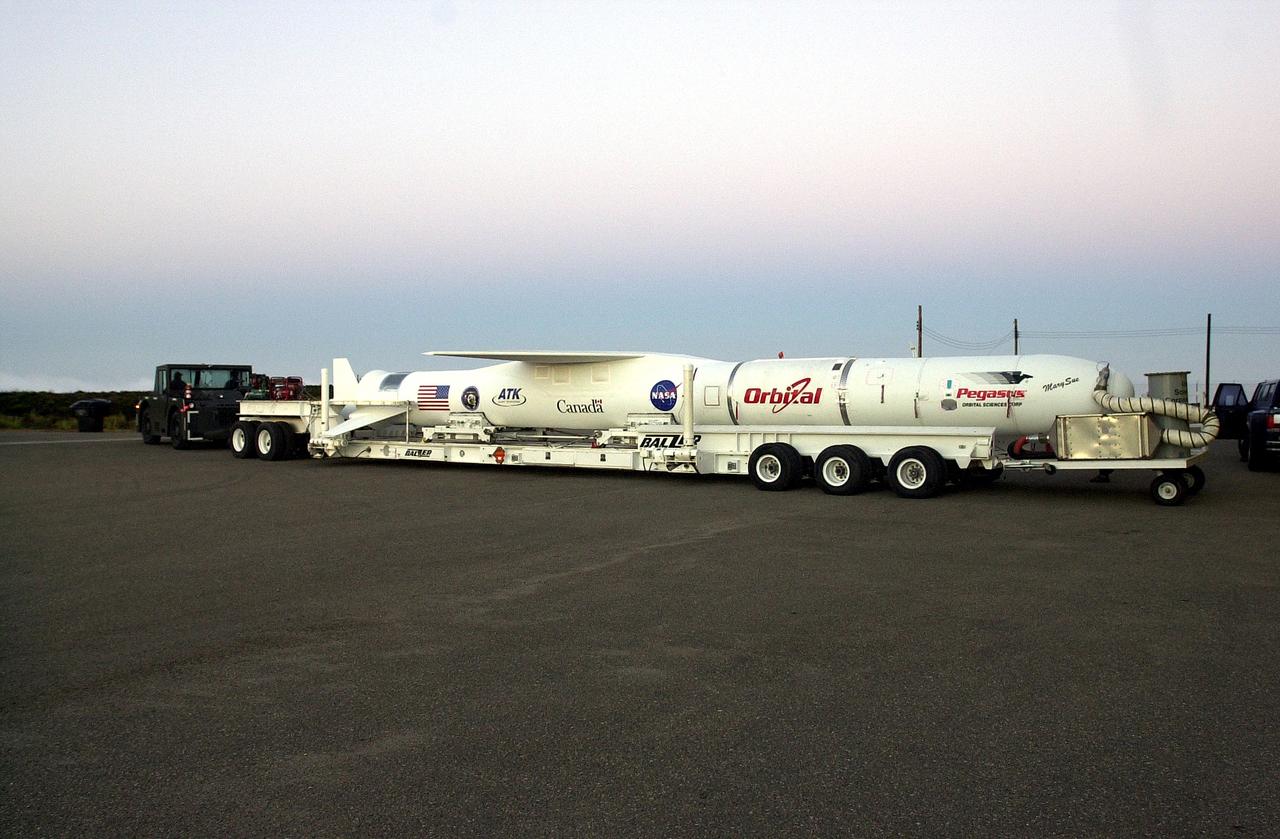
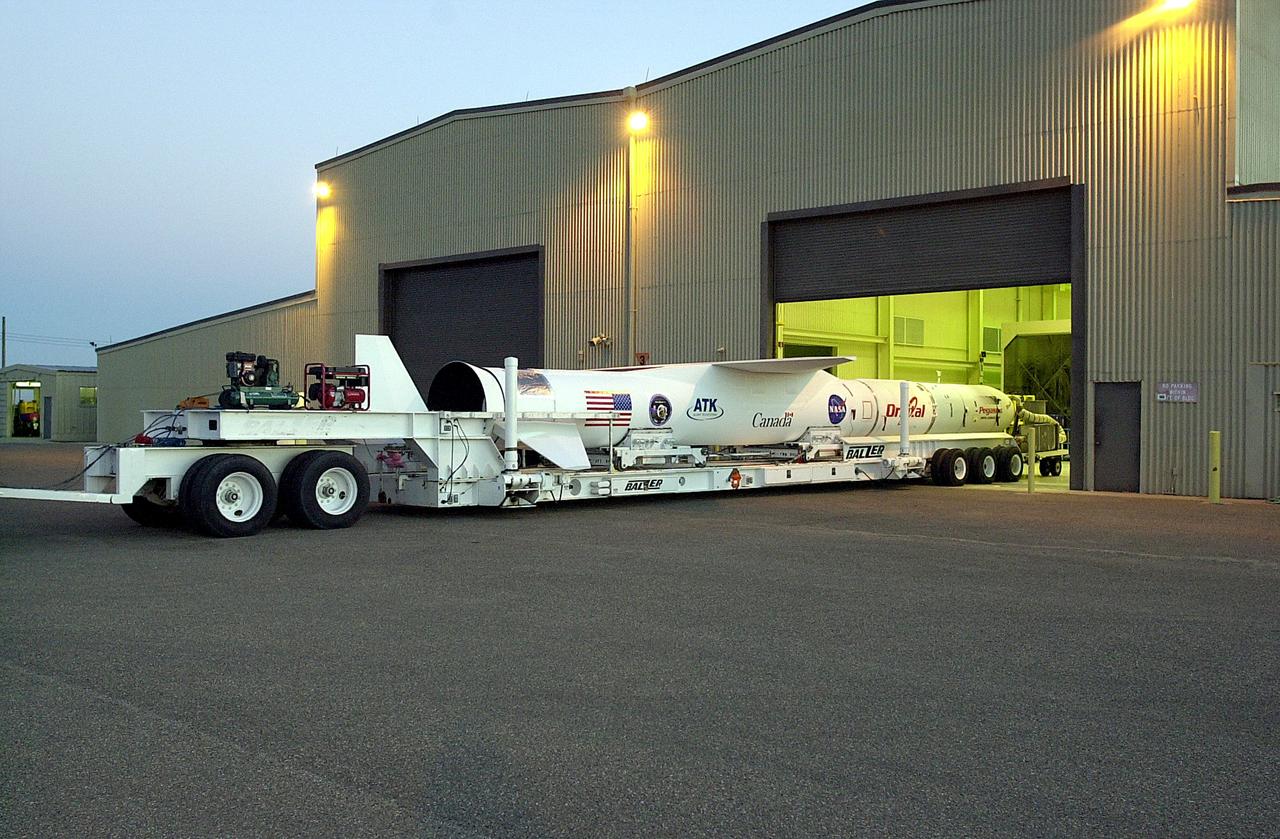
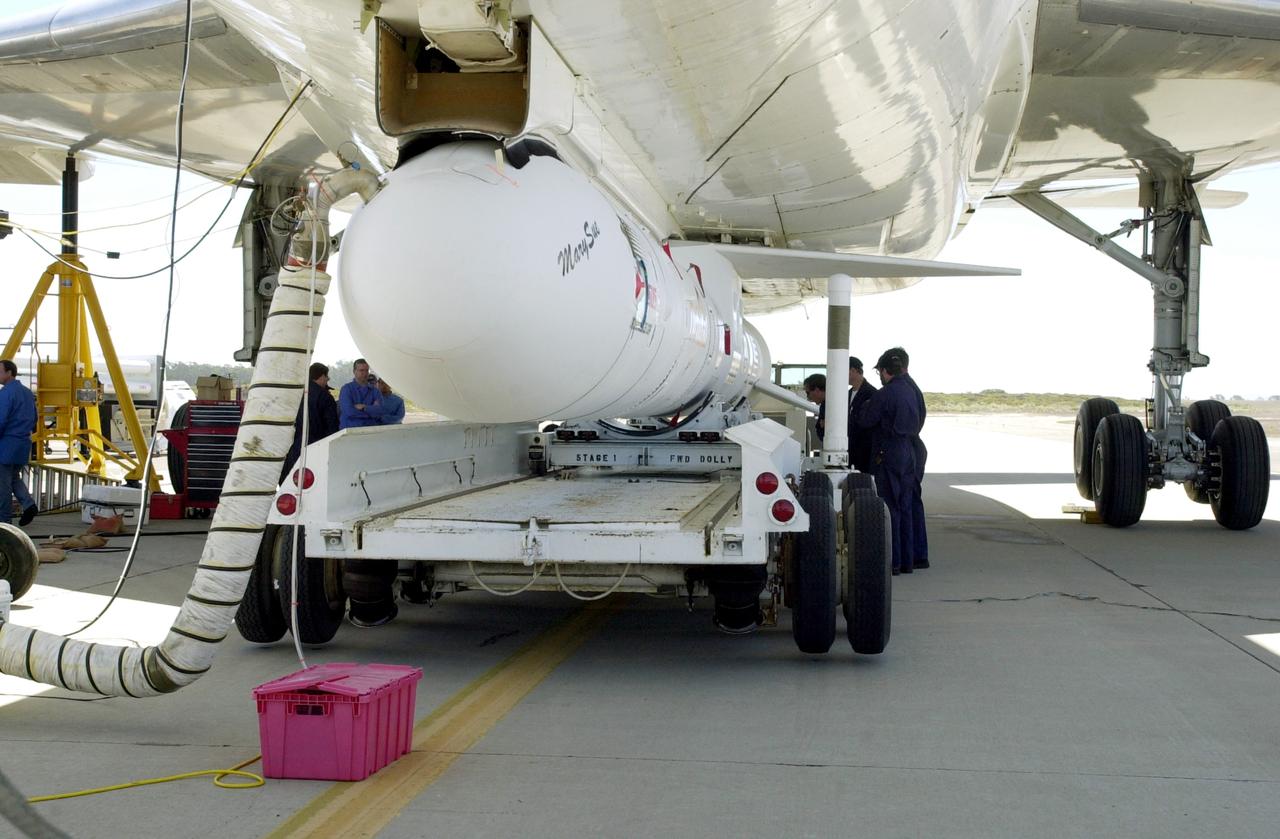
VANDENBERG AIR FORCE BASE, CALIF. -  The SciSat-1 payload, with fairing installed and attached to its Pegasus launch vehicle, begins rollout to the hot pad and mating to the L-1011 carrier aircraft.  The SciSat-1 weighs approximately 330 pounds and after launch will be placed in a 400-mile-high polar orbit to investigate processes that control the distribution of ozone in the upper atmosphere. The data from the satellite will provide Canadian and international scientists with improved measurements relating to global ozone processes and help policymakers assess existing environmental policy and develop protective measures for improving the health of our atmosphere, preventing further ozone depletion. The mission is designed to last two years.
VANDENBERG AIR FORCE BASE, CALIF. - The SciSat-1 payload, with fairing installed and attached to its Pegasus launch vehicle, begins rollout to the hot pad and mating to the L-1011 carrier aircraft. The SciSat-1 weighs approximately 330 pounds and after launch will be placed in a 400-mile-high polar orbit to investigate processes that control the distribution of ozone in the upper atmosphere. The data from the satellite will provide Canadian and international scientists with improved measurements relating to global ozone processes and help policymakers assess existing environmental policy and develop protective measures for improving the health of our atmosphere, preventing further ozone depletion. The mission is designed to last two years.
VANDENBERG AIR FORCE BASE, CALIF. -  The L-1011 carrier aircraft is in flight with its cargo underneath of the Pegasus launch vehicle and SciSat-1 spacecraft.  The SciSat-1 weighs approximately 330 pounds and after launch will be placed in a 400-mile-high polar orbit to investigate processes that control the distribution of ozone in the upper atmosphere. The data from the satellite will provide Canadian and international scientists with improved measurements relating to global ozone processes and help policymakers assess existing environmental policy and develop protective measures for improving the health of our atmosphere, preventing further ozone depletion. The mission is designed to last two years.
VANDENBERG AIR FORCE BASE, CALIF. - The L-1011 carrier aircraft is in flight with its cargo underneath of the Pegasus launch vehicle and SciSat-1 spacecraft. The SciSat-1 weighs approximately 330 pounds and after launch will be placed in a 400-mile-high polar orbit to investigate processes that control the distribution of ozone in the upper atmosphere. The data from the satellite will provide Canadian and international scientists with improved measurements relating to global ozone processes and help policymakers assess existing environmental policy and develop protective measures for improving the health of our atmosphere, preventing further ozone depletion. The mission is designed to last two years.
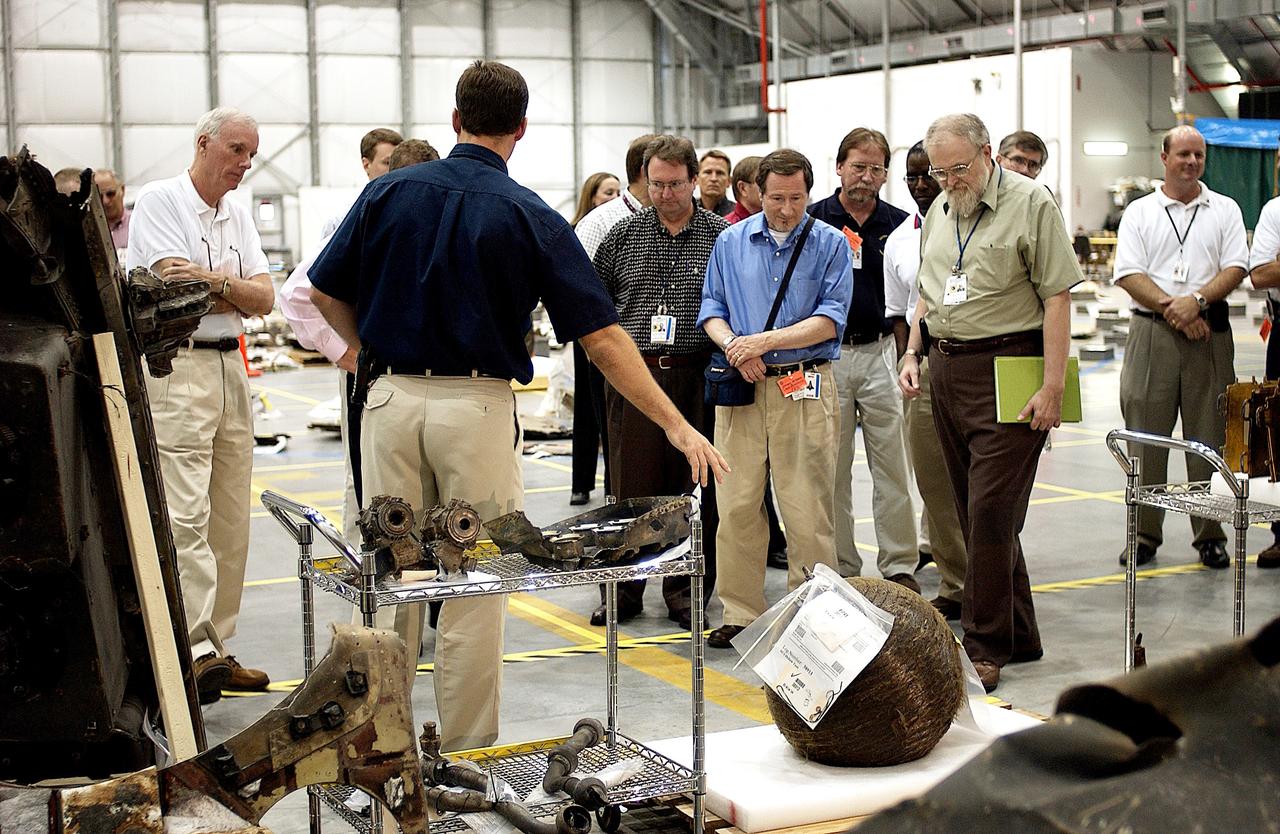
KENNEDY SPACE CENTER, FLA. -   Adm. Harold Gehman, far left, chairman of the Columbia Investigation Accident Board, looks at pieces of Columbia debris collected in the KSC RLV Hangar.  Other members of the board accompanied him as part of the ongoing investigation.  Recovery efforts as of May 5 included 82,500 pieces of debris weighing 84,800 pounds, almost 40 percent of the total dry weight of the shuttle.  About 25,000 personnel took part, utilizing almost 1.5 million total man-hours in the recovery effort and involving more than 130 federal, state and local agencies.  The operation was also supported by more than 270 organizations that included businesses and volunteer groups.
KENNEDY SPACE CENTER, FLA. - Adm. Harold Gehman, far left, chairman of the Columbia Investigation Accident Board, looks at pieces of Columbia debris collected in the KSC RLV Hangar. Other members of the board accompanied him as part of the ongoing investigation. Recovery efforts as of May 5 included 82,500 pieces of debris weighing 84,800 pounds, almost 40 percent of the total dry weight of the shuttle. About 25,000 personnel took part, utilizing almost 1.5 million total man-hours in the recovery effort and involving more than 130 federal, state and local agencies. The operation was also supported by more than 270 organizations that included businesses and volunteer groups.
VANDENBERG AIR FORCE BASE, CALIF. -   The SciSat-1 payload, with fairing installed and attached to its Pegasus launch vehicle, begins rollout to the hot pad and mating to the L-1011 carrier aircraft.  The SciSat-1 weighs approximately 330 pounds and after launch will be placed in a 400-mile-high polar orbit to investigate processes that control the distribution of ozone in the upper atmosphere. The data from the satellite will provide Canadian and international scientists with improved measurements relating to global ozone processes and help policymakers assess existing environmental policy and develop protective measures for improving the health of our atmosphere, preventing further ozone depletion. The mission is designed to last two years.
VANDENBERG AIR FORCE BASE, CALIF. - The SciSat-1 payload, with fairing installed and attached to its Pegasus launch vehicle, begins rollout to the hot pad and mating to the L-1011 carrier aircraft. The SciSat-1 weighs approximately 330 pounds and after launch will be placed in a 400-mile-high polar orbit to investigate processes that control the distribution of ozone in the upper atmosphere. The data from the satellite will provide Canadian and international scientists with improved measurements relating to global ozone processes and help policymakers assess existing environmental policy and develop protective measures for improving the health of our atmosphere, preventing further ozone depletion. The mission is designed to last two years.
VANDENBERG AIR FORCE BASE, CALIF.-  A covered SciSat-1 spacecraft sits on a test stand at Vandenberg Air Force Base, Calif.  The solar arrays will be attached and the communications systems checked out.   The SciSat-1 weighs approximately 330 pounds and after launch will be placed in a 400-mile-high polar orbit to investigate processes that control the distribution of ozone in the upper atmosphere. The data from the satellite will provide Canadian and international scientists with improved measurements relating to global ozone processes and help policymakers assess existing environmental policy and develop protective measures for improving the health of our atmosphere, preventing further ozone depletion. The mission is designed to last two years.
VANDENBERG AIR FORCE BASE, CALIF.- A covered SciSat-1 spacecraft sits on a test stand at Vandenberg Air Force Base, Calif. The solar arrays will be attached and the communications systems checked out. The SciSat-1 weighs approximately 330 pounds and after launch will be placed in a 400-mile-high polar orbit to investigate processes that control the distribution of ozone in the upper atmosphere. The data from the satellite will provide Canadian and international scientists with improved measurements relating to global ozone processes and help policymakers assess existing environmental policy and develop protective measures for improving the health of our atmosphere, preventing further ozone depletion. The mission is designed to last two years.
VANDENBERG AIR FORCE BASE, CALIF. -  At Vandenberg AFB, Calif., a solar array is tested before installing on the SciSat-1 spacecraft.  The SciSat-1 weighs approximately 330 pounds and after launch will be placed in a 400-mile-high polar orbit to investigate processes that control the distribution of ozone in the upper atmosphere. The data from the satellite will provide Canadian and international scientists with improved measurements relating to global ozone processes and help policymakers assess existing environmental policy and develop protective measures for improving the health of our atmosphere, preventing further ozone depletion. The mission is designed to last two years.
VANDENBERG AIR FORCE BASE, CALIF. - At Vandenberg AFB, Calif., a solar array is tested before installing on the SciSat-1 spacecraft. The SciSat-1 weighs approximately 330 pounds and after launch will be placed in a 400-mile-high polar orbit to investigate processes that control the distribution of ozone in the upper atmosphere. The data from the satellite will provide Canadian and international scientists with improved measurements relating to global ozone processes and help policymakers assess existing environmental policy and develop protective measures for improving the health of our atmosphere, preventing further ozone depletion. The mission is designed to last two years.
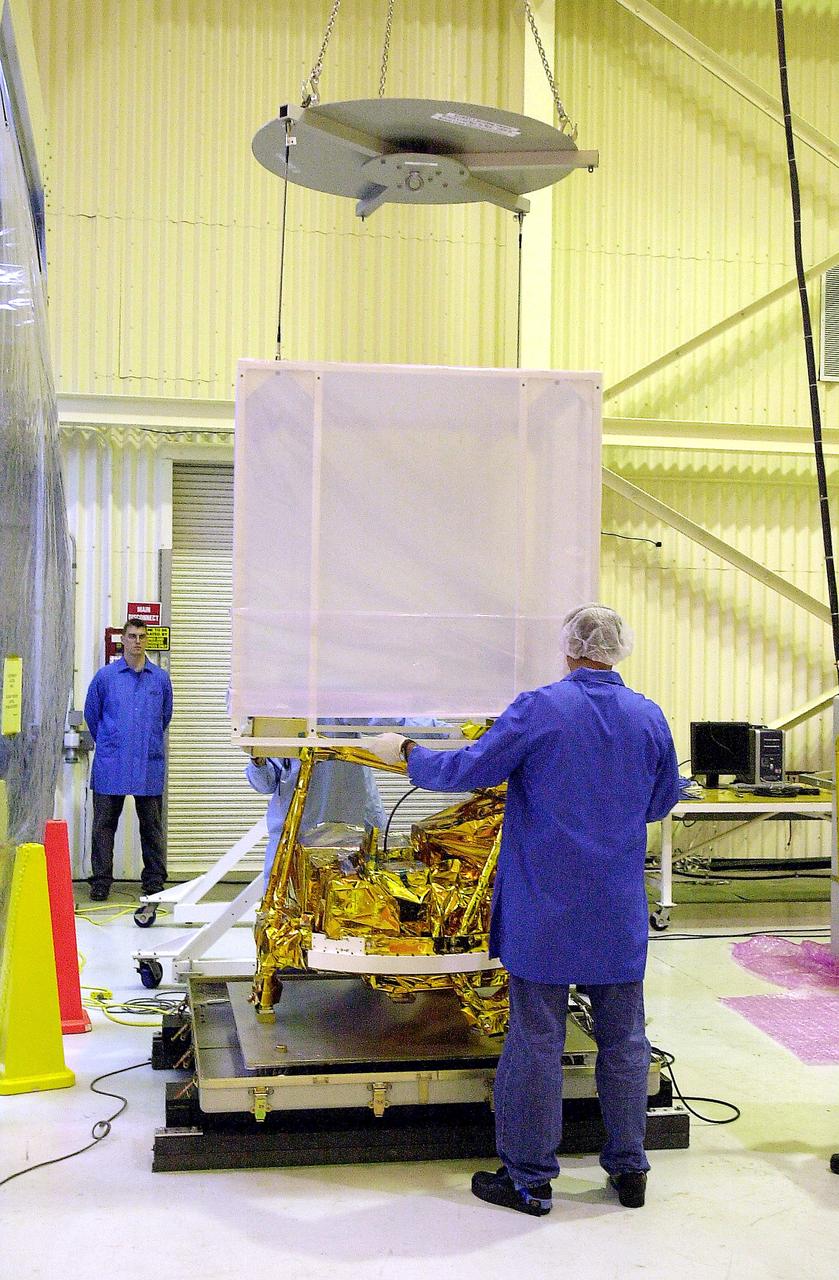
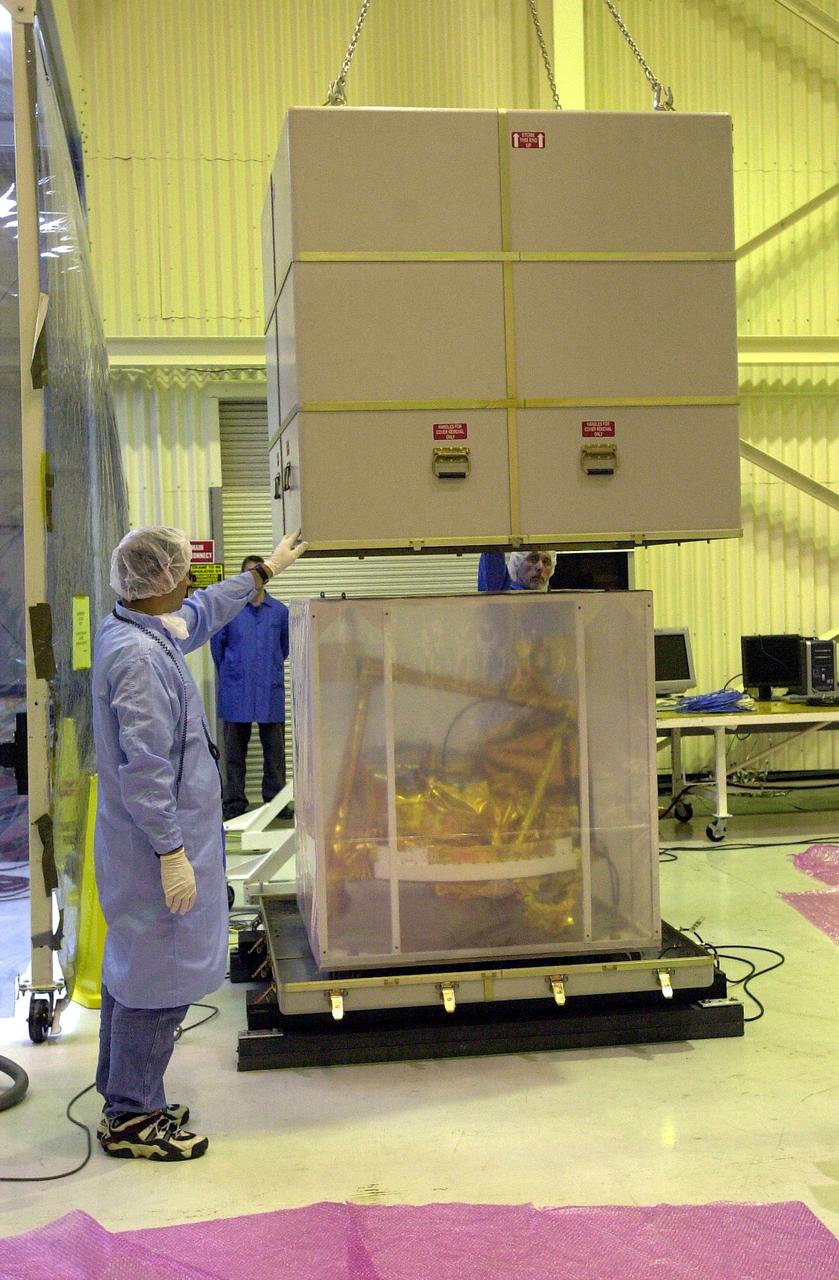
VANDENBERG AIR FORCE BASE, CALIF.- The cover is being lifted off SciSat-1 spacecraft at Vandenberg Air Force Base, Calif.   Sci-Sat, which will undergo instrument checkout and spacecraft functional testing, weighs approximately 330 pounds and after launch will be placed in a 400-mile-high polar orbit to investigate processes that control the distribution of ozone in the upper atmosphere. The data from the satellite will provide Canadian and international scientists with improved measurements relating to global ozone processes and help policymakers assess existing environmental policy and develop protective measures for improving the health of our atmosphere, preventing further ozone depletion. The mission is designed to last two years.
VANDENBERG AIR FORCE BASE, CALIF.- The cover is being lifted off SciSat-1 spacecraft at Vandenberg Air Force Base, Calif. Sci-Sat, which will undergo instrument checkout and spacecraft functional testing, weighs approximately 330 pounds and after launch will be placed in a 400-mile-high polar orbit to investigate processes that control the distribution of ozone in the upper atmosphere. The data from the satellite will provide Canadian and international scientists with improved measurements relating to global ozone processes and help policymakers assess existing environmental policy and develop protective measures for improving the health of our atmosphere, preventing further ozone depletion. The mission is designed to last two years.
VANDENBERG AIR FORCE BASE, CALIF.-  The covered SciSat-1 spacecraft is lowered onto a test stand at Vandenberg Air Force Base, Calif., for functional testing.  The solar arrays will be attached and the communications systems checked out.   The SciSat-1 weighs approximately 330 pounds and after launch will be placed in a 400-mile-high polar orbit to investigate processes that control the distribution of ozone in the upper atmosphere. The data from the satellite will provide Canadian and international scientists with improved measurements relating to global ozone processes and help policymakers assess existing environmental policy and develop protective measures for improving the health of our atmosphere, preventing further ozone depletion. The mission is designed to last two years.
VANDENBERG AIR FORCE BASE, CALIF.- The covered SciSat-1 spacecraft is lowered onto a test stand at Vandenberg Air Force Base, Calif., for functional testing. The solar arrays will be attached and the communications systems checked out. The SciSat-1 weighs approximately 330 pounds and after launch will be placed in a 400-mile-high polar orbit to investigate processes that control the distribution of ozone in the upper atmosphere. The data from the satellite will provide Canadian and international scientists with improved measurements relating to global ozone processes and help policymakers assess existing environmental policy and develop protective measures for improving the health of our atmosphere, preventing further ozone depletion. The mission is designed to last two years.
VANDENBERG AIR FORCE BASE, CALIF. -  The Pegasus transporter, with its cargo of  the SciSat-1 payload and Pegasus launch vehicle, moves under the L-1011 carrier aircraft for matting.  The SciSat-1 weighs approximately 330 pounds and after launch will be placed in a 400-mile-high polar orbit to investigate processes that control the distribution of ozone in the upper atmosphere. The data from the satellite will provide Canadian and international scientists with improved measurements relating to global ozone processes and help policymakers assess existing environmental policy and develop protective measures for improving the health of our atmosphere, preventing further ozone depletion. The mission is designed to last two years.
VANDENBERG AIR FORCE BASE, CALIF. - The Pegasus transporter, with its cargo of the SciSat-1 payload and Pegasus launch vehicle, moves under the L-1011 carrier aircraft for matting. The SciSat-1 weighs approximately 330 pounds and after launch will be placed in a 400-mile-high polar orbit to investigate processes that control the distribution of ozone in the upper atmosphere. The data from the satellite will provide Canadian and international scientists with improved measurements relating to global ozone processes and help policymakers assess existing environmental policy and develop protective measures for improving the health of our atmosphere, preventing further ozone depletion. The mission is designed to last two years.
VANDENBERG AIR FORCE BASE, CALIF.- At Vandenberg Air Force Base, Calif., spacecraft functional testing is underway on the SciSat-1. The solar arrays are being attached and the communications systems are also being checked out.   The SciSat-1 weighs approximately 330 pounds and after launch will be placed in a 400-mile-high polar orbit to investigate processes that control the distribution of ozone in the upper atmosphere. The data from the satellite will provide Canadian and international scientists with improved measurements relating to global ozone processes and help policymakers assess existing environmental policy and develop protective measures for improving the health of our atmosphere, preventing further ozone depletion. The mission is designed to last two years.
VANDENBERG AIR FORCE BASE, CALIF.- At Vandenberg Air Force Base, Calif., spacecraft functional testing is underway on the SciSat-1. The solar arrays are being attached and the communications systems are also being checked out. The SciSat-1 weighs approximately 330 pounds and after launch will be placed in a 400-mile-high polar orbit to investigate processes that control the distribution of ozone in the upper atmosphere. The data from the satellite will provide Canadian and international scientists with improved measurements relating to global ozone processes and help policymakers assess existing environmental policy and develop protective measures for improving the health of our atmosphere, preventing further ozone depletion. The mission is designed to last two years.
VANDENBERG AIR FORCE BASE, CALIF. - The SciSat-1 spacecraft is revealed at Vandenberg Air Force Base, Calif.   Sci-Sat, which will undergo instrument checkout and spacecraft functional testing, weighs approximately 330 pounds and after launch will be placed in a 400-mile-high polar orbit to investigate processes that control the distribution of ozone in the upper atmosphere. The data from the satellite will provide Canadian and international scientists with improved measurements relating to global ozone processes and help policymakers assess existing environmental policy and develop protective measures for improving the health of our atmosphere, preventing further ozone depletion. The mission is designed to last two years.
VANDENBERG AIR FORCE BASE, CALIF. - The SciSat-1 spacecraft is revealed at Vandenberg Air Force Base, Calif. Sci-Sat, which will undergo instrument checkout and spacecraft functional testing, weighs approximately 330 pounds and after launch will be placed in a 400-mile-high polar orbit to investigate processes that control the distribution of ozone in the upper atmosphere. The data from the satellite will provide Canadian and international scientists with improved measurements relating to global ozone processes and help policymakers assess existing environmental policy and develop protective measures for improving the health of our atmosphere, preventing further ozone depletion. The mission is designed to last two years.
KENNEDY SPACE CENTER, FLA. -  The SciSat-1 spacecraft is uncrated at Vandenberg Air Force Base, Calif.  SciSat-1 weighs approximately 330 pounds and will be placed in a 400-mile-high polar orbit to investigate processes that control the distribution of ozone in the upper atmosphere.  The scientific mission of SciSat-1 is to measure and understand the chemical processes that control the distribution of ozone in the Earth’s atmosphere, particularly at high altitudes.  The data from the satellite will provide Canadian and international scientists with improved measurements relating to global ozone processes and help policymakers assess existing environmental policy and develop protective measures for improving the health of our atmosphere, preventing further ozone depletion.  The mission is designed to last two years.
KENNEDY SPACE CENTER, FLA. - The SciSat-1 spacecraft is uncrated at Vandenberg Air Force Base, Calif. SciSat-1 weighs approximately 330 pounds and will be placed in a 400-mile-high polar orbit to investigate processes that control the distribution of ozone in the upper atmosphere. The scientific mission of SciSat-1 is to measure and understand the chemical processes that control the distribution of ozone in the Earth’s atmosphere, particularly at high altitudes. The data from the satellite will provide Canadian and international scientists with improved measurements relating to global ozone processes and help policymakers assess existing environmental policy and develop protective measures for improving the health of our atmosphere, preventing further ozone depletion. The mission is designed to last two years.
VANDENBERG AIR FORCE BASE, CALIF.- At Vandenberg Air Force Base, Calif., spacecraft functional testing is underway on the SciSat-1. The solar arrays are being attached and the communications systems are also being checked out.   The SciSat-1 weighs approximately 330 pounds and after launch will be placed in a 400-mile-high polar orbit to investigate processes that control the distribution of ozone in the upper atmosphere. The data from the satellite will provide Canadian and international scientists with improved measurements relating to global ozone processes and help policymakers assess existing environmental policy and develop protective measures for improving the health of our atmosphere, preventing further ozone depletion. The mission is designed to last two years.
VANDENBERG AIR FORCE BASE, CALIF.- At Vandenberg Air Force Base, Calif., spacecraft functional testing is underway on the SciSat-1. The solar arrays are being attached and the communications systems are also being checked out. The SciSat-1 weighs approximately 330 pounds and after launch will be placed in a 400-mile-high polar orbit to investigate processes that control the distribution of ozone in the upper atmosphere. The data from the satellite will provide Canadian and international scientists with improved measurements relating to global ozone processes and help policymakers assess existing environmental policy and develop protective measures for improving the health of our atmosphere, preventing further ozone depletion. The mission is designed to last two years.
KENNEDY SPACE CENTER, FLA.  -Crawler-transporter (CT) number 2, moves away from the Vehicle Assembly Building, with a Mobile Launcher Platform on top, on a test run to the launch pad.  The CT recently underwent modifications to the cab.  The CT moves Space Shuttle vehicles between the VAB and launch pad.  Moving on four double-tracked crawlers, the CT uses a laser guidance system and a leveling system for the journey that keeps the top of a Space Shuttle vertical within plus- or minus-10 minutes of arc.  The system enables the CT-MLP-Shuttle to negotiate the ramp leading to the launch pads and keep the load level.  Unloaded, the CT weighs 6 million pounds.
KENNEDY SPACE CENTER, FLA. -Crawler-transporter (CT) number 2, moves away from the Vehicle Assembly Building, with a Mobile Launcher Platform on top, on a test run to the launch pad. The CT recently underwent modifications to the cab. The CT moves Space Shuttle vehicles between the VAB and launch pad. Moving on four double-tracked crawlers, the CT uses a laser guidance system and a leveling system for the journey that keeps the top of a Space Shuttle vertical within plus- or minus-10 minutes of arc. The system enables the CT-MLP-Shuttle to negotiate the ramp leading to the launch pads and keep the load level. Unloaded, the CT weighs 6 million pounds.
VANDENBERG AIR FORCE BASE, CALIF. - The SciSat-1 payload, with fairing installed and attached to its Pegasus launch vehicle, arrives at the pad for mating to the L-1011 carrier aircraft.  The SciSat-1 weighs approximately 330 pounds and after launch will be placed in a 400-mile-high polar orbit to investigate processes that control the distribution of ozone in the upper atmosphere. The data from the satellite will provide Canadian and international scientists with improved measurements relating to global ozone processes and help policymakers assess existing environmental policy and develop protective measures for improving the health of our atmosphere, preventing further ozone depletion. The mission is designed to last two years.
VANDENBERG AIR FORCE BASE, CALIF. - The SciSat-1 payload, with fairing installed and attached to its Pegasus launch vehicle, arrives at the pad for mating to the L-1011 carrier aircraft. The SciSat-1 weighs approximately 330 pounds and after launch will be placed in a 400-mile-high polar orbit to investigate processes that control the distribution of ozone in the upper atmosphere. The data from the satellite will provide Canadian and international scientists with improved measurements relating to global ozone processes and help policymakers assess existing environmental policy and develop protective measures for improving the health of our atmosphere, preventing further ozone depletion. The mission is designed to last two years.
VANDENBERG AIR FORCE BASE, CALIF. -    Workers mate the Pegasus , with its cargo of the SciSat-1 payload to the L-1011 carrier aircraft.  The SciSat-1 weighs approximately 330 pounds and after launch will be placed in a 400-mile-high polar orbit to investigate processes that control the distribution of ozone in the upper atmosphere. The data from the satellite will provide Canadian and international scientists with improved measurements relating to global ozone processes and help policymakers assess existing environmental policy and develop protective measures for improving the health of our atmosphere, preventing further ozone depletion. The mission is designed to last two years.
VANDENBERG AIR FORCE BASE, CALIF. - Workers mate the Pegasus , with its cargo of the SciSat-1 payload to the L-1011 carrier aircraft. The SciSat-1 weighs approximately 330 pounds and after launch will be placed in a 400-mile-high polar orbit to investigate processes that control the distribution of ozone in the upper atmosphere. The data from the satellite will provide Canadian and international scientists with improved measurements relating to global ozone processes and help policymakers assess existing environmental policy and develop protective measures for improving the health of our atmosphere, preventing further ozone depletion. The mission is designed to last two years.
VANDENBERG AIR FORCE BASE, CALIF. - The Pegasus transporter, with its cargo of  the SciSat-1 payload and Pegasus launch vehicle, moves under the L-1011 carrier aircraft for matting.  The SciSat-1 weighs approximately 330 pounds and after launch will be placed in a 400-mile-high polar orbit to investigate processes that control the distribution of ozone in the upper atmosphere. The data from the satellite will provide Canadian and international scientists with improved measurements relating to global ozone processes and help policymakers assess existing environmental policy and develop protective measures for improving the health of our atmosphere, preventing further ozone depletion. The mission is designed to last two years.
VANDENBERG AIR FORCE BASE, CALIF. - The Pegasus transporter, with its cargo of the SciSat-1 payload and Pegasus launch vehicle, moves under the L-1011 carrier aircraft for matting. The SciSat-1 weighs approximately 330 pounds and after launch will be placed in a 400-mile-high polar orbit to investigate processes that control the distribution of ozone in the upper atmosphere. The data from the satellite will provide Canadian and international scientists with improved measurements relating to global ozone processes and help policymakers assess existing environmental policy and develop protective measures for improving the health of our atmosphere, preventing further ozone depletion. The mission is designed to last two years.
VANDENBERG AIR FORCE BASE, CALIF. -  At Vandenberg Air Force Base, Calif. a covered SciSat-1 spacecraft is lifted onto a rotation stand.   The solar arrays will be attached and the communications systems checked out.   The SciSat-1 weighs approximately 330 pounds and after launch will be placed in a 400-mile-high polar orbit to investigate processes that control the distribution of ozone in the upper atmosphere. The data from the satellite will provide Canadian and international scientists with improved measurements relating to global ozone processes and help policymakers assess existing environmental policy and develop protective measures for improving the health of our atmosphere, preventing further ozone depletion. The mission is designed to last two years.
VANDENBERG AIR FORCE BASE, CALIF. - At Vandenberg Air Force Base, Calif. a covered SciSat-1 spacecraft is lifted onto a rotation stand. The solar arrays will be attached and the communications systems checked out. The SciSat-1 weighs approximately 330 pounds and after launch will be placed in a 400-mile-high polar orbit to investigate processes that control the distribution of ozone in the upper atmosphere. The data from the satellite will provide Canadian and international scientists with improved measurements relating to global ozone processes and help policymakers assess existing environmental policy and develop protective measures for improving the health of our atmosphere, preventing further ozone depletion. The mission is designed to last two years.
VANDENBERG AIR FORCE BASE, CALIF.- At Vandenberg Air Force Base, Calif., spacecraft functional testing is underway on the SciSat-1. The solar arrays are being attached and the communications systems are also being checked out.   The SciSat-1 weighs approximately 330 pounds and after launch will be placed in a 400-mile-high polar orbit to investigate processes that control the distribution of ozone in the upper atmosphere. The data from the satellite will provide Canadian and international scientists with improved measurements relating to global ozone processes and help policymakers assess existing environmental policy and develop protective measures for improving the health of our atmosphere, preventing further ozone depletion. The mission is designed to last two years.
VANDENBERG AIR FORCE BASE, CALIF.- At Vandenberg Air Force Base, Calif., spacecraft functional testing is underway on the SciSat-1. The solar arrays are being attached and the communications systems are also being checked out. The SciSat-1 weighs approximately 330 pounds and after launch will be placed in a 400-mile-high polar orbit to investigate processes that control the distribution of ozone in the upper atmosphere. The data from the satellite will provide Canadian and international scientists with improved measurements relating to global ozone processes and help policymakers assess existing environmental policy and develop protective measures for improving the health of our atmosphere, preventing further ozone depletion. The mission is designed to last two years.
This is a Hubble Space Telescope view of a very massive cluster of galaxies, MACS J0416.1-2403, located roughly 4 billion light-years away and weighing as much as a million billion suns. The cluster's immense gravitational field magnifies the image of galaxies far behind it, in a phenomenon called gravitational lensing.  The inset is an image of an extremely faint and distant galaxy that existed only 400 million years after the big bang. It was discovered by Hubble and NASA's Spitzer Space Telescope. The gravitational lens makes the galaxy appear 20 times brighter than normal. The galaxy is comparable in size to the Large Magellanic Cloud (LMC), a diminutive satellite galaxy of our Milky Way. It is rapidly making stars at a rate ten times faster than the LMC. This might be the growing core of what was to eventually evolve into a full-sized galaxy.  The research team has nicknamed the object Tayna, which means "first-born" in Aymara, a language spoken in the Andes and Altiplano regions of South America.  http://photojournal.jpl.nasa.gov/catalog/PIA20054
Faint Compact Galaxy in the Early Universe
KENNEDY SPACE CENTER, FLA. - Large pieces of Columbia debris are stacked along a wall in the RLV Hangar at KSC.  The final shipment of debris arrived on this date - recovery efforts have been concluded in East Texas.  Prior to this final shipment, the total number of items at KSC is 82,567, weighing 84,800 pounds or 38 percent of the total dry weight of Columbia.  Of those items, 78,760 have been identified, with 753 placed on the left wing grid in the RLV Hangar.
KSC-03pd1419