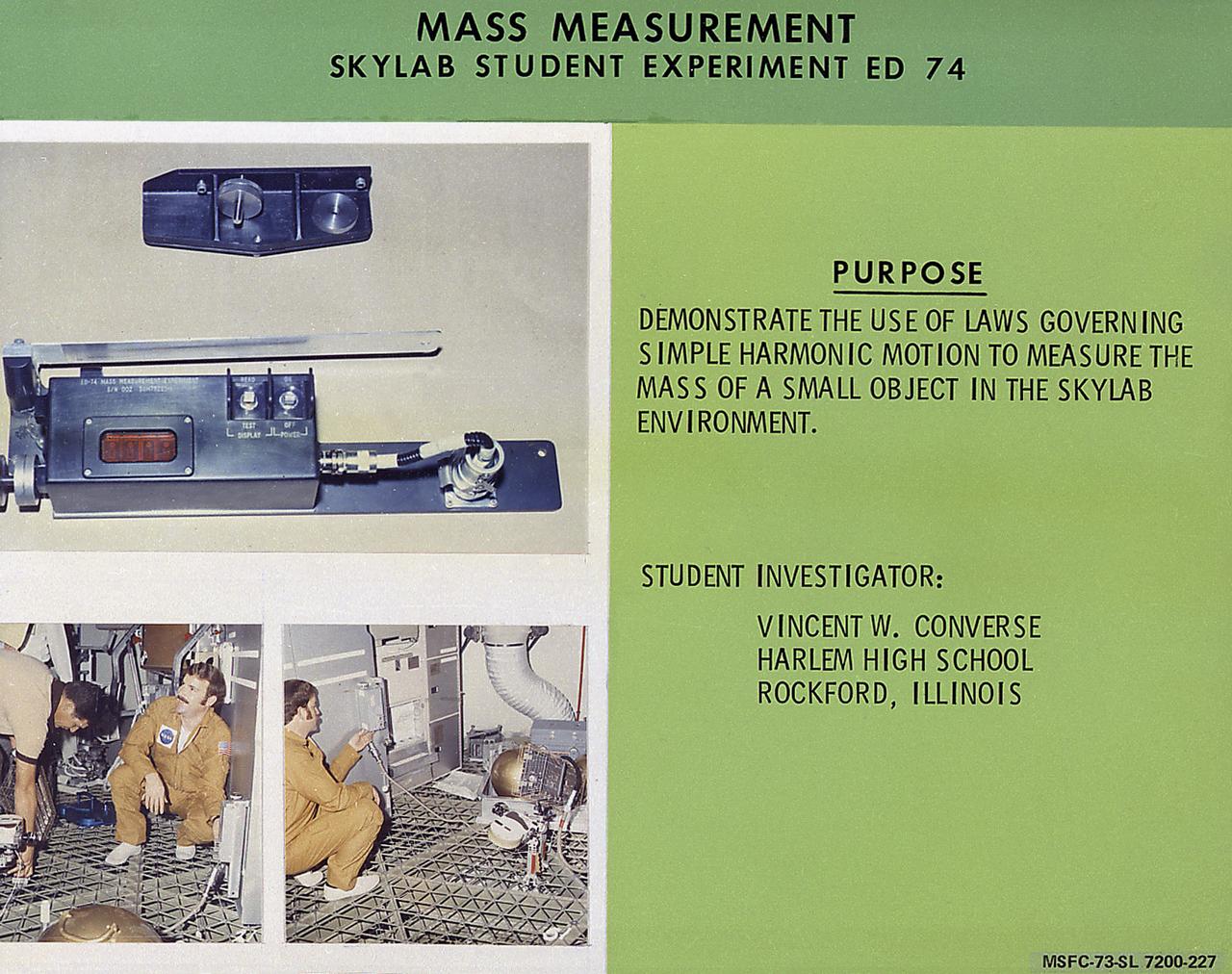
Vincent W. Converse of Rockford, Illinois proposed Skylab's student experiment ED-74, Mass Measurement, to measure mass in a weightless environment. This chart describes Converse's experiment. Mass is the quantity of matter in any object. The gravitational force between an object and the Earth is called weight, which is a result of the Earth's gravity acting upon the object's mass. Even though objects in Skylab were apparently weightless, their mass properties were unchanged. Measurement of mass is therefore an acceptable alternative to measurement of weight. The devices used in this experiment provided accurate mass measurements of the astronauts' weights, intakes, and body wastes throughout the missions. In March 1972, NASA and the National Science Teachers Association selected 25 experiment proposals for flight on Skylab. Science advisors from the Marshall Space Flight Center aided and assisted the students in developing the proposals for flight on Skylab.
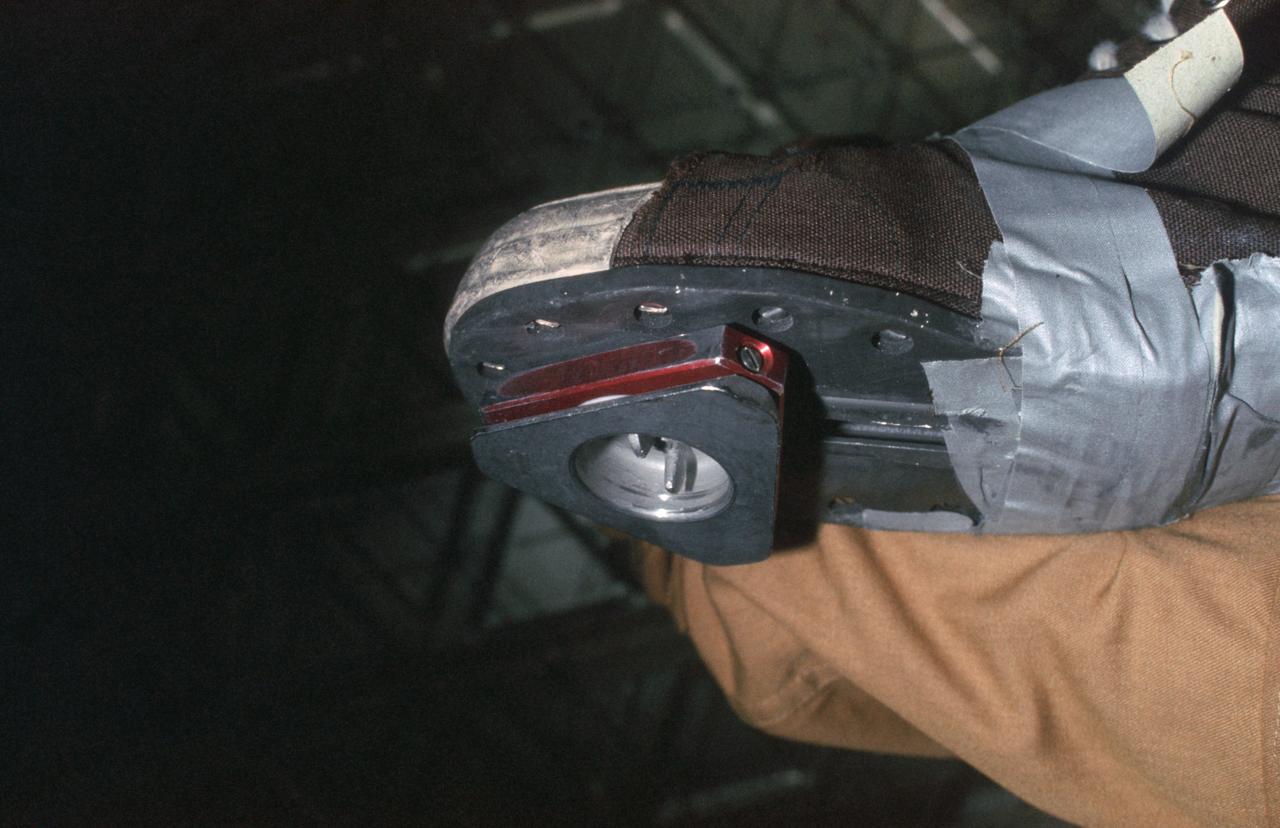
SL4-149-5036 (February 1974) --- View of triangle-shaped cleat taped on the bottom of a shoe of a Skylab 4 crew member. Photo credit: NASA
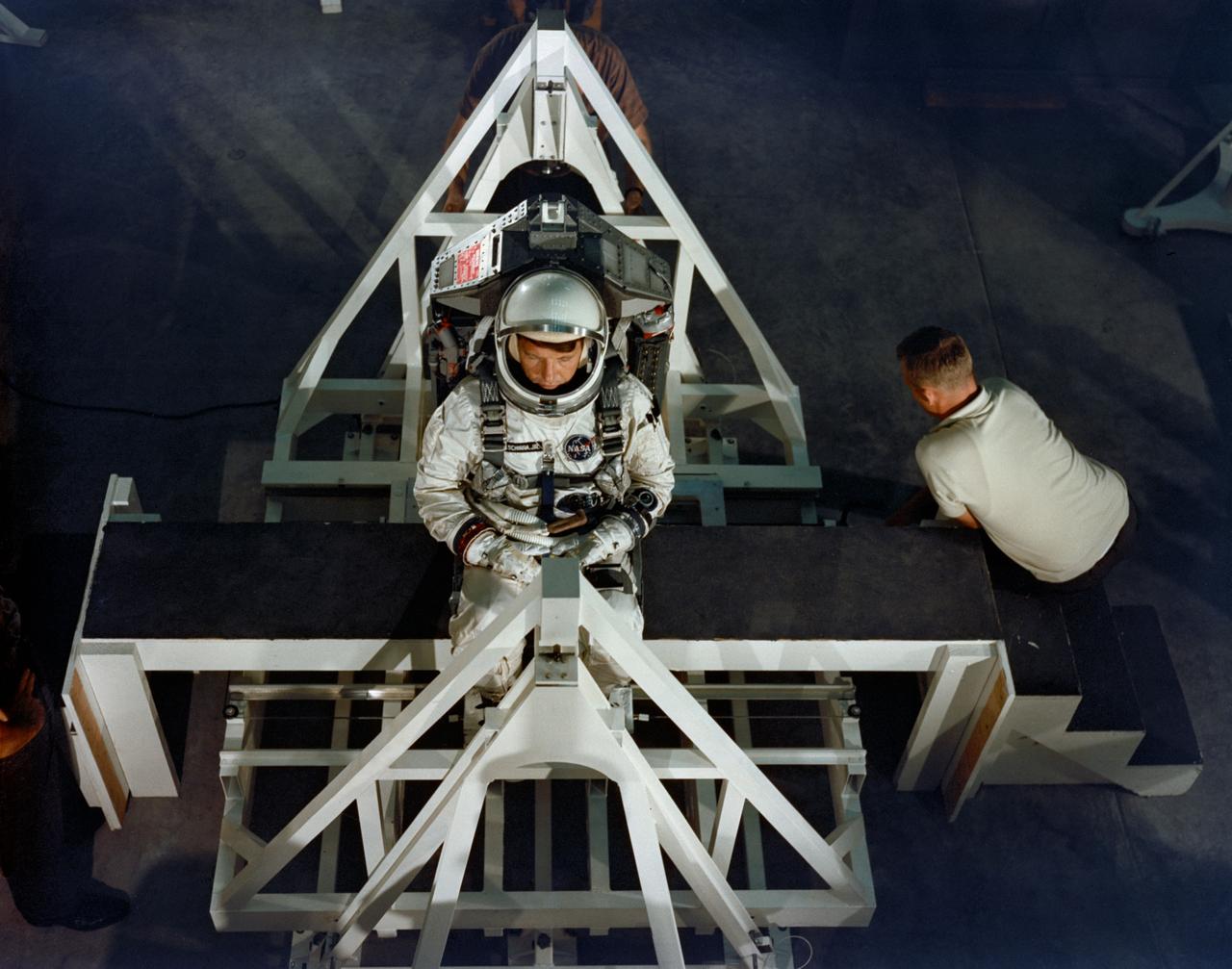
S65-54319 (22 Sept. 1965) --- Astronaut Walter M. Schirra Jr., command pilot of the Gemini-6 prime crew, undergoes weight and balance tests in the Pyrotechnic Installation Building, Merritt Island, Kennedy Space Center, Florida. Photo credit: NASA or National Aeronautics and Space Administration
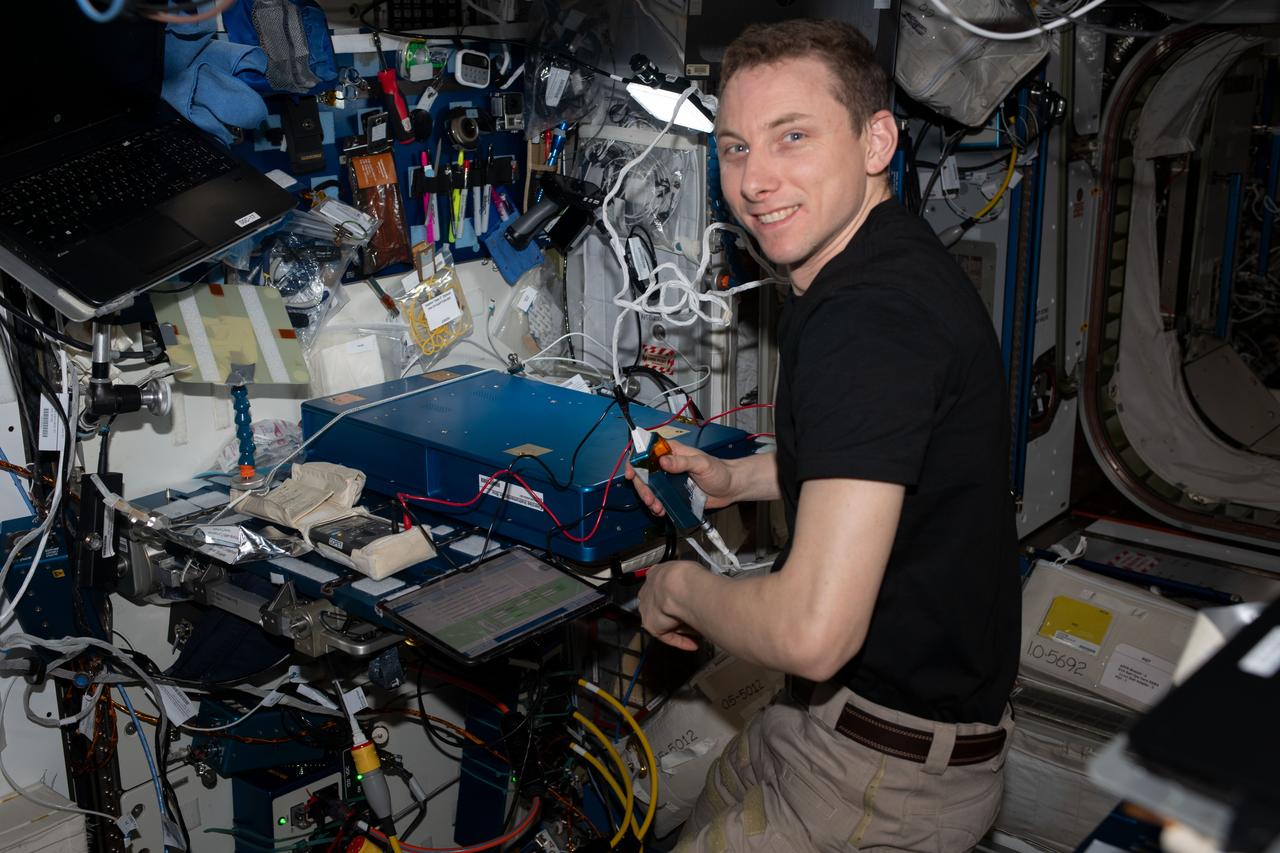
iss069e055097 (Aug. 8, 2023) --- NASA astronaut and Expedition 69 Flight Engineer Woody Hoburg troubleshoots hardware from the the Tranquility module's advanced resistive exercise device (ARED). The ARED is a workout system that mimics free weights on Earth to maintain muscle strength and mass in microgravity.
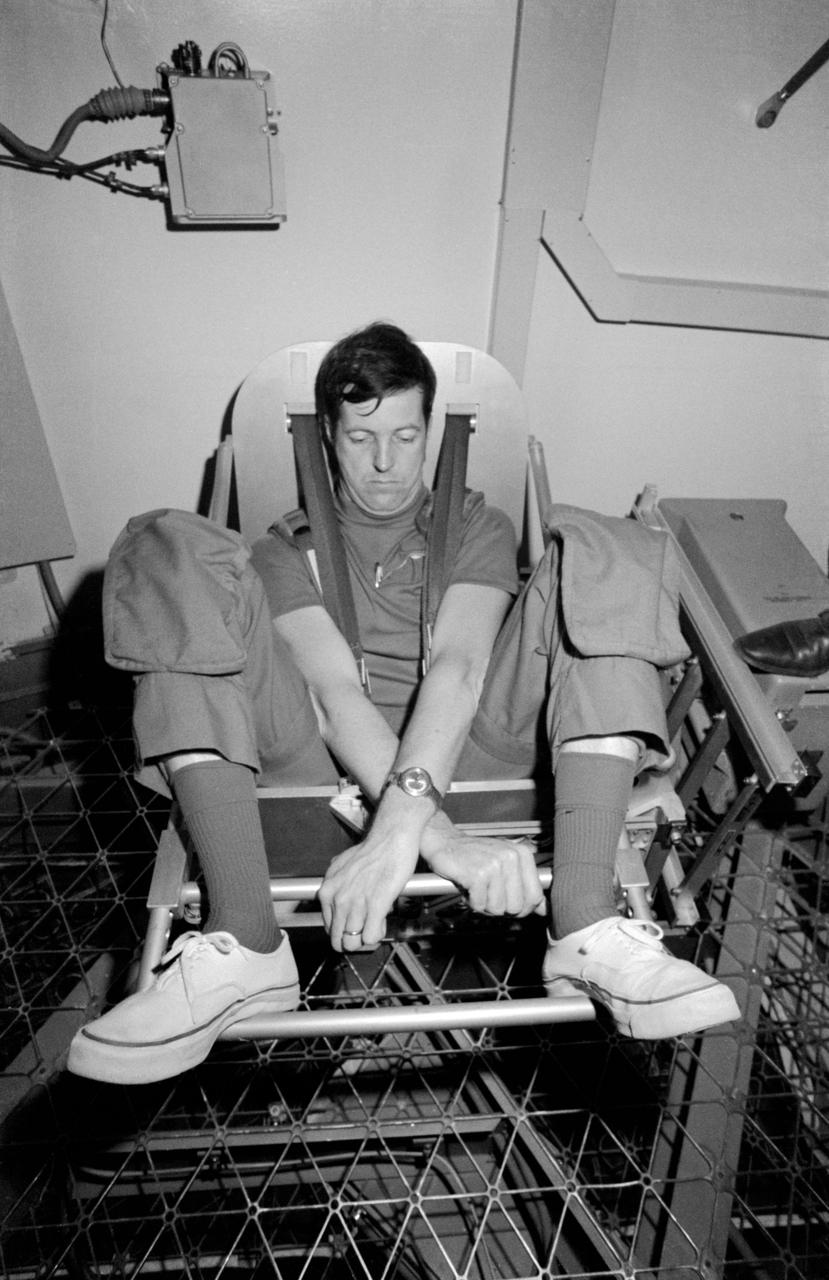
S73-20622 (March 1973) --- Scientist-astronaut Joseph P. Kerwin, science pilot of the first manned Skylab mission, demonstrates the Body Mass Measurement Experiment (M172) during Skylab training at the Johnson Space Center. Dr. Kerwin is in the work and experiments area of the crew quarters of the Skylab Orbital Workshop (OWS) trainer at JSC. The M172 experiment will demonstrate body mass measurement in a null gravity environment, validate theoretical behavior of this method, and support those medical experiments for which body mass measurements are required. The data to be collected in support of M172 are: preflight calibration of the body mass measurement device and measurements of known masses up to 100 kilograms (220 pounds) three times during each Skylab mission. The device, a spring/flexure pivot-mounted chair, will also be used for daily determination of the crewmen?s weight, which will be manually logged and voice recorded for subsequent telemetered transmission. Photo credit: NASA

In High Bay 3 inside the Vehicle Assembly Building at NASA’s Kennedy Space Center in Florida, teams with Exploration Ground Systems and Jacobs use the Orion stage adapter structural test article and the Mass Simulator for Orion for testing on Aug. 13, 2021. They are stacked atop the Space Launch System (SLS) rocket. These test articles represent the mass and weight of the actual Orion stage adapter and Orion spacecraft that will be used for various tests. Launching in 2021, Artemis I will be an uncrewed test of the Orion spacecraft and SLS rocket as an integrated system ahead of crewed flights to the Moon. Under Artemis, NASA aims to land the first woman and first person of color on the Moon and establish sustainable lunar exploration.
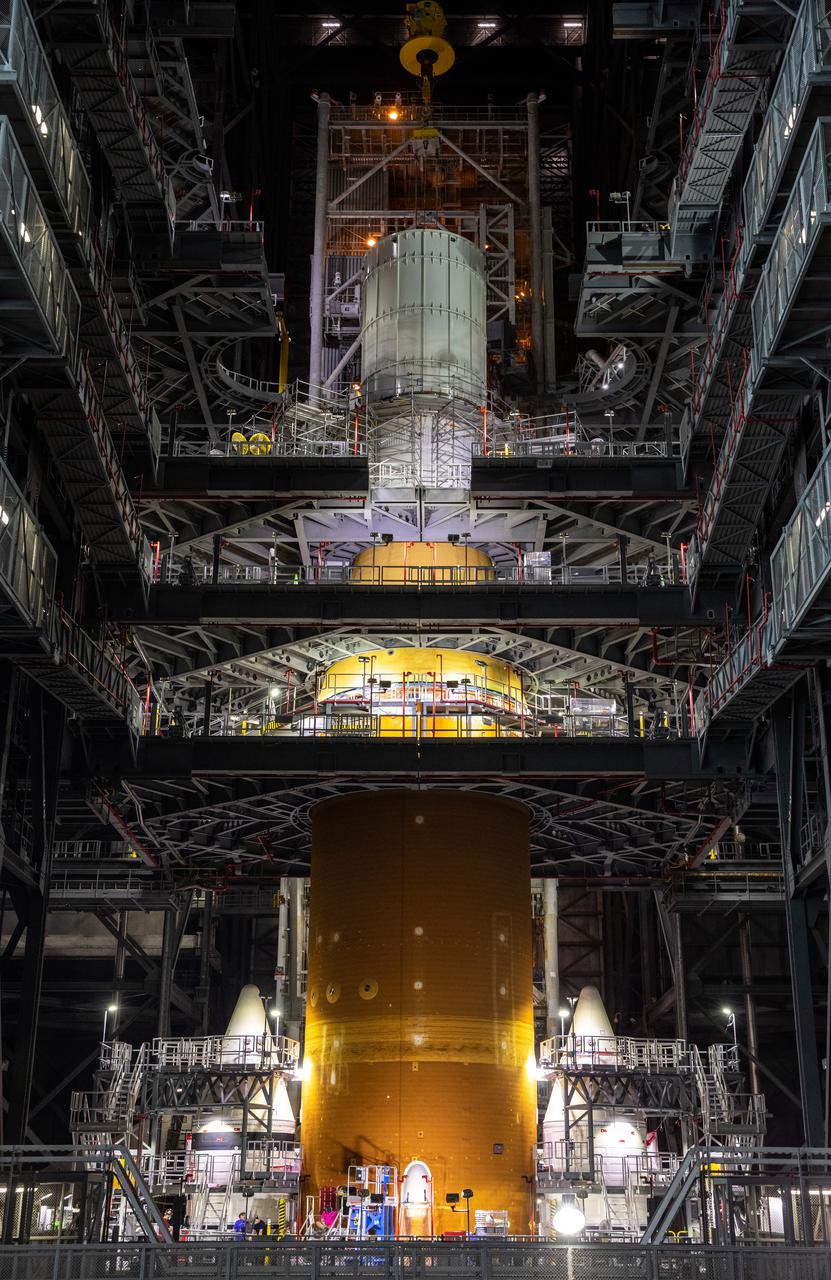
Tests are underway in High Bay 3 inside the Vehicle Assembly Building at NASA’s Kennedy Space Center in Florida on Aug. 13, 2021, using the Orion stage adapter structural test article and the Mass Simulator for Orion. Stacked atop the Space Launch System (SLS) rocket, these test articles represent the mass and weight of the actual Orion stage adapter and Orion spacecraft. Launching in 2021, Artemis I will be an uncrewed test of the Orion spacecraft and SLS rocket as an integrated system ahead of crewed flights to the Moon. Under Artemis, NASA aims to land the first woman and first person of color on the Moon and establish sustainable lunar exploration.

In High Bay 3 inside the Vehicle Assembly Building at NASA’s Kennedy Space Center in Florida, teams with Exploration Ground Systems and Jacobs use the Orion stage adapter structural test article and the Mass Simulator for Orion for testing on Aug. 13, 2021. They are stacked atop the Space Launch System (SLS) rocket. These test articles represent the mass and weight of the actual Orion stage adapter and Orion spacecraft that will be used for various tests. Launching in 2021, Artemis I will be an uncrewed test of the Orion spacecraft and SLS rocket as an integrated system ahead of crewed flights to the Moon. Under Artemis, NASA aims to land the first woman and first person of color on the Moon and establish sustainable lunar exploration.

Tests are underway in High Bay 3 inside the Vehicle Assembly Building at NASA’s Kennedy Space Center in Florida on Aug. 13, 2021, using the Orion stage adapter structural test article and the Mass Simulator for Orion. Stacked atop the Space Launch System (SLS) rocket, these test articles represent the mass and weight of the actual Orion stage adapter and Orion spacecraft. Launching in 2021, Artemis I will be an uncrewed test of the Orion spacecraft and SLS rocket as an integrated system ahead of crewed flights to the Moon. Under Artemis, NASA aims to land the first woman and first person of color on the Moon and establish sustainable lunar exploration.
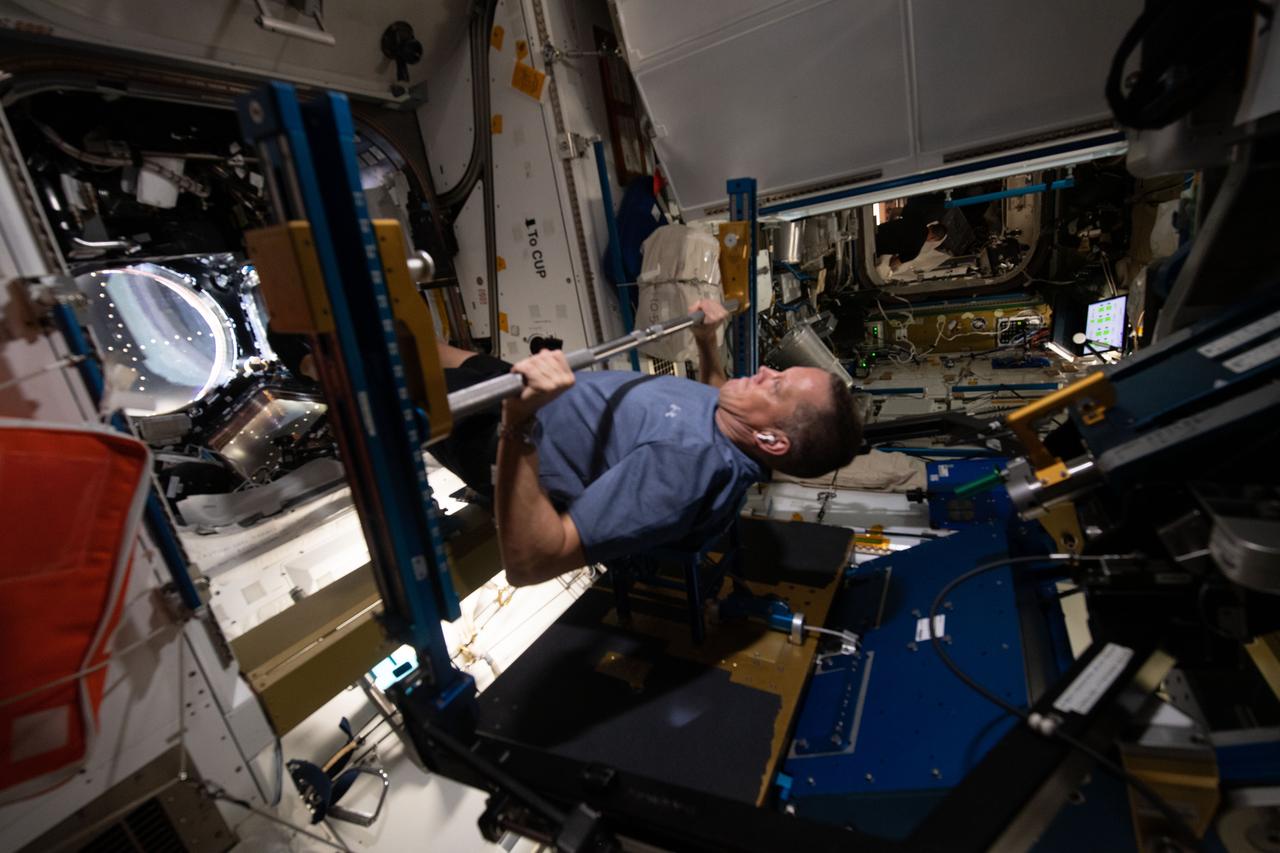
iss067e10951 (July 8, 2022) --- NASA astronaut and Expedition 67 Flight Engineer Bob Hines works out on the Advanced Resistive Exercise Device (ARED) inside the International Space Station's Tranquility module. The ARED mimics the inertial forces generated when lifting free weights on Earth enabling crew members to experience load and maintain muscle strength and mass during a long-term space mission.
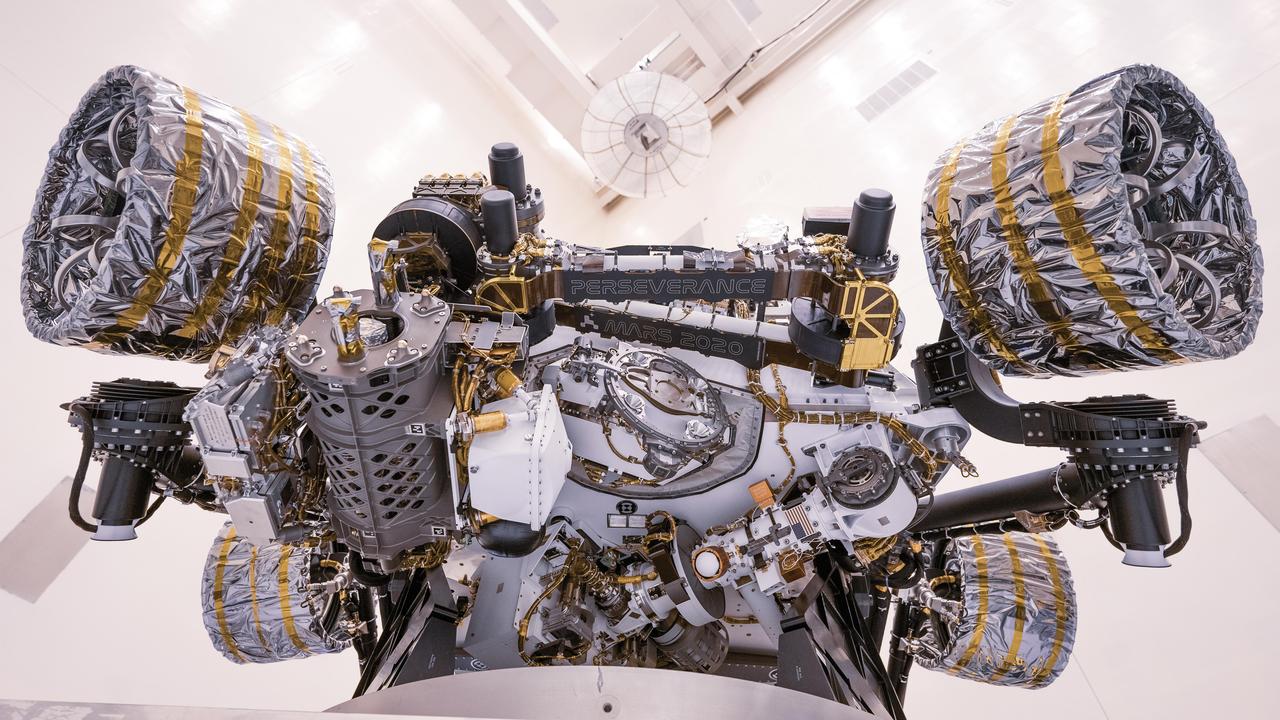
This image of the Perseverance Mars rover was taken at NASA's Kennedy Space Center on April 7, 2020, during a test of the vehicle's mass properties. The rover was rotated clockwise and counterclockwise on a spin table to determine the center of gravity, or the point at which weight is evenly dispersed on all sides. In the image, the project name "Mars 2020" and rover name "Perseverance" can be seen on name plates that have been attached to the rover's robotic arm. https://photojournal.jpl.nasa.gov/catalog/PIA23828
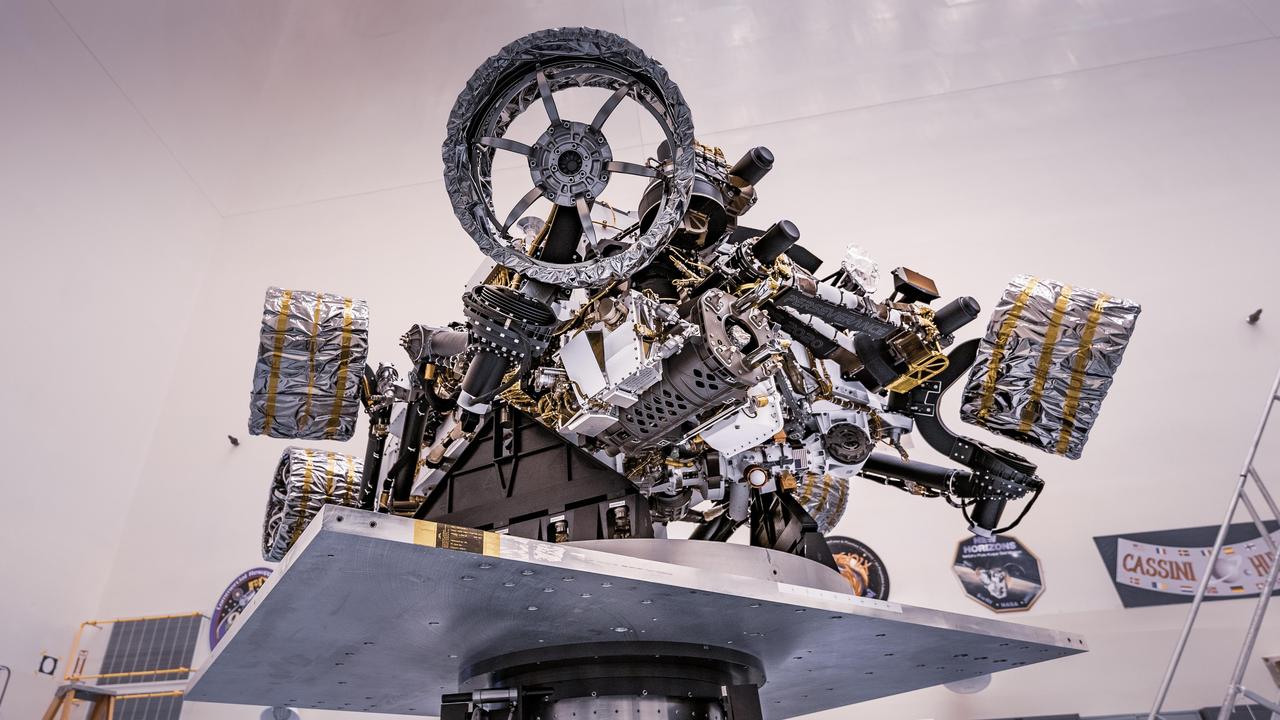
NASA's Perseverance rover can be seen attached to a spin table during a test of its mass properties at the Kennedy Space Center in Florida. During the test, the rover was rotated clockwise and counterclockwise to determine its center of gravity, or the point at which weight is evenly dispersed on all sides. The image was taken on April 7, 2020. https://photojournal.jpl.nasa.gov/catalog/PIA23826
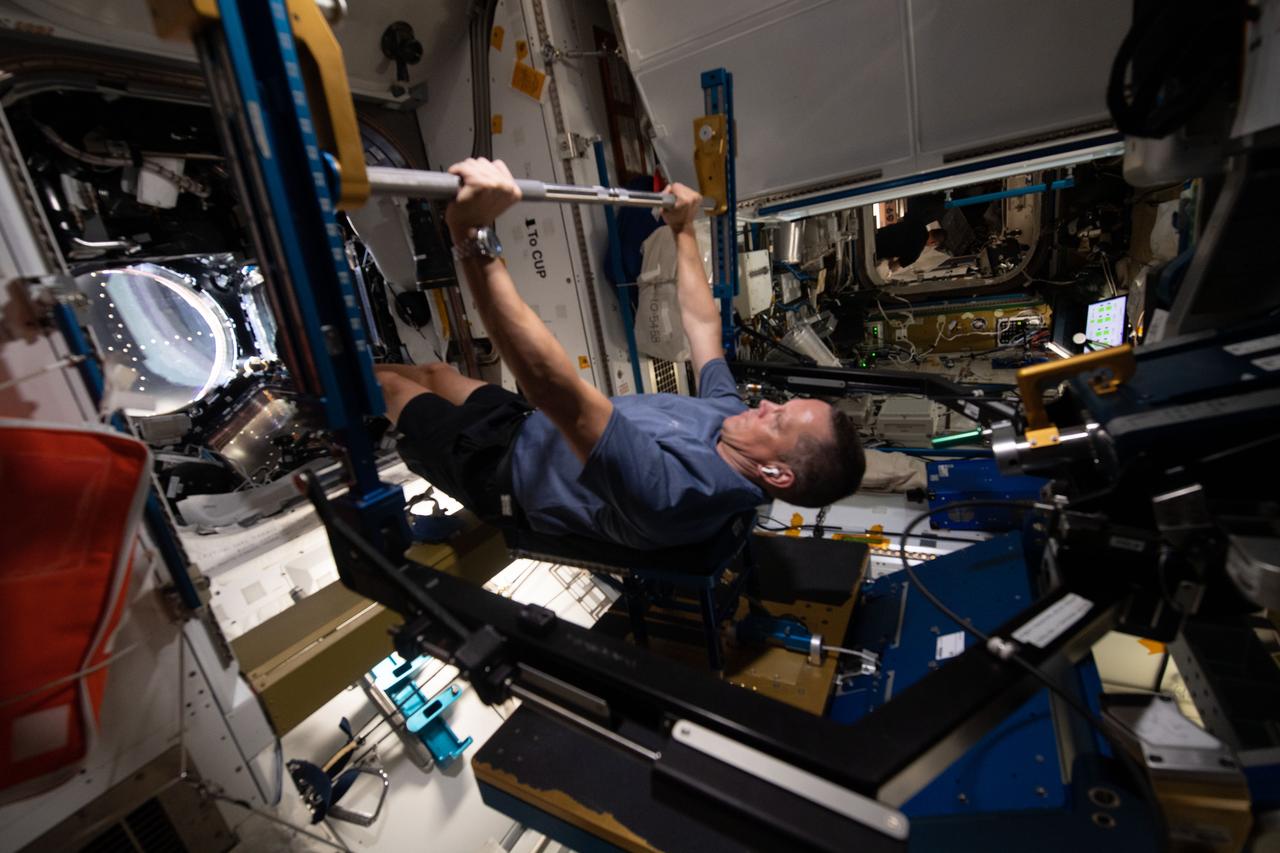
iss067e10952 (July 8, 2022) --- NASA astronaut and Expedition 67 Flight Engineer Bob Hines works out on the Advanced Resistive Exercise Device (ARED) inside the International Space Station's Tranquility module. The ARED mimics the inertial forces generated when lifting free weights on Earth enabling crew members to experience load and maintain muscle strength and mass during a long-term space mission.
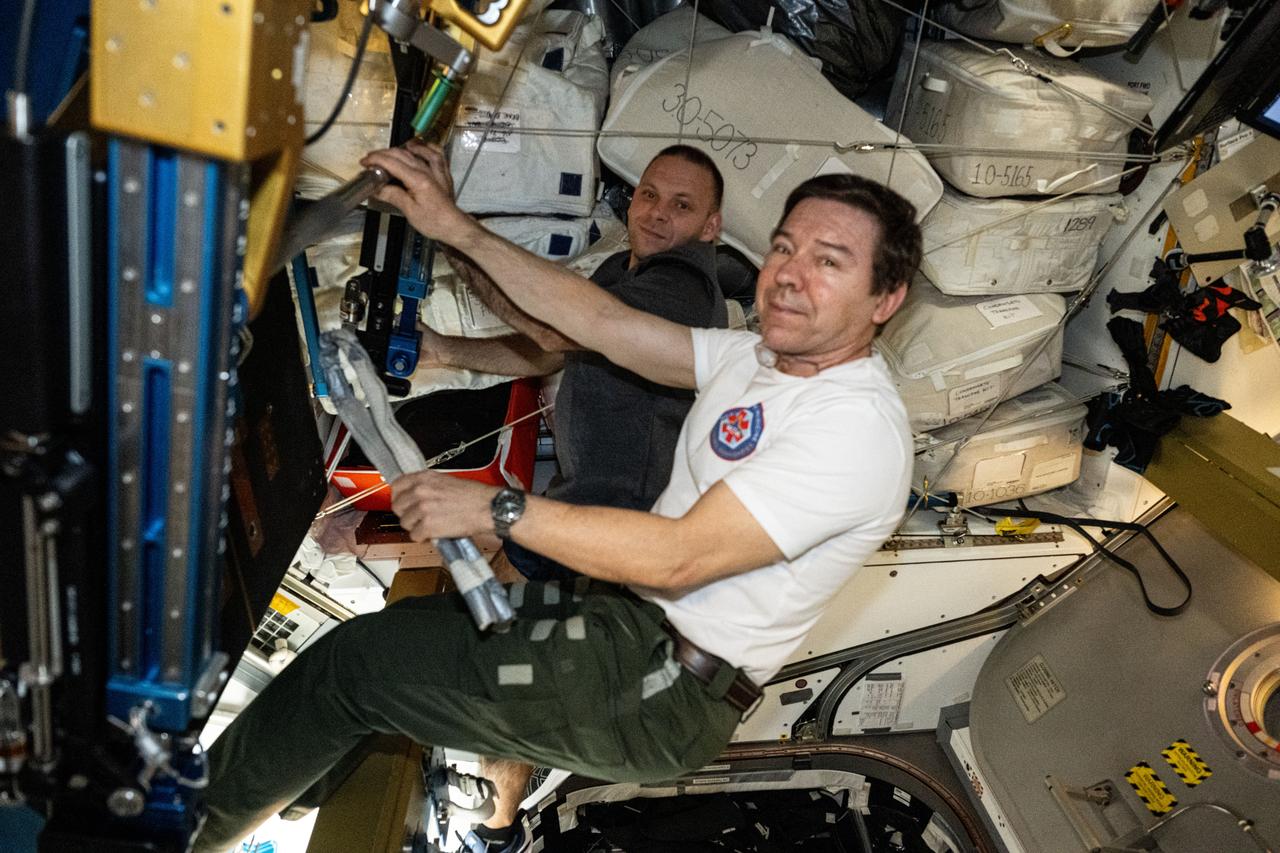
iss071e666983 (Sept. 17, 2024) --- NASA astronaut Mike Barratt (foreground) and Roscosmos cosmonaut Ivan Vagner, both Expedition 71 Flght Engineers, examine the International Space Station's advanced resistive exercise device (ARED) located in the Tranquility module. The ARED mimics the inertial load of free weights on Earth helping crews maintain muscle strength and mass during long periods in the weightless environment of space.
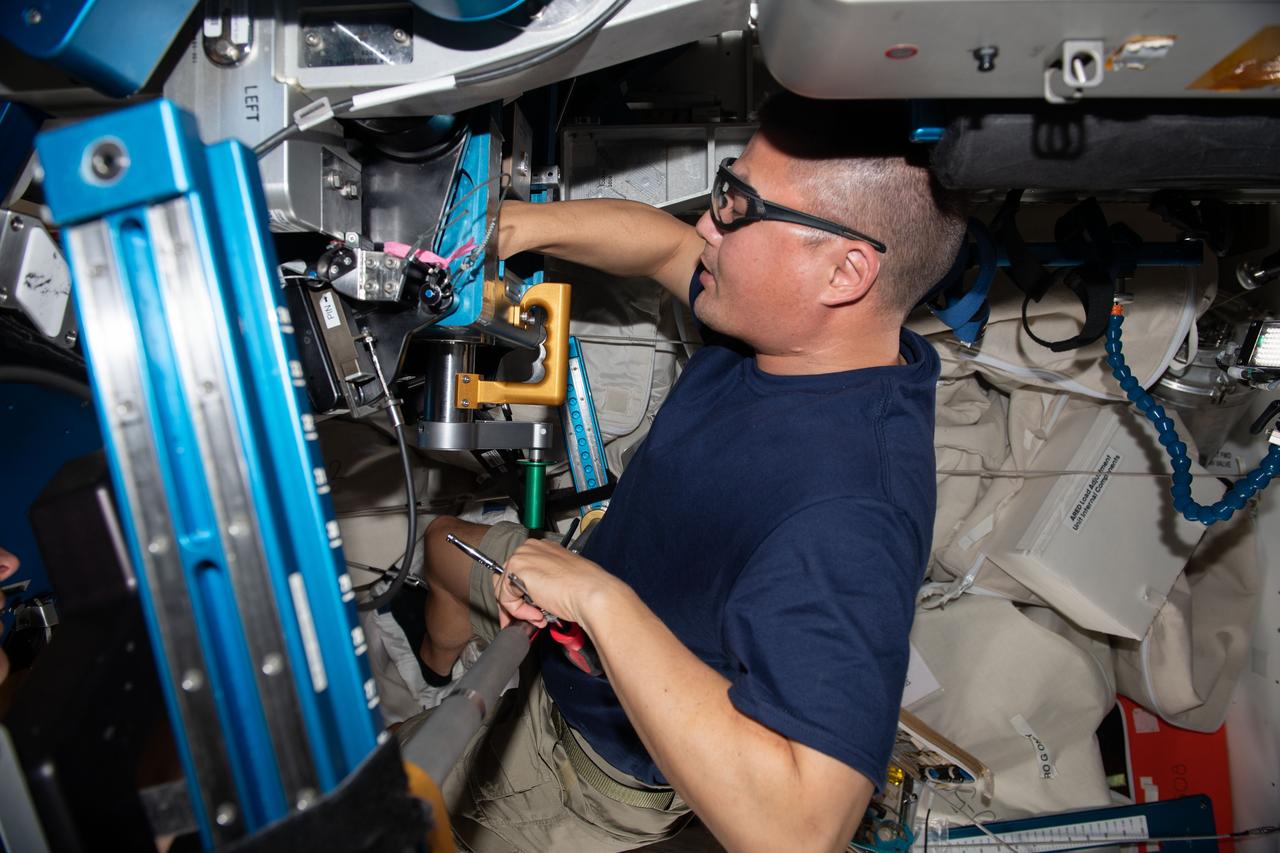
iss067e120161 (June 8, 2022) --- Expedition 67 Flight Engineer and NASA astronaut Kjell Lindgren replaces components on the advanced resistive exercise device (ARED) located inside the International Space Station's Tranquility module. The ARED mimics the inertial forces generated when lifting free weights on Earth allowing astronauts to maintain muscle strength and mass during long-term space missions.
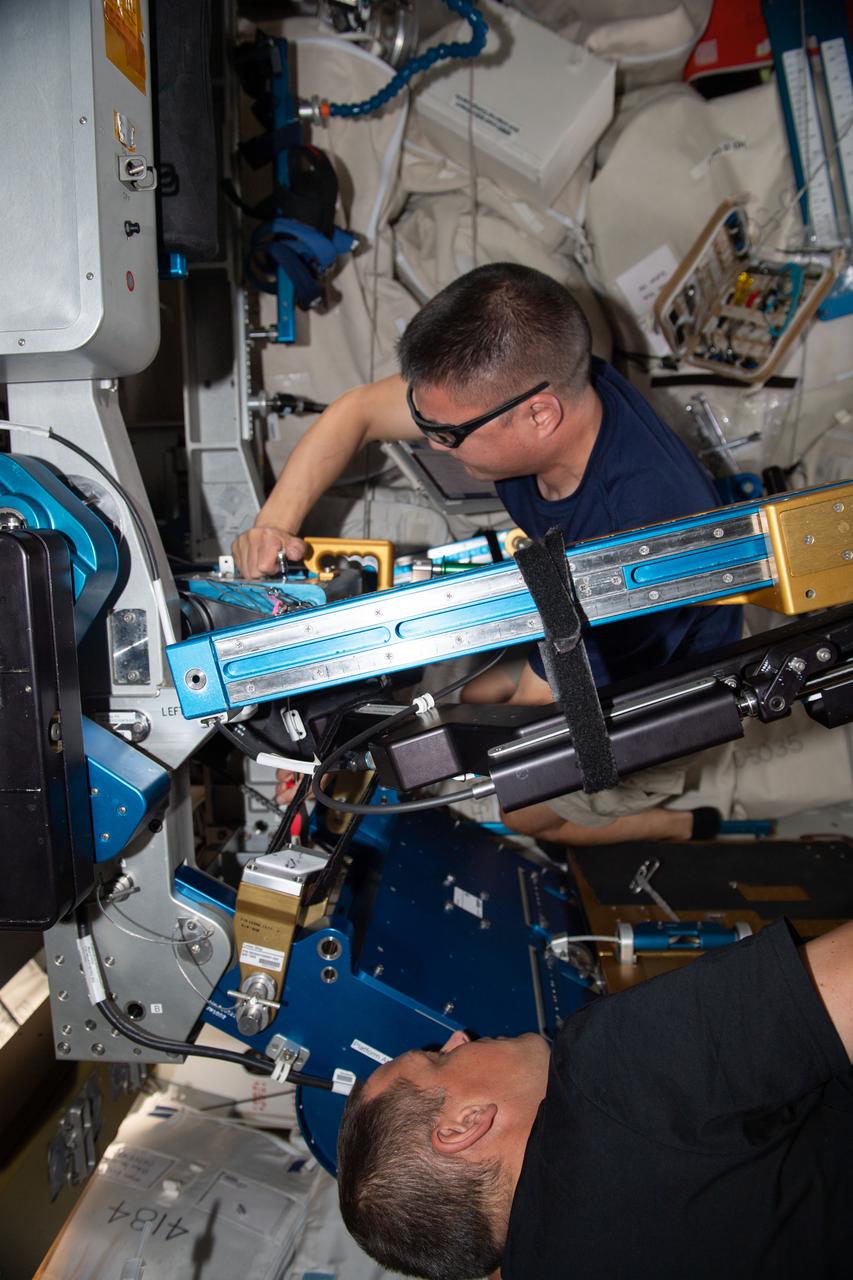
iss067e120164 (June 8, 2022) --- Expedition 67 Flight Engineers (from bottom) Bob Hines and Kjell Lindgren, both NASA astronauts, replace components on the advanced resistive exercise device (ARED) located inside the International Space Station's Tranquility module. The ARED mimics the inertial forces generated when lifting free weights on Earth allowing astronauts to maintain muscle strength and mass during long-term space missions.
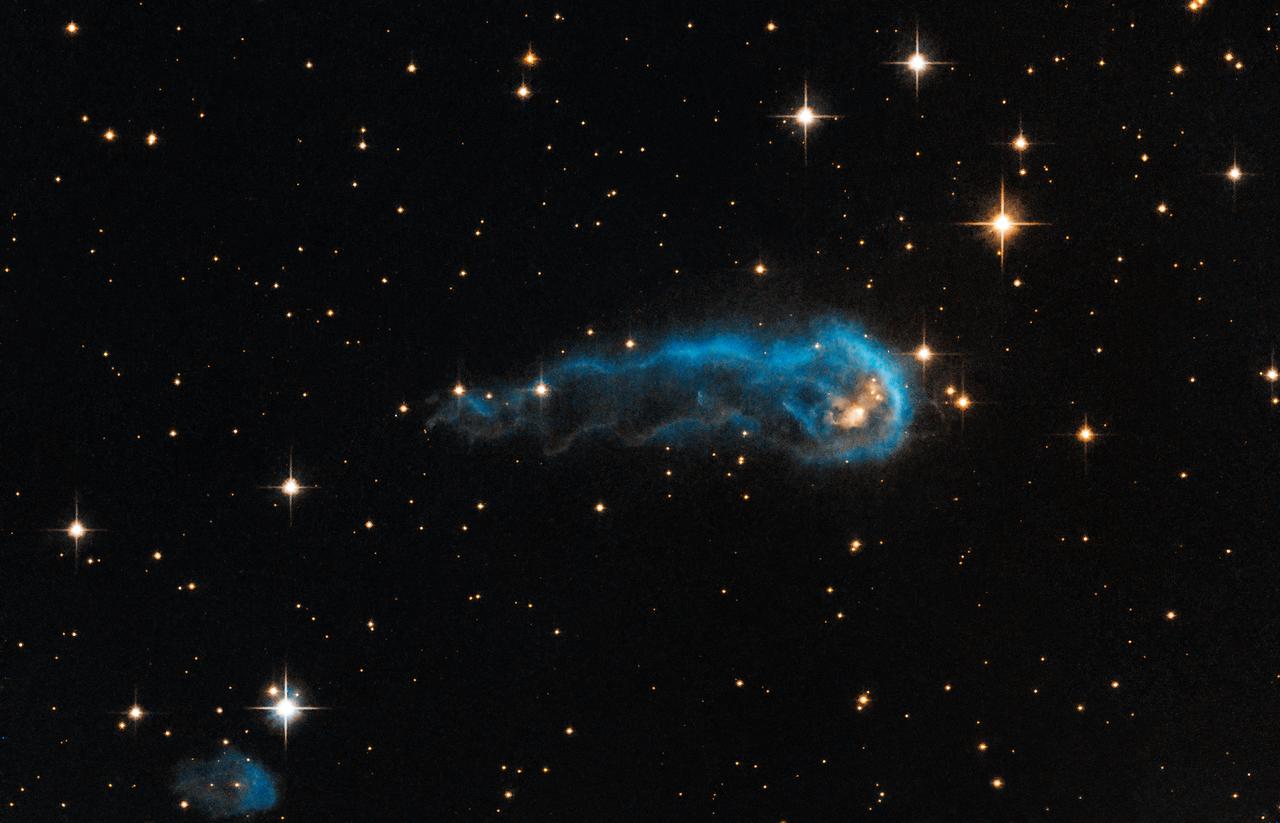
This light-year-long knot of interstellar gas and dust resembles a caterpillar on its way to a feast. But the meat of the story is not only what this cosmic caterpillar eats for lunch, but also what's eating it. Harsh winds from extremely bright stars are blasting ultraviolet radiation at this "wanna-be" star and sculpting the gas and dust into its long shape. The culprits are 65 of the hottest, brightest known stars, classified as O-type stars, located 15 light-years away from the knot, towards the right edge of the image. These stars, along with 500 less bright, but still highly luminous B-type stars make up what is called the Cygnus OB2 association. Collectively, the association is thought to have a mass more than 30,000 times that of our sun. The caterpillar-shaped knot, called IRAS 20324+4057, is a protostar in a very early evolutionary stage. It is still in the process of collecting material from an envelope of gas surrounding it. However, that envelope is being eroded by the radiation from Cygnus OB2. Protostars in this region should eventually become young stars with final masses about one to ten times that of our sun, but if the eroding radiation from the nearby bright stars destroys the gas envelope before the protostars finish collecting mass, their final masses may be reduced. Spectroscopic observations of the central star within IRAS 20324+4057 show that it is still collecting material quite heavily from its outer envelope, hoping to bulk up in mass. Only time will tell if the formed star will be a "heavy-weight" or a "light-weight" with respect to its mass. This image of IRAS 20324+4057 is a composite of Hubble Advanced Camera for Surveys data taken in green and infrared light in 2006, and ground-based hydrogen data from the Isaac Newton Telescope in 2003. The object lies 4,500 light-years away in the constellation Cygnus. Credit: NASA, ESA, and the Hubble Heritage Team (STScI/AURA) <b><a href="http://www.nasa.gov/audience/formedia/features/MP_Photo_Guidelines.html" rel="nofollow">NASA image use policy.</a></b> <b><a href="http://www.nasa.gov/centers/goddard/home/index.html" rel="nofollow">NASA Goddard Space Flight Center</a></b> enables NASA’s mission through four scientific endeavors: Earth Science, Heliophysics, Solar System Exploration, and Astrophysics. Goddard plays a leading role in NASA’s accomplishments by contributing compelling scientific knowledge to advance the Agency’s mission. <b>Follow us on <a href="http://twitter.com/NASA_GoddardPix" rel="nofollow">Twitter</a></b> <b>Like us on <a href="http://www.facebook.com/pages/Greenbelt-MD/NASA-Goddard/395013845897?ref=tsd" rel="nofollow">Facebook</a></b> <b>Find us on <a href="http://instagram.com/nasagoddard?vm=grid" rel="nofollow">Instagram</a></b>
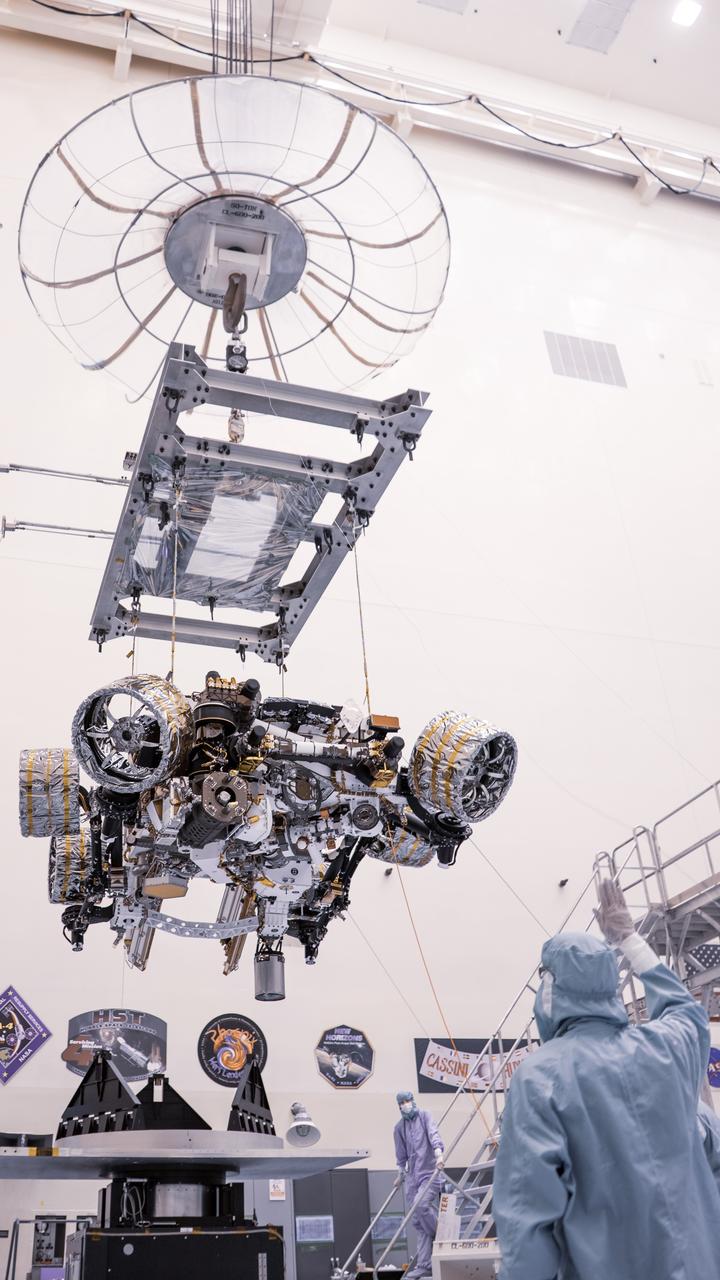
Engineers perform mass properties testing on NASA’s Mars Perseverance rover inside Kennedy Space Center’s Payload Hazardous Servicing Facility on April 7, 2020. The rover was rotated clockwise and counterclockwise on a spin table to determine the center of gravity, or the point at which weight is evenly dispersed on all sides. Establishing the rover’s center of gravity will help ensure the spacecraft will land on Mars as calculated. Perseverance will touch down on the Red Planet on Feb. 18, 2021. Liftoff aboard a United Launch Alliance Atlas V 541 rocket is targeted between July 17 and Aug. 5 from Cape Canaveral Air Force Station. NASA’s Launch Services Program based at Kennedy is managing the launch.

Seen here is a close-up view of the Orion stage adapter (OSA) structural test article atop the Space Launch System (SLS) rocket inside the Vehicle Assembly Building (VAB) at NASA’s Kennedy Space Center in Florida on Aug. 12, 2021. The test article, representing the mass and weight of the actual flight hardware, is being used for various tests inside the VAB ahead of OSA stacking operations. The first in an increasingly complex set of missions, Artemis I will test SLS and the Orion spacecraft as an integrated system prior to crewed flights to the Moon. Through Artemis, NASA will send the first woman and the first person of color to the lunar surface, as well as establish a sustainable presence on and around the Moon.
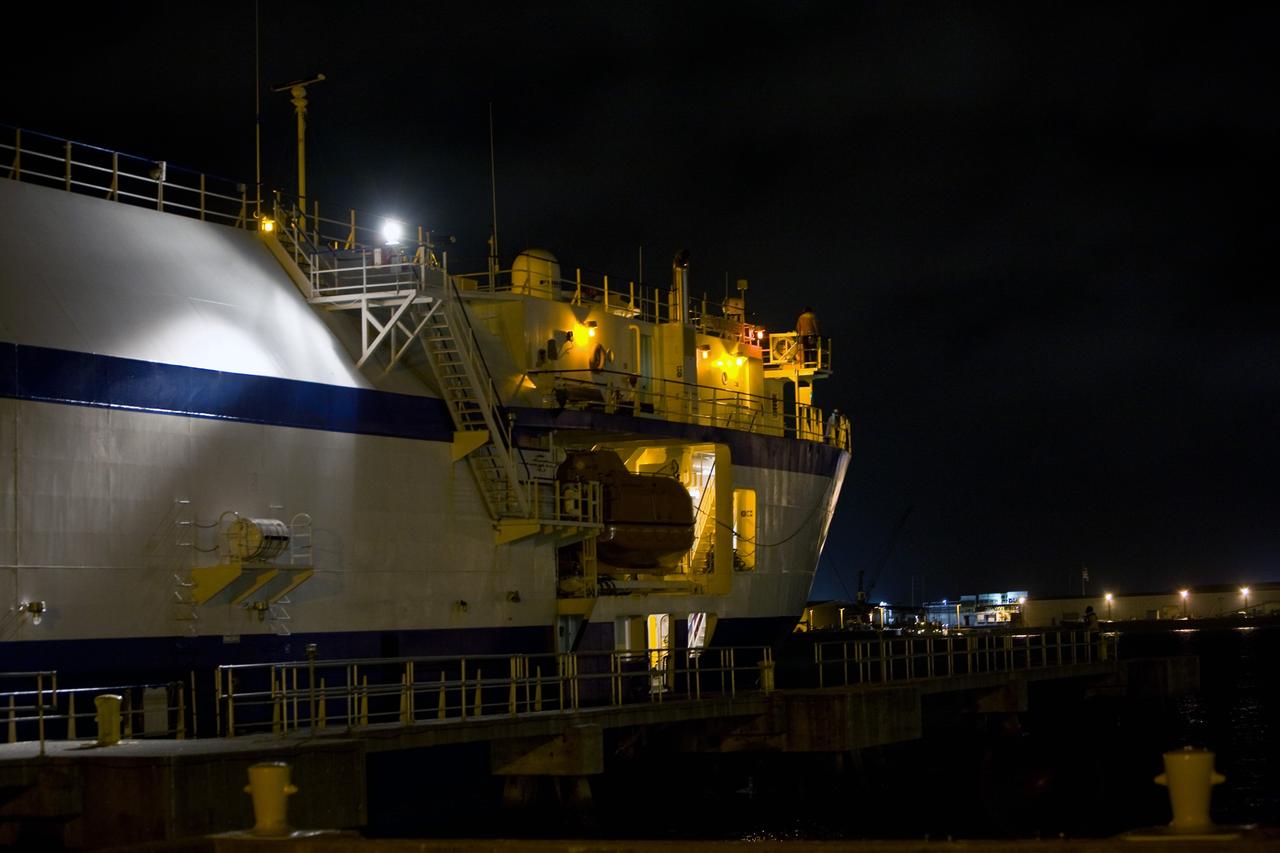
CAPE CANAVERAL, Fla. – The Delta Mariner arrives at Port Canaveral, Fla., with its cargo of the Ares I-X upper stage simulator segments. The upper stage simulator will be used in the test flight identified as Ares I-X in 2009. The segments will simulate the mass and the outer mold line and will be more than 100 feet of the total vehicle height of 327 feet. The simulator comprises 11 segments that are approximately 18 feet in diameter. Most of the segments will be approximately 10 feet high, ranging in weight from 18,000 to 60,000 pounds, for a total of approximately 450,000 pounds. Photo credit: NASA/Dimitri Gerondidakis
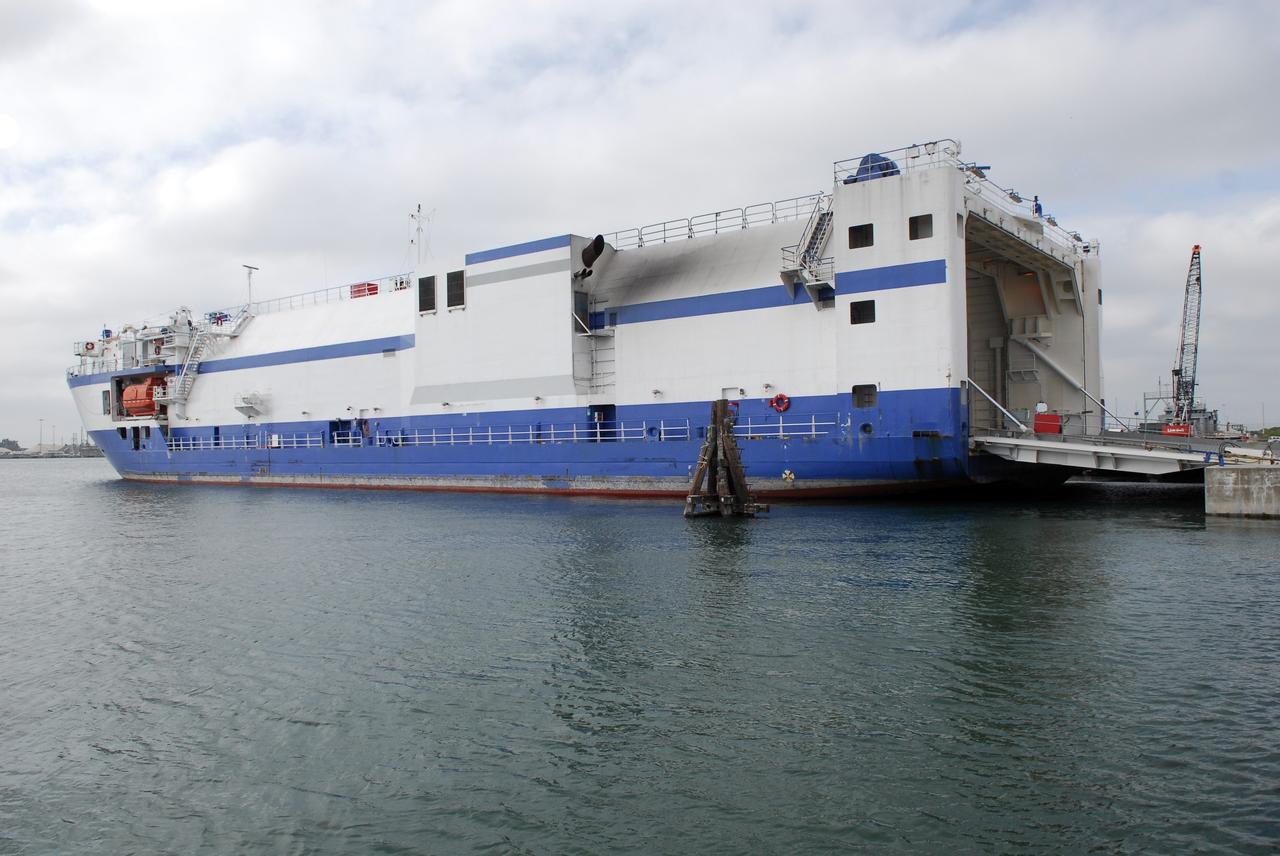
CAPE CANAVERAL, Fla. – The Delta Mariner docks at Port Canaveral, Fla., with its cargo of the Ares I-X upper stage simulator segments. The upper stage simulator will be used in the test flight identified as Ares I-X in 2009. The segments will simulate the mass and the outer mold line and will be more than 100 feet of the total vehicle height of 327 feet. The simulator comprises 11 segments that are approximately 18 feet in diameter. Most of the segments will be approximately 10 feet high, ranging in weight from 18,000 to 60,000 pounds, for a total of approximately 450,000 pounds. Photo credit: NASA/Dimitri Gerondidakis
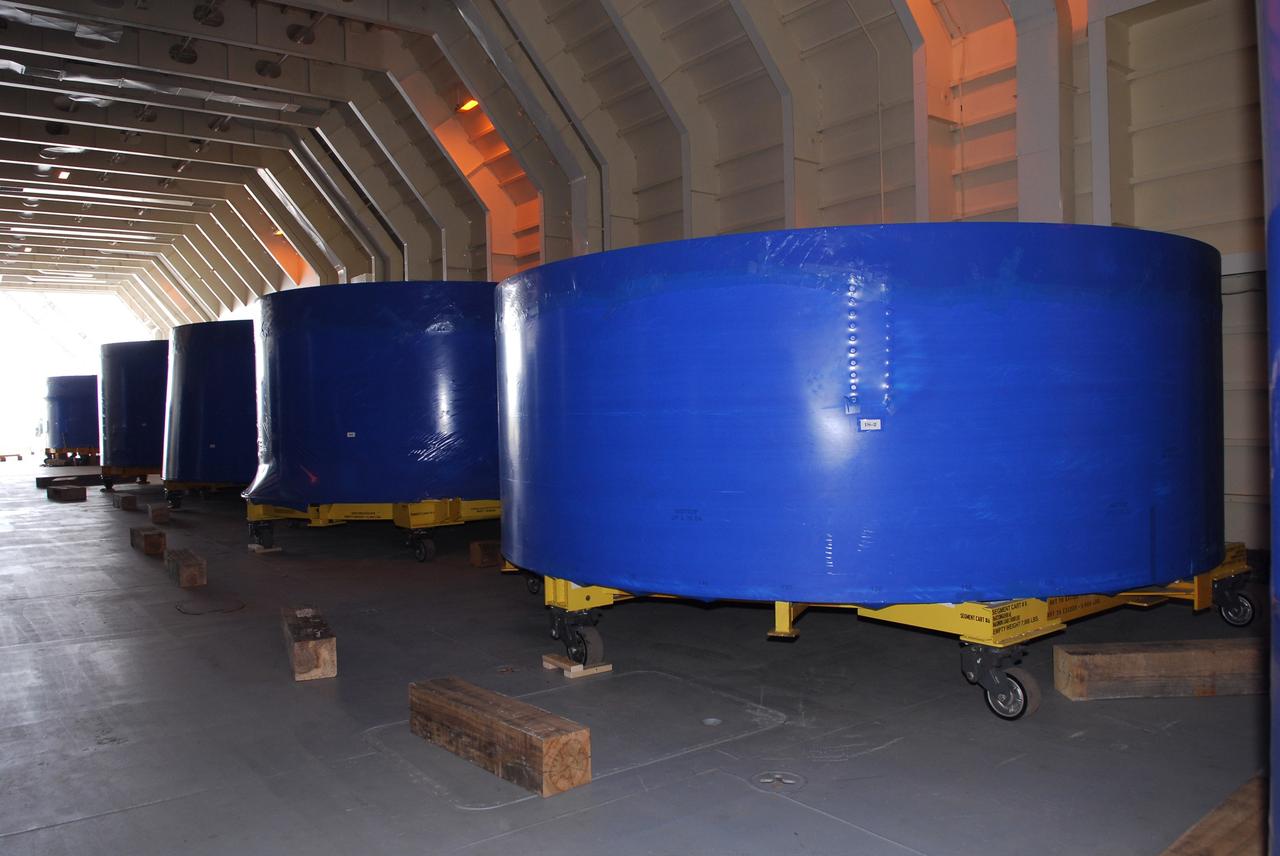
CAPE CANAVERAL, Fla. – Segments of the Ares I-X upper stage simulator are lined up in the cargo hold of the Delta Mariner, docked at Port Canaveral, Fla. The upper stage simulator will be used in the test flight identified as Ares I-X in 2009. The segments will simulate the mass and the outer mold line and will be more than 100 feet of the total vehicle height of 327 feet. The simulator comprises 11 segments that are approximately 18 feet in diameter. Most of the segments will be approximately 10 feet high, ranging in weight from 18,000 to 60,000 pounds, for a total of approximately 450,000 pounds. Photo credit: NASA/Dimitri Gerondidakis
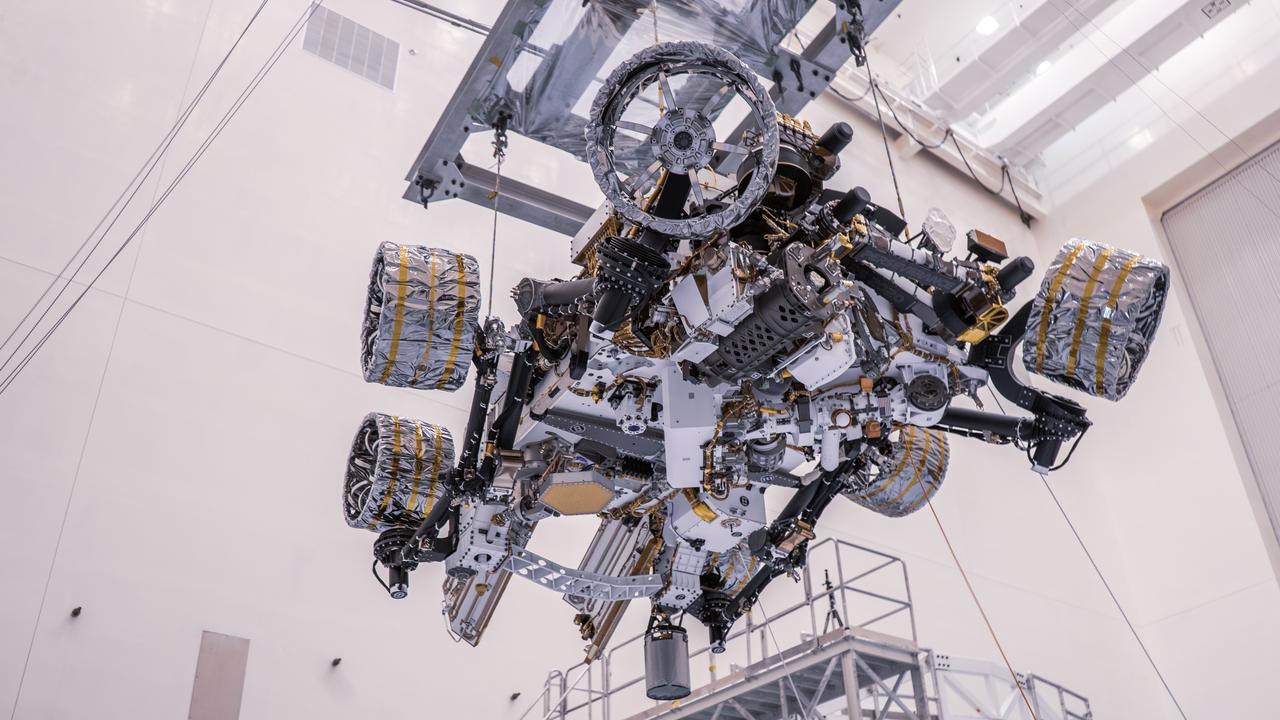
Engineers perform mass properties testing on NASA’s Mars Perseverance rover inside Kennedy Space Center’s Payload Hazardous Servicing Facility on April 7, 2020. The rover was rotated clockwise and counterclockwise on a spin table to determine the center of gravity, or the point at which weight is evenly dispersed on all sides. Establishing the rover’s center of gravity will help ensure the spacecraft will land on Mars as calculated. Perseverance will touch down on the Red Planet on Feb. 18, 2021. Liftoff aboard a United Launch Alliance Atlas V 541 rocket is targeted between July 17 and Aug. 5 from Cape Canaveral Air Force Station. NASA’s Launch Services Program based at Kennedy is managing the launch.

CAPE CANAVERAL, Fla. – On the bridge of the Delta Mariner, whose cargo is the Ares I-X upper stage simulator segments. The upper stage simulator will be used in the test flight identified as Ares I-X in 2009. The segments will simulate the mass and the outer mold line and will be more than 100 feet of the total vehicle height of 327 feet. The simulator comprises 11 segments that are approximately 18 feet in diameter. Most of the segments will be approximately 10 feet high, ranging in weight from 18,000 to 60,000 pounds, for a total of approximately 450,000 pounds. Photo credit: NASA/Dimitri Gerondidakis
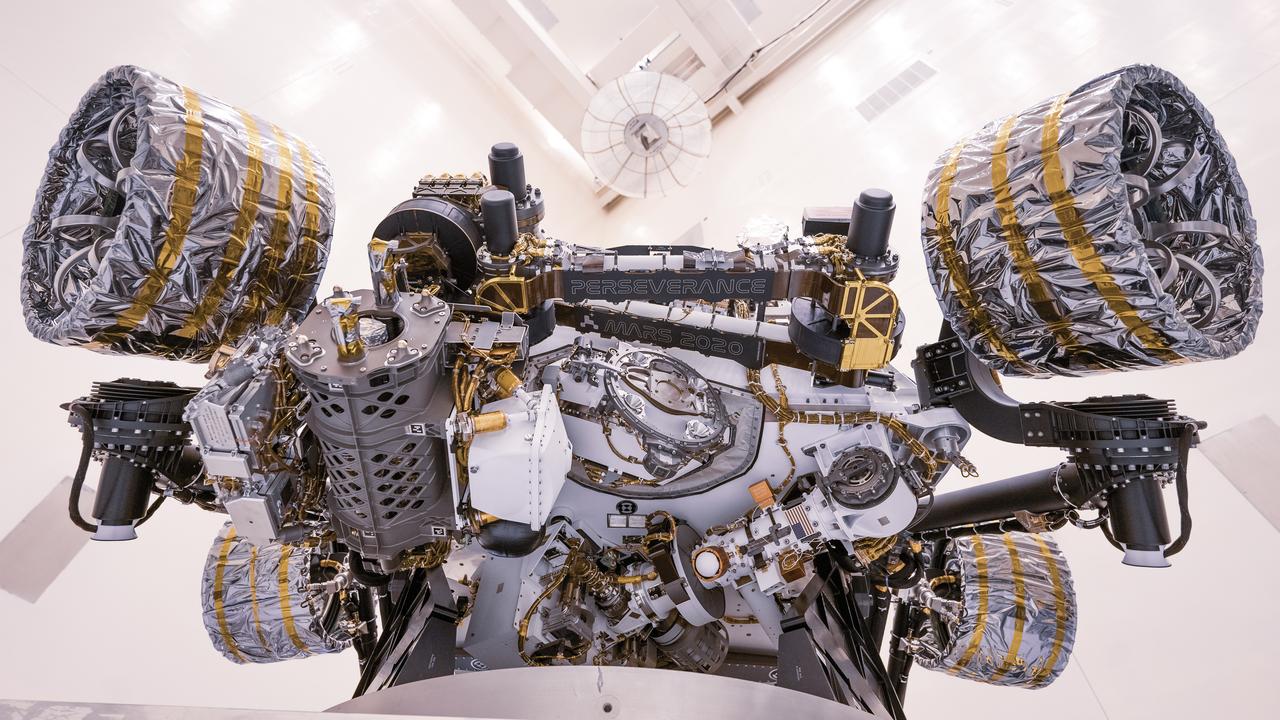
Engineers perform mass properties testing on NASA’s Mars Perseverance rover inside Kennedy Space Center’s Payload Hazardous Servicing Facility on April 7, 2020. The rover was rotated clockwise and counterclockwise on a spin table to determine the center of gravity, or the point at which weight is evenly dispersed on all sides. Establishing the rover’s center of gravity will help ensure the spacecraft will land on Mars as calculated. Perseverance will touch down on the Red Planet on Feb. 18, 2021. Liftoff aboard a United Launch Alliance Atlas V 541 rocket is targeted between July 17 and Aug. 5 from Cape Canaveral Air Force Station. NASA’s Launch Services Program based at Kennedy is managing the launch.
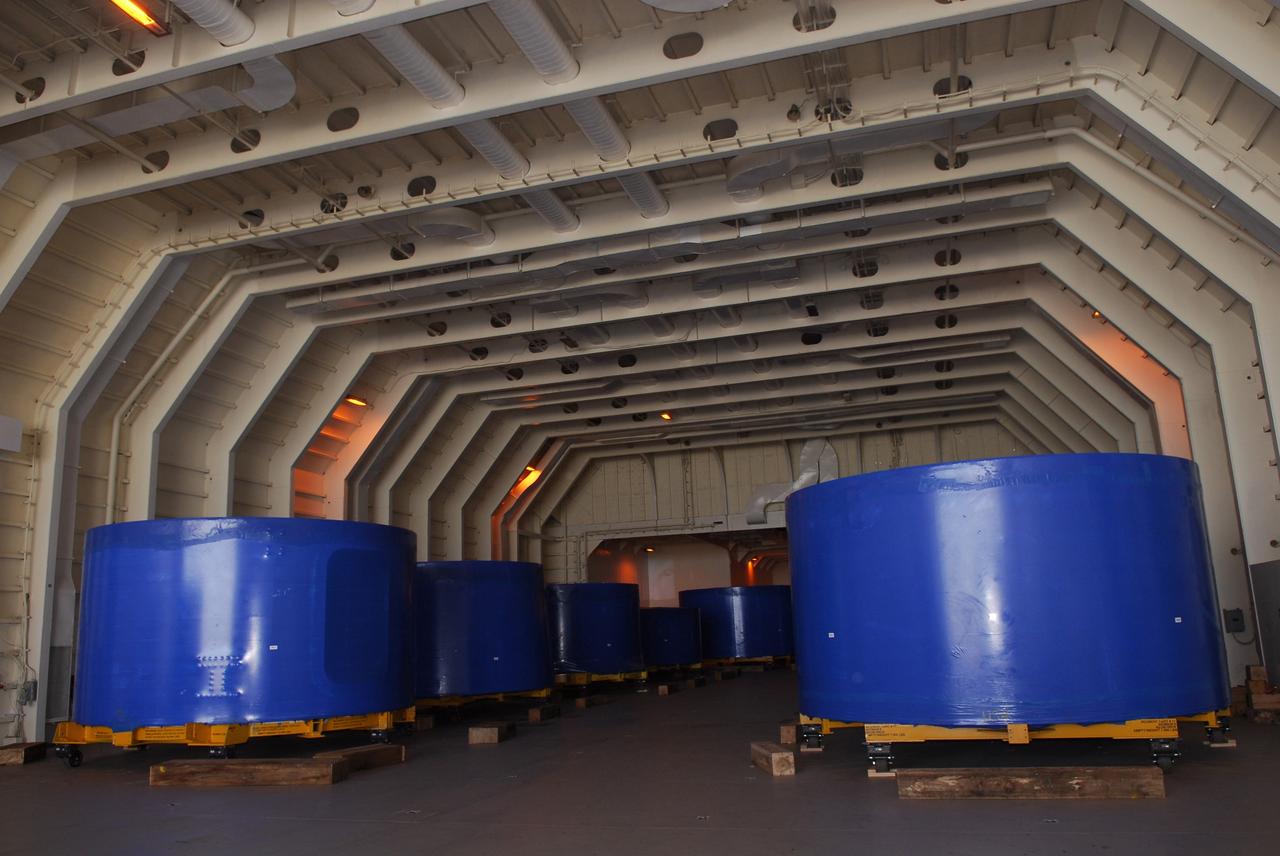
CAPE CANAVERAL, Fla. – Segments of the Ares I-X upper stage simulator are lined up in the cargo hold of the Delta Mariner, docked at Port Canaveral, Fla. The upper stage simulator will be used in the test flight identified as Ares I-X in 2009. The segments will simulate the mass and the outer mold line and will be more than 100 feet of the total vehicle height of 327 feet. The simulator comprises 11 segments that are approximately 18 feet in diameter. Most of the segments will be approximately 10 feet high, ranging in weight from 18,000 to 60,000 pounds, for a total of approximately 450,000 pounds. Photo credit: NASA/Dimitri Gerondidakis
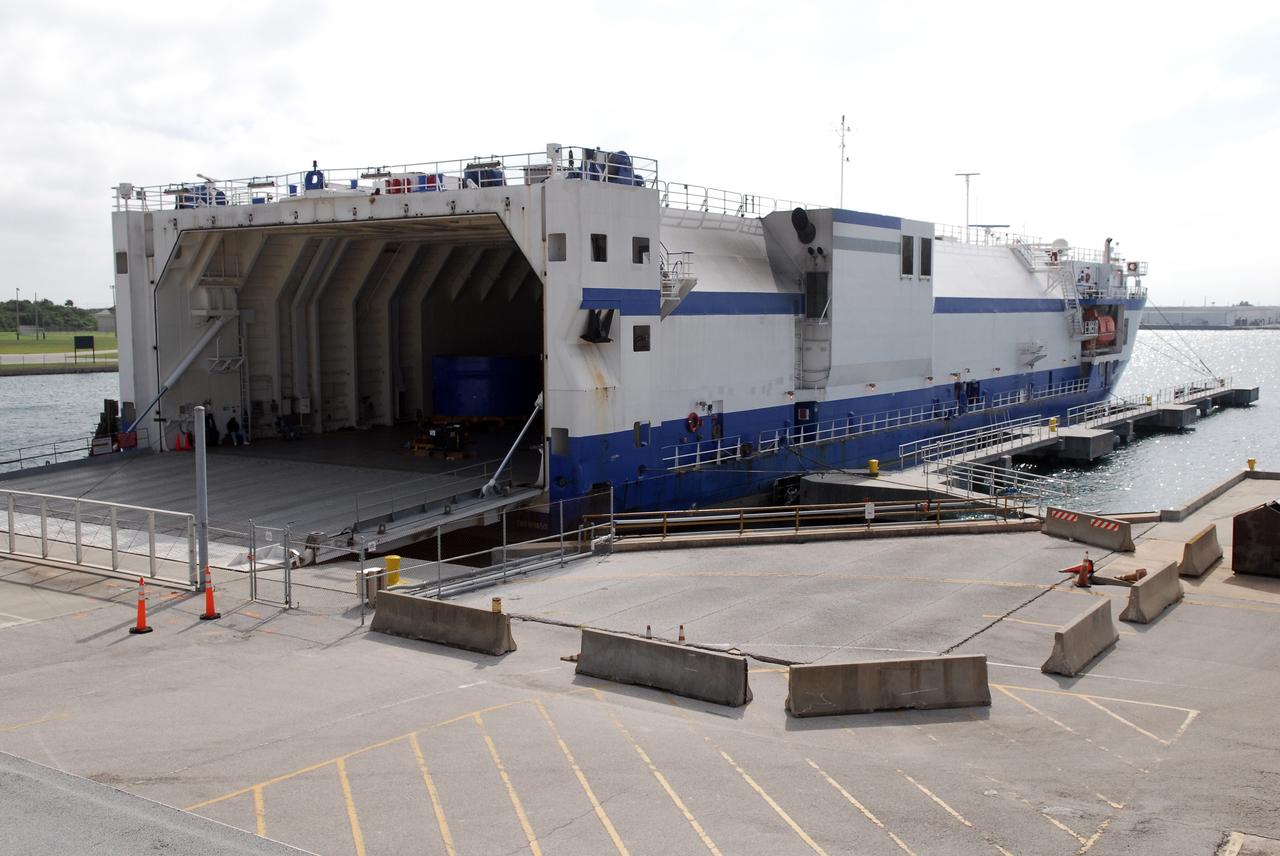
CAPE CANAVERAL, Fla. – The Delta Mariner is docked at Port Canaveral, Fla., with its cargo of the Ares I-X upper stage simulator segments. The upper stage simulator will be used in the test flight identified as Ares I-X in 2009. The segments will simulate the mass and the outer mold line and will be more than 100 feet of the total vehicle height of 327 feet. The simulator comprises 11 segments that are approximately 18 feet in diameter. Most of the segments will be approximately 10 feet high, ranging in weight from 18,000 to 60,000 pounds, for a total of approximately 450,000 pounds. Photo credit: NASA/Dimitri Gerondidakis
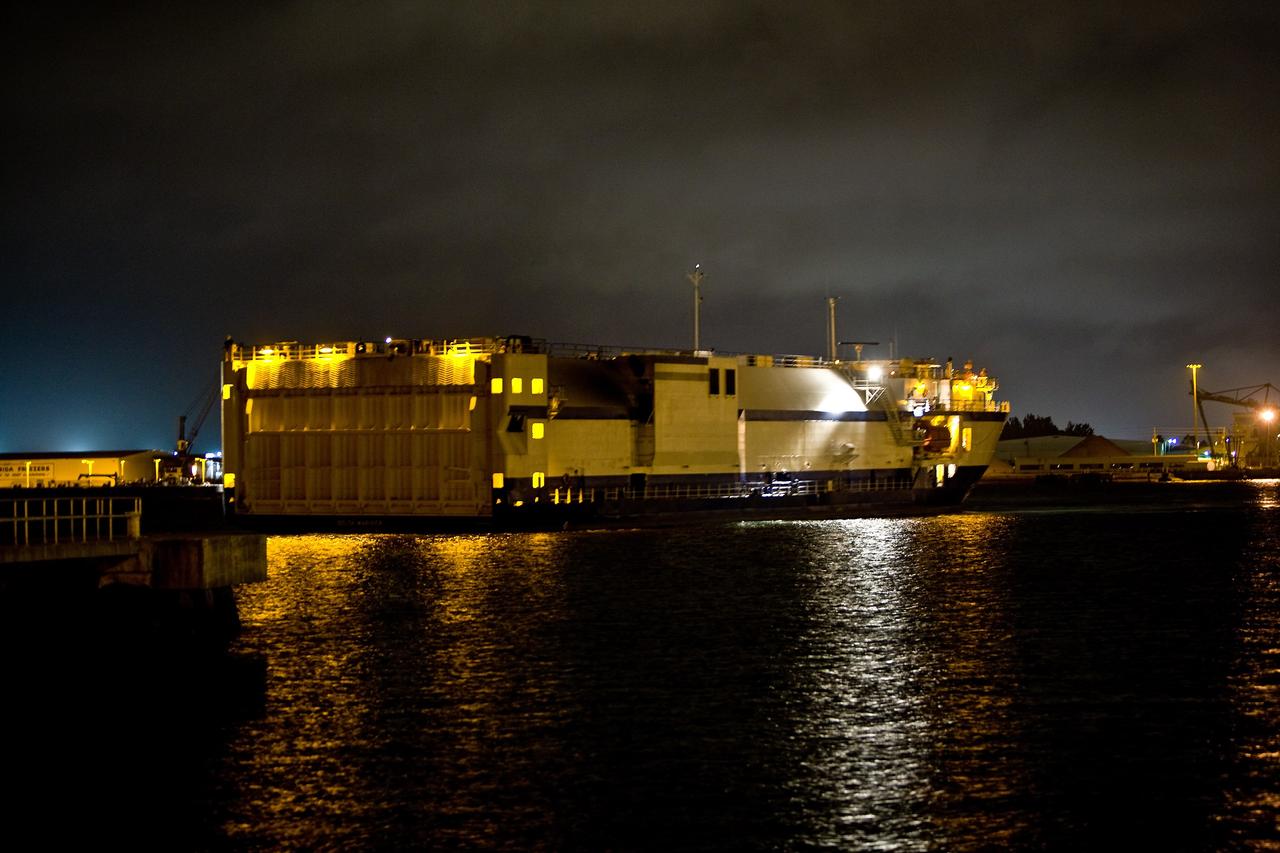
CAPE CANAVERAL, Fla. – The Delta Mariner arrives at Port Canaveral, Fla., with its cargo of the Ares I-X upper stage simulator segments. The upper stage simulator will be used in the test flight identified as Ares I-X in 2009. The segments will simulate the mass and the outer mold line and will be more than 100 feet of the total vehicle height of 327 feet. The simulator comprises 11 segments that are approximately 18 feet in diameter. Most of the segments will be approximately 10 feet high, ranging in weight from 18,000 to 60,000 pounds, for a total of approximately 450,000 pounds. Photo credit: NASA/Dimitri Gerondidakis
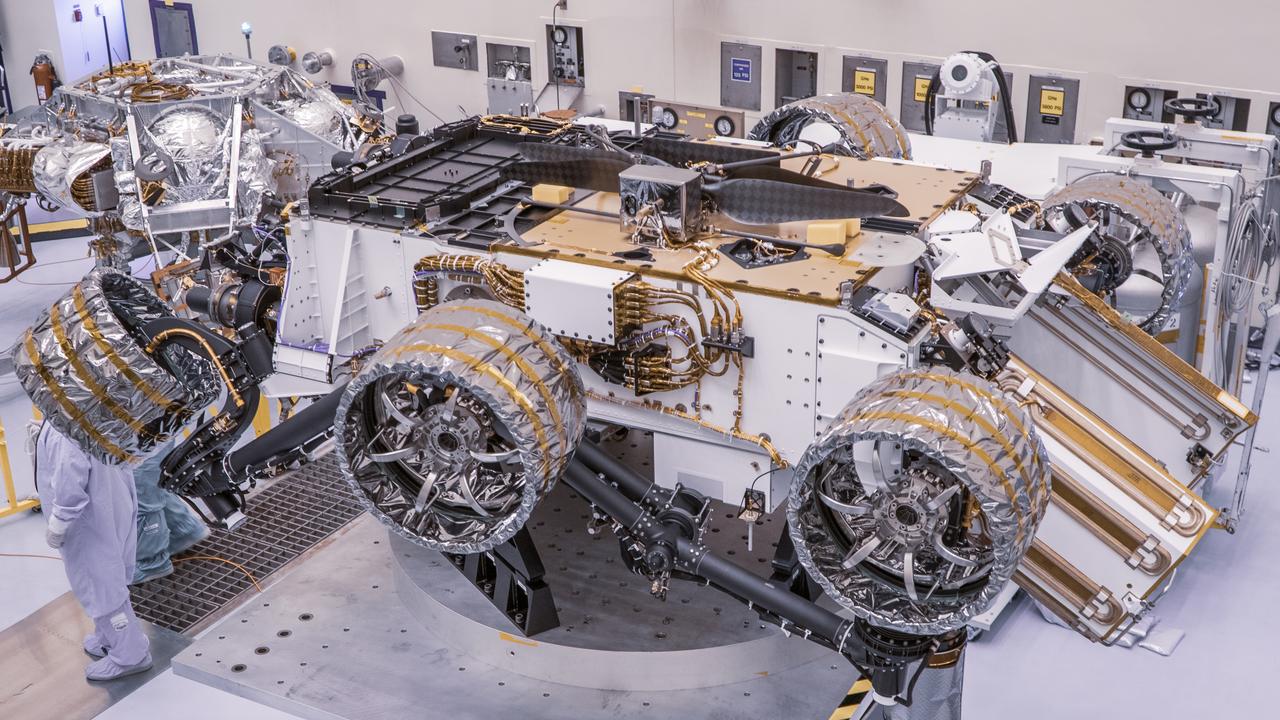
Engineers perform mass properties testing on NASA’s Mars Perseverance rover inside Kennedy Space Center’s Payload Hazardous Servicing Facility on April 7, 2020. The rover was rotated clockwise and counterclockwise on a spin table to determine the center of gravity, or the point at which weight is evenly dispersed on all sides. Establishing the rover’s center of gravity will help ensure the spacecraft will land on Mars as calculated. Perseverance will touch down on the Red Planet on Feb. 18, 2021. Liftoff aboard a United Launch Alliance Atlas V 541 rocket is targeted between July 17 and Aug. 5 from Cape Canaveral Air Force Station. NASA’s Launch Services Program based at Kennedy is managing the launch.
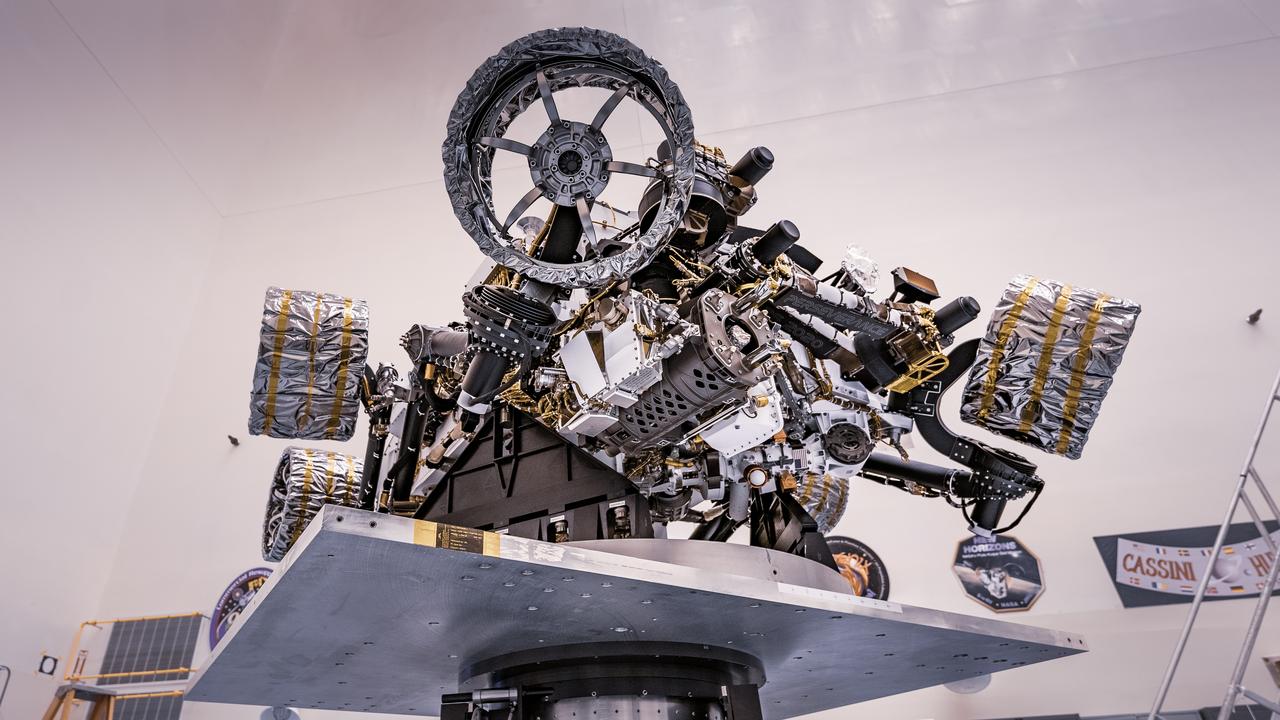
Engineers perform mass properties testing on NASA’s Mars Perseverance rover inside Kennedy Space Center’s Payload Hazardous Servicing Facility on April 7, 2020. The rover was rotated clockwise and counterclockwise on a spin table to determine the center of gravity, or the point at which weight is evenly dispersed on all sides. Establishing the rover’s center of gravity will help ensure the spacecraft will land on Mars as calculated. Perseverance will touch down on the Red Planet on Feb. 18, 2021. Liftoff aboard a United Launch Alliance Atlas V 541 rocket is targeted between July 17 and Aug. 5 from Cape Canaveral Air Force Station. NASA’s Launch Services Program based at Kennedy is managing the launch.

Seen here is a close-up view of the Orion stage adapter (OSA) structural test article atop the Space Launch System (SLS) rocket inside the Vehicle Assembly Building (VAB) at NASA’s Kennedy Space Center in Florida on Aug. 12, 2021. The test article, representing the mass and weight of the actual flight hardware, is being used for various tests inside the VAB ahead of OSA stacking operations. The first in an increasingly complex set of missions, Artemis I will test SLS and the Orion spacecraft as an integrated system prior to crewed flights to the Moon. Through Artemis, NASA will send the first woman and the first person of color to the lunar surface, as well as establish a sustainable presence on and around the Moon.
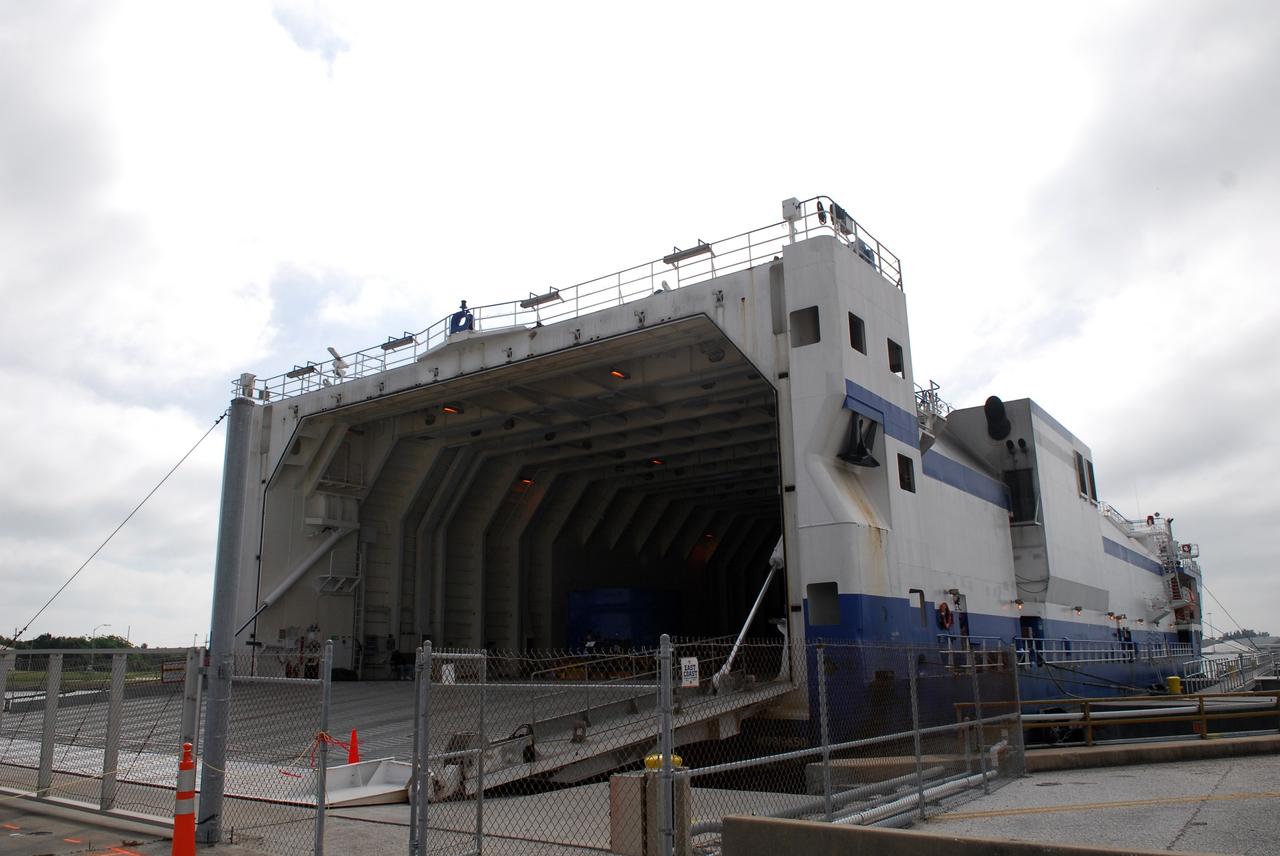
CAPE CANAVERAL, Fla. – The Delta Mariner docks at Port Canaveral, Fla., with its cargo of the Ares I-X upper stage simulator segments. The upper stage simulator will be used in the test flight identified as Ares I-X in 2009. The segments will simulate the mass and the outer mold line and will be more than 100 feet of the total vehicle height of 327 feet. The simulator comprises 11 segments that are approximately 18 feet in diameter. Most of the segments will be approximately 10 feet high, ranging in weight from 18,000 to 60,000 pounds, for a total of approximately 450,000 pounds. Photo credit: NASA/Dimitri Gerondidakis
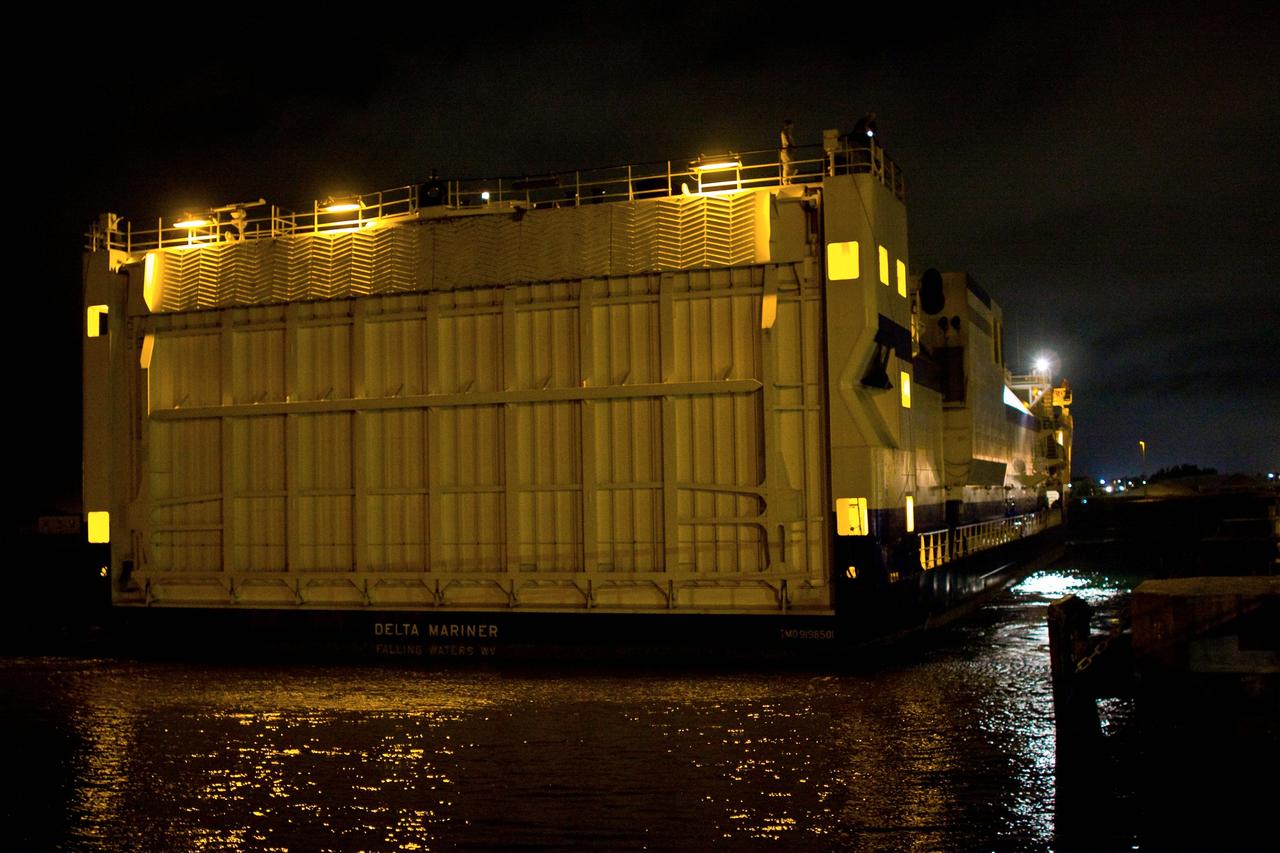
CAPE CANAVERAL, Fla. – The Delta Mariner arrives at Port Canaveral, Fla., with its cargo of the Ares I-X upper stage simulator segments. The upper stage simulator will be used in the test flight identified as Ares I-X in 2009. The segments will simulate the mass and the outer mold line and will be more than 100 feet of the total vehicle height of 327 feet. The simulator comprises 11 segments that are approximately 18 feet in diameter. Most of the segments will be approximately 10 feet high, ranging in weight from 18,000 to 60,000 pounds, for a total of approximately 450,000 pounds. Photo credit: NASA/Dimitri Gerondidakis
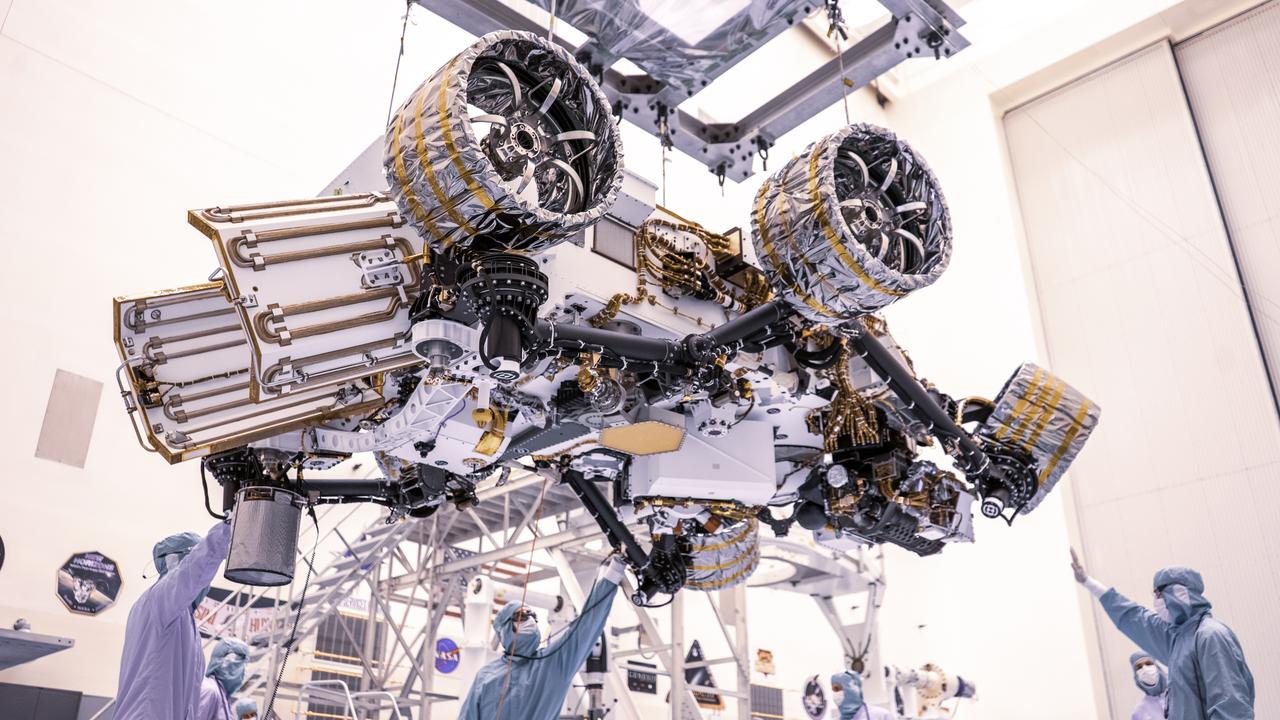
Engineers perform mass properties testing on NASA’s Mars Perseverance rover inside Kennedy Space Center’s Payload Hazardous Servicing Facility on April 7, 2020. The rover was rotated clockwise and counterclockwise on a spin table to determine the center of gravity, or the point at which weight is evenly dispersed on all sides. Establishing the rover’s center of gravity will help ensure the spacecraft will land on Mars as calculated. Perseverance will touch down on the Red Planet on Feb. 18, 2021. Liftoff aboard a United Launch Alliance Atlas V 541 rocket is targeted between July 17 and Aug. 5 from Cape Canaveral Air Force Station. NASA’s Launch Services Program based at Kennedy is managing the launch.
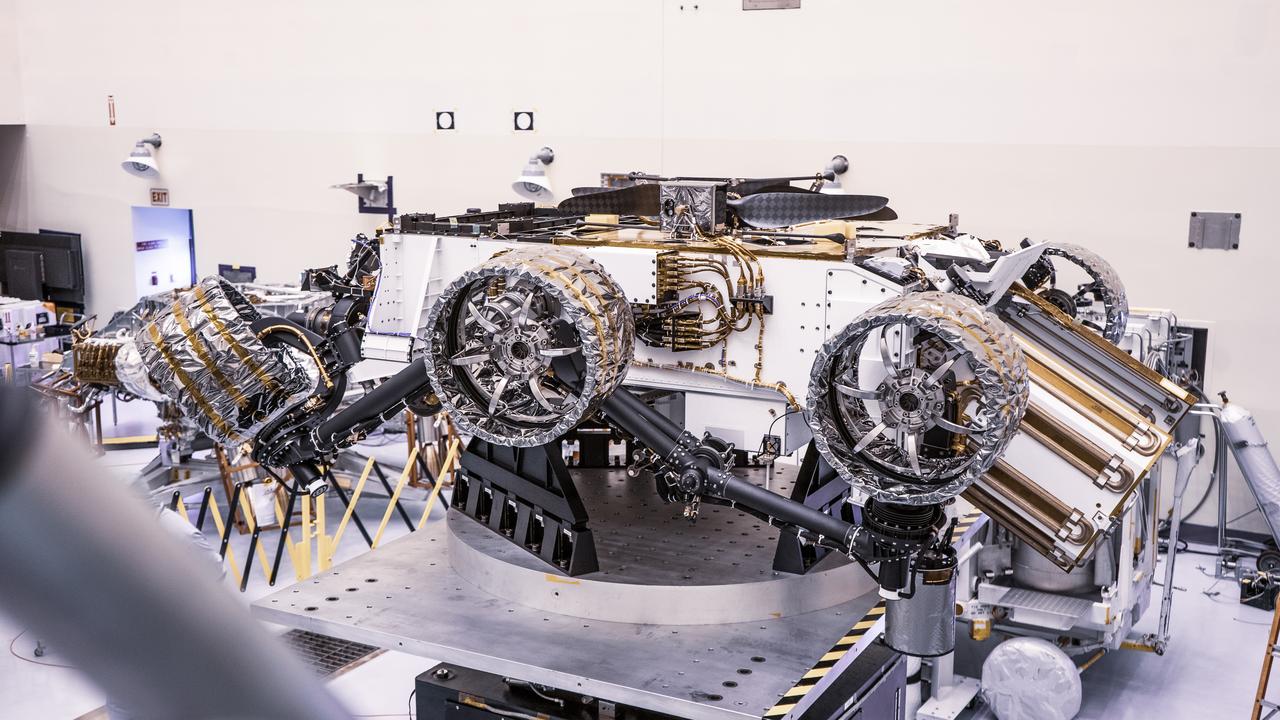
Engineers perform mass properties testing on NASA’s Mars Perseverance rover inside Kennedy Space Center’s Payload Hazardous Servicing Facility on April 7, 2020. The rover was rotated clockwise and counterclockwise on a spin table to determine the center of gravity, or the point at which weight is evenly dispersed on all sides. Establishing the rover’s center of gravity will help ensure the spacecraft will land on Mars as calculated. Perseverance will touch down on the Red Planet on Feb. 18, 2021. Liftoff aboard a United Launch Alliance Atlas V 541 rocket is targeted between July 17 and Aug. 5 from Cape Canaveral Air Force Station. NASA’s Launch Services Program based at Kennedy is managing the launch.
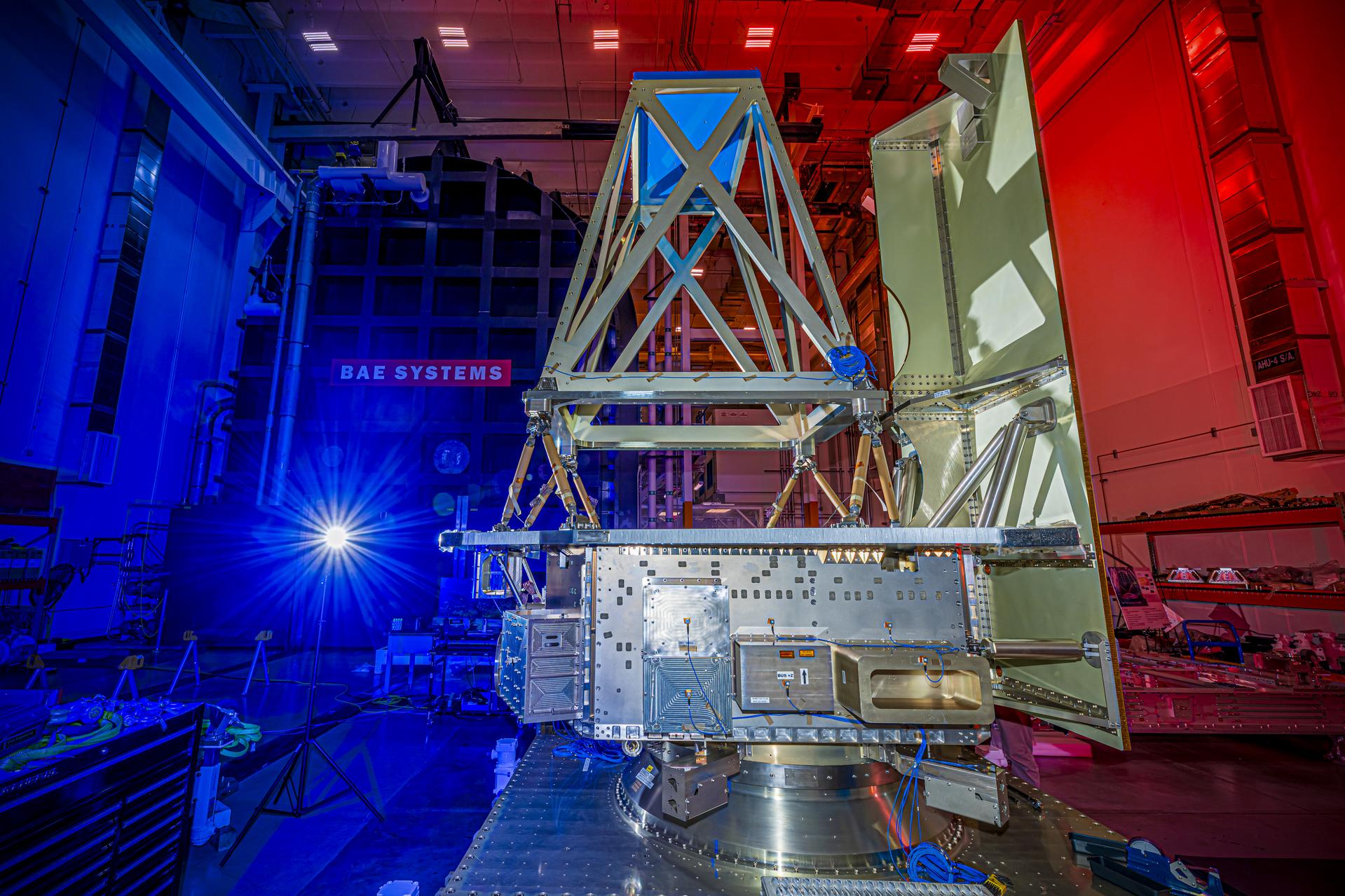
NASA’s Near-Earth Object (NEO) Surveyor sunshade mass simulator (the gray paneling to the right of the photo) is attached to the spacecraft’s bus structure in August 2025 at BAE Systems Space & Mission Systems in Boulder, Colorado. The angular assembly attached to the top of the bus via a system of struts is the instrument mass simulator. Mass simulators are used to replicate the weight and size of flight hardware during testing. Targeting launch in late 2027, the NEO Surveyor mission is led by Professor Amy Mainzer at the University of California, Los Angeles for NASA’s Planetary Defense Coordination Office and is being managed by the agency’s Jet Propulsion Laboratory in Southern California for the Planetary Missions Program Office at NASA’s Marshall Space Flight Center in Huntsville, Alabama. BAE Systems Space & Mission Systems and the Space Dynamics Laboratory in Logan, Utah, and Teledyne are among the companies that were contracted to build the spacecraft and its instrumentation. The Laboratory for Atmospheric and Space Physics at the University of Colorado Boulder will support operations, and IPAC at Caltech in Pasadena, California, is responsible for producing some of the mission’s data products. Caltech manages JPL for NASA. More information about NEO Surveyor is available at: https://science.nasa.gov/mission/neo-surveyor/
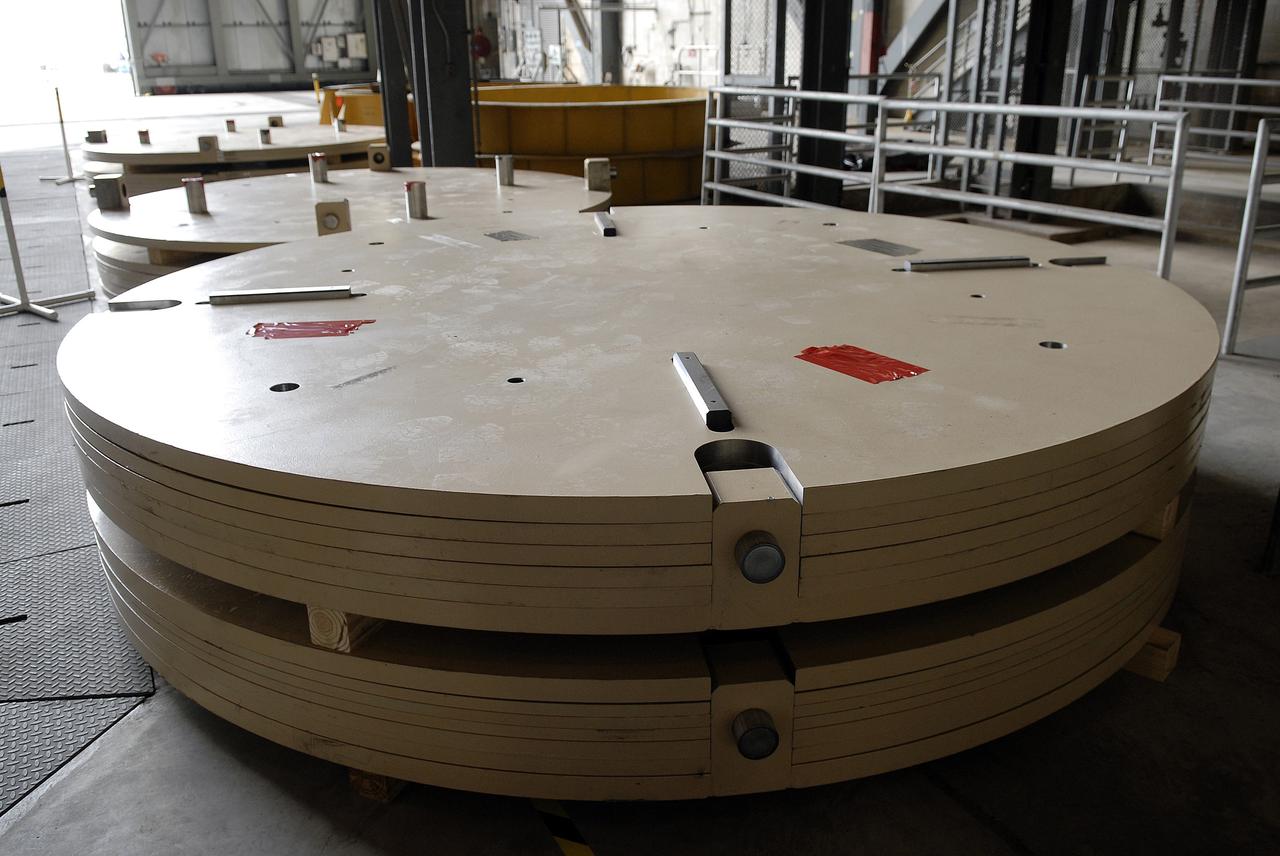
CAPE CANAVERAL, Fla. - The Ares IX upper stage segments’ ballast assemblies have arrived at NASA’s Kennedy Space Center and are positioned along the floor of high bay 4 in the Vehicle Assembly Building, part of the preparations for the test of the Ares IX rocket. These ballast assemblies will be installed in the upper stage 1 and 7 segments and will mimic the mass of the fuel. Their total weight is approximately 160,000 pounds. The test launch of the Ares IX in 2009 will be the first designed to determine the flight-worthiness of the Ares I rocket. Ares I is an in-line, two-stage rocket that will transport the Orion crew exploration vehicle to low-Earth orbit. The Ares I first stage will be a five-segment solid rocket booster based on the four-segment design used for the space shuttle. Ares I’s fifth booster segment allows the launch vehicle to lift more weight and reach a higher altitude before the first stage separates from the upper stage, which ignites in midflight to propel the Orion spacecraft to Earth orbit. Photo credit: NASA/Kim Shiflett
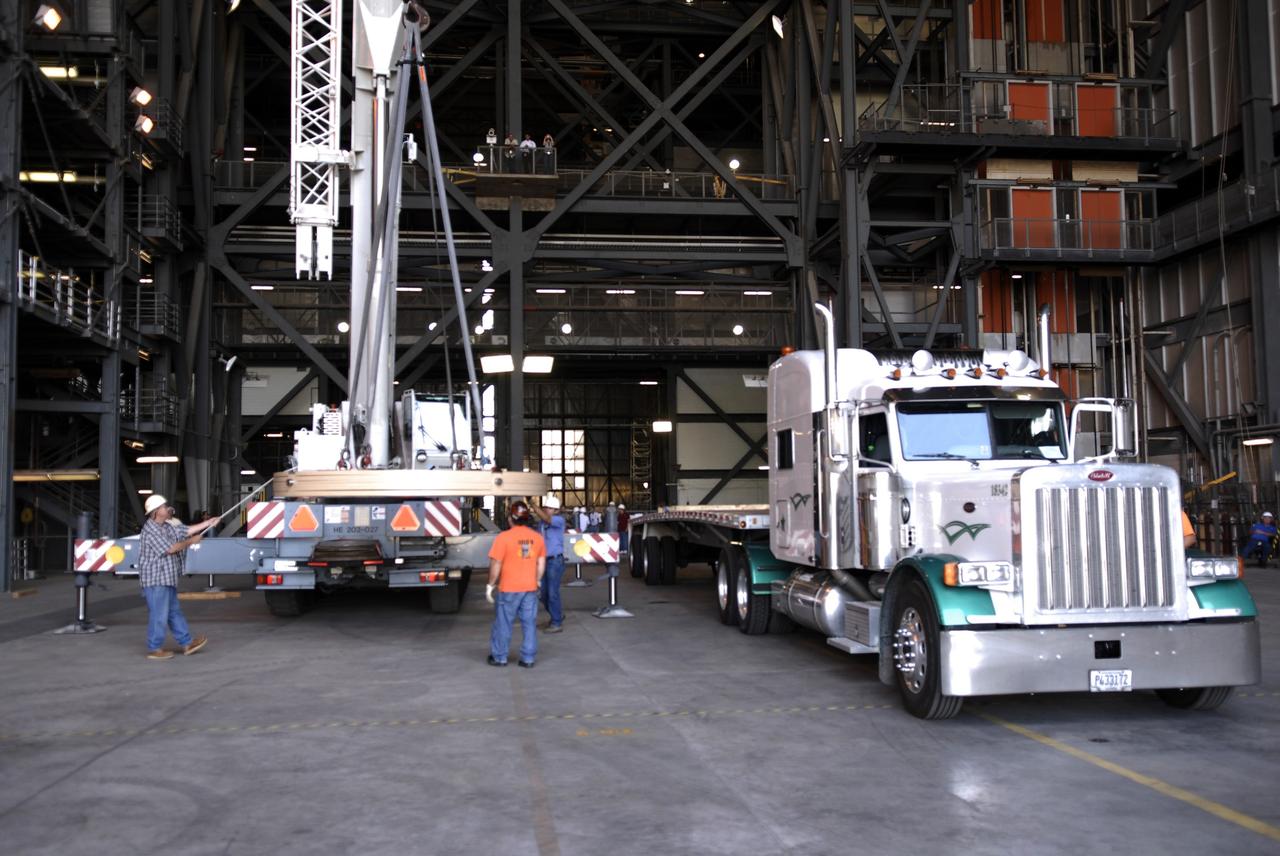
CAPE CANAVERAL, Fla. - The Ares IX upper stage segments’ ballast assemblies are offloaded from one of five trucks which delivered them to the Vehicle Assembly Building at NASA’s Kennedy Space Center, part of the preparations for the test of the Ares IX rocket. These ballast assemblies will be installed in the upper stage 1 and 7 segments and will mimic the mass of the fuel. Their total weight is approximately 160,000 pounds. The test launch of the Ares IX in 2009 will be the first designed to determine the flight-worthiness of the Ares I rocket. Ares I is an in-line, two-stage rocket that will transport the Orion crew exploration vehicle to low-Earth orbit. The Ares I first stage will be a five-segment solid rocket booster based on the four-segment design used for the space shuttle. Ares I’s fifth booster segment allows the launch vehicle to lift more weight and reach a higher altitude before the first stage separates from the upper stage, which ignites in midflight to propel the Orion spacecraft to Earth orbit. Photo credit: NASA/Kim Shiflett
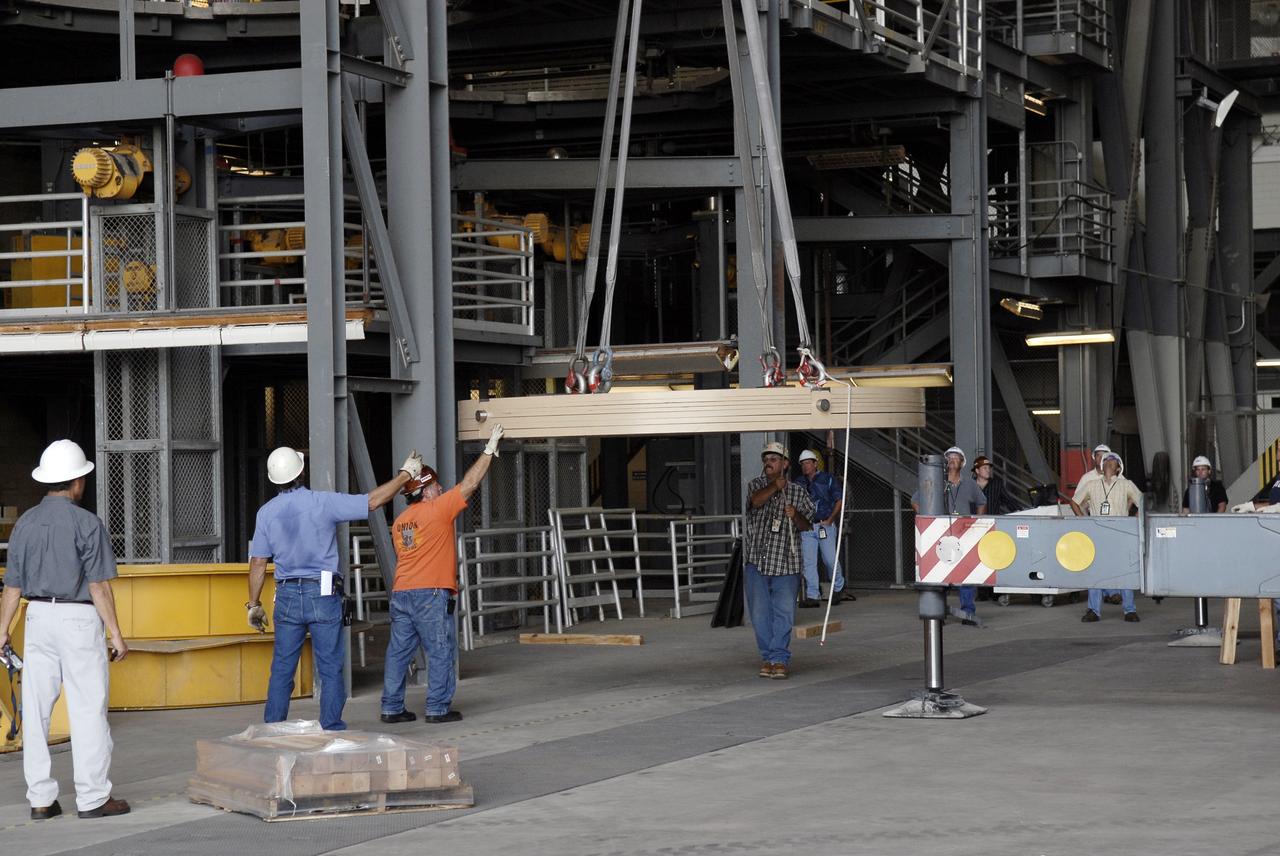
CAPE CANAVERAL, Fla. - Workers lift the Ares IX upper stage segments’ ballast assemblies off a truck in high bay 4 of the Vehicle Assembly Building at NASA’s Kennedy Space Center, part of the preparations for the test of the Ares IX rocket. These ballast assemblies will be installed in the upper stage 1 and 7 segments and will mimic the mass of the fuel. Their total weight is approximately 160,000 pounds. The test launch of the Ares IX in 2009 will be the first designed to determine the flight-worthiness of the Ares I rocket. Ares I is an in-line, two-stage rocket that will transport the Orion crew exploration vehicle to low-Earth orbit. The Ares I first stage will be a five-segment solid rocket booster based on the four-segment design used for the space shuttle. Ares I’s fifth booster segment allows the launch vehicle to lift more weight and reach a higher altitude before the first stage separates from the upper stage, which ignites in midflight to propel the Orion spacecraft to Earth orbit. Photo credit: NASA/Kim Shiflett
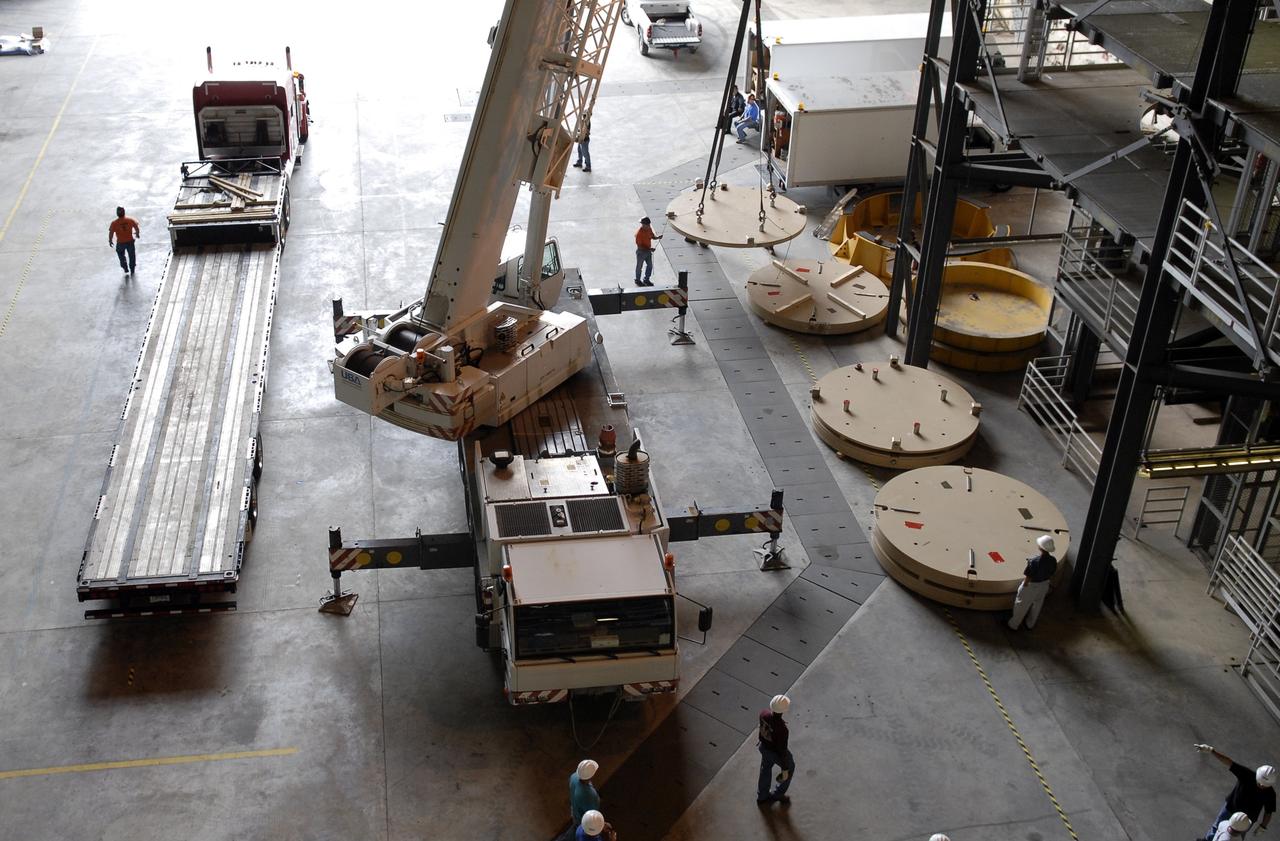
CAPE CANAVERAL, Fla. - Workers position Ares IX upper stage segments’ ballast assemblies along the floor of high bay 4 in the Vehicle Assembly Building at NASA’s Kennedy Space Center, part of the preparations for the test of the Ares IX rocket. These ballast assemblies will be installed in the upper stage 1 and 7 segments and will mimic the mass of the fuel. Their total weight is approximately 160,000 pounds. The test launch of the Ares IX in 2009 will be the first designed to determine the flight-worthiness of the Ares I rocket. Ares I is an in-line, two-stage rocket that will transport the Orion crew exploration vehicle to low-Earth orbit. The Ares I first stage will be a five-segment solid rocket booster based on the four-segment design used for the space shuttle. Ares I’s fifth booster segment allows the launch vehicle to lift more weight and reach a higher altitude before the first stage separates from the upper stage, which ignites in midflight to propel the Orion spacecraft to Earth orbit. Photo credit: NASA/Kim Shiflett
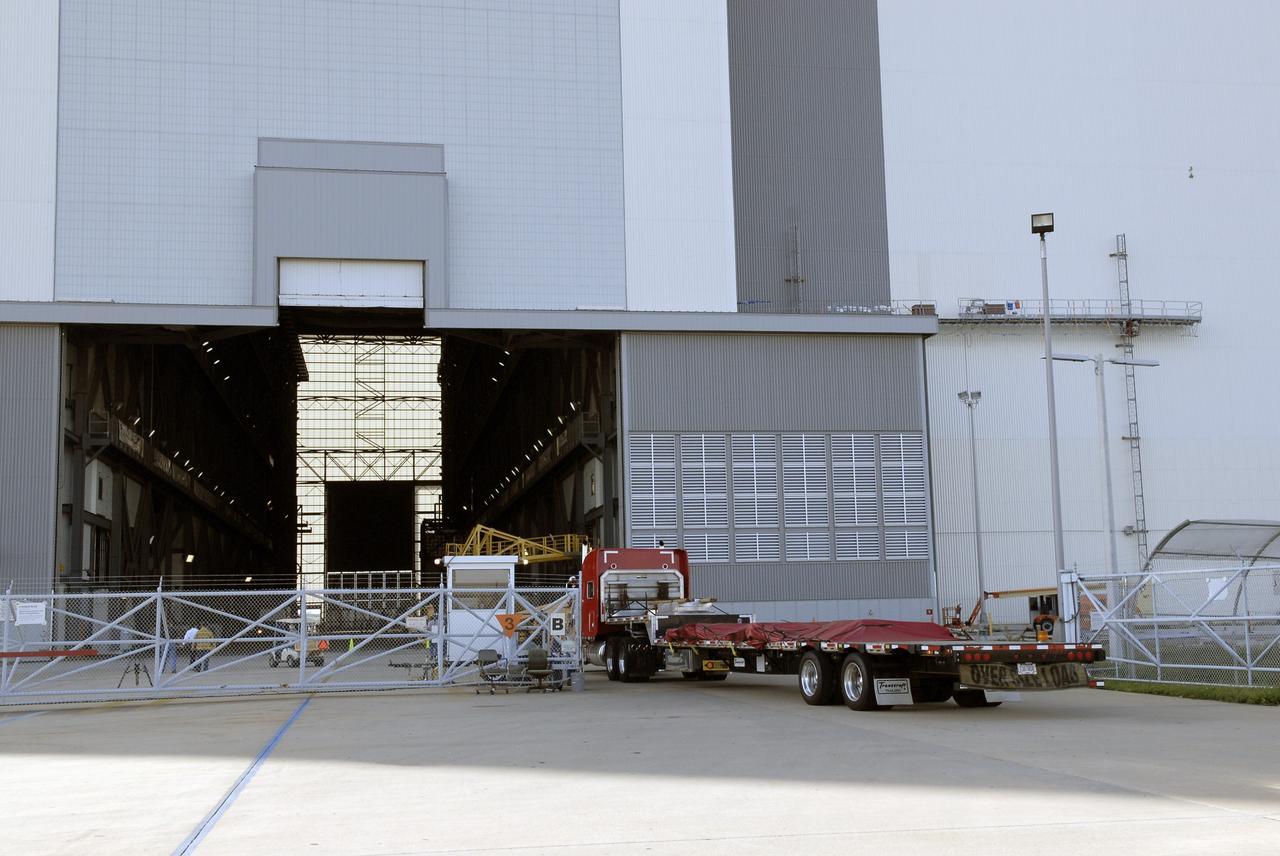
CAPE CANAVERAL, Fla. - One of five trucks transporting the Ares IX upper stage segments’ ballast assemblies arrives at the Vehicle Assembly Building at NASA’s Kennedy Space, part of the preparations for the test of the Ares IX rocket. These ballast assemblies will be installed in the upper stage 1 and 7 segments and will mimic the mass of the fuel. Their total weight is approximately 160,000 pounds. The test launch of the Ares IX in 2009 will be the first designed to determine the flight-worthiness of the Ares I rocket. Ares I is an in-line, two-stage rocket that will transport the Orion crew exploration vehicle to low-Earth orbit. The Ares I first stage will be a five-segment solid rocket booster based on the four-segment design used for the space shuttle. Ares I’s fifth booster segment allows the launch vehicle to lift more weight and reach a higher altitude before the first stage separates from the upper stage, which ignites in midflight to propel the Orion spacecraft to Earth orbit. Photo credit: NASA/Kim Shiflett
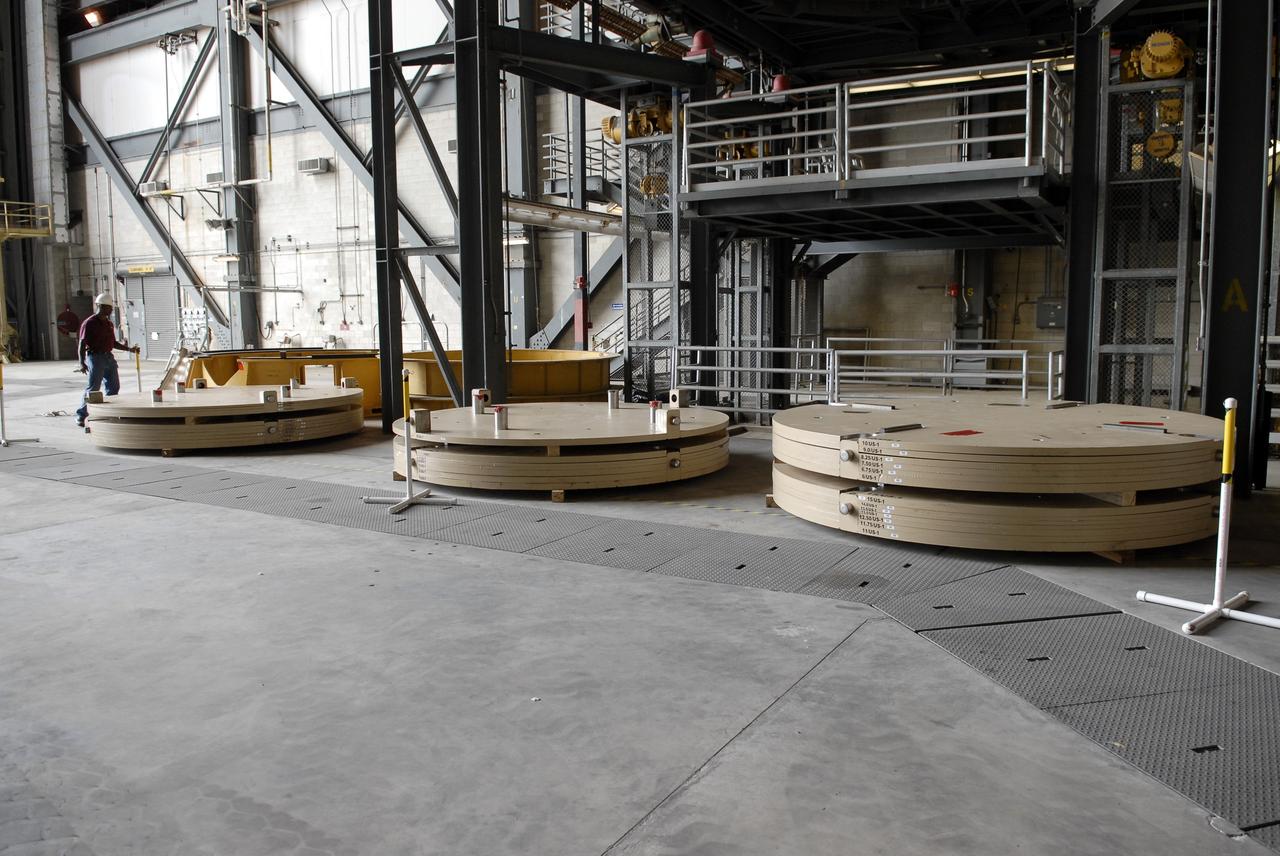
CAPE CANAVERAL, Fla. - Ares IX upper stage segments’ ballast assemblies are positioned along the floor of high bay 4 in the Vehicle Assembly Building at NASA’s Kennedy Space Center, part of the preparations for the test of the Ares IX rocket. These ballast assemblies will be installed in the upper stage 1 and 7 segments and will mimic the mass of the fuel. Their total weight is approximately 160,000 pounds. The test launch of the Ares IX in 2009 will be the first designed to determine the flight-worthiness of the Ares I rocket. Ares I is an in-line, two-stage rocket that will transport the Orion crew exploration vehicle to low-Earth orbit. The Ares I first stage will be a five-segment solid rocket booster based on the four-segment design used for the space shuttle. Ares I’s fifth booster segment allows the launch vehicle to lift more weight and reach a higher altitude before the first stage separates from the upper stage, which ignites in midflight to propel the Orion spacecraft to Earth orbit. Photo credit: NASA/Kim Shiflett
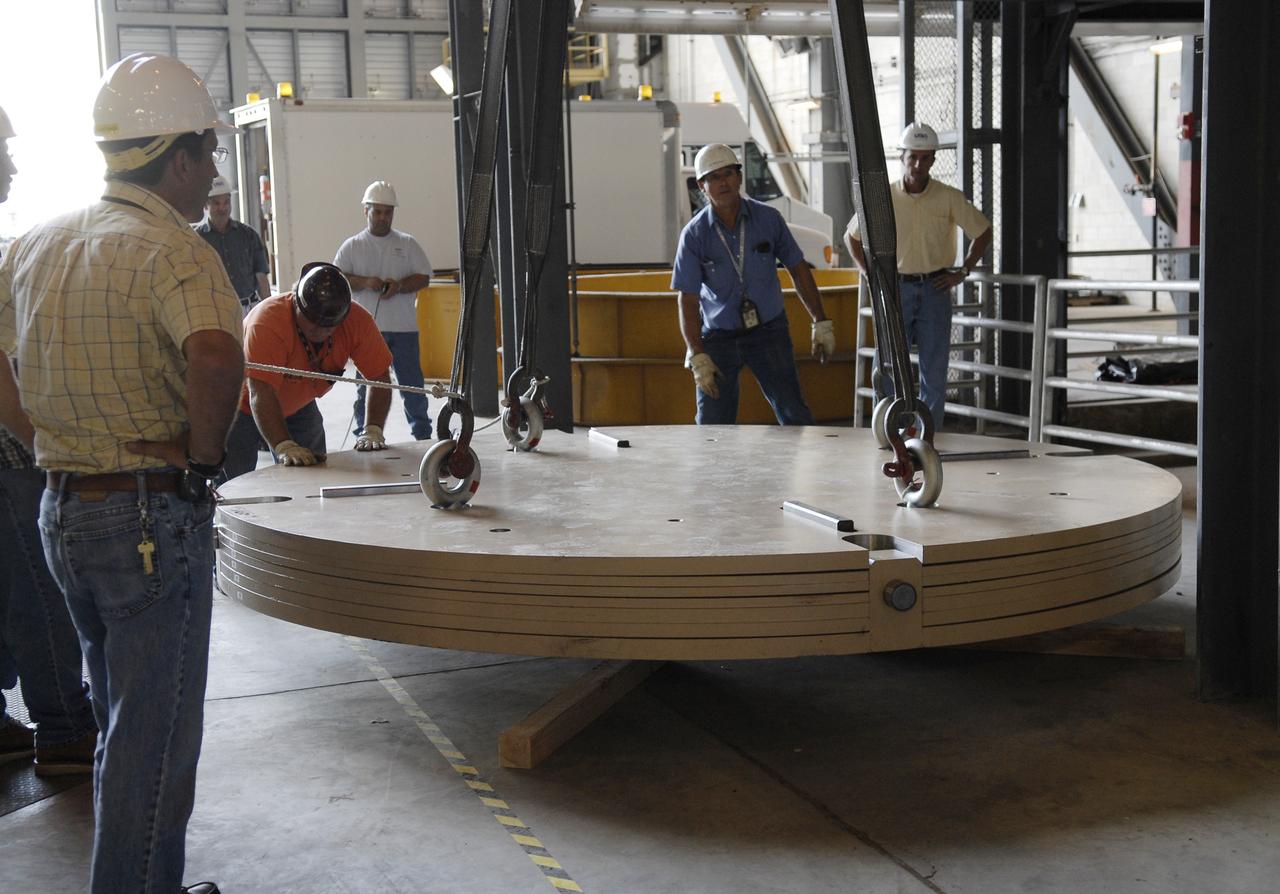
CAPE CANAVERAL, Fla. - Workers lower an Ares IX upper stage segments’ ballast assembly onto the floor of high bay 4 in the Vehicle Assembly Building at NASA’s Kennedy Space Center, part of the preparations for the test of the Ares IX rocket. These ballast assemblies will be installed in the upper stage 1 and 7 segments and will mimic the mass of the fuel. Their total weight is approximately 160,000 pounds. The test launch of the Ares IX in 2009 will be the first designed to determine the flight-worthiness of the Ares I rocket. Ares I is an in-line, two-stage rocket that will transport the Orion crew exploration vehicle to low-Earth orbit. The Ares I first stage will be a five-segment solid rocket booster based on the four-segment design used for the space shuttle. Ares I’s fifth booster segment allows the launch vehicle to lift more weight and reach a higher altitude before the first stage separates from the upper stage, which ignites in midflight to propel the Orion spacecraft to Earth orbit. Photo credit: NASA/Kim Shiflett
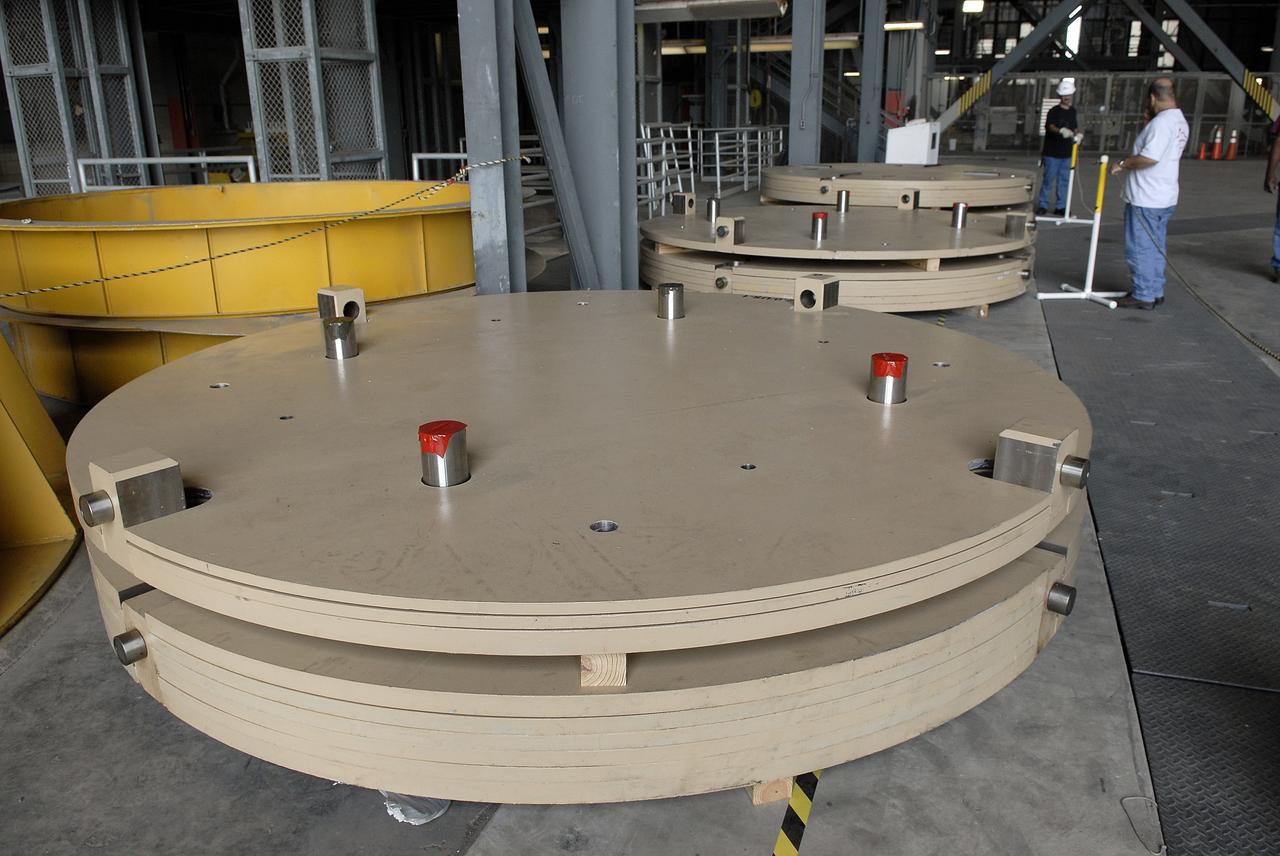
CAPE CANAVERAL, Fla. - The Ares IX upper stage segments’ ballast assemblies have arrived at NASA’s Kennedy Space Center and are positioned along the floor of high bay 4 in the Vehicle Assembly Building, part of the preparations for the test of the Ares IX rocket. These ballast assemblies will be installed in the upper stage 1 and 7 segments and will mimic the mass of the fuel. Their total weight is approximately 160,000 pounds. The test launch of the Ares IX in 2009 will be the first designed to determine the flight-worthiness of the Ares I rocket. Ares I is an in-line, two-stage rocket that will transport the Orion crew exploration vehicle to low-Earth orbit. The Ares I first stage will be a five-segment solid rocket booster based on the four-segment design used for the space shuttle. Ares I’s fifth booster segment allows the launch vehicle to lift more weight and reach a higher altitude before the first stage separates from the upper stage, which ignites in midflight to propel the Orion spacecraft to Earth orbit. Photo credit: NASA/Kim Shiflett
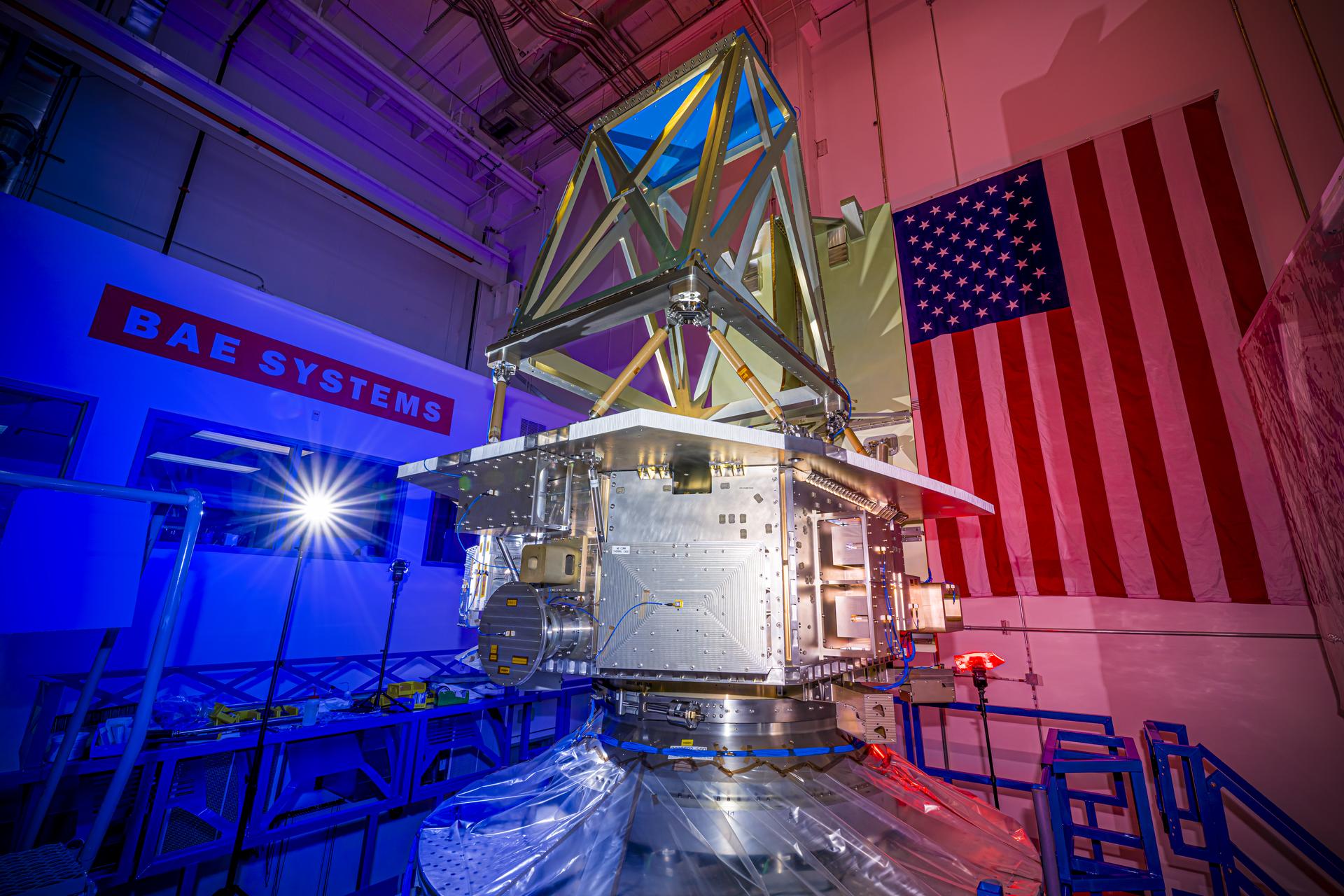
The bus structure for NASA’s Near-Earth Object (NEO) Surveyor is installed on a “shaker table” at BAE Systems Space & Mission Systems in Boulder, Colorado, during vibration testing conducted in August 2025. Mass simulators that mimic the weight and size of the spacecraft’s telescope and sunshade are also attached to the bus for the test. These mass simulators help engineers simulate the conditions flight components will experience during launch so their durability can be verified. Targeting launch in late 2027, the NEO Surveyor mission is led by Professor Amy Mainzer at the University of California, Los Angeles for NASA’s Planetary Defense Coordination Office and is being managed by the agency’s Jet Propulsion Laboratory in Southern California for the Planetary Missions Program Office at NASA’s Marshall Space Flight Center in Huntsville, Alabama. BAE Systems Space & Mission Systems and the Space Dynamics Laboratory in Logan, Utah, and Teledyne are among the companies that were contracted to build the spacecraft and its instrumentation. The Laboratory for Atmospheric and Space Physics at the University of Colorado Boulder will support operations, and IPAC at Caltech in Pasadena, California, is responsible for producing some of the mission’s data products. Caltech manages JPL for NASA. More information about NEO Surveyor is available at: https://science.nasa.gov/mission/neo-surveyor/

Using NASA’s Hubble Space Telescope, astronomers have captured for the first time snapshots of fledging white dwarf stars beginning their slow-paced, 40-million-year migration from the crowded center of an ancient star cluster to the less populated suburbs. White dwarfs are the burned-out relics of stars that rapidly lose mass, cool down and shut off their nuclear furnaces. As these glowing carcasses age and shed weight, their orbits begin to expand outward from the star cluster’s packed downtown. This migration is caused by a gravitational tussle among stars inside the cluster. Globular star clusters sort out stars according to their mass, governed by a gravitational billiard ball game where lower mass stars rob momentum from more massive stars. The result is that heavier stars slow down and sink to the cluster's core, while lighter stars pick up speed and move across the cluster to the edge. This process is known as "mass segregation." Until these Hubble observations, astronomers had never definitively seen the dynamical conveyor belt in action. Astronomers used Hubble to watch the white-dwarf exodus in the globular star cluster 47 Tucanae, a dense swarm of hundreds of thousands of stars in our Milky Way galaxy. The cluster resides 16,700 light-years away in the southern constellation Tucana. Credits: NASA, ESA, and H. Richer and J. Heyl (University of British Columbia, Vancouver, Canada); acknowledgement: J. Mack (STScI) and G. Piotto (University of Padova, Italy)
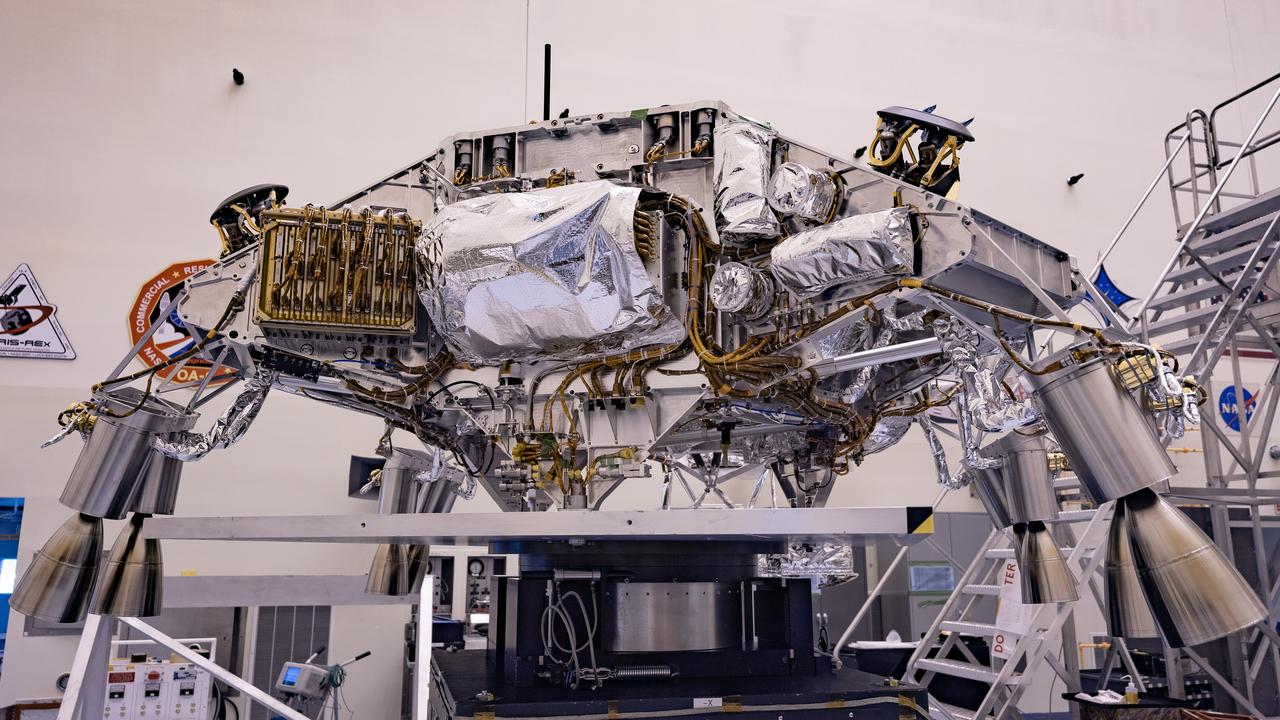
Engineers perform mass properties testing on the rocket-powered descent stage of NASA’s Mars Perseverance rover at Kennedy Space Center on April 12, 2020. The testing to determine the center of gravity, or the point at which weight is evenly dispersed on all sides, was performed inside the Florida spaceport’s Payload Hazardous Servicing Facility. The descent stage will lower the rover through the thin Martian atmosphere and onto the surface on Feb. 18, 2021. Liftoff, aboard a United Launch Alliance Atlas V 541 rocket, is targeted between July 17 and Aug. 5 from Cape Canaveral Air Force Station. NASA’s Launch Services Program based at Kennedy is managing the launch. The rover will seek signs of ancient life and collect rock and soil samples for possible return to Earth.
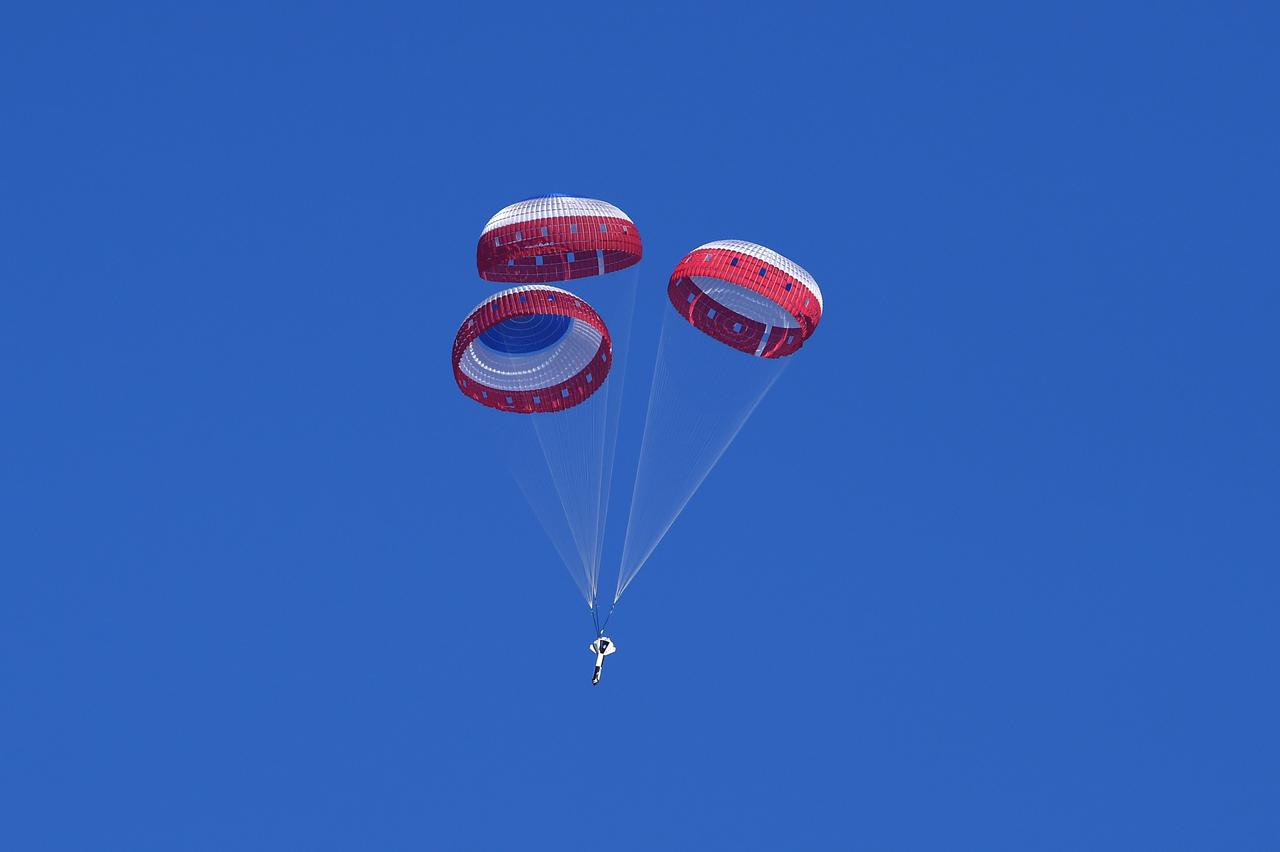
Boeing conducted the first in a series of reliability tests of its CST-100 Starliner flight drogue and main parachute system by releasing a long, dart-shaped test vehicle from a C-17 aircraft over Yuma, Arizona. Two more tests are planned using the dart module, as well as three similar reliability tests using a high fidelity capsule simulator designed to simulate the CST-100 Starliner capsule’s exact shape and mass. In both the dart and capsule simulator tests, the test spacecraft are released at various altitudes to test the parachute system at different deployment speeds, aerodynamic loads, and or weight demands. Data collected from each test is fed into computer models to more accurately predict parachute performance and to verify consistency from test to test.

CAPE CANAVERAL, Fla. – In Vehicle Assembly Building high bay 4, cables from an overhead crane lower ballast into segment 7 for the Ares I-X rocket. These ballast assemblies are being installed in the upper stage segments 1 and 7 and will mimic the mass of the fuel. Their total weight is approximately 160,000 pounds. Ares I-X is the test vehicle for the Ares I, which is part of the Constellation Program to return men to the moon and beyond. Ares I is the essential core of a safe, reliable, cost-effective space transportation system that eventually will carry crewed missions back to the moon, on to Mars and out into the solar system. The Ares I-X is targeted for launch in July 2009. Photo credit: NASA/Jack Pfaller

CAPE CANAVERAL, Fla. – In high bay 4 of the Vehicle Assembly Building at NASA's Kennedy Space Center in Florida, a ballast assembly is lifted toward the Ares I-X segments for installation. These ballast assemblies will be installed in the upper stage 1 and 7 segments and will mimic the mass of the fuel. Their total weight is approximately 160,000 pounds. Ares I-X is the test vehicle for the Ares I, which is part of the Constellation Program to return men to the moon and beyond. Ares I is the essential core of a safe, reliable, cost-effective space transportation system that eventually will carry crewed missions back to the moon, on to Mars and out into the solar system. Ares I may also use its 25-ton payload capacity to deliver resources and supplies to the International Space Station, or to "park" payloads in orbit for retrieval by other spacecraft bound for the moon or other destinations. The Ares I-X is targeted for launch in July 2009. Photo credit: NASA/Dimitri Gerondidakis
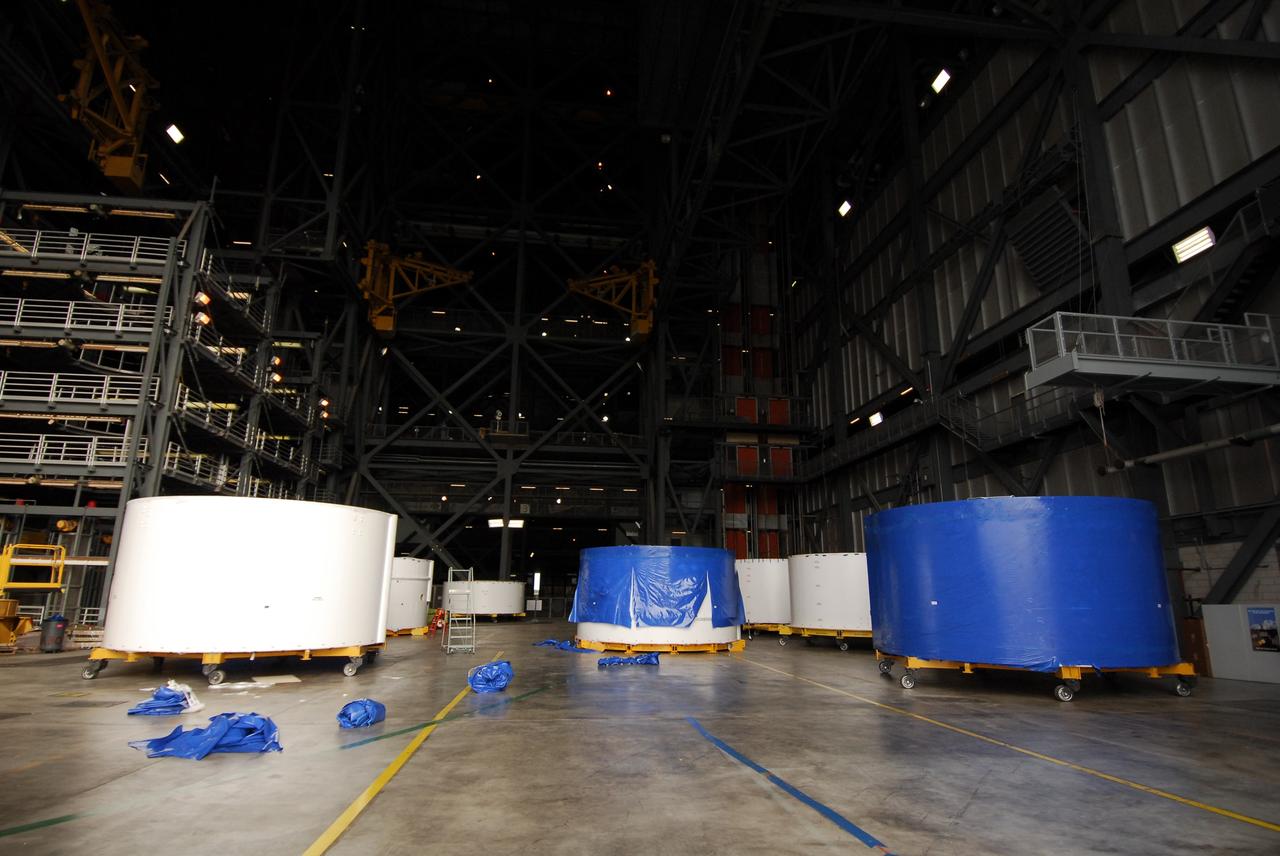
CAPE CANAVERAL, Fla. – Inside the Vehicle Assembly Building high bay 4 at NASA's Kennedy Space Center in Florida, Ares I-X upper stage simulator segments are lined up. Their protective blue shrink-wrapped covers used for shipping are being removed, as seen on the segments at left and in the back. The upper stage simulator will be used in the test flight identified as Ares I-X in 2009. The segments will simulate the mass and the outer mold line and will be more than 100 feet of the total vehicle height of 327 feet. The simulator comprises 11 segments that are approximately 18 feet in diameter. Most of the segments will be approximately 10 feet high, ranging in weight from 18,000 to 60,000 pounds, for a total of approximately 450,000 pounds. Photo credit: NASA/Troy Cryder
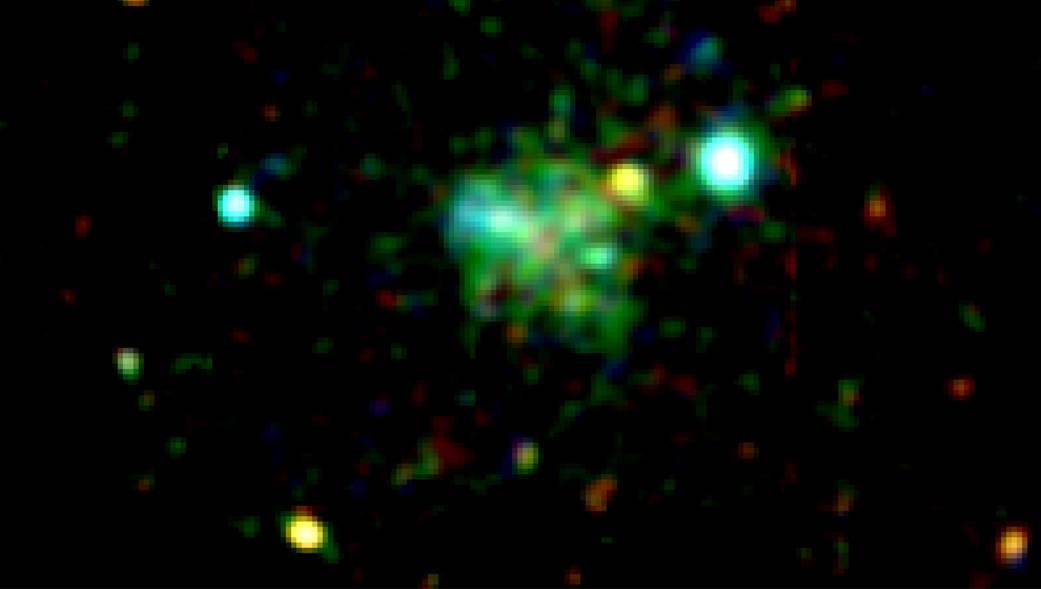
Astronomers have discovered a vast cloud of high-energy particles called a wind nebula around a rare ultra-magnetic neutron star, or magnetar, for the first time. The find offers a unique window into the properties, environment and outburst history of magnetars, which are the strongest magnets in the universe. A neutron star is the crushed core of a massive star that ran out of fuel, collapsed under its own weight, and exploded as a supernova. Each one compresses the equivalent mass of half a million Earths into a ball just 12 miles (20 kilometers) across, or about the length of New York's Manhattan Island. Neutron stars are most commonly found as pulsars, which produce radio, visible light, X-rays and gamma rays at various locations in their surrounding magnetic fields. When a pulsar spins these regions in our direction, astronomers detect pulses of emission, hence the name. Credit: ESA/XMM-Newton/Younes et al. 2016
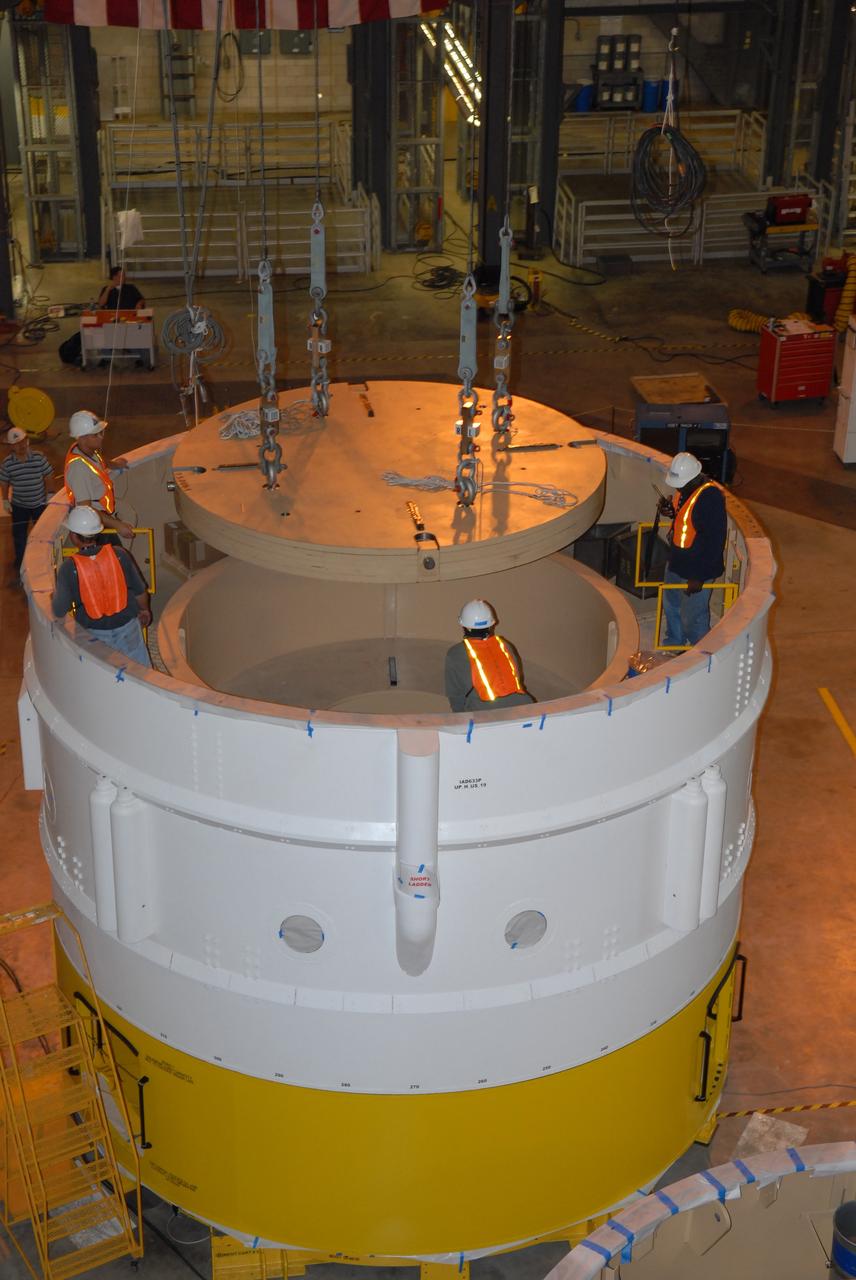
CAPE CANAVERAL, Fla. – In Vehicle Assembly Building high bay 4, cables from an overhead crane lower ballast into segment 7 for the Ares I-X rocket. These ballast assemblies are being installed in the upper stage segments 1 and 7 and will mimic the mass of the fuel. Their total weight is approximately 160,000 pounds. Ares I-X is the test vehicle for the Ares I, which is part of the Constellation Program to return men to the moon and beyond. Ares I is the essential core of a safe, reliable, cost-effective space transportation system that eventually will carry crewed missions back to the moon, on to Mars and out into the solar system. The Ares I-X is targeted for launch in July 2009. Photo credit: NASA/Jack Pfaller
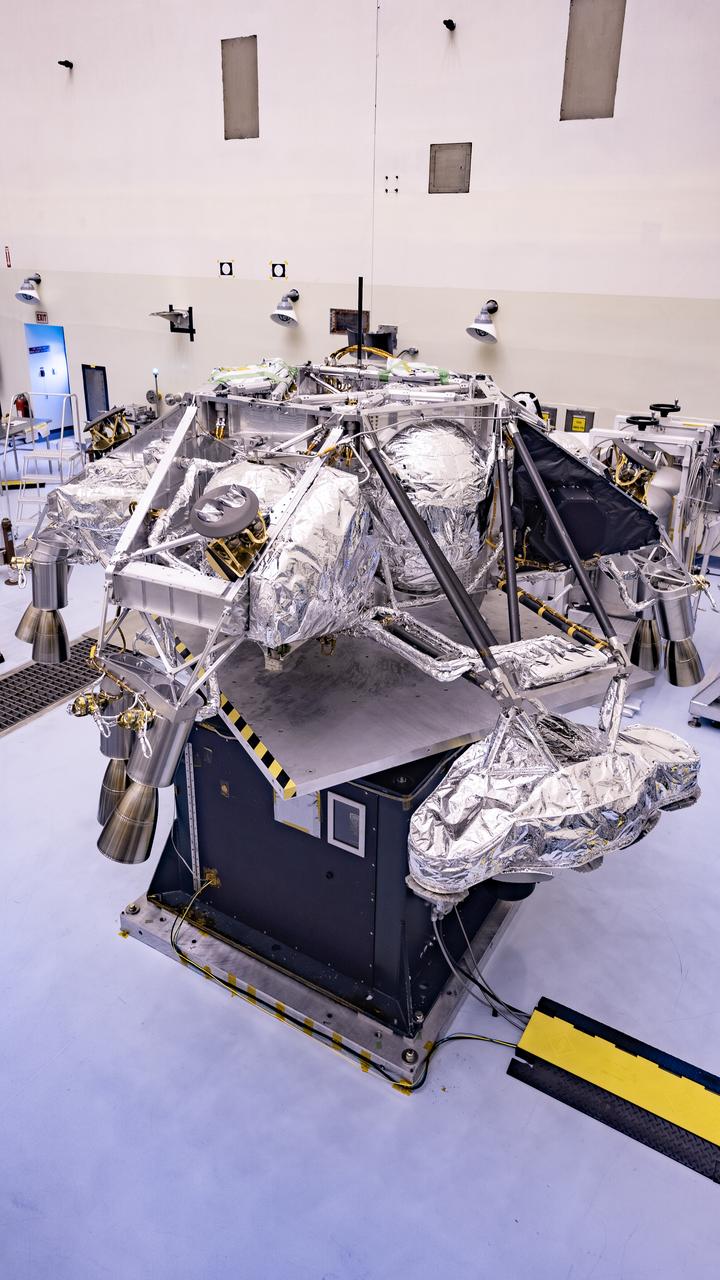
Engineers perform mass properties testing on the rocket-powered descent stage of NASA’s Mars Perseverance rover at Kennedy Space Center on April 12, 2020. The testing to determine the center of gravity, or the point at which weight is evenly dispersed on all sides, was performed inside the Florida spaceport’s Payload Hazardous Servicing Facility. The descent stage will lower the rover through the thin Martian atmosphere and onto the surface on Feb. 18, 2021. Liftoff, aboard a United Launch Alliance Atlas V 541 rocket, is targeted between July 17 and Aug. 5 from Cape Canaveral Air Force Station. NASA’s Launch Services Program based at Kennedy is managing the launch. The rover will seek signs of ancient life and collect rock and soil samples for possible return to Earth.
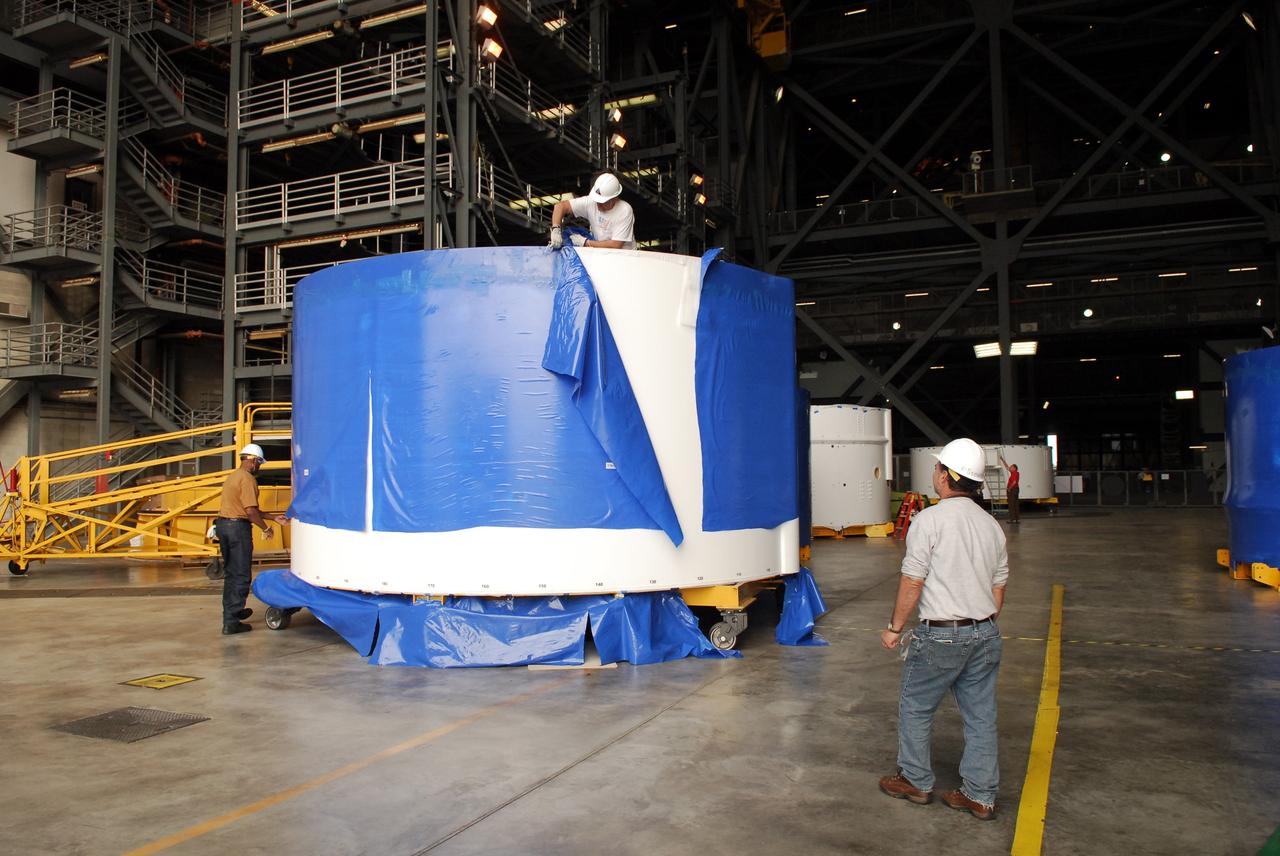
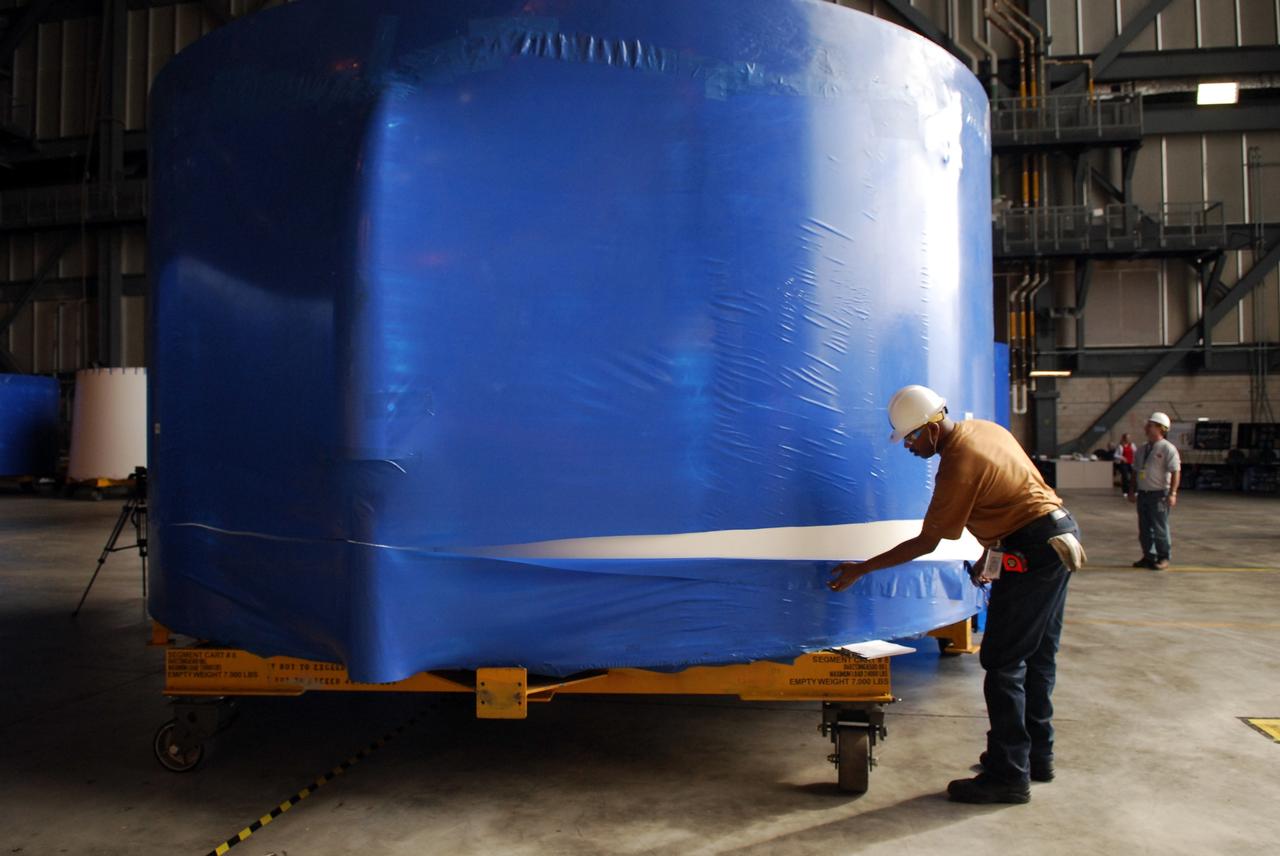
CAPE CANAVERAL, Fla. – Inside the Vehicle Assembly Building high bay 4 at NASA's Kennedy Space Center in Florida, workers from NASA's Glenn Research Center remove the blue shrink-wrapped covers on these Ares I-X upper stage simulator segments. The protective covers were used for shipping. The upper stage simulator will be used in the test flight identified as Ares I-X in 2009. The segments will simulate the mass and the outer mold line and will be more than 100 feet of the total vehicle height of 327 feet. The simulator comprises 11 segments that are approximately 18 feet in diameter. Most of the segments will be approximately 10 feet high, ranging in weight from 18,000 to 60,000 pounds, for a total of approximately 450,000 pounds. Photo credit: NASA/Troy Cryder
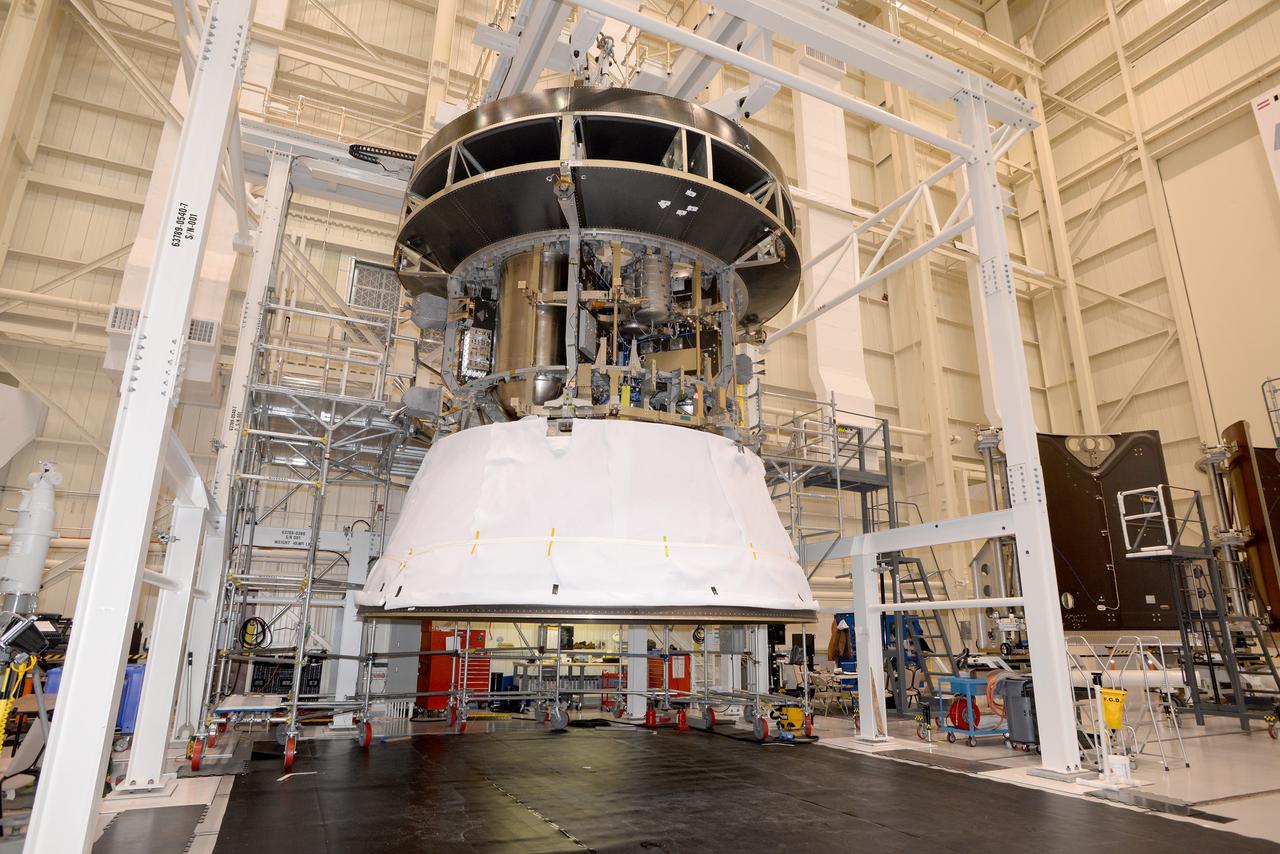
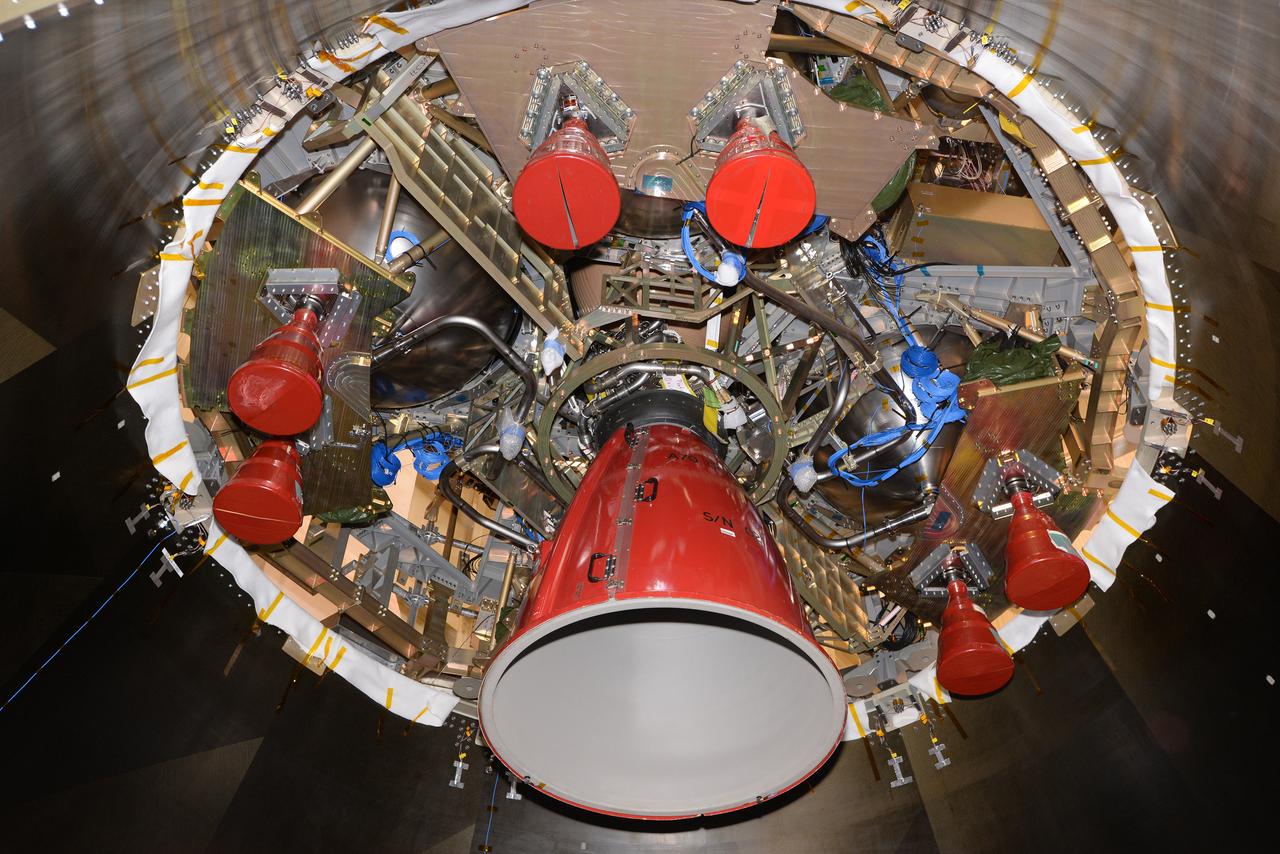
The European Service Module structural test model, shown on Jan. 23, 2016, is used for testing purposes before installing the real thing. It is as close to the flight version as possible while keeping costs and development time manageable. The structure and weight are the same, while mass equivalents stand in for electronics boxes not needed for the series of tests...The model was installed under a test version of the Crew Module Adapter, and sits on the Spacecraft Adapter that will attach Orion to its launch vehicle. This is the first time the European hardware has been physically connected to NASA’s elements...The service module will be shaken at NASA’s Plum Brook station in Sandusky, Ohio, USA, to recreate the vibrations of launch, as well as being subjected to acoustic and shock environments. Part of Batch image transfer from Flickr.
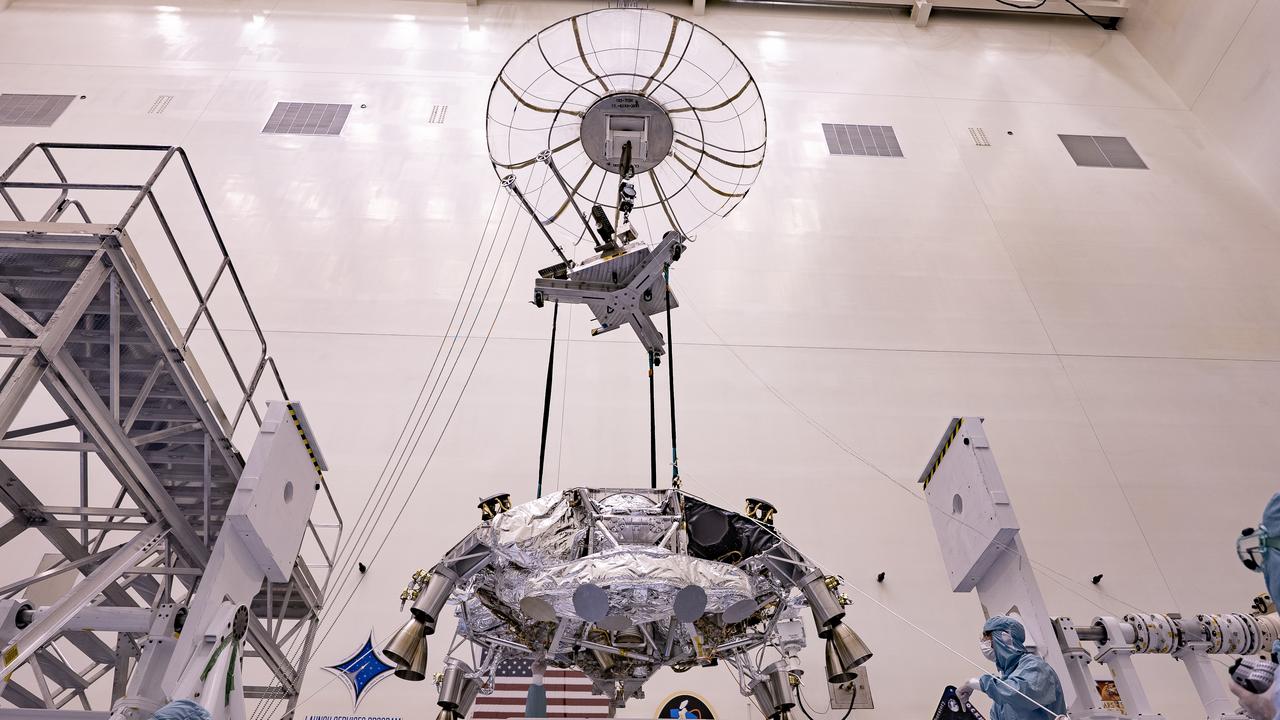
Engineers perform mass properties testing on the rocket-powered descent stage of NASA’s Mars Perseverance rover at Kennedy Space Center on April 9, 2020. The testing to determine the center of gravity, or the point at which weight is evenly dispersed on all sides, was performed inside the Florida spaceport’s Payload Hazardous Servicing Facility. The descent stage will lower the rover through the thin Martian atmosphere and onto the surface on Feb. 18, 2021. Liftoff, aboard a United Launch Alliance Atlas V 541 rocket, is targeted between July 17 and Aug. 5 from Cape Canaveral Air Force Station. NASA’s Launch Services Program based at Kennedy is managing the launch. The rover will seek signs of ancient life and collect rock and soil samples for possible return to Earth.
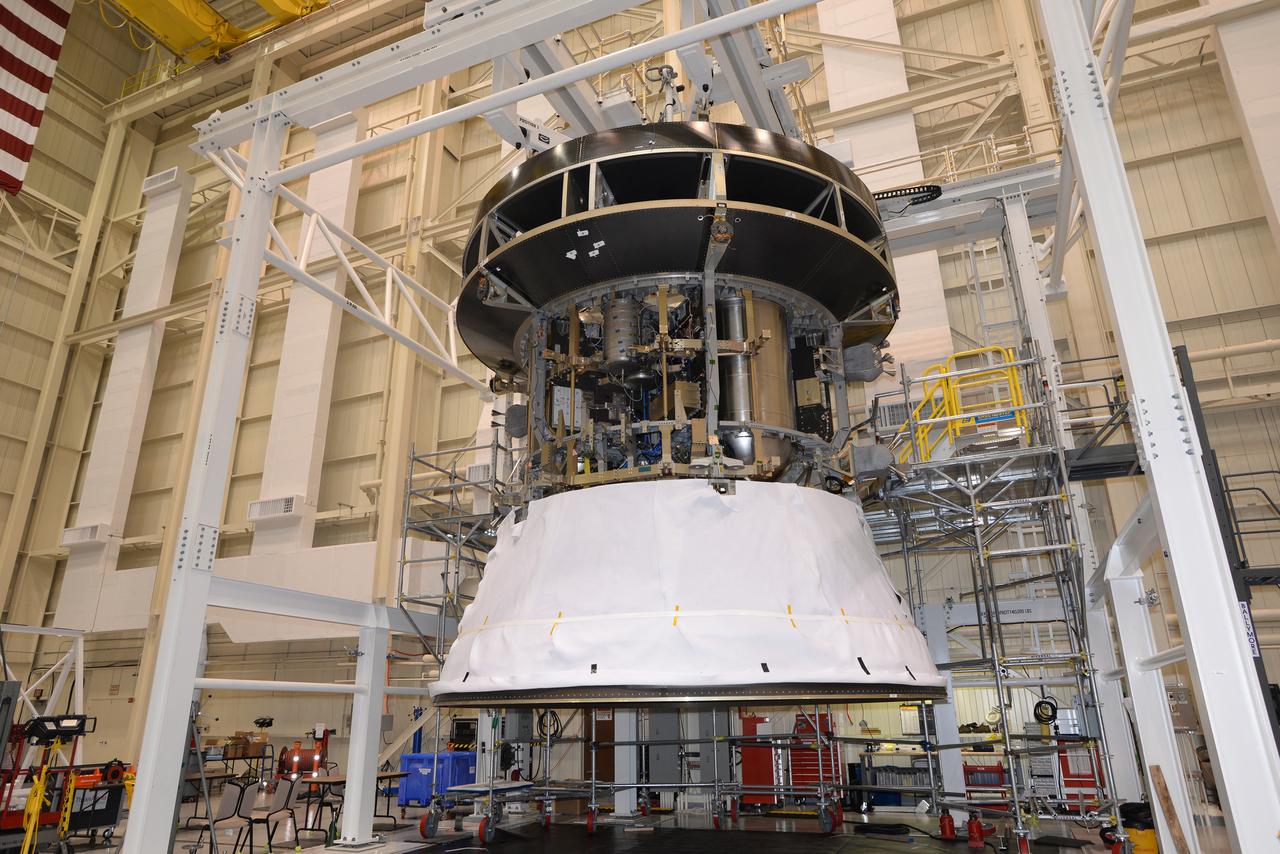
The European Service Module structural test model, shown on Jan. 23, 2016, is used for testing purposes before installing the real thing. It is as close to the flight version as possible while keeping costs and development time manageable. The structure and weight are the same, while mass equivalents stand in for electronics boxes not needed for the series of tests...The model was installed under a test version of the Crew Module Adapter, and sits on the Spacecraft Adapter that will attach Orion to its launch vehicle. This is the first time the European hardware has been physically connected to NASA’s elements...The service module will be shaken at NASA’s Plum Brook station in Sandusky, Ohio, USA, to recreate the vibrations of launch, as well as being subjected to acoustic and shock environments. Part of Batch image transfer from Flickr.
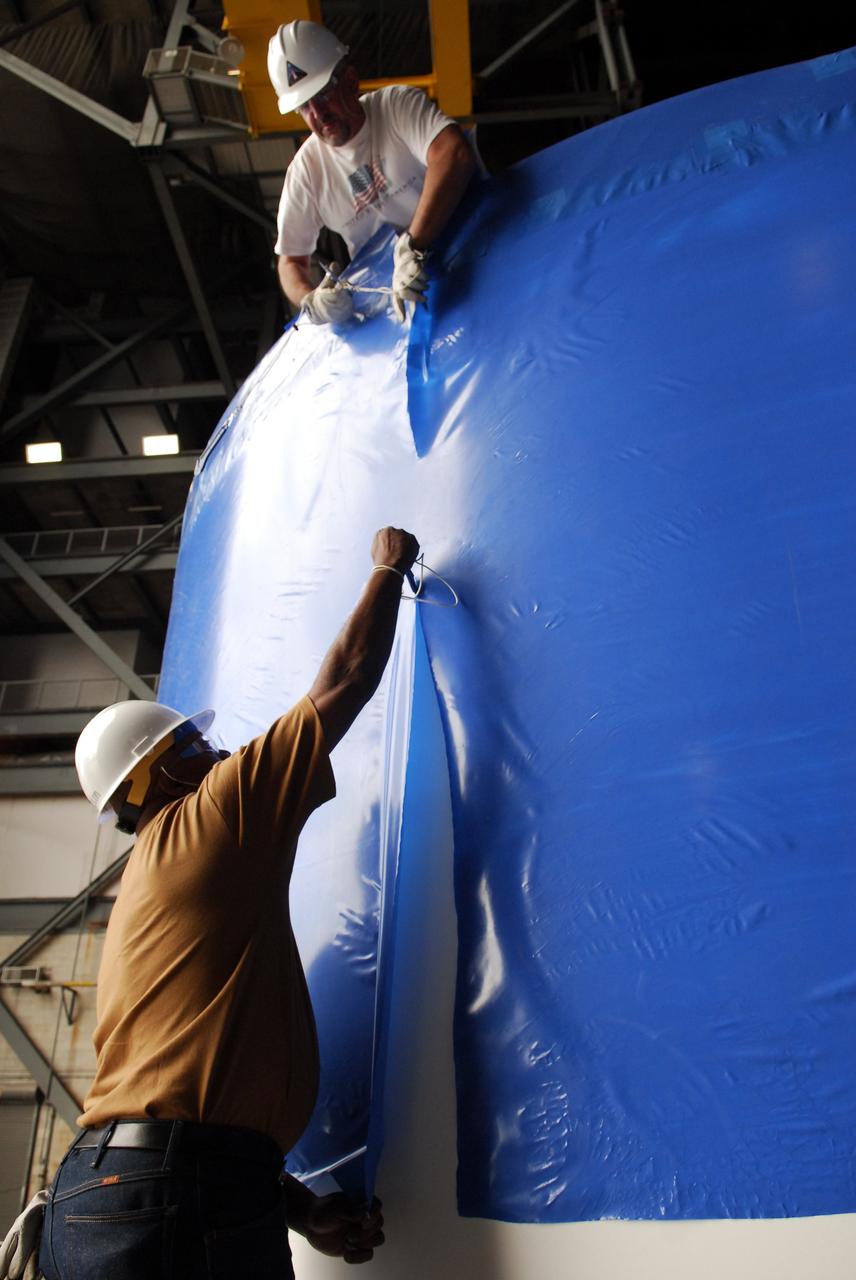
CAPE CANAVERAL, Fla. – Inside the Vehicle Assembly Building high bay 4 at NASA's Kennedy Space Center in Florida, workers from NASA's Glenn Research Center remove the blue shrink-wrapped covers on these Ares I-X upper stage simulator segments. The protective covers were used for shipping. The upper stage simulator will be used in the test flight identified as Ares I-X in 2009. The segments will simulate the mass and the outer mold line and will be more than 100 feet of the total vehicle height of 327 feet. The simulator comprises 11 segments that are approximately 18 feet in diameter. Most of the segments will be approximately 10 feet high, ranging in weight from 18,000 to 60,000 pounds, for a total of approximately 450,000 pounds. Photo credit: NASA/Troy Cryder
The European Service Module structural test model, shown on Jan. 23, 2016, is used for testing purposes before installing the real thing. It is as close to the flight version as possible while keeping costs and development time manageable. The structure and weight are the same, while mass equivalents stand in for electronics boxes not needed for the series of tests...The model was installed under a test version of the Crew Module Adapter, and sits on the Spacecraft Adapter that will attach Orion to its launch vehicle. This is the first time the European hardware has been physically connected to NASA’s elements...The service module will be shaken at NASA’s Plum Brook station in Sandusky, Ohio, USA, to recreate the vibrations of launch, as well as being subjected to acoustic and shock environments. Part of Batch image transfer from Flickr.
CAPE CANAVERAL, Fla. – Inside the Vehicle Assembly Building high bay 4 at NASA's Kennedy Space Center in Florida, workers from NASA's Glenn Research Center remove the blue shrink-wrapped covers on these Ares I-X upper stage simulator segments. The protective covers were used for shipping. The upper stage simulator will be used in the test flight identified as Ares I-X in 2009. The segments will simulate the mass and the outer mold line and will be more than 100 feet of the total vehicle height of 327 feet. The simulator comprises 11 segments that are approximately 18 feet in diameter. Most of the segments will be approximately 10 feet high, ranging in weight from 18,000 to 60,000 pounds, for a total of approximately 450,000 pounds. Photo credit: NASA/Troy Cryder
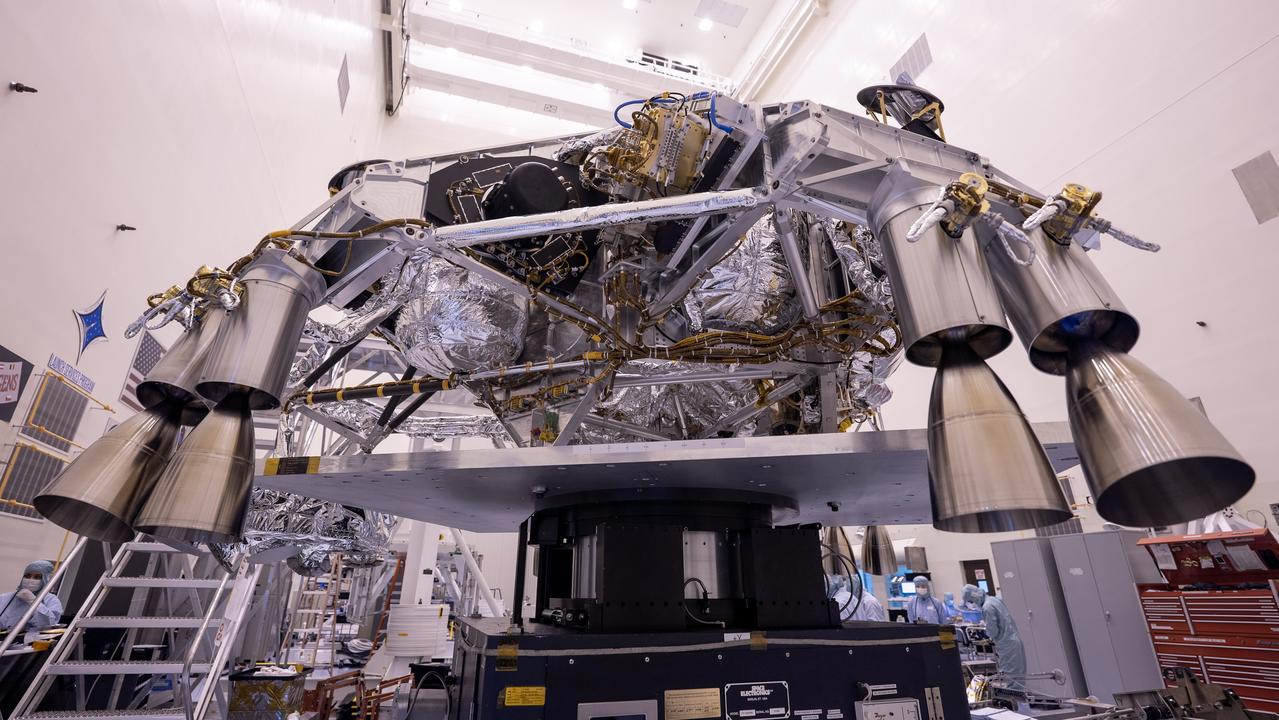
Engineers perform mass properties testing on the rocket-powered descent stage of NASA’s Mars Perseverance rover at Kennedy Space Center on April 12, 2020. The testing to determine the center of gravity, or the point at which weight is evenly dispersed on all sides, was performed inside the Florida spaceport’s Payload Hazardous Servicing Facility. The descent stage will lower the rover through the thin Martian atmosphere and onto the surface on Feb. 18, 2021. Liftoff, aboard a United Launch Alliance Atlas V 541 rocket, is targeted between July 17 and Aug. 5 from Cape Canaveral Air Force Station. NASA’s Launch Services Program based at Kennedy is managing the launch. The rover will seek signs of ancient life and collect rock and soil samples for possible return to Earth.
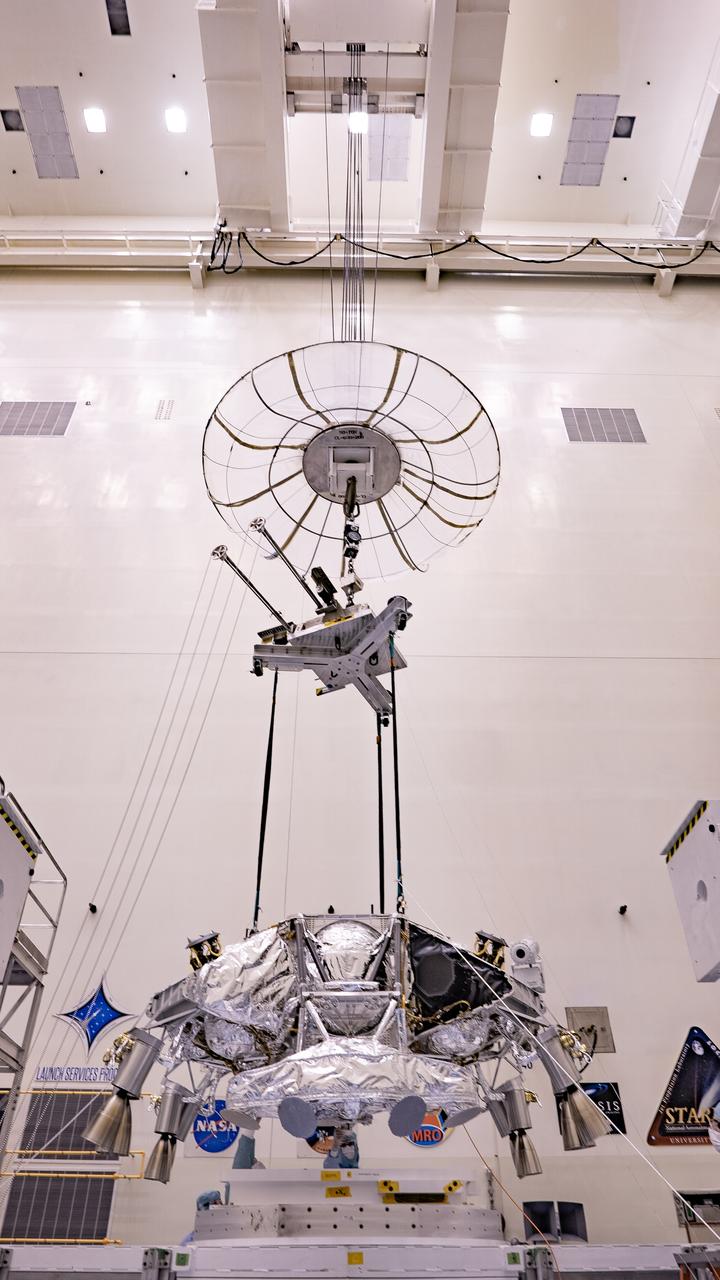
Engineers perform mass properties testing on the rocket-powered descent stage of NASA’s Mars Perseverance rover at Kennedy Space Center on April 9, 2020. The testing to determine the center of gravity, or the point at which weight is evenly dispersed on all sides, was performed inside the Florida spaceport’s Payload Hazardous Servicing Facility. The descent stage will lower the rover through the thin Martian atmosphere and onto the surface on Feb. 18, 2021. Liftoff, aboard a United Launch Alliance Atlas V 541 rocket, is targeted between July 17 and Aug. 5 from Cape Canaveral Air Force Station. NASA’s Launch Services Program based at Kennedy is managing the launch. The rover will seek signs of ancient life and collect rock and soil samples for possible return to Earth.
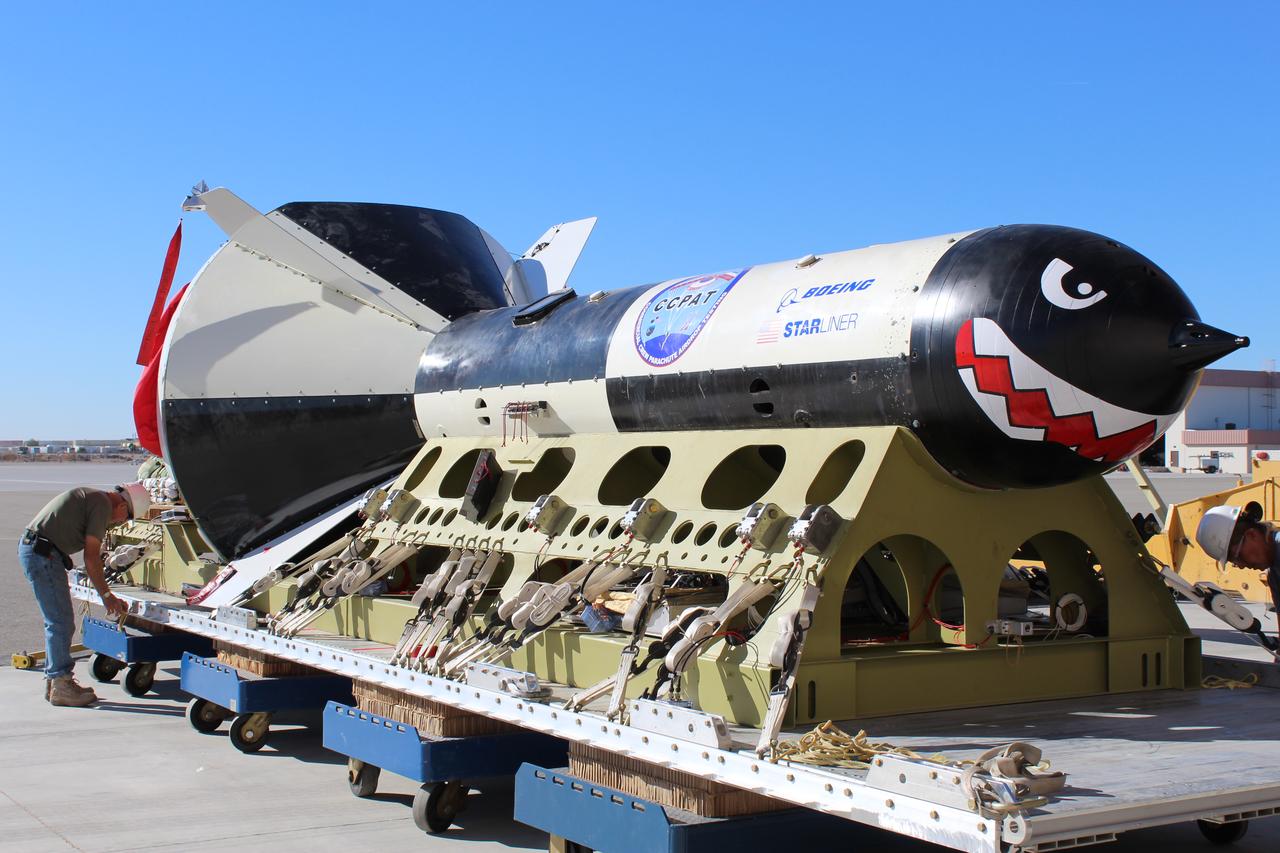
Boeing conducted the first in a series of reliability tests of its CST-100 Starliner flight drogue and main parachute system by releasing a long, dart-shaped test vehicle from a C-17 aircraft over Yuma, Arizona. Two more tests are planned using the dart module, as well as three similar reliability tests using a high fidelity capsule simulator designed to simulate the CST-100 Starliner capsule’s exact shape and mass. In both the dart and capsule simulator tests, the test spacecraft are released at various altitudes to test the parachute system at different deployment speeds, aerodynamic loads, and or weight demands. Data collected from each test is fed into computer models to more accurately predict parachute performance and to verify consistency from test to test.
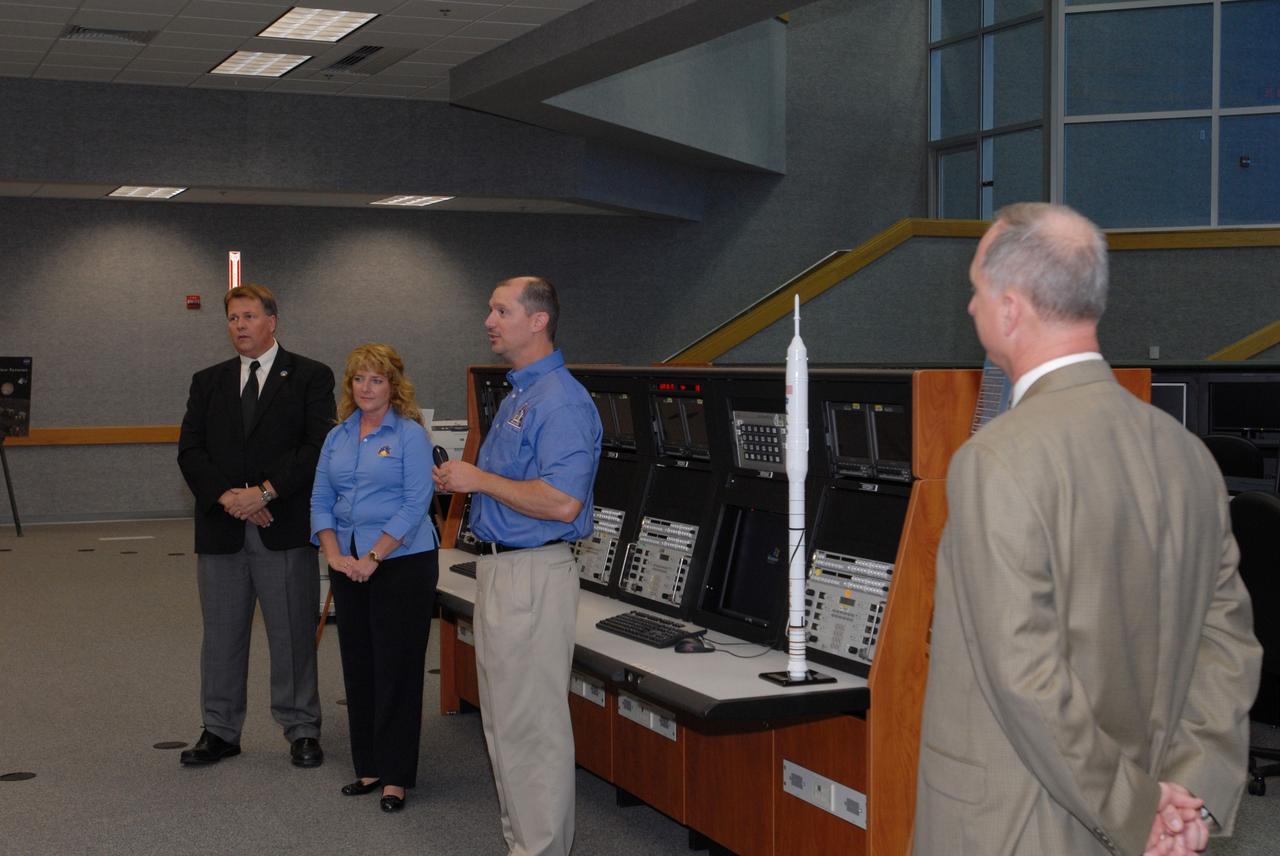
CAPE CANAVERAL, Fla. – At a media event in Firing Room 1 of the Launch Control Center, NASA management talk about the Ares I-X being assembled at NASA's Kennedy Space Center in Florida. From left are Shuttle Test Director Jeff Spaulding, Deputy Mission Manager Carol Scott, Constellation Projects Office Director Pepper Phillips and Chief of the NASA Launch and Landing Division Pete Nickolenko. The upper stage simulators will be used in the test flight identified as Ares I-X in 2009. The segments will simulate the mass and the outer mold line and will be more than 100 feet of the total vehicle height of 327 feet. The simulator comprises 11 segments that are approximately 18 feet in diameter. Most of the segments will be approximately 10 feet high, ranging in weight from 18,000 to 60,000 pounds, for a total of approximately 450,000 pounds. Photo credit: NASA/Jim Grossmann
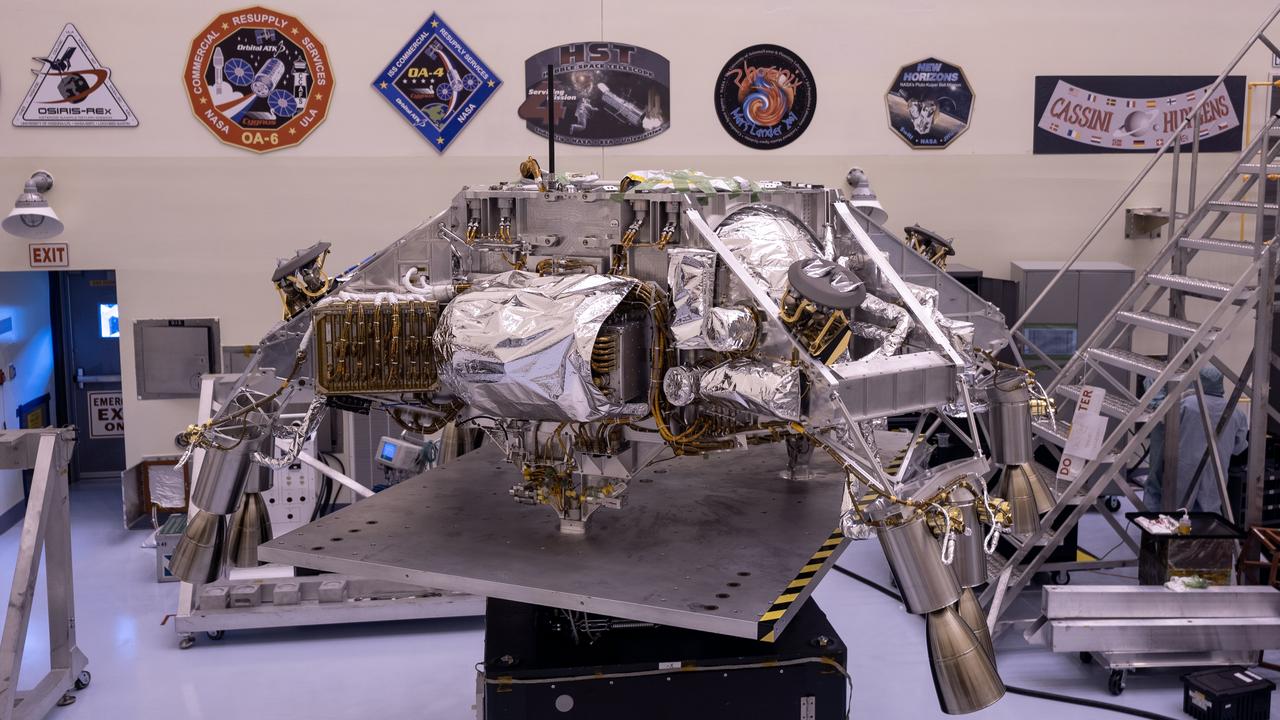
Engineers perform mass properties testing on the rocket-powered descent stage of NASA’s Mars Perseverance rover at Kennedy Space Center on April 12, 2020. The testing to determine the center of gravity, or the point at which weight is evenly dispersed on all sides, was performed inside the Florida spaceport’s Payload Hazardous Servicing Facility. The descent stage will lower the rover through the thin Martian atmosphere and onto the surface on Feb. 18, 2021. Liftoff, aboard a United Launch Alliance Atlas V 541 rocket, is targeted between July 17 and Aug. 5 from Cape Canaveral Air Force Station. NASA’s Launch Services Program based at Kennedy is managing the launch. The rover will seek signs of ancient life and collect rock and soil samples for possible return to Earth.
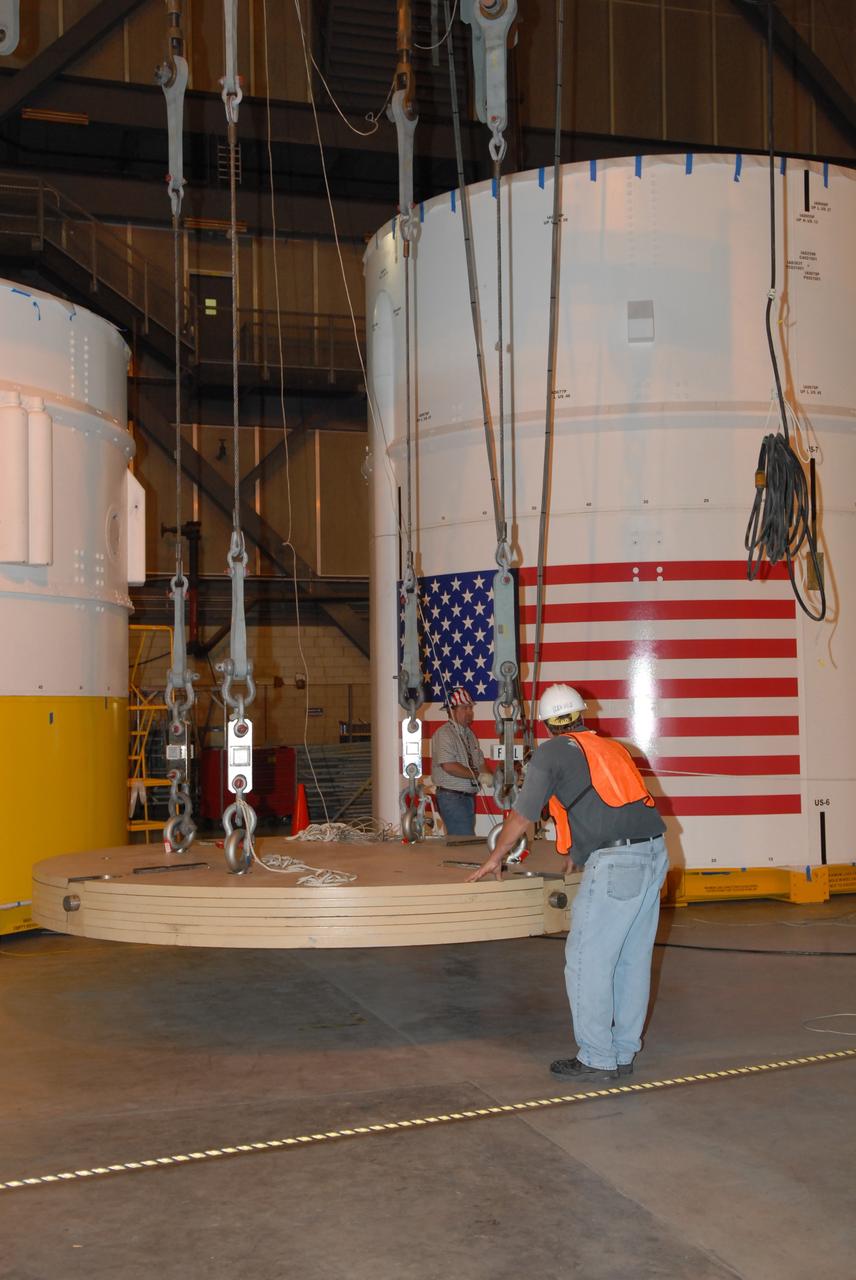
CAPE CANAVERAL, Fla. – In Vehicle Assembly Building high bay 4, cables lift ballast that will be installed in segment 7 for the Ares I-X rocket. These ballast assemblies are being installed in the upper stage segments 1 and 7 and will mimic the mass of the fuel. Their total weight is approximately 160,000 pounds. Ares I-X is the test vehicle for the Ares I, which is part of the Constellation Program to return men to the moon and beyond. Ares I is the essential core of a safe, reliable, cost-effective space transportation system that eventually will carry crewed missions back to the moon, on to Mars and out into the solar system. The Ares I-X is targeted for launch in July 2009. Photo credit: NASA/Jack Pfaller
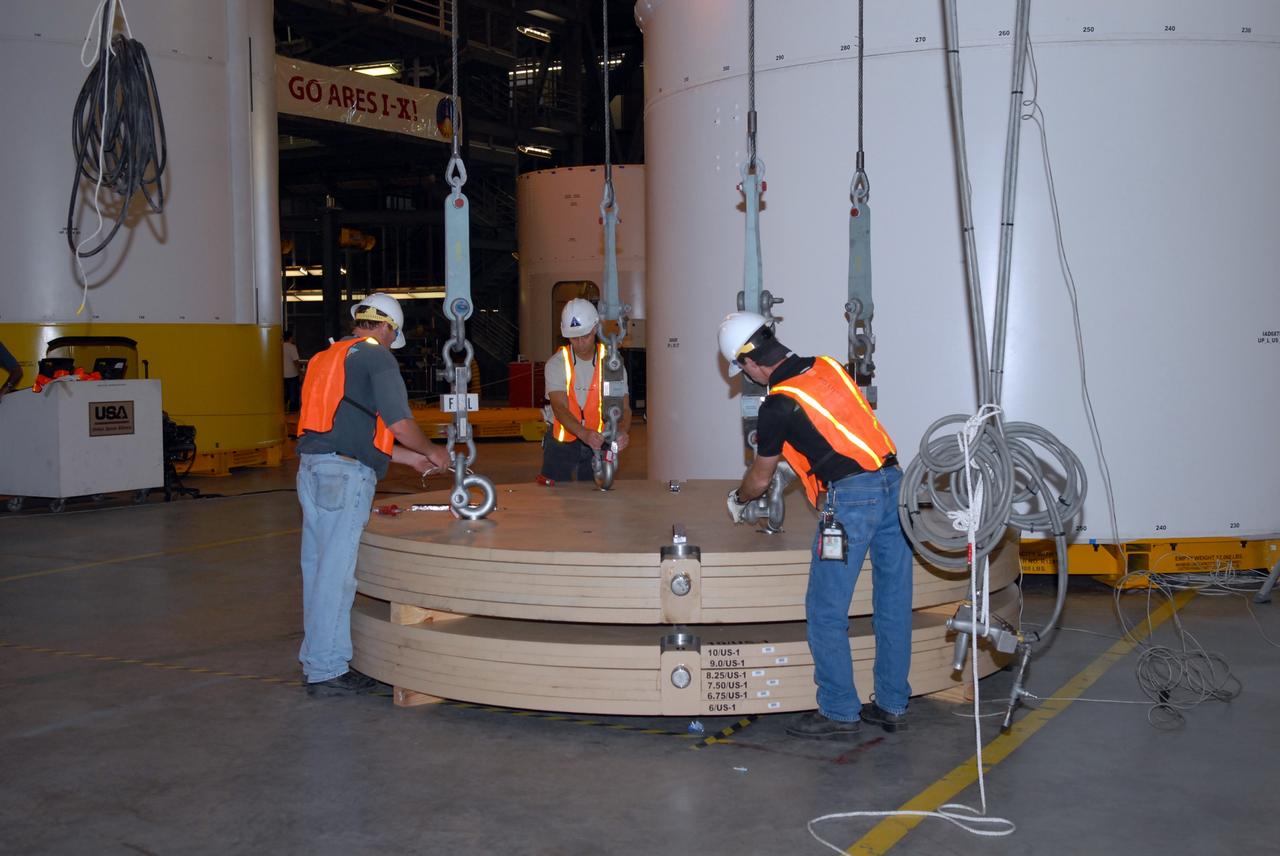
CAPE CANAVERAL, Fla. – In Vehicle Assembly Building high bay 4, workers attached cables to ballast that will be installed in segment 7 for the Ares I-X rocket. These ballast assemblies are being installed in the upper stage segments 1 and 7 and will mimic the mass of the fuel. Their total weight is approximately 160,000 pounds. Ares I-X is the test vehicle for the Ares I, which is part of the Constellation Program to return men to the moon and beyond. Ares I is the essential core of a safe, reliable, cost-effective space transportation system that eventually will carry crewed missions back to the moon, on to Mars and out into the solar system. The Ares I-X is targeted for launch in July 2009. Photo credit: NASA/Jack Pfaller

CAPE CANAVERAL, Fla. – In Vehicle Assembly Building high bay 4, cables lift ballast that will be installed in segment 7 for the Ares I-X rocket. These ballast assemblies are being installed in the upper stage segments 1 and 7 and will mimic the mass of the fuel. Their total weight is approximately 160,000 pounds. Ares I-X is the test vehicle for the Ares I, which is part of the Constellation Program to return men to the moon and beyond. Ares I is the essential core of a safe, reliable, cost-effective space transportation system that eventually will carry crewed missions back to the moon, on to Mars and out into the solar system. The Ares I-X is targeted for launch in July 2009. Photo credit: NASA/Jack Pfaller
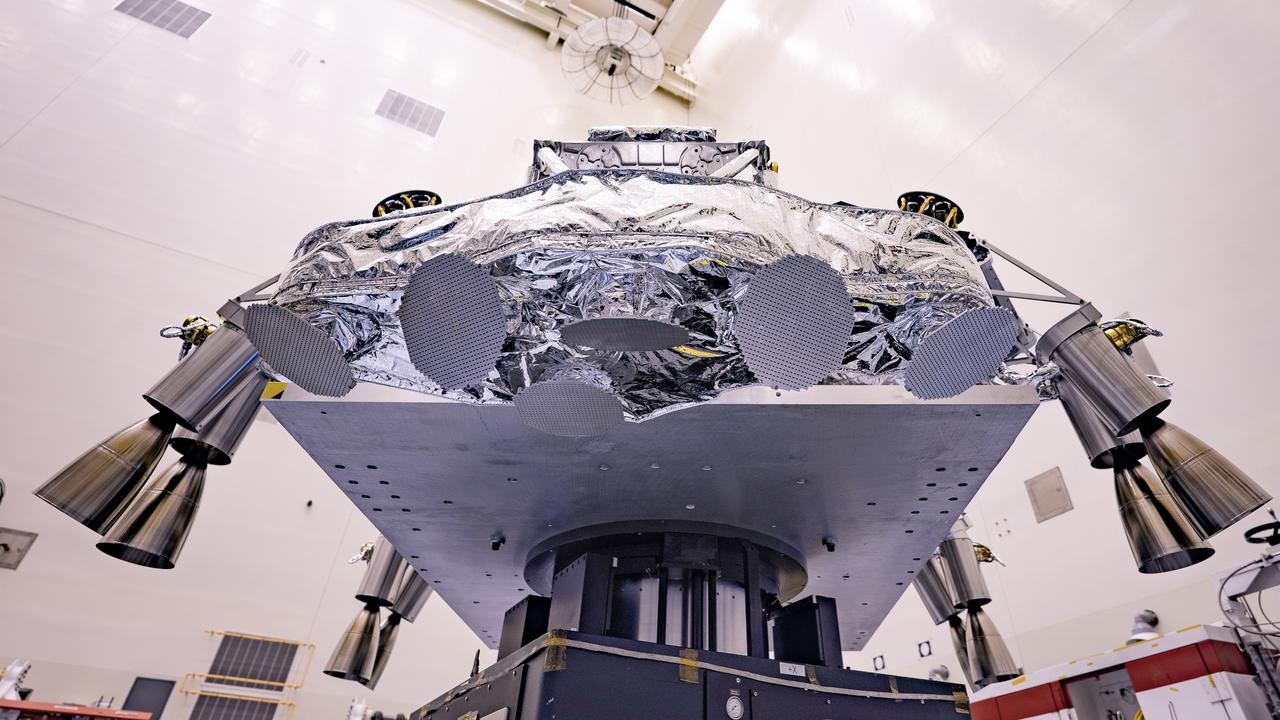
Engineers perform mass properties testing on the rocket-powered descent stage of NASA’s Mars Perseverance rover at Kennedy Space Center on April 12, 2020. The testing to determine the center of gravity, or the point at which weight is evenly dispersed on all sides, was performed inside the Florida spaceport’s Payload Hazardous Servicing Facility. The descent stage will lower the rover through the thin Martian atmosphere and onto the surface on Feb. 18, 2021. Liftoff, aboard a United Launch Alliance Atlas V 541 rocket, is targeted between July 17 and Aug. 5 from Cape Canaveral Air Force Station. NASA’s Launch Services Program based at Kennedy is managing the launch. The rover will seek signs of ancient life and collect rock and soil samples for possible return to Earth.
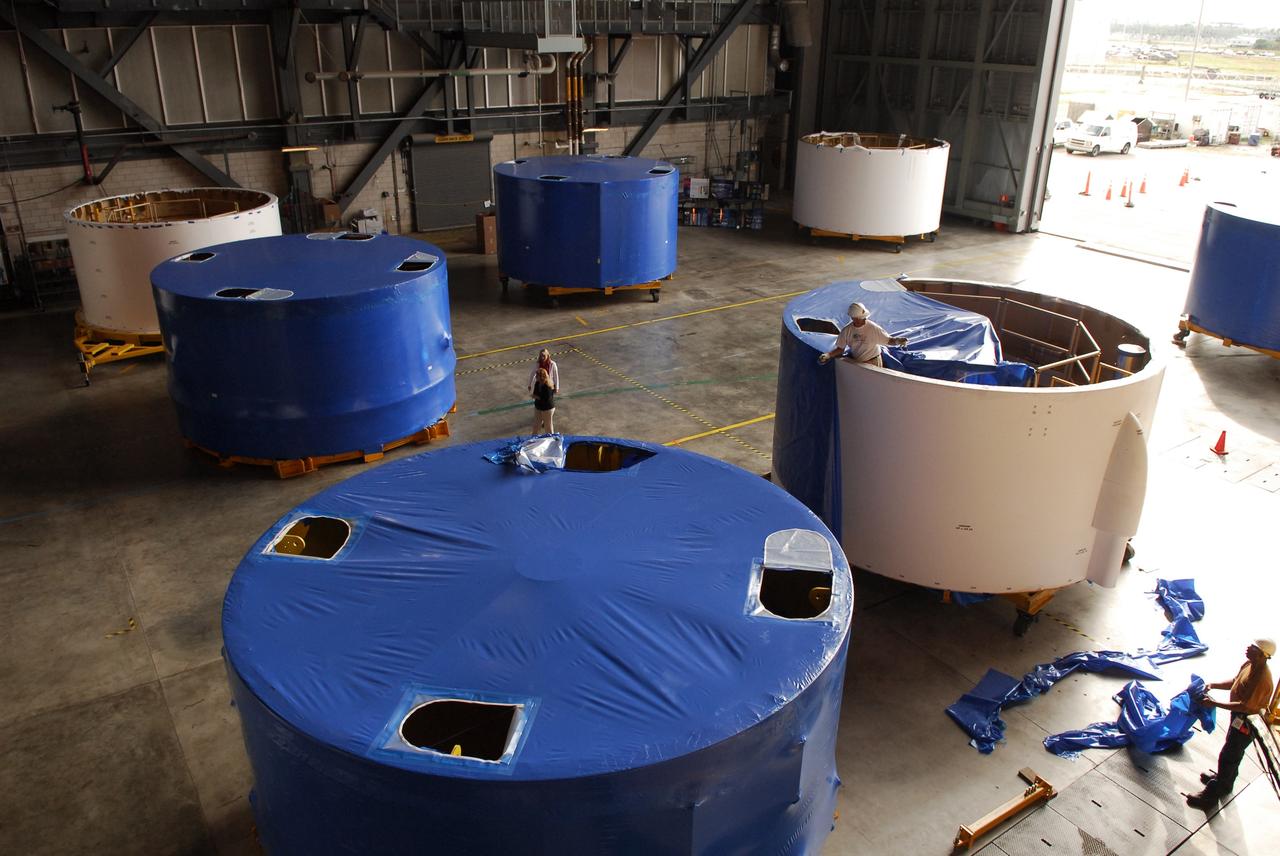
CAPE CANAVERAL, Fla. – Inside the Vehicle Assembly Building high bay 4 at NASA's Kennedy Space Center in Florida, workers from NASA's Glenn Research Center remove the blue shrink-wrapped covers on these Ares I-X upper stage simulator segments. The protective covers were used for shipping. The upper stage simulator will be used in the test flight identified as Ares I-X in 2009. The segments will simulate the mass and the outer mold line and will be more than 100 feet of the total vehicle height of 327 feet. The simulator comprises 11 segments that are approximately 18 feet in diameter. Most of the segments will be approximately 10 feet high, ranging in weight from 18,000 to 60,000 pounds, for a total of approximately 450,000 pounds. Photo credit: NASA/Troy Cryder
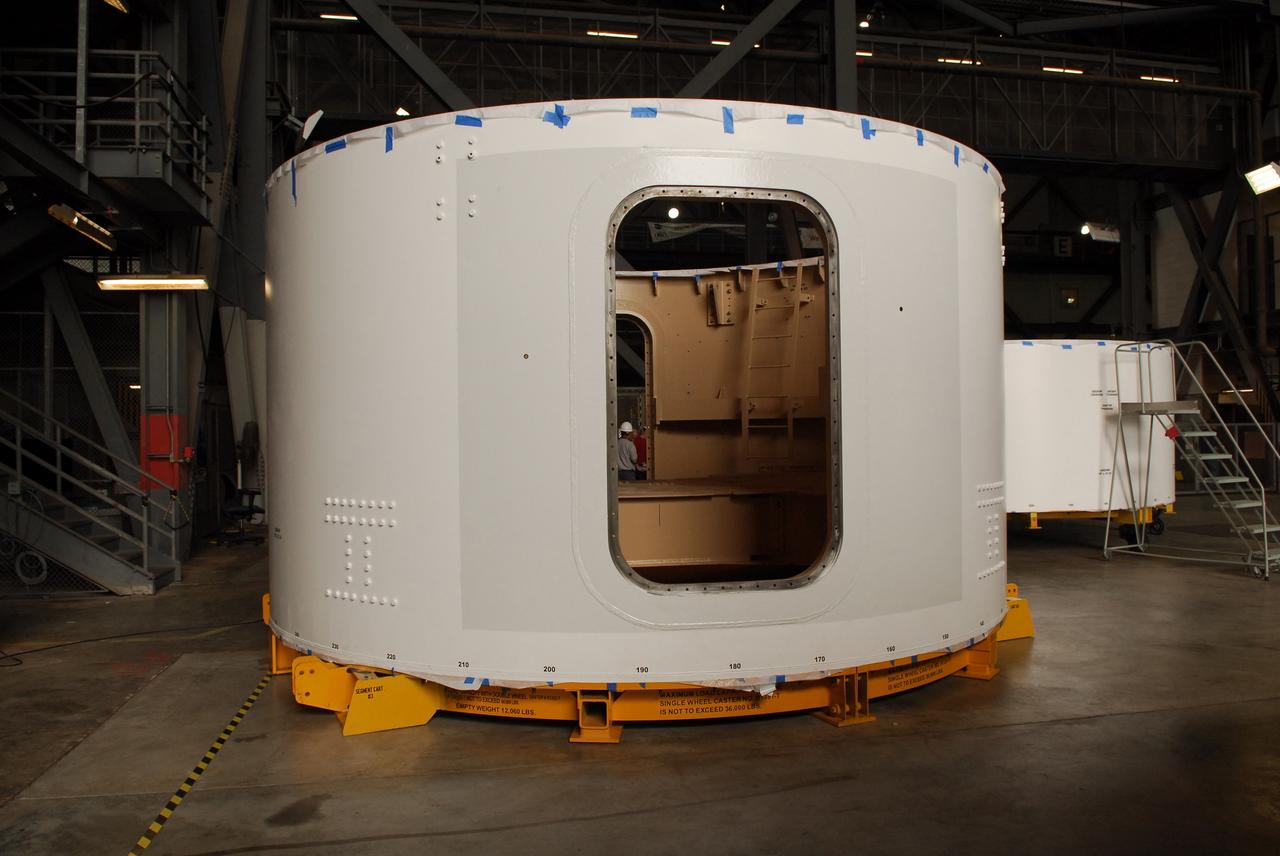
CAPE CANAVERAL, Fla. – Inside the Vehicle Assembly Building high bay 4 at NASA's Kennedy Space Center in Florida, these Ares I-X upper stage simulator segments have shed their protective blue shrink-wrapped covers used for shipping. The upper stage simulator will be used in the test flight identified as Ares I-X in 2009. The segments will simulate the mass and the outer mold line and will be more than 100 feet of the total vehicle height of 327 feet. The simulator comprises 11 segments that are approximately 18 feet in diameter. Most of the segments will be approximately 10 feet high, ranging in weight from 18,000 to 60,000 pounds, for a total of approximately 450,000 pounds. Photo credit: NASA/Troy Cryder
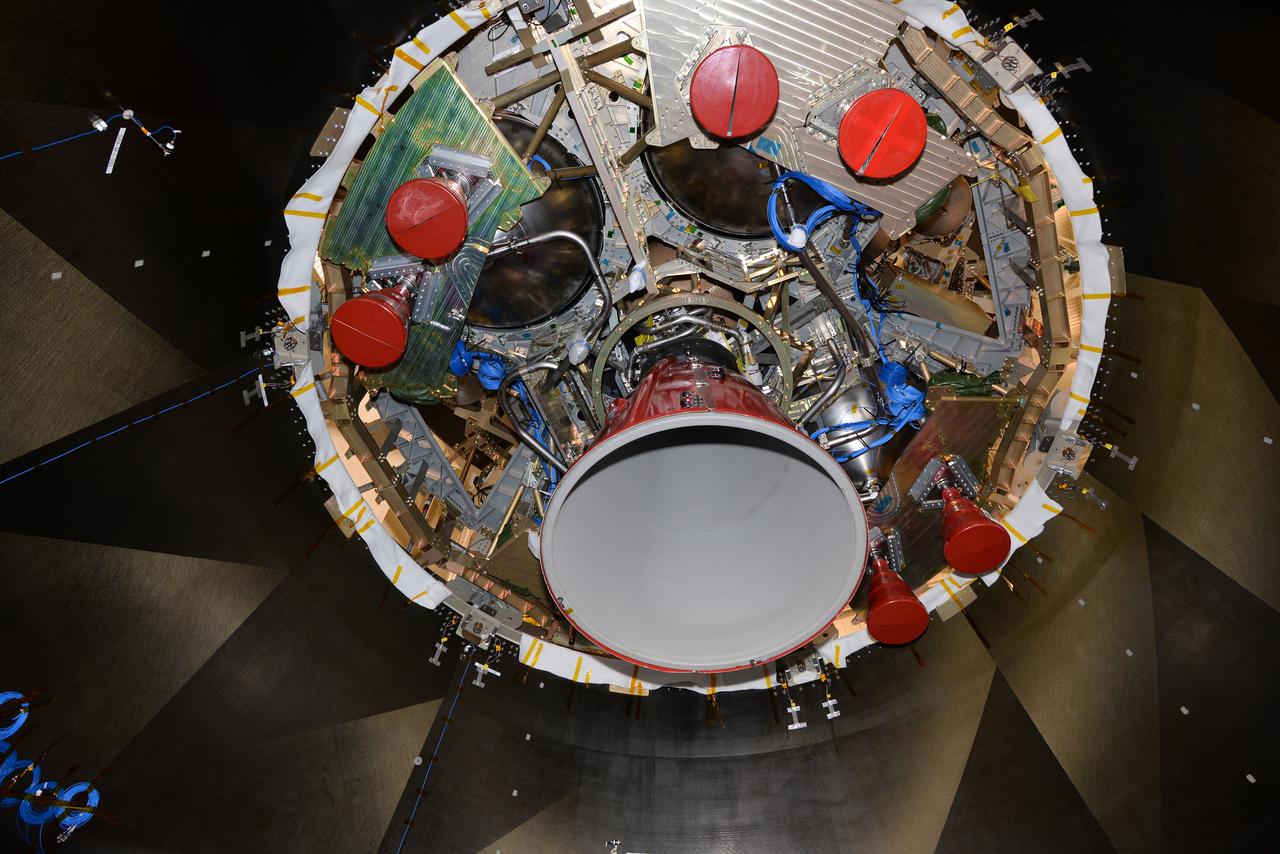
The European Service Module structural test model, shown on Jan. 23, 2016, is used for testing purposes before installing the real thing. It is as close to the flight version as possible while keeping costs and development time manageable. The structure and weight are the same, while mass equivalents stand in for electronics boxes not needed for the series of tests...The model was installed under a test version of the Crew Module Adapter, and sits on the Spacecraft Adapter that will attach Orion to its launch vehicle. This is the first time the European hardware has been physically connected to NASA’s elements...The service module will be shaken at NASA’s Plum Brook station in Sandusky, Ohio, USA, to recreate the vibrations of launch, as well as being subjected to acoustic and shock environments. Part of Batch image transfer from Flickr.
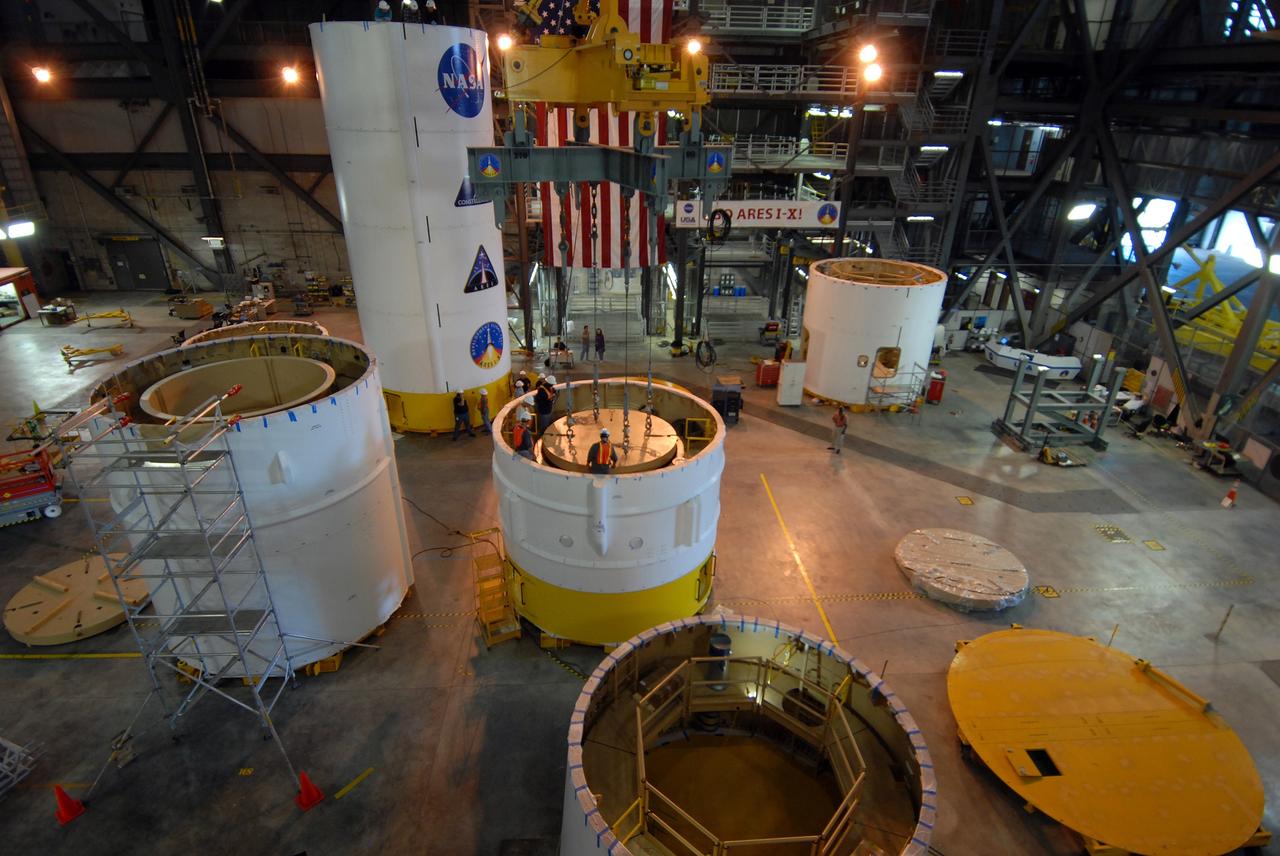
CAPE CANAVERAL, Fla. – At center, ballast is lowered into segment 7 of the Ares I-X rocket in Vehicle Assembly Building high bay 4. Other segments are stacked around the bay. These ballast assemblies are being installed in the upper stage segments 1 and 7 and will mimic the mass of the fuel. Their total weight is approximately 160,000 pounds.Ares I-X is the test vehicle for the Ares I, which is part of the Constellation Program to return men to the moon and beyond. Ares I is the essential core of a safe, reliable, cost-effective space transportation system that eventually will carry crewed missions back to the moon, on to Mars and out into the solar system. The Ares I-X is targeted for launch in July 2009. Photo credit: NASA/Jack Pfaller
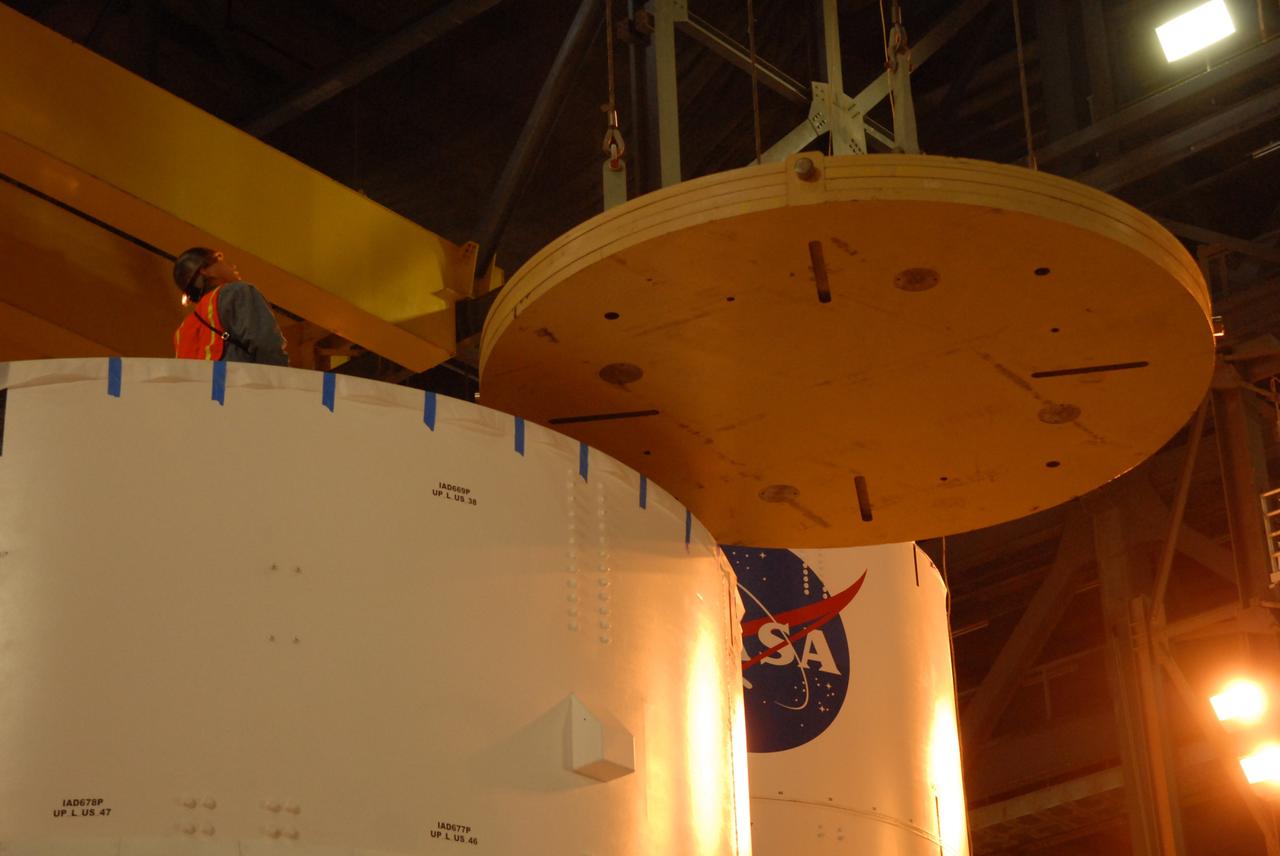
CAPE CANAVERAL, Fla. – In high bay 4 of the Vehicle Assembly Building at NASA's Kennedy Space Center in Florida, a ballast assembly is moved above the Ares I-X segment 7. Ballast assemblies will be installed in the upper stage 1 and 7 segments and will mimic the mass of the fuel. Their total weight is approximately 160,000 pounds. Ares I-X is the test vehicle for the Ares I, which is part of the Constellation Program to return men to the moon and beyond. Ares I is the essential core of a safe, reliable, cost-effective space transportation system that eventually will carry crewed missions back to the moon, on to Mars and out into the solar system. Ares I may also use its 25-ton payload capacity to deliver resources and supplies to the International Space Station, or to "park" payloads in orbit for retrieval by other spacecraft bound for the moon or other destinations. The Ares I-X is targeted for launch in July 2009. Photo credit: NASA/Dimitri Gerondidakis
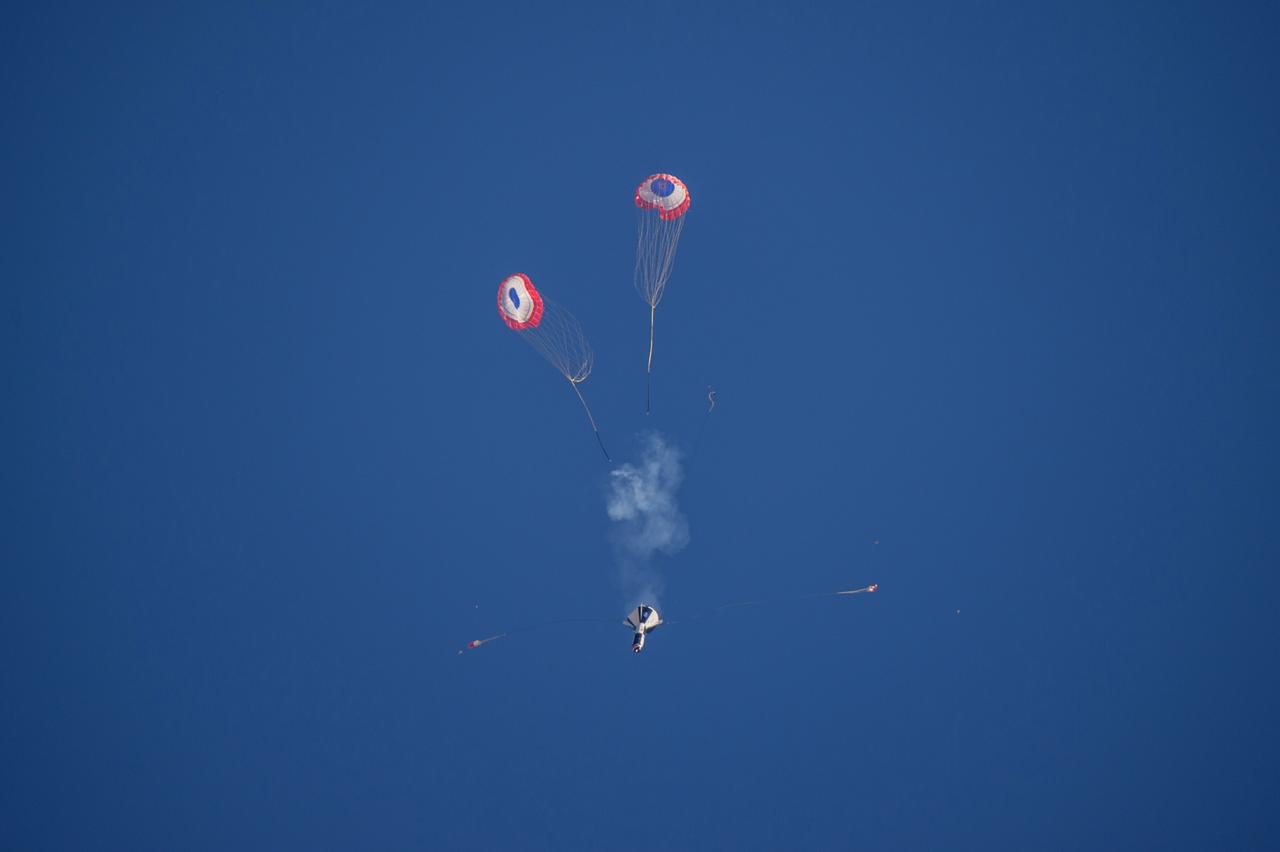
Boeing conducted the first in a series of reliability tests of its CST-100 Starliner flight drogue and main parachute system by releasing a long, dart-shaped test vehicle from a C-17 aircraft over Yuma, Arizona. Two more tests are planned using the dart module, as well as three similar reliability tests using a high fidelity capsule simulator designed to simulate the CST-100 Starliner capsule’s exact shape and mass. In both the dart and capsule simulator tests, the test spacecraft are released at various altitudes to test the parachute system at different deployment speeds, aerodynamic loads, and or weight demands. Data collected from each test is fed into computer models to more accurately predict parachute performance and to verify consistency from test to test.
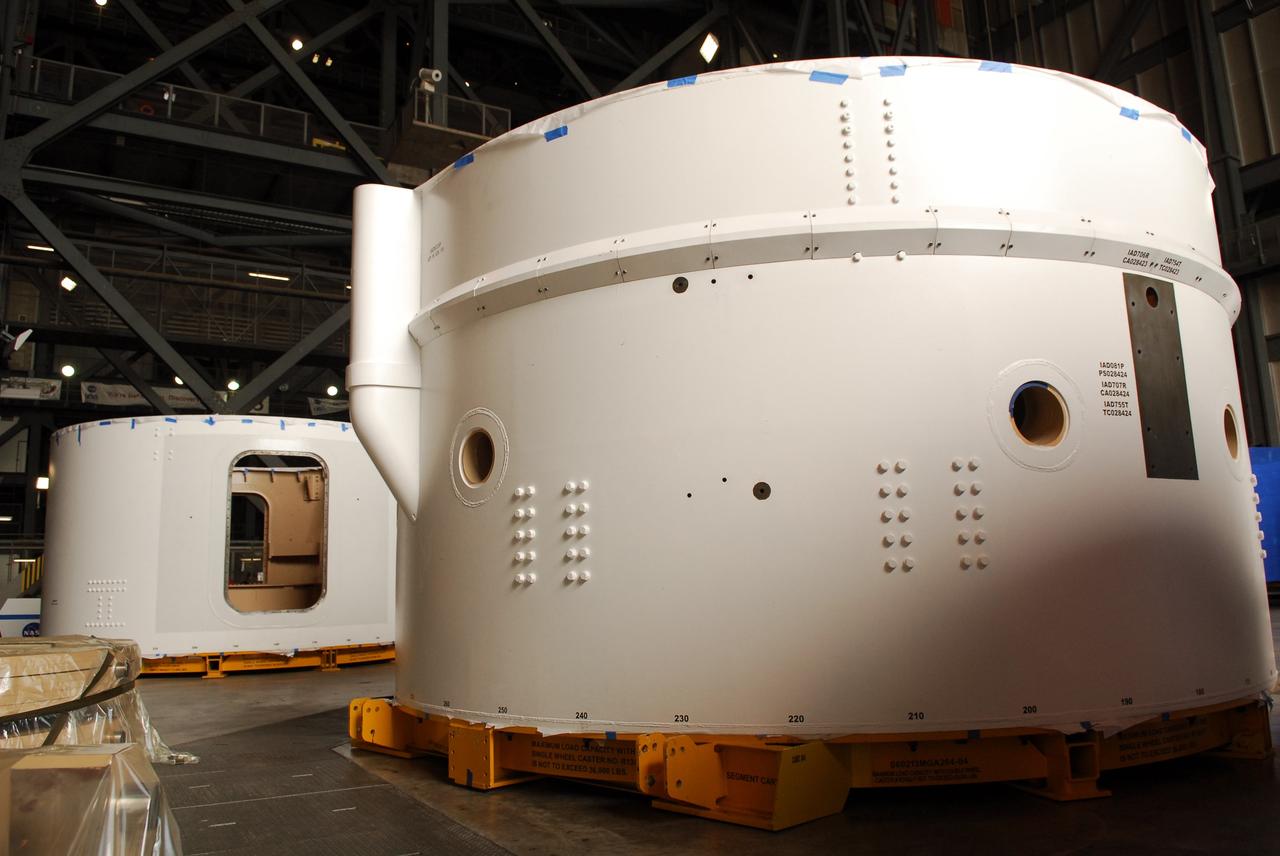
CAPE CANAVERAL, Fla. – Inside the Vehicle Assembly Building high bay 4 at NASA's Kennedy Space Center in Florida, these Ares I-X upper stage simulator segments have shed their protective blue shrink-wrapped covers used for shipping. The upper stage simulator will be used in the test flight identified as Ares I-X in 2009. The segments will simulate the mass and the outer mold line and will be more than 100 feet of the total vehicle height of 327 feet. The simulator comprises 11 segments that are approximately 18 feet in diameter. Most of the segments will be approximately 10 feet high, ranging in weight from 18,000 to 60,000 pounds, for a total of approximately 450,000 pounds. Photo credit: NASA/Troy Cryder
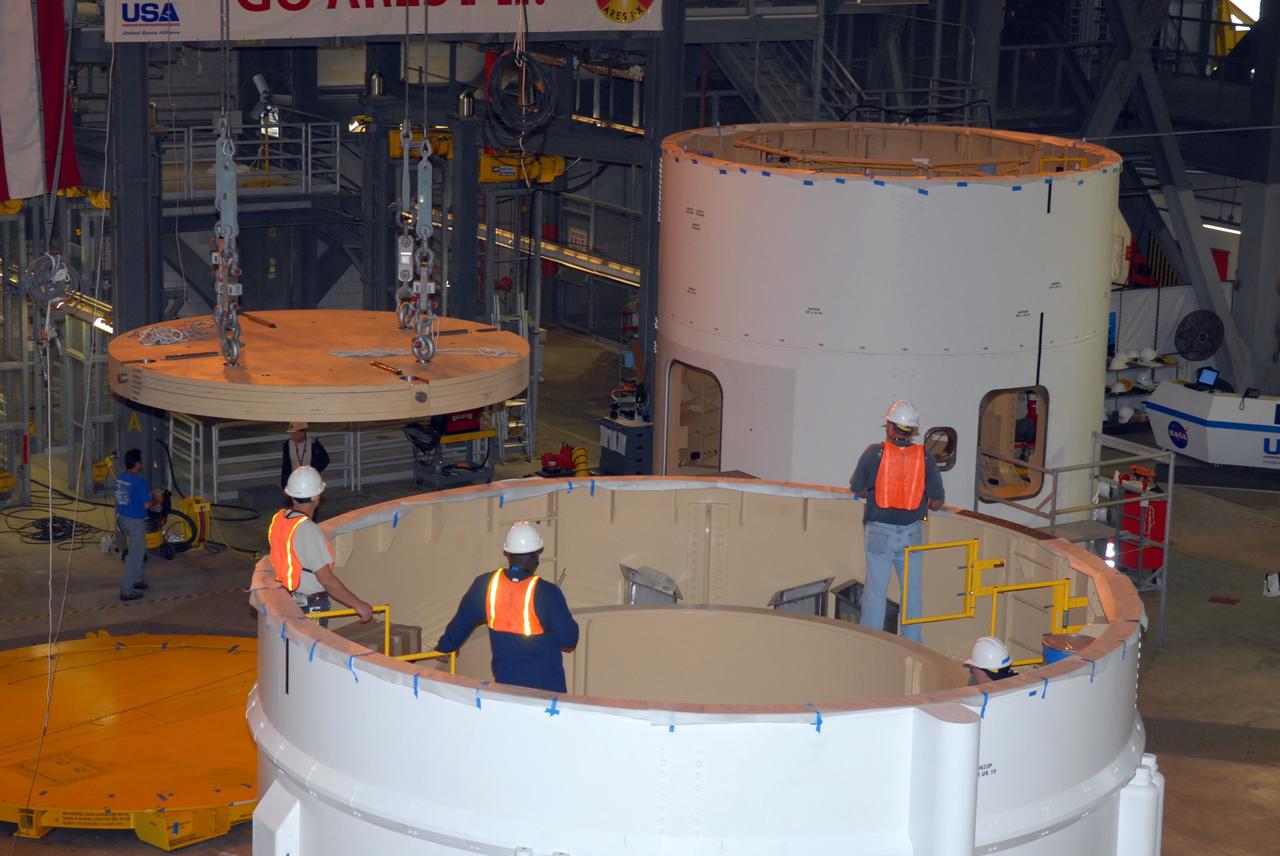
CAPE CANAVERAL, Fla. – In Vehicle Assembly Building high bay 4, cables from an overhead crane move ballast that will be installed in segment 7 for the Ares I-X rocket. These ballast assemblies are being installed in the upper stage segments 1 and 7 and will mimic the mass of the fuel. Their total weight is approximately 160,000 pounds. Ares I-X is the test vehicle for the Ares I, which is part of the Constellation Program to return men to the moon and beyond. Ares I is the essential core of a safe, reliable, cost-effective space transportation system that eventually will carry crewed missions back to the moon, on to Mars and out into the solar system. The Ares I-X is targeted for launch in July 2009. Photo credit: NASA/Jack Pfaller
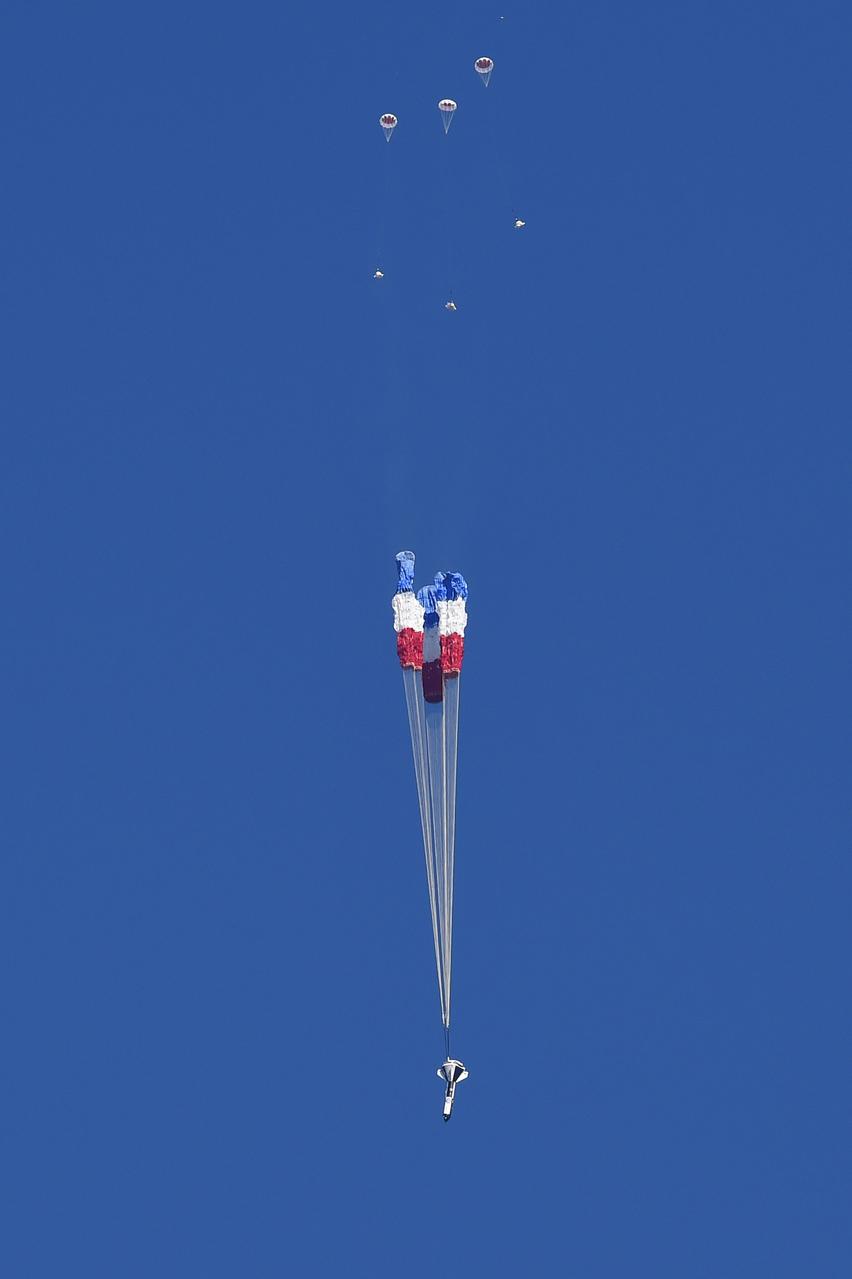
Boeing conducted the first in a series of reliability tests of its CST-100 Starliner flight drogue and main parachute system by releasing a long, dart-shaped test vehicle from a C-17 aircraft over Yuma, Arizona. Two more tests are planned using the dart module, as well as three similar reliability tests using a high fidelity capsule simulator designed to simulate the CST-100 Starliner capsule’s exact shape and mass. In both the dart and capsule simulator tests, the test spacecraft are released at various altitudes to test the parachute system at different deployment speeds, aerodynamic loads, and or weight demands. Data collected from each test is fed into computer models to more accurately predict parachute performance and to verify consistency from test to test.
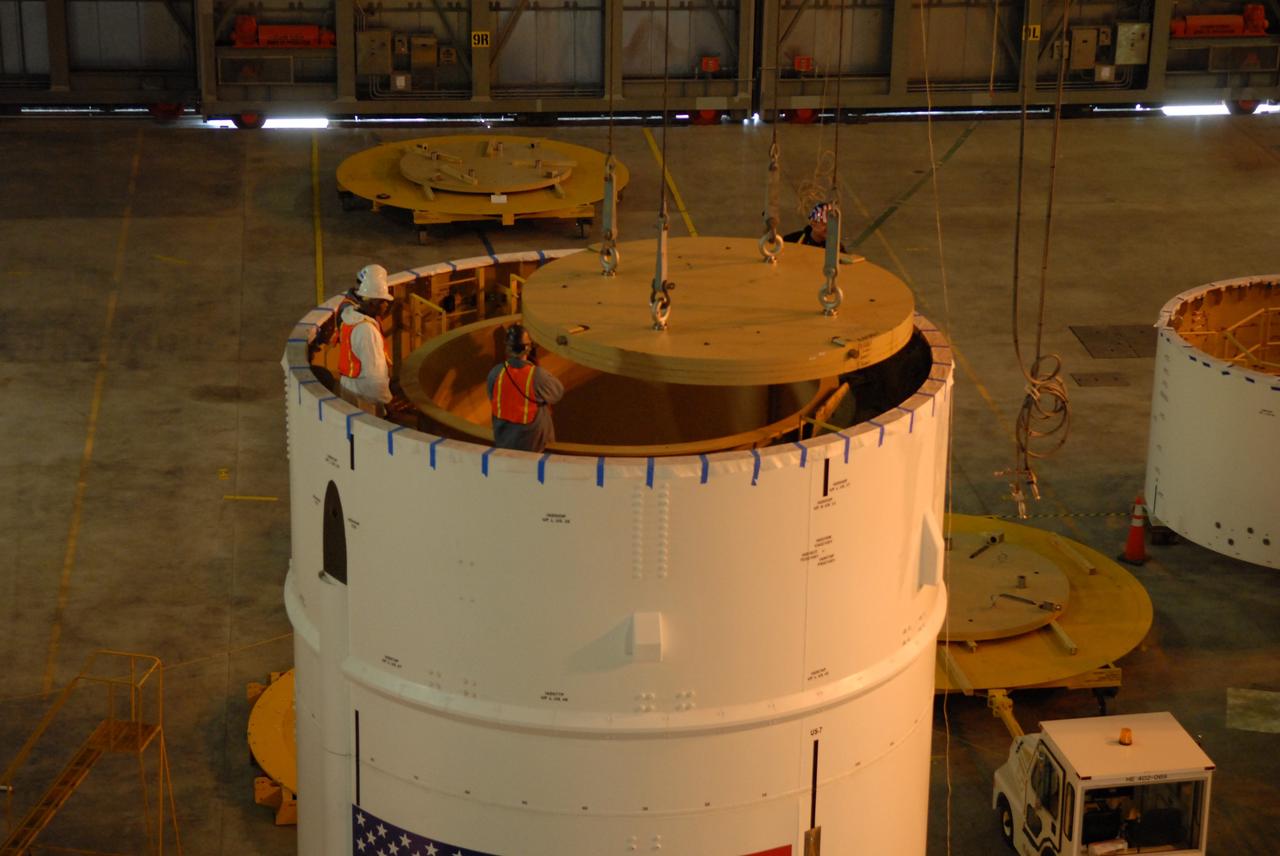
CAPE CANAVERAL, Fla. – In high bay 4 of the Vehicle Assembly Building at NASA's Kennedy Space Center in Florida, a ballast assembly is lowered into the Ares I-X segment 7. Ballast assemblies are being installed in the upper stage 1 and 7 segments and will mimic the mass of the fuel. Their total weight is approximately 160,000 pounds. Ares I-X is the test vehicle for the Ares I, which is part of the Constellation Program to return men to the moon and beyond. Ares I is the essential core of a safe, reliable, cost-effective space transportation system that eventually will carry crewed missions back to the moon, on to Mars and out into the solar system. Ares I may also use its 25-ton payload capacity to deliver resources and supplies to the International Space Station, or to "park" payloads in orbit for retrieval by other spacecraft bound for the moon or other destinations. The Ares I-X is targeted for launch in July 2009. Photo credit: NASA/Dimitri Gerondidakis
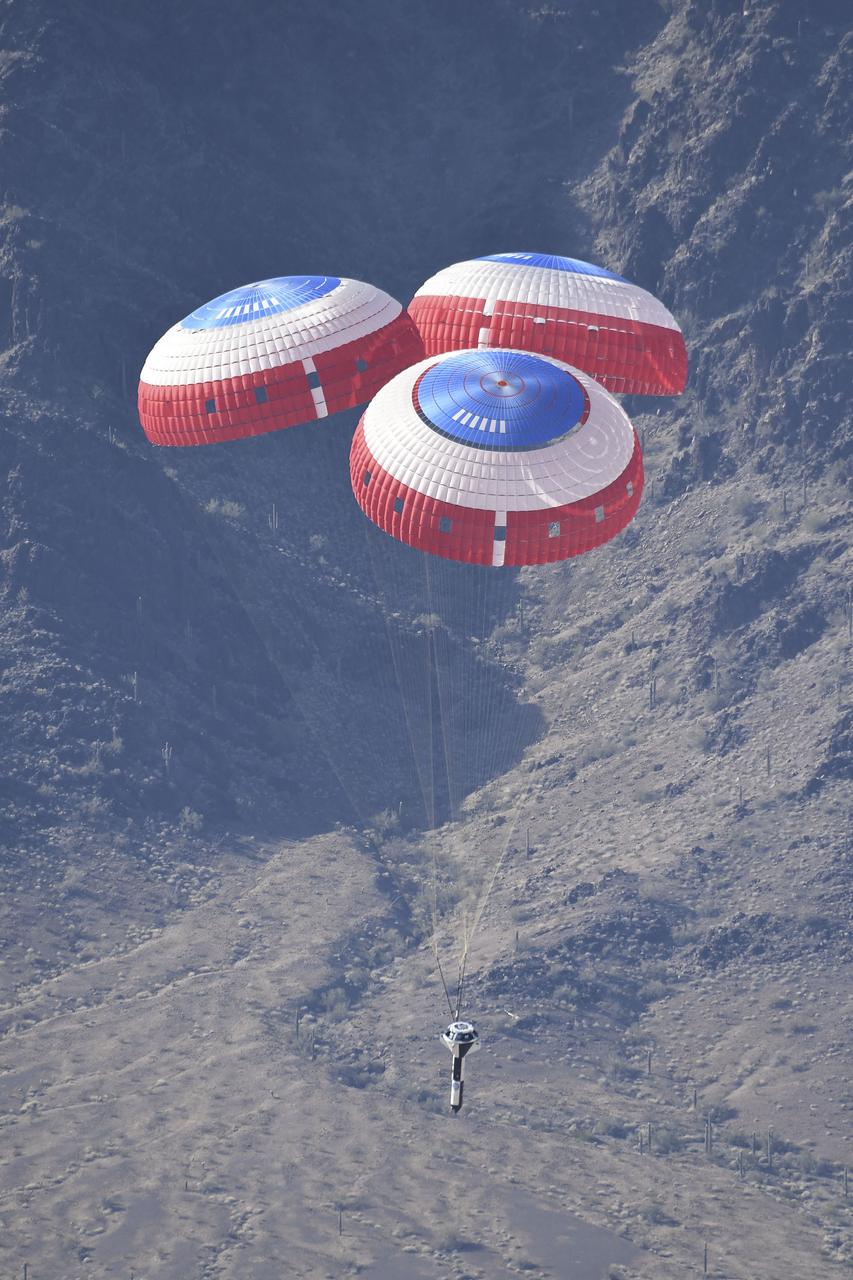
Boeing conducted the first in a series of reliability tests of its CST-100 Starliner flight drogue and main parachute system by releasing a long, dart-shaped test vehicle from a C-17 aircraft over Yuma, Arizona. Two more tests are planned using the dart module, as well as three similar reliability tests using a high fidelity capsule simulator designed to simulate the CST-100 Starliner capsule’s exact shape and mass. In both the dart and capsule simulator tests, the test spacecraft are released at various altitudes to test the parachute system at different deployment speeds, aerodynamic loads, and or weight demands. Data collected from each test is fed into computer models to more accurately predict parachute performance and to verify consistency from test to test.
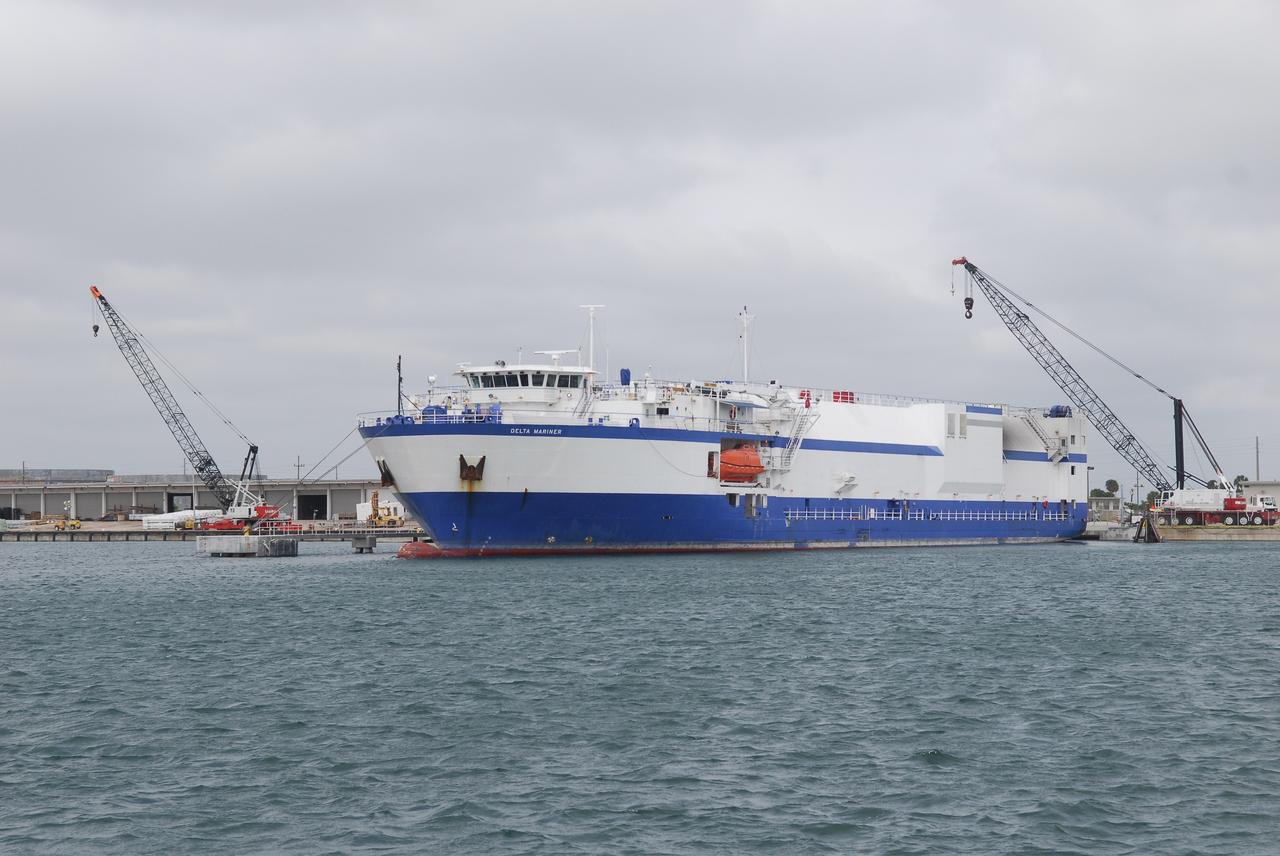
CAPE CANAVERAL, Fla. – The Delta Mariner is docked at Port Canaveral, Fla., with its cargo of the Ares I-X upper stage simulator segments. The cranes near the ship will be used to remove the segments and place them on a flatbed truck for transportation to the Vehicle Assembly Building's high bay 4 at NASA's Kennedy Space Center in Florida. The upper stage simulator will be used in the test flight identified as Ares I-X in 2009. The segments will simulate the mass and the outer mold line and will be more than 100 feet of the total vehicle height of 327 feet. The simulator comprises 11 segments that are approximately 18 feet in diameter. Most of the segments will be approximately 10 feet high, ranging in weight from 18,000 to 60,000 pounds, for a total of approximately 450,000 pounds. Photo credit: NASA/Dimitri Gerondidakis
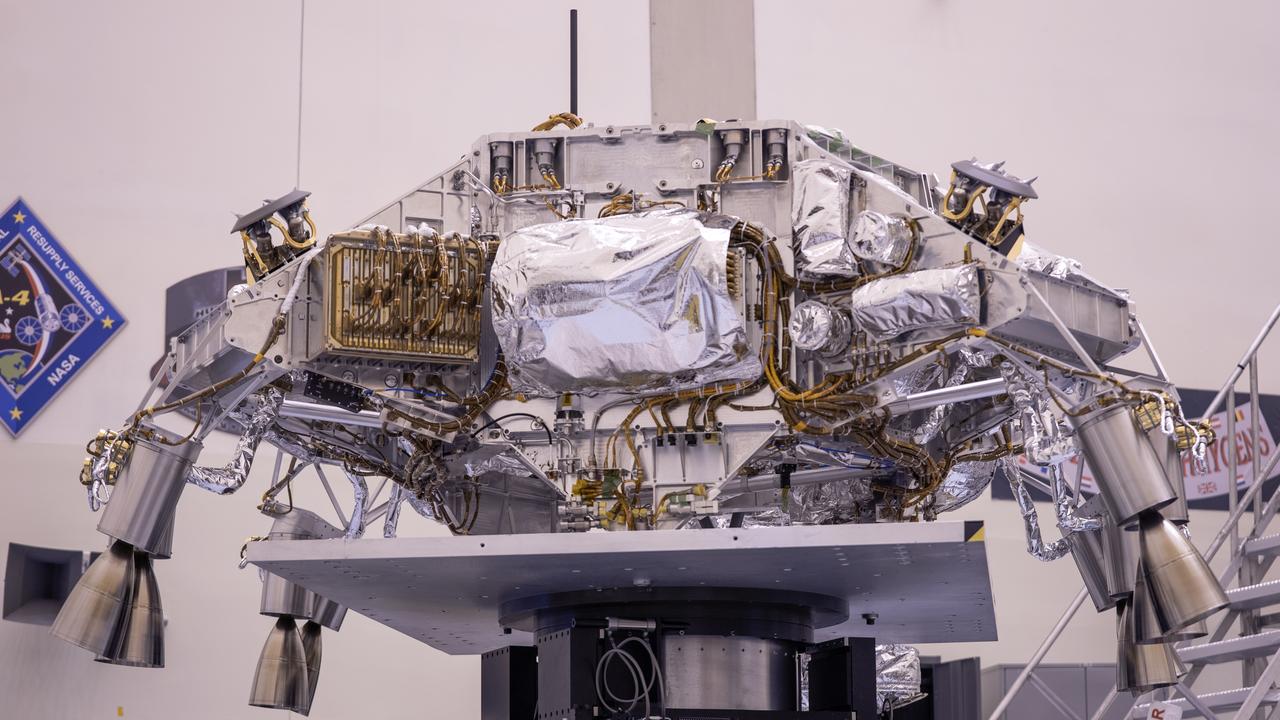
Engineers perform mass properties testing on the rocket-powered descent stage of NASA’s Mars Perseverance rover at Kennedy Space Center on April 12, 2020. The testing to determine the center of gravity, or the point at which weight is evenly dispersed on all sides, was performed inside the Florida spaceport’s Payload Hazardous Servicing Facility. The descent stage will lower the rover through the thin Martian atmosphere and onto the surface on Feb. 18, 2021. Liftoff, aboard a United Launch Alliance Atlas V 541 rocket, is targeted between July 17 and Aug. 5 from Cape Canaveral Air Force Station. NASA’s Launch Services Program based at Kennedy is managing the launch. The rover will seek signs of ancient life and collect rock and soil samples for possible return to Earth.
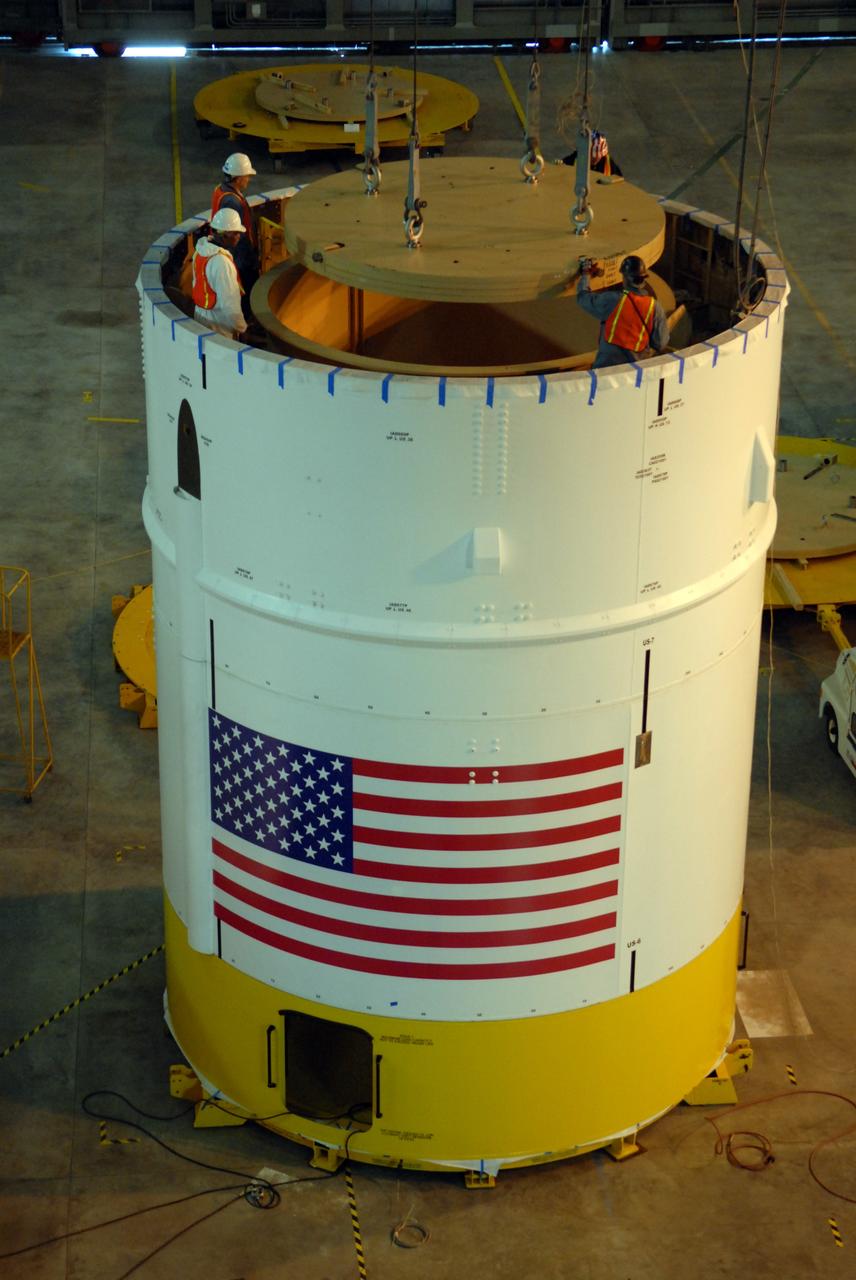
CAPE CANAVERAL, Fla. – In high bay 4 of the Vehicle Assembly Building at NASA's Kennedy Space Center in Florida, a ballast assembly is lowered into the Ares I-X segment 7. Ballast assemblies are being installed in the upper stage 1 and 7 segments and will mimic the mass of the fuel. Their total weight is approximately 160,000 pounds. Ares I-X is the test vehicle for the Ares I, which is part of the Constellation Program to return men to the moon and beyond. Ares I is the essential core of a safe, reliable, cost-effective space transportation system that eventually will carry crewed missions back to the moon, on to Mars and out into the solar system. Ares I may also use its 25-ton payload capacity to deliver resources and supplies to the International Space Station, or to "park" payloads in orbit for retrieval by other spacecraft bound for the moon or other destinations. The Ares I-X is targeted for launch in July 2009. Photo credit: NASA/Dimitri Gerondidakis
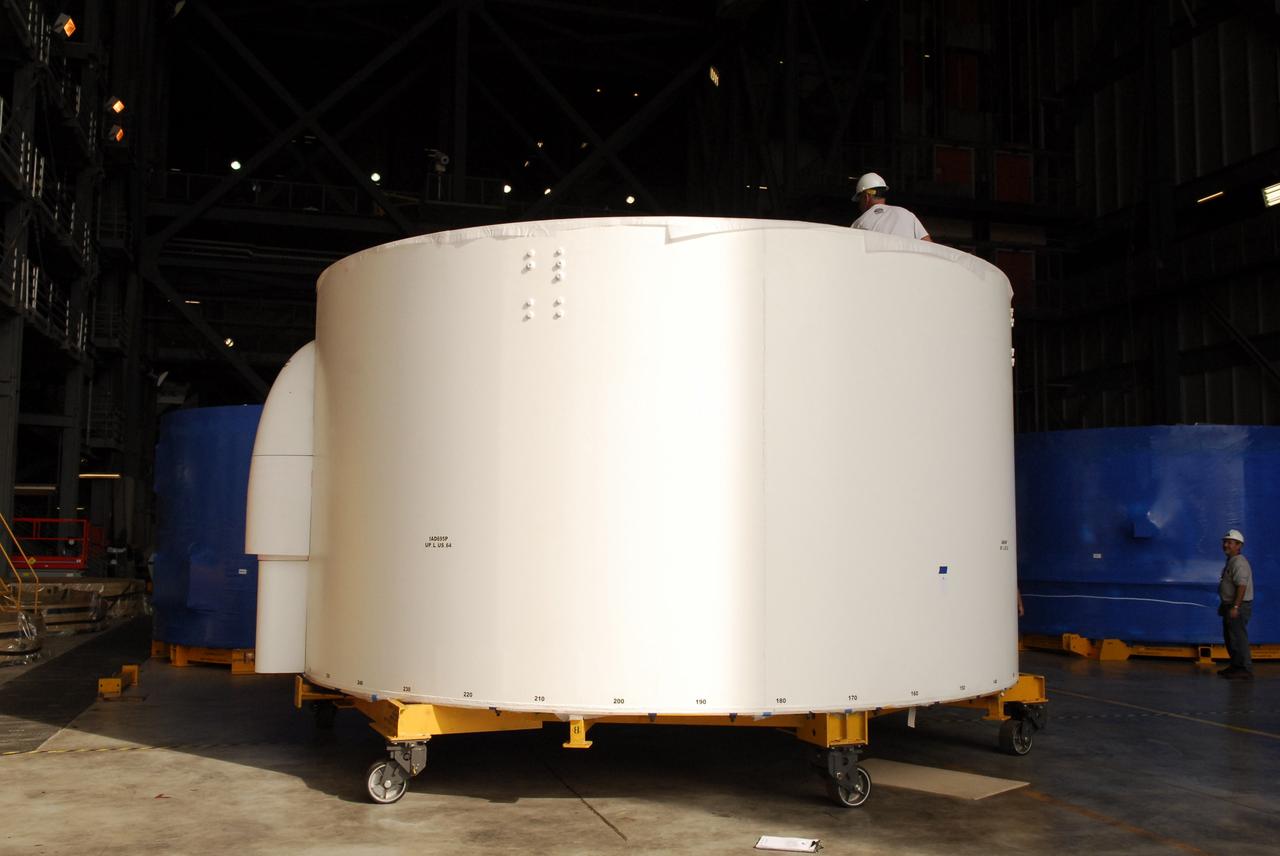
CAPE CANAVERAL, Fla. – Inside the Vehicle Assembly Building high bay 4 at NASA's Kennedy Space Center in Florida, these Ares I-X upper stage simulator segments have shed their protective blue shrink-wrapped covers used for shipping. The upper stage simulator will be used in the test flight identified as Ares I-X in 2009. The segments will simulate the mass and the outer mold line and will be more than 100 feet of the total vehicle height of 327 feet. The simulator comprises 11 segments that are approximately 18 feet in diameter. Most of the segments will be approximately 10 feet high, ranging in weight from 18,000 to 60,000 pounds, for a total of approximately 450,000 pounds. Photo credit: NASA/Troy Cryder
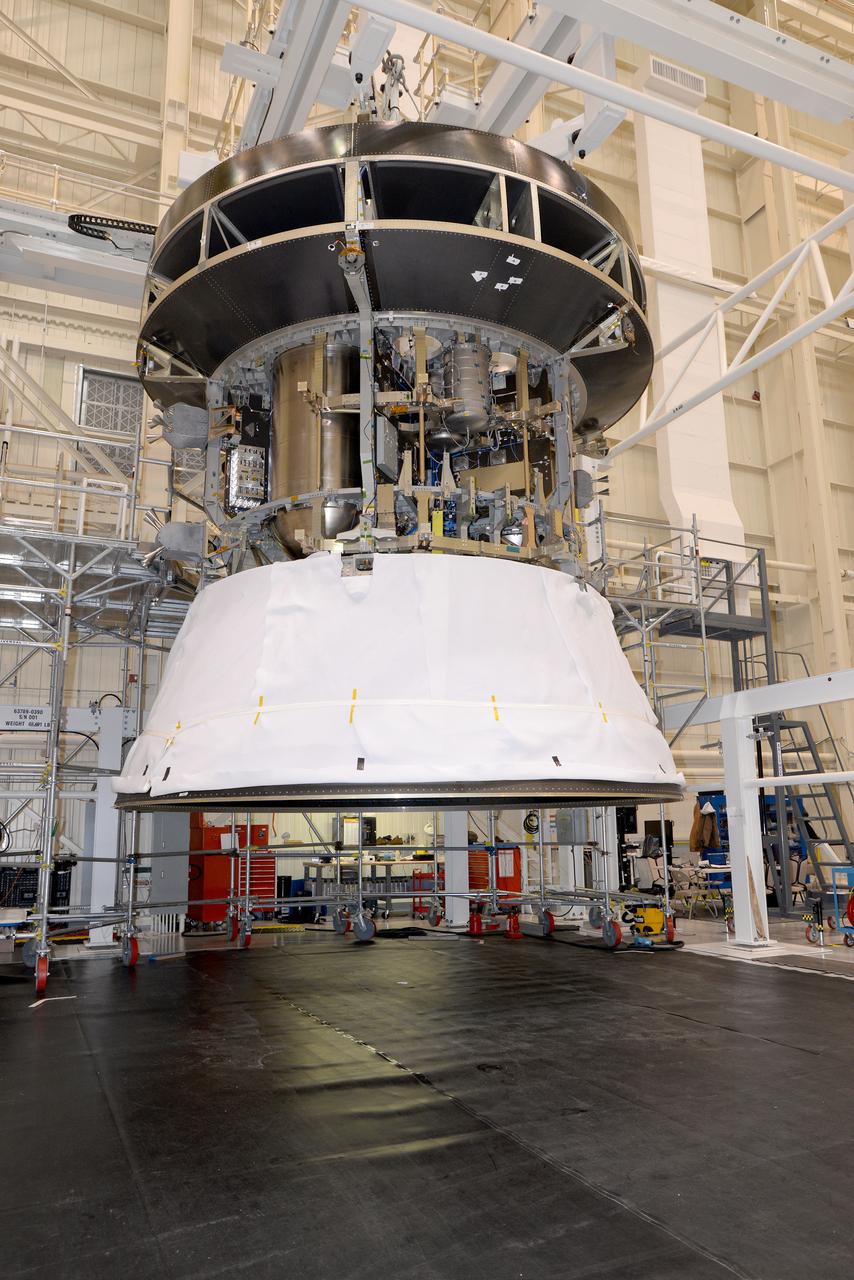
The European Service Module structural test model, shown on Jan. 23, 2016, is used for testing purposes before installing the real thing. It is as close to the flight version as possible while keeping costs and development time manageable. The structure and weight are the same, while mass equivalents stand in for electronics boxes not needed for the series of tests...The model was installed under a test version of the Crew Module Adapter, and sits on the Spacecraft Adapter that will attach Orion to its launch vehicle. This is the first time the European hardware has been physically connected to NASA’s elements...The service module will be shaken at NASA’s Plum Brook station in Sandusky, Ohio, USA, to recreate the vibrations of launch, as well as being subjected to acoustic and shock environments. Part of Batch image transfer from Flickr.
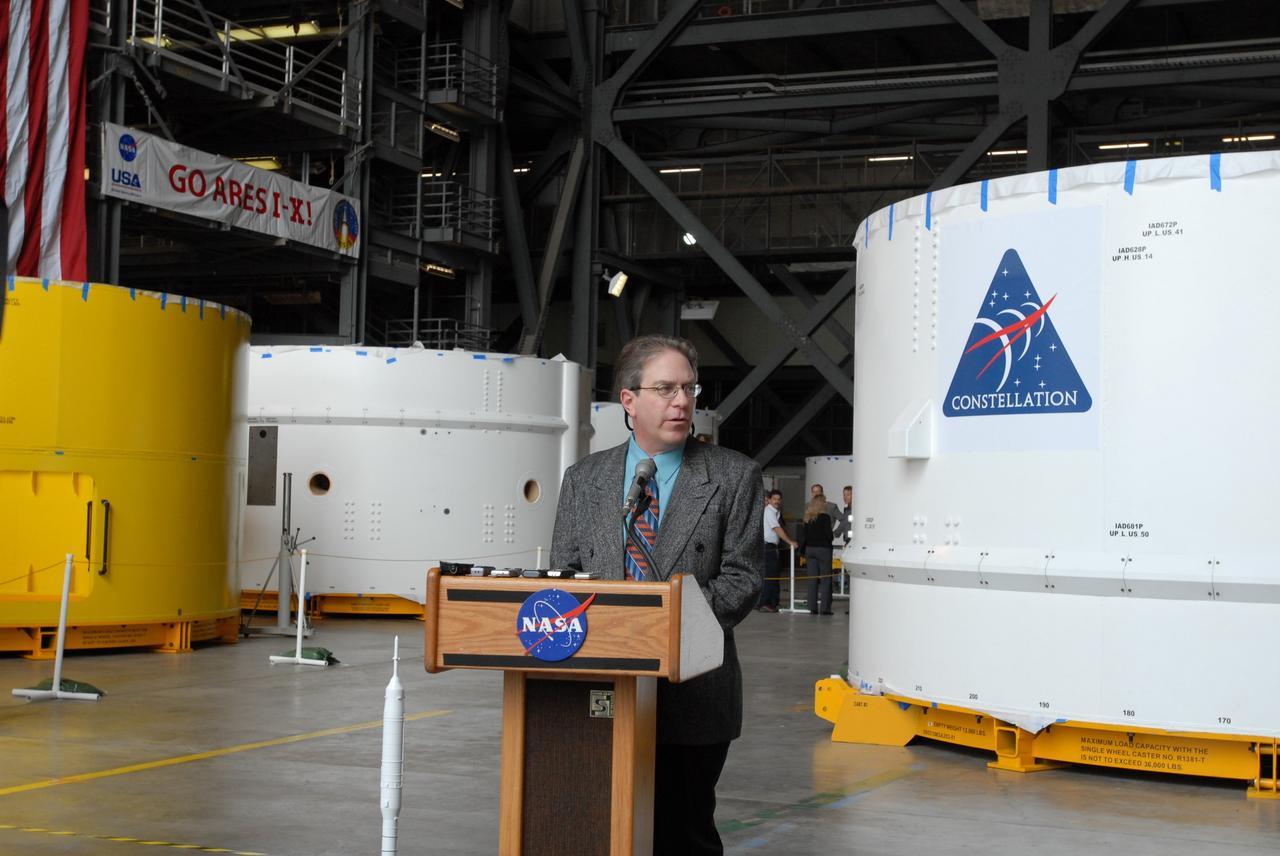
CAPE CANAVERAL, Fla. – Vince Bilardo, project manager from Glenn Research Center, talks to the media about the arrival of the Ares I-X upper stage simulator components behind him in the Vehicle Assembly Building's high bay 4 at NASA's Kennedy Space Center in Florida. The upper stage simulators will be used in the test flight identified as Ares I-X in 2009. The segments will simulate the mass and the outer mold line and will be more than 100 feet of the total vehicle height of 327 feet. The simulator comprises 11 segments that are approximately 18 feet in diameter. Most of the segments will be approximately 10 feet high, ranging in weight from 18,000 to 60,000 pounds, for a total of approximately 450,000 pounds. Photo credit: NASA/Jim Grossmann

Using NASA’s Hubble Space Telescope, astronomers have captured for the first time snapshots of fledging white dwarf stars beginning their slow-paced, 40-million-year migration from the crowded center of an ancient star cluster to the less populated suburbs. White dwarfs are the burned-out relics of stars that rapidly lose mass, cool down and shut off their nuclear furnaces. As these glowing carcasses age and shed weight, their orbits begin to expand outward from the star cluster’s packed downtown. This migration is caused by a gravitational tussle among stars inside the cluster. Globular star clusters sort out stars according to their mass, governed by a gravitational billiard ball game where lower mass stars rob momentum from more massive stars. The result is that heavier stars slow down and sink to the cluster's core, while lighter stars pick up speed and move across the cluster to the edge. This process is known as "mass segregation." Until these Hubble observations, astronomers had never definitively seen the dynamical conveyor belt in action. Astronomers used Hubble to watch the white-dwarf exodus in the globular star cluster 47 Tucanae, a dense swarm of hundreds of thousands of stars in our Milky Way galaxy. The cluster resides 16,700 light-years away in the southern constellation Tucana. Read more: <a href="http://www.nasa.gov/feature/goddard/hubble-catches-stellar-exodus-in-action" rel="nofollow">www.nasa.gov/feature/goddard/hubble-catches-stellar-exodu...</a> Credits: NASA, ESA, and H. Richer and J. Heyl (University of British Columbia, Vancouver, Canada); acknowledgement: J. Mack (STScI) and G. Piotto (University of Padova, Italy) <b><a href="http://www.nasa.gov/audience/formedia/features/MP_Photo_Guidelines.html" rel="nofollow">NASA image use policy.</a></b> <b><a href="http://www.nasa.gov/centers/goddard/home/index.html" rel="nofollow">NASA Goddard Space Flight Center</a></b> enables NASA’s mission through four scientific endeavors: Earth Science, Heliophysics, Solar System Exploration, and Astrophysics. Goddard plays a leading role in NASA’s accomplishments by contributing compelling scientific knowledge to advance the Agency’s mission. <b>Follow us on <a href="http://twitter.com/NASAGoddardPix" rel="nofollow">Twitter</a></b> <b>Like us on <a href="http://www.facebook.com/pages/Greenbelt-MD/NASA-Goddard/395013845897?ref=tsd" rel="nofollow">Facebook</a></b> <b>Find us on <a href="http://instagrid.me/nasagoddard/?vm=grid" rel="nofollow">Instagram</a></b>
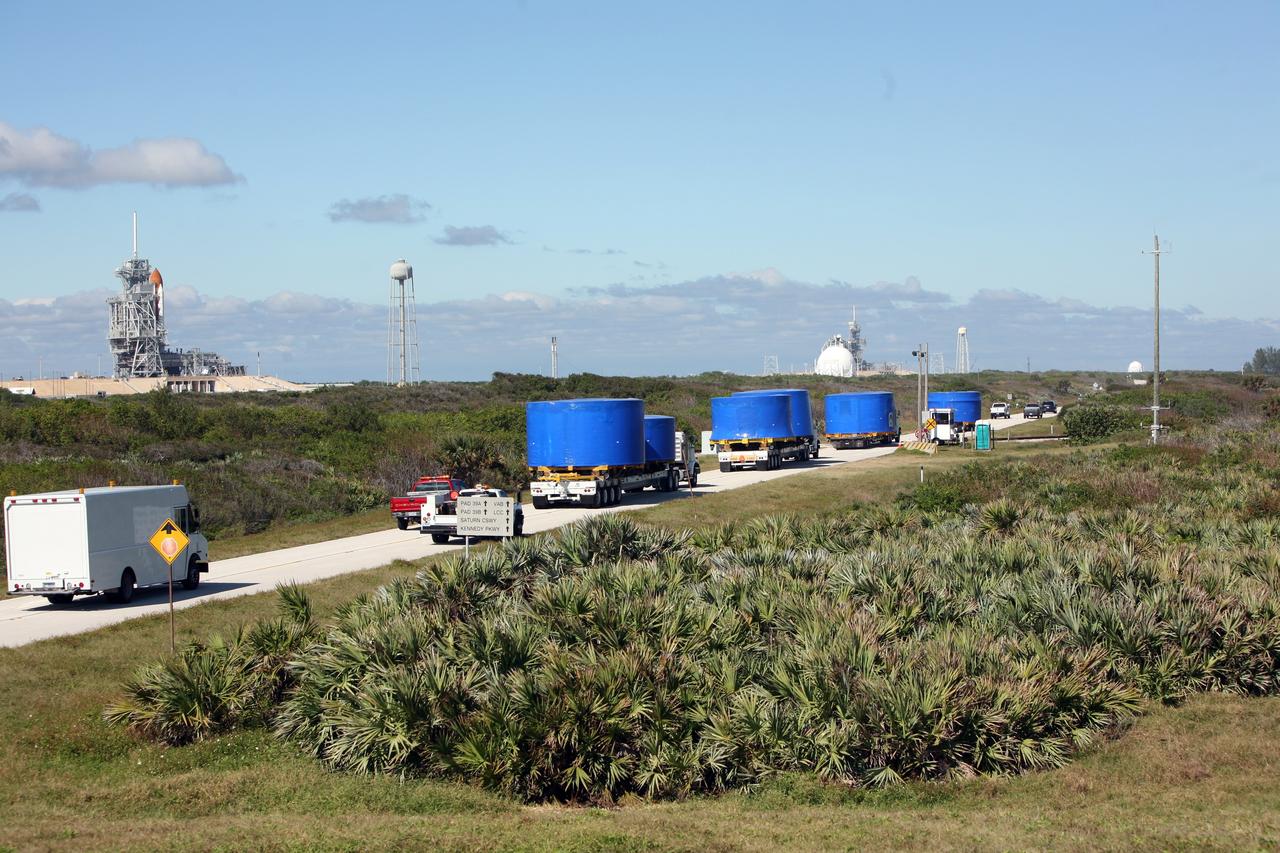
CAPE CANAVERAL, Fla. – A convoy of trucks passes a launch pad as it makes the journey from Port Canaveral, Fla., to the Vehicle Assembly Building's high bay 4 at NASA's Kennedy Space Center in Florida. The trucks carry Ares I-X upper stage simulator segments. The upper stage simulator will be used in the test flight identified as Ares I-X in 2009. The Ares I-X test flight will provide NASA an early opportunity to test and prove hardware, facilities and ground operations associated with the Ares I crew launch vehicle. It also will allow NASA to gather critical data during ascent of the integrated Orion crew exploration vehicle and the Ares I rocket. The data will ensure the entire vehicle system is safe and fully operational before astronauts begin traveling to orbit. The simulator segments will simulate the mass and the outer mold line and will be more than 100 feet of the total vehicle height of 327 feet. The simulator comprises 11 segments that are approximately 18 feet in diameter. Most of the segments will be approximately 10 feet high, ranging in weight from 18,000 to 60,000 pounds, for a total of approximately 450,000 pounds. Photo credit: NASA/Cory Huston
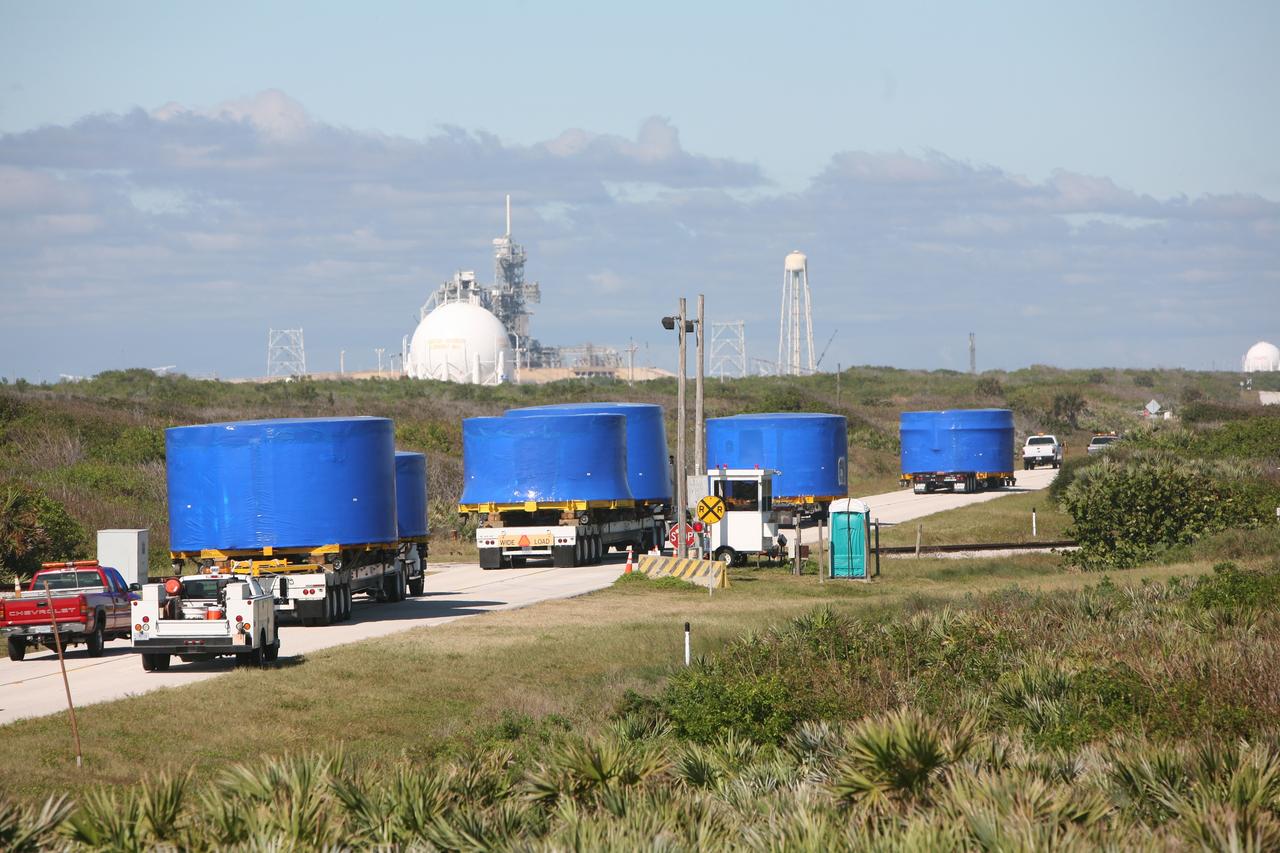
CAPE CANAVERAL, Fla. – A convoy of trucks passes a launch pad as it makes the journey from Port Canaveral, Fla., to the Vehicle Assembly Building's high bay 4 at NASA's Kennedy Space Center in Florida. The trucks carry Ares I-X upper stage simulator segments. The upper stage simulators will be used in the test flight identified as Ares I-X in 2009. The Ares I-X test flight will provide NASA an early opportunity to test and prove hardware, facilities and ground operations associated with the Ares I crew launch vehicle. It also will allow NASA to gather critical data during ascent of the integrated Orion crew exploration vehicle and the Ares I rocket. The data will ensure the entire vehicle system is safe and fully operational before astronauts begin traveling to orbit. The simulator segments will simulate the mass and the outer mold line and will be more than 100 feet of the total vehicle height of 327 feet. The simulator comprises 11 segments that are approximately 18 feet in diameter. Most of the segments will be approximately 10 feet high, ranging in weight from 18,000 to 60,000 pounds, for a total of approximately 450,000 pounds. Photo credit: NASA/Cory Huston
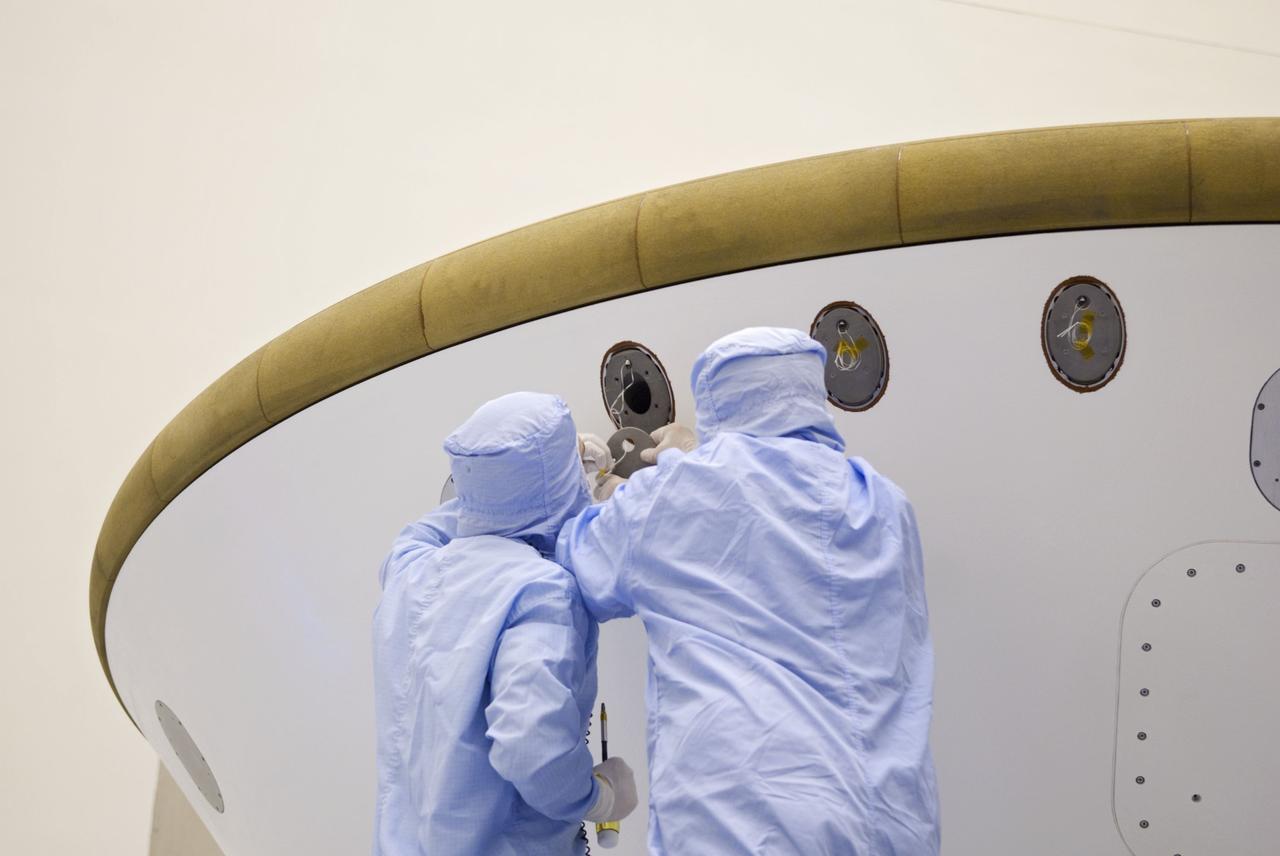
Cape Canaveral, Fla. -- At the Payload Hazardous Servicing Facility at NASA's Kennedy Space Center in Florida, technicians add weights (ejectable ballast mass) to the aeroshell, a component of NASA's Mars Science Laboratory (MSL), in order to conduct a spin and balance test. The aeroshell consists of the backshell which carries the parachute and several components used during later stages of entry, descent and landing, and the spacecraft's heat shield. MSL's components include a compact car-sized rover, Curiosity, which has 10 science instruments designed to search for evidence on whether Mars has had environments favorable to microbial life, including chemical ingredients for life. The unique rover will use a laser to look inside rocks and release its gasses so that the rover’s spectrometer can analyze and send the data back to Earth. Launch of MSL aboard a United Launch Alliance Atlas V rocket is scheduled for Nov. 25 from Space Launch Complex 41 on Cape Canaveral Air Force Station in Florida. For more information, visit http://www.nasa.gov/msl. Photo credit: NASA/Jim Grossmann
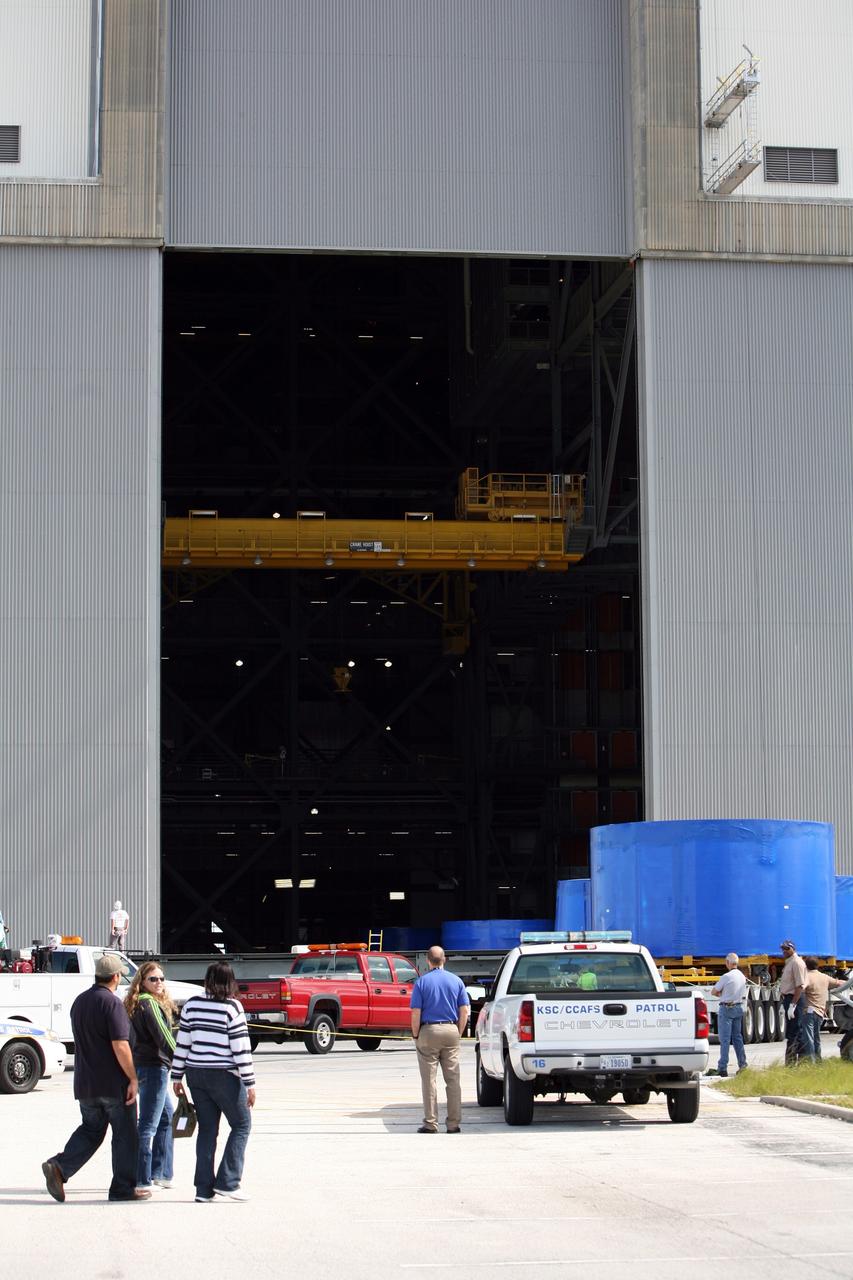
CAPE CANAVERAL, Fla. – At the Vehicle Assembly Building's high bay 4 at NASA's Kennedy Space Center in Florida, the blue Ares I-X upper stage simulator segments are moved inside where they will be offloaded. The upper stage simulators will be used in the test flight identified as Ares I-X in 2009. The Ares I-X test flight will provide NASA an early opportunity to test and prove hardware, facilities and ground operations associated with the Ares I crew launch vehicle. It also will allow NASA to gather critical data during ascent of the integrated Orion crew exploration vehicle and the Ares I rocket. The data will ensure the entire vehicle system is safe and fully operational before astronauts begin traveling to orbit. The simulator segments will simulate the mass and the outer mold line and will be more than 100 feet of the total vehicle height of 327 feet. The simulator comprises 11 segments that are approximately 18 feet in diameter. Most of the segments will be approximately 10 feet high, ranging in weight from 18,000 to 60,000 pounds, for a total of approximately 450,000 pounds. Photo credit: NASA/Cory Huston
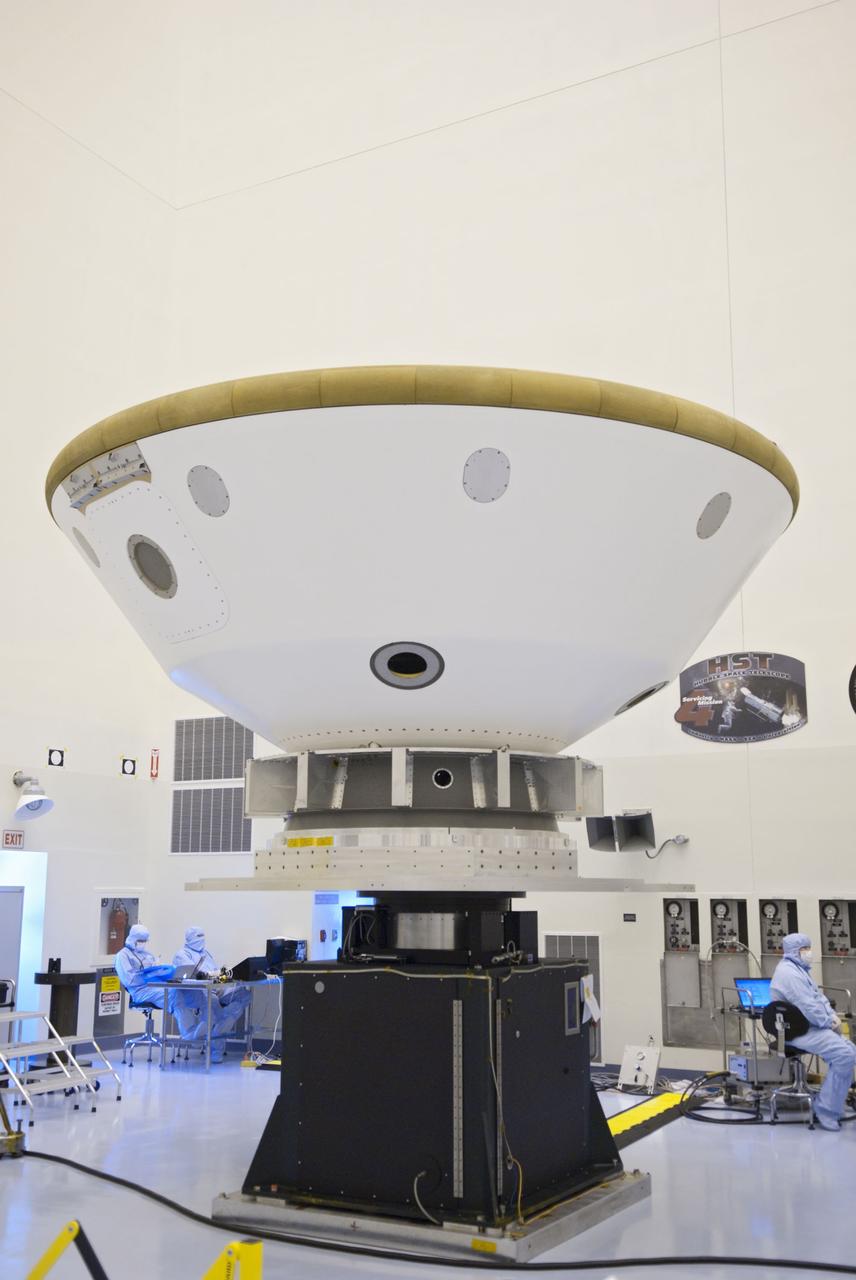
Cape Canaveral, Fla. -- At the Payload Hazardous Servicing Facility at NASA's Kennedy Space Center in Florida, technicians prepare to add weights (ejectable ballast mass) to the aeroshell, a component of NASA's Mars Science Laboratory (MSL), in order to conduct a spin and balance test. The aeroshell consists of the backshell which carries the parachute and several components used during later stages of entry, descent and landing, and the spacecraft's heat shield. MSL's components include a compact car-sized rover, Curiosity, which has 10 science instruments designed to search for evidence on whether Mars has had environments favorable to microbial life, including chemical ingredients for life. The unique rover will use a laser to look inside rocks and release its gasses so that the rover’s spectrometer can analyze and send the data back to Earth. Launch of MSL aboard a United Launch Alliance Atlas V rocket is scheduled for Nov. 25 from Space Launch Complex 41 on Cape Canaveral Air Force Station in Florida. For more information, visit http://www.nasa.gov/msl. Photo credit: NASA/Jim Grossmann
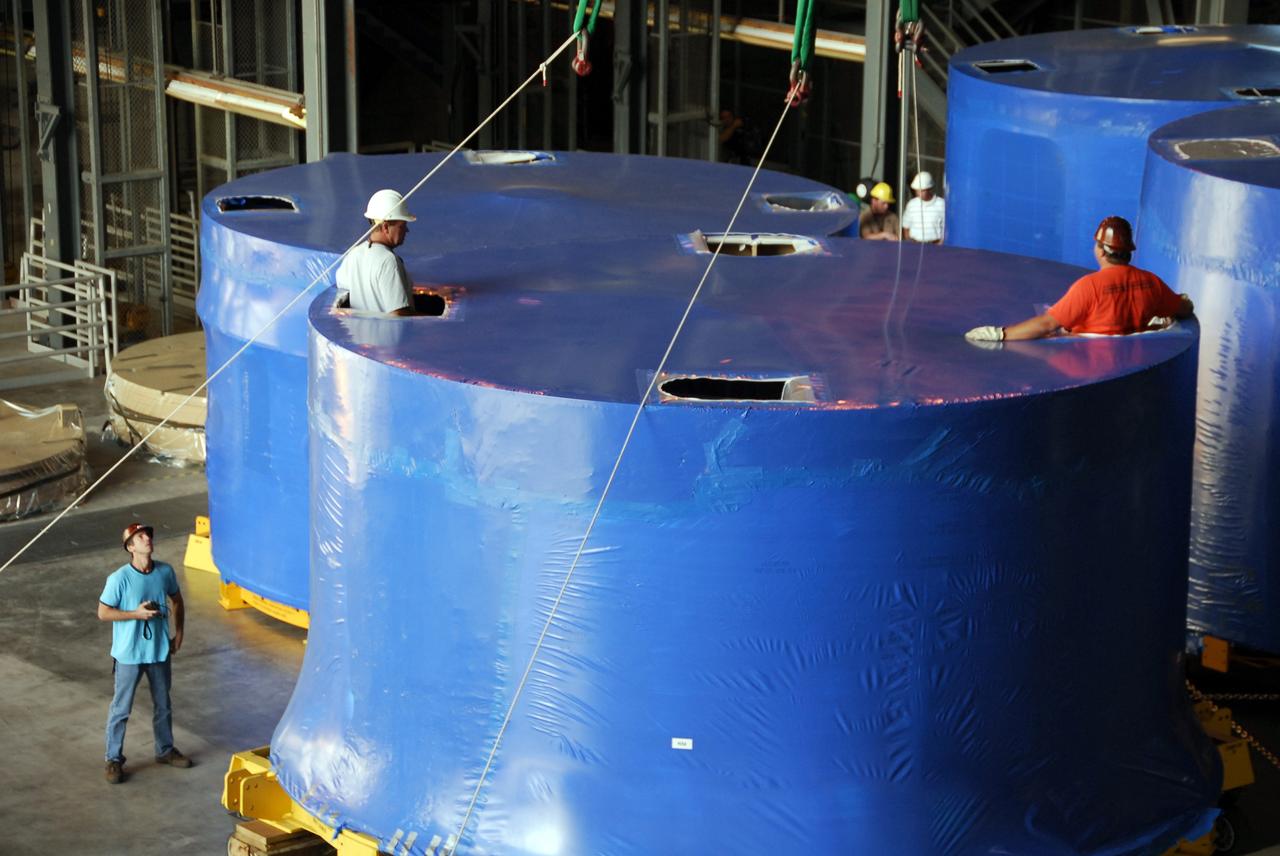
CAPE CANAVERAL, Fla. – Inside the Vehicle Assembly Building's high bay 4 at NASA's Kennedy Space Center in Florida, workers secure the cranes that are being used to offload Ares I-X upper stage simulator segments onto the floor. The segments arrived Nov. 4 at Port Canaveral, Fla., aboard the Delta Mariner. The upper simulator segments are moved inside where they will be offloaded. The upper stage simulators will be used in the test flight identified as Ares I-X in 2009. The Ares I-X test flight will provide NASA an early opportunity to test and prove hardware, facilities and ground operations associated with the Ares I crew launch vehicle. It also will allow NASA to gather critical data during ascent of the integrated Orion crew exploration vehicle and the Ares I rocket. The data will ensure the entire vehicle system is safe and fully operational before astronauts begin traveling to orbit. The simulator segments will simulate the mass and the outer mold line and will be more than 100 feet of the total vehicle height of 327 feet. The simulator comprises 11 segments that are approximately 18 feet in diameter. Most of the segments will be approximately 10 feet high, ranging in weight from 18,000 to 60,000 pounds, for a total of approximately 450,000 pounds. Photo credit: NASA/Cory Huston
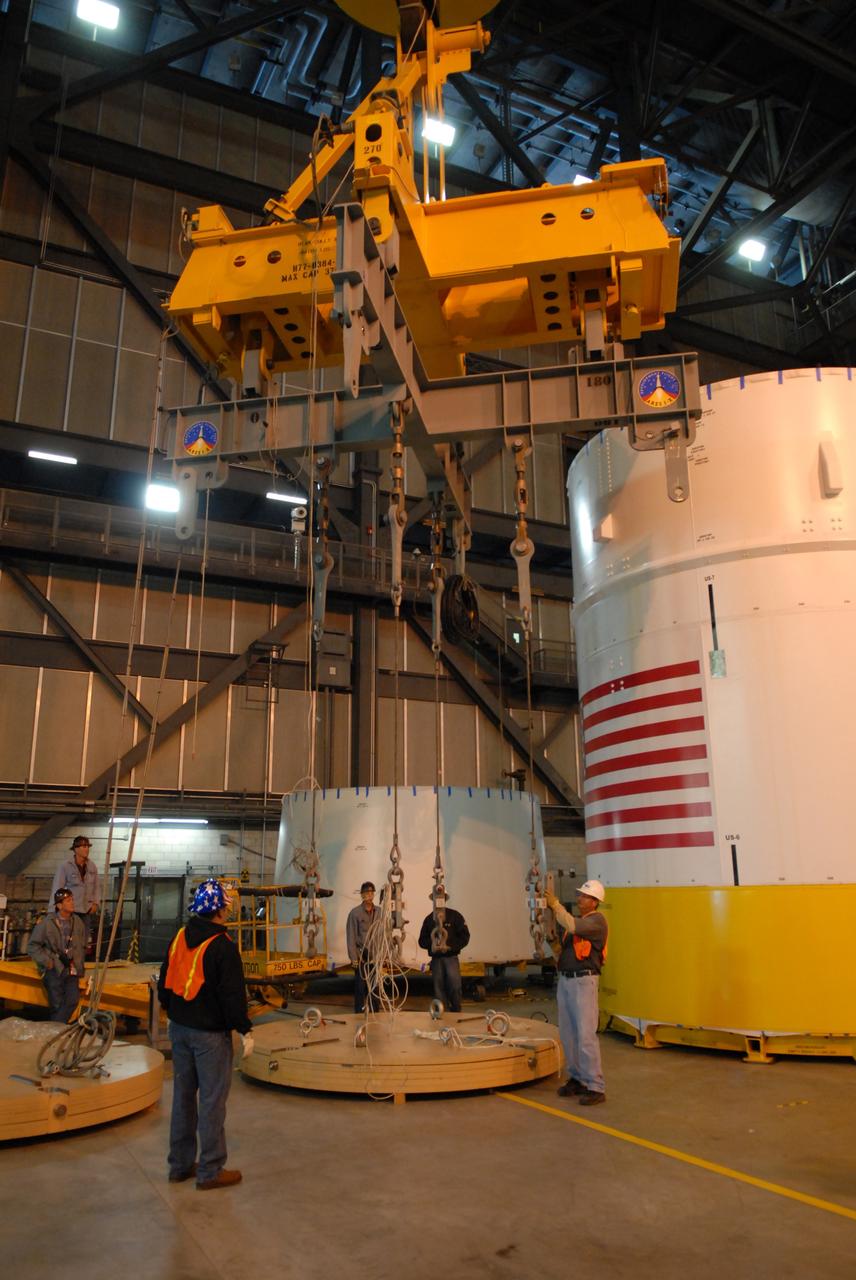
CAPE CANAVERAL, Fla. – In high bay 4 of the Vehicle Assembly Building at NASA's Kennedy Space Center in Florida, work is under way to install ballast in the Ares I-X segments stored there. These ballast assemblies will be installed in the upper stage 1 and 7 segments and will mimic the mass of the fuel. Their total weight is approximately 160,000 pounds. Ares I-X is the test vehicle for the Ares I, which is part of the Constellation Program to return men to the moon and beyond. Ares I is the essential core of a safe, reliable, cost-effective space transportation system that eventually will carry crewed missions back to the moon, on to Mars and out into the solar system. Ares I may also use its 25-ton payload capacity to deliver resources and supplies to the International Space Station, or to "park" payloads in orbit for retrieval by other spacecraft bound for the moon or other destinations. The Ares I-X is targeted for launch in July 2009. Photo credit: NASA/Dimitri Gerondidakis
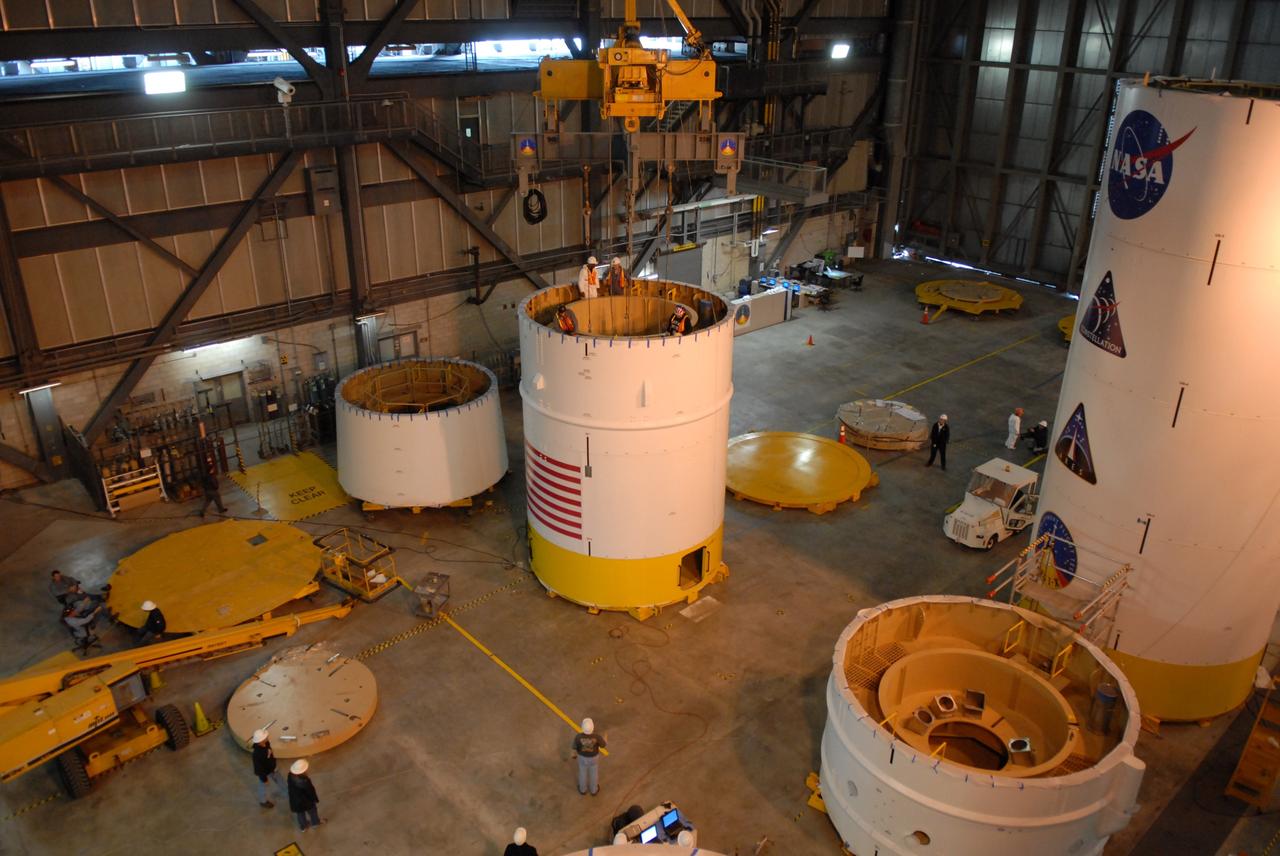
CAPE CANAVERAL, Fla. – In high bay 4 of the Vehicle Assembly Building at NASA's Kennedy Space Center in Florida, a ballast assembly is lowered into the Ares I-X segment 7 (at center). Ballast assemblies are being installed in the upper stage 1 and 7 segments and will mimic the mass of the fuel. Their total weight is approximately 160,000 pounds. Ares I-X is the test vehicle for the Ares I, which is part of the Constellation Program to return men to the moon and beyond. Ares I is the essential core of a safe, reliable, cost-effective space transportation system that eventually will carry crewed missions back to the moon, on to Mars and out into the solar system. Ares I may also use its 25-ton payload capacity to deliver resources and supplies to the International Space Station, or to "park" payloads in orbit for retrieval by other spacecraft bound for the moon or other destinations. The Ares I-X is targeted for launch in July 2009. Photo credit: NASA/Dimitri Gerondidakis
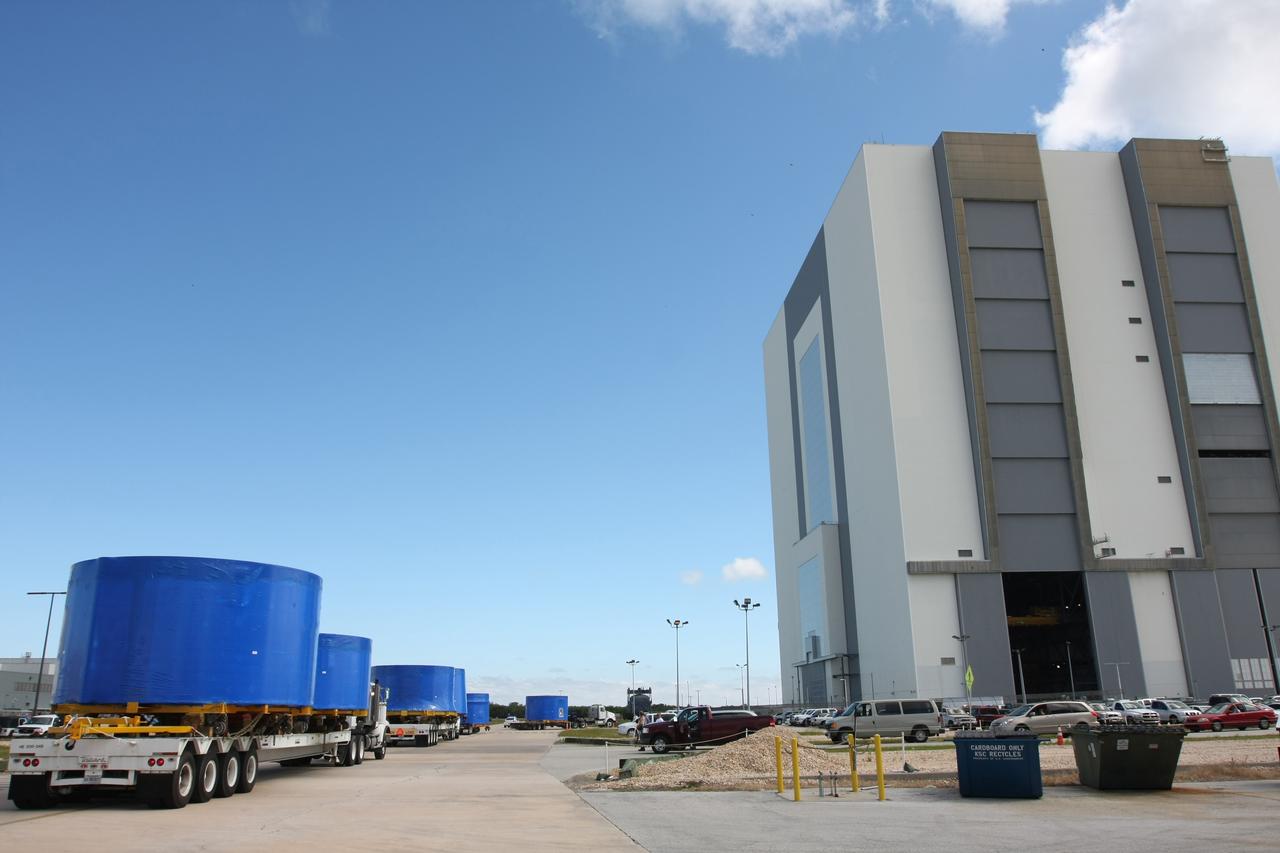
CAPE CANAVERAL, Fla. – A convoy of trucks arrives at the Vehicle Assembly Building's high bay 4 at NASA's Kennedy Space Center in Florida. The trucks carry Ares I-X upper stage simulator segments which arrived at Port Canaveral, Fla., Nov. 4. The upper stage simulators will be used in the test flight identified as Ares I-X in 2009. The Ares I-X test flight will provide NASA an early opportunity to test and prove hardware, facilities and ground operations associated with the Ares I crew launch vehicle. It also will allow NASA to gather critical data during ascent of the integrated Orion crew exploration vehicle and the Ares I rocket. The data will ensure the entire vehicle system is safe and fully operational before astronauts begin traveling to orbit. The simulator segments will simulate the mass and the outer mold line and will be more than 100 feet of the total vehicle height of 327 feet. The simulator comprises 11 segments that are approximately 18 feet in diameter. Most of the segments will be approximately 10 feet high, ranging in weight from 18,000 to 60,000 pounds, for a total of approximately 450,000 pounds. Photo credit: NASA/Cory Huston
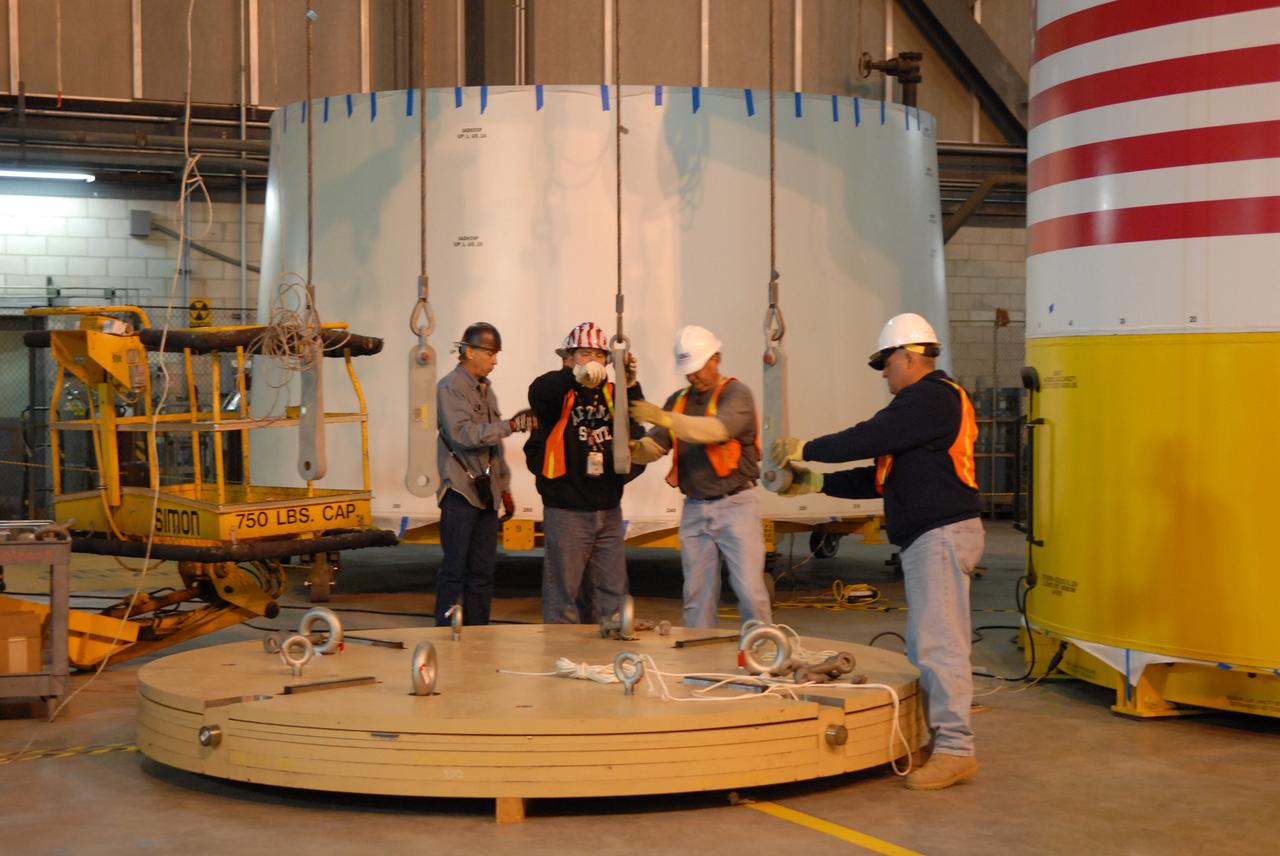
CAPE CANAVERAL, Fla. – In high bay 4 of the Vehicle Assembly Building at NASA's Kennedy Space Center in Florida, workers get ready to attach cables to the ballast for installation in the Ares I-X segments. These ballast assemblies will be installed in the upper stage 1 and 7 segments and will mimic the mass of the fuel. Their total weight is approximately 160,000 pounds. Ares I-X is the test vehicle for the Ares I, which is part of the Constellation Program to return men to the moon and beyond. Ares I is the essential core of a safe, reliable, cost-effective space transportation system that eventually will carry crewed missions back to the moon, on to Mars and out into the solar system. Ares I may also use its 25-ton payload capacity to deliver resources and supplies to the International Space Station, or to "park" payloads in orbit for retrieval by other spacecraft bound for the moon or other destinations. The Ares I-X is targeted for launch in July 2009. Photo credit: NASA/Dimitri Gerondidakis
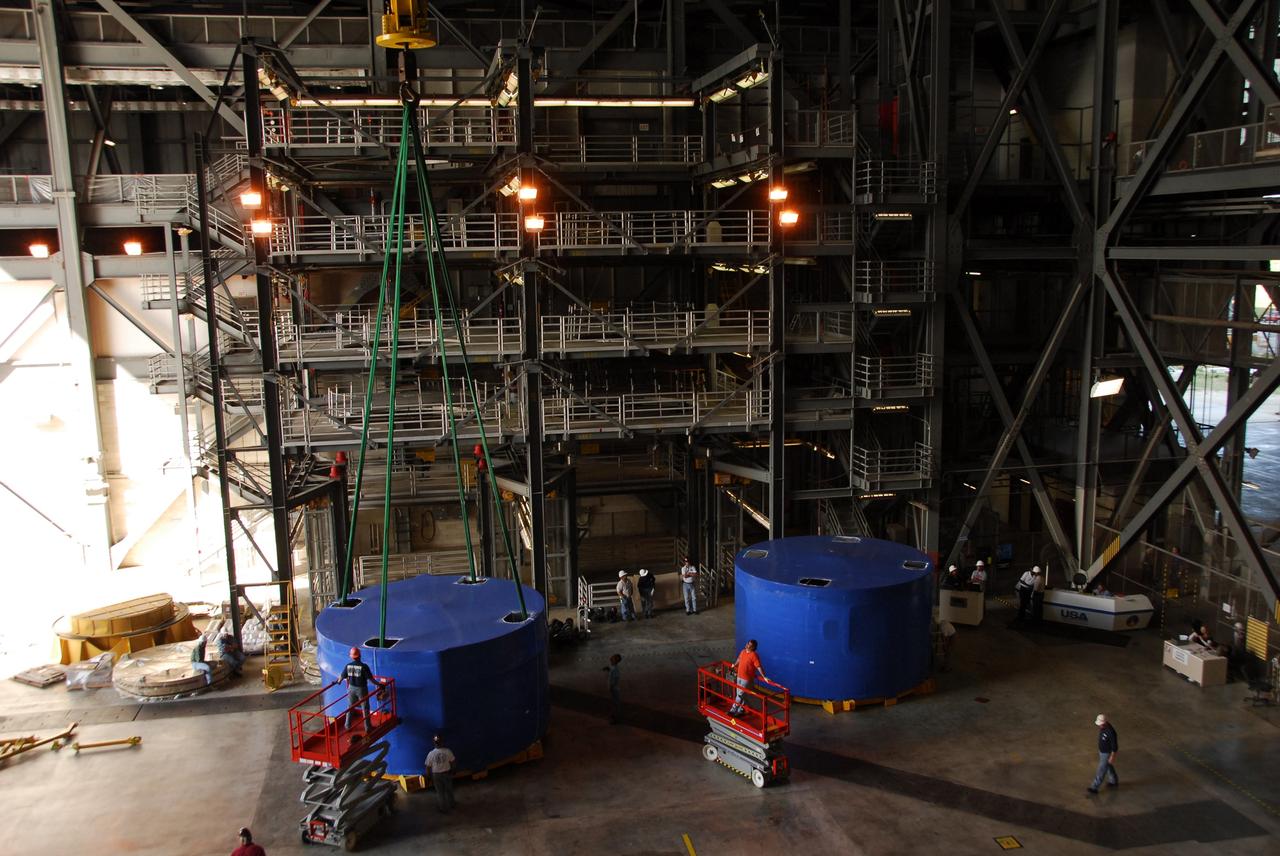
CAPE CANAVERAL, Fla. – Inside the Vehicle Assembly Building's high bay 4 at NASA's Kennedy Space Center in Florida, two of the Ares I-X upper stage simulator segments are offloaded from its transporter and placed on the floor. The segments arrived Nov. 4 at Port Canaveral, Fla., aboard the Delta Mariner. The upper stage simulators will be used in the test flight identified as Ares I-X in 2009. The Ares I-X test flight will provide NASA an early opportunity to test and prove hardware, facilities and ground operations associated with the Ares I crew launch vehicle. It also will allow NASA to gather critical data during ascent of the integrated Orion crew exploration vehicle and the Ares I rocket. The data will ensure the entire vehicle system is safe and fully operational before astronauts begin traveling to orbit. The simulator segments will simulate the mass and the outer mold line and will be more than 100 feet of the total vehicle height of 327 feet. The simulator comprises 11 segments that are approximately 18 feet in diameter. Most of the segments will be approximately 10 feet high, ranging in weight from 18,000 to 60,000 pounds, for a total of approximately 450,000 pounds. Photo credit: NASA/Cory Huston
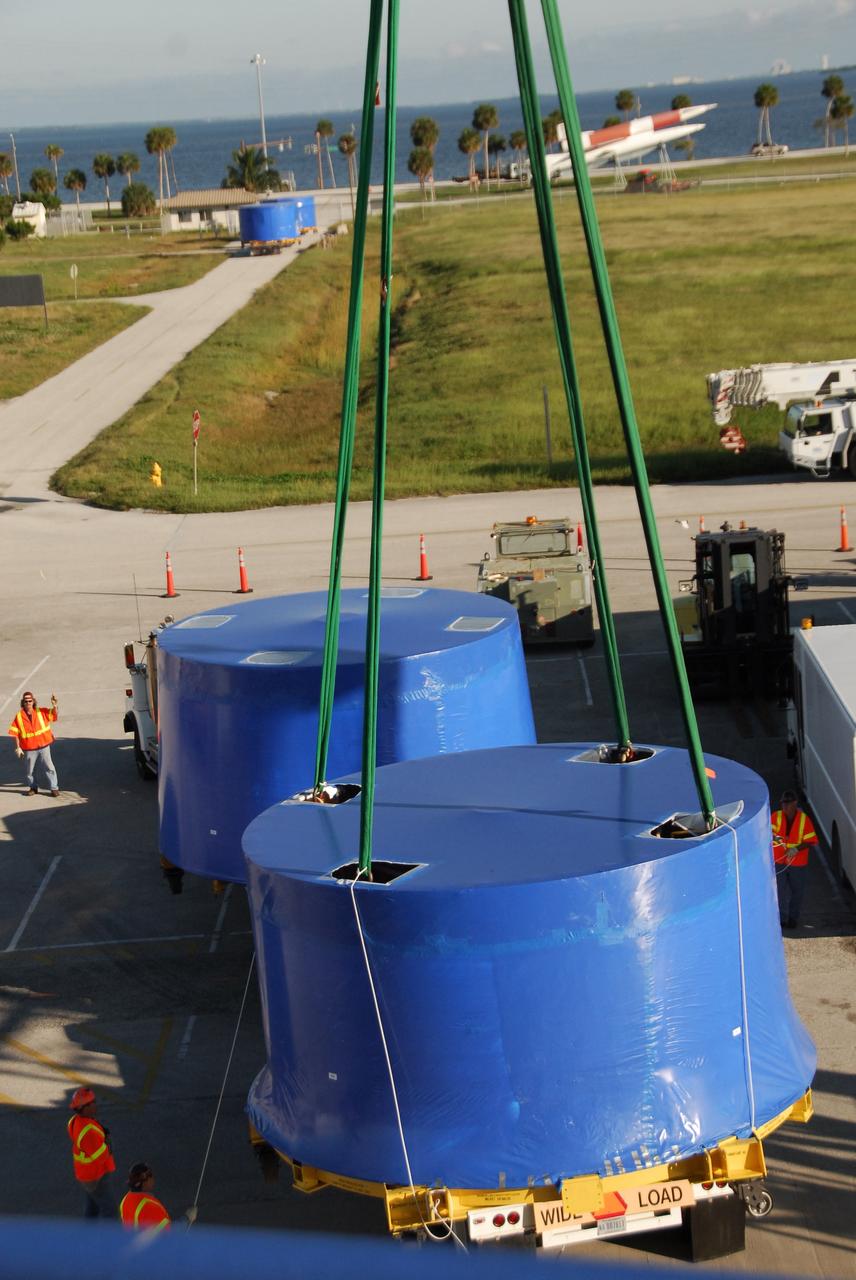
CAPE CANAVERAL, Fla. – A crane lifts and transfers Ares I-X upper stage simulator segments from the Delta Mariner at Port Canaveral, Fla., onto a flatbed truck. They will be transported to the Vehicle Assembly Building's high bay 4 at NASA's Kennedy Space Center in Florida. The upper stage simulator will be used in the test flight identified as Ares I-X in 2009. The Ares I-X test flight will provide NASA an early opportunity to test and prove hardware, facilities and ground operations associated with the Ares I crew launch vehicle. It also will allow NASA to gather critical data during ascent of the integrated Orion crew exploration vehicle and the Ares I rocket. The data will ensure the entire vehicle system is safe and fully operational before astronauts begin traveling to orbit. The simulator segments will simulate the mass and the outer mold line and will be more than 100 feet of the total vehicle height of 327 feet. The simulator comprises 11 segments that are approximately 18 feet in diameter. Most of the segments will be approximately 10 feet high, ranging in weight from 18,000 to 60,000 pounds, for a total of approximately 450,000 pounds. Photo credit: NASA/Cory Huston